株探米国株
日本語 英語
エドガーで原本を確認する
00011201932024FYFALSE273109P1Y1111111111111111111111111P1Yhttp://fasb.org/us-gaap/2024#OtherLiabilitiesCurrenthttp://fasb.org/us-gaap/2024#OtherLiabilitiesCurrentiso4217:USDxbrli:sharesiso4217:USDxbrli:sharesndaq:segmentndaq:companyndaq:exchangeTradedProductndaq:exchangendaq:countryndaq:agreementxbrli:purendaq:trading_dayndaq:notendaq:peerGroupndaq:votendaq:fundndaq:contractutr:TWh00011201932024-01-012024-12-310001120193ndaq:CommonStock.01parvaluepershareMember2024-01-012024-12-310001120193ndaq:FourPointFiveZeroZeroSeniorNotesDue2032Member2024-01-012024-12-310001120193ndaq:ZeroPointNineZeroZeroSeniorUnsecuredNotesDue2033Member2024-01-012024-12-310001120193ndaq:ZeroPointEightSevenFivePercentSeniorNotesDue2030Member2024-01-012024-12-310001120193ndaq:OnePointSevenFivePercentSeniorNotesDue2029Member2024-01-012024-12-3100011201932024-06-3000011201932025-02-1200011201932024-10-012024-12-310001120193ndaq:BradleyJ.PetersonMember2024-01-012024-12-310001120193ndaq:BradleyJ.PetersonMember2024-10-012024-12-310001120193ndaq:BradleyJ.PetersonTradingArrangementRestrictedStockUnits1Memberndaq:BradleyJ.PetersonMember2024-12-310001120193ndaq:BradleyJ.PetersonTradingArrangementRestrictedStockUnits2Memberndaq:BradleyJ.PetersonMember2024-12-310001120193ndaq:BradleyJ.PetersonTradingArrangementPerformanceShareUnitsMemberndaq:BradleyJ.PetersonMember2024-12-310001120193ndaq:SarahYoungwoodMember2024-01-012024-12-310001120193ndaq:SarahYoungwoodMember2024-10-012024-12-310001120193ndaq:SarahYoungwoodMember2024-12-3100011201932024-12-3100011201932023-12-310001120193us-gaap:OperatingSegmentsMemberndaq:CapitalAccessPlatformsMember2024-01-012024-12-310001120193us-gaap:OperatingSegmentsMemberndaq:CapitalAccessPlatformsMember2023-01-012023-12-310001120193us-gaap:OperatingSegmentsMemberndaq:CapitalAccessPlatformsMember2022-01-012022-12-310001120193us-gaap:OperatingSegmentsMemberndaq:FinancialTechnologyMember2024-01-012024-12-310001120193us-gaap:OperatingSegmentsMemberndaq:FinancialTechnologyMember2023-01-012023-12-310001120193us-gaap:OperatingSegmentsMemberndaq:FinancialTechnologyMember2022-01-012022-12-310001120193us-gaap:OperatingSegmentsMemberndaq:MarketServicesMember2024-01-012024-12-310001120193us-gaap:OperatingSegmentsMemberndaq:MarketServicesMember2023-01-012023-12-310001120193us-gaap:OperatingSegmentsMemberndaq:MarketServicesMember2022-01-012022-12-310001120193us-gaap:MaterialReconcilingItemsMember2024-01-012024-12-310001120193us-gaap:MaterialReconcilingItemsMember2023-01-012023-12-310001120193us-gaap:MaterialReconcilingItemsMember2022-01-012022-12-3100011201932023-01-012023-12-3100011201932022-01-012022-12-310001120193ndaq:TransactionRebatesMember2024-01-012024-12-310001120193ndaq:TransactionRebatesMember2023-01-012023-12-310001120193ndaq:TransactionRebatesMember2022-01-012022-12-310001120193ndaq:BrokerageClearanceAndExchangeFeesMember2024-01-012024-12-310001120193ndaq:BrokerageClearanceAndExchangeFeesMember2023-01-012023-12-310001120193ndaq:BrokerageClearanceAndExchangeFeesMember2022-01-012022-12-310001120193us-gaap:CommonStockMember2023-12-310001120193us-gaap:CommonStockMember2022-12-310001120193us-gaap:CommonStockMember2021-12-310001120193us-gaap:CommonStockMember2024-01-012024-12-310001120193us-gaap:CommonStockMember2023-01-012023-12-310001120193us-gaap:CommonStockMember2022-01-012022-12-310001120193us-gaap:CommonStockMember2024-12-310001120193us-gaap:AdditionalPaidInCapitalMember2023-12-310001120193us-gaap:AdditionalPaidInCapitalMember2022-12-310001120193us-gaap:AdditionalPaidInCapitalMember2021-12-310001120193ndaq:ShareRepurchaseProgramMemberus-gaap:AdditionalPaidInCapitalMember2024-01-012024-12-310001120193ndaq:ShareRepurchaseProgramMemberus-gaap:AdditionalPaidInCapitalMember2023-01-012023-12-310001120193ndaq:ShareRepurchaseProgramMemberus-gaap:AdditionalPaidInCapitalMember2022-01-012022-12-310001120193ndaq:AcceleratedShareRepurchaseAgreementMemberus-gaap:AdditionalPaidInCapitalMember2024-01-012024-12-310001120193ndaq:AcceleratedShareRepurchaseAgreementMemberus-gaap:AdditionalPaidInCapitalMember2023-01-012023-12-310001120193ndaq:AcceleratedShareRepurchaseAgreementMemberus-gaap:AdditionalPaidInCapitalMember2022-01-012022-12-310001120193us-gaap:AdditionalPaidInCapitalMember2024-01-012024-12-310001120193us-gaap:AdditionalPaidInCapitalMember2023-01-012023-12-310001120193us-gaap:AdditionalPaidInCapitalMember2022-01-012022-12-310001120193us-gaap:AdditionalPaidInCapitalMember2024-12-310001120193us-gaap:TreasuryStockCommonMember2023-12-310001120193us-gaap:TreasuryStockCommonMember2022-12-310001120193us-gaap:TreasuryStockCommonMember2021-12-310001120193us-gaap:TreasuryStockCommonMember2024-01-012024-12-310001120193us-gaap:TreasuryStockCommonMember2023-01-012023-12-310001120193us-gaap:TreasuryStockCommonMember2022-01-012022-12-310001120193us-gaap:TreasuryStockCommonMember2024-12-310001120193us-gaap:AccumulatedOtherComprehensiveIncomeMember2023-12-310001120193us-gaap:AccumulatedOtherComprehensiveIncomeMember2022-12-310001120193us-gaap:AccumulatedOtherComprehensiveIncomeMember2021-12-310001120193us-gaap:AccumulatedOtherComprehensiveIncomeMember2024-01-012024-12-310001120193us-gaap:AccumulatedOtherComprehensiveIncomeMember2023-01-012023-12-310001120193us-gaap:AccumulatedOtherComprehensiveIncomeMember2022-01-012022-12-310001120193us-gaap:AccumulatedOtherComprehensiveIncomeMember2024-12-310001120193us-gaap:RetainedEarningsMember2023-12-310001120193us-gaap:RetainedEarningsMember2022-12-310001120193us-gaap:RetainedEarningsMember2021-12-310001120193us-gaap:RetainedEarningsMember2024-01-012024-12-310001120193us-gaap:RetainedEarningsMember2023-01-012023-12-310001120193us-gaap:RetainedEarningsMember2022-01-012022-12-310001120193us-gaap:RetainedEarningsMember2024-12-310001120193ndaq:TotalEquityMember2024-12-310001120193ndaq:TotalEquityMember2023-12-310001120193ndaq:TotalEquityMember2022-12-310001120193us-gaap:NoncontrollingInterestMember2023-12-310001120193us-gaap:NoncontrollingInterestMember2022-12-310001120193us-gaap:NoncontrollingInterestMember2021-12-310001120193us-gaap:NoncontrollingInterestMember2024-01-012024-12-310001120193us-gaap:NoncontrollingInterestMember2023-01-012023-12-310001120193us-gaap:NoncontrollingInterestMember2022-01-012022-12-310001120193us-gaap:NoncontrollingInterestMember2024-12-3100011201932022-12-3100011201932021-12-310001120193ndaq:CapitalAccessPlatformsMember2024-12-310001120193country:USndaq:CapitalAccessPlatformsMember2024-12-310001120193srt:EuropeMemberndaq:CapitalAccessPlatformsMember2024-12-310001120193ndaq:CapitalAccessPlatformsMember2024-01-012024-12-310001120193ndaq:MarketServicesMember2024-01-012024-12-310001120193us-gaap:CashEquivalentsMember2024-12-310001120193us-gaap:CashEquivalentsMember2023-12-310001120193srt:MinimumMemberus-gaap:BuildingAndBuildingImprovementsMember2024-12-310001120193srt:MaximumMemberus-gaap:BuildingAndBuildingImprovementsMember2024-12-310001120193srt:MinimumMemberndaq:DataProcessingEquipmentAndSoftwareMember2024-12-310001120193srt:MaximumMemberndaq:DataProcessingEquipmentAndSoftwareMember2024-12-310001120193srt:MinimumMemberndaq:FurnitureAndEquipmentMember2024-12-310001120193srt:MaximumMemberndaq:FurnitureAndEquipmentMember2024-12-310001120193us-gaap:ComputerSoftwareIntangibleAssetMembersrt:MinimumMember2024-12-310001120193us-gaap:ComputerSoftwareIntangibleAssetMembersrt:MaximumMember2024-12-310001120193srt:MaximumMember2024-12-310001120193us-gaap:CustomerRelationshipsMember2024-01-012024-12-310001120193us-gaap:CustomerRelationshipsMember2023-01-012023-12-310001120193us-gaap:CustomerRelationshipsMember2022-01-012022-12-310001120193ndaq:ListingServicesMembersrt:MinimumMember2024-12-310001120193ndaq:ListingServicesMembersrt:MaximumMember2024-12-310001120193ndaq:ListingServicesMember2024-01-012024-12-310001120193ndaq:IndexMemberndaq:CapitalAccessPlatformsMember2024-01-012024-12-310001120193ndaq:WorkflowInsightsMembersrt:MinimumMemberndaq:CapitalAccessPlatformsMember2024-01-012024-12-310001120193ndaq:WorkflowInsightsMembersrt:MaximumMemberndaq:CapitalAccessPlatformsMember2024-01-012024-12-310001120193ndaq:FinancialCrimeManagementTechnologyMemberndaq:FinancialTechnologyMember2024-01-012024-12-310001120193us-gaap:OperatingSegmentsMemberndaq:CapitalMarketsTechnologyMemberndaq:MarketTechnologyMemberndaq:FinancialTechnologyMember2024-01-012024-12-310001120193us-gaap:OperatingSegmentsMemberndaq:CapitalMarketsTechnologyMemberndaq:MarketTechnologyMemberndaq:FinancialTechnologyMember2023-01-012023-12-310001120193us-gaap:OperatingSegmentsMemberndaq:CapitalMarketsTechnologyMemberndaq:MarketTechnologyMemberndaq:FinancialTechnologyMember2022-01-012022-12-310001120193ndaq:TradeManagementServicesMemberMemberndaq:FinancialTechnologyMember2024-01-012024-12-310001120193us-gaap:EmployeeStockMember2024-01-012024-12-310001120193us-gaap:OperatingSegmentsMemberndaq:CapitalAccessPlatformsMemberndaq:DataListingServicesMember2024-01-012024-12-310001120193us-gaap:OperatingSegmentsMemberndaq:CapitalAccessPlatformsMemberndaq:DataListingServicesMember2023-01-012023-12-310001120193us-gaap:OperatingSegmentsMemberndaq:CapitalAccessPlatformsMemberndaq:DataListingServicesMember2022-01-012022-12-310001120193us-gaap:OperatingSegmentsMemberndaq:CapitalAccessPlatformsMemberndaq:IndexMember2024-01-012024-12-310001120193us-gaap:OperatingSegmentsMemberndaq:CapitalAccessPlatformsMemberndaq:IndexMember2023-01-012023-12-310001120193us-gaap:OperatingSegmentsMemberndaq:CapitalAccessPlatformsMemberndaq:IndexMember2022-01-012022-12-310001120193us-gaap:OperatingSegmentsMemberndaq:CapitalAccessPlatformsMemberndaq:WorkflowInsightsMember2024-01-012024-12-310001120193us-gaap:OperatingSegmentsMemberndaq:CapitalAccessPlatformsMemberndaq:WorkflowInsightsMember2023-01-012023-12-310001120193us-gaap:OperatingSegmentsMemberndaq:CapitalAccessPlatformsMemberndaq:WorkflowInsightsMember2022-01-012022-12-310001120193us-gaap:OperatingSegmentsMemberndaq:FinancialTechnologyMemberndaq:FinancialCrimeManagementTechnologyMember2024-01-012024-12-310001120193us-gaap:OperatingSegmentsMemberndaq:FinancialTechnologyMemberndaq:FinancialCrimeManagementTechnologyMember2023-01-012023-12-310001120193us-gaap:OperatingSegmentsMemberndaq:FinancialTechnologyMemberndaq:FinancialCrimeManagementTechnologyMember2022-01-012022-12-310001120193us-gaap:OperatingSegmentsMemberndaq:FinancialTechnologyMemberndaq:RegulatoryTechnologyMember2024-01-012024-12-310001120193us-gaap:OperatingSegmentsMemberndaq:FinancialTechnologyMemberndaq:RegulatoryTechnologyMember2023-01-012023-12-310001120193us-gaap:OperatingSegmentsMemberndaq:FinancialTechnologyMemberndaq:RegulatoryTechnologyMember2022-01-012022-12-310001120193us-gaap:OperatingSegmentsMemberndaq:FinancialTechnologyMemberndaq:CapitalMarketsTechnologyMember2024-01-012024-12-310001120193us-gaap:OperatingSegmentsMemberndaq:FinancialTechnologyMemberndaq:CapitalMarketsTechnologyMember2023-01-012023-12-310001120193us-gaap:OperatingSegmentsMemberndaq:FinancialTechnologyMemberndaq:CapitalMarketsTechnologyMember2022-01-012022-12-310001120193us-gaap:MaterialReconcilingItemsMemberus-gaap:ServiceOtherMember2024-01-012024-12-310001120193us-gaap:MaterialReconcilingItemsMemberus-gaap:ServiceOtherMember2023-01-012023-12-310001120193us-gaap:MaterialReconcilingItemsMemberus-gaap:ServiceOtherMember2022-01-012022-12-310001120193us-gaap:TransferredAtPointInTimeMemberndaq:MarketServicesMemberndaq:MarketServicesSegmentMember2024-01-012024-12-310001120193us-gaap:TransferredAtPointInTimeMemberndaq:MarketServicesMemberndaq:MarketServicesSegmentMember2023-01-012023-12-310001120193us-gaap:TransferredAtPointInTimeMemberndaq:MarketServicesMemberndaq:MarketServicesSegmentMember2022-01-012022-12-310001120193us-gaap:TransferredOverTimeMemberndaq:MarketServicesMemberndaq:MarketServicesSegmentMember2024-01-012024-12-310001120193us-gaap:TransferredOverTimeMemberndaq:MarketServicesMemberndaq:MarketServicesSegmentMember2023-01-012023-12-310001120193us-gaap:TransferredOverTimeMemberndaq:MarketServicesMemberndaq:MarketServicesSegmentMember2022-01-012022-12-310001120193ndaq:AdenzaHoldingsIncMemberus-gaap:CorporateNonSegmentMember2024-07-012024-09-3000011201932025-01-01ndaq:FinancialCrimeManagementTechnologyMemberndaq:FinancialTechnologyMember2024-12-3100011201932025-01-01ndaq:RegulatoryTechnologyMemberndaq:FinancialTechnologyMember2024-12-3100011201932025-01-01ndaq:CapitalMarketsTechnologyMemberndaq:FinancialTechnologyMember2024-12-3100011201932025-01-01ndaq:WorkflowInsightsMemberndaq:CapitalAccessPlatformsMember2024-12-3100011201932025-01-012024-12-3100011201932026-01-01ndaq:FinancialCrimeManagementTechnologyMemberndaq:FinancialTechnologyMember2024-12-3100011201932026-01-01ndaq:RegulatoryTechnologyMemberndaq:FinancialTechnologyMember2024-12-3100011201932026-01-01ndaq:CapitalMarketsTechnologyMemberndaq:FinancialTechnologyMember2024-12-3100011201932026-01-01ndaq:WorkflowInsightsMemberndaq:CapitalAccessPlatformsMember2024-12-3100011201932026-01-012024-12-3100011201932027-01-01ndaq:FinancialCrimeManagementTechnologyMemberndaq:FinancialTechnologyMember2024-12-3100011201932027-01-01ndaq:RegulatoryTechnologyMemberndaq:FinancialTechnologyMember2024-12-3100011201932027-01-01ndaq:CapitalMarketsTechnologyMemberndaq:FinancialTechnologyMember2024-12-3100011201932027-01-01ndaq:WorkflowInsightsMemberndaq:CapitalAccessPlatformsMember2024-12-3100011201932027-01-012024-12-3100011201932028-01-01ndaq:FinancialCrimeManagementTechnologyMemberndaq:FinancialTechnologyMember2024-12-3100011201932028-01-01ndaq:RegulatoryTechnologyMemberndaq:FinancialTechnologyMember2024-12-3100011201932028-01-01ndaq:CapitalMarketsTechnologyMemberndaq:FinancialTechnologyMember2024-12-3100011201932028-01-01ndaq:WorkflowInsightsMemberndaq:CapitalAccessPlatformsMember2024-12-3100011201932028-01-012024-12-3100011201932029-01-01ndaq:FinancialCrimeManagementTechnologyMemberndaq:FinancialTechnologyMember2024-12-3100011201932029-01-01ndaq:RegulatoryTechnologyMemberndaq:FinancialTechnologyMember2024-12-3100011201932029-01-01ndaq:CapitalMarketsTechnologyMemberndaq:FinancialTechnologyMember2024-12-3100011201932029-01-01ndaq:WorkflowInsightsMemberndaq:CapitalAccessPlatformsMember2024-12-3100011201932029-01-012024-12-3100011201932030-01-01ndaq:FinancialCrimeManagementTechnologyMemberndaq:FinancialTechnologyMember2024-12-3100011201932030-01-01ndaq:RegulatoryTechnologyMemberndaq:FinancialTechnologyMember2024-12-3100011201932030-01-01ndaq:CapitalMarketsTechnologyMemberndaq:FinancialTechnologyMember2024-12-3100011201932030-01-01ndaq:WorkflowInsightsMemberndaq:CapitalAccessPlatformsMember2024-12-3100011201932030-01-012024-12-310001120193ndaq:FinancialCrimeManagementTechnologyMemberndaq:FinancialTechnologyMember2024-12-310001120193ndaq:RegulatoryTechnologyMemberndaq:FinancialTechnologyMember2024-12-310001120193ndaq:CapitalMarketsTechnologyMemberndaq:FinancialTechnologyMember2024-12-310001120193ndaq:WorkflowInsightsMemberndaq:CapitalAccessPlatformsMember2024-12-310001120193ndaq:AdenzaHoldingsIncMember2023-06-012023-06-300001120193ndaq:AdenzaHoldingsIncMember2023-11-012023-11-0100011201932023-06-012023-06-300001120193ndaq:TermLoanMemberus-gaap:SecuredDebtMember2023-06-300001120193ndaq:AdenzaHoldingsIncMember2023-11-010001120193ndaq:ThomaBravoMember2023-11-010001120193ndaq:SecondaryPublicOfferingMember2024-07-262024-07-260001120193ndaq:SecondaryPublicOfferingMember2024-07-260001120193ndaq:ShareRepurchaseProgramMember2024-07-262024-07-260001120193ndaq:ThomaBravoMember2024-07-302024-07-300001120193ndaq:ThomaBravoMember2024-07-300001120193ndaq:AdenzaHoldingsIncMember2024-01-012024-12-310001120193ndaq:AdenzaHoldingsIncMemberus-gaap:CustomerRelationshipsMember2023-11-010001120193ndaq:AdenzaHoldingsIncMemberus-gaap:TechnologyBasedIntangibleAssetsMember2023-11-010001120193ndaq:AdenzaHoldingsIncMemberus-gaap:TradeNamesMember2023-11-010001120193ndaq:AdenzaHoldingsIncMemberus-gaap:CustomerRelationshipsMemberus-gaap:MeasurementInputDiscountRateMember2023-11-010001120193ndaq:AdenzaHoldingsIncMemberus-gaap:TechnologyBasedIntangibleAssetsMemberus-gaap:MeasurementInputDiscountRateMember2023-11-010001120193ndaq:AdenzaHoldingsIncMemberus-gaap:TradeNamesMemberus-gaap:MeasurementInputDiscountRateMember2023-11-010001120193ndaq:AdenzaHoldingsIncMemberndaq:FinancialTechnologyMember2023-11-012023-12-310001120193ndaq:AdenzaHoldingsIncMember2023-11-012023-12-310001120193ndaq:AdenzaHoldingsIncMember2023-01-012023-12-310001120193ndaq:AdenzaHoldingsIncMember2022-01-012022-12-310001120193ndaq:CapitalAccessPlatformsMember2023-12-310001120193ndaq:FinancialTechnologyMember2023-12-310001120193ndaq:FinancialTechnologyMember2024-01-012024-12-310001120193ndaq:FinancialTechnologyMember2024-12-310001120193ndaq:MarketServicesMember2023-12-310001120193ndaq:MarketServicesMember2024-12-310001120193us-gaap:DevelopedTechnologyRightsMember2024-12-310001120193us-gaap:DevelopedTechnologyRightsMember2023-12-310001120193us-gaap:CustomerRelationshipsMember2024-12-310001120193us-gaap:CustomerRelationshipsMember2023-12-310001120193ndaq:TradeNamesAndOtherIntangibleAssetsMember2024-12-310001120193ndaq:TradeNamesAndOtherIntangibleAssetsMember2023-12-310001120193ndaq:ForeignCurrencyTranslationAdjustmentMember2024-12-310001120193ndaq:ForeignCurrencyTranslationAdjustmentMember2023-12-310001120193ndaq:ExchangeAndClearingRegistrationsMember2024-12-310001120193ndaq:ExchangeAndClearingRegistrationsMember2023-12-310001120193us-gaap:TradeNamesMember2024-12-310001120193us-gaap:TradeNamesMember2023-12-310001120193us-gaap:LicensingAgreementsMember2024-12-310001120193us-gaap:LicensingAgreementsMember2023-12-310001120193ndaq:ForeignCurrencyTranslationAdjustmentMember2024-12-310001120193ndaq:ForeignCurrencyTranslationAdjustmentMember2023-12-310001120193us-gaap:ForeignGovernmentDebtSecuritiesMember2024-12-310001120193us-gaap:ForeignGovernmentDebtSecuritiesMember2023-12-310001120193ndaq:OptionsClearingCorporationMember2023-12-310001120193ndaq:OptionsClearingCorporationMember2024-12-310001120193ndaq:DataProcessingEquipmentAndSoftwareMember2024-12-310001120193ndaq:DataProcessingEquipmentAndSoftwareMember2023-12-310001120193ndaq:FurnitureEquipmentAndLeaseholdImprovementsMember2024-12-310001120193ndaq:FurnitureEquipmentAndLeaseholdImprovementsMember2023-12-310001120193ndaq:InitialListingsFeesMember2023-12-310001120193ndaq:InitialListingsFeesMember2024-01-012024-12-310001120193ndaq:InitialListingsFeesMember2024-12-310001120193ndaq:AnnualRenewalFeesMember2023-12-310001120193ndaq:AnnualRenewalFeesMember2024-01-012024-12-310001120193ndaq:AnnualRenewalFeesMember2024-12-310001120193ndaq:WorkflowInsightsMember2023-12-310001120193ndaq:WorkflowInsightsMember2024-01-012024-12-310001120193ndaq:WorkflowInsightsMember2024-12-310001120193ndaq:FinancialCrimeManagementTechnologyMember2023-12-310001120193ndaq:FinancialCrimeManagementTechnologyMember2024-01-012024-12-310001120193ndaq:FinancialCrimeManagementTechnologyMember2024-12-310001120193ndaq:RegulatoryTechnologyMember2023-12-310001120193ndaq:RegulatoryTechnologyMember2024-01-012024-12-310001120193ndaq:RegulatoryTechnologyMember2024-12-310001120193ndaq:CapitalMarketsTechnologyMember2023-12-310001120193ndaq:CapitalMarketsTechnologyMember2024-01-012024-12-310001120193ndaq:CapitalMarketsTechnologyMember2024-12-310001120193ndaq:OtherMember2023-12-310001120193ndaq:OtherMember2024-01-012024-12-310001120193ndaq:OtherMember2024-12-310001120193us-gaap:CommercialPaperMember2023-12-310001120193us-gaap:CommercialPaperMember2024-01-012024-12-310001120193us-gaap:CommercialPaperMember2024-12-310001120193ndaq:FivePointSixFiveSeniorUnsecuredNotesDue2025Memberus-gaap:SeniorNotesMember2023-12-310001120193ndaq:FivePointSixFiveSeniorUnsecuredNotesDue2025Memberus-gaap:SeniorNotesMember2024-01-012024-12-310001120193ndaq:FivePointSixFiveSeniorUnsecuredNotesDue2025Memberus-gaap:SeniorNotesMember2024-12-310001120193ndaq:ThreePointEightFiveSeniorSecuredNotesDueJune302026Memberus-gaap:SeniorNotesMember2023-12-310001120193ndaq:ThreePointEightFiveSeniorSecuredNotesDueJune302026Memberus-gaap:SeniorNotesMember2024-01-012024-12-310001120193ndaq:ThreePointEightFiveSeniorSecuredNotesDueJune302026Memberus-gaap:SeniorNotesMember2024-12-310001120193ndaq:FivePointThreeFiveSeniorUnsecuredNotesDue2028Memberus-gaap:SeniorNotesMember2023-12-310001120193ndaq:FivePointThreeFiveSeniorUnsecuredNotesDue2028Memberus-gaap:SeniorNotesMember2024-01-012024-12-310001120193ndaq:FivePointThreeFiveSeniorUnsecuredNotesDue2028Memberus-gaap:SeniorNotesMember2024-12-310001120193ndaq:OnePointSevenFiveSeniorUnsecuredNotesDue2029Memberus-gaap:SeniorNotesMember2023-12-310001120193ndaq:OnePointSevenFiveSeniorUnsecuredNotesDue2029Memberus-gaap:SeniorNotesMember2024-01-012024-12-310001120193ndaq:OnePointSevenFiveSeniorUnsecuredNotesDue2029Memberus-gaap:SeniorNotesMember2024-12-310001120193ndaq:A0875SeniorUnsecuredNotesDueFebruary132030Memberus-gaap:SeniorNotesMember2023-12-310001120193ndaq:A0875SeniorUnsecuredNotesDueFebruary132030Memberus-gaap:SeniorNotesMember2024-01-012024-12-310001120193ndaq:A0875SeniorUnsecuredNotesDueFebruary132030Memberus-gaap:SeniorNotesMember2024-12-310001120193ndaq:OnePointSixFiveZeroSeniorUnsecuredNotesDue2031Memberus-gaap:SeniorNotesMember2023-12-310001120193ndaq:OnePointSixFiveZeroSeniorUnsecuredNotesDue2031Memberus-gaap:SeniorNotesMember2024-01-012024-12-310001120193ndaq:OnePointSixFiveZeroSeniorUnsecuredNotesDue2031Memberus-gaap:SeniorNotesMember2024-12-310001120193ndaq:FourPointFiveSeniorUnsecuredNotesDue2032Memberus-gaap:SeniorNotesMember2023-12-310001120193ndaq:FourPointFiveSeniorUnsecuredNotesDue2032Memberus-gaap:SeniorNotesMember2024-01-012024-12-310001120193ndaq:FourPointFiveSeniorUnsecuredNotesDue2032Memberus-gaap:SeniorNotesMember2024-12-310001120193ndaq:ZeroPointNineZeroZeroSeniorUnsecuredNotesDue2033Memberus-gaap:SeniorNotesMember2023-12-310001120193ndaq:ZeroPointNineZeroZeroSeniorUnsecuredNotesDue2033Memberus-gaap:SeniorNotesMember2024-01-012024-12-310001120193ndaq:ZeroPointNineZeroZeroSeniorUnsecuredNotesDue2033Memberus-gaap:SeniorNotesMember2024-12-310001120193ndaq:FivePointFiveFiveSeniorUnsecuredNotesDue2034Memberus-gaap:SeniorNotesMember2023-12-310001120193ndaq:FivePointFiveFiveSeniorUnsecuredNotesDue2034Memberus-gaap:SeniorNotesMember2024-01-012024-12-310001120193ndaq:FivePointFiveFiveSeniorUnsecuredNotesDue2034Memberus-gaap:SeniorNotesMember2024-12-310001120193ndaq:TwoPointFiveZeroZeroSeniorUnsecuredNotesDue2040Memberus-gaap:SeniorNotesMember2023-12-310001120193ndaq:TwoPointFiveZeroZeroSeniorUnsecuredNotesDue2040Memberus-gaap:SeniorNotesMember2024-01-012024-12-310001120193ndaq:TwoPointFiveZeroZeroSeniorUnsecuredNotesDue2040Memberus-gaap:SeniorNotesMember2024-12-310001120193ndaq:ThreePointTwoFiveSeniorUnsecuredNotesDue2050Memberus-gaap:SeniorNotesMember2023-12-310001120193ndaq:ThreePointTwoFiveSeniorUnsecuredNotesDue2050Memberus-gaap:SeniorNotesMember2024-01-012024-12-310001120193ndaq:ThreePointTwoFiveSeniorUnsecuredNotesDue2050Memberus-gaap:SeniorNotesMember2024-12-310001120193ndaq:ThreePointNineFiveZeroSeniorUnsecuredNotesDue2052Memberus-gaap:SeniorNotesMember2023-12-310001120193ndaq:ThreePointNineFiveZeroSeniorUnsecuredNotesDue2052Memberus-gaap:SeniorNotesMember2024-01-012024-12-310001120193ndaq:ThreePointNineFiveZeroSeniorUnsecuredNotesDue2052Memberus-gaap:SeniorNotesMember2024-12-310001120193ndaq:FivePointNineFiveSeniorUnsecuredNotesDue2053Memberus-gaap:SeniorNotesMember2023-12-310001120193ndaq:FivePointNineFiveSeniorUnsecuredNotesDue2053Memberus-gaap:SeniorNotesMember2024-01-012024-12-310001120193ndaq:FivePointNineFiveSeniorUnsecuredNotesDue2053Memberus-gaap:SeniorNotesMember2024-12-310001120193ndaq:SixPointOneSeniorUnsecuredNotesDue2063Memberus-gaap:SeniorNotesMember2023-12-310001120193ndaq:SixPointOneSeniorUnsecuredNotesDue2063Memberus-gaap:SeniorNotesMember2024-01-012024-12-310001120193ndaq:SixPointOneSeniorUnsecuredNotesDue2063Memberus-gaap:SeniorNotesMember2024-12-310001120193ndaq:A2023TermLoanMember2023-12-310001120193ndaq:A2023TermLoanMember2024-01-012024-12-310001120193ndaq:A2023TermLoanMember2024-12-310001120193ndaq:OnePointTwoFiveBillionFiveYearRevolvingCreditFacilityMemberus-gaap:RevolvingCreditFacilityMember2023-12-310001120193ndaq:OnePointTwoFiveBillionFiveYearRevolvingCreditFacilityMemberus-gaap:RevolvingCreditFacilityMember2024-01-012024-12-310001120193ndaq:OnePointTwoFiveBillionFiveYearRevolvingCreditFacilityMemberus-gaap:RevolvingCreditFacilityMember2024-12-310001120193us-gaap:SeniorNotesMember2024-12-310001120193ndaq:A2025NotesMember2024-12-310001120193ndaq:A2028NotesMember2024-12-310001120193ndaq:A2034NotesMember2024-12-310001120193us-gaap:SeniorNotesMember2024-01-012024-12-310001120193ndaq:USSeniorUnsecuredNotesMemberus-gaap:SeniorNotesMembersrt:MaximumMember2024-12-310001120193ndaq:AdenzaFinancingMember2023-06-300001120193ndaq:AdenzaFinancingMemberus-gaap:SeniorNotesMember2023-06-012023-06-300001120193ndaq:AdenzaFinancingMemberus-gaap:SeniorNotesMember2023-06-300001120193ndaq:AdenzaFinancingMemberus-gaap:DomesticCorporateDebtSecuritiesMember2023-06-300001120193ndaq:AdenzaFinancingMember2023-11-012023-11-010001120193ndaq:OnePointTwoFiveBillionFiveYearRevolvingCreditFacilityMemberus-gaap:RevolvingCreditFacilityMember2022-12-310001120193ndaq:OnePointTwoFiveBillionFiveYearRevolvingCreditFacilityMemberus-gaap:RevolvingCreditFacilityMember2022-12-012022-12-310001120193ndaq:OnePointTwoFiveBillionFiveYearRevolvingCreditFacilityMemberus-gaap:RevolvingCreditFacilityMember2024-12-310001120193ndaq:OnePointTwoFiveBillionFiveYearRevolvingCreditFacilityMemberus-gaap:RevolvingCreditFacilityMembersrt:MinimumMember2024-01-012024-12-310001120193ndaq:OnePointTwoFiveBillionFiveYearRevolvingCreditFacilityMemberus-gaap:RevolvingCreditFacilityMembersrt:MaximumMember2024-01-012024-12-310001120193ndaq:ClearinghouseCreditFacilitiesMember2024-12-310001120193ndaq:ClearinghouseCreditFacilitiesMember2023-12-310001120193ndaq:ClearinghouseCreditFacilitiesMember2024-01-012024-12-3100011201932024-01-012024-03-310001120193us-gaap:EmployeeStockMember2023-01-012023-12-310001120193us-gaap:RestrictedStockMemberus-gaap:ShareBasedCompensationAwardTrancheOneMemberndaq:BelowManagerLevelMember2024-01-012024-12-310001120193us-gaap:RestrictedStockMemberus-gaap:ShareBasedCompensationAwardTrancheTwoMemberndaq:BelowManagerLevelMember2024-01-012024-12-310001120193us-gaap:RestrictedStockMemberus-gaap:ShareBasedCompensationAwardTrancheTwoMemberndaq:AtOrAboveManagerLevelMember2024-01-012024-12-310001120193us-gaap:RestrictedStockMemberus-gaap:ShareBasedCompensationAwardTrancheThreeMemberndaq:AtOrAboveManagerLevelMember2024-01-012024-12-310001120193us-gaap:RestrictedStockMember2021-12-310001120193us-gaap:RestrictedStockMember2022-01-012022-12-310001120193us-gaap:RestrictedStockMember2022-12-310001120193us-gaap:RestrictedStockMember2023-01-012023-12-310001120193us-gaap:RestrictedStockMember2023-12-310001120193us-gaap:RestrictedStockMember2024-01-012024-12-310001120193us-gaap:RestrictedStockMember2024-12-310001120193us-gaap:PerformanceSharesMemberndaq:ThreeYearPerformanceShareUnitProgramMember2024-01-012024-12-310001120193us-gaap:PerformanceSharesMemberndaq:ThreeYearPerformanceShareUnitProgramMember2024-12-310001120193ndaq:ThreeYearPerformanceShareUnitProgramMemberus-gaap:PerformanceSharesMembersrt:MinimumMember2024-01-012024-12-310001120193ndaq:ThreeYearPerformanceShareUnitProgramMemberus-gaap:PerformanceSharesMembersrt:MaximumMember2024-01-012024-12-310001120193ndaq:TwoYearPSUMemberus-gaap:PerformanceSharesMembersrt:ExecutiveOfficerMember2024-01-012024-12-310001120193ndaq:TwoYearPSUMemberus-gaap:PerformanceSharesMembersrt:ExecutiveOfficerMembersrt:MinimumMember2024-01-012024-12-310001120193ndaq:TwoYearPSUMemberus-gaap:PerformanceSharesMembersrt:ExecutiveOfficerMembersrt:MaximumMember2024-01-012024-12-310001120193us-gaap:PerformanceSharesMemberndaq:ThreeYearPerformanceShareUnitProgramMember2022-01-012022-12-310001120193ndaq:ThreeYearPerformanceShareUnitProgramMemberus-gaap:PerformanceSharesMemberus-gaap:SubsequentEventMember2025-01-012025-03-310001120193us-gaap:PerformanceSharesMemberndaq:ThreeYearPerformanceShareUnitProgramMember2023-01-012023-12-310001120193us-gaap:PerformanceSharesMemberndaq:ThreeYearPerformanceShareUnitProgramMember2023-12-310001120193us-gaap:PerformanceSharesMemberndaq:ThreeYearPerformanceShareUnitProgramMember2021-12-310001120193us-gaap:PerformanceSharesMemberndaq:ThreeYearPerformanceShareUnitProgramMember2022-12-3100011201932022-01-012022-01-310001120193us-gaap:EmployeeStockMember2024-12-310001120193us-gaap:EmployeeStockMember2022-01-012022-12-310001120193us-gaap:EmployeeStockMember2023-12-310001120193us-gaap:EmployeeStockMember2022-12-310001120193ndaq:ShareRepurchaseProgramMember2024-01-012024-12-310001120193ndaq:OtherRepurchasesOfCommonStockMember2024-01-012024-12-3100011201932024-04-012024-06-3000011201932024-07-012024-09-300001120193us-gaap:SubsequentEventMember2025-01-012025-01-310001120193us-gaap:FairValueMeasurementsRecurringMemberndaq:EuropeanGovernmentDebtSecuritiesMember2024-12-310001120193us-gaap:FairValueInputsLevel1Memberus-gaap:FairValueMeasurementsRecurringMemberndaq:EuropeanGovernmentDebtSecuritiesMember2024-12-310001120193us-gaap:FairValueInputsLevel2Memberus-gaap:FairValueMeasurementsRecurringMemberndaq:EuropeanGovernmentDebtSecuritiesMember2024-12-310001120193us-gaap:FairValueInputsLevel3Memberus-gaap:FairValueMeasurementsRecurringMemberndaq:EuropeanGovernmentDebtSecuritiesMember2024-12-310001120193us-gaap:FairValueMeasurementsRecurringMemberndaq:SwedishMortgageBondsMember2024-12-310001120193us-gaap:FairValueInputsLevel1Memberus-gaap:FairValueMeasurementsRecurringMemberndaq:SwedishMortgageBondsMember2024-12-310001120193us-gaap:FairValueInputsLevel2Memberus-gaap:FairValueMeasurementsRecurringMemberndaq:SwedishMortgageBondsMember2024-12-310001120193us-gaap:FairValueInputsLevel3Memberus-gaap:FairValueMeasurementsRecurringMemberndaq:SwedishMortgageBondsMember2024-12-310001120193us-gaap:FairValueMeasurementsRecurringMemberus-gaap:BankTimeDepositsMember2024-12-310001120193us-gaap:FairValueInputsLevel1Memberus-gaap:FairValueMeasurementsRecurringMemberus-gaap:BankTimeDepositsMember2024-12-310001120193us-gaap:FairValueInputsLevel2Memberus-gaap:FairValueMeasurementsRecurringMemberus-gaap:BankTimeDepositsMember2024-12-310001120193us-gaap:FairValueInputsLevel3Memberus-gaap:FairValueMeasurementsRecurringMemberus-gaap:BankTimeDepositsMember2024-12-310001120193us-gaap:FairValueMeasurementsRecurringMember2024-12-310001120193us-gaap:FairValueInputsLevel1Memberus-gaap:FairValueMeasurementsRecurringMember2024-12-310001120193us-gaap:FairValueInputsLevel2Memberus-gaap:FairValueMeasurementsRecurringMember2024-12-310001120193us-gaap:FairValueInputsLevel3Memberus-gaap:FairValueMeasurementsRecurringMember2024-12-310001120193us-gaap:FairValueMeasurementsRecurringMemberndaq:EuropeanGovernmentDebtSecuritiesMember2023-12-310001120193us-gaap:FairValueInputsLevel1Memberus-gaap:FairValueMeasurementsRecurringMemberndaq:EuropeanGovernmentDebtSecuritiesMember2023-12-310001120193us-gaap:FairValueInputsLevel2Memberus-gaap:FairValueMeasurementsRecurringMemberndaq:EuropeanGovernmentDebtSecuritiesMember2023-12-310001120193us-gaap:FairValueInputsLevel3Memberus-gaap:FairValueMeasurementsRecurringMemberndaq:EuropeanGovernmentDebtSecuritiesMember2023-12-310001120193us-gaap:FairValueMeasurementsRecurringMemberndaq:StateOwnedEnterprisesAndMunicipalitiesDebtSecuritiesMember2023-12-310001120193us-gaap:FairValueInputsLevel1Memberus-gaap:FairValueMeasurementsRecurringMemberndaq:StateOwnedEnterprisesAndMunicipalitiesDebtSecuritiesMember2023-12-310001120193us-gaap:FairValueInputsLevel2Memberus-gaap:FairValueMeasurementsRecurringMemberndaq:StateOwnedEnterprisesAndMunicipalitiesDebtSecuritiesMember2023-12-310001120193us-gaap:FairValueInputsLevel3Memberus-gaap:FairValueMeasurementsRecurringMemberndaq:StateOwnedEnterprisesAndMunicipalitiesDebtSecuritiesMember2023-12-310001120193us-gaap:FairValueMeasurementsRecurringMemberndaq:SwedishMortgageBondsMember2023-12-310001120193us-gaap:FairValueInputsLevel1Memberus-gaap:FairValueMeasurementsRecurringMemberndaq:SwedishMortgageBondsMember2023-12-310001120193us-gaap:FairValueInputsLevel2Memberus-gaap:FairValueMeasurementsRecurringMemberndaq:SwedishMortgageBondsMember2023-12-310001120193us-gaap:FairValueInputsLevel3Memberus-gaap:FairValueMeasurementsRecurringMemberndaq:SwedishMortgageBondsMember2023-12-310001120193us-gaap:FairValueMeasurementsRecurringMember2023-12-310001120193us-gaap:FairValueInputsLevel1Memberus-gaap:FairValueMeasurementsRecurringMember2023-12-310001120193us-gaap:FairValueInputsLevel2Memberus-gaap:FairValueMeasurementsRecurringMember2023-12-310001120193us-gaap:FairValueInputsLevel3Memberus-gaap:FairValueMeasurementsRecurringMember2023-12-310001120193us-gaap:FairValueInputsLevel2Memberus-gaap:FairValueMeasurementsNonrecurringMember2024-12-310001120193us-gaap:FairValueInputsLevel2Memberus-gaap:FairValueMeasurementsNonrecurringMember2023-12-310001120193ndaq:NordicClearingMembersCashContributionsMember2024-12-310001120193ndaq:NordicClearingMembersNonCashContributionsMember2024-12-310001120193ndaq:DefaultfundcontributioncapitalresourcesavailableMember2024-12-310001120193ndaq:DefaultfundcontributionmemberpostedsurplusbalanceMember2024-12-310001120193srt:MinimumMember2024-01-012024-12-310001120193srt:MaximumMember2024-01-012024-12-310001120193ndaq:NordicClearingMembersCashContributionsMember2023-12-310001120193us-gaap:DemandDepositsMember2024-12-310001120193us-gaap:DemandDepositsMember2023-12-310001120193ndaq:CentralBankCertificatesMember2024-12-310001120193ndaq:CentralBankCertificatesMember2023-12-310001120193ndaq:RestrictedCashAndCashEquivalentsMember2024-12-310001120193ndaq:RestrictedCashAndCashEquivalentsMember2023-12-310001120193ndaq:EuropeanGovernmentDebtSecuritiesMember2024-12-310001120193ndaq:EuropeanGovernmentDebtSecuritiesMember2023-12-310001120193us-gaap:RepurchaseAgreementsMember2024-12-310001120193us-gaap:RepurchaseAgreementsMember2023-12-310001120193ndaq:MultilateralDevelopmentBanksMember2024-12-310001120193ndaq:MultilateralDevelopmentBanksMember2023-12-310001120193us-gaap:InvestmentsMember2024-12-310001120193us-gaap:InvestmentsMember2023-12-310001120193ndaq:RestrictedCashAndCashEquivalentsMember2024-01-012024-12-310001120193us-gaap:InvestmentsMember2024-01-012024-12-310001120193ndaq:NasdaqClearingOperationsMember2024-12-310001120193ndaq:NasdaqClearingOperationsMember2024-01-012024-12-310001120193ndaq:LiabilityWaterfallMember2024-12-310001120193ndaq:CommodityForwardsAndOptionsMember2024-12-310001120193ndaq:FixedIncomeOptionsAndFuturesMember2024-12-310001120193ndaq:StockOptionsAndFuturesMember2024-12-310001120193ndaq:IndexOptionsAndFuturesMember2024-12-310001120193ndaq:CommodityForwardsAndOptionsMember2024-01-012024-12-310001120193ndaq:CommodityForwardsAndOptionsMember2023-01-012023-12-310001120193ndaq:FixedIncomeOptionsAndFuturesMember2024-01-012024-12-310001120193ndaq:FixedIncomeOptionsAndFuturesMember2023-01-012023-12-310001120193ndaq:StockOptionsAndFuturesMember2024-01-012024-12-310001120193ndaq:StockOptionsAndFuturesMember2023-01-012023-12-310001120193ndaq:IndexOptionsAndFuturesMember2024-01-012024-12-310001120193ndaq:IndexOptionsAndFuturesMember2023-01-012023-12-310001120193ndaq:NasdaqClearingOperationsMember2023-12-310001120193ndaq:NasdaqClearingOperationsMember2023-01-012023-12-310001120193us-gaap:ForeignCountryMember2024-12-310001120193us-gaap:StateAndLocalJurisdictionMember2024-12-310001120193ndaq:ClearinghouseCreditFacilitiesMemberndaq:CommercialPaperAndLetterOfCreditMember2024-12-310001120193ndaq:ClearinghouseCreditFacilitiesMemberndaq:CommercialPaperAndLetterOfCreditMember2023-12-310001120193us-gaap:OperatingSegmentsMemberndaq:FinancialTechnologyIncludingPPAMember2024-01-012024-12-310001120193us-gaap:OperatingSegmentsMemberndaq:FinancialTechnologyIncludingPPAMember2023-01-012023-12-310001120193us-gaap:OperatingSegmentsMemberndaq:FinancialTechnologyIncludingPPAMember2022-01-012022-12-310001120193us-gaap:CorporateNonSegmentMember2024-01-012024-12-310001120193us-gaap:CorporateNonSegmentMember2023-01-012023-12-310001120193us-gaap:CorporateNonSegmentMember2022-01-012022-12-310001120193ndaq:AdenzaHoldingsIncMemberus-gaap:CorporateNonSegmentMember2023-01-012023-12-310001120193ndaq:AdenzaHoldingsIncMemberus-gaap:CorporateNonSegmentMember2024-01-012024-12-310001120193country:US2024-01-012024-12-310001120193country:US2024-12-310001120193us-gaap:NonUsMember2024-01-012024-12-310001120193us-gaap:NonUsMember2024-12-310001120193country:US2023-01-012023-12-310001120193country:US2023-12-310001120193us-gaap:NonUsMember2023-01-012023-12-310001120193us-gaap:NonUsMember2023-12-310001120193country:US2022-01-012022-12-310001120193country:US2022-12-310001120193us-gaap:NonUsMember2022-01-012022-12-310001120193us-gaap:NonUsMember2022-12-310001120193ndaq:AdenzaRestructuringPlanMembersrt:MaximumMember2024-12-310001120193ndaq:DivisionalRealignmentMember2024-12-310001120193ndaq:DivisionalRealignmentMember2022-10-012022-10-310001120193ndaq:DivisionalRealignmentMembersrt:MinimumMember2024-09-300001120193ndaq:DivisionalRealignmentMembersrt:MaximumMember2024-09-300001120193ndaq:AssetImpairmentMemberndaq:AdenzaRestructuringPlanMember2024-01-012024-12-310001120193ndaq:AssetImpairmentMemberndaq:AdenzaRestructuringPlanMember2023-01-012023-12-310001120193ndaq:AssetImpairmentMemberndaq:AdenzaRestructuringPlanMember2022-01-012022-12-310001120193ndaq:AssetImpairmentMemberndaq:DivisionalRealignmentMember2024-01-012024-12-310001120193ndaq:AssetImpairmentMemberndaq:DivisionalRealignmentMember2023-01-012023-12-310001120193ndaq:AssetImpairmentMemberndaq:DivisionalRealignmentMember2022-01-012022-12-310001120193ndaq:ConsultingServicesMemberndaq:AdenzaRestructuringPlanMember2024-01-012024-12-310001120193ndaq:ConsultingServicesMemberndaq:AdenzaRestructuringPlanMember2023-01-012023-12-310001120193ndaq:ConsultingServicesMemberndaq:AdenzaRestructuringPlanMember2022-01-012022-12-310001120193ndaq:ConsultingServicesMemberndaq:DivisionalRealignmentMember2024-01-012024-12-310001120193ndaq:ConsultingServicesMemberndaq:DivisionalRealignmentMember2023-01-012023-12-310001120193ndaq:ConsultingServicesMemberndaq:DivisionalRealignmentMember2022-01-012022-12-310001120193us-gaap:EmployeeSeveranceMemberndaq:AdenzaRestructuringPlanMember2024-01-012024-12-310001120193us-gaap:EmployeeSeveranceMemberndaq:AdenzaRestructuringPlanMember2023-01-012023-12-310001120193us-gaap:EmployeeSeveranceMemberndaq:AdenzaRestructuringPlanMember2022-01-012022-12-310001120193us-gaap:EmployeeSeveranceMemberndaq:DivisionalRealignmentMember2024-01-012024-12-310001120193us-gaap:EmployeeSeveranceMemberndaq:DivisionalRealignmentMember2023-01-012023-12-310001120193us-gaap:EmployeeSeveranceMemberndaq:DivisionalRealignmentMember2022-01-012022-12-310001120193us-gaap:OtherRestructuringMemberndaq:AdenzaRestructuringPlanMember2024-01-012024-12-310001120193us-gaap:OtherRestructuringMemberndaq:AdenzaRestructuringPlanMember2023-01-012023-12-310001120193us-gaap:OtherRestructuringMemberndaq:AdenzaRestructuringPlanMember2022-01-012022-12-310001120193us-gaap:OtherRestructuringMemberndaq:DivisionalRealignmentMember2024-01-012024-12-310001120193us-gaap:OtherRestructuringMemberndaq:DivisionalRealignmentMember2023-01-012023-12-310001120193us-gaap:OtherRestructuringMemberndaq:DivisionalRealignmentMember2022-01-012022-12-310001120193us-gaap:OtherRestructuringMember2024-01-012024-12-310001120193us-gaap:OtherRestructuringMember2023-01-012023-12-310001120193us-gaap:OtherRestructuringMember2022-01-012022-12-310001120193ndaq:AdenzaRestructuringPlanMember2024-12-310001120193ndaq:AdenzaRestructuringPlanMember2023-12-310001120193ndaq:AdenzaRestructuringPlanMember2022-12-310001120193ndaq:DivisionalRealignmentMember2023-12-310001120193ndaq:DivisionalRealignmentMember2022-12-31

UNITED STATES SECURITIES AND EXCHANGE COMMISSION
Washington, D.C. 20549
_______________________________
FORM 10-K
ANNUAL REPORT PURSUANT TO SECTION 13 OR 15(d) OF THE SECURITIES EXCHANGE ACT OF 1934
For the fiscal year ended
December 31, 2024
OR
TRANSITION REPORT PURSUANT TO SECTION 13 OR 15(d) OF THE SECURITIES EXCHANGE ACT OF 1934
For the transition period
 from ________ to ________
Commission file number: 001-38855
___________________________________
Nasdaq, Inc.
(Exact name of registrant as specified in its charter)
Delaware 52-1165937
(State or Other Jurisdiction of Incorporation or Organization) (I.R.S. Employer Identification No.)
151 W. 42nd Street, New York, New York 10036
(Address of Principal Executive Offices) (Zip Code)
Registrant’s telephone number, including area code: +1 212 401 8700
Securities registered pursuant to Section 12(b) of the Act:
Title of each class Trading Symbol(s) Name of each exchange on which registered
Common Stock, $0.01 par value per share NDAQ The Nasdaq Stock Market
4.500% Senior Notes due 2032 NDAQ32 The Nasdaq Stock Market
0.900% Senior Notes due 2033 NDAQ33 The Nasdaq Stock Market
0.875% Senior Notes due 2030 NDAQ30 The Nasdaq Stock Market
1.75% Senior Notes due 2029 NDAQ29 The Nasdaq Stock Market
Securities registered pursuant to Section 12(g) of the Act: None
Indicate by check mark if the registrant is a well-known seasoned issuer, as defined in Rule 405 of the Securities Act. Yes ☒ No ☐
Indicate by check mark if the registrant is not required to file reports pursuant to Section 13 or Section 15(d) of the Exchange Act. Yes ☐ No ☒
Indicate by check mark whether the registrant (1) has filed all reports required to be filed by Section 13 or 15(d) of the Securities Exchange Act of 1934 during the preceding 12 months (or for such shorter period that the registrant was required to file such reports), and (2) has been subject to such filing requirements for the past 90 days.    Yes  ☒    No  ☐
Indicate by check mark whether the registrant has submitted electronically every Interactive Data File required to be submitted pursuant to Rule 405 of Regulation S-T (§232.405 of this chapter) during the preceding 12 months (or for such shorter period that the registrant was required to submit such files).    Yes  ☒    No  ☐
    Indicate by check mark whether the registrant is a large accelerated filer, an accelerated filer, a non-accelerated filer, a smaller reporting company, or an emerging growth company. See the definitions of “large accelerated filer,” “accelerated filer,” “smaller reporting company” and “emerging growth company” in Rule 12b-2 of the Exchange Act.
Large accelerated filer Accelerated filer
Non-accelerated filer Smaller reporting company
Emerging growth company
If an emerging growth company, indicate by check mark if the registrant has elected not to use the extended transition period for complying with any new or revised financial accounting standards provided pursuant to Section 13(a) of the Exchange Act. ☐
Indicate by check mark whether the registrant has filed a report on and attestation to its management’s assessment of the effectiveness of its internal control over financial reporting under Section 404(b) of the Sarbanes-Oxley Act (15 U.S.C. 7262(b)) by the registered public accounting firm that prepared or issued its audit report. ☒
If securities are registered pursuant to Section 12(b) of the Act, indicate by check mark whether the financial statements of the registrant included in the filing reflect the correction of an error to previously issued financial statements. ☐
Indicate by check mark whether any of those error corrections are restatements that required a recovery analysis of incentive-based compensation received by any of the registrant’s executive officers during the relevant recovery period pursuant to §240.10D-1(b). ☐
Indicate by check mark whether the registrant is a shell company (as defined in Rule 12b-2 of the Exchange Act).    Yes  ☐    No   ☒ 
As of June 30, 2024, the aggregate market value of the registrant’s common stock held by non-affiliates of the registrant was approximately $22.3 billion (this amount represents approximately 370.0 million shares of Nasdaq, Inc.’s common stock based on the last reported sales price of $60.26 of the common stock on The Nasdaq Stock Market on such date).
Indicate the number of shares outstanding of each of the registrant's classes of common stock, as of the latest practicable date.
Class
Outstanding at February 12, 2025
Common Stock, $0.01 par value per share 575,145,323  shares
Documents Incorporated by Reference: Certain portions of the Definitive Proxy Statement for the 2025 Annual Meeting of Shareholders are incorporated by reference into Part III of this Form 10-K.


Page  
 
Item 1.
Item 1A.
Item 1B.
Item 1C.
Item 2.
Item 3.
Item 4.
Item 5.
Item 6.
Item 7.
Item 7A.
Item 8.
Item 9.
Item 9A.
Item 9B.
Item 9C.
Item 10.
Item 11.
Item 12.
Item 13.
Item 14.
Item 15.
Item 16.

i


About this Form 10-K
Throughout this Form 10-K, unless otherwise specified:
•“Nasdaq,” “we,” “us” and “our” refer to Nasdaq, Inc.
•“Nasdaq Baltic” refers to collectively, Nasdaq Tallinn AS, Nasdaq Riga, AS, and AB Nasdaq Vilnius.
•“Nasdaq BX” refers to the cash equity exchange operated by Nasdaq BX, Inc.
•“Nasdaq BX Options” refers to the options exchange operated by Nasdaq BX, Inc.
•“Nasdaq Clearing” refers to the clearing operations conducted by Nasdaq Clearing AB.
•“Nasdaq CXC” and “Nasdaq CX2” refer to the Canadian cash equity trading books operated by Nasdaq CXC Limited.
•“Nasdaq First North” refers to our alternative marketplaces for smaller companies and growth companies in the Nordic and Baltic regions.
•“Nasdaq GEMX” refers to the options exchange operated by Nasdaq GEMX, LLC.
•“Nasdaq ISE” refers to the options exchange operated by Nasdaq ISE, LLC. 
•“Nasdaq MRX” refers to the options exchange operated by Nasdaq MRX, LLC. 
•“Nasdaq Nordic” refers to collectively, Nasdaq Clearing AB, Nasdaq Stockholm AB, Nasdaq Copenhagen A/S, Nasdaq Helsinki Ltd, and Nasdaq Iceland hf.
•“Nasdaq PHLX” refers to the options exchange operated by Nasdaq PHLX LLC.
•“Nasdaq PSX” refers to the cash equity exchange operated by Nasdaq PHLX LLC.
•“The Nasdaq Options Market” refers to the options exchange operated by The Nasdaq Stock Market LLC.
•“The Nasdaq Stock Market” refers to the cash equity exchange and listing venue operated by The Nasdaq Stock Market LLC.
Nasdaq also provides as a tool for the reader the following list of abbreviations and acronyms that are used throughout this Annual Report on Form 10-K.
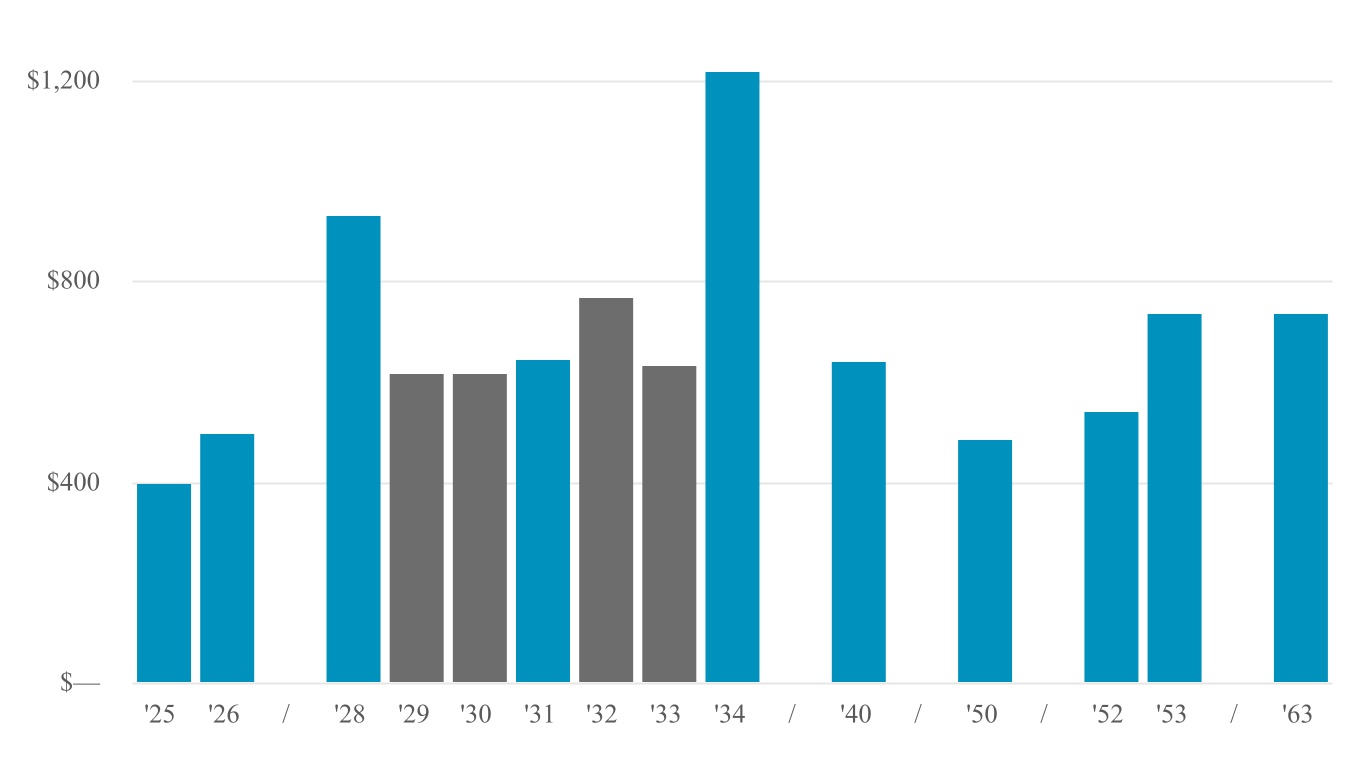
2022 Revolving Credit Facility: $1.25 billion senior unsecured revolving credit facility, which matures on December 16, 2027
2025 Notes: $500 million aggregate principal amount issued of 5.650% senior unsecured notes due June 28, 2025
2026 Notes: $500 million aggregate principal amount issued of 3.850% senior unsecured notes due June 30, 2026
2028 Notes: $1 billion aggregate principal amount issued of 5.350% senior unsecured notes due June 28, 2028
2029 Notes: €600 million aggregate principal amount issued of 1.75% senior unsecured notes due March 28, 2029
2030 Notes: €600 million aggregate principal amount issued of 0.875% senior unsecured notes due February 13, 2030
2031 Notes: $650 million aggregate principal amount issued of 1.650% senior unsecured notes due January 15, 2031
2032 Notes: €750 million aggregate principal amount issued of 4.500% senior unsecured notes due February 15, 2032
2033 Notes: €615 million aggregate principal amount issued of 0.900% senior unsecured notes due July 30, 2033
2034 Notes: $1.25 billion aggregate principal amount issued of 5.550% senior unsecured notes due February 15, 2034
2040 Notes: $650 million aggregate principal amount issued of 2.500% senior unsecured notes due December 21, 2040
2050 Notes: $500 million aggregate principal amount issued of 3.250% senior unsecured notes due April 28, 2050
2052 Notes: $550 million aggregate principal amount issued of 3.950% senior unsecured notes due March 7, 2052
2053 Notes: $750 million aggregate principal amount issued of 5.950% senior unsecured notes due August 15, 2053
2063 Notes: $750 million aggregate principal amount issued of 6.100% senior unsecured notes due June 28, 2063
Adenza: Adenza Holdings, Inc.
AI: Artificial Intelligence
AML: Anti-money Laundering
ARR: Annualized Recurring Revenue
ASC: Accounting Standards Codification
ASR: Accelerated Share Repurchase
ASU: Accounting Standards Update
ATS: Alternative Trading System
AUM: Assets Under Management
AWS: Amazon Web Services
CAT: A market-wide consolidated audit trail established under an SEC approved plan by Nasdaq and other exchanges
CCP: Central Counterparty
CFTC: U.S. Commodity Futures Trading Commission
EBITDA: Earnings Before Interest, Taxes, Depreciation and Amortization
EMIR: European Market Infrastructure Regulation
Equity Plan: Nasdaq Equity Incentive Plan
ESG: Environmental, Social and Governance
ESPP: Nasdaq Employee Stock Purchase Plan
ETF: Exchange Traded Fund
ETP: Exchange Traded Product
Euro Notes: The 2029, 2030, 2032 and 2033 Notes Exchange Act: Securities Exchange Act of 1934, as amended
ii


FASB: Financial Accounting Standards Board
FICC: Fixed Income and Commodities Trading and Clearing
FINRA: Financial Industry Regulatory Authority
GICS: Global Industry Classification Standard
IPO: Initial Public Offering
MiFID II: Update to the Markets in Financial Instruments Directive
MiFIR: Markets in Financial Instruments Regulation
NPM: Nasdaq Private Market, LLC
NSCC: National Securities Clearing Corporation
OCC: The Options Clearing Corporation
OTC: Over-the-Counter
PCS: Post-contract Customer Support
Proxy Statement: Nasdaq’s Definitive Proxy Statement for the 2025 Annual Meeting of Shareholders
PSU: Performance Share Unit
Regulation NMS: Regulation National Market System
Regulation SCI: Regulation Systems Compliance and Integrity
SaaS: Software as a Service
SEC: U.S. Securities and Exchange Commission
SERP: Supplemental Executive Retirement Plan
SFSA: Swedish Financial Supervisory Authority
SOFR: Secured Overnight Financing Rate
SPAC: Special Purpose Acquisition Company
S&P: Standard & Poor's
S&P 500: S&P 500 Stock Index
SRO: Self-regulatory Organization
SSMA: Swedish Securities Markets Act 2007:528
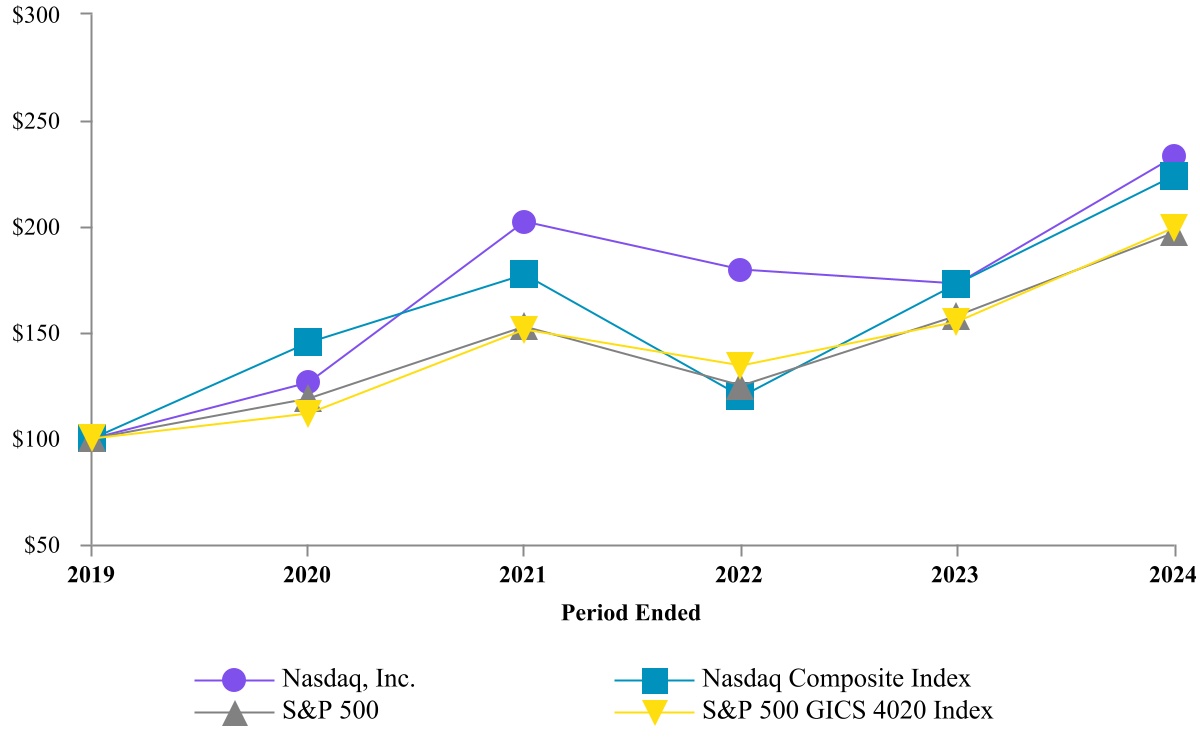
TSR: Total Shareholder Return
U.S. GAAP: U.S. Generally Accepted Accounting Principles
U.S. Tape plans: U.S. cash equity and U.S. options industry data
UTP: Unlisted Trading Privileges
UTP Plan: Joint SRO Plan Governing the Collection, Consolidation, and Dissemination of Quotation and Transaction Information for Nasdaq-Listed Securities Traded on Exchanges on a UTP Basis
NASDAQ, the NASDAQ logos, and other brand, service or product names or marks referred to in this report are trademarks or service marks, registered or otherwise, of Nasdaq, Inc. and/or its subsidiaries. FINRA and Trade Reporting Facility are registered trademarks of FINRA.
This Annual Report on Form 10-K includes market share and industry data that we obtained from industry publications and surveys, reports of governmental agencies and internal company surveys. Industry publications and surveys generally state that the information they contain has been obtained from sources believed to be reliable, but we cannot assure you that this information is accurate or complete. We have not independently verified any of the data from third-party sources nor have we ascertained the underlying economic assumptions relied upon therein. Statements as to our market position are based on the most currently available market data. For market comparison purposes, The Nasdaq Stock Market data in this Annual Report on Form 10-K for IPOs and new listings of equity securities (including issuers that switched from other listings venues, closed-end funds and ETPs) is based on data generated internally by us; therefore, the data may not be comparable to other publicly-available IPO data. Data in this Annual Report on Form 10-K for IPOs and new listings of equity securities on the Nasdaq Nordic and Nasdaq Baltic exchanges and Nasdaq First North also is based on data generated internally by us. IPOs and new listings data is presented as of period end. While we are not aware of any misstatements regarding industry data presented herein, our estimates involve risks and uncertainties and are subject to change based on various factors, including those discussed in “Part I, Item 1A. Risk Factors” section in this Annual Report on Form 10-K.
Nasdaq intends to use its website, ir.nasdaq.com, as a means for disclosing material non-public information and for complying with SEC Regulation FD and other disclosure obligations.
iii


Forward-Looking Statements
The SEC encourages companies to disclose forward-looking information so that investors can better understand a company’s future prospects and make informed investment decisions. This Annual Report on Form 10-K contains these types of statements. Words such as “may,” “will,” “could,” “should,” “anticipates,” “estimates,” “expects,” “projects,” “intends,” “plans,” “believes” and words or terms of similar substance used in connection with any discussion of future expectations as to industry and regulatory developments or business initiatives and strategies, future operating results or financial performance, and other future developments are intended to identify forward-looking statements. These include, among others, statements relating to:
•our strategic direction, including changes to our corporate structure;
•the integration of acquired businesses, including accounting decisions relating thereto;
•the scope, nature or impact of acquisitions, divestitures, investments, joint ventures or other transactional activities;
•the effective dates for, and expected benefits of, ongoing initiatives, including transactional activities and other strategic, restructuring, technology, sustainability, de-leveraging and capital return initiatives;
•our products and services;
•the impact of pricing changes;
•tax matters;
•the cost and availability of liquidity and capital; and
•any litigation, or any regulatory or government investigation or action, to which we are or could become a party or which may affect us and any potential settlements of litigation, regulatory or governmental investigations or actions.
Forward-looking statements involve risks and uncertainties. Factors that could cause actual results to differ materially from those contemplated by the forward-looking statements include, among others, the following:
•our operating results may be lower than expected;
•our ability to successfully integrate acquired businesses or divest sold businesses or assets, including the fact that any integration or transition may be more difficult, time consuming or costly than expected, and we may be unable to realize synergies from business combinations, acquisitions, divestitures or other transactional activities;
•loss of significant trading and clearing volumes or values, fees, market share, listed companies, market data customers or other customers;
•our ability to develop and grow our non-trading businesses;
•our ability to keep up with rapid technological advances, including our ability to effectively manage the development and use of AI in certain of our products and offerings, and adequately address cybersecurity risks;
•economic, political, regulatory and market conditions and fluctuations, including inflation, tariffs, interest rate and foreign currency risk inherent in U.S. and international operations, and geopolitical instability;
•the performance and reliability of our technology and technology of third parties on which we rely;
•any significant systems failures or errors in our operational processes;
•our ability to continue to generate cash and manage our indebtedness; and
•adverse changes that may occur in the litigation or regulatory areas, or in the securities markets generally, or increased regulatory oversight domestically or internationally.
Most of these factors are difficult to predict accurately and are generally beyond our control. You should consider the uncertainty and any risk related to forward-looking statements that we make. These risk factors are discussed under the caption “Part I. Item 1A. Risk Factors” in this Annual Report on Form 10-K. You are cautioned not to place undue reliance on these forward-looking statements, which speak only as of the date of this Annual Report on Form 10-K. You should carefully read this entire Annual Report on Form 10-K, including “Part II. Item 7. Management’s Discussion and Analysis of Financial Condition and Results of Operations” and the consolidated financial statements and the related notes. Except as required by the federal securities laws, we undertake no obligation to update any forward-looking statement, release publicly any revisions to any forward-looking statements or report the occurrence of unanticipated events. For any forward-looking statements contained in any document, we claim the protection of the safe harbor for forward-looking statements contained in the Private Securities Litigation Reform Act of 1995.
iv


PART I
Item 1. Business
OVERVIEW
Nasdaq is a global technology company serving corporate clients, investment managers, banks, brokers, and exchange operators as they navigate and interact with the global capital markets and the broader financial system. We aspire to deliver world-leading platforms that improve the liquidity, transparency, and integrity of the global economy. Our diverse offering of data, analytics, software, exchange capabilities, and client-centric services enables clients to optimize and execute their business vision with confidence.
We manage, operate and provide our products and services in three business segments: Capital Access Platforms, Financial Technology and Market Services.
HISTORY
Nasdaq was founded in 1971 as a wholly-owned subsidiary of FINRA. Beginning in 2000, FINRA restructured and broadened ownership in Nasdaq by selling shares to FINRA members, investment companies and issuers listed on The Nasdaq Stock Market. In connection with this restructuring, FINRA fully divested its ownership of Nasdaq in 2006, and The Nasdaq Stock Market became an independent registered national securities exchange in 2007.
In February 2008, Nasdaq and OMX AB combined their businesses, and we changed our corporate name to The NASDAQ OMX Group, Inc. This transformational combination resulted in the expansion of our business from a U.S.-based exchange operator to a global exchange company offering technology that powers our own exchanges and markets as well as many other marketplaces around the world. We operated as the NASDAQ OMX Group until we rebranded our business as Nasdaq, Inc. in 2015.
In November 2023, we accelerated our transformation as a leading technology provider to the global financial system through the acquisition of Adenza and its two flagship solutions, AxiomSL and Calypso.
GROWTH STRATEGY
To enable success in the evolving global financial system, we have established our purpose, vision, and value proposition together with a focused growth strategy:
Our Purpose: We advance economic progress for all.
Our Vision: We will be the trusted fabric of the world’s financial system.
Our Value Proposition: We deliver world-leading platforms that improve the liquidity, transparency and integrity of the global economy.
Our Strategy: In 2017, we implemented a new strategic direction with the aim of optimizing the deployment of resources, human capital, and financial assets towards our most promising growth opportunities. These opportunities,
which we identified as substantial and expanding opportunities, included solutions for combating financial crime, compliance solutions, marketplace technology, workflow for investment managers and asset owners as well as insight solutions. Our strengths in technology, proprietary data, analytics, and capital markets expertise, in conjunction with our broad client base and innovative brand has positioned us favorably to meet the evolving demands of our clientele and deliver in a sustainable way.
In order to amplify our strategy, we aligned our company more closely with the evolving client needs with an aim to drive growth across our key pillars of liquidity, transparency and integrity:
•Liquidity: Within our Financial Technology and Market Services segments, we continue to modernize markets by utilizing technology to maximize the liquidity of the global economy. New technologies, including cloud, blockchain, machine learning and AI, present significant opportunities to further enhance market resiliency and scalability and make markets even more accessible. We believe that these technologies will enable more opportunities for market participants and new asset classes to be integrated across markets globally.
•Transparency: With nearly 10,000 corporate clients and 5,000 clients across the investment management ecosystem, our Capital Access Platforms segment is a trusted partner to enable the corporate and investment communities in making more informed decisions. Leveraging the insights and capabilities across our listings, advisory, data, index, and analytics teams, we believe that Capital Access Platforms segment serves as a bridge between the investor and corporate communities, focused on enhancing the client experience by providing efficient routes to capital, delivering more holistic, actionable insights and intelligence, modernizing workflows, and navigating the climate and sustainability landscape.
•Integrity: Financial Crime Management Technology and Regulatory Technology, within our Financial Technology segment, include Nasdaq’s fraud detection, anti-money laundering, surveillance and risk data management and regulatory reporting solutions businesses. These businesses remain focused on capturing the opportunities arising from protecting the integrity of the financial system by fighting financial crime and helping our clients solve their most complex risk and compliance challenges.
1


PRODUCTS AND SERVICES
Capital Access Platforms
Our Capital Access Platforms segment delivers liquidity, transparency and integrity to the corporate issuer and investment community by empowering our clients to effectively navigate the capital markets, achieve their sustainability goals, and drive governance excellence. We offer a suite of products to assist companies in managing corporate governance standards.
Our Capital Access Platforms segment comprises Data & Listing Services, Index and Workflow & Insights.
Data & Listing Services
Our North American and European data products enhance transparency of market activity within our exchanges and provide critical information to professional and non-professional investors globally. Our Data business distributes historical and real-time market data to sell-side customers, the institutional investing community, retail online brokers, proprietary trading firms, and other venues, as well as internet portals and data distributors.
We collect, process, and create information and earn revenues as a distributor of our own, as well as select third-party, content. We provide varying levels of quote and trade information to market participants and to data distributors who in turn provide subscriptions for this information. Our systems enable distributors to gain access to our market depth, order imbalances, market sentiment and other analytical data.
We distribute this proprietary market information to both market participants and non-participants through a number of proprietary products, including Nasdaq TotalView, our flagship market depth quote product. We offer TotalView products for The Nasdaq Stock Market and our Nasdaq BX, Nasdaq PSX and Nordic markets. We also offer Nordic Equity TotalView, Nordic Derivatives TotalView and Nordic Fixed Income TotalView for Nordic markets.
We operate several other proprietary services and data products to provide market information, including Nasdaq Basic, a lower cost alternative to the industry Level 1 feed and Nasdaq Canada Basic, a lower cost alternative to other data feeds. We also provide various other data, including data relating to our U.S. equities and options exchanges and Nordic equities, derivatives, fixed income and futures.
We operate a variety of listing platforms around the world to provide multiple global capital raising solutions for public companies. Companies listed on our markets represent a diverse array of industries including, among others, healthcare, consumer products, telecommunication services, information technology, financial services, industrials and energy. Our main listing markets are The Nasdaq Stock Market and the Nasdaq Nordic and Nasdaq Baltic exchanges.
Companies seeking to list securities on The Nasdaq Stock Market may do so on one of the three market tiers: The Nasdaq Global Select Market, The Nasdaq Global Market, or The Nasdaq Capital Market. To qualify, companies must meet minimum listing requirements, including specified financial and corporate governance criteria. Once listed, companies must maintain rigorous listing and corporate governance standards.
As of December 31, 2024, a total of 5,249 companies listed securities on our U.S., Nasdaq Nordic, Nasdaq Baltic and Nasdaq First North exchanges. As of December 31, 2024, a total of 4,075 companies listed securities on The Nasdaq Stock Market, with 1,383 listings on The Nasdaq Global Select Market, 1,366 on The Nasdaq Global Market and 1,326 on The Nasdaq Capital Market.
We seek new listings from companies conducting IPOs, including SPACs, and direct listings as well as companies looking to switch from alternative exchanges. The 2024 new listings were comprised of the following:
Operating company IPOs
130
SPAC IPOs
50
Switches from the New York Stock Exchange LLC, or NYSE, and the NYSE American LLC, or NYSE American 17
Upgrades from OTC 22
ETPs and Other Listings 244
Total
463
The Nasdaq Stock Market eligible IPO win rates:
2024 total
82  %
Operating companies 80  %
During 2024, we had 17 new listings resulting from operating companies switching their listings from NYSE or NYSE American to join The Nasdaq Stock Market as well as 13 ETP switches, included in ETPs and other listings in the table above. More than $180 billion in global equity market capitalization switched to The Nasdaq Stock Market. Eligible IPO win rate only includes companies that meet quantitative Nasdaq listing standards.
We also offer listings on the exchanges that comprise Nasdaq Nordic and Nasdaq Baltic. For smaller companies and growth companies, we offer access to the financial markets through the Nasdaq First North alternative marketplaces. As of December 31, 2024, a total of 1,174 companies listed securities on our Nordic and Baltic exchanges.
Our European listing customers include companies, funds and governments. Customers issue securities in the form of cash equities, depository receipts, warrants, ETPs, convertibles, rights, options, bonds or fixed-income related products. In 2024, a total of 31 new companies listed on our Nordic and Baltic exchanges.
2


Index
Our Index business develops and licenses Nasdaq-branded indices and financial products. License fees for our trademark licenses vary by product based on a percentage of underlying assets, dollar value of a product issuance, number of products or number of contracts traded. We also license cash-settled options, futures and options on futures on our indices.
As of December 31, 2024, 401 ETPs listed on 28 exchanges in over 20 countries tracked a Nasdaq index and accounted for $647 billion in AUM. Our flagship index, the Nasdaq-100 Index, or NDX, includes the top 100 non-financial companies listed on The Nasdaq Stock Market. More than 150 ETPs worldwide track indices in the NDX ecosystem, which had over $520 billion in assets tracking the indices as of December 31, 2024, or 80% of total AUM.
We provide index data products based on Nasdaq indices. Index data products include our Global Index Data Service, which delivers real-time index values throughout the trading day, and Global Index Watch/Global Index File Delivery Service, which delivers daily and historical weightings and components data, corporate actions and a breadth of additional data for the indices that we operate.
Workflow & Insights
Workflow & Insights includes our analytics and corporate solutions products.
Our analytics products provide asset managers, investment consultants and institutional asset owners with information and analytics to make data-driven investment decisions, deploy their resources more productively, and provide liquidity solutions for private funds. Through our eVestment and Solovis platforms, we provide a suite of cloud-based solutions that help institutional investors and consultants conduct pre-investment due diligence, and monitor their portfolios post-investment. The eVestment platform also enables asset managers to efficiently distribute information about their firms and funds to asset owners and consultants worldwide.
The Nasdaq Fund Network and Nasdaq Data Link are additional platforms in our suite of investment data analytics offerings and data management tools. Nasdaq Fund Network gathers and distributes daily net asset values from over 50,000 funds and other investment vehicles across North America. Nasdaq Data Link strengthens our position as a leading source for financial, economic, and alternative datasets.
Corporate solutions serves both public and private companies and organizations through our Investor Relations Intelligence, Governance Solutions and Sustainability Solutions products. Our public company clients can be companies listed on our exchanges or other U.S. and global exchanges. Our private company clients include a diverse group of organizations ranging from family-owned companies, government organizations, law firms, privately held entities, and various non-profit organizations to hospitals and healthcare systems.
Our Investor Relations Intelligence offerings include a global team of expert consultants that deliver advisory services including Equity Surveillance & Shareholder Analysis, Investor Engagement and Perception Studies, as well as an industry-leading platform, Nasdaq IR Insight, to investor relations professionals and executive teams. These solutions allow investor relations officers and executives to better manage their investor relations programs, understand their investor base, target new investors, manage meetings and consume key data such as investor profiles, equity research, consensus estimates and news.
Through our Governance Solutions products, we provide an industry-leading board meeting management platform, Nasdaq Boardvantage, and consulting services that streamline the meeting process for board of directors and executive leadership teams and enable them to accelerate decision making and strengthen governance.
Our Sustainability Solutions includes consulting services and purpose built sustainability reporting software. Our advisory practice helps companies analyze, assess and action best practices as it relates to their sustainability programs. Nasdaq Metrio is our SaaS-based end-to-end sustainability reporting platform that enables corporates to collect, measure, disclose and communicate investor-grade, audited ESG data efficiently across dozens of raters, rankers and framework organizations to drive strategic outcomes and attract investors.
Financial Technology
The Financial Technology segment delivers world leading platforms that improve the liquidity, transparency and integrity of the global economy by architecting and operating the world’s best markets. This segment comprises Financial Crime Management Technology, Regulatory Technology and Capital Markets Technology businesses.
We are a leading global technology solutions provider and partner to exchanges, clearing organizations, central securities depositories, banks, brokers, buy-side firms and corporate businesses, and power more than 135 marketplaces (including those operated by Nasdaq) and regulators, in more than 55 countries. Our solutions can handle a wide array of assets, including but not limited to cash equities, equity derivatives, currencies, various interest-bearing securities, commodities, energy products and digital currencies. Our solutions can also be used in the creation of new asset classes by non-capital markets customers, as discussed further below.
3


Financial Crime Management Technology
Financial Crime Management Technology includes our Nasdaq Verafin solution which delivers a leading anti-financial crime platform improving the integrity and transparency of the financial world. Nasdaq Verafin provides a SaaS solution to financial institutions for fraud detection and management, AML and countering the financing of terrorism compliance and management, high-risk customer management, sanctions screening and management, and information sharing.
Nasdaq Verafin has leveraged AI for more than 20 years to deliver industry-leading financial crime management solutions, combining deep domain and technical expertise with consortium data. Nasdaq Verafin's comprehensive solutions help financial institutions tackle complex problems, including payments fraud targeting all payment channels.
Our innovative AI-based Targeted Typology Analytics solution examines a range of behavioral, transactional, third-party, and consortium insights for more effective detection of crimes with fewer false positives and high quality results.
Our Nasdaq Verafin solution provides the tools to help more than 2,600 North American financial institutions with regulatory compliance as well as detect, investigate and report money laundering and financial fraud.
Regulatory Technology
Regulatory Technology includes AxiomSL and surveillance solutions.
AxiomSL is a global leader in risk data management and regulatory reporting solutions for the financial industry, including banks, broker dealers and asset managers. Its unique enterprise data management platform delivers data lineage, risk aggregation, analytics, workflow automation, reconciliation, validation and audit functionality, as well as disclosures.
AxiomSL’s platform supports compliance across a wide range of global and local regulations and delivers solutions and services for financial regulatory reporting, liquidity, capital and credit, operations, trade and transaction reporting, and ESG reporting.
Our surveillance solutions include a SaaS platform designed for banks, brokers and other market participants to assist in complying with market rules, regulations and internal market surveillance policies and serves more than 170 clients. We also provide a solution to regulators and exchanges with a robust platform to manage cross-market, cross-asset and multi-venue surveillance. This offering powers surveillance for more than 50 exchanges and 18 regulators.
Capital Markets Technology
Capital Markets Technology includes our Calypso and market technology solutions as well as trade management services.
Calypso is a leading platform providing cross-asset, front-to-back trading, treasury, risk and collateral management solutions. The Calypso solution provides customers with a single platform designed to enable consolidation, innovation and growth. The platform supports front, middle and back office activities in exchange-traded and OTC instruments and supports multiple financial asset classes and the associated financial instruments. Calypso’s software application specializes in capital markets, investment management, risk management, clearing, collateral, treasury and liquidity management.
The Calypso platform, leveraging modern technology, is versatile and serves customers across different industries, including banks, central banks, buy-side clients, government-sponsored entities and corporate clients, and can quickly adapt to changing paradigms including new asset classes, regulations, trading venues, and trading and processing workflows.
Nasdaq’s market technology solutions are utilized by leading markets in North America, Europe, Asia, Middle East, Latin America and Africa. These solutions can handle a wide array of assets, including but not limited to cash equities, equity derivatives, currencies, various interest-bearing securities, commodities, energy products and digital currencies. Our solutions can also be used in the creation of new asset classes by non-capital markets customers. We continue to develop our SaaS business portfolio by extending and migrating our current offerings to SaaS.
We provide and deliver mission-critical solutions to market infrastructure operators, which include exchanges, regulators, clearinghouses and central securities depositories. These solutions are designed to cover all aspects of a market operator’s needs, from trading and clearing to risk management, index development, data, management, testing and quality assurance.
In addition to serving the market operators in the core capital markets, there is a demand for mission critical solutions to enable robust operation of new emerging asset classes such as crypto currencies and native digital markets. Our market technology business currently offers its services to several digital assets exchanges, and the SaaS-based Marketplace Services Platform provides next-generation marketplace capabilities spanning the transaction lifecycle to facilitate the exchange of assets, services and information across various types of market ecosystems and machine-to-machine transactions.
Our market technology business also provides complex delivery management and systems integration. Through our integration services, we can assume responsibility for projects that involve migration to a new system and the establishment of entirely new marketplaces. We also offer operation and support for the applications, systems platforms, networks and other components included in an information technology solution, as well as advisory services.
4


Our trade management services provide market participants with a wide variety of alternatives for connecting to and accessing our markets for a fee. Our marketplaces may be accessed via a number of different protocols used for quoting, order entry, trade reporting and connectivity to various data feeds. WorkX, a web-based, front-end interface allows market participants to view data, utilize risk management tools, and submit and review trade reports. WorkX enables a seamless workflow and enhanced trade intelligence. In addition, we offer a variety of add-on compliance tools to help market participants comply with regulatory requirements.
We provide colocation services to market participants, whereby we offer firms cabinet space and power to house their own equipment and servers within our data centers. Additionally, we offer a number of wireless connectivity offerings between certain data centers using millimeter wave and microwave technology.
Market Services
Our Market Services segment includes our equity derivative trading and clearing, cash equity trading, fixed income, currency and commodities trading. We operate 19 exchanges across several asset classes, including derivatives, commodities, cash equity, debt, structured products and ETPs.
We provide trading services in North America and Europe. In the U.S., we operate six options exchanges: Nasdaq PHLX, The Nasdaq Options Market, Nasdaq BX Options, Nasdaq ISE, Nasdaq GEMX and Nasdaq MRX. These exchanges facilitate the trading of equity, ETF, index and foreign currency options. Our combined options market share in 2024 represented the largest share of the U.S. market for multi-listed equity options. Our options trading platforms provide trading opportunities to retail investors, algorithmic trading firms and market makers, who tend to prefer electronic trading, and institutional investors, who typically require high touch services to execute their trades, which are often performed on our trading floor in Philadelphia.
We also operate three cash equity exchanges: The Nasdaq Stock Market, Nasdaq BX and Nasdaq PSX. Our U.S. cash equity exchanges offer trading of both Nasdaq-listed and non-Nasdaq-listed securities. The Nasdaq Stock Market is the largest single venue of liquidity for trading U.S.-listed cash equities. Market participants include market makers, broker-dealers, ATSs, institutional investors, and registered securities exchanges. We also operate a U.S. corporate bond exchange for the listing of corporate bonds.
Our Market Services segment also includes revenues from U.S. Tape plans. The plan administrators sell quotation and last sale information for all transactions, whether traded on The Nasdaq Stock Market or other exchanges, to market participants and to data distributors, who then provide the information to subscribers. After deducting costs, the plan administrators distribute the tape revenues to the respective plan participants based on a formula required by Regulation NMS that takes into account both trading and quoting activity.
In Canada, we operate an exchange with three independent markets for the trading of Canadian-listed securities: Nasdaq Canada CXC, Nasdaq Canada CX2 and Nasdaq Canada CXD.
In Europe, we operate exchanges in Tallinn (Estonia), Riga (Latvia) and Vilnius (Lithuania) as Nasdaq Baltic and exchanges in Stockholm (Sweden), Copenhagen (Denmark), Helsinki (Finland), and Reykjavik (Iceland) together with the clearing operations of Nasdaq Clearing, as Nasdaq Nordic.
Collectively, the Nasdaq Nordic and Nasdaq Baltic exchanges offer trading in cash equities, depository receipts, warrants, convertibles, rights, fund units and ETFs, as well as trading and clearing of derivatives and clearing of resale and repurchase agreements. Our platform allows the exchanges to share the same trading system, which enables efficient cross-border trading and settlement, cross-exchange membership and a single source for Nordic data products. Settlement and registration of cash equity trading takes place in Sweden, Finland, and Denmark via the local central securities depositories. In addition, Nasdaq owns a central securities depository that provides notary, settlement, central maintenance and other services in the Baltic countries and Iceland.
In Europe, Nasdaq Nordic offers trading in derivatives, such as stock options and futures and index options and futures. Nasdaq Clearing offers CCP clearing services for stock options and futures and index options and futures.
Nasdaq Fixed Income, or NFI, provides a wide range of products and services, such as trading and clearing, for fixed income products in Sweden, Denmark, Finland, Iceland, Estonia, Lithuania and Latvia. Nasdaq is the largest bond listing venue in the Nordics, with more than 5,600 listed retail and institutional bonds. In addition, Nasdaq Nordic facilitates the trading and clearing of Nordic fixed income derivatives in a unique market structure. Buyers and sellers agree to trades in fixed income derivatives through bilateral negotiations and then report those trades to Nasdaq Clearing. Nasdaq Clearing offers CCP clearing services for fixed-income options and futures and interest rate swaps. Nasdaq Clearing also operates a clearing service for the resale and repurchase agreement market.
Nasdaq Commodities is the brand name for Nasdaq’s European commodity-related products and services such as trading and clearing. Nasdaq Commodities’ offerings include derivatives in power, natural gas and carbon emission markets, seafood and electricity certificates.
5


These products are listed on Nasdaq Oslo ASA, except for seafood, which is listed on Fish Pool, a third-party platform. In June 2023, we entered into an agreement to sell our Nordic power trading and clearing business, which was subsequently terminated in June 2024. In January 2025, we entered into a new agreement to transfer existing open positions in our Nordic power derivatives trading and clearing business to a European exchange. The completion of this transaction is subject to customary regulatory approvals. Additionally, beginning in January 2025, Nasdaq no longer offered seafood derivatives clearing.
Nasdaq Oslo ASA is the commodity derivatives exchange for European products. All trades with Nasdaq Oslo ASA are subject to clearing with Nasdaq Clearing, which offers CCP clearing services for commodities options and futures.
We also own a majority stake in Puro.earth, a Finnish-based leading platform for carbon removal. Puro.earth offers engineered carbon removal instruments that are verified and tradable through an open, online platform. Puro.earth’s marketplace capabilities add to our suite of sustainability-focused technologies and workflow solutions and give our clients further resources to achieve their sustainability objectives.
ENABLERS, DIFFERENTIATORS AND COMPETITION
Technology
Technology plays a key role in ensuring the growth, reliability and regulation of financial markets. We have established a technology risk program to evaluate the resiliency of critical systems, including risks associated with cybersecurity. This program is focused on identifying areas for improvement in systems, and implementing changes and upgrades to technology and processes to minimize future risk. We have continued our focus on improving the security of our technology with an emphasis on employee awareness through training, targeted phishing education campaigns, and new tool deployment for our securities operations team. See “Item 1A. Risk Factors” in this Annual Report on Form 10-K for further discussion.
We are focused on amplifying the impact that AI has on the business and in our products. We continue to develop products and services using AI, including generative AI, and the use of AI in product development remains a priority for us in 2025. We are currently leveraging AI to further develop products and solutions in areas such as investment analytics, investor relations and fraud and anti-money laundering, as well as to modernize markets with the SEC approval of the first AI-powered order type. For example, we are working on developing AI systems to track financial transactions across the ecosystem to determine potential fraud, money laundering, or other actions. These solutions can be utilized by our clients, including banks, other exchanges and brokers firms that use our solutions to reduce or eliminate threats.
We are committed to the ethical and responsible use of AI in our products, services and business operations. Our AI governance structure aligns the application of AI with our core values through a framework that addresses the new and unique risks that AI technology presents, while enabling us to explore innovation and take advantage of opportunities that AI presents to better serve our customers, advance our business objectives and bring value to our shareholders. Our AI governance framework applies risk management across AI-related product development and business usage in the company through a multi-disciplinary approach. The framework puts into practice Nasdaq’s responsible AI usage principles and considers the U.S. National Institute of Standards and Technology AI Risk Management Framework. It is administered through company-wide policies, procedures and supporting preventative and detective controls.
We believe that our focus on AI to enhance features of our existing offerings and in the development of new solutions, together with our significant proprietary data sets and our use of AI to drive internal operating efficiencies, provides us with a competitive advantage.
During 2024, Nasdaq continued its shift from traditional on-premises deployments by utilizing and deploying cloud infrastructure. We believe that migrating our exchanges to the cloud, through our partnership with AWS, will result in improved performance and increased flexibility for our customers. We expect to move additional markets to the cloud with AWS during the next several years. The shift to cloud-based markets enables Nasdaq to provide its clients access to enhanced capabilities, including virtual connectivity services, market analytics and machine learning. We also expect to continue to leverage the cloud-based infrastructure for our market technology clients, assisting such clients in developing their own platforms and customizing their offerings for their local, rapidly changing industry dynamics. Additionally, we expanded our existing colocation facility to meet the growing demand of market participants that seek proximity to the Nasdaq trading systems. Our expanded and enhanced facility is designed to provide the optimal environment for the next generation of compute workloads and offer clients access to a wider range of services and capabilities.
To facilitate the exchange migration to AWS, Nasdaq will also leverage its Fusion technology platform. Fusion positions Nasdaq’s North American and European markets to manage, operate and deploy a common platform that can be used across our nine Nasdaq derivative markets, while enabling our markets for cloud deployment.
Competitive Strengths
We are a global, client-focused technology company with expertise in markets and financial technology. We deploy robust technology capabilities and have developed innovative solutions to further address client needs across the financial ecosystem. Our business segments complement each other and we believe that our strong competitive position in large, high-growth markets positions us for sustained growth.
6


Our Value Proposition
We operate leading platforms that can improve the liquidity, transparency, and integrity of the global financial ecosystem, allowing us to:
•Develop efficient and reliable technologies to facilitate and protect the financial system across asset classes;
•Empower our clients to effectively navigate the capital markets, achieve their sustainability goals, and maintain corporate governance excellence; and
•Provide data, tools and insights that drive sound decision making while complying with evolving regulatory requirements.
Technological Strength
The strength and resiliency of our technology, enhanced by our Financial Technology segment, in meeting the advancing demands of our global customer base is vital to the continued success of our business and distinguishes us from our competitors.
We strive to be a trusted partner to a diverse range of clients that participate across the global financial ecosystem, including:
•Banks and Financial Institutions: Providing banks and financial institutions with safety and integrity through a suite of trade surveillance, cloud-native fraud and anti-money laundering solutions and robust regulatory reporting software.
•Market Infrastructure Operators: Assisting market infrastructure operators in increasing efficiency, meeting customer needs, and growing revenue across the trade lifecycle.
•Brokers and Traders: Helping brokers and traders to confidently plan, optimize, manage risk and execute their business vision.
•Market Participants: Providing market participants with access to liquidity and enabling them to efficiently consume, monitor, analyze, and capitalize on real-time market changes.
•Listed Companies: Enabling companies to access capital markets effectively, manage stakeholders and leverage technology to operate and govern effectively.
•Investors and Asset Managers: Offering products and services to assist investors and asset managers in optimizing their portfolios and offerings.
Competition
Capital Access Platforms
Our Data business includes proprietary data products. Proprietary data products are made up exclusively of data derived from each exchange’s systems. Competition in the data business is influenced by rapidly changing technology and the creation of new product and service offerings.
Our proprietary data products face competition globally from alternative exchanges and trading venues that offer similar products. Our data business competes with other exchanges and third-party vendors to provide information to market participants.
Our Listing Services business in both the U.S. and Europe provides a means of facilitating capital formation through public capital markets. There are competing ways of raising capital, and we seek to demonstrate the benefits of listing shares on our exchange. Our primary competitor for larger company stock share listings in the U.S. is NYSE. The Nasdaq Stock Market competes with local and international markets located outside the U.S. for listings of equity securities of both U.S. and non-U.S. companies that choose to list (or dual-list) outside of their home country. For example, The Nasdaq Stock Market competes for listings with exchanges in Europe and Asia. Additionally, we face competition from private equity firms that may elect to keep their portfolio companies as private companies.
The Listings Services business in Europe is characterized by a large number of exchanges competing for new or secondary listings. Each country has one or more national exchanges, which are often the first choice of companies in each respective country. For those considering an alternative, competing European exchanges that frequently attract many listings from outside their respective home countries include LSE, Euronext N.V. and Deutsche Börse AG. In addition to the larger exchanges, companies seeking capital or liquidity from public capital markets are able to raise capital without a regulated market listing and can consider trading their shares on smaller markets and quoting facilities.
Our Index business offers Nasdaq-branded indices and financial products and faces competition from providers of various competing financial indices. For example, there are a number of indices that aim to track the technology sector and thereby compete with the Nasdaq-100 Index and the Nasdaq Composite Index. We face competition from investment banks, dedicated index providers, markets and other product developers, including S&P Dow Jones Indices, MSCI and FTSE Russell.
Workflow & Insights includes our analytics and corporate solutions businesses. Our analytics business faces competition from a broad array of data and analytics suppliers, both established firms and small start-ups.
Our corporate solutions business faces competition that can be varied and fragmented. Other exchange operators are partnering with firms that have capabilities in this area and seeking to acquire relevant assets in order to provide investor relations services to customers alongside listing services. Our Sustainability Solutions, including Nasdaq Metrio and sustainability consulting services, are positioned in evolving markets with competitors offering multiple point solutions providing software, data or consulting services. Our Governance Solutions products compete against a wide range of companies that vary by customer segment and geography.
7


Financial Technology
For our Financial Crime Management Technology and trade and market surveillance businesses, competitors include core banking solution providers ranging from small to large, independent solution providers, FinTech start-ups and in-house custom builds. We compete against enterprise solution providers and point solutions for clients with larger AUM. Competitors also include companies that serve multiple industries in addition to financial services with generalized solutions, such as business intelligence tools, data integrators, investigation platforms and software covering the broader compliance lifecycle. Recently, there has been an increase of FinTech start-ups shifting into the surveillance, fraud detection and AML space offering highly-specialized solutions for advanced data analytics, AI and machine learning technology. The Financial Crime Management Technology and surveillance offerings compete on a number of factors, including but not limited to, increased workflow efficiency, quality of the data, quality of alerts and pricing.
Our Financial Crime Management Technology and surveillance offerings must demonstrate the ability to decrease false-positives and provide in-depth views into potential abuses and risks that stem from those cases. These offerings help firms reduce both the reputational and regulatory risk as well as the complexity in efforts to keep markets and financial institutions safe.
Competitors to our AxiomSL solutions, which includes financial, statistical and prudential reporting as well as shareholder disclosures, trade reporting and ESG reporting, include large independent solution providers, in-house solutions at financial institutions as well as some smaller independent point solution providers. As regulatory reporting becomes more granular and time sensitive, the ability of our platform to operate with speed at scale, and with consistency across functional business domains continues to set AxiomSL apart.
Competitors to our Calypso product, which includes solutions for cross-asset, front-to-back trading, treasury, risk and collateral management, include enterprise solution providers as well as local and regional providers focusing on smaller clients. Competition among larger clients, such as global banks, typically includes internally developed solutions. Other competitors include point solution companies, such as pricing library providers, and post-trade service providers.
Our market technology business faces competition from exchanges and exchange-related businesses that internally develop their technology. This model has gradually changed as many operators have recognized the cost-savings made possible by buying technology from third parties. As a result, two types of competitors have emerged in our market technology business: exchange operators and technology providers unaffiliated with exchanges. These organizations make available a range of off-the-shelf technology, including trading, clearing, settlement, depository and information dissemination, and offer customization and operation
expertise. Market conditions in market technology are evolving rapidly, which makes continuous investment and innovation a necessity. Our partnership with AWS enables us to compete with other companies that are developing cloud-based exchanges and market technology offerings.
Our trade management services business competes with other exchange operators, extranet providers, and data center providers.
Market Services
We face intense competition in North America and Europe. We seek to provide market participants with greater functionality, trading system stability and performance, high levels of customer service, and efficient pricing. In both North America and Europe, our competitors include other exchange operators, operators of non-exchange trading systems and banks and brokerages that operate their own internal trading pools and platforms.
In the U.S., our options markets compete with exchanges operated by Cboe Global Markets, Inc., or Cboe, Miami International Holdings, Inc., or MIAX, Intercontinental Exchange, Inc., or ICE, Members Exchange and BOX Options Market. In the U.S., our cash equities markets compete with exchanges operated by Cboe, ICE, MIAX, The Investors Exchange, Members Exchange and Long Term Stock Exchange. We also face competition from ATSs, known as “dark pools,” and other less-heavily regulated broker-owned trade facilitation systems, as well as from other types of OTC trading. In Canada, our cash equities exchange competes principally with exchanges such as the Toronto Stock Exchange, or TSX.
Our U.S. Tape plans earn revenue from consolidated data products which are distributed by SEC-mandated consolidators (one for Nasdaq-listed stocks and another for NYSE and other-listed stocks) that share the revenue among the exchanges that contribute data. The consolidated data business is under competitive pressure from other securities exchanges that trade Nasdaq-listed securities. In addition, The Nasdaq Stock Market similarly competes for the tape fees from the sale of information on securities listed on other markets.
In Europe, our cash equities markets compete with exchanges such as Euronext N.V., Deutsche Börse AG, London Stock Exchange Group plc, or LSE, and many Multilateral Trading Facilities, or MTFs, such as Cboe, Turquoise and Aquis. Our competitors in the trading and clearing of options and futures on European equities include Eurex, Cboe, ICE Futures Europe and London Clearing House, or LCH. In addition, in equities markets in Europe, we face competition from other broker-owned systems, dark pools, Systematic Internalizers, or SIs, and other types of OTC trading. Competition among exchanges for trading European equity derivatives tends to occur where there is competition in the trading of the underlying equities. In addition to exchange-based competition, we face competition from OTC derivative markets.
8


The implementation of MiFID II and MiFIR has resulted in further competitive pressure on our European trading business. SIs are attracting a significant share of electronically matched volume and compete aggressively for the trading of equity securities listed on our Nordic exchanges. Different bilateral trading systems pursuing block business also remain active in Europe.
Our European fixed income and commodities products and services are subject to competitive pressure from European exchanges and clearinghouses.
INTELLECTUAL PROPERTY
We believe that our intellectual property assets are important for maintaining the competitive differentiation of our products, systems, software and services, enhancing our ability to access technology of third parties and maximizing our return on research and development investments.
To support our business objectives and benefit from our investments in research and development, we actively create and maintain a wide array of intellectual property assets, including patents and patent applications related to our innovations, products and services; trademarks related to our brands, products and services; copyrights in software and creative content; trade secrets; and through other intellectual property rights, licenses of various kinds and contractual provisions. We enter into confidentiality and invention assignment agreements with our employees and contractors, and utilize non-disclosure agreements with third parties with whom we conduct business in order to secure and protect our proprietary rights and to limit access to, and disclosure of, our proprietary information.
We own, or have licensed, rights to trade names, trademarks, domain names and service marks that we use in conjunction with our operations and services. We have registered many of our most important trademarks in the U.S. and in foreign countries. For example, our primary “Nasdaq” mark is a registered trademark that we actively seek to protect in the U.S. and in over 50 other countries worldwide.
Over time, we have accumulated a robust portfolio of issued patents in the U.S. and in many other jurisdictions across the world. We currently hold rights to patents relating to certain aspects of our products, systems, software and services, but we primarily rely on the innovative skills, technical competence and marketing abilities of our personnel. No single patent is in itself core to the operations of Nasdaq or any of its principal business areas.
CORPORATE VENTURE PROGRAM
We operate a corporate venture program to make minority investments primarily in emerging growth FinTech companies that are strategically relevant to, and aligned with, Nasdaq. Investments are made through the venture program to further our research and development efforts and accelerate the path to commercial viability. We expect that capital invested will continue to be modest and will not have a material impact on our consolidated financial statements, existing capital return or deployment priorities. Since its inception in 2017, our venture program has grown in size and has invested in companies covering various sectors, including data, analytics and workflow technologies, blockchain and digital assets, market infrastructure, anti-financial crime, new marketplaces and enabling technologies. As of December 31, 2024, our investments, which primarily include equity and convertible debt investments, were valued at $218 million.
ENVIRONMENTAL, SOCIAL AND GOVERNANCE MATTERS
Nasdaq is committed to our long-term governance and sustainability strategy, advocacy and oversight. We continue to engage with internal and external stakeholders at all levels regarding sustainability matters. During 2024, we continued our corporate, community and commercial ESG efforts, including furthering our commitment to climate change awareness, reducing our environmental impact, building a workplace culture of inclusivity and evolving our portfolio of sustainability-related solutions and services.
The Nominating & ESG Committee has formal responsibility and oversight for corporate ESG policies and programs and receives regular reports on key ESG matters and initiatives. Our Corporate ESG Steering Committee serves as the central coordinating body for our ESG strategy; it is co-chaired by executive leaders and comprised of a cross-functional group of Nasdaq senior executives.
We continued to be committed to our decarbonization and climate strategy. We have taken steps to achieve carbon neutrality across all our business operations for the seventh consecutive year after we retire our remaining carbon offsets for 2024 by the third quarter of 2025. We are working towards our short- and long-term net-zero science-based targets, which were validated and approved by the Science Based Targets initiative in 2022. In 2024, we were named to the Dow Jones Best-in-Class World Index for the first time, the Dow Jones Best-in-Class North America Index for the ninth consecutive year and Just Capital’s Just100 list of America’s most just companies for the second consecutive year. In addition, Nasdaq maintained industry leading scores from ESG rating agencies, including a rating of “AA,” from MSCI placing Nasdaq in MSCI’s “Leaders” category.
9


Our environmental footprint is relatively small due to the nature of our business operations. We remain committed to reducing our environmental impact, focusing on several key areas, including our energy use, the management of our workspaces and how we conduct business travel, and engagement with our value chain. We seek to reduce our atmospheric carbon emissions and we manage our water use and the waste associated with our business operations.
We help companies of all maturity levels through our robust combination of technology, tools, data, insights and capital market solutions.
Our sustainability-focused solutions are centered around three strategic pillars to meet our audience’s needs in a rapidly evolving market:
•Regulatory-focused Workflows: A powerful, built-for-purpose sustainability data management platform with user-friendly workflows for the most impactful regulation and climate strategy needs.
•AI-powered Insights: Proprietary insights powered by trusted data sources and generative AI to provide our users with a better lens to make faster sustainability decisions.
•In-house Expertise: In-house sustainability expertise combined with technology to provide full-service support to organizations navigating global compliance requirements, while also monitoring the capital markets.
During 2024, we also maintained, and continued to expand, our portfolio of sustainability services and solutions for our clients and stakeholders.
In 2024, we requested our existing leading suppliers by spend to attest to our Supplier Code of Ethics. The Supplier Code of Ethics, which is available on our website, encourages our suppliers and vendors to adopt sustainability and environmental practices in line with our published Environmental Practices Statement. Additionally, our new suppliers are required to attest to the Supplier Code of Ethics in connection with the commencement of their engagement.
REGULATION
We are subject to extensive regulation in the U.S., Canada and Europe.
U.S. Regulation
U.S. federal securities laws establish a system of cooperative regulation of securities markets, market participants and listed companies. SROs conduct the day-to-day administration and regulation of the nation’s securities markets under the close supervision of, and subject to extensive regulation, oversight and enforcement by, the SEC. SROs, such as national securities exchanges, are registered with the SEC.
This regulatory framework applies to our U.S. business in the following ways:
National Securities Exchanges. SROs in the securities industry are an essential component of the regulatory scheme of the Exchange Act responsible for providing fair and orderly markets and protecting investors. The Exchange Act and the rules thereunder, as well as each SRO’s own rules, impose many regulatory and operational responsibilities on SROs, including the day-to-day responsibilities for market and broker-dealer oversight. Moreover, an SRO is responsible for enforcing compliance by its members, and persons associated with its members, with the provisions of the Exchange Act, the rules and regulations thereunder, and the rules of the SRO, including rules and regulations governing the business conduct of its members.
Nasdaq currently operates three cash equity, six options markets and one corporate bond market in the U.S. We operate The Nasdaq Stock Market, The Nasdaq Options Market and the Corporate Bond Market pursuant to The Nasdaq Stock Market’s SRO license; Nasdaq BX and Nasdaq BX Options pursuant to Nasdaq BX’s SRO license; Nasdaq PSX and Nasdaq PHLX pursuant to Nasdaq PHLX’s SRO license; and Nasdaq ISE, Nasdaq GEMX and Nasdaq MRX, each of which operates an options market under its own SRO license. As SROs, each entity has separate rules pertaining to its broker-dealer members and listed companies, as applicable. Broker-dealers that choose to become members of our exchanges are subject to the rules of those exchanges.
All of our U.S. national securities exchanges are subject to SEC oversight, as prescribed by the Exchange Act, including periodic and special examinations by the SEC. Our exchanges also are potentially subject to regulatory or legal action by the SEC at any time in connection with alleged regulatory violations. We have been subject to a number of routine reviews and inspections by the SEC or external auditors in the ordinary course, and we have been and may in the future be subject to SEC enforcement proceedings. To the extent such actions or reviews and inspections result in regulatory or other changes, we may be required to modify the manner in which we conduct our business, which may adversely affect our business, operating results and financial condition.
Section 19 of the Exchange Act provides that our exchanges must submit to the SEC proposed changes to any of the SROs’ rules, practices and procedures, including revisions to provisions of our certificate of incorporation and by-laws that constitute SRO rules. The SEC will typically publish such proposed changes for public comment, after which the SEC may approve or disapprove the proposal, as it deems appropriate. SEC approval requires a finding by the SEC that the proposal is consistent with the requirements of the Exchange Act and the rules and regulations thereunder. Pursuant to the requirements of the Exchange Act, our exchanges must file with and seek approval from the SEC for, among other things, all proposals to change their pricing structure.
10


Nasdaq conducts real-time market monitoring, certain equity surveillance not involving cross-market activity, most options surveillance, rulemaking, enforcement and membership functions through our Nasdaq Regulation department. We review suspicious trading behavior discovered by our regulatory staff, and depending on the nature of the activity, may refer the activity to FINRA for further investigation. Pursuant to regulatory services agreements between FINRA and our SROs, FINRA provides certain regulatory services to our markets, including some regulation of trading activity and surveillance and investigative functions. Our SROs retain ultimate regulatory responsibility for all regulatory activities performed under regulatory agreements by FINRA, and for fulfilling all regulatory obligations for which FINRA does not have responsibility under the regulatory services agreements.
In addition to its other SRO responsibilities, The Nasdaq Stock Market, as a listing market, also is responsible for overseeing each listed company’s compliance with The Nasdaq Stock Market’s financial and corporate governance standards. Our listing qualifications department evaluates applications submitted by issuers seeking to list their securities on The Nasdaq Stock Market to determine whether the quantitative and qualitative listing standards have been satisfied. Once securities are listed, the listing qualifications department monitors each issuer’s on-going compliance with The Nasdaq Stock Market’s continued listing standards.
Broker-dealer regulation. Nasdaq’s broker-dealer subsidiaries are subject to regulation by the SEC, the SROs and various state securities regulators. Nasdaq operates three broker-dealers: Nasdaq Execution Services, LLC, NFSTX, LLC, and Nasdaq Capital Markets Advisory LLC. Each broker-dealer is registered with the SEC, a member of FINRA and registered in the U.S. states and territories required by the operation of its business. In addition, we own a minority interest in NPM.
Nasdaq Execution Services operates as our routing broker for sending orders from Nasdaq’s U.S. cash equity and options exchanges to other venues for execution. NFSTX is a registered ATS and acts as an intermediary to facilitate secondary transactions in certain funds (both registered or not registered under the Investment Company Act of 1940), business development companies, certain closed-end funds and private real estate investment funds. Nasdaq Capital Markets Advisory acts as a third-party advisor to privately-held or publicly-traded companies during IPOs and various other offerings.
The SEC, FINRA and SROs adopt, and require strict compliance with, rules and regulations applicable to broker-dealers. The SEC, SROs and state securities commissions may conduct administrative proceedings which can result in censures, fines, the issuance of cease-and-desist orders or the suspension or expulsion of a broker-dealer, its officers or employees. The SEC and state regulators may also institute proceedings against broker-dealers seeking an injunction or other sanction. All broker-dealers have an SRO that is
assigned by the SEC as the broker-dealer’s Designated Examining Authority. The Designated Examining Authority is responsible for examining a broker-dealer for compliance with the SEC’s financial responsibility rules. FINRA is the current Designated Examining Authority for each of our broker-dealer subsidiaries.
Our registered broker-dealers are subject to regulatory requirements intended to ensure their general financial soundness and liquidity, which require that they comply with certain minimum capital requirements. As of December 31, 2024, each of our broker-dealers were in compliance with applicable capital requirements.
Regulatory contractual relationships with FINRA. Our SROs have signed a series of regulatory service agreements covering the services FINRA provides to the respective SROs. Under these agreements, FINRA personnel act as our agents in performing the regulatory functions outlined above, and FINRA bills us a fee for these services. These agreements ensure that the markets for which we are responsible are properly regulated. In conjunction with these agreements, we also perform certain of these functions ourselves. In addition, our SROs retain ultimate regulatory responsibility for all regulatory activities performed under these agreements by FINRA.
Exchange Act Rule 17d-2 permits SROs to enter into agreements, commonly called Rule 17d-2 agreements, approved by the SEC with respect to enforcement of common rules relating to common members. Our SROs have entered into several such agreements under which FINRA assumes regulatory responsibility for various rules or areas covered by agreements.
Regulation NMS and Options Intermarket Linkage Plan. We are subject to Regulation NMS for our cash equity markets, and our options markets have joined the Options Intermarket Linkage Plan. These are designed to facilitate the routing of orders among exchanges to create a national market system as mandated by the Exchange Act. One of the principal purposes of a national market system is to ensure that brokers may execute investors’ orders at the best market price. Both Regulation NMS and the Options Intermarket Linkage Plan require that exchanges avoid trade-throughs, locking or crossing of markets and provide market participants with electronic access to the best prices among the markets for the applicable cash equity or options order.
In addition, Regulation NMS requires that every national securities exchange on which an NMS stock is traded and every national securities association act jointly pursuant to one or more national market system plans to disseminate consolidated information, including a national best bid and national best offer, on quotations for transactions in NMS stocks, and that such plan or plans provide for the dissemination of all consolidated information for an individual NMS stock through a single plan processor.
11


The UTP Plan was filed with and approved by the SEC as a national market system plan in accordance with the Exchange Act and Regulation NMS to provide for the collection, consolidation and dissemination of such information for Nasdaq-listed securities. The Nasdaq Stock Market serves as the processor for the UTP Plan pursuant to a contract for a two-year term through October 2025. The Nasdaq Stock Market also serves as the administrator for the UTP Plan. To fulfill its obligations as the processor, The Nasdaq Stock Market has designed, implemented, maintained, and operated a data processing and communications system, hardware, software and communications infrastructure to provide processing for the UTP Plan. As the administrator, The Nasdaq Stock Market manages the distribution of market data, the collection of the resulting market data revenue, and the dissemination of that revenue to plan members in accordance with the terms of the UTP Plan and of Regulation NMS.
Regulation SCI. Regulation SCI is a set of rules designed to strengthen the technology infrastructure of the U.S. securities markets. Regulation SCI applies to national securities exchanges, operators of certain ATSs, market data information providers and clearing agencies, subjecting these entities to extensive compliance obligations, with the goals of reducing the occurrence of technical issues that disrupt the securities markets and improving recovery time when disruptions occur. We implemented an inter-disciplinary program to ensure compliance with Regulation SCI. We have also created Regulation SCI policies and procedures, updated internal policies and procedures, and developed an information technology governance program to ensure compliance.
Regulation of Registered Investment Advisor Subsidiary. Our subsidiary Nasdaq Dorsey Wright, or NDW, is an investment advisor registered with the SEC under the Investment Advisors Act of 1940. In this capacity, NDW is subject to oversight and inspections by the SEC. Among other things, registered investment advisors like NDW must comply with certain disclosure obligations, advertising and fee restrictions and requirements relating to client suitability and custody of funds and securities. Registered investment advisors are also subject to anti-fraud provisions under both federal and state law.
CFTC Regulation. The Dodd-Frank Wall Street Reform and Consumer Protection Act resulted in increased CFTC regulation of our use of certain regulated derivatives products, as well as the operations of some of our subsidiaries outside the U.S. and their customers.
Canadian Regulation
Regulation of Nasdaq Canada is performed by the Canadian Securities Administrators, an umbrella organization of Canada’s provincial and territorial securities regulators. As a recognized exchange in Ontario, Nasdaq Canada must comply with the terms and conditions of its exchange recognition order. While exempt from exchange recognition in each jurisdiction in Canada other than Ontario where
Nasdaq Canada carries on business, Nasdaq must also comply with the terms and conditions of an exemption order granted by the other jurisdictions in order to maintain its exemptive status. Oversight of the exchange is performed by Nasdaq Canada’s lead regulator, the Ontario Securities Commission.
Nasdaq Canada is subject to several national marketplace related instruments which set out requirements for marketplace operations, trading rules and managing electronic trading risk. Exchange terms and conditions include but are not limited to, requirements for governance, regulation, rules and rulemaking, fair access, conflict management and financial viability.
European Regulation
Regulation of our markets in the European Union and the European Economic Area focuses on matters relating to financial services, listing and trading of securities, clearing and settlement of securities and commodities, as well as issues related to market abuse.
We are subject to MiFID II and MiFIR, the European Union’s Market Abuse Regulation, which primarily affects our European trading businesses. Many of the provisions of MiFID II and MiFIR are implemented through technical standards drafted by the European Securities and Markets Authority and approved by the European Commission. In addition, in 2016, the European Union adopted legislation on governance and control of the production and use of benchmark indices. The Benchmark Regulation became effective in the European Union beginning in 2018, and Nasdaq must comply beginning January 1, 2026 in relation to benchmarks provided by non-European Nasdaq entities as well as European Nasdaq entities. As the regulatory environment continues to evolve and related opportunities arise, we intend to continue developing our products and services to ensure that the exchanges and clearinghouse that comprise Nasdaq Nordic and Nasdaq Baltic maintain favorable liquidity and offer fair and efficient trading.
In addition, proposed rules under MiFID II and MiFIR rules include provisions potentially impacting various parts of Nasdaq’s exchanges and data business, including a proposal to establish a European consolidated tape of pre- and/or post-trade data.
The entities that operate trading venues in the Nordic and Baltic countries are each subject to local regulations. As a result, we have a strong local presence in each jurisdiction in which we operate regulated businesses. The regulated entities have decision-making power and can adopt policies and procedures and retain resources to manage all operations subject to their license. In Sweden, general supervision of the Nasdaq Stockholm exchange is carried out by the SFSA, while Nasdaq Clearing’s role as CCP in the clearing of derivatives is supervised by the SFSA and overseen by the Swedish central bank (Riksbanken). Additionally, as a function of the Swedish two-tier supervisory model, certain surveillance of the exchange market is carried out by the Nasdaq Stockholm exchange, through its surveillance function.
12


Nasdaq Stockholm’s exchange activities are regulated primarily by the SSMA, which implements MiFID II into Swedish law and which sets up basic requirements for the board of directors of the exchange and the exchange’s share capital, and which also outlines the conditions on which exchange licenses are issued. The SSMA also provides that any changes to the exchange’s articles of association following initial registration must be approved by the SFSA. Nasdaq Clearing holds the license as a CCP under EMIR.
The SSMA requires exchanges to conduct their activities in an honest, fair and professional manner, and in such a way as to maintain public confidence in the securities markets. When operating a regulated market, an exchange must apply the principles of free access (i.e., that each person which meets the requirements established by law and by the exchange may participate in trading), neutrality (i.e., that the exchange’s rules for the regulated market are applied in a consistent manner to all those who participate in trading) and transparency (i.e., that the participants must be given prompt, simultaneous and correct information concerning trading and that the general public must be given the opportunity to access this information). Additionally, the exchange operator must identify and manage the risks that may arise in its operations, use secure technical systems and identify and handle the conflicts of interest that may arise between the exchange or its owners’ interests and the interest in safeguarding effective risk management and secure technical systems. Similar requirements are set up by EMIR in relation to clearing operations.
The SSMA also contains the framework for both the SFSA’s supervisory work in relation to exchanges and clearinghouses and the surveillance to be carried out by the exchanges themselves. The latter includes the requirement that an exchange should have “an independent surveillance function with sufficient resources and powers to meet the exchange’s obligations.” That requires the exchange to, among other things, supervise trading and price information, compliance with laws, regulations and good market practice, participant compliance with trading participation rules, financial instrument compliance with relevant listing rules and the extent to which issuers meet their obligation to submit regular financial information to relevant authorities.
Due to the underlying EU regulation, the regulatory requirements in the other Nordic and Baltic countries in which a Nasdaq entity has a trading venue are similar to the requirements in Sweden described above. The supervisory authorities in Sweden, Iceland, Denmark, Finland and Norway all cooperate to safeguard effective and comprehensive supervision of the exchanges comprising Nasdaq Nordic and the systems operated by it, and to ensure a common supervisory approach.
Nasdaq owns a central securities depository known as Nasdaq CSD SE (Societas Europaea)¸ that provides notary, settlement, central maintenance and other services in the Baltic countries and in Iceland. Nasdaq CSD SE is licensed under the European Central Securities Depositories Regulation and is supervised by the respective regulatory institutions.
We operate a licensed exchange, Nasdaq Oslo ASA, in Norway that trades and lists commodity derivatives. Although Norway is not a member of the EU, as a result of the European Economic Area, or EEA, agreement (entered into between the EU and European Free Trade Association) the regulatory environment is broadly similar to what applies in EU member states. Since Norway has adopted legislation mirroring the provisions of MiFID II and MIFIR, the regulatory environment in Norway is similar to Sweden. The Financial Supervisory Authority of Norway supervises the Norwegian exchange on an autonomous basis and the Norwegian exchange also has a separate market surveillance function overseen by the Financial Supervisory Authority.
Confidence in capital markets is paramount for trading to function properly. Nasdaq Nordic carries out market surveillance through an independent unit that is separate from the business operations. The surveillance work is conceptually organized into two functions: one for the review and admission of listing applications and surveillance activities related to issuers (issuer surveillance) and one for surveillance of trading (trading surveillance). The real-time trading surveillance for the Finnish, Icelandic, Danish and Swedish markets has been centralized in Stockholm. In addition, there are designated personnel who carry out surveillance activities at Nasdaq Oslo and the three Baltic exchanges. In Finland, Sweden and Estonia, decisions to list new companies on the main market are made by listing committees that have external members in addition to members from each respective exchange and in the other countries the decision is made either by the respective president of the exchange or by the executive board.
If there is suspicion that a listed company or member has acted in breach of exchange regulations, the matter is handled by the respective surveillance department. Serious breaches are considered by the respective disciplinary committee in Denmark, Finland, Iceland, Sweden and Norway. Suspected insider trading is reported to the appropriate authorities in the respective country.
13


In the United Kingdom, The Nasdaq Stock Market, Nasdaq Oslo ASA, Nasdaq Stockholm AB, Nasdaq Copenhagen A/S, and Nasdaq Helsinki Ltd are each subject to regulation by the Financial Conduct Authority as “Recognised Overseas Investment Exchanges.” Nasdaq Clearing is registered as a recognized third country CCP with the Bank of England under the temporary recognition regime. The registration became effective on December 31, 2020 and lasts until December 31, 2026 (which may be extended further), during which time Nasdaq Clearing may continue to act as a CCP vis-a-vis UK members. Nasdaq Clearing has submitted its application for permanent recognition and is awaiting further information as to the process and timeline from the Bank of England.
HUMAN CAPITAL MANAGEMENT
Nasdaq has continued to strengthen our commitment to, and investment in, attracting, retaining, developing and motivating our employees during 2024.
We also continued our efforts to create an inclusive work environment of equal opportunity, where employees feel respected and valued for their contributions, and where Nasdaq and its employees have opportunities to make positive contributions to our local communities.
Additional information regarding our human capital management matters can be found in our annual Sustainability Report, which will be available on our website later in 2025. Our Sustainability Report and other information on our website are not incorporated by reference into this Annual Report on Form 10-K.
As of December 31, 2024, Nasdaq had 9,162 full and part-time employees, including employees of non-wholly owned consolidated subsidiaries.
Flexible and Hybrid Workplace
Following the COVID pandemic, we re-shaped our expectations of the work environment. Most of our employees balance their time between several days in the office and several days working from home, contributing to a positive work-life balance. In addition to vacation time, we provide every employee six paid “flex” days per year, to be used as extra vacation days for mental health, family time, or any other purpose. We have found this flexibility has contributed both to our high engagement scores among current employees, as well as a positive element in attracting new talent to join Nasdaq.
Talent Management and Development
We continued to increase our efforts in attracting and retaining our employees. Nasdaq seeks to hire world-class and innovative talent across the globe.
In 2024, our internal employee engagement score, based on our biannual employee engagement surveys, which most recently had a 94% participation rate, reached its record high rating of 80% favorable, with 14% neutral, placing us in the top 10% of tech companies, according to our survey provider. Our workforce voluntary attrition rate during 2024 was approximately 6.7%, which was nearly one percentage point lower than 2023.
During 2024, we continued a series called the Manager Forum, facilitated by our CEO and other senior and mid-career leaders, to engage managers in sustained leadership development, alongside our existing formal leadership development curriculum.
Our AI-driven career development platform, the Career Hub, matches employees, based on their career aspirations, to internal training, potential mentors, short-term projects and full-time internal roles. This helped us again increase our career satisfaction scores in our biannual employee engagement survey and supported employee retention.
We have invested in professional development for our employees, including offering access to professional development programs; providing tuition assistance to employees enrolled in degree-granting academic programs; holding internal career fairs and career development programs; connecting employees to our formal mentoring programs and providing one-on-one professional coaching opportunities. Our 2024 AI training initiative saw 98% of the firm participating in at least one program to bolster their AI knowledge and skills.
To reward our employees at various stages of their tenure with Nasdaq, we continued our anniversary recognition program that includes Nasdaq-branded merchandise, and, for major milestones, recognition on our Nasdaq Tower in Times Square. Additionally, our peer-to-peer employee recognition program rewards employees and highlights recognized employees on our internal social media channels, further amplifying the recognition. In 2024, more than 18,600 peer-to-peer recognition awards were issued by employees to other employees across the organization.
A Culture of Inclusion
At Nasdaq, three pillars guide our inclusion efforts: Workforce, Workplace and Marketplace.
•Workforce seeks to ensure that our employee population is representative of the communities in which we operate.
•Workplace seeks to create a positive, equitable workplace experience for all employees of Nasdaq.
•Marketplace aims to positively influence our peers in the capital market ecosystem and invest in the local communities where we operate.

14


Workplace Demographics
Our global female employee base in 2024 was approximately 36%. Our minority representation in the U.S., which includes Asian, Black/African American, Hispanic/Latino, Multiracial, Native American, Native Hawaiian, and Pacific Islander employees, was 33% in 2024.
Gender and Ethnicity Data as of December 31, 2024 and 2023 are presented below:
7799
7802
7804
7806
* In the charts above, the "not disclosed" percentage includes employees that have chosen not to disclose and race and ethnicities that are less than 0.3% of our total employee headcount.
Compensation and Benefits
Our Total Rewards program is designed to attract, retain, and empower employees to successfully execute our growth strategy and our mission to better serve our clients. Our comprehensive Total Rewards program reflects our commitment to protecting our employees’ health, well-being and financial security.
15


Our pay-for-performance compensation programs includes market-competitive base salaries, annual bonuses or sales commissions, and equity grants. The majority of our employees are granted annual, long-term equity awards, enabling them to be owners of the company, committed to our long-term success and aligning their interests with the short-term and long-term interests of our shareholders.
Beyond compensation, we offer a suite of programs, benefits, perquisites, and resources. Our core benefits include health (medical, dental, and vision) and risk insurances (life and disability), retirement plans, and an employee stock purchase plan. We also offer robust paid time-off benefits which include vacation, incidental sick days and parental leave. In addition, all Nasdaq employees, regardless of their location in any of our global offices, are offered paid time off for key life events such as bereavement leave and volunteer days. Our North American employees continue to have access to our flexible time off policy. These programs, coupled with our hybrid work schedules, are designed to meet the various needs of our workforce.
In 2024, we continued to build awareness of our wellness programs and increase support to our employees through on-site and virtual events such as Wellness Week and World Mental Health Day. Wellness Week included six virtual webinars for U.S. employees to learn about the scope of wellness benefits offered. World Mental Health Day was a month-long campaign where managers and employees could participate in webinars to learn about mental health in the workplace. The benefits team also started “well-being moments,” which are monthly reminders shared in employee newsletters and town hall meetings to improve the physical, mental and financial health of our employees in their personal and professional life.
Community Involvement
Nasdaq’s “Purpose” initiative comprises our philanthropic, community outreach, entrepreneurial support and employee volunteerism programs, all designed to leverage our unique place at the center of capital creation, markets, and technology and drive stronger economies, more equitable opportunities and contribute to a more sustainable world. 
Through our Nasdaq GoodWorks Corporate Responsibility Program, we have committed to supporting the communities in which we live and work by providing eligible full and part-time employees with two paid days off per year to volunteer. We also match charitable donations of all Nasdaq employees and contractors up to $1,000, or more in certain circumstances, per calendar year. In 2024, Nasdaq employees raised over $550,000, including donations and matches, supporting more than 800 charities worldwide. 
During 2024, Nasdaq held its fourth annual Purpose Week, a week dedicated to celebrating and advancing economic progress for all. Throughout Purpose Week, we hosted employees from around the world for panels and workshops highlighting our continued purpose of advancing economic progress for all. Employees participated in a variety of activities, including packing Thanksgiving food kits, preparing financial literacy guidebooks and building solar lights for communities affected by natural disasters
Additionally, Nasdaq also hosted its second annual Purpose Forum in 2024, focusing on the theme “A Better Tomorrow: Built for Purpose.” The Purpose Forum convened thought leaders, change-makers, and innovators to discuss creating positive impact through embracing and adopting purpose-driven strategy, culture, and brand.
The Nasdaq Foundation works with organizations that promote and support under-resourced communities by reimagining investor engagement and equipping communities with the financial knowledge needed to share in the wealth that markets create. During 2024, the Nasdaq Foundation provided grants to 23 organizations that share that mission. These grants were awarded to, among others: The Legal Aid Society, which provides through its Community Development Project legal trainings and technical assistance to small businesses in New York City; Future Founders, which empowers entrepreneurs ages 18-30 to launch and grow their own businesses; and World Services for the Blind, in collaboration with Penny Forward, which will create the first investing courses specifically designed for people who are blind or have low vision.
NASDAQ WEBSITE AND AVAILABILITY OF SEC FILINGS
We file periodic reports, proxy statements and other information with the SEC. The SEC maintains a website that contains reports, proxy and information statements, and other information regarding issuers that file electronically with the SEC. The address of that site is www.sec.gov.
Our website is ir.nasdaq.com. Information on our website is not a part of this Form 10-K. We make available free of charge on our website, or provide a link to our SEC filings, including our Forms 10-K, Forms 10-Q and Forms 8-K and any amendments to these documents, that are filed or furnished pursuant to Section 13(a) or 15(d) of the Exchange Act as soon as reasonably practicable after we electronically file such material with, or furnish it to, the SEC. To access these filings, go to our website and click on “Financials” then click on “SEC Filings.”
16


Item 1A. Risk Factors
The risks and uncertainties described below are not the only ones facing us. Additional risks and uncertainties not presently known to us or that we currently believe to be immaterial may also adversely affect our business. If any of the following risks actually occur, our business, financial condition, or operating results could be adversely affected.
RISKS RELATED TO OUR BUSINESS AND INDUSTRY
Economic conditions and market factors, which are beyond our control, may adversely affect our business and financial condition.
Our business performance is impacted by a number of factors, including general economic conditions, current or expected inflation, interest rate fluctuations, market volatility, changes in investment patterns and priorities, regulatory shifts, pandemics and other factors that are generally beyond our control. To the extent that global or national economic conditions weaken and result in slower growth or recessions, our business may be negatively impacted. Adverse market conditions could reduce customer demand for our services and the ability of our customers, lenders and other counterparties to meet their obligations to us. Poor economic conditions may result in a reduction in the demand for our products and services, including data, indices and corporate solutions, or could result in a decline in the number of IPOs, reduced trading volumes or values and deterioration of the economic welfare of our listed companies, which could cause an increase in delistings. The demand for our Regulatory Technology, Capital Markets Technology and Financial Crime Management Technology offerings are primarily influenced by regulatory changes and the financial strength and growth plans of our clients at any given time, and such demand may be adversely affected by economic, political and geopolitical market conditions.
Trading volumes and values are driven primarily by general market conditions and declines in trading volumes or values may affect our market share and impact our pricing. In addition, our Market Services businesses receive revenues from a relatively small number of customers concentrated in the financial industry, so any event that impacts one or more customers or the financial industry in general could impact our revenues.
The number of listings on our markets is primarily influenced by factors such as investor demand, the global economy, available sources of financing, and tax and regulatory policies. Adverse conditions may jeopardize the ability of our listed companies to comply with the continued listing requirements of our exchanges, or reduce the number of issuers launching IPOs, including SPACs, and direct listings. While the number of IPOs on our exchanges increased in 2024 as compared to 2023, there is no assurance that demand for IPOs will continue at the same or higher rate.
Our Capital Access Platforms segment may be significantly affected by global economic conditions. Professional subscriptions to our data products are at risk if staff reductions occur in financial services companies or if our customers consolidate, which could result in significant reductions in our professional user revenue or expose us to increased risks relating to dependence on a smaller number of customers. In addition, adverse market conditions may cause reductions in the number of non-professional investors with investments in the market and in ETP AUM tracking Nasdaq indices as well as trading in futures linked to Nasdaq indices.
There may be less demand for our analytics, corporate solutions, market technology and risk and regulatory products and services if global economic conditions weaken. Our customers historically reduce purchases of new services and technology when growth rates decline, thereby diminishing our opportunities to sell new products and services or upgrade existing products and services.
Additionally, during a global economic downturn, or periods of economic, political or regulatory uncertainty, our sales cycle may become longer or more unpredictable due to customer budget constraints or unplanned administrative delays to approve purchases.
A reduction in trading volumes or values, market share of trading, the number of our listed companies, or demand for our products and services due to economic conditions or other market factors could adversely affect our business, financial condition and operating results.
The industries we operate in are highly competitive.
We face significant competition in our Capital Access Platforms, Financial Technology and Market Services segments from other market participants. We face intense competition from other exchanges and markets for market share of trading activity and listings. This competition includes both product and price competition.
The liberalization and globalization of world markets has resulted in greater mobility of capital, greater international participation in local markets and more competition. As a result, both in the U.S. and in other countries, the competition among exchanges and other execution venues has become more intense. Marketplaces in both U.S. and Europe have also merged to achieve greater economies of scale and scope.
Regulatory changes also have facilitated the entry of new participants in the European Union that compete with our European markets. The regulatory environment, both in the U.S. and in Europe, is structured to maintain this environment of intense competition. In addition, a high proportion of business in the securities markets is becoming concentrated in a smaller number of institutions and our revenue may therefore become concentrated in a smaller number of customers.
17


We also compete globally with other regulated exchanges and markets, ATSs, MTFs and other traditional and non-traditional execution venues. Some of these competitors also are our customers. Competitors may develop market trading platforms that are more competitive than ours. Competitors may leverage data more effectively or enter into strategic partnerships, mergers or acquisitions that could make their trading, listings, clearing, data or technology businesses more competitive than ours.
We face intense price competition in all areas of our business. In particular, the trading industry is characterized by price competition. We have in the past lowered prices, and in the U.S., increased rebates for trade executions to attempt to gain or maintain market share. These strategies have not always been successful and have at times hurt operating performance. Additionally, we have also been, and may once again be, required to adjust pricing to respond to actions by competitors and new entrants, or due to new SEC regulations, which could adversely impact operating results. We also compete with respect to the pricing of data products and with respect to products for pre-trade book data and for post-trade last sale data.
If we are unable to compete successfully in the industries in which we do business, our business, financial condition and operating results will be adversely affected.
System limitations or failures could harm our business.
Our businesses depend on the integrity and performance of the technology, computer and communications systems supporting them. If new systems fail to operate as intended or our existing systems cannot expand to cope with increased demand or otherwise fail to perform, we could experience unanticipated disruptions in service, slower response times and delays in the introduction of new products and services. We could experience a systems failure due to human error by our employees, contractors or vendors, electrical or telecommunications failures or disruptions, hardware or software failures or defects, cyberattacks, sabotage or similar unexpected events. These consequences could result in service outages, lower trading volumes or values, financial losses, decreased customer satisfaction, litigation and regulatory sanctions. Our markets and the markets that rely on our technology have experienced system failures and delays in the past and we could experience future system failures and delays.
Although we currently maintain and expect to maintain multiple computer facilities, and leverage third party cloud providers, that are designed to provide redundancy and back-up to reduce the risk of system disruptions and have facilities in place that are expected to maintain service during a system disruption, such systems and facilities may prove inadequate. If trading volumes increase unexpectedly or other unanticipated events occur, we may need to expand and upgrade our technology, transaction processing systems and network infrastructure. We do not know whether we will be able to accurately project the rate, timing or cost of any volume increases, or expand and upgrade our systems and
infrastructure to accommodate any increases in a timely manner.
While we have programs in place to identify and minimize our exposure to vulnerabilities and work in collaboration with the technology industry to share corrective measures with our business partners, we cannot guarantee that such events will not occur in the future. Any system issue that causes an interruption in services, decreases the responsiveness of our services or otherwise affects our services could impair our reputation, damage our brand name and negatively impact our business, financial condition and operating results.
We must continue to introduce new products, initiatives and enhancements to maintain our competitive position.
We intend to launch new products and initiatives and continue to explore and pursue opportunities to strengthen our business and grow our company. We may spend substantial time and money developing new products, initiatives and enhancements to existing products. If these products and initiatives are not successful or their launches are delayed, we may not be able to offset their costs, which could have an adverse effect on our business, financial condition and operating results.
In our technology operations, we have invested substantial amounts in the development of system platforms, the rollout of our platforms and the adoption of new technologies, including cloud-based infrastructure and AI for certain of our offerings. Although investments are carefully planned, there can be no assurance that the demand for such platforms or technologies will justify the related investments. If we fail to generate adequate revenue from planned system platforms or the adoption of new technologies, or if we fail to do so within the envisioned timeframe, it could have an adverse effect on our results of operations and financial condition. In addition, clients may delay purchases in anticipation of new products or enhancements. We may allocate significant amounts of cash and other resources to product technologies or business models for which market demand is lower than anticipated. In addition, the introduction of new products by competitors, the emergence of new industry standards or the development of entirely new technologies to replace existing product offerings could render our existing or future products obsolete.
A decline in trading and clearing volumes or values or market share will decrease our trading and clearing revenues.
Trading and clearing volumes and values are directly affected by economic, political and market conditions, broad trends in business and finance, unforeseen market closures or other disruptions in trading, the level and volatility of interest rates, inflation, changes in price levels of securities and the overall level of investor confidence. Over the past several years, trading and clearing volumes and values across our markets have fluctuated significantly depending on market conditions and other factors beyond our control.
18


Because a significant percentage of our revenues is tied directly to the volume or value of securities traded and cleared on our markets, it is likely that a general decline in trading and clearing volumes or values would lower revenues and may adversely affect our operating results if we are unable to offset falling volumes or values through pricing changes. Declines in trading and clearing volumes or values may also impact our market share or pricing structures and adversely affect our business and financial condition.
If our total market share in securities decreases relative to our competitors, our venues may be viewed as less attractive sources of liquidity. If our exchanges are perceived to be less liquid, then our business, financial condition and operating results could be adversely affected.
Since some of our exchanges offer clearing services in addition to trading services, a decline in market share of trading could lead to a decline in clearing and depository revenues. Declines in market share also could result in issuers viewing the value of a listing on our exchanges as less attractive, thereby adversely affecting our listing business. Finally, declines in market share of Nasdaq-listed securities, or recently adopted SEC rules and regulations, could lower The Nasdaq Stock Market’s share of tape pool revenues under the consolidated data plans, thereby reducing the revenues of our U.S. Tape plans business.
Our role in the global marketplace positions us at greater risk for a cyberattack.
Our systems and operations are vulnerable to damage, misappropriation or disruption from security breaches. Some of these threats include attacks from foreign governments, hacktivists, insiders and criminal organizations. Foreign governments may seek to obtain a foothold in U.S. critical infrastructure, hacktivists may seek to deploy denial of service attacks to bring attention to their cause, insiders may pose a risk of human error or malicious activity and criminal organizations may seek to profit by gaining control of company systems or accounts or from stolen data via ransomware or other means, such as social engineering, including deepfake scams, compromised business email or other methods. Our hybrid work model and our global footprint elevate cybersecurity and operational risks, particularly in geographies with adversary nation-states and/or unreliable law enforcement. Given our position in the global securities industry, we may be more likely than other companies to be a direct target, or an indirect casualty, of such events.
While we continue to employ and invest resources to monitor our systems and protect our infrastructure, these measures may prove insufficient due to the continuously evolving nature of threat activity. Any system issue, whether as a result of an intentional breach, collateral damage from a cybersecurity incident involving our supply chain vendors, a negligent or malicious act by an insider, or the use of AI by bad actors, including the use of such tools to engage in social engineering or similar activities, or due to a cybersecurity breach of a customer that results in a loss of our data or
compromises our systems or those of our other customers utilizing the same products, could damage our reputation and result in: a loss of customers; disrupted customer relationships; the loss of our intellectual property or sensitive data; lower trading volumes or values, significant liabilities, litigation or regulatory fines; or otherwise have a negative impact on our business, our products and services, financial condition and operating results. There can be no assurance we will be able to identify and mitigate every incident involving cybersecurity attacks, breaches or incidents. A system breach may go undetected for an extended period of time.
Expanded cybersecurity regulations, and increased cybersecurity infrastructure and compliance costs, may adversely impact our results of operations.
As cybersecurity threats continue to increase in frequency and sophistication, and as the domestic and international regulatory and compliance structure related to information, cybersecurity, data privacy, resiliency and data usage becomes increasingly complex and exacting, we may be required to devote significant additional resources to strengthen our cybersecurity capabilities, and to identify and remediate any security vulnerabilities. Compliance with laws and regulations concerning cybersecurity, data privacy, resiliency and data usage could result in significant expense, and any failure to comply could result in proceedings against us by regulatory authorities or other third parties. Costs for bolstering cybersecurity capabilities, and increased cybersecurity and data privacy compliance costs, could adversely impact our business, financial condition and operating results. Additionally, our clients increasingly demand rigorous contractual, certification and audit provisions regarding cybersecurity, data protection and data usage, which may also increase our overall compliance burden and costs in meeting such obligations.
The success of our business depends on our ability to keep up with rapid technological and other competitive changes affecting our industry. Specifically, we must complete development of, successfully implement and maintain platforms that have the functionality, performance, capacity, reliability and speed required by our business and our regulators, as well as by our customers.
The markets in which we compete are characterized by rapidly changing technology, evolving industry and regulatory standards, frequent enhancements to existing products and services, the adoption of new services and products and changing customer demands. We are reliant on our customers that purchase our on-premises solutions to maintain a certain level of network infrastructure for our products to operate and to allow for our support of those products, and to secure our software and other proprietary materials stored in such systems, and there is no assurance that a customer will implement such measures. We may not be able to keep up with rapid technological and other competitive changes affecting our industry. For example, we must continue to enhance our platforms and, where relevant, our customers', to remain competitive as well as to address our regulatory responsibilities, and our business will be negatively affected if our platforms or the technology solutions we sell to our customers fail to function as expected.
19


If we are unable to develop our platforms to include other products and markets, or if our platforms do not have the required functionality, performance, capacity, reliability and speed required by our business and our regulators, as well as by our customers, we may not be able to compete successfully. Further, our failure to anticipate or respond adequately to changes in technology and customer preferences or any significant delays in product development efforts, could have a material adverse effect on our business, financial condition and operating results.
Our AI initiatives under development and the use of AI in certain of our existing products may be unsuccessful and may give rise to various risks, which could adversely affect our business, reputation, or operating results.
We have made, and are continuing to make, significant investments in AI including generative AI, to, among other things, develop new products or features for our existing products, including our anti-financial crime, equity trading, investor relations, sustainability and investment analytics solutions, and to enhance and refine our internal business operations. As AI is a new and evolving technology in the early stages of commercial use, there are significant risks involved in the development and deployment of AI, and there can be no assurance that the use of AI will enhance our products or services or augment our business or operating results. Market acceptance of AI technologies is uncertain, and we may be unsuccessful in our product development efforts. Moreover, our AI-related product initiatives and offerings, or use in our internal business operations, may give rise to risks related to harmful content, accuracy, bias, discrimination, intellectual property infringement, the ability to obtain intellectual property protection, misappropriation or leakage of intellectual property, defamation, data privacy, and cybersecurity, among others. In addition, these risks include the possibility of the introduction of new or enhanced laws or regulations or novel enforcement of existing laws to uses of AI, for which compliance may be costly and burdensome or involve changes to our business practices or products, litigation or other legal liability, or additional oversight, audits or enforcement under existing laws or regulations. The use of AI may also give rise to ethical concerns or negative public perceptions, which may cause brand or reputational harm. Additionally, our competitors may be developing their own AI products and technologies, which may be superior in features or functionality, or cost, to our offerings. Any of these factors could adversely affect our business, reputation, or operating results.
Failure to attract and retain key personnel may adversely affect our ability to conduct our business.
Our future success depends, in large part, upon our ability to attract and retain highly qualified and skilled professional personnel that can learn and embrace new technologies. In the current tight labor market, we have intensified our efforts to recruit and retain talent. Competition for key personnel in the various localities and business segments in which we operate is intense. We have, and may continue to, experience higher compensation costs to retain personnel, and hire new talent, that may not be offset by improved productivity, higher revenues or increased sales. Our ability to attract and retain key personnel, in particular senior officers or technology personnel, including from companies that we acquire, will be dependent on a number of factors, including prevailing market conditions, office/remote working arrangements and compensation and benefit packages offered by companies competing for the same talent. There is no guarantee that we will have the continued service of key employees who we rely upon to execute our business strategy and identify and pursue strategic opportunities and initiatives. Our ability to execute our business strategy could be impaired if we are unable to replace such persons without incurring significant costs or in a timely manner or at all.
Our clearinghouse operations expose us to risks, including credit or liquidity risks that may include defaults by clearing members, or insufficiencies in margins or default funds.
We are subject to risks relating to our operation of a clearinghouse, including counterparty and liquidity risks, risk of defaults by clearing members and risks associated with adequacy of the customer margin and of default funds. Our clearinghouse operations expose us to counterparties with differing risk profiles. We may be adversely impacted by the financial distress or failure of a clearing member, which may cause us negative financial impact, reputational harm or regulatory consequences, including litigation or regulatory enforcement actions.
We are exposed to credit risk from third parties, including customers, counterparties and clearing agents.
We are exposed to credit risk from third parties, including customers, counterparties and clearing agents. These parties may default on their obligations to us due to bankruptcy, lack of liquidity, operational failure or other reasons.
We clear a range of equity-related and fixed-income-related derivative products, commodities and resale and repurchase agreements. We assume the counterparty risk for all transactions that are cleared through Nasdaq Clearing on our markets and guarantee that our cleared contracts will be honored. We enforce minimum financial and operational criteria for membership eligibility, require members and investors to provide collateral, and maintain established risk policies and procedures to ensure that the counterparty risks are properly monitored and proactively managed; however, none of these measures provides absolute assurance against experiencing financial losses from defaults by our counterparties on their obligations.
20


No guarantee can be given that the collateral provided will at all times be sufficient. Although we maintain clearing capital resources to serve as an additional layer of protection to help ensure that we are able to meet our obligations, these resources also may not be sufficient.
We also have credit risk related to transaction and subscription-based revenues that are billed to customers on a monthly or quarterly basis, in arrears.
Credit losses such as those described above could adversely affect our consolidated financial position and results of operations.
Technology issues relating to our role as exclusive processor for Nasdaq-listed stocks could affect our business.
Nasdaq, as technology provider to the UTP Operating Committee, has implemented measures to enhance the resiliency of the existing processor system. Nasdaq transferred the processor technology platform to our INET platform and this migration further enhanced the resiliency of the processor systems. However, if future outages occur or the processor systems fail to function properly while we are operating the systems, it could have an adverse effect on our business, reputation and financial condition.
Stagnation or decline in the listings market could have an adverse effect on our revenues.
The market for listings is dependent on the prosperity of companies and the availability of risk capital. A stagnation or decline in the number of new listings, or an increase in the number of delistings, on The Nasdaq Stock Market and the Nasdaq Nordic and Nasdaq Baltic exchanges could cause a decrease in revenues for future years. A prolonged decrease in the number of listings, failure of existing SPACs to successfully complete transactions with target companies and dissolve or an increase in the number of delistings, could negatively impact the growth of our revenues. Our corporate solutions business is also impacted by declines in the listings market or increases in acquisitions, privatizations or bankruptcies as there may be fewer publicly-traded customers that need our products.
RISKS RELATED TO TRANSACTIONAL ACTIVITIES AND STRATEGIC RELATIONSHIPS
We may not be able to successfully integrate acquired businesses, which may result in an inability to realize the anticipated benefits of our acquisitions.
We must rationalize, coordinate and integrate the operations of our acquired businesses, including the acquisition of Adenza, which was completed in November 2023. This process involves complex technological, operational and personnel-related challenges, which are time-consuming and expensive and may disrupt our business. The difficulties, costs and delays that could be encountered may include:
•difficulties, costs or complications in combining the companies’ operations, including technology platforms, security measures and infrastructure or regulatory or legal non-compliance that may need greater remediation than anticipated, which could lead to us not achieving the synergies or efficiencies we anticipate or customers not renewing their contracts with us as we migrate platforms;
•incompatibility of systems and operating methods;
•reliance on, or provision of, transition services;
•inability to use capital assets efficiently to develop the business of the combined company and achieve revenue growth, including cross-sell activity;
•difficulties of complying with government-imposed regulations in the U.S. and abroad, which may be conflicting;
•resolving possible inconsistencies in standards, controls, procedures and policies, business cultures and compensation structures;
•the diversion of management’s attention from ongoing business concerns and other strategic opportunities;
•difficulties in operating businesses we have not operated before;
•difficulties of integrating multiple acquired businesses simultaneously;
•the retention of key employees and management;
•the implementation of disclosure controls, internal controls and financial reporting systems at non-U.S. subsidiaries to enable us to comply with U.S. GAAP and U.S. securities laws and regulations, including the Sarbanes-Oxley Act of 2002, required as a result of our status as a reporting company under the Exchange Act;
•the coordination of geographically separate organizations;
•the coordination and consolidation of ongoing and future research and development efforts;
•possible tax costs or inefficiencies associated with integrating the operations of a combined company;
•the retention of strategic partners and attracting new strategic partners; and
•negative impacts on employee morale and performance as a result of job changes and reassignments.
21


Foreign acquisitions, or acquisitions involving companies with numerous foreign subsidiaries, involve risks in addition to those mentioned above, including those related to integration of operations across different cultures and languages, our ability to enforce contracts in various jurisdictions, currency risks and the particular economic, political and regulatory risks associated with specific countries. We may not be able to address these risks successfully, or at all, without incurring significant costs, delays or other operating problems that could disrupt our business and have a material adverse effect on our financial condition.
For these reasons, we may not achieve the anticipated financial and strategic benefits from our acquisitions and strategic initiatives. Any actual efficiencies and synergies may be lower than we expect and may take a longer time to achieve than we anticipate, and we may fail to realize the anticipated benefits of acquisitions.
We rely on third parties to perform certain functions, and our business could be adversely affected if these third parties fail to perform as expected or experience service interruptions affecting our operations.
We rely on third parties for regulatory, data center, cloud computing, data storage and processing, connectivity, data content, clearing, maintaining markets and exchange liquidity and other services. Interruptions or delays in services from our third-party providers could impair our services or their delivery and harm our business. To the extent that any of our vendors or other third-party service providers experience difficulties or a significant disruption, breach or outage, materially changes their business relationship with us or fails or delays for any reason to perform their obligations, including due to geopolitical instability, our business or our reputation may be materially adversely affected.
Our access to cloud service provider infrastructure could be limited by a number of events, including technical or infrastructure failures, natural disasters or cybersecurity attacks. As we continue to grow our SaaS businesses, our dependency on the continuing operation and availability of these cloud service providers increases. If our cloud services from third party providers are unavailable to us for any reason, or there are cloud service disruptions or a delay or inability to access our exchanges, platforms or certain of our cloud products or features, such unavailability or delays may adversely affect our clients, which could significantly impact our reputation, operations, business, and financial results.
AWS operates a platform that we use to provide exchange and other services to our clients, and therefore we are vulnerable to service outages on the AWS platform that affect Nasdaq workloads running or stored in the AWS environment. If AWS does not deliver our system requirements on time, fails to provide maintenance and support to our specifications or a migration experiences integration challenges, the successful migration of our exchanges to the AWS cloud platform may be significantly delayed, which may adversely affect our reputation and financial results.
We also rely on members of our trading community to maintain markets and add liquidity. To the extent that any of our largest members experience difficulties, materially change their business relationship with us or are unable for any reason to perform market making activities, our business or our reputation may be materially adversely affected.
We may be required to recognize impairments of our goodwill, intangible assets or other long-lived assets in the future.
Our business acquisitions typically result in the recording of goodwill and intangible assets, and the recorded values of those assets may become impaired in the future. As of December 31, 2024, goodwill totaled $14.0 billion and intangible assets, net of accumulated amortization, totaled $6.9 billion. The determination of the value of such goodwill and intangible assets requires management to make estimates and assumptions that affect our consolidated financial statements.
We assess goodwill and intangible assets, as well as other long-lived assets, including equity method investments, equity securities, and property and equipment, for potential impairment on an annual basis or more frequently if indicators of impairment arise. We estimate the fair value of such assets by assessing many factors, including historical performance and projected cash flows. Considerable management judgment is necessary to project future cash flows and evaluate the impact of expected operating and macroeconomic changes on these cash flows. The estimates and assumptions we use are consistent with our internal planning process. However, there are inherent uncertainties in these estimates.
There were no impairment charges recorded relating to goodwill and indefinite-lived intangible assets and there were no material impairment charges recorded relating to other long-lived assets in 2024, 2023 and 2022.
We may experience future events that may result in asset impairments. Future disruptions to our business, prolonged economic weakness, due to pandemics or otherwise, or significant declines in operating results at any of our reporting units or businesses, may result in impairment charges to goodwill, intangible assets or other long-lived assets. A significant impairment charge in the future could have a material adverse effect on our operating results.
22


Acquisitions, divestments, investments, joint ventures and other transactional activities may require significant resources and/or result in significant unanticipated losses, costs or liabilities.
Over the past several years, acquisitions, such as Adenza, have been, or are expected to be, significant factors in our growth. We have divested businesses and may continue to divest additional businesses or assets in the future. Although we cannot predict our transactional activities, we believe that additional acquisitions, divestments, investments, joint ventures and other transactional activities will be important to our strategy. Such transactions may be material in size and scope. Other potential purchasers of assets in our industry may have greater financial resources than we have. Therefore, we cannot be sure that we will be able to complete future transactions on terms favorable to us.
We also invest in early-stage companies through our Nasdaq Ventures program and hold minority interests in other entities. Given the size of these investments, we do not have operational control of these entities and may have limited visibility into risk management practices. Thus, we may be subject to additional capital requirements in certain circumstances and financial and reputational risks if there are operational failures.
We may finance future transactions by issuing additional equity and/or debt. The issuance of additional equity in connection with any such transaction could be substantially dilutive to existing shareholders. In addition, the announcement or implementation of future transactions by us or others could have a material effect on the price of our common stock. The issuance of additional debt could increase our leverage substantially. Additional debt may reduce our liquidity, curtail our access to financing markets, impact our standing with credit rating agencies and increase the cash flow required for debt service. Any incremental debt incurred to finance a transaction could also place significant constraints on the operation of our business.
Furthermore, any future transactions could entail a number of additional risks, including:
•the inability to maintain key pre-transaction business relationships;
•increased operating costs;
•the inability to meet our target for return on invested capital;
•increased debt obligations, which may adversely affect our targeted debt ratios;
•changes in our credit rating and financing costs;
•risks to the continued achievement of our strategic direction;
•risks associated with divesting employees, customers or vendors when divesting businesses or assets;
•declines in the value of investments;
•exposure to unanticipated liabilities, including after a transaction is completed;
•incurred but unreported claims for an acquired company; and
•difficulties in realizing projected efficiencies and synergies.
RISKS RELATED TO LIQUIDITY AND CAPITAL RESOURCES
A downgrade of our credit rating could increase the cost of our funding from the capital markets.
Our debt is currently rated investment grade by two of the major rating agencies. These rating agencies regularly evaluate us, and their ratings of our long-term debt and commercial paper are based on a number of factors, including our financial strength and corporate development activity, as well as factors not entirely within our control, including conditions affecting our industry generally. There can be no assurance that we will maintain our current ratings. Our failure to maintain such ratings could reduce or eliminate our ability to issue commercial paper and adversely affect the cost and other terms upon which we are able to obtain funding and increase our cost of capital. A reduction in credit ratings would also result in increases in the cost of our commercial paper and other outstanding debt as the interest rate on the outstanding amounts under our credit facilities and our senior notes fluctuates based on our credit ratings.
Our leverage limits our financial flexibility, increases our exposure to weakening economic conditions and may adversely affect our ability to obtain additional financing.
Our indebtedness as of December 31, 2024 was $9.5 billion. We may borrow additional amounts by utilizing available liquidity under our existing credit facilities, issuing additional debt securities or issuing short-term, unsecured commercial paper notes through our commercial paper program.
Our leverage and reliance on the capital markets could:
•reduce funds available to us for operations and general corporate purposes or for capital expenditures as a result of the dedication of a substantial portion of our consolidated cash flow from operations to the payment of principal and interest on our indebtedness;
•increase our exposure to a continued downturn in general economic conditions;
•place us at a competitive disadvantage compared with our competitors with less debt;
•affect our ability to obtain additional financing in the future for refinancing indebtedness, acquisitions, working capital, capital expenditures or other purposes; and
•increase our cost of debt and reduce or eliminate our ability to issue commercial paper.
23


In addition, we must comply with the covenants in our credit facilities. Among other things, these covenants restrict our ability to effect certain fundamental transactions, dispose of certain assets, incur additional indebtedness and grant liens on assets. Failure to meet any of the covenant terms of our credit facilities could result in an event of default. If an event of default or cross-default occurs, and we are unable to receive a waiver of default, our lenders may increase our borrowing costs, restrict our ability to obtain additional borrowings and accelerate repayment of all amounts outstanding.
We will need to invest in our operations to maintain and grow our business and to integrate acquisitions, and we may need additional funds, which may not be readily available.
We depend on the availability of adequate capital to maintain and develop our business. Although we believe that we can meet our current capital requirements from internally generated funds, cash on hand and borrowings under our revolving credit facility and commercial paper program, if the capital and credit markets experience volatility, access to capital or credit may not be available on terms acceptable to us or at all. Rising interest rates could adversely affect our ability to pursue new financing opportunities, and it may be more expensive for us to issue new debt securities. Limited access to capital or credit in the future could have an impact on our ability to refinance debt, maintain our credit rating, meet our regulatory capital requirements, engage in strategic initiatives, make acquisitions or strategic investments in other companies, pay dividends, repurchase our stock or react to changing economic and business conditions. If we are unable to fund our capital or credit requirements, it could have an adverse effect on our business, financial condition and operating results.
In addition to our debt obligations, we will need to continue to invest in our operations for the foreseeable future to integrate acquired businesses and to fund new initiatives. If we do not achieve the expected operating results, we will need to reallocate our cash resources. This may include borrowing additional funds to service debt payments, which may impair our ability to make investments in our business or to integrate acquired businesses.
If we need to raise funds through incurring additional debt, we may become subject to covenants more restrictive than those contained in our credit facilities, the indentures governing our notes and our other debt instruments. Furthermore, if adverse economic conditions occur, we could experience decreased revenues from our operations which could affect our ability to satisfy financial and other restrictive covenants to which we are subject under our existing indebtedness.
RISKS RELATED TO LEGAL AND REGULATORY MATTERS
We operate several of our businesses in highly regulated industries and may be subject to censures, fines and enforcement proceedings if we fail to comply with regulatory obligations that can be ambiguous and can change unexpectedly.
We operate several of our businesses in highly regulated industries and are subject to extensive regulation in the U.S., Europe and Canada. The securities trading industry is subject to significant regulatory oversight and could be subject to increased governmental and public scrutiny in the future that can change in response to global conditions and events, or due to changes in trading patterns, such as due to the recent volatility involving the trading of certain stocks.
Our ability to comply with complex and changing regulation is largely dependent on our establishment and maintenance of compliance, audit and reporting systems that can quickly adapt and respond, as well as our ability to attract and retain qualified compliance and other risk management personnel. There is no assurance that our policies and procedures will always be effective or that we will always be successful in monitoring or evaluating the risks to which we are or may be exposed.
Our regulated markets are subject to audits, investigations, administrative proceedings and enforcement actions relating to compliance with applicable rules and regulations. Regulators have broad powers to impose fines, penalties or censure, issue cease-and-desist orders, prohibit operations, revoke licenses or registrations and impose other sanctions on our exchanges, broker-dealers, central securities depositories, clearinghouse and markets for violations of applicable requirements.
In the future, we could be subject to regulatory investigations or enforcement proceedings that could result in substantial sanctions, including revocation of our operating licenses. Any such investigations or proceedings, whether successful or unsuccessful, could result in substantial costs, the diversion of resources, including management time, and potential harm to our reputation, which could have a material adverse effect on our business, results of operations or financial condition. In addition, our exchanges could be required to modify or restructure their regulatory functions in response to any changes in the regulatory environment, or they may be required to rely on third parties to perform regulatory and oversight functions, each of which may require us to incur substantial expenses and may harm our reputation if our regulatory services are deemed inadequate.
24


The regulatory framework under which we operate and new regulatory requirements or new interpretations of existing regulatory requirements could require substantial time and resources for compliance, which could make it difficult and costly for us to operate our business.
Under current U.S. federal securities laws, changes in the rules and operations of our securities markets, including our pricing structure, must be reviewed and in many cases explicitly approved by the SEC. The SEC may approve, disapprove, or recommend changes to proposals that we submit. In addition, the SEC may delay either the approval process or the initiation of the public comment process. Favorable SEC rulings and interpretations can be challenged in and reversed by federal courts of appeals, reducing or eliminating the value of such prior interpretations. Any delay in approving changes, or the altering of any proposed change, could have an adverse effect on our business, financial condition and operating results.
We must compete not only with non-exchanges, such as ATSs that are not subject to the same SEC approval requirements and processes, but also with other exchanges that may have lower regulation and surveillance costs than us. There is a risk that trading will shift to exchanges or non-exchanges that charge lower fees because, among other reasons, they spend significantly less on regulation.
In 2016, the SEC approved a plan for Nasdaq and other exchanges to establish a CAT to improve regulators’ ability to monitor trading activity. Implementation of a CAT has resulted in significant additional expenditures, including to implement the costly and complex new technology. In September 2023, the SEC approved a “Funding Model” for the CAT that allocated one-third of CAT expenses to the SROs, including Nasdaq, and two-thirds of CAT expenses to the industry. This SEC approval order has been appealed to the 11th Circuit U.S. Court of Appeals, and the appeal remains pending. This allocation of expenses could be resolved unfavorably to the SEC and to the SROs, resulting in a delay in recovering expenses or the inability to recover those expenses. The SROs have yet to seek reimbursement for a portion of their expenses related to delivery of certain technology. If the SEC determines that we failed to timely or properly deliver the technology, we may forfeit recovery of an undetermined portion of those expenses. As of December 31, 2024, we have an outstanding net receivable of $135 million in connection with our portion of expenses related to the CAT implementation.
In addition, our registered broker-dealer subsidiaries are subject to regulation by the SEC, FINRA and other SROs. These subsidiaries are subject to regulatory requirements intended to ensure their general financial soundness and liquidity, which require that they comply with certain minimum capital requirements. The SEC and FINRA impose rules that require notification when a broker-dealer’s net capital falls below certain predefined criteria, dictate the ratio of debt to equity in the regulatory capital composition of a broker-dealer and constrain the ability of a broker-dealer to
expand its business under certain circumstances. Additionally, the SEC’s Uniform Net Capital Rule and FINRA rules impose certain requirements that may have the effect of prohibiting a broker-dealer from distributing or withdrawing capital and requiring prior notice to the SEC and FINRA for certain withdrawals of capital. Any failure to comply with these broker-dealer regulations could have a material adverse effect on the operation of our business, financial condition and operating results.
Our non-U.S. business is subject to regulatory oversight in all the countries in which we operate regulated businesses, such as exchanges, clearinghouses or central securities depositories. In these countries, we have received authorization from the relevant authorities to conduct our regulated business activities. The authorities may issue regulatory fines or may ultimately revoke our authorizations if we do not suitably carry out our regulated business activities. The authorities are also entitled to request that we adopt measures in order to ensure that we continue to fulfill the authorities’ requirements. We are also subject to current and forthcoming regulations applicable to the financial services sector generally including, but not limited to, the Digital Operational Resilience Act, or DORA, which became effective in January 2025. Such regulations may impact our operational, contracting and compliance costs by requiring the implementation of new risk management procedures, requirements for procuring information and communication technology services, and ongoing processes to monitor compliance; failure to maintain compliance may cause us to be subject to regulatory actions and fines. Additionally, we are subject to the obligations under the Benchmark Regulation ((EU) 2016/1011), compliance with which could be costly or cause a change in our business practices.
Certain of our customers operate in a highly regulated industry. Regulatory authorities could impose regulatory changes that could impact the ability of our customers to use our exchanges. The loss of a significant number of customers or a reduction in trading activity on any of our exchanges as a result of such changes could have a material adverse effect on our business, financial condition and operating results. In addition, regulatory changes could impact the ability of current or prospective customers to procure commercial services from us, increase our cost of delivery or performance due to regulatory-driven changes to services or related business processes and lengthen sales cycles as customers are required to conduct additional diligence and contracting processes prior to procuring our services.
Regulatory changes and changes in market structure and proprietary data could have a material adverse effect on our business.
Regulatory changes adopted by the SEC or other regulators of our markets, and regulatory changes that our markets may adopt in fulfillment of their regulatory obligations, could materially affect our business operations. In recent years, there has been increased regulatory and governmental focus on issues affecting the securities markets, including market structure, technological oversight and fees for proprietary market data, connectivity and transactions.
25


The SEC, FINRA and the national securities exchanges have introduced several initiatives to ensure the oversight, integrity and resilience of markets.
With respect to our regulated businesses, our business model can be severely impacted by policy decisions. In September 2024, the SEC adopted a rule that would significantly reduce the fees that exchanges are permitted to charge for access to liquidity quoted on the exchange, with a resulting reduction in the ability of exchanges to pay rebates to attract liquidity. Nasdaq has petitioned the U.S. Court of Appeals for the District of Columbia Circuit to vacate the proposed rule. While we will adjust our business model in accordance with the new rule if it is not vacated, the implementation of the rule may adversely impact our business and revenue.
In Canada, all new marketplace fees and changes to existing fees, including trading and market data fees, must be filed with and approved by the Ontario Securities Commission. The Canadian Securities Administrators adopted a Data Fees Methodology that restricts the total amount of fees that can be charged for professional uses by all marketplaces to a reference benchmark. Currently, all marketplaces are subject to annual reviews of their market data fees tying market data revenues to pre- and post-trade market share metrics. Permitted fee ranges are based on an interim domestic benchmark that is subject to change to an international benchmark, which could lower the permitted fees charged by marketplaces, which could adversely impact our revenues.
Our European exchanges currently offer market data products to customers on a non-discriminatory and reasonable commercial basis. The MiFID II/MiFIR rules entail that the price for regulated market data such as pre- and post-trade data shall be based on cost plus a reasonable margin. However, these terms are not clearly defined. There is a risk that a different interpretation of these terms may influence the fees for European market data products adversely. In addition, any future actions by European Union institutions could affect our ability to offer market data products in the same manner as today, thereby causing an adverse effect on our market data revenues.
We are subject to litigation risks, risks from compliance obligations and associated enforcement risks, and other liabilities.
Many aspects of our business potentially involve substantial liability risks. Although under current law we are immune from private suits arising from conduct within our regulatory authority and from acts and forbearances incident to the exercise of our regulatory authority, this immunity only covers certain of our activities in the U.S., and we could be exposed to liability under national and local laws, court decisions and rules and regulations promulgated by regulatory agencies.
We face risks related to compliance with economic sanctions (including those administered by the U.S. Office of Foreign Assets Control), export controls, corruption (including the U.S. Foreign Corrupt Practices Act) and money laundering. While we maintain compliance programs to prevent and detect potential violations, such programs cannot completely eliminate the risk of non-compliance. Since our Financial Crime Management Technology and surveillance solutions are important offerings, a significant compliance event involving one of these areas could more negatively impact our business than a comparable business without this service offering.
Liability could also result from disputes over the terms of a trade, claims that a system failure or delay cost a customer money, claims we entered into an unauthorized transaction or claims that we provided materially false or misleading statements in connection with a securities transaction. Although we carry insurance that may limit our risk of damages in some cases, we still may incur significant legal expenses and may sustain uncovered losses or losses in excess of available insurance that would affect our business, financial condition and results of operations.
We have self-regulatory obligations and also operate for-profit businesses, and these two roles may create conflicts of interest.
We have obligations to regulate and monitor activities on our markets and ensure compliance with applicable law and the rules of our markets by market participants and listed companies. In the U.S., some have expressed concern about potential conflicts of interest of “for-profit” markets performing the regulatory functions of an SRO. We perform regulatory functions and bear regulatory responsibility related to our listed companies and our markets. Any failure by us to diligently and fairly regulate our markets or to otherwise fulfill our regulatory obligations could significantly harm our reputation, prompt SEC scrutiny and adversely affect our business and reputation.
Our Nordic and Baltic exchanges monitor trading and compliance with listing standards in accordance with the European Union’s Market Abuse Regulation and other applicable laws. As previously disclosed, the SFSA initiated a review of the Nasdaq Stockholm exchange regarding the obligation of Nasdaq Stockholm to report suspected market abuse, which resulted in Nasdaq Stockholm paying an administrative fine to the SFSA of 100 million SEK, or $9 million, during 2024. Any failure to diligently and fairly regulate the Nordic and Baltic exchanges could significantly harm our reputation, prompt scrutiny from regulators and adversely affect our business and reputation.
26


Laws and regulations regarding security and safeguarding of our systems and services, protection of sensitive customer data and the handling of personal data and information may affect our services or result in increased costs, legal claims or fines against us.
Our business operates certain systems that may be considered “critical infrastructure” under certain regulations and licenses or sells certain systems or services to customers that are used by customers in their role as providers of critical infrastructure or to fulfill certain core business requirements or process certain sensitive data. New cybersecurity, privacy, data sovereignty, and resiliency regulations may impact the requirements and cost of delivery for impacted systems and services and, in the event of an incident, increase the cost and complexity of our response and the potential financial and reputation impact from fines or private litigation. These regulations may also impact customer decision making and conditions on contracting for our services.
Our businesses and internal operations rely on the processing of data in many jurisdictions and the movement of data, including personal data, across national borders. Legal and contractual requirements relating to the processing, including, but not limited to, collection, storage, handling, use, disclosure, transfer and security, and brokering, of personal data continue to evolve and regulatory scrutiny and customer requirements in this area are increasing around the world. Significant uncertainty exists as privacy and data protection laws may be interpreted and applied differently across jurisdictions and may create inconsistent or conflicting requirements with privacy and other laws to which we are subject.
Laws and regulations such as the European Union and United Kingdom General Data Protection Regulation, the California Privacy Rights Act and other comparable laws and regulations adopted globally and within the United States and Canada can apply to our processing of their residents’ personal data by Nasdaq legal entities regardless of the location of such entities; such laws may also require our customers located in such jurisdictions to contractually obligate our compliance.
In addition to directly applying to some of our business activities, these laws and industry-specific regulations, such as the Health Insurance Portability and Accountability Act and the Gramm-Leach-Bliley Act, impact many of our customers, which may affect their decisions to purchase our services. As a supplier to such customers, regulators may engage in direct enforcement actions or seek to impose liability on us if we do not comply with applicable regulations. Our efforts to comply with privacy and data protection laws may entail substantial expenses, may divert resources from other initiatives and projects, and could impact the services that we offer. The enactment of more restrictive laws, rules or regulations, future enforcement actions or investigations, or the creation of new rights to pursue damages could impact us through increased costs or
restrictions on our business, and noncompliance could result in regulatory penalties and significant legal liability.
Changes in tax laws, regulations or policies could have a material adverse effect on our financial results.
Changes in tax laws, regulations, trade policies or other policies, including with respect to renewable energy tax credits, could result in us having to pay higher taxes or operating expenses, which may reduce our net income, or could adversely affect our ability to continue our capital allocation program, purchase additional energy tax credits or effect strategic transactions in a tax-favorable manner. In addition, such changes, including federal or state financial transaction taxes, may increase the cost of our offerings or services, which may cause our clients to reduce their use of our services. Any changes to laws, regulations, policies or other legal restrictions regarding the employment, staffing, supervision or business activities of international or non-U.S. citizen employees of U.S. companies may adversely affect our results of operations.
Some of our subsidiaries are subject to tax in the jurisdictions in which they are organized or operate, and in computing our tax obligation in these jurisdictions, we take various tax positions. We cannot ensure that upon review of these positions, the applicable authorities will agree with our positions. A successful challenge by a tax authority could result in additional taxes imposed on our clients or our subsidiaries.
RISKS RELATED TO INTELLECTUAL PROPERTY AND BRAND REPUTATION
Damage to our reputation or brand name could have a material adverse effect on our businesses.
One of our competitive strengths is our strong reputation and brand name. Various issues may give rise to reputational risk, including issues relating to:
•our ability to maintain the security of our data and systems;
•the quality and reliability of our technology platforms and systems;
•the ability to fulfill our regulatory obligations;
•the ability to execute our business plan, key initiatives or new business ventures and the ability to keep up with changing customer demand;
•the representation of our business in the media;
•the accuracy of our financial statements, other financial and statistical information or sustainability-related disclosures;
•the accuracy of our financial guidance or other information provided to our investors;
•the quality of our corporate governance structure;
•the quality of our products the reliability of our solutions and the accuracy of our information and data offerings;
27


•the quality of our disclosure controls or internal controls over financial reporting, including any failures in supervision;
•extreme price volatility on our markets;
•any negative publicity surrounding our listed companies or our listing rules;
•any negative publicity surrounding the use of our products and/or services by our customers, including in connection with emerging asset classes such as crypto assets; and
•any misconduct, fraudulent activity or theft by our employees or other persons formerly or currently associated with us.
Negative publicity or misrepresentations by third parties, particularly on social media, may adversely impact our credibility as a leader in the global capital markets and as a source for data and analytics. This may have an adverse effect on our brands, business and operating results. Damage to our reputation could cause some issuers not to list their securities on our exchanges or switch to a different exchange. Reputational damage may also reduce trading volumes or values on our exchanges or cause us to lose customers. This may have a material adverse effect on our business, financial condition and operating results.
Failure to meet customer expectations or deadlines for the implementation of our products could result in negative publicity, losses and reduced sales, each of which may harm our reputation, business and results of operations.
We generally mutually agree with our customers on the duration, budget and costs associated with the implementation of certain of our products, particularly our market technology large-scale market infrastructure projects. Various factors may cause implementations to be delayed, inefficient or otherwise unsuccessful, including due to unforeseen project complexities, our deployment of insufficient resources or other external factors. The effects of a failure to meet an implementation schedule could include monetary credits for current or future service engagements, a reduction in fees for the project, or the expenditure of additional expenses to mitigate such delays. In addition, time-consuming implementations may also increase the personnel we must allocate to such customer, thereby increasing our costs and diverting attention from other projects. Unsuccessful, lengthy, or costly customer implementation projects could result in claims from customers, decreased customer satisfaction, harm to our reputation, and opportunities for competitors to displace us, each of which could have an adverse effect on our reputation, business and results of operations.
Our reputation or business could be negatively impacted by sustainability matters and our reporting of such matters.
We communicate certain sustainability-related initiatives, goals, and/or commitments regarding environmental matters, social matters, vendors and suppliers and other matters in our annual Sustainability Report, Task Force on Climate-related
Financial Disclosures Report, on our website, in our filings with the SEC and elsewhere. These goals or commitments, such as our commitment to achieve net-zero for Scope 3 greenhouse gas emissions by 2050, could be difficult to achieve and costly to implement. Our initiatives could fail to achieve, or be perceived to fail to achieve, these goals or commitments. In addition, we could be criticized for the timing, scope or nature of these initiatives, goals, or commitments, or for any revisions to them. We could be subject to litigation or regulatory enforcement actions regarding the accuracy, adequacy, or completeness of our sustainability-related disclosures. Our actual or perceived failure to achieve, or stakeholder dissatisfaction of, our sustainability-related goals or commitments could negatively impact our reputation or otherwise materially harm our business.
Failure to protect our intellectual property rights, or allegations that we have infringed on the intellectual property rights of others, could harm our brand-building efforts and ability to compete effectively.
To protect our intellectual property rights, we rely on a combination of trademark laws, copyright laws, patent laws, trade secret protection, confidentiality agreements and other contractual arrangements with our affiliates, clients, strategic partners, employees and others. However, the efforts we have taken to protect our intellectual property and proprietary rights might not be sufficient, or effective, at stopping unauthorized use of those rights. We may be unable to detect the unauthorized use of, or take appropriate steps to enforce, our intellectual property rights.
We have registered, or applied to register, our trademarks in the United States and in over 50 foreign jurisdictions and have pending U.S. and foreign applications for other trademarks. We also maintain copyright protection for software products and pursue patent protection for inventions developed by us. We hold a number of patents, patent applications and licenses in the United States and other foreign jurisdictions. However, effective trademark, copyright, patent and trade secret protection might not be available or cost-effective in every country in which we offer our services and products. Moreover, changes in patent law, regulation or practices at the U.S. Patent and Trademark Office and/or analogous offices in other jurisdictions, such as changes in the law regarding patentable subject matter, could also impact our ability to obtain patent protection for our innovations. The scope of protection under our patents may not be sufficient in some cases, or existing patents may be deemed invalid or unenforceable. Failure to protect our intellectual property adequately could harm our brand and affect our ability to compete effectively. Further, defending our intellectual property rights could result in the expenditure of significant financial and managerial resources.
28


Third parties may assert intellectual property rights claims against us, which may be costly to defend, could require the payment of damages and could limit our ability to use certain technologies, trademarks or other intellectual property. Any intellectual property claims, with or without merit, could be expensive to litigate or settle and could divert management resources and attention. Successful challenges against us could require us to modify or discontinue our use of technology or business processes where such use is found to infringe or violate the rights of others, or require us to purchase licenses from third parties, any of which could adversely affect our business, financial condition and operating results.
GENERAL RISK FACTORS
We are a holding company that depends on cash flow from our subsidiaries to meet our obligations, and any restrictions on our subsidiaries’ ability to pay dividends or make other payments to us may have a material adverse effect on our results of operations and financial condition.
As a holding company, we require dividends and other payments from our subsidiaries to meet cash requirements. Minimum capital requirements mandated by regulatory authorities having jurisdiction over some of our regulated subsidiaries indirectly restrict the amount of dividends that can be paid upstream.
If our subsidiaries are unable to pay dividends and make other payments to us when needed, or if regulators or counterparties require us to increase capital deployed in certain of our regulated subsidiaries, we may be unable to satisfy our obligations, which would have a material adverse effect on our business, financial condition and operating results.
We may experience fluctuations in our operating results, which may adversely affect the market price of our common stock.
Our industry is risky and unpredictable and is directly affected by many national and international factors beyond our control, including:
•economic, political and geopolitical market conditions;
•natural disasters, terrorism, pandemics, war or other catastrophes;
•broad trends in finance and technology;
•changes in price levels and volatility in the stock markets;
•the level and volatility of interest rates;
•volatility in commodity markets, including the energy markets;
•inflation;
•disruptions or delays in our supply chains;
•changes in government monetary or tax policy;
•the imposition of governmental economic sanctions or tariffs, on countries in which we do business or where we plan to expand our business or sell our products and services; and
•the perceived attractiveness of the U.S. or European capital markets.
Any one of these factors could have a material adverse effect on our business, financial condition and operating results by causing a substantial decline in the financial services markets and reducing trading volumes or values.
Additionally, since borrowings under our credit facilities bear interest at variable rates and commercial paper is issued at prevailing interest rates, any increase in interest rates on debt that we have not fixed using interest rate hedges will increase our interest expense, reduce our cash flow or increase the cost of future borrowings or refinancings. Other than variable rate debt, we believe our business has relatively large fixed costs and low variable costs, which magnifies the impact of revenue fluctuations on our operating results. As a result, a decline in our revenue may lead to a relatively larger impact on operating results. A substantial portion of our operating expenses is related to personnel costs, regulation and corporate overhead, none of which can be adjusted quickly and some of which cannot be adjusted at all. Our operating expense levels are based on our expectations for future revenue. If actual revenue is below management’s expectations, or if our expenses increase before revenues do, both revenues less transaction-based expenses and operating results would be materially and adversely affected. Because of these factors, it is possible that our operating results or other operating metrics may fail to meet the expectations of stock market analysts and investors. If this happens, the market price of our common stock may be adversely affected.
Our operational processes are subject to the risk of error, which may result in financial loss or reputational damage.
We have instituted extensive controls to reduce the risk of error inherent in our operations; however, such risk cannot completely be eliminated. Our businesses are highly dependent on our ability to process and report, on a daily basis, a large number of transactions across numerous and diverse markets. Some of our operations require complex processes, and the introduction of new products or services or changes in processes or reporting due to regulatory requirements may result in an increased risk of errors for a period after implementation. Additionally, the likelihood of such errors or vulnerabilities is heightened as we acquire new products from third parties, whether as a result of acquisitions or otherwise.
29


Data, other content or information that we distribute may contain errors or be delayed, causing reputational harm. Use of our products and services as part of the investment process creates the risk that clients, or the parties whose assets are managed by our clients, may pursue claims against us in the event of such delay or error, and significant litigation against us might unduly burden management, personnel, financial and other resources.
In addition, the sophisticated software we sell to our customers may contain undetected errors or vulnerabilities, some of which may be discovered only after delivery, or could fail to perform its intended purpose. Because our clients depend on our solutions for critical business functions, any service interruptions, failures or other issues may result in lost or delayed market acceptance and lost sales, or negative customer experiences that could damage our reputation, resulting in the loss of customers, loss of revenues and liability for damages, which may adversely affect our business, operating results and financial condition.
Climate change may have a long-term adverse impact on our business, while simultaneously, we face reputational, regulatory and financial risks related to our ability to respond to diverse stakeholder expectations and requirements on climate change and other sustainability-related topics.
While we seek to mitigate our business risks associated with climate change by establishing robust environmental and sustainability programs, there are inherent climate related risks wherever our business is conducted. Climate related events, including extreme weather events and their impact on the critical infrastructure in the U.S. and elsewhere, have the potential to disrupt our business or the business of our clients and/or suppliers. For example, changes in weather where we operate may increase the costs of powering and cooling our data centers or the facilities that we use to operate our exchanges and clearinghouses, develop our products or provide cloud-based services; cause increased volatility in commodity markets in which Nasdaq Clearing operates as a clearinghouse, which may result in Nasdaq Clearing holding insufficient collateral for such volatility; lead to an increase in costs of raw materials, which may adversely affect certain of our listed companies operating in certain sectors and create adverse market conditions, including trading volatility beyond historical levels, any of which could adversely affect our business, reputation, financial condition and operating results. Access to clean water and reliable energy in the communities where we conduct our business, whether for our offices, data centers, vendors, clients or other stakeholders, is a priority.
Additionally, there is an increased focus from our regulators, investors, clients, employees, and other stakeholders concerning corporate citizenship, greenhouse gas emissions reduction and sustainability matters, including proposed or adopted laws, regulations or policies on sustainability-related topics that diverge from, or potentially conflict with, laws in other jurisdictions in which we operate. Changing legal
requirements, policies and stakeholder expectations have resulted in, and are likely to continue to result in, increased general and administrative expenses and management time and attention to comply with, or meet, those regulations and expectations.
Our businesses operate in various international markets, which are subject to political, economic and social uncertainties.
Our businesses operate in various international markets, including but not limited to Northern Europe, the Baltics, the Middle East, Latin America, Africa and Asia, and our non-U.S. operations are subject to the risk inherent in the international environment. Political, economic or social events or developments in one or more of our non-U.S. locations or in the U.S. arising from such international developments, such as limitations imposed on securing new listings on our exchanges or restrictions on entering into transactions with new or existing customers, could adversely affect our sales, operations and financial results. Some locations, such as Lithuania, India, the Philippines and in other emerging markets, have economies that may be subject to greater political, economic and social uncertainties than countries with more developed institutional structures, which may increase our operational risk.
Unforeseen or catastrophic events could interrupt our critical business functions. In addition, our U.S. and European businesses are heavily concentrated in particular areas and may be adversely affected by events in those areas.
We may incur losses as a result of unforeseen or catastrophic events, such as terrorist attacks, natural disasters, pandemics, extreme weather, fire, power loss, telecommunications failures, human error, theft, sabotage and vandalism. Given our position in the global capital markets and our brand, we may be more likely than other companies to be a target for malicious disruption activities or physical attacks on our senior leadership team and/or our office locations.
In addition, our U.S. and European business operations are heavily concentrated in the east coast of the U.S., and Stockholm, Sweden, respectively. Any event that impacts either of those geographic areas could potentially affect our ability to operate our businesses.
We have disaster recovery and business continuity plans and capabilities for critical systems and business functions to mitigate the risk of an interruption. However, any interruption in our critical business functions or systems could negatively impact our financial condition and operating results. Additionally, some colocation customers may lack adequate disaster recovery solutions to avoid loss of trade flow from a sustained interruption of our critical systems.
30


Because we have operations in numerous countries, we are exposed to currency risk.
We have operations in the U.S., the Nordic and Baltic countries, Canada, the United Kingdom, Australia and many other foreign countries. We therefore have significant exposure to exchange rate movements between the Euro, Swedish Krona, the Canadian dollar and other foreign currencies against the U.S. dollar. Significant inflation or disproportionate changes in foreign exchange rates with respect to one or more of these currencies could occur as a result of general economic conditions, acts of war or terrorism, changes in governmental monetary, trade or tax policy, changes in local interest rates or other factors. These exchange rate differences will affect the translation of our non-U.S. results of operations, interest expense and financial condition into U.S. dollars as part of the preparation of our consolidated financial statements.
If our risk management methods are not effective, our business, reputation and financial results may be adversely affected.
We utilize widely-accepted methods to identify, assess, monitor and manage our risks, including oversight of risk management by Nasdaq’s Global Risk Management Committee, which comprises senior executives and has the responsibility for regularly reviewing risks and referring significant risks to the board of directors or specific board committees. Local risk management committees in our international offices provide local risk oversight and escalation to local boards, as appropriate. Certain risk management methods require subjective evaluation of dynamic information regarding markets, customers or other matters. That variable information may not in all cases be accurate, complete, up-to-date or properly evaluated. If we do not successfully identify, assess, monitor or manage the risks to which we are exposed, our business, reputation, financial condition and operating results could be materially adversely affected.
Decisions to declare future dividends on our common stock will be at the discretion of our board of directors and there can be no guarantee that we will pay future dividends to our stockholders.
Our board of directors regularly declares quarterly cash dividend payments on our outstanding common stock. Future declarations of dividends and the establishment of future record and payment dates are subject to approval by Nasdaq’s board of directors. The board’s determination to declare dividends will depend upon our profitability and financial condition, contractual restrictions, restrictions imposed by applicable law and other factors that the board deems relevant. Based on an evaluation of these factors, the board may determine not to declare future dividends at all or to declare future dividends at a reduced amount.
Provisions of our certificate of incorporation, by-laws, exchange rules (including provisions included to address SEC concerns) and governing law restrict the ownership and voting of our common stock. In addition, such provisions could delay or prevent a change in control of us and entrench current management.
Our organizational documents place restrictions on the voting rights of certain stockholders. The holders of our common stock are entitled to one vote per share on all matters to be voted upon by the stockholders except that no person may exercise voting rights in respect of any shares in excess of 5% of the then outstanding shares of our common stock. Any change to the 5% voting limitation would require SEC approval.
In response to the SEC’s concern about a concentration of our ownership, the rules of some of our exchange subsidiaries include a prohibition on any member or any person associated with a member of the exchange from beneficially owning more than 20% of our outstanding voting interests. SEC consent would be required before any investor could obtain more than a 20% voting interest in us. The rules of some of our exchange subsidiaries also require the SEC’s approval of any business ventures with exchange members, subject to exceptions.
Our organizational documents contain provisions that may be deemed to have an anti-takeover effect and may delay, deter or prevent a change of control of us, such as a tender offer or takeover proposal that might result in a premium over the market price for our common stock. Additionally, certain of these provisions make it more difficult to bring about a change in the composition of our board of directors, which could result in entrenchment of current management.
Our certificate of incorporation and by-laws:
•do not permit stockholders to act by written consent;
•require certain advance notice for director nominations and actions to be taken at annual meetings; and
•authorize the issuance of undesignated preferred stock, or “blank check” preferred stock, which could be issued by our board of directors without stockholder approval.
Section 203 of the Delaware General Corporation Law imposes restrictions on mergers and other business combinations between us and any holder of 15% or more (or, in some cases, a holder who previously held 15% or more) of our common stock. In general, Delaware law prohibits a publicly held corporation from engaging in a “business combination” with an “interested stockholder” for three years after the stockholder becomes an interested stockholder, unless the corporation’s board of directors and stockholders approve the business combination in a prescribed manner.
Finally, many of the European countries where we operate regulated entities require prior governmental approval before an investor acquires 10% or greater of our common stock.
31


Item 1B. Unresolved Staff Comments
None.
Item 1C. Cybersecurity
Risk Management and Strategy
Nasdaq’s brand and role as a critical infrastructure provider for global financial markets, and operator of The Nasdaq Stock Market, make us an attractive target for cybersecurity risks, including from international political opponents, hacktivists and ransomware or other financially motivated criminals targeting the financial sector. Our cybersecurity risks include financial and reputational damage, along with collateral damage from loss of customer confidence in our exchange, products or offerings, as applicable, potential regulatory enforcement actions or litigation, either from governmental authorities, shareholders, or other litigants, or the failure to comply with contractual breach notifications. To date, no risks from cybersecurity threats, including as a result of any previous cybersecurity incidents, have materially affected or are reasonably likely to materially affect our business, our business strategy, our results of operations or financial condition. For further information, see “Our role in the global marketplace positions us at greater risk for a cyberattack” and “Expanded cybersecurity regulations, and increased cybersecurity infrastructure and compliance costs, may adversely impact our results of operations” in “Item 1A, Risk Factors” of this Annual Report on Form 10-K.
Our risk management and mitigation approach includes the adoption of NIST CSF and NIST 800-53 security control frameworks and adaptive ongoing threat analysis. In addition, our Information Security, or InfoSec, team reviews and conducts a risk assessment of any novel technologies Nasdaq plans to implement. Our policies and our baseline security controls incorporate robust security infrastructure with multi-layered defense systems. We have 17 System and Organization Controls Type 2, or SOC 2, certifications with respect to our information security and infrastructure. Our adaptive analysis monitors the threat landscape relevant to Nasdaq, our vendors and financial industry peers, and threats arising from geopolitical events. As the external threat landscape evolves, our information security controls are regularly evaluated, updated and enhanced to help protect against emerging risks. Additionally, we conduct extensive cybersecurity assessments of our acquired entities, both prior to acquisition and following completion of the transaction, to understand potential threats and mitigate any potential security gaps, as well as to ensure compliance with our security infrastructure and access management practices and policies.
We periodically engage external advisors to perform an independent assessment of the maturity of Nasdaq’s information security programs, and compare our programs to our financial and technology industry peers. Nasdaq’s InfoSec program has demonstrated increasing levels of maturity year-over-year for every InfoSec department.
Recommendations to further enhance our procedures and maturity ratings from these assessments are then presented to the Audit & Risk Committee.
On a periodic basis, our management team and the Board of Directors conduct tabletop exercises and simulations in cybersecurity matters with assistance from internal and outside experts. These exercises are intended to strengthen resilience and readiness with scenarios, including cybersecurity matters.
We use certain cloud-based third-party vendors for the core trading systems of certain of our exchanges and certain of our governance products and solutions. Prior to engaging such vendors, we analyze each provider’s SOC2 certifications, perform due diligence testing for information security and interoperability with our systems, and annually review the SOC2 certifications. Our security assurance and threat assessment team, within our Information Security organization, collaborates with our external threat intelligence providers to proactively review Nasdaq, and our vendors with respect to emerging threats and associated risks.
For our third-party service providers, our risk assessment process evaluates the probability and potential impact of incidents related to operational errors, technology disruptions, information security breaches, workforce issues, internal and external fraud, financial actions, and legal and regulatory matters. This assessment process is part of our Supplier Risk Management program, which establishes processes for identifying, assessing, and periodically reviewing our exposure to risk through third party vendors.
Governance
Cybersecurity is an integral part of risk management at Nasdaq. The Board of Directors appreciates the rapidly evolving nature of threats presented by cybersecurity incidents and is committed to the prevention, timely detection, and mitigation of the effect any such incidents may have on us. We use a cross-departmental approach to assess and manage cybersecurity risk, with our Information Security; Legal, Risk and Regulatory; and Internal Audit functions presenting on key topics to the Audit & Risk Committee, which provides oversight of our cybersecurity risk. Additionally, members from these organizations, along with Finance and Accounting, comprise a rapid response team that would mobilize in the event of a significant cybersecurity incident and would analyze and evaluate the incident while also advising the executive management team. Our Global Risk Management Committee, which includes our Chair and CEO and other senior executives, assists the Board of Directors in its cybersecurity risk oversight role.
Our Audit & Risk Committee receives quarterly or, if needed, more frequent reports on cybersecurity and information security matters from our Chief Information Security Officer, or CISO, and his team. The CISO has more than 25 years of experience in information technology and information security, particularly in the financial services industry, and our InfoSec organization has seasoned members with expertise in application security; governance and compliance; program and vulnerability management; security engineering; security operations security assurance; and threat intelligence and security architecture.
32


This regular reporting to the Audit & Risk Committee also includes a cybersecurity dashboard that contains information on cybersecurity governance processes, and from time to time, also includes the status of projects to strengthen internal cybersecurity, ongoing prevention and mitigation efforts, security features of the products and services we provide our customers, or the results of security events during the period. The Audit & Risk Committee also reviews and discusses recent cyber incidents affecting the industry and the emerging threat landscape.
Cybersecurity is a shared responsibility, and our goal is for all employees to be vigilant in helping to protect our organization and themselves, at all times. We routinely perform simulations and tabletop exercises, and incorporate external resources and advisors as needed, to help strengthen our cybersecurity protection and information security procedures and safeguards. All employees are required to complete annual cybersecurity awareness training and have access to continuous cybersecurity educational opportunities throughout the year. Nasdaq also maintains a cybersecurity and information security risk insurance policy, and our Nasdaq Information Security Management System conforms to ISO 27001 requirements and is ISO 27001 certified.
On an annual basis, the Information Security team reviews and updates its governance documents, including the Information Security Charter, the Information Security Policy, and the Information Security Program Plan, and then presents the revised documents to the Audit & Risk Committee for review and/or approval. Additionally, the Information Security team maintains a formal cybersecurity strategic three-year plan, which outlines the strategic vision and associated goals for the cybersecurity of our global operations. The plan is regularly updated with new initiatives that align with technology innovations and changes in the threat landscape, and is reviewed and approved by the CISO and the Audit & Risk Committee. Throughout the three-year plan term, the CISO regularly provides management with progress reports.
Item 2. Properties
We conduct our business operations in leased facilities. We do not own any real property. Our U.S. headquarters are located in New York, New York, and our European headquarters are located in Stockholm, Sweden. We also lease space in multiple locations around the world, which are used for research and development, sales and support, and administrative activities, as well as for data centers and disaster preparedness facilities.
Generally, our properties are not allocated for use by a particular business segment. Instead, most of our properties are used by two or more segments. We regularly monitor the facilities we occupy to ensure that they suit our needs in a hybrid work environment. We believe the facilities that we occupy are adequate for the purposes for which they are currently used and are well-maintained. See Note 16, “Leases,” to the consolidated financial statements for further discussion.
Item 3. Legal Proceedings
See “Legal and Regulatory Matters” of Note 18, “Commitments, Contingencies and Guarantees,” to the consolidated financial statements for a description of our legal proceedings, if any.
Item 4. Mine Safety Disclosures
Not applicable.
PART II
Item 5. Market for Registrant’s Common Equity, Related Stockholder Matters and Issuer Purchases of Equity Securities
Market Information
Our common stock is listed on The Nasdaq Stock Market under the ticker symbol “NDAQ.” As of February 12, 2025, we had approximately 193 holders of record of our common stock.
Issuer Purchases of Equity Securities
Share Repurchase Program
See “Share Repurchase Program,” of Note 12, “Nasdaq Stockholders’ Equity,” to the consolidated financial statements for further discussion of our share repurchase program.
33


Purchases of Equity Securities by the Issuer and Affiliated Purchasers
The table below represents repurchases made by or on behalf of us or any “affiliated purchaser” of our common stock during the fiscal quarter ended December 31, 2024:
Period

Total Number of Shares Purchased
 Average Price Paid Per Share

Total Number of Shares Purchased as Part of Publicly Announced Plans or Programs
Maximum Dollar Value of Shares that May Yet Be Purchased Under the Plans or Programs (in millions)
October 2024
   
Share repurchase program —  $ —  —  $ 1,745 
Employee transactions 4,444  $ 73.00   N/A  N/A
November 2024
Share repurchase program —  $ —  —  $ 1,745 
Employee transactions 10,561  $ 74.32   N/A  N/A
December 2024
Share repurchase program —  $ —  —  $ 1,745 
Employee transactions 44,463  $ 79.38   N/A  N/A
Total Quarter Ended December 31, 2024
Share repurchase program —  $ —  —  $ 1,745 
Employee transactions 59,468  $ 78.00   N/A N/A
In the preceding table:
•N/A - Not applicable.
•See “Share Repurchase Program,” of Note 12, “Nasdaq Stockholders’ Equity,” to the consolidated financial statements for further discussion of our share repurchase program. 
•Employee transactions represents shares surrendered to us to satisfy tax withholding obligations arising from the vesting of restricted stock and PSUs previously issued to employees.
34


PERFORMANCE GRAPH
The following performance graph and related information shall not be deemed “filed” for purposes of Section 18 of the Exchange Act or incorporated by reference into any of our other filings under the Securities Act or the Exchange Act, except as shall be expressly set forth by specific reference in such filing.
The following graph compares the total return of our common stock to the Nasdaq Composite Index, the S&P 500 and S&P 500 GICS 4020 Index, our peer group, for the past five years.
Year Ended December 31,
2019 2020 2021 2022 2023 2024
Nasdaq, Inc. $ 100  $ 126  $ 202  $ 179  $ 173  $ 233 
Nasdaq Composite Index 100  145  177  119  173  224 
S&P 500 100  118  152  125  158  197 
S&P 500 GICS 4020 Index
100  111  151  134  155  199 
The figures represented below assume an initial investment of $100 in the common stock or index at the closing price on December 31, 2019 and the reinvestment of all dividends.
COMPARISON OF 5 YEAR CUMULATIVE TOTAL RETURN

1060


35


Item 6. [Reserved]
Item 7. Management’s Discussion and Analysis of Financial Condition and Results of Operations
Among Nasdaq, Inc., the Nasdaq Composite Index, the S&P 500 and S&P 500 GICS 4020 Index The following discussion and analysis of the financial condition and results of operations of Nasdaq refers to the year over year comparison for the fiscal years ended December 31, 2024 and 2023 and should be read in conjunction with our consolidated financial statements and related notes included in this Form 10-K, as well as the discussion under “Part I, Item 1A. Risk Factors.” For further discussion of our growth strategy, products and services, and competitive strengths, see “Part I, Item 1. Business.” For a similar discussion comparing the fiscal years ended December 31, 2023 and 2022, refer to “Part II, Item 7. Management’s Discussion and Analysis of Financial Condition and Results of Operations” of our Annual Report on Form 10-K for the fiscal year ended December 31, 2023, which was previously filed with the SEC on February 21, 2024.
The period over period percentages below are calculated based on exact dollars, and therefore may not recalculate exactly using rounded numbers as presented in millions in the tables below.
EXECUTIVE OVERVIEW
Nasdaq is a global technology company serving corporate clients, investment managers, banks, brokers, and exchange operators as they navigate and interact with the global capital markets and the broader financial system. We aspire to deliver world-leading platforms that improve the liquidity, transparency, and integrity of the global economy. Our diverse offering of data, analytics, software, exchange capabilities, and client-centric services enables clients to optimize and execute their business vision with confidence.
We manage, operate and provide our products and services in three business segments: Capital Access Platforms, Financial Technology and Market Services.


2024 Highlights
•Throughout 2024, Nasdaq substantially completed the integration of AxiomSL and Calypso.
•In 2024, our Financial Technology segment delivered more than 10% ARR growth, reflecting an increase in new clients, cross-sells and upsells.
•Nasdaq extended listing leadership in 2024 with its sixth consecutive year as the top U.S. exchange by number of IPOs and proceeds raised.
•In 2024, Nasdaq achieved an 82% win rate among Nasdaq-eligible IPOs in the U.S., representing 180 deals and $23 billion in total proceeds raised.
•In 2024, our Index business had $80 billion of net inflows, including $28 billion in the fourth quarter, and reported its fifth consecutive record quarter in ETP AUM, reaching $647 billion as of December 31, 2024. In addition, the Index business launched a record 116 new products with its clients.
•In 2024, our Market Services segment achieved record net revenue. The Closing Cross set full year records in both share volume and notional value traded.
Macroeconomic environment
Our business performance can be positively or negatively impacted by a number of factors, including general economic conditions, current or expected inflation, interest rate fluctuations, market volatility, changes in investment patterns and priorities, regulatory changes, pandemics and other factors that are generally beyond our control. For example, higher overall U.S. trading volumes in 2024 as compared to 2023 has led to an increase in our U.S. Equity Derivative Trading and U.S. Cash Equity Trading revenues. Market factors also contributed to higher valuations in Nasdaq Indices. In our corporate solutions business, we managed through market challenges, as corporate buying cycles remained elongated throughout the year. To the extent that global or national economic conditions weaken and result in slower growth or recessions, our business may be negatively impacted. See “Part I, Item 1A. Risk Factors” for further discussion.
36


Nasdaq’s Operating Results
The following table summarizes our financial performance for the year ended December 31, 2024 compared to the same period in 2023 and for the year ended December 31, 2023 compared to the same period in 2022. The comparability of our results of operations between reported periods is impacted by the acquisition of Adenza in November 2023. See Note 4, “Acquisition,” to the consolidated financial statements for further discussion. For a detailed discussion of our results of operations, see “Segment Operating Results” below.
 
Year Ended December 31,
Percentage Change
  2024 2023 2022
2024 vs. 2023
2023 vs. 2022
  (in millions, except per share amounts)    
Revenues less transaction-based expenses $ 4,649  $ 3,895  $ 3,582  19.4  % 8.8  %
Operating expenses 2,851  2,317  2,018  23.0  % 14.9  %
Operating income $ 1,798  $ 1,578  $ 1,564  13.9  % 0.8  %
Net income attributable to Nasdaq $ 1,117  $ 1,059  $ 1,125  5.5  % (5.9) %
Diluted earnings per share $ 1.93  $ 2.08  $ 2.26  (7.4) % (7.8) %
Cash dividends declared per common share $ 0.94  $ 0.86  $ 0.78  9.3  % 10.3  %
In countries with currencies other than the U.S. dollar, revenues and expenses are translated using monthly average exchange rates. Impacts on our revenues less transaction-based expenses and operating income associated with fluctuations in foreign currency are discussed in more detail under “Item 7A. Quantitative and Qualitative Disclosures About Market Risk.”
The following chart summarizes our ARR (in millions):
59
ARR for a given period is the current annualized value derived from subscription contracts with a defined contract value. This excludes contracts that are not recurring, are one-time in nature, or where the contract value fluctuates based on defined metrics. ARR is currently one of our key performance metrics to assess the health and trajectory of our recurring business. ARR does not have any standardized definition and is therefore unlikely to be comparable to similarly titled measures presented by other companies. ARR should be viewed independently of revenue and deferred revenue and is not intended to be combined with or to replace either of those items. For AxiomSL and Calypso recurring revenue contracts, the amount included in ARR is consistent with the amount that we invoice the customer during the current period. Additionally, for AxiomSL and Calypso recurring revenue contracts that include annual values that increase over time, we include in ARR only the annualized value of components of the contract that are considered active as of the date of the ARR calculation. We do not include the future committed increases in the contract value as of the date of the ARR calculation. ARR is not a forecast and the active contracts at the end of a reporting period used in calculating ARR may or may not be extended or renewed by our customers.
37


The ARR chart includes:
Capital Access Platforms
Proprietary market data subscriptions and annual listing fees within our Data & Listing Services business
Index data subscriptions and guaranteed minimum on futures contracts within our Index business
Subscription contracts under our Workflow & Insights business
Financial Technology
Financial Crime Management Technology SaaS subscription contracts excluding one-time service requests
Regulatory Technology SaaS subscription and support contracts excluding one-time service requests
Capital Markets Technology SaaS subscription and support contracts excluding one-time service requests
The following chart summarizes our quarterly annualized SaaS revenues for Solutions, which comprises our Capital Access Platforms and Financial Technology segments, for December 31, 2024, 2023 and 2022 (in millions):
1656
SEGMENT OPERATING RESULTS
The following table presents our revenues by segment:
  Year Ended December 31, Percentage Change
  2024 2023 2022
2024 vs. 2023
2023 vs. 2022
  (in millions)  
Capital Access Platforms $ 1,972  $ 1,770  $ 1,682  11.4  % 5.2  %
Financial Technology 1,621  1,099  864  47.5  % 27.1  %
Market Services 3,771  3,156  3,632  20.9  % (13.4) %
Other revenues 36  39  48  (8.6) % (16.9) %
Total revenues $ 7,400  $ 6,064  $ 6,226  22.0  % (2.6) %
Transaction rebates (2,026) (1,838) (2,092) 10.2  % (12.1) %
Brokerage, clearance and exchange fees (725) (331) (552) 119.1  % (40.1) %
Total revenues less transaction-based expenses $ 4,649  $ 3,895  $ 3,582  19.4  % 8.8  %
The following chart presents our Capital Access Platforms, Financial Technology and Market Services segments as a percentage of our total revenues, less transaction-based expenses.
269
38


Capital Access Platforms
The following tables present revenues and ARR from our Capital Access Platforms segment:
  Year Ended December 31, Percentage Change
  2024 2023 2022
2024 vs. 2023
2023 vs. 2022
  (in millions)  
Data & Listing Services $ 754  $ 749  $ 727  0.7  % 3.0  %
Index 706  528  486  33.7  % 8.6  %
Workflow & Insights 512  493  469  3.8  % 5.2  %
Total Capital Access Platforms $ 1,972  $ 1,770  $ 1,682  11.4  % 5.2  %
As of December 31,
2024 2023 2022
ARR (in millions) $ 1,268  $ 1,235  $ 1,190 
Data & Listing Services Revenues
The following tables present key drivers from our Data & Listing Services business:
Year Ended December 31,
2024 2023 2022
IPOs
The Nasdaq Stock Market 180  130  161
Exchanges that comprise Nasdaq Nordic and Nasdaq Baltic 14  38
Total new listings
The Nasdaq Stock Market 463  330  366 
Exchanges that comprise Nasdaq Nordic and Nasdaq Baltic 31  23  63
As of December 31,
2024 2023 2022
Number of listed companies
The Nasdaq Stock Market 4,075  4,044  4,230 
Exchanges that comprise Nasdaq Nordic and Nasdaq Baltic 1,174  1,218  1,251 
ARR (in millions) 691  682  664 
In the table above:
•For the years ended December 31, 2024, 2023 and 2022, IPOs included 50, 27 and 74 SPACs, respectively. The number of total listed companies on The Nasdaq Stock Market for the years ended December 31, 2024, 2023 and 2022 included 768, 600 and 528 ETPs, respectively.
•IPOs, new listings (which includes IPOs) and total listed companies for exchanges that comprise Nasdaq Nordic and Nasdaq Baltic represent companies listed on the Nasdaq Nordic and Nasdaq Baltic exchanges and companies listed on the alternative markets of Nasdaq First North.
Data & Listing Services revenues increased in 2024 compared with the same period in 2023 as higher data usage, price increases on regulated data, higher initial listing fees and new data sales were partially offset by lower annual fees due to the impact of 2023 delistings and downgrades and lower amortization of prior period initial listing fees.
Index Revenues
The following table presents key drivers from our Index business:
As of or
Year Ended December 31,
2024 2023 2022
Number of licensed ETPs 401  364  348
TTM change in period end ETP AUM tracking Nasdaq indices (in billions)
Beginning balance $ 473  $ 315  $ 424 
Net appreciation (depreciation)
110  128  (142)
Net impact of ETP sponsor switches (16) (1) (1)
Net inflows 80  31  34 
Ending balance $ 647  $ 473  $ 315 
Annual average ETP AUM tracking Nasdaq indices (in billions)
$ 558  $ 396  $ 351 
ARR (in millions) $ 76  $ 72  $ 68 
In the table above, TTM represents trailing twelve months. The number of listed ETPs as of December 31, 2023 and 2022 has been updated to reflect a revised methodology whereby an ETP listed on multiple exchanges is counted as one product, rather than formerly being counted per exchange. This change has no impact on reported AUM.
Index revenues increased in 2024 compared with the same period in 2023 primarily due to higher AUM in exchange traded products linked to Nasdaq indices and growth in trading volume on futures contracts linked to the Nasdaq-100 Index. The increase in 2024 also includes a $16 million one-time item related to a legal settlement to recoup revenue.
Workflow & Insights Revenues
The following table presents key drivers from our Workflow & Insights business:
As of or
Year Ended December 31
2024 2023 2022
(in millions)
ARR $ 501  $ 481  $ 458 
Quarterly annualized SaaS revenues 431  411  388 
Workflow & Insights revenues increased in 2024 compared with the same period in 2023 primarily due to an increase in analytics revenue, particularly our Data Link and eVestment product offerings.
39


Financial Technology
The following table presents revenues from our Financial Technology segment:
Year Ended December 31, Percentage Change
2024 2023 2022
2024 vs. 2023
2023 vs. 2022
(in millions)
Financial Crime Management Technology
$ 273  $ 223  $ 176  22.2  % 26.5  %
Regulatory Technology
352  212  130  66.3  % 63.5  %
Capital Markets Technology
996  664  558  50.0  % 18.9  %
Total Financial Technology $ 1,621  $ 1,099  $ 864  47.5  % 27.1  %
Financial Crime Management Technology Revenues
The following table presents key drivers for our Financial Crime Management Technology business:
As of or
Year Ended December 31
2024 2023 2022
(in millions)
ARR and Quarterly annualized SaaS revenues $ 278  $ 226  $ 182 
Financial Crime Management Technology revenues increased in 2024 compared with the same period in 2023 primarily due to revenue recognition from the full year impact of contracts signed in 2023, including higher value contracts, new sales and price increases to existing clients and new customer acquisitions, particularly small and medium-sized businesses.
Regulatory Technology Revenues
The following table presents key drivers for our Regulatory Technology business:
As of or
Year Ended December 31
2024 2023 2022
(in millions)
ARR $ 354  $ 325  $ 130 
Quarterly annualized SaaS revenues 191  165  116 
Regulatory Technology revenues increased in 2024 compared with the same period in 2023 primarily due to the inclusion of revenues from AxiomSL associated with our acquisition of Adenza and higher surveillance revenues, partially offset by a one-time revenue reduction recognized in the third quarter of 2024 related to a purchase accounting adjustment. See Note 3, “Revenue from Contracts with Customers,” to the consolidated financial statements for discussion on the measurement period adjustment.
Capital Markets Technology Revenues
The following table presents key drivers for our Capital Markets Technology business:
As of or
Year Ended December 31
2024 2023 2022
(in millions)
ARR $ 868  $ 799  $ 499 
Quarterly annualized SaaS revenues 134  108  39 
Capital Markets Technology revenues increased in 2024 compared with the same period in 2023. The increase was primarily due to the inclusion of revenues from Calypso associated with our acquisition of Adenza. The increase was also driven by higher trade management services revenues mainly driven by demand for additional colocation and connectivity services following our recent data center expansion and higher market technology license and support revenues, partially offset by lower market technology professional services revenue due to a large project delivery in the comparable period in 2023.
Market Services
The following table presents revenues from our Market Services segment:
  Year Ended December 31, Percentage Change
  2024 2023
2022
2024 vs. 2023
2023 vs. 2022
  (in millions)  
Market Services $ 3,771  $ 3,156  $ 3,632  20.9  % (13.4) %
Transaction-based expenses:
Transaction rebates (2,026) (1,838) (2,092) 10.2  % (12.1) %
Brokerage, clearance and exchange fees
(725) (331) (552) 119.1  % (40.1) %
Total Market Services, net $ 1,020  $ 987  $ 988  3.4  % (0.1) %
The following table presents net revenues by product from our Market Services segment:
  Year Ended December 31, Percentage Change
  2024 2023 2022
2024 vs. 2023
2023 vs. 2022
  (in millions)
U.S. Equity Derivative Trading $ 395  $ 374  $ 371  5.7  % 0.7  %
Cash Equity Trading 430  397  397  8.3  % —  %
U.S. Tape plans 125  141  149  (11.5) % (5.4) %
Other 70  75  71  (6.2) % 4.6  %
Total Market Services, net $ 1,020  $ 987  $ 988  3.4  % (0.1) %
40


In the preceding table, Other includes Nordic fixed income trading & clearing, Nordic derivatives and Canadian cash equities trading.
U.S. Equity Derivative Trading
The following tables present total revenues, transaction-based expenses, and total revenues less transaction-based expenses as well as key drivers from our U.S. Equity Derivative Trading business:
  Year Ended December 31, Percentage Change
  2024 2023
2022
2024 vs. 2023
2023 vs. 2022
  (in millions)
U.S. Equity Derivative Trading Revenues $ 1,428  $ 1,257  $ 1,252  13.6  % 0.4  %
Section 31 fees
87  55  89  56.9  % (37.9) %
Transaction-based expenses:  
Transaction rebates (1,030) (879) (878) 17.1  % 0.2  %
Section 31 fees
(87) (55) (89) 56.9  % (37.9) %
Brokerage and clearance fees (3) (4) (3) (16.5) % 13.9  %
U.S. Equity Derivative Trading Revenues, net
$ 395  $ 374  $ 371  5.7  % 0.7  %
Section 31 fees are recorded as U.S. equity derivative and cash equity trading revenues with a corresponding amount recorded in transaction-based expenses. We are assessed these fees from the SEC and pass them through to our customers in the form of incremental fees. Pass-through fees can increase or decrease due to rate changes by the SEC, our percentage of the overall industry volumes processed on our systems, and differences in actual dollar value traded. Section 31 fees increased in 2024 compared with the same period in 2023 primarily due to higher average SEC fee rates as a result of an increase in the SEC fee rate in May 2024. Since the amount recorded in revenues is equal to the amount recorded as Section 31 fees, there is no impact on our net revenues.
Year Ended December 31,
  2024 2023 2022
U.S. equity options  
Total industry average daily volume (in millions) 44.4  40.4  38.2 
Nasdaq PHLX matched market share 10.0  % 11.3  % 11.6  %
The Nasdaq Options Market matched market share 5.5  % 6.1  % 8.0  %
Nasdaq BX Options matched market share 2.1  % 3.3  % 2.8  %
Nasdaq ISE Options matched market share 6.9  % 5.9  % 5.7  %
Nasdaq GEMX Options matched market share 2.6  % 2.4  % 2.3  %
Nasdaq MRX Options matched market share 2.7  % 2.0  % 1.6  %
Total matched market share executed on Nasdaq’s exchanges 29.8  % 31.0  % 32.0  %
U.S. equity derivative trading revenues and U.S. equity derivative trading revenues, net increased in 2024 compared with the same period in 2023 primarily due to higher industry trading volumes, partially offset by lower overall matched market share executed on Nasdaq’s exchanges. U.S. equity derivative trading revenues also increased in 2024 compared with the same period in 2023 due to higher gross capture.
Transaction rebates, in which we credit a portion of the execution charge to the market participant, increased in 2024 compared with the same period in 2023 primarily due to higher rebate capture rate and industry trading volumes, partially offset by lower overall U.S. matched market share executed on Nasdaq’s exchanges.
41


Cash Equity Trading Revenues
The following tables present total revenues, transaction-based expenses, and total revenues less transaction-based expenses as well as key drivers and other metrics from our Cash Equity Trading business:
Year Ended December 31, Percentage Change
2024 2023
2022
2024 vs. 2023
2023 vs. 2022
(in millions)
Cash Equity Trading Revenues $ 1,428  $ 1,355  $ 1,605  5.4  % (15.6) %
Section 31 fees
611  253  436  141.7  % (42.0) %
Transaction-based expenses:      
Transaction rebates (974) (939) (1,184) 3.8  % (20.8) %
Section 31 fees
(611) (253) (436) 141.7  % (41.9) %
Brokerage and clearance fees (24) (19) (24) 29.5  % (22.3) %
Cash equity trading revenues, net $ 430  $ 397  $ 397  8.3  % —  %
See the discussion in "U.S. Equity Derivative Trading" for an explanation of Section 31 fees for 2024 as compared with the same period in 2023.
Year Ended December 31,
  2024 2023 2022
Total U.S.-listed securities  
Total industry average daily share volume (in billions) 12.2  11.0  11.9 
Matched share volume (in billions) 479.4  455.6  522.8 
The Nasdaq Stock Market matched market share 15.1  % 15.8  % 16.2  %
Nasdaq BX matched market share 0.3  % 0.4  % 0.5  %
Nasdaq PSX matched market share 0.2  % 0.3  % 0.8  %
Total matched market share executed on Nasdaq’s exchanges 15.6  % 16.5  % 17.5  %
Market share reported to the FINRA/Nasdaq Trade Reporting Facility 44.3  % 36.7  % 35.2  %
Total market share 59.9  % 53.2  % 52.7  %
Nasdaq Nordic and Nasdaq Baltic securities  
Average daily number of equity trades executed on Nasdaq’s exchanges 651,455 666,411 908,813 
Total average daily value of shares traded (in billions) $ 4.5  $ 4.5  $ 5.4 
Total market share executed on Nasdaq’s exchanges 71.9  % 71.0  % 71.5  %
Cash equity trading revenues and cash equity trading revenues, net increased in 2024 compared with the same period in 2023 primarily due to higher U.S. industry trading volumes, partially offset by lower overall U.S. matched market share executed on Nasdaq's exchanges.
Transaction rebates increased in 2024 compared with the same period in 2023 primarily due to higher U.S. industry volumes, partially offset by lower overall U.S. matched market share executed on Nasdaq’s exchanges. For The Nasdaq Stock Market and Nasdaq PSX, we credit a portion of the per share execution charge to the market participant that provides the liquidity, and for Nasdaq BX, we credit a portion of the per share execution charge to the market participant that takes the liquidity.
U.S. Tape Plans
The following table presents revenues from our U.S. Tape plans business:
  Year Ended December 31, Percentage Change
  2024 2023 2022
2024 vs. 2023
2023 vs. 2022
  (in millions)
U.S. Tape plans $ 125  $ 141  $ 149  (11.5) % (5.4) %
U.S. Tape plans revenues decreased in 2024 compared with the same period in 2023 primarily due to lower industry-wide usage volume and the impact of one-time industry-wide adjustments.
Other
Other includes Nordic fixed income trading and clearing, Nordic derivatives and Canadian cash equities trading. The following tables present revenues and a key driver from our Other business:
  Year Ended December 31, Percentage Change
  2024 2023
2022
2024 vs. 2023
2023 vs. 2022
  (in millions)
Other $ 70  $ 75  $ 71  (6.2) % 4.6  %
In the preceding table, Other includes Canadian cash equity transaction rebates of $22 million, $20 million and $30 million for the years ended December 31, 2024, 2023 and 2022, respectively.
Other revenues decreased in 2024 compared with the same period in 2023 primarily due to a decrease in Nordic derivatives revenues due to a non-recurring payment received in 2023, partially offset by an increase in Nordic fixed income trading and clearing.
42


Other Revenues
For the years ended December 31, 2024, 2023 and 2022, Other revenues include revenues related to our Nordic power trading and clearing business, following our announcement in June 2023 that we entered into an agreement to sell this business, which was subsequently terminated in June 2024. In January 2025, we entered into a new agreement to transfer existing open positions in our Nordic power derivatives trading and clearing business to a European exchange. The completion of this transaction is subject to customary regulatory approvals. Revenues from this business will continue to be reflected in Other revenues. Prior to June 2023, these revenues were included in our Market Services and Capital Access Platforms segments. For the years ended December 31, 2023 and 2022, Other revenues also include revenues related to a transitional services agreement associated with a divested business. For the year ended December 31, 2022, Other revenues also include revenues related to our Nordic broker services business for which we completed the wind-down in June 2022. Prior to June 2022, these revenues were included in our Market Services and Capital Access Platforms segments.
EXPENSES
Operating Expenses
The following table presents our operating expenses:
  Year Ended December 31, Percentage Change
  2024 2023 2022
2024 vs. 2023
2023 vs. 2022
  (in millions)  
Compensation and benefits $ 1,324  $ 1,082  $ 1,003  22.4% 7.9%
Professional and contract services 152  128  140  18.4% (8.6)%
Technology and communication infrastructure 281  233  207  20.9% 12.7%
Occupancy 112  129  104  (12.9)% 23.7%
General, administrative and other 109  113  125  (3.6)% (9.8)%
Marketing and advertising 54  47  51  16.4% (8.8)%
Depreciation and amortization 613  323  258  89.3% 25.5%
Regulatory 55  34  33  60.8% 4.4%
Merger and strategic initiatives 35  148  82  (76.5)% 79.7%
Restructuring charges 116  80  15  44.3% 454.5%
Total operating expenses $ 2,851  $ 2,317  $ 2,018  23.0% 14.9%
The increase in compensation and benefits expense in 2024 compared with the same period in 2023 was primarily driven by the inclusion of a full year of compensation costs related to Adenza employees as compared to two months in 2023, a pre-tax charge of $23 million resulting from the finalization of the termination of our pension plan and higher incentive compensation.
Headcount, including employees of non-wholly owned consolidated subsidiaries, increased to 9,162 employees as of December 31, 2024 from 8,525 employees as of December 31, 2023, primarily due to an increase in our Financial Technology segment as we support revenue growth and innovation.
Professional and contract services expense increased in 2024 compared with the same period in 2023 primarily due to an increase in expenses related to the inclusion of Adenza.
Technology and communication infrastructure expense increased in 2024 compared with the same period in 2023 primarily due to an increase in expenses related to the inclusion of Adenza and an increase in investment in technology expense related to our cloud initiatives and software licensing.
Occupancy expense decreased in 2024 compared with the same period in 2023 primarily due to $18 million in impairment charges and exit related costs recorded in 2023 following the abandonment of leased office space, partially offset by an increase in costs related to the inclusion of Adenza office space.
General, administrative and other expense decreased in 2024 compared with the same period in 2023 primarily due to a one-time accrual in 2023 related to a legal matter, partially offset by the inclusion of Adenza expense for a full year in 2024 and insurance recoveries related to legal matters recorded in 2023.
Marketing and advertising expense increased in 2024 compared with the same period in 2023 primarily due to higher client incentive spending resulting from higher IPO activity.
Depreciation and amortization expense increased in 2024 compared with the same period in 2023 primarily due to an increase in amortization related to the intangible assets acquired as part of the Adenza acquisition.
Regulatory expense increased in 2024 compared with the same period in 2023 primarily due to the settlement of a previously disclosed SFSA inquiry.
43


We have pursued various strategic initiatives and completed acquisitions and divestitures in recent years, which have resulted in expenses which would not have otherwise been incurred. These expenses generally include integration costs, as well as legal, due diligence and other third-party transaction costs and vary based on the size and frequency of the activities described above. For the years ended December 31, 2024 and 2023, these costs primarily relate to the Adenza acquisition. For the year ended December 31, 2024, these costs were partially offset by the recognition of a termination fee received by Nasdaq in 2024 related to the termination of the proposed divestiture of our Nordic power trading and clearing business.
Restructuring charges increased in 2024 compared with the same period in 2023 as a result of charges from our Adenza restructuring program, which we implemented to optimize our efficiencies as a combined organization, and our divisional alignment program, which was completed in September 2024.
We further expanded our Adenza restructuring program in the fourth quarter of 2024 to accelerate our momentum. In connection with this program, we expect to incur approximately $140 million in pre-tax charges. Actions taken as part of this program are expected to be completed by the end of 2025, while certain costs may be recognized in the first half of 2026. We expect to achieve benefits primarily in the form of expense synergies with annual cost savings of $140 million by the end of 2025, inclusive of the $80 million of net expense synergies related to the AxiomSL and Calypso acquisition.
The divisional alignment program concluded on September 30, 2024, incurring total pre-tax charges of $139 million over a two-year period, within the projected range of $115 million to $145 million. In addition to significantly boosting the scalability of our platforms, and thus revenue opportunities, we expect to achieve benefits from the 2022 divisional alignment program through combined annual run-rate operational efficiencies of approximately $30 million annually by 2025.
For further discussion related to both programs described above, see Note 20, “Restructuring Charges,” to the consolidated financial statements.
Non-Operating Income and Expenses
The following table presents our non-operating income and expenses:
  Year Ended December 31, Percentage Change
  2024 2023 2022
2024 vs.
2023
2023 vs. 2022
  (in millions)
Interest income $ 28  $ 115  $ (75.5) % 1,538.3  %
Interest expense (414) (284) (129) 45.6  % 120.2  %
Net interest expense (386) (169) (122) 128.3  % 38.4  %
Other income (loss) 21  (1) (5,232.5) % (121.9) %
Net income (loss) from unconsolidated investees 16  (7) 31  (328.7) % (122.9) %
Total non-operating expense $ (349) $ (177) $ (89) 97.4  % 96.7  %
The following table presents our interest expense:
  Year Ended December 31, Percentage Change
  2024 2023
2022
2024 vs. 2023
2023 vs. 2022
  (in millions)  
Interest expense on debt $ 398  $ 272  $ 120  46.3  % 126.8  %
Accretion of debt issuance costs and debt discount 13  33.9  % 37.0  %
Other fees 18.7  % 21.2  %
Interest expense $ 414  $ 284  $ 129  45.6  % 120.2  %
Interest income decreased in 2024 compared with the same period in 2023 primarily due to a higher cash balance in 2023 during the period between the issuance of the senior unsecured notes in June 2023 and the close of the Adenza acquisition in November 2023.
Interest expense increased in 2024 compared with the same period in 2023 primarily due to debt issued in June 2023 to finance the Adenza acquisition. See “Financing of the Adenza Acquisition,” of Note 9, “Debt Obligations,” to the consolidated financial statements for further discussion.
Other income (loss) primarily represents realized and unrealized gains and losses from strategic investments related to our corporate venture program.
Net income (loss) from unconsolidated investees increased in 2024 compared with the same period in 2023 primarily due to higher income recognized from our equity method investment in OCC and lower losses from our equity method investment in NPM. See “Equity Method Investments,” of Note 6, “Investments,” to the consolidated financial statements for further discussion.
44


Tax Matters
The following table presents our income tax provision and effective tax rate:
Year Ended December 31, Percentage Change
2024 2023 2022
2024 vs. 2023
2023 vs. 2022
(in millions)
Income tax provision $ 334 $ 344 $ 352 (2.8) % (2.1) %
Effective tax rate 23.1  % 24.6  % 23.9  %
For further discussion of our tax matters, see Note 17, “Income Taxes,” to the consolidated financial statements.
NON-GAAP FINANCIAL MEASURES
In addition to disclosing results determined in accordance with U.S. GAAP, we also provide non-GAAP net income attributable to Nasdaq and non-GAAP diluted earnings per share in this Annual Report on Form 10-K. Management uses this non-GAAP information internally, along with U.S. GAAP information, in evaluating our performance and in making financial and operational decisions. We believe our presentation of these measures provides investors with greater transparency and supplemental data relating to our financial condition and results of operations. In addition, we believe the presentation of these measures is useful to investors for period-to-period comparisons of our ongoing operating performance.
These measures are not in accordance with, or an alternative to, U.S. GAAP, and may be different from non-GAAP measures used by other companies. In addition, other companies, including companies in our industry, may calculate such measures differently, which reduces their usefulness as comparative measures. Investors should not rely on any single financial measure when evaluating our business. This non-GAAP information should be considered as supplemental in nature and is not meant as a substitute for our operating results in accordance with U.S. GAAP. We recommend investors review the U.S. GAAP financial measures included in this Annual Report on Form 10-K, including our consolidated financial statements and the notes thereto. When viewed in conjunction with our U.S. GAAP results and the accompanying reconciliation, we believe these non-GAAP measures provide greater transparency and a more complete understanding of factors affecting our business than U.S. GAAP measures alone.
We understand that analysts and investors regularly rely on non-GAAP financial measures, such as non-GAAP net income attributable to Nasdaq and non-GAAP diluted earnings per share, to assess operating performance. We use non-GAAP net income attributable to Nasdaq and non-GAAP diluted earnings per share because they highlight trends more clearly in our business that may not otherwise be apparent when relying solely on U.S. GAAP financial measures, since these measures eliminate from our results specific financial items that have less bearing on our ongoing operating performance.
The following table presents reconciliations between U.S. GAAP net income attributable to Nasdaq and diluted earnings per share and non-GAAP net income attributable to Nasdaq and diluted earnings per share:

45


Year Ended December 31,
2024 2023
2022
(in millions, except per share amounts)
U.S. GAAP net income attributable to Nasdaq $ 1,117  $ 1,059  $ 1,125 
Non-GAAP adjustments:
Adenza purchase accounting adjustment 34  —  — 
Amortization expense of acquired intangible assets 488  206  153 
Merger and strategic initiatives expense 35  148  82 
Restructuring charges 116  80  15 
Lease asset impairments —  25  — 
Extinguishment of debt —  16 
Net (income) loss from unconsolidated investees (16) (29)
Legal and regulatory matters 20  12  26 
Pension settlement charge
23  — 
Other (income) loss (15) 21 
Total non-GAAP adjustments $ 689  $ 508  $ 265 
Total non-GAAP tax adjustments (208) (134) (66)
Tax on intra-group transfer of IP assets 33  —  — 
Total non-GAAP adjustments, net of tax $ 514  $ 374  $ 199 
Non-GAAP net income attributable to Nasdaq $ 1,631  $ 1,433  $ 1,324 
U.S. GAAP effective tax rate 23.1  % 24.6  % 23.9  %
Total adjustments from non-GAAP tax rate 0.7  % 0.4  % 0.1  %
Non-GAAP effective tax rate 23.8  % 25.0  % 24.0  %
Weighted-average common shares outstanding for diluted earnings per share 579.2  508.4  497.9 
U.S. GAAP diluted earnings per share $ 1.93  $ 2.08  $ 2.26 
Total adjustments from non-GAAP net income 0.89  0.74  0.40 
Non-GAAP diluted earnings per share $ 2.82  $ 2.82  $ 2.66 
We believe that excluding the following items from the non-GAAP net income attributable to Nasdaq provides a more meaningful analysis of Nasdaq’s ongoing operating performance and comparisons in Nasdaq’s performance between periods:
•Adenza purchase accounting adjustment: As discussed in Note 3, “Revenue from Contracts with Customers,” to the consolidated financial statements, during the third quarter of 2024, as part of finalizing the purchase accounting of the Adenza acquisition, a one-time revenue reduction of $32 million was recorded, reflecting the net impact of the accounting change on AxiomSL subscription revenue from the date of the Adenza acquisition. We have excluded the reduction of $34 million as this relates to the prior year impact of this change from our non-GAAP results. We have not excluded the $2 million offsetting impact of this change as it is related to current year results.
•Amortization expense of acquired intangible assets: We amortize intangible assets acquired in connection with various acquisitions. Intangible asset amortization expense can vary from period to period due to episodic acquisitions completed, rather than from our ongoing business operations. As such, if intangible asset amortization is included in performance measures, it is more difficult to assess the day-to-day operating performance of the businesses and the relative operating performance of the businesses between periods.
•Merger and strategic initiatives expense: We have pursued various strategic initiatives and completed acquisitions and divestitures in recent years that have resulted in expenses which would not have otherwise been incurred. The frequency and the amount of such expenses vary significantly based on the size, timing and complexity of the transaction. These expenses primarily include integration costs, as well as legal, due diligence and other third-party transaction costs. For the years ended December 31, 2024 and 2023, these costs primarily relate to the Adenza acquisition. For the year ended December 31, 2024, these costs were partially offset by the recognition of a termination fee received by Nasdaq in 2024, related to the termination of the proposed divestiture of our Nordic power trading and clearing business.
•Restructuring charges: In the fourth quarter of 2023, following the closing of the Adenza acquisition, our management approved, committed to and initiated a restructuring program, to optimize our efficiencies as a combined organization. We further expanded this restructuring program in the fourth quarter of 2024 to accelerate our momentum. In October 2022, following our September 2022 announcement to realign our segments and leadership, we initiated a divisional alignment program with a focus on realizing the full potential of this structure. We completed this program in September 2024. See Note 20, “Restructuring Charges,” to the consolidated financial statements for further discussion of these programs.
46


•Net (income) loss from unconsolidated investees: We exclude our share of the earnings and losses of our equity method investments. This provides a more meaningful analysis of Nasdaq’s ongoing operating performance or comparisons in Nasdaq’s performance between periods. See “Equity Method Investments,” of Note 6, “Investments,” to the consolidated financial statements for further discussion.
•Other items: We have excluded certain other charges or gains, including certain tax items, that are the result of other non-comparable events to measure operating performance. We believe the exclusion of such amounts allows management and investors to better understand the ongoing financial results of Nasdaq. Other significant items include:
◦Lease asset impairments: For the year ended December 31, 2023, other items include impairment charges related to our operating lease assets and leasehold improvements associated with vacating certain leased office space, which are recorded in occupancy and depreciation and amortization expense in the Consolidated Statements of Income. See Note 16, “Leases,” to the consolidated financial statements for further discussion.
◦Extinguishment of debt: For the years ended December 31, 2024 and 2022 this includes a loss on extinguishment of debt, which is recorded under general, administrative and other expense in the Consolidated Statements of Income. See Note 9, “Debt Obligations,” to the consolidated financial statements for further discussion.
◦Legal and regulatory matters: For the year ended December 31, 2024, other items primarily include the settlement of a previously disclosed SFSA inquiry, and accruals related to certain legal matters. For 2023 and 2022, other items also includes accruals related to certain legal matters. For 2023, these charges were partially offset by insurance recoveries related to certain legal matters. The charges and related insurance recoveries are recorded in professional and contract services and general, administrative and other expense in the Consolidated Statements of Income. For 2022, this also includes a charge related to an administrative fine imposed by the SFSA related to the clearing default that occurred in 2018. This charge was included in regulatory expense in the Consolidated Statements of Income.
◦Pension settlement charge: For the years ended December 31, 2024 and 2023, we recorded a pre-tax charge as a result of settling our U.S. pension plan. The plan was terminated and partially settled in 2023, with final settlement occurring during the first quarter of 2024. The pre-tax charge is recorded in compensation and benefits expense in the Consolidated Statements of Income. See Note 10, “Retirement Plans,” to the consolidated financial statements for further discussion.


◦Other (income) loss: For the years ended December 31, 2024 and 2022, other items include net gains from strategic investments entered into through our corporate venture program, which are included in other income (loss) in the Consolidated Statements of Income. For 2023, other items included certain financing costs related to the Adenza acquisition and a net loss from a strategic investments entered into through our corporate venture program.
•Significant tax items: The non-GAAP adjustment to the income tax provision for all periods primarily includes the tax impact of each non-GAAP adjustment. In addition, for the year ended December 31, 2024, tax items also include a one-time net tax expense of $33 million related to the completion of an intra-group transfer of certain intellectual property, or IP, assets to our U.S. headquarters as well as a tax benefit related to return to provision adjustments and release of tax reserves due to lapse in statute of limitations.
LIQUIDITY AND CAPITAL RESOURCES
Historically, we have funded our operating activities and met our commitments through cash generated by operations, augmented by the periodic issuance of debt. Currently, our cost and availability of funding remain healthy. We continue to prudently assess our capital deployment strategy through balancing internal investments, debt repayments, and shareholder return activity, including dividends and share repurchases, and potential acquisitions.
We expect that our current cash and cash equivalents combined with cash flows provided by operating activities, supplemented with our borrowing capacity and access to additional financing, including our revolving credit facility and our commercial paper program, provides us additional flexibility to meet our ongoing obligations and the capital deployment strategic actions described above, while allowing us to invest in activities and product development that support the long-term growth of our operations.
Principal factors that could affect the availability of our internally-generated funds include:
•    deterioration of our revenues in any of our business segments;
•    changes in regulatory and working capital requirements; and
•an increase in our expenses.
Principal factors that could affect our ability to obtain cash from external sources include:
•    operating covenants contained in our credit facilities that limit our total borrowing capacity;
•    credit rating downgrades, which could limit our access to additional debt;
•    a significant decrease in the market price of our common stock; and
•    volatility or disruption in the public debt and equity markets.
47


The following table summarizes selected measures of our liquidity and capital resources:
  December 31, 2024 December 31, 2023
  (in millions)
Cash and cash equivalents $ 592  $ 453 
Financial investments 184  188 
Working capital (116) 71 
The decrease in working capital is primarily driven by the reclassification of the 2025 Notes to short-term debt in 2024 and an increase in current deferred revenue, partially offset by a decrease in commercial paper, net, as further described below under “Debt Obligations.”
Cash and Cash Equivalents
Cash and cash equivalents includes all non-restricted cash in banks and highly liquid investments with original maturities of 90 days or less at the time of purchase. The balance retained in cash and cash equivalents is a function of anticipated or possible short-term cash needs, prevailing interest rates, our investment policy, and alternative investment choices. As of December 31, 2024, our cash and cash equivalents of $592 million were primarily invested in money market funds, commercial paper and bank deposits.
Repatriation of Cash
Our cash and cash equivalents held outside of the U.S. in various foreign subsidiaries totaled $181 million as of December 31, 2024 and $236 million as of December 31, 2023. The remaining balance held in the U.S. totaled $411 million as of December 31, 2024 and $217 million as of December 31, 2023.
Cash Flow Analysis
The following table summarizes the changes in cash flows:
  Year Ended December 31,
  2024 2023 2022
Net cash provided by (used in): (in millions)
Operating activities $ 1,939  $ 1,696  $ 1,706 
Investing activities (953) (5,994) 49 
Financing activities (2,561) 4,220  1,036 
Net Cash Provided by Operating Activities
Net cash provided by operating activities primarily consists of net income adjusted for certain non-cash items, including, but not limited to, depreciation and amortization expense, expense associated with share-based compensation, deferred income taxes and the effects of changes in working capital. Changes in working capital include changes in accounts receivable and deferred revenue which are impacted by the timing of customer billings and related collections from our customers; accounts payable and accrued expenses due to timing of payments; accrued personnel costs, which are impacted by employee performance targets and the timing of payments related to employee bonus incentives; and Section 31 fees payable to the SEC, which is impacted by the changes in SEC fee rates and the timing of collections from customers and payments to the SEC.
Net cash provided by operating activities increased $243 million for the year ended December 31, 2024 compared with the same period in 2023. The increase was primarily driven by an increase in net income and the impact of certain non-cash items on net income, primarily an increase in amortization expense due to acquired intangibles related to the Adenza acquisitions offset by a decrease in deferred income tax liabilities.
The changes in our operating assets and liabilities primarily included higher Section 31 fees payable to the SEC due to changes in Section 31 fee rate between periods, partially offset by higher cash outflows from accounts payable and accrued expenses, primarily due to interest paid relating to the senior unsecured notes and the settlement of a legal matter, and higher cash outflows from higher receivables, net, primarily due to higher Market Services receivables driven by higher Section 31 fee rate as well as higher billings.
Net Cash Used in Investing Activities
Net cash used in investing activities for the year ended December 31, 2024 related to net purchases of investments related to default funds and margin deposits of $707 million, purchases of property and equipment of $207 million, other investing activities primarily related to our corporate venture program of $32 million and net purchases of trading securities, net, of $7 million.
Net cash used in investing activities for the year ended December 31, 2023 related to $5,766 million paid for the acquisition of Adenza, net of cash and cash equivalents acquired, purchases of property and equipment of $158 million, net purchases of investments related to default funds and margin deposits of $74 million and $3 million from other investing activities, partially offset by proceeds from the sale and redemption of trading securities, net of $7 million.
48


Net Cash Provided by (Used in) Financing Activities
Net cash used in financing activities for the year ended December 31, 2024 primarily related to a decrease in default funds and margin deposits of $1,030 million, dividend payments to our shareholders of $541 million, 2023 Term Loan repayment of $340 million, net repayments of our commercial paper of $291 million, repayments of debt and credit commitments of $181 million and repurchases of common stock of $145 million.
Net cash provided by financing activities for the year ended December 31, 2023 primarily related to $5,608 million in proceeds from issuances of senior unsecured notes and the 2023 Term Loan, in connection with the Adenza acquisition, net of debt issuance costs partially offset by dividend payments to our shareholders of $441 million, repayments of our commercial paper, net of $371 million, repurchases of common stock of $269 million and partial repayment of the 2023 Term Loan of $260 million.
See Note 9, “Debt Obligations,” to the consolidated financial statements for further discussion of our debt obligations.
See “Share Repurchase Program,” and “Cash Dividends on Common Stock,” of Note 12, “Nasdaq Stockholders’ Equity,” to the consolidated financial statements for further discussion of our share repurchase program and cash dividends declared and paid on our common stock.
Financial Investments
Our financial investments totaled $184 million as of December 31, 2024 and $188 million as of December 31, 2023. Of these securities, $171 million as of December 31, 2024 and $168 million as of December 31, 2023 are assets primarily utilized to meet regulatory capital requirements, mainly for our clearing operations at Nasdaq Clearing. See Note 6, “Investments,” to the consolidated financial statements for further discussion.
Regulatory Capital Requirements
Clearing Operations Regulatory Capital Requirements
We are required to maintain minimum levels of regulatory capital for the clearing operations of Nasdaq Clearing. The level of regulatory capital required to be maintained is dependent upon many factors, including market conditions and creditworthiness of the counterparty. As of December 31, 2024, our required regulatory capital of $129 million was primarily comprised of highly rated European government debt securities that are included in financial investments in the Consolidated Balance Sheets.
Broker-Dealer Net Capital Requirements
Our broker-dealer subsidiaries, Nasdaq Execution Services, NFSTX, LLC, and Nasdaq Capital Markets Advisory, are subject to regulatory requirements intended to ensure their general financial soundness and liquidity. These requirements obligate these subsidiaries to comply with minimum net capital requirements. As of December 31, 2024, the combined required minimum net capital totaled $1 million and the combined excess capital totaled $24 million, substantially all of which is held in cash and cash equivalents in the Consolidated Balance Sheets. The required minimum net capital is included in restricted cash and cash equivalents in the Consolidated Balance Sheets.
Nordic and Baltic Exchange Regulatory Capital Requirements
The entities that operate trading venues in the Nordic and Baltic countries are each subject to local regulations and are required to maintain regulatory capital intended to ensure their general financial soundness and liquidity. As of December 31, 2024, our required regulatory capital of $35 million was primarily invested in European government bills and mortgage bonds that are included in financial investments in the Consolidated Balance Sheets and cash, which is included in restricted cash and cash equivalents in the Consolidated Balance Sheets.
Other Capital Requirements
We operate several other businesses which are subject to local regulation and are required to maintain certain levels of regulatory capital. As of December 31, 2024, other required regulatory capital of $12 million, primarily related to Nasdaq Central Securities Depository, was primarily invested in European government debt securities that are included in financial investments in the Consolidated Balance Sheets.
Equity and dividends
Share Repurchase Program
See “Share Repurchase Program,” of Note 12, “Nasdaq Stockholders’ Equity,” to the consolidated financial statements for further discussion of our share repurchase program.
Cash Dividends on Common Stock
The following table presents our quarterly cash dividends paid per common share on our outstanding common stock:
2024 2023
First quarter $ 0.22  $ 0.20 
Second quarter 0.24  0.22 
Third quarter 0.24  0.22 
Fourth quarter 0.24  0.22 
Total $ 0.94  $ 0.86 
See “Cash Dividends on Common Stock,” of Note 12, “Nasdaq Stockholders’ Equity,” to the consolidated financial statements for further discussion of the dividends.
49


Debt Obligations
The debt obligations, by contractual maturity, at December 31, 2024 are as follows (in U.S. Dollar millions):
n Euro Notes n U.S. Notes
549755833862
In the fourth quarter of 2024, we repurchased an aggregate amount of $181 million of outstanding notes, primarily related to the 2025 Notes, 2028 Notes and 2034 Notes. In February 2025, Nasdaq commenced a cash tender offer to repurchase up to an aggregate principal amount of $200 million of our 2028, 2034 and 2052 Notes.
For the year ended December 31, 2024, the weighted average interest rate on our debt obligations was approximately 3.95%. This rate can fluctuate based on changes in interest rates for our variable rate debts, changes in foreign currency exchange rates and changes in the amount and duration of outstanding debt. In addition to the 2022 Revolving Credit Facility, we also have other credit facilities primarily to support our Nasdaq Clearing operations in Europe, as well as to provide a cash pool credit line. These European credit facilities, which are available in multiple currencies, totaled $174 million as of December 31, 2024 and $191 million as of December 31, 2023 in available liquidity, none of which was utilized.
Financing of the Adenza Acquisition
In June 2023, Nasdaq issued six series of notes for total proceeds of $5,016 million, net of debt issuance costs of $38 million, with various maturity dates ranging from 2025 to 2063. The net proceeds from these notes were used to finance the majority of the cash consideration due in connection with the Adenza acquisition.
In addition, in connection with the financing of the Adenza acquisition, we entered into the 2023 Term Loan agreement. The 2023 Term Loan provided us with the ability to borrow up to $600 million to finance a portion of the cash consideration for the Adenza acquisition and other amounts incurred in connection with this transaction. On November 1, 2023, we borrowed $599 million, net of fees, under this term loan, which was used towards payment of the cash consideration due in connection with the Adenza acquisition, a portion of which had been repaid in the fourth quarter of 2023. The term loan was fully repaid in 2024.
As of December 31, 2024, we were in compliance with the covenants of all of our debt obligations.
See Note 9, “Debt Obligations,” to the consolidated financial statements for further discussion of our debt obligations.
CONTRACTUAL OBLIGATIONS AND CONTINGENT COMMITMENTS
Nasdaq has contractual obligations to make future payments under debt obligations by contract maturity, operating lease payments, and other obligations. The following table summarizes material cash requirements for known contractual and other obligations as of December 31, 2024, and the estimated timing thereof.
50


Payments Due by Period
(in millions) Total <1 year 1-3 years 3-5 years 5+ years
Debt obligation by contractual maturity $ 15,252  $ 761  $ 1,171  $ 2,148  $ 11,172 
Operating lease obligations 617  75  140  129  273 
Purchase obligations 384  96  115  89  84 
Total $ 16,253  $ 932  $ 1,426  $ 2,366  $ 11,529 
In the table above:
•Debt obligations by contractual maturity include both principal and interest obligations. For our Euro denominated notes interest is calculated on an actual basis while all other debt obligations were primarily calculated on a 365-day basis at the contractual fixed rate multiplied by the aggregate principal amount as of December 31, 2024. See Note 9, “Debt Obligations,” to the consolidated financial statements for further discussion.
•Operating lease obligations represent our undiscounted operating lease liabilities as of December 31, 2024, as well as legally binding minimum lease payments for leases signed but not yet commenced. See Note 16, “Leases,” to the consolidated financial statements for further discussion of our leases.
•Purchase obligations primarily represent minimum outstanding obligations due under software license agreements. The balance as of December 31, 2024 is primarily comprised of our multi-year AWS partnership contract.
OFF-BALANCE SHEET ARRANGEMENTS
For discussion of off-balance sheet arrangements see:
•    Note 15, “Clearing Operations,” to the consolidated financial statements for further discussion of our non-cash default fund contributions and margin deposits received for clearing operations; and
•    Note 18, “Commitments, Contingencies and Guarantees,” to the consolidated financial statements for further discussion of:
◦Guarantees issued and credit facilities available;
◦Other guarantees; and
◦Routing brokerage activities.
QUANTITATIVE AND QUALITATIVE DISCLOSURES ABOUT MARKET RISK
As a result of our operating, investing and financing activities, we are exposed to market risks such as interest rate risk and foreign currency exchange rate risk. We are also exposed to credit risk as a result of our normal business activities.
We have implemented policies and procedures to measure, manage, monitor and report risk exposures, which are reviewed regularly by management and the board of directors. We identify risk exposures and monitor and manage such risks on a daily basis.
We perform sensitivity analyses to determine the effects of market risk exposures. We may use derivative instruments solely to hedge financial risks related to our financial positions or risks that are incurred during the normal course of business. We do not use derivative instruments for speculative purposes.
Interest Rate Risk
We are subject to the risk of fluctuating interest rates in the normal course of business. Our exposure to market risk for changes in interest rates relates primarily to our financial investments and debt obligations, which are discussed below. Substantially all of our debt obligations are fixed-rate obligations. We may enter into transactions that expose us to interest rate risk, for which we may utilize interest rate swap agreements to manage that risk.
Financial Investments
As of December 31, 2024, our investment portfolio was primarily comprised of highly rated European government debt securities, which pay a fixed rate of interest. These securities are subject to interest rate risk and the fair value of these securities will decrease if market interest rates increase. The impact of an immediate increase to market interest rates, uniformly, by a hypothetical 100 basis points from levels as of December 31, 2024, would not have a material impact on our financial statements.
Debt Obligations
As of December 31, 2024, substantially all of our debt obligations are fixed-rate obligations. Interest rates on certain tranches of notes are subject to adjustment to the extent our debt rating is downgraded below investment grade, as further discussed in Note 9, “Debt Obligations,” to the consolidated financial statements. While changes in interest rates will have no impact on the interest we pay on fixed-rate obligations, we are exposed to changes in interest rates as a result of the borrowings under our 2022 Revolving Credit Facility, as this facility has a variable interest rate. We are also exposed to changes in interest rates as a result of the amounts outstanding from the sale of commercial paper under our commercial paper program, which have variable interest rates. As of December 31, 2024, there were no outstanding borrowings under our 2022 Revolving Credit Facility or commercial paper program.
Foreign Currency Exchange Rate Risk
We are subject to foreign currency exchange rate risk. Our primary transactional exposure to foreign currency denominated revenues less transaction-based expenses and operating income for the years ended December 31, 2024 and 2023 is presented in the following tables:
51


Euro Swedish Krona Canadian Dollar Other Foreign Currencies U.S. Dollar
(in millions, except currency rate)
Year Ended December 31, 2024
Average foreign currency rate to the U.S. dollar 1.082 0.095 0.730 N/A
Percentage of revenues less transaction-based expenses 7.9% 3.4% 0.7% 3.7% 84.3%
Percentage of operating income 11.8% (5.9)% (7.8)% (10.5)% 112.4%
Impact of a 10% adverse currency fluctuation on revenues less transaction-based expenses $(37) $(16) $(3) $(17) $—
Impact of a 10% adverse currency fluctuation on operating income $(21) $(11) $(14) $(19) $—
Euro Swedish Krona Canadian Dollar Other Foreign Currencies U.S. Dollar
(in millions, except currency rate)
Year Ended December 31, 2023
Average foreign currency rate to the U.S. dollar 1.081 0.094 0.741 N/A
Percentage of revenues less transaction-based expenses 6.6% 4.0% 0.8% 3.0% 85.6%
Percentage of operating income 10.7% (3.8)% (7.0)% (8.3)% 108.4%
Impact of a 10% adverse currency fluctuation on revenues less transaction-based expenses $(26) $(15) $(3) $(12) $—
Impact of a 10% adverse currency fluctuation on operating income $(17) $(6) $(11) $(13) $—
__________
#    Represents multiple foreign currency rates.
N/A    Not applicable.
The adverse impacts shown in the preceding tables should be viewed individually by currency and not in aggregate due to the correlation between changes in exchange rates for certain currencies. Additionally, the table does not include the offsetting impact of our hedging programs.
We may use foreign exchange contracts to hedge a portion of our forecasted foreign currency denominated revenues and expenses in the normal course of business. We do not use these contracts for speculative trading purposes. We hedge these cash flow exposures to reduce the risk that our earnings and cash flows will be adversely affected by changes in exchange rates. These foreign exchange contracts are carried at fair value, with maturities that can range up to 24 months. We record changes in fair value of these cash flow hedges of foreign currency denominated revenue and expenses in accumulated other comprehensive loss in the Consolidated Balance Sheets, until the forecasted transaction occurs. When the forecasted transaction affects earnings, we reclassify the related gain or loss on the cash flow hedge to revenue or operating expenses, as applicable. In the event the underlying forecasted transaction does not occur, or it becomes probable that it will not occur, we reclassify the gain or loss on the related cash flow hedge from accumulated other comprehensive loss to revenue or operating expenses, as applicable. As of December 31, 2024, the fair value of our derivatives designated as cash flow hedging instruments are not material.
Our investments in foreign subsidiaries are exposed to volatility in currency exchange rates through translation of the foreign subsidiaries’ net assets or equity to U.S. dollars. Substantially all of our foreign subsidiaries operate in functional currencies other than the U.S. dollar. The financial statements of these subsidiaries are translated into U.S. dollars for consolidated reporting using a current rate of exchange, with net gains or losses recorded in accumulated other comprehensive loss in the Consolidated Balance Sheets.
Our primary exposure to net assets in foreign currencies as of December 31, 2024 is presented in the following table:
  Net Assets Impact of a 10% Adverse Currency Fluctuation
  (in millions)
Swedish Krona $ 2,737  $ (274)
British Pound 136  (14)
Norwegian Krone 134  (13)
Canadian Dollar 107  (11)
Australian Dollar 89  (9)
In the table above, Swedish Krona includes goodwill of $2,028 million and intangible assets, net of $439 million.
Credit Risk
Credit risk is the potential loss due to the default or deterioration in credit quality of customers or counterparties. We are exposed to credit risk from third parties, including customers, counterparties and clearing agents. These parties may default on their obligations to us due to bankruptcy, lack of liquidity, operational failure or other reasons. We limit our exposure to credit risk by evaluating the counterparties with which we make investments and execute agreements.
52


For our investment portfolio, our objective is to invest in securities to preserve principal while maximizing yields, without significantly increasing risk. Credit risk associated with investments is minimized substantially by ensuring that these financial assets are placed with governments which have investment grade ratings, well-capitalized financial institutions and other creditworthy counterparties.
Our subsidiary, Nasdaq Execution Services, may be exposed to credit risk due to the default of trading counterparties in connection with the routing services it provides for our trading customers. System trades in cash equities routed to other market centers for members of our cash equity exchanges are routed by Nasdaq Execution Services for clearing to the NSCC. In this function, Nasdaq Execution Services is to be neutral by the end of the trading day, but may be exposed to intraday risk if a trade extends beyond the trading day and into the next day, thereby leaving Nasdaq Execution Services susceptible to counterparty risk in the period between accepting the trade and routing it to the clearinghouse. In this interim period, Nasdaq Execution Services is not novating like a clearing broker but instead is subject to the short-term risk of counterparty failure before the clearinghouse enters the transaction. Once the clearinghouse officially accepts the trade for novation, Nasdaq Execution Services is legally removed from trade execution risk. However, Nasdaq has membership obligations to NSCC independent of Nasdaq Execution Services’ arrangements.
Pursuant to the rules of the NSCC and Nasdaq Execution Services’ clearing agreement, Nasdaq Execution Services is liable for any losses incurred due to a counterparty or a clearing agent’s failure to satisfy its contractual obligations, either by making payment or delivering securities. Adverse movements in the prices of securities that are subject to these transactions can increase our credit risk. However, we believe that the risk of material loss is limited, as Nasdaq Execution Services’ customers are not permitted to trade on margin and NSCC rules limit counterparty risk on self-cleared transactions by establishing credit limits and capital deposit requirements for all brokers that clear with NSCC. Historically, Nasdaq Execution Services has never incurred a liability due to a customer’s failure to satisfy its contractual obligations as counterparty to a system trade. Credit difficulties or insolvency, or the perceived possibility of credit difficulties or insolvency, of one or more larger or visible market participants could also result in market-wide credit difficulties or other market disruptions.
We have credit risk related to transaction and subscription-based revenues that are billed to customers on a monthly or quarterly basis, in arrears. Our potential exposure to credit losses on these transactions is represented by the receivable balances in the Consolidated Balance Sheets. We review and evaluate changes in the status of our counterparties’ creditworthiness. Credit losses such as those described above could adversely affect our consolidated financial position and results of operations.
We also are exposed to credit risk through our clearing operations with Nasdaq Clearing. See Note 15, “Clearing Operations,” to the consolidated financial statements for further discussion. Our clearinghouse holds material amounts of clearing member cash deposits, which are held or invested primarily to provide security of capital while minimizing credit, market and liquidity risks. While we seek to achieve a reasonable rate of return, we are primarily concerned with preservation of capital and managing the risks associated with these deposits. As the clearinghouse may remit to the members interest earned at prevailing market rates, less a spread, this could include negative or reduced yield due to market conditions. The following is a summary of the risks associated with these deposits and how these risks are mitigated.
•Credit Risk: When the clearinghouse has the ability to hold cash collateral at a central bank, the clearinghouse utilizes its access to the central bank system to minimize credit risk exposures. When funds are not held at a central bank, we seek to substantially mitigate credit risk by ensuring that investments are primarily placed in large, highly rated financial institutions, highly rated government debt instruments and other creditworthy counterparties.
•Liquidity Risk: Liquidity risk is the risk a clearinghouse may not be able to meet its payment obligations in the right currency, in the right place and the right time. To mitigate this risk, the clearinghouse monitors liquidity requirements closely and maintains funds and assets in a manner which minimizes the risk of loss or delay in the access by the clearinghouse to such funds and assets. For example, holding funds with a central bank where possible or investing in highly liquid government debt instruments serves to reduce liquidity risks.
•Interest Rate Risk: Interest rate risk is the risk that interest rates rise causing the value of purchased securities to decline. If we were required to sell securities prior to maturity, and interest rates had risen, the sale of the securities might be made at a loss relative to the latest market price. Our clearinghouse seeks to manage this risk by making short term investments of members’ cash deposits. In addition, the clearinghouse investment guidelines allow for direct purchases or repurchase agreements with short dated maturities of high quality sovereign debt (for example, European government and U.S. Treasury securities), central bank certificates and multilateral development bank debt instruments.
53


•Security Issuer Risk: Security issuer risk is the risk that an issuer of a security defaults on its payment when the security matures. This risk is mitigated by limiting allowable investments and collateral under reverse repurchase agreements to high quality sovereign, government agency or multilateral development bank debt instruments.
CRITICAL ACCOUNTING POLICIES AND ESTIMATES 
The preparation of financial statements and related disclosures in conformity with U.S. GAAP requires management to make judgments, assumptions, and estimates that affect the amounts reported in the consolidated financial statements and accompanying notes. Note 2, “Summary of Significant Accounting Policies,” to the consolidated financial statements describes the significant accounting policies and methods used in the preparation of the consolidated financial statements. The accounting policies described below are significantly affected by critical accounting estimates. Such accounting policies require significant judgments, assumptions, and estimates used in the preparation of the consolidated financial statements, and actual results could differ materially from the amounts reported based on these policies.
Revenue Recognition
As part of our market technology product offering, within our Capital Markets Technology business, we enter into certain long-term contracts with customers to develop customized technology solutions, license the right to use software and provide support and other services to our customers which results in these contracts containing multiple performance obligations. We allocate the contract transaction price to each performance obligation using our best estimate of the standalone selling price of each distinct good or service in the contract. In instances where standalone selling price is not directly observable, such as when we do not sell the product or service separately, we determine the standalone selling price predominantly through an expected cost plus a margin approach.
We generally recognize revenue over time as our customers simultaneously receive and consume the benefits provided by our performance because our customer controls the asset for which we are creating, our performance does not create an asset with alternative use, and we have a right to payment for performance completed to date. For these services, we recognize revenue over time using costs incurred to date relative to total estimated costs at completion to measure progress toward satisfying our performance obligation. Incurred costs represent work performed, which corresponds with, and thereby depicts, the transfer of control to the customer.
Accounting for our long-term contracts requires judgment relative to assessing risks and their impact on the estimate of revenues and costs. Our estimates are impacted by factors such as the potential for schedule and technical issues,
productivity and the complexity of work performed. Revenue and cost estimates for our long-term contracts are reviewed and reassessed at least quarterly. When adjustments in estimated total contract costs are required, any changes in the estimated revenues from prior estimates are recognized in the current period for the effect of such change. If estimates of total costs to be incurred on a contract exceed estimates of total revenues, a provision for the entire estimated loss on the contract is recorded in the period in which the loss is determined.
Our Calypso product, also part of our Capital Markets Technology business, provides cross-asset, front-to-back trading, treasury, risk and collateral management solutions for the financial markets. This offering is also provided as an on-premises software solution. A license for on-premises software provides customers with the right to use the software at its current state at the time made available to the customer. These contracts generally consist of the following distinct performance obligations: license and PCS. In allocating the contractual price to each performance obligation, we have used our best estimate of the stand-alone selling price. Consideration is first allocated to performance obligations with established stand-alone selling prices based on observable evidence, with the residual being split between license and PCS.
License revenue is recognized upfront at the point in time when the software is made available to the customer as this is the point the user of the software can direct the use of and obtain substantially all of the remaining benefits from the software license. PCS revenue is recognized over time on a ratable basis over the contract period beginning on the date that our service is made available to the customer since the customer receives and consumes the benefit as Nasdaq provides the service.
Accounting for these contracts requires judgment relative to the allocation of the contractual price to each performance obligation.
Due to the significance of judgment in the estimation process, as discussed above, changes in assumptions and estimates may adversely or positively affect financial performance in future periods.
For further discussion related to recognition of these revenues, see “Revenue From Contracts with Customers - Revenue Recognition - Capital Markets Technology,” of Note 2, “Summary of Significant Accounting Policies,” to the consolidated financial statements.
Business Combination
We account for business acquisitions under the acquisition method of accounting. The assets acquired and liabilities assumed in connection with business acquisitions are recorded at the date of acquisition at their estimated fair values, with any excess of the purchase price over the estimated fair values of the net assets acquired recorded as goodwill. Within one year from the date of acquisition, we may update the value allocated to the assets acquired and liabilities assumed, and the resulting goodwill balance, based on information received regarding the valuation of such assets and liabilities that was not available at the time of purchase.
54


We use various methods to determine fair value depending on the type of assets acquired and liabilities assumed. We make estimates and assumptions about projected future cash flows including, but not limited to, forecasted revenue, cash flows, attrition rates, long term growth rates, royalty rates, EBITDA margin and discount rates.
Significant judgment is required in estimating the fair value of assets acquired and liabilities assumed and in assigning useful lives to certain definite-lived intangible and tangible assets. Accordingly, we may engage third-party valuation specialists to assist in these determinations. The fair value estimates are based on available information as of the acquisition date and assumptions deemed reasonable by management but are inherently uncertain.
In the third quarter of 2024 we recorded a purchase accounting adjustment to the estimated purchase price allocation shown above, and disclosed as of December 31, 2023. This adjustment relates to the impact of the change from upfront to ratable revenue recognition for AxiomSL on-premises contracts entered into prior to the acquisition date, as described above, and decreased accrued income (which reflects revenue earned but not yet billed and included in receivables above) by $46 million, increased deferred revenue by $56 million and increased goodwill by $77 million, net of a deferred tax asset of $25 million. During 2023 and 2022, we have not recorded any material measurement period adjustments to purchase price allocations.
See Note 4, “Acquisition,” to the consolidated financial statements for further discussion of the Adenza Acquisition.
Goodwill, Indefinite-Lived Intangible Assets and Related Impairment Testing
Goodwill represents the excess of purchase price over the value assigned to the net assets, including identifiable intangible assets, of a business acquired. Goodwill is allocated to our reporting units based on the assignment of the fair values of each reporting unit of the acquired company. We recognize specifically identifiable intangibles, such as customer relationships, technology, exchange and clearing registrations, trade names and licenses when a specific right or contract is acquired. Goodwill and intangible assets deemed to have indefinite useful lives, primarily exchange and clearing registrations, are not amortized but instead are tested for impairment at least annually as of October 1 and more frequently whenever events or changes in circumstances indicate that the fair value of the asset may be less than its carrying amount, such as changes in the business climate, poor indicators of operating performance or the sale or disposition of a significant portion of a reporting unit. We perform our goodwill impairment test at the reporting unit level for our three reporting units: Capital
Access Platforms, Financial Technology and Market Services segments.
When testing goodwill and indefinite-lived intangible assets for impairment, we have the option of first performing a qualitative assessment to determine whether it is more likely than not that the fair value of a reporting unit or indefinite-lived intangible asset is less than their respective carrying amounts as the basis to determine if it is necessary to perform a quantitative impairment test. If we choose not to complete a qualitative assessment, or if the initial assessment indicates that it is more likely than not that the carrying amount of a reporting unit or the carrying amount of an indefinite-lived intangible asset exceeds their respective estimated fair values, a quantitative test is required. Our decision to perform a qualitative impairment assessment in a given year is influenced by a number of factors, including but not limited to, the size of the reporting unit’s goodwill, the significance of the excess of the reporting unit’s estimated fair value or the indefinite-lived intangible asset’s fair value over their respective carrying amounts at the last quantitative assessment date, and the amount of time in between quantitative fair value assessments.
In performing a quantitative impairment test, we compare the fair value of each reporting unit and indefinite-lived intangible asset with their respective carrying amounts. The fair value of each reporting unit is estimated using a combination of a discounted cash flow valuation, which incorporates assumptions regarding future growth rates, terminal values, and discount rates, as well as guideline public company valuations, which incorporates relevant trading multiples of comparable companies and other factors. The estimates and assumptions used consider historical performance and are consistent with the assumptions used in determining future profit plans for each reporting unit, which are approved by our board of directors. The fair value of indefinite-lived intangible assets is primarily determined on the basis of estimated discounted value, using the Greenfield Approach for exchange and clearing registrations and licenses, and the relief from royalty approach or excess earnings approach for trade names, both of which incorporate assumptions regarding future revenue projections and discount rates. If the carrying amounts of the reporting unit or the indefinite-lived intangible asset exceed their respective fair values, an impairment charge is recognized in an amount equal to the difference, limited to the total amount of goodwill allocated to that reporting unit or the total carrying value of the indefinite-lived intangible asset.
The following table presents the carrying value of goodwill for our reportable segments at the time of our 2024 annual impairment test:
  October 1, 2024
(in millions)
Capital Access Platforms $ 4,210 
Financial Technology
7,945 
Market Services
2,010 
  $ 14,165 
55


In 2024, we performed a qualitative impairment test for goodwill on all reporting units and indefinite-lived intangible assets, as the excesses of their fair values over their respective carrying amounts, at the time of the last quantitative test in 2023, were significant. In conducting the qualitative assessment, we evaluated the performance of each of these reporting units and indefinite-lived intangible assets since the last quantitative test, as well as future financial projections to determine if there were any changes in the key inputs used to determine their respective fair values. We also considered the qualitative factors in FASB ASC Topic 350, “Intangibles–Goodwill and Other,” as well as other relevant events and circumstances. Based on the results of the qualitative assessment for each reporting unit and indefinite-lived intangible asset, and the predominance of positive indicators and the weight of such indicators, we concluded that the fair values of our reporting units and indefinite-lived intangible assets are more likely than not greater than their respective carrying amounts and as a result, quantitative analyses were not needed. No impairment of goodwill or indefinite-lived intangible assets was recorded in 2024, 2023 and 2022.
Although we believe our estimates of fair value are reasonable, the determination of certain valuation inputs is subject to management’s judgment. Changes in these inputs could materially affect the results of our impairment review. If our forecasts of cash flows or other key inputs are negatively revised in the future, the estimated fair value of each reporting unit and of our indefinite-lived intangible assets would be adversely impacted, potentially leading to an impairment in the future that could materially affect our operating results.
Subsequent to our annual impairment test, no indications of impairment were identified.
Other Long-Lived Assets and Related Impairment
We review our other long-lived assets, such as finite-lived intangible assets, property and equipment, and operating lease assets for potential impairment when there is evidence that events or changes in circumstances indicate that the carrying amount of an asset may not be recoverable. The carrying amount of an asset is not recoverable if it exceeds the sum of the undiscounted cash flows expected to result from the use and eventual disposition of the asset. Fair value of finite-lived intangible assets and property and equipment is based on various valuation techniques. Any required impairment loss is measured as the amount by which the carrying amount of the asset exceeds its fair value and is recorded as a reduction in the carrying amount of the related asset and a charge to operating results.
There were no material finite-lived intangible assets impairment charges in 2024, 2023 and 2022.
We recorded pre-tax, non-cash property and equipment asset impairment charges, primarily in relation to our restructuring programs of $37 million in 2024, $12 million in 2023 and $8 million in 2022. See Note 20, “Restructuring Charges,” to the consolidated financial statements for a discussion of these plans.
In 2023, we initiated a review of our real estate and facility capacity requirements due to our new and evolving work models. As a result of this ongoing review, we recorded impairment charges of $23 million in 2023 of which $18 million related to operating lease asset impairment and exit costs and is included in occupancy expense in the Consolidated Statements of Income and $5 million related to impairment of leasehold improvements, which are recorded in depreciation and amortization expense in the Consolidated Statements of Income.
No material impairments were recorded to reduce the carrying value of our other long-lived assets during 2024, 2023 or 2022.
Income Taxes
Estimates and judgments are required in the calculation of certain tax liabilities and in the determination of the recoverability of certain deferred tax assets, which arise from net operating loss carryforwards, tax credit carryforwards and temporary differences between the tax and financial statement recognition of revenues and expenses. Our deferred tax assets are reduced by a valuation allowance if it is more likely than not that some portion or all of the recorded deferred tax assets will not be realized in future periods. Management is required to determine whether a tax position is more likely than not to be sustained upon examination, including resolution of any related appeals or litigation processes, based on the technical merits of the position. Once it is determined that a position meets the recognition thresholds, the position is measured to determine the amount of benefit to be recognized in the consolidated financial statements.
In assessing the need for a valuation allowance, we consider all available evidence including past operating results, the existence of cumulative losses in the most recent fiscal years, estimates of future taxable income and the feasibility of tax planning strategies. In the event that we change our determination as to the amount of deferred tax assets that can be realized, we will adjust our valuation allowance with a corresponding impact to the provision for income taxes in the period in which such determination is made.
In addition, the calculation of our tax liabilities involves uncertainties in the application of tax regulations in the U.S. and other tax jurisdictions. We recognize potential liabilities for anticipated tax audit issues in such jurisdictions based on our estimate of whether, and the extent to which, additional taxes and interest may be due. While we believe that our tax liabilities reflect the probable outcome of identified tax uncertainties, it is reasonably possible that the ultimate resolution of any tax matter may be greater or less than the amount accrued.
56


If events occur and the payment of these amounts ultimately proves unnecessary, the reversal of the liabilities would result in tax benefits being recognized in the period when we determine the liabilities are no longer necessary. If our estimate of tax liabilities proves to be less than the ultimate assessment, a further charge to expense would result.
Item 7A. Quantitative and Qualitative Disclosures About Market Risk
Information about quantitative and qualitative disclosures about market risk is incorporated herein by reference from “Item 7. Management’s Discussion and Analysis of Financial Condition and Results of Operations - Quantitative and Qualitative Disclosures About Market Risk.”
Item 8. Financial Statements and Supplementary Data
Nasdaq’s consolidated financial statements, including Consolidated Balance Sheets as of December 31, 2024 and 2023, Consolidated Statements of Income for the years ended December 31, 2024, 2023 and 2022, Consolidated Statements of Comprehensive Income for the years ended December 31, 2024, 2023 and 2022, Consolidated Statements of Changes in Stockholders’ Equity for the years ended December 31, 2024, 2023 and 2022, Consolidated Statements of Cash Flows for the years ended December 31, 2024, 2023 and 2022 and notes to our consolidated financial statements, together with a report thereon of Ernst & Young LLP, dated February 21, 2025, are attached hereto as pages F-1 through F-44 and incorporated by reference herein.
Item 9. Changes in and Disagreements with Accountants on Accounting and Financial Disclosure
None.
Item 9A. Controls and Procedures
Disclosure Controls and Procedures
Nasdaq’s management, with the participation of Nasdaq’s Chief Executive Officer, and Executive Vice President and Chief Financial Officer, has evaluated the effectiveness of Nasdaq’s disclosure controls and procedures (as defined in Rule 13a-15(e) and Rule 15d-15(e) under the Exchange Act) as of the end of the period covered by this report. Based upon that evaluation, Nasdaq’s Chief Executive Officer and Executive Vice President and Chief Financial Officer, have concluded that, as of the end of such period, Nasdaq’s disclosure controls and procedures are effective.
Changes in Internal Control Over Financial Reporting There have been no changes in Nasdaq’s internal control over financial reporting (as defined in Rule 13a-15(f) and Rule 15d-15(f) under the Exchange Act) that occurred during the quarter ended December 31, 2024 that have materially affected, or are reasonably likely to materially affect, Nasdaq’s internal control over financial reporting.
Management’s Report on Internal Control Over Financial Reporting
Management is responsible for the preparation and integrity of the consolidated financial statements appearing in the reports that we file with the SEC. The consolidated financial statements were prepared in conformity with U.S. generally accepted accounting principles and include amounts based on management’s estimates and judgments.
Management is also responsible for establishing and maintaining adequate internal control over Nasdaq’s financial reporting. Although there are inherent limitations in the effectiveness of any system of internal control over financial reporting, or ICFR, we maintain a system of internal control that is designed to provide reasonable assurance as to the fair and reliable preparation and presentation of the consolidated financial statements, as well as to safeguard assets from unauthorized use or disposition that could have a material effect on the financial statements.
Our management assessed the effectiveness of our internal control over financial reporting as of December 31, 2024, based on criteria established in Internal Control—Integrated Framework issued by the Committee of Sponsoring Organizations of the Treadway Commission (COSO) (2013 framework). This evaluation included review of the documentation of controls, evaluation of the design effectiveness of controls, testing of the operating effectiveness of controls and a conclusion on this evaluation. Based on its assessment, our management believes that, as of December 31, 2024, our internal control over financial reporting is effective.
Ernst & Young LLP, an independent registered public accounting firm, has issued an attestation report on Nasdaq’s internal control over financial reporting, which is included herein.
57


Report of Independent Registered Public Accounting Firm
To the Stockholders and the Board of Directors of Nasdaq, Inc.
Opinion on Internal Control over Financial Reporting
We have audited Nasdaq, Inc.’s internal control over financial reporting as of December 31, 2024, based on criteria established in Internal Control—Integrated Framework issued by the Committee of Sponsoring Organizations of the Treadway Commission (2013 framework) (the COSO criteria). In our opinion, Nasdaq, Inc. (the Company) maintained, in all material respects, effective internal control over financial reporting as of December 31, 2024, based on the COSO criteria.
We also have audited, in accordance with the standards of the Public Company Accounting Oversight Board (United States) (PCAOB), the consolidated balance sheets of the Company as of December 31, 2024 and 2023, the related consolidated statements of income, comprehensive income, changes in stockholders’ equity and cash flows for each of the three years in the period ended December 31, 2024, and the related notes and our report dated February 21, 2025 expressed an unqualified opinion thereon.
Basis for Opinion
The Company’s management is responsible for maintaining effective internal control over financial reporting and for its assessment of the effectiveness of internal control over financial reporting included in the accompanying Management’s Report on Internal Control Over Financial Reporting. Our responsibility is to express an opinion on the Company’s internal control over financial reporting based on our audit. We are a public accounting firm registered with the PCAOB and are required to be independent with respect to the Company in accordance with the U.S. federal securities laws and the applicable rules and regulations of the Securities and Exchange Commission and the PCAOB.
We conducted our audit in accordance with the standards of the PCAOB. Those standards require that we plan and perform the audit to obtain reasonable assurance about whether effective internal control over financial reporting was maintained in all material respects.
Our audit included obtaining an understanding of internal control over financial reporting, assessing the risk that a material weakness exists, testing and evaluating the design and operating effectiveness of internal control based on the assessed risk, and performing such other procedures as we considered necessary in the circumstances. We believe that our audit provides a reasonable basis for our opinion.


Definition and Limitations of Internal Control Over Financial Reporting
A company’s internal control over financial reporting is a process designed to provide reasonable assurance regarding the reliability of financial reporting and the preparation of financial statements for external purposes in accordance with generally accepted accounting principles. A company’s internal control over financial reporting includes those policies and procedures that (1) pertain to the maintenance of records that, in reasonable detail, accurately and fairly reflect the transactions and dispositions of the assets of the company; (2) provide reasonable assurance that transactions are recorded as necessary to permit preparation of financial statements in accordance with generally accepted accounting principles, and that receipts and expenditures of the company are being made only in accordance with authorizations of management and directors of the company; and (3) provide reasonable assurance regarding prevention or timely detection of unauthorized acquisition, use, or disposition of the company’s assets that could have a material effect on the financial statements.
Because of its inherent limitations, internal control over financial reporting may not prevent or detect misstatements. Also, projections of any evaluation of effectiveness to future periods are subject to the risk that controls may become inadequate because of changes in conditions, or that the degree of compliance with the policies or procedures may deteriorate.


New York, New York
February 21, 2025
58


Item 9B. Other Information
/s/ Ernst & Young LLP During the three months ended December 31, 2024, none of the Company’s directors or officers adopted, terminated or modified a “Rule 10b5-1 trading arrangement” or “non-Rule 10b5-1 trading arrangement” (as such terms are defined in Item 408 of Regulation S-K) except as follows and each of which is intended to satisfy the affirmative defense of Rule 10b5-1(c): (i) on November 1, 2024, Bradley J. Peterson, Executive Vice President and Chief Information Officer/Chief Technology Officer, adopted a Rule 10b5-1 trading plan for the sale of our common stock in the following amounts: (a) up to 100% of the net vested shares resulting from the vesting of 4,719 restricted stock units on April 1, 2025, (b) up to 100% of the net vested shares resulting from the vesting of 22,494 restricted stock units on July 1, 2025 and (c) up to 100% of the net vested shares upon the settlement of 28,020 performance share units on or about February 19, 2025, with each of the foregoing subject to certain conditions and which plan expires on August 1, 2025 and (ii) on December 12, 2024, Sarah Youngwood, Executive Vice President and Chief Financial Officer, adopted a Rule 10b5-1 trading plan for the sale of 14,959 shares of our common stock, subject to certain conditions and which expires on March 31, 2025. Vested shares are net of tax withholding.
Item 9C. Disclosure Regarding Foreign Jurisdictions that Prevent Inspections
Not applicable.
PART III
Item 10. Directors, Executive Officers and Corporate Governance
Information about Nasdaq’s directors, as required by Item 401 of Regulation S-K, is incorporated by reference, if applicable, from the discussion under the caption “Director Nominees” in Nasdaq’s Proxy Statement. Information about Nasdaq’s executive officers, as required by Item 401 of Regulation S-K, is incorporated by reference from the discussion under the caption “Other Items-Executive Officers” in the Proxy Statement. Information about Section 16 reports, as required by Item 405 of Regulation S-K, is incorporated by reference from the discussion under the caption “Other Items-Delinquent Section 16(a) Reports” in the Proxy Statement. Information about Nasdaq’s code of ethics, as required by Item 406 of Regulation S-K, is incorporated by reference from the discussion under the caption “Operating with Integrity” in the Proxy Statement. Information about Nasdaq’s nomination procedures, Audit & Risk Committee and Audit & Risk Committee financial experts, as required by Items 407(c)(3), 407(d)(4) and 407(d)(5) of Regulation S-K, is incorporated by reference from the discussions under the headings “Director Nominees” and “Board Committees” in the Proxy Statement.
Nasdaq has an insider trading policy governing the purchase, sale and other dispositions of Nasdaq’s securities that applies to all Nasdaq personnel, including directors, officers, employees, and other covered persons, as well as Nasdaq itself. Nasdaq also follows procedures for the repurchase of its securities. Nasdaq believes that its insider trading policy is reasonably designed to promote compliance with insider trading laws, rules and regulations, as well as applicable listing standards. A copy of Nasdaq’s insider trading policy is filed as Exhibit 19.1 to this Annual Report on Form 10-K.
Item 11. Executive Compensation
Information about Nasdaq’s director and executive compensation, as required by Items 402, 407(e)(4) and 407(e)(5) of Regulation S-K, is incorporated by reference from the discussions under the headings “Director Compensation” and “Executive Compensation” (except under “Pay versus Performance”) in the Proxy Statement.
Item 12. Security Ownership of Certain Beneficial Owners and Management and Related Stockholder Matters
Information about security ownership of certain beneficial owners and management, as required by Item 403 of Regulation S-K, is incorporated by reference from the discussion under the heading “Other Items-Security Ownership of Certain Beneficial Owners and Management” in the Proxy Statement.
Equity Compensation Plan and ESPP Information
Nasdaq’s Equity Plan provides for the issuance of our equity securities to all employees and directors as part of their compensation plan.
In addition, in jurisdictions where participation in the ESPP is permitted, all our employees are eligible. Employees may purchase shares of our common stock at a 15% discount to the lesser of the closing price of our common stock on (i) the first trading day of the offering period or (ii) the last trading day of the offering period. Offering periods under the ESPP are six months in duration. As of December 31, 2024, all our employees are eligible to participate.
The Equity Plan and the ESPP have been previously approved by our stockholders. The following table sets forth information regarding outstanding options and shares reserved for future issuance under all of Nasdaq’s compensation plans as of December 31, 2024.
59


Plan Category
Number of 
shares
to be issued upon exercise of outstanding 
options, warrants 
and rights(a)
Weighted-average
 exercise price of
outstanding 
options, warrants and 
rights(b)
Number of 
shares remaining 
available
for future issuance under equity compensation 
plans (excluding shares reflected in 
column(a))(c)
Equity compensation plans approved by stockholders 1,420,323  $ 41.79  33,615,389 
Equity compensation plans not approved by stockholders —  —  — 
Total 1,420,323  $ 41.79  33,615,389 
In the table above:
•As of December 31, 2024, we also had 6,353,018 shares to be issued upon vesting of outstanding restricted stock and PSUs.
•The number of shares remaining available for future issuance under equity compensation plans (excluding shares reflected in column (a) includes 22,886,514 shares of common stock that may be awarded pursuant to the Equity Plan and (b) 10,728,875 shares of common stock that may be issued pursuant to the ESPP.
Item 13. Certain Relationships and Related Transactions, and Director Independence
Information about certain relationships and related transactions, as required by Item 404 of Regulation S-K, is incorporated herein by reference from the discussion under the heading “Other Items-Certain Relationships and Related Transactions” in the Proxy Statement. Information about director independence, as required by Item 407(a) of Regulation S-K, is incorporated herein by reference from the discussion under the heading “Director Nominees” in the Proxy Statement.
Item 14. Principal Accountant Fees and Services
Information about principal accountant fees and services, as required by Item 9(e) of Schedule 14A, is incorporated herein by reference from the discussion under the heading “Annual Evaluation and 2025 Selection of the Independent Auditors” in the Proxy Statement.


PART IV
Item 15. Exhibits and Financial Statement Schedules
(a)(1) Financial Statements
See “Index to Consolidated Financial Statements.”
(a)(2) Financial Statement Schedules
All schedules are omitted because they are not applicable or the required information is included in the consolidated financial statements or notes.
(a)(3) Exhibits
Exhibit Number  
Share Purchase Agreement, dated as of November 18, 2020, by and among Osprey Acquisition Corporation, a wholly owned subsidiary of Nasdaq, Verafin Holdings Inc., certain shareholders of Verafin (the “Sellers”), and Shareholder Representative Services LLC, solely in its capacity as the representative of the Sellers (incorporated herein by reference to Exhibit 2.2 to the Annual Report on Form 10-K for the year ended December 31, 2020 filed on February 23, 2021).†
Amendment to Share Purchase Agreement, dated as of February 11, 2021, by and among Osprey Acquisition Corporation, a wholly owned subsidiary of Nasdaq, Verafin Holdings Inc., certain shareholders of Verafin (the “Sellers”), and Shareholder Representative Services LLC, solely in its capacity as the representative of the Sellers (incorporated herein by reference to Exhibit 2.3 to the Annual Report on Form 10-K for the year ended December 31, 2020 filed on February 23, 2021).
Agreement and Plan of Merger, dated as of June 10, 2023, by and among Nasdaq, Inc., Argus Merger Sub 1, Inc., Argus Merger Sub 2, LLC, Adenza Holdings, Inc. and Adenza Parent, LP. (incorporated herein by reference to Exhibit 2.1 to the Current Report on Form 8-K filed on June 12, 2023).†
Amended and Restated Certificate of Incorporation of Nasdaq (incorporated herein by reference to Exhibit 3.1 to the Current Report on Form 8-K filed on January 28, 2014).
Certificate of Elimination of Nasdaq’s Series A Convertible Preferred Stock (incorporated herein by reference to Exhibit 3.1.1 to the Current Report on Form 8-K filed on January 28, 2014).
Certificate of Amendment of Nasdaq’s Amended and Restated Certificate of Incorporation (incorporated herein by reference to Exhibit 3.1 to the Current Report on Form 8-K filed on November 19, 2014).
60


Certificate of Amendment of Nasdaq’s Amended and Restated Certificate of Incorporation (incorporated herein by reference to Exhibit 3.1 to the Current Report on Form 8-K filed on September 8, 2015).
Certificate of Amendment of Nasdaq’s Amended and Restated Certificate of Incorporation (incorporated herein by reference to Exhibit 3.1 to the Current Report on Form 8-K filed on July 20, 2022).
Nasdaq’s By-Laws (incorporated herein by reference to Exhibit 3.2 to the Current Report on Form 8-K filed on November 21, 2016).
Form of Common Stock certificate (incorporated herein by reference to Exhibit 4.1 to the Quarterly Report on Form 10-Q for the quarter ended September 30, 2015 filed on November 4, 2015).
Stockholders’ Agreement, dated as of February 27, 2008, between Nasdaq, Inc. (f/k/a The NASDAQ OMX Group, Inc.) and Borse Dubai Limited (incorporated herein by reference to Exhibit 10.2 to the Current Report on Form 8-K filed on March 3, 2008).
First Amendment to Stockholders’ Agreement, dated as of February 19, 2009, between Nasdaq, Inc. (f/k/a The NASDAQ OMX Group, Inc.) and Borse Dubai Limited (incorporated herein by reference to Exhibit 4.10.1 to the Annual Report on Form 10-K for the year ended December 31, 2008 filed on February 27, 2009).
Second Amendment to Nasdaq Stockholders’ Agreement, dated as of March 19, 2024, by and between Nasdaq, Inc. and Borse Dubai Limited (incorporated herein by reference to Exhibit 4.1 to the Current Report on Form 8-K filed on March 20, 2024).
Registration Rights Agreement, dated as of February 27, 2008, among Nasdaq, Inc. (f/k/a The NASDAQ OMX Group, Inc.), Borse Dubai Limited and Borse Dubai Nasdaq Share Trust (incorporated herein by reference to Exhibit 10.3 to the Current Report on Form 8-K filed on March 3, 2008).
First Amendment to Registration Rights Agreement, dated as of February 19, 2009, among Nasdaq, Inc. (f/k/a The NASDAQ OMX Group, Inc.), Borse Dubai Limited and Borse Dubai Nasdaq Share Trust (incorporated herein by reference to Exhibit 4.11.1 to the Annual Report on Form 10-K for the year ended December 31, 2008 filed on February 27, 2009).
Stockholders’ Agreement, dated as of December 16, 2010, between Nasdaq, Inc. (f/k/a The NASDAQ OMX Group, Inc.) and Investor AB (incorporated herein by reference to Exhibit 4.12 to the Annual Report on Form 10-K for the year ended December 31, 2010 filed on February 24, 2011).
First Amendment to Nasdaq Stockholders’ Agreement, dated as of December 14, 2022, between Nasdaq, Inc. and Investor AB (incorporated herein by reference to Exhibit 4.1 to the Current Report on Form 8-K filed on December 16, 2022).
Stockholders’ Agreement, dated as of November 1, 2023, by and among Nasdaq, Inc., Adenza Parent, LP and Thoma Bravo, L.P. (incorporated herein by reference to Exhibit 4.1 to the Current Report on Form 8-K filed on November 3, 2023).
Registration Rights Agreement, dated as of November 1, 2023, by and among Nasdaq, Inc. and Adenza Parent, LP. (incorporated herein by reference to Exhibit 4.2 to the Current Report on Form 8-K filed on November 3, 2023).
Indenture, dated as of June 7, 2013, between Nasdaq, Inc. (f/k/a The NASDAQ OMX Group, Inc.) and Wells Fargo Bank, National Association, as Trustee (incorporated herein by reference to Exhibit 4.1 to the Current Report on Form 8-K filed on June 10, 2013).
Fourth Supplemental Indenture, dated as of June 7, 2016, among Nasdaq, Inc. and Wells Fargo Bank, National Association, as Trustee (incorporated herein by reference to the Current Report on Form 8-K filed on June 7, 2016).
Sixth Supplemental Indenture, dated as of April 1, 2019, among Nasdaq, Inc., Wells Fargo Bank, National Association, as Trustee, and HSBC Bank USA, National Association, as paying agent and as registrar and transfer agent (incorporated herein by reference to Exhibit 4.2 to the Form 8-A filed on April 1, 2019).
Seventh Supplemental Indenture, dated February 13, 2020, among Nasdaq, Inc., Wells Fargo Bank, National Association, as Trustee, and HSBC Bank USA, National Association, as paying agent and as registrar and transfer agent (incorporated herein by reference to Exhibit 4.2 to the Company’s Form 8-A filed on February 13, 2020).
Eighth Supplemental Indenture, dated April 28, 2020, by and between Nasdaq, Inc. and Wells Fargo Bank, National Association, as Trustee (incorporated herein by reference to Exhibit 4.2 to the Current Report on Form 8-K filed on April 28, 2020).
Tenth Supplemental Indenture, dated December 21, 2020, by and between Nasdaq, Inc. and Wells Fargo Bank, National Association, as Trustee (incorporated herein by reference to Exhibit 4.3 to the Current Report on Form 8-K filed on December 21, 2020).
Eleventh Supplemental Indenture, dated December 21, 2020, by and between Nasdaq, Inc. and Wells Fargo Bank, National Association, as Trustee (incorporated herein by reference to Exhibit 4.4 to the Current Report on Form 8-K filed on December 21, 2020).
61


Twelfth Supplemental Indenture, dated July 30, 2021, by and among Nasdaq, Inc., Wells Fargo Bank, National Association, as Trustee and HSBC Bank USA, National Association, as registrar and transfer agent (incorporated herein by reference to Exhibit 4.2 to the Company’s Form 8-A filed on July 30, 2021).
Thirteenth Supplemental Indenture, dated as of March 7, 2022, by and between Nasdaq, Inc. and Computershare Trust Company, N.A. (as successor to Wells Fargo Bank, National Association), as trustee (incorporated herein by reference to Exhibit 4.2 to the Company’s Current Report on Form 8-K filed on March 7, 2022).
Fourteenth Supplemental Indenture, dated as of June 28, 2023, by and between Nasdaq, Inc. and Computershare Trust Company, N.A. (as successor to Wells Fargo Bank, National Association), as trustee (incorporated herein by reference to Exhibit 4.2 to the Current Report on Form 8-K filed on June 28, 2023).
Fifteenth Supplemental Indenture, dated as of June 28, 2023, by and between Nasdaq, Inc. and Computershare Trust Company, N.A. (as successor to Wells Fargo Bank, National Association), as trustee (incorporated herein by reference to Exhibit 4.3 to the Current Report on Form 8-K filed on June 28, 2023).
Sixteenth Supplemental Indenture, dated as of June 28, 2023, by and between Nasdaq, Inc. and Computershare Trust Company, N.A. (as successor to Wells Fargo Bank, National Association), as trustee (incorporated herein by reference to Exhibit 4.4 to the Current Report on Form 8-K filed on June 28, 2023).
Seventeenth Supplemental Indenture, dated as of June 28, 2023, by and between Nasdaq, Inc. and Computershare Trust Company, N.A. (as successor to Wells Fargo Bank, National Association), as trustee (incorporated herein by reference to Exhibit 4.5 to the Current Report on Form 8-K filed on June 28, 2023).
Eighteenth Supplemental Indenture, dated as of June 28, 2023, by and between Nasdaq, Inc. and Computershare Trust Company, N.A. (as successor to Wells Fargo Bank, National Association), as trustee (incorporated herein by reference to Exhibit 4.6 to the Current Report on Form 8-K filed on June 28, 2023).
Nineteenth Supplemental Indenture, dated as of June 28, 2023, by and between Nasdaq, Inc. and Computershare Trust Company, N.A. (as successor to Wells Fargo Bank, National Association), as trustee and HSBC Bank USA, National Association, as paying agent, registrar and transfer agent (incorporated herein by reference to Exhibit 4.7 to the Current Report on Form 8-K filed on June 28, 2023).
Description of Securities (incorporated herein by reference to Exhibit 4.21 to the Annual Report on Form 10-K for the year ended December 31, 2023 filed on February 21, 2024).
Amended and Restated Board Compensation Policy, effective on June 21, 2023 (incorporated herein by reference to Exhibit 10.1 to the Quarterly Report on Form 10-Q for the quarter ended June 30, 2023 filed on August 2, 2023).*
Nasdaq Executive Corporate Incentive Plan, effective as of January 1, 2015 (incorporated herein by reference to Exhibit 10.1 to the Current Report on Form 8-K filed on May 11, 2015).*
Nasdaq, Inc. Equity Incentive Plan (as amended and restated as of April 24, 2018) (incorporated herein by reference to Exhibit 10.1 to the Form S-8 filed on May 25, 2018).*
Form of Nasdaq Non-Qualified Stock Option Award Certificate (incorporated herein by reference to Exhibit 10.3 to the Annual Report on Form 10-K for the year ended December 31, 2010 filed on February 24, 2011).*
Form of Nasdaq Restricted Stock Unit Award Certificate (employees) (incorporated herein by reference to Exhibit 10.1 to the Quarterly Report on Form 10-Q for the quarter ended June 30, 2024 filed on August 6, 2024).*
Form of Nasdaq Restricted Stock Unit Award Certificate (directors) (incorporated herein by reference to Exhibit 10.2 to the Quarterly Report on Form 10-Q for the quarter ended June 30, 2024 filed on August 6, 2024).*
Form of Nasdaq Three-Year Performance Share Unit Agreement (incorporated herein by reference to Exhibit 10.3 to the Quarterly Report on Form 10-Q for the quarter ended June 30, 2024 filed on August 6, 2024).*
Form of Nasdaq Two-Year Performance Share Unit Agreement (incorporated herein by reference to Exhibit 10.4 to the Quarterly Report on Form 10-Q for the quarter ended June 30, 2024 filed on August 6, 2024).*
Form of Nasdaq Continuing Obligations Agreement (incorporated by reference to Exhibit 10.9 to the Company’s Annual Report on Form 10-K for the year ended December 31, 2021 filed on February 23, 2022).
Amended and Restated Supplemental Executive Retirement Plan, dated as of December 17, 2008 (incorporated herein by reference to Exhibit 10.6 to the Annual Report on Form 10-K for the year ended December 31, 2008 filed on February 27, 2009).*
Amendment No. 1 to Amended and Restated Supplemental Executive Retirement Plan, effective as of December 31, 2008 (incorporated herein by reference to Exhibit 10.6.1 to the Annual Report on Form 10-K for the year ended December 31, 2008 filed on February 27, 2009).*
62


Nasdaq Supplemental Employer Retirement Contribution Plan, dated as of December 17, 2008 (incorporated herein by reference to Exhibit 10.7 to the Annual Report on Form 10-K for the year ended December 31, 2008 filed on February 27, 2009).*
Nasdaq, Inc. Deferred Compensation Plan, effective July 1, 2022 (incorporated herein by reference to Exhibit 10.1 to the Company’s Current Report on Form 8-K filed on June 16, 2022).*
Nonqualified Stock Option Award Certificate to Adena T. Friedman from Nasdaq, Inc. in connection with grant made on January 3, 2017 (incorporated herein by reference to Exhibit 10.1 to the Quarterly Report on Form 10-Q for the quarter ended September 30, 2017 filed on November 7, 2017).*
Employment Agreement between Nasdaq and Adena Friedman, made and entered into on November 19, 2021 and effective as of January 1, 2022 (incorporated herein by reference to Exhibit 10.14 to the Company’s Annual Report on Form 10-K for the year ended December 31, 2021 filed on February 23, 2022).*
Nonqualified Stock Option Award Certificate to Adena T. Friedman from Nasdaq, Inc. in connection with grant made on January 3, 2022 (incorporated herein by reference to Exhibit 10.15 to the Company’s Annual Report on Form 10-K for the year ended December 31, 2021 filed on February 23, 2022).*
Employment Agreement by and between Nasdaq, Inc. and Bradley J. Peterson, dated June 22, 2022 (incorporated herein by reference to Exhibit 10.5 to the Quarterly Report on Form 10-Q for the quarter ended June 30, 2022 filed on August 3, 2022).*
Employment Offer Letter by and between Nasdaq, Inc. and Michelle Daly dated January 29, 2021 (incorporated herein by reference to Exhibit 10.1 to the Current Report on Form 8-K filed on May 3, 2021).*
General Release and Separation Agreement by and between Nasdaq, Inc. and Ann M. Dennison, dated as of August 31, 2023 (incorporated herein by reference to Exhibit 10.1 to the Quarterly Report on Form 10-Q for the quarter ended September 30, 2023 filed on November 3, 2023).*
Employment Offer Letter by and between Nasdaq, Inc. and Sarah Youngwood, dated as of August 31, 2023 (incorporated herein by reference to Exhibit 10.2 to the Quarterly Report on Form 10-Q for the quarter ended September 30, 2023 filed on November 3, 2023).*
Nasdaq Change in Control Severance Plan For Non-CEO Presidents, Executive Vice Presidents and Senior Vice Presidents, effective November 26, 2013, as amended December 6, 2022 (incorporated herein by reference to Exhibit 10.19 to the Annual Report on Form 10-K for the year ended December 31, 2022, filed on February 22, 2023.*
Amended and Restated Credit Agreement, dated as of December 16, 2022, among Nasdaq, Inc., the various lenders and issuing bank party thereto and Bank of America, N.A., as administrative agent (incorporated herein by reference to Exhibit 10.1 to the Current Report on Form 8-K filed on December 16, 2022).†
Amendment No. 1 to Amended and Restated Credit Agreement, dated as of March 29, 2023, among Nasdaq, Inc., the Lenders party hereto, Bank of America, N.A., as administrative agent and BofA Securities, Inc., as Sustainability Coordinator (incorporated herein by reference to Exhibit 10.1 to the Quarterly Report on Form 10-Q for the quarter ended March 30, 2023 filed on May 4, 2023).†
Amendment No. 2 to Amended and Restated Credit Agreement, dated as of June 16, 2023, among Nasdaq, Inc., a Delaware corporation, the lenders party thereto and Bank of America, N.A., as administrative agent (incorporated herein by reference to Exhibit 10.1 to the Current Report on Form 8-K filed on June 20, 2023).
Amendment No. 3 to Amended and Restated Credit Agreement, dated as of August 2, 2024, among Nasdaq, Inc., a Delaware corporation, the lenders party thereto and Bank of America, N.A., as administrative agent (incorporated herein by reference to Exhibit 10.1 to the Quarterly Report on Form 10-Q for the quarter ended September 30, 2024 filed on October 29, 2024).†
Amendment No. 4 to Amended and Restated Credit Agreement, dated as of December 16, 2024, among Nasdaq, Inc., a Delaware corporation, the lenders party thereto, Bank of America, N.A., as administrative agent and BofA Securities, Inc., as sustainability coordinator.†
Term Loan Credit Agreement, dated as of June 28, 2023, among Nasdaq, Inc., the lenders and other parties party thereto, and Bank of America, N.A., as Administrative Agent (incorporated herein by reference to Exhibit 10.1 to the Current Report on Form 8-K filed on June 28, 2023).†
Form of Commercial Paper Dealer Agreement between Nasdaq, Inc., as Issuer, and the Dealer party thereto (incorporated herein by reference to Exhibit 10.3 to the Current Report on Form 8-K filed on April 26, 2017).
63


Verafin Holdings Inc. Amended and Restated Management Incentive Plan, effective as of October 3, 2022 (incorporated herein by reference to Exhibit 10.24 to the Annual Report on Form 10-K for the year ended December 31, 2022, filed on February 22, 2023).*
Verafin Holdings Inc. Amended and Restated Management Incentive Plan Award Agreement, by and between Verafin Solutions ULC and Brendan Brothers, dated as of January 11, 2023 (incorporated by reference herein to Exhibit 10.25 to the Annual Report on Form 10-K for the year ended December 31, 2022, filed on February 22, 2023).*
Statement regarding computation of per share earnings (incorporated herein by reference from Note 13 to the consolidated financial statements under Part II, Item 8 of this Form 10-K).
Insider Trading Policy.
List of all subsidiaries.
Consent of Ernst & Young LLP.
Powers of Attorney.
Certification of Chief Executive Officer pursuant to Section 302 of the Sarbanes-Oxley Act of 2002 (“Sarbanes-Oxley”).
Certification of Executive Vice President and Chief Financial Officer pursuant to Section 302 of Sarbanes-Oxley.
Certifications Pursuant to 18 U.S.C. Section 1350, as adopted pursuant to Section 906 of Sarbanes-Oxley.
Supplemental Executive Officer Recoupment Policy (incorporated by reference herein to Exhibit 97.1 to the Annual Report on Form 10-K for the year ended December 31, 2023 filed on February 21, 2024).*
101
The following materials from the Nasdaq, Inc. Annual Report on Form 10-K for the year ended December 31, 2024, formatted in iXBRL (Inline eXtensible Business Reporting Language): (i) Consolidated Balance Sheets as of December 31, 2024 and December 31, 2023; (ii) Consolidated Statements of Income for the years ended December 31, 2024, 2023 and 2022 (iii) Consolidated Statements of Comprehensive Income for the years ended December 31, 2024, 2023 and 2022; (iv) Consolidated Statements of Changes in Stockholders’ Equity for the years ended December 31, 2024, 2023 and 2022; (v) Consolidated Statements of Cash Flows for the years ended December 31, 2024, 2023 and 2022; and (vi) notes to consolidated financial statements.
104 Cover Page Interactive Data File, formatted in iXBRL and contained in Exhibit 101.
____________
*    Management contract or compensatory plan or arrangement.
†     Schedules have been omitted pursuant to Items 601(b)(2)(ii) or 601(b)(10)(iv) of Regulation S-K.
(b)     Exhibits:
    See Item 15(a)(3) above.
(c)     Financial Statement Schedules:
    All schedules are omitted because they are not applicable or the required information is included in the consolidated financial statements or notes.
Item 16. Form 10-K Summary
None.
64


SIGNATURES
Pursuant to the requirements of Section 13 or 15(d) of the Securities Exchange Act of 1934, the registrant has duly caused this report to be signed on its behalf by the undersigned, thereunto duly authorized, on February 21, 2025.
Nasdaq, Inc.
(Registrant)
By: /s/ Adena T. Friedman
Name: Adena T. Friedman
Title: Chief Executive Officer
Date: February 21, 2025
Pursuant to the requirements of the Securities Exchange Act of 1934, this report has been signed below by the following persons on behalf of the registrant and in the capacities indicated as of February 21, 2025.
By: /s/ Adena T. Friedman
Name: Adena T. Friedman
Title:
Chief Executive Officer and
Chair of the Board
By:
/s/ Sarah Youngwood
Name:
Sarah Youngwood
Title: Executive Vice President and
Chief Financial Officer
By: /s/ Michelle Daly
Name: Michelle Daly
Title: Senior Vice President, Controller and Principal Accounting Officer
By: *
Name: Melissa M. Arnoldi
Title: Director
By: *
Name: Charlene T. Begley
Title: Director
By: *
Name: Essa Kazim
Title: Director
By: *
Name: Thomas A. Kloet
Title: Director
By: *
Name:
Kathryn A. Koch
Title: Director
By: *
Name: Holden Spaht
Title: Director
By: *
Name: Michael R. Splinter
Title: Director
By: *
Name: Johan Torgeby
Title: Director
By: *
Name: Toni Townes-Whitley
Title: Director
By: *
Name: Jeffery W. Yabuki
Title: Director
By: *
Name: Alfred W. Zollar
Title: Director
* Pursuant to Power of Attorney
By: /s/ John A. Zecca
Name: John A. Zecca
Title: Attorney-in-Fact
65


Nasdaq, Inc.
INDEX TO CONSOLIDATED FINANCIAL STATEMENTS
The following consolidated financial statements of Nasdaq, Inc. and its subsidiaries are presented herein on the page indicated:
 
F-2
F-4
F-5
F-6
F-7
F-8
F-9

F-1


Report of Independent Registered Public Accounting Firm
 
To the Stockholders and the Board of Directors of Nasdaq, Inc. 
Opinion on the Financial Statements
We have audited the accompanying consolidated balance sheets of Nasdaq, Inc. (the Company) as of December 31, 2024 and 2023, the related consolidated statements of income, comprehensive income, changes in stockholders' equity and cash flows for each of the three years in the period ended December 31, 2024, and the related notes (collectively referred to as the “consolidated financial statements”). In our opinion, the consolidated financial statements present fairly, in all material respects, the financial position of the Company at December 31, 2024 and 2023, and the results of its operations and its cash flows for each of the three years in the period ended December 31, 2024, in conformity with U.S. generally accepted accounting principles.

We also have audited, in accordance with the standards of the Public Company Accounting Oversight Board (United States) (PCAOB), the Company's internal control over financial reporting as of December 31, 2024, based on criteria established in Internal Control-Integrated Framework issued by the Committee of Sponsoring Organizations of the Treadway Commission (2013 framework), and our report dated February 21, 2025 expressed an unqualified opinion thereon.
Basis for Opinion
These financial statements are the responsibility of the Company's management. Our responsibility is to express an opinion on the Company’s financial statements based on our audits. We are a public accounting firm registered with the PCAOB and are required to be independent with respect to the Company in accordance with the U.S. federal securities laws and the applicable rules and regulations of the Securities and Exchange Commission and the PCAOB.

We conducted our audits in accordance with the standards of the PCAOB. Those standards require that we plan and perform the audit to obtain reasonable assurance about whether the financial statements are free of material misstatement, whether due to error or fraud. Our audits included performing procedures to assess the risks of material misstatement of the financial statements, whether due to error or fraud, and performing procedures that respond to those risks. Such procedures included examining, on a test basis, evidence regarding the amounts and disclosures in the financial statements. Our audits also included evaluating the accounting principles used and significant estimates made by management, as well as evaluating the overall presentation of the financial statements. We believe that our audits provide a reasonable basis for our opinion.


Critical Audit Matter
The critical audit matter communicated below is a matter arising from the current period audit of the financial statements that was communicated or required to be communicated to the audit committee and that: (1) relates to accounts or disclosures that are material to the financial statements and (2) involved our especially challenging, subjective or complex judgments. The communication of the critical audit matter does not alter in any way our opinion on the consolidated financial statements, taken as a whole, and we are not, by communicating the critical audit matter below, providing a separate opinion on the critical audit matter or on the accounts or disclosure to which it relates.
Calypso and AxiomSL on-premises license revenue recognition
Description of the Matter
As described in Note 2 to the consolidated financial statements, the Company recognizes revenue within its Regulatory Technology and Capital Markets Technology products for AxiomSL and Calypso on-premises license agreements, respectively. The AxiomSL on-premises software offering includes both license and post-contract customer support, which includes frequent and ongoing mandatory regulatory updates. Both the AxiomSL on-premises license and the post-contract customer support, inclusive of the frequent and ongoing mandatory regulatory updates are accounted for as a single performance obligation and recognized ratably over the contract term. For the on-premises Calypso capital markets product, distinct performance obligations are recognized for the license and post-contract customer support and the performance obligation of the on-premises license revenue is recognized upfront at the point in time when the software is made available to the user.

Auditing the Company’s initial identification of performance obligations along with the timing over which those performance obligations are satisfied for the acquired AxiomSL and Calypso on-premise license agreements required complex judgment.

F-2


How We Addressed the Matter in Our Audit
We obtained an understanding, performed a walkthrough of the process and evaluated the design and tested the operating effectiveness of controls over the Company's processes for identifying performance obligations and determining the timing over which the performance obligations are satisfied with respect to these products.

To test the Company’s judgments and conclusions related to the identification of performance obligations and timing of satisfaction of those performance obligations, our audit procedures included, among others, obtaining an understanding of the Company’s AxiomSL and Calypso service offerings and evaluating management’s conclusions regarding which were distinct. We involved subject matter resources to assist in testing management’s identification of performance obligations and determining timing over which they are satisfied. We read a sample of executed contracts to assess management’s evaluation of significant terms, including the determination of distinct performance obligations.


/s/ Ernst & Young LLP


We have served as the Company’s auditor since 1986.


New York, New York
February 21, 2025

F-3


Nasdaq, Inc.
Consolidated Balance Sheets
(in millions, except share and par value amounts)
December 31, 2024 December 31, 2023
Assets
Current assets:
Cash and cash equivalents $ 592  $ 453 
Restricted cash and cash equivalents 31  20 
Default funds and margin deposits (including restricted cash and cash equivalents of $4,383 and $6,645, respectively)
5,664  7,275 
Financial investments 184  188 
Receivables, net 1,022  929 
Other current assets 293  231 
Total current assets 7,786  9,096 
Property and equipment, net 593  576 
Goodwill 13,957  14,112 
Intangible assets, net 6,905  7,443 
Operating lease assets 375  402 
Other non-current assets 779  665 
Total assets $ 30,395  $ 32,294 
Liabilities
Current liabilities:
Accounts payable and accrued expenses $ 269  $ 332 
Section 31 fees payable to SEC 319  84 
Accrued personnel costs 325  303 
Deferred revenue 711  594 
Other current liabilities 215  146 
Default funds and margin deposits 5,664  7,275 
Short-term debt 399  291 
Total current liabilities 7,902  9,025 
Long-term debt 9,081  10,163 
Deferred tax liabilities, net 1,594  1,642 
Operating lease liabilities 388  417 
Other non-current liabilities 230  220 
Total liabilities 19,195  21,467 
Commitments and contingencies
Equity
Nasdaq stockholders’ equity:
Common stock, $0.01 par value, 900,000,000 shares authorized, shares issued: 598,920,378 at December 31, 2024 and 598,014,520 at December 31, 2023; shares outstanding: 575,062,217 at December 31, 2024 and 575,159,336 at December 31, 2023
Additional paid-in capital 5,530  5,496 
Common stock in treasury, at cost: 23,858,161 shares at December 31, 2024 and 22,855,184 shares at December 31, 2023
(647) (587)
Accumulated other comprehensive loss (2,099) (1,924)
Retained earnings 8,401  7,825 
Total Nasdaq stockholders’ equity 11,191  10,816 
Noncontrolling interests 11 
Total equity 11,200  10,827 
Total liabilities and equity $ 30,395  $ 32,294 
See accompanying notes to consolidated financial statements.
F-4


Nasdaq, Inc.
Consolidated Statements of Income
(in millions, except per share amounts)
  Year Ended December 31,
  2024 2023 2022
Revenues:  
Capital Access Platforms $ 1,972  $ 1,770  $ 1,682 
Financial Technology 1,621  1,099  864 
Market Services 3,771  3,156  3,632 
Other revenues 36  39  48 
Total revenues 7,400  6,064  6,226 
Transaction-based expenses:    
Transaction rebates (2,026) (1,838) (2,092)
Brokerage, clearance and exchange fees (725) (331) (552)
Revenues less transaction-based expenses 4,649  3,895  3,582 
Operating expenses:    
Compensation and benefits 1,324  1,082  1,003 
Professional and contract services 152  128  140 
Technology and communication infrastructure 281  233  207 
Occupancy 112  129  104 
General, administrative and other 109  113  125 
Marketing and advertising 54  47  51 
Depreciation and amortization 613  323  258 
Regulatory 55  34  33 
Merger and strategic initiatives 35  148  82 
Restructuring charges 116  80  15 
Total operating expenses 2,851  2,317  2,018 
Operating income 1,798  1,578  1,564 
Interest income 28  115 
Interest expense (414) (284) (129)
Other income (loss)
21  (1)
Net income (loss) from unconsolidated investees 16  (7) 31 
Income before income taxes 1,449  1,401  1,475 
Income tax provision 334  344  352 
Net income 1,115  1,057  1,123 
Net loss attributable to noncontrolling interests
Net income attributable to Nasdaq $ 1,117  $ 1,059  $ 1,125 
Per share information:    
Basic earnings per share $ 1.94  $ 2.10  $ 2.28 
Diluted earnings per share $ 1.93  $ 2.08  $ 2.26 
Cash dividends declared per common share $ 0.94  $ 0.86  $ 0.78 

See accompanying notes to consolidated financial statements.
F-5


Nasdaq, Inc.
Consolidated Statements of Comprehensive Income
(in millions)
  Year Ended December 31,
  2024 2023 2022
Net income $ 1,115  $ 1,057  $ 1,123 
Other comprehensive income (loss):  
Foreign currency translation gains (losses)
(135) 39  (375)
Income tax benefit (expense)(1)
(45) 18  (32)
Foreign currency translation, net (180) 57  (407)
Employee benefit plan adjustment 17  11 
Income tax expense
(4) (3) (2)
Employee benefit plan, net 13 
Unrealized gain (loss) on derivatives instruments, net
(8) — 
Total other comprehensive income (loss), net of tax (175) 67  (404)
Comprehensive income 940  1,124  719 
Comprehensive loss attributable to noncontrolling interests
Comprehensive income attributable to Nasdaq $ 942  $ 1,126  $ 721 
____________
(1)    Primarily relates to the tax effect of unrealized gains and losses on Euro denominated notes.


See accompanying notes to consolidated financial statements.

F-6


Nasdaq, Inc. 
Consolidated Statements of Changes in Stockholders’ Equity
(in millions)
Year Ended December 31,
2024 2023
2022
Shares $ Shares $ Shares $
Common stock
Beginning balance 575  492  500 
Acquisition-related stock issuance —  —  86  —  — 
Ending balance
Additional paid-in capital
Beginning balance 5,496  1,445  1,949 
Share repurchase program (2) (145) (5) (269) (5) (308)
ASR agreement
—  —  —  —  (6) (325)
Share-based compensation 141  122  106 
Acquisition-related stock issuance —  4,169  — 
Other issuances of common stock, net 1 38  1 29  1 23 
Ending balance 5,530  5,496  1,445 
Common stock in treasury, at cost
Beginning balance (587) (515) (437)
Other employee stock activity (1) (60) (2) (72) (1) (78)
Ending balance (647) (587) (515)
Accumulated other comprehensive loss
Beginning balance (1,924) (1,991) (1,587)
Other comprehensive income (loss)
(175) 67  (404)
Ending balance (2,099) (1,924) (1,991)
Retained earnings
Beginning balance 7,825  7,207  6,465 
Net income attributable to Nasdaq 1,117  1,059  1,125 
Cash dividends declared and paid (541) (441) (383)
Ending balance 8,401  7,825  7,207 
Total Nasdaq stockholders’ equity 11,191  10,816  6,151 
Noncontrolling interests
Beginning balance 11  13  10 
Net activity related to noncontrolling interests
(2) (2)
Ending balance 11  13 
Total Equity 575  $ 11,200  575  $ 10,827  492  $ 6,164 


See accompanying notes to consolidated financial statements.
F-7


Nasdaq, Inc.
Consolidated Statements of Cash Flows
(in millions)
Year Ended December 31,
Cash flows from operating activities: 2024 2023 2022
Net income $ 1,115  $ 1,057  $ 1,123 
Adjustments to reconcile net income to net cash provided by operating activities:
Depreciation and amortization 613  323  258 
Share-based compensation 141  122  106 
Deferred income taxes (67) 68  38 
Extinguishment of debt and bridge fees 25  16 
Non-cash restructuring charges 37  12  — 
Net (income) loss from unconsolidated investees (16) (31)
Operating lease asset impairments —  13  — 
Adenza purchase accounting adjustment 32  —  — 
Other reconciling items included in net income 35  30  28 
Net change in operating assets and liabilities:
Receivables, net (193) (101)
Other assets (50) 98 
Accounts payable and accrued expenses (60) 149  19 
Section 31 fees payable to SEC 235  (160) 181 
Accrued personnel costs 34  13  — 
Deferred revenue 67  88  16 
Other liabilities 13  (63) (45)
Net cash provided by operating activities 1,939  1,696  1,706 
Cash flows from investing activities:
Purchases of securities (206) (712) (322)
Proceeds from sales and redemptions of securities 199  719  320 
Acquisition of businesses, net of cash and cash equivalents acquired —  (5,766) (41)
Purchases of property and equipment (207) (158) (152)
Investments related to default funds and margin deposits, net(1)
(707) (74) 211 
Other investing activities (32) (3) 33 
Net cash provided by (used in) investing activities (953) (5,994) 49 
Cash flows from financing activities:
Proceeds from (repayments of) commercial paper, net
(291) (371) 238 
Repayments of debt and credit commitment (521) (260) (1,097)
Proceeds from issuances of debt, net of issuance costs —  5,608  541 
Repurchases of common stock (145) (269) (308)
ASR agreement —  —  (325)
Dividends paid (541) (441) (383)
Payments related to employee shares withheld for taxes (60) (72) (78)
Default funds and margin deposits (1,030) 22  2,440 
Other financing activities 27 
Net cash provided by (used in) financing activities (2,561) 4,220  1,036 
Effect of exchange rate changes on cash and cash equivalents and restricted cash and cash equivalents (537) 202  (1,293)
Net increase (decrease) in cash and cash equivalents and restricted cash and cash equivalents (2,112) 124  1,498 
Cash and cash equivalents, restricted cash and cash equivalents at beginning of period
7,118  6,994  5,496 
Cash and cash equivalents, restricted cash and cash equivalents at end of period $ 5,006  $ 7,118  $ 6,994 
Reconciliation of Cash, Cash Equivalents and Restricted Cash and Cash Equivalents
Cash and cash equivalents $ 592  $ 453  $ 502 
Restricted cash and cash equivalents 31  20  22 
Restricted cash and cash equivalents (default funds and margin deposits) 4,383  6,645  6,470 
Total $ 5,006  $ 7,118  $ 6,994 
Supplemental Disclosure Cash Flow Information
Interest paid $ 405  $ 177  $ 116 
Income taxes paid, net of refund $ 358  $ 254  $ 274 
__________________________
(1)    Includes purchases and proceeds from sales and redemptions related to the default funds and margin deposits of our clearing operations. For further information, see "Default Fund Contributions and Margin Deposits," within Note 15, "Clearing Operations."
See accompanying notes to consolidated financial statements.
F-8


Nasdaq, Inc.
Notes to Consolidated Financial Statements
1. ORGANIZATION AND NATURE OF OPERATIONS
Nasdaq is a global technology company serving corporate clients, investment managers, banks, brokers, and exchange operators as they navigate and interact with the global capital markets and the broader financial system. We aspire to deliver world-leading platforms that improve the liquidity, transparency, and integrity of the global economy. Our diverse offering of data, analytics, software, exchange capabilities, and client-centric services enables clients to optimize and execute their business vision with confidence.
Our organizational structure aligns our businesses with the foundational shifts that are driving the evolution of the global financial system. We manage, operate and provide our products and services in three business segments: Capital Access Platforms, Financial Technology and Market Services.
For further discussion of our businesses, see “Products and Services,” of “Part I, Item 1. Business.”
Capital Access Platforms
Our Capital Access Platforms segment comprises Data & Listing Services, Index and Workflow & Insights.
Our Data business distributes historical and real-time market data to sell-side customers, the institutional investing community, retail online brokers, proprietary trading firms and other venues, as well as internet portals and data distributors. Our data products can enhance the transparency of market activity within our exchanges and provide critical information to professional and non-professional investors globally.
Our Listing Services business operates listing platforms in the U.S. and Europe and provides multiple global capital raising solutions for public companies. Our main listing markets are The Nasdaq Stock Market and the Nasdaq Nordic and Nasdaq Baltic exchanges. Through Nasdaq First North, our Nordic and Baltic operations also offer alternative marketplaces for smaller companies and growth companies.
As of December 31, 2024, a total of 5,249 companies listed securities on our U.S., Nasdaq Nordic, Nasdaq Baltic and Nasdaq First North exchanges. As of December 31, 2024, there were 4,075 total listings on The Nasdaq Stock Market, including 768 ETPs. The combined market capitalization in the U.S. was approximately $34.4 trillion. In Europe, the Nasdaq Nordic and Nasdaq Baltic exchanges, together with Nasdaq First North, were home to 1,174 listed companies with a combined market capitalization of approximately $2.0 trillion.
Our Index business develops and licenses Nasdaq-branded indices and financial products. We also license cash-settled futures, options and options on futures on our indices. As of December 31, 2024, 401 ETPs listed on 28 exchanges in over 20 countries tracked a Nasdaq index and accounted for $647 billion in AUM.
Workflow & Insights includes our analytics and corporate solutions businesses. Our analytics business provides asset managers, investment consultants and institutional asset owners with information and analytics to make data-driven investment decisions, deploy their resources more productively, and provide liquidity solutions for private funds. Through our eVestment and Solovis solutions, we provide a suite of cloud-based solutions that help institutional investors and consultants conduct pre-investment due diligence, and monitor their portfolios post-investment. The eVestment platform also enables asset managers to efficiently distribute information about their firms and funds to asset owners and consultants worldwide.
The Nasdaq Fund Network and Nasdaq Data Link are additional platforms in our suite of investment data analytics offerings and data management tools.
Our corporate solutions business serves both public and private companies and organizations through our Investor Relations Intelligence, Sustainability Solutions and Governance Solutions products. Our public company clients can be companies listed on our exchanges or other U.S. and global exchanges. Our private company clients include a diverse group of organizations ranging from family-owned companies, government organizations, law firms, privately held entities, and various non-profit organizations to hospitals and healthcare systems. We help organizations enhance their ability to understand and expand their global shareholder base, improve corporate governance, and navigate the evolving sustainability landscape through our suite of advanced technology, analytics, reporting and consulting services.
Financial Technology
Our Financial Technology segment comprises Financial Crime Management Technology, Regulatory Technology and Capital Markets Technology businesses.
Financial Crime Management Technology includes our Nasdaq Verafin solution, a cloud-based platform to help financial institutions detect, investigate, and report money laundering and financial fraud.
F-9


Regulatory Technology comprises our surveillance and AxiomSL solutions. Our surveillance solutions are designed for banks, brokers and other market participants to assist them in complying with market abuse and integrity rules and regulations. In addition, we provide regulators and exchanges with a platform for surveillance. AxiomSL is a global leader in risk data management and regulatory reporting solutions for the financial industry, including banks, broker dealers and asset managers. Its unique enterprise data management platform delivers data lineage, risk aggregation, analytics, workflow automation, reconciliation, validation and audit functionality, as well as disclosures. AxiomSL’s platform supports compliance across a wide range of global and local regulations.
Capital Markets Technology includes market technology, trade management services and Calypso solutions. Our market technology business is a leading global technology solutions provider and partner to exchanges, clearing organizations, central securities depositories, regulators, banks, brokers, buy-side firms and corporate businesses. Our market technology solutions are utilized by leading markets in North America, Europe and Asia as well as emerging markets in the Middle East, Latin America, and Africa. Our trade management services provide market participants with a wide variety of alternatives for connecting to and accessing our markets for a fee. Our marketplaces may be accessed via a number of different protocols used for quoting, order entry, trade reporting and connectivity to various data feeds. We also provide colocation services to market participants, whereby we offer firms cabinet space and power to house their own equipment and servers within our data centers. Additionally, we offer a number of wireless connectivity offerings between select data centers using millimeter wave and microwave technology. Calypso is a leading platform providing cross-asset, front-to-back trading, treasury, risk and collateral management solutions. The Calypso solution provides customers with a single platform designed from the outset to enable consolidation, innovation and growth.
Market Services
Our Market Services segment includes revenues from equity derivatives trading, cash equity trading, Nordic fixed income trading & clearing, Nordic commodities and U.S. Tape plans data. We operate 19 exchanges across several asset classes, including derivatives, commodities, cash equity, debt, structured products and ETPs. In addition, in certain countries where we operate exchanges, we also provide clearing, settlement and central depository services. In June 2023, we entered into an agreement to sell our Nordic power trading and clearing business, which was subsequently terminated in June 2024. In January 2025, we entered into a new agreement to transfer existing open positions in our Nordic power derivatives trading and clearing business to a European exchange. The completion of this transaction is subject to customary regulatory approvals. Revenues from this business will continue to be reflected in other revenues in the Consolidated Statements of Income for all periods, and in our Corporate segment for our segment disclosures. Prior to
June 2023, these revenues were included in our Market Services segment. Additionally, certain data revenues from this business that were previously included in our Capital Access Platforms segment are also reflected in Other revenues in the Consolidated Statements of Income for all periods, and in our Corporate segment for our segment disclosures.
Our transaction-based platforms provide market participants with the ability to access, process, display and integrate orders and quotes. The platforms allow the routing and execution of buy and sell orders as well as the reporting of transactions, providing fee-based revenues.
2. SUMMARY OF SIGNIFICANT ACCOUNTING POLICIES
Basis of Presentation and Principles of Consolidation
The consolidated financial statements are prepared in accordance with U.S. GAAP and include the accounts of Nasdaq, its wholly-owned subsidiaries and other entities in which Nasdaq has a controlling financial interest. When we do not have a controlling interest in an entity but exercise significant influence over the entity’s operating and financial policies, such investment is accounted for under the equity method of accounting. See “Equity Method Investments” within “Investments” below for further discussion.
The accompanying consolidated financial statements reflect all adjustments which are, in the opinion of management, necessary for a fair statement of the results. These adjustments are of a normal recurring nature. All significant intercompany accounts and transactions have been eliminated in consolidation.
Certain prior year amounts have been reclassified to conform to the current year presentation.
Use of Estimates
In preparing our consolidated financial statements, we make assumptions, judgments and estimates that can have a significant impact on our revenue, operating income and net income, as well as on the value of certain assets and liabilities in the consolidated balance sheets. At least quarterly, we evaluate our assumptions, judgments and estimates, and make changes as deemed necessary.
Foreign Currency
Foreign denominated assets and liabilities are remeasured into the functional currency at exchange rates in effect at the balance sheet date and recorded through the income statement. Gains or losses resulting from foreign currency transactions are remeasured using the rates on the dates on which those elements are recognized during the period, and are included in general, administrative and other expense in the Consolidated Statements of Income.
F-10


Translation gains or losses resulting from translating our subsidiaries’ financial statements from the local functional currency to the reporting currency, net of tax, are included in accumulated other comprehensive loss in the Consolidated Balance Sheets. Assets and liabilities are translated at the balance sheet date while revenues and expenses are translated at the date the transaction occurs or at an applicable average rate.
Cash and Cash Equivalents
Cash and cash equivalents include all non-restricted cash in banks and highly liquid investments with original maturities of 90 days or less at the time of purchase. Such equivalent investments included in cash and cash equivalents in the Consolidated Balance Sheets were $373 million as of December 31, 2024 and $122 million as of December 31, 2023. Cash equivalents are carried at cost plus accrued interest, which approximates fair value due to the short maturities of these investments.
Restricted Cash
Restricted cash and cash equivalents, which was $31 million as of December 31, 2024 and $20 million as of December 31, 2023, is restricted from withdrawal due to a contractual or regulatory requirement or not available for general use and as such is classified as restricted in the Consolidated Balance Sheets. As of December 31, 2024 and 2023, restricted cash and cash equivalents primarily includes funds held for regulatory capital for our trading and clearing businesses.
Default Funds and Margin Deposits
Nasdaq Clearing members’ cash contributions are included in default funds and margin deposits in the Consolidated Balance Sheets as both a current asset and a current liability. These balances may fluctuate over time due to changes in the amount of deposits required and whether members choose to provide cash or non-cash contributions. Non-cash contributions include highly rated government debt securities that must meet specific criteria approved by Nasdaq Clearing. Non-cash contributions are pledged assets that are not recorded in the Consolidated Balance Sheets as Nasdaq Clearing does not take legal ownership of these assets and the risks and rewards remain with the clearing members.
Receivables, net
Our receivables are concentrated with our customers which primarily include corporate clients, banks, investment managers, brokers, and exchange operators. Receivables are shown net of allowance for credit losses. The allowance is maintained at a level that management believes to be sufficient to absorb expected losses over the life of our accounts receivable portfolio. The allowance is increased by the provision for bad debts, which is included in general, administrative and other expense in the Consolidated Statements of Income, and decreased by the amount of charge-offs, net of recoveries.
The allowance is primarily based on an aging methodology. This method applies loss rates based on historical loss information which is disaggregated by business segment and, as deemed necessary, is adjusted for other factors and considerations that could impact collectibility. Additionally, we consider corporate default rate averages over an extended period as compared to the period covered by our historical loss data and include an adjustment to historical loss percentages for current conditions and expected future conditions if necessary.
In circumstances where a specific customer’s inability to meet its financial obligations is known (i.e., bankruptcy filings), we determine whether a specific provision for bad debts is required. Accounts receivable are written-off against the allowance when collection efforts cease. Due to changing economic, business and market conditions, we review the allowance quarterly and make changes to the allowance through the provision for bad debts as appropriate. If circumstances change (i.e., higher than expected defaults or an unexpected material adverse change in a major customer’s ability to pay), our estimates of recoverability could be reduced by a material amount. The total allowance netted against receivables in the Consolidated Balance Sheets was $10 million as of December 31, 2024 and $18 million as of December 31, 2023. Any provision for bad debt or write-off recorded during the year was immaterial.
Investments
Purchases and sales of investment securities are recognized on settlement date.
Financial Investments
Financial investments are comprised of trading securities bought principally to meet regulatory capital requirements mainly for our clearing operations at Nasdaq Clearing. These investments are classified as trading securities as they are generally sold in the near term, with changes in fair value included in other income (loss) in the Consolidated Statements of Income.
Fair value is generally obtained from third-party pricing sources. When available, quoted market prices are used to determine fair value. If quoted market prices are not available, fair values are estimated using pricing models with observable market inputs. The inputs to the valuation models vary by the type of security being priced but are typically benchmark yields, reported trades, broker-dealer quotes, and prices of similar assets. Pricing models generally do not entail material subjectivity because the methodologies employed use inputs observed from active markets. See “Fair Value Measurements” below for further discussion of fair value measures.
F-11


Equity Securities
Investments in equity securities with readily determinable fair values (other than those accounted for under the equity method or those that result in consolidation of the investee) are measured at fair value and any changes in fair value are recognized in other income (loss) in the Consolidated Statements of Income.
Equity investments without readily determinable fair values are accounted for under the measurement alternative, under which investments are measured at cost, less any impairment, plus or minus changes resulting from observable price changes in orderly transactions for the identical or a similar investment of the same issuer on a prospective basis. We assess relevant transactions that occur on or before the balance sheet date to identify observable price changes, and we regularly monitor these investments to evaluate whether there is an indication that the investment is impaired, based on the share price from the investee’s latest financing round, the performance of the investee in relation to its own operating targets, the investee’s liquidity and cash position, and general market conditions. If a qualitative assessment indicates that the security is impaired, Nasdaq will estimate the fair value of the security and, if the fair value is less than the carrying amount of the security, will recognize an impairment loss in net income equal to the difference in the period the impairment occurs. See Note 6, “Investments,” for further discussion of our equity securities.
For the years ended December 31, 2024, 2023 and 2022, no material adjustments were made to the carrying value of our equity securities.
Our investments in equity securities are included in other non-current assets in the Consolidated Balance Sheets, as we intend to hold these investments for more than one year.
Equity Method Investments
In general, the equity method of accounting is used when we own 20% to 50% of the outstanding voting stock of a company or when we are able to exercise significant influence over the operating and financial policies of a company. We have certain investments in which we have determined that we have significant influence and as such account for the investments under the equity method of accounting. We record our estimated pro-rata share of earnings or losses each reporting period and record any dividends as a reduction in the investment balance. We evaluate our equity method investments for other-than-temporary declines in value by considering a variety of factors such as the earnings capacity of the investment and the fair value of the investment compared to its carrying amount. In addition, for investments where the market value is readily determinable, we consider the underlying stock price. If the estimated fair value of the investment is less than the carrying amount and management considers the decline in value to be other than temporary, the excess of the carrying amount over the estimated fair value is recognized in net income in the period the impairment occurs. See Note 6,
“Investments,” for further discussion of our equity method investments.
No material impairments were recorded to reduce the carrying value of our equity method investments in 2024, 2023 or 2022.
Derivative Financial Instruments and Hedging Activities
Non-Designated Derivatives
We use foreign exchange forward contracts to manage foreign currency exposure of intercompany loans, accounts receivable, accounts payable and other balance sheet items. These contracts are not designated as hedges for financial reporting purposes. The change in fair value of these contracts is recognized in general, administrative and other expense in the Consolidated Statements of Income and offsets the foreign currency exposure.
As of December 31, 2024 and 2023, the fair value of our derivative instruments were immaterial.
Derivatives designated as cash flow hedges
We enter into foreign currency contracts and designate them as cash flow hedges to manage forecasted foreign currency revenue and expenses. To receive hedge accounting treatment, all hedging relationships are formally documented at the inception of the hedge, and the hedges must be highly effective in offsetting changes to future cash flows on the hedged transactions. The change in fair value of these contracts is recorded, net of tax, in accumulated other comprehensive loss in the Consolidated Balance Sheets until the forecasted transaction occurs. When the forecasted transaction affects earnings, we reclassify the related gain or loss on the foreign currency revenue or foreign currency expense to revenue or operating expense, as applicable.
As of December 31, 2024 and 2023, the fair value of our derivative instruments designated as cash flow hedges were immaterial.
Net Investment Hedges
Net assets of our foreign subsidiaries are exposed to volatility in foreign currency exchange rates. We may utilize net investment hedges to offset the translation adjustment arising from re-measuring our investment in foreign subsidiaries.
Our Euro Notes have been designated as a hedge of our net investment in certain foreign subsidiaries to mitigate the foreign exchange risk associated with certain investments in these subsidiaries. Any increase or decrease related to the remeasurement of these notes into U.S. dollars is recorded in accumulated other comprehensive loss in the Consolidated Balance Sheets. See “Net Investment Hedge” of Note 9, “Debt Obligations,” for further discussion.
F-12


Property and Equipment, net
Property and equipment, including leasehold improvements, are carried at cost less asset impairment charges and accumulated depreciation and amortization. Depreciation and amortization are recognized using the straight-line method over the estimated useful lives of the related assets, which range from 10 to 40 years for buildings and improvements, 3 to 5 years for data processing equipment, and 5 to 10 years for furniture and equipment.
Leasehold improvements are amortized using the straight-line method over the shorter of their estimated useful lives or the remaining term of the related lease.
We develop systems solutions for both internal and external use. Certain costs incurred in connection with developing or obtaining internal use software are capitalized. In addition, certain costs of computer software to be sold, leased, or otherwise marketed as a separate product or as part of a product or process are capitalized beginning when a product’s technological feasibility has been established and ending when a product is available for general release. Technological feasibility is established upon completion of a detailed program design or, in its absence, completion. Prior to reaching technological feasibility, all costs are charged to expense. Unamortized capitalized costs are included in data processing equipment and software, within property and equipment, net in the Consolidated Balance Sheets. Capitalized software costs are amortized on a straight-line basis over the estimated useful lives of the software, generally 5 to 10 years. Amortization of these costs is included in depreciation and amortization expense in the Consolidated Statements of Income.
Implementation costs incurred in a cloud computing arrangement that is a service contract are capitalized as a prepaid asset, primarily included in other current assets in the Consolidated Balance Sheets, and are amortized over the expected service period in the relevant expense category in the Consolidated Statements of Income.
Property and equipment are subject to impairment testing when events or conditions indicate that the carrying amount of an asset may not be recoverable. For internal use software, an impairment charge is recognized when the carrying amount of the internal use software exceeds its fair value and is not recoverable. For software to be sold, leased, or marketed, the carrying amount of the software is compared to its net realizable value, which represents the estimated future gross revenues from that product reduced by the estimated future costs of completing and disposing of that product. The amount by which the carrying amount exceeds the net realizable value shall be written off. Any required impairment loss is recorded as a reduction in the carrying amount of the related asset and a charge to operating results.
See Note 7, “Property and Equipment, net,” for further discussion.
Leases
At inception, we determine whether a contract is or contains a lease. We have operating leases which are primarily real estate leases for our U.S. and European headquarters and for general office space. As of December 31, 2024, these leases have varying lease terms with remaining maturities ranging up to 12 years. Operating lease balances are included in operating lease assets, other current liabilities, and operating lease liabilities in the Consolidated Balance Sheets. We do not have any leases classified as finance leases.
Operating lease assets represent our right to use an underlying asset for the lease term and lease liabilities represent our obligation to make lease payments arising from the lease. Operating lease assets and liabilities are recognized at commencement date based on the present value of lease payments over the lease term. Since our leases do not provide an implicit rate, we use our incremental borrowing rate based on the estimated rate of interest for collateralized borrowing over a similar term of the lease payments at commencement date in determining the present value of lease payments. The operating lease asset also includes any lease payments made and excludes lease incentives. Our lease terms include options to extend or terminate the lease when we are reasonably certain that we will exercise that option. Lease expense for lease payments is recognized on a straight-line basis over the lease term. Certain of our lease agreements include rental payments adjusted periodically for inflation based on an index or rate. These payments are included in the initial measurement of the operating lease liability and operating lease asset. However, rental payments that are based on a change in an index or a rate are considered variable lease payments and are expensed as incurred.
We have lease agreements with lease and non-lease components, which are accounted for as a single performance obligation to the extent that the timing and pattern of transfer are similar for the lease and non-lease components and the lease component qualifies as an operating lease. We do not recognize lease liabilities and operating lease assets for leases with a term of 12 months or less. We recognize these lease payments on a straight-line basis over the lease term.
We review our operating lease assets for potential impairment when there is evidence that events or changes in circumstances indicate that the carrying amount of the asset may not be recoverable. We fully impair our lease assets for locations that we vacate with no intention to sublease.
See Note 16, “Leases,” for further discussion.
Goodwill and Indefinite-Lived Intangible Assets
Goodwill represents the excess of purchase price over the value assigned to the net assets, including identifiable intangible assets, of a business acquired. Goodwill is allocated to our reporting units based on the assignment of the fair values of each reporting unit of the acquired company. We recognize specifically identifiable intangibles, such as customer relationships, technology, exchange and clearing registrations, trade names and licenses when a specific right or contract is acquired.
F-13


Goodwill and intangible assets deemed to have indefinite useful lives, primarily exchange and clearing registrations, are not amortized but instead are tested for impairment at least annually as of October 1 and more frequently whenever events or changes in circumstances indicate that the fair value of the asset may be less than its carrying amount, such as changes in the business climate, poor indicators of operating performance or the sale or disposition of a significant portion of a reporting unit. When testing goodwill and indefinite-lived intangible assets for impairment, we have the option of first performing a qualitative assessment to determine whether it is more likely than not that the fair value of a reporting unit or indefinite-lived intangible asset is less than their respective carrying amounts as the basis to determine if it is necessary to perform a quantitative impairment test. If we choose not to complete a qualitative assessment, or if the initial assessment indicates that it is more likely than not that the carrying amount of a reporting unit or the carrying amount of an indefinite-lived intangible asset exceeds their respective estimated fair values, a quantitative test is required.
In performing a quantitative impairment test, we compare the fair value of each reporting unit and indefinite-lived intangible asset with their respective carrying amounts. If the carrying amounts of the reporting unit or the indefinite-lived intangible asset exceed their respective fair values, an impairment charge is recognized in an amount equal to the difference, limited to the total amount of goodwill allocated to that reporting unit or the total carrying value of the indefinite-lived intangible asset.
There was no impairment of goodwill or indefinite-lived intangible assets for the years ended December 31, 2024, 2023 and 2022. Future disruptions to our business and events, such as prolonged economic weakness or unexpected significant declines in operating results of any of our reporting units or businesses, may result in goodwill or indefinite-lived intangible asset impairment charges in the future.
Other Long-Lived Assets
We review our other long-lived assets, such as finite-lived intangible assets, property and equipment and operating lease assets, for potential impairment when there is evidence that events or changes in circumstances indicate that the carrying amount of an asset may not be recoverable. The carrying amount of an asset is not recoverable if it exceeds the sum of the undiscounted cash flows expected to result from the use and eventual disposition of the asset. Fair value of finite-lived intangible assets and property and equipment is based on various valuation techniques. Any required impairment loss is measured as the amount by which the carrying amount of the asset exceeds its fair value and is recorded as a reduction in the carrying amount of the related asset and a charge to operating results. We fully impair our lease assets for locations that we vacate with no intention to sublease.
There were no material finite-lived intangible assets impairment charges in 2024, 2023 and 2022. We recorded pre-tax, non-cash property and equipment asset impairment charges, primarily in relation to our restructuring programs of $37 million in 2024, $12 million in 2023, and $8 million in 2022. See Note 20, “Restructuring Charges,” for further discussion. There were no material operating lease assets impairments in 2024 and 2022. As a result of the review of our real estate and facility capacity requirements, for the year ended December 31, 2023, we recorded impairment charges of $23 million, of which $13 million related to operating lease asset impairment. See Note 16, “Leases,” for further discussion.
Revenue Recognition and Transaction-Based Expenses
Revenue From Contracts With Customers
Our revenue recognition policies under FASB ASC Topic 606, “Revenue from Contracts with Customers,” or Topic 606, are described in the following paragraphs.
Contract Balances
Substantially all of our revenues are considered to be revenues from contracts with customers. The related accounts receivable balances are recorded in the Consolidated Balance Sheets as receivables which are net of an allowance for credit losses. We do not have obligations for warranties, returns or refunds to customers.
The majority of our contracts with customers do not have significant variable consideration. We do not have a material amount of revenues recognized from performance obligations that were satisfied in prior periods. We do not provide disclosures about transaction price allocated to unsatisfied performance obligations if contract durations are less than one year.
For contract durations that are one-year or greater, the portion of transaction price allocated to unsatisfied performance obligations is included in Note 3, “Revenue From Contracts With Customers.” Our deferred revenue primarily arises from contract liabilities related to our fees for annual and initial listings, workflow & insights, financial crime management technology, regulatory technology, and capital markets technology contracts. Deferred revenue is the only significant contract asset or liability as of December 31, 2024 and 2023. See Note 8, “Deferred Revenue,” for our discussion of deferred revenue balances, activity, and expected timing of recognition. See “Revenue Recognition” below for further descriptions of our revenue contracts.
F-14


Sales commissions earned by our sales force are considered incremental and recoverable costs of obtaining a contract with a customer. These costs are deferred and amortized on a straight-line basis over the period of benefit that we have determined to be the contract term or estimated service period. Sales commissions for renewal contracts are deferred and amortized on a straight-line basis over the related contractual renewal period. Amortization expense is included in compensation and benefits expense in the Consolidated Statements of Income. The balance of deferred costs and related amortization expense are not material to our consolidated financial statements. Sales commissions are expensed when incurred if contract durations are one year or less. Sales taxes are excluded from transaction prices.
Certain judgments and estimates were used in the identification and timing of satisfaction of performance obligations and the related allocation of transaction price and are discussed below. We believe that these represent a faithful depiction of the transfer of services to our customers.
Revenue Recognition
Our primary revenue contract classifications are described below. Revenues are categorized based on similar economic characteristics of the nature, amount, timing and uncertainty of our revenues and cash flows.
Capital Access Platforms
Data and Listings
Data revenues are earned from U.S. and European proprietary data products. We earn revenues primarily based on the number of data subscribers and distributors of our data. Data revenues are subscription-based and are recognized on a monthly basis.
Listing services revenues primarily include initial listing fees and annual renewal fees. Under Topic 606, the initial listing fee is allocated to multiple performance obligations including initial and subsequent listing services and corporate solutions products (when a company qualifies to receive certain complimentary IPO products under the applicable Nasdaq rule), as well as a customer’s material right to renew the option to list on our exchanges. In performing this allocation, the standalone selling price of the performance obligations is based on the initial and annual listing fees and the standalone selling price of the IPO complimentary services is based on its market value. All listing fees are billed upfront and the identified performance obligations are satisfied over time since the customer receives and consumes the benefit as Nasdaq provides the listing service. The amount of revenue related to the IPO complimentary services performance obligation is recognized ratably over a three-year period, which is based on contract terms, with the remaining revenue recognized ratably over six years which is based on our historical listing experience and projected future listing duration.
In the U.S., annual renewal fees are charged to listed companies based on their number of outstanding shares at the end of the prior year and are recognized ratably over the following twelve-month period since the customer receives and consumes the benefit as Nasdaq provides the service. Annual fees are charged to newly listed companies on a pro-rata basis, based on outstanding shares at the time of listing and recognized over the remainder of the year. European annual renewal fees, which are received from companies listed on our Nasdaq Nordic and Nasdaq Baltic exchanges and Nasdaq First North, are directly related to the listed companies’ market capitalization on a trailing twelve-month basis and are recognized ratably over the following twelve-month period since the customer receives and consumes the benefit as Nasdaq provides the service.
Index
We develop and license Nasdaq-branded indices and financial products and provide index data products for third-party clients. Revenues primarily include license fees from these branded indices and financial products in the U.S. and abroad. We primarily have two types of license agreements: asset-based licenses and transaction-based licenses. Customers are charged based on a percentage of AUM for licensed products, per the agreement, on a monthly or quarterly basis. These revenues are recognized over the term of the license agreement since the customer receives and consumes the benefit as Nasdaq provides the service. Revenue from index data subscriptions are recognized on a monthly basis. Customers are charged based on transaction volume or a minimum contract amount, or both. If a customer is charged based on transaction volume, we recognize revenue when the transaction occurs. If a customer is charged based on a minimum contract amount, we recognize revenue on a pro-rata basis over the licensing term since the customer receives and consumes the benefit as Nasdaq provides the service. 
Workflow & Insights
Workflow & Insights includes our analytics and corporate solutions products.
Analytics revenues are earned from investment content and analytics products. We earn revenues primarily based on the number of content and analytics subscribers and distributors.
Subscription agreements are generally one to three years in term, payable in advance, and provide for automatic renewal. Subscription-based revenues are recognized over time on a ratable basis over the contract period beginning on the date that our service is made available to the customer since the customer receives and consumes the benefit as Nasdaq provides the service.
Our corporate solutions business includes our Investor Relations Intelligence, Governance Solutions and Sustainability Solutions products, which serve both public and private companies and organizations.
F-15


Corporate solutions revenues primarily include subscription and transaction-based income from our investor relations intelligence and governance solutions products and services. Subscription-based revenues earned are recognized over time on a ratable basis over the contract period beginning on the date that our service is made available to the customer since the customer receives and consumes the benefit as Nasdaq provides the service. Generally, fees are billed in advance and the contract provides for automatic renewal. As part of subscription agreements, customers can also be charged usage fees based upon actual usage of the services provided. Revenues from usage fees are recognized at a point in time when the service is provided.
Financial Technology
Financial Crime Management Technology
Our financial crime management technology business, which includes our Nasdaq Verafin solution, primarily consists of SaaS revenues. We enter into subscription agreements which allow customers access to our cloud platform. Subscription agreements are generally three years in term, payable in advance, with the option of automatic renewal for some products. Subscription-based revenues are recognized over time on a ratable basis over the contract period beginning on the date that our service is made available to the customer since the customer receives and consumes the benefit as Nasdaq provides the service.
Regulatory Technology
Regulatory Technology includes AxiomSL and surveillance solutions.
AxiomSL solutions
AxiomSL provides financial institutions with risk & financial regulatory reporting and risk management solutions. The products can be offered as an on-premises or as a cloud service agreement.
The AxiomSL on-premises software offering includes license and PCS, which includes frequent and ongoing mandatory regulatory updates. Historically, the license and the PCS were considered distinct performance obligations, with license revenue recognized upfront at the point in time when the software is made available to the customer, and support is recognized over time on a ratable basis over the contract period beginning on the date that our service is made available to the customer. During the third quarter of 2024, as part of finalizing the purchase accounting of the Adenza acquisition, and based on new information obtained on the frequent and ongoing mandatory regulatory updates to AxiomSL's regulatory reporting software, which are critical to the utility and value of the product for the client, we noted that the software license and PCS constitute a single, combined performance obligation and would be recognized ratably over the contract term. See Note 3, “Revenue from contracts with customers,” for further discussion.
AxiomSL can also be offered as a cloud service whereby the software is hosted and managed for customers. These hosted agreements generally include a license, hosting services and maintenance services. We have determined that these services are not distinct in the context of the hosting arrangement as the customer cannot benefit from the license or maintenance without the hosting services. Cloud revenues are recognized over time on a ratable basis over the contract period beginning on the date that our service is made available to the customer since the customer receives and consumes the benefit as Nasdaq provides the service.
Surveillance
Our surveillance solutions are primarily SaaS based. We enter into subscription agreements which allow customers access to our cloud platform or a connection to our servers to access the software. We recognize revenue from these agreements over time on a ratable basis over the contract period beginning on the date that our service is made available to the customer since the customer receives and consumes the benefit as Nasdaq provides the service.
Capital Markets Technology
Capital Markets Technology includes our Calypso and market technology solutions as well as trade management services.
Calypso solutions
Our Calypso product offering includes on-premises and cloud service agreements. We recognize revenue from cloud service agreements similar to our revenue recognition for the AxiomSL agreements discussed above.
For our on-premises offering, a license provides customers with the right to use the software at its current state at the time it is made available to the customer. These contracts generally consist of the following distinct performance obligations: license and PCS. In allocating the contractual price to each performance obligation, we have used our best estimate of the stand-alone selling price. Consideration is first allocated to performance obligations with established stand-alone selling prices based on observable evidence.
License revenue is recognized upfront at the point in time when the software is made available to the customer as this is the point the user of the software can direct the use of and obtain substantially all of the remaining benefits from the software license. PCS revenue is recognized over time on a ratable basis over the contract period beginning on the date that our service is made available to the customer since the customer receives and consumes the benefit as Nasdaq provides the service.
F-16


Professional services, offered for our Calypso and market technology customers, are typically billed on a time and expense basis and revenue is recognized based on actual hours incurred. Nasdaq also offers fixed price contract agreements where revenue is recognized using the input method to measure progress towards complete satisfaction of the services, because the customer simultaneously receives and consumes the benefits provided by the Company.
Market technology solutions
Our market technology revenues primarily consist of software, license and support revenues, SaaS revenues, and change request revenues.
We enter into long-term contracts with customers to develop customized technology solutions, license the right to use software, and provide support and other services to our customers. We also enter into agreements to modify the system solutions sold by Nasdaq after delivery has occurred. In addition, we enter into subscription agreements which allow customers to connect to our servers to access our software.
Our long-term contracts with customers to develop customized technology solutions, license the right to use software and provide support and other services to our customers have multiple performance obligations. The performance obligations are generally: (i) software license and installation service and (ii) software support. We have determined that the software license and installation service are not distinct as the license and the customized installation service are inputs to produce the combined output, a functional and integrated software system.
For contracts with multiple performance obligations, we allocate the contract transaction price to each performance obligation using our best estimate of the standalone selling price of each distinct good or service in the contract. In instances where standalone selling price is not directly observable, such as when we do not sell the product or service separately, we determine the standalone selling price predominantly through an expected cost plus a margin approach. Revenues related to the market technology contracts described above represented 5.8%, 11.3% and 13.4% of total Capital Markets Technology revenue for the years ended December 31, 2024, 2023 and 2022, respectively.
Contract modifications are routine in the performance of our contracts. Contracts are often modified to account for changes in contract specifications or requirements. In most instances, contract modifications are for goods and services that are not distinct, and, therefore, are accounted for as part of the existing contract.
For our long-term contracts, payments are generally made throughout the contract life and can be dependent on either reaching certain milestones or paid upfront in advance of the service period depending on the stage of the contract. For subscription agreements, contract payment terms can be quarterly, annually or monthly, in advance. For all other contracts, payment terms vary.
We generally recognize revenue over time as our customers simultaneously receive and consume the benefits provided by our performance because our customer controls the asset for which we are creating, our performance does not create an asset with alternative use, and we have a right to payment for performance completed to date. For these services, we recognize revenue over time using costs incurred to date relative to total estimated costs at completion to measure progress toward satisfying our performance obligation. Incurred costs represent work performed, which corresponds with, and thereby depicts, the transfer of control to the customer. Contract costs generally include labor and direct overhead. For software support and update services, and for subscription agreements which allow customers to connect to our servers to access our software, we generally recognize revenue ratably over the service period beginning on the date our service is made available to the customer since the customer receives and consumes the benefit consistently over the period as Nasdaq provides the services.
Accounting for our long-term contracts requires judgment relative to assessing risks and their impact on the estimate of revenues and costs. Our estimates are impacted by factors such as the potential for schedule and technical issues, productivity, and the complexity of work performed. When adjustments in estimated total contract costs are required, any changes in the estimated revenues from prior estimates are recognized in the current period for the effect of such change. If estimates of total costs to be incurred on a contract exceed estimates of total revenues, a provision for the entire estimated loss on the contract is recorded in the period in which the loss is determined.
Market Technology SaaS revenues are recognized similar to our AxiomSL and Calypso solutions.
Trade management services
Through our trade management services, we provide market participants with a wide variety of alternatives for connecting to and accessing our markets for a fee. We also offer market participants colocation services, whereby we charge firms for cabinet space and power to house their own equipment and servers within our data centers. These participants are charged monthly fees for cabinet space, connectivity and support in accordance with our published fee schedules. These fees are recognized on a monthly basis when the performance obligation is met. We also earn revenues from annual and monthly exchange membership and registration fees. Revenues for monthly exchange membership and registration fees are recognized on a monthly basis as the service is provided. Revenues from annual fees for exchange membership and registration fees are recognized ratably over the following twelve-month period since the customer receives and consumes the benefit as Nasdaq provides the service.
F-17


Market Services
Transaction-Based Trading and Clearing
Transaction-based trading and clearing includes equity derivative trading and clearing, cash equity trading and FICC revenues. Nasdaq charges transaction fees for trades executed on our exchanges, as well as on orders that are routed to and executed on other market venues. Nasdaq charges clearing fees for contracts cleared with Nasdaq Clearing.
In the U.S., transaction fees are based on trading volumes for trades executed on our U.S. exchanges and in Europe, transaction fees are based on the volume and value of traded and cleared contracts. In Canada, transaction fees are based on trading volumes for trades executed on our Canadian exchange.
Nasdaq satisfies its performance obligation for trading services upon the execution of a customer trade and clearing services when a contract is cleared, as trading and clearing transactions are substantially complete when they are executed and we have no further obligation to the customer at that time. Transaction-based trading and clearing fees can be variable and are based on trade volume tiered discounts. Transaction revenues, as well as any tiered volume discounts, are calculated and billed monthly in accordance with our published fee schedules. In the U.S., we also pay liquidity payments to customers based on our published fee schedules. We use these payments to improve the liquidity on our markets and therefore recognize those payments as a cost of revenue.
For U.S. equity derivative trading, we credit a portion of the per share execution charge to the market participant that provides the liquidity. For U.S. and Canadian cash equity trading, including for The Nasdaq Stock Market, Nasdaq PSX and Nasdaq CXC, we credit a portion of the per share execution charge to the market participant that provides the liquidity, and for Nasdaq BX and Nasdaq CX2, we credit a portion of the per share execution charge to the market participant that takes the liquidity. We record these credits as transaction rebates that are included in transaction-based expenses in the Consolidated Statements of Income. These transaction rebates are paid on a monthly basis and the amounts due are included in accounts payable and accrued expenses in the Consolidated Balance Sheets.
In the U.S., we pay Section 31 fees to the SEC for supervision and regulation of securities markets. We pass these costs along to our customers through our equity derivative trading and clearing fees and our cash equity trading fees. We collect the fees as a pass-through charge from organizations executing eligible trades on our options exchanges and our cash equity platforms and we recognize these amounts in transaction-based expenses when incurred. Section 31 fees received are included in cash and cash equivalents in the Consolidated Balance Sheets at the time of
receipt and, as required by law, the amount due to the SEC is remitted semiannually and recorded as Section 31 fees payable to the SEC in the Consolidated Balance Sheets until paid. Since the amount recorded as revenues is equal to the amount recorded as transaction-based expenses, there is no impact on our revenues less transaction-based expenses. As we hold the cash received until payment to the SEC, we earn interest income on the related cash balances.
Under our Limitation of Liability Rule and procedures, we may, subject to certain caps, provide compensation for losses directly resulting from our systems’ actual failure to correctly process an order, quote, message or other data into our platform. We do not record a liability for any potential claims that may be submitted under the Limitation of Liability Rule unless they meet the provisions required in accordance with U.S. GAAP. As such, losses arising as a result of the rule are accrued and charged to expense only if the loss is probable and estimable.
U.S. Tape Plans
For U.S. Tape plans, revenues are collected monthly based on published fee schedules and distributed quarterly to the U.S. exchanges based on a formula required by Regulation NMS that takes into account both trading and quoting activity. These revenues are presented on a net basis as all indicators of principal versus agent reporting under U.S. GAAP have been considered in analyzing the appropriate presentation of the revenue sharing. The following are primary indicators of net reporting:
•We are the administrator for the UTP plan, in addition to being a participant in the plan. In our unique role as administrator, we facilitate the collection and dissemination of revenues on behalf of the plan participants. As a participant, we share in the net distribution of revenues according to the plan on the same terms as all other plan participants.
•The operating committee of the plan, which comprises representatives from each of the participants, including us solely in our capacity as a plan participant, is responsible for setting the level of fees to be paid by distributors and subscribers and taking action in accordance with the provisions of the plan, subject to SEC approval.
•Risk of loss on the revenue is shared equally among plan participants according to the plan.
F-18


Other Revenues
For the years ended December 31, 2024, 2023 and 2022, Other revenues include revenues related to our Nordic power derivatives trading and clearing business, see “Market Services” of Note 1, “Organization and Nature of Operations,” for further discussion. In June 2023, we entered into an agreement to sell our Nordic power trading and clearing business, which was subsequently terminated in June 2024. In January 2025, we entered into a new agreement to transfer existing open positions in our Nordic power derivatives trading and clearing business to a European exchange. The completion of this transaction is subject to customary regulatory approvals. Revenues from this business will continue to be reflected in Other revenues. Prior to June 2023, these revenues were included in our Market Services and Capital Access Platforms segments.
For the years ended December 31, 2023 and 2022, Other revenues also include a transitional services agreement associated with a divested business. For the year ended December 31, 2022, Other revenues also include revenues related to our Nordic broker services business for which we completed the wind-down in June 2022. Prior to June 2022, these revenues were included in our Market Services and Capital Access Platforms segments.
Earnings Per Share
We present both basic and diluted earnings per share. Basic earnings per share is computed by dividing net income attributable to Nasdaq by the weighted-average number of common shares outstanding for the period. Diluted earnings per share is computed by dividing net income attributable to Nasdaq by the weighted-average number of common shares and common share equivalents outstanding during the period and reflects the assumed conversion of all dilutive securities, which primarily consist of restricted stock, PSUs, and employee stock options. Common share equivalents are excluded from the computation in periods for which they have an anti-dilutive effect. Stock options for which the exercise price exceeds the average market price over the period are anti-dilutive and, accordingly, are excluded from the calculation. Shares which are considered contingently issuable are included in the computation of dilutive earnings per share on a weighted average basis when management determines the applicable performance criteria would have been met if the performance period ended as of the date of the relevant computation. See Note 13, “Earnings Per Share,” for further discussion.
Pension, SERP and Other Post-Retirement Benefit Plans
In June 2023, we terminated our U.S. pension plan and took steps to wind down the plan and transfer the resulting liability to an insurance company. This process was completed in 2024. See Note 10, “Retirement Plans,” for further discussion.
We maintain nonqualified SERPs for certain senior executives and other post-retirement benefit plans for eligible employees in the U.S. Most employees outside the U.S. are covered by local retirement plans or by applicable social laws. Benefits under social laws are generally expensed in the periods in which the costs are incurred.
The nonqualified SERPs and other post-retirement benefit plans are measured using actuarial valuations. Actuarial gains and losses are recorded in accumulated other comprehensive loss in the Consolidated Balance Sheets. We assess our nonqualified SERPs and other post-retirement benefit plan assumptions on an annual basis. In evaluating these assumptions, we consider many factors, including evaluation of the discount rate, which is modified to reflect the prevailing market rates at the measurement date of a high-quality fixed-income debt instrument portfolio that would provide the future cash flows needed to pay the benefit obligations as they come due. Actuarial assumptions are based upon management’s best estimates and judgment. See Note 10, “Retirement Plans,” for further discussion.
Share-Based Compensation
Nasdaq uses the fair value method of accounting for share-based awards. Share-based awards, or equity awards, include restricted stock, PSUs, and stock options. The fair value of restricted stock awards and PSUs, other than PSUs granted with market conditions, is determined based on the grant date closing stock price less the present value of future cash dividends. We estimate the fair value of PSUs granted with market conditions using a Monte Carlo simulation model at the date of grant. The fair value of stock options are estimated using the Black-Scholes option-pricing model.
We generally recognize compensation expense for equity awards on a straight-line basis over the requisite service period of the award, taking into account an estimated forfeiture rate. Granted but unvested shares are generally forfeited upon termination of employment.
Excess tax benefits or expense related to employee share-based payments, if any, are recognized as income tax benefit or expense in the Consolidated Statements of Income when the awards vest or are settled.
Nasdaq also has an ESPP that allows eligible employees to purchase a limited number of shares of our common stock at six-month intervals, called offering periods, at 85.0% of the lower of the fair market value on the first or the last day of each offering period. The 15.0% discount given to our employees is included in compensation and benefits expense in the Consolidated Statements of Income.
F-19


See Note 11, “Share-Based Compensation,” for further discussion.
Merger and Strategic Initiatives
We incur incremental direct merger and strategic initiative costs relating to various completed and potential acquisitions, divestitures, and other strategic opportunities. These costs generally include integration costs, as well as legal, due diligence and other third-party transaction costs and are expensed as incurred.
Fair Value Measurements
Fair value is defined as the price that would be received from selling an asset or paid to transfer a liability, or the exit price, in an orderly transaction between market participants at the measurement date. When determining the fair value measurements for assets and liabilities required or permitted to be either recorded or disclosed at fair value, we consider the principal or most advantageous market in which we would transact, and we also consider assumptions that market participants would use when pricing the asset or liability. Fair value measurement establishes a hierarchy of valuation techniques based on whether the inputs to those valuation techniques are observable or unobservable. Observable inputs reflect market data obtained from independent sources, while unobservable inputs reflect Nasdaq’s market assumptions. These two types of inputs create the following fair value hierarchy:
•Level 1: Quoted prices for identical instruments in active markets.
•Level 2: Quoted prices for similar instruments in active markets; quoted prices for identical or similar instruments in markets that are not active; and model-derived valuations whose inputs are observable or whose significant value drivers are observable.
•Level 3: Instruments whose significant value drivers are unobservable.
This hierarchy requires the use of observable market data when available.
See Note 14, “Fair Value of Financial Instruments,” for further discussion.
Tax Matters
We use the asset and liability method to determine income taxes on all transactions recorded in the consolidated financial statements. Deferred tax assets (net of valuation allowances) and deferred tax liabilities are presented net by jurisdiction as either a non-current asset or liability in the Consolidated Balance Sheets, as appropriate. Deferred tax assets and liabilities are determined based on differences between the financial statement carrying amounts and the tax basis of existing assets and liabilities (i.e., temporary differences) and are measured at the enacted rates that will be in effect when these differences are realized. If necessary, a valuation allowance is established to reduce deferred tax assets to the amount that is more likely than not to be realized.
In order to recognize and measure our unrecognized tax benefits, management determines whether a tax position is more likely than not to be sustained upon examination, including resolution of any related appeals or litigation processes, based on the technical merits of the position. Once it is determined that a position meets the recognition thresholds, the position is measured to determine the amount of benefit to be recognized in the consolidated financial statements. Interest and/or penalties related to income tax matters are recognized in income tax expense.
Subsequent Events
We have evaluated subsequent events through the issuance date of this Annual Report on Form 10-K.
Recent Accounting Developments
In December 2023, the FASB issued ASU 2023-09, “Income Taxes (Topic 740): Improvements to Income Tax Disclosures.” ASU 2023-09 enhances income tax disclosure requirements by requiring public entities to provide additional information in its tax rate reconciliation and additional disclosures about income taxes paid. The update is effective for annual periods beginning after December 15, 2024. This update should be applied prospectively, but entities have the option to apply it retrospectively. The adoption of this standard only impacts disclosures and is not expected to have a material impact on the Company's consolidated financial statements.
F-20


3. REVENUE FROM CONTRACTS WITH CUSTOMERS
Disaggregation of Revenue
The following tables summarize the disaggregation of revenue by major product and service and by segment for the years ended December 31, 2024, 2023 and 2022:
Year Ended December 31,
2024 2023
2022
(in millions)
Capital Access Platforms
Data & Listing Services $ 754  $ 749  $ 727 
Index 706  528  486 
Workflow & Insights 512  493  469 
Financial Technology
Financial Crime Management Technology 273  223  176 
Regulatory Technology 352  212  130 
Capital Markets Technology 996  664  558 
Market Services, net 1,020  987  988 
Other revenues 36  39  48 
Revenues less transaction-based expenses $ 4,649  $ 3,895  $ 3,582 
Substantially all revenues from the Capital Access Platforms and Financial Technology segments were recognized over time for the years ended December 31, 2024, 2023 and 2022. For the years ended December 31, 2024, 2023 and 2022, approximately 95.3%, 93.0% and 93.2%, respectively, of Market Services revenues were recognized at a point in time and 4.7%, 7.0% and 6.8%, respectively, were recognized over time.
During the third quarter of 2024, as part of finalizing the purchase accounting of the Adenza acquisition, we implemented a change to the accounting treatment of the revenues associated with AxiomSL on-premises subscription contracts, which are included in the Regulatory Technology business within the Financial Technology segment. Starting in the third quarter of 2024, we began recognizing AxiomSL’s subscription-based revenues on a ratable basis over the contract term. The change reflects new information obtained on the frequent and ongoing mandatory updates to AxiomSL's regulatory reporting software, which are critical to the utility and value of the product for the client. As a result of this change, we recognized a one-time revenue reduction of $32 million in the third quarter of 2024, reflecting the net impact of the accounting change since the date of the Adenza acquisition. See Note 4, “Acquisition,” for further discussion on the measurement period adjustment.
Contract Balances
Substantially all of our revenues are considered to be revenues from contracts with customers. The related accounts receivable balances are recorded in the Consolidated Balance Sheets as receivables, which are net of allowance for doubtful accounts of $10 million as of December 31, 2024 and $18 million as of December 31, 2023. There were no material upward or downward adjustments to the allowance during the year ended December 31, 2024. We do not have obligations for warranties, returns or refunds to customers.
Deferred revenue is the only significant contract asset or liability as of December 31, 2024. Deferred revenue represents consideration received that is yet to be recognized as revenue for unsatisfied performance obligations. See Note 8, “Deferred Revenue,” for our discussion on deferred revenue balances, activity, and expected timing of recognition.
We do not provide disclosures about the transaction price allocated to unsatisfied performance obligations if contract durations are less than one year. For our initial listings, the transaction price allocated to remaining performance obligations is included in deferred revenue, and therefore not included below. For our Financial Crime Management Technology, Regulatory Technology, Capital Markets Technology and Workflow & Insights contracts, the portion of transaction price allocated to unsatisfied performance obligations is presented in the table below. The timing in the table below is based on our best estimates as, for certain contracts, the recognition is primarily dependent upon the completion of customization and any significant modifications made pursuant to existing contracts. To the extent consideration has been received, unsatisfied performance obligations would be included in the table below as well as deferred revenue.
The following table summarizes the amount of the transaction price allocated to performance obligations that are unsatisfied, for contract durations greater than one year, as of December 31, 2024:
Financial Crime Management Technology Regulatory Technology Capital Markets Technology Workflow & Insights Total
(in millions)
2025 $ 297  $ 342  $ 338  $ 178  $ 1,155 
2026 245  223  270  109  847 
2027 155  111  195  49  510 
2028 60  69  129  16  274 
2029 16  19  76  116 
2030+ 12  214  —  229 
Total $ 776  $ 776  $ 1,222  $ 357  $ 3,131 
F-21


4. ACQUISITION
In June 2023, we entered into a definitive agreement to acquire Adenza, a provider of mission-critical risk management and regulatory software to the financial services industry, for $5.75 billion in cash (subject to customary post-closing adjustments) and a fixed amount of 85.6 million shares of Nasdaq common stock, based on the volume-weighted average price per share over 15 consecutive trading days prior to signing. Nasdaq issued approximately $5.0 billion of debt, and entered into a $600 million term loan, and used the proceeds for the cash portion of the consideration. See “Senior Unsecured Notes” and “2023 Term Loan” in “Financing of the Adenza Acquisition” of Note 9, “Debt Obligations,” for further discussion.
On November 1, 2023, Nasdaq completed the acquisition of Adenza for a total purchase consideration of $9,984 million, which comprises the following:
(in millions, except price per share)
Shares of Nasdaq common stock issued 85.6 
Closing price per share of Nasdaq common stock on November 1, 2023 $ 48.71 
Fair value of equity portion of the purchase consideration $ 4,170 
Cash consideration $ 5,814 
Total purchase consideration $ 9,984 
At the closing of the transaction, the 85.6 million shares of Nasdaq common stock were issued to Thoma Bravo, the sole shareholder of Adenza, and represented approximately 15% of the outstanding shares of Nasdaq. For further discussion on the rights of common stockholders refer to “Common Stock” of Note 12, “Nasdaq Stockholders’ Equity.” This acquisition is part of our Financial Technology segment.
On July 26, 2024, Nasdaq announced a secondary public offering of 41.6 million shares of our common stock held by Thoma Bravo, which was offered to the public at $65.30 per share. Nasdaq did not receive any proceeds from this offering of the shares held by Thoma Bravo. Concurrently, Nasdaq entered into a share repurchase agreement with Thoma Bravo and repurchased 1.2 million shares of our common stock from this offering. Nasdaq used cash on hand and borrowings under our commercial paper program to fund the share repurchase amount of $77 million. At the completion of these transactions, Thoma Bravo held 42.8 million shares of Nasdaq common stock, representing approximately 7.4% of the outstanding shares of Nasdaq.
The amounts in the table below represent the preliminary allocation of the purchase price to the acquired intangible assets, the deferred tax liability on the acquired intangible assets and other assets acquired and liabilities assumed based on their preliminary respective estimated fair values on the date of acquisition.
The excess purchase price over the net tangible and acquired intangible assets has been recorded as goodwill. The goodwill recognized is attributable primarily to expected synergies and is assigned to our Financial Technology segment.
(in millions)
Goodwill $ 5,933 
Acquired intangible assets 5,050 
Receivables, net 236 
Other net assets acquired 153 
Cash and cash equivalents 48 
Accrued personnel costs (44)
Deferred revenue (130)
Deferred tax liability on acquired intangible assets (1,262)
Total purchase consideration $ 9,984 
In the third quarter of 2024, we recorded a purchase accounting adjustment to the estimated purchase price allocation shown above and disclosed as of December 31, 2023. This adjustment relates to the impact of the change from upfront to ratable revenue recognition for AxiomSL on-premises contracts entered into prior to the acquisition date, as described above, and decreased accrued income (which reflects revenue earned but not yet billed and included in receivables above) by $46 million, increased deferred revenue by $56 million and increased goodwill by $77 million, net of a deferred tax asset of $25 million. In the fourth quarter of 2024, we finalized the purchase accounting for this acquisition.
Intangible Assets
The following table presents the details of acquired intangible assets at the date of acquisition. Acquired intangible assets with finite lives are amortized using the straight-line method.
Customer
Relationships
Technology
Trade
Names
Total Acquired Intangible Assets
Intangible asset value (in millions) $ 3,740  $ 950  $ 360  $ 5,050 
Discount rate used 9.5  % 8.5  % 8.5  %
Estimated average useful life 22 years 6 years 20 years
Customer Relationships
Customer relationships represent the contractual relationships with customers.
Methodology
Customer relationships were valued using the income approach, specifically an excess earnings method. The excess earnings method examines the economic returns contributed by the identified tangible and intangible assets of a company, and then isolates the excess return that is attributable to the intangible asset being valued.
F-22


Discount Rate
The discount rate used reflects the amount of risk associated with the hypothetical cash flows for the customer relationships relative to the overall business. In developing a discount rate for the customer relationships, we estimated a weighted-average cost of capital for the overall business and we utilized this rate as an input when discounting the cash flows. The resulting discounted cash flows were then tax-effected at the applicable statutory rate.
A discounted tax amortization benefit was added to the fair value of the assets under the assumption that the customer relationships would be amortized for tax purposes over a period of 15 years.
Technology
As part of our acquisition of Adenza, we acquired developed technology relating to AxiomSL and Calypso.
Methodology
The developed technology was valued using the income approach, specifically the relief-from-royalty method, which is used to estimate the cost savings that accrue to the owner of an intangible asset who would otherwise have to pay royalties or license fees on revenues earned through the use of the asset. The royalty rate is applied to the projected revenue over the expected remaining life of the intangible asset to estimate royalty savings. The net after-tax royalty savings are calculated for each year in the remaining economic life of the technology and discounted to present value.
Discount Rate
The discount rate used reflects the amount of risk associated with the hypothetical cash flows for the developed technology relative to the overall business as discussed above in “Customer Relationships.”
Trade Names
As part of our acquisition of Adenza, we acquired the AxiomSL and Calypso trade names. The trade names are recognized in the industry and carry a reputation for quality. As such, the reputation and positive recognition embodied in the trade names is a valuable asset to Nasdaq.
Methodology
The AxiomSL and Calypso trade names were valued using the income approach, specifically the relief-from-royalty method as discussed above in “Technology.”
Discount Rate
The discount rate used reflects the amount of risk associated with the hypothetical cash flows for the trade names relative to the overall business as discussed above in “Customer Relationships.”
Pro Forma Results and Acquisition-Related Costs
From the date of acquisition through December 31, 2023, Adenza revenues of $149 million were included in Financial Technology revenues in the Consolidated Statement of Income and Adenza operating income of $55 million was included in our operating income in the Consolidated Statement of Income.
Acquisition-related costs were expensed as incurred and are included in merger and strategic initiatives expense in the Consolidated Statements of Income.
Supplemental Pro Forma Information (Unaudited)
The unaudited supplemental pro forma financial information presented below is for illustrative purposes only and is not necessarily indicative of the financial position or results of operations that would have been realized if the acquisition had been completed on the date indicated, does not reflect synergies that might have been achieved, nor is it indicative of future operating results or financial position.
The following supplemental pro forma financial information presents the combined results of operations as if Adenza had been acquired as of January 1, 2022. The pro forma adjustments are based upon currently available information and certain assumptions we believe are reasonable under the circumstances. These adjustments primarily include a net increase in amortization expense that would have been recognized due to acquired identifiable intangible assets, a net increase to interest expense to reflect the additional borrowings for the financing of the Adenza acquisition net of the interest expense relating to the repayment of Adenza’s historical debt, and the related income tax effects of the adjustments noted above.
The unaudited supplemental pro forma financial information for the periods presented is as follows:
Year Ended December 31,
2023 2022
(in millions)
Pro forma revenues less transaction-based expenses
$ 4,329  $ 4,096 
Pro forma operating income
1,485  1,476 
Pro forma net income attributable to Nasdaq
822  812 
F-23


5. GOODWILL AND ACQUIRED INTANGIBLE ASSETS
Goodwill
The following table presents the changes in goodwill by business segment during the year ended December 31, 2024:
(in millions)
Capital Access Platforms
Balance at December 31, 2023 $ 4,214 
Foreign currency translation adjustments (87)
Balance at December 31, 2024 $ 4,127 
Financial Technology
Balance at December 31, 2023 $ 7,873 
Measurement period adjustment
77 
Foreign currency translation adjustments (25)
Balance at December 31, 2024 $ 7,925 
Market Services
Balance at December 31, 2023 $ 2,025 
Foreign currency translation adjustments (120)
Balance at December 31, 2024 $ 1,905 
Total
Balance at December 31, 2023 $ 14,112 
Measurement period adjustments 77 
Foreign currency translation adjustments (232)
Balance at December 31, 2024 $ 13,957 
Goodwill represents the excess of purchase price over the value assigned to the net assets, including identifiable intangible assets, of a business acquired. Goodwill is allocated to our reporting units based on the assignment of the fair values of each reporting unit of the acquired company. We test goodwill for impairment at the reporting unit level annually, or in interim periods if certain events occur indicating that the carrying amount may be impaired, such as changes in the business climate, poor indicators of operating performance or the sale or disposition of a significant portion of a reporting unit. There was no impairment of goodwill for the years ended December 31, 2024, 2023 and 2022; however, events such as prolonged economic weakness or unexpected significant declines in operating results of any of our reporting units or businesses may result in goodwill impairment charges in the future. See Note 4, “Acquisition,” for a description of the measurement period adjustment recorded during the third quarter of 2024.
Acquired Intangible Assets
The following table presents details of our total acquired intangible assets, both finite- and indefinite-lived:
December 31, 2024 December 31, 2023
Finite-Lived Intangible Assets (in millions)
Gross Amount
Technology $ 1,234  $ 1,254 
Customer relationships 5,720  5,743 
Trade names and other 417  417 
Foreign currency translation adjustment (237) (194)
Total gross amount $ 7,134  $ 7,220 
Accumulated Amortization
Technology $ (348) $ (169)
Customer relationships (1,164) (912)
Trade names and other (43) (21)
Foreign currency translation adjustment 153  120 
Total accumulated amortization $ (1,402) $ (982)
Net Amount
Technology $ 886  $ 1,085 
Customer relationships 4,556  4,831 
Trade names and other 374  396 
Foreign currency translation adjustment (84) (74)
Total finite-lived intangible assets $ 5,732  $ 6,238 
Indefinite-Lived Intangible Assets
Exchange and clearing registrations $ 1,257  $ 1,257 
Trade names 121  121 
Licenses 52  52 
Foreign currency translation adjustment (257) (225)
Total indefinite-lived intangible assets $ 1,173  $ 1,205 
Total intangible assets, net $ 6,905  $ 7,443 
There was no impairment of intangible assets for the years ended December 31, 2024, 2023 and 2022.
The following tables present our amortization expense for acquired finite-lived intangible assets:
Year Ended December 31,
2024 2023 2022
(in millions)
Amortization expense $ 488  $ 206  $ 153 
F-24


The table below presents the estimated future amortization expense (excluding the impact of foreign currency translation adjustments of $84 million as of December 31, 2024) of acquired finite-lived intangible assets as of December 31, 2024:
(in millions)
2025 $ 499 
2026 494 
2027 494 
2028 460 
2029 420 
2030+ 3,449 
Total $ 5,816 
6. INVESTMENTS
The following table presents the details of our investments:
December 31, 2024 December 31, 2023
(in millions)
Financial investments $ 184  $ 188 
Equity method investments 417  380 
Equity securities 121  87 
Financial Investments
Financial investments are comprised of trading securities, primarily highly rated European government debt securities, of which $171 million as of December 31, 2024 and $168 million as of December 31, 2023 are assets primarily utilized to meet regulatory capital requirements, mainly for our clearing operations at Nasdaq Clearing.
Equity Method Investments
We record our estimated pro-rata share of earnings or losses each reporting period and record any dividends as a reduction in the investment balance. As of December 31, 2024 and 2023, our equity method investments primarily included our 40.0% equity interest in OCC.
The carrying amounts of our equity method investments are included in other non-current assets in the Consolidated Balance Sheets. No material impairments were recorded for the years ended December 31, 2024, 2023 and 2022.
Net income (loss) recognized from our equity interest in the earnings and losses of these equity method investments was $16 million, $(7) million and $31 million for the years ended December 31, 2024, 2023 and 2022, respectively.
Equity Securities 
The carrying amounts of our equity securities are included in other non-current assets in the Consolidated Balance Sheets. We elected the measurement alternative for substantially all of our equity securities as they do not have a readily determinable fair value. No material adjustments were made to the carrying value of our equity securities for the years ended December 31, 2024, 2023 and 2022. As of December 31, 2024 and December 31, 2023, our equity securities primarily represent various strategic minority investments made through our corporate venture program.
7. PROPERTY AND EQUIPMENT, NET
The following table presents our major categories of property and equipment, net:
  December 31, 2024 December 31, 2023
  (in millions)
Data processing equipment and software $ 905  $ 913 
Furniture, equipment and leasehold improvements 294  325 
Total property and equipment 1,199  1,238 
Less: accumulated depreciation and amortization and impairment charges (606) (662)
Total property and equipment, net $ 593  $ 576 
Depreciation and amortization expense for property and equipment was $125 million for the year ended December 31, 2024, $117 million for the year ended December 31, 2023, and $105 million for the year ended December 31, 2022. These amounts are included in depreciation and amortization expense in the Consolidated Statements of Income.
We recorded pre-tax, non-cash property and equipment asset impairment charges on capitalized software that was retired and accelerated depreciation expense on certain assets as a result of a decrease in their useful life, primarily in relation to our restructuring programs of $37 million in 2024, $12 million in 2023 and $8 million in 2022. These charges are included in restructuring charges in the Consolidated Statements of Income. See Note 20, “Restructuring Charges,” for further discussion. There were no other material impairments of property and equipment recorded in 2024, 2023 and 2022.
As of December 31, 2024, 2023 and 2022, we did not own any real estate properties.
F-25


8. DEFERRED REVENUE
Deferred revenue represents consideration received that is yet to be recognized as revenue. The changes in our deferred revenue during the year ended December 31, 2024 are reflected in the following table: 
  Balance at December 31, 2023 Additions Revenue Recognized
Adjustments
Balance at December 31, 2024
(in millions)
Capital Access Platforms:
Initial Listings $ 97  $ 30  $ (36) $ (2) $ 89 
Annual Listings (2) (1)
Workflow & Insights 180  192  (178) —  194 
Financial Technology:
Financial Crime Management Technology 123  146  (117) (4) 148 
Regulatory Technology 68  87  (63) 55  147 
Capital Markets Technology 183  177  (173) (2) 185 
Other 21  15  (11) (2) 23 
Total $ 675  $ 649  $ (580) $ 44  $ 788 
In the above table:
•Additions reflect deferred revenue billed in the current period, net of recognition.
•Revenue recognized includes revenue recognized during the current period that was included in the beginning balance.
•Adjustments primarily reflect foreign currency translation adjustments and the impact of the measurement period adjustment recorded during the third quarter of 2024. See Note 4, “Acquisition,” for a description of the measurement period adjustment.
•Other primarily includes deferred revenue from our non-U.S. listing of additional shares fees and our Index business. These fees are included in our Capital Access Platforms segment.
As of December 31, 2024, we estimate that our deferred revenue will be recognized in the following years:
Fiscal year ended:
2025 2026 2027 2028 2029
2030+
Total
(in millions)
Capital Access Platforms:
Initial Listings $ 34  $ 28  $ 15  $ $ $ $ 89 
Annual Listings —  —  —  —  — 
Workflow & Insights 192  —  —  —  —  194 
Financial Technology:
Financial Crime Management Technology 144  —  —  148 
Regulatory Technology 146  —  —  —  —  147 
Capital Markets Technology 179  —  —  185 
Other 14  —  —  23 
Total $ 711  $ 41  $ 21  $ $ $ $ 788 
The timing of recognition of deferred revenue related to certain contracts represents our best estimates as the recognition is primarily dependent upon the completion of customization and any significant modifications made pursuant to existing contracts.
F-26


9. DEBT OBLIGATIONS
The following table presents the changes in the carrying amounts of our debt obligations during the year ended December 31, 2024:
December 31, 2023
Additions
Payments,
Foreign
Currency
Translation
and
Accretion
December 31, 2024
Short-term debt:
Commercial paper $ 291  $ 997  $ (1,288) $ — 
2025 Notes
497  —  (98) 399 
Total short-term debt $ 788  $ 997  $ (1,386) $ 399 
Long-term debt - senior unsecured notes:
2026 Notes
499  —  —  499 
2028 Notes
991  —  (56) 935 
2029 Notes
658  —  (40) 618 
2030 Notes
658  —  (41) 617 
2031 Notes
645  —  —  645 
2032 Notes
819  —  (50) 769 
2033 Notes
674  —  (41) 633 
2034 Notes
1,239  —  (19) 1,220 
2040 Notes
644  —  —  644 
2050 Notes
487  —  —  487 
2052 Notes
541  —  —  541 
2053 Notes
738  —  —  738 
2063 Notes
738  —  —  738 
2023 Term Loan
339  —  (339) — 
2022 Revolving Credit Facility (4) —  (3)
Total long-term debt $ 9,666  $ —  $ (585) $ 9,081 
Total debt obligations $ 10,454  $ 997  $ (1,971) $ 9,480 
Refer to “About this Form 10-K” for further details about the aggregate principal amounts issued, coupon rates and maturities of the senior unsecured notes in the table above. Euro Notes are denominated in Euro. Additionally, the 2025 Notes were reclassified to short-term debt as of December 31, 2024, including the balance as of December 31, 2023, for presentation purposes.
Commercial Paper Program
Our U.S. dollar commercial paper program is supported by our 2022 Revolving Credit Facility, which provides liquidity support for the repayment of commercial paper issued through this program. See “2022 Revolving Credit Facility” below for further discussion. The effective interest rate of commercial paper issuances fluctuates as short-term interest rates and demand fluctuate. The fluctuation of these rates may impact our interest expense.

Senior Unsecured Notes
Our 2040 Notes were issued at par. All of our other outstanding senior unsecured notes were issued at a discount. As a result of the discount, the proceeds received from each issuance were less than the aggregate principal amount. As of December 31, 2024, the amounts in the table above reflect the aggregate principal amount, which is net of discount and debt issuance costs, which are being accreted and amortized through interest expense over the life of the applicable notes. The accretion of the discount and amortization of the debt issuance costs was $13 million for the year ended December 31, 2024. Our Euro Notes are adjusted for the impact of foreign currency translation. Our senior unsecured notes are general unsecured obligations which rank equally with all of our existing and future unsubordinated obligations and are not guaranteed by any of our subsidiaries. The senior unsecured notes were issued under indentures that, among other things, limit our ability to consolidate, merge or sell all or substantially all of our assets, create liens, and enter into sale and leaseback transactions. The senior unsecured notes may be redeemed by Nasdaq at any time, subject to a make-whole amount. In the fourth quarter of 2024, we repurchased an aggregate amount of $181 million of outstanding notes, primarily related to the 2025 Notes, 2028 Notes, and 2034 Notes.
Upon a change of control triggering event (as defined in the various supplemental indentures governing the applicable notes), the terms require us to repurchase all or part of each holder’s notes for cash equal to 101% of the aggregate principal amount purchased plus accrued and unpaid interest, if any.
The Euro Notes pay interest annually. All other notes pay interest semi-annually. The U.S. dollar senior unsecured notes coupon rates may vary with Nasdaq’s debt rating, to the extent Nasdaq is downgraded below investment grade, up to an upward rate adjustment not to exceed 2%.
Net Investment Hedge
Our Euro Notes have been designated as a hedge of our net investment in certain foreign subsidiaries to mitigate the foreign exchange risk associated with certain investments in these subsidiaries. Our Euro denominated notes have been designated as a hedge of our net investment in certain foreign subsidiaries to mitigate the foreign exchange risk associated with certain investments in these subsidiaries. Accordingly, the remeasurement of these notes is recorded in accumulated other comprehensive loss in the Consolidated Balance Sheets. For the year ended December 31, 2024, the impact of translation decreased the U.S. dollar value of our Euro denominated notes by $175 million.
F-27


Financing of the Adenza Acquisition
Senior Unsecured Notes
In June 2023, Nasdaq issued six series of notes for total proceeds of $5,016 million, net of debt issuance costs of $38 million, with various maturity dates ranging from 2025 to 2063. The net proceeds from these notes were used to finance the majority of the cash consideration due in connection with the Adenza acquisition. For further discussion of the Adenza acquisition, see Note 4, “Acquisition.”
2023 Term Loan
In June 2023, in connection with the financing of the Adenza acquisition, we entered into a term loan credit agreement, or the 2023 Term Loan. The 2023 Term Loan provided us with the ability to borrow up to $600 million to finance a portion of the cash consideration for the Adenza acquisition, for repayment of certain debt of Adenza and its subsidiaries, and to pay fees, costs and expenses related to the transaction. On November 1, 2023, we borrowed $599 million, net of fees, under this term loan towards payment of the cash consideration due in connection with the Adenza acquisition, a portion of which had been repaid in the fourth quarter of 2023. The term loan was fully repaid in 2024.
Credit Facilities
2022 Revolving Credit Facility
In December 2022, Nasdaq amended and restated its previously issued $1.25 billion five-year revolving credit facility, with a new maturity date of December 16, 2027. Nasdaq intends to use funds available under the 2022 Revolving Credit Facility for general corporate purposes and to provide liquidity support for the repayment of commercial paper issued through the commercial paper program. Nasdaq is permitted to repay borrowings under our 2022 Revolving Credit Facility at any time in whole or in part, without penalty.
As of December 31, 2024, no amounts were outstanding on the 2022 Revolving Credit Facility. The $(3) million balance represents unamortized debt issuance costs which are being amortized through interest expense over the life of the credit facility.
Borrowings under the revolving credit facility and swingline borrowings bear interest on the principal amount outstanding at a variable interest rate based on either the SOFR (or a successor rate to SOFR), the base rate (as defined in the 2022 Revolving Credit Facility agreement), or other applicable rate with respect to non-dollar borrowings, plus an applicable margin that varies with Nasdaq’s debt rating. We are charged commitment fees of 0.100% to 0.250%, depending on our credit rating, whether or not amounts have been borrowed. These commitment fees are included in interest expense and were not material for the years ended December 31, 2024 and 2023.
The 2022 Revolving Credit Facility contains financial and operating covenants. Financial covenants include a maximum leverage ratio. Operating covenants include, among other things, limitations on Nasdaq’s ability to incur additional indebtedness, grant liens on assets, dispose of assets and make certain restricted payments. The facility also contains customary affirmative covenants, including access to financial statements, notice of defaults and certain other material events, maintenance of properties and insurance, and customary events of default, including cross-defaults to our material indebtedness.
The 2022 Revolving Credit Facility includes an option for Nasdaq to increase the available aggregate amount by up to $750 million, subject to the consent of the lenders funding the increase and certain other conditions.
Other Credit Facilities
Certain of our European subsidiaries have several other credit facilities, which are available in multiple currencies, primarily to support our Nasdaq Clearing operations in Europe, as well as to provide a cash pool credit line. These credit facilities, in aggregate, totaled $174 million as of December 31, 2024 and $191 million as of December 31, 2023 in available liquidity, none of which was utilized. Generally, these facilities each have a one-year term. The amounts borrowed under these various credit facilities bear interest on the principal amount outstanding at a variable interest rate based on a base rate (as defined in the applicable credit agreement), plus an applicable margin. We are charged commitment fees (as defined in the applicable credit agreement), whether or not amounts have been borrowed. These commitment fees are included in interest expense and were not material for the years ended December 31, 2024 and 2023.
These facilities include customary affirmative and negative operating covenants and events of default.
Debt Covenants
As of December 31, 2024, we were in compliance with the covenants of all of our debt obligations.
10. RETIREMENT PLANS
Defined Contribution Savings Plan
We sponsor a 401(k) plan, which is a voluntary defined contribution savings plan, for U.S. employees. Employees are immediately eligible to make contributions to the plan and are also eligible for an employer contribution match at an amount equal to 100.0% of the first 6.0% of eligible employee contributions. The following table presents the savings plan expense for the years ended December 31, 2024, 2023 and 2022, which is included in compensation and benefits expense in the Consolidated Statements of Income:
F-28


Year Ended December 31,
2024 2023 2022
(in millions)
Savings Plan expense
$ 19  $ 19  $ 17 
Pension, SERP and Other Post-Retirement Benefit Plans
In June 2023, we terminated our U.S. pension plan and took steps to wind down the plan and transfer the resulting liability to an insurance company. This process was completed in 2024. These steps included settling all future obligations under our U.S. pension plan through a combination of lump sum payments to eligible, electing participants (completed in 2023) and the transfer of any remaining benefits to a third-party insurance company through a group annuity contract. In connection with the plan termination and partial settlement, a pre-tax charge of $9 million was recorded to compensation and benefits expense in 2023. We finalized the transfer of any remaining benefits during the first quarter of 2024 and recorded an additional settlement pre-tax charge of $23 million to compensation and benefits expense in the Consolidated Statements of Income. This was offset by a $19 million adjustment to Other Comprehensive Income and a $4 million cash settlement.
We continue to maintain nonqualified SERPs for certain senior executives and other post-retirement benefit plans for eligible employees in the U.S. Most employees outside the U.S. are covered by local retirement plans or by applicable social laws. Benefits under social laws are generally expensed in the periods in which the costs are incurred.
The total expense for these plans is included in compensation and benefits expense in the Consolidated Statements of Income:
Year Ended December 31,
2024 2023 2022
(in millions)
Retirement Plans expense
$ 54  $ 34  $ 24 
Nonqualified Deferred Compensation Plan
We sponsor a nonqualified deferred compensation plan, the Nasdaq, Inc. Deferred Compensation Plan. This plan provides certain eligible employees with the opportunity to defer a portion of their annual salary and bonus up to certain approval limits. All deferrals and associated earnings are our general unsecured obligations and were immaterial for the years ended December 31, 2024, 2023 and 2022.
11. SHARE-BASED COMPENSATION
We have a share-based compensation program for employees and non-employee directors. Share-based awards granted under this program include restricted stock (consisting of restricted stock units), PSUs and stock options. For accounting purposes, we consider PSUs to be a form of restricted stock. Generally, annual employee awards are granted on or about April 1st of each year.
Summary of Share-Based Compensation Expense
The following table presents the total share-based compensation expense resulting from equity awards and the 15.0% discount for the ESPP for the years ended December 31, 2024, 2023 and 2022, which is included in compensation and benefits expense in the Consolidated Statements of Income:
  Year Ended December 31,
  2024 2023 2022
  (in millions)
Share-based compensation expense before income taxes $ 141  $ 122  $ 106 
Common Shares Available Under Our Equity Plan
As of December 31, 2024, we had approximately 22.9 million shares of common stock authorized for future issuance under our Equity Plan.
Restricted Stock
We grant restricted stock to most employees. The grant date fair value of restricted stock awards is based on the closing stock price at the date of grant less the present value of future cash dividends. Restricted stock awards granted to employees below the manager level generally vest 33% on the first anniversary of the grant date, 33% on the second anniversary of the grant date, and the remainder on the third anniversary of the grant date. Restricted stock awards granted to employees at or above the manager level generally vest 33% on the second anniversary of the grant date, 33% on the third anniversary of the grant date, and the remainder on the fourth anniversary of the grant date.
F-29


The following table summarizes our restricted stock activity for the years ended December 31, 2024, 2023 and 2022:
Restricted Stock
  Number of Awards Weighted-Average Grant Date Fair Value
Unvested at December 31, 2021 4,399,020  $ 35.39 
Granted 1,785,138  57.65 
Vested (1,525,442) 31.22 
Forfeited (278,203) 42.07 
Unvested at December 31, 2022 4,380,513  45.48 
Granted 1,850,790  52.66 
Vested (1,703,252) 38.21 
Forfeited (318,752) 51.15 
Unvested at December 31, 2023 4,209,299  51.15 
Granted 1,874,976  60.16 
Vested (1,614,071) 47.48 
Forfeited (291,337) 55.57 
Unvested at December 31, 2024
4,178,867  $ 56.30 
As of December 31, 2024, $128 million of total unrecognized compensation cost related to restricted stock is expected to be recognized over a weighted-average period of 2.1 years.
PSUs
We grant three-year PSUs to certain eligible employees. PSUs are based on performance measures that impact the amount of shares that each PSU eligible individual receives, subject to the satisfaction of applicable market performance conditions, with a three-year cumulative performance period that vest at the end of the performance period and which settle in shares of our common stock. Compensation cost is recognized over the three-year performance period, taking into account an estimated forfeiture rate, regardless of whether the market condition is satisfied, provided that the requisite service period has been completed. Performance will be determined by comparing Nasdaq’s TSR to two peer groups, each weighted 50.0%. The first peer group consists of exchange companies, and the second peer group consists of all companies in the S&P 500. Beginning in 2024, we replaced the exchange company peer group with the S&P 500 GICS 4020 Index, which is a blend of exchanges, as well as data, financial technology and banking companies to align more closely with Nasdaq’s diverse business and competitors. Nasdaq’s relative performance ranking against each of these groups will determine the final number of shares delivered to each individual under the program. The award issuance under this program will be between 0.0% and 200.0% of the number of PSUs granted and will be determined by Nasdaq’s overall performance against both peer groups. However, if Nasdaq’s TSR is negative for the three-year performance period, regardless of TSR ranking, the award issuance will not exceed 100.0% of the number of
PSUs granted. We estimate the fair value of PSUs granted under the three-year PSU program using the Monte Carlo simulation model, as these awards contain a market condition.
In 2024, we also granted PSUs with a two-year performance period to certain eligible executives at the senior vice president level and above. These PSUs are based on performance measures relating to the implementation of certain integration actions in connection with the Adenza acquisition. Achievement of the targets impacts the amount of shares that each PSU eligible individual receives. The PSUs have a two-year performance period and will vest one year after the end of the performance period, and settle in shares of our common stock. The award issuance under this program will be between 0.0% and 200.0% of the number of PSUs granted.
Grants of PSUs that were issued in 2022 with a three-year performance period exceeded the applicable performance metrics. As a result, an additional 32,802 units above the original aggregate target amount will be granted in the first quarter of 2025 and will be fully vested upon issuance.
The following weighted-average assumptions were used to determine the weighted-average fair values of the outstanding PSU awards granted under the three-year PSU program during the years ended December 31, 2024 and 2023:
2024 Grants
2023 Grant
Weighted-average risk-free interest rate 4.50  % 3.87  %
Expected volatility
24.50  % 23.94  %
Weighted-average grant date share price $ 62.38  $ 54.68 
Weighted-average fair value at grant date $ 78.67  $ 55.36 
F-30


The following table summarizes our PSU activity for the years ended December 31, 2024, 2023 and 2022:
PSUs
Three-Year Program
  Number of Awards Weighted-Average Grant Date Fair Value
Unvested at December 31, 2021 2,292,372    $ 45.01 
Granted 1,495,092  45.66 
Vested (1,735,842) 32.57 
Forfeited (85,080) 52.27 
Unvested at December 31, 2022 1,966,542    $ 56.44 
Granted 1,693,065  47.14 
Vested (1,552,311) 37.59 
Forfeited (98,974) 57.51 
Unvested at December 31, 2023 2,008,322  $ 62.86 
Granted 1,282,300  73.91 
Vested (961,331) 73.14 
Forfeited (155,140) 62.80 
Unvested at December 31, 2024
2,174,151  $ 64.83 
In the table above, in addition to the annual employee grant described above, the granted amount also includes additional awards granted based on overachievement of performance metrics.
As of December 31, 2024, the total unrecognized compensation cost related to the PSU program is $65 million and is expected to be recognized over a weighted-average period of 1.5 years.
Stock Options
There were no stock option awards granted for the years ended December 31, 2024 and 2023. In January 2022, our Chief Executive Officer received an aggregate of 613,872 performance-based non-qualified stock options in connection with a new five-year employment agreement.
There were no stock options exercised for the years ended December 31, 2024, 2023 and 2022.
A summary of our outstanding and exercisable stock options at December 31, 2024, 2023 and 2022 is as follows:
 
Number of Stock Options
Weighted-Average Exercise Price
Weighted-
Average
Remaining
Contractual
Term (in
years)
Aggregate
Intrinsic
Value (in
millions)
Outstanding at December 31, 2021 806,451  $ 22.23 
Granted 613,872  $ 67.49 
Outstanding at December 31, 2022 1,420,323  $ 41.79 
Outstanding at December 31, 2023 1,420,323  $ 41.79 
Outstanding at December 31, 2024
1,420,323  $ 41.79  4.2 $ 50 
Exercisable at December 31, 2024
806,451  $ 22.23  2.0 $ 44 
As of December 31, 2024, the aggregate pre-tax intrinsic value of the outstanding and exercisable stock options in the above table was $50 million and represents the difference between our closing stock price on December 31, 2024 of $77.31 and the exercise price, times the number of shares that would have been received by the option holder had the option holder exercised the stock options on that date. This amount can change based on the fair market value of our common stock. As of December 31, 2024 and 2023, 0.8 million outstanding stock options were exercisable and the exercise price was $22.23. 
ESPP
We have an ESPP under which approximately 10.7 million shares of our common stock were available for future issuance as of December 31, 2024. Under our ESPP, employees may purchase shares having a value not exceeding 10.0% of their annual compensation, subject to applicable annual Internal Revenue Service limitations. We record compensation expense related to the 15.0% discount that is given to our employees.
Year Ended December 31,
2024 2023 2022
Number of shares purchased by employees
675,064  687,688  591,820 
Weighted-average price of shares purchased
$ 49.16  $ 42.33  $ 43.54 
Compensation expense (in millions)
$ $ $
F-31


12. NASDAQ STOCKHOLDERS’ EQUITY
Common Stock
As of December 31, 2024, 900,000,000 shares of our common stock were authorized, 598,920,378 shares were issued and 575,062,217 shares were outstanding. As of December 31, 2023, 900,000,000 shares of our common stock were authorized, 598,014,520 shares were issued and 575,159,336 shares were outstanding. The holders of common stock are entitled to one vote per share, except that our certificate of incorporation limits the ability of any shareholder to vote in excess of 5.0% of the then-outstanding shares of Nasdaq common stock.
Common Stock in Treasury, at Cost
We account for the purchase of treasury stock under the cost method with the shares of stock repurchased reflected as a reduction to Nasdaq stockholders’ equity and included in common stock in treasury, at cost in the Consolidated Balance Sheets. Shares repurchased under our share repurchase program are currently retired and canceled and are therefore not included in the common stock in treasury balance. If treasury shares are reissued, they are recorded at the average cost of the treasury shares acquired. We held 23,858,161 shares of common stock in treasury as of December 31, 2024 and 22,855,184 shares as of December 31, 2023, most of which are related to shares of our common stock withheld for the settlement of employee tax withholding obligations arising from the vesting of restricted stock and PSUs.
Share Repurchase Program
As of December 31, 2024, the remaining aggregate authorized amount under the existing share repurchase program was $1.7 billion.
These repurchases may be made from time to time at prevailing market prices in open market purchases, privately-negotiated transactions, block purchase techniques, an accelerated share repurchase program or otherwise, as determined by our management. The repurchases are primarily funded from existing cash balances. The share repurchase program may be suspended, modified or discontinued at any time, and has no defined expiration date.
The following is a summary of our share repurchase activity, reported based on settlement date, for the year ended December 31, 2024:
Year Ended December 31, 2024
Number of shares of common stock repurchased 2,344,609 
Average price paid per share $ 61.94 
Total purchase price (in millions)
$ 145 
In the table above, the number of shares of common stock repurchased excludes an aggregate of 1,002,977 shares withheld to satisfy tax obligations of the grantee upon the vesting of restricted stock and PSUs, and these repurchases are excluded from our repurchase program. Shares repurchased pursuant to the stock repurchase agreement with Thoma Bravo executed in July 2024 are included in the table above. See Note 4, “Acquisition,” for further discussion.
As discussed above in “Common Stock in Treasury, at Cost,” shares repurchased under our share repurchase program are currently retired and cancelled.
Preferred Stock
Our certificate of incorporation authorizes the issuance of 30,000,000 shares of preferred stock, par value $0.01 per share, issuable from time to time in one or more series. As of December 31, 2024 and December 31, 2023, no shares of preferred stock were issued or outstanding.
Cash Dividends on Common Stock
During 2024, our board of directors declared and paid the following cash dividends:
Declaration Date Dividend Per
Common Share
Record Date Total Amount Paid Payment Date
      (in millions)  
January 29, 2024 $ 0.22  March 14, 2024 $ 127  March 28, 2024
April 24, 2024 0.24  June 14, 2024 138  June 28, 2024
July 24, 2024 0.24  September 13, 2024 138  September 27, 2024
October 22, 2024 0.24  December 6, 2024 138  December 20, 2024
$ 541 
The total amount paid of $541 million was recorded in retained earnings in the Consolidated Balance Sheets at December 31, 2024.
In January 2025, the board of directors approved a regular quarterly cash dividend of $0.24 per share on our outstanding common stock. The dividend is payable on March 28, 2025 to shareholders of record at the close of business on March 14, 2025. The estimated aggregate payment of this dividend is $138 million. Future declarations of quarterly dividends and the establishment of future record and payment dates are subject to approval by the board of directors.
F-32


The board of directors maintains a dividend policy with the intention to provide shareholders with regular and increasing dividends as earnings and cash flows increase.
13. EARNINGS PER SHARE
The following tables set forth the computation of basic and diluted earnings per share:
Year Ended December 31,
2024 2023 2022
Numerator: (in millions, except share and per share amounts)
Net income attributable to common shareholders $ 1,117  $ 1,059  $ 1,125 
Denominator:
Weighted-average common shares outstanding for basic earnings per share 575,428,536  504,909,392  492,420,787 
Weighted-average effect of dilutive securities - Employee equity awards 3,760,986  3,483,590  5,436,778 
Weighted-average common shares outstanding for diluted earnings per share 579,189,522  508,392,982  497,857,565 
Basic and diluted earnings per share:
Basic earnings per share $ 1.94  $ 2.10  $ 2.28 
Diluted earnings per share $ 1.93  $ 2.08  $ 2.26 
In the table above, employee equity awards from our PSU program, which are considered contingently issuable, are included in the computation of dilutive earnings per share on a weighted average basis when management determines that the applicable performance criteria would have been met if the performance period ended as of the date of the relevant computation.
Securities that were not included in the computation of diluted earnings per share because their effect was antidilutive were immaterial for the years ended December 31, 2024, 2023 and 2022.
14. FAIR VALUE OF FINANCIAL INSTRUMENTS
The following tables present our financial assets and financial liabilities that were measured at fair value on a recurring basis as of December 31, 2024 and 2023.
 
December 31, 2024
 
Total
Level 1
Level 2
Level 3
(in millions)
European government debt securities
$ 166  $ 166  $ —  $ — 
Swedish mortgage bonds
13  —  13  — 
Time deposits —  — 
Total assets at fair value $ 184  $ 166  $ 18  $ — 
December 31, 2023
Total
Level 1
Level 2
Level 3
(in millions)
European government debt securities
$ 170  $ 170  $ —  $ — 
State-owned enterprises and municipal securities
11  —  11  — 
Swedish mortgage bonds
—  — 
Total assets at fair value $ 188  $ 170  $ 18  $ — 
Financial Instruments Not Measured at Fair Value on a Recurring Basis
Some of our financial instruments are not measured at fair value on a recurring basis but are recorded at amounts that approximate fair value due to their liquid or short-term nature. Such financial assets and financial liabilities include: cash and cash equivalents, restricted cash and cash equivalents, receivables, net, certain other current assets, accounts payable and accrued expenses, Section 31 fees payable to SEC, accrued personnel costs, commercial paper and certain other current liabilities.
We have certain investments, primarily our investment in OCC, which are accounted for under the equity method of accounting. We have elected the measurement alternative for the majority of our equity securities, which primarily represent various strategic investments made through our corporate venture program. See “Equity Method Investments,” and “Equity Securities,” of Note 6, “Investments,” for further discussion.
F-33


We also consider our debt obligations to be financial instruments. As of December 31, 2024, the majority of our debt obligations were fixed-rate obligations. We are exposed to changes in interest rates as a result of borrowings under our 2022 Revolving Credit Facility, as the interest rates on this facility have a variable rate depending on the maturity of the borrowing and the implied underlying reference rate. We are also exposed to changes in interest rates on amounts outstanding from the sale of commercial paper under our commercial paper program. The fair value of our remaining debt obligations utilizing discounted cash flow analyses for our floating rate debt, and prevailing market rates for our fixed rate debt was $8.8 billion as of December 31, 2024 and $10.0 billion as of December 31, 2023. The discounted cash flow analyses are based on borrowing rates currently available to us for debt with similar terms and maturities. Our commercial paper and our fixed rate and floating rate debt are categorized as Level 2 in the fair value hierarchy.
For further discussion of our debt obligations, see Note 9, “Debt Obligations.”
Non-Financial Assets Measured at Fair Value on a Non-Recurring Basis
Our non-financial assets, which include goodwill, intangible assets, and other long-lived assets, are not required to be carried at fair value on a recurring basis. Fair value measures of non-financial assets are primarily used in the impairment analysis of these assets. Any resulting asset impairment would require that the non-financial asset be recorded at its fair value. Nasdaq uses Level 3 inputs to measure the fair value of the above assets on a non-recurring basis. As of December 31, 2024 and December 31, 2023, there were no non-financial assets measured at fair value on a non-recurring basis.
15. CLEARING OPERATIONS
Nasdaq Clearing
Nasdaq Clearing is authorized and supervised under EMIR as a multi-asset clearinghouse by the SFSA. Such authorization is effective for all member states of the European Union and certain other non-member states that are part of the European Economic Area, including Norway. The clearinghouse acts as the CCP for exchange and OTC trades in equity derivatives, fixed income derivatives, resale and repurchase contracts, power derivatives, emission allowance derivatives, and seafood derivatives. In January 2025, we entered into an agreement to transfer existing open positions in our Nordic power derivatives trading and clearing business to a European exchange. The completion of this transaction is subject to customary regulatory approvals. See “Market Services” of Note 1, “Organization and Nature of Operations,” for further discussion. Additionally, beginning in January 2025, Nasdaq is no longer offering seafood derivatives clearing.
Through our clearing operations in the financial markets, which include the resale and repurchase market, the commodities markets, and the seafood market, Nasdaq Clearing is the legal counterparty for, and guarantees the fulfillment of, each contract cleared. These contracts are not used by Nasdaq Clearing for the purpose of trading on its own behalf. As the legal counterparty of each transaction, Nasdaq Clearing bears the counterparty risk between the purchaser and seller in the contract. In its guarantor role, Nasdaq Clearing has precisely equal and offsetting claims to and from clearing members on opposite sides of each contract, standing as the CCP on every contract cleared. In accordance with the rules and regulations of Nasdaq Clearing, default fund and margin collateral requirements are calculated for each clearing member’s positions in accounts with the CCP. See “Default Fund Contributions and Margin Deposits” below for further discussion of Nasdaq Clearing’s default fund and margin requirements.
Nasdaq Clearing maintains three member sponsored default funds: one related to financial markets, one related to commodities markets and one related to the seafood market. Under this structure, Nasdaq Clearing and its clearing members must contribute to the total regulatory capital related to the clearing operations of Nasdaq Clearing. This structure applies an initial separation of default fund contributions for the financial, commodities and seafood markets in order to create a buffer for each market’s counterparty risks. See “Default Fund Contributions” below for further discussion of Nasdaq Clearing’s default fund. A power of assessment and a liability waterfall have also been implemented to further align risk between Nasdaq Clearing and its clearing members. See “Power of Assessment” and “Liability Waterfall” below for further discussion.
Default Fund Contributions and Margin Deposits
As of December 31, 2024, clearing member default fund contributions and margin deposits were as follows:
  December 31, 2024
  Cash Contributions Non-Cash Contributions Total Contributions
  (in millions)
Default fund contributions $ 968  $ 139  $ 1,107 
Margin deposits 4,696  5,084  9,780 
Total $ 5,664  $ 5,223  $ 10,887 
Of the total default fund contributions of $1,107 million, Nasdaq Clearing can utilize $1,068 million as capital resources in the event of a counterparty default. The remaining balance of $39 million pertains to member posted surplus balances.
Our clearinghouse holds material amounts of clearing member cash deposits which are held or invested primarily to provide security of capital while minimizing credit, market and liquidity risks. While we seek to achieve a reasonable rate of return, we are primarily concerned with preservation of capital and managing the risks associated with these deposits.
F-34


Clearing member cash contributions are maintained in demand deposits held at central banks and large, highly rated financial institutions or secured through direct investments, primarily central bank certificates and highly rated European government debt securities with original maturities primarily one year or less, reverse repurchase agreements and multilateral development bank debt securities. Investments in reverse repurchase agreements range in maturity from 2 to 14 days and are secured with highly rated government securities and multilateral development banks. The carrying value of these securities approximates their fair value due to the short-term nature of the instruments and reverse repurchase agreements.
Nasdaq Clearing has invested the total cash contributions of $5,664 million as of December 31, 2024 and $7,275 million as of December 31, 2023, in accordance with its investment policy as follows:
  December 31, 2024 December 31, 2023
  (in millions)
Demand deposits $ 3,616  $ 5,344 
Central bank certificates 767  1,301 
Restricted cash and cash equivalents $ 4,383  $ 6,645 
European government debt securities 465  306 
Reverse repurchase agreements 610  209 
Multilateral development bank debt securities 206  115 
Investments $ 1,281  $ 630 
Total $ 5,664  $ 7,275 
In the table above, the change from December 31, 2023 to December 31, 2024 includes currency translation adjustments of $525 million for restricted cash and cash equivalents and $56 million for investments.
For the years ended December 31, 2024, 2023, and 2022, investments related to default funds and margin deposits, net includes purchases of investment securities of $33,693 million, $53,657 million and $47,525 million, respectively, and proceeds from sales and redemptions of investment securities of $32,986 million, $53,583 million and $47,736 million, respectively.
In the investment activity related to default fund and margin contributions, we are exposed to counterparty risk related to reverse repurchase agreement transactions, which reflect the risk that the counterparty might become insolvent and, thus, fail to meet its obligations to Nasdaq Clearing. We mitigate this risk by only engaging in transactions with high credit quality reverse repurchase agreement counterparties and by limiting the acceptable collateral under the reverse repurchase agreement to high quality issuers, primarily government securities and other securities explicitly guaranteed by a government. The value of the underlying security is monitored during the lifetime of the contract, and in the event the market value of the underlying security falls below the reverse repurchase amount, our clearinghouse may require additional collateral or a reset of the contract.
Default Fund Contributions
Required contributions to the default funds are proportional to the exposures of each clearing member. When a clearing member is active in more than one market, contributions must be made to all markets’ default funds in which the member is active. Clearing members’ eligible contributions may include cash and non-cash contributions. Cash contributions received are maintained in demand deposits held at central banks and large, highly rated financial institutions or invested by Nasdaq Clearing, in accordance with its investment policy, either in central bank certificates, highly rated government debt securities, reverse repurchase agreements with highly rated government debt securities as collateral, or multilateral development bank debt securities. Nasdaq Clearing maintains and manages all cash deposits related to margin collateral. All risks and rewards of collateral ownership, including interest, belong to Nasdaq Clearing. Clearing members’ cash contributions are included in default funds and margin deposits in the Consolidated Balance Sheets as both a current asset and a current liability. Non-cash contributions include highly rated government debt securities that must meet specific criteria approved by Nasdaq Clearing. Non-cash contributions are pledged assets that are not recorded in the Consolidated Balance Sheets as Nasdaq Clearing does not take legal ownership of these assets and the risks and rewards remain with the clearing members. These balances may fluctuate over time due to changes in the amount of deposits required and whether members choose to provide cash or non-cash contributions.
F-35


In addition to clearing members’ required contributions to the liability waterfall, Nasdaq Clearing is also required to contribute capital to the liability waterfall and overall regulatory capital as specified under its clearinghouse rules. As of December 31, 2024, Nasdaq Clearing committed capital totaling $129 million to the liability waterfall and overall regulatory capital, in the form of government debt securities, which are recorded as financial investments in the Consolidated Balance Sheets. The combined regulatory capital of the clearing members and Nasdaq Clearing is intended to secure the obligations of a clearing member exceeding such member’s own margin and default fund deposits and may be used to cover losses sustained by a clearing member in the event of a default.
Margin Deposits
Nasdaq Clearing requires all clearing members to provide collateral, which may consist of cash and non-cash contributions, to guarantee performance on the clearing members’ open positions, or initial margin. In addition, clearing members must also provide collateral to cover the daily margin call if needed. See “Default Fund Contributions” above for further discussion of cash and non-cash contributions.
Similar to default fund contributions, Nasdaq Clearing maintains and manages all cash deposits related to margin collateral. All risks and rewards of collateral ownership, including interest, belong to Nasdaq Clearing and are recorded in revenues. These cash deposits are recorded in default funds and margin deposits in the Consolidated Balance Sheets as both a current asset and a current liability. Pledged margin collateral is not recorded in the Consolidated Balance Sheets as all risks and rewards of collateral ownership, including interest, belong to the counterparty.
Nasdaq Clearing marks to market all outstanding contracts and requires payment from clearing members whose positions have lost value. The mark-to-market process helps identify any clearing members that may not be able to satisfy their financial obligations in a timely manner allowing Nasdaq Clearing the ability to mitigate the risk of a clearing member defaulting due to exceptionally large losses. In the event of a default, Nasdaq Clearing can access the defaulting member’s margin and default fund deposits to cover the defaulting member’s losses.
Regulatory Capital and Risk Management Calculations
Nasdaq Clearing manages risk through a comprehensive counterparty risk management framework, which comprises policies, procedures, standards and financial resources. The level of regulatory capital is determined in accordance with Nasdaq Clearing’s regulatory capital and default fund policy, as approved by the SFSA. Regulatory capital calculations are continuously updated through a proprietary capital-at-risk calculation model that establishes the appropriate level of capital.
As mentioned above, Nasdaq Clearing is the legal counterparty for each contract cleared and thereby guarantees the fulfillment of each contract. Nasdaq Clearing accounts for this guarantee as a performance guarantee. We determine the fair value of the performance guarantee by considering daily settlement of contracts and other margining and default fund requirements, the risk management program, historical evidence of default payments, and the estimated probability of potential default payouts. The calculation is determined using proprietary risk management software that simulates gains and losses based on historical market prices, extreme but plausible market scenarios, volatility and other factors present at that point in time for those particular unsettled contracts. Based on this analysis, excluding any liability related to the Nasdaq commodities clearing default (see discussion above), the estimated liability was nominal and no liability was recorded as of December 31, 2024.
Power of Assessment 
To further strengthen the contingent financial resources of the clearinghouse, Nasdaq Clearing has power of assessment that provides the ability to collect additional funds from its clearing members to cover a defaulting member’s remaining obligations up to the limits established under the terms of the clearinghouse rules. The power of assessment corresponds to 230% of the clearing member’s aggregate contribution to the financial, commodities and seafood markets’ default funds.
Liability Waterfall
The liability waterfall is the priority order in which the capital resources would be utilized in the event of a default where the defaulting clearing member’s collateral and default fund contribution would not be sufficient to cover the cost to settle its portfolio. If a default occurs and the defaulting clearing member’s collateral, including cash deposits and pledged assets, is depleted, then capital is utilized in the following amount and order:
•junior capital contributed by Nasdaq Clearing, which totaled $40 million as of December 31, 2024;
•a loss-sharing pool related only to the financial market that is contributed to by clearing members and only applies if the defaulting member’s portfolio includes interest rate swap products;
•specific market default fund where the loss occurred (i.e., the financial, commodities, or seafood market), which includes capital contributions of the clearing members on a pro-rata basis; and
•fully segregated senior capital for each specific market contributed by Nasdaq Clearing, calculated in accordance with clearinghouse rules, which totaled $19 million as of December 31, 2024.
F-36


If additional funds are needed after utilization of the liability waterfall, or if part of the waterfall has been utilized and needs to be replenished, then Nasdaq Clearing will utilize its power of assessment and additional capital contributions will be required by non-defaulting members up to the limits established under the terms of the clearinghouse rules.
In addition to the capital held to withstand counterparty defaults described above, Nasdaq Clearing also has committed capital of $70 million to ensure that it can handle an orderly wind-down of its operation, and that it is adequately protected against investment, operational, legal, and business risks.
Market Value of Derivative Contracts Outstanding
The following table presents the market value of derivative contracts outstanding prior to netting:
  December 31, 2024
  (in millions)
Commodity and seafood options, futures and forwards $ 21 
Fixed-income options and futures 627 
Stock options and futures 197 
Index options and futures 44 
Total $ 889 
In the table above:
•We determined the fair value of our option contracts using standard valuation models that were based on market-based observable inputs including implied volatility, interest rates and the spot price of the underlying instrument.
•We determined the fair value of our futures contracts based upon quoted market prices and average quoted market yields.
•We determined the fair value of our forward contracts using standard valuation models that were based on market-based observable inputs including benchmark rates and the spot price of the underlying instrument.
Derivative Contracts Cleared
The following table presents the total number of derivative contracts cleared through Nasdaq Clearing for the years ended December 31, 2024 and 2023:
Year Ended December 31,
  2024 2023
Commodity and seafood options, futures and forwards 234,622  233,194 
Fixed-income options and futures 18,830,460  19,175,402 
Stock options and futures 23,530,035  20,728,290 
Index options and futures 35,069,931  40,009,367 
Total 77,665,048  80,146,253 
In the table above, the total volume in cleared power related to commodity contracts was 160 Terawatt hours (TWh) and 422 TWh for the years ended December 31, 2024 and 2023, respectively.
Resale and Repurchase Agreements Contracts Outstanding and Cleared
The outstanding contract value of resale and repurchase agreements was $200 million and $580 million as of December 31, 2024 and 2023, respectively. The total number of resale and repurchase agreements contracts cleared was 4,929,765 and 4,669,740 for the years ended December 31, 2024 and 2023, respectively.
16. LEASES
We have operating leases, which are primarily real estate leases, predominantly for our U.S. and European headquarters, data centers and for general office space. The following table provides supplemental balance sheet information related to Nasdaq’s operating leases:
Leases Balance Sheet Classification December 31, 2024 December 31, 2023
Assets: (in millions)
Operating lease assets Operating lease assets $ 375  $ 402 
Liabilities:
Current lease liabilities Other current liabilities $ 55  $ 62 
Non-current lease liabilities Operating lease liabilities 388  417 
Total lease liabilities $ 443  $ 479 
The following table summarizes Nasdaq’s lease cost:
Year Ended December 31,
2024 2023 2022
(in millions)
Operating lease cost $ 78  $ 88  $ 75 
Variable lease cost 37  44  32 
Sublease income (3) (3) (3)
Total lease cost $ 112  $ 129  $ 104 
In the table above, operating lease costs include short-term lease cost, which was immaterial.
F-37


In the first quarter of 2023, we initiated a review of our real estate and facility capacity requirements due to our new and evolving work models. As a result of this ongoing review, for the year ended December 31, 2023, we recorded impairment charges of $23 million, of which $13 million related to operating lease asset impairment and is included in operating lease cost in the table above, $5 million related to exit costs and is included in variable lease cost in the table above and $5 million related to impairment of leasehold improvements, which are recorded in depreciation and amortization expense in the Consolidated Statements of Income. We fully impaired our lease assets for locations that we vacated with no intention to sublease. Substantially all of the property, equipment and leasehold improvements associated with the vacated leased office space were fully impaired as there are no expected future cash flows for these items.
The following table reconciles the undiscounted cash flows for the following years and total of the remaining years to the operating lease liabilities recorded in the Consolidated Balance Sheets.
December 31, 2024
(in millions)
2025 $ 72 
2026 60 
2027 57 
2028 55 
2029
53 
2030+
231 
Total lease payments $ 528 
Less: interest (85)
Present value of lease liabilities $ 443 
In the table above, interest is calculated using the interest rate for each lease. Present value of lease liabilities includes the current portion of $55 million.
Total lease payments in the table above excludes $83 million of legally binding minimum lease payments for leases signed but not yet commenced. This primarily relates to a new lease signed in the first quarter of 2024 for our European headquarters. This lease will commence in 2025 with a lease term of 10 years. These payments also include a data center lease for which we have not yet obtained full control of the leased premises.
The following table provides information related to Nasdaq’s lease term and discount rate:
December 31, 2024
Weighted-average remaining lease term (in years) 9.1
Weighted-average discount rate 3.9  %
The following table provides supplemental cash flow information related to Nasdaq’s operating leases:
Year Ended December 31,
2024 2023
2022
(in millions)
Cash paid for amounts included in the measurement of operating lease liabilities $ 84  $ 78  $ 66 
Lease assets obtained in exchange for operating lease liabilities $ 34  $ 26  $ 137 
17. INCOME TAXES
Income Before Income Tax Provision
The following table presents the domestic and foreign components of income before income tax provision:
Year Ended December 31,
2024
2023
2022
(in millions)
Domestic $ 1,091  $ 1,073  $ 1,216 
Foreign 358  328  259 
Income before income tax provision $ 1,449  $ 1,401  $ 1,475 
Income Tax Provision
The income tax provision consists of the following amounts:
Year Ended December 31,
2024
2023
2022
  (in millions)
Current income taxes provision:
 
Federal $ 166  $ 145  $ 170 
State 70  52  67 
Foreign 165  79  77 
Total current income taxes provision 401  276  314 
Deferred income taxes provision (benefit):      
Federal (25) 51  36 
State
Foreign (44) (4)
Total deferred income taxes (benefit) provision
(67) 68  38 
Total income tax provision $ 334  $ 344  $ 352 
We have determined that undistributed earnings of certain non-U.S. subsidiaries are not considered indefinitely reinvested and would not give rise to a material tax liability when remitted. Nasdaq continues to indefinitely reinvest all other outside basis differences to the extent reversal would incur a significant tax liability. A determination of an unrecognized deferred tax liability related to such outside basis differences is not practicable.
F-38


A reconciliation of the income tax provision, based on the U.S. federal statutory rate, to our actual income tax provision for the years ended December 31, 2024, 2023 and 2022 is as follows:
Year Ended December 31,
 
2024
2023
2022
Federal income tax provision at the statutory rate 21.0  % 21.0  % 21.0  %
State income tax provision, net of federal effect 2.9  % 3.2  % 3.8  %
Excess tax benefits related to employee share-based compensation (0.3) % (0.7) % (0.9) %
Non-U.S. subsidiary earnings 1.6  % 2.5  % 1.2  %
Tax credits and deductions (1.7) % (0.2) % (0.3) %
Change in unrecognized tax benefits 0.4  % 1.0  % 1.1  %
Deduction for foreign derived intangible income (2.8) % (1.6) % (1.0) %
Intra-group transfer of IP
1.7  % —  % —  %
Other, net 0.3  % (0.6) % (1.0) %
Actual income tax provision 23.1  % 24.6  % 23.9  %
The lower effective tax rate for the year ended December 31, 2024 was primarily due to the purchase of energy tax credits made available under the Inflation Reduction Act and a reduction in U.S. taxes on international income related to the changes in our tax profile from recent acquisitions, partially offset by the completion of an intra-group transfer of certain IP assets from a wholly-owned, non-U.S. subsidiary to our U.S. headquarters, in order to better align with current and future business operations, resulted in a one-time net tax expense of $33 million.
The effective tax rate may vary from period to period depending on, among other factors, the geographic and business mix of earnings and losses. These same and other factors, including history of pre-tax earnings and losses, are taken into account in assessing the ability to realize deferred tax assets.
Deferred Income Taxes
The temporary differences, which give rise to our deferred tax assets and (liabilities), consisted of the following:
  December 31,
 
2024
2023
  (in millions)
Deferred tax assets:    
Deferred revenues $ 40  $ 19 
Foreign net operating loss 12 
Capitalized research and development costs 43  16 
State net operating loss
Compensation and benefits 47  45 
Deferred interest expense
63  55 
Tax credits 18  26 
Federal benefit of uncertain tax positions 16  12 
Operating lease liabilities 113  118 
Other 41  29 
Gross deferred tax assets 387  335 
Less: valuation allowance —  (4)
Total deferred tax assets, net of valuation allowance $ 387  $ 331 
Deferred tax liabilities:    
Depreciation
$ (30) $ (37)
Amortization of acquired intangible assets and goodwill (1,698) (1,736)
Investments (81) (74)
Unrealized gains (55) (11)
Operating lease assets (95) (99)
Other (8) (9)
Gross deferred tax liabilities $ (1,967) $ (1,966)
Net deferred tax liabilities
$ (1,580) $ (1,635)
Reported as:
Non-current deferred tax assets $ 14  $
Deferred tax liabilities, net
(1,594) (1,642)
Net deferred tax liabilities
$ (1,580) $ (1,635)
In the table above, non-current deferred tax assets are included in other non-current assets in the Consolidated Balance Sheets.
We had no valuation allowances as of December 31, 2024 and $4 million as of December 31, 2023 due to recurring operating losses in a foreign jurisdiction. Based on all available positive and negative evidence, we believe the sources of future taxable income are sufficient to realize the remainder of Nasdaq’s deferred tax asset inventory.
F-39


Nasdaq has deferred tax assets associated with net operating losses, or NOLs, in U.S. state and local and non-U.S. jurisdictions with the following expiration dates:
Jurisdiction December 31, 2024 Expiration Date
(in millions)
Foreign NOL $ 2039-2044
U.S. state and local NOL
2025-2043
Unrecognized Tax Benefits
A reconciliation of the beginning and ending amount of unrecognized tax benefits is as follows:
Year Ended December 31,
2024
2023
2022
(in millions)
Beginning balance $ 80  $ 70  $ 57 
Additions as a result of tax positions taken in prior periods 13 
Additions as a result of tax positions taken in the current period 15  25 
Reductions related to settlements with taxing authorities (6) (14) (7)
Reductions as a result of lapses of the applicable statute of limitations (8) (3) (2)
Ending balance $ 84  $ 80  $ 70 
Unrecognized tax benefits in the table above, if recognized in the future, would affect our effective tax rate. Nasdaq does not believe that our unrecognized tax benefits will materially change over the next 12 months.
We recognize interest and/or penalties related to income tax matters in the provision for income taxes in the Consolidated Statements of Income, which was $4 million tax expense for the year ended December 31, 2024, $3 million for the year ended December 31, 2023 and $1 million tax benefit for the year ended for December 31, 2022. Accrued interest and penalties, net of tax effect were $10 million as of December 31, 2024 and $6 million as of December 31, 2023.
Tax Audits
Nasdaq and its eligible subsidiaries file a consolidated U.S. federal income tax return and applicable state and local income tax returns and non-U.S. income tax returns. We are subject to examination by federal, state and local, and foreign tax authorities. Our Federal income tax return is under audit for tax year 2018 and is subject to examination by the Internal Revenue Service for the years 2021 through 2023. Several state tax returns are currently under examination by the respective tax authorities for the years 2014 through 2023. Non-U.S. tax returns are subject to examination by the respective tax authorities for the years 2019 through 2023. We regularly assess the likelihood of additional assessments by each jurisdiction and have established tax reserves that we believe are adequate in relation to the potential for additional assessments. Examination outcomes and the timing of examination settlements are subject to uncertainty. Although the results of such examinations may have an impact on our
unrecognized tax benefits, we do not anticipate that such impact will be material to our consolidated financial position or results of operations. We do not expect to settle any material tax audits in the next twelve months.
18. COMMITMENTS, CONTINGENCIES AND GUARANTEES
Guarantees Issued and Credit Facilities Available
In addition to the default fund contributions and margin collateral pledged by clearing members discussed in Note 15, “Clearing Operations,” we have obtained financial guarantees and credit facilities, which are guaranteed by us through counter indemnities, to provide further liquidity related to our clearing businesses. Financial guarantees issued to us totaled $4 million as of December 31, 2024 and December 31, 2023. As discussed in “Other Credit Facilities,” of Note 9, “Debt Obligations,” we also have credit facilities primarily related to our Nasdaq Clearing operations, which are available in multiple currencies, and totaled $174 million as of December 31, 2024 and $191 million as of December 31, 2023 in available liquidity, none of which was utilized.
Other Guarantees
Through our clearing operations in the financial markets, Nasdaq Clearing is the legal counterparty for, and guarantees the performance of, its clearing members. See Note 15, “Clearing Operations,” for further discussion of Nasdaq Clearing performance guarantees.
We have provided a guarantee related to lease obligations for The Nasdaq Entrepreneurial Center, Inc., which is a not-for-profit organization designed to convene, connect and engage aspiring and current entrepreneurs. This entity is not included in the consolidated financial statements of Nasdaq.
We believe that the potential for us to be required to make payments under these arrangements is unlikely. Accordingly, no contingent liability is recorded in the Consolidated Balance Sheets for the above guarantees.
Routing Brokerage Activities
One of our broker-dealer subsidiaries, Nasdaq Execution Services, provides a guarantee to securities clearinghouses and exchanges under its standard membership agreements, which require members to guarantee the performance of other members. If a member becomes unable to satisfy its obligations to a clearinghouse or exchange, other members would be required to meet its shortfalls. To mitigate these performance risks, the exchanges and clearinghouses often require members to post collateral, as well as meet certain minimum financial standards. Nasdaq Execution Services’ maximum potential liability under these arrangements cannot be quantified. However, we believe that the potential for Nasdaq Execution Services to be required to make payments under these arrangements is unlikely. Accordingly, no contingent liability is recorded in the Consolidated Balance Sheets for these arrangements.
F-40


Legal and Regulatory Matters 
European Commission Matter
In September 2024, the European Commission conducted an inspection at the Nasdaq Stockholm offices. The inspection related to a potential competition law concern regarding the trading of Nordics financial derivatives. We have been cooperating with the European Commission, but are uncertain about the duration or ultimate outcome of the European Commission’s review, or to the extent there is any finding against us, the nature of any remedies or the amount of any fines.
Other Matters
Except as disclosed above and in our prior reports filed under the Exchange Act, we are not currently a party to any litigation or proceeding that we believe could have a material adverse effect on our business, consolidated financial condition, or operating results. However, from time to time, we have been threatened with, or named as a defendant in, lawsuits or involved in regulatory proceedings.
In the normal course of business, Nasdaq discusses matters with its regulators raised during regulatory examinations or otherwise subject to their inquiries. Management believes that censures, fines, penalties or other sanctions that could result from any ongoing examinations or inquiries will not have a material impact on its consolidated financial position or results of operations. However, we are unable to predict the outcome or the timing of the ultimate resolution of these matters, or the potential fines, penalties or injunctive or other equitable relief, if any, that may result from these matters.
Tax Audits
We are engaged in ongoing discussions and audits with taxing authorities on various tax matters, the resolutions of which are uncertain. Currently, there are matters that may lead to assessments, some of which may not be resolved for several years. Based on currently available information, we believe we have adequately provided for any assessments that could result from those proceedings where it is more likely than not that we will be assessed. We review our positions on these matters as they progress. See “Tax Audits,” of Note 17, “Income Taxes,” for further discussion.
19. BUSINESS SEGMENTS
We manage, operate and provide our products and services in three business segments: Capital Access Platforms, Financial Technology and Market Services. See Note 1, “Organization and Nature of Operations,” for further discussion of our reportable segments.
Our management allocates resources, assesses performance and manages these businesses as three separate segments. We evaluate the performance of our segments based on several factors, of which the primary financial measure is operating income. Our CODM, who is our Chair and Chief Executive Officer, does not review total assets or statements of income below operating income by segments as key performance metrics; therefore, such information is not presented below.
For the year ended December 31, 2024, we adopted ASU 2023-07 “Segment Reporting (Topic 280): Improvements to Reportable Segment Disclosures,” and applied it retrospectively to include significant segment expenses, as defined within ASU 2023-07, that are regularly provided to our chief operating decision maker, or CODM.
The following table presents certain information regarding our business segments for the years ended December 31, 2024, 2023 and 2022:
F-41


Year Ended December 31,
2024 2023
2022
(in millions)
Capital Access Platforms
Total revenues $ 1,972  $ 1,770  $ 1,682 
Direct and directly consumed expenses
674  653  630 
Other expenses
164  146  138 
Operating income $ 1,134  $ 971  $ 914 
Depreciation and amortization
41  39  36 
Purchase of property and equipment 52  53  50 
Financial Technology
Total revenues $ 1,655  $ 1,099  $ 864 
Direct and directly consumed expenses 794  536  494 
Other expenses
91  69  71 
Operating income $ 770  $ 494  $ 299 
Depreciation and amortization
43  36  35 
Purchase of property and equipment 105  50  49 
Market Services
Total revenues $ 3,771  $ 3,156  $ 3,632 
Transaction-based expenses
(2,751) (2,169) (2,644)
Revenues less transaction-based expenses $ 1,020  $ 987  $ 988 
Direct and directly consumed expenses 339  330  293 
Other expenses
84  75  68 
Operating income $ 597  $ 582  $ 627 
Depreciation and amortization
39  34  32 
Purchase of property and equipment
50  55  53 
Corporate
Total revenues $ $ 39  $ 48 
Other expenses
705  508  324 
Operating loss $ (703) $ (469) $ (276)
Depreciation and amortization 490  214  155 
Consolidated
Total revenues $ 7,400  $ 6,064  $ 6,226 
Transaction-based expenses (2,751) (2,169) (2,644)
Revenues less transaction-based expenses $ 4,649  $ 3,895  $ 3,582 
Direct and directly consumed expenses 1,807  1,519  1,417 
Other expenses
1,044  798  601 
Operating income $ 1,798  $ 1,578  $ 1,564 
Depreciation and amortization 613  323  258 
Purchase of property and equipment 207  158  152 
Direct and directly consumed expenses in the preceding table represent costs for resources directly used by the segment for revenue generating activities. Other expenses include indirect overhead costs allocated to our segments. During the first year of the integration of Adenza and Verafin, the allocation of these indirect overhead costs to the Financial Technology segment were phased in and therefore these allocations may change in the future. Other expenses also includes expenses allocated to our Corporate segment. The following table summarizes revenues and expenses allocated to our Corporate segment:
Year Ended December 31,
2024 2023 2022
(in millions)
Revenues:
Divested businesses
$ 36  $ 39  $ 48 
Adenza purchase accounting adjustment
(34) —  — 
Expenses:
Amortization expense of acquired intangible assets 488  206  153 
Merger and strategic initiatives expense 35  148  82 
Restructuring charges 116  80  15 
Lease asset impairments —  25  — 
Legal and regulatory matters 20  12  26 
Extinguishment of debt —  16 
Pension Settlement 23  — 
Expenses - divested businesses 16  21  27 
Other
Total expenses $ 705  $ 508  $ 324 
Operating loss $ (703) $ (469) $ (276)
For further discussion of our segments’ results, see “Segment Operating Results,” of “Part II, Item 7. Management’s Discussion and Analysis of Financial Condition and Results of Operations.”

F-42


The items in the preceding table are not included in the measurement of segment profitability reviewed by our CODM, as we believe they do not contribute to a meaningful evaluation of a particular segment’s ongoing operating performance. Management does not consider these items for the purpose of evaluating the performance of our segments or their managers or when making decisions to allocate resources. Therefore, we believe performance measures excluding the below items provide management with a useful representation of our segments’ ongoing activity in each period. These items, which are presented in the tables above, include the following:
•Revenues and expenses - divested businesses: In June 2023, we entered into an agreement to sell our Nordic power trading and clearing business, which was subsequently terminated in June 2024. In January 2025, we entered into a new agreement to transfer existing open positions in our Nordic power derivatives trading and clearing business to a European exchange. The completion of this transaction is subject to customary regulatory approvals. Revenues and expenses related to this business for the years ended December 31, 2024, 2023 and 2022, continue to be included as revenues and expenses - divested businesses. Historically, these amounts were included in our Market Services and Capital Access Platforms segments. For 2022, this also includes the revenues and expenses of our U.S. Fixed Income business, which was previously included in our Market Services and Capital Access Platforms segments.
•Amortization expense of acquired intangible assets: We amortize intangible assets acquired in connection with various acquisitions. Intangible asset amortization expense can vary from period to period due to episodic acquisitions completed, rather than from our ongoing business operations. As such, if intangible asset amortization is included in performance measures, it is more difficult to assess the day-to-day operating performance of the segments, and the relative operating performance of the segments between periods.
•Merger and strategic initiatives expense: We have pursued various strategic initiatives and completed acquisitions and divestitures in recent years that have resulted in expenses which would not have otherwise been incurred. These expenses generally include integration costs, as well as legal, due diligence and other third-party transaction costs. The frequency and the amount of such expenses vary significantly based on the size, timing and complexity of the transaction. For the years ended December 31, 2024 and 2023, these costs primarily relate to the Adenza acquisition. For the year ended December 31, 2024, these costs were partially offset by receipt of a fee related to the termination of the proposed divestiture of our Nordic power trading and clearing business.
•Restructuring charges: In the fourth quarter of 2023, following the closing of the Adenza acquisition, our management approved, committed to and initiated a restructuring program, “Adenza Restructuring” to optimize our efficiencies as a combined organization. In October 2022, following our September 2022 announcement to realign our segments and leadership, we initiated a divisional alignment program with a focus on realizing the full potential of this structure. In September 2024, we completed our divisional alignment program. See Note 20, “Restructuring Charges,” for further discussion of these plans.
•Other items: We have included certain other charges or gains in corporate items, to the extent we believe they should be excluded when evaluating the ongoing operating performance of each individual segment. Other items primarily include:
◦Adenza purchase accounting adjustment: As discussed in Note 3, “Revenue from Contracts with Customers,” during the third quarter of 2024, as part of finalizing the purchase accounting of the Adenza acquisition, a one-time net revenue reduction of $32 million was recorded in our Financial Technology segment, reflecting the net impact of the accounting change on AxiomSL subscription revenue from the date of the Adenza acquisition. For purposes of evaluating the performance of our segments, we have excluded the reduction of $34 million as this relates to the prior year impact of this change. We have not excluded the $2 million offsetting current year impact of this change.
◦Lease asset impairments: For year ended December 31, 2023, this included impairment charges related to our operating lease assets and leasehold improvements associated with vacating certain leased office space, which are recorded in occupancy and depreciation and amortization expense in the Consolidated Statements of Income. See Note 16, “Leases,” for further discussion.
◦Legal and regulatory matters: For the year ended December 31, 2024, this primarily related to the settlement of a previously disclosed SFSA inquiry, and accruals related to certain legal matters. For the years ended December 31, 2023 and 2022, this also included accruals related to certain legal matters. For the year ended December 31, 2023, these charges were partially offset by insurance recoveries related to certain legal matters. The fine is recorded in regulatory expense and the accruals and insurance recoveries are recorded in professional and contract services and general, administrative and other expense in the Consolidated Statements of Income.
◦Extinguishment of debt: For the years ended December 31, 2024 and 2022, this includes a loss on extinguishment of debt, which is recorded under general, administrative and other expense in the Consolidated Statements of Income.
F-43


◦Pension settlement charge: For the years ended December 31, 2024 and 2023, we recorded a pre-tax charge as a result of settling our U.S. pension plan. The plan was terminated and partially settled in 2023, with final settlement occurring during the first quarter of 2024. The pre-tax charge is recorded in compensation and benefits in the Consolidated Statements of Income. See Note 10, “Retirement Plans,” for further discussion.
Geographic Data
The following table presents total revenues and property and equipment, net by geographic area for 2024, 2023 and 2022. Revenues are classified based upon the location of the customer. Property and equipment information is based on the physical location of the assets.
  Total
Revenues
Property and
Equipment, Net
2024:
 (in millions)
United States $ 5,817  $ 425 
All other countries
1,583  168 
Total $ 7,400  $ 593 
2023:
   
United States $ 4,870  $ 367 
All other countries
1,194  209 
Total $ 6,064  $ 576 
2022:    
United States $ 5,100  $ 344 
All other countries
1,126  188 
Total $ 6,226  $ 532 
Property and equipment, net for all other countries primarily includes assets held in Sweden. No single customer accounted for 10.0% or more of our revenues in 2024, 2023 and 2022.
20. RESTRUCTURING CHARGES
In the fourth quarter of 2023, following the closing of the Adenza acquisition, our management approved, committed to and initiated a restructuring program, “Adenza Restructuring” to optimize our efficiencies as a combined organization. We further expanded this program in the fourth quarter of 2024 to accelerate our momentum. In connection with this program, we expect to incur approximately $140 million in pre-tax charges. We have incurred costs principally related to employee-related costs, contract terminations, asset impairments and other related costs and expect to incur additional costs in these areas in an effort to accelerate efficiencies through location strategy and enhanced AI capabilities. Actions taken as part of this program are expected to be completed by the end of 2025, while certain costs may be recognized in the first half of 2026. We expect to achieve benefits primarily in the form of expense synergies.
In October 2022, following our September 2022 announcement to realign our segments and leadership, we initiated a divisional alignment program with a focus on realizing the full potential of this structure. As of September 30, 2024, we completed our divisional alignment program and recognized total pre-tax charges of $139 million over a two-year period, within the anticipated range of $115 million to $145 million.
Costs related to these programs are recorded as restructuring charges in the Consolidated Statements of Income.
The following table presents a summary of the Adenza restructuring program and our divisional alignment program charges for the years ended December 31, 2024, 2023 and 2022 as well as total program costs incurred since the inception date of each program.
Year Ended December 31,
2024 2023
2022
(in millions)
Asset impairment charges
Adenza restructuring $ 28  $ —  $ — 
Divisional realignment 12 
Consulting services
Adenza restructuring — 
Divisional realignment 27  34 
Employee-related costs
Adenza restructuring 20  — 
Divisional realignment 13 
Other
Adenza restructuring — 
Divisional realignment 10  11 
Total restructuring charges $ 116  $ 80  $ 15 
Total Program Costs Incurred
Adenza restructuring $ 72 
Divisional realignment $ 139 


F-44
EX-10.26 2 ndaq12312024ex-1026.htm EX-10.26 Document
Exhibit 10.26
Execution Version
AMENDMENT NO. 4 TO AMENDED AND RESTATED CREDIT AGREEMENT
This AMENDMENT NO. 4, dated as of December 16, 2024 (this “Amendment Agreement”), among Nasdaq, Inc., a Delaware corporation (the “Borrower”), the Lenders (as defined below), Bank of America, N.A., as administrative agent (in such capacity, the “Administrative Agent”), and BofA Securities, Inc., as sustainability coordinator (in such capacity, the “Sustainability Coordinator”).
WHEREAS, reference is made to that certain Amended and Restated Credit Agreement, dated as of December 16, 2022 (as amended by Amendment No. 1, dated as of March 29, 2023, as amended by Amendment No. 2, dated as of June 16, 2023, and as amended by Amendment No. 3, dated as of August 2, 2024, the “Existing Credit Agreement” and as amended by this Amendment Agreement, the “Amended Credit Agreement”), among the Borrower, the lenders party thereto (collectively, the “Lenders”), the Administrative Agent and the other parties from time to time party thereto. Unless otherwise defined herein, terms defined in the Amended Credit Agreement and used herein shall have the meanings given to them in the Amended Credit Agreement;
WHEREAS, the Borrower desires to amend certain provisions of the Existing Credit Agreement, on the terms set forth herein; and
WHEREAS, pursuant to Sections 2.20(g) and 9.02(b) of the Existing Credit Agreement, the Borrower, the Sustainability Coordinator, the Administrative Agent and the Lenders constituting the Required Lenders (as defined in the Existing Credit Agreement) desire to amend the Existing Credit Agreement and certain other Loan Documents solely for the purpose of incorporating certain amendments to the provisions relating to Section 2.20 of the Existing Credit Agreement, Exhibit E to the Existing Credit Agreement, Schedule 2.20 to the Existing Credit Agreement and the related definitions and provisions.
NOW, THEREFORE, in consideration of the premises contained herein and for other good and valuable consideration, the receipt and sufficiency of which are hereby acknowledged, the parties hereto, intending to be legally bound hereby, agree as follows:
Section 1. Amendment of the Existing Credit Agreement. As of the Amendment No. 4 Effective Date (as defined below), the Existing Credit Agreement is hereby amended by:
(a)deleting the stricken text (indicated textually in the same manner as the following example: ) and inserting the double-underlined text (indicated textually in the same manner as the following example: double-underlined text) as set forth in the Amended Credit Agreement attached as Exhibit A hereto;
(b)amending and restating Exhibit E to the Existing Credit Agreement in the form attached as Exhibit B hereto; and
(c)amending and restating Schedule 2.20 to the Existing Credit Agreement in the form attached as Exhibit C hereto; and
Section 2. Effectiveness. This Amendment Agreement shall become effective on the date (such date and time of effectiveness, the “Amendment No. 4 Effective Date”) that each of the conditions set forth below shall have been satisfied:
(a)the Administrative Agent shall have received executed counterparts hereof from the Borrower, the Administrative Agent, the Sustainability Coordinator and the Lenders constituting the Required Lenders;
1


(b)the Borrower shall have paid, or concurrently herewith shall pay, to the Administrative Agent, to the extent invoiced at least two (2) Business Days prior to the date hereof, its reasonable and documented out-of-pocket expenses incurred in connection with this Amendment Agreement, in each case, in accordance with, and subject to the limitations of, Section 9.03(a) of the Existing Credit Agreement; and
(c)the Administrative Agent shall have received from the Borrower an amended and restated Sustainability Pricing Certificate in respect of the calendar year ended December 31, 2023, which shall (x) include only the KPI Metric in respect of the Percent SBT Spend and (y) apply only with respect to the period beginning with the fifth Business Day after the Amendment No. 4 Effective Date through the next Sustainability Pricing Adjustment Date.
Section 3. Representations and Warranties. In order to induce the Lenders and the Administrative Agent to enter into this Amendment Agreement, the Borrower hereby represents and warrants to each of the Lenders and the Administrative Agent that, as of the Amendment No. 4 Effective Date, both before and after giving effect to this Amendment Agreement:
(a)no Default (as defined in the Existing Credit Agreement) shall have occurred or be continuing; and
(b)the representations and warranties of the Borrower set forth in the Loan Documents shall be true and correct in all material respects on and as of the Amendment No. 4 Effective Date, except to the extent that any representation and warranty expressly relates to an earlier date, in which case such representation and warranty shall have been true and correct in all material respects as of such earlier date.
Section 4. Effect of Amendment.
(a)Except as expressly set forth herein, this Amendment Agreement shall not by implication or otherwise limit, impair, constitute a waiver of or otherwise affect the rights and remedies of the Lenders or the Administrative Agent under the Existing Credit Agreement or any other Loan Document and shall not alter, modify, amend or in any way affect any of the terms, conditions, obligations, covenants or agreements contained in the Existing Credit Agreement or any other provision of the Existing Credit Agreement or of any other Loan Document, all of which, subject to the terms of this Amendment Agreement, are ratified and affirmed in all respects and shall continue in full force and effect. Nothing herein shall be deemed to entitle the Borrower to a consent to, or a waiver, amendment, modification or other change of, any of the terms, conditions, obligations, covenants or agreements contained in the Existing Credit Agreement, Amended Credit Agreement or any other Loan Document in similar or different circumstances.
(b)On and after the Amendment No. 4 Effective Date, each reference in the Existing Credit Agreement to “this Agreement”, “hereunder”, “hereof’, “herein”, or words of like import, and each reference to the “Credit Agreement” in any other Loan Document shall be deemed a reference to the Amended Credit Agreement. This Amendment Agreement shall constitute a “Loan Document” for all purposes of the Amended Credit Agreement and the other Loan Documents.
Section 5. Governing Law; WAIVER OF JURY TRIAL. This Amendment Agreement shall be governed by, and construed in accordance with, the laws of the State of New York. SECTIONS 9.09(B), (C) AND (D) AND SECTION 9.10 OF THE AMENDED CREDIT AGREEMENT ARE HEREBY INCORPORATED BY REFERENCE HEREIN, MUTATIS MUTANDIS.
Section 6. Counterparts. This Amendment Agreement may be executed in any number of counterparts (and by different parties hereto in separate counterparts), each of which shall constitute an original, but all of which when taken together shall constitute a single contract. Delivery of an executed counterpart of a signature page of this Amendment Agreement by facsimile or other electronic transmission will be as effective as delivery of a manually executed counterpart hereof and shall have the same legal effect, validity and enforceability as a paper record.

2


For the avoidance of doubt, the authorization under this paragraph may include, without limitation, use or acceptance by the parties hereto of a manually signed paper communication which has been converted into electronic form (such as scanned into .pdf format), or an electronically signed communication converted into another format, for transmission, delivery and/or retention and, for the further avoidance of doubt, the words “execution,” “signed,” “signature,” “delivery,” and words of like import in or relating to this Amendment Agreement shall be deemed to include electronic signatures, deliveries or the keeping of records in electronic form, each of which shall be of the same legal effect, validity and enforceability as a manually executed signature, physical delivery thereof or the use of a paper-based recordkeeping system, as the case may be, to the extent and as provided for in any applicable law, including the federal Electronic Signatures in Global and National Commerce Act, the New York State Electronic Signatures and Records Act, or any other state laws based on the Uniform Electronic Transactions Act, and the parties hereto consent to conduct the transactions contemplated hereunder by electronic means.
Section 7. Headings. Section headings in this Amendment Agreement are for convenience of reference only, and shall not govern the interpretation of any of the provisions of this Amendment Agreement.
Section 8. Severability. Any provision of this Amendment Agreement held to be invalid, illegal or unenforceable in any jurisdiction shall, as to such jurisdiction, be ineffective to the extent of such invalidity, illegality or unenforceability without affecting the validity, legality and enforceability of the remaining provisions hereof; and the invalidity of a particular provision in a particular jurisdiction shall not invalidate such provision in any other jurisdiction.
[Remainder of page intentionally blank; signature pages follow]

3


IN WITNESS WHEREOF, the parties hereto have executed this Amendment Agreement as of the date first written above.

NASDAQ, INC.,
as Borrower
By: /s/ Sarah Youngwood
Name:    Sarah Youngwood
Title:    Executive Vice President and Chief Financial Officer


[Signature Page to Amendment No. 4 to Nasdaq, Inc. A&R Credit Agreement]


BANK OF AMERICA, N.A.,
as Administrative Agent
By: /s/ DeWayne D. Rosse
Name:    DeWayne D. Rosse
Title:    Assistant Vice President


BANK OF AMERICA, N.A.,
as a Lender
By: /s/ Sherman Wong
Name:    Sherman Wong
Title:    Director

BOFA SECURITIES, INC.,
as Sustainability Coordinator
By: /s/ Andrew Stinson
Name:    Andrew Stinson
Title:    Managing Director


[Signature Page to Amendment No. 4 to Nasdaq, Inc. A&R Credit Agreement]


JPMORGAN CHASE BANK, N.A.,
as a Lender
By: /s/ Jennifer M. Dunneback
Name:    Jennifer M. Dunneback
Title:    Executive Director

[Signature Page to Amendment No. 4 to Nasdaq, Inc. A&R Credit Agreement]


MIZUHO BANK, LTD.
as a Lender

By:

/s/ Donna DeMagistris
Name:    Donna De Magistris
Title:    Managing Director


[Signature Page to Amendment No. 4 to Nasdaq, Inc. A&R Credit Agreement]


NORDEA BANK ABP, NEW YORK BRANCH., as a Lender
By: /s/ Rikard Gruvberg
Name:    Rikard Gruvberg
Title:    Head of PE&II Americas

By: /s/ Ursula Mackey
Name:    Ursula Mackey
Title:    First Vice PResident

[Signature Page to Amendment No. 4 to Nasdaq, Inc. A&R Credit Agreement]


SKANDINAVISKA ENSKILDA BANKEN AB (PUBL), as a Lender
By: /s/ Penny Neville-Park
Name:    Penny Neville-Park
Title:    Authorized Signatory

By: /s/ Chris Yianna
Name:    Chris Yianna
Title:    Authorized Signatory

[Signature Page to Amendment No. 4 to Nasdaq, Inc. A&R Credit Agreement]


WELLS FARGO BANK, NATIONAL ASSOCIATION, as a Lender
By: /s/ Nikolas Broschofsky
Name:    Nikolas Broschofsky
Title:    Director

[Signature Page to Amendment No. 4 to Nasdaq, Inc. A&R Credit Agreement]


CITIBANK, N.A., as a Lender
By: /s/ Michael Seidenfeld
Name:    Michael Seidenfeld
Title:    Vice President

[Signature Page to Amendment No. 4 to Nasdaq, Inc. A&R Credit Agreement]


Goldman Sachs Bank USA, as a Lender
By: /s/ Priyankush Goswami
Name:    Priyankush Goswami
Title:    Authorized Signatory

[Signature Page to Amendment No. 4 to Nasdaq, Inc. A&R Credit Agreement]


HSBC Bank USA, N.A., as a Lender
By: /s/ James Stovell
Name:    James Stovell
Title:    Director, Fintech Coverage


[Signature Page to Amendment No. 4 to Nasdaq, Inc. A&R Credit Agreement]


Industrial and Commercial Bank of China Limited, New York Branch, as a Lender
By: /s/ Xuan Zhang
Name:    Xuan Zhang
Title:    AVP

By: /s/ Pinyen Shih
Name:    Pinyen Shih
Title:    Executive Director

[Signature Page to Amendment No. 4 to Nasdaq, Inc. A&R Credit Agreement]


MORGAN STANLEY BANK, N.A., as a Lender
By: /s/ Michael Kwabo
Name:    Michael Kwabo
Title:    Authorized Signatory

[Signature Page to Amendment No. 4 to Nasdaq, Inc. A&R Credit Agreement]


SVENSKA HANDELSBANKEN AB (PUBL), NEW YORK BRANCH, New York Branch, as a Lender
By: /s/ Beatrice Wassing
Name:    Beatrice Wassing
Title:    Senior Vice President

By: /s/ Nancy D’Albert
Name:    Nancy D’albert
Title:    Vice President

[Signature Page to Amendment No. 4 to Nasdaq, Inc. A&R Credit Agreement]


TD BANK, N.A., as a Lender
By: /s/ Steve Levi
Name:    Steve Levi
Title:    Senior Vice President
[Signature Page to Amendment No. 4 to Nasdaq, Inc. A&R Credit Agreement]


EXHIBIT A

Amended Credit Agreement

[See attached.]


Exhibit A
Published Deal CUSIP: 63110DAJ5
Revolving A Facility: 63110DAK2
Revolving B Facility: 63110DAL0


AMENDED AND RESTATED CREDIT AGREEMENT
dated as of December 16, 2022,
as amended by Amendment No. 1, dated as of March 29, 2023,
as amended by Amendment No. 2, dated as of June 16, 2023,
as amended by Amendment No. 3, dated as of August 2, 2024, and
as amended by Amendment No. 4, dated as of December 16, 2024

among

NASDAQ, INC.,
as Borrower,

The Lenders Party Hereto

and

BANK OF AMERICA, N.A.,
as Administrative Agent and Issuing Bank
___________________________
BOFA SECURITIES, INC., JPMORGAN CHASE BANK, N.A., MIZUHO BANK, LTD., NORDEA BANK ABP, NEW YORK BRANCH, SKANDINAVISKA ENSKILDA BANKEN AB (PUBL) and WELLS FARGO SECURITIES LLC,
as Joint Lead Arrangers, Joint Bookrunning Managers and Syndication Agents

CITIBANK, N.A., GOLDMAN SACHS BANK USA, HSBC BANK USA, N.A., INDUSTRIAL AND COMMERCIAL BANK OF CHINA LIMITED, NEW YORK BRANCH, MORGAN STANLEY SENIOR FUNDING, INC. and
SVENSKA HANDELSBANKEN AB (PUBL), NEW YORK BRANCH,
as Documentation Agents
CG&R Draft    Last Saved: 03/28/2017 4:14 pm    42654014v20


TABLE OF CONTENTS
Page
ARTICLE I DEFINITIONS
SECTION 1.01    Defined Terms    1
SECTION 1.02    Classification of Loans and Borrowings    36
SECTION 1.03    Terms Generally; Times of Day    36
SECTION 1.04    Accounting Terms; GAAP    37
SECTION 1.05    Pro Forma Calculations    37
SECTION 1.06    Letter of Credit Amounts    37
SECTION 1.07    Exchange Rates; Currency Equivalents    37
SECTION 1.08    Additional Alternative Currencies    38
SECTION 1.09    Change of Currency    39
SECTION 1.10    Additional Borrowers    39
SECTION 1.11    Interest Rates    40
SECTION 1.12    Effect of Amendment and Restatement    40
ARTICLE II THE CREDITS
SECTION 2.01    Commitments    40
SECTION 2.02    Funding of Loans    41
SECTION 2.03    Requests for Borrowings    41
SECTION 2.04    Tranche Conversions    44
SECTION 2.05    Letters of Credit    45
SECTION 2.06    Termination and Reduction of Commitments    52
SECTION 2.07    Repayment of Loans; Evidence of Debt    52
SECTION 2.08    [Reserved]    53
SECTION 2.09    Prepayment of Loans    53
SECTION 2.10    Fees    54
SECTION 2.11    Interest    55
SECTION 2.12    Alternate Rate of Interest; Successor Rates    56
SECTION 2.13    Increased Costs    59
SECTION 2.14    Break Funding Payments    61
SECTION 2.15    Taxes    61
SECTION 2.16    Payments Generally; Pro Rata Treatment; Sharing of Setoffs    64
SECTION 2.17    Mitigation Obligations; Replacement of Lenders    66
SECTION 2.18    Incremental Revolving Commitments    67
SECTION 2.19    Defaulting Lenders    67
SECTION 2.20    Sustainability Adjustments; Sustainability Coordinator    69
SECTION 2.21    Illegality    72
ARTICLE III REPRESENTATIONS AND WARRANTIES
SECTION 3.01    Organization; Powers    73
SECTION 3.02    Authorization; Enforceability    73
SECTION 3.03    Governmental Approvals; No Conflicts    73
SECTION 3.04    Financial Condition; No Material Adverse Change    74
SECTION 3.05    Properties    74
SECTION 3.06    Litigation Matters    74
-i-


Page
SECTION 3.07    Compliance with Laws    74
SECTION 3.08    Investment Company Status    74
SECTION 3.09    Taxes    74
SECTION 3.10    [Reserved]    75
SECTION 3.11    Disclosure    75
SECTION 3.12    [Reserved]    75
SECTION 3.13    [Reserved]    75
SECTION 3.14    Federal Reserve Regulations    75
SECTION 3.15    OFAC    75
SECTION 3.16    Anti-Corruption Laws and Patriot Act    75
SECTION 3.17    Affected Financial Institution    76
ARTICLE IV CONDITIONS
SECTION 4.01    Conditions to the Closing Date    76
SECTION 4.02    Each Credit Event    77
ARTICLE V AFFIRMATIVE COVENANTS
SECTION 5.01    Financial Statements and Other Information    78
SECTION 5.02    Notices of Material Events    79
SECTION 5.03    Existence; Conduct of Business    80
SECTION 5.04    Payment of Taxes    80
SECTION 5.05    Maintenance of Properties    80
SECTION 5.06    Insurance    80
SECTION 5.07    Books and Records; Inspection and Audit Rights    80
SECTION 5.08    Compliance with Laws    81
ARTICLE VI NEGATIVE COVENANTS
SECTION 6.01    Indebtedness of Subsidiaries    81
SECTION 6.02    Liens    83
SECTION 6.03    Fundamental Changes    85
SECTION 6.04    Use of Proceeds and Letters of Credit    85
SECTION 6.05    Asset Sales    86
SECTION 6.06    Leverage Ratio    86
ARTICLE VII EVENTS OF DEFAULT
ARTICLE VIII REGARDING THE ADMINISTRATIVE AGENT AND SUSTAINABILITY COORDINATOR
ARTICLE IX MISCELLANEOUS
SECTION 9.01    Notices    93
SECTION 9.02    Waivers; Amendments    94
SECTION 9.03    Expenses; Indemnity; Damage Waiver    97
SECTION 9.04    Successors and Assigns    98
SECTION 9.05    Survival    101
SECTION 9.06    Counterparts; Integration; Effectiveness    102
SECTION 9.07    Severability    102
SECTION 9.08    Right of Setoff    102
SECTION 9.09    Governing Law; Jurisdiction; Consent to Service of Process    102
-ii-


Page
SECTION 9.10    WAIVER OF JURY TRIAL    103
SECTION 9.11    Headings    103
SECTION 9.12    Confidentiality    103
SECTION 9.13    Interest Rate Limitation    104
SECTION 9.14    USA Patriot Act    105
SECTION 9.15    No Advisory or Fiduciary Responsibility    105
SECTION 9.16    Judgment Currency    106
SECTION 9.17    Electronic Execution of Assignments and Certain Other Documents    106
SECTION 9.18    Acknowledgement and Consent to Bail-In of Affected Financial Institutions    106

SCHEDULES:
Schedule 2.01    –    Commitments
Schedule 2.05    –    Existing Letters of Credit
Schedule 2.20    –    KPI Metrics
Schedule 3.06    –    Disclosed Matters
Schedule 6.02    –    Existing Liens
Schedule 9.01    –    Administrative Agent’s Office
EXHIBITS:
Exhibit A    –    Form of Assignment and Assumption
Exhibit B    –    Form of Borrowing Request
Exhibit C    –    Form of United States Tax Compliance Certificate
Exhibit D    –    Form of Additional Borrower Agreement
Exhibit E – Form of Sustainability Pricing Certificate AMENDED AND RESTATED CREDIT AGREEMENT, dated as of December 16, 2022, and as amended by Amendment No.
-iii-


1, dated as of March 29, 2023,Amendment No. 2, dated as of June 16, 2023, Amendment No. 3, dated as of August 2, 2024, and Amendment No. 4, dated as of December 16, 2024, and as may be further amended, restated, amended and restated, supplemented or otherwise modified (this “Agreement”), among NASDAQ, INC., a Delaware corporation (the “Borrower”), any Additional Borrowers (as defined below) that become party to this Agreement from time to time, the LENDERS party hereto, and BANK OF AMERICA, N.A. (“Bank of America”), as Administrative Agent and Issuing Bank.
The Borrower is party to that certain Credit Agreement, dated as of December 21, 2020 (as amended and modified by that certain LIBOR Transition Amendment, dated as of October 19, 2021 and as otherwise amended, restated, amended and restated or otherwise modified prior to the date hereof, the “Existing Credit Agreement”), among the Borrower, Bank of America, as administrative agent and issuing bank, and the other lenders party thereto.
The Borrower has requested, and the Lenders party hereto hereby consent to, the amendment and restatement of the Existing Credit Agreement on the terms and subject to the conditions set forth herein.
Accordingly, the parties hereto agree as follows:
ARTICLE I

DEFINITIONS
SECTION 1.01    Defined Terms. As used in this Agreement, the following terms have the meanings specified below:
“ABR,” when used in reference to any Loan or Borrowing, refers to whether such Loan, or the Loans comprising such Borrowing, are bearing interest at a rate determined by reference to the Base Rate.
“ABR Gross-Up Amount” means, with respect to any Non-ABR Lender’s ABR Loan for any day on which such ABR Loan is outstanding, the lesser of:
(a)    the actual amount (as determined in good faith by the applicable Non-ABR Lender and set forth in a reasonably detailed certificate delivered to the Borrower) by which (i) such Non-ABR Lender’s cost of funding such Non-ABR Lender’s ABR Loan for such day exceeded (ii) the Base Rate for such day minus 1.00% per annum; and
(b)    the amount by which (i) the Benchmark Rate for an interest period of one day commencing on such date (or, if such day is not a Business Day, the preceding Business Day) exceeded (ii) the Base Rate for such day minus 1.00% per annum.
“Acquisition” means any acquisition by the Borrower or a Subsidiary of (i) a majority of the outstanding Equity Interests in, or all or substantially all the assets of, or the assets constituting a division or line of business of, a Person or (ii) any asset of another Person constituting a business unit of such other Person.


“Acquisition Debt” means any indebtedness for borrowed money of the Borrower or any of its Subsidiaries that has been issued for the purpose of financing, in whole or in part, an Acquisition and any related transactions or series of related transactions (including for the purpose of refinancing or replacing all or a portion of any pre-existing Indebtedness for borrowed money of the Borrower, any of its Subsidiaries or the Person(s) or assets to be acquired); provided that either (a)(i) the release of the proceeds thereof to the Borrower and its Subsidiaries is contingent upon the consummation of such Acquisition and, pending such release, such proceeds are held pursuant to an escrow or similar arrangement and (ii) if the definitive agreement (or, in the case of a tender offer or similar transaction, the definitive offer document) for such Acquisition is terminated prior to the consummation of such Acquisition or if such Acquisition is otherwise not consummated by the date specified in the definitive documentation relating to such Indebtedness for borrowed money, such proceeds shall be promptly applied to satisfy and discharge all obligations of the Borrower and its Subsidiaries in respect of such Indebtedness for borrowed money, (b)(i) such Indebtedness for borrowed money contains a “special mandatory redemption” provision (or other similar provision) or otherwise permits such Indebtedness for borrowed money to be redeemed or prepaid if such Acquisition is not consummated by the date specified in the definitive documentation relating to such Indebtedness for borrowed money, and (ii) if the definitive agreement (or, in the case of a tender offer or similar transaction, the definitive offer document) for such Acquisition is terminated in accordance with its terms prior to the consummation of such Acquisition or such Acquisition is otherwise not consummated by the date specified in the definitive documentation relating to such Indebtedness for borrowed money, such Indebtedness for borrowed money is so redeemed or prepaid within ninety (90) days of such termination or such specified date, as the case may be or (c) such Indebtedness for borrowed money consists of commercial paper (it being understood that in the event that the definitive agreement (or, in the case of a tender offer or similar transaction, the definitive offer document) for such Acquisition is terminated in accordance with its terms prior to the consummation of such Acquisition, then such commercial paper will cease to constitute Acquisition Debt if such commercial paper remains outstanding on the date that is ninety (90) days following such termination).
“Acquisition Holiday” shall have the meaning provided in Section 6.06.
“Additional Borrower” shall have the meaning provided in Section 1.10.
“Additional Borrower Agreement” means the Additional Borrower Agreement substantially in the form of Exhibit D.
“Additional Lender” has the meaning assigned to such term in Section 2.18(b).
“Addressable Spend” means spending in which the Borrower has the ability to select the provider of the goods and services and/or benefit from a sourcing event, including, without limitation, Tier 1 Spend and Tier 2 Spend.
“Administrative Agent” means Bank of America, in its capacity as administrative agent for the Lenders hereunder, and its successors in such capacity as provided in Article VIII.
“Administrative Agent’s Office” means the Administrative Agent’s address and, as appropriate, account as set forth on Schedule 9.01, or such other address or account as the Administrative Agent may from time to time notify to the Borrower and the Lenders.
“Administrative Questionnaire” means an administrative questionnaire in a form supplied by the Administrative Agent.


“Affected Financial Institution” means (a) any EEA Financial Institution or (b) any UK Financial Institution.
“Affiliate” means, with respect to a specified Person, another Person that directly, or indirectly through one or more intermediaries, Controls or is Controlled by or is under common Control with the Person specified.
“Agent Parties” has the meaning set forth in Section 9.01.
“Agreement” has the meaning assigned to such term in the preamble hereto.
“Agreement Currency” has the meaning assigned to such term by Section 9.16.
“Alternative Currency” means each of Euro, Sterling, Norwegian Kroner, Swedish Kronor, Danish Kroner, Canadian Dollars and each other currency (other than Dollars) that is approved in accordance with Section 1.08.
“Alternative Currency Equivalent” means, at any time, with respect to any amount denominated in Dollars, the equivalent amount thereof in the applicable Alternative Currency as determined by the Administrative Agent or the applicable Issuing Bank, as the case may be, at such time on the basis of the Spot Rate (determined in respect of the most recent Revaluation Date) for the purchase of such Alternative Currency with Dollars.
“Alternative Currency Loan” means a Loan denominated in an Alternative Currency, as applicable.
“Alternative Currency Scheduled Unavailability Date” has the meaning specified in Section 2.12(c)(ii).
“Alternative Currency Sublimit” means, subject to Section 2.04(d), (i) in the case of the Revolving A Facility, $452,500,000 and (ii) in the case of the Revolving B Facility, $172,500,000.
“Alternative Currency Successor Rate” has the meaning specified in Section 2.12(c).
“Amendment No. 1” means that certain Amendment No. 1 to Amended and Restated Credit Agreement, dated as of the Amendment No. 1 Effective Date, by and among the Borrower, the Sustainability Coordinator, the Administrative Agent and the Lenders party thereto.
“Amendment No. 1 Effective Date” means March 29, 2023.
“Amendment No. 2” means that certain Amendment No. 2, dated as of the Amendment No. 2 Effective Date, by and among the Borrower, the Administrative Agent and the Lenders party thereto.
“Amendment No. 2 Effective Date” means June 16, 2023.
“Amendment No. 3” means that certain Amendment No. 3 to Amended and Restated Credit Agreement, dated as of the Amendment No. 3 Effective Date, by and among the Borrower, the Administrative Agent and the Lenders.
“Amendment No. 3 Effective Date” means August 2, 2024.


“Amendment No. 4” means that certain Amendment No. 4 to Amended and Restated Credit Agreement, dated as of the Amendment No. 4 Effective Date, by and among the Borrower, the Administrative Agent, the Sustainability Coordinator and the Lenders party thereto.
“Amendment No. 4 Effective Date” means December 16, 2024.
“Anti-Corruption Laws” means the Foreign Corrupt Practices Act of 1977 (as amended), the UK Bribery Act 2010, and other anti-corruption or anti-bribery laws and regulations applicable to the Borrower or its Subsidiaries from time to time.
“Applicable Authority” means (a) with respect to SOFR and Term SOFR, the SOFR Administrator or any Governmental Authority having jurisdiction over the Administrative Agent or the SOFR Administrator with respect to its publication of SOFR, in each case acting in such capacity and (b) with respect to any Alternative Currency, the applicable administrator for the Applicable Reference Rate for such Alternative Currency or any Governmental Authority having jurisdiction over the Administrative Agent or such administrator with respect to its publication of the applicable Applicable Reference Rate, in each case acting in such capacity.
“Applicable Currency” means Dollars or any Alternative Currency that bears interest at a rate based on an Applicable Reference Rate, as applicable.
“Applicable Percentage” means, at any time with respect to any Revolving A Lender or any Revolving B Lender, the percentage, rounded to the ninth decimal place, of the aggregate Revolving A Commitments or Revolving B Commitments, respectively, represented by such Revolving A Lender’s or Revolving B Lender’s, as the case may be, Revolving A Commitment or Revolving B Commitment, respectively, at such time. If the Revolving A Commitments have terminated or expired, the Applicable Percentages shall be determined based upon the Revolving A Commitments most recently in effect, giving effect to any assignments of Revolving A Loans and Tranche A LC Exposures that occur after such termination or expiration and to any Lender’s status as a Defaulting Lender at the time of determination. If the Revolving B Commitments have terminated or expired, the Applicable Percentages shall be determined based upon the Revolving B Commitments most recently in effect, giving effect to any assignments of Revolving B Loans and Tranche B LC Exposures that occur after such termination or expiration and to any Lender’s status as a Defaulting Lender at the time of determination.
“Applicable Rate” means, from time to time, the following percentages per annum, based upon the Debt Rating as set forth below:
Pricing
Level
Debt Rating
(S&P/Moody’s)
Facility Fee Benchmark Loans, Daily Simple SOFR Loans and Letter of Credit Fees ABR Loans
1
≥ A / A2
0.100% 0.775% 0.000%
2 A- / A3 0.125% 0.875% 0.000%
3 BBB+ / Baa1 0.150% 0.975% 0.000%
4 BBB / Baa2 0.200% 1.050% 0.050%
5
≤ BBB- / Baa3
0.250% 1.250% 0.250%

Initially, the Applicable Rate shall be determined based upon Pricing Level 3.


Thereafter, each change in the Applicable Rate resulting from a publicly announced change in the Debt Rating shall be effective, in the case of an upgrade, during the period commencing on the date of the public announcement thereof and ending on the date immediately preceding the effective date of the next such change and, in the case of a downgrade, during the period commencing on the date of the public announcement thereof and ending on the date immediately preceding the effective date of the next such change. The Applicable Rate shall be adjusted on an annual basis pursuant to Section 2.20 based upon the Sustainability Rate Adjustment and the Sustainability Facility Fee Adjustment; provided that in no event shall any Applicable Rate be less than 0.00% per annum.
“Applicable Reference Rate” means, for any Benchmark Loan denominated in Dollars, Term SOFR, for any Benchmark Loan denominated in Sterling, SONIA, for any Benchmark Loan denominated in Euros, EURIBOR, for any Benchmark Loan denominated in Swedish Kronor, STIBOR, for any Benchmark Loan denominated in Danish Kroner, CIBOR, for any Benchmark Loan denominated in Norwegian Kroner, NIBOR, for any Benchmark Loan denominated in Canadian Dollars, Term CORRA and for any Daily Simple SOFR Loan, Daily Simple SOFR.
“Approved Fund” means any Fund that is administered or managed by (a) a Lender, (b) an Affiliate of a Lender or (c) an entity or an Affiliate of an entity that administers or manages a Lender.
“Arrangers” means BofA Securities, Inc., JPMorgan Chase Bank, N.A., Mizuho Bank, LTD., Nordea Bank ABP, New York Branch, Skandinaviska Enskilda Banken AB (publ) and Wells Fargo Securities LLC, each in its capacity as a joint lead arranger for the Facilities.
“Asset Sale” has the meaning assigned to such term in Section 6.05.
“Assignment Tax” has the meaning specified in the definition of Other Taxes.
“Assignment and Assumption” means an assignment and assumption entered into by a Lender and an assignee (with the consent of any party whose consent is required by Section 9.04), and accepted by the Administrative Agent, in the form of Exhibit A or any other form (including electronic documentation generated by use of an electronic platform) approved by the Administrative Agent.
“Auto-Renewal Letter of Credit” has the meaning set forth in Section 2.05(a)(vii).
“Bail-In Action” means the exercise of any Write-Down and Conversion Powers by the applicable Resolution Authority in respect of any liability of an Affected Financial Institution.
“Bail-In Legislation” means, (a) with respect to any EEA Member Country implementing Article 55 of Directive 2014/59/EU of the European Parliament and of the Council of the European Union, the implementing law, rule, regulation or requirement for such EEA Member Country from time to time that is described in the EU Bail-In Legislation Schedule, and (b) with respect to the United Kingdom, Part I of the United Kingdom Banking Act 2009 (as amended from time to time) and any other law, regulation or rule applicable in the United Kingdom relating to the resolution of unsound or failing banks, investment firms or other financial institutions or their Affiliates (other than through liquidation, administration or other insolvency proceedings).
“Bank of America” has the meaning assigned to such term in the preamble to this Agreement.
“Base Rate” means, for any day, a fluctuating rate per annum equal to the highest of (a) the Federal Funds Rate plus 1/2 of 1%, (b) Term SOFR plus 1%, (c) the rate of interest in effect for such day as publicly announced from time to time by Bank of America as its “prime rate” and (d) 1.00%.


The “prime rate” is a rate set by Bank of America based upon various factors including Bank of America’s costs and desired return, general economic conditions and other factors, and is used as a reference point for pricing some loans, which may be priced at, above, or below such announced rate. Any change in such prime rate announced by Bank of America shall take effect at the opening of business on the day specified in the public announcement of such change.
“Benchmark” when used in reference to any Loan or Borrowing, refers to whether such Loan, or the Loans comprising such Borrowing, are bearing interest at a rate determined by reference to the Benchmark Rate.
“Benchmark Rate” means:
(a)    for any Interest Period with respect to a Benchmark Loan denominated in Dollars, a rate per annum equal to Term SOFR;
(b)    with respect to a Benchmark Loan denominated Sterling, a rate per annum equal to SONIA, plus 0.0326%;
(c)    for any Interest Period with respect to a Benchmark Loan denominated in Euros, a rate per annum equal to the Euro Interbank Offered Rate (“EURIBOR”) or a comparable or successor rate, which rate is approved by the Administrative Agent, as published on the applicable Bloomberg screen page (or such other commercially available source providing such quotations as may be designated by the Administrative Agent from time to time) at approximately 11:00 a.m., Brussels, Belgium time, on the Rate Determination Date, for deposits in the relevant currency (for delivery on the first day of such Interest Period) with a term equivalent to such Interest Period;
(d)    for any Interest Period with respect to a Benchmark Loan denominated in Swedish Kronor, a rate per annum equal to the Stockholm Interbank Offered Rate (“STIBOR”) or a comparable or successor rate, which rate is approved by the Administrative Agent, as published on the applicable Bloomberg screen page (or such other commercially available source providing such quotations as may be designated by the Administrative Agent from time to time) at or about 11:00 a.m. (Stockholm, Sweden time) on the Rate Determination Date with a term equivalent to such Interest Period;
(e)    for any Interest Period with respect to a Benchmark Loan denominated in Danish Kroner, a rate per annum equal to the Copenhagen Interbank Offered Rate (“CIBOR”) or a comparable or successor rate, which rate is approved by the Administrative Agent as currently published on the applicable Bloomberg screen page (or such other commercially available source providing such quotations as may be designated by the Administrative Agent from time to time) at or about 11:00 a.m. (Copenhagen, Denmark time) on the Rate Determination Date with a term equivalent to such Interest Period;
(f) for any Interest Period with respect to a Benchmark Loan denominated in Norwegian Kroner, a rate per annum equal to the Norwegian Interbank Offered Rate (“NIBOR”) or a comparable or successor rate, which rate is approved by the Administrative Agent as published on the applicable Bloomberg screen page (or such other commercially available source providing such quotations as may be designated by the Administrative Agent from time to time) at or about 12:00 p.m. (Oslo, Norway time) on the Rate Determination Date with a term equivalent to such Interest Period;


(g)    for any interest calculation with respect to an ABR Loan on any date, a rate per annum equal to Term SOFR, at or about 11:00 a.m. New York City time determined two Business Days prior to such date for U.S. Dollar deposits with a term of one month commencing that day; and
(h)    for any interest calculation with respect to a Benchmark Loan denominated in Canadian Dollars, (i) the rate per annum equal to the forward-looking term rate based on CORRA as published on the applicable Reuters screen page (or such other commercially available source providing such quotations as may be designated by the Administrative Agent from time to time) on the day that is two (2) Business Days prior to the Rate Determination Date with a term equivalent to such Interest Period plus (ii) the Term CORRA Adjustment for such Interest Period (such rate, the “Term CORRA”);
provided that to the extent a comparable or successor rate is approved by the Administrative Agent in connection herewith, the approved rate shall be applied in a manner consistent with market practice; provided, further that to the extent such market practice is not administratively feasible for the Administrative Agent, such approved rate shall be applied in a manner as otherwise reasonably determined by the Administrative Agent; provided, further that if the Benchmark Rate shall be less than zero, such rate shall be deemed zero for purposes of this Agreement.
“Beneficial Ownership Regulation” means 31 C.F.R. §1010.230.
“Board” means the Board of Governors of the Federal Reserve System of the United States of America.
“Board of Directors” means the board of directors of the Borrower or, other than for purposes of the definitions of Change in Control and Continuing Directors, any duly authorized committee thereof.
“Borrower” has the meaning assigned to such term in the preamble to this Agreement.
“Borrower Materials” has the meaning set forth in Section 5.01.
“Borrowing” means Loans of the same Class and Type, made, converted or continued on the same date and, in the case of Benchmark Loans, as to which a single Interest Period is in effect.
“Borrowing Request” means a request by the Borrower for a Borrowing in accordance with Section 2.03 which, if in writing, shall be in the form of Exhibit B or such other form as may be approved by the Administrative Agent (including any form on an electronic platform or electronic transmission system as shall be approved by the Administrative Agent), appropriately completed and signed by a Responsible Officer of the Borrower.
“Broker-Dealer Subsidiary” means any Subsidiary that is registered as a broker-dealer pursuant to Section 15 of the Exchange Act (as in effect from time to time) or that is regulated as a broker-dealer or underwriter under any foreign securities law.


“Business Day” means any day other than a Saturday, Sunday, or other day on which commercial banks are authorized to close under the laws, rules, regulations, ordinances, codes or administrative or judicial authorities of, or in fact are closed in, (a) New York City, (b) Stockholm, Sweden (solely with respect to notices of borrowing under Section 2.03) or (c) the state in the United States where the Administrative Agent’s Office with respect to Obligations denominated in Dollars is located and:
(a)    [reserved];
(b)    if such day relates to any interest rate settings as to a Benchmark Loan denominated in Euro, any fundings, disbursements, settlements and payments in Euro in respect of any such Benchmark Loan, or any other dealings in Euro to be carried out pursuant to this Agreement in respect of any such Benchmark Loan, means a TARGET Day;
(c)    if such day relates to any interest rate settings as to a Benchmark Loan denominated in a currency other than Dollars or Euro, means any such day on which dealings in deposits in the relevant currency are conducted by and between banks in the applicable offshore interbank market for such currency; and
(d)    if such day relates to any fundings, disbursements, settlements and payments in a currency other than Dollars or Euro in respect of a Benchmark Loan denominated in a currency other than Dollars or Euro, or any other dealings in any currency other than Dollars or Euro to be carried out pursuant to this Agreement in respect of any such Benchmark Loan (other than any interest rate settings), means any such day on which banks are open for foreign exchange business in the principal financial center of the country of such currency.
“Canadian Dollars” means the lawful currency of Canada.
“Capital Lease Obligations” of any Person means the obligations of such Person to pay rent or other amounts under any lease of (or other arrangement conveying the right to use) real or personal property, or a combination thereof, which obligations are required to be classified and accounted for as capital leases on a balance sheet of such Person under GAAP, and the amount of such obligations shall be the capitalized amount thereof determined in accordance with GAAP. It is understood that with respect to the accounting for leases as either operating leases or capital leases and the impact of such accounting on the definitions and covenants herein, GAAP as in effect on December 31, 2021 shall be applied.
“Cash Collateral” has the meaning set forth in Section 2.05(e).
“Cash Collateralize” has the meaning set forth in Section 2.05(e).
“Cash Equivalents” means any of the following types of investments:
(a)    readily marketable obligations issued or directly and fully guaranteed or insured by the United States of America or any agency or instrumentality thereof having maturities of not more than 360 days from the date of acquisition thereof; provided that the full faith and credit of the United States of America is pledged in support thereof;
(b) time deposits with, or insured certificates of deposit or bankers’ acceptances of, any commercial bank that (i) (A) is a Lender or (B) is organized under the laws of the United States of America, any state thereof or the District of Columbia or is the principal banking subsidiary of a bank holding company organized under the laws of the United States of America, any state thereof or the District of Columbia, and is a member of the Federal Reserve System, (ii) issues (or the parent of which issues) commercial paper rated as described in clause (c) of this definition and (iii) has combined capital and surplus of at least $1,000,000,000, in each case with maturities of not more than 90 days from the date of acquisition thereof;


(c)    commercial paper issued by any Person organized under the laws of any state of the United States of America and rated, at the time of acquisition thereof, at least “Prime-1” (or the then equivalent grade) by Moody’s or at least “A-1” (or the then equivalent grade) by S&P, in each case with maturities of not more than 180 days from the date of acquisition thereof;
(d)    investments, classified in accordance with GAAP as current assets of the Borrower or any of its Subsidiaries, in money market investment programs registered under the Investment Company Act of 1940, which are administered by financial institutions that, at the time of acquisition thereof, have the highest rating obtainable from either Moody’s or S&P, and the portfolios of which are limited solely to investments of the character, quality and maturity described in clauses (a), (b) and (c) of this definition; and
(e)    such other investments as may be agreed to from time to time between the Borrower and the Administrative Agent.
“Change in Control” means:
(a)    any “person” or “group” (as such terms are used in Sections 13(d) and 14(d) of the Exchange Act) becomes the “beneficial owner” (as defined in Rules 13d−3 and 13d−5 under the Exchange Act), directly or indirectly, of Equity Interests in the Borrower representing either more than 35% of the aggregate ordinary voting power (it being understood that to the extent that Equity Interests in the Borrower held by any such person or group are disregarded for ordinary voting purposes pursuant to the terms of the Borrower’s Organizational Documents, such Equity Interests shall not be included for purposes of determining whether the threshold set forth in this subclause (a) has been met); or
(b)    the occupation of a majority of the seats (other than vacant seats) on the Board of Directors of the Borrower by Persons who are not Continuing Directors; or
(c)    the occurrence of a “Change in Control” (or similar event, however denominated), as defined in any indenture or agreement in respect of Material Indebtedness of the Borrower or any Subsidiary.
“Change in Law” means (a) the adoption of any law, rule or regulation after the date of this Agreement, (b) any change in any law, rule or regulation or in the interpretation or application thereof by any Governmental Authority after the date of this Agreement or (c) compliance by any Lender or Issuing Bank (or, for purposes of Section 2.13(b), by any lending office of such Lender or by such Lender’s or Issuing Bank’s holding company, if any) with any request, guideline or directive (whether or not having the force of law) of any Governmental Authority made or issued after the date of this Agreement. It is understood and agreed that (x) the Dodd-Frank Wall Street Reform and Consumer Protection Act and all requests, rules, guidelines and directives thereunder or issued in connection therewith and (y) all requests, rules, guidelines or directives promulgated by the Bank for International Settlements, the Basel Committee on Banking Supervision (or any successor or similar authority) or the United States regulatory authorities, in each case pursuant to Basel III, shall in each case be deemed to be a “Change in Law” regardless of the date enacted, adopted or issued.


“Charges” has the meaning set forth in Section 9.13.
“CIBOR” has the meaning specified in the definition of Benchmark Rate.
“Class,” (a) when used in reference to any Loan or Borrowing, refers to whether such Loan, or the Loans comprising such Borrowing, are Revolving A Loans or Revolving B Loans, (b) when used in reference to any Commitment, refers to whether such Commitment is a Revolving A Commitment or Revolving B Commitment, and (c) when used in reference to any Lender, refers to whether such Lender has a Loan or Commitment with respect to a particular Class.
“Clearing House” means each Subsidiary of the Borrower that reconciles, settles, adjusts and clears contracts on an exchange of the Borrower or any of its Subsidiaries or any other exchange in respect of which the Borrower or any of its Subsidiaries has equivalent authority, as the case may be, subject, as applicable, to the rules of any exchange which is qualified to clear trades through such Clearing House.
“Clearing Member” means a firm qualified to clear trades through any Clearing House.
“Clearing Operations” means the business relating to clearing, depository and settlement operations conducted by any Subsidiary.
“Closing Date” means the first Business Day on which the conditions specified in Section 4.01 are satisfied (or waived in accordance with Section 9.02), which date is the date hereof.
“CME” means CME Group Benchmark Administration Limited.
“Code” means the Internal Revenue Code of 1986, as amended from time to time.
“Commitment” means with respect to any Lender, such Lender’s Revolving Commitment.
“Compliance Certificate” has the meaning set forth in Section 5.01(c).
“Conforming Changes” means, with respect to the use, administration of or any conventions associated with a Benchmark Rate, Daily Simple SOFR, or any proposed Successor Rate for Dollars or an Alternative Currency, as applicable, any conforming changes to the definitions of “Base Rate”, “Benchmark Rate”, “Daily Simple SOFR” and “Interest Period”, timing and frequency of determining rates and making payments of interest and other technical, administrative or operational matters (including, for the avoidance of doubt, the definitions of “Business Day” and “U.S. Government Securities Business Day”, timing of borrowing requests or prepayment, conversion or continuation notices and applicability and length of lookback periods) as may be appropriate, in the discretion of the Administrative Agent (in consultation with the Borrower), to reflect the adoption and implementation of such applicable rate(s) and to permit the administration thereof by the Administrative Agent in a manner substantially consistent with market practice for such Alternative Currency or Dollars (or, if the Administrative Agent (in consultation with the Borrower) determines that adoption of any portion of such market practice is not administratively feasible or that no market practice for the administration of such rate for such Alternative Currency or Dollars exists, in such other manner of administration as the Administrative Agent (in consultation with the Borrower) determines is reasonably necessary in connection with the administration of this Agreement and any other Loan Document).


“Consolidated EBITDA” means, for any period, Consolidated Net Income for such period plus (a) without duplication and to the extent deducted in determining such Consolidated Net Income, the sum of (i) consolidated interest expense for such period, (ii) consolidated income tax expense for such period, (iii) all amounts attributable to depreciation and amortization for such period, (iv) any non-cash charges for such period, (v) non-recurring, infrequent or unusual charges incurred during such period, including, without limitation, with respect to restructurings, headcount reductions or other similar actions, including severance charges in respect of employee terminations, costs, expenses or amounts paid in connection with litigation, investigations, fines, settlements and judgments, in an aggregate amount pursuant to this clause (v) not to exceed the greater of (1) $300,000,000 and (2) fifteen percent (15.0%) of Consolidated EBITDA for such period (calculated without giving effect to this clause (v) (provided that the amounts added pursuant to this clause (v) and clause (ix) below shall not, together, exceed twenty (20.0%) of Consolidated EBITDA for such period)), (vi) non-cash expenses resulting from the grant of stock options, restricted stock units, performance stock units or other equity-related incentives or benefits to any director, officer or employee of the Borrower or any Subsidiary pursuant to a written plan or agreement approved by the Board of Directors of the Borrower, (vii) non-cash charges attributable to impairment of goodwill or other intangible assets or impairment of long-lived assets, (viii) the aggregate amount of all deferred financing fees and expenses incurred during such period in connection with the Transactions, all non-recurring fees and expenses (excluding interest charges) paid during such period in connection with the Transactions (including, without limitation, fees and expenses incurred in connection with the issuance or extinguishment of debt incurred in connection with the Transactions) and related fees and expenses paid to advisors (but excluding integration and restructuring charges incurred or paid in connection with the Transactions), (ix) integration and restructuring expenses and charges incurred during such period in connection with Acquisitions in an aggregate amount not to exceed the greater of (1) $300,000,000 and (2) fifteen percent (15.0%) of Consolidated EBITDA for such period (calculated without giving effect to this clause (ix) (provided that the amounts added pursuant to this clause (ix) and clause (v) above shall not, together, exceed twenty (20.0%) of Consolidated EBITDA for such period)), set forth in reasonable detail and certified by a Financial Officer of the Borrower, (x) any costs, fees and expenses incurred in connection with any actual or proposed Acquisition, merger, joint venture, issuance of Equity Interests or Equity Equivalents, issuance or prepayments of Indebtedness, disposition or investment not prohibited hereby, in each case whether or not consummated, and (xi) expenses and charges incurred during such period in connection with natural disasters, catastrophes and other force majeure events, and minus (b) without duplication and to the extent included in determining such Consolidated Net Income, the sum of (i) any cash disbursements during such period that relate to non-cash charges or losses added to Consolidated Net Income pursuant to clause (a)(iv) or (a)(vi) of this definition in any prior period, (ii) any non-recurring gains for such period resulting from natural disasters, catastrophes and other force majeure events (including as a result of the receipt of casualty insurance proceeds), (iii) any non-cash gains for such period, (iv) any income relating to defined benefits pension or post-retirement benefit plans and (v) all gains during such period resulting from the sale or disposition of any asset of the Borrower or any Subsidiary outside the ordinary course of business, all determined on a consolidated basis in accordance with GAAP.


“Consolidated Net Income” means, for any period, the net income (or loss) of the Borrower and the Subsidiaries for such period determined on a consolidated basis in accordance with GAAP; provided that there shall be excluded (a) the net income (or loss) of any Subsidiary of the Borrower to the extent that the declaration or payment of dividends or similar distributions by such Subsidiary of such net income is not at the time permitted by operation of the terms of its Organizational Documents or any agreement or instrument (other than a Loan Document) or any Requirement of Law applicable to such Subsidiary (provided that there shall not be excluded from Consolidated Net Income such part of net income that is used or designated as being available to satisfy regulatory capital or liquidity requirements imposed on any Subsidiary of the Borrower by any Governmental Authority or pursuant to any Requirement of Law), and (b) the net income (or loss) of any other Person that is not a Subsidiary of the Borrower (or is accounted for by the Borrower by the equity method of accounting), except to the extent of the amount of cash dividends or other cash distributions actually paid to the Borrower or any Subsidiary (except to the extent the income (or loss) of such Subsidiary would be excluded from Consolidated Net Income pursuant to clause (a) of this proviso) during such period.
“Continuing Director” means (a) any member of the Board of Directors of the Borrower who was a member of the Board of Directors of the Borrower on the date of this Agreement and (b) any individual who becomes a member of the Board of Directors of the Borrower after the date of this Agreement if such individual was appointed, elected, nominated or approved for election to the Board of Directors of the Borrower with the affirmative vote of at least a majority of the directors then still in office.
“Control” means the possession, directly or indirectly, of the power to direct or cause the direction of the management or policies, whether through the ability to exercise voting power, by contract or otherwise. “Controlling” and “Controlled” have meanings correlative thereto.
“CORRA” means the Canadian Overnight Repo Rate Average administered and published by the Bank of Canada (or any successor administrator).
“Daily Simple SOFR” means, for any day, the rate per annum equal to SOFR published on the U.S. Government Securities Business Day preceding such date plus the SOFR Adjustment. Any change in Daily Simple SOFR shall be effective from and including the date of such change without further notice. If the rate as so determined would be less than 0.10%, such rate shall be deemed to be 0.10% for purposes of this Agreement. When used in reference to any Loan or Borrowing, refers to whether such Loan, or the Loans comprising such Borrowing, are bearing interest at a rate determined by reference to the Daily Simple SOFR.
“Danish Kroner” means the lawful currency of Denmark.
“Debt Rating” means, as of any date of determination, the rating as determined by either S&P or Moody’s (collectively, the “Debt Ratings”) of the Borrower’s non-credit-enhanced, senior unsecured long-term debt; provided that (a) if the respective Debt Ratings issued by the foregoing rating agencies differ by one level, then the Pricing Level for the higher of such Debt Ratings shall apply (with the Debt Rating for Pricing Level 1 being the highest and the Debt Rating for Pricing Level 5 being the lowest); (b) if there is a split in Debt Ratings of more than one level, then the Pricing Level of the Debt Rating that is one level lower than the Pricing Level of the higher Debt Rating shall apply; (c) if the Borrower has only one Debt Rating, the Pricing Level of such Debt Rating shall apply; and (d) if the Borrower does not have any Debt Rating, Pricing Level 5 shall apply.
“Debtor Relief Laws” means the Bankruptcy Code of the United States, and all other liquidation, conservatorship, bankruptcy, assignment for the benefit of creditors, moratorium, rearrangement, receivership, insolvency, reorganization, or similar debtor relief laws of the United States or other applicable jurisdictions from time to time in effect.


“Default” means any event or condition that constitutes an Event of Default or that upon notice, lapse of time or both would, unless cured or waived, become an Event of Default.
“Defaulting Lender” means, subject to Section 2.19(b), any Lender that (a) has failed to (i) fund all or any portion of its Loans within two Business Days of the date such Loans were required to be funded hereunder unless such Lender notifies the Administrative Agent and the Borrower in writing that such failure is the result of such Lender’s good faith determination that one or more conditions precedent to funding (each of which conditions precedent, together with any applicable default, shall be specifically identified in such writing) has not been satisfied, or (ii) pay to the Administrative Agent, any Issuing Bank or any other Lender any other amount required to be paid by it hereunder (including in respect of its participation in Letters of Credit) within two Business Days of the date when due, (b) has notified the Borrower, the Administrative Agent or any Issuing Bank in writing that it does not intend to comply with its funding obligations hereunder, or has made a public statement to that effect with respect to its funding obligations hereunder, or generally under other agreements in which it commits to extend credit (unless such writing or public statement relates to such Lender’s obligation to fund a Loan hereunder and states that such position is based on such Lender’s good faith determination that a condition precedent to funding (which condition precedent, together with any applicable default, shall be specifically identified in such writing or public statement) cannot be satisfied), (c) has failed, within three Business Days after written request by the Administrative Agent or the Borrower, to confirm in writing to the Administrative Agent and the Borrower that it will comply with its prospective funding obligations hereunder (provided that such Lender shall cease to be a Defaulting Lender pursuant to this clause (c) upon receipt of such written confirmation by the Administrative Agent and the Borrower), or (d) has, or has a direct or indirect parent company that has, (i) become the subject of a proceeding under any Debtor Relief Law, (ii) had appointed for it a receiver, custodian, conservator, trustee, administrator, assignee for the benefit of creditors or similar Person charged with reorganization or liquidation of its business or assets or has been taken over by the Federal Deposit Insurance Corporation or any other state or federal regulatory authority, or (iii) become the subject of a Bail-In Action; provided that a Lender shall not be a Defaulting Lender solely by virtue of the ownership or acquisition of any Equity Interest in that Lender or any direct or indirect parent company thereof by a Governmental Authority so long as such ownership interest does not result in or provide such Lender with immunity from the jurisdiction of courts within the United States or from the enforcement of judgments or writs of attachment on its assets or permit such Lender (or such Governmental Authority) to reject, repudiate, disavow or disaffirm any contracts or agreements made with such Lender. Any determination by the Administrative Agent that a Lender is a Defaulting Lender under any one or more of clauses (a) through (d) above, and of the effective date of such status, shall be conclusive and binding absent manifest error, and such Lender shall be deemed to be a Defaulting Lender (subject to Section 2.19(b)) as of the date established therefor by the Administrative Agent in a written notice of such determination, which shall be delivered by the Administrative Agent to the Borrower, each Issuing Bank and each other Lender promptly following such determination.
“Designated Jurisdiction” means any country or territory to the extent that such country or territory itself is the subject of comprehensive Sanctions.
“Disclosed Matters” means the actions, suits and proceedings and the environmental matters disclosed in Schedule 3.06.


“Disqualified Equity Interests” means Equity Interests that (a) mature or are mandatorily redeemable or subject to mandatory repurchase or redemption or repurchase at the option of the holders thereof (other than solely for Equity Interests that do not constitute Disqualified Equity Interests), in whole or in part and whether upon the occurrence of any event, pursuant to a sinking fund obligation, on a fixed date or otherwise, prior to the date that is 91 days after the Maturity Date (other than upon payment in full of the Obligations, reduction of the LC Exposure to zero and termination of the Commitments or upon a “change in control”; provided that any payment required pursuant to a “change in control” is contractually subordinated in right of payment to the Obligations on terms reasonably satisfactory to the Administrative Agent and such requirement is not applicable in more circumstances than pursuant to the change of control provisions in the Senior Notes Indentures as of the date hereof), or (b) are convertible or exchangeable, automatically or at the option of any holder thereof, into any Indebtedness, Equity Interests or other assets other than Qualified Equity Interests.
“Diverse-Owned Suppliers” means business that are certified to the Borrower as 51% or more directly or indirectly owned and operated by Ethnic Minorities, women, members of the LGBTQ+ community, veterans, disabled or disadvantaged individuals or located in a HUBZone.
“Documentation Agents” means Citibank, N.A., Goldman Sachs Bank USA, HSBC Bank USA, N.A., Industrial and Commercial Bank of China Limited, New York Branch, Morgan Stanley Senior Funding, Inc. and Svenska Handelsbanken AB (publ), New York Branch, each in its capacity as a documentation agent for the Facilities.
“Dollar Equivalent” means, at any time, (a) with respect to any amount denominated in Dollars, such amount, and (b) with respect to any amount denominated in any Alternative Currency, the equivalent amount thereof in Dollars as determined by the Administrative Agent or the applicable Issuing Bank, as the case may be, at such time on the basis of the Spot Rate (determined in respect of the most recent Revaluation Date) for the purchase of Dollars with such Alternative Currency.
“Dollars” or “$” refers to lawful money of the United States of America.
“EEA Financial Institution” means (a) any credit institution or investment firm established in any EEA Member Country that is subject to the supervision of an EEA Resolution Authority, (b) any entity established in an EEA Member Country that is a parent of an institution described in clause (a) of this definition, or (c) any financial institution established in an EEA Member Country that is a subsidiary of an institution described in clause (a) or (b) of this definition and is subject to consolidated supervision with its parent.
“EEA Member Country” means any of the member states of the European Union, Iceland, Liechtenstein, and Norway.
“EEA Resolution Authority” means any public administrative authority or any Person entrusted with public administrative authority of any EEA Member Country (including any delegee) having responsibility for the resolution of any EEA Financial Institution.
“EMU Legislation” means the legislative measures of the European Council for the introduction of, changeover to or operation of a single or unified European currency.
“Environmental Laws” means all treaties, laws, rules, regulations, codes, ordinances, orders, decrees, judgments, injunctions, notices or binding agreements issued, promulgated or entered into by or with any Governmental Authority, relating in any way to the environment, the preservation or reclamation of natural resources, or the generation, management, Release or threatened Release of any Hazardous Material.


“Environmental Liability” means any liability, contingent or otherwise (including any liability for damages, costs of medical monitoring, costs of environmental remediation or restoration, administrative oversight costs, consultants’ fees, fines, penalties or indemnities), of the Borrower or any Subsidiary directly or indirectly resulting from or based upon (a) any actual or alleged violation of any Environmental Law or permit, license or approval issued thereunder, (b) the generation, use, handling, transportation, storage, treatment or disposal of any Hazardous Materials, (c) exposure to any Hazardous Materials, (d) the Release or threatened Release of any Hazardous Materials or (e) any contract, agreement or other consensual arrangement pursuant to which liability is assumed or imposed with respect to any of the foregoing.
“Equity Equivalents” means all securities convertible into or exchangeable for Equity Interests, and all warrants, options or other rights to purchase or subscribe for any Equity Interests, whether or not presently convertible, exchangeable or exercisable.
“Equity Interests” means shares, shares of capital stock, partnership interests, membership interests in a limited liability company, beneficial interests in a trust or other equity ownership interests in a Person.
“ERISA” means the Employee Retirement Income Security Act of 1974, as amended from time to time, and the regulations promulgated and the rulings issued thereunder.
“ERISA Affiliate” means any trade or business (whether or not incorporated) that, together with the Borrower, is treated as a single employer under Section 414(b) or (c) of the Code or, solely for purposes of Section 302 of ERISA and Section 412 of the Code, is treated as a single employer under Section 414(m) or (o) of the Code.
“ERISA Event” means (a) any “reportable event,” as defined in Section 4043 of ERISA or the regulations issued thereunder, with respect to a Plan (other than an event for which the 30-day notice period is waived), (b) with respect to any Plan, a failure to satisfy the minimum funding standard under Section 412 of the Code and Section 302 of ERISA, whether or not waived, (c) the filing pursuant to Section 412(d) of the Code or Section 303(d) of ERISA of an application for a waiver of the minimum funding standard with respect to any Plan, (d) a determination that any Plan is, or is expected to be, in “at risk” status (as defined in Section 430(i)(4) of the Code or Section 303(i)(4) of ERISA), (e) the incurrence by the Borrower or any of its ERISA Affiliates of any liability under Title IV of ERISA with respect to the termination of any Plan, (f) the receipt by the Borrower or any ERISA Affiliate from the PBGC or a plan administrator of any notice relating to an intention to terminate any Plan or Plans or to appoint a trustee to administer any Plan, (g) the incurrence by the Borrower or any of its ERISA Affiliates of any liability with respect to the withdrawal or partial withdrawal from any Plan or Multiemployer Plan, (h) the receipt by the Borrower or any ERISA Affiliate of any notice, or the receipt by any Multiemployer Plan from the Borrower or any ERISA Affiliate of any notice, concerning the imposition of Withdrawal Liability or a determination that a Multiemployer Plan is, or is expected to be, insolvent or in reorganization, within the meaning of Title IV of ERISA, or in “endangered” or “critical” status (within the meaning of Section 432 of the Code or Section 305 of ERISA) or (i) the withdrawal of the Borrower or any ERISA Affiliate from a Plan subject to Section 4063 of ERISA during a plan year in which such entity was a “substantial employer” (as defined in Section 4001(a)(2) of ERISA) or a cessation of operations that is treated as such a withdrawal under Section 4062(e) of ERISA.
“Ethnic Minorities” means from one or more of the following ethnic groups: Asian-Indian, Asian-Pacific, Black, Hispanic/Latin American and Native American.


“EU Bail-In Legislation Schedule” means the EU Bail-In Legislation Schedule published by the Loan Market Association (or any successor person), as in effect from time to time.
“EURIBOR” has the meaning specified in the definition of Benchmark Rate.
“Euro” means the lawful currency of the Participating Member States introduced in accordance with the EMU Legislation.
“Event of Default” has the meaning assigned to such term in Article VII.
“Exchange Act” means the Securities Exchange Act of 1934, as amended.
“Excluded Taxes” means, with respect to the Administrative Agent, any Lender, Issuing Bank or any other recipient of any payment to be made by or on account of any obligation of the Borrower hereunder, (a) any Taxes imposed on or measured by its net income or overall gross income, capital, net worth or similar Taxes imposed on it in lieu of or as an adjunct to net or overall gross income taxes (including, for the avoidance of doubt, the Massachusetts corporate excise tax within the meaning of Massachusetts General Laws Ch. 63, Section 39), or franchise Taxes imposed, in each case, by a jurisdiction as a result of such recipient being organized or resident in, maintaining a lending office in, doing business in or having another present or former connection with, such jurisdiction (other than any business or connection arising (or deemed to arise) from such recipient having executed, delivered, become a party to, performed its obligations under, received payments under, received or perfected a security interest under, engaged in any other transactions pursuant to, or enforced, any Loan Documents), (b) any branch profits Taxes under Section 884(a) of the Code, or any similar Taxes, imposed by any jurisdiction described in clause (a) above, (c) in the case of a Lender (other than an assignee pursuant to a request by the Borrower under Section 2.17(b)), any U.S. federal withholding Tax that (i) is imposed pursuant to any Requirement of Laws in effect at the time such Lender becomes a party to this Agreement (or designates a new lending office), except to the extent that such Lender (or its assignor, if any) was entitled, immediately prior to the designation of a new lending office (or assignment), to receive additional amounts from the Borrower with respect to such withholding Tax pursuant to Section 2.15(a), or (ii) is attributable to such Lender’s failure to comply with Section 2.15(e) and (d) any U.S. federal withholding Taxes imposed pursuant to FATCA.
“Existing Credit Agreement” has the meaning specified in the preamble hereto.
“Existing Letters of Credit” means each Letter of Credit which would be outstanding under the Existing Credit Agreement on the Closing Date and listed on Schedule 2.05.
“Facilities” means the credit and loan facilities provided for in this Agreement pursuant to the Revolving A Facility and the Revolving B Facility, and “Facility” shall refer to either one of them as the context requires.
“Facility Fee” has the meaning set forth in Section 2.10(a).
“FATCA” means Sections 1471 through 1474 of the Code, as of the date of this Agreement (or any amended or successor version that is substantively comparable and not materially more onerous to comply with), any current or future regulations or official interpretations thereof and any agreements entered into pursuant to Section 1471(b)(1) of the Code as of the date of this Agreement (or any amended or successor version described above), any intergovernmental agreement entered into implementing such Sections of the Code and any fiscal or regulatory legislation, rules or practices adopted pursuant to intergovernmental agreements.


“Federal Funds Rate” means, for any day, the rate per annum calculated by the Federal Reserve Bank of New York based on such day’s federal funds transactions by depository institutions (as determined in such manner as the Federal Reserve Bank of New York shall set forth on its public website from time to time) and published on the next succeeding Business Day by the Federal Reserve Bank of New York as the federal funds effective rate; provided that if the Federal Funds Rate as so determined would be less than zero, such rate shall be deemed to be zero for purposes of this Agreement.
“Fee Letter” means that certain Fee Letter, dated as of November 23, 2022, by and between the Borrower and Bank of America.
“Financial Officer” means the chief financial officer, principal accounting officer, treasurer or controller of the Borrower.
“Foreign Lender” means any Lender that is not a “United States person” as defined in Section 7701(a)(30) of the Code.
“Foreign Subsidiary” means, with respect to any Person, any Subsidiary of such Person that is not organized under the laws of the United States of America, any state thereof or the District of Columbia.
“Fronting Exposure” means, at any time there is a Defaulting Lender, with respect to any Issuing Bank, such Defaulting Lender’s Applicable Percentage of the outstanding LC Exposure other than LC Exposure as to which such Defaulting Lender’s participation obligation has been reallocated to other Lenders or Cash Collateralized in accordance with the terms hereof.
“Fund” means any Person (other than a natural Person) that is (or will be) engaged in making, purchasing, holding or otherwise investing in commercial loans and similar extensions of credit in the ordinary course of its activities.
“Funded Indebtedness” means, with respect to any Person;
(a)    all obligations of such Person for borrowed money;
(b)    all obligations of such Person evidenced by bonds, debentures, notes or similar instruments;
(c)    all obligations of such Person in respect of the deferred purchase price of property or services (excluding trade accounts payable and other accrued obligations, in each case incurred in the ordinary course of business);
(d)    all Funded Indebtedness of others secured by (or for which the holder of such Indebtedness has an existing right, contingent or otherwise, to be secured by) any Lien on property owned or acquired by such Person, whether or not the Funded Indebtedness secured thereby has been assumed;
(e)    all Guarantees by such Person of Funded Indebtedness of others;
(f)    all Capital Lease Obligations of such Person; and


(g)    all drafts drawn (to the extent unreimbursed) under any letter of credit, letter of guaranty or bankers’ acceptance for the account of such Person.
Notwithstanding any other provision of this Agreement to the contrary, (i) the term “Funded Indebtedness” shall not include contingent post-closing purchase price adjustments or earn-outs to which the seller in any Acquisition may become entitled and (ii) the amount of Funded Indebtedness for which recourse is limited either to a specified amount or to an identified asset of such Person shall be deemed to be equal to the lesser of (x) such specified amount and (y) the fair market value of such identified asset as determined by such Person in good faith. For the avoidance of doubt, Qualified Equity Interests shall not be deemed Funded Indebtedness.
“GAAP” means generally accepted accounting principles in the United States of America; provided that the Borrower may make a one-time election to switch to IFRS, if permitted to do so by the SEC in the Borrower’s filings with the SEC, and following such election and the notification in writing to the Administrative Agent by the Borrower thereof, “GAAP” shall mean IFRS. After such election, the Borrower cannot subsequently elect to report under generally accepted accounting principles in the United States of America.
“Governmental Authority” means the government of the United States of America, any other nation or any political subdivision thereof, whether state or local, and any agency, authority, instrumentality, regulatory body, court, central bank or other entity exercising executive, legislative, judicial, taxing, regulatory or administrative powers or functions of or pertaining to government (including any supra-national bodies such as the European Union or the European Central Bank).
“Guarantee” of or by any Person (the “guarantor”) means any obligation, contingent or otherwise, of the guarantor guaranteeing or having the economic effect of guaranteeing any Indebtedness or other obligation of any other Person (the “primary obligor”) in any manner, whether directly or indirectly, and including any obligation of the guarantor, direct or indirect, (a) to purchase or pay (or advance or supply funds for the purchase or payment of) such Indebtedness or other obligation or to purchase (or to advance or supply funds for the purchase of) any security for the payment thereof, (b) to purchase or lease property, securities or services for the purpose of assuring the owner of such Indebtedness or other obligation of the payment thereof, (c) to maintain working capital, equity capital or any other financial statement condition or liquidity of the primary obligor so as to enable the primary obligor to pay such Indebtedness or other obligation or (d) as an account party in respect of any letter of credit or letter of guaranty issued to support such Indebtedness or obligation; provided that the term Guarantee shall not include endorsements for collection or deposit in the ordinary course of business. “Guaranteed” shall have a meaning correlative thereto.
“guarantor” has the meaning specified in the definition of Guarantee.
“Hazardous Materials” means all explosive or radioactive substances, materials or wastes and all hazardous or toxic substances, materials, wastes or other pollutants, including petroleum or petroleum distillates, asbestos or asbestos containing materials, polychlorinated biphenyls, radon gas, infectious or medical wastes and all other substances, materials or wastes of any nature regulated pursuant to any Environmental Law.
“HMT” has the meaning specified in the definition of Sanction(s).
“Honor Date” has the meaning set forth in Section 2.05(a)(ix).


“IFRS” means the International Financial Reporting Standards issued and/or adopted by the International Accounting Standards Board, as in effect from time to time.
“Incremental Facility Amendment” has the meaning set forth in Section 2.18(b).
“Incremental Facility Closing Date” has the meaning assigned to such term in Section 2.18(b).
“Incremental Revolving Commitments” has the meaning assigned to such term in Section 2.18(a).
“Indebtedness” of any Person means, without duplication, (a) all obligations of such Person for borrowed money, (b) all obligations of such Person evidenced by bonds, debentures, notes or similar instruments, (c) all obligations of such Person upon which interest charges are customarily paid by such Person (excluding any obligations in respect of cash deposits by any Clearing Member (as defined below) for margin, any default fund or otherwise in the ordinary course of business), (d) all obligations of such Person under conditional sale or other title retention agreements relating to property acquired by such Person, (e) all obligations of such Person in respect of the deferred purchase price of property or services (excluding trade accounts payable and other accrued obligations, in each case incurred in the ordinary course of business), (f) all Indebtedness of others secured by (or for which the holder of such Indebtedness has an existing right, contingent or otherwise, to be secured by) any Lien on property owned or acquired by such Person, whether or not the Indebtedness secured thereby has been assumed, (g) all Guarantees by such Person of Indebtedness of others (other than any Guarantee provided by (x) any Clearing House (as defined below) to Clearing Members in the ordinary course of business for their obligations to one another or (y) to the extent considered Indebtedness, the Borrower or any Subsidiary to any other Person providing a clearing arrangement in connection with the fixed income trading business of the Borrower and its Subsidiaries), (h) all Capital Lease Obligations of such Person, (i) all obligations of such Person as an account party in respect of letters of credit and letters of guaranty (but only to the extent drawn and not reimbursed) and (j) all obligations of such Person in respect of bankers’ acceptances (but only to the extent drawn and not reimbursed). The Indebtedness of any Person shall include the Indebtedness of any other entity (including any partnership in which such Person is a general partner) to the extent such Person is liable therefor as a result of such Person’s ownership interest in or other relationship with such entity, except to the extent the terms of such Indebtedness provide that such Person is not liable therefor. Notwithstanding the foregoing, (i) the term “Indebtedness” shall not include contingent post-closing purchase price adjustments or earn-outs to which the seller in any Acquisition may become entitled and (ii) the amount of Indebtedness for which recourse is limited either to a specified amount or to an identified asset of such Person shall be deemed to be equal to the lesser of (x) such specified amount and (y) the fair market value of such identified asset as determined by such Person in good faith. For the avoidance of doubt, Qualified Equity Interests shall not be deemed Indebtedness and “Indebtedness” shall not include (a) with respect to the transfer of positions and related margin from a suspended Clearing Member to another Clearing Member or the liquidation of any suspended or non-performing Clearing Member’s positions and related margin, obligations of the Borrower or a Subsidiary thereof to make a transfer in cash in respect of margin related to such suspended or non-performing Clearing Member’s positions, and (b) with respect to any Clearing House, any transaction with respect to which such entity is a party solely in its capacity as a central counterparty.
“Indemnified Taxes” means all Taxes other than Excluded Taxes and Other Taxes.
“Indemnitee” has the meaning set forth in Section 9.03(b).
“Information” has the meaning set forth in Section 9.12.


“Interest Payment Date” means (a) with respect to any ABR Loan or Daily Simple SOFR Loan, the last Business Day of each March, June, September and December and the Maturity Date of such Loan, (b) with respect to any Benchmark Loan denominated in Sterling, the last Business Day of each month and the Maturity Date of such Loan and (c) with respect to any Benchmark Loan not denominated in Sterling, the last Business Day of the Interest Period applicable to the Borrowing of which such Loan is a part and, in the case of a Benchmark Borrowing with an Interest Period of more than three months’ duration, each Business Day prior to the last day of such Interest Period that occurs at intervals of three months’ duration after the first day of such Interest Period and the Maturity Date of such Loan.
“Interest Period” means, with respect to any Benchmark Borrowing (other than Borrowings denominated in Sterling), the period commencing on the date of such Borrowing and ending on the numerically corresponding day in the calendar month that is one, three or, except with respect to a Benchmark Borrowing denominated in Canadian Dollars, six months thereafter (or such other period reasonably satisfactory to the Administrative Agent that is twelve months or less if, at the time of the relevant Borrowing, all Lenders participating therein agree in writing to make an interest period of such duration available), as the Borrower may elect; provided that (a) if any Interest Period would end on a day other than a Business Day, such Interest Period shall be extended to the next succeeding Business Day unless such next succeeding Business Day would fall in the next calendar month, in which case such Interest Period shall end on the next preceding Business Day, (b) any Interest Period that commences on the last Business Day of a calendar month (or on a day for which there is no numerically corresponding day in the last calendar month of such Interest Period) shall end on the last Business Day of the last calendar month of such Interest Period and (c) no Interest Period for any Borrowing shall extend past the Maturity Date for the Loans included in such Borrowing. For purposes hereof, the date of a Borrowing initially shall be the date on which such Borrowing is made and thereafter shall be the effective date of the most recent conversion or continuation of such Borrowing.
“Investment” means, as to any Person, any direct or indirect acquisition or investment (in one transaction or a series of transactions) by such Person, whether by means of (a) the purchase or other acquisition (including pursuant to any merger with any Person that was not a Wholly-Owned Subsidiary prior to such merger) of any Equity Interests or Equity Equivalents in or evidences of Indebtedness or other securities of another Person (including any option, warrant or other right to acquire any of the foregoing), (b) a loan, advance or capital contribution to, Guarantee or assumption of debt of, or purchase or other acquisition of any other debt or equity participation or interest in, another Person, including any partnership or joint venture interest in such other Person and any arrangement pursuant to which the investor Guarantees Indebtedness of such other Person, or (c) an Acquisition.
“ISP” means, with respect to any Letter of Credit, the “International Standby Practices 1998” published by the Institute of International Banking Law & Practice (or such later version thereof as may be in effect at the time of issuance).
“Issuer Documents” means, with respect to any Letter of Credit, the Letter of Credit Application and any other document, agreement and instrument entered into by the applicable Issuing Bank and the Borrower (or any Subsidiary) or in favor of such Issuing Bank and relating to such Letter of Credit.
“Issuing Bank” means (a) initially, Bank of America, in its capacity as the issuer of Letters of Credit hereunder, and (b) any other Revolving Lender that becomes an Issuing Bank in accordance with Section 2.05(i), Article VIII or Section 9.04(e), in each case, in its capacity as an issuer of Letters of Credit hereunder. Any Issuing Bank may, in its discretion, arrange for one or more Letters of Credit to be issued by Affiliates of such Issuing Bank, in which case the term “Issuing Bank” shall include any such Affiliate with respect to Letters of Credit issued by such Affiliate.


“Joint Bookrunning Managers” means BofA Securities, Inc., JPMorgan Chase Bank, N.A., Mizuho Bank, LTD., Nordea Bank ABP, New York Branch, Skandinaviska Enskilda Banken AB (publ) and Wells Fargo Securities LLC, in their capacities as joint bookrunning managers.
“Judgment Currency” has the meaning assigned to such term by Section 9.16.
“KPI Metric” means (I) for the calendar year ended December 31, 2023, each of the Percent Diverse Spend and Percent SBT Spend, and (II) for the calendar year ending December 31, 2024, and for each calendar year thereafter, the Percent SBT Spend.
“KPI Metrics Report” means an annual report (it being understood that this annual report may take the form of the annual Sustainability Report) that sets forth reasonably detailed calculations for each applicable KPI Metric for the most recently ended calendar year.
“LC Advance” means, with respect to each Revolving Lender, such Lender’s funding of its participation in any LC Borrowing in accordance with its Applicable Percentage.
“LC Borrowing” means an extension of credit resulting from a drawing under any Letter of Credit which has not been reimbursed by the Borrower on the date when made or refinanced as a Revolving Loan. All LC Borrowings shall be denominated in Dollars.
“LC Credit Extension” means, with respect to any Letter of Credit, the issuance thereof or extension of the expiry date thereof, or the increase of the amount thereof.
“LC Disbursement” means a payment made by an Issuing Bank pursuant to a Letter of Credit.
“LC Exposure” means, at any time, the sum of the aggregate Tranche A LC Exposures and the aggregate Tranche B LC Exposures.
“Lenders” means the Persons listed on Schedule 2.01 and any other Person that shall have become a party hereto pursuant to Section 9.04 or pursuant to an Incremental Facility Amendment, unless and until (a) any such Person ceases to be a party hereto pursuant to Section 9.04 or (b) the Commitments, if any, held by such Person have been terminated and the Obligations (other than contingent Obligations with respect to which no claim has been made), if any, owing to such Person have been paid in full.
“Lender Recipient Parties” means, collectively, the Lenders and the Issuing Banks.
“Letter of Credit” means any standby letter of credit issued pursuant to this Agreement.
“Letter of Credit Application” means an application and agreement for the issuance or amendment of a Letter of Credit in the form from time to time in use by any Issuing Bank.
“Letter of Credit Fees” has the meaning specified in Section 2.10(b).


“Leverage Ratio” means as of any date, the ratio of (a) Total Indebtedness as of such date minus the lesser of (i) cash and cash equivalents (determined in accordance with GAAP) of the Borrower and the Subsidiaries, other than (x) cash and cash equivalents not readily available for use by the Borrower in its discretion (including customer-segregated cash and cash equivalents and cash and cash equivalents required by applicable law or regulatory requirement to be maintained as such by the Borrower or any Subsidiary) and (y) the proceeds of Acquisition Debt, and (ii) $250,000,000, to (b) Consolidated EBITDA for the period of four consecutive fiscal quarters of the Borrower ended on such date (or, if such date is not the last day of a fiscal quarter, ended on the last day of the fiscal quarter of the Borrower most recently ended prior to such date for which financial statements have been delivered pursuant to Section 5.01); provided that notwithstanding anything to the contrary herein, at any time after the definitive agreement for any Acquisition shall have been executed (or, in the case of an Acquisition in the form of a tender offer or similar transaction, after the offer shall have been launched) and prior to the consummation of such Acquisition (or termination of the definitive documentation in respect thereof (or such later date as such indebtedness ceases to constitute Acquisition Debt as set forth in the definition of “Acquisition Debt”)), any Acquisition Debt (and the proceeds of such Acquisition Debt) shall be excluded from the determination of the Leverage Ratio.
“Lien” means, with respect to any asset, (a) any mortgage, deed of trust, lien, pledge, hypothecation, encumbrance, charge or security interest in, on or of such asset and (b) the interest of a vendor or a lessor under any conditional sale agreement, capital lease or title retention agreement (or any financing lease having substantially the same economic effect as any of the foregoing) relating to such asset.
“Loan Documents” means this Agreement, each Issuer Document, any Incremental Facility Amendment, each Additional Borrower Agreement (and any related guarantee by the Borrower pursuant to Section 1.10), Amendment No. 1, Amendment No. 2, Amendment No. 3 and Amendment No. 4.
“Loans” means the Revolving Loans.
“Margin Stock” has the meaning assigned thereto in Regulation U of the Board.
“Material Adverse Effect” means a material adverse effect on (a) the business, operations, properties or financial condition of the Borrower and the Subsidiaries, taken as a whole, (b) the ability of the Borrower to perform any of its material obligations under any Loan Document or (c) the rights of or remedies available to the Lenders under the Loan Documents, taken as a whole.
“Material Indebtedness” means Indebtedness (other than any Obligations), or obligations in respect of one or more Swap Agreements, of any one or more of the Borrower and the Material Subsidiaries in an aggregate principal amount exceeding $150,000,000. For purposes of determining Material Indebtedness, the “principal amount” of the obligations of the Borrower or any Material Subsidiary in respect of any Swap Agreement at any time shall be the maximum aggregate amount (giving effect to any netting agreements) that the Borrower or such Material Subsidiary would be required to pay if such Swap Agreement were terminated at such time.
“Material Subsidiary” means, at any date of determination, each of the Borrower’s Subsidiaries (i) which the Borrower has elected to treat as a Material Subsidiary, (ii) (a) whose total assets (on a consolidated basis with its subsidiaries) at the last day of the relevant fiscal year (individually or in the aggregate) were greater than 15.0% of the consolidated total assets of the Borrower and the Subsidiaries at such date or (b) whose operating income (calculated in a manner consistent with the public filings of the Borrower) for the most recently ended fiscal year for which financial statements have been delivered pursuant to Section 5.01(a) (individually or in the aggregate) are greater than 15.0% of the consolidated operating income of the Borrower and the Subsidiaries for such fiscal year or (iii) which is an Additional Borrower; provided that at no time shall the total consolidated assets or operating income of all Subsidiaries that are not Material Subsidiaries in reliance on clause (ii) above exceed, at such time, 15.0% of the consolidated total assets or 15.0% of the operating income, respectively, of the Borrower and its Subsidiaries and if either such aggregate threshold is exceeded then the Borrower shall designate a sufficient number of Subsidiaries which would not constitute Material Subsidiaries under clause (ii) above as Material Subsidiaries such that neither such aggregate threshold is exceeded.


For the avoidance of doubt, for purposes of determining whether any Subsidiary is a Material Subsidiary for purposes of clauses (f), (g), (h), (i), (j) or (k) of Article VII (any such determination that any Subsidiary does not constitute a Material Subsidiary for such purposes, a “Specified Exception”), all Subsidiaries as to which the Borrower has previously relied on a Specified Exception shall be aggregated (based on the calculation of the amounts set forth in clause (ii) of the preceding sentence as of the time such Specified Exception was relied on with respect to each such Subsidiary) for purposes of determining whether a Subsidiary is a Material Subsidiary for purposes of such Specified Exception (e.g., if on March 1, 2023, a Subsidiary which accounted for 6.0% of the Borrower’s consolidated assets as of December 31, 2022 and 6.0% of the Borrower’s operating income for the year ended December 31, 2022 becomes subject to a proceeding described in clause (h) of Article VII, then for purposes of determining whether a second Subsidiary is a “Material Subsidiary” for purposes of Article VII on March 1, 2023, if such second Subsidiary accounted for 9% of the Borrower’s consolidated assets as of December 31, 2023 and 9% of the Borrower’s operating income for the year ended December 31, 2023, such second Subsidiary would not be a “Material Subsidiary” for purposes of Article VII but if such second Subsidiary accounted for 9.5% of the Borrower’s consolidated assets as of December 31, 2023 and/or 9.5% of the Borrower’s operating income for the year ended December 31, 2023, then such second Subsidiary would constitute a “Material Subsidiary” for purposes of Article VII).
“Maturity Date” means December 16, 2027.
“Maximum Rate” has the meaning set forth in Section 9.13.
“Moody’s” means Moody’s Investors Service, Inc.
“Multiemployer Plan” means a multiemployer plan as defined in Section 4001(a)(3) of ERISA, to which the Borrower or any ERISA Affiliate is making or accruing an obligation to make contributions, or has within any of the preceding six Plan years made or accrued an obligation to make contributions.
“NIBOR” has the meaning specified in the definition of Benchmark Rate.
“Non-ABR Lender” means any Lender that does not extend credit based on a U.S. “prime rate” or Federal Funds Rate in the ordinary course of its business.
“Non-Consenting Lender” has the meaning assigned to such term in Section 9.02(c).
“Non-Defaulting Lender” means, at any time, each Lender that is not a Defaulting Lender at such time.
“Nonrenewal Notice Date” has the meaning set forth in Section 2.05(a)(vii).
“Norwegian Kroner” means the lawful currency of the Kingdom of Norway.


“Obligations” means (a) the due and punctual payment by the Borrower (and the Additional Borrowers, if any) of (i) the principal of and interest (including interest accruing during the pendency of any bankruptcy, insolvency, receivership or other similar proceeding, regardless of whether allowed or allowable in such proceeding) on the Loans under this Agreement paid equally and ratably, when and as due, whether at maturity, by acceleration, upon one or more dates set for prepayment or otherwise, in each case, free and clear and without deduction for any Indemnified Taxes or Other Taxes, (ii) each payment required to be made by the Borrower (and the Additional Borrowers, if any) under this Agreement in respect of any Letter of Credit, when and as due, including payments in respect of reimbursement of disbursements, interest and fees thereon and obligations to provide cash collateral, and (iii) all other monetary obligations of the Borrower (and the Additional Borrowers, if any) to the Administrative Agent or any of the Lenders under this Agreement and each of the other Loan Documents, paid equally and ratably, including obligations to pay fees (including participation and commitment fees), expense reimbursement obligations and indemnification obligations, whether primary, secondary, direct, contingent, fixed or otherwise (including monetary obligations incurred during the pendency of any bankruptcy, insolvency, receivership or other similar proceeding, regardless of whether allowed or allowable in such proceeding), and (b) the due and punctual performance of all other obligations of the Borrower (and the Additional Borrowers, if any) under or pursuant to this Agreement and each of the other Loan Documents.
“OFAC” means the Office of Foreign Assets Control of the United States Department of the Treasury.
“Organizational Documents” means, with respect to any Person, the charter, articles or certificate of organization or incorporation and bylaws or other organizational or governing documents of such Person.
“Other Taxes” means any and all present or future recording, stamp, documentary, excise, property or similar Taxes arising from any payment made under any Loan Document or from the execution, delivery or enforcement of, or otherwise with respect to, any Loan Document, excluding any such Tax imposed as a result of an assignment (other than an assignment made at the request of the Borrower pursuant to Section 2.17(b)) by a Lender (an “Assignment Tax”), if such Assignment Tax is imposed as a result of the assignor or assignee being organized in or having its principal office or applicable lending office in the taxing jurisdiction, or as a result of any other present or former connection between the assignor or assignee and the taxing jurisdiction, other than any connection arising from having executed, delivered, become a party to, performed its obligations under, received payments under, received or perfected a security interest under, engaged in any other transaction pursuant to, or enforced, any Loan Document.
“Outstanding Amount” means (i) with respect to Loans on any date, the Dollar Equivalent of the aggregate outstanding principal amount thereof after giving effect to any borrowings and prepayments or repayments of such Loans occurring on such date; and (ii) with respect to any Letter of Credit or LC Disbursement on any date, the Dollar Equivalent of the aggregate outstanding amount of such Letter of Credit or LC Disbursement on such date after giving effect to any issuance or amendment of any Letter of Credit occurring on such date, any drawing under any Letter of Credit occurring on such date and any other changes in the aggregate amount of the LC Exposure as of such date, including as a result of any reimbursements by or on behalf of the Borrower of LC Disbursements.


“Overnight Rate” means, for any day, (a) with respect to any amount denominated in Dollars, the greater of (i) the Federal Funds Rate and (ii) an overnight rate determined by the Administrative Agent or an Issuing Bank, as the case may be, in accordance with banking industry rules on interbank compensation, and (b) with respect to any amount denominated in an Alternative Currency, the rate of interest per annum at which overnight deposits in the applicable Alternative Currency, in an amount approximately equal to the amount with respect to which such rate is being determined, would be offered for such day by a branch or Affiliate of Bank of America in the applicable offshore interbank market for such currency to major banks in such interbank market.
“parent” has the meaning specified in the definition of subsidiary.
“Participant” has the meaning assigned to such term in Section 9.04(c)(i).
“Participant Register” has the meaning specified in Section 9.04(c)(i).
“Participating Member State” means any member state of the European Communities that adopts or has adopted the Euro as its lawful currency in accordance with legislation of the European Community relating to Economic and Monetary Union.
“Patriot Act” has the meaning assigned to such term in Section 9.14.
“PBGC” means the Pension Benefit Guaranty Corporation referred to and defined in ERISA and any successor entity performing similar functions.
“Percent Diverse Spend” means the percentage of the Borrower’s U.S. based Addressable Spend from certified U.S. based, Diverse-Owned Suppliers in relation to the Borrower’s total U.S. based Addressable Spend.
“Percent SBT Spend” means the percentage of the Borrower’s global Addressable Spend from Suppliers with SBT in relation to the Borrower’s total global Addressable Spend.
“Permitted Encumbrances” means:
(a)    Liens imposed by law for taxes, assessments or other governmental charges that are not yet due or are being contested in good faith by appropriate proceedings;
(b)    carriers’, warehousemen’s, mechanics’, materialmen’s, repairmen’s, landlords’ and other like Liens imposed by law, arising in the ordinary course of business and securing obligations that are not overdue by more than 60 days or are being contested in good faith by appropriate proceedings;
(c)    pledges and deposits made in the ordinary course of business in compliance with workers’ compensation, pension liabilities, unemployment insurance and other social security laws or regulations or other insurance-related obligations (including, without limitation, pledges or deposits securing liability to insurance carriers under insurance or self-insurance arrangements);
(d)    deposits to secure the performance of bids, trade contracts, leases, statutory obligations, surety and appeal bonds, performance bonds and other obligations of a like nature, in each case in the ordinary course of business;


(e)    judgment liens in respect of judgments that do not constitute an Event of Default under clause (k) of Article VII;
(f)    easements, zoning restrictions, rights-of-way and similar encumbrances on real property imposed by law or arising in the ordinary course of business that do not secure any monetary obligations and do not materially detract from the value of the affected property or interfere with the ordinary conduct of business of the Borrower or any Subsidiary;
(g)    Liens deemed to exist in connection with Permitted Investments in repurchase agreements;
(h)    Liens arising in connection with ordinary course non-speculative hedging arrangements and bankers’ Liens granted in the ordinary course of business relating to the operation of bank accounts maintained by the Borrower or its Subsidiaries or as part of letter of credit transactions and Liens granted in customary escrow arrangements on sales and acquisitions not prohibited by this Agreement;
(i)    any netting or setoff arrangement entered into by the Borrower or any of its Subsidiaries in the ordinary course of its banking arrangements or in connection with the cash pooling activities of the Borrower and its Subsidiaries entered into in the ordinary course of business;
(j)    customary Liens over goods, inventory or documents of title where the shipment or storage price is financed by a documentary credit;
(k)    Liens in favor of customs and revenue authorities arising as a matter of law to secure payment of customs duties in connection with the importation of goods;
(l)    Liens constituting contractual rights of setoff under agreements with customers, in each case, entered into in the ordinary course of business; and
(m)    the filing of UCC financing statements solely as a precautionary measure in connection with operating leases or consignment of goods;
provided that the term “Permitted Encumbrances” shall not include any Lien securing Indebtedness for borrowed money.
“Permitted Investments” means investments that comply with the Borrower’s Investment Policy as disclosed to the Administrative Agent on the Closing Date, as such Investment Policy may be modified from time to time by the Borrower; provided that the Borrower’s Investment Policy shall not be modified in any manner that would or would reasonably be expected to materially and adversely affect the interests or remedies of the Administrative Agent or the Lenders without the prior written consent of the Administrative Agent.
“Person” means any natural person or entity, including any corporation, limited liability company, trust, joint venture, association, company, partnership or Governmental Authority or other entity.


“Plan” means any employee pension benefit plan (other than a Multiemployer Plan) subject to the provisions of Title IV of ERISA or Section 412 of the Code or Section 302 of ERISA, and in respect of which the Borrower or any ERISA Affiliate is (or, if such plan were terminated, would under Section 4069 of ERISA be deemed to be) an “employer” as defined in Section 3(5) of ERISA.
“Platform” has the meaning set forth in Section 5.01.
“Pricing Level” means the relevant level listed under the column “Pricing Level” in the grid in the definition of “Applicable Rate”.
“primary obligor” has the meaning specified in the definition of Guarantee.
“Pro Forma Basis” means, with respect to the calculation of the Leverage Ratio, that such calculation shall give pro forma effect to all dividends, distributions and redemptions of Equity Interests in the Borrower, creation or incurrence of Liens or Acquisitions, all issuances, incurrences or assumptions and all repayments of Indebtedness (with any such Indebtedness being deemed to be amortized over the applicable testing period in accordance with its terms) and all sales, transfers or other dispositions of any material assets outside the ordinary course of business that have occurred since the beginning of the four consecutive fiscal quarter period of the Borrower most-recently ended on or prior to such date for which financial statements have been or were required to be delivered pursuant to paragraph (a) or (b) of Section 5.01 as if they occurred on the first day of such four consecutive fiscal quarter period (including cost savings resulting from headcount reductions, facility closings or similar restructurings to the extent such cost savings (a) would be permitted to be reflected in pro forma financial information complying with the requirements of GAAP and Article XI of Regulation S-X under the Securities Act of 1933, as amended, as interpreted by the Staff of the SEC, and as certified by a Financial Officer or (b) have been realized or for which the steps necessary for realization have been taken, and as certified by a Financial Officer).
“Projections” has the meaning specified in Section 3.11.
“Proposed Change” has the meaning assigned to such term in Section 9.02(c).
“Public Lender” has the meaning set forth in Section 5.01.
“Qualified Equity Interests” means Equity Interests of the Borrower other than Disqualified Equity Interests.
“Rate Determination Date” means two (2) Business Days prior to the commencement of such Interest Period (or such other day as is generally treated as the rate fixing day by market practice in such interbank market, as determined by the Administrative Agent; provided that to the extent such market practice is not administratively feasible for the Administrative Agent, such other day as otherwise reasonably determined by the Administrative Agent).
“Refinancing” has the meaning assigned to such term in Section 4.01(e).
“Register” has the meaning assigned to such term in Section 9.04(b)(iv).
“Regulated Subsidiary” means (i) any Broker-Dealer Subsidiary, (ii) any Subsidiary regulated as an insurance company or clearinghouse, and (iii) any Subsidiary whose dividends may be restricted, other activities undertaken by such Subsidiary may be limited or other regulatory actions with respect to such Subsidiary may be taken, in each case by applicable Governmental Authorities in the event that such Subsidiary does not maintain capital at the level required by applicable Governmental Authorities.


“Related Indemnified Person” has the meaning assigned to such term in Section 9.03(b).
“Related Parties” means, with respect to any specified Person, such Person’s Affiliates and the respective directors, officers, employees, agents, trustees and advisors of such Person and such Person’s Affiliates.
“Release” means any release, spill, emission, leaking, dumping, injection, pouring, deposit, disposal, discharge, dispersal, leaching or migration into or through the environment (including ambient air, surface water, groundwater, land surface or subsurface strata) or within or upon any building, structure, facility or fixture.
“Required Lenders” means, at any time, Lenders having Revolving Exposures and, without duplication, unused Commitments, collectively, representing more than 50% of the aggregate Revolving Exposures and, without duplication, unused Commitments at such time; provided that the unused Revolving Commitments and Revolving Exposure held or deemed held by, any Defaulting Lender shall be excluded for purposes of making a determination of Required Lenders.
“Requirements of Law” means, with respect to any Person, any statute, law, treaty, rule, regulation, order, decree, writ, official guidance, injunction or determination of any arbitrator or court or other Governmental Authority, in each case applicable to or binding upon such Person or any of its property or to which such Person or any of its property is subject.
“Rescindable Amount” shall have the meaning specified in Section 2.16(d).
“Resolution Authority” means an EEA Resolution Authority or, with respect to any UK Financial Institution, a UK Resolution Authority.
“Responsible Officer” means (a) the chief executive officer, president, executive vice president, chief financial officer, treasurer or assistant treasurer or other similar officer or Person performing similar functions of the Borrower, (b) as to any document delivered on the Closing Date (or, in connection with the closing of any amendment, amendment and restatement, supplement or other modification pursuant to which a certificate of a secretary or assistant secretary is required to be delivered), any secretary or assistant secretary of the Borrower, (c) solely for purposes of notices given under Article II, any other officer or employee of the Borrower expressly designated as a “Responsible Officer” for purposes of the Loan Documents by any other Responsible Officer in a written notice to the Administrative Agent and (d) any other officer or employee of the Borrower designated as a “Responsible Officer” for purposes of the Loan Documents in or pursuant to a written agreement between the Borrower and the Administrative Agent in connection with the Loan Documents. Any document delivered hereunder that is signed by a Responsible Officer of the Borrower shall be conclusively presumed to have been authorized by all necessary corporate, partnership and/or other action on the part of the Borrower and such Responsible Officer shall be conclusively presumed to have acted on behalf of the Borrower.


“Revaluation Date” means (a) with respect to any Loan, each of the following: (i) each date of a Borrowing of a Benchmark Loan denominated in an Alternative Currency other than Sterling, (ii) with respect to a Benchmark Loan denominated in Sterling, each Interest Payment Date, (iii) each date of a continuation of a Benchmark Loan denominated in an Alternative Currency pursuant to Section 2.03 and (iv) such additional dates as the Administrative Agent shall reasonably determine or the Required Lenders shall reasonably require; and (b) with respect to any Letter of Credit, each of the following: (i) each date of issuance of a Letter of Credit denominated in an Alternative Currency, (ii) each date of an amendment of any such Letter of Credit having the effect of increasing the amount thereof (solely with respect to the increased amount), (iii) each date of any payment by an Issuing Bank under any Letter of Credit denominated in an Alternative Currency and (iv) such additional dates as the Administrative Agent or an Issuing Bank shall reasonably determine or the Required Lenders shall reasonably require.
“Revolving A Commitment” means, with respect to each Revolving A Lender, the commitment, if any, of such Revolving A Lender to make Revolving A Loans and to acquire participations in Tranche A Letters of Credit hereunder, expressed as an amount representing the maximum possible aggregate amount of such Revolving A Lender’s Revolving A Exposure hereunder, as such commitment may be (a) reduced from time to time pursuant to Section 2.06 and (b) reduced or increased from time to time pursuant to assignments by or to such Revolving A Lender pursuant to Section 9.04 or pursuant to any Incremental Facility Amendment. The initial amount of each Revolving A Lender’s Revolving A Commitment is set forth on Schedule 2.01 to this Agreement, or in the Assignment and Assumption pursuant to which such Revolving A Lender shall have assumed its Revolving A Commitment, as the case may be. The initial aggregate amount of the Revolving A Lenders’ Revolving A Commitments is $905,000,000.
“Revolving A Exposure” means, with respect to any Revolving A Lender at any time, the sum of the Outstanding Amount of such Revolving A Lender’s Revolving A Loans and its Tranche A LC Exposure at such time.
“Revolving A Facility” means the Revolving A Commitments and the extension of credit made hereunder by the Revolving A Lenders.
“Revolving A Lender” means a Lender with a Revolving A Commitment or, if the Revolving A Commitments have terminated or expired, a Lender with Revolving A Exposure.
“Revolving A Loan” means a Loan made pursuant to Section 2.01(i).
“Revolving Availability Period” means the period from and including the Closing Date to but excluding the earlier of the Maturity Date and the date of termination of the Revolving Commitments.
“Revolving B Commitment” means, with respect to each Revolving B Lender, the commitment, if any, of such Revolving B Lender to make Revolving B Loans and to acquire participations in Tranche B Letters of Credit hereunder, expressed as an amount representing the maximum possible aggregate amount of such Revolving B Lender’s Revolving B Exposure hereunder, as such commitment may be (a) reduced from time to time pursuant to Section 2.06 and (b) reduced or increased from time to time pursuant to assignments by or to such Revolving B Lender pursuant to Section 9.04 or pursuant to any Incremental Facility Amendment. The initial amount of each Revolving B Lender’s Revolving B Commitment is set forth on Schedule 2.01 to this Agreement, or in the Assignment and Assumption pursuant to which such Revolving B Lender shall have assumed its Revolving B Commitment, as the case may be. The initial aggregate amount of the Revolving B Lenders’ Revolving B Commitments is $345,000,000.


“Revolving B Exposure” means, with respect to any Revolving B Lender at any time, the sum of the Outstanding Amount of such Revolving B Lender’s Revolving B Loans and its Tranche B LC Exposure at such time.
“Revolving B Facility” means the Revolving B Commitments and the extension of credit made hereunder by the Revolving B Lenders.
“Revolving B Lender” means a Lender with a Revolving B Commitment or, if the Revolving B Commitments have terminated or expired, a Lender with Revolving B Exposure.
“Revolving B Loan” means a Loan made pursuant to Section 2.01(ii).
“Revolving Commitment” means a Revolving A Commitment and/or a Revolving B Commitment, as the context requires.
“Revolving Exposure” means the Revolving A Exposure and/or the Revolving B Exposure, as the context requires.
“Revolving Lender” means a Revolving A Lender and/or a Revolving B Lender, as the context requires.
“Revolving Loan” means a Revolving A Loan and/or a Revolving B Loan, as the context requires.
“S&P” means Standard & Poor’s Financial Services LLC, a subsidiary of S&P Global Inc., and any successor thereto.
“Same Day Funds” means (a) with respect to disbursements and payments in Dollars, immediately available funds, and (b) with respect to disbursements and payments in an Alternative Currency, same day or other funds as may be determined by the Administrative Agent or the applicable Issuing Bank, as the case may be, to be customary in the place of disbursement or payment for the settlement of international banking transactions in the relevant Alternative Currency.
“Sanction(s)” means any sanction administered or enforced by the United States federal government (including without limitation, OFAC), the United Nations Security Council, the European Union, His Majesty’s Treasury (“HMT”) and, solely with respect to the definition of “Designated Jurisdiction,” the government of Canada (including Canadian Economic Sanctions and Export Control Laws), the Swedish Financial Supervisory Authority and European Economic Area.
“Screen Rate” means the Applicable Reference Rate quote for an Applicable Currency on the applicable screen page the Administrative Agent designates to determine such Applicable Reference Rate for such Applicable Currency (or such other commercially available source providing such quotations for such Applicable Currency as may be designated by the Administrative Agent from time to time).
“SEC” means the Securities and Exchange Commission or any Governmental Authority succeeding to any of its principal functions.


“Senior Notes Indenture” means the Indenture, dated as of June 7, 2013, between the Borrower and the trustee party thereto, as supplemented by the First Supplemental Indenture, dated as of June 7, 2013, the Second Supplemental Indenture, dated as of May 29, 2014, the Third Supplemental Indenture, dated as of May 20, 2016, the Fifth Supplemental Indenture, dated as of September 22, 2017, the Sixth Supplemental Indenture, dated as of April 1, 2019, the Seventh Supplemental Indenture, dated as of February 13, 2020, the Eighth Supplemental Indenture, dated as of April 28, 2020, the Ninth Supplemental Indenture, dated as of December 21, 2020, the Tenth Supplemental Indenture, dated as of December 21, 2020, the Eleventh Supplemental Indenture, dated as of December 21, 2020, the Twelfth Supplemental Indenture, dated as of July 30, 2021, and the Thirteenth Supplemental Indenture, dated as of March 7, 2022, in each case, as may be amended, amended and restated, supplemented or otherwise modified from time to time.
“SOFR” means, with respect to any U.S. Government Securities Business Day, a rate per annum equal to the secured overnight financing rate for such U.S. Government Securities Business Day published by the SOFR Administrator on the SOFR Administrator’s Website.
“SOFR Adjustment” means, with respect to Term SOFR or Daily Simple SOFR for any Interest Period, 0.10% per annum.
“SOFR Administrator” means the Federal Reserve Bank of New York (or a successor administrator of SOFR).
“SOFR Administrator’s Website” means the website of the Federal Reserve Bank of New York, currently at http://www.newyorkfed.org, or any successor source for SOFR identified as such by the SOFR Administrator from time to time.
“SONIA” means, with respect to any applicable determination date, the Sterling Overnight Index Average Reference Rate published on the fifth Business Day preceding such date on the applicable Reuters screen page (or such other commercially available source providing such quotations as may be designated by the Administrative Agent from time to time); provided, however, that, if such determination date is not a Business Day, SONIA means such rate that applied on the first Business Day immediately prior thereto.
“Specified Acquisition” means the acquisition by the Borrower, directly or indirectly through one or more of its Subsidiaries, of Adenza Holdings, Inc.
“Specified Acquisition Closing” shall mean the time of the consummation of the Specified Acquisition.
“Specified Exception” has the meaning specified in the definition of Material Subsidiary.
“Specified Lender” has the meaning specified in Section 2.04(a).
“Spot Rate” for a currency means the rate determined by the Administrative Agent or an Issuing Bank, as applicable, to be the rate quoted by the Person acting in such capacity as the spot rate for the purchase by such Person of such currency with another currency through its principal foreign exchange trading office at approximately 11:00 a.m. on the date two Business Days prior to the date as of which the foreign exchange computation is made; provided that the Administrative Agent or an Issuing Bank may obtain such spot rate from another financial institution designated by the Administrative Agent or such Issuing Bank if the Person acting in such capacity does not have as of the date of determination a spot buying rate for any such currency; and provided further that an Issuing Bank may use such spot rate quoted on the date as of which the foreign exchange computation is made in the case of any Letter of Credit denominated in an Alternative Currency.


“Sterling” and “£” mean the lawful currency of the United Kingdom.
“STIBOR” has the meaning specified in the definition of Benchmark Rate.
“Subsequent Acquisition Holiday” shall have the meaning specified in the second paragraph of Section 6.06.
“subsidiary” means, with respect to any Person (the “parent”) at any date, any corporation, limited liability company, partnership, association or other entity the accounts of which would be consolidated with those of the parent in the parent’s consolidated financial statements if such financial statements were prepared in accordance with GAAP, as well as any other corporation, limited liability company, partnership, association or other entity (a) of which securities or other ownership interests representing more than 50% of the equity or more than 50% of the ordinary voting power or, in the case of a partnership, more than 50% of the general partnership interests are, as of such date, owned, controlled or held, or (b) that is, as of such date, otherwise Controlled, by the parent or one or more subsidiaries of the parent or by the parent and one or more subsidiaries of the parent.
“Subsidiary” means any subsidiary of the Borrower.
“Successful Completion Threshold” means, for any KPI Metric, the applicable “Successful Completion Threshold” for such KPI Metric set forth in Schedule 2.20.
“Successor Rate” has the meaning specified in Section 2.12(c).
“Suppliers with SBT” means providers of good and services to the Borrower that have set or committed to the setting of science-based targets (“SBT”) in line with SBTi’s guidance on “supplier or customer engagement targets” as defined in Target Validation Protocol for Near-Term Targets.
“Sustainability Metric Assurance Provider” means (a) LRQA Group Limited or (b) any other reviewer designated as the “Sustainability Metrics Assurance Provider” designated from time to time by the Borrower; provided that any such replacement Sustainability Metrics Assurance Provider shall be (i) a qualified external reviewer (other than an Affiliate of the Borrower), with relevant expertise, such as an auditor, environmental consultant and/or independent ratings agency of recognized national standing or (ii) another firm designated by the Borrower and approved by the Administrative Agent and the Required Lenders.
“Sustainability Coordinator” means BofA Securities, Inc. in its capacity as a sustainability coordinator.
“Sustainability Facility Fee Adjustment” means, subject to the last sentence of Section 2.20(a), with respect to any Sustainability Pricing Certificate :
(I)     for the calendar year ended December 31, 2023, for any period between Sustainability Pricing Adjustment Dates, a percentage per annum equal to (a) negative 0.01% if each KPI Metric meets or exceeds the Successful Completion Threshold for such KPI Metric as set forth in the KPI Metrics Report for such calendar year, (b) negative 0.005% if (i) one of the


KPI Metrics meets or exceeds the Successful Completion Threshold for such KPI Metric and (ii) one of the KPI Metrics meets or exceeds the Unsuccessful Completion Threshold for such KPI Metric but is less than the Successful Completion Threshold for such KPI Metric, in each case, as set forth in the KPI Metrics Report for such calendar year, (c) 0.00% if (i) each KPI Metric meets or exceeds the Unsuccessful Completion Threshold for such KPI Metric but is less than the Successful Completion Threshold for such KPI Metric, or (ii)(A) one of the KPI Metrics meets or exceeds the Successful Completion Threshold for such KPI Metric and (B) one of the KPI Metrics is below the Unsuccessful Completion Threshold for such KPI Metric, in each case, as set forth in the KPI Metrics Report for such calendar year, (d) positive 0.005% if (i) one of the KPI Metrics is below the Unsuccessful Completion Threshold for such KPI Metric and (ii) one of the KPI Metrics meets or exceeds the Unsuccessful Completion Threshold for such KPI Metric but is less than the Successful Completion Threshold for such KPI Metric, in each case, as set forth in the KPI Metrics Report for such calendar year and (e) positive 0.01% if each KPI Metric is below the Unsuccessful Completion Threshold for such KPI Metric as set forth in the KPI Metrics Report for such calendar year; and
(II)     for the calendar year ending December 31, 2024, and for each calendar year thereafter, for any period between Sustainability Pricing Adjustment Dates, a percentage per annum equal to (a) negative 0.005% if the KPI Metric meets or exceeds the Successful Completion Threshold for the KPI Metric, (b) 0.00% if the KPI Metric meets or exceeds the Unsuccessful Completion Threshold for the KPI Metric but is less than the Successful Completion Threshold for the KPI Metric, or (c) positive 0.005% if the KPI Metric is below the Unsuccessful Completion Threshold for the KPI Metric, in each case of subclauses (a) through (c), as set forth in the KPI Metrics Report for such calendar year.
“Sustainability Pricing Adjustment Date” has the meaning specified in Section 2.20(a).
“Sustainability Pricing Certificate” means a certificate delivered in connection with Section 2.20 and substantially in the form of Exhibit E.
“Sustainability Pricing Certificate Inaccuracy” has the meaning specified in Section 2.20(d).
“Sustainability Pricing Certificate Inaccuracy Payment Date” has the meaning specified in Section 2.20(e).
“Sustainability Rate Adjustment” means, subject to the last sentence of Section 2.20(a), with respect to any Sustainability Pricing Certificate :
(I) for the calendar year ended December 31, 2023, for any period between Sustainability Pricing Adjustment Dates, a percentage per annum equal to (a) negative 0.04% if each KPI Metric meets or exceeds the Successful Completion Threshold for such KPI Metric as set forth in the KPI Metrics Report for such calendar year, (b) negative 0.02% if (i) one of the KPI Metrics meets or exceeds the Successful Completion Threshold for such KPI Metric and (ii) one of the KPI Metrics meets or exceeds the Unsuccessful Completion Threshold for such KPI Metric but is less than the Successful Completion Threshold for such KPI Metric, in each case, as set forth in the KPI Metrics Report for such calendar year, (c) 0.00% if (i) each KPI Metric meets or exceeds the Unsuccessful Completion Threshold for such KPI Metric but is less than the Successful Completion Threshold for such KPI Metric, or (ii)(A) one of the KPI Metrics meets or exceeds the Successful Completion Threshold for such KPI Metric and (B) one of the KPI Metrics is below the Unsuccessful Completion Threshold for such KPI Metric, in each case, as set forth in the KPI Metrics Report for such calendar year, (d) positive 0.02% if (i) one of the KPI Metrics is below the Unsuccessful Completion Threshold for such KPI Metric and (ii) one of the KPI Metrics meets or exceeds the Unsuccessful Completion Threshold for such KPI Metric but is less than the Successful Completion Threshold for such KPI Metric, in each case, as set forth in the KPI Metrics Report for such calendar year and (e) positive 0.04% if each KPI Metric is below the Unsuccessful Completion Threshold for such KPI Metric as set forth in the KPI Metrics Report for such calendar year; and


(II)    for the calendar year ending December 31, 2024, and for each calendar year thereafter, for any period between Sustainability Pricing Adjustment Dates, a percentage per annum equal to (a) negative 0.02% if the KPI Metric meets or exceeds the Successful Completion Threshold for the KPI Metric, (b) 0.00% if the KPI Metric meets or exceeds the Unsuccessful Completion Threshold for the KPI Metric but is less than the Successful Completion Threshold for the KPI Metric, or (c) positive 0.02% if the KPI Metric is below the Unsuccessful Completion Threshold for the KPI Metric, in each case of subclauses (a) through (c), as set forth in the KPI Metrics Report for such calendar year.
“Sustainability Recalculation Transaction” means any acquisition, disposition, merger or similar transaction or series of related transactions consummated by the Borrower or any of its Subsidiaries whereby, as a result of the consummation of such transaction or series of related transactions, (I) for the calendar year ended December 31, 2023, the Borrower and its Subsidiaries’ Percent Diverse Spend or Percent SBT Spend would reasonably be expected to be increased or decreased as compared to the Borrower and its Subsidiaries’ Percent Diverse Spend or Percent SBT Spend immediately prior to the consummation of such transaction, as determined in good faith by the Borrower (in consultation with the Sustainability Coordinator), and (II) for the calendar year ending December 31, 2024, and for each calendar year thereafter, the Borrower and its Subsidiaries’ Percent SBT Spend would reasonably be expected to be increased or decreased as compared to the Borrower and its Subsidiaries’ Percent SBT Spend immediately prior to the consummation of such transaction, as determined in good faith by the Borrower (in consultation with the Sustainability Coordinator).
“Sustainability Report” means the annual environmental, social and governance report publicly reported by the Borrower and published on the Borrower’s website on the Internet at https://www.nasdaq.com/esg/sustainability-report, at www.sec.gov/edgar/searchedgar/webusers.htm or at another website identified by the Borrower and accessible to each Lender, the Sustainability Coordinator and the Administrative Agent free of charge (or at the expense of the Borrower).
“Swap Agreement” means any agreement with respect to any swap, forward, future, spot currency purchase, hedging or derivative transaction or option or similar agreement involving, or settled by reference to, one or more rates, currencies, commodities, equity or debt instruments or securities, or economic, financial or pricing indices or measures of economic, financial or pricing risk or value or any similar transaction or any combination of these transactions; provided that no phantom stock or similar plan providing for payments only on account of services provided by current or former directors, officers, employees or consultants of the Borrower or the Subsidiaries shall be a Swap Agreement.
“Swedish Kronor” means the lawful currency of the Kingdom of Sweden.


“Syndication Agents” means BofA Securities, Inc., JPMorgan Chase Bank, N.A., Mizuho Bank, LTD., Nordea Bank ABP, New York Branch, Skandinaviska Enskilda Banken AB (publ) and Wells Fargo Securities LLC, each in its capacity as a syndication agent for the Facilities.
“TARGET Day” means any day on which the Trans-European Automated Real-time Gross Settlement Express Transfer (TARGET) payment system (or, if such payment system ceases to be operative, such other payment system (if any) determined by the Administrative Agent to be a suitable replacement) is open for the settlement of payments in Euro.
“Taxes” means any and all present or future taxes, levies, imposts, duties, withholdings or similar charges or deductions now or hereafter imposed, levied, collected or withheld by any Governmental Authority, and any interest, penalties or additions to tax related thereto.
“Term CORRA” has the meaning specified in clause (h) of the definition of Benchmark Rate.
“Term CORRA Adjustment” means (i) 0.29547% (29.547 basis points) for an Interest Period of one-month’s duration and (ii) 0.32138% (32.138 basis points) for an Interest Period of three-months’ duration.
“Term SOFR” means:
a)    for any Interest Period with respect to a Term SOFR Loan, the rate per annum equal to the Term SOFR Screen Rate two U.S. Government Securities Business Days prior to the first day of such Interest Period with a term equivalent to such Interest Period; provided that if the rate is not published prior to 11:00 a.m. (New York City time) on such determination date then Term SOFR means the Term SOFR Screen Rate on the first U.S. Government Securities Business Day immediately prior thereto, in each case, plus the SOFR Adjustment for such Interest Period; and
b)    for any interest calculation with respect to a Base Rate Loan on any day, the rate per annum equal to the Term SOFR Screen Rate with a term of one month commencing on such day; provided that if the Term SOFR determined in accordance with either of the foregoing provisions (a) or (b) of this definition would otherwise be less than 0.00%, the Term SOFR shall be deemed 0.00% for purposes of this Agreement.
“Term SOFR Loan” means a Loan that bears interest at a rate based on clause (a) of the definition of Term SOFR.
“Term SOFR Replacement Date” has the meaning specified in Section 2.12(b).
“Term SOFR Scheduled Unavailability Date” has the meaning specified in Section 2.12(b).
“Term SOFR Screen Rate” means the forward-looking SOFR term rate administered by CME Group Benchmark Administration Limited (or any successor administrator reasonably satisfactory to the Administrative Agent) and published on the applicable Reuters screen page (or such other commercially available source providing such quotations as may be designated by the Administrative Agent from time to time).
“Term SOFR Successor Rate” has the meaning specified in Section 2.12(b)(ii).


“Tier 1 Spend” means money that is directly spent by the Borrower.
“Tier 2 Spend” means money that is spent by a supplier of the Borrower in relation to a contract or work authorization with or for the Borrower.
“Total Indebtedness” means, without duplication, as of any date, the aggregate principal amount of Indebtedness of the Borrower and the Subsidiaries included as a liability on the balance sheet of the Borrower and its Subsidiaries, determined on a consolidated basis, plus any guarantee of indebtedness of any third party; provided that the term “Indebtedness” shall not include any of the following or any guarantees thereof: (i) contingent obligations of the Borrower or any Subsidiary as an account party or applicant in respect of any letter of credit or letter of guaranty unless such letter of credit or letter of guaranty supports an obligation that constitutes Indebtedness, (ii) any unfunded commitment or (iii) any Indebtedness or Guarantees permitted by Section 6.01(viii), (ix) or (xii) and outstanding in reliance of any such Section.
“Tranche A LC Exposure” means, as at any date of determination, the aggregate amount available to be drawn under all outstanding Tranche A Letters of Credit plus the aggregate of all Unreimbursed Amounts in respect of Tranche A Letters of Credit, including all LC Borrowings in respect of Tranche A Letters of Credit. For purposes of computing the amount available to be drawn under any Tranche A Letter of Credit, the amount of such Tranche A Letter of Credit shall be determined in accordance with Section 1.06. For all purposes of this Agreement, if on any date of determination a Tranche A Letter of Credit has expired by its terms but any amount may still be drawn thereunder by reason of the operation of Rule 3.14 of the ISP, such Tranche A Letter of Credit shall be deemed to be “outstanding” in the amount so remaining available to be drawn. The Tranche A LC exposure of any Revolving A Lender at any time shall be its Applicable Percentage of the aggregate Tranche A LC Exposure at such time.
“Tranche A Letter of Credit” means any Letter of Credit issued under the Revolving A Facility.
“Tranche B LC Exposure” means, as at any date of determination, the aggregate amount available to be drawn under all outstanding Tranche B Letters of Credit plus the aggregate of all Unreimbursed Amounts in respect of Tranche B Letters of Credit, including all LC Borrowings in respect of Tranche B Letters of Credit. For purposes of computing the amount available to be drawn under any Tranche B Letter of Credit, the amount of such Tranche B Letter of Credit shall be determined in accordance with Section 1.06. For all purposes of this Agreement, if on any date of determination a Tranche B Letter of Credit has expired by its terms but any amount may still be drawn thereunder by reason of the operation of Rule 3.14 of the ISP, such Tranche B Letter of Credit shall be deemed to be “outstanding” in the amount so remaining available to be drawn. The Tranche B LC exposure of any Revolving B Lender at any time shall be its Applicable Percentage of the aggregate Tranche B LC Exposure at such time.
“Tranche B Letter of Credit” means any Letter of Credit issued under the Revolving B Facility.
“Tranche Conversion” has the meaning specified in Section 2.04(a).
“Transaction Costs” means all fees, costs and expense incurred or payable by the Borrower or any Subsidiary in connection with the Transactions.
“Transactions” means (a) the execution, delivery and performance by the Borrower of the Loan Documents to which it is to be a party, (b) the Refinancing and (c) the payment of the Transaction Costs.


“Type,” when used in reference to any Loan or Borrowing, refers to whether the rate of interest on such Loan, or on the Loans comprising such Borrowing, is determined by reference to the Benchmark Rate, Term SOFR, Daily Simple SOFR or the Base Rate.
“U.S. Government Securities Business Day” means any day except for (i) a Saturday, (ii) a Sunday or (iii) a day on which the Securities Industry and Financial Markets Association recommends that the fixed income departments of its members be closed for the entire day for purposes of trading in United States government securities.
“UK ESOP Program” means any program in which any Subsidiary acts as an intermediary in the UK for customers’ exercise of employee stock option programs and/or equivalent incentive schemes that the customers have for its employees.
“UK Financial Institution” means any BRRD Undertaking (as such term is defined under the PRA Rulebook (as amended from time to time) promulgated by the United Kingdom Prudential Regulation Authority) or any Person falling within IFPRU 11.6 of the FCA Handbook (as amended from time to time) promulgated by the United Kingdom Financial Conduct Authority, which includes certain credit institutions and investment firms, and certain Affiliates of such credit institutions or investment firms.
“UK Resolution Authority” means the Bank of England or any other public administrative authority having responsibility for the resolution of any UK Financial Institution.
“United States Tax Compliance Certificate” has the meaning specified in Section 2.15(e)(ii)(C).
“Unreimbursed Amount” has the meaning specified in Section 2.05(a)(ix).
“Unsuccessful Completion Threshold” means, for any KPI Metric, the applicable “Unsuccessful Completion Threshold” for such KPI Metric set forth in Schedule 2.20.
“Wholly-Owned Subsidiary” means, with respect to any Person at any date, a subsidiary of such Person of which securities or other ownership interests representing 100% of the Equity Interests (other than (a) directors’ qualifying shares and (b) shares issued to foreign nationals to the extent required by applicable law) are, as of such date, owned, controlled or held by such Person or one or more Wholly-Owned Subsidiaries of such Person or by such Person and one or more Wholly-Owned Subsidiaries of such Person.
“Withdrawal Liability” means liability to a Multiemployer Plan as a result of a complete or partial withdrawal from such Multiemployer Plan, as such terms are defined in Part I of Subtitle E of Title IV of ERISA.
“Write-Down and Conversion Powers” means, with (a) respect to any EEA Resolution Authority, the write-down and conversion powers of such EEA Resolution Authority from time to time under the Bail-In Legislation for the applicable EEA Member Country, which write-down and conversion powers are described in the EU Bail-In Legislation Schedule, and (b) with respect to the United Kingdom, any powers of the applicable Resolution Authority under the Bail-In Legislation to cancel, reduce, modify or change the form of a liability of any UK Financial Institution or any contract or instrument under which that liability arises, to convert all or part of that liability into shares, securities or obligations of that Person or any other Person, to provide that any such contract or instrument is to have effect as if a right had been exercised under it or to suspend any obligation in respect of that liability or any of the powers under that Bail-In Legislation that are related to or ancillary to any of those powers.


SECTION 1.02    Classification of Loans and Borrowings . For purposes of this Agreement, Loans may be classified and referred to by Class (e.g., a “Revolving Loan”) or by Type (e.g., a “Benchmark Loan”) or by Class and Type (e.g., a “Benchmark Revolving Loan”). Borrowings also may be classified and referred to by Class (e.g., a “Revolving Borrowing”) or by Type (e.g., a “Benchmark Borrowing”) or by Class and Type (e.g., a “Benchmark Revolving Borrowing”).
SECTION 1.03    Terms Generally; Times of Day. The definitions of terms herein shall apply equally to the singular and plural forms of the terms defined. Whenever the context may require, any pronoun shall include the corresponding masculine, feminine and neuter forms. The words “include,” “includes” and “including” shall be deemed to be followed by the phrase “without limitation.” The word “will” shall be construed to have the same meaning and effect as the word “shall.” Unless otherwise indicated or the context requires otherwise, (a) any definition of or reference to any agreement, instrument or other document herein shall be construed as referring to such agreement, instrument or other document as from time to time amended, amended and restated, supplemented or otherwise modified (subject to any restrictions on such amendments, supplements or modifications set forth herein), (b) any reference herein to any Person shall be construed to include such Person’s successors and assigns, (c) the words “herein,” “hereof” and “hereunder,” and words of similar import, shall be construed to refer to this Agreement in its entirety and not to any particular provision hereof, (d) all references herein to Articles, Sections, Exhibits and Schedules shall be construed to refer to Articles and Sections of, and Exhibits and Schedules to, this Agreement and (e) the words “asset” and “property” shall be construed to have the same meaning and effect and to refer to any and all tangible and intangible assets and properties, including cash, securities, accounts and contract rights. In the computation of periods of time from a specified date to a later specified date, the word “from” means “from and including”; the words “to” and “until” each mean “to but excluding”; and the word “through” means “to and including.” Unless otherwise specified, all references herein to times of day shall be references to Eastern time (daylight or standard, as applicable). For all purposes under this Agreement, in connection with any division or plan of division under Delaware law (or any comparable event under a different jurisdiction’s laws): (a) if any asset, right, obligation or liability of any Person becomes the asset, right, obligation or liability of a different Person, then it shall be deemed to have been transferred from the original Person to the subsequent Person, and (b) if any new Person comes into existence, such new Person shall be deemed to have been organized and acquired on the first date of its existence by the holders of its equity interests at such time.
SECTION 1.04    Accounting Terms; GAAP. Except as otherwise expressly provided herein, all terms of an accounting or financial nature shall be construed in accordance with GAAP, as in effect from time to time; provided that, if the Borrower notifies the Administrative Agent that the Borrower requests an amendment to any provision (including any definition) hereof to eliminate the effect of any change occurring after the date hereof in GAAP (including any election by the Borrower to operate under IFRS) or in the application thereof on the operation of such provision (or if the Administrative Agent notifies the Borrower that the Required Lenders request an amendment to any provision hereof for such purpose), regardless of whether any such notice is given before or after such change in GAAP or in the application thereof, then such provision shall be interpreted on the basis of GAAP as in effect and applied immediately before such change or election shall have become effective until such notice shall have been withdrawn or such provision amended in accordance herewith.
SECTION 1.05 Pro Forma Calculations. For purposes of any determination of the Leverage Ratio pursuant to Section 2.18 or any covenant set forth in Article VI: for any period during which any Acquisition or any sale, transfer or other disposition of any material assets outside the ordinary course of business occurs (or has occurred since the last day of such period), the calculation of the Leverage Ratio with respect to such period for such purpose shall be made on a Pro Forma Basis.


SECTION 1.06    Letter of Credit Amounts. Unless otherwise specified herein, the amount of a Letter of Credit at any time shall be deemed to be the stated amount, or the Dollar Equivalent of such Letter of Credit in effect at such time; provided, however, that with respect to any Letter of Credit that, by its terms or the terms of any Issuer Document related thereto, provides for one or more automatic increases in the stated amount, or the Dollar Equivalent thereof, the amount of such Letter of Credit shall be deemed to be the maximum stated amount, or the Dollar Equivalent of such Letter of Credit after giving effect to all such increases, whether or not such maximum stated amount, or the Dollar Equivalent is in effect at such times.
SECTION 1.07    Exchange Rates; Currency Equivalents.
(a)    The Administrative Agent or the applicable Issuing Bank, as applicable, shall determine the Spot Rates as of each Revaluation Date to be used for calculating Dollar Equivalent amounts of Revolving Exposure and Outstanding Amounts denominated in Alternative Currencies. Such Spot Rates shall become effective as of such Revaluation Date and shall be the Spot Rates employed in converting any amounts between the applicable currencies until the next Revaluation Date to occur. Except for purposes of financial statements delivered by the Borrower hereunder or calculating financial ratios hereunder or except as otherwise provided herein, the applicable amount of any currency (other than Dollars) for purposes of the Loan Documents shall be such Dollar Equivalent amount as so determined by the Administrative Agent or such Issuing Bank, as applicable; provided that for purposes of determining compliance with any Dollar-denominated restriction on (x) the incurrence of Indebtedness, the Dollar Equivalent principal amount of Indebtedness denominated in a currency other than Dollars shall be calculated based on the relevant currency exchange rate in effect on the date such Indebtedness is incurred, in the case of term debt, or first committed, in the case of revolving credit date; provided that, if indebtedness is incurred to extend, replace, refund, refinance, renew or defease other Indebtedness denominated in a currency other than Dollars, and such extension, replacement, refunding, refinancing, renewal or defeasance would cause the applicable Dollar-denominated restriction to be exceeded if calculated at the relevant currency exchange rate in effect on the date of such extension, replacement, refunding, refinancing, renewal or defeasance, such Dollar-denominated restriction shall be deemed not to have been exceeded so long as the principal amount of such refinancing Indebtedness does not exceed the principal amount of such Indebtedness being extended, replaced, refunded, refinanced, renewed or defeased; and (y) the making of any investment, the Dollar-equivalent amount of any investment denominated in a currency other than Dollars shall be calculated based on the relevant currency exchange rate in effect on the date such investment was made.
(b)    Wherever in this Agreement in connection with a Borrowing, conversion, continuation or prepayment of a Benchmark Loan or the issuance, amendment or extension of a Letter of Credit, an amount, such as a required minimum or multiple amount, is expressed in Dollars, but such Borrowing, Benchmark Loan or Letter of Credit is denominated in an Alternative Currency, such amount shall be the relevant Alternative Currency Equivalent of such Dollar amount (rounded to the nearest unit of such Alternative Currency, with 0.5 of a unit being rounded upward), as determined by the Administrative Agent or the applicable Issuing Bank, as the case may be.
SECTION 1.08    Additional Alternative Currencies.


(a)    The Borrower may from time to time request that Revolving Loans be made and/or Letters of Credit be issued in a currency other than those specifically listed in the definition of “Alternative Currency”; provided that such requested currency is a lawful currency (other than Dollars) that is readily available and freely transferable and convertible into Dollars. In the case of any such request with respect to the making of Benchmark Loans, such request shall be subject to the approval of the Administrative Agent and the Revolving Lenders; and in the case of any such request with respect to the issuance of Letters of Credit, such request shall be subject to the approval of the Administrative Agent and the applicable Issuing Bank.
(b)    Any such request shall be made to the Administrative Agent not later than 11:00 a.m., 15 Business Days prior to the date of the desired credit extension (or such other time or date as may be agreed by the Administrative Agent and, in the case of any such request pertaining to Letters of Credit, the applicable Issuing Bank, in its or their sole discretion). In the case of any such request pertaining to Benchmark Loans, the Administrative Agent shall promptly notify each Revolving Lender thereof; and in the case of any such request pertaining to Letters of Credit, the Administrative Agent shall promptly notify the applicable Issuing Bank thereof. Each Revolving Lender (in the case of any such request pertaining to Benchmark Loans) or such Issuing Bank (in the case of a request pertaining to Letters of Credit) shall notify the Administrative Agent, not later than 11:00 a.m., seven Business Days after receipt of such request whether it consents, in its sole discretion, to the making of Benchmark Loans or the issuance of Letters of Credit, as the case may be, in such requested currency.
(c)    Any failure by a Revolving Lender or Issuing Bank, as the case may be, to respond to such request within the time period specified in the preceding sentence shall be deemed to be a refusal by such Lender or Issuing Bank, as the case may be, to permit Benchmark Loans to be made or Letters of Credit to be issued in such requested currency. If the Administrative Agent and all the Revolving Lenders consent to making Benchmark Loans in such requested currency, the Administrative Agent shall so notify the Borrower and such currency shall thereupon be deemed for all purposes to be an Alternative Currency hereunder for purposes of any Borrowings of Benchmark Loans; and if the Administrative Agent and the applicable Issuing Bank consent to the issuance of Letters of Credit in such requested currency, the Administrative Agent shall so notify the Borrower and such currency shall thereupon be deemed for all purposes to be an Alternative Currency hereunder for purposes of any Letter of Credit issuances. If the Administrative Agent shall fail to obtain consent to any request for an additional currency under this Section 1.08, the Administrative Agent shall promptly so notify the Borrower.
SECTION 1.09    Change of Currency.
(a)    Each obligation of the Borrower to make a payment denominated in the national currency unit of any member state of the European Union that adopts the Euro as its lawful currency after the date hereof shall be redenominated into Euro at the time of such adoption (in accordance with the EMU Legislation). If, in relation to the currency of any such member state, the basis of accrual of interest expressed in this Agreement in respect of that currency shall be inconsistent with any convention or practice in the applicable interbank market for the basis of accrual of interest in respect of the Euro, such expressed basis shall be replaced by such convention or practice with effect from the date on which such member state adopts the Euro as its lawful currency; provided that if any Borrowing in the currency of such member state is outstanding immediately prior to such date, such replacement shall take effect, with respect to such Borrowing, at the end of the then current Interest Period.
(b) If applicable, each provision of this Agreement shall be subject to such reasonable changes of construction as the Administrative Agent (after consultation with the Borrower) may from time to time specify to be appropriate to reflect the adoption of the Euro by any member state of the European Union and any relevant market conventions or practices relating to the Euro.


(c)    Each provision of this Agreement also shall be subject to such reasonable changes of construction as the Administrative Agent may (after consultation with the Borrower) from time to time specify to be appropriate to reflect a change in currency of any other country and any relevant market conventions or practices relating to the change in currency.
SECTION 1.10    Additional Borrowers.
Notwithstanding anything in Section 9.02 to the contrary, following the Closing Date, the Borrower may request that one or more of its Foreign Subsidiaries that is a Wholly-Owned Subsidiary be added as an additional borrower (the “Additional Borrower”) under the Facilities by delivering to the Administrative Agent an Additional Borrower Agreement executed by such Foreign Subsidiary and the Borrower and specifying the proposed effective date thereof; provided that the jurisdiction of organization of such Foreign Subsidiary shall be reasonably satisfactory to each Lender. Such Foreign Subsidiary shall for all purposes of this Agreement be a borrower hereunder no earlier than the latest of (i) twenty (20) days (or such shorter period as the Administrative Agent may in its discretion agree) after delivery of such Additional Borrower Agreement; (ii) five (5) Business Days after receipt by the Lenders and the Administrative Agent of such documentation and other information reasonably requested by the Lenders or the Administrative Agent for purposes of complying with all necessary “know your customer” or other similar checks under all applicable laws and regulations provided that there has been no written objection submitted by any of the Lenders or the Administrative Agent within five (5) Business Days of the date of receipt of such documentation and other information; (iii) the receipt by the Administrative Agent and the Lenders of opinions of counsel relating to such Additional Borrower Agreement (and the guarantee referred to below) in form and substance reasonably satisfactory to the Administrative Agent and covering such customary matters in connection therewith as may be requested by the Administrative Agent; and (iv) if the applicable Additional Borrower is organized or incorporated in or under the laws of, or for applicable Tax purposes is resident of or treated as engaged in a trade or business in, any jurisdiction other than a jurisdiction in or under the laws of which at least one then-existing Borrower is organized or incorporated as of the date the Additional Borrower Agreement is delivered to the Administrative Agent, the date of the effectiveness of an amendment of this Agreement, which amendment must be as mutually agreed by the Administrative Agent, the Borrower, such Additional Borrower and each Lender (including, without limitation, Section 2.15 and the definition of “Excluded Taxes” and whether a carve out for any “day one” Taxes is appropriate); provided that the Borrower shall unconditionally guarantee the Obligations of any such Additional Borrowers on a senior unsecured basis pursuant to a guarantee agreement in form reasonably satisfactory to the Administrative Agent. Any obligations in respect of borrowings by any Additional Borrower under this Agreement will constitute “Obligations” for all purposes of the Loan Documents; provided that in no event shall any Additional Borrower have any liability with respect to the Obligations of the Borrower or any other Additional Borrower. Promptly following receipt of any Additional Borrower Agreement the Administrative Agent shall send a copy thereof to each Lender.
SECTION 1.11 Interest Rates. The Administrative Agent does not warrant, nor accept responsibility, nor shall the Administrative Agent have any liability with respect to the administration, submission or any other matter related to any reference rate referred to herein or with respect to any rate (including, for the avoidance of doubt, the selection of such rate and any related spread or other adjustment) that is an alternative or replacement for or successor to any such rate (including, without limitation, any Successor Rate) (or any component of any of the foregoing) or the effect of any of the foregoing, or of any Conforming Changes.


Bank of America and its affiliates or other related entities may, in their ordinary course of business, separate from their roles as the Administrative Agent, a Lender or other agent or arranger under the Loan Documents, engage in transactions or other activities that affect any reference rate referred to herein, or any alternative, successor or replacement rate (including, without limitation, any Successor Rate) (or any component of any of the foregoing) or any related spread or other adjustments thereto, in each case, in a manner that, while undertaken in good faith, may be adverse to the Borrower. The Administrative Agent may select information sources or services in its reasonable discretion to ascertain any reference rate referred to herein or any alternative, successor or replacement rate (including, without limitation, any Successor Rate) (or any component of any of the foregoing), in each case pursuant to the terms of this Agreement, and shall have no liability to the Borrower, any Lender or any other Person for damages of any kind, including direct or indirect, special, punitive, incidental or consequential damages, costs, losses or expenses (whether in tort, contract or otherwise and whether at law or in equity), for any error or other action or omission related to or affecting the selection, determination, or calculation of any rate (or component thereof) provided by any such information source or service. By agreeing to make Loans under this Agreement, each Lender is confirming it has all licenses, permits and approvals necessary for use of the reference rates referred to herein and it will do all things commercially reasonable to comply, preserve, renew and keep in full force and effect such licenses, permits and approvals.
SECTION 1.12    Effect of Amendment and Restatement. This Agreement shall amend, restate and supersede the Existing Credit Agreement in its entirety. On the Closing Date, (i) except for such rights and obligations that, by their terms, expressly survive the termination of the Existing Credit Agreement, the rights and obligations of the parties under the Existing Credit Agreement shall no longer be in effect and (ii) the Commitments under the Existing Credit Agreement shall no longer be in effect and thereafter only Commitments under this Agreement shall be outstanding until otherwise terminated in accordance with the terms hereof. All references to the Existing Credit Agreement in any Loan Document or other document or instrument delivered in connection therewith shall be deemed to refer to this Agreement and the provisions hereof.
ARTICLE II

THE CREDITS
SECTION 2.01 Commitments. Subject to the terms and conditions set forth herein, (i) each Revolving A Lender severally agrees to make Revolving A Loans denominated in Dollars or an Alternative Currency to the Borrower or, if applicable, any Additional Borrower as elected by the Borrower pursuant to Section 2.03 from time to time, on any Business Day during the Revolving Availability Period, in an aggregate Outstanding Amount that will not result in such Revolving A Lender’s Revolving A Exposure exceeding such Revolving A Lender’s Revolving A Commitment or the aggregate Outstanding Amount of Revolving Loans denominated in Alternative Currencies exceeding the Alternative Currency Sublimit and (ii) each Revolving B Lender severally agrees to make Revolving B Loans denominated in Dollars or an Alternative Currency to the Borrower or, if applicable, an Additional Borrower, as elected by the Borrower pursuant to Section 2.03 from time to time, on any Business Day during the Revolving Availability Period, in an aggregate Outstanding Amount that will not result in such Revolving B Lender’s Revolving B Exposure exceeding such Revolving B Lender’s Revolving B Commitment or the aggregate Outstanding Amount of Revolving Loans denominated in Alternative Currencies exceeding the Alternative Currency Sublimit. Within the limits of each Revolving Lender’s Revolving Commitment, and subject to the other terms and conditions hereof, the Borrower may borrow, prepay, and reborrow Revolving Loans. Revolving Loans denominated in Dollars may be ABR Loans, Daily Simple SOFR Loans or Benchmark Loans, as further provided herein, and Revolving Loans denominated in Alternative Currencies must be Benchmark Loans, as further provided herein.


SECTION 2.02    Funding of Loans. Each Loan shall be made as part of a Borrowing consisting of Loans of the same Class and Type made by the Lenders ratably in accordance with their respective Commitments of the applicable Class. The failure of any Lender to make any Loan required to be made by it shall not relieve any other Lender of its obligations hereunder; provided that the Commitments of the Lenders are several and no Lender shall be responsible for any other Lender’s failure to make Loans as required. Each Lender at its option may make any Benchmark Loan by causing any domestic or foreign branch or Affiliate of such Lender to make such Loan; provided that any exercise of such option shall not affect the obligation of the Borrower to repay such Loan in accordance with the terms of this Agreement.
SECTION 2.03    Requests for Borrowings.
(a) Each Borrowing, each conversion of Loans from one Type to the other, and each continuation of Benchmark Loans shall be made upon the Borrower’s irrevocable notice to the Administrative Agent, which may be given by telephone. Each such notice must be received by the Administrative Agent not later than (i) 12:00 noon, New York City time, two (2) Business Days prior to the requested date of any Borrowing or continuation of Benchmark Loans denominated in Dollars or any conversion of ABR Loans or Daily Simple SOFR Loans to Benchmark Loans denominated in Dollars, (ii) 12:00 noon, New York City time, four (4) Business Days prior to the requested date of any Borrowing or continuation of Benchmark Loans denominated in an Alternative Currency, (iii) 11:00 a.m., New York City time, on the requested date of any conversion to or Borrowing of ABR Loans or Daily Simple SOFR Loans under the Revolving A Facility, (iv) 3:00 p.m., New York City time, on the requested date of any conversion to or Borrowing of ABR Loans or Daily Simple SOFR Loans under the Revolving B Facility (provided that any notice provided after 3:00 p.m., New York City time, on any day will be deemed to have been provided at 8:00 a.m., New York City time on the next Business Day); provided, however, that if the Borrower wishes to request Benchmark Loans (other than Benchmark Loans, if any, made on the Closing Date) having an Interest Period other than one, three or six months in duration as provided in the definition of “Interest Period,” the applicable notice must be received by the Administrative Agent not later than 11:00 a.m. four Business Days prior to the requested date of such Borrowing, conversion or continuation, whereupon the Administrative Agent shall give prompt notice to the Lenders of such request and determine whether the requested Interest Period is acceptable to all of them. Not later than 11:00 a.m., three Business Days before the requested date of such Borrowing, conversion or continuation, the Administrative Agent shall notify the Borrower (which notice may be by telephone) whether or not the requested Interest Period has been consented to by all the Lenders. Each telephonic notice by the Borrower pursuant to this Section 2.03(a) must be confirmed promptly by delivery to the Administrative Agent of a written Borrowing Request, appropriately completed and signed by a Responsible Officer of the Borrower. Each Borrowing of, conversion to or continuation of Benchmark Loans shall be in an amount of $5,000,000 or a whole multiple of $1,000,000 in excess thereof. Except as provided in Section 2.05, each Borrowing of or conversion to ABR Loans or Daily Simple SOFR Loans shall be in a principal amount of $500,000 or a whole multiple of $100,000 in excess thereof. Each Borrowing Request (whether telephonic or written) shall specify (i) whether the Borrower is requesting a Borrowing of Revolving Loans, a conversion of Revolving Loans from one Type to the other, or a continuation of Benchmark Loans, (ii) the requested date of the Borrowing, conversion or continuation, as the case may be (which shall be a Business Day), (iii) the principal amount of Loans to be borrowed, converted or continued, (iv) the currency in which the Loans to be borrowed are to be denominated, (v) the Type of Loans to be borrowed or to which existing Revolving Loans are to be converted and (vi) if applicable, the duration of the Interest Period with respect thereto, (vii) under which Facility the Borrowing is to be made (or whether the aggregate amount of the Loans requested should be divided between the Facilities on a pro rata basis). If the Borrower fails to specify a Type of Loan in a Borrowing Request or fails to give a timely notice requesting a conversion or continuation, then the applicable Revolving Loans shall be made as, or converted to, ABR Loans (unless the Loan being made or continued is denominated in an Alternative Currency, in which case it shall be made or continued as a Benchmark Loan with an Interest Period of one month). Any such automatic conversion to ABR Loans shall be effective as of the last day of the Interest Period then in effect with respect to the applicable Benchmark Loans. If the Borrower requests a Borrowing of, conversion to, or continuation of Benchmark Loans in any such Borrowing Request, but fails to specify an Interest Period (or fails to give a timely notice requesting a continuation of Benchmark Loans denominated in an Alternative Currency), it will be deemed to have specified an Interest Period of one (1) month. If no currency is specified in a Borrowing Request, the requested Borrowing shall be in Dollars.


(b)    Following receipt of a Borrowing Request, the Administrative Agent shall promptly notify each applicable Lender of the amount (and currency) of its pro rata share of the applicable Class of Loans, and if no timely notice of a conversion or continuation is provided by the Borrower, the Administrative Agent shall notify each applicable Lender of the details of any automatic conversion to ABR Loans or continuation of Loans denominated in an Alternative Currency described in Section 2.03(a). In the case of each Borrowing, each applicable Lender shall make the amount of its Loan available to the Administrative Agent in Same Day Funds at the Administrative Agent’s Office for Dollars or the applicable Alternative Currency, as the case may be, not later than 1:00 p.m., New York City time, on the Business Day specified in the applicable Borrowing Request; provided that, solely in the case of a Borrowing of ABR Loans or Daily Simple SOFR Loans under the Revolving B Facility, each applicable Lender shall make the amount of its Loan available to the Administrative Agent in Same Day Funds at the Administrative Agent’s Office for Dollars within 60 minutes after receipt of notice from the Administrative Agent (or, if later, by 9:30, a.m., New York City time, on the required date of funding). Upon satisfaction of the conditions set forth in Section 4.02 (and, with respect to Loans, if any, made on the Closing Date, the conditions set forth in Section 4.01), the Administrative Agent shall make all funds so received available to the Borrower in like funds as received by the Administrative Agent either by (i) crediting the account of the Borrower on the books of the Administrative Agent with such amount in immediately available funds or (ii) wire transfer of such funds, in each case in accordance with instructions provided to (and reasonably acceptable to) the Administrative Agent by the Borrower; provided that if, on the date a Borrowing Request with respect to a Borrowing of Revolving Loans is given by the Borrower, there are LC Borrowings outstanding, then the proceeds of such Borrowing shall be applied, first, to the payment in full of any such LC Borrowings, and second, to the Borrower as provided above.
(c)    Except as otherwise provided herein, a Benchmark Loan may be continued or converted only on the last day of an Interest Period for such Benchmark Loan. During the existence of an Event of Default, the Required Lenders may require that no Loans may be converted to or continued as Benchmark Loans.
(d) The Administrative Agent shall promptly notify the Borrower and the Lenders of the interest rate applicable to any Interest Period for Benchmark Loans and Daily Simple SOFR Loans upon determination of such interest rate. The determination of the Benchmark Rate and Daily Simple SOFR by the Administrative Agent shall be conclusive in the absence of manifest error. At any time that ABR Loans are outstanding, the Administrative Agent shall notify the Borrower and the applicable Lenders of any change in the Administrative Agent’s base rate used in determining the Base Rate promptly following the public announcement of such change.


(e)    After giving effect to all Borrowings, all conversions of Loans from one Type to the other, and all continuations of Loans as the same Type, there shall not be more than ten (10) Interest Periods in effect at one time unless otherwise agreed between the Borrower and the Administrative Agent.
(f)    Unless the Administrative Agent shall have received notice from a Lender prior to 12:00 noon, New York City time (or, in case of ABR Loans or Daily Simple SOFR Loans under the Revolving B Facility, prior to 4:00 p.m., New York City Time), on the date of any Borrowing that such Lender will not make available to the Administrative Agent such Lender’s portion of such Borrowing, the Administrative Agent may assume that such Lender has made such portion available to the Administrative Agent on the date of such Borrowing in accordance with paragraph (b) above, and the Administrative Agent may, in reliance upon such assumption, make available to the Borrower on such date a corresponding amount. If the Administrative Agent shall have so made funds available, then, to the extent that such Lender shall not have made such portion available to the Administrative Agent, each of such Lender and the Borrower severally agrees to repay to the Administrative Agent forthwith on demand such corresponding amount together with interest thereon, for each day from the date such amount is made available to the Borrower until the date such amount is repaid to the Administrative Agent at (i) in the case of the Borrower, the interest rate applicable at the time to the Loans comprising such Borrowing and (ii) in the case of such Lender, the Overnight Rate plus any administrative, processing, or similar fees customarily charged by the Administrative Agent in accordance with the foregoing. A certificate of the Administrative Agent submitted to any Lender with respect to any amounts owing under this Section 2.03(f) shall be conclusive in the absence of manifest error. If the Borrower and such Lender shall pay such interest to the Administrative Agent for the same or an overlapping period, the Administrative Agent shall promptly remit to the Borrower the amount of such interest paid by the Borrower for such period. If such Lender pays its share of the applicable Borrowing to the Administrative Agent, then the amount so paid shall constitute such Lender’s Loan included in such Borrowing and the Administrative Agent shall promptly remit to Borrower any amounts previously paid by Borrower in respect of such Borrowing under this Section 2.03. Any payment by the Borrower shall be without prejudice to any claim the Borrower may have against a Lender that shall have failed to make such payment to the Administrative Agent.
(g)    Each Lender that is a lender under the Existing Credit Agreement hereby waives the right to any payments pursuant to Section 2.14 of the Existing Credit Agreement in connection with the Refinancing.
(h)    With respect to SOFR or Term SOFR, the Administrative Agent shall have the right to make Conforming Changes from time to time and, notwithstanding anything to the contrary herein or in any other Loan Document, any amendments implementing such Conforming Changes will become effective without any further action or consent of any other party to this Agreement or any other Loan Document; provided that, with respect to any such amendment effected, the Administrative Agent shall post each such amendment implementing such Conforming Changes to the Borrower and the Lenders reasonably promptly after such amendment becomes effective.
(i)    Notwithstanding anything to the contrary in this Agreement, any Lender may exchange, continue or rollover all of the portion of its Loans in connection with any refinancing, extension, loan modification or similar transaction permitted by the terms of this Agreement, pursuant to a cashless settlement mechanism approved by the Borrower, the Administrative Agent, and such Lender.


SECTION 2.04    Tranche Conversions.
(a)    The Borrower may request that any Lender (any such Lender, a “Specified Lender”) convert all or a part of such Lender’s Revolving Commitment into a Revolving Commitment of another Class. Each Specified Lender shall notify the Borrower within five (5) Business Days of receipt of the Borrower’s request, in writing, if and by what amount such Specified Lender is willing, in its sole discretion, to so convert its Commitment to a Commitment of another Class. Notwithstanding the foregoing, anything else provided herein or otherwise, if any Specified Lender shall fail to notify the Borrower within such five Business Day period, such Specified Lender shall be deemed to have declined such requested conversion. Any such conversion of Commitments occurring pursuant to this Section 2.04 shall be pursuant to a written agreement signed by the Borrower, the converting Lender and the Administrative Agent and shall be referred to herein as a “Tranche Conversion”; provided that no Tranche Conversion shall be permitted unless, after giving effect thereto and to any prepayment of Loans in connection therewith, the Revolving Exposure under each Facility would not exceed the Revolving Commitments under such Facility.
(b)    In the event of any Tranche Conversion concerning a Lender who was a Revolving B Lender prior to such conversion: (x) such Revolving B Lender’s Revolving B Commitment shall automatically be converted into a Revolving A Commitment in the same amount and (y) such Lender shall thereafter be considered a “Revolving A Lender” for purposes hereof. In the event of any Tranche Conversion concerning a Lender who was a Revolving A Lender prior to such conversion: (x) such Revolving A Lender’s Revolving A Commitment shall automatically be converted into a Revolving B Commitment in the same amount and (y) such Lender shall thereafter be considered a “Revolving B Lender” for purposes hereof.
(c)    In the event there are any Loans or LC Advances outstanding as of the date of any Tranche Conversion, (i) the Borrower shall prepay (which prepayment shall not be on a pro rata basis with the other Loans and LC Advances owing to other Lenders under such Facility) all Loans and LC Advances under any Facility owing to the Lender whose Revolving Commitment under such Facility is being converted and (ii) the Lender whose Revolving Commitment under a Facility is being converted to a Revolving Commitment under the other Facility shall purchase at par from each of the other Lenders under the Facility to which such Lender’s Revolving Commitment is being converted such principal amount of the outstanding Revolving Loans and LC Advances of each such Lender as may be specified by the Administrative Agent so that, after giving effect to all such purchases, each Borrowing and LC Advance under such Facility is held on a pro rata basis by the Lenders thereunder in accordance with their Applicable Percentages.
In connection with any Tranche Conversion pursuant to this Section 2.04, the Alternative Currency Sublimit for each Facility shall be automatically adjusted at the time of such Tranche Conversion so that the percentage obtained by dividing the Alternative Currency Sublimit for such Facility by the total Revolving Commitments under such Facility immediately following such Tranche Conversion is equal to such percentage immediately after such Tranche Conversion.
SECTION 2.05    Letters of Credit.
(a)    Discretionary Letters of Credit.


(i) Subject to the terms and conditions set forth herein, (A) any Issuing Bank may, in its sole discretion, in reliance upon the agreements of the other Revolving Lenders set forth in this Section 2.05, (x) from time to time on any Business Day during the period from the Closing Date until the fifth Business Day prior to the Maturity Date, issue Letters of Credit for the account of the Borrower under any Revolving Facility (provided that any Letter of Credit may be for the benefit of any Subsidiary of the Borrower) and to amend or renew Letters of Credit previously issued by it, in accordance with this Section 2.05, and (y) to honor drawings under the Letters of Credit and (B) the Revolving Lenders under each Revolving Facility severally agree to participate in Letters of Credit issued under such Revolving Credit Facility pursuant to this Section 2.05; provided that no Issuing Bank shall make LC Credit Extensions with respect to Letters of Credit, and Revolving Lenders shall not be obligated to participate in Letters of Credit if, after giving effect to such LC Credit Extension, (i) the Revolving Exposures would exceed the Revolving Commitments, (ii) in the case of a Tranche A Letter of Credit, the aggregate principal amount of the total Revolving A Exposures would exceed the total Revolving A Commitments or (iii) in the case of a Tranche B Letter of Credit, the aggregate principal amount of the total Revolving B Exposures would exceed the total Revolving B Commitments, as applicable. Each request by the Borrower for an LC Credit Extension shall be deemed to be a representation by the Borrower that the LC Credit Extension so requested complies with the conditions set forth in the proviso to the preceding sentence. Within the foregoing limits, and subject to the terms and conditions hereof, the Borrower’s ability to obtain Letters of Credit shall be fully revolving, and accordingly the Borrower may, during the foregoing period and subject to the consent of the applicable Issuing Bank, obtain Letters of Credit to replace Letters of Credit that have expired or that have been drawn upon and reimbursed.
(ii)    No Issuing Bank shall issue or amend any Letters of Credit if:
(1)    subject to Section 2.05(a)(viii), the expiry date of such requested Letter of Credit would occur more than twelve months after the date of issuance or last renewal, unless otherwise agreed by such Issuing Bank and the Administrative Agent;
(2)    subject to Section 2.05(a)(iii), the expiry date of such requested Letter of Credit would occur after the one year anniversary of the Maturity Date (provided that the total amount of all Letters of Credit with an expiry date after the Maturity Date shall not be permitted to exceed $125,000,000), unless each Revolving Lender shall have approved such expiry date;
(3)    in the case of any Issuing Bank other than Bank of America, such Letter of Credit is denominated in currency other than Dollars; or
(4)    except as otherwise agreed by the Administrative Agent and the applicable Issuing Bank, the Letter of Credit is in an initial stated amount less than $500,000 or is not in an integral multiple of $100,000 in excess thereof.
(iii)    The Borrower shall cause any Letter of Credit outstanding on or after the date that is five Business Days prior to the Maturity Date to be Cash Collateralized in accordance with Section 2.05(e) on or prior to such date and for so long as such Letter of Credit is outstanding.
(iv) Each Issuing Bank shall act on behalf of the applicable Revolving Lenders with respect to any Letters of Credit issued by it and the documents associated therewith, and each Issuing Bank shall have all of the benefits and immunities (A) provided to the Administrative Agent in Article VIII with respect to any acts taken or omissions suffered by such Issuing Bank in connection with Letters of Credit issued by it or proposed to be issued by it and Issuer Documents pertaining to such Letters of Credit as fully as if the term “Administrative Agent” as used in Article VIII included each Issuing Bank with respect to such acts or omissions, and (B) as additionally provided herein with respect to the Issuing Banks.


(v)    Each Letter of Credit shall be issued or amended, as the case may be, with the consent of the applicable Issuing Bank and upon the request of the Borrower delivered to such Issuing Bank (with a copy to the Administrative Agent) in the form of a Letter of Credit Application, appropriately completed and signed by a Responsible Officer of the Borrower. Such Letter of Credit Application must be received by such Issuing Bank and the Administrative Agent not later than 12:00 noon at least two (2) Business Days prior to the proposed issuance date or date of amendment, as the case may be; or, in each case, such later date and time as the applicable Issuing Bank may agree in a particular instance in its sole discretion. In the case of a request for an initial issuance of a Letter of Credit, such Letter of Credit Application shall specify in form and detail reasonably satisfactory to the applicable Issuing Bank: (a) the proposed issuance date of the requested Letter of Credit (which shall be a Business Day) and whether such Letter of Credit shall be a Tranche A Letter of Credit or a Tranche B Letter of Credit; (b) the amount thereof; (c) the expiry date thereof; (d) the name and address of the beneficiary thereof; (e) the documents to be presented by such beneficiary in case of any drawing thereunder; (f) the full text of any certificate to be presented by such beneficiary in case of any drawing thereunder; (g) the currency in which the request Letter of Credit will be denominated; and (h) such other information as shall be necessary to prepare such Letter of Credit. In the case of a request for an amendment of any outstanding Letter of Credit, such Letter of Credit Application shall specify in form and detail reasonably satisfactory to the applicable Issuing Bank (1) the Letter of Credit to be amended; (2) the proposed date of amendment thereof (which shall be a Business Day); (3) the nature of the proposed amendment; and (4) such other information as shall be necessary to amend such Letter of Credit.
(vi)    Promptly after receipt of any Letter of Credit Application, the applicable Issuing Bank will confirm with the Administrative Agent (by telephone or in writing) that the Administrative Agent has received a copy of such Letter of Credit Application from the Borrower and, if not, such Issuing Bank will provide the Administrative Agent with a copy thereof. Unless such Issuing Bank has received written notice from the Required Lenders, the Administrative Agent or the Borrower, at least one Business Day prior to the requested date of issuance or amendment of the applicable Letter of Credit, that one or more conditions contained in Section 4.02 (and, with respect to Letters of Credit, if any, issued on the Closing Date, the conditions set forth in Section 4.01) shall not then be satisfied, then, subject to the terms and conditions hereof, such Issuing Bank may (but shall not be required to), on the requested date, issue a Letter of Credit for the account of the Borrower (or the applicable Subsidiary) or enter into the applicable amendment, as the case may be. Immediately upon the issuance of each Letter of Credit, each Revolving Lender under the applicable Revolving Facility shall be deemed to, and hereby irrevocably and unconditionally agrees to, acquire from such Issuing Bank a risk participation in such Letter of Credit in an amount equal to such Revolving Lender’s Applicable Percentage under the applicable Revolving Facility times the amount of such Letter of Credit.
(vii) If the Borrower so requests in any applicable Letter of Credit Application, the applicable Issuing Bank may, in its sole discretion, agree to issue a Letter of Credit that has automatic renewal provisions (each, an “Auto-Renewal Letter of Credit”); provided that any such Auto-Renewal Letter of Credit must permit such Issuing Bank to prevent any such renewal at least once in each twelve-month period (commencing with the date of issuance of such Letter of Credit) by giving prior notice to the beneficiary thereof not later than a day (the “Nonrenewal Notice Date”) in each such twelve-month period to be agreed upon at the time such Letter of Credit is issued. Unless otherwise directed by the applicable Issuing Bank, the Borrower shall not be required to make a specific request to such Issuing Bank for any such renewal. Once an Auto-Renewal Letter of Credit has been issued, the Revolving Lenders shall be deemed to have authorized (but may not require) the applicable Issuing Bank to permit the renewal of such Letter of Credit at any time to an expiry date not later than the fifth Business Day prior to the Maturity Date; provided that such Issuing Bank shall not permit any such renewal if (A) such Issuing Bank has determined that it would not be permitted to issue such Letter of Credit in its renewed form under the terms thereof, or (B) it has received notice (which may be by telephone or in writing) on or before the day that is five (5) Business Days before the Nonrenewal Notice Date from the Administrative Agent or the Required Lenders, as applicable, or the Borrower that one or more of the conditions specified in Section 4.02 is not then satisfied.


(viii)    Promptly after its delivery of any Letter of Credit or any amendment to a Letter of Credit to an advising bank with respect thereto or to the beneficiary thereof, the applicable Issuing Bank will also deliver to the Borrower and the Administrative Agent a true and complete copy of such Letter of Credit or amendment.
(ix)    Upon receipt from the beneficiary of any Letter of Credit of any notice of a drawing under such Letter of Credit, the applicable Issuing Bank shall notify promptly the Borrower and the Administrative Agent thereof. In the case of an LC Disbursement with respect to any Letter of Credit denominated in an Alternative Currency, the Borrower shall reimburse the applicable Issuing Bank in such Alternative Currency, unless (A) such Issuing Bank (at its option) shall have specified in such notice that it will require reimbursement in Dollars, or (B) in the absence of any such requirement for reimbursement in Dollars, the Borrower shall have notified such Issuing Bank promptly following receipt of the notice of drawing that the Borrower will reimburse such Issuing Bank in Dollars. In the case of any such reimbursement in Dollars of an LC Disbursement under a Letter of Credit denominated in an Alternative Currency, the applicable Issuing Bank shall notify the Borrower of the Dollar Equivalent of the amount of the LC Disbursement promptly following the determination thereof. Not later than 11:00 a.m. on the first Business Day following the date on which the Borrower receives notice of any LC Disbursement (each such date, an “Honor Date”), the Borrower shall reimburse the applicable Issuing Bank in an amount equal to the amount of such LC Disbursement and in the applicable currency. If the Borrower fails to so reimburse such Issuing Bank by such time, the Administrative Agent shall promptly notify each Revolving Lender under the applicable Revolving Facility of the Honor Date, the amount of the unreimbursed LC Disbursement (the “Unreimbursed Amount”) (expressed in Dollars based on the Dollar Equivalent amount thereof in the case of an Alternative Currency), and the amount of such Revolving Lender’s Applicable Percentage thereof. In such event, the Borrower shall be deemed to have requested an ABR Revolving Loan under the Revolving Facility under which such Letter of Credit was issued to be disbursed on the Honor Date in an amount equal to the Outstanding Amount of such LC Disbursement, without regard to the minimum and multiples specified in Section 2.03 for the principal amount of ABR Loans, but subject to the amount of the unutilized portion of the Revolving Commitments under the applicable Revolving Facility, and subject to the conditions set forth in Section 4.02 (other than the delivery of a Borrowing Request). Any notice given by an Issuing Bank or the Administrative Agent pursuant to this Section 2.05(a)(ix) may be given by telephone if immediately confirmed in writing; provided that the lack of such an immediate confirmation shall not affect the conclusiveness or binding effect of such notice.
(x) Each Revolving Lender (including any such Lender acting as an Issuing Bank) under the applicable Revolving Facility shall upon receipt of any notice made pursuant to Section 2.05(a)(ix) make funds available to the Administrative Agent for the account of the applicable Issuing Bank at the Administrative Agent’s Office for payments in an amount equal to its Applicable Percentage of any LC Disbursement that has not been reimbursed by the Borrower at or prior to 1:00 p.m. on the Business Day specified in such notice by the Administrative Agent, whereupon, subject to the provisions of Section 2.05(a)(xii), each Revolving Lender that so makes funds available shall be deemed to have made an ABR Revolving Loan to the Borrower in such amount. The Administrative Agent shall remit the funds so received to the applicable Issuing Bank and such funds shall be applied to repay the applicable LC Disbursement.


(xi)    With respect to any LC Disbursement that is not fully reimbursed by the Borrower and has not been refinanced by an ABR Revolving Loan because the applicable conditions set forth in Article IV cannot be satisfied or for any other reason, the Borrower shall be deemed to have incurred from the applicable Issuing Bank an LC Borrowing under the Revolving Facility under which such Letter of Credit was issued in the Outstanding Amount of the LC Disbursement that is not so reimbursed or refinanced, which LC Borrowing shall be due and payable on demand (together with interest) and shall bear interest at the rate specified in Section 2.11(c). In such event, each applicable Revolving Lender’s payment to the Administrative Agent for the account of the applicable Issuing Bank pursuant to Section 2.05(a)(x) shall be deemed payment in respect of its participation in such LC Borrowing and shall constitute an LC Advance from such Lender in satisfaction of its participation obligation under this Section 2.05.
(xii)    Until a Revolving Lender funds its Revolving Loan or LC Advance pursuant to this Section 2.05(a) to reimburse the applicable Issuing Bank for any LC Disbursement, interest in respect of such Revolving Lender’s Applicable Percentage of such amount shall be solely for the account of the applicable Issuing Bank.
(xiii)    Each Revolving Lender’s obligation to make Revolving Loans or LC Advances to reimburse the applicable Issuing Bank for LC Disbursements in respect of Letters of Credit issued under the applicable Revolving Facility that are not reimbursed by the Borrower as set forth herein, as contemplated by this Section 2.05(a), shall be absolute and unconditional and shall not be affected by any circumstance, including (A) any setoff, counterclaim, recoupment, defense or other right which such Lender may have against any Issuing Bank, the Borrower or any other Person for any reason whatsoever; (B) the occurrence or continuance of a Default; or (C) any other occurrence, event or condition, whether or not similar to any of the foregoing; provided that each Revolving Lender’s obligation to make Revolving Loans pursuant to this Section 2.05(a) is subject to the conditions set forth in Section 4.02 (other than delivery by the Borrower of a Borrowing Request). No such making of an LC Advance shall relieve or otherwise impair the obligation of the Borrower to reimburse the applicable Issuing Bank for the amount of any payment made by such Issuing Bank under any Letter of Credit, together with interest as provided herein.
(xiv)    If any Revolving Lender fails to make available to the Administrative Agent for the account of an Issuing Bank any amount required to be paid by such Lender pursuant to the foregoing provisions of this Section 2.05(a) by the time specified in Section 2.05(a)(x), such Issuing Bank shall be entitled to recover from such Lender (acting through the Administrative Agent), on demand, such amount with interest thereon for the period from the date such payment is required to the date on which such payment is immediately available to such Issuing Bank at a rate per annum equal to the applicable Overnight Rate from time to time in effect plus any administrative, processing or similar fees customarily charged by such Issuing Bank in connection with the foregoing. A certificate of an Issuing Bank submitted to any Revolving Lender (through the Administrative Agent) with respect to any amounts owing under this Section 2.05(a)(xiv) shall be conclusive absent manifest error.
(xv) If any Revolving Lender becomes a Defaulting Lender following the issuance of any Letter of Credit, then subject to the provisions of Section 2.19, the Borrower will promptly deposit Cash Collateral with the Administrative Agent in an amount equal to the Fronting Exposure to such Defaulting Lender which Cash Collateral shall be held by the Administrative Agent to secure such Defaulting Lender’s obligations to participate in such Letter of Credit (and, if any Cash Collateral remains following the return or expiration of such Letter of Credit or such Lender ceasing to constitute a Defaulting Lender (including as a result of an assignment pursuant to Section 9.06), shall be returned to the Borrower promptly following such return or expiration).


(b)    Repayment of Participations.
(i)    If, at any time after an Issuing Bank has made a payment under any Letter of Credit and has received from any Revolving Lender such Lender’s LC Advance in respect of such payment in accordance with Section 2.05(a), the Administrative Agent receives for the account of such Issuing Bank any payment in respect of the related LC Disbursement or interest thereon (whether directly from the Borrower or otherwise, including proceeds of Cash Collateral applied thereto by the Administrative Agent), the Administrative Agent will distribute to such Revolving Lender its Applicable Percentage thereof (appropriately adjusted, in the case of interest payments, to reflect the period of time during which such Lender’s LC Advance was outstanding) in the same funds as those received by the Administrative Agent.
(ii)    If any payment received by the Administrative Agent for the account of an Issuing Bank pursuant to Section 2.05(a)(x) is required to be returned under any of the circumstances described in Section 9.03 (including pursuant to any settlement entered into by such Issuing Bank in its discretion), each Revolving Lender shall pay to the Administrative Agent for the account of such Issuing Bank its Applicable Percentage thereof on demand of the Administrative Agent, plus interest thereon from the date of such demand to the date such amount is returned by such Lender, at a rate per annum equal to the applicable Overnight Rate from time to time in effect. The obligations of the Revolving Lenders under this clause (b)(ii) shall survive the payment in full of the Obligations and the termination of this Agreement.
(c)    The obligation of the Borrower to reimburse the applicable Issuing Bank for each LC Disbursement and to repay each LC Borrowing shall be absolute, unconditional and irrevocable, and shall be paid strictly in accordance with the terms of this Agreement under all circumstances, including the following:
(A)    any lack of validity or enforceability of such Letter of Credit, this Agreement, or any other Loan Document;
(B)    the existence of any claim, counterclaim, setoff, defense or other right that the Borrower or any Subsidiary may have at any time against any beneficiary or any transferee of such Letter of Credit (or any Person for whom any such beneficiary or any such transferee may be acting), any Issuing Bank or any other Person, whether in connection with this Agreement, the transactions contemplated hereby or by such Letter of Credit or any agreement or instrument relating thereto, or any unrelated transaction;
(C)    any draft, demand, certificate or other document presented under such Letter of Credit proving to be forged, fraudulent, invalid or insufficient in any respect or any statement therein being untrue or inaccurate in any respect; or any loss or delay in the transmission or otherwise of any document required in order to make a drawing under such Letter of Credit;


(D)    any payment by an Issuing Bank under such Letter of Credit against presentation of a draft or certificate that does not strictly comply with the terms of such Letter of Credit; or any payment made by an Issuing Bank under such Letter of Credit to any Person purporting to be a trustee in bankruptcy, debtor-in-possession, assignee for the benefit of creditors, liquidator, receiver or other representative of or successor to any beneficiary or any transferee of such Letter of Credit, including any arising in connection with any proceeding under any bankruptcy or insolvency proceeding;
(E)    any adverse change in the relevant exchange rates or in the availability of the relevant Alternative Currency to the Borrower or any Subsidiary or in the relevant currency markets generally; or
(F)    any other circumstance or happening whatsoever, whether or not similar to any of the foregoing, including any other circumstance that might otherwise constitute a defense available to, or a discharge of, the Borrower;
provided that the foregoing shall not excuse any Issuing Bank from liability to the Borrower to the extent of any direct damages (as opposed to consequential damages, claims in respect of which are waived by the Borrower to the extent permitted by any Requirement of Law) suffered by the Borrower that are caused by such Issuing Bank’s failure to exercise care when determining whether drafts and other documents presented under a Letter of Credit comply with the terms thereof, or acts or omissions by such Issuing Bank constituting gross negligence or willful misconduct by, such Issuing Bank.
(d)    Neither the Administrative Agent, the Lenders nor any Issuing Bank, nor any of their Related Parties, shall have any liability or responsibility by reason of or in connection with the issuance or transfer of any Letter of Credit or any payment or failure to make any payment thereunder (irrespective of any of the circumstances referred to in the preceding sentence), or any error, omission, interruption, loss or delay in transmission or delivery of any draft, notice or other communication under or relating to any Letter of Credit (including any document required to make a drawing thereunder), any error in interpretation of technical terms or any consequence arising from causes beyond the control of the applicable Issuing Bank; provided that the foregoing shall not be construed to excuse any Issuing Bank from liability to the Borrower to the extent of any direct damages (as opposed to consequential or punitive damages, claims in respect of which are hereby waived by the Borrower to the extent permitted by applicable law) suffered by the Borrower that are caused by such Issuing Bank’s failure to exercise care when determining whether drafts and other documents presented under a Letter of Credit comply with the terms thereof. The parties hereto expressly agree that, in the absence of gross negligence or willful misconduct on the part of, an Issuing Bank (as finally determined by a court of competent jurisdiction), such Issuing Bank shall be deemed to have exercised care in each such determination. In furtherance of the foregoing and without limiting the generality thereof, the parties agree that, with respect to documents presented that appear on their face to be in substantial compliance with the terms of a Letter of Credit, each Issuing Bank may, in its sole discretion, either accept and make payment upon such documents without responsibility for further investigation, regardless of any notice or information to the contrary, or refuse to accept and make payment upon such documents if such documents are not in strict compliance with the terms of such Letter of Credit.


(e) If (i) any Event of Default occurs and is continuing and the Required Lenders require the Borrower to Cash Collateralize the LC Exposure or (ii) an Event of Default pursuant to clause (h) or (i) of Article VII occurs and is continuing, then the Borrower shall Cash Collateralize the LC Exposure (in an amount equal to the Outstanding Amount thereof determined as of the date of such Event of Default), and shall do so not later than 2:00 p.m., New York City time, on (x) in the case of the immediately preceding clause (i), (1) the Business Day that the Borrower receives notice thereof, if such notice is received on such day prior to 12:00 Noon, New York City time, or (2) if clause (1) above does not apply, the Business Day immediately following the day that the Borrower receives such notice and (y) in the case of the immediately preceding clause (ii), the Business Day on which an Event of Default set forth under clause (h) or (i) occurs or, if such day is not a Business Day, the Business Day immediately succeeding such day. For purposes hereof, “Cash Collateralize” means to pledge and deposit with or deliver to the Administrative Agent, for the benefit of the applicable Issuing Bank and the applicable Revolving Lenders, as collateral for the LC Exposure, cash or deposit account balances (“Cash Collateral”) pursuant to documentation in form and substance reasonably satisfactory to the Administrative Agent and the applicable Issuing Bank (which documents are hereby consented to by the applicable Revolving Lenders). Derivatives of such term have corresponding meanings. The Borrower hereby grants to the Administrative Agent, for the benefit of the Issuing Banks and the Revolving Lenders, a security interest in all such cash, deposit accounts and all balances therein and all proceeds of the foregoing. Cash Collateral shall be maintained in blocked accounts at the Administrative Agent and may be invested in readily available Cash Equivalents selected by the Administrative Agent in its sole discretion. The Administrative Agent may, at any time and from time to time after the initial deposit of Cash Collateral, request that additional Cash Collateral be provided in order to protect against the results of exchange rate fluctuations. Upon the drawing of any Letter of Credit for which funds are on deposit as Cash Collateral, such funds shall be applied, to the extent permitted under applicable law, to reimburse the applicable Issuing Bank. To the extent the amount of any Cash Collateral exceeds the then Outstanding Amount of such LC Exposure (or, in the case of Cash Collateral deposited in respect of Fronting Exposure, such Fronting Exposure) and so long as no Event of Default has occurred and is continuing, the excess shall be refunded to the Borrower within three days of the date that such excess accrues together with all interest, if any, that has accrued on such amount. If such Event of Default is cured or waived and no other Event of Default is then occurring and continuing, the amount of any Cash Collateral shall be refunded to the Borrower within three days of the occurrence of such cure or waiver together with all interest, if any, that has accrued on such amount.
(f)    Applicability of ISP. Unless otherwise expressly agreed by the relevant Issuing Bank and the Borrower when a Letter of Credit is issued, the rules of the ISP shall apply to each Letter of Credit.
(g)    Conflict with Letter of Credit Application. Notwithstanding anything else to the contrary in any Letter of Credit Application, in the event of any conflict between the terms hereof and the terms of any Letter of Credit Application, the terms hereof shall control.
(h)    Letters of Credit Issued for Subsidiaries. Notwithstanding that a Letter of Credit issued or outstanding hereunder is in support of any obligations of, or is for the account of, a Subsidiary, the Borrower shall be obligated to reimburse the applicable Issuing Bank hereunder for any and all drawings under such Letter of Credit. The Borrower hereby acknowledges that the issuance of Letters of Credit for the account of Subsidiaries inures to the benefit of the Borrower, and that the Borrower’s business derives substantial benefits from the businesses of such Subsidiaries.
(i)    Addition of an Issuing Bank. A Revolving Lender may become an additional Issuing Bank hereunder pursuant to a written agreement between the Borrower and such Revolving Lender and with the consent of the Administrative Agent (not to be unreasonably withheld or delayed). The Administrative Agent shall notify the Revolving Lenders of any such additional Issuing Bank.


(j)    Rollover of Existing Letters of Credit. Each of the Existing Letters of Credit outstanding under the Existing Credit Agreement on the Closing Date immediately prior to the effectiveness of this Agreement shall be deemed to be issued by the Issuing Bank thereof as Tranche A Letters of Credit under this Agreement on the Closing Date.
SECTION 2.06    Termination and Reduction of Commitments.
(a)    Unless previously terminated, the Revolving Commitments shall terminate on the Maturity Date.
(b)    The Borrower may at any time terminate, or from time to time reduce, the Commitments of any Class; provided that (i) each reduction of the Commitments of any Class shall be in an amount that is an integral multiple of $1,000,000 and not less than $5,000,000 or if less, the entire remaining amount, (ii) the Borrower shall not terminate or reduce either Class of the Revolving Commitments if, after giving effect to any concurrent prepayment of the Revolving Loans of such Class in accordance with Section 2.09, the aggregate Revolving Exposures of such Class (excluding, in the case of any termination of the Revolving A Commitments or the Revolving B Commitments, the portion of the Revolving A Exposures or Revolving B Exposures attributable to outstanding Tranche A Letters of Credit or Tranche B Letters of Credit, as applicable, if and to the extent that the Borrower has made arrangements satisfactory to the Administrative Agent and each applicable Issuing Bank with respect to such Tranche A Letters of Credit or Tranche B Letters of Credit, as applicable, and each applicable Issuing Bank has released the Revolving Lenders of such Class from their participation obligations with respect to such Tranche A Letters of Credit or Tranche B Letters of Credit, as applicable) would exceed the aggregate Revolving Commitments of such Class or (iii) except in the case of a disproportionate reduction of the Revolving A Commitments at any time that the aggregate Revolving B Commitments are $200,000,000 or less, each reduction of the Revolving Commitments under any Facility shall be accompanied by a pro rata reduction in the Revolving Commitments under the other Facility (based on the aggregate principal amount of Revolving Commitments under each Facility immediately prior to each such reduction).
(c)    The Borrower shall notify the Administrative Agent of any election to terminate or reduce the Commitments under paragraph (b) of this Section 2.06 at least three Business Days prior to the effective date of such termination or reduction, specifying such election and the effective date thereof. Promptly following receipt of any such notice, the Administrative Agent shall advise the Lenders of the contents thereof. Each notice delivered by the Borrower pursuant to this Section 2.06 shall be irrevocable; provided that a notice of termination of the Commitments of any Class delivered by the Borrower may state that such notice is conditioned upon the effectiveness of other credit facilities or the receipt of proceeds from the issuance of other Indebtedness, in which case such notice may be revoked by the Borrower (by notice to the Administrative Agent on or prior to the specified effective date) if such condition is not satisfied. Any termination or reduction of the Commitments of any Class shall be permanent. Each reduction of the Commitments of any Class shall be made ratably among the Lenders in accordance with their respective Commitments of such Class.
SECTION 2.07    Repayment of Loans; Evidence of Debt.
(a)    The Borrower hereby unconditionally promises to pay to the Administrative Agent for the account of each Lender the then unpaid principal amount of each Revolving Loan of such Lender on the Maturity Date in the currency in which such Revolving Loan is denominated.


(b)    Each Lender shall maintain in accordance with its usual practice an account or accounts evidencing the indebtedness of the Borrower to such Lender resulting from each Loan made by such Lender, including the amounts of principal and interest payable and paid to such Lender from time to time hereunder.
(c)    The Administrative Agent, acting for this purpose as a non-fiduciary agent of the Borrower, shall maintain accounts in which it shall record (i) the amount of each Loan made hereunder, the currency, Class and Type thereof and the Interest Period, if any, applicable thereto, (ii) the amount of any principal or interest due and payable or to become due and payable from the Borrower to each Lender hereunder and (iii) the amount of any sum received by the Administrative Agent hereunder for the account of the Lenders and each Lender’s share thereof.
(d)    Absent manifest error, the entries made in the accounts maintained pursuant to paragraph (b) or (c) of this Section 2.07 shall be prima facie evidence of the existence and amounts of the obligations recorded therein; provided that the failure of any Lender or the Administrative Agent to maintain such accounts or any error therein shall not in any manner affect the obligation of the Borrower to repay the Loans and pay interest thereon in accordance with the terms of this Agreement.
(e)    Any Lender may request that Loans of any Class made by it be evidenced by a promissory note. In such event, the Borrower shall prepare, execute and deliver to such Lender a promissory note payable to such Lender and its registered assigns and in a form approved by the Administrative Agent. Thereafter, the Loans evidenced by such promissory note and interest thereon shall at all times (including after assignment pursuant to Section 9.04) be represented by one or more promissory notes in such form payable to such payee and its registered assigns.
SECTION 2.08    [Reserved].
SECTION 2.09    Prepayment of Loans.
(a)    The Borrower shall have the right at any time and from time to time to prepay any Borrowing under either Revolving Facility in whole or in part, subject to the requirements of this Section 2.09.
(b)    In the event and on such occasion that:
(i)    the aggregate Revolving A Exposures or aggregate Revolving B Exposures exceed 100% of the aggregate Revolving Commitments of the applicable Class, the Borrower shall prepay, within one Business Day of the Administrative Agent’s delivery to the Borrower of written notice thereof, Revolving Loans of such Class (or, if no such Borrowings are outstanding, Cash Collateralize Letters of Credit of such Class pursuant to Section 2.05(e)) in an aggregate amount equal to the amount by which such Revolving Exposures exceed the aggregate Revolving Commitments of such Class; and
(ii) the aggregate amount of Revolving Loans and Letters of Credit denominated in an Alternative Currency exceeds 105% of the Alternative Currency Sublimit, the Borrower shall prepay, within three Business Days of the Administrative Agent’s delivery to the Borrower of written notice thereof, such Revolving Loans (or, if no such Borrowings are outstanding, Cash Collateralize such Letters of Credit pursuant to Section 2.05(e)) in an aggregate amount equal to the amount by which the aggregate amount of Revolving Loans and Letters of Credit denominated in an Alternative Currency exceeds the Alternative Currency Sublimit.


(c)    In connection with any optional prepayment pursuant to Section 2.09(a), the Borrower shall notify the Administrative Agent by telephone (confirmed by any approved form of electronic communication or otherwise in writing) of any prepayment hereunder (i) in the case of prepayment of a Benchmark Borrowing denominated in Dollars, not later than 12:00 p.m., New York City time, two Business Days before the date of prepayment, (ii) in the case of prepayment of a Benchmark Borrowing denominated in an Alternative Currency, not later than 12:00 p.m., New York City time, four Business Days before the date of prepayment, (iii) in the case of prepayment of an ABR Borrowing or Daily Simple SOFR Borrowing of a Revolving A Loan, not later than 12:00 p.m., New York City time, one Business Day before the date of prepayment or (iv) in the case of prepayment of an ABR Borrowing or Daily Simple SOFR Borrowing of a Revolving B Loan, not later than 1:00 p.m., New York City time, on the date of prepayment. Each such notice shall be irrevocable and shall specify the prepayment date, Class of Loans to be prepaid and the principal amount of each Borrowing or Borrowings or portion thereof to be prepaid; provided that a notice of optional prepayment may state that such notice is conditional upon the occurrence of an event specified therein, in which case such notice of prepayment may be revoked by the Borrower (by notice to the Administrative Agent on or prior to 12:00 noon New York City time, on the specified date) if such condition is not satisfied; provided further that each such notice must be in a form reasonably acceptable to the Administrative Agent. Promptly following receipt of any such notice, the Administrative Agent shall advise the Lenders of the contents thereof. Each partial prepayment of any Borrowing shall be in an amount that would be permitted in the case of an advance of a Borrowing of the same Type as provided in Section 2.03(a), except as necessary to apply fully the required amount of a mandatory prepayment. Each prepayment of a Borrowing shall be applied ratably to the Loans included in the prepaid Borrowing; provided that during the continuance of an Event of Default, each prepayment shall be applied pro rata among each Class of Loans. Prepayments shall be accompanied by accrued interest to the extent required by Section 2.11, except in the case of partial prepayment of ABR Loans or Daily Simple SOFR Loans, which interest shall be payable on the next scheduled Interest Payment Date.
SECTION 2.10    Fees.
(a)    Subject to Section 2.19, the Borrower agrees to pay to the Administrative Agent for the account of each Revolving Lender a facility fee in Dollars (the “Facility Fee”), which shall accrue at the Applicable Rate on the actual daily amount of the Revolving Commitment of such Lender during the period from and including the Closing Date to but excluding the date on which the Revolving Commitments terminate (and following the termination of the Revolving Commitments, such fee shall be payable on the Revolving Exposure of each Revolving Lender until such Revolving Exposure is reduced to zero). Accrued facility fees shall be payable in arrears on the third Business Day following the last day of March, June, September and December of each year (accruing through the last day of each month) and on the date on which the Revolving Commitments terminate, commencing on the first such date to occur after the Closing Date. All facility fees shall be computed on the basis of a year of 360 days and shall be payable for the actual number of days elapsed (including the first day but excluding the last day).


(b) Subject to Section 2.19, the Borrower agrees to pay (i) to the Administrative Agent for the account of each Revolving Lender a participation fee in Dollars with respect to its participations in Letters of Credit, which shall accrue at the same Applicable Rate used to determine the interest rate applicable to Benchmark Loans on the actual daily Outstanding Amount of such Lender’s LC Exposure (excluding any portion thereof attributable to unreimbursed LC Disbursements or LC Borrowings) during the period from and including the Closing Date to but excluding the later of the date on which such Lender’s Revolving Commitment terminates and the date on which such Lender ceases to have any LC Exposure, and (ii) to each applicable Issuing Bank a fronting fee in Dollars, which shall accrue at the rate per annum specified in the Fee Letter (or such other rate agreed to from time to time between the Borrower and such Issuing Bank) on the actual daily amount of the LC Exposure (excluding any portion thereof attributable to unreimbursed LC Disbursements or LC Borrowings) under any Letter of Credit issued by such Issuing Bank during the period from and including the Closing Date to but excluding the later of the date of termination of the Revolving Commitments and the date on which there ceases to be any LC Exposure under any Letter of Credit issued by such Issuing Bank, as well as each Issuing Bank’s standard fees with respect to the issuance, amendment, renewal or extension of any Letter of Credit or processing of drawings thereunder (clauses (i) and (ii), collectively, the “Letter of Credit Fees”). Participation fees and fronting fees accrued pursuant to this Section 2.10(b) through and including the last day of March, June, September and December of each year shall be payable on the third Business Day following such last day, commencing on the first such date to occur after the Closing Date; provided that all such fees shall be payable on the date on which the Revolving Commitments terminate and any such fees accruing after the date on which the Revolving Commitments terminate shall be payable on demand. Any other fees payable to any Issuing Bank pursuant to this paragraph (b) shall be payable within 10 Business Days after demand. All participation fees and fronting fees shall be computed on the basis of a year of 360 days and shall be payable for the actual number of days elapsed (including the first day but excluding the last day).
(c)    The Borrower agrees to pay on the Closing Date to each Lender party to this Agreement on the Closing Date, as fee compensation for the making of such Lender’s Revolving Commitment, an upfront fee on the Closing Date in an amount as separately agreed among the Arrangers and the Borrower. Such fee will be in all respects fully earned, due and payable on the Closing Date and non-refundable and non-creditable thereafter.
(d)    The Borrower agrees to pay to the Administrative Agent, for its own account, fees payable in the amounts and at the times separately agreed upon between the Borrower and the Administrative Agent in the Fee Letter (or such other amount agreed to from time to time by the Administrative Agent and the Borrower).
(e)    All fees payable hereunder shall be paid on the dates due, in immediately available funds in the currency specified herein (or, if no currency is specified, in Dollars), to the Administrative Agent (or to the applicable Issuing Bank, in the case of fees payable to it) for distribution, in the case of commitment fees, upfront fees and participation fees, to the Lenders entitled thereto. Fees paid shall not be refundable under any circumstances, absent manifest error.
SECTION 2.11    Interest.
(a)    The Loans comprising each ABR Borrowing shall bear interest at the Base Rate plus the Applicable Rate. In addition, if at any time any Loans are maintained as ABR Loans, the Borrower agrees that within 10 Business Days after receiving any request from any Non-ABR Lender (but not more frequently than quarterly for any Lender), the Borrower will pay such Non-ABR Lender the ABR Gross-Up Amount with respect to the ABR Loans of such Non-ABR Lender. The Loans comprising each Daily Simple SOFR Borrowing shall bear interest at Daily Simple SOFR plus the Applicable Rate.
(b)    The Loans comprising each Benchmark Borrowing shall bear interest at the applicable Benchmark Rate for the Interest Period in effect for such Borrowing plus the Applicable Rate.


(c)    Notwithstanding the foregoing, (i) if any amount (other than principal of any Loan) payable by the Borrower hereunder (including any LC Disbursement or LC Borrowing) is not paid when due, whether at stated maturity, upon acceleration or otherwise, such amount shall bear interest, after as well as before judgment, at a rate per annum equal to 2.00% plus the rate applicable to ABR Revolving Loans as provided in paragraph (a) of this Section 2.11, (ii) if any principal of any Loan payable by the Borrower hereunder is not paid when due, whether at stated maturity, upon acceleration or otherwise, such overdue amount shall bear interest, after as well as before judgment, at a rate per annum equal to 2.00% plus the rate otherwise applicable to such Loan as provided in the preceding paragraphs of this Section 2.11, and (iii) upon the request of the Required Lenders, while any Event of Default exists, the Borrower shall pay interest on the principal amount of all outstanding Obligations hereunder at a rate per annum equal to 2.00% plus the rate otherwise applicable to such Loan as provided in the preceding paragraphs of this Section.
(d)    Accrued interest on each Loan shall be payable in arrears on each Interest Payment Date for such Loan and upon termination of the Revolving Commitments; provided that (i) interest accrued pursuant to paragraph (c) of this Section 2.11 shall be payable on demand, (ii) in the event of any repayment or prepayment of any Loan (other than a prepayment of an ABR Revolving Loan or Daily Simple SOFR Loan prior to the end of the Revolving Availability Period), accrued interest on the principal amount repaid or prepaid shall be payable on the date of such repayment or prepayment and (iii) in the event of any conversion of any Benchmark Loan prior to the end of the current Interest Period therefor, accrued interest on such Loan shall be payable on the effective date of such conversion.
(e)    All computations of interest for ABR Loans and Daily Simple SOFR Loans shall be made on the basis of a year of 365 or 366 days, as the case may be, and actual days elapsed (including ABR Loans determined by reference to the Benchmark Rate). All other computations of fees and interest shall be made on the basis of a 360-day year and actual days elapsed (which results in more fees or interest, as applicable, being paid than if computed on the basis of a 365-day year), or, in the case of interest in respect of Revolving Loans denominated in Alternative Currencies as to which market practice differs from the foregoing, in accordance with such market practice. Interest shall accrue on each Loan for the day on which the Loan is made, and shall not accrue on a Loan, or any portion thereof, for the day on which the Loan or such portion is paid; provided that any Loan that is repaid on the same day on which it is made shall, bear interest for one day. Each determination by the Administrative Agent of an interest rate or fee hereunder shall be conclusive and binding for all purposes, absent manifest error.
SECTION 2.12    Alternate Rate of Interest; Successor Rates.
(a)    If in connection with any request for a Term SOFR Loan, a Daily Simple SOFR Loan or an Alternative Currency Loan or a conversion of ABR Loans to Term SOFR Loans or Daily Simple SOFR Loans or a continuation of any of such Loans, as applicable, (i) the Administrative Agent determines (which determination shall be conclusive absent manifest error) that (A) no Successor Rate for the Applicable Reference Rate for the applicable Applicable Currency has been determined in accordance with Section 2.12(b) or Section 2.12(c) and the circumstances under clause (i) of Section 2.12(b) or of Section 2.12(c) or the Term SOFR Scheduled Unavailability Date or Alternative Currency Schedule Unavailability Date has occurred with respect to such Applicable Reference Rate (as applicable), or (B) adequate and reasonable means do not otherwise exist for determining the Applicable Reference Rate for the applicable Applicable Currency for any determination date(s) or requested Interest Period, as applicable, with respect to a proposed Term SOFR Loan, Daily Simple SOFR Loan or an Alternative Currency Loan or in connection with an existing or proposed ABR Loan, or (ii) the Administrative Agent or the Required Lenders determine that for any reason the Applicable Reference Rate with respect to a


proposed Loan denominated in an Applicable Currency for any requested Interest Period or determination date(s) does not adequately and fairly reflect the cost to such Lenders of funding such Loan, the Administrative Agent will promptly so notify the Borrower and each Lender.
Thereafter, (x) the obligation of the Lenders to make or maintain Loans in the affected currencies, as applicable, or to convert ABR Loans to Term SOFR Loans or Daily Simple SOFR Loans, shall be suspended in each case to the extent of the affected Term SOFR Loans, Daily Simple SOFR Loans, Alternative Currency Loans or Interest Period or determination date(s), as applicable, and (y) in the event of a determination described in the preceding sentence with respect to the Term SOFR component of the ABR, the utilization of the Term SOFR component in determining the ABR shall be suspended, in each case until the Administrative Agent (or, in the case of a determination by the Required Lenders described in clause (ii) of this Section 2.12(a), until the Administrative Agent upon instruction of the Required Lenders) revokes such notice.
Upon receipt of such notice, (i) the Borrower may revoke any pending request for a Borrowing of, or conversion to Term SOFR Loans or Daily Simple SOFR Loans, or Borrowing of, or continuation of Alternative Currency Loans to the extent of the affected Term SOFR Loans, Daily Simple SOFR Loans, Alternative Currency Loans or Interest Period or determination date(s), as applicable or, failing that, will be deemed to have converted such request into a request for a Borrowing of ABR Loans in the Dollar Equivalent of the amount specified therein and (ii) (A) any outstanding Term SOFR Loans or Daily Simple SOFR Loans shall be deemed to have been converted to ABR Loans immediately and (B) any outstanding affected Alternative Currency Loans, at the Borrower’s election, shall either (1) be converted into a Borrowing of ABR Loans in the Dollar Equivalent of the amount of such outstanding Alternative Currency Loan immediately, in the case of a Loan denominated in Sterling or at the end of the applicable Interest Period, in the case of an Alternative Currency Loan not denominated in Sterling or (2) be prepaid in full immediately, in the case of a Loan denominated in Sterling, or at the end of the applicable Interest Period, in the case of an Alternative Currency Loan not denominated in Sterling; provided that if no election is made by the Borrower (x) in the case of an Alternative Currency Loan denominated in Sterling, by the date that is three Business Days after receipt by the Borrower of such notice or (y) in the case of an Alternative Currency Loan not denominated in Sterling, by the last day of the current Interest Period for such Alternative Currency Loan, the Borrower shall be deemed to have elected clause (1) above.
(b)    Replacement of Term SOFR or Term SOFR Successor Rate. Notwithstanding anything to the contrary in this Agreement or any other Loan Documents, if the Administrative Agent determines (which determination shall be conclusive absent manifest error), or the Borrower or the Required Lenders notify the Administrative Agent (with, in the case of the Required Lenders, a copy to the Borrower) that the Borrower or the Required Lenders (as applicable) have determined, that:
(i)    adequate and reasonable means do not exist for ascertaining one month, three month and six month interest periods of Term SOFR, including, without limitation, because the Term SOFR Screen Rate is not available or published on a current basis and such circumstances are unlikely to be temporary; or
(ii)    CME or any successor administrator of the Term SOFR Screen Rate or a Governmental Authority having jurisdiction over the Administrative Agent or such administrator with respect to its publication of Term SOFR, in each case acting in such capacity, has made a public statement identifying a specific date after which one month, three month and six month interest periods of Term SOFR or the Term SOFR Screen Rate shall or will no longer be made


available, or permitted to be used for determining the interest rate of Dollar denominated syndicated loans, or shall or will otherwise cease, provided, that, at the time of such statement, there is no successor administrator that is satisfactory to the Administrative Agent, that will continue to provide such interest periods of Term SOFR after such specific date (the latest date on which one month, three month and six month interest periods of Term SOFR or the Term SOFR Screen Rate are no longer available permanently or indefinitely, the “Term SOFR Scheduled Unavailability Date”);
then, on a date and time determined by the Administrative Agent (in consultation with the Borrower) (any such date, the “Term SOFR Replacement Date”), which date shall be, at the end of an Interest Period or on the relevant Interest Payment Date, as applicable, for interest calculated and, solely with respect to clause (ii) above, no later than the Term SOFR Scheduled Unavailability Date, Term SOFR will be replaced hereunder and under any other Loan Document with Daily Simple SOFR plus the SOFR Adjustment for any payment period for interest calculated that can be determined by the Administrative Agent, in each case, without any amendment to, or further action or consent of any other party to, this Agreement or any other Loan Document (the “Term SOFR Successor Rate”).
If the Term SOFR Successor Rate is Daily Simple SOFR plus the SOFR Adjustment, all interest will be payable on a monthly basis.
Notwithstanding anything to the contrary herein, (A) if the U.S. Administrative Agent determines that Daily Simple SOFR is not available on or prior to the Term SOFR Replacement Date, or (B) if the events or circumstances of the type described in Section 2.12(b)(i) or 2.12(b)(ii) have occurred with respect to the Term SOFR Successor Rate then in effect or Daily Simple SOFR, then in each case, the Administrative Agent and the Borrower may amend this Agreement and the other Loan Documents solely for the purpose of replacing Term SOFR, Daily Simple SOFR or any then current Term SOFR Successor Rate in accordance with this Section 2.12(b) at the end of any Interest Period, relevant Interest Payment Date or payment period for interest calculated, as applicable, with an alternative benchmark rate giving due consideration to any evolving or then existing convention for such alternative benchmark in similar Dollar denominated credit facilities syndicated and agented in the United States for such alternative benchmark and, in each case, including any mathematical or other adjustments to such benchmark giving due consideration to any evolving or then existing convention for such benchmark in similar Dollar denominated credit facilities syndicated and agented in the United States. For the avoidance of doubt, any such proposed rate and adjustments, shall constitute a “Term SOFR Successor Rate”. Any such amendment shall become effective at 5:00 p.m. (New York City time) on the fifth Business Day after the Administrative Agent shall have posted such proposed amendment to all Lenders and Borrower unless, prior to such time, Lenders comprising the Required Lenders have delivered to the Administrative Agent written notice that the Required Lenders object to such amendment.
(c)    Replacement of Applicable Reference Rate or Successor Rate for Alternative Currencies. Notwithstanding anything to the contrary in this Agreement or any other Loan Documents, if the Administrative Agent determines (which determination shall be conclusive absent manifest error), or the Borrower or Required Lenders notify the Administrative Agent (with, in the case of the Required Lenders, a copy to the Borrower) that the Borrower or Required Lenders (as applicable) have determined, that:
(i) adequate and reasonable means do not exist for ascertaining the Applicable Reference Rate for an Alternative Currency because none of the tenors of such Applicable Reference Rate under this Agreement is available or published on a current basis, and such circumstances are unlikely to be temporary; or


(ii)    the Applicable Authority has made a public statement identifying a specific date after which all tenors of the Applicable Reference Rate for an Alternative Currency under this Agreement shall or will no longer be representative or made available, or permitted to be used for determining the interest rate of syndicated loans denominated in such Alternative Currency, or shall or will otherwise cease, provided that, in each case, at the time of such statement, there is no successor administrator that is satisfactory to the Administrative Agent that will continue to provide such representative tenor(s) of the Applicable Reference Rate for such Alternative Currency (the latest date on which all tenors of the Applicable Reference Rate for such Alternative Currency under this Agreement are no longer representative or available permanently or indefinitely, the “Alternative Currency Scheduled Unavailability Date”);
or if the events or circumstances of the type described in Section 2.12(c) (i) or (ii) have occurred with respect to the Alternative Currency Successor Rate then in effect, then, the Administrative Agent and the Borrower may amend this Agreement solely for the purpose of replacing the Applicable Reference Rate for an Alternative Currency or any then current Alternative Currency Successor Rate for an Alternative Currency in accordance with this Section 2.12 with an alternative benchmark rate giving due consideration to any evolving or then existing convention for similar credit facilities syndicated and agented in the U.S. and denominated in such Alternative Currency for such alternative benchmarks, and, in each case, including any mathematical or other adjustments to such benchmark giving due consideration to any evolving or then existing convention for similar credit facilities syndicated and agented in the U.S. and denominated in such Alternative Currency for such benchmarks (and any such proposed rate, including for the avoidance of doubt, any adjustment thereto, an “Alternative Currency Successor Rate”, and collectively with the Term SOFR Successor Rate, each a “Successor Rate”), and any such amendment shall become effective at 5:00 p.m. on the fifth Business Day after the Administrative Agent shall have posted such proposed amendment to all Lenders and the Borrower unless, prior to such time, Lenders comprising the Required Lenders have delivered to the Administrative Agent written notice that such Required Lenders object to such amendment.
(d)    Successor Rate. The Administrative Agent will promptly (in one or more notices) notify the Borrower and each Lender of the implementation of any Successor Rate.
Any Successor Rate shall be applied in a manner consistent with market practice; provided that to the extent such market practice is not administratively feasible for the Administrative Agent, such Successor Rate shall be applied in a manner as otherwise reasonably determined by the Administrative Agent.
Notwithstanding anything else herein, if at any time any Successor Rate as so determined would otherwise be less than 0.00%, the Successor Rate will be deemed to be 0.00% for the purposes of this Agreement and the other Loan Documents.
In connection with the implementation of a Successor Rate, the Administrative Agent (in consultation with the Borrower) will have the right to make Conforming Changes from time to time and, notwithstanding anything to the contrary herein or in any other Loan Document, any amendments implementing such Conforming Changes (subject to the Borrower’s consultation rights specified in the definition thereof) will become effective without any further action (other than consultation with the Borrower, as noted above) or consent of any other party to this Agreement; provided that, with respect to any such amendment effected, the Administrative Agent shall post each such amendment implementing such Conforming Changes to the Borrower and the Lenders reasonably promptly after such amendment becomes effective.


(e)    For purposes of this Section 2.12, those Lenders that either have not made, or do not have an obligation under this Agreement to make, the relevant Loans in the relevant Alternative Currency shall be excluded from any determination of Required Lenders.
SECTION 2.13    Increased Costs.
(a)    If any Change in Law shall:
(i)    impose, modify or deem applicable any reserve, special deposit, compulsory loan, insurance charge or similar requirement against assets or liquidity of, deposits with or for the account of, or credit extended by, any Lender or any Issuing Bank (except any such reserve requirement contemplated by Section 2.13(e) other than as set forth below);
(ii)    impose on any Lender or any Issuing Bank or any applicable interbank market any other condition, cost or expense affecting this Agreement or Benchmark Loans made by such Lender or any Letter of Credit or participation therein; or
(iii)    subject any Lender or Issuing Bank to any Tax of any kind whatsoever with respect to any Loan Document, or any Loan made by it or any Letter of Credit or participation therein, except for (X) Indemnified Taxes or Other Taxes indemnified under Section 2.15, (Y) any penalties not indemnified under the first sentence of Section 2.15(c) and (Z) any Excluded Taxes;
and the result of any of the foregoing shall be to increase the cost to such Lender of making or maintaining any Benchmark Loan (or, in the case of clause (iii), any Loan), or of maintaining its obligation to make any such Loan, or to increase the cost to such Lender or Issuing Bank of participating in, issuing or maintaining any Letter of Credit or to reduce the amount of any sum received or receivable by such Lender or Issuing Bank hereunder (whether of principal, interest or otherwise), then the Borrower will, within the timeframe specified in Section 2.13(c), pay to such Lender or Issuing Bank, as the case may be, such additional amount or amounts as will compensate such Lender or Issuing Bank, as the case may be, for such additional costs incurred or reduction suffered; provided, that no Lender or Issuing Bank shall be entitled to request compensation for any increased cost if it shall not be the general policy and practice of such Lender or Issuing Bank to seek compensation in similar circumstances under similar provisions in comparable credit facilities to the extent it is entitled to do so.
(b) If any Lender or Issuing Bank determines that any Change in Law regarding capital or liquidity requirements has or would have the effect of reducing the rate of return on such Lender’s or Issuing Bank’s capital or on the capital of such Lender’s or Issuing Bank’s holding company, if any, as a consequence of this Agreement or the Loans made by, or participations in Letters of Credit held by, such Lender, or the Letters of Credit issued by such Issuing Bank, to a level below that which such Lender or Issuing Bank or such Lender’s or Issuing Bank’s holding company could have achieved but for such Change in Law (taking into consideration such Lender’s or Issuing Bank’s policies and the policies of such Lender’s or Issuing Bank’s holding company with respect to capital adequacy), then from time to time the Borrower will, within the timeframe specified in Section 2.13(c), pay to such Lender or Issuing Bank, as the case may be, such additional amount or amounts as will compensate such Lender or Issuing Bank or such Lender’s or Issuing Bank’s holding company for any such reduction suffered.


(c)    A certificate of a Lender or Issuing Bank setting forth in reasonable detail the basis for and the calculation of the amount or amounts necessary to compensate such Lender or Issuing Bank or its holding company, as the case may be, as specified in paragraph (a) or (b) of this Section 2.13 shall be delivered to the Borrower and shall be conclusive absent manifest error. The Borrower shall pay such Lender or Issuing Bank, as the case may be, the amount shown as due on any such certificate within 10 Business Days after receipt thereof.
(d)    Failure or delay on the part of any Lender or Issuing Bank to demand compensation pursuant to this Section 2.13 shall not constitute a waiver of such Lender’s or Issuing Bank’s right to demand such compensation; provided that the Borrower shall not be required to compensate a Lender or Issuing Bank pursuant to this Section 2.13 for any increased costs or reductions incurred more than 180 days prior to the date that such Lender or Issuing Bank, as the case may be, notifies the Borrower of the Change in Law giving rise to such increased costs or reductions and of such Lender’s or Issuing Bank’s intention to claim compensation therefor; provided further that, if the Change in Law giving rise to such increased costs or reductions is retroactive, then the 180-day period referred to above shall be extended to include the period of retroactive effect thereof.
(e)    The Borrower shall pay to each Lender, (i) as long as such Lender shall be required to maintain reserves with respect to liabilities or assets consisting of or including Benchmark funds or deposits, additional interest on the unpaid principal amount of each Benchmark Loan equal to the actual costs of such reserves allocated to such Loan by such Lender (as determined by such Lender in good faith, which determination shall be conclusive), and (ii) as long as such Lender shall be required to comply with any reserve ratio requirement or analogous requirement of any other central banking or financial regulatory authority imposed in respect of the maintenance of the Commitments or the funding of the Benchmark Loans, such additional costs (expressed as a percentage per annum and rounded upwards, if necessary, to the nearest five decimal places) equal to the actual costs allocated to such Commitment or Loan by such Lender (as determined by such Lender in good faith, which determination shall be conclusive), which in each case shall be due and payable on each date or which interest is payable on such Loan; provided the Borrower shall have received at least 10 Business Days’ prior notice (with a copy to the Administrative Agent) of such additional interest or costs from such Lender. If a Lender fails to give notice 10 Business Days prior to the relevant Interest Payment Date, such additional interest or costs shall be due and payable 10 Business Days from receipt of such notice.
SECTION 2.14 Break Funding Payments. In the event of (a) the payment or prepayment of any principal of any Benchmark Loan other than on the last day of an Interest Period applicable thereto (including as a result of an Event of Default), (b) the conversion of any Benchmark Loan other than on the last day of the Interest Period applicable thereto, (c) the failure to borrow, convert, continue or prepay any Benchmark Loan on the date specified in any notice delivered pursuant hereto (regardless of whether such notice may be revoked under Section 2.09(c) and is revoked in accordance therewith) or (d) the assignment of any Benchmark Loan other than on the last day of the Interest Period applicable thereto as a result of a request by the Borrower pursuant to Section 2.17 or Section 9.02(b), then, in any such event, the Borrower shall compensate each applicable Lender for the loss, cost and expense attributable to such event (excluding loss of anticipated profits). Such loss, cost or expense to any Lender shall be deemed to include an amount determined by such Lender to be the excess, if any, of (i) the amount of interest that would have accrued on the principal amount of such Loan had such event not occurred, at the Benchmark Rate that would have been applicable to such Loan (excluding the Applicable Rate), for the period from the date of such event to the last day of the then current Interest Period therefor (or, in the case of a failure to borrow, convert or continue, for the period that would have been the Interest Period for such Loan), over (ii) the amount of interest that would accrue on such principal amount for such period at the interest rate that such Lender would bid were it to bid, at the commencement of such period, for deposits in the applicable currency of a comparable amount and period from other banks in the applicable interbank market.


A certificate of any Lender setting forth in reasonable detail any amount or amounts that such Lender is entitled to receive pursuant to this Section 2.14 shall be delivered to the Borrower and shall be conclusive absent manifest error. The Borrower shall pay such Lender the amount shown as due on any such certificate within 10 Business Days after receipt thereof.
SECTION 2.15    Taxes.
(a)    Any and all payments by or on account of any obligation of the Borrower under any Loan Document shall be made free and clear of and without deduction for any Indemnified Taxes or Other Taxes; provided that if any applicable withholding agent shall be required to deduct any Indemnified Taxes or Other Taxes from such payments, then (i) the sum payable by the Borrower shall be increased as necessary so that after all such required deductions have been made (including such deductions applicable to additional sums payable under this Section 2.15) the Administrative Agent, Lender or Issuing Bank (as the case may be) receives an amount equal to the sum it would have received had no such deductions been made, (ii) the applicable withholding agent shall make such deductions, and (iii) the applicable withholding agent shall pay the full amount deducted to the relevant Governmental Authority in accordance with applicable law.
(b)    Without limiting the provisions of paragraph (a) above, the Borrower shall timely pay any Other Taxes to the relevant Governmental Authority in accordance with applicable law.
(c)    The Borrower shall indemnify and hold harmless the Administrative Agent, each Lender and each Issuing Bank, within 10 Business Days after written demand therefor, for the full amount of any Indemnified Taxes imposed on or with respect to any payment by or on account of the Borrower under any Loan Document, and any Other Taxes, payable by the Administrative Agent, such Lender or Issuing Bank (including Indemnified Taxes or Other Taxes imposed or asserted on or attributable to amounts payable under this Section 2.15) and any reasonable expenses arising therefrom or with respect thereto, whether or not such Indemnified Taxes or Other Taxes were correctly or legally imposed or asserted by the relevant Governmental Authority, except for any penalties to the extent determined by a final judgment of a court of competent jurisdiction to have resulted from the gross negligence or willful misconduct of such Administrative Agent, Lender or Issuing Bank. The written demand shall be made in a certificate setting forth the amount of such Indemnified Taxes or Other Taxes and, in reasonable detail, the calculation and basis for such Indemnified Taxes or Other Taxes.
(d)    As soon as practicable after any payment of Indemnified Taxes or Other Taxes by the Borrower to a Governmental Authority, the Borrower shall deliver to the Administrative Agent the original or a certified copy of a receipt, if available, issued by such Governmental Authority evidencing such payment, a copy of the return reporting such payment or other evidence of such payment reasonably satisfactory to the Administrative Agent.
(e)    (i) Each Lender that is a United States person as defined in Section 7701(a)(30) of the Code shall deliver to the Borrower and the Administrative Agent on or before the date on which it becomes a party to this Agreement two duly completed and signed original copies of Internal Revenue Service Form W-9 certifying that such Lender is exempt from U.S. federal backup withholding.


(ii)    Each Lender that is a Foreign Lender shall deliver to the Borrower and the Administrative Agent on or before the date on which it becomes a party to this Agreement (and from time to time thereafter upon the request of the Borrower or the Administrative Agent) whichever of the following is applicable:
(A)    two duly completed signed original copies of Internal Revenue Service Form W-8BEN-E claiming eligibility for the benefits of an income tax treaty to which the United States is a party,
(B)    two duly completed signed original copies of Internal Revenue Service Form W-8ECI,
(C)    in the case of a Foreign Lender claiming the benefits of the exemption for portfolio interest under Section 881(c) of the Code, (A) two duly completed signed original certificates substantially in the form of Exhibit C (any such certificate a “United States Tax Compliance Certificate”) and (B) two duly completed signed original copies of Internal Revenue Service Form W-8BEN-E, or
(D)    to the extent a Foreign Lender is not the beneficial owner (for example, where the Foreign Lender is a partnership, or is a Participant holding a participation granted by a participating Lender), two duly completed signed original copies of Internal Revenue Service Form W-8IMY, accompanied by a Form W-8ECI, W-8BEN, W-8BEN-E, United States Tax Compliance Certificate, Form W-9 or any other information from each beneficial owner that would be required under this Section 2.15(e) if such beneficial owner were a Lender, as applicable; provided that if the Foreign Lender is a partnership (and not a participating Lender) and one or more beneficial owners of such Foreign Lender are claiming the portfolio interest exemption, such Foreign Lender may provide a U.S. Tax Compliance Certificate on behalf of each such beneficial owner.
(iii)    Without limitation of its obligations under paragraphs (i) or (ii), each Lender shall, at such time as reasonably requested by the Borrower or the Administrative Agent, provide the Borrower and the Administrative Agent with any other documentation prescribed by applicable law or reasonably requested by the Borrower or the Administrative Agent, properly completed and executed, as will permit payments made to such Lender under the Loan Documents to be made without or at a reduced rate of withholding tax.
(iv)    Each Lender shall deliver to the Borrower and the Administrative Agent two further signed original copies of any previously delivered form or certification (or any applicable successor form) on or before the date that any such form or certification expires or becomes obsolete or inaccurate and promptly after the occurrence of any event requiring a change in the most recent form previously delivered by it to the Borrower or the Administrative Agent, or promptly notify the Borrower and the Administrative Agent in writing that it is unable to do so. Each Lender shall promptly notify the Borrower and the Administrative Agent in writing at any time it determines that it is no longer in a position to provide any previously delivered form or certification to the Borrower or the Administrative Agent.
(v)    Notwithstanding any other provision of this paragraph (e), a Lender shall not be required to deliver any form that such Lender is not legally eligible to deliver.


(vi)    The Administrative Agent in its capacity as such shall, to the extent it is legally eligible to do so, from time to time deliver to the Borrower a properly executed copy of Internal Revenue Service Form W-8IMY or W-9, as applicable.
(vii)    If a payment made to a Lender under any Loan Document would be subject to U.S. federal withholding Tax imposed by FATCA if such Lender were to fail to comply with the applicable reporting requirements of FATCA (including those contained in Section 1471(b) or 1472(b) of the Code, as applicable), such Lender shall deliver to the Borrower and the Administrative Agent, at the time or times prescribed by law and at such time or times reasonably requested by the Borrower or the Administrative Agent, such documentation prescribed by applicable law (including as prescribed by Section 1471(b)(3)(C)(i) of the Code) and such additional documentation reasonably requested by the Borrower or the Administrative Agent as may be necessary for the Borrower and the Administrative Agent to comply with their obligations under FATCA and to determine whether such Lender has complied with such Lender’s obligations under FATCA or to determine the amount, if any, to deduct and withhold from such payment. Solely for purposes of this clause (vii), “FATCA” shall include any amendments made to FATCA after the date of this Agreement.
(f)    Each Lender hereby authorizes the Administrative Agent to deliver to the Borrower and to any successor Administrative Agent any documentation provided by such Lender to the Administrative Agent pursuant to Section 2.15(e).
(g)    If the Administrative Agent, an Issuing Bank or a Lender determines, in its reasonable discretion, that it has received a refund of any Indemnified Taxes or Other Taxes as to which it has been indemnified by the Borrower or with respect to which the Borrower has paid additional amounts pursuant to this Section 2.15, it shall pay over such refund to the Borrower (but only to the extent of indemnity payments made, or additional amounts paid, by the Borrower under this Section 2.15 with respect to the Indemnified Taxes or Other Taxes giving rise to such refund), net of all reasonable expenses (including any Taxes) of the Administrative Agent, such Issuing Bank or such Lender and without interest (other than any interest paid by the relevant Governmental Authority with respect to such refund); provided that the Borrower, upon the request of the Administrative Agent, such Issuing Bank or such Lender, agrees to repay the amount paid over to the Borrower (plus any penalties, interest or other charges imposed by the relevant Governmental Authority) to the Administrative Agent, such Issuing Bank or such Lender in the event the Administrative Agent, such Issuing Bank or such Lender is required to repay such refund to such Governmental Authority. This Section 2.15 shall not be construed to require the Administrative Agent, such Issuing Bank or any Lender to make available its tax returns (or any other information relating to its taxes that it deems confidential) to the Borrower or any other Person.
(h)    The Administrative Agent and each Lender shall use commercially reasonable efforts to cooperate with the Borrower in attempting to recover any Indemnified Taxes and Other Taxes that the Borrower reasonably asserts were improperly imposed if (i) in the reasonable judgment of the Administrative Agent or such Lender, as applicable, such cooperation would not subject the Administrative Agent or such Lender, as applicable, to any unreimbursed cost or expense or otherwise be materially disadvantageous to the Administrative Agent or such Lender, as applicable, and (ii) based on written advice of the Borrower’s independent accountants or external legal counsel delivered to such Administrative Agent or Lender, there is a reasonable basis for the Borrower to contest with the applicable Governmental Authority the imposition of such Indemnified Taxes or Other Taxes; provided, however, that any such attempts shall be at the sole cost of the Borrower and the Borrower shall indemnify the Administrative Agent and each Lender for any costs it incurs in connection with complying


with this Section 2.15(h). In such event, the applicable Administrative Agent or Lender shall only be required to pursue the applicable refund in a commercially reasonable manner, and at the Borrower’s sole cost and expense. In no event will this Section 2.15(h) relieve the Borrower of its obligation to pay any additional amounts or indemnification payments to the Administrative Agent or any Lender under this Section 2.15. Any refund obtained shall be repaid to the Borrower to the extent provided in Section 2.15(g).
SECTION 2.16    Payments Generally; Pro Rata Treatment; Sharing of Setoffs.
(a)    The Borrower shall make each payment required to be made by it under any Loan Document (whether of principal, interest, fees or reimbursement of LC Borrowings or LC Disbursements, or of amounts payable under Section 2.13, 2.14 or 2.15, or otherwise) prior to the time expressly required hereunder or under such other Loan Document for such payment (or, if no such time is expressly required, prior to 3:00 p.m., New York City time), on the date when due, in immediately available funds, without setoff or counterclaim. Any amounts received after such time on any date may, in the discretion of the Administrative Agent, be deemed to have been received on the next succeeding Business Day for purposes of calculating interest thereon. All such payments shall be made to the Administrative Agent at the Administrative Agent’s Office, except payments to be made directly to the applicable Issuing Bank as expressly provided herein and except that payments pursuant to Sections 2.13, 2.14, 2.15 and 9.03 shall be made directly to the Persons entitled thereto and payments pursuant to other Loan Documents shall be made to the Persons specified therein. The Administrative Agent shall distribute any such payments received by it for the account of any other Person to the appropriate recipient promptly following receipt thereof. If any payment under any Loan Document shall be due on a day that is not a Business Day, the date for payment shall be extended to the next succeeding Business Day and, in the case of any payment accruing interest, interest thereon shall be payable for the period of such extension. Except as otherwise expressly provided herein and except with respect to principal of and interest on Loans denominated in an Alternative Currency, all payments by the Borrower hereunder shall be made to the Administrative Agent, for the account of the respective Lenders to which such payment is owed, at the applicable Administrative Agent’s Office in Dollars and in Same Day Funds. Except as otherwise expressly provided herein, all payments by the Borrower hereunder with respect to principal and interest on Loans denominated in an Alternative Currency shall be made to the Administrative Agent, for the account of the respective Lenders to which such payment is owed, at the applicable Administrative Agent’s Office in such Alternative Currency and in Same Day Funds. If, for any reason, the Borrower is prohibited by any Requirement of Law from making any required payment hereunder in an Alternative Currency, the Borrower shall make such payment in Dollars in the Dollar Equivalent of the Alternative Currency payment amount. The Administrative Agent will promptly distribute to each Lender its pro rata (or other applicable share as provided herein) of such payment in like funds as received by wire transfer to such Lender’s lending office.
(b)    Subject to Section 2.16(e), if at any time insufficient funds are received by and available to the Administrative Agent to pay fully all amounts of principal, unreimbursed LC Borrowings and LC Disbursements, interest and fees then due hereunder, such funds shall be applied (i) first, towards payment of interest and fees then due hereunder, ratably among the parties entitled thereto in accordance with the amounts of interest and fees then due to such parties, and (ii) second, towards payment of principal and unreimbursed LC Borrowings and LC Disbursements then due hereunder, ratably among the parties entitled thereto in accordance with the amounts of principal and unreimbursed LC Borrowings and LC Disbursements then due to such parties.


(c)    Subject to Section 2.16(e), if any Lender under either Facility shall, by exercising any right of setoff or counterclaim or otherwise, obtain payment in respect of any principal of or interest on any of its Revolving Loans or LC Advances resulting in such Lender receiving payment of a greater proportion of the aggregate amount of its Revolving Loans and LC Advances and accrued interest thereon than the proportion received by any other Lender under such Facility, then the Lender receiving such greater proportion shall purchase (for cash at face value) participations in the Revolving Loans and participations in LC Disbursements of other Lenders in such Facility to the extent necessary so that the benefit of all such payments shall be shared by the Lenders ratably in accordance with the aggregate amount of principal of and accrued interest on their respective Revolving Loans and participations in LC Disbursements in such Facility; provided that (i) if any such participations are purchased and all or any portion of the payment giving rise thereto is recovered, such participations shall be rescinded and the purchase price restored to the extent of such recovery, without interest, and (ii) the provisions of this paragraph shall not be construed to apply to (x) any payment made by the Borrower pursuant to and in accordance with the express terms of this Agreement (including the application of funds arising from the existence of a Defaulting Lender), (y) the application of Cash Collateral as provided in Section 2.05 or (z) any payment obtained by a Lender as consideration for the assignment of or sale of a participation in any of its Loans or participations in LC Disbursements to any assignee or participant, other than to the Borrower or any Subsidiary or other Affiliate thereof (as to which the provisions of this paragraph shall apply). The Borrower consents to the foregoing and agrees, to the extent it may effectively do so under applicable law, that any Lender acquiring a participation pursuant to the foregoing arrangements may exercise against the Borrower rights of setoff and counterclaim with respect to such participation as fully as if such Lender were a direct creditor of the Borrower in the amount of such participation.
(d)    Unless the Administrative Agent shall have received notice from the Borrower prior to the date on which any payment is due to the Administrative Agent for the account of the Lenders or an Issuing Bank hereunder that the Borrower will not make such payment, the Administrative Agent may assume that the Borrower has made such payment on such date in accordance herewith and may, in reliance upon such assumption and in its sole discretion, distribute to the Lenders or the applicable Issuing Bank, as the case may be, the amount due. With respect to any payment that the Administrative Agent makes for the account of the Lenders or any Issuing Bank hereunder as to which the Administrative Agent determines (which determination shall be conclusive absent manifest error) that any of the following applies (such payment referred to as the “Rescindable Amount”): (1) the Borrower has not in fact made such payment; (2) the Administrative Agent has made a payment in excess of the amount so paid by the Borrower (whether or not then owed); or (3) the Administrative agent has for any reason otherwise erroneously made such payment; then each of the Lenders or the applicable Issuing Bank, as the case may be, severally agrees to repay to the Administrative Agent forthwith on demand the Rescindable Amount so distributed to such Lender or such Issuing Bank, in Same Day Funds with interest thereon, for each day from and including the date such amount is distributed to it to but excluding the date of payment to the Administrative Agent, at the greater of the Federal Funds Rate and a rate determined by the Administrative Agent in accordance with banking industry rules on interbank compensation.
(e)    If any Lender shall fail to make any payment required to be made by it pursuant to Section 2.05(c), 2.03(b) or (g), 2.16(d) or 9.03(c), then the Administrative Agent may, in its discretion (notwithstanding any contrary provision hereof), apply any amounts thereafter received by the Administrative Agent for the account of such Lender to satisfy such Lender’s obligations under such Sections until all such unsatisfied obligations are fully paid.
SECTION 2.17    Mitigation Obligations; Replacement of Lenders.


(a)    If any Lender requests compensation under Section 2.13, or if the Borrower is required to pay any additional amount to any Lender or any Governmental Authority for the account of any Lender pursuant to Section 2.15, then such Lender shall use reasonable efforts to designate a different lending office for funding or booking its Loans hereunder or to assign its rights and obligations hereunder to another of its offices, branches or affiliates, if, in the judgment of such Lender, such designation or assignment (i) would eliminate or reduce amounts payable pursuant to Section 2.13 or 2.15, as the case may be, in the future and (ii) would not subject such Lender to any unreimbursed cost or expense and would not be inconsistent with its internal policies or otherwise be disadvantageous to such Lender. The Borrower hereby agrees to pay all reasonable costs and expenses incurred by any Lender in connection with any such designation or assignment.
(b)    If any Lender requests compensation under Section 2.13, or if the Borrower is required to pay any additional amount to any Lender or any Governmental Authority for the account of any Lender pursuant to Section 2.15, or if any Lender becomes a Defaulting Lender, then the Borrower may, at its sole expense and effort, upon notice to such Lender and the Administrative Agent, require such Lender to assign and delegate, without recourse (in accordance with and subject to the restrictions contained in Section 9.04), all its interests, rights and obligations under this Agreement to an assignee that shall assume such obligations (which assignee may be another Lender, if a Lender accepts such assignment); provided that (i) the Borrower shall have received the prior written consent of the Administrative Agent (and, if a Revolving Commitment is being assigned, the Issuing Banks), which consent shall not unreasonably be withheld, (ii) such Lender shall have received payment of an amount equal to the outstanding principal of its Loans and LC Advances, accrued interest thereon, accrued fees and all other amounts payable to it hereunder from the assignee or the Borrower, (iii) the Borrower or such assignee shall have paid to the Administrative Agent the processing and recordation fee specified in Section 9.04(b) and (iv) in the case of any such assignment resulting from a claim for compensation under Section 2.13 or payments required to be made pursuant to Section 2.15, such assignment will result in a material reduction in such compensation or payments. A Lender shall not be required to make any such assignment and delegation if, prior thereto, as a result of a waiver by such Lender or otherwise (including as a result of any action taken by such Lender under paragraph (a) above), the circumstances entitling the Borrower to require such assignment and delegation cease to apply. Additionally, at any time that a Lender is a Defaulting Lender, the Borrower may elect to terminate the Commitment of such Lender so long as any resulting change in the Revolving Exposures as a result of such termination would not cause the Revolving Exposure of any Revolving Lender to exceed the Revolving Commitment of such Revolving Lender except in the case of any Revolving Loans of such Defaulting Lender that are then outstanding (in which case, the Borrower may only terminate the unused portion of such Defaulting Lender’s Revolving Commitment; provided that upon any prepayment of Revolving Loans by the Borrower following any such termination, the outstanding Revolving Loans of such Defaulting Lender shall be prepaid as if its Revolving Commitment was as in effect at the time such Defaulting Lender became a Defaulting Lender).
SECTION 2.18    Incremental Revolving Commitments.
(a) At any time and from time to time prior to the Maturity Date, subject to the terms and conditions set forth herein, the Borrower may, by notice to the Administrative Agent (whereupon the Administrative Agent shall promptly deliver a copy to each of the Lenders), request to increase the existing Revolving Commitments under either Facility (“Incremental Revolving Commitments”); provided that at the time of each such request and upon the effectiveness of each Incremental Facility Amendment, (A) no Default has occurred and is continuing or shall result therefrom, (B) the Borrower shall be in compliance on a Pro Forma Basis with the covenant contained in Section 6.06 recomputed as of the last day of the most recent fiscal quarter for which financial statements have been or were required to be delivered pursuant to paragraph (a) or (b) of Section 5.01, and (C) the Borrower shall have delivered a certificate of a Financial Officer to the effect set forth in clauses (A) and (B) above, together with all calculations relevant thereto, including reasonably detailed calculations demonstrating compliance with clause (B) above. Notwithstanding anything to the contrary herein, the aggregate principal amount of the Incremental Revolving Commitments shall not exceed $750,000,000. Each exercise of the Borrower’s right to seek Incremental Revolving Commitments shall be in an integral multiple of $1,000,000 and be in an aggregate principal amount that is not less than $25,000,000.


(b)    Each notice from the Borrower pursuant to this Section 2.18 shall set forth the requested amount and proposed terms of the relevant Incremental Revolving Commitments. Any additional bank, financial institution, existing Lender or other Person that elects to extend Incremental Revolving Commitments (any such bank, financial institution, existing Lender or other Person being called an “Additional Lender”) shall be reasonably satisfactory to the Borrower and the Administrative Agent and, if not already a Lender, shall become a Lender under this Agreement pursuant to an amendment (an “Incremental Facility Amendment”) to this Agreement and, as appropriate, the other Loan Documents, executed by the Borrower, such Additional Lender and the Administrative Agent. No Lender shall be obligated to provide any Incremental Revolving Commitment unless, in its sole discretion, it so agrees. An Incremental Facility Amendment may, without the consent of any other Lenders, effect such amendments to any Loan Documents as may be necessary or appropriate, in the opinion of the Administrative Agent, to effect the provisions of this Section 2.18 (including to provide for voting provisions applicable to the Additional Lenders comparable to the provisions of clause (2) of the second proviso of Section 9.02(b)). The effectiveness of any Incremental Facility Amendment shall, unless otherwise agreed to by the Administrative Agent and the Additional Lenders, be subject to the satisfaction on the date thereof (each, an “Incremental Facility Closing Date”) of each of the conditions set forth in Section 4.02 (it being understood that all references to “the date of such Borrowing” in Section 4.02 shall be deemed to refer to the Incremental Facility Closing Date). The Administrative Agent shall receive not less than 10 Business Days’ advance notice (or shorter, if agreed by the Administrative Agent) prior to any proposed Incremental Facility Closing Date.
SECTION 2.19    Defaulting Lenders.
(a)    Adjustments. Notwithstanding anything to the contrary contained in this Agreement, if any Lender becomes a Defaulting Lender, then, until such time as that Lender is no longer a Defaulting Lender, to the extent permitted by applicable law:
(i)    Waivers and Amendments. Such Defaulting Lender’s right to approve or disapprove any amendment, waiver or consent with respect to this Agreement shall be restricted as set forth in the definition of “Required Lenders” and Section 9.02.


(ii) Defaulting Lender Waterfall. Any payment of principal, interest, fees or other amounts received by the Administrative Agent for the account of such Defaulting Lender under this Agreement or the other Loan Documents (whether voluntary or mandatory, at maturity, pursuant to Article VII or otherwise) or received by the Administrative Agent from a Defaulting Lender pursuant to Section 9.08 shall be applied at such time or times as may be determined by the Administrative Agent (but in no event later than 5 Business Days after receipt) as follows: first, to the payment of any amounts owing by such Defaulting Lender to the Administrative Agent hereunder; second, to the payment on a pro rata basis of any amounts owing by such Defaulting Lender to any Issuing Bank hereunder; third, to Cash Collateralize the Issuing Bank’s Fronting Exposure with respect to such Defaulting Lender in accordance with Section 2.05 with a corresponding release of any Cash Collateral provided by the Borrower and/or a reversal of any reallocations made among the Lenders with respect to such Fronting Exposure pursuant to Section 2.19(a)(iv); fourth, as the Borrower may request (so long as no Default or Event of Default exists), to the funding of any Loan or funded participation in respect of which such Defaulting Lender has failed to fund its portion thereof as required by this Agreement, as determined by the Administrative Agent; fifth, if so determined by the Administrative Agent and the Borrower, to be held in a deposit account and released in order to (x) satisfy such Defaulting Lender’s potential future funding obligations with respect to Loans and funded participations under this Agreement and (y) Cash Collateralize the Issuing Banks’ future Fronting Exposure with respect to such Defaulting Lender with respect to future Letters of Credit issued under this Agreement, in accordance with Section 2.05; sixth, to the payment of any amounts owing to the Lenders or Issuing Banks as a result of any judgment of a court of competent jurisdiction obtained by any Lender or Issuing Bank against such Defaulting Lender as a result of such Defaulting Lender’s breach of its obligations under this Agreement; seventh, so long as no Default or Event of Default exists, to the payment of any amounts owing to the Borrower as a result of any judgment of a court of competent jurisdiction obtained by the Borrower against such Defaulting Lender as a result of such Defaulting Lender’s breach of its obligations under this Agreement; and eighth, to such Defaulting Lender or as otherwise directed by a court of competent jurisdiction; provided that if (x) such payment is a payment of the principal amount of any Loans or funded participations in Letters of Credit in respect of which such Defaulting Lender has not fully funded its appropriate share, and (y) such Loans were made or the related Letters of Credit were issued at a time when the relevant conditions set forth in Article IV were satisfied or waived, such payment shall be applied solely to pay the Loans of, and funded participations owed to, all Non-Defaulting Lenders on a pro rata basis prior to being applied to the payment of any Loans of, or funded participations in Letters of Credit owed to, such Defaulting Lender until such time as all Loans and funded and unfunded participations in Letters of Credit are held by the Lenders pro rata in accordance with the Commitments hereunder without giving effect to Section 2.19(a)(iv). Any payments, prepayments or other amounts paid or payable to a Defaulting Lender that are applied (or held) to pay amounts owed by a Defaulting Lender or to post Cash Collateral pursuant to this Section 2.19(a)(ii) shall be deemed paid to and redirected by such Defaulting Lender, and each Lender irrevocably consents hereto.
(iii)    Certain Fees.
(A)    Each Defaulting Lender shall be entitled to receive fees payable under Section 2.10(a) for any period during which that Lender is a Defaulting Lender only to the extent allocable to the sum of (1) the outstanding principal amount of the Loans funded by it, and (2) its Applicable Percentage of the stated amount of Letters of Credit for which it has provided Cash Collateral pursuant to Section 2.19(a)(ii).
(B)    Each Defaulting Lender shall be entitled to receive fees pursuant to Section 2.10(b)(i) for any period during which that Lender is a Defaulting Lender only to the extent allocable to its Applicable Percentage of the stated amount of Letters of Credit for which it has provided Cash Collateral pursuant to Section 2.19(a)(ii).


(C) With respect to any fee payable under Section 2.10(a) or (b)(i) not required to be paid to any Defaulting Lender pursuant to clause (A) or (B) above, the Borrower shall (x) pay to each Non-Defaulting Lender that portion of any such fee otherwise payable to such Defaulting Lender with respect to such Defaulting Lender’s participation in Letters of Credit that has been reallocated to such Non-Defaulting Lender pursuant to clause (iv) below, (y) pay to each Issuing Bank the amount of any such fee otherwise payable to such Defaulting Lender to the extent allocable to such Issuing Bank’s Fronting Exposure to such Defaulting Lender, and (z) not be required to pay the remaining amount of any such fee.
(iv)    Reallocation of Applicable Percentages to Reduce Fronting Exposure. All or any part of such Defaulting Lender’s participation in Letters of Credit shall be reallocated among the Non-Defaulting Lenders in accordance with their respective Applicable Percentages (calculated without regard to such Defaulting Lender’s Commitment) but only to the extent that such reallocation does not cause the aggregate Revolving Exposure of any Non-Defaulting Lender to exceed such Non-Defaulting Lender’s Commitment. No reallocation hereunder shall constitute a waiver or release of any claim of any party hereunder against a Defaulting Lender arising from that Lender having become a Defaulting Lender, including any claim of a Non-Defaulting Lender as a result of such Non-Defaulting Lender’s increased exposure following such reallocation.
(v)    Cash Collateral. If the reallocation described in clause (a)(iv) above cannot, or can only partially, be effected, the Borrower shall, without prejudice to any right or remedy available to it hereunder or under any applicable law, Cash Collateralize the Issuing Banks’ Fronting Exposure in accordance with the procedures set forth in Section 2.05.
(b)    Defaulting Lender Cure. If the Borrower, the Administrative Agent and each Issuing Bank agree in writing that a Defaulting Lender is no longer a Defaulting Lender, the Administrative Agent will so notify the parties hereto, whereupon as of the effective date specified in such notice and subject to any conditions set forth therein (which may include arrangements with respect to any Cash Collateral), that Lender will, to the extent applicable, purchase at par that portion of outstanding Loans of the other Lenders or take such other actions as the Administrative Agent may determine to be necessary to cause the Loans of each Class and funded and unfunded participations in Letters of Credit to be held pro rata by the Lenders in accordance with the Commitments (without giving effect to Section 2.19(a)(iv)), whereupon such Lender will cease to be a Defaulting Lender; provided that no adjustments will be made retroactively with respect to fees accrued or payments made by or on behalf of the Borrower while that Lender was a Defaulting Lender; and provided, further, that except to the extent otherwise expressly agreed by the affected parties, no change hereunder from Defaulting Lender to Lender will constitute a waiver or release of any claim of any party hereunder arising from that Lender’s having been a Defaulting Lender.
SECTION 2.20    Sustainability Adjustments; Sustainability Coordinator.


(a) Following the date on which the Borrower delivers a Sustainability Pricing Certificate to the Administrative Agent pursuant to Section 5.01(g) in respect of the most recently ended calendar year (beginning with the delivery of a Sustainability Pricing Certificate for the calendar year ending December 31, 2023), (i) the Applicable Rate for Benchmark Loans, Daily Simple SOFR Loans and ABR Loans shall be increased or decreased (or neither increased nor decreased), as applicable, pursuant to the Sustainability Rate Adjustment as set forth in such Sustainability Pricing Certificate, and (ii) the Applicable Rate for Facility Fees shall be increased or decreased (or neither increased nor decreased), as applicable, pursuant to the Sustainability Facility Fee Adjustment as set forth in such Sustainability Pricing Certificate. For purposes of the foregoing, (A) the Sustainability Rate Adjustment and the Sustainability Facility Fee Adjustment shall be applied as of the fifth Business Day following receipt by the Administrative Agent of a Sustainability Pricing Certificate delivered pursuant to Section 5.01(g) based upon the KPI Metrics set forth in such Sustainability Pricing Certificate and the calculations of the Sustainability Rate Adjustment and the Sustainability Facility Fee Adjustment therein (such day, the “Sustainability Pricing Adjustment Date”) and (B) each change in the Applicable Rate for Benchmark Loans, Daily Simple SOFR Loans, ABR Loans and Facility Fees resulting from a Sustainability Pricing Certificate shall be effective commencing on and including the applicable Sustainability Pricing Adjustment Date (or, in the case of non-delivery of a Sustainability Pricing Certificate, in accordance with Section 2.20(c) below). Notwithstanding the foregoing, on the Amendment No. 4 Effective Date, the Borrower shall deliver to the Administrative Agent an amended and restated Sustainability Pricing Certificate in respect of the calendar year ended December 31, 2023, which shall (x) include only the KPI Metric in respect of the Percent SBT Spend and (y) apply only with respect to the period beginning with the fifth Business Day after the Amendment No. 4 Effective Date through the next Sustainability Pricing Adjustment Date, after which (i) the Applicable Rate for Benchmark Loans, Daily Simple SOFR Loans and ABR Loans shall be increased or decreased (or neither increased nor decreased), as applicable, pursuant to the Sustainability Rate Adjustment as set forth in such Sustainability Pricing Certificate, and (ii) the Applicable Rate for Facility Fees shall be increased or decreased (or neither increased nor decreased), as applicable, pursuant to the Sustainability Facility Fee Adjustment as set forth in such Sustainability Pricing Certificate.
(b)    It is understood and agreed that only one Sustainability Pricing Certificate may be delivered in respect of any calendar year, except as set forth in the last sentence of Section 2.20(a) above. It is further understood and agreed that (i) the Applicable Rate for Benchmark Loans, Daily Simple SOFR Loans and ABR Loans will never be reduced or increased by more than 0.04% per annum pursuant to the Sustainability Rate Adjustment in any calendar year and that the Applicable Rate for Facility Fees will never be reduced or increased by more than 0.01% per annum pursuant to the Sustainability Facility Fee Adjustment during any calendar year and (ii) any adjustment to the Applicable Rate for Benchmark Loans, Daily Simple SOFR Loans, ABR Loans and Facility Fees by reason of meeting one or several KPI Metrics in any calendar year shall not be cumulative year-over-year or otherwise effective for any other calendar year.
(c)    It is hereby understood and agreed that, subject to the limitations of the second sentence in Section 2.20(b), in the event the Borrower fails to timely deliver a Sustainability Pricing Certificate in accordance with Section 5.01(g), (i) the Sustainability Rate Adjustment will be positive 0.02% and (ii) the Sustainability Facility Fee Adjustment will be positive 0.005%, in each case, commencing on the last day such Sustainability Pricing Certificate could have been delivered pursuant to the terms of Section 5.01(g) and continuing until the Borrower delivers a Sustainability Pricing Certificate to the Administrative Agent for the applicable calendar year (and pending delivery of a Sustainability Pricing Certificate, no Default or Event of Default shall occur in relation to the failure to deliver such Sustainability Pricing Certificate).


(d) If, prior to the Maturity Date, (i)(A) any Lender becomes aware of any material inaccuracy in the Sustainability Rate Adjustment, the Sustainability Facility Fee Adjustment or the KPI Metrics as reported in a Sustainability Pricing Certificate (any such material inaccuracy, a “Sustainability Pricing Certificate Inaccuracy”) and such Lender delivers, not later than ten (10) Business Days after obtaining knowledge thereof, a written notice to the Administrative Agent describing such Sustainability Pricing Certificate Inaccuracy in reasonable detail (which description shall be promptly shared with each Lender and the Borrower), or (B) the Borrower becomes aware of a Sustainability Pricing Certificate Inaccuracy and the Borrower and the Administrative Agent shall mutually agree that there was a Sustainability Pricing Certificate Inaccuracy at the time of delivery of a Sustainability Pricing Certificate, and (ii) a proper calculation of the Sustainability Rate Adjustment, Sustainability Facility Fee Adjustment or the KPI Metrics would have resulted in an increase in the Applicable Rate for any period, the Borrower shall be obligated to pay to the Administrative Agent for the account of the applicable Lenders, promptly on demand by the Administrative Agent (or, after the occurrence of an actual or deemed entry of an order for relief with respect to the Borrower under Debtor Relief Laws, automatically and without further action by the Administrative Agent or any Lender), but in any event within ten (10) Business Days after the Borrower has received written notice in accordance with this Section 2.20(d) of, or has agreed in writing that there was, a Sustainability Pricing Certificate Inaccuracy, an amount equal to the excess of (1) the amount of interest and fees that should have been paid for such period over (2) the amount of interest and fees actually paid for such period. If the Borrower becomes aware of any Sustainability Pricing Certificate Inaccuracy and, in connection therewith, if a proper calculation of the Sustainability Rate Adjustment, the Sustainability Facility Fee Adjustment or the KPI Metrics would have resulted in a decrease in the Applicable Rate for any period, then, upon receipt by the Administrative Agent of notice from the Borrower of such Sustainability Pricing Certificate Inaccuracy (which notice shall include corrections to the calculations of the Sustainability Rate Adjustment, the Sustainability Facility Fee Adjustment, or the KPI Metrics, as applicable), commencing on the Business Day following receipt by the Administrative Agent of such notice, the Applicable Rate for Benchmark Loans, Daily Simple SOFR Loans, ABR Loans and Facility Fees shall be adjusted to reflect the corrected calculations of the Sustainability Rate Adjustment, the Sustainability Facility Fee Adjustment or the KPI Metrics, as applicable.
(e)    It is understood and agreed that any Sustainability Pricing Certificate Inaccuracy (and any consequences thereof) shall not constitute a Default or Event of Default; provided that the Borrower complies with the terms of Section 2.20(d) with respect to such Sustainability Pricing Certificate Inaccuracy. Notwithstanding anything to the contrary herein, unless such amounts shall be due upon the occurrence of an actual or deemed entry of an order for relief with respect to the Borrower under Debtor Relief Laws, (i) any additional amounts required to be paid pursuant to Section 2.20(d) shall not be due and payable until ten (10) Business Days after written demand is made for such payment by the Administrative Agent in accordance with Section 2.20(d) (such date, the “Sustainability Pricing Certificate Inaccuracy Payment Date”), (ii) any nonpayment of such additional amounts prior to the Sustainability Pricing Certificate Inaccuracy Payment Date shall not constitute a Default or Event of Default (whether retroactively or otherwise) and (iii) none of such additional amounts shall be deemed overdue prior to the Sustainability Pricing Certificate Inaccuracy Payment Date or shall accrue interest pursuant to Section 2.11 prior to the Sustainability Pricing Certificate Inaccuracy Payment Date.
(f)    Each party hereto hereby agrees that the Administrative Agent and the Sustainability Coordinator shall not have any responsibility for (or liability in respect of) reviewing, auditing or otherwise evaluating any calculation by the Borrower of any Sustainability Rate Adjustment or Sustainability Facility Fee Adjustment (or any of the data or computations that are part of or related to any such calculation) set forth in any Sustainability Pricing Certificate (and the Administrative Agent may rely conclusively on any such certificate, without further inquiry).


(g) If the Borrower (acting reasonably) determines that, (i) a Sustainability Recalculation Transaction has occurred or (ii) as a result of events beyond its reasonable control (including any future government authority directions applicable to government-related entities in the United States of America or in other jurisdictions in which the Borrower and its Subsidiaries operate, changes in law or regulations, actions by a public authority, fire, natural disaster and/or other events that disrupt business continuity), it is (x) prevented, hindered or delayed or (y) assisted in fulfilling its performance requirements in respect of any KPI Metric, then, in either case of clause (i) or (ii), (1) the Borrower shall deliver written notice of any such circumstances or Sustainability Recalculation Transaction to the Administrative Agent and (2) the Borrower and the Administrative Agent shall negotiate in good faith (in consultation with the Sustainability Coordinator) to amend, supplement or otherwise modify Schedule 2.20, including to replace (or delete) any KPI Metric included in Schedule 2.20 affected by such circumstances or Sustainability Recalculation Transaction. Any modification to this Section 2.20, Schedule 2.20, Exhibit E and the related definitions (solely as used in such Section, Schedule or Exhibit and the related definitions) and provisions shall be subject only to the consent of the Required Lenders, along with the Borrower, the Sustainability Coordinator and the Administrative Agent so long as such modification does not have the effect of reducing the Applicable Rate for Benchmark Loans, Daily Simple SOFR Loans, ABR Loans or Facility Fees to a level not otherwise permitted by Section 2.20(b) as of the Amendment No. 1 Effective Date.
(h)    The Sustainability Coordinator may at any time give written notice of its resignation to the Administrative Agent, the Lenders and the Borrower, which resignation shall be effective on the date set forth in such notice (the “Sustainability Coordinator Resignation Effective Date”). Upon receipt of any such notice of resignation, the Borrower shall have the right to appoint a successor, which may be a Lender or Affiliate of a Lender; provided that in no event shall any such successor Sustainability Coordinator be a Defaulting Lender. With effect from the Sustainability Coordinator Resignation Effective Date, the retiring Sustainability Coordinator shall be discharged from any duties and obligations hereunder and under the other Loan Documents. Upon the acceptance of a successor’s appointment as Sustainability Coordinator hereunder, such successor shall succeed to and become vested with all of the rights, powers, privileges and duties of the retiring Sustainability Coordinator (other than any rights to indemnity payments owed to the retiring Sustainability Coordinator), and the retiring Sustainability Coordinator shall be discharged from any duties and obligations hereunder or under the other Loan Documents. After the retiring Sustainability Coordinator’s resignation hereunder and under the other Loan Documents, the provisions of Section 9.03 and Section 9.15 shall continue in effect for the benefit of such retiring Sustainability Coordinator and its Related Parties in respect of any actions taken or omitted to be taken by any of them while the retiring Sustainability Coordinator was acting as Sustainability Coordinator.
SECTION 2.21 Illegality. If any Lender determines that any law has made it unlawful, or that any Governmental Authority has asserted that it is unlawful, for any Lender or its applicable lending office to make, maintain or fund Loans whose interest is determined by reference to a Applicable Reference Rate, or to determine or charge interest rates based upon a Applicable Reference Rate or to purchase or sell, or to take deposits of, any Applicable Currency in the applicable interbank market, then, upon notice thereof by such Lender to the Borrower (through the Administrative Agent), (a) any obligation of such Lender to make or maintain Alternative Currency Loans in the affected currency or currencies or, in the case of Loans denominated in Dollars, to make or maintain Term SOFR Loans or Daily Simple SOFR Loans or to convert Base Rate Loans to Term SOFR Loans or Daily Simple SOFR Loans shall be, in each case, suspended, and (b) if such notice asserts the illegality of such Lender making or maintaining Base Rate Loans the interest rate on which is determined by reference to clause (b) of the definition of “Base Rate”, the interest rate on which Base Rate Loans of such Lender shall, if necessary to avoid such illegality, be determined by the Administrative Agent without reference to the Term SOFR component of the Base Rate, in each case until such Lender notifies the Administrative Agent and the Borrower that the circumstances giving rise to such determination no longer exist.


Upon receipt of such notice, (i) the Borrower shall, upon demand from such Lender (with a copy to the Administrative Agent), prepay all Term SOFR Loans, Daily Simple SOFR Loans or Alternative Currency Loans, as applicable, in the affected currency or currencies or, if applicable and such Loans are denominated in Dollars, convert all Term SOFR Loans and Daily Simple SOFR Loans of such Lender to Base Rate Loans (the interest rate on which Base Rate Loans of such Lender shall, if necessary to avoid such illegality, be determined by the Administrative Agent without reference to the Term SOFR component of the Base Rate), in each case, immediately, or, in the case of Alternative Currency Loans, on the last day of the Interest Period therefor if such Lender may lawfully continue to maintain such Alternative Currency Loans to such day and (ii) if such notice asserts the illegality of such Lender determining or charging interest rates based upon SOFR, the Administrative Agent shall during the period of such suspension compute the Base Rate applicable to such Lender without reference to the Term SOFR component thereof until the Administrative Agent is advised in writing by such Lender that it is no longer illegal for such Lender to determine or charge interest rates based upon SOFR. Upon any such prepayment or conversion, the Borrower shall also pay accrued interest on the amount so prepaid or converted, together with any additional amounts required pursuant to Section 2.14.
ARTICLE III

REPRESENTATIONS AND WARRANTIES
The Borrower represents and warrants to the Lenders that:
SECTION 3.01    Organization; Powers. Each of the Borrower and its Material Subsidiaries (a) is duly organized, validly existing and (where such concept exists) in good standing (or its equivalent, if any) under the laws of the jurisdiction of its organization except to the extent failure to do so (other than with respect to the Borrower) would not reasonably be expected to have a Material Adverse Effect, (b) has all requisite corporate power and authority to carry on its business as now conducted except where the failure to have the same would not reasonably be expected to have a Material Adverse Effect and (c) is qualified to do business in, and (where such concept exists) is in good standing (or its equivalent, if any) in, every jurisdiction where such qualification is required except where the failure to be so qualified or to be (where such concept exists) in good standing (or its equivalent, if any) would not reasonably be expected to have a Material Adverse Effect.
SECTION 3.02    Authorization; Enforceability.
(a)    The Transactions to be entered into and the execution and delivery of this Agreement and each other Loan Document to which it is a party by the Borrower are within the Borrower’s corporate powers and have been or will by the time required be duly authorized by all necessary corporate or other action.
(b)    This Agreement has been duly executed and delivered by the Borrower and constitutes, and each other Loan Document to which the Borrower is to be a party, when executed and delivered by the Borrower, will constitute, a legal, valid and binding obligation of the Borrower, enforceable in accordance with its terms, subject to applicable bankruptcy, insolvency, reorganization, moratorium or other laws affecting creditors’ rights generally and subject to general principles of equity, regardless of whether considered in a proceeding in equity or at law.
SECTION 3.03 Governmental Approvals; No Conflicts.


The Transactions and the execution and delivery of this Agreement by the Borrower (a) do not require any consent or approval of, registration or filing with, or any other action by, any Governmental Authority, except such as have been, or will be by the time required, obtained or made and are, or will be by the time required, in full force and effect, (b) will not violate the Organizational Documents of the Borrower, (c) will not violate any Requirement of Law applicable to the Borrower, (d) will not violate or result in a default under any indenture, agreement or other instrument binding upon the Borrower or any Subsidiary or their respective assets, or give rise to a right thereunder to require any payment to be made by the Borrower or any Subsidiary or give rise to a right of, or result in, termination, cancellation or acceleration of any obligation thereunder, and (e) will not result in the creation or imposition of any Lien on any asset of the Borrower or any Subsidiary, except Liens permitted by Section 6.02, except, in the case of clauses (c) and (d), for any such violations, defaults or rights that, would not reasonably be expected to have a Material Adverse Effect.
SECTION 3.04    Financial Condition; No Material Adverse Change.
(a)    The Borrower has heretofore furnished to the Lenders or publicly filed its consolidated balance sheet as of the end of the fiscal year ended December 31, 2021 and consolidated statements of income, stockholders’ equity and cash flows for the fiscal year ended December 31, 2021, in each case reported on by Ernst & Young LLP, independent public accountants for the Borrower. Such financial statements present fairly, in all material respects, the financial position and results of operations and cash flows of the Borrower and its consolidated subsidiaries as of such dates and for such periods in accordance with GAAP consistently applied.
(b)    As of the Closing Date, no event, change or condition has occurred that has had, or would reasonably be expected to have, a Material Adverse Effect since December 31, 2021.
SECTION 3.05    Properties. Except as would not reasonably be expected to have a Material Adverse Effect:
(a)    each of the Borrower and the Subsidiaries has good title to, or valid leasehold interests in, all its real and personal property material to its business, except for minor defects in title that do not interfere with its ability to conduct its business as currently conducted or as proposed to be conducted or to utilize such properties for their intended purposes; and
(b)    the Borrower and the Subsidiaries own, or are licensed to use, all trademarks, trade names, copyrights, patents and other intellectual property material to the business of the Borrower and the Subsidiaries, taken as a whole, and the use thereof by the Borrower or such Subsidiary, as applicable, does not infringe upon the rights of any other Person.
SECTION 3.06    Litigation Matters. As of the Closing Date, there are no actions, suits or proceedings by or before any arbitrator or Governmental Authority pending against or, to the knowledge of the Borrower, threatened against the Borrower or any Subsidiary that would reasonably be expected to have a Material Adverse Effect (other than the Disclosed Matters).
SECTION 3.07    Compliance with Laws. Each of the Borrower and the Subsidiaries is in compliance with all Requirements of Law applicable to it or its property, except where the failure to do so would not reasonably be expected to have a Material Adverse Effect.
SECTION 3.08    Investment Company Status. None of the Borrower or any Subsidiary is an “investment company” as defined in, or subject to regulation as an “investment company” under, the Investment Company Act of 1940.


SECTION 3.09    Taxes. Except (a) for failures that would not reasonably be expected to have a Material Adverse Effect and (b) with respect to Taxes that are being contested in good faith by appropriate proceedings and adequate reserves for such Taxes have been provided on the books of the Borrower or its Subsidiaries in accordance with GAAP, the Borrower and each of its Subsidiaries has (i) timely filed or caused to be filed (taking into account valid extensions) all Tax returns and reports required to have been filed, and (ii) paid or caused to be paid all Taxes required to have been paid by it (including any such Taxes in the capacity of a withholding agent).
SECTION 3.10    [Reserved].
SECTION 3.11    Disclosure. To the best of the Borrower’s knowledge, none of the reports, financial statements, certificates or any other information (other than information of a general economic or general industry nature) furnished in writing by or on behalf of the Borrower to the Administrative Agent or any Lender in connection with the negotiation of any Loan Document or delivered thereunder (as modified or supplemented by other information so furnished and taken together as a whole) contains any untrue statement of material fact or omits to state any material fact necessary to make the statements therein, in the light of the circumstances under which they were made, not materially misleading; provided that, with respect to any such information consisting of projections, forecasts and other forward-looking statements with respect to the Borrower or any of its Subsidiaries (collectively, the “Projections”), the Borrower represents only that any such Projections will be prepared based upon good faith assumptions believed by it to be reasonable at the time delivered (it being understood that such Projections are not to be viewed as facts, are subject to significant uncertainties and contingencies, many of which are beyond the control of the Borrower and its Subsidiaries, that no guarantee or other assurance can be given that any Projections will be realized, and that actual results may differ from Projections and such difference may be material).
SECTION 3.12    [Reserved].
SECTION 3.13    [Reserved].
SECTION 3.14    Federal Reserve Regulations.
(a)    The Borrower is not engaged principally, or as one of its important activities, in the business of extending credit for the purpose of buying or carrying Margin Stock.
(b)    Taking into account all of the Transactions, no part of the proceeds of the Loans will be used for any purpose that violates the provisions of the Regulations of the Board, including Regulation T, U or X.
SECTION 3.15    OFAC. Neither the Borrower, nor any of its Subsidiaries, nor, to the knowledge of the Borrower and its Subsidiaries, any director, officer or employee thereof, is an individual or entity that is, or is owned or controlled by one or more individuals or entities that are (a) currently the subject of any Sanctions, (b) included on OFAC’s List of Specially Designated Nationals or HMT’s Consolidated List of Financial Sanctions Targets or (c) located, organized or resident in a Designated Jurisdiction. Since the Closing Date, the Borrower and its Subsidiaries have conducted their businesses in compliance in all material respects with all applicable Sanctions.
SECTION 3.16 Anti-Corruption Laws and Patriot Act. Since the Closing Date, the Borrower and its Subsidiaries have conducted their businesses in compliance in all material respects with applicable Anti-Corruption Laws and the Patriot Act, as amended, and regulations thereunder, and have instituted and maintained policies and procedures reasonably designed to achieve compliance with such laws and regulations.


SECTION 3.17    Affected Financial Institution. The Borrower is not an Affected Financial Institution.
ARTICLE IV

CONDITIONS
SECTION 4.01    Conditions to the Closing Date. This Agreement and the obligations of the Lenders to make Loans and of the Issuing Banks to make LC Credit Extensions hereunder shall become effective on the first date when each of the following conditions is satisfied (or waived in accordance with Section 9.02):
(a)    The Administrative Agent shall have received the following, each of which shall be originals, telecopies or electronic copies unless otherwise specified, and each properly executed by a Responsible Officer of the Borrower (other than with respect to subclauses (iv) and (v) below), each dated a date on or prior to the Closing Date:
(i)    executed counterparts of this Agreement from the Borrower;
(ii)    a promissory note executed by the Borrower in favor of each Lender requesting three Business Days in advance a promissory note evidencing the Loan provided by such Lender;
(iii)    such customary certificates of resolutions or other action, incumbency certificates and/or other certificates of Responsible Officers of the Borrower as the Administrative Agent may reasonably require evidencing the identity, authority and capacity of each Responsible Officer thereof authorized to act as a Responsible Officer in connection with this Agreement and the other Loan Documents to which the Borrower is a party or is to be a party;
(iv)    a certificate of good standing for the Borrower from its jurisdiction of organization;
(v)    a customary opinion of Skadden, Arps, Slate, Meagher & Flom LLP, counsel to the Borrower, addressed to the Administrative Agent and each Lender (as of the Closing Date); and
(vi)    a certificate signed by a Financial Officer of the Borrower certifying that the conditions specified in Section 4.02(a) and (b) have been satisfied.
(b)    All reasonable and documented out-of-pocket fees and expenses of the Administrative Agent and the Arrangers (in the case of legal fees, limited to the reasonable and documented fees and expenses of a single counsel for the Administrative Agent and the Arrangers) required to be paid on or before the Closing Date, in the case of expenses, to the extent invoiced at least two Business Days prior to the Closing Date, shall have been paid. The Borrower shall have paid all items then due and payable under any separate letter agreements with respect to fees payable on or prior to the Closing Date in connection with the syndication of the Loans and Commitments.


(c)    Solely in the event that the Borrower requests Borrowings on the Closing Date, the Administrative Agent shall have received a Borrowing Request in accordance with the requirements of Section 2.03 hereof.
(d)    The Administrative Agent shall have received, at least three Business Days prior to the Closing Date, all documentation and other information regarding the Borrower required by regulatory authorities under applicable “know your customer” and anti-money laundering rules and regulations, including without limitation the Patriot Act and, to the extent applicable, the Beneficial Ownership Regulation, to the extent requested in writing by any Lender at least ten Business Days prior to the Closing Date.
(e)    Prior to, or substantially concurrently with, the Closing Date, all principal, interest and fees due under the Existing Credit Agreement shall have been paid and all rights and obligations of the parties thereunder and all commitments thereunder shall have been terminated (the “Refinancing”).
Upon the satisfaction or waiver of such conditions, the Administrative Agent shall notify the Borrower and the Lenders of the Closing Date in writing, and such notice shall be conclusive and binding.
SECTION 4.02    Each Credit Event. The obligation of each Lender to make a Loan on the occasion of any Borrowing, and of the Issuing Banks to make any LC Credit Extension, is subject to receipt of the request therefor in accordance herewith and to the satisfaction of the following conditions:
(a)    the representations and warranties of the Borrower set forth in the Loan Documents shall be true and correct in all material respects (other than, in the case of any Borrowing made following the Closing Date, the representations and warranties made in Sections 3.04(b) and 3.06) on and as of the date of such Borrowing or the date of issuance, amendment, renewal or extension of such Letter of Credit, as the case may be (except to the extent that any representation and warranty expressly relates to an earlier date, in which case such representation and warranty shall have been true and correct in all material respects as of such earlier date).
(b)    at the time of and immediately after giving effect to such Borrowing or the issuance, amendment, renewal or extension of such Letter of Credit, as the case may be, no Default shall have occurred and be continuing.
Each Borrowing (provided that a conversion or a continuation of a Borrowing shall not constitute a “Borrowing” for purposes of this Section 4.02) and each LC Credit Extension shall be deemed to constitute a representation and warranty by the Borrower on the date thereof as to the matters specified in paragraphs (a) and (b) of this Section 4.02.
ARTICLE V

AFFIRMATIVE COVENANTS
Beginning on the Closing Date after giving effect to the Loans made on the Closing Date and continuing thereafter until the Commitments have expired or been terminated and the principal of and interest on each Loan and all fees, expenses and other amounts payable under any Loan Document (other than contingent amounts not yet due) shall have been paid in full and all Letters of Credit shall have expired, been terminated or been Cash Collateralized on terms reasonably acceptable to the Issuing Banks and all LC Disbursements shall have been reimbursed, the Borrower covenants and agrees with the Lenders that:


SECTION 5.01    Financial Statements and Other Information. The Borrower will furnish to the Administrative Agent on behalf of each Lender:
(a)    within 90 days (or, if earlier, as soon as filed with the SEC) after the end of each fiscal year of the Borrower, commencing with the fiscal year ending December 31, 2022, its audited consolidated balance sheet and audited consolidated statements of income, changes in equity and cash flows as of the end of and for such year, and related notes thereto, setting forth in each case in comparative form the figures for the previous fiscal year, all reported on by Ernst & Young LLP or other independent public accountants of recognized national standing (without a “going concern” or like qualification or exception or any qualification or exception as to the scope of such audit) to the effect that such consolidated financial statements present fairly in all material respects the financial condition and results of operations of the Borrower and the Subsidiaries on a consolidated basis in accordance with GAAP consistently applied;
(b)    within 45 days (or, if earlier, as soon as filed with the SEC) after the end of each of the first three fiscal quarters of each fiscal year of the Borrower, commencing with the fiscal quarter ending March 31, 2023, its unaudited consolidated balance sheet as of the end of such fiscal quarter, unaudited consolidated statement of income as of the end of and for such fiscal quarter and the then elapsed portion of the fiscal year and unaudited statement of cash flows as of the end of the then elapsed portion of the fiscal year, setting forth in each case in comparative form the figures for the corresponding period or periods of (or, in the case of the balance sheet, as of the end of) the previous fiscal year, all certified by a Financial Officer as presenting fairly in all material respects the financial condition and results of operations of the Borrower and the Subsidiaries on a consolidated basis in accordance with GAAP consistently applied, subject to normal year-end audit adjustments and the absence of footnotes;
(c)    concurrently with any delivery of financial statements under paragraph (a) or (b) above, a certificate (a “Compliance Certificate”) of a Financial Officer (i) stating that, except as set forth in such Compliance Certificate, such Financial Officer has no knowledge of any Default existing as of such date and, if a Default does exist, specifying the details thereof and any action taken or proposed to be taken with respect thereto, (ii) setting forth reasonably detailed calculations (including the amounts representing each clause set forth in the definition of “Consolidated EBITDA”) demonstrating compliance with the covenant contained in Section 6.06 and (iii) to the extent that any change in GAAP or application thereof has a material impact on such financial statements, stating whether any change in GAAP or in the application thereof has occurred since the date of the Borrower’s audited financial statements referred to in Section 3.04 and, if any such change has occurred, specifying the effect of such change on the financial statements accompanying such Compliance Certificate;
(d)    promptly after the same become publicly available, copies of all periodic reports, proxy statements and other material filings (as reasonably determined by the Borrower) filed by the Borrower or any Subsidiary with the SEC or with any national securities exchange, or distributed by the Borrower to the holders of its Equity Interests generally;
(e)    promptly following any request therefor, such other information regarding the operations, business affairs and financial condition of the Borrower or any Subsidiary, or compliance with the terms of any Loan Document, as the Administrative Agent, any Arrangers or any Lenders may reasonably request; and


(f)    promptly following any request therefor, information and documentation reasonably requested by the Administrative Agent or any Lender for purposes of compliance with applicable “know your customer” and anti-money laundering rules and regulations, including, without limitation, the Patriot Act and the Beneficial Ownership Regulation.
(g)    within 180 days following the end of the most recent calendar year of the Borrower (commencing with the calendar year ending December 31, 2023), a Sustainability Pricing Certificate for the most recently-ended calendar year; provided that it is understood and agreed that for any calendar year in which the Borrower fails to deliver a Sustainability Pricing Certificate, such failure shall not constitute a Default or Event of Default (but such failure to so deliver a Sustainability Pricing Certificate shall result in the Sustainability Rate Adjustment and the Sustainability Facility Fee Adjustment being applied as set forth in Section 2.20(c)).
Information required to be delivered pursuant to clauses (a), (b) and (d) shall be deemed to have been delivered on the date on which the Borrower provides notice to the Administrative Agent and the Lenders that such information has been posted on the Borrower’s website on the Internet at http://ir.nasdaq.com/sec.cfm, at www.sec.gov/edgar/searchedgar/webusers.htm or at another website identified in such notice and accessible by the Lenders without charge; provided that such notice may be included in a certificate delivered pursuant to clause (c).
The Borrower hereby acknowledges that (a) the Administrative Agent and/or the Arrangers will make available to the Lenders and the Issuing Banks materials and/or information provided by or on behalf of the Borrower hereunder (collectively, “Borrower Materials”) by posting the Borrower Materials on IntraLinks or another similar electronic system (the “Platform”) and (b) certain of the Lenders may be “public-side” Lenders (i.e., Lenders that do not wish to receive material non-public information with respect to the Borrower, its Affiliates or their respective securities) (each, a “Public Lender”). The Borrower hereby agrees that it will use commercially reasonable efforts to identify that portion of the Borrower Materials, if any, that may be distributed to the Public Lenders (it being understood and agreed that, unless otherwise agreed by the Borrower in writing, the Borrower shall be under no obligation to provide Borrower Materials suitable for distribution to any Public Lender) and that (w) all such Borrower Materials shall be clearly and conspicuously marked “PUBLIC,” which, at a minimum, shall mean that the word “PUBLIC” shall appear prominently on the first page thereof; (x) by marking Borrower Materials “PUBLIC,” the Borrower shall be deemed to have authorized the Administrative Agent, the Arrangers, the Issuing Banks and the Lenders to treat such Borrower Materials as not containing any material non-public information (although it may be sensitive and proprietary) with respect to the Borrower or its securities for purposes of United States Federal and state securities laws (provided, however, that to the extent such Borrower Materials constitute Information, they shall be treated as set forth in Section 9.12); (y) all Borrower Materials marked “PUBLIC” by the Borrower are permitted to be made available through a portion of the Platform designated “Public Investor”; and (z) the Administrative Agent and the Arrangers shall be entitled to treat any Borrower Materials that are not marked “PUBLIC” as being suitable only for posting on a portion of the Platform not designated “Public Investor.”
SECTION 5.02    Notices of Material Events. The Borrower will furnish to the Administrative Agent (for distribution to each Lender through the Administrative Agent) prompt written notice of the following promptly after any Responsible Officer of the Borrower obtains notice thereof:
(a)    the occurrence of any Default;


(b)    the filing or commencement of any action, suit or proceeding by or before any arbitrator or Governmental Authority against or affecting the Borrower or any of its Subsidiaries that would reasonably be expected to have a Material Adverse Effect;
(c)    within three Business Days after the occurrence of any ERISA Event that would reasonably be expected to have a Material Adverse Effect;
(d)    within five Business Days after any public announcements regarding a change in the Debt Rating; and
(e)    any other development that results in, or would reasonably be expected to have, a Material Adverse Effect.
Each notice delivered under this Section 5.02 shall be accompanied by a written statement of a Responsible Officer of the Borrower setting forth the details of the event or development requiring such notice and any action taken or proposed to be taken with respect thereto.
SECTION 5.03    Existence; Conduct of Business. The Borrower will, and will cause each Material Subsidiary to, do or cause to be done all things necessary to obtain, preserve, renew and keep in full force and effect (a) its legal existence and (b) the rights, licenses, permits, privileges, franchises, patents, copyrights, trademarks and trade names material to the conduct of its business, except, in the case of this clause (b), to the extent that failure to do so would not reasonably be expected to have a Material Adverse Effect; provided that the foregoing shall not prohibit any transaction permitted under Section 6.03 or 6.05.
SECTION 5.04    Payment of Taxes. The Borrower will, and will cause each Material Subsidiary to, pay its Tax liabilities that, if unpaid, would result in a Lien on any of its assets or properties, before the same shall become delinquent or in default, except (a) where (1) the validity or amount thereof is being contested in good faith by appropriate proceedings and (2) the Borrower or such Material Subsidiary has set aside on its books adequate reserves with respect thereto in accordance with GAAP, or (b) for any failures to pay that would not reasonably be expected to have a Material Adverse Effect.
SECTION 5.05    Maintenance of Properties. The Borrower will, and will cause each Material Subsidiary to, keep and maintain all tangible property material to the conduct of its business in good working order and condition, ordinary wear and tear excepted, except (a) pursuant to transactions permitted by Section 6.03 or 6.05 or (b) where the failure to do so would not reasonably be expected to have a Material Adverse Effect.
SECTION 5.06    Insurance. The Borrower will, and will cause each Material Subsidiary to, maintain in all material respects, with insurance companies believed by the Borrower to be financially sound and reputable, (a) insurance in such amounts and against at least such risks as is customarily maintained by companies engaged in the same or similar businesses operating in the same or similar locations and (b) all other insurance as may be required by law. The Borrower will furnish to the Lenders, upon request of the Administrative Agent, information in reasonable detail as to the insurance so maintained.
SECTION 5.07    Books and Records; Inspection and Audit Rights. The Borrower will, and will cause each Subsidiary to, keep proper books of record and account in a manner sufficient to (a)


permit the preparation of financial statements in accordance with GAAP and (b) calculate the financial covenant set forth in Section 6.06. Subject to Section 9.12, at reasonable times and as often as reasonably requested during the pendency of a Default or Event of Default, the Borrower will, and will cause each Subsidiary to, permit any representatives designated by the Administrative Agent or any Lender (which shall be coordinated through the Administrative Agent), upon reasonable prior notice, to visit and inspect its properties, to examine and make extracts from its books and records, and to discuss its affairs, finances and condition with its officers and independent accountants (and the Borrower shall be afforded the opportunity to participate in any discussions with such officers and independent accountants). Notwithstanding anything to the contrary in this Section 5.07, none of the Borrower or its Subsidiaries will be required to disclose, permit the inspection, examination or making of extracts, or discussion of, any documents, information or other matter that (i) in respect of which disclosure to the Administrative Agent (or, as applicable, any Lender or any of their respective designated representatives) is then prohibited by law, rule or regulation or any agreement binding on the Borrower or any of its Subsidiaries, (ii) consists of non-financial trade secrets or proprietary computer programs, client and vendor proprietary information, source code, proprietary technology and similar proprietary information or (iii) is subject to attorney-client or similar privilege or constitutes attorney work-product.
SECTION 5.08    Compliance with Laws.
(a)    The Borrower will, and will cause each Subsidiary to, comply with all Requirements of Law with respect to it or its property, except where the failure to do so would not reasonably be expected to have a Material Adverse Effect.
(b)    The Borrower will maintain in effect and enforce policies and procedures reasonably designed to achieve compliance in all material respects by the Borrower, its Subsidiaries and their respective directors, officers, employees and agents with Anti-Corruption Laws and applicable Sanctions.
ARTICLE VI

NEGATIVE COVENANTS
Beginning on the Closing Date after giving effect to the Loans made on the Closing Date and continuing thereafter until the Commitments have expired or been terminated and the principal of and interest on each Loan and all fees, expenses and other amounts payable (other than contingent amounts not yet due) under any Loan Document have been paid in full and all Letters of Credit have expired, been terminated or been Cash Collateralized on terms reasonably acceptable to the Issuing Banks, the Borrower covenants and agrees with the Lenders that:
SECTION 6.01    Indebtedness of Subsidiaries.
The Borrower will not permit any Subsidiary to create, incur, assume or permit to exist any Funded Indebtedness other than:
(i)    Indebtedness of any Subsidiary to the Borrower or any other Subsidiary;
(ii)    Guarantees by any Subsidiary of Indebtedness of any other Subsidiary; provided that the Indebtedness so Guaranteed is otherwise permitted by this Section 6.01;


(iii)    other Indebtedness of the Subsidiaries in an aggregate principal amount not exceeding the greater of (x) $600,000,000 at any time outstanding and (y) 30% of Consolidated EBITDA for the four consecutive fiscal quarter period of the Borrower most-recently ended on or prior to the most recent date any Indebtedness is incurred in reliance on this clause (iii) for which financial statements have been or were required to be delivered pursuant to paragraph (a) or (b) of Section 5.01;
(iv)    Indebtedness owed to any Person (including obligations in respect of letters of credit for the benefit of such Person) providing workers’ compensation, health, disability or other employee benefits or property, casualty or liability insurance, pursuant to reimbursement or indemnification obligations to such Person, in each case incurred in the ordinary course of business;
(v)    Indebtedness of any Subsidiary in respect of performance bonds, bid bonds, appeal bonds, surety bonds, performance and completion guarantees and similar obligations (other than in respect of other Indebtedness for borrowed money), in each case provided in the ordinary course of business;
(vi)    Indebtedness of a Subsidiary in respect of non-speculative Swap Agreements relating to the business or operations of such Subsidiary;
(vii)    Indebtedness arising from the honoring by a bank or financial institution of a check or similar instrument drawn against insufficient funds in the ordinary course of business, so long as such Indebtedness is repaid within ten Business Days;
(viii)    Indebtedness in respect of letters of credit, guarantees, counter-indemnities and short term facilities incurred by any Subsidiary engaged in Clearing Operations in connection with the ordinary clearing, depository and settlement procedures (including, without limitation, any letter of credit or guarantees provided to any central securities depositories or external custodians) relating thereto; provided that any advances thereunder are repaid within 10 days following the date of such advance or any drawing under any letter of credit or guarantee;
(ix)    any Indebtedness of any Clearing House incurred in connection with arrangements related to any Clearing Operations where such Indebtedness arises under the rules, normal procedures, agreements or legislation governing the Clearing Operations or such Clearing House; provided that any loans, advances or other outstanding Indebtedness thereunder are repaid within 10 days following the date on which such loan or advance was made or any other such Indebtedness was incurred;
(x)    any Indebtedness arising as a result of short-term sale and repurchase transactions entered into by a Subsidiary on market terms and in respect of marketable securities held for investment purposes where the applicable Subsidiary enters into back to back, foreign exchange, swap or derivative transaction in the ordinary course of business; provided that the amount of such Indebtedness doesn’t exceed the principal amount of the securities sold;
(xi)    Indebtedness incurred in connection with the administration of the UK ESOP Program in the ordinary course of business and not outstanding longer than seven days;


(xii)    Indebtedness of Regulated Subsidiaries or any direct or indirect parent of any such Regulated Subsidiary incurred to satisfy such Regulated Subsidiary’s determination of any requirement imposed at any time or from time to time by any Governmental Authority in an aggregate principal amount not to exceed $325,000,000 at any time outstanding; provided that any such Indebtedness is not outstanding for longer than 30 days;
(xiii)    Indebtedness consisting of the financing of insurance premiums in the ordinary course of business;
(xiv)    Indebtedness of any Subsidiary consisting of purchase money Indebtedness and Capital Lease Obligations not to exceed $70,000,000 outstanding at any time;
(xv)    Indebtedness arising from agreements of any Subsidiary providing for indemnification, adjustment of purchase or acquisition price or similar obligations, in each case, incurred or assumed in connection with any Acquisition or the disposition of any business, assets or a Subsidiary not prohibited by this Agreement;
(xvi)    Indebtedness supported by a Letter of Credit, in a principal amount not in excess of the stated amount of such Letter of Credit;
(xvii)    (A) Indebtedness of any Person that is merged or consolidated with and into any Subsidiary or of any Person that otherwise becomes a Subsidiary after the Closing Date; provided that (x) such Indebtedness exists at the time such Person becomes a Subsidiary and is not created in contemplation of or in connection with such Person becoming a Subsidiary and (y) immediately after giving effect to the consummation of such merger or consolidation or such Person otherwise becoming a Subsidiary, the Borrower would be in compliance on a Pro Forma Basis with the covenant set forth in Section 6.06 as of the most recent test date for which financial statements have been delivered pursuant to paragraph (a) or (b) of Section 5.01, and (B) extensions, renewals, replacements and refinancings of any Indebtedness outstanding pursuant to this Section 6.01(xvii); provided that, any Indebtedness outstanding pursuant to this subclause (B) shall not exceed the greater of (i) an aggregate principal amount of $200,000,000 at any time outstanding and (ii) 10% of Consolidated EBITDA for the four consecutive fiscal quarter period of the Borrower most-recently ended on or prior to the most recent date any Indebtedness is incurred in reliance on this subclause (B) for which financial statements have been or were required to be delivered pursuant to paragraph (a) or (b) of Section 5.01; and
(xviii)    Indebtedness arising from repurchase agreements, reverse repurchase agreements, sell buy back and buy sell back agreements, securities lending and borrowing agreements and any other similar agreement or transaction (including Swap Agreements) entered into by the Borrower or such Subsidiary in the ordinary course of its clearing, depository and settlement operations, or matters reasonably related or incidental thereto, or in the management of its liabilities; provided that the amount of such Indebtedness outstanding at any time does not exceed the market value of the securities or other assets sold, loaned or borrowed or otherwise subject to such applicable agreement or transaction at such time.
SECTION 6.02    Liens. The Borrower will not, nor will it permit any Subsidiary to, create, incur, assume or permit to exist any Lien on any property or asset now owned or hereafter acquired by it to secure any Indebtedness of the Borrower or any Subsidiary, except:


(a)    Permitted Encumbrances;
(b)    any Lien on any property or asset of the Borrower or any Subsidiary existing on the Closing Date and set forth in Schedule 6.02; provided that (A) such Lien shall not apply to any other property or asset of the Borrower or any Subsidiary and (B) such Lien shall secure only those obligations that it secures on the date hereof and refinancings, extensions, renewals and replacements thereof so long as the principal amount of such refinancings, extensions, renewals and replacements does not exceed the principal amount of the obligations being refinanced, extended, renewed or replaced (plus any accrued but unpaid interest and premium or penalty payable by the terms of such obligations thereon and reasonable fees and expenses associated therewith);
(c)    any Lien existing on any property or asset prior to the acquisition thereof by the Borrower or any Subsidiary or existing on any property or asset of any Person that becomes a Subsidiary after the date hereof prior to the time such Person becomes a Subsidiary; provided that (A) such Lien is not created in contemplation of or in connection with such acquisition or such Person becoming a Subsidiary, as the case may be, (B) such Lien shall not apply to any other property or asset of the Borrower or any Subsidiary other than proceeds of such property or asset and (C) such Lien shall secure only those obligations that it secures on the date of such acquisition or the date such Person becomes a Subsidiary, as the case may be, and refinancings, extensions, renewals and replacements thereof so long as the principal amount of such refinancings, extensions, renewals and replacements does not exceed the principal amount of the obligations being refinanced, extended, renewed or replaced (plus any accrued but unpaid interest and premium or penalty payable by the terms of such obligations thereon and reasonable fees and expenses associated therewith);
(d)    Liens on fixed or capital assets acquired, constructed or improved (including any such assets made the subject of a Capital Lease Obligation incurred) by the Borrower or any Subsidiary; provided that (A) the Indebtedness secured thereby does not exceed the cost of acquiring, constructing or improving such fixed or capital asset and (B) such Liens shall not apply to any other property or assets of the Borrower or any Subsidiary other than proceeds of such property or assets;
(e)    Liens of a collecting bank arising in the ordinary course of business under Section 4-208 of the Uniform Commercial Code in effect in the relevant jurisdiction covering only the items being collected upon;
(f)    Liens representing any interest or title of a licensor, lessor or sublicensor or sublessor under any lease or license permitted by this Agreement;
(g)    Liens not otherwise permitted by this Section 6.02 to the extent that the aggregate outstanding principal amount of the obligations secured thereby does not exceed the greater of (i) $300,000,000 at any time outstanding and (ii) 15% of Consolidated EBITDA for the four consecutive fiscal quarter period of the Borrower most-recently ended on or prior to the most recent date any Lien is created or incurred in reliance on this clause (g) for which financial statements have been or were required to be delivered pursuant to paragraph (a) or (b) of Section 5.01;
(h)    Liens granted by a Subsidiary in favor of the Borrower or another Subsidiary in respect of Indebtedness or other obligations owed by such Subsidiary to the Borrower or such other Subsidiary;
(i)    Liens on insurance policies and the proceeds thereof securing Indebtedness consisting of the financing of insurance premiums in the ordinary course of business;


(j)    Liens granted by a Subsidiary to secure obligations that do not constitute Indebtedness and are incurred in connection with the exchange and clearing operations of such Subsidiary in the ordinary course of business;
(k)    Liens solely on earnest money deposits made by the Borrower or any Subsidiary in connection with any letter of intent or purchase agreement in respect of any Acquisition or other Investment;
(l)    Liens securing obligations in respect of non-speculative Swap Agreements relating to the business or operations of the Borrower or its Subsidiaries;
(m)    Liens arising in connection with the operations of the Borrower or any Subsidiary relating to clearing, depository, matched principal, regulated exchange or settlement activities or the management of liabilities, in each case, in the ordinary course of business, including, without limitation, (i) Liens on securities sold by the Borrower or any of the Borrower’s Subsidiaries in repurchase agreements, reverse repurchase agreements, sell buy back and buy sell back agreements, securities lending and borrowing agreements and any other similar agreement or transaction and (ii) Liens on cash, Cash Equivalents and Permitted Investments to secure permitted Indebtedness incurred in connection with such activities;
(n)    Liens arising from the sale of accounts receivable for which fair equivalent value is received;
(o)    Liens securing obligations of the Borrower or any Subsidiary of the Borrower in respect of any swap agreements or other hedging arrangements entered into (i) in the ordinary course of business and for non-speculative purposes or (ii) solely in order to serve clearing, depository, regulated exchange or settlement activities in respect thereof; and
(p)    Liens created in connection with any share repurchase program in favor of any broker, dealer, custodian, trustee or agent administering or effecting transactions pursuant to a share repurchase program.
For the purposes of this Section 6.02, the amount of any Lien shall be calculated to be the lower of (i) the amount of Indebtedness (which shall be calculated as the lesser of the stated principal amount thereof and the maximum principal amount thereof stated to be secured by such Lien) or other obligations secured by such Lien and (ii) the fair market value of the assets subject to such Lien at the time such Lien is granted.
SECTION 6.03    Fundamental Changes. The Borrower will not merge into or consolidate with any other Person, or permit any other Person to merge into or consolidate with it, except that so long as, at the time thereof and immediately after giving effect thereto, no Event of Default shall have occurred and be continuing or would result therefrom, any Person may merge into or consolidate with the Borrower in a transaction in which the Borrower is the surviving entity.
SECTION 6.04    Use of Proceeds and Letters of Credit.
(a) The proceeds of the Revolving Loans on the Closing Date may be used, directly or indirectly, to consummate the Refinancing and to pay Transaction Costs and for general corporate purposes (including Acquisitions, repayments of Indebtedness and share repurchases). The proceeds of the Revolving Loans drawn after the Closing Date will be used only for general corporate purposes (including other Acquisitions, repayments of Indebtedness and share repurchases, and to pay Transaction Costs). No part of the proceeds of any Loan will be used, whether directly or indirectly, (i) for any purpose that entails a violation of any of the Regulations of the Board, including Regulations T, U and X. Letters of Credit will be used only for general corporate purposes.


(b)    The Borrower shall not directly or, to its knowledge, indirectly use the proceeds of any Borrowing or LC Credit Extension, or lend, contribute or otherwise make available such proceeds to any Subsidiary, joint venture partner or other individual or entity, to fund any activities of or business with any individual or entity, or in any Designated Jurisdiction, that, at the time of such funding, is the subject of Sanctions, or in any other manner that will result in a violation by any individual or entity (including any individual or entity participating in the transaction, whether as Lender, Arranger, Administrative Agent, Issuing Bank, or otherwise) of Sanctions.
(c)    The Borrower shall not directly or, to its knowledge, indirectly use the proceeds of any Borrowing or LC Credit Extension for any purpose which would breach the United States Foreign Corrupt Practices Act of 1977 or the UK Bribery Act 2010, or breach other similar applicable legislation in other jurisdictions.
SECTION 6.05    Asset Sales. The Borrower will not, nor will it permit any Subsidiary to, sell, transfer, lease or otherwise dispose of all or substantially all of the assets of the Borrower and its Subsidiaries taken as a whole (the foregoing an “Asset Sale”), other than an Asset Sale to the Borrower or any of its Subsidiaries.
SECTION 6.06    Leverage Ratio.
(a) Prior to the Specified Acquisition Closing, the Borrower will not permit the Leverage Ratio as of the last day of any period of four consecutive fiscal quarters of the Borrower (a) ending on or prior to March 31, 2023 to be greater than 4.00 to 1.00 and (b) ending after March 31, 2023 to be greater than 3.50 to 1.00; provided that, the Borrower shall be permitted, (i) on one occasion during the term of this Agreement, to allow the Leverage Ratio required under Section 6.06(b) to be increased to 4.00 to 1.00 in connection with an Acquisition for the period beginning on the closing date of such Acquisition until (and including) the last day of the fourth full fiscal quarter of the Borrower following the closing date of such Acquisition and (ii) on one additional occasion during the term of this Agreement, to allow the Leverage Ratio required under Section 6.06(b) to be increased to (w) 4.50 to 1.00 in connection with an Acquisition for the period beginning on the closing date of such Acquisition until (and including) the last day of the second full fiscal quarter of the Borrower following the closing date of such Acquisition, (x) 4.25 to 1.00 for the period beginning on the first day of the third full fiscal quarter following the closing date of such Acquisition until (and including) the last day of the fourth full fiscal quarter of the Borrower following the closing date of such Acquisition, (y) 4.00 to 1.00 for the period beginning on the first day of the fifth full fiscal quarter following the closing date of such Acquisition until (and including) the last day of the sixth full fiscal quarter of the Borrower following the closing date of such Acquisition and (z) 3.75 to 1.00 for the period beginning on the first day of the seventh full fiscal quarter following the closing date of such Acquisition until (and including) the last day of the eighth full fiscal quarter of the Borrower following the closing date of such Acquisition (each such increase under clauses (i) and (ii), an “Acquisition Holiday”), so long as (A) on the last day of the fiscal quarter immediately preceding the consummation of (or, at the Borrower’s option, signing of the definitive agreement relating to) such Acquisition, the Leverage Ratio did not exceed 3.50 to 1.00 and (B) the Borrower is in compliance on a Pro Forma Basis with a maximum Leverage Ratio of (x) 4.00 to 1.00 on the closing date of such Acquisition immediately after giving effect to such Acquisition in case of clause (i) above and (y) 4.50 to 1.00 on the closing date of such Acquisition immediately after giving effect to such Acquisition in case of clause (ii) above; provided, further, that (i) the Borrower shall provide notice in writing to the Administrative Agent of such Acquisition Holiday and a transaction description of such Acquisition (regarding the name of the Person or assets being acquired, the purchase price, the Leverage Ratio on a Pro Forma Basis and the acquired revenue (for the trailing four quarter period) and Consolidated EBITDA of such acquired Person or assets) and (ii) at the end of any Acquisition Holiday, the maximum Leverage Ratio permitted under this Section 6.06 (if then applicable) shall revert to 3.50 to 1.00.


(b)    From and after the Specified Acquisition Closing, the Borrower will not permit the Leverage Ratio as of the last day of any period of four consecutive fiscal quarters of the Borrower (a) ending on or prior to last day of the fourth full fiscal quarter following the Specified Acquisition Closing, to be greater than 4.75 to 1.00, (b) ending on or after the first day of the fifth full fiscal quarter following the Specified Acquisition Closing and on or prior to the last day of the sixth full fiscal quarter following the Specified Acquisition Closing, to be greater than 4.25 to 1.00, (c) ending on or after the first day of the seventh full fiscal quarter following the Specified Acquisition Closing and on or prior to the last day of the eighth full fiscal quarter following the Specified Acquisition Closing, to be greater than 4.00 to 1.00, (d) ending on or after the first day of the ninth full fiscal quarter following the Specified Acquisition Closing and on or prior to the last day of the tenth full fiscal quarter following the Specified Acquisition Closing, to be greater than 3.75 to 1.00 and (e) thereafter, to be greater than 3.50 to 1.00; provided that the Borrower shall be permitted on one occasion following the consummation of the Specified Acquisition and during the term of this Agreement, to allow the Leverage Ratio required under this second paragraph of Section 6.06 to be increased to (w) 4.50 to 1.00 in connection with an Acquisition for the period beginning on the closing date of such Acquisition until (and including) the last day of the second full fiscal quarter of the Borrower following the closing date of such Acquisition, (x) 4.25 to 1.00 for the period beginning on the first day of the third full fiscal quarter following the closing date of such Acquisition until (and including) the last day of the fourth full fiscal quarter of the Borrower following the closing date of such Acquisition, (y) 4.00 to 1.00 for the period beginning on the first day of the fifth full fiscal quarter following the closing date of such Acquisition until (and including) the last day of the sixth full fiscal quarter of the Borrower following the closing date of such Acquisition and (z) 3.75 to 1.00 for the period beginning on the first day of the seventh full fiscal quarter following the closing date of such Acquisition until (and including) the last day of the eighth full fiscal quarter of the Borrower following the closing date of such Acquisition (such increase, a “Subsequent Acquisition Holiday”), so long as (A) on the last day of the fiscal quarter immediately preceding the consummation of (or, at the Borrower’s option, signing of the definitive agreement relating to) such Acquisition, the Leverage Ratio did not exceed 3.50 to 1.00 and (B) the Borrower is in compliance on a Pro Forma Basis with a maximum Leverage Ratio of 4.50 to 1.00 on the closing date of such Acquisition immediately after giving effect to such Acquisition; provided, further, that (i) the Borrower shall provide notice in writing to the Administrative Agent of such Subsequent Acquisition Holiday and a transaction description of such Acquisition (regarding the name of the Person or assets being acquired, the purchase price, the Leverage Ratio on a Pro Forma Basis and the acquired revenue (for the trailing four quarter period) and Consolidated EBITDA of such acquired Person or assets) and (ii) at the end of any Subsequent Acquisition Holiday, the maximum Leverage Ratio permitted under this second paragraph of Section 6.06 (if then applicable) shall revert to 3.50 to 1.00. For the avoidance of doubt, following consummation of the Specified Acquisition, this paragraph shall supersede the immediately preceding paragraph in this Section 6.06.


ARTICLE VII

EVENTS OF DEFAULT
If any of the following events (any such event, an “Event of Default”) shall occur:
(a)    the Borrower shall fail to pay any principal of any Loan or any reimbursement obligation in respect of any LC Disbursement when and as the same shall become due and payable, whether at the due date thereof or at a date fixed for prepayment thereof or otherwise;
(b)    the Borrower shall fail to pay any interest on any Loan or any fee or any other amount (other than an amount referred to in paragraph (a) of this Article VII) payable under any Loan Document, when and as the same shall become due and payable, and such failure shall continue unremedied for a period of five Business Days;
(c)    any representation or warranty made or deemed made by or on behalf of the Borrower in or in connection with any Loan Document or any amendment or modification thereof or waiver thereunder, or in any report, certificate, financial statement or other document furnished pursuant to Article II, Article IV, Section 5.01 or Section 5.02 or any amendment or modification thereof or waiver thereunder, shall, if qualified by materiality, prove to have been incorrect or, if not so qualified, prove to have been incorrect in any material respect, in each case when made or deemed made;
(d)    the Borrower shall fail to observe or perform any covenant, condition or agreement contained in Section 5.02(a), Section 5.03(a) (solely with respect to the legal existence of the Borrower) or in Article VI;
(e)    the Borrower shall fail to observe or perform any covenant, condition or agreement contained in any Loan Document (other than those specified in paragraph (a), (b) or (d) of this Article VII), and such failure shall continue unremedied for a period of 30 days after notice thereof from any Lender or the Administrative Agent to the Borrower;
(f)    the Borrower or any Material Subsidiary shall fail to make any payment (whether of principal or interest and regardless of amount) in respect of any Material Indebtedness, when and as the same shall become due and payable (subject to the expiration of any applicable grace period);
(g) any event or condition occurs that (i) results in any Material Indebtedness becoming or being declared due prior to its scheduled maturity, and, in the case of this clause (i), such declaration is not rescinded, or (ii) enables or permits the holder or holders of any Material Indebtedness or any trustee or agent on its or their behalf to cause any Material Indebtedness to become due prior to its scheduled maturity, and, in the case of this clause (ii), such event or condition shall not have been remedied or waived by or on behalf of the holder or holders of such Material Indebtedness; provided that this clause (g) shall not apply to: (1) secured Indebtedness that becomes due as a result of the voluntary sale, transfer or other disposition (including as a result of casualty, condemnation or similar event) of the property or assets securing such Indebtedness, (2) any change of control offer made within 60 days after an Acquisition with respect to, and effectuated pursuant to, Indebtedness of an acquired business, (3) any default under Indebtedness of an acquired business if such default is cured, or such Indebtedness is repaid, repurchased, prepaid, redeemed or defeased either (i) substantially concurrently with such acquisition or as required by the terms thereof as a result of the acquisition of such business or (ii) within 60 days after the Acquisition of such business so long as the holders thereof do not validly declare such Indebtedness to be due prior to its stated maturity, (4) mandatory prepayment requirements arising from the receipt of net cash proceeds from debt, dispositions (including casualty losses, governmental takings and other involuntary dispositions), equity issuances or excess cash flow, (5) prepayments required by the terms of Indebtedness as a result of customary provisions in respect of illegality, replacement of lenders and gross-up provisions for Taxes, increased costs, capital adequacy and other similar customary requirements, (6) any voluntary prepayment, redemption or other satisfaction of Indebtedness that becomes mandatory in accordance with the terms of such Indebtedness solely as the result of the Borrower or any Material Subsidiary delivering a prepayment, redemption or similar notice with respect to such prepayment, redemption or other satisfaction and (7) termination events or similar events occurring under any Swap Agreement (it being understood that clause (i) above will apply to any failure to make any payment required as a result of any such termination or similar event);


(h)    an involuntary proceeding shall be commenced or an involuntary petition shall be filed seeking (i) liquidation, reorganization or other relief in respect of the Borrower or any Material Subsidiary or its debts, or of a substantial part of its assets, under any Federal, state or foreign bankruptcy, insolvency, receivership or similar law now or hereafter in effect or (ii) the appointment of a receiver, trustee, custodian, sequestrator, conservator or similar official for the Borrower or any Material Subsidiary or for a substantial part of its assets, and, in any such case, such proceeding or petition shall continue undismissed or undischarged for 60 days or an order or decree approving or ordering any of the foregoing shall be entered;
(i)    the Borrower or any Material Subsidiary shall (i) voluntarily commence any proceeding or file any petition seeking liquidation, reorganization or other relief under any Federal, state or foreign bankruptcy, insolvency, receivership or similar law now or hereafter in effect, (ii) consent to the institution of, or fail to contest in a timely and appropriate manner, any proceeding or petition described in paragraph (h) of this Article VII, (iii) apply for or consent to the appointment of a receiver, trustee, custodian, sequestrator, conservator or similar official for the Borrower or any Material Subsidiary or for a substantial part of its assets, (iv) file an answer admitting the material allegations of a petition filed against it in any such proceeding, (v) make a general assignment for the benefit of creditors or (vi) take any action for the purpose of effecting any of the foregoing;
(j)    the Borrower or any Material Subsidiary shall become unable, admit in writing its inability or fail generally to pay its debts as they become due;
(k)    one or more judgments for the payment of money in an aggregate amount in excess of $150,000,000 (to the extent not paid, fully bonded or covered by insurance) shall be rendered against the Borrower, any Material Subsidiary or any combination thereof and the same shall remain undischarged, undismissed or unvacated for a period of 60 consecutive days during which execution shall not be effectively stayed, or any action shall be legally taken by a judgment creditor to attach or levy upon any assets of the Borrower or any Material Subsidiary to enforce any such judgment and such action shall not have been stayed;
(l)    an ERISA Event shall have occurred that would reasonably be expected to have a Material Adverse Effect;
(m)    a Change in Control shall occur; or
(n)    any Loan Document, at any time after its execution and delivery and for any reason other than as expressly permitted hereunder or thereunder or satisfaction in full of all the Obligations, ceases to


be in full force and effect in any material respect; or the Borrower contests in any manner the validity or enforceability of any Loan Document; or the Borrower denies that it has any or further liability or obligation under any Loan Document, or purports to revoke, terminate or rescind any Loan Document (other than pursuant to any termination in accordance with the terms hereof or thereof or satisfaction in full of the Obligations);
then, and in every such event (other than an event with respect to the Borrower described in paragraph (h) or (i) of this Article VII), and at any time thereafter during the continuance of such event, the Administrative Agent may, and at the request of the Required Lenders shall, by notice to the Borrower, take any of the following actions, at the same or different times: (i) terminate the Commitments, and thereupon the Commitments shall terminate immediately, (ii) declare the Loans then outstanding to be due and payable in whole (or in part, in which case any principal not so declared to be due and payable may thereafter be declared to be due and payable), and thereupon the principal of the Loans so declared to be due and payable, together with accrued interest thereon and all fees and other obligations of the Borrower accrued hereunder, shall become due and payable immediately, without presentment, demand, protest or other notice of any kind, all of which are hereby waived by the Borrower and (iii) require the Borrower to Cash Collateralize the LC Exposure; and in case of any Event of Default with respect to the Borrower described in paragraph (h) or (i) of this Article VII, the Commitments shall automatically terminate and the principal of the Loans then outstanding, together with accrued interest thereon and all fees and other obligations of the Borrower accrued hereunder, shall automatically become due and payable and the Borrower shall be required to Cash Collateralize the LC Exposure, without presentment, demand, protest or other notice of any kind, all of which are hereby waived by the Borrower.
ARTICLE VIII

REGARDING THE ADMINISTRATIVE AGENT AND SUSTAINABILITY COORDINATOR
Each of the Lenders and each Issuing Bank hereby irrevocably appoints Bank of America to act on its behalf as Administrative Agent and authorizes the Administrative Agent to take such actions on its behalf and to exercise such powers as are delegated to the Administrative Agent, by the terms of the Loan Documents, together with such actions and powers as are reasonably incidental thereto. The provisions of this Article VIII are solely for the benefit of the Administrative Agent, the Sustainability Coordinator, the Lenders and each Issuing Bank, and the Borrower shall not have rights as a third party beneficiary of any of such provisions.
The bank serving as Administrative Agent hereunder or Sustainability Coordinator shall have the same rights and powers in its capacity as a Lender as any other Lender and may exercise the same as though it were not the Administrative Agent or the Sustainability Coordinator, and such bank and its Affiliates may accept deposits from, lend money to and generally engage in any kind of business with the Borrower or any Subsidiary or other Affiliate thereof as if it were not the Administrative Agent or Sustainability Coordinator hereunder.
The Administrative Agent and the Sustainability Coordinator shall not have any duties or obligations except those expressly set forth in the Loan Documents.


Without limiting the generality of the foregoing, (a) the Administrative Agent and the Sustainability Coordinator shall not be subject to any fiduciary or other implied duties, regardless of whether a Default has occurred and is continuing, (b) the Administrative Agent and the Sustainability Coordinator shall not have any duty to take any discretionary action or exercise any discretionary powers, except discretionary rights and powers expressly contemplated by the Loan Documents that the Administrative Agent or the Sustainability Coordinator, as applicable, is required to exercise in writing as directed by the Required Lenders (or such other number or percentage of the Lenders as shall be necessary or believed by the Administrative Agent or the Sustainability Coordinator, as applicable, in good faith to be necessary under the circumstances as provided in Section 2.05 or Section 9.02); provided that the Administrative Agent and the Sustainability Coordinator shall not be required to take any action that, in their opinion or the opinion of its counsel, may expose the Administrative Agent or the Sustainability Coordinator to liability or that is contrary to any Loan Document or applicable Requirements of Law, including for the avoidance of doubt any action that may be in violation of the automatic stay under any Debtor Relief Law or that may effect a forfeiture, modification or termination of property of a Defaulting Lender in violation of any Debtor Relief Law, and (c) except as expressly set forth in the Loan Documents, the Administrative Agent and the Sustainability Coordinator shall not have any duty to disclose, and shall not be liable for the failure to disclose, any information relating to the Borrower or any Subsidiary that is communicated to or obtained by the bank serving as the Administrative Agent, the Sustainability Coordinator or any of its Affiliates in any capacity. The Administrative Agent and the Sustainability Coordinator shall not be liable for any action taken or not taken by it with the consent or at the request of the Required Lenders (or such other number or percentage of the Lenders as shall be necessary under the circumstances as provided in Section 2.05 or Section 9.02) or in the absence of its own gross negligence or willful misconduct. The Administrative Agent and the Sustainability Coordinator shall not be deemed to have knowledge of any Default unless and until written notice thereof is given to the Administrative Agent or the Sustainability Coordinator, as applicable, by the Borrower or a Lender, and the Administrative Agent and the Sustainability Coordinator shall not be responsible for or have any duty to ascertain or inquire into (i) any statement, warranty or representation made in or in connection with any Loan Document, (ii) the contents of any certificate, report or other document delivered thereunder or in connection therewith, (iii) the performance or observance of any of the covenants, agreements or other terms or conditions set forth in any Loan Document or the occurrence of any Default, (iv) the validity, enforceability, effectiveness or genuineness of any Loan Document or any other agreement, instrument or document or (v) the satisfaction of any condition set forth in Article IV or elsewhere in any Loan Document, other than to confirm receipt of items expressly required to be delivered to the Administrative Agent or the Sustainability Coordinator, as applicable.
The Administrative Agent and the Sustainability Coordinator, as applicable, shall be entitled to rely upon, and shall not incur any liability for relying upon, any notice, request, certificate, consent, statement, instrument, document or other writing (including any electronic message, Internet or intranet website posting or other distribution) believed by it to be genuine and to have been signed or sent or otherwise authenticated by the proper Person. The Administrative Agent and the Sustainability Coordinator, as applicable, also may rely upon any statement made to it orally or by telephone and believed by it to be made by the proper Person, and shall not incur any liability for relying thereon. The Administrative Agent and the Sustainability Coordinator, as applicable, may consult with legal counsel (who may be counsel for the Borrower), independent accountants and other experts selected by it, and shall not be liable for any action taken or not taken by it in accordance with the advice of any such counsel, accountants or experts.
The Administrative Agent and the Sustainability Coordinator, as applicable, may perform any and all its duties and exercise its rights and powers by or through any one or more sub-agents appointed by the Administrative Agent or the Sustainability Coordinator, as applicable. The Administrative Agent and the Sustainability Coordinator, as applicable, and any such sub-agent may perform any and all its duties and exercise its rights and powers by or through their respective Related Parties. The exculpatory provisions of this Article VIII shall apply to any such sub-agent and to the Related Parties of the Administrative Agent, the Sustainability Coordinator and any such sub-agent, and shall apply to their respective activities in connection with the syndication of the credit facilities provided for herein as well as activities as the Administrative Agent or the Sustainability Coordinator, as applicable.


The Administrative Agent may resign at any time upon notice to the Lenders, each Issuing Bank and the Borrower. Upon any such resignation, the Required Lenders shall have the right, in consultation with the Borrower and, unless an Event of Default has occurred and is continuing, with the consent of the Borrower (not to be unreasonably withheld or delayed) to appoint a successor that shall be a bank with an office in the United States or an Affiliate of any such bank. If no successor shall have been so appointed by the Required Lenders and shall have accepted such appointment within 30 days after such retiring Administrative Agent gives notice of its resignation, then such retiring Administrative Agent may, on behalf of the Lenders and each Issuing Bank, appoint a successor Administrative Agent that shall be a bank with an office in the United States or an Affiliate of any such bank; provided that if the Administrative Agent shall notify the Borrower and the Lenders that no qualifying Person has accepted such appointment, then such resignation shall nonetheless become effective in accordance with such notice and (a) such retiring Administrative Agent shall be discharged from its duties and obligations hereunder and under the other Loan Documents and (b) all payments, communications and determinations provided to be made by, to or through the Administrative Agent shall instead be made by or to each Lender and Issuing Bank directly, until such time as the Required Lenders appoint a successor Administrative Agent as provided for above in this paragraph. Upon the acceptance of its appointment as Administrative Agent hereunder by a successor, such successor shall succeed to and become vested with all the rights, powers, privileges and duties of the retiring Administrative Agent, and the retiring Administrative Agent shall be discharged from all its duties and obligations under the Loan Documents. The fees payable by the Borrower to a successor Administrative Agent shall be the same as those payable to its predecessor unless otherwise agreed between the Borrower and such successor. After such Administrative Agent’s resignation hereunder, the provisions of this Article VIII and Section 9.03 shall continue in effect for the benefit of such retiring Administrative Agent, its sub-agents and their respective Related Parties in respect of any actions taken or omitted to be taken by any of them while the retiring Administrative Agent was acting as the Administrative Agent.
Any resignation by Bank of America as Administrative Agent pursuant to this Article VIII shall also constitute its resignation as Issuing Bank. Upon the acceptance of a successor’s appointment as Administrative Agent hereunder, (i) such successor shall succeed to and become vested with all of the rights, powers, privileges and duties of the retiring Issuing Bank, (ii) the retiring Issuing Bank shall be discharged from all of its duties and obligations hereunder or under the other Loan Documents, and (iii) the successor Issuing Bank shall issue letters of credit in substitution for the Letters of Credit, if any, outstanding at the time of such succession or make other arrangements satisfactory to the retiring Issuing Bank to effectively assume the obligations of the retiring Issuing Bank with respect to such Letters of Credit.
Each Lender and each Issuing Bank acknowledges that it has, independently and without reliance upon the Administrative Agent, the Sustainability Coordinator or any other Lender or any of their Related Parties and based on such documents and information as it has deemed appropriate, made its own credit analysis and decision to enter into this Agreement. Each Lender and each Issuing Bank also acknowledges that it will, independently and without reliance upon the Administrative Agent, the Sustainability Coordinator or any other Lender or any of their Related Parties and based on such documents and information as it shall from time to time deem appropriate, continue to make its own decisions in taking or not taking action under or based upon this any Loan Document or any related agreement or any document furnished thereunder.


In case of the pendency of any proceeding under any Federal, state or foreign bankruptcy, insolvency, receivership or similar law or any other judicial proceeding relative to the Borrower, the Administrative Agent (irrespective of whether the principal of any Loan or LC Exposure shall then be due and payable as herein expressed or by declaration or otherwise and irrespective of whether the Administrative Agent shall have made any demand on the Borrower) shall be entitled and empowered, by intervention in such proceeding or otherwise, to (a) file and prove a claim for the whole amount of the principal and interest owing and unpaid in respect of the Loans, LC Exposures and all other Obligations that are owing and unpaid and to file such other documents as may be necessary or advisable in order to have the claims of the Lenders and each Issuing Bank (including any claim for the reasonable compensation, expenses, disbursements and advances of the Lenders and each Issuing Bank and their respective agents and counsel and all other amounts due the Lenders and each Issuing Bank under Sections 2.05(e) and 2.13) allowed in such judicial proceeding, and (b) collect and receive any monies or other property payable or deliverable on any such claims and to distribute the same; and any custodian, receiver, assignee, trustee, liquidator, sequestrator or other similar official in any such judicial proceeding is hereby authorized by each Lender and each Issuing Bank to make such payments to the Administrative Agent and, if the Administrative Agent shall consent to the making of such payments directly to the Lenders and the applicable Issuing Bank, to pay to the Administrative Agent any amount due for the reasonable compensation, expenses, disbursements and advances of the Administrative Agent and its agents and counsel, and any other amounts due the Administrative Agent under Section 2.10.
Nothing contained herein shall be deemed to authorize the Administrative Agent to authorize or consent to or accept or adopt on behalf of any Lender or Issuing Bank any plan of reorganization, arrangement, adjustment or composition affecting the Obligations or the rights of any Lender or Issuing Bank to authorize the Administrative Agent to vote in respect of the claim of any Lender or Issuing Bank or in any such proceeding.
To the extent required by any applicable law, the Administrative Agent may withhold from any payment to any Lender or Issuing Bank an amount equivalent to any applicable withholding tax. If the Internal Revenue Service or any other authority of the United States or other jurisdiction asserts a claim that the Administrative Agent did not properly withhold tax from amounts paid to or for the account of any Lender or Issuing Bank for any reason (including, without limitation, because the appropriate form was not delivered or not properly executed, or because such Lender or Issuing Bank failed to notify the Administrative Agent of a change in circumstance that rendered the exemption from, or reduction of withholding tax ineffective), such Lender or Issuing Bank shall indemnify and hold harmless the Administrative Agent (to the extent that the Administrative Agent has not already been reimbursed by the Borrower pursuant to Section 2.13 or Section 2.15 and without limiting the obligation of the Borrower to do so) for all amounts paid, directly or indirectly, by the Administrative Agent as Taxes or otherwise, together with all expenses incurred, including legal expenses and any other reasonable expenses, whether or not such tax was correctly or legally imposed or asserted by the relevant Governmental Authority. A certificate as to the amount of such payment or liability delivered to any Lender or Issuing Bank by the Administrative Agent shall be conclusive absent manifest error. Each Lender and Issuing Bank hereby authorizes the Administrative Agent to set off and apply any and all amounts at any time owing to such Lender or Issuing Bank under this Agreement or any other Loan Document against any amount due the Administrative Agent under this paragraph. The agreements in this paragraph shall survive the resignation and/or replacement of the Administrative Agent, any assignment of rights by, or the replacement of, a Lender or Issuing Bank and the repayment, satisfaction or discharge of any Loans and all other amounts payable hereunder.


Notwithstanding anything herein to the contrary, none of the institutions identified as an Arranger, Joint Bookrunning Manager, Syndication Agent or Documentation Agent on the cover page hereof shall have any powers, duties or responsibilities under any Loan Document, except in its capacity, as applicable, as the Administrative Agent, the Sustainability Coordinator, a Lender or an Issuing Bank hereunder.
Without limitation of any other provision in this Agreement, if at any time the Administrative Agent makes a payment hereunder in error to any Lender Recipient Party, whether or not in respect of an Obligation due and owing by the Borrower at such time, where such payment is a Rescindable Amount, then in any such event, each Lender Recipient Party receiving a Rescindable Amount severally agrees to repay to the Administrative Agent forthwith on demand the Rescindable Amount received by such Lender Recipient Party in Same Day Funds in the currency so received, with interest thereon, for each day from and including the date such Rescindable Amount is received by it to but excluding the date of payment to the Administrative Agent, at the greater of the Federal Funds Rate and a rate determined by the Administrative Agent in accordance with banking industry rules on interbank compensation. Each Lender Recipient Party irrevocably waives any and all defenses, including any “discharge for value” (under which a creditor might otherwise claim a right to retain funds mistakenly paid by a third party in respect of a debt owed by another) or similar defense to its obligation to return any Rescindable Amount. The Administrative Agent shall inform each Lender Recipient Party promptly upon determining that any payment made to such Lender Recipient Party comprised, in whole or in part, a Rescindable Amount.
ARTICLE IX

MISCELLANEOUS
SECTION 9.01    Notices. Except in the case of notices and other communications expressly permitted to be given by telephone, all notices and other communications provided for herein shall be in writing and shall be delivered by hand or overnight courier service, mailed by certified or registered mail or, solely with respect to any communications solely between or among the Administrative Agent and any Lender, sent by telecopy, as follows:
(a)    if to the Borrower, to it at 805 King Farm Blvd., Rockville, Maryland 20850, Attention of General Counsel;
(b)    if to the Administrative Agent, to the Administrative Agent’s Office;
(c)    if to an Issuing Bank other than the Administrative Agent, to it at the address or telecopy number set forth separately in writing; and
(d)    if to any other Lender, to it at its address (or telecopy number) set forth in its Administrative Questionnaire.
Any party hereto may change its address or, solely for purposes of any communications solely between or among the Administrative Agent and any Lender, telecopy number for notices and other communications hereunder by notice to the other parties hereto. Notices and other communications to the Lenders and Issuing Banks hereunder may also be delivered or furnished by electronic communication (including e-mail and Internet or intranet websites) pursuant to procedures approved by the Administrative Agent; provided that the foregoing shall not apply to notices to any Lender or Issuing Bank pursuant to Article II if such Lender or Issuing Bank, as applicable, has notified the Administrative Agent that it is incapable of receiving notices under such Article II by electronic communication.


The Administrative Agent or the Borrower may, in its discretion, agree to accept notices and other communications to it hereunder by electronic communications pursuant to procedures approved by it; provided that approval of such procedures may be limited to particular notices or communications. All notices and other communications given to any party hereto in accordance with the provisions of this Agreement shall be deemed to have been given on the date of receipt.
THE PLATFORM IS PROVIDED “AS IS” AND “AS AVAILABLE.” THE AGENT PARTIES (AS DEFINED BELOW) DO NOT WARRANT THE ACCURACY OR COMPLETENESS OF THE BORROWER MATERIALS OR THE ADEQUACY OF THE PLATFORM, AND EXPRESSLY DISCLAIM LIABILITY FOR ERRORS IN OR OMISSIONS FROM THE BORROWER MATERIALS. NO WARRANTY OF ANY KIND, EXPRESS, IMPLIED OR STATUTORY, INCLUDING ANY WARRANTY OF MERCHANTABILITY, FITNESS FOR A PARTICULAR PURPOSE, NON-INFRINGEMENT OF THIRD PARTY RIGHTS OR FREEDOM FROM VIRUSES OR OTHER CODE DEFECTS, IS MADE BY ANY AGENT PARTY IN CONNECTION WITH THE BORROWER MATERIALS OR THE PLATFORM. In no event shall the Administrative Agent or any of its Related Parties (collectively, the “Agent Parties”) have any liability to the Borrower, any Lender, any Issuing Bank or any other Person for losses, claims, damages, liabilities or expenses of any kind (whether in tort, contract or otherwise) arising out of the Borrower’s or the Administrative Agent’s transmission of Borrower Materials or notices through the Platform, any other electronic platform or electronic messaging service, or through the Internet, except to the extent that such losses, claims, damages, liabilities or expenses are determined by a court of competent jurisdiction by a final and nonappealable judgment to have resulted from the gross negligence or willful misconduct of such Agent Party; provided, however, that in no event shall any Agent Party have any liability to the Borrower, any Lender, any Issuing Bank or any other Person for indirect, special, incidental, consequential or punitive damages (as opposed to direct or actual damages).
SECTION 9.02    Waivers; Amendments.
(a)    No failure or delay by the Administrative Agent, any Issuing Bank or any Lender in exercising any right or power under any Loan Document shall operate as a waiver thereof, nor shall any single or partial exercise of any such right or power, or any abandonment or discontinuance of steps to enforce such a right or power, preclude any other or further exercise thereof or the exercise of any other right or power. The rights and remedies of the Administrative Agent, each Issuing Bank and the Lenders hereunder and under the other Loan Documents are cumulative and are not exclusive of any rights or remedies that they would otherwise have. No waiver of any provision of any Loan Document or consent to any departure by the Borrower therefrom shall in any event be effective unless the same shall be permitted by paragraph (b) of this Section 9.02, and then such waiver or consent shall be effective only in the specific instance and for the purpose for which given. Without limiting the generality of the foregoing, the making of a Loan or the issuance, amendment, renewal or extension of a Letter of Credit shall not be construed as a waiver of any Default, regardless of whether the Administrative Agent or any Lender or Issuing Bank may have had notice or knowledge of such Default at the time. No notice or demand on the Borrower in any case shall entitle the Borrower to any other or further notice or demand in similar or other circumstances.
(b)    Except as provided in Section 2.18 with respect to any Incremental Facility Amendment, Section 2.20 in connection with the KPI Metrics and Section 2.12, neither any Loan Document nor any provision thereof may be waived, amended or modified except, in the case of this Agreement, pursuant to an agreement or agreements in writing entered into by the Borrower and the Required Lenders or, in the


case of any other Loan Document, pursuant to an agreement or agreements in writing entered into by the Administrative Agent and the Borrower, in each case with the consent of the Required Lenders; provided that (i) any provision of this Agreement may be amended by an agreement in writing entered into by the Borrower and the Administrative Agent to cure any ambiguity, omission, defect, mistake or inconsistency so long as, in each case, (A) such amendment does not adversely affect the rights of any Lender or (B) the Lenders shall have received at least five Business Days’ prior written notice thereof and the Administrative Agent shall not have received, within five Business Days of the date of such notice to the Lenders, a written notice from the Required Lenders stating that the Required Lenders object to such amendment and (ii) no such agreement shall (A) increase the Commitment of any Lender without the written consent of such Lender, (B) reduce the principal amount of any Loan, LC Disbursement or LC Advance or reduce the rate of interest thereon, or reduce any fees payable hereunder, without the written consent of each Lender affected thereby; provided, that the Applicable Rate for Benchmark Loans, Daily Simple SOFR Loans, ABR Loans and the Facility Fee may be amended in accordance with Section 2.20 as in effect on the Amendment No. 1 Effective Date, (C) postpone the maturity of any Loan, or the required date of reimbursement of any LC Disbursement, or any date for the payment of any interest or fees payable hereunder, or reduce the amount of, waive or excuse any such payment, or postpone the scheduled date of expiration of any Commitment, without the written consent of each Lender affected thereby, (D) alter the manner in which payments or prepayments of principal, interest or other amounts hereunder shall be applied as among the Lenders or Types of Loans or change Section 2.16(b) or (c) in a manner that would alter the pro rata sharing of payments required thereby, in each case without the written consent of each Lender adversely affected thereby, (E) change any of the provisions of this Section 9.02 or the percentage set forth in the definition of “Required Lenders” or any other provision of any Loan Document specifying the number or percentage of Lenders (or Lenders of any Class) required to waive, amend or modify any rights thereunder or make any determination or grant any consent thereunder, without the written consent of each Lender (or each Lender of such Class, as the case may be) (it being understood that, other than pursuant to any Incremental Facility Amendment (the consent requirements for which are set forth in Section 2.18), with the consent of the Required Lenders, additional extensions of credit pursuant to this Agreement may be included in the determination of the Required Lenders on substantially the same basis as the Revolving Commitments on the date hereof), (F) change any provisions of any Loan Document in a manner that by its terms adversely affects the rights in respect of payments due to Lenders holding Loans of any Class differently than those holding Loans of any other Class, without the written consent of Lenders holding a majority in interest of the outstanding Loans and unused Commitments of each affected Class or (G) make any changes that impose any restriction on the ability of any Lender to assign any of its rights or obligations, without the written consent of each Lender affected thereby; provided further that (1) no such agreement shall amend, modify or otherwise affect the rights or duties of the Administrative Agent, the Sustainability Coordinator, any Issuing Bank, any Arranger, any Joint Bookrunning Manager, any Syndication Agent or any Documentation Agent without the prior written consent of the Administrative Agent, the Sustainability Coordinator, such Issuing Bank, such Arranger, such Joint Bookrunning Manager, such Syndication Agent or such Documentation Agent, as the case may be, (2) without limiting clause (3) below, any waiver, amendment or modification of this Agreement that by its terms affects the rights or duties under this Agreement of Lenders holding Loans or Commitments of a particular Class (but not the Lenders holding Loans or Commitments of any other Class) may be effected by an agreement or agreements in writing entered into by the Borrower and the requisite percentage in interest of the affected Class of Lenders that would be required to consent thereto under this Section 9.02 if such Class of Lenders were the only Class of Lenders hereunder at the time, and (3) after the Closing Date, no amendment, waiver or consent shall amend, modify supplement or waive the conditions precedent set forth in Section 4.02 or any representation or warranty set forth in Article III without the written consent of the Required Lenders (it being understood that no other amendment, waiver, consent or other modification of any term or provision of this Agreement, including any waiver of a covenant or a Default, shall be deemed to be an amendment, waiver, consent or other modification of Section 4.02 or any such representations or warranties for purposes of this clause (3)).


Notwithstanding the foregoing, upon the election of the Borrower to switch from GAAP to IFRS this Agreement may be amended (or amended and restated) with only the written consent of the Administrative Agent and the Borrower (and not any other Lender or the Required Lenders) to eliminate any changes to the meaning of this Agreement as a result of such election. Notwithstanding anything to the contrary herein, no Defaulting Lender shall have any right to approve or disapprove any amendment, waiver or consent hereunder (and any amendment, waiver or consent which by its terms requires the consent of all Lenders or each affected Lender may be effected with the consent of the applicable Lenders other than Defaulting Lenders), except that (x) the Commitment of any Defaulting Lender may not be increased or extended or the maturity of any of its Loans may not be extended, the rate of interest on any of its Loans may not be reduced and the principal amount of any of its Loans may not be forgiven, in each case without the consent of such Defaulting Lender and (y) any waiver, amendment, consent or modification requiring the consent of all Lenders or each affected Lender that by its terms affects any Defaulting Lender more adversely relative to other affected Lenders shall require the consent of such Defaulting Lender.
(c)    In connection with any proposed amendment, modification, waiver or termination (a “Proposed Change”) requiring the consent of all Lenders or all affected Lenders, if the consent of the Required Lenders to such Proposed Change is obtained, but the consent to such Proposed Change of other Lenders whose consent is required is not obtained (any such Lender whose consent is not obtained as described in paragraph (b) of this Section 9.02 being referred to as a “Non-Consenting Lender”), then, the Borrower may, at its sole expense and effort, upon notice to such Non-Consenting Lender and the Administrative Agent, require such Non-Consenting Lender to assign and delegate, without recourse (in accordance with and subject to the restrictions contained in Section 9.04), all its interests, rights and obligations under this Agreement to an assignee that shall assume such obligations (which assignee may be another Lender, if a Lender accepts such assignment); provided that (a) the Borrower shall have received the prior written consent of the Administrative Agent (and, if a Revolving Commitment is being assigned, the Issuing Banks), which consent shall not unreasonably be withheld, (b) such Non-Consenting Lender shall have received payment of an amount equal to the outstanding principal of its Loans and LC Advances, accrued interest thereon, accrued fees and all other amounts payable to it hereunder from the assignee (to the extent of such outstanding principal and accrued interest and fees) or the Borrower (in the case of all other amounts) and (c) the Borrower or such assignee shall have paid to the Administrative Agent the processing and recordation fee specified in Section 9.04(b).
SECTION 9.03    Expenses; Indemnity; Damage Waiver.


(a) The Borrower shall pay (i) all reasonable and documented out-of-pocket costs and expenses incurred by the Administrative Agent, the Arrangers, the Sustainability Coordinator and their respective Affiliates (in the case of legal fees, limited to the reasonable fees, charges and disbursements of a single counsel for the Administrative Agent, the Arrangers, the Sustainability Coordinator, and their respective Affiliates), in connection with the syndication of the credit facilities provided for herein (whether or not the transactions contemplated hereby or thereby shall be consummated), (ii) all reasonable and documented out-of-pocket costs and expenses incurred by the Administrative Agent, the Sustainability Coordinator and their Affiliates (in the case of legal fees, limited to the reasonable fees, charges and disbursements of a single counsel for the Administrative Agent, the Sustainability Coordinator and their Affiliates and, if reasonably necessary, of a single local counsel to the Administrative Agent, the Sustainability Coordinator and their Affiliates in each relevant material jurisdiction, which may be a single local counsel acting in multiple material jurisdictions), in connection with the preparation and administration of the Loan Documents or any amendments, modifications or waivers of the provisions thereof, (iii) all reasonable and documented out-of-pocket costs and expenses incurred by an Issuing Bank in connection with the issuance, amendment, renewal or extension of any Letter of Credit or any demand for payment thereunder and (iv) all reasonable and documented out-of-pocket costs and expenses incurred by the Administrative Agent, the Issuing Banks, the Sustainability Coordinator or any Lender (in the case of legal fees, limited to the reasonable and documented fees, charges and disbursements of a single primary counsel for the Administrative Agent, the Sustainability Coordinator and the Issuing Banks and a single primary counsel for the Lenders, along with such specialist counsel as may reasonably be required by the Administrative Agent, the Issuing Banks, the Sustainability Coordinator or the Required Lenders, and of a single firm of local counsel in each material jurisdiction (and, in the event of a conflict of interest (as reasonably determined by the applicable Administrative Agent, Issuing Bank, the Sustainability Coordinator or Lender), one additional firm of counsel to each group of similarly affected parties)), in connection with the enforcement or protection of their respective rights in connection with the Loan Documents, including their respective rights under this Section 9.03, or in connection with the Loans made or Letters of Credit issued hereunder, including all such out-of-pocket expenses incurred during any workout, restructuring or negotiations in respect of such Loans or Letters of Credit. For the avoidance of doubt, this Section 9.03(a) shall not apply to any Indemnified Taxes or Other Taxes indemnified under Section 2.15 or any Excluded Taxes.
(b) The Borrower shall indemnify and hold harmless the Administrative Agent, the Issuing Banks and each Lender, each Arranger, the Sustainability Coordinator, each Joint Bookrunning Manager, each Syndication Agent, each Documentation Agent and each Related Party of any of the foregoing Persons (each such Person being called an “Indemnitee”) against, and hold each Indemnitee harmless from, any and all losses, claims, damages, liabilities and reasonable and documented out-of-pocket expenses, including the reasonable fees, charges and disbursements of a single firm as primary counsel for the Indemnitees, along with such specialist counsel as may reasonably be required by the Indemnitees, and of a single firm of local counsel in each material jurisdiction (and, in the event of a conflict of interest (as reasonably determined by the applicable Indemnitee), one additional firm of counsel to each group of similarly affected Indemnitee), incurred by or asserted against any Indemnitee by any third party or by the Borrower or any Subsidiary arising out of, in connection with, or as a result of (i) the execution or delivery of any Loan Document or any other agreement or instrument contemplated thereby, the performance by the parties to the Loan Documents of their respective obligations thereunder or the consummation of the Transactions or any other transactions contemplated thereby, (ii) any Loan or Letter of Credit or the use of the proceeds therefrom (including any refusal by the Issuing Banks to honor a demand for payment under a Letter of Credit if the documents presented in connection with such demand do not strictly comply with the terms of such Letter of Credit), (iii) any actual or alleged presence or Release of Hazardous Materials on, at, to or from any property currently or formerly owned or operated by the Borrower or any Subsidiary, or any other Environmental Liability related in any material respect to the Borrower or any Subsidiary, or (iv) any actual or prospective claim, litigation, investigation or proceeding relating to any of the foregoing, whether based on contract, tort or any other theory, whether brought by a third party or by the Borrower or any Subsidiary and regardless of whether any Indemnitee is a party thereto; provided that such indemnity shall not, as to any Indemnitee, be available to the extent that such losses, claims, damages, liabilities or expenses (x) are determined by a court of competent jurisdiction by final judgment to have resulted from the gross negligence or willful misconduct of such Indemnitee or any of its Related Indemnified Persons (as defined below) or (y) arise from any dispute solely among Indemnitees other than any claims against any Arranger, the Sustainability Coordinator or the Administrative Agent in fulfilling its role as an agent or arranger or any similar role under the Facilities and other than any claims arising out of any act or omission on the part of the Borrower or any of its Related Parties. For the avoidance of doubt, this Section 9.03(b) shall not apply to Taxes, other than any Taxes that represent losses, claims, damages or liabilities arising from any non-Tax claim. “Related Indemnified Person” of an Indemnitee means (1) any controlling person or controlled affiliate of such Indemnitee, (2) the respective directors, officers or employees of such Indemnitee or any of its controlling persons or controlled affiliates and (3) the respective agents of such Indemnitee or any of its controlling persons or controlled affiliates, in the case of this clause (3), acting on behalf of, or at the express instructions of, such Indemnitee, controlling person or such controlled affiliate.


(c)    To the extent that the Borrower fails to pay any amount required to be paid by it to the Administrative Agent or an Issuing Bank under paragraph (a) or (b) of this Section 9.03 but without affecting the Borrower’s obligations thereunder, each Lender severally agrees to pay to the Administrative Agent or the applicable Issuing Bank, as the case may be, such Lender’s pro rata share (determined as of the time that the applicable unreimbursed expense or indemnity payment is sought) of such unpaid amount; provided that the unreimbursed expense or indemnified loss, claim, damage, liability or related expense, as the case may be, was incurred by or asserted against the Administrative Agent or such Issuing Bank, as the case may be, in its capacity as such. For purposes hereof, a Lender’s “pro rata share” shall be determined based upon its share of the aggregate Revolving Exposures and unused Commitments at the time such indemnity or reimbursement is sought; provided that for purposes of indemnifying an Issuing Bank hereunder a Lender’s “pro rata share” will be based on the proportionate amount of the aggregate Revolving Exposure. The obligations of the Lenders under this paragraph (c) are subject to the second sentence of Section 2.02 (which shall apply mutatis mutandis to the Lenders’ obligations under this paragraph (c)).
(d)    To the fullest extent permitted by applicable law, the Borrower shall not assert, and hereby waives, any claim against any Indemnitee, on any theory of liability, for special, indirect, consequential or punitive damages (as opposed to direct or actual damages) arising out of, in connection with, or as a result of, any Loan Document or any agreement or instrument contemplated thereby, the Transactions, any Loan or Letter of Credit or the use of the proceeds thereof. The Borrower shall not, except as a result of its indemnification obligations set forth above, and nor shall any of its Related Parties have any responsibility or liability for special, indirect, consequential or punitive damages.
(e)    All amounts due under this Section 9.03 shall be payable not later than 30 days (or, if an Event of Default has occurred and is continuing, 10 Business Days) after written demand therefor or, if later, by the due date specified in any invoice relating thereto.
SECTION 9.04    Successors and Assigns.
(a)    The provisions of this Agreement shall be binding upon and inure to the benefit of the parties hereto and their respective successors and assigns permitted hereby (including any Affiliate of an Issuing Bank that issues any Letter of Credit), except that the Borrower may not assign or otherwise transfer any of its rights or obligations hereunder without the prior written consent of each Lender (and any attempted assignment or transfer by the Borrower without such consent shall be null and void). Nothing in this Agreement, expressed or implied, shall be construed to confer upon any Person (other than the parties hereto, their respective successors and assigns permitted hereby (including any Affiliate of any Issuing Bank that issues any Letter of Credit), Participants (to the extent provided in paragraph (c) of this Section 9.04) and, to the extent expressly contemplated hereby, the Related Parties of each of the Administrative Agent, the Issuing Banks and the Lenders) any legal or equitable right, remedy or claim under or by reason of this Agreement.


(b)    (i) Subject to the conditions set forth in paragraph (b)(ii) below, any Lender may assign to one or more assignees all or a portion of its rights and obligations under this Agreement (including all or a portion of its Revolving Commitment and the Revolving Loans at the time owing to it) with the prior written consent (such consent not to be unreasonably withheld or delayed) of (A) the Borrower; provided that no consent of the Borrower shall be required for an assignment to a Lender, an Affiliate of a Lender, an Approved Fund (as defined below) or, if an Event of Default has occurred and is continuing, any other assignee; provided, further, that the Borrower shall be deemed to have consented to an assignment if the Borrower does not object within 10 Business Days of receipt of a request therefor, (B) the Administrative Agent, not to be unreasonably withheld or delayed, and (C) each Issuing Bank, not to be unreasonably withheld or delayed.
(ii)    Assignments shall be subject to the following additional conditions: (A) except in the case of an assignment to a Lender, an Affiliate of a Lender or an Approved Fund or an assignment of the entire remaining amount of the assigning Lender’s Revolving Commitment or Revolving Loans, the amount of the Revolving Commitment or Revolving Loans of the assigning Lender subject to each such assignment (determined as of the trade date specified in the Assignment and Assumption with respect to such assignment or, if no trade date is so specified, as of the date the Assignment and Assumption with respect to such assignment is delivered to the Administrative Agent) shall not be less than $5,000,000 unless the Borrower and the Administrative Agent otherwise consent ; provided that no such consent of the Borrower shall be required if an Event of Default has occurred and is continuing, (B) each partial assignment shall be made as an assignment of a proportionate part of all the assigning Lender’s rights and obligations under this Agreement in its capacity as a Revolving Lender, (C) the parties to each assignment shall execute and deliver to the Administrative Agent an Assignment and Assumption, together with a processing and recordation fee in an amount of $3,500 (it being understood that the Administrative Agent may elect, in its sole discretion, to waive such processing and recordation fee for any assignment and only one such processing and recordation fee shall be payable in connection with simultaneous assignments to or by two or more Approved Funds); provided that assignments made pursuant to Section 2.17(b) or Section 9.02(b) shall not require the signature of the assigning Lender to become effective, and (D) the assignee, if it shall not be a Lender, shall deliver to the Administrative Agent an Administrative Questionnaire and any tax forms required by Section 2.15(e).
(iii)    Subject to acceptance and recording thereof pursuant to paragraph (b)(v) of this Section 9.04, from and after the effective date specified in each Assignment and Assumption, the assignee thereunder shall be a party hereto and, to the extent of the interest assigned by such Assignment and Assumption, have the rights and obligations of a Lender under this Agreement, and the assigning Lender thereunder shall, to the extent of the interest assigned by such Assignment and Assumption, be released from its obligations under this Agreement (and, in the case of an Assignment and Assumption covering all of the assigning Lender’s rights and obligations under this Agreement, such Lender shall cease to be a party hereto but shall continue to be entitled to the benefits of Sections 2.13, 2.14, 2.15 and 9.03 and to any fees payable hereunder that have accrued for such Lender’s account but have not yet been paid). Any assignment or transfer by a Lender of rights or obligations under this Agreement that does not comply with this Section 9.04 shall be treated for purposes of this Agreement as a sale by such Lender of a participation in such rights and obligations in accordance with paragraph (c)(i) of this Section 9.04.


(iv)    The Administrative Agent, acting for this purpose as an agent of the Borrower, shall maintain at one of its offices a copy of each Assignment and Assumption delivered to it and a register for the recordation of the names and addresses of the Lenders, and the Commitment of, and principal amount of the Loans and LC Disbursements and interest thereon owing to, each Lender pursuant to the terms hereof from time to time (the “Register”). The entries in the Register shall be conclusive, and the Borrower, the Administrative Agent, the Issuing Banks and the Lenders shall treat each Person whose name is recorded in the Register pursuant to the terms hereof as a Lender hereunder for all purposes of this Agreement, notwithstanding notice to the contrary. The Register shall be available for inspection by the Borrower, any Issuing Bank and any Lender, at any reasonable time and from time to time upon reasonable prior notice.
(v)    Promptly upon its receipt of a duly completed Assignment and Assumption executed by an assigning Lender and an assignee, the assignee’s completed Administrative Questionnaire and any tax forms required by Section 2.15(e) (unless the assignee shall already be a Lender hereunder), the processing and recordation fee referred to in paragraph (b) of this Section 9.04 and any written consent to such assignment required by paragraph (b) of this Section 9.04, the Administrative Agent shall accept such Assignment and Assumption and record the information contained therein in the Register. No assignment shall be effective for purposes of this Agreement unless it has been recorded in the Register as provided in this paragraph.
(vi)    The words “execution,” “signed,” “signature” and words of like import in any Assignment and Assumption shall be deemed to include electronic signatures or the keeping of records in electronic form, each of which shall be of the same legal effect, validity or enforceability as a manually executed signature or the use of a paper-based recordkeeping system, as the case may be, to the extent and as provided for in any applicable law, including the Federal Electronic Signatures in Global and National Commerce Act, the New York State Electronic Signatures and Records Act or any other similar state laws based on the Uniform Electronic Transactions Act.
(c) (i) Any Lender may, without the consent of the Borrower, the Administrative Agent or any Issuing Bank, sell participations to one or more banks or other entities (a “Participant”) in all or a portion of such Lender’s rights and obligations under this Agreement in its capacity as a Revolving Lender (including all or a portion of its Revolving Commitment and the Revolving Loans owing to it); provided that (A) such Lender’s obligations under this Agreement shall remain unchanged, (B) such Lender shall remain solely responsible to the other parties hereto for the performance of such obligations and (C) the Borrower, the Administrative Agent, the Issuing Banks and the other Lenders shall continue to deal solely and directly with such Lender in connection with such Lender’s rights and obligations under this Agreement. Any agreement or instrument pursuant to which a Lender sells such a participation shall provide that such Lender shall retain the sole right to enforce the Loan Documents and to approve any amendment, modification or waiver of any provision of the Loan Documents; provided that such agreement or instrument may provide that such Lender will not, without the consent of the Participant, agree to any amendment, modification or waiver described in the first proviso to Section 9.02(b) that affects such Participant. Subject to paragraph (c)(ii) of this Section 9.04, the Borrower agrees that each Participant shall be entitled to the benefits of Sections 2.13, 2.14 and 2.15, subject to the requirements and limitations therein (provided that such Participant shall be subject to Section 2.16(c) as though it were a Lender and shall provide documentation required under Section 2.15(e) solely to the participating Lender), to the same extent as if it were a Lender and had acquired its interest by assignment pursuant to paragraph (b) of this Section 9.04. To the extent permitted by law, each Participant also shall be entitled to the benefits of Section 9.08 as though it were a Lender; provided that such Participant shall be subject to Section 2.16(c) as though it were a Lender. Each Lender that sells a participation shall, acting solely for this purpose as a non-fiduciary agent of the Borrower, maintain a register on which it enters the name and address of each Participant and the principal amounts (and stated interest) of each Participant’s interest in the Loans or other obligations under this Agreement (the “Participant Register”); provided that no Lender shall have any obligation to disclose all or any portion of the Participant Register to any Person (including the identity of any participant or any information relating to a participant’s interest in any Commitments, Loans or its other obligations under this Agreement) except to the extent that the relevant parties, acting reasonably and in good faith, determine that such disclosure is necessary to establish that such Commitment, Loan or other obligation is in registered form under Section 5f.103-1(c) of the United States Treasury Regulations. The entries in the Participant Register shall be conclusive and such Lender shall treat each person whose name is recorded in the Participant Register as the owner of such participation for all purposes of this Agreement notwithstanding any notice to the contrary.


(ii)    A Participant shall not be entitled to receive any greater payment under Section 2.13 or Section 2.15 than the applicable Lender would have been entitled to receive with respect to the participation sold to such Participant, except to the extent such entitlement to a greater payment results from any change in any Requirement of Law after such Participant acquired the applicable participation.
(d)    Any Lender may at any time pledge or assign a security interest in all or any portion of its rights under this Agreement to secure obligations of such Lender, including any pledge or assignment to secure obligations to a Federal Reserve Bank, and this Section 9.04 shall not apply to any such pledge or assignment of a security interest; provided that no such pledge or assignment of a security interest shall release a Lender from any of its obligations hereunder or substitute any such pledgee or assignee for such Lender as a party hereto.
(e)    Notwithstanding anything to the contrary contained herein, if at any time any Issuing Bank assigns all of its Revolving Commitments and Revolving Loans pursuant to Section 9.04(b), such Issuing Bank may, upon 30 days’ written notice to the Borrower and the Lenders, resign as Issuing Bank. In the event of any such resignation as Issuing Bank, the Borrower shall be entitled to appoint from among the Lenders a successor Issuing Bank hereunder; provided, however, that no failure by the Borrower to appoint any such successor shall affect the resignation of the resigning Person as Issuing Bank. If any Issuing Bank resigns as Issuing Bank, it shall retain all the rights, powers, privileges and duties of an Issuing Bank hereunder with respect to all Letters of Credit outstanding as of the effective date of its resignation as Issuing Bank and all LC Exposures with respect thereto. Upon the appointment of a successor Issuing Bank, (a) such successor shall succeed to and become vested with all of the rights, powers, privileges and duties of the retiring Issuing Bank and (b) the successor Issuing Bank shall issue letters of credit in substitution for the Letters of Credit, if any, outstanding at the time of such succession or make other arrangements reasonably satisfactory to the retrieving Person to effectively assume the obligations of the resigning Person with respect to such Letters of Credit.
SECTION 9.05 Survival. All covenants, agreements, representations and warranties made by the Borrower in the Loan Documents and in the certificates or other instruments delivered in connection with or pursuant to any Loan Document shall be considered to have been relied upon by the other parties hereto and shall survive the execution and delivery of the Loan Documents and the making of any Loans and issuance of any Letters of Credit, regardless of any investigation made by any such other party or on its behalf and notwithstanding that the Administrative Agent, the Issuing Banks or any Lender may have had notice or knowledge of any Default or incorrect representation or warranty at the time any credit is extended hereunder, and shall continue in full force and effect as long as the principal of or any accrued interest on any Loan or any fee or any other amount payable under this Agreement is outstanding and unpaid (other than contingent amounts not yet due) or any Letter of Credit is outstanding or has not been cash collateralized on terms reasonably acceptable to the Administrative Agent and the applicable Issuing Bank and so long as the Commitments have not expired or terminated.


The provisions of Sections 2.13, 2.14, 2.15 and 9.03 and Article VIII shall survive and remain in full force and effect regardless of the consummation of the transactions contemplated hereby, the repayment of the Loans, the expiration or termination of the Letters of Credit and the Commitments or the termination of this Agreement or any provision hereof.
SECTION 9.06    Counterparts; Integration; Effectiveness. This Agreement may be executed in counterparts (and by different parties hereto on different counterparts), each of which shall constitute an original, but all of which when taken together shall constitute a single contract. This Agreement, the other Loan Documents and any separate letter agreements with respect to fees payable to the Administrative Agent or the syndication of the Loans and Commitments constitute the entire contract among the parties relating to the subject matter hereof and supersede any and all previous agreements and understandings, oral or written, relating to the subject matter hereof. Except as provided in Section 4.01, this Agreement shall become effective when it shall have been executed by the Administrative Agent and when the Administrative Agent shall have received counterparts hereof that, when taken together, bear the signatures of each of the other parties hereto, and thereafter shall be binding upon and inure to the benefit of the parties hereto and their respective successors and assigns. Delivery of an executed counterpart of a signature page of this Agreement by telecopy or other electronic imaging means (e.g. “pdf” or “tif”) shall be effective as delivery of a manually executed counterpart of this Agreement.
SECTION 9.07    Severability. Any provision of this Agreement held to be invalid, illegal or unenforceable in any jurisdiction shall, as to such jurisdiction, be ineffective to the extent of such invalidity, illegality or unenforceability without affecting the validity, legality and enforceability of the remaining provisions hereof; and the invalidity of a particular provision in a particular jurisdiction shall not invalidate such provision in any other jurisdiction.
SECTION 9.08    Right of Setoff. If an Event of Default shall have occurred and be continuing, each Lender, Issuing Bank and each of their respective Affiliates is hereby authorized at any time and from time to time, to the fullest extent permitted by law, to set off and apply any and all deposits (general or special, time or demand, provisional or final, in whatever currency) at any time held and other obligations (in whatever currency) at any time owing by such Lender, Issuing Bank or any such Affiliate to or for the credit or the account of the Borrower against any of and all the obligations of the Borrower now or hereafter existing under this Agreement held by such Lender or Issuing Bank, irrespective of whether or not such Lender or Issuing Bank shall have made any demand under this Agreement and although such obligations may be unmatured or are owed to a branch or office of such Lender or Issuing Bank different from the branch or office holding such deposit or obligated on such Indebtedness. The applicable Lender or Issuing Bank shall notify the Borrower and the Administrative Agent of such setoff and application; provided that any failure to give or any delay in giving such notice shall not affect the validity of any such setoff and application under this Section 9.08. The rights of each Lender, Issuing Bank and their respective Affiliates under this Section 9.08 are in addition to other rights and remedies (including other rights of setoff) that such Lender, Issuing Bank and their respective Affiliates may have.
SECTION 9.09    Governing Law; Jurisdiction; Consent to Service of Process.
(a)    This Agreement shall be governed by, and construed in accordance with, the laws of the State of New York.


(b)    Each of the parties hereto hereby irrevocably and unconditionally submits, for itself and its property, to the exclusive jurisdiction of the Supreme Court of the State of New York sitting in New York County and of the United States District Court of the Southern District of New York sitting in New York County, and any appellate court from any thereof, in any action or proceeding arising out of or relating to any Loan Document, or for recognition or enforcement of any judgment, and each of the parties hereto hereby irrevocably and unconditionally agrees that all claims in respect of any such action or proceeding may be heard and determined in such New York State or, to the extent permitted by law, in such Federal court. Each of the parties hereto agrees that a final judgment in any such action or proceeding shall be conclusive and may be enforced in other jurisdictions by suit on the judgment or in any other manner provided by law. Nothing in any Loan Document shall affect any right that the Administrative Agent, any Issuing Bank or any Lender may otherwise have to bring any action or proceeding relating to any Loan Document against the Borrower or its property in the courts of any jurisdiction.
(c)    The Borrower hereby irrevocably and unconditionally waives, to the fullest extent it may legally and effectively do so, any objection that it may now or hereafter have to the laying of venue of any suit, action or proceeding arising out of or relating to any Loan Document in any court referred to in Section 9.09(b). Each of the parties hereto hereby irrevocably waives, to the fullest extent permitted by law, the defense of an inconvenient forum to the maintenance of such action or proceeding in any such court.
Each party to this Agreement irrevocably consents to service of process in the manner provided for notices in Section 9.01. Nothing in any Loan Document will affect the right of any party to this Agreement to serve process in any other manner permitted by law.
SECTION 9.10    WAIVER OF JURY TRIAL. EACH PARTY HERETO HEREBY WAIVES, TO THE FULLEST EXTENT PERMITTED BY APPLICABLE LAW, ANY RIGHT IT MAY HAVE TO A TRIAL BY JURY IN ANY LEGAL PROCEEDING DIRECTLY OR INDIRECTLY ARISING OUT OF OR RELATING TO ANY LOAN DOCUMENT OR THE TRANSACTIONS CONTEMPLATED THEREBY (WHETHER BASED ON CONTRACT, TORT OR ANY OTHER THEORY). EACH PARTY HERETO (A) CERTIFIES THAT NO REPRESENTATIVE, AGENT OR ATTORNEY OF ANY OTHER PARTY HAS REPRESENTED, EXPRESSLY OR OTHERWISE, THAT SUCH OTHER PARTY WOULD NOT, IN THE EVENT OF LITIGATION, SEEK TO ENFORCE THE FOREGOING WAIVER AND (B) ACKNOWLEDGES THAT IT AND THE OTHER PARTIES HERETO HAVE BEEN INDUCED TO ENTER INTO THIS AGREEMENT BY, AMONG OTHER THINGS, THE MUTUAL WAIVERS AND CERTIFICATIONS IN THIS SECTION 9.10.
SECTION 9.11    Headings. Article and Section headings and the Table of Contents used herein are for convenience of reference only, are not part of this Agreement and shall not affect the construction of, or be taken into consideration in interpreting, this Agreement.
SECTION 9.12 Confidentiality.


Each of the Administrative Agent, the Lenders, the Issuing Banks, the Arrangers, the Joint Bookrunning Managers, the Syndication Agents and the Documentation Agents agrees to maintain the confidentiality of the Information (as defined below) and neither use nor disclose such Information, except that Information may be used by such Person in evaluating the credit worthiness of the Borrower or in providing financial services to Borrower or any of its Subsidiaries and may be disclosed, subject to the last paragraph of this Section 9.12 and limitations set forth in this Agreement relating to Public Lenders, (a) to its Affiliates and to its and its Affiliates’ respective partners, directors, officers, employees, agents, advisors and representatives on a need-to-know basis (it being understood that the Persons to whom such disclosure is made will be informed of the confidential nature of such Information and instructed to keep such Information confidential), (b) to the extent requested or demanded by any regulatory authority purporting to have jurisdiction over it (including any self-regulatory authority, such as the National Association of Insurance Commissioners), (c) to the extent required by applicable laws or regulations or by any subpoena or similar legal process (in which case the Borrower will be promptly notified (to the extent reasonably practicable and permitted by applicable law)), (d) to any other party hereto, (e) in connection with the exercise of any remedies hereunder or under any other Loan Document or any action or proceeding relating to this Agreement or any other Loan Document or the enforcement of rights hereunder or thereunder, (f) subject to an agreement containing provisions substantially consistent with or more restrictive than those of this Section 9.12, to (i) any assignee of or Participant in, or any prospective assignee of or Participant in, any of its rights or obligations under this Agreement, (ii) any pledgee referred to in Section 9.04(d) or (iii) any actual or prospective counterparty (or its advisors) to any swap or derivative transaction relating to the Borrower and its Obligations, (g) with the consent of the Borrower, (h) to the extent such Information (i) becomes publicly available other than as a result of a breach of this Section 9.12 or (ii) becomes available to the Administrative Agent, any Lender, any Issuing Bank or any of their respective Affiliates on a nonconfidential basis from a source other than the Borrower or any of its Related Parties, which source is not known to such Administrative Agent, Lender, Issuing Bank or Affiliate thereof to be prohibited from disclosing such information by a legal, contractual or fiduciary obligation to the Borrower or any of its Subsidiaries or (i) to market data collectors, such as league table, or other service providers to the lending industry, information regarding the closing date, size, type, purpose of, and parties to, the Facilities.
For purposes of this Section 9.12, “Information” means all information received from or on behalf of the Borrower or any Subsidiary thereof relating to the Borrower or any Affiliate thereof or their respective businesses, other than any such information that is (i) available to the Administrative Agent, any Lender or Issuing Bank on a non-confidential basis prior to disclosure by or on behalf of the Borrower or any Subsidiary thereof, which source is not known to such Administrative Agent, Lender, Issuing Bank or Affiliate thereof to be prohibited from disclosing such information by a legal, contractual or fiduciary obligation to the Borrower or any of its Subsidiaries or (ii) clearly marked “non-confidential.” Any Person required to maintain the confidentiality of Information as provided in this Section 9.12 shall be considered to have complied with its obligation to do so if such Person has exercised the same degree of care to maintain the confidentiality of such Information as such Person would accord to its own confidential information.
Each of the Administrative Agent, the Lenders, Issuing Banks, the Arrangers, the Joint Bookrunning Managers, the Syndication Agents and the Documentation Agents acknowledges that (a) the Information may include material non-public information concerning the Borrower, its Affiliates or any of their respective securities, as the case may be, (b) it has developed compliance procedures regarding the use of material non-public information and (c) it will handle such material non-public information in accordance with applicable law, including Federal and state securities laws.
SECTION 9.13 Interest Rate Limitation. Notwithstanding anything herein to the contrary, if at any time the interest rate applicable to any Loan or participation in any LC Disbursement, together with all fees, charges and other amounts that are treated as interest on such Loan or LC Disbursement or participation therein under applicable law (collectively the “Charges”), shall exceed the maximum lawful rate (the “Maximum Rate”) that may be contracted for, charged, taken, received or reserved by the Lender holding such Loan or LC Disbursement or participation therein in accordance with applicable law, the rate of interest payable in respect of such Loan hereunder, together with all Charges payable in respect thereof, shall be limited to the Maximum Rate and, to the extent lawful, the interest and Charges that would have been payable in respect of such Loan or LC Disbursement or participation therein but were not payable as a result of the operation of this Section 9.13 shall be cumulated and the interest and Charges payable to such Lender in respect of other Loans or LC Disbursement or participation therein or periods shall be increased (but not above the Maximum Rate therefor) until such cumulated amount, together with interest thereon at the Federal Funds Effective Rate to the date of repayment, shall have been received by such Lender.


SECTION 9.14    USA Patriot Act. Each Lender hereby notifies the Borrower that pursuant to the requirements of the USA Patriot Act (Title III of Pub. L. 107-56 (signed into law October 26, 2001)), as amended (the “Patriot Act”) and the Beneficial Ownership Regulation, it is required to obtain, verify and record information that identifies the Borrower, which information includes the name, address and tax identification number of the Borrower and other information that will allow such Lender to identify the Borrower in accordance with the Patriot Act and the Beneficial Ownership Regulation. The Borrower shall, promptly following a written request by the Administrative Agent or any Lender through the Administrative Agent, provide all documentation and other information that the Administrative Agent or such Lender requires pursuant to applicable Law or reasonably requests, in any such case, in order to comply with its ongoing obligations under applicable “know your customer” and anti-money laundering rules and regulations, including the Patriot Act.
SECTION 9.15 No Advisory or Fiduciary Responsibility. In connection with all aspects of each transaction contemplated hereby, the Borrower acknowledges and agrees that: (i) the credit facilities provided for hereunder and any related arranging or other services in connection therewith (including in connection with any amendment, waiver or other modification hereof or of any other Loan Document) are an arm’s-length commercial transaction between the Borrower and its Affiliates, on the one hand, and the Administrative Agent, the Arrangers, the Sustainability Coordinator, the Syndication Agents, the Documentation Agents and the Lenders, on the other hand, and the Borrower is capable of evaluating and understanding and understands and accepts the terms, risks and conditions of the transactions contemplated hereby and by the other Loan Documents (including any amendment, waiver or other modification hereof or thereof); (ii) in connection with the process leading to such transaction, the Administrative Agent, the Arrangers, the Sustainability Coordinator, the Syndication Agents, the Documentation Agents and the Lenders each is and has been acting solely as a principal and is not the financial advisor, agent or fiduciary, for the Borrower or any of its Affiliates; (iii) none of the Administrative Agent, the Arrangers, the Sustainability Coordinator, the Syndication Agents, the Documentation Agents or the Lenders have assumed or will assume an advisory, agency or fiduciary responsibility in favor of the Borrower with respect to any of the transactions contemplated hereby or the process leading thereto, including with respect to any amendment, waiver or other modification hereof or of any other Loan Document (irrespective of whether the Administrative Agent, the Arrangers, the Sustainability Coordinator, the Syndication Agents, the Documentation Agents or the Lenders have advised or are currently advising the Borrower or any of its Affiliates on other matters) and none of the Administrative Agent, the Arrangers, the Sustainability Coordinator, the Syndication Agents, the Documentation Agents or the Lenders has any obligation to the Borrower or any of its Affiliates with respect to the transactions contemplated hereby except those obligations expressly set forth herein and in the other Loan Documents; (iv) the Administrative Agent, each Arranger, the Sustainability Coordinator, each Syndication Agent, each Documentation Agent, each Lender and their respective Affiliates may be engaged in a broad range of transactions that involve interests that differ from those of the Borrower and its Affiliates, and none of the Administrative Agent, the Arrangers, the Sustainability Coordinator, the Syndication Agents, the Documentation Agents or the Lenders has any obligation to disclose any of such interests by virtue of any advisory, agency or fiduciary relationship; and (v) the Administrative Agent, the Arrangers, the Sustainability Coordinator, the Syndication Agents, the Documentation Agents and the Lenders have not provided and will not provide any legal, accounting, regulatory or tax advice with respect to any of the transactions contemplated hereby (including any amendment, waiver or other modification hereof or of any other Loan Document) and the Borrower has consulted its own legal, accounting, regulatory and tax advisors to the extent it has deemed appropriate.


The Borrower hereby waives and releases, to the fullest extent permitted by law, any claims that it may have against the Administrative Agent, each Arranger, the Sustainability Coordinator, each Syndication Agent, each Documentation Agent and each Lender with respect to any breach or alleged breach of agency or fiduciary duty in connection with any aspect of any transaction contemplated hereby.
SECTION 9.16    Judgment Currency. If, for the purposes of obtaining judgment in any court, it is necessary to convert a sum due hereunder or any other Loan Document in one currency into another currency, the rate of exchange used shall be that at which in accordance with normal banking procedures the Administrative Agent could purchase the first currency with such other currency on the Business Day preceding that on which final judgment is given. The obligation of the Borrower in respect of any such sum due from it to the Administrative Agent or any Lender hereunder or under the other Loan Documents shall, notwithstanding any judgment in a currency (the “Judgment Currency”) other than that in which such sum is denominated in accordance with the applicable provisions of this Agreement (the “Agreement Currency”), be discharged only to the extent that on the Business Day following receipt by the Administrative Agent or such Lender, as the case may be, of any sum adjudged to be so due in the Judgment Currency, the Administrative Agent or such Lender, as the case may be, may in accordance with normal banking procedures purchase the Agreement Currency with the Judgment Currency. If the amount of the Agreement Currency so purchased is less than the sum originally due to the Administrative Agent or any Lender from the Borrower in the Agreement Currency, the Borrower agrees, as a separate obligation and notwithstanding any such judgment, to indemnify the Administrative Agent or such Lender, as the case may be, against such loss. If the amount of the Agreement Currency so purchased is greater than the sum originally due to the Administrative Agent or any Lender in such currency, the Administrative Agent or such Lender, as the case may be, agrees to return the amount of any excess to the Borrower (or to any other Person who may be entitled thereto under applicable law).
SECTION 9.17    Electronic Execution of Assignments and Certain Other Documents. The words “execution,” “execute,” “signed,” “signature,” and words of like import in or related to any document to be signed in connection with this Agreement and the transactions contemplated hereby (including without limitation Assignment and Assumptions, amendments, modifications or other Borrowing Requests, waivers and consents) shall be deemed to include electronic signatures, the electronic matching of assignment terms and contract formations on electronic platforms approved by the Administrative Agent, or the keeping of records in electronic form, each of which shall be of the same legal effect, validity or enforceability as a manually executed signature or the use of a paper-based recordkeeping system, as the case may be, to the extent and as provided for in any applicable law, including the Federal Electronic Signatures in Global and National Commerce Act, the New York State Electronic Signatures and Records Act, or any other similar state laws based on the Uniform Electronic Transactions Act; provided that notwithstanding anything contained herein to the contrary the Administrative Agent is under no obligation to agree to accept electronic signatures in any form or in any format unless expressly agreed to by the Administrative Agent pursuant to procedures approved by it.
SECTION 9.18 Acknowledgement and Consent to Bail-In of Affected Financial Institutions. Notwithstanding anything to the contrary in any Loan Documents or in any other agreement, arrangement or understanding among any such parties, each party hereto acknowledges that any liability of any Lender that is an Affected Financial Institution arising under any Loan Document, to the extent such liability is unsecured, may be subject to the Write-Down and Conversion Powers of an applicable Resolution Authority and agrees and consents to, and acknowledges and agrees to be bound by:


(a)    the application of any Write-Down and Conversion Powers by the applicable Resolution Authority to any such liabilities arising hereunder which may be payable to it by any Lender that is an Affected Financial Institution; and
(b)    the effects of any Bail-In Action on any such liability, including, if applicable:
(i)    a reduction in full or in part or cancellation of any such liability;
(ii)    a conversion of all, or a portion of, such liability into shares or other instruments of ownership in such Affected Financial Institution, its parent undertaking, or a bridge institution that may be issued to it or otherwise conferred on it, and that such shares or other instruments of ownership will be accepted by it in lieu of any rights with respect to any such liability under this Agreement or any other Loan Document; or
(iii)    the variation of the terms of such liability in connection with the exercise of the Write-Down and Conversion Powers of the applicable Resolution Authority.

[SIGNATURE PAGES INTENTIONALLY OMITTED]

EX-19.1 3 ndaq12312024ex-191.htm EX-19.1 Document
Exhibit 19.1

Insider Trading Policy

This Insider Trading Policy (“Policy”) is adopted to protect the regulatory integrity and reputation of Nasdaq, Inc., and its global subsidiaries and affiliates (“Nasdaq”), the financial markets which Nasdaq operates, and our shareholders, customers, employees and other stakeholders.
This Policy applies to all directors, officers, and employees of Nasdaq and its subsidiaries, as well as all consultants and contractors and others who work on behalf of Nasdaq (“Associates”). In addition, as further set forth in this Policy, this Policy applies to “Associated Persons,” defined as:
•An Associate’s family members who reside with them, such as spouse, cohabitee or domestic partner, minor or dependent children, and any person whose transactions in securities are directed by them or are subject to their control or influence;
•Any legal entity (including but not limited to any LLC, partnership, corporation, trust, or other organization) where the Associate owns a controlling interest, exercises operational control and/or has responsibility or influence on investment decisions1; and
•Certain “closely affiliated persons” and “controlled organizations” as defined in applicable Supplemental Policies.
Associates must use their reasonable best efforts to ensure Associated Persons abide by the applicable rules outlined in this policy.
This Policy is not intended to supersede any applicable law, professional duties applicable to employees (e.g., broker-dealer employees), or, where applicable, the Rules of the Swedish Securities Markets Association (SSMA Rules). Rather, the Policy should be applied in conjunction with local law/professional standards and in a manner consistent with the Nasdaq Code of Ethics. Where other Nasdaq policies, applicable law, or the SSMA Rules impose trading rules that differ from this Policy, the stricter and broader of the rules shall apply.
I.Policy Compliance and Enforcement
Each Associate is accountable for compliance with this Policy and any other applicable policies, laws and regulations and must have and exercise sufficient control over all trading activity to ensure compliance (except as permitted under the Policy).
Associates may not circumvent the provisions of this Policy by using third party accounts, including those of Associated Persons or other family members or legal entities.
Associates may be asked for information regarding their trading activity including but not limited to sources of funds, volume of trading, trading size and patterns, and source of information by the Global Ethics and Compliance Team, their Compliance Officer, the Office of General Counsel and/or Internal Audit. In addition, Associates may be required to provide information to Nasdaq’s regulators in connection with their regulation and oversight of Nasdaq. Subject to applicable law, Associates must cooperate in any such review and provide full and accurate information to address an inquiry.
Any breach of this Policy or other policies or violations of laws and regulations related to trading activity or non-public data handling may lead to disciplinary action as set forth in the Code of Ethics, up to and including
1 Associates are responsible for obtaining approval prior to establishing such a legal entity or taking such a role regarding a legal entity as required by the “outside business activity” and conflict of interest provisions in the Code of Ethics. Legal entities where an Associate serves as a director or other role on behalf of Nasdaq are not Associated Persons.
1


Exhibit 19.1
termination of employment. Violations and/or suspicious trading activity may also be subject to regulatory referral or reporting which could lead to civil or criminal prosecution.
Insider trading, market abuse, misappropriation of non-public information and “tipping” are serious criminal offenses and may be punishable by imprisonment and substantial fines.
II.Prohibition on Insider Trading and Market Abuse
Insider Trading is buying or selling publicly traded securities when an individual has important information about a company that members of the public do not have. It is illegal in nearly all jurisdictions and can result in a fine and/or imprisonment.
A.Prohibition on Insider Trading
The United States, European Economic Area countries, the United Kingdom and other jurisdictions where Nasdaq conducts business prohibit, by law, insider trading and other forms of market abuse. Associates who are aware of material non-public information (“MNPI”) (or information qualifying under similar terms – e.g., “insider information” – used to describe similar non-public information under applicable insider trading and market abuse laws) relating to Nasdaq or to any other company may not buy or sell Nasdaq or such other company’s securities while in possession of such information. Further, they may not give, communicate, or in any other way “tip” or convey such information to another person. These restrictions apply regardless of whether they received information as an intended recipient or received it incidental to their work at Nasdaq (e.g., received it as part of a group email or accidentally overheard a conversation).
1.What is MNPI?
The term MNPI is broadly construed. It includes any non-public information that, if publicly disclosed, (a) might have an effect on the market for the securities of the issuer generally, (b) might affect an individual investment decision of a reasonable investor, or (c) might cause an insider to change his/her trading patterns.2 For information to be considered public, it must have been disclosed in public filings or widely disseminated through press releases and widely available in news media, websites, or webcasts.
MNPI includes, but is not limited to, non-public information relating to:
•Financial results and projections of future earnings or losses;
•News of a pending or proposed merger, acquisition, tender offer or other corporate development or news that discussions or negotiations with respect thereto are in progress;
•Information related to the potential de-listing of a company or the non-payment by a listed company of its listing fees;
•News of a significant new business transaction;
•Possible dividend increases or decreases, a declaration of a stock split or the offering of additional securities;
•Significant new products or services;
•Significant litigation or litigation developments, actual or threatened disputes or governmental investigations;
•Significant data breaches or cybersecurity risks or incidents;
2 Even if non-public information is not “material,” under Nasdaq’s Code of Ethics, Associates are prohibited from using any non-public information learned during their employment at Nasdaq except to perform their work for Nasdaq; Associates are also prohibited from disclosing this information except as explicitly authorized. Violations of these requirements can result in disciplinary action, up to and including termination.
2


Exhibit 19.1
•Any significant changes in management or control of the issuer of the securities; and
•Significant new contracts or loss of business.
2.Protecting MNPI
Just like other forms of confidential information that an Associate may learn during their employment at Nasdaq, MNPI cannot be communicated to other persons in any manner, except those within Nasdaq with a legitimate “need to know.” Even inadvertent communications must be avoided. Any improper disclosure of MNPI must be immediately reported to the Information Security Team and the Office of General Counsel.
B.Prohibition on Market Abuse
Associates are prohibited from engaging in or supporting activities that may constitute market abuse. Market abuse offenses typically cover the insider trading situations mentioned above but may also include far broader scenarios and involve a wider variety of securities. These broader scenarios may include:
•misuse of information;
•manipulating transactions which give a false or misleading impression as to the supply, demand, or price of a security;
•dissemination of information likely to give a false or misleading impression; and
•transactions which might distort the market.
Insider trading and market abuse are extremely serious offenses that undermine public confidence and can have a detrimental effect on Nasdaq’s credibility and business. Both Nasdaq and individual Associates may be subject to criminal and civil liability for any such violations.
III.Trading in Nasdaq-Issued Securities
Trading in stocks, bonds and other securities issued by Nasdaq (“NDAQ Securities”) are subject to special restrictions and requirements.
A.Short Selling & Options Involving NDAQ Securities
Short selling is the sale of securities an individual does not own at the time of sale, but that they promise to deliver in the future, and is an attempt to profit from an anticipated drop in market prices. Ownership in NDAQ Securities provides an opportunity to share in the long-term growth of the company. Short-term investments based on market fluctuations are incompatible with this objective and may put the Associate’s personal gain in conflict with the best interests of Nasdaq and its shareholders.
Associates are prohibited from selling NDAQ Securities “short,” or from creating any similar short position in Nasdaq or NDAQ Securities through the use of derivatives. In addition, Associates are prohibited from selling option contracts against any NDAQ Securities that they own or otherwise trading in options on NDAQ Securities.
B.Watch List Associates
Watch List Associates are individuals identified as having access to Nasdaq internal financial statements or other material non-public information (MNPI) about Nasdaq related to the development of its quarterly and annual financial reporting.
3


Exhibit 19.1
Associates identified as Watch List Associates will be notified that they are on the Watch List.
To avoid any improper transaction in NDAQ Securities or the appearance of impropriety, Watch List Associates are precluded from trading NDAQ Securities during a closed trading window.
1.Trading Windows
Trading window status is posted to Nasdaq’s intranet.
Window Open
Trading windows typically open one full trading day after financial results for the fiscal quarter have been publicly disclosed. Nasdaq may close or delay the opening of a trading window for Watch List Associates, or any smaller subset of Associates, at any time it deems necessary or advisable. Watch List Associates will be notified at the opening of a trading window.
Window Close
Trading windows typically close at the end of the trading day on the fourteenth (14th) day of the last month of each quarter: March 14, June 14, September 14, and December 14. Nasdaq may close the trading window outside of the listed dates if it deems necessary or advisable. In the event the trading window is closed outside of the listed dates, Watch List Associates will be notified.
2.Incentive Plan and ESPP Shares
Share withholding to satisfy tax obligations related to the vesting of an award made under Nasdaq’s Equity Incentive Plan or the vesting or settlement of such awards are not subject to trading restrictions under the Policy. However, the sale of any shares acquired under the Equity Incentive Plan or Employee Stock Purchase Plan (ESPP) is subject to trading restrictions for Watch List Associates.
C.No Safe Harbor – Possession of Material Non-Public Information
Trading in NDAQ Securities during the open trading window should not be considered a “safe harbor.” Even during an open trading window, any person possessing MNPI concerning Nasdaq must not engage in any transactions in NDAQ Securities until such information has been sufficiently publicized so that the public has had the opportunity to evaluate the information. Associates should refrain from any transactions in NDAQ Securities until at least one full trading day has passed after the public announcement of such information, whether or not the Associate is on the Watch List.
D.Rule 10b5-1 Plans
Rule 10b5-1 of the U.S. Exchange Act provides an affirmative defense under the U.S. Federal Securities laws from certain insider trading violations. A Rule 10b5-1 Plan specifies (including by formula) the amount, pricing, and timing of transactions in advance, or delegates discretion on those matters to an independent third party. Once the Plan is adopted, the person adopting the Plan may not exercise any influence over the amount of Securities to be traded, the price at which they are traded or the date of trade.
The following requirements apply to any Associate who wants to enter into a Rule 10b5-1 Plan for NDAQ Securities:
4


Exhibit 19.1
•Associates who are employees can only enter into a Rule 10b5-1 Plans at the broker utilized by Nasdaq for its equity incentive plans and ESPP,
•The Rule 10b5-1 Plan must be done using an agreement form approved by Nasdaq’s Office of General Counsel in its sole discretion,
•The Rule 10b5-1 Plan must be approved by Nasdaq’s Stock Plan Administrator (in the People@Nasdaq team), and
•The Rule 10b5-1 Plan must comply with the specified conditions and requirements under the Exchange Act Rule 10b5-1(c), including but not limited to, applicable cooling-off periods and restrictions on overlapping and single trade plans.
Once effective following any cooling-off period, trades by Associates in NDAQ Securities that are executed pursuant to an approved Rule 10b5-1 Plan are not subject to the restrictions on trading while aware of MNPI regarding Nasdaq, restrictions set forth above relating to the trading window, and are not subject to pre-clearance procedures, where applicable.
Rule 10b5-1 Plans may only be adopted, amended, or modified during an open trading window period and by a person who is not aware of any MNPI. Associates may not enter into a “non-Rule 10b5-1 trading arrangement” (as defined under applicable regulations) without prior written approval from the Office of General Counsel.
E.Other Restrictions on NDAQ Securities
When deemed necessary, Nasdaq may preclude the trading of NDAQ Securities by all or some Associates or Associated Persons due to developments known within the company but not disclosed. Consistent with U.S. Securities and Exchange Commission guidance, this may include events that constitute significant data breaches or cybersecurity events.
F. Gifting NDAQ Securities
Associates may not make a gift of NDAQ Securities while aware of material nonpublic information. In addition, Watch List Associates may not gift NDAQ Securities during a closed window. Directors and Section 16 officers also must obtain pre-clearance from the Office of General Counsel before making any gift of NDAQ Securities.
G.Trading by Nasdaq in NDAQ Securities
It is Nasdaq’s policy to comply with all applicable securities and state laws (including appropriate approvals by the Board of Directors or appropriate committee, if required) when engaging in transactions involving any securities issued by Nasdaq or by any subsidiary of Nasdaq.
IV.Additional Requirements for Directors and Executive Officers
This Section IV applies to:
•All directors serving on the Board of Directors of Nasdaq, Inc. (“Directors”)
•Nasdaq Officers with the position of Executive Vice President or higher, Nasdaq’s Controller/ Principal Accounting Officer, and any other officers designated by the Nasdaq Board of Directors as “Section 16 Officers” (“Executive Officers”)
5


Exhibit 19.1
•Each Nasdaq Director’s and Executive Officer’s spouse or domestic partner, minor children, and any person whose interests the Director or Executive Officer has the legal right to represent.

A.Pre-Clearance of Trades and Gifts
Nasdaq has determined that all Directors and Executive Officers must receive pre- clearance before trading in NDAQ Securities, even during trading windows. Each Director and Executive Officer should email or contact the Stock Plan Administrator at least one business day prior to commencing any trade in NDAQ Securities. Nasdaq may find it necessary, from time to time, to require compliance with the pre- clearance process from certain employees, consultants, and contractors in addition to Directors and Executive Officers.
Directors and Section 16 officers also must obtain pre-clearance from the Office of General Counsel before making any gift of NDAQ securities. Once a gift is made, it must be immediately reported to Nasdaq’s OGC team to enable timely reporting to the SEC on Form 4. All gifts must be reported on Form 4 within two (2) business days.
Executive Officers and Directors subject to this Policy may not make a gift of NDAQ Securities while aware of material nonpublic information or during a closed window unless (a) the gift is made to a family member or to an entity that they or their family members control (such as a trust, foundation or other organization over which they exercise control with respect to the sale of the gifted securities), and (b) they ensure that the recipient does not sell such securities during any period when they are not permitted to sell NDAQ Securities under this Policy.
B.Rule 10b5-1 Plans
Material terms of Rule 10b5-1 Plans entered into, amended or terminated by Directors and Section 16 Officers are subject to disclosure in accordance with applicable regulations.
In addition to the other provisions of this Policy related to Rule 10b5-1 plans, each Director or Executive Officer entering into a Rule 10b5-1 plan must ensure that the plan meets the requirements of Rule 10b5-1 and obtain written pre-approval from Nasdaq’s Stock Plan Administrator of the intended plan terms and conditions. A final copy of the plan and any amendments must be immediately provided to the Stock Plan Administrator to enable Nasdaq to comply with its disclosure obligations.
C.Hedging and Pledging
No Director or Executive Officer of Nasdaq, Inc. is permitted to engage in securities transactions that would allow them either to insulate themselves from, or profit from, a decline in the Nasdaq stock price (with the exception of selling shares outright). This prohibited activity includes entering into hedging transactions in Nasdaq stock.
Such hedging transactions include (without limitation) short sales as well as any hedging transactions in derivative securities (e.g., puts, calls, swaps, or collars) related to NDAQ Securities.
Shares held by a Director, or Executive Officer may not be pledged, hypothecated, or otherwise encumbered (including via the holding of such shares in a margin account). The Management Compensation Committee of the Nasdaq Board retains discretion to propose a remedy to cure any existing pledged position held by a Director or Executive Officer that is in breach of this Policy.

6


Exhibit 19.1
D.Other Restrictions
From time to time, Nasdaq may preclude the trading of Nasdaq stock by all or some Directors or Executive Officers due to developments known within Nasdaq but not generally disclosed.
V.Compliance Certification
All Associates must confirm within thirty days of hiring and annually that they (1) are in compliance and will comply with all applicable trading policies and (2) have completely and properly disclosed, to the extent required by applicable policies, all brokerage/trading accounts and relevant trading activity.
Nasdaq may, also from time to time, require any Associate to confirm that they are in compliance with this Policy and/or other applicable policies. Nasdaq may also require documentation supporting such compliance.
VI.Seeking Guidance and Reporting Concerns
Associates are expected seek guidance in advance of taking action whenever application of this Policy is unclear. Associates are expected to fully cooperate with any internal, law enforcement, or regulatory investigation as appropriate and in accordance with all applicable laws. Questions or requests for guidance should be directed to the relevant Guidance and Reporting Channels set forth in the Nasdaq Code of Ethics.
As detailed in the Code of Ethics, Associates are required to report any suspicious activities and violations of Nasdaq policies or the law related to Nasdaq’s business that they observe or reasonably suspect or that are reported to the Associate by a colleague, customer, supplier, or third party. Reports can be made through the Guidance and Reporting Channels set forth in the Code of Ethics.


7

EX-21.1 4 ndaq12312024ex-211.htm EX-21.1 Document
Exhibit 21.1

Subsidiaries of Nasdaq, Inc.*
As of February 15, 2025

U.S. Entities

1.Adenza, Inc. (organized in Delaware)
2.BoardVantage, Inc (organized in Delaware)
3.Boston Stock Exchange Clearing Corporation (organized in Massachusetts)
4.Content Services, LLC (organized in Delaware)
5.Curzon Street Acquisition, LLC (organized in Delaware)
6.Directors Desk, LLC (organized in Delaware)
7.Dorsey, Wright & Associates, LLC (organized in Virginia)
8.eVestment Alliance, LLC (organized in Delaware)
9.eVestment, Inc. (organized in Delaware)
10.FINRA/Nasdaq Trade Reporting Facility LLC (organized in Delaware)
11.FRAMLxchange Inc. (organized in Delaware)
12.FTEN, Inc. (organized in Delaware)
13.Granite Redux, Inc. (organized in Delaware)
14.GraniteBlock, Inc. (organized in Delaware)
15.International Securities Exchange Holdings, Inc. (organized in Delaware)
16.Longitude LLC (organized in Delaware)
17.Nasdaq BX, Inc. (organized in Delaware)
18.Nasdaq Capital Markets Advisory LLC (organized in Delaware)
19.Nasdaq Corporate Services, LLC (organized in Delaware)
20.Nasdaq Corporate Solutions, LLC (organized in Delaware)
21.Nasdaq Digital Asset Holdings, LLC (organized in Delaware)
22.NASDAQ Energy Futures, LLC (organized in Delaware)
23.Nasdaq Execution Services, LLC (organized in Delaware)
24.NASDAQ Futures, Inc. (organized in Delaware)
25.Nasdaq GEMX, LLC (organized in Delaware)
26.NASDAQ Global, Inc. (organized in Delaware)
27.Nasdaq Governance Solutions, Inc. (organized in Delaware)
28.Nasdaq Information, LLC (organized in Delaware)
29.Nasdaq ISE, LLC (organized in Delaware)
30.Nasdaq MRX, LLC (organized in Delaware)
31.Nasdaq PHLX LLC (organized in Delaware)
32.Nasdaq SB Holdings, LLC (organized in Delaware)
33.Nasdaq Technology Services, LLC (organized in Delaware)
34.NFSTX, LLC (organized in Delaware)
35.OneReport, LLC (organized in Delaware)
36.Operations & Compliance Network, LLC (organized in Delaware)
37.QDiligence LLC (organized in Illinois)
38.Solovis, Inc. (organized in Delaware)
39.Stock Clearing Corporation of Philadelphia (organized in Pennsylvania)
40.Strategic Financial Solutions, LLC (organized in Nevada)
41.Sybenetix Inc. (organized in Delaware)
42.The Center for Board Evaluation, Inc. (organized in North Carolina)
43.The Nasdaq Options Market LLC (organized in Delaware)
44.The Nasdaq Stock Market LLC (organized in Delaware)
45.U.S. Exchange Holdings, Inc. (organized in Delaware)
46.Verafin AcquisitionCo LLC (organized in Delaware)
47.Verafin USA Inc. (organized in Delaware)


Exhibit 21.1

Non-U.S. Subsidiaries

1.AB Nasdaq Vilnius (organized in Lithuania)
2.Adenza Australia Pty Ltd. (organized in Australia)
3.Adenza Brasil Ltda (organized in Brazil)
4.Adenza Chile SpA (organized in Chile)
5.Adenza Colombia S.A.S. (organized in Colombia)
6.Adenza Georgia LLC (organized in Georgia)
7.Adenza India Private Ltd. (organized in India)
8.Adenza Ireland Ltd. (organized in Ireland)
9.Adenza Israel Ltd. (organized in Israel)
10.Adenza Ltd. (organized in the United Kingdom)
11.Adenza Netherlands B.V. (organized in the Netherlands)
12.ADENZA POLAND SOO SPOLKA Z OGRANICZONA ODPOWIEDZIALNOSCIA (organized in Poland)
13.Adenza Portugal S.A. (organized in Portugal)
14.Adenza Singapore Pte. Ltd. (organized in Singapore)
15.Adenza Spain S.L. (organized in Spain)
16.Adenza Technology (DIFC) Ltd. (organized in Dubai)
17.Adenza Technology de Mexico, S. de R.L. de C.V. (organized in Mexico)
18.AS Pensionikeskus AS (organized in Estonia)
19.Axioma SD, Ltd. (organized in Russia)
20.AxiomSL Holdings B.V. (organized in the Netherlands)
21.AxiomSL Ltd. (UK) (organized in the United Kingdom)
22.Calypso Software (Beijing) Co Ltd. (organized in China)
23.Calypso Technology Pte. Ltd. (organized in Singapore)
24.Cinnober Financial Technology AB (organized in Sweden)
25.Curzon Street Holdings Limited (organized in the United Kingdom)
26.Ensoleillement Inc. (organized in Canada)
27.eVestment Alliance (UK) Limited (organized in the United Kingdom)
28.eVestment Alliance Australia Pty Ltd (organized in Australia)
29.Indxis Ltd (organized in the United Kingdom)
30.Metrio Software Inc. (organized in Quebec)
31.Nasdaq (Asia Pacific) Pte. Ltd. (organized in Singapore)
32.Nasdaq AB (organized in Sweden)
33.Nasdaq Arabia Limited (organized in Saudi Arabia)
34.Nasdaq Australia Holding Pty Ltd (organized in Australia)
35.NASDAQ Canada Inc. (organized in Canada)
36.Nasdaq Clearing AB (organized in Sweden)
37.Nasdaq Copenhagen A/S (organized in Denmark)
38.Nasdaq Corporate Solutions (India) Private Limited (organized in India)
39.Nasdaq Corporate Solutions International Limited (organized in the United Kingdom)
40.Nasdaq CSD SE (organized in Latvia)
41.Nasdaq CXC Limited (organized in Canada)
42.Nasdaq Exchange and Clearing Services AB (organized in Sweden)
43.Nasdaq Germany GmbH (organized in Germany)
44.Nasdaq Helsinki Ltd (organized in Finland)
45.Nasdaq Holding AB (organized in Sweden)
46.Nasdaq Holding Denmark A/S (organized in Denmark)
47.Nasdaq Holding Luxembourg Sárl (organized in Luxembourg)
48.Nasdaq Iceland hf. (organized in Iceland)
49.Nasdaq International Ltd (organized in the United Kingdom)
50.NASDAQ Korea Ltd (organized in South Korea)


Exhibit 21.1
51.Nasdaq Nordic Ltd (organized in Finland)
52.NASDAQ OMX Europe Ltd (organized in the United Kingdom)
53.Nasdaq Oslo ASA (organized in Norway)
54.Nasdaq Pty Ltd (organized in Australia)
55.Nasdaq Riga, AS (organized in Latvia) (92.98% owned, directly or indirectly, by Nasdaq, Inc.)
56.Nasdaq Stockholm AB (organized in Sweden)
57.Nasdaq Tallinn AS (organized in Estonia)
58.Nasdaq Technology (Japan) Ltd (organized in Japan)
59.Nasdaq Technology AB (organized in Sweden)
60.Nasdaq Technology Energy Systems AS (organized in Norway)
61.Nasdaq Technology Italy Srl (organized in Italy)
62.Nasdaq Teknoloji Servisi Limited Sirketi (organized in Turkey)
63.Nasdaq Treasury AB (organized in Sweden)
64.Nasdaq Vilnius Services UAB (organized in Lithuania)
65.OMX Treasury Euro AB (organized in Sweden) (99.9% owned, directly or indirectly, by Nasdaq, Inc.)
66.OMX Treasury Euro Holding AB (organized in Sweden)
67.Puro.earth (organized in Finland) (70% owned, directly or indirectly, by Nasdaq, Inc.)
68.Quandl, Inc. (organized in Canada, Federal)
69.RF Nordic Express AB (organized in Sweden) (50.1% owned, directly or indirectly, by Nasdaq, Inc.)
70.Shareholder.com B.V. (organized in the Netherlands)
71.Simplitium Ltd (organized in the United Kingdom)
72.SMARTS Broker Compliance Pty Ltd (organized in Australia)
73.SMARTS Market Surveillance Pty Ltd (organized in Australia)
74.Sybenetix Limited (organized in the United Kingdom)
75.Sybenetix Ukraine (organized in the Ukraine)
76.TOV AxiomSL (organized in the Ukraine)
77.Verafin Solutions ULC (organized in Canada)
78.Whittaker & Garnier Limited (organized in the United Kingdom)

* The list of subsidiaries does not include not-for-profit entities or foreign branches of subsidiaries, or entities in which Nasdaq owns less than 50% of the entity.

EX-23.1 5 ndaq12312024ex-231.htm EX-23.1 Document
Exhibit 23.1

Consent of Independent Registered Public Accounting Firm
We consent to the incorporation by reference in the following Registration Statements:           
(1)Registration Statement (Form S-3 No. 333-279011)     of Nasdaq, Inc.,
(2)Registration Statement (Form S-8 No. 333-239891) pertaining to Nasdaq, Inc. Employee Stock Purchase Plan,
(3)Registration Statement (Form S-8 No. 333-225218) pertaining to Nasdaq, Inc. Equity Incentive Plan,
(4)Registration Statement (Form S-8 No. 333-196838) pertaining to Nasdaq, Inc. (f/k/a The NASDAQ OMX Group, Inc.) Equity Incentive Plan,
(5)Registration Statement (Form S-8 No. 333-167724) pertaining to Nasdaq, Inc. (f/k/a The NASDAQ OMX Group, Inc.) Employee Stock Purchase Plan,
(6)Registration Statement (Form S-8 No. 333-167723) pertaining to Nasdaq, Inc. (f/k/a The NASDAQ OMX Group, Inc.) Equity Incentive Plan,
(7)Registration Statement (Form S-8 No. 333-110602) pertaining to The Nasdaq Stock Market, Inc. Equity Incentive Plan,
(8)Registration Statement (Form S-8 No. 333-106945) pertaining to the Employment Agreement with Robert Greifeld of The Nasdaq Stock Market, Inc.,
(9)Registration Statement (Form S-8 No. 333-76064) pertaining to The Nasdaq Stock Market, Inc. 2000 Employee Stock Purchase Plan,
(10)Registration Statement (Form S-8 No. 333-72852) pertaining to The Nasdaq Stock Market, Inc. 2000 Employee Stock Purchase Plan,
(11)Registration Statement (Form S-8 No. 333-70992) pertaining to The Nasdaq Stock Market, Inc. Equity Incentive Plan, and
(12)Registration Statement (Form S-8 No. 333-265824) pertaining to The Nasdaq, Inc. Deferred Compensation Plan,
of our reports dated February 20, 2025, with respect to the consolidated financial statements of Nasdaq, Inc. and the effectiveness of internal control over financial reporting of Nasdaq, Inc. included in this Annual Report (Form 10-K) of Nasdaq, Inc. for the year ended December 31, 2024.

/s/ Ernst & Young LLP
New York, New York
February 21, 2025


EX-24.1 6 ndaq12312024ex-241.htm EX-24.1 Document
Exhibit 24.1


POWER OF ATTORNEY
ANNUAL REPORT ON FORM 10-K
NASDAQ, INC.

    Know all persons by these presents, that the undersigned, a director of Nasdaq, Inc., a Delaware corporation, hereby constitutes and appoints John A. Zecca and Erika Moore, and each of them acting individually, the undersigned’s true and lawful attorneys-in-fact and agents, each with full power and substitution and resubstitution, for her and in her name, place, and stead, in any case and all capacities to:

    (1) execute for and on behalf of the undersigned, an Annual Report on Form 10-K of Nasdaq, Inc. for the fiscal year ended December 31, 2024, including any and all amendments and additions thereto (collectively, the “Annual Report”) in accordance with the Securities Exchange Act of 1934, as amended, and the rules thereunder;

    (2) do and perform any and all acts for and on behalf of the undersigned which may be necessary or desirable to file, or cause to be filed, the Annual Report with all exhibits thereto (including this Power of Attorney), and other documents in connection therewith, with the United States Securities and Exchange Commission; and

    (3) take any other action or any type whatsoever in connection with the foregoing which, in the opinion of such attorneys-in-fact, may be of benefit to, in the best interest of, or legally required by, the undersigned, it being understood that the documents executed by such attorneys-in-fact on behalf of the undersigned pursuant to this Power of Attorney shall be in such form and shall contain such terms and conditions as such attorneys-in-fact may approve in such attorneys-in-fact’s discretion.

    The undersigned hereby grants to each attorney-in-fact full power and authority to do and perform any and every act and thing whatsoever requisite, necessary or proper to be done in the exercise of any of the rights and powers herein granted, as fully to all intents and purposes as the undersigned might or could do if personally present, with full power of substitution or revocation, hereby ratifying and confirming all that such shall lawfully do or cause to be done by virtue of this Power of Attorney and the rights and powers herein granted.

    IN WITNESS WHEREOF, the undersigned has caused this Power of Attorney to be executed as of February 20, 2025.


            /s/ Melissa M. Arnoldi
            Signature


Exhibit 24.1
POWER OF ATTORNEY
ANNUAL REPORT ON FORM 10-K
NASDAQ, INC.

    Know all persons by these presents, that the undersigned, a director of Nasdaq, Inc., a Delaware corporation, hereby constitutes and appoints John A. Zecca and Erika Moore, and each of them acting individually, the undersigned’s true and lawful attorneys-in-fact and agents, each with full power and substitution and resubstitution, for her and in her name, place, and stead, in any case and all capacities to:

    (1) execute for and on behalf of the undersigned, an Annual Report on Form 10-K of Nasdaq, Inc. for the fiscal year ended December 31, 2024, including any and all amendments and additions thereto (collectively, the “Annual Report”) in accordance with the Securities Exchange Act of 1934, as amended, and the rules thereunder;

    (2) do and perform any and all acts for and on behalf of the undersigned which may be necessary or desirable to file, or cause to be filed, the Annual Report with all exhibits thereto (including this Power of Attorney), and other documents in connection therewith, with the United States Securities and Exchange Commission; and

    (3) take any other action or any type whatsoever in connection with the foregoing which, in the opinion of such attorneys-in-fact, may be of benefit to, in the best interest of, or legally required by, the undersigned, it being understood that the documents executed by such attorneys-in-fact on behalf of the undersigned pursuant to this Power of Attorney shall be in such form and shall contain such terms and conditions as such attorneys-in-fact may approve in such attorneys-in-fact’s discretion.

    The undersigned hereby grants to each attorney-in-fact full power and authority to do and perform any and every act and thing whatsoever requisite, necessary or proper to be done in the exercise of any of the rights and powers herein granted, as fully to all intents and purposes as the undersigned might or could do if personally present, with full power of substitution or revocation, hereby ratifying and confirming all that such shall lawfully do or cause to be done by virtue of this Power of Attorney and the rights and powers herein granted.

    IN WITNESS WHEREOF, the undersigned has caused this Power of Attorney to be executed as of February 20, 2025.


            /s/ Charlene T. Begley
            Signature


Exhibit 24.1
POWER OF ATTORNEY
ANNUAL REPORT ON FORM 10-K
NASDAQ, INC.

    Know all persons by these presents, that the undersigned, a director of Nasdaq, Inc., a Delaware corporation, hereby constitutes and appoints John A. Zecca and Erika Moore, and each of them acting individually, the undersigned’s true and lawful attorneys-in-fact and agents, each with full power and substitution and resubstitution, for him and in his name, place, and stead, in any case and all capacities to:

    (1) execute for and on behalf of the undersigned, an Annual Report on Form 10-K of Nasdaq, Inc. for the fiscal year ended December 31, 2024, including any and all amendments and additions thereto (collectively, the “Annual Report”) in accordance with the Securities Exchange Act of 1934, as amended, and the rules thereunder;

    (2) do and perform any and all acts for and on behalf of the undersigned which may be necessary or desirable to file, or cause to be filed, the Annual Report with all exhibits thereto (including this Power of Attorney), and other documents in connection therewith, with the United States Securities and Exchange Commission; and

    (3) take any other action or any type whatsoever in connection with the foregoing which, in the opinion of such attorneys-in-fact, may be of benefit to, in the best interest of, or legally required by, the undersigned, it being understood that the documents executed by such attorneys-in-fact on behalf of the undersigned pursuant to this Power of Attorney shall be in such form and shall contain such terms and conditions as such attorneys-in-fact may approve in such attorneys-in-fact’s discretion.

    The undersigned hereby grants to each attorney-in-fact full power and authority to do and perform any and every act and thing whatsoever requisite, necessary or proper to be done in the exercise of any of the rights and powers herein granted, as fully to all intents and purposes as the undersigned might or could do if personally present, with full power of substitution or revocation, hereby ratifying and confirming all that such shall lawfully do or cause to be done by virtue of this Power of Attorney and the rights and powers herein granted.

    IN WITNESS WHEREOF, the undersigned has caused this Power of Attorney to be executed as of February 20, 2025.


            /s/ Essa Kazim
            Signature


Exhibit 24.1
POWER OF ATTORNEY
ANNUAL REPORT ON FORM 10-K
NASDAQ, INC.

    Know all persons by these presents, that the undersigned, a director of Nasdaq, Inc., a Delaware corporation, hereby constitutes and appoints John A. Zecca and Erika Moore, and each of them acting individually, the undersigned’s true and lawful attorneys-in-fact and agents, each with full power and substitution and resubstitution, for him and in his name, place, and stead, in any case and all capacities to:

    (1) execute for and on behalf of the undersigned, an Annual Report on Form 10-K of Nasdaq, Inc. for the fiscal year ended December 31, 2024, including any and all amendments and additions thereto (collectively, the “Annual Report”) in accordance with the Securities Exchange Act of 1934, as amended, and the rules thereunder;

    (2) do and perform any and all acts for and on behalf of the undersigned which may be necessary or desirable to file, or cause to be filed, the Annual Report with all exhibits thereto (including this Power of Attorney), and other documents in connection therewith, with the United States Securities and Exchange Commission; and

    (3) take any other action or any type whatsoever in connection with the foregoing which, in the opinion of such attorneys-in-fact, may be of benefit to, in the best interest of, or legally required by, the undersigned, it being understood that the documents executed by such attorneys-in-fact on behalf of the undersigned pursuant to this Power of Attorney shall be in such form and shall contain such terms and conditions as such attorneys-in-fact may approve in such attorneys-in-fact’s discretion.

    The undersigned hereby grants to each attorney-in-fact full power and authority to do and perform any and every act and thing whatsoever requisite, necessary or proper to be done in the exercise of any of the rights and powers herein granted, as fully to all intents and purposes as the undersigned might or could do if personally present, with full power of substitution or revocation, hereby ratifying and confirming all that such shall lawfully do or cause to be done by virtue of this Power of Attorney and the rights and powers herein granted.

    IN WITNESS WHEREOF, the undersigned has caused this Power of Attorney to be executed as of February 20, 2025.


            /s/ Thomas A. Kloet
            Signature


Exhibit 24.1
POWER OF ATTORNEY
ANNUAL REPORT ON FORM 10-K
NASDAQ, INC.

    Know all persons by these presents, that the undersigned, a director of Nasdaq, Inc., a Delaware corporation, hereby constitutes and appoints John A. Zecca and Erika Moore, and each of them acting individually, the undersigned’s true and lawful attorneys-in-fact and agents, each with full power and substitution and resubstitution, for her and in her name, place, and stead, in any case and all capacities to:

    (1) execute for and on behalf of the undersigned, an Annual Report on Form 10-K of Nasdaq, Inc. for the fiscal year ended December 31, 2024, including any and all amendments and additions thereto (collectively, the “Annual Report”) in accordance with the Securities Exchange Act of 1934, as amended, and the rules thereunder;

    (2) do and perform any and all acts for and on behalf of the undersigned which may be necessary or desirable to file, or cause to be filed, the Annual Report with all exhibits thereto (including this Power of Attorney), and other documents in connection therewith, with the United States Securities and Exchange Commission; and

    (3) take any other action or any type whatsoever in connection with the foregoing which, in the opinion of such attorneys-in-fact, may be of benefit to, in the best interest of, or legally required by, the undersigned, it being understood that the documents executed by such attorneys-in-fact on behalf of the undersigned pursuant to this Power of Attorney shall be in such form and shall contain such terms and conditions as such attorneys-in-fact may approve in such attorneys-in-fact’s discretion.

    The undersigned hereby grants to each attorney-in-fact full power and authority to do and perform any and every act and thing whatsoever requisite, necessary or proper to be done in the exercise of any of the rights and powers herein granted, as fully to all intents and purposes as the undersigned might or could do if personally present, with full power of substitution or revocation, hereby ratifying and confirming all that such shall lawfully do or cause to be done by virtue of this Power of Attorney and the rights and powers herein granted.

    IN WITNESS WHEREOF, the undersigned has caused this Power of Attorney to be executed as of February 20, 2025.


            /s/ Kathryn A. Koch
            Signature


Exhibit 24.1
POWER OF ATTORNEY
ANNUAL REPORT ON FORM 10-K
NASDAQ, INC.

    Know all persons by these presents, that the undersigned, a director of Nasdaq, Inc., a Delaware corporation, hereby constitutes and appoints John A. Zecca and Erika Moore, and each of them acting individually, the undersigned’s true and lawful attorneys-in-fact and agents, each with full power and substitution and resubstitution, for him and in his name, place, and stead, in any case and all capacities to:

    (1) execute for and on behalf of the undersigned, an Annual Report on Form 10-K of Nasdaq, Inc. for the fiscal year ended December 31, 2024, including any and all amendments and additions thereto (collectively, the “Annual Report”) in accordance with the Securities Exchange Act of 1934, as amended, and the rules thereunder;

    (2) do and perform any and all acts for and on behalf of the undersigned which may be necessary or desirable to file, or cause to be filed, the Annual Report with all exhibits thereto (including this Power of Attorney), and other documents in connection therewith, with the United States Securities and Exchange Commission; and

    (3) take any other action or any type whatsoever in connection with the foregoing which, in the opinion of such attorneys-in-fact, may be of benefit to, in the best interest of, or legally required by, the undersigned, it being understood that the documents executed by such attorneys-in-fact on behalf of the undersigned pursuant to this Power of Attorney shall be in such form and shall contain such terms and conditions as such attorneys-in-fact may approve in such attorneys-in-fact’s discretion.

    The undersigned hereby grants to each attorney-in-fact full power and authority to do and perform any and every act and thing whatsoever requisite, necessary or proper to be done in the exercise of any of the rights and powers herein granted, as fully to all intents and purposes as the undersigned might or could do if personally present, with full power of substitution or revocation, hereby ratifying and confirming all that such shall lawfully do or cause to be done by virtue of this Power of Attorney and the rights and powers herein granted.

    IN WITNESS WHEREOF, the undersigned has caused this Power of Attorney to be executed as of February 20, 2025.


            /s/ Holden Spaht
            Signature


Exhibit 24.1
POWER OF ATTORNEY
ANNUAL REPORT ON FORM 10-K
NASDAQ, INC.

    Know all persons by these presents, that the undersigned, a director of Nasdaq, Inc., a Delaware corporation, hereby constitutes and appoints John A. Zecca and Erika Moore, and each of them acting individually, the undersigned’s true and lawful attorneys-in-fact and agents, each with full power and substitution and resubstitution, for him and in his name, place, and stead, in any case and all capacities to:

    (1) execute for and on behalf of the undersigned, an Annual Report on Form 10-K of Nasdaq, Inc. for the fiscal year ended December 31, 2024, including any and all amendments and additions thereto (collectively, the “Annual Report”) in accordance with the Securities Exchange Act of 1934, as amended, and the rules thereunder;

    (2) do and perform any and all acts for and on behalf of the undersigned which may be necessary or desirable to file, or cause to be filed, the Annual Report with all exhibits thereto (including this Power of Attorney), and other documents in connection therewith, with the United States Securities and Exchange Commission; and

    (3) take any other action or any type whatsoever in connection with the foregoing which, in the opinion of such attorneys-in-fact, may be of benefit to, in the best interest of, or legally required by, the undersigned, it being understood that the documents executed by such attorneys-in-fact on behalf of the undersigned pursuant to this Power of Attorney shall be in such form and shall contain such terms and conditions as such attorneys-in-fact may approve in such attorneys-in-fact’s discretion.

    The undersigned hereby grants to each attorney-in-fact full power and authority to do and perform any and every act and thing whatsoever requisite, necessary or proper to be done in the exercise of any of the rights and powers herein granted, as fully to all intents and purposes as the undersigned might or could do if personally present, with full power of substitution or revocation, hereby ratifying and confirming all that such shall lawfully do or cause to be done by virtue of this Power of Attorney and the rights and powers herein granted.

    IN WITNESS WHEREOF, the undersigned has caused this Power of Attorney to be executed as of February 20, 2025.


            /s/ Michael R. Splinter
            Signature


Exhibit 24.1
POWER OF ATTORNEY
ANNUAL REPORT ON FORM 10-K
NASDAQ, INC.

    Know all persons by these presents, that the undersigned, a director of Nasdaq, Inc., a Delaware corporation, hereby constitutes and appoints John A. Zecca and Erika Moore, and each of them acting individually, the undersigned’s true and lawful attorneys-in-fact and agents, each with full power and substitution and resubstitution, for him and in his name, place, and stead, in any case and all capacities to:

    (1) execute for and on behalf of the undersigned, an Annual Report on Form 10-K of Nasdaq, Inc. for the fiscal year ended December 31, 2024, including any and all amendments and additions thereto (collectively, the “Annual Report”) in accordance with the Securities Exchange Act of 1934, as amended, and the rules thereunder;

    (2) do and perform any and all acts for and on behalf of the undersigned which may be necessary or desirable to file, or cause to be filed, the Annual Report with all exhibits thereto (including this Power of Attorney), and other documents in connection therewith, with the United States Securities and Exchange Commission; and

    (3) take any other action or any type whatsoever in connection with the foregoing which, in the opinion of such attorneys-in-fact, may be of benefit to, in the best interest of, or legally required by, the undersigned, it being understood that the documents executed by such attorneys-in-fact on behalf of the undersigned pursuant to this Power of Attorney shall be in such form and shall contain such terms and conditions as such attorneys-in-fact may approve in such attorneys-in-fact’s discretion.

    The undersigned hereby grants to each attorney-in-fact full power and authority to do and perform any and every act and thing whatsoever requisite, necessary or proper to be done in the exercise of any of the rights and powers herein granted, as fully to all intents and purposes as the undersigned might or could do if personally present, with full power of substitution or revocation, hereby ratifying and confirming all that such shall lawfully do or cause to be done by virtue of this Power of Attorney and the rights and powers herein granted.

    IN WITNESS WHEREOF, the undersigned has caused this Power of Attorney to be executed as of February 20, 2025.


            /s/ Johan Torgeby
            Signature


Exhibit 24.1
POWER OF ATTORNEY
ANNUAL REPORT ON FORM 10-K
NASDAQ, INC.

    Know all persons by these presents, that the undersigned, a director of Nasdaq, Inc., a Delaware corporation, hereby constitutes and appoints John A. Zecca and Erika Moore, and each of them acting individually, the undersigned’s true and lawful attorneys-in-fact and agents, each with full power and substitution and resubstitution, for her and in her name, place, and stead, in any case and all capacities to:

    (1) execute for and on behalf of the undersigned, an Annual Report on Form 10-K of Nasdaq, Inc. for the fiscal year ended December 31, 2024, including any and all amendments and additions thereto (collectively, the “Annual Report”) in accordance with the Securities Exchange Act of 1934, as amended, and the rules thereunder;

    (2) do and perform any and all acts for and on behalf of the undersigned which may be necessary or desirable to file, or cause to be filed, the Annual Report with all exhibits thereto (including this Power of Attorney), and other documents in connection therewith, with the United States Securities and Exchange Commission; and

    (3) take any other action or any type whatsoever in connection with the foregoing which, in the opinion of such attorneys-in-fact, may be of benefit to, in the best interest of, or legally required by, the undersigned, it being understood that the documents executed by such attorneys-in-fact on behalf of the undersigned pursuant to this Power of Attorney shall be in such form and shall contain such terms and conditions as such attorneys-in-fact may approve in such attorneys-in-fact’s discretion.

    The undersigned hereby grants to each attorney-in-fact full power and authority to do and perform any and every act and thing whatsoever requisite, necessary or proper to be done in the exercise of any of the rights and powers herein granted, as fully to all intents and purposes as the undersigned might or could do if personally present, with full power of substitution or revocation, hereby ratifying and confirming all that such shall lawfully do or cause to be done by virtue of this Power of Attorney and the rights and powers herein granted.

    IN WITNESS WHEREOF, the undersigned has caused this Power of Attorney to be executed as of February 20, 2025.


            /s/ Toni Townes-Whitley
            Signature


Exhibit 24.1
POWER OF ATTORNEY
ANNUAL REPORT ON FORM 10-K
NASDAQ, INC.

    Know all persons by these presents, that the undersigned, a director of Nasdaq, Inc., a Delaware corporation, hereby constitutes and appoints John A. Zecca and Erika Moore, and each of them acting individually, the undersigned’s true and lawful attorneys-in-fact and agents, each with full power and substitution and resubstitution, for him and in his name, place, and stead, in any case and all capacities to:

    (1) execute for and on behalf of the undersigned, an Annual Report on Form 10-K of Nasdaq, Inc. for the fiscal year ended December 31, 2024, including any and all amendments and additions thereto (collectively, the “Annual Report”) in accordance with the Securities Exchange Act of 1934, as amended, and the rules thereunder;

    (2) do and perform any and all acts for and on behalf of the undersigned which may be necessary or desirable to file, or cause to be filed, the Annual Report with all exhibits thereto (including this Power of Attorney), and other documents in connection therewith, with the United States Securities and Exchange Commission; and

    (3) take any other action or any type whatsoever in connection with the foregoing which, in the opinion of such attorneys-in-fact, may be of benefit to, in the best interest of, or legally required by, the undersigned, it being understood that the documents executed by such attorneys-in-fact on behalf of the undersigned pursuant to this Power of Attorney shall be in such form and shall contain such terms and conditions as such attorneys-in-fact may approve in such attorneys-in-fact’s discretion.

    The undersigned hereby grants to each attorney-in-fact full power and authority to do and perform any and every act and thing whatsoever requisite, necessary or proper to be done in the exercise of any of the rights and powers herein granted, as fully to all intents and purposes as the undersigned might or could do if personally present, with full power of substitution or revocation, hereby ratifying and confirming all that such shall lawfully do or cause to be done by virtue of this Power of Attorney and the rights and powers herein granted.

    IN WITNESS WHEREOF, the undersigned has caused this Power of Attorney to be executed as of February 20, 2025.


            /s/ Jeffery W. Yabuki
            Signature


Exhibit 24.1

POWER OF ATTORNEY
ANNUAL REPORT ON FORM 10-K
NASDAQ, INC.

    Know all persons by these presents, that the undersigned, a director of Nasdaq, Inc., a Delaware corporation, hereby constitutes and appoints John A. Zecca and Erika Moore, and each of them acting individually, the undersigned’s true and lawful attorneys-in-fact and agents, each with full power and substitution and resubstitution, for him and in his name, place, and stead, in any case and all capacities to:

    (1) execute for and on behalf of the undersigned, an Annual Report on Form 10-K of Nasdaq, Inc. for the fiscal year ended December 31, 2024, including any and all amendments and additions thereto (collectively, the “Annual Report”) in accordance with the Securities Exchange Act of 1934, as amended, and the rules thereunder;

    (2) do and perform any and all acts for and on behalf of the undersigned which may be necessary or desirable to file, or cause to be filed, the Annual Report with all exhibits thereto (including this Power of Attorney), and other documents in connection therewith, with the United States Securities and Exchange Commission; and

    (3) take any other action or any type whatsoever in connection with the foregoing which, in the opinion of such attorneys-in-fact, may be of benefit to, in the best interest of, or legally required by, the undersigned, it being understood that the documents executed by such attorneys-in-fact on behalf of the undersigned pursuant to this Power of Attorney shall be in such form and shall contain such terms and conditions as such attorneys-in-fact may approve in such attorneys-in-fact’s discretion.

    The undersigned hereby grants to each attorney-in-fact full power and authority to do and perform any and every act and thing whatsoever requisite, necessary or proper to be done in the exercise of any of the rights and powers herein granted, as fully to all intents and purposes as the undersigned might or could do if personally present, with full power of substitution or revocation, hereby ratifying and confirming all that such shall lawfully do or cause to be done by virtue of this Power of Attorney and the rights and powers herein granted.

    IN WITNESS WHEREOF, the undersigned has caused this Power of Attorney to be executed as of February 20, 2025.


            /s/ Alfred W. Zollar
            Signature


EX-31.1 7 ndaq12312024ex-311.htm EX-31.1 Document

Exhibit 31.1
CERTIFICATION
I, Adena T. Friedman, certify that:
1. I have reviewed this Annual Report on Form 10-K of Nasdaq, Inc.;
2. Based on my knowledge, this report does not contain any untrue statement of a material fact or omit to state a material fact necessary to make the statements made, in light of the circumstances under which such statements were made, not misleading with respect to the period covered by this report;
3. Based on my knowledge, the financial statements, and other financial information included in this report, fairly present in all material respects the financial condition, results of operations and cash flows of the registrant as of, and for, the periods presented in this report;
4. The registrant’s other certifying officer and I are responsible for establishing and maintaining disclosure controls and procedures (as defined in Exchange Act Rules 13a-15(e) and 15d-15(e)) and internal control over financial reporting (as defined in Exchange Act Rules 13a-15(f) and 15d-15(f)) for the registrant and have:
(a) Designed such disclosure controls and procedures, or caused such disclosure controls and procedures to be designed under our supervision, to ensure that material information relating to the registrant, including its consolidated subsidiaries, is made known to us by others within those entities, particularly during the period in which this report is being prepared;
(b) Designed such internal control over financial reporting, or caused such internal control over financial reporting to be designed under our supervision, to provide reasonable assurance regarding the reliability of financial reporting and the preparation of financial statements for external purposes in accordance with generally accepted accounting principles;
(c) Evaluated the effectiveness of the registrant’s disclosure controls and procedures and presented in this report our conclusions about the effectiveness of the disclosure controls and procedures, as of the end of the period covered by this report based on such evaluation; and
(d) Disclosed in this report any change in the registrant’s internal control over financial reporting that occurred during the registrant’s most recent fiscal quarter (the registrant’s fourth fiscal quarter in the case of an annual report) that has materially affected, or is reasonably likely to materially affect, the registrant’s internal control over financial reporting; and
5. The registrant’s other certifying officer and I have disclosed, based on our most recent evaluation of internal control over financial reporting, to the registrant’s auditors and the audit committee of the registrant’s board of directors (or persons performing the equivalent functions):
(a) All significant deficiencies and material weaknesses in the design or operation of internal control over financial reporting which are reasonably likely to adversely affect the registrant’s ability to record, process, summarize and report financial information; and
(b) Any fraud, whether or not material, that involves management or other employees who have a significant role in the registrant’s internal control over financial reporting.
 
       /s/    Adena T. Friedman
    Name: Adena T. Friedman
    Title: Chief Executive Officer
 
Date: February 21, 2025

EX-31.2 8 ndaq12312024ex-312.htm EX-31.2 Document

Exhibit 31.2
CERTIFICATION
I, Sarah Youngwood, certify that:
1. I have reviewed this Annual Report on Form 10-K of Nasdaq, Inc.;
2. Based on my knowledge, this report does not contain any untrue statement of a material fact or omit to state a material fact necessary to make the statements made, in light of the circumstances under which such statements were made, not misleading with respect to the period covered by this report;
3. Based on my knowledge, the financial statements, and other financial information included in this report, fairly present in all material respects the financial condition, results of operations and cash flows of the registrant as of, and for, the periods presented in this report;
4. The registrant’s other certifying officer and I are responsible for establishing and maintaining disclosure controls and procedures (as defined in Exchange Act Rules 13a-15(e) and 15d-15(e)) and internal control over financial reporting (as defined in Exchange Act Rules 13a-15(f) and 15d-15(f)) for the registrant and have:
(a) Designed such disclosure controls and procedures, or caused such disclosure controls and procedures to be designed under our supervision, to ensure that material information relating to the registrant, including its consolidated subsidiaries, is made known to us by others within those entities, particularly during the period in which this report is being prepared;
(b) Designed such internal control over financial reporting, or caused such internal control over financial reporting to be designed under our supervision, to provide reasonable assurance regarding the reliability of financial reporting and the preparation of financial statements for external purposes in accordance with generally accepted accounting principles;
(c) Evaluated the effectiveness of the registrant’s disclosure controls and procedures and presented in this report our conclusions about the effectiveness of the disclosure controls and procedures, as of the end of the period covered by this report based on such evaluation; and
(d) Disclosed in this report any change in the registrant’s internal control over financial reporting that occurred during the registrant’s most recent fiscal quarter (the registrant’s fourth fiscal quarter in the case of an annual report) that has materially affected, or is reasonably likely to materially affect, the registrant’s internal control over financial reporting; and
5. The registrant’s other certifying officer and I have disclosed, based on our most recent evaluation of internal control over financial reporting, to the registrant’s auditors and the audit committee of the registrant’s board of directors (or persons performing the equivalent functions):
(a) All significant deficiencies and material weaknesses in the design or operation of internal control over financial reporting which are reasonably likely to adversely affect the registrant’s ability to record, process, summarize and report financial information; and
(b) Any fraud, whether or not material, that involves management or other employees who have a significant role in the registrant’s internal control over financial reporting.
 
 
 /s/ Sarah Youngwood
Name:
Sarah Youngwood
Title: Executive Vice President and Chief Financial Officer
 
Date: February 21, 2025

EX-32.1 9 ndaq12312024ex-321.htm EX-32.1 Document

Exhibit 32.1
Certification of CEO and CFO Pursuant to
18 U.S.C. Section 1350
as Adopted Pursuant to
Section 906 of the Sarbanes-Oxley Act of 2002
In connection with the Annual Report on Form 10-K of Nasdaq, Inc. (the “Company”) for the period ended December 31, 2024 as filed with the Securities and Exchange Commission on the date hereof (the “Report”), Adena T. Friedman, as Chief Executive Officer of the Company, and Sarah Youngwood, as Executive Vice President and Chief Financial Officer of the Company, each hereby certifies, pursuant to 18 U.S.C. § 1350, as adopted pursuant to § 906 of the Sarbanes-Oxley Act of 2002, that, to the best of her knowledge:
(1) The Report fully complies with the requirements of Section 13(a) or 15(d) of the Securities Exchange Act of 1934; and
(2) The information contained in the Report fairly presents, in all material respects, the financial condition and results of the operations of the Company.
 
  /s/   Adena T. Friedman
Name: Adena T. Friedman
Title: Chief Executive Officer
Date: February 21, 2025
 
/s/   Sarah Youngwood
Name:
Sarah Youngwood
Title: Executive Vice President and Chief Financial Officer
Date: February 21, 2025
 
This certification accompanies the Report pursuant to § 906 of the Sarbanes-Oxley Act of 2002 and shall not, except to the extent required by the Sarbanes-Oxley Act of 2002, be deemed filed by the Company for purposes of § 18 of the Securities Exchange Act of 1934, as amended.