 エドガーで原本を確認する
UNITED STATES
SECURITIES AND EXCHANGE COMMISSION
WASHINGTON, DC 20549
FORM 10-K
(Mark One)
☒ ANNUAL REPORT PURSUANT TO SECTION 13 OR 15(d) OF THE SECURITIES EXCHANGE ACT OF 1934
For the fiscal year ended March 31, 2026
or
☐ TRANSITION REPORT PURSUANT TO SECTION 13 OR 15(d) OF THE SECURITIES EXCHANGE ACT OF 1934
For the transition period from _______________________ to _______________________
001-40853
(Commission file number)

Kyndryl Holdings, Inc.
(Exact name of registrant as specified in its charter)
|
|
|
Delaware |
|
86-1185492 |
(State or other jurisdiction of incorporation or organization) |
|
(IRS employer identification number) |
|
|
|
One Vanderbilt Avenue, 15th Floor |
|
|
New York, New York |
|
10017 |
(Address of principal executive offices) |
|
(Zip Code) |
855-596-3795
(Registrant’s telephone number, including area code)
Securities registered pursuant to Section 12(b) of the Act:
Title of each class |
|
Trading symbol(s) |
|
Name of each exchange |
Common stock, par value $0.01 per share |
|
KD |
|
New York Stock Exchange |
Securities registered pursuant to section 12(g) of the Act: None.
Indicate by check mark if the registrant is a well-known seasoned issuer, as defined in Rule 405 of the Securities Act. Yes ☒ No ☐
Indicate by check mark if the registrant is not required to file reports pursuant to Section 13 or Section 15(d) of the Act. Yes ☐ No ☒
Indicate by check mark whether the registrant (1) has filed all reports required to be filed by Section 13 or 15(d) of the Securities Exchange Act of 1934 during the preceding 12 months (or for such shorter period that the registrant was required to file such reports), and (2) has been subject to such filing requirements for the past 90 days. Yes ☒ No ☐
Indicate by check mark whether the registrant has submitted electronically every Interactive Data File required to be submitted pursuant to Rule 405 of Regulation S-T (§232.405 of this chapter) during the preceding 12 months (or for such shorter period that the registrant was required to submit such files). Yes ☒ No ☐
Indicate by check mark whether the registrant is a large accelerated filer, an accelerated filer, a non-accelerated filer, a smaller reporting company, or an emerging growth company. See the definitions of “large accelerated filer,” “accelerated filer,” “smaller reporting company,” and “emerging growth company” in Rule 12b-2 of the Exchange Act.
|
|
Large accelerated filer ☒ |
Accelerated filer ☐ |
Non-accelerated filer ☐ |
Smaller reporting company ☐ |
|
Emerging growth company ☐ |
If an emerging growth company, indicate by check mark if the registrant has elected not to use the extended transition period for complying with any new or revised financial accounting standards provided pursuant to Section 13(a) of the Exchange Act. ☐
Indicate by check mark whether the registrant has filed a report on and attestation to its management’s assessment of the effectiveness of its internal control over financial reporting under Section 404(b) of the Sarbanes-Oxley Act (15 U.S.C.7262(b)) by the registered public accounting firm that prepared or issued its audit report ☒
If securities are registered pursuant to Section 12(b) of the Act, indicate by check mark whether the financial statements of the registrant included in the filing reflect the correction of an error to previously issued financial statements. ☐
Indicate by check mark whether any of those error corrections are restatements that required a recovery analysis of incentive-based compensation received by any of the registrant’s executive officers during the relevant recovery period pursuant to §240.10D-1(b). ☐
Indicate by check mark whether the registrant is a shell company (as defined in Rule 12b-2 of the Exchange Act). Yes ☐ No ☒
The aggregate market value of the registrant’s common stock held by non-affiliates of the registrant was $6.8 billion, based on the closing price on September 30, 2025, the last day of business of the registrant’s most recently completed second fiscal quarter, as reported on the New York Stock Exchange.
The number of shares of the registrant’s common stock, par value $0.01 per share, outstanding at May 22, 2026 was 219,918,196.
DOCUMENTS INCORPORATED BY REFERENCE: Portions of the registrant’s Proxy Statement relating to the registrant’s 2026 Annual Meeting of Stockholders are incorporated by reference into Part III of this Form 10-K.
Index
|
|
|
Page |
|
|
4 |
|
11 |
|
24 |
|
24 |
|
26 |
|
26 |
|
26 |
|
|
|
|
|
26 |
|
28 |
|
Item 7. Management’s Discussion and Analysis of Financial Condition and Results of Operations |
29 |
Item 7A. Quantitative and Qualitative Disclosures About Market Risk |
44 |
46 |
|
Item 9. Changes in and Disagreements with Accountants on Accounting and Financial Disclosure |
101 |
101 |
|
103 |
|
Item 9C. Disclosure Regarding Foreign Jurisdictions that Prevent Inspections |
103 |
|
|
|
|
Item 10. Directors, Executive Officers and Corporate Governance |
103 |
104 |
|
104 |
|
Item 13. Certain Relationships and Related Transactions, and Director Independence |
104 |
104 |
|
|
|
|
|
105 |
|
109 |
|
|
|
110 |
|
|
|
|
|
2
Cautionary Note Regarding Forward-Looking Statements
This Annual Report on Form 10-K contains “forward-looking statements” within the meaning of the Private Securities Litigation Reform Act of 1995. All statements other than statements of historical fact included in this report, including statements concerning the Company’s plans, objectives, goals, beliefs, business strategies, future events, business condition, results of operations, financial position, business outlook, business trends, the outcome of legal and regulatory claims, suits, investigations and other matters, the remediation of material weaknesses and other non-historical statements in this report are forward-looking statements. Such forward-looking statements often contain words such as “aim,” “anticipate,” “believe,” “could,” “estimate,” “expect,” “forecast,” “intend,” “may,” “objectives,” “opportunity,” “plan,” “position,” “predict,” “project,” “should,” “seek,” “target,” “will,” “would,” and other similar words or expressions or the negative thereof or other variations thereon. Forward-looking statements are based on the Company’s current assumptions and beliefs. The Company’s actual business, financial condition, results of operations, liquidity, cash flows, internal controls, reputation, stock price and key relationships may differ materially from those suggested by forward-looking statements as a result of risks and uncertainties which include, among others:
| ● | failure to attract new customers, retain existing customers or sell services to customers; |
| ● | failure to meet growth and productivity objectives and maintain our capital allocation strategy; |
| ● | competition; |
| ● | impacts of relationships with critical suppliers and partners; |
| ● | failure to address and adapt to technological developments and trends; |
| ● | inability to attract and retain key personnel and other skilled employees; |
| ● | impact of economic, geopolitical, public health and other conditions; |
| ● | damage to the Company’s reputation and impact on the Company and the Company’s stock price resulting from negative publicity; |
| ● | inability to accurately estimate the cost of services and the timeline for completion of contracts; |
| ● | service delivery issues; |
| ● | the Company’s ability to successfully complete and manage acquisitions and dispositions, including integration challenges, failure to achieve objectives, the assumption of liabilities and higher debt levels; |
| ● | the Company’s ability to refinance maturing debt on favorable terms in a timely manner, or at all, and risks related to the Company’s access to capital and credit markets; |
| ● | the impact of business with foreign, state and local government customers; |
| ● | failure of the Company’s intellectual property rights to prevent competitive offerings and the failure of the Company to obtain, retain and extend necessary licenses; |
| ● | the impairment of the Company’s goodwill or long-lived assets; |
| ● | risks relating to cybersecurity, data governance and privacy; |
| ● | risks relating to non-compliance with legal and regulatory requirements and changes in laws, regulations and policies in the U.S. and countries where the Company and its customers do business, including with respect to tariffs, taxes and other controls on imports or exports; |
| ● | adverse effects from tax matters and environmental matters; |
| ● | risks related to legal and regulatory claims, suits, investigations, proceedings and other matters, and consequences related thereto; |
| ● | the Company’s ability to remediate, and the timing and costs related to the remediation of, material weaknesses in internal control over financial reporting, as well as the Company’s ability to maintain effective controls in the future; |
| ● | potential indemnification obligations; |
| ● | impact of changes or developments in credit ratings, market liquidity conditions and customer credit risk on receivables; |
| ● | the Company’s pension plans; |
| ● | the impact of currency fluctuations; and |
| ● | risks related to the Company’s common stock and the securities market. |
3
Additional risks and uncertainties include, among others, those risks and uncertainties described in the “Risk Factors” section of this report, as such factors may be updated from time to time in the Company’s subsequent filings with the U.S. Securities and Exchange Commission (“SEC”). In addition, other risks and uncertainties that are not currently known to the Company or that the Company currently deems immaterial may also impact actual results and outcomes. Any forward-looking statement in this Annual Report on Form 10-K speaks only as of the date on which it is made. Except as required by law, the Company assumes no obligation to update or revise any forward-looking statements, whether as a result of new information, future events or otherwise.
PART I
Item 1. Business.
In this report, we use the terms “Kyndryl,” the “Company,” “we,” “us” and “our” to refer to Kyndryl Holdings, Inc. and its consolidated subsidiaries.
Our Company
Kyndryl is a leading provider of mission-critical enterprise technology services, offering advisory, implementation and managed service capabilities to thousands of customers in more than 60 countries. As the world’s largest IT infrastructure services provider, the Company designs, builds, manages and modernizes the complex information systems that the world depends on every day.
Our purpose is to design, build and manage secure and responsive private, public and multi-cloud environments to serve our customers’ needs and accelerate their digital transformations. We offer services across a number of areas of expertise, such as cloud services, core enterprise services, applications, data and artificial intelligence (“AI”) services, digital workplace services, security and resiliency services and network and edge services as we continue to support our customers through technological change. Our services enable us to modernize and manage cloud, on-premises and hybrid IT environments as “one” for our customers, enabling them to scale seamlessly.
To deliver these services, we rely on our global team of skilled practitioners. Our employees leverage their deep engineering expertise and extensive experience operating complex and heterogeneous technology environments to drive service quality and intellectual property development and develop and maintain our long-term trusted customer relationships.
We partner with a broad ecosystem, including a wide range of hyperscale cloud providers, system integrators and independent software and technology vendors from startups to market leaders. This enables us to serve our customers with innovative technology capabilities that best fit their modernization needs, advancing their digital transformations, with automation and agentic AI-led solutions, and open new avenues for growth. This is all underpinned by our ability to integrate and operate mission-critical technology at scale using deep engineering expertise and intellectual property.
Kyndryl was formed in November 2021 from a spin-off (the “Separation,” the “Spin-off” or “spin”) from International Business Machines Corporation (“IBM” or “former Parent”) of the infrastructure services unit of IBM’s Global Technology Services segment.
The Company is organized, managed and classified into four reportable segments by geography: United States, Japan, Principal Markets and Strategic Markets. For additional information on these segments, refer to Note 4, Segments, to our consolidated financial statements included elsewhere in this Annual Report on Form 10-K.
Our Services
We provide advisory, implementation and managed services in and across a range of agentic AI, IT modernization, public and private clouds and cybersecurity solutions to help customers modernize at scale, strengthen resilience and unlock greater business value.
4
Our services are differentiated based on our expertise, quality of service and intellectual property and data around IT patterns across customers in a number of areas of expertise, including:
| ● | Cloud: We design, build and manage distributed computing platforms, including on-premises, private, public and hybrid multi-cloud environments. With visibility across customers’ infrastructures, applications and networks, supported by automation, we help customers improve their operational agility, security and cost efficiency. |
| ● | Core Enterprise: We modernize, operate and integrate mainframe and other core enterprise systems across hybrid environments, supporting mission-critical platforms while connecting to private and public clouds. Our services include infrastructure optimization and hybrid integration, leveraging AI for analysis, code transformation and operational efficiency, and partnering with hyperscalers to extend core systems into secure and scalable hybrid architecture. |
| ● | Applications, Data & AI: We provide application modernization, data management and AI-related services, with an increased focus on AI-driven transformation. This includes agentic AI capabilities supported by AI innovation centers and an agentic AI framework for responsible deployment at scale. We work with customers to design and implement AI-enabled workflows within enterprise systems, using a policy-as-code approach to address governance, security and compliance requirements. |
| ● | Digital Workplace: We provide technology infrastructure, mobility, security and access solutions to support a global workforce that is constantly evolving. Our services include enterprise mobility solutions that provide users with the ability to work seamlessly across environments and locations. |
| ● | Security & Resiliency: We deliver a full line of cybersecurity, business continuity and disaster recovery services, with a focus on cyber resilience and recovery. Our services include cloud-based, AI-enabled recovery capabilities that automate and orchestrate disaster recovery across hybrid environments, supported by centralized visibility and orchestration tools. Our offerings also include zero-trust security architectures, continuous compliance and cyber defense services developed through technology partnerships. |
| ● | Network & Edge: We provide unified network services for cloud and data center connectivity to assist customers in meeting their technological and commercial requirements. We offer secure access service edge (SASE) and private wireless network services, as well as network automation through new partnerships. |
With our large and diversified customer base operating in multiple industries and geographies, our managed services utilize a flexible labor and delivery model with a balanced mix of global and local talent as needed to meet customer-specific needs, regulatory requirements and data protection and labor laws. Our advisory and implementation services, which are branded as Kyndryl Consult, leverage co-creation methodologies to address complex technological challenges and drive business outcomes and operational improvements. Through our AI-powered open integration digital business platform, Kyndryl Bridge, we are increasing automation across service delivery by embedding agentic AI within our own operations to drive productivity and efficiency. We are leveraging machine learning to proactively identify risks before they impact our customers’ operations and use AI-driven recommendations to empower our teams to resolve issues in real-time. We believe AI agents help streamline knowledge discovery and accelerate incident response, to build greater efficiency and resilience across the IT environments we manage.
As the landscape evolves across applications, infrastructure and operations, we are well positioned to help customers with their digital transformations and modernization, in designing, implementing, scaling and running AI-driven services, embedding AI into decision-making data flows and infrastructure management, and designing strategies tailored to our customers’ business goals – whether through machine learning, traditional AI, generative AI or agentic AI. We are expanding our capabilities to enable our customers to deploy AI-driven solutions at scale through our data architecture, data governance, network, security, applications and AI services. Last year, we introduced, and have continually enhanced, a dynamic enterprise-grade agentic AI framework that enables customers to adopt, deploy and scale agentic AI solutions to transform and improve their business operations. We are continuing to invest in AI innovation labs and in related capabilities and skills to deliver emerging technologies to customers at increasing scale.
5
Our Strategy
Several trends underpin the growth of our market and the strategy we are executing, including greater demand for modernization and digital transformation services, ongoing migration to cloud, rapid data growth and increasing need for secure systems, and the accelerating pace of technological advancement. Our strategy is centered on our ability to build and enrich trusted relationships with customers and technology partners, differentiating Kyndryl through our proven ability to create and deploy scale-derived intellectual property, provide mission-critical expertise across industries and partner with a broad ecosystem of leading technology providers for contemporary capabilities that best suit customers’ needs.
To execute these strategies, our operating model increasingly reflects that of a flat, fast and focused services company, centered around our customers’ success. We have built a strong foundation for our business with our “three-A” initiatives – Alliances, Advanced Delivery and Accounts – that have become a core part of our operational discipline and that enable us to adapt to customer needs, enhance operation efficiency and accelerate investments in our growth:
| ● | Alliances initiative – Driving signings, certifications and revenues with our broad ecosystem of partners and capabilities. We maintain business alliances, and leverage our relationships, with key hyperscale cloud providers and other leading technology vendors to expand our cloud and other offerings in the market, and the range of technology solutions we can offer to, and implement for, our customers. We continue to expand the cloud-related capabilities we offer to customers and hold tens of thousands of hyperscale cloud provider certifications. |
| ● | Advanced Delivery initiative – Transforming service delivery through upskilling, automation and agentic AI. Through our Kyndryl Bridge operating platform, we continue to drive automation throughout our delivery operations and incorporate other technology tools to allow us to further strengthen the quality of services we deliver to our customers, drive efficiency in our operations, and redeploy professionals in our organization to serve new revenue streams and backfill attrition. Our increased use of automation and agentic AI within our delivery operations enables our customers to modernize at scale, strengthen resilience and unlock greater business value. |
| ● | Accounts initiative – Addressing elements of our business with substandard margins. We have been working to transform the profitability of certain revenue streams that represent a meaningful portion of our business. For instance, we are frequently expanding the scope of customer relationships by adding higher-value services and leveraging our ecosystem partners’ capabilities. When necessary, we have reduced scope by removing, or not renewing, unprofitable elements of a contract. We are also able to reduce costs by applying our Advanced Delivery tools and processes to replace labor-intensive and/or customized services with automated and/or more standardized solutions. We seek to adjust pricing and other terms of managed services contracts with substandard margins to enhance our margins through renegotiation or at renewal. |
Our Customers
We have a long track record of running customers’ technology environments to enhance their IT operations to meet their business objectives. Given the nature of the work we do, we have a unique perspective on the operating paradigms that enable the high-quality technology environments which our customers have come to rely on for their most critical systems. This position enables us to meet customers where they are in their unique digital transformations, work alongside our customers to modernize and enhance their IT operations and in turn enable them to realize the full, at-scale value of that progression.
We are the trusted advisor and partner to thousands of customers worldwide, in technology-intensive and often highly regulated environments, managing mission-critical technology environments across a wide range of industries. As of our fiscal year ended March 31, 2026:
| ● | Approximately 45 percent of our revenue is derived from companies in the financial services industry, where we serve hundreds of global, multinational and regional banks, insurance companies, mutual fund complexes, credit card and transaction processors and providers of other financial services. |
6
| ● | 17 percent of our revenue is from retail, travel and logistics companies. |
| ● | 14 percent of our revenue is generated from the industrial sector, which includes some of the largest automotive manufacturers in the world. |
| ● | 13 percent of our revenue is generated from healthcare companies and the public sector. |
| ● | 11 percent of our revenue is generated from technology, media and telecom companies. |
Within these sectors, our revenues are diversified across a broad set of customers. In fiscal year 2026, our five largest customers accounted for approximately 10 percent of our revenue.
Sales and Marketing
Our customer engagement and brand positioning are focused on deepening our existing customer relationships, attracting and winning new customers and creating an ecosystem built on go-to-market relationships with leading technology providers, advisors and integrators to offer best-in-class advisory, implementation and managed services tailored to each existing and new customer’s environment and requirements.
Customer-centric account approach. We have dedicated account coverage teams within our global operating structure. The teams leverage our intellectual capital and tools underpinned by insights and proven practices derived from operating at scale. We tailor the full suite of our services to customers’ needs to deliver value and business outcomes across a wide range of technology environments. Account leaders are supported by dedicated, multi-disciplinary technical sales, delivery and consulting teams, as well as by shared services teams, to support an effective and efficient engagement. This account coverage model ensures consistent and reliable delivery of services for our existing relationships over the lifetime of current and renewal contracts. In addition, the model supports the potential expansion of existing relationships based on our deep industry perspective and expertise and knowledge of customers’ unique needs. Finally, this account-based model seeks to build and expand existing relationships with line-of-business buyers, as they have become critical decision makers working alongside our customers.
Customer growth and new customer acquisition. In line with our customer-centric approach, we are focused on co-creating and innovating with customers to advance and deepen our relationships. We leverage our broad base of expertise, capabilities and partners to prototype, test and develop innovative solutions across various approaches and technologies. Additionally, we offer Kyndryl Consult capabilities in advisory, implementation and transformation services to help customers enhance and evolve their technology environments. We deploy our talent, thought leadership, proven practices, intellectual capital and partnership ecosystem as part of our project engagements to mature them into longer-tail managed services opportunities. In addition, we attract and develop new customers across the globe through account-based marketing, insights derived from operating at scale and direct sales teams with years of sector-specific experience and proven practices to generate unique insights for customers. As we gain new customers, we apply our account coverage model to expand our relationships and footprint over time.
Partnership and alliance ecosystem. We are continuing to enhance and develop strategic partnerships with companies in the ecosystems most relevant to our customers’ digital transformations. This includes building new routes to market across these ecosystems to serve as a multiplier, enabling us to expand business through partners such as public and private cloud providers, ISVs, technology providers, system integrators, business consulting firms and business services providers. These relationships from our broad ecosystem of partners bring value to our customers through broader access to best-in-class solutions and contemporary technology capabilities that are tailored for their needs - their unique technology environments and digital journeys - and open new avenues for growth. We have several key partnerships, including with Amazon Web Services, Broadcom, Cisco, Dell, Dynatrace, Google Cloud, HPE, Microsoft, NVIDIA, Oracle, Palo Alto Networks, Red Hat, Rubrik, SAP and ServiceNow that accelerate market participation, joint solution development and investment in skills and certification enhancements for Kyndryl. Through these relationships, we work with a variety of AI large language model companies, reinforcing the strength and value of the ecosystems we have built around a small, selective group of alliance partners. Our strategic relationships with hyperscalers, such as Amazon Web Services, Google Cloud and Microsoft, allow us to expand the role we play with existing customers and access new customers and market opportunities. We have established dedicated teams to support our key alliance partners and will continue to co-create and co-market with them to deliver value to our mutual customers, driving differentiation in the market with industry-leading technology and Kyndryl services.
7
Our Competition
We compete in a market for technology services along with many other providers, ranging from small, highly specialized companies that serve a limited number of customers to large, multi-service enterprises with a large client base. These service providers include incumbents that have expanded their offerings to migration and management of cloud-based environments; companies that utilize labor-based models and leverage talent pools primarily in lower-cost countries that have grown to offer a broad range of services with a worldwide presence; and advisory-focused system integrators specializing in bringing together disparate technology environments so that they function as one. Many of these companies offer a mix of advisory, implementation and managed services across infrastructure, application and business processes.
The principal competitive factors affecting the markets for our solutions and services include: strategic advisory capabilities, quality of solutions and services, technical skills and capabilities, industry knowledge and experience, financial value, responsiveness to customer needs, innovation abilities, intellectual property and methods, contracting flexibility and speed of execution. Long-standing partnerships and knowledge of the customers’ technology environment often enable service providers to better address requirements and future needs.
We believe that we possess a number of competitive advantages that distinguish us from our competitors, including: long-term trusted relationships with customers in highly complex regulated industries and consistently delivering performance reliably in these environments; delivering insights at scale, supported by unique automation capabilities through Kyndryl Bridge, end-to-end orchestration of processes and application of AI; leveraging our partnerships with leading technology providers; and offering a broad and integrated ecosystem to help customers adopt and run increasingly heterogeneous sets of technologies.
Intellectual Property
We are focused on developing leading-edge ideas and technologies and view innovation as a source of competitive advantage. We remain committed to innovation and the development and maintenance of a focused patent portfolio that is related to our business. A key pillar of our strategy is continuing to invest in knowledge and intellectual property to support extending our services to a broader ecosystem of technology providers, customer challenges and solutions. Our decades of experiences working with our customers have generated operational insights, creating intellectual property that we leverage for the benefit of our customers and deploy at scale. We rely on intellectual property protections in the countries in which we operate, along with contractual restrictions, to establish and protect our offerings and services and other applicable rights. In addition, we license third-party software along with other technologies that are used in the provision of or incorporated into some elements of our services. We possess a significant intellectual property portfolio (including deep operational insights, delivery tools, automations, AI models, reference architectures and thought leadership materials), which we believe is important to our success. However, we believe our business as a whole is not materially dependent on any particular intellectual property right or any particular group of patents, trademarks, copyrights or licenses.
Additionally, we own or have rights to various trademarks, logos, service marks and trade names that are used in the operation of our business. We also own or have the rights to copyrights that protect the content of our service offerings, solutions and other proprietary materials.
Human Capital Resources
Employees
As of March 31, 2026, we had approximately 72,000 employees in 60 countries. Approximately 90% of our employees work outside the U.S., with workforce hubs in India, Japan, Poland, Brazil, Czechia and Hungary.
Our people advance the vital systems that power human progress and are at the center of designing, building and managing the technology environments that the world depends on every day. Our global workforce is highly skilled, reflective of the work we do for our customers’ digital transformations and in support of their mission-critical operations.
8
Kyndryl professionals bring deep industry and technical expertise along with a passion for continuous learning. Our employees, whom we call Kyndryls, have earned certifications through our learning platform and alliance partners, which provide access to curriculums that span strategic skills, cloud, AI, analytics, design thinking, quantum computing and security.
We support various ways of working and offer accelerated career progression opportunities. We have invested, and will continue to invest, in our teams to be at the heart of technological change for our customers. Our objective is to be both a partner and employer of choice.
Talent, Culture and Employee Engagement
We have built a differentiated, services-based culture – that we call the Kyndryl Way – to attract, retain, develop and engage a highly skilled workforce. At Kyndryl, we aim to be:
| ● | Restless to power the future; eager to learn and innovate |
| ● | Empathetic role models; serving with trust and transparency |
| ● | Focused on shared success to achieve both business results and key human capital goals – driving a deep analytic understanding of people, technology and customer challenges |
| ● | Fast, agile change leaders with courage to be bold and judgment to manage risk |
| ● | Dedicated to building empowered, engaged and accountable teams |
Our business is centered around our people, and our talent strategy revolves around our ability to best serve our customers through ongoing investment in talent and skill development. We attract, develop and retain talent in a competitive and dynamic environment. We are focused on optimizing the employee experience at Kyndryl through:
| ● | Attracting: Elevating the Kyndryl brand and proactively sourcing talent both internally and externally so that we have the right capabilities, at the right time, in the right place |
| ● | Developing: Providing employees with transparency to understand the skills, capabilities and experiences essential to their growth and their progression over their career by providing access to resources specifically designed to advance market-valued skills and competencies |
| ● | Retaining: Fostering employee engagement by communicating our strategy and building our Kyndryl culture; establishing programs that are focused on rewarding value creation; recognizing performance; responding to feedback collected through regular employee engagement surveys; and driving accountability balanced with workplace flexibility, well-being, continuous learning and an engaged environment |
As a skills-based company, we are focused on building the technical careers of the future and have made investments in training and skills to enable our people to be relevant, experienced and technically positioned to serve our customers on their most complex challenges. Our employee base adds and maintains various technical certifications and accreditations through consistent investment in skill development around emerging technologies and key areas for growth, such as prioritizing AI-specific training with the advancement of AI.
Total Rewards and Well-Being
Offering competitive compensation and benefits packages is an important factor in our ability to attract, retain and motivate our employees and to enhance their well-being. We have a global, comprehensive well-being strategy designed to provide programs and benefits that support our employees’ physical, mental, social and financial well-being. We offer comprehensive market-competitive rewards and benefits programs including health benefits, mental health support and employee assistance plans, retirement savings benefits, paid time off and recognition programs, among others.
9
Available Information
We are required to file annual, quarterly and current reports, proxy statements and other information with the SEC. The SEC maintains a website that contains reports, proxy and information statements and other information regarding issuers that file electronically with the SEC at http://www.sec.gov. The Company’s Annual Reports on Form 10-K, Quarterly Reports on Form 10-Q and Current Reports on Form 8-K, proxy statements and amendments to those documents filed or furnished pursuant to Section 13(a) or 15(d) of the Securities Exchange Act of 1934, as amended (“Exchange Act”), are also available free of charge on the Company’s internet website at www.kyndryl.com as soon as reasonably practicable after those documents are electronically filed with or furnished to the SEC.
We routinely post on or make accessible through our corporate website at www.kyndryl.com and Investor Relations website at https://investors.kyndryl.com information that may be material or of interest to our investors, including news and materials regarding our financial performance, business developments, investor events and other important information regarding the Company. You may automatically receive email alerts and other information about the Company when you enroll your email address by visiting the “Investor Email Alerts” section under the “Resources” section at https://investors.kyndryl.com. We encourage investors, media, our customers, consumers, business partners and others interested in our Company to review the information we provide through these channels. The information contained on the websites referenced above is not, and shall not be deemed to be, incorporated into this filing or any of our other filings with the SEC.
Information About our Executive Officers
Our current executive officers as of the date hereof are as follows:
Martin Schroeter. Mr. Schroeter, 61, was appointed our Chief Executive Officer and Chairman of the Board in 2021. Previously, Mr. Schroeter served in a variety of business line and finance executive positions at IBM, including Senior Vice President of Global Markets from 2018 until 2020, responsible for IBM’s global sales, customer relationships and satisfaction and worldwide geographic operations and overseeing IBM’s marketing and communication functions and building IBM’s brand and reputation globally, and Senior Vice President and Chief Financial Officer from 2014 until 2017, leading IBM’s finance function. Earlier in his career, Mr. Schroeter served as General Manager of IBM global financing, managing a total asset base in excess of $37 billion, and had served numerous roles in Japan, the United States and Australia. Mr. Schroeter received his MBA from Carnegie Mellon University and Bachelor of Science in finance and economics from Temple University.
Harsh Chugh. Mr. Chugh, 55, was appointed Interim Chief Financial Officer in February 2026. Prior to that, Mr. Chugh was appointed as the Company’s Global Head of Practices, Corporate Development, and Administration in January 2026. Previously, he served as our Chief Operating Officer from 2021 to January 2026. Before joining the Company, Mr. Chugh was Chief Financial Officer at PlanSource Benefits Administration, Inc., a benefits administration software company, from 2020 to 2021. Mr. Chugh also held various leadership positions at IBM from 2002 to 2020, including Vice President of International Corporate and Business Development, Vice President of Investor Relations, and Vice President of Operations for Global Sales. Mr. Chugh received a Master of Science in civil engineering from the India Institute of Technology and an MBA in finance from Indiana University ‒ Kelley School of Business. Mr. Chugh is also a CFA charterholder.
Elly Keinan. Mr. Keinan, 61, was appointed our Group President in 2021. Since 2020, Mr. Keinan has served as a venture partner at Pitango Venture Capital, focusing on scaling the success of growth stage technology companies, and as an advisor to Sumitomo Corporation. Prior to that, Mr. Keinan served a variety of executive roles at IBM from 1987 to 2020, including General Manager of IBM North America and Chairman of IBM Japan, and held top leadership roles in Latin America and Europe. Mr. Keinan currently serves on the board of United Way of New York City. Mr. Keinan received his MBA from the University of Miami Herbert Business School and his Bachelor of Science in computer science with a minor in electrical engineering from Rensselaer Polytechnic Institute.
Mark Paulek. Mr. Paulek, 55, has served as our Chief Human Resources Officer since April 2026. Previously, since joining the Company in 2022, he served as Senior Vice President of Human Resources, where he was responsible for human resources for the Company’s commercial organization. Prior to that, Mr.
10
Paulek served as Vice President of Human Resources at Aptiv PLC from 2019 to 2022, Chief Human Resources Officer at Fiserv, Inc. from 2017 to 2018, and Interim Chief Human Resources Officer at Chamberlain Group from 2016 to 2017. From 2002 to 2016, Mr. Paulek held several human resources leadership roles at Honeywell International Inc. Earlier in his career, Mr. Paulek also worked at Arthur Andersen Business Consulting, CNH Industrial NV and General Electric Company. Mr. Paulek holds a Bachelor of Science degree in psychology from the University of Northern Iowa.
Mark Ringes. Mr. Ringes, 64, was appointed Interim General Counsel in February 2026. Prior to that, Mr. Ringes served as Kyndryl’s Senior Vice President, Deputy General Counsel from 2024 to February 2026 and Vice President, Assistant General Counsel from 2021 to 2024. Before joining the Company in 2021, Mr. Ringes served as Vice President, Assistant General Counsel at IBM for over 25 years, leading several global legal functions, including intellectual property and IBM’s services business units in addition to serving in a variety of legal roles in Europe and the United States. Mr. Ringes received his JD from the University of Michigan Law School and his Bachelor of Science degree in economics and computer science from the University of Michigan.
Bhavna Doegar. Ms. Doegar, 49, was appointed Interim Corporate Controller in February 2026. Previously, since joining the Company in December 2025, Ms. Doegar served as Senior Vice President, Finance and Strategy. Prior to that, Ms. Doegar served in various senior executive positions at Genpact Limited, an agentic and advanced technology solutions company, beginning in 2007. Her positions included Senior Vice President and Global Corporate Controller from 2010 to 2017. She also served as Senior Vice President, Operations Transformation Leader; Senior Vice President, Corporate FP&A Head and CFO - Transformation Services; and, most recently, Senior Vice President, Global Sales Leader for the High-Tech Division. Prior to her tenure at Genpact Limited, Ms. Doegar held finance roles at General Electric across the United States, China and India. Ms. Doegar holds a Bachelor of Commerce in economics and accounting from Panjab University and an MBA in finance from S.P. Jain Institute of Management and Research.
Item 1A. Risk Factors.
Our operations and financial results are subject to various risks and uncertainties, including but not limited to those described below, that could adversely affect our business, reputation, financial condition, results of operations, cash flows and the trading price of our common stock. The disclosures in this section reflect our beliefs and opinions as to factors that could materially and adversely affect us in the future. References to past events are provided by way of example only and are not intended to be a complete listing or a representation as to whether or not such factors have occurred in the past or their likelihood of occurring in the future. These risk factors do not identify all risks that we face; there may be other risks and uncertainties we are not currently aware of or that we currently deem not to be material but that may become material in the future.
Risks Relating to Our Business
An inability to attract new customers, retain existing customers and sell services to customers could adversely impact our revenue and results of operations.
Our ability to maintain or increase our revenues and profit may be impacted by a number of factors, including our ability to attract new customers, retain existing customers and sell additional, comparable or, in the case of accounts with substandard margins, services with greater gross margins to our customers. We may incur higher customer acquisition or retention costs as we seek to grow our customer base and expand our markets. Moreover, to the extent we are unable to retain and sell services to existing customers, including as part of our initiative to address existing accounts that have substandard margins, our revenue and results of operations may decrease.
Our customer contracts typically have an average duration of over five years and, unless terminated, may be renewed or automatically extended on a month-to-month basis. Our customers have no obligation to renew their services after their initial contract periods expire, and any termination fees associated with an early termination may not be sufficient to recover our costs associated with such contracts. The loss of business from any of our major customers, whether by the cancellation of existing contracts, the failure to obtain new business or lower overall demand for our services, could adversely impact our revenue and results of operations.
11
We may not meet our growth and productivity objectives and maintain our capital allocation strategy.
Our goals for profitability and growth rely upon a number of assumptions, including our ability to make successful investments to grow and further develop our business and simplify our operations. The risks and challenges we face in connection with our strategies include expanding our professional services capability, expanding in areas where we currently have a small presence, ensuring that our services remain competitive in a rapidly changing technological environment and streamlining our operations to optimize operational efficiency. We may invest significantly in key strategic areas to drive long-term revenue growth and share gains. These investments may adversely affect our near-term revenue growth and results of operations, and we cannot guarantee that they will ultimately be successful or produce any or all of the long-term benefits that we expect. In addition, our productivity initiatives are subject to known and unknown risks and uncertainties, including assumptions about cash expenditures, cost savings and the effectiveness of the Company’s reduced spend and risks affecting the timing and amount of workforce rebalancing charges, payments and related savings, and we may not fully achieve the expected operational expense savings and other benefits anticipated.
Additionally, emerging business and delivery models and use of new technologies, including agentic AI, may unfavorably impact demand and profitability for our solutions or services. If we are unable to find, and maintain relationships with, partners to develop cutting-edge innovations in a highly competitive and rapidly evolving environment or are unable to implement and integrate such innovations with sufficient speed and versatility, we could fail in our ongoing efforts to maintain and increase our revenue and profit margins, achieve and sustain our targeted growth rates or improve our market share, operating margins and competitive position generally or in specific markets or services.
Our ability and decisions to return capital to stockholders depend on a variety of factors, including our ability to maintain and increase operating margins, cash flow generated from operations, our cash and investment balances, our net income and our overall liquidity position, as well as our debt balance, potential alternative uses of cash and anticipated future economic conditions and financial results. Failure to carry out our capital allocation strategy may adversely impact stockholders’ perception of our business and the trading price of our common stock.
Competition in the markets in which we operate may adversely impact our results of operations.
Our competitors include incumbents that have expanded their offerings to migration and management of cloud-based environments; companies that use labor-based models and leverage talent pools primarily in lower-cost countries that have grown to offer a broad range of services with a worldwide presence; and advisory-focused system integrators specializing in bringing together disparate technology environments. Our competitiveness is based on factors including quality of services, technical skills and capabilities, industry knowledge and experience, financial value, ability to innovate and respond to rapid and continuing changes in technology to serve the evolving needs of our customers, intellectual property and methods, contracting flexibility, and speed of execution. If we are unable to compete based on such factors, our results of operations and business prospects could be harmed.
This competition may decrease our revenue and place downward pressure on operating margins in our industry, particularly for contract extensions or renewals. As a result, we may not be able to maintain our current revenue and operating margins, or achieve favorable operating margins, for contracts extended or renewed in the future. If we fail to create and sustain an efficient and effective cost structure that scales with revenues during periods with declining revenues, our margins and results of operations may be adversely affected.
Companies with whom we have alliances in certain areas are or may become competitors in other areas. In addition, companies with whom we have alliances also may acquire or form alliances with competitors, which could reduce their business with us. If we are unable to effectively manage these complicated relationships with alliance peers, our business and results of operations could be adversely affected.
12
Our business could be adversely impacted if we do not successfully manage and/or develop our relationships with critical suppliers and partners.
Our business employs a wide variety of products and services from a number of suppliers and partners around the world. Our relationships with them are critical to our ability to provide many of our services and solutions, and our relationships with various alliance partners allow us to enter new markets and take advantage of existing ecosystems built and sustained by our alliance partners. There can be no assurance that we will be able to develop and maintain such relationships, that the products and services will be available on the expected timelines or for anticipated prices, or that the financial terms of our relationships will remain affordable.
Among other things, such partners may in the future decide to compete with us, form exclusive or more favorable arrangements with our competitors or otherwise reduce our access to their technology, products or services. In addition, our alliance partners may also experience reduced demand for their technology, including as a result of changes in technology, which could reduce demand for our services and solutions. Furthermore, certain of our customers may demand flexibility with regard to products or third-party service providers, and our contractual commitments to certain suppliers and partners may limit our ability to respond to those preferences. Similarly, changes in customer preferences have affected, and may in the future continue to affect, our relationships with certain suppliers. For example, as our relationship with IBM following the Spin-off continues to evolve, the amount of revenue generated by customers consuming IBM’s content through our service contracts has declined and may continue to decline, while having a limited impact on profitability. If we are unable to predict or prepare for changes in the evolution of our relationships with our alliance partners and suppliers or otherwise grow our services content, our business and results of operations could be adversely affected.
If we are not able to maintain, or realize the expected benefits from, our relationships for any reason, we may be less competitive, and our ability to offer attractive services and solutions to address the needs and demands of our customers and our results of operations could be adversely affected. Any performance failure on the part of our critical suppliers or alliance partners, or the discontinuance by such suppliers or alliance partners of technologies or services that we have relied on them to provide for our customers, could impact our performance or require us to engage alternative third parties to perform the services at our cost or to perform them ourselves, any of which could deprive us of potential revenue or adversely impact our profitability. Further, changes in the business condition (financial or otherwise) of our suppliers or partners could subject us to losses and affect our ability to bring our offerings to market. Additionally, the failure of our suppliers and partners to deliver products and services in sufficient quantities, in a timely manner, and in compliance with all applicable laws and regulations could adversely affect our business. Any defective products or inadequate services received from suppliers or partners could reduce the reliability of our services and harm our reputation. We may not be able to quickly replace or secure alternative products or suppliers, and we may be forced to absorb higher costs, reduce margins, or adjust our pricing. Supply chain interruptions could harm our relationships with our customers, prevent us from acquiring new customers, harm our operational efficiency, financial performance, and reputation, and materially and adversely affect our business.
If we are not able to continue addressing and adapting to technological developments and trends that serve customer demands or drive efficiency, our growth plans, market share and financial performance could be negatively affected.
Our growth strategy depends in part on our ability to continue to develop and implement services and solutions that anticipate and respond to rapid and continuing changes in technology, offerings and industry standards to serve the evolving demands and needs of our customers. If we fail to respond and adapt successfully to technology developments and trends and customer demands in a timely or cost-effective manner or fail to effectively leverage new technologies into our services and solutions, or if our competitors, new entrants or other third parties respond to such challenges and/or adopt new technologies more quickly or successfully than we do, the demand for our services and solutions may diminish.
We have made and expect to continue to make investments in new technologies, including in AI, generative AI and agentic AI. We sometimes dedicate a significant amount of resources to our development efforts before knowing to what extent our investments will result in services and solutions the market will accept. The adoption and use of new technologies that are still in their early stages, such as AI, generative AI and agentic AI capabilities, involve significant risks and uncertainties.
13
In addition, investments in technology systems, capabilities, talent and resources may not deliver the benefits or perform as expected, may be replaced or become obsolete more quickly than expected, or may reduce or replace some of our current services and offerings, which could result in operational difficulties or additional costs. If we do not sufficiently invest in new technologies and adapt to industry developments, if we are unable to commercialize them in our services and solutions, evolve, expand and scale them effectively with sufficient speed and versatility, if we do not make the right strategic investments to respond to these developments and successfully drive innovation or if we do not adapt to these developments as effectively as our competition and/or new entrants to our industry, our results of operations and our ability to develop and maintain a competitive advantage and to execute on our growth strategy could be negatively affected.
If we are unable to attract and retain key personnel and other skilled employees, our business could be harmed.
If any of our key employees were to leave, we could face substantial difficulty in hiring qualified successors and could experience a loss in productivity while any successor obtains the necessary training and experience. In particular, we have experienced senior management changes in the last year, and may continue to experience further changes, which may adversely impact our business as we transition those roles. Such transitions can increase the risk of turnover among key personnel, require significant time and attention from management and the Board, hinder strategic planning, impact the effectiveness of our internal control environment and create uncertainty among investors, employees, customers and others regarding the Company’s future direction and performance. Further, although we have arrangements with some of our executive officers designed to promote retention, our employment relationships are generally at-will, and key employees may leave us. We intend to continue to hire highly qualified personnel with relevant skills and experience consistent with our current business strategy and offerings, but may not be able to attract, assimilate or retain similarly qualified personnel in the future. Further, for certain executives where a significant portion of compensation is in the form of equity grants, our ability to attract, retain, and motivate such employees may be adversely affected by our recent stock price volatility or our ability to obtain stockholder approval to provide additional stock to our employees.
In addition, much of our future success depends on the continued service, availability and integrity of skilled employees, including technical, sales and staff resources. Skilled and experienced personnel in the areas where we compete often are in high demand, and competition for their talents is often intense.
Inability to attract and retain skilled employees could intensify the adverse impact of a shortage of critical skills necessary to serve our customers, keep pace with the rapid and continuous technological changes in our industry and further our growth strategy, including talent trained in different areas of AI, machine learning, software engineering and other market-leading skills and capabilities in new technologies. Changing demographics and labor workforce trends also may result in a shortage of or insufficient knowledge and skills. Further, as global opportunities and industry demand shift, realignment, training and scaling of skilled resources may not be sufficiently rapid or successful. Any failure to attract, integrate, motivate and retain these employees could harm our business.
If we are unable to hire or deploy employees with the needed skillsets or at scale to meet customer demand or if we are unable to adequately equip our employees with the skills needed, our business could be adversely affected and we may not be able to meet key objectives to further our growth strategy.
Additionally, we are currently taking, and may take in the future, actions intended to reduce operating costs, including actions to rebalance our workforce and reduce the rate of new hires. From time to time, as a result of technological developments, changes in demand or an unanticipated decline in overall employee attrition, we can have more people than we need in certain skill sets, geographies or compensation levels. As part of our ongoing efforts to further streamline operations, we are undertaking workforce rebalancing actions designed to optimize and support the Company’s financial and operational efficiency. These actions, and any additional workforce actions taken in the future, could negatively impact our ability to attract, integrate, retain and motivate key employees, while also negatively impacting our corporate culture and employee engagement and retention.
14
Due to our global presence, our business and operations could be adversely impacted by economic, geopolitical, public health and other conditions.
We are a globally integrated company doing business worldwide. Our results of operations have been and could in the future be affected by unfavorable, volatile or uncertain economic and geopolitical conditions and by macroeconomic changes, including recessions, inflation, currency fluctuations between the U.S. dollar and non-U.S. currencies, capital controls and adverse changes in trade relationships among those countries. Further, international trade disputes have created and may continue to create volatility and uncertainty, due to geopolitical developments, concerns over changes in global trade policies, the imposition of tariffs, reactions from other nations and U.S. government spending reductions. Tariffs, including retaliatory tariffs, international trade sanctions and other controls on imports or exports resulting from these disputes could affect our ability to move goods and services across borders, or could impose added costs to those activities. Measures taken to date by us to mitigate these impacts could be made less effective should trade sanctions or tariffs change. In addition, any widespread outbreak of an illness, pandemic or other local or global health issue, natural disasters including those that could be related to climate change impacts, or uncertain political climates, international hostilities, geopolitical conflict, other military conflicts or any terrorist activities, could adversely affect customer demand, our operations and supply chain, and our ability to source and deliver solutions to our customers. In the current macroeconomic environment, customers continue to balance short-term challenges and opportunities for transformation. While some customers have accelerated their digital transformation and increased their expenditures, the short-term priorities of other customers continue to be focused on operational stability, flexibility and cash preservation. Volatile and uncertain global macroeconomic conditions have in the past and could in the future cause our customers to reduce, postpone, cancel or defer discretionary spending in enterprise technology and infrastructure, making it more difficult for us to accurately forecast customer demand and have available the right resources to profitably address such customer demand. Further, macroeconomic or geopolitical conditions, including inflationary pressures, trade disputes and other challenges could result in financial difficulties for our customers, which have in the past and could in the future cause customers to delay payments to us, request modifications to their payment arrangements or default on their payment obligations to us.
Damage to our reputation and negative publicity adversely affects the Company and the price of our common stock.
Our reputation is susceptible to damage by events such as significant disputes with customers, internal control deficiencies, delivery failures, cybersecurity incidents, government investigations, including the SEC matter discussed below, or legal proceedings or actions of current or former customers, directors, employees, competitors, vendors, alliance partners or joint venture partners. Negative publicity, including adverse media coverage, unfavorable commentary or reports published by short sellers and public statements or actions by stockholders (such as in connection with efforts by private law firms to solicit clients for securities or derivative litigation), significantly impact the price and volatility of the Company’s common stock, regardless of the accuracy of such commentary, reports or actions. Negative publicity also impacts the terms under which some customers and suppliers are willing to continue to do business with the Company, affects the Company’s ability to attract and retain employees, and harms the Company’s relationships with investors, lenders and other stakeholders. In addition, negative publicity or unfavorable perceptions make it more difficult for the Company and its employees to operate, resulting in reduced morale, a potential increase in employee turnover and difficulty attracting talent. As a result, negative publicity adversely impacts the Company’s business, reputation and the price of its common stock.
If we are unable to accurately estimate the cost of services and the timeline for completion of contracts, the profitability of our contracts may be materially and adversely affected.
Our commercial contracts are typically awarded on a competitive or “sole-source” basis. Our bids are priced upon, among other items, the expected cost to provide the services. We are dependent on our internal forecasts and predictions about our projects and the marketplace, and, to generate an acceptable return on our investment in these contracts, we must be able to accurately estimate our costs to provide the services required by the contract and to complete the contracts in a timely manner. We face a number of risks when pricing our contracts, as many of our projects entail the coordination of operations and workforces in multiple locations and utilizing workforces with different skill sets and competencies across geographically diverse service locations. In addition, revenues from a small portion of our contracts are recognized using the cost-to-cost method, which requires estimates of total costs at completion, fees earned on the contract, or both.
15
This estimation process, particularly due to the technical nature of the services being performed and the long-term nature of certain contracts, is complex and involves significant judgment. Adjustments to original estimates are often required as work progresses, experience is gained and additional information becomes known, even though the scope of the work required under the contract may not change. Moreover, as inflation can increase both our labor and non-labor input costs, the profitability of our contracts could be negatively impacted if we are unable to adjust our pricing or costs to take inflation into account. In addition, the accelerating pace at which new AI capabilities are being introduced, combined with increased regulatory uncertainty, specifically with regard to data sovereignty in Europe, has increased the complexity of certain long-term contracts. This increased complexity, along with extended timelines in customer decision-making, have lengthened sales cycles, which have in the past and may in the future adversely impact our results. Furthermore, if we fail to accurately estimate the effort, costs or time required to complete a contract, the profitability of our contracts may be materially and adversely affected. If we are not able to increase our margins as anticipated, we may not be able to meet key objectives to further our growth strategy.
Service delivery issues could adversely impact our business and operating results.
We have customer agreements in place that include certain service-level commitments. If we are unable to meet such commitments, we may be contractually obligated to pay penalties or provide these customers with service credits for a portion of the service fees paid by our customers. However, we cannot be assured that our customers will accept these penalties or credits in lieu of other legal remedies that may be available to them. Our failure to meet our commitments could also result in customer dissatisfaction or loss and have an adverse effect on our business, reputation, financial condition and results of operations.
In addition, as we work on projects to advance the digital transformations of our customers’ businesses, the scale and complexity of these IT transformation projects present risks in management and execution. Our profitability depends on the ability of subcontractors, vendors and service providers to deliver their products and services in a timely manner, at the anticipated cost, and in accordance with the project requirements, as well as on our effective oversight of their performance. Certain customer work requires the use of unique and complex structures and alliances, some of which require us to assume responsibility for the performance of third parties whom we do not control. In addition, as the Company continues to identify opportunities to reduce its overall cost structure and increase operating efficiencies, including through site rationalization initiatives, if we do not effectively manage such efforts and our infrastructure capacity requirements, it could adversely impact our ability to effectively and efficiently deliver our services. Any of these factors could adversely affect our ability to perform and subject us to additional liabilities, which could have an adverse effect on our relationships with customers and on our results of operations.
Risks from acquisitions and dispositions include integration challenges, failure to achieve objectives, the assumption of liabilities and higher debt levels.
We have made, and may continue to make, acquisitions and dispositions in furtherance of our strategy. Such transactions can present significant challenges and risks, and there can be no assurances that we will identify or manage such transactions successfully or that strategic opportunities will be available to us on acceptable terms or at all. We have faced, and may continue to face, delays in completing or failure to complete transactions. Completing transactions is subject to delays, uncertainties and risks, including the risk that we may be unable to satisfy certain closing conditions, such as regulatory and financing conditions and the absence of material adverse changes to our business, and related litigation.
Post-closing, the related risks include our failure to achieve strategic objectives, our failure to achieve anticipated revenue improvements and cost savings, our failure to retain key strategic relationships of acquired companies, our failure to retain key personnel and our assumption of liabilities related to litigation or other legal proceedings involving the businesses in such transactions, as well as our failure to close planned transactions. Such transactions may require us to secure financing, and our indebtedness may limit the availability of financing to us or the favorability of the terms of available financing. If we do acquire other companies, we may face challenges in our ability to operate or integrate the acquired company and we may not realize all the economic benefit from those acquisitions, which could cause an impairment of goodwill or intangible assets. Realizing the desired results of a particular transaction may depend upon, among other things, competition, market trends, regulatory developments and challenges, additional costs or investments and the action of suppliers or other third parties.
16
We could be adversely impacted by our business with foreign, state and local government customers.
Our customers include numerous governmental entities within and outside the United States, including foreign governments and U.S. state and local entities. Some of our agreements with these customers are subject to periodic funding approval or other government budgetary issues. Recent funding reductions, delays or work stoppages have adversely impacted, and may continue to adversely impact, public sector demand for our services and can result in payment delays, payment reductions or contract terminations, any of which would have an adverse effect on our business, financial condition, results of operations and/or cash flows. Also, government contracts are generally subject to extensive and evolving procurement regulations and tend to have additional requirements beyond commercial contracts and, for example, may contain provisions providing for higher liability limits for certain losses and non-performance. Also, compliance violations in one state or locality could result in suspension or debarment as a governmental contractor, could incur civil and criminal fines and penalties, or could impact our ability to compete for new contracts, which could negatively impact our competitive position, results of operations, financial results and reputation.
Intellectual property matters could adversely impact our business.
Our intellectual property rights may not prevent competitors from independently developing services similar to or duplicative of ours, nor can there be any assurance that the resources invested by us to protect our intellectual property will be sufficient or that our intellectual property portfolio will adequately deter misappropriation or improper use of our technology. Our ability to protect our intellectual property could also be impacted by changes to existing laws, legal principles and regulations governing intellectual property. Further, we rely on third-party intellectual property rights, open-source software and other third-party software in providing some of our services and solutions, and there can be no assurances that we will be able to obtain from third parties the licenses we need in the future or retain all of these intellectual property rights upon renewal, expiration or termination of such licenses. If we cannot obtain, renew or extend licenses to third-party intellectual property on commercially reasonable terms, or if we must obtain alternative or substitute technology or redesign services, our business may be adversely affected. Additionally, we cannot be sure that our services and solutions, or the solutions of others that we offer to our customers, do not infringe on the intellectual property rights of third parties (including competitors as well as non-practicing holders of intellectual property assets), and these third parties could claim that we, our customers or parties indemnified by us are infringing upon their intellectual property rights. As we expand our use of AI, there may be uncertainty regarding intellectual property ownership and license rights of AI and content generated by AI, and we may become subject to similar claims of infringement. In addition, we may be the target of aggressive and opportunistic enforcement of patents by third parties, including patent assertion entities and non-practicing entities. These claims, even if we believe they have no merit, could subject us to a temporary or permanent injunction or damages, harm our reputation, divert management attention and resources and cause us to incur substantial costs or prevent us from offering some services or solutions in the future. Even if we have an agreement providing for third parties to indemnify us for the foregoing claims, the indemnifying parties may be unwilling or unable to fulfill their contractual obligations.
The SEC matter and related events are ongoing, and the timing for their resolution and outcome cannot be predicted.
We continue to cooperate with the SEC Division of Enforcement’s investigation relating to the Company’s cash management practices, related disclosures, the efficacy of the Company’s internal control over financial reporting, and certain other matters. This matter is ongoing and the Company cannot currently predict its final outcome.
Amid these circumstances, the Company is subject to a number of risks, including:
| ● | declines in the price of the Company’s common stock or increased volatility; |
| ● | the Company has been and may continue to be subject to legal and regulatory claims, lawsuits (including stockholder lawsuits), investigations, proceedings and other matters, which are costly and time-consuming to defend, and may result in substantial financial and legal liability; |
| ● | the Company’s access to the capital and credit markets and the cost of such capital may be impacted, including as a result of actions taken by credit rating agencies; |
17
| ● | the Company experiences increased scrutiny from regulatory authorities, investors and other stakeholders, which could impact its business and result in additional investigations or regulatory actions; |
| ● | deterioration of the Company’s relationships with customers, suppliers and other business partners can lead to a loss of business, less favorable contractual terms or difficulty attracting new customers and partners; |
| ● | the availability of directors’ and officers’ liability insurance or other types of insurance may be costlier or more difficult to obtain in the future; and |
| ● | the Company may be required to pay expenses, fines or damages, or agree to remedies, that could have an adverse impact on its business, results of operations, financial condition or liquidity. |
Material weaknesses in the Company’s internal control over financial reporting have impacted the Company’s ability to maintain an effective system of internal control over financial reporting.
As previously disclosed, the Company has identified material weaknesses in its internal control over financial reporting. See “Controls and Procedures” in Part II, Item 9A of this Annual Report on Form 10-K. While the Company has developed a remediation plan, the material weaknesses cannot be considered remediated until the applicable remedial controls are implemented and operate for a sufficient period of time to allow management to conclude, through testing, that the remediation plan is implemented and the controls are operating effectively. The Company may be unable to remediate these material weaknesses in a timely manner, which could cause investors to lose confidence in the accuracy and completeness of the Company’s financial reports and further impact the trading price of the Company’s common stock.
If we fail to establish and maintain effective internal controls, or if we identify additional material weaknesses, the accuracy of our financial statements may be adversely affected, and we may be unable to maintain compliance with securities law requirements regarding timely filing of periodic reports and applicable stock exchange listing requirements. Deficiencies in our internal controls could also cause investors to lose confidence in our reported financial information, which can have a negative effect on the trading price of the Company’s common stock.
We may be required to record impairment charges to future earnings if our goodwill or long-lived assets become impaired.
We are required under accounting principles generally accepted in the United States of America (“GAAP”) to review our goodwill for impairment at least annually, and to review goodwill and long-lived assets when events or changes in circumstances indicate the carrying value may not be recoverable. Some factors that may be considered events or changes in circumstances that would require our long-lived assets and/or goodwill to be reviewed for impairment include a sustained decline in stock price, a substantial decline in business performance or other entity-specific events such as changes in business management and strategy. We may be required to record non-cash impairment charges during any period in which we determine that our goodwill or long-lived assets are impaired, which could adversely affect our results of operations. As of March 31, 2026, our goodwill balance was $786 million, which represented 6% of total consolidated assets. See Note 11 – Intangible Assets Including Goodwill to our financial statements included elsewhere in this report for additional information about our goodwill impairment.
Risks Relating to Cybersecurity, Data Governance and Privacy
Cybersecurity, data governance and privacy considerations could adversely impact our business.
We maintain information, including confidential and proprietary information, in digital form regarding our business and the business of our customers, business partners, vendors, employees, contractors and other third parties. We also rely on third-party vendors to provide certain digital services in connection with our business and our delivery of services to customers. There are numerous and evolving risks relating to cybersecurity, data governance and privacy, including risks originating from intentional acts of criminal hackers, nation states and hacktivists; from intentional and unintentional acts of customers, business partners, vendors, employees, contractors, competitors and other third parties; and from errors, vulnerabilities and omissions in infrastructure, technology products, services and solutions that we use, as well as the risks associated with the number of customers, business partners, vendors, employees, contractors and other third parties working remotely. Computer hackers and others routinely attempt to exploit and attack the security of technology products, services, systems and networks using a wide variety of methods, including ransomware or other malicious software, and attempts to exploit vulnerabilities and flaws in hardware, software and infrastructure, technology products, services and solutions.
18
Attacks also include social engineering to fraudulently induce customers, business partners, vendors, employees, contractors and other third parties to unwittingly disclose information, transfer funds or provide access to systems or data. We are at risk of security breaches not only of our own infrastructure, networks and services, but also those of customers, business partners, vendors, employees, contractors and other third parties.
Cyber threats and attacks are increasing in number and sophistication and continually evolving, particularly with the expanding availability of AI and generative and agentic AI tools and technologies, making it more challenging to defend against certain threats, attacks and vulnerabilities that can persist undetected over extended periods of time. Our technology infrastructure, products, services and solutions, including other third-party systems and technologies that we use to deliver our services or maintain on behalf of our customers, may be used in critical Company, customer or third-party operations, and involve the storage, processing and transmission of sensitive data, including proprietary or confidential data, regulated data, personal information and intellectual property of employees, customers and others. These products, services and solutions are also used by customers in heavily regulated industries, including those in the financial services, healthcare, critical infrastructure and government sectors. Cybersecurity attacks or other security incidents relating to our technology infrastructure, products, services and solutions or those of our vendors could result in, for example, one or more of the following: unauthorized access to, disclosure, modification, misuse, loss or destruction of Company, customer or other third-party data or systems; theft or import or export of sensitive, regulated or confidential data including personal information and intellectual property; the loss of access to critical data or systems through ransomware, destructive attacks or other means; and business delays, service or system disruptions or denials of service. In the event of such actions, we, our customers and other third parties could be exposed to liability (whether contractual or otherwise), litigation, and regulatory or other government inquiries, enforcement actions, fines or penalties, as well as the loss of existing or potential customers, negative publicity, damage to brand and reputation, damage to our competitive position and other financial loss.
The cost and operational consequences of responding to cybersecurity incidents and implementing remediation measures could be significant. In our industry, vulnerabilities in technology infrastructure, products, services and solutions are increasingly discovered, publicized and exploited, elevating the risk of attacks and the potential cost of response and remediation for us and our customers. The increasing number and sophistication of cyber threats, attacks and vulnerabilities, and the scale and complexity of our business and infrastructure, make it possible that certain threats, attacks or vulnerabilities will be undetected or unmitigated in time to prevent or minimize the impact on us or our customers. Cybersecurity risks to us and our customers also depend on factors such as the actions, practices and investments of customers, business partners, vendors, employees, contractors and other third parties. Cybersecurity attacks or other catastrophic events resulting in disruptions to or failures in power, information technology, communication systems or other critical infrastructure could result in interruptions or delays to Company, customer or other third-party operations or services, financial loss, injury or death to persons or property, potential liability, and damage to brand and reputation. Although, to date, we have not experienced a cybersecurity incident that has had a material adverse effect on us and we continuously take steps to mitigate cybersecurity risk across a range of functions, such measures cannot eliminate the risk entirely or provide absolute security. While we continue to monitor for, identify, investigate, respond to, remediate and develop plans to quickly recover from cybersecurity incidents, notwithstanding our efforts, we may experience a cybersecurity incident in the future that may have a material adverse impact on the Company.
As we are a global enterprise, the regulatory environment with regard to cybersecurity, data governance, data sovereignty and localization requirements, privacy, AI and other issues to which we are subject is increasingly complex and will continue to impact our business, including through increased risk, increased compliance costs, and expanded or otherwise altered compliance obligations. The enactment and expansion of cybersecurity, data governance (including data sovereignty), privacy, AI and other laws and regulations around the globe, including an increased focus on international data transfer mechanisms and supply chain management, the lack of harmonization of such laws and regulations, the increase in associated litigation and enforcement activity, the potential for damages, fines and penalties, and enacted or potential regulation of emerging and new technologies, such as AI and generative AI, will continue to result in increased compliance costs and increased risks. Any additional costs and penalties associated with increased compliance, enforcement and risk reduction could make certain offerings less profitable or increase the difficulty of bringing certain offerings to market.
19
Risks Relating to Legal Matters and Regulations
Our global operations expose us to numerous and sometimes conflicting legal and regulatory requirements, and violation of these regulations could harm our business.
We are subject to numerous, evolving, and sometimes conflicting, legal regimes on matters as diverse as anticorruption, import/export controls, content requirements, cybersecurity, data governance, data sovereignty and localization requirements, privacy, trade restrictions, tariffs, taxation, sanctions, immigration, internal and disclosure control obligations, securities regulation, anti-competition restrictions, anti-money-laundering, wage-and-hour standards, employment and labor relations, environmental, human rights, machine learning and AI. Further, we and the services we provide to customers may be impacted directly or indirectly by the development and enforcement of laws and regulations in the U.S. and globally that are specifically targeted at the technology and services sectors. As we expand our customer base and the scope of our offerings, both within the U.S. and globally, we may be further impacted by additional regulatory or other risks, including compliance with laws relating to corporate taxation, import, export and trade restrictions on technology and services. The global nature of our operations, including jurisdictions where legal systems may be less developed or understood by us, business practices and standards which deviate from international standards, and the diverse nature of our operations across a number of regulated industries, further increases the difficulty of compliance. Additionally, certain laws and regulations including the U.S. Foreign Corrupt Practices Act and the U.K. Bribery Act 2010 could make us responsible for acts of our employees, subcontractors, vendors, agents, alliance or joint venture partners, the companies we may acquire and their employees, subcontractors, vendors and agents, and other third parties with which we associate if they take actions that violate applicable anti-corruption laws or regulations (whether or not we participated or knew about the actions leading to the violations).
Compliance with diverse legal requirements is costly and time-consuming and requires significant resources. New and changing laws can also adversely affect the Company’s business by limiting the Company’s ability to offer a service or feature to customers, imposing changes to the design of the Company’s products and services, impacting customer demand for the Company’s products and services, and requiring changes to the Company’s supply chain and business. New and changing laws and regulations can also create uncertainty about how such laws and regulations will be interpreted and applied. Violations of one or more of these regulations in the conduct of our business could result in significant fines and penalties, disgorgement of profits, enforcement actions or criminal sanctions against us and/or our employees, contractors or agents, prohibitions on doing business, unfavorable publicity and damage to our reputation. Additionally, regulatory investigations can be expensive, disruptive and damaging. Violations of these regulations in connection with the performance of our obligations to our customers also could result in liability for significant monetary damages and restrictions on our ability to effectively carry out our contractual obligations and thereby expose us to potential claims from our customers. Due to the varying degrees of development of the legal systems of the countries in which we operate, local laws may not be well developed or provide sufficiently clear guidance and may be insufficient to protect our rights.
Changes in laws and regulations could also mandate significant and costly changes to the way we implement our services or could impose additional taxes on our services. Changes in laws and regulations, including expanding controls on imports and exports and sanctions resulting from geopolitical developments, could impact our business, including imposing limits on where we can conduct operations, parties with whom we can conduct business, and the nature of work that can be performed. Such changes may result in limitations on existing or future business operations in certain markets, and violations of such laws and regulations could result in significant fines, penalties and enforcement actions.
Tax matters could impact our results of operations and financial condition.
We are subject to income taxes and withholding taxes in both the United States and numerous foreign jurisdictions. We calculate and provide for taxes in each tax jurisdiction in which we operate. Tax accounting often involves complex matters and requires our judgment to determine our worldwide provision for income taxes and other tax liabilities.
20
Our provision for income taxes and cash tax liability in the future could be adversely affected by numerous factors including, but not limited to, changes in the geographic mix of income, changes in the valuation of deferred tax assets and liabilities, and changes in tax laws, regulations, accounting principles or interpretations thereof, which could adversely impact our results of operations and financial condition in future periods. The Organization for Economic Cooperation and Development (the “OECD”) continues to issue guidelines as part of its Base Erosion and Profit Shifting (“BEPS”) initiative and related international tax reform efforts. These initiatives reflect evolving views on the alignment of taxable income with economic activity and may differ in certain respects from long-standing international tax principles. Local country adoption and interpretation of these guidelines may increase tax uncertainty, result in inconsistent application among jurisdictions, and may adversely impact our effective tax rate, provision for income taxes and cash flows.
Our transfer pricing arrangements, which govern the pricing of intercompany transactions among our global operations, are subject to scrutiny by tax authorities and require the exercise of judgment to comply with applicable laws and OECD guidance. Changes in international tax standards or differing interpretations by tax authorities could result in challenges to our intercompany pricing and adjustments to the allocation of income or expenses among jurisdictions. Such adjustments could increase our tax liabilities, result in double taxation, and increase volatility in our effective tax rate and cash tax payments. The resolution of transfer pricing matters may be time-consuming, costly, and subject to uncertain outcomes.
In addition, we are subject to periodic examinations of our domestic and foreign tax returns by taxing authorities in the jurisdictions in which we do business. While we regularly assess the likelihood of adverse outcomes resulting from these examinations and record tax reserves as appropriate, there can be no assurance that the outcomes of these examinations will not have an adverse effect on the effective tax rate, provision for income taxes and cash flows.
We are subject to legal proceedings and investigatory risks.
We are and may become involved as a party and/or may be subject to a variety of claims, demands, suits, investigations, tax matters and other proceedings that arise from time to time. In addition, our former Parent may obtain, or may seek to obtain, indemnity from us for judgments against it relating to events that occurred prior to the Separation pursuant to agreements put in place in connection with the Separation.
The risks associated with known significant legal proceedings and regulatory investigations are described in more detail in Note 14 – Commitments and Contingencies in the consolidated financial statements included elsewhere in this report and herein under the heading “The SEC matter and related events are ongoing, and the timing for their resolution and outcome cannot be predicted.” Additional legal proceedings, regulatory investigations and other contingencies, the outcome of which cannot be predicted with certainty, may arise from time to time.
We could incur costs for regulated environmental matters.
We are subject to various federal, state, local and foreign laws and regulations concerning the discharge of materials into the environment or otherwise related to environmental protection. We could incur costs, including cleanup costs, fines and civil or criminal sanctions, as well as third-party claims for property damage or personal injury, if we were to violate or become liable under environmental laws and regulations. In addition, if we were to violate or become liable under these laws and regulations our reputation could be harmed, which could have a negative impact on demand for our products and services.
Expectations relating to sustainability-related initiatives and considerations could expose us to potential liabilities, increased costs and reputational harm.
Over the past few years, certain government entities, regulators, lawmakers, investors, employees, customers and other stakeholders have focused on sustainability-related initiatives and considerations relating to businesses. This includes matters relating to climate change and carbon emissions, human rights, workforce management, responsible supply chain management, ethics, cybersecurity and privacy. At the same time, a number of other stakeholders, including government entities, regulators, lawmakers and investors have expressed contrary views and expectations, including the proposal, enactment or adoption of “anti-ESG” legislation, regulation, enforcement priorities and policies, which may result in additional scrutiny, reputational risk, lawsuits or market access restrictions.
21
Conflicting regulations and requirements, and a lack of harmonization of legal and regulatory environments across the jurisdictions in which we operate, may create enhanced compliance risks and costs. We have established and publicly announced certain goals, commitments and initiatives that reflect our current plans and aspirations on corporate citizenship matters, which are based on available data and estimates. There are no guarantees that we will be able to achieve these goals, commitments or initiatives. The implementation of programs designed to achieve these goals or commitments and support these initiatives is subject to numerous risks, many of which are beyond our control, and in the future we may determine that further pursuit of them in light of changing circumstances is impracticable or inadvisable. Examples of such risks include but are not limited to: the availability and cost of resources and related technologies; the availability of suppliers and partners that can meet our standards; reliance on third-party performance and data; and our ability to manage geopolitical disruptions and natural disasters that could impact our employees, customers and businesses. Our failure, or perceived failure, to achieve any goals or commitments related to our corporate citizenship, maintain our practices, adhere to our prior public statements regarding our aspirations or meet evolving and varied stakeholder expectations and standards could adversely affect our reputation, our financial condition and our ability to attract and retain customers and talent, and expose us to increased scrutiny from the investment community, enforcement authorities and others.
Risks Relating to Financing and Capital Markets Activities
A lowering or withdrawal of the ratings, outlook or watch assigned to our debt securities by rating agencies may increase our future borrowing costs, reduce our access to capital and adversely impact our financial performance.
Our credit ratings are based upon information furnished by us or obtained by a rating agency from its own sources and are subject to revision, suspension or withdrawal by one or more rating agencies at any time. Rating agencies may place our ratings on negative outlook or credit watch, or take downgrade actions, due to a variety of factors including adverse changes in macroeconomic conditions, such as a global or regional recession, trade policy uncertainty (including tariff impositions or escalations), or broader credit market trends. In addition, rating agencies may review the ratings assigned to us due to developments that are beyond our control, including potential new standards requiring the agencies to reassess rating practices and methodologies. Rating agencies may further consider changes in our credit ratings based on changes in expectations about future profitability and cash flows even if short-term liquidity expectations are not negatively impacted.
Recently, we have experienced adverse actions or developments with respect to our credit ratings. Any rating, outlook or watch assigned could be lowered or withdrawn entirely by a rating agency if, in that rating agency’s judgment, current or future circumstances relating to the basis of the rating, outlook or watch, such as adverse changes to our business, so warrant. Any future lowering of our ratings, outlook or watch would make it more difficult or more expensive for us to refinance or obtain additional debt financing at competitive rates and impact the value and liquidity of our current debt. Moreover, a reduction in our ratings to below certain levels could potentially impact our contracts and relationships with certain customers or vendors and lead them to reduce or cease to do business with us, or impact our ability to attract new customers, which would adversely impact our financial performance.
The commercial and credit environment may adversely affect our access to capital.
Our ability to issue debt or enter into other financing arrangements on acceptable terms can be adversely affected if there is a material decline in the demand for our services or in the solvency of our customers or suppliers or if there are other significantly unfavorable changes in economic conditions. In addition, negative publicity or unfavorable perceptions and/or a lowering in our credit ratings, can harm our relationships with lenders and investors. Volatility in the world financial markets could increase borrowing costs or affect our ability to access the capital markets. These conditions and the other matters discussed in this Risk Factors section can adversely affect our credit ratings.
Our financial performance could be adversely impacted by changes in market liquidity conditions and by customer credit risk on receivables.
Our customer base includes many worldwide enterprises, from the world’s largest organizations and governments to smaller businesses, with a significant portion of our revenue coming from global customers across many sectors.
22
As a result, our financial performance is exposed to a wide variety of industry sector dynamics worldwide, including sudden shifts in regional or global economic activity. Our earnings and cash flows, as well as our access to funding, could be negatively impacted by changes in market liquidity conditions. Additionally, if we become aware of information related to the creditworthiness of a major customer, or if future actual default rates on receivables in general differ from those currently anticipated, we may have to adjust our allowance for credit losses, which could affect our net income in the period the adjustments are made. Further, we enter into arrangements with financial institutions to sell certain of our trade receivables from customers without recourse. If we were to stop entering into these factoring arrangements or there are delays or failures in collecting trade receivables, our operating results, financial condition and cash flows could be adversely impacted. If any of these financial institutions experience financial difficulties or are otherwise unable to honor the terms of our factoring arrangements, we may experience a material impact to our cash flows.
Our results of operations and financial condition could be negatively impacted by our pension plans.
Adverse financial market conditions and volatility in the credit markets may have an unfavorable impact on the value of our pension trust assets and our future estimated pension liabilities. As a result, our financial results in any period could be negatively impacted. In addition, in a period of an extended financial market downturn, we could be required to provide incremental pension plan funding with resulting liquidity risk which could negatively impact our financial flexibility. Further, our results could be negatively impacted by premiums for mandatory pension insolvency insurance coverage outside the United States. Premium increases could be significant due to the level of insolvencies of unrelated companies in the country at issue.
We are exposed to currency risk that can adversely impact our revenue and business.
We derive a significant percentage of our revenues and costs in non-U.S. dollar currency environments, and our results are affected by changes in the relative values of non-U.S. currencies and the U.S. dollar, as well as sudden shifts in regional or global economic activity. Fluctuations in foreign currency exchange rates can have adverse effects on our revenues, income from operations and net income when items denominated in other currencies are translated or remeasured into U.S. dollars for presentation of our consolidated financial statements. In addition, we have labor and product supply agreements where the currency in which our costs are denominated differs from the currency of the customer contract. Our hedging strategies may not fully mitigate our currency risk or may prove disadvantageous. Additionally, large changes in currency exchange rates relative to our functional currencies can increase the costs of our services to customers relative to local competitors, thereby causing us to lose existing or potential customers to these local competitors.
Risks Relating to Our Common Stock and the Securities Market
Certain provisions in our Amended and Restated Certificate of Incorporation and Amended and Restated By-Laws and Delaware law may discourage takeovers and limit the power of our stockholders.
Several provisions of our Amended and Restated Certificate of Incorporation, Amended and Restated By-Laws and Delaware law may discourage, delay or prevent a merger or acquisition. These include, among others, provisions that (i) provide for staggered terms for directors on our Board for a period following the Spin-off; (ii) establish advance notice requirements for stockholder nominations and proposals; (iii) provide for the removal of directors only for cause during the time the Board is classified; (iv) limit the ability of stockholders to call special meetings or act by written consent; and (v) provide the Board the right to issue shares of preferred stock without stockholder approval. In addition, we are subject to Section 203 of the Delaware General Corporation Law (“DGCL”), which could have the effect of delaying or preventing a change of control that some stockholders may favor.
These and other provisions of our Amended and Restated Certificate of Incorporation, Amended and Restated By-Laws and Delaware law may discourage, delay or prevent certain types of transactions involving an actual or a threatened acquisition or change in control, including unsolicited takeover attempts, even though the transaction may offer our stockholders the opportunity to sell their shares of our common stock at a price above the prevailing market price. Our Board believes these provisions will protect our stockholders from coercive or otherwise unfair takeover tactics by requiring potential acquirers to negotiate with the Board and by providing the Board with more time to assess any acquisition proposal.
23
These provisions will apply even if the offer may be considered beneficial by some stockholders and could delay or prevent an acquisition that the Board determines is not in our and our stockholders’ best interests.
Our Amended and Restated Certificate of Incorporation provides that certain courts in the State of Delaware or the federal district courts of the United States will be the sole and exclusive forum for substantially all disputes between us and our stockholders, which could limit our stockholders’ ability to obtain a favorable judicial forum for disputes with us or our directors, officers or employees.
Our Amended and Restated Certificate of Incorporation provides that unless we consent in writing to the selection of an alternative forum, the Court of Chancery located within the State of Delaware will be the sole and exclusive forum for any derivative action or proceeding brought on behalf of us, and to the fullest extent permitted by applicable law, any action asserting a claim of breach of a fiduciary duty owed by any director, officer or other employee or stockholder to us or our stockholders, any action asserting a claim arising pursuant to the DGCL, our Amended and Restated Certificate of Incorporation or our Amended and Restated By-Laws or any action asserting a claim governed by the internal affairs doctrine. However, if the Court of Chancery within the State of Delaware does not have jurisdiction, such action may be brought in another court in the State of Delaware, or if no court of the State of Delaware has jurisdiction, then in the United States District Court for the District of Delaware. Unless we consent in writing to the selection of an alternative forum, the federal district courts of the United States of America shall be the exclusive forum for the resolution of any complaint asserting a cause of action arising under the Securities Act.
Any person or entity purchasing or otherwise acquiring any interest in shares of our capital stock will be deemed to have notice of and, to the fullest extent permitted by law, to have consented to the provisions of our Amended and Restated Certificate of Incorporation described above. The choice of forum provision may limit a stockholder’s ability to bring a claim in a judicial forum that it finds favorable for disputes with us or our directors, officers, other employees or stockholders, which may discourage such lawsuits against us and our directors, officers, other employees or stockholders. However, the enforceability of similar forum provisions in other companies’ certificates of incorporation has been challenged in legal proceedings. If a court were to find the exclusive choice of forum provision contained in our Amended and Restated Certificate of Incorporation to be inapplicable or unenforceable in an action, we may incur additional costs associated with resolving such action in other jurisdictions.
Item 1B. Unresolved Staff Comments.
None.
Item 1C. Cybersecurity.
Cybersecurity Risk Management and Strategy
We recognize the critical importance of cybersecurity in upholding the safety and security of our systems, services and data and maintaining the trust of our customers. Cybersecurity risk management is an important part of, and is integrated into, the Company’s overall enterprise risk management program. We maintain a cybersecurity risk management program that is designed to identify, assess, manage and mitigate cybersecurity risks and provides a framework for responding to cybersecurity threats and incidents. We regularly assess and update our cybersecurity risk management program and our cybersecurity posture to protect the confidentiality, integrity and availability of the Company’s and our customers’ infrastructure, resources and information.
We designed a multi-faceted risk-management approach based on the National Institute of Standards and Technology (NIST) Cybersecurity Framework and informed by other industry standards and industry-recognized practices to identify and address cybersecurity risks. Our key cybersecurity processes include the following:
| ● | Risk-based, layered controls – We regularly assess and adjust our technical controls and methods to identify, respond to and mitigate emerging cybersecurity risks and use a layered approach with overlapping controls to |
24
| defend against cybersecurity attacks and threats to our networks, end-user devices, infrastructure, applications, data and cloud solutions and the data that our customers entrust to us. |
| ● | Cybersecurity incident response plan and testing – We have a global incident response process and dedicated teams responsible for monitoring, detecting and responding to cybersecurity threats and attacks, whether external or internal, periodically testing our processes and protocols, and regularly communicating and providing reports to our CISO and senior executive leadership. |
| ● | Information sharing and collaboration – We utilize threat intelligence and security information collected from various sources, including but not limited to partners, suppliers, governments and information sharing and analysis centers, to identify, protect against, detect and respond to potential cybersecurity threats and events. |
| ● | Training and awareness – We use a combination of training and education, including mandatory annual cybersecurity and privacy training, phishing simulation exercises and a multitude of alerts, educational tools, videos and other ongoing awareness initiatives on a variety of topics relating to the rapidly evolving threat landscape, throughout the year that foster a culture of security awareness and responsibility among our workforce. |
| ● | Supplier risk assessments – Recognizing that our suppliers can be subject to cybersecurity incidents which may impact us and our customers, our procurement process includes security, data governance and privacy risk assessments to identify and evaluate risks associated with certain key suppliers, including reviewing relevant cybersecurity certifications and third-party audit results, assessing technical and organizational controls and evaluating their risk profile. |
We periodically engage third-party security consultants to conduct evaluations of our cybersecurity controls and procedures, including penetration testing, third-party audits, and reassessing best practices to address new challenges. These evaluations include testing the design and operational effectiveness of our cybersecurity controls and procedures. Our internal audit function conducts additional reviews and assessments of our cybersecurity controls and procedures and reports to the Audit Committee and the Board of Directors as appropriate. We use the findings from these efforts to improve our practices, procedures and technologies.
Cybersecurity Risk Oversight and Governance
Our Board of Directors is responsible for the overall oversight of our enterprise risk management. The Audit Committee periodically reviews the Company’s enterprise risk management framework, including enterprise risk management processes, and assists the Board of Directors in its oversight over certain key areas of risks, including overseeing cybersecurity, data governance and privacy risk and regularly reporting on such matters to the Board. The Audit Committee and full Board of Directors receive periodic updates from our CISO about Kyndryl’s cybersecurity policies and practices, cybersecurity developments, trends, risks, notable incidents, mitigation strategies, maturity initiatives and other developments throughout the year, as well as periodic updates from our CIO and other senior leaders on cybersecurity-related matters.
Our information security program is led by our CISO, who is responsible for the overall security of the enterprise and the security of the services that we provide to customers. Our CISO collaborates closely with other key stakeholders across the Company in developing and implementing our cybersecurity strategy, policy, controls, operations, threat detection and incident response and remediation. Our teams that support the CISO in these efforts are comprised of cybersecurity professionals with many years of experience in cybersecurity across multiple sectors, including heavily regulated industries such as financial services and defense, and many of them hold relevant industry certifications.
Under our global incident response process, cybersecurity incidents are assessed and classified by severity, and significant incidents are escalated as appropriate to senior executive leadership. In addition, we have a process to promptly notify the Board of Directors, as appropriate, in the event of any cybersecurity incident impacting the Company that may be material.
25
Based on the information we have as of the date of this Form 10-K, we do not believe that any cybersecurity incident experienced by the Company has materially affected or is reasonably likely to materially affect Kyndryl, including our business strategy, results of operations or financial condition. For additional information about cybersecurity risks, see Item 1A. “Risk Factors.”
Item 2. Properties.
As of March 31, 2026, we owned or leased approximately 9.0 million square feet of space worldwide, which is substantially all data centers and office space used in the normal course of our business. The Company will continue to evaluate space requirements and identify opportunities to improve operating efficiencies. Below is a summary of the Company’s active properties.
|
|
Owned and Leased Space |
United States* |
|
3.6 |
Japan |
|
0.8 |
Principal Markets |
|
2.7 |
Strategic Markets |
|
2.0 |
Total |
|
9.0 |
| * | United States includes corporate offices not allocated to the United States segment, including our global headquarters located in New York, New York. |
Item 3. Legal Proceedings.
Refer to Note 14 – Commitments and Contingencies to the consolidated financial statements included elsewhere in this Form 10-K.
Item 4. Mine Safety Disclosures.
Not applicable.
PART II
Item 5. Market for the Registrant’s Common Equity, Related Stockholder Matters and Issuer Purchases of Equity Securities.
Our common stock is listed on the New York Stock Exchange (“NYSE”) under the symbol KD.
As of May 22, 2026, there were approximately 205,000 stockholders of record of our common stock. This is not the actual number of beneficial owners of the Company’s common stock as some shares are held in “street name” by brokers and others on behalf of individual owners.
Since the Separation, we have not paid cash dividends on our common stock. Future dividends, if any, and the timing of declaration of any such dividends, will be at the discretion of our Board of Directors and will depend upon many factors including, but not limited to, our results of operations, financial condition, level of indebtedness, capital requirements, contractual restrictions, restrictions in our debt agreements and in any preferred stock, business prospects and other factors that our Board of Directors deems relevant.
26
In November 2024, the Company’s Board of Directors authorized a share repurchase program of up to $300 million of the Company’s common stock, and in November 2025, the Company announced that the Board of Directors authorized an additional $400 million of repurchase capacity under this program (the “Share Repurchase Program”). During the years ended March 31, 2026 and March 31, 2025, the Company repurchased 11.6 million and 2.6 million shares of its common stock, respectively, at an aggregate cost of $304 million and $94 million under the Share Repurchase Program, respectively. A summary of our common stock repurchases during the three months ended March 31, 2026 is set forth in the table below.
Period |
|
Total Number of Shares Repurchased(a) |
|
|
Average Price Paid Per Share |
|
Total Number of Shares Purchased as Part of Publicly Announced Plans or Programs |
|
|
Approximate Dollar Value of Shares That May Yet Be Purchased Under the Plans or Programs (in millions) |
January 1 - 31 |
|
519,059 |
|
$ |
25.13 |
|
519,059 |
|
$ |
338 |
February 1 - 28 |
|
1,030,841 |
|
|
13.98 |
|
1,030,841 |
|
|
324 |
March 1 - 31 |
|
1,731,738 |
|
|
12.71 |
|
1,731,738 |
|
|
302 |
Total |
|
3,281,638 |
|
|
|
|
3,281,638 |
|
|
|
| (a) | All shares were repurchased in open market transactions pursuant to the Share Repurchase Program authorized by our Board of Directors, of which $300 million was publicly announced on November 21, 2024, and an additional $400 million was publicly announced on November 4, 2025. The Share Repurchase Program does not have a set expiration date and may be suspended, modified or discontinued at any time without prior notice. Amounts shown herein exclude common stock repurchases to settle tax withholdings related to the vesting of stock-based awards. See further description of the Share Repurchase Program in “Part II, Item 7—Management’s Discussion and Analysis of Financial Condition and Results of Operations—Liquidity and Capital Resources— Share Repurchase Program.” |
27
Stock Performance Graph
The following graph compares the cumulative total return of holders of our common stock with the cumulative total return of the S&P 400 Midcap Index and S&P IT Sector Index. The graph tracks the performance of a $100 investment in our common stock and in each index from November 4, 2021, the date our stock commenced regular-way trading on the NYSE, to March 31, 2026.
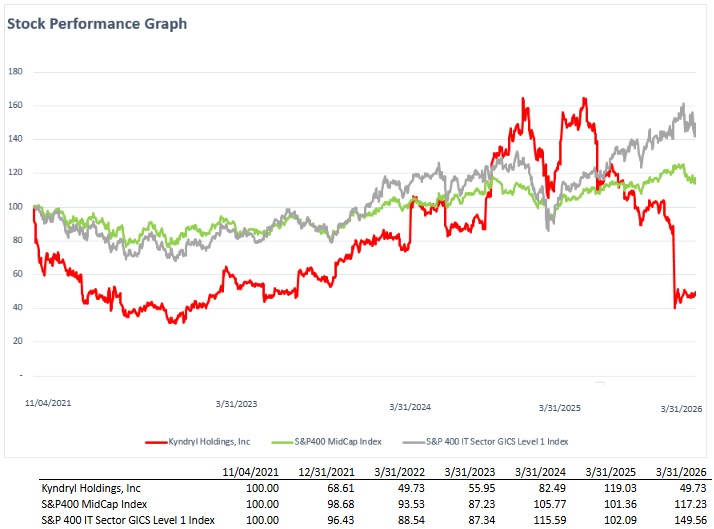
Item 6. [Reserved]
28
Item 7. Management’s Discussion and Analysis of Financial Condition and Results of Operations.
Included below are selected results and year-over-year comparisons for the years ended March 31, 2026, 2025 and 2024. The following discussion and analysis of our financial condition and results of operations should be read together with our audited consolidated financial statements and related notes included elsewhere in this report. For further information on the comparisons between the years ended March 31, 2025 and 2024 not covered in the “Segment Results” below, refer to “Management’s Discussion and Analysis of Financial Condition and Results of Operations” in Amendment No. 1 to the Company’s Annual Report on Form 10-K for the fiscal year ended March 31, 2025, which was filed with the SEC on February 17, 2026 (the “2025 Form 10-K”).
Overview
Kyndryl is a leading provider of mission-critical enterprise technology services, offering advisory, implementation and managed service capabilities to thousands of customers in more than 60 countries. As the world’s largest IT infrastructure services provider, the Company designs, builds, manages and modernizes the complex information systems that the world depends on every day.
The Company is organized, managed and classified into four reportable segments by geography: United States, Japan, Principal Markets and Strategic Markets. For additional information on these segments, refer to Note 4 – Segments to our consolidated financial statements included elsewhere in this report.
Financial Performance Summary
|
|
Year Ended March 31, |
||||||||||
(Dollars in millions) |
|
2026 |
|
2025 |
|
2024 |
||||||
Revenue |
|
$ |
15,092 |
|
|
$ |
15,057 |
|
|
$ |
16,052 |
|
Revenue growth (GAAP) |
|
|
0 |
% |
|
|
(6) |
% |
|
|
(6) |
% |
Revenue growth in constant currency* |
|
|
(3) |
% |
|
|
(4) |
% |
|
|
(6) |
% |
Net income (loss) |
|
$ |
198 |
|
|
$ |
252 |
|
|
$ |
(340) |
|
Adjusted EBITDA* |
|
$ |
2,672 |
|
|
$ |
2,516 |
|
|
$ |
2,367 |
|
| * | Revenue growth in constant currency and adjusted EBITDA are non-GAAP financial metrics. For definitions of these metrics and a reconciliation of adjusted EBITDA to the most directly comparable financial measure calculated and presented in accordance with U.S. GAAP, see “⸺Segment Results.” |
|
|
|
|
|
|
|
|
|
March 31, |
|
March 31, |
||
(Dollars in millions) |
|
2026 |
|
2025 |
||
Assets |
|
$ |
12,551 |
|
$ |
10,452 |
Liabilities |
|
|
11,259 |
|
|
9,121 |
Equity |
|
|
1,293 |
|
|
1,331 |
Fiscal 2026 Financial Performance
For the year ended March 31, 2026, we reported $15.1 billion in revenue, unchanged compared to the year ended March 31, 2025. The revenue performance included a favorable currency exchange rate impact of three points. United States revenue decreased 2 percent, Japan revenue decreased 3 percent, Principal Markets revenue increased 4 percent and Strategic Markets revenue was unchanged, compared to the year ended March 31, 2025. During the period, the Company experienced growth in Kyndryl Consult and hyperscaler-related revenues and revenue performance was unfavorably impacted by lengthening sales cycles and evolving content from the Company’s former parent in the Company’s customer engagements. Net income of $198 million decreased by $53 million versus the prior year reflecting a $138 million after-tax gain from the sale of our Securities Industry Services (“SIS”) platform in Canada (classified as a transaction-related benefit) in the prior year, partially offset by progress on our key initiatives to drive operating efficiencies. During the period, margins were adversely affected by lengthening sales cycles.
29
Fiscal 2025 Financial Performance
For the year ended March 31, 2025, we reported $15.1 billion in revenue, a decline of 6 percent compared to the year ended March 31, 2024. The revenue decline was largely attributable to actions the Company has taken to reduce low-margin components of its customer relationships, as well as currency effects. United States revenue decreased 10 percent, Japan revenue increased 1 percent, Principal Markets revenue decreased 5 percent and Strategic Markets revenue decreased 8 percent, compared to the year ended March 31, 2024. Net income of $252 million improved by $592 million versus the prior year driven by progress on our key initiatives to drive operating efficiencies and increased margins, lower depreciation expense of $180 million and a $138 million after-tax gain from the sale of our SIS platform in Canada.
Macro Dynamics
Global markets have experienced volatility in 2026, amid ongoing trade tensions and heightened macroeconomic uncertainties, driven by geopolitical developments and conflicts, concerns over changes in global trade policies and the imposition of import tariffs by the United States, reactions from other nations and proposed U.S. government spending reductions. Increased economic uncertainty has impacted and may continue to impact the level and composition of global macroeconomic activity.
Recent Developments
The Company continues to cooperate with the SEC Division of Enforcement’s investigation relating to the Company’s cash management practices, related disclosures, the efficacy of the Company’s internal control over financial reporting, and certain other matters. The matter is ongoing and the Company cannot currently predict its final outcome. See Note 14 – Commitments and Contingencies in the consolidated financial statements included elsewhere in this report for further information about this and other contingency matters.
In addition, as previously disclosed, the Company identified material weaknesses in internal control over financial reporting. For more information, see “Controls and Procedures” in Part II, Item 9A in this report.
Acquisitions Update
For information concerning our recent acquisitions activity, including regarding the pending acquisition of Solvinity Group B.V., see Note 10 – Acquisitions and Divestitures in the consolidated financial statements included elsewhere in this report.
Basis of Presentation
We prepare our consolidated financial statements in accordance with U.S. GAAP, which requires us to make estimates and assumptions that impact the amounts reported and disclosed in our consolidated financial statements and the accompanying notes. We prepared these estimates based on the most current and best available information, but actual results could differ materially from these estimates and assumptions. All significant transactions and accounts between Kyndryl entities were eliminated. Within the financial statements and tables presented, certain columns and rows may not add due to the use of rounded numbers for disclosure purposes. Percentages presented are calculated from the underlying whole-dollar amounts.
30
Segment Results
The following table presents our reportable segments’ revenue and adjusted EBITDA for the years ended March 31, 2026, 2025 and 2024. Segment revenue and revenue growth in constant currency exclude any transactions between the segments.
|
|
Year Ended March 31, |
|
Year-over-Year Change |
||||||||||||||
(Dollars in millions) |
|
2026 |
|
2025 |
|
2024(3) |
|
2026 vs. 2025 |
|
2025 vs. 2024 |
||||||||
Revenue |
|
|
|
|
|
|
|
|
|
|
|
|
|
|
|
|
|
|
United States |
|
$ |
3,784 |
|
|
$ |
3,876 |
|
|
$ |
4,295 |
|
|
(2) |
% |
|
(10) |
% |
Japan |
|
|
2,284 |
|
|
|
2,358 |
|
|
|
2,344 |
|
|
(3) |
% |
|
1 |
% |
Principal Markets |
|
|
5,399 |
|
|
|
5,206 |
|
|
|
5,479 |
|
|
4 |
% |
|
(5) |
% |
Strategic Markets |
|
|
3,625 |
|
|
|
3,617 |
|
|
|
3,934 |
|
|
0 |
% |
|
(8) |
% |
Total revenue |
|
$ |
15,092 |
|
|
$ |
15,057 |
|
|
$ |
16,052 |
|
|
0 |
% |
|
(6) |
% |
Revenue growth in constant currency(1) |
|
|
(3) |
% |
|
|
(4) |
% |
|
|
(6) |
% |
|
|
|
|
|
|
Adjusted EBITDA(1) |
|
|
|
|
|
|
|
|
|
|
|
|
|
|
|
|
|
|
United States |
|
$ |
835 |
|
|
$ |
725 |
|
|
$ |
781 |
|
|
15 |
% |
|
(7) |
% |
Japan |
|
|
486 |
|
|
|
390 |
|
|
|
361 |
|
|
25 |
% |
|
8 |
% |
Principal Markets |
|
|
834 |
|
|
|
886 |
|
|
|
677 |
|
|
(6) |
% |
|
31 |
% |
Strategic Markets |
|
|
622 |
|
|
|
606 |
|
|
|
642 |
|
|
3 |
% |
|
(6) |
% |
Corporate and other(2) |
|
|
(105) |
|
|
|
(90) |
|
|
|
(95) |
|
|
NM |
|
|
NM |
|
Total adjusted EBITDA(1) |
|
$ |
2,672 |
|
|
$ |
2,516 |
|
|
$ |
2,367 |
|
|
6 |
% |
|
6 |
% |
NM – not meaningful
| (1) | Revenue growth in constant currency and adjusted EBITDA are non-GAAP financial metrics. See the information below for definitions of these metrics and a reconciliation of adjusted EBITDA to net income (loss). |
| (2) | Represents net amounts not allocated to segments. |
| (3) | Effective June 1, 2024, the Company made a minor change to its geographic reportable segments to reflect how it manages its operations and measures business performance, transitioning the reporting and management of its operations in Australia/New Zealand from the Principal Markets segment to the Strategic Markets segment. Historical fiscal 2024 segment information was recast to reflect this change in the 2025 Form 10-K. |
We report our financial results in accordance with U.S. GAAP. We also present certain non-GAAP financial measures to provide useful supplemental information to investors. We provide these non-GAAP financial measures as we believe they enhance visibility to underlying results and the impact of management decisions on operational performance, enable better comparison to peer companies and allow us to provide a long-term strategic view of the business going forward.
Revenue growth in constant currency is a non-GAAP measure that eliminates the effects of exchange rate fluctuations when translating from foreign currencies to the United States dollar. It is calculated by using the average exchange rates that existed for the same period of the prior year. Constant-currency measures are provided so that revenue can be viewed without the effect of fluctuations in currency exchange rates, which is consistent with how management evaluates our revenue results and trends.
Additionally, management uses adjusted EBITDA to evaluate our performance. Adjusted EBITDA is a non-GAAP measure and defined as net income (loss) excluding income taxes, interest expense, depreciation and amortization (excluding depreciation of right-of-use assets and amortization of capitalized contract costs), charges related to ceasing to use leased/fixed assets, charges related to lease terminations, transaction-related costs and benefits, pension expenses other than pension servicing costs and multi-employer plan costs, stock-based compensation expense, workforce rebalancing charges incurred prior to March 31, 2024, impairment expense, significant litigation costs and benefits, and currency impacts of highly inflationary countries. We believe that adjusted EBITDA is a helpful supplemental measure to assist investors in evaluating our operating results as it excludes certain items whose fluctuation from period to period does not necessarily correspond to changes in the operations of our business.
31
These disclosures are provided in addition to and not as a substitute for the percentage change in revenue and profit or loss measures on a U.S. GAAP basis compared to the corresponding period in the prior year. Other companies may calculate and define similarly labeled items differently, which may limit the usefulness of these measures for comparative purposes.
The following table provides a reconciliation of U.S. GAAP net income (loss) to adjusted EBITDA:
|
|
Year Ended March 31, |
|||||||
(Dollars in millions) |
|
2026 |
|
2025 |
|
2024 |
|||
Net income (loss) |
|
$ |
198 |
|
$ |
252 |
|
$ |
(340) |
Provision for income taxes |
|
|
215 |
|
|
184 |
|
|
172 |
Interest expense |
|
|
89 |
|
|
100 |
|
|
122 |
Depreciation of property, equipment and capitalized software |
|
|
762 |
|
|
660 |
|
|
834 |
Amortization expense |
|
|
1,266 |
|
|
1,308 |
|
|
1,287 |
Workforce rebalancing charges incurred prior to March 31, 2024 |
|
|
— |
|
|
— |
|
|
138 |
Charges related to ceasing to use leased/fixed assets and lease terminations |
|
|
— |
|
|
48 |
|
|
39 |
Transaction-related costs (benefits) |
|
|
41 |
|
|
(125) |
|
|
(46) |
Stock-based compensation expense |
|
|
64 |
|
|
100 |
|
|
95 |
Other adjustments* |
|
|
36 |
|
|
(10) |
|
|
68 |
Adjusted EBITDA (non-GAAP) |
|
$ |
2,672 |
|
$ |
2,516 |
|
$ |
2,367 |
| * | Other adjustments represent pension expenses other than pension servicing costs and multi-employer plan costs, significant litigation costs and benefits, and currency impacts of highly inflationary countries. For the year ended March 31, 2024, other adjustments also included an adjustment to reduce amortization expense for the amount already included in transaction-related costs (benefits) above. |
United States
|
|
Year Ended March 31, |
||||||
(Dollars in millions) |
|
2026 |
|
2025 |
||||
Revenue |
|
$ |
3,784 |
|
|
$ |
3,876 |
|
Revenue year-over-year change |
|
|
(2) |
% |
|
|
(10) |
% |
Adjusted EBITDA |
|
|
835 |
|
|
|
725 |
|
Adjusted EBITDA year-over-year change |
|
|
15 |
% |
|
|
|
|
For the year ended March 31, 2026, United States revenue of $3.8 billion decreased 2 percent compared to the year ended March 31, 2025, primarily reflecting the expiration of certain low-margin contracts entered into before the Spin-off. Adjusted EBITDA increased $110 million from the prior year, primarily driven by progress on our key initiatives to drive operating efficiencies and lower sales, general and administrative expenses of $57 million attributable to the Company's compensation plans driven by current-year performance.
For the year ended March 31, 2025, United States revenue of $3.9 billion decreased 10 percent compared to the year ended March 31, 2024, reflecting the Company’s efforts to reduce certain low-margin revenues and the expiration of other low-margin contracts entered into before the Spin-off. Adjusted EBITDA decreased $56 million from the prior year, primarily driven by lower revenue and the impact of the inclusion of workforce rebalancing charges in adjusted EBITDA in fiscal 2025.
32
Japan
|
|
Year Ended March 31, |
||||||
(Dollars in millions) |
|
2026 |
|
2025 |
||||
Revenue |
|
$ |
2,284 |
|
|
$ |
2,358 |
|
Revenue year-over-year change |
|
|
(3) |
% |
|
|
1 |
% |
Revenue growth in constant currency |
|
|
(4) |
% |
|
|
6 |
% |
Adjusted EBITDA |
|
|
486 |
|
|
|
390 |
|
Adjusted EBITDA year-over-year change |
|
|
25 |
% |
|
|
|
|
For the year ended March 31, 2026, Japan revenue of $2.3 billion decreased 3 percent, and decreased 4 percent in constant currency, compared to the year ended March 31, 2025, driven by actions the Company has taken to reduce certain low-margin components of its customer relationships entered into before the Spin-off. Adjusted EBITDA increased $96 million from the prior year, driven by progress on our key initiatives to drive operating efficiencies.
For the year ended March 31, 2025, Japan revenue of $2.4 billion increased 1 percent, and increased 6 percent in constant currency, compared to the year ended March 31, 2024, primarily driven by expanding the scope of services we provide to our customers. Adjusted EBITDA increased $29 million from the prior year, primarily driven by progress on our key initiatives to drive operating efficiencies.
Principal Markets
|
|
Year Ended March 31, |
||||||
(Dollars in millions) |
|
2026 |
|
2025 |
||||
Revenue |
|
$ |
5,399 |
|
|
$ |
5,206 |
|
Revenue year-over-year change |
|
|
4 |
% |
|
|
(5) |
% |
Revenue growth in constant currency |
|
|
(2) |
% |
|
|
(4) |
% |
Adjusted EBITDA |
|
|
834 |
|
|
|
886 |
|
Adjusted EBITDA year-over-year change |
|
|
(6) |
% |
|
|
|
|
For the year ended March 31, 2026, Principal Markets revenue of $5.4 billion increased 4 percent, and decreased 2 percent in constant currency, compared to the year ended March 31, 2025, reflecting the expiration of certain low-margin contracts entered into before the Spin-off. Adjusted EBITDA decreased $52 million from the prior year, primarily due to a vendor credit of $65 million in the prior year, partially offset by progress on our key initiatives to drive operating efficiencies.
For the year ended March 31, 2025, Principal Markets revenue of $5.2 billion decreased 5 percent, and decreased 4 percent in constant currency compared to the year ended March 31, 2024, driven by actions the Company has taken to reduce low-margin components of its customer relationships. Adjusted EBITDA increased $209 million from the prior year, primarily due to increased operating efficiencies and higher margins on recent signings, as well as a vendor credit of $65 million.
Strategic Markets
|
|
Year Ended March 31, |
||||||
(Dollars in millions) |
|
2026 |
|
2025 |
||||
Revenue |
|
$ |
3,625 |
|
|
$ |
3,617 |
|
Revenue year-over-year change |
|
|
0 |
% |
|
|
(8) |
% |
Revenue growth in constant currency |
|
|
(5) |
% |
|
|
(5) |
% |
Adjusted EBITDA |
|
|
622 |
|
|
|
606 |
|
Adjusted EBITDA year-over-year change |
|
|
3 |
% |
|
|
|
|
For the year ended March 31, 2026, Strategic Markets revenue of $3.6 billion was unchanged, and decreased 5 percent in constant currency, compared to the year ended March 31, 2025, primarily driven by actions the Company has taken to reduce certain low-margin components of its customer relationships entered into before the Spin-off. Adjusted EBITDA increased $16 million from the prior year, primarily due to progress on our key initiatives to drive operating efficiencies.
33
For the year ended March 31, 2025, Strategic Markets revenue of $3.6 billion decreased 8 percent compared to the year ended March 31, 2024. The revenue decline was largely attributable to actions the Company has taken to reduce low-margin components of its customer relationships, as well as an unfavorable currency exchange rate impact of three points. Adjusted EBITDA decreased $36 million from the prior year, primarily driven by the impact of the inclusion of workforce rebalancing charges in adjusted EBITDA in fiscal 2025, partially offset by progress on our key initiatives to drive operating efficiencies.
Corporate and Other
Corporate and other generated an adjusted EBITDA loss of $105 million in the year ended March 31, 2026, compared to a loss of $90 million in the year ended March 31, 2025, and a loss of $95 million in the year ended March 31, 2024.
Costs and Expenses
|
|
Year Ended March 31, |
|
Percent of Revenue |
|
Change |
|||||||||
(Dollars in millions) |
|
2026 |
|
2025 |
|
2026 |
|
2025 |
|
2026 vs. 2025 |
|||||
Revenue |
|
$ |
15,092 |
|
$ |
15,057 |
|
100.0 |
% |
|
100.0 |
% |
|
0 |
% |
Cost of services |
|
|
11,803 |
|
|
11,914 |
|
78.2 |
% |
|
79.1 |
% |
|
(1) |
% |
Selling, general and administrative expenses |
|
|
2,654 |
|
|
2,591 |
|
17.6 |
% |
|
17.2 |
% |
|
2 |
% |
Workforce rebalancing charges |
|
|
60 |
|
|
114 |
|
0.4 |
% |
|
0.8 |
% |
|
(48) |
% |
Transaction-related costs (benefits) |
|
|
41 |
|
|
(125) |
|
0.3 |
% |
|
(0.8) |
% |
|
NM |
|
Interest expense |
|
|
89 |
|
|
100 |
|
0.6 |
% |
|
0.7 |
% |
|
(11) |
% |
Other expense (income) |
|
|
32 |
|
|
27 |
|
0.2 |
% |
|
0.2 |
% |
|
16 |
% |
Income before income taxes |
|
$ |
414 |
|
$ |
435 |
|
|
|
|
|
|
|
|
|
NM – not meaningful
Cost of services was 78.2% of revenue in the year ended March 31, 2026, compared to 79.1% in the year ended March 31, 2025, driven by progress on our key initiatives to drive operating efficiencies, including our Advanced Delivery initiative. Selling, general and administrative expenses were 17.6% of revenue in the year ended March 31, 2026, compared to 17.2% in the year ended March 31, 2025, driven by increased expenses to support future growth. Transaction-related costs (benefits) were 0.3% of revenue in the year ended March 31, 2026, compared to transaction-related costs (benefits) of (0.8)% of revenue in the year ended March 31, 2025, due to a reserve for an interim arbitration decision on a pre-spin matter in the year ended March 31, 2026, compared to a $145 million pretax gain from the sale of the SIS platform in the year ended March 31, 2025. Interest expense was 0.6% of revenue in the year ended March 31, 2026 compared to 0.7% in the year ended March 31, 2025.
34
|
|
Year Ended March 31, |
|
Percent of Revenue |
|
Change |
|||||||||
(Dollars in millions) |
|
2025 |
|
2024 |
|
2025 |
|
2024 |
|
2025 vs. 2024 |
|||||
Revenue |
|
$ |
15,057 |
|
$ |
16,052 |
|
100.0 |
% |
|
100.0 |
% |
|
(6) |
% |
Cost of services |
|
|
11,914 |
|
|
13,189 |
|
79.1 |
% |
|
82.2 |
% |
|
(10) |
% |
Selling, general and administrative expenses |
|
|
2,591 |
|
|
2,773 |
|
17.2 |
% |
|
17.3 |
% |
|
(7) |
% |
Workforce rebalancing charges |
|
|
114 |
|
|
138 |
|
0.8 |
% |
|
0.9 |
% |
|
(18) |
% |
Transaction-related costs (benefits) |
|
|
(125) |
|
|
(46) |
|
(0.8) |
% |
|
(0.3) |
% |
|
NM |
|
Interest expense |
|
|
100 |
|
|
122 |
|
0.7 |
% |
|
0.8 |
% |
|
(18) |
% |
Other expense |
|
|
27 |
|
|
45 |
|
0.2 |
% |
|
0.3 |
% |
|
(39) |
% |
Income (loss) before income taxes |
|
$ |
435 |
|
$ |
(168) |
|
|
|
|
|
|
|
|
|
NM – not meaningful
Cost of services was 79.1% of revenue in the year ended March 31, 2025, compared to 82.2% in the year ended March 31, 2024, driven by lower depreciation expense of $180 million, a vendor credit of $65 million, and progress on our key initiatives to drive operating efficiencies. Selling, general and administrative expenses were 17.2% of revenue in the year ended March 31, 2025, compared to 17.3% in the year ended March 31, 2024. Transaction-related costs (benefits) were (0.8)% of revenue in the year ended March 31, 2025, primarily due to a $145 million pretax gain from the sale of the SIS platform in Canada, compared to transaction-related costs (benefits) of (0.3)% of revenue in the year ended March 31, 2024, which reflected an agreement that allowed us to collect previously reserved receivables from our former Parent. Interest expense was 0.7% of revenue in the year ended March 31, 2025 compared to 0.8% in the year ended March 31, 2024. Other expense was 0.2% of revenue in the year ended March 31, 2025, compared to 0.3% in the year ended March 31, 2024, driven by currency-related hedging gains recorded in the year ended March 31, 2025.
Transaction-Related Costs
The Company classifies certain expenses and benefits related to the Separation, acquisitions and divestitures as Transaction-related costs (benefits) in the Consolidated Income Statement. Transaction-related costs include gains or losses, employee retention expenses, information technology costs, marketing expenses to establish the Kyndryl brand, legal, accounting, consulting and other professional service costs, costs and benefits resulting from settlements with our former Parent associated with pre-Separation and Separation-related matters, and other costs related to contract and supplier novation and integration, associated with acquisitions, divestitures or the Separation.
Workforce Rebalancing and Site-Rationalization Charges
On May 5, 2026, the Company approved, as part of its ongoing efforts to further streamline operations, workforce rebalancing actions to optimize and support the Company’s financial and operational efficiency in fiscal year 2027. As a result of these actions, the Company expects to incur workforce rebalancing charges of approximately $200 million, primarily consisting of future cash expenditures for severance and related benefits.
Management expects that these workforce rebalancing activities, once completed, will reduce annual payroll costs and related expenses and result in savings of approximately $400 to $500 million in fiscal year 2028. There can be no guarantee that we will achieve our expected cost savings.
The Company will continue to seek opportunities to improve operational efficiency and reduce costs, which may result in additional charges in future periods. For additional information, see Note 18 – Workforce Rebalancing and Site-Rationalization Charges in the accompanying Consolidated Financial Statements.
Fiscal 2026 Program
During the year ended March 31, 2026, management initiated actions to reduce the Company’s overall cost structure and enhance operating efficiency. As a result of these actions, the Company recorded workforce rebalancing charges of $60 million for the year ended March 31, 2026.
35
Total cash outlays for this program are expected to be approximately $60 million, of which approximately $56 million has been paid through March 31, 2026, and the remainder is expected to be paid thereafter. Management expects that these workforce rebalancing activities will reduce annual payroll costs and related expenses by more than $100 million in fiscal year 2027. There can be no guarantee that we will achieve our expected cost savings.
Fiscal 2025 Program
During the year ended March 31, 2025, management implemented actions to reduce the Company’s overall cost structure and increase operating efficiency. During the year ended March 31, 2025, the Company recorded $114 million in workforce rebalancing charges and $48 million in charges related to ceasing to use leased and owned fixed assets.
Total cash outlays for this program are expected to be approximately $150 million, of which approximately $142 million has been paid through March 31, 2026, and the remainder is expected to be paid thereafter. Management estimates that these workforce rebalancing and site-rationalization activities reduced payroll costs, rent expenses and depreciation of property and equipment by more than $250 million in fiscal year 2026.
Fiscal 2024 Program
During the year ended March 31, 2023, management initiated certain actions to reduce the Company’s overall cost structure and increase our operating efficiency, which continued through the year ended March 31, 2024. These actions resulted in workforce rebalancing charges, charges related to ceasing to use leased and owned fixed assets, and charges related to lease terminations. Workforce rebalancing charges arise from cost-reduction actions to enhance productivity and cost-competitiveness and to rebalance skills that result in payments to the terminated employees. In addition, we identified certain leased and owned assets that were inherited from IBM as a result of the Separation that we determined will no longer provide any economic benefit to Kyndryl. During the year ended March 31, 2024, the Company recognized $135 million in workforce rebalancing charges (excluding individual terminations outside of this Company-wide workforce rebalancing program) and $39 million in charges related to ceasing to use leased and owned fixed assets, including lease termination charges.
Total cash outlays for this program are expected to be $300 million, of which approximately $290 million has been paid through March 31, 2026 (including approximately $70 million of contractual payments toward leased assets we have ceased to use), and the remainder is expected to be paid thereafter. Management estimates that these workforce rebalancing and site-rationalization activities reduced payroll costs, rent expenses and depreciation of property and equipment by approximately $400 million in fiscal year 2025.
Income Taxes
The Company’s consolidated provision for income taxes and effective tax rate were as follows:
|
|
Year Ended March 31, |
||||||||||
(Dollars in millions) |
|
2026 |
|
2025 |
|
2024 |
||||||
Provision for income taxes |
|
$ |
215 |
|
|
$ |
184 |
|
|
$ |
172 |
|
Effective tax rate |
|
|
52.1 |
% |
|
|
41.9 |
% |
|
|
(102.2) |
% |
In the year ended March 31, 2026, we recorded income tax expense of $215 million, and in the year ended March 31, 2025, we recorded income tax expense of $184 million. In the year ended March 31, 2024, we recorded income tax expense of $172 million on a pretax loss, which resulted in a negative effective tax rate. Our income tax expense for the years ended March 31, 2026, 2025 and 2024 was primarily related to taxes on foreign operations and uncertain tax positions.
The effective tax rate for the year ended March 31, 2026 was higher compared to the year ended March 31, 2025, primarily due to non-recurring, non-cash tax accruals from the refinement of certain tax positions recorded in the fourth quarter of fiscal 2026, and the jurisdictional mix of our earnings. The effective tax rate for the year ended March 31, 2025 was higher compared to the year ended March 31, 2024, primarily due to the Company’s pretax income in fiscal year 2025, compared to a pretax loss in 2024.
36
For more information, see Note 5 – Taxes in the accompanying Consolidated Financial Statements.
Financial Position Dynamics
Total assets of $12.6 billion at March 31, 2026 increased by $2.1 billion (and increased by $1.9 billion adjusted for currency) from March 31, 2025, primarily driven by an increase in deferred costs of $997 million mainly due to an extended and amended multi-year, third-party software agreement and an increase in cash and cash equivalents of $837 million mainly due to $1.0 billion of cash borrowed under a revolving credit agreement, partially offset by a decrease of $304 million due to share repurchases.
Total liabilities of $11.3 billion at March 31, 2026 increased by $2.1 billion (and increased by $2.0 billion adjusted for currency) from March 31, 2025, primarily as a result of an increase in debt of $917 million due to cash borrowed under a revolving credit agreement and an increase in other liabilities of $1.2 billion driven by the extended and amended multi-year, third-party software agreement.
Total equity of $1.3 billion at March 31, 2026 decreased by $39 million from March 31, 2025, principally due to $304 million of share repurchases under our Share Repurchase Program and $94 million of shares repurchased to settle tax withholdings related to the vesting of stock-based awards, partially offset by our earnings of $198 million and other comprehensive income of $86 million in the year, as well as activity related to employee stock plans of $70 million.
Overall pension funded status as of March 31, 2026 was 80% of estimated pension benefit obligation, an increase from 77% at March 31, 2025. Among our funded pension plans, our funded status as of March 31, 2026 was 110%, an increase from 103% at March 31, 2025.
Liquidity and Capital Resources
We believe that our existing cash and cash equivalents and our revolving credit facility will be sufficient to meet our anticipated operating cash needs, and to fund our planned capital investments, debt maturities and stock repurchases for at least the next twelve months. As of March 31, 2026, we had cash and cash equivalents of approximately $2.6 billion and approximately $2.2 billion in available borrowing capacity under our revolving credit facility.
Our principal ongoing cash requirements include operating expenses, income taxes, debt service payments and capital expenditures, and may include discretionary debt repayments, stock repurchases and business acquisitions. Our primary sources of liquidity include available cash and cash equivalents, cash from operations and proceeds obtained from long-term debt. Additionally, we have access to incremental liquidity, if needed, through borrowings under our revolving credit facility to manage our working capital and investment needs.
As part of our ongoing cash and commercial management strategy with customers and suppliers and as previously disclosed, our standard practice since the time of our spin-off from IBM is to actively manage our working capital, including accounts receivables and accounts payables. This includes optimizing payment terms and conditions, accelerating certain cash receipts (including through the sale of accounts receivables to third-party financial institutions as described under “Transfers of Financial Assets” below and in Note 1 to the consolidated financial statements) and delaying certain cash payments (including deferring vendor payments quarter to quarter, in certain cases beyond vendor payment terms), and undertaking other discretionary cash and working capital management initiatives. The magnitude of these practices (including deferrals) varies from period to period. The effects of these practices, including any impacts on our cash flows, have been and are reflected in our accounts payable, accounts receivable and operating cash flows, which are accounted for in accordance with U.S. GAAP, the material drivers of which are quantified below under “Cash Flow.” Our working capital and cash flows have also reflected the impact of accrued contract costs in certain periods due to the timing of vendor billings. We may, from time to time, revise or adapt our cash and working capital management practices as we deem appropriate.
37
Furthermore, our cash provided from operating activities is somewhat impacted by seasonality. Working capital needs are generally highest in our first quarter due to annual and biannual payments, such as for pre-paid software subscriptions and incentive payments. On a continuing basis, we consider various transactions to increase stockholder value and enhance our business results, including acquisitions and divestitures, stock repurchases, and productivity and other efficiency initiatives. These transactions may result in future cash proceeds or payments.
Cash Flow
Our cash flows from operating, investing and financing activities are summarized in the table below.
|
|
Year Ended March 31, |
||||
(Dollars in millions) |
|
2026 |
|
2025 |
||
Net cash provided by (used in): |
|
|
|
|
|
|
Operating activities |
|
$ |
948 |
|
$ |
942 |
Investing activities |
|
|
(561) |
|
|
(404) |
Financing activities |
|
|
457 |
|
|
(286) |
Effect of exchange rate changes on cash, cash equivalents and restricted cash |
|
|
(9) |
|
|
(16) |
Net change in cash, cash equivalents and restricted cash |
|
$ |
836 |
|
$ |
235 |
Net cash provided by operating activities was $948 million in the year ended March 31, 2026, compared to $942 million in the year ended March 31, 2025, due to the year-over-year increase in net income of $214 million excluding the net gain/loss on asset sales and other, the cash flow effect of which is included in net cash used in investing activities. Receivables and deferred income partially offset the increase: current accounts receivable was lower by $200 million driven by the timing of collections in the prior year, and lease and other receivables was higher by $207 million driven by current-year lease transactions; and deferred income was higher by $195 million due to customer contract terms that enabled higher billings in the current year, as well as amortization outpacing new deferrals in the prior year. In addition, the decline in accounts payable of $93 million in the current period includes the impact of deferred vendor payments, which largely coincide with delayed receipts from customers.
Net cash used in investing activities was $561 million in the year ended March 31, 2026, compared to a net cash use of $404 million in the year ended March 31, 2025, due to cash provided by the sale of the SIS platform in the year ended March 31, 2025.
Net cash provided by financing activities totaled $457 million in the year ended March 31, 2026, compared to net cash used by financing activities of $286 million in the year ended March 31, 2025, mainly due to $1.0 billion of cash borrowed under our revolving credit agreement partially offset by share repurchases of $304 million under the Company’s Share Repurchase Program.
Senior Unsecured Notes
In October 2021, in preparation for our Spin-off, we completed the offering of $2.4 billion in aggregate principal amount of senior unsecured fixed-rate notes as follows: $700 million aggregate principal amount of 2.05% Senior Notes due 2026, $500 million aggregate principal amount of 2.70% Senior Notes due 2028, $650 million aggregate principal amount of 3.15% Senior Notes due 2031 and $550 million aggregate principal amount of 4.10% Senior Notes due 2041 (the “Initial Notes”). The Initial Notes were offered and sold to qualified institutional buyers in reliance on Rule 144A under the Securities Act and to non-U.S. persons in reliance on Regulation S of the Securities Act. In connection with the issuance of the Initial Notes, we entered into a registration rights agreement with the purchasers of the Initial Notes, pursuant to which we completed a registered offering to exchange each series of Initial Notes for new notes with substantially identical terms during the quarter ended September 30, 2022.
In February 2024, we completed a registered offering of $500 million in aggregate principal amount of 6.35% senior unsecured notes due 2034 (the “2034 Notes”). We received proceeds of $494 million, net of debt issuance costs and discounts.
38
The 2034 Notes are the Company’s senior unsecured obligations and rank equally in right of payment with all of the Company’s other existing and future senior unsecured indebtedness.
The Initial Notes and the 2034 Notes are subject to customary affirmative covenants, negative covenants and events of default for financings of this type and are redeemable at our option in a customary manner.
We have outstanding $700 million of fixed-rate notes that mature in October 2026. We intend to refinance these notes at a future date, subject to market conditions.
Revolving Credit Agreement
In October 2021, we entered into a $3.15 billion multi-currency revolving credit agreement (the “Revolving Credit Agreement”), which expires, unless extended, in October 2026. The Revolving Credit Agreement was amended in June 2023, replacing the London Interbank Offered Rate (“LIBOR”) with the Secured Overnight Financing Rate (“SOFR”). In March 2025, we further amended the agreement, extending the maturity to March 2030. Interest rates on borrowings under the Revolving Credit Agreement will be based on prevailing market interest rates, plus a margin, as further described in the Revolving Credit Agreement.
The total facility fees recorded by the Company for the Revolving Credit Agreement were $5 million and $5 million for the years ended March 31, 2026 and 2025, respectively. In February 2026, the Company borrowed $1 billion under the Revolving Credit Agreement, bearing an interest rate of 4.97%. The borrowing matures in August 2026 and may be refinanced utilizing the facility. The Company had approximately $2.2 billion of additional borrowing capacity remaining at March 31, 2026. Proceeds are intended to be used for working capital and other general corporate purposes, which may include repayment of indebtedness and acquisitions.
The Revolving Credit Agreement includes certain customary mandatory prepayment provisions. In addition, it includes customary events of default and affirmative and negative covenants as well as a maintenance covenant that will require that the ratio of our indebtedness for borrowed money to consolidated EBITDA (as defined in the Revolving Credit Agreement) for any period of four consecutive fiscal quarters be no greater than 3.50 to 1.00. The Company is in compliance with its debt covenants.
Transfers of Financial Assets
The Company has entered into arrangements with third-party financial institutions to sell certain financial assets (primarily accounts receivables) without recourse. The Company has determined these are true sales. The carrying value of the financial asset sold is derecognized, and a net gain or loss on the sale is recognized, at the time of the transfer. The first agreement, which was executed in November 2021 and subsequently amended, enabled us to sell certain of our accounts receivables to the counterparty. The initial term of this agreement was 18 months, and the agreement automatically resets to a term of 18 months after every six months, unless either party elects not to extend. This agreement was further amended during the quarter ended September 30, 2024 to reduce the committed facility limit from $1 billion to $600 million and to add an incremental uncommitted facility limit of $200 million that is subject to the counterparty’s sole discretion to purchase such incremental amounts. At this time, the agreement will expire in April 2027. We have also entered into additional agreements with a separate third-party financial institution that enable us to sell receivables. These agreements were first executed in June 2022 and subsequently amended to renew automatically every 18 months, unless either party elects not to extend. These facilities are committed for up to approximately $210 million as of March 31, 2026. In aggregate, we have committed facilities of up to approximately $810 million as of March 31, 2026.
The net proceeds from these arrangements are reflected as cash provided by operating activities in the Consolidated Statement of Cash Flows. Gross proceeds from receivables sold to third parties under the aforementioned programs were $2.4 billion for the year ended March 31, 2026 and $3.2 billion for the year ended March 31, 2025. The fees associated with the transfers of receivables were $18 million for the year ended March 31, 2026 and $38 million for the year ended March 31, 2025. The year-to-year decline in the gross proceeds from sales of receivables was primarily due to a higher volume of intra-period factoring transactions in the prior period.
39
Of the receivables sold and derecognized from the Consolidated Balance Sheet, $0.9 billion, $1.0 billion and $1.1 billion remained uncollected from customers at March 31, 2026, 2025 and 2024, respectively. Overall, the declining balances of sold receivables have been primarily driven by factoring of receivables from pre-spin customer contracts that gave certain customers extended payment terms. As we have transitioned to new signings, including with existing customers, fewer customers have used extended payment terms, which has caused these balances in the aggregate to continue to decline.
Supplier Financing Program
In the year ended March 31, 2024, the Company initiated a supplier financing program with a third-party financial institution under which the Company agrees to pay the financial institution the stated amounts of invoices from participating suppliers on the originally invoiced due date, which have an average term of 90 to 120 days. The financial institution offers earlier payment of the invoices at the sole discretion of the supplier for a discounted amount. The Company does not provide secured legal assets or other forms of guarantees under the arrangements. The Company or the financial institution may terminate the agreement upon at least 180 days’ notice. The Company’s obligations under this program continue to be recognized as accounts payable in the Consolidated Balance Sheet. The obligations outstanding under this program at March 31, 2026 and 2025 were immaterial.
Share Repurchase Program
In November 2024, the Company’s Board of Directors authorized a share repurchase program of up to $300 million of the Company’s common stock, and in November 2025, the Company announced that the Board of Directors authorized an additional $400 million of repurchase capacity under this program. Under the Share Repurchase Program, the Company may repurchase shares of its common stock from time to time in open market transactions and may also repurchase shares in accelerated share buyback programs, tender offers, privately negotiated transactions or by other means. Repurchases may also be made under a Rule 10b5-1 trading plan. The timing and amount of repurchase transactions will be determined by the Company’s management based on its evaluation of market conditions, share price, legal requirements and other factors. The program does not have a set expiration date and may be suspended, modified or discontinued at any time without prior notice.
During the years ended March 31, 2026 and March 31, 2025, the Company repurchased 11.6 million and 2.6 million shares of its common stock, respectively, at an aggregate cost of $304 million and $94 million under the Share Repurchase Program, respectively. As of March 31, 2026, approximately $302 million of capacity remained available under the Share Repurchase Program.
Off-Balance Sheet Arrangements and Contractual Obligations
From time to time, we may enter into (i) off-balance sheet arrangements as defined by SEC Financial Reporting Release 67 (FRR-67), “Disclosure in Management’s Discussion and Analysis about Off-Balance Sheet Arrangements and Aggregate Contractual Obligations” or (ii) purchase commitments, which we expect to use in the ordinary course of business.
At March 31, 2026 and March 31, 2025, we had no such off-balance sheet arrangements that have, or are reasonably likely to have, a material current or future effect on our financial condition, changes in financial condition, revenues or expenses, results of operations, liquidity, capital expenditures or capital resources. We do not have retained interests in assets transferred to unconsolidated entities or other material off-balance sheet interests or instruments.
At March 31, 2026, the Company’s material future contractual obligations were primarily related to leases, debt and pension liabilities. See Note 9 – Leases, Note 12 – Borrowings, Note 13 – Other Liabilities and Note 17 – Retirement-Related Benefits of Notes to the Company’s consolidated financial statements. Additionally, the Company has contractual commitments that are noncancellable with certain software, hardware and cloud partners used in the delivery of services to customers. The Company has determined that these commitments may exceed the Company’s needs over the next two to three years. If the Company is unable to satisfy, reduce or amend its contractual commitments, it will record the future charges for any payments related to excess commitments as cost of services. At March 31, 2026, we had short-term (April 2026 through March 2027), mid-term (April 2027 through March 2029) and long-term (April 2029 onward) purchase commitments in the amount of $0.2 billion, $0.4 billion and $0.3 billion, respectively.
40
Other Information
Signings
The following table presents the Company’s signings for the years ended March 31, 2026, 2025 and 2024.
|
|
Year Ended March 31, |
|||||||
(Dollars in billions) |
|
2026 |
|
2025 |
|
2024 |
|||
Total signings |
|
$ |
13.5 |
|
$ |
18.2 |
|
$ |
12.5 |
Signings decreased $4.7 billion, or 26%, in the year ended March 31, 2026 compared to the Company’s strong signings performance during the year ended March 31, 2025, reflecting a record 55 contracts valued in excess of $50 million and a $1.8 billion signing, the largest signing in Kyndryl’s history as an independent company. Signings performance in the year ended March 31, 2026 was unfavorably impacted by lengthening sales cycles and evolving content from the Company’s former parent in the Company’s customer engagements. Signings increased $5.7 billion, or 46%, in the year ended March 31, 2025 compared to the year ended March 31, 2024, driven by growth in each of our four operating segments and spanning a broad range of industries.
Management uses signings as a tool to monitor the performance of the business including the business’ ability to attract new customers and sell additional scope into our existing customer base. There are no third-party standards or requirements governing the calculation of signings. We define signings as an initial estimate of the value of a customer’s commitment under a contract. The calculation involves estimates and judgments to gauge the extent of a customer’s commitment, including the type and duration of the agreement and the presence of termination charges or wind-down costs. Contract extensions and increases in scope are treated as signings only to the extent of the incremental new value. Signings can vary over time due to a variety of factors including, but not limited to, the timing of signing a small number of larger outsourcing contracts as well as the length of those contracts. The conversion of signings into revenue may vary based on the types of services and solutions, customer decisions and other factors, which may include, but are not limited to, the macroeconomic environment or external events.
Critical Accounting Estimates
The application of U.S. GAAP requires us to make estimates and assumptions about certain items and future events that directly affect our reported financial condition. The accounting estimates and assumptions discussed in this section are those that we consider to be the most critical to our financial statements. Our significant accounting policies are described in Note 1 – Significant Accounting Policies to our consolidated financial statements.
A quantitative sensitivity analysis is provided where that information is reasonably available, can be reliably estimated and provides material information to investors. The amounts used to assess sensitivity (e.g., 10 percent, 25 basis points, etc.) are included to allow users of this report to understand a general effect of changes in the estimates and do not represent management’s predictions of variability. For all of these estimates, it should be noted that future events rarely develop exactly as forecasted and estimates require regular review and adjustment.
Revenue Recognition
Application of U.S. GAAP related to the measurement and recognition of revenue requires us to make judgments and estimates. Specifically, complex arrangements with nonstandard terms and conditions may require significant contract interpretation to determine the appropriate accounting, including whether promised goods and services specified in an arrangement are separate performance obligations. In certain arrangements, revenue is recognized based on progress toward completion of the performance obligation using a cost-to-cost measure of progress. The estimation of future costs, which is updated as the project progresses, is complex and requires us to make judgments. Other significant judgments include determining whether we are acting as the principal in a transaction and whether separate contracts should be combined and considered part of one arrangement.
41
Revenue recognition is also impacted by our ability to determine when a contract is probable of collection and when to estimate variable consideration, including, for example, rebates, price concessions, service-level penalties and performance bonuses. We consider various factors when making these judgments, including a review of specific transactions, historical experience and market and economic conditions. Evaluations are conducted each quarter to assess the adequacy of the estimates.
Costs to Complete Service Contracts
During the contractual period, revenue, cost and profits may be impacted by estimates of the ultimate profitability of each contract, especially contracts for which we use cost-to-cost method to measure progress. The Company performs ongoing profitability analyses of its design-and-build services contracts accounted for using a cost-to-cost measure of progress to determine whether the latest estimates of revenues, costs and profits require updating. If at any time these estimates indicate that the contract will be unprofitable on a gross-margin basis, the entire estimated loss for the remainder of the contract is recorded immediately. For other types of services contracts, any losses are recorded as incurred. Key factors reviewed to estimate the future costs to complete each contract include future labor costs, product costs and expected productivity efficiencies.
Capitalization of Contract Costs
In connection with services arrangements, we incur and capitalize direct costs for transition and setup activities performed at the inception of these long-term contracts that are necessary to enable us to perform under the terms of the arrangement. These costs are capitalized and are amortized on a straight-line basis over the expected period of benefit. We perform periodic reviews to assess the recoverability of deferred contract transition and setup costs. To assess recoverability, undiscounted estimated cash flows of the contract are projected over its remaining life and compared to the carrying amount of contract-related assets, including the unamortized deferred cost balance. Such estimates require judgment and assumptions, and actual future cash flows could differ from these estimates. A significant change in an estimate or assumption on one or more contracts could have a material effect on our results of operations.
Retirement-related Benefit Plan Assumptions
For Company-sponsored and co-sponsored defined benefit pension plans, the measurement of the benefit obligation to plan participants and net periodic benefit cost requires the use of certain assumptions, including, among others, estimates of discount rates and expected return on plan assets.
Changes in the discount rate assumptions would impact the actuarial (gain)/loss amortization, service cost and interest cost components of the net periodic benefit cost calculation and the projected benefit obligation (“PBO”). If the average discount rate assumption for the non-U.S. defined benefit pension plans had increased or decreased by 25-basis-points from 4.31% on March 31, 2026, this would not result in a material change to pretax net periodic benefit cost recognized in fiscal 2027. Further changes in the discount rate assumptions would impact the PBO which, in turn, may impact our funding decisions if the PBO exceeds plan assets. A 25-basis-point increase or decrease in the discount rate would result in an approximate corresponding decrease or increase, respectively, of approximately $36 million in the Plans’ estimated PBO based upon March 31, 2026 data.
The expected long-term return on plan assets assumption is used in calculating the net periodic benefit cost. Expected returns on plan assets are calculated based on the market-related value of plan assets, which recognizes changes in the fair value of plan assets systematically over a five-year period in the expected return on plan assets line in net periodic benefit cost. The differences between the actual return on plan assets and the expected long-term return on plan assets are recognized over five years in the expected return on plan assets line in net periodic benefit cost and also as a component of actuarial (gains)/losses, which are recognized over the service lives or life expectancy of the participants, depending on the plan, provided such amounts exceed thresholds which are based upon the benefit obligation or the value of plan assets, as provided by accounting standards.
To the extent the outlook for long-term returns changes such that management changes its expected long-term return on plan assets assumption, a 25-basis-point increase or decrease in the expected long-term return on plan assets assumption would not have a material estimated decrease or increase on the following year’s pretax net periodic benefit cost (based upon plan assets at March 31, 2026 and expected contributions and benefit payments for fiscal 2027).
42
We may voluntarily make contributions or be required, by law, to make contributions to our pension plans. Actual results that differ from the estimates may result in more or less future funding into the pension plans than is planned by management. Impacts of these types of changes on our pension plans would vary depending upon the status of each respective plan.
In addition to the above, we evaluate other pension assumptions involving demographic factors, such as retirement age and mortality and update these assumptions to reflect experience and expectations for the future. Actual results in any given year can differ from actuarial assumptions because of economic and other factors.
For additional information on our pension plans and the development of these assumptions, see Note 17 – Retirement-Related Benefits to our consolidated financial statements.
Income Taxes
Our income tax provisions are calculated based on Kyndryl’s operating footprint, as well as our tax return elections and assertions. Liabilities related to unrecognized tax benefits for which the Company is liable are reported within the Consolidated Balance Sheet based upon management’s estimates and judgments regarding the resolution of tax positions, including tax authorities’ ability to assert the Company as the primary obligor for historical taxes, including those arising from pre‑spin or transitional periods, among other factors. Significant judgment is required in determining any valuation allowance recorded against deferred tax assets. In assessing the need for a valuation allowance, management considers all available evidence for each jurisdiction including past operating results, estimates of future taxable income and the feasibility of ongoing tax planning strategies and actions. In the event that we change our determination as to the amount of deferred tax assets that can be realized, we will adjust the valuation allowance with a corresponding impact to income tax expense in the period in which such determination is made.
Valuation of Assets
The application of valuation and impairment accounting requires the use of significant estimates and assumptions. Impairment testing for assets, other than goodwill, requires the allocation of cash flows to those assets or group of assets and if required, an estimate of fair value for the assets or group of assets. Our estimates are based upon assumptions believed to be reasonable, but which are inherently uncertain and unpredictable. These valuations require the use of management’s assumptions, which would not reflect unanticipated events and circumstances that may occur. Assumptions used to perform a recoverability test are consistent with those used for goodwill impairment; see “Valuation of Goodwill” for further detail.
Valuation of Goodwill
We review goodwill for impairment annually and whenever events or changes in circumstances indicate the carrying value of goodwill may not be recoverable by first assessing qualitative factors to determine if it is more likely than not that fair value is less than carrying value.
43
We assess qualitative factors in each of our reporting units that carry goodwill including relevant events and circumstances that affect the fair value of reporting units. Examples include, but are not limited to, macroeconomic, industry and market conditions, as well as other individual factors such as:
| ● | A significant adverse shift in the operating environment of the reporting unit such as unanticipated competition; |
| ● | Significant pending litigation; |
| ● | A more-likely-than-not expectation that a reporting unit or a significant portion of a reporting unit will be sold or otherwise disposed of; and |
| ● | A significant adverse action or assessment by a regulator. |
We assess these qualitative factors to determine whether it is necessary to perform the quantitative goodwill impairment test. This quantitative test is required only if we conclude that it is more likely than not that a reporting unit’s fair value is less than its carrying amount.
In conjunction with our annual review of goodwill for impairment, we prepared qualitative analysis as of January 1, 2026. Based on this analysis of the qualitative factors, quantitative tests were not required. See Note 11 – Intangible Assets Including Goodwill for further discussion.
Loss Contingencies
We are currently involved in various claims and legal proceedings. At least quarterly, we review the status of each significant matter and assess our potential financial exposure. If the potential loss from any claim or legal proceeding is considered probable and the amount can be reasonably estimated, we accrue a liability for the estimated loss. Significant judgment is required in both the determination of probability and the determination as to whether an exposure is reasonably estimable. Because of uncertainties related to these matters, accruals are based only on the best information available at the time. As additional information becomes available, we reassess the potential liability related to our pending claims and litigation and may revise our estimates. These revisions in the estimates of the potential liabilities could have a material impact on our results of operations and financial position. Refer to Note 14 – Commitments and Contingencies in the consolidated financial statements in this report for additional information.
Change in Accounting Estimate
In March 2024, the Company completed its assessment of the useful lives of its information technology equipment. Based on our usage experience and data analysis, the Company determined it should increase the estimated useful lives of its information technology equipment from five to six years. This change in accounting estimate became effective on April 1, 2024. Based on the carrying amount of information technology equipment included in property and equipment, net as of March 31, 2024, the effect of this change in estimate was a reduction in depreciation expense and an improvement of income before income taxes of approximately $180 million, or $0.80 before income taxes per basic share and $0.77 before income taxes per diluted share, for the year ended March 31, 2025.
Item 7A. Quantitative and Qualitative Disclosures About Market Risk.
Currency Rate Fluctuations
Changes in the relative values of non-U.S. currencies to the U.S. dollar affect our financial results and financial position. At March 31, 2026, currency changes resulted in assets and liabilities denominated in local currencies being translated into more dollars than the prior year. At March 31, 2025, currency changes resulted in assets and liabilities denominated in local currencies being translated into fewer dollars than the prior year. During periods of sustained movements in currency, the marketplace and competition adjust to the changing rates. Large changes in currency exchange rates relative to our functional currencies could increase the costs of our services to customers relative to local competitors, thereby causing us to lose existing or potential customers. Currency movements impacted our year-to-year revenue growth.
44
Based on the currency rate movements in the year ended March 31, 2026, total revenue was unchanged as reported and decreased 3 percent in constant currency versus the year ended March 31, 2025. For non-U.S. subsidiaries and branches that operate in U.S. dollars or whose economic environment is highly inflationary, translation adjustments are reflected in results of operations. Generally, we manage currency risk in these entities by linking prices and contracts to U.S. dollars.
Market Risk
In the normal course of business, our financial position is routinely subject to a variety of risks. In addition to the market risk associated with non-U.S. dollar denominated assets and liabilities, another example of risk is the collectability of accounts receivable. We regularly assess these risks and have established policies and business practices to protect against the adverse effects of these and other potential exposures. As a result, we do not anticipate any material losses from these risks.
To meet disclosure requirements, we perform a sensitivity analysis to determine the effects that market risk exposures may have on the fair values of our financial assets. The financial instruments that are included in the sensitivity analysis are comprised of our cash and cash equivalents, debt obligations, and derivative instruments.
To perform the sensitivity analysis, we assess the risk of loss in fair values from the effect of hypothetical changes in interest rates and currency exchange rates on market-sensitive instruments. The market values for interest and currency exchange risk are computed based on the present value of future cash flows as affected by the changes in rates that are attributable to the market risk being measured. The discount rates used for the present value computations were selected based on market interest and foreign currency exchange rates in effect at March 31, 2026 and 2025. The differences in this comparison are the hypothetical losses associated with each type of risk.
Information provided by the sensitivity analysis does not necessarily represent the actual changes in fair value that we would incur under normal market conditions because, due to practical limitations, all variables other than the specific market risk factor are held constant. In addition, the results of the model are constrained by the fact that certain items are specifically excluded from the analysis, while the financial instruments relating to the financing or hedging of those items are included by definition.
The results of the sensitivity analysis at March 31, 2026 and 2025 are as follows:
Interest Rate Risk
Our exposure to market risk for changes in interest rates relates primarily to our fixed-rate and variable-rate debt obligations (See Note 12 – Borrowings in the accompanying Consolidated Financial Statements). A hypothetical 10 percent adverse change in the levels of interest rates, with all other variables held constant, would result in a $16 million and a $20 million impact in the fair value of our financial instruments at March 31, 2026 and 2025, respectively. A hypothetical 10 percent adverse change in the levels of interest rates would not be material to our consolidated results of operations or cash flow.
Currency Exchange Rate Risk
A hypothetical 10 percent adverse change in the levels of currency exchange rates relative to the U.S. dollar, with all other variables held constant, would result in a $77 million and a $26 million impact in the fair value of our financial instruments, primarily our cash, debt and derivatives, at March 31, 2026 and 2025, respectively.
45
Item 8. Financial Statements and Supplementary Data.
Index to Consolidated Financial Statements
46
Report of Independent Registered Public Accounting Firm
To the Board of Directors and Stockholders of Kyndryl Holdings, Inc.
Opinions on the Financial Statements and Internal Control over Financial Reporting
We have audited the accompanying consolidated balance sheet of Kyndryl Holdings, Inc. and its subsidiaries (the “Company”) as of March 31, 2026 and 2025, and the related consolidated statements of income, of comprehensive income (loss), of equity and of cash flows for each of the three years in the period ended March 31, 2026, including the related notes (collectively referred to as the “consolidated financial statements”). We also have audited the Company’s internal control over financial reporting as of March 31, 2026, based on criteria established in Internal Control - Integrated Framework (2013) issued by the Committee of Sponsoring Organizations of the Treadway Commission (COSO).
In our opinion, the consolidated financial statements referred to above present fairly, in all material respects, the financial position of the Company as of March 31, 2026 and 2025, and the results of its operations and its cash flows for each of the three years in the period ended March 31, 2026 in conformity with accounting principles generally accepted in the United States of America. Also in our opinion, the Company did not maintain, in all material respects, effective internal control over financial reporting as of March 31, 2026, based on criteria established in Internal Control - Integrated Framework (2013) issued by the COSO because material weaknesses in internal control over financial reporting existed as of that date related to (i) the Company’s senior finance executives failing to set an appropriate tone at the top within the control environment component of the COSO framework, including a lack of transparency such that disclosure processes were impacted and lacked an appropriate complement of finance personnel with sufficient understanding of their responsibilities as disclosure committee members; (ii) the Company not designing and maintaining effective controls to ensure appropriate communication pertaining to the disclosure process between certain functions within the Company; and (iii) the Company not designing and maintaining effective controls regarding the internal investigation, escalation, and documentation of complaints made through the Company’s reporting hotline and certain other available reporting channels.
A material weakness is a deficiency, or a combination of deficiencies, in internal control over financial reporting, such that there is a reasonable possibility that a material misstatement of the annual or interim financial statements will not be prevented or detected on a timely basis. The material weaknesses referred to above are described in Management’s Report on Internal Control over Financial Reporting appearing under Item 9A. We considered these material weaknesses in determining the nature, timing, and extent of audit tests applied in our audit of the 2026 consolidated financial statements, and our opinion regarding the effectiveness of the Company’s internal control over financial reporting does not affect our opinion on those consolidated financial statements.
Basis for Opinions
The Company’s management is responsible for these consolidated financial statements, for maintaining effective internal control over financial reporting, and for its assessment of the effectiveness of internal control over financial reporting, included in management’s report referred to above. Our responsibility is to express opinions on the Company’s consolidated financial statements and on the Company’s internal control over financial reporting based on our audits. We are a public accounting firm registered with the Public Company Accounting Oversight Board (United States) (PCAOB) and are required to be independent with respect to the Company in accordance with the U.S. federal securities laws and the applicable rules and regulations of the Securities and Exchange Commission and the PCAOB.
We conducted our audits in accordance with the standards of the PCAOB. Those standards require that we plan and perform the audits to obtain reasonable assurance about whether the consolidated financial statements are free of material misstatement, whether due to error or fraud, and whether effective internal control over financial reporting was maintained in all material respects.
Our audits of the consolidated financial statements included performing procedures to assess the risks of material misstatement of the consolidated financial statements, whether due to error or fraud, and performing procedures that respond to those risks. Such procedures included examining, on a test basis, evidence regarding the amounts and disclosures in the consolidated financial statements.
47
Our audits also included evaluating the accounting principles used and significant estimates made by management, as well as evaluating the overall presentation of the consolidated financial statements. Our audit of internal control over financial reporting included obtaining an understanding of internal control over financial reporting, assessing the risk that a material weakness exists, and testing and evaluating the design and operating effectiveness of internal control based on the assessed risk. Our audits also included performing such other procedures as we considered necessary in the circumstances. We believe that our audits provide a reasonable basis for our opinions.
Definition and Limitations of Internal Control over Financial Reporting
A company’s internal control over financial reporting is a process designed to provide reasonable assurance regarding the reliability of financial reporting and the preparation of financial statements for external purposes in accordance with generally accepted accounting principles. A company’s internal control over financial reporting includes those policies and procedures that (i) pertain to the maintenance of records that, in reasonable detail, accurately and fairly reflect the transactions and dispositions of the assets of the company; (ii) provide reasonable assurance that transactions are recorded as necessary to permit preparation of financial statements in accordance with generally accepted accounting principles, and that receipts and expenditures of the company are being made only in accordance with authorizations of management and directors of the company; and (iii) provide reasonable assurance regarding prevention or timely detection of unauthorized acquisition, use, or disposition of the company’s assets that could have a material effect on the financial statements.
Because of its inherent limitations, internal control over financial reporting may not prevent or detect misstatements. Also, projections of any evaluation of effectiveness to future periods are subject to the risk that controls may become inadequate because of changes in conditions, or that the degree of compliance with the policies or procedures may deteriorate.
Critical Audit Matters
The critical audit matter communicated below is a matter arising from the current period audit of the consolidated financial statements that was communicated or required to be communicated to the audit committee and that (i) relates to accounts or disclosures that are material to the consolidated financial statements and (ii) involved our especially challenging, subjective, or complex judgments. The communication of critical audit matters does not alter in any way our opinion on the consolidated financial statements, taken as a whole, and we are not, by communicating the critical audit matter below, providing a separate opinion on the critical audit matter or on the accounts or disclosures to which it relates.
Revenue Recognition for Certain Services
As described in Notes 1 and 3 to the consolidated financial statements, the Company recorded total revenues of $15,092 million for the year ended March 31, 2026, of which a majority relates to services that are single performance obligations comprised of a series of distinct services. The Company offers services such as cloud managed services, application hosting and modernization, security and resiliency services, enterprise infrastructure services, digital workplace services, network services and distributed cloud services to support its customers through technological change. Revenue is recognized when, or as, control of a promised service transfers to a client, in an amount that reflects the consideration to which management expects to be entitled in exchange for transferring those services. If the consideration promised in a contract includes a variable amount, management estimates the amount to which it expects to be entitled using either the expected value or most likely amount method.
The principal considerations for our determination that performing procedures relating to revenue recognition for certain services is a critical audit matter is a high degree of auditor effort in performing procedures and evaluating the various sources of audit evidence related to the Company’s revenue recognition.
Addressing the matter involved performing procedures and evaluating audit evidence in connection with forming our overall opinion on the consolidated financial statements. These procedures included testing the effectiveness of controls relating to the revenue recognition process.
48
These procedures also included, among others (i) evaluating the Company’s accounting policies related to the recognition of revenue for services; (ii) testing revenue recognized for a sample of certain services revenue transactions by obtaining and inspecting source documents such as master services agreements, individual statements of work, invoices, and cash receipts; and (iii) confirming, on a sample basis, outstanding customer invoice balances as of year-end and, for confirmations not returned, obtaining and inspecting source documents, such as invoices and subsequent cash receipts.
/s/ PricewaterhouseCoopers LLP
New York, New York
May 29, 2026
We have served as the Company’s auditor since 2020.
49
KYNDRYL HOLDINGS, INC.
CONSOLIDATED INCOME STATEMENT
(In millions, except per share amounts)
|
|
|
|
Year Ended March 31, |
|||||||
|
|
Notes |
|
2026 |
|
2025 |
|
2024 |
|||
Revenues |
|
3 |
|
$ |
15,092 |
|
$ |
15,057 |
|
$ |
16,052 |
|
|
|
|
|
|
|
|
|
|
|
|
Cost of services |
|
3 |
|
$ |
11,803 |
|
$ |
11,914 |
|
$ |
13,189 |
Selling, general and administrative expenses |
|
|
|
|
2,654 |
|
|
2,591 |
|
|
2,773 |
Workforce rebalancing charges |
|
18 |
|
|
60 |
|
|
114 |
|
|
138 |
Transaction-related costs (benefits) |
|
|
|
|
41 |
|
|
(125) |
|
|
(46) |
Interest expense |
|
12 |
|
|
89 |
|
|
100 |
|
|
122 |
Other expense (income) |
|
|
|
|
32 |
|
|
27 |
|
|
45 |
Total costs and expenses |
|
|
|
$ |
14,678 |
|
$ |
14,622 |
|
$ |
16,221 |
|
|
|
|
|
|
|
|
|
|
|
|
Income (loss) before income taxes |
|
|
|
$ |
414 |
|
$ |
435 |
|
$ |
(168) |
Provision for income taxes |
|
5 |
|
$ |
215 |
|
$ |
184 |
|
$ |
172 |
Net income (loss) |
|
|
|
$ |
198 |
|
$ |
252 |
|
$ |
(340) |
|
|
|
|
|
|
|
|
|
|
|
|
Basic earnings (loss) per share |
|
6 |
|
$ |
0.87 |
|
$ |
1.09 |
|
$ |
(1.48) |
Diluted earnings (loss) per share |
|
|
|
|
0.85 |
|
|
1.05 |
|
|
(1.48) |
|
|
|
|
|
|
|
|
|
|
|
|
Weighted-average basic shares outstanding |
|
6 |
|
|
228.3 |
|
|
231.5 |
|
|
229.2 |
Weighted-average diluted shares outstanding |
|
|
|
|
233.8 |
|
|
239.1 |
|
|
229.2 |
The accompanying notes are an integral part of the financial statements.
50
KYNDRYL HOLDINGS, INC.
CONSOLIDATED STATEMENT OF COMPREHENSIVE INCOME (LOSS)
(Dollars in millions)
|
|
Year Ended March 31, |
|||||||
|
|
2026 |
|
2025 |
|
2024 |
|||
Net income (loss) |
|
$ |
198 |
|
$ |
252 |
|
$ |
(340) |
Other comprehensive income (loss), before tax: |
|
|
|
|
|
|
|
|
|
Foreign currency translation adjustments: |
|
|
|
|
|
|
|
|
|
Foreign currency translation adjustments |
|
|
127 |
|
|
(50) |
|
|
(36) |
Unrealized gains (losses) on net investment hedges |
|
|
(75) |
|
|
4 |
|
|
(11) |
Total foreign currency translation adjustments |
|
|
53 |
|
|
(46) |
|
|
(47) |
Unrealized gains (losses) on cash flow hedges: |
|
|
|
|
|
|
|
|
|
Unrealized gains (losses) arising during the period |
|
|
2 |
|
|
(14) |
|
|
22 |
Reclassification of (gains) losses to net income |
|
|
(8) |
|
|
11 |
|
|
(21) |
Total unrealized gains (losses) on cash flow hedges |
|
|
(6) |
|
|
(2) |
|
|
1 |
Retirement-related benefit plans: |
|
|
|
|
|
|
|
|
|
Prior service (costs) credits |
|
|
(34) |
|
|
2 |
|
|
(3) |
Net gains (losses) arising during the period |
|
|
64 |
|
|
17 |
|
|
(56) |
Curtailments and settlements |
|
|
10 |
|
|
7 |
|
|
10 |
Amortization of prior service costs (credits) |
|
|
2 |
|
|
— |
|
|
1 |
Amortization of net (gains) losses |
|
|
10 |
|
|
16 |
|
|
5 |
Total retirement-related benefit plans |
|
|
53 |
|
|
42 |
|
|
(42) |
Other comprehensive income (loss), before tax |
|
|
100 |
|
|
(6) |
|
|
(88) |
Income tax (expense) benefit related to items of other comprehensive income (loss) |
|
|
(14) |
|
|
(10) |
|
|
6 |
Other comprehensive income (loss), net of tax |
|
|
86 |
|
|
(16) |
|
|
(82) |
Total comprehensive income (loss) |
|
$ |
284 |
|
$ |
236 |
|
$ |
(423) |
The accompanying notes are an integral part of the financial statements.
51
KYNDRYL HOLDINGS, INC.
CONSOLIDATED BALANCE SHEET
(In millions, except per share amounts)
|
|
|
|
March 31, |
||||
|
|
Notes |
|
2026 |
|
2025 |
||
Assets: |
|
|
|
|
|
|
|
|
Current assets: |
|
|
|
|
|
|
|
|
Cash and cash equivalents |
|
|
|
$ |
2,623 |
|
$ |
1,786 |
Restricted cash |
|
|
|
|
3 |
|
|
3 |
Accounts receivable (net of allowances for credit losses of $7 at March 31, 2026 and $13 at March 31, 2025) |
|
|
|
|
1,300 |
|
|
1,345 |
Deferred costs (current portion) |
|
3 |
|
|
1,166 |
|
|
1,009 |
Prepaid expenses and other current assets |
|
|
|
|
436 |
|
|
446 |
Total current assets |
|
|
|
$ |
5,528 |
|
$ |
4,589 |
|
|
|
|
|
|
|
|
|
Property and equipment, net |
|
8 |
|
$ |
2,517 |
|
$ |
2,570 |
Operating right-of-use assets, net |
|
9 |
|
|
853 |
|
|
731 |
Deferred costs (noncurrent portion) |
|
3 |
|
|
1,880 |
|
|
1,040 |
Deferred taxes |
|
5 |
|
|
240 |
|
|
204 |
Goodwill |
|
11 |
|
|
786 |
|
|
790 |
Intangible assets, net |
|
11 |
|
|
165 |
|
|
218 |
Pension assets |
|
17 |
|
|
222 |
|
|
148 |
Other noncurrent assets |
|
|
|
|
360 |
|
|
162 |
Total assets |
|
|
|
$ |
12,551 |
|
$ |
10,452 |
|
|
|
|
|
|
|
|
|
Liabilities: |
|
|
|
|
|
|
|
|
Current liabilities: |
|
|
|
|
|
|
|
|
Accounts payable |
|
|
|
$ |
1,346 |
|
$ |
1,351 |
Value-added tax and income tax liabilities |
|
|
|
|
278 |
|
|
256 |
Current portion of long-term debt and short-term debt |
|
12 |
|
|
1,796 |
|
|
129 |
Accrued compensation and benefits |
|
|
|
|
463 |
|
|
652 |
Deferred income (current portion) |
|
3 |
|
|
888 |
|
|
746 |
Operating lease liabilities (current portion) |
|
9 |
|
|
265 |
|
|
274 |
Accrued contract costs |
|
|
|
|
369 |
|
|
437 |
Other accrued expenses and liabilities |
|
13 |
|
|
903 |
|
|
454 |
Total current liabilities |
|
|
|
$ |
6,307 |
|
$ |
4,300 |
|
|
|
|
|
|
|
|
|
Long-term debt |
|
12 |
|
$ |
2,293 |
|
$ |
3,042 |
Retirement and nonpension postretirement benefit obligations |
|
17 |
|
|
490 |
|
|
483 |
Deferred income (noncurrent portion) |
|
3 |
|
|
390 |
|
|
341 |
Operating lease liabilities (noncurrent portion) |
|
9 |
|
|
602 |
|
|
511 |
Other noncurrent liabilities |
|
13 |
|
|
1,176 |
|
|
443 |
Total liabilities |
|
|
|
$ |
11,259 |
|
$ |
9,121 |
Commitments and contingencies |
|
14 |
|
|
|
|
|
|
|
|
|
|
|
|
|
|
|
Equity: |
|
|
|
|
|
|
|
|
Stockholders’ equity |
|
15 |
|
|
|
|
|
|
Common stock, par value $0.01 per share, and additional paid-in capital (shares |
|
|
|
$ |
4,701 |
|
$ |
4,631 |
Accumulated deficit |
|
|
|
|
(1,869) |
|
|
(2,067) |
Treasury stock, at cost (shares: March 31, 2026 – 21.7, March 31, 2025 – 7.5) |
|
|
|
|
(582) |
|
|
(184) |
Accumulated other comprehensive income (loss) |
|
|
|
|
(1,074) |
|
|
(1,160) |
Total stockholders’ equity before non-controlling interests |
|
|
|
$ |
1,175 |
|
$ |
1,219 |
Non-controlling interests |
|
|
|
|
117 |
|
|
113 |
Total equity |
|
|
|
$ |
1,293 |
|
$ |
1,331 |
Total liabilities and equity |
|
|
|
$ |
12,551 |
|
$ |
10,452 |
The accompanying notes are an integral part of the financial statements.
52
KYNDRYL HOLDINGS, INC.
CONSOLIDATED STATEMENT OF CASH FLOWS
(Dollars in millions)
|
|
Year Ended March 31, |
|||||||
|
|
2026 |
|
2025 |
|
2024 |
|||
Cash flows from operating activities: |
|
|
|
|
|
|
|
|
|
Net income (loss) |
|
$ |
198 |
|
$ |
252 |
|
$ |
(340) |
Adjustments to reconcile net income to cash provided by operating activities: |
|
|
|
|
|
|
|
|
|
Depreciation and amortization: |
|
|
|
|
|
|
|
|
|
Depreciation of property, equipment and capitalized software |
|
|
762 |
|
|
660 |
|
|
834 |
Depreciation of right-of-use assets |
|
|
289 |
|
|
327 |
|
|
319 |
Amortization of transition costs and prepaid software |
|
|
1,239 |
|
|
1,278 |
|
|
1,256 |
Amortization of capitalized contract costs |
|
|
458 |
|
|
420 |
|
|
531 |
Amortization of acquisition-related intangible assets |
|
|
27 |
|
|
30 |
|
|
30 |
Stock-based compensation |
|
|
64 |
|
|
100 |
|
|
95 |
Deferred taxes |
|
|
(24) |
|
|
(1) |
|
|
(13) |
Net (gain) loss on asset sales and other |
|
|
115 |
|
|
(152) |
|
|
43 |
Change in operating assets and liabilities: |
|
|
|
|
|
|
|
|
|
Right-of-use assets and liabilities (excluding depreciation) |
|
|
(330) |
|
|
(314) |
|
|
(335) |
Workforce rebalancing liabilities |
|
|
(19) |
|
|
(25) |
|
|
(38) |
Current accounts receivable |
|
|
84 |
|
|
284 |
|
|
(105) |
Lease and other receivables |
|
|
(212) |
|
|
5 |
|
|
116 |
Accounts payable |
|
|
(93) |
|
|
(89) |
|
|
(305) |
Taxes |
|
|
107 |
|
|
(1) |
|
|
(2) |
Deferred transition costs and prepaid software (excluding amortization) |
|
|
(2,189) |
|
|
(1,338) |
|
|
(1,154) |
Capitalized contract costs (excluding amortization) |
|
|
(444) |
|
|
(425) |
|
|
(415) |
Other assets and other liabilities |
|
|
916 |
|
|
(71) |
|
|
(63) |
Net cash provided by operating activities |
|
$ |
948 |
|
$ |
942 |
|
$ |
454 |
|
|
|
|
|
|
|
|
|
|
Cash flows from investing activities: |
|
|
|
|
|
|
|
|
|
Capital expenditures |
|
$ |
(608) |
|
$ |
(605) |
|
$ |
(651) |
Proceeds from disposition of property and equipment |
|
|
65 |
|
|
83 |
|
|
138 |
Acquisitions and divestitures, net of cash acquired |
|
|
1 |
|
|
139 |
|
|
— |
Other investing activities, net |
|
|
(19) |
|
|
(20) |
|
|
(40) |
Net cash used in investing activities |
|
$ |
(561) |
|
$ |
(404) |
|
$ |
(553) |
|
|
|
|
|
|
|
|
|
|
Cash flows from financing activities: |
|
|
|
|
|
|
|
|
|
Debt repayments |
|
$ |
(146) |
|
$ |
(148) |
|
$ |
(644) |
Proceeds from borrowings under the revolving credit facility |
|
|
1,000 |
|
|
— |
|
|
— |
Proceeds from issuance of debt, net of debt issuance costs |
|
|
— |
|
|
— |
|
|
494 |
Common stock repurchases |
|
|
(304) |
|
|
(93) |
|
|
— |
Common stock repurchases for tax withholdings |
|
|
(94) |
|
|
(45) |
|
|
(22) |
Other financing activities, net |
|
|
1 |
|
|
— |
|
|
2 |
Net cash provided by (used in) financing activities |
|
$ |
457 |
|
$ |
(286) |
|
$ |
(170) |
|
|
|
|
|
|
|
|
|
|
Effect of exchange rate changes on cash, cash equivalents and restricted cash |
|
$ |
(9) |
|
$ |
(16) |
|
$ |
(37) |
Net change in cash, cash equivalents and restricted cash |
|
$ |
836 |
|
$ |
235 |
|
$ |
(306) |
|
|
|
|
|
|
|
|
|
|
Cash, cash equivalents and restricted cash at beginning of period |
|
$ |
1,789 |
|
$ |
1,554 |
|
$ |
1,860 |
Cash, cash equivalents and restricted cash at end of period |
|
$ |
2,626 |
|
$ |
1,789 |
|
$ |
1,554 |
|
|
|
|
|
|
|
|
|
|
Supplemental data: |
|
|
|
|
|
|
|
|
|
Income taxes paid, net of refunds received |
|
$ |
151 |
|
$ |
149 |
|
$ |
191 |
Interest paid on debt |
|
$ |
115 |
|
$ |
119 |
|
$ |
118 |
The accompanying notes are an integral part of the financial statements.
53
KYNDRYL HOLDINGS, INC.
CONSOLIDATED STATEMENT OF EQUITY
(In millions)
|
|
Common Stock and |
|
Accumulated |
|
|
|
|
|
|
|
|
|
||||||||
|
|
Additional |
|
Other |
|
|
|
|
|
|
Non- |
|
|
|
|||||||
|
|
Paid-In Capital |
|
Comprehensive |
|
Treasury |
|
Accumulated |
|
Controlling |
|
Total |
|||||||||
|
|
Shares |
|
Amount |
|
Income (Loss) |
|
Stock |
|
Deficit |
|
Interests |
|
Equity |
|||||||
Equity – March 31, 2023 |
|
|
227.7 |
|
$ |
4,428 |
|
$ |
(1,062) |
|
$ |
(23) |
|
$ |
(1,978) |
|
$ |
97 |
|
$ |
1,462 |
Net income (loss) |
|
|
|
|
|
|
|
|
|
|
|
|
|
|
(340) |
|
|
|
|
|
(340) |
Other comprehensive income (loss), net of tax |
|
|
|
|
|
|
|
|
(82) |
|
|
|
|
|
|
|
|
|
|
|
(82) |
Activity related to employee stock plans |
|
|
4.1 |
|
|
95 |
|
|
|
|
|
|
|
|
|
|
|
|
|
|
95 |
Purchases of treasury stock |
|
|
(1.4) |
|
|
|
|
|
|
|
|
(22) |
|
|
|
|
|
|
|
|
(22) |
Changes in non-controlling interests |
|
|
|
|
|
|
|
|
|
|
|
|
|
|
|
|
|
10 |
|
|
10 |
Equity – March 31, 2024 |
|
|
230.4 |
|
$ |
4,524 |
|
$ |
(1,145) |
|
$ |
(45) |
|
$ |
(2,319) |
|
$ |
107 |
|
$ |
1,122 |
Net income |
|
|
|
|
|
|
|
|
|
|
|
|
|
|
252 |
|
|
|
|
|
252 |
Other comprehensive income (loss), net of tax |
|
|
|
|
|
|
|
|
(16) |
|
|
|
|
|
|
|
|
|
|
|
(16) |
Activity related to employee stock plans |
|
|
4.5 |
|
|
107 |
|
|
|
|
|
|
|
|
|
|
|
|
|
|
107 |
Purchases of treasury stock |
|
|
(4.2) |
|
|
|
|
|
|
|
|
(139) |
|
|
|
|
|
|
|
|
(139) |
Changes in non-controlling interests |
|
|
|
|
|
|
|
|
|
|
|
|
|
|
|
|
|
6 |
|
|
6 |
Equity – March 31, 2025 |
|
|
230.6 |
|
$ |
4,631 |
|
$ |
(1,160) |
|
$ |
(184) |
|
$ |
(2,067) |
|
$ |
113 |
|
$ |
1,331 |
Net income |
|
|
|
|
|
|
|
|
|
|
|
|
|
|
198 |
|
|
|
|
|
198 |
Other comprehensive income (loss), net of tax |
|
|
|
|
|
|
|
|
86 |
|
|
|
|
|
|
|
|
|
|
|
86 |
Activity related to employee stock plans |
|
|
6.3 |
|
|
70 |
|
|
|
|
|
|
|
|
|
|
|
|
|
|
70 |
Purchases of treasury stock |
|
|
(14.2) |
|
|
|
|
|
|
|
|
(398) |
|
|
|
|
|
|
|
|
(398) |
Changes in non-controlling interests |
|
|
|
|
|
|
|
|
|
|
|
|
|
|
|
|
|
5 |
|
|
5 |
Equity – March 31, 2026 |
|
|
222.7 |
|
$ |
4,701 |
|
$ |
(1,074) |
|
$ |
(582) |
|
$ |
(1,869) |
|
$ |
117 |
|
$ |
1,293 |
The accompanying notes are an integral part of the financial statements.
54
NOTES TO CONSOLIDATED FINANCIAL STATEMENTS
NOTE 1. SIGNIFICANT ACCOUNTING POLICIES
Description of Business
Kyndryl Holdings, Inc. (“we”, “the Company” or “Kyndryl”) is a leading provider of mission-critical enterprise technology services, offering advisory, implementation and managed service capabilities to thousands of customers in more than 60 countries. As the world’s largest IT infrastructure services provider, the Company designs, builds, manages and modernizes the complex information systems that the world depends on every day.
Our purpose is to design, build and manage secure and responsive private, public and multi-cloud environments to serve our customers’ needs and accelerate their digital transformations.
We offer services across a number of areas of expertise, such as cloud services, core enterprise services, applications, data and artificial intelligence services, digital workplace services, security and resiliency services and network and edge services as we continue to support our customers through technological change. Our services enable us to modernize and manage cloud, on-premises and hybrid IT environments as “one” for our customers, enabling them to scale seamlessly. To deliver these services, we rely on our global team of skilled practitioners.
Kyndryl was formed in November 2021 from a spin-off (the “Separation,” the “Spin-off” or “spin”) from International Business Machines Corporation (“IBM” or “former Parent”) of the infrastructure services unit of IBM’s Global Technology Services segment.
Basis of Presentation
We prepare our consolidated financial statements in accordance with Generally Accepted Accounting Principles in the United States (“U.S. GAAP”), which requires us to make estimates and assumptions that impact the amounts reported and disclosed in our consolidated financial statements and the accompanying notes. We prepared these estimates based on the most current and best available information, but actual results could differ materially from these estimates and assumptions.
Principles of Consolidation
All significant transactions and intercompany accounts between Kyndryl entities were eliminated. Within the financial statements and tables presented, certain columns and rows may not add due to the use of rounded numbers for disclosure purposes. Percentages presented are calculated from the underlying whole-dollar amounts. Certain items have been recast to conform to current-period presentation.
Use of Estimates
The preparation of financial statements in conformity with U.S. GAAP requires management to make estimates and assumptions that affect amounts that are reported in the consolidated financial statements and accompanying disclosures. Estimates are used in determining the following, among others: revenue, costs to complete service contracts, income taxes, pension assumptions, valuation of assets including goodwill and intangible assets, the depreciable and amortizable lives of long-lived assets, loss contingencies, allowance for credit losses and deferred transition costs. Actual results may be different from these estimates.
Revenue
The Company accounts for a contract with a client when it has written approval, the contract is committed, the rights of the parties, including payment terms, are identified, the contract has commercial substance and consideration is probable of collection.
Revenue is recognized when, or as, control of a promised service or product transfers to a client, in an amount that reflects the consideration to which the Company expects to be entitled in exchange for transferring those products or services.
55
If the consideration promised in a contract includes a variable amount, the Company estimates the amount to which it expects to be entitled using either the expected value or most likely amount method. The Company’s contracts may include terms that could cause variability in the transaction price, including, for example, rebates, volume discounts, service-level penalties and performance bonuses or other forms of variable consideration. In certain rare circumstances, if we grant the customer the right to return a product and receive a full or partial credit or refund of any consideration paid, the Company (i) recognizes revenue for the transferred products in the amount of consideration to which it expects to be entitled, (ii) records a refund liability and (iii) recognizes an asset for its right to recover products from customers on settling the refund liability.
The Company only includes estimated amounts in the transaction price to the extent it is probable that a significant reversal of cumulative revenue recognized will not occur when the uncertainty associated with the variable consideration is resolved. The Company may not be able to reliably estimate variable consideration in certain long-term arrangements due to uncertainties that are not expected to be resolved for a long period of time or when the Company’s experience with similar types of contracts is limited. Changes in estimates of variable consideration are included in Note 3 – Revenue Recognition.
The Company’s standard billing terms are that payment is due upon receipt of invoice, payable within 30 days. Invoices are generally issued as services are rendered and/or as control transfers, either at monthly or quarterly intervals or upon achievement of contractual milestones. In some services contracts, the Company bills the client prior to recognizing revenue from performing the services. In these cases, deferred income is presented in the Consolidated Balance Sheet. In other services contracts, the Company performs the services prior to billing the client. When the Company performs services prior to billing the client, the right to consideration is typically subject to milestone completion or client acceptance, and the amount is recorded as a contract asset. Contract assets are generally classified as current and are recorded on a net basis with deferred income (i.e., contract liabilities) at the contract level. The Company’s rights to consideration are presented separately depending on whether those rights are conditional or unconditional. Conditional contract assets are included in Prepaid expenses and other current assets in the Consolidated Balance Sheet. Unconditional contract assets (“unbilled accounts receivable”) are included in Accounts receivable and Other noncurrent assets in the Consolidated Balance Sheet. Refer to Note 3 – Revenue Recognition for contract assets for the periods presented.
Additionally, in determining the transaction price, the Company would adjust the promised amount of consideration for the effects of the time value of money if the billing terms are not standard and the timing of payments agreed to by the parties to the contract provide the client or the Company with a significant benefit of financing, in which case the contract contains a significant financing component. As a practical expedient, the Company does not account for significant financing components if the period between when the Company transfers the promised product or service to the client and when the client pays for that product or service will be one year or less.
The Company may include subcontractor services or original equipment manufacturer (OEM) hardware and/or OEM software components in certain integrated services arrangements. In these types of arrangements, revenue from sales of OEM hardware and/or OEM software components or services is recorded net of costs when the Company is acting as an agent between the client and the vendor and gross when the Company is the principal for the transaction. To determine whether the Company is an agent or principal, the Company considers whether it obtains control of the products or services before they are transferred to the customer. In making this evaluation, several factors are considered, most notably whether the Company has primary responsibility for fulfillment to the client, as well as inventory risk and pricing discretion.
The Company reports revenue net of any revenue-based taxes assessed by governmental authorities that are imposed on and concurrent with specific revenue-producing transactions.
Performance Obligations
The Company’s capabilities as an infrastructure services company include offerings that often encompass multiple types of services and may integrate various OEM hardware and/or OEM software components. When an arrangement contains multiple separate performance obligations, revenue follows the specific revenue recognition policies for each performance obligation, depending on the type of offering. The Company determines if the products or services are distinct and allocates the consideration to each separate performance obligation on a relative standalone selling price basis.
56
When products and services are not distinct, the Company determines an appropriate measure of progress based on the nature of its overall promise for the single performance obligation.
The revenue policies below are applied to each performance obligation, as applicable.
Standalone Selling Price
The Company allocates the transaction price to each performance obligation on a relative standalone selling price basis. The standalone selling price (SSP) is the price at which the Company would sell a promised product or service separately to a client. The Company establishes SSP based on management’s estimated selling price or observable prices of products or services sold separately in comparable circumstances to similar clients. For OEM hardware and/or OEM software components, the Company is able to establish SSP based on the cost from the vendor. The Company reassesses SSP ranges on a periodic basis or when facts and circumstances change.
In certain instances, the Company may not be able to establish an SSP range based on observable prices and the Company estimates SSP. The Company estimates SSP by considering multiple factors including, but not limited to, overall market conditions, including geographic or regional specific factors, competitive positioning, competitor actions, internal costs, profit objectives and pricing practices. Estimating SSP is a formal process that includes review and approval by the Company’s management.
Lessor Revenue
Our service contracts may contain embedded leases for assets used to fulfill our obligations. A contract contains an embedded lease if the contract conveys the right to control the use of an identified asset for a period of time in exchange for consideration. Our embedded leases are recognized as either sales-type or operating leases. For sales-type leases, revenue and cost are recognized upon commencement of the lease in Revenue and Cost of services on the Consolidated Income Statement, respectively. Lease income from operating leases is recognized straight-line over the lease term and recorded as Revenue on the Consolidated Income Statement. Where a contract contains an embedded lease, the contract’s transaction price is allocated to the contract performance obligations and the lease component based upon the relative standalone selling price.
Nature of Products and Services
The Company delivers transformation and secure cloud services capabilities, insights and depth of expertise to modernize and manage IT environments based on its customers’ needs. The Company offers services such as cloud managed services, application hosting and modernization, security and resiliency services, enterprise infrastructure services, digital workplace services, network services and distributed cloud services to support its customers through technological change. Many of these services can be delivered entirely or partially through cloud or as-a-service delivery models. The Company’s services are provided on a time-and-material basis, as a fixed-price contract or as a fixed-price-per-measure-of-output contract, and the contract terms range from less than one year to over 10 years. The Company typically satisfies the performance obligation and recognizes revenue over time in services arrangements because the client simultaneously receives and consumes the benefits provided as the Company performs the services.
In outsourcing, other managed services, application management and other cloud-based services arrangements, the Company determines whether the services performed during the initial phases of the arrangement, such as setup activities, are distinct. In most cases, the arrangement is a single performance obligation comprised of a series of distinct services that are substantially the same and that have the same pattern of transfer (i.e., distinct days of service). The Company applies a measure of progress (typically time-based) to any fixed consideration and allocates variable consideration to the distinct periods of service based on usage. As a result, revenue is generally recognized over the period the services are provided on a usage basis. This results in revenue recognition that corresponds with the value to the client of the services transferred to date relative to the remaining services promised.
Revenue from time-and-material contracts is recognized on an output basis as labor hours are delivered and/or direct expenses are incurred. Revenue from as-a-service type contracts is recognized either on a straight-line basis or on a usage basis, depending on the terms of the arrangement (such as whether the Company is standing ready to perform or whether the contract has usage-based metrics).
57
If an as-a-service contract includes setup activities, those promises in the arrangement are evaluated to determine if they are distinct.
In design and build arrangements, revenue is recognized based on progress toward completion of the performance obligation using a cost-to-cost measure of progress (e.g., labor costs incurred to date as a percentage of the total estimated labor costs to fulfill the contract). The estimation of cost at completion is complex, subject to many variables and requires significant judgment. Changes in original estimates are reflected in revenue on a cumulative catch-up basis in the period in which the circumstances that gave rise to the revision become known by the Company. Refer to Note 3 – Revenue Recognition for the amount of revenue recognized in the reporting period on a cumulative catch-up basis (i.e., from performance obligations satisfied, or partially satisfied, in previous periods).
The Company performs ongoing profitability analyses of its design and build services contracts accounted for using a cost-to-cost measure of progress to determine whether the latest estimates of revenues, costs and profits require updating. If at any time these estimates indicate that the contract will be unprofitable, the entire estimated loss for the remainder of the contract is recorded immediately. For other types of services contracts, any losses are recorded as incurred.
The Company’s services offerings may include the integration and/or sale of OEM hardware and/or software components. Contracts that include hardware and/or software components are evaluated to determine if they are separate performance obligations as discussed in “Performance Obligations” above. For distinct OEM hardware sales, revenue is recognized when control has transferred to the customer, which typically occurs when the hardware has been shipped to the client, risk of loss has transferred to the client and the Company has a present right to payment for the hardware.
Cost of Services
Recurring operating costs for services contracts are recognized as incurred. Certain eligible, nonrecurring costs (i.e., setup costs) incurred in the initial phases of outsourcing contracts and other cloud-based services contracts, are capitalized when the costs relate directly to the contract, the costs generate or enhance resources of the Company that will be used in satisfying the performance obligation in the future and the costs are expected to be recovered. These costs consist of transition and setup costs related to the installation of systems and processes and other deferred fulfillment costs, including deferred software cost (e.g., committed multi-year, on-premises software purchases). Deferred costs to fulfill contracts also include prepaid assets used in services contracts (e.g., prepaid hardware maintenance). Capitalized costs are amortized on a straight-line basis over the expected period of benefit, which approximates the pattern of transfer to the client of the services to which the asset relates and includes anticipated contract renewals or extensions. Additionally, fixed assets associated with these contracts are capitalized and depreciated on a straight-line basis over the expected useful life of the asset and recorded in cost of sales. If an asset is contract-specific and cannot be repurposed, then the depreciation period is the shorter of the useful life of the asset or the contract term. The Company performs periodic reviews to assess the recoverability of deferred contract transition and setup costs. If the carrying amount is deemed not recoverable, an impairment loss is recognized. Refer to Note 3 – Revenue Recognition for the deferred costs to fulfill contracts for the periods presented.
In situations in which an outsourcing contract is terminated, the terms of the contract may require the client to reimburse the Company for the recovery of unbilled accounts receivable, unamortized deferred contract costs and additional costs incurred by the Company to transition the services.
Incremental Costs of Obtaining a Contract
Incremental costs of obtaining a contract (e.g., sales commissions) are capitalized and amortized on a straight-line basis, which approximates the pattern that the assets’ economic benefits are expected to be consumed, over the expected customer relationship period if the Company expects to recover those costs. The expected customer relationship period is determined based on the average customer relationship period, including expected renewals, for each offering type and ranges from three to six years. Expected renewal periods are only included in the expected customer relationship period if commission amounts paid upon renewal are not commensurate with amounts paid on the initial contract. Incremental costs of obtaining a contract include only those costs the Company incurs to obtain a contract that it would not have incurred if the contract had not been obtained. The Company has determined that certain commissions programs meet the requirements to be capitalized.
58
For contracts shorter than one year, the Company has elected the practical expedient to recognize sales commissions as incurred. Additionally, some commission programs are not subject to capitalization as the revenue for services is received over time and the commission expense is paid and recognized as the related revenue is recognized. Refer to Note 3 – Revenue Recognition for capitalized costs to obtain contracts for the periods presented.
Expense and Other (Income)
Selling, General and Administrative Expenses
Selling, general and administrative expense (“SG&A”) is charged to income as incurred, except for certain sales commissions, which are capitalized and amortized. For further information regarding capitalizing sales commissions, see “Incremental Costs of Obtaining a Contract” above. Expenses of promoting and selling services are classified as selling expense and, in addition to sales commissions, include such items as compensation, advertising and travel. General and administrative expense includes such items as compensation, legal costs, office supplies, non-income taxes, insurance and office rental. In addition, general and administrative expense includes other operating items such as allowance for credit losses, amortization of certain intangible assets and research, development and engineering (“RD&E”) costs. Total RD&E costs were $57 million, $49 million, and $58 million for the years ended March 31, 2026, 2025 and 2024, respectively.
Advertising and promotional costs are expensed as incurred. Advertising and promotional expense, which includes media, agency and promotional expense directly incurred by the Company was $69 million, $83 million, and $115 million for the years ended March 31, 2026, 2025 and 2024, respectively. Advertising and promotional costs are recorded in SG&A in the Consolidated Income Statement.
Other Expense
Other expense primarily consists of (income) and expense related to certain components of retirement-related costs, including interest costs, expected return on plan assets, amortization of prior service costs (credits), curtailments and settlements and other net periodic benefit costs. Also included are gains and losses from foreign currency transactions.
Defined Benefit Pension and Nonpension Postretirement Benefit Plans
For defined benefit pension plans, the benefit obligation is the projected benefit obligation (PBO), which represents the actuarial present value of benefits expected to be paid upon retirement based on employee services already rendered and estimated future compensation levels. For nonpension postretirement benefit plans, the benefit obligation is the accumulated postretirement benefit obligation (APBO), which represents the actuarial present value of postretirement benefits attributed to employee services already rendered. The fair value of plan assets represents the current market value of assets held for the benefit of participants. For co-sponsored plans, the fair value of plan assets based on Company contributions, distributions and market returns and the benefit obligation attributed to employees of the Company are allocated to Kyndryl.
Overfunded plans, in which the fair value of plan assets exceeds the benefit obligation, are aggregated, and recorded in Pension assets in the Consolidated Balance Sheet. Underfunded plans, in which the benefit obligation exceeds the fair value of plan assets, are aggregated and the noncurrent portion of this excess is recorded in Retirement and nonpension postretirement benefit obligations in the Consolidated Balance Sheet. The current portion of the benefit obligation in excess of the fair value of plan assets represents the actuarial present value of benefits payable in the next twelve months, measured on a plan-by-plan basis. The current portion of this obligation is recorded in Accrued compensation and benefits in the Consolidated Balance Sheet.
Net periodic benefit cost of defined benefit pension and nonpension postretirement benefit plans is recorded in the Consolidated Income Statement and includes service cost, interest cost, expected return on plan assets, amortization of prior service costs (credits) and actuarial (gains) losses previously recognized as a component of other comprehensive income (loss) (“OCI”). The service cost component of net benefit cost is recorded in Cost of services and SG&A in the Consolidated Income Statement (unless eligible for capitalization) based on the employees’ respective functions. The other components of net benefit cost are presented separately from service cost within Other expense (income) in the Consolidated Income Statement.
59
Actuarial (gains) losses and prior service costs (credits) are recognized as a component of OCI in the Consolidated Statement of Comprehensive Income (Loss) as they arise. Those actuarial (gains) losses and prior service costs (credits) are subsequently recognized as a component of net periodic benefit cost pursuant to the recognition and amortization provisions of applicable accounting guidance. Actuarial (gains) losses arise as a result of differences between actual experience and assumptions or as a result of changes in actuarial assumptions. Prior service costs (credits) represent the cost of benefit changes attributable to prior service granted in plan amendments.
The measurement of benefit obligations and net periodic benefit cost is based on estimates and assumptions approved by the Company’s management. These valuations reflect the terms of the plans and use participant-specific information such as compensation, age and years of service, as well as certain assumptions, including estimates of discount rates, expected return on plan assets, rate of compensation increases, interest crediting rates and mortality rates.
The Company participates in non-U.S. multi-employer pension plans and makes required contributions to those plans, which are recorded in Cost of services and SG&A in the Consolidated Income Statement based on the employees’ respective functions.
Defined Contribution Plans
Prior to the Separation, the former Parent offered various defined contribution plans for U.S. and non-U.S. employees. In September 2021, in preparation for the Separation, Kyndryl established standalone defined contribution plans, and employees identified as Kyndryl employees were enrolled into these plans. Contribution expense associated with employer matching benefits is recorded when the employee renders service to the Company. The charge is recorded in Cost of services and SG&A in the Consolidated Income Statement based on the employees’ respective functions.
Stock-Based Compensation
Stock-based compensation expense represents the cost related to stock-based awards granted to employees under Kyndryl’s stock-based compensation plan (the “Kyndryl Plan”). The Company establishes stock-based compensation values at the grant date, based on the estimated fair value of the award and recognizes the cost on a straight-line basis (net of actual forfeitures) over the requisite employee service period. Kyndryl grants the Company’s employees Restricted Stock Units (RSUs), market-conditioned stock units, performance-conditioned stock units and stock options. RSUs are stock units granted to employees that entitle the holder to shares of Kyndryl common stock as the award vests, typically over a one- to four-year period. Market-conditioned stock units are granted to employees with vesting conditions based on the Company’s achievement of a market condition and are cliff vested at the end of the three-year service period. Performance-conditioned stock units are granted to employees with vesting conditions based on the attainment of operational targets (e.g., signings and free cash flows) and are cliff vested at the end of the three-year performance period. Certain performance-conditioned stock units are also subject to a market condition such that the actual number of shares that vest at the end of the respective three-year performance period is determined based on the Company’s achievement of operational targets and market condition over the same three-year performance period. Stock options are vested over a one- to four-year period and have a ten-year contractual term. As of March 31, 2026, 47.9 million shares of common stock have been approved to be granted to employees under the Kyndryl Plan. Dividend equivalents are not paid on the stock-based awards described above.
The fair value of the RSUs is determined on the grant date based on Kyndryl’s stock price, adjusted for the exclusion of dividend equivalents where applicable. The fair value of market-conditioned stock units is determined on the date of grant using a Monte Carlo simulation model which estimates the probability of satisfying market conditions. The fair value of the performance-conditioned stock units is determined on the grant date based on Kyndryl’s stock price and subsequently adjusted based upon the probability of attainment. For awards with both a performance and a market condition, the fair value of each stock unit is determined on the date of grant using a Monte-Carlo simulation model, and subsequently adjusted based upon the probability of attainment of operational targets. The fair value of stock options is determined on the grant date using a Black-Scholes model. Stock-based compensation cost is recorded in Cost of services and SG&A in the Consolidated Income Statement based upon the employees’ respective functions.
60
The Company records deferred tax assets for awards that result in tax deductions in the consolidated financial statements calculated based on the amount of compensation cost recognized and the relevant statutory tax rates. The differences between the deferred tax assets recognized for financial reporting purposes and the actual tax deduction reported on the income tax return are recorded as a benefit or expense to the provision for income taxes in the Consolidated Income Statement.
Derivative Financial Instruments
Derivative financial instruments that qualify for hedge accounting are designated as either cash flow hedges or net investment hedges. The Company may enter into derivative contracts that economically hedge certain risks, even when hedge accounting does not apply, or the Company elects not to apply hedge accounting. The Company does not use derivative financial instruments for trading or speculative purposes.
Derivatives are recognized in the Consolidated Balance Sheet at fair value on a gross basis as either assets or liabilities and classified as current or noncurrent based upon the timing of the instrument’s expected cash flows.
Changes in the fair value of derivatives designated as cash flow hedges are recorded, net of applicable taxes, in OCI and subsequently reclassified into the same income statement line item as the hedged exposure when the underlying hedged item is recognized in earnings. Derivatives designated as net investment hedges are accounted for using the spot method, with changes in the fair value of the derivatives attributable to changes in spot rates recorded within foreign currency translation adjustments (“CTA”) as a component of other comprehensive income (loss) and remaining there until the hedged net investments are sold or substantially liquidated. The changes in the fair value of the derivatives that are attributable to changes in the difference between the forward rate and spot rate are excluded from the assessment of hedge effectiveness. The changes in fair value that are attributable to the excluded components are initially recorded in CTA and then recognized in interest expense on the Consolidated Income Statement over the life of the derivative instruments. Changes in fair value of derivatives not designated as hedges are reported in other expense in the Consolidated Income Statement. See Note 7 – Financial Assets and Liabilities for further information.
The cash flows associated with derivatives designated as cash flow hedges are reported as cash flows from operating activities in the Consolidated Statement of Cash Flows. Cash flows from derivatives designated as net investment hedges are reported as cash flows from investing activities in the Consolidated Statement of Cash Flows, except for cash flows from the periodic interest settlements of cross-currency interest rate swaps designated as net investment hedges, which are reported as cash flows from operating activities in the Consolidated Statement of Cash Flows. Cash flows from derivatives not designated as hedges are reported as cash flows from investing activities in the Consolidated Statement of Cash Flows.
Translation of Non-U.S. Currency Amounts
Assets and liabilities of non-U.S. subsidiaries that have a local functional currency are translated to U.S. dollars at year-end exchange rates. Translation adjustments are recorded in OCI. Income and expense items are translated at weighted-average rates of exchange prevailing during the year.
Property and equipment, deferred income and other non-monetary assets and liabilities of non-U.S. subsidiaries and branches that operate in U.S. dollars are translated at the approximate exchange rates prevailing when the Company acquired the assets or liabilities. All other assets and liabilities denominated in a currency other than U.S. dollars are translated at year-end exchange rates with the transaction gain or loss recognized in other expense. Income and expense items are translated at the weighted-average rates of exchange prevailing during the year. These translation gains and losses are included in net income for the period in which exchange rates change.
Cash and Cash Equivalents
All highly liquid investments with an original maturity of three months or less on the date of purchase are considered to be cash equivalents.
61
Accounts Receivable and Allowance for Current Expected Credit Losses
The Company classifies the right to consideration in exchange for products or services transferred to a client as a receivable. Receivables are recorded concurrent with billing and delivery of a service to customers. An allowance for uncollectible receivables and contract assets, if needed, is estimated based on specific customer situations, current and future expected economic conditions and past experiences of losses, as well as an assessment of potential recoverability of the balance due.
Receivable losses are charged against the allowance in the period in which the receivable is deemed uncollectible. Subsequent recoveries, if any, are credited to the allowance. Write-offs of receivables and associated reserves occur to the extent that the customer is no longer in operation and/or there is no reasonable expectation of additional collections or repossession.
Transfers of Financial Assets
The Company has entered into arrangements with third-party financial institutions to sell certain financial assets (primarily accounts receivables) without recourse. The Company has determined these are true sales. The carrying value of the financial asset sold is derecognized, and a net gain or loss on the sale is recognized, at the time of the transfer. The first agreement, which was executed in November 2021 and subsequently amended, enabled us to sell certain of our accounts receivables to the counterparty. The initial term of this agreement was 18 months, and the agreement automatically resets to a term of 18 months after every six months, unless either party elects not to extend. This agreement was further amended during the quarter ended September 30, 2024 to reduce the committed facility limit from $1 billion to $600 million and to add an incremental uncommitted facility limit of $200 million that is subject to the counterparty’s sole discretion to purchase such incremental amounts. At this time, the agreement will expire in April 2027. We have also entered into additional agreements with a separate third-party financial institution that enable us to sell receivables. These agreements were first executed in June 2022 and subsequently amended to renew automatically every 18 months, unless either party elects not to extend.
The net proceeds from these arrangements are reflected as cash provided by operating activities in the Consolidated Statement of Cash Flows. Gross proceeds from receivables sold to third parties were $2.4 billion, $3.2 billion, and $3.6 billion for the years ended March 31, 2026, 2025 and 2024, respectively. Of the receivables sold and derecognized from the Consolidated Balance Sheet, $0.9 billion, $1.0 billion and $1.1 billion remained uncollected from customers at March 31, 2026, 2025 and 2024, respectively. The fees associated with the transfers of receivables were $18 million, $38 million, and $49 million for the years ended March 31, 2026, 2025 and 2024, respectively.
Fair Value Measurement
In determining the fair value of its financial instruments, the Company uses methods and assumptions that are based on market conditions and risks existing at each balance sheet date. All methods of assessing fair value result in a general approximation of value, and such value may never actually be realized.
Fair value is defined as the price that would be received to sell an asset or paid to transfer a liability in an orderly transaction between market participants at the measurement date. The Company classifies certain assets and liabilities based on the following fair value hierarchy:
| ● | Level 1 — Quoted prices (unadjusted) in active markets for identical assets or liabilities that can be accessed at the measurement date; |
| ● | Level 2 — Inputs other than quoted prices included within Level 1 that are observable for the asset or liability, either directly or indirectly; and |
| ● | Level 3 — Unobservable inputs for the asset or liability. |
The level of an asset or liability within the fair value hierarchy is determined based on the lowest level of any input that is significant to the fair value measurement. The determination of fair value considers various factors including yield curves and time value underlying the financial instruments.
62
For derivatives and debt securities, the Company uses a discounted cash flow analysis using discount rates commensurate with the duration of the instrument.
In determining the fair value of financial instruments, the Company considers certain market valuation adjustments to the “base valuations” using the methodologies described below for several parameters that market participants would consider in determining fair value:
| ● | Counterparty credit risk adjustments are applied to financial instruments, taking into account the actual credit risk of a counterparty as observed in the credit default swap market to determine the true fair value of such an instrument. |
| ● | Credit risk adjustments are applied to reflect the Company’s own credit risk when valuing liabilities measured at fair value. The methodology is consistent with that applied in developing counterparty credit risk adjustments, but incorporates the Company’s credit risk as observed in the credit default swap market. |
Certain non-financial assets such as property, plant and equipment, operating right-of-use assets, land, goodwill and intangible assets are recorded at fair value or at cost, as appropriate, in the period they are initially recognized, and such balances may be adjusted in subsequent periods if an event occurs or circumstances change that indicate that the asset may be impaired. The impairment models used for non-financial assets depend on the type of asset. The fair value measurements, in such instances, would be classified in Level 3 of the fair value hierarchy.
Supplier Financing Program
In the year ended March 31, 2024, the Company initiated a supplier financing program with a third-party financial institution under which the Company agrees to pay the financial institution the stated amounts of invoices from participating suppliers on the originally invoiced due date, which have an average term of 90 to 120 days. The financial institution offers earlier payment of the invoices at the sole discretion of the supplier for a discounted amount. The Company does not provide secured legal assets or other forms of guarantees under the arrangements. The Company or the financial institution may terminate the agreement upon at least 180 days’ notice. The Company’s obligations under this program continue to be recognized as Accounts payable in the Consolidated Balance Sheet. The obligations outstanding under this program at March 31, 2026 and March 31, 2025 were immaterial.
Leases
When entering into a procurement contract, the Company determines whether an arrangement contains a lease at its inception. As part of that evaluation, the Company considers whether there is an implicitly or explicitly identified asset in the arrangement and whether the Company, as the lessee, has the right to control the use of that asset. Leases are classified as either finance leases or operating leases.
The Company recognized right-of-use (“ROU”) assets and associated lease liabilities in the Consolidated Balance Sheet for leases with a term of more than twelve months when a majority percentage of utilization was attributed to the Company. As an implicit rate of return is not readily determinable in transactions where the Company is the lessee, an incremental borrowing rate is used in determining the present value of lease payments, calculated based on information available at the lease commencement date. The ROU asset equals the lease liability adjusted for any initial direct costs, prepaid rent and lease incentives. The Company’s variable lease payments generally relate to payments tied to various indexes, non-lease components and payments above a contractual minimum fixed amount.
Operating leases are included in Operating right-of-use assets net and Operating lease liabilities (current and noncurrent) in the Consolidated Balance Sheet. Finance leases are included in Property and equipment, Current portion of long-term debt and short-term debt, and Long-term debt in the Consolidated Balance Sheet. The lease term includes options to extend or terminate the lease when it is reasonably certain that the Company will exercise that option.
The Company made a policy election to not recognize leases with a lease term of twelve months or less in the Consolidated Balance Sheet.
63
For all asset classes, the Company has elected the lessee practical expedient to combine lease and non-lease components (e.g., maintenance services) and account for the combined unit as a single lease component. A significant portion of the Company’s lease portfolio is real estate leases, which are mainly accounted for as operating leases and are primarily used for corporate offices and data centers. The average term of the real estate leases is approximately five years. The Company also has equipment leases, such as for IT equipment and vehicles, which have lease terms that range from two to five years. For certain of these operating and finance leases, the Company applies a portfolio approach to account for the lease assets and lease liabilities.
Intangible Assets Including Goodwill
Goodwill represents the excess of the purchase price over the fair value of net assets, including the amount assigned to identifiable intangible assets. The primary drivers that generate goodwill are the value of synergies between the acquired entities and the Company and the acquired assembled workforce, neither of which qualifies as a separately identifiable intangible asset. Goodwill recorded in an acquisition is assigned to applicable reporting units based on expected revenues or expected cash flows. Goodwill inherited from the former Parent pre-Separation represents the historical goodwill balances in the former Parent’s managed infrastructure services business arising from acquisitions specific to the Company. Identifiable intangible assets with finite lives are amortized on a straight-line basis over their useful lives, which approximates the pattern that the assets’ economic benefits are expected to be consumed over time. Amortization of completed technology is recorded in cost of services, and amortization of all other intangible assets is recorded in SG&A in the Consolidated Income Statement. All costs related to internally developed computer software during the preliminary project stage and post-implementation operation stage are expensed as incurred. Costs incurred during application development stage are capitalized and included in intangibles and amortized over the estimated useful life of the software.
Impairment
Long-lived assets, other than goodwill, are tested for impairment whenever events or changes in circumstances indicate that the carrying amount may not be recoverable. The impairment test is based on undiscounted cash flows and, if impaired, the asset is written down to fair value based on either discounted cash flows or appraised values. Goodwill is tested for impairment at least annually and whenever changes in circumstances indicate an impairment may exist. The goodwill impairment test is performed at the reporting unit level, which aligns with our operating segments. Impairment charges related to long-lived assets, intangible assets and goodwill, if any, are recorded as impairment expense in the Consolidated Income Statement.
Transaction-Related Costs
The Company classifies certain expenses and benefits related to the Separation, acquisitions and divestitures as Transaction-related costs (benefits) in the Consolidated Income Statement. Transaction-related costs include gains or losses, employee retention expenses, information technology costs, marketing expenses to establish the Kyndryl brand, legal, accounting, consulting and other professional service costs, costs and benefits resulting from settlements with our former Parent associated with pre-Separation and Separation-related matters, and other costs related to contract and supplier novation and integration, associated with acquisitions, divestitures or the Separation.
Workforce Rebalancing and Site-Rationalization Charges
The Company has incurred workforce rebalancing charges, charges related to ceasing to use leased and owned fixed assets and charges related to lease terminations. We record a liability for employee termination benefits either when it is probable that an employee is entitled to it and the amount of the benefits can be reasonably estimated or when management has communicated the termination plan to employees. Workforce rebalancing charges are recorded as a separate line on the Consolidated Income Statement. Charges related to ceasing to use leased assets and owned fixed assets and charges related to lease terminations are recognized as cost of services or selling, general and administrative expenses based on our classification policy for each category. Refer to Note 18 – Workforce Rebalancing and Site-Rationalization Charges for details of this program.
64
Property and Equipment
Property and equipment are recorded at cost, or in the case of acquired property and equipment, at fair value at the date of the acquisition. Expenditures for repairs and maintenance costs are expensed as incurred, whereas expenditures that extend the life or increase the functionality of the asset are capitalized as additions to property and equipment. When assets are retired or otherwise disposed of, the cost and related accumulated depreciation are removed from the accounts, and any resulting gain or loss is included in the determination of net income or loss.
In March 2024, the Company completed its assessment of the useful lives of its information technology equipment. Based on our usage experience and data analysis, the Company determined it should increase the estimated useful lives of its information technology equipment from five to six years. This change in accounting estimate became effective on April 1, 2024. Based on the carrying amount of information technology equipment included in property and equipment, net as of March 31, 2024, the effect of this change in estimate was a reduction in depreciation expense and an improvement of income before income taxes of approximately $180 million, or $0.80 before income taxes per basic share and $0.77 before income taxes per diluted share, for the year ended March 31, 2025.
We compute depreciation expense on a straight-line method over the estimated useful lives of the assets as follows:
Classification |
|
Estimated Useful Life |
Buildings |
|
30 to 50 years |
Land improvements |
|
20 years |
Leasehold improvements(1) |
|
Estimated useful life or term of lease |
Office and other equipment |
|
2 to 20 years |
Information technology equipment (acquired as used)(2) |
|
3 to 4 years |
Information technology equipment (acquired as new)(3) |
|
6 years |
(1) Leasehold improvements are amortized over the shorter of their estimated useful lives or the related lease term, rarely exceeding 10 years.
(2) Extended from one and a half to three years to three to four years effective April 1, 2025. The impact of this change was not material.
(3) Extended from five to six years effective April 1, 2024.
Environmental
The costs of internal environmental protection programs that are preventative in nature are expensed as incurred. When a cleanup program becomes likely and it is probable that the Company will incur cleanup costs and those costs can be reasonably estimated, the Company accrues remediation costs for known environmental liabilities.
Income Taxes
Income tax provisions are calculated based on Kyndryl’s operating footprint, as well as tax return elections and assertions. Liabilities related to unrecognized tax benefits for which the Company is liable are reported within the Consolidated Balance Sheet based upon tax authorities’ ability to assert the Company may be the primary obligor for historical taxes, among other factors.
Income tax expense is based on reported income before income taxes. Deferred income taxes reflect the tax effect of temporary differences between asset and liability amounts that are recognized for financial reporting purposes and the amounts that are recognized for income tax purposes. These deferred taxes are measured by applying currently enacted tax laws. U.S. tax reform introduced Global Intangible Low-Taxed Income (“GILTI”), which subjects a U.S. shareholder to current tax on income earned by certain foreign subsidiaries. GAAP allows companies to either (i) recognize deferred taxes for temporary differences that are expected to reverse as GILTI in future years or (ii) account for taxes on GILTI as period costs in the year the tax is incurred. The Company has elected to recognize GILTI impact in the specific period in which it occurs.
Valuation allowances are recognized to reduce deferred tax assets to the amount that will more likely than not be realized. In assessing the need for a valuation allowance, management considers all available evidence for each jurisdiction including past operating results, estimates of future taxable income and the feasibility of ongoing tax planning strategies and actions.
65
When there is a change in the determination as to the amount of deferred tax assets that can be realized, the valuation allowance is adjusted with a corresponding impact to provision for income taxes in the period in which such determination is made.
The Company recognizes additional tax liabilities when the Company believes that certain positions may not be fully sustained upon review by tax authorities. Benefits from tax positions are measured at the largest amount of benefit that is greater than 50 percent likely of being realized upon settlement. Unrecognized tax benefits are generally recorded as liabilities; however, to the extent they relate to tax attributes such as net operating loss or tax credit carryforwards, they are recorded as reductions to the related deferred tax assets. The noncurrent portion of tax liabilities is included in Other noncurrent liabilities in the Consolidated Balance Sheet. To the extent that new information becomes available which causes the Company to change its judgment regarding the adequacy of existing tax liabilities or reductions to deferred tax assets, such changes will impact income tax expense in the period in which such determination is made. Interest and penalties, if any, related to accrued liabilities for potential tax assessments are included in income tax expense.
Earnings per Share
Basic earnings (loss) per share is computed by dividing net income (loss) for the period by the weighted-average number of common shares outstanding during the period. Diluted earnings per share is computed using the weighted average shares of common stock outstanding during the period and potentially dilutive securities, including restricted stock units, performance-conditioned awards, market-conditioned awards, and stock options using the treasury stock method. Refer to Note 6 – Earnings per Share for a reconciliation as well as Note 16 – Stock-based Compensation for further discussion on awards.
NOTE 2. ACCOUNTING PRONOUNCEMENTS
Standards Implemented
In December 2023, the FASB issued ASU 2023-09, Income Taxes (Topic 740) – Improvements to Income Tax Disclosures, which is intended to enhance the transparency and usefulness of income tax disclosures through improved reporting related to the rate reconciliation and income taxes paid. The guidance is effective for annual periods beginning after December 15, 2024, with early adoption permitted. The Company adopted the guidance prospectively for the fiscal year ended March 31, 2026. For additional information, see Note 5 – Taxes.
Recent Pronouncements
In November 2024, the FASB issued ASU 2024-03, Disaggregation of Income Statement Expenses, which is intended to improve the usefulness of expense information contained in public entity income statements through the disaggregation of relevant expense captions in the notes to the financial statements. The guidance should be applied prospectively, effective for fiscal years beginning after December 15, 2026 and interim periods within fiscal years beginning after December 15, 2027, with early adoption permitted. The Company is currently evaluating the impact of this guidance on the disclosures in its consolidated financial statements.
In May 2025, the FASB issued ASU 2025-03, Business Combinations (Topic 805) and Consolidation (Topic 810): Determining the Accounting Acquirer in the Acquisition of a Variable Interest Entity, which amends the guidance for determining the acquirer in certain transactions. The guidance should be applied prospectively, effective for the fiscal years beginning after December 15, 2026 and interim reporting periods within fiscal years beginning after December 15, 2026, with early adoption permitted. The Company has evaluated the impact of the guidance and does not expect it to have a material impact on the Company’s consolidated financial statements.
In September 2025, the FASB issued ASU 2025-06, Intangibles – Goodwill and Other (Topic 350): Targeted Improvements to the Accounting for Internal-Use Software, which amends the criteria for capitalization of internal-use software costs. The guidance is effective for the fiscal years beginning after December 15, 2027 and interim reporting periods within fiscal years beginning after December 15, 2027, with early adoption permitted. The Company has evaluated the impact of the guidance and does not expect it to have a material impact on the Company’s consolidated financial statements.
66
NOTE 3. REVENUE RECOGNITION
Disaggregation of Revenue
The Company views its segment results to be the best view of disaggregated revenue. Refer to Note 4 – Segments.
Remaining Performance Obligations
The remaining performance obligation (“RPO”) represents the aggregate amount of contractual deliverables yet to be recognized as revenue at the end of the reporting period. It is intended to be a statement of overall work under contract that has not yet been performed and does not include contracts in which the customer is not committed. The customer is not considered committed when it is able to terminate for convenience without payment of a substantive penalty. The RPO also includes estimates of variable consideration. RPO estimates are subject to change and are affected by several factors, including terminations, changes in the scope of contracts, periodic revalidations, adjustments for revenue that has not materialized and adjustments for currency.
At March 31, 2026, the aggregate amount of RPO related to customer contracts that are unsatisfied or partially unsatisfied was $32.8 billion. Approximately 59 percent of the amount is expected to be recognized as revenue in the next two years, approximately 37 percent in the subsequent three years, and the balance thereafter.
Revenue Recognized for Performance Obligations Satisfied (or Partially Satisfied) in Prior Periods
For the year ended March 31, 2026, revenue increased by $40 million for performance obligations satisfied (or partially satisfied) in previous periods, mainly due to changes in estimates.
67
Contract Balances
The following table provides information about receivables, contract assets and deferred income balances:
|
|
At March 31, |
||||
(Dollars in millions) |
|
2026 |
|
2025 |
||
Assets |
|
|
|
|
|
|
Accounts receivable (net of allowances for credit losses of $7 at March 31, 2026 and $13 at March 31, 2025)(1) |
|
$ |
1,300 |
|
$ |
1,345 |
Long-term accounts receivable(2) |
|
|
80 |
|
|
15 |
Sales-type leases receivable |
|
|
156 |
|
|
— |
Contract assets(3) |
|
|
44 |
|
|
50 |
Total |
|
$ |
1,580 |
|
$ |
1,410 |
Liabilities |
|
|
|
|
|
|
Deferred income (current) |
|
$ |
888 |
|
$ |
746 |
Deferred income (noncurrent) |
|
|
390 |
|
|
341 |
Total |
|
$ |
1,279 |
|
$ |
1,087 |
| (1) | Including unbilled receivable balances of $431 million at March 31, 2026 and $425 million at March 31, 2025. |
| (2) | Long-term accounts receivable included unbilled receivable balances of $46 million and immaterial at March 31, 2026 and 2025, respectively, and is included within Other noncurrent assets in the Consolidated Balance Sheet. |
| (3) | Contract assets represent services performed by the Company prior to billing the client, which give the Company the right to consideration that is typically subject to milestone completion or client acceptance. They are included within Prepaid expenses and other current assets in the Consolidated Balance Sheet. |
The change in deferred income is primarily driven by the timing difference of invoice billing and revenue recognition. The amount of revenue recognized during the year ended March 31, 2026 that was included within the deferred income balance at March 31, 2025 was $714 million.
The following table provides roll-forwards of the accounts receivable allowance for expected credit losses for the years ended March 31, 2026, 2025 and 2024:
|
|
Year Ended March 31, |
|||||||
(Dollars in millions) |
|
2026 |
|
2025 |
|
2024 |
|||
Beginning balance |
|
$ |
13 |
|
$ |
22 |
|
$ |
32 |
Additions (releases) |
|
|
6 |
|
|
(7) |
|
|
4 |
Write-offs |
|
|
(13) |
|
|
(1) |
|
|
(4) |
Other* |
|
|
1 |
|
|
(1) |
|
|
(9) |
Ending balance |
|
$ |
7 |
|
$ |
13 |
|
$ |
22 |
* Primarily represents translation adjustments.
The allowance for expected credit losses of long-term accounts receivable, sales-type leases receivable, and contract assets was not material in any of the periods presented.
Major Clients
No single client represented more than 10 percent of the Company’s total revenue during the years ended March 31, 2026, 2025 and 2024. No single client represented more than 10 percent of the Company’s total accounts receivable balance as of March 31, 2026 and 2025.
68
Deferred Costs
The following table provides amounts of capitalized costs to acquire and fulfill customer contracts at March 31, 2026 and 2025:
|
|
At March 31, |
||||
(Dollars in millions) |
|
2026 |
|
2025 |
||
Deferred transition costs |
|
$ |
761 |
|
$ |
697 |
Prepaid software costs* |
|
|
1,809 |
|
|
876 |
Capitalized costs to fulfill contracts |
|
|
208 |
|
|
195 |
Capitalized costs to obtain contracts |
|
|
268 |
|
|
281 |
Total deferred costs† |
|
$ |
3,046 |
|
$ |
2,049 |
* Prepaid software costs include deferred costs for committed multi-year, on-premises software purchase contracts.
† Of the total deferred costs, $1,166 million was current and $1,880 million was noncurrent at March 31, 2026, and $1,009 million was current and $1,040 million was noncurrent at March 31, 2025.
The amount of total deferred costs amortized during the year ended March 31, 2026 was $1.7 billion, composed of $238 million of amortization of deferred transition costs, $1,001 million of amortization of prepaid software costs and $458 million of amortization of capitalized contract costs. The amount of total deferred costs amortized during the year ended March 31, 2025 was $1.7 billion, composed of $291 million of amortization of deferred transition costs, $986 million of amortization of prepaid software costs and $420 million of amortization of capitalized contract costs. The amount of total deferred costs amortized during the year ended March 31, 2024 was $1.8 billion, composed of $335 million of amortization of deferred transition costs, $921 million of amortization of prepaid software costs and $531 million of amortization of capitalized contract costs. There were no material impairment losses incurred in any period. Refer to Note 1 – Significant Accounting Policies for additional information on deferred costs to fulfill a contract and capitalized costs of obtaining a contract.
NOTE 4. SEGMENTS
Our reportable segments correspond to how the chief operating decision maker (“CODM”), our chief executive officer, reviews performance and allocates resources. Our four reportable segments consist of the following:
United States: This reportable segment is comprised of Kyndryl’s operations in the United States.
Japan: This reportable segment is comprised of Kyndryl’s operations in Japan.
Principal Markets: This reportable segment represents the aggregation of our operations in Canada, France, Germany, India, Italy, Spain / Portugal, and the United Kingdom / Ireland.
Strategic Markets: This reportable segment is comprised of our operations in all other countries in which we operate, which includes countries in regions such as Latin America, Benelux, ASEAN, and Australia / New Zealand.
The measure of segment operating performance used by Kyndryl’s CODM is adjusted EBITDA, which allows our CODM to evaluate operating results excluding certain items whose fluctuation from period to period do not necessarily correspond to changes in the operations of our business. Adjusted EBITDA is defined as net income (loss) excluding income taxes, interest expense, depreciation and amortization (excluding depreciation of right-of-use assets and amortization of capitalized contract costs), charges related to ceasing to use leased and owned fixed assets, charges related to lease terminations, transaction-related costs and benefits, pension expenses other than pension servicing costs and multi-employer plan costs, stock-based compensation expense, workforce rebalancing charges incurred prior to March 31, 2024, impairment expense, significant litigation costs and benefits, and currency impacts of highly inflationary countries. The CODM reviews budget-to-actual variances of revenue and adjusted EBITDA to assess performance and allocate resources to the segments.
Our geographic markets frequently work together to sell and implement certain contracts. The resulting revenues and costs from these contracts may be apportioned among the participating geographic markets. The economic environment and its effects on the industries served by our geographic markets affect revenues and operating expenses within our geographic markets to differing degrees.
69
Currency fluctuations also tend to affect our geographic markets differently, depending on the geographic concentrations and locations of their businesses.
The following tables reflect the results of the Company’s segments:
|
|
Year Ended March 31, 2026 |
|||||||||||||
|
|
United |
|
|
|
|
Principal |
|
Strategic |
|
Total |
||||
(Dollars in millions) |
|
States |
|
Japan |
|
Markets |
|
Markets |
|
Segments |
|||||
Revenue |
|
$ |
3,784 |
|
$ |
2,284 |
|
$ |
5,399 |
|
$ |
3,625 |
|
$ |
15,092 |
Cost of service, excluding depreciation and amortization(1) |
|
|
(2,349) |
|
|
(1,441) |
|
|
(3,659) |
|
|
(2,373) |
|
|
(9,822) |
Selling, general and administrative expenses, excluding depreciation and amortization(1) |
|
|
(581) |
|
|
(342) |
|
|
(888) |
|
|
(614) |
|
|
(2,425) |
Other items(2) |
|
|
(19) |
|
|
(15) |
|
|
(17) |
|
|
(16) |
|
|
(68) |
Segment adjusted EBITDA |
|
$ |
835 |
|
$ |
486 |
|
$ |
834 |
|
$ |
622 |
|
$ |
2,777 |
|
|
|
|
|
|
|
|
|
|
|
|
|
|
|
|
|
|
Year Ended March 31, 2025 |
|||||||||||||
|
|
United |
|
|
|
|
Principal |
|
Strategic |
|
Total |
||||
(Dollars in millions) |
|
States |
|
Japan |
|
Markets |
|
Markets |
|
Segments |
|||||
Revenue |
|
$ |
3,876 |
|
$ |
2,358 |
|
$ |
5,206 |
|
$ |
3,617 |
|
$ |
15,057 |
Cost of service, excluding depreciation and amortization(1) |
|
|
(2,476) |
|
|
(1,613) |
|
|
(3,471) |
|
|
(2,405) |
|
|
(9,964) |
Selling, general and administrative expenses, excluding depreciation and amortization(1) |
|
|
(638) |
|
|
(343) |
|
|
(831) |
|
|
(561) |
|
|
(2,372) |
Other items(2) |
|
|
(37) |
|
|
(13) |
|
|
(19) |
|
|
(46) |
|
|
(115) |
Segment adjusted EBITDA |
|
$ |
725 |
|
$ |
390 |
|
$ |
886 |
|
$ |
606 |
|
$ |
2,606 |
|
|
|
|
|
|
|
|
|
|
|
|
|
|
|
|
|
|
Year Ended March 31, 2024 |
|||||||||||||
|
|
United |
|
|
|
|
Principal |
|
Strategic |
|
Total |
||||
(Dollars in millions) |
|
States |
|
Japan |
|
Markets(3) |
|
Markets(3) |
|
Segments |
|||||
Revenue |
|
$ |
4,295 |
|
$ |
2,344 |
|
$ |
5,479 |
|
$ |
3,934 |
|
$ |
16,052 |
Cost of service, excluding depreciation and amortization(1) |
|
|
(2,778) |
|
|
(1,651) |
|
|
(3,957) |
|
|
(2,720) |
|
|
(11,106) |
Selling, general and administrative expenses, excluding depreciation and amortization(1) |
|
|
(735) |
|
|
(322) |
|
|
(847) |
|
|
(577) |
|
|
(2,480) |
Other items(2) |
|
|
(2) |
|
|
(9) |
|
|
2 |
|
|
4 |
|
|
(5) |
Segment adjusted EBITDA |
|
$ |
781 |
|
$ |
361 |
|
$ |
677 |
|
$ |
642 |
|
$ |
2,461 |
| (1) | Cost of service, excluding depreciation and amortization and selling, general and administrative expenses, excluding depreciation and amortization are both used in calculating segment adjusted EBITDA and exclude depreciation of property, equipment and capitalized software and amortization of transition costs and prepaid software. |
| (2) | Other items include workforce rebalancing charges incurred subsequent to March 31, 2024 and other expense (income). |
| (3) | Effective June 1, 2024, the Company made a minor change to its geographic reportable segments to reflect how it manages its operations and measures business performance, transitioning the reporting and management of its operations in Australia/New Zealand from the Principal Markets segment to the Strategic Markets segment. Historical fiscal 2024 segment information was recast to reflect this change in the Company’s Annual Report on Form 10-K for the fiscal year ended March 31, 2025. |
70
The following table reconciles segment adjusted EBITDA to consolidated pretax income (loss):
|
|
Year Ended March 31, |
|||||||
(Dollars in millions) |
|
2026 |
|
2025 |
|
2024 |
|||
Segment adjusted EBITDA |
|
$ |
2,777 |
|
$ |
2,606 |
|
$ |
2,461 |
Workforce rebalancing charges incurred prior to March 31, 2024 |
|
|
— |
|
|
— |
|
|
(138) |
Charges related to ceasing to use leased/fixed assets and lease terminations |
|
|
— |
|
|
(48) |
|
|
(39) |
Transaction-related (costs) benefits |
|
|
(41) |
|
|
125 |
|
|
46 |
Stock-based compensation expense |
|
|
(64) |
|
|
(100) |
|
|
(95) |
Interest expense |
|
|
(89) |
|
|
(100) |
|
|
(122) |
Depreciation of property, equipment and capitalized software |
|
|
(762) |
|
|
(660) |
|
|
(834) |
Amortization expense |
|
|
(1,266) |
|
|
(1,308) |
|
|
(1,287) |
Corporate expense not allocated to the segments |
|
|
(105) |
|
|
(90) |
|
|
(95) |
Other adjustments* |
|
|
(36) |
|
|
10 |
|
|
(68) |
Pretax income (loss) |
|
$ |
414 |
|
$ |
435 |
|
$ |
(168) |
* Other adjustments represent pension expenses other than pension servicing costs and multi-employer plan costs, significant litigation costs and benefits, and currency impacts of highly inflationary countries. For the year ended March 31, 2024, other adjustments also included an adjustment to reduce amortization expense for the amount already included in transaction-related (costs) benefits above.
Segment Assets and Other Items
The Company does not allocate assets to the above reportable segments for our CODM’s review.
Geographic Information
The following tables provide information for those countries that represent 10 percent or more of the specific category. Refer to Note 8 – Property and Equipment and Note 9 – Leases for more information on allocation methodologies.
|
|
Year Ended March 31, |
|||||||
(Dollars in millions) |
|
2026 |
|
2025 |
|
2024 |
|||
Revenue* |
|
|
|
|
|
|
|
|
|
United States |
|
$ |
3,784 |
|
$ |
3,876 |
|
$ |
4,295 |
Japan |
|
|
2,284 |
|
|
2,358 |
|
|
2,344 |
Other countries |
|
|
9,024 |
|
|
8,823 |
|
|
9,413 |
Total revenue |
|
$ |
15,092 |
|
$ |
15,057 |
|
$ |
16,052 |
| * | Revenues are attributed to countries based on the location of the client and exclude certain allocations. |
71
|
|
At March 31, |
||||
(Dollars in millions) |
|
2026 |
|
2025 |
||
Property and equipment, net |
|
|
|
|
|
|
United States* |
|
$ |
877 |
|
$ |
883 |
Other countries |
|
|
1,640 |
|
|
1,687 |
Total property and equipment, net |
|
$ |
2,517 |
|
$ |
2,570 |
|
|
|
|
|
|
|
Operating right-of-use assets, net |
|
|
|
|
|
|
United States* |
|
$ |
179 |
|
$ |
134 |
Belgium |
|
|
87 |
|
|
92 |
France |
|
|
84 |
|
|
81 |
Italy |
|
|
82 |
|
|
76 |
Other countries |
|
|
420 |
|
|
349 |
Total operating right-of-use assets, net |
|
$ |
853 |
|
$ |
731 |
* Includes corporate and other.
NOTE 5. TAXES
Income (loss) before income taxes by geography was as follows:
|
|
Year Ended March 31, |
|||||||
(Dollars in millions) |
|
2026 |
|
2025 |
|
2024 |
|||
Income (loss) before income taxes: |
|
|
|
|
|
|
|
|
|
U.S. operations |
|
$ |
(54) |
|
$ |
(158) |
|
$ |
(678) |
Non-U.S. operations |
|
|
468 |
|
|
593 |
|
|
510 |
Total income (loss) before income taxes |
|
$ |
414 |
|
$ |
435 |
|
$ |
(168) |
The components of the provision for income taxes by taxing jurisdiction were as follows:
|
|
Year Ended March 31, |
|||||||
(Dollars in millions) |
|
2026 |
|
2025 |
|
2024 |
|||
U.S. federal: |
|
|
|
|
|
|
|
|
|
Current |
|
$ |
— |
|
$ |
1 |
|
$ |
39 |
Deferred |
|
|
(2) |
|
|
(18) |
|
|
(10) |
|
|
$ |
(2) |
|
$ |
(17) |
|
$ |
29 |
U.S. state and local: |
|
|
|
|
|
|
|
|
|
Current |
|
$ |
1 |
|
$ |
4 |
|
$ |
2 |
Deferred |
|
|
— |
|
|
2 |
|
|
1 |
|
|
$ |
1 |
|
$ |
6 |
|
$ |
3 |
Non-U.S.: |
|
|
|
|
|
|
|
|
|
Current |
|
$ |
238 |
|
$ |
177 |
|
$ |
142 |
Deferred |
|
|
(22) |
|
|
18 |
|
|
(2) |
|
|
$ |
216 |
|
$ |
195 |
|
$ |
140 |
Total provision for income taxes |
|
$ |
215 |
|
$ |
184 |
|
$ |
172 |
72
A reconciliation of the statutory U.S. federal tax rate to the Company’s effective tax rate from continuing operations pursuant to the disclosure requirements of ASU 2023-09 for the year ended March 31, 2026 is as follows:
|
|
Year Ended March 31, |
||||
|
|
2026 |
||||
|
|
Adjusted |
|
|
||
(Dollars in millions) |
|
Amount |
|
Percent |
||
U.S. federal statutory tax rate |
|
$ |
87 |
|
21.0 |
% |
State and local income taxes, net of federal income tax effect* |
|
|
1 |
|
0.2 |
% |
Foreign tax effects: |
|
|
|
|
|
|
Argentina |
|
|
|
|
|
|
Changes in valuation allowances |
|
|
13 |
|
3.2 |
% |
Other |
|
|
(12) |
|
(2.9) |
% |
Australia |
|
|
|
|
|
|
Changes in valuation allowances |
|
|
(21) |
|
(5.0) |
% |
Other |
|
|
2 |
|
0.5 |
% |
Brazil |
|
|
|
|
|
|
Changes in valuation allowances |
|
|
(18) |
|
(4.3) |
% |
Other |
|
|
(4) |
|
(1.0) |
% |
Colombia |
|
|
10 |
|
2.4 |
% |
Denmark |
|
|
|
|
|
|
Changes in valuation allowances |
|
|
(11) |
|
(2.7) |
% |
Other |
|
|
1 |
|
0.2 |
% |
Germany |
|
|
|
|
|
|
Changes in valuation allowances |
|
|
(21) |
|
(5.1) |
% |
Other |
|
|
(3) |
|
(0.7) |
% |
India |
|
|
17 |
|
4.1 |
% |
Japan |
|
|
15 |
|
3.6 |
% |
Peru |
|
|
|
|
|
|
Withholding taxes |
|
|
9 |
|
2.2 |
% |
Other |
|
|
7 |
|
1.7 |
% |
Other foreign jurisdictions |
|
|
(1) |
|
(0.2) |
% |
Effect of cross-border tax laws: |
|
|
|
|
|
|
Branch income |
|
|
21 |
|
5.1 |
% |
Other |
|
|
5 |
|
1.2 |
% |
Tax credits: |
|
|
|
|
|
|
Foreign tax credits |
|
|
(55) |
|
(13.3) |
% |
Other |
|
|
(2) |
|
(0.5) |
% |
Changes in valuation allowances |
|
|
133 |
|
32.3 |
% |
Nontaxable or nondeductible items: |
|
|
|
|
|
|
Equity-based compensation |
|
|
(11) |
|
(2.7) |
% |
Other |
|
|
2 |
|
0.5 |
% |
Changes in unrecognized tax benefits |
|
|
51 |
|
12.3 |
% |
Effective tax rate |
|
$ |
215 |
|
52.1 |
% |
| * | The states that contribute to the majority (greater than 50%) of the tax effect in this category include New York, California, New Jersey, Illinois, Georgia, and Texas. |
73
A reconciliation of the statutory U.S. federal tax rate to the Company’s effective tax rate from continuing operations for the years ended March 31, 2025 and 2024, prior to the adoption of ASU 2023-09 is as follows:
|
|
Year Ended March 31, |
||||
|
|
2025 |
|
2024 |
||
Statutory rate |
|
21.0 |
% |
|
21.0 |
% |
Tax differential on foreign income |
|
4.5 |
% |
|
(17.4) |
% |
State and local taxes |
|
0.7 |
% |
|
17.8 |
% |
Valuation allowances |
|
(4.1) |
% |
|
(67.7) |
% |
Reserves for uncertain tax positions |
|
14.2 |
% |
|
(7.8) |
% |
Global Intangible Low-Taxed Income (GILTI) |
|
1.5 |
% |
|
— |
% |
Undistributed foreign earnings |
|
(2.5) |
% |
|
2.2 |
% |
Impact of foreign operations |
|
20.9 |
% |
|
(43.6) |
% |
Basis adjustment |
|
— |
% |
|
(6.2) |
% |
Tax credits |
|
(13.1) |
% |
|
28.7 |
% |
Return to provision |
|
(3.1) |
% |
|
(19.3) |
% |
Nondeductible items |
|
1.9 |
% |
|
(8.6) |
% |
Other |
|
— |
% |
|
(1.4) |
% |
Effective tax rate |
|
41.9 |
% |
|
(102.2) |
% |
The provision for income taxes for the year ended March 31, 2026 was $215 million as compared to $184 million for the year ended March 31, 2025. The increase in income tax expense was primarily driven by the increase in unrecognized tax benefits and foreign taxes, partially offset by the release of valuation allowances. The provision for income taxes for the year ended March 31, 2025 was $184 million as compared to $172 million for the year ended March 31, 2024. The increase in income tax expense between 2024 and 2025 was primarily driven by an increase in pretax income.
The Company’s effective tax rate for the year ended March 31, 2026 was higher than the Company’s statutory tax rate primarily due to uncertain tax positions and taxes on foreign operations. The Company’s effective tax rate for the year ended March 31, 2025 was higher than the Company’s statutory tax rate primarily due to the Company’s pretax income in fiscal year 2025, compared to a pretax loss in fiscal year 2024. The Company’s effective tax rate for the year ended March 31, 2024 was lower (more negative) than the Company’s statutory tax rate primarily due to the Company’s pretax loss being significantly lower in fiscal year 2024 and current year losses not benefitted due to the existing valuation allowances. The Organization for Economic Cooperation and Development’s Pillar Two rules, effective beginning in fiscal year 2025, did not significantly affect the Company’s tax rate or cash flows for the years ending March 31, 2026 and 2025.
In July 2025, the U.S. government enacted new tax legislation that, among other things, made permanent items such as 100% bonus depreciation on certain fixed assets, immediate expensing of domestic research costs and an increased business interest expense limitation. It also included modifications to several international tax provisions. The Company has recorded no material incremental tax expense or benefit related to the legislation.
74
The following table summarizes the income taxes paid by jurisdiction, prepared in accordance with the disclosure requirements of ASU 2023-09, for the year ended March 31, 2026.
|
|
Year Ended March 31, |
|
(Dollars in millions) |
|
2026 |
|
Cash paid during the period for income taxes, net of refunds: |
|
|
|
Federal |
|
$ |
1 |
State and local |
|
|
4 |
Foreign: |
|
|
|
Colombia |
|
|
11 |
Germany |
|
|
8 |
India |
|
|
35 |
Japan |
|
|
23 |
Netherlands |
|
|
8 |
Peru |
|
|
15 |
Spain |
|
|
10 |
All other foreign |
|
|
36 |
Total cash paid for taxes |
|
$ |
151 |
The tax effects of temporary differences that give rise to significant portions of the deferred taxes were as follows:
|
|
March 31, |
||||
(Dollars in millions) |
|
2026 |
|
2025 |
||
Deferred tax assets |
|
|
|
|
|
|
Retirement benefits |
|
$ |
103 |
|
$ |
106 |
Leases |
|
|
253 |
|
|
253 |
Stock-based and other compensation |
|
|
45 |
|
|
75 |
U.S. tax loss/credit carryforwards |
|
|
676 |
|
|
520 |
Deferred income |
|
|
58 |
|
|
38 |
Foreign tax loss/credit carryforwards |
|
|
29 |
|
|
75 |
Allowance for credit losses |
|
|
4 |
|
|
9 |
Goodwill and intangible assets |
|
|
49 |
|
|
61 |
Workforce rebalancing charges |
|
|
2 |
|
|
8 |
Limitation on deductibility of interest |
|
|
106 |
|
|
88 |
Accruals |
|
|
109 |
|
|
99 |
Other |
|
|
24 |
|
|
52 |
Gross deferred tax assets |
|
$ |
1,458 |
|
$ |
1,384 |
Less: valuation allowance |
|
|
(782) |
|
|
(749) |
Net deferred tax assets |
|
$ |
676 |
|
$ |
634 |
|
|
|
|
|
|
|
Deferred tax liabilities |
|
|
|
|
|
|
Fixed assets and depreciation |
|
$ |
125 |
|
$ |
97 |
Leases and right-of-use assets |
|
|
255 |
|
|
242 |
Undistributed foreign earnings |
|
|
7 |
|
|
5 |
Deferred transition costs |
|
|
127 |
|
|
121 |
Prepaids |
|
|
3 |
|
|
2 |
Other |
|
|
3 |
|
|
15 |
Gross deferred tax liabilities |
|
$ |
520 |
|
$ |
482 |
As of March 31, 2026, the Company had tax-effected U.S. and foreign net operating loss/credit carryforwards deferred tax assets of $676 million and $29 million, respectively. As of March 31, 2025, the Company had tax-effected U.S. and foreign net operating loss/credit carryforwards deferred tax assets of $520 million and $75 million, respectively. If not utilized, the U.S. state and foreign net operating loss carryforwards will begin to expire in 2027.
75
The U.S. federal net operating losses incurred post 2017 can be carried forward indefinitely. Certain of our acquired U.S. net operating losses and general business credits are subject to limitations under IRC Section 382 and will begin to expire in 2029.
The valuation allowances as of March 31, 2026 and 2025 were $782 million and $749 million, respectively. The increase in valuation allowances from March 31, 2025 to March 31, 2026 was $33 million. The change in valuation allowances primarily reflects an increase in the U.S. due to net operating losses and current-year tax credit carryforwards generated, which are not more likely than not to be realized, offset by the release and reduction in the valuation allowance for certain foreign jurisdictions resulting from the refinement of certain tax positions. Estimates of future taxable income could change, perhaps materially, which may require us to revise our assessment of the recoverability of the deferred tax asset at that time.
A reconciliation of the beginning and ending amount of unrecognized tax benefits was as follows:
|
|
Year Ended March 31, |
|||||||
(Dollars in millions) |
|
2026 |
|
2025 |
|
2024 |
|||
Balance at beginning of period |
|
$ |
168 |
|
$ |
108 |
|
$ |
104 |
Additions based on tax positions related to the current year |
|
|
64 |
|
|
35 |
|
|
36 |
Additions for tax positions of prior years |
|
|
71 |
|
|
28 |
|
|
— |
Reductions for tax positions of prior years (including impacts due to a lapse of statute) |
|
|
(9) |
|
|
(3) |
|
|
(32) |
Balance at end of period |
|
$ |
294 |
|
$ |
168 |
|
$ |
108 |
Liabilities related to unrecognized tax benefits for which the Company is liable are reported within the Consolidated Balance Sheet based upon tax authorities’ ability to assert the Company may be the primary obligor for historical taxes, among other factors.
With limited exceptions, the Company is generally subject to income tax audits for tax years subsequent to Separation, including in the U.S., Germany, Japan and Spain. Pursuant to the terms of the Separation, any tax liabilities attributable to the tax period (or portion thereof) ending on or before November 3, 2021, are generally not the Company’s liability. During the year ended March 31, 2026, the Company recorded refinements to certain tax reserves related to prior periods based on new information obtained and updated analyses performed during the year, including evolving interpretations and assessments of technical tax matters. These adjustments reflect refinements to management’s prior estimates using information that was not reasonably knowable or readily accessible at the time the original amounts were recorded. While the Company does not expect material changes in unrecognized tax benefits within the next twelve months, this assessment could change subject to future developments such as the result of audit developments and settlement discussions. Interest and penalties related to income tax liabilities are included in income tax expense. During the year ended March 31, 2026, the Company recognized $7 million in interest expense and penalties. The Company had $24 million for interest and penalties accrued at March 31, 2026.
Pursuant to the terms of the Separation, there were certain tax refunds related to estimated tax payments and refundable value-added taxes for which we would have been required to reimburse our former Parent as the refunds were received, as well as certain tax benefits related to net operating losses that were transferred to the Company for which we would have been required to pay to our former Parent as the tax benefits were realized. In addition, our former Parent had obligations to indemnify the Company for tax liabilities attributable to tax periods (or portions thereof) ending on or before November 3, 2021. During fiscal year 2025, an agreement was executed with our former Parent that resolved, with limited exceptions, both parties’ obligations related to the Separation. The agreement did not have a material impact on the Company’s financial statements.
As of March 31, 2026, with the exception of a certain subsidiary’s earnings, the Company’s undistributed earnings were not indefinitely reinvested. Accordingly, the Company recorded a deferred tax liability of $7 million for the estimated taxes associated with the repatriation of these earnings. The Company intends to repatriate certain foreign earnings that have been taxed in the U.S. and undistributed earnings to the extent the foreign earnings are not restricted by local laws and can be accessed in a cost-effective manner. With respect to the undistributed earnings of a certain foreign subsidiary which are permanently reinvested, the Company estimates that the amount of the deferred tax liability related to these earnings is approximately $22 million, although this amount could vary due to the complexity and variability of the assumptions required to assess the amount and timing of future repatriations.
76
NOTE 6. EARNINGS PER SHARE
We did not declare any stock dividends in the periods presented. The following table provides the computation of basic and diluted earnings per share of common stock for the years ended March 31, 2026, 2025 and 2024.
|
|
Year Ended March 31, |
|||||||
(In millions, except per share amounts) |
|
2026 |
|
2025 |
|
2024 |
|||
Net income (loss) on which basic and diluted earnings per share is calculated |
|
$ |
198 |
|
$ |
252 |
|
$ |
(340) |
|
|
|
|
|
|
|
|
|
|
Number of shares on which basic earnings (loss) per share is calculated |
|
|
228.3 |
|
|
231.5 |
|
|
229.2 |
Dilutive effect of stock options and equity awards |
|
|
5.5 |
|
|
7.7 |
|
|
— |
Number of shares on which diluted earnings (loss) per share is calculated |
|
|
233.8 |
|
|
239.1 |
|
|
229.2 |
|
|
|
|
|
|
|
|
|
|
Basic earnings (loss) per share |
|
$ |
0.87 |
|
$ |
1.09 |
|
$ |
(1.48) |
Diluted earnings (loss) per share |
|
|
0.85 |
|
|
1.05 |
|
|
(1.48) |
For the year ended March 31, 2024, the number of shares on which basic and diluted earnings (loss) per share is calculated was the same as a result of the net loss incurred in the period. The following securities were not included in the computation of diluted earnings per share because to do so would have been anti-dilutive:
|
|
Year Ended March 31, |
||||
(In millions) |
|
2026 |
|
2025 |
|
2024 |
Nonvested restricted stock units |
|
2.4 |
|
0.6 |
|
8.8 |
Nonvested performance-conditioned stock units |
|
2.9 |
|
4.2 |
|
3.0 |
Nonvested market-conditioned stock units |
|
0.2 |
|
0.7 |
|
2.7 |
Stock options issued and outstanding |
|
0.7 |
|
— |
|
3.6 |
Total |
|
6.2 |
|
5.5 |
|
18.1 |
NOTE 7. FINANCIAL ASSETS AND LIABILITIES
Financial Assets and Liabilities Measured at Fair Value
The following table presents the Company’s financial assets and financial liabilities that are measured at fair value on a recurring basis at March 31, 2026 and 2025.
|
|
|
|
|
|
|
|
|
|
|
|
|
|
|
|
|
|
|
|
|
|
|
Fair Value |
|
|
|
|
|
|
|
|
|
|
|
|
|
|
|
|
|
|
|
|
Hierarchy |
|
At March 31, 2026 |
|
At March 31, 2025 |
||||||||||||||
(Dollars in millions) |
|
Level |
|
Assets |
|
Liabilities |
|
Fair Value |
|
Assets |
|
Liabilities |
|
Fair Value |
||||||
Derivatives designated as hedging instruments: |
|
|
|
|
|
|
|
|
|
|
|
|
|
|
|
|
|
|
|
|
Foreign exchange contracts |
|
2 |
|
$ |
8 |
|
$ |
68 |
|
$ |
(60) |
|
$ |
6 |
|
$ |
29 |
|
$ |
(23) |
Cross-currency swap contracts |
|
2 |
|
|
41 |
|
|
13 |
|
|
28 |
|
|
12 |
|
|
11 |
|
|
— |
Derivatives not designated as hedging instruments: |
|
|
|
|
|
|
|
|
|
|
|
|
|
|
|
|
|
|
|
|
Foreign exchange contracts |
|
2 |
|
|
3 |
|
|
4 |
|
|
(1) |
|
|
27 |
|
|
2 |
|
|
25 |
Total |
|
|
|
$ |
53 |
|
$ |
85 |
|
$ |
(32) |
|
$ |
45 |
|
$ |
43 |
|
$ |
2 |
The gross balances of derivative assets, including accrued interest, are contained within Prepaid expenses and other current assets and Other noncurrent assets, and the gross balances of derivative liabilities are contained within Other accrued expenses and liabilities, or Other noncurrent liabilities in the Consolidated Balance Sheet.
77
The Company may enter into master netting agreements with certain counterparties that allow for netting of exposures. There was no netting of derivative assets against liabilities in the Consolidated Balance Sheet at March 31, 2026 and 2025. The Company manages counterparty risk by seeking counterparties of high credit quality and by monitoring credit ratings, credit spreads and other relevant public information about its counterparties. The Company does not anticipate nonperformance by any of the counterparties.
Financial Assets and Liabilities Not Measured at Fair Value
Accounts receivable are financial assets with carrying values that approximate fair value. Accounts payable, other accrued expenses and short-term debt are financial liabilities with carrying values that approximate fair value. If measured at fair value in the consolidated financial statements, these financial instruments would be classified as Level 3 in the fair value hierarchy, except for short-term debt, which would be classified as Level 2.
The Company also has time deposits that have maturities of 90 days or less, and their carrying values approximate fair value. They are measured for impairment on a recurring basis by comparing their fair value with their amortized cost basis. There were no impairments of financial assets recognized for any of the periods presented. The balance of these time deposits with maturities of 90 days or less contained within Cash and cash equivalents in the Consolidated Balance Sheet at March 31, 2026 and 2025 was $1.7 billion and $765 million, respectively. If measured at fair value in the consolidated financial statements, time deposits with maturities of 90 days or less would be categorized as Level 2 in the fair value hierarchy.
The fair value of our outstanding debt (excluding finance lease obligations) is based on various methodologies, including quoted prices in active markets for identical debt instruments, which is a Level 1 measurement, or calculated fair value using an expected present value technique that uses rates currently available to the Company for debt in active markets with similar terms and remaining maturities, which is a Level 2 measurement. See Note 12 – Borrowings for additional information. Our outstanding debt (excluding finance lease obligations) had a carrying value of $3.9 billion and $2.9 billion as of March 31, 2026 and 2025, respectively. The debt had an estimated fair value of $3.6 billion and $2.7 billion as of March 31, 2026 and 2025, respectively.
Derivative Financial Instruments
The following table summarizes the notional amounts of the Company’s outstanding derivatives:
|
|
At March 31, 2026 |
|
At March 31, 2025 |
||||||||||||||
(Dollars in millions) |
|
Foreign Exchange Contracts |
|
Cross-currency Swap Contracts |
|
Total Notional Amount |
|
Foreign Exchange Contracts |
|
Cross-currency Swap Contracts |
|
Total Notional Amount |
||||||
Derivatives designated as hedging instruments |
|
|
|
|
|
|
|
|
|
|
|
|
|
|
|
|
|
|
Cash flow hedges |
|
$ |
402 |
|
$ |
— |
|
$ |
402 |
|
$ |
357 |
|
$ |
— |
|
$ |
357 |
Net investment hedges |
|
|
749 |
|
|
500 |
|
|
1,249 |
|
|
1,485 |
|
|
500 |
|
|
1,985 |
Derivatives not designated as hedging instruments |
|
$ |
620 |
|
$ |
— |
|
$ |
620 |
|
$ |
1,148 |
|
$ |
— |
|
$ |
1,148 |
The notional amounts of derivative instruments do not necessarily represent the amounts exchanged by the Company with third parties and are not necessarily a direct measure of the financial exposure.
Derivatives Designated as Hedging Instruments
Cash Flow Hedges
The Company has foreign exchange derivative financial instruments designated as cash flow hedges to manage the volatility of cash flows that relate to operating expenses and intercompany payments for royalties denominated in certain currencies. At March 31, 2026, the maximum remaining length of time over which the Company has hedged its exposure is approximately one year.
78
At March 31, 2026 and 2025, the weighted-average remaining maturity of these instruments was approximately 0.5 years. At March 31, 2026 and 2025, in connection with cash flow hedges of foreign currency transactions, the Company had unrealized losses of $7 million and unrealized losses of $1 million (each before taxes), respectively, in AOCI. The Company estimates that $7 million (before taxes) of deferred net losses on derivatives in AOCI at March 31, 2026 will be reclassified to net income within the next twelve months, providing an offsetting economic impact against the underlying anticipated transactions.
Net Investment Hedges
The Company has entered into and designated cross-currency interest rate swap contracts and currency forward contracts as net investment hedges to mitigate foreign exchange exposure related to net investments. Under the terms of the cross-currency swaps, the Company makes fixed-rate payments in foreign currencies and receives fixed-rate amounts in U.S. dollars, with the exchange of the underlying notional amounts at maturity whereby the Company will receive U.S. dollars and pay foreign currencies at exchange rates which are determined at contract inception. Under the terms of the currency forward contracts, the Company commits to sell the local currency of certain subsidiaries in exchange for U.S. dollars at specified forward rates. At March 31, 2026, the maximum remaining length of time over which the Company has hedged its exposure is approximately eight years. At March 31, 2026 and 2025, the weighted-average remaining maturity of these instruments was approximately three years. At March 31, 2026 and 2025, the Company had unrealized losses of $81 million and unrealized losses of $6 million (each before taxes), respectively, in AOCI related to net investment hedges. As of March 31, 2026, $39 million of these unrealized losses relate to settled instruments.
Derivatives Not Designated as Hedging Instruments
The Company enters into currency forward and swap contracts to hedge exposures related to assets, liabilities and earnings across its subsidiaries. The terms of these contracts are generally less than one year.
The Effect of Derivative Instruments in the Consolidated Income Statement
The effects of derivatives designated as hedging instruments on the Consolidated Income Statement and Other Comprehensive Income are as follows:
|
|
Gain (Loss) Recognized in Consolidated Income Statement |
|||||||
|
|
and Other Comprehensive Income |
|||||||
|
|
Year Ended March 31, |
|||||||
(Dollars in millions) |
|
2026 |
|
2025 |
|
2024 |
|||
Derivative instruments in cash flow hedges: |
|
Recognized in OCI |
|||||||
Foreign exchange contracts |
|
$ |
2 |
|
$ |
(14) |
|
$ |
22 |
Derivative instruments in net investment hedges: |
|
|
|
|
|
|
|
|
|
Cross-currency swaps |
|
$ |
28 |
|
$ |
10 |
|
$ |
(11) |
Foreign exchange contracts |
|
|
(103) |
|
|
(5) |
|
|
— |
Total |
|
$ |
(73) |
|
$ |
(9) |
|
$ |
11 |
|
|
|
|
|
|
|
|
|
|
|
|
|
|
|
|
|
|
|
|
|
|
|
|
|
Gain (Loss) Recognized in Consolidated Income Statement |
||||||||||||||||
|
|
|
|
and Other Comprehensive Income |
||||||||||||||||
|
|
|
|
|
|
|
|
|
|
|
|
|
Amounts Excluded from |
|||||||
|
|
Consolidated |
|
Reclassified from AOCI |
|
Effectiveness Testing |
||||||||||||||
|
|
Income Statement |
|
Year Ended March 31, |
|
Year Ended March 31, |
||||||||||||||
(Dollars in millions) |
|
Line Item |
|
2026 |
|
2025 |
|
2024 |
|
2026 |
|
2025 |
|
2024 |
||||||
Derivative instruments in cash flow hedges: |
|
|
|
|
|
|
|
|
|
|
|
|
|
|
|
|
|
|
||
Foreign exchange contracts |
|
Cost of services |
|
$ |
(2) |
|
$ |
(11) |
|
$ |
21 |
|
$ |
— |
|
$ |
— |
|
$ |
— |
|
|
Other expense |
|
|
11 |
|
|
— |
|
|
— |
|
|
— |
|
|
— |
|
|
— |
Derivative instruments in net investment hedges: |
|
|
|
|
|
|
|
|
|
|
|
|
|
|
|
|
|
|
||
Cross-currency swaps |
|
Interest expenses |
|
|
— |
|
|
— |
|
|
— |
|
|
12 |
|
|
12 |
|
|
1 |
Foreign exchange contracts |
|
Interest expenses |
|
|
— |
|
|
— |
|
|
— |
|
|
26 |
|
|
10 |
|
|
— |
Total |
|
Total |
|
$ |
8 |
|
$ |
(11) |
|
$ |
21 |
|
$ |
37 |
|
$ |
22 |
|
$ |
1 |
79
For the years ended March 31, 2026, 2025 and 2024, there were no gains or losses excluded from the assessment of hedge effectiveness for cash flow hedges. For the year ended March 31, 2026, the gains or losses due to underlying exposure that did not occur or was not expected to occur were immaterial. For years ended March 31, 2025 and 2024, there were no such gains or losses.
The effects of derivatives not designated as hedging instruments on the Consolidated Income Statement are as follows:
|
|
|
|
Gain (Loss) Recognized in Consolidated Income Statement |
|||||||
|
|
Consolidated |
|
|
|
|
|
|
|||
|
|
Income Statement |
|
Year Ended March 31, |
|||||||
(Dollars in millions) |
|
Line Item |
|
2026 |
|
2025 |
|
2024 |
|||
Derivative instruments not designated as hedging instruments: |
|
|
|||||||||
Foreign exchange contracts |
|
Other expense (income) |
|
$ |
5 |
|
$ |
(15) |
|
$ |
(48) |
Total |
|
|
|
$ |
5 |
|
$ |
(15) |
|
$ |
(48) |
For the years ended March 31, 2026, 2025 and 2024, our net expense (income) included losses of $37 million, $1 million, and $14 million (each before taxes), respectively, from foreign currency transactions.
NOTE 8. PROPERTY AND EQUIPMENT
The following table presents the balances of property and equipment by type:
|
|
At March 31, |
||||
(Dollars in millions) |
|
2026 |
|
2025 |
||
Information technology equipment |
|
$ |
5,472 |
|
$ |
5,858 |
Buildings and leasehold improvements |
|
|
2,315 |
|
|
2,402 |
Office and other equipment |
|
|
266 |
|
|
268 |
Land and land improvements |
|
|
70 |
|
|
68 |
Property and equipment, gross |
|
$ |
8,124 |
|
$ |
8,597 |
Accumulated depreciation |
|
|
(5,606) |
|
|
(6,026) |
Property and equipment, net |
|
$ |
2,517 |
|
$ |
2,570 |
The unpaid property and equipment balance included in accounts payable and accrued expenses was $118 million and $45 million at March 31, 2026 and 2025, respectively. Depreciation of property and equipment was $733 million, $618 million, and $801 million for the years ended March 31, 2026, 2025 and 2024, respectively. The balance of information technology equipment includes $80 million of fiscal year 2026 purchases that were settled using previously issued vendor credits. Additionally, as part of the site-rationalization program, the Company recognized $8 million, and $21 million of accelerated depreciation related to ceasing to use certain owned fixed assets for the years ended March 31, 2025 and 2024, respectively. Refer to Note 18 – Workforce Rebalancing and Site-Rationalization Charges for additional details.
80
NOTE 9. LEASES
The Company as a Lessee
The following table presents the various components of lease costs:
|
|
Year Ended March 31, |
|||||||
(Dollars in millions) |
|
2026 |
|
2025 |
|
2024 |
|||
Finance lease costs |
|
$ |
94 |
|
$ |
95 |
|
$ |
112 |
Operating lease costs |
|
|
338 |
|
|
331 |
|
|
388 |
Short-term lease costs |
|
|
3 |
|
|
1 |
|
|
4 |
Variable lease costs |
|
|
152 |
|
|
154 |
|
|
135 |
Sublease income |
|
|
(17) |
|
|
(6) |
|
|
(11) |
Total lease costs |
|
$ |
569 |
|
$ |
576 |
|
$ |
629 |
During the fiscal years of 2025 and 2024, we identified and ceased use of certain operating right-of-use assets that were inherited from the former Parent at Separation. We determined that we will no longer receive economic benefits from these leased properties and do not have the intent or practical ability to sublease or sell them. Accordingly, we recorded accelerated depreciation in the amount of $39 million and $14 million (representing the remaining carrying value of the identified right-of-use assets, not included in the operating lease costs in the table above) for the years ended March 31, 2025 and 2024, respectively. Refer to Note 18 – Workforce Rebalancing and Site-Rationalization Charges for details of this program.
The Company had no sale and leaseback transactions for the years ended March 31, 2026, 2025 and 2024.
The following table presents supplemental information relating to the cash flows arising from lease transactions. Cash payments related to variable lease costs and short-term leases are not included in the measurement of operating and finance lease liabilities and, as such, are excluded from the amounts below.
|
|
Year Ended March 31, |
|||||||
(Dollars in millions) |
|
2026 |
|
2025 |
|
2024 |
|||
Cash paid for amounts included in the measurement of lease liabilities: |
|
|
|
|
|
|
|
|
|
Operating cash outflows for finance leases |
|
$ |
12 |
|
$ |
17 |
|
$ |
14 |
Financing cash outflows for finance leases |
|
|
100 |
|
|
117 |
|
|
116 |
Operating cash outflows for operating leases |
|
|
368 |
|
|
404 |
|
|
387 |
Right-of-use assets obtained in exchange for new finance lease liabilities |
|
|
74 |
|
|
70 |
|
|
212 |
Right-of-use assets obtained in exchange for new operating lease liabilities |
|
|
140 |
|
|
204 |
|
|
291 |
The following table presents the weighted-average lease term and discount rate for finance and operating leases:
|
|
At March 31, |
||||
|
|
2026 |
|
2025 |
||
Finance leases |
|
|
|
|
|
|
Weighted-average remaining lease term |
|
3.8 |
years |
|
4.1 |
years |
Weighted-average discount rate |
|
5.6 |
% |
|
5.74 |
% |
Operating leases |
|
|
|
|
|
|
Weighted-average remaining lease term |
|
4.5 |
years |
|
4.4 |
years |
Weighted-average discount rate |
|
4.9 |
% |
|
5.07 |
% |
81
The following table presents a maturity analysis of expected undiscounted cash flows for operating and finance leases on an annual basis for the next five years and thereafter.
|
|
Year Ending March 31, |
|
|
|
|
Imputed |
|
|
|
||||||||||||||
(Dollars in millions) |
|
2027 |
|
2028 |
|
2029 |
|
2030 |
|
2031 |
|
Thereafter |
|
Interest* |
|
Total |
||||||||
Finance leases |
|
$ |
103 |
|
$ |
73 |
|
$ |
36 |
|
$ |
9 |
|
$ |
3 |
|
$ |
— |
|
$ |
30 |
|
$ |
194 |
Operating leases |
|
$ |
324 |
|
$ |
235 |
|
$ |
187 |
|
$ |
117 |
|
$ |
60 |
|
$ |
109 |
|
$ |
166 |
|
$ |
867 |
* Imputed interest represents the difference between undiscounted cash flows and discounted cash flows.
The following table presents the total amount of finance leases recognized in the Consolidated Balance Sheet:
|
|
At March 31, |
||||
(Dollars in millions) |
|
2026 |
|
2025 |
||
Right-of-use assets – Property and equipment, net |
|
$ |
265 |
|
$ |
297 |
Lease liabilities: |
|
|
|
|
|
|
Current – Current portion of long-term debt and short-term debt |
|
|
86 |
|
|
100 |
Noncurrent – Long-term debt |
|
|
108 |
|
|
150 |
The Company as a Lessor
During the year ended March 31, 2026, the Company entered into arrangements where the Company acts as lessor in certain sales-type leases. Revenue and cost for these sales-type leases was recorded in the amount of $175 million and $149 million, respectively, for the year ended March 31, 2026. Revenue and costs for sales-type leases were not material for the years ended March 31, 2025 and 2024. The related interest income arising from these leases was not material for any of the periods presented. Income from operating leases was not material for any of the periods presented.
At March 31, 2026 the Company had $156 million in leases receivable from sales-type leases, of which $25 million was current and $131 million was noncurrent, which are included within Prepaid expenses and other current assets and Other noncurrent assets in the Consolidated Balance Sheet, respectively. The balance of leases receivable from sales-type leases was not material at March 31, 2025. The allowance for expected credit losses for these leases receivable was not material in any of the periods presented. There were no material uncollectable or past due leases receivable in any of the periods presented.
The Company’s sales-type leases receivable have terms ranging from five to six years and are usually collateralized by a security interest in the underlying assets, culminating with a sale of the asset at the end of the term. The Company assigns an internal risk ratings to each lease based on the creditworthiness of the obligor at inception, and monitors credit quality over the term of the arrangement. The Company’s internal risk ratings are based on a variety of sources including agency and market implied ratings, performing a current financial analysis, internal data such as payment history, relevant news and country and industry risk. Accounts rated low risk typically have the equivalent of a Moody's rating of Baa3 or better. Based on the Company’s internal risk ratings assigned as of March 31, 2026, the credit risk profile of the Company’s gross sales-type leases receivable balance of $156 million was low, and was all originated during the current fiscal year.
82
The following table provides the scheduled maturities of the Company’s minimum lease payments receivable from sales-type leases and minimum future rentals on non-cancelable operating leases from contracts with customers as of March 31, 2026:
|
|
Sales-Type Lease |
|
Operating Lease |
||
(Dollars in millions) |
|
Payments Receivable |
|
Minimum Future Rentals* |
||
Year ending March 31: |
|
|
|
|
|
|
2027 |
|
$ |
29 |
|
$ |
26 |
2028 |
|
|
33 |
|
|
27 |
2029 |
|
|
35 |
|
|
27 |
2030 |
|
|
33 |
|
|
26 |
2031 |
|
|
38 |
|
|
23 |
Thereafter |
|
|
10 |
|
|
38 |
Total undiscounted cash flows (minimum lease payments) |
|
$ |
177 |
|
$ |
167 |
Less: unearned income |
|
$ |
22 |
|
|
|
Present value of lease payments (leases receivable) |
|
$ |
156 |
|
|
|
| * | Excludes $18 million in minimum future rentals on non-customer operating subleases as of March 31, 2026. |
NOTE 10. ACQUISITIONS AND DIVESTITURES
Pending Acquisition of Solvinity Group B.V.
In November 2025, the Company entered into an agreement to acquire all outstanding equity interests of Solvinity Group B.V. (“Solvinity”), a provider of managed cloud platforms and services in the Netherlands, for cash consideration of approximately €100 million. As previously disclosed, the transaction was subject to customary closing conditions, including regulatory approval. On May 25, 2026, the State Secretary for Economic Affairs and Climate Policy in the Netherlands issued a decision prohibiting the transaction pursuant to relevant legislation. Costs associated with this pending acquisition for the year ended March 31, 2026 were immaterial.
Acquisition of Skytap
In April 2024, the Company completed the acquisition of Skytap, Inc. (“Skytap”), a leading specialized workload services provider, by acquiring all outstanding equity interests of Skytap in exchange for cash consideration. The acquisition of Skytap was accounted for as a business combination in accordance with ASC 805, Business Combinations. The Company acquired Skytap for cash consideration of approximately $45 million, net of cash acquired of $4 million. Costs associated with this acquisition were immaterial.
The acquisition of Skytap expands the Company’s hybrid cloud services portfolio. The final purchase price allocation resulted in approximately $43 million in intangible assets, primarily consisting of $13 million in completed technologies and $30 million in customer relationships with estimated useful lives of five and eight years, respectively, assets transferred of $24 million (inclusive of cash acquired of $4 million), liabilities assumed of $29 million, and goodwill of $11 million, primarily attributable to synergies expected to arise from this acquisition. Goodwill is not deductible for income tax purposes.
Disposal of the Securities Industry Services (“SIS”) Platform in Canada
In November 2024, the Company completed the sale of its transaction processing platform for securities brokerage industry services in Canada (which is a component of the Company’s Principal Markets segment), for approximately $185 million in cash. In connection with the sale, the Company recognized a $145 million pretax gain, which was recorded within Transaction-related costs (benefits) on the Consolidated Income Statement during the year ended March 31, 2025. This disposition was not accounted for as discontinued operations as it did not meet the relevant criteria. The carrying value of the net assets sold was not material.
83
Other Disposal Activity
In April 2026, the Company entered into a definitive agreement to sell a digital solutions business within the Company's Principal Markets segment. The closing of the transaction is subject to customary closing conditions, including regulatory approval, and is expected to occur in the quarter ended June 30, 2026. The Company expects to record a pre-tax gain on the transaction of approximately $35 million.
NOTE 11. INTANGIBLE ASSETS INCLUDING GOODWILL
Intangible Assets
The following table presents the Company’s intangible asset balances by major asset class:
|
|
At March 31, 2026 |
|
At March 31, 2025 |
||||||||||||||
|
|
Gross Carrying |
|
Accumulated |
|
Net Carrying |
|
Gross Carrying |
|
Accumulated |
|
Net Carrying |
||||||
(Dollars in millions) |
|
Amount |
|
Amortization |
|
Amount |
|
Amount |
|
Amortization |
|
Amount |
||||||
Capitalized software |
|
$ |
175 |
|
$ |
(59) |
|
$ |
116 |
|
$ |
216 |
|
$ |
(76) |
|
$ |
141 |
Customer relationships* |
|
|
116 |
|
|
(77) |
|
|
39 |
|
|
121 |
|
|
(60) |
|
|
61 |
Completed technology |
|
|
13 |
|
|
(5) |
|
|
8 |
|
|
13 |
|
|
(2) |
|
|
11 |
Patents and trademarks* |
|
|
14 |
|
|
(12) |
|
|
2 |
|
|
15 |
|
|
(10) |
|
|
5 |
Total |
|
$ |
318 |
|
$ |
(153) |
|
$ |
165 |
|
$ |
365 |
|
$ |
(148) |
|
$ |
218 |
* Amounts include effects from foreign currency translation.
There was no impairment of identifiable intangible assets recorded in the periods reported. The net carrying amount of intangible assets decreased by $53 million during the year ended March 31, 2026, primarily due to the reclassification of certain capitalized software intangibles to prepaid assets and other noncurrent assets resulting from the migration of on-premises software to a cloud-based solution. The aggregate intangible asset amortization expense was $57 million, $72 million, and $63 million for the years ended March 31, 2026, 2025 and 2024, respectively. Aggregate amortization expense in fiscal year 2026 included amortization of capitalized software of $30 million, which was reported in Depreciation of property, equipment and capitalized software on the Consolidated Statement of Cash Flows.
The future amortization expense relating to intangible assets currently recorded in the Consolidated Balance Sheet was estimated to be the following at March 31, 2026:
|
|
Capitalized |
|
Customer |
|
Completed |
|
Patents and |
|
|
|||||
(Dollars in millions) |
|
Software |
|
Relationships |
|
Technology |
|
Trademarks |
|
Total |
|||||
Year ending March 31: |
|
|
|
|
|
|
|
|
|
|
|
|
|
|
|
2027 |
|
$ |
34 |
|
$ |
18 |
|
$ |
3 |
|
$ |
2 |
|
$ |
57 |
2028 |
|
|
33 |
|
|
5 |
|
|
3 |
|
|
— |
|
|
40 |
2029 |
|
|
27 |
|
|
5 |
|
|
3 |
|
|
— |
|
|
35 |
2030 |
|
|
16 |
|
|
4 |
|
|
— |
|
|
— |
|
|
20 |
2031 |
|
|
6 |
|
|
4 |
|
|
— |
|
|
— |
|
|
10 |
Thereafter |
|
|
— |
|
|
4 |
|
|
— |
|
|
— |
|
|
4 |
84
Goodwill
The following table presents a roll-forward of goodwill balances by segment for the years ended March 31, 2026 and 2025:
|
|
United |
|
|
|
Principal |
|
Strategic |
|
|
|||||
(Dollars in millions) |
|
States |
|
Japan |
|
Markets |
|
Markets |
|
Total |
|||||
Balance as of March 31, 2024 |
|
$ |
— |
|
$ |
488 |
|
$ |
141 |
|
$ |
176 |
|
$ |
805 |
Acquisitions and (Divestitures)* |
|
$ |
11 |
|
$ |
— |
|
$ |
(27) |
|
$ |
— |
|
$ |
(15) |
Translation Adjustments |
|
|
— |
|
|
1 |
|
|
— |
|
|
— |
|
|
1 |
Reallocation |
|
|
— |
|
|
— |
|
|
(23) |
|
|
23 |
|
|
— |
Balance as of March 31, 2025 |
|
$ |
11 |
|
$ |
489 |
|
$ |
92 |
|
$ |
198 |
|
$ |
790 |
Translation Adjustments |
|
$ |
— |
|
$ |
(4) |
|
$ |
— |
|
$ |
— |
|
$ |
(4) |
Balance as of March 31, 2026 |
|
$ |
11 |
|
$ |
484 |
|
$ |
92 |
|
$ |
198 |
|
$ |
786 |
* |
Represents the goodwill acquired as part of the purchase of Skytap and the removal of goodwill related to the divestiture of the SIS platform using the relative fair value approach. See Note 10 – Acquisitions and Divestitures for additional details. |
As discussed in Note 4 – Segments, Kyndryl’s operations in Australia/New Zealand transitioned from the Principal Markets segment to the Strategic Markets segment in the quarter ended June 30, 2024. As a result, the Company reallocated the goodwill associated with Australia/New Zealand from the Principal Markets segment to the Strategic Markets segment. The Company also performed a qualitative impairment test immediately before and after the change in reporting units and determined that it is not more likely than not that the fair value of the reporting units is less than their carrying amounts, including goodwill. Accordingly, the Company concluded that the goodwill related to those reporting units was not impaired.
Management reviews goodwill for impairment annually and whenever events or changes in circumstances indicate the carrying value of goodwill may not be recoverable by first assessing qualitative factors to determine if it is more likely than not that fair value is less than carrying value.
We conducted an impairment assessment as of January 1, 2026. After evaluating and weighing all relevant qualitative factors, the Company concluded that it is unlikely that the fair value of any of its reporting units is less than its carrying amount as of the date of the assessment. Accordingly, there were no goodwill impairment losses recorded for the year ended March 31, 2026. Cumulatively, the Company has recorded $469 million in goodwill impairment charges within its former EMEA ($293 million) and current United States ($176 million) reporting units, all of which occurred immediately following the Separation.
85
NOTE 12. BORROWINGS
Debt
The Company’s total current portion of long-term debt and short‑term debt as of March 31, 2026 and 2025 was $1.8 billion and $129 million, respectively. As of March 31, 2026, this balance primarily consisted of $796 million of current portion of long‑term debt, as detailed in the long‑term debt table below, and $1 billion outstanding under the Company’s revolving credit facility issued in February 2026. As of March 31, 2025, the Company’s current portion of long‑term debt and short‑term debt consisted of the current portion of long‑term debt.
The following table presents the components of our long-term debt:
|
|
|
|
|
|
March 31, |
|
March 31, |
||
(Dollars in millions) |
|
Interest Rate |
|
Maturity |
|
2026 |
|
2025 |
||
Unsecured senior notes due 2026 |
|
2.05% |
|
October 2026 |
|
$ |
700 |
|
$ |
700 |
Unsecured senior notes due 2028 |
|
2.70% |
|
October 2028 |
|
|
500 |
|
|
500 |
Unsecured senior notes due 2031 |
|
3.15% |
|
October 2031 |
|
|
650 |
|
|
650 |
Unsecured senior notes due 2034 |
|
6.35%* |
|
February 2034 |
|
|
500 |
|
|
500 |
Unsecured senior notes due 2041 |
|
4.10% |
|
October 2041 |
|
|
550 |
|
|
550 |
Finance lease and other obligations |
|
5.39%† |
|
2027-2032 |
|
|
204 |
|
|
290 |
|
|
|
|
|
|
$ |
3,104 |
|
$ |
3,190 |
Less: Unamortized discount |
|
|
|
|
|
|
4 |
|
|
4 |
Less: Unamortized debt issuance costs |
|
|
|
|
|
|
12 |
|
|
14 |
Less: Current portion of long-term debt |
|
|
|
|
|
|
796 |
|
|
129 |
Total long-term debt |
|
|
|
|
|
$ |
2,293 |
|
$ |
3,042 |
* Including the cross-currency swaps that the Company entered into subsequent to the issuance of the unsecured senior notes due 2034, the effective interest rate on such notes was approximately 3.84% at the time of issuance. For more information, see Note 7 – Financial Assets and Liabilities.
† Weighted-average discount rate
Contractual obligations of long-term debt outstanding at March 31, 2026, exclusive of finance lease obligations, were as follows:
(Dollars in millions)* |
|
Principal |
|
Year ending March 31: |
|
|
|
2027 |
|
$ |
710 |
2028 |
|
|
— |
2029 |
|
|
500 |
2030 |
|
|
— |
2031 |
|
|
— |
Thereafter |
|
|
1,700 |
Total |
|
$ |
2,910 |
* Contractual obligations approximate scheduled repayments.
Senior Unsecured Notes
In October 2021, in preparation for our Spin-off, we completed the offering of $2.4 billion in aggregate principal amount of senior unsecured fixed-rate notes as follows: $700 million aggregate principal amount of 2.05% Senior Notes due 2026, $500 million aggregate principal amount of 2.70% Senior Notes due 2028, $650 million aggregate principal amount of 3.15% Senior Notes due 2031 and $550 million aggregate principal amount of 4.10% Senior Notes due 2041 (the “Initial Notes”). The Initial Notes were offered and sold to qualified institutional buyers in reliance on Rule 144A under the Securities Act and to non-U.S. persons in reliance on Regulation S of the Securities Act. In connection with the issuance of the Initial Notes, we entered into a registration rights agreement with the purchasers of the Initial Notes, pursuant to which we completed a registered offering to exchange each series of Initial Notes for new notes with substantially identical terms during the quarter ended September 30, 2022.
86
In February 2024, we completed a registered offering of $500 million in aggregate principal amount of 6.35% senior unsecured notes due 2034 (the “2034 Notes”). We received proceeds of $494 million, net of debt issuance costs and discounts. The 2034 Notes are the Company’s senior unsecured obligations and rank equally in right of payment with all of the Company’s other existing and future senior unsecured indebtedness. If measured at fair value in the consolidated financial statements, all of the Company’s senior unsecured notes would be classified as Level 1 in the fair value hierarchy.
The Initial Notes and the 2034 Notes are subject to customary affirmative covenants, negative covenants and events of default for financings of this type and are redeemable at our option in a customary manner.
We have outstanding $700 million of fixed-rate notes that mature in October 2026. We intend to refinance these notes at a future date, subject to market conditions.
Revolving Credit Agreement
In October 2021, we entered into a $3.15 billion multi-currency revolving credit agreement (the “Revolving Credit Agreement”), which expires, unless extended, in October 2026. The Revolving Credit Agreement was amended in June 2023, replacing the London Interbank Offered Rate (“LIBOR”) with the Secured Overnight Financing Rate (“SOFR”). In March 2025, we further amended the agreement, extending the maturity to March 2030. Interest rates on borrowings under the Revolving Credit Agreement will be based on prevailing market interest rates, plus a margin, as further described in the Revolving Credit Agreement.
The total facility fees recorded by the Company for the Revolving Credit Agreement were $5 million and $5 million for the years ended March 31, 2026 and 2025, respectively. In February 2026, the Company borrowed $1 billion under the Revolving Credit Agreement, bearing an interest rate of 4.97%. The borrowing matures in August 2026 and may be refinanced utilizing the facility. The Company had approximately $2.2 billion of additional borrowing capacity remaining at March 31, 2026. Proceeds are intended to be used for working capital and other general corporate purposes, which may include repayment of indebtedness and acquisitions.
The Revolving Credit Agreement includes certain customary mandatory prepayment provisions. In addition, it includes customary events of default and affirmative and negative covenants as well as a maintenance covenant that will require that the ratio of our indebtedness for borrowed money to consolidated EBITDA (as defined in the Revolving Credit Agreement) for any period of four consecutive fiscal quarters be no greater than 3.50 to 1.00. The Company is in compliance with its debt covenants.
87
NOTE 13. OTHER LIABILITIES
The following table provides the components of other liabilities at March 31, 2026 and 2025.
|
|
At March 31, |
||||
(Dollars in millions) |
|
2026 |
|
2025 |
||
Workforce rebalancing (current) |
|
$ |
13 |
|
$ |
29 |
Vendor software accruals (current) |
|
|
551 |
|
|
129 |
Other current accruals* |
|
|
339 |
|
|
296 |
Other accrued expenses and liabilities |
|
$ |
903 |
|
$ |
454 |
Workforce rebalancing (noncurrent) |
|
$ |
1 |
|
$ |
3 |
Deferred taxes |
|
|
83 |
|
|
51 |
Income tax reserve |
|
|
229 |
|
|
136 |
Vendor software accruals (noncurrent) |
|
|
747 |
|
|
137 |
Other* |
|
|
115 |
|
|
116 |
Other noncurrent liabilities |
|
$ |
1,176 |
|
$ |
443 |
* Balances of “Vendor software accruals (current)” at March 31, 2025 were included in “Other current accruals”. Balances of “Vendor software accruals (noncurrent)” at March 31, 2025 were included in “Other”.
In response to changing business needs, the Company has taken workforce rebalancing actions to increase productivity, enhance cost-competitiveness and rebalance skills. The workforce rebalancing liabilities at March 31, 2026 and 2025 include liabilities inherited from our former Parent plus new actions taken by Kyndryl during the fiscal year. Refer to Note 18 – Workforce Rebalancing and Site-Rationalization Charges for details.
Pursuant to the terms of the Separation, the Company may be required to reimburse our former Parent for certain tax refunds received and to indemnify our former Parent for certain tax liabilities, although substantially all known matters have been resolved. For more information, see Note 5 – Taxes.
NOTE 14. COMMITMENTS AND CONTINGENCIES
The Company guarantees certain loans and financial commitments. The maximum potential future payment under these financial guarantees and the fair value of these guarantees recognized in the Consolidated Balance Sheet at March 31, 2026 and 2025 were not material. Additionally, the Company has contractual commitments that are noncancellable with certain software, hardware and cloud partners used in the delivery of services to customers. The Company has determined that these commitments may exceed the Company’s needs over the next two to three years. If the Company is unable to satisfy, reduce or amend these contractual commitments, it will record the future charges for any payments related to excess commitments as cost of services. At March 31, 2026, we had short-term (April 2026 through March 2027), mid-term (April 2027 through March 2029) and long-term (April 2029 onward) purchase commitments in the amount of $0.2 billion, $0.4 billion and $0.3 billion, respectively. Purchase commitments year-over-year have remained relatively consistent. Purchases under these commitments were $0.5 billion for the year ended March 31, 2026.
As a Fortune 500 company with customers and employees around the world, Kyndryl is subject to, and could become subject to, either as plaintiff or defendant, a variety of contingencies, including claims, demands and suits, investigations, tax matters and other legal proceedings that arise from time to time, including in the ordinary course of its business. In addition, given the rapidly evolving external landscape of cybersecurity, privacy and data protection laws, regulations and threat actors, the Company or its clients have and could become subject to actions or proceedings in various jurisdictions. The Company is also subject to, and could become subject to, actions and proceedings in various jurisdictions involving a wide range of labor and employment issues (including matters related to contested employment decisions, country-specific labor and employment laws, and the Company’s benefit plans), as well as actions with respect to commercial matters, contracts, securities, foreign operations, competition law, environmental matters and regulatory compliance matters, among others. These actions have been and may be commenced by a number of different parties, including competitors, clients, suppliers, service providers, licensees, employees, government and regulatory agencies, stockholders and representatives of the locations in which the Company does business. Some of the actions to which the Company is, or may become, party involve particularly complex technical issues, and some actions raise novel questions under the laws of the various jurisdictions in which these matters arise.
88
Additionally, the Company is, and may become, a party to agreements pursuant to which it may be obligated to indemnify the other party with respect to certain disputed matters. The Company cannot predict the final outcome in any type of legal proceeding described above and there can be no assurance that the Company will be successful or obtain any requested relief or outcome in any matter. Matters often develop over a long period of time and expectations can change as a result of new findings, rulings, appeals, settlements, legal or regulatory changes or other factors. From time to time, the Company may discontinue or settle and compromise matters as appropriate in the Company’s best interest.
The Company records a provision with respect to a claim, suit, investigation or proceeding when it is probable that a liability has been incurred and the amount of the loss can be reasonably estimated. If the Company is unable to assess the outcome of a matter or estimate the possible loss or range of losses that could potentially result from such matter, a liability is not recorded.
The Company reviews claims, suits, investigations and proceedings, and decisions are made with respect to recording or adjusting provisions and relevant disclosures to reflect the impact and status of settlement discussions, discovery, procedural and substantive rulings, reviews by counsel and other information pertinent to a particular matter. In the year ended March 31, 2026, the Company recorded a reserve related to an interim arbitration decision on a pre-spin customer contract dispute that was recorded as transaction-related costs.
Whether any losses, damages or remedies finally determined in any claim, suit, investigation or proceeding could reasonably have a material effect on the Company’s business, financial condition, results of operations or cash flows will depend on a number of variables, including the timing and amount of such losses or damages; the structure and type of any such remedies; the significance of the impact any such losses, damages or remedies may have in the consolidated financial statements; and the unique facts and circumstances of the particular matter that may give rise to additional factors. While the Company will continue to prosecute or defend itself vigorously, as appropriate, it is possible that the Company’s business, financial condition, results of operations or cash flows could be affected overall or in any particular fiscal period by any of these matters or any claims or legal proceedings that arise as a result of these matters. In addition, the legal costs associated with the foregoing could be substantial, regardless of their outcome.
SEC Matter
The Company continues to cooperate with the Division of Enforcement of the Securities and Exchange Commission (the “SEC”) in its investigation relating to the Company’s cash management practices, related disclosures, the efficacy of the Company’s internal control over financial reporting, and certain other matters. The matter is ongoing and the Company cannot currently predict its final outcome.
Securities Litigation
In February and March 2026, two purported Company stockholders filed putative class actions in the U.S. District Court for the Eastern District of New York and in the U.S. District Court for the Southern District of New York against the Company and certain current and former officers, alleging false and misleading statements in the Company’s disclosures. The plaintiffs in both actions seek monetary damages and costs and expenses. The matters are ongoing and the Company cannot currently predict their final outcome.
89
NOTE 15. EQUITY
The following tables present reclassifications and taxes related to items of other comprehensive income (loss) for the years ended March 31, 2026, 2025 and 2024:
(Dollars in millions) |
|
Pretax |
|
Tax (Expense) |
|
Net-of-Tax |
|||
For the year ended March 31, 2026 |
|
Amount |
|
Benefit |
|
Amount |
|||
Foreign currency translation adjustments: |
|
|
|
|
|
|
|
|
|
Foreign currency translation adjustments |
|
$ |
127 |
|
$ |
— |
|
$ |
127 |
Unrealized gains (losses) on net investment hedges |
|
|
(75) |
|
|
2 |
|
|
(73) |
Total foreign currency translation adjustments |
|
$ |
53 |
|
$ |
2 |
|
$ |
55 |
Unrealized gains (losses) on cash flow hedges: |
|
|
|
|
|
|
|
|
|
Unrealized gains (losses) arising during the period |
|
$ |
2 |
|
$ |
— |
|
$ |
2 |
Reclassification of (gains) losses to net income |
|
|
(8) |
|
|
(1) |
|
|
(9) |
Total unrealized gains (losses) on cash flow hedges |
|
$ |
(6) |
|
$ |
(1) |
|
$ |
(7) |
Retirement-related benefit plans: |
|
|
|
|
|
|
|
|
|
Prior service (costs) credits |
|
$ |
(34) |
|
$ |
9 |
|
$ |
(25) |
Net gains (losses) arising during the period |
|
|
64 |
|
|
(18) |
|
|
46 |
Curtailments and settlements |
|
|
10 |
|
|
(3) |
|
|
8 |
Amortization of prior service costs (credits) |
|
|
2 |
|
|
(1) |
|
|
2 |
Amortization of net (gains) losses |
|
|
10 |
|
|
(3) |
|
|
7 |
Total retirement-related benefit plans |
|
$ |
53 |
|
$ |
(16) |
|
$ |
38 |
Other comprehensive income (loss) |
|
$ |
100 |
|
$ |
(14) |
|
$ |
86 |
(Dollars in millions) |
|
Pretax |
|
Tax (Expense) |
|
Net-of-Tax |
|||
For the year ended March 31, 2025 |
|
Amount |
|
Benefit |
|
Amount |
|||
Foreign currency translation adjustments: |
|
|
|
|
|
|
|
|
|
Foreign currency translation adjustments |
|
$ |
(50) |
|
$ |
— |
|
$ |
(50) |
Unrealized gains (losses) on net investment hedges |
|
|
4 |
|
|
(2) |
|
|
2 |
Total foreign currency translation adjustments |
|
$ |
(46) |
|
$ |
(2) |
|
$ |
(48) |
Unrealized gains (losses) on cash flow hedges: |
|
|
|
|
|
|
|
|
|
Unrealized gains (losses) arising during the period |
|
$ |
(14) |
|
$ |
3 |
|
$ |
(11) |
Reclassification of (gains) losses to net income |
|
|
11 |
|
|
— |
|
|
11 |
Total unrealized gains (losses) on cash flow hedges |
|
$ |
(2) |
|
$ |
3 |
|
$ |
— |
Retirement-related benefit plans: |
|
|
|
|
|
|
|
|
|
Prior service (costs) credits |
|
$ |
2 |
|
$ |
(1) |
|
$ |
1 |
Net gains (losses) arising during the period |
|
|
17 |
|
|
(4) |
|
|
13 |
Curtailments and settlements |
|
|
7 |
|
|
(2) |
|
|
5 |
Amortization of net (gains) losses |
|
|
16 |
|
|
(4) |
|
|
12 |
Total retirement-related benefit plans |
|
$ |
42 |
|
$ |
(10) |
|
$ |
32 |
Other comprehensive income (loss) |
|
$ |
(6) |
|
$ |
(10) |
|
$ |
(16) |
90
(Dollars in millions) |
|
Pretax |
|
Tax (Expense) |
|
Net-of-Tax |
|||
For the year ended March 31, 2024 |
|
Amount |
|
Benefit |
|
Amount |
|||
Foreign currency translation adjustments: |
|
|
|
|
|
|
|
|
|
Foreign currency translation adjustments |
|
$ |
(36) |
|
$ |
— |
|
$ |
(36) |
Unrealized losses on net investment hedges |
|
|
(11) |
|
|
— |
|
|
(11) |
Total foreign currency translation adjustments |
|
$ |
(47) |
|
$ |
— |
|
$ |
(47) |
Unrealized gains (losses) on cash flow hedges: |
|
|
|
|
|
|
|
|
|
Unrealized gains (losses) arising during the period |
|
$ |
22 |
|
$ |
(1) |
|
$ |
21 |
Reclassification of (gains) losses to net income |
|
|
(21) |
|
|
— |
|
|
(21) |
Total unrealized gains (losses) on cash flow hedges |
|
$ |
1 |
|
$ |
(1) |
|
$ |
— |
Retirement-related benefit plans: |
|
|
|
|
|
|
|
|
|
Prior service (costs) credits |
|
$ |
(3) |
|
$ |
1 |
|
$ |
(2) |
Net gains (losses) arising during the period |
|
|
(56) |
|
|
10 |
|
|
(45) |
Curtailments and settlements |
|
|
10 |
|
|
(2) |
|
|
8 |
Amortization of prior service (credits) costs |
|
|
1 |
|
|
— |
|
|
1 |
Amortization of net (gains) losses |
|
|
5 |
|
|
(2) |
|
|
3 |
Total retirement-related benefit plans |
|
$ |
(42) |
|
$ |
7 |
|
$ |
(36) |
Other comprehensive income (loss) |
|
$ |
(88) |
|
$ |
6 |
|
$ |
(82) |
The following table presents the components of accumulated other comprehensive income (loss), net of taxes:
|
|
Net Unrealized |
|
Foreign Currency |
|
Net Change in |
|
Accumulated Other |
||||
|
|
Gains (Losses) |
|
Translation |
|
Retirement-Related |
|
Comprehensive |
||||
(Dollars in millions) |
|
on Cash Flow Hedges |
|
Adjustments* |
|
Benefit Plans |
|
Income (Loss) |
||||
March 31, 2023 |
|
$ |
— |
|
$ |
(921) |
|
$ |
(142) |
|
$ |
(1,062) |
Other comprehensive income (loss) |
|
|
— |
|
|
(47) |
|
|
(36) |
|
|
(82) |
March 31, 2024 |
|
$ |
— |
|
$ |
(967) |
|
$ |
(178) |
|
$ |
(1,145) |
Other comprehensive income (loss) |
|
|
— |
|
|
(48) |
|
|
32 |
|
|
(16) |
March 31, 2025 |
|
$ |
1 |
|
$ |
(1,016) |
|
$ |
(145) |
|
$ |
(1,160) |
Other comprehensive income (loss) |
|
|
(7) |
|
|
55 |
|
|
38 |
|
|
86 |
March 31, 2026 |
|
$ |
(6) |
|
$ |
(961) |
|
$ |
(108) |
|
$ |
(1,074) |
* |
Foreign currency translation adjustments are presented gross except for any associated hedges, which are presented net of tax. |
Share Repurchase Program
In November 2024, the Company’s Board of Directors authorized a share repurchase program of up to $300 million of the Company’s common stock, and in November 2025, the Company announced that the Board of Directors authorized an additional $400 million of repurchase capacity under this program (the “Share Repurchase Program”). Under the Share Repurchase Program, the Company may repurchase shares of its common stock from time to time in open market transactions and may also repurchase shares in accelerated share buyback programs, tender offers, privately negotiated transactions or by other means. Repurchases may also be made under a Rule 10b5-1 trading plan. The timing and amount of repurchase transactions will be determined by the Company’s management based on its evaluation of market conditions, share price, legal requirements and other factors. The program does not have a set expiration date and may be suspended, modified or discontinued at any time without prior notice.
During the years ended March 31, 2026 and March 31, 2025, the Company repurchased 11.6 million and 2.6 million shares of its common stock, respectively, at an aggregate cost of $304 million and $94 million under the Share Repurchase Program, respectively. As of March 31, 2026, approximately $302 million of capacity remained available under the Share Repurchase Program.
91
NOTE 16. STOCK-BASED COMPENSATION
Stock-based incentive awards are granted to employees under the terms of Kyndryl’s employment and the Kyndryl Plan (see Note 1 – Significant Accounting Policies). Awards under the Kyndryl Plan principally include Restricted Stock Units (RSUs), market-conditioned and performance-conditioned stock units and stock options. RSUs and stock options generally vest based on continued passage of time. Market-conditioned and performance-conditioned stock units are cliff-vested at the end of the performance period if the market or performance conditions have been satisfied.
The following table summarizes stock-based compensation cost, which is included in net income (loss).
|
|
Year Ended March 31, |
|||||||
(Dollars in millions) |
|
2026 |
|
2025 |
|
2024 |
|||
Cost of services |
|
$ |
9 |
|
$ |
12 |
|
$ |
16 |
Selling, general and administrative expense |
|
|
55 |
|
|
89 |
|
|
78 |
Pretax stock-based compensation expense |
|
$ |
64 |
|
$ |
100 |
|
$ |
95 |
Income tax benefits |
|
|
(2) |
|
|
(7) |
|
|
(5) |
Stock-based compensation cost, net of tax |
|
$ |
62 |
|
$ |
93 |
|
$ |
90 |
The Company’s total unrecognized compensation cost related to non-vested awards at March 31, 2026 was $125 million and is expected to be recognized over a weighted-average period of approximately 2.6 years. Capitalized stock-based compensation cost was not material during any period presented.
Stock Units
The following table summarizes the activity related to Kyndryl’s RSUs, market-conditioned stock units and performance-conditioned stock units:
|
|
|
|
Market-Conditioned |
|
Performance-Conditioned |
||||||||||||
|
|
RSUs |
|
Stock Units |
|
Stock Units |
||||||||||||
|
|
|
|
|
Weighted- |
|
|
|
|
Weighted- |
|
|
|
|
Weighted- |
|||
|
|
|
|
|
Average |
|
|
|
|
Average |
|
|
|
|
Average |
|||
|
|
Number |
|
Grant-Date |
|
Number |
|
Grant-Date |
|
Number |
|
Grant-Date |
||||||
|
|
of Units |
|
Fair Value |
|
of Units |
|
Fair Value |
|
of Units |
|
Fair Value |
||||||
|
|
(in millions) |
|
(per share) |
|
(in millions) |
|
(per share) |
|
(in millions) |
|
(per share) |
||||||
Nonvested balance at March 31, 2023 |
|
|
9.4 |
|
$ |
18.43 |
|
|
2.3 |
|
$ |
14.40 |
|
|
2.3 |
|
$ |
10.62 |
Awards granted |
|
|
3.1 |
|
$ |
13.52 |
|
|
0.6 |
|
$ |
14.10 |
|
|
2.0 |
|
$ |
13.37 |
Awards vested |
|
|
(4.0) |
|
|
21.92 |
|
|
— |
|
|
— |
|
|
— |
|
|
— |
Awards canceled/forfeited |
|
|
(0.4) |
|
|
17.43 |
|
|
(0.1) |
|
|
14.43 |
|
|
(0.1) |
|
|
11.85 |
Nonvested balance at March 31, 2024 |
|
|
8.0 |
|
$ |
15.33 |
|
|
2.9 |
|
$ |
14.32 |
|
|
4.3 |
|
$ |
12.28 |
Awards granted |
|
|
1.7 |
|
$ |
26.65 |
|
|
0.4 |
|
$ |
26.23 |
|
|
1.2 |
|
$ |
26.47 |
Awards vested |
|
|
(3.3) |
|
|
17.14 |
|
|
(0.8) |
|
|
15.14 |
|
|
— |
|
|
— |
Awards canceled/forfeited |
|
|
(0.3) |
|
|
16.58 |
|
|
(0.8) |
|
|
15.12 |
|
|
(0.1) |
|
|
12.13 |
Nonvested balance at March 31, 2025 |
|
|
6.1 |
|
$ |
17.49 |
|
|
1.6 |
|
$ |
16.33 |
|
|
5.4 |
|
$ |
15.01 |
Awards granted |
|
|
3.6 |
|
$ |
32.86 |
|
|
— |
|
$ |
— |
|
|
1.2 |
|
$ |
39.47 |
Adjustment for performance achievement |
|
|
|
|
|
|
|
|
0.6 |
|
|
12.51 |
|
|
(0.4) |
|
|
10.62 |
Awards vested |
|
|
(2.7) |
|
|
17.74 |
|
|
(1.3) |
|
|
12.51 |
|
|
(1.9) |
|
|
10.61 |
Awards canceled/forfeited |
|
|
(0.6) |
|
|
24.45 |
|
|
(0.1) |
|
|
19.22 |
|
|
(0.5) |
|
|
23.98 |
Nonvested balance at March 31, 2026 |
|
|
6.4 |
|
$ |
25.36 |
|
|
0.9 |
|
$ |
18.70 |
|
|
3.8 |
|
$ |
24.24 |
92
The Company used the following assumptions in the Monte-Carlo simulation pricing model to estimate the grant-date fair values of stock units granted with both a performance and a market condition for the year ended March 31, 2026, and market-conditioned stock units granted during the years ended March 31, 2025 and March 31, 2024.
|
|
Year Ended March 31, |
||||
|
|
2026 |
|
2025 |
|
2024 |
Share price |
|
$39.18 |
|
$26.51 |
|
$13.55 |
Expected volatility |
|
48% |
|
43% |
|
39%* |
Risk-free interest rate |
|
3.88% |
|
4.60% |
|
4.57% - 5.38% |
Dividend yield |
|
0% |
|
0% |
|
0% |
| * | Based on the average three-year historic volatility across a group of peer companies. |
Stock Options
The following table summarizes the activity related to Kyndryl’s stock options:
|
|
Stock Options |
|||||||||||||
|
|
|
|
|
|
|
|
|
|
|
|
|
|
|
Weighted- |
|
|
|
|
|
|
|
|
Weighted- |
|
|
|
|
Average |
||
|
|
|
|
|
Weighted- |
|
Average |
|
Aggregate |
|
|
Remaining |
|||
|
|
Number |
|
Average |
|
Grant Date |
|
Intrinsic |
|
|
Contractual |
||||
|
|
of Units |
|
Exercise Price |
|
Fair Value |
|
Value |
|
|
Term |
||||
|
|
(in millions) |
|
(per share) |
|
(per share) |
|
(in millions) |
|
|
(in years) |
||||
Outstanding balance at March 31, 2023 |
|
|
3.7 |
|
$ |
17.76 |
|
$ |
6.54 |
|
$ |
— |
|
|
8.7 |
Awards exercised |
|
|
(0.0) |
|
|
17.30 |
|
|
6.61 |
|
|
— |
|
|
|
Awards canceled/forfeited |
|
|
(0.1) |
|
|
17.78 |
|
|
6.54 |
|
|
|
|
|
|
Outstanding balance at March 31, 2024 |
|
|
3.5 |
|
$ |
17.77 |
|
$ |
6.54 |
|
$ |
— |
|
|
7.3 |
Awards exercised |
|
|
(0.4) |
|
|
17.69 |
|
|
6.56 |
|
|
4.7 |
|
|
|
Awards canceled/forfeited |
|
|
(0.0) |
|
|
17.78 |
|
|
6.54 |
|
|
|
|
|
|
Outstanding balance at March 31, 2025 |
|
|
3.1 |
|
$ |
17.78 |
|
$ |
6.54 |
|
$ |
42.7 |
|
|
6.4 |
Awards exercised |
|
|
(0.4) |
|
|
17.77 |
|
|
6.54 |
|
|
6.4 |
|
|
|
Awards canceled/forfeited |
|
|
(0.0) |
|
|
17.78 |
|
|
6.54 |
|
|
|
|
|
|
Outstanding balance at March 31, 2026 |
|
|
2.7 |
|
$ |
17.78 |
|
$ |
6.54 |
|
$ |
— |
|
|
5.0 |
Options vested and exercisable at March 31, 2026 |
|
|
2.7 |
|
$ |
17.78 |
|
$ |
6.54 |
|
$ |
— |
|
|
5.0 |
NOTE 17. RETIREMENT-RELATED BENEFITS
Defined Benefit Pension Plans
The Company sponsors and co-sponsors defined benefit pension plans that cover certain non-U.S. employees and retirees. The defined benefit pension plan benefits are based principally on employees’ years of service and/or compensation levels at or near retirement. These plans are accounted for as defined benefit pension plans for purposes of the consolidated financial statements. Accordingly, the net benefit obligations, plan assets and the related benefit plan expenses of those plans have been recorded in the Company’s consolidated financial statements.
93
The following tables present the components of net periodic pension cost for the defined benefit pension plans recognized in the Consolidated Income Statement.
|
|
Year Ended March 31, |
|||||||
(Dollars in millions) |
|
2026 |
|
2025 |
|
2024 |
|||
Service cost |
|
$ |
32 |
|
$ |
34 |
|
$ |
38 |
Interest cost* |
|
|
62 |
|
|
52 |
|
|
55 |
Expected return on plan assets* |
|
|
(63) |
|
|
(59) |
|
|
(60) |
Amortization of prior service costs (credits)* |
|
|
3 |
|
|
1 |
|
|
1 |
Recognized actuarial losses* |
|
|
10 |
|
|
16 |
|
|
4 |
Curtailments and settlements* |
|
|
10 |
|
|
8 |
|
|
13 |
Total net periodic pension cost |
|
$ |
54 |
|
$ |
53 |
|
$ |
51 |
*These components of net periodic pension cost are included in Other expense (income) in the Consolidated Income Statement.
The following table presents the changes in net benefit obligation and plan assets for the defined benefit pension plans.
|
|
Year Ended March 31, |
||||
(Dollars in millions) |
|
2026 |
|
2025 |
||
Change in benefit obligation |
|
|
|
|
|
|
Benefit obligation at beginning of period |
|
$ |
1,563 |
|
$ |
1,670 |
Service cost |
|
|
32 |
|
|
34 |
Interest cost |
|
|
62 |
|
|
52 |
Plan participants’ contributions |
|
|
3 |
|
|
3 |
Actuarial losses (gains)* |
|
|
(91) |
|
|
(53) |
Benefits paid from trust |
|
|
(24) |
|
|
(22) |
Direct benefit payments |
|
|
(43) |
|
|
(39) |
Foreign exchange impact |
|
|
81 |
|
|
(2) |
Plan amendments |
|
|
36 |
|
|
— |
Curtailments, settlements and other |
|
|
(45) |
|
|
(80) |
Benefit obligation at end of period |
|
$ |
1,575 |
|
$ |
1,563 |
Accumulated benefit obligation |
|
$ |
1,492 |
|
$ |
1,484 |
Change in plan assets |
|
|
|
|
|
|
Fair value of plan assets at beginning of period |
|
$ |
1,199 |
|
$ |
1,248 |
Actual return on plan assets |
|
|
37 |
|
|
15 |
Employer contributions |
|
|
12 |
|
|
17 |
Plan participants’ contributions |
|
|
3 |
|
|
3 |
Benefits paid from trust |
|
|
(24) |
|
|
(22) |
Foreign exchange impact |
|
|
76 |
|
|
3 |
Settlements |
|
|
(40) |
|
|
(65) |
Fair value of plan assets at end of period |
|
$ |
1,264 |
|
$ |
1,199 |
Funded status at end of period |
|
$ |
(311) |
|
$ |
(364) |
* |
The year-over-year change was primarily driven by higher discount rates. |
94
The following table presents the amounts recorded in the Consolidated Balance Sheet for the defined benefit pension plans.
|
|
At March 31, |
||||
(Dollars in millions) |
|
2026 |
|
2025 |
||
Noncurrent assets – pension assets |
|
$ |
222 |
|
$ |
148 |
Current liabilities – accrued compensation and benefits |
|
|
(54) |
|
|
(40) |
Noncurrent liabilities – retirement and nonpension postretirement benefit obligations |
|
|
(480) |
|
|
(471) |
Funded status, net |
|
$ |
(311) |
|
$ |
(364) |
The following table presents information for defined benefit pension plans with accumulated benefit obligations (ABO) or projected benefit obligations (PBO) in excess of plan assets.
|
|
At March 31, 2026 |
|
At March 31, 2025 |
||||||||
|
|
Benefit |
|
Plan |
|
Benefit |
|
Plan |
||||
(Dollars in millions) |
|
Obligation |
|
Assets |
|
Obligation |
|
Assets |
||||
Plans with PBO in excess of plan assets |
|
$ |
753 |
|
$ |
220 |
|
$ |
745 |
|
$ |
233 |
Plans with ABO in excess of plan assets |
|
|
637 |
|
|
167 |
|
|
605 |
|
|
157 |
Plans with plan assets in excess of PBO |
|
|
822 |
|
|
1,044 |
|
|
818 |
|
|
966 |
The following table presents the pretax net loss and prior service costs (credits) recognized in OCI and the changes in pretax net loss and prior service costs (credits) recognized in AOCI for the defined benefit pension plans.
|
|
Year Ended March 31, |
||||
(Dollars in millions) |
|
2026 |
|
2025 |
||
Net loss (gain) at beginning of period |
|
$ |
256 |
|
$ |
296 |
Current period loss (gain) |
|
|
(63) |
|
|
(17) |
Curtailments and settlements |
|
|
(10) |
|
|
(8) |
Amortization of net loss included in net periodic benefit cost |
|
|
(10) |
|
|
(16) |
Net loss (gain) at end of period |
|
$ |
173 |
|
$ |
256 |
Prior service costs (credits) at beginning of period |
|
|
1 |
|
|
4 |
Current period prior service costs (credits) |
|
|
35 |
|
|
(2) |
Amortization for prior service costs (credits) included in net periodic benefit cost |
|
|
(3) |
|
|
(1) |
Prior service costs (credits) at end of period |
|
$ |
34 |
|
$ |
1 |
Total amounts recognized in accumulated other comprehensive loss (income)* |
|
$ |
207 |
|
$ |
257 |
* |
See Note 15 – Equity for the total change in AOCI and the Consolidated Statement of Comprehensive Income for the components of net periodic benefit cost, which includes components related to nonpension postretirement benefit plans as well as the related tax effects, recognized in OCI for the retirement-related benefit plans. |
The following table presents the weighted-average assumptions used to measure the net periodic pension cost and the year-end benefit obligations for the defined benefit pension plans.
|
|
At March 31, |
|||||||
Weighted-average assumptions used to measure: |
|
2026 |
|
2025 |
|
2024 |
|||
Net periodic pension cost |
|
|
|
|
|
|
|
|
|
Discount rate |
|
3.68 |
% |
|
3.30 |
% |
|
3.57 |
% |
Expected long-term returns on plan assets |
|
4.77 |
% |
|
4.63 |
% |
|
4.69 |
% |
Rate of compensation increase |
|
2.80 |
% |
|
2.84 |
% |
|
2.85 |
% |
Benefit obligations |
|
|
|
|
|
|
|
|
|
Discount rate |
|
4.31 |
% |
|
3.68 |
% |
|
3.30 |
% |
Rate of compensation increase |
|
2.95 |
% |
|
2.80 |
% |
|
2.84 |
% |
Interest crediting rate – cash balance plans |
|
1.90 |
% |
|
1.83 |
% |
|
1.65 |
% |
95
In certain countries, a hypothetical portfolio of high-quality corporate bonds is used to construct a yield curve. Projected cash flows from the Company’s expected benefit obligation payments are matched to the yield curve to derive discounts. In other countries where the markets for high-quality long-term bonds are not as well developed, a portfolio of long-term government bonds is used as a base and a credit spread is added to simulate corporate bond yields at these maturities in the jurisdiction of each plan. This is the benchmark for developing the respective discount rates.
In developing the expected long-term rate of return on assets, the Company considers the long-term expectations for future returns. The use of expected returns may result in pension income that is greater or less than the actual return of those plan assets in a given year. Over time, however, the expected rate of return is expected to approximate the actual long-term results, leading to a pattern of income or loss recognition that more closely matches the pattern of services provided by the employees.
The investment objective of the defined benefit plans is to generate returns that will enable the plan to meet its future obligations. The weighted-average target allocation for the defined benefit plans is 29% equity securities, 45% fixed-income securities, 6% real estate, 14% insurance contracts and 6% other investments. Typically the responsibility for determining the target allocation and managing the investments lies with a plan governing board that may include up to 50 percent of members elected by employees and retirees. Generally, these defined benefit plans do not invest in illiquid assets, and their use of derivatives is mainly for currency hedging, interest rate risk management, credit exposure and alternative investment strategies.
The following table presents the Company’s defined benefit pension plans’ asset classes and their associated fair value at March 31, 2026 and 2025.
|
|
|
|
|
|
|
|
|
|
|
|
|
|
|
|
|
|
|
|
|
|
|
|
|
|
|
At March 31, 2026 |
|
At March 31, 2025 |
||||||||||||||||||||
(Dollars in millions) |
|
Level 1 |
|
Level 2 |
|
Level 3 |
|
Total |
|
Level 1 |
|
Level 2 |
|
Level 3 |
|
Total |
||||||||
Equity |
|
|
|
|
|
|
|
|
|
|
|
|
|
|
|
|
|
|
|
|
|
|
|
|
Equity securities |
|
$ |
— |
|
$ |
— |
|
$ |
— |
|
$ |
— |
|
$ |
— |
|
$ |
— |
|
$ |
— |
|
$ |
— |
Fixed income |
|
|
|
|
|
|
|
|
|
|
|
|
|
|
|
|
|
|
|
|
|
|
|
|
Government and related (1) |
|
|
— |
|
|
109 |
|
|
— |
|
|
109 |
|
|
— |
|
|
104 |
|
|
— |
|
|
104 |
Corporate bonds |
|
|
— |
|
|
22 |
|
|
— |
|
|
22 |
|
|
— |
|
|
21 |
|
|
— |
|
|
21 |
Insurance contracts |
|
|
— |
|
|
179 |
|
|
— |
|
|
179 |
|
|
— |
|
|
169 |
|
|
— |
|
|
169 |
Cash and short-term investments (2) |
|
|
4 |
|
|
— |
|
|
— |
|
|
5 |
|
|
3 |
|
|
— |
|
|
— |
|
|
3 |
Derivative assets (3) |
|
|
— |
|
|
4 |
|
|
— |
|
|
4 |
|
|
— |
|
|
4 |
|
|
— |
|
|
4 |
Subtotal |
|
$ |
4 |
|
$ |
314 |
|
$ |
— |
|
$ |
318 |
|
$ |
3 |
|
$ |
297 |
|
$ |
— |
|
$ |
301 |
Investments measured at net asset value using NAV as a practical expedient (4) |
|
|
— |
|
|
— |
|
|
— |
|
|
946 |
|
|
— |
|
|
— |
|
|
— |
|
|
898 |
Fair value of plan assets |
|
$ |
4 |
|
$ |
314 |
|
$ |
— |
|
$ |
1,264 |
|
$ |
3 |
|
$ |
297 |
|
$ |
— |
|
$ |
1,199 |
(1) |
Includes debt issued by national, state and local governments and agencies. |
(2) |
Includes cash, cash equivalents and short-term marketable securities. |
(3) |
Includes forward contracts, interest rate swaps, exchange traded and other over-the-counter derivatives. |
(4) |
Investments measured at fair value using the net asset value (NAV) per share (or its equivalent), as a practical expedient. These investments |
Approximately 58 percent of plan assets are held in plans which are co-sponsored by the Company and the former Parent. The allocation of the fair value of co-sponsored plan assets is based on the initial pension assets assumed in connection with establishment of certain Kyndryl legal entities, Company contributions, distributions and market returns.
Defined benefit pension plan assets are recognized and measured at fair value. Because of the inherent uncertainty of valuations, these fair value measurements may not necessarily reflect the amounts the Company could realize in current market transactions. The following is a description of the valuation techniques used to measure plan assets at fair value. There were no changes in valuation techniques during the periods presented.
96
Equity securities and mutual funds: Equity securities are valued at the closing price reported on the stock exchange on which the individual securities are traded. Mutual funds are typically valued based on quoted market prices. These assets are generally classified as Level 1.
Fixed income: Fixed-income securities, other than insurance contracts, are typically valued using the closing price reported on the major market on which the individual securities are traded, if available. Assets fair-valued using this methodology are generally classified as Level 2. If market prices are unavailable, the fair value is estimated using pricing models or quoted prices of securities with similar characteristics.
Insurance contracts: Fair value is based on the expected value of the insurance benefits of the insurance contracts. The insurance benefits are assessed using the same interest rate and mortality table used to determine the liability. These assets are generally classified as Level 2.
Cash and short-term investments: Cash includes money market accounts that are valued at their cost plus interest on a daily basis, which approximates fair value. Short-term investments represent securities with original maturities of one year or less. These assets are generally classified as Level 1.
Derivatives assets: Exchange-traded derivatives are valued at the closing price reported on the exchange on which the individual securities are traded. Forward contracts are valued using a mid-close price. Over-the-counter derivatives are valued using pricing models. These models require a variety of inputs, yield curves, credit curves, measures of volatility and foreign exchange rates. Derivative assets are classified as Level 1 or Level 2 depending on availability of quoted market prices.
Investments measured at net asset value: Certain investments are measured at fair value using the net asset value (“NAV”) per share (or its equivalent) as a practical expedient. These investments, which may include commingled funds, hedge funds, common collective trusts, private equity partnerships and real estate partnerships, are typically valued using the NAV provided by the administrator of the fund. The NAV is based on the value of the underlying assets owned by the fund, minus liabilities multiplied by the plan’s ownership of the investment.
It is the Company’s general practice to fund amounts for pensions sufficient to meet the minimum requirements set forth in applicable employee benefits laws and local tax laws. From time to time, the Company contributes additional amounts as it deems appropriate. The Company contributed $12 million, $17 million, and $14 million to the defined benefit pension plans during the years ended March 31, 2026, 2025 and 2024, respectively. Additionally, the Company made direct payments of $49 million, $44 million, and $46 million to participants of the defined benefit pension plans during the years ended March 31, 2026, 2025 and 2024, respectively.
The Company estimates contributions to its defined benefit pension plans in fiscal year 2027 to be approximately $13 million. This amount generally represents legally mandated minimum contributions. Financial market performance in fiscal year 2027 could increase or decrease the legally mandated minimum contribution in certain countries that require monthly or daily remeasurement of the funded status. The Company could also elect to contribute more than the legally mandated amount based on market conditions or other factors.
The following table presents the total expected benefit payments to participants of the defined benefit pension plans.
|
|
Expected |
|
(Dollars in millions) |
|
Benefit Payments |
|
Fiscal year ending March 31, |
|
|
|
2027 |
|
$ |
140 |
2028 |
|
|
116 |
2029 |
|
|
122 |
2030 |
|
|
118 |
2031 |
|
|
126 |
2032-2036 |
|
|
650 |
97
The fiscal year 2027 expected benefit payments not covered by the respective plan assets represent a component of accrued compensation and benefits, within current liabilities, in the Consolidated Balance Sheet.
Defined Contribution Retirement Plans
The Company sponsors defined contribution retirement plans for certain eligible employees. The Company’s contribution expense associated with employer matching benefits was $137 million, $131 million, and $140 million, for the years ended March 31, 2026, 2025 and 2024, respectively.
Nonpension Postretirement Benefit Plans and Multi-Employer Plans
Certain Company employees participate in multi-employer defined benefit pension plans and post-retirement health plans which are sponsored by third parties and include other participants as well as other nonpension postretirement benefit plans that are sponsored by the Company. Accordingly, the Company does not record an asset or liability to recognize the funded status of the multi-employer plans. However, the Company records service cost attributable to its employees who participate in the multi-employer plans, as well as expense allocated for certain corporate and shared functional employees. These amounts are included in the Consolidated Income Statement, and were not material for any of the periods presented. The nonpension postretirement benefit plans provide a fixed monthly dollar credit for retiree health care expense. The related expenses for these plans are included in the consolidated financial statements, and were not material for any period presented.
Contributions to the nonpension postretirement benefit plans and the multi-employer plans and components of net periodic benefit cost related to these plans and were not material for any period presented. Additionally, the components resulting in a change in benefit obligation and the activity recognized in AOCI related to the nonpension postretirement benefit plans were not material for the periods presented. The nonpension postretirement benefit plans had a noncurrent liability recorded in Retirement and nonpension postretirement benefit obligations in the Consolidated Balance Sheet of $8 million at March 31, 2026 and $9 million at March 31, 2025. The weighted-average discount rate used to measure the nonpension postretirement benefit plan obligation was 3.97%, 3.16%, and 2.89%, for the years ended March 31, 2026, 2025 and 2024, respectively. There were no plan assets in the nonpension postretirement benefit plans for any period presented. As a result, the noncurrent liability related to these plans represented the accumulated postretirement benefit obligation in excess of plan assets for each period presented. Future expected benefit payments to participants of the nonpension postretirement benefit plans are not expected to be material, and the Company expects contributions to the multi-employer and nonpension postretirement benefits plans to be immaterial in fiscal year 2027.
NOTE 18. WORKFORCE REBALANCING AND SITE-RATIONALIZATION CHARGES
On May 5, 2026, the Company approved, as part of its ongoing efforts to further streamline operations, workforce rebalancing actions to optimize and support the Company’s financial and operational efficiency in fiscal year 2027. As a result of these actions, the Company expects to incur workforce rebalancing charges of approximately $200 million, primarily consisting of future cash expenditures for severance and related benefits. Management expects that such workforce rebalancing efforts, once completed, will reduce operating expense in fiscal year 2028. There can be no guarantee that the Company will achieve its expected costs savings.
The Company will continue to seek opportunities to improve operational efficiency and reduce costs, which may result in additional charges in future periods.
During the year ended March 31, 2026, the Company initiated actions to reduce our overall cost structure and increase our operating efficiency which continued through the end of the fiscal year 2026. These actions resulted in workforce rebalancing charges (the “Fiscal 2026 Program”) of approximately $60 million.
During the year ended March 31, 2025, the Company initiated actions to reduce our overall cost structure and increase our operating efficiency which continued through the end of the 2025 fiscal year. These actions resulted in workforce rebalancing charges and charges related to ceasing to use leased and owned fixed assets (collectively, the “Fiscal 2025 Program”). The total charges incurred related to the Fiscal 2025 Program were $162 million, consisting of $114 million in workforce rebalancing charges and $48 million in charges related to ceasing to use leased and owned fixed assets.
98
The Company expects that these actions will reduce future payroll costs, rent expenses and depreciation of property and equipment.
During the year ended March 31, 2023, the Company initiated actions to reduce our overall cost structure and increase our operating efficiency, which continued through the year ended March 31, 2024. These actions resulted in workforce rebalancing charges, charges related to ceasing to use leased and owned fixed assets, and lease termination charges (collectively, the “Fiscal 2024 Program”). The total charges incurred related to the Fiscal 2024 Program were $310 million, consisting of approximately 60% for workforce rebalancing charges and approximately 40% for charges related to ceasing to use leased and owned fixed assets and lease termination charges. The Company expects that these actions will reduce future payroll costs, rent expenses and depreciation of property and equipment.
The following table presents the segment breakout of charges incurred during the years ended March 31, 2026, 2025 and 2024.
|
|
|
|
|
|
|
|
|
|
|
Costs Incurred to Date |
|||||||
|
|
Year Ended March 31, |
|
Fiscal 2026 |
|
Fiscal 2025 |
|
Fiscal 2024 |
||||||||||
(Dollars in millions) |
|
2026 |
|
2025 |
|
2024* |
|
Program |
|
Program |
|
Program |
||||||
United States |
|
$ |
20 |
|
$ |
62 |
|
$ |
29 |
|
$ |
20 |
|
$ |
62 |
|
$ |
43 |
Japan |
|
|
5 |
|
|
12 |
|
|
2 |
|
|
5 |
|
|
12 |
|
|
4 |
Principal Markets |
|
|
15 |
|
|
30 |
|
|
69 |
|
|
15 |
|
|
30 |
|
|
128 |
Strategic Markets |
|
|
20 |
|
|
58 |
|
|
71 |
|
|
20 |
|
|
58 |
|
|
122 |
Sub-total |
|
$ |
60 |
|
$ |
162 |
|
$ |
171 |
|
$ |
60 |
|
$ |
162 |
|
$ |
297 |
Corporate and other |
|
|
— |
|
|
— |
|
|
3 |
|
|
— |
|
|
— |
|
|
13 |
Total charges |
|
$ |
60 |
|
$ |
162 |
|
$ |
174 |
|
$ |
60 |
|
$ |
162 |
|
$ |
310 |
| * | Effective June 1, 2024, the Company made a minor change to its geographic reportable segments to reflect how it manages its operations and measures business performance, transitioning the reporting and management of its operations in Australia/New Zealand from the Principal Markets segment to the Strategic Markets segment. Historical fiscal 2024 segment information was recast to reflect this change in the Company’s Annual Report on Form 10-K for the fiscal year ended March 31, 2025. |
The following table presents the classification of workforce rebalancing and site-rationalization activities in the Consolidated Income Statement during the years ended March 31, 2026, 2025 and 2024.
|
|
|
|
|
|
|
|
|
Costs Incurred to Date |
||||||||||
|
|
Year Ended March 31, |
|
|
Fiscal 2026 |
|
Fiscal 2025 |
|
Fiscal 2024 |
||||||||||
(Dollars in millions) |
|
2026 |
|
2025 |
|
2024 |
|
|
Program |
|
Program |
|
Program |
||||||
Cost of services |
|
$ |
— |
|
$ |
45 |
|
$ |
23 |
|
|
$ |
— |
|
$ |
45 |
|
$ |
94 |
Selling, general and administrative expenses |
|
|
— |
|
|
3 |
|
|
16 |
|
|
|
— |
|
|
3 |
|
|
25 |
Workforce rebalancing charges |
|
|
60 |
|
|
114 |
|
|
135 |
* |
|
|
60 |
|
|
114 |
|
|
190 |
Total charges |
|
$ |
60 |
|
$ |
162 |
|
$ |
174 |
|
|
$ |
60 |
|
$ |
162 |
|
$ |
310 |
| * | Excludes $4 million liability adjustment related to workforce rebalancing actions taken by the former Parent prior to Separation. |
99
The following table presents the components of and changes in our liabilities related to workforce rebalancing and site-rationalization activities during the years ended March 31, 2026, 2025 and 2024.
|
|
|
|
|
Liabilities |
|
Liabilities |
|
Liabilities |
|
|
|
|||
|
|
Workforce |
|
Related to |
|
Related to |
|
Related to |
|
|
|||||
|
|
Rebalancing |
|
Ceasing to Use |
|
Lease |
|
Ceasing to Use |
|
|
|||||
(Dollars in millions) |
|
Liabilities* |
|
Leased Assets |
|
Terminations |
|
Fixed Assets |
|
Total |
|||||
Fiscal 2024 Program |
|
|
|
|
|
|
|
|
|
|
|
|
|
|
|
Balance at March 31, 2023 |
|
$ |
55 |
|
$ |
— |
|
$ |
3 |
|
$ |
— |
|
$ |
58 |
Charges (benefits) |
|
|
135 |
|
|
14 |
|
|
(1) |
|
|
26 |
|
|
174 |
Cash payments |
|
|
(161) |
|
|
— |
|
|
(2) |
|
|
(5) |
|
|
(168) |
Non-cash adjustments |
|
|
(1) |
|
|
(14) |
|
|
— |
|
|
(21) |
|
|
(36) |
Balance at March 31, 2024 |
|
$ |
28 |
|
$ |
— |
|
$ |
— |
|
$ |
— |
|
$ |
28 |
Cash payments |
|
|
(25) |
|
|
— |
|
|
— |
|
|
— |
|
|
(25) |
Non-cash adjustments |
|
|
(3) |
|
|
— |
|
|
— |
|
|
— |
|
|
(3) |
Balance at March 31, 2025 |
|
$ |
— |
|
$ |
— |
|
$ |
— |
|
$ |
— |
|
$ |
— |
|
|
|
|
|
|
|
|
|
|
|
|
|
|
|
|
Fiscal 2025 Program |
|
|
|
|
|
|
|
|
|
|
|
|
|
|
|
Balance at March 31, 2024 |
|
$ |
— |
|
$ |
— |
|
$ |
— |
|
$ |
— |
|
$ |
— |
Charges |
|
|
114 |
|
|
39 |
|
|
— |
|
|
8 |
|
|
162 |
Cash payments |
|
|
(100) |
|
|
— |
|
|
— |
|
|
— |
|
|
(100) |
Non-cash adjustments |
|
|
2 |
|
|
(39) |
|
|
— |
|
|
(8) |
|
|
(46) |
Balance at March 31, 2025 |
|
$ |
16 |
|
$ |
— |
|
$ |
— |
|
$ |
— |
|
$ |
16 |
Cash payments |
|
|
(16) |
|
|
— |
|
|
— |
|
|
— |
|
|
(16) |
Balance at March 31, 2026 |
|
$ |
— |
|
$ |
— |
|
$ |
— |
|
$ |
— |
|
$ |
— |
|
|
|
|
|
|
|
|
|
|
|
|
|
|
|
|
Fiscal 2026 Program |
|
|
|
|
|
|
|
|
|
|
|
|
|
|
|
Balance at March 31, 2025 |
|
$ |
— |
|
$ |
— |
|
$ |
— |
|
$ |
— |
|
$ |
— |
Charges |
|
|
60 |
|
|
— |
|
|
— |
|
|
— |
|
|
60 |
Cash payments |
|
|
(56) |
|
|
— |
|
|
— |
|
|
— |
|
|
(56) |
Non-cash adjustments |
|
|
1 |
|
|
— |
|
|
— |
|
|
— |
|
|
1 |
Balance at March 31, 2026 |
|
$ |
4 |
|
$ |
— |
|
$ |
— |
|
$ |
— |
|
$ |
4 |
* |
Balance as of March 31, 2023 excludes workforce rebalancing liabilities inherited from the former Parent of $42 million, charges of $4 million related to one-off terminations, cash payments of $15 million and ending balance of $29 million as of March 31, 2024. The Fiscal 2025 Program balance excludes cash payments of $14 million, non-cash adjustments of $1 million and ending balance of $16 million as of March 31, 2025 related to actions initiated by the former Parent, and current-year movement excludes cash payments of $7 million, non-cash adjustment of ($1) million and ending balance of $10 million related to actions initiated by our former Parent. Workforce rebalancing liabilities are recorded within Other Liabilities; refer to Note 13 – Other Liabilities for further details. |
100
Item 9. Changes in and Disagreements with Accountants on Accounting and Financial Disclosure.
None.
Item 9A. Controls and Procedures.
Disclosure Controls and Procedures
The Company’s management evaluated, with the participation of the Chief Executive Officer and the Interim Chief Financial Officer, the effectiveness of the Company’s disclosure controls and procedures (as such term is defined in Rule 13a-15(e) of the Securities Exchange Act of 1934, as amended (the “Exchange Act”)) as of March 31, 2026, the end of the period covered by this report. Based on that evaluation, the Chief Executive Officer and the Interim Chief Financial Officer have concluded that the Company’s disclosure controls and procedures were not effective as of March 31, 2026 due to the material weaknesses in internal control over financial reporting described below.
These deficiencies did not result in a misstatement to the interim or annual consolidated financial statements previously filed or included in this Annual Report on Form 10-K. The Company’s management has concluded that the consolidated financial statements for the periods covered by and included in this Annual Report on Form 10-K fairly present, in all material respects, the Company’s financial position, results of operations and cash flows in conformity with GAAP.
Management’s Report on Internal Control over Financial Reporting
Management is responsible for establishing and maintaining adequate internal control over financial reporting (as defined in Rule 13a-15(f) of the Exchange Act). Internal control over financial reporting is a process designed to provide reasonable assurance regarding the reliability of financial reporting and the preparation of financial statements for external purposes in accordance with generally accepted accounting principles. Internal control over financial reporting includes those policies and procedures that:
| ● | pertain to the maintenance of records that in reasonable detail accurately and fairly reflect the transactions and dispositions of the Company’s assets; |
| ● | provide reasonable assurance that the transactions are recorded as necessary to permit preparation of financial statements in accordance with generally accepted accounting principles, and that the Company’s receipts and expenditures are being made only in accordance with authorizations of its management and Board of Directors; and |
| ● | provide reasonable assurance regarding prevention or timely detection of unauthorized acquisition, use or disposition of the Company’s assets that could have a material effect on its financial statements. |
Because of its inherent limitations, internal control over financial reporting may not prevent or detect misstatements. Also, projections of any evaluation of effectiveness to future periods are subject to the risk that controls may become inadequate due to changes in conditions, or that the degree of compliance with the policies or procedures may deteriorate.
Management, with the participation of the Chief Executive Officer and the Interim Chief Financial Officer, conducted an assessment of the effectiveness of our internal control over financial reporting as of March 31, 2026 based on the criteria set forth in Internal Control - Integrated Framework (2013) issued by the Committee of Sponsoring Organizations of the Treadway Commission (“COSO”). As defined in Rule 12b-2 of the Exchange Act, a material weakness is a deficiency, or a combination of deficiencies, in internal control over financial reporting, such that there is a reasonable possibility that a material misstatement of a company’s annual or interim financial statements will not be prevented or detected on a timely basis. As previously disclosed in the amended annual report on Form 10-K/A for the period ended March 31, 2025 (filed on February 17, 2026), management identified the following material weaknesses in the Company’s internal control over financial reporting, which continued to exist as of March 31, 2026 based on this assessment:
101
| ● | The Company’s senior finance executives failed to set an appropriate tone at the top based on the principles associated with the control environment component of the COSO framework. Specifically, there was a lack of transparency with the Company’s Chief Executive Officer, the Audit Committee of the Board and the Board, such that disclosure processes, including with respect to cash management practices regarding deferring vendor payments quarter to quarter, were impacted. Additionally, the Company lacked an appropriate complement of finance personnel with sufficient understanding of their responsibilities as Disclosure Committee members and with adequate competency in their responsibilities regarding disclosure controls. |
| ● | The Company did not design and maintain effective controls related to the information and communication component of the COSO framework to ensure appropriate communication pertaining to the disclosure process between certain functions within the Company, including the Company’s Disclosure Committee and the Chief Executive Officer, as well as with the Audit Committee and the Board. |
| ● | The aforementioned material weaknesses contributed to an additional material weakness. The Company did not design and maintain effective controls regarding the internal investigation, escalation and documentation of complaints made through the Company’s reporting hotline and certain other available reporting channels, including with respect to appropriate escalation of certain complaints to the Audit Committee. |
Because of the foregoing material weaknesses, management has determined the Company’s internal control over financial reporting was not effective as of March 31, 2026. These material weaknesses did not result in a misstatement of the Company’s previously issued historical consolidated financial statements. However, these material weaknesses could result in a misstatement that would result in a material misstatement to the Company’s annual or interim consolidated financial statements that would not be prevented or detected.
The effectiveness of the Company’s internal control over financial reporting as of March 31, 2026 has been audited by PricewaterhouseCoopers LLP, an independent registered public accounting firm, as stated in their report included in this Annual Report on Form 10-K. See “Report of Independent Registered Public Accounting Firm” on page 47.
Remediation Plan
On February 5, 2026, the Company appointed an Interim Chief Financial Officer, Interim General Counsel and Interim Corporate Controller. In addition, the Company is taking action to remediate the control deficiencies that constituted the material weaknesses. Management is actively engaged and has devoted substantial resources towards the implementation of enhanced procedures and controls and the remediation of material weaknesses in the Company’s internal control over financial reporting. With oversight from the Audit Committee of our Board, management has developed and is implementing a comprehensive remediation plan, including continued focus on strengthening the Company’s control environment and disclosure processes. To date, the Company has made a number of enhancements to its internal control over financial reporting, which notably include:
| ● | enhanced disclosure controls and procedures, by developing a more detailed reporting and internal review processes, evaluating opportunities for enhancement in our periodic disclosure processes and formalizing additional discussions to facilitate enhanced information sharing across several functions and with senior leadership, as well as with the Chief Executive Officer, the Audit Committee and the Board, including with respect to the Company’s cash management practices; and |
| ● | implemented enhancements to the Company’s reporting hotline process, including related to the evaluation and escalation to the Company’s Audit Committee of certain reports made through the hotline and certain other available reporting channels. |
102
In addition, the Company is in the process of implementing the following enhancements to its internal control over financial reporting:
| ● | providing updated training on disclosure controls and procedures and internal control over financial reporting and requirements under the Sarbanes-Oxley Act of 2002, including training courses on applicable federal securities laws for members of management and sub-certifications; |
| ● | enhancing the Company’s controls, policies, procedures and training related to timely and accurate communication and information sharing, including enhancing key controls concerning information communicated regarding the application of the Company’s cash management practices; |
| ● | continuing to enhance existing Disclosure Committee responsibilities and processes to include, among other requirements, additional discussions and incremental training on Disclosure Committee responsibilities; and |
| ● | enhancing the Company’s controls, policies, procedures and training related to the Company’s reporting hotline. |
The Company continues to work diligently on executing on its remediation plan and expects to remediate the material weaknesses as of March 31, 2027, on which it will report in its fiscal year 2027 annual report on Form 10-K. Management believes that the remediation plan will address the deficiencies described above; however, deficiencies will not be considered fully remediated until the applicable controls operate for a sufficient period of time and management has concluded, through testing, that these controls are operating effectively. Management will continue to monitor the design and effectiveness of these and other processes, procedures and controls and make further changes as appropriate. The remediation plan is subject to ongoing management review, as well as oversight by the Audit Committee of our Board.
Changes in Internal Control over Financial Reporting
There has been no change in the Company’s internal control over financial reporting (as such term is defined in Rule 13a-15(f) of the Exchange Act) that occurred during the Company’s last fiscal quarter ended March 31, 2026 that has materially affected, or is reasonably likely to materially affect, the Company’s internal control over financial reporting.
Item 9B. Other Information.
During the three months ended March 31, 2026, none of the Company’s directors or executive officers adopted, terminated or modified a “Rule 10b5-1 trading arrangement” or a “non-Rule 10b5-1 trading arrangement” as such terms are defined in Item 408 of Regulation S-K.
Item 9C. Disclosure Regarding Foreign Jurisdictions that Prevent Inspections.
Not applicable.
PART III
Item 10. Directors, Executive Officers and Corporate Governance.
Information about our executive officers may be found under the caption “Information About our Executive Officers” in Part I of this Form 10-K and is incorporated by reference in this Item 10. Other information called for by this Item 10 will be included in the subsections titled “Proposal 1 - Election of Directors,” “Stock Ownership Information,” “Kyndryl Code of Conduct,” “Securities Trading Policy,” and “Committees of the Board” under the section entitled “Corporate Governance and Board Matters” in our Proxy Statement for our 2026 Annual Meeting of Stockholders (our “2026 Proxy Statement”) and is incorporated herein by reference.
103
Item 11. Executive Compensation.
The information called for by this Item 11 will be included in the sections titled “Director Compensation” and “2026 Executive Compensation” in our 2026 Proxy Statement and is incorporated herein by reference.
Item 12. Security Ownership of Certain Beneficial Owners and Management and Related Stockholder Matters.
The information called for by this Item 12 will be included in the sections titled “Equity Compensation Plan Information” and “Stock Ownership Information” in our 2026 Proxy Statement and is incorporated herein by reference.
Item 13. Certain Relationships and Related Transactions, and Director Independence.
The information called for by this Item 13 will be included in the sections titled “Director Independence” and “Certain Relationships and Related Person Transactions” in our 2026 Proxy Statement and is incorporated herein by reference.
Item 14. Principal Accountant Fees and Services.
The information called for by this Item 14 will be included in the sections titled “Audit and Non-Audit Fees” and “Pre-Approval of Services Provided by the Independent Registered Public Accounting Firm” in our 2026 Proxy Statement and is incorporated herein by reference.
104
PART IV
Item 15. Exhibits and Financial Statement Schedules.
Exhibit Number |
Description of Exhibit |
2.1 |
|
3.1 |
|
3.2 |
|
4.1 |
|
4.2 |
|
4.3 |
|
4.4 |
|
4.5 |
|
10.1 |
|
10.2 |
|
10.3 |
|
10.4 |
|
10.5 |
105
10.6 |
|
10.7 |
|
10.8 |
|
10.9 |
|
10.10 |
|
10.11 |
|
10.12 |
|
10.13 |
|
10.14 |
|
10.15 |
|
10.16 |
|
10.17 |
|
10.18 |
|
10.19 |
|
10.20 |
|
10.21 |
|
10.22 |
106
10.23 |
|
10.24 |
|
10.25 |
|
10.26 |
|
10.27 |
|
10.28 |
|
10.29 |
Form of LTPP equity award agreement for long-term cash (filed herewith).† |
10.30 |
|
10.31 |
|
10.32 |
|
10.33 |
|
10.34 |
|
10.35 |
|
10.36 |
|
10.37 |
|
10.38 |
107
10.39 |
|
10.40 |
|
10.41 |
|
10.42 |
|
10.43 |
|
10.44 |
|
19.1 |
Kyndryl Holdings, Inc. Securities Trading Policy, as amended (filed herewith). |
21.1 |
|
23.1 |
|
24.1 |
|
31.1 |
|
31.2 |
|
32.1 |
|
32.2 |
|
97.1 |
|
101.INS |
XBRL Instance Document – the instance document does not appear on the Interactive Data File because its XBRL tags are embedded within the Inline XBRL document. |
101.SCH |
XBRL Taxonomy Extension Schema Document. |
101.CAL |
XBRL Taxonomy Extension Calculation Linkbase Document. |
101.DEF |
XBRL Taxonomy Extension Definition Linkbase Document. |
101.LAB |
XBRL Taxonomy Extension Label Linkbase Document. |
101.PRE |
XBRL Taxonomy Extension Presentation Linkbase Document. |
104 |
Cover Page Interactive Data File – the cover page interactive data file does not appear in the Interactive Data File because its XBRL tags are embedded within the Inline XBRL document. |
* Certain portions of this exhibit have been redacted pursuant to Item 601(b)(10)(iv) of Regulation S-K. The Company agrees to furnish supplementally an unredacted copy of the exhibit to the Commission upon its request.
† Management contract or compensatory plan in which directors and/or executive officers are eligible to participate.
The agreements and other documents filed as exhibits to this report are not intended to provide factual information or other disclosure other than with respect to the terms of the agreements or other documents themselves, and you should not rely on them for that purpose. In particular, any representations and warranties made by the Company in these agreements or other documents were made solely within the specific context of the relevant agreement or document and do not apply in any other context or at any time other than the date they were made.
108
SIGNATURES
Pursuant to the requirements of Section 13 or 15(d) of the Securities Exchange Act of 1934, the registrant has duly caused this report to be signed on its behalf by the undersigned, thereunto duly authorized.
|
Kyndryl Holdings, Inc. |
|||
|
(Registrant) |
|||
|
|
|||
Date: |
May 29, 2026 |
|
|
|
|
By: |
/s/ Martin J. Schroeter |
||
|
|
|||
|
|
Martin J. Schroeter |
||
|
|
Chairman of the Board and Chief Executive Officer (Authorized Signatory) |
||
Pursuant to the requirements of the Securities Exchange Act of 1934, this report has been signed below by the following persons on behalf of the registrant and in the capacities and on the dates indicated.
|
|
|
|
|
Date |
By |
|
/s/ Martin J. Schroeter |
Director, Chairman and Chief Executive Officer |
|
May 29, 2026 |
|
|
Martin J. Schroeter |
(Principal Executive Officer) |
|
|
|
|
|
|
|
|
By |
|
/s/ Harsh Chugh |
Interim Chief Financial Officer |
|
May 29, 2026 |
|
|
Harsh Chugh |
(Principal Financial Officer) |
|
|
|
|
|
|
|
|
By |
|
/s/ Bhavna Doegar |
Interim Corporate Controller |
|
May 29, 2026 |
|
|
Bhavna Doegar |
(Principal Accounting Officer) |
|
|
|
|
|
|
|
|
By |
|
* |
|
|
|
|
|
Dominic J. Caruso |
Director |
|
May 29, 2026 |
|
|
|
|
|
|
By |
|
* |
|
|
|
|
|
John D. Harris II |
Director |
|
May 29, 2026 |
|
|
|
|
|
|
By |
|
* |
|
|
|
|
|
Stephen A.M. Hester |
Director |
|
May 29, 2026 |
|
|
|
|
|
|
By |
|
* |
|
|
|
|
|
Shirley Ann Jackson |
Director |
|
May 29, 2026 |
|
|
|
|
|
|
By |
|
* |
|
|
|
|
|
Janina Kugel |
Director |
|
May 29, 2026 |
|
|
|
|
|
|
By |
|
* |
|
|
|
|
|
Denis Machuel |
Director |
|
May 29, 2026 |
|
|
|
|
|
|
By |
|
* |
|
|
|
|
|
Rahul N. Merchant |
Director |
|
May 29, 2026 |
|
|
|
|
|
|
By |
|
* |
|
|
|
|
|
Jana Schreuder |
Director |
|
May 29, 2026 |
|
|
|
|
|
|
By |
|
* |
|
|
|
|
|
Howard I. Ungerleider |
Director |
|
May 29, 2026 |
|
|
|
|
|
|
*By |
|
/s/ Evan Barth |
|
|
|
|
|
Evan Barth, Attorney-in-fact |
|
|
|
110
Exhibit 4.5
DESCRIPTION OF SECURITIES OF KYNDRYL HOLDINGS, INC. REGISTERED PURSUANT TO
SECTION 12 OF THE SECURITIES EXCHANGE ACT OF 1934
In this document, the “Company,” “we,” “us” and “our” refer to Kyndryl Holdings, Inc., a Delaware corporation. The following description of our common stock summarizes material provisions of our amended and restated certificate of incorporation (the “certificate of incorporation”), our amended and restated bylaws (the “bylaws”) and certain provisions of Delaware law. The description is intended as a summary, and is qualified in its entirety by reference to our amended and restated certificate of incorporation (our “certificate of incorporation”) and our amended and restated bylaws (our “bylaws”), copies of which have been filed as exhibits to this Annual Report on Form 10-K, and the applicable provisions of the General Corporation Law of the State of Delaware (the “DGCL”).
Authorized Capital Stock
Our authorized capital stock consists of 1,000,000,000 shares of common stock, par value $0.01 per share, and 100,000,000 shares of preferred stock, par value $0.01 per share.
Common Stock
Dividends
Holders of shares of our common stock are entitled to receive dividends when, as and if declared by our board of directors (the “Board”) at its discretion out of funds legally available for that purpose, subject to the preferential rights of any preferred stock that may be outstanding. We currently do not pay a dividend. The timing, declaration, amount and payment of future dividends will depend on our financial condition, earnings, capital requirements and debt service obligations, as well as legal requirements, regulatory constraints, industry practice and other factors that our Board deems relevant. Our Board will make all decisions regarding our payment of dividends from time to time in accordance with applicable law.
Voting Rights
The holders of our common stock are entitled to one vote for each share held of record on all matters submitted to a vote of the stockholders.
Other Rights
Subject to the preferential liquidation rights of any preferred stock that may be outstanding, upon our liquidation, dissolution or winding-up, the holders of our common stock are entitled to share ratably in our assets legally available for distribution to our stockholders.
Fully Paid
The issued and outstanding shares of our common stock are fully paid and non-assessable. Any additional shares of common stock that we may issue in the future will also be fully paid and non-assessable. The holders of our common stock do not have preemptive rights or preferential rights to subscribe for shares of our capital stock.
Preferred Stock
Our certificate of incorporation authorizes our Board to designate and issue from time to time one or more series of preferred stock without stockholder approval. Our Board may fix and determine the preferences, limitations and relative rights of each series of preferred stock.
Certain Provisions of Our Certificate of Incorporation and Bylaws and Delaware Law
Certificate of Incorporation and Bylaws
Certain provisions in our certificate of incorporation and our bylaws summarized below may be deemed to have an anti-takeover effect and may delay, deter or prevent a tender offer or takeover attempt. These provisions are intended to enhance the likelihood of continuity and stability in the composition of our Board and in the policies formulated by our Board and to discourage certain types of transactions that may involve an actual or threatened change of control.
| ● | Classified Board. Our certificate of incorporation provides that, until the conclusion of the 2027 annual meeting, our Board will be divided into three classes, with each class consisting, as nearly as may be possible, of one-third of the total number of directors. The directors designated as Class I and Class II have terms expiring at the Company’s annual meeting of stockholders in 2026, and the directors designated as Class III directors have terms expiring at the Company’s annual meeting of stockholders in 2027. Beginning at the Company’s annual meeting of stockholders in 2025, our directors up for election at such meeting were elected to serve for a one-year term, or until his or her successor has been duly elected and qualified or until his or her earlier resignation or removal. Effective as of the conclusion of the Company’s annual meeting of stockholders in 2027, our Board will no longer be divided into three classes. Before our Board is declassified, it would take at least two elections of directors for any individual or group to gain control of our Board. Accordingly, while the classified Board is in effect, these provisions could discourage a third party from initiating a proxy contest, making a tender offer or otherwise attempting to control us. |
| ● | Removal. Our certificate of incorporation provides that (i) prior to our Board being declassified as discussed above, our stockholders may remove directors only for cause and (ii) after our Board has been fully declassified, our stockholders may remove directors with or without cause. Removal will require the affirmative vote of holders of at least a majority of our voting stock. |
| ● | Vacancies. Our bylaws provide that any vacancies created on the Board for any reason, including resulting from any increase in the authorized number of directors or the death, resignation, disqualification or removal from office of any director, will be filled exclusively by a majority of the directors then in office, even if less than a quorum, or by the sole remaining director. Any director elected to fill a vacancy on our Board will hold office until the expiration of the term of office of the director he or she replaced or until his or her successor is duly elected and qualified. |
| ● | Blank Check Preferred Stock. Our certificate of incorporation authorizes our Board to designate and issue, without any further vote or action by the stockholders, up to 100,000,000 shares of preferred stock from time to time in one or more series and, with respect to each such series, to fix the number of shares constituting the series and the designation of the series, the voting powers (if any) of the shares of the series, and the preferences and relative, participating, optional and other rights, if any, and any qualifications, limitations or restrictions, of the shares of such series. The ability to issue such preferred stock could discourage potential acquisition proposals and could delay or prevent a change in control. |
| ● | Authorized but Unissued Common Stock. Delaware law does not require stockholder approval for any issuance of authorized shares. However, the listing requirements of the New York Stock Exchange (the “NYSE”), which would apply if and so long as our common stock remains listed on the NYSE, require stockholder approval of certain issuances equal to or exceeding 20% of the then outstanding voting power or then outstanding number of shares of common stock. Additional shares that may be used in the future may be used for a variety of corporate purposes, including future public offerings, to raise additional capital or to facilitate acquisitions. One of the effects of the existence of authorized and unissued common |
2
stock may be to enable our Board of Directors to issue shares to persons friendly to current management, which issuance could render more difficult or discourage an attempt to obtain control of the Company.
| ● | No Stockholder Action by Written Consent. Our certificate of incorporation expressly excludes the right of our stockholders to act by written consent. Stockholder action must take place at an annual meeting or at a special meeting of our stockholders. |
| ● | Special Stockholder Meetings. Our certificate of incorporation and our bylaws provide that holders of at least 25% of our outstanding shares or our Board are able to call a special meeting of stockholders. |
| ● | Requirements for Advance Notification of Stockholder Nominations and Proposals. Under our bylaws, stockholders of record are able to nominate persons for election to our Board or bring other business constituting a proper matter for stockholder action only by providing proper notice to our Secretary. In the case of annual meetings, proper notice must be given, no earlier than 150 days and no later than 120 days prior to the first anniversary of the prior year’s annual meeting as first specified in the notice of meeting provided, however, that if (A) the annual meeting is advanced by more than 30 days, or delayed by more than 60 days, from the first anniversary of the prior year’s annual meeting or (B) no annual meeting was held during the prior year, the notice by the stockholder to be timely must be received (1) no earlier than 120 days before such annual meeting and (2) no later than the later of 90 days before such annual meeting and the tenth day after the earlier of the day on which the notice of such annual meeting was first made by mail or the day such annual meeting is announced by public disclosure. In the case of special meetings, proper notice must be given no earlier than the 120th day prior to the relevant meeting and no later than the later of the 90th day prior to such meeting and the 10th day after the earlier of the day on which the notice of the meeting was first made by mail or the day such special meeting is announced by public disclosure. Our bylaws also specify the requirements as to the form and content of a stockholder’s notice. These provisions may also defer, delay or discourage a potential acquirer from conducting a solicitation of proxies to elect the acquirer’s own slate of directors or otherwise attempting to influence or obtain control of the Company. |
| ● | Proxy Access. Our bylaws allow one or more stockholders (up to 20, collectively), owning at least 3% of our outstanding shares continuously for at least three years, to nominate for election to our Board and to be included in our proxy materials up to the greater of two individuals or 20% of our Board, only by sending proper notice to our Secretary. |
| ● | Cumulative Voting. The DGCL provides that stockholders are denied the right to cumulate votes in the election of directors unless the Company’s certificate of incorporation provides otherwise. Our certificate of incorporation does not provide for cumulative voting. |
| ● | Amendments to Certificate of Incorporation and Bylaws. The DGCL provides that the affirmative vote of holders of a majority of a company’s voting stock then outstanding is required to amend the Company’s certificate of incorporation unless the Company’s certificate of incorporation provides a higher threshold, and our certificate of incorporation does not provide for a higher threshold. Our certificate of incorporation provides that our bylaws may be amended by our Board or by the affirmative vote of holders of at least a majority of our voting stock. |
Delaware Takeover Statute
We are subject to Section 203 of the DGCL, which, subject to certain exceptions, prohibits a Delaware corporation from engaging in any business combination with any interested stockholder for a period of three years following the date that such stockholder became an interested stockholder.
3
Exclusive Forum
Our certificate of incorporation provides that unless we consent in writing to the selection of an alternative forum, the Court of Chancery located within the State of Delaware will be the sole and exclusive forum for any derivative action or proceeding brought on behalf of us, and to the fullest extent permitted by applicable law, any action asserting a claim of breach of a fiduciary duty owed by any director, officer, agent, employee or stockholder of the Company to us or our stockholders, any action asserting a claim arising pursuant to the DGCL, our certificate of incorporation or our bylaws or any action asserting a claim governed by the internal affairs doctrine. However, if the Court of Chancery within the State of Delaware does not have jurisdiction, such action may be brought in another court in the State of Delaware, or if no court of the State of Delaware has jurisdiction, then in the United States District Court for the District of Delaware. Additionally, unless we consent in writing to the selection of an alternative forum, the federal district courts of the United States of America shall be the exclusive forum for the resolution of any complaint asserting a cause of action arising under the Securities Act of 1933, as amended (the “Securities Act”). The exclusive forum provisions may limit a stockholder’s ability to bring a claim in a judicial forum that it finds favorable for disputes with us or any of our directors, officers or stockholders, which may discourage lawsuits with respect to such claims. Our stockholders will not be deemed to have waived our compliance with the federal securities laws and the rules and regulations thereunder as a result of our exclusive forum provisions.
4
Exhibit 10.8
SIXTH AMENDMENT
TO AMENDED AND RESTATED RECEIVABLES PURCHASE AGREEMENT
THIS SIXTH AMENDMENT TO AMENDED AND RESTATED RECEIVABLES PURCHASE AGREEMENT (this “Amendment”), dated as of May 1, 2026 (the “Amendment Effective Date”), is entered into by and among Banco Santander S.A. (“Santander”), Kyndryl, Inc., a Delaware corporation (“Kyndryl”), and Kyndryl Holdings Inc., a Delaware corporation (“Parent”). This Amendment amends that certain Amended and Restated Receivables Purchase Agreement, dated as of October 28, 2021, as amended by the First Amendment to Amended and Restated Receivables Purchase Agreement dated January 26, 2022, the Second Amendment to Amended and Restated Receivables Purchase dated September 21, 2022, the Third Amendment to Amended and Restated Receivables Purchase Agreement dated December 21, 2022, the Fourth Amendment to Amended and Restated Receivables Purchase Agreement dated July 26, 2024, and the Fifth Amendment to Amended and Restated Receivables Purchase Agreement dated February 4, 2026, (collectively, the “Agreement”), among, inter alia, Kyndryl, Santander, and solely for purposes of Section 13.19 thereof, Parent.
For good and valuable consideration, the receipt and sufficiency of which are hereby acknowledged, the parties hereby agree as follows:
A. |
Defined Terms. All initially capitalized terms used herein without definition shall have the respective meanings ascribed thereto in the Agreement, as amended hereby. |
B. |
Amendments to the Agreement. The Agreement is hereby amended as follows: |
1. |
The defined terms set forth in Appendix A (Certain Defined Terms) of the Agreement are hereby amended and replaced in its entirety as follows: |
“Seller Perfect Payment Date” means either the tenth (10th) or the twenty-fifth (25th) calendar day of each calendar month (as determined by the Payment Due Date occurring during the applicable Seller Perfect Payment Period); provided, that if such day is not a Business Day, the applicable Seller Perfect Payment Date shall be the immediately succeeding Business Day.
For example:
(i) |
if the Payment Due Date occurs on the fifteenth (15th) calendar day, then the Seller Perfect Payment Date shall be the twenty-fifth (25th) calendar day of the same month, provided that such day is a Business Day; and |
(ii) |
if the Payment Due Date occurs on the twenty-ninth (29th) calendar day, then the Seller Perfect Payment Date shall be the tenth (10th) calendar day of the following month, provided that such day is a Business Day. |
For the avoidance of doubt, each use of the term Seller Perfect Payment Date in this Agreement means the applicable Seller Perfect Payment Date.
“Seller Perfect Payment Period” means, two separate periods corresponding to the applicable Seller Perfect Payment Date as follows: (i) for the Seller Perfect Payment Date occurring on the tenth (10th) calendar day of each month, the period from, and including, the twenty-sixth (26th) calendar day of the previous calendar month to, and including, the tenth (10th) calendar day of the current calendar month; and (ii) for the Seller Perfect Payment Date occurring on the twenty-fifth (25th) calendar day of each month, the period from, and including, the eleventh (11th) calendar day of the current calendar month to, and including, the twenty-fifth (25th) calendar day of the current calendar month.
Page 1 of 7
For the avoidance of doubt, each use of the term Seller Perfect Payment Period in this Agreement means the applicable Seller Perfect Payment Period.
2. |
The first sentence of subsection (a)(i) of Clause 2.4 (Settlement; Certain Collection Matters; Obligor Notices) of the Agreement shall be deleted and replaced as follows: |
On each Seller Perfect Payment Date, so long as no Purchaser Credit Event shall have occurred and be continuing, Seller shall remit to Purchaser an amount equal to the sum of all amounts contractually payable on all Purchased Receivables (other than Purchased Receivables for which the applicable Obligor is subject to an Insolvency Event or, at the discretion of Seller, any other Material Obligor Default that has occurred and is continuing) with an Expected Payment Date occurring during the applicable Seller Perfect Payment Period but excluding any such amounts remitted to the Purchaser prior to such applicable Seller Perfect Payment Date.
3. |
The first paragraph of Section 13.16 of the Agreement (Amendments) is hereby deleted in its entirety and replaced with the following: |
13.16 Amendments. Neither this Agreement nor any provision hereof may be amended, waived or discharged unless in a writing agreed by the Purchaser and Kyndryl; provided that (a) the frequency and timing of the Seller Perfect Payment Date (including all administrative matters relating thereto), the Seller Schedule, Seller Accounts, Obligor Schedule, Performance Triggers and the definition of Facility Limit and Incremental Facility Limit may be amended or otherwise modified from time to time by mutual consent delivered by each of Kyndryl and Purchaser through an exchange of emails among any one of the persons for each such party listed on Schedule 1; (b) each of Schedule 1 (Addresses for Notices) and the Purchaser Accounts may be amended or otherwise modified from time to time by delivery of an email by either party (with respect to itself only and, in the case of Purchaser, its accounts) to the other party via email to any of the persons listed for such other party on Schedule 1; and (c) any amendment to the Purchase Termination Date (including any extension, renewal or modification thereof) and any agreement to early terminate, or re-activate the commitment of the Purchaser to purchase Receivables at any time upon the Purchase Termination Date may also be amended or otherwise modified from time to time by mutual consent delivered by each of Kyndryl and Purchaser through an exchange of emails. Any amendment will be effective (to the extent permitted by Applicable Law) with respect to all of the parties’ respective Affiliates that have entered into Participation Agreements without the additional requirement of any express written acknowledgement and/or acceptance by such Affiliates of the terms of such amendment, and shall take precedence over any conflicting terms in any Participation Agreement.
4. |
Schedule 1 (Addresses for Notices), |
In subsection (b) replace the table that lists those additional Persons who are designated by Purchaser for purposes of Section 2.2(a) and Section 13.16 and for determining the Obligor Limit of any Obligor as follows:
Page 2 of 7
C. |
Representations and Warranties. Each of Parent and Kyndryl hereby represents and warrants as of the Amendment Effective Date as follows: |
1. |
Both immediately before and immediately after giving effect to this Amendment, the representations and warranties set forth in the Agreement and each other Transaction Document (including, without limitation, each Participation Agreement executed on or prior to the date hereof) are true and correct on and as of the date hereof, as though made on the date hereof (except to the extent that such representations and warranties expressly relate solely to an earlier date, in which case such representations and warranties shall be true and correct as of such earlier date). |
2. |
To the extent that notice to or the consent, acceptance, acknowledgement or approval of any Seller (other than Kyndryl) is required pursuant to the applicable Participation Agreement to which it is party to effectuate any amendment to or modification of the Agreement, as incorporated by reference into such Participation Agreement, such Seller has received such notice or provided such consent, acceptance, acknowledgement or approval (collectively, the “Required Consents”) and Kyndryl is executing this Agreement on behalf of itself and each such other Seller. Kyndryl will provide a copy of this Agreement to each other Seller (whether or not consent hereto is required by any such other Seller). |
3. |
Both immediately before and immediately after giving effect to this Amendment, the representations and warranties set forth in subsections (b) though (i) of Section 6.1 of the Agreement are true and correct with respect to Parent in connection with its obligations under Section 13.19 of the Agreement, as if each reference in such representations and warranties to “Seller” were a reference to “Parent” for purposes hereof. |
4. |
Each of Parent, Kyndryl and each other Seller has the organizational power and authority to execute (if applicable) and be bound by the terms and provisions of this Amendment (and any applicable Required Consent to which any other Seller is a signatory) and each of them has taken all necessary organizational action to authorize and approve the execution and delivery (to the extent applicable) and performance of this Amendment and the Agreement, as amended hereby (and, in the case of each Seller other than Kyndryl, as the Agreement, as amended hereby, is incorporated into the Participation Agreement to which it is a party), and the foregoing constitutes the legal, valid, and binding obligation of such party, enforceable against such party in accordance with its terms, except as the |
Page 3 of 7
enforceability thereof may be limited by bankruptcy, insolvency or similar laws affecting creditors’ rights generally and subject to general principles of equity.
5. |
No Triggering Event, Purchaser Termination Event, or event that with the giving of notice, or lapse of time or both would give rise to a Triggering Event or Purchaser Termination Event has occurred, in each such case, both immediately before and immediately after giving effect to this Amendment. |
6.No Insolvency Event has occurred with respect to Parent, Kyndryl or any other Seller.
D.Additional Terms. The parties hereto further agree to the following terms:
1. |
This Amendment shall be effective solely for the specific purpose for which it is given and shall not create a course of dealing between the parties in any respect. The execution, delivery, and performance of this Amendment shall not operate, except as expressly set forth herein, as a waiver of, consent to, or a modification or amendment of, any right, power, or remedy of Purchaser under the Agreement, any Participation Agreement, or any other Transaction Document. Except for the amendments to the Agreement expressly set forth herein (and as the Agreement, as amended hereby, is incorporated by reference into each Participation Agreement), the Agreement, each Participation Agreement and each other Transaction Document shall remain unchanged and in full force and effect in accordance with their respective terms and are hereby ratified and confirmed in all respects. |
2. |
Upon and after the effectiveness of this Amendment, each reference in the Agreement to “this Agreement”, “hereunder”, “herein”, “hereof” or words of like import referring to the Agreement, and each reference in any Participation Agreement or any other Transaction Document to “the Receivables Purchase Agreement”, “the Amended and Restated Receivables Purchase Agreement”, “thereunder”, “therein”, “thereof” or words of like import referring to the Agreement, shall mean and be a reference to the Agreement as modified and amended hereby. |
3. |
This Amendment, and the terms and provisions hereof, the Agreement (as amended hereby) and the other Transaction Documents (after giving effect to this Amendment) constitute the entire understanding and agreement between the parties hereto or thereto with respect to the subject matter hereof and thereof and supersede any and all prior or contemporaneous amendments or understandings with respect to the subject matter hereof, whether express or implied, oral or written. The terms and provisions of this Amendment shall prevail over any conflicting terms of any other Transaction Document. |
4. |
Each of Parent and Kyndryl, on behalf of itself and each other Seller, hereby (i) reaffirms its obligations under each Transaction Document to which it is a party after giving effect to the terms and provisions of this Amendment and (ii) ratifies and reaffirms the validity, enforceability, perfection and first priority ownership interest of the Purchaser in, to and under each Purchased Receivable transferred pursuant to the Agreement or any Participation Agreement, as applicable. |
5. |
If any provision in this Amendment shall be invalid, illegal or unenforceable, such provision shall be severable from the remainder of this Amendment and the validity, legality and enforceability of the remaining provisions shall not in any way be affected or impaired thereby. |
Page 4 of 7
6. |
SECTIONS 13.9, 13.10 AND 13.11 OF THE AGREEMENT (GOVERNING LAW, SUBMISSION TO JURISDICTION AND WAIVER OF JURY TRIAL) ARE HEREBY INCORPORATED HEREIN MUTATIS MUTANDIS AS IF SET FORTH IN FULL HEREIN. |
7. |
This Amendment may be executed in any number of counterparts and by different parties hereto in separate counterparts, each of which, when executed and delivered, shall be deemed to be an original, and all of which, taken together, shall constitute but one and the same agreement. Delivery of an executed counterpart of this Amendment by facsimile or other electronic method of transmission shall be equally effective as delivery of an original executed counterpart of this Amendment. |
[Signature pages follow]
Page 5 of 7
IN WITNESS WHEREOF, the parties hereto have caused this Amendment to be executed and delivered as of the date first above written.
|
BANCO SANTANDER, S.A., as Purchaser |
|
|
|
|
|
By: |
/s/ Javier Moreno |
|
Name: Javier Moreno |
|
|
Title: Executive Director |
|
|
|
|
|
By: |
/s/ Belen Humanes |
|
Name: Belen Humanes |
|
|
Title: Associate |
|
Page 6 of 7
|
KYNDRYL, INC., as Seller |
|
|
|
|
|
By: |
/s/ Evan Barth |
|
Name: Evan Barth |
|
|
Title: Vice President, Associate General Counsel and |
|
|
KYNDRYL HOLDINGS, INC., solely for purposes of |
|
|
|
|
|
By: |
/s/ Evan Barth |
|
Name: Evan Barth |
|
|
Title: Vice President, Associate General Counsel and |
|
Page 7 of 7
Exhibit 10.29
Kyndryl
Executive Long-Term Cash Award Agreement
Confidential
Plan |
Amended and Restated Kyndryl 2021 Long-Term Performance Plan (the “Amended Plan”) |
Award Type |
Long-Term Cash Award |
Purpose |
The purpose of this Award is to reward and retain the services of the recipient. You recognize that this Award represents a potentially significant benefit to you and is awarded for the purpose stated here. Capitalized terms not specifically defined in this Long-Term Cash Award Agreement have the meanings given to them in the Amended Plan. |
|
Awarded to |
Name: Home Country: |
|
Award Agreement |
This Long-Term Cash Award Agreement, together with the Amended Plan, which is incorporated herein by reference and available at Fidelity, constitute the entire agreement between you and Kyndryl Holdings, Inc. with respect to your Award pursuant to Section 20 of this Long-Term Cash Award Agreement. |
Grant |
Date of Grant: Amount Awarded: |
Vesting Date |
This Award vests as set forth below, subject to your continued employment with Kyndryl as described in this Long-Term Cash Award Agreement through the listed date: Date Amount |
Currency Conversion |
If you permanently relocate to another country prior to the last vesting date, any outstanding Awards will be automatically converted to the new local Currency as of the date of transfer. The updated Award amounts which will be reflected in the new country currency will be reflected at Fidelity. |
Payout of Award |
Payment of each vested portion of the Award shall be made to you in a lump sum cash payment, as soon as practicable following the time vesting of any portion of the Cash Award, but in all events no later than 2 ½ months following the year in which your Award vests, and will equal the vested portion of the Cash Award, subject to the terms and conditions of the Amended Plan and this Long-Term Cash Award Agreement. |
Accept Your Award |
This Award is considered valid when you accept it. By accepting this Award, you agree to be bound by, and agree that the Award is subject in all respects to, the terms of the Amended Plan. This Award may be cancelled unless you accept within ninety (90) days of receipt. To record your acceptance of the Award and your acknowledgment that you have received and read this Long-Term Cash Award Agreement and the Amended Plan under which this Award was granted and agree to comply with the terms of the Amended Plan and this Long-Term Cash Award Agreement including those provisions relating to cancellation, recission and clawback of Awards and jurisdiction and governing law, you must electronically accept this Long-Term Cash Award Agreement via Fidelity NetBenefits. |
Kyndryl
Executive Long-Term Cash Award Agreement
Terms and Conditions of Your Award
Pursuant to the Amended Plan, the Company has granted you the Award described in this Long-Term Cash Award Agreement. This Long-Term Cash Award Agreement provides you with the terms and conditions of your Award. Your Award is subject to the terms and conditions in the governing Plan document.
As an Award recipient, you can see a personalized summary of all your outstanding equity awards at Kyndryl’s Fidelity NetBenefits website. This site contains other information about long-term incentive awards, including the governing Plan document. If you have additional questions and you are based in the U.S., you can contact Fidelity at 800-544-9354, from 5:00 p.m. Sunday through 12:00 a.m. Friday Eastern time. Outside of the U.S. you can use the Fidelity Guide to choose the local Fidelity number for your country.
1. |
DEFINITION OF TERMS |
Defined Terms. Capitalized terms not specifically defined herein shall have the meanings given to them in the Amended Plan. For purposes of this Long-Term Cash Award Agreement.
a. |
“Award” means the grant of any form cash award, whether granted singly, in combination or in tandem, to a Participant pursuant to such terms, conditions, performance requirements, limitations and restrictions as the Committee may establish in order to fulfill the objectives of the Amended Plan. |
b. |
“Board” means the Board of Directors of Kyndryl. |
c. |
“Cash Award” means an award denominated in cash with the eventual payment amount subject to future service and such other restrictions and conditions as may be established by the Committee. |
d. |
“Code” means the Internal Revenue Code of 1986, as amended from time to time. |
e. |
“Committee” means the Committee designated by the Board to administer the Amended Plan. |
f. |
“Company” means Kyndryl and its affiliates and subsidiaries including subsidiaries of subsidiaries and partnerships and other business ventures in which Kyndryl has an equity interest. |
g. |
“Engage in or Associate with” means and includes, without limitation, engagement or association as a sole proprietor, owner, employer, director, partner, principal, joint venture, associate, employee, member, consultant, or contractor. This also includes engagement or association as a shareholder or investor during the course of your employment with the Company, and includes beneficial ownership of five percent (5%) or more of any class of outstanding stock of a competitor of the Company following the termination of your employment with the Company. |
h. |
“Kyndryl” means Kyndryl Holdings, Inc. |
i. |
“Participant” means an individual to whom an Award has been made under the Amended Plan. Awards may be made to any employee of, or any other individual providing services to, the Company. |
j. |
“Plan” or “Amended Plan” means the Amended and Restated Kyndryl 2021 Long-Term Performance Plan, effective July 27, 2023. |
k. |
“Spin-Off” means the distribution of shares of Common Stock to the stockholders of International Business Machines Corporation in 2021 pursuant to the Separation and Distribution Agreement and the Employee Matters Agreement between the Company and International Business Machines Corporation entered into in connection with such distribution. |
l. |
“Termination of Employment” means for the purposes of determining when you cease to be an employee for the cancellation of any Award, a Participant will be deemed to be terminated if the Participant is no longer employed by Kyndryl or a subsidiary corporation that employed the Participant when the Award was granted unless approved by a method designated by those administering the Amended Plan. |
2. |
NATURE OF GRANT |
In accepting the grant, you acknowledge, understand and agree to all of the following:
a. |
the Amended Plan is established voluntarily by the Company, it is discretionary in nature and it may be modified, amended, suspended or terminated by the Company in accordance with its terms for the purpose of meeting or addressing any changes in legal requirements or for any other purpose permitted by law; |
b. |
you are voluntarily participating in the Amended Plan; |
c. |
the grant of the Award is voluntary and occasional and does not create any contractual or other right to receive future grants (whether on the same of different terms), or benefits in lieu of Awards, even if an Award has been granted in the past; |
d. |
all decisions with respect to future grants, if any, will be at the discretion of the Committee, including, but not limited to, the form and timing of the grant, the number of units subject to the grant, and the vesting provisions applicable to the grant; |
e. |
the grant and your participation in the Amended Plan shall not create a right to employment or be interpreted as forming an employment or services contract with the Company and shall not interfere with the ability of the Company to terminate your employment or service relationship; |
f. |
cash payment will be issued to you only if the vesting conditions are met and any necessary services are rendered by you over the vesting period; |
g. |
the Cash Award is not intended to replace any pension rights or compensation, if applicable; |
h. |
the Award is a one-time benefit that is an extraordinary item of compensation outside the scope of your employment (and employment contract, if any) and is not part of normal or expected compensation for any purpose, including, without limitation, calculating any severance, resignation, termination, redundancy, dismissal, end of service payments, bonuses, long-service awards, pension or retirement or welfare benefits or similar payments; |
i. |
no claim or entitlement to compensation or damages shall arise from forfeiture of Cash Award resulting from your ceasing to be employed or otherwise providing services to the Company; and |
j. |
if you reside or are employed outside of the United States, you acknowledge and agree that the Company shall not be liable for any fluctuations due to currency conversion rates. |
3. |
NON-SOLICITATION |
a. |
In consideration of your Cash Award, you agree that during your employment with the Company and for one year following the termination of your employment for any reason, you will not directly or indirectly, or in any capacity on your behalf or on behalf of any other individual, firm, association, partnership, corporation, or other business entity, (i) hire, solicit, or make an offer to; or (ii) attempt to or participate or assist in any effort to hire, solicit, or make an offer to any Restricted Employee to be employed or to perform services outside of the Company. For the purposes of this Paragraph, a “Restricted Employee” is any person (i) who is an employee of the Company at the time of any conduct by you referenced in the preceding sentence, or (ii) who was an employee of the Company at any time in the twelve (12) month period immediately preceding any conduct by you referenced in the preceding sentence. |
b. |
You also agree that during your employment with the Company and for one year following the termination of your employment for any reason, you will not directly or indirectly, or in any capacity on your behalf or on behalf of any other individual, firm, association, partnership, corporation, or other business entity (i) solicit, for business purposes, any Restricted Customer of the Company; (ii) induce or attempt to induce any Restricted Customer to reduce, eliminate, or terminate its business with the Company; or (iii) divert or attempt to divert any business from a Restricted Customer to any entity that engages in, or owns or controls an interest in any entity that engages in, competition with any business unit or division of the Company in which you worked at any time during the three (3) year period prior to the termination of your employment with the Company. For the purposes of this Paragraph, “Restricted Customer” means any actual or prospective customer of the Company which you were directly or indirectly involved with, or exposed to confidential information about, as part of your job responsibilities during the last twelve (12) months of your employment with the Company. The term “Restricted Customer” shall not include any customer with whom you had a pre-existing relationship prior to becoming employed by the Company. |
c. |
By accepting your Cash Award, you acknowledge that the Company would suffer irreparable harm if you fail to comply with the foregoing, and that the Company would be entitled to any appropriate relief, including money damages, equitable relief and attorneys’ fees. |
The above non-solicitation provisions do not apply to you if your home country is in Latin America, specifically: Argentina, Bolivia, Brazil, Chile, Columbia, Costa Rica, Ecuador, Mexico, Paraguay, Peru, Uruguay, Venezuela, or where explicitly stated otherwise in this Long-Term Cash Award Agreement.
4. |
CANCELLATION AND RESCISSION OF AWARDS/CLAWBACK |
a. |
You understand that the Company may cancel, modify, rescind, suspend, withhold or otherwise limit or restrict this Cash Award in accordance with the terms of the Amended Plan, including without limitation, any policy and/or procedures established by the Committee as required by law, including, but not limited to Section 10D of the Securities Exchange Act of 1934 and any rules promulgated thereunder and any other regulatory regimes. Further, Cash Awards granted under the Amended Plan will be subject to clawback, forfeiture, recoupment, or similar requirements (and such requirements shall be deemed incorporated by reference into all outstanding Long-Term Cash Award Agreements), including on a retroactive basis, in accordance with any clawback policy that the Company maintains, adopts or is required to adopt pursuant to listing standards of any national securities exchange or association on which the Company’s securities are listed or another applicable law, including, but not limited to, the Company’s Clawback Policy, as in effect from time to time. |
b. |
All determinations regarding enforcement, waiver or modification of the cancellation, rescission, clawback, and other provisions of the Amended Plan and this Long-Term Cash Award Agreement (including the provisions relating to Termination of Employment, death and disability) shall be made in the Company’s sole discretion. Determinations made under this Long-Term Cash Award Agreement and the Amended Plan need not be uniform and may be made selectively among individuals, whether or not such individuals are similarly situated. |
c. |
You agree that the cancellation, rescission and clawback provisions of the Amended Plan and this Long-Term Cash Award Agreement are reasonable and agree not to challenge the reasonableness of such provisions, even where forfeiture of your Cash Award is the penalty for violation. Engaging in Detrimental Activity (as defined in the Amended Plan) during employment or after your employment relationship has ended may result in cancellation, rescission or clawback of your Cash Award. |
d. |
The cancellation, rescission and clawback provisions of the Amended Plan may be triggered by your acceptance of an offer to Engage in or Associate with any business which is or becomes competitive with the Company, or your engagement in competitive activities for one year after your employment relationship with the Company has ended if: (i) on or prior to the date of grant stated in this Long-Term Cash Award Agreement you have entered into a Noncompetition Agreement with the Company or an affiliate (including, for this purpose, with IBM Corporation or an IBM affiliate prior to the Spin-Off), as applicable; or (ii) the Award is a Retention Restricted Stock Unit Award. Notwithstanding the above, the cancellation, |
rescission and clawback provisions of the Amended Plan will apply to all Awards if during your employment with the Company you engage in any Detrimental Activity, including competitive activities, described in Section 13(a) of the Amended Plan. However, the clawback period in this Section 4 shall not apply to Section 13(a)(i) of the Amended Plan. For purposes of Section 13(a)(i) of the Amended Plan, the Company may cancel, modify, rescind, suspend, withhold or otherwise limit or restrict this Award for a period of twelve (12) months.
e. |
For the avoidance of doubt: (a) all other cancellation, rescission and clawback provisions of the Amended Plan will apply to all Awards if after your employment relationship has ended with the Company but during the clawback period you engage in any Detrimental Activity described in Section 13(a) (excluding Section 13(a)(i)) of the Amended Plan; and (b) the cancellation, rescission and clawback provisions of the Amended Plan will apply to all Awards if during your employment with the Company you engage in any Detrimental Activity, including competitive activities, described in Section 13(a) of the Amended Plan. |
5. |
GOVERNING LAW, EXPENSES, ADMINISTRATION |
This Long-Term Cash Award Agreement shall be governed by, and construed in accordance with, the laws of the State of New York, without regard to its conflict of law rules. You agree that any action or proceeding with respect to your Long-Term Cash Award Agreement shall be brought exclusively in the state and federal courts sitting in New York County or Westchester County, New York. You agree to the personal jurisdiction thereof, and irrevocably waive any objection to the venue of such action, including any objection that the action has been brought in an inconvenient forum.
If any court of competent jurisdiction finds any provision of your Long-Term Cash Award Agreement, or portion thereof, to be unenforceable, that provision shall be enforced to the maximum extent permissible so as to effect the intent of the parties, and the remainder of your Long-Term Cash Award Agreement shall continue in full force and effect.
If you or the Company brings an action to enforce your Long-Term Cash Award Agreement and the Company prevails, you will pay all costs and expenses incurred by the Company in connection with that action and in connection with collection, including reasonable attorneys’ fees.
6. |
DATA PRIVACY AND ELECTRONIC DELIVERY |
By accepting this Award, you agree that data, including your personal data, necessary to administer this Award may be exchanged among the Company as necessary, and with any vendor engaged by the Company to administer this Award, subject to and for purposes of implementing this Long-Term Cash Award Agreement; you also consent to receiving information and materials in connection with this Award or any subsequent awards under Kyndryl’s long-term performance plans, including without limitation any prospectuses and plan documents, by any means of electronic delivery available now and/or in the future (including without limitation by e-mail, by vendor Website access and/or by facsimile), such consent to remain in effect unless and until revoked in writing by you.
a. |
By participating in the Amended Plan or accepting any rights granted under it, you consent to and authorize the collection, processing and transfer by the Company of personal data relating to you by the Company for the purposes of fulfilling its obligations and exercising its rights under the Amended Plan, statements and communications relating to the Amended Plan and generally administering and managing the Amended Plan, including keeping records of analysis of and reporting on participation levels and other information about the Amended Plan from time to time. Any such processing shall be in accordance with the purposes and provisions of this data privacy provision. Such consent will remain in effect unless and until revoked in writing by you. |
This includes the following categories of data (“Data”):
i. |
Data already held in the Company’s records for you such as your name and address, employee number, payroll number (if applicable), service dates and whether you work full-time or part-time; |
ii. |
Data collected upon you accepting the rights granted under Plan (if applicable); and |
iii. |
Data subsequently collected by the Company in relation to your continued participation in the Amended Plan, for example, data about cash payments offered or received, purchased or sold under the Amended Plan from time to time and other appropriate financial and other data about you and your participation in the Amended Plan (e.g., the date on which Cash Awards were granted, your termination of employment and the reasons of termination of employment or retirement). |
b. |
You expressly consent to the transfer of personal data about you as described in paragraph (a) above by the Company. Data may be transferred not only within the country in which you are based from time to time or within the EU or the European Economic Area (“EEA”), but also worldwide, to other employees and officers of the Company and to the following third parties for the purposes described in paragraph (a) above: |
i. |
Plan administrators, auditors, brokers, suppliers, agents and contractors of, and third party service providers, vendor Website Access and/or facsimile to, the Company; |
ii. |
Regulators, tax authorities, stock or security exchanges and other supervisory, regulatory, governmental or public bodies as required by law or otherwise deemed necessary by the Company; |
iii. |
Other third parties to whom the Company may need to communicate/transfer the data in connection with the administration of the Amended Plan, under a duty of confidentiality to the Company; |
iv. |
Your family members, heirs, legatees and others associated with you in connection with the Amended Plan; and |
v. |
Any vendor engaged by the Company to administer this Award |
The Company has internal policies to ensure an equivalent level of protection is in place across the Company’s worldwide organization.
You have the right to be informed whether the Company holds personal data about you and, to the extent the Company does so, to have access to those personal data at no charge and require the Company to correct the data if it is inaccurate and to request the erasure, request the restriction of processing or object to the processing and withdraw your consent. You are entitled to all the other rights provided by application data privacy law, including those detailed in any applicable documentation or guidelines provided to you by the Company in the past. You understand, however, that refusing or withdrawing your consent may affect your ability to participate in the Amended Plan (and may result in the forfeiture of unvested Awards).
You agree that data, including your personal data, necessary to administer this Award may be exchanged among the Company as necessary (including transferring such data out of the country of origin both in and out of the EEA), and with any vendor engaged by the Company to administer this Award.
7. |
TERMINATION OF EMPLOYMENT, INCLUDING DEATH, DISABILITY AND LEAVE OF ABSENCE |
A. |
Termination of Employment and Continued Vesting |
In the event you cease to be an employee (other than on account of death or disability as described in Section 12 of the Amended Plan) prior to the Vesting Date(s) set forth in this Long-Term Cash Award Agreement, all then unvested Cash Awards shall be canceled and forfeited, with no further amount payable thereunder.
However, under the Executive Severance Plan and Executive Retirement Policy, if your employment terminates after you have attained age fifty-five (55) and completed at least ten (10) years of service with the Company you may be eligible for continued cash award vesting upon your retirement from the Company. Note: You must have completed one (1) year of active service with the Company measured from the Cash Award date of grant for such Cash Awards to be eligible for continued vesting under this Section 7(A). Under its current terms, you are eligible to continue to vest in your eligible outstanding Long-Term Cash Awards under the Amended Plan following your termination of employment with the Company if you meet all of the following requirements:
· |
You terminate employment with the Company after reaching age fifty-five (55) and completing ten (10) years of service with the Company (including, for this purpose, service with IBM for individuals whose employment was transferred from IBM to the Company in connection with the Spin-Off); |
· |
You provide at least six (6) months’ written notice of your retirement to the HRVP for your business unit (which period may be waived or shortened if acknowledged in writing by the plan administrator for the Executive Severance Plan); |
· |
You do not voluntarily terminate employment prior to the agreed upon retirement date; |
· |
Your employment is not terminated for Cause; and |
You sign and do not revoke a retirement agreement and general release that will include, among other things, a release of any and all claims that you may have against the Company and any of its employees, directors, or agents; confidentiality and trade secret commitments; a non-solicitation of Company employees for two (2) years, and, except to the extent waived by the Company for retirees outside the United States or where such waiver is required by local law for retirees in the United States (in writing by the plan administrator for the Executive Severance Plan and Executive Retirement Policy), a two-year non-competition commitment and a two-year non-solicitation of Company clients.
B. |
Death or Disability |
Upon your death all Cash Awards covered under this Long-Term Cash Award Agreement shall vest immediately and your Vesting Date shall be your date of death. If you are disabled as described in Section 12 of the Amended Plan, your Cash Awards shall continue to vest according to the terms of your Award.
C. |
Leave of Absence |
In the event of a management approved leave of absence, any unvested Cash Awards shall continue to vest as if you were an active employee of the Company, subject to the terms of this Long-Term Cash Award Agreement. If you return to active status, your unvested Cash Awards will continue to vest according to the terms of your Award.
D. |
Prior IBM Service |
If you were transferred to the Company in connection with the Spin-Off you will have your prior service with International Business Machines Corporation (IBM) (as reflected in the Company’s records as of the Spin-Off) counted as if it were service with the Company for purposes of determining years of service under your Award.
8. |
COUNTRY-SPECIFIC TERMS AND CONDITIONS |
A. |
Argentina |
English Language Consent
You confirm that you have read and understood the terms and conditions of the Amended Plan and this Long-Term Cash Award Agreement, which were provided in English. You accept and consent to the terms of the documents, notices and legal proceedings entered into, given or instituted pursuant hereto or relating directly or indirectly hereto, being drawn up in English.
B. |
Canada |
Nature of Grant
Notwithstanding any provision of this Long-Term Cash Award Agreement to the contrary, in the event your employment is terminated (whether or not later found to be invalid or unlawful for any reason, including for breaching either applicable employment laws or your employment agreement, if any) your right to vest in the Cash Awards under the Amended Plan, if any, will terminate effective on the earliest of: (a) the date that your employment with the Company is terminated; and (b) the date that you receive notice of termination of your employment with the Company, regardless of any notice period, period of pay in lieu of such notice or related payments or damages provided or required to be provided under applicable employment law in the jurisdiction where you are employed or the terms of your employment agreement, if any. You will not earn or be entitled to any pro-rated vesting for that portion of time before the date on which your right to vest terminates, nor will you be entitled to any compensation for lost vesting. Notwithstanding the foregoing, if applicable employment standards legislation explicitly requires continued entitlement to vesting during a statutory notice period, your right to vest in the Cash Awards under the Amended Plan, if any, will terminate effective as of the last day of your minimum statutory notice period, but you will not earn or be entitled to any compensation for lost vesting. This does not affect your eligibility for continued vesting under Section 7.
The following terms and conditions apply if you reside in Quebec:
The parties acknowledge that it is their express wish that this Long-Term Cash Award Agreement, as well as all documents, notices and legal proceedings entered into, given or instituted pursuant hereto or relating directly or indirectly hereto, be drawn up in English.
C. |
Denmark |
The following non-solicitation clause will replace the above-non-solicitation provision for individuals with the home country of Denmark:
In consideration of your Cash Award, you agree that during your employment with the Company, you will not directly or indirectly, solicit, for competitive business purposes, any customer of the Company. By accepting your Award, you acknowledge that the Company would suffer irreparable harm if you fail to comply with the foregoing, and that the Company would be entitled to any appropriate relief, including money damages, equitable relief and attorneys’ fees.
D. |
France |
English Language Consent
In addition to the English language provisions below, by accepting the grant of Cash Awards, you confirm having read and understood the Amended Plan and this Long-Term Cash Award Agreement which were provided in English. You accept the terms and conditions of those documents accordingly.
E. |
Mexico |
Labor Law Acknowledgement and Policy Statement
By accepting the Cash Awards, you acknowledge that the Company, is solely responsible for the administration of the Amended Plan. You further acknowledge that your participation in the Amended Plan, the grant of Cash Awards under the Amended Plan does not constitute an employment relationship between you and the Company because you are participating in the Amended Plan on a wholly commercial basis.
Based on the foregoing, you expressly acknowledge that the Amended Plan and the benefits that you may derive from participation in the Amended Plan do not establish any rights between you and the Company, and do not form part of the employment conditions and or benefits provided by the Company, and any modification of the Amended Plan or its termination shall not constitute a change or impairment of the terms and conditions of your employment.
You further understand that your participation in the Amended Plan is as a result of a unilateral and discretionary decision of the Company; therefore, the Company reserves the absolute right to amend and/or discontinue your participation at any time without any liability to you.
Finally, you hereby declare that you do not reserve any action or right to bring any claim against the Company for any compensation or damages regarding any provision of the Amended Plan or the benefits derived under the Amended Plan, and you therefore grant a full and broad release to the Company, branches, representative offices, shareholders, directors, officers, employees, agents, or legal representatives with respect to any claim that may arise.
F. |
Portugal |
English Language Consent
You hereby expressly declare that you have full knowledge of the English language and have read, understood and fully accepted and agreed with the terms and conditions established in the Amended Plan and this Long-Term Cash Award Agreement.
G. |
Spain |
Labor Law Acknowledgment
This provision supplements the acknowledgements contained in Section 2 of this Long-Term Cash Award Agreement:
In accepting the grant of Cash Awards, you consent to participation in the Amended Plan and acknowledge that you have received a copy of the Amended Plan.
You understand that the Company has unilaterally, gratuitously and in its own discretion decided to grant under the Amended Plan to certain individuals who may be employees of the Company. The decision is a limited decision that is entered into upon the express assumption and condition that any grant will not bind the Company, other than as set forth in this Long-Term Cash Award Agreement. Consequently, you understand that the Cash Awards are granted on the assumption and condition that they are not a part of any employment contract (with the Company) and shall not be considered a mandatory benefit, salary for any purposes (including severance compensation), or any other right whatsoever. Further, you understand that the Cash Awards would not be granted to you but for the assumptions and conditions referred to above; thus, you acknowledge and freely accept that should any or all of the assumptions be mistaken, or should any of the conditions not be met for any reason, any grant of or right to the Cash Awards shall be null and void.
H. |
United Kingdom |
Responsibility for Tax-Related Items
Without limitation to Section 11 of this Long-Term Cash Award Agreement, you hereby agree that you are liable for all Tax-Related Items and hereby covenant to pay all such Tax-Related Items, as and when requested by the Company or by Fidelity (or any other tax authority or any other relevant authority). You also hereby agree to indemnify and keep indemnified the Company against any Tax-Related Items that they are required to pay or withhold or have paid or will pay on your behalf to Fidelity (or any other tax authority or any other relevant authority).
Notwithstanding the foregoing, if you are a director or executive officer of the Company (within the meaning of Section 13(k) of the Securities Exchange Act of 1934), the terms of the immediately foregoing provision will not apply.
I. |
United States |
Trade Secrets
Nothing in the Amended Plan, prospectus, or this Long-Term Cash Award Agreement affects your rights, immunities, or obligations under any federal, state, or local law, including under the Defend Trade Secrets Act of 2016 (DTSA), as described in Company policies, or prohibits you from reporting possible violations of law or regulation to a government agency, as protected by law. In accordance with the DTSA, you shall not be held criminally or civilly liable under any federal or state trade secret law for the disclosure of a trade secret if the disclosure (i) is made (1) in confidence to a federal, state, or local government official, either directly or indirectly, or to an attorney, and (2) solely for the purpose of reporting or investigating a suspected violation of law; or (ii) is made in a complaint or other document filed in a lawsuit or other proceeding, if such filing is made under seal. If you file a lawsuit for retaliation by the Company for reporting a suspected violation of law, you may disclose trade secrets to your attorney and use the trade secret information in such court proceeding, provided that you (i) file any document containing the trade secret under seal, and (ii) do not disclose the trade secret, except pursuant to court order.
You acknowledge that you have been advised by the Company to consult with counsel of your choosing concerning the contents of this Long-Term Cash Agreement.
Cancellation, Rescission, and Clawback
For the avoidance of doubt, unless further prohibited by law, the cancellation, rescission and clawback provisions of the Amended Plan will apply if you engage in (1) any Detrimental Activity as described in Section 13(a) of the Amended Plan prior to your employment relationship ending with the Company or (2) any Detrimental Activity described in Section 13(a) of the Amended Plan other than engaging in competitive activities after your employment relationship has ended with the Company, as described in Section 13(a)(i) of the Amended Plan.
The cancellation, rescission and clawback provisions of the Amended Plan that apply if you engage in Detrimental Activity, as described in Section 13(a)(i) of the Amended Plan during your employment with the Company, constitute “non-competition restrictions” which may affect your ability to obtain future employment. The cancellation, rescission and clawback provisions of the Amended Plan that apply if you engage in Detrimental Activity, as described in Section 13(a)(vi) of the Amended Plan during or after your employment with the Company, as well as the restrictions in Section 3 of this Long-Term Cash Agreement, constitute “non-solicitation restrictions.” By accepting this award, you acknowledge that this Long-Term Cash Award Agreement specifies valuable, mutually agreed, independent consideration (in the form of long-term cash awards) for the non-competition and non-solicitation restrictions contained in this Long-Term Cash Award Agreement, and that the non-solicitation restrictions referenced in this Long-Term Cash Award Agreement are supported by valuable, mutually-agreed, independent consideration to which you are not otherwise entitled.
If you reside in or work from an office in Colorado, District of Columbia, or Illinois, you may consider this Long-Term Cash Award Agreement for up to fourteen (14) days prior to signing it. If you reside in or work from an office in Massachusetts, this Long-Term Cash Award Agreement will take effect no sooner than ten (10) business days after if it is signed by both you and the Company.
Nothing in this Section 8 is intended to supersede or modify the New York choice-of-law provision in Section 5 of this Long-Term Cash Award Agreement, except with respect to the enforceability of the noncompetition and non-solicitation restrictions, and then only to the extent you work in a state with a statute that provides solely for the law of that particular state to apply, and have worked in that state in the thirty (30) days prior to your execution of this Long-Term Cash Award Agreement.
9. |
PAYMENT OF CASH AWARD |
Subject to Sections 12 and 13 of the Amended Plan and Section 7 of this Equity Award Agreement upon the Vesting date, but in all events no later than 2 ½ months following the year in which your Cash Award vests, the Company shall make a lump sum cash payment, and will equal the vested portion of the Cash Award subject to the terms and conditions of the Amended Plan and this Long-Term Cash Award Agreement.
Subject to Section 16 of the Amended Plan, payments under this Long-Term Cash Award Agreement are intended to be exempt from the application of Section 409A of the Code as a short-term deferral and all provisions of this Long-Term Cash Award Agreement shall be construed and interpreted in a manner consistent with the requirements for avoiding taxes or penalties under Section 409A of the Code. For purposes of Section 409A of the Code, each of the payments that may be made under the Amended Plan is designated as a separate payment.
10. |
NOTICES |
Any notice to be given under this Long-Term Cash Award Agreement shall be addressed to the Company in care of its Chief Human Resources Officer at:
Kyndryl, Inc.
1 Vanderbilt Avenue, 15th Floor
New York, NY 10017
USA
Attn: Chief Human Resources Officer
(or, if different, the then-current principal business address of the duly appointed Chief Human Resources Officer of the Company) and to you at the address appearing in the Company’s records for you or to either party at such other address as either party may hereto may hereafter designate in writing to the other. Any such notice shall be deemed effective upon receipt thereof by the addressee.
11. |
TAX WITHHOLDING |
a. |
Regardless of any action the Company takes with respect to any and all income tax (including U.S. federal, state and local taxes or non-U.S. taxes), social insurance, payroll tax, fringe benefit, payment on account or other tax-related withholding that in the opinion of the Company is required by law (“Tax-Related Items”), you acknowledge that the ultimate liability for all Tax-Related Items legally due by you is and remains your responsibility and that the Company (i) makes no representations or undertakings regarding the treatment of any Tax-Related Items in connection with any aspect of the Cash Awards, and (ii) will make every attempt to but does not commit to structure the terms of the grant of any aspect of the Cash Awards to reduce or eliminate your liability for Tax-Related Items. |
b. |
You agree to pay to the Company any amount of Tax-Related Items that the Company may be required to withhold or account for as a result of your participation in the Amended Plan that cannot be satisfied by the means previously described. The Company may delay cash payment until such time arrangements have been made to ensure the remittance of all taxes due from you in connection with Tax-Related Items if you fail to comply with such Tax-Related Items. |
Regardless of any taxes that are withheld, you are solely responsible and liable for the satisfaction of all taxes and penalties that may be imposed on or in respect of your Cash Award, including any taxes and penalties under Section 409A of the Code, and the Company has no obligation to indemnify or otherwise hold you harmless from any or all of such taxes or penalties.
12. |
CASH AWARDS SUBJECT TO THE PLAN |
By entering into this Long-Term Cash Award Agreement, you agree and acknowledge that you have received and read a copy of the Amended Plan. All Cash Awards are subject to the Amended Plan. In the event of a conflict between any term or condition contained herein and a term or provision of the Amended Plan, the applicable terms and conditions of the Amended Plan will govern and prevail.
13. |
AMENDMENTS |
The rights and obligations under this Long-Term Cash Award Agreement and their enforceability are subject to local tax and foreign exchange laws and regulations and, in this sense, the terms and conditions herein may be amended by the sole discretion of the Committee in order to comply with any such laws and regulations.
14. |
SIGNATURE IN COUNTERPARTS |
To the extent that this Long-Term Cash Award Agreement is manually signed, instead of electronically accepted by you (if permitted by the Company), it may be signed in counterparts, each of which shall be deemed an original, with the same effect as if the signatures thereto and hereto were upon the same instrument.
15. |
ENGLISH LANGUAGE |
If you are a resident in a country where English is not an official language, you acknowledge and agree that it is your express intent that this Long-Term Cash Award Agreement, the Amended Plan and all other documents, notices and legal proceedings entered into, given or instituted pursuant to the grant of Cash Awards, be drawn up in English. You acknowledge that if you have received this Long-Term Cash Award Agreement, the Amended Plan or any other document related to the Cash Awards translated into a language other than English, and if the meaning of the translated version is different than the English version, the English version will control.
16. |
SECTION 409A – DISABILITY, DEFERRAL ELECTIONS |
If you reside in the United States and are subject to income taxation on the income resulting from this Long-Term Cash Award Agreement under the laws of the United States, and the foregoing provisions of this Long-Term Cash Award Agreement would result in adverse tax consequences to you, as determined by the Company, under Section 409A of the Code, then the following provisions shall apply and supersede the foregoing provisions:
a. |
“Disability” shall mean a disability within the meaning of Section 409A(a)(2)(C) of the Code. |
b. |
Deferral elections made by United States taxpayers are subject to Section 409A of the Code. The Company will use commercially reasonable efforts to not permit Cash Awards to be deferred, accelerated, released, extended, paid out or modified in a manner that would result in the imposition of an additional tax under Section 409A of the Code. In the event that it is reasonably determined by the Company that, as a result of Section 409A of the Code, payments granted pursuant to this Long-Term Cash Award Agreement may not be made at the time contemplated by the terms of the Cash Award, as the case may be, without causing you to be subject to taxation under Section 409A of the Code, the Company will make such as soon as practicable on or following the first date that would not result in you incurring any tax liability under Section 409A of the Code, and in any event, no later than the last day of the calendar year in which such first date occurs or two and half months following the first date in which the first date occurs. |
c. |
If you are a “specified employee” (within the meaning of Section 409A(a)(2)(B)(i) of the Code), payments subject to Section 409A of the Code that are linked to the date of your separation from service shall not be made prior to the date which is six (6) months following the date of your separation from service from the Company, determined in accordance with Section 409A of the Code and the regulations promulgated thereunder. |
d. |
The Company shall use commercially reasonable efforts to avoid subjecting you to any additional taxation under Section 409A of the Code as described herein; provided that neither the Company nor any of its employees, agents, directors or representatives shall have any liability to you with respect to Section 409A of the Code. |
17. |
REPATRIATION; COMPLIANCE WITH LAW |
If you are resident or employed outside the United States, you agree to repatriate all payments attributable to the Cash Awards acquired under the Amended Plan in accordance with applicable currency conversion rules and regulations in your country of residence (and country of employment, if different). In addition, you agree to take any and all actions, and consent to any and all actions taken by the Company, as may be required to allow the Company to comply with local laws, rules and/or regulations in your country of residence (and country of employment, if different). Further, you agree to take any and all actions as may be required to comply with your personal obligations under local laws, rules and/or regulations in your country of residence (and country of employment, if different).
18. |
INSIDER TRADING / MARKET ABUSE LAWS |
By participating in the Amended Plan, you agree to comply with the Company’s Insider Trading Policy (Securities Trading Policy). You further acknowledge that you may be subject to local insider trading and/or market abuse laws and regulations that are separate from and in addition to any restrictions that may be imposed under any applicable Company insider trading policy. You acknowledge that it is your personal responsibility to comply with any applicable restrictions, and that you should consult your personal advisor on this matter.
19. |
WAIVER |
No waiver of any breach or condition of this Long-Term Cash Award Agreement shall be deemed to be a waiver of any other or subsequent breach or condition, whether of like or different nature.
20. |
ENTIRE AGREEMENT |
This Long-Term Cash Award Agreement, including the Amended Plan, contains the entire agreement between the parties with respect to the subject matter therein and supersedes all prior oral and written agreement between the parties pertaining to such matters. You acknowledge and agree that this Long-Term Cash Award Agreement, including the Amended Plan, and all prior Cash Awards between the Company, on the one hand, and you, on the other, are separate from, and shall not be modified or superseded in any way by any other agreements, including employment agreements, entered into between you and the Company.
IN WITNESS WHEREOF, the parties hereto have executed this Long-Term Cash Award Agreement effective as of the Date of Grant set forth in this Long-Term Cash Award Agreement.
|
KYNDRYL HOLDINGS, INC. |
|
|
|
By: |
|
|
|
/s/ Maryjo Charbonnier |
|
Maryjo Charbonnier |
|
Chief Human Resources Officer |
|
[IF NOT ELECTRONICALLY ACCEPTED] |
|
|
|
PARTICIPANT |
|
|
|
|
|
Signature |
|
|
|
|
|
Print Name |
|
|
|
|
|
Date |
|
|
|
|
|
Employee ID |
Exhibit 10.37
PERSONAL & CONFIDENTIAL
David Wyshner
via email
Dear David:
This letter agreement (the “Separation Agreement” or “Agreement”) constitutes the understanding between you and Kyndryl, Inc. (“Kyndryl” or “Company”) regarding the terms of your separation from employment with Kyndryl.
1. |
Separation from Employment. |
(a) |
Your last paid day of work with Kyndryl will be on February 5, 2026 (the “Separation Date”). Until your Separation Date, your employment remains subject to all policies and practices of Kyndryl. Thereafter, you will no longer represent to anyone that you are still an employee of, or have any positions with, Kyndryl or its affiliates and will not say or do anything purporting to bind Kyndryl or its affiliates. For purposes of the Kyndryl Executive Severance Plan and Executive Retirement Policy (“Executive Severance Plan”), this shall be considered a Termination Without Cause unless you fail to satisfy the terms and conditions set forth in the Executive Severance Plan or this Agreement. |
(b) |
Within five (5) business days of the Separation Date, you will return to Kyndryl all information and property within your possession (whether or not containing confidential information), including, but not limited to, computer, phone and tablet equipment, databases, files, building keys, identification cards, credit cards, customer lists, information, passwords, forms, formulae, plans, documents, and other written and electronic material and all copies of the same, belonging to Kyndryl, its affiliates or any of their agents, directors, officers, employees, representatives, customers, and suppliers. You shall take care not to delete or modify any Kyndryl information on your Kyndryl devices so that all such information can be preserved and accessed by Kyndryl. |
(c) |
On the next regularly scheduled payroll date after your Separation Date, you will be paid your salary through your Separation Date. On or around your Separation Date, you will receive payment from Kyndryl for any accrued, unused vacation day(s) as of the Separation Date. |
(d) |
Except as stated in this Agreement and in the Executive Severance Plan, you will not be eligible for any other forms of compensation or benefits from the Company after your Separation Date. |
(e) |
If you were enrolled in Kyndryl-sponsored health coverage in the U.S. as an active employee, upon separation you will be eligible to enroll in continuation coverage |
under the Consolidated Omnibus Budget Reconciliation Act (“COBRA”) in accordance with the terms of the applicable health plan.
(f) |
Kyndryl will provide you with (i) consultative outplacement services from Crenshaw Associates and (ii) financial advisory services, in each case, for a period of up to six (6) months, and if following such six (6)-month period you have not obtained new employment, Kyndryl will provide such consultative outplacement and financial advisory services for up to an additional six (6) months. |
(g) |
Nothing in this Agreement shall be construed as a limitation on Kyndryl’s right to amend, modify, or terminate its benefit plans and programs at any time and from time to time or to change its interpretation of such benefit plans or programs. |
2. |
Payments and Benefits. |
(a) |
In consideration of your acceptance of the terms of this Agreement, including, but not limited to, the release of claims, and subject to the other terms and conditions set forth in the Executive Severance Plan, Kyndryl will provide you with: |
(i) |
A lump-sum payment of U.S. $1,425,000, equivalent to your base salary for eighteen (18) months, less applicable withholding for taxes and any required payroll deductions, payable on or about thirty (30) days after the Effective Date under Paragraph 12; |
(ii) |
You are eligible for a payment under the Kyndryl Annual Incentive Program (AIP) for the 2026 fiscal year even though you will not be an active employee on the distribution date of the AIP, which will be prorated based on your eligible days of service in the current AIP performance period. Any such AIP payments will be determined based on actual scored Company or relevant practice/country/business unit performance and become payable at the time specified in the AIP, and subject to the terms and conditions set forth in the Executive Severance Plan and in the AIP; |
(iii) |
If you timely elect COBRA coverage, you will be eligible to receive 100% subsidized premiums paid by Kyndryl towards your COBRA medical coverage only for the first eighteen (18) months you are enrolled in COBRA. If you become eligible for medical coverage from another employer, you must immediately notify Kyndryl and such subsidized payments shall cease. These COBRA medical premiums will be subject to your continued eligibility for and enrollment in the COBRA coverage. You will only receive subsidized coverage for medical premiums and will not receive a COBRA subsidy for any other benefit plans, including dental and vision plans. The subsidized amounts you receive will be taxable and reported as imputed income to you. If you do not elect COBRA coverage during the initial COBRA enrollment period, you will not be eligible for a COBRA subsidy. If you enroll in COBRA coverage and later |
cancel your COBRA coverage during the COBRA subsidy period, you will not be reimbursed for any unused subsidy amount.
Your enrollment in COBRA coverage is not automatic. You must enroll in COBRA coverage according to the procedures described in the COBRA notification letter sent to you by the Fidelity Benefits Center to avoid irrevocable loss of COBRA coverage;
(iv) |
You will not be eligible to participate in Kyndryl benefit plans or programs as a regular, active employee after your Separation Date, but you may be eligible to participate in similar plans or programs as a separated employee, as applicable, after the Separation Date on an after-tax basis; and |
(b) |
The payments and benefits described in Paragraph 2(a) shall not be made unless and until (i) you have timely executed this Agreement, and have provided it to Kyndryl, (ii) all conditions of this Agreement have been met; and (iii) the Agreement has become effective and irrevocable as described below. The payments and benefits described in Paragraph 2(a) shall be subject to certain offsets and other terms and conditions described in the Executive Severance Plan. |
3. |
Covenants Regarding Your Post-Employment Obligations. |
You agree that as consideration for the payments and benefits described in Paragraph 2(a) above, your customer non-solicitation obligations described in Paragraphs 1(e) and (f) of your Noncompetition Agreement (“Noncompetition Agreement” provided as Attachment 1) and in Paragraph 2(b) of your Agreement Regarding Confidential Information, and Intellectual Property and other matters (“ARCIIP”) will extend to two years from your Separation Date.
You agree that Kyndryl shall have the right to appropriate injunctive relief and other remedies, to enforce the provisions of this Agreement.
4. |
Protected Activity. |
Nothing contained in this Agreement limits, restricts or in any way affects either party’s right to (i) communicate with any governmental agency or entity or regulatory or any law enforcement authority or make other disclosures under the whistleblower provisions of any applicable law, rule or regulation, (ii) seek or receive any monetary damages, awards or other relief in connection with protected whistleblower activity, or (iii) speak with law enforcement, the equal employment opportunity commission, the state division of human rights, the attorney general, a local commission on human rights, or an attorney retained by such party.
5. |
Long-Term Performance Plan Awards. |
Unless otherwise provided in this Agreement, stock options, and other awards under the Kyndryl LTPP, which you currently hold and which have not been exercised on or before the Separation Date, will, in accordance with the terms of the respective LTPP and award agreement, either remain exercisable, become exercisable, or be cancelled and terminated, as the case may be, and regarding cancelled and terminated awards, all eligibility for payments associated with them will cease.
Please contact Josh Chamberlain, josh.chamberlain@kyndryl.com for further information in this regard. As you know, certain provisions of the LTPP and award agreements continue to apply after termination of employment, including, but not limited to, those dealing with cancellation and rescission of awards. You understand that you will not be eligible for future grants or awards under any of the LTPP.
6. |
Non-disparagement. |
Subject to Paragraphs 4, 8, 10 and 13, you shall not, directly or indirectly, make, publish or communicate (or cause to be made, published or communicated) to any person or entity any statement, comment or remark, whether written or oral, which in any way disparages or defames or could reasonably be expected to impugn the personal or professional character, reputation or integrity of the Company, its representatives (including, but not limited to, employees, directors, officers and agents), affiliates and its customers, clients, suppliers, investors and other associated third parties, or their businesses, business practices, prospects, products or services or any of the Released Parties (as defined below).
7. |
Confidential Information and Intellectual Property. |
You are aware of your legal obligations as stated in the ARCIIP or any predecessor agreement you have signed, to which you have agreed and do agree, which includes your obligation not to disclose to anyone outside of Kyndryl or use in other than Kyndryl’s business, any confidential information or material of or possessed by Kyndryl. These and all other obligations regarding intellectual property, and confidential information will continue to apply to you after the Separation Date. If at any time in the future, you wish to disclose or use any confidential information or if you should be in doubt as to whether any information may be confidential to the Company, you will, before such disclosure or use, obtain written permission from an authorized officer of Kyndryl to do so. You further understand that such permission may be refused. In addition, you agree not to comment on any matter in a manner that would reveal any such confidential information.
Nothing in this Agreement shall prohibit you from complying with any lawful subpoena or court order or taking any other actions affirmatively authorized by law. You shall not be held criminally or civilly liable under any Federal or State trade secret law for the disclosure of a trade secret that is made (i) in confidence to a Federal, State, or local government official or to an attorney and (ii) solely for the purpose of reporting or investigating a suspected violation of law; or (iii) in a complaint or other document filed in a lawsuit or other proceeding, if such filing is made under seal. If you file a lawsuit for retaliation by an employer for reporting a suspected violation of law, you may disclose the trade secret to your attorney and use the trade secret information in the court proceeding so long as you file any document containing the trade secret under seal and do not disclose the trade secret, except pursuant to court order.
You acknowledge that in your position as an executive you acquired and possessed to a greater extent than most Kyndryl employees, information which is confidential and proprietary to the Company. You may disclose Company confidential information, if you are required to do so to comply with applicable laws, legal proceedings, or governmental regulations, provided that you give Kyndryl, when legally permissible, prior notice of such order or requirement to disclose such confidential information in order to give Kyndryl a reasonable opportunity to obtain a protective order.
You are not required to provide such notice to Kyndryl with respect to requests from the Securities and Exchange Commission (“SEC”). You should be aware that the disclosure of confidential information would place Kyndryl at a serious competitive disadvantage and could cause it serious damage, financial and otherwise. Except as provided above, any unauthorized disclosure of confidential information could result in criminal penalties (including fines and imprisonment) assessed against you.
You have disclosed, and will disclose, in writing to the Kyndryl Intellectual Property Law. department any inventions, works of authorship, or other developments made, conceived, written, or otherwise created, solely by you or jointly with others, during your employment with Kyndryl, all of which Kyndryl owns by virtue of the ARCIIP. You recognize you still have an obligation to execute papers in connection with patents or patent applications on such inventions to complete filings and assignments to Kyndryl.
8. |
Cooperation. |
You acknowledge and affirm Kyndryl and/or the other Released Parties may be the subject of internal or external investigations, litigation, arbitration, or civil, governmental or other administrative proceeding involving Kyndryl and/or the other Released Parties (a “Kyndryl Claim”). You agree to cooperate fully with the Company, its attorneys, representatives, advisors, experts and consultants, and/or government officials, in investigating, defending or prosecuting any Kyndryl Claim, as requested by Kyndryl. Such cooperation shall include, without limitation, providing assistance to the Company’s attorneys, representatives, advisors, experts and consultants, attending interviews with the Company or its counsel in connection with internal or government investigations, and preparing for, appearing at, and providing truthful testimony in pretrial and trial or regulatory or similar inquiries and proceedings, whether internal or external. Kyndryl agrees to advance reasonable legal fees and expenses you incur in connection with certain pending matters, pursuant to the Company’s bylaws and the January 15, 2026 undertaking that you executed. You also acknowledge your continued obligation to comply with all document preservation obligations of which you have previously been made aware by the Company. You also agree to provide, through your counsel, Company-related documents or data from any personal mobile devices or computers owned by you. To the extent you incur travel or other expenses with respect to such activities, Kyndryl agrees to reimburse you for such reasonable expenses incurred by you in connection with such cooperation as you may document, and which are approved in advance by an authorized officer of Kyndryl and in accordance with Kyndryl policy. Kyndryl will make all reasonable efforts to ensure that such assistance and cooperation will not materially interfere with your employment and business responsibilities, including any fiduciary duties. You shall not encourage, counsel or assist any nongovernmental attorneys or their clients in the presentation or prosecution of any Claims (as defined below) by any non-governmental third party against any of the Released Parties. Nothing in this Agreement limits your ability to communicate with any government agencies or otherwise participate in or fully cooperate with any investigation or proceeding that may be conducted by any government agency, or to give truthful testimony in response to any lawful legal process.
9. |
Final Release of Claims. |
(a) |
In exchange for and as a condition to receipt of the payments and benefits described in this Agreement, you, on behalf of yourself, your heirs, agents, representatives, successors, and assigns (collectively, the “Releasors”), irrevocably and unconditionally fully and forever waive, release and discharge Kyndryl and all of its parent, subsidiary, and affiliated companies and all of its or their respective former or current directors, officers, employees, agents, and benefits plans (and fiduciaries, insurers or other agents of those plans), and all predecessors, successors and assigns of these entities or individuals (collectively “Released Parties”), from any and all claims, demands, causes of action, judgments, rights, fees, damages, disputes, differences, grievances, charges, complaints, promises, agreements, debts, obligations, liabilities, and expenses (inclusive of attorneys’ fees) of whatever kind, whether known or unknown (collectively, “Claims”), which Releasors may have, ever had or presently might have against the Released Parties, whether or not related to your employment with Kyndryl or the termination of your employment, by reason of any actual or alleged act, omission, transaction, practice, conduct, occurrence, or other matter from the beginning of time up to and including the date of the your execution of this Agreement, including, but not limited to: |
(i) |
any and all Claims arising under any federal, state, local, or foreign law, ordinance or regulation dealing with or regulating employment, including, but not limited to: (1) laws prohibiting discrimination or harassment based on race, national origin, ancestry, color, creed, religion, sex, gender, sexual orientation, gender identity and/or expression, genetic information, pregnancy, marital status, age, disability, medical condition, military or veteran status, or any other statutorily protected status; (2) laws prohibiting retaliation; (3) claims arising under the following statutes, including any amendments and implementing regulations: Age Discrimination in Employment Act of 1967 (“ADEA”); Title VII of the Civil Rights Act of 1964; the Americans with Disabilities Act; the Family and Medical Leave Act (“FMLA”); the Equal Pay Act; the Employee Retirement Income Security Act (“ERISA”) (except as specified in Paragraph 10); the Internal Revenue Code of 1986; the Civil Rights Act of 1991; Section 1981 of U.S.C. Title 42; the Fair Credit Reporting Act (“FCRA”); the Worker Adjustment and Retraining Notification (“WARN”) Act and applicable state WARN laws or regulations; the National Labor Relations Act; the Uniform Services Employment and Reemployment Rights Act (“USERRA”); the Genetic Information Nondiscrimination Act (“GINA”); the Immigration Reform and Control Act (“IRCA”), as applicable, the West Virginia Human Rights Act (W. Va. Code 5-11-1 et seq.); and similar state or local fair employment or family or medical leave laws; (4) all waivable claims related to wages and hours, including under federal, state or local labor or wage payment laws, regulations or wage orders; and (5) any other federal, state, local, or foreign law (statutory, regulatory, or otherwise) that may be legally waived and released; |
(ii) |
any and all Claims for compensation of any type whatsoever, including but not limited to claims for salary, wages, bonuses, commissions, incentive compensation, and vacation that may be legally waived and released; |
(iii) |
any and all Claims arising under tort, contract, quasi-contract, or common law, including, but not limited to, claims of breach of an express or implied contract, tortious interference with contract or prospective business advantage, breach of the covenant of good faith and fair dealing, promissory estoppel, detrimental reliance, invasion of privacy, nonphysical injury, personal injury or sickness or any other harm, wrongful or retaliatory discharge, fraud, defamation, slander, libel, false imprisonment, and negligent or intentional infliction of emotional distress; and |
(iv) |
any and all Claims whether or not you know about them at the time you sign this Agreement. |
(b) |
You also understand and agree that you are not eligible to pursue any Claim or grievance through any Kyndryl internal dispute resolution channel including, but not limited to, the Kyndryl Employee Concerns process. For purposes of this Agreement, the term “Kyndryl internal dispute resolution channel” does not include any claim or appeal process under any Kyndryl employee benefit plans. |
(c) |
For the purpose of implementing a full and complete release, you expressly acknowledge that the release you give in this Agreement is intended to include in its effect, without limitation, all Claims of every nature and kind, whatsoever, known or unknown, suspected or unsuspected, past or present and that the consideration under this Agreement is also for the release of those claims and contemplates the extinguishment of any such unknown claims. |
10. |
Claims Not Included in the Release. |
By accepting this Agreement, you do not release:
(a) |
any claims that arise after the date you sign this Agreement; |
(b) |
any claims that by law cannot be waived by private agreement without judicial or governmental supervision, provided however such claims are subject to arbitration on an individual basis as described in Section 14 below to the extent permitted by law; |
(c) |
your right to file a charge with or participate in any investigation or proceeding conducted by the U.S. Equal Employment Opportunity Commission (“EEOC”), National Labor Relations Board (“NLRB”), or other federal, state or local government agency; even though you can file a charge or participate in an investigation or proceeding conducted by the EEOC, NLRB, or other federal, state or local government agency, by signing this Agreement you are waiving your ability to obtain relief of any kind from Kyndryl to the extent permitted by law; |
(d) |
your right to receive an award for information provided to the SEC or any other securities regulatory agency or authority or awards under other whistleblower laws that cannot be waived by law; |
(e) |
your non-forfeitable rights to vested benefits (within the meaning of Sections 203 and 204 of the Employee Retirement Income Security Act of 1974) under the Kyndryl 401(k) Plan; |
(f) |
any right you may have to challenge the validity of this Agreement; |
(g) |
your right to enforce this Agreement and to receive the benefits and payments pursuant to this Agreement and the Executive Severance Plan; |
(h) |
your ability to comply with any lawful subpoena or court order; |
(i) |
claims for unemployment insurance or workers’ compensation insurance under applicable state law that cannot be waived as a matter of law; |
(j) |
any indemnification rights in accordance with the Company’s bylaws; and |
(k) |
any other claims that cannot be waived by an employee as a matter of law. |
11. |
Waiver of Claims under the Age Discrimination in Employment Act (ADEA) for employees who are 40 or older at the time of signing this Agreement. |
If you are 40 years of age or older at the time of execution of this Agreement, you acknowledge that, in accordance with the Older Workers Benefit Protection Act of 1990 (“OWBPA”), you are aware that you are waiving and releasing any rights you may have under the Age Discrimination in Employment Act of 1967 (“ADEA”) and that the waiver and release is knowing and voluntary. This is an individual termination; you are not being terminated in connection with an exit incentive program or other employment termination program. You and Kyndryl agree that the waiver and release does not apply to any rights or claims that may arise under the ADEA after the Effective Date of this Agreement. You further acknowledge that the consideration given for this waiver and release is in addition to anything of value to which you already are entitled.
You further acknowledge that you have been advised by Kyndryl in writing of the following:
a. |
You have the right to consult with an attorney of your choice before accepting this offer; |
b. |
As set forth in Paragraph 12, you were provided with twenty-one (21) days or longer from the date you received this offer to consider this offer and sign this Agreement; and |
c. |
You have seven (7) calendar days, after accepting this offer and signing this Agreement to revoke the acceptance as set forth in Paragraph 12, and the Agreement will not be effective until that revocation period has expired (“Effective Date”); |
d. |
Any change to the terms of this Agreement, whether material or immaterial, will not restart the 21-day or longer period for you to consider this Agreement prior to your termination date. |
12. |
Review Period and Effective Date. |
As stated in Paragraph 11 above, you have the right to take up to twenty-one (21) days from the date you received this Agreement (even if your employment will end sooner) or until your last date of employment, whichever is longer, to consider this Agreement. You cannot sign this Agreement before your Separation Date. If you sign this Agreement before the expiration of the 21-day period, you acknowledge that you knowingly and voluntarily waived the right to wait the full 21 days. You agree that no changes to this Agreement will restart the 21-day period. This Agreement is not effective for SEVEN (7) DAYS after you sign it. You can revoke this Agreement during that time. To revoke this Agreement, notify Kyndryl in writing by sending notice of your revocation to Maryjo Charbonnier at mcharbonnier@kyndryl.com within the seven (7) day period (the “Revocation Period”). If you revoke this Agreement within the Revocation Period, you acknowledge that you will not be entitled to any payments or benefits described in this Agreement. Revoking this Agreement does not change the fact that Kyndryl has terminated your employment. If you sign the Agreement in accordance with this Paragraph 12, and do not revoke this Agreement, this Agreement shall become effective on the first calendar day following the expiration of the Revocation Period (the “Effective Date”). You are advised to consult an attorney of your choice before signing this Agreement.
13. |
Confidentiality. |
This Agreement also does not in any way restrict or impede you from speaking with law enforcement, the Equal Employment Opportunity Commission, any local commission on human rights, or an attorney retained by you regarding factual information related to claims of discrimination occurring after the Effective Date of this Agreement.
14. |
Arbitration and Class Waiver. |
You agree that any claim by any party for breach or enforcement of any provision of this Agreement, or the interpretation thereof, or any of the matters herein released, or any and all legal Claims or disputes between you and Kyndryl or its affiliates that have not or cannot be released by private agreement as a matter of law– collectively, “Covered Claims” – will be resolved on an individual basis by private, confidential, final, and binding arbitration to the fullest extent permitted by law and under the auspices of JAMS, or if there are no JAMS offices within 100 miles of your most recent assigned Kyndryl office location, then an arbitration forum provider to be mutually agreed to by the parties.
The arbitration shall be held in accordance with the Employment Arbitration Rules & Procedures of JAMS. You understand and agree that you are giving up your right to a court action for Covered Claims, including any right to a trial before a judge or jury in federal or state court.
To the maximum extent permitted by applicable law, you agree that no Covered Claims may be initiated, maintained, heard, or determined on a class action, collective action, or multi-party basis either in court or in arbitration, and that you are not entitled to serve or participate as a class action member, representative, or collective action member or representative, or receive any recovery from a class or collective action involving any Covered Claims either in court or in arbitration. For California employees, this class, collective action or multi-party basis waiver does not apply to non-individual claims under the California Private Attorneys General Act (“PAGA”), but any Covered Claims you may bring pursuant to PAGA on behalf of the Labor and Workforce Development Agency must be arbitrated only in your individual capacity without any joinder or representation in arbitration of any California Labor Code violations that were or could be asserted by or on behalf of any other employee.
With the exception of non-individual claims under PAGA, you further agree that if you are included within any class action or collective action in court or in arbitration involving a Covered Claim, you will take all steps necessary, where applicable, to opt out of the action or refrain from opting in, as the case may be. Any issue concerning the validity or enforceability of this Agreement, including the class action or collective action waivers contained in this Paragraph, shall be decided only by a court of competent jurisdiction. Any issue concerning the arbitrability of a particular issue or claim pursuant to this Paragraph (except for issues concerning the enforceability of the class action or collective action waivers) must be resolved by the Arbitrator and not a court.
This arbitration agreement shall not prohibit the Company from seeking applications for temporary or preliminary injunctive relief in aid of arbitration or for the maintenance of the status quo pending arbitration. Your agreement to arbitrate certain claims pursuant to this Agreement shall not prohibit you from filing a charge or complaint with a federal, state or local governmental administrative agency concerning claims that are not released under this Agreement.
This agreement to arbitrate claims shall be governed by and interpreted in accordance with the Federal Arbitration Act (“FAA”). If for any reason the FAA is held inapplicable to this Agreement, then the State of New York’s law of arbitrability shall apply.
15. |
Enforceability. |
If the class action or collective action waiver provisions associated with a Covered Claim are held to be invalid or unenforceable, then any class action or collective action involving such Covered Claim(s) must be brought in court and not in arbitration. If any part of this Agreement other than the class action or collective action waiver is held to be invalid or unenforceable, the remaining provisions of this Agreement will not be affected in any way, except that if your release of claims or agreement to arbitrate Covered Claims is held to be unenforceable, then at its option Kyndryl may seek to recover to the maximum extent permitted by law the payments and value of benefits that you received under this Agreement.
The failure of either party to enforce any provision in this Agreement is not a waiver of the right of that party to enforce such provision or any other provision thereafter.
16. |
Employment Verification. |
You agree to direct all requests for employment verification to Maryjo Charbonnier at mcharbonnier@kyndryl.com, or to the extent she is no longer employed by Kyndryl, to the Chief Human Resources Officer employed at that time. In turn, Kyndryl agrees that in accordance with its policy, Kyndryl will provide a standard verification of employment letter to confirm your name, most recent date of hire, service reference date, employment type, employment status, job title, and salary (optional).
17. |
Tax Payments, Withholdings, and Reporting. |
As further described in the Executive Severance Plan, you recognize that the payments and benefits provided under this Agreement may result in taxable income to you which Kyndryl will report to the appropriate taxing authorities. Kyndryl may deduct from any payment made to you under this Agreement any federal, state, local, or foreign income, employment, or other taxes it determines are required by law to be withheld with respect to such payments or benefits provided, or to require payment from you, which you agree to pay upon demand, for the purpose of satisfying any such withholding requirement.
18. |
Entire Agreement and Severability. |
This Agreement, together with its attachments, your award agreements under the Kyndryl LTPP, the applicable Prospectus for the Kyndryl Long-Term Performance Plan, the Executive Severance Plan, the Kyndryl Clawback Policy, any indemnification rights pursuant to the Company’s bylaws, and any other provisions and/or agreements expressly incorporated by this Agreement, is the entire agreement between you and Kyndryl and its affiliates about or pertaining to the separation of your employment or other positions with Kyndryl and its affiliates and supersedes any other agreements or offer letters, whether written or oral, relating thereto. This Agreement may not be modified or cancelled in any way except by a writing signed by both you and an authorized Kyndryl official. In the event that any one or more of the provisions of this Agreement shall be held to be invalid or unenforceable, the validity and enforceability of the remaining provisions shall not in any way be affected or impaired thereby. Moreover, if any one or more of the provisions contained in this Agreement shall be held to be excessively broad as to duration, activity, or subject, such provisions shall be construed by limiting and reducing them so as to be enforceable to the maximum extent allowed by applicable law. Furthermore, a determination in any jurisdiction that this Agreement, in whole or in part, is invalid or unenforceable shall not in any way affect or impair the validity or enforceability of this Agreement in any other jurisdiction.
19. |
Miscellaneous. |
This Agreement will be governed by the substantive laws of New York. By accepting this Agreement, you acknowledge that you fully understand any and all rights you have with respect to the claims you are releasing and your agreement to arbitrate Covered Claims. You agree that the payments and benefits you have or will receive under this Agreement are good and valuable consideration for entering into this Agreement. You acknowledge that you have been provided adequate time to consult a lawyer or other advisor of your own choosing before entering into this Agreement. You further agree that you are voluntarily signing this Agreement without any threats, coercion or duress, whether economic or otherwise, and that you intend to be bound by the terms of this Agreement.
YOU ARE ADVISED TO CONSULT A LAWYER BEFORE YOU SIGN THIS AGREEMENT. If you agree with the foregoing and agree that, under the circumstances, it is mutually desirable to pursue this course, please sign and date this Agreement in the space indicated below no earlier than your Separation Date, and return it to me.
|
Sincerely, |
|
|
|
/s/ Martin Schroeter |
|
Martin Schroeter |
|
Chief Executive Officer |
|
|
|
2/12/2026 |
|
Date |
Accepted and Agreed: |
|
|
|
/s/ David Wyshner |
|
David Wyshner |
|
|
|
|
|
2/10/2026 |
|
Date |
|
[Signature Page to Separation Agreement]
Exhibit 10.38
PERSONAL & CONFIDENTIAL
Edward J. Sebold
via email
Dear Ed:
This letter agreement (the “Separation Agreement” or “Agreement”) constitutes the understanding between you and Kyndryl, Inc. (“Kyndryl” or “Company”) regarding the terms of your separation from employment with Kyndryl.
1. |
Separation from Employment. |
(a) |
Your last paid day of work with Kyndryl will be on February 5, 2026 (the “Separation Date”). Until your Separation Date, your employment remains subject to all policies and practices of Kyndryl. Thereafter, you will no longer represent to anyone that you are still an employee of, or have any positions with, Kyndryl or its affiliates and will not say or do anything purporting to bind Kyndryl or its affiliates. For purposes of the Kyndryl Executive Severance Plan and Executive Retirement Policy (“Executive Severance Plan”), this shall be considered a Termination Without Cause unless you fail to satisfy the terms and conditions set forth in the Executive Severance Plan or this Agreement. |
(b) |
On the Separation Date, you will return to Kyndryl all information and property within your possession (whether or not containing confidential information), including, but not limited to, computer, phone and tablet equipment, databases, files, building keys, identification cards, credit cards, customer lists, information, passwords, forms, formulae, plans, documents, and other written and electronic material and all copies of the same, belonging to Kyndryl, its affiliates or any of their agents, directors, officers, employees, representatives, customers, and suppliers. You shall take care not to delete or modify any Kyndryl information on your Kyndryl devices so that all such information can be preserved and accessed by Kyndryl. |
(c)On the next regularly scheduled payroll date after your Separation Date, you will be paid your salary through your Separation Date. On or around your Separation Date, you will receive payment from Kyndryl for any accrued, unused vacation day(s) as of the Separation Date.
(d) |
Except as stated in this Agreement and in the Executive Severance Plan, you will not be eligible for any other forms of compensation or benefits from the Company after your Separation Date. |
(e) |
If you were enrolled in Kyndryl-sponsored health coverage in the U.S. as an active employee, upon separation you will be eligible to enroll in continuation |
coverage under the Consolidated Omnibus Budget Reconciliation Act (“COBRA”) in accordance with the terms of the applicable health plan.
(f) |
Kyndryl will provide you with consultative outplacement services from Crenshaw Associates for up to six (6) months and, if following such six (6)-month period you have not obtained new employment, Kyndryl will provide such consultative outplacement services for up to an additional six (6) months. |
(g) |
Nothing in this Agreement shall be construed as a limitation on Kyndryl’s right to amend, modify, or terminate its benefit plans and programs at any time and from time to time or to change its interpretation of such benefit plans or programs. |
2. |
Payments and Benefits. |
(a) |
In consideration of your acceptance of the terms of this Agreement, including, but not limited to, the release of claims, and subject to the other terms and conditions set forth in the Executive Severance Plan, Kyndryl will provide you with: |
(i) |
A lump-sum payment of U.S. $1,125,000, equivalent to your base salary for eighteen (18) months, less applicable withholding for taxes and any required payroll deductions, payable on or about thirty (30) days after the Effective Date under Paragraph 12; |
(ii) |
You are eligible for a payment under the Kyndryl Annual Incentive Program (AIP) for the 2026 fiscal year even though you will not be an active employee on the distribution date of the AIP, which will be prorated based on your eligible days of service in the current AIP performance period. Any such AIP payments will be determined based on actual scored Company or relevant practice/country/business unit performance and become payable at the time specified in the AIP, and subject to the terms and conditions set forth in the Executive Severance Plan and in the AIP; |
(iii) |
If you timely elect COBRA coverage, you will be eligible to receive 100% subsidized premiums paid by Kyndryl towards your COBRA medical coverage only for the first eighteen (18) months you are enrolled in COBRA. If you become eligible for medical coverage from another employer, you must immediately notify Kyndryl and such subsidized payments shall cease. These COBRA medical premiums will be subject to your continued eligibility for and enrollment in the COBRA coverage. You will only receive subsidized coverage for medical premiums and will not receive a COBRA subsidy for any other benefit plans, including dental and vision plans. The subsidized amounts you receive will be taxable and reported as imputed income to you. If you do not elect COBRA coverage during the initial COBRA enrollment period, you will not be eligible for a COBRA subsidy. If you enroll in COBRA coverage and later |
cancel your COBRA coverage during the COBRA subsidy period, you will not be reimbursed for any unused subsidy amount.
Your enrollment in COBRA coverage is not automatic. You must enroll in COBRA coverage according to the procedures described in the COBRA notification letter sent to you by the Fidelity Benefits Center to avoid irrevocable loss of COBRA coverage;
(iv) |
You will not be eligible to participate in Kyndryl benefit plans or programs as a regular, active employee after your Separation Date, but you may be eligible to participate in similar plans or programs as a separated employee, as applicable, after the Separation Date on an after-tax basis; |
(v) |
In addition, subject to your timely election in accordance with the Company’s applicable policies, you are eligible to receive financial advisory services from a provider chosen by the Company for six (6) months following the Separation Date; and |
(b) |
Further, in consideration for your acceptance of the terms of this Agreement and the Noncompetition Agreement provided as Attachment 1 and described in Paragraph 3 below, and subject to the terms and conditions set forth in the Executive Severance Plan and the Kyndryl Long-Term Performance Plan (“LTPP”), you will be eligible for (x) continued vesting of the restricted stock units (“RSUs”) granted to you under the LTPP as described in the schedule below, (y) for certain of the Performance Share Units (“PSUs”) granted under the LTPP as described below, continued vesting through the end of the applicable performance period, and (z) your outstanding options shall remain outstanding and exercisable pursuant to the terms of the applicable award agreements. Any other outstanding award of RSUs and PSUs under the LTPP or any portion thereof not indicated in the schedules below will be immediately forfeited for no consideration as of the Separation Date. |
Award |
Grant Date |
Number of |
Vesting Terms |
RSUs |
8/1/2022 |
12,365 |
The unvested RSUs will vest in one installment as follows: 100% on August 1, 2026. |
RSUs |
8/1/2023 |
19,634 |
The unvested RSUs will vest in two installments as follows: 50% on August 1, 2026, and 50% on August 1, 2027. |
RSUs |
6/3/2024 |
14,876 |
The unvested RSUs will vest in three installments as follows: 33% on June 3, 2026, 33% on June 3, 2027, and 34% on June 3, 2028. |
Award |
Grant |
Unvested |
Forfeited |
Retained |
Vesting Terms |
PSUs |
8/1/2023 |
71,983 |
3,652 |
68,331 |
The retained PSUs will vest in one installment on May 30, 2026, subject to company performance per the terms and conditions of the applicable award agreement. |
PSUs |
6/3/2024 |
36,920 |
14,344 |
22,576 |
The retained PSUs will vest in one installment on May 30, 2027, subject to company performance per the terms and conditions of the applicable award agreement. |
(c) |
The payments and benefits described in Paragraph 2(a) and Paragraph 2(b) shall not be made unless and until (i) you have timely executed this Agreement without making any modifications to it, and have provided it to Kyndryl, (ii) all conditions of this Agreement have been met; and (iii) the Agreement has become effective and irrevocable as described below. The payments and benefits described in Paragraph 2(a) and Paragraph 2(b) shall be subject to certain offsets and other terms and conditions described in the Executive Severance Plan. Please note that, in addition to the agreement to the extension of your noncompete set forth in Paragraph 3 below, all the conditions of this Agreement must be met, including those related to your payment of taxes as described in Paragraph 17 of this Agreement. |
3. |
Covenants Regarding Your Post-Employment Obligations. |
You agree that as consideration for the payments and benefits described in Paragraph 2(a) of this Agreement, your customer non-solicitation obligations described in Paragraphs 1(e) and (f) of your Noncompetition Agreement (“Noncompetition Agreement” provided as Attachment 1) and in Paragraph 2(b) of your Agreement Regarding Confidential Information, and Intellectual Property and other matters (“ARCIIP”) will extend to two years from your Separation Date.
You further agree that, in exchange for the continued vesting of your RSUs described in Paragraph 2(b)(x) of this Agreement, the Noncompetition Agreement provided as Attachment 1 shall remain in full force and effect for a period of two (2) years from your Separation Date. You specifically acknowledge that these provisions include the covenants in Paragraphs 1(e) and (f)
of your Noncompetition Agreement, which will apply through the second anniversary of your Separation Date, and are valid and enforceable.
You agree that Kyndryl shall have the right to appropriate injunctive relief and other remedies, to enforce the provisions of this Agreement.
4. |
Protected Activity. |
Nothing contained in this Agreement limits, restricts or in any way affects either party’s right to (i) communicate with any governmental agency or entity or regulatory or any law enforcement authority or make other disclosures under the whistleblower provisions of any applicable law, rule or regulation, (ii) seek or receive any monetary damages, awards or other relief in connection with protected whistleblower activity, or (iii) speak with law enforcement, the equal employment opportunity commission, the state division of human rights, the attorney general, a local commission on human rights, or an attorney retained by such party.
5.Long-Term Performance Plan Awards.
Unless otherwise provided in this Agreement, stock options, and other awards under the Kyndryl LTPP, which you currently hold and which have not been exercised on or before the Separation Date, will, in accordance with the terms of the respective LTPP and award agreement, either remain exercisable, become exercisable, or be cancelled and terminated, as the case may be, and regarding cancelled and terminated awards, all eligibility for payments associated with them will cease. Please contact Josh Chamberlain, josh.chamberlain@kyndryl.com for further information in this regard. As you know, certain provisions of the LTPP and award agreements continue to apply after termination of employment, including, but not limited to, those dealing with cancellation and rescission of awards. You understand that you will not be eligible for future grants or awards under any of the LTPP.
6. |
Non-disparagement. |
Subject to Paragraph 4 and Paragraph 8, you shall not, directly or indirectly, make, publish or communicate (or cause to be made, published or communicated) to any person or entity any statement, comment or remark, whether written or oral, which in any way disparages or defames or could reasonably be expected to impugn the personal or professional character, reputation or integrity of the Company, its representatives (including, but not limited to, employees, directors, officers and agents), affiliates and its customers, clients, suppliers, investors and other associated third parties, or their businesses, business practices, prospects, products or services or any of the Released Parties (as defined below).
7. |
Confidential Information and Intellectual Property. |
You are aware of your legal obligations as stated in the ARCIIP or any predecessor agreement you have signed, to which you have agreed and do agree, which includes your obligation not to disclose to anyone outside of Kyndryl or use in other than Kyndryl’s business, any confidential information or material of or possessed by Kyndryl. These and all other obligations regarding intellectual property, and confidential information will continue to apply to you after the Separation Date.
If at any time in the future, you wish to disclose or use any confidential information or if you should be in doubt as to whether any information may be confidential to the Company, you will, before such disclosure or use, obtain written permission from an authorized officer of Kyndryl to do so. You further understand that such permission may be refused. In addition, you agree not to comment on any matter in a manner that would reveal any such confidential information.
Nothing in this Agreement shall prohibit you from complying with any lawful subpoena or court order or taking any other actions affirmatively authorized by law. You shall not be held criminally or civilly liable under any Federal or State trade secret law for the disclosure of a trade secret that is made (i) in confidence to a Federal, State, or local government official or to an attorney and (ii) solely for the purpose of reporting or investigating a suspected violation of law; or (iii) in a complaint or other document filed in a lawsuit or other proceeding, if such filing is made under seal. If you file a lawsuit for retaliation by an employer for reporting a suspected violation of law, you may disclose the trade secret to your attorney and use the trade secret information in the court proceeding so long as you file any document containing the trade secret under seal and do not disclose the trade secret, except pursuant to court order.
You acknowledge that in your position as an executive you acquired and possessed to a greater extent than most Kyndryl employees, information which is confidential and proprietary to the Company. You may disclose Company confidential information, if you are required to do so to comply with applicable laws, legal proceedings, or governmental regulations, provided that you give Kyndryl, when legally permissible, prior notice of such order or requirement to disclose such confidential information in order to give Kyndryl a reasonable opportunity to obtain a protective order. You are not required to provide such notice to Kyndryl with respect to requests from the Securities and Exchange Commission (“SEC”). You should be aware that the disclosure of confidential information would place Kyndryl at a serious competitive disadvantage and could cause it serious damage, financial and otherwise. Except as provided above, any unauthorized disclosure of confidential information could result in criminal penalties (including fines and imprisonment) assessed against you.
You have disclosed, and will disclose, in writing to the Kyndryl Intellectual Property Law. department any inventions, works of authorship, or other developments made, conceived, written, or otherwise created, solely by you or jointly with others, during your employment with Kyndryl, all of which Kyndryl owns by virtue of the ARCIIP. You recognize you still have an obligation to execute papers in connection with patents or patent applications on such inventions to complete filings and assignments to Kyndryl.
8. |
Cooperation. |
You acknowledge and affirm Kyndryl and/or the other Released Parties may be the subject of internal or external investigations, litigation, arbitration, or civil, governmental or other administrative proceeding involving Kyndryl and/or the other Released Parties (a “Kyndryl Claim”). You agree to cooperate fully with the Company, its attorneys, representatives, advisors, experts and consultants, and/or government officials, in investigating, defending or prosecuting any Kyndryl Claim, as requested by Kyndryl. Such cooperation shall include, without limitation, providing assistance to the Company’s attorneys, representatives, advisors, experts and consultants, attending interviews with the Company or its counsel in connection with internal or government investigations, and preparing for, appearing at, and providing truthful testimony in pretrial and trial or regulatory or similar inquiries and proceedings, whether internal or external.
You also acknowledge your continued obligation to comply with all document preservation obligations of which you have previously been made aware by the Company. You also agree to turn over for collection and preservation any personal mobile devices or computers owned by you that contain Company-related documents or data. To the extent you incur travel or other expenses with respect to such activities, Kyndryl agrees to reimburse you for such reasonable expenses incurred by you in connection with such cooperation as you may document, and which are approved in advance by an authorized officer of Kyndryl and in accordance with Kyndryl policy. Kyndryl will make all reasonable efforts to ensure that such assistance and cooperation will not materially interfere with your employment and business responsibilities, including any fiduciary duties. You shall not encourage, counsel or assist any nongovernmental attorneys or their clients in the presentation or prosecution of any Claims (as defined below) by any non-governmental third party against any of the Released Parties. Nothing in this Agreement limits your ability to communicate with any government agencies or otherwise participate in or fully cooperate with any investigation or proceeding that may be conducted by any government agency, or to give truthful testimony in response to any lawful legal process.
9. |
Final Release of Claims. |
(a) |
In exchange for and as a condition to receipt of the payments and benefits described in this Agreement, you, on behalf of yourself, your heirs, agents, representatives, successors, and assigns (collectively, the “Releasors”), irrevocably and unconditionally fully and forever waive, release and discharge Kyndryl and all of its parent, subsidiary, and affiliated companies and all of its or their respective former or current directors, officers, employees, agents, and benefits plans (and fiduciaries, insurers or other agents of those plans), and all predecessors, successors and assigns of these entities or individuals (collectively “Released Parties”), from any and all claims, demands, causes of action, judgments, rights, fees, damages, disputes, differences, grievances, charges, complaints, promises, agreements, debts, obligations, liabilities, and expenses (inclusive of attorneys’ fees) of whatever kind, whether known or unknown (collectively, “Claims”), which Releasors may have, ever had or presently might have against the Released Parties, whether or not related to your employment with Kyndryl or the termination of your employment, by reason of any actual or alleged act, omission, transaction, practice, conduct, occurrence, or other matter from the beginning of time up to and including the date of the your execution of this Agreement, including, but not limited to: |
(i) |
any and all Claims arising under any federal, state, local, or foreign law, ordinance or regulation dealing with or regulating employment, including, but not limited to: (1) laws prohibiting discrimination or harassment based on race, national origin, ancestry, color, creed, religion, sex, gender, sexual orientation, gender identity and/or expression, genetic information, pregnancy, marital status, age, disability, medical condition, military or veteran status, or any other statutorily protected status; (2) laws |
prohibiting retaliation; (3) claims arising under the following statutes, including any amendments and implementing regulations: Age Discrimination in Employment Act of 1967 (“ADEA”); Title VII of the Civil Rights Act of 1964; the Americans with Disabilities Act; the Family and Medical Leave Act (“FMLA”); the Equal Pay Act; the Employee Retirement Income Security Act (“ERISA”) (except as specified in Paragraph 10); the Internal Revenue Code of 1986; the Civil Rights Act of 1991; Section 1981 of U.S.C. Title 42; the Fair Credit Reporting Act (“FCRA”); the Worker Adjustment and Retraining Notification (“WARN”) Act and applicable state WARN laws or regulations; the National Labor Relations Act; the Uniform Services Employment and Reemployment Rights Act (“USERRA”); the Genetic Information Nondiscrimination Act (“GINA”); the Immigration Reform and Control Act (“IRCA”), as applicable, the West Virginia Human Rights Act (W. Va. Code 5-11-1 et seq.); and similar state or local fair employment or family or medical leave laws; (4) all waivable claims related to wages and hours, including under federal, state or local labor or wage payment laws, regulations or wage orders; and (5) any other federal, state, local, or foreign law (statutory, regulatory, or otherwise) that may be legally waived and released;
(ii) |
any and all Claims for compensation of any type whatsoever, including but not limited to claims for salary, wages, bonuses, commissions, incentive compensation, and vacation that may be legally waived and released; |
(iii) |
any and all Claims arising under tort, contract, quasi-contract, or common law, including, but not limited to, claims of breach of an express or implied contract, tortious interference with contract or prospective business advantage, breach of the covenant of good faith and fair dealing, promissory estoppel, detrimental reliance, invasion of privacy, nonphysical injury, personal injury or sickness or any other harm, wrongful or retaliatory discharge, fraud, defamation, slander, libel, false imprisonment, and negligent or intentional infliction of emotional distress; and |
(iv) |
any and all Claims whether or not you know about them at the time you sign this Agreement. |
(b) |
Intentionally omitted. |
(c) |
You also understand and agree that you are not eligible to pursue any Claim or grievance through any Kyndryl internal dispute resolution channel including, but not limited to, the Kyndryl Employee Concerns process. For purposes of this Agreement, the term “Kyndryl internal dispute resolution channel” does not include any claim or appeal process under any Kyndryl employee benefit plans. |
(d) |
For the purpose of implementing a full and complete release, you expressly acknowledge that the release you give in this Agreement is intended to include in its effect, without limitation, all Claims of every nature and kind, whatsoever, known or unknown, suspected or unsuspected, past or present and that the consideration under this Agreement is also for the release of those claims and contemplates the extinguishment of any such unknown claims. |
10. |
Claims Not Included in the Release. |
By accepting this Agreement, you do not release:
(a) |
any claims that arise after the date you sign this Agreement; |
(b) |
any claims that by law cannot be waived by private agreement without judicial or governmental supervision, provided however such claims are subject to arbitration on an individual basis as described below to the extent permitted by law; |
(c) |
your right to file a charge with or participate in any investigation or proceeding conducted by the U.S. Equal Employment Opportunity Commission (“EEOC”), National Labor Relations Board (“NLRB”), or other federal, state or local government agency; even though you can file a charge or participate in an investigation or proceeding conducted by the EEOC, NLRB, or other federal, state or local government agency, by signing this Agreement you are waiving your ability to obtain relief of any kind from Kyndryl to the extent permitted by law; |
(d) |
your right to receive an award for information provided to the SEC or any other securities regulatory agency or authority or awards under other whistleblower laws that cannot be waived by law; |
(e) |
your non-forfeitable rights to vested benefits (within the meaning of Sections 203 and 204 of the Employee Retirement Income Security Act of 1974) under the Kyndryl 401(k) Plan; |
(f) |
any right you may have to challenge the validity of this Agreement; |
(g) |
your right to enforce this Agreement and to receive the benefits and payments pursuant to this Agreement and the Executive Severance Plan; |
(h) |
your ability to comply with any lawful subpoena or court order; |
(i) |
claims for unemployment insurance or workers’ compensation insurance under applicable state law that cannot be waived as a matter of law; |
(j) |
any indemnification rights in accordance with the Company’s bylaws; and |
(k) |
any other claims that cannot be waived by an employee as a matter of law. |
11.Waiver of Claims under the Age Discrimination in Employment Act (ADEA) for employees who are 40 or older at the time of signing this Agreement.
If you are 40 years of age or older at the time of execution of this Agreement, you acknowledge that, in accordance with the Older Workers Benefit Protection Act of 1990 (“OWBPA”), you are aware that you are waiving and releasing any rights you may have under the Age Discrimination in Employment Act of 1967 (“ADEA”) and that the waiver and release is knowing and voluntary. This is an individual termination; you are not being terminated in connection with an exit incentive program or other employment termination program. You and Kyndryl agree that the waiver and release does not apply to any rights or claims that may arise under the ADEA after the Effective Date of this Agreement. You further acknowledge that the consideration given for this waiver and release is in addition to anything of value to which you already are entitled. You further acknowledge that you have been advised by Kyndryl in writing of the following:
a. |
You have the right to consult with an attorney of your choice before accepting this offer; |
b. |
As set forth in Paragraph 12, you were provided with twenty-one (21) days or longer from the date you received this offer to consider this offer and sign this Agreement; and |
c. |
You have seven (7) calendar days, after accepting this offer and signing this Agreement to revoke the acceptance as set forth in Paragraph 12, and the Agreement will not be effective until that revocation period has expired (“Effective Date”); |
d. |
Any change to the terms of this Agreement, whether material or immaterial, will not restart the 21-day or longer period for you to consider this Agreement prior to your termination date. |
12. |
Review Period and Effective Date. |
As stated in Paragraph 11 above, you have the right to take up to twenty-one (21) days from the date you received this Agreement (even if your employment will end sooner) or until your last date of employment, whichever is longer, to consider this Agreement. You cannot sign this Agreement before your Separation Date. If you sign this Agreement before the expiration of the 21-day period, you acknowledge that you knowingly and voluntarily waived the right to wait the full 21 days. You agree that no changes to this Agreement will restart the 21-day period. This Agreement is not effective for SEVEN (7) DAYS after you sign it. You can revoke this Agreement during that time. To revoke this Agreement, notify Kyndryl in writing by sending notice of your revocation to Maryjo Charbonnier at mcharbonnier@kyndryl.com within the seven (7) day period (the “Revocation Period”). If you revoke this Agreement within the Revocation Period, you acknowledge that you will not be entitled to any payments or benefits described in this Agreement. Revoking this Agreement does not change the fact that Kyndryl has terminated your employment. If you sign the Agreement in accordance with this Paragraph 12, and do not revoke this Agreement, this Agreement shall become effective on the first calendar day following the expiration of the Revocation Period (the “Effective Date”). You are advised to consult an attorney of your choice before signing this Agreement.
13. |
Confidentiality. |
This Agreement also does not in any way restrict or impede you from speaking with law enforcement, the Equal Employment Opportunity Commission, any local commission on human rights, or an attorney retained by you regarding factual information related to claims of discrimination occurring after the Effective Date of this Agreement.
14. |
Arbitration and Class Waiver. |
You agree that any claim by any party for breach or enforcement of any provision of this Agreement, or the interpretation thereof, or any of the matters herein released, or any and all legal Claims or disputes between you and Kyndryl or its affiliates that have not or cannot be released by private agreement as a matter of law– collectively, “Covered Claims” – will be resolved on an individual basis by private, confidential, final, and binding arbitration to the fullest extent permitted by law and under the auspices of JAMS, or if there are no JAMS offices within 100 miles of your most recent assigned Kyndryl office location, then an arbitration forum provider to be mutually agreed to by the parties. The arbitration shall be held in accordance with the Employment Arbitration Rules & Procedures of JAMS. You understand and agree that you are giving up your right to a court action for Covered Claims, including any right to a trial before a judge or jury in federal or state court.
To the maximum extent permitted by applicable law, you agree that no Covered Claims may be initiated, maintained, heard, or determined on a class action, collective action, or multi-party basis either in court or in arbitration, and that you are not entitled to serve or participate as a class action member, representative, or collective action member or representative, or receive any recovery from a class or collective action involving any Covered Claims either in court or in arbitration. For California employees, this class, collective action or multi-party basis waiver does not apply to non-individual claims under the California Private Attorneys General Act (“PAGA”), but any Covered Claims you may bring pursuant to PAGA on behalf of the Labor and Workforce Development Agency must be arbitrated only in your individual capacity without any joinder or representation in arbitration of any California Labor Code violations that were or could be asserted by or on behalf of any other employee.
With the exception of non-individual claims under PAGA, you further agree that if you are included within any class action or collective action in court or in arbitration involving a Covered Claim, you will take all steps necessary, where applicable, to opt out of the action or refrain from opting in, as the case may be. Any issue concerning the validity or enforceability of this Agreement, including the class action or collective action waivers contained in this Paragraph, shall be decided only by a court of competent jurisdiction. Any issue concerning the arbitrability of a particular issue or claim pursuant to this Paragraph (except for issues concerning the enforceability of the class action or collective action waivers) must be resolved by the Arbitrator and not a court.
This arbitration agreement shall not prohibit the Company from seeking applications for temporary or preliminary injunctive relief in aid of arbitration or for the maintenance of the status quo pending arbitration.
Your agreement to arbitrate certain claims pursuant to this Agreement shall not prohibit you from filing a charge or complaint with a federal, state or local governmental administrative agency concerning claims that are not released under this Agreement.
This agreement to arbitrate claims shall be governed by and interpreted in accordance with the Federal Arbitration Act (“FAA”). If for any reason the FAA is held inapplicable to this Agreement, then the State of New York’s law of arbitrability shall apply.
15. |
Enforceability. |
If the class action or collective action waiver provisions associated with a Covered Claim are held to be invalid or unenforceable, then any class action or collective action involving such Covered Claim(s) must be brought in court and not in arbitration. If any part of this Agreement other than the class action or collective action waiver is held to be invalid or unenforceable, the remaining provisions of this Agreement will not be affected in any way, except that if your release of claims or agreement to arbitrate Covered Claims is held to be unenforceable, then at its option Kyndryl may seek to recover to the maximum extent permitted by law the payments and value of benefits that you received under this Agreement.
The failure of either party to enforce any provision in this Agreement is not a waiver of the right of that party to enforce such provision or any other provision thereafter.
16. |
Employment Verification. |
You agree to direct all requests for employment verification to the Chief Human Resources Officer. In turn, Kyndryl agrees that in accordance with its policy, Kyndryl will provide a standard verification of employment letter to confirm your name, most recent date of hire, service reference date, employment type, employment status, job title, and salary (optional).
17. |
Tax Payments, Withholdings, and Reporting. |
As further described in the Executive Severance Plan, you recognize that the payments and benefits provided under this Agreement may result in taxable income to you which Kyndryl will report to the appropriate taxing authorities. Kyndryl may deduct from any payment made to you under this Agreement any federal, state, local, or foreign income, employment, or other taxes it determines are required by law to be withheld with respect to such payments or benefits provided, or to require payment from you, which you agree to pay upon demand, for the purpose of satisfying any such withholding requirement. You will be required to remit payment to Kyndryl for the amount of the applicable Social Security, disability & Medicare (FICA) taxes owed for all future RSU vests (continued vesting). Shortly after your retirement, you will receive a separate communication from Kyndryl regarding your FICA taxes repayment obligation and must remit payment within thirty (30) days following receipt.
18. |
Entire Agreement and Severability. |
This Agreement, together with its attachments, your award agreements under the Kyndryl LTPP, the applicable Prospectus for the Kyndryl Long-Term Performance Plan, the Executive Severance Plan, the Kyndryl Clawback Policy, any indemnification rights pursuant to the Company’s bylaws, and any other provisions and/or agreements expressly incorporated by this Agreement, is the entire agreement between you and Kyndryl and its affiliates about or pertaining to the separation of your employment or other positions with Kyndryl and its affiliates and supersedes any other agreements or offer letters, whether written or oral, relating thereto. This Agreement may not be modified or cancelled in any way except by a writing signed by both you and an authorized Kyndryl official. In the event that any one or more of the provisions of this Agreement shall be held to be invalid or unenforceable, the validity and enforceability of the remaining provisions shall not in any way be affected or impaired thereby. Moreover, if any one or more of the provisions contained in this Agreement shall be held to be excessively broad as to duration, activity, or subject, such provisions shall be construed by limiting and reducing them so as to be enforceable to the maximum extent allowed by applicable law. Furthermore, a determination in any jurisdiction that this Agreement, in whole or in part, is invalid or unenforceable shall not in any way affect or impair the validity or enforceability of this Agreement in any other jurisdiction.
19. |
Miscellaneous. |
This Agreement will be governed by the substantive laws of New York. By accepting this Agreement, you acknowledge that you fully understand any and all rights you have with respect to the claims you are releasing and your agreement to arbitrate Covered Claims. You agree that the payments and benefits you have or will receive under this Agreement are good and valuable consideration for entering into this Agreement. You acknowledge that you have been provided adequate time to consult a lawyer or other advisor of your own choosing before entering into this Agreement. You further agree that you are voluntarily signing this Agreement without any threats, coercion or duress, whether economic or otherwise, and that you intend to be bound by the terms of this Agreement.
YOU ARE ADVISED TO CONSULT A LAWYER BEFORE YOU SIGN THIS AGREEMENT. If you agree with the foregoing and agree that, under the circumstances, it is mutually desirable to pursue this course, please sign and date this Agreement in the space indicated below no earlier than your Separation Date, and return it to me.
|
Sincerely, |
|
|
|
/s/ Martin Schroeter |
|
Martin Schroeter |
|
Chief Executive Officer |
|
|
|
2/12/2026 |
|
Date |
Accepted and Agreed: |
|
|
|
/s/ Edward J. Sebold |
|
Edward J. Sebold |
|
|
|
|
|
2/12/2026 |
|
Date |
|
[Signature Page to Separation Agreement]
Exhibit 19.1
KYNDRYL HOLDINGS, INC.
SECURITIES TRADING POLICY
Effective January 29, 2026
I. |
Purpose |
The purpose of this Securities Trading Policy (the “Policy”) is to define the standards for the handling of nonpublic information relating to Kyndryl Holdings, Inc. and its subsidiaries (collectively, the “Company”) or other companies obtained in your course of employment with the Company and the buying and selling of securities of the Company or other companies.
It is important to note that this Policy is intended to protect you and the Company against claims of insider trading under the U.S. securities laws. Regulators continue to aggressively pursue civil and criminal actions in connection with insider trading. The Securities and Exchange Commission (the “SEC”) has brought successful insider trading actions against former congressmen, software executives, IT administrators, investment bankers and consultants, as well as members of their families. The government continues to be aggressive in the criminal penalties sought for wrongdoing. Criminal charges for insider trading can result in significant prison sentences and millions of dollars in fines. In addition, directors, officers and employees of the Company who violate this Policy will be subject to disciplinary action, up to and including termination of employment for cause, whether or not your failure to comply results in a violation of law. Needless to say, a violation of law, or even an SEC investigation that does not result in prosecution, can tarnish one’s reputation and irreparably damage a career.
II. |
Persons Affected and Prohibited Transactions |
This Policy applies to all directors, officers and employees of the Company. The Company may also determine that other persons should be subject to this Policy, such as external contractors or consultants who have access to material, nonpublic information. However, the restrictions set forth in Part V (trading windows) apply only to directors and certain officers and employees who are notified from time to time by the General Counsel that they are subject to the Company’s trading windows (“Window Persons”), and the restrictions set forth in Part VI (pre-clearance) apply only to directors, certain senior officers and other employees who are notified from time to time by the General Counsel that they are subject to the Company’s pre-clearance procedures (“Restricted Persons”). If you are uncertain whether you are subject to the restrictions set forth in Parts V or VI, please contact Trading Compliance (tradingcompliance@kyndryl.com).
The same restrictions described in this Policy also apply to your Family Members (as defined below), anyone living in your household, and any Family Members who do not live in your household but whose transactions in Company securities are directed by you or are subject to your influence or control (such as parents or children who consult with you before they trade in Company securities), partnerships in which you are a general partner, trusts of which you are a trustee, estates of which you are an executor and other entities that you control (collectively, the “Related Parties”). “Family members” include a spouse, child (including children away at college and stepchildren), grandchildren, parents, stepparents, grandparents, siblings and in-laws. You will be responsible for compliance with this Policy by your Related Parties and therefore should make them aware of the need to confer with you before they transact in Company securities.
For purposes of this Policy, references to “trading” or to “transactions in securities of the Company” include purchases or sales or other transactions to acquire, transfer or dispose of Company stock, bonds, options, puts and calls, derivative securities based on securities of the Company, gifts of Company securities, loans of Company securities, pledges of Company securities, hedging transactions involving or referencing Company securities, contributions of Company securities to a trust, sales of Company stock acquired upon the exercise of stock options, broker-assisted cashless exercises of stock options, market sales to raise cash to fund the exercise of stock options and trades in Company stock made under an employee benefit plan, such as a 401(k) plan. For avoidance of doubt, trades in mutual funds, exchange-traded funds, index funds or other “broad basket” funds that own or hold Company securities as one of many investments are not subject to this Policy.
III. |
Policy Statement |
If you possess material, nonpublic information (as further discussed below) relating to the Company, neither you nor any Related Party may:
· |
effect transactions in securities of the Company or engage in any other action to take advantage of that information; or |
· |
pass that information on to any person outside the Company or suggest or otherwise recommend that any such person outside the Company effect a transaction in securities of the Company or engage in any other action to take advantage of that information; or |
· |
assist anyone or any entity engaged in any of the above activities. |
This Policy will continue to apply after termination of employment to the extent that you are in possession of material nonpublic information at the time of termination. In such case, no transaction in securities of the Company may take place until the information becomes public or ceases to be material.
This Policy also applies to information, obtained in the course of employment with, or by serving as a director of, the Company, relating to any other company, including without limitation:
· |
our competitors, customers, suppliers or service providers, |
· |
any entity with which we may be negotiating a major transaction or business combination, or |
· |
any entity with which we have an indirect or direct control relationship or a designee on the board of directors. |
Neither you nor any Related Party may effect transactions in the securities of any such other company while in possession of material, nonpublic information concerning such company that was obtained in the course of employment with or service to the Company.
Transactions that may be necessary or justifiable for independent reasons (such as the need to raise money for an emergency expenditure) are not exceptions. Even the appearance of an improper transaction must be avoided to preserve the Company’s reputation for adhering to the highest standards of integrity and professional conduct.
These prohibitions also apply to trading in the securities of other firms, such as competitors, customers, suppliers or service providers of the Company and those with which the Company may be negotiating major transactions, such as an acquisition, investment or sale. Information that is not material to the Company may nevertheless be material to one of those firms.
Shadow Trading. You may not trade in another company’s stock if you possess material, nonpublic information about Kyndryl that could affect that other company or its stock price. This rule applies even in situations in which the information is about our Company and not the other company, but impacts such other company.
2
Definition of Material, Nonpublic Information. “Material, nonpublic information” is any nonpublic information that a reasonable investor would consider important in a decision to buy, sell or hold securities of a company. In short, any information that could reasonably affect the price of such securities is material information. Either positive or negative information may be material. Examples of information that should be regarded as material for the purposes of this Policy are:
· |
financial results, including if earnings are inconsistent with consensus expectations; |
· |
projections of future earnings or losses, or other guidance concerning earnings and changing or confirming such guidance on a later date; |
· |
a pending or proposed merger, joint venture, acquisition, sale or tender offer; |
· |
establishing or changing dividend policies, establish share repurchase programs, or the declaration of a stock split or the offering of additional securities; |
· |
pending or proposed changes in senior management or other key employees; |
· |
significant new products or services; |
· |
developments regarding the Company’s material intellectual property; |
· |
developments regarding key customers or suppliers, including the acquisition or loss of an important contract; |
· |
change in or dispute with the Company’s independent registered public accounting firm or notification that the Company may no longer rely on such firm’s report; |
· |
significant write-offs; |
· |
significant legal or regulatory exposure due to a pending or threatened lawsuit or investigation; |
· |
impending bankruptcy or other financial liquidity problems; or |
· |
a material cybersecurity and/or data privacy incident. |
20-20 Hindsight. If your transaction in securities of the Company becomes the subject of scrutiny, it will be viewed after-the-fact with the “benefit” of hindsight by the Company and government regulators. As a result, before engaging in any transaction you should carefully consider how government regulators and others might view your transaction in hindsight.
Tipping Information to Others. Except as described below, you must not share any material, nonpublic information with others. Penalties for others’ misuse of such material, nonpublic information will apply to you whether or not you derive, or even intend to derive, any profit or other benefit from another’s actions. However, this Policy does not prohibit you from sharing relevant information with persons within the Company who need such information to perform their job functions or with persons outside the Company to the extent such disclosure is necessary for the performance of an authorized scope of work under an executed contract between the Company and such person.
When Information is Public. You may not trade on the basis of and/or while aware of material information that has not been broadly disclosed to the public, such as through a press release or a filing with the SEC, and before the marketplace has had adequate time to fully absorb the information. As a general rule, information should not be considered fully absorbed by the marketplace until at least one full trading day after the information has been released. For example, if information is issued in a press release or a filing with the SEC is made during the trading day or after markets close on a Monday, trading should not take place until Wednesday when the market opens.
3
Exemptions to the Prohibitions on Trading. The only exceptions to this Policy’s prohibitions of trading in the Company’s securities as outlined above are the following:
Stock Option Exercises. This Policy does not apply to the exercise of stock options (other than broker-assisted cashless exercises as described below) or the exercise of a tax withholding right pursuant to which you elect to have the Company withhold shares subject to an option to satisfy tax withholding requirements. However, this Policy does apply to the sale of common stock received upon exercise. As noted above, this Policy also applies to the sale as part of a broker-assisted cashless exercise of a stock option and the market sale for the purpose of raising cash to fund the exercise of an option or to pay taxes.
No Change in Beneficial Ownership. This Policy does not apply to the transferring of shares to an entity that does not involve a change in the beneficial ownership of the shares (for example, to certain types of trusts of which you are the sole beneficiary during your lifetime).
Restricted Stock and Restricted Stock Unit Vesting and/or settlement. This Policy does not apply to the vesting of restricted stock or restricted stock units, the settlement of restricted stock units by the Company upon vesting or the exercise of a tax withholding right pursuant to which you elect to have the Company withhold shares of stock to satisfy tax withholding requirements upon the vesting of any restricted stock or restricted stock units. The Policy does apply, however, to any market sale of restricted stock, restricted stock units, or the shares underlying restricted stock units.
10b5-1 Plans. This Policy does not apply to the execution of transactions pursuant to a trading plan that complies with SEC Rule 10b5-1 and which has been approved by the Company (see Part VII).
401(k) Plan. If and when the Company makes Company securities an investment alternative under our 401(k) plan, this Policy’s trading restrictions will not apply to purchases of Company stock in the 401(k) plan resulting from your periodic contribution of money to the plan pursuant to your payroll deduction election. This Policy, however, applies to the following elections under a 401(k) plan (if and when the Company makes Company securities an investment alternative under our 401(k) plan):
· |
increasing or decreasing periodic contributions allocated to the purchase of Company securities; |
· |
intra-plan transfers of an existing balance in or out of Company securities; |
· |
borrowing money against the account if the loan results in the liquidation of any portion of Company securities; and |
· |
pre-paying a loan if the pre-payment results in allocation of the proceeds to Company securities. |
Registered Offerings. Sales of the Company’s securities as a selling stockholder in a registered public offering in accordance with applicable securities laws.
Although the transactions listed above are exceptions to this Policy’s prohibitions on trading in the Company’s securities, those persons subject to Parts V and VI of this Policy must always pre-clear any proposed transaction in the manner prescribed by this Policy.
IV. |
Additional Prohibited Transactions |
The Company prohibits its directors and officers who are subject to Section 16 under the Exchange Act and their Related Parties from engaging in any of the following activities with respect to securities of the Company:
1. |
Pledging Company securities. Pledging of Company securities at any time, which includes having Company securities in a margin account or using Company securities as collateral for a loan, may result in the sale of the securities by a broker to meet a margin call or by a lender in a foreclosure if there is a default on the loan. A margin or foreclosure sale could occur outside a Window Period (as defined in Part V below) or at a time when you are in possession of material nonpublic information. |
4
2. |
Hedging transactions, Short Sales and Speculative Transactions. Hedging or monetization transactions with respect to the Company’s securities, such as short-sales (i.e., selling stock that is not owned and borrowing the shares to make delivery), prepaid variable forward contracts, equity swaps, collars and exchange funds and other transactions that hedge or offset, or are designed to hedge or offset, any decrease in the market value of the Company’s securities, allow an insider to lock in much of the value of his or her stock holdings, often in exchange for all or part of the potential for upside appreciation in the stock. These transactions allow the person to continue to own the covered securities, but without the full risks and rewards of ownership. When that occurs, the person may no longer have the same objectives as the Company’s other stockholders. In addition, trading in options, warrants, puts and calls or similar instruments on the Company’s securities or engaging in speculative trading (for example, “day-trading”) that is intended to take advantage of short-term price fluctuations may put the personal gain of an insider in conflict with the best interests of the Company and its securityholders or otherwise give the appearance of impropriety. |
3. |
Trading in Company Securities through Managed Accounts. If you have a managed account (where another person has been given discretion or authority to trade without your prior approval), advise your broker or investment adviser not to trade in Company securities at any time. |
V. |
Trading Windows – For Directors, Executive Officers and Certain Other Employees with Access to Material, Nonpublic Information |
The Company’s announcement of annual and quarterly financial results has the potential to have a material impact on the market for the Company’s securities. Therefore, in order to avoid any appearance that its directors, officers, employees and other insiders are trading while aware of material, nonpublic information, the Company has established four “windows” of time during the fiscal year (“Window Periods”) during which requests for pre-clearance by Restricted Persons may be approved and transactions may be performed by Window Persons. Each Window Period begins after at least one full trading session on the New York Stock Exchange after the date on which the Company makes a public news release of its quarterly or annual earnings for the prior fiscal quarter or year and ends when the market closes on the 15th of the last month of each fiscal quarter. Outside of these Window Periods, Window Persons and their Related Parties are prohibited from effecting transactions in securities of the Company. Assuming the New York Stock Exchange is open each day, the following indicates when Window Persons and their Related Parties may trade after the Company’s public news release of its quarterly or annual earnings for the prior fiscal quarter or year:
Announcement on Tuesday |
|
First Day of Trading |
Before market opens |
|
Wednesday |
While market is open |
|
Thursday |
After market closes |
|
Thursday |
Once the Window Period begins, you should consider limiting your trades to a window of 2-3 weeks following our release of earnings. Trades during this period of time are much less likely to be challenged, as any market-moving information about the Company’s results has already been made public in the earnings release and at the analysts’ meeting, and the public has had time to digest that information.
You should be aware that the Window Periods described above may be modified by the Company at any time. In addition, the Company may from time to time determine that effecting transactions in securities of the Company is inappropriate during a Window Period and, accordingly, may notify you of additional restricted periods at any time. For example, the Company may close the trading window shortly before issuance of interim earnings guidance. Those subject to Window Periods will receive notice of any modification by the Company of the Window Period policy or of any additional prohibition on trading during a Window Period. Persons so notified shall not trade in Company securities while the suspension is in effect and shall not disclose to others inside or outside the Company that trading has been suspended for certain individuals. Persons subject to the Window Period restrictions who terminate their employment with the Company outside of a Window Period will remain subject to the restrictions until the beginning of the next Window Period.
The prohibition on trading outside of a Window Period shall not apply with respect to a public offering of Company securities specifically authorized by the Company’s board of directors or duly authorized board committee.
5
Trading Compliance may, on a case-by-case basis, authorize effecting a transaction in Company securities outside of a Window Period if the person who wishes to effect such a transaction (i) has, at least two business days prior to the anticipated transaction date, notified the Company in writing of the circumstances and the amount and nature of the proposed transaction and (ii) has certified to the Company that he or she is not in possession of material, nonpublic information concerning the Company.
VI. |
Pre-Clearance of Securities Transactions |
To provide assistance in preventing inadvertent violations of the law (which could result for example, from failure by directors and officers to file required reports under Section 16 of the Exchange Act) and avoiding even the appearance of an improper transaction (which could result, for example, where an individual inadvertently engages in a trade while unaware of a pending major development), this Policy provides for the following procedure:
All transactions in securities of the Company by Restricted Persons and their Related Parties must be pre-cleared with Trading Compliance.
Persons subject to these restrictions should submit a request for pre-clearance to Trading Compliance at least two business days in advance of the proposed transaction detailing the circumstances with the amount and nature of the proposed transaction, and may not effect any transaction subject to the pre-clearance request unless given clearance to do so which clearance, if granted, will be valid only for the period designated by Trading Compliance. Persons should submit pre-clearance requests using the new electronic form that can be filled in and directly submitted. The electronic form can be found here. Trading Compliance requires such person to certify to the Company that he or she is not in possession of material, nonpublic information, among other things, concerning the Company. Notwithstanding receipt of pre-clearance, you may not trade in Company securities if you subsequently become aware of material, nonpublic information prior to effecting the transaction. If a transaction for which clearance has been granted is not effected (i.e., the trade is not completed) within such designated period, the transaction must again be pre-cleared. Trading Compliance is under no obligation to approve a transaction submitted for pre-clearance, and may determine not to permit the transaction.
Once an approved transaction for a person subject to Section 16 has been executed, Trading Compliance must be notified in writing the same day the transaction occurs with information detailing the number of securities transacted and the purchase or sale price and other relevant details.
To the extent that material information, events or developments affecting the Company remain nonpublic, persons subject to pre-clearance will not be given permission to effect transactions in securities of the Company. Such persons may not be informed of the reason why they may not trade. Any person who is made aware of the reason for a prohibition on trading should in no event disclose the reason for the prohibition to third parties (or others within the Company not otherwise authorized to have such information) and should avoid disclosing the existence of the prohibition if possible. Caution should be exercised when telling a broker or other person who suggested a trade that the trade cannot be effected at the time.
Note that the pre-clearance procedures may delay the disposition of any security after it is purchased and the Company assumes no liability in such event.
VII. |
10b5-1 and Other Trading Plans |
A 10b5-1 trading plan is a binding, written contract between you and your broker that specifies the price, amount, and date of trades to be executed in your account in the future, or provides a formula or mechanism that your broker will follow, and satisfies various other conditions and limitations set forth in Rule 10b5-1 under the Exchange Act. A 10b5-1 trading plan can only be established when you do not possess material, nonpublic information. Therefore, you cannot enter into these plans at any time when in possession of material, nonpublic information and, in addition, Window Persons and Restricted Persons cannot enter into these plans outside Window Periods. In addition, a 10b5-1 trading plan must not permit you to exercise any subsequent influence over how, when, or whether the purchases or sales are made.
6
You must pre-clear with the General Counsel, Secretary or the Assistant Secretary any 10b5-1 trading plans, prior to establishing, amending or terminating such plan. The Company reserves the right to withhold pre-clearance of the adoption, amendment or termination of any such trading plan that the Company determines is not consistent with the rules regarding such plans. Additionally, any modification or termination of a pre-approved 10b5-1 trading plan requires pre-clearance by the General Counsel, Secretary or the Assistant Secretary.
The Company is required to disclose in its SEC filings the entry into or termination of a Rule 10b5-1 trading plan by any of its executive officers or directors, including any amendments made thereto.
VIII. |
Broker Requirement for Section 16 Persons |
The timely reporting of transactions requires tight interface with brokers handling transactions for the Company’s directors and officers (as defined in Rule 16a-1 under the Exchange Act) (“Section 16 persons”). A knowledgeable, alert broker can also serve as a gatekeeper, helping to ensure compliance with our pre-clearance procedures and helping prevent inadvertent violations. Therefore, in order to facilitate timely compliance by Section 16 persons with the requirements of Section 16 of the Exchange Act, brokers of Section 16 persons need to comply with the following requirements:
· |
Not to enter any order without first verifying with the Company that your transaction was pre-cleared and complying with the brokerage firm’s compliance procedures (for example, Rule 144); and |
· |
Report before the close of business on the day of the execution of the transaction to the Company by telephone and in writing via email to Trading Compliance the complete details (i.e, date, type of transaction, number of shares and price) of every transaction involving the Company’s equity securities, including gifts, transfers and all transactions under 10b5-1 and other trading plans, if applicable. |
Because it is the legal obligation of the trading person to cause any filings on Form 3, Form 4, Form 5 or Form 144 (or as may otherwise be required), to be made, you are strongly encouraged to confirm following any transaction that your broker has immediately telephoned and emailed the required information to the Company.
IX. |
Assistance and Personal Responsibility |
Any person who has any questions about this Policy or about specific transactions may contact Trading Compliance at trading.compliance@kyndryl.com, the General Counsel or Assistant Corporate Secretary. Remember, however, that the ultimate responsibility for adhering to this Policy and avoiding improper transactions rests with you. In this regard, it is imperative that you use your best judgment and ask before acting if you are unsure. Thank you for ensuring that each member of our team and our Company operate with the highest standards of integrity and regulatory compliance.
7
Exhibit 21.1
SUBSIDIARIES
Subsidiaries—as of March 31, 2026
Company Name |
State or Country of Incorporation or Organization |
|
Kyndryl Argentina S.R.L. |
|
Argentina |
Kyndryl Australia Pty Ltd |
|
Australia |
Kyndryl Austria GmbH |
|
Austria |
Kyndryl Belgium BV/SRL |
|
Belgium |
Kyndryl Brasil Serviços Limitada |
|
Brazil |
Kyndryl Bulgaria EOOD |
|
Bulgaria |
Kyndryl Canada Limited |
|
Canada |
Kyndryl Chile SpA |
|
Chile |
Kyndryl (China) Information Technology Company Limited |
|
China |
Kyndryl Colombia SAS |
|
Colombia |
Kyndryl Costa Rica, Sociedad de Responsabilidad Limitada |
|
Costa Rica |
Kyndryl doo |
|
Croatia |
Kyndryl Česká republika, spol. s r.o. |
|
Czech Republic |
Kyndryl Danmark Aps |
|
Denmark |
Kyndryl Ecuador S.A.S. |
|
Ecuador |
Kyndryl Egypt LLC |
|
Egypt |
Kyndryl Estonia OU |
|
Estonia |
Kyndryl Finland Oy |
|
Finland |
Kyndryl France S.A.S. |
|
France |
Kyndryl Deutschland GmbH |
|
Germany |
Kyndryl Hellas Single Member Societe Anonyme |
|
Greece |
Kyndryl Hong Kong Limited |
|
Hong Kong |
Kyndryl Hungary Kft. |
|
Hungary |
Kyndryl Solutions Private Limited |
|
India |
PT Kyndryl Solutions Indonesia |
|
Indonesia |
Kyndryl Ireland Limited |
|
Ireland |
Kyndryl Treasury Services Designated Activity Company |
|
Ireland |
Kyndryl Israel Ltd. |
|
Israel |
Kyndryl Italia S.P.A. |
|
Italy |
Kyndryl Japan KK |
|
Japan |
Kyndryl Korea LLC |
|
Korea |
Kyndryl Latvia SIA |
|
Latvia |
Kyndryl Lithuania UAB |
|
Lithuania |
Kyndryl Luxembourg S.a.r.l. |
|
Luxembourg |
Kyndryl Macau Limited |
|
Macao |
Kyndryl Malaysia Sdn. Bhd. |
|
Malaysia |
Kyndryl Mexico S. de R.L. de C.V. |
|
Mexico |
Kyndryl 1 B.V. |
|
Netherlands |
Kyndryl Nederland B.V. |
|
Netherlands |
Kyndryl New Zealand Limited |
|
New Zealand |
Kyndryl Norway AS |
|
Norway |
Kyndryl Pakistan (Private) Limited |
|
Pakistan |
Kyndryl Peru S.A.C. |
|
Peru |
Kyndryl Philippines, Incorporated |
|
Philippines |
Kyndryl Poland Sp. z.o.o. |
|
Poland |
KNDRL Services Portugal, S.A. |
|
Portugal |
Kyndryl Romania S.R.L. |
|
Romania |
Kyndryl Saudi Information Technology Company |
|
Saudi Arabia |
Kyndryl (Singapore) Pte. Ltd. |
|
Singapore |
Kyndryl Services Slovensko, spol. s r.o. |
|
Slovakia |
Kyndryl Ljubljana, storitve informacijske tehnologije, d.o.o. |
|
Slovenia |
Kyndryl South Africa (Pty) Limited |
|
South Africa |
Kyndryl España, S.A.U. |
|
Spain |
Kyndryl Svenska Aktiebolag |
|
Sweden |
Kyndryl Switzerland GmbH |
|
Switzerland |
Kyndryl Taiwan Corporation |
|
Taiwan |
Kyndryl (Thailand) Company Limited |
|
Thailand |
Kyndryl Global Services IS ve Teknoloji Hizmetleri ve Ticaret Limited Sirketi |
Turkey |
|
Kyndryl Middle East LLC |
|
UAE |
Kyndryl Ukraine LLC |
|
Ukraine |
Kyndryl UK Limited |
|
United Kingdom |
Kyndryl, Inc. |
|
United States |
Kyndryl Uruguay S.A. |
|
Uruguay |
Kyndryl Venezuela S.C.A |
|
Venezuela |
Kyndryl Vietnam Company Limited |
|
Vietnam |
The names of particular subsidiaries have been omitted because, considered in the aggregate as a single subsidiary, they would not constitute, as of the end of the year covered by this report, a “significant subsidiary” as that term is defined in Rule 1-02(w) of Regulation S-X under the Securities Exchange Act of 1934.
Exhibit 23.1
CONSENT OF INDEPENDENT REGISTERED PUBLIC ACCOUNTING FIRM
We hereby consent to the incorporation by reference in the Registration Statements on Form S-3 (No. 333-276713) and Form S-8 (Nos. 333-260412, 333-266427, and 333-273537) of Kyndryl Holdings, Inc. of our report dated May 29, 2026 relating to the financial statements and the effectiveness of internal control over financial reporting, which appears in this Form 10-K.
/s/ PricewaterhouseCoopers LLP
New York, New York
May 29, 2026
Exhibit 24.1
POWER OF ATTORNEY
Each person whose signature appears below hereby constitutes and appoints Mark Ringes and Evan Barth, and each of them, any of whom may act without joinder of the other, the individual’s true and lawful attorneys-in-fact and agents, with full power of substitution and resubstitution, for the person and in his or her name, place and stead, in any and all capacities, to sign this Annual Report on Form 10-K and any or all amendments thereto, and all other documents in connection therewith to be filed with the Securities and Exchange Commission, granting unto said attorneys-in-fact and agents, and each of them, full power and authority to do and perform each and every act and thing requisite and necessary to be done in and about the premises, as fully to all intents and purposes as he or she might or could do in person, hereby ratifying and confirming all that said attorneys-in-fact as agents or any of them, or their substitute or substitutes, may lawfully do or cause to be done by virtue hereof. This Power of Attorney may be signed in any number of counterparts, each of which shall constitute an original and all of which, taken together, shall constitute one Power of Attorney.
|
|
Signature |
|
Title |
|
Date |
|
By |
|
/s/ Martin J. Schroeter |
|
Chief Executive Officer and Chairman of the Board |
|
May 29, 2026 |
|
|
Martin J. Schroeter |
|
(Principal Executive Officer) |
|
|
|
By |
|
/s/ Harsh Chugh |
|
Interim Chief Financial Officer |
|
May 29, 2026 |
|
|
Harsh Chugh |
|
(Principal Financial Officer) |
|
|
|
By |
|
/s/ Bhavna Doegar |
|
Interim Corporate Controller |
|
May 29, 2026 |
|
|
Bhavna Doegar |
|
(Principal Accounting Officer) |
|
|
|
By |
|
/s/ Dominic J. Caruso |
|
Director |
|
May 29, 2026 |
|
|
Dominic J. Caruso |
|
|
|
|
|
By |
|
/s/ John D. Harris II |
|
Director |
|
May 29, 2026 |
|
|
John D. Harris II |
|
|
|
|
|
By |
|
/s/ Stephen A.M. Hester |
|
Director |
|
May 29, 2026 |
|
|
Stephen A.M. Hester |
|
|
|
|
|
By |
|
/s/ Shirley Ann Jackson |
|
Director |
|
May 29, 2026 |
|
|
Shirley Ann Jackson |
|
|
|
|
|
By |
|
/s/ Janina Kugel |
|
Director |
|
May 29, 2026 |
|
|
Janina Kugel |
|
|
|
|
|
By |
|
/s/ Denis Machuel |
|
Director |
|
May 29, 2026 |
|
|
Denis Machuel |
|
|
|
|
|
By |
|
/s/ Rahul N. Merchant |
|
Director |
|
May 29, 2026 |
|
|
Rahul N. Merchant |
|
|
|
|
|
By |
|
/s/ Jana Schreuder |
|
Director |
|
May 29, 2026 |
|
|
Jana Schreuder |
|
|
|
|
|
By |
|
/s/ Howard I. Ungerleider |
|
Director |
|
May 29, 2026 |
|
|
Howard I. Ungerleider |
|
|
|
|
Exhibit 31.1
CERTIFICATION OF PRINCIPAL EXECUTIVE OFFICER
I, Martin J. Schroeter, certify that:
1. I have reviewed this Annual Report on Form 10-K of Kyndryl Holdings, Inc.;
2. Based on my knowledge, this report does not contain any untrue statement of a material fact or omit to state a material fact necessary to make the statements made, in light of the circumstances under which such statements were made, not misleading with respect to the period covered by this report;
3. Based on my knowledge, the financial statements, and other financial information included in this report, fairly present in all material respects the financial condition, results of operations and cash flows of the registrant as of, and for, the periods presented in this report;
4. The registrant’s other certifying officer and I are responsible for establishing and maintaining disclosure controls and procedures (as defined in Exchange Act Rules 13a-15(e) and 15d-15(e)) and internal control over financial reporting (as defined in Exchange Act Rules 13a-15(f) and 15d-15(f)) for the registrant and have:
a) Designed such disclosure controls and procedures, or caused such disclosure controls and procedures to be designed under our supervision, to ensure that material information relating to the registrant, including its consolidated subsidiaries, is made known to us by others within those entities, particularly during the period in which this report is being prepared;
b) Designed such internal control over financial reporting, or caused such internal control over financial reporting to be designed under our supervision, to provide reasonable assurance regarding the reliability of financial reporting and the preparation of financial statements for external purposes in accordance with generally accepted accounting principles;
c) Evaluated the effectiveness of the registrant’s disclosure controls and procedures and presented in this report our conclusions about the effectiveness of the disclosure controls and procedures, as of the end of the period covered by this report based on such evaluation; and
d) Disclosed in this report any change in the registrant’s internal control over financial reporting that occurred during the registrant’s most recent fiscal quarter (the registrant’s fourth fiscal quarter in the case of an annual report) that has materially affected, or is reasonably likely to materially affect, the registrant’s internal control over financial reporting; and
5. The registrant’s other certifying officer and I have disclosed, based on our most recent evaluation of internal control over financial reporting, to the registrant’s auditors and the Audit Committee of the registrant’s board of directors (or persons performing the equivalent functions):
a) All significant deficiencies and material weaknesses in the design or operation of internal control over financial reporting which are reasonably likely to adversely affect the registrant’s ability to record, process, summarize and report financial information; and
b) Any fraud, whether or not material, that involves management or other employees who have a significant role in the registrant’s internal control over financial reporting.
Date: May 29, 2026
|
|
|
/s/ Martin J. Schroeter |
|
Martin J. Schroeter |
|
Chairman and Chief Executive Officer |
|
(Principal Executive Officer) |
Exhibit 31.2
CERTIFICATION OF PRINCIPAL FINANCIAL OFFICER
I, Harsh Chugh, certify that:
1. I have reviewed this Annual Report on Form 10-K of Kyndryl Holdings, Inc.;
2. Based on my knowledge, this report does not contain any untrue statement of a material fact or omit to state a material fact necessary to make the statements made, in light of the circumstances under which such statements were made, not misleading with respect to the period covered by this report;
3. Based on my knowledge, the financial statements, and other financial information included in this report, fairly present in all material respects the financial condition, results of operations and cash flows of the registrant as of, and for, the periods presented in this report;
4. The registrant’s other certifying officer and I are responsible for establishing and maintaining disclosure controls and procedures (as defined in Exchange Act Rules 13a-15(e) and 15d-15(e)) and internal control over financial reporting (as defined in Exchange Act Rules 13a-15(f) and 15d-15(f)) for the registrant and have:
a) Designed such disclosure controls and procedures, or caused such disclosure controls and procedures to be designed under our supervision, to ensure that material information relating to the registrant, including its consolidated subsidiaries, is made known to us by others within those entities, particularly during the period in which this report is being prepared;
b) Designed such internal control over financial reporting, or caused such internal control over financial reporting to be designed under our supervision, to provide reasonable assurance regarding the reliability of financial reporting and the preparation of financial statements for external purposes in accordance with generally accepted accounting principles;
c) Evaluated the effectiveness of the registrant’s disclosure controls and procedures and presented in this report our conclusions about the effectiveness of the disclosure controls and procedures, as of the end of the period covered by this report based on such evaluation; and
d) Disclosed in this report any change in the registrant’s internal control over financial reporting that occurred during the registrant’s most recent fiscal quarter (the registrant’s fourth fiscal quarter in the case of an annual report) that has materially affected, or is reasonably likely to materially affect, the registrant’s internal control over financial reporting; and
5. The registrant’s other certifying officer and I have disclosed, based on our most recent evaluation of internal control over financial reporting, to the registrant’s auditors and the Audit Committee of the registrant’s board of directors (or persons performing the equivalent functions):
a) All significant deficiencies and material weaknesses in the design or operation of internal control over financial reporting which are reasonably likely to adversely affect the registrant’s ability to record, process, summarize and report financial information; and
b) Any fraud, whether or not material, that involves management or other employees who have a significant role in the registrant’s internal control over financial reporting.
Date: May 29, 2026
|
/s/ Harsh Chugh |
|
Harsh Chugh |
|
Interim Chief Financial Officer |
|
(Principal Financial Officer) |
Exhibit 32.1
KYNDRYL HOLDINGS, INC.
CERTIFICATION PURSUANT TO
18 U.S.C. SECTION 1350
AS ADOPTED PURSUANT TO SECTION 906
OF THE SARBANES-OXLEY ACT OF 2002
In connection with the Annual Report of Kyndryl Holdings, Inc. (the “Company”) on Form 10-K for the fiscal year ended March 31, 2026, as filed with the Securities and Exchange Commission on the date hereof (the “Report”), I, Martin J. Schroeter, Chairman and Chief Executive Officer of the Company, do hereby certify, pursuant to 18 U.S.C. Section 1350, as adopted pursuant to Section 906 of the Sarbanes-Oxley Act of 2002, that:
1. The Report fully complies with the requirements of Section 13(a) or 15(d) of the Securities Exchange Act of 1934; and
2. The information contained in the Report fairly presents, in all material respects, the financial condition and results of operations of the Company.
Date: May 29, 2026
|
/s/ Martin J. Schroeter |
|
Martin J. Schroeter |
|
Chairman and Chief Executive Officer |
|
(Principal Executive Officer) |
Exhibit 32.2
KYNDRYL HOLDINGS, INC.
CERTIFICATION PURSUANT TO
18 U.S.C. SECTION 1350
AS ADOPTED PURSUANT TO SECTION 906
OF THE SARBANES-OXLEY ACT OF 2002
In connection with the Annual Report of Kyndryl Holdings, Inc. (the “Company”) on Form 10-K for the fiscal year ended March 31, 2026, as filed with the Securities and Exchange Commission on the date hereof (the “Report”), I, Harsh Chugh, Interim Chief Financial Officer of the Company, do hereby certify, pursuant to 18 U.S.C. Section 1350, as adopted pursuant to Section 906 of the Sarbanes-Oxley Act of 2002, that:
1. The Report fully complies with the requirements of Section 13(a) or 15(d) of the Securities Exchange Act of 1934; and
2. The information contained in the Report fairly presents, in all material respects, the financial condition and results of operations of the Company.
Date: May 29, 2026
|
/s/ Harsh Chugh |
|
Harsh Chugh |
|
Interim Chief Financial Officer |
|
(Principal Financial Officer) |