エドガーで原本を確認する
UNITED STATES
SECURITIES AND EXCHANGE COMMISSION
WASHINGTON, D.C. 20549
FORM 40-F
(Check One)
☐ |
REGISTRATION STATEMENT PURSUANT TO SECTION 12 OF THE SECURITIES EXCHANGE ACT OF 1934 |
☒ |
ANNUAL REPORT PURSUANT TO SECTION 13(A) OR 15(D) OF THE SECURITIES EXCHANGE ACT OF 1934 |
For the fiscal year ended: December 31, 2025 |
|
Commission file number: 001-33414 |
DENISON MINES CORP.
(Exact name of registrant as specified in its charter)
Ontario, Canada
(Province or other jurisdiction of incorporation or organization)
1090
(Primary standard industrial classification code number)
98-0622284
(I.R.S. employer identification number)
1100 – 40 University Avenue
Toronto, Ontario M5J 1T1 Canada
416-979-1991
(Address and telephone number of registrant’s principal executive offices)
C T Corporation System
28 Liberty Street
New York, NY 10005
Phone number: 212-894-8940
(Name, address and telephone number of agent for service in the United States)
Securities registered pursuant to Section 12(b) of the Securities Exchange Act of 1934 (“Exchange Act”):
Title of each class |
|
Trading Symbol(s) |
|
Name of each exchange on which registered |
Common Shares |
DNN |
NYSE American LLC |
Securities registered pursuant to Section 12(g) of the Exchange Act: None
Securities for which there is a reporting obligation pursuant to Section 15(d) of the Exchange Act: Not applicable.
For annual reports, indicate by check mark the information filed with this form:
☒ Annual Information Form |
☒ Audited Annual Financial Statements |
Indicate the number of outstanding shares of each of the issuer’s classes of capital or common stock as of the close of the period covered by the annual report: 901,610,950 Common Shares as of December 31, 2025.
Indicate by check mark whether the registrant: (1) has filed all reports required to be filed by Section 13(d) or 15(d) of the Exchange Act during the preceding 12 months (or for such shorter period that the registrant has been required to file such reports); and (2) has been subject to such filing requirements in the past 90 days.
Yes ☒ No ☐
Indicate by check mark whether the registrant has submitted electronically every Interactive Data File required to be submitted and posted pursuant to Rule 405 of Regulation S-T (§ 232.405 of this chapter) during the preceding 12 months (or for such shorter period that the registrant was required to submit such files).
Yes ☒ No ☐
Indicate by check mark whether the registrant is an emerging growth company as defined in Rule 12b-2 of the Exchange Act.
Emerging growth company ☐
If an emerging growth company that prepares its financial statements in accordance with U.S. GAAP, indicate by check mark if the registrant has elected not to use the extended transition period for complying with any new or revised financial accounting standards† provided pursuant to Section 13(a) of the Exchange Act. ☐
† The term “new or revised financial accounting standard” refers to any update issued by the Financial Accounting Standards Board to its Accounting Standards Codification after April 5, 2012.
Indicate by check mark whether the registrant has filed a report on and attestation to its management’s assessment of the effectiveness of its internal control over financial reporting under Section 404(b) of the Sarbanes-Oxley Act (15 U.S.C. 7262(b)) by the registered public accounting firm that prepared or issued its audit report. ☒
If securities are registered pursuant to Section 12(b) of the Exchange Act, indicate by check mark whether the financial statements of the registrant included in the filing reflect the correction of an error to previously issued financial statements. ☐
Indicate by check mark whether any of those error corrections are restatements that required a recovery analysis of incentive-based compensation received by any of the registrant’s executive officers during the relevant recovery period pursuant to §240.10D-1(b). ☐

EXPLANATORY NOTE
Denison Mines Corp. (the “Company” or the “Registrant”) is an Ontario corporation eligible to file its Annual Report pursuant to Section 13(a) of the United States Securities Exchange Act of 1934, as amended (the “Exchange Act”), on Form 40-F. The Registrant is a “foreign private issuer” as defined in Rule 3b-4 under the Exchange Act. Equity securities of the Registrant are accordingly exempt from Sections 14(a), 14(b), 14(c), 14(f) and 16(b) and 16(c) of the Exchange Act pursuant to Rule 3a12-3 thereunder.
DOCUMENTS FILED PURSUANT TO GENERAL INSTRUCTIONS
In accordance with General Instruction B.(3) of Form 40-F, the Registrant hereby incorporates by reference Exhibits 99.1 through 99.3 as set forth in the Exhibit Index attached hereto, which are deemed filed herewith.
In accordance with General Instruction D.(9) of Form 40-F, the Registrant has filed written consents of certain experts named in the foregoing Exhibits as Exhibits 99.4 and 99.9 through 99.28, as set forth in the Exhibit Index attached hereto.
CAUTIONARY STATEMENT REGARDING FORWARD-LOOKING STATEMENTS
Certain of the information contained in this Annual Report on Form 40-F, including the documents incorporated herein by reference, may contain “forward-looking information” and “forward-looking statements” within the meaning of applicable Canadian and U.S. securities laws. Forward-looking information and statements may include, among others, statements regarding the future plans, costs, objectives or performance of the Company, or the assumptions underlying any of the foregoing. In this Annual Report on Form 40-F, words such as “may”, “would”, “could”, “will”, “likely”, “believe”, “expect”, “anticipate”, “intend”, “plan”, “estimate” and similar words and the negative form thereof are used to identify forward-looking statements. Forward-looking statements should not be read as guarantees of future performance or results, and will not necessarily be accurate indications of whether, or the times at or by which, such future performance will be achieved. Forward-looking statements and information are based on information available at the time and/or management’s good-faith belief with respect to future events and are subject to known or unknown risks, uncertainties and other unpredictable factors, many of which are beyond the Company’s control. These risks, uncertainties and assumptions include, but are not limited to, those described under the section “Risk Factors” in the Company’s Annual Information Form for the fiscal year ended December 31, 2025 (the “AIF”), which is filed as Exhibit 99.1 to this Annual Report on Form 40-F, and could cause actual events or results to differ materially from those projected in any forward-looking statements.
The Company’s forward-looking statements contained in the exhibits incorporated by reference into this Annual Report on Form 40-F are made as of the respective dates set forth in such exhibits. In preparing this Annual Report on Form 40-F, the Company has not updated such forward-looking statements to reflect any subsequent information, events or circumstances or otherwise, or any change in management’s beliefs, expectations or opinions that may have occurred prior to the date hereof, nor does the Company assume any obligation to update such forward-looking statements in the future, except as required by applicable laws.
NOTE TO UNITED STATES READERS – DIFFERENCES IN UNITED STATES AND CANADIAN REPORTING PRACTICES
The Registrant is permitted, under a multijurisdictional disclosure system adopted by the United States, to prepare this Annual Report on Form 40-F in accordance with Canadian disclosure requirements, which are different from those of the United States.
The Registrant prepares its consolidated financial statements, which are filed with this Annual Report on Form 40-F, in accordance with International Financial Reporting Standards, as issued by the International Accounting Standards Board (“IFRS”). IFRS differs in some significant respects from United States generally accepted accounting principles (“U.S. GAAP”), and thus the Registrant’s financial statements may not be comparable to the financial statements of United States companies. These differences between IFRS and U.S. GAAP might be material to the financial information presented in this Annual Report on Form 40-F. In addition, differences may arise in subsequent periods related to changes in IFRS or U.S. GAAP or due to new transactions that the Registrant enters into. The Registrant is not required to prepare a reconciliation of its consolidated financial statements and related footnote disclosures between IFRS and U.S. GAAP and has not quantified such differences.
CURRENCY
Unless otherwise indicated, all dollar amounts in this Annual Report on Form 40-F are in Canadian dollars. The daily exchange rate published by the Bank of Canada for the exchange of Canadian dollars into United States dollars on December 31, 2025 was CDN$1.00 = U.S.$0.7296. The daily exchange rate published by the Bank of Canada for the exchange of Canadian dollars into United States dollars on December 31, 2024 was CDN$1.00 = U.S.$0.6950.
DISCLOSURE CONTROLS AND PROCEDURES AND
INTERNAL CONTROL OVER FINANCIAL REPORTING
A.Disclosure Controls and Procedures
The Company maintains disclosure controls and procedures to ensure that information required to be disclosed in the Company’s filings under the Exchange Act, is recorded, processed, summarized and reported in accordance with the requirements specified in the rules and forms of the SEC. The Company carried out an evaluation, under the supervision and with the participation of its management, including the Chief Executive Officer and Chief Financial Officer, of the effectiveness of the design and operation of the Company’s “disclosure controls and procedures” (as defined in Rule 13a-15(e) or Rule 15d-15(e) under the Exchange Act) as of the end of the period covered by this Annual Report on Form 40-F. Based upon that evaluation, the Chief Executive Officer and Chief Financial Officer concluded that the Company’s disclosure controls and procedures as of December 31, 2025 were effective to ensure that information required to be disclosed by the Registrant in reports it files or submits under the Exchange Act is recorded, processed, summarized and reported within the time periods specified in the SEC’s rules and forms and is accumulated and communicated to the Registrant’s management, including its Chief Executive Officer and Chief Financial Officer, as appropriate to allow timely decisions regarding required disclosure.
The Company’s disclosure controls and procedures are designed to provide reasonable assurance of achieving their objectives and, as indicated in the preceding paragraph, the Chief Executive Officer and Chief Financial Officer believe that the Company’s disclosure controls and procedures are effective at that reasonable assurance level, although the Chief Executive Officer and Chief Financial Officer do not expect that the disclosure controls and procedures will prevent or detect all errors and all fraud.
It should be noted that a control system, no matter how well conceived or operated, can provide only reasonable, not absolute, assurance that the objectives of the control system are met. The Company will continue to periodically review its disclosure controls and procedures and may make such modifications from time to time as it considers necessary.
B.Management’s Annual Report on Internal Control Over Financial Reporting
The Company’s management, including the Chief Executive Officer and Chief Financial Officer, is responsible for establishing and maintaining adequate internal control over the Company’s financial reporting (as defined in Rules 13a-15(f) or 15d-15(f) under the Exchange Act). Internal control over financial reporting is a process designed to provide reasonable assurance regarding the reliability of the Company’s financial reporting and the preparation of financial statements for external purposes in accordance with IFRS.
A company’s internal control over financial reporting includes those policies and procedures that (i) pertain to the maintenance of records that, in reasonable detail, accurately and fairly reflect the transactions and dispositions of the assets of the company; (ii) provide reasonable assurance that transactions are recorded as necessary to permit preparation of financial statements in accordance with generally accepted accounting principles, and that receipts and expenditures of the company are being made only in accordance with authorizations of management and directors of the company; and (iii) provide reasonable assurance regarding prevention or timely detection of unauthorized acquisition, use, or disposition of the company’s assets that could have a material effect on the financial statements.
Management, including the Chief Executive Officer and Chief Financial Officer, conducted an assessment of the Company’s internal control over financial reporting based on the framework established by the Committee of Sponsoring Organizations of the Treadway Commission on Internal Control — Integrated Framework (2013). Based on this assessment, management concluded that, as of December 31, 2025, the Company’s internal control over financial reporting is effective.
It should be noted that a control system, no matter how well conceived or operated, can only provide reasonable, not absolute, assurance that the objectives of the control system are met. The Company will continue to periodically review its internal control over financial reporting and may make such modifications from time to time as it considers necessary.
C.Attestation Report of the Independent Registered Public Accounting Firm
The effectiveness of the Registrant’s internal control over financial reporting as of December 31, 2025 has been audited by KPMG LLP, an Independent Registered Public Accounting Firm, as stated in their report included with the Registrant’s Audited Financial Statements, which are incorporated by reference as Exhibit 99.3 to this Annual Report on Form 40-F.
D.Changes in Internal Control Over Financial Reporting
There were no changes in the Company’s internal control over financial reporting during the twelve months ended December 31, 2025 that have materially affected, or are reasonably likely to materially affect, the Company’s internal control over financial reporting.
NOTICES PURSUANT TO REGULATION BTR
There were no notices required by Rule 104 of Regulation BTR during the fiscal year ended December 31, 2025, concerning any equity security subject to a blackout period under Rule 101 of Regulation BTR.
AUDIT COMMITTEE FINANCIAL EXPERT AND AUDIT COMMITTEE QUALIFICATIONS
The Company’s Board of Directors has determined that each of Ms. Patricia Volker, Chair of the Audit Committee, and Mr. Ken Hartwick are audit committee financial experts within the meaning of paragraph 8(b) of General Instruction B of Form 40-F, and that all three members of the Audit Committee (Ms. Patricia Volker, Mr. Ken Hartwick and Mr. David Neuburger) are independent within the meaning of United States and Canadian securities regulations and applicable stock exchange requirements.
The SEC has provided that the designation of an audit committee financial expert does not make him or her an “expert” for any purpose, impose on him or her any duties, obligations or liability that are greater than the duties, obligations or liability imposed on him or her as a member of the Audit Committee and the Board in the absence of such designation, or affect the duties, obligations or liability of any other member of the Audit Committee or Board.
CODE OF ETHICS
The Company has adopted a code of ethics that applies to the Company’s directors, officers and employees, including the Chief Executive Officer, the Chief Financial Officer, the principal accounting officer or controller, persons performing similar functions and other officers, directors and employees of the Company. A current copy of the code of ethics is on the Company’s website at www.denisonmines.com. In the fiscal year ended December 31, 2025, the Company has not made any amendment to a provision of its code of ethics that applies to any of its Chief Executive Officer, Chief Financial Officer, principal accounting officer or controller or persons performing similar functions that relates to one or more of the items set forth in paragraph (9)(b) of General Instruction B to Form 40-F. In the fiscal year ended December 31, 2025, the Company has not granted a waiver (including an implicit waiver) from a provision of its code of ethics to any of its Chief Executive Officer, Chief Financial Officer, principal accounting officer or controller or persons performing similar functions that relates to one or more of the items set forth in paragraph (9)(b) of General Instruction B to Form 40-F.
Unless and to the extent specifically referred to herein, the information on the Company’s website shall not be deemed to be incorporated by reference in this Annual Report. Except for the code of ethics, and notwithstanding references to the Company’s website or other websites in the AIF or in the documents incorporated by reference herein or attached as exhibits hereto, no information contained on the Company’s website or any other website shall be incorporated by reference in this Annual Report or in the documents incorporated by reference herein or attached as Exhibits hereto.
PRINCIPAL ACCOUNTANT FEES AND SERVICES
KPMG LLP, Toronto, ON, Canada (Auditor Firm ID: 85), acted as the Company’s independent registered public accounting firm for the fiscal year ended December 31, 2025.
See the section “Denison’s Governance – Standing Committees of the Board – Audit Committee” in the AIF, which section is incorporated by reference herein, for the total fees billed to the Company by KPMG LLP during last two fiscal years by category of service (for audit fees, audit-related fees, tax fees and all other fees).
AUDIT COMMITTEE PRE-APPROVAL POLICIES AND PROCEDURES
The Company’s Audit Committee mandate and charter provides that the Audit Committee shall (i) approve, prior to the auditor’s audit, the auditor’s audit plan (including, without limitation, staffing), the scope of the auditor’s review and all related fees, and (ii) pre-approve any non-audit services (including, without limitation, fees therefor) provided to the Company or its subsidiaries by the auditor or any auditor of any such subsidiary and shall consider whether these services are compatible with the auditor’s independence, including, without limitation, the nature and scope of the specific non-audit services to be performed and whether the audit process would require the auditor to review any advice rendered by the auditor in connection with the provision of non-audit services.
The following sets forth the percentage of services described above that were approved by the audit committee pursuant to paragraph (c)(7)(i)(C) of Rule 2-01 of Regulation S-X:
|
|
2025 |
|
2024 |
|
Audit Related Fees: |
|
100 |
% |
100 |
% |
Tax Fees: |
|
100 |
% |
100 |
% |
All Other Fees: |
|
100 |
% |
100 |
% |
OFF-BALANCE SHEET ARRANGEMENTS
The Company has no off-balance sheet arrangements that have, or are reasonably likely to have, a material effect on the Company’s financial condition, changes in financial condition, revenues or expenses, results of operations, liquidity, cash requirements or capital resources.
IDENTIFICATION OF THE AUDIT COMMITTEE
The Company has a separately-designated standing audit committee established in accordance with Section 3(a)(58)(A) of the Exchange Act. The committee members now, and for the financial year ended December 31, 2025, are Ms. Patricia Volker (Chair), Mr. Ken Hartwick and Mr. David Neuburger. For further information on these members, see “Audit Committee Financial Expert” above.
CORPORATE GOVERNANCE PRACTICES
The Company’s common shares are listed on the NYSE American. Section 110 of the NYSE American Company Guide permits the NYSE American to consider the laws, customs and practices of foreign issuers in relaxing certain NYSE American listing criteria, and to grant exemptions from the NYSE American listing criteria based on these considerations. An issuer seeking relief under these provisions is required to provide written certification from independent local counsel that the non-complying practice is not prohibited by home country law. A description of the significant ways in which the Company’s governance practices differ from those followed by domestic companies pursuant to the NYSE American standards is as follows:
Shareholder Meeting Quorum Requirement: The NYSE American minimum quorum requirement for a shareholder meeting is one-third of the shares issued and outstanding and entitled to vote for a meeting of a listed company’s shareholders. The TSX does not specify a quorum requirement for a meeting of a listed company’s shareholders. The Company’s current required quorum at any meeting of shareholders as set forth in the Company’s by-laws is two persons present, each being a shareholder entitled to vote at the meeting or a duly appointed proxyholder for an absent shareholder so entitled, holding or representing in aggregate not less than 10% of the shares of the Company entitled to be voted at the meeting. The Company’s current quorum requirement is not prohibited by, and does not constitute a breach of, the Business Corporations Act (Ontario) (the “OBCA”), applicable Canadian securities laws or the rules and policies of the TSX.
Proxy Solicitation Requirement: The NYSE American requires the solicitation of proxies and delivery of proxy statements for all shareholder meetings of a listed company, and requires that these proxies be solicited pursuant to a proxy statement that conforms to the proxy rules of the U.S. Securities and Exchange Commission. The Company is a foreign private issuer as defined in Rule 3b-4 under the Exchange Act, and the equity securities of the Company are accordingly exempt from the proxy rules set forth in Sections 14(a), 14(b), 14(c) and 14(f) of the Exchange Act. The Company solicits proxies in accordance with the OBCA, applicable Canadian securities laws and the rules and policies of the TSX.
Shareholder Approval Requirements: The NYSE American requires a listed company to obtain the approval of its shareholders for certain types of securities issuances. One is the sale of common shares (or securities convertible into common shares) at a discount to officers or directors. The TSX rules require shareholder approval for the issuance of shares to insiders in private placements where insiders are being issued more than 10% of the presently issued and outstanding shares. The NYSE American also requires shareholder approval of private placements that may result in the issuance of common shares (or securities convertible into common shares) equal to 20% or more of presently outstanding shares for less than a prescribed minimum price based on recent closing prices. There is no such requirement under Ontario law. The TSX rules require shareholder approval for private placements that materially affect control, or where more than 25% of presently issued and outstanding shares will be issued at a discount to market. The Company will seek a waiver from the NYSE American shareholder approval requirement should a dilutive securities issuance trigger such NYSE American shareholder approval requirement in circumstances where such securities issuance does not trigger a shareholder approval requirement under the rules of the TSX.
The foregoing are consistent with the laws, customs and practices in Canada.
In addition, the Company may from time-to-time seek relief from the NYSE American corporate governance requirements on specific transactions under Section 110 of the NYSE American Company Guide by providing written certification from independent local counsel that the non-complying practice is not prohibited by its home country law, in which case, the Company shall make the disclosure of such transactions available on its website at www.denisonmines.com. Information contained on, or accessible through, our website is not part of this Annual Report on Form 40-F.
MINE SAFETY DISCLOSURE
Not applicable.
UNDERTAKING AND CONSENT TO SERVICE OF PROCESS
A.Undertaking
The Company undertakes to make available, in person or by telephone, representatives to respond to inquiries made by the Commission staff, and to furnish promptly, when requested to do so by the Commission staff, information relating to: the securities registered pursuant to Form 40-F; the securities in relation to which the obligation to file an Annual Report on Form 40-F arises; or transactions in said securities.
B.Consent to Service of Process
The Company has previously filed with the SEC a Form F-X in connection with its common shares. Any change to the name or address of the Company’s agent for service shall be communicated promptly to the SEC by amendment to the Form F-X referencing the file number of the Company.
SIGNATURES
Pursuant to the requirements of the Exchange Act, the Company certifies that it meets all of the requirements for filing on Form 40-F and has duly caused this Annual Report on Form 40-F to be signed on its behalf by the undersigned, thereto duly authorized.
Registrant: DENISON MINES CORP. | ||
| ||
By: |
/s/ David D. Cates |
|
|
|
|
Title: |
President and Chief Executive Officer |
|
|
|
|
Date: |
March 30, 2026 |
|
|
|
|
EXHIBIT INDEX
97.1 |
|
|
|
|
|
99.1 |
|
Annual Information Form for the Year Ended December 31, 2025 |
|
|
|
99.2 |
|
|
|
|
|
99.3 |
|
|
|
|
|
99.4 |
|
|
|
|
|
99.5 |
|
|
|
|
|
99.6 |
|
|
|
|
|
99.7 |
|
|
|
||
99.8 |
|
|
|
|
|
99.9 |
|
|
|
|
|
99.10 |
|
|
|
|
|
99.11 |
|
|
|
|
|
99.12 |
|
|
|
|
|
99.13 |
|
|
|
|
|
99.14 |
|
|
|
|
|
99.15 |
|
|
|
|
|
99.16 |
|
|
|
|
|
99.17 |
|
|
|
|
|
99.18 |
|
|
|
|
|
99.19 |
|
|
|
|
|
99.20 |
|
|
|
|
|
99.21 |
|
|
|
|
|
99.22 |
|
|
|
|
|
99.23 |
|
|
|
|
|
99.24 |
|
|
|
|
|
99.25 |
|
|
|
|
|
99.26 |
|
|
|
|
|
99.27 |
||
|
|
|
99.28 |
|
|
|
|
|
101 |
|
Interactive Data File (formatted as Inline XBRL) |
|
|
|
104 |
|
Cover Page Interactive Data File (formatted as Inline XBRL and contained in Exhibit 101) |
Exhibit 99.1

Denison Mines Corp.
2025 Annual Information Form
March 30, 2026
About this Annual Information Form
This annual information form (“AIF”) is dated March 30, 2026. Information in this AIF is stated as at December 31, 2025 unless specified otherwise.
In this AIF, references to the “Company” or “Denison” refer to Denison Mines Corp., its subsidiaries and affiliates, or any one of them, as applicable.
This AIF has been prepared in accordance with Canadian securities laws and contains information regarding Denison’s history, business, mineral reserves and resources, the regulatory environment in which Denison does business, the risks that Denison faces and other important information for Denison’s shareholders.
Financial Information
Unless otherwise specified, all dollar amounts referred to in this AIF are stated in Canadian dollars (“CAD”). References to “US$” or “USD” mean United States dollars.
Financial information is generally derived from consolidated financial statements that have been prepared in accordance with International Financial Reporting Standards as issued by the International Accounting Standards Board.
1 |
|
7 |
|
10 |
|
16 |
|
20 |
|
25 |
|
27 |
|
54 |
|
Athabasca Exploration: Sampling, Analysis and Data Verification |
58 |
63 |
|
65 |
|
70 |
|
75 |
|
95 |
|
97 |
|
103 |
|
104 |
|
106 |
|
107 |
|
A-1 |
|
B-1 |
|
2025 ANNUAL INFORMATION FORM 1 |
Caution about Forward-Looking Information
Certain information contained in this AIF and the documents incorporated by reference concerning the business, operations and financial performance and condition of Denison constitutes forward-looking statements and forward-looking information within the meaning of the United States Private Securities Litigation Reform Act of 1995 and similar Canadian legislation (collectively, “forward-looking information”).
Generally, the use of words and phrases like “plans”, “expects”, “is expected”, “budget”, “scheduled”, “estimates”, “forecasts”, “intends”, “anticipates”, or “believes”, or the negatives and/or variations of such words and phrases, or statements that certain actions, events or results “may”, “could”, “would”, “might” or “will” “be taken”, “occur”, “be achieved” or “has the potential to” and similar expressions are intended to identify forward-looking information.
Forward-looking information involves known and unknown risks, uncertainties, material assumptions and other factors that may cause actual results or events to differ materially from those expressed or implied by such forward-looking information. Denison believes that the expectations and assumptions reflected in this forward-looking information are reasonable, but no assurance can be given that these expectations will prove to be correct. Forward-looking information should not be unduly relied upon. This information speaks only as of the date of this AIF, and Denison will not necessarily update this information, unless required by securities laws.
Third Party Information
Certain of the forward-looking information and other information contained herein concerning the uranium industry and mining industry generally and the general expectations of the Company concerning the uranium industry and mining industry generally are based on estimates prepared by third-parties or by the Company using data from publicly available governmental sources, market research, industry analysis, and on assumptions based on data and knowledge of the uranium industry and mining industry generally, which the Company believes to be reasonable. However, such data is inherently imprecise, is subject to interpretation and cannot be verified with complete certainty. Denison has not independently verified any third-party information. While Denison is not aware of any misstatement regarding any industry or government data presented herein, the mining industry overall involves risks and uncertainties that are subject to change based on various factors.
|
2025 ANNUAL INFORMATION FORM 2 |
Examples of Forward-Looking Information
This AIF contains forward-looking information in a number of places, including but not limited to statements pertaining to Denison’s:
|
●
operational and business outlook, including administrative, production, construction, development, evaluation, and exploration plans and objectives
|
|
●
expectations regarding additions to its mineral reserves and mineral resources through acquisitions and exploration
|
|
●
expectations regarding capital and uses of capital, including plans for capital and other expenditures
|
|
●
results of its exploration programs
|
|
●
expectations for Phoenix construction, including readiness for construction, timing plans and budgets
|
|
●
expectations regarding the process for and receipt and maintenance of regulatory approvals, permits and licences
|
|
●
expectations for Phoenix production
|
|
●
expectations regarding future uranium prices and/or applicable foreign exchange rates
|
|
●
results of the Phoenix FS (including the 2026 Capex Update) and Environmental Assessment for the Phoenix mine
|
|
●
expectations about 2026 and future market prices, production costs, nuclear energy and global uranium supply and demand – including potential new sources of uranium production
|
|
●
results of the Gryphon PFS Update
|
|
●
expectations regarding ongoing joint arrangements, Denison’s share of same, and the operational and business outlook for projects Denison does not operate
|
|
●
outlook for the potential and competitiveness of Denison’s deposits relative to global uranium deposits and/or mines
|
|
●
expectations regarding toll milling revenues generated by McClean Lake mill, and the relationships with its contractual partners with respect thereto
|
|
●
estimates of the Company’s mineral reserves and mineral resources
|
|
●
future royalty and tax payments and rates
|
|
●
other technical and economic assessments, and related plans and objectives, for its properties
|
|
●
expectations regarding possible impacts of litigation and regulatory actions
|
Statements relating to “mineral resources” are deemed to be forward-looking information, as they involve the implied assessment, based on certain estimates and assumptions that the mineral resources described can be profitably produced in the future. Capitalized terms bear the meanings as defined elsewhere in this AIF.
|
2025 ANNUAL INFORMATION FORM 3 |
Material Risks
Denison’s actual results could differ materially from those anticipated or indicated by the forward-looking information contained in this AIF. Management has identified the following risk factors which could have a material impact on the Company or the trading price of its common shares (“Shares”):
|
●
the risk of inadequate funding for operations, given capital-intensive nature of the industry
|
|
●
devaluation of any physical uranium held by the Company, and risk of losses, due to fluctuations in the price of uranium and/or foreign exchange rates
|
|
●
history of, and expectations for continued, negative cash flow
|
|
●
the risk of failure to realize benefits from transactions
|
|
●
global financial conditions, including market volatility and global inflation, and related operational risks
|
|
●
the risk of inability to exploit, expand or replace mineral reserves and resources
|
|
●
the speculative nature of exploration and development projects, including risks related to technical or economic feasibility of projects and regulatory approvals
|
|
●
competition for properties
|
|
●
the risks of, and market impacts on, developing mineral properties
|
|
●
risk of challenges to property title and/or contractual interests in Denison’s properties
|
|
●
risks associated with the selection of novel mining methods
|
|
●
the risk of failure by Denison to meet its obligations to its creditors
|
|
●
the impact of uranium price volatility on the valuation of Denison’s assets, including mineral reserves and resources, and operational outlook
|
|
●
change of control restrictions
|
|
●
dependence on licenses and permits
|
|
●
uncertainty as to reclamation and decommissioning liabilities and timing
|
|
●
extensive regulatory and policy oversight and related risks
|
|
●
potential for technological innovation rendering products and services obsolete
|
|
●
uncertainty regarding engagement with Indigenous Nations of Canada (First Nations and Métis)
|
|
●
liabilities inherent in mining operations and the adequacy of insurance coverage
|
|
●
reliance on third parties
|
|
●
containment management of waste materials
|
|
●
challenges in maintaining qualified and experienced employees upon which the Company’s operations will depend
|
|
●
the ability of Denison to ensure compliance with anti-bribery and anti-corruption laws
|
|
●
risk of disagreements or disputes with Denison’s joint venture counterparties that could disrupt operations
|
|
●
the uncertainty regarding risks posed by climate change
|
|
●
risk that public health emergencies could impact business and operations plans
|
|
●
the reliance of the Company on its information systems, including the Company’s use of AI, and the risk of cyber-attacks on those systems
|
|
●
compliance costs and risks of non-compliance with environment, health, safety and other regulatory regimes
|
|
●
maintenance of infrastructure and equipment
|
|
2025 ANNUAL INFORMATION FORM 4 |
|
●
health and safety hazards
|
|
●
potential conflicts of interest for the Company’s directors who are engaged in similar businesses
|
|
●
the imprecision of mineral reserve and resource estimates
|
|
●
limitations of disclosure and internal controls
|
|
●
global demand fluctuations and international trade policies and restrictions
|
|
●
volatility in the market price of the Shares
|
|
●
uncertainty regarding public acceptance of nuclear energy and competition from other energy sources
|
|
●
the risk of dilution from future equity financings
|
|
●
reliance on other operators of certain Company properties
|
|
●
the potential influence of Denison’s largest shareholder, Korea Electric Power Corporation (“KEPCO”) and its subsidiary, Korea Hydro & Nuclear Power (“KHNP”)
|
|
●
reliance on uranium storage facilities
|
|
●
Risks for United States investors
|
The risk factors listed above are discussed in more detail later in this AIF (see “Risk Factors”). The risk factors discussed in this AIF are not, and should not be construed as being, exhaustive or the only risks that affect the Company. Other risks and uncertainties that the Company does not presently consider to be material, or of which the Company is not presently aware, may become important factors that affect the Company’s future financial condition and results of operations.
Material Assumptions
The forward-looking information in this AIF and the documents incorporated by reference are based on material assumptions made by management of the Company, including the following, which may prove to be incorrect:
| ● | the budgets for 2026 and beyond, including plans and estimated costs for exploration, evaluation, development, construction, production and other factors |
| ● | Denison’s ability to execute its business plans for 2026 and beyond and realize on the expected results from mining, development, and exploration activities |
| ● | Denison’s expectations regarding the plans and budgets, and ability to execute, with respect to its joint venture interests, particularly for which it is not the operator |
| ● | the ability of the Company to, and the means by which it can, raise additional capital to advance exploration, evaluation, development, and mining objectives |
| ● | Denison’s ability to obtain all necessary regulatory approvals, permits and licences for its planned activities under governmental and other applicable regulatory regimes |
| ● | expectations regarding the demand for, and supply of, uranium, the outlook for long-term contracting, changes in regulations, public perception of nuclear power, and the construction of new and relicensing of existing nuclear power plants |
| ● | expectations regarding spot and long-term prices and realized prices for uranium |
| ● | expectations regarding Denison’s holdings of physical uranium and future sales of uranium production, including commercial strategies |
| ● | expectations regarding tax rates, currency exchange rates and interest rates |
|
2025 ANNUAL INFORMATION FORM 5 |
| ● | Denison’s decommissioning and reclamation obligations and the status and ongoing maintenance of agreements with third parties with respect thereto |
| ● | mineral reserve and resource estimates, and the assumptions upon which they are based |
| ● | Denison’s, and its contractors’, ability to comply with current and future environmental, safety and other regulatory requirements and to obtain and maintain required regulatory approvals |
| ● | Denison’s operations are not significantly disrupted as a result of social or political activism, natural disasters, public health emergencies, governmental or political actions, litigation or arbitration proceedings, equipment or infrastructure failure, labour shortages, transportation disruptions or accidents, or other development or exploration risks |
Cautionary Notes to U.S. Investors Concerning Resource and Reserve Estimates
As a foreign private issuer reporting under the multijurisdictional disclosure system adopted by the United States, the Company has prepared this AIF in accordance with Canadian securities laws and standards for reporting of mineral resource estimates, which differ in some respects from United States standards. In particular, and without limiting the generality of the foregoing, the terms “measured mineral resources,” “indicated mineral resources,” “inferred mineral resources,” and “mineral resources” used or referenced in this AIF are Canadian mineral disclosure terms as defined in accordance with National Instrument 43-101 — Standards of Disclosure for Mineral Projects (“NI 43-101”) under the guidelines set out in the Canadian Institute of Mining, Metallurgy and Petroleum Standards for Mineral Resources and Mineral Reserves, Definitions and Guidelines, May 2014 (the “CIM Standards”). These standards differ significantly from the mineral property disclosure requirements of the U.S. Securities and Exchange Commission (the “SEC”) in Regulation S-K Subpart 1300 (the “SEC Modernization Rules”) under the U.S. Securities Exchange Act of 1934, as amended (the “U.S. Exchange Act”).
Accordingly, there is no assurance any mineral reserves or mineral resources that the Company may report as “proven mineral reserves”, “probable mineral reserves”, “measured mineral resources”, “indicated mineral resources” and “inferred mineral resources” under NI 43-101 would be the same had the Company prepared the mineral reserve or mineral resource estimates under the standards adopted under the SEC Modernization Rules. For the above reasons, information contained in the AIF and other documents incorporated by reference herein containing descriptions of mineral deposits may not be comparable to similar information made public by U.S. companies subject to the SEC Modernization Rules. Additionally, investors are cautioned that “inferred mineral resources” have a great amount of uncertainty as to their existence, and great uncertainty as to their economic feasibility. Under Canadian rules, estimates of inferred mineral resources may not form the basis of feasibility or other economic studies, except in limited circumstances. It cannot be assumed that all or any part of an inferred mineral resource will ever be upgraded to a higher category. The term “resource” does not equate to the term “reserves”. Investors should not assume that all or any part of measured or indicated mineral resources will ever be converted into mineral reserves. Investors are also cautioned not to assume that all or any part of an inferred mineral resource exists or is economically mineable.
|
2025 ANNUAL INFORMATION FORM 6 |

Denison Mines Corp. is engaged in uranium exploration, development and mining. The registered and head office of Denison is located at 1100 – 40 University Avenue, Toronto, Ontario, M5J 1T1, Canada. Denison’s website address is www.denisonmines.com.
The Shares are listed on the Toronto Stock Exchange (“TSX”) under the symbol “DML” and on the NYSE American under the symbol “DNN.”
Computershare Investor Services Inc. acts as the registrar and transfer agent for the Shares. The address for Computershare Investor Services Inc. is 100 University Avenue, 8th Floor, Toronto, ON, M5J 2Y1, Canada, and the telephone number is 1-800-564-6253.
Denison is a reporting issuer in each of the Canadian provinces and territories. The Shares are also registered under the U.S. Exchange Act, and Denison files periodic reports with the SEC.
Acknowledgement
Denison respectfully acknowledges that its business operates in Canada on lands that are in the traditional territory of Indigenous peoples. Denison’s activities encompass the entire mining life cycle, from early-stage exploration to advanced project evaluation, construction, operation, closure and restoration – with the potential for activities to span many decades. As such, Denison is committed to collaborating with Indigenous peoples and communities to build long-term, respectful, trusting, and mutually beneficial relationships and aspires to avoid any adverse impacts of Denison’s activities and operations.
Denison has adopted an Indigenous Peoples Policy (“IPP”), which reflects the Company’s recognition of the important role of Canadian business in the process of reconciliation with Indigenous peoples in Canada and outlines the Company’s commitment to take action towards advancing reconciliation. See “Environmental, Health, Safety and Sustainability Matters – Indigenous Peoples Policy and Reconciliation Action Plan” in this AIF. A copy of the Indigenous Peoples Policy is available on Denison’s website, in Déne, Cree, English and French languages.
Denison’s head office is located in the traditional territory of many nations, including the Mississaugas of the Credit, the Anishnabeg, the Chippewa, the Haudenosaunee and the Wendat peoples, and is now home to many diverse First Nations, Inuit and Métis peoples. Denison also acknowledges that Toronto is covered by Treaty 13 with the Mississaugas of the Credit.
Denison’s mining and mineral exploration operations in Saskatchewan, including its office in Saskatoon and various project interests in northern Saskatchewan, are located in regions covered by Treaty 6, Treaty 8 and Treaty 10, which encompass the traditional lands of the Cree, Dakota, Déne, Lakota, Nakota, Saulteaux, within the homeland of the Métis and within Nuhenéné.
Denison’s flagship Wheeler River uranium project, in particular, is located in northern Saskatchewan within the boundaries of Treaty 10, in the traditional territory of English River First Nation, in the homeland of the Métis and within Nuhenéné.
Denison’s legacy mines operations in the Elliot Lake region of northern Ontario are located within the boundaries of the Robinson Huron Treaty of 1850, signatories to which include the Serpent River First Nation.
|
2025 ANNUAL INFORMATION FORM 7 |
Denison’s Team
At the end of 2025, Denison had a total of 95 active employees, all of whom were employed in Canada. None of the Company’s employees are unionized.
Denison’s Structure
Denison conducts its business through a number of subsidiaries and joint arrangements. The following is a diagram depicting the corporate structure of Denison, its active subsidiaries and corporate and partnership joint arrangements, including the name, jurisdiction of incorporation and proportion of ownership interest in each, as at December 31, 2025.

The Waterbury Lake Uranium Limited Partnership (“WLULP”) is held by Denison (70.55%) and Korea Waterbury Uranium Limited Partnership (“KWULP”) (29.43%) as limited partners and Waterbury Lake Uranium Corporation (“WLUC”) (0.02%), as general partner.
JCU (Canada) Exploration Company, Ltd. (“JCU”) is owned by Denison (50%) and UEX Corporation (“UEX”, 50%). UEX, a wholly-owned subsidiary of Uranium Energy Corp., is manager of JCU, and JCU’s operations are managed in accordance with a shareholders agreement between Denison, UEX and JCU.
The Formation of Denison Mines Corp.
The Denison name has a long history in the Canadian uranium mining industry. Based on company archives, Denison’s involvement in the uranium mining industry dates back to 1954, when a predecessor to modern Denison acquired uranium claims in the Elliot Lake region.
Modern Denison was established by articles of amalgamation as International Uranium Corporation (“IUC”) on May 9, 1997 pursuant to the Business Corporations Act (Ontario). On December 1, 2006, IUC completed a plan of arrangement (the “IUC Arrangement”) with Denison Mines Inc. (“DMI”). Pursuant to the IUC Arrangement, all of the issued and outstanding shares of DMI were acquired in exchange for IUC’s shares. Effective December 1, 2006, IUC’s articles were amended to change its name to “Denison Mines Corp.” Denison completed a plan of arrangement with Energy Fuels Inc. in 2012 and
|
2025 ANNUAL INFORMATION FORM 8 |
filed articles of amalgamation on January 1, 2014, July 1, 2014 and July 3, 2014 in connection with Denison’s acquisitions of JNR Resources Inc. and Fission Energy Corp.
Denison Overview
Uranium Mining, Development, and Exploration
Denison’s uranium property interests are held directly by the Company and/or indirectly through DMI, Denison Waterbury Corp. and Denison AB Holdings Corp.
|
Focused in the Athabasca Basin Region of Saskatchewan Denison’s Flagship Assets: ●
An effective 95% interest in, and operator of, the Wheeler River Uranium project (“Wheeler” or “Wheeler River”), which is host to the high-grade Phoenix and Gryphon uranium deposits – together representing the largest undeveloped uranium project in the infrastructure rich eastern Athabasca Basin.
Denison’s Extensive Portfolio of Other Uranium Properties: ●
A 70.55% interest in, and operator of, the Waterbury Lake project, which includes the Tthe Heldeth Túé (“THT”, formerly J Zone) and Huskie deposits.
●
A 22.50% interest in the McClean Lake uranium processing facility, the McClean North uranium mine, and unmined uranium deposits, through its interest in the McClean Lake Joint Venture (“MLJV”) operated by Orano Canada Inc. (“Orano Canada”).
●
A 25.17% interest in the Midwest uranium project (“Midwest”), which is host to the Midwest Main and Midwest A deposits, through its interest in the Midwest Joint Venture (“MWJV”) operated by Orano Canada.
●
Through its 50% ownership of JCU, interests in various uranium project joint ventures in Canada, including the Millennium project (JCU 30.099%), the Kiggavik project (JCU 33.8118%) and Christie Lake (JCU 34.4508%).
●
An extensive portfolio of exploration properties located in the Athabasca Basin.
|
Toll Milling
Denison is a party to a toll-milling arrangement through its 22.50% interest in the MLJV, whereby ore is processed for the Cigar Lake Joint Venture (“CLJV”) at the McClean Lake processing facility (the “Cigar Toll Milling”). In February 2017, Denison completed a transaction (the “Ecora Transaction”) with Ecora Resources PLC (“Ecora”) and its wholly owned subsidiary Centaurus Royalties Ltd. to raise gross proceeds to Denison of $43,500,000. The Ecora Transaction monetized Denison’s future share of the Cigar Toll Milling, providing Denison with the financial flexibility to advance its interests in the Athabasca Basin, including the Wheeler River project. See “Denison’s Operations – Cigar Lake Toll Milling – Ecora Transaction”.
|
2025 ANNUAL INFORMATION FORM 9 |
Developments Over the Last Three Years
Developments in Q1 2026
In January, based on the substantial completion of project engineering and execution of significant procurement activities since the effective date of the 2023 feasibility study (the “Phoenix FS”) for the Phoenix In-Situ Recovery (“ISR”) uranium mine (“Phoenix” or the “Project”) at Wheeler, an updated initial capital cost estimate for the Project was released. Accounting for adjustments due to inflation, cost increases, and project refinements, Denison now estimates total initial capital for the Project to be $700 million at a Class 2 equivalent level of precision (the “2026 Capex Update”), including pre-final investment decision (“FID”) spend of approximately $100 million and post-FID spend of approximately $600 million.
Also in January, the Company announced that grid power from Saskatchewan Power Corporation (“SaskPower”) had become available at Phoenix following the installation of a new 138kV transmission line, representing a significant step in de-risking the execution of the Project.
In February, the Company announced the decision of the administrative tribunal (the “Commission”) of the Canadian Nuclear Safety Commission (“CNSC”) to approve the Environmental Assessment (“EA”) and issue the Licence to Prepare a Site & Construct (the “Construction Licence”) for Phoenix, which is the first uranium mine in Canada to receive federal approval for construction in over 20 years. With the EA having previously been approved by the Province of Saskatchewan, and other provincial approvals necessary to commence construction already received, federal approval of the EA and the issuance of the Construction Licence represented the final regulatory approvals required to commence construction of Phoenix.
And in February, Denison announced approval by its Board of Directors (the “Board”) to proceed with the construction of Phoenix. With construction anticipated to take approximately two years, Phoenix remains on track for first production by mid-2028, and Denison is positioned as one of the few uranium suppliers globally that is expected to be able to provide a sizeable new source of uranium production before the end of the decade.
Also in February, Denison announced that, following a competitive tender process, it awarded Wood Canada Limited (“Wood”), a global leader in consulting and engineering, with the construction management contract (the “CM Contract”) to oversee the building of the Phoenix mine. The CM Contract currently contemplates procurement and construction management scopes, whereby Wood is responsible for (i) construction management of the full processing plant scope, (ii) installation of certain site infrastructure, and (iii) integrated project controls, ongoing procurement support, on-site safety oversight, as well as maintaining reporting and performance management standards. Such services will be provided by Wood in close consultation with Denison, with members of Wood’s and Denison’s teams holding complementary roles in an integrated project management team (“IPT”).
In March, the IPT was formed and initial crews mobilized to Phoenix to commence site preparation and construction activities.
Wheeler River
2023…
In August, Denison filed the Wheeler Report (defined below), summarizing the results of (i) the Phoenix FS completed for ISR mining of Phoenix; and (ii) a cost update to the Pre-Feasibility Study (“PFS”) completed in 2018 for conventional underground mining of the basement-hosted Gryphon uranium deposit (“Gryphon PFS Update”). The results of the respective studies illustrated that both deposits have the potential to be competitive with the lowest cost uranium mining operations in the world. See “Wheeler River” for more details.
|
2025 ANNUAL INFORMATION FORM 10 |
In September, Denison announced the signing of a Shared Prosperity Agreement (“SPA”) with English River First Nation (“ERFN”) supporting the development and operation of the Wheeler River project. The SPA received support from a substantial majority of ERFN members who participated in a ratification vote on its key terms. The signing of the SPA follows years of active engagement, including a four-month-long ERFN-led community consultation process ahead of the ratification vote, and represents a significant milestone in the history of both Denison’s relationship with ERFN and the Wheeler River project.
In November, the Company announced the successful completion of the recovered solution management phase of the ISR Feasibility Field Test (“FFT”). The solution recovered during the FFT was stored on site and this final phase of the FFT involved the treatment of the recovered solution via an on-site purpose-built treatment plant. Following treatment, a uranium precipitate product and a treated effluent were produced. The mineralized precipitates were recovered from the process with over 99.99% efficiency. The treated effluent was tested to ensure compliance with permit conditions before being injected into a designated subsurface area.
2024…
In January, Denison awarded Wood a contract for approximately $16 million for the completion of detailed design engineering for Phoenix. The work commenced in the first quarter of 2024, with substantial completion achieved in 2025. Throughout 2024, the Company continued to focus its efforts on the advancement of Phoenix towards FID, in support of its objective to achieve first production by 2028, including the advancement of Phoenix detailed design engineering activities. Total engineering completion at end of 2024 was approximately 65%, supported by finalization of process design, piping and instrumentation diagrams, hazard and operability studies, as well as the selection of major process equipment and electrical distribution infrastructure.
In February, the Company announced its acquisition of fixed and mobile MaxPERF Tool Systems from Penetrators Canada Inc. (“Penetrators”). The MaxPERF Tool Systems have been successfully deployed several times as a method of permeability enhancement in ISR field studies conducted on the Company’s potential ISR mining projects, including at the Phoenix deposit. Penetrators has also agreed to work exclusively with Denison for a 10-year period with respect to the use of the MaxPERF Tool Systems for uranium mining applications, and related services, in Saskatchewan. In March, Denison signed a Sustainable Communities Investment Agreement (the “SCIA”) with the municipalities of the Northern Village of Beauval, the Northern Village of Île-à-la Crosse, the Northern Hamlet of Jans Bay, and the Northern Hamlet of Cole Bay (the “SCIA Communities”). The SCIA reflects a common goal of facilitating qualified businesses and workers in benefitting from opportunities associated with the development of the Wheeler River project. The SCIA establishes commitments for funding to support community development initiatives, focused on contributing to the current and future economic prosperity and sustainability of the Communities by promoting economic development and investments in capital projects, job creation and training, housing, education, and other initiatives. In consideration for such contributions to the Communities’ initiatives, the Communities have provided their consent and support for the Wheeler River project and have committed, amongst other things, to support all regulatory approvals issued for the Wheeler River project related to exploration, evaluation, development, operation, reclamation, and closure activities.
In July, Denison announced the signing of a Mutual Benefits Agreement (“MBA”) with Kineepik Métis Local #9 (“KML”) and a Community Benefit Agreement (“CBA”) with the northern Village of Pinehouse Lake (“Pinehouse”), in support of the development and operation of Wheeler River. The MBA acknowledges that Wheeler River is located within KML’s Land and Occupancy Area in northern Saskatchewan and provides KML’s consent and support to advance the project. Additionally, the MBA recognizes that the development and operation of Wheeler River can support KML in advancing its social and economic development aspirations, while mitigating the impacts on the local environment and KML members. The MBA provides KML and its Métis members an important role in environmental monitoring and commits to the sharing of benefits from the successful operation of Wheeler River – including benefits from community investment, business opportunities, employment and training opportunities, and financial compensation. The CBA acknowledges that Pinehouse is the closest residential community to Wheeler River by road, which relies on much of the same regional infrastructure that Denison will rely on as it advances the project. Pinehouse has provided its consent and support for Wheeler River, while Denison, on behalf of the Wheeler River Joint Venture (“WRJV”), is committed to help Pinehouse develop its own capacity to take advantage of economic and other development opportunities in connection with the advancement and operation of the project.
|
2025 ANNUAL INFORMATION FORM 11 |
Multiple key regulatory milestones were achieved in late 2024, including (i) filing of the final Environmental Impact Statement (“EIS”) with the Saskatchewan Ministry of Environment (“SKMOE”) in October; (ii) completion of a provincial public and Indigenous review period on the EIS in November and December 2024; (iii) completion of the technical review phase of the federal EA approval process and filing of the final EIS with CNSC in November, (iv) the CNSC’s determination of the sufficiency of Denison’s application for a Construction Licence in November, and (v) acceptance by the CNSC of the EIS in December. The next steps for approval of the EA and Phoenix permitting were: (1) ministerial approval of the EA from the Government of Saskatchewan and issuance of applicable provincial permits; and (2) following a two-part public hearing process, CNSC approval of the EA and issuance of the Construction Licence. Such steps were achieved in 2025 and early 2026. For further details, see “Wheeler River” and “Environmental, Health, Safety and Sustainability Matters” below.
In October, the WRJV Management Committee approved the findings and recommendations of the Phoenix FS, which became an Approved Development Program (“ADP”) under the WRJV Agreement, providing the WRJV’s approval for development and construction of the project in accordance with the Phoenix FS.
At the October meeting of the WRJV Management Committee, JCU abstained from voting on the ADP. In accordance with the terms of the WRJV Agreement, non-support of the ADP by a participant means that such participant is no longer liable for its cost share of WRJV expenditures. As a result of JCU’s non-support through abstention, Denison has funded, and expects to continue to fund, 100% of the project expenditures from October 2024. The WRJV Agreement further requires that a participant who does not support an ADP must sell or transfer their interest. UEX, as operator of JCU, has notified Denison that it does not agree that JCU’s abstention from the ADP vote should be taken as non-support for the ADP and the sale or transfer of JCU’s participating interest in the WRJV has not yet occurred. See “Legal and Regulatory Proceedings” for further information.
2025…
In July, Denison received SKMOE Ministerial approval of the EA under The Environmental Assessment Act of Saskatchewan to proceed with the development of Phoenix. With that, Denison submitted the Provincial application to Construct a Pollutant Control Facility. A Pollutant Control Facility Permit is required for the construction of the mining and processing components of the facility and is anticipated to be the primary provincial permit required for construction.
And in July, the Company announced the discovery of additional high-grade mineralization approximately 40 metres outside of the previously estimated mineralized domain associated with the D1 lens of the Gryphon deposit at Wheeler River. A total of ~12,500 metres of diamond drilling was completed in seventeen drill holes and multiple off cuts during the 2025 delineation program at Gryphon. Overall, the delineation program confirmed the current geological interpretation of the deposit and supported the grade-thickness assumptions in the resource block model. The delineation results demonstrate that Gryphon is an excellent high-grade basement-hosted uranium deposit that justifies further project development evaluation and de-risking. Gryphon is situated approximately 3 km northwest of the Phoenix ISR site
In August, the Company acknowledged an application for judicial review filed in the Court of King’s Bench for Saskatchewan by the Peter Ballantyne Cree Nation against the Government of Saskatchewan and the Company, asserting that the Province of Saskatchewan did not adequately exercise its duty to consult prior to its approval of the EA. See “Legal and Regulatory Proceedings” for further information.
In October and December, Denison participated in a two-part public hearing (“Hearing”) of the Commission, considering Denison’s application for the approval of the EA and the Construction Licence. Following the multi-year federal review of the EA and related processes, CNSC staff recommended in their submissions that the Commission grant the EA approval and the Construction Licence. The Hearing was the final step in the federal review process.
In December, the Company announced execution of an Impact Benefit Agreement (“IBA”) with the Métis Nation–Saskatchewan (“MN–S”), 13 individual MN–S Locals, MN-S Northern Region 1 (“MN–S NR-1”), and MN–S Northern Region 3 (“MN–S NR-3”) (collectively, the “Métis Parties”). The IBA confirms the Métis Parties’ consent to and support for the development and operation of Wheeler River. In addition, the parties have also entered into an Exploration Agreement covering Denison’s exploration and evaluation activities.
|
2025 ANNUAL INFORMATION FORM 12 |
And in December, the Company and the Ya’thi Néné Land and Resource Office (“YNLR”) announced the signing of the Nuhenéné Benefit Agreement, which is a regional mutual benefits agreement between Denison, YNLR, and each of the Hatchet Lake Denesułiné First Nation, Black Lake Denesułiné First Nation, Fond du Lac Denesułiné First Nation, the Northern Hamlet of Stony Rapids, the Northern Settlement of Uranium City, the Northern Settlement of Wollaston Lake, the Northern Settlement of Camsell Portage (collectively, the “Athabasca Communities”). The Agreement provides the Athabasca Communities’ consent to and support for the development and operation of Wheeler River, as well as Denison’s Waterbury Lake, Midwest, and McClean Lake projects.
Significant regulatory, engineering, and construction planning progress was made throughout 2025, positioning Phoenix in a construction-ready state and confirming an expected 2-year construction timeline. Approximately 87% of total engineering was completed at the end of 2025 and 92% of primary engineering deliverables were issued for construction.
Other Properties
2023…
In April, Denison announced the completion of an internal conceptual mining study examining the potential application of the ISR mining method at the Midwest project. The concept study was prepared by Denison in 2022 and formally issued to the MWJV in early 2023. Based on the positive results of the concept study, the MWJV approved the completion of additional ISR-related work for Midwest in 2023 and 2024.
In November, the Company announced the completion of an inaugural ISR field test program at THT on the Waterbury Lake property. The program included (i) the installation of an eight well ISR test pattern designed to collect an initial database of hydrogeological data, (ii) testing of a permeability enhancement technique, (iii) the completion of hydrogeologic test work, and (iv) the execution of an ion tracer test which established a 10 hour breakthrough time between the injection and extraction wells, while also demonstrating hydraulic control of the injected solution. Overall, the program successfully achieved each of its planned objectives.
2024…
In January, Denison and Orano Canada announced that the MLJV approved a restart of uranium mining operations using the joint venture’s patented Surface Access Borehole Resource Extraction (“SABRE”) mining method. Activities in 2024 focused on preparations necessary to ready the existing SABRE mining site and equipment for continuous commercial operations, as well as the installation of pilot holes for the first mining cavities planned for excavation. See “Denison Operations-SABRE Mining Program” for further details.
And in January, Denison entered into an agreement (the “KLP Agreement”) with Grounded Lithium Corp. (“Grounded Lithium”) with respect to the Kindersley Lithium Project (“KLP”) in Saskatchewan. The KLP Agreement includes a series of earn-in options, with each earn-in option comprised of a cash payment to Grounded Lithium as well as project expenditures to advance KLP. The investment in KLP was seen as an opportunity for Denison to leverage its technical expertise to potentially unlock greater value for the project. Should Denison complete all three earn-in options, it will have made cumulative cash payments to Grounded Lithium of $3.2 million and have funded $12 million in project expenditures to earn a 75% working interest in the KLP. Upon funding the total amounts of each earn-in option phase, Denison has the right to either exercise the earn-in option and acquire the working interest associated with that phase or move on to the ensuing option phase. The KLP Agreement terminates on the earliest of: (i) Denison electing to acquire its working interest and convert to a formal joint venture or to terminate, (ii) June 30, 2028, or (iii) a date as otherwise agreed between the parties.
In June, Denison and Orano Canada announced the completion of an ISR field test program at Midwest. The program involved drilling ten small diameter boreholes within the Midwest Main deposit, primarily undertaken to evaluate site-specific conditions for ISR mining. A series of tests were successfully performed on each borehole, creating an extensive database of geological, hydrogeological, geotechnical, and metallurgical data and validating certain key assumptions in the previously completed concept study evaluating the potential use of ISR mining at Midwest.
|
2025 ANNUAL INFORMATION FORM 13 |
In September, Denison executed an option agreement with Foremost Clean Energy Ltd. (“Foremost”), which grants Foremost a multi-phase option to acquire up to 70% of Denison’s interest in 10 non-core uranium exploration properties (the “Foremost Transaction”). Pursuant to the Foremost Transaction, Foremost would acquire such total interests upon completion of a combination of direct payments to Denison and funding of exploration expenditures with an aggregate value of up to approximately $30 million. In October 2024, Foremost completed the conditions for the first tranche of the option, pursuant to which Denison received an upfront payment in Foremost common shares. If Foremost completes the remaining two phases of the Foremost Transaction, Denison will receive further cash and/or common share milestone payments of $4.5 million and Foremost will fund $20 million in project exploration expenditures.
2025…
In January, pursuant to an acquisition agreement with Cosa Resources Corp. (“Cosa”), Cosa acquired a 70% interest in three of Denison’s properties in the eastern portion of the Athabasca Basin region in northern Saskatchewan and formed three uranium exploration joint ventures, in exchange for approximately 14.2 million Cosa common shares, $2.25 million in deferred equity consideration, and a commitment to spend $6.5 million in exploration expenditures on the properties (the “Cosa Transaction”).
In July, the MLJV announced the successful start of SABRE uranium mining operations at the McClean North deposit. In 2025, on a 100% basis, 4,392 tonnes of high-grade ore was extracted (Denison’s share: 988 tonnes) with 648,558 pounds of U3O8 in finished product produced at the McClean Lake mill (Denison’s share: 145,926 pounds of U3O8) with an average operating cash cost of approximately $36 per pound U3O8 (approximately US$26 per pound U3O8).
And in July, Denison and Orano Canada announced that several significant new intercepts of shallow high-grade uranium mineralization were encountered at the McClean South zone during a 6,400-metre exploration drilling program completed during the first half of 2025.
In August, the Company reported the results of the Preliminary Economic Assessment (“PEA”) Denison completed for the MWJV assessing ISR mining of the Midwest Main deposit. The PEA highlights that ISR has the potential to be a technically sound and economically robust means to extract significant uranium production from the high-grade Midwest Main deposit with low initial capital costs, a high rate of return, and rapid payback.
In December, the Company completed a transaction with Skyharbour Resources Ltd. (“Skyharbour”) resulting in the formation of four joint ventures proximal to the Company’s Wheeler River property: Russell Lake (“Russell Lake – Skyharbour”), Getty East, Wheeler North, and Wheeler River Inliers. In addition, Denison and Skyharbour entered into option agreements, which will allow Denison to increase its ownership interest in each of the new Wheeler North and Getty East joint ventures to up to 70%.
Commercial Activities
2023…
In 2023, the Company sold 200,000 pounds U3O8 of its physical uranium holdings at a weighted average selling price of $99.50 per pound U3O8 (US$73.38 per pound U3O8), representing a realized gain on sale of $12.6 million (US$8.8 million), based on Denison’s average acquisition cost of $36.67 per pound U3O8 (US$29.66 per pound U3O8). As at December 31, 2023, the Company’s remaining uranium portfolio had increased in value by 228% since acquisition, to $120.35 per pound U3O8 (US$91.00 per pound U3O8), for an aggregate value of approximately $276.8 million (US$209.3 million).
2024…
In 2024, the Company sold 100,000 pounds U3O8 of its physical uranium holdings at a weighted average selling price of $135.98 (US$100.00) per pound, representing a realized gain on sale of $9.9 million (US$7.0 million), based on Denison’s average acquisition cost of $36.67 per pound U3O8 (US$29.66 per pound U3O8). As at December 31, 2024, the Company held 2,200,000 pounds U3O8.
|
2025 ANNUAL INFORMATION FORM 14 |
2025…
In 2025, Denison entered a uranium sales contract with a third party which included upfront cash prepayments. Under this arrangement, Denison received $8.2 million (US$6.0 million) in December 2025, with an additional US$4.0 million due by the end of 2026. As consideration for the prepayments, the counterparty will receive a discount from the then prevailing market price on the purchase of 4.5 million pounds of U3O8, with scheduled deliveries from 2028-2033.
And in 2025, the Company entered into sales commitments with market-related pricing terms for 550,000 pounds of U3O8 with deliveries in 2026 and 250,000 pounds of U3O8 with deliveries in 2027.
Finally in 2025, the Company sold 500,000 pounds U3O8 of its physical uranium holdings at a weighted average selling price of $108.50 (US$78.63) per pound, representing a realized gain on sale of $36.0 million (US$24.6 million), based on Denison’s average acquisition cost of $36.67 per pound U3O8 (US$29.66 per pound U3O8). As at December 31, 2025, the Company held 1.7 million pounds U3O8 of purchased physical uranium holdings, excluding Denison’s share of finished goods produced from McClean North.
Financing Activities
2023…
In October, Denison completed a bought deal equity financing resulting in the issuance of 37,000,000 shares at a price of $2.03 (US$1.49) per share for total gross proceeds of $75.1 million (US$55.1 million). The Company intends to use the net proceeds from the offering to fund (1) the advancement of the proposed Phoenix ISR uranium mining operation through the procurement of long lead items (including associated engineering, testing and design) identified during the ongoing Front End Engineering Design process and the Phoenix FS; (2) exploration and evaluation expenditures; and (3) general corporate and administrative expenses, including those in support of corporate development activities, and working capital requirements.
And in October, the Company completed a $15 million strategic investment in F3 Uranium Corp. (“F3”) with the acquisition of unsecured convertible debentures, which carry a 9% coupon payable quarterly, have a maturity dated of October 18, 2028, and are convertible at Denison’s option into common shares of F3 at a conversion price of $0.56 per share. F3 has the right to pay up to one third of the quarterly interest payable by issuing common shares. F3 will also have certain redemption rights on or after the third anniversary of issuance of the debentures and/or in the event of an F3 change of control.
In December, the Company amended and extended its credit facility with the Bank of Nova Scotia (the “Credit Facility”) to January 31, 2025.
During 2023, the Company issued 19,786,160 shares under its at-the-market equity offering program (“ATM”). The Shares were issued at an average price of $1.91 per share for aggregate gross proceeds of $37,877,000. The Company also recognized costs of $845,000 related to the maintenance of the ATM and Share issuances, which includes $757,000 of commissions, for net proceeds after commissions of $37,130,000.
2024…
In December, the Company completed a private placement of 3,000,000 Shares that qualify as “flow-through shares” for purposes of the Income Tax Act (Canada) at a price of $4.70 per share for gross proceeds of approximately $14,100,000, the proceeds of which are to be used on the Company’s exploration activities in 2025. The income tax benefits of this issue were renounced to subscribers with an effective date of December 31, 2024.
And in December, the Company extended the maturity date of its Credit Facility to January 31, 2026.
|
2025 ANNUAL INFORMATION FORM 15 |
2025…
In August, the Company completed its offering of ‘US-Style’ convertible senior unsecured notes due September 15, 2031 (the “Convertible Notes”) for an aggregate principal amount of US$345 million. The Convertible Notes bear a cash interest coupon rate of 4.25% per annum payable semi-annually in arrears on March 15th and September 15th of each year, beginning March 15, 2026. The initial conversion rate for the Convertible Notes is 342.9355 Shares of Denison per US$1,000 principal amount of Convertible Notes, equivalent to an initial conversion price of approximately US$2.92 per Share (approximately 35% premium to the closing price of the Shares at the time of pricing on August 12, 2025). The effective conversion price of the Convertible Notes is increased up to US$4.32 per Share (~100% premium to the closing price of the Shares at the time of pricing on August 12, 2025) after giving effect to the capped call overlay option strategy deployed by the Company, whereby Denison purchased cash-settled call options with a strike price equal to the initial conversion price of the Convertible Notes (US$2.92) and a cap price of US$4.32 (the “Capped Calls”). The purchase price for the Capped Calls was US$35.4 million.
In December, the Company completed a private placement of 2,702,703 Shares that qualify as “flow-through shares” for purposes of the Income Tax Act (Canada) at a price of $5.55 per share for gross proceeds of approximately $15,000,000, the proceeds of which are to be used on the Company’s exploration activities in 2026. The income tax benefits of this issue were renounced to subscribers with an effective date of December 31, 2025.
The uranium industry is relatively small, compared to other commodity or energy industries. Uranium demand is international in scope, but supply is characterized by a relatively small number of companies operating in only a few countries. Primary uranium production is concentrated amongst a limited number of producers and is also geographically concentrated. According to market research and analysis company, UxC, LLC (“UxC”) in its Q1’2026 Report, 79% of the world’s production in 2025 is projected to come from only four countries: Kazakhstan, Canada, Namibia, and Australia. Producers compete for market share and commercial terms necessary to support project economics. This is complicated by the influence of state-owned enterprises that operate within the uranium mining industry, often producing uranium supply as part of a vertical integration strategy that may be less sensitive to uranium pricing than those operating uranium mines as a primary business.
Uranium Price
In 2025, the long-term price of U3O8 steadily increased, finishing the year at US$86 per pound U3O8, which represents a 16-year high and an approximately 9% increase from the end of 2024. This comes after a significant year-over-year increase during 2024, when the long-term price increased by 16% from US$68 per pound U3O8 at the end of 2023 to US$79 per pound U3O8 at the end of 2024. The Company believes the strengthening long-term price is representative of strong underlying market fundamentals for uranium.
By comparison, the uranium spot price was somewhat volatile during 2025, reaching a low of US$63.45 per pound U3O8 in mid-March, but then increasing to a high of US$83.80 per pound U3O8 in September before settling at approximately US$82.00 per pound U3O8 – representing an annual increase of approximately 12%. The spot price reflects sporadic discretionary buying and selling activity and, as a result, continues to experience greater price volatility than the long-term price, which reflects base-escalated pricing terms that typically comes from producer-to-consumer contracting in the form of multi-year supply contracts. Generally, a significant majority of uranium sales occur via long-term supply agreements, with comparatively smaller annual volumes clearing through the spot market.
The Company believes the current uranium market environment demonstrates notable similarities to the last time prices reached these levels. In 1991, the USA and the Russian Federation signed an agreement under which 500 tonnes of high enriched uranium (“HEU”) were purchased by the USA to be down-blended to low enriched uranium (“LEU”) to be used in civilian nuclear reactors. As a result, in the early 2000s, HEU and other former Soviet Union supplies remained a market hangover from the Cold War with elevated inventory levels weighing on prices for years and limited new supply coming online. Ultimately, this period of low prices, then compounded with adverse supply shocks and significant expected demand growth driven by ambitious plans for nuclear power in China, created a favourable environment for uranium prices. Due to years of under investment, meaningful new sources of supply were scarce at a time of rapid demand growth, and weekly spot uranium prices reached a high of US$136.00/lb U3O8 in June of 2007, according to UxC.
|
2025 ANNUAL INFORMATION FORM 16 |
Following this period, the Japanese tsunami and associated Fukushima nuclear incident in 2011 disrupted the market and set in motion a similar period of low prices and excess inventories. Given the sudden shut-down of the entire Japanese nuclear fleet by 2012 and other reductions in demand, excess uranium inventories and excess enrichment capacity, which provided the ability to create additional uranium supply, catalyzed a downward shock to price. During this extended period, prices were below the cost of production for many producers, with weekly spot prices averaging ~US$30.00 per pound U3O8 and ranging from US$18.00 per pound U3O8 - US$44.00 per pound U3O8 between 2013 and 2019 according to UxC, leading to the shutdown of multiple mines and a sharp reduction in investment in new exploration and development activities across the sector. After years of supply discipline, and the accumulation of physical uranium positions amongst financial investors, the market reached an inflection point followed by six consecutive years of long-term price increases between 2020 and 2025, reflective of a market transition, where the cost of future production drives transactions rather than by the availability of surplus inventories. Looking ahead, the Company believes that increasing demand for nuclear energy, coupled with a prolonged period of limited investment in new supply creates supply-demand dynamics that are supportive of strong uranium prices for the foreseeable future.
Uranium Demand
In 2025, nuclear energy was the subject of growing investor interest due to its necessary role in the “clean energy transition” and its potential role in global energy security and energy growth initiatives. The Company believes these positive nuclear demand fundamentals support expectations for robust uranium markets. There is also increasing support from large technology companies that have announced partnerships with nuclear power utilities indicating a desire for reliable and emission-free electricity to meet expected growth in artificial intelligence and data centers’ electricity needs. This includes Meta’s 20-year power purchase agreement (“PPA”) announced in 2025 with Constellation to purchase nuclear energy from the Clinton Clean Energy Center in Illinois and Google’s 25-year PPA with NextEra Energy, announced in 2025 to support the potential restart of nuclear energy production at the Duane Arnold Energy Center in Iowa.
There is global focus on the importance of nuclear power in enabling the achievement of carbon emission goals and responding to growing energy demands. This recognition was further enshrined as over 20 nations pledged to triple nuclear energy generation capacity by 2050 at COP28 in Dubai in December 2023. This support continued to grow with over 30 nations pledging such support as of COP29 in Baku in November 2024, and now 38 nations have pledged such support as of March 2026 according to TradeTech LLC. The Company believes this wide-spread government support for nuclear energy represents a paradigm shift. In addition to the renewed commitment to nuclear from powerhouse nations like Japan, South Korea, France, and the United States in recent years, positive nuclear demand developments occurred in many nations in 2025.
Two notable nuclear reactor projects that had been in construction for nearly a decade reached commercial operations in 2025 including Rajasthan 7 in India, and Kursk 2-1 in Russia. Also in 2025, Zhangzhou 2 in China achieved first criticality and was connected to the grid for the first time. China continues to be a major source of growth for nuclear energy, with the International Atomic Energy Agency reporting that China currently has 33 reactors under construction. In Canada, Ontario Power Generation (“OPG”) continued refurbishment activities for the Darlington nuclear plant and Bruce Power continued its ongoing refurbishment efforts. OPG also signed contracts for reactor life extension projects at the Pickering B station and has begun planning a new nuclear plant in Port Hope, which could accommodate up to 10,000 megawatts of new generation capacity. Additionally, small modular reactors (“SMRs”) are being advanced in both Ontario and Saskatchewan, with OPG targeting completion of its first SMR project before 2030.
Looking forward, forecasts from UxC for global reactor units and nuclear capacity in 2035 is 549 units and 511 gigawatts electrical (“GWe”) installed capacity (estimated as of the fourth quarter of 2025) – representing a 28% increase in global nuclear power generation from 441 units producing nearly 400 GWe as of December 2025. UxC forecasts nuclear generation capacity growth to translate into similar increases in demand for uranium and forecasts 2035 base case uranium demand of 253 million pounds U3O8, an estimated 24% increase from expected 2025 demand of 204 million pounds U3O8.
Uranium Supply
On the supply side, uranium production for 2025 is estimated at 163 million pounds U3O8, which represents a 2% increase over 2024 production levels, largely due to the ramp-up of Budenovskoye 6 and 7, and Muyunkum in Kazakhstan. Taken together with the UxC estimate of total demand for 2025, there is a significant primary supply shortfall, estimated to be
|
2025 ANNUAL INFORMATION FORM 17 |
approximately 20% of total demand or 41 million pounds U3O8. In the fourth quarter of 2025, UxC estimated 2026 primary production to increase to 174 million pounds U3O8, with the production increase being supported by increasing production from Kazatomprom in Kazakhstan, increasing year over year production levels from McArthur River in Canada, and a ramp up of a series of mines in Africa. Additionally, UxC estimates secondary supplies for 2026 are projected at 25 million pounds of U3O8 equivalent (“U3O8e”), which is a significant reduction from 40 million pounds U3O8e of secondary supplies estimated in 2025, 32 million pounds U3O8e in 2024, and 60 million pounds U3O8e in 2023. Strong demand in past years has accelerated the process of drawing down these secondary sources of supply. With this rapid decline in secondary supplies, the market is expected to continue its shift from an inventory-driven market to a production-driven market in the coming years.
The market has been responding to an increased focus on energy security. The importance of security of supply was magnified in July 2023, after a military coup in Niger led to expropriation of Orano SA’s uranium mining operations in June 2024. In 2022, Niger ranked as the seventh largest uranium producing country.
The ongoing Russo-Ukrainian war, particularly since the Russian invasion of Ukraine in February 2022, continues to cause significant turmoil in the global nuclear fuel market. Russia is a significant supplier of enriched uranium to the rest of the world, with over 40% of the world’s uranium enrichment capacity prior to the Ukraine invasion. In 2021, Russian enrichment comprised 31% of European Union enrichment purchases and 28% of US utility enrichment purchases. While deliveries of material from Russia to Western utilities continue, increased demand for non-Russian supply has led to significantly increased prices for uranium processing services. From December 2021 to December 2025, the long-term price of conversion and enrichment services increased by 197% and 184%, respectively. In the short- to medium-term, in order to increase enriched uranium production in the supply-constrained Western enrichment market, Western enrichers are expected to input more UF6 (overfeed) into their centrifuges in order to maximize production capacity. As a consequence, Western utilities in aggregate would require more natural uranium feedstock to produce the same quantity of enriched uranium (i.e., enrichment contracts contain higher tails assay levels). In 2023, US and European utilities demonstrated a path towards reduced reliance on Russian nuclear fuel supply and increasingly favouring Western supply chains. In December 2023, a US bill to curb imports of Russian uranium was approved by US Congress. In May 2024, the U.S. President signed law H.R. 1042, the Prohibiting Russia Uranium Imports Act, which prohibits the importation into the U.S. of low enriched uranium produced in the Russian Federations or by a Russian entity. This law includes a waiver provision to allow for imports if the U.S. Secretary of Energy determines no alternative source can be procured or if shipments are deemed in the national interest. This law reinforces the ongoing shift of Western uranium supply chains away from Russia, which increasingly favors North American uranium supply.
Russia is also a notable player in uranium logistics, with significant quantities of uranium from Central Asia typically transported through Russia to Russian ports for delivery to Western uranium conversion facilities. UxC estimates Kazakhstan and Uzbekistan combined for 47% of global primary uranium production in 2025. As a result, logistics of uranium shipped through Russia remains an item of concern to uranium end users. Some uranium has been successfully shipped from Kazakhstan to Canada via the Trans-Caspian International Transport Route, which does not include transit through Russia; however, reports indicate that this route is subject to operational limitations.
Overall, nuclear demand growth appears poised for acceleration led by a shifting global energy mix towards decarbonized energy at a time when limited investment in bringing new uranium mine supply online has occurred over the past decade. While some idled or curtailed production from existing uranium mining operations has returned to the market, it is expected that (i) production costs associated with further potential restart projects will be higher than previous levels due to inflation and other restart challenges, and (ii) much of the potential new or greenfield mine supply required to meet demand estimates remains several years away.
The accelerated decline in secondary sources of uranium supply in recent years, the depletion of existing mines, and growing future reactor demand, point to larger supply deficits that may prove difficult to balance without considerable and rapid investment in new large-scale uranium mining projects. Given that uncovered utility uranium requirements for the period from 2025 to 2045, not including typical inventory building or restriction on existing supply agreements with Russia, are estimated at 1.8 billion pounds U3O8, it is evident that the necessary new future sources of supply required by the market have not yet been secured by utilities, and that the response from incumbent suppliers to sign significant long-term supply contracts in recent years have not satisfied the needs of utility customers, meaning that there is good reason to expect sustained utility procurement directed at incentivizing new projects to meet long-term demand needs.
|
2025 ANNUAL INFORMATION FORM 18 |
Competition
Exploration for uranium is being carried out on various continents, but in recent years development activities by public companies have been generally concentrated in Canada, Africa, Australia, and the United States. In Canada, exploration has focused on the Athabasca Basin region in northern Saskatchewan. Explorers have been drawn to this area by the high-grade uranium deposits that have produced some of the most successful uranium mining operations in recent history. Within the Athabasca Basin region, exploration is generally divided between activity that is occurring in the eastern portion of the Basin and the western portion of the Basin. The eastern portion of the Basin is a district that is defined by rich infrastructure associated with existing uranium mines and uranium processing facilities. Infrastructure includes access to the provincial power grid and a network of all-weather provincial highways. By comparison, there are no uranium mines or processing facilities in the western portion of the Basin, and access to the provincial power grid is not currently available.
Several uranium discoveries have been made in the Athabasca Basin region in recent years, and competition for capital, high-quality properties, and professional staff can be intense.
|
2025 ANNUAL INFORMATION FORM 19 |
Mineral Reserves & Mineral Resources
NI 43-101 requires mining companies to disclose mineral reserve and resource estimates using the subcategories of proven mineral reserves, probable mineral reserves, measured mineral resources, indicated mineral resources and inferred mineral resources.
Chad Sorba, P.Geo., Denison’s Vice President Technical Services and Project Evaluation, is a “Qualified Person” in accordance with the requirements of NI 43-101, and has reviewed and approved all disclosure of scientific or technical information in this AIF.
Denison Mineral Reserves and Mineral Resources
The following tables show the Company’s current estimates of mineral reserves and mineral resources as at December 31, 2025. For more information about the Company’s properties, see “Wheeler River” and “Other Exploration & Evaluation Projects”.
Proven Mineral Reserve Estimates (1,14)
|
|
|
|
|
|
|
|
Company |
|
|
100% Basis |
|
Share(9) |
||||
|
|
|
|
|
|
Pounds of |
|
Pounds of |
|
|
|
|
Grade |
|
U3O8 |
|
U3O8 |
Project/Deposit |
|
Tonnes |
|
% U3O8 |
|
(,000) |
|
(,000) |
McClean - Ore Stockpile(1) |
|
92,022 |
|
0.41 |
|
842 |
|
190 |
Wheeler River - Phoenix(2) |
|
6,300 |
|
24.5 |
|
3,400 |
|
3,200 |
Total Proven Mineral Reserves |
|
96,300 |
|
|
|
4,242 |
|
3,390 |
Probable Mineral Reserve Estimates (1,2,3,4,14)
|
|
|
|
|
|
|
|
Company |
|
|
100% Basis |
|
Share(9) |
||||
|
|
|
|
|
|
Pounds of |
|
Pounds of |
|
|
|
|
Grade |
|
U3O8 |
|
U3O8 |
Project/Deposit |
|
Tonnes |
|
% U3O8 |
|
(,000) |
|
(,000) |
Wheeler River - Phoenix |
|
212,700 |
|
11.4 |
|
53,300 |
|
50,600 |
Wheeler River - Gryphon |
|
1,257,000 |
|
1.8 |
|
49,700 |
|
47,200 |
Total Probable Mineral Reserves |
|
1,469,700 |
|
|
|
103,000 |
|
97,800 |
Measured Mineral Resource Estimates (1,5,7,14)
|
|
|
|
|
|
|
|
Company |
|
|
100% Basis |
|
Share(9) |
||||
|
|
|
|
|
|
Pounds of |
|
Pounds of |
|
|
|
|
Grade |
|
U3O8 |
|
U3O8 |
Project/Deposit |
|
Tonnes |
|
% U3O8 |
|
(,000) |
|
(,000) |
Wheeler River - Phoenix |
|
64,200 |
|
21.8 |
|
30,900 |
|
29,400 |
Total Measured Mineral Resources |
|
64,200 |
|
|
|
30,900 |
|
29,400 |
|
2025 ANNUAL INFORMATION FORM 20 |
Indicated Mineral Resource Estimates (1,5,7,14)
|
|
|
|
|
|
|
|
Company |
|
|
100% Basis |
|
Share(9) |
||||
|
|
|
|
|
|
Pounds of |
|
Pounds of |
|
|
|
|
Grade |
|
U3O8 |
|
U3O8 |
Project/Deposit |
|
Tonnes |
|
% U3O8 |
|
(,000) |
|
(,000) |
Wheeler River - Phoenix(7) |
|
216,000 |
|
8.3 |
|
39,700 |
|
37,700 |
Wheeler River - Gryphon(7) |
|
1,643,000 |
|
1.7 |
|
61,900 |
|
58,800 |
Wheeler River Subtotal |
|
1,859,000 |
|
|
|
101,600 |
|
96,500 |
McClean – Sue F (formerly Caribou) |
|
47,800 |
|
2.6 |
|
2,800 |
|
600 |
McClean - Sue D |
|
122,800 |
|
1.1 |
|
2,800 |
|
600 |
McClean - McClean North(13) |
|
204,300 |
|
2.8 |
|
12,200 |
|
2,700 |
McClean Subtotal |
|
374,900 |
|
|
|
17,800 |
|
3,900 |
Midwest - Midwest Main |
|
510,000 |
|
3.44 |
|
38,700 |
|
9,700 |
Midwest - Midwest A |
|
566,000 |
|
0.87 |
|
10,800 |
|
2,700 |
Midwest Subtotal |
|
1,019,000 |
|
|
|
50,700 |
|
12,800 |
Waterbury - THT (formerly J Zone) |
|
291,000 |
|
2.0 |
|
12,800 |
|
9,000 |
Total Indicated Mineral Resources |
|
3,600,900 |
|
|
|
181,700 |
|
121,800 |
Inferred Mineral Resource Estimates (1,6,14)
|
|
|
|
|
|
|
|
Company |
|
|
100% Basis |
|
Share(9) |
||||
|
|
|
|
|
|
Pounds of |
|
Pounds of |
|
|
|
|
Grade |
|
U3O8 |
|
U3O8 |
Project/Deposit |
|
Tonnes |
|
% U3O8 |
|
(,000) |
|
(,000) |
Wheeler River - Phoenix |
|
5,600 |
|
2.6 |
|
300 |
|
300 |
Wheeler River - Gryphon |
|
73,000 |
|
1.2 |
|
1,900 |
|
1,800 |
Wheeler River Subtotal |
|
78,600 |
|
|
|
2,200 |
|
2,100 |
McClean - Sue D |
|
24,200 |
|
0.39 |
|
200 |
|
0 |
McClean - Sue E(8) |
|
483,400 |
|
0.69 |
|
7,300 |
|
1,600 |
McClean - McClean North(13) |
|
3,300 |
|
0.79 |
|
100 |
|
0 |
McClean Subtotal |
|
510,900 |
|
|
|
7,600 |
|
1,600 |
Midwest - Midwest Main |
|
905,000 |
|
0.54 |
|
12,700 |
|
3,100 |
Midwest - Midwest A |
|
53,000 |
|
5.8 |
|
6,700 |
|
1,700 |
Midwest Subtotal |
|
846,000 |
|
|
|
18,200 |
|
4,600 |
Waterbury - Huskie |
|
268,000 |
|
0.96 |
|
5,700 |
|
4,000 |
Waterbury Subtotal |
|
268,000 |
|
|
|
5,700 |
|
4,000 |
Christie Lake |
|
588,000 |
|
1.57 |
|
20,400 |
|
3,500 |
Christie Lake Subtotal |
|
588,000 |
|
|
|
20,400 |
|
3,500 |
Total Inferred Mineral Resources |
|
2,403,500 |
|
|
|
55,300 |
|
16,000 |
Historical Estimates
A qualified person has not done sufficient work to verify and classify these historical estimates as current mineral resources for the Company or confirm their reporting of resources is in accordance with NI 43-101 categories, though the Company has no reason to believe the information is not relevant or reliable. The Company is not treating this information as current mineral resources. As these do not represent material properties for the Company at this time, the Company does not currently have any plans to conduct work to verify the historical estimates.
|
2025 ANNUAL INFORMATION FORM 21 |
JCU Estimates
Historical Indicated Mineral Resource Estimates (14)
|
|
|
|
|
|
|
|
Company |
|
|
100% Basis |
|
Share(10) |
||||
|
|
|
|
|
|
Pounds of |
|
Pounds of |
|
|
|
|
Grade |
|
U3O8 |
|
U3O8 |
Project/Deposit |
|
Tonnes |
|
% U3O8 |
|
(,000) |
|
(,000) |
Millennium(11) |
|
1,442,600 |
|
2.39 |
|
75,900 |
|
11,400 |
Kiggavik(12) |
|
10,418,000 |
|
0.55 |
|
127,300 |
|
21,500 |
Total Indicated Mineral Resources |
|
11,860,600 |
|
|
|
203,200 |
|
32,900 |
Historical Inferred Mineral Resource Estimates (14)
|
|
|
|
|
|
|
|
Company |
|
|
100% Basis |
|
Share(10) |
||||
|
|
|
|
|
|
Pounds of |
|
Pounds of |
|
|
|
|
Grade |
|
U3O8 |
|
U3O8 |
Project/Deposit |
|
Tonnes |
|
% U3O8 |
|
(,000) |
|
(,000) |
Millennium(11) |
|
412,400 |
|
3.19 |
|
29,000 |
|
4,400 |
Kiggavik(12) |
|
733,000 |
|
0.33 |
|
5,400 |
|
900 |
Total Inferred Mineral Resources |
|
1,145,400 |
|
|
|
34,400 |
|
5,300 |
McClean South
McClean South Historical Estimates (15)
|
|
|
|
|
|
|
|
Company’s |
|
|
100% Basis |
|
Share |
||||
|
|
|
|
|
|
Pounds of |
|
Pounds of |
|
|
|
|
Grade |
|
U3O8 |
|
U3O8 |
Deposit |
|
Tons |
|
(% U3O8) |
|
(,000) |
|
(,000) |
Southwest Pod |
|
47,600 |
|
2.10 |
|
2,000 |
|
500 |
Southeast Pod |
|
126,700 |
|
0.73 |
|
1,900 |
|
400 |
Notes to Mineral Resource and Mineral Reserve & Historical Estimates Tables:
| (1) | CIM definitions were followed for classification of mineral reserves and mineral resources. Mineral resources are not mineral reserves and do not have demonstrated economic viability. Mineral resources, mineral reserves, and relevant assumptions, parameters and methods used for estimating, are documented in the following technical reports filed under the Company’s profile on SEDAR+ and EDGAR: |
| a. | Wheeler River: The Wheeler Report (see “Wheeler River” below for further details). |
| b. | McClean: (A) the “Technical Report on the Denison Mines Inc. Uranium Properties, Saskatchewan, Canada” dated November 21, 2005, as revised February 16, 2006 (the “McClean Technical Report”), (B) the “Technical Report on the Sue D Uranium Deposit Mineral Resource Estimate, Saskatchewan, Canada” dated March 31, 2006 (the “Sue D Report”), and (C) the “Technical Report on the Mineral Resource Estimate for the McClean North Uranium Deposits, Saskatchewan” dated January 31, 2007 (the “McClean North Technical Report”). The summary information on Denison’s proven mineral reserve estimate for McClean was prepared from the year-end stockpile survey reported by Orano Canada, the MLJV operator. |
| c. | Midwest: “Preliminary Economic Assessment for the Midwest Property, Northern Saskatchewan, Canada” effective August 6, 2025. |
| d. | Waterbury: “Preliminary Economic Assessment for the Tthe Heldeth Túé (J Zone) Deposit, Waterbury Lake Property, Northern Saskatchewan, Canada” effective October 30, 2020. |
|
2025 ANNUAL INFORMATION FORM 22 |
| e. | Christie Lake: “Technical Report for the Christie Lake Uranium Project, Saskatchewan, Canada” with an effective date of December 31, 2021 and filed on March 27, 2023. |
| (2) | Mineral reserves are estimated at a cut-off grade of 0.5% U3O8 based on the ISR mining method, using a long-term uranium price of US$50/lb U3O8 and a CA$/US$ exchange rate of 1.33. The mineral reserves are based on a mine operating cost of $0.78/lb U3O8, process operating cost of $5.20/lb U3O8, and process recovery of 99%. The effective date of the mineral reserve estimate is June 23, 2023. A mine recovery rate of 80.6% has been applied to convert the mineral resources to mineral reserves. Recoverable U3O8 refers to ISR recoverable and does not account for process losses. |
| (3) | The effective date of the mineral reserves is September 1, 2018. Mineral reserves for the Gryphon deposit are estimated at a cut-off grade of 0.58% U3O8 based on longhole mining using a long-term uranium price of US$50/lb and a US$/CA$ exchange rate of 0.8. The mineral reserves are based on a mine operating cost of $150/t, mill operating cost of $275/t, G&A cost of $99/t, transportation cost of $50/t, milling recovery of 97%, and 7.25% fee for Saskatchewan royalties. Mineral reserves include for diluting material and mining losses. |
| (4) | Mineral reserves are stated at a processing plant feed reference point and include diluting material and mining losses. |
| (5) | The measured and indicated mineral resources were estimated at various cut-off grades. They are: |
●
Phoenix:
|
0.10% U3O8 |
●
McClean North:
|
0.10% U3O8 |
●
Gryphon:
|
0.20% U3O8 |
●
Midwest Main:
|
0.10% U3O8 (0.085% U) |
●
Sue F:
|
0.10% U3O8 |
●
Midwest A:
|
0.10% U3O8 (0.085% U) |
●
Sue D:
|
0.10% U3O8 |
●
THT (J Zone):
|
0.10% U3O8 |
| (6) | The inferred mineral resources were estimated at various cut-off grades. They are: |
|
|
|
|
●
Phoenix:
|
0.10% U3O8 |
●
McClean North:
|
0.10% U3O8 |
●
Gryphon:
|
0.20% U3O8 |
●
Midwest Main:
|
0.10% U3O8 (0.085% U) |
●
Sue D:
|
0.10% U3O8 |
●
Midwest A:
|
0.10% U3O8 (0.085% U) |
●
Sue E:
|
0.10% U3O8 |
●
Huskie:
|
0.10% U3O8 |
|
|
●
Christie:
|
0.20% U3O8 |
| (7) | Measured and indicated mineral resources for Phoenix and indicated mineral resources for Gryphon are inclusive of mineral reserves. |
| (8) | The operator conducted confirmatory drilling on a portion of the Sue E mineral resources outside the designated pit and late in 2006 submitted a preliminary analysis detailing an inferred mineral resource of approximately 2 million pounds on a 100% basis in this area, as compared to the 7.3 million pounds estimated in the February 2006 technical report. The mineral resource has not been re-estimated using the new drill information. |
| (9) | As at December 31, 2025, pursuant to the terms of the agreements with its applicable joint venture partners, the Company had an effective 95.00% interest in Wheeler River, a 22.50% interest in McClean Lake; a 25.17% interest in Midwest; and a 70.55% interest in Waterbury Lake. |
| (10) | Denison’s share has been calculated as 50% of the product of JCU’s percentage interest in the applicable project multiplied by the estimated mineral resources on a 100% basis. |
|
2025 ANNUAL INFORMATION FORM 23 |
| (11) | Millennium mineral resources as reported by Cameco Corporation as of December 31, 2025 on its website at https://www.cameco.com/businesses/uranium-projects/millennium/reserves-resources. Cut-off grades and other assumptions, parameters and methods used to estimate resources are unknown. |
| (12) | Kiggavik mineral resources as reported by Orano SA in its 2023 Activities Report and converted (for grades, from %U to %U3O8; and for pounds, from tonnes U to pounds U3O8). Cut-off grades and other assumptions, parameters and methods used to estimate resources are unknown. The report is available on its website at https://www.orano.group/en/finance/publications-and-regulated-information-credit-update-orano. |
| (13) | The mineral resource estimates for McClean North will be impacted by mining operations that commenced in 2025, but has not been re-estimated as at December 31, 2025. See “Denison’s Operations-SABRE Mining Program”. |
| (14) | Numbers may not add due to rounding. |
| (15) | The historical estimates do not comply with the requirement of NI 43-101. CIM definitions are not used. |
|
2025 ANNUAL INFORMATION FORM 24 |
Mineral Properties – Athabasca Basin
Denison’s mineral property interests are primarily located in the Athabasca Basin region of northern Saskatchewan, the majority of which are located in the eastern portion of the Athabasca Basin, which is host to considerable existing infrastructure including uranium mines and mills, and provincial powerlines and highways (see location map, below). As at December 31, 2025, Denison has direct interests in 39 mineral properties in the Athabasca Basin, comprised of 256 claims covering approximately 457,000 hectares. Denison holds additional indirect interests in various uranium project joint ventures in Canada through its 50% ownership interest in JCU. Denison also holds an earn-in option to acquire an interest in the KLP from Grounded Lithium.
Location Map of Denison’s Athabasca Basin Mineral Properties

Athabasca Basin Overview
The Athabasca Basin covers an area of approximately 100,000 square kilometres in northern Saskatchewan and northeastern Alberta. The Athabasca Basin is one of the principal uranium-producing districts in the world and is host to the world’s highest-grade and some of the world’s largest uranium mines and deposits, including the McArthur River mine and Cigar Lake mine located in the eastern Athabasca Basin.
|
2025 ANNUAL INFORMATION FORM 25 |
The uranium deposits are classified as unconformity-associated (also unconformity-related and –type) deposits owing to their spatial association with a major unconformable contact between a relatively undeformed Proterozoic sedimentary basin (the Athabasca Basin) and underlying metamorphosed and deformed Archean to Palaeoproerozoic basement rocks. A broad variety of unconformity-associated deposit shapes, sizes, and compositions have been discovered. Two distinct varieties have been classified; 1) ‘egress-style’ polymetallic lenses at and above the unconformity, with variable and often highly elevated base metal and rare earth elements (“REE”) contents, and 2) ‘ingress-style’ vein sets within basement rocks, with typically lower base metal and REE contents.
Egress-style deposits can occur in the sandstone, directly above the unconformity (e.g., Cigar Lake, Sue A and B), straddling the unconformity (e.g., Phoenix, Collins Bay B Zone, Midwest Main, Midwest A, McClean North, Key Lake) or perched high above the unconformity (certain zones at McClean Lake, Midwest, Cigar Lake). Ingress-style deposits are located in the basement rocks (e.g., Gryphon, Huskie, Eagle Point, Sue C, Sue E, Millennium, Arrow, Triple R); however, the Millennium deposit and, to an extent, the Gryphon deposit also contain subordinate mineralization at and above the unconformity. The Shea Creek deposits contain mineralization in the basement, deep in the basement, at the unconformity, and perched in the sandstone. In some deposits, there is a plunge to the mineralized pods from sandstone-hosted to basement-hosted within deposit–scale strike lengths (e.g., the Rabbit Lake-Collins Bay-Eagle Point trend, Sue trend deposits, McClean North).
The Athabasca unconformity-associated deposits are typically related to graphite-bearing structural zones within the metamorphosed and deformed Archean to Palaeoproerozoic basement rocks, which are often termed ‘corridors’ or ‘trends’. Alteration ‘halos’ or ‘envelopes’ tend to surround the mineralization, most notably in the overlying sandstone, and provide an enlarged exploration target through the detection of diagnostic alteration clays and geochemical pathfinder elements. Empirical exploration for the deposits typically involves mapping of structural corridors/trends by geophysical methods (dominantly electromagnetics, resistivity, or magnetics), followed by drill testing, given the buried or blind nature of the deposits below glacial cover or Athabasca sandstone, respectively. Drill core is subject to a variety of sampling and analytical methods to determine possible vectors toward mineralization, and downhole surveying is commonplace to test for elevated radioactivity or reconcile geophysical responses. The significant number of Athabasca uranium discoveries to date has also led to the development of numerous exploration models which are commonly used to facilitate interpretations and prioritize target areas.
Historical uranium production in the Athabasca Basin region used conventional open pit mining methods, such as the operations at Rabbit Lake, Cluff Lake, Key Lake and McClean Lake. Later in the mine life of Cluff Lake and Rabbit Lake, there was a transition to underground mining of other deposits on those properties.
The discovery of high-grade deposits such as Midwest, McArthur River and Cigar Lake in the 1980s did not immediately lead to production. The combination of challenging ground conditions (most notably the friable and water-saturated Athabasca sandstone conditions above the mineralization), depth, and the high-grade nature of the deposits required extensive research and development to design safe extraction methods before production was possible. Production from McArthur was achieved in the early 2000s, and Cigar Lake initiated production in 2014. Production from these mines was only made possible by their unique combination of high grades (average grades > 10% U3O8) and large scale (>300 million lbs U3O8), as well as the development of innovative mining techniques, including ground freezing combined with either raise-bore mining or the use of the jet-boring mining system (“JBS”). The Midwest deposits are smaller in size than McArthur River and Cigar Lake and remain undeveloped ; however, mining options (including SABRE and ISR) have been considered and/or remain under evaluation by the MWJV.
In terms of mineral processing, each historical mining operation included a dedicated processing plant: Cluff Lake, Key Lake, Rabbit Lake and McClean Lake operations included on-site processing plants. Due to the rising cost of construction for such facilities and the availability of highways and other infrastructure in Saskatchewan’s North, processing of ores has transitioned to toll milling at existing facilities. McArthur River ore production is toll milled at the Key Lake mill, while Cigar Lake production is toll milled at the McClean Lake mill.
In 2025, the MLJV restarted uranium mining operations at the McClean North deposit using the joint venture’s patented SABRE mining method. See “Denison’s Operations-SABRE Mining Program” for further details. The SABRE ore produced from McClean Lake North is being processed at the McClean Lake mill.
|
2025 ANNUAL INFORMATION FORM 26 |
Wheeler River, Denison’s material project, is the largest undeveloped uranium project in the infrastructure-rich eastern portion of the Athabasca Basin region, in northern Saskatchewan. The project is host to the high-grade Phoenix and Gryphon uranium deposits, discovered by Denison in 2008 and 2014, respectively. The Wheeler River Joint Venture participants are Denison (90%) and JCU (10%). Denison is the operator/manager of the project.
Wheeler Report
In June 2023, Denison announced the results of (i) the Phoenix FS completed for ISR mining of the high-grade Phoenix deposit and (ii) the Gryphon PFS Update for conventional underground mining of the basement-hosted Gryphon deposit.
The results of the Phoenix FS and Gryphon PFS Update were summarized in the technical report entitled “NI 43-101 Technical Report on the Wheeler River Project, Athabasca Basin, Saskatchewan, Canada”, filed on August 9, 2023, with an effective date of June 23, 2023 (the “Wheeler Report”), authored by David Myers P.Eng., Lorne Schwartz P.Eng., and Paul O’Hara P.Eng. of Wood; Gordon Graham P.Eng. of Engcomp Engineering and Computing Professionals Inc. (“Engcomp”), Mark Hatton P.Eng. of Stantec Consulting Ltd., Dan Johnson P.E., RM SME, then of WSP USA Environment and Infrastructure Inc., Gregory Newman P.Eng. of Newmans Geotechnique Inc., Jeffrey Martin P.Eng. of Ecometrix Incorporated (now Egis Canada Ltd.), Mark Mathisen C.P.G. of SLR International Corporation (“SLR”), William McCombe P.Eng. of Hatch Ltd., Cliff Revering P.Eng. of SRK Consulting (Canada) Inc. (“SRK”), and Geoffrey Wilkie P.Eng. of CanCost Consulting Inc. The Wheeler Report is available under the Company’s profile on the SEDAR+ website at www.sedarplus.ca and on EDGAR at www.sec.gov/edgar.
The conclusions, projections and estimates summarized herein are subject to the qualifications, assumptions and exclusions set out in the Wheeler Report and in the “Risk Factors” below; in particular, the development and construction of Phoenix is subject to license and permit conditions, agreements, or resources, including capital funding.
The Phoenix FS reflects several design changes and the results of a rigorous technical de-risking program completed by Denison following the publication of the 2018 PFS and confirms robust economics and the technical viability of an ISR uranium mining operation with low initial capital costs and a high rate of return. Highlights of the Phoenix FS include:
| ● | Base case pre-tax Net Present Value (“NPV”) (8%) of $2.34 billion (100% ownership-basis) representing a 150% increase in the base-case pre-tax NPV8% for Phoenix from the 2018 PFS. |
| ● | Very robust base-case pre-tax Internal Rate of Return (“IRR”) of 105.9%. |
| ● | Adjusted base case after-tax NPV8% of $1.56 billion (100% basis) and IRR of 90.0% – with Denison’s effective 95% interest in the project equating to an adjusted base case after-tax NPV8% of $1.48 billion. |
| ● | Base case pre-tax and after-tax (adjusted) payback period of 10 months – equating to a reduction of 11 months for the pre-tax payback period from the 2018 PFS. |
| ● | Optimized production profile, based on ISR mine planning efforts evaluating production potential for individual well patterns – resulting in an increase to the planned rate of production by approximately 43% during the first five years of operations. |
| ● | Estimated pre-production capital costs of under $420 million (100% basis), yielding a base case after-tax (adjusted) NPV to initial capital cost ratio in excess of 3.7 to 1. |
| ● | Economics that easily absorb cost-inflation and design changes impacting both operating and capital costs, confirming Phoenix’s position with estimated cash operating and all-in costs expected to be amongst the lowest-cost uranium mines in the world. |
|
2025 ANNUAL INFORMATION FORM 27 |
| ● | Phoenix FS plans aligned and costed to meet or exceed environmental criteria expected to be required by the ongoing regulatory approval process. |
| ● | Updated mineral resource estimate, reflecting the results of 70 drill holes completed in support of ISR de-risking and resource delineation activities, which has upgraded 30.9 million pounds U3O8 into measured mineral resources, and increased the average grade of the Zone A high-grade domain. This domain is now estimated to contain 56.3 million pounds U3O8 in Measured and Indicated mineral resources at an average grade of 46.0% U3O8. |
| ● | Upgraded 3.4 million pounds U3O8 into Proven mineral reserves, representing the equivalent of 85% of production planned during the first calendar year of operations. |
Phoenix Initial Capital Cost Update
Based on the substantial completion of project engineering and execution of significant procurement activities since the effective date of the Phoenix FS, an updated initial capital cost estimate for the Project was released by the Company in January 2026. Accounting for increases in inflation, cost increases, and project refinements, the Company now estimates the total post-FID initial capital estimate for the Project to be approximately $600 million, with improved accuracy equivalent to an AACE Class 2 cost estimate level of precision. This updates the Class 3 cost estimate (based on 2022 costing) reported in the Phoenix FS.
Updated initial capital costs have increased by 20% relative to the 2023 Phoenix FS once adjusted for inflation (see table below). The updated capital cost estimate includes $65 million in contingency funds and owners’ reserves, which represents approximately 12.5% of direct and indirect Project costs.
A notable refinement to the 2023 Phoenix FS is the planned installation of large diameter wells throughout the Phase 1 mining area to enable each well to act as an injection or recovery well. The Phoenix FS was based on approximately half of the wells in Phase 1 being large diameter and the other half being smaller diameter wells for injection only. While this modification increases initial capital costs, it is expected to improve the operational flexibility of the wellfield, optimize rates of recoveries, and support achievement of the Phoenix FS production targets.
Phoenix Initial Capital Cost Estimate (100% basis) |
|
|||||||||||
|
|
|
2023 Phoenix |
|
|
2023 Phoenix |
|
|
Updated Capex |
|
Variance from 2023 |
|
|
|
|
FS(1) |
|
|
FS Inflated(2) |
|
|
Estimate |
|
Phoenix FS Inflated |
|
Post-FID Initial Capital |
|
$ |
419.4 million |
|
$ |
500.5 million |
|
$ |
600.0 million |
|
20 |
% |
Notes
| (1) | Based on the Phoenix FS. |
| (2) | Inflation based on Statistics Canada Building Construction Price Increase for Industrial Buildings (Q4 2022 to Q3 2025) plus estimated additional 2% inflation for 2026. |
The 2026 Capex Update excludes approximately $100 million in pre-FID expenditures, which compares to $67.4 million in pre-FID expenditures estimated in the Phoenix FS.
When compared to the Phoenix FS, using the same basis to determine the base-case uranium sales price for the Project (UxC’s “Composite Midpoint” spot price scenario, using constant dollars), the projected base-case adjusted after-tax NPV for the Project remains effectively the same, as the increase in initial post-FID capital costs is offset by a modest improvement in the uranium price assumptions since mid-2023. After incorporating the 2026 Capex Update, Phoenix continues to be projected to produce robust economic results across all economic measures (see table below), including a base-case adjusted after-tax NPV to Initial Capital Cost factor of 2.6 to 1, and a high IRR.
|
2025 ANNUAL INFORMATION FORM 28 |
Phoenix Initial Capital Cost Estimate Comparison (100% basis) | ||||
|
|
2023 Phoenix FS(1) |
|
Updated Capex Estimate(2) |
Post-FID Initial Capital |
|
$419.4 million |
|
$600.0 million |
Base Case Uranium Price(3) |
|
UxC Comp. Midpoint Q2 2023 (US$66.53/lb - US$70.11/lb) |
|
UxC Comp. Midpoint Q4 2025 (US$68.89/lb - US$78.36/lb) |
Post-Tax Payback Period(4) |
|
~10 months |
|
~12 months |
Post-Tax NPV8%(5) |
|
$1.56 billion |
|
$1.57 billion |
Post-Tax NPV8%(5) to Initial Capex Factor |
|
3.7 |
|
2.6 |
Post-Tax IRR(5) |
|
90% |
|
73% |
Notes:
| (1) | Based on the Phoenix FS. |
| (2) | Estimated project economics reflect Updated Capex and revised base case uranium price, as described herein. All other costs and production estimates are consistent with the 2023 Phoenix FS and are shown from the point in time in which an FID is made and excludes pre-FID expenditures. |
| (3) | UxC LLC (“UxC”) forecast is based on “Composite Midpoint” constant dollar scenario from UxC’s Q2 2023 and Q4 2025 Uranium Market Outlook (“UMO”), as outlined above. |
| (4) | Payback period is stated as number of months to payback post-FID initial capital expenditures from the start of uranium production. |
| (5) | Post-tax NPV, IRR and payback period are based on the “adjusted post-tax” scenario in the Phoenix FS, which includes the benefit of certain entity level tax attributes which are expected to be available and used to reduce taxable income from the Phoenix operation. |
Based on the Updated Capex, the Project’s sensitivity to the uranium price has been updated. Since the Phoenix FS, expected uranium spot prices have increased slightly, whereas long-term uranium prices, which are intended to represent the pricing for base-escalated long-term contracts in today’s dollars, have increased over 50% to US$86.00 per pound U3O8 compared to US$56.00 per pound U3O8 at the time of announcing the Phoenix FS.
Phoenix Project Economics Sensitivity with Updated Capex(1) (100% basis) |
|
|||||||
Uranium Price |
|
Post-Tax Payback |
|
|
|
|
|
|
(US$/lb U3O8) |
|
Period(4,5) |
|
|
Post-Tax NPV8%(5) |
|
Post-Tax IRR(5) |
|
Base Case(2) (US$68.89 -$78.36) |
|
~12 months |
|
$ |
1.57 billion |
|
73 |
% |
US$86.00(3) |
|
~11 months |
|
$ |
1.94 billion |
|
82 |
% |
US$100.00 |
|
~10 months |
|
$ |
2.35 billion |
|
94 |
% |
US$150.00 |
|
~7 months |
|
$ |
3.78 billion |
|
128 |
% |
Notes:
| (1) | Estimated project economics reflect Updated Capex, as described herein. All other costs and production estimates are consistent with the 2023 Phoenix FS and economic results are shown from the point in time in which a FID is made and thus excludes pre-FID expenditures assumed to be approximately $100 million,. |
| (2) | The Phoenix FS used a base case uranium selling price derived from UxC based on “Composite Midpoint” constant dollar scenario from UxC’s Q2’2023 Uranium Market Outlook (“UMO”). The equivalent base case price scenario is derived from the Q4’2025 UMO. |
| (3) | Long-Term pricing of US$86.00/lb U3O8 is based on UxC’s month-end term price estimate as of December 31, 2025. |
| (4) | Payback period is stated as number of months to payback post-FID initial capital expenditures from the start of uranium production. |
| (5) | Post-tax NPV, IRR and payback period are based on the “adjusted post-tax” scenario in the 2023 Phoenix FS, which includes the benefit of certain entity level tax attributes which are expected to be available and used to reduce taxable income from the Phoenix operation. |
|
2025 ANNUAL INFORMATION FORM 29 |
All amounts are stated in Canadian dollars unless otherwise noted and computed using the same foreign exchange rate assumptions as used in the Phoenix FS (i.e. a US dollar to Canadian dollar exchange rate of 1.35).
Summary of Key Phoenix Operational Parameters (100% basis)(1) | ||
Mine life |
|
10 years |
Proven & Probable reserves(2) |
|
56.7 million lbs U3O8 (219,000 tonnes at 11.7% U3O8) |
First 5 years of reserves(3) |
|
41.9 million lbs U3O8 (Average 8.4 million lbs U3O8 / year) |
Remaining years of reserves |
|
14.8 million lbs U3O8 (Average 3.0 million lbs U3O8 / year) |
Initial capital costs(4) |
|
$600.0 million |
Average cash operating costs |
|
$8.51 (US$6.28) per lb U3O8 |
All-in cost(5) |
|
$24.92 (US$18.41) per lb U3O8 |
Notes:
| (1) | Based on the Phoenix FS, as updated for the capital cost update. For proven and probable reserves, see “Mineral Reserves and Resources” above. |
| (2) | See Denison press release dated June 26, 2023 for additional details regarding Proven & Probable reserves. |
| (3) | The first five years is determined by reference to the 60-month period that commences at the start of operations. |
| (4) | Initial capital costs exclude $100.0 million in estimated pre-FID expenditures expected to be incurred before the project’s FID has been made. See Denison press release dated January 2, 2026. |
| (5) | All-in cost is estimated on a pre-tax basis and includes all project operating costs, capital costs post-FID, and decommissioning costs divided by the estimated number of pounds U3O8 to be produced. |
This Wheeler River project description (including the technical details underlying the 2026 Capex Update) is supported by the Wheeler Report. There are no material changes to the technical information used for the Phoenix FS as described in the Wheeler Report, and Denison continues to expect the estimated construction timeline, annual rates of uranium production, operating costs, sustaining capital costs and reclamation costs to be largely consistent with the Phoenix FS. Accordingly, Denison is not, at this time, providing any updates to the Phoenix operating cost or other estimates in the Wheeler Report; however, it may do so in the future.
The Wheeler Report is recommended to be read in its entirety for a more fulsome understanding of the technical aspects of the Wheeler River project.
Gryphon PFS Update Summary
The Gryphon PFS Update was targeted at the review and update of capital and operating costs. Mining and processing plans remain largely unchanged from the 2018 PFS, aside from minor scheduling and construction sequencing optimizations. The key points include:
| ● | Base case pre-tax NPV (8%) of $1.43 billion (100% basis) is a 148% increase in the base-case pre-tax NPV8% for Gryphon from the 2018 PFS. |
| ● | Strong base-case pre-tax IRR of 41.4%. |
| ● | Base case after-tax NPV8% of $864.2 million (100% basis) and IRR of 37.6% – with Denison’s effective 95% interest in the project equating to a base case after-tax NPV8% of $821.0 million. |
| ● | Base case pre-tax payback period of 20 months, and base case after-tax payback period of 22 months – equating to a reduction of 17 months for the pre-tax payback period from the 2018 PFS. |
| ● | Gryphon remains a highly valuable project that provides Denison with an additional source of low-cost potential production to deploy significant free cash flows expected from Phoenix. |
|
2025 ANNUAL INFORMATION FORM 30 |
Wheeler River Property Description, Location and Access
Project Area and Location
Wheeler River is located in the eastern Athabasca Basin, approximately 600 km north of Saskatoon, 260 km north of La Ronge, and 110 km southwest of Points North Landing, in northern Saskatchewan. Wheeler River is comprised of a total of 19 contiguous mineral claims covering 11,720 ha and hosts the Phoenix deposit and Gryphon deposit. The Gryphon deposit is located approximately 3 km northwest of the Phoenix deposit. The centre of the Wheeler River property is located approximately 35 km northeast of the Key Lake mill and 35 km southwest of the McArthur River mine along Provincial Highway 914.
|
2025 ANNUAL INFORMATION FORM 31 |
The Wheeler River property is located within the boundaries of Treaty 10 (entered into between the Government of Canada and the First Nations People of Saskatchewan and Alberta). It is also located within the traditional territory of the English River First Nation, within the homeland of the Métis and within Nuhenéné.
Location Map, Showing Regional and Proposed Infrastructure.

Permits, Environmental Liabilities, Royalties and other Encumbrances
Denison has obtained all permits known to be required for the work conducted on the Wheeler River property to date. The advancement of Wheeler River will be subject to comprehensive permitting, approvals and licensing processes. Environmental and permitting considerations for future work are discussed in detail in Section 20 of the Wheeler Report. See “Risk Factors” for more information on this and other potential risks that may affect access, title or the right or ability to perform work on the property.
|
2025 ANNUAL INFORMATION FORM 32 |
Wheeler River is subject to royalties on mineral sales and profits levied by the Province of Saskatchewan in accordance with Part III of The Crown Mineral Royalty Regulations. See “Government Regulation - Saskatchewan Royalties” for further details. There is also a 10% Net Profits Interest associated with the property held by the WRJV in proportion to the ownership interests of each WRJV participant, of which Denison is also a beneficiary. There are no other back-in rights or third-party royalties applicable to this property.
Denison has recognized certain environmental liabilities associated with the Wheeler River project in connection with historical and current operations, including without limitation, exploration activities, camp facilities and the feasibility field test conducted at Phoenix in 2022 and 2023.
Access
Access to Wheeler River is by road, helicopter, or fixed-wing aircraft. Vehicle access to Wheeler River is by Highway 914, which terminates at the Key Lake mill. The Wheeler River Project is well located with respect to all-weather roads. The haul road between the Key Lake and McArthur River operations lies within the eastern part of the Wheeler River property.
The Fox Lake Road between Key Lake and McArthur River provides access to most of the northwestern side of the Wheeler River property. Gravel and sand roads and drill trails provide access by either four-wheel-drive or all-terrain vehicles to the rest of the property.
Climate / Operating Season
The climate is typical of the continental sub-arctic region of northern Saskatchewan, with temperatures ranging from +32°C in summer to -50°C in winter. Winters are long and cold, with mean monthly temperatures below freezing for seven months of the year. Winter snowpack averages 70 to 90 cm. Field operations are possible year-round, except for limitations imposed by lakes and swamps and the periods of break-up and freeze-up. Freezing of surrounding lakes, in most years, begins in November, and break-up occurs around the middle of May. The average frost-free period is approximately 90 days.
The average annual precipitation for the region is approximately 450 mm, of which 70% falls as rain, with more than half occurring from June to September. Snow may occur in all months but rarely falls in July or August. The prevailing annual wind direction is from the west, with a mean speed of 12 km/h.
It is expected that any future mining operations will operate year-round. Field operations currently operate year-round and are conducted from Denison’s Wheeler River camp, 4 km south of the Gryphon deposit and 3 km southwest of the Phoenix deposit.
Sufficiency of Surface Rights, Power, Water, Personnel
There are sufficient surface rights for the planned future mining operations, including sufficient land to construct various facilities, including potential waste disposal areas and the process plant.
The site currently generates its own power. The Wheeler River property is also well located with respect to the provincial power grid and Phoenix has been designed to be powered by electricity from the SaskPower grid.
Subsequent to the effective date of the Phoenix FS, SaskPower completed the installation and electrification of a new 6 km transmission line connecting an existing 138kV transmission line to the Phoenix site. Electrification of the Phoenix site will now only require the installation of on-site electrical distribution infrastructure, including the main site transformer, substation high-voltage equipment, switchgear, and substation e-house – all of which are currently scheduled to be installed during the first year of construction.
Fuel and miscellaneous supplies are stored in the existing warehouse and tank facilities at the Wheeler River camp. Abundant water is available from the numerous lakes and rivers in the area.
|
2025 ANNUAL INFORMATION FORM 33 |
To support the local economy, Denison has made a commitment to utilize local businesses whenever possible. Many of these local businesses are also Indigenous-owned. However, given the nature of Denison’s remote operations, mining supplies and labour will also need to be sourced from major centres such as Saskatoon, Regina, and possibly others.
Topography, Elevation, Vegetation
The Wheeler River Project is characterized by a relatively flat till plain with elevations ranging from 477 to 490 metres above sea level (“masl”). Throughout the area, there is a distinctive north-easterly trend to landforms resulting from the passage of Pleistocene glacial ice from the northeast to the southwest. The topography and vegetation at the Wheeler River Project are typical of the taiga forest common to the Athabasca Basin area of northern Saskatchewan.
The area is covered with overburden from 0 to 119 m in thickness. The terrain is gently rolling and characterized by forested sand and dunes. Vegetation is dominated by black spruce and jack pine, with occasional small stands of white birch occurring in more productive and well-drained areas. Lowlands are generally well drained but can contain some muskeg and poorly drained bog areas with vegetation varying from wet, open, non-treed vistas to variable density stand of primarily black spruce and tamarack, depending on moisture and soil conditions. Lichen growth is common in this boreal landscape, mostly associated with mature coniferous stands and bogs.
Significant Risks
Reference should be made to the “Risk Factors” and the factors and risks described in the Wheeler Report for more information.
History
The Wheeler River Project was staked on July 6, 1977 and was vended into the WRJV pursuant to the Wheeler River joint venture agreement dated December 28, 1978 (the “Wheeler JV Agreement”), among AGIP Canada Ltd. (“AGIP”), E&B Explorations Ltd. (“E&B”), and Saskatchewan Mining Development Corporation (“SMDC”), with each holding a one-third interest.
On July 31, 1984, all parties divested a 13.3% interest in the WRJV and allowed Denison Mines Limited, a predecessor company to Denison, to earn a 40% interest. On December 1, 1986, E&B allowed PNC Exploration (Canada) Co. Ltd. (“PNC”) to earn a 10% interest from its 20% interest. In the early 1990s, AGIP sold its 20% interest to Cameco (successor to SMDC), resulting in Cameco holding 40%. In 1996, Imperial Metals Corporation (successor to E&B), sold its remaining 8% interest to Cameco and 2% interest to PNC. Participating interests became Cameco 48%, PNC 12%, and Denison 40%.
In late 2004, Denison earned a further 20% interest from the other parties to the WRJV, after which the participating interests were Denison 60%, Cameco 30%, and JCU (a successor to PNC) 10%. Since November 2004, Denison has been the operator of the WRJV.
In January 2017, Denison executed an agreement with the partners of the WRJV to fund 50% of Cameco’s ordinary share of joint venture expenses in 2017 and 2018 in exchange for a transfer of a portion of Cameco’s interest. Based on spending during 2017, Denison increased its interest in the WRJV to 63.3%. In October 2018, Denison acquired all of Cameco’s remaining interest, and the WRJV became Denison (90%) and JCU (10%).
In August 2021, Denison acquired an additional 5% indirect interest in the Wheeler River Project through the acquisition of a 50% ownership interest in JCU. Denison currently has an effective 95% ownership interest in the WRJV.
Geological Setting, Mineralization and Deposit Types
Regional, Local and Property Geology
Wheeler River is located near the southeastern margin of the Athabasca Basin in the southwest part of the Churchill Structural Province of the Canadian Shield. The Athabasca Basin is a broad, closed, and elliptically shaped cratonic basin with an area of 425 km east-west by 225 km north-south. The bedrock geology of the Athabasca basin area consists of
|
2025 ANNUAL INFORMATION FORM 34 |
Archean and Paleoproterozoic gneisses unconformably overlain by up to 1,500 m of flat-lying unmetamorphosed sandstones and conglomerates of the mid-Proterozoic Athabasca Group.
Wheeler River is located near the transition zone between two prominent litho-structural domains within the Precambrian basement, namely the Mudjatik Domain to the west and the Wollaston Domain to the east. The Mudjatik Domain is characterized by elliptical domes of Archean granitoid orthogenesis separated by keels of metavolcanic and metasedimentary rocks. The Wollaston Domain is characterized by tight to isoclinal, northeasterly trending, doubly plunging folds developed in Paleoproterozoic metasedimentary rocks of the Wollaston Supergroup, which overlie Archean granitoid orthogenesis identical to those of the Mudjatik Domain. The area is cut by a major northeast-striking fault system of Hudsonian Age. The faults occur predominantly in the basement rocks but often extend up into the Athabasca Group due to several periods of post-depositional movement. Local geology is very much consistent with the regional geology.
Phoenix
Phoenix was discovered in 2008 and can be classified as an unconformity-associated deposit of the unconformity-hosted variety. The deposit straddles the sub-Athabasca unconformity approximately 400 m below surface and comprises three zones (A, B, C and D) which cover a strike length of about 1.1 km. The Phoenix deposit’s zones A and B comprise an exceptionally high-grade core, averaging 46.0% and 22.3% U3O8, respectively. A lower-grade shell surrounds the high-grade core. The basement mineralization at Zone A occurs within local dilation zones near both ends of the deposit associated with the interpreted cross faults. No mineral resources have been estimated for either Zone C or Zone D.
Phoenix is interpreted to be structurally controlled by the WS Shear, a prominent basement thrust fault which occurs footwall to a graphitic-pelite and hanging wall to a garnetiferous pelite and quartzite unit. A minor amount of basement, fracture-hosted mineralization occurs within local dilation zones near both ends of the deposit associated with the interpreted cross faults.
The mineralization within the Phoenix deposit is dominated by massive to semi-massive uraninite associated with an alteration assemblage comprising hematite, dravitic tourmaline, illite and chlorite. Secondary uranium minerals, including uranophane and sulphides, are trace in quantity. Average nickel, cobalt, and arsenic concentrations are at the low end of the range found in other uranium deposits in the Athabasca basin.
Phoenix Zones A and B exhibit elevated concentrations of certain rare earth elements. While there is a strong correlation between the REEs and uranium mineralization, the correlation between heavy rare earth elements and the high-grade uranium domains is comparatively stronger than the correlation between high-grade uranium mineralization and light rare earth elements.
Gryphon
Gryphon was discovered in 2014 and can be classified as an unconformity-related deposit of the basement-hosted variety. The deposit occurs within southeasterly dipping crystalline basement rocks of the Wollaston Supergroup below the regional sub-Athabasca Basin unconformity. The deposit is located from 520 to 850 m below surface, has an overall strike length of 610 m and dip length of 390 m, and varies in thickness between 2 and 70 m, depending on the number of mineralized lenses present.
A series of 24 stacked lenses referred to as the A, B, C, D and E-series, are controlled by reverse fault structures, which are mainly conformable to the basement stratigraphy and dominant foliation. The A, B and C series of lenses comprise stacked, parallel lenses that plunge to the northeast along the G-Fault, which occurs between hangingwall graphite-rich pelitic gneisses and a more competent pegmatite-dominated footwall. A ubiquitous zone of silicification (Quartz-Pegmatite Assemblage) straddles the G-Fault, and the A, B and C series of lenses occur in the hangingwall of, within, and in the footwall of the Quartz-Pegmatite Assemblage, respectively. The D series lenses occur within the pegmatite-dominated footwall along a secondary fault zone (Basal Fault) or within extensional relay faults which link to the G Fault. The E series lenses occur along the G-Fault, up-dip and along strike to the northeast of the A and B series lenses, within the upper basement or at the sub-Athabasca unconformity. The E series of lenses differ from the remaining sets of lenses as they do not follow the local scale plunge of the deposit. Instead, the mineralization is located planar to foliation and tight to the unconformity. The E series lenses are the only lenses to host unconformity mineralization at Gryphon.
|
2025 ANNUAL INFORMATION FORM 35 |
Mineralization within the Gryphon deposit lenses is dominated by massive, semi-massive or fracture-hosted uraninite associated with an alteration assemblage comprising hematite, dravitic tourmaline, illite, chlorite and kaolinite. Secondary uranium minerals, including uranophane and carnotite, and sulphides are trace in quantity.
Gangue mineralogy is dominated by alteration clays (illite, kaolinite, chlorite), dravite and hematite with minor relict quartz, biotite, graphite, zircon, and ilmenite. Only trace concentrations of sulphides, comprising galena, chalcopyrite, and pyrite, are noted. Notable concentrations of molybdenum and lithium have also been identified within and around the mineralization, represented visually as lepidolite and molybdenite.
Mineral Deposit Type
The Phoenix and Gryphon deposits are classified as an Athabasca Basin unconformity-associated (also unconformity-related and -type) uranium deposit. Phoenix straddles the unconformity contact between the Athabasca sandstone and the underlying basement, signifying the unconformity as a major fluid pathway for uranium mineralization. Gryphon is primarily hosted in the basement rocks, with minor portions of the deposit situated at the unconformity.
Unconformity-associated uranium deposits are pods, veins, and semi-massive replacements consisting of mainly uraninite, close to basal unconformities, in particular those between Proterozoic conglomeratic sandstone basins and metamorphosed basement rocks. The uranium deposits in the Athabasca Basin occur below, across, and immediately above the unconformity, which can lie within a few metres of surface at the rim of the Basin to over 1,000 m deep near its centre. The deposits are formed by extensive hydrothermal systems occurring at the unconformity’s structural boundary between the older and younger rock units.
Two end-members of the deposit model have been defined: (1) a sandstone-hosted egress-type model (i.e., Midwest A deposit) involved the mixing of oxidized sandstone brine with relatively reduced fluids issuing from the basement into the sandstone, and (2) a basement-hosted, ingress-type deposits (i.e., Rabbit Lake deposit) formed by fluid-rock reactions between oxidizing sandstone brine entering basement fault zones and the local wall rock.
Unconformity-type uranium deposits are surrounded by extensive alteration envelopes. In the basement, these envelopes are generally relatively narrow but become broader where they extend upwards into the Athabasca Group for tens of metres to even 100 m or more above the unconformity. Hydrothermal alteration is variously marked by chloritization, tourmalinization (high boron, dravite), hematization (several episodes), illitization, silicification/desilicification, and dolomitization. Modern exploration for these types of deposits relies heavily on deep-penetrating geophysics and whole-rock geochemical results from core samples.
Recently, basement-hosted deposits have become more recognized as a viable exploration target through the development of Eagle Point mine and the discovery of deposits such as Millennium, Triple R, and Arrow. Exploration typically requires the recognition of significant fault zones within basement metasediments (often associated with graphite) with associated clay and geochemical alteration haloes.
Exploration
Excluding the years 1990 to 1994, exploration activities comprising airborne and ground geophysical surveys, geochemical surveys, prospecting, and diamond drilling have continuously been carried out on the Wheeler River property from 1978 to present.
After the discovery of the Key Lake deposits in 1975 and 1976, the Key Lake exploration model has emphasized the spatial association between uranium deposition at, immediately above, or immediately below the unconformity with graphitic pelitic gneiss units in the basement subcrop under the basal Athabasca sandstone. The graphitic pelitic gneiss units are commonly intensely sheared and are highly conductive in contrast to the physically more competent adjoining rock types that include semipelitic gneiss, psammite, meta-arkose, or granitoid gneiss. From the late 1970s to the present, the Key Lake model has helped discover blind uranium deposits throughout the Athabasca Basin, although it is worth noting that the vast majority of EM conductors are unmineralized.
|
2025 ANNUAL INFORMATION FORM 36 |
Following the Key Lake exploration model, EM techniques were the early geophysical methods of choice for the Wheeler River Project area from 1978 to 2004. More than 152 line-km of electromagnetic (“EM”) conductors have been delineated on the Wheeler River Project to depths of 1,000 m through the quartz-rich Athabasca Group sandstones that are effectively transparent from an EM perspective. These conductors or conductor systems were assigned a unique designation, and follow-up exploration drilling successfully identified several zones of uranium mineralization.
Since 2004, Denison has completed ground geophysical surveys over the Wheeler River property, including the DC resistivity surveys that identified the drilling target that led to the discovery of the Phoenix deposit in 2008. In 2004, a GEOTEM airborne EM and magnetic survey collected data covering the entire Wheeler River Project, while a FALCON airborne gravity gradiometer survey in 2005 targeted the unconformity uranium mineralization. A helicopter-borne versatile time-domain electromagnetic (“VTEM”) magnetic-radiometric survey was conducted over the Wheeler River Project in 2013 in an attempt to remove noise in the interpretation of a previous survey.
Drilling
Diamond drilling has been the principal method of exploration and delineation of uranium mineralization after initial geophysical surveys. Drilling can generally be conducted year-round. Since 1979, over 1,000 diamond drill holes and 84 reverse circulation (“RC”) drill holes totalling in excess of 490,000 m have been completed on the Wheeler River property.
Phoenix
Since 2008, 318 drill holes totalling 145,982 m have delineated the Phoenix deposit. The Phoenix deposit area has been systematically drill tested over approximately 1 km of strike length at a nominal spacing of 25 to 50 m northeast-southwest by 10 m northwest-southeast (perpendicular to strike). Delineation diamond drilling at Phoenix was primarily done with NQ sized core (47.6 mm diameter) in holes WR-249 through WR-275 and HQ sized core (63.5 mm diameter) reducing to NQ at 350 m in holes thereafter, with most holes successfully penetrating into the basement. Some additional infill holes were drilled primarily to test the spatial continuity of the mineralization. The bulk of the flat-lying high-grade mineralization is positioned at and sub-parallel to the unconformity.
|
2025 ANNUAL INFORMATION FORM 37 |
Phoenix Drilling Completed by Denison
Year |
|
No. of Holes |
|
Total Drilled (m) |
|
Comments |
2008 |
|
6 |
|
2,704 |
|
Discovery hole WR-249 drilled to test resistivity Target A. Hole WR-251 drilled to test Target B. Follow-up drilling testing mineralization to the southeast of WR-251 |
2009 |
|
39 |
|
18,805 |
|
Drilling higher-grade mineralization with additional drilling testing the continuity of the high-grade portion of the mineralized zone |
2010 |
|
56 |
|
26,937 |
|
- |
2011 |
|
66 |
|
32,553 |
|
- |
2012 |
|
49 |
|
23,712 |
|
- |
2013 |
|
22 |
|
11,064 |
|
Infill delineation drilling on Phoenix Zone A |
2014 |
|
13 |
|
6,121 |
|
Drilling completed on Phoenix Zone A to extend high-grade portions |
2015 |
|
2 |
|
1,557 |
|
- |
2016 |
|
3 |
|
1,748 |
|
Diamond drilling completed in Phoenix Zone A to test ground conditions of proposed site infrastructure |
2017 |
|
5 |
|
524 |
|
Drill holes completed in Phoenix Zone A to collect samples for metallurgical testing and further test ground conditions of proposed site infrastructure |
2018 |
|
— |
|
— |
|
- |
2019 |
|
7 |
|
2,518 |
|
Drilling wells to test hydraulic connectivity of Phoenix Zone A and rock mass surrounding the deposit |
2020 |
|
22 |
|
7,571 |
|
PQ-sized environmental monitoring wells. Exploration drilling targeting the gap between Phoenix Zones A and B, and Phoenix Zones B and C |
2021 |
|
15 |
|
5,990 |
|
15 wells drilled within Mining Phase 1 and two exploration holes |
2022 |
|
10 |
|
4,177 |
|
PQ-sized monitoring wells in Mining Phase 1, 2 and 4 |
2023 |
|
|
|
|
|
- |
2024(1) |
|
6 |
|
2,304 |
|
PQ/NQ-Sized drilling in 5 holes within Phase 1 and 2, for freeze well (2), monitoring (3), and injection well (1) test work. |
2025(1) |
|
0 |
|
0 |
|
- |
Notes:
| (1) | Completed subsequent to the effective date of, and not reflected in, the Wheeler Report. |
Gryphon
The first exploration drilling in the Gryphon area began in 1988 and continued intermittently through 2013. In 2014, Denison completed a drilling campaign of 23 holes for 16,666 m, which included the Gryphon discovery hole WR-556. Following the discovery of Gryphon, definition drilling has been carried out on all lenses (A through E series). Denison and predecessor companies have completed extensive drilling in the immediate Gryphon deposit area, of which 216 holes, totalling 119,720 m, drilled between 1985 and 2017 delineated the Gryphon deposit. Diamond drilling at Gryphon was primarily done with NQ-sized core (47.6 mm diameter) with most holes angled between 60° and 79° to the northwest.
|
2025 ANNUAL INFORMATION FORM 38 |
Gryphon Drilling Completed by Denison
Year |
|
No. of Holes |
|
Total Drilled (m) |
2013 |
|
3 |
|
1,515 |
2014 |
|
26 |
|
17,915 |
2015 |
|
53 |
|
30,861 |
2016 |
|
73 |
|
43,605 |
2017 |
|
91 |
|
43,273 |
2018 |
|
23 |
|
14,157 |
2023(1) |
|
2 |
|
1,334 |
2024(1) |
|
0 |
|
0 |
2025(1) |
|
24 |
|
18,660 |
Notes:
| (1) | Completed subsequent to the effective date of, and not reflected in, the Wheeler Report. |
Sampling, Analysis and Data Verification
See “Athabasca Exploration: Sampling, Analysis and Data Verification” for details.
Mineral Processing and Metallurgical Testing
Phoenix
Test programs, including various forms of leaching tests, process plant circuit tests, and effluent and solid waste streams treatment steps, have been conducted on the Phoenix deposit before and during the Phoenix FS. The results of the tests indicate the ability to leach uranium using in-situ techniques, allow a representative recovery curve to be assembled, and indicate geochemistry requirements for subsurface remediation.
Leaching testwork for Phoenix has included:
| ● | Grinding, leaching, and conventional downstream milling tests in 2014 conducted by Saskatchewan Research Council (“SRC”) |
| ● | Batch leach tests and bottle roll/agitation leach tests in 2017 conducted by Inter-Mountain Laboratories Inc. with alkaline and acidic based lixiviants |
| ● | Leach temperature tests on crushed core in 2020 conducted by SRC |
| ● | Column leach tests on blended crushed core in 2021 conducted by SRC |
| ● | Column leach and remediation tests on crushed and screened core from individual hydrogeologic units (variability) conducted by SRC in 2022 |
| ● | Static uranium ore dissolution (jar) test on intact core in 2018 conducted by SRC |
| ● | Coreflood tests on intact core in 2018 to 2022 conducted by SRC |
| ● | FFT leaching and remediation in 2022 conducted by Denison |
The main objective of the FFT was to demonstrate injection of lixiviant and recovery of uranium bearing solution from the commercial scale well test pattern. The FFT was a full-scale proof of concept of the ISR method in a thick and high-grade area of the deposit likely to be targeted for initial production.
|
2025 ANNUAL INFORMATION FORM 39 |
The following process plant testwork has been conducted on the Phoenix deposit. The results informed the criteria and design of the process plant described in the Phoenix FS, with specific attention paid to environmental requirements for waste streams and to end-product quality.
| ● | Four batch testing campaigns in 2021 and 2022, by SRC, of the following circuits: Iron and radium precipitation (using NaOH and lime), yellowcake (“YC”) precipitation, YC drying/calcining, and two stages of effluent treatment |
| ● | Five zero valent iron (“ZVI”) tests in 2022, by SRC, using fixed bed columns, for selenium removal as option for third stage of the effluent treatment |
| ● | Tests conducted in 2022 of third-party proprietary ion exchange and electroreduction (“IX/ER”) technology, as an option for selenium removal for third stage of the effluent treatment. |
In 2024 and 2025, metallurgical testing continued with programs performed by SRC, including a hybrid core leach test, expected to provide information on leach progression during mining operations at the Phoenix deposit, and process circuit testing, to optimize performance.
Gryphon
In 2017, Denison undertook a metallurgical testwork program at SRC Geoanalytical Laboratories, directly managed by Denison. Denison also completed a parallel test program at the Orano Service d’Études de Procédés et Analyses (“SEPA”) laboratories at Bessines-sur-Gartempe, France. SRC and SEPA are ISO 17025 certified. The objectives of the testwork programs were to further develop the optimum processing conditions and collect additional data to support engineering design, including confirming the adequacy of the McClean Lake mill for processing Gryphon ore. Tests conducted included: grinding test; leaching tests on three composite samples to validate leaching characteristics; settling and filtration tests; solvent extraction tests; yellowcake precipitation tests; and a tailings neutralization test.
In 2025, further grinding and leaching testwork was completed and validated the processing of various types of mineralization across the deposit lenses.
Mineral Resource and Mineral Reserve Estimates
Mineral resources are reported in accordance with CIM Definition Standards (CIM, 2014) and prepared in accordance with the CIM Estimation of Mineral Resources and Mineral Reserves Best Practice Guidelines (CIM, 2019).
The estimates for Phoenix are presented assuming ISR extraction. The estimates for Gryphon are presented assuming underground mining methods.
Denison is not aware of any environmental, permitting, legal, title, taxation, socio-economic, marketing, political, or other relevant factors that could materially affect the mineral resource estimate, other than what is described in this AIF and the Wheeler Report. See “Risk Factors”.
|
2025 ANNUAL INFORMATION FORM 40 |
Phoenix Mineral Resource Statement, Effective Date June 23, 2023
|
|
|
|
|
|
|
|
|
|
Average |
|
|
|
|
|
|
Volume |
|
Density |
|
Tonnes |
|
Grade |
|
Contained U3O8 |
Confidence Category |
|
Domain |
|
(x1000 m³) |
|
(g/cm³) |
|
(kt) |
|
(%U3O8) |
|
(Mlb) |
Measured |
|
ZoneA_HG |
|
6.7 |
|
3.84 |
|
25.9 |
|
50.7 |
|
28.9 |
|
|
ZoneA_LG |
|
16.5 |
|
2.33 |
|
38.3 |
|
2.3 |
|
2.0 |
|
|
Total |
|
23.2 |
|
2.77 |
|
64.2 |
|
21.8 |
|
30.9 |
Indicated |
|
ZoneA_HG |
|
8.8 |
|
3.37 |
|
29.6 |
|
42.0 |
|
27.4 |
|
|
ZoneA_LG |
|
57.9 |
|
2.33 |
|
134.8 |
|
2.0 |
|
5.8 |
|
|
ZoneB_HG |
|
4.3 |
|
2.66 |
|
11.5 |
|
22.3 |
|
5.7 |
|
|
ZoneB_LG |
|
17.1 |
|
2.34 |
|
40.1 |
|
0.9 |
|
0.8 |
|
|
Total |
|
88.1 |
|
2.45 |
|
216.0 |
|
8.3 |
|
39.7 |
Total Measured and Indicated |
|
|
|
111.3 |
|
2.52 |
|
280.2 |
|
11.4 |
|
70.5 |
Inferred |
|
ZoneA_Bsmt |
|
2.4 |
|
2.34 |
|
5.6 |
|
2.6 |
|
0.3 |
Notes:
| (1) | Mineral resources are reported at a cut-off grade of 0.1% U3O8. |
| (2) | Mineral resources are reported using a uranium price of US$55/lb U3O8 and total combined mining, processing and G&A operating costs of US$5.85/lb U3O8. |
| (3) | Mineral resources are inclusive of mineral reserves. |
| (4) | All figures have been rounded to reflect the relative accuracy of the estimate and may not sum due to rounding. |
Due to the high-grade nature of the Phoenix deposit, additional infill drilling related to installation of an ISR well field will provide further definition of the high-grade uranium mineralization within the deposit footprint, leading to possible changes in the estimated uranium content. However, it is estimated that, given the current drill density within the deposit, any possible changes to the estimated uranium content would not be material based on the current geological understanding of the deposit.
Phoenix Mineral Reserve Statement, Effective Date June 23, 2023
|
|
Tonnes |
|
Grade |
|
Recoverable U3O8 |
Confidence Category |
|
(kt) |
|
(% U3O8) |
|
(Mlb) |
Proven |
|
|
|
|
|
|
Phase 1 |
|
6.3 |
|
24.5 |
|
3.4 |
Subtotal Proven |
|
6.3 |
|
24.5 |
|
3.4 |
Probable |
|
|
|
|
|
|
Phase 1 |
|
41.3 |
|
20.2 |
|
18.4 |
Phase 2 |
|
45.2 |
|
13.8 |
|
13.7 |
Phase 3 |
|
20.3 |
|
11.0 |
|
4.9 |
Phase 4 |
|
68.9 |
|
7.2 |
|
10.9 |
Phase 5 |
|
37.0 |
|
6.6 |
|
5.4 |
Subtotal Probable |
|
212.7 |
|
11.4 |
|
53.3 |
Total Proven and Probable |
|
219.0 |
|
11.7 |
|
56.7 |
Notes:
| (1) | Mineral reserves are estimated at a cut-off grade of 0.5% U3O8 based on the ISR mining method, using a long-term uranium price of US$50/lb U3O8 and a CA$/US$ exchange rate of 1.33. The mineral reserves are based on a mine operating cost of $0.78/lb U3O8, process operating cost of $5.20/lb U3O8, and process recovery of 99%. |
| (2) | A mine recovery of 80.6% has been applied to the tonnage to convert the mineral resources to mineral reserves. Recoverable U3O8 refers to ISR recoverable and does not account for process losses. |
The aggregate mine feed to the plant has been estimated to contain 56.7 million pounds U3O8. This represents 80.6% recovery of the measured and indicated mineral resource available for in-situ recovery and is the mineral reserve estimate determined from this study.
|
2025 ANNUAL INFORMATION FORM 41 |
The FS analyzed the varying recovery rates amongst hydrogeological units (“HGUs”) and was a significant step in the definition of ISR efficacy for this deposit. Recovery varies based on the permeability and geochemistry of the HGUs and their interaction with adjoining units. To characterize the behaviour of ISR, a hydraulic tomography model was developed to estimate permeabilities in three dimensions throughout the deposit. These values were used in a hydrogeologic simulation to calculate in-situ flows between injection and recovery wells through the HGUs. The resulting flow field was input to a geochemical model to simulate recovery per well, per HGU. This recovery result was used to revise the well layout and individual flows in the hydrogeologic model. Several iterations of this modelling system were run to realize the optimized result. The recovery curve used as a basis for the geochemical model was obtained empirically from metallurgical testing.
In determining the conversion of mineral resources to mineral reserves for the application of the ISR mining method to a heterogeneous unconformity-style deposit, several modifying factors were considered. These include, but were not restricted to, mining, processing, metallurgical, infrastructure, economic, marketing, legal, environmental, social, and government factors. While a significant portion of the Phoenix mineral resource is classified as measured, demonstrating the highest degree of confidence in relation to geologic parameters, the cumulative assessment of all modifying factors supports the classification of probable mineral reserves for a large portion of the deposit, with a requirement of higher confidence in the modifying factors achieved through operating experience.
Estimated proven mineral reserves are based on the 2022 FFT, which provided additional confidence in the ISR method and ability to recover U3O8 within the tested region of the deposit. A stockpile of 14,400 lb U3O8 in uranium bearing solution was recovered to surface during the FFT, representing the initial ramp-up of a leach recovery curve. To calculate the proven mineral reserves, the recovery determined through computer modelling for Phase 1 was applied to the estimated in situ mass contacted during the FFT.
Gryphon Mineral Resource Statement, Effective Date August 7, 2018
|
|
|
|
Tonnes |
|
Grade |
|
Contained U3O8 |
Confidence Category |
|
Mineralized Domain |
|
(kt) |
|
(%U3O8) |
|
(Mlb) |
Indicated |
|
Gryphon A1HG |
|
148 |
|
7.6 |
|
24.7 |
|
|
Gryphon A1LG |
|
365 |
|
0.8 |
|
6.7 |
|
|
Gryphon A2 |
|
262 |
|
1.0 |
|
5.5 |
|
|
Gryphon A3 |
|
36 |
|
0.4 |
|
0.3 |
|
|
Gryphon B1 |
|
161 |
|
1.1 |
|
3.7 |
|
|
Gryphon B2 |
|
158 |
|
1.5 |
|
5.2 |
|
|
Gryphon B3 |
|
59 |
|
1.3 |
|
1.7 |
|
|
Gryphon C1 |
|
105 |
|
1.2 |
|
2.7 |
|
|
Gryphon D1HG_HW |
|
17 |
|
5.0 |
|
1.8 |
|
|
Gryphon D1HG_MD |
|
11 |
|
7.4 |
|
1.8 |
|
|
Gryphon D1HG_FW |
|
15 |
|
7.5 |
|
2.5 |
|
|
Gryphon D1LG |
|
153 |
|
0.6 |
|
1.9 |
|
|
Gryphon D4 |
|
89 |
|
0.7 |
|
1.4 |
|
|
Gryphon E2 |
|
65 |
|
1.1 |
|
1.7 |
Total Indicated |
|
Gryphon |
|
1,643 |
|
1.7 |
|
61.9 |
Inferred |
|
Gryphon A4 |
|
2 |
|
0.3 |
|
0.0 |
|
|
Gryphon B5 |
|
10 |
|
0.3 |
|
0.1 |
|
|
Gryphon D2 |
|
5 |
|
0.4 |
|
0.0 |
|
|
Gryphon D3 |
|
13 |
|
1.2 |
|
0.4 |
|
|
Gryphon E1 |
|
31 |
|
1.3 |
|
0.9 |
|
|
Gryphon E2 |
|
12 |
|
2.0 |
|
0.5 |
Total Inferred |
|
Gryphon |
|
73 |
|
1.2 |
|
1.9 |
Notes:
| (1) | Mineral resources for the Gryphon deposit are constrained by underground mining shapes using a minimum mining width of 2 m and an incremental cut-off grade of 0.2% U3O8. The cut-off grade includes considerations of a long-term uranium price of US$55/lb, US$/CA$ exchange rate of 0.75, process recovery of 97%, an underground mine operating cost of $130/t, haulage cost of $32/t, process operating cost of $280/t, G&A cost of $104/t and incremental operating cost component of $260/t for low-grade material. |
|
2025 ANNUAL INFORMATION FORM 42 |
| (2) | High-grade mineralization was capped at 30% U3O8 and restricted at 20% U3O8 for the A1HG and capped at 20% U3O8 for the D1HG with no search restrictions. |
| (3) | Low-grade mineralization was capped at 20% U3O8 for the C1 domain, with search restrictions applied to U3O8 grades greater than or equal to 10.0% U3O8. |
| (4) | Low-grade mineralization was capped at 15% U3O8 for the B1, B2, E1, and E2 domains with search restrictions applied to U3O8 grades greater than or equal to 10.0% U3O8 for the B1 domain and 5.0% U3O8 for the E2 domain. |
| (5) | Low-grade mineralization was capped at 10% U3O8 for the A1-A4, B3-B7, C4-C5, and D2-D4 domains with no search restrictions. |
| (6) | Low-grade mineralization was capped at 5% U3O8 for the D1 domain with no search restriction. |
| (7) | Bulk density is derived from grade using a formula based on 279 measurements from Gryphon. |
| (8) | Mineral resources are reported inclusive of mineral reserves. |
| (9) | Figures may not sum due to rounding. |
Gryphon Mineral Reserve Statement, Effective Date September 1, 2018
|
|
Tonnes |
|
Grade |
|
Contained U3O8 |
Confidence Category |
|
(Mt) |
|
(% U3O8) |
|
(Mlb) |
Probable |
|
1.257 |
|
1.8 |
|
49.7 |
Total |
|
1.257 |
|
1.8 |
|
49.7 |
Notes:
| (1) | Mineral reserves are stated at a processing plant feed reference point. |
| (2) | Mineral reserves for the Gryphon Deposit are estimated at a cut-off grade of 0.58% U3O8 based on longhole mining using a long-term uranium price of US$50/lb and a US$/CA$ exchange rate of 0.8. The mineral reserves are based on a mine operating cost of $150/t, mill operating cost of $275/t, G&A cost of $99/t, transportation cost of $50/t, milling recovery of 97%, and 7.25% fee for Saskatchewan royalties. Mineral reserves include diluting material and mining losses. |
The mineral reserve for Gryphon is estimated at 49.7 Mlb U3O8 (1.2 Mt grading at 1.8% U3O8) as summarized in the above table.
The mine design and mineral reserve estimate have been completed to a level appropriate for a PFS. The Gryphon block model did not include any measured mineral resource material. All mineral reserves were converted from indicated mineral resources and are classified as probable mineral reserves. The inferred mineral resources contained within the mine design are considered as waste.
Mining Operations
Phoenix
The uranium ISR process, as proposed for Phoenix, involves the preparation of an acidic mining solution in the process plant that is transferred to the injection solution handling system at the wellfield to cause the dissolution of uranium compounds from the targeted mineralized zone. The acidic solution will dissolve and mobilize the uranium, allowing the dissolved uranium to be pumped to the surface as uranium bearing solution (“UBS”). UBS is recovered from the wellfield and transferred to the nearby process plant for uranium precipitation, drying, and packaging.
Containment of the solution is a requirement in ISR operations to ensure recovery of the uranium and to minimize regional groundwater infiltration into the mineralized zone and associated dilution of the mining solution. For Phoenix, it is proposed that artificial ground freezing will be implemented around the perimeter of the mineralized zone creating a vertical hydraulic barrier between the ISR zone and the external natural hydrogeology. The freeze wall will be established by drilling a series of vertical cased holes from surface and keying them into the basement rock. Circulation of a low temperature brine solution in the holes will remove heat from the ground, freezing the natural groundwater, and establishing an impermeable frozen wall around the deposit.
|
2025 ANNUAL INFORMATION FORM 43 |
Benefits of ISR operations relative to traditional mining methods generally include:
| ● | Minimal environmental impacts, including low noise, dust, and air emissions, low water consumption levels, minimal surface disturbance, and reclamation of the area. |
| ● | Ability to scale production up or down to meet market demands. |
| ● | Low initial capital costs and short timeframe to production. |
| ● | Low operating costs. |
| ● | Enhanced safety practices and procedures for workers – with minimal exposure to natural radiation associated with high-grade uranium orebodies and no requirement to work in an underground mining setting (as all work is performed from surface). |
As detailed in the Wheeler Report, the Company’s evaluation of the ISR mining method at Phoenix has identified several significant environmental and permitting advantages, particularly when compared to the impacts associated with conventional uranium mining in Canada. The proposed ISR mining operation for Phoenix is expected to produce a low tonnage of solid waste relative to conventional uranium mill tailings, generate very small volumes of waste rock, and has the potential for low volumes of treated water discharge to surface water bodies, as well as the potential to use the existing power grid to operate on a near zero carbon emissions basis.
The planned use of ground freezing to isolate the ISR operation has the potential to streamline the mining process, minimize interaction with the environment, and facilitate controlled reclamation of the site at decommissioning.
Taken together, ISR mining at Phoenix has the potential to achieve a superior standard of environmental sustainability when compared to conventional mining and milling operations.
Gryphon
The planned mining method for Gryphon is conventional longhole stoping with backfill. Longhole stoping is a widely used conventional mining method applied in both the Canadian uranium industry as well as in the broader mining industry for the extraction of base metals, gold, and other commodities.
According to the planned approach, access to the Gryphon deposit will be established through two shafts. The primary shaft will provide for movement of personnel and supplies, ore/waste hoisting, and fresh air to the underground operations. The second shaft will be solely for exhaust air and secondary egress. Heated fresh air will be delivered via the production shaft, with return air exhausted up the ventilation shaft. Both shafts will be excavated through blind boring methods. Blind bored shafts have been selected for vertical access in favour of typical full-face shaft sinking with cover grouting or freeze curtain protection. Blind bored shafts offer more competitive costs and construction schedules, and a reduced risk profile while sinking through saturated ground conditions. A composite steel/concrete liner will be installed over the full length of the shaft and grouted into basement rock. The main mine dewatering system will consist of a clean water pumping system that will pump decanted water to surface via piping in the ventilation shaft.
Access from the production shaft to the mine workings will be via a single ramp located on the hangingwall. Stope overcut and undercut drifts will include 100% shotcrete coverage and 150 mm of ballast on the floor to reduce the potential for radiation exposure.
The mine has been divided into five mining blocks, E Zone, Lower D, Upper and Lower Main, and Upper SW. Each mining block will be mined from the bottom up. Ore will be truck hauled to a rockbreaker/grizzly station and hoisted to surface. The mine is expected to produce approximately 605 t/d of ore and an average of 330 t/d of waste rock during the steady state operating period.
|
2025 ANNUAL INFORMATION FORM 44 |
The Gryphon PFS Update assumes that the ore will be hoisted to surface and transported to the McClean Lake mill for processing. A two-year ramp-up to full production is planned, with the full production rate set at 9 million pounds U3O8 per year. Processing at the McClean Lake mill will require the negotiation and execution of a toll milling agreement, which is not currently established, and will also require regulatory approvals, which have not been obtained.
Processing and Recovery
Phoenix
The uranium bearing solution from the Phoenix wellfield will be directed to a self-contained processing facility located adjacent to the wellfield. The process design was developed from the process plant testing campaigns, using UBS column leach test solution as feed.
In the process plant, the first step is removal of impurities such as iron and radium from the UBS as solids in the stage 1 (Fe/Ra) precipitation circuit. The stage 1 solids are temporarily stored. Next, the purified leach solution (“PLS”) feeds the stage 2 (YC) precipitation circuit, producing uranyl peroxide YC product solid, which is then dried and packaged for shipment.
The barren leach solution (“BLS”) from stage 2 (YC) precipitation feeds the effluent treatment (ET) circuit, comprised of three stages. The first ET stage (ET stage 1) is low pH neutralization, which precipitates most of the remaining radionuclides. The resulting solids are temporarily stored along with the process plant stage 1 (Fe/Ra) precipitation circuit cake product for subsequent shipment offsite. The second stage (ET stage 2) is high pH neutralization, which removes most of the remaining dissolved solids, forming a waste solids stream composed mainly of gypsum. This is pumped as slurry to a disposal pond for consolidation. The third ET stage neutralization (ET stage 3) targets selenium removal and adjusts final pH to near neutral. A small selenium-bearing waste solids stream is blended with the gypsum waste for disposal.
The different types of chemical reagents will be stored, used, and managed to ensure worker and environmental safety in accordance with standards developed by regulatory agencies and vendors.
Uranium recovery was estimated by evaluating the losses of the individual circuits and combining into an overall steady state recovery. The final mass balance recovery is estimated to be 96.5%, as shown in the following table:
Phoenix Process Plant Steady State Recovery
|
|
Uranium Content |
Item |
|
(%) |
Process plant feed |
|
100.0 |
Fe/Ra losses |
|
3.0 |
ET losses |
|
0.5 |
Process plant recovery |
|
96.5 |
It is estimated that during the ramp-up period for production recovery will be lower, resulting in a Year 1 recovery of 93.4% and a life of mine (“LOM”) process plant recovery of 96.3%.
The majority of the Fe/Ra and ET losses end up in the process precipitate solids (“PPS”). Preliminary estimates for the recovery from the PPS, based on the assumptions in the Wheeler Report, potentially increases the overall Phoenix recovery by 2.7%. The potential LOM recovery is summarized in the following table:
|
2025 ANNUAL INFORMATION FORM 45 |
Potential Phoenix Life of Mine Recovery
|
|
Uranium Recovery |
Item |
|
(%) |
Process plant recovery |
|
96.3 |
Potential PPS recovery |
|
2.7 |
Overall Potential Phoenix recovery |
|
99.0 |
Gryphon
The Gryphon PFS Update assumes that Gryphon ore will be transported to the McClean Lake mill for processing. The mill is currently processing material from the Cigar Lake mine; however, it has additional licensed processing capacity to a total annual production of up to 24 million pounds U3O8.
The mine plan for Gryphon aligns well with expected available capacity at the McClean Lake mill. Proposed Gryphon deposit production scenarios do not exceed McClean Lake’s production capacity given certain assumptions regarding future production from the Cigar Lake mine. Gryphon ore is expected to be milled in parallel to Cigar Lake Phase 2 production, assumed in the Wheeler Report to be up to 15 million pounds U3O8 per year, allowing for Gryphon ore processing at a peak of 9 million pounds U3O8 per year.
Processing the Gryphon deposit will require certain modifications to the McClean Lake mill. These modifications include expansion of the leaching circuit, the addition of a filtration system to complement the counter current decantation circuit capacity, the installation of an additional tailings thickener, and expansion of the acid plant. Various other upgrades will also be required throughout the mill to permit production at the full licensed capacity.
Infrastructure, Permitting and Compliance Activities
Phoenix Infrastructure
The Phoenix site layout is reasonably compact around the deposit, and working within the natural terrain where practical, to limit environmental disturbance. Modular or temporary facilities are planned where practical to reduce impact and simplify site closure. The camp is designed for 100 occupants and for expansion to 150 if and as needed.
|
2025 ANNUAL INFORMATION FORM 46 |
Phoenix Indicative Site Plan

The site plan is organized into radiological areas for control purposes. The wellfield, plant and nearest ponds are designated site locations where radioactive materials may be used or stored. Unauthorized persons are prohibited from entering radiation areas. The camp and operations facilities south of the production area are deemed non-radiation areas. Non-radiation areas are areas where no radioactive materials are used or stored. The main site road will form a tertiary barrier between the radiation and non-radiation areas.
|
2025 ANNUAL INFORMATION FORM 47 |
The planned infrastructure includes a gravel road from Highway 914 to site and the electrical power line from existing SaskPower distribution. A new airstrip and domestic and construction waste management areas are also included in site infrastructure plans.
Water is drawn from Whitefish Lake to the east. Well water is also available, which will be used to prepare potable water in the treatment plant near the camp. Domestic wastewater is sent to a mechanical treatment plant which produces water usable in the wellfield, and solids that are disposed in the industrial landfill.
Phoenix Permitting and Compliance Activities
At the date of the Phoenix FS, environmental studies of the Phoenix ISR operation were significantly advanced: baseline environmental data collection, technical assessments, plus extensive engagement and consultation with Indigenous and non-Indigenous interested parties had been completed with sufficient rigor to support development and submission of the draft EIS, and associated technical documents, to the provincial and federal regulators in 2022.
The EIS outlines the Company’s EA, being the assessment of the potential effects, including applicable mitigation measures, of the proposed ISR uranium mine and processing plant planned for Wheeler River.
Based on the information and related evaluation and assessment of effects, the EA shows that the ISR operation can be constructed, operated, and decommissioned in a manner that is not likely to cause significant residual adverse effects to the biophysical or human environments, on its own or cumulatively with existing and reasonably foreseeable developments. Importantly, the Phoenix FS designs and plans incorporate learnings and mitigation measures identified through the EA process.
See “Government Regulation – Environmental Assessments” for more information.
In addition to the EA process, Denison is required to obtain construction and operations permits from the Saskatchewan Ministry of Environment and licences from the CNSC.
See “Government Regulation – Licensing and Permitting” for more information.
Denison understands the importance of protecting the area in which it is working, including the land, the water, the animals, the air and culture. Denison further recognizes the importance of early and ongoing engagement and has been developing relationships with key interested parties since 2016. Amongst Denison’s guiding principles is the utmost respect for Indigenous communities, Indigenous Rights, and traditional knowledge. Denison wishes to work in partnership to return meaningful benefits from the Wheeler River project to potentially impacted Rights holders, communities, and/or groups.
Since 2016, Denison has engaged with interested parties to develop meaningful relationships and facilitate a collaborative approach to engagement and the advancement of Wheeler River.
See “Environmental, Health, Safety & Sustainability Matters” for further details.
Gryphon
A conceptual layout of the plan view of the Gryphon site surface facilities shows the relative scale and nominal footprint size of major infrastructure items, including shafts, ore stockpile, waste rock storage, backfill plant, water treatment plant, water treatment and management ponds, fuel and propane storage, explosive storage and operations centre. It is assumed the Phoenix camp will be used during Gryphon mine development and production.
|
2025 ANNUAL INFORMATION FORM 48 |
Gryphon Indicative Site Plan
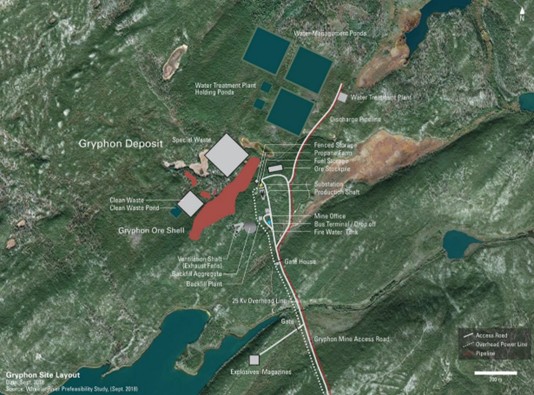
Gryphon is approximately 3 km northwest of the Phoenix deposit. Access to the Gryphon site will be via a 2 km road extension from the Phoenix site development. It will also be accessible by the airstrip northeast of the Phoenix deposit. Production from the Gryphon site will be trucked to the existing McClean Lake mill to the northeast via existing Provincial Highway 914, including approximately 50 km of new road between the McArthur River mine and the Cigar Lake mine.
Gryphon Permitting and Compliance Activities
Although the current EIS and licensing efforts are not focused on the Gryphon project, significant baseline information has been gathered through the EA programs completed on the Wheeler River property. It is likely that additional and confirmatory baseline data collection will be required to complete the environmental approval process for the Gryphon project. As a result of a change in Federal legislation in 2019, the Gryphon project will undergo an EA to meet the requirements of the Saskatchewan Environmental Assessment Act; however, no Federal EA will be required.
Based on the existing understanding of the proposed Gryphon project, there is no reason to assume the Gryphon project could not successfully complete an environmental assessment which could be acceptable to the federal and provincial regulatory regimes and the Gryphon project’s stakeholders.
Additional regulatory approvals will be similar to those of the Phoenix ISR operation, whereby a Provincial permit and a CNSC licence will be prerequisites ahead of Gryphon project construction and operation. When Gryphon moves forward, while consultation for Phoenix is relevant, consultation specific to Gryphon will be undertaken.
The decommissioning and reclamation plan for Gryphon will need to be reviewed and developed in more detail as the Gryphon project is advanced.
|
2025 ANNUAL INFORMATION FORM 49 |
Phoenix Capital and Operating Costs and Economic Analysis
Capital Costs
The Phoenix FS provided an estimated initial capital cost of the Phoenix project of $419.4 million, expressed in first-quarter 2023 Canadian dollars. This estimate falls under the AACE International Recommended Practice No. 47R-11 Class 3 Classification Guideline, with an expected accuracy to be within -15%/+25% of the Phoenix project’s final cost, including contingency. The costs include construction of the initial ground freezing plant and wells, the first phase of production wells, and the ISR process plant and infrastructure required for first production.
See “Wheeler River – Phoenix Initial Capital Cost Update” for more information.
Sustaining capital is estimated to be $234.1 million and considers expansion of the wellfield and ground freezing system, and development of the injection solution system as the wellfield advances, expansion of the gypsum storage pad and modification to the process plant to accommodate well remediation.
Operating Costs
The operating costs over the Phoenix LOM are estimated at $478.1 million. Average operating costs are estimated at $8.51/lb U3O8 (US$6.28/lb U3O8) produced. Operating costs during the first five years of production are expected to be $6.64 (US$4.90) per pound U3O8, benefitting from increased scale of operations and higher concentrations of uranium contained in recovered UBS. During the remaining years of production, operating costs are expected to be $13.69 (US$10.10) per pound U3O8.
Phoenix Operating Costs
|
|
Total Cost |
|
Cost |
|
Percentage of Total |
Cost Area |
|
($M) |
|
($/lb U3O8) |
|
(%) |
Mining |
|
44.4 |
|
0.79 |
|
9 |
Processing |
|
294.8 |
|
5.25 |
|
62 |
Transport to converter |
|
13.7 |
|
0.24 |
|
3 |
Site support / G&A |
|
125.1 |
|
2.23 |
|
26 |
Total |
|
478.1 |
|
8.51 |
|
100 |
Total US$ |
|
|
|
6.28 |
|
|
U3O8 Sales (Mlb) |
|
|
|
56.2 |
|
|
Note: Figures may not sum due to rounding.
Gryphon Capital and Operating Costs and Economic Analysis
Capital Costs
The estimated initial capital cost for the Gryphon project is $737.4 million, expressed in third-quarter 2022 Canadian dollars. Costs developed from first principles in the 2018 study were escalated by 36% based on the Chemical Engineering Plant Cost Index for equipment and materials. Labour, subcontract, equipment rental and contractor indirect costs were escalated by 10%, and other materials were escalated by 20%.
This estimate falls under the AACE International Recommended Practice No. 47R-11 Class 4 Classification Guideline, with an expected accuracy to be within -15% to -30% and +20% to +50% of the Gryphon project’s final cost, including contingency. The costs include shaft construction, underground development and mobile equipment, and McClean Lake mill upgrades.
|
2025 ANNUAL INFORMATION FORM 50 |
Gryphon Initial Capital Cost Estimate
|
|
|
|
Cost |
|
Area |
|
Area Description |
|
($M) |
|
Direct Cost |
|
|
|
|
|
|
|
Shafts |
|
222.4 |
|
|
|
Surface facilities |
|
63.0 |
|
|
|
Underground |
|
63.9 |
|
|
|
Utilities |
|
5.3 |
|
|
|
Electrical |
|
5.4 |
|
|
|
Civil and earthworks |
|
16.0 |
|
|
|
McClean Lake mill upgrade |
|
67.9 |
|
|
|
Off-site infrastructure |
|
43.7 |
|
Total Direct Cost |
|
|
|
487.6 |
|
Indirect Cost |
|
|
|
|
|
|
|
Indirect costs |
|
76.5 |
|
|
|
Owner’s costs |
|
25.6 |
|
Total Indirect Cost |
|
|
|
102.1 |
|
|
|
Contingency |
|
147.7 |
|
Total Capital Cost |
|
|
|
737.4 |
|
Note: Figures may not sum due to rounding.
Additional pre-commitment costs of $56.5 million are estimated to be necessary to advance the Gryphon project definition for regulatory purposes, and specifically to support a licence to construct satisfying the Canadian Uranium Mines and Mills Regulations SOR/2000-206. Upon receipt of licence to construct, Gryphon will be considered de-risked sufficiently to enable the FID. The pre-commitment work includes a feasibility study, environmental assessment, engineering advancement, additional testwork, early procurement items, grid power design and execution, and management of these activities.
Sustaining capital is estimated to be $98.7 million and considers underground development, construction and equipment.
Operating Costs
The operating costs over the LOM is estimated at $843.2 million. Average operating costs are estimated at $17.27/lb U3O8 (US$12.75/lb U3O8) produced.
Gryphon Operating Costs
|
|
Total Cost |
|
Cost |
|
|
Cost Area |
|
($M) |
|
($/lb U3O8) |
|
$/t Processed |
Mining |
|
334.3 |
|
6.85 |
|
265.85 |
McClean Lake mill |
|
427.6 |
|
8.76 |
|
340.08 |
Transport to converter |
|
12.9 |
|
0.27 |
|
10.30 |
Site Support / G&A |
|
68.3 |
|
1.40 |
|
54.32 |
Total |
|
843.2 |
|
17.27 |
|
670.55 |
Total US$ |
|
|
|
12.75 |
|
|
U3O8 Sales (Mlb) |
|
|
|
48.8 |
|
|
Note: Figures may not sum due to rounding.
|
2025 ANNUAL INFORMATION FORM 51 |
Economic Analysis
The financial analysis was carried out using a discounted cash flow methodology. Net annual cash flows were estimated to project yearly cash inflows (or revenues) and subtract projected cash outflows (such as capital and operating costs, royalties, and taxes). These annual cash flows were assumed to occur at mid-year and were discounted back to the date of FID to proceed with construction. Discounted cash flows were totalled to determine the NPV of the Gryphon Project at a discount rate of 8%.
The financial evaluation of the Gryphon Project using the updated cost estimate generates positive before and after-tax results. The results show a base case after-tax NPV of $864.2 million at a 8% discount rate, an IRR of 37.6% and a payback period of 22 months.
The Gryphon Project is most sensitive to fluctuations in the U3O8 price and feed grades and less sensitive to changes in capital costs and least sensitive to changes in operating costs.
Current and Contemplated Exploration, Development, and Production Activities
Phoenix
The results of the Phoenix FS indicate that Denison’s proposed uranium project is technically feasible and economically viable under the assumptions presented in the Wheeler Report. The Phoenix FS was considered sufficiently reliable to guide Denison to decide to advance to the next phase of project development through front-end engineering design and detailed design to advance Phoenix to a point where the project is de-risked sufficiently to enable the FID. This phase included field and laboratory testing, front-end engineering and design, detailed design, and early commitments for long-lead items to enable design and planning.
In 2025, evaluation efforts primarily consisted of (1) detailed design engineering, (2) advancement of long-lead procurement activities, (3) construction planning, (4) metallurgical testing, and (5) field programs. The detailed design engineering phase includes work related to the Phoenix process plant, freeze plant, electrical substation & distribution, integration of wellfield surface facilities, ponds/pads, site earthworks (including the access road to site), air strip and road design, civil piping (including firewater), overall site layout with modular building design and integration. For metallurgical testing, SRC completed a hybrid core leach test to provide information on leach progression during mining operations at the Phoenix deposit, and process circuit testing to optimize performance. The Company completed field programs designed to fulfil certain pre-construction EA commitments, including drilling additional groundwater wells, to allow for the collection of additional hydrogeologic and geochemical datasets, and grouting previously utilized exploration boreholes.
The Company subsequently made its FID in February 2026.
|
2025 ANNUAL INFORMATION FORM 52 |
Gryphon
Pursuant to the Wheeler Report, the qualified persons who have reviewed Gryphon have set out a recommended program to prepare the Gryphon project to be advanced to the feasibility study stage of analysis. This includes infill and delineation drilling to advance the understanding of geology, mineralization controls and mineral resource for the Gryphon deposit, further metallurgical test work to further validate the performance of processing Gryphon ore at the McClean Lake mill, geotechnical requirements and recommendations for further advancement of Gryphon in subsequent stages, feasibility hydrogeological testing at Gryphon, and the collection of additional environmental baseline information.
In 2025, evaluation efforts undertaken consisted of (1) metallurgical testing, and (2) field programs. Gryphon metallurgical testing commenced using core samples collected during the Gryphon delineation drill program that was completed during the first half of 2025. Preliminary metallurgical programs focused on testing various process circuits in order to assess the downstream processing requirements of Gryphon ore. The metallurgical program is expected to continue in 2026.
Wheeler River Exploration
For 2026, the Company currently intends to undertake regional exploration drilling at Wheeler River seeking to discover potential near-mine deposits. Resistivity and EM surveys continue to be the preferred ground geophysical surveying methods on the Wheeler River project, with the most recent surveys consisting of Stepwise Moving Loop EM completed in 2025 and 2026.
|
2025 ANNUAL INFORMATION FORM 53 |
Other Evaluation & Exploration Projects
Athabasca Basin Projects Overview
Denison’s Athabasca Basin projects range in exploration maturity and present numerous exploration opportunities. Denison continuously reviews its significant land package with a view to generating new exploration targets or creating spin-out opportunities. The table below provides a list of Denison’s directly owned Athabasca Basin projects as at the date hereof excluding Wheeler River.
|
|
Denison |
|
|
|
|
|
|
Projects |
|
Ownership |
|
JV Partner |
|
# Claims |
|
Hectares |
Bachman Lake |
|
100 |
% |
|
|
5 |
|
11,419 |
Bell Lake |
|
100 |
% |
|
|
5 |
|
19,069 |
Blackwing |
|
80 |
% |
Foremost(2) |
|
3 |
|
12,627 |
Brown Lake |
|
100 |
% |
|
|
3 |
|
1,755 |
Candle Lake |
|
75.18 |
%(1) |
JCU |
|
1 |
|
2,595 |
CLK |
|
80 |
% |
Foremost(2) |
|
2 |
|
10,422 |
Crawford Lake |
|
100 |
% |
|
|
5 |
|
11,800 |
Darby |
|
30 |
% |
Cosa |
|
12 |
|
18,069 |
Epp Lake |
|
80 |
% |
Foremost(2) |
|
2 |
|
865 |
Ford Lake |
|
100 |
% |
|
|
5 |
|
9,649 |
Getty East |
|
30% |
(4) |
Skyharbour |
|
1 |
|
3,105 |
GR |
|
80 |
% |
Foremost(2) |
|
16 |
|
78,585 |
Hatchet Lake |
|
56.12 |
% |
Foremost(2), Trident Resources Corp. |
|
9 |
|
10,212 |
Hook-Carter |
|
80 |
% |
ALX Resources Corp. |
|
11 |
|
25,115 |
Johnston Lake |
|
100 |
% |
|
|
9 |
|
28,647 |
Lynx Lake |
|
100 |
% |
|
|
1 |
|
1,274 |
Mann Lake |
|
30 |
% |
Cameco, Orano Canada |
|
2 |
|
3,407 |
Marten |
|
80 |
% |
Foremost(2) |
|
2 |
|
5,008 |
McClean Lake |
|
22.50 |
% |
Orano Canada |
|
17 |
(3) |
4,258 |
Midwest |
|
25.17 |
% |
Orano Canada |
|
3 |
|
1,426 |
Moon Lake |
|
100 |
% |
|
|
2 |
|
4,309 |
Moon Lake North |
|
100 |
% |
|
|
10 |
|
1,068 |
Moon Lake South |
|
75 |
% |
CanAlaska |
|
1 |
|
2,716 |
Murphy Lake North |
|
30 |
% |
Cosa |
|
2 |
|
1,532 |
Murphy Lake South |
|
80 |
% |
Foremost(2) |
|
6 |
|
7,154 |
Packrat |
|
30 |
% |
Cosa |
|
1 |
|
1,621 |
Park Creek |
|
49 |
% |
Cameco |
|
8 |
|
7,798 |
Russell Lake-Cameco |
|
37.82 |
% |
Cameco, Waldimer Boyko |
|
1 |
|
355 |
Russell Lake-Skyharbour |
|
20 |
% |
Skyharbour |
|
16 |
|
53,192 |
Torwalt Lake |
|
80 |
% |
Foremost(2) |
|
1 |
|
812 |
Turkey Lake |
|
80 |
% |
Foremost(2) |
|
1 |
|
3,789 |
Waterbury Lake |
|
70.55 |
% |
KWULP |
|
13 |
|
40,256 |
Waterfound |
|
11.78 |
%(1) |
Orano Canada, JCU |
|
25 |
|
11,670 |
Waterfound North |
|
100 |
% |
|
|
4 |
|
4,124 |
Wheeler North |
|
49 |
%(5) |
Skyharbour |
|
8 |
|
16,409 |
Wheeler River Inlier |
|
70 |
% |
Skyharbour |
|
2 |
|
608 |
Wolly |
|
20.77 |
%(1) |
Orano Canada, JCU |
|
17 |
|
23,700 |
Wolverine |
|
80 |
% |
Foremost(2) |
|
3 |
|
5,036 |
TOTAL: |
|
|
|
|
|
237 |
|
445,601 |
Notes:
| (1) | Denison also owns an additional indirect interest, through its 50% ownership of JCU. See table below. |
|
2025 ANNUAL INFORMATION FORM 54 |
| (2) | Foremost has an option to earn up to 70% of Denison’s interest, pursuant to the Foremost Transaction, and has satisfied the conditions to earn an initial 20% interest. If the earn-in is completed, the parties will establish a joint venture for each property. |
| (3) | The mineral property consists of 4 mineral leases covering an area of 1,147 hectares and 13 mineral claims covering an area of 3,111 hectares. |
| (4) | Denison has an option to acquire up to an additional 40% undivided interest in Getty East (resulting in a 70% undivided interest), and to enter into a joint venture with Skyharbour, on the terms of an Option Agreement. |
| (5) | Denison has an option to acquire up to an additional 21% undivided interest in Wheeler North (resulting in a 70% undivided interest), and to enter into a joint venture with Skyharbour, on the terms of an Option Agreement. |
Denison is indirectly involved in eleven uranium projects located in the Athabasca Basin of Saskatchewan through its 50% ownership of JCU. The table below provides a list of JCU’s Athabasca Basin project interests at December 31, 2025, excluding Wheeler River.
Projects |
|
JCU Ownership |
|
JV Partner(1) |
Beatty River |
|
21.4253 |
% |
Orano Canada; UEX |
Candle Lake |
|
24.82 |
% |
Denison |
Christie Lake |
|
34.4508 |
% |
UEX |
Close Lake |
|
10.3128 |
% |
Orano Canada; Cameco |
Cree Extension |
|
30.0990 |
% |
Cameco; Orano Canada |
Millennium |
|
30.0990 |
% |
Cameco |
Moon Lake(2) |
|
20.1494 |
% |
Cameco; Orano Canada |
Moore Tomblin |
|
13.5947 |
% |
Orano Canada; Cameco |
Waterfound |
|
25.801 |
% |
Orano Canada; Denison |
Wolly |
|
12.4335 |
% |
Orano Canada; Denison |
Notes:
| (1) | The first company listed is the project operator. |
| (2) | This property shares a name with, but is distinct from, Denison’s Moon Lake property listed in the prior table. |
Non-Athabasca Basin Projects Overview
Denison has the following interests in non-Athabasca Basin and/or non-uranium projects:
Projects |
|
Ownership |
|
JV Partners1 |
Kiggavik Uranium Project |
|
33.8118 |
%2 |
Orano Canada; JCU; Urangesellschaft Canada Ltd. |
Kindersley Lithium Project |
|
30.00 |
%3 |
Denison; Grounded Lithium |
Notes:
| (1) | The first company listed is the project operator. |
| (2) | Denison’s interest in this project is held indirectly through its 50% ownership of JCU. |
| (3) | Pursuant to the KLP Agreement, Denison can earn up to a 75% interest in the KLP. As at December 31, 2025, Denison has not yet vested an ownership interest in the project; however, it has incurred expenditures that would entitle it to vest a 30% interest in the KLP if it elected to cease to fund further project expenditures towards the earn-in arrangement. |
2025 Evaluation Project Portfolio Activities
The following table summarizes the evaluation activities on Denison’s directly owned Athabasca Basin projects, excluding Wheeler River, during the year ended December 31, 2025.
|
2025 ANNUAL INFORMATION FORM 55 |
PROJECT EVALUATION ACTIVITIES
|
|
Denison’s |
|
|
Property |
|
ownership |
|
Evaluation activities |
Waterbury Lake |
|
70.55 |
%(1) |
2025 field activities, including evaluation drilling program and hydrogeological drilling program. |
Midwest |
|
25.17 |
%(1) |
2025 field programs and completion of a PEA for Midwest Main deposit. |
KLP |
|
30.00 |
%(2) |
Progression of technical studies in support of a potential PFS for the KLP. |
Notes
(1) |
Denison’s ownership position as at December 31, 2025. |
(2) |
Pursuant to the KLP Agreement, Denison can earn up to a 75% interest in the KLP through a series of options exercisable with direct payments and work expenditures. As at December 31, 2025, Denison has not yet vested an ownership interest in the project; however, it has incurred expenditures that would entitle it to vest a 30% interest in the KLP if it elected to cease to fund further project expenditures towards the earn-in arrangement. |
2026 Outlook
Evaluation efforts are expected to continue the staged de-risking of the Company’s development pipeline projects, where justified, through desktop technical trade-off studies, and incremental field programs, as well as supporting requirements for future regulatory approvals, and pursuing government grants and other incentives.
For example, anticipated work at Midwest includes: (a) the advancement of a feasibility study-level assessment for the use of the SABRE mining method, including engineering, regulatory, and mine planning activities; and (b) environmental studies, updates to the Midwest EA to accommodate the use of SABRE, and an amendment to the McClean Lake & Midwest CNSC licence, to allow the receipt of Midwest ore.
For McClean Lake, SABRE mining is expected to continue at McClean Lake North. See “Denison’s Operations – SABRE Mining Program” for more information.
2025 Exploration Project Portfolio Activities
The following table summarizes the exploration activities completed at Denison’s exploration portfolio properties in 2025 excluding Wheeler River.
EXPLORATION ACTIVITIES | ||||||
Property |
|
Denison’s ownership |
|
Drilling in metres (m)(1) |
|
Other activities |
Crawford Lake |
|
100.00 |
% |
— |
|
Geophysical Survey |
CLK |
|
80.00 |
%(2) |
— |
|
Geophysical Survey |
Hatchet Lake |
|
56.12 |
%(3) |
2,400 (10 holes) |
|
— |
Hook Carter |
|
80 |
%(4) |
— |
|
Geophysical Survey |
Johnston Lake |
|
100.00 |
% |
— |
|
Geophysical Survey |
McClean Lake |
|
22.5 |
% |
6,447 (24 holes) |
|
— |
Moon Lake South |
|
75.00 |
%(5) |
— |
|
Geophysical Survey |
Murphy Lake North |
|
30.00 |
%(6) |
5,062 (12 holes) |
|
— |
Murphy Lake South |
|
80.00 |
%(2) |
2,695 (7 holes) |
|
Geophysical Survey |
Waterbury |
|
70.55 |
%(7) |
4,642 (15 holes) |
|
Geophysical Survey |
Waterfound |
|
24.68 |
%(8) |
11,153 (19 holes) |
|
Geophysical Survey |
Wolly |
|
27.73 |
%(9) |
3,987 (15 holes) |
|
— |
Wolverine |
|
80.00 |
%(2) |
— |
|
Geochemical Survey |
Total |
|
|
|
55,046 (126 holes) |
|
|
Notes
| (1) | The Company reports total exploration metres drilled and the number of holes that were successfully completed to their target depth. |
|
2025 ANNUAL INFORMATION FORM 56 |
| (2) | Denison’s effective ownership interest as at December 31, 2025. In 2024, Foremost satisfied the conditions of the first phase of its earn-in under the Foremost Transaction, pursuant to which Foremost has the current right to exercise its option to earn a 20% interest in these projects, reducing Denison’s ownership interest to 80%. |
| (3) | Denison’s effective ownership interest as at December 31, 2025. In 2024, Foremost satisfied the conditions of the first phase of the Foremost Earn-In, pursuant to which Foremost has the current right to exercise its option to earn 14.03%, reducing Denison’s ownership interest to 56.12%. |
| (4) | Denison’s effective ownership interest as at December 31, 2025. The remaining interest is owned by Greenridge Exploration Inc. |
| (5) | Denison’s effective ownership interest as at December 31, 2025. The remaining interest is owned by CanAlaska Uranium Ltd. |
| (6) | Denison’s effective ownership interest as at December 31, 2025. The remaining interest was acquired by Cosa in January 2025. |
| (7) | Denison’s effective ownership interest as at December 31, 2025. The remaining interest is owned by KWULP. |
| (8) | Denison’s effective ownership interest as at December 31, 2025, including an indirect 12.90% ownership interest held through Denison’s 50% ownership of JCU. The remaining interest is owned by Orano Canada. |
| (9) | Denison’s effective ownership interest as at December 31, 2025, including an indirect 6.39% ownership interest held through Denison’s 50% ownership of JCU. The remaining interest is owned by Orano Canada. |
2026 Outlook
Denison-operated exploration programs planned for 2026 include (i) drill testing of initial target areas at the newly acquired Wheeler North property, and (ii) drill testing of the Hook Carter property and others within Denison’s extensive property portfolio. Additionally, geophysical surveys are planned to be carried out on multiple properties and Denison expects to fund its share of non-operated joint venture exploration programs.
|
2025 ANNUAL INFORMATION FORM 57 |
Athabasca Exploration: Sampling, Analysis and Data Verification
Unless otherwise specifically disclosed herein, the following describes the procedures and protocols for Wheeler River programs operated by Denison in reference to drill hole surveying, downhole radiometric surveying, core logging, core sampling, sample preparation methods, analytical procedures, Quality Assurance and Quality Control (“QAQC”) and data verification.
Drill Hole Surveying
Drill collars are typically sited and surveyed in the field using a Differential Global Positioning System (“DGPS”) to determine accurate coordinates and elevation. The drill rig azimuth and dip are aligned using a field compass (set to the appropriate magnetic declination) or a rig alignment tool. The trajectory of all drill holes is determined with a Reflex survey instrument in single-shot mode, which measures the azimuth and inclination of the drill hole. Measurements are collected at approximately 50 metre intervals down the hole.
Downhole Radiometric Probe Surveying
When possible, all drill holes are surveyed immediately after drilling with a downhole radiometric probe to measure natural gamma radiation. Each survey consists of either an HPL2375 single sodium iodide (NaI) scintillation crystal tool or a 2GHF-1000 triple gamma tool (one sodium iodide crystal and two ZP1320 high flux Geiger-Mueller (“GM”) tubes) attached to an MX-Series winch with an MGX data recorder connected to a portable computer.
Downhole logging measurements are completed within the drill rods for both down and up survey runs using MSLog software provided by Mt Sopris. Logging speeds are maintained at approximately 10 metres/minute. Individual data recordings are stored separately for each run on a portable laptop computer.
Total count measurements from each survey are converted to radiometric equivalent grade U3O8 % (“eU3O8”) values using conversion coefficients derived from calibration facilities at the SRC test pits located in Saskatoon, Saskatchewan. The calibration facilities allow for regular checks on both probes and probing equipment and to monitor or identify maintenance issues before field operations begin. The site consists of four mineralized holes, with isolated uranium concentrations of 1.4, 1.6, 1.6 and 0.21 metres wide with U grades varying from 0.063, 0.29, 1.25 and 4.07%, respectively. Individual probes are calibrated using the NaI crystal measurements a minimum of two times per year, normally before and after the winter and summer field seasons. Survey results are also corrected for attenuation of signal in water and for the thickness of steel pipe in the hole. GM tubes are checked for drift at the site; however, calibration factors for these probes were derived separately using direct comparisons of total count values with assay core results as high as 80% U3O8. The “in-situ” nature of this calibration procedure allows for a wider spectrum of predicted results than using the SRC calibration facilities.
A deposit-specific radiometric-grade correlation has been developed for the Company’s Phoenix deposit, where the gamma signature obtained from the high flux GM tubes of the triple gamma probe can be used to estimate in-situ uranium grade. The radiometric-grade correlation was developed by an independent 3rd party by comparing geochemical sample assays collected from the Phoenix deposit to their corresponding probe data. Only intervals with high core recovery were selected for the correlation process to ensure a representative comparison between the data sets. Raw gamma probe data is first converted to adjusted counts per second (cps) by correcting raw gamma counts per second for fluid absorption, casing absorption, and dead-time. Adjusted cps are then calibrated into an equivalent grade based on the correlation between the grade-thickness product of the adjusted cps and assay data from representative mineralized intercepts. A total of 50 mineralized intercepts were used to develop the radiometric-grade correlation for Phoenix.
The Company typically reports eU3O8, derived from a calibrated downhole total gamma probe, as preliminary during its exploration programs and subsequently reports definitive assay grades following sampling and chemical analysis of the mineralized drill core.
|
2025 ANNUAL INFORMATION FORM 58 |
Core Logging
Denison employs suitably qualified persons to log all drill core in detail at dedicated, custom-built core logging facilities proximal to drilling operations. Routine logs completed for each drill hole include lithology, sandstone texture, paleoweathering, mineralization, alteration, structure (interval and point), geotechnical, and gamma (handheld scintillometer). Where deemed necessary, additional logs may be collected to assist in constraining geophysical survey results. These logs may include magnetic susceptibility or other physical property measurements. For advanced projects where mining studies may be applicable, geotechnical logs are expanded and may also include point load testing. All logging data, together with collar and survey information and a drill hole summary, are uploaded to a DHLogger database with central storage on Denison’s server at the Saskatoon office. In addition, the drill core is photographed, both wet and dry, before it is stored at project sites either in racks or as cross-stacks. Drill core handling and sampling protocols are in accordance with industry best practices.
Core Sampling, Sample Preparation and Assaying
Assay Samples
Denison has routinely used SRC Geoanalytical Laboratories (“SRC Geoanalytical”) in Saskatoon, Saskatchewan for their geochemical analyses. Check assays are sent to SRC’s Delayed Neutron Counting laboratory (“SRC DNC”). SRC Geoanalytical’s management system operates in accordance with ISO/IEC 17025:2017 (CAN-P-4E), General Requirements for the Competence of Mineral Testing and Calibration Laboratories, is compliant with CAN-P-1579 Guidelines for Mineral Analysis Testing Laboratories and is also accredited ISO/IEC 17025:2005 for the analysis of U3O8. SRC DNC follows ISO/IES17025:2017. SRC and its affiliated laboratories are independent of Denison.
Denison submits drill core samples for chemical U3O8 assay for all mineralized intervals, where core recovery permits. Mineralized intervals are identified by handheld scintillometer and confirmed by downhole gamma probe logs. All mineralized core is broken into approximately 10-centimetre pieces and measured with a handheld scintillometer (RS-120 or RS-125) by removing each piece of drill core from the ambient background, noting the most pertinent reproducible result in counts per second (“cps”), and carefully returning it to its correct place in the core box. Any core registering over 500 cps is marked for sampling, typically over 50-centimetre intervals. A threshold of 300 cps has been used at Wheeler River’s Gryphon deposit since the beginning of 2017. Additional non-mineralized ‘shoulder’ samples are marked over 50-centimetre intervals to flank both ends of the mineralized intervals. In areas of strong mineralization, more than one sample on either end is sometimes required. All core samples are split in half with a hand splitter according to the sample intervals marked on the core. One-half of the core is returned to the core box for future reference, and the other half is tagged and sealed in a plastic bag. Bags containing mineralized samples are sealed for shipping in metal or plastic pails, depending on the radioactivity level.
Because the mineralized drill cores are classified as hazardous materials and are regulated under requirements governing the transport of dangerous goods, Denison staff have been trained in the proper handling and transport of the cores and deliver them from the core facility directly to the laboratory without outside contact.
The assay sample preparation and analytical procedures are as follows:
| ● | Drill core samples are received by the analytical laboratory from Denison in sealed five-gallon plastic or metal pails. Each sample is contained in a sealed plastic bag with a sample tag. A packing slip that contains instructions and a sample number list is enclosed. Samples are verified against the packing slip. Any extra samples or missing samples are noted, and Denison is informed. |
| ● | Samples are sorted and processed according to lithology (sandstone or basement) and level of radioactivity. |
| ● | Sample preparation includes drying, jaw crushing to 60% passing -2 millimetres, and pulverizing to 90% passing -106 microns. |
|
2025 ANNUAL INFORMATION FORM 59 |
| ● | The resultant pulp is split and digested using a two-acid partial digest (HNO3:HCl) and a three-acid ‘total’ digest (HF: HNO3:HClO4), and the respective solutions analyzed for multi-elements, including uranium, using ICP-OES (SRC analytical method ICP1). Boron values are obtained through NaO2/NaCO3 fusion followed by ICP-OES. |
| ● | When uranium partial values, as obtained above, are ≥1,000 ppm, sample pulps are re-assayed for U3O8 using SRC’s ISO/IEC 17025:2005 accredited method for the determination of U3O8 wt%. A split of the sample pulp is digested using aqua-regia (HCl:HNO3 in the ratio 3:1), and the solution is analyzed for U3O8 wt% using ICP-OES. |
Bulk Dry Density Sampling
Samples are routinely collected from mineralized intersections for bulk dry density determination as required for mineral resource estimation. Density samples are typically collected at a frequency of one density sample per 10 assay samples, also ensuring the density samples are representative of the uranium grade range and the different domains of the deposit. The density samples comprise half-split core over 10-centimeter intervals, and for each sample, the depth, rock type, and scintillometer reading are recorded. Density samples are sent to SRC for analysis, along with the mineralized core samples for assay. At SRC, the density samples are first weighed as received and then submerged in de-ionized water and re-weighed. The samples are then dried until a constant weight is obtained. The sample is then coated with an impermeable layer of wax and weighed again while submersed in de-ionized water. Weights are entered into a database and the bulk density of each sample is calculated. Water temperature at the time of weighing was also recorded and used in the bulk density calculation. Following bulk density determination, the samples are sent for uranium assay using SRC’s ISO/IEC 17025:2005 accredited method for the determination of U3O8 wt% in order to ensure a direct correlation can be made between density and assay values.
Permeameter Analysis
Denison has performed onsite permeameter analyses since 2019 using a portable gas probe permeameter where the permeability of the rock matrix is measured from the pressure decay rate of nitrogen gas. Prior to 2021, QA/QC checks were performed by the University of Kyoto, Japan, using a pressure decay permeameter and a TEMCO model MP-401 steady-flow gas permeameter. Results were consistent between the datasets. Samples were also sent to SNC Lavalin Geoscience and Materials laboratory in Saskatoon for permeability analysis using water, the results of which were within one order of magnitude of pressure decay tests.
Since 2021, Denison has introduced QA tests before every set of permeameter tests based on the laboratory tests performed in previous years. A blank metal plate is measured as a leak check, and two reference materials are measured to ensure accuracy. The probe’s lower permeability detection limit is 10 -13 m/s.
Exploration Samples
Three other types of drill core samples are collected during routine exploration, the results of which are used to prioritize drill holes for follow-up exploration or determine geochemical and/or alteration vectors toward mineralization, as follows:
| 1. | Composite geochemical samples are collected over approximately 10-metre intervals in the upper Athabasca sandstone and in fresh lithologies beneath the unconformity (basement) and over 5-metre intervals in the basal sandstone and altered basement units. The samples consist of 1 to 2 centimetre thick disks of core collected from the top or bottom of each row of core in the box over the specified interval. Care is taken not to cross lithological contacts or stratigraphic boundaries. These samples are submitted to SRC for sample preparation and multi-element analysis. The same sample preparation procedures are used as described above for U3O8 assay samples. The pulps are analyzed using the ICPMS Exploration Package, which includes a total digest (HF:HNO3:HCIO4) and partial digest (HNO3:HCl) followed by ICP-MS analysis. Boron values are obtained through NaO2/NaCO3 fusion followed by ICP-OES. |
| 2. | Representative/systematic core disks (one to five centimetres in width) are collected at regular 5 to 10-metre intervals throughout the entire length of core until basement lithologies become unaltered. These samples are analyzed for clay minerals using reflectance spectroscopy. Samples for reflectance clay analyses are analyzed by |
|
2025 ANNUAL INFORMATION FORM 60 |
| Denison using an ArcSpectro FT-NIR ROCKET spectrometer and sent to AusSpec International Ltd. for interpretation. |
| 3. | Select spot samples are collected from significant geological features (i.e. radiometric anomalies, structure, alteration etc.). Core disks ranging from 1 to 2 centimetres thick are collected for reflectance spectroscopy, while split core samples are collected for geochemical analysis. The same reflectance spectrometry or geochemical procedures as described above are used. |
These sampling types and approaches are typical of uranium exploration and definition drilling programs in the Athabasca Basin.
Data Handling
After the analyses are completed, analytical data are securely sent using electronic transmission of the results by SRC to Denison. The electronic results are secured using WINZIP encryption and password protection. These results are provided as a series of Adobe PDF files containing the official analytical results (“assay certificates”) and a Microsoft Excel spreadsheet file containing only the analytical results. Analytical data received from the lab is imported directly into Denison’s DH Logger database. The data is subject to validation using triggers built into the database to identify blank or standard assays that fall outside the accepted limits that require re-analysis. Field duplicates are validated using control charts. The laboratory is immediately notified of any problematic samples or batches, which are subsequently re-analyzed. The lab reports assay values that fall below the method detection limit (“MDL”) as ‘less than’ values (<MDL). These values are automatically replaced with a value of half the MDL by the database during import. The database is backed up on- and off-site every day.
QAQC
SRC has an internal QAQC program dedicated to the active evaluation and continual improvement of the internal quality management system. The laboratory is accredited by the Standards Council of Canada as an ISO/IEC 17025 Laboratory for Mineral Analysis Testing and is also accredited ISO/IEC 17025:2005 for the analysis of U3O8. The laboratory is licensed by the CNSC for the possession, transfer, import, export, use, and storage of designated nuclear substances by CNSC Licence Number 01784-5-24.7. As such, the laboratory is closely monitored and inspected by the CNSC for compliance. All analyses are conducted by SRC, which has specialized in the field of uranium research and analysis for over 30 years. SRC is an independent laboratory, and no associate, employee, officer, or director of Denison is, or ever has been, involved in any aspect of sample preparation or analysis on samples. SRC uses a Laboratory Management System (“LMS”) for Quality Assurance. The LMS operates in accordance with ISO/IEC 17025:2005 (CAN-P-4E) “General Requirements for the Competence of Mineral Testing and Calibration Laboratories” and is also compliant with CAN-P-1579 “Guidelines for Mineral Analysis Testing Laboratories”. The laboratory continues to participate in proficiency testing programs organized by CANMET (CCRMP/PTP-MAL).
SRC routinely inserts standard reference materials and blanks into batches of the Company’s samples as an internal check on accuracy and contamination. Quality control samples (reference materials, blanks, and duplicates) are included with each analytical run based on the rack sizes associated with the method. Before the results leave the laboratory, the standards, blanks, and split replicates are checked for accuracy and issued, provided the senior scientist is fully satisfied. If, for any reason, there is a failure in an analysis, the sub-group affected will be re-analyzed and checked again. A Corrective Action Report will be issued, and the problem will be investigated fully to ensure that any measures to prevent the re-occurrence can and will be taken. All human and analytical errors are, where possible, eliminated. If the laboratory suspects any bias, the samples are re-analyzed, and corrective measures are taken.
Denison has developed several QAQC procedures and protocols to monitor laboratory performance, as follows:
Uranium Standards - Due to the radioactive nature of the standard material, insertion of the standard materials is preferable at SRC instead of in the field. During sample processing, the appropriate standard grade is determined, and an aliquot of the appropriate standard is inserted into the analytical stream for each batch of materials assayed. Uranium standards are typically inserted at a minimum rate of 1 in every 40 samples. For the Wheeler River project up until the end of 2018, Denison used standards provided by Joint Venture partner Cameco for uranium assays. Six Cameco uranium assay
|
2025 ANNUAL INFORMATION FORM 61 |
standards were prepared for use in monitoring the accuracy of uranium assays received from the laboratory. For Wheeler River from 2019 onward, a suitable matrix-matched Certified Reference Material (“CRM”) is used as a standard.
Blanks - Denison employs a lithological blank composed of quartzite to monitor the potential for contamination during sampling, processing, and analysis. The selected blank consists of material that contains lower U3O8 content than the sample material but is still above the detection limit of the analytical process. Due to the sorting of the samples submitted for assay by SRC based on radioactivity, the blanks must be inserted by SRC after this sorting takes place to ensure that these materials are ubiquitous throughout the range of analytical grades. If the individual geologists were to submit these samples anonymously, they would invariably be relegated to the minimum radioactive grade level, preventing their inclusion in the higher radioactive grade analyses performed by SRC. Blanks are typically inserted at a minimum rate of 1 in every 40 samples. For the Wheeler River project up until the end of 2018, Denison used blanks provided by Joint Venture partner Cameco. For Wheeler River from 2019 onward, another suitable blank material is used, as provided by SRC.
Field Duplicates - The Company inserts duplicate samples in the sample stream as a check on the precision of SRC. Core duplicates are prepared by collecting a second sample from the same interval by splitting the original sample into two, with each half of the sample material submitted as an independent sample. Duplicates are typically submitted at a minimum rate of one per 25 samples. The collection may be further tailored to reflect field variation in specific rock types or horizons.
Exploration Standards - Denison has prepared in-house ‘exploration standards’ to independently monitor laboratory performance during the processing of routine drill core exploration samples. These standards aim to test laboratory accuracy and precision for a variety of trace metals at low levels, as required for Athabasca uranium exploration.
Assay Checks - In addition to the QAQC described above, up until the end of 2018, Denison sent one in every 25 U3O8 assay samples to SRC’s Delayed Neutron Counting laboratory, a separate umpire facility located at SRC in Saskatoon to compare the uranium values using two different methods, by two separate laboratories. After 2019, assay samples were sent to the SRC’s X-ray fluorescence (“XRF”) lab for umpire analyses. All radioactive samples are monitored and recorded as per CNSC licence 01784-5-24.7. Furthermore, downhole radiometric probe results provide eU3O8 data, which the Company uses for comparisons with SRC U3O8 results.
Data Verification
Denison engages with independent consultants for estimation of mineral resources on its mineral properties, in accordance with CIM Standards and NI 43-101, as well as other studies, including the 2018 PFS and ISR field testing and engineering studies. In this regard, the independent consultants undertake rigorous data verification, including, but not limited to, Denison’s field procedures, databases and assay results.
Prior to public disclosure of drilling results, including preliminary radiometric (eU3O8) and chemical assay grades (U3O8), the results are subject to data verification by Qualified Persons employed by Denison. This includes checks of 10 to 20% of the results (typically as composited intervals) against non-composited eU3O8 determinations and laboratory assay certificates.
|
2025 ANNUAL INFORMATION FORM 62 |
McClean Lake Mill & Cigar Lake Toll Milling
The MLJV owns a uranium processing facility located on the eastern edge of the Athabasca Basin in northern Saskatchewan, approximately 750 kilometres north of Saskatoon. Orano Canada is the operator/manager of the facility.
The McClean Lake mill is specially designed and constructed to process high grade uranium ores in a safe and environmentally responsible manner. The mill uses sulphuric acid and hydrogen peroxide leaching and a solvent extraction recovery process to extract and recover the uranium product from the ore. In addition to the mill facility, other infrastructure on the site includes a sulphuric acid plant, a ferric sulphate plant, an oxygen plant, an electricity transmission line tied into the provincial power grid, a 14 megawatt back-up diesel power plant, warehouses, shops, offices and living accommodations for site personnel.
In 2016, an expansion of the mill was completed and an increase to the licensed capacity of the mill was approved – resulting in an increase to the licensed production capacity of the mill to 24 million pounds U3O8 per year. This increased licensed capacity allowed for the processing of 100% of ore production from the Cigar Lake mine, up to 18 million pounds U3O8 per year, and provides the flexibility for the mill to process ore from other sources in the future.
Operations
The table below shows the operating statistics for McClean Lake milling operations over the last five years.
McClean Lake Operations |
|
2025 |
|
2024 |
|
2023 |
|
2022 |
|
2021 |
Ore Milled (thousand tonnes) |
|
55,073 |
|
58,226 |
|
51,866 |
|
54,301 |
|
35,409 |
Total MLJV Production (thousand pounds U3O8) |
|
649 |
|
— |
|
— |
|
— |
|
176 |
Denison’s share MLJV Production (thousand pounds U3O8) |
|
146 |
|
— |
|
— |
|
— |
|
40 |
Toll Mill Production (thousand pounds U3O8) |
|
19,148 |
|
16,930 |
|
15,098 |
|
18,010 |
|
12,335 |
Mill Licence
The McClean Lake site is operated under various permits, licences, leases and claims granted and renewed from time to time, all of which are currently in good standing. In 2016, the CNSC authorized an increase in the mill’s licensed annual production from 13 million pounds U3O8 to 24.0 million pounds U3O8, to accommodate an annual production rate of 18.0 million pounds U3O8 from the CLJV. All costs for the expansion of the McClean Lake mill were paid by the CLJV.
Federally, Orano Canada, as operator, obtained a 10-year licence from the CNSC for operation of both McClean and Midwest projects, valid to June 30, 2027, and provincially, Orano Canada has maintained required provincial permitting. The current licence authorizes mining of the McClean North deposits using SABRE and care and maintenance activities at the Midwest site.
Cigar Lake Toll Milling – Ecora Transaction
Pursuant to the Ecora Transaction in February 2017, certain of Denison’s interests in the Cigar Lake toll milling proceeds have been sold to Ecora and its subsidiary Centaurus Royalties Ltd. (“Centaurus”) for aggregate gross proceeds to Denison of $43,500,000. The Ecora Transaction is comprised of the following elements: (1) a 13-year limited recourse lending arrangement involving a loan from Ecora to 9373721 Canada Inc. (“SPV”) (the “Ecora Loan”) and a further loan from SPV to DMI (the “SPV Loan”) each for $40,800,000 (collectively, the “Lending Arrangement”); and (2) $2,700,000 in proceeds from the sale, to Centaurus, of a stream equal to Denison’s 22.5% share of proceeds from the toll milling of Cigar Lake ore by the McClean Lake mill for specified Cigar Lake toll milling throughput in excess of 215 million pounds U3O8 after July 1, 2016 (the “Stream Arrangement”).
|
2025 ANNUAL INFORMATION FORM 63 |
Additional details of the Ecora Transaction are as follows:
| ● | No Warranty of the Future Rate of Production - No warranty is provided by Denison (including DMI and SPV) to Ecora (including Centaurus), under the terms of the Lending Arrangement or the Stream Arrangement, regarding: the future rate of production at the Cigar Lake mine and / or the McClean Lake mill; or the amount or collectability of proceeds to be received by the MLJV in respect of toll milling of Cigar Lake ore. |
| ● | Ecora Loan Details - The Ecora Loan will accrue interest at a rate of 10% per annum and does not have a predetermined principal repayment schedule. The Ecora Loan is secured by a first priority interest in the assets of SPV which will essentially consist of the SPV Loan to DMI. |
| ● | SPV Loan Details - The SPV Loan will accrue interest at a rate of approximately 10% per annum and does not have a predetermined principal repayment schedule. The SPV Loan is limited in its recourse against DMI such that it is generally repayable only to the extent of Denison’s share of the toll milling revenues earned by the MLJV from the processing of the first 215 million pounds of U3O8 from Cigar Lake ore on or after July 1, 2016. Denison will guarantee the limited recourse loan repayments and will grant a second ranking pledge of its share of DMI to secure performance by DMI of its obligations to pay the SPV Loan. The share pledge is second ranking to Denison’s existing pledge of its shares of DMI to the Bank of Nova Scotia under the terms of the Credit Facility. |
SABRE Mining Program
The Surface Access Borehole Resource Extraction (SABRE) program is focused on developing a viable alternate mining method combining surface drilling and borehole mining technology. Benefits of the method may include a reduced time to production, reduced or deferred capital costs, as well as minimized safety and environmental risks.
Hydraulic borehole mining is a technique used to extract materials through a small access borehole, typically less than one-half of a metre in diameter, resulting in a very small disturbance to the surface. A mining tool containing a high-pressure water jet nozzle is lowered through the access borehole in the overburden and sandstone to the mineralized horizon. The high-pressure water jet is used to cut or erode the mineral-bearing ore and to create a cavity up to four metres in diameter. The cuttings are transported to surface in a slurry form and sent through a series of screens and settling ponds to separate the ore from the jetting water. Jetting water is filtered further and re-used in the process. Each mined out cavity is backfilled after completion with a cemented mixture in the mineralized horizon.
Between 2007 and 2012, approximately 2,100 tonnes of ore was recovered through various SABRE test mining programs, a portion of which has been fed to the mill between 2007 and 2014. The MLJV undertook research and development and de-risking activities, highlighted by the 2021 SABRE test mining program at McClean North. The SABRE field test ran safely from May to September 2021 with four cavities mined and the recovery of approximately 1,500 tonnes of high-value ore ranging in grade from 4% to 11% U3O8. The program was concluded successfully with no safety, environmental or radiological incidents. Importantly, key operating objectives associated with the test program – including targets for cavity diameter, rates of recovery, and mine production rates – were all achieved during the field test.
The majority of the ore recovered from the 2021 test mining program was processed at the McClean Lake mill in late 2021. Denison’s share of production was 40,000 pounds of U3O8.
In January 2024, Denison and Orano Canada announced that the MLJV approved a restart of uranium mining operations by the MLJV, using SABRE at McClean Lake North. Activities during 2024 focused on preparations necessary to ready the existing SABRE mining site and equipment for continuous commercial operations, as well as the installation of access holes for the first mining cavities planned for excavation.
In July 2025, the successful start of uranium mining operations was announced. Since the start of commercial production, on a 100% basis, 4,392 tonnes of high-grade ore has been extracted (Denison’s share: 988 tonnes). During 2025, 648,558 pounds of U3O8 (Denison’s share: 145,926 pounds of U3O8) were produced at an average operating cash cost of finished goods of approximately $36 per pound U3O8 (approximately US$26 per pound U3O8).
|
2025 ANNUAL INFORMATION FORM 64 |
Commercial Activities
Denison is actively involved in the uranium market to (a) execute on its strategy to monetize its physical uranium holdings to fund a portion of the construction costs for Phoenix, and (b) establish long-term supply agreements to facilitate the sale of future uranium production from the Company’s uranium mining projects.
Of its investments in physical uranium, the Company sold 500,000 pounds U3O8 in 2025 at a weighted average selling price of $108.50 (US$78.63) per pound, representing a realized gain on sale of $36.0 million (US$24.6 million), based on Denison’s average acquisition cost of $36.67 per pound U3O8 (US$29.66 per pound U3O8). As at December 31, 2025, the Company held 1,700,000 pounds U3O8 in investments in physical uranium and 145,926 pounds U3O8 of uranium concentrates inventory from its share of McClean Lake production.
In 2025, Denison entered a uranium sales contract with a third party which included upfront cash prepayments. Under this arrangement, Denison received $8.2 million (US$6,0 million) in December 2025, with an additional US$4.0 million due by the end of 2026. As consideration for the prepayments, the counterparty will receive a discount from the then prevailing market price on the purchase of 4.5 million pounds of U3O8, with scheduled deliveries from 2028-2033.
And in 2025, the Company entered into sales commitments with market-related pricing terms for 550,000 pounds of U3O8 with deliveries in 2026, and 250,000 pounds of U3O8 with deliveries in 2027.
Denison is currently in advanced negotiations for further sales commitments of over 12 million pounds of U3O8 with deliveries contemplated during the expected mine life of Phoenix.
Environmental, Health, Safety & Sustainability Matters
The Company has an Environmental, Health, Safety & Sustainability Policy (the “EHSS Policy”) that affirms Denison’s commitment to prioritize the safety of its workers, its contractors, its community and the environment as well as the principles of sustainable development. Under the EHSS Policy, the Company has committed to run its operations in compliance with applicable legislation, in a manner that minimizes the impact on local ecosystems. The EHSS Policy mandates the use of regular monitoring programs to identify risks to the environment, to the public, Indigenous Rights holders, and to Denison’s employees and contractors and to ensure compliance with regulatory requirements. The EHSS Policy also sets out Denison’s requirement to train its employees on environmental, health and safety compliance and sustainability best practices.
The EHSS Policy requires regular reporting to the Board regarding the Company’s compliance and the results of the Company’s monitoring. To assist the Board with its responsibilities in overseeing environmental, health and safety matters, the Board has established the Environment, Health, Safety & Sustainability Committee, which works with management to discuss matters affecting the environment, health and safety and its stakeholders and reporting and making recommendations to the Board.
Indigenous Peoples Policy and Reconciliation Action Plan
In 2021, Denison’s Board of Directors approved the adoption of an Indigenous Peoples Policy, recognizing of the important role of Canadian business in the process of reconciliation with Indigenous peoples in Canada and outlining the Company’s commitment to take action towards advancing reconciliation.
The IPP was developed based on Denison’s experiences with, as well as feedback and guidance received from, Indigenous communities with whom the Company is actively engaged. This approach was designed to ensure the IPP appropriately captures a mutual vision for reconciliation. Denison’s IPP reflects the Company’s belief that reconciliation is advanced through collaboration with Indigenous peoples and communities to build long-lasting, respectful, trusting and mutually beneficial relationships while aspiring to avoid adverse impacts of Denison’s activities and operations.
|
2025 ANNUAL INFORMATION FORM 65 |
The IPP identifies 5 key areas of action supporting a continuously evolving Reconciliation Action Plan: Engagement; Empowerment; Environment; Employment; and Education. Through the Reconciliation Action Plan, Denison is striving to interweave the principles of reconciliation throughout all areas of the company’s operations. In expressing the Company’s intentions in the IPP, Denison carefully considered the standards and principles articulated by The United Nations Declaration on the Rights of Indigenous Peoples and Call to Action 92 (Business and Reconciliation) from Canada’s Truth and Reconciliation Commission.
As of 2025, Denison has made notable progress in relation to the key areas identified in its Reconciliation Action Plan, including the following highlights:
Engagement |
Denison’s engagement practices with northern Saskatchewan Indigenous communities for the Company’s exploration and other activities continue to evolve as we learn from such engagement, and reflect the mutually agreed frameworks for information sharing and project permitting set out in various exploration agreements: the ERFN Exploration Agreement, KML Exploration Agreement, YNLRO Exploration Agreement, and Métis Exploration Agreement (each as defined below). Denison has also continued engagement and consultation efforts for Wheeler River and other projects, to ensure comprehensive involvement of Indigenous communities in the EA and permitting processes and adapt to the changing and diverse needs of the various Indigenous people and communities with whom we interact. |
Empowerment |
Agreements: In 2025, Denison signed two additional impact-benefit type agreements for Denison’s projects: (1) a Nuhenene Regional Agreement with YNLR, and (2) an Impact Benefit Agreement with the Métis Parties. These are in addition to: (A) the SPA signed with ERFN in 2023; (B) a Mutual Benefits Agreement signed with KML in 2024; (C) a Community Benefit Agreement signed with the northern Village of Pinehouse Lake in 2024; (D) a Sustainable Communities Investment Agreement with the municipalities of the Northern Village of Beauval, the Northern Village of Île-à-la Crosse, the Northern Hamlet of Jans Bay, and the Northern Hamlet of Cole Bay signed in 2024; (E) funding agreements that support the full and meaningful participation of Indigenous interested parties to negotiate impact benefit type agreements for the Wheeler River project; and (F) ongoing discussions and negotiations with other Indigenous communities and nations. Procurement: Denison has strong procurement processes in place that ensures consideration of Indigenous-owned businesses for the supply of goods and services and the satisfaction of its agreement commitments. In 2025, 25% of total evaluation and exploration expenditures (excluding salaries) in Saskatchewan was with Indigenous vendors. |
Environment |
Denison maintains high standards of environmental compliance across all of its operations and ensures transparency with local communities. In addition to the commitments in its formal agreements described above, Denison has entered into funding agreements to support enhanced participation of Indigenous communities in the EA process for the Wheeler River project. |
Employment |
Denison seeks to establish a work environment that attracts and supports Indigenous talent. To that end, the Company has developed hiring practices and processes that provide early notice to Indigenous communities as part of Denison’s commitment to employment of Indigenous People. 17% of the individuals hired in 2025 self-identified as Indigenous and at the end of 2025, 13% of employees self-identified as Indigenous. |
Education |
Denison has created an environment which encourages participation, and provides supporting resources, with respect to Indigenous educational initiatives. This includes offering opportunities for employees to participate in educational initiatives through access to online courses and resources, as well as providing voluntary learning sessions. |
|
2025 ANNUAL INFORMATION FORM 66 |
In 2025, Denison employees participated in a number of educational initiatives, reflecting Denison’s collective commitment to reconciliation. For example, Denison participated in the Rock Your Roots walk in Saskatoon, an event to bring the community together to honour the truth of the Residential schools and those who survived them. |
Funding Agreements:
Various funding agreements were entered into with Indigenous communities and organizations to provide capacity for Indigenous interested parties to actively participate in the EA process. Through these engagement commitments and processes, Denison is able to identify key concerns from these interested parties and develop plans to respond to and/or to resolve them.
Exploration Agreements:
A foundational element of Denison’s Indigenous relations strategy is the execution of (1) the 2021 Exploration Agreement with ERFN in respect of Denison’s exploration and evaluation activities within the ERFN traditional territories (“ERFN Exploration Agreement”), (2) the 2022 Exploration Agreement with KML (the “KML Exploration Agreement”), and (3) the 2024 exploration agreement (the “YNLRO Exploration Agreement”) with the Ya’thi Néné Lands and Resources Office (“YNLRO”), Hatchet Lake Denesułiné First Nation, Black Lake Denesułiné First Nation, Fond du Lac Denesułiné First Nation (collectively, the “Athabasca Nations”) and the Northern Hamlet of Stony Rapids, the Northern Settlement of Uranium City, the Northern Settlement of Wollaston Lake and the Northern Settlement of Camsell Portage (collectively, the “Athabasca Communities”) in respect of Denison’s exploration and evaluation activities within the traditional territory of the Athabasca Nations (the “Nuhenéné”); and (4) the 2025 exploration agreement with the MN–S, 13 individual MN–S Locals, MN–S NR-1, and MN–S NR-3 (the “Métis Exploration Agreement”).
These four agreements are related to Denison’s exploration and evaluation activities that occur within the traditional territory and/or designated land and occupancy area of each group. Denison was the first corporate party to enter into agreements of this kind with each of these parties, and the agreements are considered to be first-of-a-kind in Saskatchewan. At a high level, the agreements establish a framework for a cooperative and mutually beneficial relationship between the parties, which respects and is informed by the rights and interests of ERFN, KML, YNLRO, the Athabasca Nations, the Athabasca Communities, and the Métis Parties, respectively, while supporting Denison’s exploration and evaluation activities in the applicable areas. The exploration agreements each provide a basis for predictable information-sharing and permitting, with an emphasis on environmental protection and monitoring, support for community development initiatives, and the sharing of benefits. These agreements demonstrate Denison’s desire to conduct and advance its exploration activities in a progressive and sustainable manner that advances reconciliation with Indigenous peoples and provides economic opportunities and other benefits to the communities near where it operates in an authentic, cooperative, and respectful way.
Impact-Benefit Type Agreements:
Denison has executed impact-benefit type agreements with certain Indigenous groups to further formalize support for the planned activities at site. These agreements focus on a number of areas, such as financial arrangements, business and procurement, environmental considerations, future regulatory processes, and employment considerations.
The parties to the agreements have each provided their consent and support for the Wheeler River project, in consideration for the commitments of the parties therein, including: (1) roles in environmental monitoring of the Project, (2) sharing of benefits from the successful operation of Wheeler River, including certain community investment initiatives, business opportunities, employment and training opportunities, and financial compensation; and (3) mutual commitments to maintain open, respectful, and cooperative relationships.
ERFN SPA, 2023: The signing of the SPA with ERFN followed years of active engagement, including a four-month-long ERFN-led community consultation process ahead of the ratification vote, and represented a significant milestone in the history of both Denison’s relationship with ERFN and the Wheeler River project. The SPA acknowledges that Wheeler River is located within ERFN’s Ancestral Lands.
|
2025 ANNUAL INFORMATION FORM 67 |
SCIA with the Communities, 2024: Denison signed the SCIA with the municipalities of the Northern Village of Beauval, the Northern Village of Île-à-la Crosse, the Northern Hamlet of Jans Bay, and the Northern Hamlet of Cole Bay.
KML MBA and Pinehouse CBA, 2024: Denison signed the MBA with KML and the CBA with Pinehouse, acknowledging that Wheeler River is located within KML’s Land and Occupancy Area in northern Saskatchewan. The CBA acknowledges that Pinehouse is the closest residential community to Wheeler River by road, which relies on much of the same regional infrastructure that Denison will rely on as it advances the project.
IBA with the Métis Parties, 2025: Denison signed the IBA with the Métis Parties, acknowledging that Wheeler River is located within the homeland of the Métis Parties.
Nuhenéné Benefit Agreement with YNLR and the Athabasca Communities, 2025: Denison signed the Nuhenéné Benefit Agreement with YNLR and the Athabasca Communities, providing the Athabasca Communities’ consent to and support for the development and operation of Wheeler River, as well as Denison’s Waterbury Lake, Midwest, and McClean Lake projects.
Operational Safety & Environmental Performance
Safety and environmental incidents are tracked and reported quarterly to the Company’s Environment, Health, Safety and Sustainability Committee.
In 2025, Denison (including contractors) recorded a total recordable injury rate (TRIR) per 200,000 hours of 2.58 and:
| ● | Zero lost time injuries |
| ● | Four recordable injuries |
| ● | Zero radiation doses above targets |
There was one permitting and environmental non-compliance in 2025, for which remediation activities have been undertaken and accepted by the applicable regulators.
The Closed Mines group in Elliot Lake, Ontario, has continued its excellent safety performance, with over 15 years of continuous service without a lost time injury.
Reclamation and Decommissioning Plans
Elliot Lake
Denison’s uranium mine at Elliot Lake, Ontario, which started operations in 1957, was permanently closed upon completion of deliveries of U3O8 to Ontario Hydro in May 1992. During its 35 years of continuous operation, the facility produced 147 million pounds of U3O8 in concentrates from the milling of 70 million tons of ore. By 1998, all significant capital reclamation activities at Denison’s two closed Elliot Lake mines had been completed and, for the most part, decommissioning has progressed to the long-term monitoring phase.
The Company monitors the tailings management areas at the Denison and Stanrock closed mine sites and treats the applicable water discharged from these areas. The Company conducts its activities at both sites pursuant to licenses issued by the CNSC.
The decommissioned Denison mine site contains two flooded tailings management areas (Denison TMA 1 and Denison TMA 2) and two effluent treatment plants (“ETP”). Water cover is used to inhibit oxidation and acidification of the tailings and reduce gamma and radon exposure. Pond water, which passively flows to the ETP when levels are high enough, is treated to remove radium-226 at the ETPs prior to being discharged into the watershed. The Stanrock mine site tailings management area has a vegetated cover. Surface water runoff and seepage are collected in a holding pond and treated for pH adjustment at the ETP prior to discharge to the watershed.
During 2025, the ETPs operated as planned and all environmental targets were met.
|
2025 ANNUAL INFORMATION FORM 68 |
All activities and monitoring results are reviewed regularly by the CNSC and the Elliot Lake Joint Regulatory Group, which consists of federal and provincial regulators. Pursuant to a Reclamation Funding Agreement, effective June 30, 1994, with the Governments of Canada and Ontario, Denison has established a Reclamation Trust from which all spending on its Elliot Lake reclamation activities is funded. When the Reclamation Trust was first established in 1994, Denison was required to deposit 90% of its cash receipts after deducting permitted expenses, as defined in such agreement, into the Reclamation Trust. In 1997, the Governments of Canada and Ontario agreed to suspend the 90% funding requirement provided Denison maintained four years of cash requirements in the Reclamation Trust. Early in 1999, the Governments of Canada and Ontario agreed to further amend the Reclamation Funding Agreement, effective when Denison received an amended site decommissioning licence, which was obtained on April 22, 1999. Pursuant to that amendment, Denison is required to maintain sufficient funds in the Reclamation Trust to meet six years of cash requirements. It is estimated that sufficient funds are in the Reclamation Trust to meet all monitoring costs through 2031.
McClean Lake and Midwest
The McClean Lake and Midwest projects are combined under a single Mine Operating Licence issued by the CNSC. The most recent combined Preliminary Decommissioning Plan (“PDP”) was prepared by Orano Canada and approved by the CNSC in January 2022, concurrently with its approval of an amendment to the operating licence for phase 2 of the Tailings Management Facility Expansion.
The updated PDP estimates the total decommissioning and reclamation costs for both projects to be $102,098,000. Denison’s share of the financial assurances required to be provided to the Province of Saskatchewan was $22,972,000 in 2025.
Other Projects
Denison’s exploration and evaluation activities are subject to Saskatchewan environmental regulations. As at December 31, 2025, Denison’s share of the financial assurances required to be provided to the Province of Saskatchewan for exploration and evaluation activities at Wheeler River was $893,000.
|
2025 ANNUAL INFORMATION FORM 69 |
Saskatchewan Exploration and Land Tenure
In Canada, natural resource exploration and land tenure activity fall under provincial legislative jurisdiction. In Saskatchewan, the management of mineral resources and the granting of exploration and mining rights for mineral substances and their use are regulated by the Crown Minerals Act (Saskatchewan) and The Mineral Tenure Registry Regulations, 2012, which are administered by the Saskatchewan Ministry of Energy and Resources.
The right to explore for minerals in Saskatchewan is acquired under a mineral claim from the province. The initial term of a mineral claim is two years, renewable for successive one–year periods, provided the mineral claim is in good standing. To maintain a mineral claim in good standing, generally, the holder of a mineral claim must expend a prescribed amount on exploration. Excess expenditures (also known as assessment credits) can be applied to satisfy expenditure requirements for future claim years. Except for exploration purposes, a mineral claim does not grant the holder the right to mine minerals. A holder of a mineral claim in good standing has the right to convert a mineral claim into a mineral lease. Surface exploration work on a mineral claim requires additional governmental approvals.
The right to mine minerals in Saskatchewan is acquired under a mineral lease from the province. A mineral lease is for a term of 10 years, with a right to renew for successive 10-year terms in the absence of default by the lessee. The lessee is required to spend certain amounts for work during each year of a mineral lease. A mineral lease cannot be terminated except in the event of default and for certain environmental concerns, as prescribed in The Crown Minerals Act (Saskatchewan). However, mineral leases may be amended unilaterally by the lessor by amendment to The Crown Minerals Act (Saskatchewan) or The Crown Mineral Royalty Regulations, 2013 (Saskatchewan).
Mineral rights, held through mineral claims and mineral leases, are distinct from surface rights. The surface facilities and mine workings are located on lands owned by the province of Saskatchewan. The right to use and occupy lands is acquired under a surface lease from the province of Saskatchewan. A surface lease is for a period of time, up to a maximum of 33 years, as is necessary to allow the lessee to operate its mine and plant and thereafter carry out the reclamation of the lands involved. Surface leases are also used by the province of Saskatchewan as a mechanism to achieve certain environmental, radiation protection and socio-economic objectives, and contain certain undertakings in this regard.
Environmental Assessments
An EA is a planning and decision-making tool, which involves predicting potential environmental effects through each phase of the project (construction, operation, decommissioning and post-decommissioning) at the site, and within the local and regional assessment areas.
The assessment of a proposed uranium project in Saskatchewan involves both provincial and federal regulatory oversight. In Saskatchewan, the assessment of a project with joint federal and provincial jurisdiction is coordinated through established protocols in order to align with the “one project-one assessment” model for the proponent and the public without compromising any statutory requirements of the legislation of either jurisdiction.
The Saskatchewan Environmental Assessment Act is administered by the SKMOE. The level of assessment for mining projects is dependent on the specific characteristics of each individual project. A proponent is required to conduct an EA for a project that is considered to be a “development” pursuant to the Saskatchewan Environmental Assessment Act and subsequently prepare and submit an EIS to the SKMOE for approval.
Federally, the Canadian Environmental Assessment Act, 2012 (“CEAA 2012”) includes the Regulations Designating Physical Activities to clarify when a federal EA is required and which federal agency will act as the “responsible authority” for the conduct of the EA. For uranium projects, the CNSC is designated as the “responsible authority” under the CEAA 2012 and carries full authority to complete the federal screening of the proposed project and any subsequent environmental assessments.
|
2025 ANNUAL INFORMATION FORM 70 |
Under CEAA 2012, an EA’s scope focuses on potential adverse environmental effects that are within federal jurisdiction including: (a) fish and fish habitat and other aquatic species; (b) migratory birds; (c) federal lands; (d) effects that cross provincial or international boundaries; (e) effects that impact on Indigenous peoples, such as their use of lands and resources for traditional purposes, and (f) changes to the environment that are directly linked to or necessarily incidental to any federal decisions about a project, including how nuclear facilities or uranium mines and mills interact with the environment and human health.
The Government of Canada implemented a new Impact Assessment Act (the “IAA”), to replace the CEAA 2012 on August 28, 2019. The transitional provision (section 182 of the IAA) provides that a CNSC designated project EA, which commenced under the CEAA 2012, is to be continued under the CEAA 2012. The Wheeler River EA for Phoenix was completed under CEAA 2012.
For other Denison projects, any future uranium mines and mills proposed to produce less than 2500 tonnes per day would not generally be subject to a federal assessment under IAA. The project would still be required to obtain a federal license (discussed below), which would not be issued until the provincial EA has been completed and the CNSC has reached a decision as to whether the project may proceed.
Wheeler River
Project Description and Environmental Assessment
In 2019, Denison executed on its decision to advance the Wheeler River Project through the EA regulatory process following the release of the 2018 PFS. Activities completed in 2019 included the submission of two key documents to provincial and federal regulators, with respect to the proposed ISR mining operation: 1) the Saskatchewan Provincial Technical Proposal and the Federal Project Description (together, the “EA Project Description”) and 2) the Terms of Reference. Acceptance of these documents was announced by both the SKMOE and the CNSC on June 1, 2019. Following a public review and comment period, final confirmation of the scope and guidelines for the Project EA was received from the CNSC on December 20, 2019. The Company identified the EA process as a key element of the Project’s critical path.
In early 2020, shortly after the initiation of the EA technical assessments, Denison suspended all EA related studies in connection with the onset of the global COVID-19 pandemic. Formal correspondence was sent to the Project regulatory agencies (CNSC and SKMOE) as well as the local communities and Indigenous groups to inform them of the suspension. The EA was restarted in early 2021.
In October 2022, Denison announced a significant regulatory milestone for Wheeler River with the submission of the draft EIS to the SKMOE and the CNSC. The EIS outlines the Company’s assessment of the potential effects, including applicable mitigation measures, of the proposed ISR uranium mine and processing plant planned for Wheeler River, and reflects several years of baseline environmental data collection, technical assessments, plus extensive engagement and consultation with Indigenous and non-Indigenous interested parties. Assessment components, including the ecological risk assessment and hydrogeological modelling, were of significant focus of technical studies undertaken in 2021 and 2022 in order to support the engineering design and mitigation measures for the Wheeler River Project. In addition, the Company’s consultants completed assessments on air quality, the terrestrial environment, hydrology and worker health and safety.
The Company has worked closely with the primary regulatory agencies involved in the Project, the CNSC and the SKMOE, in order to ensure that the Company’s methodology for the EA assessment components is in line with regulatory requirements and expectations.
Following the submission of the draft EIS to the CNSC and the SKMOE, the CNSC conducted a conformity review of the document in relation to the CNSC’s Guidelines for the Preparation of an EIS pursuant to CEAA 2012. In November 2022, the CNSC concluded that the draft EIS met all requirements and commenced a 90-day period for public and federal technical review. In 2023, the Company received and responded to technical comments and information requests from both regulatory agencies and their various technical review sub committees including the Federal Indigenous Review Team.
|
2025 ANNUAL INFORMATION FORM 71 |
In October 2023 the SKMOE confirmed its satisfaction with Denison’s comment responses and proposed EIS updates. The confirmation would allow Denison to finalize the EIS for the purpose of obtaining a Provincial EA approval, however Denison elected to defer submission until the federal EA was further advanced through its review.
In 2024, multiple key federal regulatory milestones were achieved, including (i) completion of the technical review phase of the federal EA approval process in November, (ii) acceptance by the CNSC of the EIS in December, and (iii) the CNSC’s determination of the sufficiency of Denison’s application for a Licence to Construct in November. These accomplishments indicate that the CSNC staff support the advancement of the Phoenix project. Accordingly, the CNSC Registrar scheduled the Hearing, to be held in two parts (October 8, 2025, and December 8 to 12, 2025), representing the final step in the federal approval process for the federal EA and Construction Licence.
In October 2024, Denison submitted the final EIS to the SKMOE, in substantially the same form as the EIS that has been submitted to the CNSC. The province completed a public and Indigenous review period on the EIS in November and December 2024, and in July 2025, Denison received SKMOE Ministerial approval of the EA to proceed with the development of Phoenix.
In February 2026, the Commission issued its approval for the federal EA for Phoenix (together with the Construction Licence). See “Government Regulation – Licensing and Permitting” for more information.
Corporate Social Responsibility
Denison has been focused on strengthening many long-term relationships, and building new relationships, with Indigenous and non-Indigenous communities who have a strong connection to the land on which the Wheeler River project is located. Denison supports various community initiatives and activities, as part of its focus on community investment.
The Company has conducted site tours for the Indigenous and municipal leaders for communities of interest and representatives of the CNSC and SKMOE, over the years. Tours have generally focused on introducing the community members to the site, providing an overview of the Company’s project-related activities and offering an opportunity for collaboration with Denison and the regulators regarding the advancement of the project. During 2025, Denison has continued to focus on ensuring that Indigenous and non-Indigenous communities are provided regular information about Denison’s operated projects, including Wheeler River, which has included in-community meetings, leadership meetings, focused workshops, and regular correspondence.
For more information on Denison’s engagement and related activities, see “Environmental, Health, Safety and Sustainability Matters - Indigenous Peoples Policy and Reconciliation Action Plan” above.
McClean and Midwest
Environmental matters related to the McClean Lake uranium facility and the Midwest project are regulated by the CNSC and the SKMOE. A number of other ministries and departments of the federal and Saskatchewan governments also regulate certain aspects of the operation. Prior to proceeding with development of the McClean Lake uranium facility and Midwest project, the proponents were required to submit Environmental Impact Statements for review. After completion of that review and receipt of recommendations, the federal and Saskatchewan governments issued the appropriate initial authorizations, subject to the normal licensing renewal process, for the McClean Lake uranium facility in 1995 and for Midwest in 2012.
Licensing and Permitting
The federal government recognizes that the uranium industry has special importance in relation to the national interest and therefore regulates the mining, extraction, use and export of uranium under the Nuclear Safety and Control Act (“NSCA”). The NSCA is administered by the CNSC which issues licences pursuant to the regulations under the NSCA.
Assuming the EA conditions have been met, a project will be allowed to proceed to the second tier of approvals for permits and licences. The federal (CNSC) licensing process requires the submission of detailed engineering design packages as well as detailed management plans for all facets of the operation as part of their licensing process. The federal licences are typically the licence (i) to prepare a site and construct, (ii) operate, (iii) decommission, and (iv) abandon. Under provincial
|
2025 ANNUAL INFORMATION FORM 72 |
jurisdiction, a number of permits and approvals are required prior to construction. Key requirements include the execution of a Surface Lease Agreement with the Province of Saskatchewan and an Approval to Construct and Operate a Pollutant Control Facility as regulated under the Saskatchewan Environmental Management and Protection Act (2010). A Pollutant Control Facility Permit is required for the construction of the mining and processing components of the facility.
For Phoenix, the Company received the Permit to Construct a Pollutant Control Facility from the SKMOE and the Construction License from the CNSC, following or in conjunction with receipt of provincial and federal approvals for the Project’s EA, which were received in late 2025 and early 2026, respectively. These provincial and federal permits and licenses represent the primary approvals required for commencement of construction of the Project. Phoenix is the first uranium mine in Canada to receive federal approval for construction in over 20 years.
Activities at McClean Lake and Midwest are currently carried out under a single operating licence issued by the CNSC and are subject to all applicable federal statutes and regulations and to all laws of general application in Saskatchewan, except to the extent that such laws conflict with the terms and conditions of the licences or applicable federal laws.
Decommissioning activities at Elliot Lake are currently carried out under two decommissioning licences issued by the CNSC: for the Stanrock tailings area and the Denison mine site and tailings areas. Decommissioning of the facilities pursuant to the terms of the decommissioning licences has been completed. After a lengthy period of care, maintenance and monitoring, Denison may apply to the CNSC for permission to cease care of the reclaimed sites.
Saskatchewan Royalties
The province of Saskatchewan imposes royalties on the sale of uranium extracted from ore bodies in the province in accordance with Part III of The Crown Mineral Royalty Regulations (the “Regulations”) pursuant to The Crown Minerals Act (the “Act”). Significant revisions to the uranium royalty regime in Saskatchewan became effective on January 1, 2013, with the resulting regime consisting of the following three components:
| 1. | Basic Royalty: Computed as 5% of gross revenues derived from uranium extracted from ore bodies in the province; |
| 2. | Saskatchewan Resource Credit: Reduction in the basic royalty equal to 0.75% of gross revenues derived from uranium extracted from ore bodies in the province; and |
| 3. | Profit Royalty: Two-tier rate structure, computed as 10% or 15% of net profits derived from the mining and processing of uranium extracted from ore bodies in the province. |
Gross revenue, for the Basic Royalty, is determined in accordance with the Regulations and allows for reductions based on specified allowances. Net profit, for the Profit Royalty, is calculated based on the recognition of the full dollar value of a royalty payer’s exploration, capital, production, decommissioning and reclamation costs, in most cases, incurred after January 1, 2013. Net profits will be taxed under the profit royalty at a rate of 10% for net profits up to and including $22.00 per kg ($10 per pound) of uranium sold, and at 15% for net profits in excess of $22.00 per kg. The $22.00 per kg threshold is applicable for 2013 (the base year) and is indexed in subsequent years for inflation. For 2025, the indexed amount is $29.60 per kg ($13.45 per pound).
Under this system, each owner or joint venture participant in a uranium mine is a royalty payer. Individual interests are consolidated on a corporate basis for the computation and reporting of royalties due to the province.
Royalty payments are due to the province on or before the last day of the month following the month in which the royalty payer sold, or consumed, the uranium for the purposes of the basic royalty, and quarterly installments are required based on estimates of net profits in respect of the profit royalty.
|
2025 ANNUAL INFORMATION FORM 73 |
Canadian Income and Other Taxes
Denison and its Canadian subsidiaries are subject to federal and provincial income taxes. In 2025, taxable income was subject to federal taxes at a rate of 15%, and provincial taxes in Saskatchewan, Ontario, Quebec, British Columbia and the Yukon Territory at rates varying between 11.5% and 12.0%. Taxable income for each entity is allocated between provinces and territories based on a two point average of the proportion of salaries and revenues attributable to each province or territory. Denison expects that it will not be liable for Canadian income taxes on a current tax basis for the financial year ended 2025. As a resource corporation in Saskatchewan, Denison is also subject to a resource surcharge equal to 3% of the value of resource sales from production in Saskatchewan, if any, during the year. For 2025, Denison did not accrue any resource surcharges.
Denison has issued shares eligible for treatment as “flow through shares”, as defined in subsection 66(15) of the Income Tax Act (Canada). As a result, a significant portion of Denison’s Canadian Exploration Expenditures were renounced to shareholders and are not available to Denison as a tax deduction in the current year or future years.
Audit / Review by Taxing Authorities
From time to time, Denison is subject to audit / review by taxing authorities. In certain jurisdictions, periodic reviews are carried out by taxing authorities in the ordinary course of business. Denison cooperates with all requests received from taxing authorities, and is not currently engaged in a material dispute with any of the applicable taxing authorities.
|
2025 ANNUAL INFORMATION FORM 74 |
Denison’s business, the value of the Shares and management’s expectations regarding the same are subject to known and unknown risks, uncertainties and other factors that may cause the actual results, level of activity, performance or achievements of Denison to be materially different than anticipated.
The Board of Directors of Denison has, as part of its mandate, responsibility for the identification of the principal risks of the Company’s business and ensuring the implementation of appropriate systems to manage these risks. Where appropriate, the Board has delegated responsibility for periodic review of certain risks to the Committees of the Board with mandates relevant to such risks.
|
|
|
|
|
|
|
|
|
Audit |
|
Corp Gov & Nominating |
|
Compensation |
|
EHSS |
|
Technical |
Financial reporting, internal controls, ethics, information technology, cyber security, and artificial intelligence risks |
|
Compliance, governance, and succession risks |
|
Compensation related risks |
|
Health & safety, environment, and sustainability risks, including climate-related risks |
|
Operational performance risks |
Management, with input from the Committees, reports to the Board at least semi-annually on the assessment of material risks to the Company.
The following are those risks, uncertainties and other factors pertaining to the outlook and conditions currently known to Denison that have been identified by the Company as having the potential to materially impact Denison’s business, financial condition and/or the value of the Shares. Current and prospective security holders of Denison should carefully consider these risk factors. However, the risks set out below are not the only risks Denison faces. Risks and uncertainties not currently known to or foreseen by the Company or that have currently been assessed as immaterial may also materially and adversely affect Denison’s business, financial condition, results of operations and prospects.
Change management and operational readiness pose unique challenges for the Company as it advances Wheeler River’s Phoenix project into construction and, ultimately, operations
Denison faces significant risks when transitioning Phoenix and its workforce from exploration and development activities to construction and operation of a mine, including the need, as operator of the Project, to establish, scale and refine key systems, processes, and capabilities. Execution of construction in line with expectations will require, in part, effective cross-functional growth and coordination. In addition, successfully starting up operations requires the development of robust operational frameworks, supply chain logistics, technology integration, and management structures to support efficient production and transportation of product to point-of-sale destinations. The complexity of building, testing and maintaining these critical functions for construction and/or operations introduces execution risk, and any inefficiencies, delays, or challenges in their implementation could impact the Company’s ability to achieve project execution and/or operational objectives, result in increases to costs, and materially affect the Company’s business and financial condition.
There is no assurance that Denison will be successful in generating and/or obtaining sufficient financing to fund its operations.
The exploration and development of mineral properties and operation of mines and associated facilities requires a substantial amount of capital and the ability of the Company to accomplish its plans with respect thereto depends on its ability to access funding from external sources, absent a significant source of internally generated cash flows.
At December 31, 2025, Denison reported total cash, investments, and uranium holdings of nearly $690 million. While the Company believes it has access to sufficient funding to advance its current plans for procurement and construction of Phoenix, additional funding needs owing to deviations from Phoenix construction plans and/or other parts of the business may necessitate additional financing.
|
2025 ANNUAL INFORMATION FORM 75 |
There is no assurance that the Company will be successful in generating and/or obtaining required financing as and when needed on acceptable terms.
For example, general market conditions, volatile uranium markets, changing international policies, changing investor expectations, a claim against the Company, a significant disruption to the Company’s business or operations, or other factors may make it difficult to secure the financing necessary to fund the full cost of Phoenix construction and subsequent operations.
Failure to obtain sufficient financing as and when needed on acceptable terms could result in the delay or indefinite postponement of any or all of the Company’s exploration, development or other growth initiatives.
There are unique risks posed by the issuance of the Convertible Notes, including debt service obligations.
The issuance of USD$345 million of Convertible Notes in August 2025 significantly strengthened the Company’s near-term liquidity. However, the nature of the financing poses new risks for the Company, including (i) refinancing and liquidity risk due to the concentration of a large U.S.-dollar principal repayment due in 2031, (ii) exposure to equity-market-driven conversion and cash-settlement outcomes, (iii) reliance on the performance and creditworthiness of derivative-transaction counterparties related to the capped call overlay, and (iv) increased foreign-exchange risk associated with U.S.-dollar-denominated obligations.
If Denison’s capital resources are insufficient to fund its debt service obligations associated with the Convertible Notes, the Company could face substantial liquidity problems and could be forced to adjust or reduce its planned expenditures, dispose of assets, seek additional debt or equity capital or restructure or refinance its indebtedness, or could be in default on its obligations thereunder. The Company may not be able to effect any such alternative measures on commercially reasonable terms or at all, or even if implemented, such measures may be onerous or highly dilutive and those alternative actions may not allow the Company to meet its scheduled debt service obligations.
The Company’s inability to generate sufficient cash flow to satisfy its debt obligations, or to refinance its indebtedness on commercially reasonable terms or at all, would materially and adversely affect the Company’s business, results of operations, financial condition and its ability to satisfy its obligations under the Convertible Notes.
The valuation of the Company’s Convertible Notes is complex, and subject to volatility.
Convertible debentures can be difficult to value, given their hybrid nature of containing elements of both debt and equity as well as the contractual complexities and optionality of their call and put features based on share price and other factors. By its nature, determining the fair value and allocation of convertible debentures to the liability and Embedded Derivative components requires reliance on complex valuation models utilizing a number of estimates, assumptions, and forward-looking projections, which involves known and unknown risks and uncertainties of both a general and specific nature, that could cause actual results to differ materially from those estimated by management.
Denison anticipates having negative operating cash flows in future periods, for which funds will have to be sourced or raised.
Denison had negative operating cash flow for recent past financial reporting periods. Denison anticipates that it will continue to have negative operating cash flow until such time, if at all, its Wheeler River project goes into commercial production. To the extent that Denison has negative operating cash flow in future periods, Denison may need to allocate a portion of its cash reserves and/or physical uranium holdings to fund such negative cash flow. Denison may also be required to raise additional funds through the issuance of equity or debt securities, or asset sales. There can be no assurance that additional capital or other types of financing will be available when needed or that these financings will be on terms favourable to Denison.
|
2025 ANNUAL INFORMATION FORM 76 |
Denison’s access to public financing and credit can be negatively impacted by global financial conditions.
Global financial conditions are subject to volatility arising from international geopolitical and global economic developments, general financial market turbulence, and market expectations of the same. For example, there are broad market impacts observed in connection with evolving trade policies of the United States and its historic trade and agreement partners. Access to public financing and credit in Canada can be negatively impacted by global financial and/or geopolitical conditions. Accordingly, the health of the global financing and credit markets may impact the ability of Denison to obtain equity or debt financing in the future and the terms at which financing or credit is available to Denison. Instances of volatility and market turmoil could adversely impact Denison’s operations and the trading price of the Shares.
Mineral exploration and development are inherently speculative, and there is no assurance that the Company’s uranium interests are or will be commercially mineable.
Exploration for minerals and the development of mineral properties are speculative in nature and involve significant uncertainties and financial risks that even a combination of careful evaluation, experience and technical knowledge may not eliminate. While the discovery of an ore body may result in substantial rewards, few properties which are explored result in the discovery of a commercially mineable deposit and/or are ultimately developed into producing mines. As at the date hereof, many of Denison’s projects are preliminary in nature and mineral resource estimates include inferred mineral resources, which are considered too speculative geologically to have the economic considerations applied that would enable them to be categorized as mineral reserves. Mineral resources that are not mineral reserves do not have demonstrated economic viability. Major expenses may be required to properly evaluate the prospectivity of an exploration property, to estimate mineral resources, establish mineral reserves and ultimately develop an orebody. There is no assurance that the Company’s uranium deposits are commercially mineable.
The value of an investment in Denison could be materially impacted if the Company is unable to establish technical or economic feasibility for its projects, obtain required regulatory approvals and permitting, or maintain estimated project execution objectives and milestones.
Denison’s uranium production is dependent in part on the successful development of its known ore bodies, discovery of new ore bodies and/or revival of previously existing mining operations. The decision as to whether a property contains a commercial mineral deposit and should be brought into production will depend upon market conditions, the results of exploration and evaluation programs and/or feasibility studies, the recommendations of duly qualified engineers and/or geologists, and the decisions of joint venture partners (as applicable), all of which may involve significant expense and/or risk. It is impossible to ensure that Denison’s current exploration and development programs will result in profitable commercial mining operations.
Projects being considered for development are subject to the completion of successful feasibility studies, engineering studies and environmental assessments, the issuance of necessary governmental permits and the availability of adequate financing, the completion or attainment of which are subject to their own risks and uncertainties. The inability to achieve necessary tasks or obtain required inputs, or any delays in the achievement of any key project tasks or inputs, could cause significant delays in timing, cost or results of the assessment of feasibility and/or the process to advance any project to a development decision. The economic feasibility of development projects is based upon many factors, including, among others: the accuracy of mineral reserve and resource estimates; metallurgical recoveries; capital and operating costs of such projects; government regulations relating to prices, taxes, royalties, infrastructure, land tenure, land use, importing and exporting, and environmental protection; political and economic climate; and uranium prices, which are historically volatile and cyclical.
For Wheeler River, the Company has been able to estimate the existence of mineral resources and mineral reserves and establish the potential for economic feasibility for commercial development, as set forth in, and subject to the estimates and assumptions described in, the Wheeler Report. While Phoenix has obtained the required regulatory approvals and permits to commence construction and has substantially advanced through engineering, design, and construction readiness, substantial ongoing expenditures are needed to execute on project construction and to achieve commercial operations.
|
2025 ANNUAL INFORMATION FORM 77 |
Where a feasibility study is completed by or for Denison, such as the Phoenix FS, any estimates of mineral reserves and mineral resources, development costs and schedule, operating costs and estimates of future cash flow contained therein, will be based on the interpretation of the information available. Development projects have no operating history upon which to base developmental and operational estimates. Particularly for development projects, economic analyses and feasibility studies contain estimates based upon many factors, including estimates of mineral reserves, the interpretation of geologic and engineering data, anticipated tonnage and grades of ore to be mined and processed, the configuration of the ore body, expected recovery rates of uranium from the ore, estimated operating costs, anticipated climatic conditions and other factors. In addition, results from further studies completed on the project may alter the plans and/or schedule for a project, which in turn may cause potentially significant delays to previous estimates of schedule and/or increases in estimated costs. As a result, it is possible that actual capital and operating costs and economic returns will differ significantly from those estimated for a project prior to production. For example, the plan and schedule, the capital and operating cost projections, and the related economic indicators, in the Wheeler Report (as updated effective January 2, 2026, by Company press release) may vary significantly from actual expenditures.
It is not unusual in the mining industry for new mining operations to take longer than originally anticipated to bring into a producing phase, and to require more capital than anticipated. Any of the following events, among others, could affect the profitability or economic feasibility of a project or delay or stop its advancement: unavailability of necessary capital, fluctuations in uranium prices, unexpected problems during the start-up phase delaying production, unanticipated changes in grade and tonnes of ore to be mined and processed, unanticipated adverse geological conditions, unanticipated metallurgical recovery problems, incorrect data on which engineering assumptions are made, project execution and management challenges due to rapid growth and administrative changes and reliance on third parties, unavailability of labour, labour actions, disruptions to project schedule owing to natural disasters, inclement weather or forest fires, accidents, increases in operating costs (including due to inflation), increased costs of mining or processing and refining facilities, unavailability of economic sources of power and water, unanticipated transportation costs, changes in government regulations (including regulations with respect to the environment, prices, royalties, duties, taxes, permitting, restrictions on production, quotas on exportation of minerals, etc.), changes or delays in permitting and regulatory approval processes or restrictions associated with permitting or regulatory approvals, legal challenges to regulatory approvals, protest, blockades, vandalism, and other force majeure events.
While the Construction Licence for Phoenix has been received, the Company must obtain and maintain various additional provincial and federal licenses and permits and continue to successfully execute on its project engineering, procurement, construction, and commissioning objectives, to commence operations of the mine once constructed. If regulatory approvals, development, or construction are delayed for any reason, the Company’s ability to achieve its future production plans may be impacted.
The ability to sell and profit from the sale of any eventual mineral production from a property may be subject to project execution and management challenges due to rapid growth and administrative changes and reliance on third parties, contractual commitments, the prevailing conditions in the applicable marketplace at the time of sale, and applicable government regulations. The demand for uranium and other minerals is subject to global economic and geopolitical influences and consumer or other end-user attitudes.
Many of these factors are beyond the control of a mining company and therefore represent a market risk which could impact the long-term viability of Denison and its operations.
Denison’s insurance coverage may not be sufficient to cover losses from risks inherent in exploration, construction, and operation of mining projects resulting in material economic harm to Denison.
Denison’s business is capital-intensive and subject to a number of risks and hazards, including environmental pollution, accidents or spills, industrial and transportation accidents, labour disputes, changes in the regulatory environment, natural phenomena (such as inclement weather conditions) and encountering unusual or unexpected geological conditions. Many of the foregoing risks and hazards could result in: damage to, or destruction of, Denison’s mineral properties, mining or site infrastructure, mobile equipment, or processing facilities, in which it has an interest; personal injury or death; environmental damage; delays in or interruption of or cessation of exploration, development, production or processing activities; or costs, monetary losses, and potential legal liability and adverse governmental action. In addition, due to the radioactive nature of the materials handled in uranium exploration, mining and processing, as applicable, additional costs and risks may be incurred by Denison and its joint venture partners on a regular and ongoing basis.
|
2025 ANNUAL INFORMATION FORM 78 |
Although Denison maintains insurance to cover some of these risks and hazards in amounts it believes to be reasonable, such insurance may not provide adequate coverage in the event of certain circumstances. No assurance can be given that such insurance will continue to be available, that it will be available at economically feasible premiums, or that it will provide sufficient coverage for losses related to these or other risks and hazards.
Denison may be subject to liability or sustain loss for certain risks and hazards against which it cannot insure or which it may reasonably elect not to insure because of the cost. This lack or insufficiency of insurance coverage could result in material economic harm to Denison.
Incidents with respect to Denison’s containment management obligations could have a material and adverse effect on its reputation, financial condition and results of operations.
The Company’s closed mines operations are engaged in long-term monitoring of Denison’s reclaimed mine sites in Elliot Lake, Ontario, for which decommissioning and restoration has been completed. Such monitoring includes the operation of tailings storage facilities, the results of which are reviewed regularly by the CNSC and the Elliot Lake Joint Regulatory Group, which consists of federal and provincial regulators. Denison’s other exploration and evaluation activities, as well as its non-operated project interests, may also produce waste materials, for which containment procedures and practices are in place, in accordance with applicable regulatory and permit requirements. However, there is a risk of environmental contamination or other adverse effects due to a release of radioactive material or other materials produced by the Company’s activities if the infrastructure prepared therefor is not sufficient to achieve appropriate containment. Such an occurrence could have a material and adverse effect on the Company’s reputation, financial condition and results of operations.
Selection and use of novel mining methods present significant opportunities, as well as increased execution risk, for Denison.
As disclosed in the Wheeler Report, Denison has selected the ISR mining method for production at the Phoenix deposit. While industry best practices have been utilized in the development of its estimates and technical studies, and field testing completed to date indicates that ground conditions and the mineral reserves estimated to be contained within the deposit are amenable to extraction by way of ISR to the level of certainty appropriate for a feasibility study, actual conditions could be materially different from those estimated.
The MLJV has developed the patented SABRE mining method and has previously evaluated this innovative mining method via test mining at McClean Lake. While important milestones for the SABRE technology have been achieved to date, including several months of commercial operations at McClean North during 2025, performance in one area of the deposit may not be indicative of results that can be achieved throughout the deposit or at other deposits of varying geologies or depths. Hence, the results of the SABRE technology could be materially different when applied to different areas of the deposit or if applied to subsequent projects elsewhere.
It is possible that actual costs and economic returns of any mining operations may differ materially from expectations and the best estimates available at the time.
The commercial use of these novel mining methods beyond the projects for or on which they were developed, could present a significant opportunity to expand upon the benefits of such investments in innovation; however, the ability and process for a joint venture, or either partner thereof, to use the mining method on projects outside of the joint venture have not yet been established.
|
2025 ANNUAL INFORMATION FORM 79 |
The Company’s project viability and operational outlook could be negatively impacted by the volatility and sensitivity to fluctuations in uranium market prices.
The value of the Company’s current physical uranium holdings, its estimates of mineral resources and mineral reserves, and the viability of future production for its projects are heavily influenced by long- and short-term market prices of U3O8. Historically, these prices have seen significant fluctuations, and have been and will continue to be affected by numerous factors beyond Denison’s control. Such factors include, among others: demand for nuclear power; political, economic and social conditions in uranium producing and consuming countries; public and political response to nuclear incidents; reprocessing of used reactor fuel and the re-enrichment of depleted uranium tails; sales of excess civilian and military inventories (including from the dismantling of nuclear weapons) by governments and industry participants; uranium supplies from other secondary sources; production levels and costs of production from primary uranium suppliers; and forward contracts of U3O8 supplies.
Uranium prices failing to reach or sustain projected levels can impact operations by requiring a reassessment of the Company’s financial resources and/or the economic viability of the Company’s projects, and such reassessment alone may cause substantial delays and/or interruptions in project development, which could have a material adverse effect on the results of operations and financial condition of Denison.
Changes in uranium supply and demand dynamics, geopolitical and economic conditions, and/or international trade regulations could also materially impact the demand for Denison’s projected future production. If Denison is unable to sell uranium inventory as and when needed on acceptable terms, or then-current economic or logistical conditions negatively impact its ability to enter and/or fulfill commercial sales contracts, it could have a material adverse effect on the results of operations and financial condition of Denison.
For expected future production from Phoenix, Denison expects to use a uranium contracting strategy for its uranium production to reduce volatility in its future earnings and cash flow from exposure to fluctuations in uranium prices while maintaining exposure to future price increases. Such strategy is expected to be made up of fixed and/or base-escalated priced contracts and market-related priced contracts, including medium-to long term and spot related transactions and other commercial arrangements. Contracts that include some element of fixed or base-escalated pricing bear the risk of opportunity losses for the quantities sold, as Denison may not realize the benefits of subsequent increases in U3O8 prices, whereas purely market-related priced contracts or spot market transactions would expose Denison to fluctuations in uranium prices that could adversely impact its future earnings, cash flows, financial condition, results of operations or prospects. There is no assurance that Denison’s contracting strategy will be successful and adequately mitigate Denison’s exposure to factors that could adversely impact its future earnings, cash flows, financial condition, results of operations or prospects.
Denison will endeavour to enter into contracts for future delivery of uranium based upon expected production and other factors. Should Denison’s actual production and/or uranium inventory available for delivery fall short of expectations or contracted amounts, it may be required to procure replacement uranium for delivery into contracts under adverse terms and conditions, or face potential consequences of failure to deliver in accordance with its obligations. Conversely, if Denison enters into contracts for uranium quantities less than its available uranium inventory and/or expected uranium production, it may be unable to find alternative means of selling such potential excess quantities on adequate terms, or at all. Any such outcomes could adversely impact Denison’s future earnings, cash flows, financial condition, results of operations or prospects.
Denison’s operations are dependent on permitting and licensing.
The development of mines and related facilities is contingent upon governmental approvals that can be complex and time-consuming to obtain and which may involve the coordination of multiple governmental agencies. The ability of the Company to obtain and maintain permits and approvals and to successfully explore and evaluate properties and/or develop and operate mines may be adversely affected by real or perceived impacts associated with its activities that impact the environment and human health and safety at its projects and in the surrounding communities.
|
2025 ANNUAL INFORMATION FORM 80 |
The real or perceived effects of the activities of other mining companies, locally or globally, may also adversely impact the Company’s ability to obtain and maintain permits and approvals. Mining companies are often targets of actions by non-governmental organizations and environmental groups in the jurisdictions in which they operate. Such organizations and groups may take actions in the future to disrupt Denison’s operations. They may also apply pressure to local, regional and national government officials to take actions which are adverse to Denison’s operations. Such actions could have an adverse effect on Denison’s ability to advance its projects and, as a result, on its financial position and results.
Environmental and regulatory review can be a long, complex and uncertain process that may result in potentially significant delays. Obtaining these government and regulatory approvals includes, among other things, completing environmental assessments and engaging with Indigenous and local communities. See “Environmental, Health, Safety & Sustainability Matters” for more information regarding Denison’s community engagement. The timely completion of the approval processes may be impacted by relatively limited resources utilized by applicable government and regulatory agencies. In addition, future changes in governments, regulations and policies, such as those impacting Denison’s mining operations and uranium transport, could materially and adversely affect Denison’s results of operations and financial condition in a particular period or its long-term business prospects.
There can be no assurance that the Company will obtain, maintain or renew all necessary permits on acceptable terms or in a timely manner. Any significant delays in obtaining or renewing such permits or licences in the future could have a material adverse effect on Denison.
Denison’s operations are subject to extensive regulatory and policy risk.
Uranium mining and milling operations and exploration activities, as well as the transportation and handling of the products produced, are subject to extensive regulation by federal, provincial, and state governments. Such regulations relate to production, development, exploration, exports, imports, taxes and royalties, labour standards, occupational health, waste disposal, protection and remediation of the environment, mine decommissioning and reclamation, mine safety, toxic substances, transportation safety and emergency response, engagement with Indigenous peoples, and other matters. Compliance with such laws and regulations is currently, and has historically, increased the costs of exploring, drilling, developing, constructing, operating and closing Denison’s mines and processing facilities.
Denison expends significant financial and managerial resources to comply with such laws and regulations. Denison anticipates it will have to continue to do so as the trend toward stricter government regulation may continue. Because legal requirements are frequently changing and subject to interpretation, Denison is unable to predict the ultimate cost of compliance with these requirements or their effect on operations. While the Company has taken great care to ensure full compliance with its legal obligations, there can be no assurance that the Company has been or will be in full compliance with all of these laws and regulations, or with all permits and approvals that it is required to have.
It is possible that the costs, delays and other effects associated with such laws and regulations may impact Denison’s decisions with respect to exploration and development properties, including whether to proceed with exploration or development. It is also possible that such laws and regulations may result in Denison incurring significant costs due to a material change required to the methods of mining, milling, transportation and other project elements and/or to remediate or decommission properties in accordance with applicable environmental standards beyond those already established and estimated by the Company.
Failure to comply with applicable laws, regulations and permitting requirements, even inadvertently, may result in enforcement actions. These actions may result in orders issued by regulatory or judicial authorities causing operations to cease or be curtailed, and may include corrective measures requiring capital expenditures, installation of additional equipment or remedial actions. Companies may be required to compensate others who suffer loss or damage by reason of their exploration or other activities and may have civil or criminal fines or penalties imposed for violations of applicable laws or regulations.
|
2025 ANNUAL INFORMATION FORM 81 |
Denison is subject to risks and uncertainties related to engagement with First Nations and Métis Peoples.
First Nations and Métis rights, entitlements and title claims may impact Denison’s ability and that of its joint venture partners to pursue exploration, development and mining at its Saskatchewan properties. Pursuant to historical treaties, First Nations in northern Saskatchewan are entitled to pursue hunting, fishing and other activities on their traditional lands and continue to assert title to the minerals within the lands. Métis people have not signed treaties; however, they assert Indigenous rights throughout Saskatchewan, including Indigenous title over the Company’s project lands.
Managing relations with the local First Nations and Métis communities is a matter of paramount importance to Denison. Engagement with, and consideration of other rights of, potentially affected Indigenous peoples may require accommodations, including undertakings regarding funding, contracting, environmental practices, employment and other matters. In the course of engagement, the Company also faces competing interests and demands. This may affect the timetable and costs of exploration, evaluation and development of the Company’s projects.
The Company’s relationships with communities of interest are critical to ensure the future success of its existing operations and the construction and development of its projects. Adverse publicity relating to the mining industry generated by non-governmental organizations and others could have an adverse effect on the Company’s reputation or financial condition and may impact its relationship with the communities in proximity to which it operates. While the Company is committed to operating in a socially responsible manner, there is no guarantee that the Company’s efforts in this regard will mitigate this potential risk.
The inability of the Company to maintain positive relationships with, or meet the varied expectations of, local First Nations and Métis communities and other communities of interest could result in additional obstacles to permitting and legal challenges. For example, in 2025, an application for judicial review was filed in the Court of King’s Bench for Saskatchewan by the Peter Ballantyne Cree Nation (“PBCN”) against the Government of Saskatchewan and the Company. Pursuant to the application, PBCN seeks an order setting aside the Provincial Ministerial approval under The Environmental Assessment Act (Saskatchewan) allowing Denison to proceed with the construction of the Project and remitting the decision back to the Saskatchewan Minister of the Environment for reconsideration. The Application asserts that the Government of Saskatchewan breached its duty to consult with PBCN and is required to further consult with PBCN regarding the Project. Denison is committed to reconciliation and works hard to listen to the perspectives of various interested parties, including PBCN, with whom Denison intends to maintain open communication. With respect to the application, Denison intends to vigorously defend against the orders requested; however, there is risk that the outcome of the judicial review will not be favourable to the Company.
Such matters could cause other disruptions to the Company’s exploration, development and production plans, and could have a significant adverse impact on the Company’s share price and financial condition.
Denison could be negatively impacted by its reliance on contractors and experts.
In various aspects of its operations, Denison relies on the services, expertise and recommendations of its service providers and their employees and contractors, who often are engaged at significant expense to the Company. For example, the decision as to whether a property contains a commercial mineral deposit and should be brought into production will depend in large part upon the results of exploration programs and/or feasibility studies, and the recommendations of duly qualified third-party engineers and/or geologists.
For Phoenix, the timely and cost-effective completion of the work will significantly depend on the satisfactory performance of Denison’s contractors, which may include design and engineering consultants responsible for the different elements of the site and mine plans, procurement, construction management and/or construction contractors. If any of these contractors or consultants do not perform to accepted or expected standards, there could be significant delays or cost consequences for the project and the Company. Denison is taking steps to mitigate that risk, including formation of an integrated project team to manage all aspects of the Phoenix project. While Denison emphasizes the importance of conducting operations in a technically sound, safe, sustainable and cost-effective manner, it cannot exert absolute control over the actions of these third parties when providing services to Denison or otherwise operating on Denison’s properties. Any failure to act or material error, omission, act of negligence or act resulting in a technical failure, environmental pollution, accidents or spills, industrial
|
2025 ANNUAL INFORMATION FORM 82 |
and transportation accidents, work stoppages or other actions could adversely affect the Company’s operations and financial condition.
Failure to maintain qualified and experienced employees on which Denison depends could result in business interruption.
Denison’s success depends on the efforts and abilities of certain senior officers and key employees. Certain of Denison’s employees have significant experience in the uranium industry, and the number of individuals with significant experience in this industry is small. While Denison does not foresee any reason why such officers and key employees will not remain with Denison, if for any reason they do not, Denison could be adversely affected. Denison has not purchased key man life insurance for any of these individuals.
Denison’s success also depends on the availability of and its competitiveness for qualified and experienced employees to work in Denison’s operations and Denison’s ability to attract and retain such employees. Effective staffing is about having the right numbers of the right people, in the right place at the right time, with the suitable knowledge, skill and experience to operate safely and effectively and to maintain compliance with internal controls, procedures and policies. To meet the Company’s objectives, Denison has been and will continue to need to increase its staffing levels to ensure it has suitable and sufficient organizational structures, staffing and competencies in place to effectively and reliably carry out its activities. As Denison continues with the development of Phoenix and its activities increase, Denison will require additional skilled labour, such as construction, operations, engineering, and financial personnel. There is a risk that Denison will not be successful in attracting, training and retaining qualified personnel as there is often competition for persons with these skill sets. If Denison is not successful in attracting, training and retaining qualified personnel, the development of Phoenix and the efficiency of Denison’s operations could be impaired, which could have an adverse impact on Denison’s results of operations and financial condition. In addition, failure to adequately address such operational risks could result in breakdowns in internal procedures and systems, which could have a material adverse impact on the Company.
Disagreements or disputes with Denison’s joint venture counterparties could materially adversely impact the Company’s operations.
The Company is party to a number of joint venture arrangements which are material to the Company. The existence or occurrence of one or more of the following circumstances and events could have a material adverse impact on the Company’s business prospects, results of operations and financial condition: disagreements with joint venture partners on how to conduct exploration or development activities; inability of joint venture partners to meet their obligations to the joint venture or third parties; and disputes or litigation between joint venture partners regarding budgets, development activities, reporting requirements and other joint venture matters. The Company is, and has been, involved in disputes with its joint venture partners pursuant to the dispute resolution provisions of a joint venture agreement or civil claims. Any such disputes may not be resolved in the Company’s favour.
Public health emergencies could materially impact business and operation plans.
Public health emergencies may cause disruptions to the Company’s business and operational plans. Such disruptions may result from (i) restrictions that governments and communities impose to address the emergency, (ii) restrictions that the Company and its contractors and subcontractors impose to ensure the safety of employees and others, (iii) shortages of employees and/or unavailability of contractors and subcontractors, and/or (iv) interruption of supplies from third parties upon which the Company relies. A disruption may have a material adverse effect on the Company’s business, financial condition and results of operations, which could be rapid and unexpected.
Compliance costs and risks of non-compliance with environmental, health, safety and other regulations could have a material adverse impact on Denison’s financial condition or results of operations.
Denison has expended significant financial and managerial resources to comply with environmental protection laws, regulations and permitting requirements in each jurisdiction where it operates, and anticipates that it will be required to continue to do so in the future as the historical trend toward stricter regulation may continue. The possibility of more stringent regulations exists in the areas of worker health and safety, the disposal of wastes, the decommissioning and reclamation of
|
2025 ANNUAL INFORMATION FORM 83 |
mining and processing sites, and other environmental matters, each of which could have a material adverse impact on the costs or the viability of a particular project.
Denison’s facilities operate under various operating and environmental permits, licences and approvals that contain health, safety and/or environmental conditions that must be met, and Denison’s right to pursue its development plans is dependent upon receipt of, and compliance with, additional permits, licences and approvals. Failure to obtain such permits, licences and approvals and/or meet any conditions set forth therein could have a material adverse effect on Denison’s financial condition or results of operations.
Although the Company believes its operations comply, in all material respects, with all relevant permits, licences and regulations involving worker health and safety as well as the environment, there can be no assurance regarding continued compliance or ability of the Company to meet future environmental regulations, which may also require the expenditure of significant additional financial and managerial resources.
Health and safety hazards may pose a risk to employees, contractors and operations.
Exploration and mining development and operating activities represent inherent safety hazards and maintaining the health and safety of the Company’s employees and contractors is of paramount importance to Denison. The Company has policies, procedures and controls in place intended to maintain the health and safety of its operations. Notwithstanding such efforts, safety incidents may still occur. Significant potential risks during project exploration, development and construction include, but are not limited to, heavy machinery operation incidents, vehicle accidents, unsafe road conditions or events, unknown ground conditions, and contact with energized sources.
Mining operations in the uranium industry are subject to risks uniquely associated with uranium mining and processing; the risk of over-exposure to radiological materials by the Company’s employees, contractors, or others is inherent in Denison’s operations, as they involve the treatment, monitoring, possession, handling, storage and/or transportation of radioactive materials (uranium, radon, etc.).
Employees involved in activities in remote northern areas may also be exposed to additional hazards, such as: risk of failure of heating equipment or damage to camp facilities; risk of being stranded due to breakdown or damage to mobile equipment; risk of attacks on employees by wildlife; risk of extreme weather events or forest fires. The impact of such hazards could be exacerbated by the proximity to first aid or other medical care and/or delayed emergency response time compared to more populated or urban areas.
Any incident resulting in serious injury or death could have profound impacts on the Company, its employees and others, as well as result in litigation and/or regulatory action (including, but not limited to suspension of development activities, fines or penalties), or otherwise adversely affect the Company’s reputation and ability to meet its objectives.
Mineral reserve and resource estimates may prove inaccurate.
Mineral reserve and resource figures are estimates, and no assurances can be given that the estimated quantities of uranium are in the ground and could be produced, or that Denison will receive the prices assumed in determining its mineral reserves. Such estimates are expressions of judgment based on knowledge, mining experience, analysis of drilling results and industry best practices. Valid estimates made at a given time may significantly change when new information becomes available. By their nature, mineral reserve and resource estimates are imprecise and depend, to a certain extent, upon statistical inferences and geological interpretations, which may ultimately prove inaccurate. Furthermore, market price fluctuations, as well as increased capital or production costs or reduced recovery rates, may render mineral reserves and resources uneconomic and may ultimately result in a restatement of mineral reserves and resources. The evaluation of mineral reserves or resources is always influenced by economic and technological factors, which may change over time.
Global demand fluctuations and international trade policies and restrictions could adversely affect Denison’s outlook and financial condition.
The international nuclear fuel industry, including the supply of uranium concentrates, is relatively small compared to other minerals, and is generally highly competitive and heavily regulated. Worldwide demand for uranium is directly tied to the
|
2025 ANNUAL INFORMATION FORM 84 |
demand for electricity produced by the nuclear power industry, which is also subject to extensive government regulation and policies. In addition, the international marketing of uranium is subject to governmental policies and certain trade restrictions. For example, the supply and marketing of uranium from Russia is limited by international trade agreements and could be impacted by policy changes in the United States and/or elsewhere.
In general, trade agreements, governmental policies and/or trade restrictions are beyond the control of Denison and may affect the supply of uranium available for use in markets like the United States and Europe, which are currently the largest markets for uranium in the world. Similarly, trade restrictions or foreign policy have the potential to impact the ability to supply uranium to developing markets, such as China and India. If substantial changes are made to regulations affecting the global marketing and supply of uranium, the Company’s business, financial condition and results of operations may be materially adversely affected.
The current United States administration has been making, and is expected to continue to make, legislative and regulatory changes that could have an adverse effect on the Company and its financial condition. In particular, there is uncertainty regarding the scope and scale of U.S. tariffs and whether there will continue to be support for existing treaty and trade relationships between the U.S. and its trading partners, including Canada. In 2025, the United States enacted or proposed broad-based tariffs on goods imported into the United States on multiple occasions. Changes in or the imposition of any new tariffs, taxes or import or export restrictions or prohibitions impacting imports to and exports from Canada could impose additional costs on the Company, decrease U.S. demand for the Company’s products, or otherwise negatively impact the Company. Furthermore, there is a risk that any broad-based tariffs of meaningful scale imposed by the United States on a sustained basis could trigger a broader global trade war which may have a material adverse effect on the Canadian, U.S. and global economies overall, which in turn could have a material adverse impact on the Company’s business.
Lack of public acceptance of nuclear energy and competition from other energy sources may result in lower demand for uranium.
Growth of the uranium and nuclear power industry will depend upon continued and increased acceptance of nuclear technology as a clean means of generating electricity. Because of unique political, technological and environmental factors that affect the nuclear industry, including the risk of a nuclear incident, the industry is subject to public opinion risks that could have an adverse impact on the demand for nuclear power and increase the regulation of the nuclear power industry.
Nuclear energy competes with other sources of energy, including oil, natural gas, coal and hydro-electricity. These other energy sources are, to some extent, interchangeable with nuclear energy, particularly over the longer term. Technical advancements in, and government subsidies for, renewable and other alternate forms of energy, such as wind and solar power, could make these forms of energy more commercially viable and put additional pressure on the demand for uranium concentrates. Sustained lower prices of alternate forms of energy may result in lower demand for uranium concentrates.
Market projections for future demand for uranium are based on various assumptions regarding the rate of construction and approval of new nuclear power plants, as well as continued public acceptance of nuclear energy around the world. The rationale for adopting nuclear energy can be varied, but often includes the clean and environmentally friendly operation of nuclear power plants, as well as the affordability and round-the-clock reliability of nuclear power. A change in public sentiment regarding nuclear energy could have a material impact on the number of nuclear power plants under construction, planned or proposed, which could have a material impact on the market’s and the Company’s expectations for the future demand for uranium and the future price of uranium.
Recent geopolitical conflicts have highlighted to many global policymakers the significant risk associated with an over-reliance on sources of energy from politically unstable jurisdictions. In many cases, this has resulted in increased calls for a renewed focus on energy independence, to which many nations have identified nuclear power as a potentially critical energy alternative that can both improve energy sovereignty and support the achievement of carbon emission reduction climate goals.
|
2025 ANNUAL INFORMATION FORM 85 |
Denison is reliant on other operators for the advancement and maintenance of certain of its joint venture interests and other properties.
For certain of Denison’s property interests, Denison is not the operator and therefore is not in control of the applicable activities and operations. As a result, Denison is and will be, to a certain extent, dependent on the operators for the nature and timing of activities related to these interests and may be unable to direct or control such activities.
As an example, Orano Canada is the operator and majority participant in the MLJV and MWJV. The McClean Lake mill employs unionized workers who work under collective agreements. Orano Canada, as the operator, is responsible for most operational and production decisions and all dealings with unionized employees and its decisions drive mill and mining operations. Similarly, Orano Canada is responsible for all licensing and dealings with various regulatory authorities. Orano Canada maintains the regulatory licences for operation of the McClean Lake mill, all of which are subject to renewal from time to time and are required in order for the mill to operate in compliance with applicable laws and regulations. Any lengthy work stoppages, or disruption to the operation of the mill or mining operations as a result of a licensing matter or regulatory compliance, may have a material adverse impact on the Company’s future cash flows, earnings, results of operations and financial condition.
Denison is reliant on the licensed storage facilities with which it stores its physical uranium.
Any uranium purchased by the Company will be stored at one or more licensed uranium conversion facilities (“Facilities”), each owned by different third-party organizations. As the number of duly licensed Facilities is limited, there can be no assurance that storage arrangements that are commercially beneficial to the Company will remain readily available. Failure to negotiate commercially reasonable storage terms with the Facilities may have a material impact on the Company’s plans with respect to the physical uranium holdings.
As there is only one Facility in Canada, storage for a portion of the Company’s uranium holdings is with a Facility in the United States, and conversion and storage arrangements for the Company’s current uranium holdings and any future uranium production, as applicable, could be impacted by geopolitical or international trade factors.
By holding its investments in uranium with licensed Facilities, the Company is exposed to the credit risks of any such Facilities and their operators. There is no guarantee that the Company can fully recover all of its investments in uranium held with the Facilities. Failure to recover all uranium holdings could have a material adverse effect on the financial condition of the Company.
Any loss or damage of the uranium may not be fully covered or absolved by contractual arrangements with the Facilities or the Company’s insurance arrangements, and the Company may be financially and legally responsible for losses and/or damages not covered by indemnity provisions or insurance. Any failure to recover all of the uranium holdings could have a material adverse effect on the financial condition of the Company.
Fluctuations in foreign exchange rates could negatively affect the Company.
The Company maintains its accounting records and reports its financial position and results in Canadian dollars. Fluctuations in the U.S. currency exchange rate relative to the Canadian currency could significantly impact the Company, including its financial results, operations or the trading value of its securities, as the price of uranium is quoted in U.S. dollars, and a decrease in value of U.S. dollars would result in a relative decrease in the valuation of uranium and the associated market value from a Canadian currency perspective. Exchange rate fluctuations, and any potential negative consequences thereof, are beyond the Company’s control.
The Company may not realize the intended benefits of its transactions.
Denison has completed a number of corporate transactions over the last several years, including, without limitation, the acquisition of physical uranium and investments in Foremost, Cosa, KLP, JCU, Skyharbour, and F3 Uranium. Despite Denison’s belief that these transactions, and others which may be completed in the future, will be in Denison’s best interest and benefit the Company and Denison’s securityholders, Denison may not realize the anticipated benefits of such transactions or realize the full value of the consideration paid or received to complete the transactions. This could result in
|
2025 ANNUAL INFORMATION FORM 86 |
significant accounting impairments or write-downs of the carrying values of mineral properties or other assets and could adversely impact the Company and the price of its Shares.
Denison expects it may enter into agreements with multiple counterparties with respect to Project construction, financing initiatives and/or the sale of potential uranium production. Denison may not realize the anticipated benefits of such transactions due to risks of counterparty non-performance, including non-payment or other default, which could adversely impact the Company.
Denison may be unable to exploit, expand and/or replace mineral reserves and mineral resources.
Denison’s mineral reserves and resources estimated for its projects are currently the only projected future sources of possible uranium production. Unless other mineral reserves or resources are discovered or acquired, Denison’s sources of future production for uranium concentrates will decrease over time if its current mineral reserves and mineral resources are exploited or otherwise revised. There can be no assurance that future exploration, development and acquisition efforts will be successful in replenishing its mineral reserves and resources. In addition, while Denison believes that many of its properties demonstrate development potential, there can be no assurance that they can or will be successfully developed and put into production in future years.
Competition for properties could limit the Company’s ability to add to or replace mineral reserves and mineral resources.
Significant competition exists for the limited supply of mineral lands available for acquisition. Participants in the mining business include large established companies with long operating histories. In certain circumstances, the Company may be at a disadvantage in acquiring new properties as competitors may have incumbency advantages, greater financial resources and more technical staff. Accordingly, there can be no assurance that the Company will be able to compete successfully to acquire new properties or that any such acquired assets would yield resources or reserves or result in commercial mining operations.
Challenges to Denison’s title to or interest in its properties could have a material adverse effect on Denison’s operations.
The Company has investigated its rights to explore and exploit its properties and, to the best of its knowledge, those rights are in good standing. However, no assurance can be given that such rights will not be revoked, or significantly altered, to its detriment. There can also be no assurance that the Company’s rights will not be challenged or impugned by third parties, including the federal, provincial and local governments in Canada, as well as by First Nations and Métis.
There is also a risk that Denison’s title to, or interest in, its properties may be subject to defects or challenges. If such defects or challenges cover a material portion of Denison’s property, they could have a material adverse effect on Denison’s results of operations, financial condition, reported mineral reserves and resources and/or long-term business prospects.
Failure to renew or a default in obligations under the Credit Facility or other debt arrangement, as applicable, could have a material adverse impact on Denison’s operations and financial condition.
The Credit Facility has a term of one year that has been renewed annually and will need to be renewed again on or before January 31, 2027. There is no certainty what terms of any renewal may be, or any assurance that such renewal will be made available to Denison.
Denison is required to satisfy certain financial covenants in order to maintain its good standing under the Credit Facility. Denison is also subject to a number of restrictive covenants under the Credit Facility and the Ecora Transaction, such as restrictions on Denison’s ability to incur additional indebtedness and sell, transfer or otherwise dispose of material assets. Denison may from time to time enter into other arrangements to borrow money in order to fund its operations and expansion plans, and such arrangements may include covenants that have similar obligations or that restrict its business in some way.
Events may occur in the future, including events out of Denison’s control, which could cause Denison to fail to satisfy its obligations under the Credit Facility, Ecora Transaction or other debt instruments. In such circumstances, the amounts
|
2025 ANNUAL INFORMATION FORM 87 |
drawn under Denison’s debt agreements may become due and payable before the agreed maturity date, and Denison may not have the financial resources to repay such amounts when due. The Credit Facility and Ecora Transaction are secured by a pledge of the shares of DMI. If Denison were to default on its obligations under the Credit Facility, Ecora Transaction or other secured debt instruments in the future, the lender(s) under such debt instruments could enforce their security and seize significant portions of Denison’s assets.
Restrictions on changes of control could delay or disrupt transactions otherwise beneficial to the Company or its securityholders.
The Ecora Transaction, the Convertible Notes’ indenture and certain other of Denison’s agreements contain provisions that could adversely impact Denison or its securityholders in the case of a transaction that would result in a change of control of Denison or certain of its subsidiaries. In the case of the Convertible Notes, for example, under certain circumstances, a change of control of Denison could trigger redemption rights.
If consent is required from our counterparty and the counterparty chooses to withhold its consent, then such transaction opportunity could have to be abandoned or, if such transaction were to proceed, the counterparty could seek to terminate certain agreements with Denison, including certain agreements forming part of the Ecora Transaction, or require Denison to buy the counterparty’s rights back from them, which could adversely affect Denison’s financial resources and prospects.
If applicable, such restrictive contractual provisions could delay or discourage a change in control of the Company that could otherwise be beneficial to Denison or its securityholders.
Inaccuracy of decommissioning and reclamation estimates and insufficiency of financial assurance could impact the Company’s operations and financial condition.
As owner of the Elliot Lake decommissioned sites and part owner of the McClean Lake mill, McClean Lake mines, the Midwest uranium project, the Wheeler River Project, and certain exploration properties, and for so long as the Company remains an owner thereof, the Company is obligated to eventually reclaim or participate in the reclamation of such properties. Most, but not all, of the Company’s reclamation obligations are secured, and cash and other assets of the Company have been reserved to secure this obligation. Although the Company’s financial statements record a liability for the asset retirement obligation, and the security requirements are periodically reviewed by applicable regulatory authorities, there can be no assurance or guarantee that the ultimate cost of such reclamation obligations will not exceed the estimated liability contained on the Company’s financial statements.
As Denison’s properties approach or go into decommissioning, regulatory review of the Company’s decommissioning plans may result in additional decommissioning requirements, associated costs and the requirement to provide additional financial assurances. It is not possible to predict what level of decommissioning and reclamation (and financial assurances relating thereto) may be required from Denison in the future by regulatory authorities.
Technical innovation and obsolescence could reduce the demand for the Company’s uranium.
Requirements for Denison’s products and services may be affected by technological changes impacting the mining and/or nuclear industries. For example, technological changes in nuclear reactors, enrichment and used uranium fuel processing could reduce the demand for uranium. In addition, Denison’s competitors may adopt technological advancements that give them an advantage over Denison.
The Company could be negatively impacted by any failure to comply with applicable anti-bribery and anti-corruption laws.
The Company is subject to anti-bribery and anti-corruption laws, including the Corruption of Foreign Public Officials Act (Canada) and the United States Foreign Corrupt Practices Act of 1977, as amended. Failure to comply with these laws could subject the Company to, among other things, reputational damage, civil or criminal penalties, other remedial measures and legal expenses which could adversely affect the Company’s business, results from operations, and financial condition. It may not be possible for the Company to ensure compliance with anti-bribery and anti-corruption laws in every jurisdiction in which its employees, agents, sub-contractors or joint venture partners are located or may be located in the future.
|
2025 ANNUAL INFORMATION FORM 88 |
Climate change poses unique challenges that could materially impact Denison’s operations or financial condition.
Due to changes in local and global climatic conditions, many analysts and scientists predict an increase in the frequency of extreme weather events such as floods, droughts, forest and brush fires and extreme storms. Such events could materially disrupt the Company’s operations, particularly if they affect the Company’s sites, impact local infrastructure, disrupt supply chains, or threaten the health and safety of the Company’s employees, contractors and/or local communities. In addition, reported warming trends could result in later freeze-ups and warmer lake temperatures in the Athabasca Basin region, potentially negatively affecting the Company’s winter exploration programs.
The Company is focused on operating in a manner designed to minimize the environmental impacts of its activities; however, certain environmental impacts from mineral exploration and mining activities may be inevitable. Increased environmental regulation and/or the use of fiscal policy by regulators in response to concerns over climate change and other environmental impacts, such as additional taxes levied on activities deemed harmful to the environment, could have a material adverse effect on Denison’s financial condition or results of operations.
Information systems upon which the Company may rely could be insufficient and/or vulnerable to cyberattack.
One of the Company’s material assets is its operational data and intellectual property and the ability to effectively retain and access that data is a priority for Denison. There is a risk that corporate data management systems are not implemented or utilized effectively to achieve ease of access and retrieval of timely, accurate and meaningful information about the business operations and risks to enable informed decision-making. The accessibility of the Company’s corporate data may also be compromised through information security breaches.
Although to date the Company has not experienced any information security breaches or any losses relating to cyber attacks, there can be no assurance that the Company will not incur such losses in the future.
One of the most important things a company can do to prevent information security breaches is to ensure its people understand the importance of protecting its data and systems. In light of that, the Company has an Information Technology Acceptable Use Policy for its employees, for which it seeks annual review and affirmation of compliance, with procedures and practices in place designed to protect Denison’s information technology (“IT”) infrastructure. Denison also regularly deploys mandatory company-wide information technology and cyber security training, to ensure familiarity with the risks and mitigation strategies.
The Company’s operations depend upon the availability, capacity, reliability and security of its IT infrastructure, and its ability to expand and update this infrastructure as required, to conduct daily operations. Denison relies on various IT systems in all areas of its operations, including project management, financial reporting, contract management, exploration and development data analysis, human resource management, regulatory compliance and communications with employees and third parties.
These IT systems could be subject to network disruptions caused by a variety of sources, including computer viruses, security breaches and cyber attacks, as well as network and/or hardware disruptions resulting from incidents such as unexpected interruptions or failures, natural disasters, fire, power loss, vandalism and theft. The Company’s operations also depend on the timely maintenance, upgrade and replacement of networks, equipment, IT systems and software, as well as pre-emptive expenses to mitigate the risks of failures.
The ability of the IT function to support the Company’s business in the event of any such occurrence and the ability to recover key systems from unexpected interruptions cannot be fully tested. There is a risk that, if such an event occurs, the Company’s continuity plan may not be adequate to immediately address all repercussions of the disaster. In the event of a disaster affecting a data centre or key office location, key systems may be unavailable for a number of days, leading to inability to perform some business processes in a timely manner. As a result, the failure of Denison’s IT systems or a component thereof could, depending on the nature of any such failure, adversely impact the Company’s reputation and results of operations.
|
2025 ANNUAL INFORMATION FORM 89 |
Unauthorized access to Denison’s IT systems by employees or third parties could lead to corruption or exposure of confidential, fiduciary or proprietary information, interruption to communications or operations or disruption to the Company’s business activities or its competitive position. Further, disruption of critical IT services, or breaches of information security, could have a negative effect on the Company’s operational performance and its reputation. The Company’s risk and exposure to these matters cannot be fully mitigated because of, among other things, the evolving nature of these threats. As a result, cyber security and the continued development and enhancement of controls, processes and practices designed to protect systems, computers, software, data and networks from attack, damage or unauthorized access remain a priority.
The Company applies technical and process controls in line with industry-accepted standards to protect information, assets and systems, and is always considering initiatives to enhance its cyber and data security; however, these controls may not adequately prevent cyber security breaches. There is no assurance that the Company will not suffer losses associated with cyber-security breaches in the future, and may be required to expend significant additional resources to investigate, mitigate and remediate any potential vulnerabilities. As cyber threats continue to evolve, the Company may be required to expend additional resources to continue to modify or enhance protective measures or to investigate and remediate any security vulnerabilities.
The Use of Technology and Artificial Intelligence (“AI”) Systems
The Company, its counterparties, third-party providers and vendors may from time to time use AI technology to make the Company’s operations and systems more efficient and productive. While the Company has set measures to oversee its use of AI technology, the Company has no way of ensuring that its third-party providers and vendors are engaging in risk mitigating measures when adopting and using AI technology. In addition, as many AI technology systems are constantly evolving and becoming more effective, the Company may be at an increased risk of a cybersecurity attack where AI technology is used to circumvent security controls, evade detection and remove forensic evidence. As a result, the Company may be unable to detect, investigate, remediate or recover from future attacks or incidents, or to avoid a material adverse impact on its business.
Events could cause the cost and impact of maintenance of key infrastructure and equipment to be significant or unexpected.
For continued operations and to ensure the health and safety of employees and others, the Company must maintain diverse physical assets and infrastructure. The cost of operation and maintenance and the operating performance of such facilities may be adversely affected by a variety of factors, including regular and unexpected maintenance and replacement expenditures; the aging of facilities which may reduce their operating performance and increase the cost of maintenance; potential breakdown or failure of equipment requiring emergency or temporary response; catastrophic events such as fires, explosions, earthquakes, volcanic eruptions, landslides, floods, releases of hazardous materials, severe storms or similar occurrences; and other factors discussed in these risk factors. Any of these events could significantly increase the expenses incurred by the Company and/or materially and adversely affect its business, financial condition and future results.
Conflicts of interest with the Company’s directors or officers could have a material adverse impact on the Company.
Some of the directors and officers of Denison are also directors of other companies that are similarly engaged in the business of acquiring, exploring and developing natural resource properties. Such associations may give rise to conflicts of interest from time to time. In particular, one of the consequences would be that corporate opportunities presented to a director or officer of Denison may be offered to another company or companies with which the director or officer is associated, and may not be presented or made available to Denison. The directors and officers of Denison are required by law to act honestly and in good faith with a view to the best interests of Denison, to disclose any interest which they may have in any project or opportunity of Denison, and, where applicable for directors, to abstain from voting on such matter. Conflicts of interest that arise will be subject to and governed by the procedures prescribed in the Company’s Code of Ethics and by the OBCA.
|
2025 ANNUAL INFORMATION FORM 90 |
Disclosure and internal control systems provide reasonable assurance, but not absolute assurance, with respect to the reliability of the Company’s financial reporting.
Internal controls over financial reporting are procedures designed to provide reasonable assurance that transactions are properly authorized, assets are safeguarded against unauthorized or improper use, and transactions are properly recorded and reported. Disclosure controls and procedures are designed to ensure that information required to be disclosed by a company in reports filed with securities regulatory agencies is recorded, processed, summarized and reported on a timely basis and is accumulated and communicated to the Company’s management, including its Chief Executive Officer and Chief Financial Officer, as appropriate, to allow timely decisions regarding required disclosure. As with any internal control system, there is a risk of override, collusion, or circumvention, particularly during periods of rapid growth or heightened project activity. A control system, no matter how well designed and operated, can provide only reasonable, not absolute, assurance with respect to the reliability of reporting, including financial reporting and financial statement preparation.
Risks Related to Our Securities and Investments Therein
Fluctuations in the market price of the Shares are often outside the control of the Company and could materially impact securityholders’ investments in the Company and the Company’s access to capital.
The market price of Denison’s Shares may experience wide fluctuations which may not necessarily be related to the financial condition, operating performance, underlying asset values or prospects of the Company. These factors include macroeconomic developments in North America and globally, such as trade or tariff disputes, market perceptions of the attractiveness of particular industries – including mining and nuclear energy – and volatile trading due to unpredictable general market or trading sentiments.
The market price of Denison’s Shares is likely to increase or decrease in response to a number of events and factors, including: Denison’s operating performance and the performance of competitors and other similar companies; the breadth of the public market for the Shares and the attractiveness of alternative investments; volatility in metal prices; the number of Shares to be publicly traded after an offering pursuant to any prospectus or prospectus supplement; the public’s reaction to the Company’s press releases, material change reports, other public announcements and its filings with the various securities regulatory authorities; the arrival or departure of key personnel; public perception of the nuclear industry and reaction to the developments therein; changes in recommendations by research analysts who track the Shares or the shares of other companies in the sector; developments that affect the market for all resource sector securities; changes in general economic and/or political conditions (including changing governmental policies, trade agreements, trade restrictions and tariffs, inflation); acquisitions, strategic alliances or joint ventures involving Denison or its competitors; and the other risk factors listed herein.
The current United States administration has been making, and is expected to continue to make, legislative and regulatory changes that could result in a broader global trade war which could have a material adverse effect on the Canadian, U.S. and global economies overall, which in turn could have a material adverse impact on the market price of the Company’s Shares.
Many of these factors that could impact the market price of the Company’s Shares are not directly related to Denison’s results or operations and are, therefore, not within Denison’s control. Accordingly, the market price of the Shares at any given point in time may not accurately reflect the long-term value of Denison.
In recent years, the Company has been affected by the results of a seemingly significant change in investor sentiment towards nuclear energy and uranium in connection with a global trend towards the transition to “clean” energy sources, which is believed to have resulted in increased trading volumes and price volatility of the Shares. Investor sentiment can change quickly, and investors may make investment decisions based on third-party media and/or social media discussions that may not accurately reflect the Company’s disclosure or actual results of operations. Such sentiments may cause volatility in the trading price of the Shares and may or may not be reflective of individual investor’s views as to the value of the underlying assets.
|
2025 ANNUAL INFORMATION FORM 91 |
Market sentiment and trading in an entity’s shares can also be impacted by its inclusion in, or exclusion from, certain equity benchmarks and/or investable indices. For example, in 2021, Denison’s Shares were added to the S&P/TSX Composite Index, the headline index for the Canadian equity market. This inclusion could impact the Company’s Share price positively, with increased interest in purchasing the Shares. However, a decline in the index could result in investors selling the Shares of the Company for reasons that are unrelated to the Company’s operating results, underlying asset values or prospects. In addition, the removal of the Company from the S&P/TSX Composite could have a negative impact on the market price of Shares, as certain shareholders who link investments to the index could be required to sell the Shares for reasons that are unrelated to the Company’s operating results, underlying asset values or prospects.
Accordingly, the market price of the Shares may decline even if the Company’s operating results, underlying asset values or prospects have not changed. Additionally, these factors, as well as other related factors, may cause decreases in asset values that are deemed to be other than temporary, which may result in impairment losses. There can be no assurance that continuing fluctuations in price and volume will not occur. If such increased levels of volatility and market turmoil continue, the Company’s operations could be adversely impacted, and the trading price of the Shares may be materially adversely affected.
Securities class-action litigation often has been brought against companies following periods of volatility in the market price of their securities. Denison may in the future be the target of similar litigation. Securities litigation could result in substantial costs and damages and divert management’s attention and resources.
Dilution from redemption of the Convertible Notes and/or further Share issuances could impact the value of a securityholder’s investment in Denison.
Denison has historically raised, and may continue to raise, funds for its operations through equity issuances, including the FT Offering and the Convertible Notes. Accordingly, holders of common shares may suffer dilution.
Denison may sell additional debt or equity securities (including through the sale of securities convertible into Shares) to finance its exploration, evaluation, development, construction and other operations, acquisitions or other projects. Denison is authorized to issue an unlimited number of Shares. Denison cannot predict the size of future sales and issuances of debt or equity securities or the effect, if any, that future sales and issuances of debt or equity securities will have on the market price of the Shares.
With respect to the Convertible Notes, in certain circumstances the Company may decide to redeem the outstanding Convertible Notes or to repay outstanding principal amounts owing thereunder at the maturity of the Convertible Notes by issuing additional common shares.
Sales or issuances of a substantial number of equity securities, or the perception that such sales could occur, may adversely affect prevailing market prices for the Shares. With any additional sale or issuance of equity securities, investors may suffer dilution of their voting power and it could reduce the value of their investment.
Lack of liquidity for Shares may negatively impact a securityholder’s investment and/or the Company’s exchange listings.
Shareholders of the Company may be unable to sell significant quantities of Shares into the public trading markets without a significant reduction in the price of their Shares, or at all. In order for the Company to maintain its listings on the TSX and NYSE American, it must continue to maintain compliance with certain corporate governance, financial and price requirements. There can be no assurance that there will be sufficient liquidity of the Company’s Shares on the trading market, and that the Company will continue to meet the listing requirements of the TSX or the NYSE American or achieve listing on any other public listing exchange. In addition, the trading market for the Shares could be influenced by the research and reports that industry or securities analysts publish about the Company. If one or more analysts cease coverage on the Company or fail to regularly public reports, the Company could lose visibility in the financial markets, which in turn could cause the trading price or volume, and liquidity, of the Shares to decline.
|
2025 ANNUAL INFORMATION FORM 92 |
The Company has not paid and may not pay dividends on the Shares.
The Company has not paid any dividends on the Shares and does not anticipate doing so in the immediate future. The payment of future dividends, if any, will be reviewed periodically by the Board and will depend on, among other things, conditions then-existing, including the Company’s operations and earnings, financial requirements and other factors including but not limited to commodity prices, production levels, if any, capital expenditure requirements, debt service requirements, operating costs and foreign exchange rates.
Interests of KEPCO and KHNP may not always be consistent with the interests of other securityholders.
Pursuant to the KHNP SRA, KHNP Canada is contractually entitled to representation on the Board. Provided KHNP Canada holds over 5% of the Shares, it is entitled to nominate one director for election to the Board at any shareholder meeting. KHNP Canada’s right to nominate a director may give KHNP Canada influence on decisions made by the Board. Although KHNP Canada’s director nominee will be subject to duties under the OBCA to act in the best interests of Denison as a whole, such director nominee is likely to be an employee of KHNP and he or she may give special attention to KHNP’s or KEPCO’s interests as indirect shareholders. The interests of KHNP and KEPCO, as indirect shareholders, may not always be consistent with the interests of other securityholders.
The KHNP SRA also includes provisions granting KHNP Canada a right of first offer for certain asset sales and the right to be approached to participate in certain potential acquisitions. The right of first offer and participation right of KHNP Canada may negatively affect Denison’s ability or willingness to entertain certain business opportunities, or the attractiveness of Denison as a potential party for certain business transactions. KEPCO’s large indirect shareholding block may also make Denison less attractive to third parties considering an acquisition of Denison if those third parties are not able to negotiate KEPCO or KHNP Canada’s support.
United States investors may not be able to obtain enforcement of civil liabilities against the Company.
The enforcement by investors of civil liabilities under the United States federal or state securities laws may be affected adversely by the fact that the Company is governed by the OBCA, that the majority of the Company’s officers and directors are residents of Canada, and that all, or a substantial portion, of their assets and the Company’s assets are located outside the United States. It may not be possible for investors to effect service of process within the United States on certain of its directors and officers or enforce judgments obtained in the United States courts against the Company or certain of the Company’s directors and officers based upon the civil liability provisions of United States federal securities laws or the securities laws of any state of the United States.
There is some doubt as to whether a judgment of a United States court based solely upon the civil liability provisions of United States federal or state securities laws would be enforceable in Canada against the Company or its directors and officers. There is also doubt as to whether an original action could be brought in Canada against the Company or its directors and officers to enforce liabilities based solely upon United States federal or state securities laws.
If the Company is characterized as a passive foreign investment company, U.S. holders may be subject to adverse U.S. federal income tax consequences.
U.S. investors should be aware that they could be subject to certain adverse U.S. federal income tax consequences in the event that the Company is classified as a ‘passive foreign investment company’ (“PFIC”) for U.S. federal income tax purposes. The determination of whether the Company is a PFIC for a taxable year depends, in part, on the application of complex U.S. federal income tax rules, which are subject to differing interpretations, and the determination will depend on the composition of the Company’s income, expenses and assets from time to time and the nature of the activities performed by the Company’s officers and employees. The Company may have been a PFIC in one or more prior tax years, and may be a PFIC in the current tax year and in subsequent tax years. Prospective investors should carefully read the tax discussion in any applicable prospectus supplement for more information and consult their own tax advisors regarding the consequences of the Company being treated as a PFIC for U.S. federal income tax purposes, including the advisability of making certain elections that may mitigate certain possible adverse U.S. federal income tax consequences that may result in an inclusion in gross income without receipt of such income.
|
2025 ANNUAL INFORMATION FORM 93 |
As a foreign private issuer, the Company is subject to different U.S. securities laws and rules than a U.S. domestic issuer, which may limit the information publicly available to U.S. investors.
The Company is a foreign private issuer under applicable U.S. federal securities laws and, therefore, is not required to comply with certain periodic disclosure and current reporting requirements of the U.S. Exchange Act and related rules and regulations. As a result, the Company does not file the same reports that a U.S. domestic issuer would file with the SEC; instead, it files with or furnishes to the SEC the continuous disclosure documents it is required to file in Canada under Canadian securities laws. In addition, the Company’s officers, directors and principal shareholders are exempt from reporting holdings in the Company’s securities and the ‘short swing’ profit recovery provisions of Section 16 of the U.S. Exchange Act. Under corresponding Canadian insider reporting requirements, the Company’s officers, directors and principal shareholders have a comparably longer period to report purchases or sales of securities of the Company. The Company is also exempt from Regulation FD, which prohibits issuers from making selective disclosures of material non-public information. In addition, as a foreign private issuer, the Company is exempt from the proxy rules under the U.S. Exchange Act. The Company also has the option to follow certain Canadian corporate governance practices, except to the extent that such laws would be contrary to U.S. securities laws, and provided that the Company discloses the requirements it is not following and describes the Canadian practices it follows instead. The Company may elect to follow home country practices in Canada with regard to certain corporate governance matters. As a result, the Company’s shareholders may not have the same protections afforded to shareholders of U.S. domestic companies that are subject to all corporate governance requirements.
The Company may lose its foreign private issuer status in the future, which could result in significant additional costs and expenses to the Company.
The Company may lose its foreign private issuer status if a majority of the Shares are owned of record in the United States and the Company fails to meet the additional requirements necessary to avoid loss of foreign private issuer status, which require that the majority of both its directors and executive officers are not U.S. citizens or residents, a majority of the Company’s assets are located outside the United States, and that its business be principally administered outside the United States. The regulatory and compliance costs to the Company under U.S. federal securities laws as a U.S. domestic issuer may be significantly more than the costs the Company incurs as a Canadian foreign private issuer eligible to use the multijurisdictional disclosure system. The transition to reporting as a U.S. domestic issuer will also require significant time and attention from the Company’s senior management, finance and legal teams, which may divert focus from our core business activities. If the Company is not a foreign private issuer, it would not be eligible to use the multijurisdictional disclosure system or other foreign issuer forms and would be required to file periodic and current reports and registration statements on U.S. domestic issuer forms with the SEC, which are more detailed and extensive than the forms available to a foreign private issuer. Failure to achieve compliance with U.S. domestic issuer reporting could expose the Company to regulatory enforcement litigation and reputational harm.
|
2025 ANNUAL INFORMATION FORM 94 |
The Shares
The Company is entitled to issue an unlimited number of Shares. As of December 31, 2025, Denison had an aggregate of 901,610,950 Shares issued and outstanding. 904,173,630 Shares are issued and outstanding as of March 27, 2026 (the last trading day prior to the date hereof).
Shareholders are entitled to receive notice of, and to one vote per share at, every meeting of shareholders and to share equally in the assets of Denison remaining upon the liquidation, dissolution or winding up of Denison after the creditors of Denison have been satisfied.
Price Range and Trading Volume of Shares
The Shares trade on the TSX under the symbol “DML” and on the NYSE American under the symbol “DNN”. The following table sets forth, for the periods indicated, the reported high and low end of day sales prices and aggregate volume of trading of the Shares on the TSX and NYSE American during the year ended December 31, 2025.
|
|
|
|
|
|
|
|
|
|
|
|
|
|
|
|
Volume |
|
|
High |
|
Low |
|
Volume |
|
High (US$) |
|
Low (US$) |
|
(Millions) |
||||
|
|
(CAD$) |
|
(CAD$) |
|
(Millions) |
|
NYSE |
|
NYSE |
|
NYSE |
||||
Month |
|
TSX |
|
TSX |
|
TSX |
|
American |
|
American |
|
American |
||||
January |
|
$ |
3.02 |
|
$ |
2.49 |
|
52 |
|
$ |
2.10 |
|
$ |
1.73 |
|
674 |
February |
|
$ |
2.66 |
|
$ |
2.12 |
|
39 |
|
$ |
1.86 |
|
$ |
1.45 |
|
1,060 |
March |
|
$ |
2.17 |
|
$ |
1.88 |
|
45 |
|
$ |
1.53 |
|
$ |
1.30 |
|
1,318 |
April |
|
$ |
2.03 |
|
$ |
1.63 |
|
44 |
|
$ |
1.46 |
|
$ |
1.15 |
|
1,420 |
May |
|
$ |
2.40 |
|
$ |
1.97 |
|
47 |
|
$ |
1.71 |
|
$ |
1.41 |
|
1,805 |
June |
|
$ |
2.52 |
|
$ |
2.08 |
|
69 |
|
$ |
1.86 |
|
$ |
1.52 |
|
3,601 |
July |
|
$ |
3.09 |
|
$ |
2.31 |
|
74 |
|
$ |
2.27 |
|
$ |
1.69 |
|
1,738 |
August |
|
$ |
3.16 |
|
$ |
2.66 |
|
72 |
|
$ |
2.32 |
|
$ |
1.92 |
|
1,198 |
September |
|
$ |
3.96 |
|
$ |
3.12 |
|
84 |
|
$ |
2.86 |
|
$ |
2.28 |
|
1,717 |
October |
|
$ |
4.52 |
|
$ |
3.82 |
|
104 |
|
$ |
3.22 |
|
$ |
2.72 |
|
2,434 |
November |
|
$ |
4.11 |
|
$ |
3.20 |
|
68 |
|
$ |
2.92 |
|
$ |
2.27 |
|
1,240 |
December |
|
$ |
3.97 |
|
$ |
3.42 |
|
68 |
|
$ |
2.84 |
|
$ |
2.48 |
|
850 |
Source: FactSet
The trading of the Shares on the TSX and the NYSE American do not represent all trading in the Shares, and significant volumes of trading may be facilitated through other platforms.
|
2025 ANNUAL INFORMATION FORM 95 |
Prior Sales
During the year ended December 31, 2025, the Company issued the following unlisted securities:
Stock Options:
|
|
Options |
|
Exercise Prices |
|
Date of Issuance |
|
(#) |
|
($) |
|
March 17, 2025 |
|
1,625,000 |
|
$ |
1.99 |
May 14, 2025 |
|
46,000 |
|
$ |
2.12 |
August 11, 2025 |
|
32,000 |
|
$ |
2.93 |
November 10, 2025 |
|
67,000 |
|
$ |
3.61 |
TOTAL |
|
1,770,000 |
|
|
|
Share Units:
|
|
Restricted Share Units |
|
Performance Share Units |
Date of Issuance |
|
(#) |
|
(#) |
March 17, 2025 |
|
1,118,000 |
|
— |
May 14, 2025 |
|
522,000 |
|
— |
August 11, 2025 |
|
37,000 |
|
— |
November 10, 2025 |
|
57,000 |
|
— |
TOTAL |
|
1,734,000 |
|
— |
Convertible Notes:
The Company issued Convertible Notes (convertible senior unsecured notes due September 15, 2031), in $1,000 denominations, for an aggregate principal amount of US$345 million, on August 15, 2025.
Dividends
Shareholders are entitled to receive dividends if, as and when declared by the Board of Directors. The Company is restricted under its Credit Facility from paying dividends, and the directors are focused on dedicating cash flow to reinvestment in the business of the Company. Accordingly, no dividends have been declared to date.
|
2025 ANNUAL INFORMATION FORM 96 |
Denison’s Directors
The following table sets out the names and the provinces and countries of residence of each of the directors of Denison as of the date hereof, their respective positions and offices held with Denison and their principal occupations during the five preceding years. The term of office of each of the directors of Denison will expire at the annual meeting of the shareholders currently scheduled to be held on May 12, 2026.
|
|
|
|
|
|---|---|---|---|---|
Name and Province and |
|
Principal Occupation and Employment for |
|
|
Country of Residence |
|
Past Five Years |
|
Director Since(12) |
JINSU BAIK |
|
General Manager of the Nuclear Fuel Cycle Management section of KHNP; prior: has held various positions at KHNP. |
|
2025 |
WES CARSON(8,10) |
|
Vice President Mining Operations, Wheaton Precious Metals Corporation since 2017. |
|
2025 |
DAVID CATES |
|
President and Chief Executive Officer of the Company since 2015. |
|
2018 |
KEN HARTWICK(2) |
|
Corporate Director; retired in 2024 from position of President & CEO of Ontario Power Generation since 2019. |
|
2025 |
DAVID NEUBURGER(2,7,9) |
|
Corporate Director since 2019; prior: mining executive with Kinross Gold Corporation and Cameco Corporation. |
|
2021 |
LAURIE STERRITT(3,8) |
|
CEO and Managing Partner of Pathways Executive Search; prior: Managing Director at Leaders International from 2018 to 2023. |
|
2022 |
JENNIFER TRAUB(4,6) |
|
Partner in the Securities Group at Cassels Brock & Blackwell LLP since 2000 and serves as Co-Chair of the firm’s Mining Group. |
|
2021 |
PATRICIA M. VOLKER(1,5) |
|
Corporate Director since 2016; prior: senior positions with the Chartered Professional Accountants of Ontario. |
|
2018 |
Notes:
| (1) | Chair, Audit Committee |
| (2) | Member, Audit Committee |
| (3) | Chair, Corporate Governance and Nominating Committee |
| (4) | Member, Corporate Governance and Nominating Committee |
| (5) | Chair, Compensation Committee |
| (6) | Member, Compensation Committee |
| (7) | Chair, Environment, Health, Safety & Sustainability Committee |
| (8) | Member, Environment, Health, Safety & Sustainability Committee |
| (9) | Chair, Technical Committee |
| (10) | Member, Technical Committee |
|
2025 ANNUAL INFORMATION FORM 97 |
Denison’s Executive Officers
The following table sets out the names and the provinces or states and countries of residence of each of the executive officers of Denison as of the date hereof, their respective positions and offices held with Denison and their principal occupations during the five preceding years.
Name and Province and |
|
|
|---|---|---|
Country of Residence |
|
Position with Denison and Employment for Past Five Years |
DAVID CATES |
|
President and Chief Executive Officer since 2015; with Denison in different positions since 2008. |
ELIZABETH SIDLE |
|
Vice President Finance and Chief Financial Officer; with Denison in different positions since 2016. |
DAVID BRONKHORST |
|
Interim Vice President Operations; with Denison as management advisor since his retirement in 2022; prior: Vice President Operations at Denison from 2019. |
GEOFF SMITH |
|
Vice President Corporate Development & Commercial since 2023; prior: President & Chief Operating Officer at Carbon Streaming Corporation and Managing Director in Global Mining & Metals at Scotiabank. |
MARY JO SMITH |
|
Vice President Human Resources & Administration; with Denison in different positions since 2007. |
CHAD SORBA |
|
Vice President Technical Services & Project Evaluation; with Denison in different positions since 2007. |
JANNA SWITZER |
|
Vice President Environment, Sustainability & Regulatory, with Denison in different positions since 2020. |
AMANDA WILLETT |
|
Vice President Legal and Corporate Secretary; with Denison in different positions since 2016. |
Standing Committees of the Board
The Audit Committee
The Audit Committee of the Company’s Board of Directors is principally responsible for:
| ● | recommending to the Company’s Board of Directors the external auditor to be nominated for election by the Company’s shareholders at each annual general meeting and negotiating the compensation of such external auditor; |
| ● | overseeing the work of the external auditor; |
| ● | reviewing the Company’s annual and interim financial statements, its MD&A in respect thereof and press releases regarding earnings before they are reviewed and approved by the Board of Directors and publicly disseminated by the Company; |
| ● | reviewing the Company’s financial reporting procedures for the Company’s public disclosure of financial information extracted or derived from its financial statements; |
| ● | overseeing the Company’s practices with respect to the identification and management of financial reporting, financial compliance and related risks; |
| ● | overseeing the Company’s internal audit function; and |
| ● | overseeing other areas of risk for the Company, including related-party transactions, conflicts, and cyber security risks. |
|
2025 ANNUAL INFORMATION FORM 98 |
The Company’s Board of Directors has adopted an Audit Committee mandate/terms of reference (the “Mandate”) which sets out the Audit Committee’s mandate, organization, powers and responsibilities. The complete Mandate is attached as Schedule A to this AIF.
Below are the details of each Audit Committee member, including his or her name, whether she or he is independent and financially literate as such terms are defined under National Instrument 52-110 - Audit Committees of the Canadian Securities Administrators (“NI 52-110”) and his or her education and experience as it relates to the performance of his or her duties as an Audit Committee member. All three Audit Committee members have “financial expertise” within the meaning of the U.S. Sarbanes-Oxley Act of 2002, as amended, and are financially literate under NI 52-110. The qualifications and independence of each member is discussed.
|
|
|
|
|
|
|
|---|---|---|---|---|---|---|
|
|
|
|
Financially |
|
Education & Experience Relevant to |
Director |
|
Independent |
|
Literate(1) |
|
Performance of Audit Committee Duties |
Patricia Volker, |
|
Yes |
|
Yes |
|
●Chartered Professional Accountant, Chartered Accountant,
●Certified Management Accountant
●B.Sc.
●Served in various capacities in the accounting profession during a 30+ year career
●Served for over 17 years in various positions at the Chartered Professional Accountants of Ontario, most recently as the Director of Public Accounting and Special Projects
●Serves on and chairs private and public company audit and/or finance committees
●Holds the Institute of Corporate Directors, Director designation
|
Ken Hartwick |
|
Yes |
|
Yes |
|
●Holds a Fellowship of Chartered Professional Accountants
●Chartered Professional Accountant
●Held senior positions with financial oversight, including President and Chief Executive Officer of Ontario Power Generation (2019 to 2024)
●Serves on other public company audit committees
●Holds the Institute of Corporate Directors, Director designation
|
David Neuburger |
|
Yes |
|
Yes |
|
●Completed Financial Accounting and Managerial Accounting courses as part of a Masters of Business Administration (MBA) Program
●Disclosure Committee experience with Cameco, including review of quarterly and annual financial statements and management’s discussion & analysis
●Served on another public company audit committee
|
Notes:
| (1) | To be considered financially literate, a member of the Committee must have the ability to read and understand a set of financial statements that present a breadth and level of complexity of accounting issues that are generally comparable to the breadth and complexity of the issues that can reasonably be expected to be raised by the Company’s financial statements. |
|
2025 ANNUAL INFORMATION FORM 99 |
The following table discloses the fees billed to the Company by its independent auditors during the last two fiscal years.
Financial Year |
|
|
|
|
Audit-Related |
|
|
|
|
All Other |
|
Ending (1) |
|
Audit Fees2) |
|
Fees(3) |
|
Tax Fees(4) |
|
Fees(5) |
|||
December 31, 2025 |
|
$ |
845,786 |
|
$ |
41,250 |
|
$ |
99,068 |
|
Nil |
December 31, 2024 |
|
$ |
585,110 |
|
$ |
34,780 |
|
$ |
99,270 |
|
Nil |
Notes:
| (1) | These amounts include accruals for fees billed outside the period to which the services related. |
| (2) | The aggregate fees billed for audit services of the Company’s consolidated financial statements, including services normally provided by an auditor for statutory or regulatory filings or engagements and other services only the auditor can reasonably provide (such as the quarterly review of interim consolidated financial statements). The audit fees in 2025 increased from 2024, primarily related to: (a) an increase in base fees, and (b) the extensive work required of the auditor related to the issuance of the Convertible Notes. |
| (3) | The aggregate fees billed for specified audit procedures, assurance and related services that are reasonably related to the performance of the audit or review of the Company’s financial statements and are not disclosed in the audit fees column. Audit-related fees in 2024 and 2025 were billed for certain specified procedures engagements and the audit of certain subsidiary financial statements. |
| (4) | The aggregate fees billed for tax compliance, tax advice, and tax planning services, such as transfer pricing and tax return preparation. |
| (5) | The aggregate fees billed for professional services other than those listed in the other three columns. |
Since the commencement of the Company’s most recently completed financial year, there has not been a recommendation of the Audit Committee to nominate or compensate an auditor which was not adopted by the Company’s Board of Directors.
The Audit Committee has adopted specific policies and procedures for the engagement of non-audit services as described in Section D of the Mandate.
Other Board Committees
The Board currently has four standing committees in addition to the Audit Committee: (1) Corporate Governance and Nominating Committee, (2) Compensation Committee, (3) Environment, Health, Safety and Sustainability Committee, and (4) Technical Committee. Each standing committee of the Board operates according to its mandate, which is approved by the Board and sets out the committee’s duties and responsibilities. A discussion of each committee and its composition can be found in the most recent management information circular prepared in connection with the Company’s shareholder meeting (“Circular”), and copies of the standing committee mandates are available at www.denisonmines.com.
Corporate Governance
As a Canadian reporting issuer with its Shares listed on the TSX, Denison has in place a system of corporate governance practices which is responsive to applicable Canadian requirements, including National Policy 58-201 - Corporate Governance Guidelines of the Canadian Securities Administrators (the “Guidelines”). Denison’s corporate governance practices meet or exceed the Guidelines and all other applicable Canadian requirements. Reference is made to the Corporate Governance Practices section of the Circular, which contains a description of the Company’s system of corporate governance practices with reference to the Guidelines.
Denison is classified as a foreign private issuer under U.S. securities law and its Shares are also listed on the NYSE American. Pursuant to the rules of the NYSE American, a foreign private issuer is permitted to follow home country practice except with respect to certain rules, with which Denison complies.
Share Ownership
The directors and executive officers of Denison, as a group, beneficially own, or control or direct, directly or indirectly, 3,006,882 Shares, or less than one percent of the Shares, as of the date of this AIF. No single director or officer beneficially owns or controls or directs, directly or indirectly, one percent or more of the Shares as of the date of this AIF. The information
|
2025 ANNUAL INFORMATION FORM 100 |
as to Shares beneficially owned or directed by the directors and officers, not being within the knowledge of the Company, has been furnished by each such individual.
Three Year History
2023…
In February, Mr. Yun Chang Jeong resigned from the Board. Mr. Byeong Min An joined the Board in early March, filling the vacancy created by Mr. Jeong’s resignation.
In September, Ms. Elizabeth Sidle was appointed Interim Chief Financial Officer of the Company, in addition to her current role as Vice President Finance, in connection with the leave of absence and subsequent departure from the Company of Mr. McDonald, former Executive Vice President & Chief Financial Officer. Ms. Sidle was appointed Chief Financial Officer in December.
In December, Mr. Geoff Smith joined Denison in the position of Vice President Corporate Development & Commercial, focused on supporting Denison’s investor and customer engagement, the evaluation and execution of growth opportunities and financing arrangements, and the development and oversight of the Company’s uranium sales and contracting strategies.
2024…
In March, Mr. Byeong Min An resigned from the Board. Mr. Jong Ho Hong joined the Board in March, filling the vacancy created by Mr. An’s resignation.
In May, in connection with the 2024 AGM, changes were made to the composition of the Company’s Board of Directors, with Mr. Ron Hochstein not standing for re-election at the meeting, and Ms. Jennifer Traub, a partner in the Securities Group, and Co-Chair of the Mining Group, at Cassels Brock & Blackwell LLP, was appointed Chair of the Board.
2025, to the date of this AIF…
In March 2025, there were a number of Board changes, with the appointment of Mr. Ken Hartwick, former President & CEO of Ontario Power Generation, the retirement of Mr. Brian Edgar, after 20 years of service to the Company, the resignation of Mr. Jong Ho Hong, and the appointment of Mr. Jinsu Baik to fill the vacancy created by Mr. Hong’s resignation.
In May 2025, Mr. Wes Carson, Vice President Mining Operations at Wheaton Precious Metals Corp., joined the Board.
In March 2026, Mr. David Bronkhorst was appointed Interim Vice President Operations in connection with the departure of Mr. Kevin Himbeault, former Vice President Operations. Mr. Bronkhorst is a seasoned mining executive with over 35 years of experience in base metals, gold, and uranium mining. Mr. Bronkhorst served as Denison’s Vice President Operations from 2019 until his retirement in 2022, since which time he has been serving as management advisor.
Cease Trade Orders, Bankruptcies, Penalties or Sanctions
No director or officer of the Company:
1. |
is, as at the date of this AIF, or has, within the previous ten year period, been a director or executive officer of a company (including Denison) that: |
a. |
was subject to a cease trade or similar order or an order that denied the relevant company access to any exemption under securities legislation that was in effect for a period of more than 30 consecutive days that was issued (A) while that person was acting in such capacity or (B) after that person ceased to act in such capacity but which resulted from an event that accrued while that person was acting in that capacity; or |
|
2025 ANNUAL INFORMATION FORM 101 |
b. |
became bankrupt, made a proposal under any legislation relating to bankruptcy or insolvency or was subject to or instituted any proceedings, arrangement or compromise with creditors or had a receiver, receiver manager or trustee appointed to hold its assets (A) while that person was acting in such capacity or (B) within a year of that person ceasing to act in such capacity, or |
2. |
has, within the previous ten year period, become bankrupt, made a proposal under any legislation relating to bankruptcy or insolvency, or become subject to or instituted any proceedings, arrangement or compromise with creditors, or had a receiver, receiver manager or trustee appointed to hold such person’s assets; or |
3. |
is, or has been, subject to any penalties or sanctions (i) imposed by a court relating to securities legislation or by a securities regulatory authority or has entered into a settlement agreement with a securities regulatory authority, or (ii) imposed by a court or regulatory body that would likely be considered important to a reasonable security holder in making an investment decision. |
Conflicts of Interest
Some of Denison’s directors and officers are also directors and/or officers of other natural resource companies and, consequently, there exists the possibility for such directors and officers to be in a position of conflict relating to any future transactions or relationships between the Company and such other companies or common third parties. However, the Company is unaware of any such pending or existing conflicts between these parties. Any decision made by any of such directors and officers involving the Company are made in accordance with their duties and obligations to deal fairly and in good faith with the Company and such other companies and their obligations to act in the best interests of Denison’s shareholders. In addition, each of the directors of the Company discloses and refrains from voting on any matter in which such director may have a conflict of interest.
None of the present directors or senior officers of the Company, and no associate or affiliate of any of them, has any material interest in any transaction of the Company or in any proposed transaction which has materially affected or will materially affect the Company.
One of Denison’s directors, Mr. Baik, is employed by KHNP, the parent corporation of KHNP Canada. The Company and KHNP Canada are parties to the KHNP SRA, which may present a conflict of interest for Mr. Baik. The KHNP SRA provides KHNP Canada with a right of first offer for certain asset sales and the right to be approached to participate in certain potential acquisitions being considered by Denison. While the Company is not aware of a pending or existing conflict of interest with Mr. Baik as of the date hereof, the interests of KEPCO, KHNP and KHNP Canada as shareholders of Denison and their business relationships with Denison may place Mr. Baik in a position of conflict as a director of the Company in the future.
Interest of Management and Others in Material Transactions
Other than as disclosed in this AIF, no director or executive officer of Denison, no person or company that beneficially owns, controls or directs, indirectly or directly, more than 10% of the Shares, and no associate or affiliate of any of them, has or has had, within the three most recently completed financial years or during the current financial year, any material interest, direct or indirect, in any transaction which materially affects or is reasonably expected to materially affect Denison.
|
2025 ANNUAL INFORMATION FORM 102 |
Legal & Regulatory Proceedings
Judicial Review
In July 2025, the EA for Phoenix received Saskatchewan Ministerial approval. In October 2025, Peter Ballantyne Cree Nation (“PBCN”) filed a judicial review application asserting that the Government of Saskatchewan breached its duty to consult with PBCN in the SKMOE’s review and approval of the EA. Denison denies the claims made in the application. Denison values Indigenous knowledge and insight, and is continuing to directly engage with PBCN with respect to the Project.
JCU / UEX
The Company and, in one instance, certain of Denison’s officers are party to formal proceedings with JCU and UEX in connection with the parties’ relationships as shareholders or directors of JCU and/or joint venture participants in the WRJV largely stemming from a dispute over rights of access to certain WRJV confidential information under the terms of the WRJV Agreement. By necessary majority of the WRJV Management Committee, the disclosure to UEX of such confidential WRJV information was deemed not to be in the best interests of the WRJV and was denied, in accordance with the terms of the WRJV Agreement.
In August 2023, UEX filed an Originating Application in the Court of King’s Bench for Saskatchewan, seeking injunctive relief and specific performance against Denison in connection with its operation of the WRJV (the delivery to UEX of certain confidential WRJV documentation prior to the approval by the WRJV Management Committee of an Approved Development Program for the Phoenix project). The application was heard by the Court and adjourned indefinitely. Denison disputes UEX’s standing to bring such claim and denies almost all alleged facts and claims.
In December 2023, UEX, as operator of JCU, filed a Statement of Claim for JCU with the Court of King’s Bench for Saskatchewan, seeking a declaration that Denison is in breach of the WRJV Agreement by failing to disclose that same requested confidential information. Denison denied almost all alleged facts and claims and disputed JCU’s standing to bring such claim without authorization of the JCU Board of Directors. The claim was withdrawn by JCU in 2025.
In October 2024, the WRJV Management Committee approved the findings and recommendations of the Phoenix FS, which became an ADP under the WRJV Agreement, providing the WRJV’s approval for development and construction of Phoenix in accordance with the Phoenix FS. At the October 2024 meeting of the WRJV Management Committee, JCU (at the direction of its operator, UEX) abstained from voting on the ADP. It is Denison’s position that such abstention represents non-support for the ADP. In accordance with the terms of the WRJV Agreement, non-support of the ADP by a participant means that such participant is no longer liable for its cost share of WRJV expenditures. The WRJV Agreement further requires that a participant who does not support an ADP must sell or transfer their interest. UEX, as operator of JCU, has notified Denison that it does not agree that JCU’s abstention from the ADP vote should be taken as non-support for the ADP and the sale or transfer of JCU’s participating interest in the WRJV has not yet occurred. The matter has not yet been resolved.
In March 2025, UEX filed a Petition to the Court in the Supreme Court of British Columbia, seeking leave for UEX to bring a derivative action, in the name of and on behalf of JCU against Denison, to advance its claims for the disclosure of certain WRJV confidential information and to challenge the consequences of JCU’s abstention from voting on the ADP. In that same application, UEX has claimed that Denison’s nominees to the JCU Board of Directors, Mr. Cates and Ms. Willett, have acted in a manner that is oppressive to UEX and violates UEX’s reasonable expectations as a shareholder of JCU and an indirect party to the WRJV Agreement. Denison, Mr. Cates, and Ms. Willett disagree with almost all alleged facts and claims.
Denison considers these disputes with UEX and JCU to be vexatious, and has not currently identified them as material to the Company or its properties.
|
2025 ANNUAL INFORMATION FORM 103 |
Reference is made to the material contracts which have been filed by Denison with the Canadian securities regulatory authorities on the SEDAR+ website at www.sedarplus.ca.
Below are the particulars of each contract, other than those entered into in the ordinary course of business, that is material to Denison and that was entered into between January 1, 2025 and the date hereof or was entered into before that date but is still in effect:
| 1. | The Reclamation Funding Agreement made as of the 21st day of December 1995 among Denison Mines Limited (“DML”), Her Majesty the Queen in Right of Canada (the “Government of Canada”) and Her Majesty the Queen in Right of the Province of Ontario (the “Government of Ontario”) as amended by amending agreements made as of the 11th day of April 1997 and the 25th day of February 1999 among DML (now DMI), the Government of Canada and the Government of Ontario and further amended by an assignment and novation agreement made as of the 29th day of December, 2003 among Denison Energy, DMI, the Government of Canada and the Government of Ontario. |
According to the Reclamation Funding Agreement, the Company is required to maintain funds in an Environmental Trust sufficient for the succeeding six years of the estimated reclamation and on-going care and monitoring expenditures for the Company’s closed Elliot Lake mining facility.
| 2. | The KHNP SRA dated September 19, 2017 between the Company and KHNP Canada. |
The KHNP SRA provides for a long-term collaborative business relationship between the parties, replacing the strategic relationship agreement made as of June 15, 2009 among the Company, KEPCO and KEPCO Canada Uranium Investment Limited Partnership. Under the KHNP SRA, KHNP Canada is entitled to the nomination of one Board representative, provided that KHNP Canada’s shareholding percentage stays above 5%.
The KHNP SRA also provides that if Denison intends to sell an interest in certain of its substantial assets, it will first notify KHNP Canada of each such proposed sale and provide KHNP Canada with a 30-day right of first offer to allow KHNP Canada to purchase the interest in the asset that Denison proposes to sell. The KHNP SRA provides that Denison will allow KHNP Canada to participate in potential purchases of certain assets, including a mill facility, a producing mine or a mineral resource for which a production feasibility study has been completed, which Denison plans to pursue with a co-investor. KHNP Canada’s ability to purchase will not be available where Denison and KHNP Canada cannot agree on terms within a reasonable time or where their involvement would adversely affect Denison’s ability to pursue an investment opportunity.
The right of first offer and co-investment rights are subject to pre-existing contractual commitments and do not apply to certain pre-existing transactions. KHNP Canada is also entitled to subscribe for additional Shares, in order to maintain or increase its shareholding percentage in Denison to thresholds which are relevant to its rights under the KHNP SRA, in circumstances where Denison completes a public offering or broadly distributed private placement to raise proceeds of greater than $10 million.
Denison is entitled to terminate the KHNP SRA if KHNP Canada’s shareholding percentage in Denison drops below 5% and stays below 5% for 60 days following delivery of a notice to that effect by Denison to KHNP Canada or if Denison completes an Extraordinary Transaction, as defined in the KHNP SRA.
| 3. | The Fourth Amended and Restated Credit Facility dated January 30, 2015, and all subsequent amendments including the Fourteenth Amending Agreement dated January 30, 2026 (“Credit Facility”). |
| 4. | The following agreements executed in connection with the Ecora Transaction: |
| a. | The loan agreement between DMI and SPV dated January 31, 2017 with respect to the Ecora Loan; |
| b. | The loan agreement between SPV and Ecora dated January 31, 2017 with respect to the SPV Loan; |
|
2025 ANNUAL INFORMATION FORM 104 |
| c. | The performance guarantee by Denison as guarantor in favour of the SPV as beneficiary and Ecora as permitted assignee, pursuant to which Denison has agreed to guarantee the performance of DMI’s obligations to SPV under the SPV Loan, which guarantee has been assigned by SPV in favour of Ecora; |
| d. | The streaming agreement between DMI and Centaurus dated January 31, 2017 with respect to the Stream Arrangement; and |
| e. | The performance guarantee by Denison as guarantor in favour of Centaurus as beneficiary, pursuant to which Denison has agreed to guarantee the performance of DMI’s obligations to Centaurus under the Stream Arrangement. |
| 5. | The Indenture dated August 15, 2025 between Denison and U.S. Bank Trust Company, National Association, as Trustee with respect to the Convertible Notes. The Indenture provides the terms and conditions for the management of the Convertible Notes, including authentication, issuance, transfer, exchange, and conversion thereof as well as the payment of interest thereon. |
|
2025 ANNUAL INFORMATION FORM 105 |
Names and Interests of Experts
The Company’s Independent Registered Public Accounting Firm is KPMG LLP, Chartered Professional Accountants, who have issued an independent auditor’s report dated March 10, 2026 in respect of Denison’s consolidated financial statements as at December 31, 2025 and 2024, and for each of the years then ended, and an independent auditor’s report dated March 10, 2026 on the effectiveness of the Company’s internal control over financial reporting as at December 31, 2025. KPMG have confirmed that they are independent with respect to the Company within the meaning of the relevant rules and related interpretations prescribed by the relevant professional bodies in Canada and any applicable legislation or regulations, and also that they are independent accountants with respect to the Company under all relevant US professional and regulatory standards.
Chad Sorba, P.Geo., Denison’s Vice President Technical Services and Project Evaluation, who is a “Qualified Person” within the meaning of this term in NI 43-101, has reviewed and approved the disclosure of a scientific or technical nature pertaining to the Company’s mineral projects, including the update to the Phoenix capital cost estimate, and verified the data disclosed therein. To the knowledge of Denison, Chad Sorba is the registered or beneficial owner, directly or indirectly, of less than one percent of the outstanding Shares.
Wood was retained as the lead consulting firm for the preparation of the Wheeler Report dated June 23, 2023. Wood and its team were independent in accordance with the requirements of NI 43-101. To the knowledge of Denison as of the date hereof, Wood, and its partners, employees and consultants who participated in the preparation of the aforementioned report, or who were in a position to influence the outcome of such report, are the registered or beneficial owner, directly or indirectly, of less than one percent of the outstanding Shares.
|
2025 ANNUAL INFORMATION FORM 106 |
Additional information regarding the Company is available on the SEDAR+ website at www.sedarplus.ca. Further information concerning the Company, including directors’ and officers’ remuneration and indebtedness, principal holders of the Company’s securities, options to purchase securities and interests of insiders in material transactions, where applicable, is contained in the Circular for the Company’s most recent meeting of shareholders. Additional financial information is provided in the Company’s audited consolidated financial statements and MD&A for the financial year ended December 31, 2025.
A copy of this AIF, as well as the Circular and such other information and documentation that the Company makes available via SEDAR+, can be found at www.sedarplus.ca. In addition, certain of this information is distributed to shareholders in connection with Denison’s Annual General Meeting of Shareholders. The Company will provide any of the foregoing documents subject to its rights to require people who are not security holders of the Company to pay a reasonable charge. Copies of these documents may be obtained by writing to:
|
Denison Mines Corp. |
|
|
|
|
1100 – 40 University Avenue |
|
|
|
|
Toronto, Ontario, M5J 1T1 |
|
|
|
|
|
|
|
|
|
Telephone: |
(416) 979-1991 |
|
|
|
Facsimile: |
(416) 979-5893 |
|
|
|
Email: info@denisonmines.com |
|
|
|
|
2025 ANNUAL INFORMATION FORM 107 |

Audit Committee Mandate and Charter
A. |
Composition of the Committee |
| (a) | be a member of the Board; |
| (b) | not be an officer or employee of the Company or any of its affiliates; |
| (c) | be an unrelated director as defined in the Toronto Stock Exchange (the “TSX”) Corporate Governance Guidelines (“TSX Guidelines”) as the same may be amended from time to time; |
| (d) | satisfy the independence requirements applicable to members of audit committees under each of Multilateral Instrument 52-110 – Audit Committees of the Canadian Securities Administrators (“M1 52-110”), Rule 10A-3(b)(1)(ii) of the United States Securities and Exchange Commission, and any other applicable laws and regulations, as the same may be amended from time to time (with the TSX Guidelines, “Applicable Laws”); and |
| (e) | satisfy the financial literacy requirements prescribed by Applicable Laws. |
B. |
Purpose |
| (a) | the integrity of the Company’s financial statements, Management’s Discussion and Analysis (“MD&A”) and other financial reporting; |
| (b) | the integrity of the Company’s internal control and management information systems; |
| (c) | the Company’s compliance with all applicable laws, rules, regulations, policies and other requirements of governments, regulatory agencies and stock exchanges relating to accounting matters and financial disclosure; |
|
2025 ANNUAL INFORMATION FORM A-1 |
| (d) | the Company’s practices with respect to the identification and management of financial reporting, financial compliance and related risks; |
| (e) | the auditor’s qualifications and activities; |
| (f) | communication among the auditor, management and the Board; and |
| (g) | such other matters as are determined by the Board from time to time. |
C.Committee Resources
D.Committee Responsibilities
(1)The responsibilities of the Committee shall be to:
| (a) | with respect to financial accounting matters: |
| (i) | review with management and the external auditors the annual consolidated financial statements, MD&A and, if applicable, any press release announcing annual financial results of operations, before making recommendations to the Board relating to approval of such documents; |
| (ii) | review with management and the external auditors interim financial statements, MD&A and, if applicable, any press release announcing interim financial results of operations before making recommendations to the Board relating to approval of such documents; |
| (iii) | review and discuss with management and the external auditors all public disclosure documents containing audited or unaudited financial information including: any Prospectus; the Annual Report; interim unaudited reports; and any material change report pertaining to the Company’s financial matters. The Committee will review the consistency of the foregoing documents with facts, estimates or judgments contained in the audited or unaudited financial statements; |
| (iv) | satisfy itself that adequate procedures are in place for the review of the Company’s disclosure of financial information extracted or derived from the Company’s financial statements, other than the Company’s financial statements, MD&A and, if applicable, any earnings press releases, and shall periodically assess the adequacy of those procedures; |
|
2025 ANNUAL INFORMATION FORM A-2 |
| (v) | prior to the completion of the annual audit, and at any other time deemed advisable by the Committee, review and discuss with management and the auditor the quality of the Company’s accounting policies and financial statement presentation, including, without limitation, the following: |
| 1. | all critical accounting policies and practices to be used, including, without limitation, the reasons why certain estimates or policies are or are not considered critical and how current and anticipated future events may impact those determinations as well as an assessment of any proposed modifications by the auditors that were not made; |
| 2. | all alternative accounting treatments for policies and practices that have been discussed by management and the auditors; and |
| 3. | other material written communications between the auditor and management, including, without limitation, any management letter, schedule of unadjusted differences, the management representation letter, report on internal controls, as well as the engagement letter and the independence letter; |
| (vi) | review annually the accounting principles and practices followed by the Company and any changes in the same as they occur; |
| (vii) | review new accounting principles of the Chartered Professional Accountants of Canada and the International Accounting Standards Board which would have a significant impact on the Company’s financial reporting as reported to the Committee by management; |
| (viii) | review the status of material contingent liabilities as reported to the Committee by management; |
| (ix) | review potentially significant tax problems as reported to the Committee by management; and |
| (x) | review any errors or omissions in the current or prior year’s financial statements which appear material as reported to the Committee by management; |
| (b) | with respect to the external auditors: |
| (i) | be directly responsible for recommending the appointment of the auditor, the auditor’s compensation, retention and termination and for oversight of the work of the auditor (including, without limitation, resolution of disagreements between management and the auditor regarding financial reporting) for the purpose of preparing or issuing an audit report or performing other audit, review or services for the Company; |
| (ii) | approve, prior to the auditor’s audit, the auditor’s audit plan (including, without limitation, staffing), the scope of the auditor’s review and all related fees; |
| (iii) | satisfy itself as to the independence of the auditor. The Committee shall pre-approve any non-audit services (including, without limitation, fees therefor) provided to the Company or its subsidiaries by the auditor or any auditor of any such subsidiary and shall consider whether these services are compatible with the auditor’s independence, including, without limitation, the nature and scope of the specific non-audit services to be performed and whether the audit process would require the auditor to review any advice rendered by the auditor in connection with the provision of non-audit services. The Committee shall not allow the auditor to render any non-audit services to the Company or its subsidiaries that are prohibited by Applicable Law; and |
| (iv) | review and approve the Company’s policies concerning the hiring of employees and former employees of the Company’s auditor or former auditor. |
|
2025 ANNUAL INFORMATION FORM A-3 |
| (c) | with respect to internal controls: |
| (i) | oversee management’s design, testing and implementation of the Company’s internal controls and management information systems and review the adequacy and effectiveness thereof. |
| (d) | with respect to internal audit: |
| (i) | oversee the Company’s internal audit function to ensure its effectiveness in providing independent, objective assurance and other services. |
| (e) | with respect to concerns and complaints: |
| (i) | establish procedures for: |
| (f) | with respect to ethics: |
| (i) | be responsible for oversight and enforcement of the Code of Ethics for the Chief Executive Officer, Senior Financial Officers and Other Officers of the Company, subject to the supervision of the Board. |
| (g) | with respect to general audit matters: |
| (i) | inquire of management and the external auditors as to any activities that may or may not appear to be illegal or unethical; |
| (ii) | review with management, the internal auditor and the external auditors any frauds reported to the Audit Committee; |
| (iii) | review with the external auditors the adequacy of staffing for accounting and financial responsibilities; and |
| (iv) | report and make recommendations to the Board as the Committee considers appropriate. |
| (h) | with respect to general risk matters: |
| (i) | review and monitor all related party transactions which may be entered into by the Company; |
| (ii) | approve, or disapprove, material contracts where the Board determines it has a conflict; |
| (iii) | review, at least annually, the management of the Company’s privacy and cyber security risk exposure and the policies, procedures and mitigation plans in place to protect the security and integrity of the Company’s information systems and data |
| (iv) | receive reports from the Disclosure Committee pursuant to the Company’s Disclosure Policy, and review and recommend to the Board of Directors the members of the Disclosure Committee from time to time and where a vacancy occurs at any time in the membership of the Disclosure Committee; and |
|
2025 ANNUAL INFORMATION FORM A-4 |
| (v) | review with management, at least annually, the Company’s policies and practices respecting insurance. |
E.Meetings
F. |
Evaluation of Charter and Mandate |
|
2025 ANNUAL INFORMATION FORM A-5 |
Glossary of Technical Terms
Note: The terms related to Mineral resources and mineral reserves presented herein are as defined in “CIM DEFINITION STANDARDS on Mineral Resources and Mineral Reserves” prepared by the CIM Standing Committee on Reserve Definitions, adapted by CIM Council, May 10, 2014.
eU3O8 or eU
This term refers to equivalent U3O8 grade derived from the downhole logging of drill holes using a calibrated total gamma probe.
Feasibility Study
A Feasibility Study is a comprehensive technical and economic study of the selected development option for a mineral project that includes appropriately detailed assessments of applicable Modifying Factors together with any other relevant operational factors and detailed financial analysis that are necessary to demonstrate, at the time of reporting, that extraction is reasonably justified (economically mineable). The results of the study may reasonably serve as the basis for a final decision by a proponent or financial institution to proceed with, or finance, the development of the project. The confidence level of the study will be higher than that of a Pre-Feasibility Study.
Historical Estimate
A historical estimate means an estimate of the quantity, grade or metal or mineral content of a deposit that an issuer has not verified as a current mineral resource or mineral reserve, and which was prepared before the issuer acquiring, or entering into an agreement to acquire, an interest in the property that contains the deposit.
Indicated Mineral Resource
An indicated mineral resource is that part of a mineral resource for which quantity, grade or quality, densities, shape and physical characteristics, can be estimated with a level of confidence sufficient to allow the appropriate application of technical and economic parameters, to support mine planning and evaluation of the economic viability of the deposit. The estimate is based on detailed and reliable exploration and testing information gathered through appropriate techniques from locations such as outcrops, trenches, pits, workings and drill holes that are spaced closely enough for geological and grade continuity to be reasonably assumed.
Inferred Mineral Resource
An inferred mineral resource is that part of a mineral resource for which quantity and grade or quality can be estimated on the basis of geological evidence and limited sampling and reasonably assumed, but not verified, geological and grade continuity. The estimate is based on limited information and sampling gathered through appropriate techniques from locations such as outcrops, trenches, pits, workings and drill holes.
Measured Mineral Resource
A measured mineral resource is that part of a mineral resource for which quantity, grade or quality, densities, shape, and physical characteristics are so well established that they can be estimated with confidence sufficient to allow the appropriate application of technical and economic parameters, to support production planning and evaluation of the economic viability of the deposit. The estimate is based on detailed and reliable exploration, sampling and testing information gathered through appropriate techniques from locations such as outcrops, trenches, pits, workings and drill holes that are spaced closely enough to confirm both geological and grade continuity.
|
2025 ANNUAL INFORMATION FORM B-1 |
Mineral Reserve
A mineral reserve is the economically mineable part of a measured or indicated mineral resource demonstrated by at least a Preliminary Feasibility Study. This Study must include adequate information on mining, processing, metallurgical, economic and other relevant factors that demonstrate, at the time of reporting, that economic extraction can be justified. A mineral reserve includes diluting materials and allowances for losses that may occur when the material is mined.
Mineral Resource
A mineral resource is a concentration or occurrence of diamonds, natural solid inorganic material, or natural solid fossilized organic material including base and precious metals, coal, and industrial materials in or on the Earth’s crust in such form and quantity and of such a grade or quality that it has reasonable prospects for economic extraction. The location, quantity, grade, geological characteristics and continuity of a mineral resource are known, estimated or interpreted from specific geological evidence and knowledge.
Modifying Factors
Modifying Factors are considerations used to convert Mineral Resources to Mineral Reserves. These include, but are not restricted to, mining, processing, metallurgical, infrastructure, economic, marketing, legal, environmental, social and governmental factors.
Preliminary Feasibility Study or Pre-Feasibility Study
A Pre-Feasibility Study is a comprehensive study of a range of options for the technical and economic viability of a mineral project that has advanced to a stage where a preferred mining method, in the case of underground mining, or the pit configuration, in the case of an open pit, is established and an effective method of mineral processing is determined. It includes a financial analysis based on reasonable assumptions on the Modifying Factors and the evaluation of any other relevant factors which are sufficient for a Qualified Person, acting reasonably, to determine if all or part of the Mineral Resource may be converted to a Mineral Reserve at the time of reporting. A Pre-Feasibility Study is at a lower confidence level than a Feasibility Study.
Probable Mineral Reserve
A ‘probable mineral reserve’ is the economically mineable part of an indicated, and in some circumstances, a measured mineral resource demonstrated by at least a Preliminary Feasibility Study. This Study must include adequate information on mining, processing, metallurgical, economic, and other relevant factors that demonstrate, at the time of reporting, that economic extraction can be justified.
Proven Mineral Reserve
A ‘proven mineral reserve’ is the economically mineable part of a measured mineral resource demonstrated by at least a Preliminary Feasibility Study. This Study must include adequate information on mining, processing, metallurgical, economic, and other relevant factors that demonstrate, at the time of reporting, that economic extraction is justified.
Qualified Person
A ‘Qualified Person’ means an individual who is an engineer or geoscientist with at least five years of experience in mineral exploration, mine development or operation or mineral project assessment, or any combination of these; has experience relevant to the subject matter of the mineral project and the technical report and is a member or licencee in good standing of a professional association of geoscientists and/or engineers meeting the criteria set out in NI 43-101.
|
2025 ANNUAL INFORMATION FORM B-2 |
Exhibit 99.2

MANAGEMENT’S DISCUSSION & ANALYSIS
FOR THE YEAR ENDED DECEMBER 31, 2025
TABLE OF CONTENTS |
|
|
|
2 |
|
|
4 |
|
|
5 |
|
|
5 |
|
|
10 |
|
|
12 |
|
|
20 |
|
|
31 |
|
|
31 |
|
|
40 |
|
|
57 |
This Management’s Discussion and Analysis (“MD&A”) of Denison Mines Corp. and its subsidiary companies and joint arrangements (collectively, “Denison” or the “Company”) provides a detailed analysis of the Company’s business and compares its financial results with those of the previous year. This MD&A is dated as of March 10, 2026 and should be read in conjunction with the Company’s audited consolidated financial statements and related notes for the year ended December 31, 2025. The audited consolidated financial statements are prepared in accordance with International Financial Reporting Standards (“IFRS”) as issued by the International Accounting Standards Board (“IASB”). All dollar amounts in this MD&A are expressed in Canadian dollars, unless otherwise noted.
Additional information about Denison, including the Company’s press releases, quarterly and annual reports, Annual Information Form and Form 40-F is available through the Company’s filings with the securities regulatory authorities in Canada at www.sedarplus.ca (“SEDAR+”) and the United States at www.sec.gov/edgar (“EDGAR”).
|
|
MANAGEMENT’S DISCUSSION & ANALYSIS |
| ◾ | Final Investment Decision to Construct the Phoenix ISR Uranium Mine |
In February 2026, Denison announced approval by its Board of Directors to proceed with the construction of the Phoenix In-Situ Recovery (“ISR”) uranium mine (“Phoenix” or the “Project”) at the Wheeler River property (“Wheeler River”), and that site preparation and construction activities are planned to commence in March 2026. With construction anticipated to take approximately two years, Phoenix remains on track for first production by mid-2028, and Denison is positioned as one of the few uranium suppliers globally who will be able to provide a sizeable new source of uranium production before the end of the decade.
| ◾ | Final Regulatory Approval Received to Construct the Phoenix ISR Uranium Mine |
In February 2026, the Company announced the decision of the administrative tribunal (the “Commission”) of the Canadian Nuclear Safety Commission (“CNSC”) to approve the Environmental Assessment (“EA”) and issue the Licence to Prepare a Site & Construct (the “Construction Licence”) for Phoenix, which is the first uranium mine in Canada to receive federal approval for construction in over 20 years. With the EA having previously been approved by the Province of Saskatchewan, and other provincial approvals necessary to commence construction already received, federal approval of the EA and the issuance of the Construction Licence represented the final regulatory approvals required to commence construction of Phoenix.
| ◾ | Construction Management Contract Awarded for Phoenix |
Additionally, in February 2026, Denison announced that, following a competitive tender process, it awarded Wood Canada Limited (“Wood”), a global leader in consulting and engineering, with the construction management contract (the “CM Contract”) to oversee the building of the Phoenix mine. The CM Contract currently contemplates procurement and construction management scopes, whereby Wood will be responsible for (i) construction management of the full processing plant scope, (ii) installation of certain site infrastructure, and (iii) integrated project controls, ongoing procurement support, on-site safety oversight, as well as maintaining reporting and performance management standards. Such services will be provided by Wood in close consultation with Denison, with members of Wood’s team and Denison’s team holding complementary roles in an integrated project management team.
| ◾ | Readiness to Commence Construction and Capital Cost Update for Phoenix |
In January 2026, the Company reported that significant regulatory, engineering, and construction planning progress was made throughout 2025, positioning Phoenix in a construction-ready state and confirming an expected 2-year construction timeline. Approximately 87% of total engineering was completed at end of 2025 and 92% of primary engineering deliverables were issued for construction. The remaining engineering, which is related to the latter phases of project construction, is forecasted to be completed by mid-year 2026.
Based on the substantial completion of project engineering and execution of significant procurement activities since the effective date of the 2023 feasibility study for Phoenix (the “Phoenix FS”), an updated initial capital cost estimate for the Project was released in January 2026. Accounting for increases in inflation, cost increases, and project refinements, the Company now estimates the total post-Final Investment Decision (“FID”) initial capital estimate for the Project to be approximately $600 million at a Class 2 cost estimate level of precision.
| ◾ | Impact Benefit Agreement and Exploration Agreement with Métis Nation-Saskatchewan |
In December 2025, the Company announced execution of an Impact Benefit Agreement (“IBA”) with the Métis Nation–Saskatchewan (“MN–S”), 13 MN–S Locals, MN-S Northern Region 1 (“MN–S NR-1”), and MN–S Northern Region 3 (“MN–S NR-3”) (collectively, the “Métis Parties”). The IBA confirms the Métis Parties’ consent to and support for the development and operation of Wheeler River. In addition, the parties have also entered into an Exploration Agreement covering Denison’s exploration and evaluation activities.
| ◾ | Nuhenéné Benefit Agreement with Ya’thi Néné Lands and Resources, Three First Nations, and Four Municipalities |
In December 2025, the Company and the Ya’thi Néné Land and Resource Office (“YNLR”) announced the signing of the Nuhenéné Benefit Agreement, which is a regional mutual benefits agreement between Denison, YNLR, and each of the Hatchet Lake Denesułiné First Nation, Black Lake Denesułiné First Nation, Fond du Lac Denesułiné First Nation, the Northern Hamlet of Stony Rapids, the Northern Settlement of Uranium City, the Northern Settlement of Wollaston Lake, the Northern Settlement of Camsell Portage (collectively, the “Athabasca Communities”). The Agreement provides the Athabasca Communities’ consent to and support for the development and operation in northern Saskatchewan of Denison’s majority owned and operated Wheeler River and Waterbury Lake projects, plus Denison’s minority interests in the Midwest Project (25.17% Denison owned) and operating McClean Lake Project (22.5% Denison owned).
2
|
|
MANAGEMENT’S DISCUSSION & ANALYSIS |
| ◾ | Formation of Four Prospective Exploration Joint Ventures with Skyharbour |
In December 2025, the Company completed a transaction with Skyharbour Resources Ltd. (“Skyharbour”) whereby Denison acquired initial interests in claims comprising Skyharbour’s Russell Lake Uranium Project (“Russell”), which is located directly adjacent to Denison’s flagship Wheeler River property. Following Skyharbour’s consolidation of Rio Tinto’s minority ownership interest in Russell, the property was divided into four new property joint ventures known as Russell Lake or RL, Getty East, Wheeler North, and Wheeler River Inliers, of which Denison has acquired initial ownership interests of 20%, 30%, 49%, and 70%, respectively. In addition, Denison acquired an option to increase its ownership interest up to 70% in the new Wheeler North and Getty East joint ventures. Denison paid total initial consideration of $18.0 million to Skyharbour in a combination of cash and stock.
| ◾ | Uranium Production at McClean Lake North SABRE Mine |
In July 2025, the McClean Lake Joint Venture (“MLJV”) announced the successful start of uranium mining operations at the McClean North deposit using the joint venture’s patented Surface Access Borehole Resource Extraction (“SABRE”) mining method. Since the start of commercial production, on a 100% basis, 2,690 tonnes of high-grade ore has been extracted (Denison’s share: 605 tonnes). During 2025, 648,558 pounds of U3O8 (Denison’s share: 145,926 pounds of U3O8) were produced at an average operating cash cost of finished goods of approximately $36 per pound U3O8 (approximately US$26 per pound U3O8).
| ◾ | Completed US$345 Million Convertible Senior Notes Offering |
In August 2025, the Company completed its offering (the “Offering”) of ‘US-Style’ convertible senior unsecured notes due September 15, 2031 (the “Convertible Notes”) for an aggregate principal amount of US$345 million. The Convertible Notes bear a cash interest coupon rate of 4.25% per annum payable semi-annually in arrears on March 15th and September 15th of each year, beginning March 15, 2026. The initial conversion rate for the Convertible Notes is 342.9355 Denison common shares per US$1,000 principal amount of Convertible Notes, equivalent to an initial conversion price of approximately US$2.92 per share (approximately 35% premium to the closing price of the common shares at the time of pricing on August 12, 2025). The effective conversion price of the Convertible Notes is increased up to US$4.32 per share (~100% premium to the closing price of the shares at the time of pricing) after giving effect to the capped call overlay option strategy deployed by the Company, whereby Denison purchased cash-settled call options with a strike price equal to the initial conversion price of the Convertible Notes (US$2.92) and a cap price of US$4.32 (the “Capped Calls”). The purchase price for the Capped Calls was approximately US$35.4 million.
Conversions of the Convertible Notes may be settled in shares, cash, or a combination of shares and cash, at Denison’s election. Additionally, Denison will have the right to redeem the Convertible Notes in certain circumstances and will be required to repurchase the Convertible Notes upon the occurrence of certain events. Prior to June 15, 2031, holders of the Convertible Notes may only elect to convert in certain circumstances. The Convertible Notes will mature on September 15, 2031. Any Convertible Notes not converted, repurchased or redeemed prior to the maturity date will have their principal amount repaid by Denison in cash at maturity.
The Company intends to use the net proceeds from the Offering for expenditures to support the evaluation and development of the Company’s uranium development projects, including to fund the construction of Phoenix, and for general corporate purposes.
| ◾ | Discovery of Additional High-Grade Mineralization at Wheeler River Gryphon Deposit |
Additional high-grade uranium mineralization, located approximately 40 metres outside of the previously estimated mineralized domain associated with the D1 lens, was discovered as part of a delineation drill program carried out at the Gryphon uranium deposit (“Gryphon”) during the first half of 2025. Drill hole WR-837AD2 intersected 2.3 metres at 1.69% eU3O8 including 0.5 metres at 5.48% eU3O8 in the down plunge direction from the previously defined D1 lens. This area remains open for further expansion down-plunge and along strike to the northeast.
Gryphon is situated approximately 3 km northwest of Phoenix on the Wheeler River property. In addition to the discovery of additional mineralization, the results from the delineation drilling program are expected to add confidence to the previously estimated mineral resources for Gryphon, having confirmed the geological interpretation of the deposit by intersecting uranium mineralization and grades in line with expectations.
| ◾ | Midwest Preliminary Economic Assessment (“PEA”) Showcases Robust Potential of ISR Mining |
The PEA outlines total potential ISR mine production from the Midwest Main deposit (100% basis) of 37.4 million pounds U3O8 over an approximately 6-year mine life with processing at the nearby McClean Lake mill, resulting in annual average production of nearly 6.1 million pounds U3O8, an after-tax base-case NPV of $965 million, and after-tax base-case IRR of 82.7%. Initial capital costs are estimated at $254 million, with average life of mine cash operating costs estimated to be USD$11.69 per pound U3O8 and all-in costs (including initial capital, sustaining capital, operating and decommissioning costs) estimated to be USD$25.78 per pound U3O8.
3
|
|
MANAGEMENT’S DISCUSSION & ANALYSIS |
Midwest is a joint venture owned by Denison (25.17%) and Orano Canada Inc. (“Orano Canada”) (74.83%, operator), and is located approximately 25 kilometers, by existing roads, from the Denison (22.5%) and Orano Canada (77.5%) owned McClean Lake uranium mill.
The PEA is preliminary in nature, includes mineral resources that are considered too speculative geologically to have the economic considerations applied to them that would allow them to be categorized as mineral reserves, mineral resources that are not mineral reserves do not have demonstrated economic viability. In parallel to the continued evaluation of the potential use of ISR mining at Midwest, the joint venture is also advancing the assessment of the use of the SABRE mining method for extraction of the Midwest Main deposit. While the PEA shows the potential for the use of ISR mining method at Midwest Main, there can be no assurance that the joint venture will ultimately advance the development of the Midwest Main deposit, that future development of the deposit will occur using the ISR mining method or, if ISR is chosen, that the results of the PEA can or will be realized.
| ◾ | Appointment of New Board Members |
In March 2025, Denison announced the appointment of Ken Hartwick, who previously served as the CEO of Ontario Power Generation (“OPG”), to its Board of Directors (the “Board”). Mr. Hartwick’s appointment comes following the retirement of Brian Edgar from the Board, after having served as a Director of Denison and its predecessors for over 20 years. Denison also reported the appointment of Mr. Jinsu Baik to the Board, replacing Mr. Jong Ho Hong as KHNP Canada Energy Ltd.’s (“KHNP Canada”) nominated director.
Mr. Wes Carson, Vice President, Mining Operations at Wheaton Precious Metals Corp., was appointed to the Board at the Company’s annual and special shareholder meeting held on May 12, 2025.
| ◾ | Formation of Exploration Joint Ventures with Cosa Resources Corp. |
In January 2025, Denison executed an agreement with Cosa Resources Corp. (“Cosa”), whereby Cosa acquired a 70% interest in three of Denison’s properties in the eastern portion of the Athabasca Basin region in northern Saskatchewan in exchange for approximately 14.2 million Cosa common shares, $2.25 million in deferred equity consideration, and a commitment to spend $6.5 million in exploration expenditures on the properties. As a result of the transaction, Denison became Cosa’s largest shareholder (representing ~19.95% ownership interest in Cosa at that time) and Denison and Cosa formed three uranium exploration joint ventures.
Denison Mines Corp. was formed under the laws of Ontario and is a reporting issuer in all Canadian provinces and territories. Denison’s common shares are listed on the Toronto Stock Exchange (the “TSX”) under the symbol ‘DML’ and on the NYSE American exchange under the symbol ‘DNN’.
Denison is a uranium mining, exploration and development company with interests focused in the Athabasca Basin region of northern Saskatchewan, Canada. The Company has an effective 95% interest in its flagship Wheeler River Uranium Project, which is the largest undeveloped uranium project in the infrastructure rich eastern portion of the Athabasca Basin region of northern Saskatchewan. In mid-2023, the Phoenix FS was completed for the Phoenix ISR mining operation, and an update to the 2018 Pre-Feasibility Study (“2018 PFS”) was completed for the Gryphon deposit as a conventional underground mining operation (the “Gryphon Update”). Based on the respective studies, both deposits have the potential to be competitive with the lowest cost uranium mining operations in the world.
Permitting efforts for Phoenix commenced in 2019 and the required permits have been obtained to commence construction – including the July 2025 approval of the project’s EA by the Province of Saskatchewan and the February 2026 federal approval of the EA and issuance of the Construction Licence.
Denison’s interests in Saskatchewan also include a 22.5% ownership interest in the MLJV, which includes unmined uranium deposits (with mining at McClean North deposit via the MLJV’s SABRE mining method having commenced in July 2025 using the MLJV’s SABRE mining method) and the McClean Lake uranium mill (currently utilizing a portion of its licensed capacity to process the ore from the Cigar Lake mine under a toll milling agreement), plus a 25.17% interest in the Midwest Main and Midwest A deposits held by the Midwest Joint Venture (“MWJV”), and a 70.55% interest in the Tthe Heldeth Túé (“THT”) and Huskie deposits on the Waterbury Lake Property (“Waterbury”). The Midwest Main, Midwest A, THT and Huskie deposits are located within 20 kilometres of the McClean Lake mill. Taken together, the Company has direct ownership interests in properties covering ~457,000 hectares in the Athabasca Basin region.
Additionally, through its 50% ownership of JCU (Canada) Exploration Company, Limited (“JCU”), Denison holds further interests in various uranium project joint ventures in Canada, including the Millennium project (JCU, 30.099%), the Kiggavik project (JCU, 33.8118%) and Christie Lake (JCU, 34.4508%).
4
|
|
MANAGEMENT’S DISCUSSION & ANALYSIS |
Denison’s strategy is focused on leveraging its diversified mining, development and exploration asset base to capitalize on the strong long-term fundamentals of the uranium market.
The Company’s flagship asset is the Pheonix ISR uranium mine, for which site preparation and construction activities are planned to commence in March 2026. Based on an expected two-year construction timeline, Phoenix has the potential to become the only new large-scale source of uranium production before the end of the current decade at a time when there is a projected shortage of low-cost uranium development projects in the global project pipeline. Through the development of Phoenix and the potential reinvestment of expected positive future cash flows from Phoenix in the Company’s development and exploration project portfolio, Denison is providing investors with excellent exposure to an increasingly constructive global market for Canadian uranium production.
In 2025, the long-term price of U3O8 steadily increased, finishing the year at US$86 per pound U3O8, which represents a 16-year high and an approximately 9% increase from the end of 2024. This comes after a significant year over year increase during 2024, when the long-term price increased by 16% from US$68 per pound U3O8 at the end of 2023 to US$79 per pound U3O8 at the end of 2024. The Company believes the strengthening long-term price is representative of strong underlying market fundamentals for uranium. By comparison, the uranium spot price was somewhat volatile during 2025, reaching a low of US$63.45 per pound U3O8 in mid-March, but then increasing to a high of US$83.80 per pound U3O8 in September before settling at approximately US$82.00 per pound U3O8 – representing an annual increase of approximately 12%.The spot price reflects sporadic discretionary buying and selling activity and, as a result, continues to experience greater price volatility than the long-term price, which reflects base-escalated pricing terms that typically comes from producer-to-consumer contracting in the form of multi-year supply contracts. Generally, a significant majority of uranium sales occur via long-term supply agreements, with comparatively smaller annual volumes clearing through the spot market.
The Company believes the current uranium market environment demonstrates notable similarities to the last time prices reached these levels. In 1991, the USA and the Russian Federation signed an agreement under which 500 tonnes of high enriched uranium (“HEU”) were purchased by the USA to be down-blended to low enriched uranium (“LEU”) to be used in civilian nuclear reactors. As a result, in the early 2000s, HEU and other former Soviet Union supplies remained a market hangover from the Cold War with elevated inventory levels weighing on prices for years and limited new supply coming online. Ultimately, this period of low prices, then compounded with adverse supply shocks and significant expected demand growth driven by ambitious plans for nuclear power in China, created a favourable environment for uranium prices. Due to years of under investment, meaningful new sources of supply were scarce at a time of rapid demand growth, and weekly spot uranium prices reached a high of US$136.00/lb U3O8 in June of 2007, according to market research and analysis company UxC, LLC (“UxC”).
Following this period, the Japanese tsunami and associated Fukushima nuclear incident in 2011 disrupted the market and set in motion a similar period of low prices and excess inventories. Given the sudden shut-down of the entire Japanese nuclear fleet by 2012 and other reductions in demand, excess uranium inventories and excess enrichment capacity, which provided the ability to create additional uranium supply, catalyzed a downward shock to price. During this extended period, prices were below the cost of production for many producers, with weekly spot prices averaging ~US$30.00 per pound U3O8 and ranging from US$18.00 per pound U3O8 - US$44.00 per pound U3O8 between 2013 and 2019 according to UxC, leading to the shutdown of multiple mines and a sharp reduction in investment in new exploration and development activities across the sector. After years of supply discipline, and the accumulation of physical uranium positions amongst financial investors, the market reached an inflection point followed by six consecutive years of long-term price increases between 2020 and 2025, reflective of a market transition, where the cost of future production drives transactions rather than by the availability of surplus inventories. Looking ahead, the Company believes that increasing demand for nuclear energy, coupled with a prolonged period of limited investment in new supply creates supply-demand dynamics that are supportive of strong uranium prices for the foreseeable future.
5
|
|
MANAGEMENT’S DISCUSSION & ANALYSIS |
In 2025, nuclear energy was the subject of growing investor interest due to its necessary role in the “clean energy transition” and its potential role in global energy security and energy growth initiatives. The Company believes these positive nuclear demand fundamentals support expectations for robust uranium markets. There is also increasing support from large technology companies that have announced partnerships with nuclear power utilities indicating a desire for reliable and emission-free electricity to meet expected growth in artificial intelligence and data centers’ electricity needs. This includes Meta’s 20-year power purchase agreement (“PPA”) announced in 2025 with Constellation to purchase nuclear energy from the Clinton Clean Energy Center in Illinois and Google’s 25-year PPA with NextEra Energy, announced in 2025 to support the potential restart of nuclear energy production at the Duane Arnold Energy Center in Iowa.
There is global focus on the importance of nuclear power in enabling the achievement of carbon emission goals and responding to growing energy demands. This recognition was further enshrined as over 20 nations pledged to triple nuclear energy generation capacity by 2050 at COP28 in Dubai in December 2023. This support continued to grow with over 30 nations pledging such support as of COP29 in Baku in November 2024, and now 33 nations have pledged such support as of COP30 in Brazil in November 2025. The Company believes this wide-spread government support for nuclear energy represents a paradigm shift. In addition to the renewed commitment to nuclear from powerhouse nations like Japan, South Korea, France, and the United States in recent years, positive nuclear demand developments occurred in many nations in 2025.
Two notable nuclear reactor projects that had been in construction for nearly a decade reached commercial operations in 2025 including Rajasthan 7 in India, and Kursk 2-1 in Russia. Also in 2025, Zhangzhou 2 in China achieved first criticality and was connected to the grid for the first time. China continues to be a major source of growth for nuclear energy, with the International Atomic Energy Agency reporting that China currently has 33 reactors under construction. In Canada, OPG continued refurbishment activities for the Darlington nuclear plant and Bruce Power continued its ongoing refurbishment efforts. OPG also signed contracts for reactor life extension projects at the Pickering B station and has begun planning a new nuclear plant in Port Hope, which could accommodate up to 10,000 megawatts of new generation capacity. Additionally, small modular reactors (“SMRs”) are being advanced in both Ontario and Saskatchewan, with OPG targeting completion of its first SMR project before 2030.
Looking forward, forecasts from UxC for global reactor units and nuclear capacity in 2035 is 549 units and 511 gigawatts electrical (“GWe”) installed capacity (estimated as of the fourth quarter of 2025) – representing a 28% increase in global nuclear power generation from 441 units producing nearly 400 GWe as of December 2025. UxC forecasts nuclear generation capacity growth to translate into similar increases in demand for uranium and forecasts 2035 base case uranium demand of 253 million pounds U3O8, an estimated 24% increase from expected 2025 demand of 204 million pounds U3O8.
On the supply side, uranium production for 2025 is estimated at 163 million pounds U3O8, which represents a 2% increase over 2024 production levels, largely due to the ramp-up of Budenovskoye 6 and 7, and Muyunkum in Kazakhstan. Taken together with the UxC estimate of total demand for 2025, there is a significant primary supply shortfall, estimated to be approximately 20% of total demand or 41 million pounds U3O8. In the fourth quarter of 2025, UxC estimated 2026 primary production to increase to 174 million pounds U3O8, with the production increase being supported by increasing production from Kazatomprom in Kazakhstan, increasing year over year production levels from McArthur River in Canada, and a ramp up of a series of mines in Africa. Additionally, UxC estimates secondary supplies for 2026 are projected at 25 million pounds of U3O8 equivalent (“U3O8e”), which is a significant reduction from 40 million pounds U3O8e of secondary supplies estimated in 2025, 32 million pounds U3O8e in 2024, and 60 million pounds U3O8e in 2023. Strong demand in past years has accelerated the process of drawing down these secondary sources of supply. With this rapid decline in secondary supplies, the market is expected to continue its shift from an inventory-driven market to a production-driven market in the coming years.
The market has been responding to an increased focus on energy security. The importance of security of supply was magnified in July 2023, after a military coup in Niger led to the expropriation of Orano’s uranium mining operations in June 2024. In 2022, Niger ranked as the seventh largest uranium producing country.
6
|
|
MANAGEMENT’S DISCUSSION & ANALYSIS |
The ongoing Russia-Ukraine war also continues to cause significant turmoil in the global nuclear fuel market. Russia is a significant supplier of enriched uranium to the rest of the world, with over 40% of the world’s uranium enrichment capacity prior to the Ukraine invasion. In 2021, Russian enrichment comprised 31% of European Union enrichment purchases and 28% of US utility enrichment purchases. While deliveries of material from Russia to Western utilities continue, increased demand for non-Russian supply has led to significantly increased prices for uranium processing services. From December 2021 to December 2025, the long-term price of conversion and enrichment services increased by 197% and 184%, respectively. In the short- to medium-term, in order to increase enriched uranium production in the supply-constrained Western enrichment market, Western enrichers are expected to input more UF6 (‘overfeed’) into their centrifuges in order to maximize production capacity. As a consequence, Western utilities in aggregate would require more natural uranium feedstock to produce the same quantity of enriched uranium (i.e., enrichment contracts contain higher tails assay levels). In 2023, US and European utilities demonstrated a path towards reduced reliance on Russian nuclear fuel supply and increasingly favouring Western supply chains. In December 2023, a US bill to curb imports of Russian uranium was approved by US Congress. In May 2024, the U.S. President signed law H.R. 1042, the Prohibiting Russia Uranium Imports Act, which prohibits the importation into the U.S. of low enriched uranium produced in the Russian Federations or by a Russian entity. This law includes a waiver provision to allow for imports if the U.S. Secretary of Energy determines no alternative source can be procured or if shipments are deemed in the national interest. This law reinforces the ongoing shift of Western uranium supply chains away from Russia, which increasingly favors North American uranium supply.
Russia is also a notable player in uranium logistics, with significant quantities of uranium from Central Asia typically transported through Russia to Russian ports for delivery to Western uranium conversion facilities. UxC estimates Kazakhstan and Uzbekistan combined for 47% of global primary uranium production in 2025. As a result, logistics of uranium shipped through Russia remains an item of concern to uranium end users. Some uranium has been successfully shipped from Kazakhstan to Canada via the Trans-Caspian International Transport Route, which does not include transit through Russia; however, reports indicate that this route is subject to operational limitations.
Overall, nuclear demand growth appears poised for acceleration led by a shifting global energy mix towards decarbonized energy at a time when limited investment in bringing new uranium mine supply online has occurred over the past decade. While some idled or curtailed production from existing uranium mining operations has returned to the market, it is expected that (i) production costs associated with further potential restart projects will be higher than previous levels due to inflation and other restart challenges, and (ii) much of the potential new or greenfield mine supply required to meet demand estimates remains several years away.
The accelerated decline in secondary sources of uranium supply in recent years, the depletion of existing mines, and growing future reactor demand, point to larger supply deficits that may prove difficult to balance without considerable and rapid investment in new large-scale uranium mining projects. Given that uncovered utility uranium requirements for the period from 2025 to 2045, not including typical inventory building or restriction on existing supply agreements with Russia, are estimated at 1.8 billion pounds U3O8, it is evident that the necessary new future sources of supply required by the market have not yet been secured by utilities, and that the response from incumbent suppliers to sign significant long-term supply contracts in recent years have not satisfied the needs of utility customers, meaning that there is good reason to expect sustained utility procurement directed at incentivizing new projects to meet long-term demand needs.
7
|
|
MANAGEMENT’S DISCUSSION & ANALYSIS |
SELECTED FINANCIAL INFORMATION
(in thousands, except for per share amounts) |
|
|
|
Year Ended December 31, 2025 |
|
Year Ended December 31, 2024 |
|
Year Ended December 31, 2023 |
||
|
|
|
|
|
|
|
|
|
||
Continuing Operations: |
|
|
|
|
|
|
|
|
||
Total revenues |
|
|
$ |
4,918 |
$ |
4,023 |
$ |
1,855 |
||
Exploration expenses |
|
|
$ |
(17,191) |
$ |
(11,973) |
$ |
(9,564) |
||
Evaluation expenses |
|
|
$ |
(48,242) |
$ |
(33,991) |
$ |
(18,622) |
||
Operating expenses |
|
|
$ |
(5,660) |
$ |
(4,815) |
$ |
(3,898) |
||
Other (loss) income |
|
|
$ |
24,385 |
$ |
(31,249) |
$ |
136,472 |
||
Finance (loss) income |
|
|
$ |
(159,581) |
$ |
2,658 |
$ |
(1,062) |
||
Net (loss) income |
|
|
$ |
(217,288) |
$ |
(91,590) |
$ |
89,364 |
||
Adjusted net (loss) earnings(1) |
|
|
$ |
(69,081) |
$ |
(91,590) |
$ |
89,364 |
||
Basic (loss) earnings per share |
|
|
$ |
(0.24) |
$ |
(0.10) |
$ |
0.11 |
||
Diluted (loss) earnings per share |
|
|
$ |
(0.24) |
$ |
(0.10) |
$ |
0.10 |
||
Adjusted basic (loss) earnings per share(1) |
|
|
$ |
(0.08) |
$ |
(0.10) |
$ |
0.11 |
||
Adjusted diluted (loss) earnings per share(1) |
|
|
$ |
(0.08) |
$ |
(0.10) |
$ |
0.10 |
||
|
|
|
|
|
|
|
|
|
||
Discontinued Operations: |
|
|
|
|
|
|
|
|
||
Net income |
|
|
$ |
— |
$ |
471 |
$ |
1,011 |
||
Basic and diluted earnings per share |
|
|
$ |
— |
$ |
— |
$ |
— |
||
|
|
|
|
|
|
|
||||
(in thousands) |
|
|
|
As at December 31, 2025 |
|
As at December 31, 2024 |
|
As at December 31, 2023 |
||
|
|
|
|
|
|
|
||||
Financial Position: |
|
|
|
|
|
|
||||
Cash and cash equivalents |
$ |
465,918 |
$ |
108,518 |
$ |
131,054 |
||||
Working capital(2) |
$ |
512,629 |
$ |
94,334 |
$ |
135,130 |
||||
Investments in uranium |
$ |
190,276 |
$ |
231,088 |
$ |
276,815 |
||||
Property, plant and equipment |
$ |
316,926 |
$ |
259,661 |
$ |
254,946 |
||||
Total assets |
$ |
1,106,074 |
$ |
663,613 |
$ |
726,603 |
||||
Total long-term liabilities(3) |
$ |
685,583 |
$ |
65,400 |
$ |
66,873 |
||||
Notes:
| (1) | Earnings and earnings per share have been adjusted to exclude the fair value movements on the embedded conversion and redemption features in the Convertible Notes as well as the fair value movements on the Capped Call Options. Both the Convertible Notes and the Capped Call options were issued/acquired in the third quarter of 2025. The adjustment to the 2025 net loss for these items is $148,207,000. The unrealized fair value movements on the embedded conversion and redemption features in the Convertible Notes are primarily driven by changes in the Company’s share price; however, such changes in the share price do not necessarily result in any additional cash or share consideration being owed upon settlement beyond the total of (i) the face value of the Convertible Notes and (ii) the proceeds from the exercise of the Capped Call options. Due to the addition of the Capped Calls, the effective amount owed upon settlement of the Convertible Notes will not increase until the Company’s share price exceeds US$4.32 (a 100% increase in the share price from the date of the pricing of the transaction). |
| (2) | Working capital is a non-IFRS financial measure and is calculated as the value of current assets less the value of current liabilities, excluding non-cash current liabilities. Working capital as at December 31, 2025, excludes $4,517,000 from the current portion of deferred revenue (December 31, 2024 – $4,501,000). |
| (3) | Predominantly comprised of the Convertible Notes (including the fair value of the Embedded Derivatives, the non-current portion of deferred revenue, and non-current reclamation obligations. The Convertible Notes have a face value of US$345,000,000. Had the Convertible Notes matured at December 31, 2025, the settlement amount would have been US$345,000,000 ($473,511,000). |
8
|
|
MANAGEMENT’S DISCUSSION & ANALYSIS |
SELECTED QUARTERLY FINANCIAL INFORMATION
|
|
|
|
2025 |
|
2025 |
|
2025 |
|
2025 |
(in thousands, except for per share amounts) |
|
Q4 |
|
Q3 |
|
Q2 |
|
Q1 |
||
|
|
|
|
|
|
|
|
|
|
|
Continuing Operations: |
|
|
|
|
|
|
|
|
||
Total revenues |
$ |
1,222 |
$ |
1,045 |
$ |
1,276 |
$ |
1,375 |
||
Net (loss) earnings |
$ |
(51,287) |
$ |
(134,965) |
$ |
12,498 |
$ |
(43,534) |
||
Adjusted net (loss) earnings(1) |
$ |
(29,791) |
$ |
(8,254) |
$ |
12,498 |
$ |
(43,534) |
||
Basic and diluted (loss) earnings per share |
$ |
(0.06) |
$ |
(0.15) |
$ |
0.01 |
$ |
(0.05) |
||
Adjusted basic and diluted (loss) earnings per share(1) |
$ |
(0.03) |
$ |
(0.01) |
$ |
0.01 |
$ |
(0.05) |
||
|
|
|
|
|
|
|
|
|
||
Discontinued Operations: |
|
|
|
|
|
|
|
|
||
Net earnings |
$ |
— |
$ |
— |
$ |
— |
$ |
— |
||
Basic and diluted earnings per share |
$ |
— |
$ |
— |
$ |
— |
$ |
— |
||
|
|
|
|
2024 |
|
2024 |
|
2024 |
|
2024 |
(in thousands, except for per share amounts) |
|
Q4 |
|
Q3 |
|
Q2 |
|
Q1 |
||
|
|
|
|
|
|
|
|
|
|
|
Continuing Operations: |
|
|
|
|
|
|
|
|
||
Total revenues |
$ |
1,170 |
$ |
695 |
$ |
1,326 |
$ |
832 |
||
Net (loss) earnings |
$ |
(29,502) |
$ |
(25,767) |
$ |
(16,441) |
$ |
(19,880) |
||
Adjusted net (loss) earnings(1) |
$ |
(29,502) |
$ |
(25,767) |
$ |
(16,441) |
$ |
(19,880) |
||
Basic and diluted (loss) earnings per share |
$ |
(0.03) |
$ |
(0.03) |
$ |
(0.02) |
$ |
(0.02) |
||
Adjusted basic and diluted (loss) earnings per share(1) |
$ |
(0.03) |
$ |
(0.03) |
$ |
(0.02) |
$ |
(0.02) |
||
|
|
|
|
|
|
|
|
|
||
Discontinued Operations: |
|
|
|
|
|
|
|
|
||
Net (loss) earnings |
$ |
— |
$ |
— |
$ |
471 |
$ |
— |
||
Basic and diluted (loss) earnings per share |
$ |
— |
$ |
— |
$ |
0.00 |
$ |
— |
||
Notes:
(1) |
Earnings and earnings per share have been adjusted to exclude the fair value movements on the embedded conversion and redemption features in the Convertible Notes as well as the fair value movements on the Capped Call Options. Both the Convertible Notes and the Capped Call options were issued/acquired in the third quarter of 2025. The unrealized fair value movements on the embedded conversion and redemption features in the Convertible Notes are primarily driven by changes in the Company’s share price; however, such changes in the share price do not necessarily result in any additional cash or share consideration being owed upon settlement beyond the total of (i) the face value of the Convertible Notes and (ii) the proceeds from the exercise of the Capped Call options. Due to the addition of the Capped Calls, the effective amount owed upon settlement of the Convertible Notes will not increase until the Company’s share price exceeds US$4.32 (a 100% increase in the share price from the date of the pricing of the transaction). |
Significant items causing variations in quarterly results
| ● | The Company’s revenues include a draw-down of deferred toll milling revenue, the rate of which fluctuates due to the timing of uranium processing at the McClean Lake mill, as well as changes to the estimated mineral resources of the Cigar Lake mine. See RESULTS OF OPERATIONS below for further details. |
| ● | Exploration expenses are generally largest in the first and third quarters due to the timing of the winter and summer exploration seasons in northern Saskatchewan. |
| ● | Evaluation expenses have been increasing over the past eight quarters as the Company advanced towards an FID for Phoenix. |
| ● | Other income and expense fluctuate due to changes in the fair value of the Company’s investment in equity instruments, convertible debenture investment, and physical uranium, all of which are recorded at fair value through profit or loss and are subject to fluctuations in the underlying share and commodity prices. The Company’s uranium investments and Convertible Notes are also subject to fluctuations in the US dollar to Canadian dollar exchange rate. Additionally, fair value adjustments of the Company’s Convertible Notes issued in the third quarter of 2025 add volatility to other income and expenses. See OTHER INCOME below for more details. |
| ● | The Company’s results are also impacted, from time to time, by other non-recurring events arising from its ongoing activities, as discussed below, where applicable. |
9
|
|
MANAGEMENT’S DISCUSSION & ANALYSIS |
RESULTS OF CONTINUING OPERATIONS
REVENUES
McClean Lake Uranium Mill
McClean Lake is located on the eastern edge of the Athabasca Basin in northern Saskatchewan, approximately 750 kilometres north of Saskatoon. Denison holds a 22.5% ownership interest in the MLJV and the McClean Lake uranium mill, one of the world’s largest uranium processing facilities, which is contracted to process ore from the Cigar Lake mine under a toll milling agreement. The MLJV is a joint venture between Orano Canada (77.5%) and Denison (22.5%).
In February 2017, Denison closed an arrangement with Ecora Resources PLC (“Ecora’, then known as Anglo Pacific Group PLC) and one of its wholly owned subsidiaries (the ‘Ecora Arrangement”) under which Denison received an upfront payment of $43,500,000 in exchange for its right to receive future toll milling cash receipts from the MLJV under the then current toll milling agreement with the Cigar Lake Joint Venture (“CLJV”) from July 1, 2016 onwards. The Ecora Arrangement consists of certain contractual obligations of Denison to forward to Ecora the cash proceeds of future toll milling revenue earned by the Company related to the processing of the specified Cigar Lake ore through the McClean Lake mill and, as such, the upfront payment was accounted for as deferred revenue.
During the year ended December 31, 2025, the McClean Lake mill processed 19.1 million pounds U3O8 for the CLJV (December 31, 2024 – 16.9 million pounds U3O8) and Denison recorded toll milling revenue of $4,918,000 (December 31, 2024 – $4,023,000). The increase in toll milling revenue during the year ended December 31, 2025, as compared to the prior year, is primarily due to the increase in production in the current year. During the year ended December 31, 2025, the Company also recorded accounting accretion expense of $2,835,000 on the toll milling deferred revenue balance (December 31, 2024 – $3,058,000).
OPERATING EXPENSES
Mining
Operating expenses of the mining segment include depreciation and development costs, costs relating to Denison’s legacy mine sites in Elliot Lake, as well as cost of sales related to the sale of uranium, when applicable. Operating expenses in the year ended December 31, 2025 were $5,660,000 (December 31, 2024 – $4,815,000).
Included in operating expenses for the year ended December 31, 2025 is depreciation expense relating to the McClean Lake mill of $3,006,000 (December 31, 2024 – $2,576,000), as a result of processing 19.1 million pounds U3O8 for the CLJV in the applicable periods (December 31, 2024 – 16.9 million pounds U3O8). Also included in operating expenses are costs related to the Company’s Elliot Lake legacy mine sites of $1,200,000 (December 31, 2024 – $1,346,000) and development costs of the MLJV and other operating costs of $892,000 (December 31, 2024 – $305,000).
In 2024, the MLJV began construction to prepare McClean Lake for SABRE mining, including the completion of access holes for eight SABRE mining cavities planned for extraction in 2025. In July 2025, the MLJV announced that active mining had commenced at McClean Lake, and the site achieved commercial production.
10
|
|
MANAGEMENT’S DISCUSSION & ANALYSIS |
The following table provides a financial and operational review of the McClean Lake SABRE mining activities.
MLJV operational results for the year ended December 31, 2025 | ||||||
|
|
Units |
|
100% Basis |
|
Denison’s 22.5% Share |
Ore Mined |
|
Tonnes |
|
4,392 |
|
988 |
Average grade |
|
% U3O8 |
|
8.0 |
|
8.0 |
Stockpiled production |
|
lbs U3O8 |
|
116,468 |
|
26,205 |
Millfeed |
|
lbs U3O8 |
|
654,391 |
|
147,238 |
Finished Goods |
|
lbs U3O8 |
|
648,558 |
|
145,926 |
MLJV financial results for the year ended December 31, 2025 | |||
|
|
Denison’s 22.5% Share |
|
Opening Inventory |
|
$ |
— |
Mining operating cash costs |
|
$ |
4,239,000 |
Milling operating cash costs |
|
$ |
1,840,000 |
Total operating cash costs absorbed to inventory |
|
$ |
6,079,000 |
Total non-cash costs absorbed to inventory |
|
$ |
1,921,000 |
Cost of goods sold |
|
$ |
— |
Closing Inventory (including stockpile, ore-in-circuit, and uranium concentrates) |
|
$ |
8,000,000 |
No sales were made during 2025. The average cash operating cost of finished goods produced is approximately $36 per pound U3O8 (approximately US$26 per pound U3O8).
MINERAL PROPERTY EVALUATION
During the year ended December 31, 2025, Denison’s share of evaluation expenditures was $48,242,000 (December 31, 2024 – $33,991,000). The increase in evaluation expenditures, compared to the prior period, was primarily due to the continuation and acceleration of project engineering activities associated with the Phoenix detailed design engineering phase, delineation drilling and field test preparations at Waterbury plus advancement of efforts in support of a potential future PFS, completion of a PEA at Midwest, as well as an increase in staffing levels to support the advancement of the Company’s various evaluation projects.
The following table summarizes the evaluation activities completed during the year ended December 31, 2025.
PROJECT EVALUATION ACTIVITIES | ||||
Property |
|
Denison’s ownership |
|
Evaluation activities |
|
|
|
|
|
Wheeler River |
|
95%(1) |
|
Engineering, detailed design, metallurgical testing, Feasibility Field Test (“FFT”) monitoring, 2025 Gryphon field program activities, 2025 Phoenix field activities, environmental, regulator and sustainability activities. |
|
|
|
|
|
|
|
|
|
|
Waterbury Lake |
|
70.55%(2) |
|
2025 field activities, including evaluation drilling program and hydrogeological drilling program. |
|
|
|
|
|
|
|
|
|
|
Midwest |
|
25.17%(2) |
|
2025 field programs and completion of a PEA for Midwest Main deposit. |
|
|
|
|
|
|
|
|
|
|
Kindersley Lithium Project (“KLP”) |
|
30%(3) |
|
Progression of a PFS for the KLP. |
|
|
|
|
|
|
|
|
|
|
Notes
(1) |
The Company’s effective ownership interest as at December 31, 2025, including the indirect 5% ownership interest held through JCU. |
(2) |
Denison’s ownership position as at December 31, 2025. |
(3) |
Pursuant to an earn-in agreement executed in January 2024, Denison can earn up to a 75% interest in the KLP through a series of options exercisable with direct payments and work expenditures. As at December 31, 2025, Denison has not yet vested an ownership interest in the project; however, it has incurred expenditures that would entitle it to vest a 30% interest in the KLP if it elected to cease to fund further project expenditures towards the earn-in arrangement. |
11
|
|
MANAGEMENT’S DISCUSSION & ANALYSIS |
The Company has an effective 95% interest in its flagship Wheeler River Uranium Project, which is the largest undeveloped uranium project in the infrastructure rich eastern portion of the Athabasca Basin region of northern Saskatchewan. At December 31, 2025, the WRJV is owned by the Company (90%) and JCU (10%), and Denison owns 50% of the shares of JCU.
In October 2024, the WRJV Management Committee approved the findings and recommendations of the Phoenix FS, which became an Approved Development Program (“ADP”) under the WRJV Agreement, providing the WRJV’s approval for development and construction of the project in accordance with the Phoenix FS.
Significant regulatory, engineering, and construction planning progress was made throughout 2025, which has positioned Phoenix in a construction-ready state. Additionally, based on substantial completion of project engineering and execution of significant procurement activities since 2023, the Company provided an updated initial capital cost estimate for the Project in January 2026.
In February 2026, following receipt of the final regulatory approvals required to commence construction of Phoenix, Denison made its FID and announced the planned start of site preparation and construction activities in March 2026. Based on an estimated 2-year construction timeline, first production from Phoenix is expected in mid-2028.
Phoenix Construction Readiness Highlights
Receipt of federal and provincial regulatory approvals: In August 2025, the EA received Ministerial approval under The Environmental Assessment Act (Saskatchewan); in December 2025, the two-part federal Commission public hearing, considering Denison’s application for the approval of the EA and the Construction Licence, was concluded, and the Company received authorization from the Province of Saskatchewan to conduct certain activities associated with the initial earthworks for the Project, including vegetation removal and site drainage works; and in February 2026, the CNSC released the Commission’s decision to approve the EA and issue the Construction License.
FID approved by the Board: With receipt of the regulatory approvals required to commence construction, the Company made its FID to proceed with the construction of Phoenix mine. Site preparation and construction activities are planned to commence in March 2026. If construction commences by the end of Q1’2026, the Project timeline is expected to remain on track for targeted first production by mid-2028.
Substantial completion of project engineering: Detailed design engineering for the Project is substantially complete with approximately 87% total engineering complete at December 31, 2025, and 92% of primary engineering deliverables issued for construction. The remaining engineering, related to the latter phases of project construction, are forecasted to be completed by mid-2026.
Construction contracts nearing completion: Following procurement efforts which advanced throughout 2025, contracts for key construction scopes are nearing completion and are expected to be finalized in early 2026. Approximately 75% of equipment and materials costs are supported by committed contracts or bid evaluations in progress, and approximately 50% of construction costs are supported by bids under evaluation or in final contract negotiation.
Shipment of long lead items on schedule: Expected shipment dates for all key long lead items are on schedule, including electrical distribution infrastructure consisting of main site transformer, substation high voltage equipment, switchgear, and substation e-house.
Phoenix Initial Capital Cost Update
As a result of significant progress with long-lead procurement and the advanced stage of negotiation on several key construction work packages, a Class 2 post-FID capital cost estimate has been prepared to set a project construction cost control budget for Phoenix (the “Updated Capex”). This updates the Class 3 cost estimate (based on 2022 costing) reported in the 2023 Phoenix FS. The Project is now in a construction ready state and no adjustments to the Updated Capex are expected prior to commencement of construction.
After accounting for increases in inflation, cost increases, and project refinements, the Company now estimates the total post-FID initial capital estimate for the Project to be approximately $600 million at a Class 2 cost estimate level of precision. Updated initial capital costs have increased by 20% relative to the 2023 Phoenix FS once adjusted for inflation (see table below). The updated capital cost estimate includes $65 million in contingency funds and owners’ reserves, which represents approximately 12.5% of direct and indirect Project costs.
12
|
|
MANAGEMENT’S DISCUSSION & ANALYSIS |
A notable refinement to the 2023 Phoenix FS is the planned installation of large diameter wells throughout the Phase 1 mining area to enable each well to act as an injection or recovery well. The 2023 Phoenix FS was based on approximately half of the wells in Phase 1 being large diameter and the other half being smaller diameter wells for injection only. While this modification increases initial capital costs, it is expected to improve the operational flexibility of the wellfield, optimize rates of recoveries, and support achievement of the 2023 Phoenix FS production targets.
Phoenix Initial Capital Cost Estimate (100% basis) | ||||||||
|
|
|
|
|
|
|
|
|
|
|
|
|
2023 Phoenix |
|
Updated Capex |
|
|
|
|
2023 Phoenix FS(1) |
|
FS Inflated(2) |
|
Estimate |
|
Variance from 2023 |
|
|
(2022 Dollars) |
|
(2026 Dollars) |
|
(2026 Dollars) |
|
Phoenix FS Inflated |
|
|
|
|
|
|
|
|
|
Post-FID Initial Capital |
|
$419.4 million |
|
$500.5 million |
|
$600.0 million |
|
20% |
Notes
(1) |
Based on the 2023 Phoenix FS. |
(2) |
Inflation based on Statistics Canada Building Construction Price Increase for Industrial Buildings (Q4 2022 to Q3 2025) plus estimated additional 2% inflation for 2026. |
The Updated Capex excludes $100 million in expenditures then estimated to be incurred pre-FID, which compares to $67.4 million in pre-FID expenditures estimated in the 2023 Phoenix FS.
When compared to the 2023 Phoenix FS, using the same basis to determine the base-case uranium sales price for the Project (UxC’s “Composite Midpoint” spot price scenario, using constant dollars), the projected base-case adjusted after-tax NPV for the Project remains effectively the same, as the increase in initial post-FID capital costs is offset by a modest improvement in the uranium price assumptions since mid-2023. After incorporating the Updated Capex, Phoenix continues to be projected to produce robust economic results across all economic measures (see table below), including a base-case adjusted after-tax NPV to Initial Capital Cost factor of 2.6 to 1, and a high internal rate of return (“IRR”).
Phoenix Initial Capital Cost Estimate Comparison (100% basis) | ||||
|
|
|
|
|
|
|
2023 Phoenix FS(1) |
|
Updated Capex Estimate(2) |
|
|
(2022 Dollars) |
|
(2026 Dollars) |
|
|
|
|
|
Post-FID Initial Capital |
|
$419.4 million |
|
$600.0 million |
Base Case Uranium Price(3) |
|
UxC Comp. Midpoint Q2 2023 |
|
UxC Comp. Midpoint Q4 2025 |
Post-Tax Payback Period(4) |
|
~10 months |
|
~12 months |
Post-Tax NPV8%(5) |
|
$1.56 billion |
|
$1.57 billion |
Post-Tax NPV8%(5) to Initial Capex Factor |
|
3.7 |
|
2.6 |
Post-Tax IRR(5) |
|
90% |
|
73% |
Notes:
(1) |
Based on the 2023 Phoenix FS. |
(2) |
Estimated project economics reflect Updated Capex and revised base case uranium price, as described herein. All other costs and production estimates are consistent with the 2023 Phoenix FS and are shown from the point in time in which an FID is made and excludes pre-FID expenditures. |
(3) |
UxC forecast is based on “Composite Midpoint” constant dollar scenario from UxC’s Q2 2023 and Q4 2025 Uranium Market Outlook (“UMO”), as outlined above. |
(4) |
Payback period is stated as number of months to payback post-FID initial capital expenditures from the start of uranium production. |
(5) |
Post-tax NPV, IRR and payback period are based on the “adjusted post-tax” scenario in the 2023 Phoenix FS, which includes the benefit of certain entity level tax attributes which are expected to be available and used to reduce taxable income from the Phoenix operation. |
There are no material changes to the technical information included in the 2023 Phoenix FS, and Denison continues to expect the estimated construction timeline, annual rates of uranium production, operating costs, sustaining capital costs and reclamation costs to be largely consistent with the 2023 Phoenix FS. Accordingly, Denison is not, at this time, providing any updates to the Phoenix operating cost or other estimates in the Wheeler Technical Report (defined below); however, it may do so in the future.
13
|
|
MANAGEMENT’S DISCUSSION & ANALYSIS |
Based on the Updated Capex, the Project’s sensitivity to the uranium price has been updated. Since the 2023 Phoenix FS, expected uranium spot prices have increased slightly, whereas long-term uranium prices, which are intended to represent the pricing for base-escalated long-term contracts in today’s dollars, have increased over 50% to US$86.00 per pound U3O8 compared to US$56.00 per pound U3O8 at the time of announcing the Phoenix FS.
Phoenix Project Economics Sensitivity with Updated Capex(1) (100% basis) | ||||||
Uranium Price |
|
Post-Tax |
|
Post-Tax |
|
Post-Tax IRR(5) |
Base Case(2) (US$68.89 -$78.36) |
|
~12 months |
|
$1.57 billion |
|
73% |
US$86.00(3) |
|
~11 months |
|
$1.94 billion |
|
82% |
US$100.00 |
|
~10 months |
|
$2.35 billion |
|
94% |
US$150.00 |
|
~7 months |
|
$3.78 billion |
|
128% |
Notes:
(1) |
Estimated project economics reflect Updated Capex, as described herein. All other costs and production estimates are consistent with the 2023 Phoenix FS and economic results are shown from the point in time in which a FID is made and thus excludes pre-FID expenditures. Denison assumes FID occurs at the end of February 2026. |
(2) |
The Phoenix FS used a base case uranium selling price derived from UxC based on “Composite Midpoint” constant dollar scenario from UxC’s Q2’2023 UMO. The equivalent base case price scenario is derived from the Q4’2025 UMO. |
(3) |
Long-Term pricing of US$86.00 per pound U3O8 is based on UxC’s month-end term price estimate as of December 31, 2025. |
(4) |
Payback period is stated as number of months to payback post-FID initial capital expenditures from the start of uranium production. |
(5) |
Post-tax NPV, IRR and payback period are based on the “adjusted post-tax” scenario in the 2023 Phoenix FS, which includes the benefit of certain entity level tax attributes which are expected to be available and used to reduce taxable income from the Phoenix operation. |
All amounts are stated in Canadian dollars unless otherwise noted and computed using the same foreign exchange rate assumptions as used in the 2023 Phoenix FS (i.e. a US dollar to Canadian dollar exchange rate of 1.35).
Summary of Key Phoenix Operational Parameters (100% basis)(1) | ||
Mine life |
|
10 years |
Proven & Probable reserves(2) |
|
56.7 million pounds U3O8 (219,000 tonnes at 11.7% U3O8) |
First 5 years of reserves(3) |
|
41.9 million pounds U3O8 (Average 8.4 million lbs U3O8 / year) |
Remaining years of reserves |
|
14.8 million pounds U3O8 (Average 3.0 million lbs U3O8 / year) |
Initial capital costs(4) |
|
$600.0 million |
Average cash operating costs |
|
$8.51 (US$6.28) per pound U3O8 |
All-in cost(5) |
|
$24.92 (US$18.41) per pound U3O8 |
Notes
| (1) | Based on the Phoenix FS, as updated for the capital cost update. See Denison press release dated January 2, 2026. |
| (2) | See Denison press release dated June 26, 2023 for additional details regarding Proven & Probable reserves. |
| (3) | The first five years is determined by reference to the 60-month period that commences at the start of operations. |
| (4) | Initial capital costs exclude $100.0 million in estimated pre-FID expenditures expected to be incurred before the project’s FID has been made. See Denison press release dated January 2, 2026. |
| (5) | All-in cost is estimated on a pre-tax basis and includes all project operating costs, capital costs post-FID, and decommissioning costs divided by the estimated number of pounds U3O8 to be produced. |
The Gryphon Update is largely based on the 2018 PFS, with efforts targeted at the review and update of capital and operating costs, as well as various minor scheduling and design optimizations. The study remains at the PFS level of confidence. No cost update has been made for Gryphon since the Wheeler Technical Report.
14
|
|
MANAGEMENT’S DISCUSSION & ANALYSIS |
Overall, the Gryphon Update demonstrates that the underground development of Gryphon is a positive potential future use of cash flows generated from Phoenix, as it can leverage existing infrastructure to provide an additional source of low-cost production.
Summary of Gryphon Economic Results (100% Basis) – Base Case | ||
Uranium selling price |
|
US$75/lb U3O8(1) |
Exchange Rate (US$:CAD$) |
|
1.35 |
Discount Rate |
|
8% |
Operating profit margin(3) |
|
83.0% |
Pre-tax NPV8%(3) (Change from 2018 PFS)(4) |
|
$1.43 billion (+148%) |
Pre-tax IRR(3) |
|
41.4% |
Pre-tax payback period(5) |
|
~ 20 months |
Post-tax NPV8%(3)(6) |
|
$864.2 million |
Post-tax IRR(3)(6) |
|
37.6% |
Post-tax payback period(5)(6) |
|
~ 22 months |
Notes
| (1) | Fixed selling price is based on the forecasted annual “Composite Midpoint” long-term uranium price from UxC’s Q2’2023 UMO (defined below) and is stated in constant (not-inflated) dollars. See Denison news releases dated June 26, 2023 and August 9, 2023, and the Wheeler Technical Report (defined below) for details. |
| (2) | Operating profit margin is calculated as aggregate uranium revenue less aggregate operating costs, divided by aggregate uranium revenue. Operating costs exclude all royalties, surcharges and income taxes. |
| (3) | NPV and IRR are calculated to the start of construction activities for the Gryphon operation, and excludes $56.5 million in pre-FID expenditures. |
| (4) | Change from 2018 PFS is computed by reference to the same scenario from the 2018 PFS, adjusted to incorporate certain pre-FID costs for consistent comparability. |
| (5) | Payback period is stated as number of months to payback from the start of uranium production. |
| (6) | There is no “adjusted” post-tax case for Gryphon, given that the entity level tax attributes of the Wheeler River Joint Venture owners are assumed to have been fully depleted by the Phoenix operation. See Denison news release dated June 26, 2023 and the Wheeler Technical Report for details. |
Summary of Key Gryphon Operational Parameters (100% basis) | ||
Mine life |
|
6.5 years |
Probable reserves(1) |
|
49.7 million lbs U3O8 (1,257,000 tonnes at 1.8% U3O8) |
Average annual production |
|
7.6 million lbs U3O8 |
Initial capital costs(2) |
|
$737.4 million |
Average cash operating costs |
|
$17.27 (US$12.75) per lb U3O8 |
All-in cost(3) |
|
$34.50 (US$25.47) per lb U3O8 |
Notes
| (1) | See Denison press release dated June 26, 2023 for additional details regarding Probable reserves. |
| (2) | Initial capital costs exclude $56.5 million in estimated pre-FID expenditures expected to be incurred before an FID has been made. |
| (3) | All-in cost is estimated on a pre-tax basis and includes all project operating costs, capital costs post-FID, and decommissioning costs divided by the estimated number of pounds U3O8 to be produced. |
At December 31, 2025, the WRJV is owned by the Company (90%) and JCU (10%). In October 2024, the WRJV Management Committee approved the findings and recommendations of the Phoenix FS, which became an ADP under the WRJV Agreement, providing the WRJV’s approval for development and construction of the project in accordance with the Phoenix FS.
At the October 2024 WRJV Management Committee meeting, JCU abstained from voting on the Phoenix FS and ADP. In accordance with the terms of the WRJV agreement, non-support of the Phoenix FS and ADP by a participant means that such participant is no longer liable for its cost share of WRJV expenditures. As a result of JCU’s non-support through abstention, Denison has funded 100% of the project expenditures from the date of the October 2024 WRJV Management Committee meeting. The WRJV Agreement further requires that a participant who does not support an ADP must sell or transfer their interest in the project. The sale or transfer for JCU’s participating interest in the WRJV has not yet occurred and UEX Corporation (“UEX”), as operator of JCU, has notified Denison that it does not agree that JCU’s abstention should be taken as non-support for the ADP.
Further details regarding Wheeler River, including the estimated mineral reserves and resources for Phoenix and Gryphon, are provided in the technical report for the Wheeler River project titled ‘NI 43-101 Technical Report on the Wheeler River Project, Athabasca Basin, Saskatchewan, Canada’ with an effective date of June 23, 2023 (“Wheeler Technical Report”) and the update to estimated Phoenix initial capital costs was disclosed by press release dated January 2, 2026. A copy of the Wheeler Technical Report is available on Denison’s website and under its profile on each of SEDAR+ and EDGAR.
15
|
|
MANAGEMENT’S DISCUSSION & ANALYSIS |
The location of the Wheeler River property, as well as the Phoenix and Gryphon deposits, and existing and proposed infrastructure, is shown on the map provided below.

16
|
|
MANAGEMENT’S DISCUSSION & ANALYSIS |
Evaluation Program
During the year ended December 31, 2025, Denison’s share of evaluation costs at Wheeler River was $38,667,000 (December 31, 2024 – $28,242,000). Evaluation efforts during the year consisted of (1) detailed design engineering for Phoenix, (2) advancement of long-lead procurement activities for Phoenix, (3) construction planning for Phoenix, (4) metallurgical testing for Phoenix and Gryphon, as well as (5) field programs for both Phoenix and Gryphon.
Detailed Design Engineering
The detailed design engineering phase includes work related to the Phoenix process plant, freeze plant, electrical substation & distribution, integration of wellfield surface facilities, ponds/pads, site earthworks (including the access road to site), air strip and road design, civil piping (including firewater), overall site layout with modular building design and integration.
Detailed design engineering for the Project is substantially complete with approximately 87% total engineering completed at end of 2025, and 92% of primary engineering deliverables issued for construction. The remaining engineering, related to the latter phases of project construction, is forecasted to be completed by mid-year 2026.
Construction plans continue to estimate an approximate 2-year timeline for construction, with the first year of construction focused on civil works to prepare the site, establishment of key electrical infrastructure, installation and commissioning of freeze wells, and completion of key concrete slabs and enclosure of the main process plant building. A summary of estimated completion of total engineering for work expected in Year 1 of construction is shown below:
|
|
Estimated Total |
Description of work package for construction work expected in Year 1 |
|
Engineering |
|
|
Completed |
Civil – Ground clearing |
|
100% |
Civil – Wellfield & runoff pond, substation, camp, roads |
|
100% |
Civil – Process ponds and landfills |
|
100% |
Civil - Airstrip and airport road installation |
|
100% |
Electrical – Main substation & e-house installation |
|
95% |
Freeze Plant – Freeze plant, e-house and freeze pipe installation |
|
90% |
Freeze Wells – Supply and installation |
|
95% |
Concrete Batch Plant – Supply and operation for main process plant and freeze plant area |
|
85% |
Process Plant – Pre-engineered building |
|
80% |
Permanent Camp – Engineering design |
|
90% |
Buried Utilities – Electrical and instrumentation |
|
95% |
Telecommunication & Internet – Installation and operation |
|
80% |
Generally, the work packages completed to date have confirmed the FS design with no major deviations from plans made in prior engineering studies. Principal detailed engineering deliverables are substantially complete including design criteria, specifications, general arrangements, equipment lists, data sheets, P&ID’s, block diagrams, and control narratives. All civil drawings have reached the Issued for Construction (“IFC”) milestones with principal engineering deliverables substantially completed and ready for construction activities to commence.
17
|
|
MANAGEMENT’S DISCUSSION & ANALYSIS |
The following 3D model illustrates the mining and processing infrastructure for Wheeler.

Procurement Advancement
Procurement efforts related to Phoenix continue to progress with a total of 89 procurement packages currently assessed as required for the project. As at December 31, 2025, 42 packages have been awarded and procurement activities are in progress for a further 32 packages. Awarded packages associated with long lead electrical equipment such as the substation transformer, high voltage sub-station yard equipment, electrical switch gear, E-house electrical buildings and diesel power generators have been secured to align with anticipated construction timelines. Larger process equipment, including control systems, drum filling station, process thickeners, sand filters and centrifuges, have also been purchased. Request for proposal packages (“RFP”) have been issued for 23 construction services packages for early and critical works and packages related to early site works are in final negotiations.
The Company incurred $26,801,000 in expenditures on long-lead procurement items during 2025 on a 100% a basis A further $60,346,000 has been committed for capital purchases as at December 31, 2025. These capital items are expected to be received over the next 3 to 24 months and represent a portion of the initial capital cost of the project.
Construction Planning
In 2024, third-party construction management support was onboarded to facilitate construction planning and the development of core construction documentation to guide the safe execution of project work and to meet regulatory requirements.
Early construction planning activities, including engagement with key northern business partners, continue to progress and construction execution schedules and construction methodologies have been developed for each key scope of work, allowing major contract tendering to progress.
Early in 2026, Wood was awarded the CM Contract to oversee the building of the Phoenix mine. The CM Contract currently contemplates procurement and construction management scopes, whereby Wood will be responsible for (i) construction management of the full processing plant scope, (ii) installation of certain site infrastructure, and (iii) integrated project controls, ongoing procurement support, on-site safety oversight, as well as maintaining reporting and performance management standards. Such services will be provided by Wood in close consultation with Denison, with members of Wood’s team and Denison’s team holding complementary roles in an integrated project management team.
18
|
|
MANAGEMENT’S DISCUSSION & ANALYSIS |
Metallurgical Testing
Phoenix
During 2025, a metallurgical test program was performed at the Saskatchewan Research Council Laboratories (“SRC”) in Saskatoon, including a hybrid core leach test which is expected to provide information on leach progression during mining operations at the Phoenix deposit, and process circuit testing to optimize performance. Additionally, the Company is evaluating opportunities to increase the efficiency of the effluent treatment process and consolidation of stored gypsum precipitate produced during effluent treatment.
Gryphon
During 2025, Gryphon metallurgical testing commenced using core samples collected during the Gryphon delineation drill program that was completed during the first half of 2025. Preliminary metallurgical programs focused on testing various process circuits in order to assess the downstream processing requirements of Gryphon ore. The metallurgical program is expected to continue in 2026.
Field Program
Phoenix
During the year ended December 31, 2025, the Company completed field programs designed to fulfil certain pre-construction EA commitments, including drilling additional groundwater wells, to allow for the collection of additional hydrogeologic and geochemical datasets, and grouting previously utilized exploration boreholes. The grouting program was fully completed during the year and the groundwater well drilling was substantially complete at 66%.
During 2025, the Company also completed ongoing compliance activities related to the Wheeler River site, including routine daily and monthly checks of the FFT site in accordance with Denison’s Pollutant Control Facility Permit and Nuclear Substance License.
Gryphon
In addition to resource delineation efforts described in the Exploration section, supplemental field work was completed in 2025 with the focus on de-risking the project. The field data collected during the 2025 field programs is expected to be used in engineering trade-off studies intended to support a future decision to proceed to a feasibility study.
Environmental and Sustainability Activities
Environmental Assessment and Licensing Activities
In December 2024, following a two-year regulatory review process, the EIS for Phoenix was accepted by CNSC staff. During the fourth quarter of 2024, the Company also received notice of technical sufficiency from Commission staff, indicating that it had fulfilled the application requirements for the Construction Licence.
In February 2025, the Commission Registrar set the schedule for the Commission Hearing for Wheeler River EA and License approvals. Part one of the Hearing occurred on October 8, 2025, in Gatineau Quebec. The final part of the Hearing occurred during the week of December 8, 2025 in Saskatoon, Saskatchewan, at which intervenors were given an opportunity to present their position on the Project. On February 19, 2026, the CNSC announced the Commission’s decision to approve the EA and Construction Licence.
The final Provincial EIS for Phoenix was submitted to the Saskatchewan Ministry of Environment (“SKMOE”) in October 2024 and the public and Indigenous review period closed in early December 2024. In July 2025, Denison received Ministerial approval under The Environmental Assessment Act of Saskatchewan to proceed with the development of the Wheeler River Uranium Project. Denison acknowledges that this Ministerial approval is the subject of a judicial review application, filed by Peter Ballantyne Cree Nation (“PBCN”) on October 28, 2025, which asserts that the Government of Saskatchewan breached its duty to consult with PBCN. Denison denies the claims made in the application. Denison values Indigenous knowledge and insight, and has and will continue to directly engage with PBCN with respect to the Project.
In December 2025, Denison received Approval to Construct a Pollutant Control Facility under The Environmental Management and Protection Act, 2010 (Saskatchewan). This provincial approval allows for initial construction including clearing, grubbing and earth and drainage works. Provincial approvals for the remainder of construction activities is anticipated in the first quarter of 2026, in alignment with the proposed construction schedule.
The Company now has all regulatory approvals required to commence site preparation and construction activities.
19
|
|
MANAGEMENT’S DISCUSSION & ANALYSIS |
Community Engagement Activities
As part of ongoing engagement activities, 2025 community engagement activities included in-community meetings with residents and leadership, regular updates to all Interested Parties, and sharing of information about the December Commission Hearing. Denison continues to work closely with the Indigenous and non-Indigenous communities of English River First Nation, Kineepik Métis Local #9, the Northern Village of Pinehouse, the Northern Village of Ile a la Crosse, the Northern Village of Beauval, the Northern Hamlet of Cole Bay and the Northern Hamlet of Jans Bay, each of whom has provided their consent and support to the Project, to ensure leadership and residents have access to current information related to Wheeler River.
In December 2025, Denison announced it has signed two consent-based impact benefit-type agreements: (1) the Nuhenéné Benefit Agreement with Ya’thi Néné Lands and Resources along with the three First Nations of Fond du Lac, Black Lake and Hatchet Lake, as well as the four municipalities of Uranium City, Stony Rapids, Camsell Portage and Wollaston lake; and (2) the Impact Benefit Agreement with the Métis Nation – Saskatchewan, along with MN-S Northern Region 1, MN-S Northern Region 3, and 13 Métis Locals.
Considering all previously signed IBA’s, Denison has secured consent and support for the Project from five municipalities and 24 Indigenous nations or organizations. This resulted in a significant public demonstration of support through oral and written interventions at the second part of the Commission Hearing in December 2025.
Evaluation Pipeline Properties
Waterbury Lake
In 2020, an independent PEA was completed for Waterbury, which evaluated the potential use of the ISR mining method at the THT deposit. Subsequent to the release of the PEA, Denison has conducted multiple field programs designed to build on the results of the PEA, including the first project-specific ISR field program in 2023, consisting of the installation of the first ISR test wells at THT, the completion of pump and injection testing, permeameter data collection, hydrogeological logging, metallurgical sampling, geological logging, as well as an ion tracer test. The test program results validated the amenability of the deposit to ISR mining. This initial program was followed up in 2024 by metallurgical test work with core retrieved during the 2023 field program, and additional pump and injection tests from the ISR test wells installed in 2023 to validate year-over-year hydrogeological test results, as well as the collection of key components of environmental baseline data.
During the year ended December 31, 2025, a 17-hole evaluation drilling program was completed at the THT East Pod, to test for additional high-grade mineralization and collect geological data. Metallurgical samples collected during the program were selected for additional ISR-focused test work. Results of the program have been received and are currently being incorporated into metallurgical test programs at the SRC facilities in Saskatoon, with results expected in the second half of 2026.
Additionally, a 9-hole drill program was completed at the THT West Pod, which focused on an assessment of hydrogeological characteristics. The program included the installation of 5 pump/injection wells, 3 monitoring wells and one recharge well. The wells are expected to be used for a potential future field test program to advance ISR-related technical assessments.
Significant progress has been made towards the data collection and analysis necessary to update the 2020 PEA to a PFS level of confidence; however, the study has yet to be finalized and remains subject to ongoing review.
Midwest
The MWJV is operated by Orano Canada and is host to the high-grade Midwest Main and Midwest A uranium deposits, which lie along strike and within six kilometres of the THT and Huskie deposits on Denison’s Waterbury Lake project. The Midwest and Waterbury deposits are all located near existing uranium mining and milling infrastructure, including provincial highways, power lines, and Denison’s 22.5% owned McClean Lake mill.
A Concept Study evaluating the potential application of the ISR mining method at Midwest was issued to the MWJV in early 2023. In 2024, an inaugural ISR field test program was undertaken at Midwest and successfully confirmed that the deposit’s hydraulic conductivity (permeability) was sufficient for ISR mining, demonstrated the effectiveness of permeability enhancement techniques, and allowed for the collection of core samples which were used to commence metallurgical test work.
During the second quarter of 2025, the Company completed a second ISR field test program at the Midwest Main deposit. The 2025 program involved the installation of a multi-well test pattern to facilitate additional hydrogeological test work as well as the deployment of certain permeability enhancement tools. The program successfully achieved its objectives: the installation of pump, injection and monitoring wells and the successful completion of a tracer test which further verified the connectivity of the formation and desired flow rates for the potential application of the ISR mining methodology.
20
|
|
MANAGEMENT’S DISCUSSION & ANALYSIS |
Additionally, during the year ended December 31, 2025, core and column leach testing continued on key hydrogeological units of the Midwest main deposit at SRC, with a focus on lixiviant requirements and recovery curve generation.
The results from the 2024 and 2025 field programs and technical studies informed the recently released PEA evaluating the merit of deploying ISR mining at the Midwest Main deposit, which indicate that the ISR mining method has the potential to be a technically sound and economically robust means to extract significant uranium production from the high-grade Midwest Main deposit with low initial capital costs, a high rate of return, and rapid payback.
Kindersley Lithium Project
In January 2024, Denison entered into an agreement with Grounded Lithium Corp. (“Grounded Lithium”) with respect to the KLP in Saskatchewan. The agreement includes a series of earn-in options, with the exercise of each earn-in option by way of a combination of cash payment to Grounded Lithium and completion of required work expenditures to advance the KLP.
In 2024, Denison commenced a $4.5 million technical de-risking program. The program is expected to support the completion of a potential future PFS. During 2024, program work included: (1) the collection of formation specific field information, including the flow and concentration of various horizons of the Duperow formation, as well as collection of fresh brine for lab-based test work; (2) comprehensive lab-scale metallurgical testing on available direct lithium extract (“DLE”) technology and downstream processes; (3) the development of a process simulation model for lithium processing; and (4) the commencement of technical assessments required for the completion of a potential future PFS.
During the year ended December 31, 2025, the Company continued to progress the evaluation of DLE technologies in parallel with advancement of engineering design initiatives and capital cost estimates expected to support the completion of a potential future PFS.
MINERAL PROPERTY EXPLORATION
During the year ended December 31, 2025, Denison’s share of exploration expenditures was $17,191,000 (December 31, 2024 – $11,973,000). The increase in exploration expenditures compared to the prior year period is primarily due to an increase in winter and summer exploration activities, including a large exploration drilling program at the Gryphon deposit at Wheeler River.
Exploration spending in the Athabasca Basin is generally seasonal in nature, with spending typically higher during the winter exploration season (January to mid-April) and summer exploration season (June to mid-October).
The following table summarizes the 2025 exploration activities to the end of December 31, 2025. For exploration expenditures reported in this MD&A, all amounts are reported for the year ended December 31, 2025.
EXPLORATION ACTIVITIES | ||||||
Property |
|
Denison’s ownership |
|
Drilling in metres (m)(1) |
|
Other activities |
Crawford Lake |
|
100.00% |
|
— |
|
Geophysical Survey |
CLK |
|
80.00%(2) |
|
— |
|
Geophysical Survey |
Hatchet Lake |
|
56.12%(3) |
|
2,400 (10 holes) |
|
— |
Hook Carter |
|
80%(4) |
|
— |
|
Geophysical Survey |
Johnston Lake |
|
100.00% |
|
— |
|
Geophysical Survey |
McClean Lake |
|
22.5% |
|
6,447 (24 holes) |
|
— |
Moon Lake South |
|
75.00%(5) |
|
— |
|
Geophysical Survey |
Murphy Lake North |
|
30.00%(6) |
|
5,062 (12 holes) |
|
— |
Murphy Lake South |
|
80.00%(2) |
|
2,695 (7 holes) |
|
Geophysical Survey |
Wheeler River |
|
95.00%(7) |
|
18,660 (24 holes) |
|
Geophysical Survey |
Waterbury |
|
70.55%(8) |
|
4,642 (15 holes) |
|
Geophysical Survey |
Waterfound |
|
24.68%(9) |
|
11,153 (19 holes) |
|
Geophysical Survey |
Wolly |
|
27.73%(10) |
|
3,987 (15 holes) |
|
— |
Wolverine |
|
80.00%(2) |
|
— |
|
Geochemical Survey |
Total |
|
|
|
55,046 (126 holes) |
|
|
Notes
(1) |
The Company reports total exploration metres drilled and the number of holes that were successfully completed to their target depth. |
(2) |
Denison’s effective ownership interest as at December 31, 2025. In 2024, Foremost Clean Energy Ltd. (“Foremost”) satisfied the conditions of the first phase of its earn-in under an option agreement (“Foremost Earn-In”), pursuant to which Foremost has the current right to exercise its option to earn a 20% interest in these projects, reducing Denison’s ownership interest to 80%. |
(3) |
Denison’s effective ownership interest as at December 31, 2025. In 2024, Foremost satisfied the conditions of the first phase of the Foremost Earn-In, pursuant to which Foremost has the current right to exercise its option to earn 14.03%, reducing Denison’s ownership interest to 56.12%. |
(4) |
Denison’s effective ownership interest as at December 31, 2025.The remaining interest is owned by Greenridge Exploration Inc. |
21
|
|
MANAGEMENT’S DISCUSSION & ANALYSIS |
(5) |
Denison’s effective ownership interest as at December 31, 2025.The remaining interest is owned by CanAlaska Uranium Ltd. |
(6) |
Denison’s effective ownership interest as at December 31, 2025. The remaining interest was acquired by Cosa Resources Corp. in January 2025. |
(7) |
Denison’s effective ownership interest as at December 31, 2025, including an indirect 5.0% ownership interest held through JCU. |
(8) |
Denison’s effective ownership interest as at December 31, 2025. The remaining interest is owned by Korea Waterbury Uranium Limited Partnership. |
(9) |
Denison’s effective ownership interest as at December 31, 2025, including an indirect 12.90% ownership interest held through Denison’s 50% ownership of JCU. The remaining interest is owned by Orano Canada. |
(10) |
Denison’s effective ownership interest as at December 31, 2025, including an indirect 6.39% ownership interest held through Denison’s 50% ownership of JCU. The remaining interest is owned by Orano Canada. |
The Company’s land position in the Athabasca Basin, as of December 31, 2025, consists of 457,321 hectares (256 claims), as illustrated in the figure below. The increase in the fourth quarter is primarily related to the transaction with Skyharbour, which resulted in the Company acquiring an interest in the Wheeler North, Wheeler Inlier, Getty East and Russell Lake claims that were formerly known as Skyharbour’s Russell Lake property. The land position reported by the Company excludes the land positions held by JCU.

Wheeler River Exploration
Denison’s share of exploration costs at Wheeler River during the year ended December 31, 2025 was $8,376,000 (December 31, 2024 - $2,481,000).
The 2025 Wheeler River winter exploration drilling program, which was initiated in mid-January and completed in April, was focused on the Gryphon deposit, where 12,533 metres were drilled in 17 holes.
22
|
|
MANAGEMENT’S DISCUSSION & ANALYSIS |
The drill hole locations from the winter 2025 are illustrated in the figure below.

The Gryphon drilling program was designed to refine and improve confidence in the estimated mineral resources, and collect critical geotechnical, hydrological, and metallurgical data that may be used to support future project evaluation studies.
Gryphon is comprised of 24 primarily basement-hosted stacked lenses referred to as the A-series, B-series, C-series, D-series and E-series lenses, which are interpreted to be stacked to form a zone of mineralization measuring approximately 280 metres long by 113 metres wide, with each lens having variable thicknesses and generally plunging to the northeast and dipping to the southeast. Four high-grade domains have been established within the A1 and D1 lenses. The A1 high-grade domain represents 40% of the total indicated mineral resources estimated for the deposit; whereas the combination of the three D1 high-grade domains represent approximately 10% of the total indicated mineral resources.
The A1 lens was the primary focus of the drill program as its high-grade and low-grade domains contain approximately 50% of the estimated indicated mineral resource for Gryphon. Several drill holes intersected the A1 high-grade domain and established additional continuity within the A-series lenses.
The B and C series lenses are located below the A series within the center of the deposit and were also intersected as part of the 2025 delineation program. Together the B and C series lenses account for approximately 20% of the total estimated indicated mineral resources.
23
|
|
MANAGEMENT’S DISCUSSION & ANALYSIS |
Several drill holes encountered significant results, demonstrating the high-grade nature of Gryphon, including the following results from WR-831D1D2, which tested the primary lenses and returned the best mineralized intercepts from the delineation program:
Drill hole intercepts by lens for WR-831D1D2(1) | ||||||||
Lens |
|
From (m) |
|
To (m) |
|
Length (m)(6) |
|
%eU3O8(2) |
A4(3) |
|
655.6 |
|
657.3 |
|
1.7 |
|
0.87 |
A3(3) |
|
664.9 |
|
667.3 |
|
2.4 |
|
0.20 |
A2(3) |
|
682.5 |
|
684.3 |
|
1.8 |
|
0.76 |
A1(3) |
|
689.3 |
|
700.3 |
|
11.0 |
|
1.76 |
(includes)(4) |
|
692.6 |
|
694.4 |
|
1.8 |
|
3.85 |
(includes)(4) |
|
695.3 |
|
697.2 |
|
1.9 |
|
5.28 |
B1(3) |
|
701.2 |
|
708.0 |
|
6.8 |
|
0.13 |
B2(3) |
|
713.0 |
|
717.4 |
|
4.4 |
|
0.14 |
B3(3) |
|
721.0 |
|
735.5 |
|
14.5 |
|
2.13 |
(includes)(4) |
|
723.9 |
|
725.7 |
|
1.8 |
|
6.38 |
(includes)(4) |
|
727.1 |
|
727.6 |
|
0.5 |
|
2.60 |
(includes)(4) |
|
731.5 |
|
734.0 |
|
2.5 |
|
6.16 |
B3 (continued)(3) |
|
737.5 |
|
743.8 |
|
6.3 |
|
0.91 |
(includes)(4) |
|
740.1 |
|
740.7 |
|
0.6 |
|
3.42 |
Notes
(1) |
Drill hole orientation (azimuth/dip) 295.8o/-77.0o. |
(2) |
eU3O8 is radiometric equivalent uranium from a calibrated total gamma down-hole probe. All intersections have been sampled for chemical U3O8 assay. |
(3) |
Intersection interval is composited above a cut-off grade of 0.05% eU3O8. |
(4) |
Intersection interval is composited above a cut-off grade of 2.0% eU3O8. |
(5) |
Intersections with less than 0.5 GT were left out of the table to simplify the results. |
(6) |
As most of the drill holes are oriented steeply toward the northwest and the basement mineralization is interpreted to dip moderately to the southeast, the true thickness of the mineralization is expected to be approximately 85% of the intersection lengths. |
Overall, the delineation program confirmed the current geological interpretation of the deposit and supported the grade-thickness (GT) assumptions in the resource block model.
In addition to testing the A1 lens, the D series lenses were also targeted for potential mineral resource expansion in 2025 given their high-grade, structurally controlled nature, and that previous drilling left the mineralization partially open in the down-plunge and along-strike directions. Prior to this program, no significant expansion drilling has occurred proximal to Gryphon since 2018.
The last drill hole of the program (WR-837AD2) encountered notable high-grade uranium mineralization, which is interpreted to expand the extent of the D1 zone by ~40 metres in the down-plunge direction. This drill hole tested a 100-metre gap in the previous drill hole spacing and justifies further follow-up drilling to test for additional down-plunge extension of the mineralization as well as the potential for along strike continuation. Drill hole WR-836 was also completed in the expansion area and encountered additional uranium mineralization, which indicates the system is open along strike to the north.
Drill hole intercepts by lens for WR-836 and WR-837AD2 | ||||||||||
Drill Hole |
|
Lens |
|
From (m) |
|
To (m) |
|
Length (m)(5) |
|
%eU3O8(2) |
WR-836(1) |
|
D1(3) |
|
800.3 |
|
800.8 |
|
0.5 |
|
0.40 |
WR-837AD2(1) |
|
D1(3) |
|
834.6 |
|
836.9 |
|
2.3 |
|
1.69 |
|
|
(includes)(4) |
|
835.6 |
|
836.1 |
|
0.5 |
|
5.48 |
Notes
(1) |
Drill hole orientation (azimuth/dip) for WR-836 is 306.8o/-73.4o and for WR-837AD2 is 311.1o/-71.0o. |
(2) |
eU3O8 is radiometric equivalent uranium from a calibrated total gamma down-hole probe. All intersections have been sampled for chemical U3O8 assay. Assay samples have been sent to SRC lab for processing. |
(3) |
Intersection interval is composited above a cut-off grade of 0.05% eU3O8. |
(4) |
Intersection interval is composited above a cut-off grade of 2.0% eU3O8. |
(5) |
As most of the drill holes are oriented steeply toward the northwest and the basement mineralization is interpreted to dip moderately to the southeast, the true thickness of the mineralization is expected to be approximately 85% of the intersection lengths. |
In October 2025, a 6,127 metre follow-up drill program commenced at Gryphon. This program was completed in mid- November 2025. The fall drilling further extended D-lens mineralization down-plunge and confirmed the continuity of the overall Gryphon mineralized system at depth. Additional exploration continues to be warranted with the potential to expand the existing mineralized extent of the deposit.
24
|
|
MANAGEMENT’S DISCUSSION & ANALYSIS |
Exploration Pipeline Properties
During the year ended December 31, 2025, exploration field programs were carried out at 13 of Denison’s pipeline properties (three operated by Denison). Denison’s share of exploration costs for these properties was $7,728,000. (December 31, 2024 – $8,448,000).
Crawford Lake
The Crawford Lake Property is 100% owned by the Company and is located adjacent to the southwestern portion of Wheeler River and borders the Moon Lake South project. Winter access to the property can be gained from the north via the Fox Lake road and from the south via the Cree Lake road. The property is underlain by Athabasca Group sandstones, which in turn overlie metamorphic rocks of the Wollaston and Mudjatik Domains. The depth to the unconformity is between 415 and 515 metres.
A Step-wise Moving Loop Electromagnetic (“SWML EM”) survey was initiated on the property late in the first quarter of 2025 to better define basement conductivity associated with the CR3 conductive trend and generate targets for future drill testing on the project. The survey was suspended during the second quarter of 2025, as site access was limited due to road conditions and was resumed and completed in July. The survey results were received in the fourth quarter, indicating results warranting future follow-up.
Hatchet Lake
With the satisfaction of the conditions of the first option phase of the Foremost Earn-In in late 2024, Foremost has vested a 14.03% stake in the Hatchet Lake joint venture from Denison’s share in the project, which joint venture participants are currently Denison (70.15%) and Trident Resources Corp. (29.85%). Foremost has assumed operatorship of the project during the Foremost Earn-In.
In 2024, prior to entering into the earn-in agreement with Foremost, Denison completed a diamond drilling program to test the extent of previously identified geochemical anomalies that are associated with significant structure and alteration. A total of 884 metres was drilled in four diamond drill holes, two holes along the Richardson Trend and two holes at the Tuning Fork area. Significant alteration and structure was observed in each of the four completed holes.
Results from analysis of core samples collected during the 2024 program were received early in 2025. Samples from drill holes along the Richardson trend returned strongly anomalous uranium values, highlighted by hole RL-24-29, which intersected uranium mineralization grading 0.11% U3O8 over 0.2 metres. Additionally, lab results returned from the two holes completed at Tuning Fork (TF-24-11 and TF 24-12) returned anomalous uranium and elevated levels of boron (up to 5,670 ppm), copper (up to 233 ppm), nickel (up to 387 ppm), and cobalt (up to 209 ppm). This level of pathfinder element concentrations is potentially indicative of a uranium mineralizing system.
During the year ended December 31, 2025, Foremost completed a drilling program at Hatchet Lake. The diamond drill program, originally planned as an eight drill hole, 2,000 metre program, was increased to 10 drill holes and over 2,400 metres following the positive preliminary results from drill hole TF-25-16, which discovered a new area of uranium mineralization within a 15 metre wide zone of alteration. Assay results for TF-25-16 returned 0.87% U3O8 over 0.45 metres from 149.75 metres as part of a wider interval of 6.2 metres (from 144.0 to 150.2 metres) of total mineralization with a grade of 0.10% U3O8, which is interpreted to be associated with broad alteration features and a graphitic shear zone indicating potential proximity to a larger mineralizing system. Another notable result from the completion of the drill program was the 50-metre extension of previous mineralization along the Richardson conductor, where drill hole RL-25-32 returned two mineralized intervals.
The 2025 program at Hatchet Lake was fully funded by Foremost under the terms of an option agreement whereby Foremost can earn-in to up to a 51% ownership interest in Hatchet Lake through a combination of funding exploration expenditures and making certain payments to Denison.
Hook Carter
The Hook Carter Project is a uranium exploration project located in the southwestern portion of the Athabasca Basin in Northern Saskatchewan. The project is jointly owned by Denison (80%) and Greenridge Exploration Inc. (20%). The property lands consist of 11 mineral claims combined for a total of 25,115 hectares and is host to 15 kilometres of strike potential along the prolific Patterson Corridor – which is well known owing to the Arrow Deposit, Triple R deposit, and Spitfire Zone.
In the third quarter of 2025, a six-line Time Domain Electromagnetic Survey (“MLTEM”) commenced, designed to infill the existing MLTEM coverage along the extension of the Patterson Lake corridor on the project lands. The survey was completed during the fourth quarter, and the results are expected to be incorporated into a field-based drill program planned for the first quarter of 2026.
The 2025 program at Hook Carter was fully funded by Greenridge under the terms of an agreement whereby Greenridge can increase their ownership interest in the property from 20% to 25% by funding $3,000,000 in project expenditures.
25
|
|
MANAGEMENT’S DISCUSSION & ANALYSIS |
CLK
CLK is an exploration property located in the northeastern area of the Athabasca Basin and is 100% owned by the Company. Pursuant to the Foremost Earn-In, Foremost has vested a 20% interest in CLK and has assumed operatorship of the project.
During the first half of 2025, Foremost completed an airborne geophysical survey. In total, 771 line-kilometers of electromagnetic surveying using the MobileMT™ system was completed and data is currently being processed to identify conductive trends and structural features associated with known uranium mineralization.
The 2025 program at CLK was fully funded by Foremost under the terms of an option agreement whereby Foremost can earn-in to up to a 70% ownership interest in the property through a combination of funding exploration expenditures and making certain payments to Denison.
Wolverine
Wolverine is an exploration property located in the northeastern area of the Athabasca Basin and is 100% owned by the Company. Pursuant to the Foremost Earn-In, Foremost has vested a 20% interest in Wolverine and has assumed operatorship of the project.
During the year ended December 31, 2025, Foremost initiated a surficial radon geochemistry survey. This targeted geochemical approach leverages the relationship between radon gas emissions and the presence of subsurface uranium. The survey grid covered two potential faults which may explain the notable unconformity offset observed on the property. The survey results are expected to be used to select drill targets for future drilling programs.
The 2025 program at Wolverine was fully funded by Foremost under the terms of an option agreement whereby Foremost can earn-in to up to a 70% ownership interest in the property through a combination of funding exploration expenditures and making certain payments to Denison.
Murphy Lake North
In January 2025, the Company completed a transaction with Cosa pursuant to which Cosa acquired a 70% stake in Murphy Lake North, entered into a joint venture agreement with Denison for the project, and assumed operatorship of the project, subject to the conditions for retaining Cosa’s interest as provided for in the acquisition agreement between Cosa and the Company.
During the second quarter of 2025, Cosa completed a four-hole drill program totaling 1,739 metres. The primary objectives of the program were to locate and define the interpreted strike extension of the Hurricane (CH1) trend and follow up historical intersections of weak uranium mineralization on the parallel Cyclone (CH2) trend to the south. Initial drilling in winter 2025 confirmed that up to two kilometres of Hurricane trend basement geology is present within the property. While testing the southern portion of the Hurricane trend, the fourth and final drill hole of the program intersected a broad zone of alteration and structure in the lower sandstone that is open along strike in both directions.
Late in the second quarter, a second drill program commenced at Murphy Lake North. The program planned to include initial reconnaissance of the Cyclone trend, and to follow up the 2025 results from the Hurricane trend. The results of the program were reported by Cosa in August 2025, including the completion of 3,323 metres in eight drill holes identifying strong sandstone structure and alteration underlain by large scale graphitic faulting that remains open in both directions.
Denison partially funded the 2025 Murphy Lake North exploration programs after Cosa completed its earn-in requirement to spend $1,500,000 in exploration expenditures on the project.
At the end of the program, Cosa has met its sole-fund obligation to retain a 70% interest in Murphy Lake North.
Murphy Lake South
Murphy Lake South is situated in the eastern Athabasca Basin within the Mudjatik Domain, a region with strong uranium potential. Recent exploration successes along the LaRocque corridor have underscored the potential of this area. Pursuant to the Foremost Earn-In, Foremost has vested a 20% interest in Murphy Lake South and has assumed operatorship of the project.
During the third quarter of 2025, Foremost conducted an ambient noise tomography survey which was designed to refine targets along a notable trend of stacked graphitic conductors associated with known unconformity offsets south of MP-15-03 (0.25% U₃O₈ over 6.0 metres). Many of the individual conductors within this stacked system remain underexplored.
Additionally in the third quarter, Foremost conducted a seven-hole, 2,695 metre diamond drill program. The program identified new zones of alteration along strike of historic mineralization which will remain a focus for potential future drill programs.
26
|
|
MANAGEMENT’S DISCUSSION & ANALYSIS |
The 2025 program at Murphy Lake South was fully funded by Foremost under the terms of an option agreement whereby Foremost can earn-in to up to a 70% ownership interest in the property through a combination of funding exploration expenditures and making certain payments to Denison.
Johnston Lake
The Johnston Lake Property is host to known uranium mineralization along two under-explored trends, the MJ-1 and Gumboot trends. The focus of the Company’s exploration activities since 2022 have been on the MJ-1 trend.
During the first quarter of 2025, a SWML EM survey was initiated, with a focus on resolving conductivity associated with a flexure in the western extension of the MJ-1 trend. The geophysical program was completed during the third quarter of 2025, the results of which are currently undergoing interpretation for future drill program considerations.
McClean Lake
Orano Canada initiated an exploration drilling program focused on the McClean South area in the first half of 2025. McClean South is located approximately 600 metres to the south of the McClean North deposit, where the MLJV recently commenced commercial mining using the joint venture’s patented SABRE mining method. Historically two pods of uranium mineralization, the 8W and 8E pods, were defined along a conductor in the McClean South area with a new pod (the 8C Pod), discovered in 2021. The 8C pod hosts low to high-grade uranium mineralization over 150 metres of strike length between the 8W and 8E Pods.
Twenty-four holes were completed during the 2025 exploration drilling program for a total of 6,447 metres, with all holes completed on the 8C and 8W pods. Based on initial probing results, 14 of the 24 holes completed during the program intersected uranium mineralization above a cutoff grade of 0.05% eU3O8. Notable high-grade intersections at the 8C mineralized pod, include:
| ● | MCS-77 intersected 7.51% eU3O8 over 5.4 metres from 165.7 to 171.1 metres (including 10.88% eU3O8 over 3.7 metres), |
| ● | MCS-80 intersected 3.5% eU3O8 over 11.2 metres from 156.7 to 167.9 metres (including 5.81% eU3O8 over 6.5 metres), and |
| ● | MCS-84 intersected 1.72% eU3O8 over 20.6 metres from 150.1 to 170.7 metres (including 4.43% eU3O8 over 4.0 metres) |
Results from the 8W pod were highlighted by the following:
| ● | MCS-61 and MCS-64 confirmed mineralization in the sandstone near surface along the western edge of the 8W pod, |
| ● | MCS-61 intersected 0.15% eU3O8 over 2.2 metres from 40.3 to 42.5 metres, and |
| ● | MCS-64 intersected 0.21% eU3O8 over 1.2 metres from 57.6 to 58.8 metres. |
Final assay results for the program are pending.
Moon Lake South
The Moon Lake South property is located adjacent, to the west, of Wheeler River and north of Crawford Lake. The Moon Lake South project is a joint venture between Denison (75%) and CanAlaska Uranium Ltd. (25%). Denison is the project operator.
The project hosts three mineralized showings, the most significant of which was discovered during the winter of 2023, where high-grade uranium mineralization grading 2.46% U3O8 over 8.0 metres was encountered approximately 30 metres above the unconformity.
The planned exploration program for 2025 consists of a single line of SWML surveying oriented perpendicular to previous surveys, designed to resolve any potential conductivity associated with a northwest-trending resistivity low feature found coincident with a magnetic low trend. Line cutting to support the survey was completed during the first quarter of 2025. Surveying was completed early in the fourth quarter with result interpretation ongoing.
Waterbury Lake
The Waterbury Lake property is located in the northeastern portion of the Athabasca Basin immediately north of Points North Landing. The property is underlain by Athabasca Group sandstones, which in turn overlie metamorphic rocks of the Wollaston and Mudjatik Domains. The depth to the unconformity is between 200 and 400 metres.
In the third quarter of 2025 Denison completed a 15-hole drill program for 4,642 meters. The field program was focused on four targets areas: Huskie (7 drill holes – 2,316 metres), THT North (2 drill holes – 625 metres), Oban (one drill hole – 368 metres), and the GB Trend (3 drill holes – 1,035 metres). The most notable result of the program was from drilling at the GB Trend, where a strong alteration corridor was discovered and warrants future follow up.
27
|
|
MANAGEMENT’S DISCUSSION & ANALYSIS |
Additionally, during the third quarter, a direct current and induced polarization (“DCIP”) survey commenced in the Murphy Lake area on the property, which was completed in the fourth quarter. The results are expected to be used to generate future drill targets.
Waterfound
Waterfound is a joint venture between Orano Canada (operator and 62.42% owner), JCU (25.8%) and Denison (11.78%).
The project is located along the LaRocque Lake corridor, which hosts high-grade uranium mineralization at the Hurricane deposit (IsoEnergy), on the Cameco-operated Dawn Lake JV (west of the Hurricane deposit), and at the LaRocque Lake zone also on the Dawn Lake JV (Cameco). Waterfound hosts two additional zones of high-grade uranium mineralization interpreted to be within the LaRocque Lake corridor: the Alligator and Crocodile Zones. Since the discovery of the Crocodile Zone in the winter of 2022, all exploration activity at Waterfound has focused on drilling the D-1 North trend, which hosts both Alligator and Crocodile.
The 2025 exploration diamond drill program was designed to continue the evaluation of the D-1 North conductor, and 19 holes were completed for 11,153 metres during the first quarter. Borehole EM surveys were completed on 15 of the 19 completed holes to characterize the conductive response along the D-1 North trend to further refine and resolve the position of the D-1 North conductor, which is interpreted to be the main control on mineralization at Alligator and Crocodile.
Elevated radioactivity was encountered in the majority of holes completed during the winter drilling program. Based on initial probing results, uranium mineralization exceeding a cutoff grade of 0.05% eU3O8 was encountered in three of the completed drill holes. Assay results are pending.
Wolly
The Wolly project is a joint venture between Orano Canada (operator and 65.88% owner), JCU (12.78%), and Denison (21.34%). Deposits that have been discovered on the Wolly project were later partitioned into the McClean Lake property, including JEB, McClean North/South, and the Sue deposits. Over 980 drill holes have been completed on the Wolly property, and over 150,000 metres have been drilled.
Orano carried out an exploration diamond drilling program during the first half of 2025, which was designed to evaluate two target areas, Collins Creek and Emperor. At Collins Creek, historical drilling identified anomalous uranium along the trend, which could potentially host uranium pods similar to those found at McClean North and South. The Emperor trend represents the E-NE strike extension of the geological trend that hosts the Tamarack deposit, which is located approximately 1,200 metres to the west on the Cameco-operated Dawn Lake property.
During the first half of 2025, 3,987 metres were drilled in 15 holes, with 12 holes completed at Collins Creek, and an additional three holes completed at the Emperor trend. Based on initial probing results, two of the holes completed at Collins Creek intersected low-grade unconformity-associated uranium mineralization exceeding a cutoff grade of 0.05% eU3O8, while all three holes completed at Emperor identified low-grade mineralization above a 0.05% eU3O8 cutoff.
GENERAL AND ADMINISTRATIVE EXPENSES
Total general and administrative expenses were $19,564,000, during the year ended December 31, 2025 (December 31, 2024 – $16,495,000). These costs are mainly comprised of head office salaries and benefits, share-based compensation, audit and regulatory costs, legal fees, investor relations expenses, and all other costs related to operating a public company with listings in Canada and the United States. The increase in general and administrative expenses compared to the prior year periods is predominantly driven by an increase in share-based compensation and head office salaries and benefits due to increases in headcount.
FINANCE INCOME AND EXPENSE
During the year ended December 31, 2025, the Company recognized finance expense of $159,581,000 (December 31, 2024 – finance income of $2,658,000). Finance income and expense includes interest income generated on cash and cash equivalents held by the Company, interest expense due to the Convertible Notes, and accretion expense. The main drivers of finance income and expense in 2025 is primarily due to the following:
Fair value loss on convertible notes conversion and redemption options and Capped Call options
On August 15, 2025, the Company completed its ‘US-Style’ offering of convertible senior unsecured notes for an aggregate principal amount of US$345,000,000 ($476,307,000). The holders of the Convertible Notes may convert their Convertible Notes after December 31, 2025, under the following circumstances: (1) the closing sale price of the Company’s common shares exceeds 130% of the conversion price of US$2.92 per share (US$3.79) for at least 20 trading days in the 30 consecutive trading days ending on the last trading day of the immediately preceding quarter (the ‘Share Price Threshold”); (2) the trading price per $1,000 principal amount of the Note is equal to or less than 98% of the product of the closing sale price of the Company’s common shares and the applicable conversion rate; (3) the Convertible Notes are called for redemption by the Company; or (4) after June 15, 2031.
28
|
|
MANAGEMENT’S DISCUSSION & ANALYSIS |
The conversion rate is 342.9355 common shares per $1,000 principal amount of notes which represents a conversion price of approximately US$2.92 per share. Upon conversion, the Company can settle in shares, cash or a combination thereof, at its sole discretion.
The Company may redeem for cash all or any portion of the Convertible Notes on or after September 20, 2029, but only if Denison’s stock price reaches at least 130% of the conversion price for 20 out of the previous 30 consecutive trading days before each calendar quarter end. The redemption price represents 100% of the principal amount of the Convertible Notes, plus accrued and unpaid interest. The Convertible Notes contain a make-whole provision such that, in the event of a redemption, the conversion price is adjusted to ensure no loss to the Note holders. Upon the occurrence of specified corporate transactions, such as a change of control, major corporate transaction, or liquidation, the Company must offer to repurchase all or part of the outstanding Convertible Notes for cash.
The Convertible Notes mature on September 15, 2031. Any Convertible Notes not converted, repurchased or redeemed prior to the maturity date will have their principal amount repaid by Denison in cash at maturity.
Under IFRS 9, Financial Instruments, the conversion and redemption features of the Convertible Notes have been bifurcated from the host debt instrument and are accounted for as an embedded derivative (the “Embedded Derivatives”). These Embedded Derivatives are recorded at fair value and will be re-measured at each reporting date.
On issuance, the Convertible Notes were trading at a premium to their face value, with a fair value of $512,328,000 (US$371,091,000), resulting in a day one non-cash loss of $36,021,000. The fair value of the Embedded Derivatives on issuance was $205,086,000, resulting in a host liability being measured at $289,929,000 (the residual amount of $307,242,000 less $17,313,000 in transaction costs).
As at December 31, 2025, the Company’s share price increased from US$2.16 on the date of the pricing of the transaction to US$2.66, increasing the fair value of the Embedded Derivatives liability to $316,444,000, and resulting in a fair value loss of $111,357,000. The loss recorded on the Embedded Derivatives were primarily due to the change in the Company’s volatility. The Share Price Threshold was not met during the three months ended December 31, 2025, and the Convertible Notes are not currently convertible or redeemable. Accordingly, if the Convertible Notes matured at December 31, 2025, the cash owing on settlement would be the face value of US$345,000,000 (or $473,511,000).
Concurrently with the issuance of the Convertible Notes, the Company purchased a package of cash-settled call options (the “Capped Calls”) with a strike price equal to the initial conversion price of the Convertible Notes (US$2.92) and with a cap price of US$4.32. This transaction effectively increased the conversion price of the Convertible Notes to US$4.32 per share (i.e., if the share price on conversion or maturity is over US$2.92 but less than US$4.32, the settlement value of the Convertible Notes will be higher than the US$345,000,000 face value; however, the proceeds received by the Company from the exercise of the Capped Calls will offset the incremental liability).
The purchase price for the capped call transactions was US$35,363,000 ($48,822,000). The Capped Calls are accounted for as a derivative instrument and are re-measured to fair value at each reporting date. The Capped Calls were initially valued at US$21,497,000 ($29,679,000) on August 15, 2025. The initial valuation resulted in a difference between the transaction price and the fair value on initial recognition of $19,143,000. The valuation on initial recognition is based on a valuation technique where not all the inputs are market-observable, and therefore under IFRS, the day one loss is deferred, and has been recorded as an asset on the statement of financial position, which will be amortized on a straight-line basis into net earnings over the contractual life of the Capped Calls. Including the deferral of the loss, the total Capped Call value on August 15, 2025 was $48,822,000.
As at December 31, 2025, as a result of the increase in the Company’s share price to US$2.66, the fair value of the Capped Calls including the deferred loss, decreased to $47,993,000, resulting in a fair value loss of $829,000.
OTHER INCOME AND EXPENSE
During the year ended December 31, 2025, the Company recognized other income of $24,385,000 (December 31, 2024 – other expense of $31,249,000).
The main drivers of the other income/expense are as follows:
Fair value gains on uranium investments
In 2021, the Company acquired 2,500,000 pounds of U3O8 at a weighted average cost of $36.67 (US$29.66) per pound U3O8 (including purchase commissions of $0.05 (US$0.04) per pound U3O8) to be held as a long-term investment to strengthen the Company’s balance sheet and potentially enhance its ability to access project financing in support of the future advancement and/or construction of Wheeler River. Given that this material is held for long-term capital appreciation, the Company’s holdings are measured at fair value, with changes in fair value between reporting dates recorded through profit and loss. In previous years, the Company sold 300,000 pounds of U3O8 at a weighted average price of $111.66 (US$82.25) per pound U3O8.
29
|
|
MANAGEMENT’S DISCUSSION & ANALYSIS |
During the year ended December 31, 2025, the Company sold 500,000 pounds of U3O8 at an average price of $108.50 (US$78.63) per pound U3O8. The Company recorded proceeds of $54,251,000 (US$39,314,000). The cost base of the pounds sold were $36.48 (US$29.50) per pound U3O8, resulting in a realized gain of $36,010,000 (US$24,565,000).
As at December 31, 2025, the Company held 1,700,000 pounds of U3O8 in investments in physical uranium. This balance excludes the Company’s share of uranium production from mining operations.
During the year ended December 31, 2025, the spot price of U3O8 increased from $105.40 (US$73.00) per pound U3O8 at December 31, 2024, to $111.93 (US$81.55) per pound U3O8 at December 31, 2025, resulting in a fair value of the Company’s remaining uranium investments of $190,276,000 and a mark-to-market gain of $13,439,000 (December 31, 2024 – mark-to-market loss of $32,129,000).
Fair value gains/losses on portfolio investments
During the year ended December 31, 2025, the Company recognized a gain of $3,747,000, on portfolio investments carried at fair value (December 31, 2024 – loss of $4,934,000). Gains and losses on investments carried at fair value are determined by reference to the closing share price of the related investee at the end of the period, or, as applicable, immediately prior to disposal.
Fair value gains/losses on F3 Debentures
During 2023, the Company completed a $15 million strategic investment in F3 Uranium Corp. (“F3”) in the form of unsecured convertible debentures, which carry a 9% coupon and are convertible at Denison’s option into common shares of F3 at a conversion price of $0.56 per share. During the third quarter of 2024, F3 completed an arrangement whereby F3 transferred 17 prospective uranium exploration projects to F4 Uranium Corp. (“F4”). As a result of the spin out, for the conversion price of $0.56, Denison will now receive one share of F3 and 1/10th of a share of F4 on conversion of the F3 debentures. F3 has the right to pay up to one third of the quarterly interest payable by issuing common shares. F3 will also have certain redemption rights on or after the third anniversary of the date of issuance of the debentures and/or in the event of an F3 change of control. As a result of the debentures’ conversion and redemption features, the contractual cash flow characteristics of these instruments do not solely consist of the payment of principal and interest and therefore the debentures are accounted for as a financial asset at fair value through profit and loss.
During the year ended December 31, 2025, the Company recognized mark-to-market loss of $1,232,000 (December 31, 2024 – mark-to-market loss of $2,565,000) on its investments in the debentures mainly due to a decrease in the F3 share price between December 31, 2024 and December 31, 2025, which reduced the value of the debenture’s embedded conversion option.
Gain on receipt of proceeds from Uranium Industry a.s.
In January 2022, the Company executed a Repayment Agreement (“RA”) pursuant to which the parties negotiated the repayment of the debt owing from Uranium Industry a.s. (“UI”) to Denison in connection with the Company’s sale of its mining assets and operations located in Mongolia to UI in 2015 for upfront cash consideration as well as the rights to receive additional contingent consideration. Under the terms of the RA, UI has agreed to make scheduled payments of the amounts owing from the sale of the Mongolia operations through a series of quarterly installments and annual milestone payments until December 31, 2025. The total amount due to Denison under the RA is approximately US$16,000,000, inclusive of additional interest to be earned over the term of the agreement at a rate of 6.5% per annum, of which the Company has collected US$15,297,000 to-date. The RA includes customary covenants and conditions in favour of Denison, including certain restrictions on UI’s ability to take on additional debt, in consideration for Denison’s deferral of enforcement of an arbitration award while UI is in compliance with its obligations under the RA.
During the year ended December 31, 2025, the Company received US$3,900,000 from UI (December 31, 2024 – US$3,900,000), of which a portion relates to reimbursement of legal and other expenses incurred by Denison. During the year ended December 31, 2025, as a result of the payments received, the Company recorded gains related to the Mongolia sale receivable of $4,879,000 (December 31, 2024 – $5,256,000). At December 31, 2025, US$702,000 ($963,000) remained outstanding under the Repayment Agreement. This amount was due from UI on December 31, 2025 and the Company is pursuing collection. This receivable is recorded at fair value at each period end (December 31, 2025 and December 31, 2024 – $nil).
Foreign exchange losses/gains
During the year ended December 31, 2025, the Company recognized a foreign exchange gain of $2,835,000 (December 31, 2024 – gain of $2,278,000). The foreign exchange gain is predominantly due to the impact of the increase in the US dollar to Canadian dollar exchange rate during the year on US dollar cash balances.
30
|
|
MANAGEMENT’S DISCUSSION & ANALYSIS |
EQUITY SHARE OF LOSS FROM INVESTMENT IN ASSOCIATES
During the year ended December 31, 2025, the Company recorded its equity share of loss from investments in associates (Foremost and Cosa) of $1,772,000 (September 30, 2024 – $nil). The Company records its share of the change in the net assets of Foremost and Cosa one quarter in arrears, based on the most available public financial information, adjusted for any subsequent material transactions that have occurred.
EQUITY SHARE OF LOSS FROM JOINT VENTURES
During the year ended December 31, 2025, the Company recorded its equity share of loss from JCU of $1,213,000 (December 31, 2024 – gain of $16,000). The Company records its share of income or loss from JCU one month in arrears, based on the most recent available financial information, adjusted for any subsequent material transactions that have occurred.
Denison is actively involved in the uranium market to (a) execute on its strategy to monetize its physical uranium holdings to fund a portion of the construction costs for Phoenix, and (b) establish long-term supply agreements to facilitate the sale of future uranium production from the Company’s uranium mining projects.
In 2025, Denison:
| ● | Sold 500,000 pounds U3O8 from investments in physical uranium in 2025 at a weighted average selling price of $108.50 (US$78.63) per pound, representing a realized gain on sale of $36.0 million (US$24.6 million), based on Denison’s average acquisition cost of $36.67 per pound U3O8 (US$29.66 per pound U3O8). |
| ● | Entered into a uranium sales contract with a third party which included upfront cash prepayments. Under this arrangement, Denison received $8,235,000 (US$6,000,000) in December 2025, with an additional US$4,000,000 due by the end of 2026. As consideration for the prepayments, the counterparty will receive a discount from the then prevailing market price on the purchase of 4.5 million pounds of U3O8, with scheduled deliveries from 2028-2033. |
| ● | Entered into sales commitments with market-related pricing terms for 550,000 pounds of U3O8 with deliveries in 2026, and 250,000 pounds of U3O8 with deliveries in 2027. |
As at December 31, 2025, the Company held 1,700,000 pounds U3O8 in investments in physical uranium and 145,926 pounds U3O8 of uranium concentrates inventory from its share of McClean Lake production.
Denison is in advanced negotiations for further sales commitments of over 12 million pounds of U3O8 with deliveries contemplated during the expected mine life of Phoenix.
LIQUIDITY AND CAPITAL RESOURCES
Cash and cash equivalents were $465,918,000 at December 31, 2025 (December 31, 2024 – $108,518,000).
The increase in cash and cash equivalents of $356,618,000 was due to net cash provided by financing activities of $474,283,000, partially offset by net cash used in operations of $68,148,000, cash used in investing activities of $49,517,000, and a foreign exchange effect on cash and cash equivalents of $782,000.
Net cash used in operating activities of $68,148,000 was primarily due to the net loss for the period adjusted for non-cash items, including fair value adjustments.
Net cash used in investing activities of $49,517,000 was primarily due to an increase in property, plant & equipment relating to milestone payments for long lead items for the Wheeler River project, an increase in restricted cash due to the Company’s funding of the Elliot Lake reclamation trust fund, the purchase of investments in associates related to Cosa and Foremost, the Skyharbour Russell Lake exploration joint venture acquisition, and the purchase of the Capped Call options for US$35,363,000 ($48,822,000). Offsetting the cash outflows, was the receipt of $54,251,000 in proceeds from the sale of 500,000 pounds U3O8.
Net cash provided by financing activities of $474,283,000 was principally related to the issuance of the Convertible Notes. The aggregate principal amount of the Convertible Notes was US$345,000,000, and the Company incurred commissions, fees and transaction costs of US$12,545,000, for net proceeds of US$332,455,000 ($458,994,000). Additionally in 2025, the Company raised $15,000,000 in gross proceeds from the Company’s private placement issuance of 2,702,703 common shares, on a flow-through basis, at a price of $5.55 in December 2025 (“2025 FT Offering”) and $1,310,000 from the exercise of 876,002 stock options, offset by payments for debt obligations and transaction costs from the issuance of flow-through shares.
31
|
|
MANAGEMENT’S DISCUSSION & ANALYSIS |
Use of Proceeds
December 2025 Flow Through Financing
As at December 31, 2025, the Company spent $nil towards its obligation to spend $15,000,000 on eligible Canadian exploration expenditures related to the 2025 FT Offering. The remaining balance of $15,000,000 is expected to be spent by December 31, 2026.
August 2025 Convertible Senior Unsecured Note Financing
The Company intends to use the net proceeds from the issuance of the Convertible Notes for expenditures to support the evaluation and development of the Company’s uranium development projects, including to fund the construction of Phoenix, and for general corporate purposes. During the period between the close of the transaction and December 31, 2025, the Company’s use of proceeds from this offering was in line with this guidance.
2024 Flow Through Financing
As at December 31, 2025, the Company has completed its obligation to spend $14,100,000 on eligible Canadian exploration expenditures from the 2024 private placement issuance of common shares on a flow-through basis.
Revolving Term Credit Facility
On December 18, 2024, the Company entered into an agreement with the Bank of Nova Scotia (“BNS”) to extend the maturity date of the Company’s credit facility to January 31, 2026 (the “Credit Facility”). Under the Credit Facility, the Company has access to letters of credit of up to $28,478,000, which is fully utilized for non-financial letters of credit. All other terms of the Credit Facility (tangible net worth covenant, pledged cash, investments amount and security for the facility) remain unchanged by the amendment – including a requirement to provide $7,972,000 in cash collateral on deposit with BNS to maintain the current letters of credit issued under the Credit Facility.
Contractual Obligations and Contingencies
The Company has the following contractual obligations at December 31, 2025:
|
|
Within 1 |
|
1 to 5 |
|
More than |
|
(in thousands) |
|
Year |
|
Years |
|
5 years |
|
|
|
|
|
|
|
|
|
Accounts payable and accrued liabilities |
|
$ |
33,557 |
|
— |
|
— |
Interest on Convertible Notes |
|
|
7,645 |
|
100,622 |
|
14,255 |
Debt obligations |
|
|
451 |
|
2,026 |
|
570 |
Convertible Notes |
|
|
— |
|
— |
|
473,511 |
|
|
$ |
41,653 |
|
102,648 |
|
488,336 |
Exploration Spending Required to Maintain Exploration Portfolio in Good Standing
The Company has a portfolio of mineral properties, predominantly composed of 256 mineral claims in the Athabasca Basin region of Saskatchewan, Canada as at December 31, 2025. Under The Mineral Tenure Registry Regulations in Saskatchewan, once a claim has been ‘staked’, it may be held for an initial two-year period, and this period may be renewed year to year, subject to the holder expending a minimum required amount on exploration on the claim lands. Exploration expenditures that exceed the annual spending requirements may be carried forward and applied against future spending requirements. In addition, the Company has mine surface lease payment obligations through its ownership interest in the MLJV and MWJV.
In order to maintain the Company’s current exploration portfolio in good standing for a period of five years, the Company’s share of the required exploration expenditures is outlined in the table below.
(in thousands) |
|
Total |
|
1 Year |
|
2 Year |
|
3 Year |
|
4-5 Years |
|||||
Exploration expenditures required to maintain claim status |
|
$ |
1,440 |
|
$ |
— |
|
$ |
213 |
|
$ |
268 |
|
$ |
959 |
Surface lease payments |
|
|
1,551 |
|
|
310 |
|
|
310 |
|
|
310 |
|
|
620 |
|
|
$ |
2,991 |
|
$ |
310 |
|
$ |
523 |
|
$ |
578 |
|
$ |
1,579 |
32
|
|
MANAGEMENT’S DISCUSSION & ANALYSIS |
The Company routinely assesses its exploration portfolio in order to rank properties in accordance with their exploration potential. From time to time, strategic decisions are made to either acquire new claims, through staking or purchase, or to allow claims to lapse. Claims are allowed to lapse if the Company determines that no further exploration work is warranted by the Company. The amounts in the table above were calculated based on currently approved legislation and assumes that the land claims held at the date of the MD&A would be maintained for the duration of five years. In addition, where Denison holds a claim with a partner, the Company has assumed that each partner will fund its share of the required expenditures. Where a partner is funding exploration expenditures subject to an earn-in agreement, the Company has assumed that the earn-in options will be exercised.
Reclamation Sites
The Company periodically reviews the anticipated costs of decommissioning and reclaiming its mill and mine sites as part of its environmental planning process. The Company’s reclamation liability, at December 31, 2025, is estimated to be $34,604,000, which is the present value amount that is expected to be sufficient to cover the projected future costs for reclamation of the Company’s mill and mine operations. There can be no assurance, however, that the ultimate cost of such reclamation obligations will not exceed the estimated liability contained in the Company’s financial statements.
Elliot Lake – The Elliot Lake uranium mine was closed in 1992 and capital works to decommission the site were completed in 1997. The remaining provision is for the estimated cost of monitoring the tailings management areas at the Denison and Stanrock sites and for treatment of water discharged from these areas. The Company conducts its activities at both sites pursuant to licences issued by the CNSC. In the fourth quarter of 2025, an adjustment of $1,593,000 was made to decrease the reclamation liability to reflect minor adjustments in future plans as well as changes in the long-term discount rate used to arrive at the Company’s best estimate of the present value of the total reclamation cost that will be required in the future. Spending on restoration activities at the Elliot Lake sites is funded from the Elliot Lake reclamation trust fund. At December 31, 2025, the amount of restricted cash and investments relating to the Elliot Lake reclamation trust fund was $3,858,000.
McClean Lake and Midwest – The McClean Lake and Midwest operations are subject to environmental regulations as set out by the Saskatchewan government and the CNSC. Cost estimates of future decommissioning and reclamation activities are prepared every 5 years and filed with the applicable regulatory authorities for approval. A plan dated January 2026 has been submitted for approval and is the basis for the current estimate. The Company’s best estimate of its share of the present value of the total reclamation liability is derived from this plan. In the fourth quarter of 2024, the Company increased the liability by $546,000 to reflect changes in updated costs estimates, offset by the long-term discount rate used to estimate the present value of the reclamation liability. The majority of the reclamation costs are expected to be incurred between 2038 and 2056.
Under the Mineral Industry Environmental Protection Regulations, 1996, the Company is required to provide its pro-rata share of financial assurances to the Province of Saskatchewan. Under the November 2021 approved plan, the Company has in place financial assurances of $22,972,000, providing irrevocable standby letters of credit from BNS in favour of the SKMOE. As at December 31, 2025, to provide the required standby letters of credit, the Company is utilizing the Credit Facility.
Other – The Company’s exploration and evaluation activities are subject to environmental regulations as set out by the Saskatchewan government. Cost estimates of expected future decommissioning and reclamation activities are recognized when the liability is incurred. During the fourth quarter of 2025, an adjustment of $2,656,000 was made to increase the reclamation liability to reflect the construction of a new exploration camp, offset by reclamation activities undertaken in 2025, as well as a change in the long-term discount rate used to arrive at the Company’s best estimate of the present value of the total reclamation cost that will be required in the future. As at December 31, 2025, the Company has provided a standby letter of credit, under the Credit Facility, in the amount of $992,000 to the SKMOE related to this obligation.
33
|
|
MANAGEMENT’S DISCUSSION & ANALYSIS |
FINANCIAL INSTRUMENTS AND INVESTMENTS
|
|
Financial |
|
Fair |
|
December 31, |
|
December 31, |
||
|
|
Instrument |
|
Value |
|
2025 |
|
2024 |
||
(in thousands) |
|
Category (1) |
|
Hierarchy |
|
Fair Value |
|
Fair Value |
||
Financial Assets: |
|
|
|
|
|
|
|
|
|
|
Cash and equivalents |
|
Category B |
|
|
|
$ |
465,918 |
|
$ |
108,518 |
Trade and other receivables |
|
Category B |
|
|
|
|
5,332 |
|
|
3,075 |
Investments |
|
|
|
|
|
|
|
|
|
|
Equity instruments-shares |
|
Category A |
|
Level 1 |
|
|
11,949 |
|
|
7,767 |
Equity instruments-warrants |
|
Category A |
|
Level 2 |
|
|
1,131 |
|
|
280 |
Investments-uranium |
|
Category A |
|
Level 2 |
|
|
190,276 |
|
|
231,088 |
Debt instruments |
|
Category A |
|
Level 3 |
|
|
11,768 |
|
|
13,000 |
Capped call options |
|
Category A |
|
Level 3 |
|
|
47,993 |
|
|
— |
Restricted cash and equivalents |
|
|
|
|
|
|
|
|
|
|
Elliot Lake reclamation trust fund |
|
Category B |
|
|
|
|
3,858 |
|
|
3,652 |
Credit facility pledged assets |
|
Category B |
|
|
|
|
7,972 |
|
|
7,972 |
|
|
|
|
|
|
$ |
746,197 |
|
$ |
375,352 |
|
|
|
|
|
|
|
|
|
|
|
Financial Liabilities: |
|
|
|
|
|
|
|
|
|
|
Account payable and accrued liabilities |
|
Category C |
|
|
|
|
41,202 |
|
|
21,333 |
Debt obligations |
|
Category C |
|
|
|
|
2,280 |
|
|
2,414 |
Convertible Notes(2) |
|
Category A/C |
|
Level 2 |
|
|
639,526 |
|
|
— |
|
|
|
|
|
|
$ |
683,008 |
|
$ |
23,747 |
Notes:
1. |
Financial instrument designations are as follows: Category A=Financial assets and liabilities at fair value through profit and loss; Category B=Financial assets at amortized cost; Category C=Financial liabilities at amortized cost. |
2. |
The Convertible Notes Embedded Derivatives are Category A and the Convertible Notes host liability is Category C. The fair value of the Convertible Note based on the last traded price in December 2025. |
The Company examines the various financial risks to which it is exposed and assesses the impact and likelihood of those risks. These risks may include currency risk, equity price risk, credit risk, interest rate risk, liquidity risk and commodity price risk.
Currency Risk
Changes in the value of the Canadian dollar compared to foreign currencies will affect the value, as reported, of the Company’s foreign denominated investments in uranium, cash and cash equivalents, trade and other receivables, and trade and other payables.
As the prices of uranium are quoted in U.S. currency, fluctuations in the Canadian dollar relative to the U.S. dollar can significantly impact the valuation of the Company’s holdings of physical uranium from a Canadian dollar perspective.
At December 31, 2025, the Company is also exposed to foreign exchange risk on its net U.S dollar financial liability position, which is comprised of the Convertible Notes and U.S. denominated accounts payable balances, partially offset by cash and cash equivalents held in U.S. dollars and the Capped Call options.
At December 31, 2025, the Company’s net U.S dollar financial liability and uranium investments were $498,981,000 and $190,276,000, respectively. Taken together, the Company has a net liability of U.S. dollar denominated balances of US$224,922,000. The Company does not have any hedges in place, as a result, the impact of the U.S dollar strengthening or weakening (by 10%) on the value of the Company’s net U.S dollar-denominated liability is as follows:
|
|
Dec.31 2025 |
|
Sensitivity |
|
|
|
|
|
Foreign |
|
Foreign |
|
Change in |
|
|
|
Exchange |
|
Exchange |
|
net income |
|
(in thousands except foreign exchange rates) |
|
Rate |
|
Rate |
|
(loss) |
|
Currency risk |
|
|
|
|
|
|
|
CAD weakens |
|
1.3725 |
|
1.5097 |
|
$ |
(30,870) |
CAD strengthens |
|
1.3725 |
|
1.2352 |
|
$ |
30,870 |
34
|
|
MANAGEMENT’S DISCUSSION & ANALYSIS |
Equity Price Risk
The Company is exposed to equity price risk on its investments in equity instruments of other publicly traded companies. At December 31, 2025, a 10% increase in the equity price should increase the value of the Company’s holdings of equity instruments by $1,308,000, while a 10% decrease would decrease the value of the Company’s holdings of equity instruments by $1,308,000.
The Company is also exposed to equity price risk on its embedded derivatives in the Convertible Notes, Capped Calls and the investments in debt instruments due to the underlying equity price of the invested company. The sensitivity analysis below illustrates the impact of equity price risk on the convertible debt instruments held by the Company:
|
|
At December 31, |
|
|
|
|
|
Absolute change |
|
2025 |
|
10% increase |
|
10% decrease |
|
|
|
|
|
|
|
|
|
Equity price of Denison ($US) |
|
$ |
2.66 |
|
2.93 |
|
2.39 |
Embedded Derivative fair value |
|
|
316,444 |
|
352,814 |
|
280,154 |
Capped Calls (in thousands) |
|
$ |
30,154 |
|
32,624 |
|
27,615 |
|
|
|
|
|
|
|
|
Equity price of F3 |
|
|
0.15 |
|
0.17 |
|
0.14 |
Debt instrument fair value (in thousands) |
|
|
11,768 |
|
11,940 |
|
11,624 |
Credit Risk
Credit risk is the risk of loss due to a counterparty’s inability to meet its obligations under a financial instrument that will result in a financial loss to the Company. The Company believes that the carrying amount of its cash and cash equivalents, trade and other receivables, restricted cash and investments, and investments in debt instruments represent its maximum credit exposure.
The maximum exposure to credit risk at the reporting dates is as follows:
|
|
At December 31 |
|
At December 31 |
||
(in thousands) |
|
2025 |
|
2024 |
||
|
|
|
|
|
|
|
Cash and cash equivalents |
|
$ |
465,918 |
|
$ |
108,518 |
Trade and other receivables |
|
|
5,332 |
|
|
3,075 |
Restricted cash and investments |
|
|
11,830 |
|
|
11,624 |
Investments-debt instruments |
|
|
11,768 |
|
|
13,000 |
|
|
$ |
494,848 |
|
$ |
136,217 |
The Company limits the risk of holding cash and cash equivalents, and restricted cash and investments by dealing with credit worthy financial institutions. The majority of the Company’s normal course trade receivables balance relates to its joint operations and joint venture partners who have established credit worthiness with the Company through past dealings. Based on its historical credit loss experience, the Company has recorded an allowance for credit loss of $nil on its normal course trade receivables as at December 31, 2025 and December 31, 2024.
The Company’s Mongolia Sale Receivable is accounted for at fair value and is assessed as having a fair value of $nil using Level 3 inputs as at December 31, 2025 (December 31, 2024 - $nil).
35
|
|
MANAGEMENT’S DISCUSSION & ANALYSIS |
Interest Rate Risk
Interest rate risk is the risk that the fair value or future cash flows of a financial instrument will fluctuate because of changes in market interest rates. The Company is exposed to interest rate risk on its liabilities through its outstanding borrowings and on its assets through its investments in debt instruments, and the embedded derivative in the Convertible Notes. The Company monitors its exposure to interest rates and has not entered into any derivative contracts to manage this risk. The sensitivity analysis below illustrates the impact of interest rate risk as at December 31, 2025:
Absolute change |
|
Base |
|
1% increase |
|
1% decrease |
|
|
|
|
|
|
|
|
|
Embedded Derivatives-Convertible Notes |
|
|
|
|
|
|
|
Credit spread |
|
|
10.485% |
|
11.485% |
|
9.485% |
Fair value (in thousands) |
|
$ |
316,444 |
|
318,817 |
|
313,945 |
|
|
|
|
|
|
|
|
F3 debt instruments |
|
|
|
|
|
|
|
Credit spread |
|
|
20.4% |
|
21.4% |
|
19.4% |
Fair value (in thousands) |
|
$ |
11,768 |
|
11,558 |
|
11,983 |
Liquidity Risk
Liquidity risk, in which the Company may encounter difficulties in meeting obligations associated with its financial liabilities as they become due, is managed through the Company’s planning and budgeting process, which determines the funds required to support the Company’s normal operating requirements on an ongoing basis. The Company ensures that there is sufficient committed capital to meet its short-term business requirements, taking into account its anticipated cash flows from operations, its holdings of cash and cash equivalents, debt instruments, equity investments, uranium holdings, and its access to credit facilities and capital markets, if required.
Commodity Price Risk
The Company’s uranium holdings are directly tied to the spot price of uranium. At December 31, 2025, a 10% increase in the uranium spot price would have increased the value of the Company’s holdings of physical uranium by $19,028,000, while a 10% decrease would have decreased the value of the Company’s holdings of physical uranium by $19,028,000.
TRANSACTIONS WITH RELATED PARTIES
Korea Electric Power Corporation (“KEPCO”)
Denison and KHNP Canada Energy Ltd. (“KHNP Canada”), which is an indirect subsidiary of KEPCO, are parties to a Strategic Relationship Agreement (“SRA”), which provides for a long-term collaborative business relationship between the parties and includes a right of KHNP Canada to nominate one representative to Denison’s Board of Directors provided that its shareholding percentage is at least 5%.
KHNP Canada is also the majority member of the Korea Waterbury Uranium Limited Partnership (“KWULP”). KWULP is a consortium of investors that holds the non-Denison owned interests in Waterbury Lake Uranium Corporation and Waterbury Lake Uranium Limited Partnership, entities whose key asset is Waterbury.
COMPENSATION OF KEY MANAGEMENT PERSONNEL
Key management personnel are those people who have authority and responsibility for planning, directing and controlling the activities of the Company, directly or indirectly. Key management personnel include the Company’s executive officers, vice-presidents, and members of its Board of Directors.
36
|
|
MANAGEMENT’S DISCUSSION & ANALYSIS |
The following compensation was awarded to key management personnel:
(in thousands) |
|
2025 |
|
2024 |
||
|
|
|
|
|
|
|
Salaries and short-term employee benefits |
|
$ |
(5,649) |
|
$ |
(4,397) |
Share-based compensation |
|
|
(3,152) |
|
|
(3,314) |
Key management personnel compensation |
|
$ |
(8,801) |
|
$ |
(7,711) |
The increase in key management compensation in the year ended December 31, 2025, as compared to the prior period, is predominantly driven by an increase in the annual bonuses for key management personnel. Early in 2024, the size of the key management group increased from five to nine, and 2025 is the first time annual bonuses were paid to this expanded group.
SUBSEQUENT EVENTS
Sale of Uranium
In March 2026, Denison finalized agreements to sell 150,000 pounds of U3O8 at a weighted average price of US$96.67 per pound for delivery during the second quarter 2026.
OFF-BALANCE SHEET ARRANGEMENTS
The Company does not have any off-balance sheet arrangements.
OUTSTANDING SHARE DATA
Common Shares
At March 10, 2026, there were 902,963,954 common shares issued and outstanding and a total of 915,954,869 common shares on a fully-diluted basis, excluding the potential conversion under the Convertible Notes.
Stock Options and Share Units
At March 10, 2026, there were 5,051,995 stock options, and 7,878,920 share units outstanding.
Convertible Senior Unsecured Notes
At March 10, 2026, the Company had outstanding Convertible Notes with a conversion rate of 342.9355 shares per US$1,000 Note. Upon conversion, the maximum number of common shares that could be issued is currently 118,312,748; however, on conversion, the Company can settle in shares, cash or a combination thereof, at its sole discretion.
DISCONTINUED OPERATIONS
Closed Mine Services
At the end of August 2023, the Company’s long-term third-party closed mines services contract came to an end. With the termination of this contract, the Company determined that it would cease providing third-party care and maintenance services and will no longer earn revenue from Closed Mines services. The Company is now solely focused on care and maintenance of its own legacy mine sites.
37
|
|
MANAGEMENT’S DISCUSSION & ANALYSIS |
OUTLOOK FOR 2026
The 2026 Outlook reflects a significant ramp up of expenditures as Denison prepares to begin construction of Phoenix, planned for early 2026. The following Outlook, represents the Company’s best estimate of its cash flows for the year:
(in thousands) |
|
2026 OUTLOOK(2,3) |
|
Mining Segment |
|
|
|
Mineral Sales |
|
|
29,000 |
Development & Operations |
|
|
(19,884) |
Exploration |
|
|
(17,287) |
Evaluation |
|
|
(13,467) |
Phoenix Program Expenditures |
|
|
(15,191) |
Phoenix Construction Expenditures |
|
|
(305,181) |
JCU Cash Contributions |
|
|
(1,420) |
|
|
|
(343,430) |
Corporate and Other Segment |
|
|
|
Corporate Administration & Other |
|
|
(31,944) |
|
|
|
(31,944) |
Net forecasted cash outflow (1) |
|
$ |
(375,374) |
Notes:
1. |
Only material operations shown. |
2. |
The outlook is prepared on a cash basis. |
3. |
As discussed in Wheeler River Uranium Project above, the outlook reflects Denison funding 100% of expenditures for the WRJV. |
MINERAL SALES
Denison plans to sell uranium production received from the McClean Lake SABRE mine that commenced operation in 2025. In 2026, a total of 300,000 pounds of U3O8 are projected to be sold from a combination of 2025 and 2026 production for estimated net proceeds, after selling costs, of approximately $29,0 million. This is an estimate for budget purposes and is not indicative of actual or potential sales commitments related to anticipated production. As a result, the actual proceeds realized may differ from the estimate. In addition, these mineral sales do not include the planned sales or expected proceeds from the sale of the Company’s physical uranium holdings, which are excluded from the 2026 Outlook.
DEVELOPMENT & OPERATIONS
Development and operation expenditures are budgeted to be $19.9 million for 2026.
Denison’s share of operating and capital expenditures at the Orano Canada operated MLJV and MWJV are budgeted to be $17.1 million.
Denison’s share of the budget for the MLJV includes $9.1 million of mining and millings costs related to the SABRE mining program at the McClean North Pod 1 East.
Also included in Denison’s share of the MLJV budget is $4.9 million of mine development and sustaining capital costs to: (1) complete delineation drilling to confirm the high-grade mineralization at Pod 1 East, Pod 1 West, and Pod 2 West; (2) drill an additional 22 pilot holes in Pod 1 East; (3) install groundwater wells; (4) acquire, construct and/or install required facilities and equipment; and (5) complete certain required mill upgrades.
Denison’s share of the MWJV budget is $2.5 million, which mainly consists of the advancement of a feasibility study-level assessment for the use of the SABRE mining method, including engineering, regulatory, and mine planning activities. Also included in the budgeted activities are environmental studies, update to data collected for the Midwest EA to accommodate the use of SABRE, and an amendment to the CNSC Licence for the McClean Lake Operation to allow the construction and operation of the mine and also the receipt and processing of Midwest ore.
Operating expenditures in 2026 are also expected to include $2.8 million for reclamation costs related to Denison’s legacy mine sites in Elliot Lake.
EXPLORATION
The exploration budget for 2026 is estimated at $17.3 million (Denison’s share).
38
|
|
MANAGEMENT’S DISCUSSION & ANALYSIS |
Denison-operated exploration programs planned for 2026 include (i) regional exploration drilling at Wheeler River seeking to discover potential near-mine deposits, (ii) drill testing of initial target areas at the newly acquired Wheeler North property, and (iii) drill testing of the Hook Carter property and others within Denison’s extensive property portfolio. Additionally, geophysical surveys are planned to be carried out on multiple properties and Denison expects to fund its share of non-operated joint venture exploration programs.
EVALUATION
The evaluation budget for 2026 is estimated at $13.5 million (Denison’s share). Evaluation efforts are planned to: (1) complete data collection, assessments, and mine design/metallurgical trade-off studies in order to optimize Gryphon reserves and economics prior to commencing a feasibility study; and (2) continue staged de-risking of the Company’s development pipeline projects, where justified, through desktop technical trade-off studies, and incremental field programs, as well as supporting requirements for future regulatory approvals, and pursuing government grants and other incentives.
PHOENIX CONSTRUCTION
The 2026 Outlook includes $305.2 million as the estimated first year of construction expenditures for Phoenix.
OTHER PHOENIX PROGRAM EXPENDITURES
The 2026 Outlook includes $15.2 million of non-construction expenditures are planned, for items such as environmental monitoring, sustainability programs, benefit agreement milestone payments, and metallurgical studies focused on product purity improvements as well as effluent treatment optimization.
JCU CASH CONTRIBUTIONS
The budget for 2026 includes cash contributions to JCU of $1.4 million, with JCU expected to fund its share of project expenditures at Millennium, Kiggavik, Beatty River, Moore Tomblin, Waterfound River, Wolly, Close Lake, and Christie Lake.
CORPORATE ADMINISTRATION AND OTHER INCOME
Cash corporate administration expenses are budgeted to be $18.7 million in 2026, and include head office salaries and benefits, office costs, audit and regulatory costs, legal fees, investor relations expenses, project financing costs, marketing expenses and all other costs related to operating a public company with listings in Canada and the United States.
Other expense in 2026 is expected to mainly include debt interest payments of $22.2 million on the US$345 million Senior Convertible Notes issued in 2025, partially offset by interest income of $10.5 million on the Company’s excess cash amounts.
SOURCES OF FUTURE FUNDING
The Company is entering 2026 with approximately $656.2 million in cash, cash equivalents, and physical uranium holdings, which provides adequate financial resources for the company to fund its planned activities for the year, and to be well positioned to execute on the construction of Phoenix. Additional sources of financing are being evaluated to fund the remainder of the Company’s capital needs for growth initiatives prior to Phoenix providing sustainable positive free cash flow.
39
|
|
MANAGEMENT’S DISCUSSION & ANALYSIS |
CONTROLS AND PROCEDURES
The Company carried out an evaluation, under the supervision and with the participation of its management, including the President and Chief Executive Officer and the Vice-President Finance and Chief Financial Officer, of the effectiveness of the design and operation of the Company’s ‘disclosure controls and procedures’ (as defined in the Exchange Act Rule 13a-15(e)) as of the end of the period covered by this report. Based upon that evaluation, the President and Chief Executive Officer and the Vice President Finance and Chief Financial Officer concluded that the Company’s disclosure controls and procedures are effective as of December 31, 2025.
The Company’s management is responsible for establishing and maintaining an adequate system of internal control over financial reporting. Management conducted its evaluation of the effectiveness of internal control over financial reporting based on the Internal Control – Integrated Framework, 2013 issued by the Committee of Sponsoring Organizations of the Treadway Commission. Based on this evaluation, management concluded that the Company’s internal control over financial reporting was effective as of December 31, 2025.
There has not been any change in the Company’s internal control over financial reporting during 2025 that has materially affected, or is reasonably likely to materially affect, the Company’s internal control over financial reporting.
CRITICAL ACCOUNTING ESTIMATES AND JUDGEMENTS
The preparation of consolidated financial statements in accordance with IFRS requires the use of certain critical accounting estimates and judgements that affect the amounts reported. It also requires management to exercise judgement in applying the Company’s accounting policies. These judgements and estimates are based on management’s best knowledge of the relevant facts and circumstances taking into account previous experience. Although the Company regularly reviews the estimates and judgements made that affect these financial statements, actual results may be materially different.
The following is a list of the accounting judgements and estimates that the Company believes are critical, due to the degree of uncertainty regarding the estimates or assumptions involved and the magnitude of the asset, liabilities, revenue or expense being reported. Actual results may differ from these estimates.
Mineral property impairment reviews and impairment adjustments
At each reporting date, the Company assesses whether there is an indicator that its mineral properties may be impaired. Judgement is applied in identifying whether or not an indicator exists. Impairment indicators exist when facts and circumstances suggest that the carrying amount of a mineral property may exceed its recoverable amount. Both internal and external sources of information are considered when determining the presence of an impairment indicator or an indicator of reversal of a previous impairment. Judgment is required when identifying indicators of impairment which include results from exploration programs during the reporting period, a decline in the reserves and resources by property, and events or changes to the operations such as: a) unfavourable changes in the property or project economics; b) environmental restrictions on development; c) the period for which the Company has the right to explore in the specific area has expired or will expire in the next 12 months and is not expected to be renewed; and d) substantive expenditure on further exploration for and evaluation of mineral resources in the specific area is neither budgeted nor planned. Judgment is also required when considering whether significant positive changes in any of these items indicate a previous impairment may have reversed.
When an indicator is identified, the Company determines the recoverable amount of the property, which is the higher of an asset’s fair value less costs of disposal or value in use. An impairment loss is recognized if the carrying value exceeds the recoverable amount. The recoverable amount of a mineral property may be determined by reference to estimated future operating results and discounted net cash flows, current market valuations of similar properties or a combination of the above. In undertaking this review, management of the Company is required to make significant estimates of, amongst other things: reserve and resource amounts, future production and sale volumes, forecast commodity prices, future operating, capital and reclamation costs to the end of the mine’s life and current market valuations from observable market data which may not be directly comparable. These estimates are subject to various risks and uncertainties, which may ultimately have an effect on the expected recoverable amount of a specific mineral property asset. Changes in these estimates could have a material impact on the carrying value of the mineral property amounts and the impairment losses recognized.
Reclamation obligations
Asset retirement obligations are recorded as a liability when the asset is initially constructed, or a constructive or legal obligation exists. The valuation of the liability typically involves identifying costs to be incurred in the future and discounting them to the present using an appropriate discount rate for the liability. The determination of future costs involves a number of estimates relating to timing, type of costs, mine closure plans, and review of potential methods and technical advancements. Furthermore, due to uncertainties concerning environmental remediation, the ultimate cost of the Company’s decommissioning liability could differ materially from amounts provided.
40
|
|
MANAGEMENT’S DISCUSSION & ANALYSIS |
The estimate of the Company’s obligation is subject to change due to amendments to applicable laws and regulations and as new information concerning the Company’s operations becomes available. The Company is not able to determine the impact on its financial position, if any, of environmental laws and regulations that may be enacted in the future.
Note conversion, redemption feature and capped call options
The Company measures the fair value of the Convertible Notes’ conversion and redemption embedded derivatives using a Partial Differential Equation valuation model. Additionally, the make-whole provision within the Convertible Notes was valued using a Monte Carlo valuation model. Key assumptions into the models include the Company’s share price, risk-free rate, trading price of the Convertible Notes, the Company’s volatility rate and credit spread. The Company measures the fair value of the Capped Call options using a Monte Carlo simulation. Key assumptions into the model include strike and cap price of the option, the Company’s share price, the Company’s volatility rate and credit spread of the issuers of the options. Changes to these inputs and assumptions could have a significant impact on the measurement of the instruments. There is significant estimation uncertainty with respect to the application of the key assumptions in determining the fair value of the Convertible Notes and Capped Calls. The initial valuation of the Capped Calls resulted in a difference between the transaction price and the fair value on initial recognition of $19,143,000. In the Company’s judgment, the fair value of the capped calls was equal to the transaction price which was agreed between Denison and the parties and the difference between the transaction price and the valuation calculated using the Monte Carlo model was deemed to be due to unobservable inputs. As such, the difference was deferred and will be amortized over the contractual life of the options.
RISK FACTORS
Denison’s business, the value of the common shares and management’s expectations regarding the same are subject to known and unknown risks, uncertainties and other factors that may cause the actual results, level of activity, performance or achievements of Denison to be materially different than anticipated.
The following are those risks, uncertainties and other factors pertaining to the outlook and conditions currently known to Denison that have been identified by the Company as having the potential to materially impact Denison’s business, financial condition and/or the value of the common shares. Current and prospective security holders of Denison should carefully consider these risk factors. However, the risks set out below are not the only risks Denison faces. Risks and uncertainties not currently known to or foreseen by the Company or that have currently been assessed as immaterial may also materially and adversely affect Denison’s business, financial condition, results of operations and prospects.
Change management and operational readiness pose unique challenges for the Company as it advances Wheeler River’s Phoenix Project into construction and, ultimately, operations
Denison faces significant risks when transitioning Phoenix and its workforce from exploration and development activities to construction and operation of a mine, including the need, as operator of the Project, to establish, scale and refine key systems, processes, and capabilities. Execution of construction in line with expectations will require, in part, effective cross-functional growth and coordination. In addition, successfully starting up operations requires the development of robust operational frameworks, supply chain logistics, technology integration, and management structures to support efficient production and transportation of product to point-of-sale destinations. The complexity of building, testing and maintaining these critical functions for construction and/or operations introduces execution risk, and any inefficiencies, delays, or challenges in their implementation could impact the Company’s ability to achieve project execution and/or operational objectives, result in increases to costs, and materially affect the Company’s business and financial condition.
There is no assurance that Denison will be successful in generating and/or obtaining sufficient financing to fund its operations.
However, the exploration and development of mineral properties and operation of mines and associated facilities requires a substantial amount of capital and the ability of the Company to accomplish its plans with respect thereto depends on its ability to access funding from external sources, absent a significant source of internally generated cash flows.
At December 31, 2025, Denison reported total cash, investments, and uranium holdings of nearly $690 million. While the Company believes it has access to sufficient funding to advance its current plans for procurement and construction of Phoenix, additional funding needs owing to deviations from Phoenix construction plans and/or other parts of the business may necessitate additional financing.
There is no assurance that the Company will be successful in generating and/or obtaining required financing as and when needed on acceptable terms.
For example, general market conditions, volatile uranium markets, changing international policies, changing investor expectations, a claim against the Company, a significant disruption to the Company’s business or operations, or other factors may make it difficult to secure the financing necessary to fund the full cost of Phoenix construction and subsequent operations.
41
|
|
MANAGEMENT’S DISCUSSION & ANALYSIS |
Failure to obtain sufficient financing as and when needed on acceptable terms could result in the delay or indefinite postponement of any or all of the Company’s exploration, development or other growth initiatives.
There are unique risks posed by the issuance of the Convertible Notes, including debt service obligations.
The issuance of US$345 million of Convertible Notes in August 2025 significantly strengthened the Company’s near-term liquidity. However, the nature of the financing poses new risks for the Company, including (i) refinancing and liquidity risk due to the concentration of a large U.S.-dollar principal repayment due in 2031, (ii) exposure to equity-market-driven conversion and cash-settlement outcomes, (iii) reliance on the performance and creditworthiness of derivative-transaction counterparties related to the capped call overlay, and (iv) increased foreign-exchange risk associated with U.S.-dollar-denominated obligations.
If Denison’s capital resources are insufficient to fund its debt service obligations associated with the Convertible Notes, the Company could face substantial liquidity problems and could be forced to adjust or reduce its planned expenditures, dispose of assets, seek additional debt or equity capital or restructure or refinance its indebtedness. The Company may not be able to effect any such alternative measures on commercially reasonable terms or at all and, even if successful, those alternative actions may not allow the Company to meet its scheduled debt service obligations.
The Company’s inability to generate sufficient cash flow to satisfy its debt obligations, or to refinance its indebtedness on commercially reasonable terms or at all, would materially and adversely affect the Company’s business, results of operations, financial condition and its ability to satisfy its obligations under the Convertible Notes.
The valuation of the Company’s Convertible Notes is complex, and subject to volatility.
Convertible Notes can be difficult to value, given their hybrid nature of containing elements of both debt and equity as well as the contractual complexities and optionality of their call and put features based on share price and other factors. By its nature, determining the fair value and allocation of convertible debentures to the liability and Embedded Derivative components requires reliance on complex valuation models utilizing a number of estimates, assumptions, and forward-looking projections, which involve known and unknown risks and uncertainties of both a general and specific nature, that could cause actual results to differ materially from those estimated by management.
Denison anticipates having negative operating cash flows in future periods, for which funds will have to be sourced or raised.
Denison had negative operating cash flow for recent past financial reporting periods. Denison anticipates that it will continue to have negative operating cash flow until such time, if at all, Phoenix achieves commercial production. To the extent that Denison has negative operating cash flow in future periods, Denison may need to allocate a portion of its cash reserves and/or physical uranium holdings to fund such negative cash flow. Denison may also be required to raise additional funds through the issuance of equity or debt securities, or asset sales. There can be no assurance that additional capital or other types of financing will be available when needed or that these financings will be on terms favourable to Denison.
Denison’s access to public financing and credit can be negatively impacted by global financial conditions.
Global financial conditions are subject to volatility arising from international geopolitical and global economic developments, general financial market turbulence, and market expectations of the same. For example, there are broad market impacts observed in connection with evolving trade policies of the United States and its historic trade and agreement partners. Access to public financing and credit in Canada can be negatively impacted by global financial and/or geopolitical conditions. Accordingly, the health of the global financing and credit markets may impact the ability of Denison to obtain equity or debt financing in the future and the terms at which financing or credit is available to Denison. Instances of volatility and market turmoil could adversely impact Denison’s operations and the trading price of the Company’s common shares.
Mineral exploration and development are inherently speculative, and there is no assurance that the Company’s uranium interests are or will be commercially mineable.
Exploration for minerals and the development of mineral properties are speculative in nature and involve significant uncertainties and financial risks that even a combination of careful evaluation, experience and technical knowledge may not eliminate. While the discovery of an ore body may result in substantial rewards, few properties which are explored result in the discovery of a commercially mineable deposit and/or are ultimately developed into producing mines. As at the date hereof, many of Denison’s projects are preliminary in nature and mineral resource estimates include inferred mineral resources, which are considered too speculative geologically to have the economic considerations applied that would enable them to be categorized as mineral reserves. Mineral resources that are not mineral reserves do not have demonstrated economic viability. Major expenses may be required to properly evaluate the prospectivity of an exploration property, to estimate mineral resources, establish mineral reserves and ultimately develop an orebody. There is no assurance that the Company’s uranium deposits are commercially mineable.
42
|
|
MANAGEMENT’S DISCUSSION & ANALYSIS |
The value of an investment in Denison could be materially impacted if the Company is unable to establish technical or economic feasibility for its projects, obtain required regulatory approvals and permitting, or maintain estimated project execution objectives and milestones.
Denison’s uranium production is dependent in part on the successful development of its known ore bodies, discovery of new ore bodies and/or revival of previously existing mining operations. The decision as to whether a property contains a commercial mineral deposit and should be brought into production will depend upon market conditions, the results of exploration and evaluation programs and/or feasibility studies, the recommendations of duly qualified engineers and/or geologists, and the decisions of joint venture partners (as applicable), all of which may involves significant expense and/or risk. It is impossible to ensure that Denison’s current exploration and development programs will result in profitable commercial mining operations.
Projects being considered for development are subject to the completion of successful feasibility studies, engineering studies and environmental assessments, the issuance of necessary governmental permits and the availability of adequate financing, the completion or attainment of which are subject to their own risks and uncertainties. The inability to achieve necessary tasks or obtain required inputs, or any delays in the achievement of any key project tasks or inputs, could cause significant delays in timing, cost or results of the assessment of feasibility and/or the process to advance any project to a development decision. The economic feasibility of development projects is based upon many factors, including, among others: the accuracy of mineral reserve and resource estimates; metallurgical recoveries; capital and operating costs of such projects; government regulations relating to prices, taxes, royalties, infrastructure, land tenure, land use, importing and exporting, and environmental protection; political and economic climate; and uranium prices, which are historically volatile and cyclical.
For Wheeler River, the Company has been able to estimate the existence of mineral resources and mineral reserves and establish the potential for economic feasibility for commercial development, as set forth in, and subject to the estimates and assumptions described in, the Wheeler Report. While Phoenix has obtained the principal regulatory approvals and permits required to commence construction and has substantially advanced through engineering, design, and construction readiness, substantial ongoing expenditures are needed to execute on project construction and to achieve commercial operations.
Where a feasibility study is completed by or for Denison, such as the Phoenix FS, any estimates of mineral reserves and mineral resources, development costs and schedule, operating costs and estimates of future cash flow contained therein, will be based on the interpretation of the information available. Development projects have no operating history upon which to base developmental and operational estimates. Particularly for development projects, economic analyses and feasibility studies contain estimates based upon many factors, including estimates of mineral reserves, the interpretation of geologic and engineering data, anticipated tonnage and grades of ore to be mined and processed, the configuration of the ore body, expected recovery rates of uranium from the ore, estimated operating costs, anticipated climatic conditions and other factors. In addition, results from further studies completed on the project may alter the plans and/or schedule for a project, which in turn may cause potentially significant delays to previous estimates of schedule and/or increases in estimated costs. As a result, it is possible that actual capital and operating costs and economic returns will differ significantly from those estimated for a project prior to production. For example, the plan and schedule, the capital and operating cost projections, and the related economic indicators, in the Wheeler Report (as updated effective January 2, 2026, by Company press release) may vary significantly from actual expenditures.
It is not unusual in the mining industry for new mining operations to take longer than originally anticipated to bring into a producing phase, and to require more capital than anticipated. Any of the following events, among others, could affect the profitability or economic feasibility of a project or delay or stop its advancement: unavailability of necessary capital, unexpected problems during the start-up phase delaying production, unanticipated changes in grade and tonnes of ore to be mined and processed, unanticipated adverse geological conditions, unanticipated metallurgical recovery problems, incorrect data on which engineering assumptions are made, project execution and management challenges due to rapid growth and administrative changes and reliance on third parties, unavailability of labour, disruptions to project schedule owing to inclement weather or forest fires, increases in operating costs (including due to inflation), increased costs of mining or processing and refining facilities, unavailability of economic sources of power and water, unanticipated transportation costs, changes in government regulations (including regulations with respect to the environment, prices, royalties, duties, taxes, permitting, restrictions on production, quotas on exportation of minerals, etc.), changes or delays in permitting and regulatory approval processes or restrictions associated with permitting or regulatory approvals, legal challenges to regulatory approvals, fluctuations in uranium prices, accidents, labour actions and force majeure events.
While the Construction Licence has been received, the Company must obtain and maintain various additional provincial and federal licenses and permits and continue to successfully execute on its project engineering, procurement, construction, and commissioning objectives, as well as to commence operations of the mine once constructed. If regulatory approvals, development, or construction are delayed for any reason, the Company’s ability to achieve its future production plans may be impacted.
43
|
|
MANAGEMENT’S DISCUSSION & ANALYSIS |
The ability to sell and profit from the sale of any eventual mineral production from a property may be subject to project execution and management challenges due to rapid growth and administrative changes and reliance on third parties, contractual commitments, the prevailing conditions in the applicable marketplace at the time of sale, and applicable government regulations. The demand for uranium and other minerals is subject to global economic and geopolitical influences as well as potentially changing attitudes of consumers and demand from end-users.
Many of these factors are beyond the control of a mining company and therefore represent a market risk which could impact the long-term viability of Denison and its operations.
Denison’s insurance coverage may not be sufficient to cover losses from risks inherent in exploration, construction, and operation of mining projects resulting in material economic harm to Denison.
Denison’s business is capital-intensive and subject to a number of risks and hazards, including environmental pollution, accidents or spills, industrial and transportation accidents, labour disputes, changes in the regulatory environment, natural phenomena (such as inclement weather conditions) and encountering unusual or unexpected geological conditions. Many of the foregoing risks and hazards could result in: damage to, or destruction of, Denison’s mineral properties, mining or site infrastructure, mobile equipment, or processing facilities, in which it has an interest; personal injury or death; environmental damage; delays in or interruption of or cessation of exploration, development, production or processing activities; or costs, monetary losses, and potential legal liability and adverse governmental action. In addition, due to the radioactive nature of the materials handled in uranium exploration, mining and processing, as applicable, additional costs and risks may be incurred by Denison and its joint venture partners on a regular and ongoing basis.
Although Denison maintains insurance to cover some of these risks and hazards in amounts it believes to be reasonable, such insurance may not provide adequate coverage in the event of certain circumstances. No assurance can be given that such insurance will continue to be available, that it will be available at economically feasible premiums, or that it will provide sufficient coverage for losses related to these or other risks and hazards.
Denison may be subject to liability or sustain loss for certain risks and hazards against which it cannot insure or which it may reasonably elect not to insure because of the cost. This lack or insufficiency of insurance coverage could result in material economic harm to Denison.
Incidents with respect to Denison’s containment management obligations could have a material and adverse effect on its reputation, financial condition and results of operations.
The Company’s closed mines operations are engaged in long-term monitoring of Denison’s reclaimed mine sites in Elliot Lake, Ontario, for which decommissioning and restoration has been completed. Such monitoring includes the operation of tailings storage facilities, the results of which are reviewed regularly by the CNSC and the Elliot Lake Joint Regulatory Group, which consists of federal and provincial regulators. Denison’s other exploration and evaluation activities, as well as its non-operated project interests, may also produce waste materials, for which containment procedures and practices are in place, in accordance with applicable regulatory and permit requirements. However, there is a risk of environmental contamination or other adverse effects due to a release of radioactive material or other materials produced by the Company’s activities if the infrastructure prepared therefor is not sufficient to achieve appropriate containment. Such an occurrence could have a material and adverse effect on the Company’s reputation, financial condition and results of operations.
Selection and use of novel mining methods present significant opportunities, as well as increased execution risk, for Denison.
As disclosed in the Wheeler Technical Report, Denison has selected the ISR mining method for production at the Phoenix deposit. While industry best practices have been utilized in the development of its estimates and technical studies, and field testing completed to date indicates that ground conditions and the mineral reserves estimated to be contained within the deposit are amenable to extraction by way of ISR to the level of certainty appropriate for a feasibility study, actual conditions could be materially different from those estimated.
The MLJV has developed the patented SABRE mining method and has previously evaluated this innovative mining method via test mining at McClean Lake. While important milestones for the SABRE technology have been achieved to date, including several months of commercial operations at McLean North during 2025, performance in one area of the deposit may not be indicative of results that can be achieved throughout the deposit or at other deposits of varying geologies or depths. Hence, the results of the SABRE technology could be materially different when applied to different areas of the deposit or if applied to subsequent projects elsewhere.
It is possible that actual costs and economic returns of any mining operations may differ materially from expectations and the best estimates available at the time.
The commercial use of these novel mining methods beyond the projects for or on which they were developed, could present a significant opportunity to expand upon the benefits of such investments in innovation; however, the ability and process for a joint venture, or either partner thereof, to use the mining method on projects outside of the joint venture have not yet been established.
44
|
|
MANAGEMENT’S DISCUSSION & ANALYSIS |
The Company’s project viability and operational outlook could be negatively impacted by the volatility and sensitivity to fluctuations in uranium market prices.
The value of the Company’s current physical uranium holdings, its estimates of mineral resources and mineral reserves, and the viability of future production for its projects are heavily influenced by long- and short-term market prices of U3O8. Historically, these prices have seen significant fluctuations, and have been and will continue to be affected by numerous factors beyond Denison’s control. Such factors include, among others: demand for nuclear power; political, economic and social conditions in uranium producing and consuming countries; public and political response to nuclear incidents; reprocessing of used reactor fuel and the re-enrichment of depleted uranium tails; sales of excess civilian and military inventories (including from the dismantling of nuclear weapons) by governments and industry participants; uranium supplies from other secondary sources; production levels and costs of production from primary uranium suppliers; and forward contracts of U3O8 supplies.
Uranium prices failing to reach or sustain projected levels can impact operations by requiring a reassessment of the Company’s financial resources and/or the economic viability of the Company’s projects, and such reassessment alone may cause substantial delays and/or interruptions in project development, which could have a material adverse effect on the results of operations and financial condition of Denison.
Changes in uranium supply and demand dynamics, geopolitical and economic conditions, and/or international trade regulations could also materially impact the demand for Denison’s projected future production. If Denison is unable to sell uranium inventory as and when needed on acceptable terms, or then-current economic or logistical conditions negatively impact its ability to enter and/or fulfill commercial sales contracts, it could have a material adverse effect on the results of operations and financial condition of Denison.
For expected future production from Phoenix, Denison expects to use a uranium contracting strategy for its uranium production to reduce volatility in its future earnings and cash flow from exposure to fluctuations in uranium prices while maintaining exposure to future price increases. Such strategy is expected to be made up of fixed and/or base-escalated priced contracts and market-related priced contracts, including medium-to long term and spot related transactions and other commercial arrangements. Contracts that include some element of fixed or base-escalated pricing bear the risk of opportunity losses for the quantities sold, as Denison may not realize the benefits of subsequent increases in U3O8 prices, whereas purely market-related priced contracts or spot market transactions would expose Denison to fluctuations in uranium prices that could adversely impact its future earnings, cash flows, financial condition, results of operations or prospects. There is no assurance that Denison’s contracting strategy will be successful and adequately mitigate Denison’s exposure to factors that could adversely impact its future earnings, cash flows, financial condition, results of operations or prospects.
Denison will endeavour to enter into contracts for future delivery of uranium based upon expected production and other factors. Should Denison’s actual production and/or uranium inventory available for delivery fall short of expectations or contracted amounts, it may be required to procure replacement uranium for delivery into contracts under adverse terms and conditions, or face potential consequences of failure to deliver in accordance with its obligations. Conversely, if Denison enters into contracts for uranium quantities less than its available uranium inventory and/or expected uranium production, it may be unable to find alternative means of selling such potential excess quantities on adequate terms, or at all. Any such outcomes could adversely impact Denison’s future earnings, cash flows, financial condition, results of operations or prospects.
Denison’s operations are dependent on permitting and licensing.
The development of mines and related facilities is contingent upon governmental approvals that can be complex and time-consuming to obtain and which may involve the coordination of multiple governmental agencies. The ability of the Company to obtain and maintain permits and approvals and to successfully explore and evaluate properties and/or develop and operate mines may be adversely affected by real or perceived impacts associated with its activities that impact the environment and human health and safety at its projects and in the surrounding communities.
The real or perceived effects of the activities of other mining companies, locally or globally, may also adversely impact the Company’s ability to obtain and maintain permits and approvals. Mining companies are often targets of actions by non-governmental organizations and environmental groups in the jurisdictions in which they operate. Such organizations and groups may take actions in the future to disrupt Denison’s operations. They may also apply pressure to local, regional and national government officials to take actions which are adverse to Denison’s operations. Such actions could have an adverse effect on Denison’s ability to advance its projects and, as a result, on its financial position and results.
Environmental and regulatory review can be a long, complex and uncertain process that may result in potentially significant delays. Obtaining these government and regulatory approvals includes, among other things, completing environmental assessments and engaging with Indigenous and local communities. The timely completion of the approval processes may be impacted by relatively limited resources utilized by applicable government and regulatory agencies. In addition, future changes in governments, regulations and policies, such as those impacting Denison’s mining operations and uranium transport, could materially and adversely affect Denison’s results of operations and financial condition in a particular period or its long-term business prospects.
45
|
|
MANAGEMENT’S DISCUSSION & ANALYSIS |
There can be no assurance that the Company will obtain, maintain or renew all necessary permits on acceptable terms or in a timely manner. Any significant delays in obtaining or renewing such permits or licences in the future could have a material adverse effect on Denison.
Denison’s operations are subject to extensive regulatory and policy risk.
Uranium mining and milling operations and exploration activities, as well as the transportation and handling of the products produced, are subject to extensive regulation by federal, provincial, and state governments. Such regulations relate to production, development, exploration, exports, imports, taxes and royalties, labour standards, occupational health, waste disposal, protection and remediation of the environment, mine decommissioning and reclamation, mine safety, toxic substances, transportation safety and emergency response, engagement with Indigenous peoples, and other matters. Compliance with such laws and regulations is currently, and has historically, increased the costs of exploring, drilling, developing, constructing, operating and closing Denison’s mines and processing facilities.
Denison expends significant financial and managerial resources to comply with such laws and regulations. Denison anticipates it will have to continue to do so as the trend toward stricter government regulation may continue. Because legal requirements are frequently changing and subject to interpretation, Denison is unable to predict the ultimate cost of compliance with these requirements or their effect on operations. While the Company has taken great care to ensure full compliance with its legal obligations, there can be no assurance that the Company has been or will be in full compliance with all of these laws and regulations, or with all permits and approvals that it is required to have.
It is possible that the costs, delays and other effects associated with such laws and regulations may impact Denison’s decisions with respect to exploration and development properties, including whether to proceed with exploration or development. It is also possible that such laws and regulations may result in Denison incurring significant costs due to a material change required to the methods of mining, milling, transportation and other project elements and/or to remediate or decommission properties in accordance with applicable environmental standards beyond those already established and estimated by the Company.
Failure to comply with applicable laws, regulations and permitting requirements, even inadvertently, may result in enforcement actions. These actions may result in orders issued by regulatory or judicial authorities causing operations to cease or be curtailed, and may include corrective measures requiring capital expenditures, installation of additional equipment or remedial actions. Companies may be required to compensate others who suffer loss or damage by reason of their exploration or other activities and may have civil or criminal fines or penalties imposed for violations of applicable laws or regulations.
Denison is subject to risks and uncertainties related to engagement with First Nations and Métis Peoples.
First Nations and Métis rights, entitlements and title claims may impact Denison’s ability and that of its joint venture partners to pursue exploration, development and mining at its Saskatchewan properties. Pursuant to historical treaties, First Nations in northern Saskatchewan are entitled to pursue hunting, fishing and other activities on their traditional lands and continue to assert title to the minerals within the lands. Métis people have not signed treaties; however, they assert Indigenous rights throughout Saskatchewan, including Indigenous title over the Company’s project lands.
Managing relations with the local First Nations and Métis communities is a matter of paramount importance to Denison. Engagement with, and consideration of other rights of, potentially affected Indigenous peoples may require accommodations, including undertakings regarding funding, contracting, environmental practices, employment and other matters. In the course of engagement, the Company also faces competing interests and demands. This may affect the timetable and costs of exploration, evaluation and development of the Company’s projects.
The Company’s relationships with communities of interest are critical to ensure the future success of its existing operations and the construction and development of its projects. Adverse publicity relating to the mining industry generated by non-governmental organizations and others could have an adverse effect on the Company’s reputation or financial condition and may impact its relationship with the communities in proximity to which it operates. While the Company is committed to operating in a socially responsible manner, there is no guarantee that the Company’s efforts in this regard will mitigate this potential risk.
46
|
|
MANAGEMENT’S DISCUSSION & ANALYSIS |
The inability of the Company to maintain positive relationships with, or meet the varied expectations of, local First Nations and Métis communities and other communities of interest could result in additional obstacles to permitting and legal challenges. For example, in 2025, an application for judicial review was filed in the Court of King's Bench for Saskatchewan by the Peter Ballantyne Cree Nation (“PBCN”) against the Government of Saskatchewan and the Company. Pursuant to the application, PBCN seeks an order setting aside the Provincial Ministerial approval under The Environmental Assessment Act (Saskatchewan) allowing Denison to proceed with the construction of the Project and remitting the decision back to the Saskatchewan Minister of the Environment for reconsideration. The Application asserts that the Government of Saskatchewan breached its duty to consult with PBCN and is required to further consult with PBCN regarding the Project. Denison is committed to reconciliation and works hard to listen to the perspectives of various interested parties, including PBCN, with whom Denison intends to maintain open communication. With respect to the application, Denison intends to vigorously defend against the orders requested; however, there is risk that the outcome of the judicial review will not be favourable to the Company.
Such matters could cause other disruptions to the Company’s exploration, development and production plans, and could have a significant adverse impact on the Company’s share price and financial condition.
Denison could be negatively impacted by its reliance on contractors and experts.
In various aspects of its operations, Denison relies on the services, expertise and recommendations of its service providers and their employees and contractors, who often are engaged at significant expense to the Company. For example, the decision as to whether a property contains a commercial mineral deposit and should be brought into production will depend in large part upon the results of exploration programs and/or feasibility studies, and the recommendations of duly qualified third-party engineers and/or geologists.
For Phoenix, the timely and cost-effective completion of the work will significantly depend on the satisfactory performance of Denison’s contractors, which may include design and engineering consultants responsible for the different elements of the site and mine plans, procurement, construction management and/or construction contractors. If any of these contractors or consultants do not perform to accepted or expected standards, there could be significant delays or cost consequences for the project and the Company. Denison is taking steps to mitigate that risk, including formation of an integrated project team to manage all aspects of the Phoenix project. While Denison emphasizes the importance of conducting operations in a technically sound, safe, sustainable and cost-effective manner, it cannot exert absolute control over the actions of these third parties when providing services to Denison or otherwise operating on Denison’s properties. Any failure to act or material error, omission, act of negligence or act resulting in a technical failure, environmental pollution, accidents or spills, industrial and transportation accidents, work stoppages or other actions could adversely affect the Company’s operations and financial condition.
Failure to maintain qualified and experienced employees on which Denison depends could result in business interruption.
Denison’s success depends on the efforts and abilities of certain senior officers and key employees. Certain of Denison’s employees have significant experience in the uranium industry, and the number of individuals with significant experience in this industry is small. While Denison does not foresee any reason why such officers and key employees will not remain with Denison, if for any reason they do not, Denison could be adversely affected. Denison has not purchased key man life insurance for any of these individuals.
Denison’s success also depends on the availability of and its competitiveness for qualified and experienced employees to work in Denison’s operations and Denison’s ability to attract and retain such employees. Effective staffing is about having the right numbers of the right people, in the right place at the right time, with the suitable knowledge, skill and experience to operate safety and effectively and to maintain compliance with internal controls, procedures and policies. To meet the Company’s objectives, Denison has been and will continue to need to increase its staffing levels to ensure it has suitable and sufficient organizational structures, staffing and competencies in place to effectively and reliably carry out its activities. As Denison continues with the development of Phoenix and its activities increase, Denison will require additional skilled labour, such as construction, operations, engineering, and financial personnel. There is a risk that Denison will not be successful in attracting, training and retaining qualified personnel as there is often competition for persons with these skill sets. If Denison is not successful in attracting, training and retaining qualified personnel, the development of Phoenix and the efficiency of Denison’s operations could be impaired, which could have an adverse impact on Denison’s results of operations and financial condition. In addition, failure to adequately address such operational risks could result in breakdowns in internal procedures and systems, which could have a material adverse impact on the Company.
47
|
|
MANAGEMENT’S DISCUSSION & ANALYSIS |
Disagreements or disputes with Denison’s joint venture counterparties could materially adversely impact the Company’s operations.
The Company is party to a number of joint venture arrangements which are material to the Company. The existence or occurrence of one or more of the following circumstances and events could have a material adverse impact on the Company’s business prospects, results of operations and financial condition: disagreements with joint venture partners on how to conduct exploration or development activities; inability of joint venture partners to meet their obligations to the joint venture or third parties; and disputes or litigation between joint venture partners regarding budgets, development activities, reporting requirements and other joint venture matters. The Company is, and has been, involved in disputes with its joint venture partners pursuant to the dispute resolution provisions of a joint venture agreement or civil claims. Any such disputes may not be resolved in the Company’s favour.
Public health emergencies could materially impact business and operation plans.
Public health emergencies may cause disruptions to the Company’s business and operational plans. Such disruptions may result from (i) restrictions that governments and communities impose to address the emergency, (ii) restrictions that the Company and its contractors and subcontractors impose to ensure the safety of employees and others, (iii) shortages of employees and/or unavailability of contractors and subcontractors, and/or (iv) interruption of supplies from third parties upon which the Company relies. A disruption may have a material adverse effect on the Company’s business, financial condition and results of operations, which could be rapid and unexpected.
Compliance costs and risks of non-compliance with environmental, health, safety and other regulations could have a material adverse impact on Denison’s financial condition or results of operations.
Denison has expended significant financial and managerial resources to comply with environmental protection laws, regulations and permitting requirements in each jurisdiction where it operates, and anticipates that it will be required to continue to do so in the future as the historical trend toward stricter regulation may continue. The possibility of more stringent regulations exists in the areas of worker health and safety, the disposal of wastes, the decommissioning and reclamation of mining and processing sites, and other environmental matters, each of which could have a material adverse impact on the costs or the viability of a particular project.
Denison’s facilities operate under various operating and environmental permits, licences and approvals that contain health, safety and/or environmental conditions that must be met, and Denison’s right to pursue its development plans is dependent upon receipt of, and compliance with, additional permits, licences and approvals. Failure to obtain such permits, licences and approvals and/or meet any conditions set forth therein could have a material adverse effect on Denison’s financial condition or results of operations.
Although the Company believes its operations comply, in all material respects, with all relevant permits, licences and regulations involving worker health and safety as well as the environment, there can be no assurance regarding continued compliance or ability of the Company to meet future environmental regulations, which may also require the expenditure of significant additional financial and managerial resources.
Health and safety hazards may pose a risk to employees, contractors and operations.
Exploration and mining development and operating activities represent inherent safety hazards and maintaining the health and safety of the Company’s employees and contractors is of paramount importance to Denison. The Company has policies, procedures and controls in place intended to maintain the health and safety of its operations. Notwithstanding such efforts, safety incidents may still occur. Significant potential risks during project exploration, development and construction include, but are not limited to, heavy machinery operation incidents, vehicle accidents, unsafe road conditions or events, unknown ground conditions, and contact with energized sources.
Mining operations in the uranium industry are subject to risks uniquely associated with uranium mining and processing; the risk of over-exposure to radiological materials by the Company’s employees, contractors, or others is inherent in Denison’s operations, as they involve the treatment, monitoring, possession, handling, storage and/or transportation of radioactive materials (uranium, radon, etc.).
Employees involved in activities in remote northern areas may also be exposed to additional hazards, such as: risk of failure of heating equipment or damage to camp facilities; risk of being stranded due to breakdown or damage to mobile equipment; risk of attacks on employees by wildlife; and risk of extreme weather events or forest fires. The impact of such hazards could be exacerbated by the proximity to first aid or other medical care and/or delayed emergency response time compared to more populated or urban areas.
Any incident resulting in serious injury or death could have profound impacts on the Company, its employees and others, as well as result in litigation and/or regulatory action (including, but not limited to suspension of development activities, fines or penalties), or otherwise adversely affect the Company’s reputation and ability to meet its objectives.
48
|
|
MANAGEMENT’S DISCUSSION & ANALYSIS |
Mineral reserve and resource estimates may prove inaccurate.
Mineral reserve and resource figures are estimates, and no assurances can be given that the estimated quantities of uranium are in the ground and could be produced, or that Denison will receive the prices assumed in determining its mineral reserves. Such estimates are expressions of judgment based on knowledge, mining experience, analysis of drilling results and industry best practices. Valid estimates made at a given time may significantly change when new information becomes available. By their nature, mineral reserve and resource estimates are imprecise and depend, to a certain extent, upon statistical inferences and geological interpretations, which may ultimately prove inaccurate. Furthermore, market price fluctuations, as well as increased capital or production costs or reduced recovery rates, may render mineral reserves and resources uneconomic and may ultimately result in a restatement of mineral reserves and resources. The evaluation of mineral reserves or resources is always influenced by economic and technological factors, which may change over time.
Global demand fluctuations and international trade policies and restrictions could adversely affect Denison’s outlook and financial condition.
The international nuclear fuel industry, including the supply of uranium concentrates, is relatively small compared to other minerals, and is generally highly competitive and heavily regulated. Worldwide demand for uranium is directly tied to the demand for electricity produced by the nuclear power industry, which is also subject to extensive government regulation and policies. In addition, the international marketing of uranium is subject to governmental policies and certain trade restrictions. For example, the supply and marketing of uranium from Russia is limited by international trade agreements and could be impacted by policy changes in the United States and/or elsewhere.
In general, trade agreements, governmental policies and/or trade restrictions are beyond the control of Denison and may affect the supply of uranium available for use in markets like the United States and Europe, which are currently the largest markets for uranium in the world. Similarly, trade restrictions or foreign policy have the potential to impact the ability to supply uranium to developing markets, such as China and India. If substantial changes are made to regulations affecting the global marketing and supply of uranium, the Company’s business, financial condition and results of operations may be materially adversely affected.
The current United States administration has been making, and is expected to continue to make, legislative and regulatory changes that could have an adverse effect on the Company and its financial condition. In particular, there is uncertainty regarding the scope and scale of U.S. tariffs and whether there will continue to be support for existing treaty and trade relationships between the U.S. and its trading partners, including Canada. In 2025, the United States enacted or proposed broad-based tariffs on goods imported into the United States on multiple occasions. Changes in or the imposition of any new tariffs, taxes or import or export restrictions or prohibitions impacting imports to and exports from Canada could impose additional costs on the Company, decrease U.S. demand for the Company’s products, or otherwise negatively impact the Company. Furthermore, there is a risk that any broad-based tariffs of meaningful scale imposed by the United States on a sustained basis could trigger a broader global trade war which may have a material adverse effect on the Canadian, U.S. and global economies overall, which in turn could have a material adverse impact on the Company’s business.
Lack of public acceptance of nuclear energy and competition from other energy sources may result in lower demand for uranium.
Growth of the uranium and nuclear power industry will depend upon continued and increased acceptance of nuclear technology as a clean means of generating electricity. Because of unique political, technological and environmental factors that affect the nuclear industry, including the risk of a nuclear incident, the industry is subject to public opinion risks that could have an adverse impact on the demand for nuclear power and increase the regulation of the nuclear power industry.
Nuclear energy competes with other sources of energy, including oil, natural gas, coal and hydro-electricity. These other energy sources are, to some extent, interchangeable with nuclear energy, particularly over the longer term. Technical advancements in, and government subsidies for, renewable and other alternate forms of energy, such as wind and solar power, could make these forms of energy more commercially viable and put additional pressure on the demand for uranium concentrates. Sustained lower prices of alternate forms of energy may result in lower demand for uranium concentrates.
Market projections for future demand for uranium are based on various assumptions regarding the rate of construction and approval of new nuclear power plants, as well as continued public acceptance of nuclear energy around the world. The rationale for adopting nuclear energy can be varied, but often includes the clean and environmentally friendly operation of nuclear power plants, as well as the affordability and round-the-clock reliability of nuclear power. A change in public sentiment regarding nuclear energy could have a material impact on the number of nuclear power plants under construction, planned or proposed, which could have a material impact on the market’s and the Company’s expectations for the future demand for uranium and the future price of uranium.
Recent geopolitical conflicts have highlighted to many global policymakers the significant risk associated with an over-reliance on sources of energy from politically unstable jurisdictions. In many cases, this has resulted in increased calls for a renewed focus on energy independence, to which many nations have identified nuclear power as a potentially critical energy alternative that can both improve energy sovereignty and support the achievement of carbon emission reduction climate goals.
49
|
|
MANAGEMENT’S DISCUSSION & ANALYSIS |
Denison is reliant on other operators for the advancement and maintenance of certain of its joint venture interests and other properties.
For certain of Denison’s property interests, Denison is not the operator and therefore is not in control of the applicable activities and operations. As a result, Denison is and will be, to a certain extent, dependent on the operators for the nature and timing of activities related to these interests and may be unable to direct or control such activities.
As an example, Orano Canada is the operator and majority participant in the MLJV and MWJV. The McClean Lake mill employs unionized workers who work under collective agreements. Orano Canada, as the operator, is responsible for most operational and production decisions and all dealings with unionized employees and its decisions drive mill and mining operations. Similarly, Orano Canada is responsible for all licensing and dealings with various regulatory authorities. Orano Canada maintains the regulatory licences for operation of the McClean Lake mill, all of which are subject to renewal from time to time and are required in order for the mill to operate in compliance with applicable laws and regulations. Any lengthy work stoppages, or disruption to the operation of the mill or mining operations as a result of a licensing matter or regulatory compliance, may have a material adverse impact on the Company’s future cash flows, earnings, results of operations and financial condition.
Denison is reliant on the licensed storage facilities with which it stores its physical uranium.
Any uranium purchased by the Company will be stored at one or more licensed uranium conversion facilities (“Facilities”), each owned by different third-party organizations. As the number of duly licensed Facilities is limited, there can be no assurance that storage arrangements that are commercially beneficial to the Company will remain readily available. Failure to negotiate commercially reasonable storage terms with the Facilities may have a material impact on the Company’s plans with respect to the physical uranium holdings.
As there is only one Facility in Canada, storage for a portion of the Company’s uranium holdings is with a Facility in the United States, and conversion and storage arrangements for the Company’s current uranium holdings and any future uranium production, as applicable, could be impacted by geopolitical or international trade factors.
By holding its investments in uranium with licensed Facilities, the Company is exposed to the credit risks of any such Facilities and their operators. There is no guarantee that the Company can fully recover all of its investments in uranium held with the Facilities. Failure to recover all uranium holdings could have a material adverse effect on the financial condition of the Company.
Any loss or damage of the uranium may not be fully covered or absolved by contractual arrangements with the Facilities or the Company’s insurance arrangements, and the Company may be financially and legally responsible for losses and/or damages not covered by indemnity provisions or insurance. Any failure to recover all of the uranium holdings could have a material adverse effect on the financial condition of the Company.
Fluctuations in foreign exchange rates could negatively affect the Company.
The Company maintains its accounting records and reports its financial position and results in Canadian dollars. Fluctuations in the U.S. currency exchange rate relative to the Canadian currency could significantly impact the Company, including its financial results, operations or the trading value of its securities, as the price of uranium is quoted in U.S. dollars, and a decrease in value of U.S. dollars would result in a relative decrease in the valuation of uranium and the associated market value from a Canadian currency perspective. Exchange rate fluctuations, and any potential negative consequences thereof, are beyond the Company’s control.
The Company may not realize the intended benefits of its transactions.
Denison has completed a number of corporate transactions over the last several years, including, without limitation, the acquisition of physical uranium and investments in Foremost, Cosa, KLP, JCU, Skyharbour, and F3 Uranium. Despite Denison’s belief that these transactions, and others which may be completed in the future, will be in Denison’s best interest and benefit the Company and Denison’s securityholders, Denison may not realize the anticipated benefits of such transactions or realize the full value of the consideration paid or received to complete the transactions. This could result in significant accounting impairments or write-downs of the carrying values of mineral properties or other assets and could adversely impact the Company and the price of its common shares.
Denison expects it may enter into agreements with multiple counterparties with respect to Project construction, financing initiatives and/or the sale of potential uranium production. Denison may not realize the anticipated benefits of such transactions due to risks of counterparty non-performance, including non-payment or other default, which could adversely impact the Company.
50
|
|
MANAGEMENT’S DISCUSSION & ANALYSIS |
Denison may be unable to exploit, expand and/or replace mineral reserves and mineral resources.
Denison’s mineral reserves and resources estimated for its projects are currently the only projected future sources of possible uranium production. Unless other mineral reserves or resources are discovered or acquired, Denison’s sources of future production for uranium concentrates will decrease over time if its current mineral reserves and mineral resources are exploited or otherwise revised. There can be no assurance that future exploration, development and acquisition efforts will be successful in replenishing its mineral reserves and resources. In addition, while Denison believes that many of its properties demonstrate development potential, there can be no assurance that they can or will be successfully developed and put into production in future years.
Competition for properties could limit the Company’s ability to add to or replace mineral reserves and mineral resources.
Significant competition exists for the limited supply of mineral lands available for acquisition. Participants in the mining business include large established companies with long operating histories. In certain circumstances, the Company may be at a disadvantage in acquiring new properties as competitors may have incumbency advantages, greater financial resources and more technical staff. Accordingly, there can be no assurance that the Company will be able to compete successfully to acquire new properties or that any such acquired assets would yield resources or reserves or result in commercial mining operations.
Challenges to Denison’s title to or interest in its properties could have a material adverse effect on Denison’s operations.
The Company has investigated its rights to explore and exploit its properties and, to the best of its knowledge, those rights are in good standing. However, no assurance can be given that such rights will not be revoked, or significantly altered, to its detriment. There can also be no assurance that the Company’s rights will not be challenged or impugned by third parties, including the federal, provincial and local governments in Canada, as well as by First Nations and Métis.
There is also a risk that Denison’s title to, or interest in, its properties may be subject to defects or challenges. If such defects or challenges cover a material portion of Denison’s property, they could have a material adverse effect on Denison’s results of operations, financial condition, reported mineral reserves and resources and/or long-term business prospects.
Failure to renew or a default in obligations under the Credit Facility or other debt arrangement, as applicable, could have a material adverse impact on Denison’s operations and financial condition.
The Credit Facility has a term of one year that has been renewed annually and will need to be renewed again on or before January 31, 2027. There is no certainty what terms of any renewal may be, or any assurance that such renewal will be made available to Denison.
Denison is required to satisfy certain financial covenants in order to maintain its good standing under the Credit Facility. Denison is also subject to a number of restrictive covenants under the Credit Facility and the Ecora Arrangement, such as restrictions on Denison’s ability to incur additional indebtedness and sell, transfer or otherwise dispose of material assets. Denison may from time to time enter into other arrangements to borrow money in order to fund its operations and expansion plans, and such arrangements may include covenants that have similar obligations or that restrict its business in some way.
Events may occur in the future, including events out of Denison’s control, which could cause Denison to fail to satisfy its obligations under the Credit Facility, Ecora Arrangement or other debt instruments. In such circumstances, the amounts drawn under Denison’s debt agreements may become due and payable before the agreed maturity date, and Denison may not have the financial resources to repay such amounts when due. The Credit Facility and Ecora Arrangement are secured by a pledge of the shares of DMI. If Denison were to default on its obligations under the Credit Facility, Ecora Arrangement or other secured debt instruments in the future, the lender(s) under such debt instruments could enforce their security and seize significant portions of Denison’s assets.
Restrictions on change of control could delay or disrupt transactions otherwise beneficial to the Company or its securityholders.
The Ecora Arrangement, the Convertible Notes’ indenture and certain other of Denison’s agreements contain provisions that could adversely impact Denison in the case of a transaction that would result in a change of control of Denison or certain of its subsidiaries. In the case of the Convertible Notes, under certain circumstances, a change of control of Denison could impact redemption rights.
If consent is required from our counterparty and the counterparty chooses to withhold its consent, then such transaction opportunity could have to be abandoned or, if such transaction were to proceed, the counterparty could seek to terminate certain agreements with Denison, including certain agreements forming part of the Ecora Arrangement, or require Denison to buy the counterparty’s rights back from them, which could adversely affect Denison’s financial resources and prospects.
If applicable, such restrictive contractual provisions could delay or discourage a change in control of the Company that could otherwise be beneficial to Denison or its securityholders.
51
|
|
MANAGEMENT’S DISCUSSION & ANALYSIS |
Inaccuracy of decommissioning and reclamation estimates and insufficiency of financial assurance could impact the Company’s operations and financial condition.
As owner of the Elliot Lake decommissioned sites and part owner of the McClean Lake mill, McClean Lake mines, the Midwest uranium project, Wheeler River, and certain active exploration properties, and for so long as the Company remains an owner thereof, the Company is obligated to eventually reclaim or participate in the reclamation of such properties. Most, but not all, of the Company’s current reclamation obligations are secured, and cash and other assets of the Company have been reserved to secure this obligation. Although the Company’s financial statements record a liability for the asset retirement obligation, and the security requirements are periodically reviewed by applicable regulatory authorities, there can be no assurance or guarantee that the ultimate cost of such reclamation obligations will not exceed the estimated liability contained on the Company’s financial statements.
As Denison’s properties approach or go into decommissioning, regulatory review of the Company’s decommissioning plans may result in additional decommissioning requirements, associated costs and the requirement to provide additional financial assurances. It is not possible to predict what level of decommissioning and reclamation (and financial assurances relating thereto) may be required from Denison in the future by regulatory authorities.
Technical innovation and obsolescence could reduce the demand for the Company’s uranium.
Requirements for Denison’s products and services may be affected by technological changes impacting the mining and/or nuclear industries. For example, technological changes in nuclear reactors, enrichment and used uranium fuel processing could reduce the demand for uranium. In addition, Denison’s competitors may adopt technological advancements that give them an advantage over Denison.
The Company could be negatively impacted by any failure to comply with applicable anti-bribery and anti-corruption laws.
The Company is subject to anti-bribery and anti-corruption laws, including the Corruption of Foreign Public Officials Act (Canada) and the United States Foreign Corrupt Practices Act of 1977, as amended. Failure to comply with these laws could subject the Company to, among other things, reputational damage, civil or criminal penalties, other remedial measures and legal expenses which could adversely affect the Company’s business, results from operations, and financial condition. It may not be possible for the Company to ensure compliance with anti-bribery and anti-corruption laws in every jurisdiction in which its employees, agents, sub-contractors or joint venture partners are located or may be located in the future.
Climate change poses unique challenges that could materially impact Denison’s operations or financial condition.
Due to changes in local and global climatic conditions, many analysts and scientists predict an increase in the frequency of extreme weather events such as floods, droughts, forest and brush fires and extreme storms. Such events could materially disrupt the Company’s operations, particularly if they affect the Company’s sites, impact local infrastructure, disrupt supply chains, or threaten the health and safety of the Company’s employees, contractors and/or local communities. In addition, reported warming trends could result in later freeze-ups and warmer lake temperatures in the Athabasca Basin region, potentially negatively affecting the Company’s winter exploration programs.
The Company is focused on operating in a manner designed to minimize the environmental impacts of its activities; however, certain environmental impacts from mineral exploration and mining activities may be inevitable. Increased environmental regulation and/or the use of fiscal policy by regulators in response to concerns over climate change and other environmental impacts, such as additional taxes levied on activities deemed harmful to the environment, could have a material adverse effect on Denison’s financial condition or results of operations.
Information systems upon which the Company may rely could be insufficient and/or vulnerable to cyber attack.
One of the Company’s material assets is its operational data and intellectual property and the ability to effectively retain and access that data is a priority for Denison. There is a risk that corporate data management systems are not implemented or utilized effectively to achieve ease of access and retrieval of timely, accurate and meaningful information about the business operations and risks to enable informed decision-making. The accessibility of the Company’s corporate data may also be compromised through information security breaches.
Although to date the Company has not experienced any information security breaches or any losses relating to cyber attacks, there can be no assurance that the Company will not incur such losses in the future.
One of the most important things a company can do to prevent information security breaches is to ensure its people understand the importance of protecting its data and systems. In light of that, the Company has an Information Technology Acceptable Use Policy for its employees, for which it seeks annual review and affirmation of compliance, with procedures and practices in place designed to protect Denison’s information technology (“IT”) infrastructure.
52
|
|
MANAGEMENT’S DISCUSSION & ANALYSIS |
Denison also regularly deploys mandatory company-wide information technology and cyber security training, to ensure familiarity with the risks and mitigation strategies.
The Company’s operations depend upon the availability, capacity, reliability and security of its IT infrastructure, and its ability to expand and update this infrastructure as required, to conduct daily operations. Denison relies on various IT systems in all areas of its operations, including project management, financial reporting, contract management, exploration and development data analysis, human resource management, regulatory compliance and communications with employees and third parties.
These IT systems could be subject to network disruptions caused by a variety of sources, including computer viruses, security breaches and cyber attacks, as well as network and/or hardware disruptions resulting from incidents such as unexpected interruptions or failures, natural disasters, fire, power loss, vandalism and theft. The Company’s operations also depend on the timely maintenance, upgrade and replacement of networks, equipment, IT systems and software, as well as pre-emptive expenses to mitigate the risks of failures.
The ability of the IT function to support the Company’s business in the event of any such occurrence and the ability to recover key systems from unexpected interruptions cannot be fully tested. There is a risk that, if such an event occurs, the Company’s continuity plan may not be adequate to immediately address all repercussions of the disaster. In the event of a disaster affecting a data centre or key office location, key systems may be unavailable for a number of days, leading to inability to perform some business processes in a timely manner. As a result, the failure of Denison’s IT systems or a component thereof could, depending on the nature of any such failure, adversely impact the Company’s reputation and results of operations.
Unauthorized access to Denison’s IT systems by employees or third parties could lead to corruption or exposure of confidential, fiduciary or proprietary information, interruption to communications or operations or disruption to the Company’s business activities or its competitive position. Further, disruption of critical IT services, or breaches of information security, could have a negative effect on the Company’s operational performance and its reputation. The Company’s risk and exposure to these matters cannot be fully mitigated because of, among other things, the evolving nature of these threats. As a result, cyber security and the continued development and enhancement of controls, processes and practices designed to protect systems, computers, software, data and networks from attack, damage or unauthorized access remain a priority.
The Company applies technical and process controls in line with industry-accepted standards to protect information, assets and systems, and is always considering initiatives to enhance its cyber and data security; however, these controls may not adequately prevent cyber security breaches. There is no assurance that the Company will not suffer losses associated with cyber-security breaches in the future, and may be required to expend significant additional resources to investigate, mitigate and remediate any potential vulnerabilities. As cyber threats continue to evolve, the Company may be required to expend additional resources to continue to modify or enhance protective measures or to investigate and remediate any security vulnerabilities.
Events could cause the cost and impact of maintenance of key infrastructure and equipment to be significant or unexpected.
For continued operations and to ensure the health and safety of employees and others, the Company must maintain diverse physical assets and infrastructure. The cost of operation and maintenance and the operating performance of such facilities may be adversely affected by a variety of factors, including regular and unexpected maintenance and replacement expenditures; the aging of facilities which may reduce their operating performance and increase the cost of maintenance; potential breakdown or failure of equipment requiring emergency or temporary response; catastrophic events such as fires, explosions, earthquakes, volcanic eruptions, landslides, floods, releases of hazardous materials, severe storms or similar occurrences; and other factors discussed in these risk factors. Any of these events could significantly increase the expenses incurred by the Company and/or materially and adversely affect its business, financial condition and future results.
Conflicts of interest with the Company’s directors or officers could have a material adverse impact on the Company.
Some of the directors and officers of Denison are also directors of other companies that are similarly engaged in the business of acquiring, exploring and developing natural resource properties. Such associations may give rise to conflicts of interest from time to time. In particular, one of the consequences would be that corporate opportunities presented to a director or officer of Denison may be offered to another company or companies with which the director or officer is associated, and may not be presented or made available to Denison. The directors and officers of Denison are required by law to act honestly and in good faith with a view to the best interests of Denison, to disclose any interest which they may have in any project or opportunity of Denison, and, where applicable for directors, to abstain from voting on such matter. Conflicts of interest that arise will be subject to and governed by the procedures prescribed in the Company’s Code of Ethics and by the Ontario Business Corporations Act (“OBCA”).
53
|
|
MANAGEMENT’S DISCUSSION & ANALYSIS |
Disclosure and internal control systems provide reasonable assurance, but not absolute assurance, with respect to the reliability of the Company’s financial reporting.
Internal controls over financial reporting are procedures designed to provide reasonable assurance that transactions are properly authorized, assets are safeguarded against unauthorized or improper use, and transactions are properly recorded and reported. Disclosure controls and procedures are designed to ensure that information required to be disclosed by a company in reports filed with securities regulatory agencies is recorded, processed, summarized and reported on a timely basis and is accumulated and communicated to the Company’s management, including its Chief Executive Officer and Chief Financial Officer, as appropriate, to allow timely decisions regarding required disclosure. As with any internal control system, there is a risk of override, collusion, or circumvention, particularly during periods of rapid growth or heightened project activity. A control system, no matter how well designed and operated, can provide only reasonable, not absolute, assurance with respect to the reliability of reporting, including financial reporting and financial statement preparation.
Risks Related to Our Securities and Investments Therein
Fluctuations in the market price of the common shares are often outside the control of the Company and could materially impact securityholders’ investments in the Company and the Company’s access to capital.
The market price of Denison’s common shares may experience wide fluctuations which may not necessarily be related to the financial condition, operating performance, underlying asset values or prospects of the Company. These factors include macroeconomic developments in North America and globally, such as trade or tariff disputes, market perceptions of the attractiveness of particular industries – including mining and nuclear energy – and volatile trading due to unpredictable general market or trading sentiments.
The market price of Denison’s common shares are likely to increase or decrease in response to a number of events and factors, including: Denison’s operating performance and the performance of competitors and other similar companies; the breadth of the public market for the common shares and the attractiveness of alternative investments; volatility in metal prices; the number of common shares to be publicly traded after an offering pursuant to any prospectus or prospectus supplement; the public’s reaction to the Company’s press releases, material change reports, other public announcements and its filings with the various securities regulatory authorities; the arrival or departure of key personnel; public perception of the nuclear industry and reaction to the developments therein; changes in recommendations by research analysts who track the common shares or the shares of other companies in the sector; developments that affect the market for all resource sector securities; changes in general economic and/or political conditions (including changing governmental policies, trade agreements, trade restrictions and tariffs, inflation); acquisitions, strategic alliances or joint ventures involving Denison or its competitors; and the other risk factors listed herein.
The current United States administration has been making, and is expected to continue to make, legislative and regulatory changes that could result in a broader global trade war which could have a material adverse effect on the Canadian, U.S. and global economies overall, which in turn could have a material adverse impact on the market price of the Company’s common shares.
Many of these factors that could impact the market price of the Company’s common shares are not directly related to Denison’s results or operations and are, therefore, not within Denison’s control. Accordingly, the market price of the common shares at any given point in time may not accurately reflect the long-term value of Denison.
In recent years, the Company has been affected by the results of a seemingly significant change in investor sentiment towards nuclear energy and uranium in connection with a global trend towards the transition to “clean” energy sources, which is believed to have resulted in increased trading volumes and price volatility of the common shares. Investor sentiment can change quickly, and investors may make investment decisions based on third-party media and/or social media discussions that may not accurately reflect the Company’s disclosure or actual results of operations. Such sentiments may cause volatility in the trading price of the common shares and may or may not be reflective of individual investor’s views as to the value of the underlying assets.
54
|
|
MANAGEMENT’S DISCUSSION & ANALYSIS |
Market sentiment and trading in an entity’s shares can also be impacted by its inclusion in, or exclusion from, certain equity benchmarks and/or investable indices. For example, in 2021, Denison’s common shares were added to the S&P/TSX Composite Index, the headline index for the Canadian equity market. This inclusion could impact the Company’s common shares price positively, with increased interest in purchasing the common shares. However, a decline in the index could result in investors selling the common shares of the Company for reasons that are unrelated to the Company’s operating results, underlying asset values or prospects. In addition, the removal of the Company from the S&P/TSX Composite could have a negative impact on the market price of common shares, as certain shareholders who link investments to the index could be required to sell the common shares for reasons that are unrelated to the Company’s operating results, underlying asset values or prospects.
Accordingly, the market price of the common shares may decline even if the Company’s operating results, underlying asset values or prospects have not changed. Additionally, these factors, as well as other related factors, may cause decreases in asset values that are deemed to be other than temporary, which may result in impairment losses. There can be no assurance that continuing fluctuations in price and volume will not occur. If such increased levels of volatility and market turmoil continue, the Company’s operations could be adversely impacted, and the trading price of the common shares may be materially adversely affected.
Securities class-action litigation often has been brought against companies following periods of volatility in the market price of their securities. Denison may in the future be the target of similar litigation. Securities litigation could result in substantial costs and damages and divert management’s attention and resources.
Dilution from redemption of the Convertible Notes and/or further common shares issuances could impact the value of a securityholder’s investment in Denison.
Denison has historically raised, and may continue to raise, funds for its operations through equity issuances, including the Convertible Notes and 2025 FT Offering. Accordingly, holders of common shares may suffer dilution.
Denison may sell additional debt or equity securities (including through the sale of securities convertible into common shares) to finance its exploration, evaluation, development, construction and other operations, acquisitions or other projects. Denison is authorized to issue an unlimited number of common shares. Denison cannot predict the size of future sales and issuances of debt or equity securities or the effect, if any, that future sales and issuances of debt or equity securities will have on the market price of the common shares.
With respect to the Convertible Notes, in certain circumstances the Company may decide to redeem the outstanding Convertible Notes or to repay outstanding principal amounts owing thereunder at the maturity of the Convertible Notes by issuing additional common shares.
Sales or issuances of a substantial number of equity securities, or the perception that such sales could occur, may adversely affect prevailing market prices for the common shares. With any additional sale or issuance of equity securities, investors may suffer dilution of their voting power and it could reduce the value of their investment.
Lack of liquidity for common shares may negatively impact a securityholder’s investment and/or the Company’s exchange listings.
Shareholders of the Company may be unable to sell significant quantities of common shares into the public trading markets without a significant reduction in the price of their common shares, or at all. There can be no assurance that there will be sufficient liquidity of the Company’s common shares on the trading market, and that the Company will continue to meet the listing requirements of the TSX or the NYSE American or achieve listing on any other public listing exchange.
Interests of KEPCO and KHNP may not always be consistent with the interests of other securityholders.
Pursuant to the KHNP SRA, KHNP Canada is contractually entitled to representation on the Board. Provided KHNP Canada holds over 5% of the common shares, it is entitled to nominate one director for election to the Board at any shareholder meeting.
KHNP Canada’s right to nominate a director may give KHNP Canada influence on decisions made by the Board. Although KHNP Canada’s director nominee will be subject to duties under the OBCA to act in the best interests of Denison as a whole, such director nominee is likely to be an employee of KHNP and he or she may give special attention to KHNP’s or KEPCO’s interests as indirect shareholders. The interests of KHNP and KEPCO, as indirect shareholders, may not always be consistent with the interests of other securityholders.
The SRA also includes provisions granting KHNP Canada a right of first offer for certain asset sales and the right to be approached to participate in certain potential acquisitions. The right of first offer and participation right of KHNP Canada may negatively affect Denison’s ability or willingness to entertain certain business opportunities, or the attractiveness of Denison as a potential party for certain business transactions. KEPCO’s large indirect shareholding block may also make Denison less attractive to third parties considering an acquisition of Denison if those third parties are not able to negotiate KEPCO or KHNP Canada’s support.
55
|
|
MANAGEMENT’S DISCUSSION & ANALYSIS |
United States investors may not be able to obtain enforcement of civil liabilities against the Company.
The enforcement by investors of civil liabilities under the United States federal or state securities laws may be affected adversely by the fact that the Company is governed by the OBCA, that the majority of the Company’s officers and directors are residents of Canada, and that all, or a substantial portion, of their assets and the Company’s assets are located outside the United States. It may not be possible for investors to effect service of process within the United States on certain of its directors and officers or enforce judgments obtained in the United States courts against the Company or certain of the Company’s directors and officers based upon the civil liability provisions of United States federal securities laws or the securities laws of any state of the United States.
There is some doubt as to whether a judgment of a United States court based solely upon the civil liability provisions of United States federal or state securities laws would be enforceable in Canada against the Company or its directors and officers. There is also doubt as to whether an original action could be brought in Canada against the Company or its directors and officers to enforce liabilities based solely upon United States federal or state securities laws.
If the Company is characterized as a passive foreign investment company, U.S. holders may be subject to adverse U.S. federal income tax consequences.
U.S. investors should be aware that they could be subject to certain adverse U.S. federal income tax consequences in the event that the Company is classified as a ‘passive foreign investment company’ (“PFIC”) for U.S. federal income tax purposes. The determination of whether the Company is a PFIC for a taxable year depends, in part, on the application of complex U.S. federal income tax rules, which are subject to differing interpretations, and the determination will depend on the composition of the Company’s income, expenses and assets from time to time and the nature of the activities performed by the Company’s officers and employees. The Company may be a PFIC in one or more prior tax years, in the current tax year and in subsequent tax years. Prospective investors should carefully read the tax discussion in any applicable prospectus supplement for more information and consult their own tax advisors regarding the consequences of the Company being treated as a PFIC for U.S. federal income tax purposes, including the advisability of making certain elections that may mitigate certain possible adverse U.S. federal income tax consequences that may result in an inclusion in gross income without receipt of such income.
As a foreign private issuer, the Company is subject to different U.S. securities laws and rules than a U.S. domestic issuer, which may limit the information publicly available to U.S. investors.
The Company is a foreign private issuer under applicable U.S. federal securities laws and, therefore, is not required to comply with certain of the periodic disclosure and current reporting requirements of the U.S. Exchange Act and related rules and regulations. As a result, the Company does not file the same reports that a U.S. domestic issuer would file with the SEC, although it will be required to file with or furnish to the SEC the continuous disclosure documents that the Company is required to file in Canada under Canadian securities laws. In addition, the Company’s officers, directors and principal shareholders are exempt from reporting holdings in the Company’s securities and the ‘short swing’ profit recovery provisions of Section 16 of the U.S. Exchange Act. Therefore, the Company’s securityholders may not know on as timely a basis when its officers, directors and principal shareholders purchase or sell securities of the Company as the reporting periods under the corresponding Canadian insider reporting requirements are longer. The Company is also exempt from Regulation FD, which prohibits issuers from making selective disclosures of material non-public information. In addition, as a foreign private issuer, the Company is exempt from the proxy rules under the U.S. Exchange Act. The Company also has the option to follow certain Canadian corporate governance practices, except to the extent that such laws would be contrary to U.S. securities laws, and provided that the Company discloses the requirements it is not following and describes the Canadian practices it follows instead. The Company may elect to follow home country practices in Canada with regard to certain corporate governance matters. As a result, the Company’s shareholders may not have the same protections afforded to shareholders of U.S. domestic companies that are subject to all corporate governance requirements.
The Company may lose its foreign private issuer status in the future, which could result in significant additional costs and expenses to the Company.
The Company may lose its foreign private issuer status if a majority of the common shares are owned of record in the United States and the Company fails to meet the additional requirements necessary to avoid loss of foreign private issuer status, which require that the majority of both its directors and executive officers are not U.S. citizens or residents, a majority of the Company’s assets are located outside the United States, and that its business be principally administered outside the United States. The regulatory and compliance costs to the Company under U.S. federal securities laws as a U.S. domestic issuer may be significantly more than the costs the Company incurs as a Canadian foreign private issuer eligible to use the multijurisdictional disclosure system. If the Company is not a foreign private issuer, it would not be eligible to use the multijurisdictional disclosure system or other foreign issuer forms and would be required to file periodic and current reports and registration statements on U.S. domestic issuer forms with the SEC, which are more detailed and extensive than the forms available to a foreign private issuer.
56
|
|
MANAGEMENT’S DISCUSSION & ANALYSIS |
QUALIFIED PERSON
Chad Sorba, P.Geo., Denison’s Vice President Technical Services & Project Evaluation, who is a ‘Qualified Person’ within the meaning of this term in NI 43-101, has prepared and/or reviewed and confirmed the scientific and technical disclosure.
For more information regarding Denison’s material project, the Wheeler River project, you are encouraged to refer to the ‘Technical Report for the Wheeler River project titled ‘NI 43-101 Technical Report on the Wheeler River Project, Athabasca Basin, Saskatchewan, Canada’ with an effective date of June 23, 2023 and an update to estimated Phoenix initial capital costs disclosed by press release dated January 2, 2026. The technical report and press release are available on the Company’s website and under the Company’s profile on SEDAR+ (www.sedarplus.ca) and EDGAR (www.sec.gov/edgar). For information regarding Denison’s other project interests, more information is available on the Company’s website.
ASSAY PROCEDURES AND DATA VERIFICATION
The Company reports preliminary radiometric equivalent grades (“eU3O8”), derived from a calibrated down-hole total gamma probe, during or upon completion of its exploration programs and subsequently reports definitive U3O8 assay grades following sampling and chemical analysis of the mineralized drill core. Uranium assays are performed on split core samples by the Saskatchewan Research Council Geoanalytical Laboratories using an ISO/IEC 17025:2005 accredited method for the determination of U3O8 weight %. Sample preparation involves crushing and pulverizing core samples to 90% passing -106 microns. The resultant pulp is digested using aqua-regia and the solution analyzed for U3O8 weight % using ICP-OES. Geochemical results from composite core samples are reported as parts per million (“ppm”) obtained from a partial HNO3:HCl digest with an ICP-MS finish. Boron values are obtained through NaO2/NaCO3 fusion followed by an ICP-OES finish. All data are subject to verification procedures by qualified persons employed by Denison prior to disclosure. For further details on Denison’s sampling, analysis, quality assurance program and quality control measures and data verification procedures, please see Denison’s Annual Information Form dated March 28, 2025, available on the Company’s website and filed under the Company’s profile on SEDAR+ (www.sedarplus.ca) and in its Form 40-F available on EDGAR (www.sec.gov/edgar).
CAUTIONARY STATEMENT REGARDING FORWARD-LOOKING STATEMENTS
Certain information contained in this MD&A constitutes ‘forward-looking information’, within the meaning of the applicable United States and Canadian legislation concerning the business, operations, and financial performance and condition of Denison. Generally, these forward-looking statements can be identified by the use of forward-looking terminology such as ‘plans’, ‘expects’, ‘budget’, ‘scheduled’, ‘estimates’, ‘forecasts’, ‘intends’, ‘anticipates’, or ‘believes’, or the negatives and/or variations of such words and phrases, or state that certain actions, events or results ‘may’, ‘could’, ‘would’, ‘might’ or ‘will be taken’, ‘occur’, ‘be achieved’ or ‘has the potential to’.
In particular, this MD&A contains forward-looking information pertaining to the following: the results of, and estimates and assumptions within, the Phoenix FS and the Gryphon PFS Update, including the estimates of Denison’s mineral reserves and mineral resources, and statements regarding anticipated budgets, fees, expenditures and timelines; the results of, and estimates and assumptions used to prepare, the capital cost update for Phoenix; Denison’s outlook, plans and objectives for 2025 and beyond; exploration, development and expansion programs, plans and objectives, including detailed design engineering, long lead procurement, field program optimization studies, and other project planning programs; statements regarding Denison’s EA and EIS approvals, expectations with respect to Denison’s Project licensing and permitting; expectations regarding Denison’s community engagement activities and related agreements with interested parties; expectations regarding uranium mining on the McClean Lake property, including anticipated timing and budgets; results of, and estimates and assumptions within, the Midwest PEA, the interpretations thereof and expectations therefor therefore; expectations regarding the toll milling of Cigar Lake ores, including projected annual production volumes; Denison’s land position; expectations regarding Denison’s joint venture ownership interests and the continuity of its agreements with its partners; expectations regarding agreements with third parties, including Foremost, Grounded Lithium, Cosa, and F3; Denison’s expectations with respect the exploration and evaluation of the KLP; Denison’s plans with respect to its commercial activities, including its physical uranium holdings and other uranium sales transactions and the expected benefits thereof; and the annual operating budget and capital expenditure programs, estimated exploration, development and construction expenditures and reclamation costs and Denison's share of same. Statements relating to ‘mineral reserves’ or ‘mineral resources’ are deemed to be forward-looking information, as they involve the implied assessment, based on certain estimates and assumptions that the mineral reserves and mineral resources described can be profitably produced in the future.
57
|
|
MANAGEMENT’S DISCUSSION & ANALYSIS |
Forward looking statements are based on the opinions and estimates of management as of the date such statements are made, and they are subject to known and unknown risks, uncertainties and other factors that may cause the actual results, level of activity, performance or achievements of Denison to be materially different from those expressed or implied by such forward-looking statements. For example, the results of the Denison’s studies, including the Phoenix FS, and field work, may not be maintained after further testing or be representative of actual mining plans for the Phoenix deposit after further design and studies are completed. In addition, Denison may decide or otherwise be required to discontinue testing, evaluation and development work at Wheeler River or other projects, or its exploration plans if it is unable to maintain or otherwise secure the necessary resources (such as testing facilities, capital funding, regulatory approvals, etc.) or operations are otherwise affected by regulatory restrictions or requirements.
Denison believes that the expectations reflected in this forward-looking information are reasonable, but no assurance can be given that these expectations will prove to be accurate, and results may differ materially from those anticipated in this forward-looking information. For a discussion in respect of risks and other factors that could influence forward-looking events, please refer to the factors discussed under the heading ‘Risk Factors’ in this MD&A. These factors are not, and should not be construed as being, exhaustive.
Accordingly, readers should not place undue reliance on forward-looking statements. The forward-looking information contained in this MD&A is expressly qualified by this cautionary statement. Any forward-looking information and the assumptions made with respect thereto speaks only as of the date of this MD&A. Denison does not undertake any obligation to publicly update or revise any forward-looking information after the date of this MD&A to conform such information to actual results or to changes in Denison’s expectations except as otherwise required by applicable legislation.
Cautionary Note to United States Investors Concerning Estimates of Measured, Indicated and Inferred Mineral Resources and Proven and Probable Mineral Reserves: As a foreign private issuer reporting under the multijurisdictional disclosure system adopted by the United States, the Company has prepared this MD&A in accordance with Canadian securities laws and standards for reporting of mineral resource estimates, which differ in some respects from United States standards. In particular, and without limiting the generality of the foregoing, the terms “measured mineral resources,” “indicated mineral resources,” “inferred mineral resources,” and “mineral resources” used or referenced in this MD&A are Canadian mineral disclosure terms as defined in accordance with NI 43-101 under the guidelines set out in the Canadian Institute of Mining, Metallurgy and Petroleum Standards for Mineral Resources and Mineral Reserves, Definitions and Guidelines, May 2014 (the ‘CIM Standards”). The Securities and Exchange Commission (the “SEC”) recognizes estimates of “measured mineral resources”, “indicated mineral resources” and “inferred mineral resources” and its definitions of “proven mineral reserves” and “probable mineral reserves” are “substantially similar” to the corresponding definitions under the CIM Standards. However, investors are cautioned that there are differences between the definitions under the United States Securities Exchange Act of 1934, as amended (the ‘U.S. Exchange Act”) and the CIM Standards definition. Accordingly, there is no assurance any mineral reserves or mineral resources that Denison may report as “proven mineral reserves”, “probable mineral reserves”, “measured mineral resources”, “indicated mineral resources” and “inferred mineral resources” under NI 43-101 would be the same had Denison prepared the mineral reserve or mineral resource estimates under the standards adopted under the U.S. Exchange Act. For the above reasons, information contained in the MD&A may not be comparable to similar information made public by U.S. companies subject to the reporting and disclosure requirements under the United States federal securities laws and the rules and regulations thereunder. Additionally, investors are cautioned that “inferred mineral resources” have a great amount of uncertainty as to their existence, and great uncertainty as to their economic feasibility. Under Canadian rules, estimates of inferred mineral resources may not form the basis of feasibility or other economic studies, except in limited circumstances. It cannot be assumed that all or any part of an inferred mineral resource will ever be upgraded to a higher category. The term “resource” does not equate to the term “reserves”. Investors should not assume that all or any part of measured or indicated mineral resources will ever be converted into mineral reserves. Investors are also cautioned not to assume that all or any part of an inferred mineral resource exists or is economically mineable.
58
Exhibit 99.3

ANNUAL CONSOLIDATED FINANCIAL STATEMENTS
FOR THE YEARS ENDED DECEMBER 31, 2025 and 2024
Responsibility for Financial Statements
The Company’s management is responsible for the integrity and fairness of presentation of these consolidated financial statements. The consolidated financial statements have been prepared by management, in accordance with International Financial Reporting Standards as issued by the International Accounting Standards Board, for review by the Audit Committee and approval by the Board of Directors.
The preparation of financial statements requires the selection of appropriate accounting policies in accordance with International Financial Reporting Standards and the use of estimates and judgements by management to present fairly and consistently the consolidated financial position of the Company. Estimates are necessary when transactions affecting the current period cannot be finalized with certainty until future information becomes available. In making certain material estimates, the Company’s management has relied on the judgement of independent specialists.
The Company’s management has developed and maintains a system of internal accounting controls to ensure, on a reasonable and cost-effective basis, that the financial information is timely reported and is accurate and reliable in all material respects and that the Company’s assets are appropriately accounted for and adequately safeguarded.
The consolidated financial statements have been audited by KPMG LLP, our independent auditor. Its report outlines the scope of its examination and expresses its opinions on the consolidated financial statements and internal control over financial reporting.
/s/ “David D. Cates” |
/s/ “Elizabeth Sidle” |
|
|
David D. Cates |
Elizabeth Sidle |
President and Chief Executive Officer |
Vice President Finance and Chief Financial Officer |
March 10, 2026
Management’s Report on Internal Control over Financial Reporting
The Company’s management is responsible for establishing and maintaining an adequate system of internal control over financial reporting. Management conducted an evaluation of the effectiveness of internal control over financial reporting based on the Internal Control–Integrated Framework, 2013 issued by the Committee of Sponsoring Organizations of the Treadway Commission. Based on this evaluation, management concluded that the Company’s internal control over financial reporting was effective as of December 31, 2025.
The effectiveness of the Company’s internal control over financial reporting as at December 31, 2025 has been audited by KPMG LLP, our independent auditor, as stated in its report which appears herein.
Changes to Internal Control over Financial Reporting
There has not been any change in the Company’s internal control over financial reporting during the twelve months ended December 31, 2025 that have materially affected, or are reasonably likely to materially affect, the Company’s internal control over financial reporting.
2

KPMG LLP
Bay Adelaide Centre
333 Bay Street, Suite 4600
Toronto, ON M5H 2S5
Canada
Tel 416 777 8500
Fax 416 777 8818
Report Of Independent Registered Public Accounting Firm
To the Shareholders and Board of Directors of Denison Mines Corp.
Opinion on the Consolidated Financial Statements
We have audited the accompanying consolidated statements of financial position of Denison Mines Corp. (the Company) as of December 31, 2025 and 2024, the related consolidated statements of loss and comprehensive loss, changes in equity, and cash flows for each of the years then ended, and the related notes (collectively, the consolidated financial statements). In our opinion, the consolidated financial statements present fairly, in all material respects, the financial position of the Company as of December 31, 2025 and 2024, and its financial performance and its cash flows for each of the years then ended, in conformity with International Financial Reporting Standards (IFRS) as issued by the International Accounting Standards Board (IASB).
We also have audited, in accordance with the standards of the Public Company Accounting Oversight Board (United States) (PCAOB), the Company's internal control over financial reporting as of December 31, 2025, based on criteria established in Internal Control–Integrated Framework (2013) issued by the Committee of Sponsoring Organizations of the Treadway Commission, and our report dated March 10, 2026 expressed an unqualified opinion on the effectiveness of the Company's internal control over financial reporting.
Basis for Opinion
These consolidated financial statements are the responsibility of the Company's management. Our responsibility is to express an opinion on these consolidated financial statements based on our audits. We are a public accounting firm registered with the PCAOB and are required to be independent with respect to the Company in accordance with the U.S. federal securities laws and the applicable rules and regulations of the Securities and Exchange Commission and the PCAOB.
We conducted our audits in accordance with the standards of the PCAOB. Those standards require that we plan and perform the audit to obtain reasonable assurance about whether the consolidated financial statements are free of material misstatement, whether due to error or fraud. Our audits included performing procedures to assess the risks of material misstatement of the consolidated financial statements, whether due to error or fraud, and performing procedures that respond to those risks. Such procedures included examining, on a test basis, evidence regarding the amounts and disclosures in the consolidated financial statements. Our audits also included evaluating the accounting principles used and significant estimates made by management, as well as evaluating the overall presentation of the consolidated financial statements. We believe that our audits provide a reasonable basis for our opinion.
KPMG LLP, an Ontario limited liability partnership and member firm of the KPMG global organization of independent member firms affiliated
with KPMG International Limited, a private English company limited by guarantee. KPMG Canada provides services to KPMG LLP.
3
Critical Audit Matters
The critical audit matters communicated below are matters arising from the current period audit of the consolidated financial statements that were communicated or required to be communicated to the audit committee and that: (1) relate to accounts or disclosures that are material to the consolidated financial statements and (2) involved our especially challenging, subjective, or complex judgments. The communication of critical audit matters does not alter in any way our opinion on the consolidated financial statements, taken as a whole, and we are not, by communicating the critical audit matters below, providing separate opinions on the critical audit matters or on the accounts or disclosures to which they relate.
Convertible Senior Unsecured Notes
As discussed in Note 14 to the consolidated financial statements, the Company issued USD$345,000,000 ($476,307,000) of Convertible Notes and as discussed in Note 3C to the consolidated financial statements, the Company measures the fair value of the Convertible Notes’ conversion and redemption embedded derivatives using a Partial Differential Equation valuation model. Key assumptions into the model include the Company’s volatility risk and credit spread. Other key inputs in the model include the Company’s share price, risk-free rate and trading price of the Convertible Notes. Changes to these inputs and assumptions could have a significant impact on the measurement of the instrument.
We identified the determination of the fair value of the conversion and redemption embedded derivatives contained in the Convertible Notes (the “embedded derivatives”) upon initial recognition and as of December 31, 2025 as a critical audit matter. Significant auditor judgment was required to assess the volatility and credit spread assumptions that the Company used in the determination of the fair values. These assumptions were especially challenging to evaluate, as small changes could have resulted in significant fluctuations in the fair values of the embedded derivatives.
The following are the primary procedures we performed to address this critical audit matter. We evaluated the design and implementation and tested the operating effectiveness of certain internal controls over the Company’s estimation of the volatility and credit spread assumptions upon initial recognition and as of December 31, 2025. In addition, we involved valuation professionals with specialized skills and knowledge who assisted in:
| ● | evaluating the Company’s credit spread assumption used in the determination of the fair values of the embedded derivatives upon initial recognition and as of December 31, 2025 by performing an independent recalculation using data obtained from third party sources; |
| ● | evaluating the Company’s volatility assumption used in the determination of the fair values of the embedded derivatives upon initial recognition and as of December 31, 2025 by comparing the Company’s assumption to information derived from publicly available third-party sources. |
/s/ KPMG LLP
Chartered Professional Accountants, Licensed Public Accountants
We have served as the Company's auditor since 2020.
Toronto, Canada
March 10, 2026
4
KPMG LLP
Bay Adelaide Centre
333 Bay Street, Suite 4600
Toronto, ON M5H 2S5
Canada
Tel 416 777 8500
Fax 416 777 8818
Report Of Independent Registered Public Accounting Firm
To the Shareholders and Board of Directors of Denison Mines Corp.
Opinion on Internal Control Over Financial Reporting
We have audited Denison Mines Corp.’s (the Company) internal control over financial reporting as of December 31, 2025, based on criteria established in Internal Control–Integrated Framework (2013) issued by the Committee of Sponsoring Organizations of the Treadway Commission. In our opinion, the Company maintained, in all material respects, effective internal control over financial reporting as of December 31, 2025, based on criteria established in Internal Control–Integrated Framework (2013) issued by the Committee of Sponsoring Organizations of the Treadway Commission.
We also have audited, in accordance with the standards of the Public Company Accounting Oversight Board (United States) (PCAOB), the consolidated statements of financial position of the Company as of December 31, 2025 and 2024, the related consolidated statements of loss and comprehensive loss, changes in equity, and cash flows for each of the years then ended, and the related notes (collectively, the consolidated financial statements), and our report dated March 10, 2026 expressed an unqualified opinion on those consolidated financial statements.
Basis for Opinion
The Company's management is responsible for maintaining effective internal control over financial reporting and for its assessment of the effectiveness of internal control over financial reporting, included in the accompanying Management Report on Internal Control over Financial Reporting. Our responsibility is to express an opinion on the Company's internal control over financial reporting based on our audit. We are a public accounting firm registered with the PCAOB and are required to be independent with respect to the Company in accordance with the U.S. federal securities laws and the applicable rules and regulations of the Securities and Exchange Commission and the PCAOB.
We conducted our audit in accordance with the standards of the PCAOB. Those standards require that we plan and perform the audit to obtain reasonable assurance about whether effective internal control over financial reporting was maintained in all material respects. Our audit of internal control over financial reporting included obtaining an understanding of internal control over financial reporting, assessing the risk that a material weakness exists, and testing and evaluating the design and operating effectiveness of internal control based on the assessed risk. Our audit also included performing such other procedures as we considered necessary in the circumstances. We believe that our audit provides a reasonable basis for our opinion.
KPMG LLP, an Ontario limited liability partnership and member firm of the KPMG global organization of independent member firms affiliated
with KPMG International Limited, a private English company limited by guarantee. KPMG Canada provides services to KPMG LLP.
5
Definition and Limitations of Internal Control Over Financial Reporting
A company’s internal control over financial reporting is a process designed to provide reasonable assurance regarding the reliability of financial reporting and the preparation of financial statements for external purposes in accordance with generally accepted accounting principles. A company’s internal control over financial reporting includes those policies and procedures that (1) pertain to the maintenance of records that, in reasonable detail, accurately and fairly reflect the transactions and dispositions of the assets of the company; (2) provide reasonable assurance that transactions are recorded as necessary to permit preparation of financial statements in accordance with generally accepted accounting principles, and that receipts and expenditures of the company are being made only in accordance with authorizations of management and directors of the company; and (3) provide reasonable assurance regarding prevention or timely detection of unauthorized acquisition, use, or disposition of the company’s assets that could have a material effect on the financial statements.
Because of its inherent limitations, internal control over financial reporting may not prevent or detect misstatements. Also, projections of any evaluation of effectiveness to future periods are subject to the risk that controls may become inadequate because of changes in conditions, or that the degree of compliance with the policies or procedures may deteriorate.
/s/ KPMG LLP
Chartered Professional Accountants, Licensed Public Accountants
Toronto, Canada
March 10, 2026
6
|
ANNUAL CONSOLIDATED FINANCIAL STATEMENTS |
CONSOLIDATED STATEMENTS OF FINANCIAL POSITION
(Expressed in thousands of Canadian dollars (“CAD”) except for share amounts) |
|
|
|
|
|
|
|
|
At December 31 |
|
At December 31 |
||
|
|
2025 |
|
2024 |
||
|
|
|
|
|
|
|
ASSETS |
|
|
|
|
|
|
Current |
|
|
|
|
|
|
Cash and cash equivalents (note 4) |
|
$ |
465,918 |
|
$ |
108,518 |
Trade and other receivables |
|
|
5,332 |
|
|
3,075 |
Inventories (note 5) |
|
|
12,267 |
|
|
3,746 |
Investments-equity instruments (note 6) |
|
|
11,961 |
|
|
6,292 |
Investments-uranium (note 6) |
|
|
61,560 |
|
|
— |
Prepaid expenses and other |
|
|
3,195 |
|
|
2,093 |
|
|
|
560,233 |
|
|
123,724 |
Non-Current |
|
|
|
|
|
|
Inventories-ore in stockpiles (note 5) |
|
|
2,098 |
|
|
2,098 |
Investments-equity instruments (note 6) |
|
|
5,951 |
|
|
1,755 |
Investments-uranium (note 6) |
|
|
128,716 |
|
|
231,088 |
Investments-debt instruments (note 6) |
|
|
11,768 |
|
|
13,000 |
Capped Call derivative options (note 14) |
|
|
47,993 |
|
|
— |
Investments-joint venture (note 7) |
|
|
19,450 |
|
|
20,663 |
Restricted cash and investments (note 8) |
|
|
11,830 |
|
|
11,624 |
Property, plant and equipment (note 9) |
|
|
316,926 |
|
|
259,661 |
Other long-term assets |
|
|
1,109 |
|
|
— |
Total assets |
|
$ |
1,106,074 |
|
$ |
663,613 |
|
|
|
|
|
|
|
LIABILITIES |
|
|
|
|
|
|
Current |
|
|
|
|
|
|
Accounts payable and accrued liabilities (note 10) |
|
$ |
41,202 |
|
$ |
21,333 |
Current portion of long-term liabilities: |
|
|
|
|
|
|
Deferred revenue (note 11) |
|
|
4,517 |
|
|
4,501 |
Reclamation obligations (note 12) |
|
|
1,060 |
|
|
1,713 |
Other liabilities (note 13) |
|
|
5,342 |
|
|
6,344 |
|
|
|
52,121 |
|
|
33,891 |
Non-Current |
|
|
|
|
|
|
Deferred revenue (note 11) |
|
|
35,628 |
|
|
29,492 |
Reclamation obligations (note 12) |
|
|
33,544 |
|
|
30,601 |
Convertible Notes (note 14) |
|
|
612,164 |
|
|
— |
Other liabilities (note 13) |
|
|
2,658 |
|
|
2,936 |
Deferred income tax liability (note 15) |
|
|
1,589 |
|
|
2,371 |
Total liabilities |
|
|
737,704 |
|
|
99,291 |
|
|
|
|
|
|
|
EQUITY |
|
|
|
|
|
|
Share capital (note 16) |
|
|
1,683,831 |
|
|
1,665,189 |
Contributed surplus |
|
|
76,229 |
|
|
73,311 |
Deficit |
|
|
(1,393,288) |
|
|
(1,176,000) |
Accumulated other comprehensive income (note 18) |
|
|
1,598 |
|
|
1,822 |
Total equity |
|
|
368,370 |
|
|
564,322 |
Total liabilities and equity |
|
$ |
1,106,074 |
|
$ |
663,613 |
Issued and outstanding common shares (note 16) |
|
|
901,610,950 |
|
|
895,713,101 |
Commitments and contingencies (note 23)
Subsequent events (note 25)
The accompanying notes are an integral part of the consolidated financial statements
On behalf of the Board of Directors |
|
|
/s/ ‘Jennifer Traub’ |
|
/s/ ‘Patricia M. Volker’ |
|
|
|
Jennifer Traub |
|
Patricia M. Volker |
Chair of the Board |
|
Director |
7
|
ANNUAL CONSOLIDATED FINANCIAL STATEMENTS |
CONSOLIDATED STATEMENTS OF LOSS AND COMPREHENSIVE LOSS
(Expressed in thousands of CAD dollars except for share and per share amounts) |
|
|
|
|
|
|
|
|
Year Ended December 31 |
||||
|
|
2025 |
|
2024 |
||
|
|
|
|
|
|
|
REVENUES (note 20) |
|
$ |
4,918 |
|
$ |
4,023 |
|
|
|
|
|
|
|
EXPENSES |
|
|
|
|
|
|
Operating expenses (note 20) |
|
|
(5,660) |
|
|
(4,815) |
Exploration (note 20) |
|
|
(17,191) |
|
|
(11,973) |
Evaluation (note 20) |
|
|
(48,242) |
|
|
(33,991) |
General and administrative (note 20) |
|
|
(19,564) |
|
|
(16,495) |
Other income (loss) (note 19) |
|
|
24,385 |
|
|
(31,249) |
|
|
|
(66,272) |
|
|
(98,523) |
Loss before net finance expense, equity accounting and taxes |
|
|
(61,354) |
|
|
(94,500) |
|
|
|
|
|
|
|
Finance (expense) income, net (note 19) |
|
|
(159,581) |
|
|
2,658 |
Equity pick up-investment in associates (note 6) |
|
|
(1,772) |
|
|
— |
Equity pick up-joint venture (note 7) |
|
|
(1,213) |
|
|
16 |
Loss before taxes |
|
|
(223,920) |
|
|
(91,826) |
Deferred Income tax recovery (note 15) |
|
|
6,632 |
|
|
236 |
Net loss from continuing operations |
|
|
(217,288) |
|
|
(91,590) |
Net income from discontinued operations, net of income taxes (note 20) |
|
|
— |
|
|
471 |
Net loss for the period |
|
$ |
(217,288) |
|
$ |
(91,119) |
|
|
|
|
|
|
|
Other comprehensive income (note 18): |
|
|
|
|
|
|
Items that are or may be subsequently reclassified to income: |
|
|
|
|
|
|
Foreign currency translation change |
|
|
(224) |
|
|
4 |
Comprehensive loss for the period |
|
$ |
(217,512) |
|
$ |
(91,115) |
|
|
|
|
|
|
|
|
|
|
|
|
|
|
Basic net loss per share: |
|
|
|
|
|
|
Continuing operations |
|
$ |
(0.24) |
|
$ |
(0.10) |
Discontinued operations |
|
$ |
0.00 |
|
$ |
0.00 |
|
|
|
|
|
|
|
Diluted net loss per share: |
|
|
|
|
|
|
Continuing operations |
|
$ |
(0.24) |
|
$ |
(0.10) |
Discontinued operations |
|
$ |
0.00 |
|
$ |
0.00 |
|
|
|
|
|
|
|
|
|
|
|
|
|
|
Weighted-average number of shares outstanding (in thousands): |
|
|
|
|
|
|
Basic |
|
|
896,600 |
|
|
892,238 |
Diluted |
|
|
896,600 |
|
|
892,238 |
The accompanying notes are an integral part of the consolidated financial statements
8
|
ANNUAL CONSOLIDATED FINANCIAL STATEMENTS |
CONSOLIDATED STATEMENTS OF CHANGES IN EQUITY
(Expressed in thousands of CAD dollars) |
|
|
|
|
|
|
|
|
Year Ended December 31 |
||||
|
|
2025 |
|
2024 |
||
|
|
|
|
|
|
|
Share capital (note 16) |
|
|
|
|
|
|
Balance-beginning of period |
|
$ |
1,665,189 |
|
$ |
1,655,024 |
Shares issued for cash, net of issue costs |
|
|
14,185 |
|
|
13,378 |
Flow-through share premium |
|
|
(4,730) |
|
|
(5,850) |
Other shares issued, net of issue costs |
|
|
6,048 |
|
|
95 |
Share options exercised-cash |
|
|
1,310 |
|
|
1,373 |
Share options exercised-transfer from contributed surplus |
|
|
646 |
|
|
647 |
Share units exercised-transfer from contributed surplus |
|
|
1,183 |
|
|
522 |
Balance-end of period |
|
|
1,683,831 |
|
|
1,665,189 |
|
|
|
|
|
|
|
Contributed surplus |
|
|
|
|
|
|
Balance-beginning of period |
|
|
73,311 |
|
|
69,823 |
Share-based compensation expense (note 17) |
|
|
4,747 |
|
|
4,657 |
Share options exercised-transfer to share capital |
|
|
(646) |
|
|
(647) |
Share units exercised-transfer to share capital |
|
|
(1,183) |
|
|
(522) |
Balance-end of period |
|
|
76,229 |
|
|
73,311 |
|
|
|
|
|
|
|
Deficit |
|
|
|
|
|
|
Balance-beginning of period |
|
|
(1,176,000) |
|
|
(1,084,881) |
Net loss |
|
|
(217,288) |
|
|
(91,119) |
Balance-end of period |
|
|
(1,393,288) |
|
|
(1,176,000) |
|
|
|
|
|
|
|
Accumulated other comprehensive income (note 18) |
|
|
|
|
|
|
Balance-beginning of period |
|
|
1,822 |
|
|
1,818 |
Foreign currency translation |
|
|
(224) |
|
|
4 |
Balance-end of period |
|
|
1,598 |
|
|
1,822 |
|
|
|
|
|
|
|
Total Equity |
|
|
|
|
|
|
Balance-beginning of period |
|
$ |
564,322 |
|
$ |
641,784 |
Balance-end of period |
|
$ |
368,370 |
|
$ |
564,322 |
The accompanying notes are an integral part of the consolidated financial statements
9
|
ANNUAL CONSOLIDATED FINANCIAL STATEMENTS |
CONSOLIDATED STATEMENTS OF CASH FLOW
(Expressed in thousands of CAD dollars) |
|
|
|
|
|
|
|
|
Year Ended December 31 |
||||
|
|
2025 |
|
2024 |
||
|
|
|
|
|
|
|
CASH PROVIDED BY (USED IN): |
|
|
|
|
|
|
OPERATING ACTIVITIES |
|
|
|
|
|
|
Net loss for the period |
|
$ |
(217,288) |
|
$ |
(91,119) |
Adjustments and items not affecting cash and cash equivalents: |
|
|
|
|
|
|
Depletion, depreciation, amortization and accretion |
|
|
17,773 |
|
|
9,929 |
Fair value change losses (gains): |
|
|
|
|
|
|
Investments-equity instruments (notes 6 and 19) |
|
|
(3,747) |
|
|
4,934 |
Investments-uranium (notes 6 and 19) |
|
|
(13,439) |
|
|
32,129 |
Investments-debt instruments (notes 6 and 19) |
|
|
1,232 |
|
|
2,565 |
Deferred consideration (note 6) |
|
|
(520) |
|
|
— |
Investments-Capped Call options (notes 14 and 19) |
|
|
829 |
|
|
— |
Convertible notes -Embedded Derivates (notes 14 and 19) |
|
|
111,357 |
|
|
— |
Day one loss on convertible notes (notes 14 and 19) |
|
|
36,021 |
|
|
— |
Uranium pre-payment (note 11) |
|
|
8,235 |
|
|
— |
Investment in associate-equity pick up (note 6) |
|
|
1,772 |
|
|
— |
Joint venture-equity pick up (note 7) |
|
|
1,213 |
|
|
(16) |
Recognition of deferred revenue (note 11) |
|
|
(4,918) |
|
|
(4,023) |
Loss (gain) on property, plant and equipment disposals |
|
|
18 |
|
|
(162) |
Post-employment benefit payments (note 13) |
|
|
(40) |
|
|
(119) |
Reclamation obligation income statement adjustment (note 12) |
|
|
(1,593) |
|
|
(1,823) |
Reclamation obligation expenditures (note 12) |
|
|
(1,141) |
|
|
(2,491) |
Share-based compensation (note 17) |
|
|
4,747 |
|
|
4,657 |
Foreign exchange gain (note 19) |
|
|
(2,835) |
|
|
(2,278) |
Deferred income tax recovery (note 15) |
|
|
(6,632) |
|
|
(236) |
Change in non-cash operating working capital items (note 19) |
|
|
808 |
|
|
7,669 |
Net cash used in operating activities |
|
|
(68,148) |
|
|
(40,384) |
|
|
|
|
|
|
|
INVESTING ACTIVITIES |
|
|
|
|
|
|
Additions of property, plant and equipment (note 9) |
|
|
(50,496) |
|
|
(7,690) |
Proceeds on disposal of investment – uranium (note 6) |
|
|
54,251 |
|
|
13,598 |
Purchase of equity investments (note 6) |
|
|
(4,299) |
|
|
(1,972) |
Purchase of Capped Call derivative options (note 14) |
|
|
(48,822) |
|
|
— |
Proceeds on disposal of property, plant and equipment |
|
|
55 |
|
|
240 |
Decrease in restricted cash and investments (note 8) |
|
|
(206) |
|
|
(393) |
Purchase of investment in joint venture (note 7) |
|
|
— |
|
|
(3,357) |
Net cash (used in) provided by investing activities |
|
|
(49,517) |
|
|
426 |
|
|
|
|
|
|
|
FINANCING ACTIVITIES |
|
|
|
|
|
|
Proceeds from Convertible Notes, net of issue costs (note 14) |
|
|
458,994 |
|
|
— |
Proceeds from share issues, net of cash paid issue costs (note 16) |
|
|
14,496 |
|
|
14,082 |
Proceeds from share options exercised (note 16) |
|
|
1,310 |
|
|
1,373 |
Repayment of debt obligations (note 13) |
|
|
(517) |
|
|
(301) |
Net cash provided by financing activities |
|
|
474,283 |
|
|
15,154 |
|
|
|
|
|
|
|
Increase/(Decrease) in cash and cash equivalents |
|
|
356,618 |
|
|
(24,804) |
Foreign exchange effect on cash and cash equivalents |
|
|
782 |
|
|
2,268 |
Cash and cash equivalents, beginning of period |
|
|
108,518 |
|
|
131,054 |
Cash and cash equivalents, end of period |
|
$ |
465,918 |
|
$ |
108,518 |
Supplemental cash flow disclosure (note 19)
The accompanying notes are an integral part of the consolidated financial statements
10
|
ANNUAL CONSOLIDATED FINANCIAL STATEMENTS |
NOTES TO THE CONSOLIDATED FINANCIAL STATEMENTS FOR THE YEARS ENDED DECEMBER 31, 2025 AND 2024
(Expressed in CAD dollars except for shares and per share amounts)
1.NATURE OF OPERATIONS
Denison Mines Corp. (“DMC”) and its subsidiary companies and joint arrangements (collectively, “Denison” or the “Company”) are engaged in uranium mining related activities, which can include acquisition, exploration, development and mining of uranium bearing properties, as well as the processing and selling of, and investing in, uranium.
Denison’s property interests are focused in the Athabasca Basin region of northern Saskatchewan, Canada. The Company has an effective 95.0% interest in the Wheeler River Joint Venture (“WRJV”), which owns the Company’s flagship Wheeler River Uranium Project. Denison has direct ownership interests in properties covering ~457,000 hectares in the Athabasca Basin region, including a 70.55% interest in the Waterbury Lake Uranium Limited Partnership (“WLULP”), a 25.17% interest in the Midwest Joint Venture (“MWJV”) and a 22.5% interest in the McClean Lake Joint Venture (“MLJV”) (which includes the McClean Lake mill and the McClean North mine. The McClean Lake mill is contracted to provide toll milling services to the Cigar Lake Joint Venture (“CLJV”) under the terms of a toll milling agreement between the parties (see note 11). The McClean North mine uses the MLJV’s patented Surface Access Borehole Resource Extraction (“SABRE”) mining method and was commissioned in 2025.
Through its 50% ownership of JCU (Canada) Exploration Company, Limited (“JCU”), Denison holds further indirect interests in various uranium project joint ventures in Canada, including the Millennium project (JCU 30.099%), the Kiggavik project (JCU 33.8118%), and the Christie Lake project (JCU 34.4508%). See note 7 for details.
DMC is established under the Business Corporations Act (Ontario) and domiciled in Canada. The address of its registered head office is 40 University Avenue, Suite 1100, Toronto, Ontario, Canada, M5J 1T1.
References to “2025” and “2024” refer to the year ended December 31, 2025 and the year ended December 31, 2024, respectively.
2.STATEMENT OF COMPLIANCE, ACCOUNTING POLICIES AND COMPARATIVE NUMBERS
Statement of Compliance
These consolidated financial statements have been prepared in accordance with International Financial Reporting Standards (“IFRS”) as issued by the International Accounting Standards Board (“IASB”).
These financial statements were approved by the board of directors for issue on March 10, 2026.
Material accounting policies
These consolidated financial statements are presented in Canadian dollars (“CAD”) and all financial information is presented in CAD, unless otherwise noted.
The preparation of the consolidated financial statements in conformity with IFRS requires management to make judgements, estimates and assumptions that affect the application of accounting policies and the reported amount of assets, liabilities, revenues and expenses. Actual results may vary from these estimates.
Estimates and underlying assumptions are reviewed on an ongoing basis. Revisions to accounting estimates are recognized in the period in which the estimates are revised and in any future periods affected. The areas involving a higher degree of judgement or complexity, or areas where assumptions and estimates are significant to the consolidated financial statements are disclosed in note 3.
11
|
ANNUAL CONSOLIDATED FINANCIAL STATEMENTS |
The Company has considered the amendment to IAS 21: The effects of changes in foreign exchange rates, which is effective for annual periods beginning on or after January 1, 2025 and has concluded that this amendment has no impact on the Company’s consolidated financial statements.
In April 2024, the IASB issued IFRS 18 “Presentation and Disclosure in the Financial Statements” (“IFRS 18”) replacing IAS 1. IFRS 18 introduces categories and defined subtotals in the statement of profit or loss, disclosures on management-defined performance measures, and requirements to improve the aggregation and disaggregation of information in the financial statements. As a result of IFRS 18, amendments to IAS 7 were also issued to require that entities use the operating profit subtotal as the starting point for the indirect method of reporting cash flows from operating activities and also to remove presentation alternatives for interest and dividends paid and received. Similarly, amendments to IAS 33 “Earnings per Share” were issued to permit disclosure of additional earnings per share figures using any other component of the statement of profit or loss, provided the numerator is a total or subtotal defined under IFRS 18. IFRS 18 is effective for annual reporting periods beginning on or after January 1, 2027, and is to be applied retrospectively, with early adoption permitted. The Company is currently assessing the impact of the standard on its financial statements.
In May 2024, the IASB issued Amendments to the Classification and Measurement of Financial Instruments (Amendments to IFRS 9 and IFRS 7). The key changes included clarification on the recognition and derecognition date of certain financial assets and liabilities, and amended the requirements related to financial liabilities settled through electronic payment system, including an option to utilize an accounting policy for early derecognition. It also clarified how to assess the contractual cash flow characteristics of financial assets in determining whether they meet the solely payments of principal and interest criterion, including financial assets that have environmental, social and corporate governance (“ESG”)-linked features and other similar contingent features. The IASB also added disclosure requirements to provide additional transparency regarding equity investments designated at fair value through other comprehensive income and financial instruments with contingent features, such as those related to ESG requirements. The amendments are effective for annual periods beginning on or after January 1, 2026 with early application permitted. The Company has concluded that this amendment has no impact on the Company’s consolidated financial statements.
The material accounting policies used in the preparation of these consolidated financial statements are described below:
A.Consolidation principles
The financial statements of the Company include the accounts of DMC, its subsidiaries and its joint arrangements (see note 24).
Subsidiaries
Subsidiaries are entities over which the DMC group of entities have control. The group controls an entity when the group is exposed to, or has rights to, variable returns from its involvement with the entity and has the ability to affect those returns through its power to direct the activities of the entity. Subsidiaries are fully consolidated from the date on which control is transferred to the group and are deconsolidated from the date that control ceases. Intercompany transactions, balances and unrealized gains and losses from intercompany transactions are eliminated.
Joint arrangements
A joint arrangement is a contractual arrangement of which the DMC group of entities and another independent party have joint control. Joint arrangements are either joint operations or joint ventures. The classification of a joint arrangement as a joint operation or a joint venture depends upon the rights and obligations of the parties to the arrangement. The Company determines the type of joint arrangement in which it is involved by considering the structure and form of the arrangement, the terms agreed by the parties in the contractual arrangement and other facts and circumstances such as the parties’ rights and obligations arising from the arrangement.
12
|
ANNUAL CONSOLIDATED FINANCIAL STATEMENTS |
Joint operations are contractual arrangements which involve joint control between parties which have rights to the assets, and obligations for the liabilities, relating to the joint arrangement. The consolidated financial statements of the Company include its share of the assets in such joint operations, together with its share of the liabilities and the revenues and expenses arising jointly or otherwise from those operations. All such amounts are measured in accordance with the terms of each arrangement.
A joint venture is a joint arrangement over which the Company shares joint control and which provides the Company with the rights to the net assets of the joint arrangement. Joint ventures are accounted for using the equity method. Under the equity method, investments in joint ventures are initially recorded at cost and adjusted thereafter to record the Company’s share of post-acquisition earnings or loss of the joint venture as if the joint venture had been consolidated. The carrying value of investments in joint ventures is also increased or decreased to reflect the Company’s share of capital transactions, including amounts recognized in “Other comprehensive income or loss”, and for accounting changes that relate to periods subsequent to the date of acquisition.
B.Foreign currency translation
Functional and presentation currency
Items included in the financial statements of each entity in the DMC group are measured using the currency of the primary economic environment in which the entity operates (“the functional currency”). Primary and secondary indicators are used to determine the functional currency. Primary indicators include the currency that mainly influences sales prices, labour, material and other costs. Secondary indicators include the currency in which funds from financing activities are generated and in which receipts from operating activities are usually retained. Typically, the local currency has been determined to be the functional currency of Denison’s entities.
The financial statements of entities that have a functional currency different from the presentation currency of DMC (“foreign operations”) are translated into Canadian dollars as follows: assets and liabilities at the closing rate at the date of the statement of financial position, and income and expenses at the average rate of the period (as this is considered a reasonable approximation to actual rates). All resulting changes are recognized in “Other comprehensive income or loss” as cumulative foreign currency translation adjustments.
When the Company disposes of its entire interest in a foreign operation, or loses control, joint control, or significant influence over a foreign operation, the foreign currency gains or losses accumulated in “Other comprehensive income or loss” related to the foreign operation are recognized in the statement of income or loss.
Transactions and balances
Foreign currency transactions are translated into an entity’s functional currency using the exchange rates prevailing at the dates of the transactions. Foreign exchange gains and losses resulting from the settlement of foreign currency transactions and from the translation at year-end exchange rates of monetary assets and liabilities denominated in currencies other than an operation’s functional currency are recognized in the statement of income or loss as transactional foreign exchange gains or losses.
C.Financial instruments
Financial assets and financial liabilities are recognized when the Company becomes a party to the contractual provisions of a financial instrument. Financial assets are derecognized when the rights to receive cash flows from the assets have expired or have been transferred and the Company has transferred substantially all risks and rewards of ownership. Financial liabilities are derecognized when the obligations specified in the contract are discharged, cancelled or expire.
At initial recognition, the Company classifies its financial instruments in the following categories:
13
|
ANNUAL CONSOLIDATED FINANCIAL STATEMENTS |
Financial assets and liabilities at fair value through profit or loss (“FVTPL”)
A financial asset is classified in this category if it is a derivative instrument, an equity instrument for which the Company has not made the irrevocable election to classify as fair value through Other comprehensive income (“FVTOCI”), or a debt instrument that is not held within a business model whose objective includes holding the financial asset in order to collect contractual cash flows that are solely payments of principal and interest. Derivative financial liabilities and contingent consideration liabilities related to business combinations are also classified in this category. Financial instruments in this category are recognized initially and subsequently at fair value. Transaction costs are expensed in the statement of income or loss. Gains and losses arising from changes in fair value are presented in the statement of income or loss – within “Other income (expense)” in the period in which they arise for equity investments in shares and warrants, uranium investments, and debt instrument investments. For the Company’s investments in capped-calls, fair value movements are presented in Finance Expense (note 14 and 19).
On August 15, 2025, the Company completed the issuance of Convertible Senior Unsecured Notes (the “Convertible Notes”). The Convertible Notes are an interest-bearing debt instrument, under the terms of which the Company has the right to settle all or part of the instrument in cash on the conversion date. As the Convertible Notes contain conversion and redemption features that give the holder and Company the right to convert before maturity, under certain circumstances, the Convertible Notes are classified as a financial liability with embedded derivatives. The Company elected to account for the Convertible Notes as a hybrid instrument, with the embedded derivatives at FVTPL and the host debt at amortized cost. The debt component of the Convertible Notes is presented on the Consolidated Statement of Financial Position and was initially recognized as the difference between the fair value of the financial instrument as a whole and the fair value of the embedded derivatives and is subsequently recognized at amortized cost using the effective interest rate method. The embedded derivatives represent the conversion and redemption features of the Convertible Notes (note 14) and are (i) initially classified as a financial liability measured at fair value; and (ii) subsequently recognized at fair value with changes in fair value recognized in net earnings or loss.
The day one loss of $36,021,000 recorded on the Convertible Notes related to the market price exceeding the face value on the date of issuance. IFRS 9 requires the loss to be recorded in the statement of income or loss, as the fair value of the Convertible Notes was based on a quoted price in an active market, as a Level 1 input, per IFRS 13, Fair Value Measurement.
Transaction costs are combined with the fair value of the financial asset or financial liability on initial recognition and amortized using the effective interest rate method. With the Convertible Notes transaction, the Company has elected to allocate all the transaction costs to the host liability, and none were allocated to the embedded derivatives. The transaction costs will be amortized into income using the effective interest method.
Financial assets at amortized cost
A financial asset is classified in this category if it is a debt instrument and / or other similar asset that is held within a business model whose objective is to hold the asset in order to collect the contractual cash flows (i.e. principal and interest). Financial assets in this category are initially recognized at fair value plus transaction costs and subsequently measured at amortized cost using the effective interest method less any provisions for impairment. Interest income is recorded in the statement of income or loss through “Finance income”.
Cash and cash equivalents, restricted cash, and trade and other receivables are classified as financial assets at amortized cost.
Financial liabilities at amortized cost
Financial liabilities not recorded as FVTPL are recorded at a carrying value equal to the present value of the contractual cash flows, less any directly attributable transaction costs, which are amortized to the statement of income or loss through Finance Expense using the effective interest method.
Accounts payable and accrued liabilities, debt obligations and the host-liability component of the Convertible Notes are classified as financial liabilities at amortized cost.
14
|
ANNUAL CONSOLIDATED FINANCIAL STATEMENTS |
Refer to the “Fair Value of Financial Instruments” section of note 22 for the Company’s classification of its financial assets and liabilities within the fair value hierarchy.
D.Impairment of financial assets
At each reporting date, the Company assesses the expected credit losses (“ECLs”) associated with its financial assets that are not carried at FVTPL. ECLs are calculated based on the difference between the contractual cash flows and the cash flows that the Company expects to receive, discounted, where applicable, based on the asset’s original effective interest rate.
For “Trade receivables”, the Company calculates ECLs based on historical credit loss experience, adjusted for forward-looking factors specific to debtors and the economic environment. In recording an impairment loss, the carrying amount of the asset is reduced by this ECL either directly or indirectly through the use of an allowance account.
E.Inventories
Expenditures, including depreciation, depletion and amortization of production assets, incurred in the mining and processing activities that will result in future uranium concentrate production, are deferred and accumulated as ore in stockpiles, in-process inventories and concentrate inventories. These amounts are carried at the lower of weighted average cost or net realizable value (“NRV”). NRV is calculated as the estimated future uranium concentrate selling price in the ordinary course of business (net of selling costs) less the estimated costs to complete production of the inventory into a saleable form.
Stockpiles are comprised of coarse ore that has been extracted from the mine and is available for further processing. Mining production costs and mining depreciation costs are added to the stockpile as incurred and removed from the stockpile based upon the weighted average cost per ton of ore produced from mines considered to be in commercial production. The current portion of ore in stockpiles represents the amount expected to be processed in the next twelve months.
In-process and concentrate inventories include the cost of the ore removed from the stockpile, a pro-rata share of the amortization of the associated mineral property, as well as production costs incurred to process the ore into a saleable product. Processing costs typically include labor, chemical reagents and directly attributable mill overhead expenditures. Items are valued at weighted average cost.
Materials and other supplies held for use in the production of inventories are carried at weighted average cost and are not written down below that cost if the finished products in which they will be incorporated are expected to be sold at or above cost. However, when a decline in the price of concentrates indicates that the cost of the finished products exceeds NRV, the materials are written down to NRV. In such circumstances, the replacement cost of the materials may be the best available measure of their NRV.
F.Investments-uranium
The Company’s acquired uranium investments are held for long-term capital appreciation. Investments in uranium are initially recorded at cost, on the date that control of the uranium passes to the Company.
Cost includes the purchase price and any directly attributable transaction costs. Subsequent to initial recognition, investments in uranium are measured at fair value at each reporting period end. Fair value is determined based on the most recent month-end spot price for uranium published by UxC LLC (“UxC”) and converted to Canadian dollars using the foreign exchange rate at the date of the consolidated statement of financial position. Related fair value gains and losses recognized subsequent to initial recognition are recorded in the consolidated statement of income (loss) as a component of “Other income (expense)” in the period in which they arise.
15
|
ANNUAL CONSOLIDATED FINANCIAL STATEMENTS |
G.Property, plant and equipment
Plant and equipment
Plant and equipment are recorded at acquisition cost or cost to construct and carried net of depreciation and impairments. Cost includes expenditures incurred by the Company that are directly attributable to the acquisition of the asset. Subsequent costs are included in the asset’s carrying amount or recognized as a separate asset, as appropriate, only when it is probable that future economic benefits associated with the item will flow to the Company and the cost can be measured reliably. The carrying amount of a replaced asset is derecognized when replaced. Repairs and maintenance costs are charged to the statement of income and loss during the period in which they are incurred.
Depreciation is calculated on a straight line or unit of production basis as appropriate. Where a straight-line methodology is used, the assets are depreciated to their estimated residual value over an estimated useful life which ranges from three to twenty years depending upon the asset type. Where a unit of production methodology is used, the assets are depreciated to their estimated residual value over the useful life defined by management’s best estimate of recoverable reserves and resources in the current estimated mine plan. When assets are retired or sold, the resulting gains or losses are reflected in the statement of income or loss as a component of “Other income (expense)”. The Company allocates the amount initially recognized in respect of an item of plant and equipment to its significant parts and depreciates separately each such part over its useful life. Residual values, methods of depreciation and useful lives of the assets are reviewed at least annually and adjusted prospectively, if appropriate.
Where straight-line depreciation is utilized, the range of useful lives for various asset classes is generally as follows:
Buildings |
|
15 - 20 years; |
Production machinery and equipment |
|
5 - 7 years; |
Other assets |
|
3 - 5 years. |
Mineral property acquisition, exploration, evaluation and development costs
Costs relating to mineral and / or exploration rights acquired through a business combination or asset acquisition are capitalized and reported as part of “Property, plant and equipment”.
Exploration and Evaluation expenditures are expensed as incurred.
Once commercial viability and technical feasibility for a project has been established, the project is classified as a “Development Stage” mineral property, an impairment test is performed on the transition, and all further development costs are capitalized to the asset.
Once a development stage mineral property goes into commercial production, the project is classified as “Producing” and the accumulated costs are amortized over the estimated recoverable reserves and resources in the current mine plan using a unit of production basis.
Proceeds received from the sale of an interest in a property are credited against the carrying value of the property, with any difference recorded in the statement of income or loss as a gain or loss on sale within “Other income (expense)”.
Lease assets (and lease obligations)
At the inception of a contract, the Company assesses whether a contract is, or contains, a lease. A contract is, or contains, a lease, if the contract conveys the right to control the use of an identified asset for a period of time in exchange for consideration. To assess whether a contract conveys the right to control the use of an identified asset, the Company assesses whether:
| ● | the contract involves the use of an identified asset – this may be specified explicitly or implicitly and should be physically distinct or represent substantially all of the capacity of a physically distinct asset. If the supplier has a substantive substitution right, then the asset is not identified; |
16
|
ANNUAL CONSOLIDATED FINANCIAL STATEMENTS |
| ● | the Company has the right to obtain substantially all of the economic benefits from the use of the asset throughout the period of use; and |
| ● | the Company has the right to direct the use of the asset. The Company has this right when it has the decision-making rights that are most relevant to changing how and for what purpose the asset is used. In rare cases where the decision about how and for what purpose the asset is used is predetermined, the Company has the right to direct the use of the asset if either (a) the Company has the right to operate the asset; or (b) the Company designed the asset in a way that predetermines how and for what purpose it will be used. |
If the contract contains a lease, the Company accounts for the lease and non-lease components separately. For the lease component, a right-of-use asset and a corresponding lease liability are set-up at the date at which the leased asset is available for use by the Company. The right-of-use asset is depreciated over the shorter of the asset’s useful life and the lease term on a straight-line basis.
The lease payments associated with the lease liability are discounted using either the interest rate implicit in the lease, if available, or the Company’s incremental borrowing rate. Each lease payment is allocated between the liability and the finance cost (i.e. accretion) so as to produce a constant rate of interest on the remaining lease liability balance.
H.Impairment of non-financial assets
For investments accounted for using the equity method (joint ventures and investments in associates), at each reporting date the Company determines whether there is objective evidence that the investment is impaired. If there is such evidence, the Company calculates the amount of impairment as the difference between the recoverable amount of the investment and it’s carrying value, and then recognizes the loss within “Equity share of loss” in the statement of income or loss.
Property, plant and equipment assets are assessed at the end of each reporting period to determine if there is any indication that the asset may be impaired. If any such indication exists, an estimate of the recoverable amount of the asset is made. For the purpose of measuring recoverable amounts, assets are grouped at the lowest level, or cash generating unit (“CGU”), for which there are separately identifiable cash inflows. The recoverable amount is the higher of an asset’s fair value less costs of disposal and value in use (being the present value of the expected future cash flows of the relevant asset or CGU, as determined by management). An impairment loss is recognized for the amount by which the CGU’s carrying amount exceeds its recoverable amount.
Mineral property assets are assessed for impairment using the impairment indicators under IFRS 6 “Exploration for and Evaluation of Mineral Resources” up until the commercial viability and technical feasibility for the property is established. From that point onwards, mineral property assets are tested for impairment using the impairment indicators of IAS 36 “Impairment of Assets”.
Impairment losses on non-financial assets recognized in prior periods are assessed whenever events or changes in circumstances indicate that the impairment may have reversed. If the impairment has reversed, the carrying amount of the asset is increased to its recoverable amount. An impairment loss is reversed only to the extent that the asset’s carrying amount does not exceed the carrying amount that would have been determined, net of depreciation or amortization, if no impairment loss had been recognized. A reversal of an impairment loss is recognized immediately in earnings.
17
|
ANNUAL CONSOLIDATED FINANCIAL STATEMENTS |
I.Employee benefits
Share-based compensation
The Company uses a fair value-based method of accounting for share options to employees. The fair value is determined using the Black-Scholes option pricing model on the date of the grant. The cost is recognized on a graded method basis, adjusted for expected forfeitures, over the applicable vesting period as an increase in share-based compensation expense and the contributed surplus account. When such share options are exercised, the proceeds received by the Company, together with the respective amount from contributed surplus, are credited to share capital.
The Company also has a share unit plan pursuant to which it may grant share units to employees – the share units are equity-settled awards. The Company determines the fair value of the awards on the date of grant. The cost is recognized on a graded method basis, adjusted for expected forfeitures, over the applicable vesting period, as an increase in share-based compensation expense and the contributed surplus account. When such share units are settled for common shares, the applicable amounts of contributed surplus are credited to share capital.
J.Reclamation provisions
Reclamation provisions, which are legal and constructive obligations related to the retirement of tangible long-lived assets, are recognized when such obligations are incurred, and a reasonable estimate of the value can be determined. These obligations are measured initially at the present value of expected cash flows using a pre-tax discount rate reflecting risks specific to the liability and the resulting costs are capitalized and added to the carrying value of the related assets. In subsequent periods, the liability is adjusted for the accretion of the discount and the expense is recorded in the statement of income or loss. Changes in the amount or timing of the underlying future cash flows or changes in the discount rate are immediately recognized as an increase or decrease in the carrying amounts of the related asset, if one exists, and liability. These costs are amortized to the results of operations over the life of the asset. Where no asset exists, the changes are captured in the statement of income (loss) and comprehensive income (loss). Reductions in the amount of the liability are first applied against the amount of the net reclamation asset with any excess value being recorded in the statement of income or loss.
The Company’s activities are subject to numerous governmental laws and regulations. Estimates of future reclamation liabilities for asset decommissioning and site restoration are recognized in the period when such liabilities are incurred. These estimates are updated on a periodic basis and are subject to changing laws, regulatory requirements, changing technology and other factors which will be recognized when appropriate. Liabilities related to site restoration include long-term treatment and monitoring costs and incorporate total expected costs net of recoveries. Expenditures incurred to dismantle facilities, restore, and monitor closed resource properties are charged against the related reclamation liability.
18
|
ANNUAL CONSOLIDATED FINANCIAL STATEMENTS |
K.Current and deferred income tax
Current income tax payable is based on taxable income for the period. Taxable income differs from income as reported in the statement of income or loss because it excludes items of income or expense that are taxable or deductible in other periods and it further excludes items that are never taxable or deductible. The Company’s liability for current tax is calculated using tax rates that have been enacted or substantively enacted by the balance sheet date.
Deferred income taxes are accounted for using the balance sheet liability method. Deferred income tax assets and liabilities are computed based on temporary differences between the financial statement carrying values of the existing assets and liabilities and their respective income tax bases used in the computation of taxable income. Computed deferred tax liabilities are generally recognized for all taxable temporary differences and deferred tax assets are recognized to the extent that it is probable that taxable income will be available against which deductible temporary differences can be utilized. Such assets and liabilities are not recognized if the temporary difference arises from goodwill or from the initial recognition (other than in a business combination) of other assets and liabilities in a transaction that affects neither the taxable income nor the accounting income. Deferred tax liabilities are recognized for taxable temporary differences arising on investments in subsidiaries and investments, and interests in joint ventures, except where the Company is able to control the reversal of the temporary differences and it is probable that the temporary differences will not reverse in the foreseeable future. The carrying amount of deferred tax assets is reviewed at each balance sheet date and reduced to the extent that it is no longer probable that sufficient taxable earnings will be available to allow all or part of the asset to be recovered.
Deferred tax is calculated at the tax rates that are expected to apply in the period when the liability is settled or the asset realized, based on tax rates and tax laws that have been enacted or substantively enacted by the balance sheet date. Deferred tax is charged or credited to the statement of income or loss (or comprehensive income or loss in some specific cases), except when it relates to items charged or credited directly to equity, in which case the deferred tax is also recorded within equity.
Income tax assets and liabilities are offset when there is a legally enforceable right to offset the assets and liabilities and when they relate to income taxes levied by the same tax authority on either the same taxable entity or different taxable entities where there is an intention to settle the balance on a net basis.
L.Flow-through common shares
The Company’s Canadian exploration activities have been financed in part through the issuance of flow-through common shares, whereby the Canadian income tax deductions relating to these expenditures are claimable by the subscribers and not by the Company. The proceeds from issuing flow-through shares are allocated between the offering of shares and the sale of tax benefits. The allocation is based on the difference (“premium”) between the quoted price of the Company’s existing shares and the amount the investor pays for the actual flow-through shares. A liability is recognized for the premium when the shares are issued and is extinguished when the tax effect of the temporary differences, resulting from the renunciation of the tax deduction to the flow-through shareholders, is recorded - with the difference between the liability and the value of the tax assets renounced being recorded as a deferred tax expense. The tax effect of the renunciation is recorded at the time the Company makes the renunciation to its subscribers – which may differ from the effective date of renunciation. If the flow-through shares are not issued at a premium, a liability is not established, and on renunciation the full value of the tax assets renounced is recorded as a deferred tax expense.
19
|
ANNUAL CONSOLIDATED FINANCIAL STATEMENTS |
M.Revenue recognition
Revenue from pre-sold toll milling services
Revenue from the pre-sale of toll milling arrangement cash flows is recognized as the toll milling services are provided. At contract inception, the Company estimates the expected transaction price of the toll milling services being sold based on available information and calculates an average per unit transaction price that applies over the life of the contract. This unit price is used to draw-down the deferred revenue balance as the toll milling services occur. When changes occur to the expected timing, or volume of toll milling services, the per unit transaction price is adjusted to reflect the change (such review to be done annually, at a minimum), and a cumulative catch-up adjustment is made to reflect the updated rate. The amount of the upfront payment received from the toll milling pre-sale arrangements includes a significant financing component due to the longer-term nature of such agreements. As such, the Company also recognizes accretion expense on the deferred revenue balance which is recorded in the statement of income or loss through “Finance expense, net”.
N.Earnings (loss) per share
Basic earnings (loss) per share (“EPS”) is calculated by dividing the net income or loss for the period attributable to equity owners of DMC by the weighted average number of common shares outstanding during the period.
Diluted EPS is calculated by adjusting the weighted average number of common shares outstanding for dilutive instruments. The number of shares included with respect to options, warrants and similar instruments is computed using the treasury stock method.
3.CRITICAL ACCOUNTING ESTIMATES AND JUDGEMENTS
The preparation of consolidated financial statements in accordance with IFRS requires the use of certain critical accounting estimates and judgements that affect the amounts reported. It also requires management to exercise judgement in applying the Company’s accounting policies. These judgements and estimates are based on management’s best knowledge of the relevant facts and circumstances taking into account previous experience. Although the Company regularly reviews the estimates and judgements made that affect these financial statements, actual results may be materially different.
The following is a list of the accounting judgements and estimates that the Company believes are critical, due to the degree of uncertainty regarding the estimates or assumptions involved and the magnitude of the asset, liabilities, revenue or expense being reported. Actual results may differ from these estimates.
A.Mineral property impairment reviews and impairment adjustments
At each reporting date, the Company assesses whether there is an indicator that its mineral properties may be impaired. Judgement is applied in identifying whether or not an indicator exists. Impairment indicators exist when facts and circumstances suggest that the carrying amount of a mineral property may exceed its recoverable amount. Both internal and external sources of information are considered when determining the presence of an impairment indicator or an indicator of reversal of a previous impairment. Judgement is required when identifying indicators of impairment which include results from exploration programs during the reporting period, a decline in the reserves and resources by property, and events or changes to the operations such as: a) unfavourable changes in the property or project economics; b) environmental restrictions on development; c) the period for which the Company has the right to explore in the specific area has expired or will expire in the next 12 months and is not expected to be renewed; and d) substantive expenditure on further exploration for and evaluation of mineral resources in the specific area is neither budgeted nor planned. Judgement is also required when considering whether significant positive changes in any of these items indicate a previous impairment may have reversed.
20
|
ANNUAL CONSOLIDATED FINANCIAL STATEMENTS |
When an indicator is identified, the Company determines the recoverable amount of the property, which is the higher of an asset’s fair value less costs of disposal or value in use. An impairment loss is recognized if the carrying value exceeds the recoverable amount. The recoverable amount of a mineral property may be determined by reference to estimated future operating results and discounted net cash flows, current market valuations of similar properties or a combination of the above. In undertaking this review, management of the Company is required to make significant estimates of, amongst other things: reserve and resource amounts, future production and sale volumes, forecast commodity prices, future operating, capital and reclamation costs to the end of the mine’s life and current market valuations from observable market data which may not be directly comparable. These estimates are subject to various risks and uncertainties, which may ultimately have an effect on the expected recoverable amount of a specific mineral property asset. Changes in these estimates could have a material impact on the carrying value of the mineral property amounts and the impairment losses recognized.
B.Reclamation obligations
Asset retirement obligations are recorded as a liability when the asset is initially constructed, or a constructive or legal obligation exists. The valuation of the liability typically involves identifying costs to be incurred in the future and discounting them to the present using an appropriate discount rate for the liability. The determination of future costs involves a number of estimates relating to timing, type of costs, mine closure plans, and review of potential methods and technical advancements. Furthermore, due to uncertainties concerning environmental remediation, the ultimate cost of the Company’s decommissioning liability could differ materially from amounts provided. The estimate of the Company’s obligation is subject to change due to amendments to applicable laws and regulations and as new information concerning the Company’s operations becomes available. The Company is not able to determine the impact on its financial position, if any, of environmental laws and regulations that may be enacted in the future.
C.Note conversion, redemption feature and capped call options
The Company measures the fair value of the Convertible Notes’ conversion and redemption embedded derivatives using a Partial Differential Equation valuation model. Additionally, the make-whole provision within the Convertible Notes was valued using a Monte Carlo valuation model. Key assumptions into the model include the Company’s volatility risk and credit spread. Other key inputs in the model include the Company’s share price, risk-free rate and trading price of the Convertible Notes. The Company measures the fair value of the Capped Call options using a Monte Carlo simulation. Key assumptions into the model include strike and cap price of the option, the Company’s share price, the Company’s volatility rate and credit spread of the issuers of the options. Changes to these inputs and assumptions could have a significant impact on the measurement of the instruments. There is significant estimation uncertainty with respect to the application of the key assumptions in determining the fair value of the Convertible Notes and Capped Calls. The initial valuation of the Capped Calls resulted in a difference between the transaction price and the fair value on initial recognition of $19,143,000. In the Company’s judgement, the fair value of the capped calls was equal to the transaction price which was agreed between Denison and the parties and the difference between the transaction price and the valuation calculated using the Monte Carlo model was deemed to be due to unobservable inputs. As such, the difference was deferred and will be amortized over the contractual life of the options.
21
|
ANNUAL CONSOLIDATED FINANCIAL STATEMENTS |
4.CASH AND CASH EQUIVALENTS
The cash and cash equivalent balance consists of:
|
|
|
|
|
|
|
|
|
At December 31 |
|
At December 31 |
||
(in thousands) |
|
2025 |
|
2024 |
||
|
|
|
|
|
|
|
Cash |
|
$ |
11,620 |
|
$ |
1,113 |
Cash in MLJV and MWJV |
|
|
1,970 |
|
|
2,969 |
Cash equivalents |
|
|
452,328 |
|
|
104,436 |
|
|
$ |
465,918 |
|
$ |
108,518 |
Cash equivalents consist of various investment savings account instruments and money market funds, all of which are short term in nature, highly liquid and readily convertible into cash.
5.INVENTORIES
The inventories balance consists of:
|
|
|
|
|
|
|
|
|
At December 31 |
|
At December 31 |
||
(in thousands) |
|
2025 |
|
2024 |
||
|
|
|
|
|
|
|
Inventory of MLJV - McClean North |
|
|
|
|
|
|
Ore stockpile |
|
$ |
1,018 |
|
$ |
— |
Ore in circuit |
|
|
135 |
|
|
— |
Uranium in Concentrates |
|
|
6,847 |
|
|
— |
Inventory of MLJV – historic Sue ore stockpile |
|
|
2,098 |
|
|
2,098 |
Mine and mill supplies in MLJV |
|
|
4,267 |
|
|
3,746 |
|
|
$ |
14,365 |
|
$ |
5,844 |
|
|
|
|
|
|
|
Inventories-by balance sheet presentation: |
|
|
|
|
|
|
Current |
|
$ |
12,267 |
|
$ |
3,746 |
Long term-ore in stockpiles |
|
|
2,098 |
|
|
2,098 |
|
|
$ |
14,365 |
|
$ |
5,844 |
In June 2025, production commenced at the Company’s 22.5% owned McClean North mine. During 2025, the Company incurred $4,239,000 in mining costs, $1,840,000 in processing costs, and $1,921,000 in costs associated with the amortization of mining and processing assets. The Company did not sell any uranium inventory from MLJV production during 2025 and all costs have been recorded within inventory at December 31, 2025.
22
|
ANNUAL CONSOLIDATED FINANCIAL STATEMENTS |
6.INVESTMENTS
The investments balance consists of:
|
|
|
|
|
|
|
|
|
At December 31 |
|
At December 31 |
||
(in thousands) |
|
2025 |
|
2024 |
||
|
|
|
|
|
|
|
Investments: |
|
|
|
|
|
|
Equity instruments |
|
|
|
|
|
|
Shares |
|
$ |
11,949 |
|
$ |
6,280 |
Warrants |
|
|
1,131 |
|
|
280 |
Investment in Associates |
|
|
4,832 |
|
|
1,487 |
Debt Instruments |
|
|
11,768 |
|
|
13,000 |
Physical Uranium |
|
|
190,276 |
|
|
231,088 |
|
|
$ |
219,956 |
|
$ |
252,135 |
|
|
|
|
|
|
|
Investments-by balance sheet presentation: |
|
|
|
|
|
|
Current |
|
$ |
73,521 |
|
$ |
6,292 |
Long-term |
|
|
146,435 |
|
|
245,843 |
|
|
$ |
219,956 |
|
$ |
252,135 |
The investments continuity summary is as follows:
|
|
|
|
|
|
|
|
|
|
|
|
|
|
||
|
|
Equity |
|
Investment in |
|
Debt |
|
Physical |
|
Total |
|||||
(in thousands) |
|
Instruments |
|
Associates |
|
Instruments |
|
Uranium |
|
Investments |
|||||
|
|
|
|
|
|
|
|
|
|
|
|
|
|
|
|
Balance-January 1, 2024 |
|
$ |
10,517 |
|
$ |
— |
|
$ |
15,565 |
|
$ |
276,815 |
|
$ |
302,897 |
Sale of investments |
|
|
— |
|
|
— |
|
|
— |
|
|
(13,598) |
|
|
(13,598) |
Acquisition of investments |
|
|
977 |
|
|
1,487 |
|
|
— |
|
|
— |
|
|
2,464 |
Change in fair value gain to profit and (loss) (note 19) |
|
|
(4,934) |
|
|
— |
|
|
(2,565) |
|
|
(32,129) |
|
|
(39,628) |
Balance- December 31, 2024 |
|
$ |
6,560 |
|
$ |
1,487 |
|
$ |
13,000 |
|
$ |
231,088 |
|
$ |
252,135 |
|
|
|
|
|
|
|
|
|
|
|
|
|
|
|
|
Sale of investments |
|
|
— |
|
|
— |
|
|
— |
|
|
(54,251) |
|
|
(54,251) |
Acquisition of investments |
|
|
2,773 |
|
|
5,117 |
|
|
— |
|
|
— |
|
|
7,890 |
Change in fair value gain to profit and (loss) (note 19) |
|
|
3,747 |
|
|
— |
|
|
(1,232) |
|
|
13,439 |
|
|
15,954 |
Equity pick up of associates |
|
|
— |
|
|
(1,772) |
|
|
— |
|
|
— |
|
|
(1,772) |
Balance-December 31, 2025 |
|
$ |
13,080 |
|
$ |
4,832 |
|
$ |
11,768 |
|
$ |
190,276 |
|
$ |
219,956 |
Investment in equity instruments and debt instruments
At December 31, 2025, the Company holds equity instruments consisting of shares and warrants in publicly traded companies as well as convertible debt instruments. Non-current instruments consist of warrants in publicly traded companies exercisable for a period more than one year after the balance sheet date, investment in associates, as well as convertible debt instruments convertible and redeemable for a period more than one year after the balance sheet date.
Investment in associates
At December 31, 2025, the Company has investments in two entities, whereby significant influence can be demonstrated, and the investments are accounted for as investment in associates.
23
|
ANNUAL CONSOLIDATED FINANCIAL STATEMENTS |
In October 2024, Denison completed a transaction with Foremost Clean Energy Ltd. (“Foremost”), which grants Foremost a multi-phase option to acquire up to 70% of Denison’s interest in 10 non-core uranium exploration properties.
The Company accounts for its investment in Foremost as an investment in an associate using the equity method, as it has determined it has significant influence over Foremost, due to Denison’s board representation rights. Denison records its equity share of earnings (loss) in Foremost one quarter in arrears (due to the information not yet being available), adjusted for any known material transactions that have occurred up to the period end date on which Denison is reporting. During 2025, the Company exercised its rights under its Investor Rights Agreement with Foremost to maintain its shareholding position, purchasing 485,000 shares of Foremost for $1,067,000. As at December 31, 2025, based on the most recent publicly available information, the Company owns 17.89% of the issued and outstanding common shares of Foremost (holding 2,462,410 Foremost common shares) and its equity pick up of Foremost amounted to a loss of $1,361,000 for the year ended December 31, 2025.
In January 2025, Denison closed a transaction with Cosa Resources Corp (“Cosa”), under which Cosa acquired a 70% interest in Denison’s Murphy Lake North, Darby, and Packrat properties (collectively the “Cosa Transaction”).
As partial consideration for the Cosa Transaction, Cosa issued 14,195,506 common shares to Denison, equivalent to 19.95% of the outstanding common shares of Cosa following completion of the Cosa Transaction.
Additionally, Cosa will be required to:
| ● | issue Denison a further $2,250,000 in deferred consideration shares within a five-year period beginning at the closing date of the transaction; |
| ● | fund 100% of the next $1,500,000 in exploration expenditures on Murphy Lake North by December 31, 2027, otherwise Denison’s ownership interest in the property will increase to 51% and Denison will become the operator; and |
| ● | fund 100% of the next $5,000,000 in exploration expenditures on Darby by September 30, 2029, otherwise Denison’s ownership interest in the property will increase to 51% and Denison will become the operator. |
In 2025, the Company participated in a private placement to maintain its approximate ownership percentage interest in Cosa and acquired an additional 4,835,358 common shares and 2,417,679 share purchase warrants for total consideration of $1,232,000.
The Company accounts for its investment in Cosa as an investment in an associate using the equity method, as it has determined that it has significant influence over Cosa, due to board representation rights. Denison records its equity share of earnings (loss) in Cosa one quarter in arrears (due to the information not yet being available), adjusted for any known material transactions that have occurred up to the period end date on which Denison is reporting. As of December 31, 2025, based on the most recent publicly available information the Company owns 16.87% of the issued and outstanding common shares of Cosa (holding 16,723,172 Cosa common shares) and its equity pick up of Cosa amounted to a loss of $411,000 for the year ended December 31, 2025.
Investment in debt instruments
In 2023, the Company completed a $15,000,000 strategic investment in F3 Uranium Corp. (“F3”) in the form of unsecured convertible debentures (the “Debentures”). The Debentures carry a 9% coupon (the “Interest”), payable quarterly over a 5-year term and will be convertible at Denison’s option into common shares of F3 at a conversion price of $0.56 per share. F3 has at its sole discretion, the right to pay up to one-third of the Interest in common shares of F3 issued at a price per common share equal to the volume weighted average share price of F3’s common shares on the TSX Venture Exchange for the 20 trading days ending on the day prior to the date on which such payment of Interest is due. F3 will also have certain redemption rights on or after the third anniversary of the date of issuance of the Debentures and/or in the event of an F3 change of control. This investment is classified as financial assets measured at fair value through profit or loss.
24
|
ANNUAL CONSOLIDATED FINANCIAL STATEMENTS |
The convertible debt instruments are classified as non - current as they are convertible and redeemable for a period more than one year after the balance sheet date. During the year ended December 31, 2025, a portion of the interest payable on the convertible debentures was settled in shares, at the option of the debtor per the unsecured convertible debenture agreement.
Investment in uranium
At December 31, 2025, the Company holds a total of 1,700,000 pounds of physical uranium as uranium oxide concentrates (“U3O8”) at a cost of $62,487,000 (US$50,539,000 or US$29.73 per pound of U3O8) and market value of $190,276,000 (US$138,615,000 or US$81.55 per pound of U3O8). At December 31, 2024, the Company held 2,200,000 pounds of U3O8 at a cost of $80,729,000 (US$65,289,000 or US$29.67 per pound of U3O8) and market value of $231,088,000 (US$160,600,000 or US$73.00 per pound of U3O8). The investments in physical uranium exclude the Company’s share of uranium production from mining operations.
During 2025, the Company completed four uranium sales, selling an aggregate of 500,000 pounds of U3O8 at an average price of US$78.63 per pound for proceeds of US$39,314,000 ($54,251,000). As at December 31, 2025, the Company has a commitment to sell 550,000 pounds of U3O8 throughout 2026 and therefore has classified a portion of the investment as a current asset.
7.INVESTMENT IN JOINT VENTURE
The investment in joint venture balance consists of:
|
|
|
|
|
|
|
|
|
At December 31 |
|
At December 31 |
||
(in thousands) |
|
2025 |
|
2024 |
||
|
|
|
|
|
|
|
Investment in joint venture: |
|
|
|
|
|
|
JCU |
|
$ |
19,450 |
|
$ |
20,663 |
|
|
$ |
19,450 |
|
$ |
20,663 |
A summary of the investment in JCU is as follows:
|
|
|
|
(in thousands) |
|
|
|
|
|
|
|
Balance- December 31, 2024 |
|
$ |
20,663 |
Investment at cost: |
|
|
|
Equity share of loss |
|
|
(1,213) |
Balance- December 31, 2025 |
|
$ |
19,450 |
JCU is a private company that holds a portfolio of twelve uranium project joint venture interests in Canada, including a 10% interest in the WRJV, a 30.099% interest in the Millennium project (Cameco Corporation 69.901%), a 33.8118% interest in the Kiggavik project (Orano Canada Inc. 66.1882%), and a 34.4508% interest in the Christie Lake project (Uranium Energy Corp. 65.5492%).
25
|
ANNUAL CONSOLIDATED FINANCIAL STATEMENTS |
The following tables summarize the consolidated financial information of JCU on a 100% basis, taking into account adjustments made by Denison for equity accounting purposes (including fair value adjustments and differences in accounting policies). Denison records its equity share of earnings (loss) in JCU one month in arrears (due to the information not yet being available), adjusted for any known material transactions that have occurred up to the period end date on which Denison is reporting.
|
|
|
|
|
|
|
|
|
|
At December 31 |
|
At December 31 |
|
||
(in thousands) |
|
2025 |
|
2024 |
|
||
|
|
|
|
|
|
|
|
Total current assets(1) |
|
$ |
352 |
|
$ |
3,226 |
|
Total non-current assets |
|
|
39,227 |
|
|
38,838 |
|
Total current liabilities |
|
|
(133) |
|
|
(544) |
|
Total non-current liabilities |
|
|
(546) |
|
|
(194) |
|
Total net assets |
|
$ |
38,900 |
|
$ |
41,326 |
|
|
|
|
|
|
|
|
|
|
|
Twelve Months Ended |
|
Twelve Months Ended |
|
||
|
|
November 30, 2025(2) |
|
November 30, 2024(2) |
|
||
|
|
|
|
|
|
|
|
Revenue |
|
$ |
— |
|
$ |
— |
|
Net (loss) income |
|
|
(2,426) |
|
|
32 |
|
Other comprehensive income |
|
|
— |
|
|
— |
|
|
|
|
|
|
|
|
|
|
|
|
|
|
|
|
|
JCU net asset reconciliation to Denison investment carrying value: |
|
|
|
|
|
|
|
Adjusted net assets of JCU–at December 31 |
|
$ |
41,326 |
|
$ |
34,580 |
|
Net (loss) income |
|
|
(2,426) |
|
|
32 |
|
Investment from owners |
|
|
— |
|
|
6,714 |
|
Net assets of JCU–at November 30 |
|
$ |
38,900 |
|
$ |
41,326 |
|
Denison ownership interest |
|
|
50.00 |
% |
|
50.00 |
% |
Investment in JCU |
|
$ |
19,450 |
|
$ |
20,663 |
|
| (1) | Included in current assets are $352,000 in cash and cash equivalents (December 31, 2024 - $3,226,000). |
| (2) | Represents JCU net loss for the twelve months ended November 30, 2025 (recorded one month in arrears), adjusted for differences in fair value allocations and accounting policies. |
26
|
ANNUAL CONSOLIDATED FINANCIAL STATEMENTS |
8.RESTRICTED CASH AND INVESTMENTS
The Company has certain restricted cash and investments deposited to collateralize a portion of its reclamation obligations. The restricted cash and investments balance consists of:
|
|
|
|
|
|
|
|
|
At December 31 |
|
At December 31 |
||
(in thousands) |
|
2025 |
|
2024 |
||
|
|
|
|
|
|
|
Cash and cash equivalents |
|
$ |
3,858 |
|
$ |
3,652 |
Investments |
|
|
7,972 |
|
|
7,972 |
|
|
$ |
11,830 |
|
$ |
11,624 |
|
|
|
|
|
|
|
Restricted cash and investments-by item: |
|
|
|
|
|
|
Elliot Lake reclamation trust fund |
|
$ |
3,858 |
|
$ |
3,652 |
Letters of credit facility pledged assets |
|
|
7,972 |
|
|
7,972 |
|
|
$ |
11,830 |
|
$ |
11,624 |
At December 31, 2025 and December 31, 2024, investments consist of guaranteed investment certificates with maturities of less than 90 days.
Elliot Lake reclamation trust fund
The Company has the obligation to maintain its decommissioned Elliot Lake uranium mine pursuant to a Reclamation Funding Agreement effective December 21, 1995 with the Governments of Canada and Ontario. The agreement, as further amended in February 1999, requires the Company to maintain funds in the reclamation trust fund equal to estimated reclamation spending for the succeeding six calendar years, less interest expected to accrue on the funds during the period. Withdrawals from this reclamation trust fund can only be made with the approval of the Governments of Canada and Ontario to fund Elliot Lake monitoring and site restoration costs.
In 2025, the Company deposited an additional $995,000 into the Elliot Lake reclamation trust fund and withdrew $883,000. In 2024, the Company deposited an additional $1,328,000 into the Elliot Lake reclamation trust fund and withdrew $1,085,000.
Letters of credit facility pledged assets
At December 31, 2025, the Company has $7,972,000 on deposit with Bank of Nova Scotia (“BNS”) as pledged restricted cash and investments pursuant to its obligations under the letters of credit facility (see notes 13 and 22).
27
|
ANNUAL CONSOLIDATED FINANCIAL STATEMENTS |
9.PROPERTY, PLANT AND EQUIPMENT
The property, plant and equipment (“PP&E”) continuity summary is as follows:
|
|
|
|
|
|
|
|
|
|
|
|
|
|
|
Plant and Equipment |
|
Mineral |
|
Total |
||||||
(in thousands) |
|
Owned |
|
Right-of-Use |
|
Properties |
|
PP&E |
||||
|
|
|
|
|
|
|
|
|
|
|
|
|
Cost: |
|
|
|
|
|
|
|
|
|
|
|
|
Balance-January 1, 2024 |
|
$ |
112,705 |
|
$ |
769 |
|
$ |
180,813 |
|
$ |
294,287 |
Additions |
|
|
4,758 |
|
|
1,704 |
|
|
3,583 |
|
|
10,045 |
Disposals |
|
|
(683) |
|
|
(418) |
|
|
— |
|
|
(1,101) |
Disposal-Foremost Transaction (note 6) |
|
|
— |
|
|
— |
|
|
(238) |
|
|
(238) |
Reclamation adjustment (note 12) |
|
|
(268) |
|
|
— |
|
|
— |
|
|
(268) |
Balance- December 31, 2024 |
|
$ |
116,512 |
|
$ |
2,055 |
|
$ |
184,158 |
|
$ |
302,725 |
|
|
|
|
|
|
|
|
|
|
|
|
|
Additions |
|
|
43,831 |
|
|
199 |
|
|
3,929 |
|
|
47,959 |
Disposal-Cosa Transaction (note 6) |
|
|
— |
|
|
— |
|
|
(4,485) |
|
|
(4,485) |
Acquisition-Skyharbour transaction |
|
|
— |
|
|
— |
|
|
18,000 |
|
|
18,000 |
Disposals |
|
|
(498) |
|
|
— |
|
|
— |
|
|
(498) |
Reclamation adjustment (note 12) |
|
|
3,106 |
|
|
— |
|
|
— |
|
|
3,106 |
Balance- December 31, 2025 |
|
$ |
162,951 |
|
$ |
2,254 |
|
$ |
201,602 |
|
$ |
366,807 |
|
|
|
|
|
|
|
|
|
|
|
|
|
Accumulated amortization, depreciation: |
|
|
|
|
|
|
|
|
|
|
|
|
Balance-January 1, 2024 |
|
$ |
(38,833) |
|
$ |
(508) |
|
$ |
— |
|
$ |
(39,341) |
Amortization |
|
|
(640) |
|
|
— |
|
|
— |
|
|
(640) |
Depreciation |
|
|
(3,983) |
|
|
(226) |
|
|
— |
|
|
(4,209) |
Disposals |
|
|
605 |
|
|
418 |
|
|
— |
|
|
1,023 |
Reclamation adjustment (note 12) |
|
|
103 |
|
|
— |
|
|
— |
|
|
103 |
Balance- December 31, 2024 |
|
$ |
(42,748) |
|
$ |
(316) |
|
$ |
— |
|
$ |
(43,064) |
|
|
|
|
|
|
|
|
|
|
|
|
|
Amortization |
|
|
(552) |
|
|
— |
|
|
— |
|
|
(552) |
Depreciation |
|
|
(4,819) |
|
|
(287) |
|
|
(1,660) |
|
|
(6,766) |
Disposals |
|
|
425 |
|
|
— |
|
|
— |
|
|
425 |
Reclamation adjustment (note 12) |
|
|
76 |
|
|
— |
|
|
— |
|
|
76 |
Balance- December 31, 2025 |
|
$ |
(47,618) |
|
$ |
(603) |
|
$ |
(1,660) |
|
$ |
(49,881) |
|
|
|
|
|
|
|
|
|
|
|
|
|
Carrying value: |
|
|
|
|
|
|
|
|
|
|
|
|
Balance- December 31, 2024 |
|
$ |
73,764 |
|
$ |
1,739 |
|
$ |
184,158 |
|
$ |
259,661 |
Balance- December 31, 2025 |
|
$ |
115,333 |
|
$ |
1,651 |
|
$ |
199,942 |
|
$ |
316,926 |
Plant and Equipment - Owned
The Company’s Plant and Equipment is predominantly comprised of (a) its 22.5% interest in the McClean Lake mill through its ownership interest in the MLJV (including various infrastructure, building and machinery assets); and (b) capital assets and long-lead items for the Wheeler River.
The additions to PP&E during the year ended December 31, 2025 primarily relate to long lead items for Wheeler River, and leasehold improvements.
28
|
ANNUAL CONSOLIDATED FINANCIAL STATEMENTS |
Plant and Equipment – Right-of-Use
The Company has included the cost of various right-of-use (“ROU”) assets within its plant and equipment ROU carrying value amount. These assets consist of building, vehicle and office equipment leases. The majority of the asset value is attributable to the building lease assets for the Company’s office in Toronto and warehousing space in Saskatoon.
Mineral Properties
The Company has various interests in development, evaluation and exploration projects located in Saskatchewan, Canada, which are either held directly or through option or various contractual agreements. The following projects, all located in Saskatchewan, represent $169,566,000, or 84.8%, of the carrying value amount of mineral property assets as at December 31, 2025 (December 31, 2024 - $167,297,000, or 90.8%):
| a) | Wheeler River – the Company has a 90.0% direct interest in the project, and an additional 5.0% indirect interest through its investment in JCU (includes the Phoenix and Gryphon deposits); |
| b) | Waterbury Lake – the Company has a 70.55% interest in the project (includes the THT and Huskie deposits) and a 2.0% net smelter return royalty on the portion of the project it does not own; |
| c) | McClean Lake – the Company has a 22.5% interest in the project (includes the Sue D, Sue E, Caribou, McClean North and McClean South deposits); |
| d) | Midwest – the Company has a 25.17% interest in the project (includes the Midwest Main and Midwest A deposits); |
| e) | Mann Lake – the Company has a 30.0% interest in the project; |
| f) | Wolly – the Company has a 20.77% interest in the project; and |
| g) | Johnston Lake – the Company has a 100% interest in the project. |
Transaction with Cosa
On January 13, 2025, Denison completed a transaction with Cosa (see note 6), under which Cosa acquired a 70% interest in Denison’s 100% - owned Murphy Lake North, Darby, and Packrat properties in exchange for a 19.95% ownership interest in Cosa. The investment in Cosa was measured in accordance with IAS 28, Investment in Associates and Joint Ventures, at cost with a corresponding reduction of the mineral properties carrying value, representing the proportion of the properties sold to Cosa. The carrying value of the exploration properties disposed of was $4,485,000.
Transaction with Skyharbour
On December 17, 2025, Denison completed a transaction with Skyharbour Resources Ltd. (“Skyharbour”) whereby Denison acquired initial interests in claims comprising Skyharbour’s Russell Lake Uranium Project (“Russell”), which is located directly adjacent to Denison’s Wheeler River Project. The Russell property has been divided into four property joint ventures: Russell Lake, Getty East, Wheeler North, and Wheeler River Inliers, of which Denison has acquired initial ownership interests of 20%, 30%, 49%, and 70%, respectively. In addition, Denison and Skyharbour have entered into option agreements, which will allow Denison to increase its interest in each of the new Wheeler North and Getty East joint ventures to up to 70% based on future exploration spend and payments to Skyharbour. Denison paid a total of $18.0 million in consideration, with $12.0 million in cash and $6.0 million as shares.
29
|
ANNUAL CONSOLIDATED FINANCIAL STATEMENTS |
10.ACCOUNTS PAYABLE AND ACCRUED LIABILITIES
The accounts payable and accrued liabilities balance consists of:
|
|
|
|
|
|
|
|
|
At December 31 |
|
At December 31 |
||
(in thousands) |
|
2025 |
|
2024 |
||
|
|
|
|
|
|
|
Trade payables |
|
$ |
19,968 |
|
$ |
13,289 |
Interest payable on Convertible Notes |
|
|
7,645 |
|
|
— |
Payables in MLJV and MWJV |
|
|
8,999 |
|
|
7,007 |
Other payables |
|
|
4,590 |
|
|
1,037 |
|
|
$ |
41,202 |
|
$ |
21,333 |
11.DEFERRED REVENUE
The deferred revenue balance consists of:
|
|
|
|
|
|
|
|
|
At December 31 |
|
At December 31 |
||
(in thousands) |
|
2025 |
|
2024 |
||
|
|
|
|
|
|
|
CLJV Toll Milling-Ecora |
|
$ |
31,910 |
|
$ |
33,993 |
Uranium Prepayment |
|
|
8,235 |
|
|
— |
|
|
$ |
40,145 |
|
$ |
33,993 |
|
|
|
|
|
|
|
Deferred revenue-by balance sheet presentation: |
|
|
|
|
|
|
Current |
|
$ |
4,517 |
|
$ |
4,501 |
Non-current |
|
|
35,628 |
|
|
29,492 |
|
|
$ |
40,145 |
|
$ |
33,993 |
The CLJV toll milling continuity summary is as follows:
|
|
|
|
|
|
|
(in thousands) |
|
2025 |
|
2024 |
||
|
|
|
|
|
|
|
Balance-January 1 |
|
$ |
33,993 |
|
$ |
34,958 |
Revenue recognized during the period (note 18) |
|
|
(4,918) |
|
|
(4,023) |
Accretion (note 17) |
|
|
2,835 |
|
|
3,058 |
Balance- December 31 |
|
$ |
31,910 |
|
$ |
33,993 |
Arrangement with Ecora
In February 2017, Denison closed an arrangement with Ecora Resources PLC (“Ecora”) pursuant to which, Denison received an upfront payment of $43,500,000 in exchange for its right to receive specified future toll milling cash receipts from the MLJV earned by the Company related to the processing of specified Cigar Lake ore through the McClean Lake mill under the current toll milling agreement with the CLJV from July 1, 2016 onwards (the “Ecora Arrangement”). The up-front payment was based upon an estimate of the gross toll milling cash receipts to be received by Denison discounted at a rate of 8.50%.
The Ecora Arrangement represents a contractual obligation of Denison to pay onward to Ecora any cash proceeds of future toll milling revenue earned by the Company related to the processing of the specified Cigar Lake ore through the McClean Lake mill. The deferred revenue balance represents a non-cash liability, which is adjusted as any toll milling revenue received by Denison is passed through to Ecora, or any changes in Cigar Lake Phase 1 and Phase 2 tolling milling production estimates are recognized.
30
|
ANNUAL CONSOLIDATED FINANCIAL STATEMENTS |
During 2025, the Company recognized $4,918,000 of toll milling revenue from the draw-down of deferred revenue, based on Cigar Lake toll milling production of 19,148,000 pounds U3O8 (100% basis). The draw - down in 2025 includes a cumulative increase in revenue for prior periods of $113,000 resulting from changes in estimates to the toll milling rates during 2025.
During 2024, the Company recognized $4,023,000 of toll milling revenue from the draw-down of deferred revenue, based on Cigar Lake toll milling production of 16,927,000 pounds U3O8 (100% basis). The drawdown in 2024 includes a cumulative decrease in revenue for prior periods of $207,000 resulting from changes in estimates to the toll milling drawdown rate during 2024.
The current portion of the deferred revenue liability reflects Denison’s estimate of Cigar Lake toll milling over the next 12 months. This assumption is based on current mill packaged production expectations and is reassessed on a quarterly basis.
Uranium Prepayment
In 2025, Denison entered a uranium sales contract with a third party which included upfront cash prepayments. Under this arrangement, Denison received $8,235,000 (US$6,000,000) in December 2025, with an additional US$4,000,000 due by the end of 2026. As consideration for the prepayments, the counterparty will receive a discount from the then prevailing market price on the sale of 4.5 million pounds of U3O8, with scheduled deliveries from 2028-2033. The prepayment has been recorded as deferred revenue. The amount of the upfront payment included a significant financing component, so the Company will recognize accretion expense on the deferred revenue.
12.RECLAMATION OBLIGATIONS
The reclamation obligations balance consists of:
|
|
|
|
|
|
|
|
|
At December 31 |
|
At December 31 |
||
(in thousands) |
|
2025 |
|
2024 |
||
|
|
|
|
|
|
|
Reclamation obligations-by item: |
|
|
|
|
|
|
Elliot Lake |
|
$ |
16,662 |
|
$ |
18,071 |
MLJV and MWJV |
|
|
13,293 |
|
|
12,057 |
Wheeler River and other |
|
|
4,649 |
|
|
2,186 |
|
|
$ |
34,604 |
|
$ |
32,314 |
|
|
|
|
|
|
|
Reclamation obligations-by balance sheet presentation: |
|
|
|
|
|
|
Current |
|
$ |
1,060 |
|
$ |
1,713 |
Non-current |
|
|
33,544 |
|
|
30,601 |
|
|
$ |
34,604 |
|
$ |
32,314 |
The reclamation obligations continuity summary is as follows:
|
|
|
|
|
|
|
(in thousands) |
|
2025 |
|
2024 |
||
|
|
|
|
|
|
|
Balance-January 1 |
|
$ |
32,314 |
|
$ |
34,898 |
Accretion (note 19) |
|
|
1,842 |
|
|
1,895 |
Expenditures incurred |
|
|
(1,141) |
|
|
(2,491) |
Liability adjustments-balance sheet (note 9) |
|
|
3,182 |
|
|
(165) |
Liability adjustment-income statement (note 19) |
|
|
(1,593) |
|
|
(1,823) |
Balance- December 31 |
|
$ |
34,604 |
|
$ |
32,314 |
31
|
ANNUAL CONSOLIDATED FINANCIAL STATEMENTS |
Site Restoration: Elliot Lake
The Elliot Lake uranium mine was closed in 1992 and capital works to decommission this site were completed in 1997. The remaining provision is for the estimated cost of monitoring the Tailings Management Areas at the Denison and Stanrock sites and for treatment of water discharged from these areas. The Company conducts its activities at both sites pursuant to licenses issued by the Canadian Nuclear Safety Commission (“CNSC”). The above accrual represents the Company’s best estimate of the present value of the total future reclamation cost, based on assumptions as to what levels of treatment will be required in the future, discounted at 6.20% per annum (December 31, 2024 – 5.72%). As at December 31, 2025, the undiscounted amount of estimated future reclamation costs, in current year dollars, is $44,762,000 (December 31, 2024 - $44,127,000). The reclamation costs are expected to be incurred between 2026 and 2085. Revisions to the reclamation liability for Elliot Lake are recognized in the income statement as the site is closed and there is no asset recognized for this site.
Site Restoration: McClean Lake Joint Venture and Midwest Joint Venture
The MLJV and MWJV operations are subject to environmental regulations as set out by the Saskatchewan government and the CNSC. Cost estimates of the expected future decommissioning and reclamation activities are prepared periodically and filed with the applicable regulatory authorities for approval. The above accrual represents the Company’s best estimate of the present value of future reclamation costs discounted at 6.20% per annum (December 31, 2024 – 5.72%). As at December 31, 2025, the Company’s estimate of the undiscounted amount of future reclamation costs, in current year dollars, is $30,991,000 (December 31, 2024 - $24,789,000). The majority of the reclamation costs are expected to be incurred between 2038 and 2056. Revisions to the reclamation liabilities for the MLJV and MWJV are recognized on the balance sheet as adjustments to the assets associated with the sites.
Under the Saskatchewan Mineral Industry Environmental Protection Regulations (1996), the Company is required to provide its pro-rata share of financial assurances to the province of Saskatchewan relating to future decommissioning and reclamation plans that have been filed and approved by the applicable regulatory authorities. Accordingly, as at December 31, 2025, the Company has provided irrevocable standby letters of credit from a chartered bank in favour of the Saskatchewan Ministry of Environment, totalling $22,972,000 (December 31, 2024 - $22,972,000), which relate to the most recently filed reclamation plan dated November 2021.
Refer to note 13 for details regarding further amendment to the letters of credit facility that occurred in January 2026.
Site Restoration: Wheeler River and Other
The Company’s exploration and evaluation activities, including those related to Wheeler River, are subject to environmental regulations as set out by the government of Saskatchewan. Cost estimates of the estimated future decommissioning and reclamation activities are recognized when the liability is incurred. The accrual represents the Company’s best estimate of the present value of the future reclamation cost contemplated in these cost estimates discounted at 6.20% per annum (December 31, 2024 - 5.72%). As at December 31, 2025, the undiscounted amount of estimated future reclamation costs, in current year dollars, is estimated at $6,797,000 (December 31, 2024 - $2,829,000). The majority of the reclamation costs are expected to be incurred between 2028 and 2040. Revisions to the reclamation liabilities for exploration and evaluation activities are recognized on the balance sheet as adjustments to the net reclamation assets associated with the respective properties.
As at December 31, 2025, the Company has provided irrevocable standby letters of credit from a chartered bank in favour of the Saskatchewan Ministry of Environment, totalling $992,000, which relate to the most recently filed reclamation plan for the Phoenix FFT site, dated December 2022.
32
|
ANNUAL CONSOLIDATED FINANCIAL STATEMENTS |
13.OTHER LIABILITIES
The other liabilities balance consists of:
|
|
|
|
|
||
|
|
At December 31 |
|
At December 31 |
||
(in thousands) |
|
2025 |
|
2024 |
||
|
|
|
|
|
|
|
Other liabilities: |
|
|
|
|
|
|
Flow-through financing premium liability |
|
$ |
4,730 |
|
$ |
5,850 |
Lease obligations |
|
|
2,243 |
|
|
2,333 |
Post-employment benefits |
|
|
995 |
|
$ |
1,016 |
Loan obligations |
|
|
32 |
|
|
81 |
|
|
$ |
8,000 |
|
$ |
9,280 |
|
|
|
|
|
|
|
Other liabilities-by balance sheet presentation: |
|
|
|
|
|
|
Current |
|
$ |
5,342 |
|
$ |
6,344 |
Non-current |
|
|
2,658 |
|
|
2,936 |
|
|
$ |
8,000 |
|
$ |
9,280 |
Lease Obligations
The Company has entered into leases related to various assets consisting of buildings, vehicles and office equipment. These assets are included in Plant and Equipment (note 9). The continuity of the Company’s leases is as follows:
|
|
|
|
|
|
|
(in thousands) |
|
2025 |
|
2024 |
||
|
|
|
|
|
|
|
Opening Balance |
|
$ |
2,333 |
|
$ |
287 |
Accretion (note 17) |
|
|
184 |
|
|
82 |
Additions (note 8) |
|
|
199 |
|
|
2,215 |
Repayments |
|
|
(473) |
|
|
(251) |
Ending Balance |
|
$ |
2,243 |
|
$ |
2,333 |
Debt Obligations – Scheduled Maturities
The following table outlines the Company’s scheduled maturities of its debt obligations at December 31, 2025:
|
|
|
|
|
|
|
||
|
|
Lease |
|
Loan |
|
Total Debt |
||
(in thousands) |
|
Liabilities |
|
Liabilities |
|
Obligations |
||
|
|
|
|
|
|
|
|
|
Maturity analysis-contractual undiscounted cash flows: |
|
|
|
|
|
|
|
|
Next 12 months |
|
$ |
418 |
|
33 |
|
$ |
451 |
One to five years |
|
|
2,024 |
|
2 |
|
|
2,026 |
More than five years |
|
|
570 |
|
— |
|
|
570 |
Total obligation-end of period-undiscounted |
|
|
3,012 |
|
35 |
|
|
3,047 |
Present value discount adjustment |
|
|
(769) |
|
(3) |
|
|
(772) |
Total obligation-end of period-discounted |
|
$ |
2,243 |
|
32 |
|
$ |
2,275 |
33
|
ANNUAL CONSOLIDATED FINANCIAL STATEMENTS |
Letters of Credit Facility
In January 2026, the Company entered into an agreement with The Bank of Nova Scotia to amend the terms of the Company’s Fourth Amended and Restated Credit Agreement (the “Credit Facility”), to extend the maturity date to January 31, 2027. All other terms of the Credit Facility (amount of credit facility, tangible net worth covenant, investment amounts, pledged assets and security for the facility) remain unchanged by the amendment and the Credit Facility remains subject to letter of credit and standby fees of 2.40% (0.40% on the $7,972,000 covered by pledged cash collateral) and 0.75%, respectively. During the year ended December 31, 2025, the Company incurred letter of credit fees of $454,000 (December 31, 2024 - $419,000).
At December 31, 2025, the Company is in compliance with its Credit Facility covenants and has access to letters of credit of up to $28,478,000 (December 31, 2024 - $23,964,000). The Credit Facility is fully utilized as collateral for non-financial letters of credit issued in support of reclamation obligations for the MLJV, MWJV and Wheeler River (see note 12), as well as a performance guarantee letter of credit related to the Company’s power supply agreement with SaskPower.
14.CONVERTIBLE SENIOR UNSECURED NOTES AND CAPPED CALL DERIVATIVE OPTIONS
Convertible Senior Unsecured Notes
|
|
|
|
|
|
|
|
|
At December 31 |
|
At December 31 |
||
(in thousands) |
|
2025 |
|
2024 |
||
|
|
|
|
|
|
|
Host-liability of the Convertible Notes |
|
$ |
295,720 |
|
$ |
— |
Embedded Derivatives |
|
|
316,444 |
|
|
— |
|
|
$ |
612,164 |
|
$ |
— |
|
|
|
|
|
|
|
Convertible Notes-by balance sheet presentation: |
|
|
|
|
|
|
Current |
|
$ |
— |
|
$ |
— |
Non-current |
|
|
612,164 |
|
|
— |
|
|
$ |
612,164 |
|
$ |
— |
In August 2025, the Company issued US$345,000,000 ($476,307,000) of Convertible Notes, for net proceeds of $458,994,000, after commissions, fees and transaction costs of $17,313,000. The transaction costs are included in the amortized value of the host contract and amortized over the life of the Convertible Notes using the effective interest method. The Convertible Notes pay interest semi-annually at a rate of 4.25% per annum commencing on March 15, 2026, and mature on September 15, 2031. The holders of the Convertible Notes may convert their Convertible Notes after December 31, 2025 under the following circumstances: (1) the closing sale price of the Company’s shares exceeds 130% of the conversion price of US$2.92 per share for at least 20 trading days in the 30 consecutive trading days ending on the last trading day of the immediately preceding quarter, and only in the following quarter (the “Share Price Threshold”); (2) the trading price per $1,000 principal amount of the Note is equal to or less than 98% of the product of the closing sale price of the Company’s common shares and the applicable conversion rate; (3) the Convertible Notes are called for redemption by the Company; or (4) after June 15, 2031. The conversion rate is 342.9355 common shares per $1,000 principal amount of notes which represents a conversion price of approximately US$2.92 per share. Upon conversion the Company may settle the obligation, at its sole discretion, in either common shares, in cash at an equivalent value or in a combination of both.
34
|
ANNUAL CONSOLIDATED FINANCIAL STATEMENTS |
The Company may redeem for cash all or any portion of the Convertible Notes on or after September 20, 2029, but only if Denison’s stock price reaches at least 130% of the conversion price for 20 out of the previous 30 consecutive trading days before the quarter ends. The redemption price represents 100% of the principal amount of the Convertible Notes, plus accrued and unpaid interest. The Convertible Notes contain a make-whole provision such that, in the event of a redemption, the conversion price is adjusted to ensure no loss to the Convertible Note holders. Upon the occurrence of specified corporate transactions, such as a change of control, major corporate transaction, or liquidation, the Company must offer to repurchase all or part of the outstanding Convertible Notes for cash.
Any Convertible Notes not converted, repurchased or redeemed prior to the maturity date will have their principal amount repaid by Denison in cash at maturity.
The early redemption feature and conversion option meet the definition of embedded derivatives (the “Embedded Derivatives”) and the Company has elected the option under IFRS to bifurcate the Embedded Derivatives from the host liability. The conversion option and redemption feature are treated as one unit on account of being closely related. The Embedded Derivatives are measured at fair value on issuance and at each reporting period, with changes in fair value recorded in Finance Expense within net earnings. The host liability was recorded as the residual amount and subsequently measured at amortized cost.
On the date of issuance, the Convertible Notes were trading at a premium to their face value, resulting in a fair value on issuance for the Convertible Notes of $512,328,000 (US$371,091,000), resulting in a day-one loss of $36,021,000, which has been recorded in other income (note 19).
The Embedded Derivatives are classified as a Level 2 financial instrument based on the IFRS 13, Fair Value Measurement, fair value hierarchy, and valued using a partial differential equation valuation model. The following key assumptions were used in the valuation model:
|
|
|
|
|
|
|
|
|
|
Key Assumption |
|
Key Assumption |
|
||
|
|
Inception |
|
December 31, 2025 |
|
||
|
|
|
|
|
|
|
|
Maturity date |
|
|
September 15, 2031 |
|
|
September 15, 2031 |
|
Debt traded price |
|
|
107.5625 |
|
|
130.642 |
|
Volatility rate |
|
|
61.9 |
% |
|
76.6 |
% |
Share price |
|
|
US$2.03 |
|
|
US$2.63 |
|
Credit spread |
|
|
9.633 |
% |
|
10.485 |
% |
The fair value of the Embedded Derivatives on the date of issuance (on August 15, 2025) was $205,086,000, resulting in a host liability being measured at $289,929,000 (the residual amount of $307,242,000 less $17,313,000 in transaction costs). At December 31, 2025, the Company’s share price had increased to US$2.63, as well as the volatility rate increasing to 76.6%, resulting in an increase in the fair value of the Embedded Derivatives to $316,444,000, and a fair value loss of $111,357,000 that was recognized in Finance Expense for the year ended December 31, 2025 (see note 19). The Share Price Threshold was not met from inception to the year ended December 31, 2025.
For the year ended December 31, 2025, the Company recorded interest expense of $15,244,000, including interest expense of $7,645,000 and accretion of the host liability related to the Convertible Notes, of $7,598,000 at an effective interest rate of 13.76% (note 19).
Capped Call Derivative Options
Concurrently with the issuance of the Convertible Notes, the Company purchased cash-settled call options (the “Capped Calls”) with a strike price equal to initial conversion price of the Convertible Notes of (US$2.92) and with a cap price of US$4.32 and, a term consistent with the term of the Convertible Notes. This transaction effectively increased the conversion price of the Convertible Notes to US$4.32 per share. The purchase price for the Capped Call transactions was approximately US$35,363,000 ($48,822,000).
35
|
ANNUAL CONSOLIDATED FINANCIAL STATEMENTS |
The Capped Calls are accounted for as a derivative instrument and are re-measured to fair value at each reporting date. The Capped Calls are classified as a Level 3 financial instrument under IFRS 13, Fair Value Measurement and valued using a Monte Carlo model. The key assumptions used in the valuation model at inception and as at December 31, 2025, used in valuation of the conversion option are:
|
|
|
|
|
|
|
|
|
|
Key Assumption |
|
Key Assumption |
|
||
|
|
Inception |
|
December 31, 2025 |
|
||
|
|
|
|
|
|
|
|
Maturity date |
|
|
September 15, 2031 |
|
|
September 15, 2031 |
|
Strike price |
|
|
US$2.916 |
|
|
US$2.916 |
|
Cap |
|
|
US$4.32 |
|
|
US$4.32 |
|
Share price |
|
|
US$2.14 |
|
|
US$2.63 |
|
Volatility rate |
|
|
62.1 |
% |
|
76.6 |
% |
Risk free rate |
|
|
3.58 |
% |
|
3.54 |
% |
Credit spread |
|
|
0.6 |
% |
|
0.55 |
% |
The Capped Calls were initially valued at $29,679,000 (US$21,497,000) on August 15, 2025. The initial valuation resulted in a difference between the transaction price and the fair value on initial recognition of $19,143,000. In the Company’s judgement, the fair value of the capped calls was equal to the transaction price which was agreed between Denison and the parties and the difference between the transaction price and the valuation calculated using the Monte Carlo model was deemed to be due to unobservable inputs. As such, the difference was deferred and will be amortized over the contractual life of the options. Including the deferral of the loss, the total Capped Call value on August 15, 2025 was $48,822,000.
As at December 31, 2025, the fair value of the Capped Calls, including the deferred loss, was $47,993,000, resulting in a fair value loss of $829,000, that has been recognized in Finance Expense for the year ended December 31, 2025 (see note 19).
15.INCOME TAXES
The income tax recovery balance from continuing operations consists of:
|
|
|
|
|
||
(in thousands) |
|
2025 |
|
2024 |
||
|
|
|
|
|
|
|
Deferred income tax: |
|
|
|
|
|
|
Previously unrecognized tax assets |
|
$ |
3,764 |
|
|
— |
Origination of temporary differences |
|
|
2,656 |
|
$ |
211 |
Prior year over (under) provision |
|
|
212 |
|
|
25 |
Income tax recovery |
|
$ |
6,632 |
|
$ |
236 |
36
|
ANNUAL CONSOLIDATED FINANCIAL STATEMENTS |
The Company operates in multiple industries and jurisdictions, and the related income is subject to varying rates of taxation. The combined Canadian tax rate reflects the federal and provincial tax rates in effect in Ontario, Canada for each applicable year. A reconciliation of the combined Canadian tax rate to the Company’s effective rate of income tax is as follows:
|
|
|
|
|
|
||
(in thousands) |
|
2025 |
|
2024 |
|
||
|
|
|
|
|
|
|
|
(Loss) Income before taxes – continuing operations |
|
$ |
(223,920) |
|
$ |
(91,826) |
|
Combined Canadian tax rate |
|
|
26.50 |
% |
|
26.50 |
% |
Income tax recovery (expense) at combined rate |
|
|
59,339 |
|
|
24,334 |
|
|
|
|
|
|
|
|
|
Difference in tax rates |
|
|
26,460 |
|
|
12,224 |
|
Non-deductible amounts |
|
|
(41,413) |
|
|
(12,864) |
|
Non-taxable amounts |
|
|
6,303 |
|
|
2,294 |
|
Recognition of previously unrecognized future tax assets |
|
|
3,764 |
|
|
— |
|
Renunciation of tax attributes-flow through shares |
|
|
2,086 |
|
|
— |
|
Change in deferred tax assets not recognized |
|
|
(49,749) |
|
|
(25,485) |
|
Change in tax rates, legislation |
|
|
(74) |
|
|
(112) |
|
Prior year under provision |
|
|
212 |
|
|
25 |
|
Other |
|
|
(296) |
|
|
(180) |
|
Income tax recovery |
|
$ |
6,632 |
|
$ |
236 |
|
The deferred income tax assets (liabilities) balance reported on the balance sheet is comprised of the temporary differences as presented below:
|
|
|
|
|
||
|
|
At December 31 |
|
At December 31 |
||
(in thousands) |
|
2025 |
|
2024 |
||
|
|
|
|
|
|
|
Deferred income tax assets: |
|
|
|
|
|
|
Property, plant and equipment, net |
|
$ |
387 |
|
$ |
387 |
Post-employment benefits |
|
|
266 |
|
|
268 |
Reclamation obligations |
|
|
12,380 |
|
|
11,080 |
Non-capital tax loss carry forwards |
|
|
2,481 |
|
|
13,806 |
Capital loss carry forward |
|
|
14,680 |
|
|
17,738 |
Other |
|
|
10,558 |
|
|
10,155 |
Deferred income tax assets-gross |
|
|
40,752 |
|
|
53,434 |
Set-off against deferred income tax liabilities |
|
|
(40,752) |
|
|
(53,434) |
Deferred income tax assets-per balance sheet |
|
$ |
— |
|
$ |
— |
|
|
|
|
|
|
|
Deferred income tax liabilities: |
|
|
|
|
|
|
Inventory |
|
$ |
(859) |
|
$ |
(850) |
Property, plant and equipment, net |
|
|
(25,360) |
|
|
(35,872) |
Investments-equity instruments and uranium |
|
|
(14,680) |
|
|
(17,738) |
Other |
|
|
(1,442) |
|
|
(1,345) |
Deferred income tax liabilities-gross |
|
|
(42,341) |
|
|
(55,805) |
Set-off of deferred income tax assets |
|
|
40,752 |
|
|
53,434 |
Deferred income tax liabilities-per balance sheet |
|
$ |
(1,589) |
|
$ |
(2,371) |
37
|
ANNUAL CONSOLIDATED FINANCIAL STATEMENTS |
The deferred income tax liability continuity summary is as follows:
|
|
|
|
|
||
(in thousands) |
|
2025 |
|
2024 |
||
|
|
|
|
|
|
|
Balance-January 1 |
|
$ |
(2,371) |
|
$ |
(2,607) |
Recognized in income |
|
|
6,632 |
|
|
236 |
Recognized in other liabilities (flow through shares) |
|
|
(5,850) |
|
|
— |
Balance- December 31 |
|
$ |
(1,589) |
|
$ |
(2,371) |
Management believes that it is not probable that sufficient taxable profit will be available in future years to allow the benefit of the following deferred tax assets to be utilized:
|
|
|
|
|
||
|
|
At December 31 |
|
At December 31 |
||
(in thousands) |
|
2025 |
|
2024 |
||
|
|
|
|
|
|
|
Deferred income tax assets not recognized |
|
|
|
|
|
|
Property, plant and equipment |
|
$ |
15,893 |
|
$ |
9,323 |
Embedded Derivatives |
|
|
19,521 |
|
|
— |
Tax losses-capital |
|
|
43,121 |
|
|
44,381 |
Tax losses-operating |
|
|
109,736 |
|
|
86,494 |
Tax credits |
|
|
1,719 |
|
|
2,500 |
Other deductible temporary differences |
|
|
1,124 |
|
|
1,127 |
Deferred income tax assets not recognized |
|
$ |
191,114 |
|
$ |
143,825 |
The expiry dates of the Company’s Canadian operating tax losses and tax credits are as follows:
|
|
|
|
|
|
|
|||
|
|
Expiry |
|
At December 31 |
|
At December 31 |
|||
(in thousands) |
|
Date |
|
2025 |
|
2024 |
|||
|
|
|
|
|
|
|
|
|
|
Tax losses-gross |
|
|
2026-2045 |
|
$ |
410,956 |
|
$ |
370,207 |
|
|
|
|
|
|
|
|
|
|
Tax benefit at tax rate of 26% - 27% |
|
|
|
|
|
112,217 |
|
|
100,300 |
Set-off against deferred tax liabilities |
|
|
|
|
|
(2,481) |
|
|
(13,805) |
Total tax loss assets not recognized |
|
|
|
|
$ |
109,736 |
|
$ |
86,495 |
Tax credits |
|
|
2026-2037 |
|
|
1,124 |
|
|
1,127 |
Total tax credit assets not recognized |
|
|
|
|
$ |
1,124 |
|
$ |
1,127 |
38
|
ANNUAL CONSOLIDATED FINANCIAL STATEMENTS |
16.SHARE CAPITAL
Denison is authorized to issue an unlimited number of common shares without par value. A continuity summary of the issued and outstanding common shares and the associated dollar amounts is presented below:
|
|
|
|
|
|
|
|
Number of |
|
|
|
|
|
Common |
|
|
|
(in thousands except share amounts) |
|
Shares |
|
Share Capital |
|
|
|
|
|
|
|
Balance-January 1, 2024 |
|
890,970,371 |
|
$ |
1,655,024 |
Issued for cash: |
|
|
|
|
|
Shares issued proceeds-total |
|
3,000,000 |
|
|
14,100 |
Less: flow-through share premium |
|
— |
|
|
(5,850) |
Less: share issue costs |
|
— |
|
|
(722) |
Other share issue proceeds-total |
|
41,895 |
|
|
111 |
Less: other share issue costs |
|
— |
|
|
(16) |
Share option exercises |
|
1,105,167 |
|
|
1,373 |
Share option exercises-transfer from contributed surplus |
|
— |
|
|
647 |
Share unit exercises-transfer from contributed surplus |
|
595,668 |
|
|
522 |
|
|
4,742,730 |
|
|
10,165 |
Balance- December 31, 2024 |
|
895,713,101 |
|
$ |
1,665,189 |
Issued for cash: |
|
|
|
|
|
Shares issued proceeds-total |
|
2,702,703 |
|
|
15,000 |
Less: flow-through share premium |
|
— |
|
|
(4,730) |
Less: share issue costs |
|
— |
|
|
(815) |
Other share issue proceeds-total |
|
45,442 |
|
|
86 |
Less: other share issue costs |
|
— |
|
|
(19) |
Share option exercises |
|
876,002 |
|
|
1,310 |
Shares issued related to Skyharbour transaction (note 9) |
|
1,607,372 |
|
|
6,000 |
Less: share issue costs |
|
— |
|
|
(19) |
Share option exercises-transfer from contributed surplus |
|
— |
|
|
646 |
Share unit exercises-transfer from contributed surplus |
|
666,330 |
|
|
1,183 |
|
|
5,897,849 |
|
|
18,642 |
Balance- December 31, 2025 |
|
901,610,950 |
|
$ |
1,683,831 |
Flow-Through Share Issues
During the year ended December 31, 2024, the Company completed a private placement of 3,000,000 flow-through common shares at a price of $4.70 per share for gross proceeds of $14,100,000. The income tax benefits of this issue were renounced to subscribers with an effective date of December 31, 2024. The related flow-through share premium liabilities are included as a component of other liabilities on the statement of financial position as at December 31, 2024 (see note 13) and were extinguished during 2025 when the tax benefit was renounced to the shareholders.
During the year ended December 31, 2025, the Company completed a private placement of 2,702,703 flow-through common shares at a price of $5.55 per share for gross proceeds of $15,000,000. The income tax benefits of this issue were renounced to subscribers with an effective date of December 31, 2025. The related flow-through share premium liabilities are included as a component of other liabilities on the statement of financial position as at December 31, 2025 (see note 13) and will be extinguished during 2026 when the tax benefit is renounced to the shareholders.
39
|
ANNUAL CONSOLIDATED FINANCIAL STATEMENTS |
17.SHARE-BASED COMPENSATION
The Company’s share-based compensation arrangements include share options, restricted share units (“RSUs”) and performance share units (“PSUs”).
Share-based compensation is recorded over the vesting period, and a summary of share-based compensation expense recognized in the statement of income (loss) is as follows:
|
|
|
|
|
||
(in thousands) |
|
2025 |
|
2024 |
||
|
|
|
|
|
|
|
Share based compensation expense for: |
|
|
|
|
|
|
Share options |
|
$ |
(1,523) |
|
$ |
(1,555) |
RSUs |
|
|
(3,224) |
|
|
(3,102) |
Share based compensation expense |
|
$ |
(4,747) |
|
$ |
(4,657) |
An additional $3,665,000 in share-based compensation expense remains to be recognized, up until November 2028, on outstanding share options and share units at December 31, 2025.
Share Options
The Company’s Share Option Plan provides for the granting of share options up to 10% of the issued and outstanding common shares at the time of grant, subject to a maximum of 39,670,000 common shares. As of December 31, 2025, an aggregate of 31,842,260 options (December 31, 2024 - 30,259,260) have been granted (less cancellations) since the Share Option Plan’s inception in 1997.
Under the Share Option Plan, all share options are granted at the discretion of the Company’s board of directors, including any vesting provisions if applicable. The term of any share option granted may not exceed ten years and the exercise price may not be lower than the closing price of the Company’s shares on the last trading day immediately preceding the date of grant. Typically, share options granted under the Share Option Plan have five-year terms and vesting period of two or three years. Share options issued during the twelve months ended December 31, 2025 and December 31, 2024 had vesting periods of three years.
A continuity summary of the share options is presented below:
|
|
|
|
|
||||||
|
|
2025 |
|
2024 |
||||||
|
|
|
|
Weighted |
|
|
|
Weighted |
||
|
|
|
|
Average |
|
|
|
Average |
||
|
|
|
|
Exercise |
|
|
|
Exercise |
||
|
|
Number of |
|
Price per |
|
Number of |
|
Price per |
||
|
|
Common |
|
Share |
|
Common |
|
Share |
||
|
|
Shares |
|
(CAD) |
|
Shares |
|
(CAD) |
||
|
|
|
|
|
|
|
|
|
|
|
Share options outstanding-January 1 |
|
5,649,167 |
|
$ |
1.85 |
|
5,220,667 |
|
$ |
1.49 |
Grants |
|
1,770,000 |
|
|
2.07 |
|
1,618,000 |
|
|
2.59 |
Exercises (1) |
|
(876,002) |
|
|
1.50 |
|
(1,105,167) |
|
|
1.24 |
Expiries |
|
— |
|
|
— |
|
(16,000) |
|
|
0.68 |
Forfeitures |
|
(187,000) |
|
|
2.32 |
|
(68,333) |
|
|
1.53 |
Share options outstanding-December 31 |
|
6,356,165 |
|
$ |
1.95 |
|
5,649,167 |
|
$ |
1.85 |
Share options exercisable-December 31 |
|
3,143,169 |
|
$ |
1.74 |
|
2,575,834 |
|
$ |
1.52 |
| (1) | The weighted average share price at the date of exercise was $3.54 (December 31, 2024 - $2.63). |
40
|
ANNUAL CONSOLIDATED FINANCIAL STATEMENTS |
A summary of the Company’s share options outstanding at December 31, 2025 is presented below:
|
|
|
|
|
|
|
|
|
|
Weighted |
|
|
|
Weighted- |
|
|
|
Average |
|
|
|
Average |
|
|
|
Remaining |
|
|
|
Exercise |
|
Range of Exercise |
|
Contractual |
|
Number of |
|
Price per |
|
Prices per Share |
|
Life |
|
Common |
|
Share |
|
(CAD) |
|
(Years) |
|
Shares |
|
(CAD) |
|
|
|
|
|
|
|
|
|
Share options outstanding |
|
|
|
|
|
|
|
$1.01 to $1.50 |
|
1.47 |
|
2,037,832 |
|
|
1.42 |
$1.51 to $2.00 |
|
3.01 |
|
2,597,667 |
|
|
1.93 |
$2.01 to $2.50 |
|
3.19 |
|
234,000 |
|
|
2.21 |
$2.51 to $3.00 |
|
3.21 |
|
1,419,666 |
|
|
2.63 |
$3.01 to $3.61 |
|
4.86 |
|
67,000 |
|
|
3.61 |
Share options outstanding-December 31, 2025 |
|
2.59 |
|
6,356,165 |
|
$ |
1.95 |
Share options outstanding at December 31, 2025 expire between March 2026 and November 2030.
The fair value of each share option granted is estimated on the date of grant using the Black-Scholes option pricing model. The following table outlines the assumptions used in the model to determine the fair value of share options granted:
|
|
|
|
|
|
|
|
|
|
2025 |
|
2024 |
|
||
|
|
|
|
|
|
|
|
Risk-free interest rate |
|
|
2.64% - 2.89 |
% |
|
3.01% - 3.75 |
% |
Expected stock price volatility |
|
|
54.46% - 57.43 |
% |
|
60.73% - 66.40 |
% |
Expected life |
|
|
3.40 |
years |
|
3.40 years - 3.41 |
years |
Expected dividend yield |
|
|
— |
|
|
— |
|
Fair value per options granted |
|
$ |
0.86 to $1.49 |
|
$ |
0.93 to $1.38 |
|
The fair values of share options with vesting provisions are amortized on a graded method basis as share-based compensation expense over the applicable vesting periods.
Share Units
The Company has a share unit plan which provides for the granting of share unit awards to directors, officers, employees and consultants of the Company, in the form of RSUs or PSUs. The maximum number of share units that are issuable under the share unit plan is 21,000,000. Each share unit represents the right to receive one common share from treasury, subject to the satisfaction of various time and / or performance conditions.
Under the plan, all share unit grants, vesting periods and performance conditions therein are approved by the Company’s board of directors. RSU vesting is time based and, as at December 31, 2025, all RSUs granted under the plan have been set to vest ratably over a period of three years. PSU vesting is based upon the achievement of stated and measurable performance conditions, rather than being solely time-based. As at December 31, 2025, all outstanding PSUs have vested, and no new PSUs were granted in 2025 or 2024.
41
|
ANNUAL CONSOLIDATED FINANCIAL STATEMENTS |
A continuity of the RSUs is presented below:
|
|
|
|
|
||||||
|
|
2025 |
|
2024 |
||||||
|
|
|
|
Weighted |
|
|
|
Weighted |
||
|
|
|
|
Average |
|
|
|
Average |
||
|
|
Number of |
|
Fair Value |
|
Number of |
|
Fair Value |
||
|
|
Common |
|
Per RSU |
|
Common |
|
Per RSU |
||
|
|
Shares |
|
(CAD) |
|
Shares |
|
(CAD) |
||
|
|
|
|
|
|
|
|
|
|
|
RSUs outstanding-January 1 |
|
6,944,751 |
|
$ |
1.56 |
|
5,580,919 |
|
$ |
1.20 |
Grants |
|
1,734,000 |
|
$ |
2.18 |
|
1,878,000 |
|
$ |
2.58 |
Exercises (1) |
|
(666,330) |
|
$ |
1.78 |
|
(374,168) |
|
$ |
0.98 |
Forfeitures |
|
(191,334) |
|
$ |
2.17 |
|
(140,000) |
|
$ |
2.21 |
RSUs outstanding-December 31 |
|
7,821,087 |
|
$ |
1.66 |
|
6,944,751 |
|
$ |
1.56 |
RSUs vested-December 31 |
|
4,718,752 |
|
$ |
1.28 |
|
4,050,083 |
|
$ |
1.08 |
| (1) | The weighted average share price at the date of exercise was $2.28 (2023 - $2.42). |
A continuity of the PSUs is presented below:
|
|
|
|
|
||||||
|
|
2025 |
|
2024 |
||||||
|
|
|
|
Weighted |
|
|
|
Weighted |
||
|
|
|
|
Average |
|
|
|
Average |
||
|
|
Number of |
|
Fair Value |
|
Number of |
|
Fair Value |
||
|
|
Common |
|
Per PSU |
|
Common |
|
Per PSU |
||
|
|
Shares |
|
(CAD) |
|
Shares |
|
(CAD) |
||
|
|
|
|
|
|
|
|
|
|
|
PSUs outstanding-January 1 |
|
260,000 |
|
$ |
0.98 |
|
481,500 |
|
$ |
0.83 |
Exercises (1) |
|
— |
|
|
— |
|
(221,500) |
|
|
0.65 |
PSUs outstanding-December 31 |
|
260,000 |
|
$ |
0.98 |
|
260,000 |
|
$ |
0.98 |
PSUs vested-December 31 |
|
260,000 |
|
$ |
0.98 |
|
260,000 |
|
$ |
0.98 |
| (1) | The weighted average share price at the date of exercise in 2024 was $2.63. |
The fair value of each RSU and PSU granted is estimated on the date of grant using the Company’s closing share price on the day before the grant date.
18.ACCUMULATED OTHER COMPREHENSIVE INCOME
The accumulated other comprehensive income balance consists of:
|
|
|
|
|
|
|
|
|
At December 31 |
|
At December 31 |
||
(in thousands) |
|
2025 |
|
2024 |
||
|
|
|
|
|
|
|
Cumulative foreign currency translation |
|
$ |
236 |
|
$ |
460 |
Experience gains-post employment liability |
|
|
|
|
|
|
Gross |
|
|
1,847 |
|
|
1,847 |
Tax effect |
|
|
(485) |
|
|
(485) |
|
|
$ |
1,598 |
|
$ |
1,822 |
42
|
ANNUAL CONSOLIDATED FINANCIAL STATEMENTS |
19.SUPPLEMENTAL FINANCIAL INFORMATION
The components of Other income (loss) for continuing operations are as follows:
|
|
|
|
|
||
(in thousands) |
|
2025 |
|
2024 |
||
|
|
|
|
|
|
|
Gains (losses) on: |
|
|
|
|
|
|
Foreign exchange |
|
$ |
2,835 |
|
$ |
2,278 |
Disposal of property, plant and equipment |
|
|
18 |
|
|
162 |
Fair value changes: |
|
|
|
|
|
|
Investments-equity instruments (note 6) |
|
|
3,747 |
|
|
(4,934) |
Investments-uranium (note 6) |
|
|
13,439 |
|
|
(32,129) |
Investments-debt instruments (note 6) |
|
|
(1,232) |
|
|
(2,565) |
Reclamation obligation adjustments (note 12) |
|
|
1,593 |
|
|
1,823 |
Gain on recognition of proceeds–UI Repayment Agreement |
|
|
4,879 |
|
|
5,256 |
Other |
|
|
(894) |
|
|
(1,140) |
Other income (loss) – continuing operations |
|
$ |
24,385 |
|
$ |
(31,249) |
The components of Finance income (expense) for continuing operations are as follows:
|
|
|
|
|
||
(in thousands) |
|
2025 |
|
2024 |
||
|
|
|
|
|
|
|
Interest income |
|
$ |
8,387 |
|
$ |
7,719 |
Convertible note interest expense |
|
|
(7,645) |
|
|
(5) |
Fair value changes: |
|
|
|
|
|
|
Convertible Notes – Embedded Derivates (note 14) |
|
|
(111,357) |
|
|
— |
Convertible Notes – Day one Loss (note 14) |
|
|
(36,021) |
|
|
— |
Investments-Capped Calls (note 14) |
|
|
(829) |
|
|
— |
Accretion expense |
|
|
|
|
|
|
Deferred revenue (note 11) |
|
|
(2,835) |
|
|
(3,058) |
Reclamation obligations (note 12) |
|
|
(1,842) |
|
|
(1,895) |
Convertible Notes (note 14) |
|
|
(7,598) |
|
|
— |
Other |
|
|
159 |
|
|
(103) |
Finance (expense) income |
|
$ |
(159,581) |
|
$ |
2,658 |
A summary of lease related amounts recognized in the statement of income (loss) is as follows:
|
|
|
|
|
|
|
(in thousands) |
|
2025 |
|
2024 |
||
|
|
|
|
|
|
|
Accretion expense on lease liabilities |
|
$ |
(184) |
|
$ |
(82) |
Expenses relating to short-term leases |
|
|
(13,533) |
|
|
(6,189) |
Expenses relating to non-short term low-value leases |
|
|
(2) |
|
|
(3) |
Lease related expense-gross |
|
$ |
(13,719) |
|
$ |
(6,274) |
43
|
ANNUAL CONSOLIDATED FINANCIAL STATEMENTS |
The change in non-cash operating working capital items in the consolidated statements of cash flows is as follows:
|
|
|
|
|
|
|
(in thousands) |
|
2025 |
|
2024 |
||
|
|
|
|
|
|
|
Change in non-cash working capital items: |
|
|
|
|
|
|
Trade and other receivables |
|
$ |
(2,714) |
|
$ |
(823) |
Inventories |
|
|
(6,600) |
|
|
(165) |
Prepaid expenses and other assets |
|
|
(314) |
|
|
(524) |
Accounts payable and accrued liabilities |
|
|
10,436 |
|
|
9,181 |
Change in non-cash working capital items |
|
$ |
808 |
|
$ |
7,669 |
20.SEGMENTED INFORMATION
Business Segments
The Company operates in two primary segments – the Mining segment and the Corporate and Other segment. The Mining segment includes activities related to exploration, evaluation and development, mining, milling (including toll milling) and the sale of mineral concentrates. The Company also previously had a third primary segment of operations, which segment included the results of the Company’s environmental services business which provided mine decommissioning and other services to third parties. The Corporate and Other segment includes general corporate expenses not allocated to the other segments.
For the year ended December 31, 2025, reportable segment results were as follows:
|
|
|
|
|
|
|
|
|
|
|
|
|
|
|
Total |
|
|
|
|
|
Corporate |
|
Continuing |
(in thousands) |
|
Mining |
|
and Other |
|
Operations |
|
|
|
|
|
|
|
|
|
Statement of Operations: |
|
|
|
|
|
|
|
Revenues |
|
$ |
4,918 |
|
— |
|
4,918 |
|
|
|
|
|
|
|
|
Expenses: |
|
|
|
|
|
|
|
Operating expenses |
|
$ |
(5,660) |
|
— |
|
(5,660) |
Exploration |
|
|
(17,191) |
|
— |
|
(17,191) |
Evaluation |
|
|
(48,242) |
|
— |
|
(48,242) |
General and administrative |
|
|
— |
|
(19,564) |
|
(19,564) |
|
|
|
(71,093) |
|
(19,564) |
|
(90,657) |
Segment loss |
|
$ |
(66,175) |
|
(19,564) |
|
(85,739) |
|
|
|
|
|
|
|
|
Revenues-supplemental: |
|
|
|
|
|
|
|
Toll milling services-deferred revenue (note 11) |
|
|
4,918 |
|
— |
|
4,918 |
|
|
$ |
4,918 |
|
— |
|
4,918 |
|
|
|
|
|
|
|
|
Capital additions: |
|
|
|
|
|
|
|
Property, plant and equipment (note 9) |
|
$ |
46,814 |
|
1,145 |
|
47,959 |
|
|
|
|
|
|
|
|
Long-lived assets: |
|
|
|
|
|
|
|
Plant and equipment |
|
|
|
|
|
|
|
Cost |
|
$ |
156,979 |
|
8,226 |
|
165,205 |
Accumulated depreciation |
|
|
(47,587) |
|
(634) |
|
(48,221) |
Mineral properties |
|
|
199,942 |
|
— |
|
199,942 |
|
|
$ |
309,334 |
|
7,592 |
|
316,926 |
44
|
ANNUAL CONSOLIDATED FINANCIAL STATEMENTS |
For the year ended December 31, 2024, reportable segment results were as follows:
|
|
|
|
|
|
|
|
|
|
|
|
|
|
|
Total |
|
|
|
|
|
Corporate |
|
Continuing |
(in thousands) |
|
Mining |
|
and Other |
|
Operations |
|
|
|
|
|
|
|
|
|
Statement of Operations: |
|
|
|
|
|
|
|
Revenues |
|
$ |
4,023 |
|
— |
|
4,023 |
|
|
|
|
|
|
|
|
Expenses: |
|
|
|
|
|
|
|
Operating expenses |
|
$ |
(4,815) |
|
— |
|
(4,815) |
Exploration |
|
|
(11,973) |
|
— |
|
(11,973) |
Evaluation |
|
|
(33,991) |
|
— |
|
(33,991) |
General and administrative |
|
|
(19) |
|
(16,476) |
|
(16,495) |
|
|
|
(50,798) |
|
(16,476) |
|
(67,274) |
Segment loss |
|
$ |
(46,775) |
|
(16,476) |
|
(63,251) |
|
|
|
|
|
|
|
|
Revenues-supplemental: |
|
|
|
|
|
|
|
Toll milling services-deferred revenue (note 11) |
|
|
4,023 |
|
— |
|
4,023 |
|
|
$ |
4,023 |
|
— |
|
4,023 |
|
|
|
|
|
|
|
|
Capital additions: |
|
|
|
|
|
|
|
Property, plant and equipment (note 9) |
|
$ |
9,063 |
|
982 |
|
10,045 |
|
|
|
|
|
|
|
|
Long-lived assets: |
|
|
|
|
|
|
|
Plant and equipment |
|
|
|
|
|
|
|
Cost |
|
$ |
111,460 |
|
7,107 |
|
118,567 |
Accumulated depreciation |
|
|
(42,591) |
|
(473) |
|
(43,064) |
Mineral properties |
|
|
184,158 |
|
— |
|
184,158 |
|
|
$ |
253,027 |
|
6,634 |
|
259,661 |
Revenue Concentration
During 2025 and 2024, 100% of the Company’s revenue was from one customer in the mining segment.
Revenue Commitments
The Company is contracted to pay onward to Ecora all toll milling cash proceeds received from the MLJV related to the processing of specified Cigar Lake ore through the McClean Lake mill (see note 11). The timing and amount of such future toll milling cash proceeds are outside the control of the Company.
In 2025, Denison entered a uranium sales contract with a third party which included upfront cash prepayments. Under this arrangement, Denison received $8,235,000 (US$6,000,000) in December 2025, with an additional US$4,000,000 due by the end of 2026. As consideration for the prepayments, the counterparty will receive a discount from the then prevailing market price on the purchase of 4.5 million pounds of U3O8, with scheduled deliveries from 2028-2033.
Also in 2025, the Company entered into sales commitments with market-related pricing terms for 550,000 pounds of U3O8 with deliveries in 2026, and 250,000 pounds of U3O8 with deliveries in 2027. These deliveries are expected to be fulfilled by either the Company’s investments in physical uranium or its share of production from McClean Lake.
45
|
ANNUAL CONSOLIDATED FINANCIAL STATEMENTS |
21.RELATED PARTY TRANSACTIONS
Korea Electric Power Corporation (“KEPCO”) and Korea Hydro & Nuclear Power (“KHNP”)
In connection with KEPCO’s indirect investment in Denison in June 2009, KEPCO and Denison became parties to a strategic relationship agreement. With KEPCO’s indirect ownership of Denison’s shares transferred from an affiliate of KEPCO to KHNP Canada Energy Ltd. (“KHNP Canada”), an affiliate of KEPCO’s wholly-owned subsidiary, KHNP, Denison and KHNP Canada entered into an amended and restated strategic relationship agreement (“KHNP SRA”) in September 2017. The KHNP SRA provides KHNP Canada, amongst other matters, the rights to: (a) subscribe for additional common shares in Denison’s future public equity offerings; (b) a right of first opportunity if Denison intends to sell any of its substantial assets; (c) a right to participate in certain purchases of substantial assets which Denison proposes to acquire; and (d) a right to nominate one director to Denison’s board so long as its share interest in Denison is above 5.0%.
KHNP Canada is also the majority member of the Korea Waterbury Uranium Limited Partnership (“KWULP”). KWULP is a consortium of investors that holds the non-Denison owned interests in Waterbury Lake Uranium Corporation (“WLUC”) and the WLULP, entities whose key asset is the Waterbury Lake property. At December 31, 2024, WLUC is owned by Denison Waterbury Corp (60%) and KWULP (40%) while the WLULP is owned by Denison Waterbury Corp (70.55% - limited partner), KWULP (29.45% - limited partner) and WLUC (0.02% - general partner). When a spending program is approved, each participant is required to fund these entities based upon its respective ownership interest or be diluted accordingly. Spending program approval requires 75% of the limited partners’ voting interest.
Since 2014, pursuant to various agreements and commitments between Denison and KWULP, KWULP has not funded its share of spending programs and Denison has funded 100% of such programs, resulting in the dilution of KWULP’s interest in the joint venture.
In 2024, Denison funded 100% of the approved fiscal 2024 program for Waterbury Lake and KWULP continued to dilute its interest in the WLULP. As a result, Denison increased its interest in the WLULP from 69.35% to 70.32%, which was accounted for using an effective date of October 31, 2024. The increased ownership interest resulted in Denison recording its increased pro-rata share of the assets and liabilities of Waterbury Lake, the majority of which relates to an addition to mineral property assets of $763,000.
In 2025, Denison funded the first cash call and therefore increased ownership from 70.32% to 70.55%. The increased ownership interest resulted in Denison recording its increased pro-rata share of the assets and liabilities of Waterbury Lake, the majority of which relates to an addition to mineral property assets of $179,000. During the remainder of 2025 both Denison and KWULP funded their respective pro-rata share of the fiscal 2025 program for Waterbury Lake.
Compensation of Key Management Personnel
Key management personnel are those persons having authority and responsibility for planning, directing and controlling the activities of the Company, directly or indirectly. Key management personnel includes the Company’s executive officers, vice-presidents and members of its Board of Directors.
The following compensation was awarded to key management personnel:
|
|
|
|
|
||
(in thousands) |
|
2025 |
|
2024 |
||
|
|
|
|
|
|
|
Salaries and short-term employee benefits |
|
$ |
(5,649) |
|
$ |
(4,397) |
Share-based compensation |
|
|
(3,152) |
|
|
(3,314) |
Key management personnel compensation |
|
$ |
(8,801) |
|
$ |
(7,711) |
46
|
ANNUAL CONSOLIDATED FINANCIAL STATEMENTS |
22.CAPITAL MANAGEMENT AND FINANCIAL RISK
Capital Management
The Company’s capital includes the Convertible Notes and share equity. The Company has invested this capital in cash, cash equivalents, investments in debt instruments, investments in equity instruments, the current portion of debt obligations and the Convertible Notes. The Company’s primary objective with respect to its capital management is to ensure that it has sufficient capital to maintain its ongoing operations, to provide returns to shareholders and benefits for other stakeholders, and to pursue growth opportunities.
Long-term planning, annual budgeting and controls over major investment decisions are the primary tools used to manage the Company’s capital. The Company’s cash is managed centrally and disbursed to the various business units based on a system of internal controls that require review and approval of significant expenditures by the Company’s key decision makers. Under the Company’s delegation of authority guidelines, significant debt obligations require the approval of the Board of Directors.
The Company monitors and reviews the composition of its net cash and investment position on an ongoing basis and adjusts its holdings as necessary to achieve the desired level of risk and/or to accommodate operating plans for the current and future periods. At December 31, 2025, total capital was $980,370,000, which consists of Convertible Notes of $612,164,000 and total equity of $368,370,000 (December 31, 2024 - $564,322,000).
The Company’s net cash and investment position is summarized below:
|
|
|
|
|
|
|
|
|
At December 31 |
|
At December 31 |
||
(in thousands) |
|
2025 |
|
2024 |
||
|
|
|
|
|
|
|
Net cash and investments: |
|
|
|
|
|
|
Cash and cash equivalents |
|
$ |
465,918 |
|
$ |
108,518 |
Equity instrument investments |
|
|
17,912 |
|
|
8,047 |
Investments-uranium |
|
|
190,276 |
|
|
231,088 |
Investments-debt instruments |
|
|
11,768 |
|
|
13,000 |
Investments - capped call options |
|
|
47,993 |
|
|
— |
Debt obligations-current |
|
|
(492) |
|
|
(375) |
Convertible Notes – face value |
|
|
(473,511) |
|
|
— |
Net cash and investments |
|
$ |
259,864 |
|
$ |
360,278 |
Financial Risk
The Company examines the various financial risks to which it is exposed and assesses the impact and likelihood of those risks. These risks may include credit risk, liquidity risk, currency risk, interest rate risk, commodity price risk, and equity price risk.
(a)Credit Risk
Credit risk is the risk of loss due to a counterparty’s inability to meet its obligations under a financial instrument that will result in a financial loss to the Company. The Company believes that the carrying amount of its cash and cash equivalents, trade and other receivables, restricted cash and investments, and investments in debt instruments represent its maximum credit exposure.
47
|
ANNUAL CONSOLIDATED FINANCIAL STATEMENTS |
The maximum exposure to credit risk at the reporting dates is as follows:
|
|
|
|
|
|
|
|
|
At December 31 |
|
At December 31 |
||
(in thousands) |
|
2025 |
|
2024 |
||
|
|
|
|
|
|
|
Cash and cash equivalents |
|
$ |
465,918 |
|
$ |
108,518 |
Trade and other receivables |
|
|
5,332 |
|
|
3,075 |
Restricted cash and investments |
|
|
11,830 |
|
|
11,624 |
Investments-debt instruments |
|
|
11,768 |
|
|
13,000 |
|
|
$ |
494,848 |
|
$ |
136,217 |
The Company limits the risk of holding cash and cash equivalents, and restricted cash and investments by dealing with credit worthy financial institutions. The majority of the Company’s normal course trade receivables balance relates to its joint operations and joint venture partners who have established credit worthiness with the Company through past dealings. Based on its historical credit loss experience, the Company has recorded an allowance for credit loss of $nil on its normal course trade receivables as at December 31, 2025 and December 31, 2024.
The Company’s Mongolia Sale Receivable is accounted for at fair value and is assessed as having a fair value of $nil using Level 3 inputs as at December 31, 2025 (December 31, 2024 - $nil). Refer to note 23 for further information.
(b)Liquidity Risk
Liquidity risk is the risk that the Company will encounter difficulties in meeting obligations associated with its financial liabilities as they become due. The Company has in place a planning and budgeting process to help determine the funds required to support the Company’s normal operating requirements on an ongoing basis. The Company ensures that there is sufficient committed capital to meet its short-term business requirements, taking into account its anticipated cash flows from operations, its holdings of cash and cash equivalents and equity investments, its financial covenants, and its access to credit and capital markets, if required.
The maturities of the Company’s financial liabilities at December 31, 2025 are as follows:
|
|
|
|
|
|
|
|
|
|
|
|
Within 1 |
|
1 to 5 |
|
More than |
|||
(in thousands) |
|
Year |
|
Years |
|
5 years |
|||
|
|
|
|
|
|
|
|
|
|
Accounts payable and accrued liabilities (note 10) |
|
$ |
33,557 |
|
|
— |
|
|
— |
Interest on Convertible Notes (note 14) |
|
|
7,645 |
|
|
100,622 |
|
|
14,255 |
Debt obligations (note 13) |
|
|
451 |
|
|
2,026 |
|
|
570 |
Convertible Notes (note 14) |
|
|
— |
|
|
— |
|
|
473,511 |
|
|
$ |
41,653 |
|
|
102,648 |
|
|
488,336 |
(c)Currency Risk
Foreign exchange risk is the risk that the fair value of future cash flows of a financial instrument will fluctuate because of changes in foreign exchange rates. The Company predominantly operates in Canada and incurs the majority of its operating and capital costs in Canadian dollars.
As the prices of uranium are quoted in U.S. currency, fluctuations in the Canadian dollar relative to the U.S. dollar can significantly impact the valuation of the Company’s holdings of physical uranium from a Canadian dollar perspective.
The Company is also exposed to some foreign exchange risk on its net U.S dollar financial liability position, which is comprised of the Convertible Notes and U.S. denominated accounts payable balances, partially offset by cash and cash equivalents held in U.S. dollars and the Capped Call options.
48
|
ANNUAL CONSOLIDATED FINANCIAL STATEMENTS |
At December 31, 2025, the Company’s net U.S dollar financial liability and uranium investments were valued in Canadian dollars at $498,981,000 and $190,276,000, respectively. Taken together, the Company has a net liability of U.S. dollar denominated balances of US$224,922,000. The impact of the Canadian dollar strengthening or weakening (by 10%) relative to the U.S dollar of the Company’s net U.S dollar-denominated liabilities is as follows:
|
|
|
|
|
|
|
|
|
|
Dec. 31’2025 |
|
Sensitivity |
|
|
|
|
|
Foreign |
|
Foreign |
|
Change in |
|
|
|
Exchange |
|
Exchange |
|
net income |
|
(in thousands except foreign exchange rates) |
|
Rate |
|
Rate |
|
(loss) |
|
|
|
|
|
|
|
|
|
Currency risk |
|
|
|
|
|
|
|
CAD weakens |
|
1.3725 |
|
1.5097 |
|
$ |
(30,870) |
CAD strengthens |
|
1.3725 |
|
1.2352 |
|
$ |
30,870 |
Currently, the Company does not have any programs or instruments in place to hedge this possible currency risk.
(d)Interest Rate Risk
Interest rate risk is the risk that the fair value or future cash flows of a financial instrument will fluctuate because of changes in market interest rates. The Company is exposed to interest rate risk on its liabilities through its outstanding borrowings and on its assets through its investments in the F3 debt instruments, and the embedded derivative in the Convertible Notes. The Company monitors its exposure to interest rates and has not entered into any derivative contracts to manage this risk. The sensitivity analysis below illustrates the impact of interest rate risk at December 31, 2025:
|
|
|
|
|
|
|
|
|
|
|
|
|
100 Basis point |
|
100 Basis point |
|
|
Absolute change |
|
Base |
|
increase |
|
decrease |
|
|
|
|
|
|
|
|
|
|
|
Embedded Derivatives-Convertible Notes (note 14) |
|
|
|
|
|
|
|
|
Credit spread |
|
|
10.485 |
% |
11.485 |
% |
9.485 |
% |
Fair value (in thousands) |
|
$ |
316,444 |
|
318,817 |
|
313,945 |
|
|
|
|
|
|
|
|
|
|
F3 debt instruments (note 6) |
|
|
|
|
|
|
|
|
Credit spread |
|
|
20.4 |
% |
21.4 |
% |
19.4 |
% |
Fair value (in thousands) |
|
$ |
11,768 |
|
11,558 |
|
11,983 |
|
(e)Commodity Price Risk
The Company’s uranium holdings are directly tied to the spot price of uranium. At December 31, 2025, a 10% increase in the uranium spot price would have increased the value of the Company’s holdings of physical uranium by $19,028,000, while a 10% decrease would have decreased the value of the Company’s holdings of physical uranium by $19,028,000.
(f)Equity Price Risk
The Company is exposed to equity price risk on its investments in equity instruments of other publicly traded companies. At December 31, 2025, a 10% increase in the equity price should increase the value of the Company’s holdings of equity instruments by $1,308,000, while a 10% decrease would decrease the value of the Company’s holdings of equity instruments by $1,308,000.
49
|
ANNUAL CONSOLIDATED FINANCIAL STATEMENTS |
The Company is also exposed to equity price risk on its embedded derivatives in the Convertible Notes (note 14), Capped Calls (note 14) and the F3 debt instruments (note 6) due to the underlying equity price of the invested company. The sensitivity analysis below illustrates the impact of equity price risk on the convertible debt instruments held by the Company:
|
|
|
|
|
|
|
|
Absolute change |
|
At December 31,2025 |
|
10% increase |
|
10% decrease |
|
|
|
|
|
|
|
|
|
Equity price of Denison ($US) |
|
$ |
2.66 |
|
2.93 |
|
2.39 |
Embedded Derivative fair value (in thousands) |
|
$ |
316,444 |
|
352,814 |
|
280,154 |
Capped Calls (in thousands) |
|
$ |
30,154 |
|
32,624 |
|
27,615 |
|
|
|
|
|
|
|
|
Equity price of F3 |
|
$ |
0.15 |
|
0.17 |
|
0.14 |
Debt instrument fair value (in thousands) |
|
$ |
11,768 |
|
11,940 |
|
11,624 |
Fair Value of Investments and Financial Instruments
IFRS requires disclosures about the inputs to fair value measurements, including their classification within a hierarchy that prioritizes the inputs to fair value measurement. The three levels of the fair value hierarchy are:
| ● | Level 1 - Unadjusted quoted prices in active markets for identical assets or liabilities; |
| ● | Level 2 - Inputs other than quoted prices that are observable for the asset or liability either directly or indirectly; and |
| ● | Level 3 - Inputs that are not based on observable market data. |
The fair value of financial instruments which trade in active markets, such as share and warrant equity instruments, is based on quoted market prices at the balance sheet date. The quoted market price used to value financial assets held by the Company is the current closing price. Warrants that do not trade in active markets have been valued using the Black-Scholes pricing model. Debt instruments have been valued using the effective interest rate for the period that the Company expects to hold the instrument and not the rate to maturity.
Except as otherwise disclosed, the fair values of cash and cash equivalents, trade and other receivables, accounts payable and accrued liabilities, restricted cash and cash equivalents and debt obligations approximate their carrying values as a result of the short-term nature of the instruments, the variable interest rate associated with the instruments or the fixed interest rate of the instruments being similar to market rates.
During 2025 and 2024, there were no transfers between levels 1, 2 and 3 and there were no changes in valuation techniques.
50
|
ANNUAL CONSOLIDATED FINANCIAL STATEMENTS |
The following table illustrates the classification of the Company’s financial assets and liabilities within the fair value hierarchy as at December 31, 2025 and December 31, 2024:
|
|
|
|
|
|
|
|
|
|
|
|
|
Financial |
|
Fair |
|
December 31, |
|
December 31, |
||
|
|
Instrument |
|
Value |
|
2025 |
|
2024 |
||
(in thousands) |
|
Category(1) |
|
Hierarchy |
|
Fair Value |
|
Fair Value |
||
|
|
|
|
|
|
|
|
|
|
|
Financial Assets: |
|
|
|
|
|
|
|
|
|
|
Cash and equivalents |
|
Category B |
|
|
|
$ |
465,918 |
|
$ |
108,518 |
Trade and other receivables |
|
Category B |
|
|
|
|
5,332 |
|
|
3,075 |
Investments |
|
|
|
|
|
|
|
|
|
|
Equity instruments-shares |
|
Category A |
|
Level 1 |
|
|
11,949 |
|
|
7,767 |
Equity instruments-warrants |
|
Category A |
|
Level 2 |
|
|
1,131 |
|
|
280 |
Investments-uranium |
|
Category A |
|
Level 2 |
|
|
190,276 |
|
|
231,088 |
Debt instruments |
|
Category A |
|
Level 3 |
|
|
11,768 |
|
|
13,000 |
Capped call options |
|
Category A |
|
Level 3 |
|
|
47,993 |
|
|
— |
Restricted cash and equivalents |
|
|
|
|
|
|
|
|
|
|
Elliot Lake reclamation trust fund |
|
Category B |
|
|
|
|
3,858 |
|
|
3,652 |
Credit facility pledged assets |
|
Category B |
|
|
|
|
7,972 |
|
|
7,972 |
|
|
|
|
|
|
$ |
746,197 |
|
$ |
375,352 |
|
|
|
|
|
|
|
|
|
|
|
Financial Liabilities: |
|
|
|
|
|
|
|
|
|
|
Account payable and accrued liabilities |
|
Category C |
|
|
|
|
41,202 |
|
|
21,333 |
Debt obligations |
|
Category C |
|
|
|
|
2,280 |
|
|
2,414 |
Convertible Notes(2) |
|
Category A/C |
|
Level 2 |
|
|
639,526 |
|
|
— |
|
|
|
|
|
|
$ |
683,008 |
|
$ |
23,747 |
| (1) | Financial instrument designations are as follows: Category A=Financial assets and liabilities at fair value through profit and loss; Category B=Financial assets at amortized cost; and Category C=Financial liabilities at amortized cost. |
| (2) | The Convertible Notes Embedded Derivatives are Category A and the Convertible Notes host liability is Category C. The fair value of the Convertible Notes is based on the last traded price in December 2025. |
Investments in uranium are categorized in Level 2. Investments in uranium are measured at fair value at each reporting period based on the month-end spot price for uranium published by UxC and converted to Canadian dollars during the period-end indicative foreign exchange rate. The Capped Call options are categorized as Level 3, as there are significant inputs that are unobservable. The Convertible note Embedded Derivatives are categorized as Level 2, due to the use of a valuation model based on market observable inputs.
23.COMMITMENTS AND CONTINGENCIES
Capital Commitments
As of December 31, 2025, the WRJV has $60,346,000 in committed capital purchases (100% basis) related to long lead item procurement for items expected to be received over the next 3 to 24 months.
General Legal Matters
The Company is involved, from time to time, in various legal actions and claims in the ordinary course of business. In the opinion of management, the aggregate amount of any potential liability is not expected to have a material adverse effect on the Company’s financial position or results.
51
|
ANNUAL CONSOLIDATED FINANCIAL STATEMENTS |
Specific Legal Matters
Mongolia Mining Division Sale – Arbitration Proceedings with Uranium Industry a.s.
In November 2015, the Company sold all of its mining assets and operations located in Mongolia to Uranium Industry a.s (“UI”) pursuant to an amended and restated share purchase agreement (the “GSJV Agreement”). The primary assets at that time were the exploration licenses for the Hairhan, Haraat, Gurvan Saihan and Ulzit projects. As consideration for the sale per the GSJV Agreement, the Company received cash consideration of US$1,250,000 prior to closing and the rights to receive additional contingent consideration of up to US$12,000,000.
On September 2016, the Mineral Resources Authority of Mongolia (“MRAM”) formally issued mining license certificates for all four projects, triggering Denison’s right to receive contingent consideration of US$10,000,000 (collectively, the “Mongolia Sale Receivable”). The original due date for payment of the Mongolia Sale Receivable by UI was November 16, 2016. This contingent consideration is accounted for at fair value. Upon the issuance of the mining license receivable, the fair value of the contingent consideration was increased from $nil to US$10,000,000 and upon the non-payment by UI the fair value was reduced back to $nil.
Under an extension agreement between UI and the Company, the payment due date of the Mongolia Sale Receivable was extended from November 16, 2016 to July 16, 2017 (the “Extension Agreement”). As consideration for the extension, UI agreed to pay interest on the Mongolia Sale Receivable amount at a rate of 5% per year, payable monthly up to July 16, 2017 and they also agreed to pay a US$100,000 instalment amount towards the balance of the Mongolia Sale Receivable amount. The required payments were not made.
In February 2017, the Company served notice to UI that it was in default of its obligations under the GSJV Agreement and the Extension Agreement and on December 12, 2017, the Company filed a Request for Arbitration between the Company and UI under the Arbitration Rules of the London Court of International Arbitration. The final award was rendered by an arbitration panel on July 27, 2020, with the panel finding in favour of Denison and ordering UI to pay the Company US$10,000,000 plus interest at a rate of 5% per annum from November 16, 2016, plus certain legal and arbitration costs.
In January 2022, the Company executed a Repayment Agreement with UI (the “Repayment Agreement”). Under the terms of the Repayment Agreement, UI has agreed to make scheduled payments of the Arbitration Award, plus additional interest and fees, through a series of quarterly installments and annual milestone payments until December 31, 2025. The total amount due to Denison under the Repayment Agreement is approximately US$16,000,000 inclusive of additional interest to be earned over the term of the agreement at a rate of 6.5% per annum. The Repayment Agreement includes customary covenants and conditions in favour of Denison, including certain restrictions on UI’s ability to take on additional debt, in consideration for Denison’s deferral of enforcement of the Arbitration Award while UI is in compliance with its obligations under the Repayment Agreement.
During the year ended December 31, 2025, the Company received US$3,497,000 from UI (December 31, 2024 - US$3,900,000), of which a portion relates to reimbursement of legal and other expenses incurred by Denison, resulting in the recognition of income of $4,879,000 (December 31, 2024 - $5,256,000) in the period. At December 31, 2025, US$702,000 or $963,000 remained outstanding under the Repayment Agreement. This amount was due from UI on December 31, 2025 and the Company is pursuing collection.This contingent consideration continues to be recorded at fair value at each period end (December 31, 2025 and 2024- $nil).
Performance Bonds and Letters of Credit
In conjunction with various contracts, reclamation and other performance obligations, the Company may be required to issue performance bonds and letters of credit as security to creditors to guarantee the Company’s performance. Any potential payments which might become due under these items would be related to the Company’s non-performance under the applicable contract. As at December 31, 2025, the Company had outstanding letters of credit of $28,478,000 for reclamation obligations and performance guarantees which are collateralized by the Company’s 2025 Credit Facility (see note 13).
52
|
ANNUAL CONSOLIDATED FINANCIAL STATEMENTS |
24.INTEREST IN OTHER ENTITIES
The significant subsidiaries, associates and joint arrangements of the Company at December 31, 2025 are listed below. The table also includes information related to key contractual arrangements associated with the Company’s mineral property interests that comprise 84.8% of the December 31, 2025 carrying value of its Mineral Property assets (see note 9).
|
|
|
|
|
|
|
|
|
|
|
|
|
|
|
December |
|
December |
|
Fiscal |
|
|
|
|
Place |
|
31, 2025 |
|
31, 2024 |
|
2025 |
|
|
|
|
Of |
|
Ownership |
|
Ownership |
|
Participating |
|
Accounting |
|
|
Business |
|
Interest (1) |
|
Interest (1) |
|
Interest (2) |
|
Method |
|
|
|
|
|
|
|
|
|
|
|
Subsidiaries |
|
|
|
|
|
|
|
|
|
|
Denison Mines Inc. |
|
Canada |
|
100.00 |
% |
100.00 |
% |
N/A |
|
Consolidation |
Denison AB Holdings Corp. |
|
Canada |
|
100.00 |
% |
100.00 |
% |
N/A |
|
Consolidation |
Denison Waterbury Corp. |
|
Canada |
|
100.00 |
% |
100.00 |
% |
N/A |
|
Consolidation |
9373721 Canada Inc. |
|
Canada |
|
100.00 |
% |
100.00 |
% |
N/A |
|
Consolidation |
Denison Mines (Bermuda) I Ltd. |
|
Bermuda |
|
100.00 |
% |
100.00 |
% |
N/A |
|
Consolidation |
|
|
|
|
|
|
|
|
|
|
|
Joint Operations |
|
|
|
|
|
|
|
|
|
|
Waterbury Lake Uranium Corp.(3) |
|
Canada |
|
60.00 |
% |
60.00 |
% |
100 |
% |
Voting Share (4) |
Waterbury Lake Uranium LP(3) |
|
Canada |
|
70.55 |
% |
70.32 |
% |
100 |
% |
Voting Share (4) |
|
|
|
|
|
|
|
|
|
|
|
Joint Venture |
|
|
|
|
|
|
|
|
|
|
JCU |
|
Canada |
|
50.00 |
% |
50.00 |
% |
50.00 |
% |
EquityJ |
|
|
|
|
|
|
|
|
|
|
|
Associates |
|
|
|
|
|
|
|
|
|
|
Cosa Resources Corp. |
|
Canada |
|
16.87 |
% |
— |
|
N/A |
|
Equity |
Foremost Clean Energy Ltd. |
|
Canada |
|
17.89 |
% |
19.13 |
% |
N/A |
|
Equity |
|
|
|
|
|
|
|
|
|
|
|
Key Contractual Arrangements |
|
|
|
|
|
|
|
|
|
|
Wheeler River Joint Venture |
|
Canada |
|
90.00 |
%(5) |
90.00 |
% |
100 |
%(6) |
Denison Share(4) |
Midwest Joint Venture |
|
Canada |
|
25.17 |
% |
25.17 |
% |
25.17 |
% |
Denison Share(4) |
Mann Lake Joint Venture |
|
Canada |
|
30.00 |
% |
30.00 |
% |
30.00 |
%(7) |
Denison Share(4) |
Wolly Joint Venture |
|
Canada |
|
20.77 |
% |
20.77 |
% |
20.77 |
% |
Denison Share(4) |
McClean Lake Joint Venture |
|
Canada |
|
22.50 |
% |
22.50 |
% |
22.50 |
% |
Denison Share(4) |
| (1) | Ownership Interest represents Denison’s percentage equity / voting interest in the entity or contractual arrangement. |
| (2) | Participating interest represents Denison’s percentage funding contribution to the particular joint operation or contractual arrangement. This percentage can differ from ownership interest in instances where other parties to the arrangement have carried interests, they are earning-in to the arrangement, or they are diluting their interest in the arrangement (provided the arrangement has dilution provisions therein). |
| (3) | WLUC and WLULP were acquired by Denison as part of the Fission Energy Corp. acquisition in April 2013. Denison uses its equity interest to account for its share of assets, liabilities, revenues and expenses for these joint operations. In 2025, both partners funded their proportionate share of expenditures, resulting in no change in ownership percentage. |
| (4) | Denison Share is where Denison accounts for its share of assets, liabilities, revenues and expenses in accordance with the specific terms within the contractual arrangement. This can be by using either its ownership interest (i.e. Voting Share) or its participating interest (i.e. Funding Share), depending on the arrangement terms. The Voting Share and Funding Share approaches produce the same accounting result when the Company’s ownership interest and participating interests are equal. |
| (5) | JCU owns 10% of the WRJV and therefore Denison indirectly owns an additional 5% interest in WRJV through its 50% ownership of JCU. Denison’s interest in JCU is accounted for using the equity method and is thus not reflected here as part of the Company’s ownership share in the WRJV. |
| (6) | In October 2024, JCU abstained from voting to support the Phoenix feasibility study and the approved development plan for Phoenix. In accordance with the terms of the WRJV agreement, non-support of an approved development plan by a participant means that such participant is no longer liable for its cost share of the project expenditures. As a result, Denison has funded 100% of the project expenditures from October 2024. The operator of JCU does not agree with Denison’s position, and this matter has not yet been resolved. |
| (7) | While the participating interest for 2025 for this arrangement is 30%, there were no expenditures during the year as there was no approved spending program carried out during fiscal 2025. |
53
|
ANNUAL CONSOLIDATED FINANCIAL STATEMENTS |
25. |
SUBSEQUENT EVENTS |
Sale of Uranium
In March 2026, Denison finalized agreements to sell 150,000 pounds of U3O8 at a weighted average price of US$96.67 per pound for delivery during the second quarter 2026.
54
Exhibit 99.4

KPMG LLP
Bay Adelaide Centre,
333 Bay Street, Suite 4600
Toronto, ON M5H 2S5
Telephone (416) 777-8500
Fax (416) 777-3969
www.kpmg.ca
Consent of Independent Registered Public Accounting Firm
The Board of Directors
Denison Mines Corp.
We consent to the use of:
| ● | our reports dated March 10, 2026, on the consolidated financial statements of Denison Mines Corp (the “Entity”), which comprise the consolidated statements of financial position as of December 31, 2025 and 2024, the related consolidated statements of loss and comprehensive loss, changes in equity, and cash flow for each of the years then ended, and the related notes (collectively the “consolidated financial statements”), and |
| ● | our report dated March 10, 2026 on the effectiveness of internal control over financial reporting as of December 31, 2025 |
each of which is included in the Annual Report on Form 40-F of the Entity for the fiscal year ended December 31, 2025.
We also consent to the incorporation by reference of such reports in the Registration Statements (File No. 333-287365, No. 333-224641, No. 333-190121, No. 333-148915, No. 333-48174) on Form S-8 of the Entity.
/s/ KPMG LLP
Chartered Professional Accountants, Licensed Public Accountants
March 30, 2026
Toronto, Canada
Exhibit 99.5
CERTIFICATION
REQUIRED BY RULE 13a-14(a) OR RULE 15d-14(a)
I, David D. Cates, certify that:
1. I have reviewed this annual report on Form 40-F of Denison Mines Corp.;
2. Based on my knowledge, this report does not contain any untrue statement of a material fact or omit to state a material fact necessary to make the statements made, in light of the circumstances under which such statements were made, not misleading with respect to the period covered by this report;
3. Based on my knowledge, the financial statements, and other financial information included in this report, fairly present in all material respects the financial condition, results of operations and cash flows of the issuer as of, and for, the periods presented in this report;
4. The issuer’s other certifying officer(s) and I are responsible for establishing and maintaining disclosure controls and procedures (as defined in Exchange Act Rules 13a-15(e) and 15d-15(e)) and internal control over financial reporting (as defined in Exchange Act Rules 13a-15(f) and 15d-15(f)) for the issuer and have:
(a) Designed such disclosure controls and procedures, or caused such disclosure controls and procedures to be designed under our supervision, to ensure that material information relating to the issuer, including its consolidated subsidiaries, is made known to us by others within those entities, particularly during the period in which this report is being prepared;
(b) Designed such internal control over financial reporting, or caused such internal control over financial reporting to be designed under our supervision, to provide reasonable assurance regarding the reliability of financial reporting and the preparation of financial statements for external purposes in accordance with generally accepted accounting principles.
(c) Evaluated the effectiveness of the issuer’s disclosure controls and procedures and presented in this report our conclusions about the effectiveness of the disclosure controls and procedures, as of the end of the period covered by this report based on such evaluation; and
(d) Disclosed in this report any change in the issuer’s internal control over financial reporting that occurred during the period covered by the annual report that has materially affected, or is reasonably likely to materially affect, the issuer’s internal control over financial reporting; and
5. The issuer’s other certifying officer and I have disclosed, based on our most recent evaluation of internal control over financial reporting, to the issuer’s auditors and the audit committee of the issuer’s board of directors (or persons performing the equivalent functions):
(a) All significant deficiencies and material weaknesses in the design or operation of internal control over financial reporting which are reasonably likely to adversely affect the issuer’s ability to record, process, summarize and report financial information; and
(b) Any fraud, whether or not material, that involves management or other employees who have a significant role in the issuer’s internal control over financial reporting.
Date: March 30, 2026
By: |
“David Cates” |
|
|
|
|
|
|
Name: |
David D. Cates |
|
|
Title: |
President and Chief Executive Officer |
|
|
Exhibit 99.6
CERTIFICATION
REQUIRED BY RULE 13a-14(a) OR RULE 15d-14(a)
I, Elizabeth Sidle, certify that:
1. I have reviewed this annual report on Form 40-F of Denison Mines Corp.;
2. Based on my knowledge, this report does not contain any untrue statement of a material fact or omit to state a material fact necessary to make the statements made, in light of the circumstances under which such statements were made, not misleading with respect to the period covered by this report;
3. Based on my knowledge, the financial statements, and other financial information included in this report, fairly present in all material respects the financial condition, results of operations and cash flows of the issuer as of, and for, the periods presented in this report;
4. The issuer’s other certifying officer(s) and I are responsible for establishing and maintaining disclosure controls and procedures (as defined in Exchange Act Rules 13a-15(e) and 15d-15(e)) and internal control over financial reporting (as defined in Exchange Act Rules 13a-15(f) and 15d-15(f)) for the issuer and have:
(a) Designed such disclosure controls and procedures, or caused such disclosure controls and procedures to be designed under our supervision, to ensure that material information relating to the issuer, including its consolidated subsidiaries, is made known to us by others within those entities, particularly during the period in which this report is being prepared;
(b) Designed such internal control over financial reporting, or caused such internal control over financial reporting to be designed under our supervision, to provide reasonable assurance regarding the reliability of financial reporting and the preparation of financial statements for external purposes in accordance with generally accepted accounting principles.
(c) Evaluated the effectiveness of the issuer’s disclosure controls and procedures and presented in this report our conclusions about the effectiveness of the disclosure controls and procedures, as of the end of the period covered by this report based on such evaluation; and
(d) Disclosed in this report any change in the issuer’s internal control over financial reporting that occurred during the period covered by the annual report that has materially affected, or is reasonably likely to materially affect, the issuer’s internal control over financial reporting; and
5. The issuer’s other certifying officer and I have disclosed, based on our most recent evaluation of internal control over financial reporting, to the issuer’s auditors and the audit committee of the issuer’s board of directors (or persons performing the equivalent functions):
(a) All significant deficiencies and material weaknesses in the design or operation of internal control over financial reporting which are reasonably likely to adversely affect the issuer’s ability to record, process, summarize and report financial information; and
(b) Any fraud, whether or not material, that involves management or other employees who have a significant role in the issuer’s internal control over financial reporting.
Date: March 30, 2026
By: |
“Elizabeth Sidle” |
|
|
|
|
|
|
Name: |
Elizabeth Sidle |
|
|
Title: |
Vice President Finance and Chief Financial Officer |
|
|
Exhibit 99.7
CERTIFICATION PURSUANT TO
18 U.S.C. SECTION 1350
In connection with the Annual Report of Denison Mines Corp. (the “Company”) on Form 40-F for the period ended December 31, 2025, as filed with the Securities and Exchange Commission on the date hereof (the “Report”), each of the undersigned certifies, pursuant to 18 U.S.C. 1350, and SEC Rule 13a-14(b), that to the best of my knowledge:
1. |
The Report fully complies with the requirements of section 13(a) or 15(d) of the Securities Exchange Act of 1934; and |
2. |
The information contained in the Report fairly presents, in all material respects, the financial condition and results of operations of the Company. |
Date: March 30, 2026
By: |
“David Cates” |
|
|
|
|
Name: |
David Cates |
|
|
|
|
Title: |
President and Chief Executive Officer |
|
Exhibit 99.8
CERTIFICATION PURSUANT TO
18 U.S.C. SECTION 1350
In connection with the Annual Report of Denison Mines Corp. (the “Company”) on Form 40-F for the period ended December 31, 2025, as filed with the Securities and Exchange Commission on the date hereof (the “Report”), each of the undersigned certifies, pursuant to 18 U.S.C. 1350, and SEC Rule 13a-14(b), that to the best of my knowledge:
1. |
The Report fully complies with the requirements of section 13(a) or 15(d) of the Securities Exchange Act of 1934; and |
2. |
The information contained in the Report fairly presents, in all material respects, the financial condition and results of operations of the Company. |
Date: March 30, 2026
By: |
“Elizabeth Sidle” |
|
|
|
|
Name: |
Elizabeth Sidle |
|
|
|
|
Title: |
Vice President Finance and Chief Financial Officer |
|
Exhibit 99.9
CONSENT
The undersigned hereby consents to (1) the references to the undersigned’s name included or incorporated by reference in the Annual Report on Form 40-F of Denison Mines Corp. and the registration statements on Forms S-8 (File Nos. 333-190121 and 333-287365) of Denison Mines Corp. (the “Registration Statements”), and (2) all other references to the undersigned included or incorporated by reference in the Annual Report on Form 40-F of Denison Mines Corp. and the Registration Statements and to the inclusion and incorporation by reference of the information derived from the Technical Report in the Annual Report on Form 40-F and the Registration Statements.
Dated: March 30, 2026 |
|
|
|
/s/ Chad Sorba |
|
Chad Sorba, P.Geo. |
|
Denison Mines Corp. |
|
Exhibit 99.10
|
SRK Consulting (Canada) Inc. 1500, 155 University Avenue Toronto, Ontario, Canada M5H 3B7 T: +1.416.601.1445 F: +1.416.601.9046 toronto@srk.com www.srk.com |
CONSENT
The undersigned hereby consents to (1) the references to the undersigned’s name included or incorporated by reference in the Annual Report on Form 40-F of Denison Mines Corp. and the registration statements on Forms S-8 (File Nos. 333-190121 and 333-287365) of Denison Mines Corp. (the “Registration Statements”), including in connection with the report entitled “NI 43-101 Technical Report on the Wheeler River Project, Athabasca Basin, Saskatchewan, Canada,” filed on August 9, 2023 with an effective date of June 23, 2023 (the “Technical Report”), and (2) all other references to the undersigned included or incorporated by reference in the Annual Report on Form 40-F of Denison Mines Corp. and the Registration Statements and to the inclusion and incorporation by reference of the information derived from the Technical Report in the Annual Report on Form 40-F and the Registration Statements.
Dated: March 30, 2026 |
|
|
|
SRK CONSULTING (CANADA) INC. |
|
|
|
/s/ Guy Dishaw |
|
Guy Dishaw, P.Geo. |
|
SRK Consulting (Canada) Inc. |
|
Authorized Signatory |
|
|
Local Offices: Saskatoon Sudbury Toronto Vancouver Yellowknife |
Group Offices: Africa Asia Australia Europe North America South America |
Exhibit 99.11
CONSENT OF ENGINEER
Ladies and Gentlemen:
The undersigned hereby consents to (1) the references to the undersigned’s name included or incorporated by reference in the Annual Report on Form 40-F of Denison Mines Corp. and the registration statements on Forms S-8 (File Nos. 333-190121 and 333-287365) of Denison Mines Corp. (the “Registration Statements”), in connection with the report entitled “NI 43-101 Technical Report on the Wheeler River Project, Athabasca Basin, Saskatchewan, Canada,” filed on August 9, 2023 with an effective date of June 23, 2023 (the “Technical Report”), and (2) all other references to the undersigned included or incorporated by reference in the Annual Report on Form 40-F of Denison Mines Corp. and the Registration Statements and to the inclusion and incorporation by reference of the information derived from the Technical Report in the Annual Report on Form 40-F and the Registration Statements.
Dated: March 30, 2026 |
|
|
|
|
|
/s/ ENGCOMP ENGINEERING AND COMPUTING PROFESSIONALS INC. | ||
| ||
By: |
/s/ Jason Mewis |
|
Name: |
Jason L.G. Mewis, P.Eng. |
|
Title: |
President |
|
Exhibit 99.12
CONSENT OF QUALIFIED PERSON
Ladies and Gentlemen:
The undersigned hereby consents to (1) the references to the undersigned’s name included or incorporated by reference in the Annual Report on Form 40-F of Denison Mines Corp. and the registration statements on Forms S-8 (File Nos. 333-190121 and 333-287365) of Denison Mines Corp. (the “Registration Statements”), in connection with the report entitled “NI 43-101 Technical Report on the Wheeler River Project, Athabasca Basin, Saskatchewan, Canada,” filed on August 9, 2023 with an effective date of June 23, 2023 (the “Technical Report”), and (2) all other references to the undersigned included or incorporated by reference in the Annual Report on Form 40-F of Denison Mines Corp. and the Registration Statements and to the inclusion and incorporation by reference of the information derived from the Technical Report in the Annual Report on Form 40-F and the Registration Statements.
Dated: March 30, 2026 |
|
|
|
/s/ Gordon Graham |
|
Gordon Graham, P.Eng. |
|
Engcomp Engineering & Computing Professionals Inc. |
|
Exhibit 99.13

CONSENT OF QUALIFIED PERSON
Ladies and Gentlemen:
The undersigned hereby consents to (1) the references to the undersigned’s name included or incorporated by reference in the Annual Report on Form 40-F of Denison Mines Corp. and the registration statements on Forms S-8 (File Nos. 333-190121 and 333-287365) of Denison Mines Corp. (the “Registration Statements”), in connection with (a) the report entitled “NI 43-101 Technical Report on the Wheeler River Project, Athabasca Basin, Saskatchewan, Canada,” filed on August 9, 2023 with an effective date of June 23, 2023, and (2) all other references to the undersigned included or incorporated by reference in the Annual Report on Form 40-F of Denison Mines Corp. and the Registration Statements and to the inclusion and incorporation by reference of the information derived from the Technical Report in the Annual Report on Form 40-F and the Registration Statements.
Dated: March 30, 2026 |
|
|
|
|
|
Stantec Consulting Ltd. |
|
|
|
|
|
/s/ Mark Hatton |
|
|
By: |
Mark Hatton |
|
Its: |
Senior Project Manager |
|
Exhibit 99.14

CONSENT OF QUALIFIED PERSON
Ladies and Gentlemen:
The undersigned hereby consents to (1) the references to the undersigned’s name included or incorporated by reference in the Annual Report on Form 40-F of Denison Mines Corp. and the registration statements on Forms S-8 (File Nos. 333-190121 and 333-287365) of Denison Mines Corp. (the “Registration Statements”), in connection with (a) the report entitled “NI 43-101 Technical Report on the Wheeler River Project, Athabasca Basin, Saskatchewan, Canada,” filed on August 9, 2023 with an effective date of June 23, 2023, and (2) all other references to the undersigned included or incorporated by reference in the Annual Report on Form 40-F of Denison Mines Corp. and the Registration Statements and to the inclusion and incorporation by reference of the information derived from the Technical Report in the Annual Report on Form 40-F and the Registration Statements.
Dated: March 30, 2026 |
|
|
|
|
|
/s/ Mark Hatton |
|
|
By: |
Mark Hatton, P.Eng. |
|
|
Senior Project Manager, Stantec Consulting Ltd. |
|
Exhibit 99.15
SLR Consulting (Canada) Ltd. |
|
55 University Ave., Suite 501, Toronto, ON M5J 2H7 |
Consent of Qualified Person
Ladies and Gentlemen:
The undersigned hereby consents to (1) the references to the undersigned’s name included or incorporated by reference in the Annual Report on Form 40-F of Denison Mines Corp. and the registration statements on Forms S-8 (File Nos. 333-190121 and 333-287365) of Denison Mines Corp. (the “Registration Statements”), including in connection with (a) the report entitled “Technical Report on the Denison Mines Inc. Uranium Properties, Saskatchewan, Canada” dated November 21, 2005, as revised on February 16, 2006 and authored by Richard E. Routledge, M.Sc., P.Geo., (b) the report entitled “Technical Report on the McClean North Uranium Deposit Mineral Resource Estimate, Saskatchewan, Canada” dated January 31, 2007 and authored by Richard E. Routledge, M.Sc., P.Geo. and James W. Hendry, P.Eng., (c) the report entitled “Technical Report on the Sue D Uranium Deposit Mineral Resource Estimate, Saskatchewan, Canada” dated March 31, 2006, and authored by Richard E. Routledge, M.Sc., P.Geo. and James W. Hendry, P.Eng. (together the “Technical Reports"), and (d) sections of the report entitled, “NI 43-101 Technical Report on the Wheeler River Project, Athabasca Basin, Saskatchewan, Canada,” filed on August 8, 2023 with an effective date of June 23, 2023 (the “Wheeler River Technical Report”); and (2) all other references to the undersigned included or incorporated by reference in the Annual Report on Form 40-F of Denison Mines Corp. and the Registration Statements and to the inclusion and incorporation by reference of the information derived from the Technical Reports or sections of the Wheeler River Technical Report that SLR is responsible for preparing in the Annual Report on Form 40-F and the Registration Statements.
Dated March 30, 2026 |
|
|
|
SLR Consulting (Canada) Ltd. |
|
(formerly Roscoe Postle Associates Inc.) |
|
Per: |
|
|
|
/s/ Jason Cox |
|
|
|
Jason J. Cox, P.Eng. |
|
Global Technical Director |
|
Exhibit 99.16
SLR International Corporation |
|
1658 Cole Blvd, Suite 100, Lakewood, Colorado, 80401 |
Consent of Qualified Person
Ladies and Gentlemen:
The undersigned hereby consents to (1) the references to the undersigned’s name included or incorporated by reference in the Annual Report on Form 40-F of Denison Mines Corp. and the registration statements on Forms S-8 (File Nos. 333-190121 and 333-287365) of Denison Mines Corp. (the “Registration Statements”), in connection with the report entitled “NI 43-101 Technical Report on the Wheeler River Project, Athabasca Basin, Saskatchewan, Canada,” filed on August 8, 2023 with an effective date of June 23, 2023 (the Technical Report), and (2) all other references to the undersigned included or incorporated by reference in the Annual Report on Form 40-F of Denison Mines Corp. and the Registration Statements and to the inclusion and incorporation by reference of the information derived from those sections of the Technical Report that I am responsible for preparing in the Annual Report on Form 40-F and the Registration Statements.
Dated March 30, 2026 |
|
|
|
/s/ Mark B. Mathisen |
|
|
|
Mark B. Mathisen, C.P.G. |
|
Senior Principal Geologist |
|
SLR International Corporation |
|
Exhibit 99.17
CONSENT OF QUALIFIED PERSON
Ladies and Gentlemen:
Wood Canada Limited (“Wood”) consents to (1) the references to Wood’s name included or incorporated by reference in the Annual Report on Form 40-F of Denison Mines Corp. and the registration statements on Forms S-8 (File Nos. 333-190121 and 333-287365) of Denison Mines Corp. (the “Registration Statements”), in connection with the sections of the report entitled “NI 43-101 Technical Report on the Wheeler River Project, Athabasca Basin, Saskatchewan, Canada,” filed on August 9, 2023 with an effective date of June 23, 2023 (the “Technical Report”), prepared by Wood and (2) all other references to Wood included or incorporated by reference in the Annual Report on Form 40-F of Denison Mines Corp. and the Registration Statements and to the inclusion and incorporation by reference of the information derived from the sections of the Technical Report prepared by Wood in the Annual Report on Form 40-F and the Registration Statements.
Dated: March 30, 2026 |
|
|
|
|
|
Signed on behalf of Wood Canada Limited |
|
|
|
|
|
/s/ Johanna Koch |
|
|
By: |
Johanna Koch |
|
Operations Director, US, Saskatoon and Trail |
|
|
Authorized signor for Wood Canada Limited |
|
|
Exhibit 99.18
CONSENT OF QUALIFIED PERSON
Ladies and Gentlemen:
The undersigned hereby consents to (1) the references to the undersigned’s name included or incorporated by reference in the Annual Report on Form 40-F of Denison Mines Corp. and the registration statements on Forms S-8 (File Nos. 333-190121 and 333-287365) of Denison Mines Corp. (the “Registration Statements”), in connection with the sections of the report entitled “NI 43-101 Technical Report on the Wheeler River Project, Athabasca Basin, Saskatchewan, Canada,” filed on August 9, 2023 with an effective date of June 23, 2023 (the “Technical Report”) prepared by David Myers, and (2) all other references to the undersigned included or incorporated by reference in the Annual Report on Form 40-F of Denison Mines Corp. and the Registration Statements and to the inclusion and incorporation by reference of the information derived from the sections of the Technical Report prepared by David Myers in the Annual Report on Form 40-F and the Registration Statements.
Dated: March 30, 2026 |
|
|
|
/s/ David Myers |
|
David Myers, P.Eng. |
|
Wood Canada Limited |
|
Exhibit 99.19
CONSENT OF QUALIFIED PERSON
Ladies and Gentlemen:
The undersigned hereby consents to (1) the references to the undersigned’s name included or incorporated by reference in the Annual Report on Form 40-F of Denison Mines Corp. and the registration statements on Forms S-8 (File Nos. 333-190121 and 333-287365) of Denison Mines Corp. (the “Registration Statements”), in connection with the sections of the report entitled “NI 43-101 Technical Report on the Wheeler River Project, Athabasca Basin, Saskatchewan, Canada,” filed on August 9, 2023 with an effective date of June 23, 2023 (the “Technical Report”) prepared by Lorne Schwartz, and (2) all other references to the undersigned included or incorporated by reference in the Annual Report on Form 40-F of Denison Mines Corp. and the Registration Statements and to the inclusion and incorporation by reference of the information derived from the sections of the Technical Report prepared by Lorne Schwartz in the Annual Report on Form 40-F and the Registration Statements.
Dated: March 30, 2026 |
|
|
|
/s/ Lorne Schwartz |
|
Lorne Schwartz, P.Eng. |
|
Wood Canada Limited |
|
Exhibit 99.20
CONSENT OF QUALIFIED PERSON
Ladies and Gentlemen:
The undersigned hereby consents to (1) the references to the undersigned’s name included or incorporated by reference in the Annual Report on Form 40-F of Denison Mines Corp. and the registration statements on Forms S-8 (File Nos. 333-190121 and 333-287365) of Denison Mines Corp. (the “Registration Statements”), in connection with the report entitled “NI 43-101 Technical Report on the Wheeler River Project, Athabasca Basin, Saskatchewan, Canada,” filed on August 9, 2023 with an effective date of June 23, 2023, and (2) all other references to the undersigned included or incorporated by reference in the Annual Report on Form 40-F of Denison Mines Corp. and the Registration Statements and to the inclusion and incorporation by reference of the information derived from the Technical Report in the Annual Report on Form 40-F and the Registration Statements.
Dated: March 30, 2026 |
|
|
|
/s/ Dan Johnson |
|
Dan Johnson, P.E., RM SME |
|
Exhibit 99.21
CONSENT OF QUALIFIED PERSON
Ladies and Gentlemen:
The undersigned hereby consents to (1) the references to the undersigned’s name included or incorporated by reference in the Annual Report on Form 40-F of Denison Mines Corp. and the registration statements on Forms S-8 (File Nos. 333-190121 and 333-287365) of Denison Mines Corp. (the “Registration Statements”), in connection with the report entitled “NI 43-101 Technical Report on the Wheeler River Project, Athabasca Basin, Saskatchewan, Canada,” filed on August 9, 2023 with an effective date of June 23, 2023, and (2) all other references to the undersigned included or incorporated by reference in the Annual Report on Form 40-F of Denison Mines Corp. and the Registration Statements and to the inclusion and incorporation by reference of the information derived from the Technical Report in the Annual Report on Form 40-F and the Registration Statements.
Dated: March 30, 2026 |
|
|
|
|
|
Newmans Geotechnique Inc. |
|
|
|
|
|
/s/ Gregory P. Newman |
|
|
By: |
Gregory P. Newman |
|
Exhibit 99.22
CONSENT OF QUALIFIED PERSON
Ladies and Gentlemen:
The undersigned hereby consents to (1) the references to the undersigned’s name included or incorporated by reference in the Annual Report on Form 40-F of Denison Mines Corp. and the registration statements on Forms S-8 (File Nos. 333-190121 and 333-287365) of Denison Mines Corp. (the “Registration Statements”), in connection with the report entitled “NI 43-101 Technical Report on the Wheeler River Project, Athabasca Basin, Saskatchewan, Canada,” filed on August 9, 2023 with an effective date of June 23, 2023, and (2) all other references to the undersigned included or incorporated by reference in the Annual Report on Form 40-F of Denison Mines Corp. and the Registration Statements and to the inclusion and incorporation by reference of the information derived from the Technical Report in the Annual Report on Form 40-F and the Registration Statements.
Dated: March 30, 2026 |
|
|
|
|
|
By: |
/s/ Gregory P. Newman |
|
Gregory P. Newman, P.Eng. |
|
|
Newmans Geotechnique Inc. |
|
|
Exhibit 99.23
CONSENT OF EGIS CANADA LTD.
Ladies and Gentlemen:
The undersigned hereby consents to (1) the references to the undersigned’s name included or incorporated by reference in the Annual Report on Form 40-F of Denison Mines Corp. and the registration statements on Forms S-8 (File Nos. 333-190121 and 333-287365) of Denison Mines Corp. (the “Registration Statements”), in connection with the report entitled “NI 43-101 Technical Report on the Wheeler River Project, Athabasca Basin, Saskatchewan, Canada,” filed on August 9, 2023 with an effective date of June 23, 2023, and (2) all other references to the undersigned included or incorporated by reference in the Annual Report on Form 40-F of Denison Mines Corp. and the Registration Statements and to the inclusion and incorporation by reference of the information derived from the Technical Report in the Annual Report on Form 40-F and the Registration Statements.
Dated: March 30, 2026 |
|
|
|
|
|
Egis Canada Ltd. |
|
|
|
|
|
/s/ Elizabeth Haack |
|
|
By: |
Elizabeth Haack |
|
Its: |
Senior Vice President and National Director |
|
Exhibit 99.24
CONSENT OF QUALIFIED PERSON
Ladies and Gentlemen:
The undersigned hereby consents to (1) the references to the undersigned’s name included or incorporated by reference in the Annual Report on Form 40-F of Denison Mines Corp. and the registration statements on Forms S-8 (File Nos. 333-190121 and 333-287365) of Denison Mines Corp. (the “Registration Statements”), in connection with the report entitled “NI 43-101 Technical Report on the Wheeler River Project, Athabasca Basin, Saskatchewan, Canada,” filed on August 9, 2023 with an effective date of June 23, 2023, and (2) all other references to the undersigned included or incorporated by reference in the Annual Report on Form 40-F of Denison Mines Corp. and the Registration Statements and to the inclusion and incorporation by reference of the information derived from the Technical Report in the Annual Report on Form 40-F and the Registration Statements.
Dated: March 30, 2026 |
|
|
|
/s/ Jeffrey Martin |
|
Jeffrey Martin, P.Eng. |
|
Egis Canada Ltd. |
|
Exhibit 99.25
CONSENT OF QUALIFIED PERSON
Ladies and Gentlemen:
The undersigned hereby consents to (1) the references to the undersigned’s name included or incorporated by reference in the Annual Report on Form 40-F of Denison Mines Corp. and the registration statements on Forms S-8 (File Nos. 333-190121 and 333-287365) of Denison Mines Corp. (the “Registration Statements”), in connection with the report entitled “NI 43-101 Technical Report on the Wheeler River Project, Athabasca Basin, Saskatchewan, Canada,” filed on August 9, 2023 with an effective date of June 23, 2023 (the “Report”), and (2) all other references to the undersigned included or incorporated by reference in the Annual Report on Form 40-F of Denison Mines Corp. and the Registration Statements and to the inclusion and incorporation by reference of the information derived from the Technical Report in the Annual Report on Form 40-F and the Registration Statements. The undersigned’s work on the Report was completed when indicated and the undersigned has had no further involvement since that time; and by its consent the undersigned makes no statement or representation concerning facts, circumstances or events that may have arisen since its involvement ended or their impact on the ongoing accuracy of the Report.
Dated: March 30, 2026 |
|
|
|
|
|
Hatch Ltd. |
|
|
|
|
|
/s/ William McCombe |
|
|
By: |
William McCombe |
|
Its: |
Associate | Global Director Gold | Principal Metallurgist, High Pressure Metallurgy |
|
Exhibit 99.26
CONSENT OF QUALIFIED PERSON
Ladies and Gentlemen:
The undersigned hereby consents to (1) the references to the undersigned’s name included or incorporated by reference in the Annual Report on Form 40-F of Denison Mines Corp. and the registration statements on Forms S-8 (File Nos. 333-190121 and 333-287365) of Denison Mines Corp. (the “Registration Statements”), in connection with the report entitled “NI 43-101 Technical Report on the Wheeler River Project, Athabasca Basin, Saskatchewan, Canada,” filed on August 9, 2023 with an effective date of June 23, 2023 (the “Report”), and (2) all other references to the undersigned included or incorporated by reference in the Annual Report on Form 40-F of Denison Mines Corp. and the Registration Statements and to the inclusion and incorporation by reference of the information derived from the Technical Report in the Annual Report on Form 40-F and the Registration Statements. The undersigned’s work on the Report was completed when indicated and the undersigned has had no further involvement since that time; and by its consent the undersigned makes no statement or representation concerning facts, circumstances or events that may have arisen since its involvement ended or their impact on the ongoing accuracy of the Report.
Dated: March 30, 2026 |
|
|
|
|
|
By: |
/s/ William McCombe |
|
William McCombe, P.Eng. |
|
|
Associate | Global Director, Gold | Principal Metallurgist, High Pressure Metallurgy | ||
Hatch Ltd. |
|
|
Exhibit 99.27
CONSENT OF QUALIFIED PERSON
Ladies and Gentlemen:
The undersigned hereby consents to (1) the references to the undersigned’s name included or incorporated by reference in the Annual Report on Form 40-F of Denison Mines Corp. and the registration statements on Forms S-8 (File Nos. 333-190121 and 333-287365) of Denison Mines Corp. (the “Registration Statements”), in connection with the report entitled “NI 43-101 Technical Report on the Wheeler River Project, Athabasca Basin, Saskatchewan, Canada,” filed on August 9, 2023 with an effective date of June 23, 2023, and (2) all other references to the undersigned included or incorporated by reference in the Annual Report on Form 40-F of Denison Mines Corp. and the Registration Statements and to the inclusion and incorporation by reference of the information derived from the Technical Report in the Annual Report on Form 40-F and the Registration Statements.
Dated: March 30, 2026 |
|
|
|
CanCost Consulting Inc |
|
|
|
/s/ Geoff Wilkie |
|
Geoff Wilkie. P.Eng. |
|
CanCost Consulting Inc. |
|
Exhibit 99.28
CONSENT OF QUALIFIED PERSON
Ladies and Gentlemen:
The undersigned hereby consents to (1) the references to the undersigned’s name included or incorporated by reference in the Annual Report on Form 40-F of Denison Mines Corp. and the registration statements on Forms S-8 (File Nos. 333-190121 and 333-287365) of Denison Mines Corp. (the “Registration Statements”), in connection with the report entitled “NI 43-101 Technical Report on the Wheeler River Project, Athabasca Basin, Saskatchewan, Canada,” filed on August 9, 2023 with an effective date of June 23, 2023, and (2) all other references to the undersigned included or incorporated by reference in the Annual Report on Form 40-F of Denison Mines Corp. and the Registration Statements and to the inclusion and incorporation by reference of the information derived from the Technical Report in the Annual Report on Form 40-F and the Registration Statements.
Dated: March 30, 2026 |
|
|
|
/s/ Geoff Wilkie |
|
Geoff Wilkie, P.Eng. |
|
CanCost Consulting Inc |
|