 エドガーで原本を確認する
UNITED STATES
SECURITIES AND EXCHANGE COMMISSION
Washington, D.C. 20549
FORM 10-K
☒ ANNUAL REPORT UNDER SECTION 13 OR 15(d) OF THE SECURITIES EXCHANGE ACT OF 1934
or
☐ TRANSITION REPORT PURSUANT TO SECTION 13 OR 15(d) OF THE SECURITIES EXCHANGE ACT OF 1934
For the fiscal year ended December 31, 2025
Commission file number 000-41349

Dakota Gold Corp.
(Exact Name of Registrant as Specified in its charter)
Delaware |
85-3475290 |
(State or other jurisdiction of |
(I.R.S. Employer Identification No.) |
incorporation or organization) |
|
106 Glendale Drive, Suite A, Lead, SD 57754
(Address of principal executive offices, Zip Code)
(605) 717-2540
(Registrant’s telephone number, including area code)
Securities registered pursuant to Section 12(b) of the Act:
Title of each class |
Trading Symbol(s) |
Name of each exchange on which registered |
Common stock, par value $0.001 per share |
DC |
NYSE American LLC |
Securities registered pursuant to Section 12(g) of the Act: None
Indicate by check mark if the registrant is a well-known seasoned issuer, as defined in Rule 405 of the Securities Act. Yes ☐ No ☒
Indicate by check mark if the registrant is not required to file reports pursuant to Section 13 or Section 15(d) of the Act. Yes ☐ No ☒
Indicate by check mark whether the registrant (1) has filed all reports required to be filed by Section 13 or 15(d) of the Securities Exchange Act of 1934 during the preceding 12 months (or for such shorter period that the registrant was required to file such reports), and (2) has been subject to such filing requirements for the past 90 days.
Yes ☒ No ☐
Indicate by check mark whether the registrant has submitted electronically every Interactive Data File required to be submitted pursuant to Rule 405 of Regulation S-T (§ 232.405 of this chapter) during the preceding 12 months (or for such shorter period that the registrant was required to submit such files).
Yes ☒ No ☐
Indicate by check mark whether the registrant is a large accelerated filer, an accelerated filer, a non-accelerated filer, a smaller reporting company, or an emerging growth company. See definitions of “large accelerated filer,” “accelerated filer,” “smaller reporting company,” and “emerging growth company” in Rule 12b-2 of the Exchange Act:
Large Accelerated Filer |
☐ |
Accelerated Filer |
☐ |
Non-Accelerated Filer |
☒ |
Smaller Reporting Company |
☒ |
|
|
Emerging Growth Company |
☒ |
If an emerging growth company, indicate by check mark if the registrant has elected not to use the extended transition period for complying with any new or revised financial accounting standards provided pursuant to Section 13(a) of the Exchange Act. ☐
Indicate by check mark whether the registrant has filed a report on and attestation to its management’s assessment of the effectiveness of its internal control over financial reporting under Section 404(b) of the Sarbanes-Oxley Act (15 U.S.C. 7262(b)) by the registered public accounting firm that prepared or issued its audit report. ☐
If securities are registered pursuant to Section 12(b) of the Act, indicate by check mark whether the financial statements of the registrant included in the filing reflect the correction of an error to previously issued financial statements. ☐
Indicate by check mark whether any of those error corrections are restatements that required a recovery analysis of incentive-based compensation received by any of the registrant’s executive officers during the relevant recovery period pursuant to §240.10D-1(b). ☐
Indicate by check mark whether the registrant is a shell company (as defined in Rule 12b-2 of the Exchange Act).
Yes ☐ No ☒
The aggregate market value of the voting and non-voting common equity of Dakota Gold Corp. held by non-affiliates as of June 30, 2025, the last business day of the registrant’s most recently completed second fiscal quarter, was $414,241,245, based on the closing price of the common stock of $3.69 as reported on the NYSE American.
As of March 25, 2026, there were 133,517,177 shares of common stock outstanding.
DOCUMENTS INCORPORATED BY REFERENCE
Portions of the definitive proxy statement related to the 2026 annual meeting of stockholders to be filed within 120 days after December 31, 2025 are incorporated by reference in Part III of this Annual Report on Form 10-K.
Auditor Firm ID: 34 |
Auditor Name: Deloitte & Touche LLP |
Auditor Location: Denver, Colorado, USA |
TABLE OF CONTENTS
|
|
|
|
Page |
|
|
|
3 |
|
|
|
|
5 |
|
|
|
|
|
|
|
|
|
|
|
|
|
7 |
||
|
|
11 |
||
|
|
22 |
||
|
|
22 |
||
|
|
23 |
||
|
|
31 |
||
|
|
31 |
||
|
|
|
|
|
|
|
|
||
|
|
32 |
||
|
|
32 |
||
|
Management’s Discussion and Analysis of Financial Condition and Results of Operations |
|
32 |
|
|
|
38 |
||
|
|
38 |
||
|
Changes in and Disagreements with Accountants on Accounting and Financial Disclosure |
|
60 |
|
|
|
60 |
||
|
|
61 |
||
|
Disclosures Regarding Foreign Jurisdictions that Prevent Inspections |
|
61 |
|
|
|
|
|
|
|
|
|
||
|
|
62 |
||
|
|
62 |
||
|
Security Ownership of Certain Beneficial Owners and Management and Related Stockholder Matters |
|
62 |
|
|
Certain Relationships and Related Transactions and Director Independence |
|
62 |
|
|
|
62 |
||
|
|
|
|
|
|
|
Part IV |
|
|
|
|
62 |
||
|
|
62 |
||
|
|
65 |
2
PRELIMINARY NOTES
As used in this Annual Report on Form 10-K (“this Form 10-K”), references to “Dakota”, “Dakota Gold”, “the Company”, “we”, “our”, or “us” mean Dakota Gold Corp. and its predecessors, as the context requires.
GLOSSARY OF TERMS
Breccia |
|
A rock in which angular fragments are surrounded by a mass of fine-grained minerals. |
|
|
|
Brownfield |
|
A property, the expansion, redevelopment, or reuse of which may be complicated by the presence or potential presence of a hazardous substance, pollutant, or contaminant. |
|
|
|
Concession |
|
A grant of a tract of land made by a government or other controlling authority in return for stipulated services or a promise that the land will be used for a specific purpose. |
|
|
|
Core |
|
The long cylindrical piece of a rock, about an inch in diameter, brought to the surface by diamond drilling. |
|
|
|
Diamond drilling |
|
A drilling method in which the cutting is done by abrasion using diamonds embedded in a matrix rather than by percussion. The drill cuts a core of rock, which is recovered in long cylindrical sections. |
|
|
|
Drift |
|
A horizontal underground opening that follows along the length of a vein or rock formation as opposed to a cross-cut which crosses the rock formation. |
|
|
|
Exploration |
|
Work involved in searching for ore, usually by drilling or driving a drift. |
|
|
|
Exploration expenditures |
|
Costs incurred in identifying areas that may warrant examination and in examining specific areas that are considered to have prospects that may contain mineral deposit reserves. |
|
|
|
February 2025 IA |
|
The February 2025 updated S-K 1300 Initial Assessment and Technical Report Summary for the Richmond Hill Gold Project which was filed as an exhibit to the Company’s Current Report on Form 8-K on February 6, 2025. |
|
|
|
Grade |
|
The average assay of a ton of ore, reflecting metal content. |
|
|
|
Homestake District |
|
All the historical mining districts, mines, and prospects in the Northern Black Hills and for all mineral types and ages. This includes major Tertiary intrusive complexes in the Northern Black Hills and extends approximately from the Tinton Dome on the Wyoming border on the west to Highway 90 at the town of Sturgis to the east and from the town of Spearfish on the north to the Brownsville community near Roubaix along Forest Service road 227 to the south. |
|
|
|
Homestake Mining Company |
|
Mining company which operated the Homestake Mine for over 125 years, producing over 40 million ounces of gold in the Homestake District. Homestake Mining Company was acquired by the Barrick Gold Mining Company (“Barrick” or “Barrick Gold”) in 2001. |
|
|
|
Homestake-type mineralization |
|
Iron formation hosted gold mineralization |
|
|
|
April 2024 IA |
|
The April 2024 S-K 1300 Initial Assessment and Technical Report Summary for the Richmond Hill Gold Project which was filed as an exhibit to the Company’s Current Report on Form 8-K on April 30, 2024. |
|
|
|
Intrusive |
|
A body of igneous rock formed by the consolidation of magma intruded into other rocks, in contrast to lavas, which are extruded upon the surface. |
|
|
|
IACF |
|
The July 2025 updated and revised Initial Assessment Technical Report with cash flow for the Richmond Hill Gold Project was filed as an exhibit to the Company’s Current Report on Form 8-K on July 7, 2025. |
|
|
|
3
Lode |
|
A mineral deposit in solid rock. |
|
|
|
Ore |
|
The naturally occurring material from which a mineral or minerals of economic value can be extracted profitably or to satisfy social or political objectives. The term is generally but not always used to refer to metalliferous material, and is often modified by the names of the valuable constituents, e.g., gold ore. |
|
|
|
Ore body |
|
A continuous, well-defined mass of material of sufficient ore content to make extraction economically feasible. |
|
|
|
Mine development |
|
The work carried out for the purpose of opening up a mineral deposit and making the actual ore extraction possible. |
|
|
|
Mineral |
|
A naturally occurring homogeneous substance having definite physical properties and chemical composition, and if formed under favorable conditions, a definite crystal form. |
|
|
|
Mineralization |
|
The presence of minerals in a specific area or geological formation. |
|
|
|
Mineral Reserve |
|
An estimate of tonnage and grade or quality of indicated and measured mineral resources that, in the opinion of the qualified person, can be the basis of an economically viable project. More specifically, it is the economically mineable part of a measured or indicated mineral resource, which includes diluting materials and allowances for losses that may occur when the material is mined or extracted |
|
|
|
Mineral Resource |
|
A concentration or occurrence of material of economic interest in or on the Earth’s crust in such form, grade or quality, and quantity that there are reasonable prospects for economic extraction. A mineral resource is a reasonable estimate of mineralization, taking into account relevant factors such as cut-off grade, likely mining dimensions, location or continuity, that, with the assumed and justifiable technical and economic conditions, is likely to, in whole or in part, become economically extractable. It is not merely an inventory of all mineralization drilled or sampled. |
|
|
|
Paleoplacer deposits |
|
Consist of placer (ancient) concentrations of minerals in which the host material is a consolidated rock. |
|
|
|
Prospect |
|
A mining property, the value of which has not been determined by exploration. |
|
|
|
S-K 1300 |
|
Subpart 1300 of Regulation S-K, promulgated by the U.S. Securities and Exchange Commission. |
|
|
|
Tonne |
|
A metric ton which is equivalent to 2,200 pounds. |
|
|
|
Trend |
|
A general term for the direction or bearing of the outcrop of a geological feature of any dimension, such as a layer, vein, ore body, or fold. |
|
|
|
Unpatented mining claim |
|
A parcel of property located on federal lands pursuant to the General Mining Law and the requirements of the state in which the unpatented claim is located, the paramount title of which remains with the federal government. The holder of a valid, unpatented lode-mining claim is granted certain rights including the right to explore and mine such claim. |
|
|
|
Vein |
|
A mineralized zone having a more or less regular development in length, width, and depth, which clearly separates it from neighboring rock. |
4
CAUTIONARY NOTE REGARDING FORWARD-LOOKING STATEMENTS
The information in this Form 10-K includes “forward-looking statements” within the meaning of Section 27A of the Securities Act of 1933, as amended (the “Securities Act”), and Section 21E of the Securities Exchange Act of 1934, as amended (the “Exchange Act”). All statements, other than statements of historical facts, that address activity, events, or developments with respect to our financial condition, results of operations, or economic performance that we expect, believe or anticipate will or may occur in the future, or that address plans and objectives of management for future operations, are forward-looking statements. The words “anticipate,” “assume,” “believe,” “budget,” “contemplate,” “continue,” “could,” “estimate,” “expect,” “forecast,” “initial,” “intend,” “likely,” “may,” “plan,” “possible,” “potential,” “predict,” “project,” “proposed,” “should,” “will,” “would” and similar terms, phrases, and expressions are intended to identify forward-looking statements. These forward-looking statements relate to, among other things:
| ● | our businesses and prospects and our overall strategy |
| ● | the progress, potential and uncertainties of the Company’s exploration program; |
| ● | our planned exploration activities across our portfolio of exploration targets; |
| ● | our planned or estimated capital expenditures for exploration and general and administrative costs; |
| ● | government regulations, including our ability to obtain, and the timing of, necessary government permits and approvals; |
| ● | expectations regarding the availability of our liquidity and capital resources, and our ability to scale down spending if sufficient resources are not available; |
| ● | our ability to obtain financing as needed and the terms of such financing transactions; |
| ● | progress in developing our projects and the timing of that progress; and |
| ● | attributes and future values of the Company’s projects or other interests, operations or rights. |
Forward-looking statements are subject to a variety of known and unknown risks, uncertainties and other factors which could cause actual events or results to differ from those expressed or implied by the forward-looking statements, including, without limitation risks associated with or related to:
| ● | lack of defined mineral reserve estimates prepared in accordance with Subpart 1300 of Regulation S-K (“S-K 1300”); |
| ● | the failure to successfully execute management’s strategy and manage our growth; |
| ● | our limited operating history and history of losses, including the potential for future losses; |
| ● | uncertainty as to future production at our mineral exploration and development properties; |
| ● | our ability to maintain sufficient liquidity and attract sufficient capital resources to implement our projects; |
| ● | ownership of surface rights at our Black Hills Property; |
| ● | mining exploration and development risks, including risks related to regulatory approvals, operational hazards and accidents, equipment breakdowns, labor and contractor disputes, contractual disputes related to exploration properties, unanticipated or increased operating costs and other unanticipated difficulties; |
| ● | potential health risks associated with mining and mineral exploration; |
| ● | fluctuations in commodity prices; |
| ● | future adverse legislation regarding the mining industry and climate change; |
| ● | uncertainties associated with potential litigation matters, including environmental lawsuits; |
| ● | our land reclamation requirements; |
| ● | our ability to maintain the adequacy of internal control over financial reporting; |
| ● | adverse technological changes and cybersecurity threats; |
| ● | title in our properties; |
| ● | competition in the gold and silver mining industries; |
| ● | economic and financial conditions, including volatility in interest and exchange rates, commodity and equity prices and the value of financial assets; |
| ● | our ability to attract and retain key management and mining personnel necessary to successfully operate and grow our business; |
| ● | volatility in the market price of our listed securities; and |
| ● | other factors set forth under Item 1A. Risk Factors of this Form 10-K. |
5
Many of these factors are beyond our ability to control or predict. Although we believe that the expectations reflected in our forward-looking statements are based on reasonable assumptions, such expectations may prove to be materially incorrect due to known and unknown risks and uncertainties. You should not unduly rely on any of our forward-looking statements. These statements speak only as of the date of this Form 10-K. Except as required by law, we are not obligated to publicly release any revisions to these forward-looking statements to reflect future events or developments. All subsequent written and oral forward-looking statements attributable to us and persons acting on our behalf are qualified in their entirety by the cautionary statements contained in this section and elsewhere in this Form 10-K.
ADDITIONAL INFORMATION
Descriptions of agreements or other documents contained in this Form 10-K are intended as summaries and are not necessarily complete. Please refer to the agreements or other documents filed or incorporated herein by reference as exhibits. Please see the exhibit index at the end of this Form 10-K for a complete list of those exhibits.
6
PART I
ITEM 1. BUSINESS
Corporate History
Dakota Gold Corp. was incorporated as JR Resources Corp. (“JR”) on November 15, 2017 under the Business Corporations Act (British Columbia, Canada). The Company focuses its business efforts on the acquisition, exploration, and development of mineral properties in the United States of America (“U.S.”). On May 22, 2020, the Company completed the domestication process and changed its registration from the Province of British Columbia, Canada to the State of Nevada, including a name change to “Dakota Gold Corp.” On March 31, 2022, the Company completed a merger with Dakota Territory Resource Corp., a Nevada corporation (“Dakota Territory” or “DTRC”). On May 14, 2024, following the receipt of approval by its shareholders, the Company changed its state of incorporation from the State of Nevada to the State of Delaware. The Company currently operates in one segment, mineral exploration and evaluation in the United States.
Our Business
The Company has been in the exploration stage since its formation and has not realized any revenues from operations. To date, while no development or mining activities have commenced, the Company’s strategy is to move projects from exploration to development and finally into production as results of exploration may dictate. The Company’s management and technical teams have extensive mining and exploration experience, much of it in the Homestake District, and the Company intends to leverage its experience together with its business presence in South Dakota to create value for the Company’s stakeholders. The Company’s principal executive offices are located at 106 Glendale Drive, Suite A, Lead, South Dakota, 57754, and its telephone number is (605) 717-2540.
The Company maintains 100% ownership of mineral properties in the Homestake District comprised of 2,147 unpatented claims and a combination of surface leases and/or ownership covering a total of over 49,500 acres located in the Homestake Mining District of South Dakota, including Maitland, the Barrick Option, Richmond Hill and other properties, all of which are located in the heart of the Homestake District. Please see Item 2. Properties for additional information.
On February 6, 2025, the Company announced an updated S-K 1300 Initial Assessment and Technical Report Summary for the Richmond Hill Gold Project (the “February 2025 IA”) containing a measured and indicated mineral resource of 307.86 Mt at 0.470 g/t Au and 4.83 grams per tonne silver (“g/t Ag”) for 4.64 million ounces of gold and 47.77 million ounces of silver and an inferred mineral resource of 414.04 Mts at 0.381 g/t Au and 3.91 g/t Ag for 5.06 million ounces of gold and 52.11 million ounces of silver respectively. The February 2025 IA is incorporated by reference herein from Exhibit 96.1 of this Form 10-K. On July 7, 2025, the Company announced an updated and revised Richmond Hill Initial Assessment with cash flow for Richmond Hill (the “IACF”). The IACF is incorporated by reference herein from Exhibit 96.2 of this Form 10-K.
Significant Developments
| ● | On April 30, 2024, the Company announced the maiden S-K 1300 initial assessment for the Richmond Hill Gold Project. |
| ● | On June 26, 2024, the Company announced an additional investment by Orion of $6 million with the potential to increase to $9 million subject to future market conditions (the “2024 Orion Equity Investment”). |
| ● | On October 30, 2024, the Company announced a leadership transition with Robert Quartermain appointed President and Chief Executive Officer (“CEO”) as well as Co-Chairman of the Board of Directors of Dakota Gold. |
| ● | On December 3, 2024, the Company announced that step-out drilling north of the JB Gold Zone has nearly doubled the known strike-length of the Homestake iron-formation hosted gold mineralization at the Maitland Gold Project. |
| ● | On February 6, 2025, the Company announced that Barrick Gold agreed to extend the option period for both the Richmond Hill option and the Homestake option agreements until December 31, 2028, in return for additional annual cash payments of $170,000 and $340,000, respectively, combined as an annual payment of $510,000 on each of March 1, 2026 (paid), March 1, 2027 and March 1, 2028. |
| ● | On February 6, 2025, the Company announced the February 2025 IA. |
| ● | On March 25, 2025, the Company announced the successful closing of a public offering (the “Offering”), whereby the Company raised net proceeds of approximately $32.8 million by issuing 12,400,000 shares of our common stock at a price of $2.83 per share. |
| ● | On July 7, 2025, the Company announced the IACF. |
7
| ● | On November 13, 2025, the Company entered into an Amended and Restated Equity Distribution Agreement with BMO Capital Markets Corp., Canaccord Genuity LLC, and H.C. Wainwright & Co., LLC (collectively, the “Sales Agents”) to establish an at-the-market program (the “ATM Program”). Under the ATM Program, the Company may offer and sell shares of its common stock having an aggregate offering price of up to $50 million, from time to time through any of the Sales Agents, acting as agent. During the fiscal year ended December 31, 2025, the Company utilized the ATM Program to raise net proceeds of approximately $9.9 million. |
Competitors
We compete with numerous companies, many with greater financial resources available to them, for desirable properties, investment capital, equipment, personnel, and other resources necessary for exploration activities.
Government Approvals
The exploration, drilling and mining industries operate in a legal environment that requires permits to conduct virtually all activities. Thus, permits are required by local, state and federal government agencies. Local authorities, usually counties, have control over mining activity. The various permits address issues such as prospecting, development, production, labor standards, taxes, occupational health and safety, toxic substances, air quality, water use, water discharge, water quality, noise, dust, wildlife impacts, as well as other environmental and socioeconomic issues.
Prior to receiving the necessary permits to explore or mine, the operator must comply with all regulatory requirements imposed by all governmental authorities having jurisdiction over the project area. Very often, in order to obtain the requisite permits, the operator must present its land reclamation, restoration or replacement plans as a component of the permit application for approval. Specifically, the operator must present its plan as to how it intends to restore or remediate the potentially affected area. Often, these requirements involve costly studies and analyses of alterations of the proposed activity or time frame of operations, in order to mitigate potential impacts. All these factors can make it difficult and costly to operate and have a negative and sometimes fatal impact on the viability of the exploration or mining operation. Finally, it is possible that future changes in these laws or regulations could have a significant impact on our business, causing those activities to be economically re-evaluated at that time.
Government and Environmental Regulations
Mineral exploration, including mining operations are subject to governmental regulation. Our operations may be affected in varying degrees by government regulation such as restrictions on production, price controls, tax increases, expropriation of property, environmental and pollution controls or changes in conditions under which minerals may be marketed. An excess supply of certain minerals may exist from time to time due to lack of markets, restrictions on exports, and numerous factors beyond our control. These factors include market fluctuations and government regulations relating to prices, taxes, royalties, allowable production and importing and exporting minerals. The effect of these factors cannot be accurately forecasted. While we are not aware of any probable government regulations that would impact the Company, there can be no assurance that no such changes will occur. This section is intended as a brief overview of the laws and regulations described herein and is not intended to be a comprehensive treatment of the subject matter.
Overview
Like all other mining companies doing business in the United States, we are subject to a variety of federal, state and local statutes, rules and regulations designed to protect the quality of the air and water, and threatened or endangered species, in the vicinity of its operations. These include “permitting” or pre-operating approval requirements designed to ensure the environmental integrity of a proposed mining facility, operating requirements designed to mitigate the effects of discharges into the environment during exploration, any mining operations, and reclamation or post-operation requirements designed to remediate the lands affected by a mining facility once any commercial mining operations have ceased.
Federal legislation in the United States and implementing regulations adopted and administered by the Environmental Protection Agency, the Forest Service, the Bureau of Land Management (“BLM”), the United States Fish and Wildlife Service (“USFWS”), the Army Corps of Engineers and other agencies—in particular, legislation such as the federal Clean Water Act, the Clean Air Act, the National Environmental Policy Act, the Endangered Species Act, the National Forest Management Act, the Wilderness Act, and the Comprehensive Environmental Response, Compensation and Liability Act—have a direct bearing on domestic mining operations. These federal initiatives are often administered and enforced through state agencies operating under parallel state statutes and regulations.
8
The Clean Water Act (CWA)
The Federal Clean Water Act and implementing state statutes are the principal environmental protection laws regulating mining operations in the United States as it pertains to water quality. A permit is required for any operations that result in discharges of pollutants into waters of the U.S. The CWA also requires a permit issued by the U.S. Army Corps of Engineers for discharges of dredged and fill material in wetlands and other waters of the U.S.
At the state level, water quality is regulated by the Department of Agriculture and Natural Resources of the State of South Dakota. If our exploration or any future development activities might affect a ground water aquifer, we may have to apply for a Ground Water Discharge Permit from the Office of Water in compliance with the Groundwater Regulations. If exploration affects surface water, then compliance with the Surface Water Regulations is required.
Violations of CWA requirements can result in civil or criminal penalties. Sometimes, private citizens may also sue for violations of CWA requirements.
The Clean Air Act (CAA)
The Federal Clean Air Act establishes ambient air quality standards, restricts the emission of air pollutants from many stationary and mobile sources and establishes a federal air quality permitting program for such emissions, including from mining operations. Mining facilities may produce air emissions from stationary equipment, storage facilities, the use of trucks or heavy machinery and processing facilities. New sources may be required to obtain a permit before they begin construction operations.
Violations of CAA requirements can result in civil or criminal penalties. Sometimes, private citizens may also sue for violations of CAA requirements.
National Environmental Policy Act (NEPA)
NEPA requires all governmental agencies to consider the impact on the human environment of major federal actions as therein defined and requires federal agencies to prepare Environmental Impact Statements (“EIS”) detailing the impacts. EISs are subject to comment and review by other federal agencies and the public. The NEPA process can cause delays in project development and can impact the feasibility of a project.
Endangered Species Act (ESA)
The ESA protects threatened and endangered species by prohibiting their “take,” which includes harassing species or significantly modifying their habitat. The ESA also establishes an interagency consultation process. Compliance with the ESA can cause delays in project implementation and can increase costs of development. Noncompliance with the ESA can result in civil or criminal penalties.
National Forest Management Act
The National Forest Management Act, as implemented through title 36 of the Code of Federal Regulations, provides a planning framework for lands and resource management of the National Forests. The planning framework seeks to manage the National Forest System resources in a combination that best serves the public interest without impairment of the productivity of the land, consistent with the Multiple Use Sustained Yield Act of 1960.
Wilderness Act
The Wilderness Act of 1964 created a National Wilderness Preservation System composed of federally owned areas designated by Congress as “wilderness areas” to be preserved for future use and enjoyment.
The Comprehensive Environmental Response, Compensation and Liability Act (CERCLA)
CERCLA imposes clean-up liability and natural resource damages on certain classes of parties, including current or former owners and operators. Liability is joint and several and can be imposed regardless of fault or whether the owner or operator knew of contamination.
9
The Resource Conservation and Recovery Act (RCRA)
RCRA was designed and implemented to regulate the management and disposal of solid and hazardous wastes. It restricts solid waste disposal practices and the management, reuse or recovery of solid wastes and imposes substantial additional requirements on the subcategory of solid wastes that are determined to be hazardous. Like other statutes, RCRA provides for citizens’ suits to enforce the provisions of the law.
National Historic Preservation Act
The National Historic Preservation Act was designed and implemented to protect historic and cultural properties. Compliance with the Act is necessary where federal properties or federal actions are undertaken, such as mineral exploration on federal land, which may impact historic or traditional cultural properties, including native or Indian cultural sites.
In the fiscal year ended December 31, 2025, we incurred minimal costs in complying with environmental laws and regulations in relation to our operating activities, although costs may increase in future periods.
Employees
As of December 31, 2025, the Company had 41 employees, all of whom are full-time.
Insurance
We maintain insurance to protect against losses that may result from some risks, such as property loss and Directors and Officer’s liability insurance, in amounts we believe to be reasonably consistent with our risk profile and industry benchmarking. Such insurance, however, contains exclusions and limitations on coverage, which could result in a lack of coverage for a particular loss based on the facts and circumstances of the event. We cannot assure you that claims would be paid under such insurance policies in connection with a particular event. Insurance specific to environmental risks is generally either unavailable or, we believe, cost prohibitive, and we therefore do not maintain environmental insurance.
Research and Development
The Company has not spent any amounts during each of the last two fiscal years on research and development activities.
Office Facilities
Our principal executive offices are located at 106 Glendale Drive, Suite A, Lead, South Dakota 57754. Our telephone number is (605) 717-2540.
Available Information
Our Annual Reports on Form 10-K (including this Form 10-K), Quarterly Reports on Form 10-Q, Current Reports on Form 8-K and any amendments to these reports are filed, or will be filed, as appropriate, with the SEC. These reports are available free of charge on our website, www.dakotagoldcorp.com, as soon as reasonably practicable after we electronically file such reports with or furnish such reports to the SEC. Information contained on, or accessible through, our website is not a part of this Form 10-K, and the inclusion of our website address in this document is an inactive textual reference. Additionally, our filings with the Securities and Exchange Commission (the “SEC”) may be accessed through the SEC’s website at www.sec.gov.
10
ITEM 1A. RISK FACTORS
Investors in Dakota Gold should consider carefully, in addition to the other information contained in, or incorporated by reference into, this Form 10-K, the following risk factors before deciding to invest in the Company.
Risks Associated with Our Financial Condition
We have a limited operating history, currently generate no revenue, and if we are not successful in continuing to advance our business to production, then we may have to scale back or even cease our ongoing business operations.
We have no history of revenues from operations, no earnings and there can be no assurance that we will ever operate profitably. We have no operating history and are in the exploration stage. The success of our Company is dependent on a successful acquisition, exploration, development and production program. Our operations are subject to all the risks inherent in the establishment of a developing enterprise and the uncertainties arising from the absence of a significant operating history. We may be unable to locate recoverable mineral reserves or operate on a profitable basis. We are in the exploration stage and potential investors should be aware of the difficulties normally encountered by enterprises in the exploration stage. If our business plan is not successful, and we are not able to operate profitably, investors may lose some or all of their investment in our company.
We will require additional capital to develop any properties in which we establish the existence of commercially viable mineral resources in a commercially exploitable quantity into production. If we cannot raise this additional capital, we will not be able to exploit the resource, and our business could fail.
Upon the discovery of mineral resources in commercially exploitable quantities on any of our properties such as those identified in the February 2025 IA, we will be required to expend substantial sums of money to establish the extent of the resource, engage in drilling operations and develop extraction and processing facilities (or make arrangements therefor) and infrastructure. We currently do not have adequate capital to develop necessary facilities and infrastructure and will need to raise additional funds. Although we may derive substantial benefits from the discovery of commercially exploitable deposits, there can be no assurance that such a resource will be large enough to justify commercial operations, nor can there be any assurance that we will be able to raise the funds required for development on a timely basis. If we cannot raise the necessary capital or complete the necessary facilities and infrastructure, our business may fail.
Our business and operations are highly dependent on the market prices of our common stock, gold and silver, and these prices can be volatile. Any prolonged decline in the price of our common stock, gold or silver prices in general could affect our ability to raise further working capital and adversely impact our operations.
A prolonged decline in the price of our common stock could result in a reduction in the liquidity of our common stock and a reduction in our ability to raise capital. Because our operations have been primarily financed through the sale of equity securities, a decline in the price of our common stock could be especially detrimental to our liquidity and our continued operations. Any reduction in our ability to raise equity capital in the future would force us to reallocate funds from other planned uses and may have a significant negative effect on our business plans and operations, including our ability to develop new properties and continue our current operations. If our stock price declines significantly, we may not be able to raise additional capital or generate funds from operations sufficient to meet our obligations.
The value of our assets, our ability to raise capital and any future economic returns are substantially dependent on the prices of gold and silver. The prices of gold and silver fluctuate on a daily basis and are affected by numerous factors beyond our control. Factors tending to influence gold and silver prices include:
| ● | gold and silver sales or leasing by governments and central banks or changes in their monetary policy, including gold and silver inventory management and reallocation of reserves, |
| ● | speculative short positions taken by significant investors or traders in gold and silver, |
| ● | the relative strength of the U.S. dollar, |
| ● | expectations of the future rate of inflation, |
| ● | interest rates, |
| ● | changes to economic activity in the United States, China, India and other industrialized or developing countries, |
| ● | geopolitical conflicts, |
| ● | changes in industrial, jewelry or investment demand, |
| ● | changes in supply from production, disinvestment and scrap, and |
11
| ● | forward sales by producers in hedging or similar transactions. |
The share prices of gold and silver exploration companies may significantly underperform the movement in the price of physical gold and silver. Even if the price of physical gold and silver increases, our share price may decline due to this disconnect.
We have had negative cash flows from operations and if we are not able to obtain further financing our business operations may fail.
To date, we have had negative cash flows from operations, and we have been dependent on sales of our equity securities and debt financing to meet our cash requirements and have incurred a net loss and comprehensive loss of $29.5 million for the fiscal year ended December 31, 2025. We had $29.7 million of cash and cash equivalents as of December 31, 2025. We do not expect to generate positive cash flow from operations in the near future. There is no assurance that actual cash requirements will not exceed our estimates. Any decision to further expand our operations is anticipated to involve consideration and evaluation of several significant factors that could adversely affect our ability to meet our business plans including, but not limited to:
| ● | costs to bringing the property into production, including, but not limited to exploration work, preparation of production feasibility studies, and allowance for production facilities, |
| ● | availability and costs of financing, |
| ● | ongoing costs of production, |
| ● | environmental compliance regulations and restraints, and |
| ● | political climate and/or governmental regulation and control. |
We depend almost exclusively on outside capital to pay for the exploration and development of our properties. Such outside capital may include the sale of additional stock and/or commercial borrowing. Capital may not be available if necessary to meet these continuing development costs or, if the capital is available, that it will be on terms acceptable to us. The issuance of additional equity securities by us may result in a significant dilution in the equity interests of our current stockholders. Obtaining commercial loans, assuming those loans would be available, will increase our liabilities and future cash commitments. If we are unable to obtain financing in the amounts and on terms deemed acceptable to us, we may be unable to continue our business and, as a result, we may be required to scale back, diversify or cease our business operations, the result of which would be that our stockholders would lose some or all of their investment.
If we fail to maintain an effective system of internal control, we may not be able to report our financial results accurately or prevent fraud. Any inability to report and file our financial results accurately and timely could harm our reputation and adversely impact the trading price of our common stock and our ability to file registration statements pursuant to registration rights agreements and other commitments.
Effective internal control is necessary for us to provide reliable financial reports and prevent fraud. If we cannot provide reliable financial reports or prevent fraud, we may not be able to manage our business as effectively as we would if an effective control environment existed, and our business and reputation with investors may be harmed. As a result of our small size, any current internal control deficiencies may adversely affect our financial condition, results of operation and access to capital.
Risks Associated with Our Business
The values of our properties are subject to volatility in the price of gold, silver and any other deposits we may seek or locate.
Our ability to obtain additional and continuing funding is affected by numerous factors, all of which are beyond our control. Some of these factors include the sale or purchase of gold and silver by central banks and financial institutions; interest rates; currency exchange rates; inflation or deflation; fluctuation in the value of the United States dollar and other currencies; speculation; global and regional supply and demand, including investment, industrial and jewelry demand; and the political and economic conditions of major gold, silver or other mineral producing countries throughout the world, such as Russia and South Africa. The price of gold, silver or other minerals have fluctuated widely in recent years, and a decline in the price of gold and silver could cause a significant decrease in the value of our properties, limit our ability to raise money, and render continued exploration activities of our properties impracticable. If that happens, then we could lose our rights to our properties and be compelled to sell some or all of these rights. Additionally, the future progression of our properties beyond the exploration stage is heavily dependent upon the level of gold and silver prices remaining sufficiently high to make the continuation of our properties economically viable. You may lose your investment if the price of gold or silver decreases. The greater the decrease in the price of gold or silver, the more likely it is that you will lose money.
12
We may not be able to obtain all required permits and licenses to place any of our properties into future potential production.
Our current and future operations, including additional exploration activities, require permits from governmental authorities and such operations are and will be governed by laws and regulations governing prospecting, exploration, taxes, labor standards, occupational health, waste disposal, toxic substances, land use, environmental protection, mine safety and other matters. Companies engaged in mineral property exploration generally experience increased costs, and delays in exploration and other schedules as a result of the need to comply with applicable laws, regulations and permits. We cannot predict if all permits which we may require for continued exploration and development activities, will be obtainable on reasonable terms, if at all. Costs related to applying for and obtaining permits and licenses may be prohibitive and could delay our planned exploration activities. Failure to comply with applicable laws, regulations and permitting requirements may result in enforcement actions, including orders issued by regulatory or judicial authorities causing exploration operations to cease or be curtailed, and may include corrective measures requiring capital expenditures, installation of additional equipment, or remedial actions.
Our business is subject to extensive evolving environmental regulations, including ones involving climate change, that may make exploring, or related activities prohibitively expensive, which could have a material adverse effect on our business.
All of our operations are subject to extensive environmental regulations that can substantially delay exploration and make exploration expensive or prohibit it altogether. We may be subject to potential liabilities associated with the pollution of the environment and the disposal of waste products that may occur as the result of exploring and other related activities on our properties. We may have to pay to remedy environmental pollution, which may reduce the amount of money that we have available to use for exploration, or other activities, and adversely affect our financial position. Parties engaged in exploration operations may be required to compensate those suffering loss or damage by reason of the exploration activities and may have civil or criminal fines or penalties imposed for violations of applicable laws or regulations. If we are unable to fully remedy an environmental problem, we might be required to suspend exploration operations or to enter into interim compliance measures pending the completion of the required remedy. We have not purchased insurance for potential environmental risks (including potential liability for pollution or other hazards associated with the disposal of waste products from our exploration activities) and such insurance may not be available to us on reasonable terms or at a reasonable price. All of our exploration will be subject to regulation under one or more local, state and federal environmental impact analyses and public review processes. It is possible that future changes in applicable laws, regulations and permits or changes in their enforcement or regulatory interpretation could have significant impact on some portion of our business, which may require our business to be economically re-evaluated from time to time. These risks include, but are not limited to, the risk that regulatory authorities may increase bonding requirements beyond our financial capability. Inasmuch as posting of bonding in accordance with regulatory determinations is a condition to the right to operate under specific federal and state exploration operating permits, increases in bonding requirements could prevent operations even if we are in full compliance with all substantive environmental laws.
Additionally, a number of governments or governmental bodies have historically introduced regulatory changes in response to the potential impact of climate change. Legislation and increased regulation regarding climate change could impose significant costs on us, our venture partners and our suppliers, including costs related to increased energy requirements, capital equipment, environmental monitoring and reporting and other costs to comply with such regulations. Any adopted future climate change regulations could also negatively impact our ability to compete with companies situated in areas not subject to such limitations. Given the public sentiment, political significance and uncertainty around the impact of climate change and how it should be dealt with, we cannot predict how legislation and regulation will affect our financial condition, operating performance and ability to compete. Furthermore, even without such regulation, increased awareness and any adverse publicity in the global marketplace about potential impacts on climate change by us or other companies in our industry could harm our reputation. The potential physical impacts of climate change on our operations are highly uncertain and would be particular to the geographic circumstances in areas in which we operate. These may include changes in rainfall and storm patterns and intensities, water shortages, changing sea levels and changing temperatures. These impacts may adversely impact the cost, production and financial performance of our operations.
13
Our property titles may be challenged, and we are not insured against any challenges, impairments or defects to our mineral claims or property titles.
We cannot guarantee that title to our properties will not be challenged. Title insurance is not available for our mineral properties, and our ability to ensure that we have obtained secure rights to individual mineral properties or mining concessions may be severely constrained. Some of our properties are unpatented mining claims created and maintained in accordance with the federal General Mining Law of 1872. Unpatented claims are unique U.S. property interests and are generally considered to be subject to greater title risk than other real property interests because the validity of unpatented claims is often uncertain. This uncertainty arises, in part, out of the complex federal and state laws and regulations under the General Mining Law. We have not obtained title insurance regarding these claims. Defending any challenges to our property titles may be costly and may divert funds that could otherwise be used for exploration activities and other purposes. We cannot provide any assurances that there are no title defects affecting our properties. In addition, unpatented claims are always subject to possible challenges by third parties or contests by the federal government, which, if successful, may prevent us from exploiting our discovery of commercially extractable gold and silver. Challenges to our title may increase its costs of operation or limit our ability to explore on certain portions of our properties. We are not insured against challenges, impairments or defects to our property titles, nor do we intend to carry extensive title insurance in the future.
Mineral operations are subject to applicable law and government regulations. These laws and regulations could restrict or prohibit the exploitation of any mineral resources we find. If we cannot exploit such mineral resource that we might discover on our properties, our business may fail.
Both mineral exploration and extraction require permits from various federal, state, provincial and local governmental authorities and are governed by laws and regulations, including those with respect to prospecting, mine development, mineral production, transport, export, taxation, labor standards, occupational health, waste disposal, toxic substances, land use, environmental protection, mine safety and other matters. Our ability to conduct exploration, and related activities may also be impacted by administrative actions taken by federal agencies.
Companies such as ours that plan to engage in exploration and extraction activities often experience increased costs and delays in production and other schedules as a result of the need to comply with applicable laws, regulations and permits. Amendments to current laws, regulations and permits governing operations and activities of exploration companies, or more stringent implementation thereof, could have a material adverse impact on our operations and cause increases in capital expenditures or production costs or reduction in levels of exploration activities at our properties or require abandonment or delays in future activities. Issuance of permits for our activities is subject to the discretion of government authorities, and we may be unable to obtain or maintain such permits. Permits required for future exploration or development may not be obtainable on reasonable terms or on a timely basis. There can be no assurance that we will be able to obtain or maintain any of the permits required for the continued exploration or development of our mineral properties or for the construction and operation of a mine on our properties at economically viable costs. If we cannot accomplish these objectives, our business could face difficulty and/or fail.
In South Dakota, each new mine permit is limited to a maximum new disturbance of 320 acres for each mining permit. However, authorized disturbance from pre-existing permits can be added to the total. Richmond Hill Permit No. 445 currently authorizes disturbance of 260 acres at Richmond Hill. Accordingly, we expect that an initial permit for Richmond Hill will authorize 580 acres of disturbance. The Department of Agriculture and Natural Resources (“DANR”) has also advised that a company can submit multiple permits to be contiguous and increase the overall disturbance area if needed for a potential new mining operation. Our current permitting strategy is to submit an initial permit application based on a first stage of mine plan and utilize the existing mining permit at the location. We may seek additional mine permits if necessary. We can give no assurance that these efforts will succeed. Once in operations, reclaimed acres can be transferred to new areas for disturbance with DANR approval. If we are unable to obtain these permits, our business could face difficulty and/or fail.
There also can be no assurance that we will be able to comply with all laws and regulations that apply to our activities on an ongoing basis. Current laws and regulations could be amended, and we might not be able to comply with them, as amended. Further, there can be no assurance that we will be able to obtain or maintain all permits necessary for our future operations, or that we will be able to obtain them on reasonable terms. To the extent such approvals are required and are not obtained, we may be delayed or prohibited from proceeding with planned exploration or development of our mineral properties.
14
Environmental hazards unknown to us, which may have been caused by previous or current owners or operators of the properties, may exist on the properties in which we hold an interest. It is possible that our properties could be located on or near the site of a Federal Superfund cleanup project. Although we have thus far avoided such sites, it is possible that environmental cleanup or other environmental restoration procedures could remain to be completed or mandated by law, causing unpredictable and unexpected liabilities to arise. We are not currently aware of any environmental issues or litigation relating to any of our current properties. Neighboring landowners and other third parties could file claims based on environmental statutes and common law for personal injury and property damage allegedly caused by the release of hazardous substances or other waste material into the environment on or around our properties. There can be no assurance that our defense of such claims will be successful. A successful claim against us could have an adverse effect on our business prospects, financial condition and results of operation.
The exploration, possible future development and any production phases of our business will be subject to federal, state and local environmental regulation. These regulations mandate, among other things, the maintenance of air and water quality standards and land reclamation and set out limitations on the generation, transportation, storage and disposal of solid and hazardous waste. Environmental legislation is evolving in a manner which will require stricter standards and enforcement, increased fines and penalties for non-compliance, more stringent environmental assessments, and a heightened degree of responsibility for companies and their officers, directors and employees. Future changes in environmental regulations, if any, may adversely affect our operations. If we fail to comply with any of the applicable environmental laws, regulations or permit requirements, we could face regulatory or judicial sanctions. Penalties imposed by either the courts or administrative bodies could delay or stop our operations or require a considerable capital expenditure.
Competition in the mining industry is intense, and we have limited financial and personnel resources with which to compete.
Competition in the mining industry for desirable properties, investment capital, equipment and personnel is intense. Numerous companies headquartered in the United States, Canada and elsewhere throughout the world compete for properties on a global basis. We are currently an insignificant participant in the mining industry due to our limited financial and personnel resources. We may be unable to attract the necessary investment capital or strategic partners to fully develop our mineral properties, acquire other desirable properties, attract and hire necessary personnel, or purchase necessary equipment.
Dependence on our ability to hire qualified contractors required to conduct exploration drill programs and the ability to hire qualified and experienced technical staff and/or consultants materially impacts our business operations. In addition, we are dependent upon our workforce being able to safely perform their jobs, including the potential for physical injuries or illness.
Future success is dependent on our ability to identify, hire, train and retain other qualified contractors, technical staff and consultants. Competition for these entities and individuals is intense, and we may not be able to attract, assimilate, or retain qualified contractors and technical personnel. Failure to do so could have a material adverse effect on our business, financial condition and results of operations. Our planned advancement of the Richmond Hill heap leach project will require personnel with specific heap leach and mine building experience. These skills are unique and may be difficult to acquire.
Our success is also dependent on the contributions of our highly skilled and experienced workforce. Our ability to achieve our operating goals depends upon our ability to recruit, hire, retain and develop qualified and diverse personnel to execute on our strategy. There continues to be competition over highly skilled personnel in our industry. If we lose key personnel, or one or more members of our senior management team, and we fail to develop adequate succession plans, or if we fail to hire, retain and develop qualified and diverse employees, our business, financial condition, results of operations and cash flows could be harmed.
Our business is dependent upon our workforce being able to safely perform their jobs, including the potential for physical injuries or illness. If we experience periods where our employees are unable to perform their jobs for any reason, including as a result of illness (such as a health pandemic), our business, financial condition, results of operations and cash flows could be adversely affected.
We will be subject to operating hazards and risks that may adversely affect our financial condition.
Exploration involves many risks, which even a combination of experience, knowledge and careful evaluation may not be able to overcome. Our operations will be subject to all the hazards and risks normally incidental to exploration, development and production, such as unusual or unexpected formations, cave-ins or pollution, all of which could result in work stoppages, damage to property and possible environmental damage. Payment of any liabilities as a result could have a materially adverse effect upon the Company’s financial condition.
15
Uncertainty of agreements to secure access to property from adjacent landowners may affect our ability to remain in business.
Our potential revenue and profitability based upon our exploitation and development of the Black Hills Property may be contingent upon our gaining additional access to the properties through ingress and egress routes that are owned by private landowners. We may require agreements with those landowners to facilitate ingress and egress to our properties. If we fail to enter into such agreements on favorable terms, we may have difficulty conducting exploration, development and mining operations, which may result in our inability to implement our business plans.
In some instances, we own or control mineral rights without the attendant surface rights. South Dakota law provides a process for holders of mineral rights to explore and develop their mineral rights without ownership of surface rights, but the mineral right holder must negotiate access and compensation.
Increased cybersecurity vulnerabilities and threats, and more sophisticated and targeted cyber-attacks and other security incidents, pose risks to our systems, data and business and our relationships with third parties.
In the course of conducting our business, we may hold or have access to sensitive, confidential, proprietary or personal data or information belonging to us, our employees or third parties. Increased cybersecurity vulnerabilities and threats, and more sophisticated and targeted cyber-attacks and other security incidents, pose risks to our and our third-party service providers’ systems, data, and business, and the confidentiality, availability and integrity of our and our employees’ data. Given the increasing frequency, sophistication and complexity of cyber-attacks, cyber-attacks now could occur routinely, and it is possible that one could go undetected and persist for an extended period. Any investigation of a cyber-attack or other security incident is inherently unpredictable and takes time before the completion of any investigation and before there is availability of full and reliable information. During such time we do not necessarily know the extent of the harm or how best to remediate it, and certain errors or actions could be repeated or compounded before they are discovered and remediated, all or any of which would further increase the costs and consequences of the cyber-attack or other security incident. We may be required to expend significant resources to protect against, respond to, and recover from any cyber-attacks and other security incidents. As cyber-attacks continue to evolve, we may be required to expend significant additional resources to continue to modify or enhance our protective measures or to investigate and remediate any information security vulnerabilities. In addition, our remediation efforts may not be successful. The inability to implement, maintain and upgrade adequate safeguards could materially and adversely affect our results of operations and financial condition.
Despite our and our third-party service providers’ efforts to protect our data and information, we and our service providers may be vulnerable to security breaches, theft, misplaced or lost data, programming errors, phishing attacks, denial of service attacks, acts of vandalism, computer viruses, malware, ransomware, employee errors and/or malfeasance or similar events, including those perpetrated by criminals or nation-state actors, that could potentially lead to the compromise, unauthorized access, use, disclosure, modification or destruction of data or information, improper use of our systems and operational disruptions. To date we have experienced no material losses from cyber-attacks. In addition, a cyber-attack or any other significant compromise or breach of our data security, media reports about such an incident, whether accurate or not, or, under certain circumstances, our failure to make adequate or timely disclosures to the public, law enforcement agencies or affected individuals following any such event, whether due to delayed discovery or a failure to follow existing protocols, could adversely impact our operating results and result in other negative consequences, including damage to our reputation or competitiveness, harm to our relationships with partners and other third parties, distraction to our management, remediation or increased protection costs, significant litigation or regulatory actions, fines and penalties.
16
Possible future amendments to the General Mining Law and other regulations could make it more difficult or impossible for us to execute our business plan.
In recent years, the U.S. Congress has considered a number of proposed amendments to the General Mining Law, as well as legislation that would make comprehensive changes to the law. Although no such comprehensive legislation has been adopted to date, there can be no assurance that such legislation will not be adopted in the future. If adopted, such legislation, if it includes concepts that have been part of previous legislative proposals, could, among other things, (i) limit the number of millsites that a claimant may use, (ii) impose time limits on the effectiveness of plans of operation that may not coincide with mine life, (iii) impose more stringent environmental compliance and reclamation requirements on activities on unpatented mining claims and millsites, (iv) establish a mechanism that would allow states, localities and Native American tribes to petition for the withdrawal of identified tracts of federal land from the operation of the General Mining Law, (v) allow for administrative determinations that mining would not be allowed in situations where undue degradation of the federal lands in question could not be prevented, (vi) impose royalties on gold and other mineral production from unpatented mining claims or impose fees on production from patented mining claims, and (vii) impose a fee on the amount of material displaced at a mine. Further, such legislation, if enacted, could have an adverse impact on earnings from our exploration operations, could reduce future estimates of any reserves we may establish and could curtail our future exploration activity on our unpatented claims.
We do not know if our properties contain any gold, silver or other minerals that can be mined at a profit.
Natural resource exploration and exploring for gold and silver, in particular, is a business that by its nature is very speculative. Although the properties on which we have the right to explore for minerals are known to have historic deposits of gold or silver, there can be no assurance such deposits can be mined at a profit. Whether a gold or silver deposit can be mined at a profit depends upon many factors. Some but not all of these factors include: the particular attributes of the deposit, such as size, grade and proximity to infrastructure; operating costs including labor and technology costs and capital expenditures required to start mining a deposit; the availability and cost of financing; the price of gold and silver, which is highly volatile and cyclical; and government regulations, including regulations relating to prices, taxes, royalties, land use, importing and exporting of minerals and environmental protection.
We have released an estimate of mineral resources for our Richmond Hill Gold Project; however, estimates of mineral resources are uncertain.
On February 6, 2025, the Company announced the February 2025 IA containing an estimated mineral resource as defined by S-K 1300 for the Richmond Hill Gold Project. Estimates of mineral resources are subject to considerable uncertainty. Such estimates are largely based on the market prices of metals, as well as interpretations of geologic data obtained from drill holes and other exploration techniques. These prices and interpretations are subject to change. If the Company determines that certain estimated mineral resources have become uneconomic, it may be forced to reduce its estimates. Furthermore, there can be no assurance that estimates of mineral resources will be upgraded to mineral reserves or may ultimately be extracted.
Our properties are in the exploration stage.
The Company has not established that any of its projects or properties contain mineral reserves as defined by S-K 1300. There is no assurance that we will establish the existence of any mineral reserves on those projects in commercially exploitable quantities. If we do not establish the existence of mineral reserves on those projects, we may lose all of the funds that we expend on exploration.
The commercial viability of an established mineral deposit will depend on a number of factors including, by way of example, the size, grade and other attributes of the mineral or metal deposit, the proximity of the resource to infrastructure, roads and a point for shipping, government regulation and market prices. Most of these factors will be beyond our control, and any of them could increase costs and make extraction of any identified mineral resource unprofitable.
Our exploration and extraction activities may not be commercially successful.
While we believe there are positive indicators that our properties may contain commercially exploitable minerals, such belief has been based solely on preliminary tests that we have conducted, and data provided by third parties. Item 2 Properties contains a description of our Quality Assurance program over our testing and use of data. There can be no assurance that the tests and data upon which we have relied is correct or accurate. Moreover, mineral exploration is highly speculative in nature, involves many risks and is frequently non-productive. Unusual or unexpected geologic formations and the inability to obtain suitable or adequate machinery, equipment or labor are risks involved in the conduct of exploration programs.
17
The nature of mineral exploration and production activities involves a high degree of risk and the possibility of uninsured losses.
The business of exploring for and extracting minerals and metals involves a high degree of risk. Few properties are ultimately developed into producing mines. Whether a mineral deposit can be commercially viable depends upon a number of factors, including the particular attributes of the deposit, including size, grade and proximity to infrastructure, metal prices, which can be highly variable, and government regulation, including environmental and reclamation obligations. These factors are not within our control. Uncertainties as to the metallurgical amenability of any minerals discovered may not warrant the mining of these metals or minerals using available technology. Our operations are, and any future mining operations or construction we may conduct will be, subject to all the operating hazards and risks normally incident to exploring for and developing mineral or metal properties, such as, but not limited to:
| ● | fluctuation in production costs that make mining uneconomic, |
| ● | social, community or labor disputes resulting in work stoppages or delays, or related loss of social acceptance of community support, |
| ● | changes to legal and regulatory requirements, |
| ● | encountering unusual or unexpected formations, |
| ● | environmental hazards, noxious fumes and gases, |
| ● | ground and water conditions, |
| ● | difficult surface or underground conditions, |
| ● | industrial accidents, |
| ● | security incidents, |
| ● | failure of unproven or evolving technologies or loss of information integrity or data, |
| ● | metallurgical and other processing problems, |
| ● | mechanical and equipment performance problems, |
| ● | failure of pit walls, dams, declines, drifts and shafts, |
| ● | personal injury, |
| ● | fire, cave-ins, seismic activity, flooding, landslides or other inclement weather conditions, including those impacting operations or the ability to access and supply sites, |
| ● | unanticipated variations in grades of minerals or metals and other geologic problems, and |
| ● | decrease in the value of mineralized material due to lower gold, silver and metal prices. |
If we determine that capitalized costs associated with any of our mineral interests are not likely to be recovered, we will incur a write-down on our investment in such property interests. All these factors may result in losses in relation to amounts spent which are not recoverable. The payment of any liabilities that arise from any such occurrence would have a material, adverse impact on our Company.
Market forces or unforeseen developments may prevent us from obtaining the supplies and equipment necessary to explore for gold, silver and other minerals.
Competitive demands for contractors and unforeseen shortages of supplies and/or equipment could result in the disruption of our planned exploration activities. Current demand for exploration drilling services, equipment and supplies is robust and could result in suitable equipment and skilled manpower being unavailable at scheduled times for our exploration program. The recent inflationary environment has also resulted in a significant increase in costs. If we cannot find the equipment and supplies needed for our various exploration programs, we may have to suspend some or all of them until equipment, supplies, funds and/or skilled manpower become available. Any such disruption in our activities may adversely affect our exploration activities and financial condition.
We may be denied the government licenses and permits that we need to explore or mine on our properties.
Exploration activities usually require the granting of permits from various governmental agencies. For example, exploration drilling on unpatented mineral claims requires a permit to be obtained from the United States BLM, which may take several months or longer to grant the requested permit. Depending on the size, location and scope of the exploration program, additional permits may also be required before exploration activities can be undertaken. Prehistoric or Native American graveyards, threatened or endangered species, archeological sites or the possibility thereof, difficult access, excessive dust and important nearby water resources may all result in the need for additional permits before exploration activities can commence. As with all permitting processes, there is the risk that unexpected delays and excessive costs may be experienced in obtaining required permits. The needed permits may not be granted at all. Delays in or our inability to obtain necessary permits will result in unanticipated costs, which may result in serious adverse effects upon our business.
18
Local authorities, usually counties through the conditional use permit process, also exercise some control over mining activity. Local government decisions may be subject to challenge through administrative, legal, or political processes. The various permits address issues such as prospecting, development, production, labor standards, taxes, occupational health and safety, toxic substances, air quality, water use, water discharge, water quality, noise, dust, wildlife impacts, as well as other environmental and socioeconomic issues.
We may not be able to maintain the infrastructure necessary to conduct exploration and development activities.
Our exploration and development activities depend upon adequate infrastructure. Reliable roads, bridges, power sources and water supply are important factors which affect capital and operating costs. Climate change or unusual or infrequent weather phenomena, sabotage, government or other interference in the maintenance or provision of such infrastructure could adversely affect our exploration activities and financial condition.
Our exploration activities may be adversely affected by the local climate or seismic events, which could prevent us from gaining access to our property year-round.
Earthquakes, heavy rains, snowstorms, hailstorms, windstorms, tornadoes, wildfires and floods could result in serious damage to or the destruction of facilities, equipment or means of access to our property, or may otherwise prevent us from conducting exploration activities on our property. Some of these conditions are not insurable or not insurable at a reasonable cost. There also may be periods of time when the unpaved portion of the access road is impassible in the event of extreme weather conditions or unusually muddy conditions. During these periods, it may be difficult or impossible for us to access our property, make repairs, or otherwise conduct exploration activities on them.
We may acquire additional mining properties in the future and our business may be negatively impacted if mineral reserves are not located on acquired properties or if we are unable to successfully execute and/or integrate the acquisitions.
We have in the past, and may in the future, acquire additional mining properties. There can be no assurance that reserves will be identified on any properties that we acquire. We may experience negative reactions from the financial markets if we complete acquisitions of additional properties and reserves are not located on acquired properties. There can be no assurance that we will be able to complete any acquisitions successfully, or that any acquisition will achieve anticipated synergies or other positive results. Any material problems that we encounter in connection with such an acquisition could have a material adverse effect on our business, results of operations and financial position. These factors may adversely affect the trading price of our common stock.
Our business may be disrupted, and its financial results may be materially adversely affected, by any future pandemic.
Any pandemic may pose a risk to the Company’s business. If a significant portion of the Company’s workforce becomes unable to work due to illness or state or federal government restrictions (including travel restrictions and “shelter-in-place” and similar orders restricting certain activities that may be issued or extended by authorities), the Company may be forced to reduce or suspend exploration activities, which may impact liquidity and financial results. These restrictions have significantly disrupted economic activity in both the world, national and local economies and have caused volatility in capital markets.
To the extent any pandemic materially adversely affects the Company’s business and financial results, as discussed above, it may also have the effect of heightening many of the other risks described in this Risk Factors section, such as those relating to operation, indebtedness, and financing. The Company is unable to predict the ultimate adverse impact of any pandemic on the business, which will depend on numerous evolving factors and future developments, including the pandemic’s ongoing effect on the demand for gold and silver, as well as the response of the overall economy and the financial markets after the pandemic and response measures come to an end, the timing of which remains highly unpredictable.
Global and regional political and economic conditions could adversely impact our business and operations.
Political and economic shifts, both domestic and international, may create uncertainty and pose risks to the Company’s business. Events such as the Russia/Ukraine war, the conflicts in the Middle East, terrorism and other geopolitical instability that broadly impact the global or domestic economy or natural resource industry could have significant and sometimes adverse impact on the natural resource industry and, subsequently, our business. Policies related to populism, protectionism, economic nationalism, and attitudes toward multinational corporations could result in regulatory changes, trade barriers, or investment restrictions. Additionally, international trade disputes—including tariffs, counter-tariffs, export controls, sanctions, and currency regulations—may increase costs and disrupt supply chain, operating model, and customer relationships.
19
Further, market volatility, driven by shifts in U.S. and foreign trade policies, fluctuating interest rates, or currency controls may affect gold and silver prices, capital availability, and investor confidence. Even the perception of these risks could lead to reduced investment, higher production costs, and operational challenges. If such trends continue, they may have a material adverse effect on the business and financial performance.
Risks Associated with Our Common Stock
Investors’ interests in us will be diluted, and investors may suffer dilution in their earnings per share, if we issue additional shares or raise funds through the sale of equity securities.
On May 18, 2023, pursuant to the authorization and approval provided by the stockholders at the Company’s annual general meeting, the Company increased its authorized shares of common stock to 300,000,000 shares. As of March 25, 2026, we have 133,517,177 shares of common stock issued and outstanding. The issuance of any additional shares to raise financing would be dilutive. If we issue any such additional shares, such issuances will cause a reduction in the proportionate ownership and voting power of all other stockholders.
Trading in our common stock is volatile.
Our common stock is currently listed on the NYSE American LLC (“NYSE American”). The trading price of our common stock has been subject to wide fluctuations. Trading prices of our common stock may fluctuate in response to a number of factors, many of which will be beyond our control. In addition to other risk factors identified in this Form 10-K and due to volatility associated with equity securities in general, the value of a shareholder’s investment could decline due to the impact of numerous factors upon the market price of our common stock, including:
| ● | changes in the worldwide price for the metals we intend to mine; |
| ● | adverse results from our exploration, development, or production efforts; |
| ● | producing at rates lower than those targeted; |
| ● | political and regulatory risks and social unrest, including geopolitical conflicts; |
| ● | weather conditions and extreme weather events, including unusually heavy rains; |
| ● | failure to meet our operating budget; |
| ● | decline in demand for our common stock; |
| ● | downward revisions in securities analysts’ estimates or changes in global financial markets and global economies and general market conditions; |
| ● | technological innovations by competitors or in competing technologies; |
| ● | investor perception of our industry or our prospects; |
| ● | lawsuits; |
| ● | economic impact from spread of disease; |
| ● | our ability to integrate and operate the companies and the businesses that we acquire; |
| ● | interest rate levels and expectations of future changes in interest rates; |
| ● | actions by government or central banks; and |
| ● | general economic trends. |
The NYSE American has generally experienced extreme price and volume fluctuations that have often been unrelated or disproportionate to the operating performance of companies in the development stage. There can be no assurance that trading prices previously experienced by our common stock will be matched or maintained. These broad market and industry factors may adversely affect the market price of our common stock, regardless of our operating performance. In the past, following periods of volatility in the market price of a company’s securities, securities class-action litigation has often been instituted. Such litigation, if instituted, could result in substantial costs and a diversion of management’s attention and resources.
20
Because of the early stage of exploration and the nature of our business, our securities are considered highly speculative.
Mineral resource exploration is a speculative business, characterized by a number of significant risks including, among other things, unprofitable efforts resulting not only from the failure to discover valuable deposits, but from finding deposits which, though present, are insufficient in quantity and quality to return a profit from production. The marketability of resources acquired or discovered by us may be affected by numerous factors which are beyond our control and which cannot be accurately predicted, such as market fluctuations, the proximity and capacity of milling facilities, mineral markets and processing equipment and such other factors as government regulation, including regulations relating to royalties, allowable production and environmental protection, the combination of which factors may result in our company not generating an adequate return on investment capital.
The sale of our common stock by existing stockholders may depress the price of our common stock due to the limited trading market that exists.
Any sales of a significant amount of common stock by existing stockholders may depress the price of our common stock and the price of our common stock may decline.
Our officers and directors own a significant portion of our common stock, which could limit your ability to influence the outcome of any stockholder vote.
As of March 25, 2026, our directors and officers as a group hold approximately 8% of our outstanding common stock. As a result, these individuals may be able to influence the outcome of stockholder votes for the foreseeable future, including votes concerning the election of directors, amendments to our articles of incorporation or proposed mergers or other significant corporate transactions. The interests of our directors and officers in these matters may not always align with the interests of some of our stockholders.
We are an emerging growth company and a smaller reporting company within the meaning of the Securities Act, and if we take advantage of certain exemptions from disclosure requirements available to “emerging growth companies” or “smaller reporting companies,” this could make our securities less attractive to investors and may make it more difficult to compare our performance with other public companies.
We are an “emerging growth company” within the meaning of the Securities Act, as modified by the Jumpstart Our Business Startups Act (the “JOBS Act”), and we may take advantage of certain exemptions from various reporting requirements that are applicable to other public companies that are not emerging growth companies including, but not limited to, not being required to comply with the auditor attestation requirements of Section 404 of the Sarbanes-Oxley Act, reduced disclosure obligations regarding executive compensation in our periodic reports and proxy statements, and exemptions from the requirements of holding a nonbinding advisory vote on executive compensation and shareholder approval of any golden parachute payments not previously approved. As a result, our shareholders may not have access to certain information they may deem important. We could be an emerging growth company until December 31, 2027, which is the end of the fiscal year in which the 5th anniversary of our initial public offering occurred, although circumstances could cause us to lose that status earlier, including if the market value of our common stock held by non-affiliates exceeds $700 million as of June 30th 2026, which is the last business day of our second fiscal quarter, in which case we would no longer be an emerging growth company as of the following January 1st, which is the beginning of the our fiscal year. We cannot predict whether investors will find our securities less attractive because we will rely on these exemptions. If some investors find our securities less attractive as a result of our reliance on these exemptions, the trading prices of our securities may be lower than they otherwise would be, there may be a less active trading market for our securities and the trading prices of our securities may be more volatile.
Further, Section 102(b)(1) of the JOBS Act exempts emerging growth companies from being required to comply with new or revised financial accounting standards until private companies (that is, those that have not had a Securities Act registration statement declared effective or do not have a class of securities registered under the Exchange Act) are required to comply with the new or revised financial accounting standards. The JOBS Act provides that a company can elect to opt out of the extended transition period and comply with the requirements that apply to non-emerging growth companies but any such an election to opt out is irrevocable. We have elected not to opt out of such extended transition period which means that when a standard is issued or revised and it has different application dates for public or private companies, we, as an emerging growth company, can adopt the new or revised standard at the time private companies adopt the new or revised standard. This may make comparison of our consolidated financial statements with another public company which is neither an emerging growth company nor an emerging growth company which has opted out of using the extended transition period difficult or impossible because of the potential differences in accounting standards used.
21
Additionally, we are a “smaller reporting company” as defined in Item 10(f)(1) of Regulation S-K. Smaller reporting companies may take advantage of certain reduced disclosure obligations, including, among other things, providing only two years of audited consolidated financial statements. To the extent we take advantage of such reduced disclosure obligations, it may also make comparison of our consolidated financial statements with other public companies difficult or impossible.
ITEM 1B. UNRESOLVED STAFF COMMENTS
Not applicable.
ITEM 1C. CYBERSECURITY
Risk Management and Strategy
We have established policies and processes for assessing, identifying, and managing material risk from cybersecurity threats, and have integrated these processes into our overall risk management systems and processes. We routinely assess material risks from cybersecurity threats, including any potential unauthorized occurrence on or conducted through our information systems that may result in adverse effects on the confidentiality, integrity, or availability of our information systems or any information residing therein.
We conduct periodic risk assessments to identify cybersecurity threats, as well as assessments in the event of a material change in our business practices that may affect information systems that are vulnerable to such cybersecurity threats. These risk assessments include identification of reasonably foreseeable internal and external risks, the likelihood and potential damage that could result from such risks, and the sufficiency of existing policies, procedures, systems, and safeguards in place to manage such risks.
We engage certain third-party service providers to perform a variety of functions within our business and seek to ensure that we work with reliable, reputable service providers that maintain cybersecurity programs. Depending on the nature of the services provided, the sensitivity and quantity of information processed, and the identity of the service provider, our vendor management process may include reviewing provider cybersecurity practices, conducting provider security assessments, and conducting periodic provider reassessments during their engagement.
Governance
One of the key functions of our Board of Directors (the “Board”) is informed oversight of our risk management process, including risks from cybersecurity threats. Our Board is responsible for monitoring and assessing strategic risk exposure, and management is responsible for the day-to-day management of any material risks that may arise. The Board receives periodic updates from management regarding cybersecurity matters and is notified between such updates regarding any significant new cybersecurity threats or incidents. While we do not believe that there are currently any known risks from cybersecurity threats that are reasonably likely to materially affect us or our business strategy, results of operations or financial condition, such threats could occur nonetheless.
Management is responsible for the operational oversight of company-wide cybersecurity strategy, policy, and standards across relevant departments to assess and help prepare us to address cybersecurity risks, with assistance from third-party service providers. Primary responsibility for our cybersecurity risk management program resides with cross functional senior leadership team from Information Technology, Finance, and Operations. As part of our overall risk management system, we monitor and test our safeguards and train our employees on these safeguards. Personnel at all levels and departments are made aware of our cybersecurity policies through training.
The team has relevant cybersecurity expertise, including past experience in information security, prior roles overseeing security operations / incident response / security engineering, and relevant certifications and/or degrees or training in cybersecurity or related fields. The team is responsible for developing and executing our cybersecurity strategy, policies, and controls; overseeing prevention, detection, mitigation, and remediation activities; and managing third party security assessments as appropriate.
Cybersecurity Threats
During the year ended December 31, 2025, we have not identified an indication of a cybersecurity incident that would have a material impact on our business and consolidated financial statements.
For further discussion of cybersecurity risks, please refer to Item 1A. Risk Factors.
22
ITEM 2. PROPERTIES
Overview
Dakota Gold has 100% ownership of 2,147 unpatented claims and a combination of surface leases and/or ownership covering a total of approximately 49,546 acres located in the Homestake District in Black Hills of South Dakota. These properties include Maitland, the Barrick Option property and the Richmond Hill Project upon exercise of each of their underlying option agreements.
As of December 31, 2025, Dakota Gold has not established mineral reserves within the meaning of S-K 1300 on any of its properties and the Company is therefore in the exploration stage and has not commenced amortization of its claims or leases. All exploration expenditures are expensed as incurred.
The aggregated individual claims, properties, options, and leases are referred to herein as the “Black Hills Property”. The map shown below shows the location of the Black Hills Property.
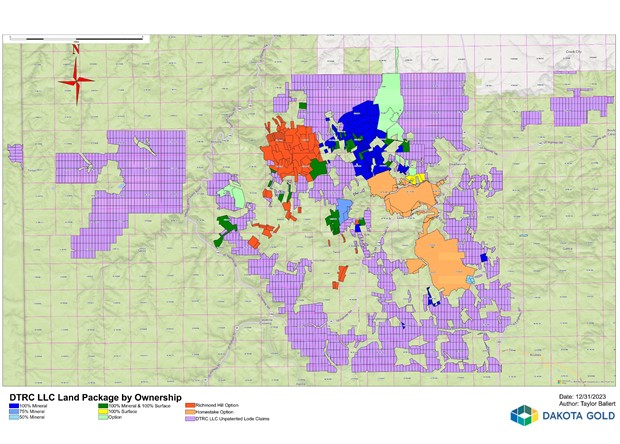
Detail Map Showing Claims and Leases of the Black Hills Property
Prior to 2022, exploration by Dakota Gold on its properties has been limited to field sampling programs, field mapping programs, geophysical surveys, and a campaign to acquire historical data sets that were known to exist for its property and the balance of the greater Homestake District. In late January 2022, Dakota Gold started its first drilling program and has since expanded its drilling programs to key project areas.
A large portion of the important historical data has been acquired, digitized, and assembled into a new database in electronic form. In the case of historical geophysical data, the data has or is being digitized and reprocessed. Exploration data compilation is an ongoing activity as Homestake District-wide historical information is constantly being identified and incorporated from historical Homestake data acquired as part of land option agreements and from local public archival sources. This historical information is being augmented by active data collection in the field thru mapping, sampling and using remote geophysical methods.
23
Exploration plans and budgets have been prepared for the Richmond Hill and Maitland project areas. Maitland and Richmond Hill properties currently have permits that have been authorized by the South Dakota Division of Environment and Natural Resources (“SDDANR”). Current exploration plans may be modified pending the ongoing modeling and interpretation of the Company’s airborne magnetic and radiometric survey data acquired in 2020 and 2021 and an IP-Resistivity survey completed at Richmond Hill in 2022. Dakota Gold’s technical team continues to model using its geophysics, geology and geochemistry data sets to improve its ability to map and project lithology and structure in covered areas and/or where the company has less historical data.
Dakota Gold’s Black Hills Property has well-developed power infrastructure. All of Dakota Gold’s claims and leases have power on the property now or have nearby access to power with the potential to be upgraded for production if exploration proves successful.
The Homestake District is a favorable geologic gold setting with three unique gold deposit types that have yielded approximately 45 million ounces of gold production over the past 140 years, including Proterozoic-age Homestake iron-formation hosted gold deposits, Tertiary-age replacement gold deposits and Cambrian paleoplacer gold deposits.
Dakota Gold has based the acquisition of its Black Hills claims, surface and mineral acreage and lease position on more than 50 years of combined mining and exploration experience in the Homestake Mining Company and the knowledge gained from previous exploration and mining efforts. Dakota Gold believes that its properties hold exploration targets for all three gold deposit types known to exist in the Homestake District.
The Homestake District has well-developed infrastructure and an existing experienced mining and exploration workforce. South Dakota’s regulatory authorities have historically demonstrated a willingness to work with responsible operators to permit well-planned, compliant projects, and South Dakota’s exploration and mining regulations are reasonable and comparable to other mining jurisdictions within the United States.
Dakota Gold’s business strategy is to advance the Richmond Hill gold resource towards eventual production and to discover another Homestake-style deposit in the iron-formation host that is distributed across the Homestake District. In addition, Dakota Gold will evaluate and explore for large Tertiary gold deposits, including a potential resource at the Unionville Zone, of which there are several deposit styles known to exist in the Northern Black Hills. Dakota Gold continues to expand its land position in the Homestake District with the objective of simultaneously developing gold targets that could be brought into production in the near term.
On April 30, 2024, the Company announced an initial mineral resource estimate under S-K 1300 for the Richmond Hill Project. The mineral resource estimate was derived from a historical database containing 69,401 gold assays from more than 900 drill holes, including 57 drill holes from Dakota Gold’s own drill program completed prior to October 5, 2023.
The Company released an updated S-K 1300 mineral resource estimate for the Richmond Hill Project on February 6, 2025. This updated resource is informed by a historical database containing 56,734 gold assays from 902 drill holes totaling 90,447 meters (296,743 feet) of drilling, and an additional 30,743 gold and silver assays from 146 drill holes totaling 45,540 meters (149,410 feet) of drilling by Dakota Gold. Note that the S-K 1300 database consisted of 910 historical holes (299,888 feet) and 148 Dakota Gold holes (157,504 feet) but 8 historical holes and 2 Dakota Gold holes were outside of the model limits so were not used in the S-K 1300. The resource established in the February 2025 IA was used for the IACF released in July 2025.
The Company has an overall land package of over 49,500 acres, with approximately 13,200 acres of private land and the remainder of Dakota Gold’s property position is held under unpatented, federal mining claims on US Forest Service (“USFS”) or Bureau of Land Management (“BLM”) administered lands. Federal unpatented mining claims have annual claim maintenance fees of $200 per claim and are due before September 1st of each year.
For exploration work on unpatented mining claims, notice must be filed with and approved by the USFS or BLM, and the SDDANR prior to undertaking any exploration activities. The notice describes the proposed exploration activities and any remedial reclamation deemed necessary. The various government agencies review the application to ensure there will be no deleterious impacts because of activity on the claims prior to granting any approvals for the proposed work.
In addition, a portion of Dakota Gold’s mineral rights are composed of various ownerships of patented mineral rights including private surface lands with mineral rights, mineral rights severed from surface title and a few parcels of private surface with severed mineral rights. These lands are held 100% by the company but are in some cases controlled through option to purchase agreements subject to other obligations. These are identified in the individual property discussions below.
24
Exploration drilling done on private surface lands requires, in most cases, a notice be filed with the SDDANR prior to undertaking any exploration activities. The notice describes the proposed exploration activities and any remedial reclamation deemed necessary. The SDDANR reviews the application to ensure there will be no deleterious impacts because of activity prior to granting any approvals, including conditions for the proposed work.
The table below summarizes the individual land positions comprising each project or option within the greater Dakota Gold Black Hills Property as at December 31, 2025.
|
|
Black Hills Property Land Package |
||||||
|
|
Patented |
|
# Unpatented |
|
Unpatented |
|
|
Project Name |
|
Acres |
|
Claims |
|
Acres |
|
Total Acres |
Richmond Hill Project |
|
3,001 |
|
2 |
|
1 |
|
3,002 |
Maitland Project |
|
2,357 |
|
9 |
|
50 |
|
2,407 |
Homestake Option (surface) |
|
4,261 |
|
— |
|
— |
|
4,261 |
Other |
|
3,660 |
|
2,136 |
|
36,216 |
|
39,876 |
Summary |
|
13,279 |
|
2,147 |
|
36,267 |
|
49,546 |
Of the various properties that comprise the Black Hills Property, the Richmond Hill Project is the only one that we view as individually material for purposes of S-K 1300, as the Richmond Hill Project is the only project upon which we have estimated mineral resources within the meaning of S-K 1300. The Company has announced a 2026 drilling program with the objective of announcing a maiden resource at our Maitland Project by the end of 2026. Detailed information about the Richmond Hill Project and certain other properties within the Black Hills Property is below.
Richmond Hill Project
Background and Ownership Rights
The Richmond Hill Project is comprised of more than 3,000 acres of private surface and mineral rights. It includes the past-producing Richmond Hill mine and the historical mines of the Carbonate District, as well as multiple prospective areas where gold has been drill-intersected.
The historic Richmond Hill mine is in the historical Carbonate Mining District approximately five miles northwest of Lead, South Dakota, in the northern Black Hills. Mining in the area started in the 1870s, during the gold-rush era, and continued until the silver price collapsed in the 1880s. Prior to 1981, the Richmond Hill land package included most of the Carbonate camp. Between the 1980s and 1990s, various companies conducted exploration of the area. Barrick acquired the property in 1994.
Multiple facilities related to the historical Richmond Hill mine still exist on the Richmond Hills Project property, including a water treatment plant and maintenance and storage buildings. Containment ponds are still operational, although an impermeable clay membrane has capped the open pit and leach pads. One of three wells that supplied water to the historic Richmond Hill mine is still active. There is a public access road to the site and a power line to operate the current water treatment facilities. As the site is in reclamation, there is no current book value associated with the assets for Barrick.
On October 14, 2021, Dakota Gold entered into an option agreement (the “Richmond Hill Option Agreement”) to acquire 100% of Barrick’s interest in the Richmond Hill property (the “Richmond Hill Option”). Under the original terms of the Richmond Hill Option Agreement, Dakota Gold had a three-year option to acquire 2,126 acres of surface and mineral rights with attendant facilities. In consideration for the Richmond Hill Option, Dakota Gold agreed to issue 400,000 shares of Dakota Gold common stock to Barrick and made annual option payments of $100,000 during the option period. Under the original terms of the Richmond Hill Option Agreement, Dakota Gold had the right to exercise the Richmond Hill Option on or before September 7, 2024, by assuming all liabilities and bonds associated with the Richmond Hill Property. In addition, on exercise of the Richmond Hill Option, Dakota Gold will issue Barrick an additional 400,000 shares of Dakota Gold common stock and grant a 1% net smelter royalty (“NSR”) to Barrick with respect to any minerals that may be recovered from the Richmond Hill Property. In September 2023, Dakota Gold and Barrick amended the Richmond Hill Option Agreement to extend the option period to March 7, 2026 and increase the Richmond Hill Project size by an additional 489 mineral acres, bringing the total mineral acreage for the Richmond Hill Project to approximately 2,615 mineral acres at that time. On February 6, 2025, the Company announced that Barrick had agreed to extend the option period for the Richmond Hill Option Agreement until December 31, 2028, in return for additional annual cash payments of $170,000 and $340,000, respectively, combined as an annual payment of $510,000 on each of March 1, 2026 (paid), March 1, 2027 and March 1, 2028.
25
In addition to the Richmond Hill Option Agreement properties, the Company includes 387 acres of owned surface and mineral rights from contiguous parcels of land in the Richmond Hill Project, thereby increasing the acreage total for the Richmond Hill Project to approximately 3,002 mineral acres.
Location and Access
The Richmond Hill Project is located in the western portion of Lawrence County, South Dakota, USA. More specifically the property lies within the Black Hills Meridian, Township 5N, Range 2E covering portions of Sections 9, 10, 11, 13. 14, 15, 16, 21, 22, 23, 24, 26, 27, and 34. The Project property is contiguous to Dakota Gold’s West Corridor and Blind Gold properties and is located approximately 1/2 mile north of the producing Wharf Gold Mine (Coeur Mining). Access to the Richmond Hill property is gained by traveling 1 mile southwest of Lead SD on Highway 85/14A to State Highway 473 and then traveling west approximately 3.2 miles to Wharf Mine Road and continuing west approximately 1.2 miles before turning and traveling 1 mile north on the Richmond Hill Road.
The location of the Richmond Hill Project is shown below:
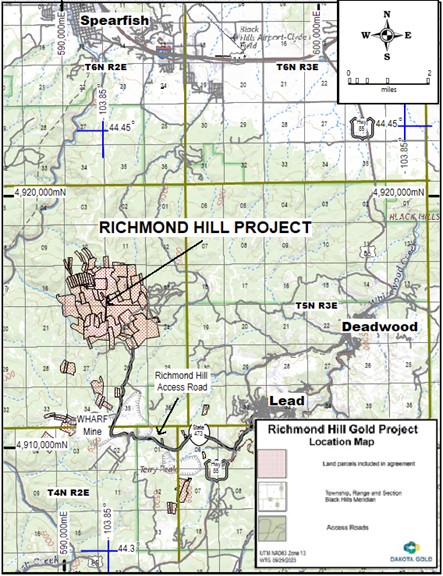
Richmond Hill Project Location
The Richmond Hill Project is within five miles of the towns of Lead and Deadwood. Dakota Gold has its base of operations in Lead, with separate facilities for office and core processing. The City of Spearfish, SD, is within 20 miles of the Richmond Hills Project. The cities of Sturgis and Rapid City are within 40 miles of the Richmond Hill Project.
26
Most supplies can be obtained from Rapid City or Spearfish. Personnel for exploration or development programs may be sourced from or housed in the four nearby communities. A 69 kV transmission line supplies power to communities, and internal power is supplied by a 12.47 kV line to the Richmond Hill Gold Project site.
Major transportation systems, including road, rail, and air, exist proximally to the northern Black Hills. Rapid City has a major rail freight station and regional airport, while an Interstate highway passes through the city and wraps around the northern end of the Black Hills. Multiple facilities related to the historical Richmond Hill mine still exist on the Richmond Hills Project property, including a water treatment plant and maintenance and storage buildings. Containment ponds are still operational, although an impermeable clay membrane has capped the open pit and leach pads. Water for exploration drilling programs has been sourced locally and either pumped or trucked to the drills. One of three wells that supplied water to the historical Richmond Hill mine is still active.
Prior Exploration and Operations
Modest historical mining activities occurred on the Richmond Hill property during the late 19th century. During this time, the only known production from the Richmond Hill property was from the Carbonate camp, which was primarily mined for lead and silver. The bulk of this production was from the Iron Hill mine. The mining was such that it supported a nearby town and smelter. Mining continued in this area until the silver price collapsed in the 1880s. An estimated 2,500 ounces of gold were produced from the Spanish R mine on the western side of the camp in the late 1800s.
More recently, Bond Gold (later acquired by LAC Minerals) produced gold and silver doré from the property beginning in 1988. The last mineralized material was hauled from the historical Richmond Hill mine pit in 1993 and efforts then shifted to reclamation activities. During this time, an estimated 172,294 ounces of gold and 212,610 ounces of silver were produced from the property.
Geological Setting and Mineralization
The Black Hills of southwestern South Dakota is an isolated mountain range rising from the Great Plains of North America and extending north northwest into Wyoming. Several small rivers cut through the range, describing a roughly radial pattern, though most drainage is to the east. An ecological crossroad, the Black Hills contains wildlife and plant species typical of habitats of the Rocky Mountains, Great Plains, northern boreal forests, and eastern deciduous forests. The Richmond Hill Project sits at an altitude of approximately 6,000 feet, and the historical leach pad area is at approximately 5,600 feet elevation, about one mile north of the pit area.
The Richmond Hill Project is an important component of Dakota Gold’s exploration strategy for the Homestake District. The property includes the past producing Richmond Hill mine and the mines of the Carbonate District. The historical Richmond Hill mine produced ore from Tertiary breccias dominantly hosted within Precambrian units that were processed as an open pit, heap leach operation. Tertiary-aged replacement gold mineralization, as well as possible Precambrian iron formation hosted mineralization were identified during exploration programs in the 1980s and 1990s.
Gold mineralization in breccia pipe bodies had previously been identified in the Richmond Hill, Richmond Hill North, Twin Tunnels, and Turnaround Breccia Pipes by LAC Minerals (USA) LLC. Dakota Gold followed up on this earlier work, and, by the end of 2023, completed 72 drill holes for a total of 116,966 feet (35,651 meters) which tested portions of the Twin Tunnels, Turnaround and Richmond Hill Breccia Pipes. Only three of the six known breccia pipes exposed at the Richmond Hill Project have been subject to any drilling by the Company and all of the known breccia pipes on the Richmond Hill Project remain open and/or lack drill testing to depth.
In 2024, the Company completed an additional 80 drill holes resulting in a grand total of 152 holes at Richmond Hill and 160,902 feet (49,043 meters). This drilling was split between infill and step out drilling in a shallow oxide portion of the orebody in carbonate replacement deposits located adjacent to but northeast of the main breccia pipe orebodies. Breccia pipes are associated with the Tertiary alkalic magmatism that generated most of the Tertiary-aged gold deposits hosted in pipes-shapes breccias, basement metamorphic rocks, Tertiary intrusive and carbonate replacement deposits in the overlying Paleozoic sedimentary rocks throughout the Homestake District. A portion of the Richmond Hill deposit is comparable to the mineralization being mined at the nearby Wharf open pit gold mine.
In 2025, the Company completed an additional 211 core holes and an additional 31 reverse circulation rotary holes for a total of 87,681 feet (26,725 meters) and 7,725 feet (2,355 meters), respectively. The core holes were completed for acquiring material for future metallurgical test work and in several areas of potential infrastructure sites for condemnation purposes. Twenty-nine of the reverse circulation rotary holes were converted to water well monitoring wells for future environmental monitoring and permitting purposes.
27
Permitting
The Company holds the permits required to conduct the infill and expansion drilling at the Richmond Hill Project that has been conducted to date. Future exploration and development drilling may require additional permits, which we currently anticipate we will be able to obtain in the ordinary course. Any future development or exploitation of the Richmond Hill Project would require significant additional regulatory review and future permits.
Mineral Resource Estimate
The following table summarizes the estimated mineral resources at the Richmond Hill Project, including the assumptions:
Richmond Hill Gold Project - Summary of Gold and Silver Mineral Resources as of February 3, 2025
|
|
AuEq COG |
|
|
|
AuEq |
|
Gold |
|
Silver |
|
Gold |
|
Silver |
Resource Category |
|
(oz/t) |
|
Ktons |
|
(oz/t) |
|
(oz/t) |
|
(oz/t) |
|
(koz) |
|
(koz) |
Leach Resource: |
|
|
|
|
|
|
|
|
|
|
|
|
|
|
Measured Mineral Resource |
|
|
|
113,748 |
|
0.0164 |
|
0.0158 |
|
0.160 |
|
1,793.4 |
|
18,208 |
Oxide |
|
0.0026 |
|
94,537 |
|
0.0165 |
|
0.0158 |
|
0.167 |
|
1,493.7 |
|
15,788 |
Transition |
|
0.0041 |
|
19,211 |
|
0.0161 |
|
0.0156 |
|
0.126 |
|
299.7 |
|
2,421 |
Indicated Mineral Resource |
|
|
|
156,019 |
|
0.0125 |
|
0.0119 |
|
0.128 |
|
1,860.0 |
|
19,884 |
Oxide |
|
0.0026 |
|
127,237 |
|
0.0122 |
|
0.0117 |
|
0.128 |
|
1,488.7 |
|
16,286 |
Transition |
|
0.0041 |
|
28,783 |
|
0.0134 |
|
0.0129 |
|
0.125 |
|
371.3 |
|
3,598 |
Measured + Indicated Mineral Resource |
|
|
|
269,768 |
|
0.0141 |
|
0.0135 |
|
0.141 |
|
3,653.3 |
|
38,092 |
Oxide |
|
0.0026 |
|
221,774 |
|
0.0140 |
|
0.0134 |
|
0.145 |
|
2,982.4 |
|
32,074 |
Transition |
|
0.0041 |
|
47,994 |
|
0.0145 |
|
0.0140 |
|
0.125 |
|
671.0 |
|
6,018 |
Inferred Mineral Resource |
|
|
|
254,186 |
|
0.0106 |
|
0.0103 |
|
0.090 |
|
2,613.4 |
|
22,787 |
Oxide |
|
0.0026 |
|
211,994 |
|
0.0101 |
|
0.0098 |
|
0.085 |
|
2,077.5 |
|
18,019 |
Transition |
|
0.0041 |
|
42,192 |
|
0.0131 |
|
0.0127 |
|
0.113 |
|
535.8 |
|
4,768 |
Mill Resource (Sulfides): |
|
|
|
|
|
|
|
|
|
|
|
|
|
|
Measured Mineral Resource |
|
0.0050 |
|
20,703 |
|
0.0184 |
|
0.0165 |
|
0.151 |
|
341.6 |
|
3,126 |
Indicated Mineral Resource |
|
0.0050 |
|
48,893 |
|
0.0147 |
|
0.0131 |
|
0.134 |
|
640.5 |
|
6,552 |
Measured + Indicated Mineral Resource |
|
0.0050 |
|
69,596 |
|
0.0158 |
|
0.0141 |
|
0.139 |
|
982.1 |
|
9,678 |
Inferred Mineral Resource |
|
0.0050 |
|
202,221 |
|
0.0139 |
|
0.0121 |
|
0.145 |
|
2,446.9 |
|
29,322 |
Leach and Mill Mineral Resource: |
|
|
|
|
|
|
|
|
|
|
|
|
|
|
Measured Mineral Resource |
|
|
|
134,452 |
|
0.0167 |
|
0.0159 |
|
0.159 |
|
2,135.0 |
|
21,334 |
Indicated Mineral Resource |
|
|
|
204,912 |
|
0.0130 |
|
0.0122 |
|
0.129 |
|
2,500.5 |
|
26,436 |
Measured + Indicated Mineral Resource |
|
|
|
339,364 |
|
0.0145 |
|
0.0137 |
|
0.141 |
|
4,635.4 |
|
47,770 |
Inferred Mineral Resource |
|
|
|
456,407 |
|
0.0121 |
|
0.0111 |
|
0.114 |
|
5,060.3 |
|
52,109 |
Notes:
| 1. | The mineral resource estimate has an effective date of February 3, 2025. |
| 2. | All figures are rounded to reflect the relative accuracy of the estimate and therefore numbers may not appear to add precisely. |
| 3. | Mineral resources that are not mineral reserves do not have demonstrated economic viability. |
| 4. | Mineral resources estimates are based on prices of $2,000/oz gold and $25/oz silver. |
| 5. | Mineral resources for leach material are based on a gold equivalent cut-off of 0.0026 oz/t for oxide material and 0.0041 oz/t for transition material. Mineral resources for mill material are based on a gold equivalent cut-off of 0.0050 oz/t. |
| 6. | The gold equivalent value for each material is as follows: |
| ● | Oxide (Leach): Gold equivalent (oz/t) = gold (oz/t) + 0.00418 x silver (oz/t), based on gold recovery of 89% and silver recovery of 30%. |
| ● | Transition (Leach): Gold equivalent = gold (oz/t) + 0.00382 x silver (oz/t), based on gold recovery of 65% and silver recovery of 20%. |
| ● | Sulfide (Mill): Gold equivalent = gold (oz/t) + 0.0127 x silver (oz/t), based on gold recovery of 85% and silver recovery of 85%. |
| 7. | The gold equivalent values account for metal recoveries, treatment charges, refining costs, and refinery payable percentages. |
| 8. | Table 11-4 of the IA accompanies this mineral resource statement and shows all relevant parameters for mineral resources. |
| 9. | Includes a preliminary estimated royalty rate of 3.8% averaged across the Richmond Hill Property. The QP has determined that the resource is not sensitive to nominal changes in the royalty rate but has recommended that this estimate be updated for the project economic and cash flow analysis. |
| 10. | Mineral resources are reported in relation to a conceptual constraining pit shell to demonstrate reasonable prospects for economic extraction, as required by the definition of mineral resources S-K 1300; mineralization lying outside of the pit shell is excluded from the mineral resource. |
| 11. | The mineral resource estimate is also constrained by the Richmond Hill Project Boundary. Only mineralization inside this boundary is included in the mineral resource estimate, though waste removal outside the boundary is allowed. |
| 12. | The mineral resources reported are contained on mineral titles owned or controlled by Dakota Gold. |
| 13. | The mineral resources are reported in-situ without any dilution or loss considerations, as a point of reference. |
28
On July 7, 2025, the Company announced the IACF and the key parameters are presented below in Table 1. The IACF was filed by the Company with the SEC as an exhibit to its Current Report on Form 8-K dated July 7, 2025. The IACF was prepared by an independent group of Qualified Persons with M3 as the Study Manager.
Table 1: IACF base case overview and key parameters 1
(US$) |
|
M&I plan |
|
MI&I plan |
|
||
Key Assumptions: |
|
|
|
|
|
|
|
Base Case Gold Price |
|
$ |
2,350/oz |
|
$ |
2,350/oz |
|
Base Case Silver Price |
|
$ |
29.00/oz |
|
$ |
29.00/oz |
|
Production Profile: |
|
|
|
|
|
|
|
Total Tonnes Processed (Mt) |
|
|
168.3 |
|
|
273.7 |
|
Strip Ratio |
|
|
0.66 |
|
|
0.44 |
|
Heap Leach Feed Grade (oz/ton) |
|
|
0.017 |
|
|
0.015 |
|
Heap Leach Feed Grade (g/t) |
|
|
0.566 |
|
|
0.530 |
|
Mine Life (years) |
|
|
17 |
|
|
28 |
|
Throughput (MTPA) |
|
|
10.0 |
|
|
10.0 |
|
Gold Recovery (kozs) |
|
|
85.1 |
% |
|
85.4 |
% |
Silver Recovery (kozs) |
|
|
28.7 |
% |
|
28.8 |
% |
LOM Gold Payable (kozs) |
|
|
2,604 |
|
|
3,982 |
|
LOM Silver Payable (kozs) |
|
|
8,737 |
|
|
12,905 |
|
LOM Average Annual Gold Payable |
|
|
153,000 |
|
|
142,000 |
|
Unit Operating Costs: |
|
|
|
|
|
|
|
Total Operating Costs |
|
$ |
764 |
|
$ |
820 |
|
Total Cash Costs |
|
$ |
857 |
|
$ |
912 |
|
LOM AISC (Cash Cost plus Sustaining Cost) |
|
$ |
1,047 |
|
$ |
1,050 |
|
Capital Costs: |
|
|
|
|
|
|
|
Initial Capital Cost |
|
$ |
384.1 |
M |
$ |
383.4 |
M |
Sustaining Capital Cost |
|
$ |
219.6 |
M |
$ |
232.6 |
M |
Closure Capital Cost |
|
$ |
129.2 |
M |
$ |
73.0 |
M |
After-tax NPV5% |
|
$ |
1.6 |
B |
$ |
2.1 |
B |
After-tax IRR |
|
|
55 |
% |
|
59 |
% |
1 |
Abbreviations in the table include ounces (“oz”); measured and indicated plan (“M&I plan”); measured, indicated and inferred plan (“MI&I plan”) million tonnes (“Mt”); ounces per tonne (“oz/ton”); grams per tonne (“g/t”); million tonnes per annum (“MTPA”); thousand ounces (“Kozs”); life of mine (“LOM”); all-in sustaining costs (“AISC”); net present value (“NPV”); and internal rate of return (“IRR”). |
29
Maitland Project
The Maitland Project area is an important component of Dakota Gold’s exploration strategy for the structural corridor that extends from the Homestake Gold Mine to Dakota Gold’s Forest Service land at the northern end of the Homestake District. The Maitland property covers the iron formation extending from the Blind Gold property target at the north end to Homestake Mining Company’s North Drift gold discovery of the late 1980s to the south. In addition to Precambrian aged gold mineralization hosted within the iron formation, the property area holds several Tertiary-aged zones of mineralization, including historic mines (e.g., Maitland Mine) hosted in the younger Paleozoic sedimentary and Tertiary intrusive rocks.
The initial 37.8 mineral acres of the Maitland Project were acquired in April of 2017 through an Exploration and Mining Lease and Option to Purchase Property Agreement with Trucano Novelty Inc., of South Dakota. On October 26, 2020, Dakota Gold acquired 2,046.1 mineral-acres from Homestake Mining Company, a wholly owned subsidiary of Barrick (reduced after detailed title work completed). Pursuant to the terms of the definitive agreement, the Company paid consideration to Barrick comprised of $3.5 million cash and the issuance of 750,000 shares of Dakota Gold’s common stock. Additionally, Barrick retained a 2.5% net smelter returns royalty on the property. From August 2021 through March 2022, Dakota Gold purchased additional surface rights over existing mineral rights of approximately 273.5 acres to facilitate the exploration of the Maitland Property area. Two unpatented mineral claims were staked in late 2022 (6.4 acres) to cover fractional areas of interest on open BLM land. The project mineral rights now total 2,364 acres, all of which are located in the western portion of Lawrence County, South Dakota, USA within Black Hills Meridian, Township 5N, Range 2E, covering portions of Sections 12, 13, and 24, and Township 5N, Range 3E, covering portions of Sections 7, 8, 17, 18, 19 and 20. Annual claim maintenance fees total $400.
Access to the Maitland Gold Project is gained by traveling 2 miles north of Lead on Highway 85/14A to Central City/Blacktail and then turning and traveling northwest approximately 1.7 miles on the Maitland Road.
Dakota Gold began drilling at Maitland in 2022 and by the end of 2023 completed 36 drill holes extending over a distance totaling 127,857 feet (38,971 meters). On February 8, 2023, the Company announced the discovery of the Unionville Zone in MA22C-009, which intercepted Precambrian hosted, Tertiary-age, epithermal gold mineralization in a breccia located beneath Cambrian hosted Tertiary replacement gold mineralization on the horizon of the Maitland Mine in sedimentary cover. Then, on May 4, 2023, The Company announced the discovery of the JB Zone in MA23C-017, which intercepted high-grade, Precambrian mineralization over potentially mineable widths like mineralization from the Homestake mine. On August 1, 2023, the Company began using directional drilling equipment to accurately offset and step-out from the deeper JB Zone discovery intercept in MA23C-017, as well as, continuing an infilling program between widely spaced drill holes which identified the Unionville Zone and other high-grade intercepts of mineralization identified in earlier drilling like mineralization from the Homestake mine. Exploration drilling continued in 2024 and by the end of year, the Company had completed a total of 73 drill holes for 230,612 feet (70,291 meters) on the Maitland Project since initiating drilling activities in 2022.
The Company is planning a drilling program at the Maitland property in 2026. This drilling will focus on infill drilling in the Unionville Gold Zone announced in 2022 and early 2023. This infill and step-out drilling program will be conducted in the near surface, Tertiary-age portion of the gold system with the ultimate goal to produce a maiden resource by the end of 2026.
Barrick Option
On September 7, 2021, Dakota Gold entered into a three-year option agreement (the “Barrick Option Agreement”) to acquire 4,261 acres of surface rights with attendant facilities and data held by Homestake Mining Company, a wholly owned subsidiary of Barrick (the “Barrick Option”). In consideration for the Barrick Option, Dakota Gold agreed to make a cash payment of $1.3 million, issue 1 million shares of Dakota Gold common stock to Barrick and make annual payments of $300,000 during the option period. Under the original terms of the Barrick Option Agreement, Dakota Gold had the right to exercise the Barrick Option on or before September 7, 2024, by assuming all liabilities and bonds currently held by Homestake within the Homestake District. In addition, on exercise of the Barrick Option, Dakota Gold will issue Barrick 3 million additional shares of Dakota Gold common stock and grant a 2.5% NSR to Barrick with respect to any gold that may be recovered from the Grizzly Gulch property (the “Grizzly Gulch”). On November 20, 2023, Dakota Gold and Barrick amended the Richmond Hill Option Agreement to extend the option period to March 7, 2026. On February 6, 2025, the Company announced that Barrick had agreed to extend the option period for the Barrick Option Agreement until December 31, 2028 in return for additional annual payments of $170,000 and $340,000, respectively, combined as an annual payment of $510,000 on each of March 1, 2026 (paid), March 1, 2027 and March 1, 2028.
30
The Barrick Option property is located in and around the City of Lead and lies within the Black Hills Meridian, Township 5 N, Range 3 E, covering portions of Sections 19, 20, 27, 28, 29, 30, 32, 33, and 34, and Township 4 N, Range3 E, covering portions of Sections 2, 3, 4, 9, 10, 11, 14, and 15.
Access to the Barrick Option property is gained from multiple public roads and highways including streets within the City of Lead, paved Highway 85/14A near Central City, US Highway 385 at Pluma, and via Lawrence County maintained Grizzly Gulch, Kirk, and Yellow Creek roads.
The Barrick Option property was previously a part of, or utilized in support of, Homestake Mining Company’s historic gold mining operations at Lead. Subdivisions of the property include Sawpit Gulch, Open Cut and Grizzly Gulch areas. As the property was previously disturbed by mining, Dakota Gold believes that potential exists for the Company to repurpose the property and remaining infrastructure for future operations if exploration is successful at Dakota Gold project areas that lie in close proximity.
Exploration and Sampling
Dakota Gold’s Black Hills Property is at an early stage of exploration. The Company has developed a detailed Exploration Procedures Manual which will define the Company’s internal quality analysis and quality control (“QA/QC”) procedures going forward. However, Dakota Gold has always implemented sampling and analytical QA/QC protocols consistent with industry standards. These protocols include, but are not limited to, the following procedures:
| 1. | All sampling is conducted under the supervision of Dakota Gold’s Vice President Exploration. |
| 2. | The chain of custody from the project to the sample preparation facility is continuously monitored and controlled by the company and its shipping contractors. |
| 3. | Samples are collected and stored at the logging or storage facility which are secured and monitored sites. |
| 4. | Samples are labeled with unique, non-descriptive sample numbers, bagged, and secured with locking bag ties before shipping. |
| 5. | Samples are shipped by commercial bonded shippers at regular intervals and the sample batches are shipped to either 1) ALS Geochemistry sample preparation facility in Twin Falls, Idaho, USA or 2) ALS Geochemistry sample preparation facility in Winnipeg, Manitoba, Canada. |
| 6. | Gold analyses are performed at the ALS Geochemistry laboratory in Reno, Nevada or Vancouver, British Columbia, and multi-element geochemical analysis are completed at the ALS Minerals laboratory in Vancouver, British Columbia. All ALS Minerals facilities are ISO/IEC 17025:2017 accredited labs. |
| 7. | Control procedures include regular insertion of certified reference materials and blanks into the sample stream at a minimum of 4% each. Sample, crush, and pulp duplicates are inserted into the sample stream at a minimum of 2% each. |
| 8. | Pulps are digested and analyzed for gold using fire assay fusion and an atomic absorption spectroscopy (AAS) finish on a 30-gram split. |
| 9. | Over limit gold assays are determined using a fire assay fusion with a gravimetric finish on a 30-gram split. |
| 10. | All other elements are determined by four-acid digestion and inductively coupled plasma analysis. |
| 11. | Validation of the analytical results are conducted upon receipt of final assay reports by statistical analysis of the standards duplicates and blanks and must pass certain parameters of accuracy to be considered verified. |
| 12. | Until validated and reported publicly, assay results are kept confidential and securely maintained by the VP Exploration and a minimum number of company staff charged with validation and compilation of the assay data. |
ITEM 3. LEGAL PROCEEDINGS.
From time to time, we may be involved in claims and legal actions that arise in the ordinary course of business. To our knowledge, there are no material pending legal proceedings to which we are a party or of which any of our property is the subject. See Note 9 - Commitments and Contingences to the consolidated financial statements in this Form 10-K.
ITEM 4. MINE SAFETY DISCLOSURES
Pursuant to Section 1503(a) of the recently enacted Dodd-Frank Wall Street Reform and Consumer Protection Act (the “Dodd-Frank Act”), issuers that are operators, or that have a subsidiary that is an operator, of a coal or other mine in the United States are required to disclose in their periodic reports filed with the SEC information regarding specified health and safety violations, orders and citations, related assessments and legal actions, and mining-related fatalities. During the fiscal year ended December 31, 2025, the Company’s exploration properties were not subject to regulation by the Federal Mine Safety and Health Administration under the Federal Mine Safety and Health Act of 1977.
31
PART II
ITEM 5. MARKET FOR REGISTRANT’S COMMON EQUITY, RELATED STOCKHOLDER MATTERS AND ISSUER PURCHASES OF EQUITY SECURITIES
Market Information
Our common stock is listed on the NYSE American under the symbol “DC”.
Holders of Common Stock
As of December 31, 2025, there were 415 record owners of our common stock. We believe that a number of stockholders hold stock on deposit with their brokers or investment bankers registered in the name of stock depositories.
Unregistered Sales of Equity Securities
During the fiscal year ended December 31, 2025, we did not sell any equity securities that were not registered under the Securities Act.
Dividends
The Company has not paid any dividends and does not anticipate paying any cash dividends on its common stock in the foreseeable future. We currently intend to retain all future earnings, if any, to fund the growth of our business.
Repurchase of Securities
During the fiscal year ended December 31, 2025, we did not effect any repurchase of securities.
ITEM 6. [RESERVED]
ITEM 7. MANAGEMENT’S DISCUSSION AND ANALYSIS OF FINANCIAL CONDITION AND RESULTS OF OPERATIONS.
You should read the following discussion and analysis of financial condition and results of operations of Dakota Gold Corp. together with our consolidated financial statements and the related notes included elsewhere in this Report. Some of the information contained in this discussion and analysis or set forth elsewhere in this Report, including information with respect to our plans and strategy for our business, includes forward-looking statements that involve risks and uncertainties. You should review Item 1A. Risk Factors above for a discussion of important factors that could cause actual results to differ materially from the results described in or implied by the forward-looking statements contained in the following discussion and analysis.
This management’s discussion and analysis should be read in conjunction with the annual consolidated financial statements of Dakota Gold Corp. and notes thereto as set forth herein. Readers are urged to carefully review and consider the various disclosures made by us, which attempt to advise interested parties of the factors which affect our business, including without limitation, the disclosures made under Item 1A. Risk Factors.
Our audited annual consolidated financial statements are stated in United States dollars and are prepared in accordance with United States generally accepted accounting principles.
32
Overview
The Company’s goal is to create stockholder value through the acquisition, responsible exploration, and future development of high caliber gold properties in the Homestake District of South Dakota. Management and the technical teams cumulatively have several hundred years of international mining and exploration experience and key personnel have more than 50 combined years in the Homestake District, mostly with the Homestake Mining Company, as well as other exploration companies that have operated in the region. We believe that this experience uniquely positions the Company and will allow us to leverage our direct experience and knowledge of past exploration and mining activities in the Homestake District. Combined with the use of modern exploration and mining techniques, and new geologic understanding from experience in other mines, new research and information extracted from our new geophysical surveys, we hope to focus our programs and build upon where the historic Homestake Mining Company left off in the 1990s.
The Homestake District has historically yielded approximately 45 million ounces of gold production as of December 31, 2025 with most of it coming from within a small geographic area. The production ledges of the Homestake Mine define a cumulative surface projection area of less than three square miles. Homestake Mining Company’s historic gold production and exploration in the Homestake District was overwhelmingly focused on the underground mine. Outside of the mine area, the Homestake District has been underexplored and heretofore has not been the subject of modern exploration efforts required to search for other deposits, especially under the cover of younger rocks that dominate the surface.
We have consistently pursued a strategy of expanding our portfolio of brownfield properties located exclusively within the Homestake District to build a strong land position with the goal of consolidating possible mineral potential.
Other than our mineral resource estimate with an effective date of February 3, 2025 contained in our IA, none of our other properties are sufficiently drilled to prepare an estimate of mineral resources under S-K 1300. The Company believes the Homestake District is in a safe jurisdiction with well-developed infrastructure and is in a favorable regulatory environment in which authorities have demonstrated a willingness to work with responsible operators to permit well-planned compliant projects.
Drill Programs and Results
We expanded our drilling operations to the Richmond Hill Project and have had up to four drill rigs operating at any point in time. Dakota Gold has completed permit applications and environmental field work and currently has fourteen active permits in place with one additional permit being processed for Richmond Hill in 2025. Permitting for other exploration targets is anticipated in 2026.
In total, Dakota Gold has completed 473 holes for over 493,472 feet (150,493 meters) since drilling started in 2022.
| ● | The Company completed 25 holes for 70,181 feet (21,391 meters) of core drilling on three projects in 2022. The areas drilled in 2022 were the Maitland Project (39,231 feet; 11,958 meters), the Richmond Hill Project (24,865 feet; 7,579 meters), and other properties (6,084 feet; 1,854 meters). |
| ● | The Company then completed 89 holes for 180,727 feet (55,086 meters) of core on two projects in 2023; the areas drilled were the Maitland Project (88,626 feet; 27,013 meters) and the Richmond Hill Project (92,101 feet; 24,184 meters). |
| ● | The Company completed 117 holes for 146,691 feet (44,711 meters) of core on two projects during 2024; the areas drilled were the Maitland Project (102,755 feet; 31,320 meters) and the Richmond Hill Project (43,936 feet; 13,392 meters). |
| ● | In 2025, the Company completed an additional 211 core holes and an additional 31 reverse circulation rotary holes at the Richmond Hill Project for a total of 87,681 feet (26,725 meters) and 7,725 feet (2,355 meters), respectively. |
Significant Developments
On April 30, 2024, the Company announced the maiden S-K 1300 initial assessment for the Richmond Hill Gold Project.
On June 26, 2024, the Company announced an additional investment by Orion of $6 million with the potential to increase to $9 million subject to future market conditions (the “2024 Orion Equity Investment”).
On February 6, 2025, the Company announced that Barrick Gold agreed to extend the option period for both the Richmond Hill option and the Homestake option agreements until December 31, 2028, in return for additional annual cash payments of $170,000 and $340,000, respectively, combined as an annual payment of $510,000 on each of March 1, 2026 (paid), March 1, 2027 and March 1, 2028.
33
On February 6, 2025, the Company announced the February 2025 IA, which was filed as an exhibit to the Company’s Current Report on Form 8-K.
On March 25, 2025, the Company announced the successful closing of the Offering, whereby we raised net proceeds of approximately $32.8 million by issuing 12,400,000 shares of our common stock at a price of $2.83 per share.
On May 19, 2025, the Company announced changes to its senior leadership team and Board of Directors. Jack Henris was appointed President and Chief Operating Officer (COO) of Dakota Gold effective June 1, 2025 upon the retirement of Gerald Aberle, the Company’s prior COO. Todd Kenner and Kevin Puil were appointed to the Board of Directors effective May 15, 2025, and Amy Koenig resigned from the Board of Directors on May 31, 2025 and assumed the role of Senior Vice President, Chief Legal Officer and Corporate Secretary for Dakota Gold effective June 1, 2025. Mr. Aberle retired as a director of the Company, effective August 8, 2025.
On July 7, 2025, the Company announced the IACF, which was filed as an exhibit to the Company’s Current Report on Form 8-K.
On November 13, 2025, the Company entered into an Amended and Restated Equity Distribution Agreement with BMO Capital Markets Corp., Canaccord Genuity LLC, and H.C. Wainwright & Co., LLC.
Planned Activities
Planned activities during 2026 will focus on advancing the Richmond Hill Project through feasibility, permitting, and technical de-risking while continuing to progress high-grade exploration at the Maitland Project. At Richmond Hill, the Company is transitioning from an Initial Assessment with Cash Flow to a Pre-Feasibility Study in the second half of 2026, followed by a Feasibility Study targeted for 2027. Key workstreams include mine planning optimization, engineering trade-off studies, metallurgical test work, and baseline data collection to support state and county permitting. Concurrently, the Company plans to file a Notice of Intent and advance permitting activities with Lawrence County and the South Dakota Department of Agriculture and Natural Resources, positioning the project for construction readiness following completion of feasibility studies.
Planned activities in 2026 for our Richmond Hill Project include an extensive drilling campaign totaling approximately 15,500 meters across infill, step-out, condemnation, and geotechnical drilling. Infill drilling within the 10-year mine plan is intended to convert inferred resources to measured and indicated classifications, while step-out drilling to the north and northeast targets potential resource expansion. Additional drilling is planned to support infrastructure siting, overburden stockpile areas, and pit slope stability analyses. These activities are designed to refine the mine plan, improve resource confidence, and directly support feasibility-level engineering and economic analysis.
Metallurgical test work represents another critical planned activity in 2026. The Company is conducting a staged metallurgical program, including ore characterization, column leach testing, comminution studies, and recovery optimization, with final results expected in the fourth quarter of 2026. This work will inform heap leach pad design, crushing and stacking configurations, agglomeration requirements, and Merrill-Crowe plant sizing. The results will be incorporated into feasibility trade-off studies evaluating mining and stacking rates, heap leach pad layout, and material handling alternatives to optimize project economics and operational flexibility.
At the Maitland property, planned activities in 2026 will concentrate on advancing the Unionville Zone toward a maiden mineral resource by year-end. The Company has outlined an infill drilling program of approximately 5,600 meters in 44 holes targeting shallow Tertiary epithermal mineralization that remains open along strike and at depth. In parallel, the Company will continue to evaluate high-grade exploration optionality at the JB Gold Zone, where Precambrian iron-formation-hosted mineralization shows strong geological similarities to the historic Homestake Mine. These efforts are intended to demonstrate the broader district-scale potential of the Maitland property while maintaining focus on near-term value creation at Richmond Hill.
34
Results of Operations
Years Ended December 31, 2025 and 2024
|
|
Years Ended December 31, |
||
|
|
2025 |
|
2024 |
|
|
$ |
|
$ |
Operating expenses |
|
|
|
|
Exploration expenses |
|
20,991,346 |
|
23,707,162 |
General and administrative expenses |
|
9,763,396 |
|
10,625,080 |
Loss from operations |
|
(30,754,742) |
|
(34,332,242) |
|
|
|
|
|
Other income (expenses) |
|
|
|
|
Foreign exchange loss |
|
(23,502) |
|
(32,447) |
Interest expense |
|
— |
|
(137,483) |
Interest income |
|
1,176,546 |
|
609,801 |
Total other income |
|
1,153,044 |
|
439,871 |
|
|
|
|
|
Loss before income taxes |
|
(29,601,698) |
|
(33,892,371) |
Income tax benefit, net |
|
62,999 |
|
7,835 |
Net loss and comprehensive loss |
|
(29,538,699) |
|
(33,884,536) |
|
|
|
|
|
Basic and diluted loss per share |
|
(0.27) |
|
(0.37) |
|
|
|
|
|
Weighted average number of basic and diluted shares of common stock outstanding |
|
108,895,044 |
|
90,887,130 |
Revenue
We had no operating revenues during the years ended December 31, 2025 and 2024. We had net losses and comprehensive losses of approximately $29.5 million and $33.9 million for the years ended December 31, 2025 and 2024, respectively.
Exploration Expenses
During the years ended December 31, 2025 and 2024, our exploration expenses totaled approximately $21.0 million and $23.7 million, respectively. The year-over-year decrease primarily related to the reduced level of activity associated with drilling prior to the Offering proceeds, which resulted in a decrease of approximately $6.4 million compared to 2024. In addition, assay costs decreased by approximately $0.6 million because of the lower level of drilling. These reductions were partially offset by increases in rental or maintenance expenditure on equipment of approximately $1.5 million to support the 2025 drilling program, an increase in studies and reports of approximately $1.8 million as the Company moved to complete its metallurgical test program, an increase in exploration payroll of approximately $0.4 million as part of the resumption of drilling, an increase in miscellaneous costs of approximately $0.3 million driven by higher reclamation costs, and an increase in non-cash exploration-related stock-based compensation expenses of approximately $0.3 million. Included in exploration costs were stock-based compensation expense of approximately $0.9 and $0.6 million for the years ended December 31, 2025 and 2024, respectively.
General and Administrative Expenses
Our general and administrative expenses for the year ended December 31, 2025 and 2024, were approximately $9.8 million and $10.6 million, respectively. These expenditures were primarily for legal, accounting, and professional fees, investor relations, and other general and administrative expenses necessary for our operations. The year-over-year decrease is primarily related to a decrease of approximately $0.4 million in investor relations costs, which were higher in the prior year as the Company was closing a financing, and a decrease in non-cash stock-based compensation expense of $0.6 million. This decrease was partially offset by an increase of $0.7 million in expenditures on support costs, which were higher than the prior year primarily due to marginally higher compensation costs related to the successful completion of the IACF and 2025 financing as well as legal and other fees relating to filing the registration statement Form S-3.
35
Other Income
We earned interest income from bank accounts of approximately $1.2 million and $0.6 million for the years ended December 31, 2025 and 2024, respectively.
We had losses from operations for the years ended December 31, 2025 and 2024, totaling approximately $30.8 million and $34.3 million respectively, losses before income tax of approximately $29.6 million and $33.9 million, respectively, leading to net losses of $29.5 million and $33.9 million, respectively.
The effective tax rate for the fiscal year ended December 31, 2025 is less than the statutory rate as the Company is in a tax loss position and does not expect to use the tax losses in the near future.
Cash Flows Used in Operating Activities
Cash used in operations for the year ended December 31, 2025 was approximately $25.4 million compared to approximately $31.5 million in the prior year. The Company was not drilling in the first quarter of 2025, the primary driver of higher operating expenses, as the Company was focused on the Richmond Hill Initial Assessment.
Cash Flows Used in Investing Activities
Cash used in investing activities for the years ended December 31, 2025 was $0.4 million compared to $0.6 million in the prior year, due to lower expenditures on purchases of property and equipment and mineral properties.
Cash Flows from Financing Activities
During the years ended December 31, 2025 and 2024, cash flows from financing activities were approximately $46.1 million and $15.9 million respectively.
In the year ended December 31, 2025, the Company issued 3,022,019 shares of common stock under the ATM Program for net proceeds of approximately $9.7 million, 12,400,000 shares of common stock for net proceeds of approximately $32.8 million pursuant to the Offering, 2,020,448 shares of common stock for the exercise of warrants for proceeds of approximately $4.2 million and 120,250 shares of common stock for the exercise of stock options for proceeds of approximately $0.2 million. In addition, the Company issued 119,588 common shares for the exercise of options settled on a cashless basis. Partially offsetting these inflows were taxes remitted on RSUs, PSUs and compensation of approximately $0.8 million.
In the year ended December 31, 2024, the Company issued 2,344,836 shares of common stock for net proceeds of approximately $5.7 million pursuant to the 2024 Orion Equity Investment, a total of 4,510,486 shares of common stock under the ATM Program for net proceeds of approximately $9.9 million, and another 82,500 shares of common stock for the exercise of stock options for proceeds of approximately $0.2 million. Concurrent with the consummation of the 2024 Orion Equity Investment, the Company sold to Orion a 1% net smelter return royalty interest on certain properties held by the Company for total consideration of approximately $0.2 million paid at closing.
Off-Balance Sheet Arrangements
As of December 31, 2025 and 2024, we did not have, and we do not currently have, any off-balance sheet arrangements, as defined by the SEC.
Liquidity and Capital Resources
The Company is in the exploration stage and currently does not generate revenue. As such, we finance our operations and the acquisition and exploration of our mineral properties through the issuance of common stock, and the Company could be materially adversely affected if we are unable to raise capital because of market or other factors.
As of December 31, 2025, the Company had working capital of approximately $27.4 million and an accumulated deficit of approximately $106.1 million. The Company had a net loss of approximately $29.5 million for the year ended December 31, 2025.
36
On March 25, 2025, the Company announced a public offering (the “Offering”), whereby we raised net proceeds of approximately $32.8 million by issuing 12,400,000 shares of our common stock at a price of $2.83 per share.
On February 11, 2026, the Company announced a public offering for 12,336,000 shares, gross proceeds of approximately $75 million, and net proceeds of approximately $71 million. In addition, on February 20, 2026, the underwriters elected to exercise their overallotment option for an additional 225,000 shares and gross proceeds of approximately $1.4 million.
The Company anticipates cash expenditures of approximately $32.3 million through to March 25, 2027.
Based on the Company’s cash balance at December 31, 2025 of approximately $29.7 million and the additional proceeds from our offerings in 2026, we believe that we will have sufficient liquidity to fund our activities for the next twelve months. The actual timing of expected expenditures is dependent upon several factors, including the management of variable exploration expenditures.
Critical Accounting Estimates
Management’s discussion and analysis of financial condition and results of operations is based on the Company’s consolidated financial statements, which have been prepared in accordance with U.S. GAAP. Preparation of financial statements requires management to make assumptions, estimates and judgments that affect the reported amounts of assets, liabilities, revenues, costs and expenses, and the related disclosures of contingencies. Management bases its estimates on various assumptions and historical experience, which are believed to be reasonable; however, due to the inherent nature of estimates, actual results may differ significantly due to changed conditions or assumptions. On a regular basis, management reviews the accounting policies, assumptions, estimates and judgments to ensure that the Company’s consolidated financial statements are fairly presented in accordance with U.S. GAAP. However, because future events and their effects cannot be determined with certainty, actual results could differ from the Company’s assumptions and estimates, and such differences could be material. The Company’s accounting policies are described in greater detail in Note 2 to the Company’s audited annual consolidated financial statements for the year ended December 31, 2025.
Management believes the use of Black-Scholes and Monte Carlo valuation models for measuring the fair value of stock-based compensation has a significant impact on the Company’s consolidated financial statements and relies on critical accounting estimates and judgments.
Stock-based compensation is in the form of stock options, restricted stock units (“RSU”) and performance stock units (“PSU”) granted to employees and directors. Stock-based compensation expense is based on the fair value of the stock options, RSUs and PSUs.
Judgments and Uncertainties
We estimate the grant date fair value of each stock option award on the date of grant using a Black-Scholes option-pricing model.
The grant date fair value of the PSUs is calculated using a Monte Carlo simulation. The number of PSUs that will be earned is based upon the Company’s share price performance against the MVIS Global Junior Gold Miners Index for the relevant performance periods. Compensation expense is recognized regardless of the relative performance.
The grant date fair value of the RSUs is based on the stock price on grant date, creating no judgement or uncertainty.
37
Compensation expense will be reversed if an employee’s employment is terminated prior to satisfying the requisite service period.
The determination of fair value using option-pricing models, as indicated above, is affected by our stock price, as well as assumptions regarding several subjective variables. These variables include, but are not limited to, our expected stock price volatility over the expected term of the awards. We determine the expected term of each award giving consideration to the contractual terms, vesting schedules, and post-vesting forfeitures. We use the risk-free interest rate on the implied yield available on U.S. Treasury issues with an equivalent remaining term approximately equal to the expected term of the award. The value of the portion of the award that vests is recognized as expense over the requisite service periods in our Consolidated Statements of Operations. If factors change and different assumptions are used, stock-based compensation expense could be materially different in the future.
Sensitivity of Estimate to Change
Once the fair value of the awards is determined at grant date, there is no subsequent remeasurement and therefore our estimates would impact the fair value of future rewards and not impact our stock-based compensation expense for the current fiscal year. This treatment is based on the awards being classified as equity. Should outstanding awards be reclassified as a liability, the impact to stock-based compensation expense could be materially different in the future.
ITEM 7A. QUANTITATIVE AND QUALITATIVE DISCLOSURES ABOUT MARKET RISK
Not applicable.
ITEM 8. FINANCIAL STATEMENTS AND SUPPLEMENTARY DATA
38
Report of Independent Registered Public Accounting Firm
To the stockholders and the Board of Directors of Dakota Gold Corp.
Opinion on the Financial Statements
We have audited the accompanying consolidated balance sheet of Dakota Gold Corp. and subsidiaries (the “Company”) as of December 31, 2025, the related consolidated statements of operations and comprehensive loss, cash flows, and changes in equity, for the year ended December 31, 2025, and the related notes (collectively referred to as the “financial statements”). In our opinion, the financial statements present fairly, in all material respects, the financial position of the Company as of December 31, 2025, and the results of its operations and its cash flows for the year ended December 31, 2025, in conformity with accounting principles generally accepted in the United States of America.
Basis for Opinion
These financial statements are the responsibility of the Company’s management. Our responsibility is to express an opinion on the Company’s financial statements based on our audit. We are a public accounting firm registered with the Public Company Accounting Oversight Board (United States) (PCAOB) and are required to be independent with respect to the Company in accordance with the U.S. federal securities laws and the applicable rules and regulations of the Securities and Exchange Commission and the PCAOB.
We conducted our audit in accordance with the standards of the PCAOB. Those standards require that we plan and perform the audit to obtain reasonable assurance about whether the financial statements are free of material misstatement, whether due to error or fraud. The Company is not required to have, nor were we engaged to perform, an audit of its internal control over financial reporting. As part of our audit, we are required to obtain an understanding of internal control over financial reporting but not for the purpose of expressing an opinion on the effectiveness of the Company’s internal control over financial reporting. Accordingly, we express no such opinion.
Our audit included performing procedures to assess the risks of material misstatement of the financial statements, whether due to error or fraud, and performing procedures that respond to those risks. Such procedures included examining, on a test basis, evidence regarding the amounts and disclosures in the financial statements. Our audit also included evaluating the accounting principles used and significant estimates made by management, as well as evaluating the overall presentation of the financial statements. We believe that our audit provides a reasonable basis for our opinion.
/s/ Deloitte & Touche LLP.
Denver, Colorado
March 25, 2026
We have served as the Company’s auditor since 2025.
39
Report of Independent Registered Public Accounting Firm
To the Stockholders and the Board of Directors of Dakota Gold Corp.
Opinion on the Financial Statements
We have audited the accompanying consolidated balance sheet of Dakota Gold Corp. (the Company) as of December 31, 2024, the related consolidated statements of operations and comprehensive loss, changes in equity and cash flows for the year then ended, and the related notes (collectively referred to as the “consolidated financial statements”). In our opinion, the consolidated financial statements present fairly, in all material respects, the financial position of the Company at December 31, 2024, and the results of its operations and its cash flows for the year then ended in conformity with U.S. generally accepted accounting principles.
Basis for Opinion
These financial statements are the responsibility of the Company’s management. Our responsibility is to express an opinion on the Company’s financial statements based on our audit. We are a public accounting firm registered with the Public Company Accounting Oversight Board (United States) (PCAOB) and are required to be independent with respect to the Company in accordance with the U.S. federal securities laws and the applicable rules and regulations of the Securities and Exchange Commission and the PCAOB.
We conducted our audit in accordance with the standards of the PCAOB. Those standards require that we plan and perform the audit to obtain reasonable assurance about whether the financial statements are free of material misstatement, whether due to error or fraud. The Company is not required to have, nor were we engaged to perform, an audit of its internal control over financial reporting. As part of our audit we are required to obtain an understanding of internal control over financial reporting but not for the purpose of expressing an opinion on the effectiveness of the Company’s internal control over financial reporting. Accordingly, we express no such opinion.
Our audit included performing procedures to assess the risks of material misstatement of the financial statements, whether due to error or fraud, and performing procedures that respond to those risks. Such procedures included examining, on a test basis, evidence regarding the amounts and disclosures in the financial statements. Our audit also included evaluating the accounting principles used and significant estimates made by management, as well as evaluating the overall presentation of the financial statements. We believe that our audit provides a reasonable basis for our opinion.
/s/ Ernst & Young LLP
We served as the Company’s auditor from 2023 to 2025.
Denver, Colorado
March 20, 2025
40
DAKOTA GOLD CORP.
Consolidated Balance Sheets
|
|
|
|
December 31, |
|
December 31, |
|
|
Note |
|
2025 |
|
2024 |
|
|
|
|
$ |
|
$ |
ASSETS |
|
|
|
|
|
|
|
|
|
|
|
|
|
Current assets |
|
|
|
|
|
|
Cash and cash equivalents |
|
1 |
|
29,686,451 |
|
9,408,270 |
Prepaid expenses and other current assets |
|
|
|
667,330 |
|
523,894 |
Total current assets |
|
|
|
30,353,781 |
|
9,932,164 |
|
|
|
|
|
|
|
Non-current assets |
|
|
|
|
|
|
Mineral rights and properties |
|
3 |
|
82,898,617 |
|
82,713,264 |
Property and equipment, net |
|
4 |
|
2,149,961 |
|
2,247,722 |
Other assets |
|
|
|
455,591 |
|
460,380 |
Total assets |
|
|
|
115,857,950 |
|
95,353,530 |
|
|
|
|
|
|
|
LIABILITIES AND STOCKHOLDERS’ EQUITY |
|
|
|
|
|
|
|
|
|
|
|
|
|
Current liabilities |
|
|
|
|
|
|
Accounts payable and accrued liabilities |
|
5 |
|
2,873,987 |
|
2,616,876 |
Lease liabilities – current |
|
|
|
124,785 |
|
129,419 |
Total current liabilities |
|
|
|
2,998,772 |
|
2,746,295 |
|
|
|
|
|
|
|
Non-current liabilities |
|
|
|
|
|
|
Lease liabilities |
|
|
|
80,881 |
|
197,527 |
Other non-current liability |
|
|
|
257,758 |
|
257,758 |
Total liabilities |
|
|
|
3,337,411 |
|
3,201,580 |
|
|
|
|
|
|
|
Commitments and contingencies (Note 9) |
|
|
|
|
|
|
|
|
|
|
|
|
|
Stockholders’ equity |
|
|
|
|
|
|
Common stock, par value $0.001; 300,000,000 authorized, 114,068,842 and 95,570,483 shares outstanding, respectively |
|
7 |
|
114,067 |
|
95,570 |
Additional paid-in capital |
|
|
|
218,494,483 |
|
168,605,692 |
Accumulated deficit |
|
|
|
(106,088,011) |
|
(76,549,312) |
Total stockholders’ equity |
|
|
|
112,520,539 |
|
92,151,950 |
Total liabilities and stockholders’ equity |
|
|
|
115,857,950 |
|
95,353,530 |
The accompanying notes are an integral part of these consolidated financial statements.
41
DAKOTA GOLD CORP.
Consolidated Statements of Operations and Comprehensive Loss
|
|
|
|
Years Ended December 31, |
||
|
|
Note |
|
2025 |
|
2024 |
|
|
|
|
$ |
|
$ |
Operating expenses |
|
|
|
|
|
|
Exploration expenses |
|
10 |
|
20,991,346 |
|
23,707,162 |
General and administrative expenses |
|
10 |
|
9,763,396 |
|
10,625,080 |
Loss from operations |
|
|
|
(30,754,742) |
|
(34,332,242) |
|
|
|
|
|
|
|
Other income (expenses) |
|
|
|
|
|
|
Foreign exchange loss |
|
|
|
(23,502) |
|
(32,447) |
Interest expense |
|
|
|
— |
|
(137,483) |
Interest income |
|
|
|
1,176,546 |
|
609,801 |
Total other income |
|
|
|
1,153,044 |
|
439,871 |
|
|
|
|
|
|
|
Loss before income taxes |
|
|
|
(29,601,698) |
|
(33,892,371) |
Income tax benefit |
|
6 |
|
62,999 |
|
7,835 |
Net loss and comprehensive loss |
|
|
|
(29,538,699) |
|
(33,884,536) |
|
|
|
|
|
|
|
Basic and diluted loss per share |
|
8 |
|
(0.27) |
|
(0.37) |
|
|
|
|
|
|
|
Weighted average number of basic and diluted shares of common stock outstanding |
|
|
|
108,895,044 |
|
90,887,130 |
The accompanying notes are an integral part of these consolidated financial statements.
42
DAKOTA GOLD CORP.
Consolidated Statements of Cash Flows
|
|
Years Ended December 31, |
||
|
|
2025 |
|
2024 |
|
|
$ |
|
$ |
Operating activities |
|
|
|
|
Net loss |
|
(29,538,699) |
|
(33,884,536) |
Adjustments to reconcile net loss to net cash used in operating activities: |
|
|
|
|
Depreciation expense |
|
198,764 |
|
254,978 |
Stock-based compensation expense |
|
3,453,335 |
|
3,776,279 |
Interest expense |
|
— |
|
137,483 |
Deferred income tax benefit |
|
— |
|
(85,332) |
Changes in current assets and liabilities: |
|
|
|
|
Prepaid expenses and other current assets |
|
(143,436) |
|
152,126 |
Accounts payable and accrued liabilities |
|
584,609 |
|
(1,726,305) |
Other assets |
|
— |
|
(103,100) |
Net cash used in operating activities |
|
(25,445,427) |
|
(31,478,407) |
|
|
|
|
|
Investing activities |
|
|
|
|
Purchases of property and equipment |
|
(196,445) |
|
(143,387) |
Purchases of mineral rights and properties |
|
(185,353) |
|
(430,197) |
Net cash used in investing activities |
|
(381,798) |
|
(573,584) |
|
|
|
|
|
Financing activities |
|
|
|
|
Proceeds from sale of common stock on ATM Program, net of issuance costs |
|
9,658,756 |
|
9,864,596 |
Proceeds from common stock offering, net of issuance costs |
|
32,834,881 |
|
— |
Proceeds from Orion Equity Investment, net of issuance costs |
|
— |
|
5,705,926 |
Proceeds from exercise of stock options |
|
230,880 |
|
158,400 |
Proceeds from exercise of warrants |
|
4,202,531 |
|
208 |
Payments of income taxes on PSUs, restricted stock units RSUs and shares issued for compensation |
|
(821,642) |
|
— |
Proceeds from sale of royalty interest |
|
— |
|
182,758 |
Net cash provided by financing activities |
|
46,105,406 |
|
15,911,888 |
|
|
|
|
|
Net change in cash and cash equivalents |
|
20,278,181 |
|
(16,140,103) |
Cash and cash equivalents, beginning of year |
|
9,408,270 |
|
25,548,373 |
Cash and cash equivalents, end of year |
|
29,686,451 |
|
9,408,270 |
|
|
|
|
|
Non-cash investing and financing activities and supplemental cash flow information |
|
|
|
|
Amortization and expiration of deferred ATM offering costs offset against additional paid-in capital |
|
(261,055) |
|
(253,604) |
Common stock issued for accrued bonuses, net of withholding taxes paid |
|
113,959 |
|
— |
Common stock issued for purchase of mineral rights and properties |
|
— |
|
3,001,246 |
Income taxes paid |
|
— |
|
(85,332) |
The accompanying notes are an integral part of these consolidated financial statements.
43
DAKOTA GOLD CORP.
Consolidated Statements of Changes In Equity
|
|
|
|
|
|
|
|
|
|
|
|
|
Common Stock |
|
Additional |
|
|
|
Total |
||
|
|
Number |
|
|
|
Paid-in |
|
Accumulated |
|
Stockholders’ |
|
|
of Shares |
|
Amount |
|
Capital |
|
Deficit |
|
Equity |
|
|
# |
|
$ |
|
$ |
|
$ |
|
$ |
Balance, December 31, 2023 |
|
86,740,272 |
|
86,740 |
|
146,114,487 |
|
(42,664,776) |
|
103,536,451 |
Common stock issued for ATM Program, net of amortized issuance costs |
|
4,510,486 |
|
4,510 |
|
9,853,466 |
|
— |
|
9,857,976 |
Common stock issued for Orion Equity Investment, net of issuance costs |
|
2,344,836 |
|
2,345 |
|
5,703,581 |
|
— |
|
5,705,926 |
Common stock issued for purchase of mineral property |
|
1,348,578 |
|
1,348 |
|
2,999,898 |
|
— |
|
3,001,246 |
Common stock issued for PSUs |
|
115,517 |
|
116 |
|
(116) |
|
— |
|
— |
Common stock issued for RSUs |
|
371,453 |
|
371 |
|
(371) |
|
— |
|
— |
Common stock issued for exercise of options |
|
82,500 |
|
83 |
|
158,317 |
|
— |
|
158,400 |
Stock-based compensation expense |
|
— |
|
— |
|
3,644,640 |
|
— |
|
3,644,640 |
Common stock issued for exercise of warrants |
|
100 |
|
— |
|
208 |
|
— |
|
208 |
Common stock issued for compensation |
|
56,741 |
|
57 |
|
131,582 |
|
— |
|
131,639 |
Net loss for the year |
|
— |
|
— |
|
— |
|
(33,884,536) |
|
(33,884,536) |
Balance, December 31, 2024 |
|
95,570,483 |
|
95,570 |
|
168,605,692 |
|
(76,549,312) |
|
92,151,950 |
Common stock issued for ATM Program, net of issuance costs |
|
3,022,019 |
|
3,022 |
|
9,890,322 |
|
— |
|
9,893,344 |
Common stock offering, net of issuance costs |
|
12,400,000 |
|
12,400 |
|
32,822,481 |
|
— |
|
32,834,881 |
Common stock issued for RSUs and PSUs |
|
778,444 |
|
778 |
|
(778) |
|
— |
|
— |
Common stock issued for exercise of options |
|
239,838 |
|
240 |
|
230,640 |
|
— |
|
230,880 |
Common stock issued for exercise of warrants |
|
2,020,448 |
|
2,020 |
|
4,200,511 |
|
— |
|
4,202,531 |
Common stock issued for accrued bonuses |
|
37,610 |
|
37 |
|
113,922 |
|
— |
|
113,959 |
Payment of income taxes remitted on PSUs, RSUs and shares |
|
— |
|
— |
|
(821,642) |
|
— |
|
(821,642) |
Stock-based compensation expense |
|
— |
|
— |
|
3,453,335 |
|
— |
|
3,453,335 |
Net loss |
|
— |
|
— |
|
— |
|
(29,538,699) |
|
(29,538,699) |
Balance, December 31, 2025 |
|
114,068,842 |
|
114,067 |
|
218,494,483 |
|
(106,088,011) |
|
112,520,539 |
The accompanying notes are an integral part of these consolidated financial statements.
44
DAKOTA GOLD CORP.
Notes to the Consolidated Financial Statements
For the Years Ended December 31, 2025 and 2024
NOTE 1 - Organization and Nature of Business
Dakota Gold Corp., (“we,” “us”, “our,” “the Company,” “Dakota Gold” or “DGC”) was incorporated as JR Resources Corp. (“JR”) on November 15, 2017 under the Business Corporations Act (British Columbia, Canada). We focus our business efforts on the acquisition, exploration, and development of mineral properties in the United States of America (“U.S.”). On May 22, 2020, we completed the domestication process and changed our registration from the Province of British Columbia, Canada to the State of Nevada. On March 31, 2022, the Company completed a merger with Dakota Territory Resource Corp., a Nevada corporation (“Dakota Territory” or “DTRC”). On May 14, 2024, following the receipt of approval by our stockholders, we changed our state of incorporation from the State of Nevada to the State of Delaware. The Company currently operates in one segment, mineral exploration in the United States.
Liquidity
As of December 31, 2025, the Company had not advanced its properties to commercial production and is not able to finance day-to-day activities through operations.
As of December 31, 2025, the Company had cash and cash equivalents of $29.7 million. As discussed in Note 11, the Company closed a public offering in 2026 whereby the Company raised net proceeds of approximately $71 million, in addition to proceeds from other share issuances. Based on its current liquidity position and planned expenditures, management believes the Company has sufficient resources to meet its obligations as they become due within one year from the issuance date of these consolidated financial statements, which have been prepared on a going concern basis.
NOTE 2 - Summary of Accounting Policies
Basis of Presentation
The consolidated financial statements have been prepared in accordance with accounting principles generally accepted in the United States of America (“U.S. GAAP”).
Basis of Consolidation
As of December 31, 2025 and 2024, these consolidated financial statements include the accounts of the Company and the following 100%-owned subsidiaries: DTRC, LLC (incorporated in the U.S.), JR Resources (Canada) Services Corp. (incorporated in Canada), Dakota Gold Holdings LLC (incorporated in the U.S.) and Dakota Gold (Canada) Services Corp. (incorporated in Canada). All intercompany accounts and transactions between us and our subsidiaries have been eliminated upon consolidation.
Use of Estimates
The preparation of the Company’s consolidated financial statements requires management to make estimates and assumptions that affect the reported amounts of assets and liabilities at the date of the consolidated financial statements and the reported amounts of expenses during the reporting period. Significant items subject to such estimates include valuation of performance share units. The Company bases its estimates and assumptions on current facts, historical experience and various other factors that it believes to be reasonable under the circumstances, the results of which form the basis for making judgments. The actual results experienced by the Company may differ materially and adversely from the Company’s estimates. To the extent there are material differences between estimates and the actual results, future results of operations will be affected.
45
DAKOTA GOLD CORP.
Notes to the Consolidated Financial Statements
For the Years Ended December 31, 2025 and 2024
NOTE 2 - Summary of Accounting Policies (continued)
Functional Currency
The financial position and results of operations of the Company’s Canadian subsidiaries are measured using the U.S. dollar as the functional currency. Accordingly, there is no translation gain or loss associated with these operations. Transaction gains and losses related to foreign currency monetary assets and liabilities where the functional currency is the U.S. dollar are remeasured at current exchange rates and the resulting adjustments are included in the accompanying consolidated statements of operations.
Cash and Cash Equivalents
The Company considers all highly liquid investments with maturities of three months or less, when purchased, to be cash and cash equivalents. Cash equivalents consist of U.S. treasury bills. The Company is exposed to credit risk from its deposits of cash and cash equivalents in excess of amounts insured by the Federal Deposit Insurance Corporation. The Company has not experienced any losses on its deposits of cash and cash equivalents.
Property and Equipment
Property and equipment consist primarily of land, buildings, office furniture and equipment, and are recorded at cost less depreciation and depletion and accumulated impairment losses, if any. Expenditures related to acquiring or extending the useful life of property and equipment are capitalized. Expenditures for repair and maintenance are charged to operations as incurred. The cost of self-constructed assets includes the cost of materials and direct labor. Depreciation is computed using the straight-line method over an asset’s estimated useful life as follows:
Category |
|
Useful Life |
Building |
|
39 years |
Furniture and equipment |
|
3 to 5 years |
Right-of-use assets |
|
2 to 5 years |
Leases
The Company determines if a contractual arrangement represents or contains a lease at inception. Right-of-use (“ROU”) assets associated with operating leases are grouped with property and equipment on the consolidated balance sheet. The Company currently has no finance leases.
ROU assets and lease liabilities that extend beyond one year at inception are recognized at the lease commencement date based on the present value of the future lease payments over the lease term. When the rate implicit to the lease cannot be readily determined, an incremental borrowing rate is estimated in determining the present value of the future lease payments. The incremental borrowing rate is derived from information available at the lease commencement date and represents the rate of interest that a lessee would have to pay to borrow an amount equal to the lease payments on a collateralized basis over a similar term in a similar economic environment. Operating lease ROU assets and liabilities also include any cumulative prepaid or accrued rent when the lease payments are uneven throughout the lease term. The ROU assets and lease liabilities may include options to extend or terminate the lease when it is reasonably certain that we will exercise that option. We have elected not to recognize ROU assets and lease liabilities for short-term leases that have a lease term of 12 months or less.
46
DAKOTA GOLD CORP.
Notes to the Consolidated Financial Statements
For the Years Ended December 31, 2025 and 2024
NOTE 2 - Summary of Accounting Policies (continued)
Mineral Rights and Properties
All exploration expenditures are expensed as incurred. Costs of acquisition and option costs of mineral rights are capitalized upon acquisition. Mine development costs incurred to develop new ore deposits, to expand the capacity of mines, or to develop mine areas substantially in advance of current production will be capitalized once proven and probable reserves exist and the property is a commercially mineable property. There has been no mine development to date.
The Company assesses the possibility of impairment of the carrying value of its long-lived assets (property and equipment and mineral rights and properties) whenever events or circumstances indicate that the carrying amounts of the asset or assets group may not be recoverable. There were no indicators of impairment identified during the years ended December 31, 2025 or 2024.
Warrants
For Warrants issued to investors in exchange for cash or other financial assets, we follow guidance issued within ASC 480, Distinguishing Liabilities from Equity, to assist in the determination of whether the warrants should be classified as liabilities or equity. Warrants that are determined to require liability classifications are measured at fair value upon issuance and are subsequently remeasured to their then fair value at each subsequent reporting period with changes in fair value recorded in current earnings. Warrants that are determined to require equity classification are measured at fair value upon issuance and are not subsequently remeasured unless they are required to be reclassified. All warrants outstanding as of December 31, 2025 and December 31, 2024 were classified as equity.
Fair Value Measurements
Fair value accounting establishes a fair value hierarchy that prioritizes the inputs to valuation techniques used to measure fair value. The hierarchy gives the highest priority to unadjusted quoted prices in active markets for identical assets or liabilities (Level 1 measurements) and the lowest priority to unobservable inputs (Level 3 measurements).
The three levels of inputs used to measure fair value are described below:
| ● | Level 1: Observable inputs that reflect unadjusted quoted prices for identical assets or liabilities traded in active markets. |
| ● | Level 2: Inputs other than quoted prices included within Level 1 that are observable for the asset or liability, either directly or indirectly. |
| ● | Level 3: Inputs that are generally unobservable. These inputs may be used with internally developed methodologies that result in management’s best estimate of fair value. |
The Company’s financial instruments consist principally of cash and cash equivalents and accounts payable. The carrying amounts of such financial instruments in the accompanying consolidated financial statements approximate their fair values due to their relatively short-term nature, or the underlying terms are consistent with market terms.
Concentration of Credit Risk
The financial instrument which potentially subjects the Company to credit risk is cash and cash equivalents. The Company holds its cash in U.S. and Canadian banks and U.S. treasury bills, and the risk of default is considered to be remote. As part of its cash management process, the Company regularly monitors the relative credit standing of these institutions.
Environmental Costs
Environmental expenditures that relate to current operations are expensed as incurred. Expenditures that relate to an existing condition caused by past operations, and which do not contribute to current or future revenue, generally are expensed. Liabilities are recorded when environmental assessments and/or remedial efforts are probable and the cost can be reasonably estimated. Generally, the timing of these accruals coincides with the earlier of the completion of a feasibility study or the Company’s commitment to a plan of action based on the then known facts.
47
DAKOTA GOLD CORP.
Notes to the Consolidated Financial Statements
For the Years Ended December 31, 2025 and 2024
NOTE 2 - Summary of Accounting Policies (continued)
Income Taxes
Income taxes are computed using the liability method. Under this method, deferred income tax assets and liabilities are determined based on the differences between the financial reporting and tax basis of assets and liabilities and are measured using the currently enacted tax rates and laws. A valuation allowance is provided for the amount of deferred tax assets that, based on available evidence, are not expected to be realized.
The Company recognizes and measures a tax benefit from uncertain tax positions when it is more likely than not that the tax position will be sustained on examination by the taxing authorities, based on the technical merits of the position. The Company recognizes a liability for unrecognized tax benefits resulting from uncertain tax positions taken or expected to be taken in a tax return. The Company adjusts these liabilities when its judgment changes as a result of the evaluation of new information not previously available. Due to the complexity of some of these uncertainties, the ultimate resolution may result in a payment that is materially different from the current estimate or future recognition of an unrecognized tax benefit. These differences will be reflected as increases or decreases to income tax expense in the period in which they are determined.
The Company recognizes interest and penalties related to unrecognized tax positions within the income tax expense line in the statements of operations and comprehensive loss.
Basic and Diluted Earnings (Loss) Per Share
Basic earnings (loss) per share is computed by dividing net income (loss) available to common stockholders, by the weighted average number of shares of common stock outstanding during the period, excluding the effects of any potentially dilutive securities. Diluted earnings (loss) per share is computed by dividing net income (loss) available to common stockholders by the diluted weighted average number of shares of common stock during the period. The diluted weighted average number of shares of common stock outstanding is the basic weighted number of shares adjusted for the dilutive effect of potentially dilutive securities during the period, as applicable.
The dilutive effect of outstanding potentially dilutive securities is reflected in diluted earnings per share by application of the treasury stock method. The effect of the Company’s outstanding potentially dilutive securities were excluded for both the years ended December 31, 2025 and 2024, because they were anti-dilutive.
Stock-Based Compensation
The Company estimates the fair value of stock-based compensation using Black-Scholes and Monte Carlo valuation models. Key inputs and assumptions used to estimate the fair value of stock options include the grant price of the award, the expected option term, volatility of our stock, the risk-free rate, and dividend yield. Estimates of fair value are not intended to predict actual future events, or the value ultimately realized by the option holders, and subsequent events are not indicative of the reasonableness of the original estimates of fair value made by the Company. The Company recognizes forfeitures when incurred. The Company estimates the expected term for all options using the simplified method permitted. This method was used as the Company does not have sufficient historical share option exercise experience to provide a more reliable estimate of expected term. The simplified method calculates the expected term as the average of the vesting period and the original contractual term.
The Company accounts for Stock-Based Compensation for their PSUs, RSUs, and stock options granted to executive officers, directors, and employees, collectively referred to as the “awards”, in accordance with ASC 718, Share Based Payments, classifying such as equity classified awards. Fair value of the awards is determined on grant date, with compensation cost in the financial statements recognized over the requisite service period with a corresponding impact to stockholders’ equity.
48
DAKOTA GOLD CORP.
Notes to the Consolidated Financial Statements
For the Years Ended December 31, 2025 and 2024
NOTE 2 - Summary of Accounting Policies (continued)
Deferred Offering Costs
The Company capitalizes costs directly associated with equity financings until such financings are consummated, at which time such costs are recorded in additional paid-in capital against the gross proceeds of the equity financings. Costs associated with the prospectus supplement to the shelf registration statement on Form S-3 filed for the ATM Program with the SEC on July 15, 2022 and renewed on December 10, 2024, have been capitalized and will be reclassified to additional paid-in capital on a pro rata basis when the Company completes offerings under the shelf registration. Any remaining unamortized costs will be expensed immediately should the Company terminate the ATM Program prior to raising the full amount.
During the years ended December 31, 2025 and 2024, ATM Program-related legal and consulting fees totaling approximately $0.4 million and $0.3 million, respectively, had been incurred. During the years ended December 31, 2025 and 2024, ATM Program-related legal and consulting fees totaling approximately $0.3 million and $0.3 million, respectively, were offset against proceeds from the ATM Program in additional paid-in capital (Note 7). As of December 31, 2025 and 2024, there was approximately $0.2 million and $0.3 million, respectively, of such costs deferred and included in other assets on the consolidated balance sheets.
Recently Issued Accounting Pronouncements
In December 2023, the Financial Accounting Standards Board issued Accounting Standards Update 2023-09 (“ASU 2023-09”), Income Taxes (Topic 740): Improvements to Income Tax Disclosures, requiring entities to disclose more detailed information about income tax expense (benefit), significant components of income tax expense (benefit), and separate disclosure of income tax expense (benefit) for domestic and foreign jurisdictions and by major jurisdictions. As an emerging growth company, the Company has elected the extended transition period for complying with ASU 2023-09, which is until annual periods beginning after December 15, 2025.
The Company has implemented all new accounting pronouncements in effect which may impact its financial statements and does not believe there are any other new pronouncements issued that have a material impact on its financial position or results of operations.
In November 2023, the Financial Accounting Standards Board issued Accounting Standards Update 2024-03 (“ASU 2024-03”), Income Statement - reporting comprehensive income - expense disaggregation disclosure (Subtopic 220-40), requiring entities to disclose in the notes to the financial statements specified information about costs and expenses. ASU 2024-03 is effective for periods beginning after December 15, 2026. The Company has not early adopted ASU 2024-03 and is currently assessing the impacts.
NOTE 3 - Mineral Rights and Properties
Dakota Gold has 100% ownership of 2,147 unpatented claims and a combination of surface leases and/or ownership covering a total of approximately 49,546 acres located in the Homestake District in Black Hills of South Dakota. These properties include Maitland, the Barrick Option property and the Richmond Hill Project upon exercise of each of their underlying option agreements.
On October 14, 2021, Dakota Gold entered into an option agreement (the “Richmond Hill Option Agreement”) to acquire 100% of Barrick’s interest in the Richmond Hill property. On September 7, 2021, the Company entered into an option agreement to acquire surface rights and certain facilities in the Homestake District (the “Barrick Option”), also with Barrick. Under the terms of the agreement, the Company has the option to acquire 4,261 acres of surface rights with attendant facilities and data held by Barrick. The Company will have 100% ownership in the Barrick Option and the Richmond Hill properties upon exercise of the underlying options. All these properties are in the heart of the Homestake District. The individual claims, properties, options, and leases are aggregated into a single unit mining property, which we refer to as the “Black Hills Property.”
49
DAKOTA GOLD CORP.
Notes to the Consolidated Financial Statements
For the Years Ended December 31, 2025 and 2024
NOTE 3 - Mineral Rights and Properties (continued)
In January 2024 the Company closed an agreement to purchase various databases, mining permits and real properties in Lawrence County, South Dakota from VMC, LLC (“VMC”) for total consideration of $3.3 million, as well as a contingent payment of $2.1 million upon the first of either of the following “triggering events”: (i) the first commercial gold production or (ii) on a change of control, if the Company still owns the real property. The Company’s total consideration to VMC was approximately $3.3 million and was paid in two tranches.
On the closing date, the Company paid one-half of the balance payment in shares of the Company’s common stock based upon the volume-weighted average price (“VWAP”) of the Company’s shares for the 20-day period immediately prior to the closing date. The Company issued a total of 640,638 shares of its common stock, valued at $2.11 per share, on the closing date and paid closing costs of approximately $0.2 million.
The second payment was due in October 2024 of approximately $1.7 million was capitalized at its present value of approximately $1.5 million on January 12, 2024, which reflected a discount rate of 11.66%. Interest expense during 2024 totaled approximately $0.1 million. On October 11, 2024, the Company issued 707,940 shares of common stock with a fair value of approximately $1.7 million as payment in full. The value of any of the Company’s stock was based upon the VWAP of the Company’s shares of common stock for the 20-day period immediately prior to the initial closing date, which was $2.57 per share.
On February 6, 2025, the Company announced that Barrick Gold agreed to extend the option period for both the Richmond Hill Option Agreement and the Barrick Option until December 31, 2028, in return for additional annual cash payments of $170,000 and $340,000, respectively, on each of March 1, 2026 (paid) (Note 11), March 1, 2027, and March 1, 2028.
As of December 31, 2025 and 2024, the carrying value of the Company’s mineral properties totaled approximately $82.9 million and $82.7 million, respectively. As of December 31, 2025, we are in the exploration stage and have not commenced amortization of our properties. During the year ended December 31, 2025, the Company paid acquisition costs of $0.2 million.
NOTE 4 - Property and Equipment
As of December 31, 2025 and December 31, 2024, the Company’s property and equipment consists of the following:
|
|
Estimated |
|
December 31, |
|
December 31, |
|
|
Useful Life |
|
2025 |
|
2024 |
|
|
Years |
|
$ |
|
$ |
Land |
|
|
|
418,884 |
|
418,884 |
Building |
|
39 |
|
1,423,810 |
|
1,423,810 |
Furniture and equipment |
|
3 to 5 |
|
1,183,938 |
|
961,655 |
Right-of-use (“ROU”) assets |
|
2 to 5 |
|
205,666 |
|
326,946 |
|
|
|
|
3,232,298 |
|
3,131,295 |
Less: accumulated depreciation |
|
|
|
(1,082,337) |
|
(883,573) |
Property and equipment, net |
|
|
|
2,149,961 |
|
2,247,722 |
Depreciation expense for the years ended December 31, 2025 and 2024 is included in exploration expenses and general and administrative expenses.
At December 31, 2025, the Company has three agreements for office and building space in Lead, South Dakota and Vancouver, British Columbia, Canada, all of which have been determined to be operating leases. The lease agreements do not contain extension options. For measurement of the original lease liability and ROU asset, the Company applied a discount rate of 11.66% based on an estimated incremental borrowing rate. During the years ended December 31, 2025 and 2024, the Company recognized rent expense of approximately $0.2 million and approximately $0.1 million, which is included in general and administrative and exploration expenses, on the consolidated statements of operations. The weighted average remaining lease term for operating leases as of December 31, 2025 was 1.1 years. At December 31, 2025 and December 31, 2024, the remaining undiscounted lease payments under these lease agreements totaled approximately $0.2 million and $0.4 million, respectively.
50
DAKOTA GOLD CORP.
Notes to the Consolidated Financial Statements
For the Years Ended December 31, 2025 and 2024
NOTE 5 - Accounts Payable and Accrued Liabilities
As of December 31, 2025 and 2024, the Company’s accounts payable and accrued liabilities consist of the following:
|
|
December 31, |
|
December 31, |
|
|
2025 |
|
2024 |
|
|
$ |
|
$ |
Trade payables |
|
1,490,521 |
|
1,721,119 |
Accrued liabilities |
|
1,370,167 |
|
675,589 |
Other payables |
|
13,299 |
|
220,168 |
|
|
2,873,987 |
|
2,616,876 |
NOTE 6 - Income Taxes
A summary of the reconciliation of the income tax benefit based on the statutory federal income tax rate of 21% to the income tax expense (benefit) reported in these financial statements for the years ended December 31, 2025 and 2024 is as follows:
|
|
Years Ended December 31, |
||
|
|
2025 |
|
2024 |
|
|
$ |
|
$ |
Income tax benefit computed at federal statutory rates |
|
(6,214,995) |
|
(7,117,398) |
Non-deductible expenses |
|
2,935 |
|
5,452 |
Non-deductible stock-based compensation |
|
(38,800) |
|
472,590 |
Change in valuation allowance |
|
6,260,538 |
|
6,609,916 |
Other |
|
(72,677) |
|
21,605 |
Total income tax expense (benefit) |
|
(62,999) |
|
(7,835) |
The effective tax rates for the year ended December 31, 2025 was 0.21% (December 31, 2024 - 0.02%). The effective tax rates for the years ended December 31, 2025 and 2024 were less than the statutory rate as the Company is in a tax loss position and does not expect to realize those losses in the near future.
There are no unrecognized tax benefits as of December 31, 2025 and 2024. We file income tax returns in the United States federally and in Canada. The Company has not been subjected to tax examinations for any year. As of December 31, 2025, tax years 2022 through 2025 are open to examination by the tax authorities in the U.S.
The tax effects of the temporary differences between reportable financial statement income and taxable income are recognized as deferred tax assets or liabilities.
Significant components of our deferred tax assets and liabilities as of December 31, 2025 and 2024 are as follows:
|
|
December 31, |
|
December 31, |
|
|
2025 |
|
2024 |
|
|
$ |
|
$ |
Deferred tax assets: |
|
|
|
|
Net operating losses |
|
11,833,222 |
|
10,066,561 |
Stock-based compensation |
|
2,738,162 |
|
2,873,832 |
Property and equipment |
|
44,064 |
|
33,476 |
Mineral properties |
|
8,474,618 |
|
3,859,034 |
Other |
|
36,609 |
|
33,234 |
Total |
|
23,126,675 |
|
16,866,137 |
Less: valuation allowance |
|
(23,126,675) |
|
(16,866,137) |
Total deferred tax assets |
|
— |
|
— |
51
DAKOTA GOLD CORP.
Notes to the Consolidated Financial Statements
For the Years Ended December 31, 2025 and 2024
NOTE 6 - Income Taxes (continued)
The Company maintains gross federal net operating loss (“NOL”) carry forwards of approximately $56.2 million ($11.8 million tax-effected) as of December 31, 2025. Of the total gross amount, approximately $8.4 million ($1.8 million tax-effected) will begin to expire in 2027, as they were incurred prior to 2018. The NOLs generated in 2018 - 2025 can be carried forward indefinitely under the provisions of the Tax Cuts and Jobs Act. There are no unrecognized tax benefits as of December 31, 2025 and 2024. We file income tax returns in the United States federally and in one state jurisdiction and in Canada. The Company has not been subjected to tax examinations for any year. As of December 31, 2025, tax years 2022 through 2025 are open to examination by the tax authorities in the U.S.
Management has established a valuation allowance against any portion of deferred tax assets because it is more likely than not the deferred income tax asset will not be realized.
|
|
Balance at |
|
Charged to |
|
|
|
|
Beginning of |
|
Costs and |
|
Balance at End |
|
|
Fiscal Year |
|
Expense |
|
of Fiscal Year |
|
|
$ |
|
$ |
|
$ |
Reserves and allowances deducted from asset accounts: |
|
|
|
|
|
|
Valuation allowance for deferred tax assets |
|
|
|
|
|
|
Year ended December 31, 2025 |
|
16,866,137 |
|
6,260,538 |
(1) |
23,126,675 |
Year ended December 31, 2024 |
|
10,256,221 |
|
6,609,916 |
(1) |
16,866,137 |
| (1) | Primarily associated with net operating losses generated and current year changes in U.S. federal temporary differences |
A summary of the tax payments and benefits during the year ended December 31, 2025, is as follows:
|
|
Payment |
|
|
|
(benifit) |
|
Jurisdiction |
|
amount |
|
|
|
$ |
|
Canada |
|
|
(62,999) |
United states |
|
|
— |
Net payment (refund) |
|
|
(62,999) |
52
DAKOTA GOLD CORP.
Notes to the Consolidated Financial Statements
For the Years Ended December 31, 2025 and 2024
NOTE 7 - Stockholders’ Equity
Common Stock
The holders of the Company’s common stock are entitled to one vote per share with respect to all matters required by law to be submitted to stockholders. The holders of common stock have the sole right to vote. The common stock does not have any cumulative voting, pre-emptive, subscription or conversion rights. Election of directors requires the affirmative vote of a plurality of shares represented at a meeting, and other general stockholder action (other than an amendment to our articles of incorporation) requires the affirmative vote of a majority of shares represented at a meeting in which a quorum is present. The outstanding shares of common stock are validly issued, fully paid and non-assessable.
On May 13, 2025, the stockholders of the Company voted to increase the number of shares of common stock reserved for issuance pursuant to awards under the Company’s 2022 Stock Incentive Plan from 6,250,000 to 10,750,000. As of December 31, 2025, a total of 4,570,042 shares of common stock remain available for future grants under the 2022 Stock Incentive Plan.
On March 25, 2025, the Company announced a public offering (the “Offering”) through which the Company raised gross proceeds of approximately $35.1 million by issuing 12,400,000 shares of our common stock at a price of $2.83 per share. The Company incurred a total of approximately $2.3 million of share issuance costs pursuant to the Offering and recorded the share issuance costs as a reduction to proceeds in additional paid-in capital.
On October 21, 2022, the Company entered into an Equity Distribution Agreement (“EDM”) with BMO Capital Markets Corp. and Canaccord Genuity LLC to establish an ATM Program. On December 10, 2024, Dakota Gold entered into an Amended and Restated EDM with BMO Capital Markets Corp. and Canaccord Genuity LLC. On November 13, 2025, Dakota Gold entered into another Amended and Restated EDM with BMO Capital Markets Corp., Canaccord Genuity LLC and H.C. Wainwright & Co., LLC (collectively, the “Sales Agents”). Under the terms of the Amended and Restated EDM, the Company may offer and sell shares of its common stock having an aggregate offering price of up to $50 million from time to time through any of the Sales Agents. During the years ended December 31, 2025 and 2024, the Company utilized the ATM Program to raise net proceeds of approximately $9.9 million and $9.9 million, respectively, by issuing 3,022,019 and 4,510,486 shares of common stock, respectively.
On October 20, 2023, OMF Fund IV SPV C LLC, an entity managed by Orion Mine Finance (“Orion”), was granted a right to match the terms of future financings of the Company (the “Matching Right”). Orion’s Matching Right does not include any equity or convertible debt offering conducted by the Company on a non-brokered basis or conducted by banks or brokers with aggregate proceeds of up to $200 million (of which no more than $50 million may be in the form of unsecured convertible debt), including equity issuances from the Company’s ATM Program. The Matching Right will expire on the earlier of (i) October 11, 2033, (ii) the date that is 24 months after the date the Company obtains all permits and planning approvals necessary for construction on one of its material properties, and (iii) the closing of a financing by the Company in the aggregate amount of at least $300 million, so long as the Company complied with its obligation to permit Orion to exercise its Matching Right. As of December 31, 2025, the Company has raised approximately $58.4 million in exempt gross proceeds, and no proceeds subject to the Matching Right. Subsequent to December 31, 2025, the Company raised approximately $3.6 million in gross proceeds utilizing the ATM Program and approximately $75.0 million in gross proceeds through a public offering, all of which were exempt from the Matching Right (Note 11). As of March 25, 2026, the Company has approximately $61.6 million in exemptions from the Matching Right remaining.
53
DAKOTA GOLD CORP.
Notes to the Consolidated Financial Statements
For the Years Ended December 31, 2025 and 2024
NOTE 7 - Stockholders’ Equity (continued)
Stock-based Compensation
Stock-based compensation expense is included in exploration as well as general and administrative expenses, based upon the primary activities of the grantees. The Company recognized stock-based compensation expense as follows in the accompanying consolidated statement of operations:
|
|
Years Ended December 31, |
||
|
|
2025 |
|
2024 |
|
|
$ |
|
$ |
RSUs |
|
1,555,098 |
|
1,616,421 |
PSUs |
|
366,738 |
|
825,633 |
Stock options |
|
598,053 |
|
571,004 |
Other |
|
— |
|
131,639 |
Allocated to general and administrative expense |
|
2,519,889 |
|
3,144,697 |
|
|
|
|
|
RSUs |
|
535,603 |
|
305,557 |
PSUs |
|
173,048 |
|
211,982 |
Stock options |
|
224,795 |
|
114,043 |
Allocated to exploration expense |
|
933,446 |
|
631,582 |
Total stock-based compensation expense |
|
3,453,335 |
|
3,776,279 |
As of December 31, 2025, unrecognized compensation expense and weighted-average vesting period for each of the Company’s stock-based compensation awards were as follows:
|
|
Unrecognized |
|
Weighted- |
|
|
Compensation |
|
average |
|
|
Expense |
|
Vesting Period |
|
|
$ |
|
Years |
RSUs |
|
1,748,014 |
|
2.10 |
PSUs |
|
229,852 |
|
1.38 |
Stock options |
|
1,630,841 |
|
2.42 |
|
|
3,608,707 |
|
2.20 |
Stock Options
Outstanding stock options under the 2022 Stock Incentive Plan have a term of five years.
During the years ended December 31, 2025 and 2024, the Company issued stock options, exercisable for up to five years, to certain executive officers, where vesting occurs over a one -to- three -year period based on a time-of-service vesting condition. To determine stock-based compensation expense for stock options, the fair value of each stock option is estimated on the date of grant using the Black-Scholes option pricing model for the periods presented, which requires certain assumptions to determine fair value. The key assumptions for the stock option grants in the years ended December 31, 2025 and 2024 are as follows:
|
|
Years Ended December 31, |
|
||
|
|
2025 |
|
2024 |
|
Weighted-average expected volatility |
|
63.9 |
% |
65.6 |
% |
Weighted-average expected life in years |
|
3.5 |
|
3.5 |
|
Weighted-average dividend yield |
|
0.0 |
% |
0.0 |
% |
Weighted-average risk-free interest rate |
|
3.91 |
% |
4.26 |
% |
The average grant date fair value of the options was $1.57 and $1.05 per share for those issued during the year ended December 31, 2025 and 2024, respectively.
54
DAKOTA GOLD CORP.
Notes to the Consolidated Financial Statements
For the Years Ended December 31, 2025 and 2024
NOTE 7 - Stockholders’ Equity (continued)
For 2025 options, estimated volatility is based on historical volatility of the Company’s stock. Prior to 2024, this estimate was based on the average volatility of the Company’s peer group as there was no sufficient historical data to make this estimate.
The stock-based compensation expense related to the options has been recognized in the Company’s consolidated financial statements since the grant date and the fair value, estimated at the initial grant date using the Black-Scholes option pricing model, will continue to be amortized over the vesting period.
A summary of the Company’s stock option activity and related information for the year ended December 31, 2025 is as follows:
|
|
|
|
|
|
Weighted |
|
|
|
|
|
|
|
|
Average |
|
|
|
|
|
|
Weighted |
|
Remaining |
|
Aggregate |
|
|
|
|
Average |
|
Contractual |
|
Intrinsic |
|
|
Number |
|
Exercise Price |
|
Life |
|
Value |
|
|
# |
|
$ |
|
Years |
|
$ |
Outstanding as of December 31, 2024 |
|
4,177,876 |
|
3.63 |
|
2.13 |
|
196,327 |
Options granted |
|
1,507,634 |
|
3.21 |
|
|
|
|
Options forfeited/cancelled |
|
(500,429) |
|
3.43 |
|
|
|
|
Options exercised |
|
(388,999) |
|
2.35 |
|
|
|
|
Outstanding as of December 31, 2025 |
|
4,796,082 |
|
3.62 |
|
2.14 |
|
9,880,933 |
Options exercisable as of December 31, 2025 |
|
3,047,907 |
|
3.93 |
|
0.95 |
|
5,343,779 |
The total intrinsic value of options exercised in the years ended December 31, 2025 and 2024 was approximately $0.8 million and $0.0 million, respectively.
A summary of the Company’s stock options outstanding at December 31, 2025 follows:
|
|
Number of |
|
Exercise |
|
Remaining |
Expiry Date |
|
Options |
|
Price |
|
Life |
|
|
# |
|
$ |
|
Years |
March 15, 2026 |
|
242,876 |
|
1.92 |
|
0.20 |
May 17, 2026 |
|
1,346,875 |
|
4.76 |
|
0.38 |
September 13, 2026 |
|
200,000 |
|
5.09 |
|
0.70 |
October 18, 2026 |
|
300,000 |
|
4.64 |
|
0.80 |
September 2, 2027 |
|
571,447 |
|
3.01 |
|
1.67 |
March 1, 2028 |
|
270,477 |
|
2.81 |
|
2.17 |
March 1, 2029 |
|
356,773 |
|
2.12 |
|
3.17 |
March 3, 2030 |
|
108,634 |
|
3.03 |
|
4.17 |
April 24, 2030 |
|
374,000 |
|
2.75 |
|
4.32 |
May 20, 2030 |
|
200,000 |
|
2.97 |
|
4.39 |
June 1, 2030 |
|
500,000 |
|
3.06 |
|
4.42 |
September 1, 2030 |
|
325,000 |
|
4.17 |
|
4.67 |
|
|
4,796,082 |
|
|
|
|
RSUs
The Company’s 2022 Stock Incentive Plan provides for the issuance of RSUs in amounts as approved by the Company’s board of directors.
During the years ended December 31, 2025 and 2024, the Company granted RSUs to executive officers, directors and employees. Each RSU represents the right to receive one share of the Company’s common stock. The fair value of RSUs granted were measured at the grant-date price of the Company’s shares and vest over a three -year period. The stock-based compensation expense related to RSUs will continue to be amortized over the vesting period.
55
DAKOTA GOLD CORP.
Notes to the Consolidated Financial Statements
For the Years Ended December 31, 2025 and 2024
NOTE 7 - Stockholders’ Equity (continued)
The Company recognized stock-based compensation expense, which was allocated to exploration expenses and general and administrative expenses, based upon the primary activities of the grantees.
During the year ended December 31, 2025, 742,229 RSUs were settled through the issuance of 561,696 shares of common stock and payment of approximately $0.6 million for related withholding taxes. During the year ended December 31, 2024, 371,453 RSUs were settled through the issuance of 371,453 shares of common stock.
PSUs
The Company’s 2022 Stock Incentive Plan provides for the issuance of PSUs in amounts as approved by the Company’s Board of Directors.
During the years ended December 31, 2025 and 2024, the Company granted PSUs to executive officers.
The PSUs granted in the years ended December 31, 2025 and 2024 vest over a three -year period. Each PSU award entitles the participant to receive a variable number of shares of the Company’s common stock based on the Company’s performance against the MVIS Global Junior Gold Miners Index for the relevant performance periods. The total number of shares that may be earned for PSUs is based on performance over the performance period and ranges from 0% to 200% of the target number of shares, based on the table below:
Company Stock Price |
|
|
Performance Relative to |
|
|
Index Performance by: |
|
Index Multiplier |
>=50% |
|
200% |
Equals |
|
100% |
negative 50% |
|
50% |
<negative 50% |
|
0% |
The fair value of the PSUs was determined using a Monte Carlo simulation, and the weighted average assumptions of the PSUs are as follows:
|
|
Years Ended December 31, |
|
||
|
|
2025 |
|
2024 |
|
Weighted-average expected volatility |
|
62.7 |
% |
65.6 |
% |
Discount period in years |
|
1.03 |
|
1.83 |
|
Weighted-average dividend yield |
|
0.0 |
% |
0.0 |
% |
Risk-free rate |
|
4.06 |
% |
4.37 |
% |
The stock-based compensation expense related to PSUs will be attributed separately for each vesting tranche of the award. The stock-based compensation for each vesting tranche will be recognized ratably from the service inception date to the vesting date for each tranche. The Company recognized stock-based compensation expense, which was allocated to exploration expenses and general and administrative expenses, based upon the primary activities of the grantees.
During the year ended December 31, 2025, 310,899 PSUs settled at 74% of performance target through the issuance of 216,748 shares of common stock and payment of approximately $0.2 million for related withholding taxes. During the year ended December 31, 2024, 147,337 PSUs settled at 78% of performance target through the issuance of 115,517 shares of common stock.
56
DAKOTA GOLD CORP.
Notes to the Consolidated Financial Statements
For the Years Ended December 31, 2025 and 2024
NOTE 7 - Stockholders’ Equity (continued)
A summary of the status and activity of the Company’s non-vested RSUs and PSUs for the year ended December 31, 2025 is as follows:
|
|
|
|
Weighted- |
|
|
|
Weighted- |
|
|
|
|
average Grant |
|
|
|
average Grant |
|
|
|
|
Date Fair |
|
|
|
Date Fair |
|
|
Number of |
|
Value per |
|
Number of |
|
Value per |
|
|
RSU Awards |
|
Award |
|
PSU Awards |
|
Award |
|
|
# |
|
$ |
|
# |
|
$ |
Non-vested, December 31, 2024 |
|
1,465,263 |
|
2.42 |
|
699,289 |
|
2.89 |
Granted |
|
927,909 |
|
3.10 |
|
107,259 |
|
3.61 |
Vested |
|
(742,229) |
|
2.55 |
|
(310,899) |
|
2.44 |
Forfeited/cancelled |
|
(114,863) |
|
2.76 |
|
(150,187) |
|
2.39 |
Non-vested, December 31, 2025 |
|
1,536,080 |
|
2.74 |
|
345,462 |
|
3.74 |
The total intrinsic value of RSUs that settled in the years ended December 31, 2025 and 2024 was approximately $2.3 million and $0.9 million, respectively. The total intrinsic value of PSUs that settled in the years ended December 31, 2025 and 2024 was approximately $0.9 million and $0.2 million, respectively.
Warrants
During the year ended December 31, 2025, the Company issued no warrants. A summary of the Company’s warrant activity is as follows:
|
|
|
|
Weighted |
|
|
|
|
Average |
|
|
Warrants |
|
Exercise Price |
|
|
# |
|
$ |
Balance, December 31, 2024 |
|
7,602,993 |
|
2.08 |
Exercised |
|
(2,020,448) |
|
2.08 |
Balance, December 31, 2025 |
|
5,582,545 |
|
2.08 |
As of December 31, 2025, all 5,582,545 outstanding warrants had a remaining life of 0.20 years, an exercise price of $2.08 and expire on March 15, 2026.
57
DAKOTA GOLD CORP.
Notes to the Consolidated Financial Statements
For the Years Ended December 31, 2025 and 2024
NOTE 8 - Net Loss per Share
Basic loss per common share is computed by dividing loss available to common stockholders by the weighted average number of common shares outstanding during the period. Diluted loss per common share is computed similarly except that weighted average common shares are increased to reflect all dilutive instruments, including employee and director stock awards and warrants. Dilutive securities are excluded from the calculation of diluted weighted average common shares outstanding if their effect would be anti-dilutive based on the treasury stock method or due to a net loss from operations.
The following shares were potentially dilutive during the periods presented and include shares from warrants and stock options with average prices of common stock exceeding exercise prices as well as RSUs and PSUs. However, the shares from these securities were excluded from the diluted loss per share calculation, because the Company incurred net losses and the effect would be anti-dilutive for all periods presented.
|
|
Years Ended December 31, |
||
|
|
2025 |
|
2024 |
|
|
|
|
|
Warrants |
|
5,582,545 |
|
7,602,993 |
Stock options |
|
2,624,207 |
|
1,019,716 |
RSUs |
|
1,536,080 |
|
1,465,263 |
PSUs |
|
345,462 |
|
699,289 |
|
|
10,088,294 |
|
10,787,261 |
NOTE 9 - Commitments and Contingencies
The Company may become party to various legal actions that arise in the ordinary course of our business. The Company is subject to audit by tax and other authorities for varying periods in various federal, state and local jurisdictions, and disputes may arise during the course of these audits. It is impossible to determine the ultimate liabilities that the Company may incur resulting from any of these potential lawsuits, claims, proceedings, audits, commitments, contingencies and related matters or the timing of these liabilities, if any. If such matters were to ultimately be resolved unfavorably, it is possible that such an outcome could have a material adverse effect upon the Company’s consolidated financial position, results of operations, or liquidity. The Company does not, however, anticipate such an outcome and we believe the ultimate resolution of any such matters will not have a material adverse effect on the Company’s consolidated financial position, results of operations, or liquidity.
On July 2, 2024, the Company entered into a royalty agreement with Orion to which the Company sold a 1% net smelter return royalty interest on certain properties for a total consideration of $0.18 million.
NOTE 10 - Segment Information
We have organized our operations into one operating segment, which conducts exploration and evaluation of mineral properties and thus have identified one reportable segment: Exploration and Evaluation. In determining the reportable segment, management evaluated the basis of organization of the Company, including that all of the entity’s business activities are focused on acquisition, exploration, and development of mineral properties in the same geographic location and the Company manages the business activities on a consolidated basis. The Company has not yet derived any revenues, and the Company’s costs are mainly derived from the same activities on our properties. Additionally, all the mineral properties have similar discovery and permitting processes, as well as expected shared future facilities and gold exploration targets.
Dakota Gold’s chief operating decision maker (“CODM”) is our CEO. Exploration and general and administrative expenses, which are reported on the consolidated statements of operations and comprehensive income and reconciles to net loss therein, are the measures of loss used by the CODM to allocate resources to our exploration and evaluation activities, and the CODM monitors budget versus actual results to assess the performance of the segment. The CODM also reviews expenditures for any capital or long-lived asset acquisitions, which are included in the statement of cash flows. Total segment assets are reported on the balance sheet. Segment information is prepared on the same basis that the CODM manages our segment, evaluates financial results, and makes key operating decisions.
58
DAKOTA GOLD CORP.
Notes to the Consolidated Financial Statements
For the Years Ended December 31, 2025 and 2024
NOTE 10 - Segment Information (continued)
The significant segment expenses for the Exploration and Evaluation operating segment within exploration expenses that are regularly provided to the CODM are drilling and drilling related costs, study costs and labor. Within general and administration expenses, the significant expenses are labor costs.
|
|
Years Ended December 31, |
||
|
|
2025 |
|
2024 |
|
|
$ |
|
$ |
Exploration expenses |
|
|
|
|
Drilling and other directly related costs |
|
11,725,217 |
|
15,449,982 |
Studies |
|
2,903,461 |
|
947,211 |
Labor |
|
4,085,630 |
|
3,801,820 |
Other |
|
2,277,038 |
|
3,508,149 |
|
|
20,991,346 |
|
23,707,162 |
|
|
|
|
|
General and administrative expenses |
|
|
|
|
Labor |
|
3,430,601 |
|
2,841,435 |
Other |
|
6,332,795 |
|
7,783,645 |
|
|
9,763,396 |
|
10,625,080 |
Operating expenses |
|
30,754,742 |
|
34,332,242 |
NOTE 11 - Subsequent Events
On February 26, 2026, the Company paid annual payments of $170,000 and $340,000 for the Richmond Hill option and the Homestake option agreements, respectively.
Subsequent to December 31, 2025, the Company utilized its ATM Program to raise gross proceeds of approximately $3.6 million by issuing 586,749 shares of common stock.
Subsequent to December 31, 2025, the Company announced the successful closing of a public offering, whereby the Company raised net proceeds of approximately $71 million by issuing 12,336,000 shares of our common stock at a price of $6.08 per share.
59
ITEM 9. CHANGES IN AND DISAGREEMENTS WITH ACCOUNTANTS ON ACCOUNTING AND FINANCIAL DISCLOSURE
None.
ITEM 9A. CONTROLS AND PROCEDURES.
Disclosure Controls and Procedures
At the end of the period covered by this Form 10-K, an evaluation was carried out under the supervision of and with the participation of the Company’s management, including our CEO and chief financial officer (“CFO”), of the effectiveness of the design and operations of its disclosure controls and procedures (as defined in Rule 13a-15(e) and Rule 15d-15(e) under the Exchange Act). Based on that evaluation, the Company’s CEO and CFO concluded that the Company’s disclosure controls and procedures were effective as of December 31, 2025.
Evaluation of Management’s Report on Internal Control over Financial Reporting
Our management is responsible for establishing and maintaining adequate internal control over financial reporting, as such term is defined in Rules 13a-15(f) and 15d-15(f) under the Exchange Act, for the Company. Our internal control over financial reporting includes those policies and procedures that: (1) pertain to the maintenance of records that, in reasonable detail, accurately and fairly reflect the transactions and dispositions of our assets; (2) provide reasonable assurance that transactions are recorded as necessary to permit preparation of consolidated financial statements in accordance with United States generally accepted accounting principles, and that our receipts and expenditures are being made only in accordance with authorizations of our management and directors; and (3) provide reasonable assurance regarding prevention or timely detection of unauthorized acquisition, use or disposition of our assets that could have a material effect on the consolidated financial statements.
Management conducted an evaluation of the effectiveness of our internal control over financial reporting, as of December 31, 2025, based on the framework set forth in Internal Control-Integrated Framework 2013 issued by the Committee of Sponsoring Organizations of the Treadway Commission (COSO). Based on its evaluation under this framework, management concluded that our internal control over financial reporting was effective as of December 31, 2025. This Form 10-K does not include an attestation report of our registered public accounting firm regarding internal control over financial reporting. Management’s report was not subject to attestation by our registered public accounting firm pursuant to rules of the Securities and Exchange Commission that permit us to provide only management’s report in this report.
Attestation Report of the Registered Public Accounting Firm.
As a smaller reporting company, management’s report on disclosure controls and procedures and internal control over financial reporting is not subject to attestation by the Company’s registered public accounting firm.
Changes to Internal Controls and Procedures over Financial Reporting
Management, with the participation of the CEO and CFO, concluded that there were no changes in our internal control over financial reporting during the quarter ended December 31, 2025 that have materially affected, or are reasonably likely to materially affect, the Company’s internal control over financial reporting.
60
ITEM 9B. OTHER INFORMATION.
During the quarter ended December 31, 2025, no director or Section 16 officer of the Company adopted, modified or terminated a “Rule 10b5-1 trading arrangement” or “non-Rule 10b5-1 trading arrangement,” as each term is defined in Item 408(a) of Regulation S-K, except as described below.
On January 15, 2026, Jennifer Grafton, a director, adopted a Rule 10b5-1 trading arrangement intended to satisfy the affirmative defense of Rule 10b5-1(c) under the Exchange Act. Ms. Grafton’s trading arrangement provides for the sale of up to 15,511 shares of the Company’s common stock pursuant to a one-time market order on May 18, 2026. The trading arrangement has a term of one year from the effective date and will automatically terminate upon the earlier of (i) the sale of the maximum shares subject to the plan, (ii) twelve months from the effective date of the instructions without all of the securities having been sold, or (iii) the occurrence of certain other termination events specified in the plan.
ITEM 9C. DISCLOSURES REGARDING FOREIGN JURISDICTIONS THAT PREVENT INSPECTIONS.
None.
61
PART III
ITEM 10. DIRECTORS, EXECUTIVE OFFICERS AND CORPORATE GOVERNANCE
The information required by this item will be included in our proxy statement for our annual stockholders’ meeting, which will be filed with the SEC within 120 days after December 31, 2025, and is incorporated by reference into this report.
ITEM 11. EXECUTIVE COMPENSATION
The information required by this item will be included in our proxy statement for our annual stockholders’ meeting, which will be filed with the SEC within 120 days after December 31, 2025, and is incorporated by reference into this report.
ITEM 12. SECURITY OWNERSHIP OF CERTAIN BENEFICIAL OWNERS AND MANAGEMENT AND RELATED STOCKHOLDER MATTERS
The information required by this item will be included in our proxy statement for our annual stockholders’ meeting, which will be filed with the SEC within 120 days after December 31, 2025, and is incorporated by reference into this report.
ITEM 13. CERTAIN RELATIONSHIPS AND RELATED TRANSACTIONS, AND DIRECTOR INDEPENDENCE
The information required by this item will be included in our proxy statement for our annual stockholders’ meeting, which will be filed with the SEC within 120 days after December 31, 2025, and is incorporated by reference into this report.
ITEM 14. PRINCIPAL ACCOUNTANT FEES AND SERVICES.
The information required by this item will be included in our proxy statement for our annual stockholders’ meeting, which will be filed with the SEC within 120 days after December 31, 2025, and is incorporated by reference into this report.
ITEM 15. EXHIBITS AND FINANCIAL STATEMENT SCHEDULES.
See “Exhibit Index” on the following page.
ITEM 16. FORM 10-K SUMMARY.
None.
62
EXHIBIT INDEX
Exhibit |
|
Description |
2.1 |
|
|
3.1 |
|
|
3.2 |
|
|
3.3 |
|
|
3.4 |
|
|
4.1 |
|
|
10.3 |
|
|
10.4 |
|
|
10.5 |
|
|
10.6 |
|
|
10.7 |
|
|
10.8 |
|
|
10.9 |
|
Form of Stock Option Award Agreement under the Dakota Gold Corp. 2022 Stock Incentive Plan.#* |
10.10 |
|
Form of Performance Share Agreement under the Dakota Gold Corp. 2022 Stock Incentive Plan.#* |
10.11 |
|
|
10.12 |
|
|
10.12.1 |
|
|
10.12.2 |
|
|
10.13 |
|
|
10.13.1 |
|
|
10.14 |
|
|
10.15 |
|
|
10.16 |
|
|
10.17 |
|
|
16.1 |
|
63
19.1 |
|
Insider Trading Policy of the Company, dated November 14, 2024.* |
21.1 |
|
|
23.1 |
|
Consent of Qualified Person – M3 Engineering and Technology Corp.* |
23.2 |
|
Consent of Qualified Person – M3 Engineering and Technology Corp.* |
23.3 |
|
Consent of Qualified Person – Independent Mining Consultants, Inc.* |
23.4 |
|
|
23.5 |
|
|
23.6 |
|
|
23.7 |
|
|
23.8 |
|
|
31.1 |
|
|
31.2 |
|
|
32.1 |
|
|
32.2 |
|
|
96.1 |
|
|
96.2 |
|
|
97.1 |
|
|
101.INS |
|
Inline XBRL Instance Document-the instance document does not appear in the Interactive Data File as its XBRL tags are embedded within the Inline XBRL document |
101.SCH |
|
Inline XBRL Taxonomy Extension Schema Document |
101.CAL |
|
Inline XBRL Taxonomy Extension Calculation Linkbase Document |
101.DEF |
|
Inline XBRL Taxonomy Extension Definition Linkbase Document |
101.LAB |
|
Inline XBRL Taxonomy Extension Label Linkbase Document |
101.PRE |
|
Inline XBRL Taxonomy Extension Presentation Linkbase Document |
104 |
|
Cover Page Interactive Data File (formatted as Inline XBRL and contained in Exhibit 101). |
* Filed herewith
** Furnished herewith
# Indicates management contract or compensatory plan, contract or arrangement.
64
SIGNATURES
Pursuant to the requirements of Section 13 or 15(d) of the Securities Exchange Act of 1934, the registrant has duly caused this report to be signed on its behalf by the undersigned, thereunto duly authorized.
DAKOTA GOLD CORP.
/s/ Robert Quartermain |
|
By: Robert Quartermain |
|
Chief Executive Officer and Co-Chairman |
|
Dated: March 25, 2026 |
|
Pursuant to the requirements of the Securities Exchange Act of 1934, this report has been signed below by the following persons on behalf of the registrant and in the capacities and on the dates indicated.
/s/ Robert Quartermain |
|
By: Robert Quartermain |
|
Chief Executive Officer, Co-Chairman and Director |
|
Dated: March 25, 2026 |
|
|
|
/s/ Shawn Campbell |
|
By: Shawn Campbell |
|
Chief Financial Officer (Principal Financial Officer) |
|
Dated: March 25, 2026 |
|
|
|
/s/ Stephen O’Rourke |
|
By: Stephen T. O’Rourke |
|
Co-Chairman and Director |
|
Dated: March 25, 2026 |
|
|
|
/s/ Kevin Puil |
|
By: Kevin Puil |
|
Director |
|
Dated: March 25, 2026 |
|
|
|
/s/ Alice Schroeder |
|
By: Alice Schroeder |
|
Director |
|
Dated: March 25, 2026 |
|
|
|
/s/ Jennifer Grafton |
|
By: Jennifer Grafton |
|
Director |
|
Dated: March 25, 2026 |
|
|
|
/s/ Todd Kenner |
|
By: Todd Kenner |
|
Director |
|
Dated: March 25, 2026 |
|
|
|
/s/ Brian Iverson |
|
By: Brian Iverson |
|
Director |
|
Dated: March 25, 2026 |
|
65
Exhibit 10.9
DAKOTA GOLD CORP
2022 STOCK INCENTIVE PLAN
STOCK OPTION AWARD AGREEMENT
Pursuant to the Dakota Gold Corp. 2022 Stock Incentive Plan (the “Plan”), the Grantee listed below has been granted an option to acquire shares of common stock of Dakota Gold Corp., a Nevada corporation, (the “Company”), as designated below and subject to the terms of the Plan and this stock option award agreement. Capitalized terms not defined herein have the meaning ascribed to them in the Plan. The Company hereby grants to Grantee, and Grantee hereby accepts, an option (the “Option”) to purchase the number of shares of common stock of the Company specified below, during a term ending at midnight (prevailing local time at the Company’s principal offices) on the expiration date of this Option specified below, at the Option exercise price specified below, subject to, in all respects, to the vesting requirements set forth in Section 2 “VESTING SCHEDULE AND EXPIRATION”.
1.IDENTIFYING PROVISIONS. As used in this stock option award agreement (the “Agreement” or “Option Agreement”), the following terms shall have the following respective meanings:
(1)Grantee: _________________________
(2)Effective Date of grant: __________________________
(3)Number of shares optioned*: ___________ common shares
(4) |
Option exercise price per share1 : US$_____ |
(5)Expiration date for exercising vested Options: __________
(6)Options are Non-qualified Stock Options
2.VESTING AND EXPIRATION. The Option shall vest [1/3 annually, starting on the first anniversary following the Effective Date, each such date a vesting date]2, provided Grantee continues to provide services to the Company or one or more of its Subsidiaries from the Effective Date through the applicable vesting date. Such vesting shall accelerate upon a “Change of Control,” as defined in the Plan. A transaction shall not constitute a Change in Control if its sole purpose is to change the state of the Company’s incorporation or to create a holding company that will be owned in substantially the same proportions by the persons who held the Company’s
*Hereinafter referred to as the “Shares” or the “Option Shares”.
1 The exercise price cannot be less than 100% of the Fair Market Value as determined under Code Section 409A valuation principles (“FMV”). Although the Plan permits establishing FMV based on an “average of trading days”, for Grantee’s subject to U.S. income tax, any such averaging must be prospective, i.e. the average over a period of days after the date of grant. Thus, using a 5-day retroactive volume weighted average price is not acceptable.
2 Insert intended vesting schedule and/or vesting conditions.
securities immediately before such transaction. If a Change of Control occurs then Grantee’s unvested options shall vest immediately.
3.TERMINATION PROVISIONS. The rights associated with the vesting and exercise of this Option is subject to the following additional restrictions and limitations:
(a) |
Employment Agreement. If you have an employment agreement with the Company that provides for accelerated vesting upon certain terminations of employment, your award shall vest upon any such enumerated termination of employment to the extent provided and pursuant to the terms and conditions of your employment agreement. |
(b) |
Termination for Cause. If Grantee’s employment or service with the Company or a Subsidiary is terminated for Cause while this Option remains outstanding: (i) any outstanding and nonvested Options shall be forfeited as of the date immediately preceding the Grantee’s termination of employment or service; and (ii) any vested and unexercised Options shall be forfeited as of the date immediately preceding the Grantee’s termination of employment or service. |
(c) |
Disability or Death of Grantee. If the Grantee’s employment or service with the Company or a Subsidiary is terminated due to Disability or death while this Option remains outstanding, or if the Grantee dies within three months following Grantee’s termination of employment or service, the Grantee, or the Grantee’s legal representative, or representatives or the persons entitled to do so under the Grantee’s last will and testament or under applicable interstate laws, shall have the right to exercise this Option, but only for the number of shares as to which this Option had vested as of the date of the Grantee’s death or termination of employment or service due to Disability, and such rights to exercise vested options shall expire and this Option shall terminate one year after the date of the Grantee’s death or termination of employment or service due to Disability, or if earlier, on the expiration of the term of the Option. Options that were unvested at the time of Grantee’s death or termination of employment or service shall be forfeited and shall terminate upon such death or termination of employment or service due to Disability. |
(d) |
Termination of Employment or Service (Except by Death, Disability or for Cause). If the Grantee’s employment or service with the Company or a Subsidiary is terminated for any reason other than for Cause, Disability or death while this Option remains outstanding, Grantee shall have the right to exercise the Option, but only for the number of shares as to which this Option had vested as of the date of the such termination of employment or service, and such rights to exercise vested options shall expire and this Option shall terminate three months after the date of Grantee’s termination of employment or service, or, if earlier on the expiration of the term of the |
Option. Options that were unvested at the time of Grantee’s termination of employment or service shall be forfeited and shall terminate upon Grantee’s termination of employment or service.
4.RESTRICTIONS.
(a) |
Restrictions on Transferability and Assignment of Option. This Option may not be sold, pledged or otherwise transferred by the Grantee other than by will or the laws of descent and distribution and may be exercised during the Grantee’s lifetime only by the Grantee or the Grantee’s guardian or legal representative subject to the limitations herein. |
(b) |
Securities Law Restrictions. Regardless of whether the offering and sale of Shares under this Agreement have been registered under the Securities Act of 1933, as amended (the “Securities Act”) or have been registered or qualified under the securities laws of any state, the Company at its discretion may impose restrictions on the sale, pledge or other transfer of the Shares (including the placement of appropriate legends on stock certificates or the imposition of stop-transfer instructions) if, in the judgment of the Company, those restrictions are necessary or desirable to achieve compliance with the Securities Act, the securities laws of any state or any other law. Any determination by the Company and its counsel in connection with any of the matters set forth in this Section 4 is conclusive and binding on the Grantee and all other persons. |
(c) |
Investment Intent at Exercise. If the sale of Shares under this Agreement is not registered under the Securities Act but an exemption is available that requires an investment representation or other representation, the Grantee will represent and agree at the time of exercise that the Shares being acquired upon exercising this option are being acquired for investment, and not with a view to their sale or distribution, and will make any other representations that are deemed necessary or appropriate by the Company and its counsel. |
(d) |
Administration. Any determination by the Company and its counsel in connection with any of the matters set forth in this Section 4 is conclusive and binding on the Grantee and all other persons. |
5.CALIFORNIA PARTICIPANTS. In addition to the other provisions of the Plan (and notwithstanding any other provision of the Plan to the contrary), the following limitations and requirements will apply to any option granted to a Participant that receives an option issued in reliance on Section 25102(o) of the California Corporations Code (each, a “California Participant”).
(a)Notwithstanding anything stated herein to the contrary, no option granted to a California Participant shall be exercisable on or after the 10th anniversary of the date of grant.
(b)Options granted to California Participants are non-assignable and non-transferable except by will, by the laws of descent and distribution, to a revocable trust, or as permitted by Rule 701 of the U.S. Securities Act.
(c)Notwithstanding anything stated herein to the contrary, the board of directors of the Company shall in any event make such adjustments as may be required by Section 25102(o) of the California Corporations Code.
(d)Unless a California Participant’s employment is terminated for cause, the right to exercise an option awarded under the Plan in the event of termination of employment continues until the earlier of: (i) the expiry date set forth in the applicable option certificate or (ii) (A) if termination was caused by death or Permanent Disability, at least six months from the date of termination and (B) if termination was caused other than by death or Permanent Disability, at least thirty days from the date of termination. “Permanent Disability” for the purposes of this Section 10(d) shall mean the inability of a California Participant, in the opinion of a qualified physician acceptable to the Company, to perform the major duties of the California Participant’s position with the Company because of the sickness or injury of such California Participant.
(e)Options under the Plan shall be granted by the earlier of (i) ten years from the date the Plan is adopted or (ii) ten years from the date the Plan is approved by the Company’s security holders.
(f)The Company shall furnish summary financial information (audited or unaudited) of the Company’s financial condition and results of operations, consistent with the requirements of applicable laws, at least annually to each California Participant during the period such California Participant has one or more options outstanding; provided, however, the Company shall not be required to provide such information if (i) the issuance is limited to key persons whose duties in connection with the Company assure their access to equivalent information or (ii) the Plan or any option certificate complies with all conditions of Rule 701 of the U.S. Securities Act; provided that for purposes of determining such compliance, any registered domestic partner shall be considered a “family member” as that term is defined in Rule 701 of the U.S. Securities Act.
(g)The Company will not grant options to California Participants unless: (i) the Company is a foreign private issuer, as defined by Rule 3b-4 under the United States Securities Exchange Act of 1934, as amended, on the grant date of the option, and the aggregate number of persons in California granted awards under all compensation plans and agreements and issued securities under all purchase and bonus plans and agreements of the Company does not exceed 35; or (ii) prior to any grant made in reliance upon this subclause (ii) and within 12 months before or after the Plan was adopted by the board of directors of the Company, the Plan is approved by a majority of the Company’s outstanding securities entitled to vote, not counting for the purpose of calculating such vote any securities issued upon exercise or vesting of options granted in California.
6.ADJUSTMENTS AND CORPORATE REORGANIZATIONS. If the outstanding shares of stock of the class then subject to this Option are increased or decreased, or are changed into or exchanged for a different number or kind of shares or securities or other forms of property (including cash) or rights, as a result of one or more reorganizations, recapitalization, spin-offs, stock splits, reverse stock splits, stock dividends or the like, appropriate adjustments shall be made in the exercise price and number of Shares.
7.EXERCISE, PAYMENT FOR AND DELIVERY OF STOCK. The vested portion of this Option may be exercised, prior the expiration date set forth above, by the Grantee or other person then entitled to exercise it by delivering a notice of exercise to the Company, in a form specified or accepted by the Company, specifying the number of shares to be purchased and the total purchase price, accompanied by a certified or cashier’s check payable to the order of the Company in payment of such price, provided that the Committee, in its sole discretion, may permit payment of the Option exercise price in accordance with any of the methods set forth in Section 6.5 of the Plan, including, without limitation, through a cashless (broker-assisted) exercise or “net settlement”. If the Company is required to withhold on account of any federal, state, provincial, or local tax imposed as a result of such exercise, the notice of exercise shall also be accompanied by a certified or cashier’s check payable to the order of the Company in payment of the amount thus required to be withheld (the “Withholding Obligation”). Notwithstanding the foregoing, the Committee, in its sole discretion, may: (i) subject to any limitations under applicable laws, withhold the Withholding Obligation amount from any remuneration or other amount payable by the Company or any subsidiary to the Grantee, and by acceptance of this Option, Grantee hereby consents to such action; (ii) to the extent permitted by a applicable exchange rules, require the sale, on behalf of the Grantee, of a number of Shares issued upon exercise of the Option and remittance to the Company from the net proceeds of such sale an amount sufficient to satisfy the Withholding Obligation; or (iii) enter into any other suitable arrangement for the receipt of the Withholding Obligation amount.
8.ISSUANCE OF SHARES. After receiving a proper notice of exercise with payment of the exercise price and the amount of the Withholding Obligation, the Company shall cause to be issued Shares (either in certificate or book entry form, as determined by the Company) as to which this Option has been exercised, registered in the name of the person exercising the Option (or in the name of such person and his or her spouse as community property or as joint tenant with rights of survivorship).
9.RIGHTS IN STOCK BEFORE ISSUANCE AND DELIVERY. No person shall be entitled to the privileges of stock ownership in respect of any shares issuable upon exercise of this Option, unless and until such shares have been issued to such person as fully paid shares.
10.RULE 16B-3 COMPLIANCE. Unless otherwise provided herein, the options are intended to comply with the requirements of Rule 16b-3 of the Securities Exchange Act of 1934, as amended (the “Exchange Act”). Payment of the exercise price by a Grantee, who is an officer, director or other “insider” subject to Section 16(b) of the Exchange Act is subject to pre-approval by the administrator, as designated by the board of directors of the Company, in its sole discretion. Any such pre-approval shall be documented in a manner that complies with the specificity requirements of Rule 16b-3, including the name of the Grantee involved in the transaction, the nature of the transaction, the number of shares to be acquired or disposed of by the Grantee and the material terms of the options involved in the transaction.
11.REQUIREMENTS OF LAW. By accepting this Option, the Grantee represents and agrees for himself or herself and his or her transferees by will or the laws of descent and distribution that, unless a registration statement under the Securities Act is in effect as to shares purchased upon any exercise of this Option, (a) any and all shares so purchased shall be acquired for his or her personal account and not with a view to or for sale in connection with any distribution, and (b) each notice of the exercise of any portion of this Option shall be accompanied by a representation and warranty in writing, signed by the person entitled to exercise the same, that the shares are being so acquired in good faith for his or her personal account and not with a view to or for sale in connection with any distribution. No certificate or certificates for shares of stock purchased upon exercise of this Option shall be issued and delivered unless and until, in the opinion of legal counsel for the Company, such securities may be issued and delivered without causing the Company to be in violation of or incur any liability under any federal, state or other securities law or any other requirement of law or of any regulatory body having jurisdiction over the Company.
12.NOTICE. Any notice required by the terms of this Agreement shall be given in writing and notice to the Company shall be deemed effective upon receipt by the Company (i) upon personal delivery, (ii) through registered or certified mail with postage and fees prepaid; or (iii) through electronic notification using a form and process approved by the Company. If mailed or delivered, notice to the Company shall be addressed to the Company at its principal executive office and notice to the Participant shall be addressed to the address that he or she most recently provided to the Company.
13.CHOICE OF LAW; VENUE. This Agreement shall be construed and enforced in accordance with the laws of the State of Nevada, other than any choice of law rules calling for the application of laws of another jurisdiction. Any party bringing a legal action or proceeding against any other party arising out of or relating to this Agreement may bring the legal action or proceeding in the United States District Court for the State of Nevada or in any court of the State of Nevada. Each party waives, to the fullest extent permitted by law (i) any objection it may now or later have to the laying of venue of any legal action or proceeding arising out of or relating to this Agreement brought in a court described in the preceding sentence and (ii) any claim that any legal action or proceeding brought in any such court has been brought in an inconvenient forum.
14.COMPLIANCE MATTERS. The Company may require from the Grantee such investment representation, undertaking or agreement, if any, as the Company may consider necessary in order to comply with applicable laws and policies of any applicable exchange. The Grantee understands and acknowledges that Shares to be issued upon exercise of this option may be issued subject to any restrictive legend or other transfer restrictions as may be required by applicable securities laws and stock exchange requirements.
15.NO RETENTION RIGHTS. Nothing in this Option or in the Plan shall confer upon the Grantee any right to continue in service for any period of specific duration or interfere with or otherwise restrict in any way the rights of the Company (or any subsidiary employing or retaining the Grantee) or of the Grantee, which rights are hereby expressly reserved by each, to terminate his or her service at any time and for any reason, with or without Cause.
16.INCORPORATION OF POLICIES. This option and all compensation awarded under this Agreement shall be subject to the terms of any clawback, noncompetition, confidentiality or nondisclosure policies as may be adopted by the Company from time to time and the terms of any agreements as may be in place between the Grantee and the Company or any subsidiary from time to time.
17.ENTIRE AGREEMENT. This Agreement and the Plan constitute the entire contract between the parties hereto with regard to the subject matter hereof. They supersede any other agreements, representations or understandings (whether oral or written and whether express or implied) which relate to the subject matter hereof.
18.ACKNOWLEDGMENT. The Option shall not be effective until the Grantee dates and signs the form of acknowledgment below and returns a signed copy or otherwise signs pursuant to any method of electronic acceptance approved by the Company or made available to the Grantee through the platform of any third-party administrator or record-keeper retained by the Company to administer Awards granted under the Plan. By your signature and the signature of the Company’s representative, you and the Company agree that this Option is granted under and governed by the terms and conditions of the Dakota Gold Corp. 2022 Stock Incentive Plan and this Agreement.
IN WITNESS WHEREOF, the Company has granted this Option on the date of grant specified above.
GRANTEE: |
|
DAKOTA GOLD CORP. |
|
|
|
|
|
|
Name: |
|
Name: |
|
|
Title: |
Exhibit 10.10
DAKOTA GOLD CORP.
2022 STOCK INCENTIVE PLAN
PERFORMANCE SHARE AGREEMENT
Pursuant to Dakota Gold Corp.’s (the “Company”) 2022 Stock Incentive Plan (the “Plan”), the Company made the following award of performance shares to you (the “Performance Shares”). The grant is subject to and governed by the Plan generally, and all capitalized terms not defined herein shall have the meanings given to such terms in the Plan.
Notice of Performance Share Award
Participant |
|
[] |
|
Grant Date |
|
[] |
|
Target Number of Performance Shares (“Target Performance Shares”) |
|
[] |
|
Overview |
|
Pursuant to the terms and conditions set forth below, you may earn between 0% - 200% of the Target Performance Shares based on the value of the Company’s Shares over the Performance Periods described below, measured against the MVIS Global Junior Gold Miners Index (MVGDXJ). Except as set forth below under “Special Vesting Events,” you must be in Continuous Service (as defined below) from the Grant Date through the end of a Performance Period in order to earn any Performance Shares hereunder for such Performance Period. |
|
Performance Periods |
|
There shall be three Performance Periods, as follows: |
|
Performance Period |
Target to Vest |
||
January 1, [] – December 31, [] |
1/3 |
||
January 1, [] – December 31, [] |
1/3 |
||
January 1, [] – December 31, [] |
1/3 |
||
Index |
|
The performance of the Company’s Shares shall be measured against the MVIS Global Junior Gold Miners Index (MVGDXJ); |
|
|
|
provided that, in the event that the MVIS Global Junior Gold Miners Index (MVGDXJ) is discontinued for any reason, the Committee shall have the right to designate a successor index in its sole discretion. The MVIS Global Junior Gold Miners Index (MVGDXJ), or such successor index as designated by the Committee in accordance with the preceding sentence, the “Index.” |
|
|
|
Award Determination |
|
Except as set forth below under the heading “Special Vesting Events,” the number of Performance Shares earned with respect to each Performance Period shall be determined by the Committee on or following the last day of the applicable Performance Period by applying the following formula: (x) the Target Performance Shares Eligible to Vest for such Performance Period (as identified in the table above under “Performance Periods”), multiplied by, (y) the Index Multiplier (defined and determined below). |
|
|
|
|
|
The Index Multiplier shall be determined based on the Company’s performance against the Index for the relevant Performance Period, as follows: |
|
|
|
Index Multiplier |
|
●
If the Company Stock Price Performance exceeds the Index Performance by 50% or more for a Performance Period (calculated based on the amount by which the Company Stock Price Performance is greater than the Index Performance, expressed on a relative percentage basis measured against the Index Performance), the Index Multiplier shall be 200%
|
|
|
|
|
|
●
If the Company Stock Price Performance equals the Index Performance for a Performance Period, the Index Multiplier shall be 100%
|
|
|
|
|
|
●
If the Company Stock Price Performance is lower than the Index Performance by 50% for a Performance Period (calculated based on the amount by which the Company Stock Price Performance is less than the Index Performance, expressed on a relative percentage basis measured against the Index Performance), the Index Multiplier shall be 50%
|
|
|
|
|
|
●
If the Company Stock Price Performance is lower than Index Performance by more than 50% for a Performance Period (calculated based on the
|
2
|
|
amount by which the Company Stock Price Performance is less than the Index Performance, and expressed on a relative percentage basis measured against the Index Performance), the Index Multiplier shall be 0% In the event that Company Stock Price Performance relative to Index Performance for any Performance Period falls between any of the levels above, the Index Multiplier will be determined by using linear interpolation between the applicable values set forth above. |
Annual Performance |
|
For purposes of this Agreement, the “Company Stock Price Performance” with respect to any Performance Period shall be calculated as the percentage change (positive or negative) between the closing price of the Company’s Shares on the last trading day immediately preceding the first day of a Performance Period and the closing price of the Company’s Shares on the last trading day of such Performance Period, without regard to any dividends or dividend equivalents paid by the Company during such Performance Period. For purposes of this Agreement, the “Index Performance” with respect to any Performance Period shall be calculated as the percentage change (positive or negative) between the closing price of the Index on the last trading day immediately preceding the first day of a Performance Period and the closing price of the Index on the last trading day of such Performance Period. |
Special Vesting Events |
|
Death/Disability In the event of your death or Disability prior to the end of any Performance Period, the Performance Period will be deemed to have ended as of the date of death or Disability, and you will be entitled to receive one hundred percent (100%) of the Target Performance Shares eligible to vest during such Performance Period. Employment Agreement If you have an employment agreement with the Company that provides for accelerated vesting upon certain terminations of employment, your award shall vest upon any such enumerated termination of employment to the extent provided and pursuant to the terms and conditions of your employment agreement. Continuous Service |
3
|
|
The term “Continuous Service” shall mean your uninterrupted service to the Company or an Affiliate as an employee, non-employee director, or consultant. The Committee shall determine in its discretion whether and when your Continuous Service has ended (including as a result of any leave of absence); provided, however, that Continuous Service shall not be deemed to have ended in the event you retire or otherwise terminate as an employee but continue to perform services for the Company as a non-employee director or consultant. |
Payment |
|
Timing The Company shall make payment in respect of each Performance Share that is earned hereunder following the certification of results for the applicable Performance Period, but in all events within seventy-four (74) days following the last day of such Performance Period. In the event of your death or Disability or other termination of employment pursuant to which you are entitled to accelerated vesting under your employment agreement (if any), payment in respect of each Performance Share that is earned hereunder shall be made within seventy-four (74) days following the date of death or Disability or termination of employment, as applicable. Form of Payment Payment in respect of earned Performance Shares shall be made (i) by distributing a number of Shares equal to the number of Performance Shares earned, or (ii) through payment of cash equal to the Fair Market Value of the number of Shares that would otherwise be distributable as payment, with such Fair Market Value determined as of the date on which you earned the Performance Shares (i.e. the last day of the applicable Performance Period, or the date of death, Disability or termination of employment, as applicable), or (iii) through any combination thereof, as determined by the Committee in its sole discretion. |
Valuation |
|
The grant value of the Performance Shares will be their intrinsic value. |
Dividend Equivalent Right |
|
No Dividend equivalents will accrue with respect to the Performance Shares. |
4
Stockholder Rights |
|
You shall have no stockholder rights with respect to the Performance Shares. |
Other Terms and Conditions |
|
Are set forth in the accompanying Performance Shares Terms and Conditions and the Plan. |
5
By your signature and the signature of the Company’s representative, you and the Company agree that the Performance Share award granted hereby is granted under and governed by the terms and conditions of the Plan and of this Performance Share Agreement (including this Notice of Performance Share Award and the accompanying Performance Share Terms and Conditions) (the “Grant Documents”). You hereby represent and acknowledge that you been provided the opportunity to review the Plan and the Grant Documents in their entirety, and you hereby agree to accept as binding, conclusive, and final all decisions or interpretations of the Administrator upon any questions relating to the Plan and the Grant Documents.
PARTICIPANT: |
|
DAKOTA GOLD CORP. |
|
|
|
|
|
|
Name: |
|
Name: |
|
|
Title: |
6
Performance Share Terms and Conditions
The following terms and conditions apply to the Performance Shares award granted to you by the Company, as specified in the accompanying Notice of Performance Share Award.
1.Performance Share Award. Effective as of the Grant Date, the Company has issued to you a Performance Share award, as set forth in and subject to the terms and conditions of the Notice of Performance Share Award and these Performance Share Terms and Conditions (together, the “Grant Documents”), and the Plan (which is incorporated herein by reference).
2.Performance Shares Non-Transferable. The Performance Share award (and related rights) may not be sold, assigned, transferred by gift or otherwise, pledged, hypothecated, or otherwise disposed of, by operation of law or otherwise.
3.Number of Performance Shares Earned. Unless otherwise provided in the Plan, Performance Shares shall be earned in accordance with the terms and conditions set forth in the Notice of Performance Share Award.
4.Payment. Payment in respect of earned Performance Shares shall be made at the time(s) and in the form(s) set forth in the Notice of Performance Share Award.
5.Termination of Service; Forfeiture. Upon the termination of your Continuous Service for any reason, any portion of the Performance Share award that has not been earned or is not earnable in accordance with Paragraph 3 and the Notice of Performance Share Award shall immediately be forfeited. Upon forfeiture, you shall have no further rights with respect to such portion of the Performance Share award.
6.Tax Treatment; Section 409A. You may incur tax liability as a result of the receipt of the Performance Share award and payments thereunder. You should consult your own tax adviser for tax advice. You acknowledge that the Administrator, in the exercise of its sole discretion and without your consent, may amend or modify the Grant Documents in any manner, and delay the payment of any amounts thereunder, to the minimum extent necessary to satisfy the requirements of Section 409A of the Code. The Company will provide you with notice of any such amendment or modification. This Section does not, and shall not be construed so as to, create any obligation on the part of the Company to adopt any such amendments or to take any other actions or to indemnify you for any failure to do so.
7.Tax Withholding. You shall make appropriate arrangements with the Company to provide for payment of all federal, state, local or foreign taxes of any kind required by law to be withheld in respect of your Performance Shares. Such arrangements may include, but are not limited to, the payment of cash directly to the Company, withholding by the Company from other cash payments of any kind otherwise due you, or share withholding as described below. You may elect to satisfy the minimum statutory withholding obligations, in whole or in part, (i) by having the Company withhold shares otherwise issuable to you or (ii) by delivering to the Company Shares already owned by you. The shares delivered or withheld shall have an aggregate Fair Market Value not in excess of the minimum statutory total tax withholding obligations. In addition, to the extent provided by the Plan, you may elect to have the Company perform additional voluntary tax withholding through the withholding or delivery of shares up to the maximum statutory tax rates in your applicable jurisdictions. The Fair Market Value of the shares used for tax withholding purposes shall be determined by the Company as of the date on which taxation occurs.
7
Shares used for tax withholding purposes must be vested and cannot be subject to any repurchase, forfeiture, or other similar requirements. Any election to withhold or deliver shares shall be irrevocable, made in writing, signed by you, and shall be subject to any restrictions or limitations that the Administrator, in its sole discretion, deems appropriate.
8.Consent Relating to Personal Data. Although you are not required to do so, you hereby voluntarily acknowledge and consent to the collection, use, processing and transfer of personal data as described in this Section 8. The Company and its subsidiaries hold, for the purpose of managing and administering the Plan, certain personal information about you, including your name, home address and telephone number, date of birth, social security number or other employee identification number, salary, nationality, job title, any shares or directorships held in the Company, details of all Performance Share and other equity awards or any other entitlement to shares awarded, canceled, purchased, vested, unvested or outstanding in your favor (“Data”). The Company and/or its subsidiaries will transfer Data among themselves as necessary for the purpose of implementation, administration and management of your participation in the Plan and the Company and/or any of its subsidiaries may each further transfer Data to any third parties assisting the Company in the implementation, administration and management of the Plan. These recipients may be located throughout the world, including the United States. You authorize them to receive, possess, use, retain and transfer the Data, in electronic or other form, for the purposes of implementing, administering and managing your participation in the Plan, including any requisite transfer of such Data as may be required for the administration of the Plan and/or the subsequent holding of shares on your behalf to a broker or other third party with whom you may elect to deposit any shares acquired pursuant to the Plan. You may, at any time, review Data, require any necessary amendments to it or withdraw the consents herein in writing by contacting the Company.
9.Other Employee Benefits. Except as specifically provided otherwise in any relevant employee benefit plan, program, or arrangement, the Performance Share award evidenced hereby is not part of normal or expected compensation for purposes of calculating any severance, resignation, redundancy, end of service payments, bonuses, long-service awards, pension or retirement benefits or similar payments.
10.Notices. Any notice required or permitted to be given hereunder shall be in writing and shall be given by hand delivery, by e-mail, by facsimile, or by first class registered or certified mail, postage prepaid, addressed, if to the Company, to its Corporate Secretary, and if to you, to your address now on file with the Company, or to such other address as either may designate in writing. Any notice shall be deemed to be duly given as of the date delivered in the case of personal delivery, e-mail, or facsimile, or as of the second day after enclosed in a properly sealed envelope and deposited, postage prepaid, in a United States post office, in the case of mailed notice.
11.Amendment. The Grant Documents may be amended by the Administrator at any time without your consent if such amendment is not materially adverse to your rights hereunder or is otherwise permitted herein. In all other cases, the Grant Documents may not be amended or otherwise modified unless evidenced in writing and signed by the Company and by you.
12.Relationship to Plan. Nothing in the Grant Documents shall alter the terms of the Plan. If there is a conflict between the terms of the Plan and the terms of the Grant Documents, the terms of the Plan shall prevail.
8
13.Construction; Severability. The section headings contained herein are for reference purposes only and shall not in any way affect the meaning or interpretation of these Performance Share Terms and Conditions. The invalidity or unenforceability of any provision of the Grant Documents shall not affect the validity or enforceability of any other provision thereof, and each other provision thereof shall be severable and enforceable to the extent permitted by law.
14.Waiver. Any provision contained in the Grant Documents may be waived, either generally or in any particular instance, by the Administrator appointed under the Plan, but only to the extent permitted under the Plan.
15.Binding Effect. The Grant Documents shall be binding upon and inure to the benefit of the Company and to you and your respective heirs, executors, administrators, legal representatives, successors and assigns.
16.Rights to Employment. Nothing contained in the Grant Documents shall be construed as giving you any right to be retained in the employ of the Company and the Grant Documents are limited solely to governing the parties’ rights and obligations with respect to the Performance Share award.
17.Governing Law. The Grant Documents shall be governed by and construed in accordance with the laws of the State of Nevada, without regard to the choice of law principles thereof.
18.Company Policies to Apply; Potential Clawback. The sale of any Shares received as payment under the Performance Share award is subject to the Company’s policies regulating securities trading by employees, all relevant federal and state securities laws and the listing requirements of any stock exchange on which the shares of the Company’s Shares are then traded. In addition, participation in the Plan and receipt of remuneration as a result of the Performance Share award is subject in all respects to any laws, regulations, or Company compensation policies related to clawback that may be in effect from time to time.
19.Section 409A Compliance. The Performance Share award is intended to comply with or be exempt from the requirements of section 409A of the Internal Revenue Code, and the Grant Documents shall be interpreted and administered in a manner consistent with such intent. You shall be solely responsible and liable for the satisfaction of all taxes and penalties that may be imposed on you in connection with the Performance Share award granted hereunder (including any taxes and penalties under Section 409A of the Code), and neither the Company nor any of its Affiliates shall have any obligation to indemnify or otherwise hold you harmless from any or all of such taxes or penalties.
9
EXHIBIT 10.11
DAKOTA GOLD CORP.
2022 STOCK INCENTIVE PLAN
RESTRICTED STOCK UNIT AWARD AGREEMENT
Pursuant to the Dakota Gold Corp. (the “Company”) 2022 Stock Incentive Plan (the “Plan”), the Participant listed below has been granted Restricted Stock Units (“RSUs”) as designated below, in accordance with the Plan and this restricted stock unit award agreement (“RSU Award Agreement”). Capitalized terms not defined herein have the meaning ascribed to them in the Plan. Each Restricted Stock Unit represents the right to receive a share of common stock of the Company (a “Share”) upon satisfaction of all conditions set forth in, and subject to the terms of the Plan and this RSU Award Agreement.
SECTION 1RESTRICTED STOCK UNIT GRANT:
Name of Participant: []
Total Number of RSUs Granted: []
Date of Grant: []
Vesting Conditions and Vesting Date: The RSUs shall vest 1/3 annually, starting on the first anniversary following the Date of Grant, provided Participant remains in continuous service with the Company or a Subsidiary from the Date of Grant through the applicable vesting date (each a “Schedule Vesting Date”).
SECTION 2 VESTING AND SETTLEMENT OF RSUs
(a)General rule. Provided the Participant remains in service through the Scheduled Vesting Dates, or any accelerated vesting date determined under Section 2(b) hereof or pursuant to any discretionary acceleration of vesting by the Committee, (each a “Vesting Date”), vested RSUs will be settled as soon as practicable after such Vesting Date, and in all cases by December 31st of the year in which such Vesting Date occurs, or, if later, by the date that is two and one-half (2 ½) months following such Vesting Date provided that the Participant shall have no ability to influence, directly or indirectly, the calendar year in which settlement will occur.
(b)Effect of Termination of Services
(i)Employment Agreement. If you have an employment agreement with the Company that provides for accelerated vesting upon certain terminations of employment, your award shall vest upon any such enumerated termination of employment to the extent provided and pursuant to the terms and conditions of your employment agreement.
(ii)Termination of Employment or Services. Upon the Participant’s Termination of Employment (as defined below), any remaining unvested RSUs shall cease vesting immediately, and shall be irrevocably forfeited on the 30th day following the Participant’s Termination of Employment, unless vesting is accelerated as provided below. “Termination of Employment” shall mean the Participant’s termination of employment or service with the Company and all Subsidiaries. For avoidance of doubt, if the Participant is employed by a Subsidiary that is sold or otherwise ceases to be a member of the Company’s controlled group for purposes of Section 409A of the Code, the Participant shall incur a Termination of Employment. Employment or service shall be deemed to continue while the Participant is on a bona fide leave of absence, if such leave was approved by the Company in writing and if continued crediting of service for such purpose is expressly required by the terms of such leave or by applicable law (as determined by the Company).
(iii)Retirement or Involuntary Termination Without Cause. In the event the Participant incurs an involuntary Termination of Employment by the Company without Cause, or a voluntary Termination of Employment by reason of the Participant’s Retirement, the Committee reserves the right, exercisable by the Committee prior to or within 30 days following the date of the Participant’s Termination of Employment, to cause vesting of all or a portion of the remaining unvested Restricted Stock Units to be accelerated, in whole or in part, as of the date of such Termination of Employment.
(iv)Disability or Death. In the event the Participant incurs a Termination of Employment by reason of the Participant’s disability or death, any remaining unvested Restricted Stock Units shall vest as of the date of such Disability or death.
(v)Code Section 409A. The RSUs are intended to be exempt from Section 409A of the Code pursuant to the short term deferral exclusion as described in Treasury Regulation Section 1.409A-1(b)(4). However, if the RSUs are subject to Section 409A of the Code and will be settled as a result of the Participant’s Termination of Employment and the Participant is a “specified employee” within the meaning of Section 409A of the Code on the date of such Termination of Employment, then settlement of such RSUs will occur on the earliest of (i) the date that is six (6) months and one day following the date of the Participant’s separation from service; (ii) the applicable Scheduled Vesting Date, and (iii) the date of death if the Participant dies after otherwise experiencing a separation from service and before the earliest of the dates designated in (i) and (ii) of this paragraph. Further, to the extent applicable, Section 22.14 of the Plan will apply.
SECTION 3ADJUSTMENT OF SHARES
In the event of any adjustments to Shares or Awards pursuant to Article 20 or any other provision of the Plan, the terms of this RSU award (including, without limitation, the number and kind of Shares subject to this RSU award) shall be adjusted as set forth in the Plan.
SECTION 4MISCELLANEOUS PROVISIONS
(a)Rights as a Shareholder. Neither the Participant nor the Participant’s representative shall have any rights as a shareholder with respect to any Shares subject to this RSU Award Agreement until Shares are delivered upon settlement of the RSUs.
(b)Compliance Matters. The Company may require from the Participant such investment representation, undertaking or agreement, if any, as the Company may consider necessary in order to comply with applicable laws and policies of any applicable exchange. The Participant understands and acknowledges that Shares to be issued settlement of the RSUs may be issued subject to any restrictive legend or other transfer restrictions as may be required by applicable securities laws and stock exchange requirements.
(c)No Retention Rights. Nothing in this RSU Award Agreement or in the Plan shall confer upon the Participant any right to continue in service for any period of specific duration or interfere with or otherwise restrict in any way the rights of the Company (or any Affiliate employing or retaining the Participant) or of the Participant, which rights are hereby expressly reserved by each, to terminate his or her service at any time and for any reason, with or without Cause.
(d)Incorporation of Policies. This RSU Award Agreement and all compensation awarded under this RSU Award Agreement shall be subject to the terms of any clawback, noncompetition, confidentiality or nondisclosure policies or agreements as may be in place between the Participant and the Company or any Affiliate from time to time.
(e)Notice. Any notice required by the terms of this RSU Award Agreement shall be given in writing and notice to the Company shall be deemed effective upon receipt by the Company (i) upon personal delivery, (ii) through registered or certified mail with postage and fees prepaid; or (iii) through electronic notification using a form and process approved by the Company.
If mailed or delivered, notice to the Company shall be addressed to the Company at its principal executive office and notice to the Participant shall be addressed to the address that he or she most recently provided to the Company.
(f)Entire Agreement. Other than as expressly provided in your employment agreement, this RSU Award Agreement and the Plan constitute the entire contract between the parties hereto with regard to the subject matter hereof. With the exception of your employment agreement, they supersede any other agreements, representations or understandings (whether oral or written and whether express or implied) which relate to the subject matter hereof.
(g)Governing Law; Venue. The laws of the State of Nevada shall govern all matters arising out of or relating to this RSU Award Agreement including, without limitation, its validity, interpretation, construction and performance but without giving effect to the conflict of laws principles that may require the application of the laws of another jurisdiction. Any party bringing a legal action or proceeding against any other party arising out of or relating to this RSU Award Agreement may bring the legal action or proceeding in the United States District Court for the State of Nevada or in any court of the State of Nevada. Each party waives, to the fullest extent permitted by law (i) any objection it may now or later have to the laying of venue of any legal action or proceeding arising out of or relating to this RSU Award Agreement brought in a court described in the preceding sentence and (ii) any claim that any legal action or proceeding brought in any such court has been brought in an inconvenient forum.
(h)Income Taxes. In the event that the Company or an Affiliate of the Company determines that it is required to withhold any tax as a result of the grant, vesting or settlement of RSUs, the Participant shall make arrangements satisfactory to the Company to enable the Company, or an Affiliate, as applicable, to satisfy all federal, state, local or foreign payroll, income, or other taxes required to be withheld in connection with this Agreement (the “Withholding Obligations”). In such circumstances, the Plan Administrator may require that the Participant pay to the Company, or the Affiliate, the amount of the Withholding Obligations. Alternatively, and subject to any requirements or limitations under applicable law, the Company or any Affiliate may (a) withhold such amount from any remuneration or other amount payable by the Company or any Affiliate to the Participant, (b) to the extent permitted by applicable Exchange rules, require the sale, on behalf of the Participant, of a number of Shares issued upon settlement of the RSUs and the remittance to the Company of the net proceeds from such sale sufficient to satisfy the Withholding Obligations, or (c) enter into any other suitable arrangements for the receipt of such amount. The Participant hereby authorizes the Company, at its sole discretion and subject to any limitations under applicable law, to satisfy any such Withholding Obligations by withholding from the wages and other cash compensation payable to the Participant.
(i)Dividend Equivalents. No Dividend equivalents will accrue with respect to RSUs.
(j)Acknowledgment. By Participant’s signature and the signature of the Company’s representative, the Participant and the Company agree that this RSU Award is granted under and governed by the terms and conditions of the Dakota Gold Corp. 2022 Stock Incentive Plan and this RSU Award Agreement.
PARTICIPANT: |
|
DAKOTA GOLD CORP. |
|
|
|
|
|
|
Name: |
|
Name: |
|
|
Title: |
|
1 DAKOTA GOLD CORP. EXECUTIVE SEVERANCE PLAN (Effective September 1, 2025) Dakota Gold Corp. established the Dakota Gold Corp. Executive Severance Plan (the “Plan”), to provide severance benefits for certain eligible executives whose employment is terminated by Dakota Gold Corp. and its subsidiaries (collectively, the “Company”). The Plan provides for cash payments and certain other benefits. The Plan will remain in effect through September 1, 2028, unless the Company adopts a written amendment extending the term of the Plan. This document constitutes both the Plan’s formal plan document and summary plan description. The Plan is intended to be a “top hat” welfare benefit plan within the meaning of section 3(1) of the Employee Retirement Income Security Act of 1974, as amended (“ERISA”), 29 U.S.C. §1002(1), and 29 C.F.R. § 2520.104-24. Your ERISA rights are described at the end of the document. This document is provided in accordance with ERISA. It should be kept for future reference. 1. Events That Trigger Benefits. This Plan provides severance benefits for certain executives whose employment with the Company is terminated by the Company for reasons other than “For Cause.” An executive will only be entitled to receive Plan benefits if the Plan Administrator determines, in its sole discretion, that the executive is an Eligible Executive, is not ineligible under Section 3, and has otherwise satisfied all Plan requirements. 2. Plan Eligibility. Only Eligible Executives are participants in the Plan and eligible for Plan benefits. An “Eligible Executive” is an executive who is provided and executes a participation agreement in the form attached hereto as Exhibit A and the Plan Administrator determines in its sole discretion (i) that the executive’s employment was terminated by the Company other than “For Cause”; (ii) is regularly employed by the Company in the United States, on the Company’s United States’ payroll; (iii) was classified by the Company as being a full-time executive at the time of termination; and (iv) is not excluded from participation under Section 3. a. “For Cause” means that the Company has determined in good faith that the executive was terminated for any of the following reasons: (i) indictment, conviction or admission of any crimes involving theft, fraud, or moral turpitude; (ii) the engaging by executive in conduct which is demonstrably and materially injurious to the Company, monetarily or otherwise (including the Board’s determination of conduct that constitutes a violation of any securities laws in the United States or Canada, whether federal, state or provincial); (iii) engaging in gross neglect of duties including, but not limited to, willfully failing or refusing to implement or follow direction of the Company; or (iv) breach of the Company’s policies and procedures, including, but not limited to, the Code of Ethics, Insider Trading Policy, or any other Company policy or agreement between the Company and the executive, provided that where applicable, the Company shall provide reasonable notice of any such breach and opportunity to remediate. If an executive is terminated for any reason other than Cause, but at a time when the Company had Cause to terminate the executive (or would have had Cause if it knew all relevant facts), the termination shall be treated as having been for Cause. 3. Benefits Ineligibility or Reduction a. Other Ineligible Terminations. Even if an otherwise Eligible Executive is on notice of an impending termination other than For Cause, the executive will not be eligible for benefits under this Plan if the Plan Administrator determines, in its sole discretion, that the executive’s active employment was terminated by: i. resignation (even if the executive felt compelled to resign); ii. retirement; iii. death; iv. discharge “For Cause;” or v. disability. |
|
2 b. Failure to Perform Satisfactorily. An otherwise Eligible Executive will not be eligible for benefits under this Plan if the Company determines, in its sole discretion, that the executive did not perform the executive’s job satisfactorily until the date the executive actually was terminated by the Company. c. Successor Employment. An Eligible Executive shall be ineligible for Plan participation if the Plan Administrator determines that the Eligible Executive falls into any of the ineligibility categories in subsections (i) and (ii) below at any point between the time the Eligible Executive is notified of the individual’s termination of employment and the commencement of the Severance Benefits Period (as defined in Section 4). Likewise, an Eligible Executive shall become ineligible for, and shall permanently cease receiving, Plan benefits if the Plan Administrator determines that, at any point during the Severance Benefits Period, the Eligible Executive falls into one of the ineligibility categories in subsections (i) and (ii) below. If an Eligible Executive becomes ineligible under subsection (ii) below, in addition to other repayment obligations under the Plan, the Eligible Executive will be required to repay the monetary Plan benefits that the Eligible Executive already has received, as set forth under such section. i. Individuals Who Have Received A Comparable Job Offer With the Company or a Successor Employer, i.e., individuals whom have been offered a “Comparable Job” with the Company or any “Successor Employer”, whether the executive accepts that job or not, unless the Plan Administrator determines, in its sole discretion, that the individual should nonetheless receive Plan benefits. A “Comparable Job” for an Eligible Executive is a job that (i) has an Annual Base Salary rate (as defined in Section 4(c)) that is at least equal to the executive’s Annual Base Salary rate on the date the executive was notified of the executive’s termination; (ii) is either (x) in a reasonably related functional area to the position the executive held when notified of the executive’s termination, or (y) has responsibilities reasonably related to those of the position the executive held when notified of the executive’s termination; and (iii) is based at a location that is within a reasonable commuting distance of the location at which the executive was based on the date the executive originally was notified of the executive’s termination. A “Successor Employer” is (i) any affiliate of the Company; (ii) any entity that assumes operations or functions formerly carried out by the Company, including an entity to whom the Company’s operations or any portion of its operations is outsourced or sold; (iii) any entity making the job offer at the request of the Company; or (iv) any acquiring or resulting company in connection with a sale, spin-off, merger or other corporate reorganization. ii. Individuals Who Fail To Provide Requested Information. Executives who fail to provide all documentation and other information requested by the Plan Administrator (for example, notification upon acceptance of new employment, or proof as to whether and where they are working, how much they have earned from working, etc.) within the time and in the form requested by the Plan Administrator shall thereafter be ineligible for any further Plan benefits and, where the obligation was to inform the Company upon acceptance of new work or where false or misleading information was provided, must repay all Plan benefits in excess of $1,000. d. Changed Decisions. The Company has the right to cancel or reschedule an executive’s termination before it actually terminates the executive’s employment. An executive will not be eligible for any benefits under this Plan if the executive’s termination is canceled or if the executive resigns before the executive’s scheduled (or rescheduled) employment termination date. The date the Company actually terminates an executive is referred to as the “Termination Date.” 4. Severance Benefits. An Eligible Executive who satisfies the conditions of this Plan (each a “Participant”) shall be eligible to receive the severance benefits as set forth below in either subsection (a) or (b) as applicable (but not both), and shall be eligible to receive any other payments and benefits extended to the Participant under this Plan by the Plan Administrator in its sole discretion. |
|
3 a. Termination not within the Change in Control Period. If the Participant’s termination of employment is not within the Change in Control Period (as defined below), the Participant shall be eligible to receive the severance benefits as set forth below in Section 4(a). i. Severance Pay. The Participant will be eligible to receive a severance pay benefit equal to 12 months of the Participant’s Annual Base Salary (as defined herein) in income continuation as described below. All severance pay benefits under this Section 4(a)(i) will be paid in the form of income continuation in accordance with the Company’s normal payroll practices, beginning within sixty (60) days following the executive’s Termination Date and continuing until such severance pay benefits are exhausted or the executive otherwise ceases to remain eligible to receive Plan benefits (the “Severance Benefits Period”). In no event will any such severance pay benefits under this Section 4(a)(i) be paid later than December 31 of the second calendar year following the calendar year of the Eligible Executive’s “separation from service,” within the meaning of Section 409A. ii. Annual Bonus. The Company shall pay the Participant a prorated annual bonus for the year in which the Participant’s Termination Date occurs, provided that the Participant has at least three months of employment with the Company in the fiscal year in which the Termination Date occurs. The prorated Annual Bonus shall be determined by multiplying the full year annual bonus that would otherwise have been payable to the Participant, based upon the achievement of the applicable performance goals and 100% standard for any individual performance component, as determined by the Company, by a fraction, the numerator of which is the number of days during which the Participant was employed by the Company in the fiscal year in which the Termination Date occurs and the denominator of which is the number of days in that fiscal year. The prorated annual bonus, if any, shall be paid at the same time as bonuses are paid to other employees of the Company, but not later than the fifteenth (15th) day of the third month after the end of the fiscal year in which the Termination Date occurs. In the event the Termination Date occurs after the end of the fiscal year but before the date of annual bonus payments, such annual bonus for the preceding fiscal year will be paid without proration pursuant to the terms of this subsection and the terms of the bonus plan. iii. Equity Acceleration. Any outstanding restricted stock units (“RSUs”), performance share units or options (“Outstanding Equity”) that remain subject only to time vesting conditions (excluding any performance share units for which the applicable performance period has not ended and thus remain subject to performance-based vesting conditions) that the Participant holds at the Termination Date shall become fully vested as of the Termination Date (at the level that the applicable performance conditions have been achieved and certified in the case of performance share units). Shares of the Company stock in settlement of any vested RSUs and/or performance share units under this section will be delivered as soon as practicable following Participant’s “separation from service” within the meaning of Section 409A, but in no event later than sixty (60) calendar days in the case of RSUs (and ninety (90) calendar days in the case of performance share units) following such separation, subject to the terms and conditions of the applicable award agreement. Performance share units that have not yet been settled in accordance with performance shall deemed to be earned at target performance and settled in accordance of the terms of this Section 4(a)(iii). Stock options shall remain exercisable for their original terms granted and shall not terminate due to executive’s termination. b. Termination within the Change in Control Period. If the Participant’s termination of employment is within 12 months following a Change in Control (the “Change in Control Period”), the Participant shall be eligible to receive the severance benefits as set forth below in this Section 4(b). For the avoidance of doubt, a Participant shall be eligible for the severance benefits under subsection (a) or (b) but not both. i. Severance Pay. The Participant will be eligible to receive a severance pay benefit equal to one (1) times the sum of (x) the Participant’s Annual Base Salary, plus (y) the Participant’s target annual bonus for the year in which the Termination Date occurs should the Change in Control occur within |
|
4 12 months of such Participant’s start date as an executive with the Company. Should the Change in Control occur after the first year of your employment as an executive of the Company, the Participant will be eligible to receive a severance pay benefit equal to one and a half (1.5) times the sum of (x) the Participant’s Annual Base Salary, plus (y) the Participant’s target annual bonus for the year in which the Termination Date occurs. The severance pay benefit under this Section 4(b)(i) will be paid in the form of a lump sum within sixty (60) days following the executive’s Termination Date. ii. Annual Bonus. The Company shall pay the Participant a prorated annual bonus for the year in which the Participant’s Termination Date occurs, provided that the Participant has at least three months of employment with the Company in the fiscal year in which the Termination Date Occurs. The prorated Annual Bonus shall be determined by multiplying the full year annual bonus that would otherwise have been payable to the Participant, based upon the achievement of the applicable performance goals and 100% standard for any individual performance component, as determined by the Company, by a fraction, the numerator of which is the number of days during which the Participant was employed by the Company in the fiscal year in which the Termination Date occurs and the denominator of which is the number of days in that fiscal year. The prorated annual bonus, if any, shall be paid at the same time as bonuses are paid to other employees of the Company, but not later than the fifteenth (15th) day of the third month after the end of the fiscal year in which the Termination Date occurs. In the event the Termination Date occurs after the end of the fiscal year but before the date of annual bonus payments, such annual bonus for the preceding fiscal year will be paid without proration pursuant to the terms of this subsection and the terms of the bonus plan. iii. Equity Acceleration. Any outstanding restricted stock units (“RSUs”), performance share units or options (“Outstanding Equity”) that remain subject only to time vesting conditions (excluding any performance share units for which the applicable performance period has not ended and thus remain subject to performance-based vesting conditions) that the Participant holds at the Termination Date shall become fully vested as of the Termination Date (at the level that the applicable performance conditions have been achieved and certified in the case of performance share units). Shares of the Company stock in settlement of any vested RSUs and/or performance share units under this section will be delivered as soon as practicable following Participant’s “separation from service” within the meaning of Section 409A, but in no event later than sixty (60) calendar days in the case of RSUs (and ninety (90) calendar days in the case of performance share units) following such separation, subject to the terms and conditions of the applicable award agreement. Performance share units that have not yet been settled in accordance with performance shall deemed to be earned at target performance and settled in accordance of the terms of this Section 4(a)(iii). Stock options shall remain exercisable for their original terms granted and shall not terminate due to executive’s termination. c. Definitions i. “Annual Base Salary” means a Participant’s straight time rate of pay, in effect on the Termination Date, calculated on an annual basis based on the Participant’s regular work schedule. Annual Base Salary does not include pay for commissions, bonuses, or incentive compensation or expense reimbursements, and similar payments. ii. “Change in Control” “Change in Control” means the occurrence of any one of the following events: 1. Merger or Consolidation: The consummation of a merger or consolidation of the Company with or into another entity, or any other corporate reorganization, if persons who were not stockholders of the Company immediately prior to such transaction own more than 50% of the combined voting power of the resulting entity’s voting securities immediately after the transaction. 2. Sale of Assets: A sale, lease, exchange, or other disposition of all or substantially all of the Company’s assets. |
|
5 3. Change in Board Composition: During any 12-month period, individuals who, as of the beginning of such period, constitute the Board of Directors of the Company (the “Incumbent Board”) cease for any reason to constitute at least a majority of the Board, provided that any person becoming a director subsequent to the start of such period whose election or nomination was approved by a vote of at least a majority of the Incumbent Board shall be considered a member of the Incumbent Board. 4. Acquisition of Voting Securities: Any person or group (as defined under Section 13(d) or 14(d) of the Securities Exchange Act of 1934), other than the Company or any of its affiliates, becomes the beneficial owner, directly or indirectly, of more than 50% of the combined voting power of the Company’s then outstanding voting securities. 5. Liquidation or Dissolution: The Company’s complete liquidation or dissolution. 6. Notwithstanding the foregoing, if severance constitutes deferred compensation subject to Section 409A and the severance provides for payment in connection with a Change in Control, then, for purposes of such payment provisions, no Change in Control shall be deemed to have occurred upon an event described in the definition of Change in Control unless the event would also constitute a change in ownership or effective control of, or a change in the ownership of a substantial portion of the assets of, the Company under Section 409A. 5. Agreement And Release. To receive the severance benefits described in Section 4 of the Plan, an Eligible Executive must sign and return an Agreement and Release (“Agreement”), which releases all claims against the Company and other parties, within fifteen (15) days after the Eligible Executive’s Termination Date in the form provided by the Company without modification, and such Agreement must become effective and enforceable in accordance with its terms following the expiration of any applicable revocation period under federal, state or local law. No severance benefits are payable under Section 4 of the Plan unless the Eligible Executive complies with the terms of the Agreement both before and after the date the Eligible Executive is irrevocably bound by the Agreement. The Agreement is deemed part of the Plan. 6. Clawback. Notwithstanding anything in this Plan to the contrary, all amounts payable under the Plan are subject to the terms of any applicable clawback policies approved by the Company, as in effect from time to time (including, without limitation, a clawback policy required to be implemented by an applicable stock exchange), whether approved before or after the Termination Date (as applicable, a “Clawback Policy”). Further, to the extent permitted by applicable law, including without limitation Section 409A, all amounts payable under the Plan are subject to offset in the event that a Participant has an outstanding clawback, recoupment or forfeiture obligation to the Company under the terms of any applicable Clawback Policy. In the event of a clawback, recoupment or forfeiture event under an applicable Clawback Policy, the amount required to be clawed back, recouped or forfeited pursuant to such policy shall be deemed not to have been earned under the terms of the applicable plan pursuant to which it was awarded, and the Company shall be entitled to recover from the Participant the amount specified under the Clawback Policy to be clawed back, recouped or forfeited (which amount, as applicable, shall be deemed an advance that remained subject to the Participant satisfying all eligibility conditions for earning the amounts deferred, accrued, or credited under the plan pursuant to which it was awarded). 7. Other Plan Provisions a. Death. Any benefits that would be paid under the Plan but for an Eligible Executive’s death, shall be paid to the Eligible Executive’s surviving spouse, or, if there is no surviving spouse, to the Eligible Executive’s estate, but only if the Plan Administrator determines that the Eligible Executive or the estate of the Eligible Executive or has complied with the release requirements of Section 5. |
|
6 b. Withholding for Taxes and Debt. Notwithstanding any other provision of the Plan, all severance benefits will be reduced by any applicable federal, state, or local tax withholding, and any amount that the Eligible Executive owes to the Company, to the maximum extent permissible by law, and to the extent permitted under Section 409A and the applicable Treasury Regulations. c. Internal Revenue Code Section 409A i. The severance and other benefits under this Plan are intended, where possible, to comply with the “short term deferral exception” and the “involuntary separation pay exception” under Section 409A. Notwithstanding anything to the contrary set forth in the Plan, to the extent any payment under Section 4 does not otherwise comply with either the short term deferral exception or the involuntary separation pay exception, such payment shall be made in a lump sum cash payment within sixty (60) days following the date of the Eligible Executive’s separation from service. To the extent applicable, the Plan shall be interpreted and applied consistent and in accordance with Section 409A and Department of Treasury regulations and other interpretive guidance issued thereunder. ii. Any payment from the Plan that is subject to the requirements of Section 409A may only be made in a manner and upon an event permitted by Section 409A. Payments upon termination of employment may only be made upon a “separation from service” under Section 409A. Each payment under the Plan shall be treated as a separate payment for purposes of Section 409A. In no event may an executive, directly or indirectly, designate the calendar year of any payment to be made under the Plan. iii. No payment or benefit which constitutes an item of deferred compensation under Section 409A and becomes payable by reason of the executive’s separation from service will be made to the executive prior to the earlier of (i) the first day of the seven (7)-month period measured from the date of such separation from service or (ii) the date of the executive’s death, if the executive is deemed at the time of such separation from service to be a specified employee (as determined pursuant to Section 409A and the Treasury Regulations thereunder) and such delayed commencement is otherwise required in order to avoid a prohibited distribution under Section 409A(a)(2). Upon the expiration of the applicable deferral period, all payments and benefits deferred pursuant to this Section 7(d)(3) (whether they would have otherwise been payable in a single sum or in installments in the absence of such deferral) shall be paid or provided to the executive in a lump sum on the first day of the seventh (7th) month after the date of the executive’s separation from service or, if earlier, the first day of the month immediately following the date the Company receives proof of the executive’s death. Any remaining payments or benefits due under this Agreement will be paid in accordance with the normal payment dates specified herein. iv. Notwithstanding anything to the contrary set forth in the Plan, if any payment under this Plan subject to execution of an Agreement is subject to the requirements of Section 409A, in no event will the timing of the execution of the Agreement, directly or indirectly, result in the executive’s designating the calendar year of payment, and if a payment that is subject to execution of the release could be made in more than one taxable year, payment will be made in the later taxable year. v. With respect to any benefits that are provided under Section 4 in the form of an expense reimbursement, such reimbursement (a) shall be made no later than the earlier of (x) the last day of the calendar year following the calendar year in which the expense was incurred and (y) December 31 of the second calendar year following the calendar year of the Eligible Executive’s separation from service and (b) the benefits provided during any calendar year shall not affect such benefits to be provided in any other calendar year and shall not subject to liquidation or exchange for another benefit. vi. Notwithstanding anything to the contrary set forth in the Plan, if a Participant receives payments or benefits under the Plan in lieu of the rights under any other arrangement (whether contractual, |
|
7 provided or required by applicable law or otherwise), to the extent the rights under such other arrangement are subject to (and not exempt from) Section 409A, then the payments and benefits paid under the Plan shall be paid at the same time and in the same form as under such other arrangement to the extent required to avoid a violation of Section 409A (and shall otherwise comply with Section 409A). d. Sole Source of Benefits. The Plan is the sole source of severance benefits and supersedes any and all other separation or severance pay or benefits policies or practices of the Company with respect to full time employees to the extent they are eligible to participate under the Plan. e. Failure to Adhere to Commitments. If an executive fails to comply with any agreement with or policy of the Company, the executive shall permanently cease to be eligible for Plan benefits. f. Reemployment by the Company. If an executive is re-employed by the Company after the executive’s Termination Date and within the number of weeks on which the executive’s severance benefits were based, all Plan benefits shall permanently cease. In any event, if an executive is reemployed by the Company after receiving Plan benefits or other severance benefits, any future Plan benefits shall be reduced as determined by the Plan Administrator in its sole discretion to ensure that the executive does not receive duplicative benefits. g. Right of Setoff. Other than pursuant to the terms of the Plan (or a valid employment agreement or local statutory requirements), the Company has no prior or other obligation, whether by express or implied contract or otherwise, to provide any severance or other transition benefits. Any payment made under the Plan is a voluntary payment made by the Company, which payment executives are not entitled to receive except according to the terms of the Plan. No Plan benefits are vested until actually paid. h. Source of Payments. The severance benefits provided under the Plan shall be unfunded and shall be provided solely from the general assets of the Company. i. Expenses. The expenses of operating and administering the Plan shall be borne entirely by the Company. j. Plan Overpayments. If an executive receives Plan benefits at a time when the executive is not eligible, the executive must repay all such benefits. k. Plan Sponsor and Administrator i. Plan Administrator. The Plan shall be administered by the Plan Administrator, which shall be the Compensation Committee (the “Committee”). ii. Discretion. The Plan Administrator is responsible for the general administration and management of the Plan and shall have all powers and duties necessary to fulfill its responsibilities, including, but not limited to, the discretion to interpret and apply the Plan and to determine all questions relating to eligibility for benefits, including which Company executives are eligible to receive Plan benefits. The Plan Administrator may adopt such rules and regulations as it deems appropriate. iii. Finality of Determinations. All actions taken and all determinations made in good faith by the Plan Administrator or by Plan fiduciaries will be final and binding on all persons claiming any interest in or under the Plan. To the extent the Plan Administrator or any Plan fiduciary has been granted discretionary authority under the Plan, the Plan Administrator’s or Plan fiduciary’s prior exercise of such authority shall not thereafter obligate it to exercise its authority in a like fashion. iv. Drafting Errors. If, due to errors in drafting, any Plan provision does not accurately reflect its intended meaning, as demonstrated by consistent interpretations or other evidence of intent, or as determined by the Plan Administrator in its sole and absolute discretion, the provision shall be considered ambiguous and shall be interpreted by the Plan Administrator and all Plan fiduciaries in a fashion consistent with its intent, as determined in their sole and absolute discretion. v. Scope. This section may not be invoked by any person to require the Plan to be interpreted in a manner inconsistent with its interpretation by the Plan Administrator or other Plan fiduciaries. l. Named Fiduciary. The Plan Administrator is the named fiduciary of the Plan within the meaning of ERISA, with the power to act with respect to the review of claims for benefits under the Plan that are denied. |
|
8 m. Allocation and Delegation of Responsibilities. The Plan Administrator may allocate any of its responsibilities for the operation and administration of the Plan to any Company officer or employee. It may also delegate any of its responsibilities under the Plan by designating another person to carry out such responsibilities. Any such designated person shall then be responsible for carrying out the delegated responsibilities. n. No Individual Liability. It is the express purpose and intention of the Company that no individual liability whatsoever shall attach to, or be incurred by, any member of the Committee, the board of directors of the Company, or any officer, employee, representative or agent thereof, under, or by reason of the operation of, the Plan. o. Amendment of Plan. The Company retains the right to amend or terminate the Plan at any time and for any reason; provided, however, that no amendment shall be effective during the period commencing on or after the signing date of the merger or other applicable transaction document pursuant to which a Change in Control occurs and the earlier of the date of the Change in Control or the date such merger or transaction agreement terminates; and provided further that no amendment on or after the closing of a Change in Control shall be effective with respect to an affected executive without the executive’s written consent. 8. Your Rights Under ERISA. As a participant in Dakota Gold Corporation Executive Severance Plan, you are entitled to certain rights and protections under the Employee Retirement Income Security Act of 1974 (ERISA). ERISA provides that all plan participants shall be entitled to: a. Receive Information About Your Plan and Benefits. Examine, without charge, at the Plan Administrator’s office and at other specified locations, such as worksites, all documents governing the plan, including insurance contracts, and a copy of the latest annual report (Form 5500 Series) filed by the plan with the U.S. Department of Labor and available at the Public Disclosure Room of the Pension and Welfare Benefit Administration. Obtain, upon written request to the Plan Administrator, copies of documents governing the operation of the plan, including insurance contracts, and copies of the latest annual report (Form 5500 Series) and updated summary plan description. The administrator may make a reasonable charge for the copies. Receive a summary of the plan’s annual financial report. The plan administrator is required by law to furnish each participant with a copy of this summary annual report. b. Enforce Your Rights. If your claim for a welfare benefit is denied or ignored, in whole or in part, you have a right to know why this was done, to obtain copies of documents relating to the decision without charge, and to appeal any denial, all within certain time schedules. Under ERISA, there are steps you can take to enforce the above rights. For instance, if you request a copy of plan documents or the latest annual report from the plan and do not receive them within 30 days, you may file suit in a Federal court. In such a case, the court may require the plan administrator to provide the materials and pay you up to $110 a day until you receive the materials, unless the materials were not sent because of reasons beyond the control of the administrator. If you have a claim for benefits which is denied or ignored, in whole or in part, you may file suit in a state or Federal court. If it should happen that plan fiduciaries misuse the plan’s money, or if you are discriminated against for asserting your rights, you may seek assistance from the U.S. Department of Labor, or you may file suit in a Federal court. The court will decide who should pay court costs and legal fees. If you are successful, the court may order the person you have sued to pay these costs and fees. If you lose, the court may order you to pay these costs and fees, for example, if it finds your claim is frivolous. c. Assistance with Your Questions. If you have any questions about this Plan, you should contact the Plan Administrator. If you have any questions about this statement or about your rights under ERISA, or if you need assistance in obtaining documents from the Plan Administrator, you should contact the nearest office of the Pension and Welfare Benefits Administration, U.S. Department of Labor, listed in your telephone directory or the Division of Technical Assistance and Inquiries, Pension and Welfare Benefits Administration, U.S. Department of Labor, 200 Constitution Avenue N.W., Washington, D.C. 20210. You may also obtain |
|
9 certain publications about your rights and responsibilities under ERISA by calling the publications hotline of the Pension and Welfare Benefits Administration. TO EVIDENCE THE ADOPTION OF THE PLAN effective as of [ ], 2025 this document has been executed by an authorized representative of Dakota Gold Corporation. DAKOTA GOLD CORPORATION Dated: [ ], 2025 By: _____________________________ Amy Koenig, Senior Vice President, Chief Legal Officer and Corporate Secretary |
|
10 Exhibit A Participation Agreement DAKOTA GOLD CORP. EXECUTIVE SEVERANCE PLAN Participation Agreement THIS PARTICIPATION AGREEMENT (this “Agreement”) is made and entered into as of ________, 2025 by and between ___________ (the “Executive”) and Dakota Gold Corp. (the “Company”). The Executive is eligible to participate in Dakota Gold Corp. Executive Severance Plan (the “Plan”). The Executive accepts participation in the Plan and, intending to be legally bound, agrees as follows: 1. Participation in the Plan; Termination of any other Rights to Severance Benefits. Subject to the terms of the Plan, the Executive agrees that the Plan is the Executive’s sole source of severance benefits and supersedes any and all other separation or severance pay or benefits policies or practices of the Company or its subsidiaries or affiliates. The Executive further agrees to forego severance benefits or payments to which the Executive may otherwise be entitled, if any, under the terms of any agreement, plan, or other arrangement with the Company or its subsidiaries or affiliates that are payable in the event of the Executive’s termination of employment. 2. Executive’s Undertakings. The Executive agrees to be bound by, and accept, all of the terms of the Plan. This Agreement has been duly executed as of the day and year first written above. DAKOTA GOLD CORP. By:_________________________ Title:_______________________ I hereby acknowledge that I have had the opportunity to review and consider the Plan. I hereby accept my eligibility for severance benefits described in the Plan and agree to be bound by the terms of the Plan and this Agreement. I hereby further agree that all the decisions and determinations of the Compensation Committee of the Board of Directors of the Company shall be final and binding. ____________________________ Executive |
Exhibit 19.1
DAKOTA GOLD CORP.
INSIDER TRADING POLICY
Adopted as of November 14, 2024
Introduction
In the course of conducting the business of Dakota Gold Corp. (together with its subsidiaries, the “Company”), you may come into possession of material information about the Company or other entities that is not available to the investing public (referenced herein as “material nonpublic information,” as explained in greater detail below). You have a legal and ethical obligation to maintain the confidentiality of material nonpublic information. In addition, it is illegal and a violation of Company policy to purchase or sell securities of the Company or any other entity while you are in possession of material nonpublic information about the Company or that other entity obtained in the course of your position with the Company. The Company’s Board of Directors has adopted this Policy in order to ensure compliance with applicable securities laws and to avoid even the appearance of improper conduct by anyone associated with the Company.
I. |
Persons Subject to this Policy |
The procedures and restrictions set forth in this Policy apply to all Company officers, directors and employees (“Company Insiders”), wherever located. The Company may also determine that other persons should be subject to this Policy, such as contractors or consultants, who have access to material nonpublic information (together with the Company Insiders, the “Covered Persons”). This Policy also applies to family members, such as spouses, minor children, adult family members who share the same household, and any other person or entity whose securities trading decisions are influenced or controlled by the officer, director or employee (collectively, “Related Insiders”). For additional information regarding post-termination transactions, see Section XIII, “Post-Termination Transactions,” of this Policy.
II. |
Transactions Subject to this Policy |
This Policy applies to transactions in (i) the Company’s securities, including common stock, preferred stock, bonds and other debt securities, options, convertible debentures, warrants and any other securities that the Company may issue, as well as derivative securities relating to any of the Company’s securities, whether or not issued by the Company, such as exchange-traded put or call options or swaps relating to the Company’s securities, and (ii) the securities of other publicly traded companies, as well as derivative securities relating to any of those companies’ securities, where the person trading used information obtained while working for the Company. See the Section VII, “Special Transactions,” and Section VIII, “Prohibited Transactions,” for further discussion of certain types of securities and transactions.
Directors, officers and certain designated employees are subject to additional securities laws obligations and certain restrictions. These obligations and restrictions are set forth in the Company’s Addendum to the Insider Trading Policy, attached hereto (the “Addendum”). The Company will notify you if you are subject to the Addendum.
1
The Addendum generally requires pre-clearance for all transactions in the Company’s securities.
III. |
General Policy |
A. |
No Covered Person or Related Insider may purchase or sell, or offer to purchase or sell, any Company security, whether or not issued by the Company, while in possession of material nonpublic information about the Company. No Covered Person or Related Insider who knows of any material nonpublic information about the Company may communicate that information to any other person (“tip”), including family members and friends, or otherwise disclose such information without the Company’s authorization. |
B. |
No Covered Person or Related Insider may purchase or sell any security of any other publicly traded company while in possession of material nonpublic information that was obtained in the course of his or her involvement with the Company. No Covered Person or Related Insider who knows of any such material nonpublic information may communicate that information to, or tip, any other person, including family members and friends, or otherwise disclose such information without the Company’s authorization. |
C. |
Covered Persons must “pre-clear” all trading in securities of the Company in accordance with the procedures set forth in the Addendum. |
IV. |
Blackout Periods |
To avoid even the appearance of impropriety, additional restrictions on trading Company securities apply to all Covered Persons, due to regular access to material nonpublic information about the Company. Covered Persons are subject to the following blackout periods, during which they may not trade in the Company’s securities.
A. |
Quarterly Blackout. As a pre-revenue generating exploration mining company, the announcement of the Company’s quarterly financial results will rarely have the potential to have a material effect on the market for the Company’s securities; however, to avoid even the appearance of impropriety, Covered Persons may not trade in the Company’s securities during the period beginning immediately upon receipt of notification of a Company-imposed trading ban (typically one day prior to the Company’s planned filing date) and ending at the close of business on the second trading day after the date that the Company releases the disclosure of the Company’s quarterly results. During these periods, Covered Persons generally possess or are presumed to possess material nonpublic information about the Company’s financial results. |
B. |
Event-Specific Blackout. No Covered Person may directly or indirectly trade securities of the Company during the period beginning immediately upon receipt of notification of a Company-imposed trading ban and ending at the close of business on the second trading day after the date of general disclosure of the relevant information or notification from the Company confirming termination of the trading ban. The Chief Legal Officer, in consultation with the Chief Financial Officer, will be responsible for determining the imposition, and setting the length, of any event-specific blackout period and notifying the Covered Persons affected as appropriate. |
2
C. |
Regulation Blackout Trading Restriction. Directors and officers may also be subject to event-specific blackouts pursuant to the U.S. Securities and Exchange Commission (the “SEC”) Regulation Blackout Trading Restriction, which prohibits certain sales and other transfers by Company Insiders during certain pension plan blackout periods. |
D. |
Exception. These trading restrictions do not apply to transactions under a pre-existing written plan, contract, instruction, or arrangement under Rule 10b-1 under the Securities Exchange Act of 1934, as amended (an “Approved Rule 10b5-1 Plan”) in compliance with Section IX, “Rule 10b5-1 Trading Plans,” of this Policy. |
NOTE: Even if a blackout period is not in effect, as noted in the Section III, “General Policy” above, at no time may you trade in Company securities if you are in possession of material nonpublic information about the Company. The failure of the Chief Legal Officer to notify you of an event-specific blackout will not relieve you of the obligation not to trade while in possession of material nonpublic information.
V. |
Individual Responsibility |
Each person subject to this Policy is individually responsible for complying with this Policy and ensuring the compliance of any Related Insiders whose transactions are subject to this Policy. Accordingly, you should make your family and household members aware of the need to confer with you before they trade in Company securities, and you should treat all such transactions for the purposes of this Policy, and applicable securities laws concerning trading while in possession of material nonpublic information, as if such transaction were for your own account.
In all cases, the responsibility for determining whether an individual is in possession of material nonpublic information rests with that individual, and any action on the part of the Company or any other employee pursuant to this Policy (or otherwise) does not in any way constitute legal advice or insulate an individual from liability under applicable securities laws or give rise to the Company or any employee of the Company. Individuals are encouraged to obtain their own independent legal advice to assess any potential liability for their trading activities.
VI. |
Material Nonpublic Information |
What is Material Information? Under Company policy and United States laws, information is material if:
| ● | there is a substantial likelihood that a reasonable investor would consider the information important in determining whether to trade in a security; or |
| ● | the information, if made public, likely would affect the market price of a company’s securities. |
Material information is not limited to historical facts. Information may be material even if it relates to future, speculative or contingent events and even if it is significant only when considered in combination with publicly available information. With respect to a future event, such as an acquisition or financing, the point at which negotiations are determined to be material is determined by balancing the probability that the event will occur against the magnitude of the effect the event would have on the company’s stock price should it occur.
3
Thus, information concerning an event that would have a large effect on stock price, such as a merger, may be material even if the possibility that the event will occur is relatively small.
Material information can be positive or negative and can relate to virtually any aspect of the Company’s business.
Depending on the facts and circumstances at the time of assessment, information that could be considered material includes, but is not limited to, information pertaining to the following:
| ● | earnings announcements or guidance, or changes to previously released announcements or guidance; |
| ● | other unpublished financial results; |
| ● | writedowns and additions to reserves for bad debts; |
| ● | expansion or curtailment of operations and business disruptions; |
| ● | a cybersecurity incident or risk that may adversely impact the Company’s business, reputation or share value; |
| ● | significant exploration results, including results of drilling programs; |
| ● | significant changes in mineral resource or reserve estimates; |
| ● | pending or threatened significant litigation or government action, or the resolution thereof; |
| ● | a pending or proposed merger, acquisition, tender offer, joint venture, restructuring or change in assets; |
| ● | changes in analyst recommendations or debt ratings; |
| ● | events regarding the Company’s securities (e.g., defaults on senior securities, calls of securities for redemption, repurchase plans, stock splits, changes in dividends, changes to the rights of securityholders or an offering of additional securities); |
| ● | changes in control of the Company or extraordinary management developments; |
| ● | changes in the Company’s pricing or cost structure; |
| ● | extraordinary borrowing or other financing transactions out of the ordinary course; |
| ● | liquidity problems or impending bankruptcy; |
| ● | changes in auditors or auditor notification that the Company may no longer rely on an audit report; or |
| ● | the gain or loss of a significant supplier. |
What is Nonpublic Information? Information is considered to be nonpublic unless it has been adequately disclosed to the public. This means that the information must be publicly disseminated
4
and sufficient time must have passed for the securities markets to digest the information. The fact that information has been disclosed to a few members of the public does not make it public for insider trading purposes.
It is also important to note that information is not necessarily public merely because it has been discussed in the press or on social media, which will sometimes report rumors. You should presume that information is nonpublic, unless you can point to its official release by the Company in at least one of the following ways:
| ● | publicly available filings with the SEC or other securities regulatory authorities; or |
| ● | issuance of press releases via major newswire such as Newsfile. |
You may not attempt to “beat the market” by trading simultaneously with, or shortly after, the official release of material information. Although there is no fixed period for how long it takes the market to absorb information, out of prudence a person in possession of material nonpublic information should refrain from any trading activity for two full trading days following its official release, unless otherwise approved by the Chief Legal Officer. As with questions of materiality, if you are not sure whether information is considered public, you should either consult with the Chief Legal Officer or assume that the information is nonpublic and treat it as such.
Twenty-Twenty Hindsight. If securities transactions ever become the subject of scrutiny, they are likely to be viewed after-the-fact with the benefit of hindsight. As a result, before engaging in any transaction you should carefully consider how the transaction may be construed in the bright light of hindsight. If you have any questions or uncertainties about this Policy or a proposed transaction, please ask the Chief Legal Officer.
VII. |
Tipping Material Nonpublic Information Is Prohibited |
In addition to trading while in possession of material nonpublic information, it is also illegal and a violation of this Policy, as well as the Company’s Code of Ethics, to tip another person who may trade or to advise another to trade on the basis of such information. This Policy applies regardless of whether the person or entity who receives the information (the “tippee”) is related to you and regardless of whether you receive any monetary benefit from the tippee.
VIII. |
Special Transactions |
The trading restrictions in this Policy do not apply in the case of the following transactions, except as specifically noted:
A. |
Stock Option Plans. The trading restrictions in this Policy do not apply to exercises of stock options where no Company common stock is sold in the market to fund the option exercise price or related taxes (i.e., a net exercise or where cash is paid to exercise the option) or to the exercise of a tax withholding right pursuant to which a person has elected to have the Company withhold shares subject to an option to satisfy tax withholding requirements. The trading restrictions do apply, however, to subsequent sales of Company common stock received upon the exercise of options in which the proceeds are used to fund the option exercise price (i.e., a cashless exercise of options) or related taxes. In addition, |
5
the Company reserves the right to limit or restrict stock option exercises or tax withholdings not made pursuant to standing elections in appropriate circumstances.
B. |
Restricted Stock Awards. The trading restrictions in this Policy do not apply to the vesting of restricted stock, or the exercise of a tax withholding right pursuant to which you elect to have the Company withhold shares of stock to satisfy tax withholding requirements upon the vesting of any restricted stock. The trading restrictions do apply, however, to any market sale of restricted stock. |
C. |
Other Similar Transactions. Any other purchase of Company securities directly from the Company or sales of Company securities directly to the Company may be exempted from the trading restrictions of this Policy with approval by the Compensation Committee of the Company. |
IX. |
Prohibited Transactions |
Due to the heightened legal risk associated with the following transactions, the individuals subject to this Policy may not engage in the following:
A. |
Publicly Traded Options. You may not trade in options, warrants, puts and calls or similar instruments on Company securities (other than common share purchase warrants of the Company listed for trading on the NYSE American). Given the relatively short term of publicly-traded options, transactions in options may create the appearance that a director, officer or other employee is trading based on material nonpublic information and focus a director’s, officer’s or other employee’s attention on short-term performance at the expense of the Company’s long-term objectives. |
B. |
Short Sales. You may not engage in short sales of Company securities. A short sale has occurred if the seller (i) does not own the securities sold or (ii) does own the securities sold, but does not deliver them within twenty days or place them in the mail within five days of the sale. Short sales may reduce a seller’s incentive to seek to improve the Company’s performance and often have the potential to signal to the market that the seller lacks confidence in the Company’s prospects. |
C. |
Hedging Transactions. You may not engage (directly or indirectly) in hedging transactions, or otherwise engage in transactions that hedge or offset, or are designed to hedge or offset, any decrease in the market value of Company securities. Hedging transactions include (but are not limited to) collars, equity swaps, exchange funds and prepaid variable forward sale contracts. Hedging transactions may allow a director, officer or other employee to continue to own Company securities, but without the full risks and rewards of ownership. This may lead to the director, officer or other employee no longer having the same objectives as the Company’s other shareholders. |
D. |
Short-Term Trading. If you purchase Company securities in the open market, you may not sell any Company securities of the same class (which includes any other securities that are convertible or exchangeable into such class) during the six months following the purchase (or vice versa). Short-term trading of Company securities may be distracting to the person |
6
and may unduly focus the person on the Company’s short-term stock market performance instead of the Company’s long-term business objectives.
E. |
Standing and Limit Orders. You may not place standing orders or limit orders that expire later than one trading day after being placed on Company securities. Such orders create heightened risks for insider trading violations because there is no control over the timing of purchases or sales that result from standing instructions to a broker, and as a result, the broker could execute a transaction when a director, officer or other employee is in possession of material nonpublic information. |
X. |
Rule 10b5-1 Trading Plans |
Notwithstanding the prohibition against insider trading, SEC Rule 10b5-1 provides an affirmative defense against insider trading liability under Rule 10b-5. A person subject to this Policy can rely on this defense and trade in Company securities, regardless of their awareness of inside information, if the transaction occurs pursuant to an Approved Rule 10b5-1 Trading Plan that was entered into when the person was not in possession of material nonpublic information and that complies with the requirements of Rule 10b5-1.
Anyone subject to this Policy who wishes to enter into an Approved Rule 10b5-1 Trading Plan must submit the proposed plan to the Chief Legal Officer for his or her approval at least five business days prior to the planned entry into the Approved Rule 10b5-1 Trading Plan. An Approved Rule 10b5-1 Trading Plan may not be adopted by a person when he or she is in possession of material nonpublic information about the Company. Additionally, no Approved 10b5-1 Plan may be adopted during a blackout period.
Once the Approved Rule 10b5-1 Trading Plan is adopted, you must not exercise any subsequent influence over the amount of securities to be traded, the price at which they are to be traded or the date of the trade. You may amend or replace the Approved Rule 10b5-1 Trading Plan only during periods when trading is permitted in accordance with this Policy, and you must submit any proposed amendment or replacement of an Approved Rule 10b5-1 Trading Plan to the Chief Legal Officer for approval prior to adoption. You must provide notice to the Chief Legal Officer prior to terminating an Approved Rule 10b5-1 Trading Plan. You should understand that frequent modifications or terminations of an Approved Rule 10b5-1 Trading Plan may call into question your good faith in entering into the plan (and therefore may jeopardize the availability of the affirmative defense against insider trading allegations).
XI. |
Safeguarding Confidential Information |
If material information relating to the Company or its business is considered nonpublic, such information must be kept in strict confidence and should be discussed only with persons who have a “need to know” the information for a legitimate business purpose. The utmost care and circumspection must be exercised at all times in order to protect the Company’s confidential information. The following practices should be followed to help prevent the misuse of confidential information:
7
| ● | Avoid discussing confidential information with colleagues in places where you may be overheard by people who do not have a valid need to know such information, including public areas such as elevators, restaurants and airplanes. |
| ● | Take great care when discussing confidential information on speaker phones or on cellular phones in locations where you may be overheard. Do not discuss such information with relatives or social acquaintances. |
| ● | Do not share your computer or other account IDs and passwords to any other person. Password protect computers and log off when they are not in use. |
| ● | Always put confidential documents away when not in use and, based upon the sensitivity of the material, keep such documents in a locked desk or office. Do not leave documents containing confidential information where they may be seen by persons who do not have a need to know the content of the documents. |
| ● | Be aware that the Internet and other external electronic mail carriers are not secure environments for the transmission of confidential information. |
| ● | Comply with the specific terms of any confidentiality agreements of which you are aware. |
| ● | Upon termination of your employment, you must return to the Company all physical (including electronic) copies of confidential information as well as all other material embodied in any physical or electronic form that is based on or derived from such information, without retaining any copies. |
| ● | You may not bring the confidential information of any former employer to the Company. |
XII. |
Responding to Requests for Information |
You may find yourself the recipient of questions concerning various activities of the Company. Such inquiries can come from the media, securities analysts and others regarding the Company’s business, rumors, trading activity, current and future prospects and plans, acquisition or divestiture activities and other similar important information. Under no circumstances should you attempt to handle these inquiries without prior authorization from the Board of Directors. Only Company individuals specifically authorized to do so may answer questions about or disclose information concerning the Company.
| ● | Refer requests for information regarding the Company from the financial community, such as securities analysts, brokers or investors, to the Chief Executive Officer. |
| ● | Refer requests for information regarding the Company from the media or press to the Company’s Chief Executive Officer and Vice President of External Relations. |
| ● | Refer requests for information from the SEC or other regulators to the Chief Legal Officer. |
8
XIII.Reporting Violations/Seeking Advice
You should refer suspected violations of this Policy to the Chair of the Audit Committee of the Company’s Board of Directors or the Chief Legal Officer, or through the reporting procedures set forth in the Company’s Code of Ethics or Whistleblower Policy. In addition, if you:
| ● | receive material nonpublic information that you are not authorized to receive or that you do not need to know to perform your employment responsibilities; or |
| ● | receive confidential information and are unsure if it is within the definition of material nonpublic information or whether its release might be contrary to a fiduciary or other duty or obligation, |
you should not share it with anyone. To seek advice about what to do under those circumstances, you should contact Chief Legal Officer. Consulting your colleagues may have the effect of exacerbating the problem, as containment of the information, until the legal implications of possessing it are determined, is critical.
XIV.Post-Termination Transactions
This Policy and the Addendum continue to apply to transactions in Company securities even after a person’s service with the Company is terminated. If a person is in possession of material nonpublic information when his or her service terminates, that individual may not trade in Company securities until that information has become public or is no longer material. Questions or concerns on whether any continuing nonpublic information remains material should be directed to Chief Legal Officer. The pre-clearance procedures specified in the Addendum, however, will cease to apply to transactions in Company securities upon the expiration of any blackout period or other Company-imposed trading restrictions applicable at the time of the termination of service.
XV.Penalties for Violations of the Insider Trading Laws and this Policy
In the United States and many other countries, the personal consequences to you of illegal insider trading can be severe. In addition to injunctive relief, disgorgement and other ancillary remedies, U.S. law empowers the government to seek significant civil penalties against persons found liable of insider trading, including as tippers or tippees. The amount of a penalty could total three times the profits made or losses avoided. The maximum penalty may be assessed even against tippers for the profits made or losses avoided by all tippees, including remote tippees (i.e., others who may have been tipped by the tippee). Further, civil penalties of the greater of $2.3 million (to be increased for inflation) or three times the profits made or losses avoided can be imposed on any person who “controls” a person who engages in illegal insider trading.
Criminal penalties may also be assessed for insider trading. Any person who “willfully” violates any provision of the Securities Exchange Act of 1934 (or rule promulgated thereunder) may be fined up to $5 million ($25 million for entities) and/or imprisoned for up to 20 years. Subject to applicable law, Company employees who violate this Policy may also be subject to discipline by the Company, up to and including termination of employment, even if the country or jurisdiction where the conduct took place does not regard it as illegal. Needless to say, a violation of law, or even a governmental or regulatory investigation that does not result in prosecution, can tarnish a person’s reputation and irreparably damage a career.
9
If you are located or engaged in dealings outside the U.S., be aware that laws regarding insider trading and similar offenses differ from country to country. Employees must abide by the laws in the country where located. However, you are required to comply with this Policy even if local law is less restrictive. If a local law conflicts with this Policy, you must consult the Chief Legal Officer.
* * *
10
ADDENDUM TO
INSIDER TRADING POLICY
| 1. | Introduction |
This Addendum explains requirements and procedures, which apply to all directors and officers (collectively, “Section 16 Insiders”) subject to Section 16 of the Securities Exchange Act of 1934, as amended (the “Exchange Act”), as well as certain designated employees of Dakota Gold Corp. (the “Company”) who have access to material nonpublic information about the Company, and is in addition to and supplements the Insider Trading Policy (the “Policy”). Please note that this Addendum applies to all Company securities which you hold or may acquire in the future.
Please read this Addendum carefully.
| 2. | Pre-Clearance Procedures |
Those subject to this Addendum, as well as their spouses, minor children, adult family members sharing the same household and any other person or entity over whom the individual exercises influence or control over his, her or its securities trading decisions (collectively, “Related Insiders”), may not engage in any transaction involving the Company’s securities (including the exercise of stock options, gifts, loans, contributions to a trust or any other transfers) without first obtaining written pre-clearance of the transaction from the Company’s Chief Legal Officer. Each proposed transaction will be evaluated to determine if it raises insider trading concerns or other concerns under federal laws and regulations. Any advice will relate solely to the restraints imposed by law and will not constitute advice regarding the investment aspects of any transaction. Clearance of a transaction must be re-requested if the transaction order is not placed within five business days of obtaining pre-clearance. If clearance is denied, the fact of such denial must be kept confidential by the person requesting such clearance. The Chief Legal Officer may provide courtesy notification of the written pre-clearance of the transaction to Chair or Co-Chairs of the Company’s Board of Directors.
When requesting pre-clearance, the requestor should carefully consider whether he or she may be aware of any material nonpublic information about the Company, and should describe fully those circumstances to the Company’s Chief Legal Officer. The requestor should also indicate whether he or she has effected any non-exempt “opposite-way” transactions within the past six months, and should be prepared to report the proposed transaction on an appropriate Form 4 or 5, if applicable. The requestor should also be prepared to comply with Rule 144 of the Securities Act of 1933, as amended, and file a Form 144, if advisable, at the time of any sale.
Notwithstanding the foregoing, pre-clearance is not required for any trades made pursuant to an Approved Rule 10b5-1 Plan adopted in accordance with the requirements of the Policy. Preclearance is also not required for transactions described under Section VII, “Special Transactions,” of the Policy, subject to certain exceptions described therein.
| 3. | Reporting and Form Filing Requirements |
A-1
Under Section 16(a) of the Exchange Act, Section 16 Insiders, as well as beneficial owners of more than 10% of the outstanding shares of any class of voting Company equity securities registered under Section 12 of the Exchange Act, must file forms with the U.S. Securities and Exchange Commission (the “SEC”) disclosing their direct and indirect pecuniary interest in most transactions involving the Company’s equity securities. In this context, “equity securities” of the Company include shares of the classes of equity securities created under the Company’s governing documents, such as common stock, as well as any securities (regardless of whether issued by the Company) that are exchangeable for or convertible into, or that derive their value from, an equity security of the Company. These other securities are known as “derivative securities,” and include options, restricted share units, warrants, convertible securities and stock appreciation rights.
| A. | Forms 3, 4 and 5. |
The Company will assist Section 16 Insiders in preparing and filing the following Section 16 reports, but each individual Section 16 Insider is responsible for the timing and contents of his or her reports:
| ● | Form 3, Initial Beneficial Ownership Statement. A person who becomes a Section 16 Insider must file a Form 3 within 10 calendar days of becoming a Section 16 Insider, even if such person does not own any Company equity securities at the time. The Form 3 must disclose such person’s position and ownership of any Company equity securities as of immediately prior to assuming office. |
| ● | Form 4, Changes of Beneficial Ownership Statement. As long as a person remains a Section 16 Insider, and for up to six months after a person is no longer a Section 16 Insider, a Form 4 must be filed with the SEC before 10:00 p.m., Eastern Time, on the second business day following any transaction by that person, whether directly or indirectly, in Company equity securities. There are exceptions to this requirement for gifts and a very limited class of employee benefit plan transactions. |
| ● | Form 5, Annual Beneficial Ownership Statement. A Form 5 must be filed with the SEC by any individual who was a Section 16 Insider during any part of the Company’s fiscal year to report: |
| − | all reportable transactions in Company equity securities that were specifically eligible for deferred reporting on Form 5; |
− |
all transactions that should have been reported during the last fiscal year but were not; and |
| − | with respect to an individual’s first Form 5, all transactions which should have been reported but were not for the last two fiscal years. |
A Form 5 need not be filed if all transactions otherwise reportable have been previously reported. If required, Form 5 must be filed within 45 days after the end of the Company’s fiscal year, or the first business day thereafter. Common types of transactions reportable on Form 5 include gifts and certain acquisitions of less than $10,000 in any six-month period, either of which may be reported on a voluntary basis on any Form 4 filed before the Form 5 is due.
B. |
Indirect Ownership by Related Insiders. |
A-2
The reports described above must also reflect any indirect ownership by Section 16 Insiders, including all holdings and transactions by Related Insiders. This includes changes in ownership by immediate family members living in the Section 16 Insider’s household and any other person or entity over whom the individual exercises influence or control over his, her or its securities trading decisions. For this purpose, “immediate family” includes a spouse, children, stepchildren, grandchildren, parents, grandparents, stepparents and siblings, including in-laws and adoptive relationships.
Any questions concerning whether a particular transaction will necessitate filing of one of these Forms, or how or when they should be completed should be asked of the Company’s Chief Legal Officer, or, if you prefer, your individual legal counsel. The Company must disclose in its Annual Report on Form 10-K and in its Proxy Statement any delinquent filings of Forms 3, 4 or 5 by Section 16 Insiders, and must post on its website, by the end of the business day after filing with the SEC, any Forms 3, 4 and 5 relating to the Company’s securities.
C. |
Reporting Exemptions for Certain Employee Benefit Plan Transactions. |
Rule 16b-3 under the Exchange Act provides exemptions for reporting by Section 16 Insiders of certain employee benefit plan events on Forms 4 and 5, including certain routine transactions under tax-conditioned thrift, stock purchase and excess benefit plans.
A transaction that results only in a change in the form of a Section 16 Insider’s beneficial ownership is also exempt from reporting. An exempt “change in the form of beneficial ownership” would include, for example, a distribution of benefit plan securities to an insider participant where the securities were previously attributable to the insider. Exercises or conversions of derivative securities would not, however, be considered mere changes in beneficial ownership and would be reportable.
The vesting of most stock options, restricted stock and stock appreciation rights is also not subject to the reporting requirements, although related share-withholding transactions, if any, would give rise to Form 4 reporting obligations.
| 4. | Short-Swing Trading Profits and Short Sales |
| A. | Short-Swing Trading Profits. |
In order to discourage directors and officers from profiting through short-term trading transactions in equity securities of the Company, Section 16(b) of the Exchange Act requires that any “short-wing profits” be disgorged to the Company. (This is in addition to the reporting requirements described above.)
“Short-swing profits” are the profits, whether real or notional, that result from any purchase and sale (or sale and purchase) of the Company’s equity securities within a six-month period, unless there is an applicable exemption for either transaction. It is important to note that this rule applies to any matched transactions in the Company’s securities (including derivative securities), not only a purchase and sale (or sale and purchase) of the same shares, or even of the same class of securities. Furthermore, pursuant to the SEC’s rules, profit is determined so as to maximize the amount that the director or officer must disgorge, and this amount may not be offset by any losses realized.
A-3
“Short-swing profits” may exceed economic profits.
B. |
Short-Swing Exemptions for Employee Benefit Plan Transactions |
As indicated, to come within the short-swing rules, a purchase and sale (or sale and purchase) within any period of less than six months are matched to determine whether a director or officer has realized profit subject to the short-swing profit rule described above, but Rule 16b-3 creates an exemption for, or permits the Company’s Board of Directors or a qualifying committee to exempt, certain transactions between (i) a Section 16 Insider and (ii) the Company or certain benefit plans sponsored by the Company.
Under Rule 16b-3, certain transactions involving acquisitions of equity securities under employee benefit plans are not counted as “purchases” for purposes of the short-swing profit rule, provided that the benefit plan meets various statutory requirements.
C. |
Prohibition Against Short Sales |
You may not engage in short sales of Company securities. A short sale has occurred if the seller: (a) does not own the securities sold; or (b) does own the securities sold, but does not deliver them within 20 days or place them in the mail within 5 days of the sale. Short sales may reduce a seller’s incentive to seek to improve the Company’s performance, and often have the potential to signal to the market that the seller lacks confidence in the Company’s prospects.
| 5. | Limitations and Requirements on Resales of the Company’s Securities |
The Securities Act requires that securities may be sold only pursuant to an effective registration statement or an exemption from the registration requirements. Directors and certain officers who are (or were within the prior 90 days) affiliates of the Company and who wish to sell Company securities may seek a “safe harbor” for their sales to establish an exemption from such registration requirements by complying with the conditions of Rule 144 applicable to affiliates. “Securities” under Rule 144 are broadly defined to include all securities, not just equity securities. The Rule 144 safe harbor is available not only to sales of common and preferred stock, but also to sales of bonds, debentures and any other form of security. Affiliates and others who seek to sell securities acquired directly from the Company or a Company affiliate in a series of transactions not involving any public offering may avail themselves of the safe harbor of Rule 144 by complying with the provisions applicable to resales of “restricted securities” (which apply, for affiliates, in addition to, and in conjunction with, the provisions of that Rule applicable to resales by affiliates).
The following summarizes relevant provisions of Rule 144, as they apply to resales by Section 16 Officers seeking to take advantage of the safe harbor:
A. |
Current Public Information |
There must be adequate current public information available regarding the Company. This requirement is satisfied only if the Company has filed all reports required by the Exchange Act during the 12 months preceding the sale, other than Form 8-K reports.
A-4
B. |
Manner of Sale |
The sale of Company shares by a director or officer must be made in one of the following manners:
(i) |
in an open market transaction through a broker at the prevailing market price for no more than the usual and customary brokerage commission; |
(ii) |
to a market maker at the price held out by the market maker; or |
(iii) |
in a riskless principal transaction in which trades are executed at the same price, exclusive of any explicitly disclosed markup or markdown, commission equivalent or other fee, and where the transaction is permitted to be reported as riskless under the rules of a self-regulatory organization. |
Furthermore, the broker may not solicit or arrange for the solicitation of customers to purchase the shares. In addition, your broker likely has its own Rule 144 procedures (and must be involved in transmitting Form 144 (see item 4 below)), so it is important to speak with your broker prior to any sale.
Even if your stock certificates do not contain any restrictive legends, you should inform your broker that you may be considered an affiliate of the Company.
C. |
Number of Shares That May Be Sold |
Equity Securities. The amount of equity securities that a director or officer may sell in a threemonth period is limited to the greater of:
(i) |
1% of the outstanding shares of the same class of the Company; or |
(ii) |
the average weekly reported trading volume in the four calendar weeks preceding the transactions. |
Debt Securities. The amount of debt securities that a director or officer may sell in a three-month period is limited to the greater of:
(i) |
the average weekly reported trading volume in the four calendar weeks preceding the sale; or |
(ii) |
10% of the principal amount of the tranche of debt securities (or 10% of the class of non-participatory preferred stock). |
D. |
Notice of Proposed Sale |
If the amount of securities proposed to be sold by a director or officer during any three-month period exceeds 5,000 shares or has an expected aggregate sale price in excess of $50,000, the director or officer must file a notice of sale on Form 144 with the SEC, prior to, or concurrently with, the placing of the order to sell securities.
E. |
Holding Periods |
A-5
Any restricted securities must be held for six months prior to reselling such securities.
In certain situations (e.g., securities acquired through stock dividends, splits, conversions or the net settlement of certain options), “tacking” is permitted, that is, the new securities will be deemed to have been acquired at the same time as the original securities.
| 6. | Penalties for Violating the Securities Laws and Company Policy |
The seriousness of securities law violations is reflected in the penalties such violations carry. A director’s resignation may be sought, or an officer will be subject to possible Company disciplinary action up to and including termination of employment. In addition, both the Company itself and individual directors, officers or employees may be subjected to both criminal and civil liability. These violations may also create negative publicity for the Company.
| 7. | Questions |
Because of the technical nature of some aspects of the federal securities laws, all Section 16 Insiders should review this material carefully and contact the Chief Legal Officer if at any time (i) you have questions about this Addendum, the Policy or its application to a particular situation; or (ii) you plan to trade in the Company’s securities, but are unsure as to whether the transaction might be in conflict with the securities laws and/or the Policy.
* * *
A-6
Exhibit 23.1
CONSENT OF QUALIFIED PERSON
In connection with the Company’s Annual Report on Form 10-K for the year ended December 31, 2025 and any amendments or supplements and/or exhibits thereto (the “Form 10-K”), the undersigned consents to:
| ● | the filing and use of the technical report summary titled “S-K 1300 Initial Assessment and Technical Report Summary – Richmond Hill Gold Project, South Dakota, U.S.A.,” with an effective date of July 7, 2025 (the “TRS”), as an exhibit to the Form 10-K; |
| ● | the incorporation by reference of the TRS in the Registration Statements on Form S-3 (File No. 333-288922) and Form S-8 (File Nos. 333-265399, 333-267210 and 333-287606) (collectively, the “Registration Statements”); |
| ● | the use of and references to the undersigned’s name, including the undersigned’s status as an expert or “qualified person” (as defined in Subpart 1300 of Regulation S-K promulgated by the U.S. Securities and Exchange Commission) in connection with the TRS, the Form 10-K and the Registration Statements; and |
| ● | Any extracts or summaries of the TRS included or incorporated by reference in the Form 10-K and the Registration Statements, and the use of any information derived, summarized, quoted or referenced from the TRS, or portions thereof, that was prepared by the undersigned, that the undersigned supervised the preparation of and/or that was reviewed and approved by the undersigned, that is included or incorporated by reference in the Form 10-K and the Registration Statements. |
The undersigned is the qualified person responsible for authoring, and this consent pertains to, the following sections of the TRS: Sections 1, 1.11, 2, 15, 15.1-15.3, 16, 21, 22, 22.1, 22.3, 22.4, 23, 23.1, 23.6, 24, and 25.
Dated March 25, 2026 |
|
|
|
For M3 Engineering and Technology Corp. |
|
|
|
/s/ Matthew Sletten |
|
Exhibit 23.2
CONSENT OF QUALIFIED PERSON
In connection with the Company’s Annual Report on Form 10-K for the year ended December 31, 2025 and any amendments or supplements and/or exhibits thereto (the “Form 10-K”), the undersigned consents to:
| ● | the filing and use of the technical report summary titled “S-K 1300 Initial Assessment and Technical Report Summary – Richmond Hill Gold Project, South Dakota, U.S.A.,” with an effective date of July 7, 2025 (the “TRS”), as an exhibit to the Form 10-K; |
| ● | the incorporation by reference of the TRS in the Registration Statements on Form S-3 (File No. 333-288922) and Form S-8 (File Nos. 333-265399, 333-267210 and 333-287606) (collectively, the “Registration Statements”); |
| ● | the use of and references to the undersigned’s name, including the undersigned’s status as an expert or “qualified person” (as defined in Subpart 1300 of Regulation S-K promulgated by the U.S. Securities and Exchange Commission) in connection with the TRS, the Form 10-K and the Registration Statements; and |
| ● | Any extracts or summaries of the TRS included or incorporated by reference in the Form 10-K and the Registration Statements, and the use of any information derived, summarized, quoted or referenced from the TRS, or portions thereof, that was prepared by the undersigned, that the undersigned supervised the preparation of and/or that was reviewed and approved by the undersigned, that is included or incorporated by reference in the Form 10-K and the Registration Statements. |
The undersigned is the qualified person responsible for authoring, and this consent pertains to, the following sections of the TRS: Sections Section 1.8-1.10, 14, 18, 18.1-18.3, 18.5, 18.6, and 19.
Dated March 25, 2026 |
|
|
|
For M3 Engineering and Technology Corp. |
|
|
|
/s/ Benjamin Bermudez |
|
Exhibit 23.3
CONSENT OF QUALIFIED PERSON
In connection with the Company’s Annual Report on Form 10-K for the year ended December 31, 2025 and any amendments or supplements and/or exhibits thereto (the “Form 10-K”), the undersigned consents to:
| ● | the filing and use of the technical report summary titled “S-K 1300 Initial Assessment and Technical Report Summary – Richmond Hill Gold Project, South Dakota, U.S.A.,” with an effective date of February 3, 2025 (the “February TRS”), as an exhibit to the Form 10-K; |
| ● | the filing and use of the technical report summary titled “S-K 1300 Initial Assessment and Technical Report Summary – Richmond Hill Gold Project, South Dakota, U.S.A.,” with an effective date of July 7, 2025 (the “July TRS”), as an exhibit to the Form 10-K; |
| ● | the incorporation by reference of the February TRS and July TRS in the Registration Statements on Form S-3 (File No. 333-288922) and Form S-8 (File Nos. 333-265399, 333-267210 and 333-287606) (collectively, the “Registration Statements”); |
| ● | the use of and references to the undersigned’s name, including the undersigned’s status as an expert or “qualified person” (as defined in Subpart 1300 of Regulation S-K promulgated by the U.S. Securities and Exchange Commission) in connection with the February TRS, the July TRS, the Form 10-K and the Registration Statements; and |
| ● | any extracts or summaries of the February TRS and the July TRS included or incorporated by reference in the Form 10-K and the Registration Statements, and the use of any information derived, summarized, quoted or referenced from either of the February TRS and the July TRS, or portions thereof, that was prepared by the undersigned, that the undersigned supervised the preparation of and/or that was reviewed and approved by the undersigned, that is included or incorporated by reference in the Form 10-K and the Registration Statements. |
The undersigned is the qualified person responsible for authoring, and this consent pertains to: (i) the following sections of the February TRS: Section 1 except 1.5, 2-8, 9.1, 11-21, 22 except 22.2, 23 except 23.2 and 23.6, and 24-26; and (ii) the following sections of the July TRS: Sections 1.1-1.3, 1.5, 3-8, 9.1, 11, and 20.
Dated March 25, 2026 |
|
|
|
For Independent Mining Consultants, Inc. |
|
|
|
/s/ Michael G. Hester |
|
Exhibit 23.4
CONSENT OF QUALIFIED PERSON
In connection with the Company’s Annual Report on Form 10-K for the year ended December 31, 2025 and any amendments or supplements and/or exhibits thereto (the “Form 10-K”), the undersigned consents to:
| ● | the filing and use of the technical report summary titled “S-K 1300 Initial Assessment and Technical Report Summary – Richmond Hill Gold Project, South Dakota, U.S.A.,” with an effective date of February 3, 2025 (the “February TRS”), as an exhibit to the Form 10-K; |
| ● | the filing and use of the technical report summary titled “S-K 1300 Initial Assessment and Technical Report Summary – Richmond Hill Gold Project, South Dakota, U.S.A.,” with an effective date of July 7, 2025 (the “July TRS”), as an exhibit to the Form 10-K; |
| ● | the incorporation by reference of the February TRS and July TRS in the Registration Statements on Form S-3 (File No. 333-288922) and Form S-8 (File Nos. 333-265399, 333-267210 and 333-287606) (collectively, the “Registration Statements”); |
| ● | the use of and references to the undersigned’s name, including the undersigned’s status as an expert or “qualified person” (as defined in Subpart 1300 of Regulation S-K promulgated by the U.S. Securities and Exchange Commission) in connection with the February TRS, the July TRS, the Form 10-K and the Registration Statements; and |
| ● | any extracts or summaries of the February TRS and the July TRS included or incorporated by reference in the Form 10-K and the Registration Statements, and the use of any information derived, summarized, quoted or referenced from either of the February TRS and the July TRS, or portions thereof, that was prepared by the undersigned, that the undersigned supervised the preparation of and/or that was reviewed and approved by the undersigned, that is included or incorporated by reference in the Form 10-K and the Registration Statements. |
The undersigned is the qualified person responsible for authoring, and this consent pertains to: (i) the following sections of the February TRS: Sections 1.5, 9.2, 10, 22.2, 23.2, 23.6 of the February TRS; and (ii) the following sections of the July TRS: Sections 1.4, 9.2, 10, 22.2, 23.2 and 23.3 of the July TRS.
Dated March 25, 2026 |
|
|
|
For Woods Process Service, LLC. |
|
|
|
/s/ Jeffrey Woods |
|
Exhibit 23.5
CONSENT OF QUALIFIED PERSON
In connection with the Company’s Annual Report on Form 10-K for the year ended December 31, 2025 and any amendments or supplements and/or exhibits thereto (the “Form 10-K”), the undersigned consents to:
| ● | the filing and use of the technical report summary titled “S-K 1300 Initial Assessment and Technical Report Summary – Richmond Hill Gold Project, South Dakota, U.S.A.,” with an effective date of July 7, 2025 (the “TRS”), as an exhibit to the Form 10-K; |
| ● | the incorporation by reference of the TRS in the Registration Statements on Form S-3 (File No. 333-288922) and Form S-8 (File Nos. 333-265399, 333-267210 and 333-287606) (collectively, the “Registration Statements”); |
| ● | the use of and references to the undersigned’s name, including the undersigned’s status as an expert or “qualified person” (as defined in Subpart 1300 of Regulation S-K promulgated by the U.S. Securities and Exchange Commission) in connection with the TRS, the Form 10-K and the Registration Statements; and |
| ● | Any extracts or summaries of the TRS included or incorporated by reference in the Form 10-K and the Registration Statements, and the use of any information derived, summarized, quoted or referenced from the TRS, or portions thereof, that was prepared by the undersigned, that the undersigned supervised the preparation of and/or that was reviewed and approved by the undersigned, that is included or incorporated by reference in the Form 10-K and the Registration Statements. |
The undersigned is the qualified person responsible for authoring, and this consent pertains to, the following sections of the TRS: Sections 1.6, 12-13, 15.4, 18.4, 18.7, and 23.5.
Dated March 25, 2026 |
|
|
|
For RESPEC Company, LLC |
|
|
|
/s/ Thomas Dyer |
|
Exhibit 23.6
CONSENT OF QUALIFIED PERSON
In connection with the Company’s Annual Report on Form 10-K for the year ended December 31, 2025 and any amendments or supplements and/or exhibits thereto (the “Form 10-K”), the undersigned consents to:
| ● | the filing and use of the technical report summary titled “S-K 1300 Initial Assessment and Technical Report Summary – Richmond Hill Gold Project, South Dakota, U.S.A.,” with an effective date of July 7, 2025 (the “TRS”), as an exhibit to the Form 10-K; |
| ● | the incorporation by reference of the TRS in the Registration Statements on Form S-3 (File No. 333-288922) and Form S-8 (File Nos. 333-265399, 333-267210 and 333-287606) (collectively, the “Registration Statements”); |
| ● | the use of and references to the undersigned’s name, including the undersigned’s status as an expert or “qualified person” (as defined in Subpart 1300 of Regulation S-K promulgated by the U.S. Securities and Exchange Commission) in connection with the TRS, the Form 10-K and the Registration Statements; and |
| ● | Any extracts or summaries of the TRS included or incorporated by reference in the Form 10-K and the Registration Statements, and the use of any information derived, summarized, quoted or referenced from the TRS, or portions thereof, that was prepared by the undersigned, that the undersigned supervised the preparation of and/or that was reviewed and approved by the undersigned, that is included or incorporated by reference in the Form 10-K and the Registration Statements. |
The undersigned is the qualified person responsible for authoring, and this consent pertains to, the following sections of the TRS: Sections 1.7, 17, and 23.4.
Dated March 25, 2026 |
|
|
|
For RESPEC Company, LLC |
|
|
|
/s/ Crystal Hocking |
|
Exhibit 23.7
CONSENT OF INDEPENDENT REGISTERED PUBLIC ACCOUNTING FIRM
We consent to the incorporation by reference in Registration Statement No. 333-288922 on Form S-3, and Registration Statement Nos. 333-265399, 333-267210, and 333-287606 on Form S-8 of our report dated March 25, 2026, relating to the financial statements of Dakota Gold Corp. appearing in this Annual Report on Form 10-K for the year ended December 31, 2025.
/s/ Deloitte & Touche LLP
Denver, Colorado
March 25, 2026
Exhibit 23.8
Consent of Independent Registered Public Accounting Firm
We consent to the incorporation by reference in the following Registration Statements:
(1) Registration Statement (Form S-3 No. 333-288922) of Dakota Gold Corp.;
(2) Registration Statement (Form S-8 No. 333-265399) of Dakota Gold Corp. pertaining to the 2021 Stock Incentive Plan;
(3) Registration Statement (Form S-8 No. 333-267210) of Dakota Gold Corp. pertaining to the 2022 Stock Incentive Plan; and
(4) Registration Statement (Form S-8 No. 333-287606) of Dakota Gold Corp. pertaining to the 2022 Stock Incentive Plan
of our report dated March 20, 2025, with respect to the consolidated financial statements of Dakota Gold Corp. included in this Annual Report (Form 10-K) of Dakota Gold Corp. for the year ended December 31, 2025.
/s/ Ernst & Young LLP
Denver, Colorado
March 25, 2026
Exhibit 31.1
Certification by Chief Executive Officer
I, Robert Quartermain, certify that:
1. I have reviewed this Annual Report on Form 10-K of Dakota Gold Corp;
2. Based on my knowledge, this report does not contain any untrue statement of a material fact or omit to state a material fact necessary to make the statements made, in light of the circumstances under which such statements were made, not misleading with respect to the period covered by this report;
3. Based on my knowledge, the financial statements, and other financial information included in this report, fairly present in all material respects the financial condition, results of operations and cash flows of the registrant as of, and for, the periods presented in this report;
4. The registrant’s other certifying officer(s) and I are responsible for establishing and maintaining disclosure controls and procedures (as defined in Exchange Act Rules 13a-15(e) and 15d-15(e)) and internal control over financial reporting (as defined in Exchange Act Rules 13a-15(f) and 15d-15(f)) for the registrant and have:
a. Designed such disclosure controls and procedures, or caused such disclosure controls and procedures to be designed under our supervision, to ensure that material information relating to the registrant, including its consolidated subsidiaries, is made known to us by others within those entities, particularly during the period in which this report is being prepared;
b. Designed such internal control over financial reporting, or caused such internal control over financial reporting to be designed under our supervision, to provide reasonable assurance regarding the reliability of financial reporting and the preparation of financial statements for external purposes in accordance with generally accepted accounting principles;
c. Evaluated the effectiveness of the registrant’s disclosure controls and procedures and presented in this report our conclusions about the effectiveness of the disclosure controls and procedures, as of the end of the period covered by this report based on such evaluation; and
d. Disclosed in this report any change in the registrant’s internal control over financial reporting that occurred during the registrant's most recent fiscal quarter (the registrant’s fourth fiscal quarter in the case of an annual report) that has materially affected, or is reasonably likely to materially affect, the registrant’s internal control over financial reporting; and
5. The registrant’s other certifying officer(s) and I have disclosed, based on our most recent evaluation of internal control over financial reporting, to the registrant’s auditors and the audit committee of the registrant's board of directors (or persons performing the equivalent functions):
a. All significant deficiencies and material weaknesses in the design or operation of internal control over financial reporting which are reasonably likely to adversely affect the registrant’s ability to record, process, summarize and report financial information; and
b. Any fraud, whether or not material, that involves management or other employees who have a significant role in the registrant’s internal control over financial reporting.
Date: March 25, 2026
/s/ Robert Quartermain
Robert Quartermain,
Chief Executive Officer
Exhibit 31.2
Certification by Chief Financial Officer
I, Shawn Campbell, certify that:
1. I have reviewed this Annual Report on Form 10-K of Dakota Gold Corp;
2. Based on my knowledge, this report does not contain any untrue statement of a material fact or omit to state a material fact necessary to make the statements made, in light of the circumstances under which such statements were made, not misleading with respect to the period covered by this report;
3. Based on my knowledge, the financial statements, and other financial information included in this report, fairly present in all material respects the financial condition, results of operations and cash flows of the registrant as of, and for, the periods presented in this report;
4. The registrant’s other certifying officer(s) and I are responsible for establishing and maintaining disclosure controls and procedures (as defined in Exchange Act Rules 13a-15(e) and 15d-15(e)) and internal control over financial reporting (as defined in Exchange Act Rules 13a-15(f) and 15d-15(f)) for the registrant and have:
a. Designed such disclosure controls and procedures, or caused such disclosure controls and procedures to be designed under our supervision, to ensure that material information relating to the registrant, including its consolidated subsidiaries, is made known to us by others within those entities, particularly during the period in which this report is being prepared;
b. Designed such internal control over financial reporting, or caused such internal control over financial reporting to be designed under our supervision, to provide reasonable assurance regarding the reliability of financial reporting and the preparation of financial statements for external purposes in accordance with generally accepted accounting principles;
c. Evaluated the effectiveness of the registrant’s disclosure controls and procedures and presented in this report our conclusions about the effectiveness of the disclosure controls and procedures, as of the end of the period covered by this report based on such evaluation; and
d. Disclosed in this report any change in the registrant’s internal control over financial reporting that occurred during the registrant’s most recent fiscal quarter (the registrant’s fourth fiscal quarter in the case of an annual report) that has materially affected, or is reasonably likely to materially affect, the registrant's internal control over financial reporting; and
5. The registrant’s other certifying officer(s) and I have disclosed, based on our most recent evaluation of internal control over financial reporting, to the registrant’s auditors and the audit committee of the registrant’s board of directors (or persons performing the equivalent functions):
a. All significant deficiencies and material weaknesses in the design or operation of internal control over financial reporting which are reasonably likely to adversely affect the registrant’s ability to record, process, summarize and report financial information; and
b. Any fraud, whether or not material, that involves management or other employees who have a significant role in the registrant’s internal control over financial reporting.
Date: March 25, 2026
/s/ Shawn Campbell
Shawn Campbell,
Chief Financial Officer
Exhibit 32.1
Section 1350 Certification by Chief Executive Officer
CERTIFICATION PURSUANT TO 18 U.S.C. SECTION 1350,
AS ADOPTED PURSUANT TO SECTION 906 OF THE
SARBANES-OXLEY ACT OF 2002
In connection with the Annual Report of Dakota Gold Corp. (the “Company”) on Form 10-K for the fiscal year ended December 31, 2025, as filed with the Securities and Exchange Commission on the date hereof (the “Report”), I, Jonathan Awde, Chief Executive Officer of the Company, certify, pursuant to 18 U.S.C. Section 1350, as adopted pursuant to Section 906 of the Sarbanes-Oxley Act of 2002, that, to the best of my knowledge and belief: (1) the Report fully complies with the requirements of Section 13(a) or 15(d) of the Securities Exchange Act of 1934; and (2) the information contained in the Report fairly presents, in all material respects, the financial condition and results of operations of the Company.
Date: March 25, 2026
/s/ Robert Quartermain
Robert Quartermain,
Chief Executive Officer
The foregoing certification is being furnished solely pursuant to Section 906 of the Sarbanes-Oxley Act of 2002 (Section 1350 of Chapter 63 of Title 18 of the United States Code) and is not being filed as part of the Report or as a separate disclosure document.
Exhibit 32.2
Section 1350 Certification by Chief Financial Officer
CERTIFICATION PURSUANT TO 18 U.S.C. SECTION 1350,
AS ADOPTED PURSUANT TO SECTION 906 OF THE
SARBANES-OXLEY ACT OF 2002
In connection with the Annual Report of Dakota Gold Corp. (the “Company”) on Form 10-K for the fiscal year ended December 31, 2025, as filed with the Securities and Exchange Commission on the date hereof (the “Report”), I, Shawn Campbell, Chief Financial Officer of the Company, certify, pursuant to 18 U.S.C. Section 1350, as adopted pursuant to Section 906 of the Sarbanes-Oxley Act of 2002, that, to the best of my knowledge and belief: (1) the Report fully complies with the requirements of Section 13(a) or 15(d) of the Securities Exchange Act of 1934; and (2) the information contained in the Report fairly presents, in all material respects, the financial condition and results of operations of the Company.
Date: March 25, 2026
/s/ Shawn Campbell
Shawn Campbell,
Chief Financial Officer
The foregoing certification is being furnished solely pursuant to Section 906 of the Sarbanes-Oxley Act of 2002 (Section 1350 of Chapter 63 of Title 18 of the United States Code) and is not being filed as part of the Report or as a separate disclosure document.


