エドガーで原本を確認する
UNITED STATES
SECURITIES AND EXCHANGE COMMISSION
WASHINGTON, D.C. 20549
FORM 40-F
☐REGISTRATION STATEMENT PURSUANT TO SECTION 12 OF THE SECURITIES EXCHANGE ACT OF 1934
OR
☒ |
ANNUAL REPORT PURSUANT TO SECTION 13(a) OR 15(d) OF THE SECURITIES EXCHANGE ACT OF 1934 |
For the fiscal year ended January 31, 2026
Commission File Number: 000-29970
DESCARTES SYSTEMS GROUP INC
(Exact name of Registrant as specified in its charter)
N/A
(Translation of Registrant’s name into English (if applicable))
Canada
(Province or other jurisdiction of incorporation or organization)
N/A
(Primary Standard Industrial Classification Code Number (if applicable))
N/A
(I.R.S. Employer Identification Number (if applicable))
120 Randall Drive, Waterloo, Ontario, Canada N2V 1C6
Tel: (519) 746-8110
(Address and telephone number of Registrant’s principal executive offices)
Descartes Systems (USA) LLC
Powers Ferry Business Park
2030 Powers Ferry Road SE
Suite 350
Atlanta, GA 30339-5066
Tel: (678) 247-0400
(Name, address (including zip code) and telephone number
(including area code) of agent for service in the United States)
Securities registered or to be registered pursuant to Section 12(b) of the Securities Exchange Act of 1934 (“Exchange Act”).
Title of each class: |
Trading |
Name of each exchange on |
Common Shares, no par value |
DGSX |
NASDAQ |
Rights to purchase Common Shares, no par value |
N/A |
NASDAQ |
Securities registered or to be registered pursuant to Section 12(g) of the Exchange Act.
None
(Title of Class)
Securities for which there is a reporting obligation pursuant to Section 15(d) of the Exchange Act.
N/A
(Title of Class)
For annual reports, indicate by check mark the information filed with this Form:
☒ Annual information form ☒ Audited annual financial statements
Indicate the number of outstanding shares of each of the issuer’s classes of capital or common stock as of the close of the period covered by the annual report.
86,024,747 common shares as of January 31, 2026
Indicate by check mark whether the Registrant (1) has filed all reports required to be filed by Section 13 or 15(d) of the Exchange Act during the preceding 12 months (or for such shorter period that the Registrant was required to file such reports) and (2) has been subject to such filing requirements for the past 90 days.
Yes ☒ No ☐
Indicate by check mark whether the registrant has submitted electronically every Interactive Data File required to be submitted pursuant to Rule 405 of Regulation S-T (§ 232.405 of this chapter) during the preceding 12 months (or for such shorter period that the registrant was required to submit such files).
Yes ☒ No ☐
Indicate by check mark whether the registrant is an emerging growth company as defined in Rule 12b-2 of the Exchange Act.
Emerging growth company ☐
If an emerging growth company that prepares its financial statements in accordance with U.S. GAAP, indicate by check mark if the registrant has elected not to use the extended transition period for complying with any new or revised financial accounting standards provided pursuant to Section 13(a) of the Exchange Act. ☐
† The term “new or revised financial accounting standard” refers to any update issued by the Financial Accounting Standards Board to its Accounting Standards Codification after April 5, 2012.
Indicate by check mark whether the registrant has filed a report on and attestation to its management’s assessment of the effectiveness of its internal control over financial reporting under Section 404(b) of the Sarbanes-Oxley Act (15 U.S.C. 7262(b)) by the registered public accounting firm that prepared or issued its audit report. ☒
If securities are registered pursuant to Section 12(b) of the Exchange Act, indicate by check mark whether the financial statements of the registrant included in the filing reflect the correction of an error to previously issued financial statements. ☐
Indicate by check mark whether any of those error corrections are restatements that required a recovery analysis of incentive-based compensation received by any of the registrant’s executive officers during the relevant recovery period pursuant to §240.10D-1(b). ☐
Auditor Name: KPMG LLP |
Auditor Location: Vaughan, ON, Canada |
Auditor Firm ID: 85 |
CERTIFICATIONS
See Exhibits 99.5, 99.6 and 99.7 to this Annual Report on Form 40-F.
CONTROLS AND PROCEDURES
DISCLOSURE CONTROLS AND PROCEDURES
The Registrant, under the supervision and with the participation of the Registrant’s management, including the Registrant’s Chief Executive Officer (principal executive officer) and Chief Financial Officer (principal financial officer), evaluated the effectiveness of the Registrant’s disclosure controls and procedures as of January 31, 2026 (the “Evaluation Date”), pursuant to Rule 13a-15(b) promulgated under the Securities Exchange Act of 1934, as amended (the “Exchange Act”). Based upon that evaluation, the Registrant’s Chief Executive Officer and Chief Financial Officer concluded that, as of the Evaluation Date, the Registrant’s disclosure controls and procedures were effective.
INTERNAL CONTROL OVER FINANCIAL REPORTING
Management’s Report on Financial Statements and Internal Control Over Financial Reporting
Report of Independent Registered Public Accounting Firm
Changes in Internal Control Over Financial Reporting
During the period covered by this Annual Report on Form 40-F, there have been no changes in the Registrant’s internal control over financial reporting that have materially affected, or are reasonably likely to materially affect, the Registrant’s internal control over financial reporting.
NOTICES PURSUANT TO RULE 104 OF REGULATION BTR
None.
AUDIT COMMITTEE FINANCIAL EXPERT
The Registrant’s Audit Committee of the Board of Directors currently consists of three members. The Registrant’s Board of Directors has determined that all members, being John J. Walker, Deepak Chopra and Eric Demirian, are “audit committee financial experts” (as defined in paragraph 8(b) of General Instruction B to Form 40-F). All members of the Audit Committee are independent within the meaning of the Nasdaq Stock Market’s (“Nasdaq”) director independence standards.
CODE OF ETHICS
The Registrant has adopted a Code of Business Conduct and Ethics (the “Code of Ethics”) that applies to the Registrant’s principal executive officer, principal financial officer, principal accounting officer or controller, or persons performing similar functions. A copy of the Code of Ethics is posted on the Registrant’s corporate website at www.descartes.com and is also available at www.sedarplus.com. The Registrant intends to disclose through its website any waivers or amendments to its Code of Ethics that apply to any principal executive officer, principal financial officer, principal accounting officer or controller, or persons performing similar functions. The information contained on our website is not incorporated by reference into this Annual Report on Form 40-F.
INDEPENDENT REGISTERED PUBLIC ACCOUNTING FIRM FEES AND SERVICES
The aggregate fees billed in respect of the fiscal years ended January 31, 2026 and January 31, 2025 for professional services rendered by KPMG LLP, Vaughan, ON, Canada, Auditor Firm ID:85, the Registrant’s Independent Registered Public Accounting Firm, are as follows (all amounts in table are in U.S. dollars - amounts that were billed in Canadian dollars are converted to U.S. dollars at the applicable exchange rate on the last day of the applicable fiscal period):
|
|
Fiscal Year Ended |
|
Fiscal Year Ended |
|
||
Audit Fees |
|
$ |
957,095 |
|
$ |
958,873 |
|
Audit-Related Fees |
|
$ |
2,430 |
|
$ |
2,430 |
|
Tax Fees |
|
$ |
Nil |
|
$ |
Nil |
|
All Other Fees |
|
$ |
Nil |
|
$ |
Nil |
|
AUDIT FEES- Audit fees consist of fees for professional services rendered for the audit of the Registrant’s annual consolidated financial statements, reviews of the Registrant’s interim consolidated financial statements, services provided in connection with regulatory filings and statutory audits of certain of the Registrant’s foreign subsidiaries.
AUDIT RELATED FEES- Audit related fees consist of fees for assurance and related services that are reasonably related to the performance of the audit or review of the Registrant’s financial statements and are not reported as Audit Fees.
PRE-APPROVAL POLICIES AND PROCEDURES
The Registrant’s audit committee is responsible for overseeing the work of the independent registered public accounting firm and has adopted a policy requiring its pre-approval of all audit and permissible non-audit services provided by the independent registered public accounting firm. The Registrant’s Pre-Approval Policy and Procedure for Engagements of the Independent Auditor is filed as Appendix B to the Registrant’s Annual Information Form dated March 11, 2026, filed as Exhibit 99.1 to this Annual Report on Form 40-F and incorporated by reference herein.
All non-audit fees were approved by the Registrant’s audit committee, and none were approved on the basis of the de minimis exception set forth in Rule 2-01(c)(7)(i)(C) of Regulation S-X.
OFF-BALANCE SHEET ARRANGEMENTS
The Registrant does not have any off-balance sheet arrangements that have or are reasonably likely to have a current or future effect on the Registrant’s financial condition, changes in financial condition, revenues or expenses, results of operations, liquidity, capital expenditures or capital resources that are material to investors.
DISCLOSURE OF CONTRACTUAL OBLIGATIONS
The required disclosure is included under the heading “Commitments, Contingencies and Guarantees” in the Registrant’s Management’s Discussion and Analysis for the fiscal year ended January 31, 2026, filed as Exhibit 99.3 to this Annual Report on Form 40-F and incorporated by reference herein.
IDENTIFICATION OF THE AUDIT COMMITTEE
The Registrant has a separately designated standing audit committee established in accordance with Section 3(a)(58)(A) of the Exchange Act. The members of the audit committee as of the date of the filing of this Annual Report on Form 40-F are: Mr. John J. Walker (Chair), Mr. Deepak Chopra and Mr. Eric Demirian.
MINE SAFETY DISCLOSURE
Not applicable.
DISCLOSURE PURSUANT TO THE REQUIREMENTS OF NASDAQ
The Registrant was granted an exemption from Nasdaq Stock Market Rules requiring each issuer to provide for a quorum at any meeting of the holders of common stock of no less than 33 1/3% of the outstanding shares of the issuer’s common voting stock. This exemption was granted because Nasdaq’s requirements regarding the quorum required for meetings of the holders of common stock are contrary to generally accepted business practices in Canada. In particular, Section 139(1) of the Canada Business Corporations Act provides that a company’s by-laws may set the quorum requirements for a meeting of shareholders. The relevant provisions of the Registrant’s by-laws state that “Subject to the Act in respect of a majority shareholder, a quorum for the transaction of business at any meeting of shareholders shall be persons not being less than two in number and holding or representing by proxy not less than 25 percent of the issued and outstanding shares of the Corporation for the time being enjoying voting rights at such meeting. If a quorum is present at the opening of any meeting of shareholders, the shareholders present or represented may proceed with the business of the meeting notwithstanding that a quorum is not present throughout the meeting. If a quorum is not present at the opening of any meeting of shareholders, the shareholders present or represented may adjourn the meeting to a fixed time and place but may not transact any other business.”
DISCLOSURE REGARDING FOREIGN JURISDICTIONS THAT PREVENT INSPECTIONS
Not applicable.
RECOVERY OF ERRONEOUSLY AWARDED COMPENSATION
Not applicable.
UNDERTAKING
Registrant undertakes to make available, in person or by telephone, representatives to respond to inquiries made by the Commission staff, and to furnish promptly, when requested to do so by the Commission staff, information relating to: the securities in relation to which the obligation to file an annual report on Form 40-F arises; or transactions in said securities.
SIGNATURES
Pursuant to the requirements of the Exchange Act, the Registrant certifies that it meets all of the requirements for filing on Form 40-F and has duly caused this annual report to be signed on its behalf by the undersigned, thereto duly authorized.
THE DESCARTES SYSTEMS GROUP INC.
By: |
/s/ Peter V. Nguyen |
|
Name: |
Peter V. Nguyen |
|
Title: |
SVP Legal, General Counsel and Corporate Secretary |
|
|
|
|
Date: |
March 11, 2026 |
|
EXHIBIT INDEX
Exhibit Number |
|
Description |
|
|
|
4.1 |
|
|
|
|
|
97 |
|
|
|
|
|
99.1 |
|
Annual Information Form for the fiscal year ended January 31, 2026 |
|
|
|
99.2 |
|
Audited Annual Financial Statements for the fiscal year ended January 31, 2026 |
|
|
|
99.3 |
|
|
|
|
|
99.4 |
|
|
|
|
|
99.5 |
|
|
|
|
|
99.6 |
|
|
|
|
|
99.7 |
|
|
|
|
|
101 |
|
Interactive Data File (formatted in Inline XBRL) |
|
|
|
104 |
|
Cover Page Interactive Data File (formatted as Inline XBRL and contained in Exhibit 101) |
|
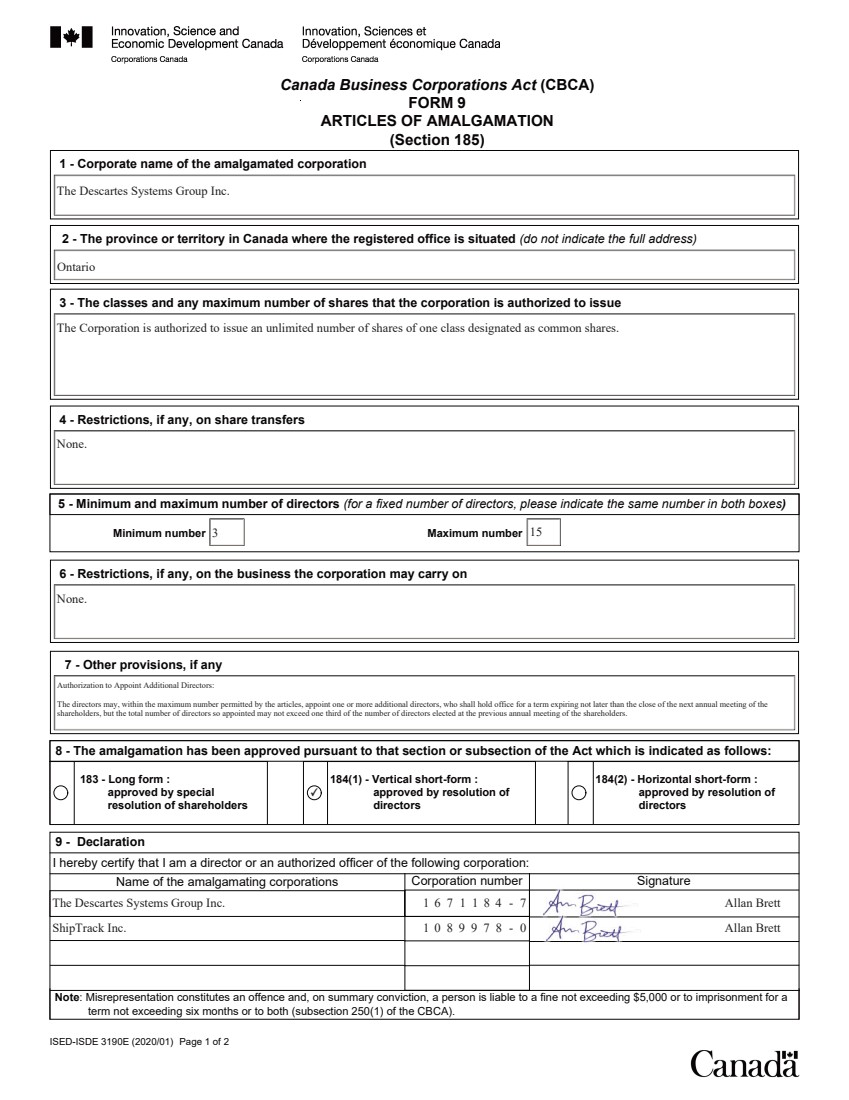
Certificate of Amalgamation Canada Business Corporations Act Loi canadienne sur les sociétés par actions Certificat de fusion The Descartes Systems Group Inc. 1765937-7 Corporate name / Dénomination sociale Corporation number / Numéro de société Hantz Prosper Date of Amalgamation (YYYY-MM-DD) Date de fusion (AAAA-MM-JJ) Director / Directeur 2026-02-01 JE CERTIFIE que la société susmentionnée est issue d'une fusion, en vertu de l'article 185 de la Loi canadienne sur les sociétés par actions, des sociétés dont les dénominations apparaissent dans les statuts de fusion ci-joints. I HEREBY CERTIFY that the above-named corporation resulted from an amalgamation, under section 185 of the Canada Business Corporations Act, of the corporations set out in the attached articles of amalgamation. |
|
/RQJIRUP DSSURYHGE\VSHFLDO UHVROXWLRQRIVKDUHKROGHUV 9HUWLFDOVKRUWIRUP DSSURYHGE\UHVROXWLRQRI GLUHFWRUV +RUL]RQWDOVKRUWIRUP DSSURYHGE\UHVROXWLRQRI GLUHFWRUV 1RWH0LVUHSUHVHQWDWLRQFRQVWLWXWHVDQRIIHQFHDQGRQVXPPDU\FRQYLFWLRQDSHUVRQLVOLDEOHWRDILQHQRWH[FHHGLQJRUWRLPSULVRQPHQWIRUD WHUPQRWH[FHHGLQJVL[PRQWKVRUWRERWKVXEVHFWLRQRIWKH&%&$ Canada Business Corporations Act &%&$ )250 $57,&/(62)$0$/*$0$7,21 6HFWLRQ &RUSRUDWHQDPHRIWKHDPDOJDPDWHGFRUSRUDWLRQ 7KHSURYLQFHRUWHUULWRU\LQ&DQDGDZKHUHWKHUHJLVWHUHGRIILFHLVVLWXDWHG(do not indicate the full address) 7KHFODVVHVDQGDQ\PD[LPXPQXPEHURIVKDUHVWKDWWKHFRUSRUDWLRQLVDXWKRUL]HGWRLVVXH 5HVWULFWLRQVLIDQ\RQVKDUHWUDQVIHUV 0LQLPXPDQGPD[LPXPQXPEHURIGLUHFWRUV (for a fixed number of directors, please indicate the same number in both boxes) 0LQLPXPQXPEHU 0D[LPXPQXPEHU 5HVWULFWLRQVLIDQ\RQWKHEXVLQHVVWKHFRUSRUDWLRQPD\FDUU\RQ 2WKHUSURYLVLRQVLIDQ\ ,6(',6'(( 7KHDPDOJDPDWLRQKDVEHHQDSSURYHGSXUVXDQWWRWKDWVHFWLRQRUVXEVHFWLRQRIWKH$FWZKLFKLVLQGLFDWHGDVIROORZV 1DPHRIWKHDPDOJDPDWLQJFRUSRUDWLRQV &RUSRUDWLRQQXPEHU 6LJQDWXUH 'HFODUDWLRQ ,KHUHE\FHUWLI\WKDW,DPDGLUHFWRURUDQDXWKRUL]HGRIILFHURIWKHIROORZLQJFRUSRUDWLRQ 3DJHRI The Descartes Systems Group Inc. Ontario The Corporation is authorized to issue an unlimited number of shares of one class designated as common shares. None. 3 15 None. Authorization to Appoint Additional Directors: The directors may, within the maximum number permitted by the articles, appoint one or more additional directors, who shall hold office for a term expiring not later than the close of the next annual meeting of the shareholders, but the total number of directors so appointed may not exceed one third of the number of directors elected at the previous annual meeting of the shareholders. ✔ The Descartes Systems Group Inc. 1 6 7 1 1 8 4 - 7 Allan Brett ShipTrack Inc. 1 0 8 9 9 7 8 - 0 Allan Brett |
|
Form 2 Formulaire 2 Siège social initial et premier conseil d’administration Loi canadienne sur les sociétés par actions (LCSA) (art. 19 et 106) Canada Business Corporations Act (CBCA) (s. 19 and 106) Initial Registered Office Address and First Board of Directors 4 Corporate name Dénomination sociale 1 2 3 The Descartes Systems Group Inc. 120 Randall Drive Waterloo ON N2V 1C6 Address of registered office Adresse du siège social Additional address Autre adresse Members of the board of directors Membres du conseil d’administration See attached schedule / Voir l’annexe ci-jointe Misrepresentation constitutes an offence and, on summary conviction, a person is liable to a fine not exceeding $5000 or to imprisonment for a term not exceeding six months or both (subsection 250(1) of the CBCA). Faire une fausse déclaration constitue une infraction et son auteur, sur déclaration de culpabilité par procédure sommaire, est passible d’une amende maximale de 5 000 $ et d’un emprisonnement maximal de six mois, ou l’une de ces peines (paragraphe 250(1) de la LCSA). You are providing information required by the CBCA. Note that both the CBCA and the Privacy Act allow this information to be disclosed to the public. It will be stored in personal information bank number IC/PPU-049. Vous fournissez des renseignements exigés par la LCSA. Il est à noter que la LCSA et la Loi sur les renseignements personnels permettent que de tels renseignements soient divulgués au public. Ils seront stockés dans la banque de renseignements personnels numéro IC/PPU-049. 519-746-6114 5 Declaration: I certify that I have relevant knowledge and that I am authorized to sign this form. Déclaration : J’atteste que je possède une connaissance suffisante et que je suis autorisé(e) à signer le présent formulaire. Original signed by / Original signé par J. Scott Pagan J. Scott Pagan IC 2904 (2008/04) |
|
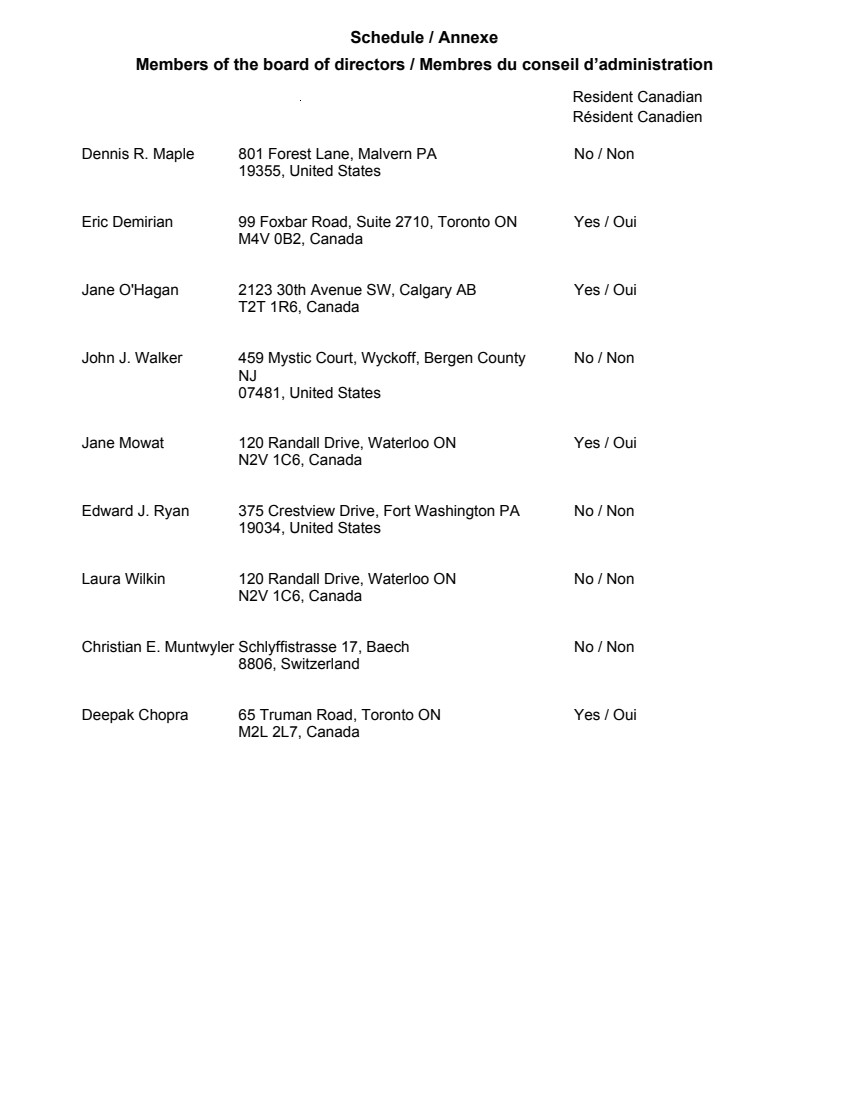
Schedule / Annexe Members of the board of directors / Membres du conseil d’administration Resident Canadian Résident Canadien Dennis R. Maple 801 Forest Lane, Malvern PA 19355, United States No / Non Eric Demirian 99 Foxbar Road, Suite 2710, Toronto ON M4V 0B2, Canada Yes / Oui Jane O'Hagan 2123 30th Avenue SW, Calgary AB T2T 1R6, Canada Yes / Oui John J. Walker 459 Mystic Court, Wyckoff, Bergen County NJ 07481, United States No / Non Jane Mowat 120 Randall Drive, Waterloo ON N2V 1C6, Canada Yes / Oui Edward J. Ryan 375 Crestview Drive, Fort Washington PA 19034, United States No / Non Laura Wilkin 120 Randall Drive, Waterloo ON N2V 1C6, Canada No / Non Christian E. Muntwyler Schlyffistrasse 17, Baech 8806, Switzerland No / Non Deepak Chopra 65 Truman Road, Toronto ON M2L 2L7, Canada Yes / Oui |
Exhibit 99.1


The Descartes Systems Group Inc.
Annual Information Form
MARCH 11, 2026
3 |
||
|
|
|
5 |
||
5 |
||
5 |
||
|
|
|
5 |
||
5 |
||
7 |
||
9 |
||
|
|
|
13 |
||
13 |
||
13 |
||
24 |
||
25 |
||
25 |
||
26 |
||
27 |
||
28 |
||
29 |
||
29 |
||
Risks Associated with Foreign Sales and Exchange Rate Fluctuations |
29 |
|
Risks Associated with Cyclical or Seasonal Aspects of Business |
30 |
|
30 |
||
30 |
||
31 |
||
|
|
|
31 |
||
|
|
|
31 |
||
31 |
||
31 |
||
31 |
||
32 |
||
32 |
||
|
|
|
33 |
||
33 |
||
38 |
||
|
|
|
40 |
||
|
|
|
41 |
||
|
|
|
41 |
||
|
|
|
42 |
||
|
|
|
51 |
||
2
Information contained herein is provided as at January 31, 2026 and is in United States (“US”) dollars, unless otherwise indicated.
Our Annual Information Form (“AIF”) contains references to The Descartes Systems Group Inc. using the words “Descartes,” “we,” “us,” “our” and similar words and the reader is referred to using the words “you,” “your” and similar words.
This AIF also refers to our fiscal years. Our fiscal year commences on February 1st of each year and ends on January 31st of the following year. Our fiscal year that ended on January 31, 2026 is referred to as “fiscal 2026”, “2026” or using similar words. Our fiscal year that ended on January 31, 2025 is referred to as “fiscal 2025”, “2025” or using similar words. Other fiscal periods are referenced by the applicable year during which the fiscal period ends. For example, 2026 refers to the annual period ending January 31, 2026 and the “fourth quarter of 2026” refers to the quarter ended January 31, 2026.
You should read the AIF in conjunction with our audited consolidated financial statements for 2026 and the management’s discussion and analysis thereon (“MD&A”). We prepare and file our consolidated financial statements and MD&A in US dollars and in accordance with US generally accepted accounting principles (“GAAP”).
We have prepared the AIF with reference to Form 51-102F2, which sets out the AIF disclosure requirements and which was established under National Instrument 51-102 “Continuous Disclosure Obligations” of the Canadian Securities Administrators.
Additional information about us, including copies of our continuous disclosure materials such as our MD&A, is available on our website at http://www.descartes.com, through the EDGAR website at http://www.sec.gov or through the SEDAR+ website at http://www.sedarplus.com.
Certain statements made in this Annual Information Form, constitute forward-looking information for the purposes of applicable securities laws (“forward-looking statements”), including, but not limited to: statements in the “Trends / Business Outlook” section and statements regarding our expectations concerning future revenues and earnings, including potential variances from period to period; our assessment of the potential impact of geopolitical events, such as the conflict between Iran, Israel and US (the “Iran Conflict”), the ongoing conflict between Russia and Ukraine (the “Russia-Ukraine Conflict”), or other potentially catastrophic events; our assessment of the potential impact of tariffs, sanctions and other actions by individual countries on global trade and our business; results of operations and financial condition; our expectations regarding the cyclical nature of our business; mix of revenues and potential variances from period to period; our plans to focus on generating services revenues yet to continue to allow customers to elect to license technology in lieu of subscribing to services; our expectations on losses of revenues and customers; our baseline calibration; our ability to keep our operating expenses at a level below our baseline revenues; our future business plans and business planning process; allocation of purchase price for completed acquisitions; our expectations regarding future restructuring charges and cost-reduction activities; expenses, including amortization of intangible assets and stock-based compensation; goodwill impairment tests and the possibility of future impairment adjustments; capital expenditures; acquisition-related costs, including the potential for further performance-based contingent consideration; our liability with respect to various claims and suits arising in the ordinary course; our intention to actively explore future business combinations and other strategic transactions; our liability under indemnification obligations; our reinvestment of earnings of subsidiaries back into such subsidiaries; our dividend policy; the sufficiency of capital to meet working capital, capital expenditure, debt repayment requirements and our anticipated growth strategy; our ability to raise capital; our adoption of certain accounting standards; and other matters related to the foregoing. When used in this document, the words “believe,” “plan,”
3
“expect,” “anticipate,” “intend,” “continue,” “may,” “will,” “should” or the negative of such terms and similar expressions are intended to identify forward-looking statements. These forward-looking statements are subject to risks and uncertainties and are based on assumptions that may cause future results to differ materially from those expected. The material assumptions made in making these forward-looking statements include the following: Descartes’ ability to successfully identify and execute on acquisitions and to integrate acquired businesses and assets, and to predict expenses associated with and revenues from acquisitions; the impact of network failures, information security breaches or other cyber-security threats; disruptions in the movement of freight and a decline in shipment volumes including as a result of the impact of current and future trade barriers, including tariffs, further protectionistic measures and reactive countermeasures, the Iran Conflict and the Russia-Ukraine Conflict, or contagious illness outbreaks, a deterioration of general economic conditions or instability in the financial markets accompanied by a decrease in spending by our customers; global shipment volumes continuing to increase at levels consistent with the average growth rates of the global economy; countries continuing to implement and enforce existing and additional customs and security regulations relating to the provision of electronic information for imports and exports; countries continuing to implement and enforce existing and additional trade restrictions and sanctioned party lists with respect to doing business with certain countries, organizations, entities and individuals; our continued operation of a secure and reliable business network; the continued availability of the data and content that is utilized in the delivery of services made available over our network; relative stability of currency exchange rates and interest rates; equity and debt markets continuing to provide us with access to capital; our ability to develop solutions that keep pace with the continuing changes in technology, including artificial intelligence (“AI”); and our continued compliance with third-party intellectual property rights. While management believes these assumptions to be reasonable under the circumstances, they may prove to be inaccurate. Such forward-looking statements also involve known and unknown risks, uncertainties and other factors that may cause our actual results, performance or achievements of, or developments in our business or industry, to differ materially from the anticipated results, performance or achievements or developments expressed or implied by such forward-looking statements. Such factors include, but are not limited to, the factors discussed under the heading “Certain Factors That May Affect Future Results” in this MD&A and in other documents filed with the Securities and Exchange Commission, the Ontario Securities Commission and other securities regulatory authorities across Canada from time to time. If any of such risks actually occur, they could materially adversely affect our business, financial condition or results of operations. In that case, the trading price of our common shares could decline, perhaps materially. Readers are cautioned not to place undue reliance upon any such forward-looking statements, which speak only as of the date made. Forward-looking statements are provided for the purpose of providing information about management’s current expectations and plans relating to the future. Readers are cautioned that such information may not be appropriate for other purposes. Except as required by applicable law, we do not undertake or accept any obligation or undertaking to release publicly any updates or revisions to any forward-looking statements to reflect any change in our expectations or any change in events, conditions, assumptions or circumstances on which any such statements are based.
4
Descartes was continued under the Canada Business Corporations Act on July 5, 2006. On July 31, 2006, Descartes was amalgamated under the Canada Business Corporations Act pursuant to an amalgamation between Descartes and ViaSafe Inc. On February 1, 2010, Descartes was amalgamated under the Canada Business Corporations Act pursuant to an amalgamation between Descartes and Scancode Systems Inc. (“Scancode”). On February 1, 2010, Descartes was amalgamated under the Canada Business Corporations Act pursuant to an amalgamation between Descartes and 7322267 Canada Inc. On February 1, 2012, Descartes was amalgamated under the Canada Business Corporations Act pursuant to an amalgamation between Descartes and 882976 Ontario Inc. On March 31, 2021, Descartes was amalgamated under the Canada Business Corporations Act pursuant to an amalgamation between Descartes and PinPoint GPS Solutions Inc. On February 1, 2023, Descartes was amalgamated under the Canada Business Corporations Act pursuant to an amalgamation between Descartes and Descartes Visual Compliance Inc. On February 1, 2025, Descartes was amalgamated under the Canada Business Corporations Act pursuant to an amalgamation between Descartes and OCR International Ltd. On February 1, 2026, Descartes was amalgamated under the Canada Business Corporations Act pursuant to an amalgamation between Descartes and ShipTrack Inc.
The Descartes Systems Group Inc. head office and registered office is located at 120 Randall Drive, Waterloo, Ontario, N2V 1C6 and our general corporate phone number is (519) 746-8110.
2.2Intercorporate Relationships
We beneficially own, control and/or direct 100% of all voting, share, or membership interests in our material subsidiaries. Our material subsidiaries, determined as of January 31, 2026, are as follows:
| ● | 12268761 Canada Inc., a Canada subsidiary; |
| ● | Aerospace Software Developments Limited, an Ireland subsidiary; |
| ● | Descartes GroundCloud, Inc., a Florida subsidiary; |
| ● | Descartes Systems (Sweden) AB, a Sweden subsidiary; |
| ● | Descartes Systems UK Limited, a United Kingdom (the “UK”) subsidiary; |
| ● | Descartes Systems (USA) LLC, a Delaware subsidiary; |
| ● | Descartes Visual Compliance (USA) LLC, a Delaware subsidiary; |
| ● | MacroPoint, LLC, an Ohio subsidiary; |
| ● | OCR Services Inc., a Maryland subsidiary; |
| ● | Sellercloud LLC, a Delaware subsidiary; and |
| ● | SEP 3GTMS Topco, Inc., a Delaware subsidiary. |
ITEM 3GENERAL DEVELOPMENT OF THE BUSINESS
We use technology and networks to simplify complex business processes. We are primarily focused on logistics and supply chain management business processes. Our solutions are focused on improving the productivity, security, and sustainability of logistics-intensive businesses. Customers use our modular, technology solutions to route, track and help improve the safety, performance and compliance of delivery resources; plan, allocate and execute shipments; rate, audit and pay transportation invoices; access and analyze global trade data; research and perform trade tariff and duty calculations; file customs and security documents for imports and exports; and complete numerous other logistics processes by participating in a large, collaborative multi-modal logistics community. Our pricing model provides our customers with flexibility in purchasing our solutions either on a subscription, transactional, or perpetual license basis. Our primary focus is on serving transportation providers (air, ocean and truck modes), logistics service providers (including third-party logistics providers, freight forwarders and customs brokers) and distribution-intensive companies (including retailers, manufacturers, distributors, and mobile business service providers) for which logistics is either a key or a defining part of their own product or service offering, or for which our solutions can provide an opportunity to reduce costs, improve service levels, or support growth by optimizing the use of assets and information
5
The Market
Logistics is the management of the flow of resources between a point of origin and a point of destination. Supply chain management is broader than logistics and includes the sourcing, inventory management, procurement, conversion and storage of resources for consumption by an enterprise. Logistics and supply chain management have been evolving as companies are increasingly seeking automation and real-time control of their supply chain activities. Unlike other business challenges, managing supply chain and logistics operations relies on the secure exchange and management of information with parties outside of your party’s enterprise – such as suppliers, customers, partners, governments, and logistics providers. We believe companies are looking for integrated inter-enterprise solutions for managing inventory in transit, conveyance units, people, data, and business documents.
We believe logistics-intensive organizations are seeking to reduce operating costs, differentiate themselves, improve margins, and better serve customers. Global trade and transportation processes are often manual and complex to manage. This is a consequence of the growing number of business partners participating in companies’ global supply chains and a lack of standardized business processes.
Additionally, global sourcing, logistics outsourcing, imposition of additional customs and regulatory requirements and changes in day-to-day business requirements are adding to the overall complexities that companies face in planning and executing in their supply chains. Whether a shipment is delayed at the border, a customer changes an order, sanctions or tariff changes impact sourcing and selling, or a breakdown occurs on the road or shipping lanes are unusually congested, there are increasingly more issues that can significantly impact the execution of fulfillment schedules and associated costs.
The rise of ecommerce has heightened these challenges for many suppliers with end-customers increasingly demanding narrower order-to-fulfillment periods, lower prices and greater flexibility in scheduling and rescheduling deliveries. End-customers also want real-time updates on delivery status, adding considerable burden to supply chain management as process efficiency is balanced with affordable service.
In this market, the secure movement and sharing of data between parties involved in the logistics process is equally important to the physical movement of goods. Manual, fragmented, and distributed logistics solutions are often proving inadequate to address the needs of operators. Connecting manufacturers and suppliers to logistics providers and carriers on an individual, one-off basis is too costly, complex and risky for organizations dealing with many trading partners. Further, many of these solutions do not provide the flexibility required to efficiently accommodate varied processes for organizations to remain competitive. We believe this presents an opportunity for logistics technology providers to unite this highly fragmented community and help customers improve their operations.
As the market continues to change, we’ve been evolving to meet our customers’ needs. While the rate of adoption of newer logistics and supply chain management technologies is increasing, a large number of organizations still have manual business processes and older business systems that need integration and extension for supply chain and logistics functions. We’ve been educating our prospects and customers on the value of connecting to trading partners through our Global Logistics Network (“GLN”) and automating, as well as standardizing, multi-party business processes. We believe that our target customers are increasingly looking for a single source, neutral, network-based solution provider who can help them manage the end-to-end shipment – from researching global trade information, to the management of inventory and warehouses, to the booking of a shipment, to the tracking of that shipment as it moves, to the regulatory compliance filings to be made during the move and, finally, to the settlement and audit of the invoice.
6
Additionally, regulatory initiatives mandating electronic filing of shipment information with customs authorities require companies to automate aspects of their shipping processes to remain compliant and competitive. Our customs compliance technology helps shippers, transportation providers, freight forwarders and other logistics intermediaries to securely and electronically file shipment and tariff/duty information with customs authorities and self-audit their own efforts. Our technology also helps carriers and freight forwarders efficiently coordinate with customs brokers and agencies to expedite cross-border shipments. Compliance is a global issue with many international shipments crossing several borders on the way to their final destinations.
Increasingly, data and content have become central to supply chain planning and execution. Complex international supply chains are affected by logistics service provider performance, capacity, and productivity, as well as regulatory frameworks such as free trade agreements. We believe our Global Trade Data, Trade Regulations, Free-Trade Agreement, and tariff/duty rate and calculation solutions help give our customers the intelligence they need to improve their sourcing, landed cost, and transportation lane and provider selection processes.
3.2History and General Development
Our origins were in providing logistics-focused software designed to optimally plan and manage routes for direct delivery and retail customers with private fleets. Supply chain management has evolved as companies across industry verticals have increasingly sought real-time control over their supply chain. We have established a network-based business model and are consolidating technology to provide our customers with a shared-services environment that assists our customers in gathering and exchanging source data for logistics. We have also designed value-added services that enable shippers, transportation companies and logistics intermediaries to use that information to make better business decisions and deliver better service to their own customers.
Key developments in our business over the last three fiscal years and current fiscal year to date, described beginning with the most recent, are as follows:
Fiscal 2026 and Part of Fiscal 2027 through to March 11th, 2026
Global trade conditions in fiscal 2026 remained affected by several socio-political factors. Ongoing instability in the Middle East, including the Red Sea crisis involving Houthi attacks on shipping, led to the diversion of vessels away from the Suez Canal and significantly increased transit times and freight costs, contributing to broader supply chain volatility. Shipping disruptions and elevated risk persisted through 2025 and into 2026. As we moved into fiscal 2027 geopolitical tensions in Eastern Europe and tariff-driven trade policy shifts by the United States continued to reshape global shipping routes, increase compliance costs, and heighten uncertainty for importers and logistics providers. In March 2026, the US and Israel commenced military activity in Iran. As a consequence, the Strait of Hormuz has had a dramatic decline in shipping and fuel prices have begun to rise. These conditions collectively contributed to higher freight rates, longer transit times, and increased operational complexity across the logistics sector, which may influence our customers’ shipment volumes and technology investment priorities
On March 11, 2026, Descartes acquired all of the shares of Utordo Ltd., doing business as OrderMine (“OrderMine”), a UK-based provider of AI-powered forecasting and demand planning solutions designed to support ecommerce businesses across their growth lifecycle. The purchase price for the acquisition was approximately $2.3 million (GBP 1.8 million), which was funded from cash on hand, plus potential performance-based contingent consideration of up to $1.0 million (GBP 0.8 million) based on OrderMine achieving revenue-based targets over the first two years post-acquisition.
On March 24, 2025, we acquired all of the shares of SEP 3GTMS Topco, Inc. and its subsidiaries (collectively called “3GTMS”), a transportation management solution provider. The purchase price was approximately $112.7 million, net of cash acquired, and was funded from cash on hand.
7
On June 4, 2025, we announced that William Green had been appointed as Descartes’ Executive Vice President, Global Sales, in accordance with our leadership succession plan. We also announced that Andrew Roszko, Chief Commercial Officer, departed the company in the second quarter of fiscal 2026 to pursue another opportunity.
On August 1, 2025, we acquired all of the shares of Finale, Inc. (“Finale”), a U.S.-based provider of cloud‑based inventory management solutions for ecommerce businesses. The purchase price was approximately $39.2 million, net of cash acquired, and was funded from cash on hand, plus potential performance‑based contingent consideration of up to $15.0 million based on revenue‑based targets over the two years following the acquisition. On June 18, 2025, we acquired all of the shares of PackageRoute Holdco, Inc. (“PackageRoute”), a provider of final‑mile carrier solutions. The purchase price was approximately $1.9 million, net of cash acquired, and was funded from cash on hand.
On December 3, 2025, we announced a normal course issuer bid (“NCIB”), commencing December 11, 2025, to purchase up to approximately 8.6 million common shares in the open market for cancellation. Under the NCIB, we are permitted to repurchase for cancellation, at our discretion on or before December 10, 2026, up to 10% of the “public float” (calculated in accordance with the rules of the Toronto Stock Exchange (“TSX”)) of our issued and outstanding common shares.
On December 3, 2025, Descartes announced that Edward Gardner would succeed Allan Brett as Descartes’ Chief Financial Officer following the filing of Descartes’ financial statements for its fiscal year ending January 31, 2026. Mr. Brett will continue his employment with Descartes thereafter in a senior advisory role to the executive team as he begins a move towards retirement.
On April 2, 2025, the US government declared “Liberation Day,” a move that resulted in the imposition of significant tariffs on most global trading partners. After Liberation Day, the US government announced a series of exemptions to certain tariffs while continuing to maintain others. However, on February 20, 2026, the United States Supreme Court struck down the Liberation Day tariffs in a 6–3 decision in Learning Resources, Inc. v. Trump, holding that the International Emergency Economic Powers Act (“IEEPA”) did not authorize the President to impose such broad tariff measures. This ruling on executive trade authority and has immediate implications for companies engaged in international trade, particularly where tariff planning, refund eligibility, and supply chain structuring rely on IEEPA based actions.
As of the date of this AIF, the resulting policy shift continues to introduce uncertainty for companies involved in crossborder logistics and global trade. Businesses must reassess compliance obligations, tariff exposure, and potential refund pathways, while adapting to the evolving landscape created by shifting authorities and the administration’s stated intent to pivot to alternative statutory mechanisms for imposing tariffs. Our business includes several trade and compliance related solutions designed to support organizations navigating this environment.
Fiscal 2025
On October 11, 2024, we acquired all of the shares of Sellercloud LLC (“Sellercloud”), a leading provider of omnichannel ecommerce solutions. The purchase price was approximately $110.2 million, which was funded from cash on hand, plus potential performance-based consideration of up to $20 million based on the combined business achieving revenue-based targets in each of the first two years post-acquisition.
On September 17, 2024, we acquired all of the shares of Assure Assist, Inc., doing business as MyCarrierPortal (“MCP”), a leading provider of carrier onboarding and risk monitoring solutions for the trucking industry. The purchase price was approximately $22.5 million, which was funded from cash on hand, plus potential performance-based consideration of up to $6.0 million based on MCP achieving revenue-based targets over the first two years post-acquisition.
8
On July 15, 2024, pursuant to “well-known seasoned issuer” blanket orders of the Canadian Securities Administrators, we filed a final short-form base shelf prospectus, allowing us to offer and issue the following securities: (i) common shares; (ii) preferred shares; (iii) senior or subordinated unsecured debt securities; (iv) subscription receipts; (v) warrants; and (vi) securities comprised of more than one of the common shares, preferred shares, debt securities, subscription receipts and/ or warrants offered together as a unit. These securities may be offered separately or together, in separate series, in amounts, at prices and on terms to be set forth in one or more shelf prospectus supplements during the 25-month period that the base shelf prospectus, including any amendments thereto, remains valid.
On June 10, 2024, we acquired all of the shares of BoxTop Technologies (“BoxTop”), a leading provider of shipment management solutions for small- to mid-sized logistics services providers. The purchase price was approximately £9.5 million, which was funded from cash on hand.
On April 19, 2024, we acquired all of the shares of Aerospace Software Developments Ltd. (“ASD”), a leading provider of customs and regulatory compliance solutions. The purchase price was approximately €58.7 million, which was funded from cash on hand.
On March 28, 2024, we acquired all of the shares of OCR Services, Inc. (“OCR”), a leading provider of global trade compliance solutions and content. The purchase price was approximately $82.8 million, net of cash acquired, which was funded from cash on hand.
Fiscal 2024
In October 2023, a conflict between Hamas and Israel erupted into a full-scale war contributing to a protracted and complex situation in the Middle East. As of the date of this AIF, the ongoing hostilities have led to significant disruptions in normal life and business activities in the region, with far-reaching impacts on the global stage. The volatility has also led to heightened security concerns and increased operational costs for companies engaged in international trade and transportation, given the strategic importance of the region’s maritime routes and its proximity to significant oil-producing nations. Companies operating within or in connection with the Middle East must find a way to address this complicated environment in order to move goods and services and our business includes several shipping-related solutions to assist such companies to navigate this situation.
On April 20, 2023, we acquired substantially all of the assets of Localz Pty Ltd. (and its affiliates) (“Localz”), a technology platform to help engage with customers on the day they are having goods or services delivered. The purchase price for the acquisition was approximately $5.9 million, which was funded from cash on hand.
On February 14, 2023, we acquired all of the shares of Windigo Logistics, Inc., doing business as GroundCloud (“GroundCloud”), a cloud-based provider of final-mile carrier solutions and road safety compliance tools. The purchase price was approximately $136.8 million, net of cash acquired, which was funded from cash on hand, plus potential performance-based consideration of up to $80.0 million based on GroundCloud achieving revenue-based targets over the first two years post-acquisition.
Please see our discussion elsewhere in this document regarding the Iran Conflict, the Russia‑Ukraine conflict, the Israel‑Hamas Conflict, ongoing U.S.–China tensions, and continued uncertainty surrounding tariffs and trade agreements, including the potential impact of these factors on both the short‑term and longer‑term prospects of our business and industry.
Industry consolidation, rapid technological change, and frequent new product introductions and enhancements continue to characterize the software, content and network services industries—particularly for logistics management technology companies. Organizations are increasingly demanding greater levels of functionality, more sophisticated product offerings and broader access to industry‑specific data from their software and services providers.
9
Accordingly, we expect that our future success will depend on our ability to enhance existing products and to develop and introduce new solutions that deliver improved performance and expanded functionality at competitive prices. In particular, we believe customers are seeking end‑to‑end solutions that combine a multi‑modal, multi‑process network with business document exchange, wireless mobile resource management, global trade compliance, and collaborative supply chain execution applications. These applications include freight bookings, contract and rate management, content solutions for trade research and tariff classification, sanctioned party screening, customs filings and electronic shipment manifests, transportation management, real‑time shipment visibility, routing and scheduling, purchase‑order‑to‑dock‑door processes, ecommerce fulfillment, warehouse management, and inventory visibility. Customers are also increasingly seeking “big data” content, advanced insight, and AI‑enabled tools, including human‑supervised automations and AI agents to analyze logistics trends and support decision‑making with greater speed and accuracy.
We believe there continues to be strong acceptance of subscription‑based pricing and cloud‑based business models in the markets we serve, as these models provide lower up‑front costs and offer easier‑to‑maintain alternatives compared to traditional perpetual license arrangements.
TRENDS IN GLOBAL TRADE
The impact of the Iran Conflict, the Russia‑Ukraine conflict, broader geopolitical and trade tensions, tariff measures between major economies, and regional conflicts disrupting key ocean trade routes continues to create uncertainty in global trade. According to UNCTAD, global economic and trade growth is expected to remain subdued through 2025 and 2026, with global GDP projected to grow at only 2.6%, reflecting a challenging external environment for both developed and developing economies. While demand for consumer goods has supported elevated trade and shipping volumes in recent years, it remains unclear whether continuing geopolitical pressures, transportation capacity constraints, inflationary pressures, port congestion, resource shortages, and reshoring/nearshoring initiatives will dampen future growth.
A continuing global trend is the expanding counter‑terrorism and cargo security role of customs authorities, driven by increased automation and the implementation of advanced fiscal compliance controls. The World Customs Organization’s SAFE Framework continues to guide customs modernization initiatives worldwide. Jurisdictions including the United States, Canada, the European Union (the “EU”), the UK, Japan, Sweden, Norway, Denmark, and Mexico have advanced multi‑year programs requiring electronic submission and management of customs declarations, security filings, and related trade and transport data. These evolving mandates increase compliance duties for importers, exporters, and their logistics partners.
Descartes’ customs and regulatory compliance solutions connect importers, exporters, logistics providers, and government agencies to support efficient data transmission, cargo security screening, and customs declaration processing across these increasingly complex regulatory regimes. Our business may be affected as domestic and international trade regulations are introduced, modified, or repealed.
Following the February 2022 invasion of Ukraine, numerous countries—including the EU, Canada, the United States, the UK, Japan, Australia, Switzerland, and New Zealand—imposed substantial sanctions on Russia and affiliated entities. These measures expand earlier sanctions dating back to 2014 and include new additions to watchlists, enhanced export controls targeting high‑tech goods, and further restrictions on the Russian financial system. Additional primary or secondary sanctions remain possible if the conflict persists.
With global sanctions policies evolving rapidly and receiving heightened public and regulatory scrutiny, businesses increasingly require effective screening tools to comply with denied‑ and restricted‑party regulations. Failure to comply may result in severe penalties, loss of trade privileges, reputational harm, and public scrutiny. Descartes’ denied‑party screening solutions help organizations manage these obligations as regulatory expectations expand.
10
Another key trend, further intensified by geopolitical tensions, is the growing need for organizations to better manage supply chain sourcing risks, export restrictions, product flows, competitor activity, and new market opportunities through global trade intelligence tools. As regulations become more complex across markets, importers, exporters, and logistics providers are increasingly using global trade intelligence solutions to minimize duty exposure, evaluate sourcing alternatives, and improve compliance with harmonized tariff classifications, export controls, and special trade program requirements.
The UK’s departure from the EU continues to influence trade compliance requirements. While the UK‑EU trade agreement addresses certain tariff and non‑tariff barriers, shipments between the regions still require import and export filings. The UK’s shift toward new digital platforms for customs, its staged introduction of controls, and the implementation of new security filings since July 2022 have increased filing requirements for cross‑border movements. Regulatory changes in these areas may impact our customs filing activity in the UK.
The United States has imposed escalating sanctions on China related to human rights concerns and national security. Under the Uyghur Human Rights Policy Act, the Uyghur Forced Labor Prevention Act, and subsequent measures, the U.S. has imposed restrictions on hundreds of Chinese entities. Export controls have also expanded significantly since 2022, targeting semiconductors, AI technologies, and advanced manufacturing equipment. China has responded with countermeasures, including restrictions on exports of critical minerals such as gallium, germanium, and antimony—key inputs for semiconductor and defense technologies. These developments have contributed to “China‑plus‑one” strategies and increased supply chain complexity for global manufacturers. More broadly, national customs systems continue to modernize, with many countries expanding the scope of data and documentation required for successful import and export operations.
Tariffs and retaliatory tariffs remain a major and evolving feature of global trade. UNCTAD reports that protectionism and rising tariff barriers are contributing to greater policy uncertainty, and global value chains are being reshaped as countries reevaluate trade and investment partnerships. Tariffs can increase landed costs, alter sourcing decisions, shift manufacturing patterns, and contribute to inflationary pressures if costs are passed to consumers. Frequent tariff changes have increased the need for detailed and dynamic compliance management—including classification, duty calculation, and eligibility tracking under shifting trade programs. As governments continue to use tariffs as tools of economic and foreign policy, we expect ongoing volatility in trade flows, changes to shipping routes, and increasing compliance requirements, all of which may affect our customers’ operations and drive continued demand for our solutions
Trends in Artificial Intelligence
Rapid advances in artificial intelligence, the emergence of agentic solutions, and the accelerating adoption of cloud-based platforms continue to reshape logistics and supply chain technology and business processes. Organizations are increasingly seeking AI-enabled capabilities that improve decision-making, reduce cycle times, and enhance resiliency across multi-party, multi-modal operations. As AI platforms mature and become more accessible, we believe there is a growing expectation that logistics management solutions will incorporate embedded intelligence, domain-specific automation, and continuous optimization driven by shared supply chain data.
At the same time, the proliferation of AI and AI Agents is influencing a broad range of supply chain activities, including manual and repetitive processes such as data entry, document data extraction, exception management, customer service interactions, planning and forecasting, and operational analytics. Agentic solutions, when deployed with appropriate governance and human oversight, can orchestrate workflows across systems and trading partners to accelerate time-to-value and improve service levels. However, these developments also introduce disruption risks, including faster shifts in customer expectations, shorter product cycles, increased competitive pressure from new market entrants, and heightened requirements related to data quality, security, and regulatory compliance.
11
Accordingly, we believe that success in this environment will depend upon the ability to deliver unique data that can be used to train and validate models, trusted, auditable AI capabilities—balancing automation with control—while continuing to enhance performance, functionality, and interoperability across the connected logistics ecosystem.
TRENDS IN TRANSPORTATION MANAGEMENT AND SUPPLY CHAIN VISIBILITY
Transportation management and visibility have evolved significantly in recent years, driven by the need for agility and capacity in an increasingly complex supply chain landscape. Companies are now working across a diverse network of private fleets, carriers and brokers to optimize freight operations and to meet fluctuating demand and mitigate disruptions and operation issues. This multi-carrier/broker approach enhances flexibility, allowing businesses to respond to demand change, weather events, port disruptions, or securing appropriate capacity for seasonality.
The expanded reliance on carriers and brokers introduces challenges that require careful oversight. Vetting carriers is critical to ensure reliability and compliance with regulations, while thorough onboarding processes help establish trust—steps that reduce the risk of fraud, such as double-brokering, and load thefts. Real-time visibility has become a requirement, with tools like GPS tracking, IoT sensors, and electronic logging devices (“ELDs”) providing live updates on shipment status, from pickup to delivery. Proof of delivery, often digitized via e-signatures or photos, ensures accountability and resolves disputes swiftly. On-boarding technology to verify the carriers being used to move loads are legitimate businesses in good standing has become essential.
GENERAL TRENDS
Our business may be impacted from time to time by the general cyclical and seasonal nature of particular modes of transportation and the freight market in general, as well as the cyclical and seasonal nature of the industries that such markets serve. Factors which may create cyclical fluctuations in such modes of transportation or the freight market in general include ongoing developments in and changes to legal and regulatory requirements related to both international and domestic trade, timing of contract renewals between our customers and their own customers, seasonal-based tariffs, vacation periods applicable to particular shipping or receiving nations, weather-related, natural disasters or global health-pandemic events that impact shipping or key trade lanes in particular geographies and amendments to international trade agreements. Since some of our revenues from particular products and services are tied to the volume of shipments being processed, adverse fluctuations in the volume of global shipments based on the business cycle, conflicts, trade disputes, or tariff-induced changes or other shipment pattern changes in any particular mode of transportation may adversely affect our revenues. Declines in shipment volumes in the US or internationally likely would have a material adverse effect on our business.
Descartes’ expanding global trade intelligence offering unites systems and people with trade information to enable organizations to work smarter by making more informed supply chain and logistics decisions. Our content solutions can help customers: research and analyze global trade movements, regulations and trends; reduce the risk of transacting in controlled goods or with denied parties; increase trade compliance rates; optimize sourcing, procurement, and business development strategies; and minimize duty spend.
Descartes’ GLN community members enjoy extended command of operations and accelerated time-to-value relative to many alternative logistics solutions. Given the inter-enterprise nature of logistics, quickly gaining access to partners is paramount. For this reason, Descartes has focused on growing a community that strategically attracts and retains relevant logistics parties. Upon joining the GLN community, many companies find that a number of their trading partners are already members, with an existing connection to the GLN. This helps to minimize the time required to integrate Descartes’ logistics management applications and to begin realizing results. Descartes is committed to continuing to expand community membership. Companies that join the GLN community or extend their participation find a single place where their entire logistics network can exist regardless of the range of transportation modes, the number of trading partners or the variety of regulatory agencies.
12
ITEM 4NARRATIVE DESCRIPTION OF THE BUSINESS
Descartes powers more responsive, efficient, secure and sustainable international and domestic supply chains by uniting logistics-intensive businesses on our GLN. Shippers, carriers, and logistics service providers connect and collaborate on the GLN leveraging technology, data and AI to manage last mile deliveries, domestic and international shipments, transportation rating and payment, global trade research, customs compliance and a variety of regulatory processes.
Our pricing models provide our customers with flexibility in purchasing our solutions either on subscription, transactional or perpetual license basis. Our solutions help transportation providers (air, ocean, rail and truck modes), logistics service providers (including third-party logistics providers, freight forwarders and customs brokers) and logistics-intensive manufacturers, retailers, distributors and mobile service providers reduce costs, improve operational performance, save time, comply with regulatory requirements and enhance the service that they deliver to their own customers.
4.2Principal Products & Services
We believe that our customers prefer a technology provider that understands the unique requirements of logistics organizations and can provide a comprehensive set of solutions. Our customers are looking for collaborative solutions that help connect their enterprise to multiple trading partners, logistics services providers and carriers that work with them. Our GLN helps customers address those needs and provide a base for continuous innovation.
Descartes helps get inventory, information, assets and people where they are needed, when they are needed. We accomplish this by digitally combining the world’s most expansive logistics network, the industry’s broadest array of logistics management applications, the most comprehensive offering of global trade related intelligence, and field-proven AI innovation.
Network
The Descartes Global Logistics Network™ is our technology foundation and manages the real-time flow of commercial, logistics, customs and product information. It spans more than 160 countries and connects hundreds of thousands of organizations in logistics and transportation, manufacturing, distribution, retail, government, ecommerce and business services.
Intelligence
Descartes’ global trade intelligence solutions: offer comprehensive access to market leading data and tools to research, analyze and act on import/export movements, trade regulations and market trends; reduce the risk of transacting with denied or sanctioned parties; increase trade compliance rates; optimize sourcing, procurement, and business development strategies; and minimize duty spend.
Innovation
We are focused on transforming new ideas and feedback from our customers and in-house domain experts into real-world innovations. New developments in the areas of the internet-of-things, machine learning, AI and analytics are enhancing the ability of our solutions to solve problems and process more information in new and complex ways.
Applications
With the GLN as the foundation, we have been expanding our application functional footprint to offer a broad array of modular, interoperable logistics and supply chain management solutions.
We provide applications that help companies better manage their logistics book-to-bill process and purchase order-to-dock process, track inventory, meet regulatory requirements, optimize fleet performance, manage deliveries, and effectively communicate and collaborate with their logistics partners.
13
These applications can be principally categorized as: (i) Routing, Mobile & Telematics; (ii) Transportation Management; (iii) Ecommerce Shipping and Fulfillment (iv) B2B Connectivity & Messaging; (vi) Broker & Forwarder Enterprise Systems, and (vii) Global Trade Intelligence Solutions.
(i) |
Routing, Mobile & Telematics |
Descartes’ Routing, Mobile & Telematics suite supports the closed-loop process associated with planning, tracking, measuring, delegating and optimizing the use of assets and people that are involved in the movement of goods. These solutions can improve productivity and reduce fuel, vehicle, and labor costs. The suite helps address business challenges including the following: (1) strategic planning; (2) daily planning; (3) pickup/delivery reservations; (4) dispatch and vertical specific mobile solutions; (5) commercial fleet navigation; (6) reporting and measuring; (7) sales and merchandiser management; (8) telematics and compliance; and (9) machine learning.
(1) Strategic Planning: Descartes Sales & Territory Planner™ and Descartes Area Planner™
For strategic planning of recurring pickups or deliveries, Descartes Sales & Territory Planner performs complex service scheduling that simultaneously considers daily, weekly and multi-week deliveries, as well as holidays and other non-working days. It also evaluates geographic distribution and sales potential for each customer to help establish optimal territories and routes. Factors considered include minimizing travel time and related costs, and balancing opportunities across members of the sales team. Additional parameters such as stops, distance, and sales volume can also be used to help determine routes and route schedules for sales, delivery, or both.
For strategic planning of highly variable pickups and deliveries, Descartes Area Planner utilizes historical demand with algorithms to create models of demand density patterns. Those patterns are used to create territory and route plans. Descartes Area Planner takes into account service levels and delivery product types and is able to test the territory and route plan’s resilience to change. Descartes Area Planner is typically used to generate multiple plans to fit daily, seasonal or business cycle driven demand variability.
(2) Daily Planning: Descartes Route Planner™, Descartes Route Planner RS™, Descartes Route Planner On-demand™ and Winroute™
Descartes provides a number of daily planning solutions to address the range of customer requirements from the most complex to simple needs. Descartes Route PlannerTM takes in new orders as they are placed, optimizes them in real-time, allocating resources to help maximize operating efficiencies, deliver priority service to the most profitable accounts and routes, and maintain overall customer service objectives. Our other daily planning solutions optimize orders in groups, balancing service with costs and operational constraints. Our daily planning solutions are designed to integrate with existing order management or transportation planning systems and can help companies reduce costs as a result of shorter routes, reduce fuel consumption, and enhance fleet utilization. Descartes’ comprehensive offering addresses a broad range of operational environments that can vary across different industries.
(3) Pickup/Delivery Reservations: Descartes Reservations™
Descartes Reservations facilitates on-line scheduling of deliveries or service — either for self-service or as a decision support tool for customer service agents. It helps companies to effectively tailor service to the demands of key customers while helping to achieve internal profitability goals. Descartes Reservations also confirms that requests can be met and schedules in the appointment, making Descartes Reservations an effective capable-to-promise tool.
14
(4) Descartes Execution and Mobile Solutions: Descartes Route Planner Dispatch™, Descartes Route Planner OnDemand Dispatch™, Descartes MobileLink™, Descartes Food Perform™, Descartes ShipTrack™, Descartes GreenMile™, Descartes Customer Engagement™ and Descartes GroundCloud™
Descartes Execution solutions (Descartes Route Planner Dispatch and Route Planner OnDemand) manage routes in progress, tracking their performance, addressing route exceptions as they occur and capturing delivery and pickup status updates. Descartes Execution Solutions facilitate the assignment and execution of pre-planned and same-day pick-ups and deliveries. Descartes Mobile solutions (Descartes MobileLink™ and Descartes Food Perform™) provide integrated two-way wireless communication and supports active and passive monitoring capabilities for enhanced logistics execution. By combining route planning and a free flow of information between dispatchers and the field, Descartes Mobile solutions extend the traditional route planning process and provide real-time visibility into the execution of the plan. The combination of Descartes’ Daily Planning solutions with Descartes Execution and Descartes Mobile solutions form the core of plan versus actual performance evaluation and continuous logistics improvement.
Descartes ShipTrack provides cloud-based mobile resource management and shipment tracking solutions to help customers automate dispatch, updates on shipment status, and estimated time of arrival and eliminate paper-based delivery processes. This highly configurable and scalable platform is particularly well-suited for the ecommerce home delivery, parcel and medical courier markets, helping these companies efficiently manage final-mile deliveries.
Descartes GreenMile is a highly scalable mobile route execution suite that has been built with unique capabilities to serve the global distribution industry. The solution incorporates machine-learning to continually improve service and travel time standards. It helps food and beverage companies to digitize final-mile delivery processes, eliminate paper from the delivery process, increase efficiency, and improve customer satisfaction.
Descartes Customer Engagement (previously Localz™) combines real-time vehicle location tracking and mobile communications to deliver solutions that enhance the consumer delivery experience with advanced capabilities for end customers to directly schedule services and deliveries through an online portal and follow the progress of their order in real-time with customer-centric notifications. The platform also provides retailers with innovative and efficient “click-and-collect” capabilities that can improve the in-store collection process.
Descartes GroundCloud provides a cloud-based platform that enables final-mile contract carriers to receive customer delivery orders, plan and execute routes against those orders, train and monitor drivers, manage assets and resources, and analyze operating efficiency.
(6) Reporting and Measuring: Descartes Analytics™
Descartes Analytics helps companies create and distribute reports within an organization or to suppliers, vendors, sub-contractors or carriers. It provides a simple, secure way to create customized delivery statistics and metrics. It can help simplify the creation and management of supply chain scorecards and, as a byproduct, can help identify best practices.
(7) Sales and Merchandiser Management: Descartes Sales and Merchandiser Management™
Descartes Sales and Merchandiser Management enable resource planning, route building and optimization, and tracking across delivery operations and mobile workforces, including sales representatives, territory managers and merchandisers. Descartes Sales and Merchandiser Management facilitate weekly activity planning, delivery status visibility for merchandisers and sales representatives, actual distance driven, in-store time calculation and work data collection, and consolidated performance reporting. Performance data can be uploaded to corporate payroll and expense reporting systems to ensure appropriate payments are being made for resource performance.
15
Descartes Sales and Merchandiser Management help our customers improve sales and merchandising productivity, cut costs, and improve customer service.
(8) Telematics, Compliance and Safety: Descartes Telematics and Compliance™, Descartes Smartanalysis, Descartes SmartLicence™, and Descartes Driver Vehicle Inspection Reports™, and Descartes GroundCloud™
Descartes’ Telematics, Compliance and Safety solutions offer next generation mobile handheld and in-cab devices that can continuously monitor the performance of vehicles and drivers. Robust functionality for tracking vehicles, monitoring and scoring driving behavior and automation of driver logs and reporting on driver hours for “hours of service” regulatory compliance helps increase workforce productivity and safety, prevents “hours of service” violations and reduces or eliminates excess paperwork and processing times.
In Europe, Descartes’ Smartanalysis product is a leading tachograph analysis and compliance management solution. It is used by road transport operators of all sizes to meet legal obligations and comply with Europe’s complex driver working time regulations. Descartes SmartLicence is a comprehensive online tool for fleet operators in the UK for electronically managing driving licenses and verifying license details with the UK’s Driver and Vehicle Licensing Agency.
Descartes’ Driver Vehicle Inspection Reports is a configurable, cloud-based, enterprise-class solution for assuring compliance with routine driver vehicle safety checks required or recommended by the United States Federal Motor Carrier Safety Administration, Canadian Provincial Ministries of Transportation, and the UK Driver and Vehicle Standards Agency.
Descartes Ground Cloud safety solutions provide proactive and reactive training using a microlearning approach. Proactive training disseminates and tracks completion of training modules from a library of high-quality videos to keep drivers up to date and compliant. Reactive training solutions combine in-cab cameras and telematics to capture driving events, evaluate their severity, and provide relevant training to help prevent poor driver behavior in the future.
(9) Machine Learning: Descartes Machine Learning (previously Foxtrot™)
Descartes Machine Learning advanced algorithms leverage millions of data points collected from vehicles in the field, helping customers reduce last-mile costs, improve customer service and learn service factors that improve route efficiency and on-time performance. This technology complements existing route planning and execution solutions.
(ii) |
Transportation Management |
Descartes’ Transportation Management solutions provide robust, network-based, modular, end-to-end multimodal functionality that spans the entire shipment lifecycle. We streamline and support our customers’ ability to turn purchase or sales order fulfillment into transport orders, manage carrier contracts, optimize and execute transportation plans, execute cross-docked and pooled shipments, connect to trading partners, control the flow of prepaid freight, track shipments and inventory, audit freight and manage supplier/carrier performance. The suite of products addresses unique requirements across truck, air, ocean and parcel modes.
Descartes Transportation Manager™ & Descartes 3GTMS™
Descartes Transportation Manager and Descartes 3GTM are solutions that facilitates efficient planning and execution of shipping across modes at multiple touch-points in the distribution process. They help logistics managers, shippers and third parties simultaneously evaluate shipment alternatives to find efficient shipping methods. It is a solution that scales from the loading dock to the enterprise, providing up-to-date rates that allow the customer to both make efficient shipment decisions and comply with carrier communications, manifesting and labeling requirements.
16
Pick, pack and ship capability helps our customers manage small parcel shipments with postal services, a variety of small-package delivery carriers and over 150 less-than-truckload carriers. These solutions evaluate and optimize transportation purchases across modes for both operational effectiveness and cost efficiency, and helps answer tough questions such as: “How can I effectively use all of my carrier contracts?”; “Who is the most suitable carrier in this mode to handle my shipment?”; “What shipments can I combine to lower my costs?”; and, “What shipment consolidation should I use - aggregation, multi-stop routes or pooling to reduce costs while meeting service requirements?”.
Descartes Dock Appointment Scheduling™
Descartes Dock Appointment Scheduling is a collaborative solution that enables shippers, carriers and consignees to schedule dock door appointments. It streamlines the dock appointment process by distributing the responsibility for scheduling from the warehouse to carriers and suppliers. By ensuring all supply chain partners are involved in the process and have visibility into requested, scheduled and rescheduled dock orders and appointments, this solution is designed to optimize shipping and receiving operations at a warehouse.
Descartes Yard Management™
A module of Descartes Transportation Manager, Descartes Yard Management enables shipping and receiving staff, gate guards and yard jockeys to more effectively manage the movement of trailers and identify inventory in the yard. Designed to work seamlessly with Descartes Transportation Manager, Descartes Yard Management provides command and control of yards of all sizes.
Descartes Rate Builder™
Descartes Rate Builder is a solution that helps carriers and non-vessel owning common carriers (“NVOCCs”) manage global rates, contracts and rate agreements more efficiently and meet regulatory obligations. Descartes Rate Builder enables companies to create, revise, store and distribute rates via the Internet. Once they are generated, Descartes Rate Builder stores all rates in a central database with controlled access privileges. Carriers can designate a “contract owner” who can allow multiple users to contribute during the drafting of a new contract or amendment. NVOCCs can effectively manage a global rate network and help enable logistics service providers (“LSPs”) to create and manage both buy-side and sell-side rates digitally, enforce a standardized global pricing policy and implement a global rate request process. Descartes Rate Builder also supports the audit of ocean bills of lading.
Descartes Retail Distribution™
The Descartes Retail Distribution portfolio provides visibility, reduces cost and removes bottlenecks as a retailer’s products move from a shipper’s Distribution Center (“DC”), consolidation point, or DC bypass facility through third-party transportation provider networks and ultimately to its stores.
Descartes Global Price Management ™
Descartes’ Global Price Management helps logistics service providers streamline and automate complex global shipping rate management processes. It has robust capabilities to manage global shipment routing, pricing, rating and capacity allocation. The solution integrates with other enterprise systems that need fast, accurate, and complete shipping and pricing options, including CRM, transportation management, and customer-facing online booking platforms, such as Descartes Kontainers.
Descartes MacroPoint™
Descartes MacroPoint is a multimodal freight visibility platform for shippers, brokers and 3PLs to get real-time visibility and predictive analytics for in-transit freight.
17
Our industry-leading visibility network is connected to over 100,000 carriers and millions of assets and drivers through integrations with on-board ELDs, GPS telematics devices, carrier transportation management systems (“TMS”) and GPS-enabled smartphone applications.
Descartes MacroPoint™ for Capacity Matching
Descartes MacroPoint™ for Capacity Matching provides freight brokers with greater visibility to the transportation capacity available within their network of carriers and cooperating brokers. By accessing previously unused freight capacity using advanced visualization and analytical capabilities, freight brokers can cover more loads, build stronger carrier relationships and reduce costs.
Descartes Aljex™
The Descartes Aljex solution provides back-office transportation management for freight brokers and transportation providers. These solutions help customers automate business processes and create electronic documents critical for executing transportation moves. In addition, customers can manage the lifecycle of a shipment from order creation through execution, including real-time tracking with connectivity to the Descartes MacroPoint network.
Descartes BestTransport™
Descartes BestTransport is a cloud-based TMS tailored for flatbed-intensive manufacturers and distributors. It provides capabilities that address requirements from contract rate management through to load building, shipment execution, and freight payment for flatbed transportation moves.
Descartes MyCarrierPortal™
Descartes MyCarrierPortal is an onboarding platform for freight brokers and shippers that gathers information on carriers and screens them for suitability to deliver loads/shipments based on the broker’s risk and compliance criteria. Truck carriers are screened for legitimacy, insurance compliance, and an acceptable safety record. Carriers that are onboarded to the platform are monitored on an ongoing basis to help ensure continued compliance. If a carrier falls out of compliance, the customer is notified to take appropriate action with that carrier.
(iii) |
Ecommerce Shipping and Fulfillment |
Descartes’ Ecommerce Shipping and Fulfillment. Solutions help customers: seamlessly integrate and connect to ecommerce marketplaces, shopping carts, and other systems; digitally transform warehouse operations through intelligent, mobile-based solutions; and leverage parcel shipment optimization and execution to reduce costs and improve service.
Descartes pixi eCommerce Fulfillment/ Warehouse Management
Descartes pixi eCommerce Fulfillment/Warehouse Management helps customers automate ecommerce processes originating from online orders. Integrated with hundreds of ecommerce sites in Europe, the solution enables small-to-medium sized businesses and large retailers looking to enhance their online presence to support the growing consumer demand for omnichannel deliveries. The solution collects order information from ecommerce websites, translates it into a scanner-driven pick and pack process within the warehouse, initiates the shipment to the customer, and synchronizes all of this information with the customer’s financial system for invoicing and shipment tracking.
Descartes Peoplevox™
Descartes Peoplevox is a cloud-based warehouse management and ecommerce fulfillment solution that helps online retailers connect to webshop front ends, translate order information into a mobile-driven pick and pack process, and then feed parcel delivery systems for shipment execution.
18
With sales and implementation services that can be provided completely remotely, it’s rapid to deploy.
Descartes ShipRush™
Descartes ShipRush helps customers ship efficiently and cost-effectively by integrating with front-end commerce systems and parcel shipping providers for seamless package labelling, rating, tracking and postage processing. With integrations to over 70 business systems, including leading ERP, ecommerce and supply chain platforms, the ShipRush platform helps customers to streamline their supply chain and reduce transportation costs. Using the solution, companies can: automatically import orders; compare carrier rates in real-time to get the best options every time; print shipping labels for FedEx, UPS, USPS, and other major US and global carriers; and track shipments through to final delivery.
Descartes XPS Ship™
Descartes XPS Ship is a cloud-based multi-carrier parcel shipping solutions for small-, medium- and large-sized ecommerce shippers. It helps customers streamline their ecommerce supply chain and reduce transportation costs by automatically importing orders, comparing carrier rates, printing shipping labels for all major carriers, and tracking through final delivery. The XPS platform is integrated to leading ecommerce marketplaces, ERP providers and supply chain platforms.
Descartes Sellercloud™
Descartes Sellercloud provides small and mid-market retailers, distributors, wholesalers, and manufacturers with multi-channel ecommerce operations with inventory management and order management solution capabilities that help customers synchronize, plan and manage inventory levels across multiple sales channels. In addition, Descartes Sellercloud helps product sellers orchestrate the fulfillment process from routing orders to the right warehouse to enabling warehouse staff to better manage order picking, packing, shipping, and returns.
Descartes Finale™
Descartes Finale helps growing ecommerce sellers keep stock levels accurate across multiple ecommerce sales and fulfillment channels. With better visibility and control, customers can effectively scale while avoiding overselling, backorders, erroneous restocking, and negative customer experiences. The solution also offers deep integration and real-time data synchronization with prevalent ecommerce marketplaces, shipping solutions, and accounting systems, to enable end-to-end automation of key operational processes.
(iv) |
Customs & Regulatory Compliance |
Our Customs & Regulatory Compliance solutions help companies meet regulatory requirements for international shipments and the necessary customs declarations and security initiatives. We offer different methods to transmit shipment information directly to customs authorities or to the carriers who may be compiling data for security filing, which helps to ensure the smooth delivery of cargo as it moves through ports and airports, and ultimately to the end customer.
Descartes Global Security Filings ™
For carriers, freight forwarders, NVOCCs and shippers, Descartes Global Cargo Security Suite offers solutions which help customers comply with electronic manifest filing initiatives across a broad number of countries that have adopted various advance security filing requirements spanning different modes of transportation. To accommodate customers’ varying technical capabilities, we offer options that range from user-friendly web portals that permit manual entry of cargo manifest information through to tightly integrated system-to-system electronic data interchange (“EDI”) connections. Descartes’ offerings in this area include the Descartes Importer Security Filing™, Descartes ACI eManifest™, Descartes Advance Electronic Information (AEI)™, Descartes ACAS Solution™ and others.
19
Descartes Export Compliance™
Descartes Export Compliance suite offers denied party screening, license validation and audit for all international trading partners. Screening parties for acceptability for receipt of product and the proper use of export licenses is essential to support compliance with the US and EU requirements for export.
Descartes Border Compliance™
Descartes Border Compliance provides customs compliance services to assist transportation providers and LSPs with imports and/or exports to Canada, the US, India and the Netherlands. Through our Viatrade Service, the GLN offers an enhanced range of services to help carriers and LSPs negotiate increasingly complex document exchange requirements brought about by international security initiatives and tightened borders. In addition, Descartes Border Compliance services enable customs brokers to receive electronic manifests and invoices from transportation carriers so that the manifest can be mapped to the Canadian and US customs release systems.
Descartes Ocean Tariff Compliance™
Descartes Ocean Tariff Compliance helps ocean carriers comply with US Federal Maritime Commission requirements, and also helps manage the rate information for cargo that moves according to the terms of a privately negotiated service contract or NVOCC Service Arrangement rather than the public rates of a tariff.
Descartes Electronic In-Bond™
Specifically designed for transportation carriers, Descartes Electronic In-Bond helps transmit the necessary advance electronic cargo information to US Customs and Border Protection (“US CBP”) regarding inbound shipments prior to their arrival in the US. Using approved EDI protocols for the transmission of advance cargo information, we help carriers complete the requirements for filing and receive in-bond movement authorization within minutes instead of hours or even days.
Descartes Customs Warehouse Management™
Descartes Customs Warehouse Management solution can play an integral role in simplifying procedures associated with customs warehousing, while taking advantage of the maximum available benefits. This on-demand solution is specifically designed to allow users to manage goods stored under the customs warehouse procedure, by storing information on imported goods and accounts, tracking all movement and activity, and enabling more accurate and timely electronic declaration processing. Customs warehousing is used by many organizations as a means to suspend/defer import duties and/or value-added tax on goods entering the EU. It is an effective and efficient means of enabling importers to choose an optimum time to clear goods and pay duties or re-export them outside of the EU.
Descartes Global Customs & Transport™
Descartes’ Global Customs & Transport (“GCT”) suite provides its customers with European-centric customs declaration, security filing, transportation management and freight forwarding technology solutions on both a cloud-based basis and a deployed model. The GCT platform supports fiscal customs filings in 18 countries and security filings in all 28 EU member states.
Descartes e-customs™
Descartes e-customs™ is a modular, cloud-based solution offering that helps manufacturers, retailers, distributors and logistics service providers to cost-effectively comply with UK and fiscal security filing requirements. It is designed to reduce complexity, increase automation, and facilitate the end-to-end customs declaration process. Importers and exporters can leverage default and client-specific standing data, declaration templates, historical filings, on-screen tips and system validations to increase speed and accuracy in the filing process.
20
Descartes Thyme™
Descartes Thyme-IT helps importers, exporters, and LSPs comply with Irish regulatory requirements for imports and exports in a secure and efficient manner.
(i) |
B2B Connectivity and Messaging |
B2B Connectivity and Messaging solutions that leverage Descartes’ GLN simplify cargo and freight management by providing electronic services to the cargo industry and to companies who engage in international and domestic transportation activities. Our GLN provides a secure and reliable transaction exchange plus connectivity services that include trading partner on-boarding programs, data standards and protocol conversion, transportation-specific document compliance, audit and error checking, and archiving. We offer several document management, connectivity and community services, including:
Descartes Air Shipment Management (ASM)™
As part of the Descartes air cargo solution suite, Descartes ASM integrates with applications for bookings, shipment monitoring, quality performance reporting and customs filing to provide a central repository that enhances electronic document exchange connections between back-office system and trading partners. Descartes ASM provides users with the functionality to facilitate the sharing of information with approved parties, automate routine interactions, help flag problems at an early stage and provide a repository for retrieval of completed deliveries.
Descartes webDocs™
Freight forwarders use Descartes webDocs web forms to help improve air freight booking processes, send electronic waybills and distribute freight messages with the required information directly to the air carriers. Descartes webDocs gives forwarders access to electronic web forms that enables quick and easy creation of the various documents and electronic messages that are dictated by the industry, such as the International Air Transport Association’s (“IATA”) e-freight requirements. The solution also provides forwarders with the ability to easily create messaging documents such as master airway bill, house airway bill and labels and transmit these documents electronically to the air carrier.
Descartes Data Integrity Services™
Descartes Data Integrity Services continuously monitors messages and their delivery to trading partners to identify and report errors. Once an error is identified, we contact trading partners and coordinate the correction of inaccuracies and re-submission of corrected data. The service also provides periodic summary reports by trading partner, message type and error type.
Descartes Cargo iQ™ (formerly Cargo 2000™)
Descartes Cargo iQ allows customers to monitor shipments at a master air waybill level from airport to airport, assisting customers in complying with IATA Cargo 2000 certification process. Information provided by the system includes quality report compilation, shipment status, exception alerts, route map creation, and departure time reporting. This information enables better decision-making for fulfilling customer expectations and ensures standardized processes for improved service levels.
Descartes Carrier Portal™
Descartes Carrier Portal is a cost-effective and efficient solution designed to help carriers without EDI capabilities, shippers, and freight payment agencies (“FPAs”) realize all the benefits of EDI capabilities without the complexity of in-house solutions. The solution is a web-based information service that facilitates the collaboration and automation of load tendering and freight payment between highway carriers and shippers (or FPAs representing them). The carrier portal bridges the gap between EDI-enabled back-office systems of shippers and FPAs and less automated carriers.
21
Descartes B2B Integration™
Descartes B2B Integration™ solution provides cloud-based supply chain connectivity capabilities to a wide range of systems and platforms using most any protocol or method. Our advanced solutions automate supply chain processes, enhance collaboration and add visibility among global trading partners. Users can benefit from cost-effective transaction management, automated purchase to pay capabilities, connectivity to multiple ERP systems and more.
Descartes Mail™
Descartes Mail is an air mail and parcel management and tracking solution that leverages mobile devices to automate the entire air mail process from route generation to accounting reconciliation with real-time tracking and delivery visibility.
Descartes ASD™
Descartes ASD provides RFID (radio frequency identification) solutions that help the air logistics community track assets that help global airlines and ground handlers eliminate manual tasks and comply with various airline regulations more efficiently through the unique identification, tagging, and tracking of assets.
(v) |
Broker & Forwarder Enterprise Systems |
Descartes’ Broker & Forwarder Enterprise Systems are designed to help brokers and forwarders more efficiently run complex international operations. Our on-demand solutions enable large and small organizations to take advantage of robust capabilities for bookings, security filings and customs entries, shipment and financial management. They automate the collection of shared data and multi-party shipment processes as well as help brokers and forwarders extend the command of operations with their logistics partners to help meet their delivery performance objectives.
Descartes ITMR4™ Canadian Customs Brokerage Suite
Descartes ITMR4 Canadian Customs Brokerage Suite is an on-demand, enterprise level software solution that handles functions that a customs broker, freight forwarder or self-filing importer typically uses to manage its operations. Those operations include documentation filing, accounting, financial reports, imaging, e-billing and web tools for tracking and tracing, reporting and data entry related to Canadian customs declarations.
Descartes EDItrade™ Customs Link
Descartes EDItrade Customs Link allows custom brokers and self-filing importers to collect data and prepare it for US customs Automated Commercial Environment entries, including cargo release, remote location filing and post-entry compliance and supportive modules and the range of Partner Government Agencies documentation and data requirements to streamline the customs process and create accurate declarations.
Descartes OneView™ Forwarder Enterprise & Customs House Brokerage Solution
Descartes OneView Forwarder Enterprise & Customs House Brokerage Solution allows freight forwarders, NVOCCs (Non-Vessel Operating Common Carriers) and third-party logistics service providers to effectively coordinate air, truck and ocean import/export shipments. It supports end-to-end planning and execution of international shipments, including leveraging system data to prepare and submit customs entries and cargo security filings to US CBP.
Descartes NetCHB™
Descartes’ NetCHB platform enables customs brokers to connect to the US CBP Automated Broker Interface to electronically execute both fiscal customs declarations and cargo security filings. The solution is particularly strong for managing US CBP Section 321 Type 86 filings for low-value ecommerce shipments.
22
Descartes Foreign Trade Zone Management ™
The Descartes Foreign Trade Zone Management™ solution unifies import, export, logistics, compliance and financial processes including filing with regulatory agencies (e.g. US CBP), Harmonized Tariff Schedule classifications, export licensing, denied party screening, comprehensive product catalog, tracking, event management and international document repository. To further reduce data redundancy, the solution incorporates information-sharing capabilities with import, export, customs house brokers and freight forwarding components. Electronic connectivity to regulatory agencies enables seamless electronic customs document filing and clearance. The Descartes Foreign Trade Zone Management solution can be used with existing warehouse management solutions or one provided by Descartes.
Descartes Shipment Portal™
Descartes Shipment Portal™ is a web-based portal that helps forwarders and shippers collaborate for shipment creation and status tracking throughout the shipment’s lifecycle. Powered by the Descartes GLN with extensive existing EDI connectivity, the solution aggregates information from these parties and enables forwarders and their customers to build dashboard views of their transportation portfolio for up-to-the minute information on a wide range of data points. The solution also features purchase order management tools that support extensive collaboration between shippers, suppliers and transportation providers, and centralizes transportation request processes so forwarders can offer their customers a single point for up-to-date information on their global shipments.
Descartes SupplyVision™
Descartes Supply Vision helps LSPs digitize their operations and manage the lifecycle of shipments with modular capabilities that coordinate shipments, from quoting, routing and booking through to final delivery.
Descartes BoxTop™
Descartes BoxTop helps small and mid-sized LSPs, especially those based in the UK and Europe, digitize their operations and connect to the wider logistics community to manage the lifecycle of shipments. LSPs use the platform to manage the secure and efficient movement of goods from quoting through to routing, booking, and final delivery.
(vi) |
Global Trade Intelligence Solutions & Services |
Descartes’ global trade intelligence solutions help customers: research and make informed supply chain decisions; monitor and evaluate potential growth opportunities, logistics partners, and competitors; classify goods appropriately to ensure compliance while minimizing duties and tariffs; and reduce the risk of transacting business with denied parties while establishing an audit trail of reasonable care practices. Global trade content from Descartes can also be used on a service basis, to directly populate ERP and global trade management systems to enhance automation and compliance processes.
Descartes Customs Info™
Descartes Customs Info helps customers research and make better classification decisions while providing a record of the process to support classification determinations. This robust global trade content offering provides various levels of access to millions of reference documents, including cross-referenced and searchable duty rates, customs rulings, regulations, WCO Explanatory Notes, WCO Opinions, Commodity Export Codes, Other Government Agency information, Customs Directives, Export Control Classification Number locators and more.
23
Descartes Datamyne™
With a comprehensive database of accurate, up-to-date import-export information, Descartes Datamyne delivers actionable intelligence for market research, sales insight, supply chain management, enhanced security and competitive strategy. The Descartes Datamyne solution includes one of the largest searchable resources of trade activity. Manufacturers, shippers, wholesalers, transport and logistics service providers, management consultants, legal practitioners, industry analysts and others use this data and the analysis tools to evaluate growth strategies, explore new markets, benchmark performance, monitor commodity volumes and values, simplify trade data research, discover buyer-seller relationships and refine sourcing strategies.
Descartes MK Denied Party Screening™
Descartes MK Denied Party Screening provides easy-to-use options to quickly and efficiently screen customers, suppliers and trading partners against a comprehensive database of international restricted and denied party lists. Customers can tailor screening processes to fit their unique risk parameters and flag potential compliance issues for resolution.
Descartes Visual Compliance™
Descartes Visual Compliance offers more robust solutions for restricted and denied party screening, classification, automation, and export license management. These intuitive solutions to enhance compliance and mitigate risk include capabilities for integrated screening, visually-driven compliance workflow management, and robust export control and documentation.
Descartes Classification and Compliance Suite
Descartes Classification and Compliance Suite offers a comprehensive platform for managing and automating the work of creating, classifying, and applying customs “product masters” essential to properly calculating duties and streamlining goods importation. Classification workflows enable trade professionals to classify need goods efficiently and accurately, and integrated purchase order processing applies the correct customs data before orders are sent to vendors, forwarders, and custom brokers.
Consulting, Implementation and Training Services
Our consulting team provide a variety of professional services to customers. These services include project management and consulting services to assist in configuration, implementation and deployment of our solutions. We offer a variety of site-specific technical and consulting services to assist in all phases of the implementation process. We also provide assistance in integrating our products with the customer’s existing software. In addition, we offer training services that provide customers with a formalized program to ensure that applications are implemented and utilized in an efficient and cost-effective manner.
Customer Service and Support and Maintenance
We provide worldwide support to our customers through our central support system. Our customer support program is conducted via telephone, online customer portal and/or email and with our extended support options can be available 24-hours-a-day, 7-days-per-week.
We generate our revenues from sales of each of the services and products identified in the previous section, which are sometimes sold on a stand-alone basis and sometimes sold as bundles of services and products. As such, we do not measure our revenues by the particular services or products referenced above. Instead, we measure our revenue performance based on whether the customer is buying a license to our technology or is buying technology services or other services from us. Based on this, our revenues are measured in three categories: license revenues; services revenues; and professional services and other revenues. Services revenues are comprised of ongoing transactional and/or subscription fees for use of our services and products by our customers and maintenance fees, which include revenues associated with our provision of maintenance and support for our services and products.
24
Professional services and other revenues are comprised of professional services revenues from consulting, implementation and training services related to our services and products, hardware revenues and other revenues.
We review our operating results, assess our performance, make decisions about resources, and generate discrete financial information at the single enterprise level. Accordingly, we have determined that we operate in one business segment providing logistics technology solutions. The following table provides revenue information by revenue source for fiscal 2026 and 2026:
Revenues |
|
Fiscal year ended January 31 |
|
|||||||||
|
|
2026 |
|
|
2025 |
|
||||||
|
|
Amount |
|
Percentage of |
|
Amount |
|
Percentage of |
||||
|
|
(in millions) |
|
Total Revenues |
|
(in millions) |
|
Total Revenues |
||||
License |
|
$ |
2.5 |
|
— |
|
|
$ |
5.7 |
|
1 |
% |
Services |
|
|
677.2 |
|
93 |
% |
|
|
590.2 |
|
91 |
% |
Professional services and other |
|
|
49.3 |
|
7 |
% |
|
|
55.1 |
|
8 |
% |
Total revenues |
|
$ |
729.0 |
|
100 |
% |
|
$ |
651.0 |
|
100 |
% |
Our customers are globally diverse, located in the Americas, Europe, Middle East and Africa (the “EMEA”) and Asia Pacific regions. Our customers range from small- and medium-sized enterprises to established “blue-chip” leaders across a variety of industry verticals. We have a large customer base of transportation carriers, third-party logistics providers, freight forwarders, NVOCCs and customs brokers. Other customers include government customs and census agencies, manufacturers, retailers, consumer products suppliers, wholesale distributors, and companies in industries such as healthcare, recycling/waste management, pharmaceuticals and oil and gas.
The following table provides revenue information by geographic region based on the location of our customers:
Revenues |
|
Fiscal year ended January 31 |
|
|||||||||
|
|
2026 |
|
|
2025 |
|
||||||
|
|
Amount |
|
Percentage of |
|
Amount |
|
Percentage of |
||||
|
|
(in millions) |
|
Total Revenues |
|
(in millions) |
|
Total Revenues |
||||
United States |
|
$ |
496.4 |
|
68 |
% |
|
$ |
439.1 |
|
67 |
% |
EMEA |
|
|
169.6 |
|
23 |
% |
|
|
153.0 |
|
24 |
% |
Canada |
|
|
42.5 |
|
6 |
% |
|
|
39.3 |
|
6 |
% |
Asia Pacific |
|
|
20.5 |
|
3 |
% |
|
|
19.6 |
|
3 |
% |
Total revenues |
|
$ |
729.0 |
|
100 |
% |
|
$ |
651.0 |
|
100 |
% |
4.5 |
(a)Sales Force
Our sales force is expected to sell across our solutions, targeting specific industry verticals and geographies. At present, we sell most of our products and services through a direct sales team that is focused primarily on the North American and EMEA markets. We have a limited direct sales presence in Asia Pacific with resources in Australia, China, Hong Kong and Japan. As at January 31, 2026, we employed a total of 329 individuals in sales and marketing roles and had active relationships with approximately 96 distributors and resellers.
We are headquartered in Waterloo, Ontario, Canada, with additional representative offices in Canada in: Toronto, Ontario; Windsor, Ontario; Montreal, Quebec and Sorel-Tracy, Quebec. Our primary representative offices in the United States are in: Denver, Colorado; Atlanta, Georgia; Minneapolis, Minnesota; Ramsey, New Jersey; Pittsburgh, Pennsylvania; Salt Lake City, Utah and Seattle, Washington.
25
In Europe, our primary representative offices are in: Ghent, Belgium; Lier, Belgium; Ostrava, Czech Republic; Glostrup, Denmark; Munich, Germany; Leipzig, Germany; Hamburg, Germany; Dublin, Ireland; Amersfoort, Netherlands; Woerden, Netherlands; Fredrikstaad, Norway; Tonsberg, Norway; Lodz, Poland; Namestovo, Slovakia; Zilina, Slovakia; Sencur, Slovenia; Madrid, Spain; Malmo, Sweden; Gotenborg, Sweden; Stockholm, Sweden; Rheinfelden, Switzerland; Winterhur, Switzerland; Chippenham, UK; Stockport, UK; and Totton, UK. In South America, our primary representative offices are in: Montevideo, Uruguay; Sao Paulo, Brazil and Fortaleza, Brazil. In Asia Pacific, our primary representative offices are in: Nelson, New Zealand; Makati City, Philippines; Tokyo, Japan; and Suzhou, China.
(b)Strategic Marketing Alliances
Through our United by Design alliance program, we also form strategic partnerships with various companies in different geographic markets, in different industries and for different products with the goal of expanding our market base. Typically, an alliance participant will market our products in certain geographic and vertical markets and refer customers to us, in exchange for a fee in respect of new customers generated by the alliance participant. Additionally, we have established several working relationships with telecommunication companies, management consulting firms, and complementary hardware and software firms.
Our various channel partners, including a variety of distributors and value-added resellers, play a central role in our strategy to address global customers, particularly in the Asia Pacific region and in Latin America with our delivery management solutions.
4.6 |
We believe that our future success depends in large part on our ability to maintain and continually enhance our current product lines and form integrations with our applications on our Global Logistics Network. Accordingly, we invest in product development to ensure that sufficient resources are focused on developing new products or enhancing our existing products. We also believe that it is important that our technology keeps pace with evolutions in hardware, technology and services that enable us to operate and deliver our own services at a lower cost. In 2026, we incurred research and development expenses of approximately $105.3 million, or approximately 15% of our annual consolidated revenues for 2026.
We continue to make substantial investments in research and development based on our belief that our ability to enhance existing applications, develop and introduce new applications that keep pace with technological advances, meet changing customer requirements, respond to competitive products and achieve market acceptance is important to our growth and future financial performance.
Our research and development program requires in-depth knowledge of logistics, supply chain, and customer know-how from business analysis, network operations and design, technical design, and quality assurance. Expertise in solving operations research or logistics problems is a benefit to us, as is practical experience in dealing with the day-to-day challenges that our customers face in dealing with logistics providers and deliveries in general. We believe that we are well positioned to address our customers’ requirements with our existing complement of resources; however, we evaluate our staffing levels on an ongoing basis particularly in those areas where we see ways we might expand or expedite our development processes as necessary to meet market opportunities or changes.
To build our technology, we have adopted an agile approach centered on frequent, smaller application updates. With the solutions being deployed in our own, known environment and technology infrastructure, we can minimize development time otherwise needed to accommodate the myriad of platforms that an application may be used over. Using this approach, the majority of these applications, network services and solutions were updated in fiscal 2026. By leveraging public cloud infrastructure and public cloud services we have been able to reduce development and deployment lead times and at the same time expand our geographical presence.
26
For some solutions, we have adopted a two- to four-month release cycle. While we generally use the same underlying development methodology, building in smaller incremental blocks, we apply a more traditional process for review and quality assurance testing as well as bundling of several of these incremental blocks into each generally available release. Using this release schedule, most of our larger and more complex generally available solutions were enhanced in fiscal 2026.
Enhancements not yet generally commercially available are typically subject to internal testing and, where applicable, additional testing may be conducted with select customers, following which we release the enhancements for general commercial use.
We continue to build and develop our network infrastructure to enhance our delivery of services to our customers. We continue to consolidate legacy network infrastructure acquired as part of previous acquisition activities. We anticipate continuing this initiative through fiscal 2027, including the advancement of additional integration activities resulting from new acquisitions. To facilitate these advancements in integration activities, we continue to invest in our integration technologies with a specific focus on decoupling business logic from the presentation layer.
We use AI in our products and research and development activities. We utilize AI technology to assist in development and coding tasks. We use numerous AI techniques for the benefit of customers in our solutions to improve productivity, quality of answers, system self-tuning, data synthesis, and other transportation related use cases. In fiscal 2027, we expect to increase the use of AI technologies, including large language models where they add value to our solutions and customers.
We estimate that the costs for our planned research and development activities in fiscal 2027 will not result in any significant increase relative to our historical expenditures on research and development activities.
Although we have experienced limited competition to-date from companies with broad application suites with comparable capabilities, the market for our applications is nevertheless highly competitive and subject to rapid technological change. As such, we expect competition to increase in the future. On an application-by-application basis, especially in markets where similar technology has been available for some time, such as routing software and value-added networks, we do experience competition from established vendors. However, we have found that our particular expertise in solving complex logistics problems on a network basis has enabled us to remain competitive. On a geographic basis, we experience competition from both multinational companies and local competitors. We face some disadvantage in entering new markets where competitors may have existing solutions with user interfaces that are advanced in local language presentation. To maintain and improve our competitive position on a global basis, we continue to develop and introduce new applications with the functionality to be easily adapted to local user interface needs (either by Descartes or its distributors in a particular region).
We compete or may compete, directly or indirectly, with the following: (i) application software vendors, including supply chain planning and execution software vendors, that may broaden their product offerings by internally developing, or by acquiring or partnering with, independent developers of supply chain network solutions, particularly on the execution (rather than planning) side, such as Manhattan Associates, Blue Yonder, Solera (formerly Omnitracs/Roadnet), Verizon (formerly, Telogis) and Ortec; (ii) ERP software vendors who may expand their current offerings into supply chain network service offerings, some of whom may from time to time jointly market our products as a complement to their own systems, such as SAP AG, Oracle and Infor Global Solutions; (iii) internal development efforts by corporate information technology departments; (iv) middleware software and service vendors that provide integration software, such as Software AG and SPS Commerce; (v) telematics solution providers, such as Verizon (formerly, Fleetmatics), Solera and Trimble Navigation; (vi) other value-added messaging and visibility networks, such as those offered by Kleinschmidt, OpenText GXS, CHAMP Cargosystems, FourKites and Project 44; (vii) other cargo booking portals, such as Cargo Portal Services operated by Unisys Corporation and Wisetech (formerly, INTTRA); (viii) other customs compliance and forwarder back-office solution providers, such as WiseTech; (ix) other customs and security declaration providers, often specialized in particular domestic markets, such as AEB GmbH and MIC Datenverabeitung GmbH; (x) other trade data providers who may either bundle their data with a global trade management system, such as Wisetech, provide trade intelligence platforms such as IHS Markets and S&P Global or sell trade data content on a standalone basis, such as Thomson Reuters; and (xi) eCommerce shipping and fulfillment providers such as ShipStation, Stamps.com, ShipHawk, and RF Smart.
27
We also expect to face additional competition as other established and emerging companies enter the market for logistics technology solutions and new products and technologies are introduced and as we expand to new businesses. In addition, current and potential competitors may make strategic acquisitions or establish co-operative relationships among themselves or with third parties, thereby increasing the ability of their products to address the needs of our prospective customers.
We believe the principal competitive factors affecting the market for our solutions include: vendor and product reputation; expertise and experience in implementing products in the customer’s industry sector; product architecture, functionality and features; cost of ownership; ease and speed of implementation; customer support; product quality, price and performance; and product attributes such as flexibility, scalability, compatibility, functionality and ease of use. To be successful in the future, we believe we must continue to respond promptly and effectively to technological change and competitors’ innovations.
4.8Intellectual Property and Other Proprietary Rights
We believe our success depends significantly on our proprietary technology. Through our internal research and development and our acquisitions we have continued to enhance the breadth of our intellectual property portfolio. We continue to rely primarily on a combination of patent, copyright, trademark and trade secret laws, license agreements, non-disclosure agreements and other contractual provisions to establish, maintain and protect our proprietary rights in our products and technology. Some registered forms of protection, such as patents, copyright and trademark registrations, have a limited period of protection determined by the applicable law governing the registration. Other contractual forms of protection, such as license and non-disclosure agreements, have a limited contractual period of protection. The source codes and routing algorithms for our applications and technology are protected both as trade secrets and as unregistered copyrighted works with indefinite periods of protection. We have an extensive portfolio of patents, both over technologies we have developed internally and patents that have been acquired through our various acquisitions where patents were already held by the acquired companies or were pending. We continue to invest in the ongoing expansion of our patent portfolio. Each of these patents offer a limited period of protection determined by the applicable laws governing the patents. We have registered or applied for registration of certain trademarks and service marks with limited periods of protection and will continue to evaluate the registration of additional trademarks and service marks as appropriate.
We also utilize certain other software technologies, such as geographic data, shipping rate data, shipping mile data, sailing schedule data and global tariff and duty data, translation applications and business intelligence applications that we license from third parties, generally on a non-exclusive basis, including software that is integrated with internally developed software and used in our products to perform key functions. These third-party licenses generally require the payment of royalties based on sales of the product in which the technology is used.
Our network customers may use electronic logistics information generated by the customer, or by third parties on behalf of the customer, in connection with the customer’s use of our network services. Our customers are responsible for procuring and paying for the generation of such electronic logistics information and the right to use such electronic logistics information in connection with our network services.
Many of our data content solutions rely on data being available to us from various public sources. This data is available on a non-exclusive basis and generally available without the payment of fees except in certain cases where we may choose to obtain the data through third party data providers who may have pre-processed or aggregated the data in a manner that is more efficient or effective for our purposes.
28
This data is similarly available to other parties and may allow other parties to develop competitive offerings. Our ability to maintain our market position is dependent upon our continued innovation in the ability to organize the data and provision of tools that facilitate the use of the data while continuing to expand and enhance the data.
We provide our GLN services and access to our data content services to our customers primarily by way of written subscription agreement. The subscription agreement sets out the applicable terms and restrictions on use of the service, the length of time the customer can use the service, and the applicable fees to be paid by the customer. Typically, these subscription agreements renew at a customer’s option and, in some cases, are subject to earlier termination by the customer on appropriate notice.
We license our software products to our customers primarily by way of written license agreements. The license agreements specify the applicable terms and restrictions on use of the software, the terms and conditions of any enrolment by the customer in our software maintenance program, and the applicable fees to be paid by the customer.
We depend on our installed customer base for a significant portion of our revenues. We have significant contracts with our license customers for ongoing support and maintenance, as well as significant service contracts that provide recurring services revenues to us. In addition, our installed customer base has historically generated additional new license and services revenues for us. Service contracts are generally renewable at a customer’s option, and there are generally no mandatory payment obligations or obligations to license additional software or subscribe for additional services.
If our customers terminate their subscription agreements, fail to renew their service contracts, fail to purchase or license additional services or products, or consolidate contracts with acquired companies, then our revenues could decrease and our operating results could be materially adversely affected. Factors influencing such contract terminations and non-renewals could include changes in the financial circumstances of our customers, dissatisfaction with our products or services, our retirement or lack of support for our legacy products and services, our customers selecting or building alternate technologies to replace ours, changes in our customers’ business or in regulation impacting our customers’ business that may no longer necessitate the use of our products or services, general economic or market conditions, or other reasons. Further, our customers could delay or terminate implementations or use of our services and products or be reluctant to migrate to new products. Such customers will not generate the revenues we may have anticipated within the timelines anticipated, if at all, and may be less likely to invest in additional services or products from us in the future. We may not be able to adjust our expense levels quickly enough to account for any such revenues losses. Our business may also be materially adversely affected by market trends impacting our customer base, such as consolidation activity.
At January 31, 2026, the Company employed 2,403 employees including 2,364 full-time staff. Of the 2,364 full-time staff, 601 of the individuals were engaged in customer service roles (which includes customer support, activations and implementation services), 738 were in research and development roles, 329 were engaged in sales and marketing roles, 137 in network and product support roles, 217 in data management services, 165 in IT services and 177 were in general administration roles. Geographically, 1281 employees were located in North America, 701 were located in Europe, 222 were located in the Asia Pacific region and 199 were located in South America.
4.11Risks Associated with Foreign Sales and Exchange Rate Fluctuations
In fiscal 2026, sales outside of the Americas accounted for approximately 27% of our total revenues.
29
Our international revenues are subject to risks associated with foreign sales, including longer collection times from foreign customers, difficulty in repatriating cash from foreign jurisdictions, unexpected changes in legal and regulatory requirements, export restrictions, changes in tariffs, exchange rates and other trade barriers, political and economic instability, difficulties in accounts receivable collection, difficulties in management of distributors or representatives, difficulties in staffing and managing foreign operations, difficulties in protecting our intellectual property, seasonality of sales, language issues and potentially adverse tax consequences. There can be no assurance that any of these factors will not have a material adverse effect on our business, results of operations, and financial conditions.
During fiscal 2026, 72% of our revenues were denominated in US dollars, and historically the majority of our revenues have been denominated in US dollars. However, a significant portion of our expenses, including the wages of our non-US employees and obligations under certain key supply agreements, have been denominated in Canadian dollars, euros and other foreign currencies. Therefore, changes in the value of the US dollar as compared to the Canadian dollar, the euro, British pound sterling and other foreign currencies may materially affect our operating results. We generally have not implemented hedging programs to mitigate our exposure to currency fluctuations affecting international accounts receivable, cash balances, and inter-company accounts. We also have not hedged our exposure to currency fluctuations affecting future international revenues and expenses and other commitments. Accordingly, currency exchange rate fluctuations have caused, and may continue to cause variability in our foreign currency denominated revenue streams, expenses, and our cost to settle foreign currency denominated liabilities.
4.12Risks Associated with Cyclical or Seasonal Aspects of Business
Our business may be impacted from time to time by the general cyclical and seasonal nature of particular modes of transportation and the freight market in general, as well as the cyclical and seasonal nature of the industries that such markets serve. Factors which may create cyclical fluctuations in such modes of transportation or the freight market in general include legal and regulatory requirements, timing of contract renewals between our customers and their own customers, seasonal-based tariffs, vacation periods applicable to particular shipping or receiving nations, weather-related and global health-pandemic events that impact shipping in particular geographies and amendments to international trade agreements. In particular, the uncertainties arising from the Russia-Ukraine Conflict and Israel-Hamas Conflict could adversely impact global shipment volumes in all modes of transportation in fiscal 2026 and potentially beyond. Since some of our revenues from particular products and services are tied to the volume of shipments being processed, adverse fluctuations in the volume of global shipments or shipments in any particular mode of transportation may adversely affect our revenues. Declines in shipment volumes in the US or internationally likely would have a material adverse effect on our business.
In 2026, 2025 and 2024, we completed various integration and reorganization activities in connection with our acquisitions of Finale, PackageRoute, 3GTMS, Sellercloud, MCP, BoxTop, ASD, OCR, Localz and GroundCloud, including merging or consolidating various legal entities and operations, eliminating redundant management positions and canceling certain ongoing operating contracts.
The Company previously determined that the credit facility agreement of the Company dated as of January 25, 2019 (the “Credit Agreement”), among inter alia Descartes and the lenders thereunder (the “Lenders”), constituted a “material contract” of the Company and filed a copy of the agreement on SEDAR+ at www.sedarplus.com. On December 7, 2022, the Company entered into an amending agreement (the “Second Agreement Amending Credit Agreement”). A copy of the Second Agreement Amending Credit Agreement has also been filed on SEDAR+ at www.sedarplus.com. The Second Agreement Amending Credit Agreement established a $350 million revolving operating credit facility (the “Credit Facility”) that is available for general corporate purposes, including the financing of ongoing working capital needs and acquisitions. With the approval of the Lenders, the Credit Facility can be further expanded to a total of $500 million. The Credit Facility had its term extended such that it has a five-year maturity with no fixed repayment dates prior to the end of the five-year term ending in December 2027. Borrowings under the Credit Facility are secured by a first charge over substantially all of Descartes’ assets. In addition to extending the term of the Credit Facility, additional changes were made to the interest rate calculation applicable to any borrowings under the Credit Facility.
30
Other than such agreement, as amended, as of January 31, 2025, the Company has not otherwise entered into any material contracts, other than contracts entered into in the ordinary course of business, within the past year, or entered into before the most recently completed fiscal year that are still in effect.
4.15Code of Business Conduct and Ethics
Our Board of Directors has adopted our Code of Business Conduct and Ethics (“the Code”) applicable to our directors, officers and employees. The Code is reviewed on a regular basis by our Board of Directors and may be updated from time to time. The most recent version of the Code is available on our website at http://www.descartes.com and has been filed on and is accessible through the SEDAR+ website at http://www.sedarplus.com. The Code sets out in detail the core values and principles by which the Company is governed and addresses a number of topics in areas of environmental, social and corporate governance such as: honest and ethical conduct; conflicts of interest; compliance with applicable laws and our policies and procedures; public disclosure and books and records; use of corporate assets and opportunities; confidentiality of corporate information; reporting responsibilities and procedures; health and safety; anti-corruption; and non-retaliation.
Reference is made to the section entitled “Certain Factors That May Affect Future Results” in the “Management’s Discussion and Analysis of Financial Condition and Results of Operations” contained in our 2026 Annual Report for the year ended January 31, 2026 made available to all of our shareholders and filed with various securities regulators, which section is incorporated herein by reference. This information is available through the EDGAR website at http://www.sec.gov or through the SEDAR+ website at http://www.sedarplus.com.
ITEM 6MARKET FOR SECURITIES AND RELATED SECURITYHOLDER MATTERS
We are authorized to issue an unlimited number of common shares for unlimited consideration. The common shares are not redeemable or convertible. Each common share carries the right to: receive notice of and one vote at a meeting of shareholders; participate in any distribution of our assets on liquidation, dissolution or winding up; and receive dividends if, as and when declared by the Board of Directors. As at March 11th, 2026, there were 86,022,028 common shares outstanding. The common shares are listed on the TSX under the symbol “DSG” and listed on NASDAQ under the symbol “DSGX”.
6.2Transfer Agent and Registrar
The register of transfers of common shares is located in the offices of our stock transfer agent: Computershare Investor Services Inc., 320 Bay Street, 14th Floor, Toronto, Ontario, Canada M5H 4A6.
We have not paid any dividends on our common shares to date. We may consider paying dividends on our common shares in the future when operational circumstances permit, having regard to, among other things, our earnings, cash flow and financial requirements as well as relevant legal and business considerations. We are prohibited by the Credit Facility from making a distribution (which includes a dividend) when there is an uncured event of default pursuant to the Credit Facility. At present there is no such event of default.
31
Please see the following table that identifies the marketplaces on which our common shares trade, as well as the fiscal 2026 monthly price ranges and volume traded on each exchange:
|
|
|
Common Shares - TSX |
|
|
Common Shares – NASDAQ |
||||||
Month |
|
|
Price Range (C$) |
|
|
Volume |
|
|
Price Range (US$) |
|
|
Volume |
February 2025 |
|
|
$155.24 – 177.98 |
|
|
2,744,818 |
|
|
$109.06 – 124.31 |
|
|
4,994,318 |
March 2025 |
|
|
$136.91 – 162.20 |
|
|
4,399,255 |
|
|
$92.55 – 112.42 |
|
|
8,545,548 |
April 2025 |
|
|
$131.17 – 149.16 |
|
|
3,213,664 |
|
|
$92.00– 106.99 |
|
|
6,166,566 |
May 2025 |
|
|
$144.93 – 162.10 |
|
|
2,755,879 |
|
|
$104.55 – 117.35 |
|
|
5,421,650 |
June 2025 |
|
|
$132.14 – 159.16 |
|
|
4,307,505 |
|
|
$97.30 – 115.88 |
|
|
9,940,982 |
July 2025 |
|
|
$136.53 – 148.95 |
|
|
2,797,677 |
|
|
$100.08 – 108.52 |
|
|
9,304,548 |
August 2025 |
|
|
$134.81 – 149.24 |
|
|
3,907,796 |
|
|
$97.47 – 108.49 |
|
|
9,996,001 |
September 2025 |
|
|
$130.61 – 150.74 |
|
|
4,978,512 |
|
|
$93.84 – 109.00 |
|
|
11,107,682 |
October 2025 |
|
|
$122.80 – 138.31 |
|
|
4,139,045 |
|
|
$87.58 – 98.35 |
|
|
12,662,253 |
November 2025 |
|
|
$110.55 – 124.88 |
|
|
5,662,501 |
|
|
$78.88 – 88.75 |
|
|
11,592,766 |
December 2025 |
|
|
$112.99 – 133.03 |
|
|
4,276,699 |
|
|
$80.96 – 95.41 |
|
|
10,291,424 |
January 2026 |
|
|
$100.65 – 124.77 |
|
|
5,949,759 |
|
|
$74.00 – 90.02 |
|
|
12,465,952 |
As of the date of this AIF, the most recent closing price for trading of our common shares on March 10, 2026 was C$95.15 on the TSX and $70.01 on the NASDAQ.
To our knowledge, as at March 11th, 2026, our directors and executive officers as a group beneficially owned, or controlled or directed, directly or indirectly, 354,866 of our common shares, representing approximately 0.41% of the common shares then outstanding.
On November 29, 2004, our Board of Directors approved a shareholder rights plan (the “Rights Plan”) which was approved by the TSX and was approved by our shareholders on May 18, 2005. The primary objectives of the Rights Plan are to ensure that to the extent possible, in the context of an unsolicited take-over bid for of the common shares of our Company, that all shareholders of the Company are treated fairly and to ensure that the Board of Directors is provided with sufficient time to evaluate any such bid and to assess alternatives to maximize shareholder value that may include, without limitation, the continued implementation of the Company’s long-term strategic plans, as those may be modified by the Company from time to time. The Rights Plan is specifically designed to ensure that the following occurs following an unsolicited take-over bid: (i) there is adequate time for competing bids to emerge; (ii) shareholders have an equal opportunity to participate in such a bid; (iii) shareholders are provided with adequate time to properly assess the bid; and (iv) a reduction in the pressure to tender which may be encountered by a shareholder in the course of a bid. The Rights Plan creates a right that attaches to each present and subsequently issued common share. Until the separation time, which typically occurs at the time of an unsolicited take-over bid, whereby an offeror (including persons acting jointly or in concert with the offeror) acquires or attempts to acquire 20% or more of our common shares, the rights are not separable from the common shares, are not exercisable and no separate rights certificates are issued. Each right entitles the holder, other than the 20% offeror, from and after the separation time and before the expiration time, to acquire one of our common shares at 50% of the market price at the time of exercise. The continuation of the Rights Plan must be approved by shareholders every three years. On each of June 2, 2011, May 29, 2014, June 1, 2017, May 28, 2020 and June 15, 2023, our shareholders approved certain amendments to the Rights Plan and approved the continued effectiveness of the Rights Plan. The Rights Plan will expire at the termination of our annual meeting of the shareholders to be held in the 2026 calendar year, unless its continued existence is approved by the shareholders before such expiration.
32
ITEM 7DIRECTORS AND EXECUTIVE OFFICERS
The following table sets forth the name, location of residence and office held by each of our executive (and certain other) officers and directors as at March 11, 2026. Each director is elected at the annual meeting of shareholders or appointed pursuant to the provisions of our by-laws and applicable laws to serve until the next annual meeting or until a successor is elected or appointed, subject to earlier resignation by the director.
Name and Location of Residence |
|
Office Held |
|---|---|---|
|
|
|
Eric A. Demirian(1)(3)(4) |
|
Chair of the Board |
|
|
|
Deepak Chopra(1)(4) |
|
Director |
|
|
|
Dennis Maple (2)(4) |
|
Director |
|
|
|
Jane Mowat |
|
Director |
|
|
|
Chris Muntwyler (2)(3) |
|
Director |
|
|
|
Jane O’Hagan(2)(3) |
|
Director |
|
|
|
John J. Walker(1)(3) |
|
Director |
|
|
|
Laura Wilkin St. |
|
Director |
|
|
|
Edward J. Ryan |
|
Director and Chief Executive Officer |
|
|
|
J. Scott Pagan |
|
President and Chief Operating Officer |
|
|
|
Allan Brett |
|
Chief Financial Officer |
|
|
|
|
|
|
Raimond Diederik |
|
Executive Vice President, Information Services |
|
|
|
Ed Gardner |
|
Executive Vice President, Corporate Development |
|
|
|
William B. Green |
|
Executive Vice President, Global Sales |
33
Name and Location of Residence |
|
Office Held |
|---|---|---|
|
|
|
Chad Murphy |
|
Executive Vice President, Professional Services |
|
|
|
Maija Michell |
|
Senior Vice President, Human Resources |
|
|
|
Peter Nguyen |
|
Senior Vice President, Legal, General Counsel, Corporate Secretary and Compliance Officer |
|
|
|
Robert Parker |
|
Executive Vice President, Customer Support and Client Services |
|
|
|
Kenneth Wood |
|
Executive Vice President, Product Management |
Notes:
(1) |
Member of the Audit Committee. |
(2) |
Member of the Compensation Committee. |
(3) |
Member of the Corporate Governance Committee. |
(4) |
Member of the Nominating Committee |
Information about each of our directors and executive officers, including his or her respective principal occupation during at least the five years preceding April 22, 2025, is as follows:
Eric A. Demirian has been a member of our Board of Directors since June 2011. Mr. Demirian was appointed Chairman of the Board in May 2014 and previously acted as Chair of the Corporation’s audit committee. Mr. Demirian is a Chartered Professional Accountant, Certified General Accountant and a Chartered Accountant. Since 2003, Mr. Demirian has served as president of Parklea Capital, Inc. (“Parklea”), a boutique financial and strategy advisory firm providing services to small- and mid-market public and private companies, and President of Demicap Inc., a private investment firm. Prior to Mr. Demirian’s position at Parklea, he held the position of Executive Vice President of Group Telecom, Inc. from 2000 to 2003. From 1983 to 2000, Mr. Demirian was with PricewaterhouseCoopers LLP (“PwC”) where he was a partner and head of the Information and Communications Practice. Mr. Demirian serves on the board of Imax Corporation (NYSE:IMAX). Mr. Demirian is a former director and chair of the audit committees of a number of public companies. Mr. Demirian holds a Bachelor of Business Management degree from Toronto Metropolitan University.
Deepak Chopra joined our Board of Directors on May 28, 2020. Mr. Chopra most recently served as President and Chief Executive Officer of Canada Post Corporation from February 2011 to March 2018. Mr. Chopra has more than 30 years of global experience in the financial services, technology, transportation, logistics & supply-chain industries. Prior to that, for more than 20 years, he worked for Pitney Bowes Inc., a NYSE-traded technology company known for postage meters, mail automation and location intelligence services. He served as President of Pitney Bowes Canada and Latin America from 2006 to 2010. He held a number of increasingly senior executive roles internationally, including President of its new Asia Pacific and Middle East region from 2001 to 2006 and Chief Financial Officer for EMEA region from 1998-2001. He has previously served on the boards of Canada Post Corporation, Purolator Inc., SCI Group, Celestica Inc., The North West Company, the Canada Post Community Foundation, Conference Board of Canada and the Toronto Region Board of Trade. He currently sits on the board of Sun Life Financial (TSX:SLF). Mr. Chopra is a Fellow of the Institute of Chartered Professional Accountants of Canada and has a Bachelor’s degree in Commerce (Honours) and a Master’s Degree in Business Management (PGDBM).
34
Dennis Maple was elected to our Board of Directors on June 1, 2017. Mr. Maple is the retired Chairman and Chief Executive Officer of Goddard Systems, LLC, an operator of early childhood education schools in the United States. Between January 2014 and August 2019, Mr. Maple was the President of First Student, Inc., a subsidiary of UK-based publicly-traded First Group plc., a transport operator in the UK and North America, that provides transportation solutions encompassing student bus transportation and public rail and public bus operations. Prior to serving as President of First Student, from 2006 to January 2014, Mr. Maple was President of Aramark Education, the market leading provider of food and nutrition planning services, facilities management, construction project management and related services to school districts across North America. Prior to his role as President of Aramark Education, from 2003 to 2006, Mr. Maple held senior executive management positions at Aramark serving both K-12 schools and Higher Education Colleges and Universities. Prior to serving in executive roles at Aramark, from 1994 to 2003, Mr. Maple served as an Area Vice President at Coors Brewing and in several other management roles. Leading up to 1994, Mr. Maple held executive roles at Kraft-General Foods, PepsiCo and The Quaker Oats Company. Mr. Maple holds a Bachelor of Science degree with a major in accounting from the University of Tennessee, Knoxville. During the past 30 years, Mr. Maple has served on numerous charitable and community-based boards, including the Urban League of Philadelphia, The Episcopal Academy, a leading college preparatory school, recognized nationally, based in the suburbs of Philadelphia, and as well, he has served on numerous other local organization boards, including Philadelphia Outward Bound, Philadelphia Academies and the Paoli Hospital Foundation. Mr. Maple has also been an active participant in organizations across North America supporting primary and secondary schools and communities. In 2021, Mr. Maple was elected to the International Franchise Association’s (IFA) Board of Directors. In 2023, Mr. Maple was awarded the Diversity in Business award from the Philadelphia Business Journal; and in 2024, Mr. Maple was named among Savoy Magazine’s Most Influential Executives. Finally, in 2024 Mr. Maple was recognized locally in the City of Philadelphia and the State of Pennsylvania as one of several Black Trailblazers for his community engagement work and support of the Philadelphia Region.
Jane Mowat joined our Board of Directors on June 11, 2025. Ms. Mowat is a corporate director and a former information technology executive who, from 2003 to 2020, worked as an independent consultant, advising clients on acquisitions in the software industry, as well as providing advice on corporate finance, borrowings and business valuations. She previously served as Chief Financial Officer of Centrinity, a TSX-listed software company, from 2001 to 2003, General Manager of IBM’s financing business in Canada and the United States, from 1996 to 2000, and as Chief Financial Officer of ISM Information System Management Corporation, a TSX-listed technology outsourcing company from 1990 to 1995. Ms. Mowat has considerable governance experience having served on the boards of both private and public companies and as committee chairs and lead director. She presently also sits on the Board of Enghouse Systems Limited. She holds a Bachelor of Commerce degree from the University of Toronto and earned her CPA, CA designation while working with Price Waterhouse Coopers.
Chris Muntwyler joined our Board of Directors on May 28, 2020. Mr. Muntwyler has significant international experience in the transportation, logistics and technology sectors. Having previously held various senior executive positions at SwissAir and the positions of Chief Executive of DHL Express (UK) Limited and Managing Director (Switzerland, Germany and Central Europe) at DHL Express, he is now a management consultant through his business, Conlogic AG, specializing in strategic development, leadership guidance and customer orientation and process automation. Mr. Muntwyler spent 10 years in the DHL Express organization following a 27 year career with SwissAir. Mr. Muntwyler previously served as a non-executive director on the board of The Austrian Post from 2010 to April 2023, National Express Group PLC in the UK (LSE:NEX) from 2011 to 2020 and as a director of Panalpina World Transport (Holding) Ltd. from 2010 to 2018. During the period of 2007 and 2008, Mr. Muntwyler served as a member of the President’s Committee on the UK’s Confederation of British Industry. During his professional career, Mr. Muntwyler has lived and worked in Switzerland, Sweden, the United States, Germany and the UK.
Jane O’Hagan has been a member of our Board of Directors since May 2014. Ms. O’Hagan is a corporate director with over 20 years experience in the transportation and logistics sectors. From 2010 until 2014,
35
Ms. O’Hagan was the Executive Vice President and Chief Marketing Officer of Canadian Pacific Railway Limited. Ms. O’Hagan also held various roles at CP including Senior Vice President, Strategy and Yield, Vice President, Strategy and External Affairs and Assistant Vice President, Strategy and Research. Ms. O’Hagan joined the GCT Global Containers Terminal Inc. Board of Directors in August 2023 and in April 2025 was appointed Chair of the Board and chairs the Human Resources Committee. Ms. O’Hagan also serves as a director of USD Partners GP LCC, the general partner of USD Partners LP (NYSE:USDP), and is the past Chair of USD Partners GP LLC board’s conflicts committee and as a member of the audit committee. From 2018 until its acquisition in 2021, Ms. O’Hagan was a member of the board of Pinnacle Renewable Holdings (TSX:PL), a supplier of industrial wood pellets based in Richmond, BC where she also served as a member of the audit and risk committees. Ms. O’Hagan has a Bachelor of Arts (Hons.) and a Bachelor of Administrative and Commercial Studies from the University of Western Ontario (London, Ontario, Canada) and has completed graduate studies in Program and Policy Studies from the University of Western Ontario. In December 2012, Ms. O’Hagan was named one of Canada’s Top 100 Most Powerful Women by the Women’s Executive Network. Ms. O’Hagan is also a holder of the ICD.D designation from the Institute of Corporate Directors, which she achieved in June 2016 and earned the CERT Certificate in Cyber Risk Oversight issued by Carnegie Mellon University and the National Association of Corporate Directors in February 2018.
John J. Walker has been a member of our Board of Directors since September 2011. Mr. Walker is a corporate director and a Certified Public Accountant and a Chartered Global Management Accountant with 37 years overall financial and executive management experience, including twenty-one years of experience as a Chief Financial Officer with both public and private companies. Mr. Walker served as Chief Financial Officer, and Senior Vice President of Bowne & Company, a New York Stock Exchange-listed provider of services to help companies produce and manage their shareholder, investor and marketing & business communications, from 2006 until its acquisition by R.R. Donnelley & Sons in 2010. Prior to Bowne & Company, from 1988 to 2006, Mr. Walker was an executive with Loews Cineplex Entertainment Corporation a motion picture theatre exhibition chain, including sixteen years as Chief Financial Officer. Prior thereto, Mr. Walker served for six years as Controller and Principal Accounting Officer of Corporate Property Investors, then one of the largest real estate investment trusts in the United States. Mr. Walker also served for six years as Treasurer and Assistant Corporate Controller of Princess Hotels International a company involved in the ownership and operation of luxury resort hotels, real estate and timesharing developments. From October 2021 to October 2023, Mr. Walker was a member of the Board of Schultze Special Purpose Acquisition Corp. II (Nasdaq: SAMAU, SAMA, SAMAW) where he was Chair of the Audit Committee and served on the Nominating and Compensation Committees. Mr. Walker was a member of the Board of Schultze Special Purpose Acquisition Corp. I from June 2018 until December 2020 up to the completion of a “de-SPAC” business combination. Mr. Walker started his career in the New York office of then-Price Waterhouse. Mr. Walker is a member of the American Institute of Certified Public Accountants and the New York State Society of CPAs.
Laura Wilkin joined our Board of Directors on June 11, 2025. Ms. Wilkin is the founder and CEO of Excelerate Supply Chain Advisory Services, a supply chain consultant, and serves on the Board of GXO Logistics (NYSE: GXO), a third party logistics company. She previously served on the advisory board of Vorto, a private-equity-backed, AI-enabled transportation platform. She previously served on the board of directors and compensation committee of Industrial Logistics Properties Trust (NASDAQ: ILPT), a publicly traded REIT, and the board of directors and sourcing committee of Second Harvest Food Bank of Orange County. She currently serves as co-chair of the retail, consumer, hospitality and transportation committee of WomenExecs on Boards, a Harvard affiliated non-profit. With more than 30 years of executive and management consulting experience in omnichannel retail and e-Commerce, Ms. Wilkin has developed deep expertise in supply chain, operations, technology and industrial real estate. Most recently Ms. Wilkin served as Vice President Global Supply Chain and Industrial Real Estate at Amazon where she helped the company double its global fulfillment network to accommodate massive COVID-19-driven growth. Prior to Amazon she served as Chief Supply Chain Officer at Petco and from 2010-2017 she held various leadership roles at Walmart including as Sr. Vice President of Logistics. In these roles she gained significant experience leading strategy and transformational initiatives, managing multi-billion dollar P&Ls, overseeing a global real estate portfolio and leading large, global teams.
36
Ms. Wilkin holds a Bachelor of Science in decision science from Indiana University’s Kelley School of Business. She is certified as a Qualified Risk Director® by the Directors and Chief Risk Officers Institute
Edward J. Ryan is our Chief Executive Officer and has been a member of our Board of Directors since May 2014. Mr. Ryan joined Descartes in February 2000 in connection with our acquisition of E-Transport Incorporated. Mr. Ryan guides the company’s executive management team and drives its growth and M&A strategies. Prior to taking on his current role in 2013, Mr. Ryan led Descartes’ global sales and marketing operations as Chief Commercial Officer after having served as Executive Vice President of Global Field Operations. Mr. Ryan brings more than 30 years of experience in supply chain and logistics technology to the company and its customers.
J. Scott Pagan is our President and Chief Operating Officer. Mr. Pagan joined our legal department in May 2000. Mr. Pagan was appointed Corporate Secretary in May 2003, General Counsel & Corporate Secretary in June 2004, and Executive Vice President, Corporate Development in July 2007. He was appointed Chief Corporate Officer in June 2011 and appointed President and Chief Operating Officer in November 2013. Prior to joining Descartes, Mr. Pagan was in private legal practice.
Allan Brett Mr. Brett is our Chief Financial Officer. He is a Chartered Professional Accountant and an experienced public company executive. Prior to joining Descartes, Mr. Brett served as Chief Financial Officer of Aastra Technologies Limited from 1996 until its sale to Mitel Networks Corporation in 2014. He was appointed Chief Financial Officer of Descartes in May 2014 and has served in this role for more than a decade. Mr. Brett will be retiring from his position as Chief Financial Officer on March 12, 2026. Mr. Brett will continue his employment with Descartes thereafter in a senior advisory role to the executive team as he begins a move towards retirement. Mr. Brett currently serves as the lead independent director for Sangoma Technologies (TSX: STC).
Raimond Diederik is our Executive Vice President, Information Services. Mr. Diederik joined Descartes in July 1998 in connection with our acquisition of Calixon N.V. Since then, Mr. Diederik has occupied various senior management positions within Descartes, with particular focus on our information technology infrastructure and security and technology development activities. Mr. Diederik was appointed SVP, Network Operations & Information Technology in June 2006 and then appointed Executive Vice President, Information Services in September 2009.
Ed Gardner is our Executive Vice President, Corporate Development. Mr. Gardner joined Descartes in 2003 where he first held a number of senior roles within our corporate finance organization. In his current role as Executive Vice President, Corporate Development, Mr. Gardner is responsible for the development and execution of our M&A strategy. Mr. Gardner’s previous experience includes both practical logistics experience where he worked in a senior leadership position at a third-party logistics provider as well as deal execution and integration experience as part of Ernst & Young’s Transaction Advisory Services practice in London, England. Mr. Gardner has been appointed to the role of Chief Financial Officer effective March 12, 2026.
William (Bill) Green is our Executive Vice President, Global Sales. Bill leads Descartes’ global sales organization, focusing on driving customer success and accelerating revenue growth through the development of high-performing teams. Since joining Descartes in 2020, he has guided the North American sales team with a strong emphasis on understanding customers’ business challenges and delivering real value through Descartes’ solutions. Bill’s leadership centers on coaching and empowering teams, building trusted client relationships, and aligning sales strategies to boost demand and customer success. With over 30 years of experience, Bill has held senior sales roles at companies such as Salesforce, CDC Software (now Aptean), and i2 Technologies. He earned his Honors Business Administration degree from the Ivey Business School at Western University.
37
Maija Michell is our Senior Vice President, Human Resources. Prior to joining Descartes in 2017, Ms. Michell led international HR departments in her career spanning 25+ years for technology organizations such as Psion PLC, Motorola Solutions and Unitron Hearing. Ms. Michell leads the HR function at Descartes delivering programs and services inclusive of talent acquisition, compensation and payroll functions as well as engagement and development of the global population.
Chad Murphy is our Executive Vice President, Professional Services. Mr. Murphy joined Descartes in 2001 in connection with our acquisition of Centricity and has worked within product management, solutions consulting, and professional services. Mr. Murphy is responsible for overseeing the delivery of implementation and activation services carried out by the Professional Services teams within the organization. Mr. Murphy has extensive experience engaging with customers across many industries to understand their challenges and helping them deploy valuable technology solutions and process improvement.
Peter Nguyen is our Senior Vice President, Legal, General Counsel, Corporate Secretary and Compliance Officer. Prior to joining Descartes in 2020, Mr. Nguyen was General Counsel and Corporate Secretary at two other Canadian-based software companies. With more than 20 years of experience, Mr. Nguyen leads the legal function at Descartes and he and his team are responsible for providing legal services to Company on a global basis.
Robert Parker is our Executive Vice President, Customer Support and Client Services. Mr. Parker joined Descartes in 2009 as part of the acquisition of Scancode where he had held the role of VP, Operations for 10 years. Mr. Parker leads Descartes’ global customer support and client services organization and brings over 20 years of senior management and logistics consulting experience to Descartes.
Kenneth Wood is our Executive Vice President of Product Management. Mr. Wood joined Descartes in July 2001 in connection with our acquisition of Centricity. Mr. Wood provides leadership in defining our product strategy, developing roadmaps, and working with all aspects of product delivery. He brings deep domain expertise in supply chain management, transportation management, fleet management, mobile solutions and supply chain planning. Mr. Wood’s previous experience included leadership roles in development, consulting and product management with leading supply chain software providers such as CAPS Logistics, i2 Technologies, and Centricity.
To our knowledge, as at March 11, 2026, our directors and executive officers as a group beneficially owned, or controlled or directed, directly or indirectly, 354,866 of our common shares, representing approximately 0.4% of the common shares then outstanding.
7.2Committees of the Board of Directors
Our Board of Directors currently has four committees: the Audit Committee; the Compensation Committee; the Corporate Governance Committee; and the Nominating Committee. The committees, their mandates and membership are discussed below.
Audit Committee
The primary functions of the Audit Committee are to oversee the accounting and financial reporting practices of the Company and the audits of the Company’s financial statements, including assisting the Board in fulfilling its responsibilities in reviewing: financial disclosures and internal controls over financial reporting; monitoring the system of internal control and overall enterprise risk management (including oversight of the Company’s cybersecurity readiness); monitoring the Company’s compliance with Applicable Requirements (as defined in Descartes’ Audit Committee charter); overseeing internal audit functions; selecting the auditors for shareholder approval; reviewing the qualifications, independence and performance of the auditors; reviewing the qualifications, independence and performance of the Company’s financial management; reviewing related party transactions involving the Company and its Board or executive management.
38
The Board of Directors has adopted an amended Audit Committee charter setting out the scope of the Audit Committee’s functions, responsibilities and membership requirements. A copy of that charter is attached as Appendix “A” to this AIF.
The Audit Committee is currently composed of three independent directors: John J. Walker (Chair), Deepak Chopra and Eric Demirian. The Board of Directors has determined that each of Mr. Walker, Mr. Chopra and Mr. Demirian is an “audit committee financial expert” as defined in paragraph 8(b) of General Instruction B to Form 40-F promulgated by the Securities and Exchange Commission and that each member of the Audit Committee is financially sophisticated for the purposes of NASDAQ Rule 5605(c)(2)(A).
The following sets out the education and experience of the members of the Audit Committee, each of whom is independent and financially literate:
John J. Walker C.P.A., C.G.M.A., B.S. – Mr. Walker is a Certified Public Accountant and a Chartered Global Management Accountant with experience as a Chief Financial Officer with public companies, including Bowne & Company, a New York Stock Exchange-listed company and Loews Cineplex Entertainment Corporation, a New York Stock Exchange-listed company and a Toronto Stock Exchange-listed company. Prior to Loews, Mr. Walker served as Controller of Corporate Property Investors and a financial executive at Princess Hotels International. Mr. Walker received his B.S. in Accounting from the University of Scranton. Mr. Walker started his career in the New York office of then Price Waterhouse. Mr. Walker is a member of the American Institute of Certified Public Accountants and the New York State Society of CPA’s.
Deepak Chopra F.C.P.A., B.Comm, Masters in Business Management (PGDBM) – Mr. Chopra is a Fellow of the Chartered Professional Accountants of Canada. Mr. Chopra most recently served as President and Chief Executive Officer of Canada Post Corporation from February 2011 to March 2018. Mr. Chopra has more than 30 years of global experience in the financial services, technology, transportation, logistics & supply-chain industries. Prior to that, for more than 20 years, he worked for Pitney Bowes Inc., a NYSE-traded technology company where Mr. Chopra held the role of Chief Financial Officer of various Pitney Bowes entities over a period of nine (9) years. He also served as President of Pitney Bowes Canada and Latin America from 2006 to 2010.
Eric A. Demirian BBM., C.P.A., C.G.A, C.A.– Mr. Demirian is the Chair of the Corporation’s Board of Directors and was previously the Chair of the Corporation’s audit committee. Mr. Demirian is a Chartered Professional Accountant, Certified General Accountant and a Chartered Accountant. Mr. Demirian is a seasoned business executive with a unique blend of financial, operational and board governance experience. Since 2003, Mr. Demirian has served as president of Parklea Capital, Inc. (“Parklea”), a boutique financial and strategy advisory firm providing services to small- and mid-market public and private companies, and President of Demicap Inc., a private investment firm. Prior to Mr. Demirian’s position at Parklea, he held the position of Executive Vice President of Group Telecom, Inc. from 2000 to 2003. From 1983 to 2000, Mr. Demirian was with PricewaterhouseCoopers LLP (“PwC”) where he was a partner and head of the Information and Communications Practice. Mr. Demirian serves on the board of Imax Corporation (NYSE:IMAX). Mr. Demirian has been a former director and chair of the audit committees of a number of public and private companies. Mr. Demirian holds a Bachelor of Business Management degree from Toronto Metropolitan University.
The Audit Committee has adopted specific policies and procedures for the engagement of non-audit services from our independent auditor. Those procedures are attached at Appendix “B” to this AIF.
Compensation Committee
The Compensation Committee is appointed by the Board of Directors to discharge the Board’s duties and responsibilities relating to the compensation of the Company’s Chief Executive Officer and senior management, as well as to review the human resource policies and practices that cover the Company’s employees.
39
The Compensation Committee is currently composed of three independent directors: Dennis Maple, Chris Muntwyler (Chair) and Jane O’Hagan.
Corporate Governance Committee
The Corporate Governance Committee is primarily responsible for overseeing Descartes’ corporate governance policies and activities. The Corporate Governance Committee reviews and maintains the Board of Directors governing documents in compliance with the Code of Business Conduct and Ethics. The Corporate Governance Committee is currently composed of four independent directors: Jane O’Hagan (Chair), Eric Demirian, Chris Muntwyler and John Walker.
Nominating Committee
The primary function of the Nominating Committee is to assist the Board of Directors in identifying, recruiting and nominating suitable candidates to serve on the Board of Directors. The Nominating Committee is currently composed of three independent directors: Dennis Maple (Chair), Deepak Chopra, and Eric Demirian.
The Board of Directors has adopted amended the charters for its standing committees, reflecting updates to the scope of each committee’s functions, responsibilities, and membership requirements.
For the fiscal year ended January 31, 2026, our external auditors were KPMG LLP, Independent Registered Public Accounting Firm. KPMG LLP has been our external auditors since April 16, 2015. KPMG LLP have confirmed that they are independent with respect to the Company with the meaning of the relevant rules and related interpretations prescribed by the relevant professional bodies in Canada and any applicable legislation or regulations and also that they are independent accountants with respect to the Company under all relevant US professional and regulatory standards.
The following table sets forth the fees we have incurred in using the services of KPMG LLP in respect of the applicable fiscal years noted (all amounts in the table are in US dollars – amounts that were billed in Canadian dollars are converted to US dollars at the applicable exchange rate on the last day of the applicable fiscal period):
Fiscal Year Ended |
|
|
Audit Fees |
|
|
Audit-Related Fees |
|
|
Tax Fees |
|
|
All Other Fees |
|
|
Total |
|||
January 31, 2026 |
|
|
$ |
957,095 |
|
|
$ |
2,430 |
|
|
Nil |
|
|
Nil |
|
|
$ |
959,525 |
January 31, 2025 |
|
|
$ |
958,873 |
|
|
$ |
2,430 |
|
|
Nil |
|
|
Nil |
|
|
$ |
961,303 |
“Audit Fees” consist of fees and related disbursements for professional services rendered for the audit of the Company’s annual consolidated financial statements, reviews of the Company’s interim consolidated financial statements, services provided in connection with regulatory filings and statutory audits of certain of the Company’s foreign subsidiaries.
“Audit-Related Fees” consist of fees for assurance and related services that are reasonably related to the performance of the audit or review of the Company’s financial statements and are not reported as “Audit Fees”.
The above amounts are exclusive of any related taxes but are inclusive of disbursements charged to the Company.
40
The Company and its subsidiaries are subject to a variety of claims and suits that arise from time to time in the ordinary course of our business and are typical in our industry. The consequences of these matters are not presently determinable but, in the opinion of management, the ultimate liability is not expected to have a material effect on our annual results of operations, financial position or capital resources. None of these proceedings involves a claim for damages, exclusive of interest and costs, that exceeds 10% of our current assets.
Additional information about us is available at our website at http://www.descartes.com, on SEDAR+ at http://www.sedarplus.com and on EDGAR at http://www.sec.gov. Additional information, including directors’ and officers’ remuneration and indebtedness, principal holders of our securities and securities authorized for issuance under equity compensation plans, where applicable, is contained in our Management Information Circular for our annual meeting of shareholders held on June 12, 2025. Additional financial information is provided in the section entitled “Management’s Discussion and Analysis of Financial Condition and Results of Operations” and the consolidated financial statements, the notes thereto and the report of independent registered public accounting firm thereon contained in our Annual Report to the Shareholders for the year ended January 31, 2026.
41
THE DESCARTES SYSTEMS GROUP INC.
CHARTER FOR
THE AUDIT COMMITTEE OF
THE BOARD OF DIRECTORS
1. PURPOSE
1. |
The primary functions of the Audit Committee are to oversee the accounting and financial reporting practices of The Descartes Systems Group Inc. (the “Company”) and the audits of the Company’s financial statements and to attend to the responsibilities set forth below, including, but not limited to, assisting the Board of Directors (the “Board”) in fulfilling its responsibilities in reviewing the following: financial disclosures and internal controls over financial reporting; monitoring the system of internal control and compliance with Applicable Requirements (as defined below); selecting the auditors for shareholder approval; and reviewing the qualifications, independence and performance of the auditors and the qualifications and performance of the Company’s financial management. |
2. MEMBERSHIP AND ORGANIZATION
1. |
Composition - The Audit Committee shall consist of not fewer than three members of the Board. At the invitation of the Audit Committee, members of the Company’s management and others may attend Audit Committee meetings as the Audit Committee considers necessary or desirable. |
2. |
Appointment and Removal of Audit Committee Members - Each member of the Audit Committee shall be appointed by the Board on an annual basis and shall serve at the pleasure of the Board, or until the earlier of (a) the close of the next meeting of the Company’s shareholders at which the Company’s directors are elected, (b) the death of the member, or (c) the resignation, disqualification or removal of the member from the Audit Committee or from the Board. The Board may fill a vacancy in the membership of the Audit Committee. |
3. |
Chair - At the time of each appointment of the members of the Audit Committee, the Board shall appoint a Chair of the Audit Committee. The Chair shall be a member of the Audit Committee, preside over all Audit Committee meetings that they attend, coordinate the Audit Committee’s compliance with this mandate, work with management to develop the Audit Committee’s annual work-plan and provide reports of the Audit Committee to the Board. |
4. |
Independence - Each member of the Audit Committee shall meet the requirements of applicable law and any applicable requirements promulgated by any exchange upon which securities of the Company are traded, or any governmental or regulatory body exercising authority over the Company, as are in effect from time to time (collectively, “Applicable Requirements”) related to independence and audit committee composition. |
42
Appendix “A” to Annual Information Form
5. |
Financial Expertise - At the time of their appointment to the Audit Committee, each member of the Audit Committee shall be able to read and understand fundamental financial statements, including a balance sheet, cash flow statement and income statement, be “financially literate” as defined under Applicable Requirements, and shall not have participated in the preparation of the financial statements of the Company or any current subsidiary of the Company at any time during the preceding three years. At least one member of the Audit Committee shall have past employment experience in financing or accounting, requisite professional certification in accounting, or other comparable experience or background which results in the individual’s financial sophistication, including being or having been a Chief Executive Officer, Chief Operating Officer, Chief Financial Officer or other senior officer with financial oversight responsibilities. Further, at least one member of the Audit Committee shall qualify as an “audit committee financial expert” (as such term is defined under the Securities and Exchange Commission’s rules). |
3. MEETINGS
1. |
Meetings - The members of the Audit Committee shall hold meetings as are required to carry out this mandate, and in any case no fewer than four meetings annually. The external auditors are entitled to attend and be heard at each quarterly Audit Committee meeting scheduled to consider the Company’s financial statements. The Chair, any member of the Audit Committee, the external auditors, the Chair of the Board, the Lead Director, the Chief Executive Officer or the Chief Financial Officer may call a meeting of the Audit Committee by notifying the Company’s Corporate Secretary who will notify the members of the Audit Committee. The Chair shall preside over all Audit Committee meetings or, in the absence of the Chair, the members of the Audit Committee present may appoint a chair from their number for a meeting. |
2. |
Secretary and Minutes - The Corporate Secretary, their designate or any other person the Audit Committee requests, shall act as secretary at Audit Committee meetings. Minutes of Audit Committee meetings shall be recorded and maintained by the Corporate Secretary and subsequently presented to the Audit Committee for approval. |
3. |
Quorum - A majority of the members of the Audit Committee shall constitute a quorum. |
4. |
Access to Management and Outside Advisors - The Audit Committee shall have unrestricted access to the Company’s management and employees and the books and records of the Company, and, from time to time may hold unscheduled or regularly scheduled meetings or portions of regularly scheduled meetings with the auditor, the Chief Financial Officer, the Chief Operating Officer, President or the Chief Executive Officer. The Audit Committee shall have the authority to conduct investigations into any matters within its scope of responsibilities, retain external legal counsel, consultants or other advisors to assist it in fulfilling its responsibilities and to set and pay the respective compensation for these advisors without consulting or obtaining the approval of the Board or any Company officer. The Company shall provide appropriate funding, as determined by the Audit Committee, for the services of these advisors. |
5. |
Meetings Without Management - As part of each meeting, the Audit Committee shall hold an in camera session, at which management and non-independent directors are not present, and the agenda for each Audit Committee meeting shall afford an opportunity for such a session. |
43
Appendix “A” to Annual Information Form
4. FUNCTIONS AND RESPONSIBILITIES
The Audit Committee shall have the functions and responsibilities set out below as well as any other functions that are specifically delegated to the Audit Committee by the Board and that the Board is authorized to delegate by applicable laws and regulations. In addition to these functions and responsibilities, the Audit Committee shall perform the duties required of an audit committee by Applicable Requirements.
1. |
Financial Reports |
a. |
General - The Audit Committee is responsible for overseeing the Company’s accounting and financial reporting practices and the audits of the Company’s financial statements. Management is responsible for the preparation, presentation and integrity of the Company’s financial statements and financial disclosures and for the appropriateness of the accounting principles and the reporting policies used by the Company. The auditors are responsible for auditing the Company’s annual consolidated financial statements and for reviewing the Company’s unaudited interim financial statements. |
b. |
Review of Annual Financial Reports - The Audit Committee shall review the annual consolidated audited financial statements of the Company prepared by management, the auditors’ report thereon and the related management’s discussion and analysis of the Company’s financial condition and results of operation (“MD&A”). After completing its review, if advisable, the Audit Committee shall approve and recommend for Board approval the annual financial statements and the related MD&A. |
c. |
Review of Interim Financial Reports - The Audit Committee shall review the interim consolidated financial statements of the Company prepared by management, the auditors’ review report thereon and the related MD&A. After completing its review, if advisable, the Audit Committee shall approve and recommend for Board approval the interim financial statements and the related MD&A. |
d. |
Review Considerations - In conducting its review of the annual financial statements or the interim financial statements, the Audit Committee shall: |
i. |
meet with management and the auditors to discuss the financial statements and MD&A; |
ii. |
review the disclosures in the financial statements; |
iii. |
review the audit report or review report prepared by the auditors; |
iv. |
review the qualitative judgments of the auditors about the appropriateness, not just the acceptability, of accounting principles and financial disclosure practices used or proposed to be adopted by the Company; |
v. |
discuss with management, the auditors and internal legal counsel, as requested, any litigation claim or other contingency that could have a material effect on the financial statements; |
vi. |
review the accounting policies followed and critical accounting and other significant estimates and judgments underlying the financial statements as presented by management; |
44
Appendix “A” to Annual Information Form
vii. |
review any material effects of regulatory accounting initiatives or off-balance sheet structures on the financial statements as presented by management; |
viii. |
review any material changes in accounting policies and any significant changes in accounting practices and their impact on the financial statements as presented by management; |
ix. |
review the methods used to account for significant unusual transactions; |
x. |
review the effect of significant accounting policies in controversial or emerging areas for which there is a lack of authoritative guidance or consensus; |
xi. |
review significant recorded and unrecorded audit adjustments; |
xii. |
review any material accounting issues among management and the auditors; |
xiii. |
review management’s report on the effectiveness of internal controls over financial reporting; |
xiv. review the factors identified by management as factors that may affect future financial results;
xv. |
review results of the Company’s audit committee hotline program; and |
xvi.review any other matters, related to the financial statements, that are brought forward by the auditors, management or which are required to be communicated to the Audit Committee under accounting policies, auditing standards or Applicable Requirements.
e. |
Approval of Other Financial Disclosures - The Audit Committee shall review and, if advisable, approve and recommend for Board approval financial disclosure in a prospectus or other securities offering document of the Company, press releases disclosing financial results of the Company and any other material financial disclosure, including financial guidance provided to rating agencies or otherwise publicly disseminated, and material non-GAAP financial measures, non-GAAP ratios, total of segments measures, capital management measures, and supplementary financial measures (each as defined in National Instrument 52-112 – Non-GAAP and Other Financial Measures Disclosure). |
2. |
Independent Auditors |
a. |
General - The Audit Committee shall be responsible for oversight of the work of the auditors, including the auditors’ work in preparing or issuing an audit report, performing other audit, review or attest services or any other related work. |
b. |
Appointment and Compensation - The Audit Committee shall review and, if advisable, select and recommend for Board and shareholder approval the appointment of the auditors. The Audit Committee shall have ultimate authority to approve all audit engagement terms and fees, including the auditors’ audit plan. |
c. |
Resolution of Disagreements - The Audit Committee shall review all reportable events, including any disagreements, unresolved issues and consultations (as those terms are defined by Applicable Requirements), with the Company’s auditors, whether or not there is to be a change of auditors. |
45
Appendix “A” to Annual Information Form
d. |
Change of Auditors - When the Audit Committee determines to recommend a change of auditors or the auditors are otherwise terminated or resign, the Audit Committee shall review all issues related to the change of auditors, including the information required to be disclosed by Applicable Requirements and the planned steps for an orderly transition. |
e. |
Discussions with Auditors - At least annually, the Audit Committee shall discuss with the auditors such matters as are required by applicable auditing standards to be discussed by the auditors with the audit committee, including the matters required to be discussed by applicable auditing standards. |
f. |
Audit Plan - At least annually, the Audit Committee shall review a summary of the auditors’ annual audit plan. The Audit Committee shall consider and review with the auditors any material changes to the scope of the plan. |
g. |
Quarterly Review Report - The Audit Committee shall review a report prepared by the auditors in respect of each of the interim financial statements of the Company. |
h. |
Independence of Auditors - At least annually, and before the auditors issue their report on the annual financial statements, the Audit Committee shall: obtain from the auditors a formal written statement describing all relationships between the auditors and the Company; discuss with the auditors any disclosed relationships or services that may impact the objectivity and independence of the auditors; and obtain written confirmation from the auditors that they are objective and independent within the meaning of the applicable Rules of Professional Conduct/Code of Ethics adopted by the provincial institute or order of chartered accountants to which it belongs and other Applicable Requirements. The Audit Committee shall take appropriate action to oversee the independence of the auditors. |
i. |
Evaluation and Rotation of Lead Partner - At least annually, the Audit Committee shall review the qualifications and performance of the lead partner(s) of the auditors. The Audit Committee shall obtain a report from the auditors annually verifying that the lead partner of the auditors has served in that capacity for no more than five fiscal years of the Company and that the engagement team collectively possesses the experience and competence to perform an appropriate audit. |
j. |
Evaluation of performance and audit quality - The Audit Committee shall review and evaluate the performance of the external auditor to assess the quality of the audit and the services performed by the external auditor. |
k. |
Requirement for Pre-Approval of Non-Audit Services - The Audit Committee shall approve in advance any retainer of the auditors to perform any non-audit service to the Company that it deems advisable in accordance with Applicable Requirements, and Board approved policies and procedures. The Audit Committee may delegate pre-approval authority to a member of the Audit Committee. The decisions of any member of the Audit Committee to whom this authority has been delegated must be presented to the full Audit Committee at its next scheduled Audit Committee meeting. |
l. |
Review of Professional Services - The Audit Committee shall review reports from management at each quarterly Audit Committee meeting scheduled to consider the Company’s financial statements concerning expenses incurred in the quarter for the services of any accounting firm (other than the appointed auditor) engaged to provide services to the Company, in each case to the extent that the amount of such expenses in respect of any such firm exceeds $100,000. |
46
Appendix “A” to Annual Information Form
m. |
Approval of Hiring Policies - The Audit Committee shall review and approve the Company’s hiring policies regarding partners, employees and former partners and employees of the present and former external auditors of the Company. |
3. |
Internal Controls |
a. |
General - The Audit Committee shall review reports from management on the nature, establishment, monitoring and effectiveness of the Company’s system of internal control over financial reporting and disclosure controls and procedures (as those terms are defined in Applicable Requirements). |
b. |
Establishment, Review and Approval - The Audit Committee shall require management to establish and maintain appropriate systems of internal control over financial reporting and disclosure controls and procedures in accordance with Applicable Requirements and guidance and to review, evaluate and approve these controls and procedures. At least annually, the Audit Committee shall consider and review with management and the auditors: |
i. |
the effectiveness of, or weaknesses or deficiencies in the design or operation of the Company’s internal control over financial reporting and disclosure controls and procedures, and the impact of any identified weaknesses in these controls and procedures on management’s conclusions; |
ii. |
any significant changes in internal control over financial reporting that are disclosed, or considered for disclosure, including those in the Company’s periodic regulatory filings; |
iii. |
the auditors’ report on the Company’s internal control over financial reporting; |
iv. |
any material issues raised by any inquiry or investigation by the Company’s regulators; |
v. |
the Company’s fraud prevention and detection program, including deficiencies in internal controls that may impact the integrity of financial information, or may expose the Company to other significant internal or external fraud losses and the extent of those losses and any disciplinary action in respect of fraud taken against management or other employees who have a significant role in financial reporting; and |
vi. |
any related significant issues and recommendations of the auditors together with management’s responses thereto, including the timetable for implementation of recommendations to correct weaknesses in internal controls over financial reporting and disclosure controls. |
4. |
Sustainability and Climate Matters |
The Committee shall oversee the establishment and maintenance by management of a system of processes and controls to ensure the integrity, accuracy and reliability of any material sustainability disclosures included in any (a) sustainability or similar climate-report report or (b) other disclosure material of the Company to be (i) sent to its securityholders or (ii) in accordance with the Applicable Requirements, filed with a regulatory authority or made public.
47
Appendix “A” to Annual Information Form
5. |
Risk Management |
a. |
General - In addition to being responsible for overseeing risks related to the Company’s accounting, financial statements, financial reporting process and internal controls related to financial reporting, the Audit Committee is also responsible for overseeing management’s implementation and operation of the enterprise risk management program, as documented in the Risk Management Policy established by the Board of Directors. The risk oversight process is the means by which the Board of Directors determines that the Company has in place an effective process for identifying, assessing, managing and monitoring key risks in the business on a continuous basis as the business evolves. |
b. |
Management Responsibilities - Management is responsible for: |
i. |
ensuring the development and implementation of the Risk Management process. Risk Management is the framework required to identify, assess and develop strategies to manage and monitor control risks; |
ii. |
the design and implementation of the actions, measures and/or processes to mitigate to an appropriate level all material risks in the business (the “Risk Controls”) including the design and implementation of appropriate crisis preparedness, business continuity and disaster recovery plans; and |
iii. |
monitoring overall compliance with and adherence to the Risk Management Policy and the Company’s Code of Business Conduct and Ethics as established by the Board of Directors. |
c. |
Audit Committee Responsibilities - The Audit Committee is responsible for: |
i. |
at least annually, reviewing the effectiveness of the Risk Management program that is in place. As part of its review, the Audit Committee will review reports prepared by management that assess the risks in the business, identifies the Risk Controls that are in place to mitigate and manage these risks to an appropriate level, and evaluate the residual risk in the business (the risk that remains after implementation of the Risk Controls); |
ii. |
periodically monitoring risk and risk management capabilities within the Company including crisis preparedness, business continuity and disaster recovery plans; and |
iii. |
reporting to the Board of Directors on its oversight of the Company’s Risk Management program, including an assessment of whether the program is being followed and is effective. |
d. |
Computerized Information Systems - The Audit Committee shall review reports from the Company’s management containing its assessment of the adequacy of the Company’s computerized information system controls and security and related risks, including cybersecurity risk. |
6. |
Conflicts of Interest - The Audit Committee shall review the Company’s policies relating to the avoidance of conflicts of interest and review and approve all payments to be made pursuant to any related party transactions involving executive officers and members of the Board, as may be necessary or desirable under Applicable Requirements. The Audit Committee shall consider the results of any review of these policies and procedures by the Company’s external auditors. |
48
Appendix “A” to Annual Information Form
7. |
Internal Audit - the Audit Committee may choose to establish and maintain an Internal Audit function from time to time. If so established, the internal audit function will report directly to the Chair of the Audit Committee and administratively to the Chief Financial Officer. In relation to the internal audit function, if so established and maintained, the Audit Committee shall: |
a. |
establish an internal audit charter and review and approve any necessary revisions to such charter on an annual basis; |
b. |
review and evaluate the effectiveness of the internal audit function; |
c. |
review the operating budget for the internal audit function, including staffing levels and resources; and |
d. |
on a regular basis, meet with the head of the internal audit function without other members of management present. |
8. |
Compliance with Legal and Regulatory Requirements - The Audit Committee shall review reports from the Company’s Corporate Secretary and other management members on: legal or compliance matters that may have a material impact on the Company; the effectiveness of the Company’s compliance policies; and any material communications received from regulators. The Audit Committee shall review management’s evaluation of and representations relating to compliance with specific Applicable Requirements, and management’s plans to remediate any deficiencies identified. |
9. |
Audit Committee Hotline Procedures - The Audit Committee shall establish procedures for: (a) the receipt, retention, and treatment of complaints received by the Company regarding accounting, internal accounting controls, or auditing matters; and (b) the confidential, anonymous submission by employees of the Company of concerns regarding questionable accounting or auditing matters. Any such complaints or concerns that are received shall be reviewed by the Audit Committee and, if the Audit Committee determines that the matter requires further investigation, it will direct the Chair of the Audit Committee to engage outside advisors, as it deems necessary or appropriate, to investigate the matter and will work with management and the Company’s General Counsel to reach a satisfactory conclusion. |
10. |
Audit Committee Disclosure - The Audit Committee shall review and approve any audit committee disclosures required by Applicable Requirements in the Company’s disclosure documents. |
11. |
Requirement for Review and Approval of the CEO Business Expenses - The Chair of the Audit Committee shall review and approve the reimbursable business expenses incurred by the Chief Executive Officer of the Company in connection with the performance of their duties. Such approval may be provided subsequent to reimbursement of such expenses. |
12. |
Review of Audit Committee Charter - On at least an annual basis, the Audit Committee shall, in conjunction with the Corporate Governance Committee, review and reassess the adequacy of this Audit Committee Charter. |
13. |
Delegation - The Audit Committee may, to the extent permissible by Applicable Requirements, designate a sub-committee to review any matter within this mandate as the Audit Committee deems appropriate. |
49
Appendix “A” to Annual Information Form
6. REPORTING TO THE BOARD
1. |
The Chair shall report to the Board, as required by Applicable Requirements or as deemed necessary by the Audit Committee or as requested by the Board, on matters arising at Audit Committee meetings and, where applicable, shall present the Audit Committee’s recommendation to the Board for its approval. |
7. GENERAL
1. |
The Audit Committee shall, to the extent permissible by Applicable Requirements, have such additional authority as may be reasonably necessary or desirable, in the Audit Committee’s discretion, to exercise its powers and fulfill the responsibilities under this mandate. |
8. NO RIGHTS CREATED
1. |
This charter is a statement of broad policies and is intended as a component of the flexible governance framework within which the committees of the Board assist the Board in directing the affairs of the Company. While it should be interpreted in the context of all Applicable Requirements, as well as in the context of the Company’s Articles and By-laws, it is not intended to establish any legally binding obligations. |
9. CURRENCY OF THE AUDIT COMMITTEE CHARTER
1. |
This charter was last approved by the Audit Committee and Board on March 11, 2026. |
50
Appendix “B” to Annual Information Form
PRE-APPROVAL POLICY AND PROCEDURE FOR ENGAGEMENTS OF THE INDEPENDENT AUDITOR
The responsibilities of the Company’s audit committee are set out in the Company’s Audit Committee Charter, which responsibilities include pre-approving audit and non-audit services provided by the independent auditors in order to ensure the services do not impair the auditors’ independence. Applicable securities commissions and accounting standards boards have issued rules specifying the permissible services independent auditors may provide to audit clients, as well as the pre-approval of fees. Accordingly, the Company’s Audit Committee has adopted the following Pre-Approval Policy and Procedure.
Under the Audit Committee’s approach, an annual program of work will be approved each year for the following categories of services: Audit, Audit-Related, and Tax. Each engagement or category of service will be presented in appropriate detail by business function and geographic area to provide the Audit Committee sufficient understanding of the services provided. Additional engagements may be brought forward from time to time for pre-approval by the Audit Committee.
The Audit Committee will consider whether any service to be obtained from the independent auditors is consistent with applicable rules on auditor independence. Also, the Audit Committee will consider the level of Audit and Audit-Related fees in relation to all other fees paid to the independent auditors, and will review such level each year. In carrying out this responsibility, the Audit Committee may obtain input from Company management on the general level of fees, and the process for determining and reporting fees from the numerous locations where the Company operates and the independent auditors provide services.
The term of any pre-approval applies to the Company’s financial year. Thus, Audit fees for the financial year may include work performed after the close of the calendar year. The pre-approval for Audit-Related and Tax fees is on a calendar-year basis. Unused pre-approval amounts will not be carried forward to the next financial year. Pre-approvals will apply to engagements within a category of service, and cannot be transferred between categories. If fees might otherwise exceed pre-approved amounts for any category of permissible services, then time will be scheduled so that incremental amounts can be reviewed and pre-approved prior to commitment.
Audit Services
Audit services include the annual financial statement audit engagement (including required quarterly reviews), affiliate and subsidiary statutory audits, and other procedures required to be performed by the independent auditors to render an opinion on the Company’s consolidated financial statements. Audit services also include information systems reviews, tests performed on the system of internal controls, and other procedures necessary to support the independent auditors’ attestation of management’s report on internal controls for financial reporting consistent with applicable securities legislation, as applicable.
The independent auditors are responsible for cost-effectively providing audit services and confirming that audit services are not undertaken prior to review and pre-approval by the Audit Committee. The independent auditors and Company management will jointly manage a process for collecting and reporting Audit fees billed by the independent auditors to Company each year.
Audit-Related Services
Audit-Related services include services that are reasonably related to the review of the Company’s financial statements. These services include benefit plan and joint venture audits, attestation procedures related to cost certifications and government compliance, consultations on accounting issues, due diligence procedures and subscription costs for access to accounting literature and related tools. Each year Appendix “B” to Annual Information Form
51
the Audit Committee will review the proposed services to ensure the independence of the independent auditors is not impaired.
Pre-approval will occur each year coincident with pre-approval of Audit services. Company management will monitor the engagement of the independent auditors for Audit-Related services using designated process owners. This process will help provide assurance that the aggregate dollar amount of services obtained does not exceed pre-approval amounts at any time, and that new engagements not initially identified are pre-approved prior to commitment.
Tax Services
The Audit Committee concurs that the independent auditors may provide certain Tax services without impairing independence. These services include preparing local tax filings and related tax services, tax planning, preparing individual employee expatriate tax returns, and other services permitted by applicable securities regulations. The Audit Committee will not permit engaging the independent auditors (1) in connection with a transaction, the sole purpose of which may be impermissible tax avoidance, or (2) for any tax services that may be prohibited by applicable securities rules now or in the future. Company management will monitor the engagement of the independent auditors or other firms for such Tax services to help provide assurance that aggregate dollar amounts of services obtained from the independent auditors do not exceed pre-approval amounts at any time.
All Other Services
The Company does not envision obtaining other services from the independent auditors, except for the Audit, Audit-Related, and Tax services described previously. If permissible other services are requested by the Company, each engagement must be pre-approved by the Audit Committee. Such requests should be supported by endorsement of the Chief Financial Officer prior to review with the Audit Committee.
Prohibited Services
Current securities regulations specify that independent auditors may not provide the following prohibited services: Bookkeeping, Financial Information Systems Design and Implementation, Appraisals or Valuation (other than Tax), Fairness Opinions, Actuarial Services, Internal Audit Outsourcing, Management Functions, Human Resources such as Executive Recruiting, Broker-Dealer Services, Legal Services, or Expert Services such as providing expert testimony or opinions where the purpose of the engagement is to advocate the client’s position in an adversarial proceeding. Company personnel may not under any circumstances engage the independent auditors for prohibited services. Potential engagements not clearly permissible should be referred to the Chief Financial Officer.
Delegation
The Audit Committee may delegate pre-approval authority to one or more of its members. The member or members to whom such authority is delegated shall report any pre-approval decisions to the Audit Committee at its next scheduled meeting. The Audit Committee may not delegate to management the Audit Committee’s responsibilities to pre-approve services performed by the independent auditor.
52
Exhibit 99.2


US GAAP Financial Results for the 2026 Fiscal Year
TABLE OF CONTENTS
MANAGEMENT’S DISCUSSION AND ANALYSIS OF FINANCIAL CONDITION AND RESULTS OF OPERATIONS |
3 |
5 |
|
9 |
|
16 |
|
17 |
|
20 |
|
22 |
|
22 |
|
25 |
|
26 |
|
27 |
|
31 |
|
MANAGEMENT’S REPORT ON FINANCIAL STATEMENTS AND INTERNAL CONTROL OVER FINANCIAL REPORTING |
45 |
51 |
|
52 |
|
53 |
|
54 |
|
55 |
|
56 |
|
94 |
MANAGEMENT’S DISCUSSION AND ANALYSIS OF FINANCIAL CONDITION AND RESULTS OF OPERATIONS
This Management’s Discussion and Analysis of Financial Condition and Results of Operations (“MD&A”) contains references to The Descartes Systems Group Inc. (“Descartes” or the “Company”) using the words “we,” “us,” “our” and similar words and the reader is referred to using the words “you,” “your” and similar words.
This MD&A also refers to our fiscal years. Our fiscal year commences on February 1st of each year and ends on January 31st of the following year. Our fiscal year that we are reporting on in this MD&A, which ended on January 31, 2026, is referred to as the “current fiscal year,” “fiscal 2026,” “2026” or using similar words. Our previous fiscal year, which ended on January 31, 2025, is referred to as the “previous fiscal year,” “fiscal 2025,” “2025” or using similar words. Other fiscal years are referenced by the applicable year during which the fiscal year ends. For example, 2027 refers to the annual period ending January 31, 2027 and the “fourth quarter of 2027” refers to the quarter ending January 31, 2027.
This MD&A, which is prepared as of March 11, 2026, covers our year ended January 31, 2026, as compared to years ended January 31, 2025 and 2024. You should read this MD&A in conjunction with our audited consolidated financial statements for 2026 that appear elsewhere in this Annual Report to Shareholders.
We prepare and file our consolidated financial statements and MD&A in United States (“US”) dollars and in accordance with US generally accepted accounting principles (“GAAP”). All dollar amounts we use in this MD&A are in US currency, unless we indicate otherwise.
We have prepared the MD&A with reference to the Form 51-102F1 MD&A disclosure requirements established under National Instrument 51-102 “Continuous Disclosure Obligations” (“NI 51-102”) of the Canadian Securities Administrators.
Additional information about us, including copies of our continuous disclosure materials such as our annual information form, is available on our website at http://www.descartes.com, through the EDGAR website at http://www.sec.gov or through the SEDAR+ website at http://www.sedarplus.com/.
Certain statements made in this Quarterly Report to Shareholders, constitute forward-looking information for the purposes of applicable securities laws (“forward-looking statements”), including, but not limited to: statements in the “Trends / Business Outlook” section and statements regarding our expectations concerning future revenues and earnings, including potential variances from period to period; our assessment of the potential impact of geopolitical events, such as the conflict between Iran, Israel and the US (the “Iran Conflict”), and the ongoing conflict between Russia and Ukraine (the “Russia-Ukraine Conflict”), or other potentially catastrophic events; our assessment of the potential impact of tariffs, sanctions and other actions by individual countries on global trade and our business; results of operations and financial condition; our expectations regarding the cyclical nature of our business; mix of revenues and potential variances from period to period; our plans to focus on generating services revenues yet to continue to allow customers to elect to license technology in lieu of subscribing to services; our expectations on losses of revenues and customers; our baseline calibration; our ability to keep our operating expenses at a level below our baseline revenues; our future business plans and business planning process; allocation of purchase price for completed acquisitions; our expectations regarding future restructuring charges and cost-reduction activities; expenses, including amortization of intangible assets and stock-based compensation; goodwill impairment tests and the possibility of future impairment adjustments; capital expenditures; acquisition-related costs, including the potential for further performance-based contingent consideration; our liability with respect to various claims and suits arising in the ordinary course; any commitments referred to in the “Commitments, Contingencies and Guarantees” section of this MD&A; our intention to actively explore future business combinations and other strategic transactions; our liability under indemnification obligations; our reinvestment of earnings of subsidiaries back into such subsidiaries; our dividend policy; the sufficiency of capital to meet working capital, capital expenditure, debt repayment requirements and our anticipated growth strategy; our ability to raise capital; our adoption of certain accounting standards; and other matters related to the foregoing.
3
When used in this document, the words “believe,” “plan,” “expect,” “anticipate,” “intend,” “continue,” “may,” “will,” “should” or the negative of such terms and similar expressions are intended to identify forward-looking statements. These forward-looking statements are subject to risks and uncertainties and are based on assumptions that may cause future results to differ materially from those expected. The material assumptions made in making these forward-looking statements include the following: Descartes’ ability to successfully identify and execute on acquisitions and to integrate acquired businesses and assets, and to predict expenses associated with and revenues from acquisitions; the impact of network failures, information security breaches or other cyber-security threats; disruptions in the movement of freight and a decline in shipment volumes including as a result of the impact of current and future trade barriers, including tariffs, further protectionist measures and reactive countermeasures, the Iran Conflict, the Russia-Ukraine Conflict, or contagious illness outbreaks, a deterioration of general economic conditions or instability in the financial markets accompanied by a decrease in spending by our customers; global shipment volumes continuing to increase at levels consistent with the average growth rates of the global economy; countries continuing to implement and enforce existing and additional customs and security regulations relating to the provision of electronic information for imports and exports; countries continuing to implement and enforce existing and additional trade restrictions and sanctioned party lists with respect to doing business with certain countries, organizations, entities and individuals; our continued operation of a secure and reliable business network; the continued availability of the data and content that is utilized in the delivery of services made available over our network; relative stability of currency exchange rates and interest rates; equity and debt markets continuing to provide us with access to capital; our ability to develop solutions that keep pace with the continuing changes in technology, including artificial intelligence (“AI”); and our continued compliance with third-party intellectual property rights. While management believes these assumptions to be reasonable under the circumstances, they may prove to be inaccurate. Such forward-looking statements also involve known and unknown risks, uncertainties and other factors that may cause our actual results, performance or achievements of, or developments in our business or industry, to differ materially from the anticipated results, performance or achievements or developments expressed or implied by such forward-looking statements. Such factors include, but are not limited to, the factors discussed under the heading “Certain Factors That May Affect Future Results” in the MD&A which is included in our Annual Report to the Shareholders for the fiscal year ended January 31st, 2026, and in other documents filed with the Securities and Exchange Commission, the Ontario Securities Commission and other securities regulatory authorities across Canada from time to time. If any such risks actually occur, they could materially adversely affect our business, financial condition or results of operations. In that case, the trading price of our common shares could decline, perhaps materially. Readers are cautioned not to place undue reliance upon any such forward-looking statements, which speak only as of the date made. Forward-looking statements are provided for the purpose of providing information about management’s current expectations and plans relating to the future. Readers are cautioned that such information may not be appropriate for other purposes. Except as required by applicable law, we do not undertake or accept any obligation or undertaking to release publicly any updates or revisions to any forward-looking statements to reflect any change in our expectations or any change in events, conditions, assumptions or circumstances on which any such statements are based.
4
OVERVIEW
We use technology and networks to simplify complex business processes primarily in the areas of logistics and supply chain management. Our network-based solutions are focused on improving the productivity, security and sustainability of logistics-intensive businesses. Descartes powers more responsive, efficient, secure and sustainable international and domestic supply chains by uniting logistics-intensive businesses on its Global Logistics Network (“GLN”). Shippers, carriers, and logistics service providers connect and collaborate on the GLN, leveraging technology, data and AI to manage last-mile deliveries, domestic and international shipments, transportation rating and payment, global trade research, customs compliance and a variety of regulatory processes. Our pricing model provides our customers with flexibility in purchasing our solutions either on a subscription, transactional or perpetual license basis. Our primary focus is on serving transportation providers (air, ocean and truck modes), logistics service providers (including third-party logistics providers, freight forwarders, freight brokers and customs brokers) and distribution-intensive companies (including retailers, manufacturers, distributors, and mobile business service providers) for which logistics is either a key or a defining part of their own product or service offering, or for which our solutions can provide an opportunity to reduce costs, improve service levels, or support growth by optimizing the use of assets and information.
Logistics is the management of the flow of resources between a point of origin and a point of destination – processes that move items (such as goods, people, information) from point A to point B. Supply chain management is broader than logistics and includes the sourcing, procurement, conversion and storage of resources for consumption by an enterprise. Logistics and supply chain management are ever-evolving, as companies are increasingly seeking automation and real-time control of their supply chain activities. We believe companies are looking for integrated solutions for managing inventory in transit, conveyance units, people, data and business documents.
We believe logistics-intensive organizations are seeking to reduce operating costs, differentiate themselves, improve margins, and better serve customers. Global trade and transportation processes are often manual and complex to manage. This is a consequence of the growing number of business partners participating in companies’ global supply chains and a lack of standardized business processes.
Additionally, global sourcing, logistics outsourcing, imposition of additional customs and regulatory requirements and the increased rate of change in day-to-day business requirements are adding to the overall complexities that companies face in planning and executing in their supply chains. Whether a shipment is delayed at the border, a customer changes an order, or a breakdown occurs on the road, there are increasingly more issues that can significantly impact the execution of fulfillment schedules and associated costs.
The rise of ecommerce has heightened these challenges for many suppliers with end-customers increasingly demanding narrower order-to-fulfillment periods, lower prices and greater flexibility in scheduling and rescheduling deliveries. End customers also want real-time updates on in transit and delivery status, adding considerable burden to supply chain management as process efficiency is balanced with affordable service.
In this market, the movement and sharing of data between parties involved in the logistics process is equally important to the physical movement of goods. Manual, fragmented and distributed logistics solutions are often proving inadequate to address the needs of operators. Connecting manufacturers and suppliers to carriers on an individual, one-off basis is too costly, complex and risky for organizations dealing with many trading partners. Further, many of these solutions do not provide the flexibility required to efficiently accommodate varied processes for organizations to remain competitive. We believe this presents an opportunity for logistics technology providers to unite this highly fragmented community and help customers improve efficiencies in their operations.
As the market continues to change, we have been evolving to meet our customers’ needs. While the rate of adoption of newer logistics and supply chain management technologies is increasing, a large number of organizations still have manual business processes.
5
We have been educating our prospects and customers on the value of connecting to trading partners through our GLN and automating, as well as standardizing multi-party business processes. We believe that our target customers are increasingly looking for a single source, neutral, network-based solution provider who can help them manage the end-to-end shipment – from researching global trade information, to the booking of a shipment, to the tracking of that shipment as it moves, to the regulatory compliance filings to be made during the move and, finally, to the settlement and audit of the invoice.
Additionally, regulatory initiatives mandating electronic filing of shipment information with customs authorities require companies to automate aspects of their shipping processes to remain compliant and competitive. Our customs compliance technology helps shippers, transportation providers, freight forwarders and other logistics intermediaries to securely and electronically file shipment and tariff/duty information with customs authorities and self-audit their own efforts. Our technology also helps carriers and freight forwarders efficiently coordinate with customs brokers and agencies to expedite cross-border shipments. Compliance is a global issue with international shipments often crossing several borders on the way to their final destinations.
Increasingly, data and content have become central to supply chain planning and execution. Complex international supply chains are affected by logistics service provider performance, capacity, and productivity, as well as regulatory frameworks such as free trade agreements. We believe our Global Trade Data, Trade Regulations, Free-Trade-Agreement, and tariff/duty rate and calculation solutions help give our customers the intelligence they need to improve their sourcing, landed cost, and transportation lane and provider selection processes.
Solutions
Descartes unites a growing global community of logistics-focused parties, allowing them to exchange data and transact business while leveraging a broad array of applications and AI solutions designed to help logistics-intensive businesses thrive.
Descartes’ GLN, the underlying foundation of our technology offering, manages the connection of parties on a secure network, the flow of data, and inter-enterprise business transactions that track and control inventory, assets and people in motion. Designed expressly for logistics operations, it is native to the particularities of different transportation modes and country borders. As a state-of-the-art network, the GLN helps manage business processes in real-time and in-motion. Its capabilities go beyond logistics, supporting common commercial transactions, regulatory compliance filings, and customer specific needs. Trusted identity on the GLN is a key factor, that allows businesses to integrate and exchange data with confidence.
With the flexibility to connect and collaborate in unique ways, companies can effectively route, translate and transfer data to and from partners and deploy additional Descartes solutions on the GLN. The GLN allows “low tech” partners to act and respond with “high tech” capabilities and connect to the transient partners that exist in many logistics operations. This inherent adaptability creates opportunities to develop logistics business processes that can help customers differentiate themselves from their competitors.
The GLN enables Descartes’ wide array of logistics and supply chain management applications. These solutions embody Descartes’ deep domain expertise. Designed to help accelerate time-to-value and increase productivity, security, and sustainability for businesses of all sizes, these solutions leverage the GLN to enable companies to quickly and cost-effectively connect and collaborate. These solutions deliver value for a broad range of logistics-intensive organizations, whether they purchase transportation, run their own fleet, operate globally or locally, or work across air, ocean or ground transportation. Descartes’ comprehensive suite of solutions includes:
| ● | Routing, Mobile and Telematics; |
| ● | Transportation Management; |
| ● | Ecommerce, Shipping & Fulfillment; |
| ● | Customs & Regulatory Compliance; |
| ● | Global Trade Intelligence; |
| ● | B2B Messaging & Connectivity; and |
| ● | Broker & Forwarder Enterprise Systems. |
6
Descartes’ applications are modular and interoperable to allow organizations the flexibility to deploy them quickly within an existing portfolio of solutions. Implementation is streamlined because these solutions use web-native or wireless user interfaces and are pre-integrated with the GLN. With interoperable and multi-party solutions, Descartes’ solutions are designed to deliver functionality that can enhance a logistics operation’s performance and productivity both within the organization and across a complex network of partners.
Descartes’ expanding global trade intelligence offering unites systems and people with trade information to enable organizations to work smarter by making more informed supply chain and logistics decisions. Our global trade intelligence solutions can help customers: research and analyze global trade movements, regulations and trends; reduce the risk of transacting with denied parties; increase trade compliance rates; optimize sourcing, procurement, and business development strategies; and minimize duty spend.
Descartes’ GLN community members enjoy extended command of operations and accelerated time-to-value relative to many alternative logistics solutions. Given the inter-enterprise nature of logistics, quickly gaining access to partners is paramount. For this reason, Descartes has focused on growing a community that strategically attracts and retains relevant logistics parties. Upon joining the GLN community, many companies find that a number of their trading partners are already members with an existing connection to the GLN. This helps to minimize the time required to integrate Descartes’ logistics management applications and to begin realizing results. Descartes is committed to continuing to expand community membership. Companies that join the GLN community or extend their participation find a single place where their entire logistics network can exist regardless of the range of transportation modes, the number of trading partners or the variety of regulatory agencies.
Sales and Distribution
Our sales efforts are primarily directed towards two specific customer markets: (a) transportation companies and logistics service providers; and (b) manufacturers, retailers, distributors and mobile business service providers. Our sales staff is
regionally based and trained to sell across our solutions to specific customer markets. In North America and Europe, we promote our products primarily through direct sales efforts aimed at existing and potential users of our products. In the Asia Pacific, Indian subcontinent, South America and African regions, we focus on making our channel partners successful. Channel partners for our other international operations include distributors, alliance partners and value-added resellers.
United by Design
Descartes’ ‘United By Design’ strategic alliance program is intended to ensure complementary hardware, software and network offerings are interoperable with Descartes’ solutions and work together seamlessly to solve multi-party business problems.
‘United By Design’ is intended to create a global ecosystem of logistics-intensive organizations working together to standardize and automate business processes and manage resources in motion. The program centers on Descartes’ Open Standard Collaborative Interfaces, which provide a wide variety of connectivity mechanisms to integrate a broad spectrum of applications and services.
Descartes has partnering relationships with multiple parties across the following three categories:
| ● | Technology Partners – Complementary hardware, software, network, and embedded technology providers that extend the functional breadth of Descartes’ solution capabilities; |
| ● | Consulting Partners - Large system integrators and enterprise resource planning system vendors through to vertically specialized or niche consulting organizations that provide domain expertise and/or implementation services for Descartes’ solutions; and |
| ● | Channel Partners (Value-Added Resellers) – Organizations that market, sell, implement and support Descartes’ solutions to extend access and expand market share into territories and markets where Descartes might not have a focused direct sales presence. |
7
Marketing
Our marketing efforts are focused on growing demand for our solutions and establishing Descartes as a thought leader and innovator across the markets we serve. Marketing programs are delivered through integrated initiatives designed to reach our target customer and prospect groups. These programs include digital and online marketing, partner-focused campaigns, proactive media relations, and direct corporate marketing efforts.
Fiscal 2026 and 2027 Highlights
On March 24, 2025, Descartes acquired all of the shares of SEP 3GTMS Topco, Inc. and its subsidiaries (collectively referred to as “3GTMS”), a provider of transportation management solutions. The purchase price for the acquisition was approximately $112.7 million, net of cash acquired, which was funded from cash on hand.
On June 4, 2025, we announced that William Green had been appointed as Descartes’ Executive Vice President, Global Sales, in accordance with our leadership succession plan. We also announced that Andrew Roszko, Chief Commercial Officer departed the company in the second quarter of fiscal 2026 to pursue another opportunity.
On June 18, 2025, Descartes acquired all of the shares of PackageRoute Holdco, Inc. and its subsidiary (collectively referred to as “PackageRoute”), a provider of final-mile carrier solutions. The purchase price for the acquisition was approximately $1.9 million, net of cash acquired, which was funded from cash on hand.
On August 1, 2025, Descartes acquired all of the shares of Finale, Inc. (“Finale”), a US-based provider of cloud-based inventory management solutions designed to support ecommerce businesses across their growth lifecycle. The purchase price for the acquisition was approximately $39.2 million, net of cash acquired, which was funded from cash on hand, plus potential performance-based contingent consideration of up to $15.0 million based on Finale achieving revenue-based targets over the first two years post-acquisition.
On December 3, 2025, Descartes announced that Edward Gardner would succeed Allan Brett as
Descartes’ Chief Financial Officer. Mr. Gardner’s appointment is effective March 12, 2026. Mr. Brett will continue his employment with Descartes in a senior advisory role to the executive team as he begins a move towards retirement.
On December 3, 2025, Descartes announced a normal course issuer bid (“NCIB”), commencing December 11, 2025, to purchase up to approximately 8.6 million common shares in the open market for cancellation. Under the NCIB, Descartes is permitted to repurchase for cancellation, at its discretion on or before December 10, 2026, up to 10% of the “public float” (calculated in accordance with the rules of the Toronto Stock Exchange (“TSX”)) of Descartes’ issued and outstanding common shares. Any purchases under the NCIB will be subject to the terms and limitations applicable to such NCIB and will be made through the facilities of the TSX, Nasdaq, other designated exchanges and/or alternative Canadian trading systems, or by such other means as may be permitted by the Ontario Securities Commission or other applicable Canadian Securities Administrators. As of January 31, 2026, we have repurchased and cancelled 10,500 of our common shares under the NCIB for an aggregate cost of $0.9 million (CAD 1.2 million), including costs associated with the offer.
On March 11, 2026, Descartes acquired all of the shares of Utordo Ltd., doing business as OrderMine (“OrderMine”), a UK-based provider of AI-powered forecasting and demand planning solutions designed to support ecommerce businesses across their growth lifecycle. The purchase price for the acquisition was approximately $2.3 million (GBP 1.8 million), which was funded from cash on hand, plus potential performance-based contingent consideration of up to $1.0 million (GBP 0.8 million) based on OrderMine achieving revenue-based targets over the first two years post-acquisition.
8
CONSOLIDATED OPERATIONS
The following table shows, for the periods indicated, our results of operations in millions of dollars (except per share and weighted average share amounts):
|
|
January 31, |
|
January 31, |
|
January 31, |
Year ended |
|
2026 |
|
2025 |
|
2024 |
Total revenues |
|
729.0 |
|
651.0 |
|
572.9 |
Cost of revenues |
|
167.1 |
|
158.6 |
|
138.3 |
Gross margin |
|
561.9 |
|
492.4 |
|
434.6 |
Operating expenses |
|
260.3 |
|
234.4 |
|
209.7 |
Other charges |
|
10.4 |
|
7.5 |
|
21.6 |
Amortization of intangible assets |
|
81.2 |
|
69.4 |
|
60.5 |
Income from operations |
|
210.0 |
|
181.1 |
|
142.8 |
Investment and other income |
|
8.1 |
|
11.5 |
|
9.7 |
Interest expense |
|
(0.9) |
|
(1.0) |
|
(1.4) |
Income before income taxes |
|
217.2 |
|
191.6 |
|
151.1 |
Income tax expense (recovery) |
|
|
|
|
|
|
Current |
|
42.3 |
|
53.4 |
|
41.2 |
Deferred |
|
11.1 |
|
(5.1) |
|
(6.0) |
Net income |
|
163.8 |
|
143.3 |
|
115.9 |
|
|
|
|
|
|
|
EARNINGS PER SHARE |
|
|
|
|
|
|
BASIC |
|
1.91 |
|
1.68 |
|
1.36 |
DILUTED |
|
1.87 |
|
1.64 |
|
1.34 |
WEIGHTED AVERAGE SHARES OUTSTANDING (thousands) |
|
|
|
|
|
|
BASIC |
|
85,871 |
|
85,443 |
|
85,068 |
DILUTED |
|
87,579 |
|
87,323 |
|
86,818 |
OTHER PERTINENT INFORMATION |
|
|
|
|
|
|
Total assets |
|
1,895.7 |
|
1,647.4 |
|
1,474.3 |
Non-current financial liabilities |
|
4.9 |
|
4.7 |
|
3.9 |
Total revenues consist of license revenues, services revenues and professional services and other revenues. License revenues are derived from perpetual licenses granted to our customers to use our software products. Services revenues are comprised of ongoing transactional and/or subscription fees for use of our services and products by our customers and maintenance, which include revenues associated with maintenance and support of our services and products. Professional services and other revenues are comprised of professional services revenues from consulting, implementation and training services related to our services and products, hardware revenues and other revenues.
Our total revenues were $729.0 million, $651.0 million and $572.9 million in 2026, 2025 and 2024, respectively.
The increase in revenues in 2026 as compared to 2025 was primarily due to a full period of contribution from the acquisitions completed in 2025 (OCR Services, Inc (“OCR”), Aerospace Software Developments (“ASD”), BoxTop Technologies Limited (“BoxTop”), Assure Assist, Inc., doing business as MyCarrierPortal (“MCP”), and Sellercloud LLC and certain assets of Sellercloud Europe Ltd. (collectively referred to as “Sellercloud”), collectively, the “2025 Acquisitions”), which contributed an incremental $27.1 million in revenues in 2026. Revenues were also positively impacted by the partial period of contribution from the acquisitions completed in 2026 (3GTMS, PackageRoute, and Finale, collectively, the “2026 Acquisitions”), which contributed an incremental $25.8 million in revenues in 2026.
9
The principal contributor to the balance of the increase in revenues in 2026 as compared to 2025 was growth from new and existing customers.
The increase in revenues in 2025 as compared to 2024 was primarily due to the partial period of contribution from the 2025 Acquisitions, which contributed an incremental $36.4 million in revenues in 2025. Revenues were also positively impacted by growth in revenues from new and existing customers, which contributed an incremental $28.8 million in revenues in 2025. While we saw growth across many lines of our business, revenue growth in 2025 from new and existing customers was driven by sales of our global trade intelligence, routing and transportation management solutions. The principal contributor to the balance of the increase in revenues in 2025 as compared to 2024 was a full period of contribution from the acquisitions completed in 2024 (Windigo Logistics, Inc., doing business as GroundCloud (“GroundCloud”), and Localz Pty Ltd. (“Localz”), collectively, the “2024 Acquisitions”).
The following table provides additional analysis of our revenues by type (in millions of dollars and as a percentage of total revenues) generated over each of the periods indicated:
|
|
January 31, |
|
January 31, |
|
January 31, |
|
Year ended |
|
2026 |
|
2025 |
|
2024 |
|
License |
|
2.5 |
|
5.7 |
|
5.3 |
|
Percentage of total revenues |
|
— |
|
1 |
% |
1 |
% |
|
|
|
|
|
|
|
|
Services |
|
677.2 |
|
590.2 |
|
520.9 |
|
Percentage of total revenues |
|
93 |
% |
91 |
% |
91 |
% |
|
|
|
|
|
|
|
|
Professional services and other |
|
49.3 |
|
55.1 |
|
46.7 |
|
Percentage of total revenues |
|
7 |
% |
8 |
% |
8 |
% |
Total revenues |
|
729.0 |
|
651.0 |
|
572.9 |
|
Our license revenues were $2.5 million, $5.7 million and $5.3 million in 2026, 2025 and 2024, respectively, representing less than 1%, 1% and 1% of total revenues in 2026, 2025 and 2024, respectively. While our sales focus has been on generating services revenues in our business model, we continue to see a market for licensing the products in our omni-channel retailing and home delivery logistics solutions. The amount of license revenues in a period is dependent on our customers’ preference to license our solutions instead of purchasing our solutions as a service and we anticipate variances from period to period.
Our services revenues were $677.2 million, $590.2 million and $520.9 million in 2026, 2025 and 2024, respectively, representing 93%, 91% and 91% of total revenues in 2026, 2025 and 2024, respectively. The increase in services revenues in 2026 as compared to 2025 was primarily due to growth in services revenues from new and existing customers, which contributed an incremental $37.0 million in services revenues in 2026. The growth in services revenues in 2026 from new and existing customers was driven by sales of our global trade intelligence and transportation management solutions. Revenues were also positively impacted by a full period of contribution from the 2025 Acquisitions, which contributed an incremental $26.6 million in services revenues in 2026. The principal contributor to the balance of the increase in services revenues in 2026 as compared to 2025 was the partial period of contribution from the 2026 Acquisitions.
The increase in services revenues in 2025 as compared to 2024 was primarily due to the partial period of contribution from the 2025 Acquisitions, which contributed an incremental $35.0 million in services revenues in 2025. Services revenues were also positively impacted by growth from new and existing customers, which contributed an incremental $29.7 million in revenues in 2025. The growth in services revenues in 2025 from new and existing customers was driven by sales of our global trade intelligence, routing and transportation management solutions. The principal contributor to the balance of the increase in services revenues in 2025 as compared to 2024 was a full period of contribution from the 2024 Acquisitions.
10
Our professional services and other revenues were $49.3 million, $55.1 million and $46.7 million in 2026, 2025 and 2024, respectively, representing 7%, 8% and 8% of total revenues in 2026, 2025, and 2024, respectively. The decrease in professional services and other revenues in 2026 as compared to 2025 was primarily due to lower hardware revenues, partially offset by the partial period of contribution of professional services and other revenues from the 2026 Acquisitions and a full period of contribution from the 2025 Acquisitions.
The increase in professional services and other revenues in 2025 as compared to 2024 was primarily due to a full period of contribution from the 2024 Acquisitions, which contributed an incremental $8.3 million in professional services and other revenues in 2025. The contribution of the 2024 Acquisitions in 2025 was primarily driven by an increase in hardware revenues.
We operate in one business segment providing logistics technology solutions. The following table provides additional analysis of our revenues by geographic location of customer (in millions of dollars and as a percentage of total revenues):
|
|
January 31, |
|
January 31, |
|
January 31, |
|
Year Ended |
|
2026 |
|
2025 |
|
2024 |
|
United States |
|
496.4 |
|
439.1 |
|
382.2 |
|
Percentage of total revenues |
|
68 |
% |
67 |
% |
67 |
% |
|
|
|
|
|
|
|
|
Europe, Middle-East and Africa (“EMEA”) |
|
169.6 |
|
153.0 |
|
137.2 |
|
Percentage of total revenues |
|
23 |
% |
24 |
% |
24 |
% |
|
|
|
|
|
|
|
|
Canada |
|
42.5 |
|
39.3 |
|
35.4 |
|
Percentage of total revenues |
|
6 |
% |
6 |
% |
6 |
% |
|
|
|
|
|
|
|
|
Asia Pacific |
|
20.5 |
|
19.6 |
|
18.1 |
|
Percentage of total revenues |
|
3 |
% |
3 |
% |
3 |
% |
|
|
|
|
|
|
|
|
Total revenues |
|
729.0 |
|
651.0 |
|
572.9 |
|
Revenues from the United States were $496.4 million, $439.1 million and $382.2 million in 2026, 2025 and 2024, respectively. The increase in 2026 as compared to 2025 was primarily due to the partial period of contribution from the 2026 Acquisitions, which contributed an incremental $22.7 million in revenues in 2026. Revenues were also positively impacted by a full period of contribution from the 2025 Acquisitions, which contributed an incremental $22.1 million in revenues in 2026.
The increase in 2025 as compared to 2024 was primarily a result of the partial period of contribution from the 2025 Acquisitions, which contributed an incremental $25.7 million in revenues in 2025. Revenues were also positively impacted by growth in revenues from new and existing customers, which contributed an incremental $19.4 million in revenues. The growth in revenues from new and existing customers in 2025 was driven by sales of our global trade intelligence, routing and transportation management solutions.
Revenues from the EMEA region were $169.6 million, $153.0 million and $137.2 million in 2026, 2025, and 2024, respectively. The increase in 2026 as compared to 2025 was primarily due to growth in revenues from new and existing customers, which contributed an incremental $12.0 million in revenues in 2026. Revenues were also positively impacted by a full period of contribution from the 2025 Acquisitions, which contributed an incremental $4.4 million in revenues in 2026.
11
The increase in 2025 as compared to 2024 was primarily due to the partial period of contribution from the 2025 Acquisitions, which contributed an incremental $10.2 million in revenues. Revenues were also positively impacted by growth in revenues from new and existing customers, which contributed an incremental $4.9 million in revenues in 2025.
Revenues from Canada were $42.5 million, $39.3 million and $35.4 million in 2026, 2025 and 2024, respectively. The increase in 2026 as compared to 2025 was primarily due to the partial period of contribution from the 2026 Acquisitions, which contributed an incremental $2.9 million in revenues in 2026. Revenues were also positively impacted by a full period of contribution from the 2025 Acquisitions.
The increase in 2025 as compared to 2024 was primarily due to growth in revenues from new and existing customers, which contributed an incremental $3.8 million in revenues.
Revenues from the Asia Pacific region were $20.5 million, $19.6 million and $18.1 million in 2026, 2025 and 2024, respectively. The increase in 2026 as compared to 2025 was primarily due to growth in revenues from new and existing customers, which contributed an incremental $0.8 million in revenues in 2026. Revenues were also positively impacted by a full period of contribution from the 2025 Acquisitions.
The increase in 2025 as compared to 2024 was primarily due to growth in revenues from new and existing customers, which contributed an incremental $0.7 million in revenues in 2025. Revenues were also positively impacted by a full period of contribution from the 2024 Acquisitions, which contributed an incremental $0.5 million in revenues.
The following table provides analysis of cost of revenues (in millions of dollars) and the related gross margins for the periods indicated:
|
|
January 31, |
|
January 31, |
|
January 31, |
|
Year ended |
|
2026 |
|
2025 |
|
2024 |
|
License |
|
|
|
|
|
|
|
License revenues |
|
2.5 |
|
5.7 |
|
5.3 |
|
Cost of license revenues |
|
0.8 |
|
0.7 |
|
0.8 |
|
Gross margin |
|
1.7 |
|
5.0 |
|
4.5 |
|
Gross margin percentage |
|
68 |
% |
88 |
% |
85 |
% |
|
|
|
|
|
|
|
|
Services |
|
|
|
|
|
|
|
Services revenues |
|
677.2 |
|
590.2 |
|
520.9 |
|
Cost of services revenues |
|
137.0 |
|
123.6 |
|
109.3 |
|
Gross margin |
|
540.2 |
|
466.6 |
|
411.6 |
|
Gross margin percentage |
|
80 |
% |
79 |
% |
79 |
% |
|
|
|
|
|
|
|
|
Professional services and other |
|
|
|
|
|
|
|
Professional services and other revenues |
|
49.3 |
|
55.1 |
|
46.7 |
|
Cost of professional services and other revenues |
|
29.3 |
|
34.3 |
|
28.2 |
|
Gross margin |
|
20.0 |
|
20.8 |
|
18.5 |
|
Gross margin percentage |
|
41 |
% |
38 |
% |
40 |
% |
|
|
|
|
|
|
|
|
Total |
|
|
|
|
|
|
|
Revenues |
|
729.0 |
|
651.0 |
|
572.9 |
|
Cost of revenues |
|
167.1 |
|
158.6 |
|
138.3 |
|
Gross margin |
|
561.9 |
|
492.4 |
|
434.6 |
|
Gross margin percentage |
|
77 |
% |
76 |
% |
76 |
% |
12
Cost of license revenues consists of costs related to our sale of third-party technology, such as third-party map license fees and royalties.
Gross margin percentage for license revenues was 68%, 88% and 85% in 2026, 2025 and 2024, respectively. Our gross margin on license revenues is dependent on the proportion of our license revenues that involve third-party technology. Consequently, our gross margin percentage for license revenues is higher when a lower proportion of our license revenues attracts third-party technology costs, and vice versa.
Cost of services revenues consists of internal costs of running our systems and applications and other personnel-related expenses incurred in providing maintenance, including customer support.
Gross margin percentage for services revenues was 80%, 79% and 79% in 2026, 2025 and 2024, respectively. Overall, the margins were consistent in 2026, 2025 and 2024.
Cost of professional services and other revenues consists of personnel-related expenses incurred in providing professional services, hardware installation as well as hardware costs.
Gross margin percentage for professional services and other revenues was 41%, 38% and 40% for 2026, 2025 and 2024, respectively. Hardware and other revenues typically have lower margins than our professional services revenues and as such variances in gross margin can occur from period to period as a result of the sales mix. The margin in 2026 was positively impacted by a decreased proportion of lower-margin hardware revenues as compared to professional services and other revenues.
Operating expenses, consisting of sales and marketing, research and development and general and administrative expenses, were $260.3 million, $234.4 million and $209.7 million for 2026, 2025 and 2024, respectively. Operating expenses were higher in 2026 as compared to 2025 primarily due to increased headcount-related costs associated with the partial period of costs from the 2026 Acquisitions and a full period of headcount-related costs from the 2025 Acquisitions, which added approximately $7.8 million and $5.5 million, respectively.
Operating expenses were higher in 2025 as compared to 2024 primarily due to a partial period of costs from the 2025 Acquisitions and increased headcount-related costs, including stock compensation expense and excluding headcount-related costs from the 2024 and 2025 Acquisitions, which added approximately $13.1 million and $8.2 million to operating expenses, respectively.
13
The following table provides analysis of operating expenses (in millions of dollars and as a percentage of total revenues) for the periods indicated:
|
|
January 31, |
|
January 31, |
|
January 31, |
|
Year ended |
|
2026 |
|
2025 |
|
2024 |
|
Total revenues |
|
729.0 |
|
651.0 |
|
572.9 |
|
|
|
|
|
|
|
|
|
Sales and marketing expenses |
|
82.6 |
|
73.7 |
|
68.2 |
|
Percentage of total revenues |
|
11 |
% |
11 |
% |
12 |
% |
|
|
|
|
|
|
|
|
Research and development expenses |
|
105.3 |
|
95.5 |
|
84.1 |
|
Percentage of total revenues |
|
15 |
% |
15 |
% |
15 |
% |
|
|
|
|
|
|
|
|
General and administrative expenses |
|
72.4 |
|
65.2 |
|
57.4 |
|
Percentage of total revenues |
|
10 |
% |
10 |
% |
10 |
% |
|
|
|
|
|
|
|
|
Total operating expenses |
|
260.3 |
|
234.4 |
|
209.7 |
|
Percentage of total revenues |
|
36 |
% |
36 |
% |
37 |
% |
Sales and marketing expenses consist primarily of salaries, commissions, stock-based compensation and other personnel-related costs, bad debt expenses, travel expenses, advertising programs and services, and other promotional activities associated with selling and marketing our services and products. Sales and marketing expenses were $82.6 million, $73.7 million and $68.2 million in 2026, 2025 and 2024, respectively. Sales and marketing expenses as a percentage of total revenues were 11% in 2026, 11% in 2025 and 12% in 2024, respectively. The increase in sales and marketing expenses in 2026 as compared to 2025 was primarily due to increased headcount-related costs associated with the partial period of costs from the 2026 Acquisitions and a full period of headcount-related costs from the 2025 Acquisitions, partially offset by the impact of the restructuring activities undertaken in 2026.
The increase in sales and marketing expenses in 2025 as compared to 2024 was primarily due to increased headcount-related costs associated with the 2025 Acquisitions.
Research and development expenses consist primarily of salaries, stock-based compensation and other personnel-related costs of technical and engineering personnel associated with our research and product development activities, as well as costs for third-party outsourced development providers. We expensed all costs related to research and development in 2026, 2025 and 2024. Research and development expenses were $105.3 million, $95.5 million and $84.1 million in 2026, 2025 and 2024, respectively. Research and development expenses as a percentage of total revenues were 15% in each of 2026, 2025 and 2024. The increase in research and development expenses in 2026 as compared to 2025 was primarily due to increased headcount-related costs associated with the partial period of costs from the 2026 Acquisitions and a full period of headcount-related costs from the 2025 Acquisitions, partially offset by the impact of the restructuring activities undertaken in 2026.
The increase in research and development expenses in 2025 as compared to 2024 was primarily due to headcount-related costs associated with the 2025 Acquisitions.
General and administrative expenses consist primarily of salaries, stock-based compensation and other personnel-related costs of administrative personnel, as well as professional fees, insurance and other administrative expenses. General and administrative costs were $72.4 million, $65.2 million and $57.4 million in 2026, 2025 and 2024, respectively. General and administrative expenses as a percentage of total revenues were 10% in each of 2026, 2025 and 2024. The increase in general and administrative expenses in 2026 as compared to 2025 was primarily due to increased headcount-related costs, excluding costs from the 2026 Acquisitions and 2025 Acquisitions, as well as increased third-party software and maintenance costs.
14
The increase in general and administrative expenses in 2025 as compared to 2024 was primarily due to increased stock-based compensation costs from fiscal 2024 and 2025 grants as well as increased third-party software and maintenance costs.
Other charges consist primarily of acquisition-related costs with respect to completed and prospective acquisitions, contingent consideration adjustments and restructuring charges. Acquisition-related costs primarily include advisory services, brokerage services, administrative costs and retention bonuses, and relate to completed and prospective acquisitions. Restructuring costs relate to the integration of previously-completed acquisitions and other cost-reduction activities. Other charges were $10.4 million, $7.5 million and $21.6 million in 2026, 2025 and 2024, respectively. The increase in other charges in 2026 as compared to 2025 was primarily a result of costs of $4.4 million related to restructuring activities undertaken in 2026, partially offset by a decrease in acquisition-related costs.
The decrease in other charges in 2025 as compared to 2024 was primarily a result of a decrease in contingent consideration adjustments. Contingent consideration adjustments relate to changes in anticipated acquisition earnout payment accruals primarily as a result of increases or decreases to revenue performance and forecasts. Revenue forecasts are updated on a quarterly basis and the related earnout payment accruals are updated accordingly.
Amortization of intangible assets is amortization of the value attributable to intangible assets, including customer agreements and relationships, non-compete covenants, existing technologies and trade names, in each case associated with acquisitions completed by us as of the end of each reporting period. Intangible assets with a finite life are amortized to income over their useful life. The amount of amortization expense in a fiscal period is dependent on our acquisition activities. Amortization of intangible assets was $81.2 million, $69.4 million and $60.5 million in 2026, 2025 and 2024, respectively. Amortization expense increased in 2026 as compared to 2025 primarily due to the partial period of contribution from the 2026 Acquisitions, which resulted in an incremental $8.3 million of amortization expense. Amortization expense also increased in 2026 as compared to 2025 due to a full period of contribution from the 2025 Acquisitions, which resulted in an incremental $7.3 million of amortization expense, partially offset by certain assets being fully amortized in the current year. Amortization expense increased in 2025 as compared to 2024 primarily due to the partial period of contribution from the 2025 Acquisitions, which resulted in an incremental $11.3 million of amortization expense, partially offset by certain assets being fully amortized in the current year. As at January 31, 2026, the unamortized portion of all intangible assets amounted to $332.1 million.
We test the carrying value of our finite life intangible assets for recoverability when events or changes in circumstances indicate that there may be evidence of impairment. We write down intangible assets or asset groups with a finite life to fair value when the related undiscounted cash flows are not expected to allow for recovery of the carrying value. Fair value of intangible assets or asset groups is determined by discounting the expected related cash flows. No finite life intangible asset or asset group impairment has been identified or recorded for any of the fiscal periods reported.
Investment and other income was $8.1 million, $11.5 million and $9.7 million in 2026, 2025 and 2024, respectively. Investment and other income is generally earned on excess cash balances. The decrease in investment and other income in 2026 as compared to 2025 was primarily due to lower average interest rates and cash balances. In 2025, the increase in investment and other income was primarily due to higher average interest rates and cash balances.
Interest expense was $0.9 million, $1.0 million and $1.4 million in 2026, 2025 and 2024, respectively. Interest expense is primarily comprised of debt standby charges as well as the amortization of deferred financing charges. No amounts were borrowed and outstanding on our revolving debt facility in 2026, 2025 and 2024, respectively.
15
Income tax expense is comprised of current and deferred income tax expense. Income tax expense for 2026, 2025 and 2024 was 25%, 25% and 23% of income before income taxes, respectively, or $53.4 million, $48.3 million and $35.2 million, respectively. The income tax rate as a percentage of income before income taxes was consistent in 2026 as compared to 2025.
The income tax rate as a percentage of income before income taxes increased in 2025 as compared to 2024 primarily due to a recovery related to changes in estimates in the United States and Canada in the comparative period.
Income tax expense – current was $42.3 million, $53.4 million and $41.2 million in 2026, 2025 and 2024, respectively. Current income tax expense decreased in 2026 as compared to 2025 primarily due to the availability of tax attributes in the United States in 2026 resulting from the One Big Beautiful Bill Act of 2025 (“OBBBA”) which includes, among other provisions, changes to the US corporate income tax system including the restoration of immediate expensing of qualifying domestic research and development cost and permanent extensions of certain provisions within the Tax Cuts and Jobs Act.
Current income tax expense increased in 2025 as compared to 2024 primarily due to a decrease in tax attributes available to shelter income in Canada and the United Kingdom.
Income tax expense (recovery) – deferred was $11.1 million, $(5.1) million and ($6.0) million in 2026, 2025 and 2024, respectively. Deferred income tax expense increased in 2026 as compared to 2025 primarily due to an increase in the utilization of available tax attributes in the United States resulting from the OBBBA.
Deferred income tax recovery decreased in 2025 as compared to 2024 primarily due to the utilization of tax attributes in the United States partially offset by the full utilization of tax attributes in the United Kingdom and Canada in the prior period.
Net income was $163.8 million, $143.3 million and $115.9 million in 2026, 2025 and 2024, respectively. Net income in 2026 as compared to 2025 was positively impacted by the growth in services revenues.
Net income in 2025 as compared to 2024 was positively impacted by the growth in services revenues.
QUARTERLY OPERATING RESULTS
The following table provides an analysis of our unaudited operating results (in millions of dollars, except per share and weighted average number of share amounts) for each of the quarters indicated:
|
|
Fiscal |
|
Fiscal |
||||||||||||
|
|
2026 |
|
2025 |
||||||||||||
|
|
Fourth |
|
Third |
|
Second |
|
First |
|
Fourth |
|
Third |
|
Second |
|
First |
|
|
Quarter |
|
Quarter |
|
Quarter |
|
Quarter |
|
Quarter |
|
Quarter |
|
Quarter |
|
Quarter |
Revenues |
|
192.8 |
|
187.7 |
|
179.8 |
|
168.7 |
|
167.5 |
|
168.8 |
|
163.4 |
|
151.3 |
Gross margin |
|
149.5 |
|
145.2 |
|
138.2 |
|
129.0 |
|
128.0 |
|
125.6 |
|
122.9 |
|
115.9 |
Operating expenses |
|
68.5 |
|
67.2 |
|
64.4 |
|
60.3 |
|
59.9 |
|
60.5 |
|
59.4 |
|
54.6 |
Net income |
|
45.6 |
|
43.9 |
|
38.0 |
|
36.2 |
|
37.4 |
|
36.6 |
|
34.7 |
|
34.7 |
Basic earnings per share |
|
0.53 |
|
0.51 |
|
0.44 |
|
0.42 |
|
0.44 |
|
0.43 |
|
0.41 |
|
0.41 |
Diluted earnings per share |
|
0.52 |
|
0.50 |
|
0.43 |
|
0.41 |
|
0.43 |
|
0.42 |
|
0.40 |
|
0.40 |
Weighted average shares outstanding (thousands): |
|
|
|
|
|
|
|
|
|
|
|
|
|
|
|
|
Basic |
|
86,008 |
|
85,960 |
|
85,833 |
|
85,677 |
|
85,564 |
|
85,501 |
|
85,430 |
|
85,274 |
Diluted |
|
87,573 |
|
87,610 |
|
87,590 |
|
87,577 |
|
87,579 |
|
87,342 |
|
87,241 |
|
87,116 |
16
Revenues over the comparative periods have been positively impacted by the ten acquisitions that we have completed since the beginning of fiscal 2024 through the end of the fourth quarter of fiscal 2026. In addition, we have seen increased revenues as a result of an increase in transactions processed over our GLN business document exchange as well as an increase in subscriptions for our software solutions and data content.
Our services revenues continue to have minor seasonal trends. In the first fiscal quarter of each year, we historically have seen slightly lower shipment volumes by air and truck which impact the aggregate number of transactions flowing through our GLN business document exchange. In the second fiscal quarter of each year, we historically have seen a slight increase in ocean services revenues as ocean carriers are in the midst of their customer contract negotiation period. In the third fiscal quarter of each year, we have historically seen shipment and transactional volumes at their highest. In the fourth fiscal quarter of each year, the various international holidays impact the aggregate number of shipping days in the quarter, and historically we have seen this adversely impact the number of transactions our network processes and, consequently, the amount of services revenues we receive during that period. In the second and fourth fiscal quarters of each year, we historically have seen a slight decrease in professional services revenues due to various international holidays and vacation seasons. Overall, the impact of seasonal trends has a relatively minor impact on our revenues quarter to quarter.
Revenues increased in the fourth quarter of 2026 as compared to the third quarter of 2026 primarily due to growth in revenues from new and existing customers, which contributed an incremental $4.2 million in revenues in the fourth quarter of 2026. Net income was negatively impacted in the fourth quarter of 2026 as compared to the third quarter of 2026 by an increase of $1.3 million in income tax expense due to an increase in the valuation allowance and the utilization of available attributes in the United States.
LIQUIDITY AND CAPITAL RESOURCES
Cash. We had $356.5 million and $236.1 million in cash as at January 31, 2026 and January 31, 2025, respectively. All cash was held in interest-bearing bank accounts, primarily with major Canadian, US and European banks. The cash balance increased from January 31, 2025 to January 31, 2026 by $120.4 million primarily due to cash generated from operations partially offset by cash used for acquisitions.
Credit facility. The facility is a $350.0 million revolving operating credit facility to be available for general corporate purposes, including the financing of ongoing working capital needs and acquisitions. The credit facility has a five-year maturity with no fixed repayment dates prior to the end of the term ending December 2027. With the approval of the lenders, the credit facility can be expanded to a total of $500.0 million. Borrowings under the credit facility are secured by a first charge over substantially all of Descartes’ assets. Depending on the type of advance, interest rates under the revolving operating portion of the credit facility are based on the Canada or US prime rate, Canadian Overnight Repo Rate Average (CORRA) or the Secured Overnight Financing Rate (SOFR) plus an additional 0 to 250 basis points based on the ratio of net debt to adjusted earnings before interest, taxes, depreciation and amortization, as defined in the credit facility. A standby fee of between 20 to 40 basis points will be charged on all undrawn amounts. The credit facility contains certain customary representations, warranties and guarantees, and covenants.
As at January 31, 2026, $350.0 million of the revolving operating credit facility remained available for use. We were in compliance with the covenants of the credit facility as at January 31, 2026 and remain in compliance as of the date of this MD&A.
Short-form base shelf prospectus. On July 15, 2024, we filed a final short-form base shelf prospectus (the “2024 Base Shelf Prospectus”), allowing us to offer and issue an unlimited quantity of the following securities during the 25-month period following thereafter: (i) common shares; (ii) preferred shares; (iii) senior or subordinated unsecured debt securities; (iv) subscription receipts; (v) warrants; and (vi) securities comprised of more than one of the aforementioned common shares, preferred shares, debt securities, subscription receipts and/ or warrants offered together as a unit.
17
These securities may be offered separately or together, in separate series, in amounts, at prices and on terms to be set forth in one or more shelf prospectus supplements. No securities have yet been sold pursuant to the 2024 Base Shelf Prospectus.
Normal-course issuer bid (NCIB). On December 3, 2025, Descartes announced a normal course issuer bid, commencing December 11, 2025, to purchase up to approximately 8.6 million common shares in the open market for cancellation. Under the NCIB, Descartes is permitted to repurchase for cancellation, at its discretion on or before December 10, 2026, up to 10% of the “public float” (calculated in accordance with the rules of the TSX) of Descartes’ issued and outstanding common shares. Any purchases under the NCIB will be subject to the terms and limitations applicable to such NCIB and will be made through the facilities of the TSX, Nasdaq, other designated exchanges and/or alternative Canadian trading systems, or by such other means as may be permitted by the Ontario Securities Commission or other applicable Canadian Securities Administrators. As of January 31, 2026, we have repurchased and cancelled 10,500 of our common shares under the NCIB for an aggregate cost of $0.9 million (CAD 1.2 million), including costs associated with the offer. A weighted-average original cost method was used to determine the $0.1 million of equity attributable to retired shares. The excess repurchase cost of $0.8 million was recorded as a reduction to retained earnings.
Working capital. As at January 31, 2026, our working capital surplus (current assets less current liabilities) was $258.8 million. Current assets primarily include $356.5 million of cash, $64.8 million of current trade receivables and $34.3 million of prepaid expenses and other. Current liabilities primarily include $117.9 million of deferred revenue, $73.9 million of accrued liabilities and $20.9 million of accounts payable. Our working capital has increased from January 31, 2025 to January 31, 2026 by $123.3 million, primarily due to cash generated from operations partially offset by cash used for acquisitions.
Historically, we’ve financed our operations and met our capital expenditure requirements primarily through cash flows provided from operations, issuances of common shares and proceeds from debt. We anticipate that, considering the above, we have sufficient liquidity to fund our current cash requirements for working capital, contractual commitments, capital expenditures and other operating needs. We also believe that we have the ability to generate sufficient amounts of cash in the long term to meet planned growth targets and to fund strategic transactions. Should additional future financing be undertaken, the proceeds from any such transaction could be utilized to fund strategic transactions or for general corporate purposes, including the repayment of outstanding debt. We expect, from time to time, to continue to consider select strategic transactions to create value and improve performance, which may include acquisitions, dispositions, restructurings, joint ventures and partnerships, and we may undertake further financing transactions, including draws on our credit facility, other debt instruments or equity offerings, in connection with any such potential strategic transaction.
With respect to earnings of our non-Canadian subsidiaries, our intention is that these earnings will be reinvested in each subsidiary indefinitely. Of the $356.5 million of cash as at January 31, 2026, $151.4 million was held by our foreign subsidiaries, most significantly in the United States with lesser amounts held in other countries in the EMEA and Asia Pacific regions. To date, we have not encountered significant legal or practical restrictions on the abilities of our subsidiaries to repatriate money to Canada, even if such restrictions may exist in respect of certain foreign jurisdictions where we have subsidiaries. In the future, if we elect to repatriate the unremitted earnings of our foreign subsidiaries in the form of dividends, or if the shares of the foreign subsidiaries are sold or transferred, then we could be subject to additional Canadian or foreign income taxes, net of the impact of any available foreign tax credits, which would result in a higher effective tax rate. We have not provided for foreign withholding taxes or deferred income tax liabilities related to unremitted earnings of our non-Canadian subsidiaries, since such earnings are considered permanently invested in those subsidiaries or are not subject to withholding taxes.
18
The table set forth below provides a summary of cash flows for the periods indicated in millions of dollars:
|
|
January 31, |
|
January 31, |
|
January 31, |
Year ended |
|
2026 |
|
2025 |
|
2024 |
Cash provided by operating activities |
|
266.2 |
|
219.3 |
|
207.7 |
Additions to property and equipment |
|
(5.7) |
|
(6.8) |
|
(5.6) |
Acquisition of subsidiaries, net of cash acquired |
|
(151.6) |
|
(290.2) |
|
(142.7) |
Payment of debt issuance costs |
|
— |
|
(0.1) |
|
— |
Issuance of common shares, net of issuance costs |
|
14.1 |
|
12.4 |
|
9.3 |
Payment of withholding taxes on net share settlements |
|
(6.5) |
|
(6.7) |
|
(4.9) |
Payment of contingent consideration |
|
(1.7) |
|
(9.2) |
|
(19.1) |
Repurchase of common shares for cash, including purchasing costs |
|
(0.9) |
|
— |
|
— |
Effect of foreign exchange rate on cash |
|
6.5 |
|
(3.6) |
|
(0.1) |
Net change in cash |
|
120.4 |
|
(84.9) |
|
44.6 |
Cash, beginning of period |
|
236.1 |
|
321.0 |
|
276.4 |
Cash, end of period |
|
356.5 |
|
236.1 |
|
321.0 |
Cash provided by operating activities was $266.2 million, $219.3 million and $207.7 million for 2026, 2025 and 2024, respectively. For 2026, the $266.2 million of cash provided by operating activities resulted from $163.8 million of net income, plus adjustments for $119.4 million of non-cash items included in net income and less $17.0 million of cash used by changes in our operating assets and liabilities. Cash provided by operating activities increased in 2026 as compared to 2025 primarily due to an increase in net income adjusted for non-cash items as well as strong cash collections from customers partially offset by an increase in cash used by changes in our operating assets and liabilities.
For 2025, the $219.3 million of cash provided by operating activities resulted from $143.3 million of net income, plus adjustments for $89.9 million of non-cash items included in net income and less $13.9 million of cash used in changes in our operating assets and liabilities. Cash provided by operating activities increased in 2025 as compared to 2024 primarily due to the increase in net income adjusted for non-cash items as well as strong cash collections from customers. Cash provided by operating activities was negatively impacted in 2025 by $25.0 million related to contingent consideration payments. Contingent consideration paid in 2025 totaled $34.2 million, of which $9.2 million related to the portion of the earn-out arrangements accrued for at the time of acquisition and the remainder of $25.0 million was paid out of cash flow from operating activities.
Additions to property and equipment were $5.7 million, $6.8 million and $5.6 million in 2026, 2025 and 2024, respectively. Additions to property and equipment decreased in 2026 as compared to 2025 due to the timing of investments in computing equipment and software to support our network and continue to enhance our security infrastructure. Additions to property and equipment increased in 2025 as compared to 2024 due to the timing of investments in computing equipment and software to support our network and continue to enhance our security infrastructure.
Acquisition of subsidiaries, net of cash acquired were $151.6 million, $290.2 million and $142.7 million in 2026, 2025 and 2024, respectively. Acquisitions in 2026 related to 3GTMS, PackageRoute and Finale. Acquisitions in 2025 related to OCR, ASD, BoxTop, MCP and Sellercloud. Acquisitions in 2024 related to GroundCloud and Localz.
Payment of debt issuance costs were nominal, $0.1 million and nominal in 2026, 2025 and 2024, respectively, and relate to costs paid in amending the terms of our credit facility agreement.
Issuance of common shares, net of issuance costs were $14.1 million, $12.4 million and $9.3 million in 2026, 2025 and 2024, respectively, and were primarily a result of the exercise of employee stock options.
19
Payment of withholding taxes on net share settlements was $6.5 million, $6.7 million and $4.9 million for 2026, 2025 and 2024, respectively. For 2026, 2025 and 2024, the Company reduced issuances by 66,922, 73,588 and 63,330 common shares, respectively, to satisfy employee tax withholding requirements for net share settlements of PSUs and RSUs.
Payment of contingent consideration was $1.7 million, $9.2 million and $19.1 million in 2026, 2025 and 2024, respectively. Contingent consideration paid in 2026 totaled $1.7 million, substantially all of which related to the portion of the earn-out arrangements accrued for at the time of acquisition. Contingent consideration paid in 2025 totaled $34.2 million of which $9.2 million related to the portion of the earn-out arrangements accrued for at the time of acquisition and the remainder of $25.0 million was paid out of cash flow from operating activities. Contingent consideration paid in 2024 totaled $31.7 million of which $19.1 million related to the portion of the earn-out arrangements accrued for at the time of acquisition and the remainder of $12.6 million was paid out of cash flow from operating activities. In 2026, the contingent consideration paid related to the acquisitions of MCP and Trans-Soft, LLC, doing business as Supply Vision (“Supply Vision”). In 2025, the contingent consideration paid related to the acquisitions of Supply Vision and NetCHB, LLC (“NetCHB”). In 2024, the contingent consideration paid related to the acquisitions of GreenMile, LLC, NetCHB and XPS Technologies, LLC.
COMMITMENTS, CONTINGENCIES AND GUARANTEES
Commitments
To facilitate a better understanding of our commitments, the following information is provided (in millions of dollars) in respect of our operating obligations as of January 31, 2026:
|
|
Less than 1 year |
|
1-3 years |
|
4-5 years |
|
Total |
Operating lease obligations |
|
3.9 |
|
4.4 |
|
0.7 |
|
9.0 |
Lease Obligations
We are committed under non-cancelable operating leases for buildings, vehicles and computer equipment with terms expiring at various dates through 2031. The undiscounted future minimum amounts payable under these lease agreements are presented in the table above.
Other Obligations
Deferred Share Unit (“DSU”) and Cash-settled Restricted Share Unit (“CRSU”) Plans
As discussed in Note 2 to the audited consolidated financial statements for 2026 included in this Annual Report, we maintain DSU and CRSU plans for our directors and employees. Any payments made pursuant to these plans are settled in cash. For DSUs and CRSUs, the units vest over time and the liability recognized at any given consolidated balance sheet date reflects only those units vested at that date that have not yet been settled in cash. As such, we had an unrecognized aggregate amount for the unvested DSUs and CRSUs of nil and $0.8 million, respectively, at January 31, 2026. The ultimate liability for any payment of DSUs and CRSUs is dependent on the trading price of our common shares. To substantially offset our exposure to fluctuations in our stock price, we have entered into equity derivative contracts, including floating-rate equity forwards. As at January 31, 2026, we had equity derivatives for 301,043 Descartes common shares and a DSU liability for 301,043 Descartes common shares, resulting in no net exposure arising from changes to our share price.
Contingencies
We are subject to a variety of other claims and suits that arise from time to time in the ordinary course of our business. The consequences of these matters are not presently determinable but, in the opinion of management after consulting with legal counsel, the ultimate aggregate liability is not currently expected to have a material effect on our results of operations or financial position.
20
Product Warranties
In the normal course of operations, we provide our customers with product warranties relating to the performance of our hardware, software and services. To date, we have not encountered material costs as a result of such obligations and have not accrued any liabilities related to such obligations in our consolidated financial statements.
Business combination agreements
In respect of our acquisitions of Finale, MCP and Sellercloud, up to $30.0 million in cash may become payable if certain revenue performance targets are met in the remaining earn-out period, up to a maximum period of two years following the acquisition. A balance of $10.8 million is accrued related to the fair value of this contingent consideration as at January 31, 2026.
Guarantees
In the normal course of business, we enter into a variety of agreements that may contain features that meet the definition of a guarantee under ASC Topic 460, “Guarantees”. The following lists our significant guarantees:
Intellectual property indemnification obligations
We provide indemnifications of varying scope to our customers against claims of intellectual property infringement made by third parties arising from the use of our products. In the event of such a claim, we are generally obligated to defend our customers against the claim and we are liable to pay damages and costs assessed against our customers that are payable as part of a final judgment or settlement. These intellectual property infringement indemnification clauses are not generally subject to any dollar limits and remain in force for the term of our license agreement with our customer, which license terms are typically perpetual. Historically, we have not encountered material costs as a result of such indemnification obligations.
Other indemnification agreements
In the normal course of operations, we enter into various agreements that provide general indemnities. These indemnities typically arise in connection with purchases and sales of assets, securities offerings or buy-backs, service contracts, administration of employee benefit plans, retention of officers and directors, membership agreements, customer financing transactions, and leasing transactions. In addition, our corporate by-laws provide for the indemnification of our directors and officers. Each of these indemnities requires us, in certain circumstances, to compensate the counterparties for various costs resulting from breaches of representations or obligations under such arrangements, or as a result of third-party claims that may be suffered by the counterparty as a consequence of the transaction. We believe that the likelihood that we could incur significant liability under these obligations is remote. Historically, we have not made any significant payments under such indemnities.
In evaluating estimated losses for the guarantees or indemnities described above, we consider such factors as the degree of probability of an unfavorable outcome and the ability to make a reasonable estimate of the amount of loss. We are unable to make a reasonable estimate of the maximum potential amount payable under such guarantees or indemnities as many of these arrangements do not specify a maximum potential dollar exposure or time limitation. The amount also depends on the outcome of future events and conditions, which cannot be predicted. Given the foregoing, to date, we have not accrued any liability in our consolidated financial statements for the guarantees or indemnities described above.
21
OUTSTANDING SHARE DATA
We have an unlimited number of common shares authorized for issuance. As of March 11, 2026, we had 86,024,293 common shares issued and outstanding.
As of March 11, 2026, there were 1,551,123 options issued and outstanding, and 1,822,143 options remaining available for grant under all stock option plans.
As of March 11, 2026, there were 1,012,268 performance share units (“PSUs”) and 473,999 restricted share units (“RSUs”) issued and outstanding, with a potential of up to a further 253,284 PSUs being earned if maximum performance is achieved in respect of the outstanding PSU awards. Also, as of March 11, 2026, there were 1,797,981 units remaining available for grant under all performance and restricted share unit plans.
Our board of directors has adopted a shareholder rights plan (the “Rights Plan”) to ensure the fair treatment of shareholders in connection with any take-over offer, and to provide our board of directors and shareholders with additional time to fully consider any unsolicited take-over bid. We did not adopt the Rights Plan in response to any specific proposal to acquire control of the Company. The Rights Plan was approved by the TSX and was originally approved by our shareholders on May 18, 2005 and took effect as of November 29, 2004. An amended and restated Rights Plan was ratified by shareholders at our annual shareholders’ meeting held on June 15, 2023. The Rights Plan requires re-approval by the shareholders every three years. We understand that the Rights Plan is similar to plans adopted by other Canadian companies and approved by their shareholders.
APPLICATION OF CRITICAL ACCOUNTING POLICIES AND ESTIMATES
Our consolidated financial statements and accompanying notes are prepared in accordance with GAAP. Preparing financial statements requires management to make estimates and assumptions that affect the reported amounts of assets, liabilities, revenues and expenses. These estimates and assumptions are affected by management’s application of accounting policies. Estimates are deemed critical when a different estimate could have reasonably been used or where changes in the estimates are reasonably likely to occur from period to period and would materially impact our financial condition or results of operations. Our accounting policies are discussed in Note 2 to the audited consolidated financial statements for 2026 included in this Annual Report.
Our management has discussed the development, selection and application of our critical accounting policies with the audit committee of the board of directors.
The following discusses the critical accounting estimates and assumptions that management has made under these policies and how they affect the amounts reported in the fiscal 2026 consolidated financial statements:
Revenue recognition
Revenue is recognized upon transfer of control of promised goods or services to customers in an amount that reflects the consideration we expect to receive in exchange for those goods or services. We enter into contracts that can include the delivery of various combinations of goods and/or services, which are generally capable of being distinct within the context of the contract and accounted for as separate performance obligations. A product or service is distinct if the customer can benefit from it on its own or together with other readily available resources and the promise to transfer the good or service is separately identifiable from other promises in the contractual arrangement with the customer. Non-distinct goods and services are combined with other goods or services until they are distinct as a bundle and therefore form a single performance obligation.
22
The accounting for a contract with a customer that contains multiple performance obligations requires an allocation of the transaction price to each distinct performance obligation based on the determination of the standalone selling price (“SSP”). SSP for each distinct performance obligation in a customer contract is an estimate of the price that would be charged for the specific good or service if it was sold separately in similar circumstances and to similar customers. This estimate determines the amount of revenue recognized for each performance obligation in a customer contract. Revenue is recognized net of any taxes collected from customers, which are subsequently remitted to governmental authorities.
Our contracts with customers often include promises to transfer multiple goods and services to a customer. Determining whether goods and services are considered distinct performance obligations that should be accounted for separately versus together may require judgment. Judgment is also needed in assessing the ability to collect the corresponding receivables.
Significant assumptions and judgment are required to determine the SSP for each distinct performance obligation, which is needed to determine whether there is a discount that needs to be allocated based on the relative SSP of the various goods and services. When estimating the SSP, we make certain significant assumptions including the basis for stratification of the underlying population of customer contracts based on pricing practices for different goods or services, as appropriate. In order to determine the SSP of its promised goods or services, we conduct a regular analysis to determine whether various goods or services have an observable standalone selling price. If the Company does not have an observable SSP for a particular good or service, then SSP for that particular good or service is estimated using reasonably available information and maximizing observable inputs with approaches including historical pricing, cost plus a margin, and the residual approach.
Impairment of long-lived assets
We test long-lived assets or asset groups, such as property and equipment and finite life intangible assets, for recoverability when events or changes in circumstances indicate that there may be impairment. An impairment loss is recognized when the estimate of undiscounted future cash flows generated by such asset or asset groups is less than the carrying amount. Measurement of the impairment loss is based on the present value of the expected future cash flows. Our impairment analysis contains estimates due to the inherent uncertainty relating to forecasting long-term estimated cash flows and determining the ultimate useful lives of asset or asset groups. Actual results will differ, which could materially impact our impairment assessment.
Goodwill
We test for impairment of goodwill at least annually on October 31st of each year and at any other time if any event occurs or circumstances change that would more likely than not reduce our fair value below our carrying amount. Our operations are analyzed by management and our chief operating decision maker as being part of a single industry segment providing logistics technology solutions. Accordingly, our goodwill impairment assessment is based on the allocation of goodwill to a single reporting unit.
Application of the goodwill impairment test requires judgment, including the identification of reporting units, assigning assets and liabilities to reporting units, assigning goodwill to reporting units, assessing qualitative factors and determining the fair value of each reporting unit. Judgments are required to estimate the fair value of reporting units and include estimating future cash flows, determining appropriate discount rates and other assumptions. Changes in these estimates and assumptions could materially affect the determination of fair value and/or goodwill impairment for each reporting unit.
23
Stock-based compensation plans
Stock Options
We maintain stock option plans for non-employee directors, officers, employees and other service providers. Options to purchase our common shares are granted at an exercise price equal to the fair market value of our common shares as of the date of grant. This fair market value is determined using the closing price of our common shares on the TSX on the day immediately preceding the date of the grant.
Employee stock options generally vest over a five-year period starting from the grant date and expire seven years from the grant date. Non-employee directors’ and officers’ stock options generally have quarterly vesting over a three to five-year period.
The fair value of employee stock option grants that are ultimately expected to vest are amortized to expense in our consolidated statement of operations based on the straight-line attribution method. The fair value of stock option grants is calculated using the Black-Scholes Merton option-pricing model. Expected volatility is based on historical volatility of our common stock and other factors. The risk-free interest rates are based on Government of Canada average bond yields for a period consistent with the expected life of the option in effect at the time of the grant. The expected option life is based on the historical life of our granted options and other factors.
Performance & Restricted Share Units
PSUs are measured at fair value estimated using a Monte Carlo Simulation approach and will be expensed to stock-based compensation expense over the vesting period. The ultimate number of PSUs that vest is based on the total shareholder return (“TSR”) of our Company relative to the TSR of companies comprising a peer index group. TSR is calculated based on the weighted-average closing price of shares for the five trading days preceding the beginning and end of the performance period. Expected volatility is based on historical volatility of our common stock and other factors. The risk-free interest rates are based on the Government of Canada average bond yields for a period consistent with the expected life of the PSUs at the time of the grant.
RSUs vest annually over a three-year period starting from the grant date and expire ten years from the grant date. We issue new shares from treasury upon the redemption of an RSU. RSUs are measured at fair value based on the closing price of our common shares for the day preceding the date of the grant and will be expensed to stock-based compensation expense over the vesting period.
Income Taxes
We have provided for income taxes based on information that is currently available to us. Tax filings are subject to audits, which could materially change the amount of deferred income tax assets and liabilities. Deferred tax assets and liabilities arise from temporary differences between the tax bases of assets and liabilities and their reported amounts in the consolidated financial statements that will result in taxable or deductible amounts in future years. These temporary differences are measured using enacted tax rates. We record deferred tax assets on our consolidated balance sheet for tax benefits that we currently expect to realize in future periods. Over recent years, we have determined that there was sufficient positive evidence such that it was more likely than not that we would utilize all or a portion of deferred tax assets in certain jurisdictions, to offset taxable income in future periods. This positive evidence included that we have earned cumulative income, after permanent differences, in each of these jurisdictions in at least the current and two preceding tax years. As such, over recent years, we have reduced our valuation allowances by amounts which represent the amount of tax loss carry forwards that we project will be used to offset taxable income in these jurisdictions over the foreseeable future. Any further change to increase or decrease the valuation allowance for the deferred tax assets would result in an income tax expense or income tax recovery, respectively, on the consolidated statements of operations.
24
Business Combinations
In connection with business acquisitions that we have completed, we identify and estimate the fair value of net assets acquired, including certain identifiable intangible assets (other than goodwill) and liabilities assumed in the acquisitions. Any excess of the purchase price over the estimated fair value of the net assets acquired is assigned to goodwill. Intangible assets include customer agreements and relationships, non-compete covenants, existing technologies and trade names. Our initial allocation of purchase price is generally preliminary in nature and may not be final for up to one year from the date of acquisition. The determination of the acquisition date fair value of the intangible assets acquired required us to make estimates and assumptions regarding projected revenues, earnings before interest, taxes, depreciation and amortization, technology migration rates, customer attrition rates and discount rates. Changes to these estimates and assumptions may result in material differences depending on the size of the acquisition completed.
Contingent consideration may be payable on the achievement of certain financial targets in the post-acquisition periods. Contingent consideration is required to be measured at fair value on the date of acquisition. The estimated fair value of contingent consideration is calculated using the estimated financial outcome, including projected revenues, and resulting expected contingent consideration to be paid. Contingent consideration is remeasured at fair value at each reporting date and subsequent changes in the fair value of the contingent consideration are recognized in profit or loss.
CHANGE IN / INITIAL ADOPTION OF ACCOUNTING POLICIES
Recently adopted accounting pronouncements
In December 2023, the FASB issued Accounting Standards Update 2023-09, “Income Taxes (Topic 740): Improvements to Income Tax Disclosures” (“ASU 2023-09”). The amendments in ASU 2023-09 enhance transparency about income tax information through improvements to income tax disclosures primarily related to the rate reconciliation and income taxes paid information. ASU 2023-09 is effective for annual periods beginning after December 15, 2024, which was our fiscal year that began on February 1, 2025 (fiscal 2026). The Company adopted ASU 2023-09 prospectively in the fourth quarter of fiscal 2026. The adoption of this guidance did not have a material impact on our results of operations. For changes to our disclosures see our audited consolidated financial statements for 2026.
Recently issued accounting pronouncements
In November 2024, the FASB issued Accounting Standards Update 2024-03, “Income Statement—Reporting Comprehensive Income—Expense Disaggregation Disclosures (Subtopic 220-40): Disaggregation of Income Statement Expenses” and issued a subsequent amendment to the initial guidance in January 2025, collectively referred to as “ASU 2024-03”. The amendments in ASU 2024-03 require disaggregation of certain expense captions into specified categories in disclosures within the notes to financial statements, which is expected to enhance cost transparency and improve comparability. ASU 2024-03 is effective for annual reporting periods beginning after December 15, 2026, and interim reporting periods within annual reporting periods beginning after December 15, 2027. Early adoption is permitted. The Company expects to adopt this guidance in the fourth quarter of fiscal 2028. The adoption of this guidance is not expected to have a material impact on our results of operations or disclosures.
In July 2025, the FASB issued Accounting Standards Update 2025-05, “Financial Instruments—Credit Losses (Topic 326): Measurement of Credit Losses for Accounts Receivable and Contract Assets” (“ASU 2025-05”). The amendments in ASU 2025-05 provide all entities with a practical expedient when estimating expected credit losses on current accounts receivable and/or current contract assets arising from transactions under Topic 606. The amendments are expected to provide decision-useful information to investors and other financial statement users while reducing the time and effort necessary to analyze and estimate credit losses for current accounts receivable and current contract assets. ASU 2025-05 is effective for annual reporting periods beginning after December 15, 2025, and interim reporting periods within those annual reporting periods.
25
Early adoption is permitted in both interim and annual reporting periods in which financial statements have not yet been issued or made available for issuance. The Company expects to adopt this guidance in the first quarter of fiscal 2027. The adoption of this guidance is not expected to have a material impact on our results of operations or disclosures.
In September 2025, the FASB issued Accounting Standards Update 2025-06, “Intangibles—Goodwill and Other—Internal-Use Software (Subtopic 350-40): Targeted Improvements to the Accounting for Internal-Use Software” (“ASU 2025-06”). The amendments in ASU 2025-06 aim to modernize the accounting for software costs under Subtopic 350-40, Intangibles—Goodwill and Other—Internal-Use Software by removing all references to prescriptive and sequential software development stages (referred to as “project stages”) throughout Subtopic 350-40, in order to better align the accounting with how software is developed. ASU 2025-06 is effective for annual reporting periods beginning after December 15, 2027, and interim reporting periods within those annual reporting periods. Early adoption is permitted as of the beginning of an annual reporting period. The Company expects to adopt this guidance in the first quarter of our fiscal 2029. The adoption of this guidance is not expected to have a material impact on our results of operations or disclosures.
In December 2025, the FASB issued Accounting Standards Update 2025-11, “Interim Reporting (Topic 270): Narrow-Scope Improvements” (“ASU 2025-11”). The amendments in ASU 2025-11 aim to improve the guidance in Topic 270, Interim Reporting, by improving the navigability of the required interim disclosures and clarifying when that guidance is applicable, while also providing additional guidance on what disclosures should be provided in interim reporting periods. ASU 2025-11 is effective for interim reporting periods within annual reporting periods beginning after December 15, 2027. Early adoption is permitted. The Company expects to adopt this guidance in the first quarter of fiscal 2029. The adoption of this guidance is not expected to have a material impact on our results of operations or disclosures.
CONTROLS AND PROCEDURES
Under the supervision and with the participation of our management, including our Chief Executive Officer and Chief Financial Officer, management evaluated our disclosure controls and procedures (as defined in National Instrument 52-109 Certification of Disclosure in Issuers’ Annual and Interim Filings) as of January 31, 2026. Based upon that evaluation, our Chief Executive Officer and Chief Financial Officer concluded that our disclosure controls and procedures were effective.
During the period beginning on November 1, 2025 and ended on January 31, 2026, no changes were made to the Company’s internal control over financial reporting that have materially affected, or are reasonably likely to materially affect, the Company’s internal control over financial reporting.
Under the supervision and with the participation of our management, including our Chief Executive Officer and Chief Financial Officer, management assessed the effectiveness of our internal control over financial reporting (as defined in National Instrument 52-109 Certification of Disclosure in Issuers’ Annual and Interim Filings) as of January 31, 2026, based on criteria established in “Internal Control – Integrated Framework” (2013), issued by the Committee of Sponsoring Organizations of the Treadway Commission. Based on the assessment, our Chief Executive Officer and Chief Financial Officer concluded that, as of January 31, 2026, our internal control over financial reporting was effective.
26
TRENDS / BUSINESS OUTLOOK
This section discusses our outlook for fiscal 2027 and in general as of the date of this MD&A and contains forward-looking statements.
Since the change in administration of the government of the United States of America on January 20, 2025, various executive orders have been discussed, communicated and/or issued. These have included the US’s imposition of various tariffs on many imports into the United States. The US has also eliminated duty-free de minimis treatment for low-value imports with tariffs extending to these imports, which has caused uncertainty for businesses, individuals and parcel carriers seeking to ship to the US. Some countries have implemented or indicated their intention to implement retaliatory measures against the United States, including counter-tariffs. China continues to increase its export controls on rare-earth elements and related technologies, which are critical for global manufacturing, and has used these export controls as a tool for trade negotiation. The US continues to engage in trade negotiations with various countries, with tariffs as an important negotiation point. The US has reached new trade agreements with various countries, resulting in new tariff rates on US imports and exports, and a frequently changing trade environment. The US has also engaged with other nations over the possibility of expanding control over strategic resources and territories.
In February 2026, the U.S. Supreme Court ruled that tariffs that had been imposed by the US pursuant to the International Emergency Economic Powers Act (“IEEPA”) were invalid. In response, the US immediately implemented a global 10% tariff on all imports into the US. There remains significant uncertainty around the timing and process for recovery of any IEEPA tariffs previously paid by US importers.
All of these tariff and trade events have contributed to significant worldwide economic uncertainty and global stock markets have reacted with increasing volatility. Changes in trade policies can have material impacts on our customers and the economy, including trade volumes, and where and how goods are manufactured, distributed and shipped. The imposition of tariffs and retaliatory tariffs may also risk increasing inflation to the extent those additional charges are passed on to end consumers.
As economies adapt to ongoing uncertainty, global growth has slowed and the outlook for the shipping industry, in particular, is uncertain. Geopolitical tensions, including the recent Iran Conflict, volatile fuel prices, expansionist policies, trade wars, protectionist policies, industrial action, climate change, and increased operational costs may present challenges to freedom of navigation and/or result in disruptions to global trade. These factors could adversely impact our business or the businesses of our customers and suppliers, which in turn could impact the level of usage and/or demand for our products and services and our resulting revenues. The impact of any potential changes on the global economy in general and on our customers and our business specifically is uncertain at this time and the extent to which our business will be affected will depend on a variety of factors, many of which are outside of our control.
In light of the economic uncertainty in the global trade environment, in the second quarter of 2026, we initiated a restructuring plan to reduce our cost base and further strengthen Descartes’ financial position. The plan was designed to reduce our global workforce by approximately 7% and other operating expenditures. To date, $4.6 million has been recorded within other charges in conjunction with this restructuring plan, primarily comprised of workforce reduction charges. As of January 31, 2026, this plan is substantially complete with a nominal amount of future expected workforce reduction charges.
More generally, our business may be impacted from time to time by the cyclical and seasonal nature of particular modes of transportation and the freight market, as well as the cyclical and seasonal nature of the industries that such markets serve.
27
Factors which may create cyclical fluctuations in such modes of transportation or the freight market in general include legal and regulatory requirements, timing of contract renewals between our customers and their own customers, seasonal-based tariffs, tariffs and retaliatory tariffs imposed as parts of trade disputes, vacation periods applicable to particular shipping or receiving nations, weather-related or global health events that impact shipping in particular geographies and amendments to international trade reshipments being processed, labor uncertainty or stoppages, adverse fluctuations in the volume of global shipments, or shipments in any particular mode of transportation, may adversely affect our revenues. Significant declines in shipment volumes could likely have a material adverse effect on our business.
Industry consolidation, rapid technological change, growth of ecommerce and frequent new product introductions and enhancements continue to characterize the software and services industries – particularly for logistics management technology companies. Organizations are increasingly requiring greater levels of functionality and more sophisticated product offerings from their software and services providers.
Increased importance is being placed on leveraging technology to better manage logistics processes and to connect and collaborate with trading partners on a global basis, as well as to reuse and share supply chain data in order to fuel AI solutions and accelerate time-to-value. Connected technology also enables business networks to more easily unite and integrate services provided by a broad range of partners and technology alliances to extend functionality and further enhance collaboration between business communities. As a result, we believe there is a trend away from using manual and paper-based supply chain and logistics processes towards electronic processes powered by the exchange of electronic information between logistics and supply chain participants.
We believe that the ongoing development and use of AI technologies offers significant opportunities for Descartes. Descartes’ products and services can leverage AI capabilities to automate complex manual processes for our customers. We believe that successful AI strategies for our customers will benefit from having fast and accurate data from their trade partners securely delivered to them over Descartes’ GLN. GLN data includes collective intelligence available over our scaled network, providing our customers with additional information for their own AI solutions. AI also allows us to run our own network more efficiently, by automating tasks and enhancing network security, monitoring and performance, thereby minimizing service disruptions.
Accordingly, we expect that our future success will be dependent upon our ability to use new technology, including AI, to enhance current products or develop and introduce new products offering enhanced performance and new functionality at competitive prices. In particular, we believe customers are looking for end-to-end solutions that combine a multi-modal, multi-process network with business document exchange and wireless mobile resource management applications with end-to-end global trade compliance, trade content and collaborative supply chain execution applications. These applications include freight bookings, contract and rate management, classification of goods for tariff and duty purposes, sanctioned party screening, customs filings and electronic shipment manifest processes, transportation management, routing and scheduling, purchase order to dock door processes, and inventory visibility.
We believe there is a continued acceptance of subscription and transaction pricing in the markets we serve that provide lower up-front cost and easier-to-maintain alternatives than may be available through traditional perpetual license pricing models. In 2026, our services revenues comprised 93% of our total revenues, with the balance being license, professional services and other revenues. We expect that our focus in fiscal 2027 will remain on generating services revenues, primarily by promoting the use of our GLN (including customs compliance services) and the migration of customers using our legacy license-based products to our services-based architecture. We anticipate maintaining the flexibility to license our products to those customers who prefer to buy the products in that fashion and the composition of our revenues in any one quarter will be impacted by the buying preferences of our customers.
We have significant contracts with our license customers for ongoing support and maintenance, as well as significant service contracts which provide us with recurring services revenues. After their initial term, our service contracts are generally renewable at a customer’s option, and there are generally no mandatory payment obligations or obligations to license additional software or subscribe for additional services.
28
In a typical year, based on our historic experience, we anticipate that over a one-year period we may lose approximately 5% to 7% of our aggregate annualized recurring services revenues from the previous year in the ordinary course, excluding consideration of new customers.
We internally measure and manage our “baseline calibration”, which we define as the difference between our “baseline revenues” and “baseline operating expenses”. Each of these measures constitutes a “supplementary financial measure” under Canadian Securities Administrators’ National Instrument 52-112 and does not have a directly comparable financial measure disclosed in our financial statements. We define our “baseline revenues” as our visible, recurring and contracted revenues. Baseline revenues are not a projection of anticipated total revenues for a period as they exclude any anticipated or expected new sales for a period beyond the date that the baseline revenues are measured. We define our “baseline operating expenses” as our total expenses less interest, investment and other income, taxes, depreciation and amortization, stock-based compensation (for which we include related costs and taxes), acquisition-related costs, contingent consideration and restructuring charges. Baseline operating expenses are not a projection of anticipated total expenses for a period as they exclude any expenses associated with anticipated or expected new sales for a period beyond the date that the baseline expenses are measured. Our baseline calibration is not a projection of net income for a period or adjusted earnings before interest, taxes, depreciation and amortization for a period as it excludes anticipated or expected new sales for a period beyond the date that the baseline calibration is measured, excludes any costs of goods sold or other expenses associated with such new sales, and excludes the expenses identified as excluded in the definition of “baseline operating expenses,” above. We calculate and disclose “baseline revenues,” “baseline operating expenses” and “baseline calibration” because management uses these metrics in determining its planned levels of expenditures for a period and we believe this information is useful to our investors. These metrics are estimated operating metrics and not projections, nor actual financial results, and are not indicative of current or future performance. As noted above, these metrics do not have any directly comparable financial measures disclosed in our financial statements. At February 1, 2026, using foreign exchange rates of $0.73 to CAD $1.00, $1.19 to EUR 1.00 and $1.37 to £1.00, we estimated that our baseline revenues for the first quarter of 2027 are approximately $164.0 million and our baseline operating expenses are approximately $99.5 million. We consider this to be our baseline calibration of approximately $64.5 million for the first quarter of 2027, or approximately 39% of our baseline revenues as at February 1, 2026.
We estimate that aggregate amortization expense for existing intangible assets will be $69.1 million for 2027, $61.7 million for 2028, $53.0 million for 2029, $40.9 million for 2030, $30.4 million for 2031 and $77.0 million thereafter. Expected future amortization expense is based on the level of existing intangible assets at January 31, 2026, is subject to fluctuations in foreign exchange rates and assumes no future adjustments or impairment of existing intangible assets.
We anticipate that stock-based compensation expense for fiscal 2027 for grants outstanding as at January 31, 2026 will be approximately $17.2 million, subject to any necessary adjustments resulting from actual stock-based compensation forfeitures and fluctuations in foreign exchange rates. We may make additional grants of stock options from time to time, including during fiscal 2027, as part of our regular compensation practices.
We performed our annual goodwill impairment tests in accordance with ASC Topic 350, “Intangibles – Goodwill and Other” (“ASC Topic 350”) as at October 31, 2025 and determined that there was no evidence of impairment. We are currently scheduled to perform our next annual impairment test during the third quarter of fiscal 2027. We will continue to perform quarterly analyses of whether any event has occurred that would more likely than not reduce our enterprise value below our carrying amounts and, if so, we will perform a goodwill impairment test between the annual dates. The likelihood of any future impairment increases if our public market capitalization is adversely impacted by global economic, capital market or other conditions for a sustained period of time. Any future impairment adjustment will be recognized as an expense in the period that such adjustment is identified.
29
In fiscal 2026, capital expenditures were $5.7 million or 1% of revenues, as we continue to invest in computer equipment and software to support our network and build out our infrastructure. We anticipate that we will incur approximately $6.0 to $8.0 million in capital expenditures in fiscal 2027 primarily related to investments in our network and security infrastructure.
We conduct business in a variety of foreign currencies and, as a result, our foreign operations are subject to foreign exchange fluctuations. Our businesses operate in their local currency environment and use their local currency as their functional currency. Assets, including cash, and liabilities of foreign operations are translated into US dollars at the exchange rate in effect at the balance sheet date. Revenues and expenses of foreign operations are translated using daily exchange rates. Translation adjustments resulting from this process are accumulated in other comprehensive income (loss) as a separate component of shareholders’ equity.
Transactions incurred in currencies other than the functional currency are converted to the functional currency at the transaction date. All foreign currency transaction gains and losses are included in net income. We currently have no specific hedging program in place to address fluctuations in international currency exchange rates. In addition, we can make no accurate prediction of what will happen with international currency exchange rates going forward.
There can be varied impacts on our results of operations as a consequence of movements in international currency exchange rates. In the fourth quarter of fiscal 2026, approximately 73% of our revenues were in US dollars, 11% in euro, 5% in Canadian dollars, 6% in British pound sterling, and the balance in mixed currencies. For that same period, approximately 56% of our operating expenses were in US dollars, 13% in euro, 18% in Canadian dollars, 3% in British pound sterling, and the balance in mixed currencies. With this distribution, we generally expect that our revenues will be negatively impacted when the US dollar strengthens compared to these foreign currencies.
However, the impact from movements in foreign exchange rates on our other aspects of our results of operations are more varied. Generally, if the US dollar strengthens against the Canadian dollar, the decrease in our expenses will be greater than the decrease in our revenue, resulting in an improvement in our results of operations. However, if the US dollar were to strengthen against the British pound or euro, the decrease in expenses would not be as large as the decrease in revenue, resulting in a weakening of our results of operations. We will continue to monitor the impact of foreign exchange on our operating results as changes in foreign exchange rates may have a significant negative impact on our revenue and results of operations.
Our tax expense for a period is difficult to predict as it depends on many factors, including the actual jurisdictions in which income is earned, the tax rates in those jurisdictions, the amount of deferred tax assets relating to the jurisdictions and the valuation allowances relating to those tax assets. We can provide no assurance as to the timing or amounts of any income tax expense or recovery, nor can we provide any assurance that our current valuation allowance for deferred tax assets will not need to be adjusted further.
We experienced an effective tax rate of approximately 25% in fiscal 2026, which is within our expected range of 25% to 30%. We currently anticipate an effective tax rate of between 24% to 28% for fiscal 2027.
We intend to continue to actively explore business combinations to add complementary services, products and customers to our existing businesses. We also intend to continue to focus our acquisition activities on companies that are targeting the same customers as us and processing similar data and, to that end, we listen to our customers’ suggestions as they relate to acquisition opportunities. Depending on the size and scope of any business combination, or series of business combinations, we may choose or need to use our existing credit facility or need to raise additional debt or equity capital. However, there can be no assurance that we will be able to undertake such a financing transaction. If we use debt in connection with acquisition activity, we will incur additional interest expense from the date of the draw under such facility. Considering the nil balance of the credit facility as at January 31, 2026, and subject to any further draws or repayments on the credit facility, we anticipate that interest expense will be approximately $0.9 million in fiscal 2027, which includes debt standby charges as well as the amortization of deferred financing charges.
30
We have put in place an NCIB, that provides us the ability to purchase up to approximately 8.6 million common shares in the open market for cancellation. We believe the NCIB provides a flexible mechanism to repurchase shares at prices that are accretive to earnings per share and shareholder value while maintaining sufficient liquidity to fund operations, strategic transactions, and potential acquisitions. Future repurchase activity will depend on the Company’s financial performance, capital requirements, macroeconomic conditions, interest rate environment, and other factors.
Certain future commitments are set out above in the section of this MD&A called “Commitments, Contingencies and Guarantees”. We believe that we have sufficient liquidity to fund our current operating and working capital requirements, including the payment of these commitments.
CERTAIN FACTORS THAT MAY AFFECT FUTURE RESULTS
Any investment in us will be subject to risks inherent to our business. Before making an investment decision, you should carefully consider the risks described below together with all other information included in this report. The risks and uncertainties described below are not the only ones facing us. Additional risks and uncertainties that we are not aware of or have not focused on, or that we currently deem immaterial, may also impair our business operations. This report is qualified in its entirety by these risk factors.
If any of the risks actually occur, they could materially adversely affect our business, financial condition, liquidity or results of operations. In that case, the trading price of our securities could decline and you may lose all or part of your investment.
System or network failures, information security breaches or other cyber-security threats in connection with our business, services and/or products could reduce our sales, impair our reputation, increase costs or result in liability claims, and seriously harm our business.
We rely on information technology networks and systems to process, transmit and store electronic information. Any disruption to our business, services and/or products, our own information systems or communications networks or those of third-party providers on which we rely as part of our own product offerings could result in the inability of our customers to receive our products for an indeterminate period of time. Our ability to deliver our products and services depends on the development and maintenance of hardware and communications infrastructure (including internet) by third parties. This includes maintenance of reliable networks with the necessary security, speed, data capacity and bandwidth. While our services are designed to operate without interruption, we have experienced, and may in the future experience, interruptions and delays in services and availability from time to time. In the event of a catastrophic event with respect to one or more of our systems, we may experience an extended period of system unavailability, which could negatively impact our relationship with customers. Our services and products may not function properly for reasons which may include, but are not limited to, the following:
| ● | System or network failure; |
| ● | Software errors, failures and crashes; |
| ● | Interruption in the supply of power; |
| ● | Virus proliferation or malware; |
| ● | Communications failures; |
| ● | Information or infrastructure security breaches; |
| ● | Insufficient investment in infrastructure; |
| ● | Earthquakes, fires, floods, natural disasters, or other force majeure events outside our control; and |
| ● | Acts of war, sabotage, cyber-attacks, denial-of-service attacks and/or terrorism. |
31
In addition, any disruption to the availability of customer information, or any compromise to the integrity or confidentiality of customer information in our systems or networks, or the systems or networks of third parties on which we rely (including those third parties’ solutions that are used to detect and protect against such disruption and compromise), could result in our customers being unable to effectively use our products or services or being forced to take mitigating actions to protect their information. Back-up and redundant systems may be insufficient or may fail and result in a disruption of availability of our products or services to our customers or the integrity or availability of our customers’ information.
Some jurisdictions have enacted laws requiring companies to notify individuals of data security breaches involving certain types of personal data and in some cases our agreements with certain customers require us to notify them in the event of a security incident. Such mandatory disclosures could lead to negative publicity and may cause our current and prospective customers to lose confidence in the effectiveness of our data security measures. Moreover, if a high-profile security breach occurs with respect to another network technology provider, customers may lose trust in the security of this technology business model generally, which could adversely impact our ability to retain existing customers or attract new ones.
Any actual or perceived threat of disruption to our services or any compromise of customer information could impair our reputation and cause us to lose customers or revenue, or face litigation, necessitate customer service or repair work that would involve substantial costs and distract management from operating our business. Despite the implementation of advanced threat protection, information and network security measures and disaster recovery plans, our systems and those of third parties on which we rely may be subjected to deficiencies, vulnerabilities and security risks of increasing frequency, scope and potential harm. The continued use and/or development of emerging technologies, such as AI, could increase our exposure to information security breaches or other cyber-security threats by potentially enhancing the capabilities of third parties to breach our network or the networks of our third-party providers, and disrupt our services. If we are unable (or are perceived as being unable) to prevent, or promptly identify and remedy, such outages and breaches, our operations may be disrupted, our business reputation could be adversely affected, and there could be a negative impact on our financial condition and results of operations.
General economic conditions may affect our results of operations and financial condition.
Demand for our products depends in large part upon the level of capital and operating expenditures by many of our customers. Decreased capital and operational spending could have a material adverse effect on the demand for our products and our business, results of operations, cash flow and overall financial condition. Decreased spending from customers could be caused by pessimism relating to particular economic indicators, such as increases in inflation and interest rates, or from economic policies such as increases in trade tariffs or duties. Decreased spending could also be caused by the impact of geopolitical events, such as the Iran Conflict, the Russia-Ukraine Conflict, or catastrophic events. These types of economic indicators and events may also cause disruptions in the financial markets. Disruptions in the financial markets may adversely impact the availability of credit already arranged and the availability and cost of credit in the future, which could result in the delay or cancellation of projects or capital programs on which our business depends. In addition, disruptions in the financial markets may also have an adverse impact on regional economies or the world economy, which could negatively impact the capital and operating expenditures of our customers. Decreased capital and operational spending or disruptions in the financial markets could be caused by inflationary pressures, acts of war, or the outbreak of a contagious illness. Any of these conditions may reduce the willingness or ability of our customers and prospective customers to commit funds to purchase our products and services, or their ability to pay for our products and services after purchase.
Catastrophic events, armed conflict, wars, climate change and its effects, including natural disasters and severe weather, disease and similar events could disrupt the demand of our customers for our products and services and our ability to operate our business.
Our business may be negatively impacted to varying degrees by a number of events which are beyond our control, including acts of war, armed conflicts, energy blackouts, pandemics (or other public health crises), terrorist attacks, earthquakes, climate change and its effects, including hurricanes, tornados, fires, floods, ice storms or other natural or manmade catastrophes. We cannot be sure that our emergency preparedness or the preparedness of our customers, including business continuity planning, to mitigate risks will be effective since such events can evolve very rapidly, and their impacts can be difficult to predict.
32
As such, there can be no assurance that in the event of such a catastrophe that the operations and ability to carry on business of us or our customers will not be disrupted. The occurrence of such events may not release us from performing our obligations to third parties. A catastrophic event, including an outbreak of infectious disease, or a similar health threat, or fear of any of the foregoing, could adversely impact us, our customers and our investments. In addition, liquidity and volatility, credit availability and market and financial conditions, generally could change at any time as a result of any of these events. Any of these events in isolation or in combination, could have a material negative impact on our performance, financial condition, results of operations and cash flows.
The growing use of AI may adversely impact our business, reputation, results of operations and financial condition.
We expect that the use of AI will continue to grow in importance for our Company, customers and competitors. We continue to incorporate the use of AI into our products, services and operations, which may present risks and challenges or have unintended consequences. While we strive to use AI in a responsible and ethical manner, the legal and regulatory landscape surrounding AI can rapidly evolve and may vary across jurisdictions and we may incur significant costs of compliance or be subject to legislative or regulatory action. Improper use of AI may result in breaches or ethical concerns regarding data privacy, cyber security, intellectual property infringement, and data accuracy, among others, which could impair our reputation and cause us to lose customers or revenue. Any adverse impacts of the use of AI experienced by our customers and suppliers could also impact the level of usage and/or demand for our products and services and our resulting revenues. Our competitors may incorporate AI into their products, services and operations more quickly or effectively than us, which could adversely impact our competitive position in the marketplace.
We may have difficulties identifying, successfully integrating or maintaining or growing our acquired businesses.
Businesses that we acquire may sell products or services that we have limited experience operating or managing. We may experience unanticipated challenges or difficulties identifying suitable acquisition candidates, integrating their businesses into our company, maintaining these businesses at their current levels or growing these businesses. Factors that may impair our ability to identify, successfully integrate, maintain or grow acquired businesses may include, but are not limited to:
| ● | Challenges identifying suitable businesses to buy and negotiating the acquisition of those businesses on acceptable terms; |
| ● | Challenges completing the acquisitions within our expected time frames and budgets; |
| ● | Challenges in integrating acquired businesses with our business; |
| ● | Loss of customers of the acquired business; |
| ● | Loss of key personnel from the acquired business, such as former executive officers or key technical personnel; |
| ● | Non-compatible business cultures; |
| ● | For regulatory compliance businesses, changes in government regulations impacting electronic regulatory filings or import/export compliance, including changes in which government agencies are responsible for gathering import and export information; |
| ● | Difficulties in gaining necessary approvals in international markets to expand acquired businesses as contemplated; |
| ● | Our inability to obtain or maintain necessary security clearances to provide international shipment management services; |
| ● | Our failure to make appropriate capital investments in infrastructure to facilitate growth; and |
| ● | Other risk factors identified in this report. |
We may fail to properly respond to any of these risks, which may have a material adverse effect on our business results.
33
Investments in acquisitions and other business initiatives involve a number of risks that could harm our business.
We have in the past acquired, and in the future, expect to seek to acquire, additional products, services, customers, technologies and businesses that we believe are complementary to ours. We are unable to predict whether or when we will be able to identify any appropriate products, technologies or businesses for acquisition, or the likelihood that any potential acquisition will be available on terms acceptable to us or will be completed. We also, from time to time, take on investments in other business initiatives, such as the implementation of new systems.
Acquisitions and other business initiatives involve a number of risks, including: substantial investment of funds, diversion of management’s attention from current operations; additional demands on resources, systems, procedures and controls; and disruption of our ongoing business. Acquisitions specifically involve risks, including: difficulties in integrating and retaining all or part of the acquired business, its customers and its personnel; assumption of disclosed and undisclosed liabilities; dealing with unfamiliar laws, customs and practices in foreign jurisdictions; and the effectiveness of the acquired company’s internal controls and procedures. In addition, we may not identify all risks or fully assess risks identified in connection with an investment. As well, by investing in such initiatives, we may deplete our cash resources or dilute our shareholder base by issuing additional shares. Furthermore, for acquisitions, there is a risk that our valuation assumptions, customer retention expectations and our models for an acquired product or business may be erroneous or inappropriate due to foreseen or unforeseen circumstances and thereby cause us to overvalue an acquisition target. There is also a risk that the contemplated benefits of an acquisition or other investment may not materialize as planned or may not materialize within the time period or to the extent anticipated. The individual or combined effect of these risks could have a material adverse effect on our business.
If we fail to attract and retain key personnel, it would adversely affect our ability to develop and effectively manage our business and inflationary pressures in compensation could impact the cost structure of our business.
Our performance is substantially dependent on the performance of our highly qualified management, technical expertise, and sales and marketing personnel, which we regard as key individuals to our business. Significant competition exists for management and skilled personnel and as a result of that competition we are seeing wage and labor cost escalation in various areas and levels within our workforce. Our success is highly dependent on our ability to identify, hire, train, motivate, promote, and retain key individuals. In responding to inflationary wage pressure to retain or attract key individuals, we could see increases in our operating costs that outpace our ability to grow revenues. If we fail to cross train key employees, particularly those with specialized knowledge, it could impair our ability to provide consistent and uninterrupted service to our customers. If we are not able to attract, retain or establish an effective succession planning program for key individuals it could have a material adverse effect on our business, results of operations, financial condition and the price of our common shares.
We have in the past, and may in the future, made changes to our executive management team or board of directors. There can be no assurance that any such changes and the resulting transition will not have a material adverse effect on our business, results of operations, financial condition and the price of our common shares.
Changes in government filing or screening requirements for global trade may adversely impact our business.
Our regulatory compliance services help our customers comply with government filing and screening requirements relating to global trade. The services that we offer may be impacted, from time to time, by changes in these requirements, including potential future changes as a consequence of changes in cross-border trade agreements, such as the United States-Mexico-Canada Agreement, or from changes in government. In addition, and more generally, changes in requirements that impact electronic regulatory filings or import/export compliance, including changes adding or reducing filing requirements, changes in enforcement practices or changes in the government agency responsible for such requirements could adversely impact our business, results of operations and financial condition.
34
Disruptions in the movement of freight could negatively affect our revenues.
Our business is highly dependent on the movement of freight from one point to another since we generate transaction revenues as freight is moved by, to or from our customers. If there are disruptions in the movement of freight, proper reporting or the overall volume of international shipments, whether as a result of labor disputes, weather or natural disasters, acts of war, terrorist events, political instability, changes in cross border trade agreements, contagious illness outbreaks, or otherwise, then the traffic volume on our GLN will be impacted and our revenues will be adversely affected. As these types of freight disruptions are generally unpredictable, there can be no assurance that our business, results of operations and financial condition will not be adversely affected by such events.
Our existing customers might cancel contracts with us, fail to renew contracts on their renewal dates, and/or fail to purchase additional services and products, and we may be unable to attract new customers.
We depend on our installed customer base for a significant portion of our revenues. We have significant contracts with our license customers for ongoing support and maintenance, as well as significant service contracts that provide recurring services revenues to us. In addition, our installed customer base has historically generated additional new license and services revenues for us. Service contracts are generally renewable at a customer’s option and/or subject to cancellation rights, and there are generally no mandatory payment obligations or obligations to license additional software or subscribe for additional services.
If our customers fail to renew their service contracts, fail to purchase additional services or products, or we are unable to attract new customers, then our revenues could decrease and our operating results could be adversely affected. Factors influencing such contract terminations could include changes in the financial circumstances of our customers, dissatisfaction with our products or services, our retirement or lack of support for our legacy products and services, our customers selecting or building alternate technologies to replace us, the cost of our products and services as compared to the cost of products and services offered by our competitors, acceptance of future price increases, our ability to attract, hire and maintain qualified personnel to meet customer needs, consolidating activities in the market, and changes in our customers’ business or in regulation impacting our customers’ business that may no longer necessitate the use of our products or services, general economic or market conditions, or other reasons. Further, our customers could delay or terminate implementations or use of our services and products or be reluctant to migrate to new products. Such customers will not generate the revenues we may have anticipated within the timelines anticipated, if at all, and may be less likely to invest in additional services or products from us in the future. We may not be able to adjust our expense levels quickly enough to account for any such revenue losses. In addition, loss of one or more of our key customers could adversely impact our competitive position in the marketplace and hurt our credibility and ability to attract new customers.
Our success depends on our ability to continue to innovate and to create new solutions and enhancements to our existing products.
We may not be able to develop and introduce new solutions and enhancements to our existing products that respond to new technologies or shipment regulations on a timely basis. If we are unable to develop and sell new products and new features for our existing products that keep pace with rapid technological and regulatory change, such as within the emerging area of AI, as well as developments in the transportation logistics industry, our business, results of operations and financial condition could be adversely affected. We intend to continue to invest significant resources in research and development to enhance our existing products and services and introduce new high-quality products that customers will want. If we are unable to predict or quickly react to user preferences or changes in the transportation logistics industry, or its regulatory requirements, or if we are unable to modify our products and services on a timely basis or to effectively bring new products to market, our sales may suffer.
35
In addition, we may experience difficulties with software or hardware development, design, integration with third-party software or hardware, or marketing that could delay or prevent our introduction, deployment or implementation of new solutions and enhancements. The introduction of new solutions by competitors, the emergence of new industry standards or the development of entirely new technologies to replace existing offerings could render our existing or future solutions obsolete.
We may not have sufficient resources to make the necessary investments in software development and our technical infrastructure, and we may experience difficulties that could delay or prevent the successful development, introduction or marketing of new products or enhancements. In addition, our products or enhancements may not meet increasingly complex customer requirements or achieve market acceptance at the rate we expect, or at all. Any failure by us to anticipate or respond adequately to technological advancements, customer requirements and changing industry standards, or any significant delays in the development, introduction or availability of new products or enhancements, could undermine our current market position and negatively impact our business, results of operations or financial condition.
We may not remain competitive. Increased competition could seriously harm our business.
The market for supply chain technology is highly competitive and subject to rapid technological change. We expect that competition will increase in the future. To maintain and improve our competitive position, we must continue to develop and introduce in a timely and cost-effective manner new products, product features and services to keep pace with our competitors. We currently face competition from a large number of specific market entrants, some of which are focused on specific industries, geographic regions or other components of markets we operate in.
Current and potential competitors include supply chain application software vendors, customers that undertake internal software development efforts, value-added networks and business document exchanges, enterprise resource planning software vendors, regulatory filing companies, trade data vendors and general business application software vendors. Many of our current and potential competitors may have one or more of the following relative advantages:
| ● | Established relationships with existing customers or prospects that we are targeting; |
| ● | Superior product functionality and industry-specific expertise; |
| ● | Broader range of products to offer and better product life cycle management; |
| ● | Larger installed base of customers; |
| ● | Greater financial, technical, marketing, sales, distribution and other resources; |
| ● | Better performance; |
| ● | Lower cost structure and more profitable operations; |
| ● | Greater investment in infrastructure; |
| ● | Greater worldwide presence; |
| ● | Early adoption of, or adaptation to changes in, technology, including AI; or |
| ● | Longer operating history; and/or greater name recognition. |
Further, current and potential competitors have established, or may establish, cooperative relationships and business combinations among themselves or with third parties to enhance their products, which may result in increased competition. In addition, we expect to experience increasing price competition and competition surrounding other commercial terms as we compete for market share. In particular, larger competitors or competitors with a broader range of services and products may bundle their products, rendering our products more expensive and/or less functional. As a result of these and other factors, we may be unable to compete successfully with our existing or new competitors.
36
Emergence or increased adoption of alternative sources for trade data may adversely impact our business.
With recent acquisitions in the area of supplying trade data and content, an increasing portion of our business relates to the supply of trade data and content that is often used by our customers in other systems, such as enterprise resource planning systems. Emergence or increased adoption of alternative sources of this data and content could have an adverse impact on our customers’ needs to obtain this data and content from us and/or the need for certain of the third-party system vendors in this field to refer customers to us for this data and content, each of which could adversely impact upon the revenues and income we generate from these areas of our business.
If we need additional capital in the future and are unable to obtain it or can only obtain it on unfavorable terms, our operations may be adversely affected, and the market price for our securities could decline.
Historically, we have financed our operations primarily through cash flows from our operations, the sale of our equity securities and borrowings under our credit facility. In addition to our current cash and available debt facilities, we may need to raise additional debt or equity capital to repay existing debt, fund expansion of our operations, to enhance our services and products, or to acquire or invest in complementary products, services, businesses or technologies. However, there can be no assurance that we will be able to undertake incremental financing transactions. If we raise additional funds through further issuances of convertible debt or equity securities, our existing shareholders could suffer significant dilution and any new equity securities we issue could have rights, preferences and privileges superior to those attaching to our common shares. Our current credit facility contains, and any debt financing secured by us in the future could contain restrictive covenants relating to our capital-raising activities and other financial and operational matters, which may make it more difficult for us to obtain additional capital and to pursue business opportunities, including potential acquisitions. In addition, we may not be able to obtain additional financing on terms favorable to us, if at all. If adequate funds are not available on terms favorable or at all, our operations and growth strategy may be adversely affected and the market price for our common shares could decline.
Changes in the value of the US dollar, as compared to the currencies of other countries where we transact business, could harm our operating results and financial condition.
Historically, the largest percentage of our revenues has been denominated in US dollars. However, the majority of our international expenses, including the wages of our non-US employees and certain key supply agreements, have been denominated in Canadian dollars, British pounds, euros and other foreign currencies. Therefore, changes in the value of the US dollar as compared to the Canadian dollar, the British pound, the euro and other foreign currencies may materially affect our operating results. We generally have not implemented hedging programs to mitigate our exposure to currency fluctuations affecting international accounts receivable, cash balances and inter-company accounts. We also have not hedged our exposure to currency fluctuations affecting future international revenues and expenses and other commitments. Accordingly, currency exchange rate fluctuations have caused, and may continue to cause, variability in our foreign currency denominated revenue streams, expenses, and our cost to settle foreign currency denominated liabilities.
We may have exposure to greater than anticipated tax liabilities or expenses.
We are subject to income and non-income taxes in various jurisdictions; our tax structure is subject to review by both domestic and foreign taxation authorities and we currently have tax audits open in a number of jurisdictions in which we operate. On a quarterly basis, we assess the status of these audits and the potential for adverse outcomes to determine whether a provision for income and other taxes is appropriate. The timing of the resolution of income tax audits is highly uncertain, and the amounts ultimately paid, if any, upon resolution of the issues raised by the taxing authorities may differ from any amounts that we accrue from time to time. The actual amount of any change could vary significantly depending on the ultimate timing and nature of any settlements. We cannot currently provide an estimate of the range of possible outcomes.
37
The determination of our worldwide provision for income taxes and other tax liabilities requires judgment. In the ordinary course of a global business, there are many transactions and calculations where the ultimate tax outcome is uncertain. Any audit of our tax filings could materially change the amount of current and deferred income tax assets and liabilities. We have recorded a valuation allowance against a portion of our net deferred tax assets. If we achieve a consistent level of profitability, the likelihood of further reducing our deferred tax valuation allowance for some portion of the losses incurred in prior periods in one of our jurisdictions will increase. We calculate our current and deferred tax provision based on estimates and assumptions that could differ from the actual results reflected in income tax returns filed during subsequent years. Adjustments based on filed returns are generally recorded in the period when the tax returns are filed and the global tax implications are known. Our estimate of the potential outcome for any uncertain tax issue is based on a number of assumptions. Any further changes to the valuation allowance for our deferred tax assets would also result in an income tax recovery or income tax expense, as applicable, on the consolidated statements of operations in the period in which the valuation allowance is changed.
Changes to earnings resulting from past acquisitions may adversely affect our operating results.
Under ASC Topic 805, “Business Combinations”, we allocate the total purchase price to an acquired company’s net tangible assets, intangible assets and in-process research and development based on their values as of the date of the acquisition (including certain assets and liabilities that are recorded at fair value) and record the excess of the purchase price over those values as goodwill. Management’s estimates of fair value are based upon assumptions believed to be reasonable but which are inherently uncertain. After we complete an acquisition, the following factors, among others, could result in material charges that would adversely affect our operating results and may adversely affect our cash flows:
| ● | Impairment of goodwill or intangible assets; |
| ● | A reduction in the useful lives of intangible assets acquired; |
| ● | Identification of assumed contingent liabilities after we finalize the purchase price allocation period; |
| ● | Charges to our operating results to eliminate certain pre-merger activities that duplicate those of the acquired company or to reduce our cost structure; and |
| ● | Charges to our operating results resulting from revised estimates to restructure an acquired company’s operations after we finalize the purchase price allocation period. |
Routine charges to our operating results associated with acquisitions include amortization of intangible assets, acquisition-related costs and restructuring charges. Acquisition-related costs primarily include retention bonuses, advisory services, brokerage services and administrative costs with respect to completed and prospective acquisitions.
We expect to continue to incur additional costs associated with combining the operations of our acquired companies, which may be substantial. Additional costs may include costs of employee redeployment, relocation and retention, including salary increases or bonuses, accelerated stock-based compensation expenses and severance payments, reorganization or closure of facilities, taxes, and termination of contracts that provide redundant or conflicting services. These costs would be accounted for as expenses and would decrease our net income and earnings per share for the periods in which those adjustments are made.
As we continue to increase our international operations we increase our exposure to international business risks that could cause our operating results to suffer.
While our headquarters are in Canada, we currently have direct operations in the US, EMEA, Asia Pacific and South American regions. We anticipate that these international operations will continue to require significant management attention and financial resources to localize our services and products for delivery in these markets, to develop compliance expertise relating to international regulatory agencies, and to develop direct and indirect sales and support channels in those markets. We face a number of risks associated with conducting our business internationally that could negatively impact our operating results. These risks include, but are not limited to:
| ● | The risk of continued or increased limitations of travel advisories or travel restrictions related to the outbreak of contagious illnesses, could impact our ability to operate in certain markets and/or manage our operations in those markets; |
38
| ● | Longer collection time from foreign clients, particularly in the EMEA region and the Asia Pacific region; |
| ● | Difficulty in repatriating cash from certain foreign jurisdictions; |
| ● | Language barriers, conflicting international business practices, and other difficulties related to the management and administration of a global business; |
| ● | Increased management, travel, infrastructure and legal compliance costs associated with having international operations; |
| ● | Difficulties and costs of staffing and managing geographically disparate direct and indirect operations; |
| ● | Volatility or fluctuations in foreign currency and tariff rates; |
| ● | Multiple, and possibly overlapping, tax structures; |
| ● | Complying with complicated and widely differing global laws and regulations in areas such as employment, tax, privacy and data protection; |
| ● | Trade restrictions; |
| ● | Enhanced security procedures and requirements relating to certain jurisdictions; |
| ● | The need to consider characteristics unique to technology systems used internationally; |
| ● | Economic or political instability in some markets; and |
| ● | Other risk factors set out herein. |
Concerns about the environmental impacts of greenhouse gas emissions, global climate change, and any other environmental, social and governance matters may result in environmental taxes, charges, regulatory schemes, assessments or penalties, which could restrict or negatively impact our operations or reduce our profitability.
The impacts of human activity on global climate change have attracted considerable public and scientific attention, as well as the attention of the US and other governments. Efforts are being made to reduce greenhouse gas emissions and energy consumption, including those from automobiles and other modes of transportation. The added cost of any environmental regulation, taxes, charges, assessments or penalties levied or imposed on our customers in light of these efforts could result in additional costs for our customers, which could lead them to reduce use of our services. There are also a number of legislative and social, environmental and governance regulatory initiatives internationally that could restrict or negatively impact our operations or increase our costs. Additionally, environmental regulation, taxes, charges, assessments or penalties could be levied or imposed directly on us. Any enactment of laws or passage of regulations regarding greenhouse gas emissions, or any other environmental, social and governance matters, by Canada, the US, or any other jurisdiction we conduct our business in, could adversely affect our operations and financial results.
From time to time, we may be subject to litigation or dispute resolution that could result in significant costs to us and damage to our reputation.
From time to time, we may be subject to litigation or dispute resolution relating to any number or type of claims, including claims for damages related to undetected errors or malfunctions of our services and products or their deployment, claims related to previously-completed acquisition transactions or claims relating to applicable securities laws. Litigation may seriously harm our business because of the costs of defending the lawsuit, diversion of employees’ time and attention and potential damage to our reputation.
Further, our services and products are complex and often implemented by our customers to interact with third-party technology or networks. Claims may be made against us for damages properly attributable to those third-party technologies or networks, regardless of our lack of responsibility for any failure resulting in a loss, even if our services and products perform in accordance with their functional specifications. We may also have disputes with key suppliers for damages incurred which, depending on resolution of the disputes, could impact the ongoing quality, price or availability of the services or products we procure from the supplier. Limitation of liability provisions in certain third-party contracts may not be enforceable under the laws of some jurisdictions. As a result, we could be required to pay substantial amounts of damages in settlement or upon the determination of any of these types of claims and incur damage to our reputation and products. The likelihood of such claims and the amount of damages we may be required to pay may increase as our customers increasingly use our services and products for critical business functions, or rely on our services and products as the systems of record to store data for use by other customer applications.
39
Our insurance may not cover potential claims or may not be adequate to cover all costs incurred in defense of potential claims or to indemnify us for all liability that may be imposed. A claim brought against us that is uninsured or underinsured could result in unanticipated costs, thereby harming our operating results and leading analysts or potential investors to lower their expectations of our performance, which could reduce the trading price of our common shares.
Increases in fuel prices, driver shortages and other increased transportation costs may have an adverse effect on the businesses of our customers resulting in them spending less money with us.
Our customers are all involved, directly or indirectly, in the delivery of goods from one point to another, particularly transportation providers and freight forwarders. As the costs of these deliveries become more expensive, whether as a result of increases in fuel costs or otherwise, our customers may have fewer funds available to spend on our products and services. There can be no assurance that these companies will be able to allocate sufficient funds to use our products and services. In addition, rising fuel costs or driver shortages may cause global or geographic-specific reductions in the number of shipments being made, thereby impacting the number of transactions being processed by our GLN and our corresponding network revenues.
We may not be able to compensate for downward pricing pressure on certain products and services by increased volumes of transactions or increased prices elsewhere in our business, ultimately resulting in lower revenues.
Some of our products and services are sold to industries where there is downward pricing pressure on the particular product or service due to competition, general industry conditions or other causes. If we cannot offset any such downward pricing pressure, then the particular customer may generate less revenue for our business or we may have less aggregate revenue. This could have an adverse impact on our operating results.
Our success and ability to compete depend upon our ability to secure and protect patents, trademarks and other proprietary rights.
We consider certain aspects of our internal operations, products, services and related documentation to be proprietary, and we primarily rely on a combination of patent, copyright, trademark and trade secret laws and other measures to protect our proprietary rights. Patent applications or issued patents, as well as trademark, copyright, and trade secret rights may not provide adequate protection or competitive advantage and may require significant resources to obtain and defend. We will also not be able to protect our intellectual property if we are unable to enforce our rights or if we do not detect unauthorized use of our intellectual property. Despite our precautions, it may be possible for unauthorized third parties to copy our products and use information that we regard as proprietary to create products and services that compete with ours. We also rely on contractual restrictions in our agreements with customers, employees, outsourced developers and others to protect our intellectual property rights. There can be no assurance that these agreements will not be breached, that we will have adequate remedies for any breach, or that our patents, copyrights, trademarks or trade secrets will not otherwise become known. Through an escrow arrangement, we have granted some of our customers a contingent future right to use our source code for software products solely for their internal maintenance services. If our source code is accessed through an escrow, the likelihood of misappropriation or other misuse of our intellectual property may increase.
Moreover, the laws of some countries do not protect proprietary intellectual property rights as effectively as do the laws of the US and Canada. Protecting and defending our intellectual property rights could be costly regardless of venue. In order to protect our intellectual property rights, we may be required to spend significant resources to monitor and protect these rights. The Company is currently involved in, and expects to remain involved in, certain litigation to protect its intellectual property from infringement by third parties. In addition, further litigation may be necessary in the future to enforce our intellectual property rights, to protect our trade secrets, to determine the validity and scope of the intellectual property rights of others or to defend against claims of infringement or invalidity. Litigation brought to protect and enforce our intellectual property rights could be costly, time consuming and distracting to management and could result in the impairment or loss of portions of our intellectual property.
40
Furthermore, our efforts to enforce our intellectual property rights may be met with defenses, counterclaims and countersuits attacking the validity and enforceability of our intellectual property rights and/or exposing us to claims for damages in any related counterclaims or countersuits. Our inability to protect our proprietary technology against unauthorized copying or use, as well as any costly litigation or diversion of our management’s attention and resources, could delay further sales or the implementation of our solutions, impair the functionality of our solutions, delay introductions of new solutions, result in our substituting inferior or more costly technologies into our solutions, or injure our reputation.
We are dependent on certain key vendors for the availability of hardware devices, which could impede our development and expansion.
We currently have relationships with a small number of hardware device vendors over which we have no operational or financial control and no influence in how these vendors conduct their businesses. Suppliers of hardware devices could, among other things, extend delivery times, raise prices and limit supply due to their own shortages and business requirements. Interruption in the supply of equipment from these vendors could delay our ability to maintain, grow and expand our telematics solutions business and those areas of our business that interact with telematics units. If our relationships with any of these unit vendors were to terminate, there is no guarantee that our remaining unit vendors would be able to handle the increased equipment supply required to maintain and grow our expansive networks at our desired rates. There is also no guarantee that business relationships with other key unit vendors could be entered into on terms desirable or favorable to us, if at all. Fewer key vendors might mean that existing or potential customers are unable to meaningfully communicate using our GLN, which may cause existing and potential customers to move to competitors’ products. Such equipment supply issues could adversely affect our business, results of operations and financial condition.
The general cyclical and seasonal nature of the freight market may have a material adverse effect on our business, results of operations and financial condition.
Our business may be impacted from time to time by the general cyclical and seasonal nature of particular modes of transportation and the freight market in general, as well as the cyclical and seasonal nature of the industries that such markets serve. Factors which may create cyclical fluctuations in such modes of transportation or the freight market in general include legal and regulatory requirements, timing of contract renewals between our customers and their own customers, seasonal-based tariffs, vacation periods applicable to particular shipping or receiving nations, weather-related events that impact shipping in particular geographies and amendments to international trade agreements. Since some of our revenues from particular products and services are tied to the volume of shipments being processed, adverse fluctuations in the volume of global shipments or shipments in any particular mode of transportation may adversely affect our revenues. Declines in shipment volumes would likely have a material adverse effect on our business.
If we are unable to generate broad market acceptance of our services, products and pricing, serious harm could result to our business.
We currently derive substantially all of our revenues from our federated network and global logistics technology solutions and expect to do so in the future. Broad market acceptance of these types of services and products, and their related pricing, is therefore critical to our future success. The demand for, and market acceptance of, our services and products is subject to a high level of uncertainty. Some of our services and products are often considered complex and may involve a new approach to the conduct of business by our customers. The market for our services and products may weaken, competitors may develop superior services and products that perform logistics services on a global scale or within a particular geographic region, or we may fail to develop or maintain acceptable services and products to address new market conditions, governmental regulations or technological changes. Any one of these events could have a material adverse effect on our business, results of operations and financial condition.
41
Claims that we infringe third-party proprietary rights could trigger indemnification obligations and result in significant expenses or restrictions on our ability to provide our products or services.
Competitors and other third parties have claimed, and in the future may claim, that our current or future services or products infringe their proprietary rights or assert other claims against us. Many of our competitors have obtained patents covering products and services generally related to our products and services, and they may assert these patents against us. Such claims, whether with or without merit, could be time consuming and expensive to litigate or settle and could divert management attention from focusing on our core business.
As a result of such a dispute, we may have to pay damages, incur substantial legal fees, suspend the sale or deployment of our services and products, develop costly non-infringing technology, if possible, or enter into license agreements, which may not be available on terms acceptable to us, if at all. Any of these results would increase our expenses and could decrease the functionality of our services and products, which would make our services and products less attractive to our current and/or potential customers. We have agreed in some of our agreements, and may agree in the future, to indemnify other parties for any expenses or liabilities resulting from claimed infringements of the proprietary rights of third parties. If we are required to make payments pursuant to these indemnification agreements, such payments could have a material adverse effect on our business, results of operations and financial condition.
Our results of operations may vary significantly from quarter to quarter and therefore may be difficult to predict or may fail to meet investment community expectations.
Our results of operations may vary from quarter to quarter in the future due to a variety of factors, many of which are outside of our control. Such factors include, but are not limited to:
| ● | Volatility or fluctuations in foreign currency exchange rates; |
| ● | Volatility or fluctuations in interest rates; |
| ● | Timing of acquisitions and related costs; |
| ● | Timing of restructuring activities; |
| ● | The introduction of enhanced products and services from competitors; |
| ● | Our ability to introduce new products and updates to our existing products on a timely basis; |
| ● | The termination of any key customer contracts, whether by the customer or by us; |
| ● | Recognition and expensing of deferred tax assets; |
| ● | Legal costs incurred in bringing or defending any litigation with customers or third-party providers, and any corresponding judgments or awards; |
| ● | Legal and compliance costs incurred to comply with regulatory requirements; |
| ● | Fluctuations in the demand for our services and products; |
| ● | The impact of stock-based compensation expense; |
| ● | Price and functionality competition in our industry; |
| ● | Changes in legislation and accounting standards; |
| ● | Our ability to satisfy contractual obligations in customer contracts and deliver services and products to the satisfaction of our customers; and |
| ● | Other risk factors discussed in this report. |
Although our revenues may fluctuate from quarter to quarter, significant portions of our expenses are not variable in the short term, and we may not be able to reduce them quickly to respond to decreases in revenues. If revenues are below expectations, this shortfall is likely to adversely and/or disproportionately affect our operating results. If this occurs, the trading price of our common shares may fall substantially.
42
The price of our common shares has in the past, including recently, been volatile and may also be volatile in the future.
The trading price of our common shares may be subject to fluctuation in the future. This may make it more difficult for you to resell your common shares when you want at prices that you find attractive or make it more difficult for us to raise capital through the issuance of commons shares. Increases in our common share price may also increase our compensation expense pursuant to our existing director, officer and employee compensation arrangements. We enter into equity derivative contracts including floating-rate equity forwards to partially offset the potential fluctuations of certain share-based compensation expenses. Fluctuations in our common share price may be caused by events unrelated to our operating performance and beyond our control. Factors that may contribute to fluctuations include, but are not limited to:
| ● | Revenue or results of operations in any quarter failing to meet the expectations, published or otherwise, of the investment community; |
| ● | Changes in recommendations or financial estimates by industry or investment analysts; |
| ● | Changes in management or the composition of our board of directors; |
| ● | Outcomes of litigation or arbitration proceedings; |
| ● | Announcements of technological innovations or acquisitions by us or by our competitors; |
| ● | Introduction of new products or significant customer wins or losses by us or by our competitors; |
| ● | Developments with respect to our intellectual property rights or those of our competitors; |
| ● | Fluctuations in the share prices of other companies in the technology and emerging growth sectors; |
| ● | General market conditions; and |
| ● | Other risk factors set out in this report. |
If the market price of our common shares drops significantly, shareholders could institute securities class action lawsuits against us, regardless of the merits of such claims. Such a lawsuit could cause us to incur substantial costs and could divert the time and attention of our management and other resources from our business.
We may not be able to prevent or detect all errors or fraud.
Due to the inherent limitations of internal control systems, misstatements due to error or fraud may occur and may not be detected in a timely manner or at all. Accordingly, we cannot provide absolute assurance that all control issues, errors or instances of fraud, if any, impacting us have been or will be prevented or detected. In addition, over time, certain aspects of a control system may become inadequate because of changes in conditions, or the degree of compliance with the policies or procedures may deteriorate, which we may not be able to address quickly enough to prevent all instances of error or fraud. In connection with our on-going assessment of the effectiveness of our internal control over financial reporting, we may discover “material weaknesses” in our internal controls. A material weakness is a deficiency, or a combination of deficiencies, in internal control over financial reporting, such that there is a reasonable possibility that a material misstatement of the company’s annual or interim financial statements will not be prevented or detected on a timely basis. The existence of any material weakness may require management to devote significant time and incur significant expense to remediate any such material weaknesses. The existence of any material weakness in our internal control over financial reporting may result in errors in our financial statements that could require us to make corrective adjustments, restate our financial statements, cause us to fail to meet our reporting obligations, and cause shareholders to lose confidence in our reported financial information, all of which could materially and adversely affect the market price of our securities. If we are unable to successfully identify and remediate any material weaknesses that may arise in a timely manner, the accuracy and timing of our financial reporting may be adversely affected, and we may be unable to maintain compliance with securities law requirements regarding timely filing of periodic reports and applicable stock exchange listing requirements.
43
Privacy laws and regulations are extensive, open to various interpretations, complex to implement and may reduce demand for our products, and failure to comply may impose significant liabilities.
Our customers can use our products to collect, use, process and store information regarding their transactions with their customers. Federal, state and foreign government bodies and agencies have been increasingly adopting new laws and regulations regarding the collection, use, processing, storage and disclosure of such information obtained from consumers and individuals. Legislative and regulatory action is also emerging within the area of AI. In addition to government regulatory activity, privacy advocacy groups and the technology industry and other industries may consider various new, additional or different self-regulatory standards that may place additional burdens directly on our customers and target customers, and indirectly on us. Our products are expected to be capable of use by our customers in compliance with such laws and regulations. The functional and operational requirements and costs of compliance with such laws and regulations may adversely impact our business, and failure to enable our products to comply with such laws and regulations could lead to significant fines and penalties imposed by regulators, as well as claims by our customers or third parties. Additionally, all of these domestic and international legislative and regulatory initiatives could adversely affect our customers’ ability or desire to collect, use, process and store shipment logistics information, which could reduce demand for our products.
Fair value assessments of our intangible assets required by GAAP may require us to record significant non-cash charges associated with intangible asset impairment.
Significant portions of our assets, which include customer agreements and relationships, non-compete covenants, existing technologies and trade names, are intangible. We amortize intangible assets on a straight-line basis over their estimated useful lives. We review the carrying value of these assets at least annually for evidence of impairment. In accordance with ASC Topic 360-10-35, “Property, Plant, and Equipment: Overview: Subsequent Measurement” an impairment loss is recognized when the estimate of undiscounted future cash flows generated by such assets is less than the carrying amount. Measurement of the impairment loss is based on the present value of the expected future cash flows. Future fair value assessments of intangible assets may require impairment charges to be recorded in the results of operations for future periods. This could impair our ability to achieve or maintain profitability in the future.
If our common share price decreases to a level such that the fair value of our net assets is less than the carrying value of our net assets, we may be required to record additional significant non-cash charges associated with goodwill impairment.
We account for goodwill in accordance with ASC Topic 350, “Intangibles – Goodwill and Other”, which among other things, requires that goodwill be tested for impairment at least annually. We have designated October 31st for our annual impairment test. Should the fair value of our net assets, determined by our market capitalization, be less than the carrying value of our net assets at future annual impairment test dates, we may have to recognize goodwill impairment losses in our results of operations in future periods. This could impair our ability to achieve or maintain profitability in the future.
44
Management’s Report on Financial Statements and Internal Control Over Financial Reporting
Financial Statements
Management is responsible for the accompanying consolidated financial statements and all other information in this Annual Report. These consolidated financial statements have been prepared in accordance with US generally accepted accounting principles (“GAAP”) and necessarily include amounts that reflect management’s judgment and best estimates. Financial information contained elsewhere in this Annual Report is prepared on a basis consistent with the consolidated financial statements.
The Board of Directors carries out its responsibilities for the consolidated financial statements through its Audit Committee, consisting solely of independent directors. The Audit Committee meets with management and the independent auditors to review the consolidated financial statements and internal controls as they relate to financial reporting. The Audit Committee reports its findings to the Board of Directors for its consideration in approving the consolidated financial statements for issuance to shareholders.
Internal Control Over Financial Reporting
Management is responsible for establishing and maintaining adequate internal control over financial reporting. Internal control over financial reporting is a process designed by, or under the supervision of, the Chief Executive Officer and Chief Financial Officer and effected by the Board of Directors, management and other personnel to provide reasonable assurance regarding the reliability of financial reporting and the preparation of financial statements for external purposes in accordance with GAAP.
Due to its inherent limitations, internal control over financial reporting may not prevent or detect misstatements on a timely basis.
Under the supervision and with the participation of our management, including our Chief Executive Officer and Chief Financial Officer, management assessed the effectiveness of our internal control over financial reporting as of January 31, 2026, based on criteria established in “Internal Control – Integrated Framework” (2013), issued by the Committee of Sponsoring Organizations of the Treadway Commission. Based on the assessment, management concluded that, as of January 31, 2026, the design and operation of our internal control over financial reporting was effective.
Management’s internal control over financial reporting as of January 31, 2026, has been audited by KPMG LLP, Independent Registered Public Accounting Firm, who also audited our Consolidated Financial Statements for the year ended January 31, 2026, as stated in the Report of Independent Registered Public Accounting Firm, which expressed an unqualified opinion on the effectiveness of our internal control over financial reporting as of January 31, 2026.
Changes in Internal Control Over Financial Reporting
During the fiscal year ended January 31, 2026, no changes were made to the Company’s internal control over financial reporting that have materially affected, or are reasonably likely to materially affect, the Company’s internal control over financial reporting.
|
|
|
‘Edward J. Ryan’ Edward J. Ryan |
‘Allan Brett’ Allan Brett |
Chief Executive Officer |
Chief Financial Officer |
Waterloo, Ontario |
Waterloo, Ontario |
45

KPMG LLP
Vaughan Metropolitan Centre
100 New Park Place
Suite 1400
Vaughan, ON Canada L4K 0J3
Telephone (905) 265-5900
Fax (905) 265-6390
www.kpmg.ca
Report of Independent Registered Public Accounting Firm
To the Shareholders and Board of Directors of The Descartes Systems Group Inc.
Opinion on the Consolidated Financial Statements
We have audited the accompanying consolidated balance sheets of The Descartes Systems Group Inc. and subsidiaries (the Company) as of January 31, 2026 and 2025, the related consolidated statements of operations, comprehensive income, shareholders’ equity, and cash flows for each of the years in the three-year period ended January 31, 2026, and the related notes (collectively, the consolidated financial statements). In our opinion, the consolidated financial statements present fairly, in all material respects, the financial position of the Company as of January 31, 2026 and 2025, and the results of its operations and its cash flows for each of the years in the three-year period ended January 31, 2026, in conformity with U.S. generally accepted accounting principles.
We also have audited, in accordance with the standards of the Public Company Accounting Oversight Board (United States) (PCAOB), the Company’s internal control over financial reporting as of January 31, 2026, based on criteria established in Internal Control – Integrated Framework (2013) issued by the Committee of Sponsoring Organizations of the Treadway Commission, and our report dated March 11, 2026 expressed an unqualified opinion on the effectiveness of the Company’s internal control over financial reporting.
Basis for Opinion
These consolidated financial statements are the responsibility of the Company’s management. Our responsibility is to express an opinion on these consolidated financial statements based on our audits. We are a public accounting firm registered with the PCAOB and are required to be independent with respect to the Company in accordance with the U.S. federal securities laws and the applicable rules and regulations of the Securities and Exchange Commission and the PCAOB.
We conducted our audits in accordance with the standards of the PCAOB. Those standards require that we plan and perform the audit to obtain reasonable assurance about whether the consolidated financial statements are free of material misstatement, whether due to error or fraud. Our audits included performing procedures to assess the risks of material misstatement of the consolidated financial statements, whether due to error or fraud, and performing procedures that respond to those risks. Such procedures included examining, on a test basis, evidence regarding the amounts and disclosures in the consolidated financial statements. Our audits also included evaluating the accounting principles used and significant estimates made by management, as well as evaluating the overall presentation of the consolidated financial statements. We believe that our audits provide a reasonable basis for our opinion.
46
Critical Audit Matters
The critical audit matters communicated below are matters arising from the current period audit of the consolidated financial statements that were communicated or required to be communicated to the audit committee and that: (1) relate to accounts or disclosures that are material to the consolidated financial statements and (2) involved our especially challenging, subjective, or complex judgments. The communication of critical audit matters does not alter in any way our opinion on the consolidated financial statements, taken as a whole, and we are not, by communicating the critical audit matters below, providing separate opinions on the critical audit matters or on the accounts or disclosures to which they relate.
Determination of standalone selling prices of distinct performance obligations for customer contracts with multiple performance obligations
As discussed in Note 2 of the consolidated financial statements, the Company enters into contracts that can include the delivery of various combinations of goods and/or services. The accounting for a contract with a customer that contains multiple performance obligations requires an allocation of the transaction price to each distinct performance obligation based on the determination of the standalone selling price (SSP). SSP for each distinct performance obligation in a customer contract is an estimate of the price that would be charged for the specific good or service if it was sold separately in similar circumstances and to similar customers. This estimate determines the amount of revenue recognized for each performance obligation in a customer contract. If the Company does not have an observable SSP for a particular good or service, then SSP for that particular good or service is estimated using reasonably available information and maximizing observable inputs with approaches including historical pricing, cost plus a margin, and the residual approach. When estimating the SSP, the Company makes certain significant assumptions including the basis for stratification of the underlying population of customer contracts based on pricing practices for different goods or services, as appropriate. The Company’s consolidated revenues were $729.0 million for the year ended January 31, 2026.
We identified the evaluation of the determination of the SSP of distinct performance obligations for customer contracts with multiple performance obligations as a critical audit matter. A higher degree of auditor judgment was required to evaluate the approach and the significant assumptions, including the basis for stratification, used to determine SSP for each distinct performance obligation in a customer contract.
The following are the primary procedures we performed to address this critical audit matter. We evaluated the design and tested the operating effectiveness of internal controls related to the critical audit matter, including controls related to the approach and significant assumptions used to determine SSP for distinct performance obligations in customer contracts with multiple performance obligations. We evaluated the approach used to determine SSP by comparing it to pricing patterns in relevant customer contracts, historical methodologies used by the Company, and general practices in the Company’s industry. We examined certain revenue transactions from the SSP population and compared attributes such as price and product to customer contracts and invoices to evaluate the significant assumptions used, including the basis of stratification.
Business combinations - Valuation of acquired intangible assets
As discussed in Note 3 to the consolidated financial statements, during fiscal 2026, the Company acquired all of the shares of SEP 3GTMS Topco, Inc. and its subsidiaries (‘3GTMS’) for $112.7 million, net of cash acquired. For this acquisition, the Company identified customer agreements and relationships, and existing technology, as acquired intangible assets and determined the fair value of customer agreements and relationships, and existing technology to be $29.0 million and $30.7 million, respectively. As discussed in Note 2 of the consolidated financial statements, the Company estimated the fair value of the identified intangible assets acquired in the business combination based on the income approach. This valuation approach involves significant subjectivity and estimation uncertainty, including the use of assumptions related to the forecasted cash flows attributable to the acquired customer agreements and relationships and to the existing technology asset, and discount rates.
47
We identified the valuation of customer agreements and relationships, and existing technology acquired in the business combination with 3GTMS as a critical audit matter. Significant auditor judgment and attention was required due to the significant measurement uncertainty in the assumptions related to the forecasted cash flows attributable to the acquired customer agreements and relationships, and to the existing technology asset, and the discount rates used to determine the fair value. In addition, the audit effort associated with these estimates required specialized skills and knowledge.
The following are the primary procedures we performed to address this critical audit matter. We evaluated the design and tested the operating effectiveness of certain internal controls related to the Company’s valuation of customer agreements and relationships, and existing technology. This included controls related to management’s determination of the assumptions identified above. We evaluated the forecasted cash flows attributable to the acquired customer agreements and relationships, and to the existing technology asset by comparing the forecasted cash flows to the historical performance of the acquired businesses and external industry reports. We involved valuation professionals with specialized skills and knowledge to assess the methodology applied in estimating the fair value of the identified intangible assets and assist in evaluating the discount rates by comparing the inputs to the discount rates to publicly available data for comparable entities and assessing the resulting discount rate.
/s/ KPMG LLP
Chartered Professional Accountants, Licensed Public Accountants
We have served as the Company’s auditor since 2015.
Vaughan, Canada
March 11, 2026
48
KPMG LLP
Vaughan Metropolitan Centre
100 New Park Place
Suite 1400
Vaughan, ON Canada L4K 0J3
Telephone (905) 265-5900
Fax (905) 265-6390
www.kpmg.ca
Report of Independent Registered Public Accounting Firm
To the Shareholders and Board of Directors of The Descartes Systems Group Inc.
Opinion on Internal Control Over Financial Reporting
We have audited The Descartes Systems Group Inc.’s and subsidiaries’ (the Company) internal control over financial reporting as of January 31, 2026, based on criteria established in Internal Control – Integrated Framework (2013) issued by the Committee of Sponsoring Organizations of the Treadway Commission. In our opinion, the Company maintained, in all material respects, effective internal control over financial reporting as of January 31, 2026, based on criteria established in Internal Control – Integrated Framework (2013) issued by the Committee of Sponsoring Organizations of the Treadway Commission.
We also have audited, in accordance with the standards of the Public Company Accounting Oversight Board (United States) (PCAOB), the consolidated balance sheets of the Company as of January 31, 2026 and 2025, the related consolidated statements of operations, comprehensive income, shareholders’ equity, and cash flows for each of the years in the three-year period ended January 31, 2026, and the related notes (collectively, the consolidated financial statements), and our report dated March 11, 2026 expressed an unqualified opinion on those consolidated financial statements.
Basis for Opinion
The Company’s management is responsible for maintaining effective internal control over financial reporting and for its assessment of the effectiveness of internal control over financial reporting, included in the accompanying Management’s Report on Financial Statements and Internal Control over Financial Reporting preceding our reports. Our responsibility is to express an opinion on the Company’s internal control over financial reporting based on our audit. We are a public accounting firm registered with the PCAOB and are required to be independent with respect to the Company in accordance with the U.S. federal securities laws and the applicable rules and regulations of the Securities and Exchange Commission and the PCAOB.
We conducted our audit in accordance with the standards of the PCAOB. Those standards require that we plan and perform the audit to obtain reasonable assurance about whether effective internal control over financial reporting was maintained in all material respects. Our audit of internal control over financial reporting included obtaining an understanding of internal control over financial reporting, assessing the risk that a material weakness exists, and testing and evaluating the design and operating effectiveness of internal control based on the assessed risk. Our audit also included performing such other procedures as we considered necessary in the circumstances. We believe that our audit provides a reasonable basis for our opinion.
49
Definition and Limitations of Internal Control Over Financial Reporting
A company’s internal control over financial reporting is a process designed to provide reasonable assurance regarding the reliability of financial reporting and the preparation of financial statements for external purposes in accordance with generally accepted accounting principles. A company’s internal control over financial reporting includes those policies and procedures that (1) pertain to the maintenance of records that, in reasonable detail, accurately and fairly reflect the transactions and dispositions of the assets of the company; (2) provide reasonable assurance that transactions are recorded as necessary to permit preparation of financial statements in accordance with generally accepted accounting principles, and that receipts and expenditures of the company are being made only in accordance with authorizations of management and directors of the company; and (3) provide reasonable assurance regarding prevention or timely detection of unauthorized acquisition, use, or disposition of the company’s assets that could have a material effect on the financial statements.
Because of its inherent limitations, internal control over financial reporting may not prevent or detect misstatements. Also, projections of any evaluation of effectiveness to future periods are subject to the risk that controls may become inadequate because of changes in conditions, or that the degree of compliance with the policies or procedures may deteriorate.
/s/ KPMG LLP
Chartered Professional Accountants, Licensed Public Accountants
Vaughan, Canada
March 11, 2026
50
THE DESCARTES SYSTEMS GROUP INC.
CONSOLIDATED BALANCE SHEETS
(US DOLLARS IN THOUSANDS; US GAAP)
|
|
January 31, |
|
January 31, |
|
|
2026 |
|
2025 |
ASSETS |
|
|
|
|
CURRENT ASSETS |
|
|
|
|
Cash |
|
356,526 |
|
236,138 |
Accounts receivable (net) |
|
|
|
|
Trade (Note 5) |
|
64,771 |
|
53,953 |
Other (Note 6) |
|
26,453 |
|
16,931 |
Prepaid expenses and other (Note 7) |
|
34,317 |
|
45,544 |
|
|
482,067 |
|
352,566 |
OTHER LONG-TERM ASSETS (Note 19) |
|
27,346 |
|
24,887 |
PROPERTY AND EQUIPMENT, NET (Note 8) |
|
13,507 |
|
12,481 |
RIGHT-OF-USE ASSETS (Note 13) |
|
8,173 |
|
7,623 |
DEFERRED INCOME TAXES |
|
6,720 |
|
3,802 |
INTANGIBLE ASSETS, NET (Note 9) |
|
332,069 |
|
321,270 |
GOODWILL (Note 10) |
|
1,025,783 |
|
924,755 |
|
|
1,895,665 |
|
1,647,384 |
LIABILITIES AND SHAREHOLDERS’ EQUITY |
|
|
|
|
CURRENT LIABILITIES |
|
|
|
|
Accounts payable |
|
20,852 |
|
20,650 |
Accrued liabilities (Note 11) |
|
73,881 |
|
79,656 |
Lease obligations (Note 13) |
|
3,471 |
|
3,178 |
Income taxes payable |
|
7,133 |
|
9,313 |
Deferred revenue (Note 19) |
|
117,887 |
|
104,230 |
|
|
223,224 |
|
217,027 |
LEASE OBLIGATIONS (Note 13) |
|
4,892 |
|
4,718 |
DEFERRED REVENUE (Note 19) |
|
1,175 |
|
978 |
INCOME TAXES PAYABLE |
|
6,019 |
|
5,531 |
DEFERRED INCOME TAXES |
|
41,443 |
|
34,127 |
|
|
276,753 |
|
262,381 |
LONG-TERM DEBT (Note 12) |
|
|
|
|
COMMITMENTS, CONTINGENCIES AND GUARANTEES (Note 14) |
|
|
|
|
SHAREHOLDERS’ EQUITY (Note 15) |
|
|
|
|
Common shares – unlimited shares authorized; Shares issued and outstanding totaled 86,022,028 at January 31, 2026 (January 31, 2025 – 85,605,969) |
|
590,734 |
|
568,339 |
Additional paid-in capital |
|
509,190 |
|
503,133 |
Accumulated other comprehensive loss |
|
(7,987) |
|
(50,497) |
Retained earnings |
|
526,975 |
|
364,028 |
|
|
1,618,912 |
|
1,385,003 |
|
|
1,895,665 |
|
1,647,384 |
The accompanying notes are an integral part of these consolidated financial statements.
51
THE DESCARTES SYSTEMS GROUP INC.
CONSOLIDATED STATEMENTS OF OPERATIONS
(US DOLLARS IN THOUSANDS, EXCEPT PER SHARE AND WEIGHTED AVERAGE SHARE AMOUNTS; US GAAP)
|
|
January 31, |
|
January 31, |
|
January 31, |
Year Ended |
|
2026 |
|
2025 |
|
2024 |
REVENUES |
|
728,992 |
|
651,000 |
|
572,931 |
COST OF REVENUES (exclusive of amortization presented separately below) |
|
167,065 |
|
158,574 |
|
138,295 |
GROSS MARGIN |
|
561,927 |
|
492,426 |
|
434,636 |
EXPENSES |
|
|
|
|
|
|
Sales and marketing |
|
82,570 |
|
73,692 |
|
68,161 |
Research and development |
|
105,310 |
|
95,497 |
|
84,103 |
General and administrative |
|
72,457 |
|
65,248 |
|
57,373 |
Other charges (Note 20) |
|
10,429 |
|
7,466 |
|
21,649 |
Amortization of intangible assets |
|
81,183 |
|
69,399 |
|
60,501 |
|
|
351,949 |
|
311,302 |
|
291,787 |
INCOME FROM OPERATIONS |
|
209,978 |
|
181,124 |
|
142,849 |
INTEREST EXPENSE |
|
(967) |
|
(1,004) |
|
(1,363) |
INVESTMENT AND OTHER INCOME |
|
8,079 |
|
11,513 |
|
9,666 |
INCOME BEFORE INCOME TAXES |
|
217,090 |
|
191,633 |
|
151,152 |
INCOME TAX EXPENSE (RECOVERY) (Note 18) |
|
|
|
|
|
|
Current |
|
42,252 |
|
53,402 |
|
41,223 |
Deferred |
|
11,071 |
|
(5,042) |
|
(5,978) |
|
|
53,323 |
|
48,360 |
|
35,245 |
NET INCOME |
|
163,767 |
|
143,273 |
|
115,907 |
EARNINGS PER SHARE (Note 16) |
|
|
|
|
|
|
Basic |
|
1.91 |
|
1.68 |
|
1.36 |
Diluted |
|
1.87 |
|
1.64 |
|
1.34 |
WEIGHTED AVERAGE SHARES OUTSTANDING (thousands) |
|
|
|
|
|
|
Basic |
|
85,871 |
|
85,443 |
|
85,068 |
Diluted |
|
87,579 |
|
87,323 |
|
86,818 |
The accompanying notes are an integral part of these consolidated financial statements.
52
THE DESCARTES SYSTEMS GROUP INC.
CONSOLIDATED STATEMENTS OF COMPREHENSIVE INCOME
(US DOLLARS IN THOUSANDS; US GAAP)
|
|
January 31, |
|
January 31, |
|
January 31, |
Year Ended |
|
2026 |
|
2025 |
|
2024 |
Comprehensive income |
|
|
|
|
|
|
Net Income |
|
163,767 |
|
143,273 |
|
115,907 |
Other comprehensive income (loss): |
|
|
|
|
|
|
Foreign currency translation adjustment, net of income tax (recovery) expense of $(147) for the year ended January 31, 2026 (January 31, 2025 – $(391); January 31, 2024 – $1,094) |
|
42,510 |
|
(21,911) |
|
1,870 |
Total other comprehensive income (loss) |
|
42,510 |
|
(21,911) |
|
1,870 |
COMPREHENSIVE INCOME |
|
206,277 |
|
121,362 |
|
117,777 |
The accompanying notes are an integral part of these consolidated financial statements.
53
THE DESCARTES SYSTEMS GROUP INC.
CONSOLIDATED STATEMENTS OF SHAREHOLDERS’ EQUITY
(US DOLLARS IN THOUSANDS; US GAAP)
|
|
January 31, |
|
January 31, |
|
January 31, |
|
|
2026 |
|
2025 |
|
2024 |
Common shares |
|
|
|
|
|
|
Balance, beginning of year |
|
568,339 |
|
551,164 |
|
538,448 |
Stock options and share units exercised |
|
22,467 |
|
17,175 |
|
12,716 |
Shares repurchased (Note 15) |
|
(72) |
|
— |
|
— |
Balance, end of year |
|
590,734 |
|
568,339 |
|
551,164 |
|
|
|
|
|
|
|
Additional paid-in capital |
|
|
|
|
|
|
Balance, beginning of year |
|
503,133 |
|
494,701 |
|
486,551 |
Stock-based compensation expense (Note 17) |
|
20,907 |
|
19,962 |
|
16,480 |
Stock options and share units exercised |
|
(14,850) |
|
(11,530) |
|
(8,330) |
Balance, end of year |
|
509,190 |
|
503,133 |
|
494,701 |
|
|
|
|
|
|
|
Accumulated other comprehensive income (loss) |
|
|
|
|
|
|
Balance, beginning of year |
|
(50,497) |
|
(28,586) |
|
(30,456) |
Other comprehensive income (loss), net of income taxes |
|
42,510 |
|
(21,911) |
|
1,870 |
Balance, end of year |
|
(7,987) |
|
(50,497) |
|
(28,586) |
|
|
|
|
|
|
|
Retained earnings |
|
|
|
|
|
|
Balance, beginning of year |
|
364,028 |
|
220,755 |
|
104,848 |
Net income |
|
163,767 |
|
143,273 |
|
115,907 |
Shares repurchased (Note 15) |
|
(820) |
|
— |
|
— |
Balance, end of year |
|
526,975 |
|
364,028 |
|
220,755 |
|
|
|
|
|
|
|
Total Shareholders’ Equity |
|
1,618,912 |
|
1,385,003 |
|
1,238,034 |
The accompanying notes are an integral part of these consolidated financial statements.
54
THE DESCARTES SYSTEMS GROUP INC.
CONSOLIDATED STATEMENTS OF CASH FLOWS
(US DOLLARS IN THOUSANDS; US GAAP)
|
|
January 31, |
|
January 31, |
|
January 31, |
Year Ended |
|
2026 |
|
2025 |
|
2024 |
OPERATING ACTIVITIES |
|
|
|
|
|
|
Net income |
|
163,767 |
|
143,273 |
|
115,907 |
Adjustments to reconcile net income to cash provided by operating activities: |
|
|
|
|
|
|
Depreciation |
|
5,948 |
|
5,589 |
|
5,474 |
Amortization of intangible assets |
|
81,183 |
|
69,399 |
|
60,501 |
Stock-based compensation expense (Note 17) |
|
20,907 |
|
19,962 |
|
16,480 |
Other non-cash operating activities |
|
414 |
|
23 |
|
114 |
Deferred tax expense (recovery) |
|
11,071 |
|
(5,042) |
|
(5,978) |
Changes in operating assets and liabilities (Note 21) |
|
(17,044) |
|
(13,932) |
|
15,182 |
Cash provided by operating activities |
|
266,246 |
|
219,272 |
|
207,680 |
INVESTING ACTIVITIES |
|
|
|
|
|
|
Additions to property and equipment |
|
(5,730) |
|
(6,743) |
|
(5,563) |
Acquisition of subsidiaries, net of cash acquired (Note 3) |
|
(151,620) |
|
(290,204) |
|
(142,700) |
Cash used in investing activities |
|
(157,350) |
|
(296,947) |
|
(148,263) |
FINANCING ACTIVITIES |
|
|
|
|
|
|
Payment of debt issuance costs |
|
(38) |
|
(53) |
|
(43) |
Repurchase of common shares for cash, including purchasing costs (Note 15) |
|
(892) |
|
— |
|
— |
Issuance of common shares for cash, net of issuance costs (Note 15) |
|
14,104 |
|
12,391 |
|
9,272 |
Payment of withholding taxes on net share settlements |
|
(6,487) |
|
(6,745) |
|
(4,886) |
Payment of contingent consideration |
|
(1,671) |
|
(9,223) |
|
(19,084) |
Cash provided by (used in) financing activities |
|
5,016 |
|
(3,630) |
|
(14,741) |
Effect of foreign exchange rate changes on cash |
|
6,476 |
|
(3,509) |
|
(109) |
Increase (decrease) in cash |
|
120,388 |
|
(84,814) |
|
44,567 |
Cash, beginning of year |
|
236,138 |
|
320,952 |
|
276,385 |
Cash, end of year |
|
356,526 |
|
236,138 |
|
320,952 |
Supplemental disclosure of cash flow information: |
|
|
|
|
|
|
Cash paid during the year for interest |
|
— |
|
— |
|
— |
Cash paid during the year for income taxes (Note 18) |
|
57,248 |
|
53,411 |
|
44,939 |
The accompanying notes are an integral part of these consolidated financial statements.
55
THE DESCARTES SYSTEMS GROUP INC.
NOTES TO CONSOLIDATED FINANCIAL STATEMENTS
(TABULAR AMOUNTS IN THOUSANDS OF US DOLLARS, EXCEPT PER SHARE AMOUNTS OR AS OTHERWISE INDICATED; US GAAP)
Note 1 - Description of the Business
The Descartes Systems Group Inc. (“Descartes”, the “Company”, “our” or “we”) is a provider of global logistics technology solutions. Descartes powers more responsive, efficient, secure and sustainable international and domestic supply chains by uniting logistics-intensive businesses on its Global Logistics Network (“GLN”). Shippers, carriers, and logistics service providers connect and collaborate on the GLN leveraging technology, data and artificial intelligence to manage last-mile deliveries, domestic and international shipments, transportation rating and payment, global trade research, customs compliance and a variety of regulatory processes. Our pricing model provides our customers with flexibility in purchasing our solutions either on a subscription, transactional or perpetual license basis. Our primary focus is on serving transportation providers (air, ocean and truck modes), logistics service providers (including third-party logistics providers, freight forwarders and customs brokers) and distribution-intensive companies (including retailers, manufacturers, distributors, and mobile business service providers) for which logistics is either a key or a defining part of their own product or service offering, or for which our solutions can provide an opportunity to reduce costs, improve service levels, or support growth by optimizing the use of assets and information.
Note 2 –Basis of Presentation
The accompanying consolidated financial statements are presented in United States (“US”) dollars and are prepared in accordance with generally accepted accounting principles in the US (“GAAP”) and the rules and regulations of the Canadian Securities Administrators and US Securities and Exchange Commission (“SEC”) for the preparation of consolidated financial statements.
Our fiscal year commences on February 1st of each year and ends on January 31st of the following year. Our fiscal year, which ends on January 31, 2026, is referred to as the “current fiscal year”, “fiscal 2026”, “2026” or using similar words. Our previous fiscal year, which ended on January 31, 2025, is referred to as the “previous fiscal year”, “fiscal 2025”, “2025” or using similar words. Other fiscal years are referenced by the applicable year during which the fiscal year ends. For example, “2027” refers to the annual period ending January 31, 2027 and the “fourth quarter of 2027” refers to the quarter ending January 31, 2027.
Basis of consolidation
The consolidated financial statements include the financial statements of Descartes and our wholly-owned subsidiaries. We do not have any variable interests in variable interest entities. All intercompany accounts and transactions have been eliminated during consolidation.
Foreign currency translation
The US dollar is the presentation currency of the Company. Assets and liabilities of our subsidiaries are translated into US dollars at the exchange rate in effect at the balance sheet date. Revenues and expenses are translated into US dollars using daily exchange rates. Translation adjustments resulting from this process are accumulated in other comprehensive income (loss) as a separate component of shareholders’ equity. On substantial liquidation of a foreign operation, the component of accumulated other comprehensive income relating to that particular foreign operation is recognized in the consolidated statements of operations.
56
The functional currency of each of our entities is generally the local currency in which they operate. Transactions incurred in currencies other than the local currency of an entity are converted to the local currency at the transaction date. Monetary assets and liabilities denominated in foreign currencies are re-measured into the local currency at the exchange rate in effect at the balance sheet date. All foreign currency re-measurement gains and losses are included in net income. For the year ended January 31, 2026, foreign currency re-measurement loss of $1.8 million was included in net income (January 31, 2025 – loss of $0.5 million; January 31, 2024 – loss of $1.0 million).
Use of estimates
Preparing financial statements in conformity with GAAP requires management to make estimates and assumptions that affect the amounts that are reported in the consolidated financial statements and accompanying note disclosures. Although these estimates and assumptions are based on management’s best knowledge of current events, actual results may be different from the estimates. These estimates, judgments and assumptions are evaluated on an ongoing basis. We base our estimates on historical experience and on various other assumptions that we believe are reasonable at that time, the results of which form the basis for making judgments about the carrying values of assets and liabilities that are not readily apparent from other sources.
Estimates and assumptions are used when accounting for items such as allocations of the purchase price and the fair value of net assets acquired in business combination transactions, useful lives of intangible assets and property and equipment, revenue related estimates including determining the nature and timing of satisfaction of performance obligations, variable consideration, and other obligations such as contingent consideration related to business acquisitions, product returns and refunds, allowance for doubtful accounts, collectability of other receivables, provisions for excess or obsolete inventory, determining the Company’s incremental borrowing rate, restructuring accruals, fair value of stock-based compensation, assumptions embodied in the valuation of assets for impairment assessment, accounting for income taxes, valuation allowances for deferred income tax assets, realization of investment tax credits, uncertain tax positions and recognition of contingencies. Significant assumptions and judgment are used when determining the standalone selling price (“SSP”) of performance obligations in contracts with customers.
Cash
Cash included highly liquid short-term deposits with original maturities of three months or less.
Financial instruments
Fair value of financial instruments
The carrying amounts of the Company’s cash, accounts receivable (net), accounts payable, accrued liabilities and income taxes payable approximate their fair value due to their short maturities.
Derivative instruments
We use derivative instruments to manage equity risk relating to our share-based compensation. We account for these instruments in accordance with ASC Topic 815 “Derivatives and Hedging” (Topic 815), which requires that every derivative instrument be recorded on the balance sheet as either an asset or a liability measured at its fair value as of the reporting date. We do not designate our derivative instruments as hedges and as such the changes in our derivative financial instruments’ fair values are recognized in earnings. The fair value of equity contract derivatives is determined utilizing a valuation model based on the quoted market value of our common shares at the balance sheet date.
Foreign exchange risk
We are exposed to foreign exchange risk because the Company transacts business in currencies other than the US dollar. Accordingly, our results are affected, and may be affected in the future, by exchange rate fluctuations of the US dollar relative to the Canadian dollar, euro, British pound sterling and various other foreign currencies.
57
Interest rate risk
Depending on the type of advance under the available facilities, interest on such borrowings will be charged based on either i) Canada or US prime rate; or ii) Canadian Overnight Repo Rate Average (CORRA); or iii) the Secured Overnight Financing Rate (SOFR). We are exposed to interest rate fluctuations to the extent that we borrow on our credit facility.
Credit risk
We are exposed to credit risk through our invested cash and accounts receivable. We hold our cash with reputable financial institutions. The lack of concentration of accounts receivable from a single customer and the dispersion of customers among industries and geographical locations mitigate our credit risk.
We do not use any type of speculative financial instruments, including but not limited to foreign exchange contracts, futures, swaps and option agreements, to manage our foreign exchange or interest rate risks. In addition, we do not hold or issue financial instruments for trading purposes.
Equity risk
We are exposed to equity risk through certain share-based compensation expenses that are fair valued at the balance sheet date. The Company enters into equity derivative contracts including floating-rate equity forwards to partially offset the potential fluctuations of certain future share-based compensation expenses. The Company does not hold derivatives for speculative purposes.
Provision for Credit Losses
We are exposed to credit losses primarily through our trade accounts receivable and contract assets. The provision for credit losses is determined utilizing a model of historical losses data. In estimating the provision for credit losses, we considered the age of the receivable, our historical write-offs and the historical creditworthiness of the customer, among other factors. Should any of these factors change, the estimates made by us will also change accordingly, which could affect the level of our future provisions.
Inventory
Finished goods inventories are stated at the lower of cost and net realizable value. The cost of finished goods is determined on the basis of average cost of units.
The valuation of inventory, including the determination of obsolete or excess inventory, requires management to estimate the future demand for our products within specified time horizons. We perform an assessment of inventory which includes a review of, among other factors, demand requirements, product life cycle and development plans, product pricing and quality issues. If the demand for our products indicates we are no longer able to sell inventories above cost or at all, we write down inventory to market or excess inventory is written off.
Impairment of long-lived assets
We test long-lived assets or asset groups, such as property and equipment and finite life intangible assets, for recoverability when events or changes in circumstances indicate that there may be impairment. Circumstances which could trigger a review include, but are not limited to: significant adverse changes in the business climate or legal factors; current period cash flow or operating losses combined with a history of losses or a forecast of continuing losses associated with the use of the asset or asset group; and a current expectation that the asset or asset group will more likely than not be sold or disposed of before the end of its estimated useful life. An impairment loss is recognized when the estimate of undiscounted future cash flows generated by such asset or asset group is less than the carrying amount. Measurement of the impairment loss is based on the present value of the expected future cash flows. No impairment of long-lived assets has been identified or recorded in our consolidated statements of operations for any of the fiscal years presented.
58
Goodwill and intangible assets
Goodwill represents the excess of the purchase price in a business combination over the fair value of net tangible and intangible assets acquired. Goodwill is not subject to amortization.
We test for impairment of goodwill at least annually on October 31st of each year and at any other time if any event occurs or circumstances change that would more likely than not reduce our fair value below our reporting unit’s carrying amount. Our operations are analyzed by management and our chief operating decision maker as being part of a single industry segment providing logistics technology solutions. Accordingly, our goodwill impairment assessment is based on the allocation of goodwill to a single reporting unit. We completed the qualitative assessment during our third quarter of 2026 and concluded that it was more likely than not that the fair value of the reporting unit was greater than the carrying value. As a result, no impairment of goodwill was recorded in fiscal 2026 (no impairments were recorded for fiscal 2025 or fiscal 2024).
Intangible assets related to our acquisitions are recorded at their fair value at the acquisition date. Intangible assets include customer agreements and relationships, non-compete covenants, existing technologies and trade names. Intangible assets are amortized on a straight-line basis over their estimated useful lives. We write down intangible asset or asset groups with a finite life to fair value when the related undiscounted cash flows are not expected to allow for recovery of the carrying value. Fair value of intangible asset or asset groups is determined by discounting the expected related future cash flows.
Amortization of our intangible assets is generally recorded at the following rates:
Customer agreements and relationships |
Straight-line over 2 to 20 years |
Existing technologies |
Straight-line over 4 to 12 years |
Trade names |
Straight-line over 3 to 15 years |
Non-compete covenants |
Straight-line over 2 to 12 years |
Property and equipment
Property and equipment is recorded at cost.
Depreciation of our property and equipment is generally recorded at the following rates:
Computer equipment and software |
Straight-line over 1 to 13 years |
Furniture and fixtures |
Straight-line over 3 to 14 years |
Leasehold improvements |
Straight-line over lesser of useful life or term of lease |
Equipment installed with customers |
Straight-line over 3 years |
Fully depreciated property and equipment are removed from the balance sheet when they are no longer in use.
Leases
At the inception of a contract we assess whether a contract is, or contains, a lease based on whether the contract conveys the right to control the use of an identified asset for a period of time in exchange for consideration. We have building lease agreements with lease and non-lease components, which are accounted for separately. For computer equipment and vehicle leases, we have elected to account for the lease and non-lease components as a single lease component.
59
We recognize a right-of-use (“ROU”) asset and a lease liability at the lease commencement date. The ROU asset is initially measured based on the initial amount of the lease liability adjusted for any lease payments made at or before the commencement date, plus any initial direct costs incurred and less any lease incentives received. The assets are depreciated to the earlier of the end of the useful life of the ROU asset or the lease term using the straight-line method as this most closely reflects the expected pattern of consumption of the future economic benefits. The lease term includes periods covered by an option to extend if the Company is reasonably certain to exercise that option.
The lease liability is initially measured at the present value of the future lease payments at the commencement date, discounted using the interest rate implicit in the lease or, if that rate cannot be readily determined, the Company’s incremental borrowing rate. As most of our leases do not provide an implicit rate, we use our incremental borrowing rate based on the information available at commencement date in determining the present value of lease payments.
The lease liability is measured at amortized cost using the effective interest method. It is remeasured when there is a change in future lease payments arising from a change in an index or rate, if there is a change in the Company’s estimate of the amount expected to be payable under a residual value guarantee, or if the Company changes its assessment of whether it will exercise a purchase, extension or termination option. When the lease liability is remeasured, a corresponding adjustment is made to the carrying amount of the ROU asset, or is recorded in profit or loss if the carrying amount of the ROU asset has been reduced to zero.
We have elected to apply the practical expedient not to recognize ROU assets and lease liabilities for short-term leases that have a lease term of 12 months or less. The lease payments associated with these leases are recognized as an expense on a straight-line basis over the lease term.
Revenue recognition
Revenue is recognized upon transfer of control of promised goods or services to customers in an amount that reflects the consideration we expect to receive in exchange for those goods or services. We enter into contracts that can include the delivery of various combinations of goods and/or services, which are generally capable of being distinct within the context of the contract and accounted for as separate performance obligations. A product or service is distinct if the customer can benefit from it on its own or together with other readily available resources and the promise to transfer the good or service is separately identifiable from other promises in the contractual arrangement with the customer. Non-distinct goods and services are combined with other goods or services until they are distinct as a bundle and therefore form a single performance obligation. The accounting for a contract with a customer that contains multiple performance obligations requires an allocation of the transaction price to each distinct performance obligation based on the determination of the SSP. SSP for each distinct performance obligation in a customer contract is an estimate of the price that would be charged for the specific good or service if it was sold separately in similar circumstances and to similar customers. This estimate determines the amount of revenue recognized for each performance obligation in a customer contract.
Revenue is recognized net of any taxes collected from customers, which are subsequently remitted to governmental authorities. In addition to these general policies, the specific revenue recognition policies for each major category of revenue are included below.
License
Revenues for distinct licenses for on-premise or hosted software are derived from perpetual licenses granted to our customers for the right to use our software products. License revenues are billed on the effective date of a contract and revenue is recognized at the point in time when the customer is provided control of the respective software.
60
Services
Services, which allow customers to access hosted software over a contract term without taking possession of the software, is provided on a subscription and/or transactional fee basis. Revenues from hosted software subscriptions and maintenance are typically billed annually in advance and revenue is recognized on a ratable basis over the contract term beginning on the date that our service is made available to the customer. Transaction fees are typically billed and recognized as revenue on a monthly basis based on the customer usage for that period.
Professional Services & Other
Professional services are comprised of consulting, implementation and training services related to our services and products. These services are generally considered to be separate performance obligations as they provide incremental benefit to customers beyond providing access to the software. Professional services are typically billed on a time and materials basis and revenue is recognized over time as the services are performed. For professional services contracts billed on a fixed price basis, revenue is recognized over time based on the proportion of services performed. Revenue related to customer reimbursement of travel related expenses is recognized on a gross basis as incurred. Other revenues include hardware revenue and is generally billed, and revenue is recognized, when control of the product has transferred under the terms of an enforceable contract.
Our contracts with customers often include promises to transfer multiple goods and services to a customer. Determining whether goods and services are considered distinct performance obligations that should be accounted for separately versus together may require judgment. Judgment is also needed in assessing the ability to collect the corresponding receivables.
Significant assumptions and judgment are required to determine the SSP for each distinct performance obligation, which is needed to determine whether there is a discount that needs to be allocated based on the relative SSP of the various goods and services. When estimating the SSP, we make certain significant assumptions including the basis for stratification of the underlying population of customer contracts based on pricing practices for different goods or services, as appropriate. In order to determine the SSP of our promised goods or services, we conduct a regular analysis to determine whether various goods or services have an observable standalone selling price. If the Company does not have an observable SSP for a particular good or service, then SSP for that particular good or service is estimated using reasonably available information and maximizing observable inputs with approaches including historical pricing, cost plus a margin, and the residual approach.
Costs to obtain a contract with a customer
We recognize an asset for the incremental costs of obtaining a contract with a customer if we expect the costs to be recoverable. We have determined that certain sales incentive programs meet the requirements to be capitalized. These capitalized costs are amortized consistent with the pattern of transfer to the customer for the goods and services to which the asset relates, including specifically identifiable contract renewals. The period of benefit including renewals is determined to be generally between four to six years, taking into consideration our customer contracts, our technology, renewal behaviors and other factors. Amortization of the asset is included in sales and marketing expenses in the consolidated statements of operations. Applying the practical expedient, we recognize the incremental costs of obtaining contracts as an expense when incurred if the amortization period of the assets that we otherwise would have recognized is one year or less.
61
Contract assets and liabilities
The payment terms and conditions in our customer contracts may vary from the timing of revenue recognition. In some cases, customers pay in advance of delivery of products or services; in other cases, payment is due as services are performed or in arrears following delivery. Timing differences between revenue recognition and invoicing result in unbilled receivables, contract assets, or deferred revenue. Receivables are accrued when revenue is recognized prior to invoicing but the right to payment is unconditional (i.e., only the passage of time is required). This occurs most commonly when software term licenses recognized at a point in time are paid for periodically over the license term. Contract assets result when amounts allocated to distinct performance obligations are recognized as revenue and control of a product or service is transferred to the customer, but invoicing is contingent on performance of other performance obligations or on completion of contractual milestones and is presented as other receivables. Contract assets are transferred to receivables when the rights become unconditional, typically upon invoicing of the related performance obligations in the contract or upon achieving the requisite project milestone. Contract liabilities primarily relate to the advance consideration received from customers and is presented as deferred revenue. Deferred revenue results from customer payments in advance of our satisfaction of the associated performance obligation(s) and relates primarily to prepaid maintenance or other recurring services. Deferred revenues are relieved as revenue is recognized. Contract assets and deferred revenues are reported on a contract-by-contract basis at the end of each reporting period.
Research and development costs
To date, we have not capitalized any costs related to research and development of our computer software products. Costs incurred between the dates that the product is considered to be technologically feasible and is considered to be ready for general release to customers have historically been expensed as they have not been significant.
Stock-based compensation plans
Stock Options
We maintain stock option plans for non-employee directors, officers, employees and other service providers. Options to purchase our common shares are granted at an exercise price equal to the fair market value of our common shares as of the date of grant. This fair market value is determined using the closing price of our common shares on the Toronto Stock Exchange (“TSX”) on the day immediately preceding the date of the grant.
Employee stock options generally vest over a five-year period starting from the grant date and expire seven years from the grant date. Non-employee directors’ and officers’ stock options generally have quarterly vesting over a three to five-year period. We issue new shares from treasury upon the exercise of a stock option. Forfeitures are accounted for as they occur.
The fair value of stock option grants that are ultimately expected to vest are amortized to expense in our consolidated statement of operations based on the straight-line attribution method. The fair value of stock option grants is calculated using the Black-Scholes Merton option-pricing model. Expected volatility is based on historical volatility of our common stock and other factors. The risk-free interest rates are based on Government of Canada average bond yields for a period consistent with the expected life of the option in effect at the time of the grant. The expected option life is based on the historical life of our granted options and other factors.
Performance & Restricted Share Units
We maintain a performance and restricted share unit plan pursuant to which certain of our officers are eligible to receive grants of performance share units (“PSUs”) and restricted share units (“RSUs”).
62
PSUs vest at the end of a three-year performance period. The ultimate number of PSUs that vest is based on the total shareholder return (“TSR”) of our Company relative to the TSR of companies comprising a peer index group. TSR is calculated based on the weighted-average closing price of shares for the five trading days preceding the beginning and end of the performance period. The fair value of PSUs is expensed to stock-based compensation expense over the vesting period. PSUs expire ten years from the grant date. New shares are issued from treasury upon the redemption of a PSU.
PSUs are measured at fair value estimated using a Monte Carlo Simulation approach. Expected volatility is based on historical volatility of our common stock and other factors. The risk-free interest rates are based on the Government of Canada average bond yields for a period consistent with the expected life of the PSUs at the time of the grant.
RSUs vest annually over a three-year period starting from the grant date and expire ten years from the grant date. We issue new shares from treasury upon the redemption of an RSU.
RSUs are measured at fair value based on the closing price of our common shares for the day preceding the date of the grant and will be expensed to stock-based compensation expense over the vesting period.
Deferred Share Unit Plan
Our board of directors adopted a deferred share unit plan effective as of June 28, 2004, pursuant to which non-employee directors are eligible to receive grants of deferred share units (“DSUs”), each of which has an initial value equal to the weighted-average closing price of our common shares for the five trading days preceding the grant date. The plan allows each director to choose to receive, in the form of DSUs, all, none or a percentage of the eligible director’s fees which would otherwise be payable in cash. If a director has invested less than the minimum amount of equity in Descartes, as prescribed from time to time by the board of directors, then the director must take at least 50% of the base annual fee for serving as a director in the form of DSUs. Each DSU fully vests upon award but is distributed only when the director ceases to be a member of the board of directors. Vested units are settled in cash based on our common share price when conversion takes place. Fair value of the liability is based on the closing price of our common shares at the balance sheet date.
Cash-Settled Restricted Share Unit Plan
Our board of directors adopted a cash-settled restricted share unit plan effective as of May 23, 2007, pursuant to which certain of our employees and non-employee directors are eligible to receive grants of cash-settled restricted share units (“CRSUs”), each of which has an initial value equal to the weighted-average closing price of our common shares for the five trading days preceding the date of the grant. The CRSUs generally vest based on continued employment and have annual vesting over three to five-year periods. Vested units are settled in cash based on our common share price when conversion takes place, which is within 30 days following a vesting date and in any event prior to December 31st of the calendar year in which a vesting date occurs. Fair value of the liability is based on the closing price of our common shares at the balance sheet date.
Business combinations
We apply the provisions of ASC Topic 805, “Business Combinations” (Topic 805), in the accounting for our acquisitions. It requires us to recognize separately from goodwill, the assets acquired and the liabilities assumed at their acquisition date fair values including certain identifiable intangible assets (other than goodwill). Goodwill as of the acquisition date is measured as the excess of consideration transferred over the net of the acquisition date fair values of the assets acquired and the liabilities assumed. The determination of the acquisition date fair value of the intangible assets acquired requires us to make estimates and assumptions regarding projected revenues, earnings before interest, taxes, depreciation and amortization, technology migration rates, customer attrition rates and discount rates.
63
Contingent consideration may be payable on the achievement of certain financial targets in the post-acquisition periods. Contingent consideration is required to be measured at fair value on the date of acquisition. The estimated fair value of contingent consideration is calculated using the estimated financial outcome and resulting expected contingent consideration to be paid. Contingent consideration is remeasured at fair value at each reporting date and subsequent changes in the fair value of the contingent consideration are recognized in profit or loss.
While we use our best estimates and assumptions to accurately value assets acquired and liabilities assumed at the acquisition date as well as contingent consideration, where applicable, our estimates are inherently uncertain and subject to refinement. As a result, during the measurement period, which may be up to one year from the acquisition date, we may record adjustments to the assets acquired and liabilities assumed with the corresponding offset to goodwill. Upon the conclusion of the measurement period or final determination of the values of assets acquired or liabilities assumed, whichever comes first, any subsequent adjustments would be recorded to our consolidated statement of operations.
Costs to exit or restructure certain activities of an acquired company or our internal operations are accounted for as termination and exit costs pursuant to ASC Topic 420, “Exit or Disposal Cost Obligations” (Topic 420) and are accounted for separately from the business combination.
For a given acquisition, we generally identify certain pre-acquisition contingencies as of the acquisition date and may extend our review and evaluation of these pre-acquisition contingencies throughout the measurement period in order to obtain sufficient information to assess whether we include these contingencies as a part of the purchase price allocation and, if so, to determine the estimated amounts. If we determine that a pre-acquisition contingency (non-income tax related) is probable in nature and estimable as of the acquisition date, we record our best estimate for such a contingency as a part of the preliminary purchase price allocation. We often continue to gather information and evaluate our pre-acquisition contingencies throughout the measurement period and if we make changes to the amounts recorded or if we identify additional pre-acquisition contingencies during the measurement period, such amounts will be included in the purchase price allocation during the measurement period and, subsequent to the measurement period, in our results of operations.
Uncertain tax positions and tax related valuation allowances assumed in connection with a business combination are initially estimated as of the acquisition date. We review these items during the measurement period as we continue to actively seek and collect information relating to facts and circumstances that existed at the acquisition date. Changes to these uncertain tax positions and tax related valuation allowances made subsequent to the measurement period, or if they relate to facts and circumstances that did not exist at the acquisition date, are recorded in our provision for income taxes in our consolidated statement of operations.
Income taxes
We use the liability method of income tax allocation to account for income taxes. Deferred tax assets and liabilities arise from temporary differences between the tax bases of assets and liabilities and their reported amounts in the consolidated financial statements that will result in taxable or deductible amounts in future years. These temporary differences are measured using enacted tax rates. A valuation allowance is recorded to reduce deferred tax assets to the extent that we consider it is more likely than not that a deferred tax asset will not be realized. In determining the valuation allowance, we consider factors such as the reversal of deferred income tax liabilities, projected taxable income, our history of losses for tax purposes, and the character of income tax assets and tax planning strategies. A change to these factors could impact the estimated valuation allowance and income tax expense.
64
We evaluate our uncertain tax positions by using a two-step approach to recognize and measure uncertain tax positions and provisions for income taxes. The first step is to evaluate the tax position for recognition by determining if the weight of available evidence indicates it is more likely than not, based solely on the technical merits, that the position will be sustained on audit, including resolution of related appeals or litigation processes, if any. The second step is to measure the appropriate amount of the benefit to recognize. The amount of benefit to recognize is measured as the maximum amount which is more likely than not to be realized. The tax position is derecognized when it is no longer more likely than not that the position will be sustained on audit. We continually assess the likelihood and amount of potential adjustments and adjust the income tax provisions, income taxes payable and deferred income taxes in the period in which the facts that give rise to a revision become known.
Earnings per share
Basic earnings per share is calculated by dividing net income by the weighted average number of common shares outstanding during the period. Diluted earnings per common share is calculated by dividing net income by the sum of the weighted average number of common shares outstanding and all additional common shares that would have been outstanding if potentially dilutive common shares had been issued during the period. The treasury stock method is used to compute the dilutive effect of stock-based compensation.
Recently adopted accounting pronouncements
In December 2023, the FASB issued Accounting Standards Update 2023-09, “Income Taxes (Topic 740): Improvements to Income Tax Disclosures” (“ASU 2023-09”). The amendments in ASU 2023-09 enhance transparency about income tax information through improvements to income tax disclosures primarily related to the rate reconciliation and income taxes paid information. ASU 2023-09 is effective for annual periods beginning after December 15, 2024, which was our fiscal year that began on February 1, 2025 (fiscal 2026). The Company adopted ASU 2023-09 prospectively in the fourth quarter of fiscal 2026. The adoption of this guidance did not have a material impact on our results of operations. For changes to our disclosures see Note 18.
Recently issued accounting pronouncements
In November 2024, the FASB issued Accounting Standards Update 2024-03, “Income Statement—Reporting Comprehensive Income—Expense Disaggregation Disclosures (Subtopic 220-40): Disaggregation of Income Statement Expenses” and issued a subsequent amendment to the initial guidance in January 2025, collectively referred to as “ASU 2024-03”. The amendments in ASU 2024-03 require disaggregation of certain expense captions into specified categories in disclosures within the notes to financial statements, which is expected to enhance cost transparency and improve comparability. ASU 2024-03 is effective for annual reporting periods beginning after December 15, 2026, and interim reporting periods within annual reporting periods beginning after December 15, 2027. Early adoption is permitted. The Company expects to adopt this guidance in the fourth quarter of fiscal 2028. The adoption of this guidance is not expected to have a material impact on our results of operations or disclosures.
In July 2025, the FASB issued Accounting Standards Update 2025-05, “Financial Instruments—Credit Losses (Topic 326): Measurement of Credit Losses for Accounts Receivable and Contract Assets” (“ASU 2025-05”). The amendments in ASU 2025-05 provide all entities with a practical expedient when estimating expected credit losses on current accounts receivable and/or current contract assets arising from transactions under Topic 606. The amendments are expected to provide decision-useful information to investors and other financial statement users while reducing the time and effort necessary to analyze and estimate credit losses for current accounts receivable and current contract assets. ASU 2025-05 is effective for annual reporting periods beginning after December 15, 2025, and interim reporting periods within those annual reporting periods. Early adoption is permitted in both interim and annual reporting periods in which financial statements have not yet been issued or made available for issuance. The Company expects to adopt this guidance in the first quarter of fiscal 2027. The adoption of this guidance is not expected to have a material impact on our results of operations or disclosures.
65
In September 2025, the FASB issued Accounting Standards Update 2025-06, “Intangibles—Goodwill and Other—Internal-Use Software (Subtopic 350-40): Targeted Improvements to the Accounting for Internal-Use Software” (“ASU 2025-06”). The amendments in ASU 2025-06 aim to modernize the accounting for software costs under Subtopic 350-40, Intangibles—Goodwill and Other—Internal-Use Software by removing all references to prescriptive and sequential software development stages (referred to as “project stages”) throughout Subtopic 350-40, in order to better align the accounting with how software is developed. ASU 2025-06 is effective for annual reporting periods beginning after December 15, 2027, and interim reporting periods within those annual reporting periods. Early adoption is permitted as of the beginning of an annual reporting period. The Company expects to adopt this guidance in the first quarter of our fiscal 2029. The adoption of this guidance is not expected to have a material impact on our results of operations or disclosures.
In December 2025, the FASB issued Accounting Standards Update 2025-11, “Interim Reporting (Topic 270): Narrow-Scope Improvements” (“ASU 2025-11”). The amendments in ASU 2025-11 aim to improve the guidance in Topic 270, Interim Reporting, by improving the navigability of the required interim disclosures and clarifying when that guidance is applicable, while also providing additional guidance on what disclosures should be provided in interim reporting periods. ASU 2025-11 is effective for interim reporting periods within annual reporting periods beginning after December 15, 2027. Early adoption is permitted. The Company expects to adopt this guidance in the first quarter of fiscal 2029. The adoption of this guidance is not expected to have a material impact on our results of operations or disclosures.
Note 3 – Acquisitions
Fiscal 2026 Acquisitions
On March 24, 2025, Descartes acquired all of the shares of SEP 3GTMS Topco, Inc. and its subsidiaries (collectively referred to as “3GTMS”), a provider of transportation management solutions. The purchase price for the acquisition was approximately $112.7 million, net of cash acquired, which was funded from cash on hand. The gross contractual amount of trade receivables acquired was $3.4 million with a fair value of $2.8 million at the date of acquisition. Our acquisition date estimate of contractual cash flows not expected to be collected was $0.6 million. The purchase price was finalized in the three month period ended January 31, 2026 with no adjustments.
On June 18, 2025, Descartes acquired all of the shares of PackageRoute Holdco, Inc. (“PackageRoute”), a provider of final-mile carrier solutions. The purchase price for the acquisition was approximately $1.9 million, net of cash acquired, which was funded from cash on hand. The gross contractual amount of trade receivables acquired was nominal with a nominal fair value at the date of acquisition. Our acquisition date estimate of contractual cash flows not expected to be collected was nominal. The completion of the initial purchase price allocation is pending the finalization of the fair value for trade receivables, accrued liability balances, deferred revenue as well as potential unrecorded liabilities. We expect to finalize the purchase price allocation on or before June 18, 2026.
On August 1, 2025, Descartes acquired all of the shares of Finale, Inc. (“Finale”), a US-based provider of cloud-based inventory management solutions designed to support ecommerce businesses across their growth lifecycle. The purchase price for the acquisition was approximately $39.2 million, net of cash acquired, which was funded from cash on hand, plus potential performance-based contingent consideration of up to $15.0 million based on Finale achieving revenue-based targets over the first two years post-acquisition. The fair value of the contingent consideration was valued at $3.6 million at the acquisition date. The gross contractual amount of trade receivables acquired was $0.1 million with a fair value of $0.1 million at the date of acquisition. Our acquisition date estimate of contractual cash flows not expected to be collected was nominal. The completion of the initial purchase price allocation is pending the finalization of the fair value for trade receivables, accrued liability balances, deferred revenue as well as potential unrecorded liabilities. We expect to finalize the purchase price allocation on or before August 1, 2026.
66
For the businesses acquired during fiscal 2026, we incurred acquisition-related costs of $3.4 million for the year ended January 31, 2026. The acquisition-related costs were primarily for advisory services and are included in other charges in our consolidated statements of operations. During the year ended January 31, 2026, we have recognized revenues of $25.8 million, and net loss of $1.2 million, from 3GTMS, PackageRoute, and Finale since the date of acquisition in our consolidated statements of operations.
The final purchase price allocation for 3GTMS and the preliminary purchase price allocations for PackageRoute and Finale, which have not been finalized, are as follows:
|
|
|
|
Package- |
|
|
|
|
|
|
3GTMS |
|
Route |
|
Finale |
|
Total |
Purchase price consideration: |
|
|
|
|
|
|
|
|
Cash, net of cash acquired related to 3GTMS ($773), PackageRoute ($191) and Finale ($250) |
|
112,714 |
|
1,890 |
|
37,016 |
|
151,620 |
Consideration payable |
|
— |
|
— |
|
2,172 |
|
2,172 |
Contingent consideration |
|
— |
|
— |
|
3,597 |
|
3,597 |
Net working capital adjustments (receivable) |
|
(123) |
|
(38) |
|
(72) |
|
(233) |
|
|
112,591 |
|
1,852 |
|
42,713 |
|
157,156 |
Allocated to: |
|
|
|
|
|
|
|
|
Current assets, excluding cash acquired |
|
3,773 |
|
4 |
|
386 |
|
4,163 |
Deferred income tax asset |
|
7,510 |
|
— |
|
— |
|
7,510 |
Other long-term assets |
|
686 |
|
— |
|
— |
|
686 |
Current liabilities |
|
(2,732) |
|
(84) |
|
(61) |
|
(2,877) |
Deferred revenue |
|
(6,811) |
|
(68) |
|
(1,609) |
|
(8,488) |
Net tangible assets (liabilities) assumed |
|
2,426 |
|
(148) |
|
(1,284) |
|
994 |
|
|
|
|
|
|
|
|
|
Finite life intangible assets acquired: |
|
|
|
|
|
|
|
|
Customer agreements and relationships |
|
29,000 |
|
2,000 |
|
8,600 |
|
39,600 |
Existing technology |
|
30,700 |
|
— |
|
12,500 |
|
43,200 |
Trade names |
|
350 |
|
— |
|
100 |
|
450 |
Non-compete covenants |
|
— |
|
— |
|
250 |
|
250 |
Goodwill |
|
50,115 |
|
— |
|
22,547 |
|
72,662 |
|
|
112,591 |
|
1,852 |
|
42,713 |
|
157,156 |
The above transactions were accounted for using the acquisition method in accordance with ASC Topic 805, “Business Combinations”. The purchase price allocations in the table above represents our estimates of the allocation of the purchase price and the fair value of net assets acquired. The preliminary purchase price allocations may differ from the final purchase price allocation, and these differences may be material. Revisions to the allocations will occur as additional information about the fair value of assets and liabilities becomes available.
The acquired intangible assets are being amortized over their estimated useful lives as follows:
|
|
|
|
Package- |
|
|
|
|
3GTMS |
|
Route |
|
Finale |
Customer agreements and relationships |
|
10-13 years |
|
13 years |
|
10 years |
Existing technology |
|
6 years |
|
N/A |
|
6 years |
Trade names |
|
3 years |
|
N/A |
|
3 years |
Non-compete covenants |
|
N/A |
|
N/A |
|
5 years |
The goodwill on the 3GTMS and Finale acquisitions arose as a result of the combined strategic value to our growth plan. The goodwill arising from the 3GTMS acquisition is not deductible for tax purposes. The goodwill arising from the Finale acquisition is deductible for tax purposes.
67
Fiscal 2025 Acquisitions
On March 28, 2024, Descartes acquired all of the shares of OCR Services, Inc. (“OCR”), a provider of global trade compliance solutions and content. The purchase price for the acquisition was approximately $82.8 million, net of cash acquired, which was funded from cash on hand. The gross contractual amount of trade receivables acquired was $4.7 million with a fair value of $3.9 million at the date of acquisition. Our acquisition date estimate of contractual cash flows not expected to be collected was $0.8 million. The purchase price was finalized in the three month period ended April 30, 2025 with no adjustments.
On April 19, 2024, Descartes acquired substantially all of the shares of Aerospace Software Developments (“ASD”), a provider of global trade compliance solutions and content. The purchase price for the acquisition was approximately $62.5 million (EUR 58.7 million), net of cash acquired, which was substantially paid at closing from cash on hand with the remaining $3.6 million paid in the fourth quarter of fiscal 2025. The gross contractual amount of trade receivables acquired was $1.1 million with a fair value of $1.1 million at the date of acquisition. Our acquisition date estimate of contractual cash flows not expected to be collected was nominal. The purchase price was finalized in the three month period ended April 30, 2025 with no adjustments.
On June 10, 2024, Descartes acquired all of the shares of BoxTop Technologies Limited (“BoxTop”), a provider of shipment management solutions for small- to mid-sized logistics services providers. The purchase price for the acquisition was approximately $12.1 million (GBP 9.5 million), net of cash acquired, which was funded from cash on hand. The gross contractual amount of trade receivables acquired was nominal with a nominal fair value at the date of acquisition. Our acquisition date estimate of contractual cash flows not expected to be collected was nominal. The purchase price was finalized in the three month period ended July 31, 2025 with no adjustments.
On September 17, 2024, Descartes acquired all of the shares of Assure Assist, Inc., doing business as MyCarrierPortal (“MCP”), a provider of carrier onboarding and risk monitoring solutions for the trucking industry. The purchase price for the acquisition was approximately $22.5 million, net of cash acquired, which was funded from cash on hand, plus potential performance-based consideration of up to $6.0 million based on MCP achieving revenue-based targets over the first two years post-acquisition. The fair value of the contingent consideration was valued at $1.7 million at the acquisition date. The gross contractual amount of trade receivables acquired was nominal with a nominal fair value at the date of acquisition. Our acquisition date estimate of contractual cash flows not expected to be collected was nominal. The purchase price was finalized in the three month period ended October 31, 2025 with no adjustments.
On October 11, 2024, Descartes acquired all of the shares of Sellercloud LLC and certain assets of Sellercloud Europe Ltd. (collectively referred to as “Sellercloud”), a provider of omnichannel ecommerce solutions. The purchase price for the acquisition was approximately $110.2 million, net of cash acquired, which was funded from cash on hand, plus potential performance-based consideration of up to $20.0 million based on Sellercloud achieving revenue-based targets over the first two years post-acquisition. The fair value of the contingent consideration was valued at $5.4 million at the acquisition date. The gross contractual amount of trade receivables acquired was $1.0 million with a fair value of $1.0 million at the date of acquisition. Our acquisition date estimate of contractual cash flows not expected to be collected was nominal. The purchase price was finalized in the three month period ended October 31, 2025 with no adjustments.
68
The final purchase price allocations for businesses we acquired in 2025 are as follows:
|
|
|
|
|
|
|
|
|
|
Seller- |
|
|
|
|
OCR |
|
ASD |
|
BoxTop |
|
MCP |
|
cloud |
|
Total |
Purchase price consideration: |
|
|
|
|
|
|
|
|
|
|
|
|
Cash, net of cash acquired related to OCR ($5,743), ASD ($2,475), BoxTop ($1,012), MCP ($2,105) and Sellercloud ($362) |
|
82,849 |
|
62,522 |
|
12,111 |
|
22,508 |
|
110,214 |
|
290,204 |
Contingent consideration |
|
— |
|
— |
|
— |
|
1,679 |
|
5,364 |
|
7,043 |
Net working capital adjustments (receivable) / payable |
|
160 |
|
124 |
|
(19) |
|
(225) |
|
268 |
|
308 |
|
|
83,009 |
|
62,646 |
|
12,092 |
|
23,962 |
|
115,846 |
|
297,555 |
Allocated to: |
|
|
|
|
|
|
|
|
|
|
|
|
Current assets, excluding cash acquired |
|
4,666 |
|
4,445 |
|
58 |
|
17 |
|
944 |
|
10,130 |
Deferred income tax assets |
|
77 |
|
— |
|
— |
|
— |
|
— |
|
77 |
Right-of-use assets |
|
59 |
|
— |
|
186 |
|
— |
|
— |
|
245 |
Other long-term assets |
|
13 |
|
6 |
|
1 |
|
— |
|
5 |
|
25 |
Current liabilities |
|
(907) |
|
(1,108) |
|
(488) |
|
(1,168) |
|
(376) |
|
(4,047) |
Deferred revenue |
|
(11,145) |
|
(330) |
|
(454) |
|
(1,816) |
|
(236) |
|
(13,981) |
Lease obligations |
|
(59) |
|
— |
|
(186) |
|
— |
|
— |
|
(245) |
Deferred income tax liabilities |
|
(13,107) |
|
(3,319) |
|
(1,743) |
|
— |
|
— |
|
(18,169) |
Net tangible assets (liabilities) assumed |
|
(20,403) |
|
(306) |
|
(2,626) |
|
(2,967) |
|
337 |
|
(25,965) |
|
|
|
|
|
|
|
|
|
|
|
|
|
Finite life intangible assets acquired: |
|
|
|
|
|
|
|
|
|
|
|
|
Customer agreements and relationships |
|
24,200 |
|
12,247 |
|
2,926 |
|
4,900 |
|
17,300 |
|
61,573 |
Existing technology |
|
25,000 |
|
14,377 |
|
3,944 |
|
8,300 |
|
25,200 |
|
76,821 |
Trade names |
|
1,500 |
|
298 |
|
25 |
|
150 |
|
250 |
|
2,223 |
Non-compete covenants |
|
600 |
|
426 |
|
76 |
|
150 |
|
700 |
|
1,952 |
Goodwill |
|
52,112 |
|
35,604 |
|
7,747 |
|
13,429 |
|
72,059 |
|
180,951 |
|
|
83,009 |
|
62,646 |
|
12,092 |
|
23,962 |
|
115,846 |
|
297,555 |
The acquired intangible assets are being amortized over their estimated useful lives as follows:
|
|
|
|
|
|
|
|
|
|
Seller- |
|
|
OCR |
|
ASD |
|
BoxTop |
|
MCP |
|
cloud |
Customer agreements and relationships |
|
13 years |
|
13 years |
|
13 years |
|
8 years |
|
12 years |
Existing technology |
|
6 years |
|
6 years |
|
6 years |
|
6 years |
|
6 years |
Trade names |
|
10 years |
|
3-6 years |
|
2 years |
|
3 years |
|
3 years |
Non-compete covenants |
|
5 years |
|
5 years |
|
5 years |
|
5 years |
|
5 years |
The goodwill on the OCR, ASD, BoxTop, MCP and Sellercloud acquisitions arose as a result of the combined strategic value to our growth plan. The goodwill arising from the OCR, ASD and BoxTop acquisitions are not deductible for tax purposes. The goodwill arising from the MCP and Sellercloud acquisitions are deductible for tax purposes.
Fiscal 2024 Acquisitions
On February 14, 2023, Descartes acquired all of the shares of Windigo Logistics, Inc., doing business as GroundCloud (“GroundCloud”), a cloud-based provider of final-mile carrier solutions and road safety compliance tools. The purchase price for the acquisition was approximately $136.8 million, net of cash acquired, which was funded from cash on hand, plus potential performance-based contingent consideration of up to $80.0 million based on GroundCloud achieving revenue-based targets over the first two years post-acquisition. The fair value of the contingent consideration was valued at $19.6 million at the acquisition date. The gross contractual amount of trade receivables acquired was $1.5 million with a fair value of $1.5 million at the date of acquisition. Our acquisition date estimate of contractual cash flows not expected to be collected was nominal. The purchase price was finalized in the three month period ended January 31, 2024 with no adjustments.
69
On April 20, 2023, Descartes acquired substantially all of the assets of Localz Pty Ltd.(“Localz”), a cloud-based customer engagement platform for day-of-service interaction and order management. The purchase price for the acquisition was approximately $5.9 million, net of cash acquired, which was funded from cash on hand. The gross contractual amount of trade receivables acquired was $0.6 million with a fair value of $0.6 million at the date of acquisition. Our acquisition date estimate of contractual cash flows not expected to be collected was nominal. The purchase price was finalized in the three month period ended April 30, 2024 with no adjustments.
The final purchase price allocations for businesses we acquired in 2024 are as follows:
|
|
Ground- |
|
|
|
|
|
|
Cloud |
|
Localz |
|
Total |
Purchase price consideration: |
|
|
|
|
|
|
Cash, less cash acquired related to GroundCloud ($4,381) and Localz (Nil) |
|
136,843 |
|
5,857 |
|
142,700 |
Contingent consideration |
|
19,550 |
|
— |
|
19,550 |
Net working capital adjustments (receivable) / payable |
|
458 |
|
(5) |
|
453 |
|
|
156,851 |
|
5,852 |
|
162,703 |
Allocated to: |
|
|
|
|
|
|
Current assets, excluding cash acquired |
|
3,245 |
|
619 |
|
3,864 |
Right-of-use Assets |
|
144 |
|
— |
|
144 |
Current liabilities |
|
(3,308) |
|
(227) |
|
(3,535) |
Deferred revenue |
|
(136) |
|
(1,465) |
|
(1,601) |
Lease obligations |
|
(144) |
|
— |
|
(144) |
Net tangible assets (liabilities) assumed |
|
(199) |
|
(1,073) |
|
(1,272) |
|
|
|
|
|
|
|
Finite life intangible assets acquired: |
|
|
|
|
|
|
Customer agreements and relationships |
|
29,400 |
|
— |
|
29,400 |
Existing technology |
|
42,800 |
|
5,971 |
|
48,771 |
Trade names |
|
1,100 |
|
— |
|
1,100 |
Non-compete covenants |
|
1,000 |
|
— |
|
1,000 |
Goodwill |
|
82,750 |
|
954 |
|
83,704 |
|
|
156,851 |
|
5,852 |
|
162,703 |
The acquired intangible assets are being amortized over their estimated useful lives as follows:
|
|
GroundCloud |
|
Localz |
Customer agreements and relationships |
|
13 years |
|
N/A |
Existing technology |
|
6 years |
|
6 years |
Trade names |
|
6 years |
|
N/A |
Non-compete covenants |
|
5 years |
|
N/A |
The goodwill on the GroundCloud and Localz acquisitions arose as a result of the combined strategic value to our growth plan. The goodwill arising from the GroundCloud and Localz acquisitions is deductible for tax purposes.
Pro Forma Results of Operations (Unaudited)
The financial information in the table below summarizes selected results of operations on a pro forma basis as if we had acquired Finale, PackageRoute, 3GTMS, Sellercloud, MCP, BoxTop, ASD, OCR, Localz, and GroundCloud as of February 1, 2023.
70
This pro forma information is for information purposes only and does not purport to represent what our actual results of operations for the periods presented would have been had the acquisitions of Finale, PackageRoute, 3GTMS, Sellercloud, MCP, BoxTop, ASD, OCR, Localz, and GroundCloud occurred at February 1, 2023, or to project our results of operations for any future period.
|
|
January 31, |
|
January 31, |
|
January 31, |
Year Ended |
|
2026 |
|
2025 |
|
2024 |
Revenues |
|
737,588 |
|
710,816 |
|
657,947 |
Net income |
|
163,401 |
|
139,239 |
|
100,216 |
Earnings per share |
|
|
|
|
|
|
Basic |
|
1.90 |
|
1.63 |
|
1.18 |
Diluted |
|
1.87 |
|
1.59 |
|
1.15 |
Note 4 – Fair Value Measurements
ASC Topic 820 “Fair Value Measurements and Disclosures” (Topic 820) defines fair value as the price that would be received upon sale of an asset or paid upon transfer of a liability in an orderly transaction between market participants at the measurement date and in the principal or most advantageous market for that asset or liability. The fair value, in this context, should be calculated based on assumptions that market participants would use in pricing the asset or liability, not on assumptions specific to the entity. In addition, the fair value of liabilities should include consideration of non-performance risk, including our own credit risk.
Topic 820 establishes a fair value hierarchy which prioritizes the inputs used in the valuation methodologies in measuring fair value into three levels:
| ● | Level 1—inputs are based upon unadjusted quoted prices for identical instruments traded in active markets. |
| ● | Level 2—inputs are based upon quoted prices for similar instruments in active markets, quoted prices for identical or similar instruments in markets that are not active, and model-based valuation techniques for which all significant assumptions are observable in the market or can be corroborated by observable market data for substantially the full term of the assets or liabilities. |
| ● | Level 3—inputs are generally unobservable and typically reflect management’s estimates of assumptions that market participants would use in pricing the asset or liability. The fair values are therefore determined using model-based techniques that include option pricing models, discounted cash flow models, and similar techniques. |
The carrying amounts of the Company’s cash, accounts receivable (net), accounts payable, accrued liabilities and income taxes payable approximate their fair value (a Level 2 measurement) due to their short maturities.
The following table shows the Company’s financial instruments measured at fair value on a recurring basis as of January 31, 2026:
|
|
Level 1 |
|
Level 2 |
|
Level 3 |
|
Total |
Assets: |
|
|
|
|
|
|
|
|
Equity derivative contracts |
|
— |
|
9,763 |
|
— |
|
9,763 |
|
|
|
|
|
|
|
|
|
Liabilities: |
|
|
|
|
|
|
|
|
Contingent consideration |
|
— |
|
— |
|
10,761 |
|
10,761 |
71
The following table shows the Company’s financial instruments measured at fair value on a recurring basis as of January 31, 2025:
|
|
Level 1 |
|
Level 2 |
|
Level 3 |
|
Total |
Assets: |
|
|
|
|
|
|
|
|
Equity derivative contracts |
|
— |
|
26,372 |
|
— |
|
26,372 |
|
|
|
|
|
|
|
|
|
Liabilities: |
|
|
|
|
|
|
|
|
Contingent consideration |
|
— |
|
— |
|
8,674 |
|
8,674 |
The Company enters into equity derivative contracts including floating-rate equity forwards to substantially offset the potential fluctuations of certain future share-based compensation expenses. The equity derivative contracts are not designated as hedge instruments and the Company does not hold derivatives for speculative purposes. As at January 31, 2026, we had equity derivatives for 301,043 Descartes common shares with a weighted average purchase price of $42.24.
The fair value of equity contract derivatives is determined utilizing a valuation model based on the quoted market value of our common shares at the balance sheet date (Level 2 fair value inputs). The fair value of equity contract derivatives is recorded as other current assets and gains and losses are recorded in general and administrative expenses in the consolidated financial statements. For the years ended January 31, 2026, 2025 and 2024, we recognized a loss (recovery) in general and administrative expenses of $15.0 million, ($11.8) million and ($4.6) million, respectively.
Estimates of the fair value of contingent consideration are performed by the Company on a quarterly basis. Key unobservable inputs include revenue growth rates and the discount rates applied (10% to 16%). The estimated fair value increases as the annual revenue growth rate increases and as the discount rate decreases and vice versa. The following table presents the changes in the fair value measurements of the contingent consideration in Level 3 of the fair value hierarchy:
|
|
Level 3 |
Balance at January 31, 2024 |
|
35,146 |
Increase from acquisitions |
|
7,043 |
Cash payments |
|
(34,210) |
Charges through profit or loss |
|
707 |
Effect of movements in foreign exchange and other |
|
(12) |
Balance at January 31, 2025 |
|
8,674 |
Increase from acquisitions |
|
3,597 |
Cash payments |
|
(1,731) |
Charges through profit or loss |
|
218 |
Effect of movements in foreign exchange and other |
|
3 |
Balance at January 31, 2026 |
|
10,761 |
Contingent consideration paid in 2026 totaled $1.7 million, of which $1.7 million related to the portion of the earn-out arrangements accrued for at the time of acquisition and the nominal remainder was paid out of cash flow from operating activities. Contingent consideration paid in 2025 totaled $34.2 million, of which $9.2 million related to the portion of the earn-out arrangements accrued for at the time of acquisition and the remainder of $25.0 million was paid out of cash flow from operating activities.
72
Note 5 – Trade Accounts Receivable
|
|
January 31, |
|
January 31, |
|
|
2026 |
|
2025 |
Trade accounts receivable |
|
65,825 |
|
54,702 |
Less: Provision for credit losses |
|
(1,054) |
|
(749) |
|
|
64,771 |
|
53,953 |
Included in accounts receivable are unbilled receivables in the amount of $2.4 million as at January 31, 2026 ($4.6 million as at January 31, 2025). No single customer accounted for more than 10% of the accounts receivable balance as of January 31, 2026 and 2025.
The following table presents the changes in the provision for credit losses as follows:
|
|
Provision |
|
|
for Credit |
|
|
Losses |
Balance at January 31, 2024 |
|
699 |
Current period provision for expected losses |
|
1,676 |
Write-offs charged against the provision |
|
(1,611) |
Effect of movements in foreign exchange |
|
(15) |
Balance at January 31, 2025 |
|
749 |
Current period provision for expected losses |
|
4,078 |
Write-offs charged against the provision |
|
(3,800) |
Effect of movements in foreign exchange |
|
27 |
Balance at January 31, 2026 |
|
1,054 |
Note 6 – Other Receivables
|
|
January 31, |
|
January 31, |
|
|
2026 |
|
2025 |
Net working capital adjustments receivable from acquisitions |
|
72 |
|
— |
Other receivables |
|
26,381 |
|
16,931 |
|
|
26,453 |
|
16,931 |
Other receivables include receivables related to sales and use taxes, income taxes, non-trade receivables and contract assets. At January 31, 2026, $0.1 million (nominal at January 31, 2025) of the net working capital adjustments receivable from acquisitions is recoverable from amounts held in escrow related to the respective acquisitions.
Note 7 – Prepaid Expenses and Other
|
|
January 31, |
|
January 31, |
|
|
2026 |
|
2025 |
Prepaid expenses |
|
24,453 |
|
18,457 |
Equity derivative contracts (Note 4) |
|
9,763 |
|
26,372 |
Inventory |
|
101 |
|
715 |
|
|
34,317 |
|
45,544 |
73
Note 8 – Property and Equipment
|
|
January 31, |
|
January 31, |
|
|
2026 |
|
2025 |
Cost |
|
|
|
|
Computer equipment and software |
|
38,362 |
|
39,261 |
Furniture and fixtures |
|
581 |
|
1,193 |
Leasehold improvements |
|
718 |
|
718 |
Equipment installed with customers |
|
2,430 |
|
2,430 |
Assets under construction |
|
— |
|
35 |
|
|
42,091 |
|
43,637 |
Accumulated depreciation |
|
|
|
|
Computer equipment and software |
|
25,220 |
|
27,507 |
Furniture and fixtures |
|
480 |
|
1,076 |
Leasehold improvements |
|
587 |
|
529 |
Equipment installed with customers |
|
2,297 |
|
2,044 |
|
|
28,584 |
|
31,156 |
Net |
|
13,507 |
|
12,481 |
Note 9 - Intangible Assets
|
|
January 31, |
|
January 31, |
|
|
2026 |
|
2025 |
Cost |
|
|
|
|
Customer agreements and relationships |
|
407,943 |
|
354,049 |
Existing technology |
|
529,536 |
|
466,832 |
Trade names |
|
13,024 |
|
12,142 |
Non-compete covenants |
|
17,300 |
|
16,483 |
|
|
967,803 |
|
849,506 |
Accumulated amortization |
|
|
|
|
Customer agreements and relationships |
|
226,397 |
|
189,908 |
Existing technology |
|
384,307 |
|
316,506 |
Trade names |
|
10,280 |
|
8,889 |
Non-compete covenants |
|
14,750 |
|
12,933 |
|
|
635,734 |
|
528,236 |
Net |
|
332,069 |
|
321,270 |
Intangible assets related to our acquisitions are recorded at their fair value at the acquisition date. The change in intangible assets during the year ended January 31, 2026 is primarily due to the acquisitions of 3GTMS, PackageRoute and Finale, partially offset by amortization. The balance of the change in intangible assets is due to foreign currency translation.
Intangible assets with a finite life are amortized into income over their useful lives. Amortization expense for existing intangible assets is expected to be $332.1 million over the following periods: $69.1 million for 2027, $61.7 million for 2028, $53.0 million for 2029, $40.9 million for 2030, $30.4 million for 2031 and $77.0 million thereafter. Expected future amortization expense is subject to fluctuations in foreign exchange rates and assumes no future adjustments to acquired intangible assets.
74
Note 10 – Goodwill
Goodwill is recorded when the consideration paid for an acquisition of a business exceeds the fair value of identifiable net tangible and intangible assets acquired. The following table summarizes the changes in goodwill since January 31, 2024:
|
|
January 31, |
|
January 31, |
|
|
2026 |
|
2025 |
Balance at beginning of period |
|
924,755 |
|
760,413 |
Acquisition of OCR |
|
— |
|
52,112 |
Acquisition of ASD |
|
— |
|
35,604 |
Acquisition of BoxTop |
|
— |
|
7,747 |
Acquisition of MCP |
|
— |
|
13,429 |
Acquisition of Sellercloud |
|
— |
|
72,059 |
Acquisition of 3GTMS |
|
50,115 |
|
— |
Acquisition of Finale |
|
22,547 |
|
— |
Adjustments on account of foreign exchange |
|
28,366 |
|
(16,609) |
Balance at end of period |
|
1,025,783 |
|
924,755 |
Note 11 - Accrued Liabilities
|
|
January 31, |
|
January 31, |
|
|
2026 |
|
2025 |
Accrued compensation and benefits |
|
42,502 |
|
55,105 |
Accrued contingent consideration |
|
10,761 |
|
8,674 |
Accrued professional fees |
|
2,307 |
|
1,823 |
Other accrued liabilities |
|
18,311 |
|
14,054 |
|
|
73,881 |
|
79,656 |
Other accrued liabilities include accrued expenses related to third-party resellers and royalties, suppliers, and accrued restructuring charges.
Note 12 – Long-Term Debt
We have a senior secured revolving credit facility in place with a syndicate of lenders. The facility is a $350.0 million revolving operating credit facility to be available for general corporate purposes, including the financing of ongoing working capital needs and acquisitions. The credit facility has a five-year maturity with no fixed repayment dates prior to the end of the term ending December 2027. With the approval of the lenders, the credit facility can be expanded to a total of $500.0 million. Borrowings under the credit facility are secured by a first charge over substantially all of Descartes’ assets. Depending on the type of advance, interest rates under the revolving operating portion of the credit facility are based on the Canada or US prime rate, Canadian Overnight Repo Rate Average (CORRA) or the Secured Overnight Financing Rate (SOFR) plus an additional 0 to 250 basis points based on the ratio of net debt to adjusted earnings before interest, taxes, depreciation and amortization, as defined in the credit facility. A standby fee of between 20 to 40 basis points will be charged on all undrawn amounts and is included in interest expense in the period. The credit facility contains certain customary representations, warranties and guarantees, and covenants.
No amounts were drawn on the credit facility as of January 31, 2026 and the balance of $350.0 million is available for use. We were in compliance with the covenants of the credit facility as of January 31, 2026.
As at January 31, 2026, we had outstanding letters of credit of approximately $0.2 million ($0.2 million as at January 31, 2025), which were not related to our credit facility.
75
Note 13 – Leases
We have operating leases for buildings, vehicles and computer equipment. Our leases have remaining terms of up to 5 years, some of which include options to extend the leases for up to 5 years.
The components of operating lease expense were as follows:
|
|
January 31, |
|
January 31, |
|
January 31, |
Year Ended |
|
2026 |
|
2025 |
|
2024 |
Operating lease cost |
|
3,964 |
|
3,656 |
|
4,169 |
Short-term lease cost |
|
534 |
|
508 |
|
597 |
Total operating lease cost |
|
4,498 |
|
4,164 |
|
4,766 |
Supplemental cash flow information related to operating leases was as follows:
|
|
January 31, |
|
January 31, |
|
January 31, |
Year Ended |
|
2026 |
|
2025 |
|
2024 |
Operating cash outflows from operating leases included in measurement of lease liabilities |
|
4,179 |
|
4,028 |
|
3,996 |
New right-of-use assets obtained in exchange for lease obligations |
|
2,649 |
|
3,706 |
|
4,239 |
Supplemental information related to operating leases was as follows:
|
|
January 31, |
|
January 31, |
|
|
2026 |
|
2025 |
Weighted average remaining lease term (years) |
|
2.7 |
|
2.9 |
Weighted average discount rate (%) |
|
5.2 |
|
5.1 |
Maturities of operating lease liabilities were as follows as of January 31, 2026:
|
|
Operating |
Years Ended January 31, |
|
Leases |
2027 |
|
3,837 |
2028 |
|
3,002 |
2029 |
|
1,397 |
2030 |
|
624 |
2031 |
|
126 |
2032 and thereafter |
|
— |
Total lease payments |
|
8,986 |
Less: imputed interest |
|
(623) |
Total lease obligations |
|
8,363 |
Current |
|
3,471 |
Long-term |
|
4,892 |
76
Note 14 - Commitments, Contingencies and Guarantees
Commitments
As described in Note 2 to these consolidated financial statements, we maintain deferred share unit (“DSU”) and cash-settled restricted share unit (“CRSU”) plans for our directors and employees. Any payments made pursuant to these plans are settled in cash. For DSUs and CRSUs, the units vest over time and the liability recognized at any given consolidated balance sheet date reflects only those units vested at that date that have not yet been settled in cash. As such, we had an unrecognized aggregate liability for the unvested DSUs and CRSUs of nil and $0.8 million, respectively, at January 31, 2026. The ultimate liability for any payment of DSUs and CRSUs is dependent on the trading price of our common shares. To substantially offset our exposure to fluctuations in our stock price, we have entered into equity derivative contracts, including floating-rate equity forwards. As at January 31, 2026, we had equity derivatives for 301,043 Descartes common shares and a DSU liability for 301,043 Descartes common shares, resulting in no net exposure resulting from changes to our share price.
Contingencies
We are subject to a variety of other claims and suits that arise from time to time in the ordinary course of our business. The consequences of these matters are not presently determinable but, in the opinion of management after consulting with legal counsel, the ultimate aggregate potential liability is not currently expected to have a material effect on our results of operations or financial position.
Product Warranties
In the normal course of operations, we provide our customers with product warranties relating to the performance of our hardware, software and services. To date, we have not encountered material costs as a result of such obligations and have not accrued any liabilities related to such obligations in our consolidated financial statements.
Business combination agreements
In respect of our acquisitions of MCP, Sellercloud and Finale, up to $30.0 million in cash may become payable if certain revenue performance targets are met in the two years following the acquisition. A balance of $10.8 million is accrued related to the fair value of this contingent consideration as at January 31, 2026.
Guarantees
In the normal course of business, we enter into a variety of agreements that may contain features that meet the definition of a guarantee under ASC Topic 460, “Guarantees”. The following lists our significant guarantees:
Intellectual property indemnification obligations
We provide indemnifications of varying scope to our customers against claims of intellectual property infringement made by third parties arising from the use of our products. In the event of such a claim, we are generally obligated to defend our customers against the claim and we are liable to pay damages and costs assessed against our customers that are payable as part of a final judgment or settlement. These intellectual property infringement indemnification clauses are not generally subject to any dollar limits and remain in force for the term of our license agreement with our customer, which license terms are typically perpetual. Historically, we have not encountered material costs as a result of such indemnification obligations.
77
Other indemnification agreements
In the normal course of operations, we enter into various agreements that provide general indemnities. These indemnities typically arise in connection with purchases and sales of assets, securities offerings or buy-backs, service contracts, administration of employee benefit plans, retention of officers and directors, membership agreements, customer financing transactions, and leasing transactions. In addition, our corporate by-laws provide for the indemnification of our directors and officers. Each of these indemnities requires us, in certain circumstances, to compensate the counterparties for various costs resulting from breaches of representations or obligations under such arrangements, or as a result of third-party claims that may be suffered by the counterparty as a consequence of the transaction. We believe that the likelihood that we could incur significant liability under these obligations is remote. Historically, we have not made any significant payments under such indemnities.
In evaluating estimated losses for the guarantees or indemnities described above, we consider such factors as the degree of probability of an unfavorable outcome and the ability to make a reasonable estimate of the amount of loss. We are unable to make a reasonable estimate of the maximum potential amount payable under such guarantees or indemnities as many of these arrangements do not specify a maximum potential dollar exposure or time limitation. The amount also depends on the outcome of future events and conditions, which cannot be predicted. Given the foregoing, to date, we have not accrued any liability in our consolidated financial statements for the guarantees or indemnities described above.
Note 15 – Share Capital
On July 15, 2024, we filed a final short-form base shelf prospectus (the “2024 Base Shelf Prospectus”), allowing us to offer and issue an unlimited quantity of the following securities during the 25-month period following thereafter: (i) common shares; (ii) preferred shares; (iii) senior or subordinated unsecured debt securities; (iv) subscription receipts; (v) warrants; and (vi) securities comprised of more than one of the aforementioned common shares, preferred shares, debt securities, subscription receipts and/ or warrants offered together as a unit. These securities may be offered separately or together, in separate series, in amounts, at prices and on terms to be set forth in one or more shelf prospectus supplements. No securities have yet been sold pursuant to the 2024 Base Shelf Prospectus.
On December 3, 2025, Descartes announced a normal course issuer bid (“NCIB”), commencing December 11, 2025, to purchase up to approximately 8.6 million common shares in the open market for cancellation. Under the NCIB, Descartes is permitted to repurchase for cancellation, at its discretion on or before December 10, 2026, up to 10% of the “public float” (calculated in accordance with the rules of the TSX) of Descartes’ issued and outstanding common shares. Any purchases under the NCIB will be subject to the terms and limitations applicable to such NCIB and will be made through the facilities of the TSX, Nasdaq, other designated exchanges and/or alternative Canadian trading systems, or by such other means as may be permitted by the Ontario Securities Commission or other applicable Canadian Securities Administrators. As of January 31, 2026, we have repurchased and cancelled 10,500 of our common shares under the NCIB for an aggregate cost of $0.9 million (CAD 1.2 million), including costs associated with the offer. A weighted-average original cost method was used to determine the $0.1 million of equity attributable to retired shares. The excess repurchase cost of $0.8 million was recorded as a reduction to retained earnings.
The following table sets forth the common shares outstanding (number of shares in thousands):
|
|
January 31, |
|
January 31, |
|
January 31, |
(thousands of shares) |
|
2026 |
|
2025 |
|
2024 |
Balance, beginning of year |
|
85,606 |
|
85,183 |
|
84,820 |
Shares issued: |
|
|
|
|
|
|
Stock options and share units exercised |
|
427 |
|
423 |
|
363 |
Repurchased shares |
|
(11) |
|
— |
|
— |
Balance, end of year |
|
86,022 |
|
85,606 |
|
85,183 |
78
Cash flows provided from stock options and share units exercised during 2026, 2025 and 2024 were approximately $14.1 million, $12.4 million and $9.3 million, respectively.
For the years ended January 31, 2026, 2025 and 2024, the Company withheld 66,922, 73,588 and 63,330 common shares, respectively, to satisfy employee tax withholding requirements for net share settlements of PSUs and RSUs. Total payments to satisfy employee tax withholding requirements for net share settlements of PSUs and RSUs were $6.5 million, $6.7 million and $4.9 million during 2026, 2025 and 2024, respectively, and are reflected as a financing activity in the consolidated statements of cash flows.
Note 16 - Earnings Per Share
The following table sets forth the computation of basic and diluted earnings per share (“EPS”) (number of shares in thousands):
|
|
January 31, |
|
January 31, |
|
January 31, |
Year Ended |
|
2026 |
|
2025 |
|
2024 |
Net income for purposes of calculating basic and diluted earnings per share |
|
163,767 |
|
143,273 |
|
115,907 |
|
|
|
|
|
|
|
Weighted average shares outstanding |
|
85,871 |
|
85,443 |
|
85,068 |
Dilutive effect of employee stock options |
|
424 |
|
587 |
|
505 |
Dilutive effect of restricted and performance share units |
|
1,284 |
|
1,293 |
|
1,245 |
Weighted average common and common equivalent shares outstanding |
|
87,579 |
|
87,323 |
|
86,818 |
Earnings per share |
|
|
|
|
|
|
Basic |
|
1.91 |
|
1.68 |
|
1.36 |
Diluted |
|
1.87 |
|
1.64 |
|
1.34 |
For the years ended January 31, 2026, 2025 and 2024, the application of the treasury stock method excluded 287,675, 274,398 and 16,562 stock options, respectively, from the calculation of diluted EPS as the assumed proceeds from the unrecognized stock-based compensation expense of such stock options that are attributed to future service periods made such stock options anti-dilutive.
For the years ended January 31, 2026, 2025 and 2024, 360,408, 939 and 265,694 stock options, respectively, were excluded from the calculation of diluted EPS as those options had an exercise price greater than or equal to the average market value of our common shares during the applicable periods and their inclusion would have been anti-dilutive.
Additionally, for the years ended January 31, 2026, 2025 and 2024, the application of the treasury stock method excluded PSUs and RSUs of 88,237, nil and 95,134, respectively, from the calculation of diluted EPS as the unrecognized stock-based compensation expense of such PSUs and RSUs that are attributed to future service periods made such PSUs and RSUs anti-dilutive.
79
Note 17 - Stock-Based Compensation Plans
Total estimated stock-based compensation expense recognized in our consolidated statement of operations was as follows:
|
|
January 31, |
|
January 31, |
|
January 31, |
Year Ended |
|
2026 |
|
2025 |
|
2024 |
Cost of revenues |
|
1,608 |
|
1,407 |
|
1,128 |
Sales and marketing |
|
6,802 |
|
6,440 |
|
5,197 |
Research and development |
|
2,898 |
|
2,744 |
|
2,138 |
General and administrative |
|
9,599 |
|
9,371 |
|
8,017 |
Effect on net income |
|
20,907 |
|
19,962 |
|
16,480 |
Differences between how GAAP and applicable income tax laws treat the amount and timing of recognition of stock-based compensation expense may result in a deferred tax asset. We have recorded a valuation allowance against any such deferred tax asset except for $1.6 million ($1.2 million at January 31, 2025) recognized in the United States and Canada. The tax benefit realized in connection with stock options exercised during 2026, 2025 and 2024 was $0.4 million, $0.2 million and $0.4 million, respectively.
Stock Options
As of January 31, 2026, we had 1,555,101 stock options granted and outstanding under our shareholder-approved stock option plan and 1,820,430 remained available for grant.
As of January 31, 2026, $13.5 million of total unrecognized compensation costs, net of forfeitures, related to non-vested stock option awards is expected to be recognized over a weighted average period of 2.8 years. The total fair value of stock options vested during 2026 was $7.5 million.
The total number of options granted during the years ended January 31, 2026, 2025 and 2024 was 432,191, 280,658 and 278,845, respectively. The weighted average grant-date fair value of options granted during the years ended January 31, 2026, 2025 and 2024 was $30.13, $29.53 and $26.19 per option, respectively.
The weighted-average assumptions were as follows:
|
|
January 31, |
|
January 31, |
|
January 31, |
Year Ended |
|
2026 |
|
2025 |
|
2024 |
Expected dividend yield (%) |
|
— |
|
— |
|
— |
Expected volatility (%) |
|
28.3 |
|
30.0 |
|
30.8 |
Risk-free rate (%) |
|
2.8 |
|
3.6 |
|
3.2 |
Expected option life (years) |
|
5 |
|
5 |
|
5 |
80
A summary of option activity under all of our plans is presented as follows:
|
|
|
|
|
|
Weighted- |
|
|
||
|
|
Number of |
|
Weighted- |
|
Average |
|
Aggregate |
||
|
|
Stock |
|
Average |
|
Remaining |
|
Intrinsic |
||
|
|
Options |
|
Exercise |
|
Contractual |
|
Value |
||
|
|
Outstanding |
|
Price |
|
Life (years) |
|
(in millions) |
||
Balance at January 31, 2024 |
|
1,568,551 |
|
$ |
52.31 |
|
3.9 |
|
$ |
54.8 |
Granted |
|
280,658 |
|
$ |
88.82 |
|
|
|
|
|
Exercised |
|
(332,109) |
|
$ |
37.25 |
|
|
|
|
|
Forfeited |
|
(15,199) |
|
$ |
77.06 |
|
|
|
|
|
Balance at January 31, 2025 |
|
1,501,901 |
|
$ |
61.06 |
|
3.8 |
|
$ |
91.6 |
Granted |
|
432,191 |
|
$ |
99.79 |
|
|
|
|
|
Exercised |
|
(303,660) |
|
$ |
46.25 |
|
|
|
|
|
Forfeited |
|
(75,180) |
|
$ |
80.09 |
|
|
|
|
|
Expired |
|
(151) |
|
$ |
77.41 |
|
|
|
|
|
Balance at January 31, 2026 |
|
1,555,101 |
|
$ |
73.19 |
|
4.0 |
|
$ |
15.3 |
|
|
|
|
|
|
|
|
|
|
|
Vested or expected to vest at January 31, 2026 |
|
1,555,101 |
|
$ |
73.19 |
|
4.0 |
|
$ |
15.3 |
|
|
|
|
|
|
|
|
|
|
|
Exercisable at January 31, 2026 |
|
1,074,719 |
|
$ |
64.24 |
|
3.1 |
|
$ |
15.0 |
The total intrinsic value of options exercised during the years ended January 31, 2026, 2025 and 2024 was approximately $16.4 million, $20.3 million and $13.2 million, respectively. The exercise price range for outstanding options at January 31, 2026 was $36.19 to $119.58.
A summary of the status of our unvested stock options under our shareholder-approved stock option plan as of January 31, 2026 is presented as follows:
|
|
|
|
Weighted- |
|
|
|
|
|
Average |
|
|
|
Number of |
|
Grant-Date |
|
|
|
Stock Options |
|
Fair Value per |
|
|
|
Outstanding |
|
Share |
|
Balance at January 31, 2024 |
|
446,553 |
|
$ |
20.67 |
Granted |
|
280,658 |
|
$ |
29.53 |
Vested |
|
(301,921) |
|
$ |
21.88 |
Forfeited |
|
(14,888) |
|
$ |
25.16 |
Balance at January 31, 2025 |
|
410,402 |
|
$ |
25.21 |
Granted |
|
432,191 |
|
$ |
30.13 |
Vested |
|
(287,031) |
|
$ |
26.14 |
Forfeited |
|
(75,180) |
|
$ |
25.12 |
Balance at January 31, 2026 |
|
480,382 |
|
$ |
28.88 |
81
Performance Share Units
A summary of PSU activity is as follows:
|
|
|
|
Weighted- |
|
Weighted- |
|
|
||
|
|
|
|
Average |
|
Average |
|
Aggregate |
||
|
|
Number of |
|
Granted |
|
Remaining |
|
Intrinsic |
||
|
|
PSUs |
|
Date Fair |
|
Contractual |
|
Value |
||
|
|
Outstanding |
|
Value |
|
Life (years) |
|
(in millions) |
||
Balance at January 31, 2024 |
|
988,543 |
|
$ |
53.81 |
|
4.5 |
|
$ |
86.3 |
Granted |
|
92,873 |
|
$ |
109.77 |
|
|
|
|
|
Performance units issued |
|
40,477 |
|
$ |
80.11 |
|
|
|
|
|
Exercised |
|
(109,820) |
|
$ |
19.88 |
|
|
|
|
|
Forfeited |
|
(3,428) |
|
$ |
80.66 |
|
|
|
|
|
Balance at January 31, 2025 |
|
1,008,645 |
|
$ |
62.92 |
|
4.6 |
|
$ |
123.1 |
Granted |
|
103,558 |
|
$ |
121.14 |
|
|
|
|
|
Performance units issued |
|
58,628 |
|
$ |
61.04 |
|
|
|
|
|
Exercised |
|
(121,829) |
|
$ |
39.79 |
|
|
|
|
|
Forfeited |
|
(36,734) |
|
$ |
111.59 |
|
|
|
|
|
Balance at January 31, 2026 |
|
1,012,268 |
|
$ |
69.58 |
|
4.4 |
|
$ |
73.9 |
|
|
|
|
|
|
|
|
|
|
|
Vested or expected to vest at January 31, 2025 |
|
1,012,268 |
|
$ |
69.58 |
|
4.4 |
|
$ |
73.9 |
|
|
|
|
|
|
|
|
|
|
|
Exercisable at January 31, 2026 |
|
841,739 |
|
$ |
57.99 |
|
3.6 |
|
$ |
61.5 |
The aggregate intrinsic values represent the total pre-tax intrinsic value (the aggregate closing share price of our common shares on January 31, 2026) that would have been received by PSU holders if all PSUs had been vested on January 31, 2026.
As of January 31, 2026, $10.9 million of total unrecognized compensation costs related to non-vested awards is expected to be recognized over a weighted average period of 1.7 years. The total fair value of PSUs vested during 2026 was $14.3 million.
82
Restricted Share Units
A summary of RSU activity is as follows:
|
|
|
|
Weighted- |
|
Weighted- |
|
|
|
|
|
|
|
|
Average |
|
Average |
|
Aggregate |
||
|
|
Number of |
|
Granted |
|
Remaining |
|
Intrinsic |
||
|
|
RSUs |
|
Date Fair |
|
Contractual |
|
Value |
||
|
|
Outstanding |
|
Value |
|
Life (years) |
|
(in millions) |
||
Balance at January 31, 2024 |
|
482,094 |
|
$ |
40.19 |
|
4.8 |
|
$ |
42.1 |
Granted |
|
62,597 |
|
$ |
88.66 |
|
|
|
|
|
Exercised |
|
(54,173) |
|
$ |
13.36 |
|
|
|
|
|
Forfeited |
|
(829) |
|
$ |
70.74 |
|
|
|
|
|
Balance at January 31, 2025 |
|
489,689 |
|
$ |
48.48 |
|
5.0 |
|
$ |
59.8 |
Granted |
|
69,355 |
|
$ |
101.45 |
|
|
|
|
|
Exercised |
|
(67,992) |
|
$ |
28.57 |
|
|
|
|
|
Forfeited |
|
(17,053) |
|
$ |
94.26 |
|
|
|
|
|
Balance at January 31, 2026 |
|
473,999 |
|
$ |
56.92 |
|
5.0 |
|
$ |
34.6 |
|
|
|
|
|
|
|
|
|
|
|
Vested or expected to vest at January 31, 2026 |
|
473,999 |
|
$ |
56.92 |
|
5.0 |
|
$ |
34.6 |
|
|
|
|
|
|
|
|
|
|
|
Exercisable at January 31, 2026 |
|
416,089 |
|
$ |
51.32 |
|
4.5 |
|
$ |
30.4 |
The aggregate intrinsic values represent the total pre-tax intrinsic value (the aggregate closing share price of our common shares on January 31, 2026) that would have been received by RSU holders if all RSUs had been vested on January 31, 2026.
As of January 31, 2026, $5.6 million of total unrecognized compensation costs related to non-vested awards is expected to be recognized over a weighted average period of 1.7 years. The total fair value of RSUs vested during 2026 was $5.1 million.
Deferred Share Unit Plan
As at January 31, 2026, the total number of DSUs held by participating directors was 301,043 (332,473 at January 31, 2025), representing an aggregate accrued liability of $22.5 million ($38.6 million at January 31, 2025). During 2026, 19,035 DSUs were granted and 50,465 DSUs were redeemed and settled in cash. As at January 31, 2026, the unrecognized aggregate liability for the unvested DSUs was nil (nil at January 31, 2025). The fair value of the DSU liability is based on the closing price of our common shares at the balance sheet date. The total compensation (recovery) cost related to DSUs recognized in our consolidated statements of operations was approximately ($13.2) million, $13.9 million and $6.7 million for the years ended January 31, 2026, 2025 and 2024, respectively.
83
Cash-Settled Restricted Share Unit Plan
A summary of activity under our CRSU plan is as follows:
|
|
|
|
Weighted- |
|
|
|
|
Average |
|
|
Number of |
|
Remaining |
|
|
CRSUs |
|
Contractual |
|
|
Outstanding |
|
Life (years) |
Balance at January 31, 2024 |
|
11,370 |
|
1.8 |
Granted |
|
8,579 |
|
|
Vested and settled in cash |
|
(7,333) |
|
|
Forfeited |
|
(599) |
|
|
Balance at January 31, 2025 |
|
12,017 |
|
1.7 |
Granted |
|
9,050 |
|
|
Vested and settled in cash |
|
(7,674) |
|
|
Forfeited |
|
(436) |
|
|
Balance at January 31, 2026 |
|
12,957 |
|
1.7 |
|
|
|
|
|
Non-vested at January 31, 2026 |
|
12,957 |
|
1.7 |
We recognize the compensation cost of the CRSUs ratably over the service/vesting period relating to the grant and have recorded an aggregate accrued liability of $0.1 million at January 31, 2026 ($0.2 million at January 31, 2025). As at January 31, 2026, the unrecognized aggregate liability for the unvested CRSUs was $0.8 million ($1.2 million at January 31, 2025). The fair value of the CRSU liability is based on the closing price of our common shares at the balance sheet date. The total compensation cost related to CRSUs recognized in our consolidated statements of operations was approximately $0.8 million, $0.8 million and $0.6 million for the years ended January 31, 2026, 2025 and 2024, respectively.
Note 18 - Income Taxes
Income before income taxes is earned in the following tax jurisdictions:
|
|
January 31, |
|
January 31, |
|
January 31, |
Year Ended |
|
2026 |
|
2025 |
|
2024 |
Canada |
|
62,911 |
|
60,119 |
|
53,246 |
United States |
|
102,707 |
|
92,637 |
|
62,346 |
Other countries |
|
51,472 |
|
38,877 |
|
35,560 |
|
|
217,090 |
|
191,633 |
|
151,152 |
84
Income tax expense (recovery) is incurred in the following jurisdictions:
|
|
January 31, |
|
January 31, |
|
January 31, |
Year Ended |
|
2026 |
|
2025 |
|
2024 |
Current income tax expense |
|
|
|
|
|
|
Canada |
|
20,383 |
|
22,282 |
|
16,376 |
United States |
|
6,991 |
|
18,020 |
|
16,532 |
Other countries |
|
14,878 |
|
13,100 |
|
8,315 |
|
|
42,252 |
|
53,402 |
|
41,223 |
Deferred income tax expense (recovery) |
|
|
|
|
|
|
Canada |
|
(2,840) |
|
(3,875) |
|
(2,369) |
United States |
|
15,781 |
|
585 |
|
(5,060) |
Other countries |
|
(1,870) |
|
(1,752) |
|
1,451 |
|
|
11,071 |
|
(5,042) |
|
(5,978) |
|
|
53,323 |
|
48,360 |
|
35,245 |
Current income tax expense for 2026 in Canada is comprised of federal and provincial current income tax expense of $19,860 and $523, respectively.
Deferred income tax (recovery) for 2026 in Canada is comprised of federal and provincial deferred income tax (recovery) of ($2,679) and ($161), respectively.
On July 4, 2025, the government of the United States of America enacted the One Big Beautiful Bill Act of 2025 (“OBBBA”) which includes, among other provisions, changes to the US corporate income tax system including the restoration of immediate expensing of qualifying domestic research and development (“R&D”) costs and permanent extensions of certain provisions within the Tax Cuts and Jobs Act. The changes in respect of the deductibility of current year US domestic R&D costs and 100% deduction of the remaining unamortized basis of previously capitalized domestic R&D costs have decreased current tax expense and increased deferred tax expense by $14.3 million in 2026. These changes had no material impact on the relationship between income tax expense (benefit) and income (loss) before income taxes.
Income tax expense for 2026, 2025 and 2024 was 25%, 25% and 23% of income before income taxes, respectively, with current income tax expense being 19%, 28% and 27% of income before income taxes, respectively.
Current income tax expense decreased in 2026 as compared to 2025 primarily due to the availability of tax attributes in the United States in 2026.
Current income tax expense increased in 2025 as compared to 2024 primarily due to a decrease in tax attributes available to shelter income in Canada and the United Kingdom.
Deferred income tax expense increased in 2026 as compared to 2025 primarily due to an increase in the utilization of available tax attributes in the United States resulting from the OBBBA.
Deferred income tax recovery decreased in 2025 as compared to 2024 primarily due to the utilization of tax attributes in the United States partially offset by full utilization of tax attributes in the United Kingdom and Canada in the prior period.
85
The components of the deferred income tax assets and liabilities are as follows:
|
|
January 31, |
|
January 31, |
|
|
2026 |
|
2025 |
Assets |
|
|
|
|
Accrued liabilities not currently deductible |
|
6,564 |
|
10,326 |
Accumulated losses |
|
20,296 |
|
2,813 |
Difference between tax and accounting basis of property and equipment |
|
11,644 |
|
9,653 |
Research and development expenditures and tax credits |
|
1,410 |
|
9,683 |
Total deferred income tax assets |
|
39,914 |
|
32,475 |
Liabilities |
|
|
|
|
Difference between tax and accounting basis of intangible assets |
|
(68,937) |
|
(53,346) |
Temporary difference on equity derivative and related party debt |
|
(2,633) |
|
(6,990) |
Total deferred income tax liabilities |
|
(71,570) |
|
(60,336) |
Net deferred income taxes |
|
(31,656) |
|
(27,861) |
Valuation allowance |
|
(3,067) |
|
(2,464) |
Net deferred income taxes, net of valuation allowance |
|
(34,723) |
|
(30,325) |
As at January 31, 2026, we have not accrued for foreign withholding taxes and Canadian income taxes applicable to approximately $1,383.7 million of unremitted earnings of subsidiaries operating outside of Canada. These earnings, which we consider to be invested indefinitely, will become subject to these taxes if and when they are remitted as dividends or if we sell our stock in the subsidiaries. If we decide to repatriate the foreign earnings, we would need to adjust our income tax provision in the period we determined that the earnings will no longer be indefinitely invested outside Canada.
The provision (recovery) for income taxes varies from the expected provision at the statutory rates for the reasons detailed in the table below:
|
|
January 31, |
||
Year Ended |
|
2026 |
||
|
|
Amount |
|
(%) |
Canada federal tax |
|
54,273 |
|
25.0 |
|
|
|
|
|
Domestic federal |
|
|
|
|
Non-taxable or non-deductible items |
|
1,776 |
|
0.8 |
Changes in valuation allowance |
|
379 |
|
0.2 |
Tax credits |
|
(368) |
|
(0.2) |
Other |
|
(354) |
|
(0.2) |
|
|
|
|
|
Domestic provincial income taxes, net of federal effect (net of provincial abatement) |
|
362 |
|
0.2 |
|
|
|
|
|
Foreign tax effects |
|
|
|
|
United States |
|
(2,905) |
|
(1.3) |
Other than United States |
|
(266) |
|
(0.1) |
|
|
|
|
|
Changes in unrecognized tax benefits |
|
426 |
|
0.2 |
|
|
|
|
|
Effective tax rate |
|
53,323 |
|
24.6 |
Ontario is the only jurisdiction that makes up more than 50% of domestic provincial income taxes, net of federal effect (net of provincial abatement).
86
|
|
January 31, |
|
January 31, |
|
Year Ended |
|
2025 |
|
2024 |
|
Income before income taxes |
|
191,633 |
|
151,152 |
|
|
|
|
|
|
|
Combined basic Canadian statutory rates |
|
26.5 |
% |
26.5 |
% |
|
|
|
|
|
|
Income tax expense based on the above rates |
|
50,783 |
|
40,055 |
|
Increase (decrease) in income taxes resulting from: |
|
|
|
|
|
Permanent differences |
|
1,490 |
|
124 |
|
Effect of differences between Canadian and foreign tax rates |
|
(2,042) |
|
(1,293) |
|
Effect of rate changes on current year timing differences |
|
(424) |
|
(48) |
|
Change in estimates relating to prior periods |
|
66 |
|
(2,888) |
|
Increase (decrease) in accruals for uncertain tax positions |
|
(544) |
|
(117) |
|
Valuation allowance |
|
564 |
|
263 |
|
Research tax credits |
|
(2,230) |
|
(1,488) |
|
Other, including foreign exchange |
|
697 |
|
637 |
|
Income tax expense |
|
48,360 |
|
35,245 |
|
We have income tax loss carry forwards which expire as follows:
|
|
|
|
United |
|
|
|
|
|
|
Expiry year |
|
Canada |
|
States |
|
EMEA |
|
Asia Pacific |
|
Total |
2027 |
|
— |
|
— |
|
— |
|
186 |
|
186 |
2028 |
|
— |
|
— |
|
— |
|
50 |
|
50 |
2029 |
|
— |
|
138 |
|
— |
|
— |
|
138 |
2030 |
|
— |
|
138 |
|
— |
|
138 |
|
276 |
2031 |
|
— |
|
138 |
|
— |
|
358 |
|
496 |
Thereafter |
|
1,838 |
|
24,313 |
|
— |
|
313 |
|
26,464 |
Indefinite |
|
— |
|
51,097 |
|
9,703 |
|
46 |
|
60,846 |
|
|
1,838 |
|
75,824 |
|
9,703 |
|
1,091 |
|
88,456 |
The following is a tabular reconciliation of the total estimated liability associated with uncertain tax positions taken:
|
|
January 31, |
|
January 31, |
|
|
2026 |
|
2025 |
Liability, beginning of year |
|
5,531 |
|
6,153 |
Gross increases – current period |
|
1,430 |
|
1,476 |
Lapsing due to statutes of limitations |
|
(942) |
|
(2,098) |
Liability, end of year |
|
6,019 |
|
5,531 |
We have identified accruals of $6.0 million with respect to uncertain tax positions as at January 31, 2026. It is possible that these accruals for uncertain tax positions will not be required in which case up to $6.0 million of the recorded liability will decrease the effective tax rate in future years if this liability is reversed.
We recognize accrued interest and penalties related to uncertain tax positions as a current tax expense. As at January 31, 2026 and January 31, 2025, the unrecognized tax positions have resulted in no material liability for estimated interest and penalties.
87
Descartes and our subsidiaries file their tax returns as prescribed by the tax laws of the jurisdictions within which they operate. We are no longer subject to income tax examinations by tax authorities in our major tax jurisdictions as follows:
|
|
Years No Longer Subject to |
|
|
Audit |
Tax Jurisdiction |
|
|
United States Federal |
|
2020 and prior |
Canada |
|
2018 and prior |
United Kingdom |
|
2022 and prior |
Sweden |
|
2023 and prior |
Norway |
|
2019 and prior |
Netherlands |
|
2020 and prior |
Belgium |
|
2023 and prior |
Germany |
|
2020 and prior |
Switzerland |
|
2021 and prior |
Brazil |
|
2021 and prior |
The following table provides the income taxes paid (net of refunds):
|
|
January 31, |
|
|
2026 |
Canada federal |
|
14,626 |
Canada provincial |
|
9,750 |
Foreign |
|
32,872 |
|
|
57,248 |
Income taxes paid during 2025 and 2024 as reported on the consolidated statements of cash flows are not net of refunds.
Income taxes paid (net of refunds) exceeded 5% of total income taxes paid (net of refunds) in the following jurisdictions:
|
|
January 31, |
|
|
2026 |
Canada federal |
|
14,626 |
Canada provincial |
|
|
Ontario |
|
11,177 |
Foreign |
|
|
United States |
|
17,990 |
United Kingdom |
|
6,626 |
|
|
50,419 |
Jurisdictions below the 5% threshold have been excluded from the table above.
88
Note 19 – Contract Balances, Performance Obligations and Contract Costs
Deferred Revenue
The following table presents the changes in the deferred revenue balance as follows:
|
|
Deferred |
|
|
Revenue |
Balance at January 31, 2024 |
|
85,977 |
Recognition of previously deferred revenue |
|
(68,389) |
Deferral of revenue |
|
86,328 |
Increases from business combinations, net |
|
2,195 |
Effect of movements in foreign exchange |
|
(903) |
Balance at January 31, 2025 |
|
105,208 |
Recognition of previously deferred revenue |
|
(95,580) |
Deferral of revenue |
|
106,098 |
Increases from business combinations, net |
|
1,049 |
Effect of movements in foreign exchange |
|
2,287 |
Balance at January 31, 2026 |
|
119,062 |
Current |
|
117,887 |
Long-term |
|
1,175 |
Performance Obligations
As of January 31, 2026, approximately $647.2 million of revenue is expected to be recognized in the future related to performance obligations that are unsatisfied (or partially unsatisfied) at the end of the reporting period. We expect to recognize revenue on approximately 80% of these remaining performance obligations over the next 24 months with the balance recognized thereafter.
Contract Assets
The following table presents the changes in the contract assets balance as follows:
|
|
Contract |
|
|
Assets |
Balance at January 31, 2024 |
|
3,029 |
Transfers to trade receivables from contract assets |
|
(1,585) |
Increases as a result of revenue recognized during the period, net of amounts transferred to trade receivables |
|
6,008 |
Effect of movements in foreign exchange |
|
(31) |
Balance at January 31, 2025 |
|
7,421 |
Transfers to trade receivables from contract assets |
|
(4,569) |
Increases as a result of revenue recognized during the period, net of amounts transferred to trade receivables |
|
464 |
Effect of movements in foreign exchange |
|
32 |
Balance at January 31, 2026 |
|
3,348 |
Contract Costs
Capitalized contract costs net of accumulated amortization is $22.8 million at January 31, 2026 ($19.0 million at January 31, 2025). Capitalized contract costs are amortized consistent with the pattern of transfer to the customer for the goods and services to which the asset relates. The total contract cost amortization included in sales and marketing expenses was approximately $8.5 million, $6.9 million and $6.6 million for the years ended January 31, 2026, 2025 and 2024, respectively.
89
Note 20 - Other Charges
Other charges are comprised of acquisition-related costs, contingent consideration adjustments and restructuring initiatives which have been undertaken from time to time under various restructuring plans. Acquisition-related costs primarily include advisory services, administrative costs and retention bonuses to employees joining by way of an acquisition, and collectively relate to completed and prospective acquisitions. Contingent consideration adjustments relate to changes in anticipated acquisition earnout payment accruals primarily as a result of increases or decreases to revenue performance and forecasts. Revenue forecasts are updated on a quarterly basis and the related earnout payment accruals are updated accordingly.
The following tables shows the components of other charges as follows:
|
|
January 31, |
|
January 31, |
|
January 31, |
Year Ended |
|
2026 |
|
2025 |
|
2024 |
Acquisition-related costs |
|
5,591 |
|
5,803 |
|
3,697 |
Contingent consideration accretion and adjustments |
|
218 |
|
707 |
|
16,334 |
Restructuring plans |
|
4,620 |
|
956 |
|
1,618 |
|
|
10,429 |
|
7,466 |
|
21,649 |
Fiscal 2025 Restructuring Plan
In the fourth quarter of fiscal 2025, management approved and began to implement the fiscal 2025 restructuring plan to reduce operating expenses and increase operating margins. To date, $0.9 million has been recorded within other charges in conjunction with this restructuring plan. These charges are comprised of workforce reduction charges. As of January 31, 2026, this plan is complete with no further expected charges.
|
|
Workforce |
|
|
|
|
Reduction |
|
Total |
Balance at January 31, 2025 |
|
162 |
|
162 |
Accruals and adjustments |
|
80 |
|
80 |
Cash draw downs |
|
(242) |
|
(242) |
Balance at January 31, 2026 |
|
— |
|
— |
Fiscal 2026 Restructuring Plan
In the second quarter of fiscal 2026, management approved and began to implement the fiscal 2026 restructuring plan to reduce operating expenses and increase operating margins. To date, $4.6 million has been recorded within other charges in conjunction with this restructuring plan. These charges are comprised of workforce reduction charges, office closures and other. As of January 31, 2026, this plan is substantially complete with a nominal amount of future expected workforce reduction charges.
|
|
Workforce |
|
Office |
|
|
|
|
|
|
Reduction |
|
Closures |
|
Other |
|
Total |
Balance at January 31, 2025 |
|
— |
|
— |
|
— |
|
— |
Accruals and adjustments |
|
4,222 |
|
225 |
|
58 |
|
4,505 |
Cash draw downs |
|
(4,171) |
|
(225) |
|
(58) |
|
(4,454) |
Effect of movements in foreign exchange and other |
|
12 |
|
— |
|
— |
|
12 |
Balance at January 31, 2026 |
|
63 |
|
— |
|
— |
|
63 |
90
Note 21 – Supplemental Cash Flow Information
The following tables present cash provided by (used in) operating activities related to changes in assets and liabilities:
|
|
January 31, |
|
January 31, |
|
January 31, |
Year Ended |
|
2026 |
|
2025 |
|
2024 |
Trade accounts receivable |
|
(5,271) |
|
3,299 |
|
(6,566) |
Other accounts receivable |
|
(9,507) |
|
(1,802) |
|
(683) |
Prepaid expenses and other |
|
12,120 |
|
(14,712) |
|
(8,039) |
Accounts payable |
|
(1,139) |
|
1,868 |
|
6,180 |
Accrued liabilities |
|
(15,139) |
|
(9,017) |
|
9,270 |
Income taxes payable |
|
(2,018) |
|
956 |
|
(446) |
Operating leases |
|
(248) |
|
(349) |
|
325 |
Deferred revenue |
|
4,158 |
|
5,825 |
|
15,141 |
Changes in operating assets and liabilities |
|
(17,044) |
|
(13,932) |
|
15,182 |
Note 22 - Segmented Information
We review our operating results, assess our performance, make decisions about resources, and generate discrete financial information at the single enterprise level. Accordingly, we have determined that we operate in one reportable business segment providing logistics technology solutions.
The Company has determined that it has a chief operating decision maker (“CODM”) comprised of the Company’s chief executive officer and president & chief operating officer. The CODM assesses performance for the Company and makes operating decisions based on consolidated net income and Adjusted EBITDA. The term “Adjusted EBITDA” refers to a financial measure that we define as earnings before certain charges that management considers to be non-operating expenses and which consist of interest, taxes, depreciation, amortization, stock-based compensation (for which we include related fees and taxes) and other charges (for which we include restructuring charges, acquisition-related expenses, and contingent consideration incurred due to better-than-expected performance from acquisitions). Management considers these non-operating expenses to be outside the scope of Descartes’ ongoing operations and the related expenses are not used by management to measure operations. Accordingly, these expenses are excluded from Adjusted EBITDA, which we reference to both measure our operations and as a basis of comparison of our operations from period-to-period. Adjusted EBITDA is a non-GAAP financial measure and may not be comparable to similarly titled measures reported by other companies. The CODM uses net income and Adjusted EBITDA to assess overall performance of the Company and to evaluate whether to reinvest profits or invest in acquisitions. Asset information is not regularly provided to the CODM and as such the CODM does not make decisions based on assets.
91
The following table provides a breakdown of the measures of profit regularly provided to the CODM:
|
|
January 31, |
|
January 31, |
|
January 31, |
Year Ended |
|
2026 |
|
2025 |
|
2024 |
Revenues |
|
728,992 |
|
651,000 |
|
572,931 |
Less: |
|
|
|
|
|
|
Headcount-related costs, including stock compensation expense |
|
277,666 |
|
249,887 |
|
226,897 |
Cost of revenues and network charges (exclusive of other items presented separately) |
|
70,652 |
|
67,212 |
|
53,797 |
Third-party software and maintenance |
|
26,191 |
|
23,066 |
|
19,908 |
Other segment items |
|
57,374 |
|
54,723 |
|
63,505 |
Depreciation |
|
5,948 |
|
5,589 |
|
5,474 |
Amortization of intangible assets |
|
81,183 |
|
69,399 |
|
60,501 |
|
|
519,014 |
|
469,876 |
|
430,082 |
Income from operations |
|
209,978 |
|
181,124 |
|
142,849 |
Interest expense |
|
(967) |
|
(1,004) |
|
(1,363) |
Investment and other income |
|
8,079 |
|
11,513 |
|
9,666 |
Income before taxes |
|
217,090 |
|
191,633 |
|
151,152 |
Income tax expense |
|
53,323 |
|
48,360 |
|
35,245 |
Net income, as reported on consolidated statements of operations |
|
163,767 |
|
143,273 |
|
115,907 |
|
|
|
|
|
|
|
Adjustments to reconcile to Adjusted EBITDA: |
|
|
|
|
|
|
Interest expense |
|
967 |
|
1,004 |
|
1,363 |
Investment and other income |
|
(8,079) |
|
(11,513) |
|
(9,666) |
Income tax expense |
|
53,323 |
|
48,360 |
|
35,245 |
Depreciation expense |
|
5,948 |
|
5,589 |
|
5,474 |
Amortization of intangible assets |
|
81,183 |
|
69,399 |
|
60,501 |
Stock-based compensation and related taxes |
|
22,007 |
|
21,098 |
|
17,005 |
Other charges (Note 20) |
|
10,429 |
|
7,466 |
|
21,649 |
Adjusted EBITDA |
|
329,545 |
|
284,676 |
|
247,478 |
Other segment items includes travel expenses, reseller fees, contractors, corporate cars, bad debt expense, occupancy, insurance, marketing, employee administrative costs, professional fees, board of director fees, foreign exchange gains and losses, and other expenses.
The following tables provide our disaggregated revenue information by geographic location of customer and revenue type:
|
|
January 31, |
|
January 31, |
|
January 31, |
Year Ended |
|
2026 |
|
2025 |
|
2024 |
Revenues |
|
|
|
|
|
|
United States |
|
496,438 |
|
439,103 |
|
382,176 |
Europe, Middle-East and Africa |
|
169,594 |
|
153,004 |
|
137,164 |
Canada |
|
42,445 |
|
39,254 |
|
35,422 |
Asia Pacific |
|
20,515 |
|
19,639 |
|
18,169 |
|
|
728,992 |
|
651,000 |
|
572,931 |
92
|
|
January 31, |
|
January 31, |
|
January 31, |
Year Ended |
|
2026 |
|
2025 |
|
2024 |
Revenues |
|
|
|
|
|
|
Services |
|
677,180 |
|
590,243 |
|
520,930 |
Professional services and other |
|
49,293 |
|
55,042 |
|
46,675 |
License |
|
2,519 |
|
5,715 |
|
5,326 |
|
|
728,992 |
|
651,000 |
|
572,931 |
License revenues are derived from perpetual licenses granted to our customers to use our software products. Services revenues are comprised of ongoing transactional and/or subscription fees for use of our services and products by our customers and maintenance, which include revenues associated with maintenance and support of our services and products. Professional services and other revenues are comprised of professional services revenues from consulting, implementation and training services related to our services and products, hardware revenues and other revenues.
The following table provides information by geographic area of operation for our long-lived assets. Long-lived assets represent property and equipment and intangible assets that are attributed to geographic areas.
|
|
January 31, |
|
January 31, |
|
|
2026 |
|
2025 |
Total long-lived assets |
|
|
|
|
United States |
|
275,763 |
|
246,048 |
Europe, Middle-East and Africa |
|
44,103 |
|
49,737 |
Canada |
|
20,016 |
|
31,007 |
Asia Pacific |
|
5,694 |
|
6,959 |
|
|
345,576 |
|
333,751 |
Note 23 – Subsequent Event
On March 11, 2026, Descartes acquired all of the shares of Utordo Ltd., doing business as OrderMine (“OrderMine”), a UK-based provider of AI-powered forecasting and demand planning solutions designed to support ecommerce businesses across their growth lifecycle. The purchase price for the acquisition was approximately $2.3 million (GBP 1.8 million), which was funded from cash on hand, plus potential performance-based contingent consideration of up to $1.0 million (GBP 0.8 million) based on OrderMine achieving revenue-based targets over the first two years post-acquisition. The major classes of assets acquired include: current assets, intangible technology assets, intangible customer assets, as well as certain liabilities assumed. Due to the limited time since the acquisition date, the accounting for the business combination is not yet complete and the fair value of the acquired assets and liabilities has not been determined.
93
CORPORATE INFORMATION
Stock Exchange Information
Our common stock trades on the Toronto Stock Exchange under the symbol DSG and on The Nasdaq Stock Market under the symbol DSGX.
Transfer Agents
Computershare Investor Services Inc. |
Computershare Trust Company |
100 University Avenue |
12039 West Alameda Parkway |
Toronto, Ontario M5J 2Y1 |
Suite Z-2 Lakewood, Colorado |
North America: (800) 663-9097 |
80228 USA |
Phone: (416) 263-9200 |
Phone: (303) 262-0600 |
Independent Registered Public Accounting Firm
KPMG LLP
Vaughan Metropolitan Centre
100 New Park Place
Suite 1400
Vaughan, Ontario L4K 0J3
Phone: (416) 777-8500
Investor Inquiries
Investor Relations
The Descartes Systems Group Inc.
120 Randall Drive
Waterloo, Ontario N2V 1C6
Phone: (519) 746-2969
Toll Free: (800) 419-8495
E-mail: investor@descartes.com
www.descartes.com
The Descartes Systems Group Inc.
Corporate Headquarters
120 Randall Drive
Waterloo, Ontario N2V 1C6
Canada
Phone: (519) 746-8110
(800) 419-8495
Fax: |
(519) 747-0082 |
info@descartes.com
www.descartes.com
94
EXHIBIT 99.4
Consent of Independent Registered Public Accounting Firm
The Board of Directors of
The Descartes Systems Group Inc. (the “Company”)
We consent to the use of:
| ● | our report dated March 11, 2026, on the consolidated financial statements of the Company, which comprise the consolidated balance sheets as at January 31, 2026 and 2025, the related consolidated statements of operations, comprehensive income, shareholders’ equity and cash flows for each of the years in the three-year period ended January 31, 2026, and the related notes (collectively, the “consolidated financial statements”), and |
| ● | our report dated March 11, 2026 on the effectiveness of the Company’s internal control over financial reporting as of January 31, 2026. |
each of which is included in the Annual Report on Form 40-F of the Company for the fiscal year ended January 31, 2026.
We also consent to the incorporation by reference of such reports in the Registration Statement (No. 333-280808) on Form F-10EF and the Registration Statements (Nos. 333-255087 and 333-280179) on Form S-8 of the Company.
/s/ KPMG LLP
Chartered Professional Accountants, Licensed Public Accountants
March 11, 2026
Vaughan, Canada
EXHIBIT 99.5
CERTIFICATION PURSUANT TO RULE 13a-14 or 15d-14 OF THE
SECURITIES EXCHANGE ACT OF 1934, AS ADOPTED PURSUANT TO
SECTION 302 OF THE SARBANES-OXLEY ACT OF 2002
I, Edward J. Ryan, certify that:
1. |
I have reviewed this annual report on Form 40-F of The Descartes Systems Group Inc.; |
2. |
Based on my knowledge, this report does not contain any untrue statement of a material fact or omit to state a material fact necessary to make the statements made, in light of the circumstances under which such statements were made, not misleading with respect to the period covered by this report; |
3. |
Based on my knowledge, the financial statements and other financial information included in this report, fairly present in all material respects the financial condition, results of operations and cash flows of the issuer as of, and for, the periods presented in this report; |
4. |
The issuer’s other certifying officer(s) and I are responsible for establishing and maintaining disclosure controls and procedures (as defined in Exchange Act Rules 13a-15(e) and 15d-15(e)) and internal control over financial reporting (as defined in Exchange Act Rules 13a-15(f) and 15d-15(f)) for the issuer and have: |
(a) |
Designed such disclosure controls and procedures, or caused such disclosure controls and procedures to be designed under our supervision, to ensure that material information relating to the issuer, including its consolidated subsidiaries, is made known to us by others within those entities, particularly during the period in which this report is being prepared; |
(b) |
Designed such internal control over financial reporting, or caused such internal control over financial reporting to be designed under our supervision, to provide reasonable assurance regarding the reliability of financial reporting and the preparation of financial statements for external purposes in accordance with generally accepted accounting principles; |
(c) |
Evaluated the effectiveness of the issuer’s disclosure controls and procedures and presented in this report our conclusions about the effectiveness of the disclosure controls and procedures, as of the end of the period covered by this report based on such evaluation; and |
(d) |
Disclosed in this report any change in the issuer’s internal control over financial reporting that occurred during the period covered by this report that has materially affected, or is reasonably likely to materially affect, the issuer’s internal control over financial reporting; and |
5. |
The issuer’s other certifying officer(s) and I have disclosed, based on our most recent evaluation of internal control over financial reporting, to the issuer’s auditors and the audit committee of the issuer’s board of directors (or persons performing the equivalent functions): |
(a) |
All significant deficiencies and material weaknesses in the design or operation of internal control over financial reporting which are reasonably likely to adversely affect the issuer’s ability to record, process, summarize and report financial information; and |
(b) |
Any fraud, whether or not material, that involves management or other employees who have a significant role in the issuer’s internal control over financial reporting. |
Dated: March 11, 2026 |
|
|
|
By: |
/s/ Edward J. Ryan |
|
Name: |
Edward J. Ryan |
|
Title: |
Chief Executive Officer |
EXHIBIT 99.6
CERTIFICATION PURSUANT TO RULE 13a-14 or 15d-14 OF THE
SECURITIES EXCHANGE ACT OF 1934, AS ADOPTED PURSUANT TO
SECTION 302 OF THE SARBANES-OXLEY ACT OF 2002
I, Allan Brett, certify that:
1. |
I have reviewed this annual report on Form 40-F of The Descartes Systems Group Inc.; |
2. |
Based on my knowledge, this report does not contain any untrue statement of a material fact or omit to state a material fact necessary to make the statements made, in light of the circumstances under which such statements were made, not misleading with respect to the period covered by this report; |
3. |
Based on my knowledge, the financial statements and other financial information included in this report, fairly present in all material respects the financial condition, results of operations and cash flows of the issuer as of, and for, the periods presented in this report; |
4. |
The issuer’s other certifying officer(s) and I are responsible for establishing and maintaining disclosure controls and procedures (as defined in Exchange Act Rules 13a-15(e) and 15d-15(e)) and internal control over financial reporting (as defined in Exchange Act Rules 13a-15(f) and 15d-15(f)) for the issuer and have: |
(a) |
Designed such disclosure controls and procedures, or caused such disclosure controls and procedures to be designed under our supervision, to ensure that material information relating to the issuer, including its consolidated subsidiaries, is made known to us by others within those entities, particularly during the period in which this report is being prepared; |
(b) |
Designed such internal control over financial reporting, or caused such internal control over financial reporting to be designed under our supervision, to provide reasonable assurance regarding the reliability of financial reporting and the preparation of financial statements for external purposes in accordance with generally accepted accounting principles; |
(c) |
Evaluated the effectiveness of the issuer’s disclosure controls and procedures and presented in this report our conclusions about the effectiveness of the disclosure controls and procedures, as of the end of the period covered by this report based on such evaluation; and |
(d) |
Disclosed in this report any change in the issuer’s internal control over financial reporting that occurred during the period covered by this report that has materially affected, or is reasonably likely to materially affect, the issuer’s internal control over financial reporting; and |
5. |
The issuer’s other certifying officer(s) and I have disclosed, based on our most recent evaluation of internal control over financial reporting, to the issuer’s auditors and the audit committee of the issuer’s board of directors (or persons performing the equivalent functions): |
(a) |
All significant deficiencies and material weaknesses in the design or operation of internal control over financial reporting which are reasonably likely to adversely affect the issuer’s ability to record, process, summarize and report financial information; and |
(b) |
Any fraud, whether or not material, that involves management or other employees who have a significant role in the issuer’s internal control over financial reporting. |
Dated: March 11, 2026 |
|
|
|
By: |
/s/ Allan Brett |
|
Name: |
Allan Brett |
|
Title: |
Chief Financial Officer |
EXHIBIT 99.7
CERTIFICATION PURSUANT TO
18 U.S.C. SECTION 1350,
AS ADOPTED PURSUANT TO
SECTION 906 OF THE SARBANES-OXLEY ACT OF 2002
In connection with the annual report of The Descartes Systems Group Inc., a Canadian company and foreign private issuer (the “Company”), on Form 40-F for the fiscal year ended January 31, 2026, as filed with the Securities and Exchange Commission on the date hereof (the “Report”), we, Edward J. Ryan and Allan Brett, do hereby certify, pursuant to 18 U.S.C. Section 1350, as adopted pursuant to Section 906 of the Sarbanes-Oxley Act of 2002, to our knowledge, that:
1. |
This Report fully complies with the requirements of Section 13(a) or 15(d) of the Securities Exchange Act of 1934; and |
2. |
The information contained in this Report fairly presents, in all material respects, the financial condition and results of operations of the Company. |
/s/ Edward J. Ryan |
|
Edward J. Ryan |
|
Chief Executive Officer |
|
|
|
/s/ Allan Brett |
|
Allan Brett |
|
Chief Financial Officer |
|
|
|
March 11, 2026 |
|
This certification is being submitted solely for the purpose of complying with Section 1350 of Chapter 63 of Title 18 of the United States Code. This certification is not to be deemed “filed” for purposes of Section 18 of the Securities Exchange Act of 1934 or otherwise subject to the liability of that section, nor will the certification be deemed incorporated by reference into any filing under the Securities Act of 1933 or the Securities Exchange Act of 1934, except to the extent that the Registrant specifically incorporates it by reference.