エドガーで原本を確認する
|
British
Columbia
(Province
or Other Jurisdiction of Incorporation or Organization)
|
1040
(Primary
Standard Industrial Classification Code)
|
Not
Applicable
(I.R.S.
Employer Identification No.)
|
||||||
|
CT
Corporation System
28
Liberty Street
New
York, New
York 10005
(215)
590-9070
(Name,
address (including zip code) and telephone number (including area code) of agent for service in the United States)
|
||
| Title of Each Class: | Trading Symbol(s): | Name of Each Exchange On Which Registered: | ||||||
| Common Shares, no par value | BTG | NYSE American LLC | ||||||
|
B2GOLD CORP.
|
|||||
| /s/ Clive Johnson | |||||
| Name: Clive Johnson | |||||
| Title: President and Chief Executive Officer | |||||
| Date: March 11, 2026 | |||||
| Exhibit | Description | ||||
| 101.INS | Inline XBRL Instance Document-the instance document does not appear in the Interactive Data File as its XBRL tags are embedded within the Inline XBRL document | ||||
| 104 | Cover Page Interactive Data File (formatted as Inline XBRL and contained in Exhibit 101) | ||||
Exhibit 97

EXECUTIVE OFFICER INCENTIVE COMPENSATION CLAWBACK POLICY
NOVEMBER 8, 2023
| 1. | INTRODUCTION |
The Board of Directors (the “Board”) of B2Gold Corp. (the “Company”), has adopted this Executive Officer Incentive Compensation Recovery Policy (the “Policy”), to provide for the recovery, otherwise referred to as “clawback”, of certain erroneously awarded incentive-based compensation from Executive Officers (as defined below) in accordance with applicable laws, rules and regulations, including the rules of the New York Stock Exchange American (the “NYSE American”) set forth in Listed Company Manual Section 811 -- Erroneously Awarded Compensation (the “NYSE American Rules”) and is designed to comply with Section 954 of the Dodd-Frank Wall Street Reform and Consumer Protection Act of 2010, as codified by Section 10D and Rule 10D-1 of the U.S. Securities Exchange Act of 1934, as amended (the “Exchange Act”), and will be interpreted and applied accordingly. Pursuant to this Policy the Company is required to reasonably promptly recover certain incentive-based compensation from any of the Company’s current or former Executive Officers that was received during the three-year period preceding the date the Company is required to prepare an Accounting Restatement (as defined below) due to the Company’s material noncompliance with any financial reporting requirement under applicable securities laws, that is based on the erroneous data and in excess of what would have been paid to such current or former Executive Officer under the Accounting Restatement. References herein to the Company also include all of its consolidated direct and indirect subsidiaries.
This Policy shall be enforceable against all Executive Officers and, to the extent required by applicable law or guidance from the applicable securities regulatory authorities, including the U.S. Securities and Exchange Commission (the “SEC”), TSX, NYSE American or any other securities exchange on which the Company lists its securities for trading. The Company intends that this Policy will be applied to the fullest extent required by and permitted under applicable law. Any employment agreement, equity award agreement, compensatory plan or any other agreement or arrangement between the Company and an Executive Officer shall include, as a condition to the grant of any incentive compensation thereunder, an agreement by the Executive Officer to abide by the terms of this Policy. Any right of recovery under this Policy is in addition to, and not in lieu of, any other remedies or rights of recovery that may be available to the Company under applicable law, regulation, or rule or pursuant to the terms of any policy of the Company or any provision in any employment agreement, equity award agreement, compensatory plan, agreement, or other arrangement.
| 2. | ADMINISTRATION |
This Policy shall be administered by the Board or, if so designated by the Board, the Compensation Committee, in which case references herein to the Board shall be deemed references to the Compensation Committee. Any determinations made by the Board shall be final and binding on all affected individuals.
Subject to any limitation under applicable law, the Board or Compensation Committee, as the case may be, may authorize and empower any officer or employee of the Company to take any and all actions necessary or appropriate to carry out the purpose and intent of this Policy (other than with respect to any recovery under this Policy involving such officer or employee).
| Executive Officer Incentive Compensation Clawback Policy | Page |
| 3. | DEFINITIONS |
For purposes of the Policy:
“Accounting Restatement” means an accounting restatement of any of the Company's financial statements due to the Company's material noncompliance with any financial reporting requirement under applicable securities laws, including any required accounting restatement to correct an error in previously issued financial statements that is material to the previously issued financial statements, or to correct an error that is not material to previously issued financial statements, but would result in a material misstatement if the error were corrected in the current period or left uncorrected in the current period, within the meaning of applicable securities laws or securities exchange rules or regulations on which the Company lists its securities for trading, including the NYSE American Rules. For the avoidance of doubt, an Accounting Restatement includes any required accounting restatement to correct an error in previously issued financial statements that is material to the previously issued financial statements (often referred to as a “Big R” restatement), or that would result in a material misstatement if the correction of the error was recognized in the current period or left uncorrected in the current period (often referred to as a “little r” restatement) but will not be deemed to occur in the event of a restatement of the Company’s financial statements due to an out-of-period adjustment or due to a retrospective (i) application of a change in accounting rules, interpretations or principles; (ii) revision to reportable segment information due to a change in the structure of the Company’s internal organization; (iii) reclassification due to a discontinued operation; (iv) application of a change in reporting entity, such as from a reorganization of entities under common control; (v) adjustment to provision amounts in connection with a prior business combination; and (vi) revision for stock splits, reverse stock splits, stock dividends, or other changes in capital structure.
“Covered Incentive Compensation” means Incentive Compensation granted, earned or vested on or after October 2, 2023 by a person: (i) after beginning service as an Executive Officer, (ii) who served as an Executive Officer at any time during the period during which performance was measured for that Incentive Compensation, (iii) while the Company has a class of securities listed on a U.S. securities exchange or a U.S. securities association, and (iv) during the three completed fiscal years immediately preceding the date that the Company is required to prepare the Accounting Restatement (or such longer period as required under applicable laws, rules or regulations, including NYSE American Rules, in the event the Company changes its fiscal year). The date that the Company is required to prepare the Accounting Restatement is referred to as the “Restatement Date” and is defined below and may differ from the date the restated financial statements are issued.
“Covered Period” means the three (3) completed fiscal years immediately preceding the Restatement Date (as defined below). The Covered Period also includes any transition period that may result from a change in the Company’s fiscal year of less than nine (9) months within or immediately following such three (3) completed fiscal years.
“Erroneously Awarded Compensation” means the amount of Covered Incentive Compensation that was received by each Executive Officer in excess of the Covered Incentive Compensation that would have been Received by the Executive Officer had such Covered Incentive Compensation been determined based on the restated Financial Reporting Measure following an Accounting Restatement, computed without regard to taxes paid.
| Executive Officer Incentive Compensation Clawback Policy | Page |
“Executive Officer” means executive officers as defined in Rule 10D-1(d) of the Exchange Act as determined by the Board and at a minimum including all executive officers identified pursuant to Item 401(b) of Regulation S-K. For greater certainty and for purposes of this Policy, “Executive Officer” means any individual who is or was an officer of the Company at the Vice President level or above and may include a Vice President of any of its associated, affiliated, controlled and subsidiary companies.
“Financial Reporting Measure” means (i) any measure that is determined and presented in accordance with the generally accepted accounting principles (“GAAP”) used in preparing the Company’s financial statements and any measure that is derived wholly or in part from any such measure, and (ii) the Company’s stock price and the total shareholder return of the Company. A measure, however, need not be presented within the financial statements or included in a filing with a securities regulatory authority to constitute a Financial Reporting Measure. For the avoidance of doubt, Financial Reporting Measures include non-GAAP financial measures for purposes of Regulation G of the Exchange Act, as well other measures, metrics and ratios that are not non-GAAP financial measures.
“Incentive Compensation” means any incentive-based compensation (including any equity awarded as compensation) that is granted, earned, or vested based wholly or in part upon the attainment of a Financial Reporting Measure.
“Restatement Date” means the earlier of: (i) the date the Board, a Board committee, or officer(s) authorized to take such action if Board action is not required, concludes, or reasonably should have concluded, that an Accounting Restatement is required, and/or (ii) the date a court, regulator, or other legally authorized body directs the Company to undertake an Accounting Restatement. For purposes of clause (ii), the date of the initial court order or other regulatory agency action would be the measurement date for the Covered Period, but the application of this Policy would occur only after such order is final and non-appealable.
| 4. | COVERED EXECUTIVE OFFICERS |
This Policy applies to the Company’s current and former Executive Officers who are, or were at any time, during an applicable Covered Period, Executive Officers. Subsequent changes in an Executive Officer’s employment status, including retirement or termination of employment (including after serving in an interim capacity), do not affect the Company’s rights to recover Incentive Compensation pursuant to this Policy. Each Executive Officer shall be required to sign and return to the Company the Acknowledgement Form attached hereto as Exhibit A pursuant to which such Executive Officer will agree to be bound by the terms and comply with this Policy.
| 5. | RECOVERY UPON AN ACCOUNTING RESTATEMENT |
If the Company is required to prepare an Accounting Restatement, the Company will require that the Executive Officer forfeit, promptly repay to the Company, or offset, on a pre-tax basis, any Erroneously Awarded Incentive Compensation received by any Executive Officer during the Covered Period, unless the Board determines in accordance with Section 9 below that such recovery is contrary to applicable law or impracticable. Such recoupment will apply on a “no-fault” basis and regardless of whether the Executive Officer engaged in any misconduct or was responsible for the Restatement. In addition, the Company’s obligation to recoup Erroneously Awarded Incentive Compensation is not dependent upon if or when the Accounting Restatement is filed with the applicable securities authorities, including the SEC.
| Executive Officer Incentive Compensation Clawback Policy | Page |
| 6. | INCENTIVE COMPENSATION SUBJECT TO POLICY |
The clawback provisions, as outlined within this Policy, will apply to all Covered Incentive Compensation, whether actually, or deemed to have been, received by an Executive Officer. Covered Incentive Compensation shall be deemed to be received in the Company’s fiscal period during which the Financial Reporting Measure(s) specified in the Incentive Compensation award is attained, even if the payment or grant of the Incentive Compensation to the Executive Officer occurs outside of this period.
| 7. | ERRONEOUSLY AWARDED COMPENSATION; AMOUNT SUBJECT TO RECOVERY |
In the event of an Accounting Restatement, the Company will reasonably promptly recover the Erroneously Awarded Compensation received in accordance with applicable laws, rules and regulations, including NYSE American Section 811 and Rule 10D-1 under the Exchange Act, as follows:
| (a) | After an Accounting Restatement, the Board shall determine the amount of any Erroneously Awarded Compensation received by each Executive Officer and shall promptly notify each Executive Officer with a written notice containing the amount of any Erroneously Awarded Compensation and a demand for reasonably prompt repayment or return of such compensation, as applicable. |
| (b) | For Incentive Compensation based on (or derived from) the Company's stock price or total shareholder return and which is not subject to mathematical recalculation directly from the Accounting Restatement, the amount to be recovered as Erroneously Awarded Compensation shall be determined by the Board based on a reasonable estimate of the effect of the Accounting Restatement on the Financial Reporting Measure upon which the Covered Incentive Compensation was received. The Company shall maintain documentation of the determination of such reasonable estimate and provide the relevant documentation as required to the applicable regulatory authorities or securities exchanges, including the NYSE American. |
| (c) | The Board shall have discretion to determine the appropriate means of recovering Erroneously Awarded Compensation received based on the particular facts and circumstances. Notwithstanding the foregoing, except as set forth in Section 9 below, in no event may the Company accept an amount that is less than the amount of Erroneously Awarded Compensation received in satisfaction of an Executive Officer’s obligations hereunder. |
| (d) | To the extent that an Executive Officer has already returned to the Company any Erroneously Awarded Compensation received under any duplicative recovery obligations established by the Company or applicable laws, rules or regulations, it shall be appropriate for any such returned amount to be credited to the amount of Erroneously Awarded Compensation received that is subject to recovery under this Policy. |
| (e) | To the extent that an Executive Officer fails to repay all Erroneously Awarded Compensation to the Company when due, the Company shall take all actions reasonable and appropriate to recover such Erroneously Awarded Compensation from the applicable Executive Officer. The applicable Executive Officer shall be required to reimburse the Company for any and all expenses reasonably incurred (including legal fees) by the Company in recovering such Erroneously Awarded Compensation. |
| Executive Officer Incentive Compensation Clawback Policy | Page |
| 8. | METHOD OF RECOVERY |
The Board will determine, in its sole discretion, the timing and method or methods for recovering Erroneously Awarded Compensation from an Executive Officer hereunder, which may include, without limitation, to the extent permitted under applicable laws:
| (a) | requiring the return of Incentive Compensation previously paid in cash; |
| (b) | seeking recovery of any gain realized on the vesting, exercise, settlement, sale, transfer or other disposition of any equity-based awards; |
| (c) | offsetting the recovery amount from any compensation otherwise owed by the Company to the Executive Officer (including, without limitation, any severance otherwise payable by the Company to the Executive Officer) |
| (d) | making a deduction from the Executive Officer’s salary, subject to applicable employment standards legislation; |
| (e) | requiring the Executive Officer to transfer back to the Company any securities such Executive Officer received pursuant to an equity award; |
| (f) | cancelling, or reducing the number of securities subject to, or the value of, outstanding vested or unvested equity awards; and/or |
| (g) | taking any other remedial and recovery action, as determined by the Board. |
The Board will use commercially reasonable efforts to employ a method for recovery of Erroneously Awarded Compensation so that the method of recovery does not result in adverse tax consequences to the Executive Officer, this includes employing a method of recovery that does not cause a violation of the payment timing rules of Section 409A of the Internal Revenue Code of 1986, as amended (the “Code”) or result in the Executive Officer being subject to the interest and additional tax provisions of Code Section 409A(a)(1)(B).
The Board will have no obligation to apply the same method of recoupment to each affected Executive Officer in connection with any Accounting Restatement.
| 9. | EXCEPTION TO RECOVERY FOR IMPRACTICABILITY |
Subject to applicable law, the Board will recover any Erroneously Awarded Compensation in accordance with this Policy unless the Board determines that such recovery would be impracticable because (i) the direct expense paid to a third party to assist in enforcing the Policy would exceed the amount to be recovered or (ii) recovery would likely cause an otherwise tax-qualified, broad-based retirement plan of the Company to fail to meet the requirements of Code Section 401(a)(13) or Code Section 411(a) and the regulations thereunder. Before concluding that it would be impracticable to recover any Erroneously Awarded Compensation based on the expense of enforcement, the Company shall make a reasonable attempt to recover such Erroneously Awarded Compensation, and the Company shall document such reasonable attempt(s) to recover and provide that documentation, as and when required, to the applicable regulatory authorities or securities exchanges, including the NYSE American.
| Executive Officer Incentive Compensation Clawback Policy | Page |
| 10. | NO INDEMNIFICATION OR REIMBURSEMENT |
The Company shall not be permitted to insure or indemnify any Executive Officer against (i) the loss of any Erroneously Awarded Compensation that is repaid, returned, or recovered pursuant to the terms of this Policy, or (ii) any claims relating to the Company’s enforcement of its rights under this Policy. Further, the Company shall not enter into any agreement that exempts any Incentive Compensation that is granted, paid, or awarded to an Executive Officer from the application of this Policy or that waives the Company’s right to recovery of any Erroneously Awarded Compensation, and this Policy shall supersede any such agreement (whether entered into before, on or after the effective date of this Policy).
| 11. | MANDATORY DISCLOSURES |
The Company shall make such disclosures of and regarding this Policy as required under applicable laws, rules and regulations, and shall file this Policy as an exhibit to its Annual Report on Form 40-F and, if applicable, disclose information relating to the occurrence of an Accounting Restatement in accordance with applicable laws, rules and regulations, including, but not limited to, NYSE American Section 811 and the Rule 10D-1.
In the event the Company is required to clawback any Erroneously Awarded Compensation from Executive Officers and the occurrence of such is disclosed by the Company in a public filing required by the applicable law, the Company will disclose (i) the aggregate amount recovered, or (ii) if no amount was recovered, the absence of a recoverable amount.
| 12. | INTERPRETATION |
The Board is authorized to interpret and construe this Policy and to make all determinations necessary, appropriate or advisable for the administration of the Policy. This Policy will be interpreted in a manner that is consistent with applicable laws, rules and regulations, including the requirements of Section 10D of the Exchange Act and any relevant rules or standards adopted by the applicable securities regulatory authorities, including, without limitation, the SEC or any Canadian or U.S. national securities exchange on which the Company’s securities are listed. Any determinations made by the Board will be final and binding on all affected individuals.
| 13. | EFFECTIVE DATE |
This Policy was originally adopted and effective as of May 8, 2018 (the “Original Policy”). This amended and restated Policy was adopted by the Board on November 8, 2023, and applies to Incentive Compensation that is granted, earned, or vested by Executive Officers on or after October 2, 2023 (the “Effective Date”). Incentive Compensation earned and vested prior to October 2, 2023 remains subject the Original Policy.
| Executive Officer Incentive Compensation Clawback Policy | Page |
| 14. | AMENDMENT; TERMINATION |
The Board may amend this Policy from time to time in its discretion and shall amend this Policy as it deems necessary. The Board may terminate this Policy at any time. However, no amendment or termination of this Policy shall be effective if such amendment or termination would cause the Company to violate any applicable laws, rules or regulations, including Canadian securities laws, U.S. federal securities laws, SEC rules or the rules of any securities exchange on which the Company’s securities are listed for trading, including, without limitation, the TSX and NYSE American.
| 15. | OTHER RECOVERY RIGHTS |
The Board intends that this Policy will be applied to the fullest extent of the law. The Board may require that any employment agreement, equity award agreement or similar agreement entered into on or after the Effective Date shall, as a condition to the grant of any benefit thereunder, require an Executive Officer to agree to abide by the terms of this Policy. Any right of recovery under this Policy is in addition to, and not in lieu of, any other remedies or rights of recovery or recoupment that may be available to the Company pursuant to the terms of any other policy of the Company or any provision in any compensatory plan or arrangement, employment agreement, equity award agreement, or similar plan, agreement or arrangement, and any other legal rights and remedies available to the Company, or any actions that may be imposed by law enforcement agencies, regulators, administrative bodies, or other authorities. Further, the provisions of this Policy are in addition to (and not in lieu of) any rights to repayment the Company may have under Section 304 of the Sarbanes-Oxley Act of 2002.
| 16. | NOTICE AND ACKNOWLEDGEMENT |
The Company will provide notice of this Policy to each Executive Officer and shall solicit from each Executive Officer a signed acknowledgment and agreement to this Policy in the form attached hereto as Exhibit A. In addition, before the Company takes any action to seek recovery of Erroneously Awarded Compensation pursuant to this Policy or any other action provided for in this Policy against an Executive Officer, the Company will provide notice of such clawback or other action. Notwithstanding anything to the contrary contained herein, the Company’s failure to provide notice to or receive acknowledgment from an Executive Officer will have no impact on the applicability or enforceability of this Policy against such Executive Officer.
| 17. | SUCCESSORS |
This Policy shall be binding and enforceable against all Executive Officers and their beneficiaries, heirs, executors, administrators or other legal representatives.
| Executive Officer Incentive Compensation Clawback Policy | Page |
EXHIBIT A
ACKNOWLEDGMENT AND AGREEMENT TO THE EXECUTIVE OFFICER INCENTIVE COMPENSATION CLAWBACK POLICY
I, the undersigned, acknowledge and agree that the Company has provided me with a copy of the B2Gold Corp. Executive Officer Incentive Compensation Clawback Policy (the “Policy”), and that I have had the opportunity to review the Policy. Capitalized terms used but not defined in this Acknowledgement and Agreement to the Policy (this “Acknowledgement”) shall have the meanings assigned to such terms in the Policy.
By signing below, I acknowledge and agree that I accept the provisions of the Policy (as may be amended, restated, supplemented or otherwise modified from time to time) both during and after my employment with the Company, including, without limitation, by forfeiting, promptly repaying to the Company and/or offsetting, on a pre-tax basis, any Erroneously Awarded Compensation that I may receive or have received.
I hereby agree to waive the assertion or application of any rights under federal, provincial, state, local or foreign law, to the extent waiver is permitted by such laws, or in contract or equity that would otherwise conflict with or narrow the Company’s authority to interpret, apply and enforce the Policy to its fullest extent, including but not limited to, the Company’s authority to withhold or divert my wages pursuant to the Policy and/or any severance payments that I may be entitled after termination of my employment by the Company.
I further acknowledge and agree that all Covered Incentive Compensation granted, earned or vested on or after October 2, 2023 (the “Effective Date”) will be subject to the provisions of the Policy, and that agreement to the Policy is a condition to the receipt and retention of such compensation. I acknowledge and agree that my acceptance of the Policy is in consideration of Covered Incentive Compensation that is granted, earned or vested on or after the later of the Effective Date or the date of my signature below.
I further acknowledge and agree that notwithstanding any other provisions to the contrary in any of the agreements or arrangements, including in connection with the compensation set forth on Schedule A hereto, any Covered Incentive Compensation, including any annual incentive plan cash bonuses paid or payable to me in cash (or securities if so determined by the Compensation Committee of the Board), any incentive equity awards issued under the Company’s Performance Share Unit Plan (“PSU Plan”) or any other equity incentive plan, agreement or arrangement with the Company, which is subject to recovery under any law, government rule or regulation, in effect from time to time, including specifically as required to implement Section 10D and Rule 10D-1 of the Exchange Act and any applicable rules or regulations promulgated thereunder and Section 811—Erroneously Awarded Compensation of the NYSE American Listed Company Manual (the “Clawback Rules”), will be subject to such deductions, offset, repayment, forfeiture, cancellation, clawback and recoupment as may be required to be made pursuant to the Policy and as set forth more fully in the Policy.
| Executive Officer Incentive Compensation Clawback Policy | Page |
I acknowledge and agree that all existing agreements or arrangements between the Company and me including in connection with the compensation set forth on Schedule A hereto shall be deemed amended and superseded by, and subject to, the terms and conditions of the Policy and the Clawback Rules from and after the Effective Date thereof. I further acknowledge and agree that notwithstanding any other agreement or arrangement to the contrary, I shall not be entitled to any indemnification or advancement of expenses with respect to the application or enforcement of the Policy and the Clawback Rules or any actions by the Company to enforce Policy and the Clawback Rules through deductions, offset, repayment, forfeiture, cancellation, clawback, recoupment or otherwise.
DATED as of ______________, 20___
| Signature | |
| Print Name | |
| Date |
| Executive Officer Incentive Compensation Clawback Policy | Page |
Exhibit 99.1

-
TABLE OF CONTENTS
| Page | |
| INTRODUCTORY NOTES | 3 |
| Date of Information | 3 |
| Cautionary Note Regarding Forward-Looking Information | 3 |
| Currency and Exchange Rate Information | 5 |
| Production Results, Technical Information and Cautionary Note for United States Readers | 5 |
| CORPORATE STRUCTURE | 8 |
| Name, Address and Incorporation | 8 |
| Intercorporate Relationships | 8 |
| GENERAL DEVELOPMENT OF THE BUSINESS | 9 |
| Three Year History | 10 |
| DESCRIPTION OF THE BUSINESS | 15 |
| General | 15 |
| Principal Product – Markets and Distribution | 15 |
| Special Skills and Knowledge | 15 |
| Competitive Conditions | 16 |
| Cycles | 16 |
| Employees | 16 |
| International Operations | 16 |
| Environmental Protection | 17 |
| Environmental, Occupational Health and Safety, Social and Regulatory | 17 |
| SUMMARY OF MINERAL RESERVE AND MINERAL RESOURCE ESTIMATES | 23 |
| MATERIAL PROPERTIES | 29 |
| Fekola Complex | 29 |
| Goose Project | 57 |
| Masbate Gold Project | 75 |
| OTHER PROPERTIES | 88 |
| Otjikoto Mine | 88 |
| Gramalote Project | 91 |
| RISK FACTORS | 94 |
| DIVIDENDS | 123 |
| DESCRIPTION OF CAPITAL STRUCTURE | 124 |
| Common Shares | 124 |
| Preferred Shares | 124 |
| MARKET FOR SECURITIES | 125 |
| Trading Price and Volume | 125 |
| DIRECTORS AND EXECUTIVE OFFICERS | 126 |
| Shareholdings of Directors and Executive Officers | 128 |
| Cease Trade Orders, Bankruptcies, Penalties or Sanctions | 128 |
| Conflicts of Interest | 129 |
| AUDIT COMMITTEE | 129 |
| Composition of the Audit Committee | 130 |
| Audit Committee Oversight | 131 |
| Reliance on Certain Exemptions | 131 |
| Pre-Approval Policies and Procedures | 132 |
| External Auditor Service Fees | 132 |
| LEGAL PROCEEDINGS | 132 |
| INTEREST OF MANAGEMENT AND OTHERS IN MATERIAL TRANSACTIONS | 133 |
| TRANSFER AGENT AND REGISTRAR | 133 |
| MATERIAL CONTRACTS | 133 |
| NAMES OF EXPERTS AND INTEREST OF EXPERTS | 133 |
| ADDITIONAL INFORMATION | 134 |
| SCHEDULE A AUDIT COMMITTEE CHARTER | A-1 |
| B2GOLD 2026 Annual Information Form | |
-
B2GOLD CORP.
ANNUAL INFORMATION FORM
INTRODUCTORY NOTES
Date of Information
In this Annual Information Form (“AIF”), B2Gold Corp., together with its subsidiaries, as the context requires, is referred to as “we”, “our”, “us”, the “Company” or “B2Gold”. All information contained in this AIF is as at December 31, 2025, unless otherwise stated, being the date of our most recently completed financial year, and the use of the present tense and of the words “is”, “are”, “current”, “currently”, “presently”, “now” and similar expressions in this AIF is to be construed as referring to information given as of that date. Readers are also encouraged to review our annual financial statements and management’s discussion and analysis of the Company for the year ended December 31, 2025.
Cautionary Note Regarding Forward-Looking Information
Capitalized terms used but not defined in this Cautionary Note have the meaning given to them in this AIF.
This AIF includes certain "forward-looking information" and "forward-looking statements" (collectively “forward-looking statements") within the meaning of applicable Canadian and United States securities legislation, including: projections; outlook; guidance; forecasts; estimates; and other statements regarding future or estimated financial and operational performance, gold production and sales, revenues and cash flows, capital costs (sustaining and non-sustaining) and operating costs, including projected cash operating costs and all-in sustaining costs, and budgets on a consolidated and mine by mine basis; future or estimated mine life, metal price assumptions, ore grades or sources, gold recovery rates, stripping ratios, throughput and ore processing; statements regarding anticipated exploration, drilling, development, construction, permitting and other activities or achievements of B2Gold; and including, without limitation: remaining well positioned for continued strong operational and financial performance in 2026; projected gold production, cash operating costs and all-in sustaining costs on a consolidated and mine by mine basis in 2026 for the Fekola Complex, the Goose Mine, the Masbate Gold Project, and the Otjikoto Mine; total consolidated gold production of between 820,000 and 970,000 ounces in 2026; our continued prioritization of operating the Goose Mine in a manner that recognizes Indigenous input and concerns and brings long-term socio-economic benefits to the area; the Goose Mine’s annual gold production exceeding 300,000 ounces per year beginning in 2027 and continuing over the medium-term; the receipt of the exploitation permit for Fekola Regional in the first quarter of 2026 and Fekola Regional production expected to commence in the second half of 2026; Fekola Regional ramping up to a peak of 180,000 gold ounces in the first five years of operations, and producing an average 160,000 ounces per year over the life of planned operations; the potential for the Antelope deposit to be developed as an underground operation and contribute up to 65,000 ounces per year during the low-grade stockpile processing in 2028 through 2032; the timing and results of the optimization studies on the Goose Mine; the continued implications of the 2023 Mining Code and 2024 MOU; the approval of the Gramalote Project Modified Work Plan and Modified Environmental Impact Study, capital cost and timing estimates for resettlement and coexistence projects, and the potential to develop the Gramalote Project as an open pit gold mine; planned 2026 exploration budgets for Canada, Mali, Namibia, the Philippines, Finland, Kazakhstan and other grassroots projects; the timing and impact of the new taxes enacted in the Philippines; the potential payment of future dividends, including the timing and amount of any such dividends, and the expectation that quarterly dividends will be maintained at the same level; our ability to service our debts; the availability of our revolving credit facility for future drawdowns; our ability to pay interest on the convertible notes, redeem the convertible notes at our option, or purchase the convertible notes as per their terms. All statements in this AIF that address events or developments that we expect to occur in the future are forward-looking statements. Forward-looking statements are statements that are not historical facts and are generally, although not always, identified by words such as "expect", "plan", "anticipate", "project", "target", "potential", "schedule", "forecast", "budget", "estimate", "intend" or "believe" and similar expressions or their negative connotations, or that events or conditions "will", "would", "may", "could", "should" or "might" occur. All such forward-looking statements are based on the opinions and estimates of management as of the date such statements are made.
| B2GOLD 2026 Annual Information Form | |
-
Forward-looking statements necessarily involve assumptions, risks and uncertainties, certain of which are beyond our control, including risks associated with or related to: the volatility of metal prices and our common shares; changes in tax laws; the dangers inherent in exploration, development and mining activities; the uncertainty of reserve and resource estimates; not achieving production, cost or other estimates; actual production, development plans and costs differing materially from the estimates in our feasibility and other studies; the ability to obtain and maintain any necessary permits, consents or authorizations required for mining activities; environmental regulations or hazards and compliance with complex regulations associated with mining activities; climate change and climate change regulations; the ability to replace mineral reserves and identify acquisition opportunities; the unknown liabilities of companies acquired by us; the ability to successfully integrate new acquisitions; fluctuations in exchange rates; the availability of financing; financing and debt activities, including potential restrictions imposed on our operations as a result thereof and the ability to generate sufficient cash flows; operations in foreign and developing countries and the compliance with foreign laws, including those associated with operations in Mali, the Philippines, Namibia and Colombia and including risks related to changes in foreign laws and changing policies related to mining and local ownership requirements or resource nationalization generally; remote operations and the availability of adequate infrastructure; fluctuations in price and availability of energy and other inputs necessary for mining operations; shortages or cost increases in necessary equipment, supplies and labour; regulatory, political and country risks, including local instability or acts of terrorism and the effects thereof; the reliance upon contractors, third parties and joint venture partners; the lack of sole decision-making authority related to Filminera Resources Corporation, which owns the Masbate Gold Project; challenges to title or surface rights; the dependence on key personnel and the ability to attract and retain skilled personnel; the risk of an uninsurable or uninsured loss; adverse climate and weather conditions; litigation risk; competition with other mining companies; community support for our operations, including risks related to strikes and the halting of such operations from time to time; conflicts with small scale miners; failures of information systems or information security threats; the ability to maintain adequate internal controls over financial reporting as required by law, including Section 404 of the Sarbanes-Oxley Act; compliance with anti-corruption laws, and sanctions or other similar measures; social media and our reputation; as well as other factors identified and as described in more detail under the heading "Risk Factors" in this AIF and our other filings with Canadian securities regulators and the U.S. Securities and Exchange Commission (the “SEC”), which may be viewed at www.sedarplus.ca and www.sec.gov, respectively. The list is not exhaustive of the factors that may affect B2Gold's forward-looking statements.
Our forward-looking statements are based on the applicable assumptions and factors management considers reasonable as of the date hereof, based on the information available to management at such time. These assumptions and factors include, but are not limited to, assumptions and factors related to our ability to carry on current and future operations, including: development and exploration activities; the timing, extent, duration and economic viability of such operations, including any mineral resources or reserves identified thereby; the accuracy and reliability of estimates, projections, forecasts, studies and assessments; our ability to meet or achieve estimates, projections and forecasts; the availability and cost of inputs; the price and market for outputs, including gold; foreign exchange rates; taxation levels; the timely receipt of necessary approvals or permits; the ability to meet current and future obligations; the ability to obtain timely financing on reasonable terms when required; the current and future social, economic and political conditions; and other assumptions and factors generally associated with the mining industry.
| B2GOLD 2026 Annual Information Form | |
-
Our forward-looking statements are based on the opinions and estimates of management and reflect their current expectations regarding future events and operating performance and speak only as of the date hereof. We do not assume any obligation to update forward-looking statements if circumstances or management's beliefs, expectations or opinions should change other than as required by applicable law. There can be no assurance that forward-looking statements will prove to be accurate, and actual results, performance or achievements could differ materially from those expressed in, or implied by, these forward-looking statements. Accordingly, no assurance can be given that any events anticipated by the forward-looking statements will transpire or occur, or if any of them do, what benefits or liabilities we will derive therefrom. For the reasons set forth above, undue reliance should not be placed on forward-looking statements.
All the forward-looking statements contained in this AIF are qualified by these cautionary statements.
Currency and Exchange Rate Information
Our financial statements are reported in U.S. dollars. All dollar amounts referenced in this AIF, unless otherwise indicated, are expressed in U.S. dollars. A reference in this AIF to:
| · | “C$” or “Canadian dollar” is to the lawful currency of Canada; and |
| · | “$”, “US$” or “U.S. dollar” is to the lawful currency of the United States. |
The high, low, average and closing exchange rates for Canadian dollars in terms of U.S. dollars, as quoted by the Bank of Canada, for each of the last three calendar years, were as follows:
| 2025 | 2024 | 2023 | |
| Highest rate during period | US$0.7376 | US$0.7510 | US$0.7617 |
| Lowest rate during period | US$0.6848 | US$0.6937 | US$0.7207 |
| Average rate during period | US$0.7157 | US$0.7302 | US$0.7410 |
| Rate at the end of period | US$0.7296 | US$0.6950 | US$0.7561 |
On March 6, 2026, the daily average rate of exchange for one Canadian dollar in U.S. dollars, as quoted by the Bank of Canada, was C$1.00 = US$0.7346.
Production Results, Technical Information and Cautionary Note for United States Readers
Actual and projected production results presented in this AIF reflect total production at the mines we operate on a 100% project basis. As further discussed in this AIF, a wholly-owned B2Gold subsidiary has a direct ownership interest of 80% in the Fekola Mine, 100% in the Goose Mine, 90% in the Otjikoto Mine, and the right to purchase 100% of the ore from the Masbate Gold Project (each mine and project are as defined herein).
| B2GOLD 2026 Annual Information Form | |
-
The disclosure included in this AIF uses Mineral Reserve and Mineral Resource classification terms that comply with reporting standards in Canada and the Mineral Reserve and Mineral Resource estimates are made in accordance with the Canadian Institute of Mining, Metallurgy and Petroleum (“CIM”) Council – Definition Standards for Mineral Resources & Mineral Reserves adopted by CIM Council on May 19, 2014 (the “CIM Standards”), which were adopted by the Canadian Securities Administrators’ (the “CSA”) National Instrument 43-101 Standards of Disclosure for Mineral Projects (“NI 43-101”). NI 43-101 is a rule developed by the CSA that establishes standards for all public disclosure an issuer makes of scientific and technical information concerning mineral projects. The following definitions are reproduced from the CIM Standards:
A Modifying Factor or Modifying Factors are considerations used to convert Mineral Resources to Mineral Reserves. These include, but are not restricted to, mining, processing, metallurgical, infrastructure, economic, marketing, legal, environmental, social and governmental factors.
A Mineral Resource is a concentration or occurrence of solid material of economic interest in or on the earth’s crust in such form, grade or quality and quantity that there are reasonable prospects for eventual economic extraction. The location, quantity, grade or quality, continuity and other geological characteristics of a Mineral Resource are known, estimated or interpreted from specific geological evidence and knowledge, including sampling. Mineral Resources are sub-divided, in order of increasing geological confidence, into Inferred, Indicated and Measured categories.
An Inferred Mineral Resource is that part of a Mineral Resource for which quantity and grade or quality are estimated on the basis of limited geological evidence and sampling. Geological evidence is sufficient to imply but not verify geological and grade or quality continuity. An Inferred Mineral Resource has a lower level of confidence than that applying to an Indicated Mineral Resource and must not be converted to a Mineral Reserve. It is reasonably expected that the majority of Inferred Mineral Resources could be upgraded to Indicated Mineral Resources with continued exploration.
An Indicated Mineral Resource is that part of a Mineral Resource for which quantity, grade or quality, densities, shape and physical characteristics are estimated with sufficient confidence to allow the application of Modifying Factors in sufficient detail to support mine planning and evaluation of the economic viability of the deposit. Geological evidence is derived from adequately detailed and reliable exploration, sampling and testing and is sufficient to assume geological and grade or quality continuity between points of observation. An Indicated Mineral Resource has a lower level of confidence than that applying to a Measured Mineral Resource and may only be converted to a Probable Mineral Reserve.
A Measured Mineral Resource is that part of a Mineral Resource for which quantity, grade or quality, densities, shape, and physical characteristics are estimated with confidence sufficient to allow the application of Modifying Factors to support detailed mine planning and final evaluation of the economic viability of the deposit. Geological evidence is derived from detailed and reliable exploration, sampling and testing and is sufficient to confirm geological and grade or quality continuity between points of observation. A Measured Mineral Resource has a higher level of confidence than that applying to either an Indicated Mineral Resource or an Inferred Mineral Resource. It may be converted to a Proven Mineral Reserve or to a Probable Mineral Reserve.
A Mineral Reserve is the economically mineable part of a Measured and/or Indicated Mineral Resource. It includes diluting materials and allowances for losses, which may occur when the material is mined or extracted and is defined by studies at pre-feasibility or feasibility level as appropriate that include application of Modifying Factors. Such studies demonstrate that, at the time of reporting, extraction could reasonably be justified. The reference point at which Mineral Reserves are defined, usually the point where the ore is delivered to the processing plant, must be stated. It is important that, in all situations where the reference point is different, such as for a saleable product, a clarifying statement is included to ensure that the reader is fully informed as to what is being reported. The public disclosure of a Mineral Reserve must be demonstrated by a pre-feasibility study or feasibility study.
| B2GOLD 2026 Annual Information Form | |
-
A Probable Mineral Reserve is the economically mineable part of an Indicated, and in some circumstances, a Measured Mineral Resource. The confidence in the Modifying Factors applying to a Probable Mineral Reserve is lower than that applying to a Proven Mineral Reserve.
A Proven Mineral Reserve is the economically mineable part of a Measured Mineral Resource. A Proven Mineral Reserve implies a high degree of confidence in the Modifying Factors.
For United States reporting purposes, the SEC has adopted amendments to its disclosure rules (the "SEC Modernization Rules") to modernize the mining property disclosure requirements for issuers whose securities are registered with the SEC under the United States Securities Exchange Act of 1934 (the “Exchange Act”). As a foreign private issuer that is eligible to file reports with the SEC pursuant to the multijurisdictional disclosure system with the U.S., we are not required to provide disclosure on our mineral properties under the SEC Modernization Rules and we provide disclosure under NI 43-101 and the CIM Definition Standards. Accordingly, mineral reserve and mineral resource information contained in this AIF may not be comparable to similar information disclosed by United States companies.
As a result of the adoption of the SEC Modernization Rules, the SEC now recognizes estimates of "measured mineral resources", "indicated mineral resources" and "inferred mineral resources." In addition, the SEC has amended its definitions of "proven mineral reserves" and "probable mineral reserves" to be "substantially similar" to the corresponding CIM Definition Standards that are required under NI 43-101. While the above terms are "substantially similar" to CIM Definition Standards, there are differences in the definitions under the SEC Modernization Rules and the CIM Definition Standards. Accordingly, there is no assurance that any mineral reserves or mineral resources that we may report as "proven mineral reserves", "probable mineral reserves", "measured mineral resources", "indicated mineral resources" and "inferred mineral resources" under NI 43-101 would be the same had we prepared the reserve or resource estimates under the standards adopted under the SEC Modernization Rules. Further, estimates of inferred mineral resources have significant geological uncertainty and it should not be assumed that all or any part of an inferred mineral resource will be converted to the measured or indicated categories. Mineral resources that are not mineral reserves do not meet the threshold for reserve modifying factors, such as estimated economic viability, that would allow for conversion to mineral reserves.
The term “Qualified Person” as used in this AIF means a Qualified Person as that term is defined in NI 43-101. Except where otherwise disclosed, William Lytle, P.E., Senior Vice President and Chief Operating Officer of B2Gold, a Qualified Person, has approved the scientific and technical information related to operations matters contained in this AIF and Andrew Brown, P. Geo., Vice President, Exploration of B2Gold, a Qualified Person, has approved the scientific and technical information regarding exploration matters contained in this AIF.
| B2GOLD 2026 Annual Information Form | |
-
CORPORATE STRUCTURE
Name, Address and Incorporation
B2Gold was incorporated under the Business Corporations Act (British Columbia) (the “BCBCA”) on November 30, 2006. Our head office is located at Suite 3400, Park Place, 666 Burrard Street, Vancouver, British Columbia, Canada, and our registered office is located at Suite 1600 – 925 West Georgia Street, Vancouver, British Columbia, Canada.
Intercorporate Relationships
A significant portion of our business is carried on through our subsidiaries. The chart below includes the name and jurisdiction of incorporation of our principal subsidiaries and certain subsidiaries holding an interest in mineral projects that we consider significant as described in this AIF. All ownership of subsidiaries is 100% unless otherwise indicated. Certain subsidiaries are indirectly owned by us through wholly-owned subsidiaries not reflected below.

| B2GOLD 2026 Annual Information Form | |
-
GENERAL DEVELOPMENT OF THE BUSINESS
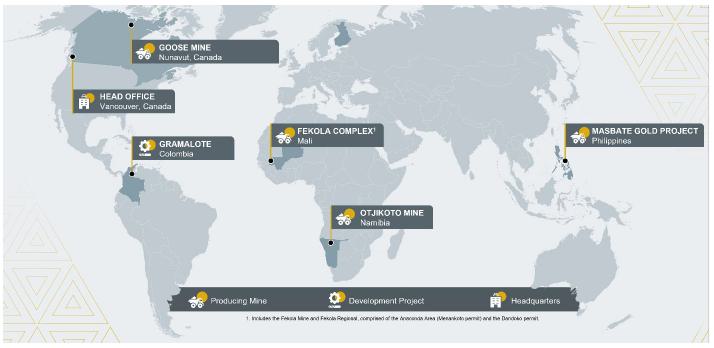
We are a responsible international gold producer headquartered in Vancouver, Canada with four operating mines (one in each of Mali, Canada, the Philippines and Namibia). In addition, we have a portfolio of other development and exploration projects in several countries including Mali and Colombia. Our material properties consist of the following three producing mines:
| · | Fekola mine (80% ownership), an open pit and underground gold mine located approximately 500 kilometres (“km”) due west of Bamako, Mali (the “Fekola Mine”); |
| · | Goose mine (100% ownership), an open pit and underground gold mine located in the Back River Gold District in Nunavut, Canada, approximately 520 km northeast of Yellowknife, Northwest Territories (the “Goose Mine”); and |
| · | Masbate gold project (ownership as described under “Material Properties – Masbate Gold Project” below), an open pit gold mine, located near the northern tip of the island of Masbate, 360 km southeast of Manila, Philippines (the “Masbate Gold Project”). |
Our other producing property is as follows:
| · | Otjikoto mine (90% ownership), an open pit and underground gold mine located approximately 300 km north of Windhoek, Namibia (the “Otjikoto Mine”). |
| B2GOLD 2026 Annual Information Form | |
-
Three Year History
Over the three most recently completed financial years, the significant events described below contributed to the development of our business.
2023 Developments
On January 26, 2023, we announced a target to reduce our Scope 1 and 2 greenhouse gas (“GHG”) emissions by 30% by 2030 relative to a 2021 baseline. This target forms a key part of our Climate Strategy and is integrated into our broader business planning and decision-making processes. To support achievement of this target, we are implementing initiatives focused on increasing the use of renewable energy, electrifying aspects of our operations, and improving efficiency.
In 2023, our Otjikoto and Fekola operations both maintained fully autonomous hybrid power plants consisting of 5.8 megawatt (“MW”) and 30 MW solar installed capacity, respectively. We subsequently expanded our hybrid solar plant at the Fekola Mine (the “Fekola Solar Plant”). The Fekola Solar Plant expansion achieved full operational integration on March 31, 2025. The expansion provides an additional 22 MW of solar capacity, for a total capacity of 52 MW. The expanded facility is expected to supply approximately 30% of the site’s total electricity demand while reducing annual CO2e emissions by an estimated 63,000 tonnes.
On April 19, 2023, we completed the acquisition of Sabina Gold & Silver Corp. (“Sabina”) by way of a court-approved plan of arrangement under the BCBCA (the “Sabina Transaction”). As consideration under the Sabina Transaction, we issued 0.3867 of a common share (each whole share, a “Common Share”) for each Sabina common share, resulting in the issuance of approximately 216 million Common Shares. Through the Sabina Transaction, we acquired Sabina’s 100% owned Back River Gold District, which is located in southwestern Nunavut, Canada, approximately 520 km northeast of Yellowknife. The district comprises mining leases and claims covering approximately 97,481.96 hectares (“ha”) with eight mineral claim blocks on the 183 km belt. The most advanced is the Goose Mine, which achieved commercial production on October 2, 2025. The second most advanced is the George project, situated approximately 60 km northwest from the Goose Mine. Significant infrastructure exists at the Goose Mine site along with the port facility at Bathurst Inlet. A Framework Agreement was signed with the Kitikmeot Inuit Association (“KIA”) on April 20, 2018 outlining renewable 20-year benefit and land tenure agreements. B2Gold recognizes that respect and collaboration with the KIA is central to the licence to operate in the district and will continue to prioritize developing the project in a manner that recognizes Indigenous input and concerns and brings long-term socio-economic benefits to the area.
On June 21, 2023, we released an updated and significantly increased Mineral Resource estimate (including initial estimates for sulphide Indicated Mineral Resources) for the Anaconda South Area, comprised of the now former Menankoto Permit, Bantako Nord Permit and Bakolobi Permit, located approximately 20 km north of the Fekola Mine. The updated and significantly increased Mineral Resource estimate constrained within a conceptual pit shell at a gold price of $1,800 per ounce included an initial Indicated Mineral Resource estimate of 57,100,000 tonnes at 1.11 grams per tonne (“g/t”) gold for a total 2,030,000 ounces of gold, and an Inferred Mineral Resource estimate of 46,600,000 tonnes at 1.33 g/t gold for 2,000,000 ounces of gold. The Mineral Resource estimate includes first time reporting of sulphide Indicated Mineral Resource estimate of 17,400,000 tonnes at 1.40 g/t gold for a total of 780,000 ounces of gold, together with a sulphide Inferred Mineral Resource estimate of 37,100,000 tonnes at 1.44 g/t gold for a total of 1,720,000 ounces of gold. Sulphide Inferred gold grade improved by 15% from the March 2022 Mineral Resource estimate.
| B2GOLD 2026 Annual Information Form | |
-
In July 2023, our revolving credit facility (“Revolving Credit Facility”) was increased from $600 million to $700 million under the accordion feature with the addition of the National Bank of Canada to the syndicate of lenders.
On August 28, 2023, we implemented a Dividend Reinvestment Plan (the “DRIP”). The DRIP provides our shareholders residing in Canada and the United States (or in certain other eligible jurisdictions) with the opportunity to have the cash dividends declared on all or some of their Common Shares automatically reinvested into additional Common Shares on an ongoing basis. Participation in the DRIP is optional and will not affect shareholders’ cash dividends unless they elect to participate in the DRIP. Dividends are only payable as and when declared by our board of directors (the “Board”). A Form F-3D registration statement was filed with the SEC and became effective upon filing on September 1, 2023.
On October 5, 2023, we acquired the remaining 50% of the Gramalote Project from AngloGold Ashanti Limited (“AngloGold”), located in the Department of Antioquia, Colombia, which resulted in us owning 100% of the Gramalote Project. Under the terms of this transaction, the purchase price is payable in cash and consists of the following payments to AngloGold based on, and contingent upon, certain milestones: $20 million paid upon closing of the transaction; $10 million upon B2Gold announcing a construction decision at the Gramalote Project; $10 million upon commercial production at the Gramalote Project, contingent on commercial production beginning within five years of closing of the transaction (if commercial production does not commence within five years of closing of the transaction, no payment will be made); $10 million on the first anniversary of commercial production at the Gramalote Project; and $10 million on the second anniversary of commercial production at the Gramalote Project.
Upon completion of the acquisition, we added 2.11 million ounces of Indicated Mineral Resources and 0.74 million ounces of Inferred Mineral Resources to our consolidated Mineral Resource inventory. In late 2023, we completed a detailed review of the Gramalote Project, including the facility size and location, power supply, mining and processing options, tailings design, resettlement, potential construction sequencing and camp design to identify potential cost savings to develop a smaller scale project. The results of the review were used to determine the optimal parameters and assumptions for the preliminary economic assessment, which was completed in the second quarter of 2024.
2024 Developments
On January 23, 2024, we completed a gold prepayment arrangement (the “Gold Prepay”) for $500 million, based on gold forward curve prices averaging approximately $2,191 per ounce, in exchange for equal monthly deliveries of gold from July 2025 to June 2026 totaling 264,768 ounces, representing approximately 12% of expected annual gold production in each of 2025 and 2026 (subject to finalization of production guidance for 2026). The Gold Prepay was executed by existing Revolving Credit Facility participants, Bank of Montreal, Canadian Imperial Bank of Commerce, ING Capital Markets LLC, and National Bank of Canada. The deliveries of gold under the Gold Prepay will be completed by the end of the second quarter of 2026.
The 2024 winter ice road (“WIR”) campaign successfully concluded in May 2024, delivering all necessary materials from the Marine Laydown Area (“MLA”) at the Bathurst Inlet for the construction of the Goose Mine. Materials trucked from the MLA to the Goose Mine during the 2024 WIR campaign exceeded 2,100 total loads and included 400 loads of diesel fuel.
| B2GOLD 2026 Annual Information Form | |
-
On June 18, 2024, we released the results of a positive preliminary economic assessment (“PEA”) on our 100% owned Gramalote Project in Colombia. Highlights of the PEA, include a significant production profile with average annual gold production of 185,000 ounces over a 12.5 year project life and strong project economics with an after-tax net present value discounted at 5% of $778 million and an after-tax internal rate of return of 20.6%. The PEA is preliminary in nature and is based on Inferred Mineral Resources that are considered too speculative geologically to have the engineering and economic considerations applied to them that would enable them to be categorized as Mineral Reserves, and there is no certainty that the PEA based on these Mineral Resources will be realized. Mineral Resources that are not Mineral Reserves do not have demonstrated economic viability.
On June 20, 2024, we sold 79 million common shares of Calibre Mining Corp. (“Calibre”) reducing our ownership interest to approximately 4% resulting in us no longer having significant influence over Calibre. In the second half of 2024, we disposed of our remaining 32 million shares in Calibre.
On June 20, 2024, we released an initial Inferred Mineral Resource estimate for the Springbok Zone, the southernmost shoot of the recently discovered Antelope deposit, located approximately three km south of the Phase 5 open pit at the Otjikoto Mine in Namibia. The initial Inferred Mineral Resource estimate was sufficient to initiate a PEA on development of the deposit by underground mining methods, similar to the Wolfshag deposit.
On August 13, 2024, we completed the sale of a portfolio of precious and base metals royalties (the “Royalties”) to Versamet Royalties Corporation (“Versamet”). Under the terms of the sale, Versamet issued common shares to B2Gold at a price of C$0.80 per share. We currently hold approximately 29% of Versamet.
On September 11, 2024, we entered into a Memorandum of Understanding (the “2024 MOU”) with the State of Mali in connection with the ongoing operation and governance of the Fekola Complex, including the development of both the underground project at the Fekola Mine and Fekola Regional. The material terms of the 2024 MOU include:
| · | The Fekola Mine (including Fekola underground) continues to be governed by the 2012 Mining Code and the Fekola Mining Convention through 2040. This includes continued stability of the ownership, income tax and customs regimes and the Company’s dispute resolution rights under the Fekola Mining Convention; |
| · | Distribution of all retained earnings currently attributable to the State of Mali’s 10% ordinary share interest and conversion of that interest to a 10% preferred share interest with priority dividends going forward; |
| · | Settlement of any and all income tax assessments for the period through 2023; |
| · | Settlement of any and all customs and regulatory disputes and assessments that are currently outstanding; and |
| · | Acknowledgement by the State of Mali of outstanding value-added tax (“VAT”) credits and agreement on a repayment schedule outlining the timing for reimbursement of outstanding VAT, together with clear guidelines on the expectation for reimbursement of VAT going forward. |
At the end of 2024, the Company had made all payments required under the 2024 MOU.
Under the 2024 MOU, the State of Mali agreed to expedite the issuance of an exploitation permit for Fekola Regional and the approval of the exploitation phase for Fekola underground.
| B2GOLD 2026 Annual Information Form | |
-
On December 17, 2024, we completed the renewal of our Revolving Credit Facility, increasing the total available amount from $700 million to $800 million, plus a $200 million accordion feature. The maturity date of the Revolving Credit Facility is now December 17, 2028, and was completed with a syndicate of banks comprised of Canadian Imperial Bank of Commerce, as co-lead arranger and administrative agent, ING Bank N.V., Bank of Nova Scotia, Bank of Montreal, National Bank of Canada, HSBC Bank USA, and Citibank N.A., Canadian Branch.
2025 Developments
On January 28, 2025, we completed an offering of 2.75% convertible senior unsecured notes due on February 1, 2030 (the “Convertible Notes”) in an aggregate principal amount of $460 million, which included exercise of the full amount of the over-allotment option to purchase an additional $60 million of Convertible Notes. The initial conversion rate for the Convertible Notes is 315.2088 Common Shares per $1,000 principal amount of Convertible Notes, equivalent to an initial conversion price of approximately $3.17 per Common Share.
On February 4, 2025, we released the preliminary results of a positive PEA on the Antelope deposit located at our Otjikoto Mine, which includes an initial life of mine (“LoM”) of five years, an average grade of 5.57 g/t and production LoM of approximately 327,000 ounces with an average gold recovery of 95%. Based on the positive results from the PEA, the Antelope deposit has the potential to become a small-scale, low-cost, underground gold mine that can supplement the low-grade stockpile production during the period of 2028 to 2032 and result in a meaningful production profile for the Otjikoto Mine into the next decade. The PEA is preliminary in nature and is based on Inferred Mineral Resources that are considered too speculative geologically to have the engineering and economic considerations applied to them that would enable them to be categorized as Mineral Reserves, and there is no certainty that the PEA based on these Mineral Resources will be realized. Mineral Resources that are not Mineral Reserves do not have demonstrated economic viability.
The 2025 WIR campaign was successfully completed in mid-April 2025, one month ahead of schedule, and all necessary material was delivered to site from the MLA to support operations until the 2026 WIR campaign.
In April 2025 we implemented a normal course issuer bid (“NCIB”) to buyback up to 5% of our issued and outstanding Common Shares over a period of twelve months. As of March 9, 2026, the Company has purchased an aggregate of 12,779,000 Common Shares under the NCIB.
The Goose Mine achieved first gold pour on June 30, 2025, marking a major milestone as B2Gold’s first Canadian operating asset. First ore was introduced to the Goose Mine processing facilities on June 24, 2025, and the mill ran consistently at approximately 50% of nameplate capacity during this initial phase, as planned.
On July 14, 2025 we released the positive results of a feasibility study on our Gramalote Project (“Gramalote Feasibility Study”). Highlights of the Gramalote Feasibility Study include a meaningful production profile with average annual gold production of 177,000 ounces over a 13-year project life and strong project economics with an after-tax net present value discounted at 5% of $941 million and an after-tax internal rate of return of 22.4% using a gold price of $2,500 per ounce. The Gramalote Feasibility Study is subject to a number of assumptions and risks, including among others that a Modified Work Plan and Modified Environmental Impact Study will be approved, all required permits, permit amendments and other rights will be obtained in a timely manner, the Gramalote Project will have the support of the local government and community, the regulatory environment will remain consistent, and no material increase will have occurred to the estimated costs.
| B2GOLD 2026 Annual Information Form | |
-
In May 2025, we received the Menankoto South Permit, which combined the former Menankoto, Bantako North and Bakolobi Permits into one single exploration licence. We are now awaiting approval of the exploitation licence for this area. At the end of July 2025 we were granted approval from the State of Mali to begin underground operations, including stope ore production, at the Fekola Mine, a key production growth driver for the Fekola Complex.
The Goose Mine achieved commercial production on October 2, 2025. Commercial production at the Goose Mine was based on an internal commercial production measure of 30 consecutive days of average mill throughput at 65% or greater based on the mill design capacity of 4,000 tonnes per day (“tpd”). From September 3, 2025 through October 2, 2025, the mill achieved an average throughput of 2,652 tpd, which represents 66% of design capacity. Mill feed over the 30-day commercial production period was predominantly from the mined out Echo open pit.
Developments Subsequent to December 31, 2025
On February 23, 2026, the Company announced certain leadership changes. Clive Johnson has decided to retire from his role as President, Chief Executive Officer and Director of the Company at the upcoming Annual General Meeting on June 4, 2026. Effective June 4, 2026, Mr. Johnson will be named Chair Emeritus of the Company, Mike Cinnamond, Senior Vice President, Finance and Chief Financial Officer, will succeed Mr. Johnson as President and Chief Executive Officer, and Michael McDonald will succeed Mr. Cinnamond as Chief Financial Officer. Mr. McDonald is currently the Company’s Vice President, Investor Relations, Corporate Development and Treasury. Mr. Cinnamond will also join the Board of the Company effective June 4, 2026. Effective February 23, 2026, Kelvin Dushnisky transitioned from his role as Chair of the Board to Executive Chair of the Board and Greg Barns was appointed Lead Independent Director.
| B2GOLD 2026 Annual Information Form | |
-
DESCRIPTION OF THE BUSINESS
General
We are a responsible international gold producer headquartered in Vancouver, British Columbia, with a strategic focus on acquiring and developing interests in mineral properties with demonstrated potential for hosting economic mineral deposits, with gold deposits as the primary focus. We conduct gold mining operations and exploration and drilling campaigns to define and develop Mineral Resources and Mineral Reserves on our properties with an intention of developing, constructing and operating mines on such properties.
Our corporate objective is to continue to maximize profitable production from our mines, grow as a profitable and responsible gold producer through further advancement of our pipeline of development and exploration projects, evaluate new exploration, development and production opportunities, make accretive acquisitions, and continue to pay an industry competitive dividend.
Principal Product – Markets and Distribution
Our principal product is gold. Gold can be readily sold on numerous markets throughout the world and it is easy to ascertain its market price at any particular time. Benchmark prices are generally based on the London gold market quotations. Gold bullion is held as an asset class for a variety of reasons, including as a store of value and a safeguard against the collapse of paper assets such as stocks, bonds and other financial instruments that are traded in fiat currencies not exchangeable into gold (at a fixed rate) under a “gold standard”, as a hedge against future inflation and for portfolio diversification. governments, central banks and other official institutions hold significant quantities of gold as a component of exchange reserves. Since there are a large number of available gold purchasers, we are not dependent upon the sale of gold to any one customer.
Our gold is refined to market delivery standards by several refiners throughout the world. The gold is sold to various gold bullion dealers or to refiners at market prices. Given the availability of alternative smelters or refiners, no material adverse effect would result if we lost the services of any of our current smelters or refiners. Product fabrication and bullion investment are two principal sources of gold demand. The introduction of more readily accessible and liquid gold investment vehicles has further facilitated investment in gold. Within the fabrication category, there are a wide variety of end uses, the largest of which is the manufacture of jewelry. Other fabrication purposes include official coins, electronics, miscellaneous industrial and decorative uses, dentistry, medals and medallions.
Special Skills and Knowledge
Various aspects of our business require specialized skills and knowledge, certain of which are in high demand and in limited supply. Such skills and knowledge include the areas of permitting, engineering, geology, metallurgy, logistical planning, implementation of exploration programs, mine construction and development, mine operation, as well as legal compliance, finance, accounting, risk management, safety and security, community relations and human resources. We have highly qualified management personnel and staff, an active recruitment program, and believe that persons having the necessary skills are generally available. We have found that we can locate and retain competent employees and consultants in such fields and have maintained a high retention rate of highly skilled employees. We do not anticipate having significant difficulty in recruiting other personnel as needed. Training programs are in place for workers that are recruited locally.
| B2GOLD 2026 Annual Information Form | |
-
Competitive Conditions
The gold exploration and mining business is a competitive business. We compete with numerous other companies (including some of the largest mining companies in the world) and individuals in the search for and the acquisition of quality gold properties, mineral claims, permits, concessions and other mineral interests, as well as recruiting and retaining qualified employees. Our ability to acquire and develop gold properties in the future will depend not only on our ability to develop and operate our present properties, but also on our ability to select and acquire suitable producing properties or prospects for development or mineral exploration.
Cycles
The mineral exploration, development and production business is subject to mineral and commodity price cycles. The marketability of minerals is also affected by worldwide economic cycles.
Employees
Our business is administered principally from our head office in Vancouver, British Columbia, Canada. We also have offices in Edmonton, Alberta, Canada; Bamako, Mali; Manila, Philippines; Windhoek, Namibia; Cambridge Bay, Nunavut, Canada; and Medellin, Colombia. As at December 31, 2025, we, including our subsidiaries, employ a total of 4,920 permanent employees and 1,407 fixed-term (temporary) employees for a total of 6,327 employees.
Production at our mining operations is dependent upon the efforts of our employees and our relations with our unionized and non-unionized employees. Some of our employees are represented by labour unions under various collective labour agreements. Labour discussions are managed through union delegates who are elected by employees during site-wide elections. In Namibia, the Mineworkers Union of Namibia represents the bargaining unit. The previous collective bargaining agreement was valid for a two-year term and expired on February 28, 2026. A subsequent three-year agreement, signed in November 2025, is now in effect for the period from March 1, 2026, to February 28, 2029. At the Fekola Mine, there are currently two unions. The delegates are elected representatives of all employees, regardless of union membership. Following the most recent election and appointment of staff delegates in November 2025, negotiations with respect to a collective bargaining agreement covering the workers at the Fekola Mine, will reconvene in the second quarter of 2026. Labour relations at each of our operations continue to be positive.
International Operations
Our principal operations and assets are located in various countries including Mali, Canada, the Philippines, Namibia and Colombia. Our operations are exposed to various levels of political, economic and other risks and uncertainties. These risks and uncertainties vary from country to country and include, but are not limited to, government regulations (or changes to such regulations) with respect to restrictions on production, export controls, income taxes, royalties, excise and other taxes, expropriation of property, repatriation of profits, environmental legislation, land use, water use, local ownership requirements and land claims of Indigenous and local peoples, regional and national instability and security, mine safety, corruption and sanctions. The effect of these factors cannot be accurately predicted. See “Risk Factors” below.
| B2GOLD 2026 Annual Information Form | |
-
Environmental Protection
Our activities are subject to extensive laws and regulations governing the protection of the environment, natural resources and human health. These laws address, among other things: emissions into the air; discharges into water; management of waste and hazardous substances; protection of natural resources, cultural heritage and endangered species; and reclamation of lands disturbed by mining operations. We are required to obtain governmental permits and, in some instances, provide bonding requirements under federal, state, or provincial air, water quality, and mine reclamation rules and permits. Violations of environmental and health and safety laws are subject to civil sanctions and, in some cases, criminal sanctions, including the suspension or revocation of permits. The failure to comply with environmental laws and regulations or liabilities related to hazardous substance contamination could result in project development delays, material financial impacts or other material impacts to our projects and activities, fines, penalties, lawsuits by the government or private parties, or material capital expenditures.
Additionally, environmental laws in some of the countries in which we operate, as well as certain organizations that we are members of, require that we periodically perform environmental audits and impact studies at our mines. These studies could reveal presently unknown environmental impacts that would require us to make significant capital outlays or cause material changes or delays in our intended activities.
Our current estimated aggregate closure and reclamation cost at our operating mines, being the Fekola Complex, Goose Mine, the Masbate Gold Project and the Otjikoto Mine, is approximately $200 million on an undiscounted basis. These estimates are generally based on conceptual level engineering and will be updated periodically to reflect changes in site conditions and the LoM plans. See “Environmental, Occupational Health and Safety, Social and Regulatory” below and the disclosure regarding environmental matters under the respective descriptions of our material properties for further details regarding environmental matters.
Environmental, Occupational Health and Safety, Social and Regulatory
Our Board has a Sustainability Committee that assists the Board in overseeing occupational health and safety, sustainability (including climate change), environmental, social (including community relations and human rights) and physical security strategies, policies and programs, and related risk management and performance. The Sustainability Committee, comprised of four independent directors, meets quarterly with management to review current and emerging issues, evaluate performance and risk management, and to evaluate and update policies and procedures.
HSE Management System Standards and Performance Standards
We have implemented an integrated set of Health, Safety and Environmental (“HSE”) Management System Standards (“Management System Standards”) and a set of stand-alone Performance Standards for operational health and safety (“OHS”) and environment and biodiversity (“Performance Standards”) that identify, define and prescribe the requirements for the development, implementation and administration of HSE activities at corporate and operational site locations. The Management System Standards and Performance Standards are based on compliance with in-country regulatory requirements and conditions, and are further supported by international standards in circumstances where national regulations are not sufficiently stringent (for example, the International Organization for Standardization (“ISO”) standards, and other international and industry best practices such as the Mining Association of Canada’s Towards Sustainable Mining guiding principles and protocols, International Council on Mining and Metals (the “ICMM”) mining principles, and the International Cyanide Management Code).
| B2GOLD 2026 Annual Information Form | |
-
Consistent application of the Management System Standards and Performance Standards helps enable us to identify, mitigate and manage risk, and minimize impacts on the environment and surrounding communities from our activities. Management, supervisors and employees are held accountable for HSE performance and for effective implementation of the Management System Standards and Performance Standards at the site level. External third parties are engaged to conduct regularly scheduled verification audits of the Management System Standards and Performance Standards to ensure alignment and functionality.
We aim to ensure our Management System Standards and Performance Standards are consistently, properly, and effectively implemented. We have implemented a multi-year audit schedule, and all our operating sites are audited regularly by independent experts. HSE Management System Standards and OHS Performance Standards audits were conducted at Fekola and Otjikoto in 2024 and at Masbate in 2023. Environmental and Biodiversity Performance Standards audits were conducted at all our operating sites in 2024. The Goose Mine will undergo three audits (HSE Management System Standards, Environmental and Biodiversity Performance Standards, and OHS Performance Standards) in 2026. In addition to the above audits, the Masbate Gold Project is required to be certified to ISO 14001 and has maintained this certification since 2016.
Environmental
B2Gold has an Environmental and Biodiversity Policy and a set of Environmental and Biodiversity Performance Standards. These Standards provide all operating sites with the minimum standards to be met to consistently and effectively manage the key risks associated with the environment and effects on biodiversity. These Standards manage key issues including hazardous materials, cyanide, tailings, waste rock, non-process waste, water, air quality, mine closure planning, progressive reclamation, noise and vibration, biodiversity, and climate change and energy use.
In 2025, B2Gold finalized an updated Sustainability Strategy (“Sustainability Strategy”) consisting of five pillars, supported by strategic priorities and goals. The purpose of the Sustainability Strategy is to improve the development, implementation and accountability of strategic priorities and goals and to drive long-term commitments and a proactive approach to managing sustainability impacts and risks across B2Gold.
Community
Our Social Responsibility and Human Rights Policy defines our commitment to facilitate a positive and sustainable legacy by understanding and managing the social and economic impacts and opportunities resulting from our presence. We are committed to open and respectful engagement with our stakeholders. We respect community rights, interests and culture, and where Indigenous Peoples are identified as potentially impacted by our operations, we work to obtain their free, prior and informed consent. We recognize human rights, as defined in the International Bill of Human Rights, and align our approach to human rights risk management with the United Nations Guiding Principles on Business and Human Rights (the “UNGPs”) and the Voluntary Principles on Security and Human Rights (the “VPSHR”).
We adopted a set of Social Performance Standards to provide minimum requirements for the social practices and performance of our operations. Our Social Performance Standards align with international best practices, including those of the International Finance Corporation (the “IFC”), the ICMM and the UNGPs. Our Social Performance Standards manage key issues including stakeholder engagement, grievance management, community investment, land acquisition and resettlement, local content, human rights, artisanal and small-scale mining (“ASM”), social closure, security and human rights, social baseline and impact assessment and management, Indigenous Peoples and cultural heritage.
| B2GOLD 2026 Annual Information Form | |
-
We conduct audits of our Social Performance Standards with independent experts. In 2025, third-party audits were conducted at our Fekola, Masbate and Otjikoto operations. With the support of external experts, we also conduct human rights assessments and security risk assessments in accordance with the VPSHR. These assessments, including recommendations to address salient human rights risks and impacts, are discussed and confirmed with our executives and reported to the Sustainability Committee. In 2024, the Company conducted VPSHR risk assessment updates at each of the Fekola Complex, Masbate Gold Project, Otjikoto Mine and Gramalote Project and a human rights risk assessment at the Goose Project. In 2025, a human rights assessment was completed at the Anaconda Area in Mali.
Our Sustainability Strategy considers community aspects under the pillars of “Sourcing with Integrity”, “Thriving Communities”, and “Responsible Closure”. Our Community Investment Standard, which aligns with the IFC Performance Standards and ICMM guidance on community development, defines how we focus on sustainable contributions to the communities where we operate. The following is a summary of our community development efforts in 2025:
| · | Fekola Complex: Fekola operates its social investment programs through the Fekola Community Development Plan (“CDP”) and Livelihood Restoration Plan (“LRP”). The CDP operates on a two-year cycle, with community-selected projects approved by a steering committee chaired by the Sub-Prefect of Kéniéba. In 2025, community investment activities included vocational training and procurement opportunities for local businesses, improved access to education and safe water, and enhanced healthcare services through awareness campaigns and mobile clinics. |
Fekola continues to implement its signature LRP initiative, the 75-hectare Goungoubato Agricultural Project, established to support 300 households affected by resettlement in the Fadougou village area. This project has significantly boosted local production of vegetables, rice and herbs, directly addressing food insecurity among vulnerable populations and fostering small- and medium-enterprise growth through newly formed farmers’ associations.
Based on the success of the Goungoubato Project, in 2025, Fekola implemented a second significant agricultural livelihood restoration program, the 60-ha Bafarato Agricultural Project. It aims to support approximately 260 households, affected by displacement in the Medinandi village area. Market gardening gives families access to fresh produce and the means to income, and essential crops are cultivated including rice, maize, peanuts and beans.
Additionally, in partnership with Global Affairs Canada and Cowater International, Fekola supports the FEMA Project (Femmes et Enfants des communautés Minières Artisanales). This 5-year initiative (2022-2027) focuses on improving living conditions for women and children in ASM communities within the Kéniéba circle and the Fekola Mine’s area of influence. The project established 40 Village Savings and Loan Associations (VSLAs), which had disbursed C$108,716 in loans to women as of June 2025. The project also resulted in the annual withdrawal of approximately 100 children from ASM sites.
| · | Back River Project: We continued the implementation of the Inuit Impact & Benefit Agreement (“IIBA”) with the KIA throughout 2025. This included, among other things, ongoing enactment of the Regional Wealth Creation Fund and focused efforts to develop a new Back River Inuit Training Plan, which will guide life of mine Inuit training programming for the Goose Mine. We launched the “Kitikmeot Social Investment Plan”, and have received several applications for unique projects in Cambridge Bay and Taloyoak. |
| B2GOLD 2026 Annual Information Form | |
-
In September 2025, B2Gold hosted community, government and other stakeholders at the mine site and in the community of Cambridge Bay for the Goose Mine grand opening. As part of this event, B2Gold committed C$10 million toward the construction of public housing units in all Kitikmeot Region Communities in an effort to support the Government of Nunavut address public housing shortages across the territory.
| · | Masbate Gold Project: Under the laws of the Philippines, mining companies are required to spend an amount equal to 1.5% of their annual operating cost from the previous year on expenditures for social development of host communities, resulting in a significant annual community investment budget managed separately by each of Filminera Resources Corporation (“Filminera”) and Philippine Gold Processing & Refining Corp. (“PGPRC”) in consultation with local stakeholders through the Social Development and Management Program (the “SDMP”). Projects are identified and implemented in coordination with multi-stakeholder committees and town councils, and support education, infrastructure, health services, and livelihood development. SDMP key focus areas include education, healthcare services and infrastructure, livelihood development, vocational training, and small and medium size enterprise support. |
| · | Otjikoto Mine: In Namibia, B2Gold’s Corporate Social Investment (“CSI”) Strategy focuses on health, education, culture, the environment, and small business development. In 2025, B2Gold achieved significant milestones to support its commitments on sustainable development, community empowerment, and responsible social closure, ensuring that communities remain resilient and self-sufficient beyond mine operations. |
In 2025, the Corporate Social Responsibility team successfully completed its 2023 to 2025 social investment exit strategy. This was accomplished through a two-pronged approach: (i) identifying the flagship projects that will continue to receive support, and (ii) proactively consulting with and informing on the projects that will not receive future support. Otjikoto is progressing a formal Memorandum of Understanding, in partnership with Otavi Town Council and the Ministry of Urban and Rural Development, that will provide guidelines for B2Gold’s social investment in Otavi over the next three years.
| · | Gramalote Project: In Colombia, 1,024 artisanal miners now operate under appropriate regulatory authorizations, benefiting more than 1,500 families and strengthening a responsible coexistence model supported by social investments in housing improvements, schools, and rural road infrastructure. Community investment remains focused on education, health, livelihoods, and culture. Programs like Sembradores de Vida, improved early childhood education, while the Nus Symphonic Band showcased the talent of 40 young musicians on international stages. |
The economic strengthening strategy advanced through Entrepreneurship Wednesdays, enhances the capabilities of local organizations and entrepreneurs. The Gramalote Farm consolidated its role as a regional economic driver, diversifying with more than 40 agricultural products. With these accomplishments and strong institutional relationships, Gramalote reaffirms its commitment to sustainable development and to creating opportunities that transform lives across its area of influence.
| B2GOLD 2026 Annual Information Form | |
-
| · | Corporate Office, Vancouver, Canada: As a Canadian company, we are also committed to supporting community initiatives at home through our More Than Mining Fund. The fund invests in programs to support people living with challenges associated with poverty, mental health, addiction, violence, and abuse. Our fund partners with local charity organizations that deliver complex social services to the most vulnerable and at-risk people. In 2025, the Company provided financial support of approximately C$1 million to community organizations in the Vancouver area. |
Diversity and Inclusion
We are committed to fostering work experiences and environments that are inclusive and accessible to individuals from diverse backgrounds, abilities, cultures, and identities and to enhancing our equitable, diverse and inclusive (“EDI”) performance, guided by our EDI Workplaces Policy, as well as our Diversity Policy for Board and Management.
The EDI Workplaces Policy promotes diversity through:
| · | global and regional leadership that is active, committed and accountable; |
| · | strategies and plans to identify and remove barriers; |
| · | policies that are fair, call for equal access and treatment, and inform principled decision-making and behaviour; |
| · | training and development that support growth, provide career advancement opportunities and build talent pipelines; |
| · | engagement that stimulates dialogue, awareness, education and collaboration; |
| · | change by way of actionable measures that are informed by, and assessed through, metrics; and |
| · | grievance mechanisms with remedial action in cases of proven discrimination and harassment. |
The Diversity Policy establishes a target of 30% female representation on the Board, which was achieved in January 2023, and 30% female representation in management-level positions. As at December 31, 2025, B2Gold’s Board exceeds the 30% target, with 40% of the Board being women, and three of the four board committees being chaired by female directors.
As articulated in these two policies, the Company is dedicated to equitable treatment of all persons, irrespective of gender, race, ethnicity, nationality, religion and sexual orientation, as well as reasonable and safe accommodation of people with disabilities. Employment decisions are based on the inherent nature of the job and not on personal characteristics or circumstances that are unrelated to the execution of work. The Executive team has overall responsibility for our EDI initiative and performance, and the regional leadership teams are responsible for developing and delivering on the annual EDI plans for each region. Workplace committees are in place in all locations to provide a stronger mechanism for engagement on EDI topics.
We implemented a global three-year EDI Strategy for 2020 through 2022 to lay the foundational work for a sustainable approach to EDI at each of our operations. Following our initial EDI survey completed in 2019 that provided baseline data for the three-year EDI plan, we conducted a refreshed survey in 2023 to understand where progress has been made and where opportunities for improvement continue to exist.
| B2GOLD 2026 Annual Information Form | |
-
We remain focused on providing fair and respectful workplaces for all people and increasing the number of women through recruitment, talent development, promotion and retention. In 2025, our regional teams continued to develop practices that support EDI and deliver EDI actions, including review of policies, practices, facilities, training and engagements, and the continued collection of EDI data to increase transparency around hiring, promotions, attrition and compensation.
Corporate EDI initiatives completed in 2025 include the continuation of a global mentorship program, conducting a global employee experience survey and joining the International Women in Mining, a global not-for-profit dedicated to advancing equity within the natural resources sector.
We report on our environmental, social and governance risk management and performance on an annual basis in our Responsible Mining Report that is published on our website at www.b2gold.com.
| B2GOLD 2026 Annual Information Form | |
-
SUMMARY OF MINERAL RESERVE AND MINERAL RESOURCE ESTIMATES
Probable Mineral Reserves Statement
| Country | Mine, Project or Area | 100% Project Basis | Attributable Ownership Basis | |||
| Tonnes (x 1,000) |
Gold Grade (g/t Au) |
Contained Gold Ounces (x 1,000) |
Attributable (%) |
Contained Gold Ounces (x 1,000) |
||
| Mali | Fekola
Mine (including Fekola Open Pit, Cardinal Zone, FNE Zone, Fekola Underground and stockpiles) |
33,800 | 1.68 | 1,830 | 80 | 1,460 |
| Fekola Regional | 13,800 | 1.97 | 880 | 90 | 790 | |
| Total Fekola Complex | 47,700 | 1.76 | 2,700 | 2,250 | ||
| Canada | Goose Mine | 10,900 | 6.79 | 2,380 | 100 | 2,380 |
| Philippines | Masbate Gold Project | 62,900 | 0.72 | 1,460 | 100 | 1,460 |
| Namibia | Otjikoto stockpiles and Wolfshag Underground | 1,200 | 2.33 | 90 | 90 | 80 |
| Colombia | Gramalote Project | 76,700 | 0.96 | 2,360 | 100 | 2,360 |
| Total
Probable Mineral Reserves (includes stockpiles) |
8,990 | 8,530 | ||||
Notes:
| 1. | Mineral Reserves are reported at the point of delivery to the process plant, and have been classified using the CIM Standards. All tonnage, grade and contained metal content estimates have been rounded; rounding may result in apparent summation differences between tonnes, grade, and contained metal content. |
| 2. | The Mineral Reserves from the Fekola Open Pit, Cardinal Zone, FNE Zone, and stockpiles have an effective date of December 31, 2025. The Mineral Reserves from the Anaconda and Dandoko Areas have an effective date of December 31, 2024. The Qualified Person is Peter Montano, P.E., our Vice President, Projects. |
| 3. | The Mineral Reserves from Fekola Underground have an effective date of December 31, 2025. The Qualified Person is Michael Meyers, P.Eng., our Director, Project Development. |
| 4. | Mineral Reserves are reported on a 100% basis. B2Gold holds an 80% attributable interest in the Fekola Open Pit, Cardinal Zone, FNE Zone, Fekola Underground, and stockpiles; the remaining 20% interest in these areas is held by the State of Mali. B2Gold holds a 90% attributable interest in Fekola Regional, and the remaining 10% interest in these areas is held by the State of Mali. Under the 2023 Mining Code, the State’s initial interest in Fekola Regional is maintained at 10%, but the State may acquire up to an additional 20% interest, and a further 5% interest must be available to be acquired by a local Malian stakeholder. |
| 5. | Fekola Open Pit: Mineral Reserves are based on a conventional open pit mining method, gold price of $2,000/oz, metallurgical recovery of 92%, selling costs of $274.57/oz including royalties, mining cost at surface elevation of $2.86/t mined, average processing cost of $16.06/t processed, and site general costs of $10.34/t processed. For Mineral Reserve reporting, the model with 2.5 x 5 x 2.5 m blocks (Resource model) were regularized to 5 x 20 x 10 m blocks. For Indicated blocks, within the 2025 resource pit, above a cut-off of 0.65 g/t Au, the large block regularized model compared to the regularized resource model is +6.7% on tonnage, -6.4% on grade and -0.1% on contained gold. No additional dilution or ore loss has been applied for final reserve reporting. Mineral Reserves are reported above a cut-off grade of 0.65 g/t Au. |
| 6. | Cardinal Zone: Mineral Reserves are based on a conventional open pit mining method, gold price of $2,000/oz, metallurgical recovery of 92–94% by rock type, selling costs of $274.57/oz including royalties, mining costs ranging from $2.15/t mined for saprolite to $2.82 for fresh rock at surface elevation, processing costs ranging from $10.97/t processed for saprolite to $16.06/t processed for fresh rock, and site general costs of $0.44/t processed. For Mineral Reserve reporting, a 1.0 x 0.5 x 0.5 m rind of edge dilution was applied at each mineralization zone contact in the regularized model. For Indicated blocks, within the 2024 resource pit, at a cut-off of 0.65 g/t Au, the regularized model with edge dilution compared to the regularized model is +8.7% on tonnage, -10.6% on grade and -2.7% on contained gold. No additional dilution or ore loss has been applied for final reserve reporting. Mineral Reserves are reported above a cut-off grade of 0.65 g/t Au. |
| B2GOLD 2026 Annual Information Form | |
-
| 7. | FNE Zone: Mineral Reserves are based on a conventional open pit mining method, gold price of $2,000/oz, metallurgical recovery of 92–94% by rock type, selling costs of $274.57/oz including royalties, mining costs ranging from $2.15/t mined for saprolite to $2.82 for fresh rock at surface elevation, processing costs ranging from $10.97/t processed for saprolite to $16.06/t processed for fresh rock, and site general costs of $0.44/t processed. For Mineral Reserve reporting, a 0.5 x 0.5 x 0.5 m rind of edge dilution was applied at each mineralization zone contact in the regularized model. For Indicated blocks, within the 2025 resource pit, at a cut-off of 0.65 g/t Au, the regularized model with edge dilution compared to the regularized model is +11% on tonnage, -12% on grade and -2% on contained gold. No additional dilution or ore loss has been applied for final reserve reporting. Mineral Reserves are reported above a cut-off grade of 0.65 g/t Au. |
| 8. | Fekola Underground: Mineral Reserves will be mined by underground methods assuming a mix of transverse and longitudinal longhole stoping mining methods, gold price of $2,000/oz, metallurgical recovery of 92%, selling costs of $274.57/oz including royalties and levies, average mining cost of $99.45/t mined, average processing cost of $16.06/t processed, site general costs of $2.59/t processed, 8% dilution, and 95% mining recovery. Mineral Reserves that will be mined by underground methods are reported above a cut-off grade of 2.35 g/t Au. |
| 9. | Anaconda Area: Mineral Reserves are based on a conventional open pit mining method, gold price of $1,750/oz, metallurgical recovery of 93–94% by rock type, selling costs of $273.37/oz including royalties and tolling charges, mining costs ranging from $2.91/t mined for saprolite to $3.41 for fresh rock at surface elevation, processing costs ranging from $14.60/t processed for saprolite to $20.40/t processed for fresh rock that includes haulage cost to the Fekola mill, and site general costs of $1.89/t processed. For Mineral Reserve reporting, a 1.0 x 1.0 x 0.5 m (X, Y, Z) rind of edge dilution was applied at each mineralization zone contact in the regularized model. For Indicated blocks, within the June 2023 conceptual resource pit, at cut-offs of 0.40 g/t Au for weathered material and 0.60 g/t Au for fresh, the regularized model with edge dilution compared to the regularized (Resource) model is +2.9% on tonnage, -4.9% on grade and -2.2% on contained gold. Mineral Reserves are reported above a cut-off grade of 0.65 g/t Au for sulphides and 0.50 g/t Au for oxides. |
| 10. | Dandoko Area: Mineral Reserves are based on a conventional open pit mining method, gold price of $1,750/oz, metallurgical recovery of 76–94% by rock type, selling costs of $322.09/oz including royalties and tolling charges, mining costs ranging from $1.95/t mined for saprolite to $2.45 for fresh rock at surface elevation, processing costs ranging from $15.66/t processed for saprolite to $21.37/t processed for fresh rock that includes haulage cost to the Fekola mill, and site general costs of $0.94/t processed. For Mineral Reserve reporting, the sub-cell models were regularized to a block size of 5 x 10 x 3.3333 m for SK1, and 5 x 10 x 10 m for SK2 and SK3 to account for dilution expected during mining. For Indicated plus Inferred blocks, within the February 2023 conceptual pit, at a cut-off of 0.30 g/t Au, the regularized model compared to the sub-cell model is +1% on tonnage, -4% on grade and -3% on contained gold. At a cut-off of 0.65 g/t Au, the regularized model compared to the sub-cell model is +11% on tonnage, -12% on grade and -1% on contained gold. Mineral Reserves are reported above a cut-off grade of 0.65 g/t Au for sulphides and 0.50 g/t Au for oxides. |
| 11. | Mineral Reserves from the Fekola Open Pit, Cardinal Zone, FNE Zone, and stockpiles are reported above a cut-off grade of 0.65 g/t Au. Mineral Reserves from Fekola Underground are reported above a cut-off grade of 2.35 g/t Au. Mineral Reserves from Fekola Regional are reported above a cut-off grade of 0.65 g/t Au for sulphide ore, and above a cut-off of 0.50 g/t Au for oxide ore. |
| 12. | Goose Mine: Mineral Reserves have an effective date of December 31, 2025. Mineral Reserves are reported on a 100% project basis. The Qualified Person for the Open Pit and stockpile Mineral Reserve estimate is Peter Montano, P.E., our Vice President, Projects. The Qualified Person for the Underground Mineral Reserve estimate is Michael Meyers, P.Eng., our Director, Project Development. Mineral Reserves from open pit mine methods and stockpiles are based on a conventional open pit mining method, gold price of $1,750/oz, metallurgical recovery of 92.5%, selling costs of $90.00/oz including royalties and levies, average mining cost of $4.92/t mined at surface, average processing cost of $41.08/t processed, and site general costs of $66.95/t processed. Reserve model dilution and ore loss were applied through whole block averaging such that at a 1.65 g/t Au cut-off, for all pits combined there is a 32% increase in tonnes, a 25% reduction in grade, and a 1% reduction in ounces when compared to the Mineral Resource model. Mineral Reserves that will be mined by open pit methods or are in stockpiles are reported above a cut-off grade of 1.65 g/t Au. Mineral Reserves that will be mined by underground methods assume longhole stoping mining methods, gold price of $1,750/oz, metallurgical recovery of 92.5%, selling costs of $90.00/oz including royalties and levies, average mining cost of $120.13/t ore mined, average processing cost of $41.08/t processed, site general costs of $66.95/t processed, dilution % variable by stoping area, and 90% mining recovery. Mineral Reserves that will be mined by underground methods are reported above a cut-off grade of 4.64 g/t Au. |
| 13. | Masbate Gold Project: Mineral Reserves are reported on a 100% project and attributable basis. Pursuant to the ore sales and purchase agreement between Filminera and PGPRC, our wholly owned subsidiary, PGPRC has the right to purchase all ore from Filminera. B2Gold has a 40% interest in Filminera, which owns the mineral tenements, and the remaining 60% is owned by a Philippines-registered company, Zoom Mineral Holdings Inc. (“Zoom”). Please see “Material Properties – Masbate Gold Project” below for a further discussion of the foregoing. Masbate Mineral Reserves have an effective date of December 31, 2025 and the Qualified Person is Peter Montano, P.E., our Vice President, Projects. Mineral Reserves are based on a conventional open pit mining method, gold price of $2,000/oz, modeled metallurgical recovery (resulting in average LoM metallurgical recoveries by pit that range from 69% to 88%), and average base operating cost estimates of $1.90–$2.39/t mined (mining), $14.49/t processed (processing) and $2.36–$3.82/t processed (site general) and $85.27/oz selling cost including freight and excise tax. Reserve model dilution and ore loss were applied through whole block averaging such that at a 0.45 g/t Au cut-off there is a 5.1% increase in tonnes, a 5.9% reduction in grade, and a 1.2% reduction in ounces when compared to the Mineral Resource model. Mineral Reserves are reported at an assay cut-off grade of 0.46 g/t Au. |
| B2GOLD 2026 Annual Information Form | |
-
| 14. | Otjikoto Mine: Mineral Reserves are reported on a 100% project and a 90% attributable basis, the remaining 10% interest is held by EVI Mining (Proprietary) Ltd. (“EVI”), a Namibian empowerment company. The Otjikoto Mine Mineral Reserves within Wolfshag Underground and ROM Stockpiles have an effective date of December 31, 2025. The Qualified Person for the ROM Stockpile Mineral Reserve estimate is Peter Montano, P.E., our Vice President, Projects. The Qualified Person for the Wolfshag Underground Reserve estimate is Michael Meyers, P.Eng., our Director, Project Development. Mineral Reserves from stockpiles are based on a gold price of $2,000/oz, metallurgical recovery of 98%, selling costs of $83.65/oz including royalties and levies, average processing cost of $14.73/t processed, and site general costs of $3.61/t processed. Mineral Reserves in stockpiles are reported above a cut-off grade of 0.45 g/t Au. Mineral Reserves that will be mined by underground methods assume a modified transverse longhole stoping mining method, gold price of $2,000/oz, metallurgical recovery of 98%, selling costs of $83.65/oz including royalties and levies, average mining cost of $90.54/t ore mined, average processing cost of $14.00/t processed, site general costs of $5.14/t processed, 22% dilution, and 90% mining recovery. Mineral Reserves that will be mined by underground methods are reported above a cut-off grade of 1.82 g/t Au. |
| 15. | Gramalote Project: Mineral Reserves have an effective date of April 1, 2025. Mineral Reserves are reported on a 100% project basis. The Qualified Person for the Mineral Reserve estimate is Mr. Peter Montano, P.E., our Vice President, Projects. Mineral Reserves are based on a conventional open pit mining method, gold price of $1,750/oz, metallurgical recovery averaging 95.6%, selling costs of $60.00/oz including royalties, average mining cost of $2.70/t mined, average processing cost of $8.50/t processed, and average site general costs of $3.80/t processed. Reserve model dilution and ore loss was applied through whole block averaging such that at a 0.40 g/t Au cut-off there is a 1.2% increase in tonnes, a 4.6% reduction in grade, and 3.5% reduction in ounces when compared to the Mineral Resource model. Mineral Reserves are reported above a cut-off grade of 0.40 g/t Au. |
Indicated Mineral Resource Statement
| Country | Mine, Project or Area | 100% Project Basis | Attributable Ownership Basis | |||
| Tonnes (x 1,000) |
Gold Grade (g/t Au) |
Contained
Gold Ounces (x 1,000) |
Attributable (%) |
Contained Gold Ounces (x 1,000) |
||
| Mali | Fekola Open Pit | 45,610 | 1.28 | 1,880 | 80 | 1,500 |
| Fekola stockpiles | 13,130 | 0.66 | 280 | 80 | 220 | |
| Fekola Underground | 3,720 | 2.95 | 350 | 80 | 280 | |
| Cardinal Zone | 9,430 | 1.50 | 450 | 80 | 360 | |
| FNE Zone | 3,830 | 1.27 | 160 | 80 | 120 | |
| Total Fekola Mine | 75,720 | 1.28 | 3,120 | 2,490 | ||
| Anaconda Area | 54,830 | 1.13 | 1,990 | 90 | 1,790 | |
| Dandoko Area | 9,280 | 1.43 | 430 | 90 | 380 | |
| Total Fekola Regional | 64,110 | 1.17 | 2,410 | 2,170 | ||
| Total Fekola Complex | 139,830 | 1.23 | 5,530 | 4,660 | ||
| Canada | Goose Claims Group | 15,910 | 7.40 | 3,790 | 100 | 3,790 |
| George Claims Group | 1,660 | 7.89 | 420 | 100 | 420 | |
| Total Goose Mine and Back River District | 17,560 | 7.45 | 4,210 | 4,210 | ||
| B2GOLD 2026 Annual Information Form | |
-
| Country | Mine, Project or Area | 100% Project Basis | Attributable Ownership Basis | |||
| Tonnes (x 1,000) |
Gold Grade (g/t Au) |
Contained
Gold Ounces (x 1,000) |
Attributable (%) |
Contained Gold Ounces (x 1,000) |
||
| Philippines | Masbate Gold Project | 140,920 | 0.70 | 3,180 | 100 | 3,180 |
| Namibia | Otjikoto Mine | 42,770 | 0.66 | 910 | 90 | 820 |
| Colombia | Gramalote Project | 155,620 | 0.70 | 3,520 | 100 | 3,520 |
| Total
Indicated Mineral Resources (includes stockpiles) |
496,700 | 1.09 | 17,350 | 16,390 | ||
Inferred Mineral Resource Statement
| Country | Mine, Project or Area | 100% Project Basis | Attributable Ownership Basis | |||
| Tonnes (x 1,000) |
Gold
Grade (g/t Au) |
Contained
Gold Ounces (x 1,000) |
Attributable (%) |
Contained
Gold Ounces (x 1,000) |
||
| Mali | Fekola Open Pit | 5,370 | 0.88 | 150 | 80 | 120 |
| Fekola Underground | 5,660 | 2.49 | 450 | 80 | 360 | |
| Cardinal Zone | 9,870 | 1.41 | 450 | 80 | 360 | |
| FNE Zone | 1,160 | 1.24 | 50 | 80 | 40 | |
| Total Fekola Mine | 22,060 | 1.55 | 1,100 | 880 | ||
| Anaconda Area | 48,240 | 1.25 | 1,930 | 90 | 1,740 | |
| Dandoko Area | 1,520 | 0.77 | 40 | 90 | 30 | |
| Total Fekola Regional | 49,760 | 1.23 | 1,970 | 1,770 | ||
| Total Fekola Complex | 71,820 | 1.33 | 3,070 | 2,650 | ||
| Canada | Goose Claims Group | 9,310 | 7.63 | 2,280 | 100 | 2,280 |
| George Claims Group | 4,190 | 8.98 | 1,210 | 100 | 1,210 | |
| Total Goose Mine and Back River District | 13,500 | 8.05 | 3,490 | 3,490 | ||
| Philippines | Masbate Gold Project | 40,160 | 0.72 | 930 | 100 | 930 |
| Namibia | Otjikoto Mine | 17,190 | 1.73 | 950 | 90 | 860 |
| Colombia | Gramalote Project | 120,940 | 0.52 | 2,000 | 100 | 2,000 |
| Total Inferred Mineral Resources | 263,620 | 1.23 | 10,450 | 9,940 | ||
Notes:
| 1. | Mineral Resources are reported in situ or in stockpiles and have been classified using the CIM Standards. Mineral Resources are reported inclusive of those Mineral Resources that have been modified to Mineral Reserves. Mineral Resources that are not Mineral Reserves do not have demonstrated economic viability. |
| 2. | Stockpiles: Mineral Resources in stockpiled material are reported in the totals for the Fekola Mine, the Masbate Gold Project, the Goose Project and the Otjikoto Mine and were prepared by mine site personnel at each operation. Ore stockpile balances are derived from mining truck movements to individual stockpiles or detailed surveys, with grade estimated from routine grade control. |
| B2GOLD 2026 Annual Information Form | |
-
| 3. | All tonnage, grade and contained metal content estimates have been rounded; rounding may result in apparent summation differences between tonnes, grade, and contained metal content. |
| 4. | Mineral Resource estimates for the Fekola Mine account for mining depletion as at December 31, 2025 and have an effective date of December 31, 2025. The Mineral Resource estimates for Fekola Regional have an effective date of December 31, 2025. The Qualified Person for the Mineral Resource estimate is Andrew Brown, P.Geo., our Vice President, Exploration. The Qualified Person for the stockpile estimate is Peter Montano, P.E., our Vice President, Projects. |
| 5. | Mineral Resources for the Fekola Mine are reported on a 100% project and an 80% attributable basis, the remaining 20% interest is held by the State of Mali. Mineral Resources for Fekola Regional are reported on a 100% project and a 90% attributable basis; the remaining 10% interest is held by the State of Mali. With respect to Fekola Regional, under the 2023 Mining Code, the State’s interest is maintained at 10%, but the State may acquire up to an additional 20% interest, and a further 5% interest must be available to be acquired by a local Malian stakeholder. |
| 6. | Fekola Open Pit: Mineral Resource estimates are reported within a conceptual open pit based on a gold price of $2,500/oz, metallurgical recovery of 92–94%, selling costs of $375.50/oz including royalties, and revenue-based taxes and mining funds, and operating costs of $2.40/t mined (mining), plus a sinking rate of $0.035 per 10 m depth, $0.34/t mined (site general) and $9.45–$14.53/t processed plus $7.76/t processed (site general) and $1.53/t processed (sustaining capital) . Mineral Resources are reported at a cut-off grade of 0.40 g/t Au. Cost inputs for this Mineral Resource estimate are based on the 2012 Mining Code. |
| 7. | Fekola Underground: Mineral Resource estimates potentially amenable to underground mining are reported within conceptual optimized stopes assuming a gold price of $2,500/oz Au, process recovery of 92%, mining cost of $99.45/t mined, processing cost of $17.12/t processed, and a selling cost of $375.50/oz Au produced. Mineral Resources are reported at a cut-off grade of 1.4 g/t Au. Cost inputs for this Mineral Resource estimate are based on the 2012 Mining Code |
| 8. | Cardinal Zone: Mineral Resource estimates are reported within a conceptual open pit based on a gold price of $2,500/oz, metallurgical recovery of 92–93%, selling costs of $375.50/oz including royalties, and revenue-based taxes and mining funds, and operating cost estimates of $1.69–$2.36/t mined (mining) plus a sinking rate of $0.035 per 10 m depth, $0.44/t mined (site general), $9.45–$14.53/t processed (processing), $1.10/t processed (haulage), $5.82/t processed (site general) and $1.53/t processed (sustaining capital). Mineral Resources are reported at a cut-off grade of 0.30 g/t Au for oxide and 0.40 g/t Au for sulphide. Cost inputs for this Mineral Resource estimate are based on the 2012 Mining Code. |
| 9. | FNE Zone: Mineral Resource estimates are reported within a conceptual open pit based on a gold price of $2,500/oz, metallurgical recovery of 92–93%, selling costs of $375.50/oz including royalties, and revenue-based taxes and mining funds, and operating cost estimates of $1.69–$2.36/t mined (mining) plus a sinking rate of $0.035 per 10 m depth, $0.44/t mined (site general), $9.45–$14.53/t processed (processing), $1.10/t processed (haulage), $5.82/t processed (site general) and $1.53/t processed (sustaining capital). Mineral Resources are reported at a cut-off grade of 0.30 g/t Au for oxide and 0.40 g/t Au for sulphide. Cost inputs for this Mineral Resource estimate are based on the 2012 Mining Code. |
| 10. | Anaconda Area: Mineral Resource estimates are reported within a conceptual open pit based on a gold price of $2,500/oz, metallurgical recovery of 92– 94%, selling costs of $415.74/oz including royalties and tolling charges, and revenue-based taxes and mining funds, and operating costs of $3.10–$3.63/t mined plus a sinking rate of $0.035 per 10 m depth, $0.21/t mined (site general), $9.45 $14.53/t processed (processing), $4.51/t processed (haulage), $1.09/t processed (site general), and $1.38/t processed (sustaining capital). Mineral Resources are reported at a cut-off grade of 0.30 g/t Au for oxide and a cut-off grade of 0.40 g/t Au for sulphide. Cost inputs for this Mineral Resource estimate are based on the 2023 Mining Code. |
| 11. | Dandoko Area: Mineral Resource estimates are reported within a conceptual open pit based on a gold price of $2,500/oz, metallurgical recovery of 76–94%, selling costs of $569.63/oz including royalties and tolling charges, and revenue-based taxes and mining funds, and operating costs of $1.84–$2.26/t mined plus a sinking rate of $0.035 per 10 m depth, $0.18/t mined (site general), $9.00– $14.53/t processed (processing), $4.69/t processed (haulage), $0.36/t processed (site general), and $1.53/t processed (sustaining capital). Mineral Resources are reported at a cut-off grade of 0.30–0.35 g/t Au for oxide and a cut-off grade of 0.50 g/t Au for sulphide. Cost inputs for this Mineral Resource estimate are based on the 2023 Mining Code. |
| 12. | Goose Mine and Back River District (which includes the Goose and George Claims Groups): Mineral Resources are reported on a 100% project basis. Mineral Resources at Echo and Umwelt account for mining depletion as of December 31, 2025. Mineral Resources have an effective date of December 31, 2025. The Qualified Person for the Mineral Resource estimate is Andrew Brown, P.Geo., our Vice President, Exploration. |
| 13. | Goose Claims Group: Mineral Resource estimates that are amenable to open pit mining methods are reported within conceptual open pit shells based on a gold price of $2,500/oz, metallurgical recovery of 92.5%, selling costs of $127.98/oz Au including royalties and levies, and operating cost estimates of $4.31– $5.07/t mined (mining), $37.81/t processed (processing) and $26.52/t processed (site general), and pit slope angles of 45º. Mineral Resources potentially amenable to open pit mining methods are reported at an average cut-off grade of 0.9 g/t Au. Mineral Resource estimates potentially amenable to underground mining are reported at a cut-off grade of 2.2 g/t Au, assuming a gold price of $2,500/oz Au, process recovery of 92.5%, variable mining costs by deposit of $176.23/t mined, processing cost of $65.14/t processed, and a selling cost of $127.98/oz Au produced. No stope or other constraint was applied. |
| B2GOLD 2026 Annual Information Form | |
-
| 14. | George Claims Group: Mineral Resources potentially amenable to open pit mining methods are reported within conceptual open pit shells based on a gold price of $2,500/oz, metallurgical recovery of 92.5%, selling costs of $127.98/oz Au including royalties and levies, and operating cost estimates of $7.80/t mined (mining), $68.98/t processed including haulage (processing) and $31.61/t processed (site general), and pit slope angles of 45º. Mineral Resources potentially amenable to open pit mining methods are reported at an average cut-off grade of 1.4 g/t Au. Mineral Resource estimates potentially amenable to underground mining are reported at a cut-off grade of 3.1 g/t Au, assuming a gold price of $2,500/oz Au, process recovery of 92.5%, mining costs of $208.88/t mined, processing cost of $100.59/t processed including haulage, and a selling cost of $127.98/oz Au produced. No stope or other constraint was applied. |
| 15. | Masbate Gold Project: Mineral Resources are reported on a 100% project and attributable basis. Pursuant to the ore sales and purchase agreement between Filminera and PGPRC, our wholly-owned subsidiary, PGPRC has the right to purchase all ore from Filminera. B2Gold has a 40% interest in Filminera, which owns the mineral tenements, and the remaining 60% is owned by a Philippines-registered company, Zoom. Please see “Material Properties - Masbate Gold Project” below for a further discussion of the foregoing. The Mineral Resource estimate for the Masbate Gold Project accounts for mining depletion as of December 31, 2025. The Mineral Resource estimate has an effective date of December 31, 2025. The Qualified Person for the Mineral Resource estimate is Michael Johnson, P.Geo., our Technical Services Manager. The Qualified Person for the Mineral Resources in stockpile estimate is Peter Montano, P.E., our Vice President, Projects. Mineral Resources are reported within conceptual open pit shells based on a gold price of $2,500/oz, modeled metallurgical recovery (resulting in average metallurgical recoveries by resource area that range from 60-89%), and operating cost estimates of $1.57–$2.06/t mined (mining), $14.49/t processed (processing), $2.36–$3.82/t processed (general and administrative) and a selling cost of $106.00/oz. Mineral Resources are reported at an average cut-off grade of 0.30 g/t Au. |
| 16. | Otjikoto Mine: Mineral Resources are reported on a 100% project and a 90% attributable basis, the remaining 10% interest is held by EVI, a Namibian empowerment company. The Mineral Resource estimate for Otjikoto accounts for mining depletion as at December 31, 2025. The Mineral Resource estimate has an effective date of December 31, 2025. The Qualified Person for the Mineral Resource estimate is Andrew Brown, P.Geo., our Vice President, Exploration. The Qualified Person for the stockpile estimate is Peter Montano, P.E., our Vice President, Projects. Mineral Resource estimates that are amenable to open pit mining methods are reported within a conceptual open pit shell based on a gold price of $2,500/oz, metallurgical recovery of 98%, selling costs of $103.65/oz including royalties and levies, and operating cost estimates of $2.50/t mined (mining), $14.75/t processed (processing) and $3.70/t processed (site general). Mineral Resources that are potentially amenable to open pit mining are reported at a cut-off grade of 0.25 g/t Au. Mineral Resources that are potentially amenable to underground mining are reported at cut-off grades of 1.25, 1.45 or 2.20 g/t Au and a minimum diluted thickness of 4.0 m. Underground resource reporting assumes a gold price of $2,500/oz Au, process recovery of 98%, variable mining costs by mining method of $79.78– $146.95/t mined, processing cost of $19.14/t processed, and a selling cost of $103.65/oz Au produced. |
| 17. | Gramalote Project: Mineral Resources are reported on a 100% project basis. The Gramalote Ridge, Trinidad and Monjas West estimates have an effective date of December 31, 2025. The Qualified Person for the Mineral Resource estimate is Stephen Jensen, P.Geo., our Exploration Manager, Americas. |
| 18. | Mineral Resources for Gramalote Ridge are reported within conceptual open pit shells based on a gold price of $2,500/oz, metallurgical recoveries of 84% for oxide and 92.7–97.6% for sulphide, and operating cost estimates of an average mining cost of $2.50/t mined, processing cost of $5.14/t processed for oxide and $8.50/t processed for sulphide, general and administrative cost of $3.80/t processed and selling cost of $84.00/oz of gold produced. |
| 19. | Mineral Resources for Trinidad are reported within conceptual open pit shells based on a gold price of $2,500/oz, metallurgical recoveries of 81.7% for oxide and 90.9% for sulphide, and operating cost estimates of an average mining cost of $2.30/t mined, processing cost of $5.14/t processed for oxide and $8.50/t processed for sulphide, general and administrative cost of $3.80/t processed and selling cost of $84.00/oz of gold produced. |
| 20. | Mineral Resources for Monjas West are reported within conceptual open pit shells based on a gold price of $2,500/oz, metallurgical recoveries of 81.7% for oxide and 87.6% for sulphide, and operating cost estimates of an average mining cost of $2.48/t mined, processing cost of $5.29/t processed for oxide and $8.65/t processed for sulphide, general and administrative cost of $3.80/t processed and selling cost of $84.00/oz of gold produced. |
| 21. | Mineral Resources for Gramalote Ridge, Trinidad, and Monjas West are reported at cut-offs of 0.14 g/t Au for oxide and 0.17 g/t Au for sulphide. |
| B2GOLD 2026 Annual Information Form | |
-
MATERIAL PROPERTIES
Fekola Complex

Certain portions of the following information are derived from and based on the technical report entitled “Fekola Gold Complex, Mali, NI 43-101 Technical Report” that has an effective date of December 31, 2023, and was prepared by Andrew Brown, P.Geo., Peter Montano, P.E., John Rajala, P.E., and Ken Jones, P.E. (the “Fekola Report”), and is based on the assumptions, qualifications and procedures set out therein. For a more detailed overview of the Fekola Complex, please refer to the Fekola Report, which is available on SEDAR+ at www.sedarplus.ca and on our website at www.b2gold.com. Information that post-dates the Fekola Report is provided by B2Gold.
“Fekola Complex” means the Fekola Mine and Fekola Regional; “Fekola Mine” means the Médinandi Exploitation Licence (as defined below), which hosts the Fekola Open Pit (including Fekola Underground) the Cardinal Zone, and the FNE Zone; “Cardinal Zone” means the Cardinal and FMZ deposits; “Fekola Regional” means the Anaconda Area and Dandoko Area; “Anaconda Area” means the new combined Menankoto South exploration permit comprising the former Bakolobi Permit, Menankoto Permit and Bantako Nord Permit areas; and “Dandoko Area” means the Dandoko Permit area.
| B2GOLD 2026 Annual Information Form | |
-
Property Description, Location, and Access
Overview
The Fekola Complex is located in southwestern Mali on the border between Mali and Senegal, about 210 km south of Kayes and approximately 40 km south of the city of Kéniéba. The Fekola Mine is accessible by road from Dakar or by road or air from Bamako. From Bamako to Kéniéba, it is approximately 480 km along the Millennium Highway, then 40 km on unsealed roads to the mine site. A dedicated haul road was constructed between the Anaconda Area and the Fekola Mine in 2023, and this is currently used as the primary access road. The former Bantako Nord Permit is currently accessed using an existing unpaved road via the villages of Bréma and Menankoto. The Dandoko Area is accessible via road from Bamako via the RN24 road, which services the village of Dabia. The Dandoko Area will have a dedicated haul road constructed in advance of planned operations to connect to the Fekola Mine. Both the Anaconda Area and Dandoko Area haul roads will be used to facilitate the transportation of ore and other products between the Fekola Mine and the planned operations. Access to the Fekola Mine is by air and by road. We constructed a gravel airstrip adjacent to the mine and operate regularly scheduled flights from Bamako to the mine site.
Mineral Tenure
The Fekola Complex (including the Anaconda Area, the Dandoko Area and Médinandi Exploitation Licence) covers a total area of 337 km2.
The Médinandi Exploitation Licence is permit number PE 13/21, granted on February 13, 2014, following Decree 2014/0070-PM-RM, has an area of 75 km2 was granted, and is valid until February 13, 2044, a 30- year term. The licence is renewable by successive periods of 10 years until the exhaustion of the Mineral Reserves. The Médinandi Exploitation Licence hosts the Fekola Mine. The Médinandi Exploitation Licence was initially held in the name of Songhoi Resources SARL (“Songhoi”). In October 2014, we acquired a 90% interest in Songhoi through the acquisition of Papillon Resources Pty. Ltd. (“Papillon”), and in January 2015 we purchased the remaining 10% non-controlling interest in Songhoi held by Mani SARL.
The Menankoto Permit is 52 km2 in area and is located approximately 13 km to the north of the Médinandi Exploitation Licence. The Bantako Nord Permit is 10 km2 in area and is located north of and immediately adjacent to the Menankoto area. The Bakolobi Permit is 100 km2 in area and is immediately adjacent to the north and east of the Médinandi Exploitation Licence. The Anaconda Area (covering the former Menankoto, Bantako, and Bakolobi Permits perimeters) was combined into a single exploration permit, called the Menankoto South Permit, and is held by B2Gold Mali Resources SARL. The period of exploration of this combined permit will expire on December 30, 2027, renewable for one additional three-year period, i.e., until December 30, 2030.
The Dandoko Permit, which is 100 km2 in area, is held in the name of Africa Mining SARL, and is located approximately 25 km due east of the Médinandi Exploitation Licence. The permit was granted on August 10, 2017, and renewed on December 16, 2020, for a period of three years, and is currently undergoing the renewal process for the third and final renewal period.
Ownership and Dividends
Fekola S.A., our Malian exploitation company, was incorporated on March 17, 2016 and merged with Songhoi in December 2016 to become the holder of the Médinandi Exploitation Licence. As required under the 2012 Mining Code, we contributed a 10% free carried non-dilutable interest in Fekola S.A. to the State of Mali, and the State of Mali also had the option to purchase an additional 10% participating interest in Fekola S.A., which it exercised as described below. As a result, the State of Mali holds a 20% interest in Fekola S.A., and we hold the remaining 80% interest.
Subsequently, we entered into a mining convention with the State of Mali in the form required under the 2012 Mining Code that relates to, among other things, the ownership, permitting, reclamation bond requirements, development, operation, and taxation applicable to the Fekola Mine (as amended, the “Fekola Convention”). The Fekola Convention governs the procedural and economic parameters under which we operate the Fekola Mine. The Fekola Convention will expire in 2040, as provided under the 2024 MOU (see discussion on the 2024 MOU later in this sub-section). The Mineral Reserves and Mineral Resources for Fekola Mine are prepared on the basis of the 2012 Mining Code and the stabilized fiscal regime included in the Fekola Convention, as amended by the 2024 MOU.
| B2GOLD 2026 Annual Information Form | |
-
In August 2017, we entered into certain additional agreements with the State of Mali including a shareholders agreement (the “Fekola Shareholders Agreement”), the share purchase agreement pursuant to which the State of Mali exercised its right to acquire its additional 10% ownership interest in Fekola S.A. (the “Share Purchase Agreement”) and an amendment to the Fekola Convention to address and clarify certain issues under the 2012 Mining Code. In August 2018, the participation of the State of Mali in Fekola S.A. for a total of 20% was approved by the Malian Council of Ministers, through an ordinance and a decree of the Council of Ministers and signed by the President of Mali. In light of such approval, we transferred ownership of 20% of Fekola S.A. to the State of Mali. The first non-participating 10% of the State of Mali’s ownership entitles it to an annual priority dividend equivalent to 10% of calendar net income of Fekola S.A. The second fully participating 10% of the State of Mali’s interest used to entitle it to ordinary dividends payable on the same basis as any ordinary dividends declared and payable to us.
In 2022, the State of Mali initiated an audit of the mining sector, including a review of existing mining conventions for existing mines. In 2023, the Government of Mali undertook some major reforms in the mining sector. The 2023 Mining Code was adopted on August 29, 2023. A commission comprised of Malian Government advisors and representatives was established and tasked with negotiating certain aspects of existing mining conventions and clarifying the application of the 2023 Mining Code to both existing and new mining projects. The 2023 Mining Code introduced some other key changes including: increases in taxes and in particular the ad valorem tax (“TAV”); elimination of tax exoneration on petroleum products during the exploitation phase; introduction of new mining funds, the contributions to which are based on revenue; tolling charges; limited tax and customs regime stabilization; and separate mining conventions to be signed for the exploration and for the exploitation phases. Decrees relating to the implementation of the new mining funds were adopted on March 11, 2025. There are three funds: a local development fund calculated at a rate of 0.75% of revenue, a geological research, capacity building and training fund calculated at a rate of 0.50% of revenue, and an electricity and water infrastructure development fund calculated at a rate of 1.0% of revenue for the first five years and 2.5% of revenue thereafter. The impact of the 2023 Mining Code on the Fekola Mine is, however, limited as further explained below and provided under the 2024 MOU.
Following an extensive negotiation process, B2Gold entered into a memorandum of understanding with the State of Mali in September 2024. The 2024 MOU includes an overall framework which covers the settlement of outstanding matters arising from the State’s mining audit, income tax and customs audits, as well as clarification and agreement on the application of the Mining Codes to the Fekola Complex.
The material terms of the 2024 MOU include:
| · | The Fekola Mine (including Fekola Underground) continues to be governed by the 2012 Mining Code and the Fekola Mining Convention through 2040. This includes continued stability of the ownership, income tax and customs regimes and the Company’s dispute resolution rights under the Fekola Convention. However, the Fekola Mine is subject to the mining funds introduced under the 2023 Mining Code; |
| B2GOLD 2026 Annual Information Form | |
-
| · | Distribution of all retained earnings attributable to the State’s 10% ordinary share interest as at the date of signature of the 2024 MOU and conversion of that interest to a 10% preferred share interest with priority dividends going forward for the Fekola Mine; |
| · | Settlement of any and all income tax assessments for the period through 2023; |
| · | Settlement of any and all customs disputes and assessments for the period through 2023; |
| · | Removal of tax exoneration on petroleum products for the Fekola Mine, in exchange for a reduction by 2% (i) of the applicable special tax on certain products (Impôt Spécial sur Certains Produits or “ISCP”) rate for Fekola Regional; and (ii) of the applicable tax ad valorem on rate for the Fekola Mine; |
| · | Acknowledgement by the State of Mali of outstanding VAT credits and agreement on a repayment schedule outlining the timing for reimbursement of outstanding VAT, together with clear guidelines on the expectation for reimbursement of VAT going forward; and |
| · | Fekola Regional will be governed by the 2023 Mining Code. |
Under the 2023 Mining Code, the State’s initial interest in Fekola Regional is maintained at 10%, but the additional interest that may be acquired by the State has increased from 10% to 20%, and a further 5% interest must be available to be acquired by a local Malian stakeholder, raising the aggregate State and private Malian interests in new projects to a potential total ownership interest of 35%.
Effective January 1, 2024, and as governed by the 2024 MOU, priority dividends are based on 20% (instead of 10% previously, as a consequence of the conversion of the 10% ordinary shares of the State into preferred shares, as provided under the 2024 MOU) of the Fekola Mine’s annual net income each year and are accounted for as an income tax. Priority dividend payments are due and payable in the second quarter following the year in which the obligation was generated. B2Gold’s interest in the Fekola Mine also attracts ordinary dividends based on free cash flows for which the first distribution commenced in December 2020. Ordinary dividends are now expected to be declared at least annually and will be based on free cash flows generated from the Fekola Mine’s operations after funding its capital expenditures and working capital requirements. Ordinary dividends will be fully allocated to our account going forward based on the Company’s ordinary shareholding. Ordinary dividend distributions are subject to a 10% withholding tax.
Surface Rights and No-Go Zones
The State of Mali owns all surface rights in the Fekola Mine area, and no surface rights have been registered to a private entity. Land has been designated for exclusive surface use by the Fekola Mine through the establishment of “No-Go Zones”. These areas are established by formal, regulatory decision of the local administration of Kenieba. An initial “No-Go Zone” was established for the construction and operation of the Fekola Mine (the “Médinandi No-Go Zone”). The Médinandi No-Go Zone was expanded in 2021 to include land required for the mining of the Cardinal Zone. The No-Go Zone was expanded again by decision number 22-012/PCK dated February 23, 2022 to include land for the second tailings storage facility (“TSF2”).
Additional “No Go Zones” will also be established as part of the land acquisition process associated with the Fekola Complex mining expansion. The FNE Zone “No-Go Zone” process is nearly complete as compensation payments have been made, and the official declaration is expected by the end of the first quarter of 2026. The State of Mali owns all surface rights on the Anaconda Area, and no surface rights have been registered to a private entity. “No-Go Zones” have been established over the area that underlies the recently combined Menankoto South Permit. The mine started a process in late 2025 to establish a “No-Go Zone” in the Taipan area, which is a part of the Menankoto South Permit. The community assets survey is fully completed; compensation will proceed once the process is finalized. The Taipan “No-Go Zone” process is expected to be completed before the end of 2026.
| B2GOLD 2026 Annual Information Form | |
-
Land in the Dandoko Area will be required to be designated for exclusive surface use by B2Gold for mining activities by formal, regulatory decision through the establishment of a “No-Go Zone”. We will proceed with the application for a “No-Go Zone” as mine planning advances in the Dandoko Area. The “No-Go Zone” will avoid communities and larger artisanal small mining (“ASM”) areas to the extent practicable to minimize impacts regarding access to land and resources. In October 2025, a “No-Go Zone” was formally established in the Sekodakoto area of the Dandoko Area to protect the area from land speculation and resources depletion by traditional ASM miners.
Royalties and Taxes
The 2012 Mining Code introduced a TAV applicable to all substances, the taxable basis of which is the square-mine value of extracted substances, exported or not, minus intermediary fees and expenses. Following the adoption of the 2023 Mining Code, the tax rate for gold is based on the price of gold and varies from 3% up to 7.5% for a gold price up to $2,500/oz and with the rate increasing by 0.5% for each $400/oz price increase in the gold price above $2,500/oz. Under the 2024 MOU, Fekola Mine will benefit from a 2% reduction in the TAV rate.
Under the 2012 Mining Code, the Corporate Income Tax (“CIT”) rate for the Fekola Mine is reduced to 25% for a period of 15 years from the start of commercial production. Under the 2023 Mining Code, the CIT rate is 30% for Fekola Regional and a reduction of CIT rate to 25% applies for a three-year period starting from the date of commercial production.
Under the 2012 Mining Code, which applies to the Fekola Mine, holders of an exploitation licence that produce, in one year, more than 10% of the expected quantity set out in the annual production program approved by their shareholders’ general assembly are subject to additional taxes. These consist of standard taxes and rights applied to operations and results associated with such overproduction. Under the 2023 Mining Code, which applies to Fekola Regional, this additional tax is triggered when production exceeds 30% of the production levels set out in the feasibility study and is calculated based on the value of the production, with applicable rates ranging from 20% to 40%.
In addition, the ISCP rate is calculated on the basis of turnover exclusive of VAT. Under the Fekola Convention, and in accordance with the 2012 Mining Code, the applicable ISCP rate for gold is 3%. For Fekola Regional, governed by the 2023 Mining Code, the appliable ISCP rate for gold is 5% but reduced to 3%, pursuant to the 2024 MOU. This 2% reduction in the ISCP rate for Fekola Regional is granted for a period of 10 years as per the decree N°2025-0732/PT-RM issued on of October 29, 2025.
Fekola Complex is also subject to a stamp duty of 0.6% of its revenue and all purchases at Fekola are subject to VAT of 18%.
Under the 2023 Mining Code, the tax and customs regimes are subject to limited stabilization for Fekola Regional. Tax and customs regimes are stabilized for the full duration of the exploration phase, up to a maximum of nine years. During the exploitation phase, tax and customs stabilization applies from the effective date of the mining agreement until the tenth anniversary of commercial production.
| B2GOLD 2026 Annual Information Form | |
-
A 1.65% NSR royalty on production from the Fekola Mine is payable to a local Malian company. There is also a 2% NSR royalty attached to the Dandoko Permit payable to various private holders.
History
Several companies have completed exploration activities in the Fekola Complex area, including Société Nationale de Recherches et d’Exploitation des Ressources Minières de Mali, Bureau de Recherches Géologiques et Minières, the Guefest Company, Western African Gold and Exploration S.A., Randgold Resources Ltd., Central African Gold plc, African Mining SARL, Compass Gold Corporation, Papillon, and Oklo Resources Limited (“Oklo”).
The work programs included geological reconnaissance, interpretation of Landsat and aeromagnetic data, regional geological and regolith mapping, ground gravimetric and ground induced polarization (“IP”) geophysical surveys, airborne magnetic and electromagnetic surveys, soil, rock, and termite geochemical sampling, trenching, auger, rotary air blast (“RAB”), aircore (“AC”), reverse circulation (“RC”) and core drilling, Mineral Resource and Mineral Reserve estimates and updates to those estimates, environmental studies to support environmental permit applications, geotechnical and hydrological surveys and water sampling, topographic surveys, metallurgical sampling, upgrading of access roads and the accommodation camp, construction of haul roads to the Fekola plant, and mining and technical studies. There are no historical estimates that are relevant to the current Mineral Resources and Mineral Reserves.
Using assumptions and allowances in the 2004 Australasian JORC Code, Papillon completed a scoping- level study on the Fekola deposit in 2012, and a pre-feasibility study in 2013; both studies indicated positive project economics. We completed the Fekola feasibility study in 2015 (the “2015 Feasibility Study”), and subsequently commenced mine development activities.
Fekola Open Pit construction was successfully completed in late September 2017, and the mine achieved commercial production on November 30, 2017. The plant throughput was expanded from the 4 Mt/a envisaged in the 2015 Feasibility Study to a nameplate 5 Mt/a as constructed. In 2018, as a result of comminution studies, the throughput rate was expanded, with no plant modifications, to 5.5 Mt/a, and the plant was confirmed to be able to process 6 Mt/a with no modifications to existing plant and equipment. The Expansion Study Preliminary Economic Assessment for the Fekola Mine completed in March 2019 indicated that a further plant expansion to 7.5 Mt/a would have positive economics and thus, plant expansion was commenced in late 2019, and was completed in September 2020.
There are known zones of artisanal mining activity within the Fekola Complex area.
Geological Setting, Mineralization, and Deposit Types
The Fekola Complex is hosted in Birimian Supergroup rocks within the eastern portion of the Paleo- Proterozoic Kédougou–Kéniéba inlier, which covers eastern Senegal and western Mali. The deposits are considered to be examples of orogenic-style gold deposits.
The Fekola and FNE Zone deposits are hosted by a moderate to steeply west-dipping, folded sequence of marine meta-sediments of the Kofi group. The deposits have been metamorphosed to greenschist facies. Gold mineralization is preferentially hosted in very fine-grained, disseminated pyrite, within pervasively dolomitized sediments or diorite, and is focused within highly strained shear zones. Pyrite veinlets are also observed, locally folded within these same shear zones. The Fekola main mineralized shoot extends for over 3 km, along a north–northwesterly strike direction. The shallow portion of the mineralization extends towards the north to the FNE Zone area, for a total near surface mineralized trend of over 8 km. The main Fekola shoot is 35–230 m wide, including high-grade (“HG”) shoots that range in width from 8–75 m. The main low-grade shoot is 80–500 m in height, and becomes deeper towards north, including a HG ore shoot that ranges from 80–200 m in height. The mineralization dips steeply to the west, and narrows to the north, where mineralization becomes more tightly constrained above the footwall phyllite contact. The widest and highest-grade portions of the Fekola mineralization are associated with a flexure in the dip angle. The mineralization has been tested on all directions, although it may remain open at depth with the formation of sub-parallel deeper shoots. The deepest mineralized interval intersected by drilling to date is 550 m below surface.
| B2GOLD 2026 Annual Information Form | |
-
The Cardinal Zone is hosted by southwest-striking mudstones, siltstones, and diorite intrusions with bedding dipping 35–50° to the west. The host stratigraphy is intruded by late feldspar-porphyritic dykes. Mineralization is hosted in a series of west-dipping, brittle–ductile shear zones that are moderately to strongly discordant to lithology contacts. A halo of pervasive silicification locally accompanies veins in the mineralized portion of the shear zone. Gold is spatially associated with quartz–carbonate veins and is strongly associated with coarse grained pyrite (± pyrrhotite in mudstone host) in the wallrock to veins. Rare visible gold has been noted within the quartz–carbonate veins. The Cardinal Zone comprises two principal zones of mineralization: Cardinal and FMZ, the latter being a reference to the structure that has historically been referred to as Fadougou Main Zone. To date, drilling has defined mineralized structures over 3.8 km along strike, with the northern portion of the Cardinal Zone, passing within 500 m of the Fekola Open Pit. The horizontal footprint is up to 400 m wide, and mineralization has been intersected by drilling down to 360 m below surface. The Cardinal mineralization includes multiple 2–30 m wide anastomosing structures, collectively forming a 20–50 m wide zone.
The Anaconda Area is hosted by folded meta-sediments and mafic intrusions of the Kofi Series. The meta- sedimentary sequence is comprised of phyllite, sandstone, siltstone, local mass flow breccia and marls and is intruded by various diorite dykes and sills. Tectonic brecciation of lithologic units and pervasive albitization are common. Brecciation and albitization are concentrated within and along shear zones in the Anaconda Area, as the result of a protracted deformation history; the overlying regolith, including laterite (duricrust), saprolite and saprock, ranges in thickness from several metres, to locally over 100 m thick and conceals fresh rock across the entire Anaconda area. Mineralized zones within saprolite and saprock can locally be traced into bedrock. The Anaconda, Mamba, Boomslang and Cobra deposits have sulfide mineralization potential at depth. Gold mineralization is associated with pyrite, which can occur in zones of network replacement sulphide, and as discrete quartz–carbonate–pyrite and brecciated veins.
Anaconda is the westernmost of the deposits comprising the Anaconda Area. The mineralized footprint in the saprolite horizon extends for 6.5 km along strike and is up to 1 km wide in the central portion of the deposit, narrowing at both ends. The saprolite thickness varies from 2 m to >140 m, averaging 37 m vertical thickness. Mineralization has been identified down to >200m below surface within discontinuous lenses but is commonly restricted to a shallower 100–150 m depth. The mineralized low-grade lenses vary from 10–100 m wide, commonly exhibiting 50 m wide stacked horizons. The Mamba deposit is located approximately 1.2 km northeast of the Anaconda deposit and extends over 3.8 km along strike, including a northeasterly-trending splay. The Mamba Main mineralization footprint is about 400 m wide, not including the eastern and northeastern splays which are 300 m towards the east. The deposit includes multiple south-plunging, steep westerly dipping ore shoots that are 10–80 m wide, locally widening to as much as 100 m in the saprolite. The Cobra deposit is situated approximately 2.6 km southeast of Mamba. It has been defined over a south–southwesterly strike length of 5.4 km, and a width of about 250 m, including a western sub-parallel mineralized trend. The main strand of the Cobra deposit is a planar and continuous, sub-vertical to west dipping structure, 4–30 m wide, drilled down to a depth of 350 m below surface. Both oxide- and sulphide-related gold mineralization is present at Cobra, with mineralized saprolite extending to a depth of approximately 130 m below surface, with 45 m average vertical thickness. The Taipan deposit is located at the southernmost end of Cobra, on a north-northwest trending structure that may crosscut that which hosts the Cobra deposit. Taipan has been defined over a strike length of approximately 6.4 km, bending to a more north–south trend in the northern 2.3 km of the deposit’s known extent. Taipan has a horizontal footprint maximum of about 250 m, including the main structure, which is roughly tabular, dips to the west–southwest, and ranges from 5–35 m in width. It has been intersected by drilling to a depth of 220 m below surface.
| B2GOLD 2026 Annual Information Form | |
-
The Dandoko Area is underlain by sedimentary and to a lesser extent, igneous rocks of the Kofi Series, though much less deformed and altered than those underlying the Fekola Mine and Anaconda Area. The Dandoko Area comprises three discrete mineralized structures, which host the Seko 1, 2, and 3 deposits. The Seko deposits are underlain by a turbidite succession and platform carbonate rocks. A post-mineral dolerite sill intrudes the sedimentary package, as does a granite intrusive body. Except for the dolerite sill, most rock types exhibit overprinting breccia textures. The breccias are interpreted to be a significant control on the distribution of gold mineralization in the bedrock and its weathered equivalents. The Seko deposits have an extensive and well-developed lateritic regolith profile, with weathering observed to over 200 m below surface in certain locations. Gold mineralization is both sulphide- and oxide-related and is localized in a moderately east-dipping zone at Seko 1 and in subvertical zones at Seko 2 and Seko 3. Each of the zones strikes to the northeast. The Seko 1 deposit is about 1.4 km long, and ranges in thickness from 15–35 m, averaging 25 m. Seko 1 has been drill-tested to about 350 m vertical depth. The overall mineralization strike length at the Seko 2 deposit is about 900 m, of which approximately 450 m of strike is well mineralized and forms the basis of the Mineral Resource estimate for this deposit. The mineralization thicknesses range from 40–80 m, averaging 60 m. Seko 2 has been drill-tested to about 320 m vertical depth. The overall mineralization strike length at the Seko 3 deposit is about 1.1 km, of which approximately 700 m of strike is well mineralized and forms the basis of the Mineral Resource estimate for this deposit. The mineralization thicknesses range from 20–40 m, averaging 30 m. Seko 3 has been drill-tested to about 260 m vertical depth.
Exploration
Exploration activities include: a light detection and ranging survey; regolith and geological mapping; geochemical soil, termite mound, rock chip and grab sampling; ground geophysical surveys (IP, gradient, resistivity, pole–dipole, gravimetric, mise-a-la-masse); airborne geophysical surveys (aeromagnetic, electromagnetic (“EM”)); and pitting and trenching.
Geochemical sampling was used as a first-pass tool to define areas of gold anomalism. Geophysical data have been used to develop the broad lithological and structural framework for the Fekola Complex.
Our current and planned exploration activities are discussed under the heading “Production, Development, and Exploration” below.
Drilling
Drilling has been completed in support of exploration evaluations, Mineral Resource and Mineral Reserve estimates, mine planning, geotechnical and hydrogeological evaluations, and infrastructure site sterilization (condemnation drilling).
| B2GOLD 2026 Annual Information Form | |
-
Drilling includes auger, RAB, AC, RC, and core drilling methods. Drilling completed as at December 31, 2025 on the Fekola Complex includes 11,588 auger drill holes (126,049 m), 1,166 RAB drill holes (24,064 m), 7,893 AC drill holes (384,853 m), 6,295 RC drill holes (675,500 m), 542 drill holes pre-collared with RC collar and completed with a core tail (“RC–core”) (156,879 m), and 1,502 core drill holes (339,250). These totals include 114 water holes (15,031 m), 173 geotechnical holes (18,386 m) and 1,166 condemnation holes (63,009 m).
Drilling and assaying supporting the Mineral Resource estimate for the Fekola Open Pit deposit were completed between February 26, 2008 and May 2, 2025. Within the immediate area of the Mineral Resource estimate, a total of 1,349 drill holes (295,156.5 m) have been completed, including 449 core holes (129,151.8 m), 687 RC holes (86,995 m), 188 RC-core holes (74,814.7 m), and 25 RC-GC drill holes (4,195 m).
Drilling and assaying supporting the Mineral Resource estimate for the Fekola Underground deposit were completed between February 26, 2008 and January 20, 2026. Within the immediate area of the Mineral Resource estimate, a total of 680 drill holes (164,653 m) have been completed, including 117 core holes (50, 407 m), 100 DDH-GC holes (7,014 m), 242 DDH-UG holes (33,829 m), 54 RC holes (9,072 m), 149 RC-DD holes (61,639 m), and 18 RC-GC holes (2,693 m).
Drilling and assaying that supports the Mineral Resource estimate for the Cardinal Zone was completed from January 24, 2007 to April 29, 2024. Within the immediate area of the Mineral Resource estimate, there are a total of 1,131 drill holes (141,511.8 m) including 161 core holes (42,811.9 m), 422 RC holes (51,274.5 m), 37 RC–core holes (11,470.4 m) and 511 RC-GC drill holes (35,955 m).
Drilling and assaying that supports the Mineral Resource estimate for the FNE Zone was completed from February 12, 2008 to December 11, 2024. Within the immediate area of the Mineral Resource estimate, there are a total of 1,203 drill holes (100,130.2 m) including 43 core holes (16,733.5 m), 15 RC–core holes (6,010.7 m), 15 aircore holes (3,930.0 m), 387 RC holes (45,910.0 m), and 643 RC-GC holes (27,546.0 m).
The Mineral Resource estimate drill hole database cut-off date for the Anaconda Area, and inclusive of drilling on the former Bantako Nord Permit, Menankoto Permit, and Bakolobi Permit areas is May 10, 2023. Drilling and assaying that supports the Mineral Resource estimate includes 3,714 AC drill holes (156,625 m), 2,387 RC holes (287,770 m), 121 RC–core holes (29,589 m), and 447 core holes (105,950 m), for a total of 6,669 drill holes (579,933 m of drilling).
The Mineral Resource estimate drill hole database cut-off date for the Dandoko Area is January 27, 2023. Drilling and assaying that supports the Mineral Resource estimate includes 802 aircore drill holes (58,115 m), 352 RC holes (41,269 m), 102 RC pre-collared and completed with core holes (22,571 m), and 42 core holes (5,426 m), for a total of 1,298 drill holes (127,381 m of drilling).
Drill core is photographed, logged and recoveries are recorded. For RC and AC samples, moisture content and sample weight are recorded to ensure adherence to optimum drill recovery practices. Drill hole collar locations are surveyed using global positioning system (“GPS”) instruments. Down-hole surveys are performed at regular down-hole intervals using Reflex instrumentation. Most of the drill holes at the Fekola Mine are drilled at -50º to -55º to the east (N90 E) which intersects the main mineralized zone at a high angle. In general, true thicknesses are 70% to 80% of the sampled length. The Anaconda Area drilling is mostly drilled at -60º (to the east) to -90º which intersects higher-grade mineralization at a high angle. In general, true thicknesses are 80–100% of the sampled length. Drilling in the Dandoko Area is generally oriented at -55º (to the west) to -270º, which intersects higher grade mineralization at a high angle. In general, true thicknesses are 90–100% of the sampled length. Additionally, a minor proportion of drilling was oriented at -55º (to the northwest) to 315 within Seko 1, combined with several reverse ‘scissor’ drill holes, oriented at -55º (to the west) to -270º aimed to improve the geological understanding of the Seko mineralization.
| B2GOLD 2026 Annual Information Form | |
-
Current and planned drilling is summarized under the heading “Production, Development, and Exploration” below.
Sampling, Analysis, and Data Verification
RC and AC samples are collected at 1 m intervals in plastic bags using a cyclone, and split using a cone or riffle splitter and a three-tier split. Core is typically sampled on 1 m intervals with breaks at lithological contacts and alteration boundaries. Following cutting with a diamond saw, core samples are organized into shipments. The primary laboratory takes possession of the samples at site and transports them to the laboratory for preparation and analysis.
The primary assay laboratories for exploration samples were the SGS laboratories in Kayes (“SGS Kayes”) and Bamako, Mali (“SGS Bamako”), and the Fekola Mine laboratory. Samples from RC drilling completed by the Fekola Mine geology department are assayed at the Fekola Mine laboratory. SGS Kayes and SGS Bamako are independent of B2Gold. SGS advised that SGS Bamako is currently ISO 17025 accredited for selected analytical techniques. The Fekola Mine laboratory is not independent and does not hold accreditations.
SGS Morila in southern Mali has been used as a secondary laboratory for Fekola Mine and Anaconda Area samples. Primary samples were sent there periodically, and SGS Morila has also occasionally been used for umpire (check) sampling. SGS Morila is independent of B2Gold. The SGS Kayes and SGS Morila laboratories operated a quality system that SGS considered to be in line with ISO 17025 requirements.
Bureau Veritas in Abidjan, Ivory Coast (“Bureau Veritas Abidjan”) has been used as an umpire laboratory for SGS Bamako analyses and SGS Bamako has been used as an umpire laboratory for Bureau Veritas Abidjan and Fekola Mine laboratory analyses. The check laboratory for the Dandoko Permit was Bureau Veritas Abidjan. Bureau Veritas is accredited by the under ISO/IEC17025 for selected analytical techniques and is independent of B2Gold.
The general sample preparation and analytical process is similar for all laboratories. Samples are dried, crushed to 75% passing 2 millimetres (“mm”), and pulverized to 85% passing 75 micrometers (“µm”). Gold analysis consists of a 50 g fire assay with an atomic absorption spectrometer (“AAS”) finish. Overlimit gold assays were re-analyzed using a gravimetric finish.
Density determinations are performed by site personnel on dried whole core samples, using the water displacement method.
Quality assurance and quality control (“QA/QC”) measures include regular insertion of certified reference materials or standards, field duplicate, and blank materials prior to submission of samples to the laboratory to monitor laboratory accuracy, precision, and sample sequencing. Data imported into the project database is subject to validation, which includes checks on surveys, collar coordinates, lithology data and assay data. The checks are appropriate and consistent with industry norms.
| B2GOLD 2026 Annual Information Form | |
-
Sample security measures include moving AC, RC, and core samples from the drill site to the sample yard at the end of each drill shift and tracking sample shipments using industry-standard procedures. We are of the opinion that the core storage is secure because the sample yards are remote, access is strictly controlled, and a Company representative has always been present in the camps.
No material issues with the project database including sampling protocols, flowsheets, check analysis program or data storage have been identified to date from the checks performed. The project database is acceptable for use in Mineral Resource and Mineral Reserve estimation and can be used to support mine planning.
Mineral Processing and Metallurgical Testing
Metallurgical test work in support of Fekola plant design was completed as part of the 2015 Feasibility Study primarily by SGS Canada in Lakefield, Ontario (“SGS Lakefield”), with support from Jenike & Johanson, Metso, SGS Beckley, Dawson Metallurgical Laboratory, Process Research Ortech, and FLSmidth. Tests on material from Fekola Regional were completed at SGS Lakefield.
Test work on the Fekola deposit included mineralogy, comminution, gravity concentration, grind/recovery, preg-robbing assessment, whole ore leach optimisation, whole ore cyanidation of variability samples at optimized leach conditions, bulk cyanidation, cyanide destruction, oxygen uptake, carbon modelling, slurry rheology, thickening and flocculation, and materials handling. Tests on mineralization from Fekola Regional focused on the amenability of the mineralization to treatment through the Fekola plant using current Fekola conditions.
Based on analysis of results from the 2015 Feasibility Study, the following conclusions can be drawn from the metallurgical and comminution test work programs on the Fekola Mine mineralization:
| · | The Fekola deposit is classified as hard to very hard competency with above average grinding energy requirements and is moderate to highly abrasive. The ore is amenable to primary crushing followed by a semi-autogenous grind (“SAG”) mill and ball mill grinding circuit with pebble crushing (“SABC”). |
| · | Fekola ore is predominantly free milling, not preg robbing and is amenable to gold extraction by conventional cyanidation. |
| · | A gravity separation circuit is not warranted for the Fekola deposit. Instead, a carbon column adsorption circuit was included to recover dissolved gold leached in the grinding circuit to facilitate early recovery of gold, particularly during high gold head grade periods. |
| · | The optimum leaching conditions identified are 24-hour cyanidation with 350 parts per million (“ppm”) sodium cyanide (“NaCN”), initial lead nitrate addition of 100 g/t, pH 10.3–10.5, dissolved oxygen levels of approximately 15 ppm and a pulp density of 45% solids. The addition of lead nitrate and dissolved oxygen levels of 15 ppm is found to be beneficial in leach kinetics and overall recovery. Anticipated lime and cyanide addition rates are moderate. |
| · | The ore typically yields good recoveries (87% to 97%). Test work results show a logarithmic relationship between the measured gold head grade and resulting gold extraction under optimized leach conditions at a grind size of 75 µm. A grind optimisation study was updated to evaluate the effect of grind size on project economics. The evaluation compared gold revenue against operating and capital expenditure for the grind sizes considered. A grind size (P80) of 75 µm is considered to be the economic optimum for the Fekola Mine. |
| B2GOLD 2026 Annual Information Form | |
-
| · | Based on the absence of any preg robbing characteristics and very good adsorption properties, a whole ore leach/carbon-in-pulp (“CIP”) circuit has been selected for the Fekola process flowsheet. There were no deleterious elements in any of the Fekola samples evaluated in the metallurgical test program which negatively affect gold recovery. |
| · | The cyanidation tailings responded well to cyanide destruction treatment using the SO2/air process. |
In 2018, similar test work to that conducted for the 2015 Feasibility Study was completed on selected Fekola North Extension drill core samples at SGS Lakefield. Fekola North Extension test work showed the existing Fekola comminution and leaching circuits are suitable for the Fekola North Extension area mineralization. Based on the metallurgical test work, at a gold head grade of 2.50 g/t Au, the estimated gold extraction for the Fekola deposit is 93.7%. After predicting the gold residue grade for a gold head grade of 2.50 g/t Au, the estimated gold extraction is 93.6% for the Fekola North Extension material.
In 2020, three master composites and five variability samples from the Cardinal deposit were submitted to SGS Lakefield for metallurgical testing confirming the samples were amenable to the Fekola plant operating conditions. The average gold extraction under these conditions was approximately 93%. The average cyanide and lime consumptions were 0.50 kg/t NaCN and 0.89 kg/t calcium oxide. The results were in line with previous test work and plant results.
The amenability of mineralization in the Fekola Deeps area to the Fekola whole ore cyanidation flowsheet was tested during 2022. The results from the tests showed that an average gold extraction of approximately 91% was achievable.
SGS Lakefield performed leach optimization and recovery test work on mineralization from the Anaconda Area. These tests indicate an average gold recovery of 95.3% can be achieved using conventional leach/CIP technology. SO2/air cyanide destruction was also evaluated in the Anaconda metallurgical test program. In August 2018, three composite samples from the Anaconda Area, totaling about 450 kilograms (“kg”) each, were collected from RC sample splitter rejects for agglomeration testing at McClelland Laboratories, Nevada, USA (“McClelland”). The test work at McClelland showed that very high cement additions, in the range of 15–20 kg/t (“kg/t”), were required for optimum agglomeration in two of the three samples. Agglomerated column testing on a master composite prepared from the original three composites produced a gold recovery of 92.2% after a 62-day leach/rinse cycle. Results of additional testing on the Anaconda saprolite composite samples at SGS Lakefield in 2019 indicated gold recoveries of approximately 90–96% were achievable using conventional carbon-in-leach (“CIL”) processing and a 12-hour residence time. Overall, an average 94% recovery is forecast from the saprolite material, and an average 93% recovery from the lateritic material.
Early-stage 24-hour bottle roll cyanidation tests were performed by Bureau Veritas Abidjan, on behalf of Oklo, on samples from the Dandoko Area (Seko 1, 2 and 3) in 2018. Gold recoveries averaged 98.2% in oxide mineralization. Initial gravity separation, bond abrasion and mill work indices, leach kinetics, basic grind size variability, and initial flotation test work was completed by ALS Metallurgy in Perth, Australia, on three composite samples collected from Seko 2 in 2020. Cyanide leach gold recoveries were approximately 94% for oxide. Ball mill work indices from the 2020 preliminary test program ranged from 10.2–16.0 kilowatt hours per tonne, which is comparable to other gold operations in the region. Abrasion indices were moderate. Preliminary low total and organic carbon results indicated that preg-robbing should not be an issue in the oxide zone mineralisation. We completed a drill program to provide samples for a metallurgical test work program in late 2022. Test work was completed at SGS Lakefield, and included comminution, and head grades, mineralogy, whole ore cyanidation, carbon adsorption, lateritic material testing, oxygen uptake, and rheology tests. The comminution tests showed the material tested to be in the soft to very soft range. Fresh samples were characterized as medium with respect to resistance to impact breakage and abrasion index testing. Gold extractions for the saprolite samples that contained no sulphur ranged from ~88% to ~97% and averaged ~94%. Sulphide samples were found to return lower gold extractions. An average 94% recovery in the saprolite material, and an average 76% recovery in the fresh material is forecast for the Seko deposit material.
| B2GOLD 2026 Annual Information Form | |
-
There are no known deleterious elements that incur penalties in the doré. There are also no known elements in the material to be treated that may cause plant processing issues.
Mineral Resource and Mineral Reserve Estimates
Mineral Resources
Fekola Open Pit
The Mineral Resource estimate for the Fekola Open Pit was built using structural, pyrite, mineralization domains, regolith, and lithological interpretations. Assays were capped by mineralization domain with capping levels ranging from 1.5–30 g/t Au. Capping was applied prior to compositing to 2 m lengths. Average density by mineralization domain, overburden type, and weathering domain were used for tonnage estimates.
Ordinary kriged (“OK”) and nearest neighbor (“NN”) grades were estimated into parent-sized blocks, with Mineral Resources reported from the OK estimate. Block grade estimates were validated by visual comparison to composite grades, comparison of global block statistics to the NN model, swath plots to check for local bias, and reconciliation to GC models.
Indicated Mineral Resource classification is supported by an approximate drill spacing of 55 x 55 m and Inferred Mineral Resource classification is supported by an approximate drill spacing of 100 x 100 m. Stockpiles are classified as Indicated Mineral Resources.
Mineral Resources are confined within pit shells that used a gold price of $2,500/oz. Mineral Resources are reported at a cut-off grade of 0.40 g/t Au for the Fekola Open Pit.
Fekola Underground
The Mineral Resource estimate for the Fekola Underground was built using structural, pyrite, mineralization domains, regolith, and lithological interpretations. Assays were capped by mineralization domain with capping levels ranging from 4–25 g/t Au. Capping was applied prior to compositing to 2 m lengths. The average density of the mineralization domains was used to estimate tonnage.
Ordinary kriged and NN grades were estimated into parent-sized blocks, with Mineral Resources reported from the OK estimate. Block grade estimates were validated by visual comparison to composite grades, comparison of global block statistics to the NN model, and swath plots to check for local bias.
Indicated Mineral Resource classification is supported by an approximate drill spacing of 20 x 20 m and Inferred Mineral Resource classification is supported by an approximate drill spacing of 40 x 40 m. Stockpiles are classified as Indicated Mineral Resources.
| B2GOLD 2026 Annual Information Form | |
-
Mineral Resources are confined within conceptual optimized stopes that used a gold price of $2,500/oz. Mineral Resources that are potentially amenable to underground mining are reported at a cut-off grade of 1.4 g/t Au.
Cardinal Zone
Mineralization, weathering and ASM depletion models were built as 3D solids or surfaces for the Cardinal/FMZ mineral resource model. Assays were capped by mineralization domain, or groups of domains with capping levels ranging from 2–35g/t Au. Some domains were not capped. Capping was applied prior to compositing to 2 m lengths. OK, inverse distance weighting to the third power (“ID3”) and NN grades were estimated into parent-sized blocks, with Mineral Resources reported from the OK estimate. Density was assigned to the block model based on averages by regolith type.
Nominal targeted drill hole spacing for classification of Indicated Mineral Resources is 40 x 40 m, and 80 x 80 m for Inferred Mineral Resources.
The block model estimates were validated by visual comparison to composite grades, comparison of global block statistics to declustered composites, swath plots by domain and comparison to change of support distributions.
Mineral Resources are confined within pit shells that used a gold price of $2,500/oz. Mineral Resources are reported above cut-off grades of 0.30 g/t Au for saprolite, laterite and saprock, and 0.40 g/t Au for sulphide.
FNE Zone
Mineralization, weathering and ASM depletion models were built as 3D solids or surfaces for the FNE Zone mineral resource model. Assays were capped by mineralization domain, or groups of domains with capping levels ranging from 1–25 g/t Au. Some domains were not capped. Capping was applied prior to compositing to 2 m lengths. ID3 and NN grades were estimated into parent-sized blocks, with Mineral Resources reported from the ID3 estimate. Density was assigned to the block model based on averages by regolith.
Nominal targeted drill hole spacing for classification of Indicated Mineral Resources is 40 x 40 m, and 80 x 80 m for Inferred Mineral Resources.
The block model estimates were validated by visual comparison to composite grades, comparison of global block statistics to declustered composites, swath plots by domain and comparison to change of support distributions.
Mineral Resources are confined within pit shells that used a gold price of $2,500/oz. Mineral Resources are reported above cut-off grades of 0.30 g/t Au for saprolite, laterite and saprock, and 0.40 g/t Au for sulphide.
Anaconda Area
The Mineral Resource estimate is based on mineralization and weathering domains modeled in three- dimensions with mineralization domains used to control estimation of gold grades. Laterite, saprolite and saprock were modeled using logged weathering and lithology codes. Mineralization within the weathered profile is interpreted as an extension to underlying sulphide mineralization. The main controls on sulphide mineralization are west-dipping shear zones and attendant lithological and alteration products.
| B2GOLD 2026 Annual Information Form | |
-
Assays were capped by grade shell, with capping values ranging from 1–29 g/t Au. Capping was applied prior to compositing to 2 m intervals. Gold grades were estimated into parent blocks with OK, inverse distance weighting to the second power (“ID2”) and NN methods using 2 m capped composites. Mineral Resources are reported from the OK estimates for Adder–Anaconda, Mamba and Boomslang. For Cascabel, Viper, Cobra and Taipan the ID2 estimates were used. Density was assigned to the block model based on weathering domain.
Confidence classifications for Indicated Mineral Resources within saprolite and saprock material required a nominal 40 x 40 m drill spacing with an added criterion requiring an RC or diamond drill hole within 80 x 80 m to provide higher confidence in defining regolith boundaries. Inferred Mineral Resources were classified if the drill spacing was 80 x 80 m in sulphide material.
The block model estimates were validated by visual comparison to composite grades, comparison of global block statistics to declustered composite distributions and swath plots by domain.
Mineral Resources are confined within pit shells that used a gold price of $2,500/oz. Mineral Resources are reported above cut-off grades of 0.30 g/t Au for saprolite, saprock, and laterite, and 0.4 g/t Au for sulphide.
Dandoko Area
The Mineral Resource estimate is based on mineralization and weathering domains modeled in three- dimensions with mineralization domains used to control estimation of gold grades. Laterite, upper and lower saprolites, and saprock were modeled using logged weathering and lithology codes. Mineralization within the weathered profile is interpreted as an extension to underlying sulphide mineralization. Shallow dipping non-mineralized dolerite sills (dikes) were modelled as cross-cutting mineralization.
Assays were capped by mineralization domain, with caps ranging from 2.5–60 g/t Au, then composited to 2 m intervals. Grades were estimated into the block models using ID2 with searches dynamically controlled along main mineralization zone directions. Density was assigned to the block model based on averages by weathering domain.
The block model estimates were validated by visual comparison to composite grades, comparison of global block statistics to declustered composites and swath plots by domain.
Nominal targeted drill hole spacing for classification of Indicated Mineral Resources is 20 x 40 m, and 80 x 80 m for Inferred Mineral Resources.
Mineral Resources are confined within pit shells that used a gold price of $2,500/oz. Mineral Resources are reported above cut-off grades of 0.30 g/t Au for saprolite, 0.35 g/t Au for laterite and saprock, and 0.5 g/t Au for sulphide.
Mineral Resource Estimate
Mineral Resource estimates for the Fekola Complex are reported from our Mineral Resource models within economically constrained pit shells or optimized stope designs. The Mineral Resource estimates for the Fekola Open Pit and Cardinal Zone account for mining depletion as at December 31, 2025 and have an effective date of December 31, 2025. The Mineral Resource estimates for Fekola Regional have an effective date of December 31, 2025.
| B2GOLD 2026 Annual Information Form | |
-
Fekola Complex Indicated Mineral Resources Statement
| Mine or Area | 100% Project Basis | Attributable Ownership Basis | |||
| Tonnes
(x 1,000) |
Gold
Grade (g/t Au) |
Contained
Gold Ounces (x 1,000) |
Attributable
(%) |
Contained
Gold Ounces (x 1,000) |
|
| Fekola Open Pit | 45,610 | 1.28 | 1,880 | 80 | 1,500 |
| Fekola stockpile | 13,130 | 0.66 | 280 | 80 | 220 |
| Cardinal Zone | 9,430 | 1.50 | 450 | 80 | 360 |
| FNE Zone | 3,830 | 1.27 | 160 | 80 | 120 |
| Fekola Underground | 3,720 | 2.95 | 350 | 80 | 280 |
| Fekola Mine Total | 75,720 | 1.28 | 3,120 | 2,490 | |
| Anaconda Area | 54,830 | 1.13 | 1,990 | 90 | 1,790 |
| Dandoko Area | 9,280 | 1.43 | 430 | 90 | 380 |
| Fekola Regional Total | 64,110 | 1.17 | 2,410 | 2,170 | |
| Total Indicated Mineral Resources | 139,830 | 1.23 | 5,530 | 4,660 | |
Fekola Complex Inferred Mineral Resources Statement
| Mine or Area | 100% Project Basis | Attributable Ownership Basis | |||
| Tonnes
(x 1,000) |
Gold
Grade (g/t Au) |
Contained
Gold Ounces (x 1,000) |
Attributable
(%) |
Contained
Gold Ounces (x 1,000) |
|
| Fekola Open Pit | 5,370 | 0.88 | 150 | 80 | 120 |
| Cardinal Zone | 9,870 | 1.41 | 450 | 80 | 360 |
| FNE Zone | 1,160 | 1.24 | 50 | 80 | 40 |
| Fekola Underground | 5,660 | 2.49 | 450 | 80 | 360 |
| Fekola Mine Total | 22,060 | 1.55 | 1,100 | 880 | |
| Anaconda Area | 48,240 | 1.25 | 1,930 | 90 | 1,740 |
| Dandoko Area | 1,520 | 0.77 | 40 | 90 | 30 |
| Fekola Regional Total | 49,760 | 1.23 | 1,970 | 1,770 | |
| Total Inferred Mineral Resources | 71,820 | 1.33 | 3,070 | 2,650 | |
Notes:
| 1. | Mineral Resources have been classified using the CIM Standards. Mineral Resources are reported in situ or in stockpiles, inclusive of those Mineral Resources that have been modified to Mineral Reserves. Mineral Resources that are not Mineral Reserves do not have demonstrated economic viability. |
| 2. | Mineral Resources for the Fekola Mine are reported on a 100% project and an 80% attributable basis, the remaining 20% interest is held by the State of Mali. Mineral Resources for Fekola Regional are reported on a 100% project and a 90% attributable basis; the remaining 10% interest is held by the State of Mali. With respect to Fekola Regional, under the 2023 Mining Code, the State’s interest is maintained at 10%, but the State may acquire up to an additional 20% interest, and a further 5% interest must be available to be acquired by a local Malian stakeholder. |
| B2GOLD 2026 Annual Information Form | |
-
| 3. | The Qualified Person for the Mineral Resource estimate is Andrew Brown, P.Geo., our Vice President, Exploration. |
| 4. | The Qualified Person for the stockpile estimate is Peter Montano, P.E., our Vice President, Projects. |
| 5. | The Mineral Resource estimates for the Fekola Mine account for mining depletion as at December 31, 2025 and have an effective date of December 31, 2025. The Mineral Resource estimates for Fekola Regional have an effective date of December 31, 2025. |
| 6. | Fekola Open Pit: Mineral Resource estimates are reported within a conceptual open pit based on a gold price of $2,500/oz, metallurgical recovery of 92–94%, selling costs of $375.50/oz including royalties, and revenue-based taxes and mining funds, and operating costs of $2.40/t mined (mining), plus a sinking rate of $0.035 per 10 m depth, $0.34/t mined (site general) and $9.45–$14.53/t processed plus $7.76/t processed (site general) and $1.53/t processed (sustaining capital). Mineral Resources are reported at a cut-off grade of 0.40 g/t gold. Cost inputs for this Mineral Resource estimate are based on the 2012 Mining Code. |
| 7. | Fekola Underground: Mineral Resource estimates potentially amenable to underground mining are reported within conceptual optimized stopes assuming a gold price of $2,500/oz Au, process recovery of 92%, mining cost of $99.45/t mined, processing cost of $17.12/t processed, and a selling cost of $375.50/oz Au produced. Mineral Resources are reported at a cut-off grade of 1.4 g/t gold. Cost inputs for this Mineral Resource estimate are based on the 2012 Mining Code. |
| 8. | Cardinal Zone: Mineral Resource estimates are reported within a conceptual open pit based on a gold price of $2,500/oz, metallurgical recovery of 92–93%, selling costs of $375.50/oz including royalties, and revenue-based taxes and mining funds, and operating cost estimates of $1.69–$2.36/t mined (mining) plus a sinking rate of $0.035 per 10 m depth, $0.44/t mined (site general), $9.45–$14.53/t processed (processing), $1.10/t processed (haulage), $5.82/t processed (site general) and $1.53/t processed (sustaining capital). Mineral Resources are reported at a cut-off grade of 0.30 g/t Au for oxide and 0.40 g/t Au for sulphide. Cost inputs for this Mineral Resource estimate are based on the 2012 Mining Code. |
| 9. | FNE Zone: Mineral Resource estimates are reported within a conceptual open pit based on a gold price of $2,500/oz, metallurgical recovery of 92–93%, selling costs of $375.50/oz including royalties, and revenue-based taxes and mining funds, and operating cost estimates of $1.69–$2.36/t mined (mining) plus a sinking rate of $0.035 per 10 m depth, $0.44/t mined (site general), $9.45–$14.53/t processed (processing), $1.10/t processed (haulage), $5.82/t processed (site general) and $1.53/t processed (sustaining capital). Mineral Resources are reported at a cut-off grade of 0.30 g/t Au for oxide and 0.40 g/t Au for sulphide. Cost inputs for this Mineral Resource estimate are based on the 2012 Mining Code. |
| 10. | Anaconda Area: Mineral Resource estimates are reported within a conceptual open pit based on a gold price of $2,500/oz, metallurgical recovery of 92–94%, selling costs of $415.74/oz including royalties and tolling charges, and revenue-based taxes and mining funds, and operating costs of $3.10–$3.63/t mined plus a sinking rate of $0.035 per 10 m depth, $0.21/t mined (site general), $9.45 $14.53/t processed (processing), $4.51/t processed (haulage), $1.09/t processed (site general), and $1.38/t processed (sustaining capital). Mineral Resources are reported at a cut-off grade of 0.30 g/t Au for oxide and a cut-off grade of 0.40 g/t Au for sulphide. Cost inputs for this Mineral Resource estimate are based on the 2023 Mining Code. |
| 11. | Dandoko Area: Mineral Resource estimates are reported within a conceptual open pit based on a gold price of $2,500/oz, metallurgical recovery of 76–94%, selling costs of $569.63/oz including royalties and tolling charges, and revenue-based taxes and mining funds, and operating costs of $1.84–$2.26/t mined plus a sinking rate of $0.035 per 10 m depth, $0.18/t mined (site general), $9.00– $14.53/t processed (processing), $4.69/t processed (haulage), $0.36/t processed (site general), and $1.53/t processed (sustaining capital). Mineral Resources are reported at a cut-off grade of 0.30–0.35 g/t Au for oxide and a cut-off grade of 0.50 g/t Au for sulphide. Cost inputs for this Mineral Resource estimate are based on the 2023 Mining Code. |
| 12. | Mineral Resources in stockpiled material are reported in the totals for the Fekola Mine, and were prepared by mine site personnel at the operation. Ore stockpile balances are derived from mining truck movements to individual stockpiles or detailed surveys, with grade estimated from routine grade control. |
| 13. | All tonnage, grade and contained metal content estimates have been rounded; rounding may result in apparent summation differences between tonnes, grade, and contained metal content. |
Factors that may affect the Mineral Resource estimates include changes to: metal price assumptions; assumptions used to generate the gold cut-off grade; local interpretations of mineralization geometry and continuity of mineralized zones; geological and mineralization shape and geological and grade continuity assumptions; density and domain assignments; geotechnical, mining and metallurgical recovery assumptions; the input and design parameter assumptions that pertain to the conceptual pit constraining the estimates; and our assumptions as to the continued ability to access the site, retain mineral and surface rights titles, and maintain the social licence to operate.
| B2GOLD 2026 Annual Information Form | |
-
Mineral Reserves
Indicated Mineral Resources at the Fekola Open Pit were converted to Probable Mineral Reserves based on the August 2022 resource model, Indicated Mineral Resources at the Cardinal Zone were converted to Probable Mineral Reserves based on the June 2024 resource model, Indicated Mineral Resources from the Anaconda Area were converted to Probable Mineral Reserves based on the March 2023 resource models, and Indicated Mineral Resources from the Dandoko Area were converted to Probable Mineral Reserves based on the February 2023 resource model. All conversions included consideration of Modifying Factors.
The mining cost estimates include GC drilling and sampling costs to achieve sufficient data resolution for the delineation of the ore outlines. The mining cost estimates were derived from the initial mining equipment productivity and cost estimates, then adjusted based on actual Fekola Mine operating costs and longer-term cost data for similar B2Gold projects.
The ultimate pit and internal phase designs are based on the optimum shells and are constrained by geotechnical parameters, minimum mining widths, and other operational parameters at all mining areas in the Fekola Complex. Mineral Reserves include stockpiled ore as accounted for by mine staff and are based on GC estimations and surveyed stockpile volumes.
Mineral Reserve Estimate
The Mineral Reserve estimates for Fekola Complex accounts for mining depletion as of December 31, 2025, and costs based on historical actuals achieved at the Fekola Open Pit and other local mining components, adjusted based on future operating expectations. The Mineral Reserves from the Fekola Open Pit, Cardinal Zone, FNE Zone, Fekola Underground, and stockpiles have an effective date of December 31, 2025. The Mineral Reserves from the Anaconda and Dandoko Areas have an effective date of December 31, 2024. Probable Mineral Reserves were modified from the Indicated Mineral Resource estimates. No Proven Mineral Reserves have been reported.
Fekola Complex Probable Mineral Reserves Statement
| Region | Mine or Area | 100% Project Basis | Attributable Ownership Basis | |||
| Tonnes
(x 1,000) |
Gold
Grade (g/t Au) |
Contained Gold Ounces (x 1,000) |
Attributable
(%) |
Contained
Gold Ounces (x 1,000) |
||
| Fekola Mine | Fekola Open Pit | 21,200 | 1.80 | 1,220 | 80 | 980 |
| Cardinal Zone | 3,400 | 1.71 | 190 | 80 | 150 | |
| FNE Zone | 2,200 | 1.58 | 110 | 80 | 90 | |
| Fekola Underground | 1,600 | 3.16 | 160 | 80 | 130 | |
| Stockpiles | 5,600 | 0.82 | 150 | 80 | 120 | |
| Sub-Total | 33,800 | 1.68 | 1,830 | 1,460 | ||
| Fekola Regional | Anaconda Area | 11,600 | 1.73 | 650 | 90 | 580 |
| Dandoko Area | 2,200 | 3.22 | 230 | 90 | 210 | |
| Sub-Total | 13,800 | 1.97 | 880 | 790 | ||
| Total Probable Mineral Reserves | 47,700 | 1.76 | 2,700 | 2,250 | ||
| B2GOLD 2026 Annual Information Form | |
-
Notes:
| 1. | Mineral Reserves have been classified using the CIM Standards, and are reported at the point of delivery to the process plant. |
| 2. | The Mineral Reserves from the Fekola Open Pit, Cardinal Zone, FNE Zone, and stockpiles have an effective date of December 31, 2025. The Mineral Reserves from the Anaconda and Dandoko Areas have an effective date of December 31, 2024. The Qualified Person is Peter Montano, P.E., our Vice President, Projects. |
| 3. | The Mineral Reserves from Fekola Underground have an effective date of December 31, 2025. The Qualified Person is Michael Meyers, P.Eng., our Director, Project Development. |
| 4. | Mineral Reserves are reported on a 100% basis. B2Gold holds an 80% attributable interest in the Fekola Open Pit, Cardinal Zone, FNE Zone, Fekola Underground, and stockpiles; the remaining 20% interest in these areas is held by the State of Mali. B2Gold holds a 90% attributable interest in Fekola Regional, and the remaining 10% interest in these areas is held by the State of Mali. Under the 2023 Mining Code, the State’s initial interest in Fekola Regional is maintained at 10%, but the State may acquire up to an additional 20% interest, and a further 5% interest must be available to be acquired by a local Malian stakeholder. |
| 5. | Fekola Open Pit: Mineral Reserves are based on a conventional open pit mining method, gold price of $2,000/oz, metallurgical recovery of 92%, selling costs of $274.57/oz including royalties, mining cost at surface elevation of $2.86/t mined, average processing cost of $16.06/t processed, and site general costs of $10.34/t processed. For Mineral Reserve reporting, the model with 2.5 x 5 x 2.5 m blocks (Resource model) were regularized to 5 x 20 x 10 m blocks. For Indicated blocks, within the 2025 resource pit, above a cut-off of 0.65 g/t Au, the large block regularized model compared to the regularized resource model is +6.7% on tonnage, -6.4% on grade and -0.1% on contained gold. No additional dilution or ore loss has been applied for final reserve reporting. Mineral Reserves are reported above a cut-off grade of 0.65 g/t Au. |
| 6. | Cardinal Zone: Mineral Reserves are based on a conventional open pit mining method, gold price of $2,000/oz, metallurgical recovery of 92–94% by rock type, selling costs of $274.57/oz including royalties, mining costs ranging from $2.15/t mined for saprolite to $2.82 for fresh rock at surface elevation, processing costs ranging from $10.97/t processed for saprolite to $16.06/t processed for fresh rock, and site general costs of $0.44/t processed. For Mineral Reserve reporting, a 1.0 x 0.5 x 0.5 m rind of edge dilution was applied at each mineralization zone contact in the regularized model. For Indicated blocks, within the 2024 resource pit, at a cut-off of 0.65 g/t Au, the regularized model with edge dilution compared to the regularized model is +8.7% on tonnage, -10.6% on grade and -2.7% on contained gold. No additional dilution or ore loss has been applied for final reserve reporting. Mineral Reserves are reported above a cut-off grade of 0.65 g/t Au. |
| 7. | FNE Zone: Mineral Reserves are based on a conventional open pit mining method, gold price of $2,000/oz, metallurgical recovery of 92–94% by rock type, selling costs of $274.57/oz including royalties, mining costs ranging from $2.15/t mined for saprolite to $2.82 for fresh rock at surface elevation, processing costs ranging from $10.97/t processed for saprolite to $16.06/t processed for fresh rock, and site general costs of $0.44/t processed. For Mineral Reserve reporting, a 0.5 x 0.5 x 0.5 m rind of edge dilution was applied at each mineralization zone contact in the regularized model. For Indicated blocks, within the 2025 resource pit, at a cut-off of 0.65 g/t Au, the regularized model with edge dilution compared to the regularized model is +11% on tonnage, -12% on grade and -2% on contained gold. No additional dilution or ore loss has been applied for final reserve reporting. Mineral Reserves are reported above a cut-off grade of 0.65 g/t Au. |
| 8. | Fekola Underground: Mineral Reserves will be mined by underground methods assuming a mix of transverse and longitudinal longhole stoping mining methods, gold price of $2,000/oz, metallurgical recovery of 92%, selling costs of $274.57/oz including royalties and levies, average mining cost of $99.45/t mined, average processing cost of $16.06/t processed, site general costs of $2.59/t processed, 8% dilution, and 95% mining recovery. Mineral Reserves that will be mined by underground methods are reported above a cut-off grade of 2.35 g/t Au. |
| 9. | Anaconda Area: Mineral Reserves are based on a conventional open pit mining method, gold price of $1,750/oz, metallurgical recovery of 93–94% by rock type, selling costs of $273.37/oz including royalties and tolling charges, mining costs ranging from $2.91/t mined for saprolite to $3.41 for fresh rock at surface elevation, processing costs ranging from $14.60/t processed for saprolite to $20.40/t processed for fresh rock that includes haulage cost to the Fekola mill, and site general costs of $1.89/t processed. For Mineral Reserve reporting, a 1.0 x 1.0 x 0.5 m (X, Y, Z) rind of edge dilution was applied at each mineralization zone contact in the regularized model. For Indicated blocks, within the June 2023 conceptual resource pit, at cut-offs of 0.40 g/t Au for weathered material and 0.60 g/t Au for fresh, the regularized model with edge dilution compared to the regularized (Resource) model is +2.9% on tonnage, -4.9% on grade and -2.2% on contained gold. Mineral Reserves are reported above a cut-off grade of 0.65 g/t Au for sulphides and 0.50 g/t Au for oxides. |
| B2GOLD 2026 Annual Information Form | |
-
| 10. | Dandoko Area: Mineral Reserves are based on a conventional open pit mining method, gold price of $1,750/oz, metallurgical recovery of 76–94% by rock type, selling costs of $322.09/oz including royalties and tolling charges, mining costs ranging from $1.95/t mined for saprolite to $2.45 for fresh rock at surface elevation, processing costs ranging from $15.66/t processed for saprolite to $21.37/t processed for fresh rock that includes haulage cost to the Fekola mill, and site general costs of $0.94/t processed. For Mineral Reserve reporting, the sub-cell models were regularized to a block size of 5 x 10 x 3.3333 m for SK1, and 5 x 10 x 10 m for SK2 and SK3 to account for dilution expected during mining. For Indicated plus Inferred blocks, within the February 2023 conceptual pit, at a cut-off of 0.30 g/t Au, the regularized model compared to the sub-cell model is +1% on tonnage, -4% on grade and -3% on contained gold. At a cut-off of 0.65 g/t Au, the regularized model compared to the sub-cell model is +11% on tonnage, -12% on grade and -1% on contained gold. Mineral Reserves are reported above a cut-off grade of 0.65 g/t Au for sulphides and 0.50 g/t Au for oxides. |
| 11. | Mineral Reserves from the Fekola Open Pit, Cardinal Zone, FNE Zone, and stockpiles are reported above a cut-off grade of 0.65 g/t Au. Mineral Reserves from Fekola Underground are reported above a cut-off grade of 2.35 g/t Au. Mineral Reserves from Fekola Regional are reported above a cut-off grade of 0.65 g/t Au for sulphide ore, and above a cut-off of 0.50 g/t Au for oxide ore. |
| 12. | All tonnage, grade and contained metal content estimates have been rounded; rounding may result in apparent summation differences between tonnes, grade, and contained metal content. |
Factors that may affect the Mineral Reserve estimates include: changes to the gold price assumptions; changes in application or interpretation of the 2012 Mining Code and 2023 Mining Code; changes to pit slope and geotechnical assumptions; unforeseen dilution; changes to hydrogeological and dewatering assumptions; changes to inputs to capital and operating cost estimates; changes to operating cost assumptions used in the constraining pit shell or stope optimization; changes to pit or underground designs from those currently envisaged; stockpiling assumptions as to the amount and grade of stockpile material required to maintain operations during the wet season; assumptions used when evaluating the potential economics of Phase 8 of the Fekola Open Pit; changes in planned mining methods; and changes to modifying factor assumptions, including environmental, permitting and social licence to operate.
Mining Operations
The Fekola Open Pit is a conventional open pit owner-operated mine and plant, currently in operation. Higher-grade material is sent to the plant and lower-grade material is stockpiled to be processed later in the mine life. The LoM plan assumes five years of mining and nine years of processing from stockpile blends, including 2026. The Fekola Mine ultimate pit is planned for development in a sequence of nine pit phases. The ultimate pit will be approximately 2.7 km long, 1.0 km wide and 400 m deep, with an overall strip ratio (waste to ore) of 9 to 1. Overall pit slopes vary by geotechnical domain, between 22–34º in saprolite and transition zones near surface, and between 41–47º in fresh rock.
The Cardinal Zone is a conventional open pit operation located within 500 m of the Fekola Open Pit. Cardinal operations are underway and will continue for another four years (including 2026) to provide an ore supplement to the Fekola mill. Operating and design practices at the Cardinal Zone are similar to the Fekola Open Pit. The Cardinal Zone as defined is approximately 3.5 km along strike, and 600 m wide. It consists of seven individual pits of varying size with the largest reaching a depth of 120 m. Overall pit slopes vary by geotechnical domain, between 31–34º in saprolite and transition zones near surface, and 43º in fresh rock.
| B2GOLD 2026 Annual Information Form | |
-
The FNE Zone is a conventional open pit operation located approximately 1.5 km to the north of the Fekola Open Pit. Operations at the FNE Zone are underway and are planned to continue to varying degrees through another six years (including 2026) to provide an ore supplement to the Fekola mill. Operating and design practices at the FNE Zone are similar to the Fekola and Cardinal Open Pits. The FNE Zone is defined as approximately 1.6 km along strike, and 600 m wide at its widest point. It consists of two individual pits of varying size with the largest reaching a depth of 120 m. Overall pit slopes vary by geotechnical domain, between 31–34º in saprolite and transition zones near surface, and 43º in fresh rock.
Fekola Underground is an underground operation developed through the west wall of an already mined out portion of the Fekola Open Pit, with the ore body largely below and to the north of Phase 8 of the Fekola Open Pit. Operations at Fekola Underground are underway and are planned to continue for another four years (including 2026) to provide a high-grade ore supplement to the Fekola mill. Fekola Underground is mined by transverse and longitudinal longhole stoping mine methods where applicable. Fekola Underground is a high-grade mill feed source to supplement production at the Fekola Mill, and will produce up to 160,000 contained gold ounces classified as Mineral Reserves over LoM. The Fekola Underground LoM contains an additional 100,000 ounces that are classified as Mineral Resources. Mineral Resources that are not Mineral Reserves do not have demonstrated economic viability, and production from Mineral Resources will depend on operational and financial factors at the time of mining and processing.
Production from the Anaconda Area will be from a conventional open pit operation located approximately 20 km north of the Fekola mill. Anaconda Area mining consists of mining of Mineral Reserves from the Mamba and Anaconda deposits, and mining of additional components of the Mamba, Anaconda, Cobra, and Cascabel deposits that are not classified as Mineral Reserves. The Anaconda Area will have 16 pits including four at Anaconda, four at Mamba, seven at Cobra, and one at Cascabel. Across the Anaconda Area, pit widths vary from 140–700 m. The deepest phase of Anaconda reaches 105 m, the deepest phase of Mamba reaches 210 m, the deepest phase of Cobra reaches 140 m, and the Cascabel pit reaches 100 m depth. Overall pit slopes vary by geotechnical domain, between 27–38º in saprolite and transition zones near surface, and up to 51º in fresh rock. The Anaconda Area will provide a supplementary feed source for the Fekola process plant beginning in 2026, depending on permit timing and mining equipment mobilization. The Anaconda Area is expected to ramp up to a peak of 180,000 gold ounces in the first five years of operations, and average 160,000 ounces produced per year over the life of planned operations. The Anaconda Area will have production from Mineral Reserves and mineralization not classified as Mineral Reserves. A total of 650,000 contained gold ounces are classified as a Probable Mineral Reserve, 230,000 contained gold ounces are classified as Indicated Mineral Resources, and 620,000 contained gold ounces are classified as Inferred Mineral Resources. Anaconda Area production is a combination of oxide and sulphide tonnage. Oxide tonnage makes up approximately 34% of the contained gold ounces in the Anaconda production plan. A portion of the production plan is based on Mineral Resources. Mineral Resources that are not Mineral Reserves do not have demonstrated economic viability, and production from Mineral Resources will depend on operational and financial factors at the time of mining and processing.
Production from the Dandoko Area will be from a conventional open pit operation located approximately 31 km east of the Fekola mill. Mining at the Dandoko Area will consist of three individual pits. Pit widths will vary from 110–430 m. The deepest pit will reach 140 m. Overall pit slopes vary by geotechnical domain, between 27–38º in saprolite and transition zones near surface, and up to 51º in fresh rock. The Dandoko Area will also provide a supplementary feed source for the Fekola Plant over the period 2029–2031, depending on blending needs. The Dandoko Area is expected to produce on average 65,000 gold ounces during steady state, with a peak of 72,000 gold ounces planned in 2029. The feed will be a combination of oxide and sulphide ore. Oxide ounces make up approximately 75% of the ounces in the Dandoko production plan.
| B2GOLD 2026 Annual Information Form | |
-
Non-reserve production from the various areas of the Fekola Complex is based on Mineral Resources. Mineral Resources that are not Mineral Reserves do not have demonstrated economic viability.
The base-case Fekola Complex production schedule consists of the combined Fekola Open Pit, Cardinal Zone, FNE Zone, Fekola Underground, Anaconda Area and Dandoko Area, mining up to a combined capacity of 111 Mt/a, tapering down as the deferred stripping of the last pit stages is completed. High-grade, medium-grade, and low-grade ore from the pits will be blended throughout the mine life, with high-grade and medium-grade ore being prioritized to bring forward produced ounces and increase project value. The processed grade over the last several years of the mine life is lower than the mined grade due to blending with low-grade stockpiles.
Mining operations are scheduled to work 365 days a year with reduced productivity during the rainy season, although it is assumed that mining operations will take place under wet conditions with borehole and in-pit de-watering programs in place. The equipment fleet is conventional for the industry (60 t, 90 t, and 180 t capacity rigid haul trucks and 120 t, 150 t, 180 t, and 400 t class excavators) and provides relative flexibility throughout the Fekola Complex. Ore is transported from open pits to the run-of-mine (“ROM”) pad for direct tipping or stockpiling from the Fekola Mine. Ore is rehandled in mining trucks from the Cardinal Zone to the ROM. The Anaconda and Dandoko Areas will use a dedicated surface haulage fleet to deliver mill feed to the ROM. The haulage distance one way is 22 km from the Anaconda Area to the Fekola plant and 31 km from the Dandoko Area to the Fekola plant.
There are four waste rock storage facilities (“WRSF”) currently at the Fekola Open Pit: two located to the west and east of the Fekola Open Pit; and two located to the north and northwest of the Fekola Open Pit, north of the existing tailings storage facility (“TSF”). Construction of TSF2 was completed in the fourth quarter of 2025. Suitable mine waste will be used for future raises planned at TSF2. The Cardinal Zone has a single WRSF to the west of the Cardinal pits. The Anaconda Area will have four WRSFs, one to the east of the Mamba deposit, one to the west of the Anaconda deposit, and two adjacent the Cobra deposit. The Dandoko Area will have one WRSF, which will be centrally located. Location considerations for the WRSFs and TSFs were based on minimizing haulage costs, sustainability impacts, surface water drainage, and area availability. An overall slope angle of 18° was used in the design of all WRSF faces, with 30 m berms located at 20 m vertical intervals for the Fekola WRSFs, and 15 m berms on 10 m vertical intervals for all other WRSFs in the Fekola Complex.
Processing and Recovery Operations
Design assumptions were based on the metallurgical test work described under “Fekola Mine – Mineral Processing and Metallurgical Testing” above.
The optimum leaching conditions identified were 24-hour cyanidation with 350 ppm NaCN, initial lead nitrate addition of 100 g/t, pH 10.3–10.5, dissolved oxygen levels of approximately 15 ppm and a pulp density of 45% solids (weight by weight). The addition of lead nitrate and dissolved oxygen levels of 15 ppm was found to be beneficial in leach kinetics and overall recovery.
The mill uses a conventional flowsheet, consisting of single-stage primary crushing; a SABC grinding circuit; leach feed thickening with thickener overflow treated through a carbon in column circuit; leaching followed by CIP adsorption; elution and gold recovery to doré; and cyanide destruction, tailings thickening and disposal circuits. The primary gyratory crusher and SABC grinding circuit include a ball mill in closed circuit with cyclones to achieve the final product size. The cyclone overflow stream flows by gravity to three linear trash screens operating in parallel ahead of a leach thickener. NaCN and lead nitrate are added to the SAG mill feed to start the gold leaching process. The leach thickener overflow solution is pumped to carbon columns to recover gold already dissolved in the grinding circuit. The thickened slurry is pumped to a leach circuit and then additional NaCN along with lead nitrate and oxygen are added for further gold leaching. A CIP circuit will adsorb dissolved gold onto activated carbon. A pressure Zadra elution circuit is used to recover gold from loaded carbon to produce doré. A cyanide destruction circuit using SO2 and air reduces the weak acid dissociable cyanide level in the tailings stream to an environmentally acceptable level. The tailings stream is thickened to recover water before being pumped to the TSF. Key consumables include reagents, water, and air services.
| B2GOLD 2026 Annual Information Form | |
-
The LoM plans are based on a nominal fresh ore plant throughput rate of 7.5 Mt/a, which can support a planned throughput rate of 9.0 Mt/a including saprolite processing, and up to 9.5 Mt/a with detailed planning and optimization. For 2025, actual mill throughput was 9.76 Mt/a.
No market studies are currently relevant as the Fekola Mine is operating and producing a readily saleable commodity in the form of doré. Doré produced is exported to Rand Refining in South Africa for refining.
Infrastructure, Permitting, and Compliance Activities
Infrastructure constructed on site includes the process plant, TSF, accommodation camp, roads, airstrip, mine services area, open pit, ore stockpiles and WRSFs. Additional infrastructure required to support proposed operations at Fekola Regional includes: open pits; ore stockpiles; WRSFs; primary access, ancillary and mine roads; mine offices and changerooms; dining halls and kitchens; first-aid clinics; workshops, wash bay/tire areas, truck shops, warehouses, fuel bays; diesel storage; batch plant; landfill facilities; haul roads to the Fekola process plant; mine site sediment control ponds; topsoil stockpiles; and explosives magazines.
Power supply to the site is from a combination HFO and diesel-fueled power station that is located adjacent to the process plant. The power station has a total installed power capacity of 64 MW, sufficient to handle the plant expansion which has an estimated power demand of approximately 40 - 43 MW, including Fekola Underground and Fekola Open Pit dewatering demand requirements. In July 2021, the Fekola Solar/Battery Hybrid Plant reached full production capacity. The Fekola Solar Plant reduced processing costs by 10% in 2022. In January 2023, B2Gold announced an expansion of the Fekola Solar/Battery Hybrid Plant by an additional 22 MW of PV and 12.7MW of battery. In 2023, the Fekola Mine submitted an Environmental and Social Notice to Kayes Regional Environment Permitting for the solar farm expansion. The approval of the Environmental and Social Notice was received from the Direction Regionale de l’Assainissement du Contrôle des Pollutions et des Nuisances (“DRACPN”) on March 27, 2023. Following completion in the fourth quarter of 2024, the Fekola Solar Plant expansion achieved full operational integration on March 31, 2025. This Solar/Battery Hybrid system is now optimized to meet approximately 28–30% of the site’s annual total electricity demand, accounting for seasonal fluctuations in solar irradiance.
The TSF is located to the north of the process plant and pit, and adjacent to the eastern WRSF. As designed, the TSF will store a total of 58–62 million tonnes (“Mt”) of tailings, depending on final achievable tailings densities. The TSF has been constructed to the final elevation and will be filled to design capacity in mid to late 2025. The construction of TSF2, with initial capacity of 55 Mt and ultimate capacity of up to 125 Mt, commenced in the fourth quarter of 2022 and was completed in the fourth quarter of 2025.
| B2GOLD 2026 Annual Information Form | |
-
In addition to the Mineral Reserves, the mine plan may require additional storage if non-reserve stockpile materials are processed in the future. Such non-reserve stockpiles, currently classified as Indicated Mineral Resources but not converted to Mineral Reserves, may be fed to the process plant if supported by gold price and costs at the time of processing. Mineral Resources that are not Mineral Reserves do not have demonstrated economic viability.
The Fekola Open Pit footprint is in an existing natural drainage course, with an upstream catchment of 9 km2, which is diverted around the pit. Water for the Fekola Mine is sourced from pit groundwater, surface water (direct precipitation and rainfall runoff) storage, dedicated bore holes for potable water use at both the process plant and the accommodation camp, and water pumps at the Falémé River in the event that site water quantity or quality requirements are not met as anticipated by the pit dewatering bore holes and surface water (direct precipitation and run-off) storage.
An Environmental and Social Impact Assessment (“ESIA”) was completed for the Fekola Mine in 2013 and approved by the Ministry of Environment and Sanitation on April 29, 2013 (the “2013 ESIA”). As part of the 2013 ESIA update, a detailed assessment of potential environmental and social impacts from the development of the Fekola Mine was conducted. Following the implementation of proposed mitigation measures and under normal operating conditions, identified potential impacts are not estimated to cause significant long-term, adverse impacts on receptors or the receiving environment. Subsequent to the completion of the 2015 Feasibility Study, the 2013 ESIA was updated to fill gaps identified in the previous 2013 ESIA, to reflect improvements and modifications to the Fekola Mine design and to align the assessment with international standards (the “2015 ESIA Update”). The 2015 ESIA Update was submitted to regulators in early 2019 and approval of the 2015 ESIA Update was received on March 17, 2020. The 2015 ESIA Update now serves as the documentation of record for the Fekola Mine.
An update to the Malian Feasibility Study and a subsequent related Rehabilitation and Mine Closure Plan were submitted to the Direction Nationale de la Géologie et des Mines (“DNGM”) in early 2022. The updated Malian Feasibility Study reflected the up to date mine plans and Mineral Reserves (including the Cardinal Zone) for the Fekola Mine. The Rehabilitation and Mine Closure Plan was approved on October 18, 2022. A formal acknowledgement letter of the updated Malian Feasibility Study was received from the DNGM on November 25, 2022.
In 2022, the Fekola Mine submitted an Environmental and Social Notice to develop an underground ramp to facilitate exploration drilling. The approval of the Environmental and Social Notice was received from the Direction Nationale de l’Assainissement du Contrôle des Pollutions et des Nuisances (“DNACPN”) on November 7, 2022. Further approval to advance underground exploration and tunneling was granted by the DNGM on June 16, 2023. In 2024, an ESIA was submitted for the exploitation of the Fekola Underground mine. The approval of the Fekola Underground ESIA was received from the DNACPN on February 28, 2025.
In 2023, the Fekola Mine submitted an ESIA to develop TSF2. The ESIA approval was received from DNACPN on April 25, 2023. TSF2 was commissioned in the fourth quarter of 2025.
Closure and reclamation costs for the Fekola Complex are estimated and updated annually. Closure and reclamation costs as at the end of 2025 were estimated at $80.1 million for the Fekola Mine. We have entered into an escrow agreement with the Malian Government pursuant to which an escrow account is being funded by Fekola S.A. on a unit of production basis to be used for reclamation and closure purposes of the Fekola Mine. Under the terms of the agreement, the funds will be released from escrow from time to time for Fekola Mine rehabilitation and closure purposes, in accordance with the Fekola Convention and the mine closure plan.
| B2GOLD 2026 Annual Information Form | |
-
Baseline environmental studies covering the Bantako Nord Permit and Menankoto Permit area commenced in 2016 and 2017. Baseline studies included: aquatic ecology and biodiversity; terrestrial ecology and biodiversity, including additional specialist study regarding priority and threatened species; water resources, hydrology and hydrogeology; land and water resource use; soils and geomorphology; air quality, noise and vibration; archaeology and cultural heritage; and socio-economic baseline (including governance, population and demography, livelihoods, health and well-being, education, housing, infrastructure, vulnerable groups and development planning).
In 2022, an Environmental and Social Notice was submitted to develop the supporting mining infrastructure on the Menankoto Permit, including HME workshop, warehouse, tire bay, fuel storage, offices, water treatment plant, sewage treatment plant, landfill. The approval of the Environmental and Social Notice was received from the Kayes DRACPN on August 25, 2022.
An ESIA was completed for Bantako Nord Permit and submitted to the DNACPN in March 2023 (the “2023 ESIA”). Following the evaluation of the ESIA by DNACPN, the Environmental Permit (Decision No. 2023- 0023) was secured. Following further investigation since 2022, the Anaconda Area concept has been further optimized to define deposits which span across the recently issued Menankoto South Permit, which combines the Menankoto, Bantako North and Bakolobi Exploration Permits areas (i.e., Anaconda, Mamba, Cascabel and Cobra). To execute the updated Anaconda Project, the Anaconda Area ESIA was initiated in June 2024 (the “2024 ESIA”). One of the significant impacts identified by the 2024 ESIA is the expected loss and fragmentation of terrestrial and freshwater biodiversity as well as the loss of wetlands. The local area has been found to be significantly impacted by anthropogenic activities, specifically ASM and agricultural activities. However, there are areas within the proposed Project area which remains intact and natural and have important biodiversity values as they hold flora and fauna species of conservation concern. A key aim for the Anaconda Area is to reduce the loss of terrestrial and freshwater habitats. Mining in the Anaconda Area will also result in economic displacement of cultivation fields which was also identified as a negative impact due to the current pressures on agricultural land and natural resource provisions as a consequence of increased occupation of land for ASM and growing communities. Based on the outcomes of the impact assessment, mining in the Anaconda Area is not expected to result in a significant irreversible environmental or social impact that outweighs the continuation of socio-economic benefits at the Anaconda Area. The Anaconda Area will leverage on processing infrastructure at Fekola Mine, thus limiting ancillary infrastructure requirements which further reduces the Anaconda Area’s footprint of disturbance.
Following the completion of the 2024 ESIA and approval by the inter-ministerial committee, the Anaconda Area Environmental Permit Decision No. 2024-0069 was issued by the Ministry of Environment on December 31, 2024. The Menankoto, Bantako North and Bakolobi Exploration Permits were combined into one single exploration licence called the Menankoto South Permit in May 2025. We are now awaiting approval of the exploitation licence for this area.
Baseline socioeconomic and environmental studies covering the Dandoko Area have been conducted from 2021. Baseline studies included fauna and flora, aquatic biodiversity, wetlands and soils, air quality, noise, surface water, groundwater, geochemistry, and cultural heritage, as well as socio-economic baseline including economic activity, education and skills, household income and expenditure, land use and residence status, social services and infrastructure, natural resource use, vulnerable groups, social networks, and community needs.
| B2GOLD 2026 Annual Information Form | |
-
In 2023, an ESIA was initiated to progress the Dandoko Area permitting process. As part of this undertaking, an update to the 2021 baseline condition was completed in June 2023. The Dandoko ESIA Report was submitted to the DNACPN on October 31, 2025, and the Environmental permit was received on December 30, 2025.
Stakeholder consultation across the Fekola Complex licences and nearby communities has encompassed socio-economic data collection activities and included meetings with administrative and regional authorities, village meetings, village chief interviews, demographic census, household surveys, and focus groups. Stakeholder engagement was also carried out with artisanal miners to understand the extent and dynamics of ASM.
Capital and Operating Costs
Capital Costs
Capital costs are based on operational experience, feasibility study results, and LoM projections. The table below presents the 2026 budgeted costs and estimated costs for the LoM, excluding 2026.
Capital Cost Estimate
| Area | 2026
Budget ($ million) |
LoM
Estimated Cost excluding 2026 ($ million) |
| Site general and infrastructure | 19.6 | 34.4 |
| Mining and processing | 85.5 | 221.3 |
| Land purchase and TSF related | 18.8 | 49.7 |
| Closure and rehabilitation | 2.8 | 77.3 |
| Total | 126.7 | 400.0 |
Notes:
| 1. | Totals have been rounded and may result in apparent summation differences. |
| 2. | The projected LoM for the Fekola Complex is approximately nine years of mining and nine years of processing, including 2026. |
Capital cost estimates include mining fleet replacement, major rebuilds, TSF construction, and development of infrastructure for mining of Fekola Regional. Deferred stripping and underground capital development costs are excluded from capital cost estimates.
| B2GOLD 2026 Annual Information Form | |
-
Operating Costs
Budgeted 2026 and estimated LoM operating costs, excluding 2026, are provided in the table below.
Operating Cost Forecast
| Area | Units | 2026 Budget | LoM
Estimated Cost excluding 2026 |
| Mining (Open Pit) | $/t mined | 3.19 | 3.29 |
| Mining (Underground) | $/t ore mined | 80.56 | 89.61 |
| Processing | $/t processed | 14.24 | 16.47 |
| Site general | $/t processed | 12.50 | 10.34 |
Notes:
| 1. | The projected LoM for the Fekola Complex is approximately nine years of mining and nine years of processing, including 2026. |
Operating costs include all mining, processing and site general costs including deferred stripping.
The cost estimates are based on our current budget and LoM plans for the Fekola Mine, using the assumptions listed above. Costs in subsequent years may vary significantly from the 2026 budget and LoM cost estimates as a result of current or future year non-recurring expenditures, changes to input cost and exchange rates, and changes to our current operations and/or production plans. We conduct ongoing exploration and analysis at our operating mines to improve project value, which may change the capital and operating costs in the future.
Production, Development, and Exploration
The Fekola Complex produced 530,769 ounces of gold in 2025.
Mill throughput for 2025 was 9.76 Mt at an average gold grade of 1.84 g/t Au with an average gold recovery of 91.8%, as compared to mill throughput in 2024 of 9.89 Mt at an average grade of 1.34 g/t Au, with an average recovery of 92.6%. The higher than budgeted mill throughput for 2025 was due to favorable ore fragmentation and hardness, as well as continuing optimization of the grinding circuit. The annualized throughput rate is expected to average approximately 9 Mt/a (over the long-term), based on an ore blend including fresh rock and oxide material (saprolite).
Based on the Fekola Complex Mineral Reserve estimate and detailed LoM planning, we have demonstrated that Fekola Regional is expected to supplement production at the Fekola Mine, producing up to 650,000 ounces of gold from the Anaconda Area and 230,000 ounces of gold from the Dandoko Area over the remaining life of the project. The Anaconda Area LoM contains an additional 230,000 contained gold ounces that are classified as Indicated Mineral Resources, and 620,000 contained gold ounces classified as Inferred Mineral Resources. Once mining ramps up, Fekola Regional is expected to provide oxide feed to reach the Fekola plant limit of 15% oxide material in the total throughput, or approximately 1.5 Mt/a. Gold production from the Anaconda Area is budgeted to commence in the second half of 2026, and production from the Dandoko Area is currently planned to commence in early 2028. Fekola Underground has been supplementing production at the Fekola Mill since August 1, 2025, and will produce up to 160,000 contained gold ounces classified as Mineral Reserves over LoM. The Fekola Underground LoM contains an additional 100,000 ounces that are classified as Mineral Resources. Mineral Resources that are not Mineral Reserves do not have demonstrated economic viability, and production from Mineral Resources will depend on operational and financial factors at the time of mining and processing.
| B2GOLD 2026 Annual Information Form | |
-
In 2026, gold production from the Fekola Complex is anticipated to decrease relative to 2025 due to lower grade mill feed at 1.57 g/t Au, compared to 1.84 g/t Au in 2025. The Fekola Complex production guidance for 2026 is between 410,000 and 460,000 gold ounces from processing of 9.57 Mt ore with 92.4% recovery.
At the Fekola Mine, ore will continue to be mined from the Fekola Open Pit, Cardinal Zone, FNE Zone, and Fekola Underground. Receipt of an exploitation licence for Fekola Regional remains outstanding. Fekola Regional will be governed by the 2023 Mining Code as amended by the 2024 MOU.
A total of $5.2 million is budgeted for exploration in Mali in 2026 with an ongoing focus on discovery of additional high-grade, sulphide mineralization across the Fekola Complex to supplement feed to the Fekola mill. A total of 8,200 m of diamond and RC drilling is planned for the Fekola Complex in 2026.
In addition to the LoM estimates for the Fekola Complex described above, there remain additional opportunities to improve the production profile and lower the AISC. These opportunities include, but are not limited to:
| · | Conversion of some or all of the Indicated Mineral Resources (that have not been converted to Mineral Reserves) to Mineral Reserves, with appropriate supporting studies. Due to oxide throughput constraints at the Fekola mill that limit oxide feed to 15% of total ore feed, not all oxide material mined above cut-off is included in the LoM plan; |
| · | Upgrade of some or all of the Inferred Mineral Resources to higher-confidence categories through additional drilling and supporting studies, such that some or all of this material could support Mineral Reserve estimation. Specifically, certain resources in Fekola Regional contain an economic grade profile but haven’t been drilled to a spacing that would support an upgrade from Inferred Mineral Resources to Mineral Reserves. Historically, Inferred Mineral Resources have been converted to Indicated Mineral Resources at a rate of approximately 70%; and |
| · | Evaluation of increased oxide throughput capability within existing Fekola plant circuit through detailed oxide milling campaigns. Studies are ongoing to identify and isolate specific components of the oxide feed which may limit throughput capacity in advance of processing. |
Success in the above initiatives has the potential to result in an improved and extended production profile of the Fekola Complex from 2026 onwards, with lower associated all-in sustaining costs.
| B2GOLD 2026 Annual Information Form | |
-
Goose Project

Certain portions of the following information are derived from and based on the technical report entitled “Goose Project and Back River District, Nunavut, NI 43-101 Technical Report” that has an effective date of December 31, 2024 (the “Goose Project Report”), prepared by the following Qualified Persons: Mr. Andrew Brown, P.Geo., Mr. Peter Montano, P.E., Mr. John Rajala, P.E., Mr. Ken Jones, P.E., Mr. Michael Meyers, P.Eng., Mr. William Lytle, P.E., and Mr. Ali El Takch, P.Eng., and is based on the assumptions, qualifications and procedures set out therein. For a more detailed overview of the Goose Project, please refer to the Goose Project Report, which is available on SEDAR+ at www.sedarplus.ca and on our website at www.b2gold.com. Information that post-dates the Goose Project Report is provided by B2Gold.
Unless the context otherwise requires, where used herein: “Goose Project” encompasses the Goose Claims Group, Goose Mine, the WIR and the MLA; “Back River District” comprises 11 claims groups (including the Goose Claims Group and George Claims Group); each of which consists of a group of contiguous mineral claims, and/or leases, and/or exploration permits; “Goose Mine” refers to the mining operation within the Goose Claims Group, and includes the open pits, the underground mine, and the on-site infrastructure such as the waste rock storage facilities, tailings storage facilities, power infrastructure, and process plant; “Goose Claims Group” contains the Mineral Resource estimates for the Umwelt, Llama, Goose Main, Echo, Nuvuyak, Goose Neck South deposits, and the Mineral Reserve estimates for the Umwelt, Llama, Goose Main, and Echo deposits, and the Goose Mine; and “George Claims Group” contains the Mineral Resource estimates for the Locale 1, Locale 2, LCP North, LCP South, Tupiq, and GH deposits.
| B2GOLD 2026 Annual Information Form | |
-
The Back River District and all mineral tenure are wholly-owned by B2Gold Back River Corp. (also referred to as “B2Gold Nunavut”), a wholly-owned subsidiary of B2Gold Corp.
Property Description, Location, and Access
The Back River District is situated within the West Kitikmeot region of southwestern Nunavut. The Goose Mine is situated approximately 400 km southwest of Cambridge Bay, 95 km southeast of the southern end of Bathurst Inlet, and 520 km northeast of Yellowknife, Northwest Territories.
The MLA is located on southern Bathurst Inlet, approximately 130 km directly north–northwest of the Goose Mine. The shipping season is restricted to the period of no sea ice, generally late summer, from approximately August to mid-October. Goose Project access is primarily by air; all-weather airstrips were constructed at the Goose Mine and MLA sites. An approximately 163 km long WIR is constructed each year from the Goose Mine to the MLA. The duration that the ice road can be used depends on winter ice conditions, and varies on a year-to-year basis.
Mineral tenure in Nunavut is split between the Government of Canada (the Crown) and Nunavut Tunngavik Incorporated, as a result of the creation of the territory from the Nunavut Agreement, signed May 25, 1993 which came into force April 1, 1999 creating the territory of Nunavut.
The Back River District comprises 11 mineral claims groups that collectively cover approximately 96,150 ha. One licence is held on Inuit Owned Lands: Mineral Exploration Area BB13-21-001, which is valid for a 20-year term, expiring on July 30, 2032. The Back River District also includes 57 federal mining leases, and 35 federal mineral claims managed by Crown-Indigenous Relations and Northern Affairs Canada. Leases are valid for 21 years and are renewable. Annual reports are delivered to the Kitikmeot Inuit Association, Crown-Indigenous Relations and Northern Affairs Canada, the Nunavut Impact Review Board, and the Nunavut Water Board as per the terms and conditions of authorizations issued for work completed on the Goose Project. All mining tenure is currently in good standing.
Surface rights in Nunavut mining regulations authorize activities such as prospecting, exploration, and surface-level operations on both Inuit Owned Land and Crown land. These rights do not include access to or extraction of subsurface minerals, which are governed separately by mineral rights. These are issued by the Kitikmeot Inuit Association, Crown-Indigenous Relations and Northern Affairs Canada and the Nunavut Water Board. The surface rights held by B2Gold Nunavut are sufficient for the LoM plan that supports the Mineral Reserve estimates.
Water rights are granted through water licences and are managed under the Water Management Plan. Type B water licences allow for exploration related activities while Type A water licences pertain to operations.
Prior to acquisition by B2Gold in 2023, Sabina completed a definitive framework agreement with the Kitikmeot Inuit Association that formalized the commercial leases and authorized mine development and operations; it is a comprehensive agreement that sets out rights and obligations with respect to surface land access on Inuit-owned land at the Back River District. The framework agreement includes the IIBA and other obligations required by the Nunavut Agreement.
Mineral claims or leases governed by the Nunavut Mining Regulations are subject to Crown royalties. Under the Nunavut Mining Regulations, each fiscal year, the owner or operator of a mine must pay to the Crown, royalties based on the value of the mine’s output during that fiscal year.
| B2GOLD 2026 Annual Information Form | |
-
The following net smelter return (NSR) royalties are payable:
| · | Goose Claims Group: 1% NSR on future gold production, payable to Kitikmeot Inuit Association. |
| · | Goose Claims Group: |
| o | On the first 400,000 oz of gold production, there is a 0.7% NSR payable to a third party and a 1.5% NSR payable to B2Gold, as Sabina had previously purchased this royalty from a third party (the “B2 Goose Royalty”); and |
| o | On any gold production over 400,000 oz, there is an aggregate 3.5% NSR payable to third parties and the 1.5% B2 Goose Royalty until B2Gold pays a total of C$5,000,000 in royalties (the “Goose Threshold Amount”). Once B2Gold has paid the Goose Threshold Amount, the aggregate royalty to third parties becomes 4.25% and the B2 Goose Royalty decreases to 0.75%. |
| · | George Claims Group: |
| o | On the first 800,000 oz of gold production, there is an aggregate 1.15% NSR payable to a third party and a 1.5% NSR payable to B2Gold, as Sabina had previously purchased this royalty from a third party (the “B2 George Royalty”); and |
| o | On any gold production over 800,000 oz, there is an aggregate 3.5% NSR payable to third parties and the 1.5% B2 George Royalty until B2Gold pays a total of C$5,000,000 in royalties (the “George Threshold Amount”). Once B2Gold has paid the George Threshold Amount, the aggregate royalty to the third parties becomes 4.25% and the B2 George Royalty decreases to 0.75%. |
The specific set of claims underlying the royalties listed above for the Goose Claims Group and the George Claims Group are set out in the respective underlying royalty agreements. These underlying royalty agreements also contain the details of the royalty calculations and any adjustments.
History
Prior to B2Gold’s acquisition of the Back River District, the following companies had completed work in the Back River District and Goose Project area: Trigg, Woollett, Olsen Consulting Limited; J.G. Greenough, Gold Bar Development Ltd., Andromeda Investments Ltd., Esso Minerals Canada, Kerr-McGee Corp., Bow Valley Industries, Homestake Mineral Development Company Ltd., Arauco Resources Corporation, which later changed its name to Kit Resources Corp., Kinross Gold Corp., Miramar Mining Corporation, Dundee Precious Metals, and Sabina. Work completed included: prospecting; geological and reconnaissance mapping (1:200, 1:1,000, 1:5,000, 1:10,000, 1:25,000 scales); specialist geological studies (mineralogical and gold genesis, till orientation, mafic intrusion geochemistry and structure, metamorphic grade; felsic dyke geochemical characterization; geochronology; regional trace element); geochemical sampling (grab, rock chip, till, soil, channel, trench); airborne geophysical surveys (magnetic, electromagnetic, and radiometric), ground geophysical surveys (magnetics, induced polarization, magnetometer, horizontal- loop electromagnetic, time-domain electromagnetic, IPower three dimensional); exploration and infill core drilling; metallurgical testwork; geotechnical and hydrological data collection and studies; mining studies; environmental and baseline surveys; Mineral Resource and Mineral Reserve estimates.
There is no known gold or base metals production prior to our development of the Goose Mine.
| B2GOLD 2026 Annual Information Form | |
-
Geological Setting, Mineralization and Deposit Types
Deposits within the Back River District are characterized as banded iron formation-hosted gold deposits, which are structurally and stratigraphically controlled with gold mineralization predominantly hosted in sulphide-bearing oxide-iron formation.
The Back River District is in the Hackett River terrane in the eastern part of the Slave craton. Gold mineralization in the Slave craton is commonly hosted within Archean greenstone belts.
The primary lithologies in the Back River District area are metasedimentary units belonging to the Archean-age Yellowknife Supergroup and the Proterozoic-age Goulburn Group, together with intrusive rocks provisionally assigned to the Archean-age Regan Intrusive Suite. Most of the claim groups are underlain by open to tightly folded Beechey Lake Group turbidite rocks. Greywacke and mudstone are the most volumetrically significant lithologies in the Project area, with lesser amounts of interbedded banded iron formation occurring at the Goose, George, Boot, Boulder, Needle, Malley, and Wishbone Claims Groups. At the Beech Claims Group, volcanic rocks assigned to the Hackett River Group occur in a narrow, 300–400 m wide, north–south trending belt juxtaposed between Beechey Group and Regan Intrusive Suite rocks. This is the only known occurrence of Hackett River volcanic rocks in the Project area.
The Back River District area has undergone at least four major deformation events extending from the late Archean to Paleoproterozoic. Structural features are dominated by D2 and are characterized by tight to isoclinal, subvertical, northwest-trending folds with moderate to steep-plunges and exhibiting a moderate to strong axial planar cleavage and localized high-strain zones. The Back River District was subject to regional upper greenschist metamorphism attributed to crustal thickening and burial during D2.
Granitic plutons attributed to the Regan Intrusive Suite, cross-cut the southeast part of the Back River District area, forming a northeast-trending intrusive belt that outcrops at the Needle, Del, Goose, Boot, Beech and Wishbone Claims Groups. Banded iron formation units exhibit strong warping and deflection around the more rigid plutonic bodies in these areas and result in an irregular deviation and re-folding of the overall northwest-trending folds and fabrics.
Gold mineralization is primarily hosted within oxide iron formation, and is spatially correlated with discrete high strain zones, F2 fold hinges and short limbs, lithological contacts, and quartz–feldspar porphyry dykes. Mineralization is commonly developed in fold axial planes and sub-parallel high-strain zones within limbs of F2 folds.
Gold is strongly associated with sulphide minerals, preferentially arsenopyrite, pyrrhotite and pyrite. Native gold may occur as visible grains, along fractures within sulphides, or within chlorite or amphibole altered iron formation. The deposits in the Goose Claims Group occur within the lower iron formation in well-defined structural corridors and are spatially associated with lithological contacts. Gold mineralization is strongly correlated with tension vein filling semi-massive pyrrhotite, pyrite, and coarse- grained arsenopyrite. Gold mineralization at the George Claims Group has similar depositional styles as those observed throughout the Back River District. However, the structural corridors within the George Claims Group are less well-defined than those at the Goose Claims Group. At the George Claims Group, gold mineralization is typically hosted in oxide iron formation, localised in three distinct fold belts, George belt, Fold Nose belt, and Lookout Hill belt, with little continuity exhibited between these discrete mineralized domains.
| B2GOLD 2026 Annual Information Form | |
-
Exploration
Since B2Gold’s acquisition of Sabina in 2023, work completed has included claim and deposit/prospect- scale mapping (1:200, 1:1,000, 1:5,000, 1:10,000, 1:25,000 scales), geochemical sampling (reconnaissance and grab, channel and till); structural studies; geophysical surveys (airborne magnetic and radiometric, bore hole time domain electromagnetic, light detection and ranging (LiDAR), 3D direct current resistivity and IP); trenching; core drilling, including drilling for exploration, resource estimation, geotechnical, hydrogeological and metallurgical testwork purposes; metallurgical testwork; Mineral Resource and Mineral Reserve estimates and updates to those estimates; mining studies; environmental baseline surveys; stakeholder consultation, permitting, and mine construction activities.
Drilling
Drilling has been completed in support of exploration evaluations, Mineral Resource and Mineral Reserve estimates, metallurgical, geotechnical, and hydrogeological evaluations. Drilling as at December 31, 2025 consists of 2,953 core holes (677,061 m). Of this, 298 drill holes (84,181 m) have been completed by B2Gold since 2023.
Drilling used to support the Mineral Resource estimate for the Goose Claims Group deposits (Umwelt, Llama, Goose Main, Echo, Nuvuyak, Goose Neck South) includes 1,267 drill holes for a total of 369,795 m. An additional 41 (16,754 m) core holes were used for the Llama Mineral Resource update completed in early 2026. Drilling used to support the Mineral Resource estimates for the George Claims Group deposits (Locale 1, Locale 2, LCP North, LCP South, Tupiq, and GH) includes 773 drill holes for 148,359 m.
Geological logging procedures varied over time. Typically, information such as lithology, mineralization, veining, description of specific structures and alteration styles, together with their width, intensity and associated mineral assemblage information were recorded. Rock quality designation (“RQD”) descriptions were undertaken, and core recovery was measured. Other data collected could include specific gravity, magnetic susceptibility and conductivity measurements. Core was photographed. Core recoveries were typically good across all drill campaigns.
Historically, drill collar information has been recorded using various spatial location instruments, including GPS, DGPS, total station, and electronic distance measurement instruments. Historical down-hole surveys were conducted using a combination of Maxibor, Sperry Sun single shot (magnetic), EZ-shot (magnetic), EZ-Trac (magnetic), RotoDip (magnetic), and acid tests (no azimuth) instruments/methods. From 2005 onward, instruments included Reflex Maxibor, Reflex EZ-Shot (magnetic), Reflex EZ-Trac, Reflex Sprint-IQ gyro and Omni38x Gyro Survey tools.
Current and planned drilling is summarized under the heading “Production, Development, and Exploration” below.
Sampling, Analysis and Data Verification
Core sampling procedures have evolved with the various operators and industry standards since exploration began in the Back River District in 1982. Sample lengths ranged from 0.5–2.0 m with a 1.0 m average length, focusing on mineralized and strongly veined lithologies. Samples consisted of half core, split by manual core splitter until 2002 (no drilling took place in 2003), and then cut with a diamond saw from 2004 onwards.
| B2GOLD 2026 Annual Information Form | |
-
Density measurements were determined by the water immersion method. Mineral Resource estimates used averaged specific gravity values for the stratigraphic and intrusive units in the estimate.
Numerous independent laboratories were used over the data collection period, including Acme Analytical Laboratories, Vancouver, British Columbia; Actlabs, Kamloops, British Columbia; ALS Chemex Laboratories, North Vancouver, British Columbia; Assayers Canada; Bondar-Clegg, North Vancouver, British Columbia; Bureau Veritas, Vancouver, British Columbia; Cantech Laboratories, Calgary, Alberta; International Plasma Laboratory, Vancouver, British Columbia; Min–En Laboratories, North Vancouver, British Columbia; Overburden Drilling Management Limited, Nepean, Ontario; SGS Canada, Burnaby, British Columbia; Swastika Laboratories (Swastika), Ontario; and TSL Laboratories, Saskatoon, Saskatchewan. Where accreditations are known, these included ISO 9002 and ISO 17025. One non- independent field laboratory at the Del Camp, Del Claims Group was used for exploration purposes in 1986.
Sample preparation methods changed over time and with the laboratory performing the preparation. Core samples could be crushed to -¼ inch, >70% passing 2 mm (10 mesh), 95% passing -10 mesh, or 95% passing 10 mesh. Pulverization could include -100 mesh, >85% passing 75 µm (200 mesh), 90% passing 150 mesh, or 90% passing -140 mesh.
Analytical methods also varied over time and by laboratory. Gold was assayed using fire assay with a finish that could include inductively-coupled plasma (“ICP”) mass spectrometry (“MS”), ICP-atomic emission spectroscopy (“AES”), AAS or gravimetry. Multi-element data were typically collected using ICP methods.
No information on QA/QC measures are known for programs prior to 1997. After that date, programs used QA/QC programs that had variable insertion rates, but typically included standard reference materials, blanks, and duplicate samples in the sample stream. Other data that had QA/QC measures in place included density and magnetic susceptibility measurements. During the Sabina and B2Gold programs, QA/QC data were continuously reviewed as new data is imported. Reports were reviewed to ensure ongoing data integrity.
Various relogging and resampling programs have been completed throughout the life of the Goose Project to reflect evolving geological understanding and changing logging strategies. Results of these programs have allowed for improved understanding of the mineralization controls, and improved stratigraphic and intrusive 3D modelling.
Sample security measures for earlier drill programs are not known. Sample security measures for the Miramar, Dundee and Sabina programs included moving drill core samples from the drill site to the core processing facility twice daily, moving core samples from the core processing facility to the air-cargo planes on the day of flight, and tracking sample shipments using industry-standard procedures. B2Gold’s sample shipment and security includes moving samples from the drill site and/or field work areas to the sample yards at the end of each work shift and tracking sample shipments.
Mineral Processing and Metallurgical Testing
Metallurgical laboratories used in testwork include ALS Metallurgy, Gekko Systems Ltd., Geoscience Laboratories, Hazen Research Inc., Process Research Associates Ltd. SGS Mineral Services, Terra Mineralogical Services, Base Metallurgical Laboratories Ltd., FLSmidth A/S, and Pocock Industrial.
| B2GOLD 2026 Annual Information Form | |
-
Tests completed include sample preparation; chemical analysis (head, metallic gold, multi-element and whole rock); specific gravity; mineralogy (scanning electron microscope, rapid mineral scan, polished section, bulk mineral analysis and trace mineral search using quantitative evaluation of minerals by scanning electron microscopy); comminution (Bond ball mill work index), impact crushing work index, preliminary grinding circuit simulation; gravity recoverable gold; leach (cyanide and batch CIP); settling (flocculant screening and dosage determination); solid–liquid separation, viscosity; cyanide detoxification testing, and evaluation of total organic carbon content of the ores.
Design and debottlenecking reviews were completed with Lycopodium Minerals Pty Ltd of Brisbane, Australia to identify and correct process design deficiencies and bottlenecks prior to completion of plant construction.
From the leach optimization test program, the overall gravity/leach gold recovery on the Year 1-3 composite sample is estimated at 92.5%. This includes a 1.9% discount on the optimum recovery from the SGS test work. The discount is used to account for soluble gold and fine carbon losses as well as process upsets. This figure is the expected plant-scale gold recovery for the initial three years of mill operation. Prior gold recovery estimates appeared to be based on direct laboratory results.
There are no known deleterious elements that would incur penalties in the doré production and marketing. There are also no known elements in the material to be treated that may cause plant processing issues other than reactive pyrrhotite which has been addressed through a leach optimization test program.
Mineral Resource and Mineral Reserve Estimates
Mineral Resources
Goose Claims Group Deposits
Lithology was modeled with specific focus on the lower iron formation stratigraphic unit, gabbro dykes and the quartz–feldspar porphyry dykes. Detailed deposit–scale shear/fault models were developed for Umwelt, Llama, Goose Main, and Echo. An overburden model was constructed from logged drill hole data, surface mapping and lake surveys.
Low-grade mineralization domains were modeled based on a nominal gold cutoff of 0.2–0.4 g/t Au. High- grade domains were modelled based on a nominal gold cutoff of 2–6 g/t Au with consideration to logged sulphide intensity, especially arsenopyrite.
At each deposit area, the mean of density measurements in each lithology unit was calculated and applied to the lithology model. Gold values were capped, with caps varying by deposit. Downhole composites, regularized by length, were created within mineralized domains and lithological boundaries. Composite lengths varied between deposits. Gold variograms were created from composites in domains with sufficient samples and used for interpolation parameters.
Lithology and mineralization domains were coded to the block model using subcells. Depending on the deposit, the number of drill holes that could be used in interpolation ranged from 2–5, the minimum number of composites from 1–8 and the maximum number from 6–16. Estimation was typically completed using three passes. Mineral Resources are reported from the OK grade estimate at all of the Goose Claims Group deposits.
| B2GOLD 2026 Annual Information Form | |
-
Block grade estimates were checked using the following methods: visual comparison of block grades to composites on cross-sections and levels; global statistical comparison of NN, ID3, and OK estimates, and swath plots by estimation domain to check for potential local biases in the estimates. No material biases or issues were noted.
Resource models were classified using an assessment of geological and mineralization complexity, data quality, and data density. Classification was implemented using drill hole spacing as the primary criterion. Resources were classified separately for mineralization considered potentially amenable to either underground or open pit mining methods, and based on the following criteria:
| · | Open pit: Indicated: blocks in regions of 40–60 m spacing; supported by two or more drill holes; Inferred: blocks in regions of 60–100 m spacing; and |
| · | Underground: Indicated: blocks in regions of 25–50 m spacing; supported by two or more drill holes; Inferred: blocks in regions of 50–80 m spacing. |
No Measured Mineral Resources were classified. No Indicated Mineral Resources potentially amenable to underground mining methods were classified at Goose Main, Echo, Nuvuyak, or Goose Neck South.
Mineral Resources considered potentially amenable to open pit mining methods were constrained within a conceptual open pit mine design at Umwelt and Echo. For the other open-pit resources (Goose Main, Llama, Goose Neck South) Whittle optimized pit shells were created. Mineral Resources considered potentially amenable to underground mining methods were reported outside of the conceptual pit shells and design pits. No allowances were made for crown pillars. The Mineral Resources potentially amenable to underground mining methods were constrained by cut-off grade; however, no stope or other constraint was applied. For Mineral Resources, considered potentially amenable to open pit mining operations, a cutoff of 0.9 g/t Au was used. For Mineral Resources outside of the conceptual open pits, which may be amenable to underground mining, a 2.2 g/t Au cut-off was used.
George Claims Group Deposits
Lithology, dyke and mineralization models were built for the deposits within the George Claims Group. In addition, several sub-vertical intrusive dykes were modeled. Several post-mineral faults were modeled in 3D based on logged data. A base of overburden surface was also constructed.
Mineralization domains were created using the following criteria: halo domain with a 0.2 g/t Au threshold and minimum 3 m downhole length; low-grade domain with a 1.0 g/t Au threshold and minimum 3 m downhole length; and high-grade domain with a 3.0 g/t Au threshold and 2 m minimum downhole length. Mineralization domain orientations are controlled by stratigraphy.
Bulk density was applied to the block models using the mean sample value in the stratigraphic/lithological units. Gold values were capped, with caps varying by deposit. One-metre composites were created using the mineralized zone envelope as a limiting boundary. Variograms were created for the larger domains; however, they were very poor due to the low numbers of composites in each domain. The primary interpolation method, inverse distance weighting interpolation to the second power (ID2), did not require inputs from variograms.
Search orientations were controlled by Datamine’s dynamic anisotropy function, using the mineralized domains as an orientation control. A maximum of five composites from a single drill hole could be used, with a minimum number of six and maximum of 25 composites used overall. Estimation was completed in three passes. Estimates were reported from the ID2 interpolation.
| B2GOLD 2026 Annual Information Form | |
-
Block grade estimates were checked using the following methods: visual comparison of block grades to composites on cross-sections and levels; global statistical comparison of NN and ID2 estimates, and swath plots by estimation domain to check for potential local biases in the estimates. No material biases or issues were noted.
Classification was implemented using drill hole spacing as the primary criterion. Resources were classified separately for mineralization considered potentially amenable to either underground or open pit mining methods, and based on the following criteria:
| · | Open pit: Indicated: blocks in regions of 50–60 m spacing; supported by two or more drill holes; Inferred: blocks in regions of 100–120 m spacing; and |
| · | Underground: Indicated: no blocks were classified as Indicated; Inferred: blocks in regions of 60–80 m spacing. |
No blocks were classified as Measured Mineral Resources.
Mineral resources potentially amenable to open pit mining were constrained within pit shells. The Mineral Resources potentially amenable to underground mining methods were constrained by cut-off grade; however, no stope or other constraint was applied.
The calculated open pit cutoff grade was rounded to 1.4 g/t Au. The cut-off grade used for the underground estimate was calculated at 3.1 g/t Au.
Mineral Resource Estimate
The Mineral Resource estimates have an effective date of December 31, 2025. Mineral Resources are reported as Indicated and Inferred.
Goose Claims Group Indicated Mineral Resource Statement
| Resource
Classification |
Deposit | 100% Project Basis | |||
| Conceptual
Mining Method |
Tonnes
(x 1,000) |
Gold
Grade (g/t Au) |
Contained
Gold Ounces (x 1,000) |
||
| Indicated | Goose Main | Open pit | 6,060 | 4.37 | 850 |
| Llama | Open pit | 2,680 | 6.68 | 580 | |
| Underground | 360 | 15.45 | 180 | ||
| Umwelt | Open pit | 2,240 | 8.26 | 600 | |
| Underground | 4,090 | 11.65 | 1,530 | ||
| Stockpiles | 470 | 3.49 | 50 | ||
| Total Indicated Mineral Resources | 15,910 | 7.40 | 3,790 | ||
| B2GOLD 2026 Annual Information Form | |
-
Goose Claims Group Inferred Mineral Resource Statement
| Resource Classification |
Deposit | 100% Project Basis | |||
| Conceptual
Mining Method |
Tonnes
(x 1,000) |
Gold
Grade (g/t Au) |
Contained
Gold Ounces (x 1,000) |
||
| Inferred | Goose Main | Open pit | 160 | 2.23 | 10 |
| Underground | 2,790 | 4.50 | 400 | ||
| Llama | Open pit | 40 | 5.23 | 7 | |
| Underground | 1,750 | 11.13 | 630 | ||
| Umwelt | Open pit | 80 | 1.54 | 4 | |
| Underground | 1,230 | 10.02 | 400 | ||
| Nuvuyak | Underground | 2,630 | 8.26 | 700 | |
| Echo | Underground | 580 | 7.04 | 130 | |
| Goose Neck South | Open pit | 50 | 2.98 | 5 | |
| Total Inferred Mineral Resources | 9,310 | 7.63 | 2,280 | ||
Notes:
| 1. | Mineral Resources have been classified using the CIM Standards and have an effective date of December 31, 2025. Mineral Resources at Echo and Umwelt account for mining depletion as of December 31, 2025. |
| 2. | Mineral Resources are reported in situ or in stockpiles, inclusive of those Mineral Resources that have been modified to Mineral Reserves. Mineral Resources that are not Mineral Reserves do not have demonstrated economic viability. |
| 3. | Mineral Resources are reported on a 100% basis. |
| 4. | The Qualified Person for the Mineral Resource estimate is Andrew Brown, P.Geo., our Vice President, Exploration |
| 5. | The Qualified Person for the stockpile estimate is Peter Montano, P.E., our Vice President, Projects. |
| 6. | Mineral Resource estimates that are amenable to open pit mining methods are reported within conceptual open pit shells based on a gold price of $2,500/oz, metallurgical recovery of 92.5%, selling costs of $127.98/oz Au including royalties and levies, and operating cost estimates of $4.31–5.07/t mined (mining), $37.81/t processed (processing) and $26.52/t processed (site general), and pit slope angles of 45º. Mineral Resources potentially amenable to open pit mining methods are reported at an average cut-off grade of 0.9 g/t Au. |
| 7. | Mineral Resource estimates potentially amenable to underground mining are reported at a cut-off grade of 2.2 g/t Au, assuming a gold price of $2,500/oz Au, process recovery of 92.5%, variable mining costs by deposit of $176.23/t mined, processing cost of $65.14/t processed, and a selling cost of $127.98/oz Au produced. No stope or other constraint was applied. |
| 8. | All tonnage, grade and contained metal content estimates have been rounded; rounding may result in apparent summation differences between tonnes, grade, and contained metal content. |
George Claims Group Indicated Mineral Resources Statement
| Resource
Classification |
Deposit | 100% Project Basis | |||
| Conceptual Mining Method | Tonnes
(x 1,000) |
Gold
Grade (g/t Au) |
Contained
Gold Ounces (x 1,000) |
||
| Indicated | LCP North | Open pit | 160 | 8.70 | 40 |
| LCP South | Open pit | 340 | 8.71 | 90 | |
| Locale 1 | Open pit | 590 | 8.46 | 160 | |
| Locale 2 | Open pit | 270 | 6.28 | 60 | |
| GH | Open pit | 260 | 6.97 | 60 | |
| Tupiq | Open pit | 40 | 6.15 | 10 | |
| Total Indicated Mineral Resources | 1,660 | 7.89 | 420 | ||
| B2GOLD 2026 Annual Information Form | |
-
George Claims Group Inferred Mineral Resources Statement
| Resource Classification | Deposit | 100% Project Basis | |||
| Conceptual Mining Method | Tonnes
(x 1,000) |
Gold
Grade (g/t Au) |
Contained
Gold Ounces (x 1,000) |
||
| Inferred | LCP North | Open Pit | 50 | 7.86 | 10 |
| LCP North | Underground | 160 | 10.00 | 50 | |
| LCP South | Underground | 270 | 10.16 | 90 | |
| Locale 1 | Underground | 1,150 | 10.25 | 380 | |
| Locale 2 | Underground | 1,690 | 8.73 | 480 | |
| Tupiq | Open Pit | 150 | 6.23 | 30 | |
| Tupiq | Underground | 450 | 7.68 | 110 | |
| GH | Underground | 250 | 7.39 | 60 | |
| Total Inferred Mineral Resources | 4,190 | 8.98 | 1,210 | ||
Notes:
| 1. | Mineral Resources have been classified using the CIM Standards and have an effective date of December 31, 2025. Mineral Resources are reported in situ, inclusive of those Mineral Resources that have been modified to Mineral Reserves. Mineral Resources that are not Mineral Reserves do not have demonstrated economic viability. |
| 2. | Mineral Resources are reported on a 100% project and attributable basis. |
| 3. | The Qualified Person for the Mineral Resource estimate is Andrew Brown, P.Geo., our Vice President, Exploration. |
| 4. | Mineral Resources potentially amenable to open pit mining methods are reported within conceptual open pit shells based on a gold price of $2,500/oz, metallurgical recovery of 92.5%, selling costs of $127.98/oz Au including royalties and levies, and operating cost estimates of $7.80/t mined (mining), $68.98/t processed including haulage (processing) and $31.61/t processed (site general), and pit slope angles of 45º. Mineral Resources potentially amenable to open pit mining methods are reported at an average cut-off grade of 1.4 g/t Au. |
| 5. | Mineral Resource estimates potentially amenable to underground mining are reported at a cut-off grade of 3.1 g/t Au, assuming a gold price of $2,500/oz Au, process recovery of 92.5%, mining costs of $208.88/t mined, processing cost of $100.59/t processed including haulage, and a selling cost of $127.98/oz Au produced. No stope or other constraint was applied. |
| 6. | All tonnage, grade and contained metal content estimates have been rounded; rounding may result in apparent summation differences between tonnes, grade, and contained metal content. |
Factors that may affect the Mineral Resource estimates include changes to: metal price assumptions; assumptions used to generate the gold cut-off grade; local interpretations of mineralization geometry and continuity of mineralized zones; geological and mineralization shape and geological and grade continuity assumptions; density and domain assignments; geotechnical, mining and metallurgical recovery assumptions; the input and design parameter assumptions that pertain to the conceptual pit and underground mineable shapes constraining the estimates; and our assumptions as to the continued ability to access the site, retain mineral and surface rights titles, and maintain the social licence to operate.
| B2GOLD 2026 Annual Information Form | |
-
Mineral Reserves
Mineral Reserves were converted from only Indicated Mineral Resources, after application of modifying factors. The mine plan is a combination of open pit and underground mining using conventional mine methods and equipment, and in-pit tailings deposition.
The pit shell sequences obtained from optimisations were analysed to define a practical mining sequence for the pit stage designs. Some pits are too small for phasing and are mined in one pass. A gold price of $1,750/oz Au was used in the pit optimisations and the calculation of the break-even cut-off grade for Mineral Reserves reporting. Royalties were modelled at 5%, with an additional $2.50/oz for freight, insurance, and refinery charges for a total of $90.00/oz Au. Process operating costs for pit optimization purposes, prior to site general and capital allocations, were $40.40/t processed. An applied cutoff grade of 1.65 g/t Au is used for Mineral Reserves reporting. In development of the Mineral Reserve models, dilution and ore loss were applied through whole block averaging, which led to variance between the Mineral Reserve models and the parent Mineral Resource models. No additional ore loss or dilution factors were applied downstream of the whole block averaging process for open pit Mineral Reserves.
Stope shapes appropriate for Underground Mineral Reserve estimation and long-term production planning were created assuming transverse and longitudinal longhole stoping mining methods. The cut-off grade was 4.64 g/t Au. Transverse stopes dominate the tonnes and ounces contained, and so the transverse stoping areas were set first in the stope design process. Where feasible, longitudinal stoping zones outside of or adjacent to the transverse zones were manually added to form the overall Mineral Reserve stope shapes. Stopes above the applied cutoff grade that exist far from the main mining zones that cannot economically justify the development required for access were removed from the Mineral Reserve.
Mineral Reserve Estimate
The Mineral Reserve estimate has an effective date of December 31, 2025. Mineral Reserves are reported Probable.
Goose Mine Probable Mineral Reserves Statement
| Deposit | Mining Method | 100% Project Basis | ||
| Tonnes
(x 1,000) |
Gold
Grade (g/t Au) |
Contained
Gold Ounces (x 1,000) |
||
| Umwelt | Open pit | 2,300 | 7.91 | 580 |
| Llama | Open pit | 1,400 | 6.39 | 290 |
| Goose Main | Open pit | 3,100 | 4.79 | 470 |
| Subtotal – Open Pits | 6,800 | 6.18 | 1,340 | |
| Umwelt | Underground | 3,700 | 8.26 | 980 |
| Stockpiles | Stockpiles | 430 | 3.71 | 52 |
| Total Probable Mineral Reserves | 10,900 | 6.79 | 2,380 | |
Notes:
| 1. | Mineral Reserves have been classified using the CIM Standards, are reported at the point of delivery to the process plant, and have an effective date of December 31, 2025. |
| 2. | Mineral Reserves are reported on a 100% project basis. |
| 3. | The Qualified Person for the Open Pit and stockpile Mineral Reserve estimate is Peter Montano, P.E., our Vice President, Projects. |
| B2GOLD 2026 Annual Information Form | |
-
| 4. | The Qualified Person for the Underground Mineral Reserve estimate is Michael Meyers, P.Eng., our Director, Project Development. |
| 5. | Mineral Reserves from open pit mine methods and stockpiles are based on a conventional open pit mining method, gold price of $1,750/oz, metallurgical recovery of 92.5%, selling costs of $90.00/oz including royalties and levies, average mining cost of $4.92/t mined at surface, average processing cost of $41.08/t processed, and site general costs of $66.95/t processed. Reserve model dilution and ore loss were applied through whole block averaging such that at a 1.65 g/t Au cut-off, for all pits combined there is a 32% increase in tonnes, a 25% reduction in grade, and a 1% reduction in ounces when compared to the Mineral Resource model. Mineral Reserves that will be mined by open pit methods or are in stockpiles are reported above a cut-off grade of 1.65 g/t Au. |
| 6. | Mineral Reserves that will be mined by underground methods assume longhole stoping mining methods, gold price of $1,750/oz, metallurgical recovery of 92.5%, selling costs of $90.00/oz including royalties and levies, average mining cost of $120.13/t ore mined, average processing cost of $41.08/t processed, site general costs of $66.95/t processed, dilution % variable by stoping area, and 90% mining recovery. Mineral Reserves that will be mined by underground methods are reported above a cut-off grade of 4.64 g/t Au. |
| 7. | All tonnage, grade and contained metal content estimates have been rounded; rounding may result in apparent summation differences between tonnes, grade, and contained metal content. |
Factors that may affect the Mineral Reserve estimates include changes to: gold price, pit slope and geotechnical, hydrogeological and dewatering assumptions; inputs to capital and operating cost estimates; operating cost assumptions used in the constraining pit shell and underground mineable shapes; pit designs from those currently envisaged; underground mining assumptions from those currently envisaged; modifying factor assumptions, including environmental, permitting and social licence to operate; and stockpiling assumptions as to the amount and grade of stockpile material.
Mining Operations
Mining operations use, or will use, conventional open pit and underground mining methods and equipment. The total remaining mine life is eight years for the development of all open pit and underground Mineral Reserves.
Open Pit
The Umwelt, Llama, and Goose Main pits will be mined using open pit methods. Open pit operations began in 2023 and are scheduled to continue until 2032. The Echo pit was fully mined out in the second quarter of 2025 and is now used for in-pit tailings deposition. Open pit mining rates ramp up to 18 Mt/a by 2027, before beginning to ramp down in 2030 as pits are depleted. Production of the pits is staggered to provide a steady source of ore to the mill, as well as to facilitate in-pit tailings deposition for processing.
The open pit deposits follow a common design approach as the pits are of similar scales and will use a shared equipment fleet. Typically, two pits are in operations at the same time, one in a stripping heavy phase of development with the other in primarily ore.
Geotechnical investigations support the open pit designs. Design sectors were defined based on geomechanical domains and pit shells. Design and assessment confirm that the recommended geometries are appropriate for the Umwelt, Llama, and Goose Main pits, assuming the implementation of controlled blasting, proactive monitoring, and continuous geomechanical data collection. Maintaining flexibility in the mine plan will be crucial for effectively managing slope stability.
The Umwelt and Goose Main pits are expected to be mined through permafrost conditions over their operational life. The Llama pit is developed under Llama Lake, which is a talik condition. Localized thawing and snow melt are expected to occur each year resulting in pit water, in addition to water brought into the pit for operational activities such as drilling and dust suppression when applicable. The water volumes will be managed through small in-pit sumps and mobile diesel pumps when water movement is required.
| B2GOLD 2026 Annual Information Form | |
-
Underground
The Umwelt underground mine will be drive-in portal access and will be mined using a mix of transverse and longitudinal longhole open stoping methods. Stopes with a width of <10 m will typically be taken longitudinally, while stopes larger than this are taken transversely. Umwelt underground will average 1,300 ore tonnes per day once in steady state operations, reaching a maximum of 1,600 t/d in 2030, while developing an average of 12 m/d.
Stope heights will vary over the LoM, starting at 20 m, and later reaching 25 m high. In transverse areas early in the operations, the primary and secondary stope widths are 18 m each. Later in the mine life, the transverse stopes are still centered on 18 m widths, but the primary stopes are designed to be 16m wide and the secondaries are 20 m wide. Cemented backfill will be used in all stopes proximal to the crown pillar, and the base of the mined-out Umwelt open pit, which will be used to store tailings. Later in the mine life, only the primary stopes in the sequence will be cemented to allow for mining of the secondary stopes later in the sequence.
For all stopes, a dilution skin is applied during stope optimization measuring 1.0 m in the hanging wall, and 0.5 m in the footwall. During scheduling, a 10% ore loss assumption is applied for all stopes.
In the bottom of each mining zone will be a sillmat level, in which every stope will be backfilled with cemented rock fill (CRF) to enable access from the mining zone below it in the future. When it is time to extract the production level below the sillmat, it is planned to re-develop through the CRF to establish a top cut where production drilling and backfill will occur.
Stope design, ground support and dilution estimates were assessed using standard industry empirical methods. Stope design used the defined geotechnical properties and considered practical mining limitations, orebody geometry, numerical modelling stresses and geological features. Ground support will be installed using standard methods.
A thermal model of the Umwelt mine, encompassing all stages of the underground, open pit, and tailings deposition sequence, indicates that the introduction of heat from mining activities, water, and tailings, will lead to an unfrozen condition by the fourth quarter of 2028. This unfrozen condition will remain for the entirety of the mine life.
Production Schedule
Overall production planning is a blend of open pit and underground ore. Where possible, stronger periods in production in one ore source are scheduled to offset a weaker period in another. In periods where ore production from the mining areas exceeds the mill throughput capacity of 1.46 Mt/a, low-grade ore from the open pits will be stockpiled for later processing.
Processing and Recovery Operations
The results of the metallurgical testwork, together with financial evaluation data, were used to develop metallurgical design criteria, which in turn were used to design the process facility.
| B2GOLD 2026 Annual Information Form | |
-
The process consists of a leach and carbon adsorption process comprising crushing; grinding; gravity concentration; leaching; carbon adsorption; cyanide destruction; carbon elution and regeneration; gold refining; and tailings thickening and disposal.
The mill is designed with a nominal capacity of 4,000 tonnes per day at a planned average feed grade of 6 g/t Au. Design mill feed grade is 7.5 g/t Au. The crushing circuit will operate at an availability of 70%. Milling and leaching circuits will operate 24 hours per day, 365 days per year, at an availability of 92%.
Process plant water requirements include process water (overflow solution from the pre-leach thickener and tailings thickener), reclaim water (water reclaimed from the TSFs), and fresh water (pumped from Goose Lake). Reagents will be conventional for gold operations.
Infrastructure, Permitting, and Compliance Activities
The two main infrastructure areas, at the Goose Mine and the Bathurst Inlet MLA, are linked a few months each winter by a WIR.
Infrastructure at the Goose Mine includes: four open pits; one underground mine; three waste rock storage areas (“WRSAs”); tailings storage using the mined-out open pits at Echo and Umwelt, and Llama if necessary; process-related facilities including assay laboratory and oxygen plant; truck shop (including service and wash bays, tyre repair, and storage space for spare parts and consumables); light surface vehicle maintenance facility; warehouse and laydown areas; power plant and power distribution; Energy Centre; fuel storage farm; explosives facility; permanent accommodations camps, administration office, and mine dry facility; utilities (including fresh, process, and potable water; sewage treatment; heating, ventilation, dust control, and fume extraction; waste heat recycling; fire protection; security); plant site water management facilities (including water diversion structures, water management ponds); two reverse osmosis water treatment plants and reverse osmosis polishing units; airstrip; all-season haul roads and service roads; and industrial waste management facilities.
Infrastructure at the MLA primarily consists of a marine receiving and staging facility, which is used to receive fuel, cargo, and consumables for operations at the Goose Mine. Key items include grounded terminal barge that will accept lighter barges; shore-mounted anchorages for shipping; diesel fuel storage tank farm; container storage area; construction laydown area; warehouse; power plant; maintenance shop; desalination plant; fresh/fire-water storage and distribution; accommodations camp with offices; waste management infrastructure; WIR; and all-weather airstrip. There will be three WRSAs. Potentially-acid generating (PAG) material will be encapsulated in the facilities by at least 5 m of non-acid generating (NAG) material. Drainage from the WRSAs is considered contact water, and is contained within contact water ponds. Underground mine waste will be temporarily stored on surface, used for construction (if NAG), and permanently stored underground as backfill.
An estimated 11.3 Mt of tailings will be generated over the reserve LoM. The tailings will be deposited into the mined-out open pits at Echo and Umwelt. The Llama and Goose Main pits are permitted for tailings deposition as required. The Echo facility will receive tailings for the first 3.5 years (4.5 Mt of tailings), followed by 4.5 years of deposition to the Umwelt pit (6.8 Mt of tailings). Tailings will need to be managed to prevent metal-leaching and acid-rock drainage, and it is planned to flood the Llama and Umwelt facilities with water, and cover the Echo facility with waste rock at closure, which will limit acidic conditions from developing.
The primary water management infrastructure will consist of water conveyance channels, stormwater ditches, and sediment control ponds.
| B2GOLD 2026 Annual Information Form | |
-
The Back River Project Environmental Assessment commenced in June 2012, with submission of the Goose Project proposal to the Nunavut Impact Review Board (NIRB File No. 12MN026). Following completion of a project certificate workshop held in December 2017, the Nunavut Impact Review Board issued the final project certificate (PC No. 007) pursuant to Section 12.5.12 of Article 12 of the Nunavut Agreement in December 2019.
In April 2018, the Back River Project Framework Agreement was finalized with the Kitikmeot Inuit Association, establishing the rights and obligations related to surface land access on Inuit-owned land. This agreement achieves two key objectives: it ensures long-term land tenure security for B2Gold Nunavut and defines the benefits the Project will provide to the KIA and Kitikmeot Inuit in return for access to their land.
B2Gold Nunavut’s Environmental Management System provides the framework through which the Environmental Management Plans will be delivered. There are currently over 30 Environmental Management Plans within the Environmental Management System.
B2Gold Nunavut has successfully completed the various permitting steps to proceed to mine development and has obtained all necessary major permits required for construction and operation of the Goose Mine, WIR, and MLA.
Financial security is required under the Type A Water Licence and is posted to Crown Indigenous and Northern Affairs Canada for water-related closure costs, and the KIA for land-based reclamation activities associated with the Goose Project. The amount of security was agreed upon during the regulatory phase in 2018. The security will be deposited at agreed-upon milestones to ensure that the funds required for future reclamation will be available. The total closure cost of the Goose Project outlined in the Type A Water Licence Amendment No. 1 (issued August 31, 2021) is approximately C$50 million.
The Final Environmental Impact Statement determined that the socio-economic impact of the Goose Project would mostly be positive, notably due to delivery of benefits to Kitikmeot Inuit via the IIBA. Potential project impacts are monitored and managed through the implementation of several management plans. Continual improvements and adjustments to B2Gold Nunavut’s management and monitoring program continue to be made and B2Gold Nunavut has committed to continue using adaptive management as a tool for improving the overall socio-economic performance in the future.
Capital and Operating Costs
Capital Costs
Capital costs are based on operational experience and LoM projections. The table below presents the 2026 budgeted costs and the estimated capital costs for the LoM, excluding 2026.
Capital Cost Estimate
| Area | 2026
Budget ($ million) |
LoM
Estimated Cost excluding 2026 ($ million) |
| Site General and Infrastructure | 71.9 | 43.5 |
| Mining and Processing | 45.7 | 99.1 |
| Closure and Rehabilitation | — | 33.7 |
| Total | 117.6 | 176.3 |
| B2GOLD 2026 Annual Information Form | |
-
Notes:
| 1. | Totals have been rounded and may result in apparent summation differences. |
| 2. | Mining sustaining capital costs exclude mine capital stripping and underground capitalized development. |
| 3. | The projected LoM for the Goose Mine is eight years of mining and eight years of processing, including 2026. | |
| 4. | The capital costs in this table do not include capital expenditures related to the crushing circuit optimizations being evaluated. Estimated capital expenditures for any additional crushing circuit optimization changes will be released once the studies are completed in the first half of 2026 and the Company has determined which improvements to pursue. |
Operating Costs
Operating cost estimates are based on cost actuals and forecasts as of December 31, 2025 on mining and processing Mineral Reserves from open pit, underground, and existing stockpile sources.
Department costs are estimated independently. Some departments are treated as distributable costs such as power generation, MLA, and WIR, and are allocated to other departments.
Operating Cost Forecast
| Area | Units | 2026 Budget | LoM
Estimated Cost excluding 2026 |
| Mining (open pit) | $/t mined | 5.00 | 4.80 |
| Mining (underground) | $/t ore mined | 265.277 | 149.74 |
| Processing | $/t processed | 67.99 | 44.62 |
| Site General | $/t processed | 137.85 | 64.42 |
| Distributable (Winter Ice Road, MLA, Valleyfield, Edmonton) | $/t processed | 89.62 | 40.48 |
Notes:
| 1. | Totals have been rounded and may result in apparent summation differences. |
| 2. | Processing costs include stockpile rehandle and ore haulage where applicable. |
| 3. | The projected LoM for the Goose Mine is eight years of mining and eight years of processing, including 2026. |
Production, Development, and Exploration
The Goose Mine produced 53,170 ounces of gold in 2025.
The Goose Mine is expected to produce between 170,000 and 230,000 ounces of gold in 2026 at cash operating costs of between $1,610 and $1,810/oz Au produced and all-in sustaining costs of between $2,670 and $2,970/oz sold. For the full year 2026, the Goose Mine is projected to process a total of 1.04 Mt of ore at an average grade of 6.83 g/t Au, with a process gold recovery of 92.5%. Mining and processing of higher-grade ore from the Umwelt underground commenced in late October 2025 and processed ore will continue to be sourced from the Umwelt surface and underground mining operations in 2026. Throughput for 2026 is expected to ramp up through the year as the weather warms, which will increase the availability of the mobile crushing unit. Production at the Goose Mine in 2025 was impacted by crushing plant capacity shortfalls in the third quarter of 2025 and temporary delays in accessing higher grade ore from Umwelt underground in the third quarter and early fourth quarter of 2025. The Goose Mine crushing circuit is currently being supplemented with a mobile crusher. Use of the mobile crushing unit is expected to continue during 2026 until the installation of the run-of-mine bin and apron feeder is completed, at which point the Goose Mine is expected to operate in the near-term at an average daily capacity of approximately 3,200 tonnes per day. Based on the factors described above, combined with the mill feed grade profile, the Company anticipates annual gold production will be heavily weighted to the second half of 2026, with approximately 65% of estimated annual gold production to be achieved during the third and fourth quarters. The Company expects crushing capacity will be able to be increased up to an average of 4,000 tonnes per day in the first half of 2027, upon which annual gold production is expected to exceed 300,000 ounces per year and continuing over the medium-term. Cash operating costs and all-in sustaining costs are forecast to drop significantly once the operation is ramped up to full production capacity.
| B2GOLD 2026 Annual Information Form | |
-
Significant exploration potential remains across the Back River Gold District. The Company's exploration programs have historically been successful in upgrading Inferred Mineral Resources to Indicated Mineral Resources, and the Company is optimistic that it can successfully upgrade a significant portion of the Inferred Mineral Resources in 2026. In addition, work continues on the optimization study for the Goose Mine as previously announced in March 2025, including the potential installation of a SAG mill to be paired in conjunction with the existing 4,000 tonnes per day ball mill, which could expand mill throughput capacity up to 6,000 tonnes per day. The results of the studies are expected to be finalized in the first half of 2026, and are also expected to reflect two additional value drivers for the Goose Mine related to the potential reduction in carbon taxes paid over the life of the mine, and a reduction in the annual amount of fuel consumed as a result of equipment optimizations. Once these studies are completed, the Company will assess the economics of each option and pursue the desired choice. This assessment is expected to include consideration of whether the Company should postpone any expenditures to increase Goose Mine milling capacity in favor of potential future capital development at George and other Back River Gold District regional targets. In connection with these studies, B2Gold will also be reviewing any regulatory requirements and engaging with the KIA and local communities to ensure any proposed optimization of the Goose Mine provides benefits to all stakeholders.
A total of $46 million is budgeted for exploration at the Back River Gold District in 2026, of which $23.7 million is planned for the Goose Mine. A total of 14,000 m of drilling will target extensions of the Llama and Nuvuyak deposits and an additional 3,400 m will target priority zones within the Goose Claims Group.
Regional exploration including geophysics, mapping, prospecting and till sampling will be undertaken on the George, Boot, Boulder, Del, Beech and Needle projects. This regional work will include an estimated 13,000 m of diamond drilling to infill underground targets at George as well test other targets at Boot, Needle and Dell Claims Groups. A budget of $22.6 million is being allocated for the Back River regional projects.
| B2GOLD 2026 Annual Information Form | |
-
Masbate Gold Project

Certain portions of the following information are derived from and based on the technical report entitled “Masbate Gold Project, Philippines, NI 43-101 Technical Report” that has an effective date of September 30, 2025, and was prepared by Michael Johnson, P.Geo., Peter Montano, P.E., John Rajala, P.E., and Ken Jones, P.E. (the “Masbate Report”) and is based on the assumptions, qualifications and procedures set out therein. For a more detailed overview of the Masbate Gold Project, please refer to the Masbate Report, which is available on SEDAR+ at www.sedarplus.ca and on our website at www.b2gold.com. Information that post-dates the Masbate Report is provided by B2Gold.
Property Description, Location, and Access
The Masbate Gold Project is located within the Republic of the Philippines near the northern extremity of the island of Masbate. The mine is situated about 360 km southeast of Manila, the capital of the Philippines, within the municipality of Aroroy, Masbate Province, Region V. The mine site can be accessed by a commercial airline service, which flies daily to Masbate City, after which it is a 70 km drive on a partially sealed road to the mine site. The mine is equipped with a barge loading jetty where heavy equipment and consumables are delivered and offloaded.
We hold our interest in the Masbate Gold Project through indirectly owned subsidiaries. We have a 40% interest in Filminera and a 100% interest in PGPRC. The remaining 60% interest in Filminera is held by a Philippine-registered company, Zoom Mineral Holdings, Inc., which is wholly owned by Filipino shareholders. Filminera owns almost all of the mineral tenements and is responsible for the mining, environmental, social and community relations on the Project site. PGPRC developed and owns the process plant on the island of Masbate and is responsible for the sale of all gold. PGPRC and Filminera are parties to an ore purchase agreement pursuant to which PGPRC purchases all of the ore production from Filminera at a price equal to the cost for the ore plus a predetermined percentage, while maintaining joint financial and legal liability for the social and environmental obligations under Filipino laws.
| B2GOLD 2026 Annual Information Form | |
-
Filminera currently holds twenty-nine patented claims, three mineral production sharing agreements (each an “MPSA”), and five Exploration Permits (each an “EP”). Collectively the patented claims, mineral production sharing agreements, and exploration permits cover an area of 9,940.63 ha. At the Report effective date there were three exploration permit applications, covering about 4,392.60 ha.
Filminera holds the surface rights to all current open pits, WRSFs and stockpiles, the process plant, TSF and associated infrastructure facilities, such as the causeway, port, airstrip, and housing areas. Additional surface rights will need to be acquired to support mining operations for some of the planned satellite pits.
Filminera holds the appropriate permits that allow for extraction of water from various sources, including groundwater, rivers, and seawater.
Filminera holds an interest in the Pajo property, which is situated to the north of MPSA 95-97-V and the area of patented claims. The property is covered by MPSA 219-2005-V which was later consolidated into MPSA 255. Although the Pajo area was assigned to Filminera, Vicar Mining Corporation holds a royalty equivalent to 2% of the gross receipts (less certain expenses) of the mineral products realized from the Pajo portion of the mineral production sharing agreement.
An excise tax of 1–5% on the gross output of minerals or mineral products extracted or produced is payable annually to the Philippine government. Under the laws of the Philippines, mining companies are required to spend an amount equal to 1.5% of their annual operating cost from the previous year on expenditures for social development of host communities.
On September 4, 2025, a new tax framework for the mining sector was signed into law providing for:
| · | The royalty tax on net income is based on a profit margin ranging from 1–5%. If the net income is zero or negative, the royalty tax shall be 0.1% of the gross output; and | |
| · | A windfall profit tax on net income based on profit margin, ranging from 1–10%. |
This new tax framework is in addition to the existing excise tax on gross output of 4%.
History
Exploration and mining operations in the Masbate area were undertaken by Atlas Consolidated Mining and Development Corporation (“Atlas”) prior to the acquisition of the project by Filminera. Filminera and PGPRC then completed the feasibility study and construction of the Masbate Gold Project. In 1997, Filminera became the mining operator for the Masbate Gold Project while PGPRC became the process plant operator. Philippines Gold Limited, formerly Philippine Gold PLC, (“PGL”) owns 40% of Filminera and 100% of PGPRC. PGL was then controlled by Thistle Mining Inc. and subsequently by CGA Mining Limited (“CGA”) before it was acquired by B2Gold in 2013.
Work programs completed have included geological mapping, mapping of artisanal workings, geochemical sampling (stream sediment, rock chip, grab, channel and trench, and soil auger), helicopter geophysical surveys (magnetics and radiometrics), an orientation induced polarization (IP) survey, core, and reverse circulation (RC) drilling, metallurgical testwork, environmental studies, and mining and technical studies.
Early mining activity was halted by the advent of World War II. Atlas undertook open pit and underground mining operations from 1980 to 1994, and reportedly produced about 1.4 million ounces of gold. CGA recommenced mining from open pit sources in 2009, and open pit mining is ongoing.
Artisanal miners are currently active in the Project area. Current and historic production totals from artisanal sources is unknown.
| B2GOLD 2026 Annual Information Form | |
-
Geological Setting, Mineralization, and Deposit Types
The Masbate deposits are considered to be examples of low-sulphidation epithermal systems. Approximately 31 gold vein deposits and prospects have been identified to date in the wider district, over an area of about 24 x 4 km.
Mineralization is primarily hosted within monomictic to polymictic andesitic volcaniclastic units, interbedded with coherent andesites interpreted as lava flows, domes, and plugs. Additionally, diorite and quartz diorite bodies serve as mineralization hosts, particularly where epithermal structures intersect the mid- to late-Eocene Aroroy Diorite. The width and structural style of mineralization, whether vein, breccia, or veinlet, are influenced by the host lithology. All formations have demonstrated mineralization potential; however, augite–hornblende porphyritic plugs and dikes are typically barren and interpreted as post- to syn-mineralization intrusions.
Gold is typically hosted in grey to white crystalline to chalcedonic quartz, and is frequently associated with pyrite, marcasite, and minor amounts of chalcopyrite and sphalerite. High-grade veins are generally narrow, but some may reach 20 m in width, while sheeted veinlets and stockworks can reach as much as 75 m in width. Individual veins may be traced for long distances, as much as 2 km. Veins are commonly faulted, and high gold grades can be associated with cataclastic or gouge-rich, quartz bearing structures. Carbonate-dominated veins are generally lower in gold grades.
The vein systems typically remain open at depth, and Main Vein, Colorado and Montana veins retain some potential along strike. Filminera has identified several advanced prospects that may warrant additional exploration.
Exploration
Exploration activities completed by Filminera have included: geological mapping; pit mapping; and stream sediment, rock chip, grab, channel, trench, and soil auger sampling. The mapping programs identified alteration zones, fault traces, and quartz veins and quartz breccia zones. Geochemical sampling is used as a first-pass tool to define areas of gold anomalism and has identified several prospects considered to warrant follow-up exploration activity. Geophysical data have been used to develop the broad lithological and structural framework for the project area. In many examples of known mineralization, magnetic lows are located along the margins of magnetic highs interpreted as unaltered rocks of andesitic composition.
Our current and planned exploration activities are discussed under the heading “Production, Development, and Exploration” below.
Drilling
The exploration drill hole database as of December 31, 2025 contained a total of 4,326 drill holes (551,353 m), of which there were 2,029 core holes (302,940 m), 2,068 RC holes (206,187 m), 229 holes pre-collared with RC and completed with core tails (42,227 m). Additionally, there were 1,130 units of surface sampling including 1,088 trench/channel (27,818 m) and 42 pits (157 m).
The Mineral Resource estimate for the Masbate Gold Project was updated in late 2023, aside from Pajo west, which was updated in early 2026. The exploration drill hole cut-off date was August 15, 2023, and the grade control database cut-off was May 31, 2023. For Pajo west, the exploration drill hole cut-off date was December 31, 2025. Data used for the 2023 update include a total of 1,782 core (293,059 m), 1,928 RC drill holes (195,891 m) and 1,015 trenches (24,684 m) from the exploration database and 124,001 drill holes (2,516,709 m) from the grade control RC drilling database. Data used for the Pajo west 2026 update includes an additional total of 14 core (2,423 m) drillholes.
| B2GOLD 2026 Annual Information Form | |
-
All core to date has been photographed as a record. RC chips and core are logged for geological and geotechnical information. Geological information collected includes lithologies, alteration types, vein percentages, sulphides and sulphide content, and structure. Geotechnical information collected includes weathering condition, type of structures, joint spacing, joint condition, and type of joint filling (e.g., gouge, mylonite, breccia, or vein).
Core recoveries are recorded. Core recovery can vary depending on the degree of mineralization and the era drilled. Filminera programs during the B2Gold era have averaged 92.2% core recovery.
Methods used to survey drill hole collar locations have included theodolite, total station, and global positioning system (GPS) instruments. Down-hole surveys have been performed at regular downhole intervals using a number of different instrument types, including Tropari, Ausmine, Eastman, Proshot and Reflex instrumentation.
Drill holes were optimized to drill through the mineralized zone as perpendicular to the mineralization as possible to ensure representativity and to maintain sample spacing. The domains are mostly sub-vertical, with a few exceptions (offshoots), and most of the holes were drilled from the hanging wall. On a few occasions, holes were drilled from the footwall due to access issues (surface rights) and terrain. When drilling was conducted using a diamond core rig, it allowed for flexible hole orientation. Drill hole inclinations ranged from -16° to -80°, resulting in variable angles between the drill axis and the mineralized structures. Consequently, the true width factors for downhole reported intercepts vary between 0.58 and 0.99. Using surrounding drilling, geological controls and structural interpretations, true widths have been estimated. The wide range of drill hole length and true width factors also applies for the RC drill holes.
Current and planned drilling is summarized under the heading “Production, Development, and Exploration” below.
Sampling, Analysis, and Data Verification
Depending on the drill program and drill type, sample lengths have varied from 1–3 m. Current sampling is typically conducted on 1 m intervals for RC, core, and grade control drilling.
Sample preparation and analytical laboratories varied over time. Where known, the following independent laboratories were used: McPhar Laboratories, SGS Philippines, SGS Tianjin, SGS Masbate, Intertek, Manila, and ACME/Bureau Veritas Vancouver. Laboratory accreditations included ISO 9001 and ISO/IEC 17025. Non-independent laboratories included the Atlas laboratory in Cebu, and the onsite mine laboratory, neither of which were/are accredited.
Sample preparation crush sizes include <6 mm, <2 mm, 75% passing -2 mm, and pulverization sizes included <200 mesh (75 µm), 90% passing -200 mesh, and 85% passing 75 µm mesh. Analytical methods for core and RC samples included fire assay for gold, a multi-element suite from inductively coupled plasma with either an optical emission spectroscopy or mass spectrometry finish, and carbon and sulphur assays using a carbon and sulphur analyser or carbon assays using infrared combustion.
Density measurements were taken on oxide, transitional and fresh rocks.
| B2GOLD 2026 Annual Information Form | |
-
Modern QA/QC programs have been in place since at least 2000, and include submission of blank, standard reference and duplicate materials. QA/QC results are reviewed on a regular basis upon receipt of analytical results from the laboratory. Any discrepancies or outliers identified during these reviews are reported to the laboratory for investigation, and are documented in a monthly QA/QC report. When a warning or failure is identified, additional investigation is conducted.
Sample security practices were in line with industry norms prevailing at the time the sample was collected. Samples are currently stored in a secure facility prior to being shipped to the preparation and analytical laboratories.
A reasonable level of verification has been completed during the work conducted to date, and no material issues were identified from the verification programs undertaken. No problems with the database, sampling protocols, flowsheets, check analysis program, or data storage were identified that were sufficient to preclude the use of the database for estimation purposes.
Mineral Processing and Metallurgical Testing
Metallurgical testwork was performed by Atlas prior to commencing operations, and by Filminera in support of feasibility studies that were undertaken in 1998 and 2006. These supported that the Masbate ores were amenable to conventional whole ore cyanidation processes. Experimental testwork investigated recovery variation due to grind size, leach time, and cyanide concentration, as well as documenting leach kinetics, cyanide and lime consumption, silver recovery, slurry rheology, carbon adsorption, and cyanide detoxification. Ores ranged in hardness, depending on oxidation state, but were typically classified as “medium hard”. From the recovery response obtained for the cyanidation testwork, the material can be categorized as either free-milling or mildly refractory. Gold recoveries were also established by oxidation type and gold head grade, ranging from 74% in fresh ore (<1 g/t Au) to 93% in oxide ore (>1 g/t Au). Gold recovery was found to increase with finer grind size. As a result, the plant design grind was established at P80 grind size of 106 µm, and design leach residence time was 24 hours for a 4 Mt/a plant.
The process plant was expanded to 6.5 Mt/a in 2016 primarily with additional leach capacity and again in 2019 with crushing circuit upgrades and the addition of a third ball mill. Current plant throughput is 8 Mt/a, grind size P80 is 130–150 µm and leach residence time is 26 hours.
PGPRC completed a major testwork campaign at SGS Minerals from 2013–2014 to optimize the existing mill process and to examine the response of samples from a number of mineralized zones to cyanide leaching using an optimized carbon-in-leach (CIL) process. CIL modelling results indicated that the current circuit was operating well and the performance was very good for a CIL plant that has significant leaching occurring in the adsorption tanks.
Samples from the Old Lady and Blue Quartz deposits were tested in 2018 and 2021, and included detailed chemical analysis, Bond work index, and standard bottle roll tests, to determine the effect on the process plant if the material from these deposits was blended into the mill feed. The mineralization was considered amenable to the current process circuit.
Current metallurgical recoveries vary by deposit and zone. The LoM average recovery is estimated at approximately 75.6% from all sources to be treated in the LoM plan.
| B2GOLD 2026 Annual Information Form | |
-
There are no known deleterious elements that incur penalties in the doré or cause metallurgical processing issues.
Mineral Resource and Mineral Reserve Estimates
Mineral Resources
Geological models were created for higher-grade quartz vein and breccia structures and lower-grade stockwork halo zones. In many areas, fault and lithology models were created and are used to guide mineralization models where needed. Models of historic and current mined-out areas were also created. Metallurgical sample data were used to estimate metallurgical recovery into the block model mineralization domains using ordinary kriging (OK) over a variety of scales. This resulted in local estimates of metallurgical recovery and the ability to calculate a recoverable gold grade for each block.
Gold assay values were capped before compositing and estimation. Regularized composites for grade estimation were created using 3 m “best fit” lengths with hard boundaries on each mineralization domain boundary (i.e. vein and halo), except when similar domains were grouped. Estimations of metallurgical recovery used 6 m composites, approximately the most common length of the sample data.
Density values were assigned as fixed values by material type and oxidation state.
Gold grades were interpolated into five types of domains: vein/breccia, halo, surficial (eluvial/alluvial), dump, and mined-out/void/backfilled stopes. For each domain type, grades were estimated using ordinary kriging (OK), inverse distance squared (ID2), and nearest-neighbour (NN) interpolation methods. In the halo domains, estimation was also completed using indicator kriging (IK). In all cases, estimations were completed in three passes. Metallurgical recovery was estimated into all vein and halo mineralization domains as a single grouped domain. Estimation was completed by OK with NN and ID2 used for validation and comparison.
Resource models were classified using an assessment of geological and mineralization complexity, data quality, and data density. Classification was implemented using drill hole spacing as the primary criterion.
Mineral Resources considered potentially amenable to open pit mining methods were constrained within Whittle optimized pit shells.
Because the mineralization has variable metallurgical recoveries, the Mineral Resource estimates are stated at variable cut-off grades that average 0.30 g/t Au.
Mineral Resource Estimate
The Mineral Resource estimate for the Masbate Gold Project accounts for mining depletion as at December 31, 2025. The Mineral Resource estimate has an effective date of December 31, 2025.
Masbate Indicated Mineral Resources Statement
| Area | 100% Project Basis | ||
| Tonnes
(x 1,000) |
Gold
Grade (g/t Au) |
Contained
Gold Ounces (x 1,000) |
|
| North | 28,670 | 0.70 | 650 |
| South | 73,300 | 0.76 | 1,790 |
| Stockpiles | 38,950 | 0.59 | 740 |
| Total Indicated Mineral Resources | 140,920 | 0.70 | 3,180 |
| B2GOLD 2026 Annual Information Form | |
-
Masbate Inferred Mineral Resources Statement
| Area | 100% Project Basis | ||
| Tonnes
(x 1,000) |
Gold
Grade (g/t Au) |
Contained
Gold Ounces (x 1,000) |
|
| North | 9,510 | 0.71 | 220 |
| South | 30,660 | 0.72 | 710 |
| Total Inferred Mineral Resources | 40,160 | 0.72 | 930 |
Notes:
| 1. | Mineral Resources have been classified using the CIM Standards. Mineral Resources are reported in situ or in stockpiles inclusive of those Mineral Resources that have been modified to Mineral Reserves. Mineral Resources that are not Mineral Reserves do not have demonstrated economic viability. |
| 2. | Mineral Resources are reported on a 100% project basis. Pursuant to the ore sales and purchase agreement between Filminera and PGPRC, a wholly-owned subsidiary of B2Gold, PGPRC has the right to purchase all ore from Filminera. B2Gold has a 40% interest in Filminera, which owns the mineral tenements, and the remaining 60% is owned by a Philippines-registered company, Zoom. |
| 3. | The Qualified Person for the in situ Mineral Resource estimate is Michael Johnson, P.Geo., our Technical Services Manager. |
| 4. | The Qualified Person for the stockpile estimate is Peter Montano, P.E., our Vice President, Projects. |
| 5. | The Mineral Resource estimate for the Masbate Gold Project accounts for mining depletion as of December 31, 2025. The Mineral Resource estimate has an effective date of December 31, 2025. |
| 6. | Mineral Resource estimates assume an open pit mining method. |
| 7. | Mineral Resources are reported within conceptual open pit shells based on a gold price of $2,500/oz, modeled metallurgical recovery (resulting in average metallurgical recoveries by resource area that range from 60–89%), and operating cost estimates of $1.57–$2.06/t mined (mining), $14.49/t processed (processing), $2.36–$3.82/t processed (general and administrative) and a selling cost of $106.00/oz. |
| 8. | Mineral Resources are reported at an average cut-off grade of 0.30 g/t Au. |
| 9. | North and South designations refer to locations north and south of the Guinobatan River, respectively. |
| 10. | All tonnage, grade, and contained metal content estimates have been rounded; rounding may result in apparent summation differences between tonnes, grade and contained metal content |
Factors that may affect the Mineral Resource estimates include: metal price and exchange rate assumptions; changes to the assumptions used to generate the gold grade cut-off grade; changes to geological and mineralization shapes, and geological and grade continuity assumptions; accuracy of historical drilling and mining records; density and domain assignments; geometallurgical and oxidation assumptions; changes to geotechnical, mining, and metallurgical recovery assumptions; accuracy of historical drilling and mining records changes to the input and design parameter assumptions that pertain to the conceptual pit constraining the estimates; and assumptions as to the continued ability to access the site, retain mineral and surface rights titles, maintain environment and other regulatory permits, and maintain the social licence to operate.
| B2GOLD 2026 Annual Information Form | |
-
Mineral Reserves
Mineral Reserves were converted from Indicated Mineral Resources. The mine plan is based on open-cut mining using conventional mining methods and equipment. The economic parameters used for open pit optimization were used to create cut-off grades for reporting of Mineral Reserves. Final pit designs were completed by personnel at the mine site. Mineral Reserves include stockpiled ore which is reported from operational survey data for volume calculation of individual stockpiles, with grade estimated from grade control. Mined Mineral Reserves in the LoM plan presented in this Report are contained within four main open pits, with the Main Vein pit being the largest and the only pit that is mined in phases.
Mineral Reserves are reported at an assay cut-off grade of 0.46 g/t Au. Mining dilution and mining losses are applied to the Mineral Resource block model to create a Mineral Reserve model for pit optimization analysis.
Mineral Reserve Estimate
The Mineral Reserve estimate for the Masbate Gold Project accounts for mining depletion as at December 31, 2025. The Mineral Reserve estimate has an effective date of December 31, 2025. Mineral Reserve estimates for the Masbate Gold Project have been modified from the Indicated Mineral Resources. No Proven Mineral Reserves have been reported.
Masbate Probable Mineral Reserves Statement
| Area | Mining Method | 100% Project Basis | ||
| Tonnes
(x 1,000) |
Gold
Grade (g/t Au) |
Contained
Gold Ounces (x 1,000) |
||
| Masbate North | Open pit | 6,600 | 0.79 | 170 |
| Masbate South | Open pit | 17,300 | 1.00 | 560 |
| Stockpiles | 39,000 | 0.59 | 740 | |
| Total Probable Mineral Reserves | 62,900 | 0.72 | 1,460 | |
Notes:
| 1. | Mineral Reserves have been classified using the CIM Standards, and are reported at the point of delivery to the process plant. |
| 2. | Mineral Reserves are reported on a 100% project basis. Pursuant to the ore sales and purchase agreement between Filminera and PGPRC, a wholly-owned subsidiary of B2Gold, PGPRC has the right to purchase all ore from Filminera. B2Gold has a 40% interest in Filminera, which owns the mineral tenements, and the remaining 60% is owned by a Philippines-registered company, Zoom. |
| 3. | The Qualified Person for the Mineral Reserve estimate is Peter Montano, P.E., our Vice President, Projects. |
| 4. | The Mineral Reserve estimate accounts for mining depletion as of December 31, 2025 and has an effective date of December 31, 2025. |
| 5. | Mineral Reserves are based on a conventional open pit mining method, gold price of $2,000/oz, modeled metallurgical recovery (resulting in average LoM metallurgical recoveries by pit that range from 69–88%), and average base operating cost estimates of $1.90–$2.39/t mined (mining), $14.49/t processed (processing), $2.36–$3.82/t processed (site general), and $85.27/oz selling cost including freight and excise tax. |
| 6. | Reserve model dilution and ore loss were applied through whole block averaging such that at a 0.45 g/t Au cut-off there is a 5.1% increase in tonnes, a 5.9% reduction in grade, and a 1.2% reduction in ounces when compared to the Mineral Resource model. |
| B2GOLD 2026 Annual Information Form | |
-
| 7. | Mineral Reserves are reported at an assay cut-off grade of 0.46 g/t Au. |
| 8. | All tonnage, grade and contained metal content estimates have been rounded; rounding may result in apparent summation differences between tonnes, grade, and contained metal content. |
Factors that may affect the Mineral Reserve estimates include: changes to the gold price assumptions; changes to the input assumptions used to optimize the pit shell and the mine plan that is based on the resulting open pit designs; changes to geotechnical, hydrogeological, and dewatering assumptions; changes to inputs to capital and operating cost estimates; changes in mining or milling productivity assumptions; changes to modifying factor assumptions, including environmental, permitting, and social licence to operate; accuracy of historical drilling and mining records; ability to obtain mining permits and/or surface rights for the satellite pit areas; ability to maintain social and environmental licence to operate.
Mining Operations
The mine is a conventional open pit operation. Under the current mine plan, mining operations will end in 2028, and stockpile processing will be completed in 2034. The mine plan assumes that all necessary permits will be granted in support of the mining operations and that the necessary surface rights can be obtained. The open pit mining sequence involves grade control drilling; drill and blast operations; and excavation and hauling of materials to ROM pad of the process plant, or to temporary low-grade ore stockpiles or to the waste rock storage facility. Mining operations are conducted under an owner operator model and activities scheduled on 24 hours, seven days per week basis.
Pit wall designs were developed based on guidelines provided by a third-party geotechnical consultant. Design considerations included considerations of voids and backfill from historical mining activities, and the presence of fault zones, and rock and clay types within the pit walls. Pit wall depressurization programs are typically carried out using 30 m long sub horizontal depressurization holes. No hydrological information is currently available for the Old Lady, Blue Quartz, and Pajo pits. The mine plan allows for wall depressurization drilling.
Open pit operations stockpile materials of various grade and oxidation types. High-grade ore is stockpiled on the ROM pad for short-term mill feed, while low-grade ore is stored in one of four long-term low-grade stockpiles.
WRSF locations were selected based on several criteria which include proximity to source of waste material, water catchment and water management criteria, and foundation. Mined out pits are used for WRSF where appropriate. Waste rock is also used for construction purposes such as TSF embankments.
An average of 33 Mt/a of ore and waste will be mined from four different pits. The projected mill throughput is 8.0 Mt/a over the LoM.
The forecast production schedule involves surface mining operations at the following locations:
| · | Main Vein Pit: currently being mined; projected to be depleted during 2028; |
| · | Old Lady Pit: mining to commence in 2026; projected to be depleted during 2027; |
| · | Blue Quartz Pit: currently being mined; projected to be depleted during 2026; and |
| · | Pajo Pit: mining to commence in 2026; projected to be depleted during 2028. |
| B2GOLD 2026 Annual Information Form | |
-
Open pit equipment will be shared between the four open pits. Equipment requirements are well understood for the remaining mine life.
Processing and Recovery Operations
Design assumptions were based on the metallurgical test work described under the heading “Mineral Processing and Metallurgical Testing” above.
The process plant is a conventional CIP type facility consisting of primary crushing, two-stage SAG/ball mill grinding with pebble crushing, leaching, carbon adsorption; elution, electrowinning, and smelting gold recovery stages; and a cyanide detoxification stage treating process plant tails before disposal in a TSF. Material is ground to an 80% passing size range of 130–150 µm, and the leach residence time is 26 hours.
The process plant was expanded to 6.5 Mt/a in 2016, primarily with additional leach capacity, and again in 2019 with crushing circuit upgrades and the addition of a third ball mill. Current plant throughput is 8 Mt/a, with a maximum permitted annual throughput of 9.0 Mt/a.
Materials handling within the plant consists of 13 conveyor belts that are used to transport ore from the crushing plant to the grinding and classification area. A 2.1 km long, 630 mm operative diameter high-density polyethylene tailings line runs from the process plant to the TSF.
Reagents are conventional to CIP processing. Power is generated from the mine site powerhouse and solar field. The primary source of process water (94%) is from the tailings dam. The remaining 6% of requirements is provided by water sourced from a weir constructed on the Guinobatan River. Potable water for the process area is sourced from two ground water wells.
No market studies are currently relevant as the Masbate Gold Project is an operating mine producing a readily saleable commodity in the form of doré. Doré produced by PGPRC typically contains 60% gold and 40% silver and is exported to Metalor Refinery in Switzerland for refining.
Infrastructure, Permitting, and Compliance Activities
The mine area is fully serviced with roads that currently connect the open pit mines, process plant area, and accommodations areas. The mine airstrip is suitable for daylight operations and is used to transport critical personnel and spare parts. The causeway at Port Barrera is used for barge transport of heavy equipment, reagents (lime, cyanide), bulk materials, spare parts, and other oversized items.
A heavy fuel oil and diesel power plant consisting of seven generator sets provides power to the operations. About 1.3 MW of rooftop solar has been installed, and a solar farm project is being constructed as part of the commitment to generate clean energy and help reduce B2Gold’s global carbon footprint. These solar panels are expected to generate 8.2 MW of electricity when fully commissioned. A second 8.2 MW solar expansion is planned for the second half of 2026 and is currently being permitted.
The TSF was established in 2009 with the Stage 1 construction of a cross-valley dam, a saddle dam, and a water diversion dam. As the facility expanded, additional saddle dams were constructed to impound the growing tailings footprint. The current configuration includes the Main Dam and Saddle Dams 1, 2, 4, 8, and 7. The TSF is currently at a 67 mRL crest elevation following completion of the Stage 14 dam raise in 2024. The Engineer of Record is advancing the design for the LoM ultimate dam height of 77 mRL, which will provide sufficient tailings storage capacity to support operations through to the end of 2034. Waste rock placement continues downstream of the Main Embankment and saddle dam SD7, within the footprint of the planned Stage 15 and Stage 16 dam raises. Stage 16 is planned to be the final raise of the facility. Foundation preparation for the new saddle dam (SD15) and the interim emergency spillway is ongoing, with construction expected to be completed by the third quarter of 2026. Classified as an Extreme Consequence facility under the Australian National Committee on Large Dams (ANCOLD) guidelines, the TSF is subject to daily inspections by the site tailings team, with quarterly and annual inspections conducted by the Engineer of Record.
| B2GOLD 2026 Annual Information Form | |
-
Water storage and water management is currently performed through construction and progressive improvement of sediment ponds, silt traps, silt fence, drainage systems, rehabilitation works and appropriate bund walls along haul/access roads, and operations of several water storage weirs. The TSF, Guinobatan weir, and boreholes are the major water source for operations and potable water supply.
Supervisory and management level employees are accommodated within a camp facility. Non-supervisory level employees live within local communities.
The Masbate Gold Project’s environmental protection and management programs have been implemented since the commencement of operations. These programs are guided by the conditions stipulated in the issued environmental compliance certificate and described in the approved environmental protection and enhancement program, including the environmental impact assessment documents of the Project, to meet necessary regulatory requirements.
PGPRC operates a water treatment plant to ensure the stability and safety of the TSF, with treated water discharged to the marine environment in compliance with effluent standards. After evaluating several treatment options, a technical assessment supported the inclusion of a 300 m mixing zone at Port Barrera, incorporated into the water treatment plant discharge permit issued in 2023 and renewed in 2025. Ongoing sampling, monitoring, and risk assessments are conducted to maintain sustained regulatory compliance.
For biodiversity, the Masbate Gold Project has mapped and continues to monitor biodiversity corridors, exceeding regulatory requirements, and conducts regular ecosystem assessments in surrounding areas. The Project also continues with mangrove reforestation initiatives in partnership with local stakeholders and supports the management of nationally designated protected areas.
Aligned with the Department of Environment and Natural Resources (DENR) Administrative Order (AO) No. 2025-10, the Masbate Gold Project social development and management program integrates key sustainable development goals in collaboration with local communities, focusing on poverty reduction, health, education, gender equality, clean water, and climate action. Progress is tracked and reported annually to ensure transparency, accountability, and compliance.
Closure planning is described in the final mine rehabilitation and decommissioning plans for both Filminera and PGPRC. Filminera has implemented a progressive rehabilitation schedule, with rehabilitation costs incorporated into operational phases wherever practicable. Closure costs, including a 10-year post-closure monitoring program, are estimated at approximately $39.9 million. These costs are revised annually as part of the asset retirement obligation estimate.
The Masbate Gold Project maintains a database of comprehensive listing of permitting requirements and key operational documents. The key permits are the MPSAs. PGPRC also holds a mineral processing permit. Filminera holds other permits and applications. Special land use permits were also granted for infrastructure construction and operation outside the MPSA areas, including TSF, WRSFs, and airstrip. Additional permits will be required in support of mining operations at the planned satellite open pits.
| B2GOLD 2026 Annual Information Form | |
-
Emphasizing sustainability and post-mining preparedness, PRPRC and Filminera incorporate strategies that promote long-term environmental stewardship and socio-economic resilience. These strategies include responsible resource management, progressive land rehabilitation, and minimization of ecological impacts. Community participation in mine closure planning is prioritized, focusing on economic diversification, education and training, and infrastructure development to support continued growth beyond mining.
Capital and Operating Costs
Capital Costs
Capital costs are based on operational experience and LoM projections. The table below presents the 2026 budgeted costs and the estimated capital costs for the LoM, excluding 2026.
Capital Cost Estimate
| Area | 2026
Budget ($ million) |
LoM
Estimated Cost excluding 2026 ($ million) |
| Site general and infrastructure | 11.8 | 3.9 |
| Mining and processing | 23.8 | 69.7 |
| Closure and rehabilitation | 0.5 | 39.4 |
| Land acquisition and development | 14.2 | — |
| Total | 50.3 | 113.8 |
Notes:
| 1. | Totals have been rounded and may result in apparent summation differences. |
| 2. | The projected LoM for the Masbate Gold Project is approximately three years of mining and approximately nine years of processing, including 2026. |
The capital cost estimates are based on a combination of the 2026 mine plan, estimated Mineral Reserves, and operating experience with the Masbate Gold Project.
Capital cost estimates were prepared for expenditures required to maintain production and include expansion and replacement of mobile equipment, an expansion of the solar farm, land acquisition, TSF raises, closure and rehabilitation, and processing sustaining capital.
Operating Costs
Budgeted 2026, and estimated LoM operating costs, excluding 2026, are provided in the table below.
Operating Cost Forecast
| Area | Units | 2026 Budget | LoM
Estimated Cost excluding 2026 |
| Mining | $/t mined | 1.53 | 1.94 |
| Processing | $/t processed | 12.80 | 13.11 |
| Site general | $/t processed | 3.90 | 2.78 |
| B2GOLD 2026 Annual Information Form | |
-
Notes:
| 1. | Costs are variable depending on whether ore is classified as low-grade or high-grade, and whether the mill feed is classified as oxide or fresh (primary). Costs are based on whether the material being processed is stockpiled or in situ material. |
| 2. | The processing costs include the ore load and haul costs and some road maintenance costs. |
| 3. | The projected LoM for the Masbate Gold Project is approximately three years of mining and approximately nine years of processing, including 2026. |
Operating costs were developed based on a combination of fixed and variable cost standards applied to mine, mill, general and administrative aspects to forecast total mine site operating costs. Operating costs include all mining, processing and site general costs including deferred stripping.
The capital cost estimates and operating cost estimates in the tables above are based on our current estimates and mine plan for the Masbate Gold Project. Costs in subsequent years may vary significantly from our 2026 and LoM cost estimates as a result of, among other things, current or future non-recurring expenditures, changes to input costs and exchange rates and changes to our current mining operations or mine plan. Mineral Resources that are not Mineral Reserves do not have demonstrated economic viability. Ongoing exploration and analyses at operating mines are conducted with a view to estimating additional Mineral Resources and upgrading existing Mineral Resources to higher confidence levels and potentially conversion to Mineral Reserves. If additional Mineral Reserves are estimated, they may alter the current mine plan and potentially extend the mine life.
Production, Development, and Exploration
The Masbate Gold Project produced 196,526 ounces of gold in 2025.
For full-year 2025, mill feed grade was 0.89 g/t Au compared to the budget grade of 0.88 g/t Au and 0.96 g/t Au in 2024; mill throughput was 8.83 Mt compared to budget of 8.0 Mt and 8.6 Mt in 2024; and gold recovery averaged 78% compared to budget of 79.9% and 72.8% in 2024. Average gold recoveries were below budget in 2025. The mill throughput was well above budget (10.4%) in 2025.
Gold production at the Masbate Gold Project in 2026 is expected to be 170,000 to 190,000 ounces. For 2026, Masbate is budgeted to process a total of 8.2 Mt of ore at an average grade of 0.93 g/t Au with process gold recovery of 74.9%. Mill feed will be a blend of mined fresh, transitional and oxide ore from the Main Vein, Blue Quartz and Old Lady pits, as well as low-grade ore from stockpiles.
In 2026, the Masbate exploration budget is $3 million, including approximately 3,400 m of drilling, and the program will continue to focus on exploration of new regional targets located south of the main mine infrastructure at Masbate.
An additional $3.4 million will be allocated to targeting new regional projects in highly prospective areas in the Philippines, leveraging off B2Gold’s presence and operational experience in the country.
| B2GOLD 2026 Annual Information Form | |
-
OTHER PROPERTIES
Otjikoto Mine
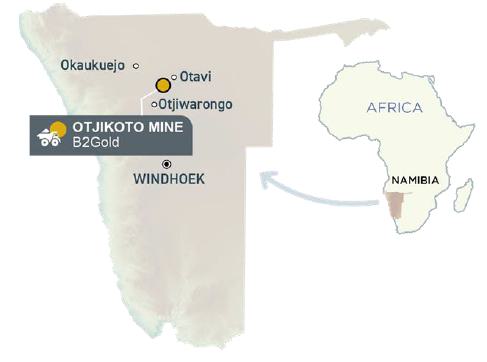
The Otjikoto Mine is located in the north-central part of the Republic of Namibia. It is situated approximately 300 km north of Windhoek, the country’s capital, within the Otjozondjupa Region. The Otjikoto Mine can be accessed off the main B1 road, a primary paved road, from the towns of Otjiwarongo or Otavi located approximately 70 km to the southwest and 50 km to the northeast of the Otjikoto Mine, respectively.
Mining Licence 169 (“ML169”), covering an area of 6,933.98 ha, was granted for a 20-year term, expiring in December 2032, and renewable for further periods, each term not exceeding 15 years. Surrounding ML169 is Exclusive Prospecting Licence 2410 (“EPL 2410”) with a total area of 26,719.21 ha, which remains valid until May 5, 2027, and can be renewed for an additional two-year term with a 25% reduction in area.
B2Gold Namibia (Proprietary) Limited (“B2Gold Namibia”), the holder of ML169 and operator of the Otjikoto Mine, is 90% owned, indirectly, by us and 10% by EVI, a Namibian empowerment company.
In addition, we have purchased and consolidated a number of farms into B2Gold Namibia Property (Pty) Ltd., including the Wolfshag, Otjikoto, Gerhardshausen, Felsenquelle, and Erhardtshof farms. We hold the surface rights through these farms, and all mine infrastructure and the Otjikoto Mine itself are situated within property owned by B2Gold Namibia.
The Mineral Resource estimate for Otjikoto accounts for mining depletion as at December 31, 2025. The Mineral Resource estimate has an effective date of December 31, 2025.
| B2GOLD 2026 Annual Information Form | |
-
Otjikoto Indicated Mineral Resources Statement
| Area | 100% Project Basis | Attributable Ownership Basis | |||
| Tonnes
(x 1,000) |
Gold
Grade (g/t Au) |
Contained
Gold Ounces (x 1,000) |
Attributable
(%) |
Contained
Gold Ounces (x 1,000) |
|
| Otjikoto Open Pit | 17,630 | 0.67 | 380 | 90 | 340 |
| Wolfshag Open Pit | 210 | 0.60 | 4 | 90 | 4 |
| Wolfshag Underground | 780 | 5.19 | 130 | 90 | 120 |
| Antelope Underground | 400 | 5.53 | 70 | 90 | 65 |
| Low-grade stockpile | 23,450 | 0.42 | 310 | 90 | 280 |
| Run-of-mine stockpile | 300 | 1.30 | 10 | 90 | 10 |
| Total Indicated Mineral Resources | 42,770 | 0.66 | 910 | 820 | |
Otjikoto Inferred Mineral Resources Statement
| Area | 100% Project Basis | Attributable Ownership Basis | |||
| Tonnes
(x 1,000) |
Gold
Grade (g/t Au) |
Contained
Gold Ounces (x 1,000) |
Attributable (%) |
Contained
Gold Ounces (x 1,000) |
|
| Otjikoto Open Pit | 11,310 | 0.54 | 200 | 90 | 180 |
| Wolfshag Open Pit | 1,520 | 0.68 | 30 | 90 | 30 |
| Wolfshag Underground | 930 | 4.89 | 150 | 90 | 130 |
| Antelope Underground | 3,440 | 5.23 | 580 | 90 | 520 |
| Total Inferred Mineral Resources | 17,190 | 1.73 | 950 | 860 | |
Notes:
| 1. | Mineral Resources have been classified using the CIM Standards. Mineral Resources are reported in situ or in stockpiles, inclusive of those Mineral Resources that have been modified to Mineral Reserves. Mineral Resources that are not Mineral Reserves do not have demonstrated economic viability. |
| 2. | Mineral Resources are reported on a 100% project and a 90% attributable basis, the remaining 10% interest is held by EVI, a Namibian empowerment company. |
| 3. | The Qualified Person for the Mineral Resource estimate is Andrew Brown, P.Geo., our Vice President, Exploration. |
| 4. | The Qualified Person for the Mineral Resource in stockpile estimates is Peter Montano, P.E., our Vice President, Projects. |
| 5. | The Mineral Resource estimate for Otjikoto accounts for mining depletion as at December 31, 2025. The Mineral Resource estimate has an effective date of December 31, 2025. |
| 6. | Mineral Resource estimates that are amenable to open pit mining methods are reported within a conceptual open pit shell based on a gold price of $2,500/oz, metallurgical recovery of 98%, selling costs of $103.65/oz including royalties and levies, and operating cost estimates of $2.50/t mined (mining), $14.75/t processed (processing) and $3.70/t processed (site general). Mineral Resources that are potentially amenable to open pit mining are reported at a cut-off grade of 0.25 g/t Au. |
| 7. | Mineral Resources that are potentially amenable to underground mining are reported at cut-off grades of 1.25, 1.45 or 2.20 g/t Au and a minimum diluted thickness of 4.0 m. Underground resource reporting assumes a gold price of $2,500/oz Au, process recovery of 98%, variable mining costs by mining method of $79.78–146.95/t mined, processing cost of $19.14/t processed, and a selling cost of $103.65/oz Au produced. |
All tonnage, grade and contained metal content estimates have been rounded; rounding may result in apparent summation differences between tonnes, grade, and contained metal content.
| B2GOLD 2026 Annual Information Form | |
-
The Mineral Reserve estimate for Otjikoto accounts for mining depletion as at December 31, 2025 and costs based on the LoM plan and 2026 budget. The Mineral Reserve estimate has an effective date of December 31, 2025. Mineral Reserve estimates for the Otjikoto Mine have been modified from the Indicated Mineral Resources. No Proven Mineral Reserves have been reported.
Otjikoto Probable Mineral Reserves Statement
| Area | 100% Project Basis | Attributable Ownership Basis | |||
| Tonnes
(x 1,000) |
Gold
Grade (g/t Au) |
Contained
Gold Ounces (x 1,000) |
Attributable (%) |
Contained
Gold Ounces (x 1,000) |
|
| Wolfshag Underground | 900 | 2.67 | 80 | 90 | 70 |
| ROM stockpiles | 300 | 1.30 | 10 | 90 | 10 |
| Total Probable Mineral Reserves | 1,200 | 2.33 | 90 | 80 | |
Notes:
| 1. | Mineral Reserves have been classified using the CIM Standards, are reported at the point of delivery to the process plant, and have an effective date of December 31, 2025. |
| 2. | Mineral Reserves are reported on a 100% project and a 90% attributable basis, the remaining 10% interest is held by EVI, a Namibian empowerment company. |
| 3. | The Qualified Person for the ROM stockpile Mineral Reserve estimate is Peter Montano, P.E., our Vice President, Projects. |
| 4. | The Qualified Person for the Wolfshag Underground Reserve estimate is Michael Meyers, P.Eng., our Director, Project Development. |
| 5. | Mineral Reserves from stockpiles are based on a gold price of $2,000/oz, metallurgical recovery of 98%, selling costs of $83.65/oz including royalties and levies, average processing cost of $14.73/t processed, and site general costs of $3.61/t processed. Mineral Reserves in stockpiles are reported above a cut-off grade of 0.45 g/t Au. |
| 6. | Mineral Reserves that will be mined by underground methods assume a modified transverse longhole stoping mining method, gold price of $2,000/oz, metallurgical recovery of 98%, selling costs of $83.65/oz including royalties and levies, average mining cost of $90.54/t ore mined, average processing cost of $14.00/t processed, site general costs of $5.14/t processed, 22% dilution, and 90% mining recovery. Mineral Reserves that will be mined by underground methods are reported above a cut-off grade of 1.82 g/t Au. |
| 7. | All tonnage, grade and contained metal content estimates have been rounded; rounding may result in apparent summation differences between tonnes, grade, and contained metal content. |
The Otjikoto Mine produced 199,139 ounces of gold in 2025.
The Otjikoto Mine is forecast to produce 70,000 to 90,000 ounces of gold total in 2026 from a combination of high-grade ore from the Wolfshag Underground mine and supplemented by non-reserve low-grade stockpiles. For 2026, the Otjikoto Mine is budgeted to process a total of 3.4 Mt of ore at an average grade of 0.80 g/t Au with a process gold recovery of 97.4%.
Capital expenditures in 2026 for the Otjikoto Mine are expected to total $57 million. Approximately $26 million is expected to be classified as sustaining capital expenditures and $31 million is expected to be classified as non-sustaining capital expenditures. Sustaining capital expenditures are expected to include $13 million for underground development and $13 million for a TSF expansion. Non-sustaining capital expenditures relate to the Antelope deposit development.
| B2GOLD 2026 Annual Information Form | |
-
A total of $6.1 million is budgeted for exploration at Otjikoto in 2026. The focus of the exploration program will be drilling to expand and refine the recently-discovered Antelope deposit, located approximately 3 km south of Phase 5 of the Otjikoto open pit, with a total of 16,000 m of drilling contemplated for the year.
Gramalote Project

The Gramalote Project is located approximately 200 km directly northwest of the Colombian capital of Bogota, approximately 408 km by road, and 100 km northeast of Medellin, the regional capital of the Department of Antioquia.
The Gramalote Project is held 100% by Gramalote Limited, is a wholly-owned subsidiary of B2Gold. Gramalote Limited is registered in Colombia as Gramalote Colombia Limited (“Gramalote Colombia”) and is the operating entity of the project.
B2Gold, through Gramalote Colombia, holds 11,008.26 ha in three registered concession contracts, namely integrated mining title 14292, totalling 8,720.71 ha (referred to as the Gramalote Ridge title), concession title 4894, totalling 2,277.77 ha (referred to as the Trinidad title) and concession title QHQ 16081, totalling 9.78 ha. In addition, there is an application for a mineral title, LJC-08012, which has a total area of 94.14 ha.
Following the acquisition of AngloGold’s 50% interest in the Gramalote Project, which resulted in the Company owning 100% of the Gramalote Project, B2Gold completed a detailed review of the Gramalote Project to identify potential cost savings to develop a medium-scale project. The results of the review allowed the Company to determine the optimal parameters and assumptions for the Gramalote PEA, the results of which were announced on June 18, 2024.
On July 14, 2025, the Company announced the results of a Gramalote Feasibility Study which demonstrated that the Gramalote Project has a meaningful production profile, favorable metallurgical characteristics and positive project economics. The study assumes a mill with an annual processing rate of 6.0 Mt/a, an initial open pit mine life of 11 years, and a processing life of 13 years. The study shows average annual grade processed over the first five years of 1.23 g/t, with a life-of-mine grade of 0.96 g/t and average annual gold production over the first five years of 227,000 ounces of gold per year, with life-of-mine average annual gold production of 177,000 ounces per year. Financial results include all-in sustaining costs of $985/oz over the life of the project, with an after-tax net present value of $941 million and an internal rate of return of 22.4% assuming a $2,500/oz Au price. Assuming a long-term gold price of $3,300/oz this represents an after-tax net present value of $1.7 billion and an internal rate of return of 33.5%. For a more detailed overview of the Gramalote Feasibility Study, please refer to the News Release dated July 14, 2025, which is available on SEDAR+ at www.sedarplus.ca and on our website at www.b2gold.com.
| B2GOLD 2026 Annual Information Form | |
-
Due to the desired modifications to the processing plant and infrastructure locations, a Modified Work Plan and Modified Environmental Impact Study are required. The Modified Work Plan was submitted in December 2025, and the Modified Environmental Impact Study was submitted in February 2026, with completion of the modification process expected to take approximately twelve months. In conjunction with these permit modifications, the Company also intends to complete a significant portion of its resettlement objectives by the end of 2026, in accordance with its existing resettlement plan. Assessment of the Gramalote Project remains ongoing. If B2Gold makes the decision to develop the Gramalote Project as an open pit gold mine, B2Gold would utilize its proven internal mine construction team to build the mine and mill facilities.
Indicated Mineral Resource Statement
| Area | Tonnes (x 1,000) |
Gold
Grade (g/t Au) |
Contained
Gold Ounces (x 1,000) |
Silver
Grade (g/t Ag) |
Contained
Silver Ounces (x 1,000) |
| Gramalote Ridge Oxide | 4,860 | 0.52 | 80 | 2.13 | 330 |
| Gramalote Ridge Sulphide | 150,760 | 0.71 | 3,440 | 0.89 | 4,300 |
| Total Indicated Mineral Resources | 155,620 | 0.70 | 3,520 | 0.93 | 4,630 |
Inferred Mineral Resource Statement
| Area | Tonnes (x 1,000) |
Gold
Grade (g/t Au) |
Contained
Gold Ounces (x 1,000) |
Silver
Grade (g/t Ag) |
Contained
Silver Ounces (x 1,000) |
| Gramalote Ridge Oxide | 730 | 0.43 | 10 | 0.85 | 20 |
| Trinidad Oxide | 8,870 | 0.43 | 120 | 1.06 | 300 |
| Monjas West Oxide | 2,220 | 0.54 | 40 | 0.77 | 50 |
| Subtotal Oxide Inferred | 11,820 | 0.45 | 170 | 0.99 | 380 |
| Gramalote Ridge Sulphide | 9,700 | 0.53 | 170 | 0.81 | 250 |
| Trinidad Sulphide | 78,610 | 0.49 | 1,240 | 0.53 | 1,350 |
| Monjas West Sulphide | 20,820 | 0.64 | 430 | 0.41 | 270 |
| Subtotal Sulphide Inferred | 109,130 | 0.52 | 1,830 | 0.53 | 1,870 |
| Total Inferred Mineral Resources | 120,940 | 0.52 | 2,000 | 0.58 | 2,250 |
Notes:
| 1. | Mineral Resources have been classified using the 2014 CIM Definition Standards. |
| 2. | Mineral Resources are reported inclusive of those Mineral Resources that were converted to Mineral Reserves. Mineral Resources that are not Mineral Reserves do not have demonstrated economic viability. |
| 3. | The Qualified Person for the resource estimate is Stephen Jensen, P.Geo., our Exploration Manager, Americas. |
| B2GOLD 2026 Annual Information Form | |
-
| 4. | Mineral Resources are reported on a 100% project and attributable basis and have an effective date of December 31, 2025. |
| 5. | Mineral Resources for Gramalote Ridge are reported within conceptual open pit shells based on a gold price of $2,500/oz, metallurgical recoveries of 84% for oxide and 92.7–97.6% for sulphide, and operating cost estimates of an average mining cost of $2.50/t mined, processing cost of $5.14/t processed for oxide and $8.50/t processed for sulphide, general and administrative cost of $3.80/t processed and selling cost of $84.00/oz of gold produced. |
| 6. | Mineral Resources for Trinidad are reported within conceptual open pit shells based on a gold price of $2,500/oz, metallurgical recoveries of 81.7% for oxide and 90.9% for sulphide, and operating cost estimates of an average mining cost of $2.30/t mined, processing cost of $5.14/t processed for oxide and $8.50/t processed for sulphide, general and administrative cost of $3.80/t processed and selling cost of $84.00/oz of gold produced. |
| 7. | Mineral Resources for Monjas West are reported within conceptual open pit shells based on a gold price of $2,500/oz, metallurgical recoveries of 81.7% for oxide and 87.6% for sulphide, and operating cost estimates of an average mining cost of $2.48/t mined, processing cost of $5.29/t processed for oxide and $8.65/t processed for sulphide, general and administrative cost of $3.80/t processed and selling cost of $84.00/oz of gold produced. |
| 8. | Mineral Resources for Gramalote Ridge, Trinidad, and Monjas West are reported at cut-offs of 0.14 g/t Au for oxide and 0.17 g/t Au for sulphide. |
| 9. | All tonnage, grade and contained metal content estimates have been rounded; rounding may result in apparent summation differences between tonnes, grade, and contained metal content. |
Probable Mineral Reserves Statement
| Area | Tonnes (x 1,000) |
Gold
Grade (g/t Au) |
Contained
Gold Ounces (x 1,000) |
| Gramalote Ridge Open Pit | 76,700 | 0.96 | 2,360 |
| Total Probable Mineral Reserves | 76,700 | 0.96 | 2,360 |
Notes:
| 1. | Mineral Reserves have been classified using the CIM Definition Standards, are reported at the point of delivery to the process plant and have an effective date of April 1, 2025. |
| 2. | Mineral Reserves are reported on a 100% project basis. |
| 3. | The Qualified Person for the Mineral Reserve estimate is Mr. Peter Montano, P.E., our Vice President, Projects. |
| 4. | Mineral Reserves are based on a conventional open pit mining method, gold price of $1,750/oz, metallurgical recovery averaging 95.6%, selling costs of $60.00/oz including royalties, average mining cost of $2.70/t mined, average processing cost of $8.50/t processed, and average site general costs of $3.80/t processed. |
| 5. | Reserve model dilution and ore loss was applied through whole block averaging such that at a 0.40 g/t Au cut-off there is a 1.2% increase in tonnes, a 4.6% reduction in grade, and 3.5% reduction in ounces when compared to the Mineral Resource model. |
| 6. | Mineral Reserves are reported above a cut-off grade of 0.40 g/t Au. |
| 7. | All tonnage, grade and contained metal content estimates have been rounded; rounding may result in apparent summation differences between tonnes, grade, and contained metal content. |
The Gramalote Project has a budget of $61 million for 2026, to continue to de-risk the project, including $35 million to advance resettlement programs, establish coexistence programs for small miners, work on health, safety and environmental projects, and continue to work with the government and local communities on social programs.
| B2GOLD 2026 Annual Information Form | |
-
RISK FACTORS
The exploration, development and mining of natural resources are highly speculative in nature and are subject to significant risks. The following risk factors could materially adversely affect our future business, operations and financial condition, and could cause actual events to differ materially from those described in our forward-looking statements. The risks factors noted below do not necessarily comprise all risks faced by us. Additional risks and uncertainties not presently known to us or that we currently consider immaterial may also impair our business, operations and future prospects. If any such risks occur, our business may be harmed, and our results of operations and financial condition may be adversely affected.
Changes in the price of gold and other metals in the world markets, which can fluctuate widely, significantly affect the profitability of our operations, our financial condition and our ability to develop new mines.
The profitability of our operations is significantly affected by changes in the market price of gold and other mineral commodities. Mineral prices fluctuate widely and are affected by numerous factors beyond our control, including: interest rates; the rate and anticipated rate of inflation; world supply of mineral commodities; consumption patterns; purchases and sales of gold by central banks; forward sales by producers; production costs; demand from the jewelry industry; speculative activities; stability of exchange rates; the relative strength of the U.S. dollar and other currencies; changes in international investment patterns; monetary systems; and political and economic events.
Although the price of gold increased over the most recently completed fiscal year, from $2,646.30 per ounce on January 2, 2025 to $4,307.95 on December 31, 2025, future price declines could cause commercial production or the development of new mines to be impracticable or unpredictable. If gold prices decline significantly, or decline for an extended period of time, we may be unable to continue our operations, develop our properties, fulfill our obligations under our permits and licences or under our agreements with our partners, or continue to pay dividends at the current rate or at all. As a result, we could be forced to discontinue our operations or development activities, or to abandon or sell our interest in some or all of our properties, which could have a negative effect on our profitability and cash flow.
Mineral Resources and Mineral Reserves are estimated and revision or restatement of Mineral Resources and Mineral Reserves could have a material adverse effect on our profitability, results of operations and financial condition.
There is a degree of uncertainty attributable to the estimation of Mineral Resources (within the meaning of NI 43-101), Mineral Reserves (within the meaning of NI 43-101) and expected mineral grades. The Mineral Resource and Mineral Reserve estimates included or incorporated by reference herein have been determined and valued based on assumed or estimated future prices, cut-off grades and operating costs. However, until mineral deposits are actually mined and processed, Mineral Resources and Mineral Reserves must be considered as estimates only. Any such estimates are expressions of judgment based on knowledge, mining experience, analysis of drilling results and industry practices.
Mineral Resources and Mineral Reserves may require revision based on actual production experience. Market fluctuations in the price of metals, as well as increased production costs, results of metallurgical testing and reduced recovery rates, may render certain Mineral Reserves uneconomic and may ultimately result in a restatement of Mineral Resources and/or Mineral Reserves. Short-term operating factors relating to the Mineral Resources and Mineral Reserves, such as the need for sequential development of ore bodies, may adversely affect our profitability in any accounting period. Estimates of operating costs are based on assumptions including those relating to inflation and currency exchange, which may prove incorrect. Estimates of mineralization can be imprecise and depend upon geometallurgical assumptions, geological interpretation and statistical inferences drawn from drilling and sampling analysis, which may prove to be unreliable. In addition, the grade and/or quantity of precious metals ultimately recovered may differ from that indicated by drilling results. There can be no assurance that precious metals recovered in small scale tests will be duplicated in large scale tests under onsite conditions or at production scale. Amendments to mine plans and production profiles may be required as the amount of Mineral Resources changes or upon receipt of further information during the implementation phase of the particular project. Extended declines in market prices for gold may render portions of our mineralization uneconomic and result in reduced reported mineralization. Any material reduction in estimates of mineralization, or in our ability to develop its properties and extract and sell such minerals, could have a material adverse effect on our business, financial condition or results of operations.
| B2GOLD 2026 Annual Information Form | |
-
Our failure to achieve production, cost and other estimates could have a material adverse effect on our future cash flows, profitability, results of operations and financial condition.
Our public disclosure contains guidance and estimates of future production, operating costs, capital costs and other economic and financial measures with respect to our existing mines and certain of our exploration and development stage projects. The estimates can change, or we may be unable to achieve them. Actual production, costs, returns and other economic and financial performance may vary from the estimates depending on a variety of factors, many of which are not within our control. These factors include, but are not limited to: actual ore mined varying from estimates of grade, tonnage, dilution, and metallurgical and other characteristics; short-term operating factors such as the need for sequential development of ore bodies and the processing of new or different ore grades from those planned; mine failures, slope failures or equipment failures; accidents; natural phenomena such as inclement weather conditions, floods, droughts, rock slides and earthquakes; encountering unusual or unexpected geological conditions; regional epidemic or pandemic of disease; changes in power costs and potential power shortages; exchange rate and commodity price fluctuations; price changes or shortages of principal supplies needed for operations, including construction materials, explosives, fuels, water and equipment parts; labour shortages or strikes; litigation; regional or national instability, imposition of sanctions, insurrection, war or acts of terrorism or violent crime; suspensions or closures imposed by governmental authorities; civil disobedience and protests; failure to comply with applicable regulations, or new restrictions or regulations, imposed by governmental or regulatory authorities; permitting or licencing issues; difficulties in resettlement processes, when required; claims by landowners; overlapping with other activities declared as activities for the public benefit; issues arising from the presence of illegal miners; obstacles and requisites imposed by local financial entities; shipping interruptions or delays; or other risks described herein. The failure to achieve production, cost and other estimates could have a material adverse effect on our future cash flows, profitability, results of operations and financial condition.
Our capital and operating costs, production schedules and economic returns are based on material assumptions which may prove to be inaccurate.
Our expected capital and operating costs, production schedules and estimates, anticipated economic returns and other projections, estimates and forecasts for its mineral properties that are included or incorporated by reference herein or included in any technical reports, scoping studies, pre-feasibility studies and feasibility studies prepared for or by us are based on assumed or estimated future metals prices, cut-off grades, operating costs, capital costs, metallurgical recoveries, that the actual ore mined is amenable to mining or treatment, environmental considerations, labour volumes, permitting and other factors, any of which may prove to be inaccurate. As a result, technical reports, scoping studies, pre-feasibility studies and feasibility studies prepared for or by us may prove to be unreliable.
| B2GOLD 2026 Annual Information Form | |
-
Our capital and operating costs are affected by the cost and availability of commodities and goods such as steel, cement, explosives, fuel, electrical power and supplies, including reagents. Significant declines in market prices for gold and other metals could have an adverse effect on our economic projections. Management assumes that the materials and supplies required for operations will be available for purchase and that we will have access to the required amount of sufficiently skilled labour. As we rely upon certain third-party suppliers and contractors, these factors can be outside of our control and an increase in the costs of, or a lack of availability of, commodities, goods and labour may have an adverse impact on our financial condition and results of operations.
We may experience difficulty in obtaining the necessary permits for our exploration, development or operational activities, if such permits are obtained at all, and may face penalties as a result of violations of permits or other environmental laws, which may cause delays and increases to projected budgets. Any of these discrepancies from our expected capital and operating costs, production schedules and economic returns could cause a material adverse effect on our business, financial condition or results of operations.
We have in the past, and may in the future, provide estimates and projections of our future production, costs and financial results. Any such information is forward looking. Neither our auditors nor any other independent expert or outside party compiles or examines these forward-looking statements. Accordingly, no such person expresses any opinion or any other form of assurance with respect thereto. Such estimates are made by our management and technical personnel and are qualified by, and subject to the assumptions, contained or referred to in the filing, release or presentation in which they are made, including assumptions about the availability, accessibility, sufficiency and quality of mineralized material, our costs of production, the market prices of gold and other metals, our ability to sustain and increase production levels, the sufficiency of our infrastructure, the performance of our personnel and equipment, our ability to maintain and obtain mining interests and permits, the state of governments and community relations, and our compliance with existing and future laws and regulations. Actual results and experience may differ materially from these assumptions. Failure to achieve estimates or material increases to costs could have a material adverse impact on our future cashflows, profitability, results of operations and financial condition. Any such production, cost, or financial results estimates speak only as of the date on which they are made, and we disclaim any intent or obligation to update such estimates, whether as a result of new information, future events or otherwise. Accordingly, such forward-looking statements should be considered in the context in which they are made and undue reliance should not be placed on them.
We may experience difficulties as a result of operating in remote locations which could have a material adverse effect on our business, results of operations and financial condition.
Certain of our operations are located in remote areas and are affected by severe weather events and climate issues, resulting in technical challenges for conducting both geological exploration and mining operations. Although we benefit from modern mining technology, we may sometimes be unable to overcome problems related to weather and climate, either expeditiously or at a commercially reasonable cost, which could have a material adverse effect on our business, results of operations and financial condition.
The Goose Mine is located in the Back River Gold District in the Kitikmeot Region of Nunavut in northern Canada, 520 km northeast of Yellowknife, the nearest territorial capital city. Our operations are constrained by the remoteness of the Back River Gold District, particularly as the WIR is the only route between the MLA and the Goose Mine, and it is open only during the coldest months of the year. Most of the materials that we require for the operation of the Goose Mine must be transported through the MLA during the short shipping season, which may be further truncated due to weather conditions. If we are unable to acquire and transport necessary supplies during this time, it may result in a slowdown or stoppage of operations and/or cost increases at the Goose Mine. Furthermore, if major equipment fails, items necessary to replace or repair such equipment may have to wait to be shipped through the MLA during this short shipping window. Failure to have available the necessary materials required for operations or to repair or replace malfunctioning equipment may require the slowdown or stoppage of operations. The remoteness of the Goose Mine also necessitates the use of fly-in/fly-out camps for the accommodation of site employees and contractors, which may have an impact on our ability to attract and retain qualified mining, exploration and/or construction personnel.
| B2GOLD 2026 Annual Information Form | |
-
Mineral exploration and development are speculative and involve significant risks and uncertainties, which could have a material adverse effect on our business, results of operations and financial condition.
Our business plans and projections rely significantly on the planned development of our non-producing properties. The development of mineral deposits involves significant risks that even a combination of careful evaluation, experience and knowledge may not eliminate. Few properties that are explored are ultimately developed into producing mines and no assurance can be given that minerals will be discovered in sufficient quantities, with sufficient grade to justify commercial operations, or that funds required for development can be obtained on a timely basis. Major expenses may be required to locate and establish Mineral Reserves, to develop metallurgical processes and to construct mining and processing facilities at a particular site. It is impossible to ensure that the exploration or development programs we or any of our joint venture partners plan will result in a profitable commercial mining operation.
Properties not yet in production, starting production, or slated for expansion are subject to higher risks as new mining operations often experience unexpected problems during the start-up phase, and production delays and cost adjustments can often happen. Further, feasibility studies, pre-feasibility studies, and preliminary economic assessments contain project-specific estimates of future production, which are based on a variety of factors and assumptions. We can provide no assurance that such estimates will be achieved and the failure to achieve production or cost estimates or material increases in costs could have a material adverse effect on our future cash flows, profitability, operations, financial condition and our share price.
In addition, developments are prone to material cost overruns versus budget. The capital expenditures and time required to develop new mines, including building mining and processing facilities for new properties, are considerable, and changes in cost or construction schedules can significantly increase both the time and capital required to build the mine. The project development schedules are also dependent on obtaining the governmental approvals and permits necessary for the operation of a mine which is often beyond our control. It is not unusual in the mining industry for new mining operations to experience unexpected problems during the start-up phase, resulting in delays and requiring more capital than anticipated. We can provide no assurance that there will be sufficient availability of funds to finance construction and development activities, particularly if unexpected problems arise. Actual costs and economic returns from projects may differ materially from our estimates and variances from expectations could have a material adverse effect on our business, financial conditions and results of operations and liquidity.
| B2GOLD 2026 Annual Information Form | |
-
Other risks associated with mineral exploration and development include but are not limited to: the availability and costs of skilled labour and the ability of key contractors to perform services in the manner contracted for; unanticipated changes in grade and tonnage of ore to be mined and processed; unanticipated adverse geotechnical and geological conditions; incorrect data on which engineering assumptions are made; potential increases in construction and operating costs due to shortages of and/or changes in the cost of fuel, power, materials, security and supplies; adequate access to the site and unanticipated transportation costs or disruptions; potential opposition or obstruction from NGOs, environmental groups or Indigenous groups or local groups, which may delay or prevent development activities; equipment failures; natural phenomena; exchange rate and commodity price fluctuations; high rates of inflation; civil disobedience, protests and acts of civil unrest or terrorism; applicable taxes and restrictions or regulations imposed by governmental or regulatory authorities or other changes in the regulatory environments; and other risks associated with mining described herein.
The combination of these factors may result in our inability to develop our non-producing properties, to achieve or maintain historical or estimated production, revenue or cost levels, or to receive an adequate return on invested capital, which could have a material adverse effect on our business, operations and financial condition.
Our operations across several different countries subject us to various political, economic and other risks that could negatively impact our operations and financial condition.
Our exploration, development and production activities are conducted in various countries, including Mali, Canada, the Philippines, Namibia, and Colombia. As a result, our operations are exposed to various levels of political, economic, criminal and other risks and uncertainties. These risks and uncertainties vary from country to country and include, but are not limited to: the existence or possibility of political or economic instability including international trade disputes and the imposition of tariffs; conflict; terrorism; hostage taking; violent crime; military repression; extreme fluctuations in currency exchange rates; high rates of inflation; labour unrest; war or civil unrest; expropriation and nationalization; governmental legislation and regulations relating to foreign investment and the mining industry; changes in taxation laws or policies or changes in the interpretation of such taxation laws or policies; uncertainty as to the outcome of any litigation in foreign jurisdictions; uncertainty as to enforcement of local laws; environmental controls and permitting; restrictions on the use of land and natural resources; renegotiation or nullification of existing concessions, licences, permits and contracts; illegal mining; imposition of sanctions; restrictions on foreign exchange and repatriation; corruption; unstable legal systems; changing political conditions; changes in mining laws and social policies; social unrest on account of poverty or unequal income distribution; economic empowerment, Indigenous or local ownership legislation; disease; currency controls and governmental regulations that favor or require the awarding of contracts to local contractors or require foreign contractors to employ citizens of, or purchase supplies from, a particular jurisdiction or require equity participation by local citizens; and other risks arising out of foreign sovereignty issues.
We have interests in exploration and development properties located in developing countries, including Mali, the Philippines, Namibia and Colombia, and our mineral exploration and mining activities may be affected to varying degrees by political instability and governmental legislation and regulations relating to foreign investment and the mining industry. Some of these countries have experienced, or are currently experiencing, varying degrees of civil unrest and instability. Changes, if any, in mining or investment laws or policies, political attitude or the level of stability in such countries may adversely affect our operations or profitability.
| B2GOLD 2026 Annual Information Form | |
-
Our operations across several different countries subject us to various political and economic risks associated with increasing control and nationalization that could negatively impact our operations and financial condition.
Governments throughout the world are continuing to target the mining and metals sector to raise government revenue. Numerous countries, including certain of those in which we operate, have introduced changes to their respective mining regimes that reflect increased government control or participation in the mining sector, including, but not limited to: changes of laws or governmental regulations affecting foreign ownership; mandatory state participation; citizenship participation in decisions related to mining activities; delegating to municipal authorities to determine the use of soil; taxation and royalties; exchange controls; permitting and licencing of exploration, development and production; land use restrictions; price controls, export controls, and export and import duties; restrictions on repatriation of income or return of capital; requirements for local processing of mineral products; environmental protection; collectability of outstanding VAT receivables; requirements for employment of local staff or contractors; and requirements for contributions to infrastructure and social support systems. The impact of resource nationalization could have a material adverse effect on our business, our operations, and our profitability.
We can provide no assurance that the countries in which we operate that have yet to adopt resource nationalization frameworks or regimes will not do so in the future. We can also provide no assurance that the terms and obligations of resource nationalization regimes to which our operations are subject will not increase or become more onerous. Government policy is beyond our control, may change without warning, and could have the effect of discouraging further investment in our operations or limit the economic value we may derive therefrom.
Furthermore, we can provide no assurance that our assets will not be subject to specific nationalization or expropriation measures, whether legitimate or not, by any authority or body, whether state sanctioned or otherwise. While there are often frameworks and mechanisms to seek compensation and reimbursement for losses in these kinds of circumstances, there is no assurance that such measures will effectively or sufficiently compensate us (and our investors), nor is there any assurance that such compensation would occur in a timely fashion. Further, the nationalization, expropriation, abandonment or condemnation of any of our material properties could create an event of default under our Revolving Credit Facility which could have a material adverse effect on our financial position.
Our operations in Mali may be subject to governmental and other risks that could have unforeseen and potentially material and adverse impacts on our business, operations, financial condition and assets.
In 2023, the Malian Government undertook some major reforms in the mining sector. The 2023 Mining Code and a local content law were adopted on August 29, 2023. The 2023 Mining Code provides for an increase in Mali’s potential interest in new mining projects from 20% to 30%. The Government’s initial interest is maintained at 10%, but the additional interest that may be acquired by the Government has increased from 10% to 20%, with a further 5% interest that must be available to be acquired by a local Malian stakeholder, raising the aggregate state and private Malian interests in new projects to a potential total ownership interest of 35%.
The 2023 Mining Code introduced some other key changes including increase of taxes and in particular, the TAV, elimination of tax exoneration on petroleum products during exploitation phase, introduction of new funds the contributions to which are based on revenue, limited tax and customs regimes stabilisation, separate mining convention to be signed for the exploration and for the exploitation phase. At the same time, the Malian Government adopted a local content law that will require mining companies and sub-contractors to give priority for procurement of locally produced materials and provision of services by local companies in the mining sector. Implementation decrees of the 2023 Mining Code and the local content law were adopted on July 9, 2024, and as a consequence both laws are now fully effective. In addition, decrees relating to the implementation of the new mining funds provided in the 2023 Mining Code were adopted on March 11, 2025, and as a consequence these funds are now fully enforceable.
| B2GOLD 2026 Annual Information Form | |
-
Following the 2022 national audit of mining companies to determine if Mali was receiving a fair share of the profits generated by its mining sector, the Government suspended the issuing of exploration and exploitation mining licences. On March 15, 2025, the Government lifted suspension of certain permitting matters: (i) applications for renewal of exploration and exploitation permits, (ii) applications for transition from the exploration phase to the exploitation phase, and (iii) applications for direct or indirect transfer of exploitation permits. Production from Fekola Regional depends on the Government issuing a new exploitation permit for this area.
In 2023, the State of Mali established a commission comprised of Malian Government advisors and representatives which was tasked with negotiating certain aspects of existing mining conventions and clarifying the application of the 2023 Mining Code to both existing and new mining projects. Following an extensive negotiation process, we entered into the 2024 MOU with the State of Mali in September 2024. The 2024 MOU includes an overall framework which covers the settlement of outstanding matters arising from the State of Mali’s mining audit, income tax and customs audits, as well as clarification and agreement on the application of the 2023 Mining Code to the Fekola Mine and Fekola Regional. However, no assurances can be provided that the State of Mali will not seek to amend or modify the terms of the 2024 MOU and we can provide no assurance that the implementation and enforcement process will not have an adverse effect on our profitability and results of operations.
The numerous conflicts in the Sahel region has led three countries, Mali, Burkina Faso and Niger, to create the Alliance of Sahel States (“AES”), causing a deterioration in relations with Economic Community of West African States (“ECOWAS”). On January 29, 2025, the withdrawal of these three countries was formalized by ECOWAS. During this period, these countries continued to strengthen their cooperation with Russia, particularly on the military and economic fronts.
The President of Mali’s transitional government has been granted a five-year mandate, renewable as many times as necessary until the country’s stability is restored. The transitional authorities issued a decree suspending all political party activities. In response, several political figures in exile formed a new opposition front, joined by the Coalition of Forces for the Republic (“CFR”).
The country has also experienced several attacks by Jama’at Nusrat al-Islam wal-Muslimeen (“JNIM”) over the course of the year, prompting several countries to advise their nationals to leave Mali. These attacks triggered a severe fuel crisis, temporarily paralyzing the Malian economy. The transitional authorities further increased their footprint on the media and opposition voices, narrowing civic space. Economic conditions have also deteriorated over the past years, characterized by a rise in poverty, lack of sufficient health care, and a persistent energy crisis. The ongoing instability in Mali and changes to the political and security situation there could have unforeseen and potentially material and adverse impacts on our business, operations, financial condition and assets.
| B2GOLD 2026 Annual Information Form | |
-
Our operations in Namibia may be subject to governmental and other risks that could have a material adverse effect on our business, operations and financial condition.
Namibia is a member of the Southern African Customs Union (“SACU”), which provides for a common external tariff and guarantees free movement of goods between its member states. A high proportion of Namibia’s trade is conducted with SACU members. The Namibian Government is highly dependent on SACU revenue, but Namibia’s share of the SACU revenue is expected to decline in the foreseeable future, and as a result the Namibian Government may introduce additional taxes or increase current tax rates, which in turn could have a material adverse effect on our business.
In 2015/2016, Namibia released two versions of the Namibia Equitable Economic Empowerment Framework bill (the “NEEEF Bill”), a controversial bill which proposed, in effect, the forced transfer of 25% of the shares or economic interest in any business enterprise conducting business in Namibia to certain designated persons, being persons of colour, women and disabled persons (“Designated Persons”). While the NEEEF Bill contained various controversial provisions, which may ultimately render it unconstitutional, it caused considerable uncertainty in the Namibian business community and the investor community, and as a result it remains under discussion and revision. During March 2018, the third President of Namibia, in his State of the Nation Address, announced that the controversial 25% ownership pillar would be abolished. In February 2020, the latest version of the NEEEF Bill was presented to the Cabinet Committee on Legislation (the “2020 NEEEF Bill”). While the 2020 NEEEF Bill removed many of the controversial provisions contained in the previous versions, it created additional uncertainty in that its application appears to be dependent on the promulgation of what is referred to as “Standards” by the Minister who administers the 2020 NEEEF Bill, and the ambit of such “Standards” has not been set. The 2020 NEEEF Bill may likewise be unconstitutional. It is not clear whether there will be a further round of consultation on the bill, and regulations and “Standards” would need to be promulgated before the bill, in whatever revised form, becomes operative. While the 2020 NEEEF Bill is not publicly available, there is a document in circulation which has been referred to in a recent speech by the previous Prime Minister as the National Equitable Economic Empowerment Act, 2021, which appears to contain the substantive principles of the 2020 NEEEF Bill. At the date of this AIF, no further drafts of the 2020 NEEEF Bill have been circulated to the public.
In Namibia, certain new mineral licences or renewals of existing mineral licences may be subject to certain terms and conditions relating to “Namibianisation”, that is, transferring a portion (commonly 5%) of the shareholding in the respective licence holder to Namibian citizens, Namibian controlled companies, Designated Persons or companies held by Designated Persons, and undertaking social welfare or community upliftment obligations, specifically in respect of women and youth as well as the poor. It may also be subject to the licence holder appointing a certain percentage of its management (currently 20%) from Namibian citizens, specifically also Designated Persons. As of 2020, the aforesaid Namibianisation conditions are generally no longer applied by the Minister of Mines and Energy to new exclusive prospecting licences, but they are applied to new mining licences and, presumably, also to renewals of mining licences.
In 2016, the Namibian parliament passed a new investment law termed the Namibia Investment Promotion Act, 2016 (Namibia) (the “Namibia Investment Promotion Act”), which has not yet come into force. If it were to come into force, the Namibia Investment Promotion Act would materially change the legal basis upon which foreign investments are to be made, maintained and withdrawn from Namibia. The law provides for reservation of certain businesses to Namibians and requires approval of the Minister of Trade and Industrialisation, on essentially a discretionary basis, in connection with making an investment, expanding an investment and disinvesting. The law would also abolish the recourse of foreign investors to international tribunals by insisting that any disputes be exclusively dealt with under Namibian law and by Namibian courts. Further, the Namibia Investment Promotion Act may have a negative effect on investor security and new investments into Namibia. In the absence of regulations or guidelines with respect to the approval process, it is entirely at the discretion of the Minister to determine what type of foreign investments, changes to current investments or disinvestments will be allowed, and it is difficult at this stage to anticipate the extent to which the Namibia Investment Promotion Act would affect the Otjikoto Mine in practice. Towards the end of 2021, the Minister of Trade and Industrialisation re-introduced a further version of the Namibia Investment Promotion Act, which version, following public outcry, was quickly withdrawn on November 30, 2021 and is currently not before parliament. Any such legislation, upon becoming operative, would introduce changes to the foreign investment regime which could have a material adverse effect on our business, operations and financial condition.
| B2GOLD 2026 Annual Information Form | |
-
Our form of ownership of our assets in the Philippines may be subject to governmental appropriations that could have a material adverse effect on our business, operations and financial condition.
The Constitution of the Philippines provides that all natural resources are owned by the State, which may enter into a coproduction, joint venture or production sharing agreement with citizens of the Philippines, corporations or associations whose capital is at least 60% owned by Philippine citizens. Commonwealth Act No. 108, as amended (the “Anti-Dummy Act”) provides penalties for, among others, (i) Filipinos who permit aliens to use them as nominees or dummies so that the aliens could enjoy privileges otherwise reserved for Filipinos or Filipino corporations, and (ii) aliens or foreigners who profit from the adoption of these dummy relationships. It also penalizes the act of falsely simulating the existence of minimum stock or capital as owned by citizens of the Philippines or any other country in cases in which a constitutional or legal provision requires that before a corporation or association may exercise or enjoy a right, franchise or privilege, not less than a certain percentage of its capital must be owned by such citizens. The Anti-Dummy Act likewise prohibits aliens from intervening in the management, operation, administration or control of nationalized businesses or enterprises, whether as officers, employees or labourers, with or without remuneration, except that aliens may take part in technical aspects only, provided (y) no Filipino can do such technical work, and (z) it is with express authority from the Secretary of Justice. The Anti-Dummy Act also allows the election of aliens as members of the boards of directors or the governing bodies of corporations or associations engaged in partially nationalised activities in proportion to their allowable participation or share in the capital of such entities. Our interests in the Masbate Gold Project is held through equity interests in companies owned by Philippine shareholders. There is the risk that, given the limited precedents to date in the country, the structure through which we hold the Masbate Gold Project could be challenged or require changes. The imposition of, or a failure to comply with, Philippine regulations could have a material adverse effect on our business, operations and financial condition.
Our operations in Colombia may be subject to security issues and criminal activity that could have a material adverse effect on our business, operations and financial condition.
The persistence of security issues in Colombia and the peace agreement signed with the Revolutionary Armed Forces of Colombia, the largest and oldest rebel group in Colombia, has created other security issues and has helped to strengthen criminal gangs and other small rebel groups in Colombia. While the Government of Colombia has been attempting to advance negotiations simultaneously with the ELN rebel group and certain criminal gangs with the aim of attaining general peace, the potential for security conditions to deteriorate and the development of new types of terrorism remains a risk with respect to our exploration and development at the Gramalote Project.
| B2GOLD 2026 Annual Information Form | |
-
In addition, Colombia has a history of corruption, drug trafficking and illegal exploitation of minerals. Antioquia department, where the Gramalote Project is located, has one of the highest concentrations of illegal gold mining activities in Colombia. These circumstances could negatively impact on our operations if they are not adequately addressed by authorities.
While Colombia has a steady legal system and independent judges and courts, inconsistencies in legal interpretation of laws applicable to mining, and sudden changes of the judges’ and courts’ positions, create risks and uncertainties for mining companies in Colombia. Further, non-governmental organizations (“NGOs”), academics and communities are frequently opposed to large-scale mining (and vocal about such opposition) as they consider it to be a threat to the environment and to social organization. Social movements have also had a significant impact in legal decisions aimed to protect the environment, the Indigenous and Afro-Colombian communities, and the people of areas affected by extractive projects. It is likely that social movements will continue as an influential factor with respect to Colombian political and legal decisions related to the mining industry.
Our operations are subject to operating hazards and risks incidental to mining activities.
Mining operations generally involve a high degree of risk. Our operations are subject to all the hazards and risks normally encountered in the exploration, development and production of gold, including: unusual and unexpected geologic formations; seismic activity; rock bursts; cave-ins or slides; fire, explosions and flooding; pit wall failure and other structural collapses; periodic interruption due to inclement or hazardous weather conditions; and other conditions involved in the drilling and removal of material, any of which could result in damage to, or destruction of, mines and other producing facilities, personal injury or death, damage to property, environmental damage and possible legal liability. Milling operations are subject to hazards such as fire, flooding, equipment failure or failure of retaining dams around tailings disposal areas, which may result in environmental pollution and consequent liability. The occurrence of any of these events could result in a prolonged interruption of our operations, affect the profitability of our operations, lead to a loss of licences, damage community relations and adversely affect our reputation.
Fluctuations in the price and availability of infrastructure and energy and other commodities could impact our profitability and development of projects.
Mining, processing, development and exploration activities depend on adequate infrastructure. Reliable roads, bridges, power sources and water supply are important determinants which affect capital and operating costs. Our inability to secure adequate water and power resources as well as other events outside of our control, such as unusual or infrequent weather phenomena, sabotage, terrorism, community or government or other interference in the maintenance or provision of such infrastructure, or failure to maintain or extend such infrastructure, could adversely affect our operations, financial condition and results of operations.
Profitability is affected by the market prices and availability of commodities that we use or consume for our operations and development projects. Prices for commodities like heavy fuel oil (“HFO”), diesel fuel, electricity, steel, concrete, and chemicals (including cyanide) can be volatile, and in certain circumstances may be fixed by governments, and changes can be material, occur over short periods of time and be affected by factors beyond our control, including war or civil unrest. Our operations use a significant amount of energy and depend on suppliers to meet those needs. Higher costs for such required commodities and construction materials, including as a result of increased taxes on such commodities or construction materials or tighter supplies thereof, can affect the timing and cost of our development projects, and we may decide that it is not economically feasible to continue some or all of our commercial production and development activities, which could have an adverse effect on our profitability.
| B2GOLD 2026 Annual Information Form | |
-
Higher worldwide demand for critical resources like input commodities, equipment, and skilled labour could affect our ability to acquire them and lead to delays in delivery and unanticipated cost increases, which in turn could have an effect on our operating costs, capital expenditures and production schedules.
We are subject to supply chain disruptions.
Our ability to mine, process and sell products is critical to our operations. Our operations depend on the continued availability and delivery of supplies of consumables and capital items to operate efficiently. In addition to consumables, continuous supplies of energy, water, equipment and spare parts, and labour are critical to our operations, the costs of which are subject to worldwide supply and demand as well as other factors beyond our control. Supply chain disruptions; power outages; labour disputes and/or strikes; geopolitical activity, health emergencies in the regions where we operate; weather events and natural disasters could seriously harm our operations as well as the operations of our customers and suppliers. Further, our suppliers may experience capacity limitations in their own operations or may elect to reduce or eliminate certain product lines, all of which is beyond our control but could have a material adverse effect on our operations and revenue.
We are subject to taxation in several different jurisdictions, and adverse changes to the taxation laws of such jurisdictions or unanticipated tax consequences of corporate reorganizations could have a material adverse effect on our performance and profitability.
We are subject to the taxation laws of several different jurisdictions. These taxation laws are complicated and subject to change, review and assessment in the ordinary course. Any changes in taxation law, as well as reviews or assessments, could result in us paying higher taxes, which in turn could adversely affect our performance and profitability. Taxes may also adversely affect our ability to repatriate earnings and otherwise deploy our assets. As noted above, governments have used new or increased taxes, including taxes specific to the mining industry, such as income taxes, excise taxes and royalties to raise government revenue. Although we have tax stabilization agreements with some of the countries in which we operate, there can be no certainty that such agreements will be upheld or not withdrawn in the future.
On September 4, 2025, the Philippines enacted a new tax framework for the mining sector that provides for: (i) a royalty tax on net income is based on a profit margin ranging from 1–5%, which if the net income is zero or negative, the royalty tax shall be 0.1% of the gross output; and (ii) a windfall profit tax on net income based on profit margin ranging from 1–10%. This new tax framework is in addition to the existing excise tax on gross output of 4%.
While we have implemented initiatives to assess the impact of these new tax changes on our business and operations, we have no control over how exactly these will be implemented. The timing and impact of these tax changes, and the extent to which they may have an impact on us, which may be material and adverse, is not presently known. Further, we can provide no assurance that we will be able to undertake steps to mitigate the effects of such tax changes to preserve or promote our economic performance.
We may complete intercorporate transactions, corporate reorganizations and reorganizations of the entities holding our projects. If such transactions and/or reorganizations result in the imposition of an unanticipated tax or penalty, it may have a material adverse effect on our business. We are also subject to ongoing tax audits from time to time. Adverse results of such tax audits may have a negative effect on our business.
| B2GOLD 2026 Annual Information Form | |
-
The Organisation for Economic Co-operation and Development, together with the G20 countries, has committed to reduce perceived abusive global tax avoidance, referred to as base erosion and profit shifting (“BEPS”). As part of this commitment, an action plan has been developed to address BEPS with the aim of securing revenue by realigning taxation with economic activities and value creation by creating a single set of consensus-based international tax rules dealing with various matters, such as the definition of permanent establishment and the taxation of hybrid instruments. As part of the BEPS project, a multilateral instrument (“MLI”) intended to allow participating jurisdictions to swiftly modify their bilateral tax treaties to facilitate various BEPS initiatives has been ratified by a significant number of countries, including Canada. Further, consistent with the adoption of BEPS, Canada’s Department of Finance has introduced (i) new excessive interest and financing expenses limitation (EIFEL) rules that would limit interest deduction in certain circumstances, (ii) legislation addressing hybrid mismatch arrangements and (iii) legislation to enact a Canadian “Global Minimum Tax Act”. The BEPS project (including the foregoing initiatives) and the MLI may have a material impact on how our operating results are taxed, and may also give rise to additional reporting and disclosure obligations.
We may be unable to generate sufficient cash to service our debt, the terms of the agreements governing our debt may restrict our current or future operations, and the indebtedness may have a material adverse effect on our financial condition and results of operations.
Our ability to make scheduled payments on any balance under the Revolving Credit Facility or to pay amounts due under the Convertible Notes or any other indebtedness will depend on our financial condition and operating performance, which in turn are subject to prevailing economic and competitive conditions and to certain financial, business, legislative, regulatory and other factors beyond our control. If our cash flows and capital resources are insufficient to fund our debt service obligations, we could face substantial liquidity problems and could be forced to reduce or delay investments and capital expenditures, cease or reduce the payment of dividends, dispose of material assets or operations, seek additional debt or equity capital or restructure or refinance our indebtedness, including any indebtedness under the Revolving Credit Facility or the Convertible Notes. We may not be able to implement any such alternative measures on commercially reasonable terms or at all and, even if successful, those alternatives may not allow us to meet our scheduled debt service obligations.
In addition, a breach of the covenants, including the financial covenants under the Revolving Credit Facility or our other debt instruments from time to time, could result in an event of default under the applicable indebtedness unless we are able to obtain a waiver or consent in respect of any such breach. We cannot provide any assurance that a waiver or consent would be granted. A breach of any of these covenants or the inability to comply with the required financial tests or ratios could result in a default under the Revolving Credit Facility and under the Convertible Notes. In the event of any default under the Revolving Credit Facility and/or the Convertible Notes, the lenders, or as applicable the holders of the Convertible Notes could elect to declare all outstanding borrowings, together with accrued interest, fees and other amounts due thereunder, to be immediately due and payable, which may have a material adverse impact on our business, profitability or financial condition.
The Revolving Credit Facility contains several covenants that impose significant operating and financial restrictions and may limit our ability to engage in acts that may be in our long-term best interest. In particular, the Revolving Credit Facility restricts our ability to dispose of assets, to make dividends or distributions, and to incur additional indebtedness and grant security interests or encumbrances. As a result of these restrictions, we may be limited in how we conduct our business, unable to raise additional debt or equity financing, or unable to compete effectively or to take advantage of new business opportunities, each of which may affect our ability to grow in accordance with our strategy.
| B2GOLD 2026 Annual Information Form | |
-
Further, maintenance of our debt could adversely affect our financial condition and results of operations and could adversely affect our flexibility to take advantage of corporate opportunities. Our indebtedness could have important consequences, including:
| · | limiting our ability to obtain additional financing to fund future working capital, capital expenditures, acquisitions or other general corporate requirements, or requiring us to make non-strategic divestitures; |
| · | requiring a substantial portion of our cash flows to be dedicated to debt service payments instead of other purposes, thereby reducing the amount of cash flows available for working capital, capital expenditures, acquisitions and other general corporate purposes; |
| · | increasing our vulnerability to general adverse economic and industry conditions; |
| · | exposing us to the risk of increased interest rates for any borrowings at variable rates of interest; |
| · | limiting our flexibility in planning for and reacting to changes in the industry in which we compete; |
| · | placing us at a disadvantage compared to other, less leveraged competitors; and |
| · | increasing our cost of borrowing. |
Fluctuations in foreign currency exchange rates could materially affect our business, financial condition, results of operations and liquidity.
Our principal assets and operations are located in various countries including Mali, Canada, the Philippines, and Namibia. As a result, we have foreign currency exposure with respect to items not denominated in U.S. dollars. The three main types of foreign exchange risk we face can be categorized as follows:
| · | Transaction exposure: our operations sell commodities and incur costs in different currencies. This creates exposure at the operational level, which may affect our profitability as exchange rates fluctuate; |
| · | Exposure to currency risk: we are exposed to currency risk through a portion of the following assets and liabilities denominated in currencies other than the U.S. dollar: cash and cash equivalents, trade and other receivables, trade, income tax and other payables, equipment loan facilities, reclamation and closure costs obligations, warrants and gross balance exposure; and |
| · | Translation exposure: our functional and reporting currency of all consolidated entities is U.S. dollars. Our other operations may have assets and liabilities denominated in currencies other than the U.S. dollar, with translation foreign exchange gains and losses included from these balances in the determination of profit or loss. Therefore, as the exchange rates between the Canadian dollar, Philippine peso, Namibian dollar, West African CFA franc (which is pegged to the Euro) and the Euro fluctuate against the U.S. dollar, we will experience foreign exchange gains and losses, which can have a significant impact on our consolidated operating results. |
As a result, fluctuations in currency exchange rates could significantly affect our business, financial condition, results of operations and liquidity.
| B2GOLD 2026 Annual Information Form | |
-
Our operations are subject to stringent laws and regulations, which could significantly limit our ability to conduct our business.
Our activities are subject to stringent laws and regulations governing, among other things: prospecting, development and production; imports and exports; taxes; labour standards and occupational health and mine safety; mineral tenure, land title and land use; environmental protection, including protection of endangered and protected species; social legislation and laws related to the protection and title of Indigenous peoples; and other matters. Failure to comply with applicable laws and regulations may result in enforcement actions or other liabilities, including orders issued by regulatory or judicial authorities suspending or curtailing operations, or requiring corrective measures, installation of additional equipment, or remedial actions, any of which could result in significant expenditures, loss of permits, reduced or suspended production and damage to our reputation. We can provide no assurance that we have been or will be at all times in compliance with all applicable laws and regulations, that compliance will not be challenged, or that the costs of complying with current and future laws and regulations will not materially or adversely affect our business, operations or results. New laws and regulations, amendments to existing laws and regulations, administrative interpretation, or more stringent enforcement of existing laws and regulations, whether in response to changes in the political or social environment we operate in or otherwise, could have a material and adverse effect on our ability to operate successfully, including our ability to continue our operations, results of operations, future cash flow and financial condition.
Mineral rights or surface rights to our properties may be subject to renewal or extension requirements which may not be granted or such rights could be challenged, and, if a renewal or extension is not granted or a challenge is successful, it could have a material adverse effect on our production and results of operations.
Our ability to carry out successful mineral exploration, development activities and mining operations will depend on several factors including compliance with our obligations with respect to acquiring and maintaining title to our interest in certain properties. The acquisition of title to mineral properties is a very detailed and time-consuming process. No guarantee can be given that we will be able to comply with all such conditions and obligations, or to require third parties to comply with their obligations with respect to such properties. Furthermore, while it is common practice that permits and licences may be renewed, extended or transferred into other forms of licences appropriate for ongoing operations, no guarantee can be given that a renewal, extension or transfer will be granted to us or, if they are granted, that we will be in a position to comply with all conditions that are imposed. Several of our interests are the subject of pending applications to register assignments, extend the term, and increase the area, or to convert licences to concession contracts or exploitation permits, and there is no assurance that such applications will be approved as submitted.
Further, the interests in our properties may not be free from defects, and the contracts between us and the entities owned or controlled by a foreign government may be unilaterally altered or revoked. We can provide no assurance that our rights and title interests will not be significantly challenged, altered or revoked, whether by state authorities, Indigenous groups, third parties or otherwise, to our detriment. Our interests in properties may be subject to prior unregistered liens, agreements, claims or transfers and title may be affected by, among other things, undetected defects or governmental actions.
| B2GOLD 2026 Annual Information Form | |
-
Undue reliance should not be placed on estimates of Mineral Reserves and Mineral Resources since these estimates are subject to numerous uncertainties. Our actual Mineral Reserves could be lower than Mineral Reserve estimates and Mineral Resources may never be converted into Mineral Reserves, which could adversely affect our operating results and financial condition.
We must continually replace and expand our Mineral Reserves and any necessary associated surface rights as our mines produce gold. The LoM estimate for each of our operating mines is based on our best estimate in respect of Mineral Reserves and Mineral Resources given the information available to us.
Actual ore mined may vary from estimates of grade, tonnage, dilution and metallurgical and other characteristics, and there is no assurance that the indicated level of recovery will be realized or that Mineral Reserves could be mined or processed profitably. There are numerous uncertainties inherent in estimating Mineral Reserves and Mineral Resources, including many factors beyond our control. Such estimation is a subjective process, and the accuracy of any Mineral Reserve or Mineral Resource estimate is a function of the quantity and quality of available data and of the assumptions made and judgments used in engineering and geological interpretation. Short-term operating factors relating to the Mineral Reserves, such as the need for orderly development of the ore bodies or the processing of new or different ore grades, may cause the mining operation to be unprofitable in any particular accounting period. We can provide no assurance that gold recoveries in small scale laboratory tests will be duplicated in larger scale tests under on-site conditions or during production.
In addition, fluctuation in gold prices, results of drilling, metallurgical testing and production, increases in capital and operating costs, including the cost of labour, equipment, fuel and other required inputs and the evaluation of mine plans after the date of any estimate may require revision of such estimate. Any material reductions in estimates of Mineral Reserves and Mineral Resources, or of our ability to extract these Mineral Reserves, could have a material adverse effect on our results of operations and financial condition.
Mineral Resources that are not Mineral Reserves do not have demonstrated economic viability. Our LoM estimates and production schedule at the Otjikoto Mine assumes blending production from low-grade stockpile material that has been classified as Indicated Mineral Resources and not Mineral Reserves. Although we have been successful in converting Mineral Resources to Mineral Reserves in the past, there is no certainty of converting Mineral Resources to Mineral Reserves and it may not be successful in the future. Due to uncertainty that may attach to Inferred Mineral Resources, there is no certainty that Inferred Mineral Resources will be upgraded to Measured and Indicated Mineral Resources or Proven and Probable Reserves as a result of continued exploration.
Investors, including U.S. investors, are cautioned that "inferred mineral resources" have a lower level of confidence than that applying to "indicated mineral resources" and cannot be directly converted to a "mineral reserve". Qualified persons have determined that it is reasonably expected that the majority of the reported "inferred mineral resources" could be upgraded to "indicated mineral resources" with continued exploration. Under Canadian rules, "inferred mineral resources" may not form the basis of feasibility or pre-feasibility studies except in rare cases. Investors are cautioned not to assume that all or any part of an "inferred mineral resource" exists or is economically or legally mineable without further work.
We require licences, permits and approvals from various governmental authorities to conduct our operations, the failure to obtain or loss of which could have a material adverse effect on our business.
Our mining operations in Mali, Canada, the Philippines and Namibia and our various exploration and development projects, including the Gramalote Project in Colombia, are subject to receiving and maintaining licences, permits and approvals from appropriate governmental authorities. Although our mining operations currently have all required material, licences, permits and approvals, and approvals that we believe are necessary for the operations as currently conducted, no assurance can be provided that we will be able to maintain and renew such licences and permits or obtain any other permits or approvals that may be required.
| B2GOLD 2026 Annual Information Form | |
-
There have been challenges to permits that were temporarily successful and delays in the renewal of certain permits. We can provide no assurance that delays will not occur in connection with obtaining necessary renewals of authorizations for existing operations, additional licences, permits and approvals for future operations, or additional licences, permits and approvals associated with new legislation or changes in interpretation by governments or courts. An inability to obtain, or to conduct our mining operations pursuant to, applicable authorizations would materially reduce our production and cash flow and could negatively impact our profitability.
We are subject to risks relating to environmental regulations and our properties may be subject to environmental hazards, which may have a material adverse effect on our business, operations and financial condition.
Our operations are subject to local laws and regulations regarding environmental matters, including, without limitation, the renewal of environmental clearance certificates, the use or abstraction of water, land use and reclamation, air quality, and the discharge of mining wastes and materials. Any changes in these laws could affect our operations and economics. Amendments or modifications to current environmental laws, regulations and permits governing operations and activities of exploration companies, or more stringent implementation thereof, could have a material adverse impact on us and cause increases in expenditures and costs or require abandonment or delays in developing new mining properties. We cannot predict how agencies or courts in foreign countries will interpret existing laws and regulations or the effect that these adoptions and interpretations may have on our business or financial condition. Parties engaged in exploration operations may be required to compensate those suffering loss or damage by reason of the exploration activities and may have civil or criminal fines or penalties imposed for violations of applicable laws or regulations, in particular, environmental laws. In addition, our Masbate Gold Project is subject to periodic audit by the Philippines Department of Environment and Natural Resources. Any adverse outcome as a result of such audits may have a material and adverse effect on our business, operations, production estimates and financial condition.
We may be required to make significant expenditures to comply with governmental laws and regulations. Any significant mining operations will have some environmental impact, including land and habitat impact, arising from the use of land for mining and related activities, and certain impact on water resources near the project sites, resulting from water use, rock disposal and drainage run-off. We may also acquire properties with known or undiscovered environmental risks. Any claim against or indemnification from the entity from whom we have acquired such properties may not be adequate to pay all the fines, penalties and costs (such as clean-up and restoration costs) incurred related to such properties.
Some of our properties were used for mining and related operations for many years before we acquired them and were acquired as is or with assumed environmental liabilities from previous owners or operators. We have been required to address contamination at our properties in the past and may need to continue to do so in the future, either for existing environmental conditions or for leaks or discharges that may arise from our ongoing operations or other contingencies. Contamination from hazardous substances, either at our own properties or other locations for which we may be responsible, may subject us to liability for the investigation or remediation of contamination, as well as for claims seeking to recover for related property damage, personal injury or damage to natural resources. The occurrence of any of these adverse events could have a material adverse effect on our future growth, results of operations and financial position.
| B2GOLD 2026 Annual Information Form | |
-
Production at certain of our mines involves the use of sodium cyanide, which is a toxic material. Despite designs to protect against a release or discharge, there is an inherent risk of an unintended discharge of hazardous materials for example from a tailings facility. If sodium cyanide escapes from industrial infrastructure or is detected in surface and groundwater downstream, we could be subject to liability for remediation costs, which could be significant and may not be insured against. In addition, metal production could be delayed or halted to prevent further discharges and to allow for remediation. Such delays or cessations in production could be long-term or, in some cases, permanent, and any interference with production could result in a significant reduction in, or loss of, cash flow and value. While appropriate steps may be taken to prevent discharges of pollutants, including sodium cyanide and other hazardous materials into the ground water, surface water, and the downstream environment, there is inherent risk in the use and operation of sodium cyanide and there can be no assurance that a release of hazardous materials will not occur and such liability and reputational harm could be material.
There can be no assurance that a tailings dam or other tailings facility safety incident will not occur in the case of an extreme natural event. Such an incident could have a material adverse effect on the Company’s business, results of operations and financial condition.
Natural resource companies are required to close their operations and rehabilitate the lands that they mine in accordance with a variety of environmental laws and regulations. In order to carry out reclamation obligations imposed on us in connection with exploration, development and production activities, we must allocate financial resources that might otherwise be spent on further exploration and development programs. The actual costs of mine closure and reclamation are uncertain and planned expenditures may differ from the actual expenditures required. There is a risk that monies allotted for mine closure land reclamation may not be sufficient to cover all risks, due to changes in the nature of the waste rock or tailings and/or revisions to government regulations. Therefore, additional funds, or reclamation bonds or other forms of financial assurance, may be required over the tenure of any of our projects to cover potential risks. These additional costs may have material adverse impact on our business, financial condition and results of operations. Estimates of the total ultimate closure and rehabilitation costs for mining operations can be significant and are based principally on current legal and regulatory requirements and mine closure plans that may change materially.
No assurance can be provided that exploration, development and mining activities will not give rise in the future to significant liabilities on our part to government and/or third parties and may require us to incur substantial costs of remediation. Additionally, we do not maintain insurance against environmental risks. As a result, any claims against us may result in liabilities that we will not be able to afford, resulting in the failure of our business.
Climate change, including the potential for extreme weather events and shifts in climate patterns, may have an adverse effect on our profitability and operations.
The physical effects of climate change, which may include extreme weather events, resource shortages, changes in rainfall and storm patterns, water shortages, changing sea levels and temperatures and higher temperatures may have an adverse effect on our production, operations, and profitability. Events or conditions such as flooding or inadequate water supplies could disrupt mining and transport operations or mineral processing and rehabilitation efforts, create resource shortages, damage our property (including creating adverse geotechnical and hydrological conditions) or equipment and/or could increase health and safety risks on mining sites. Such events or conditions could also have other adverse effects on our operations, our workforce and on the local communities surrounding our mines, including an increased risk of food insecurity, water scarcity, civil unrest and the prevalence of disease.
| B2GOLD 2026 Annual Information Form | |
-
Our operations throughout the globe depend on consistent supplies of essential commodities and other essential inputs to operate efficiently. If the effects of climate change, including extreme weather events, cause prolonged disruptions to the delivery of essential commodities and other essential inputs, or affect the prices or availability thereof, our production at our operations may be reduced, delayed or halted, and as a result the profitability of our business may be materially affected.
Our operations are energy intensive and use large amounts of fuel and electric power. Currently, several governments or governmental bodies throughout the globe have introduced or are contemplating regulatory changes in response to climate change in an effort to curb GHG emissions. The key sources of GHG emissions at our operations are from electricity production to operate our processing plants (from crushing and grinding to leaching, electrowinning and smelting) and the fuel for mobile equipment.
Our Fekola operation generates electricity via a hybrid HFO/solar power plant. The Goose Mine generates electricity via a diesel power plant. The Masbate Gold Project generates electricity via an HFO and diesel power plant. In 2025, Masbate installed an 8.2-MW solar plant to increase renewable energy use at the site. Our Otjikoto operation consumes electricity from a combination of sources, including the site-owned Otjikoto Solar Plant, a power purchase agreement with the Maxwell Solar Plant, and from a connection to the Namibian electrical grid. The level of GHG emissions emitted by our operations fluctuates and varies from operation to operation. Furthermore, one-off projects or endeavours, such as the construction of a new mine, may result in an acute increase in GHG emissions above those generally emitted during our ongoing and regular operations. Additionally, ongoing international negotiations may result in the introduction of climate change regulations or frameworks on an international scale. These developments, and the costs associated with compliance, may have an adverse impact on our operations and the profitability of our business.
Our operations require water. While we believe our sites hold sufficient water rights to support current operations, future developments could limit the amount of water available to us. New water development projects, or climatic conditions such as extended drought, could adversely affect our operations. There can be no guarantee that extreme weather events such as a prolonged drought will not affect the operations at our mines, or that we will be successful in maintaining adequate supplies of water for our operations. In addition, too much precipitation can pose a risk to our operations, such as at the Fekola Mine which in the past experienced abnormally high rainfall. Increased precipitation, either due to normal variances in weather or due to global climate change, could result in flooding that may adversely impact operations and could damage our facilities, plant and operating equipment.
We are subject to risks related to community relations and community action, including Indigenous and local community title claims and rights to consultation and accommodation, which may affect our existing operations and development projects.
Maintaining a positive relationship with the communities in which we operate is critical to continuing successful exploration, development and operation of mines. Community support for operations is a key component of a successful exploration or development project. Various international and national laws, codes, resolutions, conventions, guidelines and other materials relating to corporate social responsibility (including rights with respect to health and safety and the environment) may also require government and or company consultation with communities on a variety of issues affecting local stakeholders, including the approval of mining rights or permits.
| B2GOLD 2026 Annual Information Form | |
-
As a mining business, we come under pressure in the jurisdictions in which we operate, or will operate in the future, to demonstrate that other stakeholders (including employees, communities, Indigenous Peoples, surrounding operations and the countries in which we operate) benefit and will continue to benefit from our commercial activities, and/or that we operate in a manner that will minimize any potential damage or disruption to the interests of those stakeholders. We may face opposition with respect to our current and future development, exploration and mining projects which could materially adversely affect our business, operations, and financial condition.
Governments in many jurisdictions must consult with Indigenous Peoples and local communities with respect to grants of mineral rights and the issuance or amendment of project authorizations. Consultation and other rights of Indigenous People and local communities frequently require accommodations, including undertakings employment, revenue sharing, procurement, other financial payments and other matters. This may affect our ability to acquire within a reasonable time frame effective mineral titles, permits or licences in these jurisdictions, including in some parts of Canada, in which title or other rights maybe claimed by Indigenous Peoples, and may affect the timetable and costs of development and operation of mineral properties in these jurisdictions. In addition, the risk of unforeseen title claims by Indigenous Peoples could affect existing operations as well as development projects. These claims may also affect our ability to expand or transfer existing operations or to develop new projects.
In connection with the Goose Mine, we are party to the IIBA, which requires us to comply with predetermined obligations and requirements. There is the risk that we may not fulfill all of our obligations under the IIBA which could cause us to lose the support of the affected Indigenous communities and otherwise impact our reputation, business and operations. While we continue to actively engage with the Indigenous communities around us in Nunavut and work with them on social investment plans, there can be no assurance that these relations will remain amicable.
Further, certain NGOs, some of which oppose globalization and/or resource development, are often vocal critics of the mining industry and its practices, including the use of hazardous substances in processing activities. Adverse publicity generated by such NGOs or others related to extractive industries generally, or our operations specifically, could have an adverse effect on our reputation and financial condition and may impact our relationship with the communities in which we operate. They may also attempt to disrupt our operations.
There is an increasing level of public concern relating to the perceived effect of mining activities on Indigenous communities. The evolving expectations related to human rights, Indigenous rights and environmental protection may result in opposition to our current or future activities. Such opposition may be directed through legal or administrative proceedings, against the government and/or the Company, or expressed in manifestations such as protests, delayed or protracted consultations, blockades or other forms of public expression against our activities or against the government’s position. We can provide no assurance that these relationships can be successfully managed and that our operations will not be disrupted or adversely affected.
Local stakeholders and other groups may oppose our current and future exploration, development and operational activities through legal or administrative proceedings, protests, roadblocks or other forms of public expression against our activities. Opposition by such groups may have a negative impact on our reputation and our ability to receive necessary mining rights or permits. Opposition may also require us to modify our exploration, development or operational plans or enter into agreements with local stakeholders or governments with respect to our projects, in some cases causing considerable project delays. Any of these outcomes could have a material adverse effect on our business, financial condition, results of operations and common share price.
| B2GOLD 2026 Annual Information Form | |
-
We may encounter conflicts with small-scale miners in certain countries which could have a material adverse effect on our operations.
Some of our development and mining properties, including the Masbate Gold Project, the Gramalote Project and the Fekola Complex, are subject to significant ASM activity. The number of artisanal miners has increased as the price of gold has increased. There is a risk of conflict with artisanal miners, which could materially adversely affect our operations. Further development of our mining activities may require the relocation and physical resettlement of artisanal miners and development plans may be impacted as a result. Any delays as a result of potential relocation or resettlement could negatively impact us and may result in additional expenses or prevent further development.
ASM may use (among others) sodium cyanide or mercury which are toxic materials. Should an artisanal miner’s sodium cyanide or mercury leak or otherwise be discharged into our mineral properties, we may become subject to liability for clean-up work that may not be insured. Related clean-up work may have a material adverse effect on our operations.
Small scale miners have been operating in Aroroy, Masbate Province for decades without obtaining valid mining or processing permits issued by the government. Some of these mining and processing operations are within the property of Filminera, and there has been evidence of contamination from tailing and effluent discharges within the Masbate property boundary. Although Filminera is not legally liable for their contamination, Filminera has attempted to limit the activities of these miners and inform the public about the risk of contamination. There is also a natural conflict in objectives between small scale miners and Filminera, as the small-scale miners have no legal rights to mine and are keen to access as much ore as possible. In contrast, Filminera has a stated position of allowing some level of ASM activity as a source of livelihood and mitigation of adverse environmental impacts; however, Filminera requires it to be contained to nominated areas only and subject to the law governing small scale mining in the country. Accordingly, there are risks that conflict can arise that could materially adversely affect the operations of Filminera.
ASM is a practice that is deeply ingrained in the impacted host communities in Mali. Traditional ASM workers on sites come from both the local region as well as neighboring countries such as Burkina Faso, Guinea, or Senegal. Additionally, there are foreign state sponsored ASM activities in Mali operating under the support of a network of local stakeholders, using sophisticated heavy machinery to mine on a much larger scale, causing major environmental damage and adversely affecting local communities’ livelihood.
In 2025, we implemented an ASM strategy in alignment with corporate business objectives, specifically to create the conditions necessary for sustainable mining within the Anaconda Area. The strategy therefore focused on continued and enhanced monitoring of ASM sites and population, the controlled reduction of ASM activities on permits through sites closures and strengthened land control measures, including the Taipan “No-Go Zone” process. Efforts were also focused on preventing intrusions into the “No-Go Zone” at the former Bantako Nord and Menankoto Permits and the backfilling of ASM sites located in the former Menankoto Permit’s priority areas. These actions placed significant pressure on nearby communities and highlighted the need to identify alternative ASM sites (corridors). The lack of traditional gold panning areas for some communities has consequently led to a shift toward mechanized ASM sites, thereby increasing risks of incidents and accidents. In 2025, 14 mechanized sites were identified on regional permits (Dandoko Permit and former Menankoto Permit), highlighting the critical need for strengthened engagement with national and regional authorities to advance the closure of these mechanized sites.
| B2GOLD 2026 Annual Information Form | |
-
As part of the ASM strategy implementation, monitoring activities were carried out at ASM sites, and ongoing awareness campaigns on responsible, mercury free mining practices reached approximative 700 ASM miners.
We are subject to various anti-corruption and anti-bribery laws and regulations and carry on business in jurisdictions which may be subject to sanctions or other similar kinds of measures. Our failure to comply with such laws, regulations, sanctions and measures may have a material adverse impact on our business, financial condition and results of operations.
Our business is subject to the Foreign Corrupt Practices Act of 1977, as amended (the “FCPA”) and the Corrupt Foreign Public Officials Act (Canada) (the “CFPOA”), which generally prohibit companies and company employees from engaging in bribery or other prohibited payments to foreign officials for the purpose of obtaining or retaining business. The FCPA also requires companies to maintain accurate books and records and internal controls, including at foreign-controlled subsidiaries. Since we presently hold interests located in Mali, Canada, the Philippines, Namibia and Colombia, there is a risk of FCPA or CFPOA violations. In addition, we are subject to the anti-bribery laws of Mali, the Philippines, Namibia and Colombia and of any other countries in which we conduct business in the future. If our employees or other agents are found to have engaged in prohibited conduct under our policies and procedures and the FCPA, the CFPOA or other anti-bribery laws for which we may be held responsible, we could suffer severe penalties and other consequences that may have a material adverse effect on its business, financial condition and results of operations. Our Anti-Corruption Policy and other corporate policies mandate compliance with these anti-bribery laws; however, there can be no assurance that our internal control policies and procedures will always protect it from fraudulent behaviour or dishonesty and other inappropriate acts committed by our employees and agents. As such, our corporate policies and processes are limited in their ability to prevent all potential breaches of law or other governance practices.
We cannot predict the nature, scope or effect of future regulatory requirements to which our operations might be subject, or the way existing laws might be administered or interpreted. Failure by us, our predecessors or other persons or entities with whom we do business to comply with the applicable legislation and other similar foreign laws could expose us and our senior management to civil and/or criminal penalties, other sanctions and remedial measures, and legal expenses and reputational damage, all of which could materially and adversely affect our business, financial condition and results of operations. Likewise, any investigation of any alleged violations of the applicable anti-corruption legislation by Canadian or foreign authorities could also have an adverse impact on our business, financial condition and results of operations.
Certain jurisdictions in which we carry on business, or certain nationals of those jurisdictions, are or may become subject to sanctions or other similar measures imposed by individual countries, such as Canada, the United States or the European Union or through United Nations sanctions that Canada implements. In addition, there is the risk that individuals or entities with which we currently engage or do business with could be designated or identified under such sanctions or measures. Our failure to comply with such sanctions or measures, whether inadvertent or otherwise, could expose us and our senior management to civil and/or criminal penalties, becoming implicated or designated under such sanctions, becoming subject to additional remedial processes (including limitations on our ability to carry on our business or operations in a given jurisdiction), legal expenses, or reputational damage, all of which could materially and adversely affect our business, operations and financial condition, at both our specific operations and our Company as a whole. We are strongly committed to fully complying with all sanctions and other similar measures that affect our business and the jurisdictions in which we operate. Additional or expanded sanctions may have other impacts on us and our operations.
| B2GOLD 2026 Annual Information Form | |
-
As at the date of this AIF, the European Union, the United States and Canada have each imposed sanctions against Mali. Certain of these sanctions target individuals and groups, including Mali’s transition authorities and other transition institutions. As these situations remain in flux, there is the risk that individuals or entities with which we currently engage or do business could be designated under these sanctions or become subject to other similar measures, or that critical supply routes may be disrupted. Such developments could have a material adverse impact on our Malian operations and our Company as a whole. In June 2023, the United States issued a new advisory focused on the gold sector across sub-Saharan Africa. The advisory highlights risks related to the gold trade, including conflict and terror financing, money laundering activities, sanctions evasion, human rights and labor rights abuses, and environmental degradation. In July 2023, the United States sanctioned three Malian transition government and military officials for facilitating the deployment and expansion of the activities of Africa Corps and/or Wagner Group in Mali.
More recently, U.S. special envoys have paid visits to Mali to reaffirm respect for Malian sovereignty and to express the United States’ willingness to work with the member states of the Alliance of Sahel States (“AES”) in the fight against terrorism.
Our operations would be adversely affected if we fail to maintain satisfactory labour relations.
Production at our mining operations is dependent upon the efforts of our employees and our relations with our unionized and non-unionized employees. Some of our employees are represented by labour unions under various collective labour agreements. We may not be able to satisfactorily renegotiate our collective labour agreements, including in Namibia or Mali, and may face tougher negotiations or higher wage demands than would be the case for non-unionized labour, which could negatively impact our operations and profitability. Negotiations are ongoing with respect to a collective bargaining agreement covering the workers at the Fekola Mine. In addition, existing labour agreements may not prevent a strike or work stoppage at our facilities in the future. Relations between us and our employees may also be affected by changes in the scheme of labour relations that may be introduced by the relevant governmental authorities in those jurisdictions in which we carry on business. Changes in such legislation or in the relationship between us and our employees may have a material adverse effect on our business, operations and financial condition.
In Namibia, due to high levels of unemployment and restrictive immigration policies applied by the Ministry of Home Affairs and Immigration, it may be difficult for us to obtain employment permits for skilled personnel that may be required in exploration or mining operations. In addition, Namibia suffers from high levels of poverty. Although the Namibian government spends a significant proportion of its budget on education, education initiatives and programs may take time to take effect. Currently, a significant portion of the Namibian workforce can be classified as unskilled or semi-skilled labourers, which make it difficult for employers to find skilled personnel for specialized tasks. Shortages of suitably qualified personnel in Namibia could have a material adverse effect on our business, financial condition and results of operations.
| B2GOLD 2026 Annual Information Form | |
-
Our insurance does not cover all potential losses, liabilities and damages related to our business and certain risks are uninsured or uninsurable.
Although we maintain insurance to protect against certain risks, including information security and cybersecurity risks, in such amounts as we consider to be reasonable, our insurance will not cover all the potential risks associated with our operations and insurance coverage may not continue to be available or may not be adequate to cover any resulting liability. It is not always possible to obtain insurance against all risks and we may decide not to insure against certain risks because of high premiums or other reasons. Moreover, insurance against risks such as loss of title to mineral property, environmental pollution or other hazards as a result of exploration and production is not generally available to us or to other companies in the mining industry on acceptable terms. Losses from these events may cause us to incur significant costs that could have a material adverse effect upon our financial performance and results of operations.
We may not be able to obtain additional financing on acceptable terms, or at all.
Future exploration, development, mining, and processing of minerals from our properties, or repayment of current or future indebtedness, could require substantial additional financing. No assurances can be given that we will be able to raise the additional funding that may be required for such activities, or repayment of indebtedness, should such funding not be fully generated from operations. To meet such funding requirements, we may be required to undertake additional equity financing, which would be dilutive to shareholders. There is no assurance that such equity or debt financing will be available to us or that they would be obtained on terms favourable to us, if at all, which may adversely affect our business and financial position. Failure to obtain sufficient financing may result in delaying or indefinite postponement of exploration, development, or production on any or all of our properties, or even a loss of property interests.
We are subject to a variety of risks associated with partial ownership or jointly-held projects, which could result in a material adverse effect on our future growth, results of operations and financial position.
A number of the properties in which we have an interest are not wholly owned by us or are the subject of arrangements with governments or other mining companies and will be subject to the risks normally associated with the conduct of jointly-held projects. The existence or occurrence of one or more of the following circumstances and events could have a material adverse effect on the viability of our interests held in jointly-held projects, which could have a material adverse effect on our future growth, results of operations and financial conditions:
| · | a jointly-held project participant having economic or business interests or goals that are, or become, inconsistent with our business interests or goals; |
| · | bankruptcy of the jointly-held project participant; |
| · | disagreement with participants on how and when to develop and operate mines efficiently; |
| · | inability of participants to meet their obligations to the jointly-held project or third parties; and |
| · | litigation between participants regarding project matters. |
Our investments in the Masbate Gold Project may be adversely affected by our lack of sole decision-making authority and disputes between us and the majority owner of Filminera.
We, through our subsidiaries, are a minority shareholder in Filminera, which owns and operates the Masbate mining tenements and facilities. Zoom is the majority shareholder. As the minority shareholder, we are not able to exercise sole decision-making authority regarding the Masbate Gold Project. We may be unable to cause Filminera to take, or refrain from taking, actions consistent with our business strategies and objectives. Any change in the identity, management, ownership or strategic direction of Zoom, or any disagreement with Zoom or its owners, could materially adversely affect our business and results of operations. If a dispute arises between us and Zoom or its owners that cannot be resolved amicably, we may be unable to further our business strategies and objectives, may not realize the anticipated benefits of our investment in the Masbate Gold Project and associated processing facilities (in which we hold a 100% interest), and may be involved in lengthy and costly proceedings to resolve the dispute, which could materially and adversely affect our business and results of operations.
| B2GOLD 2026 Annual Information Form | |
-
In addition, pursuant to the ore purchase agreement between PGPRC and Filminera, PGPRC has agreed to purchase all ore from the Masbate Gold Project at a price equal to the production cost for the ore plus a predetermined percentage. Decreases in the market price of gold, increases in production costs at the Masbate Gold Project or a combination of both may make performance by PGPRC under the agreement not economically desirable or feasible. In such a circumstance, we would seek to curtail production at the Masbate Gold Project or negotiate another mutually agreeable resolution with the Philippine shareholder of Filminera; however, we may not be successful in such efforts. Our interest in the Pajo concession, owned by Filminera, is on a similar basis and is subject to similar risks.
Market fluctuations could adversely affect the market price of our equity interest in a number of companies and the value we could realize on such investments.
Our equity interest in several publicly traded companies is subject to volatility in the market price of their respective shares. We cannot provide any assurance that an active trading market for any of such shares is sustainable. The trading prices of the shares could be subject to wide fluctuations in response to various factors beyond our control, including quarterly variations in results of operations, exploration results, changes in earnings (if any), estimates by analysts, conditions in the industry of such companies and macroeconomic developments in North America and globally, currency fluctuations and market perceptions of the attractiveness of particular industries. The lack of a liquid market could adversely affect the value that we could ultimately realize on our ownership interests.
We may be unable to identify appropriate acquisition targets or complete desirable acquisitions, and we may be unsuccessful in integrating businesses and assets that we have acquired or may acquire in the future.
As part of our business strategy, we have sought and will continue to seek new operating and development opportunities in the mining industry. In pursuit of such opportunities, we may fail to select appropriate acquisition candidates or negotiate acceptable arrangements, including arrangements to finance acquisitions, or integrate the acquired businesses and their personnel into our operations. There can be no assurance that we can complete any acquisition or business arrangement that we pursue, or are pursuing, on favorable terms, if at all, or that any acquisitions or business arrangements completed will ultimately benefit our business.
Acquisitions are accompanied by risks, such as: a significant decline in the relevant metal price after we commit to completing an acquisition on certain terms; mining operations not meeting production or cost estimates; the quality of the mineral deposit acquired proving to be lower than expected; the difficulty of assimilating the operations and personnel of any acquired companies; the potential disruption of our ongoing business; the inability of management to realize anticipated synergies and maximize our financial and strategic position; the failure to maintain uniform standards, controls, procedures and policies; the impairment of relationships with employees, customers and contractors as a result of any integration of new management personnel; and the potential for unknown or unanticipated liabilities associated with acquired assets and businesses, including tax, environmental or other liabilities. There can be no assurance that acquired businesses or assets will be profitable, that we will be able to integrate the acquired businesses or assets successfully or that we will identify all potential liabilities during due diligence. Any of these factors could have a material adverse effect on our business, expansion, results of operations and financial condition.
| B2GOLD 2026 Annual Information Form | |
-
We may be unable to compete successfully with other mining companies.
The mining industry is intensely competitive in all of its phases, and we compete with senior companies that may possess greater financial resources and technical facilities in certain circumstances, including with respect to the discovery and acquisition of interests in mineral properties, and the recruitment and retention of qualified employees and other persons to carry out our mineral production and exploration activities. Competition in the mining industry could adversely affect our prospects for mineral exploration and development in the future, which could have a material adverse effect on our revenues, operations and financial condition.
We are subject to litigation risks which could have a material adverse effect on our business, results of operations and financial position.
All industries, including the mining industry, are subject to legal claims, with and without merit. We are, from time to time, involved in various claims, legal proceedings and complaints arising in the ordinary course of business. In addition, companies like ours that have experienced volatility in their share price have been subjected to class action securities litigation by shareholders. Defense and settlement costs can be substantial, even for claims that are without merit. Due to the inherent uncertainty of the litigation process, the resolution of any particular legal proceeding to which we may become subject could take away from the time and effort management would otherwise devote to our business, and could have a material adverse effect on our business, results of operations and financial position.
Furthermore, in the event of a dispute arising from our activities, we may be subject to the exclusive jurisdiction of courts or arbitral proceedings outside of North America or may not be successful in subjecting persons to the jurisdiction of courts in North America, either of which could unexpectedly and adversely affect the outcome of a dispute.
We depend on key personnel and if we are unable to attract and retain such persons in the future it could have an adverse effect on our operations.
Our success will be largely dependent upon the performance of our key officers, employees, outside contractors and consultants. Locating and developing mineral deposits depends on a number of factors, including the technical skill of the exploration, development and production personnel involved. Failure to retain key personnel or to attract or retain additional key individuals with necessary skills could have a materially adverse impact upon our success. We have not purchased any “key-person” insurance with respect to any of our directors, officers or key employees and have no current plans to do so.
| B2GOLD 2026 Annual Information Form | |
-
Failure of information systems or a component of information systems could, depending on the nature of any such failure, adversely impact our reputation and results of operations.
Our operations, and those of our third-party service providers and vendors, depend in part on the proper functioning and availability of IT systems, networks, equipment, and software, and the security of those systems. These systems are vulnerable to an increasing threat of continually evolving cybersecurity risks. These risks may take the form of malware, viruses, cyber threats, extortion, employee error, malfeasance, system errors or other types of risks, and may occur from inside or outside of our organization. Cybersecurity risk is increasingly difficult to identify and quantify and cannot be fully mitigated because of the rapid evolving nature of the threats, targets and consequences. Additionally, unauthorized parties may attempt to gain access to these systems or our information through fraud or other means of deceiving our third-party service providers, employees or vendors. A significant breach of, disruption or damage to, or failure to maintain, upgrade or replace our IT systems and software could result in IT system failures, delays, the corruption and destruction of our data, misuse of data, extensive personal injury, property damage, loss of confidential information and significant cost increases. The failure of information systems or a component of information systems could, depending on the nature and extent of any such failure, adversely impact our reputation and results of operations. There can be no assurance that our ability to monitor for or mitigate cybersecurity risks will be fully effective, and we may fail to identify cybersecurity breaches or discover them in a timely way. A cyber security incident resulting in a security breach or a failure to identify a security threat could disrupt business and could result in the loss of business sensitive, confidential or personal information or other assets, as well as litigation, regulatory enforcement, violation of privacy or securities laws and regulations, and remediation costs, which could materially impact the Company’s business or reputation.
Although to date we have not experienced any known material losses or interruptions to our day-to-day operations and have not experienced any known security breach in the past five years, there can be no assurance that we will not experience any such breach, loss or interruption in the future. Our business relies heavily on its IT systems, including networks, equipment, hardware, software, and telecommunications systems, as well as the IT systems of third-party service providers and vendors.
As the regulatory environment related to information security, data collection and use, and privacy becomes increasingly rigorous, with new and constantly changing requirements applicable to our business, compliance with those requirements could also result in additional costs. As cyber threats continue to evolve, we may be required to expend additional resources to continue to modify or enhance protective measures or to investigate and remediate any security vulnerabilities. In addition, violations of privacy related regulations can result in significant penalties and reputational harm, which in turn could adversely impact our business and results of operations.
Our reputation may be negatively affected by social media and other web-based applications, which are beyond our control.
As a result of the increased usage and the speed and the global reach of social media and other web-based applications used to generate, publish and discuss user-generated content and to connect with others, we are at a much greater risk of losing control over how we are perceived by the public. Damage to our reputation can be the result of the actual or perceived occurrence of any number of events, and could include any negative publicity, whether credible, factual, true or not. While we place a great emphasis on protecting and nurturing our strong reputation, we do not ultimately have direct control over how we are perceived by others, including how we are viewed on social media and other web-based applications. Harm to our reputation, which could be promulgated through social media and other web-based applications, may lead to increased challenges in developing and maintaining investor confidence and stakeholder relations, and could act as an obstacle to our overall ability to maintain our current operations, to advance our projects, and to procure capital from investors, which could have a material adverse effect on us and our business.
| B2GOLD 2026 Annual Information Form | |
-
The market price of our common shares may be adversely affected by various factors.
Our common shares are publicly traded and are subject to various factors that have historically made our common share price volatile. The market price of our common shares has experienced, and may continue to experience, significant volatility, which may result in losses to investors. The market price of our common shares may increase or decrease in response to a number of events and factors, including as a result of the risk factors described in this AIF or documents incorporated by reference herein.
In addition, the global stock markets and prices for mining company shares have experienced volatility that often has been unrelated to the operating performance of such companies. These market and industry fluctuations may adversely affect the market price of our common shares, regardless of our operating performance.
We may fail to maintain the adequacy of internal control over financial reporting as required by the Sarbanes-Oxley Act.
Our common shares are registered under the Exchange Act and listed on the NYSE American and, accordingly, we are subject to the reporting and other requirements of the United States federal securities laws that apply to foreign private issuers, including the requirement to maintain effective internal control over financial reporting pursuant to Section 404 of the Sarbanes-Oxley Act (“SOX”). SOX requires management to perform an annual assessment of our internal control over financial reporting, and for our external auditors to conduct an independent assessment of their effectiveness.
Our internal control over financial reporting may not be adequate, or we may not be able to maintain it as required by SOX. We also may not be able to maintain effective internal control over financial reporting on an ongoing basis, if standards are modified, supplemented or amended from time to time.
If we do not satisfy the SOX requirements on an ongoing and timely basis, investors could lose confidence in the reliability of our financial statements, and this could harm our business and have a negative effect on the trading price of our common shares or the market value of our other securities.
We are subject to global geopolitical risks.
In addition to the risks specific to the countries in which we operate, global events such as war and occupation, terrorism, international trade disputes, and related geopolitical risks may lead to increased market volatility and may have adverse short-term and long-term effects on world economies and markets generally. For example, in response to the current conflict between Russia and Ukraine, countries in which we operate have implemented economic sanctions against Russia and/or certain Russian individuals or organizations, and may impose further sanctions or other restrictive actions against governmental or other individuals or organizations in Russia or elsewhere. The effects of disruptive events, including the Israel-Hamas war, could affect the global economy and financial and commodities markets in ways that cannot necessarily be foreseen at the present time. These events could also exacerbate other pre-existing political, social and economic risks, including those described elsewhere in this AIF.
We may record impairment charges or reversals which will adversely affect financial results.
At the end of each reporting period, we assess mineral properties and equipment for impairment indicators and if there are such indicators, then we perform a test of impairment. For the purpose of assessing impairment, assets are grouped at the lowest level for which there are separately identifiable cash inflows or cash generating units (“CGUs”). These are typically individual mines or development projects. Brownfields exploration projects, located close to existing mine infrastructure, are assessed for impairment as part of the associated mine cash generating unit. An impairment loss is recognized for the amount by which the asset’s carrying amount exceeds its recoverable amount.
| B2GOLD 2026 Annual Information Form | |
-
Where an impairment loss subsequently reverses, the carrying amount of the asset or cash-generating unit is increased to the revised estimate of recoverable amount but not beyond the carrying amount, net of depreciation and amortization, that would have been determined had no impairment loss been recognized for the asset or cash generating unit in prior years.
The recoverable amounts, or fair values, of our CGUs are based, in part, on certain factors that may be partially or totally outside of our control. Impairment estimates are based on management’s assumptions and sensitivity analyses and future outcomes may differ from these estimates.
The ability to pay dividends will be dependent on our financial condition.
Payment of dividends on our common shares is within the sole and absolute discretion of our Board, taking into account, among other things, economic conditions, business performance, financial condition, growth plans, expected capital requirements, compliance with our constating documents, all applicable laws, including the rules and policies of any applicable stock exchange, as well as any contractual restrictions on such dividends, including any agreements entered into with our lenders, and any other factors that our Board deems appropriate at the relevant time. Although our current practice is to pay a quarterly dividend, there can be no assurance that we will be in a position to declare any future dividends or the amount of any future dividends, including due to the occurrence of one or more of the risks described in this AIF or in documents incorporated by reference herein.
We rely on local counsel and advisors and the experience of our management and Board in foreign jurisdictions.
Outside of Canada, our principal mining and/or exploration interests are located in Mali, the Philippines, Namibia and Colombia. The legal and regulatory requirements in certain of these countries with respect to mineral exploration and mining activities, as well as local business customs and practices, are different from those in Canada. Our officers and directors must rely, to a great extent, on our local legal counsel and local consultants retained by us in order to keep abreast of material legal, regulatory and governmental developments as they pertain to and affect our business operations, and to assist us with our governmental relations. We must rely, to some extent, on those members of management and the Board who have previous experience working and conducting business in these countries in order to enhance its understanding of and appreciation for the local business customs and practices. We also rely on the advice of local experts and professionals in connection with current and new regulations that develop in respect of banking, financing, labour, litigation and tax matters in these countries. There can be no guarantee that reliance on such local counsel and advisors and our management and the Board will result in compliance at all times with such legal and regulatory requirements and business customs and practices. Any such violations could result in a material adverse effect on our business, financial condition and results of operations.
| B2GOLD 2026 Annual Information Form | |
-
We are required to comply with continuing listing standards for our common shares to remain publicly listed on stock exchanges.
We must meet continuing listing standards to maintain the listing of the common shares on the TSX and the NYSE American, including minimum trading price of such common shares. If we fail to comply with listing standards and the TSX or NYSE American delists the common shares, we and our shareholders could face significant material adverse consequences, including: a limited availability of market quotations for the common shares; reduced liquidity for the common shares; a determination that the common shares are “penny stock,” which would require brokers trading in the common shares to adhere to more stringent rules and possibly result in a reduced level of trading activity in the secondary trading market for the common shares; a limited amount of news about us and analyst coverage; and a decreased ability for us to issue additional equity securities or obtain additional equity or debt financing in the future.
We are subject to increased costs as a result of being a public company in both Canada and the United States, and management is required to devote substantial time to public company compliance efforts.
Our business is subject to evolving corporate governance and public disclosure regulations that have increased both our compliance costs and the risk of non-compliance, which could adversely impact the market value of our common shares or other securities.
We are subject to changing rules and regulations promulgated by a number of governmental and self-regulated organizations, including Canadian and United States securities administrators and regulators, the TSX, the NYSE American and the IASB. These rules and regulations continue to evolve in scope and complexity creating many new requirements. Our efforts to comply with such legislation could result in increased general and administration expenses and a diversion of management time and attention from revenue-generating activities to compliance activities.
Our use of derivative contracts to protect against market volatility exposes us to risk of opportunity loss and mark to market fair value adjustments.
The profitability of our operations depends, in large part, upon gold and other commodity prices. Gold and other commodity prices can fluctuate widely and can be influenced by many factors beyond its control, including but not limited to: industrial demand; political and economic events (global and regional); gold and financial market volatility and other market factors, the popularity of cryptocurrencies as an alternative investment to gold, and central bank purchases and sales of gold and gold lending. The global supply of gold is made up of new production from mining, and existing stocks of bullion, scrap and fabricated gold held by governments, public and private financial institutions, industrial organizations and private individuals.
From time to time, we may enter into price risk management contracts to protect against fluctuations in the prices of gold, and changes in the prices of fuel and other input costs. These contracts could include forward sales or purchase contracts, futures contracts, purchased or sold put and call options and other derivative instruments.
| B2GOLD 2026 Annual Information Form | |
-
There is no assurance that any hedging program or transactions which may be adopted or utilized by us designed to reduce the risk associated with changes in the prices of precious metals, lead, zinc or commodities will be successful.
On December 23, 2024, pursuant to the terms of our Revolving Credit Facility, we completed a gold hedging program structured to achieve a minimum cumulative financial settlement of $220 million relative to an assumed refined gold market price of $1,750 per ounce and 20% of our forecasted production volumes for fiscal years 2025 and 2026 per the most recent LoM plan consolidated projected gold production and shall maintain such gold hedging program (allowing however for the wind down of the program in the ordinary course) until the earlier of (i) the date such hedging program has achieved a minimum cumulative financial settlement of $220 million and (ii) December 31, 2026. Although hedging may protect us from an adverse price change, certain hedging strategies may also prevent us from benefiting fully from a positive price change.
The use of derivative instruments can expose us to risk of opportunity loss and may also result in significant mark-to-market fair value adjustments, which may have a material adverse effect on our financial results.
DIVIDENDS
On November 5, 2019, the Company declared its inaugural quarterly dividend of $0.01 per Common Share, and in 2020, over the course of the year, the quarterly dividend payable increased from $0.01 to $0.04 per Common Share. From 2021 to 2024, the Board declared and paid a quarterly dividend to its shareholders of record in the amount of $0.04 per Common Share (or $0.16 per Common Share on an annualized basis).
On January 13, 2025, the Company announced that it would be reducing its quarterly dividend to $0.02 per Common Share (or $0.08 per Common Share on an annualized basis). On February 18, 2026, B2Gold's Board declared a cash dividend of $0.02 per Common Share for the first quarter of 2026, to be paid on March 19, 2026.
On August 28, 2023, we announced the implementation of the DRIP. The DRIP provides our shareholders residing in Canada and the United States (or in certain other eligible jurisdictions) with the opportunity to have the cash dividends declared on all or some of their Common Shares automatically reinvested into additional Common Shares on an ongoing basis. Participation in the DRIP is optional and does not affect shareholders’ cash dividends unless they elect to participate in the DRIP. A Form F-3D registration statement was filed with the SEC and became effective upon filing on September 1, 2023.
Our current practice is to pay a quarterly dividend on our Common Shares. The Board expects to declare future dividends quarterly at the same level, in the amount of $0.02 per Common Share (which on an annualized basis would amount to $0.08 per Common Share), and has determined that this anticipated level of quarterly dividend is appropriate based on our current financial performance, liquidity and outlook. Subject to authorization by the Board and compliance with all applicable laws, the record date for future dividends is anticipated to be set in March, June, September and December in each year and the payment date in each case is anticipated to be approximately two weeks from such record date. The exact record date and other details of future dividends, if any, will be announced by us separately at such time any dividend is declared and authorized by the Board.
| B2GOLD 2026 Annual Information Form | |
-
THE DECLARATION AND PAYMENT OF FUTURE DIVIDENDS AND THE AMOUNT OF ANY SUCH DIVIDENDS WILL BE SUBJECT TO THE DETERMINATION OF THE BOARD, IN ITS SOLE AND ABSOLUTE DISCRETION, TAKING INTO ACCOUNT, AMONG OTHER THINGS, ECONOMIC CONDITIONS, BUSINESS PERFORMANCE, FINANCIAL CONDITION, GROWTH PLANS, EXPECTED CAPITAL REQUIREMENTS, COMPLIANCE WITH OUR CONSTATING DOCUMENTS, ALL APPLICABLE LAWS, INCLUDING THE RULES AND POLICIES OF ANYAPPLICABLE STOCK EXCHANGE, AS WELL AS ANY CONTRACTUAL RESTRICTIONS ON SUCH DIVIDENDS, INCLUDING ANY AGREEMENTS ENTERED INTO WITH OUR LENDERS, AND ANY OTHER FACTORS THAT THE BOARD DEEMS APPROPRIATE AT THE RELEVANT TIME. THERE CAN BE NO ASSURANCE THAT ANY DIVIDENDS WILL BE PAID AT THE INTENDED RATE OR AT ALL IN THE FUTURE.
DESCRIPTION OF CAPITAL STRUCTURE
Our authorized share capital consists of an unlimited number of Common Shares and an unlimited number of preferred shares. As at March 6, 2026, 1,343,243,152 Common Shares are issued and outstanding. There are no preferred shares issued and outstanding.
On April 3, 2025, we implemented a NCIB to buyback up to 5% of our issued and outstanding Common Shares over a period of twelve months, on the open market through the facilities of the TSX, the NYSE American, other designated exchanges and/or alternative trading systems, or by such other means as may be permitted by applicable Canadian and U.S. securities laws. As of March 9, 2026, the Company has purchased an aggregate of 12,779,000 Common Shares under the NCIB.
Common Shares
Registered holders of Common Shares are entitled to receive notice of and attend all shareholder meetings of shareholders and to one vote for each Common Share held. In addition, holders of Common Shares are entitled to receive on a pro rata basis dividends if, as and when declared by the Board and, upon liquidation, dissolution or winding-up, are entitled to receive on a pro rata basis our net assets after payment of debts and other liabilities, in each case subject to the rights, privileges, restrictions and conditions attaching to any other series or class of shares, including preferred shares, ranking in priority to, or equal with, the holders of the Common Shares. Any alteration of the rights attached to Common Shares must be approved by at least two-thirds of the Common Shares voted at a meeting of our shareholders.
Preferred Shares
Preferred shares without par value may at any time and from time to time be issued in one or more series. The Board may from time to time by resolution determine the maximum number of preferred shares of any such series or determine there is no maximum, determine the designation of the preferred shares of that series and amend our articles to create, define and attach, and if permitted by the BCBCA, alter, vary or abrogate, any special rights and restrictions to be attached to the preferred shares of that series. Except as provided in the special rights and restrictions attaching to the preferred shares, the holders of preferred shares will not be entitled to receive notice of, attend or vote any meeting of our shareholders. Holders of preferred shares will be entitled to preference with respect to payment of dividends on such shares over the Common Shares, and over any other of our shares ranking junior to the preferred shares with respect to payment of dividends. In the event of our liquidation, dissolution or winding-up, holders of preferred shares will be entitled to preference with respect to distribution of our property or assets over the Common Shares and over any of our other shares ranking junior to the preferred shares with respect to the repayment of capital paid up on, and the payment of any or all accrued and unpaid cumulative dividends whether or not earned or declared, or any or all declared and unpaid non-cumulative dividends, on the preferred shares.
| B2GOLD 2026 Annual Information Form | |
-
MARKET FOR SECURITIES
Trading Price and Volume
Our Common Shares are listed for trading on the TSX under the symbol “BTO”. The following table sets out the market price range and trading volumes of our Common Shares on the TSX for the periods indicated. On March 6, 2026, the closing price of our Common Shares on the TSX was C$7.21 per share.
| Year | High (C$) |
Low (C$) |
Volume (no. of shares) |
|
| March 1 – 6 | 8.60 | 6.83 | 37,132,629 | |
| February | 8.59 | 6.45 | 161,940,052 | |
| 2026 | January | 7.94 | 5.98 | 190,649,684 |
| December | 6.68 | 6.10 | 107,408,745 | |
| November | 6.49 | 5.25 | 154,116,659 | |
| October | 8.35 | 5.95 | 141,991,731 | |
| September | 7.05 | 5.55 | 125,150,731 | |
| August | 5.69 | 4.66 | 69,030,889 | |
| July | 5.05 | 4.56 | 61,093,406 | |
| June | 5.21 | 4.70 | 63,562,872 | |
| May | 4.79 | 4.00 | 68,019,895 | |
| April | 4.88 | 3.62 | 82,636,630 | |
| March | 4.78 | 3.71 | 97,592,101 | |
| February | 4.17 | 3.47 | 73,643,535 | |
| 2025 | January | 3.85 | 3.16 | 66,816,917 |
Source: TMX Money (https://money.tmx.com/en).
Our Common Shares are listed for trading on the NYSE American under the symbol “BTG”. The following table sets out the market price range and trading volumes of our Common Shares on the NYSE American for the periods indicated. On March 6, 2026, the closing price of our Common Shares on the NYSE American was US$5.32 per share.
| Year | High (US$) |
Low (US$) |
Volume (no. of shares) |
|
| March 1 - 6 | 6.28 | 4.99 | 154,847,587 | |
| February | 6.29 | 4.71 | 777,701,783 | |
| 2026 | January | 5.91 | 4.31 | 962,798,941 |
| December | 4.86 | 4.35 | 674,537,058 | |
| November | 4.64 | 3.71 | 759,232,142 | |
| October | 5.94 | 4.23 | 1,275,934,736 | |
| September | 5.07 | 4.01 | 1,139,993,867 | |
| August | 4.14 | 3.38 | 632,063,787 | |
| July | 3.76 | 3.31 | 732,571,308 | |
| June | 3.83 | 3.43 | 1,127,515,252 | |
| May | 3.48 | 2.86 | 1,007,720,808 | |
| April | 3.51 | 2.53 | 1,174,618,352 | |
| March | 3.35 | 2.56 | 925,122,367 | |
| February | 2.94 | 2.38 | 709,971,067 | |
| 2025 | January | 2.68 | 2.20 | 501,190,127 |
Source: TMX Money (https://money.tmx.com/en).
| B2GOLD 2026 Annual Information Form | |
-
DIRECTORS AND EXECUTIVE OFFICERS
The following table sets forth the name, province or state of residence, position held with us, the date of appointment of each of our current directors and executive officers and principal occupation within the immediately preceding five years as of the date of this AIF. Our directors hold office until the next annual general meeting of the shareholders or until their successors are duly elected or appointed.
| Name
and Place of Residence |
Current Position with B2Gold | Principal
Occupation During Past Five Years |
| Kelvin
Dushnisky Ontario, Canada |
Executive Chair since February 23, 2026. | Director of several public companies including B2Gold; and former Director of Rigel Resources Acquisition Corp., and Lithium Argentina AG |
| Clive
Johnson British Columbia Canada |
Chief Executive Officer, President and Director since December 17, 2006. | See current position with B2Gold. |
| Greg
Barnes Ontario, Canada |
Lead Independent Director since February 23, 2026. | Corporate Director including B2Gold; and former Managing Director, Head of Mining Equity Research for TD Securities. |
| Kevin
Bullock Ontario, Canada |
Director since December 20, 2013. | President, CEO and Director of NexGold Mining Corp.; and former Director of Signal Gold Inc. |
| Liane
Kelly Ontario, Canada |
Director since January 1, 2020. | Corporate Director; and former Director of Amaroq Ltd. |
| Jerry
Korpan London, England |
Director since November 20, 2007. | Corporate Director. |
| Thabile
Makgala Johannesburg, South Africa |
Director since June 23, 2023. | Executive Vice President of People, SHE, Risk, and Corporate Affairs at Sasol Limited; former Vice President, HSESC Minerals, Rio Tinto; and former mining executive with Impala Platinum Holdings Limited. |
| Basie
Maree Dubai, UAE |
Director since November 1, 2024. | Corporate Director and Chief Operating Officer of Atlantic Precious Metals Trading FZCO; former Chief Operating Officer of Allied Gold Corporation; former Country Manager and former General Manager of Coeur Mining Inc. |
| Mary-Lynn Oke, Manitoba, Canada | Director since August 6, 2025. | Director, Audit Chair and Compensation Committee Member of NexGold Mining Corp.; Director, Audit Chair and Corporate Finance Committee Member of Jaguar Mining Inc.; former Director of Signal Gold Inc.; and former Chief Financial Officer of Optiva Inc. |
| B2GOLD 2026 Annual Information Form | |
-
| Name
and Place of Residence |
Current Position with B2Gold | Principal
Occupation During Past Five Years |
| Robin
Weisman Virginia, USA |
Director since October 23, 2017. | Corporate Director. |
| Michael
Cinnamond British Columbia, Canada |
Senior Vice President, Finance and Chief Financial Officer since April 1, 2014. | See current position with B2Gold. |
| William
Lytle British Columbia, Canada |
Senior Vice President and Chief Operating Officer since December 10, 2021.
|
See current position with B2Gold. Previously, Senior Vice President, Operations from February 5, 2016 to December 10,2021. |
| Randall
Chatwin British Columbia, Canada |
Senior Vice President, Legal and Corporate Communications since March 15, 2022.
|
See current position with B2Gold. Previously, Vice President, Associate General Counsel from September 1, 2019 to March 15, 2022. |
| Victor
King British Columbia, Canada |
Senior Vice President, Exploration since October 1, 2022.
|
See current position with B2Gold. Previously, Vice President, Exploration from July 1, 2020 to October 1, 2022. |
| Dennis
Stansbury Nevada, USA |
Senior Vice President, Engineering and Project Evaluations since March 14, 2014. | See current position with B2Gold. |
Note: As announced on February 23, 2026, Clive Johnson will retire from his role as President, Chief Executive Officer and Director of the Company at the upcoming Annual General Meeting on June 4, 2026. Effective June 4, 2026, Mr. Johnson will be named Chair Emeritus of the Company, Mike Cinnamond, Senior Vice President, Finance and Chief Financial Officer will succeed Mr. Johnson as President and Chief Executive Officer, and Michael McDonald will succeed Mr. Cinnamond as Chief Financial Officer. Mr. McDonald is currently the Company’s Vice President, Investor Relations, Corporate Development and Treasury. Mr. Cinnamond will also join the Board of the Company effective June 4, 2026.
The Board has established five committees: the Audit Committee, the Compensation Committee, the Corporate Governance and Nominating Committee the Sustainability Committee, and the Technical Committee. A copy of the Audit Committee Charter, which prescribes the duties and obligations of the Audit Committee, is attached as Schedule A to this AIF. The composition of the Company’s committees as at the date of this AIF is set out in the following table:
| B2GOLD 2026 Annual Information Form | |
-
| Board Committee | Members | Independence Status |
| Audit Committee | Mary-Lynn
Oke, Chair Jerry Korpan Kevin Bullock Robin Weisman Greg Barnes |
Independent
Independent Independent Independent Independent |
| Compensation Committee | Greg
Barnes, Chair Liane Kelly Kevin Bullock |
Independent
Independent Independent |
| Corporate Governance and Nominating Committee | Robin
Weisman, Chair Liane Kelly Mary-Lynn Oke |
Independent
Independent Independent |
| Sustainability Committee | Liane
Kelly, Chair Kevin Bullock Thabile Makgala Basie Maree |
Independent
Independent Independent Independent |
| Technical Committee | Basie
Maree, Chair Kevin Bullock Greg Barnes Thabile Makgala |
Independent
Independent Independent Independent |
Note: The Technical Committee was established on February 27, 2026.
Shareholdings of Directors and Executive Officers
As at March 6, 2026, our directors and executive officers, as a group, beneficially owned, or controlled or directed, directly or indirectly, 10,407,693 Common Shares, representing approximately 0.78% of the issued and outstanding Common Shares.
Cease Trade Orders, Bankruptcies, Penalties or Sanctions
None of our directors or executive officers is, as at the date of this AIF, or was within 10 years before the date of this AIF, a director, chief executive officer or chief financial officer of any company (including B2Gold) that: (a) was subject to an order that was issued while the director or executive officer was acting in the capacity as director, chief executive officer or chief financial officer; or (b) was subject to an order that was issued after the director or executive officer ceased to be a director, chief executive officer or chief financial officer and which resulted from an event that occurred while that person was acting in the capacity as director, chief executive officer or chief financial officer.
For the purposes of subsections (a) and (b), “order” means a cease trade order, an order similar to a cease trade order or an order that denied the relevant company access to any exemption under securities legislation, and in each case that was in effect for a period of more than 30 consecutive days.
None of our directors or executive officers, or a shareholder holding a sufficient number of our securities to affect materially the control of B2Gold: (a) is, as at the date of this AIF, or has been within the 10 years before the date of this AIF, a director or executive officer of any company (including B2Gold) that, while that person was acting in that capacity, or within a year of that person ceasing to act in that capacity, became bankrupt, made a proposal under any legislation relating to bankruptcy or insolvency or was subject to or instituted any proceedings, arrangement or compromise with creditors or had a receiver, receiver manager or trustee appointed to hold its assets; or (b) has, within the 10 years before the date of this AIF, become bankrupt, made a proposal under any legislation relating to bankruptcy or insolvency, or was subject to or instituted any proceedings, arrangement or compromise with creditors, or had a receiver, receiver manager or trustee appointed to hold the assets of the director, executive officer or shareholder.
| B2GOLD 2026 Annual Information Form | |
-
None of our directors or executive officers, or a shareholder holding a sufficient number of our securities to affect materially the control of B2Gold, has been subject to: (a) any penalties or sanctions imposed by a court relating to securities legislation or by a securities regulatory authority or has entered into a settlement agreement with a securities regulatory authority; or (b) any other penalties or sanctions imposed by a court or regulatory body that would likely be considered important to a reasonable investor in making an investment decision regarding B2Gold.
The foregoing information, not being within our knowledge, has been furnished by the respective directors, officers and/or shareholders holding a sufficient number of our securities to affect materially control of B2Gold.
Conflicts of Interest
Our directors and officers may serve as directors or officers of other companies or have significant shareholdings in other resource companies and, to the extent that such other companies may participate in ventures in which we may participate, our directors may have a conflict of interest in negotiating and concluding terms respecting the extent of such participation. If such conflict of interest arises at a meeting of the Board, a director who has such a conflict will abstain from voting for or against the approval of such participation or such terms. From time to time several companies may participate in the acquisition, exploration and development of natural resource properties thereby allowing for the participation in larger programs, permitting involvement in a greater number of programs and reducing financial exposure in respect of any one program. It may also occur that a particular company will assign all or a portion of its interest in a particular program to another of these companies due to the financial position of the company making the assignment. In accordance with the BCBCA, our directors are required to act honestly, in good faith and in our best interests. In determining whether or not we will participate in a particular program and the interest therein to be acquired by it, the directors will primarily consider the degree of risk to which we may be exposed and our financial position at that time.
Our directors and officers are aware of the existence of laws governing the accountability of directors and officers for corporate opportunity and requiring disclosures by the directors of conflicts of interest, and we will rely upon such laws in respect of any directors’ and officers’ conflicts of interest or in respect of any breaches of duty by any of our directors and officers. All such conflicts are to be disclosed by such directors or officers in accordance with our Code of Ethics and Business Conduct (a copy of the Code can be obtained from our website at www.b2gold.com) and the BCBCA, and they are to govern themselves in respect of such to the best of their ability in accordance with the obligations imposed upon them by our code of ethics and applicable laws. Our directors and officers are not aware of any such conflicts of interests.
AUDIT COMMITTEE
We have established an Audit Committee, comprised of five independent directors, which operates under a charter approved by the Board. A copy of the Audit Committee Charter is set out in full in Schedule A to this AIF. It is the Board’s responsibility to ensure that we have an effective internal control framework. The Audit Committee’s primary function is to assist the Board to meet our oversight responsibilities in relation to our financial reporting and external audit function, internal control structure and risk management procedures. In doing so, it will be the responsibility of the Audit Committee to maintain free and open communication between the Audit Committee, the external auditors and our management.
| B2GOLD 2026 Annual Information Form | |
-
The Audit Committee reviews the effectiveness of our financial reporting and internal control policies and our procedures for the identification, assessment, reporting and management of risks. The Audit Committee oversees and appraises the quality of the external audit and internal control procedures, including financial reporting and practices, business ethics, policies and practices, accounting policies, and management and internal controls.
Composition of the Audit Committee
Our Audit Committee is currently comprised of Ms. Mary-Lynn Oke (Chair), Mr. Jerry Korpan, Mr. Kevin Bullock, Ms. Robin Weisman and Mr. Greg Barnes. All members of the Audit Committee are: (i) independent within the meaning of National Instrument 52-110 — Audit Committees (“NI 52-110”), which provides that a member shall not have a direct or indirect material relationship with us which could, in the view of the Board, reasonably interfere with the exercise of a member’s independent judgment; (ii) independent within the meaning of Rule 10A-3 under the Exchange Act and the applicable rules of the NYSE American; and (iii) considered to be financially literate under NI 52-110 and the applicable rules of the NYSE American. The Board has determined that Ms. Oke qualifies as an “audit committee financial expert” within the meaning of the applicable United States securities laws.
The education and experience of each Audit Committee member that is relevant to the performance of his responsibilities as a member of the Audit Committee are as follows:
Mary-Lynn Oke
Ms. Oke has over 25 years of experience spanning corporate finance, taxation, treasury, and senior leadership roles. Ms. Oke was previously with Hudbay Minerals Inc., where she was the Vice President, Finance Global Operations and the Chief Financial Officer for its Canadian Business Operations. Ms. Oke currently serves on the Boards of Directors of NexGold Mining Corp. and Jaguar Mining Inc. In addition to her board roles, Ms. Oke provides senior financial and strategic advisory services to organizations, helping them enhance operational efficiency and business performance. Ms. Oke holds an Honours Bachelor of Arts in Business Administration from the Richard Ivey School of Business and is a Chartered Professional Accountant.
Jerry Korpan
Mr. Korpan has worked in the securities industry since 1978 and was Managing Director of Yorkton Securities, London until December 1999. Mr. Korpan completed financial executive education courses at the City of London Business School in 1996 where he studied accounting and financial analysis and project and infrastructure finance, among other things. From 2002 to 2007, Mr. Korpan served as a director at Bema Gold, and subsequently as Chairman of Mitra Energy until 2016. Mr. Korpan has appropriate financial knowledge and experience and has a comprehensive understanding of financial reporting.
Kevin Bullock
Mr. Bullock graduated from Laurentian University (Sudbury) in 1987 with a B.Eng and has been a registered Professional Mining Engineer in the province of Ontario since 1992. Mr. Bullock is currently Director, President and CEO of NexGold Mining Corp. He was previously Mako Mining Corp.’s CEO and prior to that was Volta Resources Inc.’s President and CEO and was the founding President and CEO of Goldcrest (a Volta predecessor company) since its inception in 2002. Mr. Bullock has over 30 years of experience, at senior levels, in mining exploration, mine development and mine operations and has been reviewing financial reports for over 20 years. Mr. Bullock has appropriate financial knowledge and experience and has a comprehensive understanding of financial reporting.
| B2GOLD 2026 Annual Information Form | |
-
Robin Weisman
Ms. Weisman was most recently the principal investment officer at the IFC in Washington, D.C. While at IFC, her distinguished career included working with projects up to US$9 billion through managing a portfolio of natural resource and chemical projects and advising clients on risk mitigation strategies. Ms. Weisman's most recent position involved leading teams to invest debt and equity in private sector high-growth mining projects in developing countries. During her 22-year career at IFC, she developed a renowned sub-specialty in managing risks through effective corporate social responsibility, and most recently focused her energies on advancing the role of women across the resource development sector. Prior to joining IFC, she worked in increasingly senior roles including the position of vice president at Standard Chartered Bank, concentrating on structured trade financing. In her executive role at Citibank, she specialized in the currencies of emerging markets. Prior to these positions, Ms. Weisman provided financial forecasting and competitive analysis for CBS Television Network. Ms. Weisman holds a Bachelor of Science degree from the University of Illinois and a Master of Business Administration with a concentration in finance and accounting from the University of Chicago, Illinois. Ms. Weisman is a recent graduate of the Institute of Corporate Directors (ICD) in partnership with the Rotman School of Management. Ms. Weisman has appropriate financial knowledge and experience and has a comprehensive understanding of financial reporting.
Greg Barnes
Mr. Barnes has more than 30 years of experience in the global mining industry, providing industry-leading equity research on multiple M&A transactions and mining development projects. Most recently, Mr. Barnes served as Managing Director, Head of Mining Equity Research for TD Securities, joining the company in 2005, and oversaw the North American precious and base metal sectors. Prior to joining TD Securities, Mr. Barnes was Vice President, Mining Analyst at Canaccord Capital, and also at Yorkton Securities. Before beginning his equity research career, Mr. Barnes spent two years with Kennecott Canada, a subsidiary of Rio Tinto, and three years with Falconbridge Ltd., where he was involved in corporate development and marketing. Mr. Barnes also spent several years as an exploration geologist in Northern Ontario and Newfoundland. Mr. Barnes holds a BSc in Geology from Queen’s University and a MBA from York University. Mr. Barnes has appropriate financial knowledge and experience and has a comprehensive understanding of financial reporting.
Audit Committee Oversight
At no time since the commencement of our most recently completed financial year was a recommendation of the Audit Committee to nominate or compensate an external auditor not adopted by the Board.
Reliance on Certain Exemptions
At no time since the commencement of our most recently completed financial year has B2Gold relied on any exemption from NI 52-110.
| B2GOLD 2026 Annual Information Form | |
-
Pre-Approval Policies and Procedures
The Audit Committee pre-approves all audit services to be provided to us by our independent auditors. The Audit Committee’s policy regarding the pre-approval of non-audit services to be provided to us by our independent auditors is that all such services shall be pre-approved by the Audit Committee. Non-audit services that are prohibited to be provided to us by our independent auditors may not be pre-approved. In addition, prior to the granting of any pre-approval, the Audit Committee must be satisfied that the performance of the services in question will not compromise the independence of the independent auditors. All non-audit services performed by our auditor for the fiscal year ended December 31, 2025 have been pre-approved by our Audit Committee. No non-audit services were approved pursuant to the de minimis exemption to the pre-approval requirement.
External Auditor Service Fees
The aggregate fees charged by our external auditors, PricewaterhouseCoopers LLP, in each of the last two financial years are as follows:
| Financial Year | Audit Fees(1) | Audit-Related
Fees(2) |
Tax Fees(3) | All Other Fees(4) |
| 2025 | $1,997,221 | $68,778 | $326,213 | $8,301 |
| 2024 | $2,420,987 | $159,065 | $177,916 | $27,615 |
Notes:
| 1. | The aggregate audit, and review fees incurred (including audit of internal control over financial reporting). |
| 2. | The aggregate fees incurred for assurance and related services that are reasonably related to the performance of the audit, including fees incurred in connection with the offering of the Convertible Notes, or review of our financial statements or sustainability assurance, which are not included under the heading Audit Fees. |
| 3. | The aggregate fees incurred for tax compliance, tax advice and tax planning services. |
| 4. | The aggregate fees incurred for products and services other than as set out under the headings Audit Fees, Audit Related Fees and Tax Fees. These amounts relate to sustainability advisory services, as well as subscriptions to non-company specific training for accounting standards, regulatory requirements, and general business practices. |
LEGAL PROCEEDINGS
We are, from time to time, involved in various claims, legal proceedings and complaints arising in the ordinary course of business. We cannot reasonably predict the likelihood or outcome of these actions. There are no pending or contemplated legal proceedings to which we are a party or of which any of our material properties are the subject that would reasonably be expected to have a material effect on our financial condition or future results of operations. During the last financial year, we have not been subject to any penalties or sanctions imposed by a regulatory body in respect of securities legislation or regulatory requirements or any penalty or sanction that would likely be considered important to a reasonable investor in making an investment decision. We have not entered into any settlement agreement in respect of securities legislation or regulatory requirements.
| B2GOLD 2026 Annual Information Form | |
-
INTEREST OF MANAGEMENT AND OTHERS IN MATERIAL TRANSACTIONS
No director, executive officer, person or company that beneficially owns, or controls or directs, directly or indirectly, more than 10% of our issued Common Shares, or any of their respective associates or affiliates, has any material interest, direct or indirect, in any transaction in which we have participated prior to the date of this AIF, or in any proposed transaction, which has materially affected or will materially affect us.
TRANSFER AGENT AND REGISTRAR
The transfer agent and registrar for the Common Shares is Computershare Investor Services Inc. at its offices in Toronto, Ontario and Vancouver, British Columbia.
MATERIAL CONTRACTS
Except for contracts entered into in the ordinary course of business, there are no material contracts that we have entered in the financial year ended December 31, 2025 or before the last financial year but are still in effect, other than the Indenture dated as of January 28, 2025 between the Company and Computershare Trust Company, N.A. as discussed above, which is available under our profile on the
SEDAR+ website at www.sedarplus.ca.
NAMES OF EXPERTS AND INTEREST OF EXPERTS
The following persons have been named as having prepared or certified a report, valuation, statement or opinion described or included in a filing, or referred to in a filing, made under National Instrument 51-102 – Continuous Disclosure Obligations during, or relating to, our financial year ended December 31, 2025: Mr. William Lytle, P.E.; Mr. Tom Garagan, P. Geo.; Mr. Ken Jones, P.E.; Mr. Peter Montano, P.E.; Mr. John Rajala, P.E.; Mr. Andrew Brown, P.Geo; Mr. Michael Johnson, P.Geo.; Mr. Stephen Jensen, P.Geo.; Mr. Michael Meyers, P.Eng.; and Mr. Ali El Takch, P.Eng.
Each of Mr. William Lytle, P.E.; Mr. Tom Garagan, P. Geo.; Mr. Ken Jones, P.E.; Mr. Peter Montano, P.E.; Mr. John Rajala, P.E.; Mr. Andrew Brown, P. Geo; Mr. Michael Johnson, P.Geo.; Mr. Stephen Jensen, P.Geo.; Mr. Michael Meyers, P.Eng.; and Mr. Ali El Takch, P.Eng., at the time of or after such person prepared or certified the applicable report, valuation, statement or opinion, (a) held registered or beneficial interests, direct or indirect, in certain of our securities or other property (or securities or other property of one of our associates or affiliates), representing less than one percent of our outstanding securities, and (b) was, or was expected to be, elected, appointed or employed as a director, officer or employee of B2Gold (or of one of our associates or affiliates).
Our independent registered public accounting firm is PricewaterhouseCoopers LLP, Chartered Professional Accountants, who has issued a Report of Independent Registered Public Accounting Firm dated February 18, 2026, in respect of our consolidated financial statements as at December 31, 2025 and December 31, 2024 and for each of the years then ended and on the effectiveness of internal control over financial reporting as at December 31, 2025. PricewaterhouseCoopers LLP has advised that they are independent with respect to the Company within the meaning of the CPABC Code of Professional Conduct and any applicable legislation or regulations, as well as the rules of the US Securities and Exchange Commission (SEC) and the Public Company Accounting Oversight Board on auditor independence.
| B2GOLD 2026 Annual Information Form | |
-
ADDITIONAL INFORMATION
Additional information, including that relating to directors’ and officers’ remuneration and indebtedness, principal holders of our securities and securities authorized for issuance under equity compensation plans, is contained in our management information circular for the annual general meeting of shareholders held on June 19, 2025.
Additional financial information is provided in our comparative financial statements and management’s discussion and analysis for the year ended December 31, 2025, which is available under our profile on the SEDAR+ website at www.sedarplus.ca and on our website at www.b2gold.com. Additional information relating to us is available under our profile on the SEDAR+ website at www.sedarplus.ca.
| B2GOLD 2026 Annual Information Form | |
A-
SCHEDULE A AUDIT COMMITTEE CHARTER
Effective February 19, 2025
OVERALL PURPOSE/OBJECTIVES
The Audit Committee (the “Committee”) of B2Gold Corp. (the “Company”) will assist the Board of Directors of the Company (the “Board”) in fulfilling its responsibilities. The Committee will assist the Board in the oversight of: (1) the integrity of the Company’s financial statements and other periodic public disclosure documents and the financial reporting process; (2) the Company’s compliance with legal and regulatory requirements; the external auditor’s qualifications and independence; (3) the audit process; (4) the performance and work of the Company’s internal audit function and external auditor and the system of internal controls; (5) the Company’s management of risks; (6) and the Company’s process for monitoring compliance with laws and regulations and its own Code of Business Conduct and Ethics (the “Code”) and policies. In performing its duties, the Committee will maintain effective working relationships with the Board, management, and the external auditors and monitor the independence of those auditors.
The Committee’s function is one of oversight. The fundamental responsibility for the Company’s financial statements and disclosure rests with management. It is not the duty of the Committee to plan or conduct audits or to certify that the Company’s financial statements are complete and accurate and are in accordance with applicable accounting principles and standards. This is the responsibility of management (with respect to whom the Committee performs an oversight function) and the external auditors.
| AUTHORITY |
| · | The Board authorizes the Committee, within the scope of its responsibilities, to seek and have access to any information, including Company books and records, it requires from any employee and from external parties, to obtain outside legal or professional advice and to ensure the attendance of Company officers at meetings, as the Committee deems appropriate. | |
| · | The Committee shall receive appropriate funding from the Company, as determined by the Committee, for payment of compensation to the external auditors and to any legal or other advisers employed by the Committee, and for payment of ordinary administrative expenses of the Committee that are necessary or appropriate in carrying out its duties. |
COMPOSITION, PROCEDURES AND ORGANIZATION
| · | The Committee will be comprised of at least three members of the Board. | |
| · | Except as permitted by all applicable legal and regulatory requirements: |
| o | Each member, and in all cases without exception including the Chair, of the Committee shall be “independent” as defined in accordance with Canadian National Instrument 52- 110 – Audit Committee, U.S. securities laws and regulations and applicable stock exchange rules (“Independent”); | |
| o | Each member of the Committee will be “financially literate” with the ability to read and understand a set of financial statements that present a breadth and level of complexity of accounting issues that are generally comparable to the breadth and complexity of the issues that can reasonably be expected to be raised by the Company's financial statements and internal controls. Additionally, at least one member of the Committee shall have accounting or related financial management expertise and be considered an “audit committee financial expert” within the meaning of the rules promulgated by the U.S. Securities and Exchange Commission and applicable stock exchange rules; and | |
| o | None of the members of the Committee may have participated in the preparation of the financial statements of the Company or any current subsidiary of the Company during the past three years. |
| · | No member of the Committee shall serve on more than two audit committees of publicly traded companies, other than the Company, at the same time such member serves on this Committee, unless the Board determines that such simultaneous service would not impair the ability of such member to effectively serve on this Committee. Such a determination shall be disclosed by the Company in the manner required by applicable laws, regulations and listing standards. | |
| · | The Board, at its organizational meeting held in conjunction with each annual general meeting of the shareholders, will appoint a Chair and the other members of the Committee for the ensuing year. The Board may at any time remove or replace any member of the Committee and may fill any vacancy in the Committee. | |
| · | The Secretary of the Committee shall be appointed by the Chair, or shall be the Secretary, or the Assistant or Associate Secretary, of the Company or any other individual appointed by the Committee. | |
| · | A member shall cease to be a member of the Committee upon ceasing to be a director of the Company. | |
| · | Meetings shall be held not less than quarterly. Special meetings shall be convened as required. On the request of the external auditor, the Chair must convene a meeting of the Committee to consider any matter that the external auditor believes should be brought to the attention of the directors or shareholders. |
| B2GOLD 2026 Annual Information Form | |
A-
| · | The times and places where meetings of the Committee shall be held and the procedures at such meetings shall be as determined, from time to time, by the Committee. | |
| · | Notice of each meeting of the Committee shall be given to each member of the Committee and the external auditors. Subject to the following, notice of a meeting shall be given orally or by letter, electronic mail, telephone facsimile transmission or telephone not less than 48 hours before the time fixed for the meeting. Notice of regular meetings need state only the day of the week or month, the place and the hour at which such meetings will be held and need not be given for each meeting. Members may waive notice of any meeting. | |
| · | The Committee will, in addition to the external auditors, invite management and such other persons to its meetings as it deems appropriate. However, any such invited persons may not vote at any meetings of the Committee. | |
| · | The Committee will have an in camera session at each meeting (i) with the external auditors without the presence of management (ii) with management without the presence of the auditors, and (iii) with only the Committee members. | |
| · | A meeting of the Committee may be held by means of such telephonic, electronic or other communications facilities as permit all persons participating in the meeting to communicate adequately with each other during the meeting. | |
| · | The majority of the Committee shall constitute a quorum for the purposes of conducting the business of the Committee. Notwithstanding any vacancy on the Committee, a quorum may exercise all of the powers of the Committee. | |
| · | Any decision made by the Committee shall be determined by a majority vote of the members of the Committee present or by consent resolution in writing signed by each member of the Committee. A member will be deemed to have consented to any resolution passed or action taken at a meeting of the Committee unless the member votes against such resolution or abstains or is recused from voting. | |
| · | A record of the minutes of, and the attendance at, each meeting of the Committee shall be kept. The approved minutes of the Committee shall be circulated to the Board forthwith. | |
| · | The Committee shall report to the Board on all proceedings and deliberations of the Committee at the first subsequent meeting of the Board, or at such other times and in such manner as the Board or the articles of the Company may require or as the Committee in its discretion may consider advisable. | |
| · | The Committee will have access to such officers and employees of the Company and to such information respecting the Company, as it considers to be necessary or advisable in order to perform its duties and responsibilities. | |
| · | The internal accounting and compliance staff, any external accounting consultant(s) and the external auditors of the Company will have a direct line of communication to the Committee and may bypass management if deemed necessary. The external auditors will report directly to the Committee. |
CHAIR RESPONSIBILITIES
The Chair of the Committee shall provide leadership and ensure effective governance and oversight of financial reporting and audit processes, and to ensure adherence to this Charter. The Chair shall:
| · | Make arrangements for management, the external auditors and such other parties to attend meetings, as appropriate. | |
| · | Set an agenda for all meetings after consulting with the Chair of the Board and Committee members and ensuring agenda items are addressed efficiently. | |
| · | In consultation with the Chair of the Board and the Corporate Secretary, determine the frequency, dates and locations of meetings. | |
| · | Convene and preside over all meetings of the Committee. | |
| · | Circulate minutes of all Committee meetings to the Board members and the external auditors. | |
| · | Ensure that the Committee has sufficient time and information to make informed decisions. | |
| · | Serve as the principal liaison between the Committee and the Board. | |
| · | Facilitate open communication and collaboration among Committee members, management, and external auditors. | |
| · | Liase with the Chairs of the Sustainability Committee and the Compensation Committee, as appropriate, on matters relevant to the Company’s risk management. | |
| · | Liase with the Chair of the Compensation Committee on financial measures, including non-IFRS financial measures, and other financial metrics used in executive compensation. | |
| · | Carry out any other or special assignments or any functions as may be requested by the Board. |
ROLES AND RESPONSIBILITIES
To perform his or her role effectively, each Committee member will obtain an understanding of the functions of the Committee and the responsibilities of Committee membership as well as the Company’s business, operations, risks and internal controls and procedures.
The roles and responsibilities of the Committee are as follows, recognizing that the Committee may carry out additional functions and adopt additional policies and procedures as may be necessary in response to evolving business, legislative, regulatory and legal or other conditions:
| B2GOLD 2026 Annual Information Form | |
A-
External Audit Process
| · | Be directly responsible for: |
| o | The selection of the firm of external auditors to be proposed for approval by the shareholders as the external auditors of the Company; | |
| o | The oversight of the work of the Company’s external auditors; and | |
| o | Subject to the grant by the shareholders of the authority to do so, if required, fixing the compensation to be paid to the external auditors. |
| · | Recommend to the Board any change or removal of the external auditors, and in the event of a proposed change of auditor, review all issues relating to the change, including the information to be included in any notice of change of auditor as required under applicable securities laws, and the planned steps for an orderly transition. | |
| · | Review and evaluate, at least annually, and oversee the qualifications, independence and performance of the external auditors and the lead audit partner. Take into account, in such evaluation, the opinions of the Company’s management and the Company’s internal auditors or other personnel serving the internal audit function. Obtain from the external auditors a formal written statement delineating all relationships between the external auditors and the Company, consistent with the Public Company Accounting Oversight Board Rule 3526. Actively engage in a dialogue with the external auditors with respect to any disclosed relationships or services that impact the objectivity and independence of the external auditor. Assure the regular rotation of the lead audit partner as may be required by law. Consider whether, in order to assure continuing external auditor independence, there should be regular rotation of the audit firm itself. The Committee should present its conclusions to the full Board. | |
| · | Review and approve the proposed audit plan and the external auditors’ proposed audit scope and approach with the external auditor and management and ensure no unjustifiable restriction or limitations have been placed on the scope. | |
| · | Ascertain whether any significant financial reporting issues were discussed by management and the external auditor during the fiscal period and the method of resolution, including any major issues regarding accounting principles, including generally accepted accounting principles (“GAAP”), and financial presentation with the external auditor and management. | |
| · | Review with the external auditors any audit problems or difficulties and management’s response, including any restrictions on the scope of the external auditor’s activities or access to required information and any significant disagreements with management. | |
| · | Review and resolve any significant disagreement among management and the external auditors in connection with the preparation of the financial statements. | |
| · | Meet separately, as required, with management, with the internal auditors or other personnel responsible for the Company’s internal audit function, and with the external auditors to discuss any matters that the Committee believes should be discussed privately. | |
| · | Endeavour to cause the receipt and discussion on a timely basis of any significant findings and recommendations made by the external auditors. | |
| · | Review the post-audit or management letter, containing the recommendations of the external auditor, and management’s response and subsequent follow-up to any identified weakness. | |
| · | At least annually, obtain, review and discuss a report by the external auditor describing the external auditor’s internal quality control procedures; any material issues raised by the most recent internal quality control review, or peer review, of the external auditor, or by any inquiry or investigation by governmental or professional authorities, within the preceding five years, relating to one or more audits carried out by the external auditor, and any steps taken to deal with any such issues. | |
| · | Explicitly approve, in advance, all audit and non-audit engagements of the external auditors by the Company or its subsidiaries; provided, however, that non-audit engagements may be approved pursuant to a pre-approval policy established by the Committee that (i) is detailed as to the services that may be pre-approved, (ii) does not permit delegation of approval authority to the Company’s management, and (iii) requires that the delegatee or management inform the Committee of each service approved and performed under the policy. Approval for minor non-audit services is subject to applicable securities laws. |
| · | If it so elects, delegate to one or more members of the Committee the authority to grant such pre-approvals. The delegatee’s decisions regarding approval of services shall be reported by such delegatee to the full Committee at each regular Committee meeting. |
Financial Reporting and Disclosures
| · | Oversee the accounting and financial reporting processes of the Company and the audits of the financial statements of the Company. | |
| · | Determine whether the auditors are satisfied that the financial statements have been prepared in accordance with GAAP. | |
| · | Review significant accounting and reporting issues, including recent professional and regulatory pronouncements, and understand their impact on the financial statements, reviewing with management and the external auditor where appropriate. | |
| · | Review and discuss the annual financial statements and annual management's discussion and analysis, and the results of the audit with management and the external auditors prior to the submission to the Board for approval and release or distribution of such statements, and obtain an explanation from management of all significant variances between comparative reporting periods. Such review must occur at a meeting, and not merely by polling or written consent. |
| B2GOLD 2026 Annual Information Form | |
A-
| · | Review and discuss the interim financial statements and interim management's discussion and analysis with management and the external auditors prior to the submission to the Board for approval and release or distribution of such statements, and obtain an explanation from management of all significant variances between comparative reporting periods. Such review must occur at a meeting, and not merely by polling or written consent. | |
| · | Prior to their submission to the Board and public release, review and discuss any public disclosure concerning audited or unaudited financial information, including pro forma or adjusted or non-IFRS information or forward-looking financial information (including, without limitation, annual financial statements, interim financial statements, annual or interim management’s discussion and analysis, any annual or interim earnings press release, as well as financial information and earnings guidance provided to analysts and rating agencies, any financial outlook or future-oriented financial information, and financial information contained in any prospectus, private placement offering document, annual report, annual information form. |
or takeover bid circular) and approve such disclosures for recommendation to the Board for approval.
| · | Assess the fairness of the financial statements and disclosures, and obtain explanations from management on whether: |
| o | Actual financial results for the financial period varied significantly from budgeted or projected results; | |
| o | GAAP has been consistently applied; | |
| o | There are any actual or proposed changes in accounting or financial reporting practice | |
| o | there are any significant, complex and/or unusual events or transactions such as related party transactions or those involving derivative instruments and consider the adequacy of disclosure thereof; | |
| o | Focus on judgmental areas, for example those involving valuation of assets and liabilities and other commitments and contingencies; | |
| o | Review any legal matters which could significantly impact the financial statements as reported on by the General Counsel and meet with outside counsel whenever deemed appropriate; | |
| o | Be satisfied that adequate procedures are in place for the review of the Company’s public disclosure of financial information extracted or derived from the Company’s financial statements and periodically assess the adequacy of those procedures; and | |
| o | Ensure that the Board is aware of matters which may significantly impact the financial condition or affairs of the business. |
Internal Controls
| · | Review the terms of reference and effectiveness of the Company’s internal audit function, and the working relationship between internal financial personnel and the external auditor, understanding that the purpose of the internal audit function is to provide management and the Committee with ongoing assessments of the Company’s risk management processes and system of internal control. | |
| · | Review the process under which the Chief Executive Officer and the Chief Financial Officer evaluate and report on the effectiveness of the Company’s design of internal control over financial reporting and disclosure controls and procedures. | |
| · | Review disclosures made to the Committee by the Chief Executive Officer and the Chief Financial Officer during their certification process for any statutory documents about any significant deficiencies in the design or operation of internal controls or material weakness therein and any fraud involving management or other employees who have a significant role in internal controls. | |
| · | Gain an understanding of whether internal control recommendations made by external auditors have been implemented by management. | |
| · | Review the evaluation of internal controls and management information systems by the external auditor, and the Company’s internal audit process, together with management’s response to any identified weaknesses and obtain reasonable assurance that the accounting systems are reliable and that the system of internal controls is effectively designed and implemented. | |
| · | Review with management its philosophy with respect to controlling corporate assets and information systems, the staffing of key functions and its plans for enhancements. | |
| · | Review and oversee related party transactions, significant financing activities and methods for financing major acquisitions by the Company, and authorize policies and procedures governing investments and assess investment strategies for the Company's cash reserves. |
Risk Management
| · | Generally oversee the Company's management of risk with a view to ensuring that the Company’s risks and exposures are being effectively managed, monitored or controlled, by: |
| o | Understanding the Company’s risk philosophy as set forth by management and the Board; | |
| o | Reviewing the effectiveness of the Company’s policies and procedures with respect to risk identification, assessment and management; |
| B2GOLD 2026 Annual Information Form | |
A-
| o | Reviewing and understanding the Company’s major risk exposures, including without limitation financial risks, and whether management is managing these effectively; and | |
| o | Reviewing the steps management has taken and management’s plans and programs to monitor and control such exposures. |
| · | To the extent that risks relate to occupational health and safety, environmental, social and security matters or compensation matters, the Committee shall coordinate its oversight with the Sustainability Committee and the Compensation Committee, respectively. | |
| · | Review and assess the effect of relevant regulatory initiatives and trends relevant to enterprise risk management. | |
| · | Review and approve the Company’s financial risk management programs, including any significant commodity, currency or interest rate hedging programs, and making recommendations to the Board with respect to such strategies. | |
| · | Review audit issues related to the Company’s material associated and affiliated companies that may have a significant impact on the Company’s equity investment. | |
| · | Review and oversee the Company’s cybersecurity, privacy, technology and data security controls, including related risks and risk mitigation measures. | |
| · | Review and assess the adequacy of insurance coverage for the Company, including directors’ and officers’ liability coverage. | |
| · | Review and approve for recommendation to the Board, together with the Sustainability Committee (as it relates to occupational health and safety, environmental, social and security matters), the risk disclosure and management sections of the annual report to shareholders, the annual information form, prospectuses and other public reports or documents requiring approval by the Board, and report to the Board with respect thereto. |
Compliance
| · | Obtain regular updates from management and the Company’s legal counsel regarding compliance matters, as well as certificates from the Chief Financial Officer as to required statutory payments and bank covenant compliance and from senior operating personnel as to permit compliance. | |
| · | Obtain updates from the Disclosure Committee of the Company from time to time regarding the operation of the Company’s Disclosure, Confidentiality and Insider Trading Policy. | |
| · | Review and approve the Company’s hiring policies regarding partners, employees and former partners and employees of the present and former external auditors of the Company. | |
| · | Establish a procedure with regards to: |
| o | Confidential, anonymous submission by employees of the Company of concerns regarding questionable accounting or auditing matters; and | |
| o | Receipt, retention and treatment of complaints received by the Company regarding accounting, internal accounting controls, or auditing matters |
| · | Monitor compliance with the Code, and if circumstances arise, review, institute investigations of and oversee the resolution of reported violations, in accordance with the Code. | |
| · | Review, institute investigations of and oversee the resolution of reported violations of or reported complaints under, and administer such other matters as required pursuant to, the Company’s Anti-Corruption Policy and Whistleblower Policy. | |
| · | If it deems necessary, institute special investigations and, if it deems appropriate, hire special counsel or other experts or advisors (at the Company’s expense) to assist or advise the Committee independently on any matter within its mandate. The Committee shall have the sole authority to retain and terminate any such special counsel, consultant or advisors, including the sole authority to set the compensation to be paid to such special counsel or other experts or advisors and other retention terms for such persons. | |
| · | Prepare any reports of the Committee that are required by applicable laws, regulations or stock exchange rules. |
| GENERAL |
In addition to the foregoing, the Committee will:
| · | Report regularly to the Board on any significant matters arising from the Committee’s activities, including, to the extent the Committee deems appropriate, any issues that arise with respect to the quality and integrity of the Company’s financial statements and related disclosure documents, the Company’s compliance with legal or regulatory requirements, the qualification and independence of the external auditor and the performance of the internal audit function and external auditor. | |
| · | At least annually, assess the Committee’s performance of the duties specified in this charter and report its finding(s) to the Board. | |
| · | Review and assess the adequacy of this charter annually and recommend any proposed changes to the Board for approval. | |
| · | Perform such other duties as may be assigned to it by the Board from time to time or as may be required by any applicable stock exchanges, regulatory authorities or legislation. |
| B2GOLD 2026 Annual Information Form | |


| PricewaterhouseCoopers LLP | ||
| PwC Place, 250 Howe Street, Suite 1400, | ||
| Vancouver, British Columbia, Canada V6C 3S7 | ||
| T: +1 604 806 7000, F: +1 604 806 7806 | ||
| Fax to mail: ca_vancouver_main_fax@pwc.com | ||
| “PwC” refers to PricewaterhouseCoopers LLP, an Ontario limited liability partnership. | ||
| B2GOLD CORP. | ||
| CONSOLIDATED STATEMENTS OF OPERATIONS | ||
| FOR THE YEARS ENDED DECEMBER 31 | ||
| (Expressed in thousands of United States dollars, except shares and per share amounts) | ||
| 2025 | 2024 | |||||||||||||
| Gold revenue | $ | 3,061,238 | $ | 1,902,030 | ||||||||||
| Cost of sales | ||||||||||||||
Production costs (Note 24) |
(745,446) | (681,828) | ||||||||||||
Depreciation and depletion (Note 9) |
(440,831) | (367,408) | ||||||||||||
| Royalties and production taxes | (344,178) | (146,599) | ||||||||||||
| Total cost of sales | (1,530,455) | (1,195,835) | ||||||||||||
| Gross profit | 1,530,783 | 706,195 | ||||||||||||
| General and administrative | (67,087) | (59,483) | ||||||||||||
Share-based payments (Note 14) |
(24,954) | (24,678) | ||||||||||||
| Non-recoverable input taxes | (14,391) | (13,211) | ||||||||||||
| Foreign exchange losses | (9,745) | (23,692) | ||||||||||||
Share of net (loss) income of associates (Note 10) |
(755) | 2,630 | ||||||||||||
| Community relations | (12,510) | (2,909) | ||||||||||||
Write-down of mining interests (Note 9) |
(5,118) | (636) | ||||||||||||
Impairment of long-lived assets (Notes 9) |
— | (876,376) | ||||||||||||
Gain on sale of mining interests (Note 9) |
— | 56,115 | ||||||||||||
Gain on sale of shares in associate (Note 10) |
— | 16,822 | ||||||||||||
Other expense (Note 16) |
(13,964) | (29,104) | ||||||||||||
| Operating income (loss) | 1,382,259 | (248,327) | ||||||||||||
Losses on derivative instruments (Note 17) |
(266,794) | (2,837) | ||||||||||||
Change in fair value of gold stream (Note 18) |
(118,364) | (26,825) | ||||||||||||
| Interest and financing expense | (37,702) | (34,848) | ||||||||||||
| Interest income | 12,448 | 20,734 | ||||||||||||
Losses on dilution of associate (Note 10) |
— | (8,984) | ||||||||||||
| Other income (expense) | 4,952 | (8,137) | ||||||||||||
| Income (loss) from operations before taxes | 976,799 | (309,224) | ||||||||||||
Current income tax, withholding and other taxes (Note 21) |
(694,650) | (319,726) | ||||||||||||
Deferred income tax recovery (Note 21) |
144,550 | 2,297 | ||||||||||||
| Net income (loss) | $ | 426,699 | $ | (626,653) | ||||||||||
| Attributable to: | ||||||||||||||
| Shareholders of the Company | $ | 401,908 | $ | (629,891) | ||||||||||
Non-controlling interests (Note 15) |
24,791 | 3,238 | ||||||||||||
| Net income (loss) | $ | 426,699 | $ | (626,653) | ||||||||||
Earnings (loss) per share (attributable to shareholders of the Company) (Note 14) |
||||||||||||||
| Basic | $ | 0.30 | $ | (0.48) | ||||||||||
| Diluted | $ | 0.28 | $ | (0.48) | ||||||||||
Weighted average number of common shares outstanding (in thousands) (Note 14) |
||||||||||||||
| Basic | 1,325,322 | 1,308,850 | ||||||||||||
| Diluted | 1,480,858 | 1,308,850 | ||||||||||||
| B2GOLD CORP. | ||
| CONSOLIDATED STATEMENTS OF COMPREHENSIVE INCOME (LOSS) | ||
| FOR THE YEARS ENDED DECEMBER 31 | ||
| (Expressed in thousands of United States dollars) | ||
| 2025 | 2024 | |||||||||||||
| Net income (loss) | $ | 426,699 | $ | (626,653) | ||||||||||
| Other comprehensive income | ||||||||||||||
| Items that will not be subsequently reclassified to net income: | ||||||||||||||
Gains on long-term investments, net of deferred income tax (Note 8) |
158,726 | 22,485 | ||||||||||||
| Other comprehensive income | 158,726 | 22,485 | ||||||||||||
| Total comprehensive income (loss) for the year | $ | 585,425 | $ | (604,168) | ||||||||||
| Other comprehensive income attributable to: | ||||||||||||||
| Shareholders of the Company | $ | 158,726 | $ | 22,485 | ||||||||||
| Non-controlling interests | — | — | ||||||||||||
| $ | 158,726 | $ | 22,485 | |||||||||||
| Total comprehensive income (loss) attributable to: | ||||||||||||||
| Shareholders of the Company | $ | 560,634 | $ | (607,406) | ||||||||||
| Non-controlling interests | 24,791 | 3,238 | ||||||||||||
| $ | 585,425 | $ | (604,168) | |||||||||||
| B2GOLD CORP. | ||
| CONSOLIDATED STATEMENTS OF CASH FLOWS | ||
| FOR THE YEARS ENDED DECEMBER 31 | ||
| (Expressed in thousands of United States dollars) | ||
| 2025 | 2024 | |||||||||||||
| Operating activities | ||||||||||||||
| Net income (loss) | $ | 426,699 | $ | (626,653) | ||||||||||
Mine restoration provisions settled (Note 13) |
(3,134) | (2,088) | ||||||||||||
Non-cash charges, net (Note 22) |
805,682 | 1,289,104 | ||||||||||||
Delivery into prepaid sales (Note 19) |
(288,792) | — | ||||||||||||
Proceeds from prepaid sales (Note 19) |
— | 500,023 | ||||||||||||
Changes in non-cash working capital (Note 22) |
189,886 | (155,179) | ||||||||||||
| Changes in long-term inventory | (109,705) | (55,413) | ||||||||||||
| Changes in long-term value added tax receivables | (124,800) | (72,190) | ||||||||||||
| Cash provided by operating activities | 895,836 | 877,604 | ||||||||||||
| Financing activities | ||||||||||||||
Proceeds from convertible senior unsecured notes, net of financing costs (Note 12) |
445,913 | — | ||||||||||||
Revolving credit facility draw downs, net of financing costs (Note 12) |
195,869 | 445,753 | ||||||||||||
Revolving credit facility repayments (Note 12) |
(450,000) | (200,000) | ||||||||||||
Equipment facility draw downs, net of financing costs (Note 12) |
21,463 | 7,779 | ||||||||||||
Equipment loan facility repayments (Note 12) |
(14,003) | (11,042) | ||||||||||||
| Interest and commitment fees paid | (18,447) | (11,648) | ||||||||||||
Common shares issued in flow-through financing (Note 14) |
13,920 | 10,073 | ||||||||||||
Common shares issued on exercise of stock options (Note 14) |
66,083 | 3,122 | ||||||||||||
Repurchase of common shares (Note 14) |
(9,849) | — | ||||||||||||
Dividends paid (Note 14) |
(103,444) | (184,632) | ||||||||||||
Principal payments on lease arrangements (Note 12) |
(22,078) | (6,531) | ||||||||||||
Distributions to non-controlling interests (Note 15) |
(29,914) | (122,869) | ||||||||||||
Realized loss on derivative instruments (Note 17) |
(36,846) | — | ||||||||||||
| Other | (21) | 923 | ||||||||||||
| Cash provided (used) by financing activities | 58,646 | (69,072) | ||||||||||||
| Investing activities | ||||||||||||||
| Expenditures on mining interests: | ||||||||||||||
| Fekola Mine | (222,670) | (257,776) | ||||||||||||
| Masbate Mine | (41,257) | (29,763) | ||||||||||||
| Otjikoto Mine | (24,005) | (28,842) | ||||||||||||
| Goose Mine | (471,453) | (515,391) | ||||||||||||
| Fekola Regional Properties | (20,845) | (16,861) | ||||||||||||
| Gramalote Project | (31,920) | (17,128) | ||||||||||||
Other exploration (Note 22) |
(50,679) | (52,629) | ||||||||||||
Purchases of long-term investments (Note 8) |
(25,850) | (16,576) | ||||||||||||
Purchase of shares in associate (Note 10) |
(4,800) | (9,089) | ||||||||||||
Purchases of short-term investments (Note 6) |
(45,041) | (16,361) | ||||||||||||
Redemptions of short-term investments (Note 6) |
54,949 | 5,386 | ||||||||||||
Funding of reclamation deposits (Note 11) |
(10,915) | (5,797) | ||||||||||||
Cash proceeds on sale of investment in associate (Note 10) |
— | 100,302 | ||||||||||||
Cash proceeds on sale of long-term investments (Note 8) |
— | 92,564 | ||||||||||||
Cash proceeds from sale of mining interest (Note 9) |
— | 7,500 | ||||||||||||
| Other | 1,746 | (2,840) | ||||||||||||
| Cash used by investing activities | (892,740) | (763,301) | ||||||||||||
| Increase in cash and cash equivalents | 61,742 | 45,231 | ||||||||||||
| Effect of exchange rate changes on cash and cash equivalents | (18,289) | (15,155) | ||||||||||||
| Cash and cash equivalents, beginning of year | 336,971 | 306,895 | ||||||||||||
| Cash and cash equivalents, end of year | $ | 380,424 | $ | 336,971 | ||||||||||
Supplementary cash flow information (Note 22) |
||||||||||||||
| B2GOLD CORP. | ||
| CONSOLIDATED BALANCE SHEETS | ||
| (Expressed in thousands of United States dollars) | ||
| As at | As at | |||||||||||||
| December 31, | December 31, | |||||||||||||
| 2025 | 2024 | |||||||||||||
| Assets | ||||||||||||||
| Current | ||||||||||||||
| Cash and cash equivalents | $ | 380,424 | $ | 336,971 | ||||||||||
Receivables, prepaids and other (Note 6) |
58,293 | 41,059 | ||||||||||||
| Value-added and other tax receivables | 63,732 | 46,173 | ||||||||||||
Inventories (Note 7) |
627,225 | 477,586 | ||||||||||||
| 1,129,674 | 901,789 | |||||||||||||
Long-term investments (Note 8) |
286,066 | 76,717 | ||||||||||||
| Long-term value-added tax receivables | 276,035 | 244,147 | ||||||||||||
Mining interests (Note 9) |
3,760,337 | 3,291,435 | ||||||||||||
Investment in associates (Note 10) |
98,183 | 91,417 | ||||||||||||
Long-term inventories (Note 7) |
177,595 | 134,529 | ||||||||||||
Other assets (Note 11) |
74,986 | 73,964 | ||||||||||||
Deferred income taxes (Note 21) |
76,440 | — | ||||||||||||
| $ | 5,879,316 | $ | 4,813,998 | |||||||||||
| Liabilities | ||||||||||||||
| Current | ||||||||||||||
| Accounts payable and accrued liabilities | $ | 174,802 | $ | 156,352 | ||||||||||
| Current income and other taxes payable | 267,073 | 103,557 | ||||||||||||
Current portion of prepaid gold sales (Note 19) |
285,458 | 272,781 | ||||||||||||
Current portion of long-term debt (Note 12) |
33,870 | 16,419 | ||||||||||||
Current portion of derivative instruments (Note 17) |
237,308 | 1,606 | ||||||||||||
Current portion of gold stream obligation (Note 18) |
24,500 | 6,900 | ||||||||||||
Current portion of mine restoration provisions (Note 13) |
18,114 | 7,170 | ||||||||||||
| Other current liabilities | 20,131 | 15,902 | ||||||||||||
| 1,061,256 | 580,687 | |||||||||||||
Prepaid gold sales (Note 19) |
— | 265,329 | ||||||||||||
Long-term debt (Note 12) |
564,440 | 421,464 | ||||||||||||
Gold stream obligation (Note 18) |
258,231 | 159,525 | ||||||||||||
Mine restoration provisions (Note 13) |
151,293 | 140,541 | ||||||||||||
Deferred income taxes (Note 21) |
151,343 | 169,738 | ||||||||||||
| Employee benefits obligation | 25,103 | 18,410 | ||||||||||||
| Other long-term liabilities | 26,134 | 22,607 | ||||||||||||
| 2,237,800 | 1,778,301 | |||||||||||||
| Equity | ||||||||||||||
| Shareholders’ equity | ||||||||||||||
Share capital (Note 14) |
3,607,005 | 3,510,271 | ||||||||||||
| Contributed surplus | 151,218 | 91,184 | ||||||||||||
| Accumulated other comprehensive income (loss) | 55,955 | (102,771) | ||||||||||||
| Retained deficit | (220,613) | (515,619) | ||||||||||||
| 3,593,565 | 2,983,065 | |||||||||||||
Non-controlling interests (Note 15) |
47,951 | 52,632 | ||||||||||||
| 3,641,516 | 3,035,697 | |||||||||||||
| $ | 5,879,316 | $ | 4,813,998 | |||||||||||
Commitments (Note 26) |
||||||||||||||
| Approved by the Board | "Clive T. Johnson" | Director | "Mary-Lynn Oke" | Director | ||||||||||
| B2GOLD CORP. | ||
| CONSOLIDATED STATEMENTS OF CHANGES IN EQUITY | ||
| FOR THE YEARS ENDED DECEMBER 31 | ||
| (Expressed in thousands of United States dollars) | ||
| 2025 | ||||||||||||||||||||||||||
| Shares (‘000’s) |
Share capital |
Contributed
surplus
|
Accumulated
other
comprehensive
income (loss)
|
Retained deficit |
Non-
controlling
interests
|
Total equity |
||||||||||||||||||||
| Balance at December 31, 2024 | 1,318,041 | $ | 3,510,271 | $ | 91,184 | $ | (102,771) | $ | (515,619) | $ | 52,632 | $ | 3,035,697 | |||||||||||||
| Net income | — | — | — | — | 401,908 | 24,791 | 426,699 | |||||||||||||||||||
Dividends (Note 14) |
656 | 2,515 | 736 | — | (106,902) | — | (103,651) | |||||||||||||||||||
Portion of convertible senior unsecured notes allocated to equity, net of deferred income tax (Note 12) |
— | — | 67,437 | — | — | — | 67,437 | |||||||||||||||||||
Gain on investments, net of deferred income tax (Note 8) |
— | — | — | 158,726 | — | — | 158,726 | |||||||||||||||||||
Shares issued in flow-through financing (Note 14) |
2,385 | 9,903 | — | — | — | — | 9,903 | |||||||||||||||||||
Shares issued on exercise of stock options (Note 14) |
19,638 | 66,082 | — | — | — | — | 66,082 | |||||||||||||||||||
Shares issued on vesting of RSUs (Note 14) |
2,223 | 7,359 | (7,359) | — | — | — | — | |||||||||||||||||||
Shares purchased and cancelled under Normal Course Issuer Bid (Note 14) |
(2,321) | (9,849) | — | — | — | — | (9,849) | |||||||||||||||||||
Transactions with non-controlling interests (Note 15) |
— | — | — | — | — | (29,472) | (29,472) | |||||||||||||||||||
Share-based payments (Note 14) |
— | — | 19,944 | — | — | — | 19,944 | |||||||||||||||||||
| Transfer to share capital on exercise of stock options | — | 20,724 | (20,724) | — | — | — | — | |||||||||||||||||||
| Balance at December 31, 2025 | 1,340,622 | $ | 3,607,005 | $ | 151,218 | $ | 55,955 | $ | (220,613) | $ | 47,951 | $ | 3,641,516 | |||||||||||||
| 2024 | ||||||||||||||||||||||||||
| Shares (‘000’s) |
Share capital |
Contributed
surplus
|
Accumulated
other
comprehensive
loss
|
Retained (deficit) earnings |
Non-
controlling
interests
|
Total equity |
||||||||||||||||||||
| Balance at December 31, 2023 | 1,302,396 | $ | 3,454,811 | $ | 84,970 | $ | (125,256) | $ | 395,854 | $ | 99,596 | $ | 3,909,975 | |||||||||||||
| Net loss | — | — | — | — | (629,891) | 3,238 | (626,653) | |||||||||||||||||||
Dividends (Note 14) |
9,140 | 24,566 | 1,141 | — | (210,700) | — | (184,993) | |||||||||||||||||||
Gain on investments, net of deferred income tax (Note 8) |
— | — | — | 22,485 | — | — | 22,485 | |||||||||||||||||||
Shares issued in flow-through financing (Note 14) |
2,700 | 7,058 | — | — | — | — | 7,058 | |||||||||||||||||||
Shares issued on exercise of stock options (Note 14) |
1,247 | 3,122 | — | — | — | — | 3,122 | |||||||||||||||||||
Shares issued on vesting of RSUs (Note 14) |
1,614 | 6,839 | (6,839) | — | — | — | — | |||||||||||||||||||
Shares issued on vesting of PSUs (Note 14) |
944 | 7,604 | (7,604) | — | — | — | — | |||||||||||||||||||
Shares issued from incentive trust (Note 14) |
— | 24 | — | — | — | — | 24 | |||||||||||||||||||
Transactions with non-controlling interests (Note 15) |
— | — | — | — | (70,882) | (50,202) | (121,084) | |||||||||||||||||||
Share-based payments (Note 14) |
— | — | 25,763 | — | — | — | 25,763 | |||||||||||||||||||
| Transfer to share capital on exercise of stock options and incentive trust shares | — | 6,247 | (6,247) | — | — | — | — | |||||||||||||||||||
| Balance at December 31, 2024 | 1,318,041 | $ | 3,510,271 | $ | 91,184 | $ | (102,771) | $ | (515,619) | $ | 52,632 | $ | 3,035,697 | |||||||||||||
| B2GOLD CORP. | ||
| NOTES TO THE CONSOLIDATED FINANCIAL STATEMENTS | ||
December 31, 2025 and 2024 | ||
| (All tabular amounts are in thousands of United States dollars unless otherwise stated) | ||
| B2GOLD CORP. | ||
| NOTES TO THE CONSOLIDATED FINANCIAL STATEMENTS | ||
December 31, 2025 and 2024 | ||
| (All tabular amounts are in thousands of United States dollars unless otherwise stated) | ||
| % interest | ||||||||
| - | Fekola SA (“Fekola Mine”) | 80 | ||||||
| - | B2Gold Namibia (Pty) Ltd. (“Otjikoto Mine”) | 90 | ||||||
| - | Philippines Gold Processing & Refining Corporation (“Masbate Mine”) | 100 | ||||||
| - | Filminera Resources Corporation ("Masbate Mine") | 40 | ||||||
| - | B2Gold Back River Corp ("Goose Mine") | 100 | ||||||
| - | Gramalote Limited ("Gramalote Project") | 100 | ||||||
| B2GOLD CORP. | ||
| NOTES TO THE CONSOLIDATED FINANCIAL STATEMENTS | ||
December 31, 2025 and 2024 | ||
| (All tabular amounts are in thousands of United States dollars unless otherwise stated) | ||
| B2GOLD CORP. | ||
| NOTES TO THE CONSOLIDATED FINANCIAL STATEMENTS | ||
December 31, 2025 and 2024 | ||
| (All tabular amounts are in thousands of United States dollars unless otherwise stated) | ||
| B2GOLD CORP. | ||
| NOTES TO THE CONSOLIDATED FINANCIAL STATEMENTS | ||
December 31, 2025 and 2024 | ||
| (All tabular amounts are in thousands of United States dollars unless otherwise stated) | ||
| B2GOLD CORP. | ||
| NOTES TO THE CONSOLIDATED FINANCIAL STATEMENTS | ||
December 31, 2025 and 2024 | ||
| (All tabular amounts are in thousands of United States dollars unless otherwise stated) | ||
| B2GOLD CORP. | ||
| NOTES TO THE CONSOLIDATED FINANCIAL STATEMENTS | ||
December 31, 2025 and 2024 | ||
| (All tabular amounts are in thousands of United States dollars unless otherwise stated) | ||
| B2GOLD CORP. | ||
| NOTES TO THE CONSOLIDATED FINANCIAL STATEMENTS | ||
December 31, 2025 and 2024 | ||
| (All tabular amounts are in thousands of United States dollars unless otherwise stated) | ||
| B2GOLD CORP. | ||
| NOTES TO THE CONSOLIDATED FINANCIAL STATEMENTS | ||
December 31, 2025 and 2024 | ||
| (All tabular amounts are in thousands of United States dollars unless otherwise stated) | ||
| B2GOLD CORP. | ||
| NOTES TO THE CONSOLIDATED FINANCIAL STATEMENTS | ||
December 31, 2025 and 2024 | ||
| (All tabular amounts are in thousands of United States dollars unless otherwise stated) | ||
| B2GOLD CORP. | ||
| NOTES TO THE CONSOLIDATED FINANCIAL STATEMENTS | ||
December 31, 2025 and 2024 | ||
| (All tabular amounts are in thousands of United States dollars unless otherwise stated) | ||
| B2GOLD CORP. | ||
| NOTES TO THE CONSOLIDATED FINANCIAL STATEMENTS | ||
December 31, 2025 and 2024 | ||
| (All tabular amounts are in thousands of United States dollars unless otherwise stated) | ||
| 2025 | 2024 | |||||||||||||
| $ | $ | |||||||||||||
| Prepaid expenses | 13,251 | 9,157 | ||||||||||||
| Prepaid royalties | 13,482 | — | ||||||||||||
| Supplier advances | 10,097 | 9,757 | ||||||||||||
| Short-term investments | 4,868 | 11,565 | ||||||||||||
Current portion of derivative instruments (Note 17) |
— | 2,217 | ||||||||||||
| Other receivables | 16,595 | 8,363 | ||||||||||||
| 58,293 | 41,059 | |||||||||||||
| 2025 | 2024 | |||||||||||||
| $ | $ | |||||||||||||
| Gold and silver bullion | 67,438 | 34,181 | ||||||||||||
| In-process inventory | 45,820 | 45,607 | ||||||||||||
| Ore stock-pile inventory | 79,119 | 62,076 | ||||||||||||
| Materials and supplies | 434,848 | 335,722 | ||||||||||||
| 627,225 | 477,586 | |||||||||||||
| B2GOLD CORP. | ||
| NOTES TO THE CONSOLIDATED FINANCIAL STATEMENTS | ||
December 31, 2025 and 2024 | ||
| (All tabular amounts are in thousands of United States dollars unless otherwise stated) | ||
| 2025 | 2024 | |||||||||||||
| $ | $ | |||||||||||||
| Ore stock-pile inventory | 77,292 | 67,891 | ||||||||||||
| Materials and supplies | 100,303 | 66,638 | ||||||||||||
| 177,595 | 134,529 | |||||||||||||
| 2025 | 2024 | ||||||||||||||||||||||
| Cost | AOCI | Fair value | Cost | AOCI | Fair value | ||||||||||||||||||
| $ | $ | $ | $ | $ | $ | ||||||||||||||||||
| Snowline Gold Corp. | 47,303 | 167,569 | 214,872 | 39,011 | 16,566 | 55,577 | |||||||||||||||||
| Prospector Metals Corp. | 13,672 | 12,944 | 26,616 | 664 | (277) | 387 | |||||||||||||||||
| St. Augustine Gold & Copper Ltd. | 20,193 | 2,166 | 22,359 | 20,193 | (16,408) | 3,785 | |||||||||||||||||
| Founders Metals Inc. | 13,256 | 6,388 | 19,644 | 8,705 | 5,500 | 14,205 | |||||||||||||||||
| AuMEGA Metals Ltd. | 3,839 | (1,810) | 2,029 | 3,839 | (1,813) | 2,026 | |||||||||||||||||
| Other | 14,298 | (13,752) | 546 | 14,299 | (13,562) | 737 | |||||||||||||||||
| 112,561 | 173,505 | 286,066 | 86,711 | (9,994) | 76,717 | ||||||||||||||||||
| B2GOLD CORP. | ||
| NOTES TO THE CONSOLIDATED FINANCIAL STATEMENTS | ||
December 31, 2025 and 2024 | ||
| (All tabular amounts are in thousands of United States dollars unless otherwise stated) | ||
| Mineral Properties | Buildings, plant & equipment | Construction-in-progress | Exploration & evaluation assets | Total | ||||||||||||||||||||||||||||
| $ | $ | $ | $ | $ | ||||||||||||||||||||||||||||
| Cost | ||||||||||||||||||||||||||||||||
| Balance at December 31, 2023 | 2,417,447 | 1,954,150 | 1,394,143 | 647,455 | 6,413,195 | |||||||||||||||||||||||||||
| Additions | 152,559 | 87,234 | 685,869 | 23,901 | 949,563 | |||||||||||||||||||||||||||
| Capitalized interest | — | — | 30,008 | — | 30,008 | |||||||||||||||||||||||||||
| Disposals | (21,087) | (27,165) | — | (10,230) | (58,482) | |||||||||||||||||||||||||||
| Write-downs | — | — | — | (636) | (636) | |||||||||||||||||||||||||||
| Transfers | 771,391 | 73,523 | (849,872) | — | (4,958) | |||||||||||||||||||||||||||
| Change in mine restoration provision estimates | 32,333 | — | 3,687 | 1,819 | 37,839 | |||||||||||||||||||||||||||
| Balance at December 31, 2024 | 3,352,643 | 2,087,742 | 1,263,835 | 662,309 | 7,366,529 | |||||||||||||||||||||||||||
| Additions | 223,411 | 189,927 | 446,558 | 47,209 | 907,105 | |||||||||||||||||||||||||||
| Capitalized interest | — | — | 54,989 | — | 54,989 | |||||||||||||||||||||||||||
| Disposals | (350,469) | (92,072) | — | — | (442,541) | |||||||||||||||||||||||||||
| Write-downs | — | — | — | (5,118) | (5,118) | |||||||||||||||||||||||||||
| Transfers | 315,323 | 1,440,460 | (1,755,783) | — | — | |||||||||||||||||||||||||||
| Change in mine restoration provision estimates | 17,788 | — | — | 543 | 18,331 | |||||||||||||||||||||||||||
| Balance at December 31, 2025 | 3,558,696 | 3,626,057 | 9,599 | 704,943 | 7,899,295 | |||||||||||||||||||||||||||
| Accumulated depreciation, depletion, amortization and impairment | ||||||||||||||||||||||||||||||||
| Balance at December 31, 2023 | (1,488,833) | (1,073,678) | — | (287,194) | (2,849,705) | |||||||||||||||||||||||||||
| Depreciation and depletion | (192,495) | (181,027) | — | — | (373,522) | |||||||||||||||||||||||||||
| Impairment | (770,848) | (57,855) | — | (47,673) | (876,376) | |||||||||||||||||||||||||||
| Disposals | — | 24,509 | — | — | 24,509 | |||||||||||||||||||||||||||
| Balance at December 31, 2024 | (2,452,176) | (1,288,051) | — | (334,867) | (4,075,094) | |||||||||||||||||||||||||||
| Depreciation and depletion | (264,064) | (234,096) | — | — | (498,160) | |||||||||||||||||||||||||||
| Disposals | 350,469 | 83,827 | — | — | 434,296 | |||||||||||||||||||||||||||
| Balance at December 31, 2025 | (2,365,771) | (1,438,320) | — | (334,867) | (4,138,958) | |||||||||||||||||||||||||||
| Net book value at December 31, 2024 | 900,467 | 799,691 | 1,263,835 | 327,442 | 3,291,435 | |||||||||||||||||||||||||||
| Net book value at December 31, 2025 | 1,192,925 | 2,187,737 | 9,599 | 370,076 | 3,760,337 | |||||||||||||||||||||||||||
| B2GOLD CORP. | ||
| NOTES TO THE CONSOLIDATED FINANCIAL STATEMENTS | ||
December 31, 2025 and 2024 | ||
| (All tabular amounts are in thousands of United States dollars unless otherwise stated) | ||
| B2GOLD CORP. | ||
| NOTES TO THE CONSOLIDATED FINANCIAL STATEMENTS | ||
December 31, 2025 and 2024 | ||
| (All tabular amounts are in thousands of United States dollars unless otherwise stated) | ||
| Versamet | Calibre | Other | Total | |||||||||||||||||||||||
| $ | $ | $ | ||||||||||||||||||||||||
| Balance at December 31, 2023 | — | 130,953 | 3,139 | 134,092 | ||||||||||||||||||||||
Interest acquired (Note 9 ) |
88,933 | — | 1,589 | 90,522 | ||||||||||||||||||||||
| Share of net (loss) income | (1,866) | 4,874 | (378) | 2,630 | ||||||||||||||||||||||
| Interest disposed | — | (83,480) | — | (83,480) | ||||||||||||||||||||||
| Transfer to long-term investments | — | (43,363) | — | (43,363) | ||||||||||||||||||||||
| Loss on dilution | — | (8,984) | — | (8,984) | ||||||||||||||||||||||
| Balance at December 31, 2024 | 87,067 | — | 4,350 | 91,417 | ||||||||||||||||||||||
| Share of net income (loss) | 2,566 | — | (3,321) | (755) | ||||||||||||||||||||||
| Interest acquired | — | — | 7,521 | 7,521 | ||||||||||||||||||||||
| Balance at December 31, 2025 | 89,633 | — | 8,550 | 98,183 | ||||||||||||||||||||||
| B2GOLD CORP. | ||
| NOTES TO THE CONSOLIDATED FINANCIAL STATEMENTS | ||
December 31, 2025 and 2024 | ||
| (All tabular amounts are in thousands of United States dollars unless otherwise stated) | ||
| 2025 | 2024 | |||||||||||||
| $ | $ | |||||||||||||
| Reclamation deposits | 68,808 | 54,375 | ||||||||||||
| Restricted cash | 6,109 | 5,054 | ||||||||||||
| Prepaid withholding tax | — | 14,473 | ||||||||||||
| Other | 69 | 62 | ||||||||||||
| 74,986 | 73,964 | |||||||||||||
| Convertible senior secured notes | New revolving credit facility | Old revolving credit facility | Equipment loans | Lease Liabilities | Total | |||||||||||||||||||||||||||||||||
| $ | $ | $ | $ | $ | $ | |||||||||||||||||||||||||||||||||
| Balance at December 31, 2023 | — | — | 142,635 | 20,651 | 28,839 | 192,125 | ||||||||||||||||||||||||||||||||
| Draw downs | — | — | 450,000 | 7,779 | — | 457,779 | ||||||||||||||||||||||||||||||||
| Debt repayments | — | — | (200,000) | (11,042) | (6,531) | (217,573) | ||||||||||||||||||||||||||||||||
| Transfer outstanding balance to new revolving credit facility | — | 400,000 | (400,000) | — | — | — | ||||||||||||||||||||||||||||||||
| Lease liabilities incurred | — | — | — | — | 8,343 | 8,343 | ||||||||||||||||||||||||||||||||
| Lease liabilities terminated | — | — | — | — | (461) | (461) | ||||||||||||||||||||||||||||||||
| Foreign exchange gains | — | — | — | (618) | (2,291) | (2,909) | ||||||||||||||||||||||||||||||||
| Deferred financing costs incurred | — | (8,310) | — | — | — | (8,310) | ||||||||||||||||||||||||||||||||
| Deferred financing costs written off | — | — | 3,766 | — | — | 3,766 | ||||||||||||||||||||||||||||||||
| Non-cash interest and financing expense | — | — | 3,599 | 137 | 1,387 | 5,123 | ||||||||||||||||||||||||||||||||
| Balance at December 31, 2024 | — | 391,690 | — | 16,907 | 29,286 | 437,883 | ||||||||||||||||||||||||||||||||
| Draw downs | 460,000 | 200,000 | — | 21,463 | — | 681,463 | ||||||||||||||||||||||||||||||||
| Debt repayments | — | (450,000) | — | (14,003) | (22,078) | (486,081) | ||||||||||||||||||||||||||||||||
| Portion allocated to equity | (95,298) | — | — | — | — | (95,298) | ||||||||||||||||||||||||||||||||
| Interest payment | (6,430) | — | — | — | — | (6,430) | ||||||||||||||||||||||||||||||||
| Financing costs incurred | (11,168) | — | — | — | — | (11,168) | ||||||||||||||||||||||||||||||||
| Lease liabilities incurred | — | — | — | — | 38,868 | 38,868 | ||||||||||||||||||||||||||||||||
| Lease liabilities derecognized | — | — | — | — | (1,050) | (1,050) | ||||||||||||||||||||||||||||||||
| Foreign exchange losses | — | — | — | 2,651 | 1,727 | 4,378 | ||||||||||||||||||||||||||||||||
| Non-cash interest and financing expense | 28,191 | 2,097 | — | — | 5,457 | 35,745 | ||||||||||||||||||||||||||||||||
| Balance at December 31, 2025 | 375,295 | 143,787 | — | 27,018 | 52,210 | 598,310 | ||||||||||||||||||||||||||||||||
| Current portion | (5,271) | — | — | (8,532) | (20,067) | (33,870) | ||||||||||||||||||||||||||||||||
| 370,024 | 143,787 | — | 18,486 | 32,143 | 564,440 | |||||||||||||||||||||||||||||||||
| B2GOLD CORP. | ||
| NOTES TO THE CONSOLIDATED FINANCIAL STATEMENTS | ||
December 31, 2025 and 2024 | ||
| (All tabular amounts are in thousands of United States dollars unless otherwise stated) | ||
| B2GOLD CORP. | ||
| NOTES TO THE CONSOLIDATED FINANCIAL STATEMENTS | ||
December 31, 2025 and 2024 | ||
| (All tabular amounts are in thousands of United States dollars unless otherwise stated) | ||
| B2GOLD CORP. | ||
| NOTES TO THE CONSOLIDATED FINANCIAL STATEMENTS | ||
December 31, 2025 and 2024 | ||
| (All tabular amounts are in thousands of United States dollars unless otherwise stated) | ||
| $ | ||||||||
| Less than one year | 20,482 | |||||||
| One to five years | 30,869 | |||||||
| More than five years | 10,219 | |||||||
| 61,570 | ||||||||
| 2026 | 2027 | 2028 | 2029 | 2030 | Total | |||||||||||||||
| $ | $ | $ | $ | $ | $ | |||||||||||||||
| Convertible senior secured notes | ||||||||||||||||||||
| Principal | — | — | — | — | 460,000 | 460,000 | ||||||||||||||
| Interest | 12,650 | 12,650 | 12,650 | 12,650 | 6,325 | 56,925 | ||||||||||||||
| Revolving credit facility | ||||||||||||||||||||
| Principal | — | — | 150,000 | — | — | 150,000 | ||||||||||||||
| Interest & commitment fees (estimated) | 9,420 | 9,420 | 9,083 | — | — | 27,923 | ||||||||||||||
| Fekola equipment loan facilities: | ||||||||||||||||||||
| Principal | 7,835 | 7,835 | 7,835 | 2,815 | — | 26,320 | ||||||||||||||
| Interest (estimated) | 1,355 | 897 | 441 | 38 | — | 2,731 | ||||||||||||||
| Goose equipment loan facility: | ||||||||||||||||||||
| Principal | 698 | — | — | — | — | 698 | ||||||||||||||
| Interest (estimated) | 21 | — | — | — | — | 21 | ||||||||||||||
| Lease liabilities | ||||||||||||||||||||
| Principal | 17,718 | 12,177 | 7,085 | 2,608 | 2,404 | 41,992 | ||||||||||||||
| 49,697 | 42,979 | 187,094 | 18,111 | 468,729 | 766,610 | |||||||||||||||
| B2GOLD CORP. | ||
| NOTES TO THE CONSOLIDATED FINANCIAL STATEMENTS | ||
December 31, 2025 and 2024 | ||
| (All tabular amounts are in thousands of United States dollars unless otherwise stated) | ||
| 2025 | 2024 | |||||||||||||
| $ | $ | |||||||||||||
| Balance, beginning of year | 147,711 | 107,657 | ||||||||||||
| Reclamation spending | (3,134) | (2,088) | ||||||||||||
| Accretion expense | 6,499 | 4,305 | ||||||||||||
| Change in obligation | 18,331 | 37,837 | ||||||||||||
| Balance, end of year | 169,407 | 147,711 | ||||||||||||
| Less: current portion | (18,114) | (7,170) | ||||||||||||
| 151,293 | 140,541 | |||||||||||||
| B2GOLD CORP. | ||
| NOTES TO THE CONSOLIDATED FINANCIAL STATEMENTS | ||
December 31, 2025 and 2024 | ||
| (All tabular amounts are in thousands of United States dollars unless otherwise stated) | ||
| Number of outstanding options |
Weighted- average exercise price |
|||||||||||||
| (‘000’s) | (in Cdn.$) | |||||||||||||
| Outstanding at December 31, 2023 | 30,967 | 5.09 | ||||||||||||
| Granted | 22,064 | 3.71 | ||||||||||||
| Exercised | (1,247) | 3.39 | ||||||||||||
| Forfeited or expired | (1,579) | 5.01 | ||||||||||||
| Outstanding at December 31, 2024 | 50,205 | 4.53 | ||||||||||||
| Granted | 3,810 | 4.83 | ||||||||||||
| Exercised | (19,639) | 4.68 | ||||||||||||
| Forfeited or expired | (2,419) | 4.81 | ||||||||||||
| Outstanding at December 31, 2025 | 31,957 | 4.46 | ||||||||||||
| Range of exercise prices (in Cdn. $) |
Number of outstanding options (‘000’s) |
Weighted- average years to expiry | Weighted-average exercise price (in Cdn. $) |
Number of exercisable options (‘000’s) |
Weighted-average exercise price (in Cdn. $) |
||||||||||||
2.95 – 2.99 |
6 | 1.39 | 2.95 | 6 | 2.95 | ||||||||||||
3.00 – 3.99 |
15,664 | 4.11 | 3.69 | 7,933 | 3.69 | ||||||||||||
4.00 – 4.99 |
5,616 | 3.32 | 4.45 | 3,021 | 4.44 | ||||||||||||
5.00 – 5.99 |
8,743 | 1.87 | 5.45 | 6,963 | 5.46 | ||||||||||||
6.00 – 6.99 |
1,928 | 1.14 | 6.24 | 1,617 | 6.25 | ||||||||||||
| 31,957 | 3.18 | 4.46 | 19,540 | 4.65 | |||||||||||||
| B2GOLD CORP. | ||
| NOTES TO THE CONSOLIDATED FINANCIAL STATEMENTS | ||
December 31, 2025 and 2024 | ||
| (All tabular amounts are in thousands of United States dollars unless otherwise stated) | ||
| Number of outstanding RSUs |
|||||
| (‘000’s) | |||||
| Outstanding at December 31, 2023 | 3,322 | ||||
| Granted | 2,382 | ||||
| Vested and converted to common shares | (1,625) | ||||
| Reinvested dividend equivalents | 277 | ||||
| Outstanding at December 31, 2024 | 4,356 | ||||
| Granted | 2,802 | ||||
| Vested and converted to common shares | (2,223) | ||||
| Forfeited | (26) | ||||
| Reinvested dividend equivalents | 118 | ||||
| Outstanding at December 31, 2025 | 5,027 | ||||
| B2GOLD CORP. | ||
| NOTES TO THE CONSOLIDATED FINANCIAL STATEMENTS | ||
December 31, 2025 and 2024 | ||
| (All tabular amounts are in thousands of United States dollars unless otherwise stated) | ||
| 2025 | 2024 | |||||||||||||
| $ | $ | |||||||||||||
Net income (loss) (attributable to shareholders of the Company) |
401,908 | (629,891) | ||||||||||||
| Interest expense on convertible senior secured notes | 7,723 | — | ||||||||||||
Net income (loss) (attributable to shareholders of the Company) used in calculating diluted earnings per share |
409,631 | (629,891) | ||||||||||||
Basic weighted average number of common shares outstanding (in thousands) |
1,325,322 | 1,308,850 | ||||||||||||
| Effect of dilutive securities: | ||||||||||||||
| Convertible senior unsecured notes | 144,996 | — | ||||||||||||
| Stock options | 4,992 | — | ||||||||||||
| Restricted share units | 2,025 | — | ||||||||||||
| Performance share units | 3,523 | — | ||||||||||||
Diluted weighted average number of common shares outstanding (in thousands) |
1,480,858 | 1,308,850 | ||||||||||||
Earnings (loss) per share (attributable to shareholders of the Company) |
||||||||||||||
| Basic | $ | 0.30 | $ | (0.48) | ||||||||||
| Diluted | $ | 0.28 | $ | (0.48) | ||||||||||
| B2GOLD CORP. | ||
| NOTES TO THE CONSOLIDATED FINANCIAL STATEMENTS | ||
December 31, 2025 and 2024 | ||
| (All tabular amounts are in thousands of United States dollars unless otherwise stated) | ||
| Fekola | Masbate | Otjikoto | Finland | Total | ||||||||||||||||||||||||||||
| $ | $ | $ | $ | $ | ||||||||||||||||||||||||||||
| Balance at December 31, 2023 | 42,911 | 27,744 | 24,238 | 4,703 | 99,596 | |||||||||||||||||||||||||||
| Share of net (loss) income | (7,387) | (1,672) | 12,478 | (181) | 3,238 | |||||||||||||||||||||||||||
Forgiveness of loan to non-controlling interest (Note 9) |
65,476 | — | — | — | 65,476 | |||||||||||||||||||||||||||
| Distributions to non-controlling interests | (106,826) | — | (15,743) | — | (122,569) | |||||||||||||||||||||||||||
| Interest on loan to non-controlling interest | (2,381) | — | — | — | (2,381) | |||||||||||||||||||||||||||
| Participating funding from non-controlling interest | — | — | — | 936 | 936 | |||||||||||||||||||||||||||
| Other | 8,207 | — | — | 129 | 8,336 | |||||||||||||||||||||||||||
| Balance at December 31, 2024 | — | 26,072 | 20,973 | 5,587 | 52,632 | |||||||||||||||||||||||||||
| Share of net (loss) income | — | (908) | 25,520 | 179 | 24,791 | |||||||||||||||||||||||||||
| Distributions to non-controlling interests | — | (1,200) | (28,714) | — | (29,914) | |||||||||||||||||||||||||||
| Other | — | — | — | 442 | 442 | |||||||||||||||||||||||||||
| Balance at December 31, 2025 | — | 23,964 | 17,779 | 6,208 | 47,951 | |||||||||||||||||||||||||||
| Otjikoto | |||||||||||
| 2025 | 2024 | ||||||||||
| $ | $ | ||||||||||
| Summarized Balance Sheets | |||||||||||
| Current assets | 97,817 | 102,335 | |||||||||
| Non-current assets | 181,336 | 222,834 | |||||||||
| Total assets | 279,153 | 325,169 | |||||||||
| Current liabilities | 68,782 | 43,131 | |||||||||
| Non-current liabilities | 50,541 | 85,229 | |||||||||
| Total liabilities | 119,323 | 128,360 | |||||||||
| Summarized Statements of Operations | |||||||||||
| Revenue | 685,069 | 486,213 | |||||||||
| Net income | 259,061 | 126,889 | |||||||||
| 2025 | 2024 | |||||||||||||
| $ | $ | |||||||||||||
| Non-capital exploration | (10,203) | (8,029) | ||||||||||||
| Loss on sale of assets | (6,257) | (1,198) | ||||||||||||
Malian regulatory settlement (Note 9) |
— | (16,795) | ||||||||||||
| Other | 2,496 | (3,082) | ||||||||||||
| (13,964) | (29,104) | |||||||||||||
| B2GOLD CORP. | ||
| NOTES TO THE CONSOLIDATED FINANCIAL STATEMENTS | ||
December 31, 2025 and 2024 | ||
| (All tabular amounts are in thousands of United States dollars unless otherwise stated) | ||
| 2026 | 2027 | Total | ||||||||||||||||||
| Forward – fuel oil: | ||||||||||||||||||||
| Litres (thousands) | 35,777 | 14,483 | 50,260 | |||||||||||||||||
| Average strike price | $ | 0.40 | $ | 0.37 | $ | 0.39 | ||||||||||||||
| Forward – gas oil: | ||||||||||||||||||||
| Litres (thousands) | 47,013 | 21,003 | 68,016 | |||||||||||||||||
| Average strike price | $ | 0.53 | $ | 0.52 | $ | 0.53 | ||||||||||||||
| 2026 | 2027 | Total | ||||||||||||||||||
| Ounces | 200,006 | 16,637 | 216,643 | |||||||||||||||||
| Average floor price | $ | 2,450 | $ | 2,450 | $ | 2,450 | ||||||||||||||
| Average ceiling price | $ | 3,294 | $ | 3,294 | $ | 3,294 | ||||||||||||||
| B2GOLD CORP. | ||
| NOTES TO THE CONSOLIDATED FINANCIAL STATEMENTS | ||
December 31, 2025 and 2024 | ||
| (All tabular amounts are in thousands of United States dollars unless otherwise stated) | ||
| $ | ||||||||
| Balance at December 31, 2023 | 139,600 | |||||||
| Change in fair value | 26,825 | |||||||
| Balance at December 31, 2024 | 166,425 | |||||||
| Change in fair value | 118,364 | |||||||
| Gold delivered | (2,058) | |||||||
| Balance at December 31, 2025 | 282,731 | |||||||
| Less current portion | (24,500) | |||||||
| 258,231 | ||||||||
| $ | ||||||||
| Outstanding at December 31, 2023 | — | |||||||
| Value of contracts added | 500,023 | |||||||
| Accretion | 38,087 | |||||||
| Outstanding at December 31, 2024 | 538,110 | |||||||
| Gold deliveries | (288,792) | |||||||
| Accretion | 36,140 | |||||||
| Outstanding at December 31, 2025 | 285,458 | |||||||
| B2GOLD CORP. | ||
| NOTES TO THE CONSOLIDATED FINANCIAL STATEMENTS | ||
December 31, 2025 and 2024 | ||
| (All tabular amounts are in thousands of United States dollars unless otherwise stated) | ||
| As at December 31, 2025 | As at December 31, 2024 | |||||||||||||||||||||||||||||||||||||
| Level 1 | Level 2 | Level 3 | Level 1 | Level 2 | Level 3 | |||||||||||||||||||||||||||||||||
| $ | $ | $ | $ | $ | $ | |||||||||||||||||||||||||||||||||
Long-term investments (Note 8) |
286,066 | — | — | 76,717 | — | — | ||||||||||||||||||||||||||||||||
Short-term investments (Note 6) |
4,868 | — | — | 11,565 | — | — | ||||||||||||||||||||||||||||||||
Gold derivative contracts (Note 17) |
— | (233,821) | — | — | 111 | — | ||||||||||||||||||||||||||||||||
Fuel derivative contracts (Note 17) |
— | (4,415) | — | — | (2,259) | — | ||||||||||||||||||||||||||||||||
Gold stream obligation (Note 18) |
— | — | (282,731) | — | — | (166,425) | ||||||||||||||||||||||||||||||||
| B2GOLD CORP. | ||
| NOTES TO THE CONSOLIDATED FINANCIAL STATEMENTS | ||
December 31, 2025 and 2024 | ||
| (All tabular amounts are in thousands of United States dollars unless otherwise stated) | ||
| 2026 | 2027 | 2028 | 2029 | 2030 | Total | |||||||||||||||
| $ | $ | $ | $ | $ | $ | |||||||||||||||
| Accounts payable and accrued liabilities | 174,802 | — | — | — | — | 174,802 | ||||||||||||||
| Convertible notes | ||||||||||||||||||||
Principal (Note 12) |
— | — | — | — | 460,000 | 460,000 | ||||||||||||||
| Interest | 12,650 | 12,650 | 12,650 | 12,650 | 6,325 | 56,925 | ||||||||||||||
| Revolving credit facility: | ||||||||||||||||||||
Principal (Note 12) |
— | — | 150,000 | — | — | 150,000 | ||||||||||||||
| Interest & commitment fees (estimated) | 9,420 | 9,420 | 9,083 | — | — | 27,923 | ||||||||||||||
| Fekola equipment loan facilities: | ||||||||||||||||||||
| Principal | 7,835 | 7,835 | 7,835 | 2,815 | — | 26,320 | ||||||||||||||
| Interest (estimated) | 1,355 | 897 | 441 | 38 | — | 2,731 | ||||||||||||||
| Goose equipment loan facility: | ||||||||||||||||||||
| Principal | 698 | — | — | — | — | 698 | ||||||||||||||
| Interest (estimated) | 21 | — | — | — | — | 21 | ||||||||||||||
| Lease liabilities | ||||||||||||||||||||
| Principal | 17,718 | 12,177 | 7,085 | 2,608 | 2,404 | 41,992 | ||||||||||||||
| 224,499 | 42,979 | 187,094 | 18,111 | 468,729 | 941,412 | |||||||||||||||
| Capital expenditure commitments | 39,084 | — | — | — | — | 39,084 | ||||||||||||||
| Other liabilities | 10,767 | 4,922 | 1,441 | 6,116 | 3,932 | 27,178 | ||||||||||||||
| 274,350 | 47,901 | 188,535 | 24,227 | 472,661 | 1,007,674 | |||||||||||||||
| B2GOLD CORP. | ||
| NOTES TO THE CONSOLIDATED FINANCIAL STATEMENTS | ||
December 31, 2025 and 2024 | ||
| (All tabular amounts are in thousands of United States dollars unless otherwise stated) | ||
| B2GOLD CORP. | ||
| NOTES TO THE CONSOLIDATED FINANCIAL STATEMENTS | ||
December 31, 2025 and 2024 | ||
| (All tabular amounts are in thousands of United States dollars unless otherwise stated) | ||
| 2025 | 2024 | |||||||||||||
| $ | $ | |||||||||||||
| Income (loss) from operations before taxes | 976,799 | (309,224) | ||||||||||||
| Canadian federal and provincial income tax rates | 27.00 | % | 27.00 | % | ||||||||||
| Income tax expense at statutory rates | 263,736 | (83,490) | ||||||||||||
| Increase (decrease) attributable to: | ||||||||||||||
| Losses and tax bases for which no tax benefit has been recorded | 130,186 | 26,479 | ||||||||||||
| Effects of different foreign statutory tax rates | 136,558 | 40,141 | ||||||||||||
| Withholding and other taxes | 118,526 | 29,423 | ||||||||||||
| Change due to foreign exchange | (63,457) | 29,894 | ||||||||||||
| Benefit of optional tax incentives | (41,382) | (21,625) | ||||||||||||
| Non-deductible expenditures | 31,340 | 11,340 | ||||||||||||
| Use of losses and temporary differences not previously recognised | (45,548) | — | ||||||||||||
| Future withholding tax expense (recovery) | 14,117 | (2,699) | ||||||||||||
| Change in income tax rates | 4,000 | (8,884) | ||||||||||||
Change in accruals for tax audits and settlement of income tax and customs assessments (Note 9) |
2,279 | 67,352 | ||||||||||||
| Change in non-taxable portions of gains | (963) | 807 | ||||||||||||
| Amounts under provided for in prior years | 708 | 1,193 | ||||||||||||
| Benefit not recorded on impairment losses | — | 227,498 | ||||||||||||
| Income tax expense | 550,100 | 317,429 | ||||||||||||
| Current income tax, withholding and other taxes | 694,650 | 319,726 | ||||||||||||
| Deferred income tax recovery | (144,550) | (2,297) | ||||||||||||
| Income tax expense | 550,100 | 317,429 | ||||||||||||
| 2025 | 2024 | |||||||||||||
| $ | $ | |||||||||||||
| Opening balance | — | 10,799 | ||||||||||||
| Additions | 1,594 | — | ||||||||||||
| Reductions | — | (10,799) | ||||||||||||
| Closing balance | 1,594 | — | ||||||||||||
| B2GOLD CORP. | ||
| NOTES TO THE CONSOLIDATED FINANCIAL STATEMENTS | ||
December 31, 2025 and 2024 | ||
| (All tabular amounts are in thousands of United States dollars unless otherwise stated) | ||
| 2025 | 2024 | |||||||||||||
| $ | $ | |||||||||||||
| Mali | 310,390 | 176,094 | ||||||||||||
| Namibia | 157,007 | 85,828 | ||||||||||||
| Philippines | 112,566 | 55,838 | ||||||||||||
| Canada | (29,249) | (713) | ||||||||||||
| Other | (614) | 382 | ||||||||||||
| 550,100 | 317,429 | |||||||||||||
| Deferred tax (liabilities)/assets |
Deferred income tax expense/(recovery) | |||||||||||||||||||||||||
| As at December 31, 2025 | As at December 31, 2024 | 2025 | 2024 | |||||||||||||||||||||||
| $ | $ | $ | $ | |||||||||||||||||||||||
| Operating loss carry-forwards | 84,196 | 2,033 | (82,163) | 7,280 | ||||||||||||||||||||||
| Current assets and liabilities | 38,233 | (5,304) | (43,537) | 3,862 | ||||||||||||||||||||||
| Mining interests | (120,060) | (150,161) | (30,101) | (2,245) | ||||||||||||||||||||||
| Mine restoration provisions | 17,234 | 15,413 | (1,821) | (909) | ||||||||||||||||||||||
| Long term debt | (20,490) | — | 20,490 | — | ||||||||||||||||||||||
| Future withholding tax | (49,966) | (35,849) | 14,117 | (2,699) | ||||||||||||||||||||||
| Unrealized gains | (24,050) | — | 24,050 | (10,127) | ||||||||||||||||||||||
| Deferred tax charged to equity | — | — | (49,715) | (856) | ||||||||||||||||||||||
| Other | — | 4,130 | 4,130 | 3,397 | ||||||||||||||||||||||
| (74,903) | (169,738) | (144,550) | (2,297) | |||||||||||||||||||||||
| 2025 | 2024 | |||||||||||||
| $ | $ | |||||||||||||
| Deferred tax asset | (76,440) | — | ||||||||||||
| Deferred tax liability | 151,343 | 169,738 | ||||||||||||
| Balance, end of year | 74,903 | 169,738 | ||||||||||||
| 2025 | 2024 | |||||||||||||
| $ | $ | |||||||||||||
| Capital and non-capital tax losses | 254,045 | 175,765 | ||||||||||||
| Gold stream and derivative financial instruments | 106,370 | |||||||||||||
| Mining interests and other | 68,239 | 153,892 | ||||||||||||
| Mine restoration provisions | 18,057 | 10,423 | ||||||||||||
| Other liabilities | 8,692 | 2,401 | ||||||||||||
| Current assets | 2,100 | 868 | ||||||||||||
| 457,503 | 343,349 | |||||||||||||
| B2GOLD CORP. | ||
| NOTES TO THE CONSOLIDATED FINANCIAL STATEMENTS | ||
December 31, 2025 and 2024 | ||
| (All tabular amounts are in thousands of United States dollars unless otherwise stated) | ||
| 2025 | 2024 | |||||||||||||
| $ | $ | |||||||||||||
| Balance, beginning of year | 169,738 | 171,179 | ||||||||||||
| Deferred income tax recovery charged to statement of operations | (144,550) | (2,297) | ||||||||||||
| Deferred income tax liability charged to equity | 24,943 | — | ||||||||||||
| Deferred income tax expense charged to equity | 24,772 | 856 | ||||||||||||
| Balance, end of year | 74,903 | 169,738 | ||||||||||||
| B2GOLD CORP. | ||
| NOTES TO THE CONSOLIDATED FINANCIAL STATEMENTS | ||
December 31, 2025 and 2024 | ||
| (All tabular amounts are in thousands of United States dollars unless otherwise stated) | ||
| 2025 | 2024 | |||||||||||||
| $ | $ | |||||||||||||
| Depreciation and depletion | 440,831 | 367,408 | ||||||||||||
Unrealized losses on derivative instruments (Note 17) |
236,087 | 2,630 | ||||||||||||
Deferred income tax recovery (Note 21) |
(144,550) | (2,297) | ||||||||||||
Change in fair value of gold stream (Note 18) |
118,364 | 26,825 | ||||||||||||
| Non-cash interest and financing expense | 37,702 | 34,848 | ||||||||||||
| Add back of realized loss on derivative instruments | 36,846 | — | ||||||||||||
Share-based payments (Note 14) |
22,935 | 24,343 | ||||||||||||
| Non-recoverable input taxes | 12,516 | 9,684 | ||||||||||||
| Non-cash community relations expense | 7,291 | — | ||||||||||||
Loss on sale of fixed assets (Note 16) |
6,257 | 1,198 | ||||||||||||
Write-down of mining interests (Note 9) |
5,118 | 636 | ||||||||||||
Impairment of long-lived assets (Note 9) |
— | 876,376 | ||||||||||||
Gain on sale of mining interests (Note 9) |
— | (56,115) | ||||||||||||
Gain on sale of shares in associate (Note 10) |
— | (16,822) | ||||||||||||
Loss on dilution of associate (Note 10) |
— | 8,984 | ||||||||||||
| Other | 26,285 | 11,406 | ||||||||||||
| 805,682 | 1,289,104 | |||||||||||||
| 2025 | 2024 | |||||||||||||
| $ | $ | |||||||||||||
| Receivables, prepaids and other | (12,675) | (215) | ||||||||||||
| Value-added and other tax receivables | (2,373) | (2,204) | ||||||||||||
| Inventories | (83,633) | (130,339) | ||||||||||||
| Accounts payable and accrued liabilities | 69,042 | (1,237) | ||||||||||||
| Current income and other taxes payable | 219,525 | (21,184) | ||||||||||||
| 189,886 | (155,179) | |||||||||||||
| 2025 | 2024 | |||||||||||||
| $ | $ | |||||||||||||
| Fekola Mine, exploration | (609) | (4,428) | ||||||||||||
| Masbate Mine, exploration | (2,639) | (3,649) | ||||||||||||
| Otjikoto Mine, exploration | (8,133) | (7,825) | ||||||||||||
| Goose Mine, exploration | (24,635) | (28,864) | ||||||||||||
| Back River Regional, exploration | (10,685) | (439) | ||||||||||||
| Finland Properties, exploration | (1,472) | (3,079) | ||||||||||||
| Fekola Regional, exploration | (1,319) | (2,428) | ||||||||||||
| Other | (1,187) | (1,917) | ||||||||||||
| (50,679) | (52,629) | |||||||||||||
| B2GOLD CORP. | ||
| NOTES TO THE CONSOLIDATED FINANCIAL STATEMENTS | ||
December 31, 2025 and 2024 | ||
| (All tabular amounts are in thousands of United States dollars unless otherwise stated) | ||
| 2025 | 2024 | |||||||||||||
| $ | $ | |||||||||||||
| Interest capitalized to construction of qualifying assets | 54,989 | 30,008 | ||||||||||||
| Change in current liabilities relating to mining interest expenditures | (50,717) | (8,625) | ||||||||||||
| Change in current liabilities relating to deferred financing costs | (4,059) | 4,059 | ||||||||||||
| Foreign exchange (losses) gains on Fekola equipment loan facility | (2,691) | 545 | ||||||||||||
| Share-based payments, capitalized to mining interests | 1,392 | 1,129 | ||||||||||||
| Interest on loan to non-controlling interest | — | 2,801 | ||||||||||||
Share consideration received on sale of mining interests (Notes 9) |
— | 81,433 | ||||||||||||
| 2025 | 2024 | |||||||||||||
| $ | $ | |||||||||||||
| Salaries and short-term employee benefits | 5,926 | 6,357 | ||||||||||||
| Share-based payments | 11,816 | 13,793 | ||||||||||||
| 17,742 | 20,150 | |||||||||||||
| 2025 | 2024 | |||||||||||||
| $ | $ | |||||||||||||
| Raw materials and consumables | 519,075 | 491,855 | ||||||||||||
| Salaries and employee benefits | 168,805 | 134,938 | ||||||||||||
| Contractors | 142,619 | 92,225 | ||||||||||||
| Other | 79,171 | 51,756 | ||||||||||||
| Change in inventories | (16,532) | 4,444 | ||||||||||||
| Capitalized to mining interests | (147,692) | (93,390) | ||||||||||||
| 745,446 | 681,828 | |||||||||||||
| B2GOLD CORP. | ||
| NOTES TO THE CONSOLIDATED FINANCIAL STATEMENTS | ||
December 31, 2025 and 2024 | ||
| (All tabular amounts are in thousands of United States dollars unless otherwise stated) | ||
| 2025 | ||||||||||||||||||||||||||
| Fekola Mine |
Fekola Regional | Masbate Mine |
Otjikoto Mine |
Goose Mine | Other Mineral Properties |
Corporate
& Other
|
Total | |||||||||||||||||||
| $ | $ | $ | $ | $ | $ | $ | $ | |||||||||||||||||||
| External gold revenue | 1,743,698 | — | 402,761 | 623,477 | 2,510 | — | 288,792 | 3,061,238 | ||||||||||||||||||
| Intersegment gold revenue | 284,490 | 61,592 | 163,141 | (509,223) | — | |||||||||||||||||||||
| Production costs | 408,105 | — | 162,484 | 130,327 | 44,530 | — | — | 745,446 | ||||||||||||||||||
| Depreciation & depletion | 217,269 | 531 | 92,797 | 110,747 | 19,487 | — | 2,281 | 443,112 | ||||||||||||||||||
| Write-down of mining interests | — | — | — | — | — | 5,118 | — | 5,118 | ||||||||||||||||||
| Current income tax, withholding and other taxes | 380,470 | 1,609 | 117,886 | 194,685 | — | — | — | 694,650 | ||||||||||||||||||
| Net income (loss) | 490,309 | (4,286) | 264,230 | 247,238 | 80,037 | (7,971) | (642,858) | 426,699 | ||||||||||||||||||
| Capital expenditures | 223,279 | 22,180 | 43,896 | 32,137 | 496,088 | 45,248 | 241 | 863,069 | ||||||||||||||||||
| Total assets | 1,532,603 | 211,893 | 734,576 | 310,808 | 2,286,395 | 381,917 | 421,124 | 5,879,316 | ||||||||||||||||||
| 2024 | ||||||||||||||||||||||||||
| Fekola Mine |
Fekola Regional | Masbate Mine |
Otjikoto Mine |
Goose Mine | Other Mineral Properties |
Corporate & Other |
Total | |||||||||||||||||||
| $ | $ | $ | $ | $ | $ | $ | $ | |||||||||||||||||||
| External gold revenue | 951,676 | — | 464,141 | 486,213 | — | — | — | 1,902,030 | ||||||||||||||||||
| Production costs | 384,221 | — | 161,462 | 136,145 | — | — | — | 681,828 | ||||||||||||||||||
| Depreciation & depletion | 162,011 | 1,986 | 83,352 | 116,289 | 3,770 | — | 2,153 | 369,561 | ||||||||||||||||||
| Impairment of long-lived assets | 162,673 | 52,543 | — | — | 661,160 | — | — | 876,376 | ||||||||||||||||||
| Write-down of mining interests | — | — | — | — | — | 636 | — | 636 | ||||||||||||||||||
| Current income tax, withholding and other taxes | 154,415 | 46 | 55,840 | 109,282 | 48 | — | 95 | 319,726 | ||||||||||||||||||
| Net (loss) income | (76,859) | (68,728) | 112,930 | 122,454 | (663,781) | (1,827) | (50,842) | (626,653) | ||||||||||||||||||
| Capital expenditures | 262,204 | 19,289 | 33,412 | 36,667 | 544,255 | 22,568 | 1,308 | 919,703 | ||||||||||||||||||
| Total assets | 1,368,733 | 187,484 | 769,617 | 355,551 | 1,607,392 | 328,717 | 196,504 | 4,813,998 | ||||||||||||||||||
| 2025 | 2024 | |||||||||||||
| $ | $ | |||||||||||||
| Mining interests | ||||||||||||||
| Canada | 1,950,116 | 1,445,143 | ||||||||||||
| Mali | 1,105,803 | 1,066,748 | ||||||||||||
| Philippines | 431,312 | 480,570 | ||||||||||||
| Namibia | 128,392 | 182,758 | ||||||||||||
| Colombia | 106,703 | 74,875 | ||||||||||||
| Finland | 37,505 | 36,033 | ||||||||||||
| Other | 506 | 5,308 | ||||||||||||
| 3,760,337 | 3,291,435 | |||||||||||||
| B2GOLD CORP. | ||
| NOTES TO THE CONSOLIDATED FINANCIAL STATEMENTS | ||
December 31, 2025 and 2024 | ||
| (All tabular amounts are in thousands of United States dollars unless otherwise stated) | ||
Exhibit 99.3
B2GOLD CORP.
MANAGEMENT’S DISCUSSION AND ANALYSIS
For the year ended December 31, 2025
This Management’s Discussion and Analysis (“MD&A”) has been prepared as at February 18, 2026 and contains certain "forward-looking information" and “forward-looking statements” under Canadian and United States securities laws, respectively ("forward-looking statements"). All statements included herein, other than statements of historical fact, including without limitation statements regarding potential mineralization, exploration results and future plans, production and objectives of B2Gold Corp. (the “Company” or “B2Gold”), are forward-looking statements that involve various risks, uncertainties and assumptions. See the “Cautionary Statement on Forward-Looking Information” section. There can be no assurance that such statements will prove to be accurate and actual results and future events could differ materially from those anticipated in such statements as a result of a number of factors, including those set out in “Risks and Uncertainties.”
The following discussion of the operating results and financial position of the Company should be read in conjunction with the audited consolidated financial statements and the notes thereto of the Company for the year ended December 31, 2025. These consolidated financial statements have been prepared in accordance with IFRS Accounting Standards as issued by the International Accounting Standards Board (“IFRS”). All amounts are expressed in United States dollars, unless otherwise stated. All production results and the Company's guidance presented in this MD&A reflect total production at the mines the Company operates on a 100% basis. Production from Calibre Mining Corp.'s ("Calibre") La Libertad, El Limon and Pan mines is presented on an approximate 24% basis until January 24, 2024 and 14% subsequently until June 20, 2024, representing the Company’s indirect ownership interest in Calibre's operations through its equity investment in Calibre. On June 20, 2024, the Company reduced its ownership interest to approximately 4%, and determined that it no longer has significant influence over Calibre and as a result, after June 20, 2024, no longer records attributable production representing its indirect ownership interest in Calibre's mines through an equity investment.
Additional information related to B2Gold, including our Annual Information Form, is available on the Company's website www.b2gold.com and on SEDAR at www.sedarplus.ca.
INDEX
| Overview | 2 |
| Review of Financial Results | 5 |
| Review of Mining Operations and Development Projects | 9 |
| Liquidity and Capital Resources | 17 |
| Critical Accounting Estimates | 22 |
| Risks and Uncertainties | 24 |
| Disclosure Controls and Internal Controls Over Financial Reporting | 24 |
| Non-IFRS Measures | 25 |
| Summary of Quarterly Results | 32 |
| Summary and Outlook | 33 |
| Outstanding Share Data | 34 |
| Cautionary Statement on Forward-Looking Information | 34 |
OVERVIEW
B2Gold is a Vancouver-based gold producer with four operating mines: the Goose Mine in Canada, the Fekola Mine in Mali, the Masbate Mine in the Philippines and the Otjikoto Mine in Namibia. On October 2, 2025, the Company the Goose Mine achieved commercial production. The Company also holds an approximately 33% interest in Versamet Royalties Corporation ("Versamet") and a portfolio of exploration and development projects in a number of countries including Mali, Colombia, Finland and Kazakhstan.
Summary
Consolidated gold revenue for the year ended December 31, 2025 was $3.06 billion on sales of 927,797 ounces (including $0.03 billion on sales of 7,685 ounces of pre-commercial sales from the Goose Mine) at an average realized gold price of $3,299 per ounce, compared to $1.90 billion on sales of 801,524 ounces at an average realized gold price of $2,373 per ounce in 2024. The increase in gold revenue for the year of 61% ($1.16 billion) was due to a 39% increase in the average realized gold price ($926 per ounce) and a 16% (126,273 ounces) increase in gold ounces sold. For the fourth quarter of 2025, consolidated gold revenue was $1.05 billion on sales of 283,490 ounces at an average realized gold price of $3,718 per ounce, compared to $0.50 billion on sales of 187,793 ounces at an average realized gold price of $2,661 per ounce in the fourth quarter of 2024. The increase in gold revenue for the fourth quarter of 111% ($0.55 billion) was due to a 40% increase in the average realized gold price ($1,057 per ounce) and a 51% (95,697 ounces) increase in gold ounces sold. Consolidated gold revenue for the quarter and year ended December 31, 2025, includes $145 million ($2,186 per ounce sold) and $289 million ($2,181 per ounce sold), respectively, related to the delivery of 66,192 ounces and 132,384 ounces, respectively, under the Company’s series of prepaid gold sales (the "Gold Prepay") obligations. Revenues received under the Gold Prepay contracts entered into in January 2024 were initially deferred and are being recognized upon delivery of the underlying contract gold ounces over the period from July 2025 to June 2026.
Consolidated gold production for 2025 was 979,604 ounces (including 14,554 ounces of pre-commercial production from the Goose Mine), slightly below the mid-point of the Company's guidance range of between 940,000 and 1,045,000 ounces. In 2025, the Fekola Complex (Fekola Mine and Fekola Regional), and the Masbate and Otjikoto mines continued their strong performance producing 926,434 ounces of gold, at the mid-point of their guidance range of between 890,000 and 965,000 ounces. For 2025, production from the Fekola, Masbate and Otjikoto mines were 4% (22,121 ounces), 9% (16,126 ounces) and 14% (24,139 ounces) higher than budget, respectively. Fekola Complex production for 2025 was 530,769 ounces, 0.4% (2,155 ounces) higher than budget, with Fekola Mine outperformance in 2025 was offset by no production achieved at Fekola Regional. Commercial production at the Goose Mine was achieved on October 2, 2025, after which it produced 38,616 ounces, which was 32% (18,513 ounces) below budget for the period (refer to "Review of Mining Operations and Development Projects" section below). In 2025, the Fekola, Masbate and Otjikoto Mines produced 35% (137,823 ounces), 1% (2,480 ounces) and 1% (997 ounces) more, respectively, than 2024. In the fourth quarter of 2025, B2Gold’s consolidated gold production was 303,029 ounces, 1% (2,516 ounces) lower than budget but 63% (117,028 ounces) higher than the fourth quarter of 2024. In the fourth quarter of 2025, the Fekola, Masbate and Otjikoto mines were 10% (14,984 ounces), 9% (4,150 ounces) and 45% (15,723 ounces), respectively, above budget. Fekola Complex production in the fourth quarter of 2025 was 163,720 ounces, 2% (3,876 ounces) lower than budget, with Fekola Mine outperformance in the fourth quarter of 2025 offset by no production achieved at Fekola Regional. Commercial production at the Goose Mine was achieved on October 2, 2025, after which it produced 38,616 ounces, which was 32% (18,513 ounces) below budget for the quarter. In the fourth quarter of 2025, the Fekola and Masbate mines were 95% (79,705 ounces) and 1% (366 ounces), respectively, higher than the fourth quarter of 2024. Gold production at the Otjikoto Mine was 3% (1,659 ounces) below the fourth quarter of 2024.
For the year ended December 31, 2025, consolidated cash operating costs1, excluding pre-commercial production from the Goose Mine, were $769 per gold ounce produced ($800 per gold ounce sold), $178 (19%) per gold ounce produced lower than budget and $110 (13%) per gold ounce produced lower than 2024. Cash operating costs for the year ended December 31, 2025, were below the low end of the Company's guidance range of $795 to $855 per ounce. Cash operating costs per gold ounce produced for 2025 were lower than budget and 2024 mainly as a result of higher production and lower fuel costs in 2025. In the fourth quarter of 2025, consolidated cash operating costs were $736 per gold ounce produced ($804 per gold ounce sold), $192 (21%) per gold ounce produced below budget and $232 (24%) per gold ounce produced lower than the fourth quarter of 2024. Consolidated cash operating costs per ounce for the fourth quarter of 2025 were lower than budget and the fourth quarter of 2024 primarily as a result of higher production and lower fuel costs in the fourth quarter of 2025.
Consolidated all-in sustaining costs2 for the year ended December 31, 2025, excluding pre-commercial ounces sold from the Goose Mine, were $1,584 per gold ounce sold compared to $1,463 per gold ounce sold for 2024 (including estimated attributable results of Calibre), at the low end of the Company's guidance range of $1,575 to $1,635 per ounce sold. Consolidated all-in sustaining costs for the fourth quarter of 2025 were $1,754 per gold ounce sold, $220 (14%) per ounce sold higher than the budget of $1,534 per gold ounce sold and $86 (5%) per ounce sold higher than $1,668 per ounce for the fourth quarter of 2024. Consolidated all-in sustaining costs for the fourth quarter of 2025 were higher than budget as a result of lower than budgeted gold ounces sold due to the timing of shipments at the Fekola Mine and higher than budgeted royalties resulting from a higher than budgeted gold price. The increase in realized gold price compared to budget for 2025 resulted in additional royalties of $169 per gold ounce sold.
1 “Cash operating costs” a non-IFRS measure; for a description of how we calculate this measure and a reconciliation from this measure to the most directly comparable measure specified, defined or determined under IFRS and presented in our financial statements, refer to “Non-IFRS Measures”
2 “All-in sustaining costs” is a non-IFRS measure; for a description of how we calculate this measure and a reconciliation from this measure to the most directly comparable measure specified, defined or determined under IFRS and presented in our financial statements, refer to “Non-IFRS Measures”
For the year ended December 31, 2025, the Company generated net income of $427 million compared to a net loss of $627 million in 2024, predominantly due to higher revenues in 2025 and non-cash impairment charges on the Goose Mine and the Fekola Complex in 2024. Net income attributable to the shareholders of the Company was $402 million (net income attributable to shareholders of the Company of $0.30 per share) in 2025, compared to a net loss attributable to shareholders of $630 million (loss of $0.48 per share) in 2024. Adjusted net income attributable to the shareholders of the Company3 for the year ended December 31, 2025 was $612 million ($0.46 per share) compared to $207 million ($0.16 per share) in 2024. The Company generated net income for the fourth quarter of 2025 of $180 million compared to a net loss of $9 million for the fourth quarter of 2024. For the fourth quarter of 2025, the Company generated net income attributable to the shareholders of the Company of $171 million (net income attributable to shareholders of the Company of $0.13 per share) compared to a net loss attributable to the shareholders of the Company of $12 million (net loss attributable to shareholders of the Company of $0.01 per share) in the fourth quarter of 2024. Adjusted net income attributable to shareholders of the Company for the fourth quarter of 2025 was $147 million ($0.11 per share) compared to $17 million ($0.01 per share) in the fourth quarter of 2024.
Cash flow provided by operating activities was $896 million for the year ended December 31, 2025 compared to $878 million during 2024, an increase of $18 million, due mainly to higher gold revenues and higher working capital inflows in 2025 offset by $500 million of proceeds received from the Gold Prepay contracts in 2024, and higher long-term inventory and long-term value added tax outflows in 2025. During the year ended December 31, 2025, the Company paid $502 million (2024 - $360 million) of current income tax, withholding and other taxes in cash. Assuming an average gold price of $5,000 per ounce for 2026, total cash payments for current income tax, withholding and other taxes in 2026 are expected to be approximately $690 million, including estimated withholding taxes of $115 million on repatriation of funds through dividends from operating sites.
B2Gold continues to maintain a strong financial position and liquidity. At December 31, 2025, the Company had cash and cash equivalents of $380 million compared to cash and cash equivalents of $337 million at December 31, 2024. Working capital (defined as current assets less current liabilities) at December 31, 2025 was $68 million compared to $321 million at December 31, 2024. At December 31, 2025, the Company had $150 million drawn on the Company's $800 million revolving credit facility ("RCF") with $650 million remaining available for future draw downs. Subsequent to December 31, 2025, $100 million of the outstanding RCF balance was repaid, leaving $750 million available under the RCF for future draw downs.
On January 28, 2025, the Company issued convertible senior unsecured notes (the "Notes”) with an aggregate principal amount of $460 million. The Notes bear interest at a rate of 2.75% per annum, payable semi-annually on February 1st and August 1st of each year commencing from August 1, 2025 and mature on February 1, 2030. The initial conversion rate for the Notes is 315.2088 common shares of B2Gold (“Shares”) per $1,000 principal amount of Notes, equivalent to an initial conversion price of approximately $3.17 per Share. The initial conversion rate represented a premium of approximately 35% relative to the closing sale price of the Shares on January 23, 2025 and is subject to adjustment in certain events, including redemption of the Notes by the Company. The Company has the right to redeem the Notes in certain circumstances and holders have the right to require the Company to repurchase the Notes upon the occurrence of certain events. The Notes are the Company's senior unsecured obligations and rank equally with all of the Company's existing and future senior unsecured indebtedness. The Notes are effectively subordinated to all of the Company's existing and future secured indebtedness to the extent of the value of the collateral securing such indebtedness. The Notes are structurally subordinated to all existing and future liabilities, including trade payables, of the Company's subsidiaries.
On April 1, 2025, the Toronto Stock Exchange accepted the notice of the Company’s intention to implement a normal course issuer bid (the "NICB"), which became effective on April 3, 2025 and will expire no later than April 2, 2026. During the year ended December 31, 2025, the Company repurchased 2 million shares for $10 million under the NCIB. In early 2026, the Company repurchased a further 5 million shares for $24 million.
On July 14, 2025, the Company announced the results of a 2025 Gramalote Feasibility study which demonstrated that the Gramalote Project has a meaningful production profile, favorable metallurgical characteristics and positive project economics. The study assumes a mill with an annual processing rate of 6.0 million tonnes per annum, an initial open pit mine life of 11 years, and a processing life of 13 years. The study shows average annual grade processed over the first five years of 1.23 grams per ton ("g/t"), with a life of mine grade of 0.96 g/t and average annual gold production over the first five years of 227,000 ounces of gold per year, with life of mine average annual gold production of 177,000 ounces per year. Financial results include all-in sustaining costs of $985 per ounce over the life of the project, with an after tax net present value of $941 million and an internal rate of return of 22.4% assuming a $2,500 per ounce gold price.
On July 30, 2025, the State of Mali granted approval for the Company to commence underground operations, including stope ore production, at the Fekola Mine. Throughout 2024 and 2025, the Company has been carrying out underground exploration development work at the Fekola Mine in anticipation of the receipt of approval to commence underground operations, including stope ore production, at the Fekola Mine (the "Underground Mining Approval). This includes more than 9,300 meters of development work plus the installation of all required underground mining infrastructure. After receipt of the Underground Mining Approval, the Company commenced stope ore production at Fekola underground. Fekola underground performance has exceeded expectations since receipt of the underground mining approval in late July 2025, and is expected to ramp up significantly in 2026 and subsequent years.
3 “Adjusted net income attributable to shareholders of the Company” is a non-IFRS measure; for a description of how we calculate this measure and a reconciliation from this measure to the most directly comparable measure specified, defined or determined under IFRS and presented in our financial statements, refer to “Non-IFRS Measures”
On September 15, 2025, the Company announced the approval of a development decision on the Antelope underground deposit at the Otjikoto Mine. Subsequent to the release of the Preliminary Economic Assessment (the "PEA") results for the Antelope deposit on February 4, 2025, the Company has completed further optimization work on a small-scale, low-cost, underground gold mine at Antelope, and believe that the estimated pre-production capital cost can be reduced from $129 million to $105 million. The majority of pre-production capital is estimated to be spent in 2026 and 2027, with production from Antelope having the potential to increase Otjikoto Mine gold production to approximately 110,000 ounces per year from 2029 through 2032. The PEA is preliminary in nature and is based on Inferred Mineral Resources that are considered too speculative geologically to have the engineering and economic considerations applied to them that would enable them to be categorized as Mineral Reserves, and there is no certainty that the PEA based on these Mineral Resources will be realized. Mineral Resources that are not Mineral Reserves do not have demonstrated economic viability.
The Goose Mine achieved commercial production on October 2, 2025, based on an internal commercial production measure of 30 consecutive days with an average mill throughput of 65% or greater of mill design capacity of 4,000 tonnes per day (“tpd”). From September 3, 2025 through October 2, 2025, the mill achieved an average throughput of 2,652 tpd, which represents 66% of design capacity.
During the year ended December 31, 2025, the Company’s Board of Directors ("Board") declared four quarterly cash dividends of $0.02 per common share each (or $0.08 per share on an annualized basis). The declaration and payment of future quarterly dividends remains at the sole discretion of the Board and will depend on the Company's financial results, cash requirements, future prospects and other factors deemed relevant by the Board.
During 2025, the Fekola Mine celebrated the significant milestone of 4 million ounces of gold produced since inception of the project. On February 3, 2026, the Fekola Mine also announced that it had reached an important safety milestone of operating for 2 years without a lost time injury incident.
During 2025, the Masbate Mine reached 3 million ounces of gold produced since the inception of the project (including production prior to its acquisition by B2Gold).
In February 2026, the Otjikoto Mine reached 2 million ounces of gold produced since the inception of the project.
Consolidated gold production for 2026 is expected to be between 820,000 and 970,000 ounces. The expected decrease in 2026 gold production relative to 2025 is predominantly due to a step down in production at the Otjikoto Mine following the completion of open pit mining in the Otjikoto Pit and expected lower production at the Fekola Complex as stripping of Phase 8 of the Fekola open pit continues, partially offset by the continued ramp up of the Goose Mine. Consolidated production in 2027 is expected to increase back to 2025 levels including steady state production for the Goose Mine for the full year. Consolidated cash operating cost guidance for the Fekola Complex, Masbate Mine, Goose Mine and Otjikoto Mine for 2026 is forecast to be between $1,155 and $1,280 per gold ounce and consolidated all-in sustaining cost guidance for the Fekola Complex, Masbate Mine, Goose Mine and Otjikoto Mine for 2026 is forecast to be between $2,400 and $2,580 per gold ounce, reflecting an investment in deferred stripping at the Fekola Mine and a partial ramp up year at the Goose Mine. Consolidated all-in sustaining cost guidance is based on an assumed realised gold price of $5,000 per ounce for 2026, resulting in total budgeted royalties and production taxes of approximately $485 million or approximately $525 per ounce sold. Each $100 per ounce change in the gold price is expected to impact consolidated all-in sustaining costs per ounce sold by approximately $12 per ounce.
REVIEW OF FINANCIAL RESULTS
Selected Quarterly and Full Year Financial and Operating Results
| Three months ended | Year ended | |||||||||||||||||||
| December 31 | December 31 | |||||||||||||||||||
| 2025 | 2024 | 2025 | 2024 | 2023 | ||||||||||||||||
| Gold revenue ($ in thousands) | 1,053,977 | 499,788 | 3,061,238 | 1,902,030 | 1,934,272 | |||||||||||||||
| Net income (loss) ($ in thousands) | 180,259 | (9,325 | ) | 426,699 | (626,653 | ) | 41,588 | |||||||||||||
| Earnings (loss) per share – basic (1) ($/share) | 0.13 | (0.01 | ) | 0.30 | (0.48 | ) | 0.01 | |||||||||||||
| Earnings (loss) per share – diluted (1) ($/share) | 0.11 | (0.01 | ) | 0.28 | (0.48 | ) | 0.01 | |||||||||||||
| Cash provided by operating activities ($ in thousands) | 286,364 | 120,544 | 895,836 | 877,604 | 714,453 | |||||||||||||||
| Total assets ($ in thousands) | 5,879,316 | 4,813,998 | 5,879,316 | 4,813,998 | 4,874,619 | |||||||||||||||
| Non-current liabilities ($ in thousands) | 1,176,544 | 1,197,614 | 1,176,544 | 1,197,614 | 651,173 | |||||||||||||||
| Average realized gold price ($/ounce) | 3,718 | 2,661 | 3,299 | 2,373 | 1,946 | |||||||||||||||
| Adjusted net income(1)(2) ($ in thousands) | 147,251 | 17,433 | 611,853 | 206,542 | 347,203 | |||||||||||||||
| Adjusted earnings per share (1)(2) - basic ($) | 0.11 | 0.01 | 0.46 | 0.16 | 0.28 | |||||||||||||||
| Consolidated operations results: | ||||||||||||||||||||
| Gold sold including pre-commercial ounces sold from the Goose Mine (ounces) | 283,490 | 187,793 | 927,797 | 801,524 | 994,060 | |||||||||||||||
| Gold sold excluding pre-commercial ounces sold from the Goose Mine (ounces) | 283,490 | 187,793 | 920,112 | 801,524 | 994,060 | |||||||||||||||
| Gold produced including pre-commercial production from the Goose Mine (ounces) | 303,029 | 186,001 | 979,604 | 785,134 | 992,343 | |||||||||||||||
| Gold produced excluding pre-commercial production from the Goose Mine (ounces) | 303,029 | 186,001 | 965,050 | 785,134 | 992,343 | |||||||||||||||
| Production costs ($ in thousands) | 227,935 | 181,376 | 745,446 | 681,828 | 616,197 | |||||||||||||||
| Cash operating costs(2)(3) ($/gold ounce sold) | 804 | 966 | 800 | 851 | 620 | |||||||||||||||
| Cash operating costs(2)(3) ($/gold ounce produced) | 736 | 968 | 769 | 879 | 631 | |||||||||||||||
| Total cash costs(2)(3) ($/gold ounce sold) | 1,266 | 1,235 | 1,174 | 1,034 | 756 | |||||||||||||||
| All-in sustaining costs(2)(3) ($/gold ounce sold) | 1,754 | 1,668 | 1,584 | 1,463 | 1,199 | |||||||||||||||
| Operations results including equity investment in Calibre: | ||||||||||||||||||||
| Gold sold (ounces) | 283,490 | 187,793 | 927,797 | 821,168 | 1,062,785 | |||||||||||||||
| Gold produced (ounces) | 303,029 | 186,001 | 979,604 | 804,778 | 1,061,060 | |||||||||||||||
| Production costs ($ in thousands) | 227,935 | 181,376 | 745,446 | 706,954 | 683,963 | |||||||||||||||
| Cash operating costs(2)(3) ($/gold ounce sold) | 804 | 966 | 800 | 861 | 644 | |||||||||||||||
| Cash operating costs(2)(3) ($/gold ounce produced) | 736 | 968 | 769 | 889 | 654 | |||||||||||||||
| Total cash costs(2)(3) ($/gold ounce sold) | 1,266 | 1,235 | 1,174 | 1,041 | 776 | |||||||||||||||
| All-in sustaining costs(2)(3) ($/ounce gold sold) | 1,754 | 1,668 | 1,584 | 1,465 | 1,201 | |||||||||||||||
(1) Attributable to the shareholders of the Company.
(2) Non-IFRS measure. For a description of how these measures are calculated and a reconciliation of these measures to the most directly comparable measures specified, defined or determined under IFRS and presented in the Company’s financial statements, refer to “Non-IFRS Measures”.
(3) Cash operating costs per gold ounce sold, cash operating costs per gold ounce produced, total cash costs per gold ounce sold and all-in sustaining costs per gold ounce sold do not include the results of pre-commercial production or sales from the Goose Mine.
Annual results
Revenue
Consolidated gold revenue for the year ended December 31, 2025 was $3.06 billion on sales of 927,797 ounces (including $0.03 billion on sales of 7,685 ounces of pre-commercial sales from the Goose Mine) at an average realized gold price of $3,299 per ounce, compared to $1.90 billion on sales of 801,524 ounces at an average realized gold price of $2,373 per ounce in 2024. The increase in gold revenue for the year of 61% ($1.16 billion) was due to a 39% increase in the average realized gold price ($926 per ounce) and a 16% (126,273 ounces) increase in gold ounces sold. Consolidated gold revenue for the year ended December 31, 2025 includes $289 million ($2,181 per ounce sold) related to the delivery of 132,384 ounces under the Company’s Gold Prepay obligations. Revenues received under the Gold Prepay contracts entered into in January 2024 were initially deferred and are being recognized upon delivery of the underlying contract gold ounces over the period from July 2025 to June 2026.
For the year ended December 31, 2025, the Fekola Mine accounted for $1.74 billion (2024 - $0.95 billion) of gold revenue from the sale of 493,759 ounces (2024 - 404,458 ounces), the Masbate Mine accounted for $0.69 billion (2024 - $0.46 billion) of gold revenue from the sale of 195,813 ounces (2024 - 193,270 ounces), the Otjikoto Mine accounted for $0.69 billion (2024 - $0.49 billion) of gold revenue from the sale of 198,602 ounces (2024 - 203,796 ounces) and the Goose Mine accounted for $0.17 billion of gold revenue from the sale of 39,623 ounces.
Production and operating costs
Consolidated gold production for 2025 was 979,604 ounces (including 14,554 ounces of pre-commercial production from the Goose Mine), slightly below the mid-point of the Company's guidance range of between 940,000 and 1,045,000 ounces. In 2025, the Fekola Complex (Fekola Mine and Fekola Regional), and the Masbate and Otjikoto mines continued their strong performance producing 926,434 ounces of gold, at the mid-point of their guidance range of between 890,000 and 965,000 ounces. For 2025, production from the Fekola, Masbate and Otjikoto mines were 4% (22,121 ounces), 9% (16,126 ounces) and 14% (24,139 ounces) higher than budget, respectively. Fekola Complex production for 2025 was 530,769 ounces, 0.4% (2,155 ounces) higher than budget, with Fekola Mine outperformance in 2025 was offset by no production achieved at Fekola Regional. Commercial production at the Goose Mine was achieved on October 2, 2025, after which it produced 38,616 ounces, which was 32% (18,513 ounces) below budget for the period (refer to "Review of Mining Operations and Development Projects" section below). In 2025, the Fekola, Masbate and Otjikoto Mines produced 35% (137,823 ounces), 1% (2,480 ounces) and 1% (997 ounces) more, respectively, than 2024.
For the year ended December 31, 2025, consolidated cash operating costs, excluding pre-commercial production from the Goose Mine (refer to "Non-IFRS Measures") were $769 per gold ounce produced ($800 per gold ounce sold), $178 (19%) per gold ounce produced lower than budget and $51 (6%) per gold ounce produced lower than 2024. Cash operating costs for the year ended December 31, 2025, were below the low end of the Company's guidance range of $795 to $855 per ounce. Cash operating costs per gold ounce produced for 2025 were lower than budget and 2024 mainly as a result of higher production and lower fuel costs in 2025.
Consolidated all-in sustaining costs (refer to “Non-IFRS Measures”) for the year ended December 31, 2025, excluding pre-commercial ounces sold from the Goose Mine, were $1,584 per gold ounce sold compared to $1,463 per gold ounce sold for 2024 and at the low end the Company's guidance range for 2025 of $1,575 to $1,635 per ounce sold. The increase in realized gold price compared to budget for the year resulted in additional royalties of $169 per gold ounce sold.
Depreciation and depletion
Depreciation and depletion expense, included in total cost of sales, was $441 million for the year ended December 31, 2025, compared to $367 million in 2024. The 20% increase in depreciation expense was mainly due to a 13% increase in gold ounces sold plus an increase in the depreciation expense for the Goose Mine upon it achieving commercial production in the fourth quarter of 2025.
Royalties and production taxes
Royalties and production taxes included in total cost of sales were $344 million for the year ended December 31, 2025, compared to $147 million for the year ended December 31, 2024. The 134% increase in royalties and production taxes was mainly due to a 49% increase in the average gold price realized by the Company's operating mines, a 16% increase in gold ounces sold and a full year of the increased royalties, revenue-based production taxes and State funds for the Fekola Mine.
Other
General and administrative ("G&A") costs related mainly to the Company’s head office in Vancouver, the Bamako office in Mali, the Makati office in the Philippines and the Windhoek office in Namibia. For the year ended December 31, 2025, G&A costs increased by $8 million to $67 million, primarily due to higher bank charges related to repatriation of funds from operating jurisdictions.
Share-based payment expense for the year ended December 31, 2025, was $25 million, consistent with $25 million for the same period in 2024.
The Company recorded an expense for non-recoverable input taxes of $14 million for the year ended December 31, 2025, compared to $13 million for the year ended December 31, 2024.
The Company reported $10 million in foreign exchange losses for the year ended December 31, 2025, compared to foreign exchange losses of $24 million in 2024, reflecting impact of the strengthening of the Malian currency against the United States dollar.
For the year ended December 31, 2025, the Company's estimate of its share of its associates' net income was approximately $(1) million compared to $3 million in 2024.
Other operating expenses for the year ended December 31, 2025, were $14 million compared to $29 million in 2024 as the prior-year included $17 million for a regulatory dispute settlement in Mali.
The Company reported $38 million in interest and financing expense for the year ended December 31, 2025 compared to $35 million in 2024. Financing costs associated with the Notes in 2025 were partially offset by interest capitalized to the construction of qualifying assets, including the Goose Mine. For the year ended December 31, 2025, the Company recorded interest income of $12 million compared to $21 million in 2024.
The Company reported a loss on change in fair value of the gold stream obligation of $118 million for the year ended December 31, 2025, resulting primarily from increases in the gold forward curve prices, compared to a loss of $27 million for the year ended December 31, 2024.
Other non-operating income for the year ended December 31, 2025 was $5 million compared to an other non-operating expense for the year ended December 31, 2024 of $8 million. Non-operating income for the year ended December 31, 2025, was mainly related to gains on amortization of the flow-through share liability versus a $7 million expected credit loss on the loan to an associate during the same period in 2024.
For the year ended December 31, 2024, the Company recorded impairment charges totalling $876 million relating to the Fekola Complex of $194 million (pre-tax $215 million less $21 million deferred tax recovery) and the Goose Mine of $661 million.
For the year ended December 31, 2024, the Company recorded a $56 million gain on sale of mining interests in relation to the royalty portfolio sale to Versamet and recorded a $17 million gain on sale of shares in associate in relation to the sale of Calibre shares.
Current income tax, withholding and other taxes
For the year ended December 31, 2025, the Company recorded a net current income, withholding and other taxes expense of $695 million compared to $320 million in 2024, consisting of current income tax of $459 million (2024 - $264 million), the 20% priority dividend to the State of Mali of $117 million (2024 - $26 million) and withholding tax (on intercompany dividends and management fees) of $119 million (2024 - $29 million). The priority dividend is accounted for as an income tax in accordance with IAS 12, Income Taxes. Compared to 2024, current tax expense for 2025 was higher mainly as a result of higher net income at all sites as a result of higher revenues from a higher gold price and more gold ounces sold. In addition, withholding taxes were higher during the year ended December 31, 2025, as the Company repatriated more funds through dividends from operating sites than in 2024. For the year ended December 31, 2025, the Company recorded a deferred income tax recovery of $145 million compared to a deferred income tax recovery of $2 million in 2024. The majority of the deferred income tax recovery is a result of the weakening of the United States dollars versus the Malian and Namibian currencies, lower deferred income tax expense for temporary differences and changes in estimates for the recoverability of future income tax assets.
For the year ended December 31, 2025, the Company generated net income of $427 million compared to a net loss of $627 million in 2024 including net income attributable to the shareholders of the Company of $402 million ($0.30 per share) compared to a net loss attributable to the shareholders of the Company of $630 million ($0.48 per share) in 2024. Adjusted net income attributable to the shareholders of the Company (refer to “Non-IFRS Measures”) for the year ended December 31, 2025 was $612 million ($0.46 per share) compared to $207 million ($0.16 per share) in 2024. Adjusted net income for the year ended December 31, 2025 excluded unrealised losses on derivative instruments of $236 million, loss on change in fair value of the gold stream obligation of $118 million and deferred income tax recovery of $142 million.
Cash flow provided by operating activities was $896 million for the year ended December 31, 2025 compared to $878 million during 2024, an increase of $18 million, due mainly to higher gold revenues and higher working capital inflows in 2025 offset by $500 million of proceeds received from the Gold Prepay contracts in 2024, and higher long-term inventory and long-term value added tax outflows in 2025. During the year ended December 31, 2025, the Company paid $502 million (2024 - $360 million) of current income tax, withholding and other taxes in cash. Assuming an average gold price of $5,000 per ounce for 2026, total cash payments for current income tax, withholding and other taxes in 2026 are expected to be approximately $690 million, including estimated withholding taxes of $115 million on repatriation of funds through dividends from operating sites.
B2Gold continues to maintain a strong financial position and liquidity. At December 31, 2025, the Company had cash and cash equivalents of $380 million compared to cash and cash equivalents of $337 million at December 31, 2024. Working capital (defined as current assets less current liabilities) at December 31, 2025 was $68 million compared to $321 million at December 31, 2024. At December 31, 2025, the Company had $150 million drawn on the Company's $800 million RCF with $650 million remaining available for future draw downs. Subsequent to December 31, 2025, $100 million of the outstanding RCF balance was repaid, leaving $750 million available under the RCF for future draw downs.
Fourth quarter 2025 and 2024
Revenue
For the fourth quarter of 2025, consolidated gold revenue was $1.05 billion on sales of 283,490 ounces at an average realized gold price of $3,718 per ounce, compared to $0.50 billion on sales of 187,793 ounces at an average realized gold price of $2,661 per ounce in the fourth quarter of 2024. The increase in gold revenue for the fourth quarter of 111% ($0.55 billion) was due to a 40% increase in the average realized gold price ($1,057 per ounce) and a 51% (95,697 ounces) increase in gold ounces sold. Consolidated gold revenue for the quarter ended December 31, 2025 includes $145 million ($2,186 per ounce sold) related to the delivery of 66,192 ounces under the Company’s Gold Prepay obligations. Revenues received under the Gold Prepay contracts entered into in January 2024 were initially deferred and are being recognized upon delivery of the underlying contract gold ounces over the period from July 2025 to June 2026.
In the fourth quarter of 2025, the Fekola Mine accounted for $639 million (fourth quarter of 2024 - $230 million) of gold revenue from the sale of 153,407 ounces (fourth quarter of 2024 - 86,453 ounces), the Masbate Mine accounted for $199 million (fourth quarter of 2024 - $136 million) of gold revenue from the sale of 47,420 ounces (fourth quarter of 2024 - 51,010 ounces), the Otjikoto Mine accounted for $212 million (fourth quarter of 2024 - $134 million) of gold revenue from the sale of 50,725 ounces (fourth quarter of 2024 - 50,330 ounces) and the Goose Mine accounted for $137 million of gold revenue from the sale of 31,938 ounces.
Production and operating costs
In the fourth quarter of 2025, B2Gold’s consolidated gold production was 303,029 ounces, 1% (2,516 ounces) lower than budget but 63% (117,028 ounces) higher than the fourth quarter of 2024. In the fourth quarter of 2025, the Fekola, Masbate and Otjikoto mines were 10% (14,984 ounces), 9% (4,150 ounces) and 45% (15,723 ounces), respectively, above budget. Fekola Complex production in the fourth quarter of 2025 was 163,720 ounces, 2% (3,876 ounces) lower than budget, with Fekola Mine outperformance in the fourth quarter of 2025 offset by no production achieved at Fekola Regional. Commercial production at the Goose Mine was achieved on October 2, 2025, after which it produced 38,616 ounces, which was 32% (18,513 ounces) below budget for the quarter. In the fourth quarter of 2025, the Fekola and Masbate mines were 95% (79,705 ounces) and 1% (366 ounces), respectively, higher than the fourth quarter of 2024. Gold production at the Otjikoto Mine was 3% (1,659 ounces) below the fourth quarter of 2024.
In the fourth quarter of 2024, consolidated cash operating costs (refer to "Non-IFRS Measures") were $736 per gold ounce produced ($804 per gold ounce sold), $192 (21%) per gold ounce produced below budget and $232 (24%) per gold ounce produced lower than the fourth quarter of 2024. Consolidated cash operating costs per ounce for the fourth quarter of 2025 were lower than budget and the fourth quarter of 2024 primarily as a result of higher production and lower fuel costs in the fourth quarter of 2025.
Consolidated all-in sustaining costs (refer to "Non-IFRS Measures") for the fourth quarter of 2025 were $1,754 per gold ounce sold, $220 (14%) per ounce sold higher than the budget of $1,534 per gold ounce sold and higher than $1,668 per gold ounce sold for the fourth quarter of 2024. Consolidated all-in sustaining costs for the fourth quarter of 2025 were higher than budget, and the fourth quarter of 2024, as a result of higher than budgeted royalties resulting from a higher than budgeted gold price.
Depreciation and depletion
Depreciation and depletion expense included in total cost of sales was $144 million in the fourth quarter of 2025 compared to $94 million in the fourth quarter of 2024. The 53% increase in depreciation expense compared to the fourth quarter of 2024 was primarily due to a 51% increase in the gold ounces sold plus an increase in the depreciation expense for the Goose Mine upon it achieving commercial production partially offset by lower per ounce depreciation for the Otjikoto Mine following the completion of open pit mining.
Royalties and production taxes
Royalties and production taxes included in total cost of sales were $131 million for the fourth quarter of 2025 compared to $51 million in the fourth quarter of 2024. The 157% increase in royalties and production taxes resulted mainly from a 57% increase in the average gold price realized by the Company's operating mines and 51% higher gold ounces sold in the fourth quarter of 2025.
Other
G&A for the fourth quarter of 2025 of $24 million which was $5 million higher than the fourth quarter of 2024, primarily due to higher bank charges related to repatriation of funds from operating jurisdictions and the impact of a weaker United States dollar.
Share-based payment expense for the fourth quarter of 2025 was $4 million, $6 million lower than the fourth quarter of 2024. The lower share-based payment expense resulted from the issuance of the remaining shares from the Company's incentive trust in the fourth quarter of 2024.
The Company recorded foreign exchange losses of $14 million for the fourth quarter of 2025 compared to $16 million for the fourth quarter of 2024.
Other operating income for the fourth quarter of 2025 was $3 million compared to income of $5 million in the fourth quarter of 2024.
The Company reported $22 million in interest and financing expense for the fourth quarter of 2025 compared to $11 million in the fourth quarter of 2024. The higher interest and financing expense for the fourth quarter of 2025 compared with the fourth quarter of 2024 was primarily a result of financing costs associated with the Notes combined with lower levels of interest capitalization due to the Goose Mine declaring commercial production in the fourth quarter of 2025. For the fourth quarter of 2025, the Company recorded interest income of $3 million compared to $4 million in the fourth quarter of 2024.
The Company reported a loss on change in fair value of the gold stream obligation of $38 million for the fourth quarter of 2025, resulting primarily from increases in the gold forward curve prices, compared to a loss of $6 million for the fourth quarter of 2024.
Other non-operating income for the fourth quarter of 2025 was $2 million compared to other non-operating expense for the fourth quarter of 2024 of $10 million. The fourth quarter of 2024 included an expense of a $7 million for an expected credit loss on the Company's loan to an associate.
For the fourth quarter of 2025, the Company recorded a net current income, withholding and other taxes expense of $304 million compared to $87 million in the fourth quarter of 2024, consisting of current income tax of $174 million (fourth quarter of 2024 - $49 million), the 20% priority dividend to the State of Mali of $53 million (fourth quarter of 2024 - $16 million) and withholding tax (on dividends from subsidiaries and management fees) of $78 million (fourth quarter of 2024 - $22 million). The priority dividend is accounted for as an income tax in accordance with IAS 12, Income Taxes. During the fourth quarter of 2024, the priority dividend rate increased from 10% to 20% retroactive to the beginning of the year. Compared to the fourth quarter of 2024, current income, withholding and other tax expense for the fourth quarter of 2025 was $217 million higher mainly because of higher income in the fourth quarter of 2025 driven by higher ounces sold, higher gold prices and higher funds repatriated through dividends from operating sites which attracted withholding taxes. For the fourth quarter of 2025, the Company recorded a deferred income tax recovery of $125 million compared to a deferred income tax expense of $31 million in the fourth quarter of 2024. The increased deferred income tax expense in the fourth quarter of 2025 was primarily due to higher deferred income tax for temporary differences, changes in estimates for the recoverability of future income tax assets and higher foreign exchange impacts due to the strengthening of the Namibian and Malian currencies.
Net income for the fourth quarter of 2025 was $180 million compared to a net loss of $9 million for the fourth quarter of 2024. For the fourth quarter of 2025, the Company generated net income attributable to the shareholders of the Company of $171 million ($0.13 per share) compared to a net loss attributable to the shareholders of the Company of $12 million ($0.01 per share) in the fourth quarter of 2024. Adjusted net income attributable to shareholders of the Company (refer to “Non-IFRS Measures”) for the fourth quarter of 2025 was $147 million ($0.11 per share) compared to $17 million ($0.01 per share) in the fourth quarter of 2024. Adjusted net income in the fourth quarter of 2025 excluded unrealised losses on derivative instruments of $64 million, a loss on the change in fair value of gold stream obligation of $38 million and deferred income tax recovery of $125 million.
REVIEW OF MINING OPERATIONS AND DEVELOPMENT PROJECTS
Fekola Complex - Mali
| Three months ended | Year ended | |||||||||||||||
| December 31 | December 31 | |||||||||||||||
| 2025 | 2024 | 2025 | 2024 | |||||||||||||
| Gold revenue ($ in thousands) | 639,133 | 229,779 | 1,743,698 | 951,676 | ||||||||||||
| Gold sold (ounces) | 153,407 | 86,453 | 493,759 | 404,458 | ||||||||||||
| Average realized gold price ($/ounce) | 4,166 | 2,658 | 3,531 | 2,353 | ||||||||||||
| Tonnes of ore milled | 2,402,312 | 2,442,390 | 9,763,519 | 9,891,717 | ||||||||||||
| Grade (grams/tonne) | 2.29 | 1.17 | 1.84 | 1.34 | ||||||||||||
| Recovery (%) | 92.4 | 91.9 | 91.8 | 92.6 | ||||||||||||
| Gold production (ounces) | 163,720 | 84,015 | 530,769 | 392,946 | ||||||||||||
| Production costs ($ in thousands) | 118,511 | 107,778 | 408,105 | 384,221 | ||||||||||||
| Cash operating costs(1) ($/gold ounce sold) | 773 | 1,247 | 827 | 950 | ||||||||||||
| Cash operating costs(1) ($/gold ounce produced) | 642 | 1,192 | 772 | 990 | ||||||||||||
| Total cash costs(1) ($/gold ounce sold) | 1,490 | 1,684 | 1,389 | 1,198 | ||||||||||||
| All-in sustaining costs(1) ($/gold ounce sold) | 1,903 | 2,237 | 1,804 | 1,723 | ||||||||||||
| Capital expenditures ($ in thousands) | 50,175 | 59,571 | 222,670 | 257,776 | ||||||||||||
| Exploration ($ in thousands) | 609 | 1,292 | 609 | 4,428 | ||||||||||||
(1) Non-IFRS measure. For a description of how these measures are calculated and a reconciliation of these measures to the most directly comparable measures specified, defined or determined under IFRS and presented in the Company’s financial statements, refer to “Non-IFRS Measures”.
The Fekola Complex is comprised of the Fekola Mine (Medinandi permit hosting the Fekola and Cardinal open pits and Fekola underground), owned 80% by B2Gold and 20% by the State of Mali, and Fekola Regional (Anaconda Area comprised of the consolidated Menankoto permit and the Dandoko permit), which will be owned 65% by B2Gold and 35% by the State of Mali. Fekola Regional is located approximately 20 kilometers from the Fekola Mine. Delays in the receipt of the Fekola Regional exploitation permit resulted in no mining activity from Fekola Regional in 2025.
The Fekola Mine produced 530,769 ounces of gold for the full year 2025, 22,121 ounces (4%) higher than budget and still within the overall Fekola Complex (Fekola Mine and Fekola Regional) guidance range of between 515,000 and 550,000 ounces. Production for the year ended December 31, 2025 was 35% (137,823 ounces) higher compared to 2024. The Fekola Complex production budget and guidance ranges for 2025 assumed approximately 20,000 ounces of production from Fekola Regional. However, the Fekola Mine's outperformance compared to budget resulted in Fekola Complex production which was close to the mid-point of its guidance range. The significantly higher gold production in 2025 as compared to 2024 was due to the initial processing of ore from the Fekola underground mine which commenced production in the third quarter of 2025, as well as, much higher ore production from Fekola Phase 7 during 2025. Fekola underground produced 25,230 ounces in 2025, with significant ramp up expected in 2026 and subsequent years. For the year ended December 31, 2025, mill feed grade was 1.84 g/t compared to budget of 1.83 g/t and 1.34 g/t in 2024; mill throughput was 9.76 million tonnes compared to budget of 9.31 million tonnes and 9.89 million tonnes in 2024; and gold recovery averaged 91.8% compared to budget of 93.4% and 92.6% in 2024. Recoveries were lower due to a coarser grind size required to operate the mill at a higher throughput. In the fourth quarter of 2025, the Fekola Mine in Mali produced 163,720 ounces of gold, 10% (14,984 ounces) higher than budgeted and 95% (79,705 ounces) higher compared to the fourth quarter of 2024. The significantly higher gold production during the fourth quarter 2025 as compared to the fourth quarter of 2024 was as a result of the same reasons as higher annual production outlined above. For the fourth quarter of 2025, mill feed grade was 2.29 g/t compared to budget of 2.26 g/t and 1.17 g/t in the fourth quarter of 2024; mill throughput was 2.40 million tonnes compared to budget of 2.21 million tonnes and 2.44 million tonnes in the fourth quarter of 2024; and gold recovery averaged 92.4% compared to budget of 94.0% and 91.9% in the fourth quarter of 2024. During the third quarter of 2025, the Fekola Mine celebrated the significant milestone of 4 million ounces of gold produced since inception of the mine. On February 3, 2026, the Fekola Mine also achieved a significant safety milestone, celebrating 2 years of operating without a lost time injury incident.
For the year ended December 31, 2025, the Fekola Mine's cash operating costs (refer to “Non-IFRS Measures”) of $772 per ounce produced ($827 per gold ounce sold) were within the Fekola Complex guidance range of between $740 to $800 per ounce and $70 (8%) per ounce produced lower than budget. Cash operating costs per ounce produced for the year were lower than budget as a result of higher than budgeted gold production, lower operating costs including lower fuel prices for diesel and heavy fuel oil ("HFO"), lower site general costs, and lower underground mining costs due to the timing of receipt of the underground permit approval. Cash operating costs for 2025 were $218 (22%) per ounce produced lower than in 2024 due to higher production. Fekola’s cash operating costs for the fourth quarter of 2025 were $642 per gold ounce produced ($773 per gold ounce sold), $40 (6%) per ounce produced lower than budget and $550 (46%) per gold ounce produced lower than the fourth quarter of 2024.
All-in sustaining costs (refer to “Non-IFRS Measures”) for the Fekola Mine for the year ended December 31, 2025 were $1,804 per gold ounce sold, higher than the Fekola Complex guidance range of between $1,670 and $1,730 per ounce. For the year ended December 31, 2024, all-in sustaining costs were $1,723 per gold ounce sold. All-in sustaining costs for the year ended December 31, 2025 were above the Fekola Mine's guidance range as a result of lower than budgeted gold ounces sold and higher than budgeted royalties resulting from a higher than budgeted gold price. The increase in realized gold price compared with budget for the year resulted in additional royalties of $272 per ounce sold. Gold sales were below budget due to the timing of shipments. The Fekola Mine shipped approximately 20,500 ounces close to the end of the year that were subsequently sold in early January 2026. All-in sustaining costs for the fourth quarter of 2025 were $1,903 per gold ounce sold compared to a budget of $1,262 per gold ounce sold and $2,237 per gold ounce sold in the fourth quarter of 2024.
Capital expenditures for the year ended December 31, 2025, totalled $223 million, primarily consisting of $84 million for deferred stripping, $57 million for Fekola underground development, $55 million for mobile equipment purchases and rebuilds, $10 million for the construction of a new tailings storage facility ("TSF"), $4 million for power plant rebuilds and $3 million for solar plant expansion. Capital expenditures in the fourth quarter of 2025 totalled $50 million, primarily consisting of $20 million for deferred stripping, $6 million for Fekola underground development, $19 million for mobile equipment purchases and rebuilds, $2 million for power plant rebuilds and $1 million for the construction of a new TSF.
During the year ended December 31, 2025, the Company received refunds of approximately $65 million in VAT receivables from the Government of Mali by way of offsets against income tax installments.
On July 30, 2025, the State of Mali granted the Underground Mining Approval for the Company to commence underground operations, including stope ore production, at the Fekola Mine. Throughout 2024 and 2025, the Company had been carrying out underground exploration development work at the Fekola Mine in anticipation of the receipt of approval to commence underground operations, including stope ore production, at the Fekola Mine. This includes more than 9,300 meters of development work plus the installation of all required underground mining infrastructure. After receipt of the Underground Mining Approval, the Company commenced stope ore production at Fekola underground and production is expected to ramp up significantly in 2026 and subsequent years.
The development of Fekola Regional has the potential to enhance the Fekola Complex production profile and extend the life of the Complex. The Company now expects to receive the Fekola Regional exploitation permit during the first quarter of 2026. Upon receipt of the exploitation permit for Fekola Regional, mining pre-stripping activities will commence immediately for a period of three months, followed by initial gold production expected to commence in the second half 2026. Importantly, the haul road from Fekola Regional to the Fekola Mine is operational as construction of the haul roads and mining infrastructure (warehouse, workshop, fuel depot and offices) was completed on schedule in 2023. Fekola Regional gold production is expected to ramp up to average approximately 180,000 ounces per year over its first five years of full production from 2027 through 2031, with a mine life expected to extend well into the 2030’s.
The Fekola Complex in Mali is expected to produce between 410,000 and 460,000 ounces of gold in 2026 at cash operating costs of between $1,060 and $1,160 per ounce produced and all-in sustaining costs of between $2,670 and $2,820 per ounce sold. Fekola Regional is anticipated to contribute between 60,000 and 80,000 ounces to the Fekola Complex gold production in 2026 through the trucking of open pit ore to the Fekola mill once the exploitation permit has been received. Gold production at the Fekola Complex is expected to be relatively consistent throughout the year as production from Fekola Regional is expected to ramp up in the second half of the year and will offset decreased production from Fekola Phase 7 as the Fekola pit begins to transition to Phase 8. All-in sustaining cost guidance for the Fekola Complex is based on an assumed realised gold price of $5,000 per ounce for 2026, resulting in total budgeted royalties and production taxes of approximately $410 million or approximately $910 per ounce sold. Each $100 per ounce change in the gold price is expected to impact the Fekola Complex all-in sustaining costs by approximately $23 per ounce.
The Fekola Complex is projected to process 9.57 million tonnes of ore during 2026 at an average grade of 1.57 g/t gold with a process gold recovery of 92.4%.
Capital expenditures in 2026 for the Fekola Complex are expected to total approximately $280 million. Approximately $278 million is expected to be classified as sustaining capital expenditures and $2 million is expected to be classified as non-sustaining. Sustaining capital expenditures are expected to include approximately: $137 million for deferred stripping, $41 million for mobile equipment rebuilds, $33 million for mining equipment, $19 million for underground development, $17 million for TSF construction, $5 million for power plant rebuilds, $11 million for other mining costs, and $12 million for general site expenses. Non-sustaining capital expenditures include $2 million for relocation projects at Fekola Regional.
Masbate Mine – Philippines
| Three months ended | Year ended | |||||||||||||||
| December 31 | December 31 | |||||||||||||||
| 2025 | 2024 | 2025 | 2024 | |||||||||||||
| Gold revenue ($ in thousands) | 198,919 | 135,976 | 687,251 | 464,141 | ||||||||||||
| Gold sold (ounces) | 47,420 | 51,010 | 195,813 | 193,270 | ||||||||||||
| Average realized gold price ($/ounce) | 4,195 | 2,666 | 3,510 | 2,402 | ||||||||||||
| Tonnes of ore milled | 2,190,866 | 2,190,610 | 8,830,995 | 8,600,241 | ||||||||||||
| Grade (grams/tonne) | 0.91 | 0.95 | 0.89 | 0.96 | ||||||||||||
| Recovery (%) | 78.0 | 74.1 | 78.0 | 72.8 | ||||||||||||
| Gold production (ounces) | 49,900 | 49,534 | 196,526 | 194,046 | ||||||||||||
| Production costs ($ in thousands) | 40,368 | 38,392 | 162,484 | 161,462 | ||||||||||||
| Cash operating costs(1) ($/gold ounce sold) | 851 | 753 | 830 | 835 | ||||||||||||
| Cash operating costs(1) ($/gold ounce produced) | 813 | 835 | 813 | 838 | ||||||||||||
| Total cash costs(1) ($/gold ounce sold) | 1,078 | 897 | 1,018 | 974 | ||||||||||||
| All-in sustaining costs(1) ($/gold ounce sold) | 1,230 | 1,102 | 1,239 | 1,155 | ||||||||||||
| Capital expenditures ($ in thousands) | 6,109 | 9,534 | 41,257 | 29,763 | ||||||||||||
| Exploration ($ in thousands) | 1,086 | 610 | 2,639 | 3,649 | ||||||||||||
(1) Non-IFRS measure. For a description of how these measures are calculated and a reconciliation of these measures to the most directly comparable measures specified, defined or determined under IFRS and presented in the Company’s financial statements, refer to “Non-IFRS Measures”.
The Masbate Mine in the Philippines continued its strong operational performance in 2025, producing 196,526 ounces of gold, within its guidance range of 190,000 to 210,000 ounces. Gold production for the year ended December 31, 2025, was 16,126 ounces (9%) higher than budget and 2,480 ounces (1%) higher than the same period of 2024. The higher than budget gold production was due to better mill productivity, partially offset by lower than expected recoveries, due to a change in mining sequences. For the year ended December 31, 2025, mill feed grade was 0.89 g/t compared to budget of 0.88 g/t and 0.96 g/t in 2024; mill throughput was a record 8.83 million tonnes compared to budget of 8.00 million tonnes and 8.60 million tonnes in 2024; and gold recovery averaged 78.0% compared to budget of 79.9% and 72.8% in 2024. In the fourth quarter of 2025, Masbate produced 49,900 ounces of gold 9% (4,150 ounces) above budget and 1% (366 ounces) above the same period in 2024. Fourth quarter of 2025 gold production was higher than budget, due to higher throughput. Compared to the fourth quarter of 2024, the fourth quarter of 2025 was in line as lower gold grade was offset by higher recoveries. Fourth quarter of 2025 mill feed grade was 0.91 g/t compared to budget of 0.90 g/t and 0.95 g/t in the fourth quarter of 2024; mill throughput was 2.19 million tonnes compared to budget of 1.97 million tonnes and 2.19 million tonnes in the fourth quarter of 2024; and gold recovery averaged 78.0% compared to budget of 80.4% and 74.1% in the fourth quarter of 2024.
The Masbate Mine’s cash operating costs (refer to “Non-IFRS Measures”) for the year ended December 31, 2025, were $813 per ounce produced ($830 per gold ounce sold), were well below the lower end of its guidance range of between $850 and $910 per ounce. Cash operating costs per ounce produced for the year ended December 31, 2025, were 18% ($181 per ounce) below budget and 3% ($25 per ounce) lower than the year ended December 31, 2024. Cash operating costs per gold ounce produced for the year ended December 31, 2025, were below budget primarily due to higher than budgeted gold production (as a result of higher throughput) and lower than anticipated mining and processing costs including the impact of lower fuel costs. The Masbate Mine's cash operating costs for the fourth quarter of 2025 were $813 per gold ounce produced ($851 per gold ounce sold) which was $149 (15%) per ounce produced lower than budget and $22 (3%) per ounce produced lower than the fourth quarter of 2024. The reasons for the variances in cash operating costs per ounce produced for the fourth quarter of 2025 compared to budget and the fourth quarter of 2024 are consistent with those noted for the year ended December 31, 2025.
All-in sustaining costs (refer to “Non-IFRS Measures”) for the Masbate Mine for the year ended December 31, 2025, were $1,239 per gold ounce sold, below the lower end of its guidance range of between $1,245 and $1,305 per ounce sold but above the $1,155 per gold ounce sold for the year ended December 31, 2024. All-in sustaining costs for the year ended December 31, 2025 were lower than the guidance range as a result of higher than budgeted gold ounces sold and lower than budgeted cash operating costs described above, partially offset by higher gold royalties resulting from a higher than budgeted average realized gold price. The increase in realized gold price compared with budget for the year resulted in additional royalties of $57 per ounce sold. All-in sustaining costs for the fourth quarter of 2025 were $1,230 per gold ounce sold compared to a budget of $1,300 per gold ounce sold and $1,102 per gold ounce sold in the fourth quarter of 2024. All-in sustaining costs for the fourth quarter of 2025 were below budget for the same reasons as the full year of 2025 outlined above.
Capital expenditures totalled $41 million in 2025, primarily consisting of $10 million for deferred stripping, $7 million for a solar plant, $5 million for process plant rebuilds, $7 million for mobile equipment purchases and rebuilds, $4 million for land acquisitions and $3 million for expansion of the existing TSF. Capital expenditures for the fourth quarter of 2025 totalled $6 million, primarily consisting of $1 million for process plant rebuilds, $1 million for land acquisitions, and $2 million for mobile equipment purchases and rebuilds.
The Masbate Mine in the Philippines is expected to produce between 170,000 and 190,000 ounces of gold in 2026 at cash operating costs of between $900 and $1,000 per ounce produced and all-in sustaining costs of between $1,430 and $1,580 per ounce sold. Gold production at Masbate is expected to be relatively consistent throughout 2026. All-in sustaining cost guidance for the Masbate Mine is based on an assumed realised gold price of $5,000 per ounce for 2026, resulting in total budgeted royalties and production taxes of approximately $45 million or approximately $240 per ounce sold. Masbate is projected to process 8.2 million tonnes of ore at an average grade of 0.93 g/t gold with a process gold recovery of 74.9%. Mill feed will be a blend of mined fresh, transitional and ore from the Main Vein, Blue Quartz and Old Lady pits, as well as low-grade ore from stockpiles.
Capital expenditures in 2026 for the Masbate Mine are expected to total $61 million. Approximately $49 million are expected to be classified as sustaining capital expenditures and $12 million are expected to be classified as non-sustaining capital expenditures. Sustaining capital expenditures are expected to include $11 million for deferred stripping, $17 million for mobile equipment rebuilds and replacements, $8 million for continued construction of the solar plant, $7 million for tailings storage facility construction, $3 million for land acquisitions, $3 million for process plant rebuilds, and $1 million for general site capital projects. Non-sustaining capital expenditures are comprised of $9 million of land acquisition costs and $3 million of development costs for the Pajo project.
Otjikoto Mine - Namibia
| Three months ended | Year ended | |||||||||||||||
| December 31 | December 31 | |||||||||||||||
| 2025 | 2024 | 2025 | 2024 | |||||||||||||
| Gold revenue ($ in thousands) | 211,775 | 134,034 | 685,069 | 486,213 | ||||||||||||
| Gold sold (ounces) | 50,725 | 50,330 | 198,602 | 203,796 | ||||||||||||
| Average realized gold price ($/ounce) | 4,175 | 2,663 | 3,449 | 2,386 | ||||||||||||
| Tonnes of ore milled | 836,850 | 788,536 | 3,436,347 | 3,338,384 | ||||||||||||
| Grade (grams/tonne) | 1.91 | 2.10 | 1.83 | 1.87 | ||||||||||||
| Recovery (%) | 98.7 | 98.6 | 98.7 | 98.6 | ||||||||||||
| Gold production (ounces) | 50,793 | 52,452 | 199,139 | 198,142 | ||||||||||||
| Production costs ($ in thousands) | 33,653 | 35,206 | 130,327 | 136,145 | ||||||||||||
| Cash operating costs(1) ($/gold ounce sold) | 663 | 700 | 656 | 668 | ||||||||||||
| Cash operating costs(1) ($/gold ounce produced) | 716 | 733 | 658 | 699 | ||||||||||||
| Total cash costs(1) ($/gold ounce sold) | 831 | 806 | 794 | 763 | ||||||||||||
| All-in sustaining costs(1) ($/gold ounce sold) | 1,085 | 913 | 969 | 951 | ||||||||||||
| Capital expenditures ($ in thousands) | 11,298 | 2,714 | 24,005 | 28,842 | ||||||||||||
| Exploration ($ in thousands) | 1,700 | 2,634 | 8,133 | 7,825 | ||||||||||||
(1) Non-IFRS measure. For a description of how these measures are calculated and a reconciliation of these measures to the most directly comparable measures specified, defined or determined under IFRS and presented in the Company’s financial statements, refer to “Non-IFRS Measures”.
The Otjikoto Mine in Namibia, in which the Company holds a 90% interest, produced 199,139 ounces of gold in 2025, near the high end of its guidance range of between 185,000 and 205,000 ounces. Gold production for the year was 14% (24,139 ounces) above budget and 1% (997 ounces) higher compared to 2024. Gold production for the year ended December 31, 2025, was higher than both budget and 2024 as a result of higher throughput. Gold grade was higher than budget but slightly lower than 2024. For the year ended December 31, 2025, mill feed grade was 1.83 g/t compared to budget of 1.63 g/t and 1.87 g/t in 2024; mill throughput was 3.44 million tonnes compared to budget of 3.40 million tonnes and 3.34 million tonnes in 2024; and gold recovery averaged 98.7% compared to budget of 98.0% and 98.6% in 2024. In the fourth quarter of 2025, the Otjikoto Mine produced 50,793 ounces of gold which was 45% (15,723 ounces) above budget but 3% (1,659 ounces) lower than the fourth quarter of 2024. Gold production in the fourth quarter of 2025 was higher than budget due to the continued processing of high-grade open pit ore stockpiles after the completion of open pit mining activities in the Otjikoto pit in October 2025. For the fourth quarter of 2025, mill feed grade was 1.91 g/t compared to budget of 1.30 g/t and 2.10 g/t in the fourth quarter of 2024; mill throughput was 0.84 million tonnes compared to budget of 0.86 million tonnes and 0.79 million tonnes in the fourth quarter of 2024; and gold recovery averaged 98.7% compared to budget of 98.0% and 98.6% in the fourth quarter of 2024.
The Otjikoto Mine's cash operating costs (refer to “Non-IFRS Measures”) for the year ended December 31, 2025, were $658 per gold ounce produced ($656 per gold ounce sold), below the mid-point of the guidance range of between $635 and $695 per ounce produced. Cash operating costs per ounce produced for the year ended December 31, 2025, were 10% ($74 per ounce) below budget and 6% ($41 per ounce) below the year-ended December 31, 2024. For the fourth quarter of 2024, the Otjikoto Mine's cash operating costs were $716 per gold ounce produced ($663 per ounce gold sold), compared to a budget of $946 per ounce produced. Lower than budget cash operating costs per ounce produced for the fourth quarter and year ended December 31, 2025, were driven by higher than budgeted gold ounces produced as noted above.
All-in sustaining costs (refer to “Non-IFRS Measures”) for the Otjikoto Mine for the year ended December 31, 2025 were $969 per gold ounce sold at the low end of its guidance range of $965 to $1,025 per ounce sold but slightly higher compared to $951 per gold ounce sold in 2024. All-in sustaining costs for the year ended December 31, 2025, were at the low-end of the guidance range as a result of higher than budgeted gold ounces sold and lower than budgeted sustaining capital expenditures, partially offset by higher gold royalties resulting from a higher than budgeted average realized gold price. The lower sustaining capital expenditures for 2025 were $8 million below budget mainly a result of lower than budgeted underground development. The increase in realized gold price compared with budget for the year resulted in additional royalties of $48 per ounce sold. All-in sustaining costs for the fourth quarter of 2025 were $1,085 per gold ounce sold, below budget of $1,254 per gold ounce sold but higher than $913 per gold ounce sold in the fourth quarter of 2024.
Capital expenditures totalled $24 million in 2025, consisting mainly of $11 million for Wolfshag underground development, $5 million for TSF expansion, $4 million of Antelope development costs and $3 million of mobile equipment rebuild costs. Capital expenditures for the fourth quarter of 2025 totalled $11 million, primarily consisting of $4 million for Wolfshag underground development, $4 million for TSF expansion and $3 million for Antelope development.
On February 4, 2025, the Company announced the positive PEA results for the Antelope deposit near the Otjikoto Mine in Namibia. Based on the positive results from the PEA, B2Gold believes that the Antelope deposit has the potential to become a small-scale, low-cost, underground gold mine that can supplement Otjikoto's low-grade stockpile production during the period between 2028 to 2032 and result in a meaningful production profile for Otjikoto into the next decade. The Company approved an initial budget of up to $10 million for 2025 to de-risk the Antelope deposit development schedule by advancing early work planning, project permits, and long lead orders.
On September 15, 2025, the Company announced it had approved a development decision on the Antelope underground deposit. Subsequent to the release of the Preliminary Economic Assessment results for the Antelope deposit, the Company completed further optimization work on a small-scale, low-cost, underground gold mine at Antelope, and believes that the estimated pre-production capital cost can be reduced from $129 million to $105 million. The majority of pre-production capital is expected to be spent in 2026 and 2027. The PEA indicates an initial mine life of 5 years and total production of 327,000 ounces averaging approximately 65,000 ounce per year over the life of mine. In combination with the processing of existing low-grade stockpiles, production from Antelope has the potential to increase Otjikoto Mine production to approximately 110,000 ounces per year from 2029 through 2032. The PEA is preliminary in nature and is based on Inferred Mineral Resources that are considered too speculative geologically to have the engineering and economic considerations applied to them that would enable them to be categorized as Mineral Reserves, and there is no certainty that the PEA based on these Mineral Resources will be realized. Mineral Resources that are not Mineral Reserves do not have demonstrated economic viability.
The Otjikoto Mine in Namibia is expected to produce between 70,000 and 90,000 ounces of gold in 2026 at cash operating costs of between $1,200 and $1,300 per ounce produced and all-in sustaining costs of between $1,830 and $1,980 per ounce sold. Gold production at Otjikoto in 2026 is budgeted to be lower than 2025 due to the completion of open pit mining activities in the Otjikoto pit in the fourth quarter of 2025. All-in sustaining cost guidance for the Otjikoto Mine is based on an assumed realised gold price of $5,000 per ounce for 2026, resulting in total budgeted royalties and production taxes of approximately $17 million or approximately $200 per ounce sold. For the full year 2026, Otjikoto is projected to process a total of 3.4 million tonnes of ore at an average grade of 0.80 g/t gold with a process gold recovery of 97.4%. Processed ore will be sourced from the Wolfshag underground mine, supplemented by existing low-grade ore stockpiles.
Capital expenditures in 2026 for the Otjikoto Mine are expected to total $57 million. Approximately $26 million are expected to be classified as sustaining capital expenditures and $31 million are expected to be classified as non-sustaining capital expenditures. Sustaining capital expenditures are expected to include $13 million for underground development and $13 million for TSF expansion. Non-sustaining capital expenditures relate to Antelope deposit development.
Goose Mine - Canada
| Three months ended | Year ended | |||||||||||||||
| December 31 | December 31 | |||||||||||||||
| 2025 | 2024 | 2025 | 2024 | |||||||||||||
| Gold revenue ($ in thousands) | 136,758 | — | 165,651 | — | ||||||||||||
| Gold sold including pre-commercial sales (ounces) | 31,938 | — | 39,623 | — | ||||||||||||
| Gold sold excluding pre-commercial sales (ounces) | 31,938 | — | 31,938 | — | ||||||||||||
| Average realized gold price ($/ounce) | 4,282 | — | 4,181 | — | ||||||||||||
| Tonnes of ore milled | 210,317 | — | 355,835 | — | ||||||||||||
| Grade (grams/tonne) | 6.22 | — | 5.16 | — | ||||||||||||
| Recovery (%) | 91.7 | — | 90.1 | — | ||||||||||||
| Gold production including pre-commercial production (ounces) | 38,616 | — | 53,170 | — | ||||||||||||
| Gold production excluding pre-commercial production (ounces) | 38,616 | — | 38,616 | — | ||||||||||||
| Production costs ($ in thousands) | 35,403 | — | 44,530 | — | ||||||||||||
| Cash operating costs post-commercial production(1) ($/gold ounce sold) | 1,108 | — | 1,108 | — | ||||||||||||
| Cash operating costs post-commercial production(1) ($/gold ounce produced) | 1,066 | — | 1,066 | — | ||||||||||||
| Total cash costs(1) ($/gold ounce sold) | 1,156 | — | 1,156 | — | ||||||||||||
| All-in sustaining costs(1) ($/gold ounce sold) | 2,249 | — | 2,249 | — | ||||||||||||
| Capital expenditures ($ in thousands) | 76,089 | 149,262 | 471,453 | 515,391 | ||||||||||||
| Exploration ($ in thousands) | 8,694 | 6,335 | 24,635 | 28,864 | ||||||||||||
(1) Non-IFRS measure. For a description of how these measures are calculated and a reconciliation of these measures to the most directly comparable measures specified, defined or determined under IFRS and presented in the Company’s financial statements, refer to “Non-IFRS Measures”.
The Back River Gold District in Canada consists of eleven mineral claims blocks along an 80 km belt and contains the most advanced project in the district, the 100% owned Goose Mine.
B2Gold acknowledges our partner the Kitikmeot Inuit Association (“KIA”), who has played a critical role for many years to ensure the development of a successful gold mining operation at the Goose Mine. Respect and collaboration with the KIA is central to the license to operate in the Back River Gold District and the Company will continue to prioritize developing the District in a manner that recognizes Inuit priorities, addresses concerns and brings long-term socio-economic benefits to the Kitikmeot Region. B2Gold looks forward to continuing to build on its strong collaboration with the KIA and Kitikmeot communities. With its significant gold resource endowment, the Back River Gold District is expected to be a large, long life mining complex.
The Goose Mine achieved commercial production on October 2, 2025. During the year ended December 31, 2025, the Goose Mine produced 53,170 ounces of gold, at the low end of its guidance range of between 50,000 and 80,000 ounces. For the year ended December 31, 2025, mill feed grade was 5.16 g/t; mill throughput was 0.36 million tonnes; and gold recovery averaged 90.1%. In the fourth quarter of 2025, the Goose Mine produced 38,616 ounces of gold. For the fourth quarter of 2025, mill feed grade was 6.22 g/t; mill throughput was 0.21 million tonnes; and gold recovery averaged 91.7%. Open pit mining rates at the Umwelt deposit continued to meet expectations during the second half of 2025 and underground mining of Umwelt ore is currently ongoing. For the fourth quarter of 2025, mill feed predominantly came from the Umwelt deposit. Production for the Goose Mine in 2025 was impacted by crushing plant capacity shortfalls in the third quarter of 2025 and temporary delays in accessing higher grade ore from the Umwelt underground in the third quarter and early fourth quarter of 2025.
The Goose Mine crushing circuit is currently being supplemented with a mobile crusher. Production during the fourth quarter of 2025 was impacted by unseasonably low temperatures, which impacted the performance of the mobile crushing unit. The mobile crushing unit is not enclosed and is susceptible to operational interruptions in extreme cold. Initial modifications to improve performance of the crushing circuit in the near-term, including the addition of a run-of-mine bin and apron feeder, which were ordered in late 2025, are scheduled to be implemented in the second half of 2026, at which point, use of the mobile crusher will cease to be necessary full time. The Company estimates that the Goose Mine crushing circuit will be able to operate at an average daily capacity of approximately 3,200 tpd once these initial modifications are implemented. Additionally, the Company is studying more comprehensive crushing circuit improvements to increase design capacity of the existing crushing circuit to enable it to run at an average rate of 4,000 tpd. These studies will be finalized in the first half of 2026, at which point the Company will determine the optimal scope and timing of additional crushing circuit improvements.
The Goose Mine's cash operating costs (refer to “Non-IFRS Measures”) post-commercial production were $1,066 per gold ounce produced ($1,108 per gold ounce sold), well below the guidance range of between $2,300 and $2,360 per gold ounce produced mainly due to a greater than budgeted portion of site general and camp costs that were capitalized as they related to ongoing construction activities. All-in sustaining costs (refer to “Non-IFRS Measures”) post-commercial production were $2,249 per gold ounce sold, well below the guidance range of between $3,290 and $3,350 per ounce sold due to lower cash costs per ounce as noted above partially offset by lower gold ounces sold.
Capital expenditures in the year ended December 31, 2025, totalled $471 million and included $167 million of plant construction and mill optimization costs, $19 million of deferred stripping, $22 million for the power plant and $35 million of underground development costs. Costs for the year ended December 31, 2025, also included $11 million of commissioning costs and $119 million of site general and camp costs capitalized during the construction and ramp up from first pour to commercial production. Capital expenditures in the fourth quarter of 2025 totalled $77 million primarily consisting of $42 million of plant construction and mill optimization costs, $4 million of deferred stripping, $1 million for the power plant and $16 million of underground development costs. Costs in the fourth quarter of 2025 also included $1 million of commissioning costs and $19 million of site general and camp costs related to ongoing construction activities.
The Goose Mine in Canada is expected to produce between 170,000 and 230,000 ounces of gold in 2026, at cash operating costs of between $1,610 and $1,810 per ounce and all-in sustaining costs of between $2,670 and $2,970 per ounce. All-in sustaining cost guidance for the Goose Mine is based on an assumed realized gold price of $5,000 per ounce for 2026, resulting in total budgeted royalties and production taxes of approximately $16 million, or approximately $75 per ounce sold. For the full year 2026, Goose is projected to process a total of 1.04 million tonnes of ore at an average grade of 6.83 g/t gold with a process gold recovery of 92.5%. Mining and processing of higher-grade ore from the Umwelt underground commenced in late October 2025 and processed ore will continue to be sourced from the Umwelt surface and underground mining operations in 2026. Throughput for 2026 is expected to ramp up through the year as the weather warms, which will increase the availability of the mobile crushing unit. The use of the mobile crushing unit is expected to continue during 2026 until the installation of the run-of-mine bin and apron feeder is completed, at which point, the Goose Mine is expected to operate, in the near-term, at an average daily capacity of approximately 3,200 tpd. Based on the factors described above combined with the mill feed grade profile, the Company anticipates gold production will be heavily weighted to the second half of 2026, with approximately 65% of estimated annual gold production to be achieved during the third and fourth quarters. The Company expects crushing capacity will be able to be increased up to 4,000 tpd in the first half of 2027, upon which annual gold production is expected to exceed 300,000 ounces per year and continuing over the medium-term. Cash operating costs and all-in sustaining costs are forecast to drop significantly once the operation is ramped up to full production capacity.
Capital expenditures in 2026 at Goose are expected to total $202 million. Approximately $188 million are expected to be classified as sustaining capital expenditures and $14 million are expected to be classified as non-sustaining capital expenditures. Sustaining capital expenditures are expected to include $47 million of deferred stripping, $41 million for site infrastructure and civil projects, $38 million for underground development, $22 million for mobile equipment purchases, $13 million for underground infrastructure, $7 million for projects at the marine laydown area, $6 million for TSF construction, $6 million for powerhouse rebuilds, and $5 million for mobile equipment rebuilds. Non-sustaining capital expenditures relate to completion of ongoing site construction activities. They do not include capital expenditures related to the more comprehensive crushing circuit optimizations being evaluated. Estimated capital expenditures for any additional crushing circuit optimization changes will be released once the studies are completed in the first half of 2026 and the Company has determined which improvements to pursue.
Goose Mine Opportunities
Significant exploration potential remains across the Back River Gold District, with a total of $46 million budgeted for exploration in 2026. The Company's exploration programs have historically been successful in upgrading Inferred Mineral Resources to Indicated Mineral Resources, and the Company is optimistic that it can successfully upgrade a significant portion of the Inferred Mineral Resources in 2026.
In addition, work continues on the optimization study for the Goose Mine as previously announced in March 2025, including the potential installation of a SAG mill to be paired in conjunction with the existing 4,000 tpd ball mill, which could expand mill throughput capacity up to 6,000 tpd. The results of these studies are expected to be finalized in the first half of 2026 and are also expected to reflect two additional value drivers for the Goose Mine related to the potential reduction in carbon taxes paid over the life of the mine, and a reduction in the annual amount of fuel consumed as a result of equipment optimizations.
Once these studies are completed the Company will assess the economics of each option and pursue the desired choice. This assessment is expected to include consideration of whether the Company should postpone any expenditures to increase Goose Mine milling capacity in favour of potential future capital development at George and other Back River Gold District regional targets.
In connection with these studies, B2Gold will also be reviewing any regulatory requirements and engaging with the KIA and local communities to ensure any proposed optimization of the Goose Mine provides benefits to all stakeholders.
Gramalote Project - Colombia
The Gramalote Project is located in central Colombia, approximately 230 km northwest of Bogota and 100 km northeast of Medellin, in the Province of Antioquia, which has expressed a positive attitude towards the development of responsible mining projects in the region. Following consolidation of the ownership, B2Gold completed a detailed review of the Gramalote Project, including the higher-grade core of the resource, facility size and location, power supply, mining and processing options, tailings design, resettlement, potential construction sequencing and camp design to identify potential cost savings to develop a medium-scale project. The results of the review allowed the Company to determine the optimal parameters and assumptions for the Gramalote PEA, the results of which were announced on June 18, 2024.
On July 14, 2025, the Company announced the results of a 2025 Gramalote Feasibility study which demonstrated that the Gramalote Project has a meaningful production profile, favorable metallurgical characteristics and positive project economics. The study assumes a mill with an annual processing rate of 6.0 million tonnes per annum, an initial open pit mine life of 11 years, and a processing life of 13 years. The study shows average annual grade processed over the first five years of 1.23 g/t, with a life of mine grade of 0.96 g/t and average annual gold production over the first five years of 227,000 ounces of gold per year, with life of mine average annual gold production of 177,000 ounces per year. Financial results include all-in sustaining costs of $985 per ounce over the life of the project, with an after-tax net present value of $941 million and an internal rate of return of 22.4% assuming a $2,500 per ounce gold price.
Due to the desired modifications to the processing plant and infrastructure locations, a Modified Work Plan and Modified Environment Impact Study are required. The Modified Work Plan was submitted in December 2025 and the Modified Environmental Impact Study is expected to be submitted later in the first quarter of 2026, with completion of the modification process expected to take approximately twelve months. In conjunction with these permit modifications, the Company also intends to complete a significant portion of its resettlement objectives by the end of 2026, in accordance with its existing resettlement plan. Assessment of the Gramalote Project remains ongoing. If B2Gold makes the decision to develop the Gramalote Project as an open pit gold mine, B2Gold would utilize its proven internal mine construction team to build the mine and mill facilities.
The Gramalote Project has a budget of $61 million for 2026, to continue to de-risk the project, including $35 million to advance resettlement programs, establish coexistence programs for small miners, work on health, safety and environmental projects and continue to work with the government and local communities on social programs.
LIQUIDITY AND CAPITAL RESOURCES
B2Gold continues to maintain a strong financial position and liquidity. At December 31, 2025, the Company had cash and cash equivalents of $380 million compared to cash and cash equivalents of $337 million at December 31, 2024. Working capital (defined as current assets less current liabilities) at December 31, 2025 was $68 million compared to $321 million at December 31, 2024. Working capital at December 31, 2025 reflects the fair value of the current portion of the Company's derivative portfolio and higher income taxes payable both driven by higher gold prices, partially offset by higher supplies inventory levels primarily related to ramp up at the Goose Mine. At December 31, 2025, the Company had $150 million drawn on the Company's $800 million RCF with $650 million remaining available for future draw downs. Subsequent to December 31, 2025, $100 million of the outstanding RCF balance was repaid, leaving $750 million available under the RCF for future draw downs.
In January 2024, B2Gold entered into a series Gold Prepay contracts with a number of its existing lenders. The Company received an upfront payment of $500 million, based on gold forward curve prices averaging approximately $2,191 per ounce, in exchange for equal monthly deliveries of gold from July 2025 to June 2026 totaling 264,768 ounces. Gold deliveries can be from production from any of the Company’s operating mines and the Gold Prepay contracts can be settled prior to maturity through accelerated delivery of the remaining deliverable gold ounces. The Gold Prepay contracts were executed by Bank of Montreal, Canadian Imperial Bank of Commerce, ING Capital Markets LLC, and National Bank of Canada.
The Company has a RCF with a syndicate of international banks for an aggregate amount of $800 million, plus a $200 million accordion feature. Draw downs on the RCF can be in either United States or Canadian dollars. The RCF bears interest on a sliding scale based on the Secured Overnight Financing Rate (“SOFR”) or the Canadian Overnight Repo Rate Average ("CORRA") plus term credit spread adjustment in addition to a sliding scale premium between 1.88% to 2.50% based on the Company's net leverage ratio. Commitment fees for the undrawn portion of the facility are also on a sliding scale basis between 0.42% and 0.563% based on the Company's net leverage ratio. The term of the RCF is four years, maturing on December 17, 2028. The Company has provided security on the RCF in the form of a general security interest over the Company’s assets and pledges creating a charge over the shares of certain of the Company’s direct and indirect subsidiaries. In connection with the RCF, the Company must also maintain certain ratios for leverage and interest coverage. As at December 31, 2025, the Company was in compliance with these debt covenants.
On January 28, 2025, the Company issued Notes with an aggregate principal amount of $460 million. The Notes bear interest at a rate of 2.75% per annum, payable semi-annually on February 1st and August 1st of each year commencing from August 1, 2025. The Notes mature on February 1, 2030. The initial conversion rate for the Notes is 315.2088 Shares per $1,000 principal amount of Notes, equivalent to an initial conversion price of approximately $3.17 per Share. The initial conversion rate represented a premium of approximately 35% relative to closing sale price of the Shares on January 23, 2025 and is subject to adjustment in certain events, including redemption of the Notes by the Company. B2Gold has the right to redeem the Notes in certain circumstances and holders have the right to require B2Gold to repurchase their Notes upon the occurrence of certain events. The Notes are our senior unsecured obligations and rank equally with all of our existing and future senior unsecured indebtedness. The Notes are effectively subordinated to all of the Company's existing and future secured indebtedness to the extent of the value of the collateral securing such indebtedness. The Notes will be structurally subordinated to all existing and future liabilities, including trade payables, of the Company's subsidiaries.
The Company has a gold stream arrangement with Wheaton Precious Metals Corp. with a deposit amount of $84 million. The delivery obligation is as follows:
| · | 2.7805% of gold production up to delivery of 87,100 oz; |
| · | 1.4405% of gold production up to an aggregate of 134,000 oz; and |
| · | 1.005% of gold production thereafter. |
The Company has guaranteed the remaining portion of the gold stream obligation.
For the year ended December 31, 2025, capital expenditures totalled $863 million. The most significant expenditures were Fekola Mine expenditures of $223 million, Masbate Mine expenditures of $41 million, Otjikoto Mine expenditures of $24 million, Goose Mine expenditures of $471 million, Fekola Regional pre-development expenditures of $21 million and Gramalote Project expenditures of $32 million (refer to “Review of Mining Operations and Development Projects" section for additional details of capital expenditures). Exploration costs for the year ended December 31, 2024 totalled $51 million.
As at December 31, 2025, and in addition to those commitments disclosed elsewhere in this MD&A, the Company had the following commitments:
| · | For payments of $19 million for mobile equipment purchases and rebuilds and $1 million for other capital projects at the Fekola Mine, all of which is expected to be incurred in 2026. |
| · | For payments of $5 million for mobile equipment purchases, $5 million related to mill and process plant optimization and $4 million related to infrastructure upgrades at the Goose Mine, all of which is expected to be incurred in 2026. |
| · | For payments of $5 million for mobile equipment purchases at the Masbate Mine, all of which is expected to be incurred in 2026. |
For 2026, the Company has budgeted total capital expenditures of $280 million at the Fekola Complex, $202 million for the Goose Mine, $61 million at the Masbate Mine, $57 million at the Otjikoto Mine and $61 million at the Gramalote Project. The Company’s total 2026 exploration budget is approximately $73 million.
As at December 31, 2025, the Company’s significant commitments are disclosed in the table below:
| 2026 | 2027 | 2028 | 2029 | 2030 | Post 2030 | Total | ||||||||||||||||||||||
| $ | $ | $ | $ | $ | $ | $ | ||||||||||||||||||||||
| (000's) | (000's) | (000's) | (000's) | (000's) | (000's) | (000's) | ||||||||||||||||||||||
| Accounts payable and accrued liabilities | 174,802 | — | — | — | — | — | 174,802 | |||||||||||||||||||||
| Convertible notes | ||||||||||||||||||||||||||||
| Principal | — | — | — | — | 460,000 | — | 460,000 | |||||||||||||||||||||
| Interest | 12,650 | 12,650 | 12,650 | 12,650 | 6,325 | — | 56,925 | |||||||||||||||||||||
| Revolving credit facility: | ||||||||||||||||||||||||||||
| Principal | — | — | 150,000 | — | — | — | 150,000 | |||||||||||||||||||||
| Interest & commitment fees (estimated) | 9,420 | 9,420 | 9,083 | — | — | — | 27,923 | |||||||||||||||||||||
| Fekola equipment loan facilities: | ||||||||||||||||||||||||||||
| Principal | 7,835 | 7,835 | 7,835 | 2,815 | — | — | 26,320 | |||||||||||||||||||||
| Interest (estimated) | 1,355 | 897 | 441 | 38 | — | — | 2,731 | |||||||||||||||||||||
| Goose Mine equipment loan facilities: | ||||||||||||||||||||||||||||
| Principal | 698 | — | — | — | — | — | 698 | |||||||||||||||||||||
| Interest (estimated) | 21 | — | — | — | — | — | 21 | |||||||||||||||||||||
| Lease liabilities | ||||||||||||||||||||||||||||
| Principal | 17,718 | 12,177 | 7,085 | 2,608 | 2,404 | 12,476 | 54,468 | |||||||||||||||||||||
| Capital expenditure commitments | 39,084 | — | — | — | — | — | 39,084 | |||||||||||||||||||||
| Mine restoration provisions | 18,574 | 1,451 | 1,451 | — | — | 183,880 | 205,356 | |||||||||||||||||||||
| Employee benefits obligation | 338 | 42 | 4,758 | — | — | 23,808 | 28,946 | |||||||||||||||||||||
| Other liabilities | 10,767 | 4,922 | 1,441 | 6,116 | 3,932 | 3,752 | 30,930 | |||||||||||||||||||||
| 293,262 | 49,394 | 194,744 | 24,227 | 472,661 | 223,916 | 1,258,204 | ||||||||||||||||||||||
The Company accrues mine restoration provisions over the life of its mining operations and amounts shown are estimated expenditures in the indicated years at their undiscounted values.
The Company believes that its future cash flows from operations along with the undrawn and available balances on its current facilities will allow it to meet its current obligations as they come due.
Derivative financial instruments
Gold collars
During the year ended December 31, 2025, as a requirement of the RCF, the Company entered into a series of 1:1 zero-cost put/call collar contracts for gold with settlement between February 2025 and January 2027. These derivative instruments were not designated as hedges by the Company and were recorded at fair-value through profit and loss ("FVTPL").
The following is a summary, by maturity dates, of the Company’s gold derivative contracts outstanding as at December 31, 2025:
| 2026 | 2027 | Total | ||||||||||
| Ounces | 200,006 | 16,637 | 216,643 | |||||||||
| Average floor price | $ | 2,450 | $ | 2,450 | $ | 2,450 | ||||||
| Average ceiling price | $ | 3,294 | $ | 3,294 | $ | 3,294 | ||||||
The unrealized fair value of these contracts at December 31, 2025 was $(234) million (2024 - $0 million).
Fuel contracts – fuel oil, gas oil
The Company uses forward contracts for fuel oil and gas oil to manage the risk of volatility in the Company's future operating costs. The Company reviews the open positions and the potential for additional forward contracts on an ongoing basis. During the year ended December 31, 2025, the Company entered into an additional series of forward contracts for the purchase of 42 million litres of gas oil and 73 million litres of fuel oil with scheduled settlement between May 2025 and October 2027. These derivative instruments were not designated as hedges by the Company and were recorded at FVTPL. These derivative instruments were not designated as hedges by the Company and are recorded at their fair value at the end of each reporting period with changes in fair value recorded in the Consolidated Statement of Operations.
The following is a summary, by maturity dates, of the Company’s fuel derivative contracts outstanding as at December 31, 2025:
| 2026 | 2027 | Total | ||||||||||
| Forward – fuel oil: | ||||||||||||
| Litres (thousands) | 35,777 | 14,483 | 50,260 | |||||||||
| Average strike price | $ | 0.40 | $ | 0.37 | $ | 0.39 | ||||||
| Forward – gas oil: | ||||||||||||
| Litres (thousands) | 47,013 | 21,003 | 68,016 | |||||||||
| Average strike price | $ | 0.53 | $ | 0.52 | $ | 0.53 | ||||||
The unrealized fair value of these contracts at December 31, 2025 was $(4) million (2024 - $(2) million).
Operating activities
Cash flow provided by operating activities was $896 million for the year ended December 31, 2025 compared to $878 million during 2024, an increase of $18 million due mainly higher gold revenues and higher working capital inflows in 2025 offset by $500 million of proceeds received from the Gold Prepay contracts in 2024, and higher long-term inventory and long-term value added tax outflows in 2025. During the year ended December 31, 2025, the Company paid $502 million (2024 - $360 million) of current income tax, withholding and other taxes in cash. Assuming an average gold price of $5,000 per ounce for 2026, total cash payments for current income tax, withholding and other taxes in 2026 are expected to be approximately $690 million, including estimated withholding taxes of $115 million on repatriation of funds through dividends from operating sites.
Financing activities
The Company’s cash used by financing activities for the year ended December 31, 2025 was a net inflow of $59 million. For the year ended December 31, 2025, the Company issued the Notes for net proceeds of $446 million, repaid $450 million of the balance drawn on the RCF, made drawdowns totalling $200 million on the RCF, made interest and commitment fee payments of $18 million, made a drawdown of $21 million on equipment loans, made equipment loan facility repayments of $14 million, made principal payments on lease arrangements of $22 million, received $66 million in proceeds upon the exercise of stock options, raised $14 million from a flow-through share issuance, made dividend payments of $103 million, realised losses of $37 million on derivative instruments and distributed $30 million to non-controlling interests.
On January 28, 2025, the Company issued the Notes with an aggregate principal amount of $460 million. The Notes bear interest at a rate of 2.75% per annum, payable semi-annually on February 1st and August 1st of each year commencing from August 1, 2025, and mature on February 1, 2030. The initial conversion rate for the Notes is 315.2088 Shares per $1,000 principal amount of Notes, equivalent to an initial conversion price of approximately $3.17 per Share. The initial conversion rate represented a premium of approximately 35% relative to closing sale price of the Shares on January 23, 2025, and is subject to adjustment in certain events, including redemption of the Notes by the Company. B2Gold has the right to redeem the Notes in certain circumstances and holders have the right to require the Company to repurchase their Notes upon the occurrence of certain events. The Notes are the Company's senior unsecured obligations and rank equally with all of the Company's existing and future senior unsecured indebtedness. The Notes are effectively subordinated to all of the Company's existing and future secured indebtedness to the extent of the value of the collateral securing such indebtedness. The Notes are structurally subordinated to all existing and future liabilities, including trade payables, of the Company's subsidiaries.
During the year ended December 31, 2025, the Board declared four cash dividends of $0.02 per common share each (or $0.08 per share on an annualized basis). Returning capital to shareholders remains a foundational element of the Company's capital allocation philosophy. The declaration and payment of future dividends and the amount of any such dividends will be subject to the determination of the Board, in its sole and absolute discretion, taking into account, among other things, economic conditions, business performance, financial condition, growth plans, expected capital requirements, compliance with B2Gold's constating documents, all applicable laws, including the rules and policies of any applicable stock exchange, as well as any contractual restrictions on such dividends, including any agreements entered into with lenders to the Company, and any other factors that the Board deems appropriate at the relevant time. There can be no assurance that any dividends will be paid at the revised intended rate or at all in the future.
The Company has a dividend reinvestment plan ("DRIP"). The DRIP provides B2Gold shareholders residing in Canada and the United States with the opportunity to have the cash dividends declared on all or some of their common shares automatically reinvested into Reinvestment Shares on an ongoing basis. Participation in the DRIP is optional and will not affect shareholders’ cash dividends unless they elect to participate in the DRIP. Dividends are only payable as and when declared by the Company’s Board of Directors. The benefits of enrolling in the DRIP include the convenience of automatic reinvestment of dividends into Reinvestment Shares; flexibility to enroll some or all common shares in the DRIP; and ability to acquire Reinvestment Shares without paying any brokerage fees. Participants in the DRIP will acquire Reinvestment Shares issued from a Treasury Purchase at a price equal to the volume weighted average price of the Company’s common shares on the Toronto Stock Exchange for the five consecutive trading days immediately preceding a dividend payment date, subject to a possible discount, in the Company’s sole discretion, of up to 5%. For the dividends declared in 2025, no discount was offered.
This dividend is designated as an "eligible dividend" for the purposes of the Income Tax Act (Canada). Dividends paid by B2Gold to shareholders outside Canada (non-resident investors) will be subject to Canadian non-resident withholding taxes.
On April 1, 2025, the Toronto Stock Exchange accepted the notice of B2Gold’s intention to implement an NCIB, which became effective on April 3, 2025 and will expire no later than April 2, 2026. During year ended December 31, 2025, the Company repurchased 2 million shares for $10 million under the NCIB. In early 2026, the Company repurchased a further 5 million shares for $24 million.
Investing activities
For the year ended December 31, 2025, capital expenditures totalled $863 million. The most significant expenditures were Fekola Mine expenditures of $223 million, Masbate Mine expenditures of $41 million, Otjikoto Mine expenditures of $24 million, Goose Mine expenditures of $471 million, Fekola Regional pre-development expenditures of $21 million and Gramalote Project expenditures of $32 million (refer to “Review of Mining Operations and Development Projects" section for additional details of capital expenditures). Exploration costs for the year ended December 31, 2025 totalled $51 million. In addition, for the year ended December 31, 2025, the Company purchased additional shares in associates for $5 million, purchased long-term investments for $26 million, funded into reclamation accounts for $11 million, purchased short-term investments for $45 million and redeemed short-term investments for $55 million.
Exploration
Resource property expenditures on exploration are disclosed in the table below:
| For the three months ended December 31, 2025 |
For the three months ended December 31, 2024 |
For the year ended December 31, 2025 |
For the year ended December 31, 2024 |
|||||||||||||
| $ | $ | $ | $ | |||||||||||||
| (000’s) | (000’s) | (000’s) | (000’s) | |||||||||||||
| Fekola Mine, exploration | 609 | 1,292 | 609 | 4,428 | ||||||||||||
| Masbate Mine, exploration | 1,086 | 610 | 2,639 | 3,649 | ||||||||||||
| Otjikoto Mine, exploration | 1,700 | 2,634 | 8,133 | 7,825 | ||||||||||||
| Goose Mine, exploration | 8,694 | 6,335 | 24,635 | 28,864 | ||||||||||||
| Back River Regional, exploration | 1,081 | (7 | ) | 10,685 | 439 | |||||||||||
| Finland Properties, exploration | 254 | 359 | 1,472 | 3,079 | ||||||||||||
| Fekola Regional Properties, exploration | 1,319 | 1,791 | 1,319 | 2,428 | ||||||||||||
| Other | 724 | 451 | 1,187 | 1,917 | ||||||||||||
| 15,467 | 13,465 | 50,679 | 52,629 | |||||||||||||
B2Gold executed another year of aggressive exploration in 2025 incurring $61 million (including $10 million of target generation costs included in other operating expenses in the Consolidated Statement of Operations) compared to a budget of $61 million. Exploration in 2025 was focused predominantly on the Back River Gold District, with the goal of enhancing and growing the significant resource base at the Goose Mine and surrounding regional targets. In Namibia, the exploration program at the Otjikoto Mine focused on drilling the Antelope deposit. In Mali, the exploration program at the Fekola Complex was directed at a more strategic search for near-mine, near-surface sources of additional sulphide-related gold mineralization. In the Philippines, the exploration program at the Masbate Mine focused on extending the Pajo deposit drilling targets immediately south of mine infrastructure.
B2Gold is planning another year of extensive exploration in 2026 with a budget of approximately $73 million. A significant focus will be on exploration at the Back River Gold District, with the continued goal of enhancing and growing the significant resource base at the Goose Mine and surrounding regional targets. In Namibia, the exploration program at the Otjikoto Mine will be focused on enhancing and increasing the resources at the Antelope deposit. In Mali, an ongoing focus will be on discovery of additional high-grade, sulphide mineralization across the Fekola Complex. In the Philippines, the exploration program at the Masbate Mine will continue to focus on new targets located south of the existing infrastructure as well as commencing exploration on the newly permitted Uson Project. Early-stage exploration programs will continue in the Philippines and Kazakhstan in 2026. Finally, the search for new joint ventures and strategic investment opportunities will continue, building on existing equity investments in Snowline Gold Corp., Founders Metals Inc., AuMEGA Metals Ltd., and Prospector Metals Corp.
Back River Gold District Exploration
A total of $32 million was budgeted for exploration at the Back River Gold District in 2025 to complete approximately 25,000 meters ("M") of drilling, including confirmation drilling at the Umwelt deposit, as well as exploration drilling at several Goose Mine regional targets that were developed based on structural modelling and geophysical re-processing. For the year ended December 31, 2025, the Company ultimately incurred $35 million on Back River Gold District exploration and completed 19,735 m of drilling over 87 drill holes at the Goose Mine. This included 14,480 m over 39 drill holes at the Umwelt deposit, 4,231 m over 15 drill holes at the Llama deposit area, 7,361 m over 14 exploration target drill holes, and 137 m over one metallurgical hole at the Goose Main deposit.
In addition, 8,863 m over 57 holes were drilled on the Back River Gold District regional projects, including George, Boot, Del, Needle and Boulder.
2026 Guidance for Back River Gold District Exploration
A total of $46 million is budgeted for exploration at the Back River Gold District in 2026, of which $24 million is planned for the Goose Mine. A total of 12,000 m of drilling will target extensions of the Llama and Umwelt deposits, the largest and highest-grade resources at the Goose Mine. In addition, follow up drilling of significant results returned at the Nuvuyak, Mammoth and Hook targets are planned.
Regional exploration including geophysics, mapping, prospecting and till sampling will be undertaken on the George, Boot, Boulder, Del, Beech and Needle projects. This regional work will also include an estimated 13,000 m of diamond drilling to follow up drill-ready targets defined during the 2025 summer regional exploration program. A significantly increased budget of $22 million is being allocated for the Back River Regional projects.
Mali Exploration
A total of $9 million was budgeted for exploration in Mali in 2025 with an ongoing focus on discovery of additional high-grade, sulphide mineralization across the Fekola Complex to supplement feed to the Fekola mill. In addition, the FNE target immediately north of the main Fekola open pit was drilled, adding easily accessible resources close to Fekola infrastructure. A total of 20,000 m of diamond and reverse circulation drilling was planned for 2025. A total of 7,277 m over 62 holes of diamond and reverse circulation drilling was completed. For the year ended December 31, 2025, the Company ultimately incurred $7 million on Mali exploration.
In addition, the Mali exploration team assisted operations in completing 37,181 m over 934 holes to complete the first phase of grade control drilling on the Menankoto permit and the drilling of grade control, infill and extension drilling at the Fekola underground, completing 31,196 m over 277 holes.
2026 Guidance for Mali Exploration
A total of $5 million is budgeted for exploration in Mali in 2026 with an ongoing focus on discovery of additional high-grade, sulphide mineralization across the Fekola Complex to supplement feed to the Fekola mill. A total of 16,000 m of diamond and reverse circulation drilling is planned for the Fekola Complex in 2026.
The Philippines Exploration
The total budget for the Philippines in 2025 was $5 million, of which the Masbate exploration budget was $3 million, including approximately 4,200 m of drilling. The 2025 exploration program focused on drilling several greenfields targets between 3 km and 12 km south of the Masbate Mine infrastructure. For the year ended December 31, 2025, the Company incurred $3 million for Masbate Mine exploration, which was in-line with the budget (included approximately 4,867 m of diamond drilling in 32 holes).
In addition, $2 million was allocated to targeting new regional projects in highly prospective areas in the Philippines, leveraging off B2Gold’s presence and operational experience in the country. For the year ended December 31, 2025, the Company incurred $2 million on targeting new regional projects.
2026 Guidance for The Philippines Exploration
The total budget for the Philippines in 2026 is $5 million, of which the Masbate exploration budget is $3 million, including approximately 4,200 m of drilling. The 2026 exploration program will continue to focus on exploration of new regional targets located south of the main mine infrastructure at Masbate.
An additional $2 million will be allocated to targeting new regional projects in highly prospective areas in the Philippines, leveraging off B2Gold’s presence and operational experience in the country. A total of 2,000 m is allocated to testing new projects.
Namibia Exploration
A total of $7 million was budgeted for exploration at Otjikoto in 2025. The focus of the exploration program was drilling the Antelope deposit, located approximately 3 km south of Phase 5 of the Otjikoto open pit, with a total of 39,000 m of drilling planned. The Antelope deposit, comprised of the Springbok Zone, the Oryx Zone, and a possible third structure, Impala, subject to confirmatory drilling, was discovered in 2022 following deep drill testing by B2Gold exploration personnel on three-dimensional models of airborne magnetic data. For the year ended December 31, 2025, the Company incurred $8 million, which included 35,924 m of diamond and reverse circulation drilling at the Otjikoto mine area.
2026 Guidance for Namibia Exploration
A total of $6 million is budgeted for exploration at Otjikoto in 2026. The focus of the exploration program will be drilling to expand and refine the Antelope deposit, with a total of 44,000 m of drilling planned.
Greenfield Exploration
B2Gold allocated approximately $9 million in 2025 for its grassroots exploration programs, including Finland and Cote d’Ivoire. The spend ultimately incurred on greenfield exploration for the year ended December 31, 2025, was approximately $5 million.
In addition to the defined programs noted above, the Company allocated approximately $8 million for the generation and evaluation of new greenfields targets of which $3 million was spent during the year ended December 31, 2025.
2026 Guidance for Greenfield Exploration
B2Gold has allocated approximately $9 million to other grassroots exploration projects in 2026. This includes $2 million (7,200 m) in Kazakhstan and $2 million in Finland. In addition to the defined programs noted above, the Company has allocated approximately $4 million for the generation and evaluation of new greenfield targets.
CRITICAL ACCOUNTING ESTIMATES
Full disclosure of the Company’s accounting policies and significant accounting judgments and estimation uncertainties in accordance with IFRS can be found in Notes 4 and 5 of its audited consolidated financial statements for the year ended December 31, 2025. Management considers the following estimates to be the most critical in understanding the judgements involved in preparing the Company’s consolidated financial statements and the uncertainties that could impact its results of operations, financial condition and cash flows:
Mineral reserve and resource estimates
Mineral reserves are estimates of the amount of ore that can be economically and legally extracted from the Company’s mining properties. The Company estimates its mineral reserves and mineral resources based on information compiled by appropriately qualified persons relating to the geological data on the size, depth and shape of the ore body, and requires complex geological assessments to interpret the data. The estimation of recoverable mineral reserves and mineral resources is based upon factors such as estimates of foreign exchange rates, commodity prices, future capital requirements, metallurgical recoveries, permitting and production costs along with geological assumptions made in estimating the size, and grade of the ore body. Changes in the mineral reserve or mineral resource estimates may impact the carrying value of mining interests, mine restoration provisions, the gold stream obligation, recognition of deferred tax assets, depreciation and amortization charges and royalty obligations.
Assessment of impairment and reversal of impairment indicators for long-lived assets
The Company applies significant judgement in assessing whether there are indicators of impairment, or the reversal of previously recorded impairment, present that give rise to the requirement to conduct an impairment test. Internal and external factors such as significant changes in the use of an asset, legal and permitting factors, future gold prices, operating and capital cost forecasts, quantities of mineral reserves and resources, and movements in market interest rates are used by the Company in determining whether there are any indicators of impairment or reversal of impairment.
During the year ended December 31, 2024, the Company identified indicators of impairment on the Fekola Complex cash generating unit ("CGU"), consisting of the Fekola Mine and Fekola Regional Properties, and the Goose Mine CGU. As a result, these assets were tested for impairment.
During the year ended December 31, 2025, the Company performed an assessment of impairment indicators, as well as indicators for reversal of previously recorded impairment losses. Where a CGUs had been previously impaired, the Company considered whether the impairment losses no longer exist or might have decreased. This assessment considered general and specific factors and concluded that, although the current spot price of gold has increased from the time that impairment losses had been recognized, taking into consideration specific circumstances of each asset, there is no indicator that the impairment reversed. For the Fekola Complex CGU, the delay in steps necessary to produce gold from the Fekola Regional permits, including receipt of the mining permit, creates uncertainty as to the extent to which the Company may realize the full benefit of any increases in the long-term gold price. For the Goose Mine, the Company determined that the mine had achieved commercial production on October 2, 2025. However, an engineering study, and associated procurement and logistics plan, is required to implement modifications to the crushing circuit before the Goose Mine can continue to ramp up and ultimately operate at its name-plate capacity, as intended.
Impairment of long-lived assets
Long-lived assets are tested for impairment, or reversal of a previous impairment, if there is an indicator of impairment or a subsequent reversal. Calculating the estimated recoverable amount of CGUs for long-lived asset requires management to make estimates and assumptions that include such factors as mineable mineralization including reserves and resources, future production levels, operating and capital costs, application of royalty, income tax and mining tax rates, future metal prices and discount rates. Changes in any of these assumptions or estimates used in determining the recoverable amount could impact the analysis. Such changes could be material.
Fair value of financial instruments
The fair value of financial instruments that are not traded in an active market are determined using valuation techniques. In determining the fair value of the gold stream obligation (Note 18), the Company makes significant assumptions that are based on the underlying models and the market conditions existing at both initial recognition and the end of each reporting period.
Value-added tax receivables
The Company incurs indirect taxes, including value-added tax, on purchases of goods and services at its operating mines and development projects. Indirect tax balances are recorded at their estimated recoverable amounts within current or long-term assets, net of provisions, and reflect the Company’s best estimate of their recoverability under existing tax rules in the respective jurisdictions in which they arise. Management’s assessment of recoverability considers the probable outcomes of claimed deductions and/or disputes. The provisions and balance sheet classifications made to date may be subject to change and such change may be material.
Long-term value-added tax receivables includes amounts for the Fekola Mine of $244 million (2024 - $214 million), for the Masbate Mine of $11 million (2024 – $13 million), and for the Gramalote Project of $22 million (2024 - $17 million).
Uncertain tax positions
The Company’s operations involve the application of complex tax regulations in multiple international jurisdictions. Determining the tax treatment of a transaction requires the Company to apply judgement in its interpretation of the applicable tax law. These positions are not final until accepted by the relevant tax authority. The tax treatment may change based on the result of assessments or audits by the tax authorities often years after the initial filing.
The Company recognizes and records potential liabilities for uncertain tax positions based on its assessment of the amount, or range of amounts, of tax that will be due. The Company adjusts these accruals as new information becomes available. Due to the complexity and uncertainty associated with certain tax treatments, the ultimate resolution could result in a payment that is materially different from the Company’s current estimate of the tax liabilities.
Current and deferred income taxes
The Company is periodically required to estimate the tax basis of assets and liabilities. Where applicable tax laws and regulations are either unclear or subject to varying interpretations, it is possible that changes in these estimates could occur that materially affect the amounts of deferred income tax assets and liabilities recorded in the financial statements. Changes in deferred tax assets and liabilities generally have a direct impact on earnings in the period that the changes occur.
Each period, the Company evaluates the likelihood of whether some portion or all of each deferred tax asset will not be realized. This evaluation is based on historic and future expected levels of taxable income and the associated repatriation of retained earnings, the pattern and timing of reversals of taxable temporary timing differences that give rise to deferred tax liabilities, and tax planning initiatives. Levels of future taxable income are affected by, among other things, metal prices, production costs, quantities of proven and probable gold reserves, interest rates and foreign currency exchange rates. The availability of retained earnings for distribution depends on future levels of taxable income as well as future reclamation expenditures, capital expenditures, dividends and other uses of available cash flow.
RISKS AND UNCERTAINTIES
The exploration and development of natural resources are highly speculative in nature and the Company’s business operations, investments and prospects are subject to significant risks. For details of these risks, please refer to the risk factors set forth in the Company’s current Annual Information Form, which can be found under the Company’s corporate profile on SEDAR+ at www.sedarplus.ca, the Company’s current Form 40-F Annual Report, which can be found on EDGAR at www.sec.gov, and the Company’s other filings and submissions with securities regulators on SEDAR and EDGAR, which could materially affect the Company’s business, operations, investments and prospects and could cause actual events to differ materially from those described in forward-looking statements relating to the Company. Additional risks and uncertainties not presently known to the Company or that the Company currently considers immaterial may also impair the business, operations, investments and prospects of the Company. If any of the risks actually occur, the business of the Company may be harmed and its financial condition and results of operations may suffer significantly.
DISCLOSURE CONTROLS AND INTERNAL CONTROL OVER FINANCIAL REPORTING
Disclosure controls and procedures
Disclosure controls and procedures are designed (a) under Canadian law, to provide reasonable assurance and (b) under U.S. law, to ensure that information required to be disclosed in reports filed or submitted by the Company under Canadian securities legislation and the U.S. Securities Exchange Act of 1934, as amended (the “Exchange Act”) is recorded, processed, summarized and reported within the time periods specified in the applicable rules and forms and include, without limitation, controls and procedures designed to ensure that information required to be disclosed in reports filed or submitted by the Company under Canadian securities legislation and the Exchange Act is accumulated and communicated to management, including the Chief Executive Officer and Chief Financial Officer, as appropriate to allow timely decisions regarding required disclosure.
As at December 31, 2025, management, with the participation of the Chief Executive Officer and Chief Financial Officer, has evaluated the effectiveness of the design and operation of the Company's disclosure controls and procedures, as defined in the rules of the Canadian Securities Administrators and under the Exchange Act. Based upon the results of that evaluation, the Chief Executive Officer and Chief Financial Officer have concluded that as of December 31, 2025, the Company's disclosure controls and procedures were effective.
Management’s annual report on internal control over financial reporting
The Company’s management, with the participation of the Chief Executive Officer and Chief Financial Officer, is responsible for establishing and maintaining adequate internal control over financial reporting. Any system of internal control over financial reporting, no matter how well designed, has inherent limitations and may not prevent or detect misstatements. Even when the Company's system of internal control over financial reporting is determined to be effective, it can only provide reasonable assurance with respect to financial statement preparation and presentation.
Management has used the criteria established in the Internal Control – Integrated Framework (2013) issued by the Committee of Sponsoring Organizations of the Treadway Commission (COSO) to evaluate the effectiveness of the Company's internal control over financial reporting.
As at December 31, 2025, management, with the participation of the Chief Executive Officer and Chief Financial Officer, assessed the effectiveness of the Company's internal control over financial reporting and concluded that the Company's internal control over financial reporting was effective.
The effectiveness of the Company’s internal control over financial reporting has been audited by PricewaterhouseCoopers LLP, an independent registered public accounting firm, who have expressed their opinion in their report included with our annual consolidated financial statements.
Changes in internal control over financial reporting
There has been no change in our internal control over financial reporting during the year ended December 31, 2025 which has materially affected, or is reasonably likely to materially affect, our internal control over financial reporting.
NON-IFRS MEASURES
Cash operating costs per gold ounce sold and total cash costs per gold ounce sold
‘‘Cash operating costs per gold ounce’’ and “total cash costs per gold ounce” are common financial performance measures in the gold mining industry but, as non-IFRS measures, they do not have a standardized meaning under IFRS and therefore may not be comparable to similar measures presented by other issuers. Management believes that, in addition to conventional measures prepared in accordance with IFRS, certain investors use this information to evaluate our performance and ability to generate cash flow. Accordingly, these measures are intended to provide additional information and should not be considered in isolation or as a substitute for measures of performance prepared in accordance with IFRS. The measures, along with sales, are considered to be a key indicator of the Company’s ability to generate earnings and cash flow from its mining operations.
Cash cost figures are calculated on a sales basis in accordance with a standard developed by The Gold Institute, which was a worldwide association of suppliers of gold and gold products and included leading North American gold producers. The Gold Institute ceased operations in 2002, but the standard is the accepted standard of reporting cash cost of production in North America. Adoption of the standard is voluntary and the cost measures presented may not be comparable to other similarly titled measures of other companies. Other companies may calculate these measures differently. Cash operating costs and total cash costs per gold ounce sold are derived from amounts included in the statement of operations and include mine site operating costs such as mining, processing, smelting, refining, transportation costs, royalties and production taxes, less silver by-product credits. The tables below show a reconciliation of cash operating costs per gold ounce sold and total cash costs per gold ounce sold to production costs as extracted from the annual consolidated financial statements on a consolidated and a mine-by-mine basis (dollars in thousands):
| For the three months ended December 31, 2025 | ||||||||||||||||||||
| Fekola Mine |
Masbate Mine |
Otjikoto Mine |
Goose Mine |
Grand Total |
||||||||||||||||
| $ | $ | $ | $ | $ | ||||||||||||||||
| Production costs | 118,511 | 40,368 | 33,653 | 35,403 | 227,935 | |||||||||||||||
| Royalties and production taxes | 110,134 | 10,737 | 8,486 | 1,529 | 130,886 | |||||||||||||||
| Total cash costs | 228,645 | 51,105 | 42,139 | 36,932 | 358,821 | |||||||||||||||
| Gold sold (ounces) | 153,407 | 47,420 | 50,725 | 31,938 | 283,490 | |||||||||||||||
| Cash operating costs per ounce ($/gold ounce sold) | 773 | 851 | 663 | 1,108 | 804 | |||||||||||||||
| Total cash costs per ounce ($/gold ounce sold) | 1,490 | 1,078 | 831 | 1,156 | 1,266 | |||||||||||||||
| For the three months ended December 31, 2024 | ||||||||||||||||||||||||
| Fekola Mine |
Masbate Mine |
Otjikoto Mine |
Total | Calibre equity investment |
Grand Total |
|||||||||||||||||||
| $ | $ | $ | $ | $ | $ | |||||||||||||||||||
| Production costs | 107,778 | 38,392 | 35,206 | 181,376 | — | 181,376 | ||||||||||||||||||
| Royalties and production taxes | 37,792 | 7,381 | 5,381 | 50,554 | — | 50,554 | ||||||||||||||||||
| Total cash costs | 145,570 | 45,773 | 40,587 | 231,930 | — | 231,930 | ||||||||||||||||||
| Gold sold (ounces) | 86,453 | 51,010 | 50,330 | 187,793 | — | 187,793 | ||||||||||||||||||
| Cash operating costs per ounce ($/gold ounce sold) | 1,247 | 753 | 700 | 966 | — | 966 | ||||||||||||||||||
| Total cash costs per ounce ($/gold ounce sold) | 1,684 | 897 | 806 | 1,235 | — | 1,235 | ||||||||||||||||||
| For the year ended December 31, 2025 | ||||||||||||||||||||
| Fekola Mine |
Masbate Mine |
Otjikoto Mine |
Goose Mine |
Grand Total |
||||||||||||||||
| $ | $ | $ | $ | |||||||||||||||||
| Production costs | 408,105 | 162,484 | 130,327 | 44,530 | 745,446 | |||||||||||||||
| Royalties and production taxes | 277,902 | 36,950 | 27,417 | 1,909 | 344,178 | |||||||||||||||
| Less pre-commercial production costs | — | — | — | (9,507 | ) | (9,507 | ) | |||||||||||||
| Total cash costs | 686,007 | 199,434 | 157,744 | 36,932 | 1,080,117 | |||||||||||||||
| Gold sold (ounces) | 493,759 | 195,813 | 198,602 | 39,623 | 927,797 | |||||||||||||||
| Less pre-commercial sales (ounces) | — | — | — | (7,685 | ) | (7,685 | ) | |||||||||||||
| Gold sold from commercial production (ounces) | 493,759 | 195,813 | 198,602 | 31,938 | 920,112 | |||||||||||||||
| Cash operating costs per ounce ($/gold ounce sold) | 827 | 830 | 656 | 1,108 | 800 | |||||||||||||||
| Total cash costs per ounce ($/gold ounce sold) | 1,389 | 1,018 | 794 | 1,156 | 1,174 | |||||||||||||||
| For the year ended December 31, 2024 | ||||||||||||||||||||||||
| Fekola Mine |
Masbate Mine |
Otjikoto Mine |
Total | Calibre equity investment |
Grand Total |
|||||||||||||||||||
| $ | $ | $ | $ | $ | $ | |||||||||||||||||||
| Production costs | 384,221 | 161,462 | 136,145 | 681,828 | 25,126 | 706,954 | ||||||||||||||||||
| Royalties and production taxes | 100,353 | 26,801 | 19,445 | 146,599 | 1,565 | 148,164 | ||||||||||||||||||
| Total cash costs | 484,574 | 188,263 | 155,590 | 828,427 | 26,691 | 855,118 | ||||||||||||||||||
| Gold sold (ounces) | 404,458 | 193,270 | 203,796 | 801,524 | 19,644 | 821,168 | ||||||||||||||||||
| Cash operating costs per ounce ($/gold ounce sold) | 950 | 835 | 668 | 851 | 1,279 | 861 | ||||||||||||||||||
| Total cash costs per ounce ($/gold ounce sold) | 1,198 | 974 | 763 | 1,034 | 1,359 | 1,041 | ||||||||||||||||||
Cash operating costs per gold ounce produced
In addition to cash operating costs on a per gold ounce sold basis, the Company also presents cash operating costs on a per gold ounce produced basis. Cash operating costs per gold ounce produced is derived from amounts included in the statement of operations and include mine site operating costs such as mining, processing, smelting, refining, transportation costs, less silver by-product credits. Cash operating costs per gold ounce produced do not include pre-commercial production from the Goose Mine. The tables below show a reconciliation of cash operating costs per gold ounce produced to production costs as extracted from the annual consolidated financial statements on a consolidated and a mine-by-mine basis (dollars in thousands):
| For the three months ended December 31, 2025 | ||||||||||||||||||||
| Fekola Mine |
Masbate Mine |
Otjikoto Mine |
Goose Mine |
Grand Total |
||||||||||||||||
| $ | $ | $ | $ | $ | ||||||||||||||||
| Production costs | 118,511 | 40,368 | 33,653 | 35,403 | 227,935 | |||||||||||||||
| Inventory sales adjustment | (13,439 | ) | 184 | 2,717 | 5,780 | (4,758 | ) | |||||||||||||
| Cash operating costs | 105,072 | 40,552 | 36,370 | 41,183 | 223,177 | |||||||||||||||
| Gold produced (ounces) | 163,720 | 49,900 | 50,793 | 38,616 | 303,029 | |||||||||||||||
| Cash operating costs per ounce ($/gold ounce produced) | 642 | 813 | 716 | 1,066 | 736 | |||||||||||||||
| For the three months ended December 31, 2024 | ||||||||||||||||||||||||
| Fekola Mine |
Masbate Mine |
Otjikoto Mine |
Total | Calibre equity investment |
Grand Total |
|||||||||||||||||||
| $ | $ | $ | $ | $ | $ | |||||||||||||||||||
| Production costs | 107,778 | 38,392 | 35,206 | 181,376 | — | 181,376 | ||||||||||||||||||
| Inventory sales adjustment | (7,600 | ) | 2,950 | 3,245 | (1,405 | ) | — | (1,405 | ) | |||||||||||||||
| Cash operating costs | 100,178 | 41,342 | 38,451 | 179,971 | — | 179,971 | ||||||||||||||||||
| Gold produced (ounces) | 84,015 | 49,534 | 52,452 | 186,001 | — | 186,001 | ||||||||||||||||||
| Cash operating costs per ounce ($/gold ounce produced) | 1,192 | 835 | 733 | 968 | — | 968 | ||||||||||||||||||
| For the year ended December 31, 2025 | ||||||||||||||||||||
| Fekola Mine |
Masbate Mine |
Otjikoto Mine |
Goose Mine |
Grand Total |
||||||||||||||||
| $ | $ | $ | $ | $ | ||||||||||||||||
| Production costs | 408,105 | 162,484 | 130,327 | 44,530 | 745,446 | |||||||||||||||
| Inventory sales adjustment | 1,734 | (2,799 | ) | 635 | 11,923 | 11,493 | ||||||||||||||
| Pre-commercial production costs | — | — | — | (15,270 | ) | (15,270 | ) | |||||||||||||
| Cash operating costs | 409,839 | 159,685 | 130,962 | 41,183 | 741,669 | |||||||||||||||
| Gold Produced (in ounces) | 530,769 | 196,526 | 199,139 | 53,170 | 979,604 | |||||||||||||||
| Less pre-commercial production ounces | — | — | — | (14,554 | ) | (14,554 | ) | |||||||||||||
| Gold produced from commercial production (ounces) | 530,769 | 196,526 | 199,139 | 38,616 | 965,050 | |||||||||||||||
| Cash operating costs per ounce ($/gold ounce produced) | 772 | 813 | 658 | 1,066 | 769 | |||||||||||||||
| For the year ended December 31, 2024 | ||||||||||||||||||||||||
| Fekola Mine |
Masbate Mine |
Otjikoto Mine |
Total | Calibre equity investment |
Grand Total |
|||||||||||||||||||
| $ | $ | $ | $ | $ | $ | |||||||||||||||||||
| Production costs | 384,221 | 161,462 | 136,145 | 681,828 | 25,126 | 706,954 | ||||||||||||||||||
| Inventory sales adjustment | 4,905 | 1,183 | 2,391 | 8,479 | — | 8,479 | ||||||||||||||||||
| Cash operating costs | 389,126 | 162,645 | 138,536 | 690,307 | 25,126 | 715,433 | ||||||||||||||||||
| Gold produced (ounces) | 392,946 | 194,046 | 198,142 | 785,134 | 19,644 | 804,778 | ||||||||||||||||||
| Cash operating costs per ounce ($/ gold ounce produced) | 990 | 838 | 699 | 879 | 1,279 | 889 | ||||||||||||||||||
All-in sustaining costs per gold ounce
In June 2013, the World Gold Council, a non-regulatory association of the world’s leading gold mining companies established to promote the use of gold to industry, consumers and investors, provided guidance for the calculation of the measure “all-in sustaining costs per gold ounce”, but as a non-IFRS measure, it does not have a standardized meaning under IFRS and therefore may not be comparable to similar measures presented by other issuers. The original World Gold Council standard became effective January 1, 2014 with further updates announced on November 16, 2018 which were effective starting January 1, 2019.
Management believes that the all-in sustaining costs per gold ounce measure provides additional insight into the costs of producing gold by capturing all of the expenditures required for the discovery, development and sustaining of gold production and allows the Company to assess its ability to support capital expenditures to sustain future production from the generation of operating cash flows. Management believes that, in addition to conventional measures prepared in accordance with IFRS, certain investors use this information to evaluate the Company's performance and ability to generate cash flow. Accordingly, it is intended to provide additional information and should not be considered in isolation or as a substitute for measures of performance prepared in accordance with IFRS. Adoption of the standard is voluntary and the cost measures presented may not be comparable to other similarly titled measures of other companies. The Company has applied the principles of the World Gold Council recommendations and has reported all-in sustaining costs on a sales basis. Other companies may calculate these measures differently.
B2Gold defines all-in sustaining costs per ounce as the sum of cash operating costs, royalties and production taxes, capital expenditures and exploration costs that are sustaining in nature, sustaining lease expenditures, corporate general and administrative costs, share-based payment expenses related to RSUs/DSUs/PSUs/RPUs, community relations expenditures, reclamation liability accretion and realized (gains) losses on fuel derivative contracts, all divided by the total post-commercial production gold ounces sold to arrive at a per ounce figure.
The tables below show a reconciliation of all-in sustaining costs per ounce to production costs as extracted from the annual consolidated financial statements on a consolidated and a mine-by-mine basis (dollars in thousands):
| For the three months ended December 31, 2025 | ||||||||||||||||||||||||
| Fekola Mine |
Masbate Mine |
Otjikoto Mine |
Goose Mine |
Corporate | Grand Total |
|||||||||||||||||||
| $ | $ | $ | $ | $ | $ | |||||||||||||||||||
| Production costs | 118,511 | 40,368 | 33,653 | 35,403 | — | 227,935 | ||||||||||||||||||
| Royalties and production taxes | 110,134 | 10,737 | 8,486 | 1,529 | — | 130,886 | ||||||||||||||||||
| Corporate administration | 5,718 | 1,279 | 1,150 | 166 | 15,940 | 24,253 | ||||||||||||||||||
| Share-based payments – RSUs/DSUs/PSUs/RPUs(1) | (43 | ) | — | — | — | 3,596 | 3,553 | |||||||||||||||||
| Community relations | 1,183 | 78 | 681 | 698 | — | 2,640 | ||||||||||||||||||
| Reclamation liability accretion | 632 | 331 | 226 | 472 | — | 1,661 | ||||||||||||||||||
| Realized losses (gains) on fuel derivative contracts | 165 | 112 | (5 | ) | — | — | 272 | |||||||||||||||||
| Sustaining lease expenditures | 4,897 | 301 | 1,648 | — | 451 | 7,297 | ||||||||||||||||||
| Sustaining capital expenditures(2) | 50,175 | 5,022 | 8,467 | 24,869 | — | 88,533 | ||||||||||||||||||
| Sustaining mine exploration(2) | 609 | 102 | 719 | 8,694 | — | 10,124 | ||||||||||||||||||
| Total all-in sustaining costs | 291,981 | 58,330 | 55,025 | 71,831 | 19,987 | 497,154 | ||||||||||||||||||
| Gold sold (ounces) | 153,407 | 47,420 | 50,725 | 31,938 | — | 283,490 | ||||||||||||||||||
| All-in sustaining cost per ounce ($/gold ounce sold) | 1,903 | 1,230 | 1,085 | 2,249 | — | 1,754 | ||||||||||||||||||
(1) Included as a component of Share-based payments on the Consolidated Statement of Operations.
(2) Refer to Sustaining capital expenditures and Sustaining mine exploration reconciliations below.
The table below shows a reconciliation of sustaining capital expenditures to operating mine capital expenditures as extracted from the annual consolidated financial statements on a consolidated and a mine-by-mine basis (dollars in thousands):
| For the three months ended December 31, 2025 | ||||||||||||||||||||
| Fekola Mine |
Masbate Mine |
Otjikoto Mine |
Goose Mine |
Grand Total |
||||||||||||||||
| $ | $ | $ | $ | $ | ||||||||||||||||
| Operating mine capital expenditures | 50,175 | 6,109 | 11,298 | 76,089 | 143,671 | |||||||||||||||
| Plant and infrastructure construction | — | — | — | (51,220 | ) | (51,220 | ) | |||||||||||||
| Land acquisitions | — | (1,018 | ) | — | — | (1,018 | ) | |||||||||||||
| Other | — | (69 | ) | (2,831 | ) | — | (2,900 | ) | ||||||||||||
| Sustaining capital expenditures | 50,175 | 5,022 | 8,467 | 24,869 | 88,533 | |||||||||||||||
The table below shows a reconciliation of sustaining mine exploration to operating mine exploration as extracted from the annual consolidated financial statements on a consolidated and a mine-by-mine basis (dollars in thousands):
| For the three months ended December 31, 2025 | ||||||||||||||||||||
| Fekola Mine |
Masbate Mine |
Otjikoto Mine |
Goose Mine |
Grand Total |
||||||||||||||||
| $ | $ | $ | $ | $ | ||||||||||||||||
| Operating mine exploration | 609 | 1,086 | 1,700 | 8,694 | 12,089 | |||||||||||||||
| Regional exploration | — | (984 | ) | (981 | ) | — | (1,965 | ) | ||||||||||||
| Sustaining mine exploration | 609 | 102 | 719 | 8,694 | 10,124 | |||||||||||||||
The tables below show a reconciliation of all-in sustaining costs per ounce to production costs as extracted from the annual consolidated financial statements on a consolidated and a mine-by-mine basis (dollars in thousands):
| For the three months ended December 31, 2024 | ||||||||||||||||||||||||||||
| Fekola Mine |
Masbate Mine |
Otjikoto Mine |
Corporate | Total | Calibre equity investment |
Grand Total |
||||||||||||||||||||||
| $ | $ | $ | $ | $ | $ | $ | ||||||||||||||||||||||
| Production costs | 107,778 | 38,392 | 35,206 | — | 181,376 | — | 181,376 | |||||||||||||||||||||
| Royalties and production taxes | 37,792 | 7,381 | 5,381 | — | 50,554 | — | 50,554 | |||||||||||||||||||||
| Corporate administration | 3,209 | 1,168 | 1,089 | 13,628 | 19,094 | — | 19,094 | |||||||||||||||||||||
| Share-based payments – RSUs/DSUs/PSUs/RPUs(1) | 16 | — | — | 3,532 | 3,548 | — | 3,548 | |||||||||||||||||||||
| Community relations | 543 | 89 | 491 | — | 1,123 | — | 1,123 | |||||||||||||||||||||
| Reclamation liability accretion | 443 | 299 | 226 | — | 968 | — | 968 | |||||||||||||||||||||
| Realized losses on fuel derivative contracts | 465 | 255 | 83 | — | 803 | — | 803 | |||||||||||||||||||||
| Sustaining lease expenditures | 80 | 309 | 230 | 483 | 1,102 | — | 1,102 | |||||||||||||||||||||
| Sustaining capital expenditures(2) | 41,809 | 7,993 | 2,590 | — | 52,392 | — | 52,392 | |||||||||||||||||||||
| Sustaining mine exploration(2) | 1,292 | 320 | 658 | — | 2,270 | — | 2,270 | |||||||||||||||||||||
| Total all-in sustaining costs | 193,427 | 56,206 | 45,954 | 17,643 | 313,230 | — | 313,230 | |||||||||||||||||||||
| Gold sold (ounces) | 86,453 | 51,010 | 50,330 | — | 187,793 | — | 187,793 | |||||||||||||||||||||
| All-in sustaining cost per ounce ($/gold ounce sold) | 2,237 | 1,102 | 913 | — | 1,668 | — | 1,668 | |||||||||||||||||||||
(1) Included as a component of Share-based payments on the Consolidated Statement of Operations.
(2) Refer to Sustaining capital expenditures and Sustaining mine exploration reconciliations below.
The table below shows a reconciliation of sustaining capital expenditures to operating mine capital expenditures as extracted from the annual consolidated financial statements on a consolidated and a mine-by-mine basis (dollars in thousands):
| For the three months ended December 31, 2024 | ||||||||||||||||||||||||
| Fekola Mine |
Masbate Mine |
Otjikoto Mine |
Total | Calibre equity investment |
Grand Total |
|||||||||||||||||||
| $ | $ | $ | $ | $ | $ | |||||||||||||||||||
| Operating mine capital expenditures | 59,571 | 9,534 | 2,714 | 71,819 | — | 71,819 | ||||||||||||||||||
| Road construction | (278 | ) | — | — | (278 | ) | — | (278 | ) | |||||||||||||||
| Fekola underground | (17,484 | ) | — | — | (17,484 | ) | — | (17,484 | ) | |||||||||||||||
| Land acquisitions | — | (1,541 | ) | — | (1,541 | ) | — | (1,541 | ) | |||||||||||||||
| Other | — | — | (124 | ) | (124 | ) | — | (124 | ) | |||||||||||||||
| Sustaining capital expenditures | 41,809 | 7,993 | 2,590 | 52,392 | — | 52,392 | ||||||||||||||||||
The table below shows a reconciliation of sustaining mine exploration to operating mine exploration as extracted from the annual consolidated financial statements on a consolidated and a mine-by-mine basis (dollars in thousands):
| For the three months ended December 31, 2024 | ||||||||||||||||||||||||
| Fekola Mine |
Masbate Mine |
Otjikoto Mine |
Total | Calibre equity investment |
Grand Total |
|||||||||||||||||||
| $ | $ | $ | $ | $ | $ | |||||||||||||||||||
| Operating mine exploration | 1,292 | 610 | 2,634 | 4,536 | — | 4,536 | ||||||||||||||||||
| Regional exploration | — | (290 | ) | (1,976 | ) | (2,266 | ) | — | (2,266 | ) | ||||||||||||||
| Sustaining mine exploration | 1,292 | 320 | 658 | 2,270 | — | 2,270 | ||||||||||||||||||
The tables below show a reconciliation of all-in sustaining costs per ounce to production costs as extracted from the annual consolidated financial statements on a consolidated and a mine-by-mine basis (dollars in thousands):
| For the year ended December 31, 2025 | |||||||||||||||||||||
| Fekola Mine |
Masbate Mine |
Otjikoto Mine |
Goose Mine |
Corporate | Grand Total |
||||||||||||||||
| $ | $ | $ | $ | $ | $ | ||||||||||||||||
| Production costs | 408,105 | 162,484 | 130,327 | 44,530 | — | 745,446 | |||||||||||||||
| Royalties and production taxes | 277,902 | 36,950 | 27,417 | 1,909 | — | 344,178 | |||||||||||||||
| Corporate administration | 16,511 | 2,977 | 4,448 | 166 | 42,985 | 67,087 | |||||||||||||||
| Share-based payments – RSUs/DSUs/PSUs/RPUs(1) | — | — | — | — | 14,409 | 14,409 | |||||||||||||||
| Community relations | 2,321 | 350 | 1,850 | 7,989 | — | 12,510 | |||||||||||||||
| Reclamation liability accretion | 2,581 | 1,344 | 970 | 1,604 | — | 6,499 | |||||||||||||||
| Realized losses on fuel derivative contracts | 925 | 578 | 90 | — | — | 1,593 | |||||||||||||||
| Sustaining lease expenditures | 5,148 | 1,262 | 5,306 | — | 1,780 | 13,496 | |||||||||||||||
| Sustaining capital expenditures(2) | 176,787 | 36,488 | 20,161 | 24,869 | — | 258,305 | |||||||||||||||
| Sustaining mine exploration(2) | 609 | 220 | 1,910 | 8,694 | — | 11,433 | |||||||||||||||
| Total all-in sustaining costs | 890,889 | 242,653 | 192,479 | 89,761 | 59,174 | 1,474,956 | |||||||||||||||
| Less all-in sustaining costs related to pre-commercial production | — | — | — | (17,930 | ) | — | (17,930 | ) | |||||||||||||
| Total all-in sustaining costs from commercial production | 890,889 | 242,653 | 192,479 | 71,831 | 59,174 | 1,457,026 | |||||||||||||||
| Gold Sold (ounces) | 493,759 | 195,813 | 198,602 | 39,623 | — | 927,797 | |||||||||||||||
| Less pre-commercial sales ounces | — | — | — | (7,685 | ) | — | (7,685 | ) | |||||||||||||
| Gold Sold from commercial production (ounces) | 493,759 | 195,813 | 198,602 | 31,938 | — | 920,112 | |||||||||||||||
| All-in sustaining cost per ounce ($/gold ounce sold) | 1,804 | 1,239 | 969 | 2,249 | — | 1,584 | |||||||||||||||
(1) Included as a component of Share-based payments on the Consolidated Statement of Operations.
(2) Refer to Sustaining capital expenditures and Sustaining mine exploration reconciliations below.
The table below shows a reconciliation of sustaining capital expenditures to operating mine capital expenditures as extracted from the annual consolidated financial statements on a consolidated and a mine-by-mine basis (dollars in thousands):
| For the year ended December 31, 2025 | ||||||||||||||||||||
| Fekola Mine |
Masbate Mine |
Otjikoto Mine |
Goose Mine |
Grand Total |
||||||||||||||||
| $ | $ | $ | $ | $ | ||||||||||||||||
| Operating mine capital expenditures | 222,670 | 41,257 | 24,005 | 471,453 | 759,385 | |||||||||||||||
| Pre-production capital expenditures | — | — | — | (395,364 | ) | (395,364 | ) | |||||||||||||
| Plant and infrastructure construction | — | — | — | (51,220 | ) | (51,220 | ) | |||||||||||||
| Fekola underground | (45,883 | ) | — | — | — | (45,883 | ) | |||||||||||||
| Land acquisitions | — | (3,729 | ) | — | — | (3,729 | ) | |||||||||||||
| Other | — | (1,040 | ) | (3,844 | ) | — | (4,884 | ) | ||||||||||||
| Sustaining capital expenditures | 176,787 | 36,488 | 20,161 | 24,869 | 258,305 | |||||||||||||||
The table below shows a reconciliation of sustaining mine exploration to operating mine exploration as extracted from the annual consolidated financial statements (dollars in thousands):
| For the year ended December 31, 2025 | ||||||||||||||||||||
| Fekola Mine |
Masbate Mine |
Otjikoto Mine |
Goose Mine |
Grand Total |
||||||||||||||||
| $ | $ | $ | $ | $ | ||||||||||||||||
| Operating mine exploration | 609 | 2,639 | 8,133 | 24,635 | 36,016 | |||||||||||||||
| Regional exploration | — | (2,419 | ) | (6,223 | ) | (15,941 | ) | (24,583 | ) | |||||||||||
| Sustaining mine exploration | 609 | 220 | 1,910 | 8,694 | 11,433 | |||||||||||||||
The tables below show a reconciliation of all-in sustaining costs per ounce to production costs as extracted from the annual consolidated financial statements on a consolidated and a mine-by-mine basis (dollars in thousands):
| For the year ended December 31, 2024 | ||||||||||||||||||||||||||||
| Fekola Mine |
Masbate Mine |
Otjikoto Mine |
Corporate | Total | Calibre equity investment |
Grand Total |
||||||||||||||||||||||
| $ | $ | $ | $ | $ | $ | $ | ||||||||||||||||||||||
| Production costs | 384,221 | 161,462 | 136,145 | — | 681,828 | 25,126 | 706,954 | |||||||||||||||||||||
| Royalties and production taxes | 100,353 | 26,801 | 19,445 | — | 146,599 | 1,565 | 148,164 | |||||||||||||||||||||
| Corporate administration | 11,220 | 2,767 | 4,781 | 40,715 | 59,483 | 1,463 | 60,946 | |||||||||||||||||||||
| Share-based payments – RSUs/DSUs/PSUs/RPUs(1) | 111 | — | — | 16,150 | 16,261 | — | 16,261 | |||||||||||||||||||||
| Community relations | 962 | 228 | 1,719 | — | 2,909 | — | 2,909 | |||||||||||||||||||||
| Reclamation liability accretion | 1,815 | 1,234 | 961 | — | 4,010 | — | 4,010 | |||||||||||||||||||||
| Realized losses on fuel derivative contracts | 100 | 35 | 73 | — | 208 | — | 208 | |||||||||||||||||||||
| Sustaining lease expenditures | 329 | 1,248 | 1,254 | 1,989 | 4,820 | — | 4,820 | |||||||||||||||||||||
| Sustaining capital expenditures(2) | 193,277 | 27,314 | 27,668 | — | 248,259 | 2,392 | 250,651 | |||||||||||||||||||||
| Sustaining mine exploration(2) | 4,428 | 2,121 | 1,769 | — | 8,318 | — | 8,318 | |||||||||||||||||||||
| Total all-in sustaining costs | 696,816 | 223,210 | 193,815 | 58,854 | 1,172,695 | 30,546 | 1,203,241 | |||||||||||||||||||||
| Gold sold (ounces) | 404,458 | 193,270 | 203,796 | — | 801,524 | 19,644 | 821,168 | |||||||||||||||||||||
| All-in sustaining cost per ounce ($/gold ounce sold) | 1,723 | 1,155 | 951 | — | 1,463 | 1,555 | 1,465 | |||||||||||||||||||||
(1) Included as a component of Share-based payments on the Consolidated Statement of Operations.
(2) Refer to Sustaining capital expenditures and Sustaining mine exploration reconciliations below.
The table below shows a reconciliation of sustaining capital expenditures to operating mine capital expenditures as extracted from the annual consolidated financial statements (dollars in thousands):
| For the year ended December 31, 2024 | ||||||||||||||||||||||||
| Fekola Mine |
Masbate Mine |
Otjikoto Mine |
Total | Calibre equity investment |
Grand Total |
|||||||||||||||||||
| $ | $ | $ | $ | $ | $ | |||||||||||||||||||
| Operating mine capital expenditures | 257,776 | 29,763 | 28,842 | 316,381 | 2,392 | 318,773 | ||||||||||||||||||
| Road construction | (887 | ) | — | — | (887 | ) | — | (887 | ) | |||||||||||||||
| Fekola underground | (63,612 | ) | — | — | (63,612 | ) | — | (63,612 | ) | |||||||||||||||
| Land acquisitions | — | (2,189 | ) | — | (2,189 | ) | — | (2,189 | ) | |||||||||||||||
| Other | — | (260 | ) | (1,174 | ) | (1,434 | ) | — | (1,434 | ) | ||||||||||||||
| Sustaining capital expenditures | 193,277 | 27,314 | 27,668 | 248,259 | 2,392 | 250,651 | ||||||||||||||||||
The table below shows a reconciliation of sustaining mine exploration to operating mine exploration as extracted from the annual consolidated financial statements (dollars in thousands):
| For the year ended December 31, 2024 | ||||||||||||||||||||||||
| Fekola Mine |
Masbate Mine |
Otjikoto Mine |
Total | Calibre equity investment |
Grand Total |
|||||||||||||||||||
| $ | $ | $ | $ | $ | $ | |||||||||||||||||||
| Operating mine exploration | 4,428 | 3,649 | 7,825 | 15,902 | — | 15,902 | ||||||||||||||||||
| Regional exploration | — | (1,528 | ) | (6,056 | ) | (7,584 | ) | — | (7,584 | ) | ||||||||||||||
| Sustaining mine exploration | 4,428 | 2,121 | 1,769 | 8,318 | — | 8,318 | ||||||||||||||||||
Adjusted net income and adjusted earnings per share - basic
Adjusted net income and adjusted earnings per share – basic are non-IFRS measures that do not have a standardized meaning prescribed by IFRS and therefore may not be comparable to similar measures presented by other issuers. The Company defines adjusted net income as net income attributable to shareholders of the Company adjusted for non-recurring items and also significant recurring non-cash items. The Company defines adjusted earnings per share – basic as adjusted net income divided by the basic weighted average number of common shares outstanding.
Management believes that the presentation of adjusted net income and adjusted earnings per share - basic is appropriate to provide additional information to investors regarding items that we do not expect to continue at the same level in the future or that management does not believe to be a reflection of the Company's ongoing operating performance. Management further believes that its presentation of these non-IFRS financial measures provide information that is useful to investors because they are important indicators of the strength of our operations and the performance of our core business. Accordingly, it is intended to provide additional information and should not be considered in isolation as a substitute for measures of performance prepared in accordance with IFRS. Other companies may calculate this measure differently.
A reconciliation of net income (loss) to adjusted net income as extracted from the annual consolidated financial statements is set out in the table below:
| Three months ended | Year ended | |||||||||||||||
| December 31, | December 31, | |||||||||||||||
| 2025 | 2024 | 2025 | 2024 | |||||||||||||
| $ | $ | $ | $ | |||||||||||||
| (000’s) | (000’s) | (000’s) | (000’s) | |||||||||||||
| Net income (loss) attributable to shareholders of the Company for the period: | 170,584 | (11,881 | ) | 401,908 | (629,891 | ) | ||||||||||
| Adjustments for non-recurring items and significant recurring non-cash items: | ||||||||||||||||
| Unrealized losses (gains) on derivative instruments | 63,717 | (3,639 | ) | 236,087 | 2,630 | |||||||||||
| Change in fair value of gold stream | 37,958 | 5,629 | 118,364 | 26,825 | ||||||||||||
| Realised gain on total return swap | — | — | (7,731 | ) | — | |||||||||||
| Write-down of mining interests | — | — | 5,118 | 636 | ||||||||||||
| Impairment of long-lived assets | — | — | — | 858,301 | ||||||||||||
| Gain on sale of mining interests | — | — | — | (56,115 | ) | |||||||||||
| Gain on sale of shares in associate | — | — | — | (16,822 | ) | |||||||||||
| Regulatory dispute settlement | — | — | — | 15,089 | ||||||||||||
| Dilution loss on investment in Calibre | — | — | — | 8,984 | ||||||||||||
| Deferred income tax (recovery) expense | (125,008 | ) | 27,324 | (141,893 | ) | (3,095 | ) | |||||||||
| Adjusted net income attributable to shareholders of the Company for the period | 147,251 | 17,433 | 611,853 | 206,542 | ||||||||||||
| Basic weighted average number of common shares outstanding (in thousands) | 1,336,691 | 1,313,960 | 1,325,322 | 1,308,850 | ||||||||||||
| Adjusted net earnings attributable to shareholders of the Company per share–basic ($/share) | 0.11 | 0.01 | 0.46 | 0.16 | ||||||||||||
SUMMARY OF QUARTERLY RESULTS
| Q4 | Q3 | Q2 | Q1 | Q4 | Q3 | Q2 | Q1 | |||||||||||||||||||||||||
| 2025 | 2025 | 2025 | 2025 | 2024 | 2024 | 2024 | 2024 | |||||||||||||||||||||||||
| Gold revenue ($ in thousands) | 1,053,977 | 782,948 | 692,206 | 532,107 | 499,788 | 448,229 | 492,569 | 461,444 | ||||||||||||||||||||||||
| Net income (loss) for the period ($ in thousands) | 180,259 | 23,123 | 160,753 | 62,564 | (9,325 | ) | (631,032 | ) | (34,777 | ) | 48,481 | |||||||||||||||||||||
| Earnings (loss) per share (1) – basic ($) | 0.13 | 0.01 | 0.12 | 0.04 | (0.01 | ) | (0.48 | ) | (0.02 | ) | 0.03 | |||||||||||||||||||||
| Earnings (loss) per share (1) – diluted ($) | 0.11 | 0.01 | 0.10 | 0.04 | (0.01 | ) | (0.48 | ) | (0.02 | ) | 0.03 | |||||||||||||||||||||
| Cash flows provided by operating activities ($ in thousands) | 286,364 | 175,140 | 255,544 | 178,788 | 120,544 | (16,099 | ) | 62,432 | 710,727 | |||||||||||||||||||||||
| Gold sold including pre-commercial sales from the Goose Mine (ounces) | 283,490 | 249,925 | 210,384 | 183,998 | 187,793 | 180,525 | 210,228 | 222,978 | ||||||||||||||||||||||||
| Average realized gold price ($/ounce) | 3,718 | 3,133 | 3,290 | 2,892 | 2,661 | 2,483 | 2,343 | 2,069 | ||||||||||||||||||||||||
| Gold produced (ounces) | 303,029 | 240,507 | 228,762 | 192,752 | 186,001 | 180,553 | 204,241 | 214,339 | ||||||||||||||||||||||||
| Gold produced, total including Goose pre-commercial production and Calibre equity investment (ounces) | 303,029 | 254,369 | 229,454 | 192,752 | 186,001 | 180,553 | 212,508 | 225,716 | ||||||||||||||||||||||||
| Production costs ($ in thousands) | 227,935 | 195,154 | 160,363 | 161,994 | 181,376 | 192,408 | 151,299 | 156,745 | ||||||||||||||||||||||||
(1) Attributable to the shareholders of the Company.
Quarterly gold revenue throughout the eight quarters is a function of quarterly production levels, the timing of bullion shipments and changes in average realized gold price while cash flows from operating activities are also impacted by production costs of each quarter and changes in working capital. Quarterly gold revenue and production costs for the second, third and fourth quarter of 2025 include the results of the Goose Mine, including any sales of pre-commercial production. Net income throughout the eight quarters is a function of quarterly revenues, cash operating costs, related taxes and asset impairment charges, where applicable. The net loss in the second quarter of 2024 reflects an impairment of $194 million related to the Fekola Complex, net of deferred income tax, partially offset by a gain on sale of mining interests of $49 million and a gain on sale of shares in associate of $17 million. The net loss in the third quarter of 2024 reflects an impairment of $661 million related to the Goose Mine and settlement expenses arising from the MOU Agreement signed with the State of Mali in September 2024 of $84 million partially offset by a gain on sale of mining interests of $8 million. Cash flows used in operating activities in the third quarter of 2024 reflect the build-up of long-term supplies inventory of $98 million for the Goose Mine. The net loss in the fourth quarter of 2024 reflects the retroactive application of the additional 10% priority dividend at the Fekola Mine resulting in an additional current income tax expense of $13 million.
SUMMARY AND OUTLOOK
The Company is pleased with its 2025 operating and financial results. Consolidated production of 979,604 ounces (including 14,554 ounces of pre-commercial production from the Goose Mine) was within the Company's consolidated guidance range. The Fekola, Masbate and Otjikoto Mines all surpassed 2025 budgeted production targets, and on June 30, 2025, the Company announced the first gold pour from its new Goose Mine in Nunavut with commercial production reached soon thereafter, on October 2, 2025.
The price of gold realized per ounce significantly exceeded the original 2025 budgeted gold price of $2,250 per ounce, enhancing the Company’s cash generating activities. The Company remains in a strong financial position and is well placed to complete its budgeted capital and exploration activities for 2026, manage its financial commitments and continue to pay a dividend at a yield consistent with its peer group. In addition to returning capital through dividend payments, an NCIB program was implemented in 2025, pursuant to which, the Company repurchased 2 million shares for $10 million. In early 2026, the Company repurchased a further 5 million shares for $24 million, and expects to buy back further amounts as the year progresses.
The Company has made significant progress in the development and enhancement of existing operations, which continues to be a key area of focus. The commencement of mining activities at the Fekola underground in the third quarter of 2025 demonstrated the ongoing commitment of both the Company and the State of Mali to implement the matters laid out in the Memorandum of Understanding (the "MOU") entered into in September 2024. Fekola underground produced 25,230 ounces in 2025, with further significant ramp up expected in 2026 and subsequent years. Our next key milestone under the MOU is the receipt of an exploitation permit for Fekola Regional which is now expected in the first quarter of 2026 with production expected to commence by the second half of 2026.
The Goose Mine will continue to ramp up in 2026 with estimated production of between 170,000 and 230,000 ounces. The Goose Mine crushing circuit is currently being supplemented with a mobile crusher. Initial modifications to improve performance of the crushing circuit in the near-term, including the addition of a run-of-mine bin and apron feeder, are scheduled to be implemented in the second half of 2026 at which point use of the mobile crusher will cease. The Company is also studying more comprehensive crushing circuit improvements to increase design capacity of the existing crushing circuit. These studies will be finalized in the first half of 2026, at which point the Company will determine the optimal scope and timing of additional crushing circuit improvements. In addition, the Company is pursuing multiple optimization studies, including one study to analyze the potential to increase mill throughput at the Goose Mine from 4,000 tpd potentially up to 6,000 tpd, and a separate study analyzing the implementation of a flotation/concentrate leach process which has the potential to increase gold recovery and reduce processing unit costs. The Goose Mine is currently permitted for mill throughput of up to 6,000 tpd, so no amendment to the Project Certificate would be required if the Company pursues the mill throughput expansion. The results of these studies are expected to be finalized in the first half of 2026. Once the studies are completed, the Company will evaluate the economics of each option and pursue the desired choice. This assessment is expected to include consideration of whether the Company should postpone any expenditures to increase Goose Mine milling capacity in favour of potential future capital development at George and other Back River Regional targets.
In Namibia, the Company was pleased to announce the approval of a development decision on the Antelope underground deposit at the Otjikoto Mine in September 2025. B2Gold believes that the Antelope deposit has the potential to become a small-scale, low-cost underground gold mine that can supplement the low-grade stockpile production during the period from 2028 to 2032 and result in meaningful production profile for Otjikoto into the next decade, with production from Antelope having the potential to increase Otjikoto Mine gold production to approximately 110,000 ounces per year over the life of the Antelope underground mine from 2029 through 2032. The PEA is preliminary in nature and is based on Inferred Mineral Resources that are considered too speculative geologically to have the engineering and economic considerations applied to them that would enable them to be categorized as Mineral Reserves, and there is no certainty that the PEA based on these Mineral Resources will be realized. Mineral Resources that are not Mineral Reserves do not have demonstrated economic viability.
We continue to assess development opportunities and projects which we can put our proven internal mine construction team to work on. Development opportunities being assessed include our wholly owned Gramalote Project in Colombia. Due to the desired modifications to the processing plant and infrastructure locations, a Modified Work Plan and Modified Environment Impact Study are required. The Modified Work Plan was submitted in January 2026 and the Modified Environmental Impact Study is expected to be submitted in the first quarter 2026, with completion of the process is expected to take approximately twelve months. In conjunction with these permit modifications, the Company also intends to complete a significant portion of its resettlement objectives by the end of 2026, in accordance with its existing resettlement plan. Assessment of the Gramalote Project remains ongoing. If B2Gold makes the decision to develop the Gramalote Project as an open pit gold mine, B2Gold would utilize its proven internal mine construction team to build the mine and mill facilities.
Exploration also remains a key focus as B2Gold seeks to both expand its reserve and resource base at its existing operations as well as seeking out greenfield opportunities, including strategic investments in prospective junior exploration companies.
The Company's ongoing strategy is to continue to maximize responsible profitable production from its existing mines, maintain a strong financial position, realize the potential increase in gold production from the Company's existing development projects, continue exploration programs across the Company's robust land packages, evaluate new exploration, development and production opportunities and continue to return capital to shareholders.
OUTSTANDING SHARE DATA
At February 18, 2026, 1,337,043,903 common shares were outstanding. The Notes, if converted, would result in the issuance of approximately 145 million shares. In addition, the Company had approximately 28 million stock options, approximately 5 million RSUs and approximately 7 million PSUs outstanding at February 18, 2026. The number of shares issued on the vesting of PSUs could vary from 0% to 200% of the number of PSUs depending on the achievement of certain performance criteria, all other stock-based compensation converts on a 1:1 ratio.
CAUTIONARY STATEMENT ON FORWARD-LOOKING INFORMATION
Production results and production guidance presented in this MD&A reflect the total production at the mines B2Gold operates on a 100% basis. Please see our most recent Annual Information Form for a discussion of our ownership interest in the mines B2Gold operates.
This MD&A includes certain “forward-looking information” and “forward-looking statements” (collectively “forward-looking statements”) within the meaning of applicable Canadian and United States securities legislation, including: projections; outlook; guidance; forecasts; estimates; and other statements regarding future or estimated financial and operational performance, gold production and sales, revenues and cash flows, and capital costs (sustaining and non-sustaining) and operating costs, including projected cash operating costs and all-in sustaining costs, and budgets on a consolidated and mine by mine basis, which if they occur, would have on our business, our planned capital and exploration expenditures; future or estimated mine life, metal price assumptions, ore grades or sources, gold recovery rates, stripping ratios, throughput, ore processing; statements regarding anticipated exploration, drilling, development, construction, permitting and other activities or achievements of B2Gold; and including, without limitation: remaining well positioned for continued strong operational and financial performance in 2026; projected gold production, cash operating costs and all-in sustaining costs (on a consolidated and mine by mine basis in 2026 for the Fekola Complex, the Otjikoto Mine, the Masbate Gold Project and the Goose Mine; total consolidated gold production of between 820,000 and 970,000 ounces in 2026, with cash operating costs of between $1,155 and $1,280 per ounce and all-in sustaining costs of between $2,400 and $2,580 per ounce; B2Gold's continued prioritization of operating the Goose Mine in a manner that recognizes Indigenous input and concerns and brings long-term socio-economic benefits to the area; the Goose Mine annual gold production exceeding 300,000 ounces per year beginning in 2027 and continuing over the medium-term; trucking of selective higher-grade saprolite material from the Anaconda Area to the Fekola mill having the potential to generate approximately 80,000 to 100,000 ounces of additional gold production per year from Fekola Regional sources, including up to 180,000 ounces in the first five years of production between 2027 and 2032; the receipt of the exploitation permit for Fekola Regional in the first quarter of 2026 and Fekola Regional production expected to commence in the second half of 2026; the potential for the Antelope deposit to be developed as an underground operation and contribute up to 65,000 per year during the low-grade stockpile processing in 2029 through 2032; the timing and results of the optimization studies on the Goose Mine; the potential to develop the Gramalote Project as an open pit gold mine; planned 2026 exploration budgets for Canada, Mali, Namibia, The Philippines, Finland, Cote D’Ivoire and other grassroots projects and the potential payment of future dividends, including the timing and amount of any such dividends, and the expectation that quarterly dividends will be maintained at the same level. All statements in this MD&A that address events or developments that we expect to occur in the future are forward-looking statements. Forward-looking statements are statements that are not historical facts and are generally, although not always, identified by words such as "expect", "plan", "anticipate", "project", "target", "potential", "schedule", "forecast", "budget", "estimate", "intend" or "believe" and similar expressions or their negative connotations, or that events or conditions "will", "would", "may", "could", "should" or "might" occur. All such forward-looking statements are based on the opinions and estimates of management as of the date such statements are made.
Forward-looking statements necessarily involve assumptions, risks and uncertainties, certain of which are beyond B2Gold's control, including risks associated with or related to: the volatility of metal prices and B2Gold's common shares; changes in tax laws; the dangers inherent in exploration, development and mining activities; the uncertainty of reserve and resource estimates; not achieving production, cost or other estimates; actual production, development plans and costs differing materially from the estimates in B2Gold's feasibility and other studies; the ability to obtain and maintain any necessary permits, consents or authorizations required for mining activities; environmental regulations or hazards and compliance with complex regulations associated with mining activities; climate change and climate change regulations; the ability to replace mineral reserves and identify acquisition opportunities; the unknown liabilities of companies acquired by B2Gold; the ability to successfully integrate new acquisitions; fluctuations in exchange rates; the availability of financing; financing and debt activities, including potential restrictions imposed on B2Gold's operations as a result thereof and the ability to generate sufficient cash flows; operations in foreign and developing countries and the compliance with foreign laws, including those associated with operations in Mali, Namibia, the Philippines and Colombia and including risks related to changes in foreign laws and changing policies related to mining and local ownership requirements or resource nationalization generally; remote operations and the availability of adequate infrastructure; fluctuations in price and availability of energy and other inputs necessary for mining operations; shortages or cost increases in necessary equipment, supplies and labour; regulatory, political and country risks, including local instability or acts of terrorism and the effects thereof; the reliance upon contractors, third parties and joint venture partners; the lack of sole decision-making authority related to Filminera Resources Corporation, which owns the Masbate Gold Project; challenges to title or surface rights; the dependence on key personnel and the ability to attract and retain skilled personnel; the risk of an uninsurable or uninsured loss; adverse climate and weather conditions; litigation risk; competition with other mining companies; community support for B2Gold's operations, including risks related to strikes and the halting of such operations from time to time; conflicts with small scale miners; failures of information systems or information security threats; the ability to maintain adequate internal controls over financial reporting as required by law, including Section 404 of the Sarbanes-Oxley Act; compliance with anti-corruption laws, and sanctions or other similar measures; social media and B2Gold's reputation; as well as other factors identified and as described in more detail under the heading "Risk Factors" in B2Gold's most recent Annual Information Form, B2Gold's current Form 40-F Annual Report and B2Gold's other filings with Canadian securities regulators and the U.S. Securities and Exchange Commission (the "SEC"), which may be viewed at www.sedarplus.ca and www.sec.gov, respectively (the "Websites"). The list is not exhaustive of the factors that may affect B2Gold's forward-looking statements.
B2Gold's forward-looking statements are based on the applicable assumptions and factors management considers reasonable as of the date hereof, based on the information available to management at such time. These assumptions and factors include, but are not limited to, assumptions and factors related to B2Gold's ability to carry on current and future operations, including: development and exploration activities; the timing, extent, duration and economic viability of such operations, including any mineral resources or reserves identified thereby; the accuracy and reliability of estimates, projections, forecasts, studies and assessments; B2Gold's ability to meet or achieve estimates, projections and forecasts; the availability and cost of inputs; the price and market for outputs, including gold; foreign exchange rates; taxation levels; the timely receipt of necessary approvals or permits; the ability to meet current and future obligations; the ability to obtain timely financing on reasonable terms when required; the current and future social, economic and political conditions; and other assumptions and factors generally associated with the mining industry.
B2Gold's forward-looking statements are based on the opinions and estimates of management and reflect their current expectations regarding future events and operating performance and speak only as of the date hereof. B2Gold does not assume any obligation to update forward-looking statements if circumstances or management's beliefs, expectations or opinions should change other than as required by applicable law. There can be no assurance that forward-looking statements will prove to be accurate, and actual results, performance or achievements could differ materially from those expressed in, or implied by, these forward-looking statements. Accordingly, no assurance can be given that any events anticipated by the forward-looking statements will transpire or occur, or if any of them do, what benefits or liabilities B2Gold will derive therefrom. For the reasons set forth above, undue reliance should not be placed on forward-looking statements.
The projected range of all-in sustaining costs includes sustaining capital expenditures, corporate administrative expense, mine-site exploration and evaluation costs and reclamation cost accretion, and exclude the effects of expansionary capital and non-sustaining expenditures. Projected GAAP total production cash costs for the full year would require inclusion of the projected impact of future included and excluded items, including items that are not currently determinable, but may be significant, such as sustaining capital expenditures, reclamation cost accretion. Due to the uncertainty of the likelihood, amount and timing of any such items, B2Gold does not have information available to provide a quantitative reconciliation of projected all-in sustaining costs to a total production cash costs projection. B2Gold believes that this measure represents the total costs of producing gold from current operations, and provides B2Gold and other stakeholders of the Company with additional information of B2Gold’s operational performance and ability to generate cash flows. All-in sustaining costs, as a key performance measure, allows B2Gold to assess its ability to support capital expenditures and to sustain future production from the generation of operating cash flows. This information provides management with the ability to more actively manage capital programs and to make more prudent capital investment decisions.
CAUTIONARY STATEMENT REGARDING MINERAL RESERVE AND RESOURCE ESTIMATES
The disclosure in this MD&A was prepared in accordance with Canadian standards for the reporting of mineral resource and mineral reserve estimates, which differ in some material respects from the disclosure requirements of United States securities laws. In particular, and without limiting the generality of the foregoing, the terms “mineral reserve”, “proven mineral reserve”, “probable mineral reserve”, “inferred mineral resources,”, “indicated mineral resources,” “measured mineral resources” and “mineral resources” used or referenced in this MD&A, are Canadian mineral disclosure terms as defined in accordance with Canadian National Instrument 43-101 - Standards of Disclosure for Mineral Projects (“NI 43-101”) and the Canadian Institute of Mining, Metallurgy and Petroleum (the “CIM”) - CIM Definition Standards on Mineral Resources and Mineral Reserves, adopted by the CIM Council, as amended (the “CIM Definition Standards”). The definitions of these terms, and other mining terms and disclosures, differ from the definitions of such terms, if any, for purposes of the SEC’s disclosure rules for domestic United State issuers. As a foreign private issuer that is eligible to file reports with the SEC pursuant to the MJDS, B2Gold is not required to provide disclosure on its mineral properties under the SEC Rules and provides disclosure under NI 43-101 and the CIM Definition Standards. Accordingly, mineral reserve and mineral resource information and other technical information contained in this MD&A may not be comparable to similar information disclosed by companies subject to the SEC’s reporting and disclosure requirements for domestic United States issuers.
Mineral resources that are not mineral reserves do not have demonstrated economic viability. Due to the uncertainty of measured, indicated or inferred mineral resources, these mineral resources may never be upgraded to proven and probable mineral reserves. Investors are cautioned not to assume that any part of mineral deposits in these categories will ever be converted into reserves or recovered. In addition, United States investors are cautioned not to assume that any part or all of B2Gold’s measured, indicated or inferred mineral resources constitute or will be converted into mineral reserves or are or will be economically or legally mineable without additional work.
Historical results or feasibility models presented herein are not guarantees or expectations of future performance. Mineral resources that are not mineral reserves do not have demonstrated economic viability. Due to the uncertainty of measured, indicated or inferred mineral resources, these mineral resources may never be upgraded to proven and probable mineral reserves. Investors are cautioned not to assume that any part of mineral deposits in these categories will ever be converted into reserves or recovered. In addition, United States investors are cautioned not to assume that any part or all of B2Gold’s measured, indicated or inferred mineral resources constitute or will be converted into mineral reserves or are or will be economically or legally mineable without additional work.
QUALIFIED PERSONS
William Lytle, Senior Vice President and Chief Operating Officer, a qualified person under National Instrument 43-101, has reviewed and approved the disclosure of all scientific and technical information related to operational matters contained in this MD&A. Andrew Brown, P. Geo., Vice President, Exploration, a qualified person under NI 43-101, has approved the scientific and technical information regarding exploration matters contained in this MD&A.
Exhibit 99.4
Certification Pursuant to Section 302
of the Sarbanes-Oxley Act of 2002
I, Clive Johnson, certify that:
| 1. | I have reviewed this annual report on Form 40-F of B2Gold Corp.; |
| 2. | Based on my knowledge, this report does not contain any untrue statement of a material fact or omit to state a material fact necessary to make the statements made, in light of the circumstances under which such statements were made, not misleading with respect to the period covered by this report; |
| 3. | Based on my knowledge, the financial statements, and other financial information included in this report, fairly present in all material respects the financial condition, results of operations and cash flows of the issuer as of, and for, the periods presented in this report; |
| 4. | The issuer’s other certifying officer and I are responsible for establishing and maintaining disclosure controls and procedures (as defined in Exchange Act Rules 13a-15(e) and 15d-15(e)) and internal control over financial reporting (as defined in Exchange Act Rules 13a-15(f) and 15d-15(f)) for the issuer and have: |
| a) | Designed such disclosure controls and procedures, or caused such disclosure controls and procedures to be designed under our supervision, to ensure that material information relating to the issuer, including its consolidated subsidiaries, is made known to us by others within those entities, particularly during the period in which this report is being prepared; | |
| b) | Designed such internal control over financial reporting, or caused such internal control over financial reporting to be designed under our supervision, to provide reasonable assurance regarding the reliability of financial reporting and the preparation of financial statements for external purposes in accordance with generally accepted accounting principles; | |
| c) | Evaluated the effectiveness of the issuer’s disclosure controls and procedures and presented in this report our conclusions about the effectiveness of the disclosure controls and procedures, as of the end of the period covered by this report based on such evaluation; and | |
| d) | Disclosed in this report any change in the issuer’s internal control over financial reporting that occurred during the period covered by the annual report that has materially affected, or is reasonably likely to materially affect, the issuer’s internal control over financial reporting; and |
| 5. | The issuer’s other certifying officer and I have disclosed, based on our most recent evaluation of internal control over financial reporting, to the issuer’s auditors and the audit committee of the issuer’s board of directors (or persons performing the equivalent functions): |
| a) | All significant deficiencies and material weaknesses in the design or operation of internal control over financial reporting which are reasonably likely to adversely affect the issuer’s ability to record, process, summarize and report financial information; and | |
| b) | Any fraud, whether or not material, that involves management or other employees who have a significant role in the issuer’s internal control over financial reporting. |
Date: March 11, 2026
| By: | /s/ Clive Johnson | |
| Clive Johnson | ||
| President and Chief Executive Officer |
Exhibit 99.5
Certification Pursuant to Section 302
of the Sarbanes-Oxley Act of 2002
I, Michael Cinnamond, certify that:
| 1. | I have reviewed this annual report on Form 40-F of B2Gold Corp.; |
| 2. | Based on my knowledge, this report does not contain any untrue statement of a material fact or omit to state a material fact necessary to make the statements made, in light of the circumstances under which such statements were made, not misleading with respect to the period covered by this report; |
| 3. | Based on my knowledge, the financial statements, and other financial information included in this report, fairly present in all material respects the financial condition, results of operations and cash flows of the issuer as of, and for, the periods presented in this report; |
| 4. | The issuer’s other certifying officer and I are responsible for establishing and maintaining disclosure controls and procedures (as defined in Exchange Act Rules 13a-15(e) and 15d-15(e)) and internal control over financial reporting (as defined in Exchange Act Rules 13a-15(f) and 15d-15(f)) for the issuer and have: |
| a) | Designed such disclosure controls and procedures, or caused such disclosure controls and procedures to be designed under our supervision, to ensure that material information relating to the issuer, including its consolidated subsidiaries, is made known to us by others within those entities, particularly during the period in which this report is being prepared; | |
| b) | Designed such internal control over financial reporting, or caused such internal control over financial reporting to be designed under our supervision, to provide reasonable assurance regarding the reliability of financial reporting and the preparation of financial statements for external purposes in accordance with generally accepted accounting principles; | |
| c) | Evaluated the effectiveness of the issuer’s disclosure controls and procedures and presented in this report our conclusions about the effectiveness of the disclosure controls and procedures, as of the end of the period covered by this report based on such evaluation; and | |
| d) | Disclosed in this report any change in the issuer’s internal control over financial reporting that occurred during the period covered by the annual report that has materially affected, or is reasonably likely to materially affect, the issuer’s internal control over financial reporting; and |
| 5. | The issuer’s other certifying officer and I have disclosed, based on our most recent evaluation of internal control over financial reporting, to the issuer’s auditors and the audit committee of the issuer’s board of directors (or persons performing the equivalent functions): | |
| a) | All significant deficiencies and material weaknesses in the design or operation of internal control over financial reporting which are reasonably likely to adversely affect the issuer’s ability to record, process, summarize and report financial information; and | |
| b) | Any fraud, whether or not material, that involves management or other employees who have a significant role in the issuer’s internal control over financial reporting. | |
Date: March 11, 2026
| By: | /s/ Michael Cinnamond | |
| Michael Cinnamond | ||
| Senior Vice President of Finance | ||
| and Chief Financial Officer |
Exhibit 99.6
Section 906 Certification
Certification Pursuant to
18 U.S.C. Section 1350
As Adopted Pursuant to Section 906 of the Sarbanes-Oxley Act of 2002
In connection with the Annual Report on Form 40-F of B2Gold Corp., a British Columbia corporation (the “Company”), for the period ending December 31, 2025 as filed with the Securities and Exchange Commission on the date hereof (the “Report”), the undersigned officer of the Company certifies, pursuant to 18 U.S.C. Section 1350, as adopted pursuant to Section 906 of the Sarbanes-Oxley Act of 2002, that:
| 1. | The Report fully complies with the requirements of Section 13(a) or 15(d) of the Securities Exchange Act of 1934 (15 U.S.C. 78m(a) or 78o(d)); and |
| 2. | The information contained in the Report fairly presents, in all material respects, the financial condition and results of operations of the Company. |
| Dated: March 11, 2026 | /s/ Clive Johnson |
| Clive Johnson | |
| President and Chief Executive Officer |
Exhibit 99.7
Section 906 Certification
Certification Pursuant to
18 U.S.C. Section 1350
As Adopted Pursuant to Section 906 of the Sarbanes-Oxley Act of 2002
In connection with the Annual Report on Form 40-F of B2Gold Corp., a British Columbia corporation (the “Company”), for the period ending December 31, 2024 as filed with the Securities and Exchange Commission on the date hereof (the “Report”), the undersigned officer of the Company certifies, pursuant to 18 U.S.C. Section 1350, as adopted pursuant to Section 906 of the Sarbanes-Oxley Act of 2002, that:
| 1. | The Report fully complies with the requirements of Section 13(a) or 15(d) of the Securities Exchange Act of 1934 (15 U.S.C. 78m(a) or 78o(d)); and |
| 2. | The information contained in the Report fairly presents, in all material respects, the financial condition and results of operations of the Company. |
| Dated: March 11, 2026 | /s/ Michael Cinnamond |
| Michael Cinnamond | |
| Senior Vice President of Finance | |
| and Chief Financial Officer |
Exhibit 99.8
Consent of Independent Registered Public Accounting Firm
We hereby consent to the incorporation by reference in this Annual Report on Form 40-F for the year ended December 31, 2025 of B2Gold Corp. of our report dated February 18, 2026, relating to the consolidated financial statements and the effectiveness of internal control over financial reporting, which appears in Exhibit 99.2 incorporated by reference in this Annual Report on Form 40-F.
We also consent to the incorporation by reference in the Registration Statements on Form S-8 (No. 333-273659, 333-239197, 333-232158, 333-226063, 333-218710, 333-206811, 333-200228 and 333-192555) and the registration statement on Form F-3D (No. 333-274310) of B2Gold Corp. of our report dated February 18, 2026 referred to above. We also consent to reference to us under the heading “Names of Experts and Interest of Experts” in the Annual Information Form, filed as Exhibit 99.1 to this Annual Report on Form 40-F, which is incorporated by reference in such Registration Statements.
/s/PricewaterhouseCoopers LLP
Chartered Professional Accountants
Vancouver, Canada
March 11, 2026
Exhibit 99.9
CONSENT OF ANDREW BROWN
I consent to the inclusion or incorporation by reference in the Annual Report on Form 40-F (“Annual Report”) being filed by B2Gold Corp. (the “Company”), for the year ended December 31, 2025, including any amendments or exhibits thereto, and the references to, and the information derived from, (i) the report titled “Fekola Complex, Mali, NI 43-101 Technical Report” dated December 31, 2023, (ii) mineral resource estimates for the Fekola Mine and Fekola Regional, (iii) the report titled “National Instrument (NI) 43-101 Technical Report for the Goose Project and Back River District, Nunavut, Canada” dated effective 28 March 2025, (iv) mineral resource estimate for the Goose Claims Group and George Claims Group (v) mineral resource estimate for the Otjikoto Mine, (vi) scientific and technical information regarding exploration matters contained in the Annual Information Form, and (vii) scientific and technical information regarding exploration matters contained in the Management’s Discussion and Analysis and, in each case, to the references, as applicable, to the undersigned's name, as an expert or “qualified person” in or incorporated by reference into the Annual Report, the registration statement on Form F-3D (No. 333-274310) and the registration statements on Form S-8 (No. 333-192555, No. 333-200228, No. 333-206811, No. 333-218710, No. 333-226063, No. 333-232158 No. 333-239197 and No. 333-273659) of the Company if applicable, as amended.
| /s/ Andrew Brown | |
| Andrew Brown, Vice President, Exploration | |
| March 11, 2026 |
Exhibit 99.10
CONSENT OF WILLIAM LYTLE
I consent to the inclusion or incorporation by reference in the Annual Report on Form 40-F (“Annual Report”) being filed by B2Gold Corp. (the “Company”), for the year ended December 31, 2025, including any amendments or exhibits thereto, and the references to, and the information derived from, (i) the report titled “National Instrument (NI) 43-101 Technical Report for the Goose Project and Back River District, Nunavut, Canada” dated effective 28 March 2025, (ii) scientific and technical information regarding operation matters contained in the Management’s Discussion and Analysis, and (iii) scientific and technical information regarding operation matters contained in the Annual Information Form, and in each case, to the references, as applicable, to the undersigned's name, as an expert or qualified person in or incorporated by reference into the Annual Report, the registration statement on Form F-3D (No. 333-274310) and the registration statements on Form S-8 (No. 333-192555, No. 333-200228, No. 333-206811, No. 333-218710, No. 333-226063, No. 333-232158, No. 333-239197 and No. 333-273659) of the Company if applicable, as amended.
| /s/ William Lytle | |
| William (Bill) Lytle, Senior Vice President Operations & Chief Operating Officer | |
| March 11, 2026 |
Exhibit 99.11
CONSENT OF THOMAS GARAGAN
I consent to the inclusion or incorporation by reference in the Annual Report on Form 40-F (“Annual Report”) being filed by B2Gold Corp. (the “Company”) , for the year ended December 31, 2025, including any amendments or exhibits thereto, and the references to, and the information derived from, (i) the report titled “Otjikoto Gold Mine, Namibia, NI 43-101 Technical Report” dated effective December 31, 2018, , and in each case, to the references, as applicable, to the undersigned's name, as an expert or qualified person in or incorporated by reference into the Annual Report, the registration statement on Form F-3D (No. 333-274310) and the registration statements on Form S-8 (No. 333-192555, No. 333-200228, No. 333-206811, No. 333-218710, No. 333-226063, No. 333-232158, No. 333-239197 and No. 333-273659) of the Company if applicable, as amended.
| /s/ Thomas Garagan | |
| Thomas Garagan | |
| March 11, 2026 |
Exhibit 99.12
CONSENT OF KEN JONES
I consent to the inclusion or incorporation by reference in the Annual Report on Form 40-F (“Annual Report”) being filed by B2Gold Corp. (the “Company”), for the year ended December 31, 2025, including any amendments or exhibits thereto, and the references to, and the information derived from, (i) the report titled “Fekola Complex, Mali, NI 43-101 Technical Report” dated effective December 31, 2023, (ii) the report titled “Masbate Gold Project, Philippines, NI 43-101 Technical Report” dated effective September 30, 2025, and (iii) the report titled “Otjikoto Gold Mine, Namibia, NI 43-101 Technical Report” dated effective December 31, 2018, (iv) the report titled “National Instrument (NI) 43-101 Technical Report for the Goose Project and Back River District, Nunavut, Canada” dated effective 28 March 2025, (v) the report titled “National Instrument (NI) 43-101 Technical Report for the Gramalote Project, Colombia” dated effective July 14, 2025, and in each case, to the references, as applicable, to the undersigned's name, as an expert or qualified person in or incorporated by reference into the Annual Report, the registration statement on Form F-3D (No. 333-274310) and the registration statements on Form S-8 (No. 333-192555, No. 333-200228, No. 333-206811, No. 333-218710, No. 333-226063, No. 333-232158, No. 333-239197 and No. 333-273659) of the Company if applicable, as amended.
| /s/ Ken Jones | |
| Ken Jones, VP, Sustainability, Engineering/Operations | |
| March 11, 2026 |
Exhibit 99.13
CONSENT OF PETER MONTANO
I consent to the inclusion or incorporation by reference in the Annual Report on Form 40-F (“Annual Report”) being filed by B2Gold Corp. (the “Company”), for the year ended December 31, 2025, including any amendments or exhibits thereto, and the references to, and the information extracted from, (i) the report titled “Fekola Complex, Mali, NI 43-101 Technical Report” dated effective December 31, 2023, (ii) the mineral reserve estimates for the Fekola Complex, (iii) the stockpile estimates for the Fekola Open Pit, (iv) the report titled “Masbate Gold Project, Philippines, NI 43-101 Technical Report” dated effective September 30, 2025, (v) mineral reserve estimates for the Masbate Gold Project (vi) the stockpile estimates for the Masbate project, (vii) the report titled “Otjikoto Gold Mine, Namibia, NI 43-101 Technical Report” dated effective December 31, 2018, (viii) the mineral reserve estimates within open pits, underground mining for the Otjikoto Mine, (xi) the ROM stockpile reserve estimate for the Otjikoto Mine, (x) the report titled “National Instrument (NI) 43-101 Technical Report for the Goose Project and Back River District, Nunavut, Canada” dated effective 28 March 2025, (xi) the open pit and stockpile mineral reserves for the Goose Mine, (xii) the report titled “National Instrument (NI) 43-101 Technical Report for the Gramalote Project, Colombia” dated effective July 14, 2025, (xiii) mineral reserve estimate for the Gramalote Project, and in each case, to the references, as applicable, to the undersigned's name as an expert or qualified person in or incorporated by reference into the Annual Report the registration statement on Form F-3D (No. 333-274310) and the registration statements on Form S-8 (No. 333-192555, No. 333-200228, No. 333-206811, No. 333-218710, No. 333-226063, No. 333-232158, No. 333-239197 and No. 333-273659) of the Company if applicable, as amended.
| /s/ Peter Montano | |
| Peter Montano, Vice President, Projects | |
| March 11, 2026 |
Exhibit 99.14
CONSENT OF JOHN RAJALA
I consent to the inclusion or incorporation by reference in the Annual Report on Form 40-F (“Annual Report”) being filed by B2Gold Corp. (the “Company”), for the year ended December 31, 2025, including any amendments or exhibits thereto, and the references to, and the information derived from, (i) the report titled “Masbate Gold Project, Philippines, NI 43-101 Technical Report” dated effective September 30, 2025, , (ii) the report titled “Fekola Complex, Mali, NI 43-101 Technical Report” dated effective December 31, 2023, (iii) the report titled “Otjikoto Gold Mine, Namibia, NI 43-101 Technical Report” dated December 31, 2018, and (iv) the report titled “National Instrument (NI) 43-101 Technical Report for the Goose Project and Back River District, Nunavut, Canada” dated effective 28 March 2025, (v) the report titled “National Instrument (NI) 43-101 Technical Report for the Gramalote Project, Colombia” dated effective July 14, 2025, and in each case, to references, as applicable, to the undersigned's name, as an expert or qualified person in or incorporated by reference into the Annual Report, the registration statement on Form F-3D (No. 333-274310) and the registration statements on Form S-8 (No. 333-192555, No. 333-200228, No. 333-206811, No. 333-218710, No. 333-226063, No. 333-232158, No. 333-239197 and No. 333-273659) of B2Gold Corp. if applicable, as amended.
| /s/ John Rajala | |
| John Rajala, Vice President, Metallurgy | |
| March 11, 2026 |
Exhibit 99.15
CONSENT OF MICHAEL JOHNSON
I consent to the inclusion or incorporation by reference in the Annual Report on Form 40-F (“Annual Report”) being filed by B2Gold Corp. (the “Company”), for the year ended December 31, 2025, including any amendments or exhibits thereto, and the references to, and the information derived from, (i) the report titled “Masbate Gold Project, Philippines, NI 43-101 Technical Report” dated effective September 30, 2025, (ii) mineral resource estimate for the Masbate Gold Project and, in each case, to the references, as applicable, to the undersigned's name, as an expert or qualified person in or incorporated by reference into the Annual Report, the registration statement on Form F-3D (No. 333-274310) and the registration statements on Form S-8 (No. 333-192555, No. 333-200228, No. 333-206811, No. 333-218710, No. 333-226063, No. 333-232158 No. 333-239197 and No. 333-273659) of the Company if applicable, as amended.
| /s/ Michael Johnson | |
| Michael Johnson, Technical Services Manager | |
| March 11, 2026 |
Exhibit 99.16
CONSENT OF MICHAEL MEYERS
I consent to the inclusion or incorporation by reference in the Annual Report on Form 40-F (“Annual Report”) being filed by B2Gold Corp. (the “Company”), for the year ended December 31, 2025, including any amendments or exhibits thereto, and the references to, and the information extracted from, (i) the report titled “National Instrument (NI) 43-101 Technical Report for the Goose Project and Back River District, Nunavut, Canada” dated effective 28 March 2025 (the "Technical Report"), (ii) underground mineral reserve estimates for the Goose Mine, (iii) underground mineral reserves for Fekola Underground, (iv) underground mineral reserve estimate for Wolfshag, and in each case, to the references, as applicable, to the undersigned's name, as an expert or qualified person in or incorporated by reference into the Annual Report, the registration statement on Form F-3D (No. 333-274310) and the registration statements on Form S-8 (No. 333-192555, No. 333-200228, No. 333-206811, No. 333-218710, No. 333-226063, No. 333-232158, No. 333-239197 and No. 333-273659) of the Company if applicable, as amended.
| /s/ Michael Meyers | |
| Michael Meyers, Manager, Projects | |
| March 11, 2026 |
Exhibit 99.17
CONSENT OF ALI EL TAKCH
I consent to the inclusion or incorporation by reference in the Annual Report on Form 40-F (“Annual Report”) being filed by B2Gold Corp. (the “Company”), for the year ended December 31, 2025, including any amendments or exhibits thereto, and the references to, and the information extracted from, the report titled “National Instrument (NI) 43-101 Technical Report for the Goose Project and Back River District, Nunavut, Canada” dated effective 28 March 2025 (the "Technical Report"), and in each case, to the references, as applicable, to the undersigned's name, as an expert or qualified person in or incorporated by reference into the Annual Report, the registration statement on Form F-3D (No. 333-274310) and the registration statements on Form S-8 (No. 333-192555, No. 333-200228, No. 333-206811, No. 333-218710, No. 333-226063, No. 333-232158, No. 333-239197 and No. 333-273659) of the Company if applicable, as amended.
| /s/ Ali El Takch | |
| Ali El Takch, Corporate Civil/Tailings Engineer | |
| March 11, 2026 |
Exhibit 99.18
CONSENT OF STEPHEN JENSEN
I consent to the inclusion or incorporation by reference in the Annual Report on Form 40-F (“Annual Report”) being filed by B2Gold Corp. (the “Company”), for the year ended December 31, 2025, including any amendments or exhibits thereto, and the references to, and the information extracted from, (i) the report titled “National Instrument (NI) 43-101 Technical Report for the Gramalote Project, Colombia” dated effective July, 14 2025 (the "Technical Report"), and in each case, to the references, as applicable, to the undersigned's name, as an expert or qualified person in or incorporated by reference into the Annual Report, the registration statement on Form F-3D (No. 333-274310) and the registration statements on Form S-8 (No. 333-192555, No. 333-200228, No. 333-206811, No. 333-218710, No. 333-226063, No. 333-232158, No. 333-239197 and No. 333-273659) of the Company if applicable, as amended.
| /s/ Stephen Jensen | |
| Stephen Jensen, P. Geo | |
| March 11, 2026 |
|
CODE OF ETHICS AND BUSINESS CONDUCT DOING WHAT IS RIGHT START |
|
Table of Contents Welcome to Our Code Our Ethical Foundation Understanding Our Code • Why Our Code Matters • Following Our Code • Acting Responsibly • Speaking Up • No Retaliation • Making Good Choices Fostering a Healthy and Safe Workplace • Diversity and Non-Discrimination • No Harassment • Workplace Health and Safety Protecting Our Company • Using Company Assets • Conflicts of Interest • Gifts and Entertainment • Confidential Information and Intellectual Property • Good Recordkeeping • Communicating Responsibly • Managing Third Parties Doing the Right Thing • Cooperating With Investigations and Audits • Government Relations • Anti-Bribery and Anti-Corruption • Fair Dealing • Data Privacy • Anti-Money Laundering • Insider Trading Being a Good Neighbour • Responsible Mining • Human Rights • Political Activities • Community Support Our Policies • Quick Guide to Doing What Is Right and Getting Help Making Your Commitment B2GOLD Code of Ethics and Business Conduct Contents Resources Helpline 3 |
|
At B2Gold, the ways we achieve our goals are just as important as the goals themselves. Every choice we make – whether fostering an inclusive workplace, engaging with local communities or upholding the highest standards of safety and environmental stewardship – has an impact in our success as a global leader in responsible mining. With this in mind, we have crafted this Code, which is more than a list of requirements – it is a set of guiding principles rooted in our core values of fairness, respect, transparency and accountability. This Code provides clarity on expectations regarding multiple topics such as health and safety, legal compliance and environmental protection. It also points us to resources that can help when the right course of action is unclear. Our Code is the standard we expect all our personnel to meet and a tool that allows us to create value and improve lives through sustainable and responsible mining. By following this Code, applying it in every action and speaking up when it is not being abided by, we ensure our continued success and growth. B2Gold’s commitment to our values requires well-informed actions, and our Code serves as a guide on the journey ahead. Refer to it any time you need help with a decision or are faced with ethical challenges in your work. Thank you for the pride and passion you bring to B2Gold and for helping B2Gold drive positive, sustainable change. Clive Johnson President, Chief Executive Officer & Director Welcome to Our Code B2GOLD Code of Ethics and Business Conduct Contents Resources Helpline 4 5 |
|
Our Ethical Foundation At B2Gold, our work is guided by: We are proud of our work and the positive impact we have where we operate. How we do our work is as important as the work we do. FAIRNESS RESPECT TRANSPARENCY ACCOUNTABILITY VISION To be a responsible mining company, demonstrating leadership by going beyond industry standards and continuing to raise the bar on our own performance. B2GOLD Code of Ethics and Business Conduct Contents Resources Helpline 6 7 |
|
Understanding Our Code WHY OUR CODE MATTERS At B2Gold, our approach to work is just as important as the results we achieve. This Code was built to guide and assist you in upholding our commitment to the highest standards of conduct. We understand our work can get complicated. Whether you are facing ethical dilemmas or responding to unforeseen challenges, this Code can help you navigate these situations and find the right path. Our dedication to responsible mining and profitability relies on making the right choices at every level of the organization, and our Code of Ethics and Business Conduct is your most important resource in this effort. By knowing the Code and following it in your daily work, you can achieve your goals while upholding our values, promoting B2Gold’s culture and protecting our reputation. Our Code is designed to help you: • Promote integrity and the highest standards of ethical conduct. • Address common ethical situations you could encounter in your work. • Find help when you need it. • Avoid even the appearance of anything improper in connection with B2Gold’s business activities. Complying With Laws and Regulations B2Gold is committed to compliance with all laws, rules and regulations that apply to its business. It is impossible to anticipate every question you may have or situation you might face, so in addition to the Code, B2Gold has other resources that can be of assistance. These additional resources are referenced throughout the Code. As always, we rely on you to use good judgment and seek help when you need it. B2Gold operates in multiple countries, so it is important to be aware of different laws and customs that may apply. While we respect the norms of our stakeholders, third parties and coworkers throughout the world, all personnel must, at a minimum, comply with the standards and principles in this Code. If any guidance in our Code conflicts with a local law, custom, norm or requirement, follow the stricter standard. You may also seek guidance from the Ethics & Compliance and the Legal departments. Accountability and Discipline Violating our Code, our policies, or the law, or encouraging others to do so, exposes B2Gold to liability and puts the viability of our business and our reputation at risk. If you see or suspect a violation, you are required to report it. Anyone who violates our Code will be subject to disciplinary action, up to and including termination of their employment with B2Gold. Violations of laws or regulations may also result in legal proceedings and penalties, which may include criminal prosecution. Waivers and Amendments Any waiver of the Code for executive officers or directors must be approved by the Board of Directors and promptly disclosed as may be required by the applicable regulatory authority. Any waiver of the Code for any other personnel may be made only by the Governance Committee of the Board. Our Code and the policies it references are periodically reviewed and updated. For the most current version, please see our corporate website. FOLLOWING OUR CODE All personnel of B2Gold and its subsidiaries, affiliates, joint ventures and any other entity controlled by the Company (collectively, the “B2Gold Group”), including every director, officer, employee, consultant and contractor of the B2Gold Group are required to review, understand and follow this Code. The Code also applies to agents, suppliers, vendors and temporary personnel (“third parties”) who serve as an extension of B2Gold. They must follow the letter and spirit of our Code, along with B2Gold’s Supplier Code of Conduct and any applicable contractual provisions. If you supervise our third parties, you are responsible for communicating our standards and ensuring they are understood. If a third party fails to meet our ethics and compliance expectations or their contractual obligations, it may result in the termination of their contract. Who are B2Gold Personnel? They include every director, officer, employee, consultant and contractor of the B2Gold Group. B2GOLD Code of Ethics and Business Conduct Contents Resources Helpline 8 9 |
|
ACTING RESPONSIBLY Each of us has an obligation to act with integrity, even when this means making difficult choices. Meeting this obligation is what helps us maintain the trust of our stakeholders, succeed and grow. Responsibilities of B2Gold Personnel Each of us has a responsibility to: • Act professionally, honestly and ethically when conducting business on behalf of B2Gold. • Know the information in our Code and Company policies, paying particular attention to the topics that apply to our specific job responsibilities. • Complete all required personnel training on time, and stay up-to-date on current standards and expectations. • Report concerns about possible violations of our Code, our policies or the law to your supervisor, an executive, or any of the resources listed in this Code. • Cooperate and tell the truth when responding to an investigation or audit, and never alter or destroy records in response to an investigation or when an investigation is anticipated. Additional Responsibilities of Those Who Supervise Personnel B2Gold supervisors and leaders are expected to: • Lead by example. Model high standards of ethical business conduct, and help create a work environment that values mutual respect and open communication. • Be a resource for others. Communicate often with personnel and third parties how the Code and other policies apply to their daily work. • Be proactive. Look for opportunities to discuss and address ethical dilemmas and challenging situations with others. • Delegate responsibly. Never delegate authority to any individual whom you believe may engage in unlawful conduct or unethical activities. • Respond quickly and effectively. When a concern is brought to your attention, treat it seriously and with respect for everyone involved. • Be aware of the limits of your authority. Do not take any action that exceeds your authority. If you are ever unsure of what is appropriate (and what is not), discuss the matter with your supervisor. Remember: No reason, including the desire to meet business goals, should ever be an excuse for violating our Code, our policies or the law. Questions & Answers I have a leadership role supervising a team at one of B2Gold’s mines. I am not clear about what my obligations are if someone comes to discuss a potential violation of the Code. Also, what if I am told the issue involves an employee with more seniority than me? As a leader, you are responsible for providing guidance to those who reach out to you. At B2Gold, any potential violation of the Code, policies or the law must be reported, no matter who is involved in the allegation. Our company provides several options for reporting concerns. Please refer to the Speaking Up section for more details. I observed misconduct in an area not under my supervision. Am I still required to report the issue? You are part of B2Gold and share the responsibility to uphold the values in this Code and protect our company. As a leader, you have a heightened obligation to be proactive and ensure any real or potential violations are reported in a timely manner. The best approach would be to talk first with the supervisor who oversees the area where the problem is occurring, but if this is not feasible or effective, you should contact another resource described in our Code. Please refer to the Speaking Up section for more details. Q: Q: A: A: B2GOLD Code of Ethics and Business Conduct Contents Resources Helpline 10 11 |
|
Questions & Answers I believe someone misused the Ethics Helpline by making an anonymous call and falsely accusing someone of wrongdoing. What should I do? Report your concern immediately. Experience has shown that the Ethics Helpline is rarely used for malicious purposes, but it is important to know that we will follow up on reports, and anyone who uses the Ethics Helpline in bad faith to spread falsehoods or threaten others, or with the intent to damage another person’s reputation, will be subject to disciplinary action. I suspect misconduct on my team, but I am not sure. Should I wait to speak up until I have more information or even confirmation? No, you should not wait. You do not need to have all the details about a situation to make a report. The most important thing is to speak up as soon as you have a concern. You will not face retaliation if your report turns out to be unfounded. Q: A: Q: A: SPEAKING UP We all have a responsibility to stop behaviours that are contrary to our values, our Code or even the law. If you see or suspect a violation of our Code, our policies or the law, or if you have a question about what to do, you have a responsibility to speak up. We know speaking up is not always easy and that you might be uncomfortable or hesitant. However, we need to have the courage to speak up when something is not right. By speaking up, we can act on issues that have the potential to cause harm to our people, our stakeholders and our company. We encourage you to talk to your supervisor about any concerns you might have. Your supervisor should be able to provide guidance or, at a minimum, indicate how the concerns can be raised. If you are uncomfortable speaking with your supervisor, be aware there are other resources available to help you speak up. You may: • Contact another member of management • Contact the Ethics & Compliance department • Contact the Ethics Helpline: What to Expect When You Use the Ethics Helpline The Ethics Helpline is available 24 hours a day, seven days a week. Operated by an independent third-party provider of corporate compliance services, the Ethics Helpline will document your concerns in detail and forward them to B2Gold for further investigation. When you contact the Ethics Helpline, you may choose to remain anonymous. All reports received will be treated equally, whether they are submitted anonymously or not. After you make a report, you will receive an identification number so you can follow up on your concern. Following up is especially important if you have submitted a report anonymously, as we may need additional information to conduct an effective investigation. This identification number will also enable you to track the resolution of the case; however, please note that out of respect for privacy, B2Gold will not be able to inform you about any applicable corrective actions. Once a report is received, it is assessed by the corporate Ethics & Compliance department in accordance to the Ethics Helpline Management Standard. At times, advice, support and guidance may resolve the concern. In certain situations, an investigation might be warranted. Reports are managed on a need-to-know basis; only those who need to be involved will know about it. The report will be kept confidential by all individuals involved with reviewing and, if necessary, investigating it. On a quarterly basis, the Audit Committee of the Board receives an update on all the reports received. Remember, an issue cannot be addressed unless it is brought to someone’s attention. You should raise your concerns in a timely manner. When you report a concern, B2Gold will make every reasonable attempt to ensure that your concerns are addressed appropriately. Keep in mind that nothing in the Code prevents you from reporting potential violations of provincial or federal law or other regulations to related government agencies. Canada Free call 8337615915 Colombia Free call 01-800-5189952 Philippines Free call 02 8540 0517 Mali and Namibia do not have a toll free option; it is web only. b2gold.ethicspoint.com b2goldmobile.ethicspoint.com ETHICS HELPLINE B2GOLD Code of Ethics and Business Conduct Contents Resources Helpline 12 13 |
|
If the answer to all of these questions is “yes,” moving forward is probably acceptable, but if the answer to any question is “no” or “I am not sure,” stop and seek guidance. Remember, in any situation, under any circumstances, it is always appropriate to ask for help. MAKING GOOD CHOICES The right decision is not always clear. There may be times when you will be under pressure or unsure of what to do. Always remember that when you have a tough choice to make, you are not alone. There are resources available to help you. Facing a Difficult Decision? It may be helpful to evaluate your options by asking yourself: Would I feel comfortable sharing my decision with my family? Would they be proud of my decision? One More Thing … We value your feedback. If you have suggestions for ways to enhance our Code, our policies or our resources to better address a particular issue, bring them forward to our Ethics & Compliance department. Promoting an ethical B2Gold is a responsibility we all share. Is it legal? Does it help keep people safe? Would I feel comfortable if my decision or my actions were made public? Does it strengthen our reputation for doing business ethically? Is it consistent with our Code and our Values? NO RETALIATION We will not tolerate any retaliation against any personnel who, in good faith, asks a question; reports conduct that may be inconsistent with our Code, our policies, or the law; or assists in an investigation of suspected wrongdoing. What Does Reporting “in Good Faith” Mean? It means making a genuine attempt to provide honest, complete and accurate information, even if it later proves to be unsubstantiated or mistaken. Questions & Answers I suspect there may be some unethical behaviour going on in my department involving my supervisor. I know I should report my suspicions, and I am thinking about using the Ethics Helpline, but I am concerned about retaliation. You are required to report misconduct and, in your situation, using the Ethics Helpline is a good option. We will investigate your suspicions and may need to talk to you to gather additional information. After you make the report, if you believe you are experiencing any retaliation, report it. We take claims of retaliation seriously. Reports of retaliation will be thoroughly investigated and, if they are true, retaliators will be disciplined. Q: A: B2GOLD Code of Ethics and Business Conduct Contents Resources Helpline 14 15 |
|
Fostering a Healthy and Safe Workplace DIVERSITY AND NON-DISCRIMINATION B2Gold is committed to fostering a diverse and inclusive workplace. The Company recognizes the benefits arising from workforce diversity, including broadening of skill sets and experiences and access to different outlooks and perspectives. Effectively combining a wide variety of backgrounds, skills and cultures consistently drives our results. We strive to ensure that everyone in our workplace – personnel, job applicants and third parties – feel welcome and valued and are given opportunities to grow, contribute and develop with us. To uphold that commitment, we support laws prohibiting discrimination and provide equal opportunity for employment, income and advancement in all our departments, programs and worksites. If you are responsible for making employment decisions on behalf of B2Gold, base your decision-making on qualifications, demonstrated skills and achievements – and never on race, color, religion, sex (including pregnancy and sexual orientation), nationality, age, disability, genetic information or any other characteristic protected by law. Always • Treat others respectfully and professionally. • Promote inclusion and diversity in hiring and other employment decisions. • Evaluate performance using objective and quantifiable standards. Never • Make comments and jokes or share materials, including emails that others might consider offensive • Discriminate against others on the basis of any characteristic protected by law or Company policy. Questions & Answers One of my coworkers sends emails containing jokes and derogatory comments about certain nationalities. They make me uncomfortable, but no one else has spoken up about them. What should I do? You should notify your supervisor, the Human Resources department or raise your concerns through the Ethics Helpline. Sharing these kinds of jokes is a violation of our policies. By doing nothing, you are condoning discrimination and tolerating actions that can seriously damage the respectful, collaborative and welcoming work environment we all strive to create. Q: A: DIG DEEPER People Management Policy Non-Discrimination and Harassment Policy Policy on Equitable, Diverse and Inclusive Workplace Grievance Procedure B2GOLD Code of Ethics and Business Conduct Contents Resources Helpline 16 17 |
|
ANTI-HARASSMENT We all have the right to work in an environment that is free from intimidation, harassment, bullying and abusive conduct. B2Gold does not tolerate verbal or physical conduct by any personnel that harasses another, disrupts another’s work performance or creates an intimidating, offensive, abusive or hostile workplace. If you see, suspect or feel you have been the victim of harassment (including sexual harassment), report it immediately. You will be helping to preserve a respectful and productive workplace. Questions & Answers While on a business trip, a colleague of mine repeatedly asked me out for drinks and made comments about my appearance that made me uncomfortable. We were not in the office, and it was after regular working hours, so I was not sure what I should do. Was that harassment? It could be. We expect our personnel to practice respect, not only during working hours but in all work-related situations, including business trips. Tell your colleague you are uncomfortable with these actions and ask them to stop. If they continue, report the problem. I frequently hear a colleague making derogatory comments to another coworker. These comments make me feel uncomfortable, but I feel like it is none of my business, and the person they are directed at will speak up if they are offended. Should I ignore this? No, you should not. It is up to each of us to help maintain a work environment where people feel welcome, valued and included. Since you are aware of this situation, you have a responsibility to speak up about it. If you feel you can, speak to your colleague and ask that this behaviour stop. If you feel you cannot or the comments continue, talk to your supervisor or another resource. Q: A: A: Our “Workplace” Our workplace is any environment where you perform your job duties and represent B2Gold. It encompasses all places where interactions happen with colleagues, stakeholders, third parties and others. It includes both physical and virtual workspaces, company events and work sites. Sexual Harassment A common form of harassment is sexual harassment, which in general occurs when: • Unwelcomed actions – such as a request for a date, a sexual favour or other similar conduct of a sexual nature – are made a condition of employment or used as the basis for employment decisions. • An intimidating, offensive or hostile environment is created by unwelcome sexual advances, insulting jokes or other offensive verbal or physical behaviour of a sexual nature. Always • Promote a positive attitude – support policies designed to build a safe, ethical and respectful workplace. • Help each other – speak out when a coworker’s conduct makes others uncomfortable. • Be professional – do not visit inappropriate internet sites or display sexually explicit or offensive pictures. • Speak up – report all incidents of harassment and intimidation that may compromise our ability to work together and be productive. Never • Make threatening remarks, make obscene phone calls or take part in other forms of harassment, such as stalking. • Engage in sexual harassment or other unwelcome verbal or physical conduct of a sexual nature. • Display sexually explicit or offensive pictures or other materials. • Make sexual or offensive jokes or comments. • Engage in verbal abuse, threats or taunting. DIG DEEPER Grievance Procedure Non-Discrimination and Harassment Policy Q: B2GOLD Code of Ethics and Business Conduct Contents Resources Helpline 18 19 |
|
WORKPLACE HEALTH AND SAFETY We are committed to ensuring the highest possible standards of health and safety and to providing safe and healthy working conditions in all areas of our operations. We believe that all work-related accidents, injuries and diseases are preventable, and we do not tolerate unsafe acts or conditions. Safety must be an integral part of everything we do. Reporting risks and hazards is not just the right thing to do, it is a requirement, because a failure to speak up about an incident or participate in an investigation into an incident can have serious repercussions for our Company and for all personnel on the job, every day. Each of us is responsible for acting in a way that protects ourselves and others. No matter what job you do or where you do it, we count on you to actively promote a safe and healthy workplace, and to report any situations that may pose a health, safety or security risk. Do your part to keep everyone in B2Gold injury-free. Questions & Answers I have noticed some practices in my area that do not seem safe. Who can I speak to? I am new to the Company and do not want to be considered a troublemaker. Discuss your concerns with your supervisor or the Health & Safety department. There may be very good reasons for the practices, or you may be bringing to light an issue that needs to be addressed. In either case, raising a concern about safety does not make you a troublemaker. It makes you a responsible person who is concerned about the safety of others. Are subcontractors expected to follow the same health, safety and security policies and procedures as personnel? Absolutely. Supervisors are responsible for ensuring that subcontractors and other third parties at work on B2Gold premises understand and comply with all applicable laws and regulations, as well as with additional requirements our Company may have. Q: A: Q: A: Workplace Violence Violence of any kind has no place at B2Gold. We will not tolerate: • Intimidating, threatening or hostile behaviour. • Causing physical injury to another. • Acts of vandalism, arson, sabotage or other criminal activities. •The carrying of firearms or other weapons onto Company property unless you are authorized to do so. Always • Comply with relevant health, security and safety requirements, use all personal protective equipment provided and help others who work with you to do the same. • Immediately stop any work if it appears unsafe or if the required personal protective equipment is not used. • Make sure you know all associated safety, security and health risks and follow local requirements when travelling for work. • Make sure you are fit for work – never impaired or under the influence of any substance that could interfere with a safe and effective work environment. • Maintain a neat, safe working environment by keeping workstations and other workspaces free from obstacles and other potential hazards. • Immediately notify your supervisor about any unsafe equipment or any situation that could pose a threat to health or safety or the environment. As B2Gold personnel, you have the right and the responsibility to stop any work if you feel your safety is at risk. • Cooperate with any investigations into incidents and help ensure the collection of reliable data. Never • Undertake work unless you are trained, competent, medically fit, free of alcohol and drugs and sufficiently rested and alert to do so. • Undertake any work that appears unsafe, including if the required personal protective equipment is not available. • Be careless in enforcing security standards, such as facility entry procedures and password protocols. • Have illegal drugs or property in your possession on B2Gold property (e.g., offices, mine sites, camps, company events, etc.). DIG DEEPER Occupational Health and Safety Policy B2GOLD Code of Ethics and Business Conduct Contents Resources Helpline 20 21 |
|
Protecting Our Company USING COMPANY ASSETS B2Gold makes significant effort to ensure we have all the resources and assets (both tangible and intangible, such as paid company time) necessary to enable us to properly and safely conduct our work. Physical assets include B2Gold facilities, materials and equipment. Electronic assets include computer and communication systems, software and hardware. Files and records are also Company assets, and we have a responsibility to ensure their confidentiality, security and integrity. Each of us is personally responsible for using these assets with care and protecting them from theft, fraud, waste and abuse. Your personal use of Company assets is discouraged, but where permitted, should be kept to a minimum and have no adverse effect on productivity and the work environment. Be aware that any information you create, share or download onto Company systems belongs to B2Gold, and we have the right to review and monitor system use at any time, without notifying you, to the extent permitted by local law. Always • Use Company assets (including company paid time) to carry out your job responsibilities, never for activities that are improper or illegal. • Act with professional care and use company assets as if they were your own. • Protect our assets from waste, damage, misuse, theft, fraud and unauthorized access, modification or disclosure. • Report any potential waste, damage, misuse, loss, fraud or theft of our assets. • Observe good physical security practices, especially those related to badging in and out of our facilities. • Be a good steward of our electronic resources and systems, and practice good cybersecurity: - Do not share passwords or allow other people, including friends and family, to use B2Gold assets. - Only use software that has been properly licensed. The copying or use of unlicensed or “pirated” software on Company computers or other equipment to conduct Company business is prohibited. If you have any questions about whether or not a particular use of software is licensed, contact the IT Department. - Lock your workstation when you step away, and log off our systems when you complete your work for the day. - Beware of phishing attempts – use caution in opening email attachments from unknown senders or clicking on suspicious links. Never • Use Company assets for personal gain. • Take physical property or information assets belonging to the Company for personal use. • Transfer Company data or information outside of the Company’s systems without prior approval. • Enter into any fraudulent or illegal transactions or fail to report any fraudulent activity. • Take any action that undermines the integrity of data in our systems. • Permit unauthorized entry to a Company’s site or office, or access to Company’s information technology. • Engage in excessive use of B2Gold resources for personal purposes. Questions & Answers I have a company phone and when I travel for business, I use it to call my family and let them know where I am and how I am doing. Is that appropriate? Yes, Company’s assets should be primarily used for work, but the situation described is considered an incidental personal use of Company’s asset. My co-worker who sits next to me has started his own business. I saw him working on his business website while at work and printing off some materials related to his business using B2Gold’s stationery supplies. What should I do? In this situation, the use of the Company’s assets is not appropriate as it goes beyond incidental personal use. You should raise the issue to your supervisor, the Human Resources department or the Ethics & Compliance department. I witnessed a co-worker ask a third-party consultant working for B2Gold to pick up the bill for a very expensive meal and then to bill it back to the company. Is this an acceptable practice? No. This is against the principle of disciplined use of B2Gold’s resources. In addition, this could potentially constitute fraud as your co-worker may be trying to conceal expenses that are outside of B2Gold’s policies. Q: A: Q: A: Q: A: B2GOLD Code of Ethics and Business Conduct Contents Resources Helpline 22 23 |
|
CONFLICTS OF INTEREST A conflict of interest occurs when an individual’s personal interests interfere – or appear to interfere – with their ability to make objective decisions in the best interest of B2Gold. These conflicts can be actual, potential or perceived. A conflict of interest exists even if you believe you are capable to make a decision or perform a task without being influenced by your personal interests. Each of us is expected to use good judgment and avoid situations that can lead even to the appearance of a conflict, because the perception of a conflict can undermine the trust others place on us and damage our reputation You must disclose conflicts of interest (actual, potential or perceived) to your supervisor and the Ethics & Compliance department so they can be properly evaluated, monitored and managed. Having a conflict of interest is not necessarily a breach of the requirements of the Code, but failing to disclose it in a timely manner to allow for its assessment and mitigation would be a violation of the Code. Potential Conflicts of Interest Conflicts can arise during the normal course of business due to a change in circumstances. Be alert to situations that can affect, or have the appearance of affecting, your judgment, objectivity or independence. The list below is not exhaustive – when in doubt, seek guidance from the Ethics & Compliance department. Friends and relatives On occasion, it is possible that you may find yourself in a situation where you are working with a close friend, romantic partner or relative who works for a stakeholder, third party, competitor or even our Company. You should not supervise a staff member or third party, nor make decisions around compensation or performance of anyone with whom you have a direct or indirect relationship. Outside employment Employment with another company and/or having a side business may interfere or compete with your work for the Company. Working for a competitor, business partner or stakeholder may raise conflicts that will need to be resolved. To ensure that there are no conflicts and that potential issues are addressed, always disclose and discuss outside employment or side businesses with your supervisor, the Human Resources department and the Ethics & Compliance department. Gifts and entertainment While business courtesies are customary in business, they can lead to conflicts of interest when they compromise someone’s ability to make objective decisions. They can also create the perception of favouritism or undue influence. See the Gifts and Entertainment section to learn more. Personal investments A conflict can occur if you have a significant ownership or other financial interest (e.g., loan) in a competitor, third party or stakeholder. Make sure you know what is permitted – and what is not – by our policies and seek help with any questions. Civic activities Having a seat on the board of directors or advisory board of other entities such as our competitors, business partners or stakeholders may generate a conflict of interest. Corporate opportunities If you learn about a business opportunity because of your job, it belongs to B2Gold first. This means that you should not take that opportunity for yourself unless you get approval from the Governance Committee of the Board. B2GOLD Code of Ethics and Business Conduct Contents Resources Helpline 24 25 |
|
Always • Avoid conflict of interest situations whenever possible. • Make business decisions in the best interest of B2Gold. • Think ahead and proactively address situations that may put your interests or those of a family member in conflict with B2Gold. • Discuss with your supervisor full details of any situation that could be perceived as a potential conflict of interest. • Excuse yourself from any decision-making process where you have an interest that could influence your ability to make an objective decision. Disclose your (potential) conflicts of interest in a timely manner by sending all relevant information to conflict.disclosure@b2gold.com . Never • Hire, promote or directly supervise a close relative, or engage the business of close relatives unless this has been specifically authorized by the Ethics & Compliance department, the Human Resources department and your supervisor. • Appoint or award business to any party that you are personally or financially associated with. • Misuse B2Gold’s resources (including information) or your position of influence at B2Gold to promote or assist an external activity or party for personal gain. • Interfere in the fair and transparent operation of bid or tender activities. • Accept gifts, hospitality, entertainment or other favours or benefits from anyone you are evaluating in a bid or tender with B2Gold. Questions & Answers I work in the mine maintenance department. My cousin is the local representative of a mechanical maintenance contractor that will be invited to bid on a particular project in which I am not directly involved. Should I disclose this conflict of interest? Yes. Although you may not be directly involved, your line of work is closely related to the services that your cousin’s employer will be bidding on. This creates the perception of a conflict of interest (e.g., someone might claim you could be sharing privileged information with your cousin). I am on the Board of Directors of a charitable organization that invests in education projects in the area where one of our mines operates. Do I need to disclose it even though it has nothing to do with mining? Yes. There is a possibility that the mine might support a program from this organization and there could be a perceived conflict of interest. I am a full-time mechanic at one of B2Gold’s mines. I work on a rotating schedule (e.g., 14 days on site, 7 days at home). During my days off, I work at a mechanical shop in my hometown. Is this a conflict of interest? No. The situation described does not generate a conflict of interest. However, you should ensure that you are getting enough rest during your days off in order to be fit to perform your work at B2Gold. Q: Q: Q: A: A: A: B2GOLD Code of Ethics and Business Conduct Contents Resources Helpline 26 27 |
|
GIFTS AND ENTERTAINMENT Offering and receiving gifts and entertainment can be part of the normal course of business. A modest gift may be a thoughtful “thank you,” or a meal may offer an opportunity to discuss business. However, if not handled carefully, the exchange of gifts and entertainment could be improper, be perceived as a bribe or create a conflict of interest. This is especially true if an offer is extended when a decision is pending, if it happens too frequently, or if the value is large enough that someone may think it is being offered in an attempt to influence a business decision. Only offer and accept gifts and entertainment that are legal under the applicable laws, in accordance with business customs, not excessive, infrequent and appropriate for the occasion. You must make sure that anything you give or receive is accurately reported in our books and records. Preferably, you should not offer or accept a gift more than two times in a calendar year to or from a single external person or entity. Also, gifts above US$100 (or local currency equivalent) must be disclosed to your supervisor and the Ethics & Compliance department by sending the details of the gift to conflict.disclosure@b2gold.com Questions & Answers When traveling, I received a gift from a third party that I believe was excessive. What should I do? You need to let your supervisor and the Ethics & Compliance department know as soon as possible. We may need to return the gift with a letter explaining our policy. If a gift is perishable or impractical to return, another option may be to distribute it to personnel or donate it to charity, with a letter of explanation to the donor. I am a maintenance superintendent at a mine site and a supplier has offered to pay for all my travel expenses so that I can participate in a conference taking place in a well-known vacation destination. Can I accept it? This has to be discussed with your supervisor and disclosed to the Ethics & Compliance department. If there is a valid business purpose to attend the event or function, B2Gold will pay for travel and/or accommodation costs. It is customary in my country to give holiday gifts to those third parties who have worked with us during the year, including government officials. Is this practice prohibited by the Code? Not necessarily, it depends on the situation. Gift giving and receiving must comply with the criteria defined in the Code. If the gift is to a government official, additional requirements apply, so you should contact the Ethics & Compliance department. Q: A: Q: A: Q: A: Government Officials Be aware that the rules for what we may give to – or accept from – government officials are even stricter. Consult our Anti-Corruption Policy for detailed requirements that must be met when providing government officials with gifts and entertainment. Don’t offer anything of value to a government official without obtaining approval, in advance, from the Ethics & Compliance department. And remember, we do not accept or provide gifts, favours or entertainment to anyone if the intent is to improperly influence someone. A gift like that would never be in compliance with our policies. Always • Make sure you only provide and accept gifts and entertainment that are reasonable complements to business relationships. • Make sure anything given or received complies with the Company policies of both the giver and the recipient. • Raise a concern whenever you suspect that a colleague or third party may be improperly attempting to influence the decision of a stakeholder or government official. • Offer to pay for costs associated with your own business travel. Remember, B2Gold will pay for these costs, including flights and hotels if they are relevant to our operations. Never • Offer gifts/entertainment to – or accept them from – a third party with whom you are involved in negotiations. • Give or accept cash or cash equivalents. • Request or solicit personal gifts, business, favours, entertainment or services. • Get involved in situations that could embarrass you or our Company (e.g., entertainment at sexually oriented establishments, gambling, drugs, amongst other inappropriate gifts and entertainment). DIG DEEPER Anti-Corruption Policy B2GOLD Code of Ethics and Business Conduct Contents Resources Helpline 28 29 |
|
CONFIDENTIAL INFORMATION AND INTELLECTUAL PROPERTY B2Gold relies on personnel to be vigilant and protect confidential information and intellectual property – some of our most important and valuable assets. Misuse of these assets can expose our Company to risks, including security breaches, theft or loss of information and reputational damage. This is why we keep this information secure, limiting access to those who have a need to know in order to do their job, and only using it for authorized purposes. Do your part to safeguard confidential information. Be aware that this obligation continues even after your employment at B2Gold ends. Questions & Answers A local vendor and I were discussing how to improve efficiencies, and the vendor offered to re-engineer part of a machine from one of our suppliers. If the vendor does this work on their own, without trying to obtain the supplier’s specifications, would this be acceptable? No, not necessarily. It could be a violation of the supplier’s intellectual property rights. We have a responsibility to protect intellectual property, no matter who owns it. Any solutions that B2Gold or our third parties create must be developed through independent work and research. Q: A: Intellectual Property Examples of intellectual property (IP) include: • Business plans • Company initiatives (existing, planned, proposed or developing) • Stakeholder lists • Methods, know-how and techniques • Systems, software and technology B2Gold commits substantial resources to technology development and innovation, and the creation and protection of our intellectual property rights are critical to our business. Contact the Legal department if you receive questions regarding: • The scope of our intellectual property rights. • How B2Gold rights apply to another company’s products. • How a third party’s intellectual property rights apply to B2Gold. Third-Party Confidential Information and Intellectual Property Our stakeholders and third parties place their trust in us. We must protect their confidential information just as we protect our own. Make sure you understand the expectations of stakeholders and third parties regarding the protection, use, and disclosure of the confidential information that they provide to us. Always • Promptly disclose to Company management any inventions or other intellectual property that you create while you are employed by B2Gold. • Properly label confidential information to indicate how it should be handled, distributed and destroyed. • Use and disclose confidential information only for legitimate business purposes. • Protect our intellectual property and confidential information by sharing it only with authorized parties. • Practice good cybersecurity to protect confidential information and intellectual property. See Using Company Assets to learn more. • Store or communicate Company information using B2Gold information systems. • Limit any access to third-party confidential information to those who have a need to know in order to do their job, and only for authorized purposes. • Immediately report any loss or theft of confidential information to your supervisor. Never • Discuss B2Gold confidential information in places where others might be able to overhear – for example, on planes and elevators, in restaurants and when using your phone. • Send confidential information to unattended devices or printers. • Share with third parties confidential information about our stakeholders or about other third parties if there is no associated business requirement or authorization. • Unintentionally expose confidential information about our stakeholders or third parties in public settings or through unsecure networks. • Disclose or disseminate confidential information or competitively sensitive information without prior authorization. DIG DEEPER Operations Employee Confidentiality Policy Corporate Employee Confidentiality Policy Disclosure, Confidentiality and Insider Trading Policy B2GOLD Code of Ethics and Business Conduct Contents Resources Helpline 30 31 |
|
GOOD RECORDKEEPING The accuracy and completeness of our business records and financial disclosures are essential to making informed decisions and supporting investors, regulators and others. Our books and records must accurately and fairly reflect our transactions in sufficient detail and in accordance with our accounting practices and policies. Some personnel have special responsibilities in this area, but all of us contribute to the process of recording business results or maintaining records. Ensure that any information you record is accurate, timely, complete and maintained in a manner that is consistent with our internal controls, disclosure controls and legal obligations. Questions & Answers At the end of the last quarter reporting period, my supervisor asked me to record additional expenses, even though I had not yet received the invoices from the supplier and the work has not yet started. I agreed to do it, since we were all sure that the work would be completed in the next quarter. Now I wonder if I did the right thing. No, you did not. Costs must be recorded in the period in which they are incurred. The work was not started, and the costs were not incurred by the date you recorded the transaction. It was therefore a misrepresentation and, depending on the circumstances, could amount to fraud. Q: A: Records Management Documents should only be disposed of in compliance with B2Gold policies and should never be destroyed or hidden. You must never conceal wrongdoing or permit others to do so. Never destroy documents in response to – or in anticipation of – an investigation or audit. If you have any questions or concerns about retaining or destroying corporate records, please contact the Legal department. Always • Be guided by the principles of transparency and truthfulness. • Make and keep books, records and accounts which, in reasonable detail, accurately and fairly reflect B2Gold transactions in accordance with all applicable laws, regulations, standards and procedures. • Speak up immediately if you suspect fraudulent activity and report any actual or suspected irregularities or weaknesses in internal controls, accounting or reporting. • Write carefully in all business communications. Write as though someday the records you create may become public documents. • Cooperate with our internal and external auditors and disclose all pertinent information that could reasonably impact the data verification process and results of an audit. • Return or transfer the custody of all relevant business records if you change roles within the company or if you leave B2Gold. Do not keep personal copies. • Ensure work-related expenses are legitimate, reasonable and supported by valid receipts and invoices. Never • Create records that are not clear and complete or that obscure the true nature of any action. • Falsify any record or make a false or misleading entry, including omitting any information. • Circumvent review and approval procedures for reporting financial or non-financial information. • Allow others to do anything that would compromise the integrity of B2Gold records. • Dispose of documents and records without knowing what is being discarded or whether they must be kept for legal reasons. DIG DEEPER Anti-Corruption Policy B2GOLD Code of Ethics and Business Conduct Contents Resources Helpline 32 33 |
|
COMMUNICATING RESPONSIBLY B2Gold is committed to maintaining honest, professional and lawful internal and public communications. We need a consistent voice when making disclosures or providing information to the public and must ensure that only authorized persons speak on behalf of the Company. Refer any communications with the media, investors, stock analysts and other members of the financial community to executive management. MANAGING THIRD PARTIES Our success is in part the result of the hard work and commitment of the third parties with whom we work. The selection of these third parties must be grounded in fairness, transparency, accountability and competence. When selecting third parties, we must assess their ability to satisfy our business and technical needs and requirements as well as their reputation. All agreements must be negotiated in good faith and be fair and reasonable for both parties. B2Gold could be held liable for the actions of third parties working for or on its behalf. It is fundamental that you do your part to hold the third parties working with us to our high standards and ensure they operate ethically, in compliance with the law and in a way that is consistent with our values. You are expected to make our Code, the Supplier Code of Conduct and all applicable policies available to them and ensure they understand the requirements. Full, Fair, and Timely Disclosures B2Gold is committed to meeting its obligations of full, fair and timely disclosure in all reports and documents that describe our business and financial results and other public communications. Social Media Every communication about our Company affects our reputation and our brand, so we should be careful in the online setting. We must never post anything that would be considered harassing or discriminatory, and we must never disclose confidential information about our Company, our personnel or our third parties. We must be careful about sharing images of our operations and work colleagues on social media; it is always better to get consent beforehand. If you participate in internet discussion groups, chat rooms, bulletin boards, blogs, social media sites or other electronic communications, even under an alias, never give the impression that you are speaking on behalf of B2Gold. If you believe a false statement about our Company has been posted, do not respond, even if your intent is to “set the record straight.” Your posting might be misinterpreted, start false rumours or may be inaccurate or misleading. Instead, contact the Corporate Communications department. Watch Out For • Giving public speeches or writing articles for professional journals or other public communications that relate to B2Gold without appropriate management approval. • The temptation to use your title or affiliation to B2Gold for purposes such as the promotion of personal ventures and initiatives. • Invitations to speak “off the record” to journalists or analysts who ask you for information about B2Gold or its stakeholders. Refer these requests to the Corporate Communications department. DIG DEEPER Disclosure, Confidentiality and Insider Trading Policy DIG DEEPER Supplier Code of Conduct Always • Conduct thorough due diligence when selecting third parties, making sure they have a solid reputation and business record. • Carefully follow our Supply Chain Policy when engaging with third parties. • Help ensure that B2Gold does not do business with sanctioned countries or organizations. • Do your part to hold third parties to our high standards and ensure they operate ethically, in compliance with the law, and aligned with our Code, policies and values. • Monitor third parties as they work, making sure they minimize their environmental impact, respect human rights and prioritise health and safety. • Report to your supervisor any concerns you might have about any error, omission, undue delay, or defect in quality or our stakeholder service. Never • Ignore potential red flags and poor performance of a third party. • Take unfair advantage of anyone by manipulating, concealing, or misrepresenting material facts, abusing privileged information, or any other unfair dealing practice. • Rig a bid or otherwise illegally coordinate bidding or tendering activities. B2GOLD Code of Ethics and Business Conduct Contents Resources Helpline 34 35 |
|
Doing the Right Thing COOPERATION WITH INVESTIGATIONS AND AUDITS From time to time, personnel may be asked to participate in internal and external investigations and audits that are conducted by our Company or by government officials. All personnel are expected to fully cooperate with all such requests and ensure that any information provided is true, accurate and complete. If you learn of a potential government investigation or inquiry, immediately notify your supervisor and the Legal department before taking or promising any action. If you are directed by our Company to respond to a government official’s request, extend the same level of cooperation and again, ensure that the information you provide is true, accurate and complete. GOVERNMENT RELATIONS We are committed to meeting the special legal and regulatory requirements that apply to our government interactions. These requirements may apply to accounting, employment practices, gifts and entertainment, purchasing and other matters. These requirements also apply to individuals and companies working on our behalf. If you interact with government officials or agencies on behalf of B2Gold, make sure you know and comply with all requirements, laws and regulations that apply. Always be truthful and transparent. Never offer a government official anything of value or try to improperly influence them or obtain an improper advantage. Document your interactions with government officials and avoid attending meetings alone. Our ability to conduct business is directly affected by government decision-making. As a result, we might choose to share information and opinions with governments on issues that affect our operations and our industry to help in the creation of robust policy, regulation and legislation. Watch Out For • Lobbying. Interactions with government officials or regulators that could be seen as lobbying must be discussed in advance and coordinated with the Legal department. Always • Collaborate in investigations. • Be transparent and provide complete and accurate information. Never • Engage in unlawful influence and falsification of information. • Destroy, alter or conceal any document in anticipation of or in response to a request for these documents. • Provide or attempt to influence others to provide incomplete, false or misleading statements to a Company or government investigator. B2GOLD Code of Ethics and Business Conduct Contents Resources Helpline 36 37 |
|
ANTI-BRIBERY AND ANTI-CORRUPTION B2Gold is committed to complying with all applicable anti-corruption laws. We have a zero-tolerance policy for bribery and corruption as we believe that all forms of bribery and other corrupt practices are an inappropriate way to conduct business. We do not pay, offer, promise or accept bribes or “kickbacks,” at any time, for any reason. This applies equally to any person or company representing B2Gold. Our partners must understand that they are required to operate in strict compliance with our standards and to maintain accurate records of all transactions. Never ask a third party to do something that we are prohibited from doing ourselves. You are expected to be fully familiar with and comply with our Anti-Corruption Policy, which provides comprehensive information about this topic and our Company’s compliance expectations. Questions & Answers I work with a foreign agent in connection with our operations in another country. I suspect that some of the money we pay this agent goes toward making payments or bribes to government officials. What should I do? This should be reported to the Ethics & Compliance department for investigation. If there is bribery and we fail to act, both you and B2Gold could be liable. Investigating these kinds of situations can be culturally difficult in some countries, but anyone doing business with us should understand the necessity of these measures. It is important and appropriate to remind them of this policy. Q: A: Key Definitions Bribery is the offer, promise, or provision, directly or indirectly, of anything of value (e.g., cash, favours, employment, contracts, amongst others) to a person in a position of power to influence that person’s decisions to obtain or retain an improper advantage. Corruption is the abuse of an entrusted power for private gain. Facilitation payments are typically small payments to a low-level government official that are intended to encourage them to perform their responsibilities. Government official is a person performing any activity in the public interest, regardless of the branch (legislative, administrative, or judicial). Government officials include government employees, political parties, candidates for office, employees of public organizations and government-owned entities, regardless of whether they are appointed, elected or honorary. Always • Exercise due diligence and carefully monitor third parties acting on our behalf, particularly when dealing in countries with high corruption risk and in situations where “red flags” would indicate further screening is needed. • Communicate B2Gold’s zero-tolerance for bribery and corruption to our third parties. • Record all payments to third parties in an accurate and complete manner. • Report to the Ethics & Compliance department any requests or offers of bribe. Never • Authorize, offer, give or promise anything of value directly or indirectly to a government official to influence the official’s action. • Engage third parties who do not wish to have all the terms of their engagement with B2Gold clearly documented in writing. • Give anything of value inconsistent with local laws and regulations to any government official. If you are not sure of the local laws, the safest course of action is to not give anything of value. DIG DEEPER Anti-Corruption Policy B2GOLD Code of Ethics and Business Conduct Contents Resources Helpline 38 39 |
|
FAIR DEALING We believe free and fair competition creates the best outcomes for everyone, including our business, employees, contractors and suppliers, as it encourages us to improve and innovate. We treat our stakeholders and third parties fairly and achieve our results through superior performance, never through unethical or illegal practices. B2Gold promotes free and open competition and never engages in practices that may limit competition or try to gain competitive advantages through unethical or illegal business practices. DATA PRIVACY We respect the personal information of others. We are committed to follow our policies and all applicable laws and regulations in collecting, accessing, using, storing, sharing and disposing of sensitive information. Make sure you know the kind of information that is considered personal information. It includes anything that could be used to identify someone, either directly or indirectly, such as a name, email address or phone number. Only use personal information – and share it with others outside of B2Gold – for legitimate business purposes. ANTI-MONEY LAUNDERING Money laundering is a global problem with far-reaching and serious consequences. It is defined as the process of moving funds made from illegal activities through a legal business to make them appear legitimate. Involvement in such activities would undermine our integrity, damages our reputation and can expose our Company and the individuals involved to severe sanctions. We are committed to conducting business in a way that prevents money laundering and complying with all anti-money laundering, financial crimes and anti-terrorism laws wherever we operate. Be alert to the warning signs of money laundering. Report any suspicious financial transactions and activities to the Ethics & Compliance department and, if required, to appropriate government agencies. DIG DEEPER Corporate Employee Confidentiality Policy Operations Employee Confidentiality Policy Always • Obtain competitive information only through legal and ethical means, never through fraud, misrepresentation, deception or the use of technology to “spy” on others. • Respect the obligations to keep competitive information confidential. • Be responsive to stakeholder requests and questions. Only promise what you can deliver and deliver on what you promise. Never • Obtain information unlawfully or communicate false information about our competitors, suppliers or contractors. • Take unfair advantage of anyone by manipulating, concealing or misrepresenting material facts, abusing privileged information or any other unfair dealing practice. • Grant a stakeholder’s request to do something that you regard as unethical or unlawful. Watch Out For • Failing to shred or securely dispose of sensitive information. • Using “free” or individually purchased internet hosting, collaboration or cloud services that could put personal information at risk. Watch Out For • Attempts to pay in cash or in a different currency than shown on the invoice. • Requests to pay to a country that differs from where invoice originated. • Avoidance of recordkeeping requirements. • Payments made by someone who is not a party to the transaction. • Unusual changes to a stakeholder’s normal pattern of transactions. B2GOLD Code of Ethics and Business Conduct Contents Resources Helpline 40 41 |
|
INSIDER TRADING We respect every company’s right to protect its material, nonpublic (“inside”) information, and we comply with insider trading laws. In the course of business, you may learn confidential information about B2Gold Group or about other publicly traded companies that is not available to the public. Trading securities while aware of inside information, or disclosing it to others who then trade (“tipping”), is prohibited by various laws and our policies. Material Information Material information is the kind of information a reasonable investor would take into consideration when deciding whether to buy or sell a security. Some examples of information about a company that may be material are: • A proposed acquisition or sale of a business. • A significant expansion or cutback of operations. • Actual or possible discoveries of or significant adjustments to reserves and resources. • Extraordinary management or business developments. • Changes in strategic direction, such as entering new jurisdictions. Always • Protect material nonpublic information from the general public, including information in both electronic form and in paper copy. • Discuss any questions or concerns about insider trading with the Legal department. Never • Trade securities of any company when you have material nonpublic information about that company. • Speak on behalf of B2Gold unless expressly authorized to do so. • Provide to friends or family information about companies we do business with or have confidential information about. Be mindful that even casual conversations could be viewed as illegal “tipping” of inside information. • Share material nonpublic information with anyone, either on purpose or by accident, unless it is essential for B2Gold-related business. Giving this information to anyone else who might make an investment decision based on your inside information is considered “tipping” and is against the law regardless of whether you benefit from the outcome of their trading. DIG DEEPER Disclosure, Confidentiality and Insider Trading Policy B2GOLD Code of Ethics and Business Conduct Contents Resources Helpline 42 43 |
|
Being a Good Neighbour RESPONSIBLE MINING We have a responsibility to protect the environment and use shared resources adequately to maintain the health, safety and livelihoods of local communities. We are committed to sustainability and to the identification, assessment and control of risks across all phases, from exploration to development, operation and closure. In every aspect of our business, we go beyond industry standards by focusing on minimizing environmental damage as well as any potential harm to the health and safety of personnel, stakeholders and the public. You must understand all the information provided by our Company that is relevant to your job and operate in full compliance with environmental, health, and safety laws and regulations. HUMAN RIGHTS At B2Gold, we conduct our business in a manner that respects the human rights and dignity of all. We support international efforts to promote and protect human rights, including an absolute opposition to slavery, forced labour, child labour and human trafficking. We are respectful of indigenous peoples’ rights, are committed to minimizing involuntary resettlement and using resources, such as water, responsibly. Respecting human rights is critical to the sustainable operation of our business and the right thing to do. Always • Stop work and report any situation that you believe could result in unsafe working conditions or damage to the environment. • Identify, understand and comply with any environmental and regulatory requirements that relate to your work, including any land disturbance, water, air, biodiversity, dust, noise and waste management requirements. Always • Treat everyone with dignity and respect, to create a workplace culture we all want and deserve, where human rights are not only respected, but also promoted. • Communicate our human rights expectations to the rest of our workforce, suppliers, contractors and other third parties and look out for any red flags. • Report and address any potential or actual adverse human rights impacts in our operations or in the operations of our suppliers. • Be responsible and minimize our impact on shared resources, such as water. • Remember that respect for human dignity begins with our daily interactions with one another, our third parties and our stakeholders. It includes promoting diversity and doing our part to protect the rights and dignity of everyone with whom we do business. DIG DEEPER Social Responsibility and Human Rights Policy DIG DEEPER Environmental and Biodiversity Policy Social Responsibility and Human Rights Policy Social Performance Management Systems • Identify, assess and take steps to avoid and minimize adverse environmental impacts associated with your work and take opportunities to improve environmental performance. • Ensure those who work with us strive to minimize their environmental impacts and take opportunities to improve performance. • Provide complete and accurate information in response to environmental, health and safety laws, regulations and permits. • Be proactive and look for ways we can minimize our environmental impact, including our production of waste and our use of energy. • Contact the Ethics & Compliance or Legal departments if you have any questions about compliance with environmental, health and safety laws and policies. Never • Operate in a way that is not in accordance with our policies or the law. • Undertake work that has the potential to impact on the environment unless you are trained and competent to do so and controls are in place to minimize environmental impacts. • Engage third parties without an assessment that takes into account their environmental and community impacts, risks, controls and performance. Questions & Answers When I was visiting a new supplier, I noticed employees working there who seemed underage. When I asked about it, I did not get a clear answer. What are my next steps? You did the right thing – first, to be on the lookout for human rights abuses and second, to raise the issue with our supplier. The next step is to report the incident to the Ethics & Compliance department. We are committed to human rights and to the elimination of human rights abuses, including child labour. Q: A: Never • Threaten, punish, discipline, or retaliate against anyone, inside or outside B2Gold, for raising or helping to address a human rights concern. B2GOLD Code of Ethics and Business Conduct Contents Resources Helpline 44 45 |
|
POLITICAL ACTIVITIES The Company believes everyone has the right to voluntarily participate in the political process, including making personal political contributions. However, as Company personnel, we must always make it clear that our personal views and actions are not those of B2Gold. Questions & Answers I will be attending a fundraiser for a candidate running for local office. May I mention my position at B2Gold as long as I do not use any Company funds or resources? No. It would be improper to associate our name in any way with your personal political activities. I would like to invite an elected official to speak at an upcoming Company event. Would that be a problem? You must get approval from the Legal department before inviting an elected official or other government official to attend a Company event. If the invitee is in the midst of a reelection campaign, the Company event could be viewed as an endorsement of the candidate. Depending on local laws, any food, drink or transportation provided to the invitee could be considered a gift. In most cases, there would be limits and reporting obligations. Q: A: Q: A: Always • Ensure that your personal political views and activities are not viewed as those of the Company. Never • Use the Company’s resources or facilities to support your personal political activities. Watch Out For: • Pressure. Never apply direct or indirect pressure on other personnel to contribute to, support or oppose any political candidate or party. • Improper influence. Avoid even the appearance of making political or charitable contributions in order to gain favour or in an attempt to exert improper influence. • Conflicts of interest. Holding or campaigning for political office must not create, or appear to create, a conflict of interest with your duties at B2Gold. B2GOLD Code of Ethics and Business Conduct Contents Resources Helpline 46 47 |
|
COMMUNITY SUPPORT Our company strives to build trusting relationships and partnerships with the communities in which we operate. Our engagement and communication with communities are done in an honest, respectful and transparent manner and concerns from the communities are taken into consideration when making business decisions. We strive to support our hosting communities and promote their development by contributing funds, time and talent to support initiatives that positively impact their social and economic wellbeing. Always • Engage with communities with respect, honesty and transparency. • Take the views and expectations of stakeholders into account in decision-making. • Ensure charitable contributions on behalf of B2Gold are only made to legitimate organizations. • Make sure all contributions are permissible and aligned with local laws. • Make sure all contributions or donations are properly and accurately entered in our Company books and records. Never • Make cash contributions. • Make contributions with expectation of receiving something in return. • Pressure colleagues to participate in personal charitable or volunteer activities. • Use B2Gold funds, assets or the B2Gold name to further your personal volunteer activities. DIG DEEPER Social Responsibility and Human Rights Policy How Does B2Gold Support Communities? We offer our support to develop projects that promote: • Education • Access to health • Local employment • Disaster relief • Other social causes Our Policies The following is a list of policies and other resources referenced in the Code. Note that this is not an exhaustive list of B2Gold’s policies. Anti-Corruption Policy Corporate Employee Confidentiality Policy Disclosure, Confidentiality and Insider Trading Policy Environmental and Biodiversity Policy Grievance Procedure Non-Discrimination and Harassment Policy Occupational Health and Safety Policy Operations Employee Confidentiality Policy People Management Policy Policy on Equitable, Diverse and Inclusive Workplace Social Performance Management Systems Social Responsibility and Human Rights Policy Supplier Code of Conduct B2GOLD Code of Ethics and Business Conduct Contents Resources Helpline 48 49 |
|
Making Your Commitment At B2Gold, we believe in following all applicable laws and regulations. All B2Gold personnel must complete and submit this Acknowledgement Form annually and participate in all required ethics and compliance training. Submitting this form indicates that you have reviewed and understood our Code of Ethics and Business Conduct and: • Have complied with the Code to the best of your knowledge. • Have reported any potential conflicts of interest. • Will contact management or use any of the reporting methods included in this Code if you have concerns related to a team member or business conduct. Signature: Date: QUICK GUIDE TO DOING WHAT IS RIGHT AND GETTING HELP At B2Gold, how we do our work is as important as the results we achieve, and the decisions you make on the job have a direct impact in the success of our Company. When deciding on the best path to follow, it is always helpful to ask yourself: - Is it consistent with our Code and our Values? - Does it strengthen our reputation for doing business ethically? - Would I feel comfortable if my decision or my action were made public? - Does it help keep people safe? - Is it legal? - Would I feel comfortable sharing my decision with my family? Would they be proud of my decision? If you need support on making a decision or you have concerns about potential violations of the Code or the law, please speak up. You may reach out to your supervisor, talk to other members of management, or use the Ethics Helpline: Canada Free call 8337615915 Colombia Free call 01-800-5189952 Philippines Free call 02 8540 0517 Mali and Namibia do not have a toll free option; it is web only. ETHICS HELPLINE or call toll-free, 24 hours a day, seven days a week: We value your feedback. If you have suggestions for ways to enhance our Code, our policies or our resources to better address a particular issue, bring them forward to our Ethics & Compliance department. Promoting an ethical B2Gold is a responsibility we all share. b2gold.ethicspoint.com b2goldmobile.ethicspoint.com B2GOLD Code of Ethics and Business Conduct Contents Resources Helpline 50 51 |