エドガーで原本を確認する
UNITED STATES
SECURITIES AND EXCHANGE COMMISSION
Washington, D.C. 20549
FORM 20-F
(Mark One)
☐ |
REGISTRATION STATEMENT PURSUANT TO SECTION 12(b) OR (g) OF THE SECURITIES EXCHANGE ACT OF 1934 |
|
|
OR | |
|
|
☒ |
ANNUAL REPORT PURSUANT TO SECTION 13 OR 15(d) OF THE SECURITIES EXCHANGE ACT OF 1934 |
|
|
OR | |
|
|
☐ |
TRANSITION REPORT PURSUANT TO SECTION 13 OR 15(d) OF THE SECURITIES EXCHANGE ACT OF 1934 |
|
|
OR | |
|
|
☐ |
SHELL COMPANY REPORT PURSUANT TO SECTION 13 OR 15(d) OF THE SECURITIES EXCHANGE ACT OF 1934 |
Date of event requiring this shell company report…………………………………..
For the transition period from to
Commission file number: 001-11960
ASTRAZENECA PLC |
(Exact name of Registrant as specified in its charter) |
|
England and Wales |
(Jurisdiction of incorporation or organization) |
|
|
1 Francis Crick Avenue Cambridge Biomedical Campus Cambridge CB2 0AA United Kingdom |
(Address of principal executive offices) |
|
|
Matthew Bowden AstraZeneca PLC 1 Francis Crick Avenue Cambridge Biomedical Campus Cambridge CB2 0AA United Kingdom Telephone: +44 20 3749 5000 Facsimile number: +44 1223 352 858 |
(Name, Telephone, E-mail and/or Facsimile number and Address of Company Contact Person) |
Securities registered or to be registered pursuant to Section 12(b) of the Act:
Title of each class |
|
Trading symbol(s) |
|
Name of each exchange on which registered |
Ordinary Shares of 25¢ each |
|
|
|
The New York Stock Exchange |
0.700% Notes due 2026 |
|
AZN 26 |
|
The New York Stock Exchange |
1.200% Notes due 2026 |
|
AZN 26A |
|
The New York Stock Exchange |
3.125% Notes due 2027 |
|
AZN 27A |
|
The New York Stock Exchange |
4.800% Notes due 2027 |
|
AZN 27B |
|
The New York Stock Exchange |
1.750% Notes due 2028 |
|
AZN 28 |
|
The New York Stock Exchange |
4.875% Notes due 2028 |
|
AZN 28A |
|
The New York Stock Exchange |
4.000% Notes due 2029 |
|
AZN 29 |
|
The New York Stock Exchange |
4.850% Notes due 2029 |
|
AZN 29A |
|
The New York Stock Exchange |
1.375% Notes due 2030 |
|
AZN 30 |
|
The New York Stock Exchange |
4.900% Notes due 2030 |
|
AZN 30A |
|
The New York Stock Exchange |
2.250% Notes due 2031 |
|
AZN 31 |
|
The New York Stock Exchange |
4.900% Notes due 2031 |
|
AZN 31A |
|
The New York Stock Exchange |
4.875% Notes due 2033 |
|
AZN 33 |
|
The New York Stock Exchange |
5.000% Notes due 2034 |
|
AZN 34 |
|
The New York Stock Exchange |
6.450% Notes due 2037 |
|
AZN 37 |
|
The New York Stock Exchange |
4.000% Notes due 2042 |
|
AZN 42 |
|
The New York Stock Exchange |
4.375% Notes due 2045 |
|
AZN 45 |
|
The New York Stock Exchange |
4.375% Notes due 2048 |
|
AZN 48 |
|
The New York Stock Exchange |
2.125% Notes due 2050 |
|
AZN 50 |
|
The New York Stock Exchange |
3.000% Notes due 2051 |
|
AZN 51 |
|
The New York Stock Exchange |
Securities registered or to be registered pursuant to Section 12(g) of the Act:
None |
(Title of Class) |
Securities for which there is a reporting obligation pursuant to Section 15(d) of the Act:
None |
(Title of Class) |
Indicate the number of outstanding shares of each of the issuer’s classes of capital or common stock as of the close of the period covered by the annual report.
The number of outstanding shares of each class of stock of AstraZeneca PLC as of December 31, 2025 was:
Title of Class |
|
Number of Shares Outstanding |
Ordinary Shares of 25¢ each: |
|
1,550,907,927 |
|
|
|
Redeemable Preference Shares of £1 each: |
|
50,000 |
Indicate by check mark if the registrant is a well-known seasoned issuer, as defined in Rule 405 of the Securities Act.
Yes ☒ No ☐
If this report is an annual or transition report, indicate by check mark if the registrant is not required to file reports pursuant to Section 13 or 15(d) of the Securities Exchange Act of 1934.
Yes ☐ No ☒
Note — Checking the box above will not relieve any registrant required to file reports pursuant to Section 13 or 15(d) of the Securities Exchange Act of 1934 from their obligations under those Sections.
Indicate by check mark whether the registrant (1) has filed all reports required to be filed by Section 13 or 15(d) of the Securities Exchange Act of 1934 during the preceding 12 months (or for such shorter period that the registrant was required to file such reports), and (2) has been subject to such filing requirements for the past 90 days.
Yes ☒ No ☐
Indicate by check mark whether the registrant has submitted electronically every Interactive Data File required to be submitted and posted pursuant to Rule 405 of Regulation S-T (§232.405 of this chapter) during the preceding 12 months (or for such shorter period that the registrant was required to submit and post such files).
Yes ☒ No ☐
Indicate by check mark whether the registrant is a large accelerated filer, an accelerated filer, a non-accelerated filer, or an emerging growth company. See definition of “accelerated filer,” “large accelerated filer,” and “emerging growth company” in Rule 12b-2 of the Exchange Act. (Check one):
Large Accelerated Filer ☒ |
|
Accelerated Filer ☐ |
|
Non-accelerated Filer ☐ |
|
|
|
|
Emerging growth company ☐ |
If an emerging growth company that prepares its financial statements in accordance with US GAAP, indicate by check mark if the registrant has elected not to use the extended transition period for complying with any new or revised financial accounting standards† provided pursuant to Section 13(a) of the Exchange Act. ☐
† The term “new or revised financial accounting standard” refers to any update issued by the Financial Accounting Standards Board to its Accounting Standards Codification after April 5, 2012.
Indicate by check mark whether the registrant has filed a report on and attestation to its management’s assessment of the effectiveness of its internal control over financial reporting under Section 404(b) of the Sarbanes-Oxley Act (15 U.S.C. 7262(b)) by the registered public accounting firm that prepared or issued its audit report. ☒
If securities are registered pursuant to Section 12(b) of the Act, indicate by check mark whether the financial statements of the registrant included in the filing reflect the correction of an error to previously issued financial statements. ☐
Indicate by check mark whether any of those error corrections are restatements that required a recovery analysis of incentive-based compensation received by any of the registrant’s executive officers during the relevant recovery period pursuant to §240.10D-1(b). ☐
Indicate by check mark which basis of accounting the registrant has used to prepare the financial statements included in this filing:
US GAAP |
☐ |
International Financial Reporting Standards as issued by the International Accounting Standards Board |
☒ |
Other ☐ |
If “Other” has been checked in response to the previous question, indicate by check mark which financial statement item the registrant has elected to follow.
☐ Item 17 ☐ Item 18
If this is an annual report, indicate by check mark whether the registrant is a shell company (as defined in Rule 12b-2 of the Exchange Act).
Yes ☐ No ☒
(APPLICABLE ONLY TO ISSUERS INVOLVED IN BANKRUPTCY PROCEEDINGS DURING THE PAST FIVE YEARS)
Indicate by check mark whether the registrant has filed all documents and reports required to be filed by Section 12, 13 or 15(d) of the Securities Exchange Act of 1934 subsequent to the distribution of securities under a plan confirmed by a court.
Yes ☐ No ☐
Pursuant to Rule 12b-23(a) of the Securities Exchange Act of 1934, as amended, the information for the 2025 Form 20-F of AstraZeneca PLC (the “Company”) set out below is being incorporated by reference from AstraZeneca’s “Annual Report and Form 20-F Information 2025” included as exhibit 15.1 to this Form 20-F dated and submitted on February 24, 2026.
References below to major headings include all information under such major headings, including subheadings, unless such reference is a reference to a subheading, in which case such reference includes only the information contained under such subheading. Unless the context otherwise requires, “AstraZeneca” or “Group” refers to the Company and its consolidated entities. Other information contained within AstraZeneca’s “Annual Report and Form 20-F Information 2025” included as exhibit 15.1 to this Form 20-F, including graphs and tabular data, is not included in this Form 20-F unless specifically identified below. Photographs are also not included.
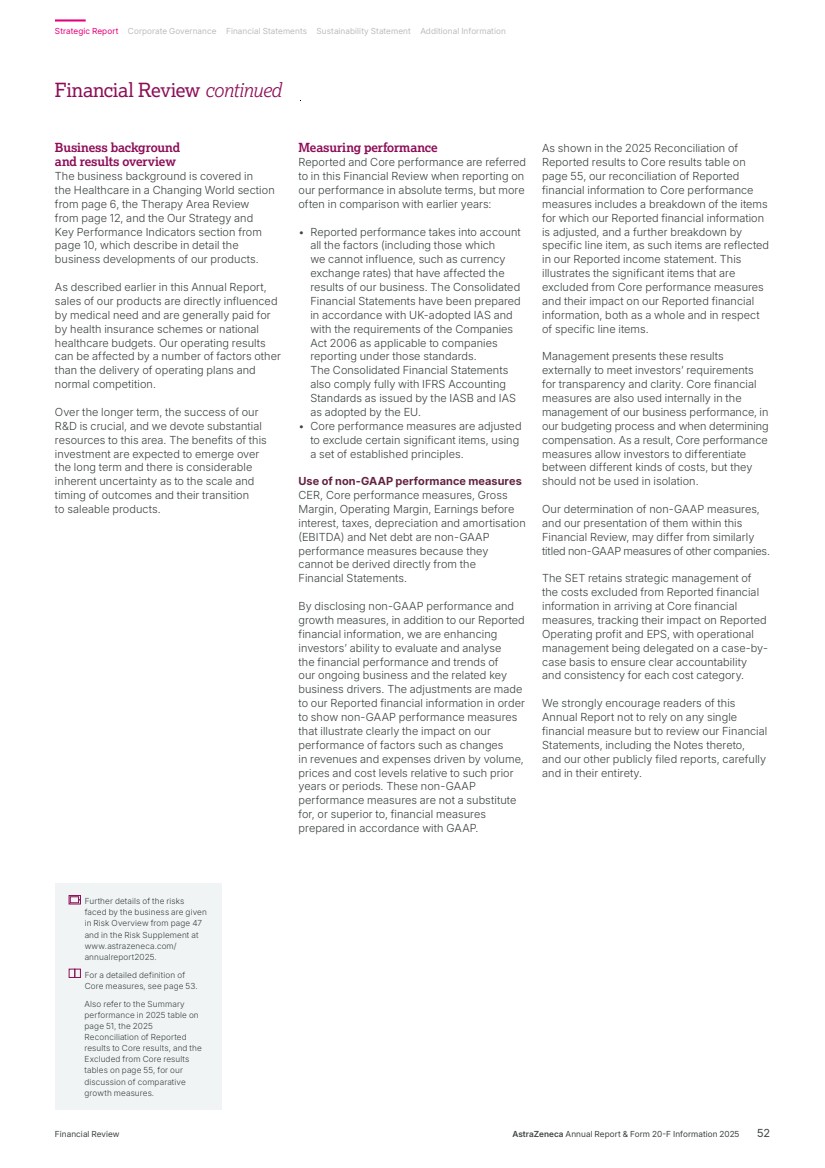
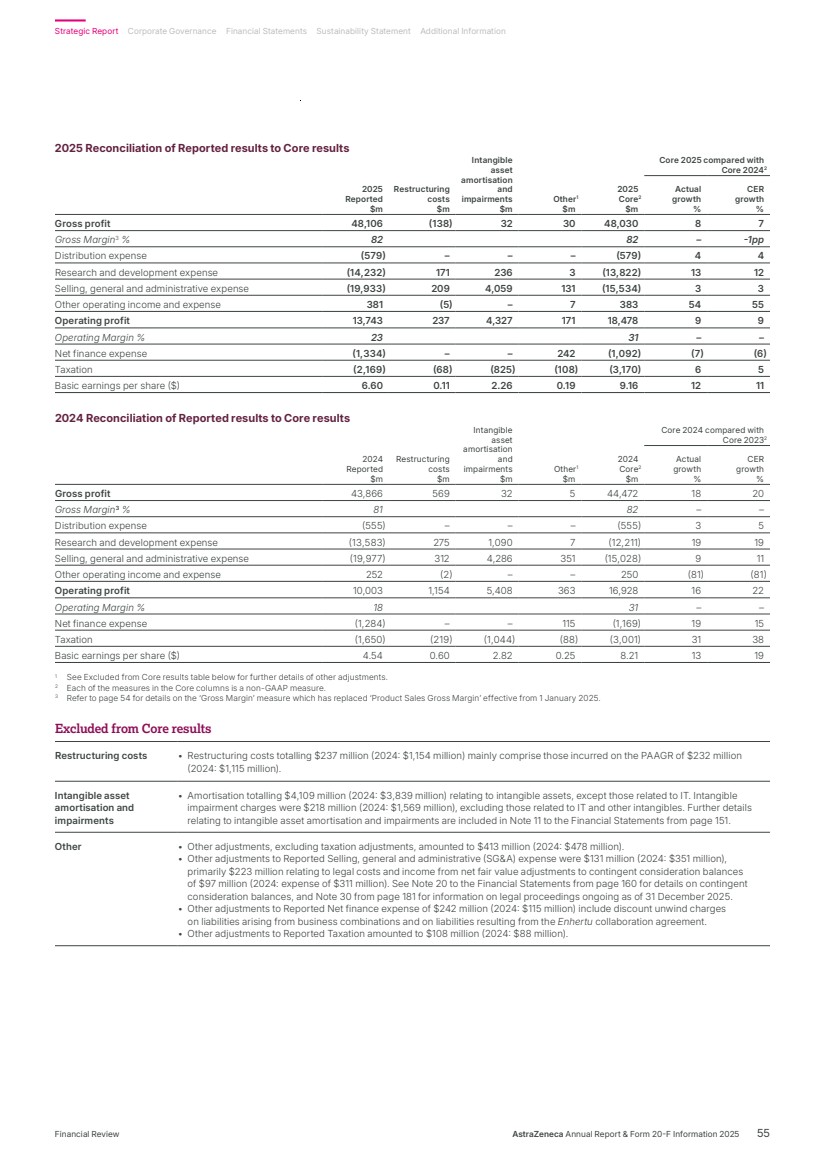
In addition to the information set out below, the information (including tabular data) set forth under the headings “Use of terms” on the inside front cover, “Strategic Report—Financial Review—Measuring performance” on page 52, and the tables on pages 53 to 55, and “—Important information for readers of this Annual Report—Cautionary statement regarding forward-looking statements”, “—Inclusion of Reported performance, Core financial measures and constant exchange rate growth rates”, “—Statements of competitive position, growth rates and sales” and “—Information on websites” on page 228, and “Additional Information—Glossary” on page 227 in each case of AstraZeneca’s “Annual Report and Form 20-F Information 2025” included as exhibit 15.1 to this Form 20-F dated February 24, 2026 is incorporated by reference. References herein to AstraZeneca websites, including where a link is provided, are textual references only and information on or accessible through such websites does not form part of and is not incorporated into this Form 20-F dated February 24, 2026. Reference to “audited” information (including graphs and tabular data) set forth under the heading “Corporate Governance—Directors’ Remuneration Report” refers to procedures performed by the Company’s external auditor in accordance with International Standards on Auditing (UK) (‘ISAs (UK)’) and applicable law and does not form part of the “Report of Independent Registered Public Accounting Firm” in Item 18 herein. For the avoidance of doubt, the “Independent Auditors’ report to the members of AstraZeneca PLC” on pages 116 to 124 of AstraZeneca’s “Annual Report and Form 20-F Information 2025” included as exhibit 15.1 to this Form 20-F dated February 24, 2026 does not form part of, and is not incorporated into, this Form 20-F dated February 24, 2026.
PART 1
ITEM 1. IDENTITY OF DIRECTORS, SENIOR MANAGEMENT AND ADVISERS
Not applicable.
ITEM 2. OFFER STATISTICS AND EXPECTED TIMETABLE
Not applicable.
ITEM 3. KEY INFORMATION
A.Reserved
B.Capitalization and Indebtedness
Not applicable.
C.Reason for the Offer and Use of Proceeds
Not applicable.
3
D. Risk Factors
Operating in the pharmaceutical sector carries various inherent risks and uncertainties that may affect our business. In this section, we describe the risks and uncertainties that we consider material to our business, in that they may have a significant effect on our financial condition, results of operations and/or reputation.
These risks have been categorised consistently with the “Risk Overview—Principal Risks” detailed on pages 48 and 49 of AstraZeneca’s “Annual Report and Form 20-F Information 2025” included as exhibit 15.1 to this Form 20-F dated February 24, 2026, each of which are included below (in addition to other risks that we face). We believe that the forward-looking statements about AstraZeneca in this Form 20-F dated February 24, 2026, identified by words such as ‘anticipates’, ‘believes’, ‘expects’ and ‘intends’, are based on reasonable assumptions. However, forward-looking statements involve inherent risks and uncertainties such as those summarised below. They relate to events that may occur in the future, that may be influenced by factors beyond our control and that may have actual outcomes materially different from our expectations. Other risks not listed here could have a significant adverse effect on our financial condition, results of operations and/or reputation.
Product pipeline risks |
|
Impact |
Failure or delay in the delivery of our pipeline or launch of new medicines | ||
|
|
|
|
Our continued success depends on the development and successful launch of innovative new drugs. The development of pharmaceutical product candidates is a complex, risky and lengthy process involving significant resources. Projects have failed, and may fail in the future, at any stage of the process due to various factors, including: failure to obtain the required regulatory or marketing approvals, unfavourable clinical efficacy data, safety concerns, failure to demonstrate adequate cost-effective benefits to regulatory authorities and/or payers, and the emergence of competing products. Details of projects that have suffered setbacks or failures during 2025 can be found in the “Strategic Report—Therapy Area Review” on pages 12 to 25 of AstraZeneca’s “Annual Report on Form 20-F Information 2025” included as exhibit 15.1 to this form 20-F dated February 24, 2026. Launch activities have been delayed, and may be delayed in the future, by a number of factors, including: adverse findings in preclinical or clinical studies, regulatory demands, price negotiation, large-scale natural disasters or global pandemics, competitor activity and technology transfer. In addition to developing products in-house, we continue to expand our portfolio through licensing arrangements and strategic collaborations which may not ultimately be successful. |
|
Failure or delay in development of new product candidates could damage the reputation of our R&D capabilities, and adversely affect our future business and results of operations. Delays to launches can lead to excess expenses in the manufacture of pre-launch inventories, marketing materials and salesforce training. For the launch of products that are seasonal in nature, delays in regulatory approvals or manufacturing may delay launch to the next season which, in turn, may significantly reduce the return on costs incurred in preparing for the launch for that season. Furthermore, in immuno-oncology in particular, speed to market is critical given the large number of clinical trials being conducted by competitors. Delay of launch can also erode the term of patent exclusivity. Competition from other pharmaceutical companies means that we may have to pay a significant premium over book or market values for our acquisitions. Failure to complete collaborative projects in a timely, cost-effective manner may limit our ability to access a greater portfolio of products, intellectual property (IP), technology and shared expertise. In many cases, we make milestone payments in advance of the commercialisation of the products, with no assurance of recouping costs. |
|
|
|
Failure to meet regulatory or ethical requirements for medicine development or approval | ||
|
|
|
We are subject to laws and regulations that control our ability to market our pharmaceutical products. Our development programmes must meet many standards to prove our products are safe, effective and of high quality. Health authorities, such as the FDA in the US and the European Medicines Agency in the EU, can refuse to approve our products or require us to conduct additional clinical trials or scientific testing before they will approve them for marketing. Many factors influence health authority decisions to approve or reject a marketing application for a pharmaceutical product. These include advances in science and technology, new laws, regulations and policies, and different standards for evaluating safety and effectiveness. |
|
Delays in regulatory approvals could delay our ability to market our products and may adversely affect our revenue. Also, post-approval requirements, including additional clinical trials, could cause increased costs. We seek to manage these risks, but policymaking by governments and health authorities can be unpredictable and unforeseen circumstances, such as public health emergencies, may strain health authority resources and delay the approval of our products. Following approval, a health authority may require us to conduct additional clinical trials or scientific testing to address concerns raised after patients have used our products in the marketplace. New data may impact a product’s approval status or lead to labelling changes that limit the use of a product. |
4
D. Risk Factors
continued
Commercialisation risks |
|
Impact |
Pricing, affordability, access and competitive pressures | ||
| ||
|
At AstraZeneca, our approach to pricing balances the priorities of patients, their physicians, payers, society and our business. Our four guiding principles – Access, Value, Sustainability and Equity – aligned to our overarching Company Values, form the cornerstones of our brand pricing strategies. Our prices are rooted in the assurance of our high-quality science, and the benefit this brings to patients. They also reflect holistic value, in the context of healthcare systems and market dynamics, affordability and equity; so that we can adapt our prices across the more than 80 countries in which we have an active presence and help support long-term healthcare system resilience. Our pricing approach, as described in the previous paragraph, is a key contributor to our success. However, there are various external risk factors that could compromise our ability to execute our pricing strategies as planned. The market access environment is highly complex and subject to dynamic economic, political and social pressures. Globally, there are increasing cost-containment measures, greater calls for net price and R&D cost transparency, as well as early discussions towards pooled procurement mechanisms beyond emergency countermeasures and essential medicines. |
|
Continued deterioration of, or lack of improvement in, socio-economic conditions could adversely affect supply and/or distribution in affected countries and the ability or willingness of customers to purchase our medicines, putting pressure on price and/or volumes. This could adversely affect our business or results of operations, for example, those healthcare systems most severely impacted by downturn may seek alternative ways to settle their debts at a discount. Other customers may cease to trade, which may result in losses from writing off debts or a reduction in demand for products. Across the industry, we continue to navigate pricing pressures and policy changes including the EU Joint Clinical Assessment (JCA), the US Inflation Reduction Act (IRA) as well as more recent health equalisation initiatives requiring countries to increase their drug spending to support R&D costs, ensuring a more balanced global pharmaceutical landscape. |
|
|
|
Failures or delays in the quality or execution of the Group’s commercial strategies | ||
|
|
|
|
Maximising the commercial potential of our new products underpins the success of our strategy and the delivery of our short- and medium-term targets. We may ultimately be unable to achieve commercial success for various reasons, including: > Difficulties in manufacturing sufficient quantities of the product > Any price control measures imposed by governments and healthcare authorities > Patient access to healthcare > Diagnosis rates > Erosion of IP rights > Failure to show a differentiated product profile > Changes in prescribing habits. The ability to successfully carry out business in emerging markets can be more challenging than in established markets. Such challenges may include: > Volatility in economic or political climates > Inadequate protection against crime (including counterfeiting, corruption and fraud) > Inadvertent breaches of local and international law. |
|
Failure to execute our commercial strategies or achieve the level of sales anticipated for a medicine could materially impact our business. Failure to leverage potential opportunities or appropriately manage risks in emerging markets may materially adversely affect our reputation, business or results of operations. |
5
D. Risk Factors
continued
Supply chain and business execution risks |
|
Impact |
Failure to maintain supply of compliant, quality medicines | ||
|
|
|
|
We may experience challenges, delays or interruptions in the manufacturing and supply of our products for various reasons, including: > Supply shortages or delays in construction of facilities to support future demand of our products caused by significant unforecasted demand growth or supply chain disruptions (e.g. natural disasters, climate impacts, pandemics, conflict or political unrest, failure in IT (including cyber-attack)). > The inability to supply products due to a product quality failure or regulatory compliance action such as licence withdrawal, product recall or change of regulatory standards (e.g. nitrosamines, where regulators have been introducing new limits/expectations for regulatory filings). It is necessary for us to meet all regulations, including compliance with Good Manufacturing Practices and Good Distribution Practices and comparable regulatory dossier conditions of approval in all countries in which our products are licensed, manufactured or sold. We rely significantly on third parties for the timely supply of goods (e.g. active ingredients and packaging components, many of which are difficult to substitute in a timely manner or at all). |
|
Supply chain difficulties may result in product shortages, which could lead to lost Product Sales and materially affect our reputation and results of operations. Failure to comply with all manufacturing regulations can result in negative regulatory inspection findings that could lead to the halt of manufacturing, and/or product seizure, debarment or recalls which could have an adverse effect on our business, financial condition and results of operations. |
Failure in information technology or cybersecurity | ||
|
|
|
|
IT systems enable critical business functions which are increasingly dependent on solution provider cybersecurity controls and maturity. High availability and resilient IT systems remain a business imperative, providing our workforce with continuous access to AI tools, collaboration environments, global communications channels, applications and data. In addition to availability and reliability, these systems must comply with provisions specified in cybersecurity, data security, privacy and individual protection laws. We prioritise data protection and access to delivery innovation, business growth, and uninterrupted medicine supply. Data is often characterised as strictly confidential including clinical trial records, personal information, IP, R&D data, and compliance information. IT systems and data are potentially vulnerable to service interruptions and security breaches via attacks by malicious third parties or intentional or inadvertent actions by our employees or vendors. Attempts to exploit AstraZeneca’s IT systems and data are increasingly sophisticated with increased volume and fuelled by malicious AI use. Threat actors include organised criminal groups, ‘hacktivists’, nation states, employees and others. Privacy legislation includes obligations to report data protection breaches to regulators and affected individuals within expedited timeframes. The internet is our primary critical business transaction channel. Internet availability remains at risk due to geopolitical tensions and conflict. |
|
Disruption to our IT systems and/or the internet (including breaches of data security or cybersecurity, failure to integrate new and existing IT systems) or failure to comply with additional requirements under applicable laws, could harm our reputation and materially adversely affect our financial condition or operations. While we invest heavily in the protection of our data, IT, Operational Technology and AI assets we may be unable to prevent hardware or software failures or breaches which could result in disclosure of confidential information, damage to our reputation, regulatory penalties or sanctions, or financial loss. The inability to back-up and restore data effectively could lead to permanent loss of data that could, in turn, result in non-compliance with applicable laws and regulations and otherwise harm our business. Data loss could lead to public disclosure of confidential information which may damage our reputation, materially affect our business or results of operations, and expose us to legal risks and/or additional legal obligations. Public disclosure of sensitive information could materially adversely affect our reputation and business or operations’ results. Cybersecurity insurance coverage limits may not protect against any future claim or claim proceeds may be delayed. Failure to comply with regulatory disclosure requirements could cause reputational damage and a loss of public trust. |
6
D. Risk Factors
continued
Failure to collect and manage data and AI in line with legal and regulatory requirements and strategic objectives | ||
|
|
|
|
Data is increasingly recognised as being AstraZeneca’s most valuable commodity. There is an increasing range of legislative and regulatory requirements to manage data across all countries where we conduct business. The requirements may impact certain types of data such as personal data, the way that we conduct business, such as restricting the movement of data between countries or jurisdictional regions, or how we make use of new technological capabilities such as AI. In addition, geopolitical changes may require changes to how AstraZeneca manages data. Beyond legal and regulatory requirements, achieving strategic objectives will require good management of data across the enterprise. As our organisation increasingly relies on data, including sensitive data relating to health and genomics, a failure to properly understand personal and collective accountabilities for managing data to maximise its value, or failure to address data risks, will reduce our ability to execute at pace and deliver strategic objectives. AI technologies present significant opportunities and risks to our business. Harnessing AI’s transformative potential may enable AstraZeneca to speed up the discovery and development of new drugs, optimise our manufacturing processes, drive efficiencies and productivity, and accelerate our growth. Failure to exploit these opportunities may put AstraZeneca at a competitive disadvantage and impact delivery of our strategic objectives. AstraZeneca is investing significant resources into AI experimentation, development and deployment across many parts of our business. As we scale our use of AI, it is possible not all investments will succeed. AI technologies may exacerbate existing risks, like those risks associated with data privacy, cybersecurity and IP. AI also introduces new risks due to the autonomous nature of the technology, the ease at which AI-enabled decision making can be scaled up, and the commercial pressures to adopt AI. AI systems can amplify biased and discriminatory decision making, perform unreliably and malfunction, generate insights which are difficult to interpret and explain, and cause direct harm to individuals or groups. These risks may become more significant as we increasingly utilise AI to inform, augment and automate decision making and processes in sensitive areas (e.g. clinical trials and medical decision making). The adoption and exploitation of AI is occurring under the backdrop of intense global media scrutiny, heightened political attention and low levels of public trust and understanding. There is also a range of new AI regulations being adopted and implemented worldwide, including in the EU, China and the US. |
|
Despite taking measures designed to ensure compliance with applicable privacy- and AI-related laws and regulations by our personnel and our third parties, non-compliance may occur. If future instances of non-compliance are deemed significant, these may attract material regulatory sanctions or fines and corresponding reputational damage, orders to stop certain processing of personal data, or legal action on behalf of impacted individuals. Further, failure to protect personal data could lead to a competitive disadvantage, loss of trust from our stakeholders, including patients, and prevent us from delivering our strategic objectives. If the scope of data-related laws is expanded or if the interpretation or enforcement of existing laws change or new privacy laws are implemented, AstraZeneca and its third-party vendors may be required to change their business practices or data processing practices and policies. This may lead to substantial compliance related costs or materially adversely impact our business and financial condition. Our failure to use AI technologies in a way that maintains trust, quality and control in our business activities would pose reputational, legal, regulatory and financial risks to AstraZeneca. Investments in AI may not realise the benefits that were anticipated. |
Illegal trade in the Group’s medicines | ||
| ||
|
The illegal trade of pharmaceutical products, including counterfeiting, tampering, theft and illegal diversion (where products are found in a market where we did not send them and where they are not approved to be sold) may lead to a loss of public confidence in the integrity of medicines. |
|
The incidence of illegal trade could materially adversely affect our reputation and financial performance, and pose a direct risk to patient safety. In addition, concern about this issue may cause some patients to stop taking their medicines, with consequential risks to their health. If we are found liable for breaches in our supply chains, authorities may take action, financial or otherwise, that could restrict the distribution of our products. |
7
D. Risk Factors
continued
Reliance on third-party goods and services | ||
| ||
|
A significant proportion of AstraZeneca’s annual costs relates to spend with third-party suppliers. The level of spend supports the length of our value chain from discovery to manufacture and commercialisation of our medicines. Many of our business-critical operations are outsourced to third-party providers. We are, therefore, heavily reliant on these third parties to get medicines to patients, comply with applicable laws and regulations, while also ensuring prudent use of AstraZeneca’s financial resources. |
|
Failure to successfully secure, onboard and manage outsourced services, particularly with continued inflationary pressures, or the failure of outsourced providers to deliver timely services, and to the required level of quality, could materially adversely affect our reputation, our financial condition and operating results as well as our ability to deliver medicines to patients. Failure to effectively manage third-party suppliers when external factors, including geopolitical tensions or raw materials and components shortages, place increased pressure on AstraZeneca’s ability to purchase goods and services may lead to major business disruption. Any breach of security, whether physical, cyber or data related, or failure of these third parties to operate in a way that is consistent with laws or regulations, may lead to regulatory penalties, materially affect the results of operations and adversely impact our reputation. |
Failure of critical processes | ||
| ||
|
Unexpected events including those beyond our control could result in the failure of critical processes within the Group or at third parties on whom we are reliant. Examples of threats include: > Instability including as a result of war or armed conflicts, terrorism, pandemics, riots, unstable governments, civil insurrection or social unrest > Natural disasters and extreme weather events > Cyber threats detailed in the ‘Failure in information technology or cybersecurity’ risk above. |
|
Crystallisation of such threats may heighten other risks, such as the delivery of the pipeline, launch of new medicines, or the manufacture and supply of medicines, and may lead to loss of revenue and have an adverse impact on our operations. |
Failure to attract, develop, engage and retain a diverse, talented and capable workforce | ||
|
|
|
|
We rely heavily on recruiting and retaining talented employees with a diverse range of skills and capabilities to meet our strategic objectives. Externally there is intense competition for well-qualified individuals, as the supply of people with certain skills or in specific geographic regions may be limited. Ensuring our employees are continually developed so that they can fully exploit the opportunities presented by new technologies will be important for our ongoing success. |
|
The inability to attract and retain highly skilled personnel may weaken our succession plans for critical positions, impact the implementation of our strategic objectives and have a significant impact on our business. Failure to develop and engage our workforce could result in business disruption, a loss of productivity and higher turnover rates, all of which could materially adversely affect our business. |
Legal, regulatory and compliance risks |
|
Impact |
Safety and efficacy of marketed medicines is questioned | ||
|
|
|
|
Our ability to accurately assess, prior to launch, the eventual safety or efficacy of a new product once in broader clinical use can only be based on data available at that time, which is inherently limited due to relatively short periods of product testing and relatively small clinical study patient samples. Any unforeseen safety concerns or adverse events relating to our products, or failure to comply with laws, rules and regulations relating to provision of appropriate warnings concerning the dangers and risks of our products that result in injuries, could expose us to large product liability claims, settlements and awards, particularly in the US. Adverse publicity relating to the safety of a product, or of other competing products, may increase the risk of product liability claims. |
|
Serious safety concerns or adverse events relating to our products could lead to product recalls, seizures, loss of product approvals, declining sales and interruption of supply, and could materially adversely impact patient access, our reputation and financial revenues. Significant product liability claims could also arise which could be costly, divert management attention, or damage our reputation and demand for our products. Unfavourable resolution of such current and similar future product liability claims could subject us to enhanced damages, consumer fraud and/or other claims, including civil and criminal governmental actions. This could require us to make significant provisions in our accounts relating to legal proceedings and could materially adversely affect our financial condition or results of operations, particularly where such circumstances are not covered by insurance. |
8
D. Risk Factors
continued
Adverse outcome of litigation and/or governmental investigations | ||
|
|
|
|
Our business is subject to a wide range of laws and regulations around the world. We have been, and may continue to be, subject to various legal proceedings and governmental investigations. Actual or perceived failure to comply with laws or regulations may result in AstraZeneca and/or its employees being investigated by government agencies and authorities and/or in civil legal proceedings. Relevant authorities have wide-ranging administrative powers to deal with any failure to comply with laws, regulations or continuing regulatory oversight, and this could affect us, whether such failure is our own or that of our contractors or external partners. In particular, the manufacturing, marketing, exportation, promotional, clinical, pharmacovigilance and pricing practices of pharmaceutical manufacturers, as well as manufacturer interaction with regulatory agencies, purchasers, prescribers and patients, are subject to extensive regulation, litigation and governmental investigation. Moreover, such laws, rules and regulations are subject to change. Details of material litigations and governmental investigations can be found in “Financial Statements—Notes to the Group Financial Statements—Note 30—Commitments, contingent liabilities and contingent assets” on pages 181 to 190 of AstraZeneca’s “Annual Report and Form 20-F Information 2025” included as exhibit 15.1 to this Form 20-F dated February 24, 2026. |
|
Many companies, including AstraZeneca, have been subject to legal claims asserted by federal and state governmental authorities and private payers and consumers, which have resulted in substantial expense and other significant consequences. Governmental investigations or proceedings could result in civil or criminal sanctions and/or the payment of fines or damages. Civil litigation, particularly in the US, is inherently unpredictable, and unexpectedly high awards for damages can result from an adverse result. In many cases, litigation adversaries may claim enhanced damages in extremely high amounts. Government investigations, litigations, and other legal proceedings, regardless of the outcome, could be costly, divert management attention, or damage our reputation and demand for our products. Unfavourable resolutions to current and similar future proceedings against us that could subject us to criminal liability, fines, penalties or other monetary or non-monetary remedies, including enhanced damages, require us to make significant provisions in our accounts relating to legal proceedings and could materially adversely affect our business or results of operations. |
IP risks related to our products | ||
|
|
|
|
IP protection provides the foundation for continued investment in developing innovative medicines to improve patient health. However, the pharmaceutical industry is experiencing pressure from governments and other healthcare payers to impose limits on IP protections in an effort to manage healthcare costs. Additionally, policymakers are progressively leveraging regulations to expedite the approval of generic drugs and encourage generic drug utilisation. These policies may drive accelerated utilisation of generic alternatives to our products following expiry or loss of our IP rights. We also recognise increasing use of compulsory licensing in some countries in which we operate. We are subject to numerous patent challenges relating to various products or processes and assertions of non-infringement of our patents. A loss in any of these challenges could result in loss of patent protection on the covered product and a risk to the revenue generated by the product. We also face the risk that our products may be found to infringe patents owned or licensed by third parties and we may be subject to monetary damages or compelled to cease sales of the infringing product, resulting in a potential risk to revenue. These challenges threaten the value of our investment in pharmaceutical development. Details of material patent litigation matters can be found in “Financial Statements—Notes to the Group Financial Statements—Note 30—Commitments, contingent liabilities and contingent assets” on pages 181 to 185 of AstraZeneca’s “Annual Report and Form 20-F Information 2025” included as exhibit 15.1 to this Form 20-F dated February 24, 2026. |
|
If we are unable to obtain, defend and enforce our IP, we may experience accelerated and intensified competition. Also, if our products are found to infringe a third-party patent, we may be subject to monetary damages or compelled to cease sales of the infringing product. These negative outcomes could have an adverse material impact on our financial results. |
9
D. Risk Factors
continued
Failure to meet our sustainability targets, regulatory requirements and stakeholder expectations with respect to the environment | ||
|
|
|
|
Environmental issues will become more important as healthcare systems continue to adopt net-zero climate targets and environmental considerations are embedded in the public procurement of medicinal products and devices. Investors, governments and non-governmental organisations will scrutinise our environmental targets and performance. Specific materials used to manufacture medicines, or used as excipients or propellants, are coming under increased regulation and may be subject to time-limited exemptions or potential phase-out. The physical impacts of climate change could impact the resilience of our business operations and supply chain. |
|
Investors are increasingly focusing on environmental issues. We continue to see an increased requirement to quantify the impact of specific environmental issues and to disclose our strategy, targets and performance. Failure to maximise our sustainability credentials could expose us to increased regulatory risk and put us at a commercial disadvantage relative to our peers. This could adversely impact our financial results and lead to reputational damage. Failure to proactively manage the physical risks associated with climate change could impact the resilience of our operations and supply chain. This could result in supply interruptions, loss of stock and adversely impact our financial results. |
Failure to meet regulatory and ethical expectations on commercial practices, including anti-bribery/anti-corruption, anti-fraud and scientific exchanges | ||
|
|
|
There remains an increased global focus on the implementation and enforcement of anti-bribery/anti-corruption and anti-fraud legislation. Three relevant pieces of legislation include the UK Bribery Act, the UK Economic Crime and Corporate Transparency Act and the US Foreign Corrupt Practices Act. Many other countries where we operate are also enforcing their own laws more aggressively and/or adopting tougher new measures. There has also been an increase in cooperation and coordination between regulators across countries with respect to investigation and enforcement. We have been the subject of anti-corruption investigations and there can be no assurance that we will not, from time to time, be subject to informal enquiries and formal investigations from governmental agencies. In the context of our business, governmental officials interact with us in various roles that are important to our operations, such as in the capacity of a regulator, partner or healthcare payer, reimburser or prescriber, among others. To the extent we are the subject of any such pending and material matters, details are included in “Financial Statements—Notes to the Group Financial Statements—Note 30 Commitments, contingent liabilities and contingent assets” on pages 181 to 189 of AstraZeneca’s “Annual Report and Form 20-F Information 2025” included as exhibit 15.1 to this Form 20-F dated February 24, 2026. |
|
Despite taking measures to prevent breaches of applicable anti-bribery/anti-corruption and anti-fraud laws by our personnel and associated third parties, breaches may still occur, potentially resulting in the imposition of significant penalties, such as fines, the requirement to comply with monitoring or self-reporting obligations, or debarment or exclusion from government sales or reimbursement programmes, any of which could materially adversely affect our reputation, business or results of operations. |
Economic and financial risks |
|
Impact |
Geopolitical and/or macroeconomic volatility disrupts the operation of our global business | ||
|
|
|
|
With an active presence in more than 80 countries, we are subject to political, socio-economic and financial factors around the world. A sustained global economic downturn, periods of high inflation, stagflation or large fluctuation in exchange rates may adversely impact financial markets and/or exacerbate pressure from governments and other healthcare payers on medicine prices and other cost control measures in order to limit healthcare spending. Geopolitical tensions may lead to the imposition, alteration or escalation of trade controls, tariffs, taxes or other restrictions to market access which may increase our costs or reduce revenues. |
|
A severe or prolonged economic downturn could result in a variety of risks to our business, including weakened demand for medicines and our ability to raise additional capital when needed or on favourable terms, if at all. A weak or declining economy could strain our suppliers, possibly resulting in supply disruption, or cause delays in payments for our services by third-party payers. Measures taken to limit healthcare spending may lead to lower than anticipated rates of growth in some markets and limit the incentives to develop innovative medicines resulting in an adverse impact on revenues and profitability. Any escalation in barriers to the global free flow of medicines could increase costs to serve affected markets which may lead to downward pressure on margins. While the introduction of severe sanctions would be unprecedented in relation to medicines, the landscape continues to evolve. It could occur if matters escalate significantly and could impact processes for the manufacture, distribution and commercialisation of medicines and levels of sales in affected markets. Any of the foregoing could harm our business and we cannot anticipate all of the ways in which the current economic climate and financial market conditions could adversely impact our business. |
10
D. Risk Factors
continued
Failure to achieve strategic plans or meet targets or expectations | ||
|
|
|
|
When we communicate our business strategy, targets or performance expectations, all such statements are forward-looking and based on assumptions and judgements, all of which are subject to significant inherent risks and uncertainties. |
|
To achieve our strategic objectives, we must continue to develop commercially viable new products and successfully integrate new organisations we have acquired. There can be no guarantee that our strategy or expectations will materialise. Any failure to successfully implement our business strategy may frustrate the achievement of our financial targets, which may therefore materially damage our brand, business, financial position or results of operations. |
Failure in internal control, financial reporting or the occurrence of fraud | ||
|
|
|
|
Effective internal controls assist in the provision of reliable Financial Statements and the detection and prevention of fraud. Testing of internal controls provides only limited assurance over the accuracy of Financial Statements and may not prevent or detect misstatements or fraud. The introduction of new legislation such as the failure to prevent fraud offence in the UK’s Economic Crime and Corporate Transparency Act may increase regulator focus on fraud. |
|
Significant resources may be required to remediate any deficiency in internal controls. Any such deficiency may trigger related investigations and may result in fines being levied against individual directors or officers. Serious fraud may lead to prosecution of senior management. Any of the foregoing could adversely affect our financial results and lead to reputational damage. |
Unexpected deterioration in the Group’s financial position | ||
|
|
|
|
Movements in exchange rates against the US dollar, our reporting currency, impact our reported results. The key currencies of Product Sales and costs are: US dollar, euro, Chinese renminbi, pound sterling, Japanese yen, and Swedish krona. Most of our cash is invested in AAA credit-rated institutional money market funds, fixed income securities issued by government, financial and non-financial entities, and collateralised and non-collateralised bank deposits. Our credit exposure is a mix of US, EU and rest of world default risk across these institutions. We invest in many projects in an effort to develop a successful portfolio of approved products. Our Consolidated Statement of Financial Position therefore contains significant investments in intangible assets, including goodwill. Our ability to realise value on these investments depends on regulatory approvals, market acceptance, competition, and legal developments. Our defined benefit post-retirement obligations (primarily in the UK and Sweden) can materially change in value but are largely backed by assets invested in growth and liability hedging portfolios, which hedge some of the risks inherent in liability valuations. Although we maintain relevant insurance coverage for risks arising within the Group, we may not be able to maintain our insurance coverage at a reasonable cost or in sufficient amounts to protect us against losses. Tax law is complex, leading to the risk of different interpretations. Revenue authorities can make conflicting claims to the profits taxed in individual countries leading to double taxation and the potential for fines and penalties. Tax laws can change following action by international bodies such as the Organisation for Economic Co-operation and Development or individual governments. |
|
Foreign exchange rate movements may materially adversely affect our financial condition or results of operations. In a sustained economic downturn, such institutions may cease to trade and there can be no guarantee that we will be able to access the full value of our investments. We expect that some of our intangible assets will become impaired in the future. Impairment losses may materially adversely affect our financial condition or results of operations. Solvency levels could fall, adversely impacting our financial position and requiring higher cash contributions if there are: falls in assets; increases in liability valuations (from falls in bond yields, increases in inflation or lower mortality); or changes in regulations. As liability valuation risks are hedged to a material level in some pension schemes, significant collateral may need to be posted to meet margin requirements, which in extreme circumstances, could lead to a short-term liquidity risk in these pension schemes and a request to the Group to provide temporary liquidity. Uninsured losses, or those where an insurer denies coverage, could materially adversely affect our financial condition. The resolution of tax disputes can result in incremental tax costs, a reallocation of profits or losses between jurisdictions, or even double taxation, fines and penalties. They are costly, divert management attention and may adversely affect our reputation. If tax treaties are withdrawn or amended, or Competent Authorities are unable to reach an agreement that eliminates double taxation, this could materially adversely affect our financial position. For details of our financial risk management policies, see “Strategic Report—Financial Review—Financial risk management” on page 64 and for details of current tax disputes, see “Financial Statements—Notes to the Group Financial Statements—Note 30—Commitments, contingent liabilities and contingent assets—Tax” on pages 189 to 190 of AstraZeneca’s “Annual Report and Form 20-F Information 2025” included as exhibit 15.1 to this Form 20-F dated February 24, 2026. Changes in tax regimes could result in a material impact on the Group’s cash tax liabilities and tax charge, resulting in either an increase or a reduction in financial results. |
11
ITEM 4. INFORMATION ON THE COMPANY
A. History and Development of the Company
AstraZeneca PLC was incorporated in England and Wales on June 17, 1992 under the Companies Act 1985. It is a public limited company domiciled in the United Kingdom. The Company’s registered number is 2723534 and its registered office is at 1 Francis Crick Avenue, Cambridge Biomedical Campus, Cambridge CB2 0AA, United Kingdom (Tel: +44 20 3749 5000). From February 1993 until April 1999, the Company was called Zeneca Group PLC. On April 6, 1999, the Company changed its name to AstraZeneca PLC.
The Company was formed when the pharmaceutical, agrochemical and specialty chemical businesses of Imperial Chemical Industries PLC were demerged in 1993. In 1999, the Company sold the specialty chemical business. Also in 1999, the Company merged with Astra of Sweden. In 2000, it demerged the agrochemical business and merged it with the similar business of Novartis to form a new company called Syngenta AG. In 2007, the Group acquired MedImmune, a biologics and vaccines business based in the United States. In 2021, the Group acquired Alexion, a rare disease business based in the United States.
In 1999, in connection with the merger between Astra and Zeneca, the Company’s share capital was redenominated in US dollars. On 6 April 1999, Zeneca shares were cancelled and US dollar-denominated shares issued, credited as fully paid on the basis of one dollar-denominated share for each Zeneca share then held.
This was achieved by a reduction of capital under section 135 of the UK Companies Act 1985. Upon the reduction of capital becoming effective, all issued and unissued Zeneca shares were cancelled and the sum arising as a result of the share cancellation credited to a special reserve, which was converted into US dollars at the rate of exchange prevailing on the record date. This US dollar reserve was then applied in paying up, at par, newly created US dollar-denominated shares.
At the same time as the US dollar shares were issued, the Company issued 50,000 Redeemable Preference Shares for cash, at par. The Redeemable Preference Shares carry limited class voting rights, no dividend rights and are capable of redemption, at par, at the option of the Company on the giving of seven days’ written notice to the registered holder of the Redeemable Preference Shares.
A total of 826 million Ordinary Shares were issued to Astra shareholders who accepted the merger offer before the final closing date, 21 May 1999. The Company received acceptances from Astra shareholders representing 99.6% of Astra’s shares and the remaining 0.4% was acquired in 2000, for cash.
In 2021, in connection with the acquisition of Alexion, a total of 236 million Ordinary Shares (the majority of which were represented by new AstraZeneca ADRs) were issued to Alexion shareholders in part consideration for the acquisition.
In 2026, the Company terminated its American Depositary Receipt (“ADR”) programme and directly listed all of its Ordinary Shares on the New York Stock Exchange. The effective date of the direct listing of the Ordinary Shares on the New York Stock Exchange was 2 February 2026.
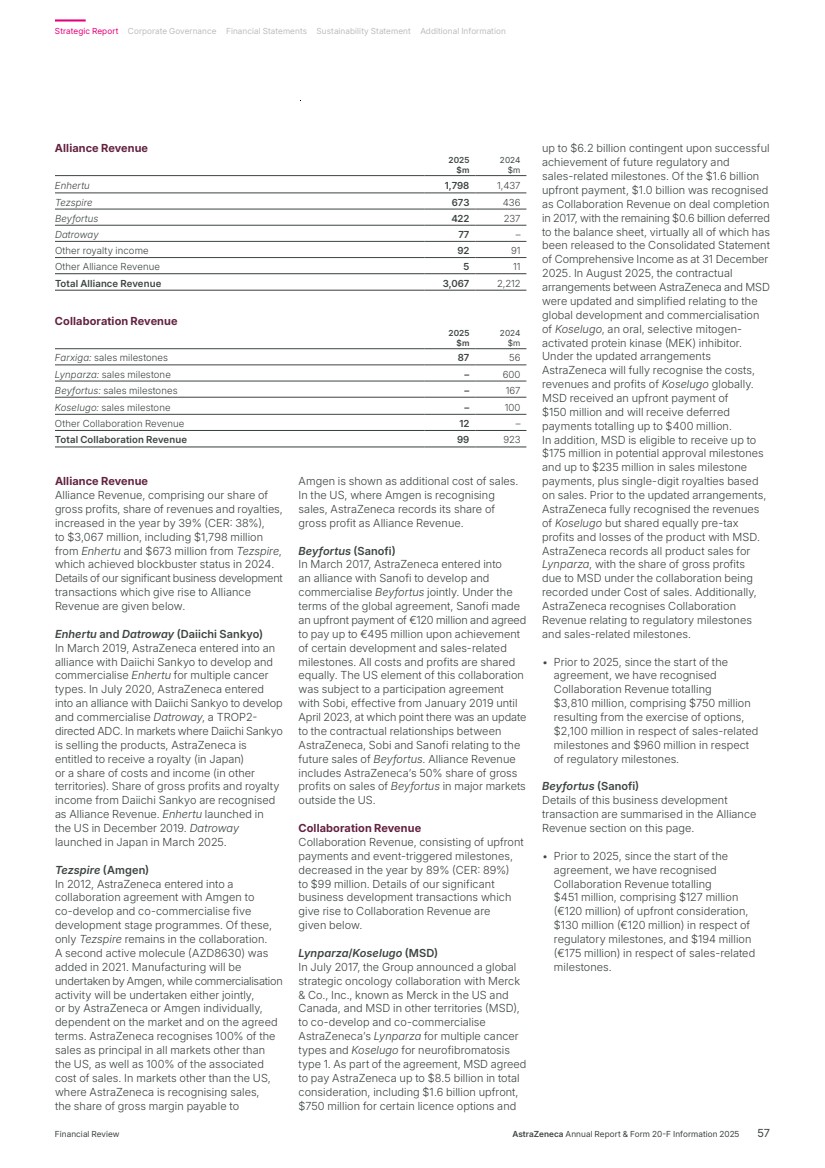
The information (including tabular data) set forth under the headings “Strategic Report—Financial Review—Collaboration Revenue” on page 57, “Strategic Report—Financial Review—Restructuring” on page 59, “Strategic Report—Financial Review—Acquisitions treated as business combinations” and “—Acquisitions treated as asset acquisitions” on page 62, “Strategic Report—Financial Review—Investments, divestments and capital expenditure” on page 63, “Corporate Governance—Corporate Governance Report—Compliance with the UK Corporate Governance Code—Board leadership and Company purpose” on page 71 and “Additional Information—Important information for readers of this Annual Report—Information on websites” on page 228, in each case of AstraZeneca’s “Annual Report and Form 20-F Information 2025” included as exhibit 15.1 to this Form 20-F dated February 24, 2026 is incorporated by reference. Additionally, the information set forth under the heading “Strategic Report—Financial Review” on pages 67 to 84 (excluding the information set forth under the subheadings “Full year 2025: additional commentary” and “Currency impact” on page 81) of AstraZeneca’s “Annual Report and Form 20-F Information 2024” included as exhibit 15.1 to the Form 20-F dated February 18, 2025 is incorporated herein by reference.
The United States Securities and Exchange Commission (the “SEC”) maintains a website at www.sec.gov which contains in electronic form each of the reports and other information that we have filed electronically with the SEC.
12
B. Business Overview
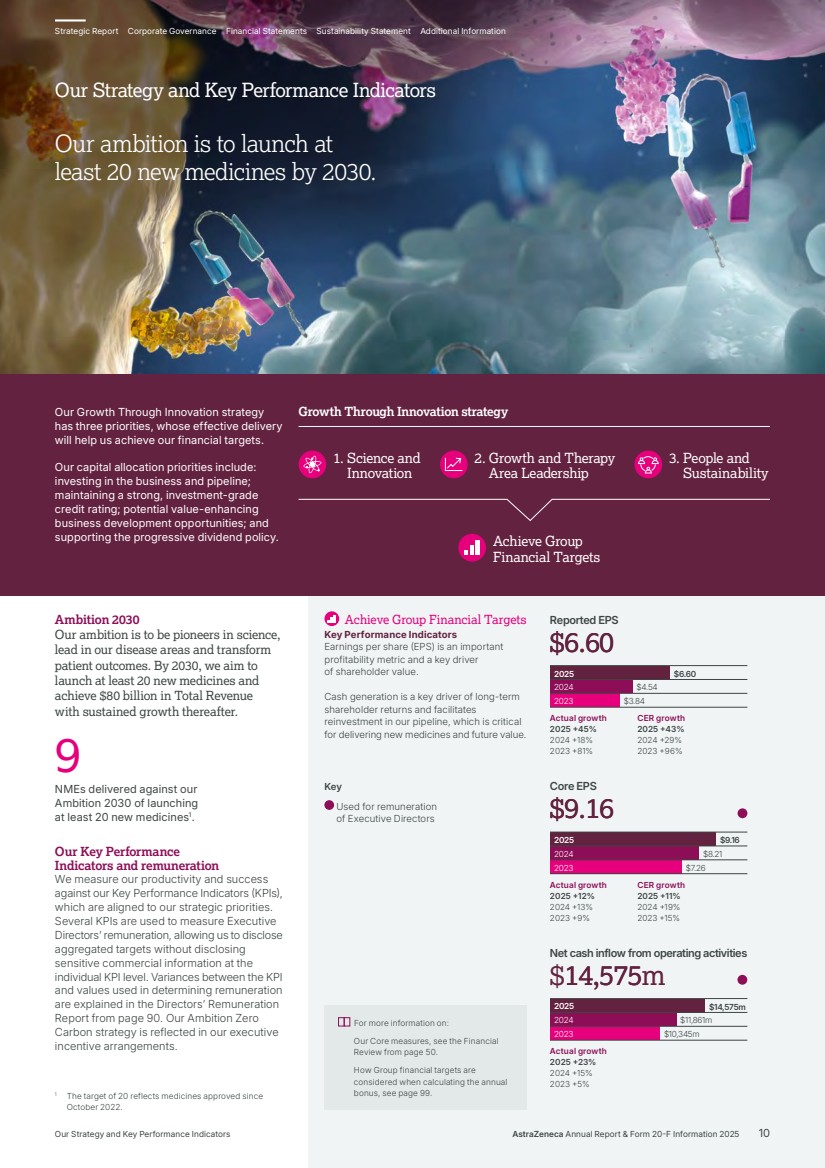
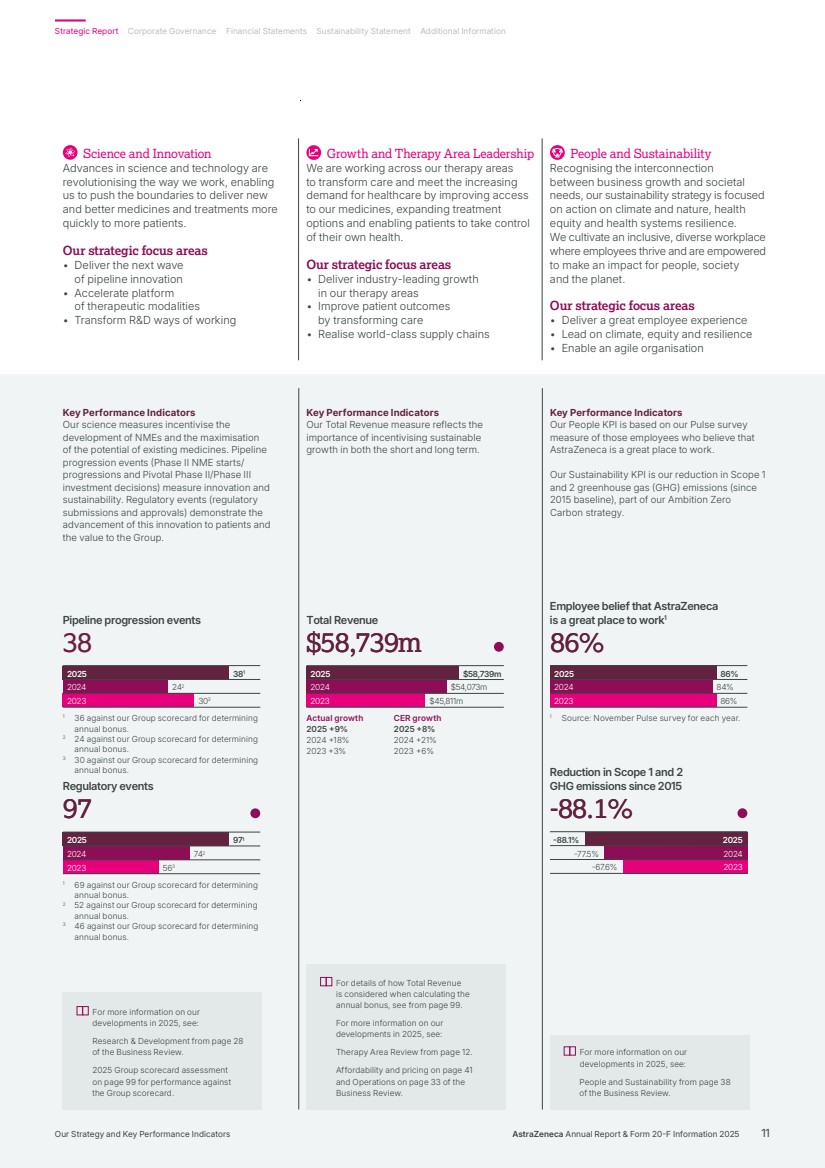
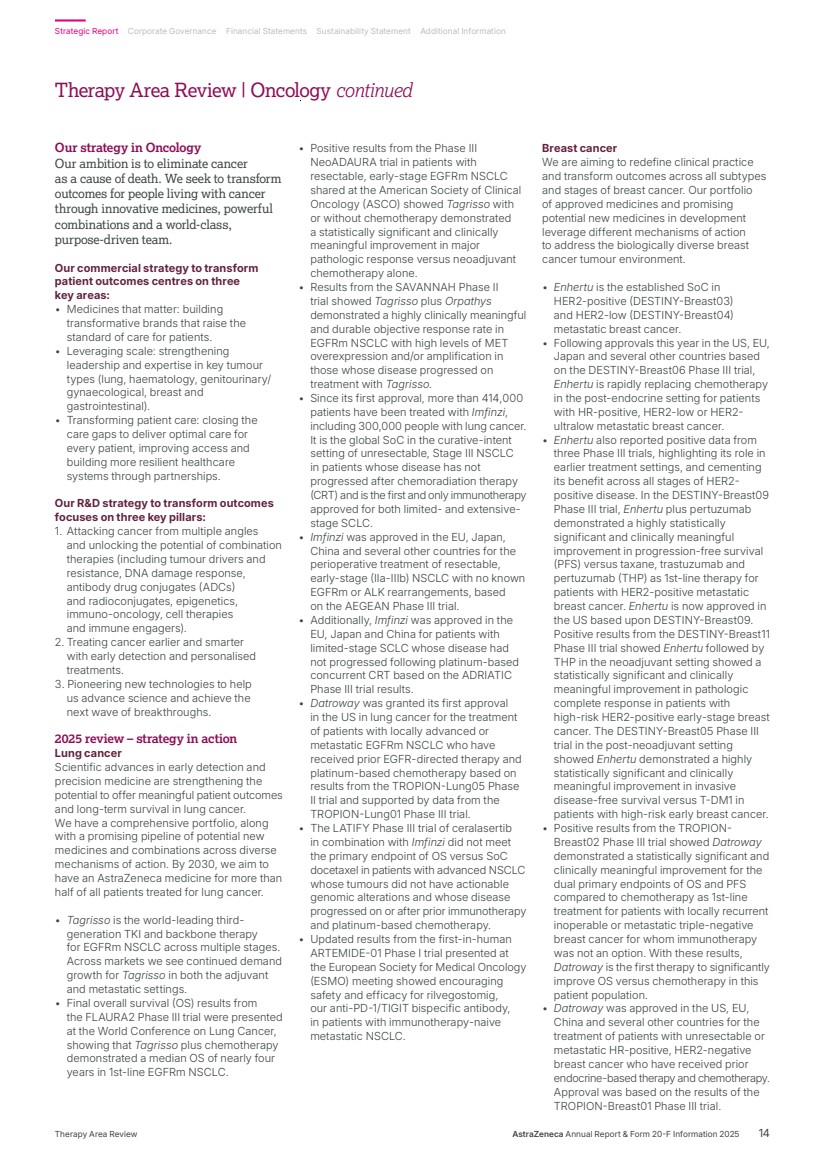
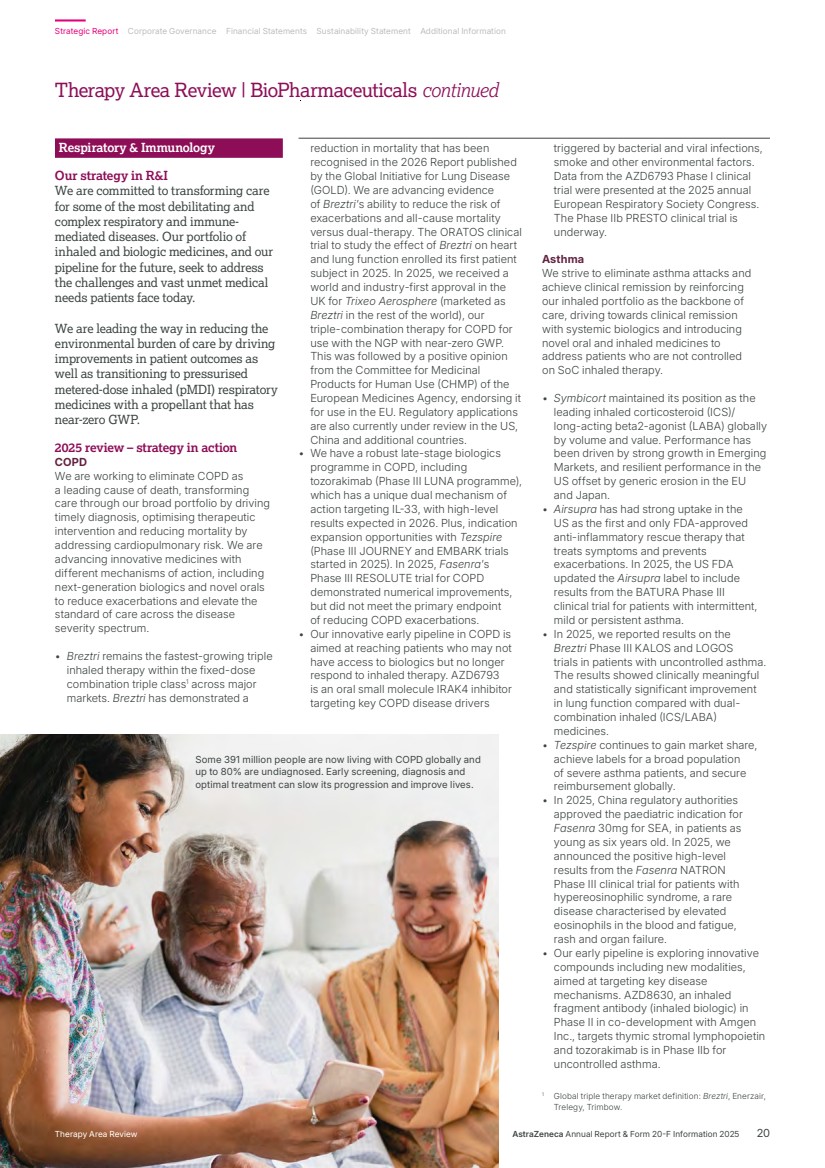
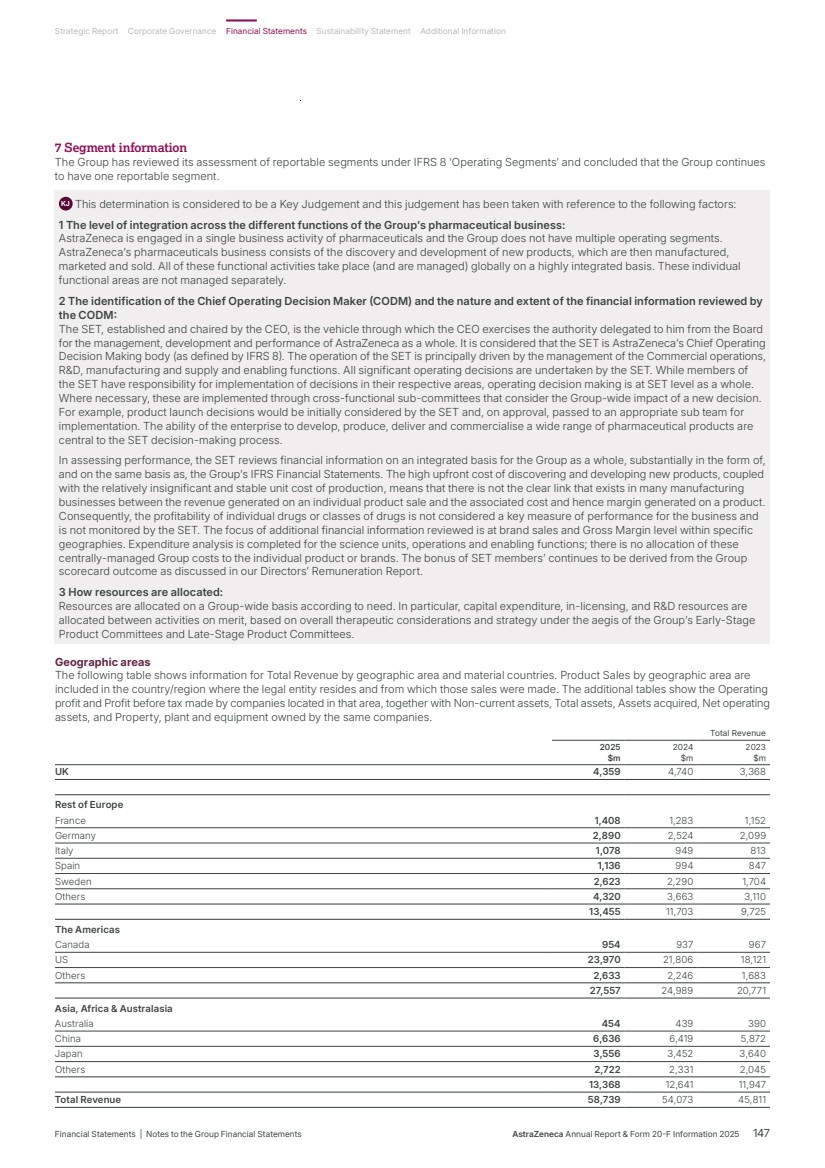
The information (including graphs and tabular data) set forth under the headings “Strategic Report—AstraZeneca at a Glance” on page 2, “Strategic Report—Chair’s Statement” on page 3, “Strategic Report—Chief Executive Officer’s Review” on pages 4 to 5, “Strategic Report—Financial highlights” on page 1, “Strategic Report—Healthcare in a Changing World” on pages 6 to 7, “Strategic Report—Our Purpose, Values and Business Model” on pages 8 to 9, “Strategic Report—Our Strategy and Key Performance Indicators” on pages 10 to 11, “Strategic Report—Therapy Area Review” on pages 12 to 25, “Strategic Report—Business Review” on pages 26 to 46, “Strategic Report—Risk Overview—Managing risk”, “—Emerging risks”, “—Climate risk”, “—Cybersecurity risk” on page 47, “Corporate Governance—Corporate Governance Report—Compliance with the UK Corporate Governance Code—Further information on risk management and controls—Global Compliance and GIA” on page 73, “Corporate Governance—Corporate Governance Report—Principal Decisions in 2025—Pipeline strengthening transactions” on page 77, “Financial Statements—Notes to the Group Financial Statements—Note 2—Revenue” on page 140 to 141, “Financial Statements—Notes to the Group Financial Statements—Note 7—Segment information” on pages 147 to 148, “Sustainability Statement” on pages 204 to 219, and “Additional Information—Important information for readers of this Annual Report—Statements of competitive position, growth rates and sales” on page 228, in each case of AstraZeneca’s “Annual Report and Form 20-F Information 2025” included as exhibit 15.1 to this Form 20-F dated February 24, 2026 is incorporated by reference.
For the avoidance of doubt, KPMG’s Independent Sustainability Assurance Report is not included within this Form 20-F and therefore any references to this report (or the related assurance services) are not incorporated in, and do not form part of, this Form 20-F.
13
Development Pipeline as at February 10, 2026
This section sets out AstraZeneca-sponsored or -directed trial New Molecular Entities (“NMEs”) and significant indications.
Anticipated data timing and submission status is provided for assets in Phase III or beyond. As disclosure of compound information is balanced by the business need to maintain confidentiality, information in relation to some compounds listed here has not been disclosed at this time.
Key:
PP = Partnered product
Phase I
Compound |
|
Mechanism |
|
Additional |
|
Area Under Investigation |
|
Oncology |
|
|
|
|
|
|
|
AZD0240 |
|
KRAS G12D armoured TCR-T |
|
|
|
solid tumours |
|
AZD0516 |
|
STEAP2 TOP1i ADC |
|
|
|
prostate cancer |
|
AZD0754 |
|
STEAP2 CAR-T |
|
|
|
prostate cancer |
|
AZD2068 |
|
EGFR/cMET actinium radioconjugate |
|
|
|
solid tumours |
|
AZD2284 |
|
STEAP2 actinium radioconjugate |
|
|
|
prostate cancer |
|
AZD2962 |
|
IRAK4 inhibitor |
|
|
|
haematological malignancies |
|
AZD3632 |
|
MENIN inhibitor |
|
|
|
haematological malignancies |
|
AZD4360 |
|
CLDN18.2 TOP1i ADC |
|
|
|
solid tumours |
|
AZD4512 |
|
CD22 TOP1i ADC |
|
Modular Ph I/II open-label multi-center study |
|
relapsed/refractory B-cell non-Hodgkin lymphoma |
|
AZD5492 |
|
CD20 TITAN T-cell engager |
|
|
|
haematology |
|
AZD5863 |
|
CLDN18.2/CD3 bispecific antibody |
|
|
|
solid tumours |
|
AZD6621 |
|
STEAP2 T-cell engager |
|
|
|
prostate cancer |
|
AZD6750 |
|
CD8-guided IL2 |
|
|
|
solid tumours |
|
AZD7003 (China) |
|
GPC3 CAR-T |
|
|
|
hepatocellular carcinoma/squamous non-small cell lung cancer |
|
AZD8421 |
|
CDK2 inhibitor |
|
|
|
solid tumours |
|
AZD9750 |
|
AR PROTAC |
|
|
|
prostate cancer |
|
AZD9793 |
|
GPC3 T-cell engager |
|
|
|
solid tumours |
|
NT-112 |
|
KRAS G12D armoured TCR-T |
|
|
|
solid tumours |
|
NT-175 |
|
TP53 R175H armoured TCR-T |
|
|
|
solid tumours |
|
surovatamig |
|
CD19/CD3 T-cell engager |
|
|
|
r/r B-cell non-Hodgkin lymphoma |
|
surovatamig SOUNDTRACK-E |
|
CD19/CD3 T-cell engager |
|
|
|
mature B-cell malignancies |
|
volrustomig + lenvatinib |
|
PD-1/CTLA-4 bispecific mAb + VEGFi |
|
|
|
advanced renal cell carcinoma |
|
volrustomig |
|
PD-1/CTLA-4 bispecific mAb |
|
|
|
1L advanced clear cell renal cell carcinoma |
|
CVRM |
|
|
|
|
|
|
|
AZD1613 |
|
PAPPA-1 mAb |
|
|
|
ADPKD |
|
AZD1705 |
|
lipid lowering |
|
|
|
cardiovascular disease |
|
AZD3974 |
|
anti-inflammatory and anti-fibrotic mechanism |
|
|
|
cirrhosis |
|
AZD4063 |
|
PLN |
|
|
|
R14del dilated cardiomyopathy |
|
AZD4144 |
|
NLRP3 |
|
|
|
cardiorenal disease |
|
AZD4248 |
|
NNMT inhibitor |
|
|
|
cardiorenal disease |
|
AZD4954 |
|
Lp(a) inhibitor |
|
|
|
dyslipidaemia |
|
Respiratory & Immunology |
|
|
|
|
|
|
|
AZD0120 |
|
CD19/BCMA CAR-T |
|
|
|
systemic lupus erythematosus |
|
AZD0120 |
|
CD19/BCMA CAR-T |
|
|
|
autoimmune diseases |
|
AZD0120 |
|
CD19/BCMA CAR-T |
|
|
|
multiple sclerosis |
|
AZD5492 |
|
CD20 TITAN T-cell engager |
|
|
|
systemic lupus erythematosus |
|
AZD6912 |
|
siRNA |
|
|
|
rheumatoid arthritis |
|
AZD8965 |
|
inhibition of arginase enzyme |
|
|
|
idiopathic pulmonary fibrosis |
|
surovatamig |
|
CD19/CD3 T-cell engager |
|
|
|
B-cell driven autoimmune disease |
|
Rare Disease |
|
|
|
|
|
|
|
ALXN2080 |
|
oral factor D inhibitor |
|
|
|
healthy volunteers |
|
ALXN2350 DCMRestore |
|
AAV gene therapy |
|
|
|
BAG3-associated dilated cardiomyopathy |
|
AZD0120 ALACRITY |
|
CD19/BCMA CAR-T |
|
|
|
amyloid light-chain amyloidosis |
|
AZD1390 AGILE |
|
ATM inhibitor |
|
|
|
glioblastoma |
|
14
Phase II
Compound |
|
Mechanism |
|
Additional |
|
Area Under Investigation |
|
Oncology |
|
|
|
|
|
|
|
AZD0120 |
|
CD19/BCMA CAR-T |
|
|
|
multiple myeloma |
|
AZD0305 |
|
GPRC5D MMAE ADC |
|
|
|
relapsed/refractory multiple myeloma |
|
AZD3470 |
|
PRMT5 inhibitor |
|
cHL (Phase II), solid tumours (Phase I) |
|
classic Hodgkin lymphoma, solid tumours |
|
AZD9574 |
|
PARP1 inhibitor |
|
|
|
advanced solid malignancies |
|
camizestrant |
|
ngSERD |
|
|
|
HR+ HER2- breast cancer |
|
FPI-2265 |
|
PSMA actinium radioconjugate |
|
(PP) |
|
prostate cancer |
|
IPH5201 + Imfinzi |
|
CD39 mAb + PD-L1 mAb |
|
(PP) |
|
neoadjuvant/adjuvant NSCLC |
|
puxitatug samrotecan |
|
B7-H4 TOP1i ADC |
|
|
solid tumours |
|
|
rilvegostomig ARTEMIDE-01 |
|
PD-1/TIGIT bispecific mAb |
|
(PP) |
|
solid tumours |
|
saruparib |
|
PARP1 inhibitor |
|
|
solid tumours |
|
|
sonesitatug vedotin |
|
CLDN18.2 MMAE ADC |
|
|
|
solid tumours |
|
surovatamig SOUNDTRACK-B |
|
CD19/CD3 T-cell engager |
|
|
|
B-cell non-Hodgkin lymphoma |
|
surovatamig SYRUS |
|
CD19/CD3 T-cell engager |
|
|
|
B-cell acute lymphoblastic leukaemia |
|
tilatamig samrotecan |
|
EGFR/cMET TOP1i ADC |
|
|
|
solid tumours |
|
torvutatug samrotecan (AZD5335) |
|
anti-FRα TOP1i ADC |
|
|
|
ovarian cancer, solid tumours |
|
volrustomig |
|
PD-1/CTLA-4 bispecific mAb |
|
|
|
solid tumours |
|
volrustomig CANTOR |
|
PD-1/CTLA-4 bispecific mAb |
|
|
|
colorectal cancer (mCRC) |
|
volrustomig eVOLVE-01 |
|
PD-1/CTLA-4 bispecific mAb |
|
|
|
NSCLC |
|
volrustomig eVOLVE-02 |
|
PD-1/CTLA-4 bispecific mAb |
|
|
|
cervical cancer, head and neck squamous cell carcinoma |
|
CVRM |
|
|
|
|
|
|
|
AZD2389 |
|
anti-fibrotic mechanism |
|
|
|
metabolic dysfunction-associated steatohepatitis |
|
AZD5462 |
|
RXFP1 agonist |
|
(PP) |
|
heart failure |
|
AZD6234 |
|
peptide |
|
|
|
chronic weight management in overweight or obesity |
|
AZD9550 + AZD6234 |
|
GLP-1R glucagon dual agonist + selective amylin agonist |
|
|
|
obesity |
|
balcinrenone/dapagliflozin |
|
MR antagonist/modulator + SGLT2 inhibitor |
|
|
|
CKD |
|
elecoglipron (AZD5004) |
|
oral GLP-1 receptor agonist |
|
|
|
T2D/chronic weight management |
|
opemalirsen |
|
podocyte health |
|
|
|
nephropathy |
|
Respiratory & Immunology |
|
|
|
|
|
|
|
atuliflapon |
|
FLAP inhibitor |
|
|
|
asthma |
|
AZD1163 |
|
anti-PAD2/4 bispecific antibody |
|
|
|
rheumatoid arthritis |
|
AZD4604 |
|
inhaled JAK1 inhibitor |
|
|
|
asthma |
|
AZD6793 |
|
IRAK4 inhibitor |
|
|
|
COPD |
|
AZD7798 |
|
humanised monoclonal antibody targets T-cells subset |
|
|
|
Crohn’s disease |
|
AZD8630 |
|
inhaled TSLP FAb |
|
(PP) |
|
asthma |
|
tozorakimab |
|
IL-33 mAb |
|
|
|
asthma |
|
Vaccines & Immune Therapies |
|
|
|
|
|
|
|
AZD0292 |
|
pseudomonas Psl-PcrV bispecific mAb |
|
|
|
bronchiectasis |
|
AZD5148 |
|
anti-clostridioides difficile TcdB mAb |
|
|
|
reduction of C. diff recurrence |
|
AZD7760 |
|
mAb combination targeting S aureus virulence factors |
|
|
|
prevention of Staph aureus infection |
|
Rare Disease |
|
|
|
|
|
|
|
ALXN1920 |
|
kidney-targeted factor H fusion protein |
|
|
|
primary membranous nephropathy |
|
ALXN2030 CONCORD |
|
siRNA targeting complement C3 |
|
|
|
antibody mediated rejection |
|
ALXN2420 |
|
growth hormone receptor antagonist |
|
|
|
acromegaly |
|
tarperprumig I TRANSCEND |
|
kinase inhibitor |
|
|
|
ANCA-associated vasculitis |
|
15
Phase III/Pivotal Phase II/Registration (listed until launched in all applicable major markets)
Compound |
|
Mechanism |
|
Additional |
|
Area Under |
|
Data readout/submission |
|
Oncology |
|
|
|
|
|
|
|
|
|
camizestrant + CDK4/6i SERENA-6 |
|
ngSERD + CDK4/6i |
|
|
|
1L HR+ HER2- ESR1m advanced breast cancer |
|
Accepted |
|
camizestrant + palbociclib SERENA-4 |
|
ngSERD + CDK4/6i |
|
|
|
1L HR+ HER2- advanced breast cancer |
|
H2 2026 |
|
camizestrant +/- abemaciclib CAMBRIA-2 |
|
ngSERD + CDK4/6i |
|
|
|
adjuvant HR+ HER2- early breast cancer |
|
>2027 |
|
camizestrant CAMBRIA-1 |
|
ngSERD |
|
|
|
adjuvant switch HR+ HER2- early breast cancer |
|
2027 |
|
Imfinzi + Imjudo HIMALAYA |
|
PD-L1 mAb + CTLA-4 mAb |
|
|
|
1L unresectable HCC |
|
Launched |
|
Imfinzi +/- oleclumab +/- monalizumab PACIFIC-9 |
|
PD-L1 mAb +/- CD73 mAb +/- NKG2A mAb |
|
(PP) |
|
unresectable stage III NSCLC |
|
H2 2026 |
|
puxitatug samrotecan Bluestar-Endometrial01 |
|
B7-H4 TOP1i ADC |
|
|
|
2-3L B7-H4+ endometrial cancer |
|
2027 |
|
rilvegostomig + bevacizumab +/- Imjudo ARTEMIDE-HCC01 |
|
PD-1/TIGIT bispecific mAb +VEGFi +/- CTLA-4 mAb |
|
(PP) |
|
1L HCC |
|
>2027 |
|
rilvegostomig + CTx ARTEMIDE-Biliary01 |
|
PD-1/TIGIT bispecific mAb + CTx |
|
(PP) |
|
adjuvant biliary tract cancer |
|
>2027 |
|
rilvegostomig + CTx ARTEMIDE-Lung02 |
|
PD-1/TIGIT bispecific mAb + CTx |
|
(PP) |
|
1L PD-L1 TC ≥1% SQ NSCLC |
|
>2027 |
|
rilvegostomig + Enhertu ARTEMIDE-Gastric01 |
|
PD-1/TIGIT bispecific mAb + HER2 TOP1i ADC |
|
(PP) |
|
1L HER2+ gastric cancer |
|
>2027 |
|
rilvegostomig ARTEMIDE-Biliary02 |
|
PD-1/TIGIT bispecific mAb |
|
(PP) |
|
metastatic biliary tract cancer |
|
>2027 |
|
rilvegostomig ARTEMIDE-Lung03 |
|
PD-1/TIGIT bispecific mAb |
|
(PP) |
|
1L PD-L1 TC ≥1% NSQ NSCLC |
|
>2027 |
|
rilvegostomig ARTEMIDE-Lung04 |
|
PD-1/TIGIT bispecific mAb |
|
(PP) |
|
1L PD-L1≥50% NSCLC |
|
>2027 |
|
saruparib + ADT +/- abiraterone EvoPAR-Prostate02 |
|
PARP1 inhibitor + ADT +/- NHA |
|
|
|
localised/locally advanced BRCAm prostate cancer |
|
>2027 |
|
saruparib + camizestrant EvoPAR-Breast01 |
|
PARP1 inhibitor + ngSERD |
|
|
|
BRCA/PALB2m HR+ HER2- metastatic breast cancer |
|
>2027 |
|
saruparib + NHA EvoPAR-Prostate01 |
|
PARP1 inhibitor + NHA |
|
|
|
HRRm/non-HRRm mCSPC |
|
>2027 |
|
sonesitatug vedotin CLARITY-Gastric01 |
|
CLDN18.2 MMAE ADC |
|
|
|
2L+ CLDN18.2+ gastric cancer |
|
H1 2026 |
|
surovatamig SOUNDTRACK-D2 |
|
CD19/CD3 T-cell engager |
|
|
|
1L elderly DLBCL |
|
>2027 |
|
surovatamig SOUNDTRACK-F1 |
|
CD19/CD3 T-cell engager |
|
|
|
follicular lymphoma |
|
>2027 |
|
torvutatug samrotecan (AZD5335) TREVI-OC-01 |
|
anti-FRα TOP1i ADC |
|
|
|
ovarian cancer |
|
>2027 |
|
volrustomig eVOLVE-Cervical |
|
PD-1/CTLA-4 bispecific mAb |
|
|
|
high-risk locally advanced cervical cancer |
|
2027 |
|
volrustomig eVOLVE-HNSCC |
|
PD-1/CTLA-4 bispecific mAb |
|
|
|
unresected locally advanced head and neck squamous cell carcinoma |
|
>2027 |
|
volrustomig eVOLVE-Lung02 |
|
PD-1/CTLA-4 bispecific mAb |
|
|
|
1L metastatic NSCLC |
|
2027 |
|
volrustomig eVOLVE-Meso |
|
PD-1/CTLA-4 bispecific mAb |
|
|
|
1L unresectable malignant pleural mesothelioma |
|
>2027 |
|
volrustomig eVOLVE-Meso |
|
PD-1/CTLA-4 bispecific mAb |
|
|
|
1L unresectable malignant pleural mesothelioma |
|
>2026 |
|
CVRM |
|
|
|
|
|
|
|
|
|
balcinrenone/dapagliflozin |
|
MR antagonist/modulator + SGLT2 inhibitor |
|
|
|
heart failure with CKD |
|
2027 |
|
baxdrostat BaxHTN Bax24 BaxAsia |
|
aldosterone synthase inhibitor |
|
|
|
hypertension |
|
Accepted |
|
baxdrostat BaxPA |
|
aldosterone synthase inhibitor |
|
|
|
primary aldosteronism |
|
>2027 |
|
baxdrostat/dapagliflozin |
|
aldosterone synthase inhibitor and reversible inhibitor of SGLT2 |
|
|
|
CKD |
|
>2027 |
|
baxdrostat/dapagliflozin |
|
aldosterone synthase inhibitor and reversible inhibitor of SGLT2 |
|
|
|
prevention of heart failure |
|
>2027 |
|
laroprovstat AZURE |
|
PCSK9 inhibitor |
|
|
|
dyslipidaemia |
|
2027 |
|
Wainua |
|
ligand-conjugated antisense |
|
(PP) |
|
patients with hereditary transthyretin-mediated amyloid polyneuropathy (ATTRv-PN) |
|
Launched |
|
zibotentan/dapagliflozin |
|
endothelin A receptor antagonist/SGLT2 inhibitor |
|
|
|
CKD with high proteinuria |
|
2027 |
|
Respiratory & Immunology |
|
|
|
|
|
|
|
|
|
Saphnelo TULIP 1 & TULIP 2 AZALEA (China) |
|
type I IFN receptor mAb |
|
(PP) |
|
systemic lupus erythematosus |
|
Launched |
|
Tezspire NAVIGATOR DIRECTION (China) |
|
TSLP mAb |
|
(PP) |
|
severe uncontrolled asthma |
|
Launched |
|
tozorakimab OBERON TITANIA PROSPERO MIRANDA |
|
IL-33 mAb |
|
|
|
chronic obstructive pulmonary disease |
|
H1 2026 |
|
tozorakimab TILIA |
|
IL-33 mAb |
|
|
|
severe viral lower respiratory tract disease |
|
H2 2026 |
|
Vaccines & Immune Therapies |
|
|
|
|
|
|
|
||
Kavigale SUPERNOVA |
|
SARS-CoV-2 LAAB |
|
|
|
prevention of COVID-19 |
|
Launched |
|
Rare Disease |
|
|
|
|
|
|
|
|
|
anselamimab CARES |
|
fibril-reactive mAb |
|
|
amyloid light-chain amyloidosis |
|
Accepted |
|
|
cliramitug DepleTTR-CM |
|
transthyretin depleter |
|
(PP) |
|
transthyretin amyloid cardiomyopathy |
|
2027 |
|
efzimfotase alfa HICKORY (301), MULBERRY (305), CHESTNUT (303) |
|
next generation TNSALP ERT |
|
|
|
hypophosphatasia |
|
H1 2026 |
|
eneboparatide CALYPSO |
|
parathyroid hormone receptor 1 |
|
|
|
hypoparathyroidism |
|
Q1 2025 |
|
gefurulimab PREVAIL |
|
novel anti-C5, dual binding, nanobody |
|
|
|
generalised myasthenia gravis |
|
Accepted |
|
16
Anticipated data timing and submission status is provided for assets in Phase III or beyond. Projects in Phase III unless otherwise noted.
Compound |
|
Mechanism |
|
Additional |
|
Area Under |
|
Data readout/submission |
|
|---|---|---|---|---|---|---|---|---|---|
|
|
|
|
|
|
|
|
|
|
Oncology |
|
|
|
|
|
|
|
|
|
Calquence + R-CHOP ESCALADE |
|
BTK inhibitor + R-CHOP |
|
|
|
1L DLBCL |
|
2027 |
|
Calquence + venetoclax + obinutuzumab AMPLIFY |
|
BTK inhibitor + BCL-2 inhibitor + anti-CD20 mAb |
|
|
|
1L CLL |
|
Launched |
|
Calquence ECHO |
|
BTK inhibitor |
|
(PP) |
|
1L MCL |
|
Launched |
|
Datroway + Imfinzi + CTx AVANZAR |
|
TROP2 TOP1i ADC + PD-L1 mAb + CTx |
|
(PP) |
|
1L NSQ/NSQ TROP2+ NSCLC |
|
H2 2026 |
|
Datroway + Imfinzi TROPION-Breast04 |
|
TROP2 TOP1i ADC + PD-L1 mAb |
|
(PP) |
|
neo/adjuvant TNBC or HR-low/HER2- breast cancer |
|
>2027 |
|
Datroway + Imfinzi TROPION-Breast05 |
|
TROP2 TOP1i ADC + PD-L1 mAb |
|
(PP) |
|
1L PD-L1 CPS ≥10 TNBC |
|
2027 |
|
Datroway + pembrolizumab TROPION-Lung07 |
|
TROP2 TOP1i ADC + PD-1 mAb |
|
(PP) |
|
1L PD-L1 <50% NSQ NSCLC |
|
H2 2026 |
|
Datroway + pembrolizumab TROPION-Lung08 |
|
TROP2 TOP1i ADC + PD-1 mAb |
|
(PP) |
|
1L PD-L1 TPS ≥50% NSQ NSCLC |
|
H2 2026 |
|
Datroway + rilvegostomig TROPION-Lung10 |
|
TROP2 TOP1i ADC + PD-1/TIGIT bispecific mAb |
|
(PP) |
|
1L PD-L1 ≥50% NSQ NSCLC |
|
>2027 |
|
Datroway + Tagrisso TROPION-Lung14 |
|
TROP2 TOP1i ADC + EGFR TKI |
|
(PP) |
|
1L EGFRm NSCLC |
|
>2027 |
|
Datroway + Tagrisso TROPION-Lung15 |
|
TROP2 TOP1i ADC + EGFR TKI |
|
(PP) |
|
2L EGFRm NSCLC |
|
H2 2026 |
|
Datroway +/- Imfinzi TROPION-Breast03 |
|
TROP2 TOP1i ADC +/- PD-L1 mAb |
|
(PP) |
|
post-neoadjuvant TNBC with residual disease |
|
2027 |
|
Datroway TROPION-Breast02 |
|
TROP2 TOP1i ADC |
|
(PP) |
|
1L TNBC not candidates for IO |
|
Accepted |
|
Datroway TROPION-Lung05 |
|
TROP2 TOP1i ADC |
|
(PP) |
|
advanced or metastatic EGFRm NSCLC progressed on prior systemic therapies including TKIs and platinum-based chemotherapy |
|
Launched |
|
Enhertu (platform) DESTINY-Breast07 |
|
HER2 TOP1i ADC |
|
(PP) Phase II LCM |
|
HER2+ breast cancer |
|
|
|
Enhertu + rilvegostomig DESTINY-BTC01 |
|
HER2 TOP1i ADC + PD-1/TIGIT bispecific mAb |
|
(PP) |
|
1L HER2+ biliary tract cancer |
|
>2027 |
|
Enhertu + rilvegostomig/ pembrolizumab DESTINY-Endometrial01 |
|
HER2 TOP1i ADC + PD-1/TIGIT bispecific mAb/PD-1 mAb |
|
(PP) |
|
1L HER2+ pMMR endometrial cancer |
|
>2027 |
|
Enhertu + pertuzumab DESTINY-Breast09 |
|
HER2 TOP1i ADC |
|
(PP) |
|
1L HER2+ breast cancer |
|
Launched |
|
Enhertu DESTINY-Breast05 |
|
HER2 TOP1i ADC |
|
(PP) |
|
post-neoadjuvant high-risk HER2+ early breast cancer |
|
Q3 2025 |
|
Enhertu DESTINY-Breast06 |
|
HER2 TOP1i ADC |
|
(PP) |
|
post-ET HR+ HER2-low/ultralow breast cancer |
|
Launched |
|
Enhertu DESTINY-Endometrial02 |
|
HER2 TOP1i ADC |
|
(PP) |
|
adjuvant endometrial cancer |
|
>2027 |
|
Enhertu DESTINY-Gastric04 |
|
HER2 TOP1i ADC |
|
(PP) |
|
2L HER2+ gastric cancer |
|
Launched |
|
Enhertu DESTINY-Lung04 |
|
HER2 TOP1i ADC |
|
(PP) |
|
1L HER2m NSCLC |
|
H1 2026 |
|
Enhertu DESTINY-PanTumor03 (China) |
|
HER2 TOP1i ADC |
|
(PP) Phase II LCM |
|
HER2 expressing solid tumours |
|
|
|
Enhertu followed by THP DESTINY-Breast11 |
|
HER2 TOP1i ADC |
|
(PP) |
|
neoadjuvant high-risk HER2+ early breast cancer |
|
Accepted |
|
Enhertu DESTINY-PanTumor01 |
|
HER2 TOP1i ADC |
|
(PP) Phase II LCM |
|
HER2m solid tumours |
|
|
|
Enhertu DESTINY-PanTumor02 |
|
HER2 TOP1i ADC |
|
(PP) Phase II LCM |
|
HER2 expressing solid tumours |
|
Launched |
|
Imfinzi + BCG POTOMAC |
|
PD-L1 mAb + BCG |
|
|
|
non-muscle invasive bladder cancer |
|
Accepted |
|
Imfinzi + CRT KUNLUN |
|
PD-L1 mAb + CRT |
|
|
|
locally advanced ESCC |
|
H2 2026 |
|
Imfinzi + CRT PACIFIC-5 (China) |
|
PD-L1 mAb + CRT |
|
(PP) |
|
locally advanced stage III NSCLC |
|
Launched |
|
Imfinzi + CTx +/- Lynparza DUO-E |
|
PD-L1 mAb + CTx +/- PARP inhibitor |
|
(PP) |
|
1L endometrial cancer |
|
Launched |
|
Imfinzi + CTx NIAGARA |
|
PD-L1 mAb + CTx |
|
|
|
muscle invasive bladder cancer (cis-eligible) |
|
Launched |
|
Imfinzi + domvanalimab following cCRT PACIFIC-8 |
|
PD-L1 mAb + TIGIT following cCRT |
|
(PP) |
|
unresectable stage III NSCLC |
|
>2027 |
|
Imfinzi + EV +/- Imjudo VOLGA |
|
PD-L1 mAb + nectin-4 targeting MMAE ADC +/- CTLA-4 mAb |
|
|
|
muscle invasive bladder cancer (cis-ineligible/refusal) |
|
H1 2026 |
|
Imfinzi + FLOT MATTERHORN |
|
PD-L1 mAb + CTx |
|
(PP) |
|
resectable early gastric cancer |
|
Launched |
|
Imfinzi + Imjudo + SoC NILE |
|
PD-L1 mAb + CTLA-4 mAb + SoC |
|
|
|
1L urothelial cancer |
|
H1 2026 |
|
Imfinzi + Imjudo + TACE +/- lenvatinib EMERALD-3 |
|
PD-L1 mAb + CTLA-4 mAb +/- chemoembolisation +VEGFi |
|
|
|
locoregional HCC |
|
H1 2026 |
|
Imfinzi + SBRT PACIFIC-4 |
|
PD-L1 mAb + SBRT |
|
(PP) |
|
stage I/II NSCLC |
|
>2027 |
|
Imfinzi + VEGF + TACE EMERALD-1 |
|
PD-L1 mAb +VEGFi +TACE |
|
|
|
locoregional HCC |
|
Q4 2023 |
|
Imfinzi +/- bevacizumab EMERALD-2 |
|
PD-L1 mAb +/- VEGFi |
|
|
|
adjuvant HCC |
|
H2 2026 |
|
Imfinzi +/- Imjudo + CTx POSEIDON |
|
PD-L1 mAb +/- CTLA-4 mAb + CTx |
|
|
|
1L NSCLC |
|
Launched |
|
Imfinzi combinations BEGONIA |
|
PD-L1 mAb + paclitaxel/novel oncology therapies |
|
Phase II LCM |
|
1L TNBC |
|
|
|
Imfinzi combinations HUDSON |
|
PD-L1 mAb + novel oncology therapies |
|
Phase II LCM |
|
post-IO NSCLC |
|
|
|
Imfinzi combinations NeoCOAST-2 |
|
PD-L1 mAb + novel oncology therapies |
|
(PP) Phase II LCM |
|
resectable NSCLC |
|
|
|
Lynparza MONO-OLA1 |
|
PARP inhibitor |
|
(PP) |
|
1L BRCAwt ovarian cancer |
|
H2 2026 |
|
Orpathys + Imfinzi SAMETA |
|
METi + PD-L1 mAb |
|
(PP) |
|
1L papillary renal cell carcinoma |
|
H1 2026 |
|
Tagrisso + Orpathys SAFFRON |
|
EGFR TKI +METi |
|
(PP) |
|
advanced EGFRm NSCLC |
|
H2 2026 |
|
Tagrisso + Orpathys SAVANNAH |
|
EGFR TKI +METi |
|
(PP) Phase II LCM |
|
advanced EGFRm NSCLC |
|
|
|
Tagrisso +/- CTx NeoADAURA |
|
EGFR TKI +/- CTx |
|
|
|
neoadjuvant stage II/III resectable EGFRm NSCLC |
|
Q4 2024 |
|
Tagrisso ADAURA2 |
|
EGFR TKI |
|
|
|
EGFRm NSCLC stage Ia2-Ia3 following complete tumour resection |
|
2027 |
|
Tagrisso combinations ORCHARD |
|
EGFR TKI + multiple novel ONC therapies |
|
(PP) Phase II LCM |
|
2L EGFRm osimertinib-resistant NSCLC |
|
|
|
Truqap |
|
AKT inhibitor |
|
Phase II LCM |
|
prostate cancer |
|
|
|
Truqap + abiraterone CAPItello-281 |
|
AKT inhibitor + NHA |
|
|
|
PTEN deficient mHSPC |
|
Accepted |
|
Truqap + Faslodex + palbociclib CAPItello-292 |
|
AKT inhibitor + SERD + CDK4/6i |
|
|
|
1L early relapse/ET resistant advanced HR+ breast cancer |
|
2027 |
|
CVRM |
|
|
|
|
|
|
|
|
|
Wainua |
|
ligand-conjugated antisense |
|
(PP) |
|
patients with hereditary or wild-type transthyretin-mediated amyloid cardiomyopathy (ATTR CM) |
|
H2 2026 |
|
17
Compound |
|
Mechanism |
|
Additional |
|
Area Under |
|
Data readout/submission |
|
|---|---|---|---|---|---|---|---|---|---|
|
|
|
|
|
|
|
|
|
|
Respiratory & Immunology |
|
|
|
|
|
|
|
|
|
Breztri/Trixeo (PT010) KALOS LOGOS |
|
LABA/LAMA/ICS |
|
|
asthma |
|
Accepted |
|
|
Breztri/Trixeo ATHLOS |
|
LABA/LAMA/ICS |
|
|
COPD cardiopulmonary exercise test (CPET) trial |
|
H1 2026 |
|
|
Breztri/Trixeo THARROS |
|
LABA/LAMA/ICS |
|
(PP) |
|
cardiopulmonary outcomes trial in COPD |
|
>2027 |
|
Fasenra MANDARA |
|
IL-5R mAb |
|
|
eosinophilic granulomatosis with polyangiitis |
|
Launched |
|
|
Fasenra NATRON |
|
IL-5R mAb |
|
|
hypereosinophilic syndrome |
|
Accepted |
|
|
Saphnelo DAISY |
|
type I IFN receptor mAb |
|
(PP) |
|
systemic sclerosis |
|
2027 |
|
Saphnelo IRIS |
|
type I IFN receptor mAb |
|
(PP) |
|
lupus nephritis |
|
2027 |
|
Saphnelo JASMINE |
|
type I IFN receptor mAb |
|
(PP) |
|
myositis |
|
2027 |
|
Saphnelo LAVENDER |
|
type I IFN receptor mAb |
|
(PP) |
|
cutaneous lupus erythematosus |
|
2027 |
|
Saphnelo TULIP-SC |
|
type I IFN receptor mAb |
|
(PP) |
|
systemic lupus erythematosus (subcutaneous) |
|
Launched |
|
Tezspire CROSSING |
|
TSLP mAb |
|
(PP) |
|
eosinophilic esophagitis |
|
H2 2026 |
|
Tezspire EMBARK, JOURNEY |
|
TSLP mAb |
|
(PP) |
|
chronic obstructive pulmonary disease |
|
>2027 |
|
Tezspire WAYPOINT |
|
TSLP mAb |
|
(PP) |
|
nasal polyps |
|
Launched |
|
Rare Disease |
|
|
|
|
|
|
|
|
|
Koselugo KOMET |
|
MEK inhibitor |
|
(PP) |
|
neurofibromatosis type 1 adult |
|
Launched |
|
Ultomiris |
|
anti-complement C5 mAb |
|
|
|
haematopoietic stem cell transplant– associated thrombotic microangiopathy |
|
H1 2026 |
|
Ultomiris ARTEMIS |
|
anti-complement C5 mAb |
|
|
cardiac surgery-associated acute kidney injury |
|
H2 2026 |
|
|
Ultomiris AWAKE |
|
anti-complement C5 mAb |
|
|
delayed graft function |
|
>2027 |
|
|
Ultomiris I CAN |
|
anti-complement C5 mAb |
|
|
immunoglobulin A nephropathy |
|
H1 2026 |
|
18
Patent Expiries of Key Marketed Products as at February 10, 2026
Patents covering our products are routinely challenged by third parties. Generic products may be launched ‘at risk’ and our patents may be revoked, circumvented or found not to be infringed. Details of material challenges by third parties can be found in “Financial Statements—Notes to the Group Financial Statements—Note 30—Commitments, contingent liabilities and contingent assets” on pages 181 to 183 and of AstraZeneca’s “Annual Report and Form 20-F Information 2025” included as exhibit 15.1 to this Form 20-F dated February 24, 2026, and incorporated by reference. The expiry dates shown below include granted Supplementary Protection Certificate (“SPC”) and Patent Term Extension (“PTE”) and/or Paediatric Exclusivity periods (as appropriate). In Europe, the exact SPC situation may vary by country as different patent offices grant SPCs at different rates. The expiry dates of relevant regulatory data exclusivity periods are not represented in the table below. A number of our products are subject to generic competition in one or more markets. There may be agreements permitting generic or biosimilar entry prior to the expiry dates shown below. Bolded expiry dates relate to new molecular entity patents. The remaining dates relate to other patents.
|
|
|
|
|
|
|
|
|
|
|
|
|
|
|
|
|
|
Aggregate Product |
||||
|
|
|
|
|
|
|
|
|
|
|
|
US |
|
Sales Ex-US |
||||||||
|
|
|
|
|
|
|
|
|
|
|
|
Product Sales $m |
|
$m |
||||||||
Key marketed products |
|
Description |
|
US |
|
China |
|
EU1 |
|
Japan |
|
2025 |
|
2024 |
|
2023 |
|
2025 |
|
2024 |
|
2023 |
Oncology |
|
|
|
|
|
|
|
|
|
|
|
|
|
|
|
|
|
|
|
|
|
|
Calquence (acalabrutinib) |
|
A selective inhibitor of Bruton’s tyrosine kinase indicated for the treatment of chronic lymphocytic leukaemia (CLL) and mantle cell lymphoma (MCL) and in development for the treatment of multiple B-cell malignancies. |
|
2026-2032, 2032-2036 |
|
2032, 2036 |
|
2032-2035, 20352-2036 |
|
2037, 2036 |
|
2,339 |
|
2,190 |
|
1,815 |
|
1,179 |
|
939 |
|
699 |
Datroway 3 (datopotamab deruxtecan) |
|
A TROP2-directed antibody drug conjugate (ADC) indicated for patients with previously treated metastatic HR-positive, HER2-negative breast cancer and for patients with previously treated advanced epidermal growth factor receptor mutated (EGFRm) non-small cell lung cancer (NSCLC). |
|
2034 |
|
2034 |
|
2034 |
|
|
4 |
— |
|
— |
|
— |
|
2 |
|
— |
|
— |
Enhertu 5 (trastuzumab deruxtecan) |
|
A HER2-directed ADC indicated for HER2- positive, HER2-low and HER2-ultralow advanced breast cancers, for HER2- mutant metastatic NSCLC, and for HER2-positive advanced gastric cancer. Also indicated for metastic HER2-positive solid tumours (tumour agnostic). |
|
2033, 2035 |
|
2033-2035 |
|
2033-2035 |
|
|
4 |
— |
|
— |
|
— |
|
977 |
|
545 |
|
261 |
Imfinzi (durvalumab) |
|
A human monoclonal antibody (mAb) that blocks PD-1 and CD80 on T-cells indicated for unresectable, Stage III NSCLC; resectable NSCLC in combination with neoadjuvant chemotherapy; metastatic NSCLC in combination with Imjudo and chemotherapy; extensive-stage small cell lung cancer (SCLC) in combination with chemotherapy; limited-stage SCLC; advanced biliary tract cancer (BTC) in combination with chemotherapy; unresectable hepatocellular carcinoma (uHCC) in combination with Imjudo; in a perioperative regimen with FLOT chemotherapy in resectable, early-stage and locally advanced gastric and gastroesophageal junction (GEJ) cancers; endometrial cancer in combination with Lynparza and chemotherapy; and for muscle-invasive bladder cancer (MIBC). |
|
2031 |
|
2030 |
|
2030 |
|
2033 |
|
3,509 |
|
2,603 |
|
2,171 |
|
2,554 |
|
2,114 |
|
1,848 |
Imjudo 6 (tremelimumab) |
|
A cytotoxic T-lymphocyte-associated antigen 4 blocking antibody indicated for uHCC in combination with Imfinzi and for NSCLC in combination with Imfinzi and chemotherapy. |
|
2034 |
|
2026 |
|
2026 |
|
2031 |
|
227 |
|
180 |
|
146 |
|
119 |
|
101 |
|
72 |
Lynparza 7 (olaparib) |
|
An oral poly (ADP-ribose) polymerase (PARP) inhibitor indicated for platinum-sensitive relapsed ovarian cancer, for 1st-line BRCA-mutated (BRCAm) ovarian cancers, for homologous recombination repair deficient (HRD)-positive advanced ovarian cancer in combination with bevacizumab, for gBRCAm, HER2- negative early and metastatic breast cancers, for gBRCAm metastatic pancreatic cancer, for HRR gene-mutated and BRCAm metastatic castration-resistant prostate cancers (mCRPC), for 1st-line mCRPC in combination with abiraterone, and as maintenance treatment after treatment with platinum-based chemotherapy in combination with Imfinzi in advanced or recurrent mismatch repair proficient (pMMR) endometrial cancer. |
|
2027, 2027-2041 |
|
2027-2029 |
|
2029, 2027-2029 |
|
2029, 2027-2034 |
|
1,434 |
|
1,332 |
|
1,254 |
|
1,845 |
|
1,740 |
|
1,557 |
Tagrisso (osimertinib) |
|
An EGFR-TKI indicated for early- and late-stage EGFRm NSCLC. |
|
2032, 2035 |
|
20328, 2035 |
8 |
2032, 2035 |
|
2034, 2035 |
|
3,064 |
|
2,763 |
|
2,276 |
|
4,190 |
|
3,817 |
|
3,523 |
Truqap (capivasertib) |
|
A first-in-class, potent, adenosine triphosphate (ATP)-competitive inhibitor approved in combination with Faslodex for HR-positive, HER2-negative advanced breast cancer with certain gene alterations. |
|
2028-2030, 2025-2033 |
|
2028, 2033 |
|
2028, 2025-2033 |
|
2033 |
|
586 |
|
408 |
|
6 |
|
142 |
|
22 |
|
— |
CVRM |
|
|
|
|
|
|
|
|
|
|
|
|
|
|
|
|
|
|
|
|
|
|
Brilinta/Brilique (ticagrelor) |
|
An oral P2Y12 platelet inhibitor for acute coronary syndromes (ACS) (ticagrelor 90mg) or continuation therapy in high-risk patients (ticagrelor 60mg) with a history of myocardial infarction (MI). An oral P2Y12 platelet inhibitor for the prevention of atherothrombotic events in adult patients with ACS or high-risk patients with history of MI, high-risk patients with coronary artery disease or stroke. |
|
2025, 2030-2036 |
|
2037 |
|
2025, 2037 |
|
2025-2030 |
|
393 |
|
751 |
|
744 |
|
430 |
|
582 |
|
580 |
Farxiga/Forxiga9 (dapagliflozin) |
|
A sodium-glucose cotransporter 2 (SGLT- 2 inhibitor) indicated for adult patients with type-2 diabetes (T2D) or in adults with or without T2D with heart failure with reduced ejection fraction or chronic kidney disease (CKD). Approved in the US to improve glycaemic control in paediatric patients with T2D aged 10 years and older. |
|
2026, 2025-2041 |
|
20278, 20288, 20408, 2041 |
|
2028, 2027, 20282, 2041 |
|
2025, 2028-2040 |
|
1,730 |
|
1,750 |
|
1,451 |
|
6,670 |
|
5,906 |
|
4,512 |
Xigduo/ Xigduo XR 10 (dapagliflozin/ metformin) |
|
Combines dapagliflozin and metformin as either Xigduo – to improve glycaemic control in adults with T2D who are inadequately controlled on metformin alone, or Xigduo XR– an extended release tablet for adults with T2D who are inadequately controlled on metformin alone. |
|
2026, 2027-2031 |
|
2027, 2030 |
|
2028, 20272, 2030 |
|
2025, 2027-2030 |
|
— |
|
— |
|
— |
|
— |
|
— |
|
— |
Lokelma (sodium zirconium cyclosilicate) |
|
An insoluble, non-absorbed sodium zirconium cyclosilicate, formulated as a powder for oral suspension, that acts as a highly selective potassium-removing agent for the treatment of hyperkalaemia. |
|
2032-2035 |
|
2033 |
8 |
2032 |
|
2035-2037 |
|
301 |
|
256 |
|
214 |
|
397 |
|
286 |
|
198 |
Roxadustat 11 |
|
An oral hypoxia-inducible factor prolyl hydroxylase inhibitor indicated for the treatment of anaemia from CKD. |
|
|
4 |
2033 |
8 |
|
4 |
|
4 |
— |
|
— |
|
— |
|
274 |
|
331 |
|
271 |
Wainua/ Wainzua (eplontersen) |
|
Wainua injection, for subcutaneous use, is a prescription medicine used to treat adults with stage one or two polyneuropathy of hereditary transthyretin-mediated amyloidosis. |
|
2025-2034 |
|
2034-2035 |
|
2034 |
|
2034 |
|
204 |
|
85 |
|
— |
|
8 |
|
— |
|
— |
19
|
|
|
|
|
|
|
|
|
|
|
|
|
|
|
|
|
|
Aggregate Product |
||||
|
|
|
|
|
|
|
|
|
|
|
|
US |
|
Sales Ex-US |
||||||||
|
|
|
|
|
|
|
|
|
|
|
|
Product Sales ($m) |
|
($m) |
||||||||
Key marketed products |
|
Description |
|
US |
|
China |
|
EU1 |
|
Japan |
|
2025 |
|
2024 |
|
2023 |
|
2025 |
|
2024 |
|
2023 |
Respiratory & Immunology |
|
|
|
|
|
|
|
|
|
|
|
|
|
|
|
|
|
|
|
|
|
|
Airsupra (albuterol/ budesonide) |
|
A first-in-class, fixed-dose combination rescue medication for asthma in the US containing a short-acting beta2-agonist (SABA) and an anti-inflammatory inhaled corticosteroid (ICS), for the as-needed treatment or prevention of bronchoconstriction and to reduce the risk of exacerbations, developed in a pressurised metered-dose inhaler (pMDI) using AstraZeneca’s Aerosphere delivery technology. |
|
2030 |
|
2030 |
|
|
|
2030 |
|
162 |
|
66 |
|
— |
|
4 |
|
— |
|
— |
Breztri/Trixeo Aerosphere (budesonide/ glycopyrrolate/ formoterol) |
|
A fixed-dose triple combination of an ICS, a long-acting muscarinic antagonist (LAMA) and a long-acting beta2-agonist (LABA) delivered in an Aerosphere pMDI, used for the long-term maintenance treatment of chronic obstructive pulmonary disease (COPD). |
|
2030-2038 |
|
2030-2038 |
|
2030-2038 |
|
2030-2038 |
|
614 |
|
516 |
|
383 |
|
585 |
|
462 |
|
294 |
Fasenra (benralizumab) |
|
A mAb which directly targets and depletes eosinophils by recruiting natural killer cells and inducing apoptosis (programmed cell death). Approved as an add-on maintenance treatment for severe eosinophilic asthma and for eosinophilic granulomatosis with polyangiitis (EGPA). |
|
2028-2034 |
|
2028 |
|
2025, 2028-2034 |
|
2025, 2034 |
|
1,195 |
|
1,049 |
|
992 |
|
786 |
|
640 |
|
561 |
Saphnelo (anifrolumab) |
|
A first-in-class fully human mAb for moderate to severe systemic lupus erythematosus (SLE) that binds to subunit 1 of the type I IFN receptor, blocking the activity of type I IFNs. Type I IFNs such as IFN-alpha, IFN-beta and IFN-kappa are cytokines involved in driving the inflammatory pathways implicated in SLE. |
|
2025-2029, 2033-2036 |
|
2025-2029 |
|
2025-2029 2036-2042 |
2 |
2030-2034, 2033-2036 |
|
596 |
|
425 |
|
260 |
|
90 |
|
49 |
|
20 |
Symbicort (budesonide/ formoterol) |
|
A combination of an ICS and a fast-onset LABA to treat asthma and/or COPD, either as Symbicort Turbuhaler or Symbicort pMDI. |
|
2025-2029 |
12 |
expired |
|
expired |
|
expired |
|
1,193 |
|
1,187 |
|
726 |
|
1,692 |
|
1,692 |
|
1,636 |
Tezspire 13 (tezepelumab) |
|
A first-in-class human mAb that inhibits the action of thymic stomal lymphopoietin, a key epithelial cytokine that sits at the top of multiple inflammatory cascades and is critical in the initiation and persistence of allergic, eosinophilic and other types of epithelial inflammation associated with severe asthma, chronic rhinosinusitis with nasal polyps (CRSwNP). Approved for a broad population of severe asthma patients, without phenotype and biomarker limitation, and for CRSwNP. Developed in collaboration with Amgen Inc. (Amgen). |
|
203314, 2038 |
|
2028 |
|
2028 |
|
2028, 2038 |
|
— |
|
— |
|
— |
|
458 |
|
248 |
|
86 |
Vaccines & Immune Therapies |
|
|
|
|
|
|
|
|
|
|
|
|
|
|
|
|
|
|
|
|
|
|
Beyfortus 15 (nirsevimab) |
|
A long-acting anti-RSV F mAb used to prevent RSV lower respiratory tract disease in neonates and infants during their first RSV season. Jointly developed and commercialised with Sanofi. |
|
2028-2035, 2038-2040 |
|
2038 |
|
2035 |
|
2035, 2038 |
|
184 |
|
232 |
|
87 |
|
97 |
|
86 |
|
19 |
FluMist (live attenuated influenza vaccine) |
|
A live attenuated vaccine indicated for active immunisation for the prevention of influenza disease caused by influenza A subtype viruses and type B viruses contained in the vaccine. |
|
2025-2026 |
|
2025 |
|
2025 |
|
2025 |
16 |
28 |
|
28 |
|
23 |
|
244 |
|
230 |
|
193 |
20
|
|
|
|
|
|
|
|
|
|
|
|
|
|
|
|
|
|
Aggregate Product |
||||
|
|
|
|
|
|
|
|
|
|
|
|
US |
|
Sales Ex-US |
||||||||
|
|
|
|
|
|
|
|
|
|
|
|
Product Sales ($m) |
|
($m) |
||||||||
Key marketed products |
|
Description |
|
US |
|
China |
|
EU1 |
|
Japan |
|
2025 |
|
2024 |
|
2023 |
|
2025 |
|
2024 |
|
2023 |
Rare Disease |
|
|
|
|
|
|
|
|
|
|
|
|
|
|
|
|
|
|
|
|
|
|
Koselugo 17 (selumetinib) |
|
A kinase inhibitor that blocks specific enzymes (MEK1 and MEK2) for the treatment of patients with neurofibromatosis type 1 who have symptomatic, inoperable plexiform neurofibromas. |
|
2028, 2026-2029 |
|
2026-2029 |
|
2029-2031 |
|
2029-2031 |
|
219 |
|
212 |
|
195 |
|
443 |
|
319 |
|
136 |
Soliris (eculizumab) |
|
A C5 complement inhibitor for the treatment of paroxysmal nocturnal haemoglobinuria (PNH), atypical haemolytic uraemic syndrome (aHUS), generalised myasthenia gravis (gMG) and neuromyelitis optica spectrum disorder (NMOSD). |
|
202718, 2025-2032 |
|
2029 |
|
202719, 2029 |
|
2032, 2029 |
|
1,092 |
|
1,523 |
|
1,734 |
|
745 |
|
1,065 |
|
1,411 |
Strensiq (asfotase alfa) |
|
A targeted enzyme replacement therapy for patients with hypophosphatasia. |
|
2025-2029, 2035-2038 |
|
|
|
2025-2031, 2036 |
|
2028, 2035-2036 |
|
1,332 |
|
1,167 |
|
937 |
|
346 |
|
249 |
|
215 |
Ultomiris (ravulizumab) |
|
A long-acting C5 complement inhibitor for the treatment of PNH, aHUS, gMG and NMOSD. |
|
2035, 2038-2041 |
|
2035, 2038 |
|
2035, 2038-2040 |
|
2038, 2038-2039 |
|
2,667 |
|
2,261 |
|
1,750 |
|
2,051 |
|
1,663 |
|
1,251 |
Voydeya 20 (danicopan) |
|
A first-in-class oral, Factor D complement inhibitor for certain adults with PNH as add-on therapy to ravulizumab or eculizumab. |
|
2035, 2038 |
|
2035 |
|
2035 |
|
2035 |
|
— |
|
— |
|
— |
|
— |
|
— |
|
— |
Notes
Crestor, Nexium, Pulmicort, Seloken, Synagis and Zoladex are key marketed products which have lost patent protection in all major markets.
| 1 | Expiry in major EU markets, which includes the UK. |
| 2 | The patent is the subject of a pending opposition proceeding at the European Patent Office (EPO). |
| 3 | AstraZeneca does not have commercialisation rights. |
| 4 | AstraZeneca has recorded $77 million of Alliance Revenue in relation to Datroway in 2025 (2024: $nil; 2023: $nil), as per the “Financial Statements—Notes to the Group Financial Statements—Note 2—Revenue” on pages 140 to 141 of AstraZeneca’s “Annual Report and Form 20-F Information 2025” included as exhibit 15.1 to this Form 20-F dated February 24, 2026. |
| 5 | AstraZeneca has recorded $1,798 million of Alliance Revenue in relation to Enhertu in 2025 (2024: $1,437 million; 2023: $1,022 million), as per the “Financial Statements—Notes to the Group Financial Statements—Note 2—Revenue” on pages 140 to 141 of AstraZeneca’s “Annual Report and Form 20-F Information 2025” included as exhibit 15.1 to this Form 20-F dated February 24, 2026. |
| 6 | Prior to 2024, Imjudo Product Sales were included in the Imfinzi Product Sales figure within the “Financial Statements—Notes to the Group Financial Statements—Note 2—Revenue” on pages 140 to 141 of AstraZeneca’s “Annual Report and Form 20-F Information 2025” included as exhibit 15.1 to this Form 20-F dated February 24, 2026. |
| 7 | In addition to any Product Sales, AstraZeneca has also recorded $nil of Collaboration Revenue in relation to Lynparza in 2025 (2024: $600 million; 2023: $245 million), as per the “Financial Statements—Notes to the Group Financial Statements—Note 2—Revenue” on pages 140 to 141 of AstraZeneca’s “Annual Report and Form 20-F Information 2025” included as exhibit 15.1 to this Form 20-F dated February 24, 2026. |
| 8 | The patent is the subject of one or more proceedings on its validity. |
| 9 | AstraZeneca has recorded $87 million of Collaboration Revenue in relation to Farxiga/Forxiga in 2025 (2024: $56 million; 2023: $29 million), as per the “Financial Statements—Notes to the Group Financial Statements—Note 2—Revenue” on pages 140 to 141 of AstraZeneca’s “Annual Report and Form 20-F Information 2025” included as exhibit 15.1 to this Form 20-F dated February 24, 2026. |
| 10 | Xigduo/Xigduo XR revenues are combined with Farxiga/Forxiga. |
| 11 | AstraZeneca has recorded $2 million of Alliance Revenue in relation to roxadustat in 2025 (2024: $6 million; 2023: $5 million), as per the “Financial Statements—Notes to the Group Financial Statements—Note 2—Revenue” on pages 140 to 141 of AstraZeneca’s “Annual Report and Form 20-F Information 2025” included as exhibit 15.1 to this Form 20-F dated February 24, 2026. |
| 12 | Patent expiry information relates to the Symbicort pMDI product, including any granted Paediatric Exclusivity term. |
| 13 | AstraZeneca has recorded $673 million of Alliance Revenue in relation to Tezspire in 2025 (2024: $436 million; 2023: $259 million), as per the “Financial Statements—Notes to the Group Financial Statements—Note 2—Revenue” on pages 140 to 141 of AstraZeneca’s “Annual Report and Form 20-F Information 2025” included as exhibit 15.1 to this Form 20-F dated February 24, 2026. |
| 14 | Date does not include patent term adjustment. |
| 15 | AstraZeneca has recorded $422 million of Alliance Revenue in relation to Beyfortus in 2025 (2024: $237 million; 2023: $57 million) and $nil of Collaboration Revenue in 2025 (2024: $167 million; 2023: $98 million), as per the “Financial Statements—Notes to the Group Financial Statements—Note 2—Revenue” on pages 140 to 141 of AstraZeneca’s “Annual Report and Form 20-F Information 2025” included as exhibit 15.1 to this Form 20-F dated February 24, 2026. |
| 16 | Rights licensed to Daiichi Sankyo, Inc. |
| 17 | In addition to any Product Sales, AstraZeneca has also recorded $nil of Collaboration Revenue in relation to Koselugo in 2025 (2024: $100 million; 2023: $nil), as per the “Financial Statements—Notes to the Group Financial Statements—Note 2—Revenue” on pages 140 to 141 of AstraZeneca’s “Annual Report and Form 20-F Information 2025” included as exhibit 15.1 to this Form 20-F dated February 24, 2026. |
| 18 | Settled with Amgen and Samsung Bioepis for licensed biosimilar entry date of 1 March 2025. |
| 19 | Settled with Amgen for licensed biosimilar entry date of November 2025. |
| 20 | Voydeya revenues are combined with Ultomiris. |
21
Geographical Review
This section Item 4—“Information on the Company—Business Overview—Geographical Review” should be read in conjunction with Item 5—“Operating and Financial Review and Prospects—Operating Results” below.
|
|
World |
|
US |
|
Emerging Markets |
|
Europe |
|
Established ROW |
||||||||||||||||||
|
|
Sales |
|
Actual |
|
CER |
|
Sales |
|
Actual |
|
Sales |
|
Actual |
|
CER |
|
Sales |
|
Actual |
|
CER |
|
Sales |
|
Actual |
|
CER |
2025 |
|
$m |
|
% |
|
% |
|
$m |
|
% |
|
$m |
|
% |
|
% |
|
$m |
|
% |
|
% |
|
$m |
|
% |
|
% |
Oncology: |
|
|
|
|
|
|
|
|
|
|
|
|
|
|
|
|
|
|
|
|
|
|
|
|
|
|
|
|
Tagrisso |
|
7,254 |
|
10 |
|
10 |
|
3,064 |
|
11 |
|
1,971 |
|
12 |
|
14 |
|
1,423 |
|
9 |
|
6 |
|
796 |
|
5 |
|
5 |
Imfinzi |
|
6,063 |
|
29 |
|
28 |
|
3,509 |
|
35 |
|
640 |
|
34 |
|
38 |
|
1,239 |
|
31 |
|
26 |
|
675 |
|
(2) |
|
(2) |
Calquence |
|
3,518 |
|
12 |
|
12 |
|
2,339 |
|
7 |
|
233 |
|
52 |
|
54 |
|
784 |
|
20 |
|
15 |
|
162 |
|
25 |
|
27 |
Lynparza |
|
3,279 |
|
7 |
|
6 |
|
1,434 |
|
8 |
|
669 |
|
2 |
|
1 |
|
914 |
|
10 |
|
6 |
|
262 |
|
3 |
|
4 |
Enhertu |
|
977 |
|
79 |
|
81 |
|
— |
|
— |
|
668 |
|
91 |
|
95 |
|
207 |
|
64 |
|
58 |
|
102 |
|
47 |
|
51 |
Zoladex |
|
1,106 |
|
5 |
|
6 |
|
19 |
|
17 |
|
842 |
|
6 |
|
8 |
|
157 |
|
6 |
|
3 |
|
88 |
|
(11) |
|
(10) |
Truqap |
|
728 |
|
69 |
|
68 |
|
586 |
|
44 |
|
23 |
|
n/m |
|
n/m |
|
85 |
|
n/m |
|
n/m |
|
34 |
|
n/m |
|
n/m |
Imjudo |
|
346 |
|
23 |
|
23 |
|
227 |
|
26 |
|
22 |
|
40 |
|
43 |
|
52 |
|
43 |
|
38 |
|
45 |
|
(9) |
|
(9) |
Datroway |
|
2 |
|
n/m |
|
n/m |
|
— |
|
n/m |
|
2 |
|
n/m |
|
n/m |
|
— |
|
n/m |
|
n/m |
|
— |
|
n/m |
|
n/m |
Others |
|
425 |
|
(8) |
|
(8) |
|
9 |
|
(52) |
|
280 |
|
(6) |
|
(4) |
|
19 |
|
(17) |
|
(19) |
|
117 |
|
(6) |
|
(7) |
Total Oncology |
|
23,698 |
|
17 |
|
16 |
|
11,187 |
|
18 |
|
5,350 |
|
19 |
|
21 |
|
4,880 |
|
20 |
|
15 |
|
2,281 |
|
5 |
|
5 |
BioPharmaceuticals: CVRM |
|
|
|
|
|
|
|
|
|
|
|
|
|
|
|
|
|
|
|
|
|
|
|
|
|
|
|
|
Farxiga |
|
8,400 |
|
10 |
|
9 |
|
1,730 |
|
(1) |
|
3,324 |
|
17 |
|
18 |
|
2,941 |
|
12 |
|
8 |
|
405 |
|
(3) |
|
(3) |
Crestor |
|
1,216 |
|
5 |
|
6 |
|
45 |
|
(3) |
|
1,041 |
|
11 |
|
12 |
|
1 |
|
(97) |
|
(97) |
|
129 |
|
(5) |
|
(5) |
Brilinta |
|
823 |
|
(38) |
|
(38) |
|
393 |
|
(48) |
|
273 |
|
(7) |
|
(7) |
|
147 |
|
(45) |
|
(46) |
|
10 |
|
(51) |
|
(48) |
Lokelma |
|
698 |
|
29 |
|
28 |
|
301 |
|
18 |
|
129 |
|
50 |
|
52 |
|
129 |
|
39 |
|
34 |
|
139 |
|
29 |
|
28 |
Seloken |
|
607 |
|
— |
|
2 |
|
— |
|
— |
|
586 |
|
(1) |
|
1 |
|
18 |
|
43 |
|
43 |
|
3 |
|
1 |
|
14 |
Roxadustat |
|
274 |
|
(17) |
|
(17) |
|
— |
|
— |
|
274 |
|
(17) |
|
(17) |
|
— |
|
— |
|
— |
|
— |
|
— |
|
— |
Wainua |
|
212 |
|
n/m |
|
n/m |
|
204 |
|
n/m |
|
4 |
|
n/m |
|
n/m |
|
4 |
|
n/m |
|
n/m |
|
— |
|
— |
|
— |
Others |
|
534 |
|
(28) |
|
(28) |
|
49 |
|
(74) |
|
262 |
|
4 |
|
5 |
|
158 |
|
(30) |
|
(32) |
|
65 |
|
(17) |
|
(17) |
Total CVRM |
|
12,764 |
|
3 |
|
2 |
|
2,722 |
|
(11) |
|
5,893 |
|
10 |
|
12 |
|
3,398 |
|
4 |
|
— |
|
751 |
|
(2) |
|
(2) |
BioPharmaceuticals: Respiratory & Immunology |
|
|
|
|
|
|
|
|
|
|
|
|
|
|
|
|
|
|
|
|
|
|
|
|
|
|
|
|
Symbicort |
|
2,885 |
|
— |
|
— |
|
1,193 |
|
1 |
|
801 |
|
(1) |
|
1 |
|
560 |
|
— |
|
(3) |
|
331 |
|
1 |
|
3 |
Fasenra |
|
1,981 |
|
17 |
|
16 |
|
1,195 |
|
14 |
|
117 |
|
27 |
|
29 |
|
482 |
|
19 |
|
15 |
|
187 |
|
29 |
|
30 |
Breztri |
|
1,199 |
|
23 |
|
22 |
|
614 |
|
19 |
|
298 |
|
22 |
|
22 |
|
191 |
|
33 |
|
29 |
|
96 |
|
30 |
|
30 |
Tezspire |
|
458 |
|
85 |
|
80 |
|
— |
|
— |
|
40 |
|
n/m |
|
n/m |
|
297 |
|
90 |
|
83 |
|
121 |
|
51 |
|
51 |
Saphnelo |
|
686 |
|
45 |
|
44 |
|
596 |
|
40 |
|
16 |
|
n/m |
|
n/m |
|
49 |
|
89 |
|
81 |
|
25 |
|
52 |
|
52 |
Pulmicort |
|
518 |
|
(24) |
|
(24) |
|
5 |
|
(21) |
|
414 |
|
(27) |
|
(27) |
|
63 |
|
(12) |
|
(15) |
|
36 |
|
(1) |
|
1 |
Airsupra |
|
166 |
|
n/m |
|
n/m |
|
162 |
|
n/m |
|
4 |
|
n/m |
|
n/m |
|
— |
|
— |
|
— |
|
— |
|
— |
|
— |
Others |
|
274 |
|
(31) |
|
(32) |
|
75 |
|
(55) |
|
133 |
|
(21) |
|
(21) |
|
59 |
|
2 |
|
— |
|
7 |
|
(5) |
|
(2) |
Total Respiratory & Immunology |
|
8,167 |
|
10 |
|
10 |
|
3,840 |
|
12 |
|
1,823 |
|
(4) |
|
(3) |
|
1,701 |
|
20 |
|
16 |
|
803 |
|
17 |
|
18 |
BioPharmaceuticals: Vaccines & Immune Therapies |
|
|
|
|
|
|
|
|
|
|
|
|
|
|
|
|
|
|
|
|
|
|
|
|
|
|
|
|
Beyfortus |
|
281 |
|
(12) |
|
(12) |
|
184 |
|
(21) |
|
— |
|
— |
|
— |
|
94 |
|
12 |
|
12 |
|
3 |
|
58 |
|
53 |
Synagis |
|
292 |
|
(35) |
|
(34) |
|
(3) |
|
(57) |
|
214 |
|
2 |
|
4 |
|
50 |
|
(56) |
|
(57) |
|
31 |
|
(76) |
|
(76) |
FluMist |
|
272 |
|
6 |
|
3 |
|
28 |
|
1 |
|
5 |
|
n/m |
|
n/m |
|
210 |
|
3 |
|
(1) |
|
29 |
|
19 |
|
19 |
Others |
|
1 |
|
(96) |
|
(96) |
|
— |
|
n/m |
|
1 |
|
(45) |
|
(48) |
|
— |
|
n/m |
|
n/m |
|
— |
|
n/m |
|
n/m |
Total Vaccines & Immune Therapies |
|
846 |
|
(20) |
|
(20) |
|
209 |
|
(26) |
|
220 |
|
3 |
|
5 |
|
354 |
|
(13) |
|
(15) |
|
63 |
|
(60) |
|
(60) |
Rare Disease: |
|
|
|
|
|
|
|
|
|
|
|
|
|
|
|
|
|
|
|
|
|
|
|
|
|
|
|
|
Ultomiris |
|
4,718 |
|
20 |
|
19 |
|
2,667 |
|
18 |
|
261 |
|
84 |
|
90 |
|
1,053 |
|
19 |
|
15 |
|
737 |
|
16 |
|
15 |
Soliris |
|
1,837 |
|
(29) |
|
(28) |
|
1,092 |
|
(28) |
|
405 |
|
(9) |
|
(1) |
|
200 |
|
(52) |
|
(53) |
|
140 |
|
(32) |
|
(31) |
Strensiq |
|
1,678 |
|
19 |
|
18 |
|
1,332 |
|
14 |
|
104 |
|
94 |
|
84 |
|
123 |
|
25 |
|
21 |
|
119 |
|
23 |
|
23 |
Koselugo |
|
662 |
|
25 |
|
22 |
|
219 |
|
3 |
|
228 |
|
29 |
|
25 |
|
161 |
|
57 |
|
51 |
|
54 |
|
38 |
|
38 |
Others |
|
231 |
|
11 |
|
10 |
|
113 |
|
14 |
|
40 |
|
16 |
|
18 |
|
67 |
|
1 |
|
(2) |
|
11 |
|
23 |
|
23 |
Total Rare Disease |
|
9,126 |
|
5 |
|
5 |
|
5,423 |
|
3 |
|
1,038 |
|
22 |
|
26 |
|
1,604 |
|
2 |
|
(1) |
|
1,061 |
|
7 |
|
7 |
Other medicines |
|
|
|
|
|
|
|
|
|
|
|
|
|
|
|
|
|
|
|
|
|
|
|
|
|
|
|
|
Nexium |
|
816 |
|
(6) |
|
(5) |
|
67 |
|
(30) |
|
611 |
|
3 |
|
5 |
|
50 |
|
(18) |
|
(20) |
|
88 |
|
(26) |
|
(26) |
Others |
|
156 |
|
(24) |
|
(24) |
|
(4) |
|
n/m |
|
121 |
|
(16) |
|
(15) |
|
34 |
|
(21) |
|
(21) |
|
5 |
|
18 |
|
17 |
Total Other medicines |
|
972 |
|
(9) |
|
(8) |
|
63 |
|
(43) |
|
732 |
|
— |
|
1 |
|
84 |
|
(19) |
|
(20) |
|
93 |
|
(25) |
|
(24) |
Total Product Sales |
|
55,573 |
|
9 |
|
9 |
|
23,444 |
|
8 |
|
15,056 |
|
11 |
|
13 |
|
12,021 |
|
11 |
|
7 |
|
5,052 |
|
3 |
|
3 |
22
|
|
World |
|
US |
|
Emerging Markets |
|
Europe |
|
Established ROW |
||||||||||||||||||
|
|
Sales |
|
Actual |
|
CER |
|
Sales |
|
Actual |
|
Sales |
|
Actual |
|
CER |
|
Sales |
|
Actual |
|
CER |
|
Sales |
|
Actual |
|
CER |
2024 |
|
$m |
|
% |
|
% |
|
$m |
|
% |
|
$m |
|
% |
|
% |
|
$m |
|
% |
|
% |
|
$m |
|
% |
|
% |
Oncology: |
|
|
|
|
|
|
|
|
|
|
|
|
|
|
|
|
|
|
|
|
|
|
|
|
|
|
|
|
Tagrisso |
|
6,580 |
|
13 |
|
16 |
|
2,763 |
|
21 |
|
1,755 |
|
8 |
|
16 |
|
1,301 |
|
16 |
|
15 |
|
761 |
|
(3) |
|
4 |
Imfinzi |
|
4,717 |
|
17 |
|
21 |
|
2,603 |
|
20 |
|
479 |
|
35 |
|
59 |
|
948 |
|
28 |
|
27 |
|
687 |
|
(8) |
|
(2) |
Calquence |
|
3,129 |
|
24 |
|
25 |
|
2,190 |
|
21 |
|
153 |
|
56 |
|
79 |
|
656 |
|
33 |
|
32 |
|
130 |
|
20 |
|
22 |
Lynparza |
|
3,072 |
|
9 |
|
11 |
|
1,332 |
|
6 |
|
655 |
|
21 |
|
30 |
|
832 |
|
13 |
|
12 |
|
253 |
|
(10) |
|
(5) |
Enhertu |
|
545 |
|
n/m |
|
n/m |
|
— |
|
— |
|
350 |
|
n/m |
|
n/m |
|
126 |
|
n/m |
|
n/m |
|
69 |
|
n/m |
|
n/m |
Zoladex |
|
1,058 |
|
11 |
|
17 |
|
16 |
|
14 |
|
795 |
|
16 |
|
23 |
|
148 |
|
12 |
|
10 |
|
99 |
|
(16) |
|
(12) |
Imjudo |
|
281 |
|
29 |
|
31 |
|
180 |
|
23 |
|
16 |
|
n/m |
|
n/m |
|
36 |
|
n/m |
|
n/m |
|
49 |
|
(5) |
|
2 |
Truqap |
|
430 |
|
n/m |
|
n/m |
|
408 |
|
n/m |
|
2 |
|
n/m |
|
n/m |
|
12 |
|
n/m |
|
n/m |
|
8 |
|
n/m |
|
n/m |
Orpathys |
|
44 |
|
(1) |
|
1 |
|
— |
|
— |
|
44 |
|
(1) |
|
1 |
|
— |
|
— |
|
— |
|
— |
|
— |
|
— |
Others |
|
419 |
|
(19) |
|
(14) |
|
18 |
|
(51) |
|
253 |
|
(18) |
|
(12) |
|
23 |
|
(30) |
|
(30) |
|
125 |
|
(13) |
|
(6) |
Total Oncology |
|
20,275 |
|
18 |
|
21 |
|
9,510 |
|
23 |
|
4,502 |
|
18 |
|
28 |
|
4,082 |
|
23 |
|
22 |
|
2,181 |
|
(4) |
|
2 |
BioPharmaceuticals: |
|
|
|
|
|
|
|
|
|
|
|
|
|
|
|
|
|
|
|
|
|
|
|
|
|
|
|
|
CVRM |
|
|
|
|
|
|
|
|
|
|
|
|
|
|
|
|
|
|
|
|
|
|
|
|
|
|
|
|
Farxiga |
|
7,656 |
|
28 |
|
31 |
|
1,750 |
|
21 |
|
2,853 |
|
29 |
|
35 |
|
2,634 |
|
40 |
|
39 |
|
419 |
|
— |
|
6 |
Brilinta |
|
1,333 |
|
1 |
|
2 |
|
751 |
|
1 |
|
294 |
|
3 |
|
10 |
|
268 |
|
(1) |
|
(2) |
|
20 |
|
(17) |
|
(16) |
Crestor |
|
1,153 |
|
4 |
|
8 |
|
46 |
|
(16) |
|
934 |
|
8 |
|
12 |
|
37 |
|
(29) |
|
(30) |
|
136 |
|
(2) |
|
5 |
Seloken/Toprol-XL |
|
605 |
|
(5) |
|
— |
|
— |
|
(42) |
|
589 |
|
(5) |
|
— |
|
13 |
|
13 |
|
12 |
|
3 |
|
(53) |
|
(44) |
Lokelma |
|
542 |
|
32 |
|
34 |
|
256 |
|
20 |
|
86 |
|
73 |
|
79 |
|
92 |
|
59 |
|
58 |
|
108 |
|
20 |
|
29 |
Roxadustat |
|
331 |
|
22 |
|
24 |
|
— |
|
— |
|
331 |
|
22 |
|
24 |
|
— |
|
— |
|
— |
|
— |
|
— |
|
— |
Andexxa |
|
219 |
|
20 |
|
22 |
|
81 |
|
7 |
|
3 |
|
n/m |
|
n/m |
|
80 |
|
30 |
|
28 |
|
55 |
|
22 |
|
31 |
Wainua |
|
85 |
|
n/m |
|
n/m |
|
85 |
|
n/m |
|
— |
|
— |
|
— |
|
— |
|
— |
|
— |
|
— |
|
— |
|
— |
Others |
|
524 |
|
(24) |
|
(22) |
|
106 |
|
(50) |
|
249 |
|
(13) |
|
(9) |
|
146 |
|
(13) |
|
(12) |
|
23 |
|
18 |
|
20 |
Total CVRM |
|
12,448 |
|
18 |
|
20 |
|
3,075 |
|
12 |
|
5,339 |
|
16 |
|
22 |
|
3,270 |
|
31 |
|
30 |
|
764 |
|
3 |
|
9 |
BioPharmaceuticals: |
|
|
|
|
|
|
|
|
|
|
|
|
|
|
|
|
|
|
|
|
|
|
|
|
|
|
|
|
Respiratory & Immunology |
|
|
|
|
|
|
|
|
|
|
|
|
|
|
|
|
|
|
|
|
|
|
|
|
|
|
|
|
Symbicort |
|
2,879 |
|
22 |
|
25 |
|
1,187 |
|
63 |
|
805 |
|
7 |
|
16 |
|
559 |
|
2 |
|
1 |
|
328 |
|
(2) |
|
— |
Fasenra |
|
1,689 |
|
9 |
|
9 |
|
1,049 |
|
6 |
|
92 |
|
44 |
|
55 |
|
404 |
|
14 |
|
13 |
|
144 |
|
1 |
|
6 |
Pulmicort |
|
682 |
|
(4) |
|
(1) |
|
6 |
|
(77) |
|
568 |
|
(1) |
|
3 |
|
71 |
|
5 |
|
3 |
|
37 |
|
(12) |
|
(10) |
Breztri |
|
978 |
|
44 |
|
46 |
|
516 |
|
35 |
|
245 |
|
52 |
|
57 |
|
143 |
|
78 |
|
77 |
|
74 |
|
41 |
|
47 |
Tezspire |
|
248 |
|
n/m |
|
n/m |
|
— |
|
— |
|
11 |
|
n/m |
|
n/m |
|
156 |
|
n/m |
|
n/m |
|
81 |
|
n/m |
|
n/m |
Saphnelo |
|
474 |
|
69 |
|
70 |
|
425 |
|
63 |
|
7 |
|
n/m |
|
n/m |
|
26 |
|
n/m |
|
n/m |
|
16 |
|
69 |
|
80 |
Airsupra |
|
66 |
|
n/m |
|
n/m |
|
66 |
|
n/m |
|
— |
|
— |
|
— |
|
— |
|
— |
|
— |
|
— |
|
— |
|
— |
Others |
|
400 |
|
(8) |
|
(7) |
|
167 |
|
7 |
|
169 |
|
(21) |
|
(20) |
|
57 |
|
5 |
|
4 |
|
7 |
|
(8) |
|
(4) |
Total Respiratory & Immunology |
|
7,416 |
|
21 |
|
23 |
|
3,416 |
|
34 |
|
1,897 |
|
7 |
|
13 |
|
1,416 |
|
22 |
|
21 |
|
687 |
|
10 |
|
14 |
BioPharmaceuticals: Vaccines & Immune Therapies |
|
|
|
|
|
|
|
|
|
|
|
|
|
|
|
|
|
|
|
|
|
|
|
|
|
|
|
|
Synagis |
|
447 |
|
(18) |
|
(14) |
|
(8) |
|
n/m |
|
210 |
|
8 |
|
17 |
|
116 |
|
(34) |
|
(35) |
|
129 |
|
(27) |
|
(22) |
Beyfortus |
|
318 |
|
n/m |
|
n/m |
|
232 |
|
n/m |
|
— |
|
n/m |
|
n/m |
|
84 |
|
n/m |
|
n/m |
|
2 |
|
n/m |
|
n/m |
FluMist |
|
258 |
|
19 |
|
15 |
|
28 |
|
19 |
|
1 |
|
28 |
|
30 |
|
204 |
|
8 |
|
4 |
|
25 |
|
n/m |
|
n/m |
COVID-19 mAbs |
|
31 |
|
(76) |
|
(76) |
|
28 |
|
n/m |
|
— |
|
n/m |
|
n/m |
|
3 |
|
(74) |
|
(75) |
|
— |
|
n/m |
|
n/m |
Others |
|
4 |
|
(68) |
|
(68) |
|
— |
|
— |
|
2 |
|
(82) |
|
(82) |
|
2 |
|
10 |
|
14 |
|
— |
|
n/m |
|
n/m |
Total Vaccines & Immune Therapies |
|
1,058 |
|
5 |
|
6 |
|
280 |
|
n/m |
|
213 |
|
1 |
|
9 |
|
409 |
|
3 |
|
1 |
|
156 |
|
(47) |
|
(44) |
Rare Disease: |
|
|
|
|
|
|
|
|
|
|
|
|
|
|
|
|
|
|
|
|
|
|
|
|
|
|
|
|
Ultomiris |
|
3,924 |
|
32 |
|
34 |
|
2,261 |
|
29 |
|
141 |
|
n/m |
|
n/m |
|
884 |
|
32 |
|
31 |
|
638 |
|
34 |
|
43 |
Soliris |
|
2,588 |
|
(18) |
|
(14) |
|
1,523 |
|
(12) |
|
443 |
|
4 |
|
34 |
|
416 |
|
(38) |
|
(38) |
|
206 |
|
(35) |
|
(32) |
Strensiq |
|
1,416 |
|
23 |
|
24 |
|
1,167 |
|
25 |
|
54 |
|
33 |
|
43 |
|
99 |
|
11 |
|
10 |
|
96 |
|
12 |
|
18 |
Koselugo |
|
531 |
|
60 |
|
66 |
|
212 |
|
9 |
|
177 |
|
n/m |
|
n/m |
|
103 |
|
93 |
|
92 |
|
39 |
|
62 |
|
73 |
Kanuma |
|
209 |
|
22 |
|
24 |
|
100 |
|
17 |
|
34 |
|
19 |
|
28 |
|
66 |
|
35 |
|
35 |
|
9 |
|
11 |
|
15 |
Total Rare Disease |
|
8,668 |
|
12 |
|
14 |
|
5,263 |
|
12 |
|
849 |
|
36 |
|
63 |
|
1,568 |
|
3 |
|
2 |
|
988 |
|
8 |
|
15 |
Other medicines |
|
|
|
|
|
|
|
|
|
|
|
|
|
|
|
|
|
|
|
|
|
|
|
|
|
|
|
|
Nexium |
|
867 |
|
(8) |
|
(2) |
|
96 |
|
(16) |
|
591 |
|
2 |
|
11 |
|
60 |
|
13 |
|
11 |
|
120 |
|
(40) |
|
(36) |
Others |
|
206 |
|
(11) |
|
(9) |
|
15 |
|
(20) |
|
144 |
|
(6) |
|
(4) |
|
43 |
|
(17) |
|
(17) |
|
4 |
|
(44) |
|
(41) |
Total Other medicines |
|
1,073 |
|
(9) |
|
(4) |
|
111 |
|
(17) |
|
735 |
|
1 |
|
8 |
|
103 |
|
(2) |
|
(3) |
|
124 |
|
(40) |
|
(36) |
Total Product Sales |
|
50,938 |
|
16 |
|
19 |
|
21,655 |
|
21 |
|
13,535 |
|
15 |
|
23 |
|
10,848 |
|
20 |
|
19 |
|
4,900 |
|
(3) |
|
3 |
23
|
|
World |
|
US |
|
Emerging Markets |
|
Europe |
|
Established ROW |
||||||||||||||||||
|
|
Sales |
|
Actual |
|
CER |
|
Sales |
|
Actual |
|
Sales |
|
Actual |
|
CER |
|
Sales |
|
Actual |
|
CER |
|
Sales |
|
Actual |
|
CER |
2023 |
|
$m |
|
% |
|
% |
|
$m |
|
% |
|
$m |
|
% |
|
% |
|
$m |
|
% |
|
% |
|
$m |
|
% |
|
% |
Oncology: |
|
|
|
|
|
|
|
|
|
|
|
|
|
|
|
|
|
|
|
|
|
|
|
|
|
|
|
|
Tagrisso |
|
5,799 |
|
7 |
|
9 |
|
2,276 |
|
13 |
|
1,621 |
|
3 |
|
10 |
|
1,120 |
|
10 |
|
8 |
|
782 |
|
(8) |
|
(1) |
Imfinzi1 |
|
4,237 |
|
52 |
|
55 |
|
2,317 |
|
49 |
|
360 |
|
25 |
|
39 |
|
758 |
|
39 |
|
36 |
|
802 |
|
n/m |
|
n/m |
Lynparza |
|
2,811 |
|
7 |
|
9 |
|
1,254 |
|
2 |
|
542 |
|
11 |
|
21 |
|
734 |
|
12 |
|
10 |
|
281 |
|
5 |
|
12 |
Calquence |
|
2,514 |
|
22 |
|
23 |
|
1,815 |
|
10 |
|
98 |
|
n/m |
|
n/m |
|
493 |
|
72 |
|
69 |
|
108 |
|
58 |
|
65 |
Enhertu |
|
261 |
|
n/m |
|
n/m |
|
— |
|
— |
|
169 |
|
n/m |
|
n/m |
|
60 |
|
n/m |
|
n/m |
|
32 |
|
n/m |
|
n/m |
Orpathys |
|
44 |
|
34 |
|
42 |
|
— |
|
— |
|
44 |
|
34 |
|
42 |
|
— |
|
— |
|
— |
|
— |
|
— |
|
— |
Truqap |
|
6 |
|
n/m |
|
n/m |
|
6 |
|
n/m |
|
— |
|
— |
|
— |
|
— |
|
— |
|
— |
|
— |
|
— |
|
— |
Zoladex |
|
952 |
|
3 |
|
9 |
|
14 |
|
(4) |
|
687 |
|
5 |
|
12 |
|
133 |
|
— |
|
(1) |
|
118 |
|
(4) |
|
2 |
Faslodex |
|
297 |
|
(11) |
|
(6) |
|
31 |
|
87 |
|
142 |
|
(11) |
|
(6) |
|
28 |
|
(49) |
|
(50) |
|
96 |
|
(7) |
|
1 |
Others |
|
224 |
|
(33) |
|
(30) |
|
6 |
|
(44) |
|
165 |
|
(34) |
|
(31) |
|
6 |
|
(42) |
|
(41) |
|
47 |
|
(28) |
|
(23) |
Total Oncology |
|
17,145 |
|
17 |
|
20 |
|
7,719 |
|
19 |
|
3,828 |
|
8 |
|
16 |
|
3,332 |
|
22 |
|
20 |
|
2,266 |
|
20 |
|
29 |
BioPharmaceuticals: CVRM |
|
|
|
|
|
|
|
|
|
|
|
|
|
|
|
|
|
|
|
|
|
|
|
|
|
|
|
|
Farxiga |
|
5,963 |
|
36 |
|
39 |
|
1,451 |
|
35 |
|
2,211 |
|
33 |
|
40 |
|
1,881 |
|
45 |
|
42 |
|
420 |
|
21 |
|
30 |
Brilinta |
|
1,324 |
|
(2) |
|
(1) |
|
744 |
|
— |
|
285 |
|
— |
|
10 |
|
271 |
|
(4) |
|
(5) |
|
24 |
|
(49) |
|
(47) |
Lokelma |
|
412 |
|
43 |
|
46 |
|
214 |
|
26 |
|
50 |
|
n/m |
|
n/m |
|
58 |
|
94 |
|
91 |
|
90 |
|
32 |
|
42 |
Roxadustat |
|
271 |
|
38 |
|
45 |
|
— |
|
— |
|
271 |
|
38 |
|
45 |
|
— |
|
— |
|
— |
|
— |
|
— |
|
— |
Andexxa |
|
182 |
|
21 |
|
23 |
|
75 |
|
(2) |
|
— |
|
— |
|
— |
|
62 |
|
50 |
|
47 |
|
45 |
|
39 |
|
50 |
Crestor |
|
1,107 |
|
6 |
|
11 |
|
55 |
|
(16) |
|
862 |
|
9 |
|
15 |
|
52 |
|
26 |
|
25 |
|
138 |
|
(7) |
|
— |
Seloken/Toprol-XL |
|
640 |
|
(26) |
|
(20) |
|
1 |
|
n/m |
|
621 |
|
(26) |
|
(20) |
|
11 |
|
(18) |
|
(17) |
|
7 |
|
(23) |
|
(19) |
Onglyza |
|
227 |
|
(12) |
|
(8) |
|
49 |
|
(36) |
|
131 |
|
8 |
|
16 |
|
32 |
|
(16) |
|
(17) |
|
15 |
|
(30) |
|
(28) |
Bydureon |
|
163 |
|
(42) |
|
(42) |
|
133 |
|
(45) |
|
3 |
|
12 |
|
12 |
|
27 |
|
(24) |
|
(26) |
|
— |
|
— |
|
— |
Others |
|
296 |
|
(19) |
|
(17) |
|
30 |
|
(10) |
|
152 |
|
(22) |
|
(18) |
|
109 |
|
(15) |
|
(15) |
|
5 |
|
(52) |
|
(49) |
Total CVRM |
|
10,585 |
|
15 |
|
18 |
|
2,752 |
|
11 |
|
4,586 |
|
11 |
|
18 |
|
2,503 |
|
31 |
|
29 |
|
744 |
|
9 |
|
16 |
BioPharmaceuticals: Respiratory & Immunology |
|
|
|
|
|
|
|
|
|
|
|
|
|
|
|
|
|
|
|
|
|
|
|
|
|
|
|
|
Symbicort |
|
2,362 |
|
(7) |
|
(4) |
|
726 |
|
(25) |
|
753 |
|
24 |
|
33 |
|
549 |
|
(6) |
|
(7) |
|
334 |
|
(11) |
|
(7) |
Fasenra |
|
1,553 |
|
11 |
|
12 |
|
992 |
|
9 |
|
64 |
|
50 |
|
61 |
|
355 |
|
16 |
|
14 |
|
142 |
|
— |
|
6 |
Breztri |
|
677 |
|
70 |
|
73 |
|
383 |
|
60 |
|
161 |
|
75 |
|
85 |
|
81 |
|
n/m |
|
n/m |
|
52 |
|
55 |
|
66 |
Saphnelo |
|
280 |
|
n/m |
|
n/m |
|
260 |
|
n/m |
|
2 |
|
n/m |
|
n/m |
|
8 |
|
n/m |
|
n/m |
|
10 |
|
n/m |
|
n/m |
Tezspire |
|
86 |
|
n/m |
|
n/m |
|
— |
|
— |
|
1 |
|
n/m |
|
n/m |
|
48 |
|
n/m |
|
n/m |
|
37 |
|
n/m |
|
n/m |
Pulmicort |
|
713 |
|
11 |
|
17 |
|
28 |
|
(58) |
|
575 |
|
25 |
|
34 |
|
68 |
|
(1) |
|
(2) |
|
42 |
|
(15) |
|
(10) |
Bevespi |
|
58 |
|
— |
|
— |
|
34 |
|
(19) |
|
6 |
|
19 |
|
28 |
|
17 |
|
65 |
|
62 |
|
1 |
|
50 |
|
14 |
Daliresp |
|
54 |
|
(72) |
|
(72) |
|
42 |
|
(76) |
|
3 |
|
(7) |
|
(11) |
|
8 |
|
(9) |
|
(11) |
|
1 |
|
(48) |
|
(20) |
Others |
|
324 |
|
(23) |
|
(20) |
|
82 |
|
(42) |
|
206 |
|
(10) |
|
(5) |
|
30 |
|
(29) |
|
(30) |
|
6 |
|
1 |
|
5 |
Total Respiratory & Immunology |
|
6,107 |
|
6 |
|
8 |
|
2,547 |
|
(4) |
|
1,771 |
|
23 |
|
31 |
|
1,164 |
|
10 |
|
8 |
|
625 |
|
2 |
|
8 |
BioPharmaceuticals: Vaccines & Immune Therapies |
|
|
|
|
|
|
|
|
|
|
|
|
|
|
|
|
|
|
|
|
|
|
|
|
|
|
|
|
COVID-19 mAbs |
|
132 |
|
(94) |
|
(93) |
|
— |
|
n/m |
|
6 |
|
(99) |
|
(99) |
|
12 |
|
(96) |
|
(96) |
|
114 |
|
(72) |
|
(68) |
Vaxzevria |
|
12 |
|
(99) |
|
(99) |
|
— |
|
n/m |
|
10 |
|
(99) |
|
(99) |
|
2 |
|
n/m |
|
(99) |
|
— |
|
n/m |
|
n/m |
Beyfortus |
|
106 |
|
n/m |
|
n/m |
|
87 |
|
n/m |
|
— |
|
— |
|
— |
|
19 |
|
n/m |
|
n/m |
|
— |
|
— |
|
— |
Synagis |
|
546 |
|
(6) |
|
(2) |
|
(1) |
|
n/m |
|
195 |
|
13 |
|
19 |
|
175 |
|
(18) |
|
(18) |
|
177 |
|
(7) |
|
(1) |
FluMist |
|
216 |
|
24 |
|
17 |
|
23 |
|
10 |
|
1 |
|
9 |
|
(2) |
|
188 |
|
25 |
|
17 |
|
4 |
|
74 |
|
80 |
Total Vaccines & Immune Therapies |
|
1,012 |
|
(79) |
|
(78) |
|
109 |
|
(91) |
|
212 |
|
(84) |
|
(83) |
|
396 |
|
(61) |
|
(62) |
|
295 |
|
(76) |
|
(74) |
Rare Disease: |
|
|
|
|
|
|
|
|
|
|
|
|
|
|
|
|
|
|
|
|
|
|
|
|
|
|
|
|
Soliris |
|
3,145 |
|
(16) |
|
(14) |
|
1,734 |
|
(20) |
|
424 |
|
41 |
|
63 |
|
670 |
|
(17) |
|
(18) |
|
317 |
|
(33) |
|
(29) |
Ultomiris |
|
2,965 |
|
51 |
|
52 |
|
1,750 |
|
54 |
|
71 |
|
88 |
|
89 |
|
668 |
|
39 |
|
36 |
|
476 |
|
54 |
|
65 |
Strensiq |
|
1,152 |
|
20 |
|
21 |
|
937 |
|
22 |
|
40 |
|
15 |
|
22 |
|
89 |
|
14 |
|
11 |
|
86 |
|
13 |
|
22 |
Koselugo |
|
331 |
|
59 |
|
60 |
|
195 |
|
20 |
|
59 |
|
n/m |
|
n/m |
|
53 |
|
n/m |
|
n/m |
|
24 |
|
n/m |
|
n/m |
Kanuma |
|
171 |
|
7 |
|
8 |
|
85 |
|
10 |
|
29 |
|
(7) |
|
(1) |
|
49 |
|
12 |
|
10 |
|
8 |
|
2 |
|
9 |
Total Rare Disease |
|
7,764 |
|
10 |
|
12 |
|
4,701 |
|
9 |
|
623 |
|
45 |
|
62 |
|
1,529 |
|
7 |
|
5 |
|
911 |
|
5 |
|
12 |
Other medicines |
|
|
|
|
|
|
|
|
|
|
|
|
|
|
|
|
|
|
|
|
|
|
|
|
|
|
|
|
Nexium |
|
945 |
|
(27) |
|
(22) |
|
115 |
|
(5) |
|
578 |
|
2 |
|
9 |
|
53 |
|
16 |
|
13 |
|
199 |
|
(64) |
|
(61) |
Others |
|
231 |
|
(32) |
|
(30) |
|
18 |
|
(22) |
|
153 |
|
(31) |
|
(28) |
|
52 |
|
(33) |
|
(32) |
|
8 |
|
(58) |
|
(55) |
Total Other medicines |
|
1,176 |
|
(28) |
|
(24) |
|
133 |
|
(8) |
|
731 |
|
(7) |
|
(1) |
|
105 |
|
(14) |
|
(15) |
|
207 |
|
(64) |
|
(61) |
Total Product Sales |
|
43,789 |
|
2 |
|
4 |
|
17,961 |
|
4 |
|
11,751 |
|
1 |
|
8 |
|
9,029 |
|
9 |
|
7 |
|
5,048 |
|
(14) |
|
(8) |
Note
1 |
Prior to 2024, Imjudo Product Sales were included in the Imfinzi Product Sales figure with the Geographical review and within the “Financial Statements—Notes to the Group Financial Statements—Note 2—Revenue” on pages 140 to 141 of AstraZeneca’s “Annual Report and Form 20-F Information 2025” included as exhibit 15.1 to this Form 20-F dated February 24, 2026. |
24
All commentary in “—Geographical Review” relates to Product Sales.
2025 in brief
Product Sales increased by 9% (CER: 9%) in 2025 to $55,573 million (2024: $50,938 million; 2023: $43,789 million). In 2025 we saw strong commercial performance across all of our therapy areas.
Product Sales in the US increased by 8% to $23,444 million (2024: $21,655 million; 2023: $17,961 million) reflecting the continued growth of our Oncology medicines, Ultomiris and Saphnelo, partially offset by a decline in Brilinta.
In 2025, Product Sales in Emerging Markets increased by 11% (CER: 13%) to $15,056 million (2024: $13,535 million; 2023: $11,751 million) driven by Oncology and CVRM medicines. China sales, comprising 44% of Emerging Markets sales, increased by 3% (CER: 4%) to $6,624 million (2024: $6,402 million; 2023: $5,867 million). China sales contributed to 12% of Product Sales in 2025.
Ex-China Emerging Markets Product Sales increased by 18% (21% at CER) to $8,432 million (2024: $7,133 million; 2023: $5,884 million) driven by driven by Oncology medicines and Farxiga. Among Oncology medicines in Ex-China Emerging Markets, Product Sales of Tagrisso increased by 24% (CER: 27%), Imfinzi increased by 49% (CER: 55%), and Calquence increased by 54% (CER: 56%). Product Sales of Farxiga in Ex-China Emerging Markets increased by 25% (CER: 28%) to $1,925 million (2024: $1,537 million; 2023: $1,183 million) in the year.
Product Sales in Europe increased by 11% (CER: 7%) to $12,021 million (2024: $10,848 million; 2023: $9,029 million). Sales of Oncology medicines comprised 41% of Europe Product Sales, which increased in 2025 by 20% (CER: 15%) to $4,880 million (2024: $4,082 million; 2023: $3,332 million) driven by sales of Tagrisso, Imfinzi, Calquence and Lynparza.
Product Sales in the Established ROW region increased by 3% (CER: 3%) to $5,052 million (2024: $4,900 million; 2023: $5,048 million) largely driven by Oncology medicines. Japan, comprising 71% of total Established ROW Product Sales, increased by 3% (CER: 2%) to $3,602 million (2024: $3,489 million; 2023: $3,654 million), largely driven by increased sales of Rare Disease medicine Ultomiris. Product Sales in Canada, which contributed 19% of total Established ROW Product Sales, increased by 2% (CER: 5%) to $954 million (2024: $937 million; 2023: $967 million).
2024 in brief
Product Sales increased by 16% (CER: 19%) in 2024 to $50,938 million (2023: $43,789 million). Growth was well balanced across AstraZeneca’s focus therapy areas and key geographies in 2024, driven by strong underlying demand.
Product Sales in the US increased by 21% to $21,655 million (2023: $17,961 million) reflecting the continued growth of our Oncology medicines, Ultomiris and Symbicort.
In 2024, Product Sales in Emerging Markets increased by 15% (CER: 23%) to $13,535 million (2023: $11,751 million) driven by Oncology and CVRM medicines. China sales, comprising 47% of Emerging Markets sales, increased by 9% (CER: 11%) to $6,402 million (2023: $5,867 million). China sales contributed to 13% of Product Sales in 2024.
Ex-China Emerging Markets Product Sales increased by 21% (36% at CER) to $7,133 million (2023: $5,884 million) driven by Oncology medicines and Farxiga from CVRM. Among Oncology medicines in Ex-China Emerging Markets, Product Sales of Tagrisso increased by 14% (CER: 30%), Imfinzi increased by 44% (CER: 78%), and Lynparza increased by 23% (CER: 37%). Product Sales of Farxiga in Ex-China Emerging Markets increased by 30% (CER: 40%) to $1,537 million (2023: $1,183 million) in the year.
Product Sales in Europe increased by 20% (CER: 19%) to $10,848 million (2023: $9,029 million). Sales of Oncology medicines comprised 38% of Europe Product Sales, which increased in 2024 by 23% (CER: 22%) to $4,082 million (2023: $3,332 million) driven by sales of Tagrisso, Imfinzi and Lynparza.
Product Sales in the Established ROW region decreased by 3% (CER: increased by 3%) to $4,900 million (2023: $5,048 million) largely driven by Oncology medicines. Japan, comprising 71% of total Established ROW Product Sales, decreased by 5% (CER: increased by 3%) to $3,489 million (2023: $3,654 million), due to a decline in sales of Oncology medicine Imfinzi and Vaccines & Immune Therapies medicine Synagis. Product Sales in Canada, which contributed 19% of total Established ROW Product Sales, decreased by 3% (CER: 2%) to $937 million (2023: $967 million).
25
2023 in brief
Product Sales increased by 2% (CER: 4%) in 2023 to $43,789 million despite a decline of $3,839 million from COVID-19 medicine. Following completion of the Alexion acquisition on 21 July 2021, Rare Disease medicines generated $7,764 million in 2023, growing 10% (CER: 12%) and contributing 18% of AstraZeneca’s Total Product Sales.
Product Sales in the US increased by 4% to $17,961 million driven by strong performance of Oncology, CVRM and Rare Disease medicines. Sales of Rare Disease medicines in the US increased by 9% to $4,701 million, representing 61% of total Rare Disease sales. This is largely driven by Product Sales of Ultomiris.
In 2023, Product Sales in Emerging Markets increased by 1% (CER: 8%) to $11,751 million. Excluding COVID-19 medicines, Product Sales in Emerging Markets increased by 12% (CER: 20%) in the year to $11,735 million. China sales, comprising 50% of Emerging Markets sales, increased by 2% (CER: 8%) to $5,867 million. This contributed to 13% of Product Sales in 2023.
Ex-China Emerging Markets Product Sales were stable at $5,884 million (increase of 8% at CER). Excluding COVID-19 medicines, Product Sales in Ex-China Emerging Markets increased by 23% in the year (CER: 34%) to $5,868 million, driven by Oncology medicines and Farxiga from CVRM. Product Sales of Vaxzevria in Ex-China Emerging Markets decreased by 99% (CER: 99%) to $10 million in the year. Product Sales of COVID-19 mAbs in Ex-China Emerging Markets decreased by 99% (CER: 99%) to $6 million in the year.
Product Sales in Europe increased by 9% (CER: 7%) to $9,029 million. Sales of Rare Disease medicines comprised 17% of Europe Product Sales, which increased by 7% (CER: 5%) to $1,529 million in 2023. Oncology sales in Europe grew by 22% (CER: 20%) to $3,332 million and represented 37% of Europe sales, primarily driven by sales of Tagrisso, Lynparza and Imfinzi. Excluding COVID-19 medicines, Product Sales in Europe grew by 19% (CER: 16%) to $9,015 million.
Product Sales in the Established ROW region decreased by 14% (CER: 8%) to $5,048 million largely driven by the decline in Vaccines & Immune Therapies. Japan, comprising 72% of total Established ROW Product Sales, decreased by 9% (CER: 1%) to $3,654 million, due to the decline in sales of COVID-19 medicines, Soliris and Nexium. Product Sales in Canada, which contributed 19% of total Established ROW Product Sales, decreased by 17% (CER: 14%) to $967 million.
Sales by Region in 2025
US
Product Sales in the US increased by 8% to $23,444 million (2024: $21,655 million; 2023: $17,961 million).
Oncology
Oncology sales in the US increased by 18% to $11,187 million (2024: $9,510 million; 2023: $7,719 million).
Tagrisso sales in the US increased by 11% to $3,064 million (2024: $2,763 million; 2023: $2,276 million), where the underlying demand growth more than offset Medicare Part D redesign.
Imfinzi sales in the US increased by 35% to $3,509 million (2024: $2,603 million; 2023: $2,317 million), as a result of demand growth across all indications, particularly new launches.
Calquence sales in the US increased by 7% to $2,339 million (2024: $2,190 million; 2023: $1,815 million), as a result of growth in new patient starts in CLL, 1L MCL (ECHO) launch and improved affordability offsetting Medicare Part D redesign and also discounts to secure preferential formulary placement.
Lynparza sales in the US increased by 8% to $1,434 million (2024: $1,332 million; 2023: $1,254 million) as a result of share gains across ovarian, breast and prostate indications.
Truqap sales in the US increased by 44% to $586 million (2024: $408 million; 2023: $6 million), as a result of a rapidly reached peak share in second-line biomarker-altered metastatic breast cancer, with the fourth quarter benefitting from year-end ordering dynamics.
Imjudo sales in the US increased by 26% to $227 million (2024: $180 million; 2023: $146 million), reflecting continued growth driven by lung (POSEIDON) and HCC (HIMALAYA).
26
CVRM
CVRM sales in the US decreased by 11% to $2,722 million (2024: $3,075 million; 2023: $2,752 million).
Farxiga sales in the US decreased by 1% to $1,730 million (2024: $1,750 million; 2023: $1,451 million), as the prior year benefitted from the launch of an authorised generic.
Crestor sales in the US decreased by 3% to $45 million (2024: $46 million; 2023: $55 million).
Brilinta sales in the US decreased by 48% to $393 million (2024: $751 million; 2023: $744 million), driven by generic entry in 2025.
Lokelma sales in the US increased by 18% to $301 million (2024: $256 million; 2023: $214 million).
Wainua sales in the US increased by 139% to $204 million (2024: $85 million; 2023: $nil).
Respiratory & Immunology
Respiratory & Immunology sales in the US increased by 12% to $3,840 million (2024: $3,416 million; 2023: $2,547 million).
Symbicort sales in the US increased by 1% to $1,193 million (2024: $1,187 million; 2023: $726 million) due to demand for an authorised generic partially offsetting brand price pressures.
Fasenra sales in the US increased by 14% to $1,195 million (2024: $1,049 million; 2023: $992 million) due to sustained double-digit volume growth with expanded class leadership, offset by an unfavourable gross-to-net adjustment in the fourth quarter.
Breztri sales in the US increased by 19% to $614 million (2024: $516 million; 2023: $383 million) as a result of consistent share growth within expanding FDC triple class; offset by an unfavourable gross-to-net adjustment in the fourth quarter.
Saphnelo sales in the US increased by 40% to $596 million (2024: $425 million; 2023: $260 million) as a result of strong demand growth.
Airsupra sales in the US increased by 145% to $162 million (2024: $66 million; 2023: $nil), reflecting strong launch momentum and volume uptake.
Vaccines & Immune Therapies
Vaccines & Immune Therapies in the US decreased by 26% to $209 million (2024: $280 million; 2023: $109 million).
Beyfortus sales in the US decreased by 21% to $184 million (2024: $232 million; 2023: $87 million), comprised of sales to Sanofi.
Rare Disease
Rare Disease sales in the US increased by 3% to $5,423 million (2024: $5,263 million; 2023: $4,701 million).
Ultomiris sales in the US increased by 18% to $2,667 million (2024: $2,261 million; 2023: $1,750 million), as a result of demand growth across indications, including within the competitive gMG and PNH landscapes.
Soliris sales in the US decreased by 28% to $1,092 million (2024: $1,523 million; 2023: $1,734 million), driven by conversion to Ultomiris, competition in gMG and PNH, and biosimilar pressure in gMG, PNH and aHUS.
Strensiq sales in the US increased by 14% to $1,332 million (2024: $1,167 million; 2023: $937 million) resulting from demand growth, offset by Medicare Part D redesign.
Koselugo sales in the US increased by 3% to $219 million (2024: $212 million; 2023: $195 million) driven by continued patient demand.
27
Other
Other medicines sales in the US decreased by 43% to $63 million (2024: $111 million; 2023: $133 million).
Nexium sales in the US decreased by 30% to $67 million (2024: $96 million; 2023: $115 million) due to generic erosion.
Emerging Markets
Product Sales in Emerging Markets increased by 11% (CER: 13%) to $15,056 million (2024: $13,535 million; 2023: $11,751 million).
Oncology
Oncology sales in Emerging Markets increased by 19% (CER: 21%) to $5,350 million (2024: $4,502 million; 2023: $3,828 million).
Tagrisso sales in Emerging Markets increased by 12% (CER: 14%) to $1,971 million (2024: $1,755 million; 2023: $1,621 million) due to continued demand growth, with quarterly revenue profile reflecting usual seasonal ordering dynamics in China.
Imfinzi sales in Emerging Markets increased by 34% (CER: 38%) to $640 million (2024: $479 million; 2023: $360 million) due to demand growth in GI (HIMALAYA, TOPAZ-1) and launches in lung cancer and bladder.
Calquence sales in Emerging Markets increased by 52% (CER: 54%) to $233 million (2024: $153 million; 2023: $98 million) due to 1L and r/r CLL growth.
Lynparza sales in Emerging Markets increased by 2% (CER: 1%) to $669 million (2024: $655 million; 2023: $542 million), affected by generic competition in China and stock compensation in the fourth quarter ahead of anticipated VBP implementation in the first quarter of 2026.
Enhertu sales in Emerging Markets increased by 91% (CER: 95%) to $668 million (2024: $350 million; 2023: $169 million) as a result of rapid adoption post-NRDL enlistment of HER2-positive and HER2-low breast cancer from 1 January 2025.
Zoladex sales in Emerging Markets increased by 6% (CER: 8%) to $842 million (2024: $795 million; 2023: $687 million).
Truqap sales in the Emerging Markets increased to $23 million (2024: $2 million; 2023: $nil).
Imjudo sales in the Emerging Markets increased by 40% (CER: 43%) to $22 million (2024: $16 million; 2023: $5 million).
CVRM
CVRM sales in Emerging Markets increased by 10% (CER: 12%) to $5,893 million (2024: $5,339 million; 2023: $4,586 million).
Forxiga sales in Emerging Markets increased by 17% (CER: 18%) to $3,324 million (2024: $2,853 million; 2023: $2,211 million) demonstrating continued strong growth despite generic competition in some markets as well as stock compensation in the fourth quarter ahead of anticipated VBP implementation in the first quarter of 2026.
Crestor sales in Emerging Markets increased by 11% (CER: 12%) to $1,041 million (2024: $934 million; 2023: $862 million).
Brilinta sales in Emerging Markets decreased by 7% (CER: 7%) to $273 million (2024: $294 million; 2023: $285 million).
Lokelma sales in Emerging Markets increased by 50% (CER: 52%) to $129 million (2024: $86 million; 2023: $50 million), demonstrating strong growth with launches in new markets.
Seloken sales in Emerging Markets decreased by 1% (CER: increased by 1%) to $586 million (2024: $589 million; 2023: $621 million).
28
Sales of roxadustat in Emerging Markets decreased by 17% (CER: 17%) to $274 million (2024: $331 million; 2023: $271 million), driven by generic competition and China VBP stock compensation in the fourth quarter.
Respiratory & Immunology
Respiratory & Immunology sales in Emerging Markets decreased by 4% (CER: 3%) to $1,823 million (2024: $1,897 million; 2023: $1,771 million).
Symbicort sales in Emerging Markets decreased by 1% (CER: increased by 1%) to $801 million (2024: $805 million; 2023: $753 million) as a result of China being affected by ICS/LABA class erosion in COPD in favour of FDC triple therapy.
Fasenra sales in Emerging Markets increased by 27% (CER: 29%) to $117 million (2024: $92 million; 2023: $64 million) due to asthma launch momentum across key markets.
Breztri sales in Emerging Markets increased by 22% (CER: 22%) to $298 million (2024: $245 million; 2023: $161 million) as a result of market share leadership in China with strong FDC triple class penetration.
Tezspire sales in Emerging Markets increased to $40 million (2024: $11 million; 2023: $1 million) as a result of strong continued launch uptake.
Pulmicort sales in Emerging Markets decreased by 27% (CER: 27%) to $414 million (2024: $568 million; 2023: $575 million) due to generic competition.
Vaccines & Immune Therapies
Vaccines & Immune Therapies in Emerging Markets increased by 3% (CER: 5%) to $220 million (2024: $213 million; 2023: $212 million).
Synagis sales in Emerging Markets increased by 2% (CER: 4%) to $214 million (2024: $210 million; 2023: $195 million).
Rare Disease
Rare Disease sales in Emerging Markets increased by 22% (CER: 26%) to $1,038 million (2024: $849 million; 2023: $623 million).
Ultomiris sales in Emerging Markets increased by 84% (CER: 90%) to $261 million (2024: $141 million; 2023: $71 million) as a result of expansion into new markets and growth in patient demand.
Soliris sales in Emerging Markets decreased by 9% (CER: 1%) to $405 million (2024: $443 million; 2023: $424 million).
Strensiq sales in Emerging Markets increased by 94% (CER: 84%) to $104 million (2024: $54 million; 2023: $40 million) due to the fourth quarter benefitting from the favourable timing of tender orders.
Koselugo sales in Emerging Markets increased by 29% (CER: 25%) to $228 million (2024: $177 million; 2023: $59 million) driven by growth in continued patient demand and geographic expansion.
Other
Other medicines sales in Emerging Markets were stable (CER: increased by 1%) at $732 million (2024: $735 million; 2023: $731 million).
Nexium sales in Emerging Markets increased by 3% (CER: 5%) to $611 million (2024: $591 million; 2023: $578 million).
Europe
Product Sales in Europe increased by 11% (CER: 7%) to $12,021 million (2024: $10,848 million; 2023: $9,029 million).
29
Oncology
Oncology sales in Europe increased by 20% (CER: 15%) to $4,880 million (2024: $4,082 million; 2023: $3,332 million).
Tagrisso sales in Europe increased by 9% (CER: 6%) to $1,423 million (2024: $1,301 million; 2023: $1,120 million), driven by demand growth partially offset by pricing pressure in certain major markets.
Imfinzi sales in Europe increased by 31% (CER: 26%) to $1,239 million (2024: $948 million; 2023: $758 million), due to growth from bladder and GI indications and momentum from lung cancer launches.
Calquence sales in Europe increased by 20% (CER: 15%) to $784 million (2024: $656 million; 2023: $493 million) as a result of early launch momentum in fixed duration 1L CLL (AMPLIFY).
Lynparza sales in Europe increased by 10% (CER: 6%) to $914 million (2024: $832 million; 2023: $734 million) driven by launches in breast and prostate cancers (OlympiA and PROpel).
Enhertu sales in Europe increased by 64% (CER: 58%) to $207 million (2024: $126 million; 2023: $60 million) as a result of demand growth in chemotherapy naïve HER2-low breast cancer and a favourable gross-to-net adjustment in the fourth quarter.
Zoladex sales in Europe increased by 6% (CER: 3%) to $157 million (2024: $148 million; 2023: $133 million).
Truqap sales in Europe increased to $85 million (2024: $12 million; 2023: $nil).
Imjudo sales in Europe increased by 43% (CER: 38%) to $52 million (2024: $36 million; 2023: $16 million).
CVRM
CVRM sales in Europe increased by 4% (stable at CER) to $3,398 million (2024: $3,270 million; 2023: $2,503 million).
Forxiga sales in Europe increased by 12% (CER: 8%) to $2,941 million (2024: $2,634 million; 2023: $1,881 million) due to demand growth offset by generic entry in the UK in the third quarter.
Brilique sales in Europe decreased by 45% (CER: 46%) to $147 million (2024: $268 million; 2023: $271 million) due to generic entry in the second quarter.
Lokelma sales in Europe increased by 39% (CER: 34%) to $129 million (2024: $92 million; 2023: $58 million).
Seloken sales in Europe increased by 43% (CER: 43%) to $18 million (2024: $13 million; 2023: $11 million).
Respiratory & Immunology
Respiratory & Immunology sales in Europe increased by 20% (CER: 16%) to $1,701 million (2024: $1,416 million; 2023: $1,164 million).
Symbicort sales in Europe were stable (CER: decreased by 3%) to $560 million (2024: $559 million; 2023: $549 million), impacted by continued generic erosion.
Fasenra sales in Europe increased by 19% (CER: 15%) to $482 million (2024: $404 million; 2023: $355 million), as a result of sustained leadership in severe eosinophilic asthma.
Trixeo sales in Europe increased by 33% (CER: 29%) to $191 million (2024: $143 million; 2023: $81 million), as a result of sustained growth from market share gain and new launches.
Tezspire sales in Europe increased by 90% (CER: 83%) to $297 million (2024: $156 million; 2023: $48 million) as a result of maintained new-to-brand leadership across multiple markets and new launches.
Saphnelo sales in Europe increased by 89% (CER: 81%) to $49 million (2024: $26 million; 2023: $8 million) due to ongoing launches.
Pulmicort sales in Europe decreased by 12% (CER: 15%) to $63 million (2024: $71 million; 2023: $68 million).
30
Vaccines & Immune Therapies
Vaccines & Immune Therapies sales in Europe decreased by 13% (CER: 15%) to $354 million (2024: $409 million; 2023: $396 million).
Beyfortus sales in Europe increased by 12% (CER: 12%) to $94 million (2024: $84 million; 2023: $19 million).
Synagis sales in Europe decreased by 56% (CER: 57%) to $50 million (2024: $116 million; 2023: $175 million), due to competition from Beyfortus.
FluMist sales in Europe increased by 3% (CER: decreased by 1%) to $210 million (2024: $204 million; 2023: $188 million).
Rare Disease
Rare Disease sales in Europe increased by 2% (CER: decreased by 1%) to $1,604 million (2024: $1,568 million; 2023: $1,529 million).
Ultomiris sales in Europe increased by 19% (CER: 15%) to $1,053 million (2024: $884 million; 2023: $668 million), as result of strong demand growth following recent launches, offset by competition in gMG and PNH.
Soliris sales in Europe decreased by 52% (CER: 53%) to $200 million (2024: $416 million; 2023: $670 million) due to conversion to Ultomiris, competition in gMG and PNH, and biosimilar pressure in PNH and aHUS.
Strensiq sales in Europe increased by 25% (CER: 21%) to $123 million (2024: $99 million; 2023: $89 million).
Koselugo sales in Europe increased by 57% (CER: 51%) to $161 million (2024: $103 million; 2023: $53 million) driven by growth in continued patient demand and geographic expansion.
Other
Other medicines sales in Europe decreased by 19% (CER: 20%) to $84 million (2024: $103 million; 2023: $105 million).
Nexium sales in Europe decreased by 18% (CER: 20%) to $50 million (2024: $60 million; 2023: $53 million) due to generic erosion.
Established ROW
Product Sales in the Established ROW region increased by 3% (CER: 3%) to $5,052 million (2024: $4,900 million; 2023: $5,048 million).
Oncology
Oncology sales in the Established ROW region increased by 5% (CER: 5%) to $2,281 million (2024: $2,181 million; 2023: $2,266 million). Oncology sales in Japan increased by 2% (CER: 1%) to $1,677 million (2024: $1,641 million; 2023: $1,804 million).
Tagrisso sales in the Established ROW region increased by 5% (CER: 5%) to $796 million (2024: $761 million; 2023: $782 million). Sales in Japan increased by 5% (CER: 4%) to $637 million in the year (2024: $609 million; 2023: $639 million).
Imfinzi sales in the Established ROW region decreased by 2% (CER: 2%) to $675 million (2024: $687 million; 2023: $802 million). Sales in Japan decreased by 4% (CER: 5%) to $570 million (2024: $591 million; 2023: $714 million) due to mandatory price reductions in February 2024 (25%), and August 2024 (11%) and increased competition in BTC (TOPAZ-1).
Calquence sales in the Established ROW region increased by 25% (CER: 27%) to $162 million (2024: $130 million; 2023: $108 million). Sales in Japan increased by 42% (CER: 41%) to $44 million (2024: $31 million; 2023: $20 million).
Lynparza sales in the Established ROW region increased by 3% (CER: 4%) to $262 million (2024: $253 million; 2023: $281 million) reflecting gains in 1L ovarian cancer, increasing share of pMMR endometrial cancer (DUO-E). Sales in Japan increased by 2% (CER: 1%) to $180 million (2024: $176 million; 2023: $210 million).
31
Enhertu sales in the Established ROW region increased by 47% (CER: 51%) to $102 million (2024: $69 million; 2023: $32 million).
Zoladex sales in the Established ROW region decreased by 11% (CER: 10%) to $88 million (2024: $99 million; 2023: $118 million). Sales in Japan decreased by 16% (CER: 16%) to $52 million (2024: $62 million; 2023: $83 million).
Truqap sales in the Established ROW region increased to $34 million (2024: $8 million; 2023: $nil). Sales in Japan increased to $27 million (2024: $7 million; 2023: $nil).
Imjudo sales in the Established ROW region decreased by 9% (CER: 9%) to $45 million (2024: $49 million; 2023: $52 million). Sales in Japan decreased by 9% (CER: 10%) to $40 million (2024: $44 million; 2023: $52 million).
CVRM
CVRM sales in the Established ROW region decreased by 2% (CER: 2%) to $751 million (2024: $764 million; 2023: $744 million). CVRM sales in Japan were stable (CER: decreased by 1%) to $624 million (2024: $624 million; 2023: $544 million).
Forxiga sales in the Established ROW region decreased by 3% (CER: 3%) to $405 million (2024: $419 million; 2023: $420 million). Japan sales decreased by 5% (CER: 6%) to $325 million (2024: $343 million; 2023: $298 million) as a result of generic T2D entry in the fourth quarter.
Crestor sales in the Established ROW region decreased by 5% (CER: 5%) to $129 million (2024: $136 million; 2023: $138 million). Sales in Japan decreased by 1% (CER: 1%) to $106 million (2024: $107 million; 2023: $105 million).
Lokelma sales in the Established ROW region increased by 29% (CER: 28%) to $139 million (2024: $108 million; 2023: $90 million) driven by launches in new markets. Sales in Japan increased by 29% (CER: 28%) to $136 million in the year (2024: $106 million; 2023: $88 million).
Respiratory & Immunology
Respiratory & Immunology sales in the Established ROW region increased by 17% (CER: 18%) to $803 million (2024: $687 million; 2023: $625 million). Respiratory & Immunology sales in Japan increased by 30% (CER: 29%) to $340 million (2024: $261 million; 2023: $241 million) in the year.
Symbicort sales in the Established ROW region increased by 1% (CER: 3%) to $331 million (2024: $328 million; 2023: $334 million). Sales in Japan increased by 19% (CER: 17%) to $56 million (2024: $47 million; 2023: $65 million).
Fasenra sales in the Established ROW region increased by 29% (CER: 30%) to $187 million (2024: $144 million; 2023: $142 million). Sales in Japan increased by 43% (CER: 41%) to $112 million (2024: $78 million; 2023: $82 million) driven by EGPA launch.
Breztri sales in the Established ROW region increased by 30% (CER: 30%) to $96 million (2024: $74 million; 2023: $52 million). Sales in Japan increased by 20% (CER: 19%) to $54 million (2024: $45 million; 2023: $37 million) due to increasing market share.
Tezspire sales in the Established ROW region increased by 51% (CER: 51%) to $121 million (2024: $81 million; 2023: $37 million) driven by growth in Japan. Sales in Japan increased by 39% (CER: 38%) to $87 million (2024: $63 million; 2023: $30 million).
Vaccines & Immune Therapies
Vaccines & Immune Therapies sales in the Established ROW region decreased by 60% (CER: 60%) to $63 million (2024: $156 million; 2023: $295 million). Vaccines & Immune Therapies sales in Japan decreased by 61% (CER: 61%) to $54 million (2024: $138 million; 2023: $234 million) in the year.
Synagis sales in the Established ROW region decreased by 76% (CER: 76%) to $31 million (2024: $129 million; 2023: $177 million) due to competition from Beyfortus. Sales in Japan decreased by 77% (CER: 77%) to $27 million (2024: $116 million; 2023: $150 million).
32
Rare Disease
Rare Disease sales in the Established ROW region increased by 7% (CER: 7%) to $1,061 million (2024: $988 million; 2023: $911 million). Rare Disease sales in Japan increased by 14% (CER: 13%) to $845 million (2024: $744 million; 2023: $675 million).
Ultomiris sales in the Established ROW region increased by 16% (CER: 15%) to $737 million (2024: $638 million; 2023: $476 million) driven by continued conversion and strong demand following new launches. Sales in Japan increased by 16% (CER: 15%) to $633 million (2024: $548 million; 2023: $441 million).
Soliris sales in the Established ROW region decreased by 32% (CER: 31%) to $140 million (2024: $206 million; 2023: $317 million) due to conversion to Ultomiris. Sales in Japan decreased by 25% (CER: 26%) to $56 million (2024: $75 million; 2023: $133 million).
Strensiq sales in the Established ROW region increased by 23% (CER: 23%) to $119 million (2024: $96 million; 2023: $86 million). Sales in Japan increased by 24% (CER: 23%) to $103 million (2024: $82 million; 2023: $74 million).
Koselugo sales in the Established ROW region increased by 38% (CER: 38%) to $54 million (2024: $39 million; 2023: $24 million) driven by growth in continued patient demand and geographic expansion. Sales in Japan increased by 29% (CER: 28%) to $45 million (2024: $35 million; 2023: $23 million).
Other
Other medicines sales in the Established ROW region decreased by 25% (CER: 24%) to $93 million (2024: $124 million; 2023: $207 million). Sales in Japan decreased by 25% (CER: 25%) to $61 million (2024: $82 million; 2023: $156 million).
Nexium sales in the Established ROW region decreased by 26% (CER: 26%) to $88 million (2024: $120 million; 2023: $199 million) due to generic erosion. Sales in Japan decreased by 28% (CER: 28%) to $56 million (2024: $78 million; 2023: $150 million).
Revenue recognition in the US
Product Sales are recorded at the invoiced amount (excluding inter-company sales and value-added taxes), less movements in estimated accruals for rebates and chargebacks given to managed care and other customers, which are a particular feature in the US and are considered to be key estimates. It is the Group’s policy to offer a credit note for all returns and to destroy all returned stock in all markets. Cash discounts for prompt payments are also discounted from sales. Sales are recognised when the control of the goods has been transferred to a third party, which is usually when title passes to the customer, either on shipment or on the receipt of goods by the customer, depending on local trading terms.
Rebates, chargebacks and returns in the US
When invoicing Product Sales in the US, we estimate the rebates and chargebacks that we expect to pay, which are considered to be estimates. These rebates typically arise from sales contracts with third-party managed care organisations, hospitals, long-term care facilities, group purchasing organisations and various federal or state programmes (Medicaid contracts, supplemental rebates, etc.). They can be classified as follows:
| ● | Chargebacks, where we enter into arrangements under which certain parties, typically hospitals, long-term care facilities, group purchasing organisations, the Department of Veterans Affairs, Public Health Service Covered Entities, and the Department of Defense, are able to buy products from wholesalers at the lower prices we have contracted with them. The chargeback is the difference between the price we invoice to the wholesaler and the contracted price charged by the wholesaler to the other party. Chargebacks are credited directly to the wholesalers. |
| ● | Regulatory rebates, including Medicaid and other federal and state programmes, where we pay rebates based on the specific terms of agreements with the US Department of Health and Human Services and with individual states, which include product usage and information on best prices and average market price benchmarks. |
| ● | Contractual rebates, under which entities such as third-party managed care organisations are entitled to rebates depending on specified performance provisions, which vary from contract to contract. |
The effects of these deductions on our US pharmaceuticals revenue and the movements on US pharmaceuticals revenue provisions are set out in the tables below.
33
Accrual assumptions are built up on a product-by-product and customer-by customer basis, taking into account specific contract provisions coupled with expected performance, and are then aggregated into a weighted average rebate accrual rate for each of our products. Accrual rates are reviewed and adjusted on an as-needed basis. There may be further adjustments when actual rebates are invoiced based on utilisation information submitted to us (in the case of contractual rebates) and claims/invoices are received (in the case of regulatory rebates and chargebacks). We believe that we have made reasonable estimates for future rebates using a similar methodology to that of previous years. Inevitably, however, these estimates involve assumptions in respect of aggregate future sales levels, segment mix and customers’ contractual performance.
Overall adjustments between gross and net US Product Sales amounted to $23,941 million in 2025 (2024: $18,986 million) with the increase driven predominantly by increased rebates from contractual arrangements and chargebacks.
Cash discounts are offered to customers to encourage prompt payment. Accruals are calculated based on historical experience and are adjusted to reflect actual experience. Our revenue recognition policy is described within Group Accounting Policies in “Financial Statements—Group Accounting Policies” on page 129 to 136 of AstraZeneca’s “Annual Report and Form 20-F Information 2025” included as exhibit 15.1 to this Form 20-F dated February 24, 2026.
Industry practice in the US allows wholesalers and pharmacies to return unused stocks within a certain time frame based on shelf-life expiry. The customer is credited for the returned product by the issuance of a credit note. Returned products are not exchanged for products from inventory and once a return claim has been determined to be valid and a credit note has been issued to the customer, the returned products are destroyed. At the point of sale in the US, we estimate the quantity and value of products which may ultimately be returned. Our returns accruals in the US are based on actual experience. Our estimate is based on the historical sales and returns information for established products together with market-related information, such as estimated shelf life, product recall, and estimated stock levels at wholesalers, which we receive via third-party information services. For newly launched products, we use rates based on our experience with similar products or a pre-determined percentage.
Gross to Net Product Sales
US pharmaceuticals
|
|
2025 |
|
2024 |
|
2023 |
|
|
($m) |
||||
Gross Product Sales |
|
47,385 |
|
40,641 |
|
36,568 |
Chargebacks |
|
(5,113) |
|
(3,969) |
|
(3,075) |
Regulatory – Medicaid and state programmes |
|
(2,527) |
|
(2,184) |
|
(2,417) |
Contractual – Managed care and Medicare |
|
(13,963) |
|
(10,825) |
|
(11,035) |
Cash and other discounts |
|
(483) |
|
(430) |
|
(428) |
Customer returns |
|
(149) |
|
(111) |
|
(222) |
US branded pharmaceutical fee |
|
(99) |
|
(114) |
|
(124) |
Other |
|
(1,607) |
|
(1,353) |
|
(1,306) |
Net Product Sales |
|
23,444 |
|
21,655 |
|
17,961 |
Movements in accruals
US pharmaceuticals
|
|
Brought |
|
|
|
Adjustment in |
|
|
|
Carried |
|
|
forward at 1 |
|
Provision for |
|
respect of prior |
|
Returns and |
|
forward at 31 |
|
|
January 2025 |
|
current year |
|
years |
|
payments |
|
December 2025 |
|
|
($m) |
||||||||
Chargebacks |
|
344 |
|
4,651 |
|
4 |
|
(4,568) |
|
431 |
Regulatory – Medicaid and state programmes |
|
860 |
|
2,532 |
|
(42) |
|
(2,472) |
|
878 |
Contractual – Managed care and Medicare |
|
3,066 |
|
14,059 |
|
(92) |
|
(13,381) |
|
3,652 |
Cash and other discounts |
|
23 |
|
483 |
|
— |
|
(480) |
|
26 |
Customer returns |
|
280 |
|
133 |
|
(2) |
|
(135) |
|
276 |
US branded pharmaceutical fee |
|
177 |
|
155 |
|
(43) |
|
(124) |
|
165 |
Other |
|
228 |
|
1,604 |
|
— |
|
(1,319) |
|
513 |
Total |
|
4,978 |
|
23,617 |
|
(175) |
|
(22,479) |
|
5,941 |
34
|
|
Brought |
|
|
|
Adjustment in |
|
|
|
Carried |
|
|
forward at 1 |
|
Provision for |
|
respect of prior |
|
Returns and |
|
forward at 31 |
|
|
January 2024 |
|
current year |
|
years |
|
payments |
|
December 2024 |
|
|
($m) |
||||||||
Chargebacks |
|
245 |
|
3,530 |
|
46 |
|
(3,477) |
|
344 |
Regulatory – Medicaid and state programmes |
|
986 |
|
2,185 |
|
(18) |
|
(2,293) |
|
860 |
Contractual – Managed care and Medicare |
|
3,127 |
|
10,962 |
|
(122) |
|
(10,901) |
|
3,066 |
Cash and other discounts |
|
31 |
|
430 |
|
— |
|
(438) |
|
23 |
Customer returns |
|
273 |
|
98 |
|
— |
|
(91) |
|
280 |
US branded pharmaceutical fee |
|
172 |
|
159 |
|
(44) |
|
(110) |
|
177 |
Other |
|
282 |
|
1,346 |
|
— |
|
(1,400) |
|
228 |
Total |
|
5,116 |
|
18,710 |
|
(138) |
|
(18,710) |
|
4,978 |
|
|
Brought |
|
|
|
Adjustment in |
|
|
|
Carried |
|
|
forward at 1 |
|
Provision for |
|
respect of prior |
|
Returns and |
|
forward at 31 |
|
|
January 2023 |
|
current year |
|
years |
|
payments |
|
December 2023 |
|
|
($m) |
||||||||
Chargebacks |
|
233 |
|
2,743 |
|
(22) |
|
(2,709) |
|
245 |
Regulatory – Medicaid and state programmes |
|
771 |
|
2,468 |
|
(59) |
|
(2,194) |
|
986 |
Contractual – Managed care and Medicare |
|
2,426 |
|
11,166 |
|
(92) |
|
(10,373) |
|
3,127 |
Cash and other discounts |
|
27 |
|
428 |
|
— |
|
(424) |
|
31 |
Customer returns |
|
205 |
|
204 |
|
— |
|
(136) |
|
273 |
US branded pharmaceutical fee |
|
137 |
|
133 |
|
(5) |
|
(93) |
|
172 |
Other |
|
162 |
|
1,303 |
|
— |
|
(1,183) |
|
282 |
Total |
|
3,961 |
|
18,445 |
|
(178) |
|
(17,112) |
|
5,116 |
Disclosures Under the Iran Threat Reduction and Syria Human Rights Act of 2012
AstraZeneca is a global, innovation-driven biopharmaceutical business with operations in over 100 countries and its innovative medicines are used by millions of patients worldwide. AstraZeneca has a legal entity based in Iran, AstraZeneca Pars Company (“AstraZeneca Pars”), which has no employees, and is owned by non-US Group companies. In July 2017, AstraZeneca Pars submitted regulatory applications to the Iranian Food and Drug Administration and subsequently received marketing authorizations for several products. AstraZeneca Pars has not entered into any commercial transaction since its incorporation; products registered under AstraZeneca Pars are exclusively sold by a third-party distributor.
AstraZeneca, through one of its non-US Group companies that is neither a US person nor a foreign subsidiary of a US person, currently has sales of prescription pharmaceuticals in Iran solely through a single third-party distributor, which uses three known entities in the Iranian distribution chain. At this time, none of AstraZeneca’s US entities are involved in any business activities in Iran, or with the Iranian government. To the best knowledge of the management of AstraZeneca, the third-party distributor used by AstraZeneca is not owned or controlled by the Iranian government and AstraZeneca does not have any agreements, commercial arrangements, or other contracts with the Iranian government. However, AstraZeneca understands that one of the independent sub-distributors of AstraZeneca’s third-party distributor is likely to be indirectly controlled by the Iranian government. Further, AstraZeneca’s third-party distributor may initiate payments using banks associated with the government of Iran for the purchase of AstraZeneca products. Finally, Government agencies, hospitals and institutions may purchase AstraZeneca products from the third-party distributor or the sub-distributors.
Throughout 2017 to 2025, AstraZeneca, through a distributor, sponsored health care provider education programs in Iran, including for employees of hospitals owned or controlled by the Iranian Ministry of Health.
For the year ended December 31, 2025, the Company’s gross revenues and net profits attributable to the above-mentioned Iranian activities were $33 million and $19 million respectively. For the same period, AstraZeneca’s gross revenues and net profits were $58.7 billion and $10.2 billion, respectively. Accordingly, the gross revenues and net profits attributable to the above-mentioned Iranian activities amounted to approximately 0.06% of AstraZeneca’s gross revenues and approximately 0.19% of its net profits.
At the time of publication, the management of AstraZeneca does not anticipate any change in its activities in Iran that would result in a material impact on AstraZeneca.
35
C.Organizational Structure
The information (including tabular data) set forth under the headings “Additional Information—Directors’ Report—Subsidiaries and principal activities” and “—Branches and countries in which the Group conducts business” on page 224 and “Financial Statements—Group Subsidiaries and Holdings” on pages 192 to 196, in each case of AstraZeneca’s “Annual Report and Form 20-F Information 2025” included as exhibit 15.1 to this Form 20-F dated February 24, 2026 is incorporated by reference.
D.Property, Plant and Equipment
Please see the information below under the heading Item 5—“Operating and Financial Review and Prospects—Operating Results—2025 compared with 2024”. The information (including tabular data) set forth under the headings “Strategic Report—Business Review—Science and Innovation—Research & Development” on pages 28 to 29, “Strategic Report—Business Review—Growth and Therapy Area Leadership—Operations” on page 33, “Strategic Report—Business Review—Growth and Therapy Area Leadership—Digital technologies” on page 36, “Strategic Report—Business Review—Growth and Therapy Area Leadership—Cybersecurity and data privacy” on page 36, “Financial Statements—Notes to the Group Financial Statements—Note 8—Property, plant and equipment” on page 149, “Financial Statements—Notes to the Group Financial Statements—Note 30—Commitments, contingent liabilities and contingent assets—Environmental costs and liabilities” on pages 180 and 181, and “Financial Statements—Notes to the Group Financial Statements—Note 9—Leases” on page 150, in each case of AstraZeneca’s “Annual Report and Form 20-F Information 2025” included as exhibit 15.1 to this Form 20-F dated February 24, 2026 is incorporated by reference.
Substantially all of the Group’s properties are held freehold, free of material encumbrances and are fit for their purpose. For more information, please refer to “Financial Statements—Notes to the Group Financial Statements—Note 8—Property, plant and equipment” on page 149 of AstraZeneca’s “Annual Report and Form 20-F Information 2025” included as exhibit 15.1 to this Form 20-F dated February 24, 2026.
ITEM 4A. UNRESOLVED STAFF COMMENTS
Not applicable.
ITEM 5. OPERATING AND FINANCIAL REVIEW AND PROSPECTS
The information (including graphs and tabular data) set forth under the headings “Strategic Report—Our Strategy and Key Performance Indicators” on pages 10 to 11, “Financial Statements— Notes to the Group Financial Statements—Note 2—Revenue” on pages 140 to 141, “Financial Statements—Notes to the Group Financial Statements—Note 28—Financial risk management objectives and policies” on pages 171 to 177, and “Additional Information—Important information for readers of this Annual Report” on page 228, in each case of AstraZeneca’s “Annual Report and Form 20-F Information 2025” included as exhibit 15.1 to this Form 20-F dated February 24, 2026 is incorporated by reference. The information contained herein under Item 8—“Summarized financial information for guarantee of securities of subsidiaries” is incorporated by reference. Please also see the information above under the heading Item 4.B—“Information on the Company—Business Overview—Geographical Review”.
A.Operating Results
2025 compared with 2024
The information set forth under the heading “Strategic Report—Financial Review” on pages 50 to 64 (excluding the information set forth under the subheadings “Full year 2026: additional commentary” and “Currency impact” on page 64) of AstraZeneca’s “Annual Report and Form 20-F Information 2025” included as exhibit 15.1 to this Form 20-F dated February 24, 2026 is incorporated herein by reference.
2024 compared with 2023
The information set forth under the heading “Strategic Report—Financial Review” on pages 67 to 84 (excluding the information set forth under the subheadings “Full year 2025: additional commentary” and “Currency impact” on page 81) of AstraZeneca’s “Annual Report and Form 20-F Information 2024” included as exhibit 15.1 to the Form 20-F dated February 18, 2025 is incorporated herein by reference.
36
B.Liquidity and capital resources
The information (including graphs and tabular data) set forth under the headings “Strategic Report—Financial Review—Cash flow and liquidity - for the year ended 31 December 2025” and “—Summary cash flows” on page 60, “Strategic Report—Financial Review—Financial position - 31 December 2025” on pages 62 to 63, “Strategic Report—Financial Review—Capitalisation and shareholder return” on page 63, “Financial Statements—Notes to the Group Financial Statements—Note 19—Interest-bearing loans and borrowings” on pages 157 to 158, “Financial Statements—Notes to the Group Financial Statements—Note 14—Derivative financial instruments” on page 155, “Financial Statements—Notes to the Group Financial Statements—Note 23—Reserves” on pages 168 to 169, “Financial Statements—Notes to the Group Financial Statements—Note 30—Commitments, contingent liabilities and contingent assets” on pages 180 to 190, in each case of AstraZeneca’s “Annual Report and Form 20-F Information 2025” included as exhibit 15.1 to this Form 20-F dated February 24, 2026 is incorporated by reference.
We consider the Group’s working capital to be sufficient for its present requirements.
C.Research and development and Patent protection and licenses
The information (including graphs and tabular data) set forth under the headings “Strategic Report—Business Review—Science and Innovation—Research and Development” on pages 28 to 29, “Strategic Report—Business Review—Science and Innovation—Development pipeline overview” on page 30, and “Strategic Report—Business Review—Science and Innovation—Sustainable innovation—Intellectual property” on page 30, in each case of AstraZeneca’s “Annual Report and Form 20-F Information 2025” included as exhibit 15.1 to this Form 20-F dated February 24, 2026 is incorporated by reference. Please also see the information above under the headings Item 4.B—“Information on the Company—Business Overview—Development Pipeline as at February 10, 2026” and “—Patent Expiries of Key Marketed Products as at February 10, 2026”.
D.Trend information
The information set forth in the introductory paragraph under the heading “Strategic Report—Financial Review” on page 50 and the information (including graphs and tabular data) set forth under the headings “Strategic Report—Our Strategy and Key Performance Indicators” on pages 10 to 11, “Strategic Report—Financial Review—Measuring performance” on page 52, “Financial Statements— Notes to the Group Financial Statements—Note 2—Revenue” on pages 140 to 141, in each case of AstraZeneca’s “Annual Report and Form 20-F Information 2025” included as exhibit 15.1 to this Form 20-F dated February 24, 2026 is incorporated by reference.
E.Critical Accounting Estimates
The information set forth under the heading “Financial Statements—Group Accounting Policies” on pages 129 to 136 and “Financial Statements—Notes to the Group Financial Statements—Note 30—Commitments, contingent liabilities and contingent assets” on pages 180 to 190 in each case of AstraZeneca’s “Annual Report and Form 20-F Information 2025” included as exhibit 15.1 to this Form 20-F dated February 24, 2026 is incorporated by reference.
ITEM 6. DIRECTORS, SENIOR MANAGEMENT AND EMPLOYEES
A.Directors and Senior Management
The information (including tabular data) set forth under the headings “Corporate Governance—Board of Directors as at 10 February 2026” on pages 68 to 69, and “Corporate Governance—Directors’ Remuneration Report—Annual Report on Remuneration—Governance—Directors’ service contracts and letters of appointment” on page 113, in each case of AstraZeneca’s “Annual Report and Form 20-F Information 2025” included as exhibit 15.1 to this Form 20-F dated February 24, 2026 is incorporated by reference.
37
In addition to the Board of Directors, the Senior Executive Team, or “SET”, is the body through which the CEO exercises the authority delegated to him by the Board. The CEO leads the SET and has executive responsibility for the management, development and performance of the business. The CEO, CFO and SET also take the lead in developing the strategy for review, constructive challenge and approval by the Board as part of the annual strategy review process. The information set forth under the heading “Corporate Governance—Senior Executive Team (SET) as at 10 February 2026” on page 70 of AstraZeneca’s “Annual Report and Form 20-F Information 2025” included as exhibit 15.1 to this Form 20-F dated February 24, 2026 is incorporated by reference.
Senior Executive Team (SET) Biographies as at 10 February 2026
Sharon Barr – Executive Vice-President, Biopharmaceuticals R&D
Sharon was appointed as Executive Vice-President, BioPharmaceuticals R&D in August 2023. She is responsible for discovery through to late-stage development across CVRM and Respiratory & Immunology. Prior to this role, Sharon served as Senior Vice President, Head of Research and Product Development of Alexion, AstraZeneca Rare Disease having joined in 2013. With more than 18 years of industry experience she has previously led translational research, precision medicines, and global drug development teams. Sharon received her PhD in molecular biology from New York University, and completed a postdoctoral fellowship focused on mechanisms of DNA Damage and Repair at Stanford University. In 2022, Sharon was recognised as a Healthcare Businesswoman’s Association Luminary in recognition of her transformational leadership and passion for mentoring those around her.
Pam Cheng – Executive Vice-President, Global Operations, IT & Chief Sustainability Officer
Pam was appointed Executive Vice-President, Operations & Information Technology in June 2015 and assumed additional responsibility for the AstraZeneca Sustainability strategy and function in January 2023. Pam joined AstraZeneca after having spent 18 years with Merck/MSD in Global Manufacturing and Supply Chain and Commercial roles. Pam was the Head of Global Supply Chain Management & Logistics for Merck and led the transformation of Merck supply chains across the global supply network. Pam also held the role of President of MSD China, responsible for MSD’s entire business in China. Prior to joining Merck, Pam held various engineering and project management positions at Universal Oil Products, Union Carbide Corporation and GAF Chemicals. Pam holds Bachelor’s and Master’s degrees in chemical engineering from Stevens Institute of Technology in New Jersey and an MBA in marketing from Pace University in New York.
Pam serves as a Non-Executive Director of the Smiths Group plc Board and as a Trustee Member of the Board for Stevens Institute of Technology. Pam also serves as an Advisor to the International Society of Pharmaceutical Engineering (ISPE) Board of Directors.
Ruud Dobber – Executive Vice-President, BioPharmaceuticals Business Unit
Ruud was appointed Executive Vice-President, BioPharmaceuticals Business Unit in January 2019 and is responsible for product strategy and commercial delivery for CVRM, Respiratory and Immunology, and Vaccines & Immune Therapies. Prior to this, Ruud held the role of Executive Vice-President, North America and was responsible for driving growth and maximising the contribution of the commercial operations in North America. Ruud joined Astra (later to become AstraZeneca) in 1997 and has assumed leadership roles with increasing responsibility including Executive Vice-President, North America; Executive Vice-President, Europe; Regional Vice-President, Europe, Middle East and Africa; and Regional Vice-President, Asia Pacific. Ruud served as a member of the board and executive committee of the European Federation of Pharmaceutical Industries and Associations and was previously Chairman of the Asia division of Pharmaceutical Research and Manufacturers of America. Ruud holds a doctorate in immunology from the University of Leiden, Netherlands, beginning his career as a research scientist in immunology and ageing.
Ruud was appointed as a non-executive director of the Board of Almirall S.A. in June 2021.
Marc Dunoyer – CEO, Alexion and Chief Strategy Officer, AstraZeneca
Marc became CEO of Alexion, AstraZeneca’s Rare Disease group, in August 2021 following its acquisition in July. He had previously served as an Executive Director and AstraZeneca’s Chief Financial Officer from November 2013. Marc’s career in pharmaceuticals, which has included periods with Roussel Uclaf, Hoechst Marion Roussel and GSK, has given him extensive industry experience. He is a qualified accountant and joined AstraZeneca in 2013, serving as Executive Vice-President, Global Product and Portfolio Strategy from June to October 2013. Prior to that, he served as Global Head of Rare Diseases at GSK and (concurrently) Chairman, GSK Japan. He holds an MBA from HEC Paris and a Bachelor of Law degree from Paris University.
Marc is a member of the Boards of JCR Pharmaceuticals and Cellectis.
38
David Fredrickson – Executive Vice-President, Oncology Haematology Business Unit
Dave was appointed Executive Vice-President, Oncology Business Unit in October 2017 and is responsible for driving growth and maximising the commercial performance of the AstraZeneca global Oncology Haematology portfolio. He has global accountability for marketing, sales, medical affairs and market access in Oncology and plays a critical leadership role in setting the Oncology portfolio and product strategy. Previously, Dave served as President of AstraZeneca K.K. in Japan, and Vice-President, Specialty Care in the United States. While in Japan, Dave also served as Vice Chairman of the European Federation of Pharmaceutical Industries and Associations Japan and was a Director of the Japan Pharmaceutical Manufacturers Association. Before joining AstraZeneca, Dave worked at Roche/Genentech, where he served in several functions and leadership positions, including Oncology Business Unit Manager in Spain, and strategy, marketing and sales roles in the United States. Prior to this, Dave worked at the Monitor Group, LLC (now Monitor Deloitte Group, LLC), a global strategy consultancy. Dave is a graduate of Georgetown University in Washington DC.
Dave was appointed to the Board of Directors of Caris Life Sciences in August 2024.
Susan Galbraith - Executive Vice-President, Oncology Haematology R&D
Susan was appointed as Executive Vice-President, Oncology R&D in July 2021, with responsibility for transforming the productivity and scientific output from Oncology R&D. Over her career, Susan has helped develop 12 approved medicines. A Clinical Oncologist by background, Susan studied medicine at Manchester and Cambridge Universities and has a PhD from the University of London. In recognition of her contributions to Oncology drug development, she has been awarded an honorary Doctorate of Medical Science from the Institute of Cancer Research (ICR), is a Fellow of the Academy of Medical Sciences and elected to the Academy of the American Association for Cancer Research (AACR). Susan is a member of the Cambridge Cancer Centre Executive Committee and the Scientific Advisory Board of the ICR. From 2021 to 2024 she served on the Board of Directors of the AACR and currently serves on the European Association of Cancer Research (EACR) Advisory Council.
Jeff Pott – Chief Human Resources Officer, Chief Compliance Officer and General Counsel
Jeff was appointed General Counsel in January 2009 and has overall responsibility for all aspects of AstraZeneca’s Legal and IP function. In addition to his role as General Counsel, he was appointed Chief Human Resources Officer in January 2021 assuming additional responsibilities for the AstraZeneca Human Resources function and was appointed Chief Compliance Officer in January 2023. Jeff joined AstraZeneca in 1995 and has worked in various litigation roles, where he has had responsibility for IP, anti-trust and product liability litigation. Before joining AstraZeneca, he spent five years at the US legal firm Drinker Biddle and Reath LLP, where he specialised in pharmaceutical product liability litigation and anti-trust advice and litigation. He received his Bachelor’s degree in political science from Wheaton College and his Juris Doctor Degree from Villanova University School of Law.
Iskra Reic – Executive Vice-President, International
Iskra was appointed as Executive Vice-President, International in December 2024. She is responsible for overall strategy and driving sustainable growth across the International region, which includes China, Asian and Eurasian markets, Middle East & Africa, Latin America, Australia & New Zealand. Prior to this role, Iskra held the role of EVP, Vaccines & Immune Therapies, where she was responsible for both the early and late-stage development of the Unit’s pipeline and portfolio, including COVID-19 and RSV vaccines and monoclonal antibodies, strategic partnerships and acquisitions, medical affairs and commercial operations. Iskra has served on AstraZeneca’s Senior Executive Team since 2017 when she was EVP for Europe & Canada. She has also held senior roles across Central & Eastern Europe, Middle East and Africa, and Eurasia. Iskra has a PhD in Strategy and Leadership and an International Executive MBA in Business and Leadership from the IEDC-Bled School of Management, Slovenia. She also holds a DMD from the Medical University of Zagreb.
Iskra was appointed as a non-executive director of the Board of Directors of myTomorrows in July 2024. She is also a member of the Steering Committee of the Partnership for Health System Sustainability and Resilience.
39
B.Compensation
The information (including graphs and tabular data) set forth under the headings “Corporate Governance—Directors’ Remuneration Report” on pages 90 to 93, “Corporate Governance—Corporate Governance Report—Compliance with the UK Corporate Governance Code—5. Remuneration” on page 73, “Strategic Report—Our Strategy and Key Performance Indicators—Our Key Performance Indicators and remuneration” on page 10, “Financial Statements—Notes to the Group Financial Statements—Note 22—Post-retirement pension and other defined benefit schemes” on pages 161 to 168, “Financial Statements—Notes to the Group Financial Statements—Note 29—Employee costs and share plans for employees” on pages 178 to 180 and “Financial Statements—Notes to the Group Financial Statements—Note 31—Statutory and other information—Key management personnel compensation”, on page 191, in each case of AstraZeneca’s “Annual Report and Form 20-F Information 2025” included as exhibit 15.1 to this Form 20-F dated February 24, 2026 is incorporated by reference.
C.Board Practices
The information (including graphs and tabular data) set forth under the headings “Corporate Governance—Corporate Governance Overview” on page 67, “Corporate Governance—Board of Directors as at 10 February 2026” on pages 68 to 69, “Corporate Governance—Senior Executive Team (SET) as at 10 February 2026” on page 70, “Corporate Governance—Corporate Governance Report—Compliance with the UK Corporate Governance Code—1. Board leadership and Company purpose” on page 71, “Corporate Governance—Corporate Governance Report—Compliance with the UK Corporate Governance Code—2. Division of responsibilities” on pages 71 to 72, “Corporate Governance—Corporate Governance Report—Compliance with the UK Corporate Governance Code—5. Remuneration” on page 73, “Corporate Governance—Sustainability Committee Report” on page 82, “Corporate Governance—Compliance with the UK Corporate Governance Code—Further information on risk management and controls—Global Compliance and GIA” on page 73, “Corporate Governance—Nomination and Governance Committee Report” on pages 79 to 80, “Corporate Governance—Science Committee Report” on page 81, “Corporate Governance—Directors’ Remuneration Report—Annual Report on Remuneration—Governance—Directors’ service contracts and letters of appointment” on page 113, “Corporate Governance—Directors’ Remuneration Report—Remuneration at a glance—Looking ahead—Executive Directors’ remuneration for 2026” on page 94, “Corporate Governance—Directors’ Remuneration Report—Annual Report on Remuneration—Executive Directors’ remuneration” on pages 97 to 105, “Corporate Governance—Directors’ Remuneration Report—Annual Report on Remuneration—Non-Executive Directors’ remuneration” on page 106 and “Corporate Governance—Audit Committee Report” on pages 83 to 89, in each case of AstraZeneca’s “Annual Report and Form 20-F Information 2025” included as exhibit 15.1 to this Form 20-F dated February 24, 2026 is incorporated by reference.
Please also see the information above under the heading Item 6.A—“Directors and Senior Management—Senior Executive Team (SET) Biographies”.
D.Employees
The information set forth under the headings “Strategic Report—Business Review—Science and Innovation—Research and Development” on pages 28 to 29, “Strategic Report—Business Review—Growth and Therapy Area Leadership—Summary and performance indicators” on page 32, “Strategic Report—Business Review—Growth and Therapy Area Leadership—Business conduct” on pages 34 to 35, “Strategic Report—Business Review—Growth and Therapy Area Leadership—Operations” on page 33, “Strategic Report—Business Review—Growth and Therapy Area Leadership—Business development” on page 37, “Strategic Report—Business Review—People and Sustainability—Summary and performance indicators” on page 38, and “Financial Statements—Notes to the Group Financial Statements—Note 29—Employee costs and share plans for employees” (including the tabular data) on pages 178 to 180, in each case of AstraZeneca’s “Annual Report and Form 20-F Information 2025” included as exhibit 15.1 to this Form 20-F dated February 24, 2026 is incorporated by reference.
E.Share Ownership
The information (including graphs and tabular data) set forth under the headings “Financial Statements—Notes to the Group Financial Statements—Note 29—Employee costs and share plans for employees” on pages 178 to 180, and “Corporate Governance—Directors’ Remuneration Report—Annual Report on Remuneration—Directors’ shareholdings” on pages 107 to 108, in each case of AstraZeneca’s “Annual Report and Form 20-F Information 2025” included as exhibit 15.1 to this Form 20-F dated February 24, 2026 is incorporated by reference.
40
Directors’ and SET shareholdings
At January 31, 2026, the total amount of the Company’s voting securities owned by Directors of the Company and SET members was:
Title of class |
|
Amount owned |
|
Percentage of class |
|
Ordinary Shares |
|
544,012 |
|
0.04 |
% |
Options to purchase securities from registrant or subsidiaries
At January 31, 2026, options outstanding to subscribe for Ordinary Shares were:
Number of shares |
|
Subscription price (pence) |
|
Normal expiry date |
1,095,499 |
|
6839 - 10441 |
|
2025 - 2031 |
The weighted average subscription price of options outstanding at January 31, 2026 was 9156 pence. All options were granted under Company employee share schemes. None of the options included in the table above have been granted to SET members. During 2025, no options were held by Directors. During the period January 1, 2026 to January 31, 2026, no Director was granted or exercised any options.
F.Disclosure of a registrant’s action to recover erroneously awarded compensation
Not applicable.
ITEM 7. MAJOR SHAREHOLDERS AND RELATED PARTY TRANSACTIONS
A.Major Shareholders
The information set forth under the heading “Additional Information—Directors’ Report—Major shareholdings” (including tabular data) on page 225 of AstraZeneca’s “Annual Report and Form 20-F Information 2025” included as exhibit 15.1 to this Form 20-F dated February 24, 2026 is incorporated by reference.
Issued share capital, shareholdings and share prices
At 31 December 2025, the Company had 61,133 registered holders of 1,550,907,927 Ordinary Shares. There were 174,889 holders of Ordinary Shares held under the Euroclear Services Agreement, representing 9.9% of the issued share capital of the Company and 4,598 registered holders of ADSs, representing 18.3% of the issued share capital of the Company.
Ordinary Shares in issue
Ordinary Shares in issue - millions |
|
2025 |
|
2024 |
|
2023 |
At year-end |
|
1,551 |
|
1,551 |
|
1,550 |
Weighted average for year |
|
1,550 |
|
1,550 |
|
1,549 |
Stock market closing price per Ordinary Share (London Stock Exchange) |
|
|
|
|
|
|
Highest (pence) |
|
14,148 |
|
13,276 |
|
12,294 |
Lowest (pence) |
|
9,667 |
|
9,501 |
|
9,900 |
At year end (pence) |
|
13,790 |
|
10,468 |
|
10,600 |
Analysis of shareholdings as a percentage of issued share capital at 31 December
|
|
2025 |
|
2024 |
|
2023 |
Number of Ordinary Shares(1) |
|
% |
|
% |
|
% |
1-250 |
|
0.2 |
|
0.2 |
|
0.3 |
251-500 |
|
0.3 |
|
0.3 |
|
0.3 |
501-1,000 |
|
0.3 |
|
0.3 |
|
0.4 |
1,001-5,000 |
|
0.5 |
|
0.5 |
|
0.5 |
5,001-10,000 |
|
0.2 |
|
0.2 |
|
0.2 |
10,001-50,000 |
|
1.1 |
|
1.1 |
|
1.1 |
50,001-1,000,000 |
|
11.7 |
|
11.2 |
|
11.3 |
Over 1,000,000 |
|
85.7 |
|
86.2 |
|
85.9 |
Note
1Includes Euroclear and ADR holdings.
41
B.Related Party Transactions
The information set forth under the headings “Financial Statements—Notes to the Group Financial Statements—Note 31—Statutory and other information—Related party transactions” on page 191, “Additional Information—Shareholder information—Related party transactions” on pages 223, and “Additional Information—Directors’ Report—Major shareholdings” on page 225, in each case of AstraZeneca’s “Annual Report and Form 20-F Information 2025” included as exhibit 15.1 to this Form 20-F dated February 24, 2026 is incorporated by reference.
C.Interests of Experts and Counsel
Not applicable.
ITEM 8. FINANCIAL INFORMATION
A.Consolidated Statements and Other Financial Information
Please see the information below under the heading Item 18—“Financial Statements.” The information (including graphs and tabular data) set forth under the headings “Additional Information—Shareholder information” on page 223, “Strategic Report—Financial Review—Dividend and share repurchases” on page 63 and “Additional Information—Directors’ Report—Distributions to shareholders – dividends for 2025” on page 225, in each case of AstraZeneca’s “Annual Report and Form 20-F Information 2025” included as exhibit 15.1 to this Form 20-F dated February 24, 2026 is incorporated by reference.
Summarized financial information for guarantee of securities of subsidiaries
AstraZeneca Finance LLC (“AstraZeneca Finance”) is the issuer of 1.2% Notes due 2026, 4.8% Notes due 2027, 4.875% Notes due 2028, 1.75% Notes due 2028, 4.85% Notes due 2029, 4.9% Notes due 2030, 4.9% Notes due 2031, 2.25% Notes due 2031, 4.875% Notes due 2033 and 5% Notes due 2034 (the “AstraZeneca Finance USD Notes”). Each series of AstraZeneca Finance USD Notes has been fully and unconditionally guaranteed by AstraZeneca PLC. AstraZeneca Finance is 100% owned by AstraZeneca PLC and each of the guarantees issued by AstraZeneca PLC is full and unconditional and joint and several.
The AstraZeneca Finance USD Notes are senior unsecured obligations of AstraZeneca Finance and rank equally with all of AstraZeneca Finance’s existing and future senior unsecured and unsubordinated indebtedness. The guarantee by AstraZeneca PLC of the AstraZeneca Finance USD Notes is the senior unsecured obligation of AstraZeneca PLC and ranks equally with all of AstraZeneca PLC’s existing and future senior unsecured and unsubordinated indebtedness. Each guarantee by AstraZeneca PLC is effectively subordinated to any secured indebtedness of AstraZeneca PLC to the extent of the value of the assets securing such indebtedness. The AstraZeneca Finance USD Notes are structurally subordinated to indebtedness and other liabilities of the subsidiaries of AstraZeneca PLC, none of which guarantee the AstraZeneca Finance USD Notes.
AstraZeneca PLC manages substantially all of its operations through divisions, branches and/or investments in subsidiaries and affiliates. Accordingly, the ability of AstraZeneca PLC to service its debt and guarantee obligations is also dependent upon the earnings of its subsidiaries, affiliates, branches and divisions, whether by dividends, distributions, loans or otherwise.
Pursuant to Rule 13-01 and Rule 3-10 of Regulation S-X under the Securities Act, we present below the summary financial information for AstraZeneca PLC, as Guarantor, excluding its consolidated subsidiaries, and AstraZeneca Finance, as the issuer, excluding its consolidated subsidiaries. The following summary financial information of AstraZeneca PLC and AstraZeneca Finance is presented on a combined basis and transactions between the combining entities have been eliminated. Financial information for non-guarantor entities has been excluded. Intercompany balances and transactions between the obligor group and the non-obligor subsidiaries are presented on separate lines.
Obligor group summarised Statement of Comprehensive Income
|
|
FY 2025 |
|
FY 2024 |
|
|
$m |
|
$m |
Total Revenue |
|
— |
|
— |
Gross profit |
|
— |
|
— |
Operating loss |
|
(27) |
|
(34) |
Loss for the period |
|
(1,756) |
|
(1,182) |
Transactions with subsidiaries that are not issuers or guarantors |
|
7,588 |
|
1,661 |
42
Obligor group summarised Statement of Financial Position information
|
|
At 31 Dec 2025 |
|
At 31 Dec 2024 |
|
|
$m |
|
$m |
Current assets |
|
34 |
|
54 |
Non-current assets |
|
124 |
|
— |
Current liabilities |
|
(2,975) |
|
(2,347) |
Non-current liabilities |
|
(24,687) |
|
(26,603) |
Amounts due from subsidiaries that are not issuers or guarantors |
|
19,322 |
|
18,272 |
Amounts due to subsidiaries that are not issuers or guarantors |
|
— |
|
— |
Developments in Legal Proceedings
For information in respect of material legal proceedings in which AstraZeneca is currently involved, including those discussed below, please see the information (including tabular data) set forth under the heading “Financial Statements—Notes to the Group Financial Statements—Note 30—Commitments, contingent liabilities and contingent assets” on pages 181 to 189 of AstraZeneca’s “Annual Report and Form 20-F Information 2025” included as exhibit 15.1 to this Form 20-F dated February 24, 2026 and is incorporated by reference.
The information set forth in the final paragraph under the heading “Strategic Report—Business Review—Growth and Therapy Area Leadership—Our regions” on pages 32 to 33 of AstraZeneca’s “Annual Report and Form 20-F Information 2025” included as exhibit 15.1 to this Form 20-F dated February 24, 2026 is incorporated by reference.
B.Significant Changes
Please see the information set forth under the heading “Financial Statements—Notes to the Group Financial Statements—Note 32—Subsequent events” on page 191 of AstraZeneca’s “Annual Report and Form 20-F Information 2025” included as exhibit 15.1 to this Form 20-F dated February 24, 2026 and is incorporated by reference.
ITEM 9. THE OFFER AND LISTING
A. Offer and Listing Details
The information (including tabular data) set forth under the heading “Additional Information—Shareholder information” on page 223 of AstraZeneca’s “Annual Report and Form 20-F Information 2025” included as exhibit 15.1 to this Form 20-F dated February 24, 2026 is incorporated by reference. Please also see the information below under the heading Item 7.A—“Major Shareholders” for information on ordinary shares in issue.
The corresponding trading symbol is “AZN” in each of AstraZeneca’s principal markets for trading in AstraZeneca shares.
B. Plan of Distribution
Not applicable.
C.Markets
The information set forth in the introductory paragraph under the heading “Additional Information—Shareholder information” on page 223 of AstraZeneca’s “Annual Report and Form 20-F Information 2025” included as exhibit 15.1 to this Form 20-F dated February 24, 2026 is incorporated by reference.
D.Selling Shareholders
Not applicable.
E.Dilution
Not applicable.
43
F.Expenses of the Issue
Not applicable.
ITEM 10. ADDITIONAL INFORMATION
A.Share Capital
Not applicable.
B.Memorandum and Articles of Association
The information set forth under the heading “Additional Information—Directors’ Report—Articles of Association” on page 225 of AstraZeneca’s “Annual Report and Form 20-F Information 2025” included as exhibit 15.1 to this Form 20-F dated February 24, 2026 is incorporated by reference. Please also see the information above in the first paragraph under the heading Item 4.A—“Information on the Company—History and Development of the Company”.
C.Material Contracts
Not applicable.
D. Exchange Controls
Other than certain economic sanctions, which may be in force from time to time, there are no governmental laws, decrees or regulations in the United Kingdom restricting the import or export of capital or affecting the remittance of dividends, interest or other payments to non-resident holders of Ordinary Shares.
Other than certain economic sanctions, which may be in force from time to time, there are no limitations under English law or the Articles on the right of non-resident or foreign owners to be the registered holders of, or to exercise voting rights in relation to, Ordinary Shares or to be registered holders of notes or debentures of the Company or its wholly owned subsidiary, AstraZeneca Finance LLC.
E.Taxation
Taxation for US persons
The following statements are intended only as a general guide to certain material UK and US federal income tax consequences of ownership of Ordinary Shares held as capital assets by the US holders described below. This summary is based on current UK and US federal income tax law, the current US/UK double taxation convention and what is understood to be the current practice of HMRC and the US Internal Revenue Service as at the date of this Form 20-F dated February 24, 2026, each of which may change, possibly with retroactive effect. This summary does not describe all of the US federal income tax consequences that may be relevant in light of the US holders’ particular circumstances (including the US Medicare contribution tax or the US alternative minimum tax) and tax consequences applicable to US holders subject to special rules, such as banks, dealers, traders who elect to mark to market, tax-exempt entities, insurance companies, US holders who hold Ordinary Shares as part of a hedge, straddle, conversion or integrated transaction or holders who have a “functional currency” other than the US dollar. In addition, the discussion does not address tax consequences to an entity treated as a partnership for US federal income tax purposes that holds the Ordinary Shares, or a partner in such partnership.US holders and any holders who may be subject to tax in the United States or the United Kingdom are urged to consult their tax advisers regarding the UK and US federal income tax consequences of the ownership and disposition of Ordinary Shares in their particular circumstances.
Termination of the ADR programme
The termination of the ADR programme and listing of the Ordinary Shares generally should not be a taxable event for US holders. However, US holders should consult their tax advisors regarding the UK and US federal income tax consequences of their particular circumstances.
44
UK and US income taxation of dividends
The Company is not required to withhold UK tax when paying a dividend. Liability to tax on receipt of dividends will depend upon the individual circumstances of a US holder. A US holder that is resident outside the United Kingdom for UK tax purposes will not generally be subject to UK tax on dividend income received, but should consult their own tax adviser.
For US federal income tax purposes, distributions paid by the Company to a US holder are generally included in gross income as foreign source ordinary dividend income when actually or constructively received. For any dividend paid in a foreign currency, the amount of the dividend will be the US dollar value of the foreign currency payment received determined at the spot rate of the relevant foreign currency on the date the dividend is received, regardless of whether the dividend is converted into US dollars. Dividends will not be eligible for the dividends received deduction generally available to US corporations.
If the dividend is converted into US dollars on the date of receipt, US holders of Ordinary Shares generally should not be required to recognise foreign currency gains or losses in respect of the dividend income. US holders may have foreign currency gain or loss (which would be US source and taxable at the rates applicable to ordinary income) if the amount of such dividend is converted into US dollars after the date of its receipt.
Subject to applicable limitations, dividends received by certain non-corporate US holders of Ordinary Shares may be taxable at favourable US federal income tax rates. US holders should consult their own tax advisers to determine whether they are subject to any special rules which may limit their ability to be taxed at these favourable rates.
Taxation on capital gains
US holders that are individuals or companies who are not resident in the United Kingdom for tax purposes will generally not be liable for UK tax on capital gains made on the disposal of their Ordinary Shares, unless such Ordinary Shares are used, held or acquired in connection with a trade, profession or vocation carried on in the United Kingdom through a branch or agency or other permanent establishment. US holders should consult their own tax advisers about the treatment of capital gains in the United Kingdom.
For US federal income tax purposes, a US holder will generally recognise US source capital gain or loss on the sale or exchange of Ordinary Shares in an amount equal to the difference between the US dollar amount realised and such holder’s US dollar tax basis in the Ordinary Shares. Non-corporate US holders (including individuals) who have held the Ordinary Shares for more than one year will be eligible for reduced rates. US holders should consult their own tax advisers about the treatment of capital gains, which may be taxed at lower rates than ordinary income for non-corporate US holders, and capital losses, the deductibility of which may be subject to limitations.
Passive Foreign Investment Company (PFIC) rules
We believe that we were not a PFIC for US federal income tax purposes for the year ended 31 December 2025. However, since PFIC status depends on the composition of our income and assets, and the market value of our assets, from time to time, there can be no assurance that we will not be considered a PFIC for any taxable year. If we were treated as a PFIC, certain adverse tax consequences could apply to US holders.
Information reporting and backup withholding
Payments of dividends and sales proceeds that are made within the United States or through certain US-related financial intermediaries may be subject to information reporting and backup withholding, unless the US holder is an exempt recipient or, in the case of backup withholding, the US holder provides its taxpayer identification number and certifies that it is not subject to backup withholding. The amount of any backup withholding from a payment to a US holder will be allowed as a credit against the holder’s US federal income tax liability and may entitle the holder to a refund, provided that the required information is timely supplied to the US Internal Revenue Service.
Certain US holders who are individuals (or certain specified entities) may be required to report information relating to securities issued by non-US persons (or foreign accounts through which the securities are held), subject to certain exceptions (including an exception for securities held in accounts maintained by US financial institutions). US holders should consult their tax advisers regarding their reporting obligations.
45
UK inheritance tax
Ordinary Shares held by an individual who is domiciled in the United States for the purposes of the United States – United Kingdom Double Taxation Convention relating to taxes on estates of deceased persons and on gifts (the Estate Tax Convention), and who is not for such purposes a national of the United Kingdom, will generally not be subject to UK inheritance tax on the individual’s death or on a lifetime transfer of the Ordinary Shares, provided that any applicable US federal gift or estate tax liability is paid, except in certain cases where the Ordinary Shares: (i) are comprised in a settlement (unless, at the time of the settlement, the settlor was domiciled in the United States and not a national of the United Kingdom); (ii) are part of the business property of a UK permanent establishment of an enterprise; or (iii) pertain to a UK fixed base of an individual used for the performance of independent personal services. In the exceptional case where the Ordinary Shares are subject to both UK inheritance tax and US federal gift or estate tax, the Estate Tax Convention generally provides for double taxation to be relieved by means of credit relief.
UK stamp duty reserve tax and stamp duty
Transfers of Ordinary Shares within the DTC clearance system will generally not be subject to UK stamp duty provided that no written instrument of transfer is used to effect the transfer (such an instrument of transfer should not be necessary in respect of Ordinary Shares held within the DTC clearance system).
While the Ordinary Shares held within the DTC clearance system, agreements to transfer such Ordinary Shares should not be subject to SDRT (provided DTC continues to satisfy various conditions specified in UK legislation).
Transfers of, or agreements to transfer, Ordinary Shares from the DTC clearance system into another clearance system (or into a depositary receipt system) should not be subject to UK stamp duty or SDRT, provided that the other clearance system or depositary receipt system satisfies various conditions specified in UK legislation.
Ordinary Shares which are held outside of the DTC clearing system and which are transferred into the DTC clearance system will generally be subject to UK stamp duty or SDRT at the rate of 1.5% of the amount of the consideration given or, if there is no consideration in money or money’s worth given, the market value of the Ordinary Shares. Any 1.5% charges arising in these circumstances will generally need to be paid by the transferor as a precondition to the transfer into the DTC clearance system.
A transfer of Ordinary Shares which are held outside the DTC clearance system and are transferred by way of written instrument will generally be subject to UK stamp duty at the rate of 0.5% (rounded up to the next multiple of £5) of the amount or value of the consideration given. Other than in the circumstances described above for Ordinary Shares held in or transferred to the DTC clearance system, a charge to SDRT will also arise on an unconditional agreement to transfer shares at the rate of 0.5% of the amount or value of the consideration payable. However, if within six years of the date of the agreement becoming unconditional an instrument of transfer is executed pursuant to that agreement, and stamp duty is paid on that instrument, any SDRT already paid will be refunded (generally, but not necessarily, with interest) provided that a claim for repayment is made, and any outstanding liability to SDRT will be cancelled.
F.Dividends and Paying Agents
Not applicable.
G. Statement by Experts
Not applicable.
H.Documents on Display
The Company’s Articles of Association and other documents concerning the Company which are referred to in this Form 20-F dated February 24, 2026, may be inspected at the Company’s registered office at 1 Francis Crick Avenue, Cambridge Biomedical Campus, Cambridge CB2 0AA, United Kingdom.
I.Subsidiary Information
Not applicable.
46
J.Annual Report to Security Holders
The Company intends to submit any annual report provided to security holders in electronic format as an exhibit to a current report on Form 6-K.
ITEM 11. QUANTITATIVE AND QUALITATIVE DISCLOSURES ABOUT MARKET RISK
The information (including graphs and tabular data) set forth under the headings “Strategic Report—Financial Review—Financial risk management” on page 64 and “Financial Statements—Notes to the Group Financial Statements—Note 28—Financial risk management objectives and policies” on pages 171 to 177, in each case of AstraZeneca’s “Annual Report and Form 20-F Information 2025” included as exhibit 15.1 to this Form 20-F dated February 24, 2026 is incorporated by reference.
ITEM 12. DESCRIPTION OF SECURITIES OTHER THAN EQUITY SECURITIES
A.Debt Securities
Not applicable.
B.Warrants and Rights
Not applicable.
C. Other Securities
Not applicable.
D. American Depositary Shares
On January 30, 2026, the Company filed a Form 25 with respect to the delisting of its American Depositary Shares from Nasdaq. The delisting became effective on January 30, 2026, and the American Depositary Receipt (ADR) programme was terminated on February 2, 2026. The effective date of the direct listing of the Ordinary Shares on the New York Stock Exchange was February 2, 2026.
47
PART II
ITEM 13. DEFAULTS, DIVIDEND ARREARAGES AND DELINQUENCIES
Not applicable.
ITEM 14. MATERIAL MODIFICATIONS TO THE RIGHTS OF SECURITY HOLDERS AND USE OF PROCEEDS
Not applicable.
ITEM 15. CONTROLS AND PROCEDURES
A. Disclosure Controls and Procedures
The information set forth under the heading “Corporate Governance—Corporate Governance Report—Compliance with the UK Corporate Governance Code—Further information on risk management and controls” on page 73, “Corporate Governance—Audit Committee Report—Internal controls” on page 86, and “Financial Statements—Directors’ Annual Report on Internal Controls over Financial Reporting” on page 115, in each case of AstraZeneca’s “Annual Report and Form 20-F Information 2025” included as exhibit 15.1 to this Form 20-F dated February 24, 2026 is incorporated by reference.
US corporate governance requirements
The Company delisted its American Depositary Shares from Nasdaq effective January 30, 2026 and directly listed its Ordinary Shares on the New York Stock Exchange on February 2, 2026. As the Company’s Ordinary Shares are traded on the NYSE, accordingly, it is subject to the reporting and other requirements of the SEC applicable to foreign private issuers. Section 404 of the Sarbanes-Oxley Act requires companies to include in their annual report on Form 20-F filed with the SEC, a report by management stating its responsibility for establishing internal control over financial reporting and to assess annually the effectiveness of such internal control. The Company has complied with those provisions of the Sarbanes-Oxley Act applicable to foreign private issuers.
B. Management’s Annual Report on Internal Control over Financial Reporting
As required by US regulations, management is responsible for establishing and maintaining adequate internal control over financial reporting for the Company, and is required to identify the framework used to evaluate the effectiveness of the Company’s internal control over financial reporting and to assess the effectiveness of such internal control. In this regard, management has made the same assessment and reached the same conclusion as that set forth in the section entitled “Financial Statements—Directors’ Annual Report on Internal Controls over Financial Reporting” on page 115 of AstraZeneca’s “Annual Report and Form 20-F Information 2025” included as exhibit 15.1 to this Form 20-F dated February 24, 2026, which is incorporated by reference.
C. Attestation Report of Independent Registered Public Accounting Firm
The effectiveness of the Company’s internal control over financial reporting as of December 31, 2025, has been audited by PricewaterhouseCoopers LLP, independent registered public accounting firm, as stated in its report dated February 10, 2026, which is included below under the heading Item 18—“Financial Statements—Report of Independent Registered Public Accounting Firm”.
D. Changes in Internal Control over Financial Reporting
Based on the evaluation conducted, management has concluded that no such changes have occurred during the period covered by this Form 20-F that have materially affected, or are reasonably likely to materially affect, the Company’s internal control over financial reporting.
ITEM 16. RESERVED
ITEM 16A. AUDIT COMMITTEE FINANCIAL EXPERT
The information set forth under the heading “Corporate Governance—Corporate Governance Overview—Attendance in 2025—Board Committee membership and meeting attendance in 2025” on page 67 and “Corporate Governance—Audit Committee Report—Committee overview—Committee composition” on page 84, in each case of AstraZeneca’s “Annual Report and Form 20-F Information 2025” included as exhibit 15.1 to this Form 20-F dated February 24, 2026 is incorporated by reference.
48
ITEM 16B. CODE OF ETHICS
The information set forth under the headings “Strategic Report—Business Review—Growth and Therapy Area Leadership—Business conduct” on pages 34 to 35, “Corporate Governance—Corporate Governance Report—Compliance with the UK Corporate Governance Code—Further information on risk management and controls—Global Compliance and GIA” on page 73, “Strategic Report—Business Review—Science and Innovation—Sustainable innovation” on page 30, and “Corporate Governance—Audit Committee Report—Activities during the year—Legal and Compliance” on page 85, in each case of AstraZeneca’s “Annual Report and Form 20-F Information 2025” included as exhibit 15.1 to this Form 20-F dated February 24, 2026 is incorporated by reference. AstraZeneca’s Code of Ethics is available within the ‘Ethics and transparency’ section of our website at www.astrazeneca.com/sustainability/ethics-and-transparency.html.
ITEM 16C. PRINCIPAL ACCOUNTANT FEES AND SERVICES
The following table sets forth the aggregate fees for professional services rendered by PricewaterhouseCoopers LLP (PCAOB ID 876) in 2025 and 2024:
|
|
Year ended December 31, |
||||
|
|
2025 |
|
2024 |
|
2023 |
|
|
($ million) |
||||
Audit fees |
|
32.5 |
|
29.4 |
|
29.1 |
Audit-related fees |
|
1.1 |
|
2.1 |
|
0.8 |
All other fees |
|
0.2 |
|
0.3 |
|
0.2 |
Total |
|
33.8 |
|
31.8 |
|
30.1 |
Audit fees included $15.8 million for the audit of subsidiaries pursuant to legislation (2024: $14.8 million), $12.5 million for the Group audit (2024: $10.6 million), $0.5 million for services in relation to the interim financial statements (2024: $0.5 million) and $3.7 million in respect of section 404 of the Sarbanes-Oxley Act (2024: $3.5 million). Fees payable in the year of $0.8 million (2024: $0.2 million) are in respect of the Group audit and audit of subsidiaries related to prior years.
Audit-related fees included $0.8 million of other audit-related services (2024: $1.7 million) and $0.3 million for the audit of subsidiaries’ pension schemes (2024: $0.4 million).
All other fees of $0.2 million related to other assurance services (2024: $0.3 million).
The information (including tabular data) set forth under the heading “Corporate Governance—Audit Committee Report” on pages 83 to 89 of AstraZeneca’s “Annual Report and Form 20-F Information 2025” included as exhibit 15.1 to this Form 20-F dated February 24, 2026 is incorporated by reference.
US law and regulations permit the Audit Committee pre-approval requirement to be waived with respect to engagements for non-audit services aggregating to no more than five percent of the total amount of fees paid by AstraZeneca to its principal accountants, if such engagements were not recognized by AstraZeneca at the time of engagement and were promptly brought to the attention of the Audit Committee or a designated member thereof and approved prior to the completion of the audit. In 2025 and 2024, the percentage of the total amount of fees paid by AstraZeneca to its principal accountant for non-audit services in each category that was subject to such a waiver was less than five percent for each year.
ITEM 16D. EXEMPTIONS FROM THE LISTING STANDARDS FOR AUDIT COMMITTEES
Not applicable.
ITEM 16E. PURCHASES OF EQUITY SECURITIES BY THE ISSUER AND AFFILIATED PURCHASERS
Not applicable.
49
ITEM 16F. CHANGE IN REGISTRANT’S CERTIFYING ACCOUNTANT
Following a rigorous process, the Company concluded an audit tender in 2024 for the Company’s external audit provider. On July 25, 2024, the Company announced that the Audit Committee of the Company has recommended, and the Board of Directors has endorsed, the appointment of KPMG LLP (“KPMG”) as the Company’s external auditor for the fiscal year ending December 31, 2026. A resolution will be put to the shareholders at the 2026 Annual General Meeting to approve this appointment. PricewaterhouseCoopers LLP (“PwC”), who have been the Company’s independent auditor since the year ended December 31, 2017, did continue as the Company’s auditors for the year ending December 31, 2025 and will be dismissed at the conclusion of the Company’s 2026 Annual General Meeting.
During the fiscal years ended December 31, 2025, 2024 and 2023, PwC did not issue any reports on the financial statements of the Company or on the effectiveness of internal control over financial reporting that contained an adverse opinion or a disclaimer of opinion, nor were the auditors’ reports of PwC qualified or modified as to uncertainty, audit scope, or accounting principles. Furthermore, during the fiscal years ended December 31, 2025, 2024 and 2023, no “disagreements,” as that term is defined in Item 16F(a)(1)(iv) of Form 20-F and the related instructions to Item 16F of Form 20-F, occurred over any matter of accounting principles or practices, financial statement disclosure, or auditing scope or procedures, which disagreements if not resolved to PwC’s satisfaction would have caused it to make reference to the subject matter of the disagreement in connection with reports it issued during such period, or any “reportable event,” as that term is described in Item 16F(a)(1)(v) of Form 20-F.
The Company has provided PwC with a copy of the foregoing disclosure and has requested that they furnish the Company with a letter addressed to the SEC stating whether they agree with the statements contained herein and, if not, stating the respects in which they do not agree. A copy of PwC’s letter is included as exhibit 15.4 to this Form 20-F dated February 24, 2026.
ITEM 16G. CORPORATE GOVERNANCE
The Company is a public limited company incorporated in the United Kingdom admitted to the equity shares (commercial companies) category of the Official List of the Financial Conduct Authority (“FCA”) and to trading on the main market of the London Stock Exchange. As a result, it follows the U.K. Corporate Governance Code 2018 (the “U.K. Code”) in respect of its corporate governance practices. The current edition of the U.K. Code, which came into effect for reporting periods beginning on or after January 1, 2019, was effective to the Company for the year ended December 31, 2025. The Companies Act 2006 (the “U.K. Act”) and the Listing Rules of the U.K. Financial Conduct Authority (the “FCA Rules”) imposes certain requirements that also influence the Company’s corporate governance practices. The Company’s Ordinary Shares are listed on the New York Stock Exchange and, under the NYSE Corporate Governance Standards (the “NYSE Standards”) applicable to listed companies, as a foreign private issuer, the Company is permitted to follow the corporate governance practice of its home country in lieu of certain provisions of the NYSE Standards.
The Company is required to disclose any significant ways in which its corporate governance practices differ from those followed by US companies under the NYSE Standards. In addition, the Company must comply fully with the provisions of the NYSE Standards relating to the composition, responsibilities and operation of audit committees, applicable to foreign private issuers. These provisions incorporate the rules concerning audit committees implemented by the SEC under the Sarbanes-Oxley Act. The Company has reviewed the corporate governance practices required to be followed by US companies under the NYSE Standards and its corporate governance practices are generally consistent with those standards.
50
A summary of the significant ways in which the Company’s corporate governance practices differ from those followed by US domestic companies under the NYSE Standards is set forth below.
NYSE Standards |
|
AstraZeneca Corporate Governance Practice |
1. Under the NYSE Standards, the audit committee is to be directly responsible for the appointment, compensation, retention and oversight of a listed company’s external auditor, unless there is a conflicting requirement under the home country laws of the company. |
|
Under the U.K. Act, a company’s external auditors are appointed by its shareholders, or in limited circumstances, by the directors of the company or the Secretary of State. Under the U.K. Code, a company’s audit committee is responsible for, amongst other things: conducting the tender process and making recommendations to the board, about the appointment, reappointment and removal of the external auditor, and approving the remuneration and terms of engagement of the external auditor; reviewing and monitoring the external auditor’s independence and objectivity; reviewing the effectiveness of the external audit process, taking into consideration relevant U.K. professional and regulatory requirements; and developing and implementing policy on the engagement of the external auditor to supply non-audit services. In the event that the board does not accept the audit committee’s recommendation on the external auditor appointment, reappointment or removal, a statement from the audit committee explaining its recommendation and the reasons why the board has taken a different position should be included in the company’s annual report. This should also be included in any papers recommending appointment or reappointment. |
|
|
|
2. Under the NYSE Standards, the nominating/corporate governance committee and compensation committee are to be composed entirely of independent directors. |
|
Under the U.K. Code, a majority of the members of the Company’s nomination committee should be independent non-executive directors. Under the U.K. Code, the chair of the Company may be a member or chair of the nomination committee, provided he or she was considered independent on appointment as chair. However, the chair of the board may not chair the nomination committee when it is dealing with the appointment of his or her successor. Under the U.K. Code, all of the members of the Company’s Remuneration Committee should be independent non-executive directors, with a minimum membership of three. Under the U.K. Code, the chair of the Company may be a member, but not chair, of the Remuneration Committee, provided he or she was considered independent on appointment as chair. In addition, the chair of a company’s remuneration committee should have served for at least 12 months on a remuneration committee before his or her appointment. |
|
|
|
3. Under the NYSE Standards, the compensation committee is to make recommendations to the listed company’s Board of Directors with respect to non-CEO executive officer compensation and certain other compensation plans which are subject to Board approval. |
|
Under the U.K. Code, the Company’s Remuneration Committee determines the Company’s global remuneration frameworks and principles, approves individual salary decisions and related matters for executive members of the Company’s Board of Directors, the Senior Executive Team and the Company Secretary, and reviews annual bonus payments for all executives reporting directly to the Senior Executive Team members. While the Remuneration Committee does not make initial recommendations to the Board of Directors in this respect, it does report to the Board of Directors on these matters. Under the U.K. Act, the Company is required to offer shareholders: (i) a binding vote on the Company’s forward looking remuneration policy for its directors at least every three years; and (ii) a separate annual advisory vote on the implementation of the Company’s existing remuneration policy in terms of the payments and share awards made to its directors during the year, which is disclosed in an annual remuneration report. The U.K. Code does not require that the terms of reference of the Company’s Remuneration Committee specify that the chief executive officer may not be present during voting or deliberations on his or her compensation. |
|
|
|
4. Under the NYSE Standards, shareholders are entitled to vote on all equity compensation plans and material revisions thereto, with certain limited exemptions. |
|
Under the FCA Rules, shareholder approval is required to be obtained by the Company for the adoption of equity compensation plans which are either long-term incentive schemes in which directors of the Company can participate or schemes which may involve the issue of new shares. Under the FCA Rules, these plans may not be changed to the benefit of the plan participants unless shareholder approval is obtained (with certain minor exceptions, for example, to benefit the administration of the plan or to take account of tax benefits). |
|
|
|
5. Under the NYSE Standards, each listed company Chief Executive Officer must certify to the NYSE each year that he or she is not aware of any violation by the listed company of any NYSE corporate governance listing standards. |
|
As the Company is a foreign private issuer, the Company’s Chief Executive Officer is not required to make this certification. He is, however, required to promptly notify the NYSE in writing after any executive officer of the Company becomes aware of any non- compliance with any NYSE corporate governance rules applicable to the Company. The FCA Rules require the Company to include a statement in its annual report and accounts as to whether it has complied throughout the applicable accounting period with all relevant provisions set out in the U.K. Code or, if it has not complied, set out those provisions it has not complied with and its reasons for non-compliance. |
|
|
|
51
ITEM 16H. MINE SAFETY DISCLOSURE
Not applicable.
ITEM 16I. DISCLOSURE REGARDING FOREIGN JURISDICTIONS THAT PREVENT INSPECTIONS
Not applicable.
ITEM 16J. INSIDER TRADING POLICIES
As part of its Global Policy Framework, the Company has adopted a written Standard for Dealing in Shares and Securities governing any type of transaction in our securities, including purchases, sales, and other acquisitions and dispositions, by our directors and executive officers, as well as employees and third parties who are in possession of inside information or otherwise restricted from dealing in our securities. The Standard for Dealing in Shares and Securities is designed to promote compliance with applicable insider trading laws, rules and regulations in, inter alia, the United Kingdom, United States and Sweden, and the NYSE Standards. A copy of the Standard for Dealing in Shares and Securities is included as exhibit 11.2 to this Form 20-F dated February 24, 2026.
ITEM 16K. CYBERSECURITY
Risk and Management Strategy
AstraZeneca employs complementary processes for assessing, identifying, and managing risk from cybersecurity threats. AstraZeneca information systems are protected by a multi-layered set of technology, processes, and cybersecurity experts consistent with the US National Institute of Standards and Technology (NIST) Cybersecurity Framework (CSF). Maturity against the NIST CSF controls is assessed via recurring independent third-party assessments, internal audits, and both enterprise-wide and targeted manufacturing site penetration testing conducted by a leading external partner. The outputs of these activities are represented in detailed cybersecurity operations and performance metrics. The recurring reports address risk and are reviewed by multiple leadership levels with summaries embedded in enterprise risk reporting provided to the Senior Executive Team (SET) and Audit Committee. Third-party partners are subject to appropriate NIST CSF controls as specified in AstraZeneca third-party risk management and procurement processes, and enforced via service agreement and contract terms and conditions, and ad hoc monitoring. AstraZeneca has not experienced any previous cybersecurity incidents that have materially impacted its business or business strategy. Ongoing risks from cybersecurity threats demand management vigilance, investment, and oversight, as further described below.
Governance
Cybersecurity remains a core AstraZeneca enterprise risk focus area. Enterprise risk reporting includes cybersecurity specific content. The Board of Directors’ Audit Committee provides oversight of risks from cybersecurity threats. The SET receives quarterly cybersecurity updates via the enterprise risk function, and via cybersecurity topics included in meeting agendas. The quarterly updates are forwarded to the Audit Committee. Audit Committee expertise includes leaders that have management expertise across a broad range of industries and market sectors which includes oversight of cybersecurity risk and incidents. The AstraZeneca cybersecurity risk management program is implemented by the Chief Information Security Officer (“CISO”), who reports to the Chief Information Officer (“CIO”). The CISO is the primary executive responsible for assessing and managing cybersecurity risks, including delivering recurring updates to CIO and SET via standardized quarterly reporting. The CISO has over three decades of cumulative cybersecurity expertise gained from increasingly complex roles in executive U.S. Government positions, Financial Services, and Retail industries. The CIO reviews risk management recommendations from the CISO and tracks AstraZeneca’s global internal audit management plans that include corrective actions to address exposed risk to information systems from cybersecurity threats. AstraZeneca maintains a global cybersecurity defence operations centre that relies on advanced technology, skilled cybersecurity operations staff and documented incident response plans that are closely coupled with AstraZeneca’s enterprise crisis management processes. Incident response plans and escalation via decision matrix criteria defined in crisis management procedures ensure management is informed of cybersecurity incident prevention, detection, mitigation, and remediation. The CIO and CISO report risk information to the Audit Committee via recurring Board of Directors presentations and written reports.
52
The information set forth under the heading “Strategic Report—Business Review—Growth and Therapy Area Leadership—Cybersecurity and data privacy” on page 36, “Strategic Report—Risk Overview—Cybersecurity risk” on page 47, “Strategic Report—Risk Overview—Principal Risks—Supply chain and business execution risks—Failure in information technology or cybersecurity” on page 48, and “Corporate Governance—Audit Committee Report—Activities during the year—Cybersecurity risk, digital security and information governance” on page 84, in each case of AstraZeneca’s “Annual Report and Form 20-F Information 2025” included as exhibit 15.1 to this Form 20-F dated February 24, 2026 is incorporated by reference. Please also see the information above under the heading Item 3—“Key Information—Risk Factors—Supply chain and business execution risks—Failure in information technology or cybersecurity” above.
53
PART III
ITEM 17. FINANCIAL STATEMENTS
The Company has responded to Item 18 in lieu of this item.
ITEM 18. FINANCIAL STATEMENTS
The accompanying Consolidated Statements of Comprehensive Income, of Financial Position, of Changes in Equity and of Cash Flows and the Group Accounting Policies and the related notes (including tabular data) set forth under the headings “Financial Statements” on pages 114 to 191 (excluding the information set forth under the subheading “Independent Auditors’ Report to the Members of AstraZeneca PLC” on pages 116 to 124), in each case of AstraZeneca’s “Annual Report and Form 20-F Information 2025” included as exhibit 15.1 to this Form 20-F dated February 24, 2026 is incorporated by reference.
In accordance with Rule 405(a)(3) under Regulation S-T, this information (including tabular data) is reproduced under Item 8 herein tagged with Inline XBRL formatting.
Report of Independent Registered Public Accounting Firm
To the Board of Directors and Shareholders of AstraZeneca PLC
Opinions on the Financial Statements and Internal Control over Financial Reporting
We have audited the accompanying consolidated statements of financial position of AstraZeneca PLC and its subsidiaries (the “Group”) as of 31 December 2025 and 2024, and the related consolidated statements of comprehensive income, of changes in equity and of cash flows for each of the three years in the period ended 31 December 2025, including the Group accounting policies and the related notes to the Group financial statements (collectively referred to as the “consolidated financial statements”). We also have audited the Group’s internal control over financial reporting as of 31 December 2025, based on criteria established in Internal Control - Integrated Framework (2013) issued by the Committee of Sponsoring Organizations of the Treadway Commission (“COSO”).
In our opinion, the consolidated financial statements referred to above present fairly, in all material respects, the financial position of the Group as of 31 December 2025 and 2024, and the results of its operations and its cash flows for each of the three years in the period ended 31 December 2025 in conformity with (i) IFRS Accounting Standards as issued by the International Accounting Standards Board, (ii) UK-adopted International Accounting Standards and (iii) International Accounting Standards as adopted by the European Union. Also in our opinion, the Group maintained, in all material respects, effective internal control over financial reporting as of 31 December 2025, based on criteria established in Internal Control - Integrated Framework (2013) issued by the COSO.
Basis for Opinions
The Group’s management is responsible for these consolidated financial statements, for maintaining effective internal control over financial reporting, and for its assessment of the effectiveness of internal control over financial reporting, included in Management’s Annual Report on Internal Control over Financial Reporting appearing under Item 15.B. Our responsibility is to express opinions on the Group’s consolidated financial statements and on the Group’s internal control over financial reporting based on our audits. We are a public accounting firm registered with the Public Company Accounting Oversight Board (United States) (PCAOB) and are required to be independent with respect to the Group in accordance with the U.S. federal securities laws and the applicable rules and regulations of the Securities and Exchange Commission and the PCAOB.
We conducted our audits in accordance with the standards of the PCAOB. Those standards require that we plan and perform the audits to obtain reasonable assurance about whether the consolidated financial statements are free of material misstatement, whether due to error or fraud, and whether effective internal control over financial reporting was maintained in all material respects.
54
Our audits of the consolidated financial statements included performing procedures to assess the risks of material misstatement of the consolidated financial statements, whether due to error or fraud, and performing procedures that respond to those risks. Such procedures included examining, on a test basis, evidence regarding the amounts and disclosures in the consolidated financial statements. Our audits also included evaluating the accounting principles used and significant estimates made by management, as well as evaluating the overall presentation of the consolidated financial statements. Our audit of internal control over financial reporting included obtaining an understanding of internal control over financial reporting, assessing the risk that a material weakness exists, and testing and evaluating the design and operating effectiveness of internal control based on the assessed risk. Our audits also included performing such other procedures as we considered necessary in the circumstances. We believe that our audits provide a reasonable basis for our opinions.
Definition and Limitations of Internal Control over Financial Reporting
A company’s internal control over financial reporting is a process designed to provide reasonable assurance regarding the reliability of financial reporting and the preparation of financial statements for external purposes in accordance with generally accepted accounting principles. A company’s internal control over financial reporting includes those policies and procedures that (i) pertain to the maintenance of records that, in reasonable detail, accurately and fairly reflect the transactions and dispositions of the assets of the company (ii) provide reasonable assurance that transactions are recorded as necessary to permit preparation of financial statements in accordance with generally accepted accounting principles, and that receipts and expenditures of the company are being made only in accordance with authorisations of management and directors of the company and (iii) provide reasonable assurance regarding prevention or timely detection of unauthorised acquisition, use, or disposition of the company’s assets that could have a material effect on the financial statements.
Because of its inherent limitations, internal control over financial reporting may not prevent or detect misstatements. Also, projections of any evaluation of effectiveness to future periods are subject to the risk that controls may become inadequate because of changes in conditions, or that the degree of compliance with the policies or procedures may deteriorate.
Critical Audit Matters
The critical audit matters communicated below are matters arising from the current period audit of the consolidated financial statements that were communicated or required to be communicated to the audit committee and that (i) relate to accounts or disclosures that are material to the consolidated financial statements and (ii) involved our especially challenging, subjective, or complex judgements. The communication of critical audit matters does not alter in any way our opinion on the consolidated financial statements, taken as a whole, and we are not, by communicating the critical audit matters below, providing separate opinions on the critical audit matters or on the accounts or disclosures to which they relate.
Recognition and measurement of accruals for Managed Care, Medicaid and Medicare Part D rebates on US Product Sales (excluding Rare Diseases)
As described in the Group Accounting Policies, and Notes 2 and 20 to the consolidated financial statements, when invoicing Product Sales in the US, management estimates the rebates the Group expects to pay and considers there to be a significant estimate associated with the rebates for Managed Care, Medicaid and Medicare Part D. The major market with rebates and other revenue accruals is the US. The US Rebates, chargebacks, returns and other revenue accruals liability at 31 December 2025 amounted to $5,941 million (including $336 million attributed to Rare Diseases), principally consisting of rebates related to Managed Care, Medicaid and Medicare Part D. Rebates are amounts payable or credited to a customer, usually based on the quantity or value of Product Sales to the customer for specific products in a certain period. At the time Product Sales are invoiced, rebates and deductions that the Group expects to pay are estimated. These rebates typically arise from sales contracts with government payers, third-party managed care organisations and various state programmes. The methodology and assumptions used to estimate rebates and returns are monitored and adjusted regularly in the light of contractual and legal obligations, historical trends, past experience and projected market conditions. The rebate estimates include assumptions in respect of aggregate future sales levels, segment mix and customers’ contractual performance, and in addition for Managed Care, US Medicaid and Medicare Part D, the channel inventory levels, and assumptions related to lag time.
55
The principal considerations for our determination that performing procedures relating to recognition and measurement of accruals for Managed Care, Medicaid and Medicare Part D rebates on US Product Sales (excluding Rare Diseases) is a critical audit matter are the (i) significant judgement made by management when developing the estimate for the accruals for the Managed Care, Medicaid, and Medicare Part D programmes, which are monitored and adjusted in light of contractual and legal obligations, historical trends, past experience and projected market conditions (ii) high degree of auditor judgement, subjectivity, and effort in performing procedures and evaluating management’s significant assumptions related to aggregate future sales levels, segment mix and customers’ contractual performance, the channel inventory levels, and lag time and (iii) the audit effort involved the use of professionals with specialised skill and knowledge.
Addressing the matter involved performing procedures and evaluating audit evidence in connection with forming our overall opinion on the consolidated financial statements. These procedures included testing the effectiveness of controls relating to management’s recognition and measurement of the Managed Care, Medicaid, and Medicare Part D rebate accruals, including controls over the significant assumptions. These procedures also included, among others, (i) testing completeness and accuracy of data provided by management (ii) evaluating the reasonableness of management’s estimate by (a) developing an independent estimate of these accruals and (b) comparing the independent estimate to management‘s estimate (iii) evaluating the effect of any adjustments to prior years’ accruals in the current year’s results and (iv) testing actual payments made and rebate claims processed by the Group, and evaluating those claims for consistency with the contractual and mandated terms of the Group’s arrangements. Developing the independent estimate of the accruals involved independently evaluating the terms of the specific rebate programmes and/or contracts with customers; historical revenue data; market demand and market conditions in the US; third party information on inventory held by direct and indirect customers; and the historical trend of actual rebate claims paid. Professionals with specialised skill and knowledge were used to assist in assessing the compliance of the Group’s Medicaid rebate policies against the regulatory requirements.
Impairment assessment of the product, marketing and distribution rights and other intangibles
As described in the Group Accounting Policies and Note 11 to the consolidated financial statements, the Group has product, marketing and distribution rights totalling $35,934 million and other intangibles totalling $818 million (hereafter the intangible assets) at 31 December 2025. For the year ended 31 December 2025, the Group recorded net impairment charges of $218 million relating to product, marketing and distribution rights and net impairment charges of $12 million relating to other intangibles. Management performs an impairment trigger assessment for all intangible assets. Intangible assets under development and not available for use are tested annually for impairment and other intangible assets are tested when there is an indication of impairment loss or reversal. Where testing is required, the recoverable amount of the individual asset is estimated in order to determine the extent of impairment loss or reversal. Where it is not possible to estimate the recoverable amount of an individual asset, the Group estimates the recoverable amount of the Cash Generating Unit (CGU) to which it belongs. Group-level budgets and forecasts include forecast capital investment and operational impacts related to sustainability projects, as well as inflationary impacts, and form the basis for the value in use models used for impairment testing. An asset’s recoverable amount is determined as the higher of an asset’s or CGU’s fair value less costs to sell or value in use, in both cases using discounted cash flow calculations where the asset’s expected post-tax cash flows are risk-adjusted over their estimated remaining period of expected economic benefit. The key assumptions and significant estimates include the outcome of research and development activities, probability of technical and regulatory success, market volume, share and pricing (to derive peak year sales), the amount and timing of projected future cash flows, and sales erosion curves following patent expiry.
The principal considerations for our determination that performing procedures relating to the impairment assessment of the product, marketing and distribution rights and other intangibles is a critical audit matter are the (i) significant judgement made by management when determining the recoverable amount of the Group’s individual assets or CGUs (ii) high degree of auditor judgement, subjectivity, and effort in performing procedures and evaluating significant assumptions in management’s cash flow projections related to the probability of technical and regulatory success, market volume, share and pricing (to derive peak year sales), and sales erosion curves following patent expiry and (iii) the audit effort involved the use of professionals with specialised skill and knowledge.
56
Addressing the matter involved performing procedures and evaluating audit evidence in connection with forming our overall opinion on the consolidated financial statements. These procedures included testing the effectiveness of controls relating to management’s intangible asset impairment assessment, controls over the identification of triggering events and the valuation of the recoverable amounts of the Group’s individual assets or CGUs, including controls over the significant assumptions. These procedures also included, among others (i) testing management’s process for identifying indicators of impairment and for developing the estimated recoverable amounts (ii) evaluating the appropriateness of the methodology used by management to estimate the recoverable amounts (iii) testing the completeness and accuracy of underlying data used in the models and (iv) evaluating the reasonableness of the significant assumptions used by management related to the probability of technical and regulatory success, with the assistance of professionals with specialised skill and knowledge, and market volume, share and pricing (to derive peak year sales), and sales erosion curves following patent expiry. Evaluating management’s assumptions related to the probability of technical and regulatory success, market volume, share and pricing (to derive peak year sales), and sales erosion curves following patent expiry involved evaluating whether the assumptions used by management were reasonable considering 1) consistency with external market and industry data and benchmarks 2) performing comparisons of current and past long term forecasts and 3) performing comparisons of management’s probability of technical and regulatory success benchmarks to actual trial and regulatory success rates for the past three years.
Recognition and measurement of legal provisions and disclosure of contingent liabilities
As described in the Group Accounting Policies, Note 21 and Note 30 to the consolidated financial statements, the Group is involved in various legal proceedings considered typical to its business, including actual or threatened litigation and actual or potential government investigations relating to employment matters, product liability, commercial disputes, pricing, sales and marketing practices, infringement of IP rights and the validity of certain patents and competition laws. Most of the claims involve highly complex issues. Often these issues are subject to substantial uncertainties and, therefore, the probability of a loss, if any, being sustained and/or an estimate of the amount of any loss is difficult to ascertain. As at 31 December 2025 the Group held legal provisions of $376 million and disclosed the more significant legal matters. Provisions are recognised when there is a legal or constructive present obligation as a result of a past event, it is probable that an outflow of economic resources will be required to settle the obligation and a reasonable estimate can be made of the amount of the obligation. Provision is made where an adverse outcome is probable and associated costs, including related legal costs, can be estimated reliably. Management’s assessment as to whether or not to recognise provisions or assets, and of the amounts concerned, usually involves a series of complex judgements about future events and can rely heavily on estimates and assumptions. Determining the timing of recognition of when an adverse outcome is probable is considered a key judgement.
The principal considerations for our determination that performing procedures related to recognition and measurement of legal provisions and disclosure of contingent liabilities is a critical audit matter are (i) the significant judgement made by management when assessing whether an adverse outcome is probable and can be estimated reliably (ii) a high degree of auditor judgement, subjectivity and effort in performing procedures and evaluating management’s assessment of the legal provisions and disclosures of contingent liabilities and (iii) the audit effort involved the use of professionals with specialised skill and knowledge.
Addressing the matter involved performing procedures and evaluating audit evidence in connection with forming our overall opinion on the consolidated financial statements. These procedures included testing the effectiveness of controls relating to management’s evaluation of the liability of legal claims, including controls over determining the probability of a loss and whether the amount of loss can be reasonably estimated, and related financial statement disclosures. These procedures also included, among others, (i) obtaining and evaluating letters of audit inquiry with internal and external legal counsel for significant litigation (ii) testing the completeness of management’s assessment of both the identification of legal claims and possible outcomes of each significant legal matter (iii) evaluating the reasonableness of management’s assessment regarding whether an adverse outcome is probable and estimated reliably (iv) inspecting certain external legal documents (v) evaluating the sufficiency of the Group’s legal provisions and contingent liabilities disclosures and (vi) where appropriate, considering the scope, preliminary findings and conclusions of investigations with the assistance of professionals with specialised skill and knowledge.
57
Valuation of defined benefit obligations in the United Kingdom (“UK”)
As described in the Group Accounting Policies and Note 22 to the consolidated financial statements, the Group and most of its subsidiaries offer post retirement pension plans which cover the majority of its employees. Several of these plans are defined benefit, where benefits are based on employees’ length of service and linked to their salary. As at 31 December 2025 the Group had defined benefit obligations of $4,767 million in the UK. Qualified independent actuaries, engaged by management, have updated the actuarial valuations under IAS 19 for the major defined benefit plans operated by the Group to 31 December 2025. In respect of defined benefit plans, obligations are determined using the projected unit credit method and are discounted to present value by reference to market yields on high-quality corporate bonds. Given the extent of the assumptions used to determine the value of scheme liabilities, these are considered to be significant estimates. The assumptions include mortality, inflation and discount rates for the UK.
The principal considerations for our determination that performing procedures relating to the valuation of defined benefit obligations in the UK is a critical audit matter are (i) the significant judgement made by management, including the use of management’s experts, when determining the present value of defined benefit obligations (ii) a high degree of auditor judgement, subjectivity and effort in performing procedures and evaluating management’s significant assumptions related to the mortality, inflation and discount rates, and (iii) the audit effort involved the use of professionals with specialised skill and knowledge.
Addressing the matter involved performing procedures and evaluating audit evidence in connection with forming our overall opinion on the consolidated financial statements. These procedures included testing the effectiveness of controls relating to the valuation of the defined benefit obligations, including controls over the significant assumptions. These procedures also included, among others, (i) testing the completeness and accuracy of the data provided by management and (ii) the involvement of professionals with specialised skill and knowledge to assist in evaluating the reasonableness of management’s estimate by (a) developing an independent estimate of the defined benefit obligations for the UK and (b) comparing the independent estimate to management’s estimate. Developing the independent estimate involved independently determining mortality, inflation and discount rate assumptions by evaluating the specifics of the plan and, where applicable, considering national information, and consistency with external market and industry data.
PricewaterhouseCoopers LLP
London, United Kingdom
10 February 2026
We have served as the Group’s auditor since 2017.
58
ITEM 19. EXHIBITS(1)
1.1 |
|
|
|
|
|
2.1 |
|
|
|
|
|
4.1 |
|
|
|
|
|
4.2 |
|
|
|
|
|
4.3 |
|
|
|
|
|
8.1 |
|
|
|
|
|
11.2 |
|
|
|
|
|
12.1 |
|
|
|
|
|
12.2 |
|
|
|
|
|
13.1 |
|
|
|
|
|
15.1 |
|
|
|
|
|
15.2 |
|
Consent of PricewaterhouseCoopers LLP, independent registered public accounting firm. |
|
|
|
15.3 |
|
|
|
|
|
15.4 |
|
|
|
|
|
17.1 |
|
List of subsidiary guarantors and issuers of guaranteed securities. |
|
|
|
97.1 |
|
AstraZeneca US Clawback Policy Applicable to Executive Officers. |
|
|
|
101.INS |
|
XBRL Instance Document. |
|
|
|
101.SCH |
|
XBRL Taxonomy Extension Schema. |
|
|
|
101.CAL |
|
XBRL Taxonomy Extension Scheme Calculation Linkbase. |
|
|
|
101.DEF |
|
XBRL Taxonomy Extension Scheme Definition Linkbase. |
|
|
|
101.LAB |
|
XBRL Taxonomy Extension Scheme Label Linkbase. |
|
|
|
101.PRE |
|
XBRL Taxonomy Extension Scheme Presentation Linkbase. |
| (1) | Exhibits other than those listed above are omitted when in the opinion of the registrant they are either not applicable or not material. Other Exhibits previously filed have been omitted when in the opinion of the registrant such Exhibits are no longer material. |
| (2) | Certain of the information included within exhibit 15.1, which is provided pursuant to Rule 12b-23(a)(3) of the Securities Exchange Act of 1934, as amended, is incorporated by reference in this Form 20-F, as specified elsewhere in this Form 20-F. With the exception of the items and pages so specified, the Annual Report and Form 20-F Information 2025 is not deemed to be filed as part of this Annual Report on Form 20-F. |
59
SIGNATURE
The registrant hereby certifies that it meets all of the requirements for filing on Form 20-F and that it has duly caused and authorized the undersigned to sign this annual report on its behalf.
|
AstraZeneca PLC |
||
|
|
|
|
|
|
|
|
|
By: |
/s/ Matthew Bowden |
|
|
|
Name: |
Matthew Bowden |
|
|
Title: |
Company Secretary |
|
|
||
|
|||
February 24, 2026 |
|
||
60
ITEM 8. FINANCIAL STATEMENTS AND SUPPLEMENTARY DATA
INDEX TO FINANCIAL STATEMENTS
F-2 |
||
F-3 |
||
F-4 |
||
F-5 |
||
F-6 |
||
F-13 |
F-1
Consolidated Statement of Comprehensive Income
for the year ended 31 December
|
|
|
|
2025 |
|
2024 |
|
2023 |
|
|
|
Notes |
|
$m |
|
$m |
|
$m |
|
– Product Sales |
|
2 |
|
55,573 |
|
50,938 |
|
43,789 |
|
– Alliance Revenue |
|
2 |
|
3,067 |
|
2,212 |
|
1,428 |
|
Product Revenue |
|
|
|
58,640 |
|
53,150 |
|
45,217 |
|
Collaboration Revenue |
|
2 |
|
99 |
|
923 |
|
594 |
|
Total Revenue |
|
|
|
58,739 |
|
54,073 |
|
45,811 |
|
Cost of sales |
|
|
|
(10,633) |
|
(10,207) |
|
(8,268) |
|
Gross profit |
|
|
|
48,106 |
|
43,866 |
|
37,543 |
|
Distribution expense |
|
|
|
(579) |
|
(555) |
|
(539) |
|
Research and development expense |
|
3 |
|
(14,232) |
|
(13,583) |
|
(10,935) |
|
Selling, general and administrative expense |
|
3 |
|
(19,933) |
|
(19,977) |
|
(19,216) |
|
Other operating income and expense |
|
3 |
|
381 |
|
252 |
|
1,340 |
|
Operating profit |
|
|
|
13,743 |
|
10,003 |
|
8,193 |
|
Finance income |
|
4 |
|
360 |
|
458 |
|
344 |
|
Finance expense |
|
4 |
|
(1,694) |
|
(1,742) |
|
(1,626) |
|
Share of after tax losses in associates and joint ventures |
|
12 |
|
(7) |
|
(28) |
|
(12) |
|
Profit before tax |
|
|
|
12,402 |
|
8,691 |
|
6,899 |
|
Taxation |
|
5 |
|
(2,169) |
|
(1,650) |
|
(938) |
|
Profit for the period |
|
|
|
10,233 |
|
7,041 |
|
5,961 |
|
|
|
|
|
|
|
|
|
|
|
Other comprehensive income: |
|
|
|
|
|
|
|
|
|
Items that will not be reclassified to profit and loss: |
|
|
|
|
|
|
|
|
|
Remeasurement of the defined benefit pension liability |
|
22 |
|
290 |
|
80 |
|
(406) |
|
Net gains on equity investments measured at fair value through Other comprehensive income |
|
|
|
188 |
|
139 |
|
278 |
|
Fair value movements related to own credit risk on bonds designated as fair value through profit or loss |
|
|
|
– |
|
12 |
|
(6) |
|
Tax (expense)/income on items that will not be reclassified to profit and loss |
|
5 |
|
(94) |
|
(43) |
|
101 |
|
|
|
|
|
384 |
|
188 |
|
(33) |
|
Items that may be reclassified subsequently to profit and loss: |
|
|
|
|
|
|
|
|
|
Foreign exchange arising on consolidation |
|
23 |
|
2,387 |
|
(957) |
|
608 |
|
Foreign exchange arising on designated liabilities in net investment hedges |
|
23 |
|
18 |
|
(122) |
|
24 |
|
Fair value movements on cash flow hedges |
|
|
|
263 |
|
(129) |
|
266 |
|
Fair value movements on cash flow hedges transferred to profit and loss |
|
|
|
(314) |
|
177 |
|
(145) |
|
Fair value movements on derivatives designated in net investment hedges |
|
23 |
|
14 |
|
39 |
|
44 |
|
Gains/(costs) of hedging |
|
|
|
1 |
|
(21) |
|
(19) |
|
Tax (expense)/income on items that may be reclassified subsequently to profit and loss |
|
5 |
|
(50) |
|
25 |
|
(12) |
|
|
|
|
|
2,319 |
|
(988) |
|
766 |
|
Other comprehensive income/(expense) for the period, net of tax |
|
|
|
2,703 |
|
(800) |
|
733 |
|
Total comprehensive income for the period |
|
|
|
12,936 |
|
6,241 |
|
6,694 |
|
Profit attributable to: |
|
|
|
|
|
|
|
|
|
Owners of the Parent |
|
|
|
10,225 |
|
7,035 |
|
5,955 |
|
Non-controlling interests |
|
26 |
|
8 |
|
6 |
|
6 |
|
Total comprehensive income attributable to: |
|
|
|
|
|
|
|
|
|
Owners of the Parent |
|
|
|
12,920 |
|
6,236 |
|
6,688 |
|
Non-controlling interests |
|
26 |
|
16 |
|
5 |
|
6 |
|
|
|
|
|
|
|
|
|
|
|
Basic earnings per $0.25 Ordinary Share |
|
6 |
|
$6.60 |
|
$4.54 |
|
$3.84 |
|
Diluted earnings per $0.25 Ordinary Share |
|
6 |
|
$6.54 |
|
$4.50 |
|
$3.81 |
|
Weighted average number of Ordinary Shares in issue (millions) |
|
6 |
|
1,550 |
|
1,550 |
|
1,549 |
|
Diluted weighted average number of Ordinary Shares in issue (millions) |
|
6 |
|
1,562 |
|
1,563 |
|
1,562 |
|
|
|
|
|
|
|
|
|
|
|
Dividends declared and paid in the period |
|
25 |
|
4,846 |
|
4,602 |
|
4,487 |
|
All activities were in respect of continuing operations.
$m means millions of US dollars.
F-2
Consolidated Statement of Financial Position
at 31 December
|
|
|
|
2025 |
|
2024 |
|
|
|
Notes |
|
$m |
|
$m |
|
Assets |
|
|
|
|
|
|
|
Non-current assets |
|
|
|
|
|
|
|
Property, plant and equipment |
|
8 |
|
12,962 |
|
10,252 |
|
Right-of-use assets |
|
9 |
|
1,741 |
|
1,395 |
|
Goodwill |
|
10 |
|
21,242 |
|
21,025 |
|
Intangible assets |
|
11 |
|
37,846 |
|
37,177 |
|
Investments in associates and joint ventures |
|
12 |
|
302 |
|
268 |
|
Other investments |
|
13 |
|
2,223 |
|
1,632 |
|
Derivative financial instruments |
|
14 |
|
498 |
|
182 |
|
Other receivables |
|
15 |
|
1,327 |
|
930 |
|
Income tax receivable |
|
5 |
|
1,391 |
|
– |
|
Deferred tax assets |
|
5 |
|
5,819 |
|
5,347 |
|
|
|
|
|
85,351 |
|
78,208 |
|
Current assets |
|
|
|
|
|
|
|
Inventories |
|
16 |
|
6,557 |
|
5,288 |
|
Trade and other receivables |
|
17 |
|
15,177 |
|
12,972 |
|
Other investments |
|
13 |
|
30 |
|
166 |
|
Derivative financial instruments |
|
14 |
|
90 |
|
54 |
|
Income tax receivable |
|
5 |
|
1,158 |
|
1,859 |
|
Cash and cash equivalents |
|
18 |
|
5,711 |
|
5,488 |
|
|
|
|
|
28,723 |
|
25,827 |
|
Total assets |
|
|
|
114,074 |
|
104,035 |
|
Liabilities |
|
|
|
|
|
|
|
Current liabilities |
|
|
|
|
|
|
|
Interest-bearing loans and borrowings |
|
19 |
|
(3,104) |
|
(2,337) |
|
Lease liabilities |
|
9 |
|
(382) |
|
(339) |
|
Trade and other payables |
|
20 |
|
(25,280) |
|
(22,465) |
|
Derivative financial instruments |
|
14 |
|
(81) |
|
(50) |
|
Provisions |
|
21 |
|
(686) |
|
(1,269) |
|
Income tax payable |
|
5 |
|
(1,084) |
|
(1,406) |
|
|
|
|
|
(30,617) |
|
(27,866) |
|
Non-current liabilities |
|
|
|
|
|
|
|
Interest-bearing loans and borrowings |
|
19 |
|
(24,715) |
|
(26,506) |
|
Lease liabilities |
|
9 |
|
(1,421) |
|
(1,113) |
|
Derivative financial instruments |
|
14 |
|
– |
|
(115) |
|
Deferred tax liabilities |
|
5 |
|
(3,500) |
|
(3,305) |
|
Retirement benefit obligations |
|
22 |
|
(1,105) |
|
(1,330) |
|
Provisions |
|
21 |
|
(918) |
|
(921) |
|
Income tax payable |
|
5 |
|
(700) |
|
(238) |
|
Other payables |
|
20 |
|
(2,379) |
|
(1,770) |
|
|
|
|
|
(34,738) |
|
(35,298) |
|
Total liabilities |
|
|
|
(65,355) |
|
(63,164) |
|
Net assets |
|
|
|
48,719 |
|
40,871 |
|
Equity |
|
|
|
|
|
|
|
Capital and reserves attributable to equity holders of the Company |
|
|
|
|
|
|
|
Share capital |
|
24 |
|
388 |
|
388 |
|
Share premium account |
|
|
|
35,266 |
|
35,226 |
|
Capital redemption reserve |
|
|
|
153 |
|
153 |
|
Merger reserve |
|
|
|
448 |
|
448 |
|
Other reserves |
|
23 |
|
1,440 |
|
1,411 |
|
Retained earnings |
|
23 |
|
10,972 |
|
3,160 |
|
|
|
|
|
48,667 |
|
40,786 |
|
Non-controlling interests |
|
26 |
|
52 |
|
85 |
|
Total equity |
|
|
|
48,719 |
|
40,871 |
|
The Financial Statements from pages 125 to 196 were approved by the Board and were signed on its behalf by
Pascal Soriot |
Aradhana Sarin |
Director |
Director |
10 February 2026 |
|
F-3
Consolidated Statement of Changes in Equity
for the year ended 31 December
|
|
|
|
Share |
|
Capital |
|
|
|
|
|
|
|
Total |
|
Non- |
|
|
|
|
|
Share |
|
premium |
|
redemption |
|
Merger |
|
Other |
|
Retained |
|
attributable |
|
controlling |
|
Total |
|
|
|
capital |
|
account |
|
reserve |
|
reserve |
|
reserves |
|
earnings |
|
to owners |
|
interests |
|
equity |
|
|
|
$m |
|
$m |
|
$m |
|
$m |
|
$m |
|
$m |
|
$m |
|
$m |
|
$m |
|
At 1 January 2023 |
|
387 |
|
35,155 |
|
153 |
|
448 |
|
1,468 |
|
(574) |
|
37,037 |
|
21 |
|
37,058 |
|
Profit for the period |
|
– |
|
– |
|
– |
|
– |
|
– |
|
5,955 |
|
5,955 |
|
6 |
|
5,961 |
|
Other comprehensive income1 |
|
– |
|
– |
|
– |
|
– |
|
– |
|
733 |
|
733 |
|
– |
|
733 |
|
Transfer to Other reserves2 |
|
– |
|
– |
|
– |
|
– |
|
(4) |
|
4 |
|
– |
|
– |
|
– |
|
Transactions with owners |
|
|
|
|
|
|
|
|
|
|
|
|
|
|
|
|
|
|
|
Dividends (Note 25) |
|
– |
|
– |
|
– |
|
– |
|
– |
|
(4,487) |
|
(4,487) |
|
– |
|
(4,487) |
|
Dividends paid to non-controlling interests (Note 25) |
|
– |
|
– |
|
– |
|
– |
|
– |
|
– |
|
– |
|
(4) |
|
(4) |
|
Issue of Ordinary Shares |
|
1 |
|
33 |
|
– |
|
– |
|
– |
|
– |
|
34 |
|
– |
|
34 |
|
Share-based payments charge for the period (Note 29) |
|
– |
|
– |
|
– |
|
– |
|
– |
|
579 |
|
579 |
|
– |
|
579 |
|
Settlement of share plan awards |
|
– |
|
– |
|
– |
|
– |
|
– |
|
(708) |
|
(708) |
|
– |
|
(708) |
|
Net movement |
|
1 |
|
33 |
|
– |
|
– |
|
(4) |
|
2,076 |
|
2,106 |
|
2 |
|
2,108 |
|
At 31 December 2023 |
|
388 |
|
35,188 |
|
153 |
|
448 |
|
1,464 |
|
1,502 |
|
39,143 |
|
23 |
|
39,166 |
|
Profit for the period |
|
– |
|
– |
|
– |
|
– |
|
– |
|
7,035 |
|
7,035 |
|
6 |
|
7,041 |
|
Other comprehensive expense1 |
|
– |
|
– |
|
– |
|
– |
|
– |
|
(799) |
|
(799) |
|
(1) |
|
(800) |
|
Transfer to Other reserves2 |
|
– |
|
– |
|
– |
|
– |
|
15 |
|
(15) |
|
– |
|
– |
|
– |
|
Transactions with owners |
|
|
|
|
|
|
|
|
|
|
|
|
|
|
|
|
|
|
|
Dividends (Note 25) |
|
– |
|
– |
|
– |
|
– |
|
– |
|
(4,602) |
|
(4,602) |
|
– |
|
(4,602) |
|
Dividends paid to non-controlling interests (Note 25) |
|
– |
|
– |
|
– |
|
– |
|
– |
|
– |
|
– |
|
(4) |
|
(4) |
|
Issue of Ordinary Shares |
|
– |
|
38 |
|
– |
|
– |
|
– |
|
– |
|
38 |
|
– |
|
38 |
|
Changes in non-controlling interests |
|
– |
|
– |
|
– |
|
– |
|
– |
|
– |
|
– |
|
61 |
|
61 |
|
Movement in shares held by Employee Benefit Trusts2 |
|
– |
|
– |
|
– |
|
– |
|
(68) |
|
– |
|
(68) |
|
– |
|
(68) |
|
Share-based payments charge for the period (Note 29) |
|
– |
|
– |
|
– |
|
– |
|
– |
|
660 |
|
660 |
|
– |
|
660 |
|
Settlement of share plan awards |
|
– |
|
– |
|
– |
|
– |
|
– |
|
(621) |
|
(621) |
|
– |
|
(621) |
|
Net movement |
|
– |
|
38 |
|
– |
|
– |
|
(53) |
|
1,658 |
|
1,643 |
|
62 |
|
1,705 |
|
At 31 December 2024 |
|
388 |
|
35,226 |
|
153 |
|
448 |
|
1,411 |
|
3,160 |
|
40,786 |
|
85 |
|
40,871 |
|
Profit for the period |
|
– |
|
– |
|
– |
|
– |
|
– |
|
10,225 |
|
10,225 |
|
8 |
|
10,233 |
|
Other comprehensive (expense)/income1 |
|
– |
|
– |
|
– |
|
– |
|
(61) |
|
2,756 |
|
2,695 |
|
8 |
|
2,703 |
|
Transfer to Other reserves2 |
|
– |
|
– |
|
– |
|
– |
|
47 |
|
(47) |
|
– |
|
– |
|
– |
|
Transactions with owners |
|
|
|
|
|
|
|
|
|
|
|
|
|
|
|
|
|
|
|
Dividends (Note 25) |
|
– |
|
– |
|
– |
|
– |
|
– |
|
(4,846) |
|
(4,846) |
|
– |
|
(4,846) |
|
Dividends paid to non-controlling interests (Note 25) |
|
– |
|
– |
|
– |
|
– |
|
– |
|
– |
|
– |
|
(6) |
|
(6) |
|
Issue of Ordinary Shares |
|
– |
|
40 |
|
– |
|
– |
|
– |
|
– |
|
40 |
|
– |
|
40 |
|
Changes in non-controlling interests |
|
– |
|
– |
|
– |
|
– |
|
– |
|
(214) |
|
(214) |
|
(43) |
|
(257) |
|
Movement in shares held by Employee Benefit Trusts2 |
|
– |
|
– |
|
– |
|
– |
|
43 |
|
– |
|
43 |
|
– |
|
43 |
|
Share-based payments charge for the period (Note 29) |
|
– |
|
– |
|
– |
|
– |
|
– |
|
719 |
|
719 |
|
– |
|
719 |
|
Settlement of share plan awards |
|
– |
|
– |
|
– |
|
– |
|
– |
|
(781) |
|
(781) |
|
– |
|
(781) |
|
Net movement |
|
– |
|
40 |
|
– |
|
– |
|
29 |
|
7,812 |
|
7,881 |
|
(33) |
|
7,848 |
|
At 31 December 2025 |
|
388 |
|
35,266 |
|
153 |
|
448 |
|
1,440 |
|
10,972 |
|
48,667 |
|
52 |
|
48,719 |
|
| 1 | Included within Other comprehensive income of $2,703m (2024: expense of $800m; 2023: income of $733m) is a gain of $1m (2024: charge of $21m; 2023: charge of $19m), relating to Gains/(costs) of hedging. |
| 2 | Amounts charged or credited to Other reserves relate to exchange adjustments arising on goodwill and movements in shares held by Employee Benefit Trusts. Transfer to Other reserves includes $70m (2024: $nil; 2023: $nil) in respect of the opening balance on the cash flow hedge reserve. The cash flow hedge reserve was previously disclosed within Retained earnings but from 2025 is disclosed within Other reserves. |
F-4
Consolidated Statement of Cash Flows
for the year ended 31 December
|
|
|
|
2025 |
|
2024 |
|
2023 |
|
|
|
Notes |
|
$m |
|
$m |
|
$m |
|
Cash flows from operating activities |
|
|
|
|
|
|
|
|
|
Profit before tax |
|
|
|
12,402 |
|
8,691 |
|
6,899 |
|
Finance income and expense |
|
4 |
|
1,334 |
|
1,284 |
|
1,282 |
|
Share of after tax losses in associates and joint ventures |
|
12 |
|
7 |
|
28 |
|
12 |
|
Depreciation, amortisation and impairment |
|
3 |
|
5,733 |
|
6,688 |
|
5,387 |
|
Increase in trade and other receivables |
|
|
|
(1,728) |
|
(1,624) |
|
(1,425) |
|
Increase in inventories |
|
|
|
(755) |
|
(131) |
|
(669) |
|
Increase in trade and other payables and provisions |
|
|
|
1,346 |
|
862 |
|
2,394 |
|
Gains on disposal of intangible assets |
|
3 |
|
(168) |
|
(64) |
|
(251) |
|
Fair value movements on contingent consideration arising from business combinations |
|
20 |
|
(97) |
|
311 |
|
549 |
|
Non-cash and other movements |
|
18 |
|
662 |
|
(121) |
|
(386) |
|
Cash generated from operations |
|
|
|
18,736 |
|
15,924 |
|
13,792 |
|
Interest paid |
|
|
|
(1,316) |
|
(1,313) |
|
(1,081) |
|
Tax paid |
|
|
|
(2,845) |
|
(2,750) |
|
(2,366) |
|
Net cash inflow from operating activities |
|
|
|
14,575 |
|
11,861 |
|
10,345 |
|
Cash flows from investing activities |
|
|
|
|
|
|
|
|
|
Acquisition of subsidiaries, net of cash acquired |
|
27 |
|
(66) |
|
(2,771) |
|
(189) |
|
Payments upon vesting of employee share awards attributable to business combinations |
|
27 |
|
– |
|
(3) |
|
(84) |
|
Payment of contingent consideration from business combinations |
|
20 |
|
(1,164) |
|
(1,008) |
|
(826) |
|
Purchase of property, plant and equipment |
|
|
|
(2,810) |
|
(1,924) |
|
(1,361) |
|
Disposal of property, plant and equipment |
|
|
|
13 |
|
55 |
|
132 |
|
Purchase of intangible assets |
|
|
|
(3,095) |
|
(2,662) |
|
(2,417) |
|
Disposal of intangible assets |
|
|
|
136 |
|
123 |
|
291 |
|
Movement in profit-participation liability |
|
3 |
|
– |
|
– |
|
190 |
|
Purchase of non-current asset investments |
|
|
|
(229) |
|
(96) |
|
(136) |
|
Disposal of non-current asset investments |
|
|
|
– |
|
78 |
|
32 |
|
Movement in short-term investments, fixed deposits and other investing instruments |
|
|
|
131 |
|
30 |
|
97 |
|
Payments to associates and joint ventures |
|
12 |
|
(10) |
|
(158) |
|
(80) |
|
Disposal of investments in associates and joint ventures |
|
|
|
– |
|
13 |
|
– |
|
Interest received |
|
|
|
286 |
|
343 |
|
287 |
|
Net cash outflow from investing activities |
|
|
|
(6,808) |
|
(7,980) |
|
(4,064) |
|
Net cash inflow before financing activities |
|
|
|
7,767 |
|
3,881 |
|
6,281 |
|
Cash flows from financing activities |
|
|
|
|
|
|
|
|
|
Proceeds from issue of share capital |
|
|
|
40 |
|
38 |
|
33 |
|
Own shares purchased by Employee Benefit Trusts |
|
|
|
(521) |
|
(81) |
|
– |
|
Payments to acquire non-controlling interests |
|
|
|
(183) |
|
– |
|
– |
|
Issue of loans and borrowings |
|
|
|
15 |
|
6,492 |
|
3,816 |
|
Repayment of loans and borrowings |
|
|
|
(2,029) |
|
(4,652) |
|
(4,942) |
|
Dividends paid |
|
25 |
|
(4,971) |
|
(4,629) |
|
(4,481) |
|
Hedge contracts relating to dividend payments |
|
25 |
|
113 |
|
16 |
|
(19) |
|
Repayment of obligations under leases |
|
|
|
(372) |
|
(316) |
|
(268) |
|
Movement in short-term borrowings |
|
|
|
364 |
|
(31) |
|
161 |
|
Payment of Acerta Pharma share purchase liability |
|
|
|
– |
|
(833) |
|
(867) |
|
Net cash outflow from financing activities |
|
|
|
(7,544) |
|
(3,996) |
|
(6,567) |
|
Net increase/(decrease) in Cash and cash equivalents in the period |
|
|
|
223 |
|
(115) |
|
(286) |
|
Cash and cash equivalents at the beginning of the period |
|
|
|
5,429 |
|
5,637 |
|
5,983 |
|
Exchange rate effects |
|
|
|
46 |
|
(93) |
|
(60) |
|
Cash and cash equivalents at the end of the period |
|
18 |
|
5,698 |
|
5,429 |
|
5,637 |
|
F-5
Group Accounting Policies
Basis of accounting and preparation of financial information
The Consolidated Financial Statements (or Group Financial Statements) have been prepared under the historical cost convention, modified to include revaluation to fair value of certain financial instruments and pension plan assets and liabilities as described below, in accordance with UK-adopted international accounting standards and with the requirements of the Companies Act 2006 as applicable to companies reporting under those standards. The Consolidated Financial Statements also comply fully with IFRS Accounting Standards as issued by the International Accounting Standards Board (IASB) and International Accounting Standards as adopted by the European Union.
The Consolidated Financial Statements are presented in US dollars, which is the Company’s functional currency.
New accounting requirements
The following amendments have been issued and adopted:
| > | amendments to IAS 21 'The Effects of Changes in Foreign Exchange Rates', effective for periods beginning on or after 1 January 2025 - endorsed by the United Kingdom Endorsement Board (UKEB) on 15 July 2024. |
The above amendments did not have a significant impact on the Group’s net results, net assets or disclosures.
Product revenue subtotal
Effective 1 January 2025, the Group has updated the presentation of Total Revenue on the face of the Consolidated Statement of Comprehensive Income to include a new subtotal ‘Product Revenue’. This represents the summation of Product Sales and Alliance Revenue on the basis of the similar characteristics of the underlying product sales curve profiles related to the end customer. Product Revenue and Collaboration Revenue form Total Revenue. Product Sales and Alliance Revenue continue to be presented separately, with the new subtotal providing additional aggregation of revenue types with similar characteristics, reflecting the growing importance of Alliance Revenue.
There are no changes to the Revenue accounting policy regarding the types of transactions recorded in each revenue category. The comparative years have been retrospectively adjusted to reflect the additional subtotal, resulting in total Product Revenue being reported for the year ended 31 December 2024 of $53,150m and the year ended 31 December 2023 of $45,217m.
Basis for preparation of Financial Statements on a going concern basis
The Group has considerable financial resources available. As at 31 December 2025, the Group has $10.6bn in financial resources (cash and cash equivalent balances of $5.7bn and undrawn committed bank facilities of $4.9bn that are available until April 2030), with $3.5bn of borrowings due within one year. These facilities contain no financial covenants, and in January 2026 their maturity was extended to April 2031.
The Group has assessed the prospects of the Group over a period longer than the required 12 months from the date of Board approval of these Consolidated Financial Statements, with no deterioration noted requiring a further extension of this review. The Group’s revenues are largely derived from sales of medicines covered by patents, which provide a relatively high level of resilience and predictability to cash inflows, although government price interventions in response to budgetary constraints are expected to continue to adversely affect revenues in some of our significant markets. The Group, however, anticipates new revenue streams from both recently launched medicines and those in development, and the Group has a wide diversity of customers and suppliers across different geographic areas.
Consequently, the Directors believe that, overall, the Group is well placed to manage its business risks successfully. Accordingly, they continue to adopt the going concern basis in preparing the Annual Report and Financial Statements.
Estimates and judgements
The preparation of the Financial Statements in conformity with generally accepted accounting principles requires management to make estimates and judgements that affect the reported amounts of assets and liabilities at the date of the Financial Statements and the reported amounts of revenues and expenses during the reporting period. Actual results could differ from those estimates.
The accounting policy descriptions set out the areas where judgements and estimates need exercising, the most significant of which include the following Key Judgements and Significant Estimates:
| > | revenue recognition – see Revenue accounting policy on page 130 and Note 2 on page 141 |
| > | expensing of internal development expenses – see Research and development accounting policy on page 131 |
| > | impairment reviews of Intangible assets – see Note 11 on page 153 |
| > | useful economic life of Intangible assets – see Research and development accounting policy on page 131 |
| > | business combinations and Goodwill – see Business combinations and goodwill accounting policy on page 134 |
| > | litigation liabilities – see Legal proceedings within Note 30 on page 181 |
| > | operating segments – see Note 7 on page 147 |
| > | employee benefits – see Note 22 on page 168 |
| > | taxation – see Note 30 on page 190. |
The Group has assessed the impact of sustainability topics on its financial reporting. This includes an impact assessment on the valuation and useful lives of Intangible assets and the identification and measurement of provisions and contingent liabilities in response to climate and pollution risks.
Sustainability-related opportunities on innovation are integral to the Financial Statements with a key indicator of the Group’s investment being Research and development (R&D) expense. Business conduct and patient safety are both considered as part of our recognition and measurement of provisions and contingent liabilities, noted within sections of Government investigations and proceedings and Product liability litigation as relevant, of Note 30. No material accounting impacts or changes to judgements or other required disclosures were noted.
Key Judgements are those judgements made in applying the Group’s accounting policies that have a material effect on the amounts of assets and liabilities recognised in the Financial Statements.
A Significant Estimate has a significant risk of material adjustment to the carrying amounts of assets and liabilities within the next financial year.
Financial risk management policies are detailed in Note 28 to the Financial Statements from page 171.
AstraZeneca’s management considers the following to be the material accounting policies in the context of the Group’s operations.
Revenue
Revenue comprises Product Sales, Alliance Revenue and Collaboration Revenue.
Revenue excludes inter-company revenues and value-added taxes.
F-6
Product Sales
Product Sales represent net invoice value less estimated rebates, returns and chargebacks, which are considered to be variable consideration and include significant estimates. Sales are recognised when the control of the goods has been transferred to a third party. This is usually when title passes to the customer, either on shipment or on receipt of goods by the customer, depending on local trading terms. Revenue is not recognised in full until it is highly probable that a significant reversal in the amount of cumulative revenue recognised will not occur.
Rebates are amounts payable or credited to a customer, usually based on the quantity or value of Product Sales to the customer for specific products in a certain period. Product Sales rebates, which relate to Product Sales that occur over a period of time, are normally issued retrospectively.
At the time Product Sales are invoiced, rebates and deductions that the Group expects to pay are estimated based upon assumptions developed using contractual terms, historical experience and market-related information. The rebates and deductions are recognised as variable consideration and recorded as a reduction to revenue with an accrual recorded. These rebates typically arise from sales contracts with government payers, third-party managed care organisations, hospitals, long-term care facilities, group purchasing organisations and various state programmes.
In markets where returns are significant, estimates of the quantity and value of goods which may ultimately be returned are accounted for at the point revenue is recognised. Our returns accruals are based on actual experience over the preceding 12 months for established products together with market-related information such as estimated stock levels at wholesalers and competitor activity which we receive via third-party information services. For newly launched products, we use rates based on our experience with similar products or a predetermined percentage.
When a product faces generic competition, particular attention is given to the possible levels of returns and, in cases where the circumstances are such that the level of Product Sales are considered highly probable to reverse, revenues are only recognised when the right of return expires, which is generally on ultimate prescription of the product to patients.
The methodology and assumptions used to estimate rebates and returns are monitored and adjusted regularly in the light of contractual and legal obligations, historical trends, past experience and projected market conditions. Once the uncertainty associated with returns is resolved, revenue is adjusted accordingly.
Under certain collaboration agreements which include a profit sharing mechanism, our recognition of Product Sales depends on which party acts as principal in sales to the end customer. In the cases where AstraZeneca acts as principal, we record 100% of sales to the end customer. In the cases where AstraZeneca does not act as principal, we record the share of gross profits received within Alliance Revenue.
Certain arrangements include bill-and-hold arrangements under which the Group invoices a customer for a product but retains physical possession of the product until it is transferred to the customer at a point in time in the future. For these types of arrangements, an assessment is made to determine when the performance obligation has been satisfied, which is when control of the product is transferred to the customer. If the customer has obtained control of the product even though that product remains in the Group's physical possession, the performance obligation to transfer a product has been satisfied and Product Sales are recognised. Control is considered to have transferred when the reason for the bill-and-hold arrangement is substantive, the product can be identified separately as belonging to the customer, the product is ready for physical transfer to the customer and AstraZeneca is unable to use or sell the product to another customer.
Alliance Revenue
Alliance Revenue comprises income arising from the ongoing operation of collaborative arrangements related to sales made by collaboration partners, where AstraZeneca is entitled to a share of gross profits, a share of revenues or royalties, which are recurring in nature while the collaboration agreement remains in place. Alliance Revenue does not include Product Sales where AstraZeneca is leading commercialisation in a territory, or reimbursement for AstraZeneca-incurred expenses such as R&D or promotion costs, which arise from the license of intellectual property.
The Group periodically enters into transactions where it acquires part of the rights to a product intangible (either on-market or in-process R&D), but for commercial reasons does not act as principal in selling the product to the customer and therefore does not recognise income from the product in the form of Product Sales. This may occur where, for example, a collaboration partner retains the right to commercialise in a specific territory, and has sufficient local control over that commercialisation to book Product Sales, while the Group instead receives a proportion of the value generated by those Product Sales, either in the form of a share of gross profits, a share of revenues or a royalty. This revenue is recognised when the Group's right to receive the share of the collaboration partner’s income is established and can be reliably measured.
Where an out-licensing arrangement meets the definition of a licence agreement, sales royalties are recognised when achieved by applying the royalty exemption under IFRS 15 ‘Revenue from Contracts with Customers’. Where the arrangement meets the definition of a licence agreement, share of gross profits, share of revenues and sales royalties are recognised when achieved by applying the royalty exemption under IFRS 15. All other sales royalties are recognised when considered it is highly probable there will not be a significant reversal of cumulative income. The determination requires estimates to be made in relation to future Product Sales.
Collaboration Revenue
Collaboration Revenue includes income arising from entering into collaborative arrangements where the Group has out-licensed (sold) certain rights associated with products and where AstraZeneca retains a significant ongoing economic interest in the product. Significant interest can include ongoing supply of finished goods, profit sharing arrangements or being principal in the sales of medicines. These collaborations may include development, manufacturing and/or commercialisation arrangements with the collaborator. Income from out-licences may take the form of upfront fees and milestones.
Timing of recognition of clinical and regulatory milestones is considered to be a Key Judgement. There can be significant uncertainty over whether it is highly probable that there would not be a significant reversal of cumulative revenue in respect of specific milestones if these are recognised before they are triggered due to them being subject to the actions of third parties. In general, where the triggering of a milestone is subject to the decisions of third parties (e.g. the acceptance or approval of a filing by a regulatory authority), the Group does not consider that the threshold for recognition is met until that decision is made.
Where Collaboration Revenue arises from the licensing of the Group’s own intellectual property, the licences we grant are typically rights to use intellectual property which do not change during the period of the licence and therefore related non-conditional revenue is recognised at the point the licence is granted and variable consideration as soon as recognition criteria are met.
Other performance obligations in the contract might include the supply of product. These arrangements typically involve the receipt of an upfront payment, which the contract attributes to the license of the intangible assets, and ongoing receipts for supply, which the contract attributes to the sale of the product we manufacture. In cases where the transaction has two or more components, we account for the delivered item (for example, the transfer of title to the intangible asset) as a separate unit of account and record revenue on delivery of that component. Where practicable, consideration is allocated to performance obligations on the basis of the standalone selling price of each performance obligation. However, where there is a licence of intellectual property, it is not always possible to establish a reliable estimate of the standalone selling price of the licence as they are unique. Therefore, in these rare situations, the residual approach is used to determine the consideration attributable to the licence.
F-7
Where fixed amounts are payable over one year from the effective date of a contract, an assessment is made as to whether a significant financing component exists, and if so, the fair value of this component is deferred and recognised as financing income over the period to the expected date of receipt.
Where control of a right-to-use licence for an intangible asset passes at the outset of an arrangement, revenue is recognised at the point in time control is transferred. Where the substance of a licence arrangement is that of a right-to-access rights attributable to an intangible asset, revenue, in the form of an upfront fee, is recognised over time, normally on a straight-line basis over the life of the contract.
Where Collaboration Revenue is recorded and there is a related intangible asset that is licensed as part of the arrangement, an appropriate amount of that intangible asset is charged to Cost of sales based on an allocation of cost or value to the rights that have been licensed.
Cost of sales
Cost of sales are recognised as the associated revenue is recognised. Cost of sales include manufacturing costs, royalties payable on revenues recognised, movements in provisions for inventories, inventory write-offs and impairment charges in relation to manufacturing assets. Cost of sales also includes co-collaborator sharing of profit arising from collaborations, and foreign exchange gains and losses arising from business trading activities.
Research and development
Research expenditure is charged to profit and loss in the year in which it is incurred.
Internal development expenditure is capitalised only if it meets the recognition criteria of IAS 38 ‘Intangible Assets’. This is considered a Key Judgement. Where regulatory and other uncertainties are such that the criteria are not met, the expenditure is charged to profit and loss and this is almost invariably the case prior to approval of the drug by the relevant regulatory authority. Where, however, recognition criteria are met, Intangible assets are capitalised and amortised on a straight-line basis over their useful economic lives from product launch. At 31 December 2025, no amounts have met the recognition criteria.
Payments to in-license products and compounds from third parties for new research and development projects (in process research and development) generally take the form of upfront payments, milestones and royalty payments. Where payments made to third parties represent consideration for future research and development activities, an evaluation is made as to the nature of the payments. Such payments are expensed if they represent compensation for sub-contracted research and development services not resulting in a transfer of intellectual property. By contrast, payments are capitalised if they represent compensation for the transfer of identifiable intellectual property developed at the risk of the third party. Such payments may be made once development or regulatory milestones are met and may also be made on the basis of sales volumes once a product is launched. Development and regulatory milestone payments are capitalised as the milestone is triggered. Sales-related payments are accrued and capitalised with reference to the latest Group sales forecasts for approved indications at the present value of expected future cash flows. Assets capitalised are amortised, on a straight-line basis, over their useful economic lives from product launch.
The determination of useful economic life is considered to be a Key Judgement. On product launch, the Group makes a judgement as to the expected useful economic life with reference to the expiry of associated patents for the product, expectation around the competitive environment specific to the product and our detailed long-term risk-adjusted sales projections compiled annually across the Group and approved by the Board.
The useful economic life can extend beyond patent expiry dependent upon the nature of the product and the complexity of the development and manufacturing process. Significant sales can often be achieved post patent expiration.
Intangible assets
Intangible assets are stated at cost less accumulated amortisation and impairments. Intangible assets relating to products in development are subject to impairment testing at least annually. All Intangible assets are tested for impairment when there are indications that the carrying value may not be recoverable. The determination of the recoverable amounts includes key estimates which are highly sensitive to, and depend upon, key assumptions as detailed in Note 11 to the Financial Statements from page 151.
Impairment reviews have been carried out on all Intangible assets that are in development (and not being amortised), all major intangible assets acquired during the year and all other intangible assets that have had indicators of impairment during the year. Recoverable amount is determined as the higher of value in use or fair value less costs to sell using a discounted cash flow calculation, with the products’ expected cash flows risk-adjusted over their estimated remaining useful economic life. Sales forecasts and specific allocated costs (which have both been subject to appropriate senior management review and approval) are risk-adjusted and discounted using appropriate rates based on our post-tax weighted average cost of capital or for fair value less costs to sell, a required rate of return for a market participant. Our weighted average cost of capital reflects factors such as our capital structure and our costs of debt and equity.
Any impairment losses are recognised immediately in Operating profit. Intangible assets relating to products which fail during development (or for which development ceases for other reasons) are also tested for impairment and are written down to their recoverable amount (which is usually nil).
If, subsequent to an impairment loss being recognised, development restarts or other facts and circumstances change indicating that the impairment is less or no longer exists, the value of the asset is re-estimated and its carrying value is increased to the recoverable amount, but not exceeding the original value, by recognising an impairment reversal in Operating profit.
Government grants
Government grants are recognised in the Consolidated Statement of Comprehensive Income so as to match with the related expenses that they are intended to compensate. Where grants are received in advance of the related expenses, they are initially recognised in the Consolidated Statement of Financial Position under Trade and other payables as deferred income and released to net off against the related expenditure when incurred.
Each contract is assessed to determine whether there are both grant elements and supply of product which need to be separated. In each case, the contracts set out the specified terms for the supply of the product and the provisions for funding for certain costs, primarily research and development associated with the intellectual property (IP). It is considered whether there are any conditions for the funding to be refunded. The consideration in the contract is allocated between the grant and supply elements. The standalone selling price for the supply of products is determined by reference to observed prices with other customers. The amount allocated as a government grant is determined by reference to the specific agreed costs and activities identified in the contract as not directly attributable to the supply of product. Government grants are recorded as an offset to the relevant expense in the Consolidated Statement of Comprehensive Income and are capped to match the relevant costs incurred.
Other operating income and expense
Other operating income and expense is generated from activities outside of the Group’s normal course of business, which includes Other income from divestments of or full out-license of assets and businesses including royalties and milestones where the Group does not retain a significant continued interest. Where the arrangement meets the definition of a licence agreement, sales milestones and sales royalties are recognised when achieved by applying the royalty exemption under IFRS 15 ‘Revenue from Contracts with Customers’. All other milestones and sales royalties are recognised when it is considered highly probable that there will not be a significant reversal of cumulative income. The determination requires estimates to be made in relation to future Product Sales.
F-8
Joint arrangements and associates
The Group has arrangements over which it has joint control and which qualify as joint operations or joint ventures under IFRS 11 ‘Joint Arrangements’. For joint operations, the Group recognises its share of revenue that it earns from the joint operations and its share of expenses incurred. The Group also recognises the assets associated with the joint operations that it controls and the liabilities it incurs under the joint arrangement. For joint ventures and associates, the Group recognises its interest in the joint venture or associate as an investment and uses the equity method of accounting.
Employee benefits
The Group accounts for pensions and other employee benefits (principally healthcare) under IAS 19 ‘Employee Benefits’. In respect of defined benefit plans, obligations are determined using the projected unit credit method and are discounted to present value by reference to market yields on high-quality corporate bonds, while plan assets are measured at fair value. Given the extent of the assumptions used to determine the value of scheme assets and scheme liabilities, these are considered to be significant estimates. The operating and financing costs of such plans are recognised separately in profit and loss; current service costs are spread systematically over the working lives of employees and financing costs are recognised in full in the periods in which they arise. Remeasurements of the net defined benefit pension liability, including actuarial gains and losses, are recognised immediately in Other comprehensive income.
Where the calculation results in a surplus to the Group, the recognised asset is limited to the present value of any available future refunds from the plan or reductions in future contributions to the plan subject to consideration of the effect any minimum funding requirement for future service has on the benefit available as a reduction in future contributions.
Payments to defined contribution plans are recognised in profit and loss as they fall due.
Taxation
The current tax payable is based on taxable profit for the year. Taxable profit differs from reported profit because taxable profit excludes items that are either never taxable or tax deductible or items that are taxable or tax deductible in a different period. The Group's current tax assets and liabilities are calculated using tax rates that have been enacted or substantively enacted by the reporting date. Current tax includes the Group's charge for any Pillar Two income taxes.
Deferred tax is provided using the balance sheet liability method, providing for temporary differences between the carrying amounts of assets and liabilities for financial reporting purposes and the amounts used for taxation purposes. Deferred tax liabilities are recognised unless they arise from the initial recognition (other than in a business combination) of assets and liabilities in a transaction that affects neither the taxable profit nor the accounting profit. Deferred tax liabilities are not recognised to the extent they arise from the initial recognition of non-tax deductible goodwill. Deferred tax assets are recognised to the extent that there are future taxable temporary differences or it is probable that future taxable profit will be available against which the asset can be utilised. This requires judgements to be made in respect of the availability of future taxable income.
The Group applies the exception to recognising and disclosing information about deferred tax assets and liabilities related to Pillar Two income taxes, as provided in the amendments to IAS 12 ‘Income Taxes’ issued in May 2023.
No deferred tax asset or liability is recognised in respect of temporary differences associated with investments in subsidiaries and branches where the Group is able to control the timing of reversal of the temporary differences and it is probable that the temporary differences will not reverse in the foreseeable future.
The Group's deferred tax assets and liabilities are calculated using tax rates that are expected to apply in the period when the liability is settled or the asset realised based on tax rates that have been enacted or substantively enacted by the reporting date. Deferred tax liabilities relating to assets recognised because of a business combination which may qualify for intellectual property incentives are measured at the relevant statutory tax rate. Deferred tax assets and liabilities are offset in the Consolidated Statement of Financial Position if, and only if, the taxable entity has a legally enforceable right to set off current tax assets and liabilities, and the Deferred tax assets and liabilities relate to taxes levied by the same taxation authority on the same taxable entity.
Liabilities for uncertain tax positions require management to make judgements of potential exposures in relation to tax audit issues based upon interpretation of applicable laws and regulations and the expectation of how the tax authority will resolve the matter. Tax benefits are recognised when it is probable the tax positions will be accepted by the tax authorities. When a position is not considered probable of being accepted, management reviews each material tax benefit and reflects the effect of the uncertainty in determining the related taxable result. This is measured using either the most likely amount or the expected value amount depending on which method the entity expects to better predict the resolution of the uncertainty.
Further details of the estimates and assumptions made in determining our recorded liability for transfer pricing contingencies and other tax contingencies are included in Note 30 to the Financial Statements from page 189.
Share-based payments
All plans have been classified as equity settled after assessment. The grant date fair value of the market-based performance elements of employee share plan awards is calculated using a modified Monte Carlo model, with other elements at market price. In accordance with IFRS 2 ‘Share-based Payment’, the resulting cost is recognised in profit on a straight-line basis over the vesting period of the awards. The value of the charge is adjusted to reflect expected and actual levels of awards vesting, except where the failure to vest is as a result of not meeting a market condition. Cancellations of equity instruments are treated as an acceleration of the vesting period and any outstanding charge is recognised in profit immediately.
Cash outflows relating to the purchase of shares by consolidated Employee Benefit Trusts (EBTs) relating to the vesting of share plans are recognised within financing activities. Cash outflows relating to the employer and employee taxes paid on vesting of share plans are recognised in operating activities as they relate to employee remuneration. The cost of shares held by EBTs at the period end is deducted from equity. The cash flows relating to replacement awards issued to employees as part of the Alexion Pharmaceuticals, Inc. (Alexion) acquisition are classified within investing activities, as they are part of the aggregate cash flows arising from obtaining control of the subsidiary.
Property, plant and equipment
The Group’s policy is to depreciate the difference between the cost of each item of Property, plant and equipment and its residual value over its estimated useful life on a straight-line basis. Assets under construction are not depreciated until the asset is available for use, at which point the asset is transferred into either Land and buildings or Plant and equipment, and depreciated over its estimated useful economic life.
Reviews are made annually of the estimated remaining lives and residual values of individual productive assets, taking account of commercial and technological obsolescence as well as normal wear and tear. It is impractical to calculate average asset lives exactly. However, the useful economic lives range from approximately 10 to 50 years for buildings, and three to 15 years for plant and equipment. All items of Property, plant and equipment are tested for impairment when there are indications that the carrying value may not be recoverable. Any impairment losses are recognised immediately in Operating profit.
F-9
Leases
The Group’s lease arrangements are principally for property, most notably a portfolio of office premises and employee accommodation, and for a global car fleet, utilised primarily by our sales and marketing teams.
The lease liability and corresponding right-of-use asset arising from a lease are initially measured on a present value basis. Lease liabilities include the net present value of the following lease payments:
| > | fixed payments, less any lease incentives receivable |
| > | variable lease payments that depend on an index or a rate, initially measured using the index or rate as at the commencement date |
| > | the exercise price of a purchase option if the Group is reasonably certain to exercise that option |
| > | payments of penalties for terminating the lease, if the lease term reflects the Group exercising that option, and |
| > | amounts expected to be payable by the Group under residual value guarantees. |
Right-of-use assets are measured at cost comprising the following:
| > | the amount of the initial measurement of lease liability |
| > | any lease payments made at or before the commencement date less any lease incentives received |
| > | any initial direct costs, and |
| > | restoration costs. |
Judgements made in calculating the lease liability include assessing whether arrangements contain a lease and determining the lease term. Extension and termination options have been considered when determining the lease term, along with all facts and circumstances that may create an economic incentive to exercise an extension option, or not exercise a termination option. Extension periods (or periods after termination options) are only included in the lease term if the lease is reasonably certain to be extended (or not terminated).
The lease payments are discounted using incremental borrowing rates, as in the majority of leases held by the Group the interest rate implicit in the lease is not readily identifiable. Calculating the discount rate is an estimate made in calculating the lease liability. This rate is the rate that the Group would have to pay to borrow the funds necessary to obtain an asset of similar value to the right-of-use asset in a similar economic environment with similar terms, security and conditions. To determine the incremental borrowing rate, the Group uses a risk-free interest rate adjusted for credit risk, adjusting for terms specific to the lease including term, country and currency.
The Group is exposed to potential future increases in variable lease payments that are based on an index or rate, which are initially measured as at the commencement date, with any future changes in the index or rate excluded from the lease liability until they take effect. When adjustments to lease payments based on an index or rate take effect, the lease liability is reassessed and adjusted against the right-of-use asset.
Lease payments are allocated between principal and finance cost. The finance cost is charged to the Consolidated Statement of Comprehensive Income over the lease period so as to produce a constant periodic rate of interest on the remaining balance of the liability for each period.
Contracts may contain both lease and non-lease components. The Group allocates the consideration in the contract to the lease and non-lease components based on their relative standalone prices.
Right-of-use assets are generally depreciated over the shorter of the asset's useful life and the lease term on a straight-line basis. If the Group is reasonably certain to exercise a purchase option, the right-of-use asset is depreciated over the underlying asset’s useful life. It is impractical to calculate average asset lives exactly. However, the total lives range from approximately 10 to 50 years for buildings, and three to 15 years for motor vehicles and other assets.
There are no material lease agreements under which the Group is a lessor.
Business combinations and goodwill
In assessing whether an acquired set of assets and activities is a business or an asset, management will first elect whether to apply an optional concentration test to simplify the assessment. Where the concentration test is applied, the acquisition will be treated as the acquisition of an asset if substantially all of the fair value of the gross assets acquired (excluding cash and cash equivalents, deferred tax assets, and related goodwill) is concentrated in a single asset or group of similar identifiable assets.
Where the concentration test is not applied, or is not met, a further assessment of whether the acquired set of assets and activities is a business will be performed.
The determination of whether an acquired set of assets and activities is a business or an asset can be judgemental, particularly if the target is not producing outputs. Management uses a number of factors to make this determination, which are primarily focused on whether the acquired set of assets and activities include substantive processes that mean the set is capable of being managed for the purpose of providing a return. Key determining factors include the stage of development of any assets acquired, the readiness and ability of the acquired set to produce outputs and the presence of key experienced employees capable of conducting activities required to develop or manufacture the assets. Typically, the specialised nature of many pharmaceutical assets and processes is such that until assets are substantively ready for production and promotion, there are not the required processes for a set of assets and activities to meet the definition of a business in IFRS 3 ‘Business Combinations’.
On acquiring a business, fair values are assigned to identifiable assets and liabilities by the application of judgement. Contingent liabilities are recognised at fair value unless it cannot be measured reliably.
Where not all of the equity of a subsidiary is acquired, the non-controlling interest is recognised either at fair value or at the non-controlling interest’s proportionate share of the net assets of the subsidiary, on a case-by-case basis.
The timing and amount of future contingent elements of consideration is an estimate. Contingent consideration, which may include development and launch milestones, revenue threshold milestones and revenue-based royalties, is fair valued at the date of acquisition using decision-tree analysis with key inputs including probability of success, consideration of potential delays and revenue projections based on the Group’s internal forecasts. Unsettled amounts of consideration are held at fair value within payables with changes in fair value recognised immediately in profit.
Goodwill is the difference between the fair value of the consideration and the fair value of net assets acquired.
Goodwill arising on acquisitions is capitalised and subject to an impairment review, both annually and when there is an indication that the carrying value may not be recoverable.
Subsidiaries
A subsidiary is an entity controlled, directly or indirectly, by AstraZeneca PLC. Control is regarded as the exposure or rights to the variable returns of the entity when combined with the power to affect those returns. Control is normally evidenced by holding more than 50% of the share capital of the company, however other agreements may be in place that result in control where they give AstraZeneca finance decision-making authority over the relevant activities of the company.
The financial results of subsidiaries are consolidated from the date control is obtained until the date that control ceases.
F-10
Inventories
Inventories are stated at the lower of cost and net realisable value. The first in, first out or an average method of valuation is used. For finished goods and work in progress, cost includes directly attributable costs and certain overhead expenses (including depreciation). Selling expenses and certain other overhead expenses (principally central administration costs) are excluded. Net realisable value is determined as estimated selling price less all estimated costs of completion and costs to be incurred in selling and distribution.
Write-downs of inventory occur in the general course of business and are recognised in Cost of sales for launched or approved products and in Research and development expense for products in development.
Trade and other receivables
Financial assets included in Trade and other receivables are recognised initially at fair value. The Group holds the Trade receivables with the objective to collect the contractual cash flows and therefore measures them subsequently at amortised cost using the effective interest method, less any impairment, based on expected credit losses.
Trade receivables that are subject to debt factoring arrangements are derecognised if they meet the conditions for derecognition detailed in IFRS 9 ‘Financial Instruments’.
Trade and other payables
Financial liabilities included in Trade and other payables are recognised initially at fair value. Subsequent to initial recognition they are measured at amortised cost using the effective interest method. Contingent consideration payables are held at fair value within Level 3 of the fair value hierarchy as defined in Note 13.
Financial instruments
The Group’s financial instruments include Lease liabilities, Trade and other receivables and payables, liabilities for contingent consideration under business combinations, and rights and obligations under employee benefit plans which are dealt with in specific accounting policies.
The Group’s other financial instruments include:
i) Cash and cash equivalents
Cash and cash equivalents comprise cash in hand, current balances with banks and similar institutions, and highly liquid investments with maturities of three months or less when acquired. They are readily convertible into known amounts of cash and are held at amortised cost under the hold to collect classification, where they meet the hold to collect ‘solely payments of principal and interest’ test criteria under IFRS 9 ‘Financial Instruments’. Those not meeting these criteria are held at fair value through profit or loss. Cash and cash equivalents in the Consolidated Statement of Cash Flows include unsecured bank overdrafts at the balance sheet date where balances often fluctuate between a cash and overdraft position (such overdrafts are included within current Interest-bearing loans and borrowings in the Consolidated Statement of Financial Position).
ii) Fixed deposits
Fixed deposits, principally comprising funds held with banks and other financial institutions, are initially measured at fair value, plus direct transaction costs, and are subsequently measured at amortised cost using the effective interest method at each reporting date. Changes in carrying value are recognised in the Consolidated Statement of Comprehensive Income.
iii) Other investments
Investments are classified as fair value through profit or loss (FVPL), unless the Group makes an irrevocable election at initial recognition for certain non-current equity investments to present changes in Other comprehensive income (FVOCI). If this election is made, there is no subsequent reclassification of fair value gains and losses to profit and loss following the derecognition of the investment.
iv) Bank and other borrowings
The Group uses derivatives, principally interest rate swaps, to hedge the interest rate exposure inherent in a portion of its fixed interest rate debt. In such cases the Group will either designate the debt as FVPL when certain criteria are met or as the hedged item under a fair value hedge.
If the debt instrument is designated as FVPL, the debt is initially measured at fair value (with direct transaction costs being included in profit and loss as an expense) and is remeasured to fair value at each reporting date with changes in carrying value being recognised in profit and loss (along with changes in the fair value of the related derivative), with the exception of changes in the fair value of the debt instrument relating to own credit risk which are recorded in Other comprehensive income in accordance with IFRS 9 ‘Financial Instruments’. Such a designation has been made where this significantly reduces an accounting mismatch which would result from recognising gains and losses on different bases.
If the debt is designated as the hedged item under a fair value hedge, the debt is initially measured at fair value (with direct transaction costs being amortised over the life of the debt) and is remeasured for fair value changes in respect of the hedged risk at each reporting date with changes in carrying value being recognised in profit and loss (along with changes in the fair value of the related derivative).
If the debt is designated in a cash flow hedge, the debt is measured at amortised cost (with gains or losses taken to profit and loss and direct transaction costs being amortised over the life of the debt). The related derivative is remeasured for fair value changes at each reporting date with the portion of the gain or loss on the derivative that is determined to be an effective hedge recognised in Other comprehensive income. The amounts that have been recognised in Other comprehensive income are reclassified to profit and loss in the same period that the hedged forecast cash flows affect profit. The reclassification adjustment is included in Finance expense in the Consolidated Statement of Comprehensive Income.
Other interest-bearing loans are initially measured at fair value (with direct transaction costs being amortised over the life of the loan) and are subsequently measured at amortised cost using the effective interest method at each reporting date. Changes in carrying value are recognised in the Consolidated Statement of Comprehensive Income.
v) Derivatives
Derivatives are initially measured at fair value (with direct transaction costs being included in profit and loss as an expense) and are subsequently remeasured to fair value at each reporting date. Changes in carrying value of derivatives not designated in hedging relationships are recognised in profit and loss.
The Group has agreements with some bank counterparties whereby the parties agree to post cash collateral, for the benefit of the other, equivalent to the market valuation of all of the derivative positions above a predetermined threshold. Cash collateral received from counterparties is included within current Interest-bearing loans and borrowings within the Consolidated Statement of Financial Position. Cash collateral pledged to counterparties is recognised as a financial asset and is included in current Other investments within the Consolidated Statement of Financial Position. Cash collateral received is included in Movement in short-term borrowings within financing activities in the Consolidated Statement of Cash Flows. Cash collateral paid is included in Movements in short-term investments within investing activities in the Consolidated Statement of Cash Flows. The cash flow presentation of cash paid and received follows the Consolidated Statement of Financial Position presentation of the financial asset and financial liability that is recognised from posting the collateral.
F-11
Foreign currencies
Foreign currency transactions, being transactions denominated in a currency other than an individual Group entity’s functional currency, are translated into the relevant functional currencies of individual Group entities at average rates for the relevant monthly accounting periods, which approximate to actual rates.
Monetary assets and liabilities arising from foreign currency transactions are retranslated at exchange rates prevailing at the reporting date. Exchange gains and losses on loans and on short-term foreign currency borrowings and deposits are included within Finance expense. Exchange differences on all other foreign currency transactions are recognised in Operating profit in the individual Group entity’s accounting records.
Non-monetary items arising from foreign currency transactions are not retranslated in the individual Group entity’s accounting records.
In the Consolidated Financial Statements, income and expense items for Group entities with a functional currency other than US dollars are translated into US dollars at average exchange rates, which approximate to actual rates, for the relevant accounting periods. Assets and liabilities are translated at the US dollar exchange rates prevailing at the reporting date. Exchange differences arising on consolidation are recognised in Other comprehensive income.
If certain criteria are met, non-US dollar-denominated loans or derivatives are designated as net investment hedges of foreign operations. Exchange differences arising on retranslation of net investments, and of foreign currency loans which are designated in an effective net investment hedge relationship, are recognised in Other comprehensive income in the Consolidated Financial Statements. Foreign exchange derivatives hedging net investments in foreign operations are carried at fair value. Effective fair value movements are recognised in Other comprehensive income, with any ineffectiveness taken to profit. Gains and losses accumulated in the translation reserve will be recycled to profit and loss when the foreign operation is sold.
Provisions
Provisions are recognised when there is either a legal or constructive present obligation as a result of a past event, it is probable that an outflow of economic resources will be required to settle the obligation and a reliable estimate can be made of the amount of the obligation. If the effect of the time value of money is material, provisions are discounted at the relevant pre-tax discount rate. Where provisions are discounted, the increase in the provision resulting from the passage of time is recognised as a finance cost.
Litigation and environmental liabilities
AstraZeneca is involved in legal disputes, the settlement of which may involve cost to the Group. A provision is made where an adverse outcome is probable and associated costs, including related legal costs, can be estimated reliably. Determining the timing of recognition of when an adverse outcome is probable is considered a Key Judgement, refer to Note 30 to the Financial Statements on page 181.
Where it is considered that the Group is more likely than not to prevail, or in the extremely rare circumstances where the amount of the legal liability cannot be estimated reliably, legal costs involved in defending the claim are charged to the Consolidated Statement of Comprehensive Income as they are incurred.
Where it is considered that the Group has a valid contract which provides the right to reimbursement (from insurance or otherwise) of legal costs and/or all or part of any loss incurred or for which a provision has been established, the amount expected to be received is recognised as an asset only when it is virtually certain.
AstraZeneca is exposed to environmental liabilities relating to its past operations, principally in respect of soil and groundwater remediation costs. Provisions for these costs are made when there is a present obligation and where it is probable that expenditure on remedial work will be required and a reliable estimate can be made of the cost.
Restructuring
Restructuring costs are incurred in programmes that are planned and controlled by the Group which materially change either the scope of a business undertaken by the Group, or the manner in which that business is conducted.
A provision for restructuring costs is recognised when a detailed formal plan is in place and has either been announced to those affected or has started to be implemented. The general recognition criteria for provisions must also be met, as described in the Provisions policy.
Impairment
The carrying values of non-financial assets, other than Inventories and Deferred tax assets, are reviewed at least annually for indicators of impairment. For Goodwill, Intangible assets in development and any other assets where such indication exists, the asset’s recoverable amount is estimated based on the greater of its value in use and its fair value less cost to sell. In assessing the recoverable amount, the estimated future cash flows, adjusted for the risks associated with the probability of success specific to each asset, as well as inflationary impacts, are discounted to their present value using a nominal discount rate that reflects current market assessments of the time value of money, the general risks affecting the pharmaceutical industry and other risks specific to each asset. For the purpose of impairment testing, assets are grouped together into the smallest group of assets that generates cash inflows from continuing use that are largely independent of the cash flows of other assets. Impairment losses are recognised immediately in the Consolidated Statement of Comprehensive Income.
Applicable accounting standards and interpretations issued but not yet adopted
At the date of authorisation of these Financial Statements, certain new accounting standards and amendments were in issue relating to the following standards and interpretations but not yet adopted by the Group:
| > | IFRS 18 ‘Presentation and Disclosure in Financial Statements’ is effective for accounting periods beginning on or after 1 January 2027 and will replace IAS 1 ‘Presentation of Financial Statements’. IFRS 18 sets out new presentation requirements for the Statement of Comprehensive Income, as well as more stringent and additional requirements on the aggregation, disaggregation and categorisation of income and expenses within the Statement of Comprehensive Income. Additionally, alternative performance measures included within the Annual Report which meet the definition of Management-defined Performance Measures are required to be disclosed within the Notes to the Financial Statements. IFRS 18 was endorsed by the UKEB on 10 December 2025. |
| > | The Group continues to advance with the implementation of IFRS 18 and is well progressed with the adoption impact assessment. The Group is not seeking to early adopt this new standard. However, as a means of illustrating the impact of IFRS 18 on the presentation of the Group’s results for the year ended 31 December 2025, the currently expected IFRS 18 adoption impacts for 2025 are shown in Note 1 to the Financial Statements. The Group continues to monitor IFRS 18 implementation guidance in advance of adoption for the accounting year beginning 1 January 2027. |
In addition, the following amendments were issued but not yet adopted:
| > | amendments to IFRS 9 ‘Financial Instruments’ and IFRS 7 ‘Financial Instruments: Disclosures’, effective for periods beginning on or after 1 January 2026 – endorsed by the UKEB on 15 April 2025 and 23 July 2025. |
F-12
Notes to the Group Financial Statements
1 IFRS 18 ‘Presentation and Disclosure in Financial Statements’
IFRS 18 ‘Presentation and Disclosure in Financial Statements’ is effective for accounting periods beginning on or after 1 January 2027 and will replace IAS 1 ‘Presentation of Financial Statements’. There are also consequential amendments to IAS 7 ‘Cash Flows’, IAS 8 ‘Accounting Policies, Changes in Accounting Estimates and Errors’, IAS 33 ‘Earnings per Share’ and IAS 34 ‘Interim Financial Reporting’, also effective for accounting periods beginning on or after 1 January 2027. The Group is well progressed with the impact assessment of the adoption of this new standard, with the expected impact for the year ended 31 December 2025 detailed below.
The Group will apply IFRS 18 retrospectively, in accordance with IAS 8. The Group has not elected to utilise the option to change the measurement of eligible investments in associates and joint ventures from the equity method to fair value through profit or loss at the date of transition.
The new standard introduces new requirements for the presentation, classification and disclosure of financial statement line items. The requirements were introduced to help achieve comparability of the financial performance of similar entities and provide more relevant information and transparency to users. The key changes include the requirement to classify all income and expense into one of five categories; operating, investing, financing, taxation and discontinued operations, and introduces new mandated subtotals within the Consolidated Statement of Comprehensive Income, including Operating profit, Profit before financing and income tax and Profit for the period. In addition, details of management-defined performance measures (‘MPMs’) will now be disclosed as well as further detailed disclosure related to operating expense by nature. The new standard also offers enhanced guidance on aggregation and disaggregation of financial information.
Although the adoption of IFRS 18 will have no impact on the Group’s Profit for the period or Total Revenue, the Group expects that grouping items of income and expense in the Consolidated Statement of Profit or Loss into the new categories will impact how Operating profit is reported.
The Group does not have a specified main business activity as defined in IFRS 18.
Reconciliation of the Consolidated Statement of Profit or Loss – Illustrative under IFRS 18 for the year ended 31 December 2025
|
|
Existing |
|
|
|
Adjusted for |
|
|
|
|
|
IAS 1 |
|
Transition |
|
IFRS 18 |
|
|
|
|
|
2025 |
|
adjustments |
|
2025 |
|
|
|
IAS 1 presentation |
|
$m |
|
$m |
|
$m |
|
Expected IFRS 18 presentation |
|
– Product Sales |
|
55,573 |
|
– |
|
55,573 |
|
– Product Sales |
|
– Alliance Revenue |
|
3,067 |
|
– |
|
3,067 |
|
– Alliance Revenue |
|
Product Revenue |
|
58,640 |
|
– |
|
58,640 |
|
Product Revenue |
|
Collaboration Revenue |
|
99 |
|
– |
|
99 |
|
Collaboration Revenue |
|
Total Revenue |
|
58,739 |
|
– |
|
58,739 |
|
Total Revenue |
|
Cost of sales |
|
(10,633) |
|
9 |
|
(10,624) |
|
Cost of sales |
|
Gross profit |
|
48,106 |
|
9 |
|
48,115 |
|
Gross profit |
|
Distribution expense |
|
(579) |
|
– |
|
(579) |
|
Distribution expense |
|
Research and development expense |
|
(14,232) |
|
– |
|
(14,232) |
|
Research and development expense |
|
|
|
|
|
(12,529) |
|
(12,529) |
|
Selling and marketing expense |
|
Selling, general and administrative expense |
|
(19,933) |
|
12,529 |
|
(7,404) |
|
General and administrative expense |
|
Other operating income and expense |
|
381 |
|
13 |
|
394 |
|
Other operating income and expense |
|
Operating profit |
|
13,743 |
|
22 |
|
13,765 |
|
Operating profit |
|
|
|
|
|
343 |
|
343 |
|
Investing income |
|
|
|
|
|
(7) |
|
(7) |
|
Share of after tax losses in associates and joint ventures |
|
|
|
|
|
14,101 |
|
14,101 |
|
Profit before financing and income tax |
|
Finance income |
|
360 |
|
(360) |
|
|
|
|
|
Finance expense |
|
(1,694) |
|
(5) |
|
(1,699) |
|
Finance expense |
|
Share of after tax losses in associates and joint ventures |
|
(7) |
|
7 |
|
|
|
|
|
Profit before tax |
|
12,402 |
|
– |
|
12,402 |
|
Profit before tax |
|
Taxation |
|
(2,169) |
|
– |
|
(2,169) |
|
Taxation |
|
Profit for the period |
|
10,233 |
|
– |
|
10,233 |
|
Profit for the period |
|
Explanation of the adjustments due to IFRS 18
Share of after tax losses in associates and joint ventures will be presented within the investing category of the Consolidated Statement of Comprehensive Income, within the new subtotal of Profit or loss before financing and income tax which totals an expected $14,101m in 2025.
Returns on deposits and equity securities, and interest income on tax balances, previously reported within Finance income will be reclassified under IFRS 18 to Investing income, totalling an expected $360m in 2025.
Foreign exchange differences on cash and short-term deposits, previously included within Finance income and Finance expense, will be classified within the investing category under IFRS 18, expected to result in a reduction to Finance expense and a decrease in Investing income of $17m in 2025.
Gains and losses on certain designated hedges, previously included within Finance income and Finance expense, will be classified within the operating category under IFRS 18, resulting in an expected reduction to Finance expense and an increase in Other operating income and expense of $13m in 2025.
Under IFRS 18, Selling, general and administrative expense ($19,933m in 2025) will be disaggregated into Selling and marketing expense ($12,529m in 2025) and General and administrative expense ($7,404m in 2025).
F-13
Consolidated Statement of Cash Flows
The Consolidated Statement of Cash Flows under the amended IAS 7 requirements will start with Operating profit ($13,765m for 2025 under IFRS 18), rather than the previous starting point of Profit before tax ($12,402m in 2025 under IAS 1), removing the need to add back Finance income and expense ($1,334m in 2025) and Share of after tax losses of associates and joint ventures ($7m in 2025). In addition, Interest paid ($1,316m in 2025) will be reclassified to Cash flows from financing activities under IFRS 18, previously classified within Cash flows from operating activities.
Operating expenses by nature
The Group currently presents expenses in the Consolidated Statement of Comprehensive Income by function. While IFRS 18 continues to permit this presentation, it introduces additional disclosure requirements in the Notes to the Financial Statements. The following table presents 2025 operating expenses split by nature according to the requirements of IFRS 18.
|
|
|
|
|
|
Net impairment |
|
Employee |
|
Net inventory |
|
|
|
Depreciation |
|
Amortisation |
|
charges |
|
benefits |
|
write-downs |
|
|
|
$m |
|
$m |
|
$m |
|
$m |
|
$m |
|
Total amount related to: |
|
|
|
|
|
|
|
|
|
|
|
Cost of sales |
|
404 |
|
86 |
|
3 |
|
1,633 |
|
314 |
|
Distribution expense |
|
6 |
|
– |
|
– |
|
43 |
|
– |
|
Research and development expense |
|
456 |
|
47 |
|
214 |
|
4,879 |
|
– |
|
Selling and marketing expense |
|
210 |
|
9 |
|
– |
|
6,346 |
|
– |
|
General and administrative expense |
|
205 |
|
4,064 |
|
26 |
|
1,759 |
|
– |
|
Other operating income and expense |
|
2 |
|
1 |
|
– |
|
78 |
|
– |
|
Total amount relating to operating category |
|
1,283 |
|
4,207 |
|
243 |
|
14,738 |
|
314 |
|
The amounts disclosed are those expensed during the year, except for depreciation and employee benefits which include amounts capitalised to inventory and software development costs.
Management-defined performance measures (MPMs)
The Group has identified Core Gross profit ($48,039m in 2025 under IFRS 18), Core Operating profit ($18,500m in 2025 under IFRS 18) and Core Profit attributable to owners of the Parent (numerator of core basic earnings per share, $14,201m in 2025 under IFRS 18) as MPMs used in its public communications to communicate management’s view of an aspect of the operating performance of the Group as a whole. These measures are not specifically required to be presented or disclosed by IFRS, which means they may not be directly comparable with similarly labelled or described measures by other entities.
The reported IFRS results are adjusted to exclude certain significant items. In determining the adjustments to arrive at the Core result, we use a set of established principles relating to the nature or materiality of individual items or groups of items, excluding, for example, events which are (i) outside the normal course of business, (ii) incurred in a pattern that is unrelated to the trends in the underlying financial performance of our ongoing business, or (iii) related to major acquisitions, to ensure that investors’ ability to evaluate and analyse the underlying financial performance of our ongoing business is enhanced. Group management believes that these adjusted measures offer a relevant alternative perspective on the Group’s underlying operating performance by excluding the effects of the above mentioned items that are not indicative of the ongoing business activities. Group management considers this useful for understanding profitability trends and for evaluating the Group’s ability to generate sustainable earnings from its core operations.
Our Core adjustments are summarised as:
Restructuring costs, including charges and provisions related to our global restructuring programmes on our capitalised manufacturing facilities and IT assets. These can take place over multiple reporting periods, given the long life-cycle of our business.
Why we use them: We adjust for these charges and provisions because they primarily reflect the financial impact of change to legacy arrangements, rather than the underlying performance of our ongoing business.
Intangible amortisation and impairments, including impairment reversals but excluding any charges relating to IT assets. Intangibles generally arise from business combinations and individual licence acquisitions.
Why we use them: We adjust for these charges because their pattern of recognition is largely uncorrelated with the underlying performance of the business.
Other specified items, principally comprise acquisition-related costs and credits, which include the imputed finance charges and fair value movements relating to contingent consideration on business combinations, imputed finance charges and remeasurement adjustments on certain Other payables arising from intangible asset acquisitions, remeasurement adjustments relating to Other payables and debt items assumed from the Alexion acquisition and legal settlements.
Why we use them: We adjust for these items to enable a more meaningful comparison of the performance of acquired businesses and products to that of internally developed products, as well as removing charges whose pattern of recognition is largely uncorrelated to the underlying performance of the business. It should be noted that some costs excluded from our Core results, such as intangible amortisation and finance charges related to contingent consideration, will recur in future years, and other excluded items such as impairments and legal settlement costs, along with other acquisition-related costs, may recur in the future.
Limitations: Core results exclude significant costs (such as restructuring, intangible amortisation and impairments, and other acquisition-related adjustments), but incorporate associated benefits, including Product Sales arising from business combinations, asset acquisitions and assets which have been amortised, as well as the benefits resulting from restructuring activities and, as such, they should not be regarded as a complete picture of the Group’s financial performance, which is presented in its Reported results. The exclusion of the adjusting items may result in Core earnings being materially higher or lower than Reported earnings.
F-14
2025 Reconciliation of Expected Reported (IFRS 18) results to Expected Core (IFRS 18) results
|
|
2025 |
|
|
|
|
|
|
|
|
|
|
|
Expected |
|
|
|
Intangible |
|
|
|
2025 |
|
|
|
Reported |
|
Restructuring |
|
amortisation |
|
|
|
Expected Core |
|
|
|
(IFRS 18) |
|
costs |
|
and impairments |
|
Other |
|
(IFRS 18) |
|
|
|
$m |
|
$m |
|
$m |
|
$m |
|
$m |
|
Gross profit |
|
48,115 |
|
(138) |
|
32 |
|
30 |
|
48,039 |
|
Income tax1 |
|
|
|
18 |
|
(3) |
|
(5) |
|
|
|
Profit attributable to non-controlling interests |
|
|
|
– |
|
– |
|
– |
|
|
|
Distribution expense |
|
(579) |
|
– |
|
– |
|
– |
|
(579) |
|
Research and development expense |
|
(14,232) |
|
171 |
|
236 |
|
3 |
|
(13,822) |
|
Selling and marketing expense |
|
(12,529) |
|
40 |
|
– |
|
1 |
|
(12,488) |
|
General and administrative expense |
|
(7,404) |
|
169 |
|
4,059 |
|
130 |
|
(3,046) |
|
Other operating income and expense |
|
394 |
|
(5) |
|
– |
|
7 |
|
396 |
|
Operating profit |
|
13,765 |
|
237 |
|
4,327 |
|
171 |
|
18,500 |
|
Income tax1 |
|
|
|
(68) |
|
(825) |
|
(58) |
|
|
|
Profit attributable to non-controlling interests |
|
|
|
– |
|
– |
|
– |
|
|
|
Net investing |
|
336 |
|
– |
|
– |
|
– |
|
336 |
|
Profit before financing and income tax |
|
14,101 |
|
237 |
|
4,327 |
|
171 |
|
18,836 |
|
Finance expense |
|
(1,699) |
|
– |
|
– |
|
242 |
|
(1,457) |
|
Taxation |
|
(2,169) |
|
(68) |
|
(825) |
|
(108) |
|
(3,170) |
|
Profit for the period |
|
10,233 |
|
169 |
|
3,502 |
|
305 |
|
14,209 |
|
Profit attributable to non-controlling interests |
|
(8) |
|
– |
|
– |
|
– |
|
(8) |
|
Profit attributable to owners of the Parent |
|
10,225 |
|
169 |
|
3,502 |
|
305 |
|
14,201 |
|
Income tax1 |
|
|
|
(68) |
|
(825) |
|
(108) |
|
|
|
Profit attributable to non-controlling interests |
|
|
|
– |
|
– |
|
– |
|
|
|
|
|
|
|
|
|
|
|
|
|
|
|
Basic earnings per $0.25 Ordinary Share |
|
$6.60 |
|
$0.11 |
|
$2.26 |
|
$0.19 |
|
$9.16 |
|
| 1 | The income tax effect for each adjusting item is calculated at the statutory tax rate applicable to that item in the relevant jurisdiction. |
F-15
2 Revenue
Product Sales
|
|
|
|
|
|
|
|
|
|
2025 |
|
|
|
|
|
|
|
|
|
2024 |
|
|
|
|
|
|
|
|
|
2023 |
|
|
|
|
|
Emerging |
|
|
|
Rest of |
|
|
|
|
|
Emerging |
|
|
|
Rest of |
|
|
|
|
|
Emerging |
|
|
|
Rest of |
|
|
|
|
|
US |
|
Markets |
|
Europe |
|
World |
|
Total |
|
US |
|
Markets |
|
Europe |
|
World |
|
Total |
|
US |
|
Markets |
|
Europe |
|
World |
|
Total |
|
|
|
$m |
|
$m |
|
$m |
|
$m |
|
$m |
|
$m |
|
$m |
|
$m |
|
$m |
|
$m |
|
$m |
|
$m |
|
$m |
|
$m |
|
$m |
|
Oncology: |
|
|
|
|
|
|
|
|
|
|
|
|
|
|
|
|
|
|
|
|
|
|
|
|
|
|
|
|
|
|
|
Tagrisso |
|
3,064 |
|
1,971 |
|
1,423 |
|
796 |
|
7,254 |
|
2,763 |
|
1,755 |
|
1,301 |
|
761 |
|
6,580 |
|
2,276 |
|
1,621 |
|
1,120 |
|
782 |
|
5,799 |
|
Imfinzi |
|
3,509 |
|
640 |
|
1,239 |
|
675 |
|
6,063 |
|
2,603 |
|
479 |
|
948 |
|
687 |
|
4,717 |
|
2,171 |
|
355 |
|
742 |
|
751 |
|
4,019 |
|
Calquence |
|
2,339 |
|
233 |
|
784 |
|
162 |
|
3,518 |
|
2,190 |
|
153 |
|
656 |
|
130 |
|
3,129 |
|
1,815 |
|
98 |
|
493 |
|
108 |
|
2,514 |
|
Lynparza |
|
1,434 |
|
669 |
|
914 |
|
262 |
|
3,279 |
|
1,332 |
|
655 |
|
832 |
|
253 |
|
3,072 |
|
1,254 |
|
542 |
|
734 |
|
281 |
|
2,811 |
|
Enhertu |
|
– |
|
668 |
|
207 |
|
102 |
|
977 |
|
– |
|
350 |
|
126 |
|
69 |
|
545 |
|
– |
|
169 |
|
60 |
|
32 |
|
261 |
|
Zoladex |
|
19 |
|
842 |
|
157 |
|
88 |
|
1,106 |
|
16 |
|
795 |
|
148 |
|
99 |
|
1,058 |
|
14 |
|
687 |
|
133 |
|
118 |
|
952 |
|
Truqap |
|
586 |
|
23 |
|
85 |
|
34 |
|
728 |
|
408 |
|
2 |
|
12 |
|
8 |
|
430 |
|
6 |
|
– |
|
– |
|
– |
|
6 |
|
Imjudo |
|
227 |
|
22 |
|
52 |
|
45 |
|
346 |
|
180 |
|
16 |
|
36 |
|
49 |
|
281 |
|
146 |
|
5 |
|
16 |
|
51 |
|
218 |
|
Datroway |
|
– |
|
2 |
|
– |
|
– |
|
2 |
|
– |
|
– |
|
– |
|
– |
|
– |
|
– |
|
– |
|
– |
|
– |
|
– |
|
Others |
|
9 |
|
280 |
|
19 |
|
117 |
|
425 |
|
18 |
|
297 |
|
23 |
|
125 |
|
463 |
|
37 |
|
351 |
|
34 |
|
143 |
|
565 |
|
|
|
11,187 |
|
5,350 |
|
4,880 |
|
2,281 |
|
23,698 |
|
9,510 |
|
4,502 |
|
4,082 |
|
2,181 |
|
20,275 |
|
7,719 |
|
3,828 |
|
3,332 |
|
2,266 |
|
17,145 |
|
Cardiovascular, Renal & Metabolism: |
|
|
|
|
|
|
|
|
|
|
|
|
|
|
|
|
|
|
|
|
|
|
|
|
|
|
|
|
|
|
|
Farxiga |
|
1,730 |
|
3,324 |
|
2,941 |
|
405 |
|
8,400 |
|
1,750 |
|
2,853 |
|
2,634 |
|
419 |
|
7,656 |
|
1,451 |
|
2,211 |
|
1,881 |
|
420 |
|
5,963 |
|
Crestor |
|
45 |
|
1,041 |
|
1 |
|
129 |
|
1,216 |
|
46 |
|
934 |
|
37 |
|
136 |
|
1,153 |
|
55 |
|
862 |
|
52 |
|
138 |
|
1,107 |
|
Brilinta |
|
393 |
|
273 |
|
147 |
|
10 |
|
823 |
|
751 |
|
294 |
|
268 |
|
20 |
|
1,333 |
|
744 |
|
285 |
|
271 |
|
24 |
|
1,324 |
|
Lokelma |
|
301 |
|
129 |
|
129 |
|
139 |
|
698 |
|
256 |
|
86 |
|
92 |
|
108 |
|
542 |
|
214 |
|
50 |
|
58 |
|
90 |
|
412 |
|
Seloken |
|
– |
|
586 |
|
18 |
|
3 |
|
607 |
|
– |
|
589 |
|
13 |
|
3 |
|
605 |
|
1 |
|
621 |
|
11 |
|
7 |
|
640 |
|
Roxadustat |
|
– |
|
274 |
|
– |
|
– |
|
274 |
|
– |
|
331 |
|
– |
|
– |
|
331 |
|
– |
|
271 |
|
– |
|
– |
|
271 |
|
Wainua |
|
204 |
|
4 |
|
4 |
|
– |
|
212 |
|
85 |
|
– |
|
– |
|
– |
|
85 |
|
– |
|
– |
|
– |
|
– |
|
– |
|
Others |
|
49 |
|
262 |
|
158 |
|
65 |
|
534 |
|
187 |
|
252 |
|
226 |
|
78 |
|
743 |
|
287 |
|
286 |
|
230 |
|
65 |
|
868 |
|
|
|
2,722 |
|
5,893 |
|
3,398 |
|
751 |
|
12,764 |
|
3,075 |
|
5,339 |
|
3,270 |
|
764 |
|
12,448 |
|
2,752 |
|
4,586 |
|
2,503 |
|
744 |
|
10,585 |
|
Respiratory & Immunology: |
|
|
|
|
|
|
|
|
|
|
|
|
|
|
|
|
|
|
|
|
|
|
|
|
|
|
|
|
|
|
|
Symbicort |
|
1,193 |
|
801 |
|
560 |
|
331 |
|
2,885 |
|
1,187 |
|
805 |
|
559 |
|
328 |
|
2,879 |
|
726 |
|
753 |
|
549 |
|
334 |
|
2,362 |
|
Fasenra |
|
1,195 |
|
117 |
|
482 |
|
187 |
|
1,981 |
|
1,049 |
|
92 |
|
404 |
|
144 |
|
1,689 |
|
992 |
|
64 |
|
355 |
|
142 |
|
1,553 |
|
Breztri |
|
614 |
|
298 |
|
191 |
|
96 |
|
1,199 |
|
516 |
|
245 |
|
143 |
|
74 |
|
978 |
|
383 |
|
161 |
|
81 |
|
52 |
|
677 |
|
Tezspire |
|
– |
|
40 |
|
297 |
|
121 |
|
458 |
|
– |
|
11 |
|
156 |
|
81 |
|
248 |
|
– |
|
1 |
|
48 |
|
37 |
|
86 |
|
Saphnelo |
|
596 |
|
16 |
|
49 |
|
25 |
|
686 |
|
425 |
|
7 |
|
26 |
|
16 |
|
474 |
|
260 |
|
2 |
|
8 |
|
10 |
|
280 |
|
Pulmicort |
|
5 |
|
414 |
|
63 |
|
36 |
|
518 |
|
6 |
|
568 |
|
71 |
|
37 |
|
682 |
|
28 |
|
575 |
|
68 |
|
42 |
|
713 |
|
Airsupra |
|
162 |
|
4 |
|
– |
|
– |
|
166 |
|
66 |
|
– |
|
– |
|
– |
|
66 |
|
2 |
|
– |
|
– |
|
– |
|
2 |
|
Others |
|
75 |
|
133 |
|
59 |
|
7 |
|
274 |
|
167 |
|
169 |
|
57 |
|
7 |
|
400 |
|
156 |
|
215 |
|
55 |
|
8 |
|
434 |
|
|
|
3,840 |
|
1,823 |
|
1,701 |
|
803 |
|
8,167 |
|
3,416 |
|
1,897 |
|
1,416 |
|
687 |
|
7,416 |
|
2,547 |
|
1,771 |
|
1,164 |
|
625 |
|
6,107 |
|
Vaccines & Immune Therapies: |
|
|
|
|
|
|
|
|
|
|
|
|
|
|
|
|
|
|
|
|
|
|
|
|
|
|
|
|
|
|
|
Beyfortus |
|
184 |
|
– |
|
94 |
|
3 |
|
281 |
|
232 |
|
– |
|
84 |
|
2 |
|
318 |
|
87 |
|
– |
|
19 |
|
– |
|
106 |
|
Synagis |
|
(3) |
|
214 |
|
50 |
|
31 |
|
292 |
|
(8) |
|
210 |
|
116 |
|
129 |
|
447 |
|
(1) |
|
195 |
|
175 |
|
177 |
|
546 |
|
FluMist |
|
28 |
|
5 |
|
210 |
|
29 |
|
272 |
|
28 |
|
1 |
|
204 |
|
25 |
|
258 |
|
23 |
|
1 |
|
188 |
|
4 |
|
216 |
|
Others |
|
– |
|
1 |
|
– |
|
– |
|
1 |
|
28 |
|
2 |
|
5 |
|
– |
|
35 |
|
– |
|
16 |
|
14 |
|
114 |
|
144 |
|
|
|
209 |
|
220 |
|
354 |
|
63 |
|
846 |
|
280 |
|
213 |
|
409 |
|
156 |
|
1,058 |
|
109 |
|
212 |
|
396 |
|
295 |
|
1,012 |
|
Rare Disease: |
|
|
|
|
|
|
|
|
|
|
|
|
|
|
|
|
|
|
|
|
|
|
|
|
|
|
|
|
|
|
|
Ultomiris |
|
2,667 |
|
261 |
|
1,053 |
|
737 |
|
4,718 |
|
2,261 |
|
141 |
|
884 |
|
638 |
|
3,924 |
|
1,750 |
|
71 |
|
668 |
|
476 |
|
2,965 |
|
Soliris |
|
1,092 |
|
405 |
|
200 |
|
140 |
|
1,837 |
|
1,523 |
|
443 |
|
416 |
|
206 |
|
2,588 |
|
1,734 |
|
424 |
|
670 |
|
317 |
|
3,145 |
|
Strensiq |
|
1,332 |
|
104 |
|
123 |
|
119 |
|
1,678 |
|
1,167 |
|
54 |
|
99 |
|
96 |
|
1,416 |
|
937 |
|
40 |
|
89 |
|
86 |
|
1,152 |
|
Koselugo |
|
219 |
|
228 |
|
161 |
|
54 |
|
662 |
|
212 |
|
177 |
|
103 |
|
39 |
|
531 |
|
195 |
|
59 |
|
53 |
|
24 |
|
331 |
|
Others |
|
113 |
|
40 |
|
67 |
|
11 |
|
231 |
|
100 |
|
34 |
|
66 |
|
9 |
|
209 |
|
85 |
|
29 |
|
49 |
|
8 |
|
171 |
|
|
|
5,423 |
|
1,038 |
|
1,604 |
|
1,061 |
|
9,126 |
|
5,263 |
|
849 |
|
1,568 |
|
988 |
|
8,668 |
|
4,701 |
|
623 |
|
1,529 |
|
911 |
|
7,764 |
|
Other: |
|
|
|
|
|
|
|
|
|
|
|
|
|
|
|
|
|
|
|
|
|
|
|
|
|
|
|
|
|
|
|
Nexium |
|
67 |
|
611 |
|
50 |
|
88 |
|
816 |
|
96 |
|
591 |
|
60 |
|
120 |
|
867 |
|
115 |
|
578 |
|
53 |
|
199 |
|
945 |
|
Others |
|
(4) |
|
121 |
|
34 |
|
5 |
|
156 |
|
15 |
|
144 |
|
43 |
|
4 |
|
206 |
|
18 |
|
153 |
|
52 |
|
8 |
|
231 |
|
|
|
63 |
|
732 |
|
84 |
|
93 |
|
972 |
|
111 |
|
735 |
|
103 |
|
124 |
|
1,073 |
|
133 |
|
731 |
|
105 |
|
207 |
|
1,176 |
|
Product Sales |
|
23,444 |
|
15,056 |
|
12,021 |
|
5,052 |
|
55,573 |
|
21,655 |
|
13,535 |
|
10,848 |
|
4,900 |
|
50,938 |
|
17,961 |
|
11,751 |
|
9,029 |
|
5,048 |
|
43,789 |
|
Rebates and chargebacks in the US
The major market where estimates are seen as significant is the US. When invoicing Product Sales in the US, we estimate the rebates and chargebacks we expect to pay and we consider there to be a significant estimate associated with the rebates for Managed Care, Medicaid and Medicare Part D. The total adjustment in respect of prior year net US Product Sales in 2025 was 0.7% (2024: 0.6%; 2023: 1.0%); this represents the difference between our prior year estimates for rebates and chargebacks against actual amounts paid for the US business. The most significant of these relate to the Medicaid and state programmes with an adjustment in respect of prior year net US Product Sales in 2025 of 0.2% (2024: 0.1%; 2023: 0.3%) and Managed Care and Medicare of 0.4% (2024: 0.6%; 2023: 0.5%).
The adjustment in respect of the prior year net US Product Sales, excluding the Rare Disease therapy area in 2025, was 0.9% (2024: 0.8%; 2023: 1.4%), with Medicaid and state programmes of 0.2% (2024: 0.1%; 2023: 0.4%) and Managed Care and Medicare of 0.5% (2024: 0.7%; 2023: 0.7%).
F-16
These values demonstrate the level of sensitivity; further meaningful sensitivity is not able to be provided due to the large volume of variables that contribute to the overall rebates, chargebacks, returns and other revenue accruals. These variables include assumptions in respect of aggregate future sales levels, segment mix and customers' contractual performance, and in addition for Managed Care, US Medicaid and Medicare Part D, the channel inventory levels, and assumptions related to lag time. These assumptions are built up on a product-by-product and customer-by-customer basis, taking into account specific contract provisions coupled with expected performance, and are then aggregated into a weighted average rebate accrual rate for each of our products. Accrual rates are reviewed and adjusted on an as-needed basis. There may be further adjustments when actual rebates are invoiced based on utilisation information submitted to AstraZeneca (in the case of contractual rebates) and claims/invoices are received (in the case of regulatory rebates and chargebacks).
Alliance Revenue
|
|
2025 |
|
2024 |
|
2023 |
|
|
|
$m |
|
$m |
|
$m |
|
Enhertu |
|
1,798 |
|
1,437 |
|
1,022 |
|
Tezspire |
|
673 |
|
436 |
|
259 |
|
Beyfortus |
|
422 |
|
237 |
|
57 |
|
Datroway |
|
77 |
|
– |
|
– |
|
Other royalty income |
|
92 |
|
91 |
|
81 |
|
Other Alliance Revenue |
|
5 |
|
11 |
|
9 |
|
|
|
3,067 |
|
2,212 |
|
1,428 |
|
Collaboration Revenue
|
|
2025 |
|
2024 |
|
2023 |
|
|
|
$m |
|
$m |
|
$m |
|
Farxiga: sales milestones |
|
87 |
|
56 |
|
29 |
|
Lynparza: sales milestone |
|
– |
|
600 |
|
– |
|
Beyfortus: sales milestones |
|
– |
|
167 |
|
27 |
|
Koselugo: sales milestone |
|
– |
|
100 |
|
– |
|
Lynparza: regulatory milestones |
|
– |
|
– |
|
245 |
|
COVID-19 mAbs: licence fees |
|
– |
|
– |
|
180 |
|
Beyfortus: regulatory milestones |
|
– |
|
– |
|
71 |
|
tralokinumab: sales milestones |
|
– |
|
– |
|
20 |
|
Other Collaboration Revenue |
|
12 |
|
– |
|
22 |
|
|
|
99 |
|
923 |
|
594 |
|
3 Operating profit
Operating profit includes the following significant items:
Cost of sales
In 2025, Cost of sales includes a charge of $25m (2024: $nil; 2023: $114m) in relation to the release, in line with sales, of fair value uplift to inventory that was recognised under IFRS 3 ‘Business Combinations’.
Selling, general and administrative expense
In 2025, Selling, general and administrative expense includes a credit of $44m (2024: charge of $260m; 2023: charge of $520m) resulting from changes in the fair value of contingent consideration arising from the acquisition of the diabetes alliance from Bristol-Myers Squibb Company (BMS). These adjustments reflect revised estimates for future sales performance for the products acquired and, as a result, revised estimates for future royalties payable.
In 2025, Selling, general and administrative expense also includes a charge of $218m (2024: $48m; 2023: $1,013m) relating to a number of legal proceedings, including settlements in various jurisdictions in relation to several marketed products (see Note 30).
Research and development expense: Government grants
During the year $nil (2024: $nil; 2023: $74m) of government grants were recognised within Research and development expense relating to Vaxzevria.
Depreciation, impairment, amortisation and provision charges
The following items have been included in Operating profit:
|
|
2025 |
|
2024 |
|
2023 |
|
|
|
$m |
|
$m |
|
$m |
|
Depreciation of Property, plant and equipment (Note 8) |
|
879 |
|
799 |
|
733 |
|
Impairment of Property, plant and equipment (Note 8) |
|
13 |
|
42 |
|
8 |
|
Depreciation of Right-of-use assets (Note 9) |
|
404 |
|
343 |
|
275 |
|
Impairment of Right-of-use assets (Note 9) |
|
– |
|
7 |
|
14 |
|
Amortisation of Intangible assets (Note 11) |
|
4,207 |
|
3,923 |
|
3,926 |
|
Net impairment of Intangible assets (Note 11) |
|
230 |
|
1,574 |
|
434 |
|
Net charges to Provisions, net of reversals (Note 21) |
|
541 |
|
513 |
|
1,313 |
|
Other operating income and expense
|
|
2025 |
|
2024 |
|
2023 |
|
|
|
$m |
|
$m |
|
$m |
|
Royalty income |
|
160 |
|
103 |
|
107 |
|
Gains on disposal of Intangible assets |
|
168 |
|
64 |
|
251 |
|
Net (losses)/gains on disposal of other non-current assets |
|
(14) |
|
(4) |
|
41 |
|
Update to the contractual relationships for Beyfortus |
|
– |
|
– |
|
712 |
|
Other income1 |
|
201 |
|
210 |
|
393 |
|
Other expense |
|
(134) |
|
(121) |
|
(164) |
|
Other operating income and expense |
|
381 |
|
252 |
|
1,340 |
|
| 1 | Other income in 2025 includes $nil of income from Allergan Plc. in respect of the development of brazikumab (2024: $nil; 2023: $75m). |
Gains on disposal of intangible assets in 2023 includes $241m on disposal of commercial rights to Pulmicort Flexhaler to Cheplapharm Arzneimittel GmbH in the US.
F-17
As part of the total consideration received in respect of the agreement to sell US rights to Synagis in 2019, $400m in total was received related to the rights to participate in the future cash flows from the US profits or losses for Beyfortus, with $190m cash inflows in 2023 primarily relating to a cash receipt from Swedish Orphan Biovitrum AB (Sobi) following achievement of a regulatory milestone. All associated cash flows have been presented within investing activities as the Group has received the cash in exchange for agreeing to transfer future cash flows relating to an intangible asset. In 2023, the contractual relationship between AstraZeneca and Sobi relating to future sales of Beyfortus in the US was replaced by a royalty relationship between Sanofi Pasteur, Inc. and Sobi. As a result, in 2023 the Profit Participation Liability was extinguished and derecognised from the Consolidated Statement of Financial Position, with a gain of $712m recorded in Other operating income and expense.
Restructuring costs
In conjunction with the acquisition of Alexion in 2021, the enlarged Group initiated the Post Alexion Acquisition Group Review (PAAGR); a global restructuring programme aimed at integrating systems, structure and processes, optimising the global footprint and prioritising resource allocations and investments. During 2023, the Group identified all remaining activities and finalised the scope of the programme. During 2024, the Group undertook a further assessment of those planned activities. This included the commencement of work on the planned upgrade of the Group's Enterprise Resource Planning IT systems (Axial Project), which is expected to be substantially complete by the end of 2030. The Group has also continued to progress other legacy restructuring programmes.
During 2025, the Group has incurred $237m of restructuring costs, of which $232m resulted from activities that are part of the PAAGR, bringing the cumulative charges under this programme to $3,414m. Costs in 2025 included a $138m credit to Cost of sales primarily due to the reversal of inventory and related product provisions related to Andexxa following the decision to cease promotional activities, $209m expense within Selling, general and administrative expense in relation to severance, HR, Finance, IT and other integration costs and $171m expense within Research and development expense in relation to severance as well as the transformation of clinical, regulatory and other R&D data and systems.
Total restructuring costs in 2025 includes a net impairment reversal to Property, plant and equipment of $3m (2024: charge of $43m; 2023: charge of $7m).
The tables below show the costs that have been charged in respect of restructuring programmes by cost category and type. Severance provisions are detailed in Note 21.
|
|
2025 |
|
2024 |
|
2023 |
|
|
|
$m |
|
$m |
|
$m |
|
Cost of sales |
|
(138) |
|
569 |
|
109 |
|
Research and development expense |
|
171 |
|
275 |
|
212 |
|
Selling, general and administrative expense |
|
209 |
|
312 |
|
207 |
|
Other operating income and expense |
|
(5) |
|
(2) |
|
(61) |
|
Total charge |
|
237 |
|
1,154 |
|
467 |
|
|
|
2025 |
|
2024 |
|
2023 |
|
|
|
$m |
|
$m |
|
$m |
|
Severance costs |
|
100 |
|
213 |
|
57 |
|
Accelerated depreciation and impairment charges |
|
11 |
|
64 |
|
68 |
|
Other1 |
|
126 |
|
877 |
|
342 |
|
Total charge |
|
237 |
|
1,154 |
|
467 |
|
| 1 | Other costs are those incurred in designing and implementing the Group’s various restructuring initiatives. In 2024, Other costs included $480m for inventory and related product provisions related to Andexxa following the decision to cease promotional activities which were partly reversed in 2025 following revised sales forecasts. In 2025, Other costs include the costs of integrating systems, structure and processes as part of the PAAGR, costs relating to the Alexion acquisition, internal project costs and external service fees. |
Financial instruments
Included within Operating profit are the following net gains and losses on financial instruments:
|
|
2025 |
|
2024 |
|
2023 |
|
|
|
$m |
|
$m |
|
$m |
|
Gains/(losses) on forward foreign exchange contracts |
|
190 |
|
(81) |
|
42 |
|
Losses on receivables and payables |
|
(190) |
|
(143) |
|
(260) |
|
Total |
|
– |
|
(224) |
|
(218) |
|
4 Finance income and expense
|
|
2025 |
|
2024 |
|
2023 |
|
|
|
$m |
|
$m |
|
$m |
|
Finance income |
|
|
|
|
|
|
|
Returns on deposits and equity securities |
|
280 |
|
339 |
|
291 |
|
Fair value gains on debt and interest rate swaps |
|
– |
|
113 |
|
43 |
|
Interest income on income tax balances |
|
80 |
|
6 |
|
10 |
|
Total |
|
360 |
|
458 |
|
344 |
|
Finance expense |
|
|
|
|
|
|
|
Interest on debt, leases and other financing costs |
|
(1,335) |
|
(1,391) |
|
(1,132) |
|
Net interest on post-employment defined benefit plan net liabilities (Note 22) |
|
(51) |
|
(50) |
|
(38) |
|
Net exchange losses |
|
(31) |
|
(42) |
|
(34) |
|
Discount unwind on contingent consideration arising from business combinations (Note 20) |
|
(60) |
|
(113) |
|
(132) |
|
Discount unwind on other long-term liabilities1 |
|
(138) |
|
(116) |
|
(200) |
|
Fair value losses on debt and interest rate swaps |
|
(49) |
|
(18) |
|
(3) |
|
Interest expense on income tax balances |
|
(30) |
|
(12) |
|
(87) |
|
Total |
|
(1,694) |
|
(1,742) |
|
(1,626) |
|
Net finance expense |
|
(1,334) |
|
(1,284) |
|
(1,282) |
|
| 1 | Included within Discount unwind on other long-term liabilities is $nil relating to the Acerta Pharma B.V. (Acerta Pharma) share purchase liability (2024: $nil; 2023: $55m) and the discount unwind of other payables of $116m (2024: $91m; 2023: $100m) that have arisen from intangible asset additions, see Note 20 for further details. |
There was no interest capitalised during the year.
F-18
Financial instruments
Included within Finance income and expense are the following net gains and losses on financial instruments:
|
|
2025 |
|
2024 |
|
2023 |
|
|
|
$m |
|
$m |
|
$m |
|
Interest and fair value adjustments in respect of debt designated at fair value through profit or loss, net of derivatives |
|
(46) |
|
107 |
|
13 |
|
Interest and changes in carrying values of debt designated as hedged items in fair value hedges, net of derivatives |
|
(76) |
|
(38) |
|
– |
|
Interest and fair value changes on fixed and short-term deposits, equity securities, other derivatives and tax balances |
|
314 |
|
306 |
|
177 |
|
Interest on debt, commercial paper, overdrafts and lease liabilities held at amortised cost |
|
(1,177) |
|
(1,251) |
|
(1,004) |
|
The Group held derivatives that economically hedged a debt instrument designated at fair value through profit or loss. Both the derivatives and debt instrument matured in 2023. The Interest and fair value adjustments in respect of debt designated at fair value through profit or loss, net of derivatives, includes the following amounts related to these matured instruments: derivatives $nil (2024: $nil; 2023: loss of $1m) and debt $nil (2024: $nil; 2023: gain of $7m).
5 Taxation
Taxation charge/(credit) recognised in the Consolidated Statement of Comprehensive Income is as follows:
|
|
2025 |
|
2024 |
|
2023 |
|
|
|
$m |
|
$m |
|
$m |
|
Current tax |
|
|
|
|
|
|
|
Current year |
|
2,199 |
|
2,314 |
|
2,417 |
|
Pillar Two income tax charge |
|
194 |
|
238 |
|
– |
|
Adjustment to prior years |
|
(60) |
|
(107) |
|
28 |
|
Total |
|
2,333 |
|
2,445 |
|
2,445 |
|
Deferred tax |
|
|
|
|
|
|
|
Origination and reversal of temporary differences |
|
(117) |
|
(818) |
|
(1,473) |
|
Adjustment to prior years |
|
(47) |
|
23 |
|
(34) |
|
Total |
|
(164) |
|
(795) |
|
(1,507) |
|
Taxation charge recognised in the profit for the year |
|
2,169 |
|
1,650 |
|
938 |
|
Taxation (charge)/credit recognised in Other comprehensive income is as follows:
|
|
2025 |
|
2024 |
|
2023 |
|
|
|
$m |
|
$m |
|
$m |
|
Current and deferred tax |
|
|
|
|
|
|
|
Items that will not be reclassified to profit and loss: |
|
|
|
|
|
|
|
Remeasurement of the defined benefit liability |
|
(69) |
|
(23) |
|
102 |
|
Equity investments measured at fair value through Other comprehensive income |
|
(25) |
|
(20) |
|
(1) |
|
Total |
|
(94) |
|
(43) |
|
101 |
|
Items that may be reclassified subsequently to profit and loss: |
|
|
|
|
|
|
|
Foreign exchange arising on designated liabilities in net investment hedges |
|
(66) |
|
28 |
|
(24) |
|
Fair value movement on cash flow hedges |
|
16 |
|
(3) |
|
12 |
|
Total |
|
(50) |
|
25 |
|
(12) |
|
Taxation (charge)/credit recognised in Other comprehensive income |
|
(144) |
|
(18) |
|
89 |
|
The reported tax rate in the year was 18%.
Taxation has been provided at current rates on the profits earned for the years covered by the Group Financial Statements.
Factors affecting future tax charges
As a group with worldwide operations, AstraZeneca is subject to several factors that may affect future tax charges, principally the levels and mix of profitability in different jurisdictions, transfer pricing regulations, tax rates imposed and tax regime reforms.
Tax reconciliation to UK statutory rate
The table below reconciles the UK statutory tax charge to the Group’s total tax charge:
|
|
2025 |
|
2024 |
|
2023 |
|
|
|
$m |
|
$m |
|
$m |
|
Profit before tax |
|
12,402 |
|
8,691 |
|
6,899 |
|
Notional taxation charge at UK corporation tax rate of 25% (2024: 25%; 2023: 23.5%) |
|
3,101 |
|
2,173 |
|
1,621 |
|
Differences in effective overseas tax rates |
|
(168) |
|
(60) |
|
(224) |
|
Deferred tax credit relating to change in tax rates1 |
|
(23) |
|
(24) |
|
(66) |
|
Unrecognised deferred tax asset2 |
|
86 |
|
104 |
|
341 |
|
Items not deductible for tax purposes |
|
101 |
|
64 |
|
46 |
|
Intellectual Property incentive regimes3 |
|
(655) |
|
(561) |
|
(367) |
|
Pillar Two income taxes |
|
194 |
|
238 |
|
– |
|
Other items4 |
|
(360) |
|
(200) |
|
(406) |
|
Adjustments to prior periods |
|
(107) |
|
(84) |
|
(7) |
|
Total tax charge for the year |
|
2,169 |
|
1,650 |
|
938 |
|
| 1 | The 2023 item relates to the impact of the difference in the UK current and deferred tax rates during 2023. |
| 2 | This includes the non-recognition of deferred tax assets where it is not probable that there will be sufficient forecast future profits to utilise the assets. |
| 3 | The Group receives intellectual property incentives in certain jurisdictions. |
| 4 | Other items in 2025 includes the release of tax provisions due to updates to estimates of prior period tax liabilities following settlements with tax authorities and the expiry of the relevant statute of limitations, and the impact of internal transfers of assets. Other items in 2024 includes a net credit following internal transfers of assets. Other items in 2023 include a favourable adjustment of $828m to deferred taxes arising from a UK company undertaking an intragroup purchase of certain intellectual property offset by a charge of $422m mainly relating to updates to tax liabilities following progress of reviews by tax authorities, administrative appeal processes and adjustments arising on expiry of the relevant statute of limitations (see Note 30 for more details). |
F-19
AstraZeneca is domiciled in the UK but operates in other countries where the tax rates and laws are different to those in the UK. The impact on differences in effective overseas tax rates on the Group’s overall tax charge is noted above.
Current tax
Current income tax balances on the Statement of Financial Position as at 31 December are as follows:
|
|
2025 |
|
2024 |
|
|
|
$m |
|
$m |
|
Non-current income tax receivable |
|
1,391 |
|
– |
|
Current income tax receivable |
|
1,158 |
|
1,859 |
|
Total income tax receivable |
|
2,549 |
|
1,859 |
|
Current income tax payable |
|
(1,084) |
|
(1,406) |
|
Non-current income tax payable |
|
(700) |
|
(238) |
|
Total income tax payable |
|
(1,784) |
|
(1,644) |
|
Net income tax receivable |
|
765 |
|
215 |
|
Management assesses at each balance sheet date whether income tax receivables and payables will be realisable within 12 months. Amounts expected to be realisable after 12 months are reflected as non-current income tax receivables and payables.
Deferred tax
The total movement in the net deferred tax balance in the year was $277m. The movements are as follows:
|
|
Intangibles, |
|
Elimination of |
|
|
|
Losses and |
|
|
|
|
|
|
|
|
|
Property, plant |
|
unrealised profit |
|
Untaxed |
|
tax credits |
|
Accrued |
|
|
|
|
|
|
|
and equipment |
|
on inventory |
|
reserves |
1 |
carried forward |
|
expenses |
|
Other |
|
Total |
|
|
|
$m |
|
$m |
|
$m |
|
$m |
|
$m |
|
$m |
|
$m |
|
Net deferred tax balance at 1 January 2024 |
|
(2,491) |
|
2,386 |
|
(660) |
|
1,106 |
|
889 |
|
644 |
|
1,874 |
|
Income statement |
|
803 |
|
238 |
|
(186) |
|
36 |
|
74 |
|
(170) |
|
795 |
|
Other comprehensive income |
|
34 |
|
– |
|
– |
|
– |
|
– |
|
(42) |
|
(8) |
|
Equity |
|
– |
|
– |
|
– |
|
– |
|
– |
|
(28) |
|
(28) |
|
Additions and disposals |
|
(605) |
|
– |
|
– |
|
127 |
|
2 |
|
(1) |
|
(477) |
|
Exchange |
|
93 |
|
(152) |
|
68 |
|
(70) |
|
(40) |
|
(13) |
|
(114) |
|
Net deferred tax balance at 31 December 2024 |
|
(2,166) |
|
2,472 |
|
(778) |
|
1,199 |
|
925 |
|
390 |
|
2,042 |
|
Income statement |
|
33 |
|
45 |
|
(46) |
|
87 |
|
52 |
|
(7) |
|
164 |
|
Other comprehensive income |
|
(32) |
|
– |
|
– |
|
– |
|
– |
|
(59) |
|
(91) |
|
Equity |
|
– |
|
– |
|
– |
|
– |
|
– |
|
105 |
|
105 |
|
Exchange |
|
(92) |
|
162 |
|
(147) |
|
105 |
|
46 |
|
25 |
|
99 |
|
Net deferred tax balance at 31 December 2025² |
|
(2,257) |
3 |
2,679 |
|
(971) |
|
1,391 |
|
1,023 |
|
454 |
|
2,319 |
|
| 1 | Untaxed reserves relate to taxable profits where the tax liability is deferred to later periods. |
| 2 | The Group recognises deferred tax assets to the extent that there are either taxable temporary differences or that it is probable that sufficient future taxable profits will arise, against which these deductible temporary differences can be utilised. The US includes a net deferred tax asset of $94m as at 31 December 2025 which includes tax losses and other deductible temporary differences. The Group has performed an assessment of recovery of deferred tax assets and the Group has forecasted future taxable profits for relevant entities and considers that it is probable that sufficient future taxable profits will arise against which these deductible temporary differences can be utilised within 10 years. In arriving at these forecasts, the Group has reviewed the Group-level budgets and forecasts and the ability of relevant entities to generate future income from developing and commercialising products. Assessing the availability of future taxable income to support recognition of deferred tax assets relies upon our Group forecasts and changes in these Group forecasts will impact the recoverability of deferred tax assets. To the extent that there are neither taxable temporary differences nor sufficient taxable profits, no deferred tax asset is recognised and details of unrecognised deferred tax assets are included in the table below. |
| 3 | Includes deferred tax assets of $178m on liabilities in respect of intangibles and $327m on lease liabilities in respect of right-of-use assets. |
The net deferred tax balance, before the offset of balances within countries, consists of:
|
|
Intangibles, |
|
Elimination of |
|
|
|
Losses and |
|
|
|
|
|
|
|
|
|
Property, plant |
|
unrealised profit |
|
Untaxed |
|
tax credits |
|
Accrued |
|
|
|
|
|
|
|
and equipment |
|
on inventory |
|
reserves |
|
carried forward |
|
expenses |
|
Other |
|
Total |
|
|
|
$m |
|
$m |
|
$m |
|
$m |
|
$m |
|
$m |
|
$m |
|
Deferred tax assets at 31 December 2024 |
|
1,781 |
|
2,472 |
|
– |
|
1,221 |
|
1,039 |
|
688 |
|
7,201 |
|
Deferred tax liabilities at 31 December 2024 |
|
(3,947) |
|
– |
|
(778) |
|
(22) |
|
(114) |
|
(298) |
|
(5,159) |
|
Net deferred tax balance at 31 December 2024 |
|
(2,166) |
|
2,472 |
|
(778) |
|
1,199 |
|
925 |
|
390 |
|
2,042 |
|
Deferred tax assets at 31 December 2025 |
|
2,020 |
|
2,679 |
|
3 |
|
1,424 |
|
1,201 |
|
672 |
|
7,999 |
|
Deferred tax liabilities at 31 December 2025 |
|
(4,277) |
|
– |
|
(974) |
|
(33) |
|
(178) |
|
(218) |
|
(5,680) |
|
Net deferred tax balance at 31 December 2025 |
|
(2,257) |
|
2,679 |
|
(971) |
|
1,391 |
|
1,023 |
|
454 |
|
2,319 |
|
Analysed in the Consolidated Statement of Financial Position, after offset of balances within countries, as follows:
|
|
2025 |
|
2024 |
|
|
|
$m |
|
$m |
|
Deferred tax assets |
|
5,819 |
|
5,347 |
|
Deferred tax liabilities |
|
(3,500) |
|
(3,305) |
|
Net deferred tax balance |
|
2,319 |
|
2,042 |
|
F-20
Unrecognised deferred tax assets
Deferred tax assets (DTA) of $1,738m (2024: $1,523m) have not been recognised in respect of deductible temporary differences because it is not probable that future taxable profit will be available against which the Group can utilise the benefits therefrom.
|
|
2025 |
|
2025 |
|
2024 |
|
2024 |
|
|
|
Temporary |
|
Unrecognised |
|
Temporary |
|
Unrecognised |
|
|
|
differences |
|
DTA |
|
differences |
|
DTA |
|
|
|
$m |
|
$m |
|
$m |
|
$m |
|
Temporary differences expiring: |
|
|
|
|
|
|
|
|
|
Within 10 years |
|
409 |
|
81 |
|
161 |
|
37 |
|
More than 10 years |
|
152 |
|
32 |
|
217 |
|
46 |
|
Indefinite |
|
4,460 |
|
885 |
|
3,883 |
|
816 |
|
|
|
5,021 |
|
998 |
|
4,261 |
|
899 |
|
Tax credits and State tax losses expiring: |
|
|
|
|
|
|
|
|
|
Within 10 years |
|
|
|
137 |
|
|
|
162 |
|
More than 10 years |
|
|
|
386 |
|
|
|
373 |
|
Indefinite |
|
|
|
217 |
|
|
|
89 |
|
|
|
|
|
740 |
|
|
|
624 |
|
Total |
|
|
|
1,738 |
|
|
|
1,523 |
|
To the extent that dividends remitted from overseas subsidiaries, joint ventures and associates are expected to result in additional taxes, appropriate amounts have been provided for. Unremitted earnings or differences in the carrying value and tax basis of investments may be liable to additional taxes if distributed as dividends or on a liquidation event. Deferred tax is provided for such differences in relation to Group entities where management is intending to remit earnings in the foreseeable future. The aggregate amount of gross temporary differences associated with investments in subsidiaries, partnerships and branches for which deferred tax liabilities have not been recognised totalled approximately $8,460m at 31 December 2025, $3,657m of which has a corresponding deductible temporary difference of the same gross value which is not recognised as it is not probable of reversing in the foreseeable future but on which different tax rates apply.
6 Earnings per $0.25 Ordinary Share
|
|
|
2025 |
|
|
2024 |
|
|
2023 |
|
Profit for the year attributable to equity holders ($m) |
|
|
10,225 |
|
|
7,035 |
|
|
5,955 |
|
Basic earnings per Ordinary Share |
|
|
$6.60 |
|
|
$4.54 |
|
|
$3.84 |
|
Diluted earnings per Ordinary Share |
|
|
$6.54 |
|
|
$4.50 |
|
|
$3.81 |
|
Weighted average number of Ordinary Shares in issue for basic earnings (millions) |
|
|
1,550 |
|
|
1,550 |
|
|
1,549 |
|
Dilutive impact of share incentive awards outstanding (millions) |
|
|
12 |
|
|
13 |
|
|
13 |
|
Diluted weighted average number of Ordinary Shares in issue (millions) |
|
|
1,562 |
|
|
1,563 |
|
|
1,562 |
|
The earnings figures used in the calculations above are post-tax. The weighted average number of Ordinary Shares in issue is calculated by taking the number of Ordinary Shares outstanding each day weighted by the number of days that those shares were outstanding.
7 Segment information
The Group has reviewed its assessment of reportable segments under IFRS 8 ‘Operating Segments’ and concluded that the Group continues to have one reportable segment.
This determination is considered to be a Key Judgement and this judgement has been taken with reference to the following factors:
1 The level of integration across the different functions of the Group’s pharmaceutical business:
AstraZeneca is engaged in a single business activity of pharmaceuticals and the Group does not have multiple operating segments. AstraZeneca’s pharmaceuticals business consists of the discovery and development of new products, which are then manufactured, marketed and sold. All of these functional activities take place (and are managed) globally on a highly integrated basis. These individual functional areas are not managed separately.
2 The identification of the Chief Operating Decision Maker (CODM) and the nature and extent of the financial information reviewed by the CODM:
The SET, established and chaired by the CEO, is the vehicle through which the CEO exercises the authority delegated to him from the Board for the management, development and performance of AstraZeneca as a whole. It is considered that the SET is AstraZeneca’s Chief Operating Decision Making body (as defined by IFRS 8). The operation of the SET is principally driven by the management of the Commercial operations, R&D, manufacturing and supply and enabling functions. All significant operating decisions are undertaken by the SET. While members of the SET have responsibility for implementation of decisions in their respective areas, operating decision making is at SET level as a whole. Where necessary, these are implemented through cross-functional sub-committees that consider the Group-wide impact of a new decision. For example, product launch decisions would be initially considered by the SET and, on approval, passed to an appropriate sub team for implementation. The ability of the enterprise to develop, produce, deliver and commercialise a wide range of pharmaceutical products are central to the SET decision-making process.
In assessing performance, the SET reviews financial information on an integrated basis for the Group as a whole, substantially in the form of, and on the same basis as, the Group’s IFRS Financial Statements. The high upfront cost of discovering and developing new products, coupled with the relatively insignificant and stable unit cost of production, means that there is not the clear link that exists in many manufacturing businesses between the revenue generated on an individual product sale and the associated cost and hence margin generated on a product. Consequently, the profitability of individual drugs or classes of drugs is not considered a key measure of performance for the business and is not monitored by the SET. The focus of additional financial information reviewed is at brand sales and Gross Margin level within specific geographies. Expenditure analysis is completed for the science units, operations and enabling functions; there is no allocation of these centrally-managed Group costs to the individual product or brands. The bonus of SET members’ continues to be derived from the Group scorecard outcome as discussed in our Directors’ Remuneration Report.
3 How resources are allocated:
Resources are allocated on a Group-wide basis according to need. In particular, capital expenditure, in-licensing, and R&D resources are allocated between activities on merit, based on overall therapeutic considerations and strategy under the aegis of the Group’s Early-Stage Product Committees and Late-Stage Product Committees.
F-21
Geographic areas
The following table shows information for Total Revenue by geographic area and material countries. Product Sales by geographic area are included in the country/region where the legal entity resides and from which those sales were made. The additional tables show the Operating profit and Profit before tax made by companies located in that area, together with Non-current assets, Total assets, Assets acquired, Net operating assets, and Property, plant and equipment owned by the same companies.
|
|
|
|
|
|
Total Revenue |
|
|
|
2025 |
|
2024 |
|
2023 |
|
|
|
$m |
|
$m |
|
$m |
|
UK |
|
4,359 |
|
4,740 |
|
3,368 |
|
|
|
|
|
|
|
|
|
Rest of Europe |
|
|
|
|
|
|
|
France |
|
1,408 |
|
1,283 |
|
1,152 |
|
Germany |
|
2,890 |
|
2,524 |
|
2,099 |
|
Italy |
|
1,078 |
|
949 |
|
813 |
|
Spain |
|
1,136 |
|
994 |
|
847 |
|
Sweden |
|
2,623 |
|
2,290 |
|
1,704 |
|
Others |
|
4,320 |
|
3,663 |
|
3,110 |
|
|
|
13,455 |
|
11,703 |
|
9,725 |
|
The Americas |
|
|
|
|
|
|
|
Canada |
|
954 |
|
937 |
|
967 |
|
US |
|
23,970 |
|
21,806 |
|
18,121 |
|
Others |
|
2,633 |
|
2,246 |
|
1,683 |
|
|
|
27,557 |
|
24,989 |
|
20,771 |
|
Asia, Africa & Australasia |
|
|
|
|
|
|
|
Australia |
|
454 |
|
439 |
|
390 |
|
China |
|
6,636 |
|
6,419 |
|
5,872 |
|
Japan |
|
3,556 |
|
3,452 |
|
3,640 |
|
Others |
|
2,722 |
|
2,331 |
|
2,045 |
|
|
|
13,368 |
|
12,641 |
|
11,947 |
|
Total Revenue |
|
58,739 |
|
54,073 |
|
45,811 |
|
Total Revenue outside of the UK totalled $54,380m for the year ended 31 December 2025 (2024: $49,333m; 2023: $42,443m).
|
|
|
|
Operating profit |
|
|
|
Profit/(loss) before tax |
|
||||
|
|
2025 |
|
2024 |
|
2023 |
|
2025 |
|
2024 |
|
2023 |
|
|
|
$m |
|
$m |
|
$m |
|
$m |
|
$m |
|
$m |
|
UK |
|
7,066 |
|
2,680 |
|
665 |
|
6,152 |
|
1,349 |
|
(577) |
|
Rest of Europe |
|
5,233 |
|
5,924 |
|
4,885 |
|
5,468 |
|
6,057 |
|
4,999 |
|
The Americas |
|
440 |
|
423 |
|
1,495 |
|
(213) |
|
318 |
|
1,328 |
|
Asia, Africa & Australasia |
|
1,004 |
|
976 |
|
1,148 |
|
995 |
|
967 |
|
1,149 |
|
Continuing operations |
|
13,743 |
|
10,003 |
|
8,193 |
|
12,402 |
|
8,691 |
|
6,899 |
|
|
|
|
|
Non-current assets |
1 |
|
|
|
|
Total assets |
|
||
|
|
|
|
2025 |
|
2024 |
|
|
|
2025 |
|
2024 |
|
|
|
|
|
$m |
|
$m |
|
|
|
$m |
|
$m |
|
UK |
|
|
|
10,328 |
|
8,699 |
|
|
|
21,983 |
|
20,139 |
|
Rest of Europe |
|
|
|
31,974 |
|
30,654 |
|
|
|
41,596 |
|
37,884 |
|
The Americas |
|
|
|
29,714 |
|
28,730 |
|
|
|
42,201 |
|
38,544 |
|
Asia, Africa & Australasia |
|
|
|
2,409 |
|
2,181 |
|
|
|
8,294 |
|
7,468 |
|
Continuing operations |
|
|
|
74,425 |
|
70,264 |
|
|
|
114,074 |
|
104,035 |
|
|
|
|
|
|
|
Assets acquired |
2 |
|
|
Net operating assets |
3 |
||
|
|
|
|
2025 |
|
2024 |
|
|
|
2025 |
|
2024 |
|
|
|
|
|
$m |
|
$m |
|
|
|
$m |
|
$m |
|
UK |
|
|
|
1,759 |
|
582 |
|
|
|
7,936 |
|
7,173 |
|
Rest of Europe |
|
|
|
2,814 |
|
2,225 |
|
|
|
33,217 |
|
30,852 |
|
The Americas |
|
|
|
1,877 |
|
3,925 |
|
|
|
26,374 |
|
24,501 |
|
Asia, Africa & Australasia |
|
|
|
557 |
|
1,394 |
|
|
|
2,764 |
|
2,602 |
|
Continuing operations |
|
|
|
7,007 |
|
8,126 |
|
|
|
70,291 |
|
65,128 |
|
| 1 | Non-current assets exclude Deferred tax assets, Income tax receivable, Derivative financial instruments, certain other financial assets and post-employment benefit assets. |
| 2 | Included in Assets acquired are those assets that are expected to be used during more than one period (Property, plant and equipment, Goodwill and Intangible assets) and include those acquired through business combinations (Note 27). |
| 3 | Net operating assets exclude short-term investments, cash, short-term borrowings, loans, Derivative financial instruments, Retirement benefit obligations and non-operating receivables and payables. |
F-22
|
|
Property, plant and equipment |
|
||
|
|
2025 |
|
2024 |
|
|
|
$m |
|
$m |
|
UK |
|
3,138 |
|
2,847 |
|
Ireland |
|
1,645 |
|
1,323 |
|
Sweden |
|
2,282 |
|
1,692 |
|
US |
|
3,558 |
|
2,856 |
|
Rest of the world |
|
2,339 |
|
1,534 |
|
Continuing operations |
|
12,962 |
|
10,252 |
|
Geographic markets
The table below shows Product Sales in each geographic market in which customers are located.
|
|
2025 |
|
2024 |
|
2023 |
|
|
|
$m |
|
$m |
|
$m |
|
UK |
|
1,111 |
|
1,314 |
|
978 |
|
Rest of Europe |
|
12,412 |
|
10,686 |
|
8,201 |
|
The Americas |
|
27,273 |
|
25,081 |
|
20,855 |
|
Asia, Africa & Australasia |
|
14,777 |
|
13,857 |
|
13,755 |
|
Continuing operations |
|
55,573 |
|
50,938 |
|
43,789 |
|
Product Sales are recognised when control of the goods has been transferred to a third party. A significant proportion of this is upon delivery of the products to wholesalers. Two wholesalers (2024: one; 2023: one) individually represented greater than 10% of Product Sales. The value of Product Sales to the two wholesalers was $8,218m (2024: $7,567m; 2023: $6,513m) and $5,957m (2024: $4,468m; 2023: $3,795m), respectively.
8 Property, plant and equipment
|
|
|
|
|
|
Assets in |
|
Total Property, |
|
|
|
Land and |
|
Plant and |
|
course of |
|
plant and |
|
|
|
buildings |
|
equipment |
|
construction |
|
equipment |
|
|
|
$m |
|
$m |
|
$m |
|
$m |
|
Cost |
|
|
|
|
|
|
|
|
|
At 1 January 2024 |
|
6,469 |
|
8,704 |
|
2,045 |
|
17,218 |
|
Additions through business combinations (Note 27) |
|
1 |
|
15 |
|
2 |
|
18 |
|
Capital expenditure |
|
27 |
|
63 |
|
1,905 |
|
1,995 |
|
Transfer of assets into use |
|
312 |
|
729 |
|
(1,041) |
|
– |
|
Disposals and other movements |
|
(44) |
|
(271) |
|
(40) |
|
(355) |
|
Exchange adjustments |
|
(185) |
|
(386) |
|
(82) |
|
(653) |
|
At 31 December 2024 |
|
6,580 |
|
8,854 |
|
2,789 |
|
18,223 |
|
Additions through business combinations (Note 27) |
|
3 |
|
2 |
|
– |
|
5 |
|
Capital expenditure |
|
25 |
|
91 |
|
2,811 |
|
2,927 |
|
Transfer of assets into use |
|
278 |
|
779 |
|
(1,057) |
|
– |
|
Disposals and other movements |
|
(35) |
|
(172) |
|
1 |
|
(206) |
|
Exchange adjustments |
|
389 |
|
766 |
|
196 |
|
1,351 |
|
At 31 December 2025 |
|
7,240 |
|
10,320 |
|
4,740 |
|
22,300 |
|
Depreciation and impairment |
|
|
|
|
|
|
|
|
|
At 1 January 2024 |
|
2,765 |
|
5,051 |
|
– |
|
7,816 |
|
Depreciation charge for the year |
|
231 |
|
568 |
|
– |
|
799 |
|
Impairment charge |
|
– |
|
(7) |
|
49 |
|
42 |
|
Disposals and other movements |
|
(39) |
|
(252) |
|
(49) |
|
(340) |
|
Exchange adjustments |
|
(101) |
|
(245) |
|
– |
|
(346) |
|
At 31 December 2024 |
|
2,856 |
|
5,115 |
|
– |
|
7,971 |
|
Depreciation charge for the year |
|
249 |
|
630 |
|
– |
|
879 |
|
Impairment charge |
|
4 |
|
8 |
|
1 |
|
13 |
|
Disposals and other movements |
|
(32) |
|
(148) |
|
(1) |
|
(181) |
|
Exchange adjustments |
|
188 |
|
468 |
|
– |
|
656 |
|
At 31 December 2025 |
|
3,265 |
|
6,073 |
|
– |
|
9,338 |
|
Net book value |
|
|
|
|
|
|
|
|
|
At 31 December 2024 |
|
3,724 |
|
3,739 |
|
2,789 |
|
10,252 |
|
At 31 December 2025 |
|
3,975 |
|
4,247 |
|
4,740 |
|
12,962 |
|
|
|
2025 |
|
2024 |
|
|
|
$m |
|
$m |
|
The net book value of land and buildings comprised: |
|
|
|
|
|
Freeholds |
|
3,564 |
|
3,329 |
|
Leaseholds |
|
411 |
|
395 |
|
F-23
9 Leases
Right-of-use assets
|
|
|
|
|
|
|
|
Total |
|
|
|
Land and |
|
Motor |
|
|
|
Right-of-use |
|
|
|
buildings |
|
vehicles |
|
Other |
|
assets |
|
|
|
$m |
|
$m |
|
$m |
|
$m |
|
Cost |
|
|
|
|
|
|
|
|
|
At 1 January 2024 |
|
1,352 |
|
495 |
|
36 |
|
1,883 |
|
Additions through business combinations (Note 27) |
|
20 |
|
– |
|
– |
|
20 |
|
Additions – separately acquired |
|
332 |
|
342 |
|
18 |
|
692 |
|
Disposals and other movements |
|
(73) |
|
(140) |
|
(5) |
|
(218) |
|
Exchange adjustments |
|
(43) |
|
(33) |
|
(2) |
|
(78) |
|
At 31 December 2024 |
|
1,588 |
|
664 |
|
47 |
|
2,299 |
|
Additions through business combinations (Note 27) |
|
1 |
|
– |
|
– |
|
1 |
|
Additions – separately acquired |
|
362 |
|
215 |
|
10 |
|
587 |
|
Disposals and other movements |
|
29 |
|
(91) |
|
– |
|
(62) |
|
Exchange adjustments |
|
68 |
|
48 |
|
4 |
|
120 |
|
At 31 December 2025 |
|
2,048 |
|
836 |
|
61 |
|
2,945 |
|
Depreciation and impairment |
|
|
|
|
|
|
|
|
|
At 1 January 2024 |
|
549 |
|
215 |
|
19 |
|
783 |
|
Depreciation charge for the year |
|
183 |
|
151 |
|
9 |
|
343 |
|
Impairment charge |
|
7 |
|
– |
|
– |
|
7 |
|
Disposals and other movements |
|
(71) |
|
(115) |
|
(6) |
|
(192) |
|
Exchange adjustments |
|
(22) |
|
(14) |
|
(1) |
|
(37) |
|
At 31 December 2024 |
|
646 |
|
237 |
|
21 |
|
904 |
|
Depreciation charge for the year |
|
205 |
|
188 |
|
11 |
|
404 |
|
Disposals and other movements |
|
(65) |
|
(93) |
|
2 |
|
(156) |
|
Exchange adjustments |
|
29 |
|
21 |
|
2 |
|
52 |
|
At 31 December 2025 |
|
815 |
|
353 |
|
36 |
|
1,204 |
|
Net book value |
|
|
|
|
|
|
|
|
|
At 31 December 2024 |
|
942 |
|
427 |
|
26 |
|
1,395 |
|
At 31 December 2025 |
|
1,233 |
|
483 |
|
25 |
|
1,741 |
|
Lease liabilities
|
|
2025 |
|
2024 |
|
|
|
$m |
|
$m |
|
The present value of lease liabilities is as follows: |
|
|
|
|
|
Within one year |
|
(382) |
|
(339) |
|
Later than one year and not later than five years |
|
(991) |
|
(825) |
|
Later than five years |
|
(430) |
|
(288) |
|
Total lease liabilities |
|
(1,803) |
|
(1,452) |
|
The interest expense on lease liabilities included within Finance expense was $80m (2024: $61m; 2023: $33m).
The total cash outflow for leases in 2025 was $452m (2024: $377m; 2023: $301m).
The Group has entered into lease contracts that have not yet commenced. The nominal value of estimated future lease payments under these lease contracts approximates $1,702m as of 31 December 2025. Of this value, $1,348m relates to a property lease in the US which is expected to commence in 2026 with a lease term of 15 years.
10 Goodwill
|
|
2025 |
|
2024 |
|
|
|
$m |
|
$m |
|
Cost |
|
|
|
|
|
At 1 January |
|
21,335 |
|
20,361 |
|
Additions through business combinations (Note 27) |
|
– |
|
1,083 |
|
Exchange and other adjustments |
|
223 |
|
(109) |
|
At 31 December |
|
21,558 |
|
21,335 |
|
Amortisation and impairment losses |
|
|
|
|
|
At 1 January |
|
310 |
|
313 |
|
Exchange and other adjustments |
|
6 |
|
(3) |
|
At 31 December |
|
316 |
|
310 |
|
Net book value |
|
|
|
|
|
At 31 December |
|
21,242 |
|
21,025 |
|
Goodwill is tested for impairment at the operating segment level, this being the level at which goodwill is monitored for internal management purposes. As detailed in Note 7, the Group does not have multiple operating segments and is engaged in a single business activity of pharmaceuticals.
Recoverable amount is determined on a fair value less costs to sell basis using the market value of the Company’s outstanding Ordinary Shares. Our market capitalisation is compared to the book value of the Group’s net assets and this indicates a significant surplus at 31 December 2025 (and 31 December 2024). No goodwill impairment was identified.
F-24
11 Intangible assets
|
|
Product, |
|
|
|
Software |
|
|
|
|
|
marketing and |
|
Other |
|
development |
|
|
|
|
|
distribution rights |
|
intangibles |
|
costs |
|
Total |
|
|
|
$m |
|
$m |
|
$m |
|
$m |
|
Cost |
|
|
|
|
|
|
|
|
|
At 1 January 2024 |
|
69,207 |
|
2,707 |
|
1,575 |
|
73,489 |
|
Additions through business combinations (Note 27) |
|
2,308 |
|
56 |
|
– |
|
2,364 |
|
Additions – separately acquired |
|
2,226 |
|
150 |
|
290 |
|
2,666 |
|
Disposals |
|
(294) |
|
– |
|
(285) |
|
(579) |
|
Exchange and other adjustments |
|
(964) |
|
(13) |
|
(50) |
|
(1,027) |
|
At 31 December 2024 |
|
72,483 |
|
2,900 |
|
1,530 |
|
76,913 |
|
Additions through business combinations (Note 27) |
|
50 |
|
– |
|
– |
|
50 |
|
Additions – separately acquired |
|
3,392 |
|
170 |
|
463 |
|
4,025 |
|
Disposals |
|
(312) |
|
(128) |
|
(8) |
|
(448) |
|
Exchange and other adjustments |
|
2,151 |
|
131 |
|
118 |
|
2,400 |
|
At 31 December 2025 |
|
77,764 |
|
3,073 |
|
2,103 |
|
82,940 |
|
Amortisation and impairment losses |
|
|
|
|
|
|
|
|
|
At 1 January 2024 |
|
32,266 |
|
2,061 |
|
1,073 |
|
35,400 |
|
Amortisation for year |
|
3,761 |
|
78 |
|
84 |
|
3,923 |
|
Impairment charges |
|
1,577 |
|
3 |
|
2 |
|
1,582 |
|
Impairment reversals |
|
(8) |
|
– |
|
– |
|
(8) |
|
Disposals |
|
(286) |
|
– |
|
(283) |
|
(569) |
|
Exchange and other adjustments |
|
(561) |
|
(13) |
|
(18) |
|
(592) |
|
At 31 December 2024 |
|
36,749 |
|
2,129 |
|
858 |
|
39,736 |
|
Amortisation for year |
|
3,928 |
|
181 |
|
98 |
|
4,207 |
|
Impairment charges |
|
218 |
|
12 |
|
– |
|
230 |
|
Disposals |
|
(312) |
|
(128) |
|
(8) |
|
(448) |
|
Exchange and other adjustments |
|
1,247 |
|
61 |
|
61 |
|
1,369 |
|
At 31 December 2025 |
|
41,830 |
|
2,255 |
|
1,009 |
|
45,094 |
|
Net book value |
|
|
|
|
|
|
|
|
|
At 31 December 2024 |
|
35,734 |
|
771 |
|
672 |
|
37,177 |
|
At 31 December 2025 |
|
35,934 |
|
818 |
|
1,094 |
|
37,846 |
|
Other intangibles consist mainly of research and device technologies and the Alexion brand name. Included within Software development costs are assets currently in development that will commence amortisation when ready for use.
Included within Additions − separately acquired are amounts accrued in Other payables of $1,624m (2024: $365m), relating to deferred payments and other non-cash consideration for the acquisition of Product, marketing and distribution rights, which are not reflected in the current year Consolidated Statement of Cash Flows. Disposals include amounts related to fully amortised or impaired assets that are no longer in use by the Group.
Amortisation charges are recognised in the Consolidated Statement of Comprehensive Income as follows:
|
|
Product, |
|
|
|
Software |
|
|
|
|
|
marketing and |
|
Other |
|
development |
|
|
|
|
|
distribution rights |
|
intangibles |
|
costs |
|
Total |
|
|
|
$m |
|
$m |
|
$m |
|
$m |
|
Year ended 31 December 2023 |
|
|
|
|
|
|
|
|
|
Cost of sales |
|
32 |
|
– |
|
– |
|
32 |
|
Research and development expense |
|
– |
|
28 |
|
– |
|
28 |
|
Selling, general and administrative expense |
|
3,739 |
|
47 |
|
80 |
|
3,866 |
|
Total |
|
3,771 |
|
75 |
|
80 |
|
3,926 |
|
Year ended 31 December 2024 |
|
|
|
|
|
|
|
|
|
Cost of sales |
|
32 |
|
1 |
|
– |
|
33 |
|
Research and development expense |
|
3 |
|
22 |
|
– |
|
25 |
|
Selling, general and administrative expense |
|
3,726 |
|
55 |
|
84 |
|
3,865 |
|
Total |
|
3,761 |
|
78 |
|
84 |
|
3,923 |
|
Year ended 31 December 2025 |
|
|
|
|
|
|
|
|
|
Cost of sales |
|
32 |
|
– |
|
54 |
|
86 |
|
Research and development expense |
|
– |
|
26 |
|
21 |
|
47 |
|
Selling, general and administrative expense |
|
3,896 |
|
155 |
|
22 |
|
4,073 |
|
Other operating income and expense |
|
– |
|
– |
|
1 |
|
1 |
|
Total |
|
3,928 |
|
181 |
|
98 |
|
4,207 |
|
F-25
Net impairment charges are recognised in the Consolidated Statement of Comprehensive Income as follows:
|
|
Product, |
|
|
|
Software |
|
|
|
|
|
marketing and |
|
Other |
|
development |
|
|
|
|
|
distribution rights |
|
intangibles |
|
costs |
|
Total |
|
|
|
$m |
|
$m |
|
$m |
|
$m |
|
Year ended 31 December 2023 |
|
|
|
|
|
|
|
|
|
Research and development expense |
|
417 |
|
– |
|
– |
|
417 |
|
Selling, general and administrative expense |
|
17 |
|
– |
|
– |
|
17 |
|
Total |
|
434 |
|
– |
|
– |
|
434 |
|
Year ended 31 December 2024 |
|
|
|
|
|
|
|
|
|
Research and development expense |
|
1,065 |
|
– |
|
– |
|
1,065 |
|
Selling, general and administrative expense |
|
504 |
|
3 |
|
2 |
|
509 |
|
Total |
|
1,569 |
|
3 |
|
2 |
|
1,574 |
|
Year ended 31 December 2025 |
|
|
|
|
|
|
|
|
|
Research and development expense |
|
210 |
|
– |
|
– |
|
210 |
|
Selling, general and administrative expense |
|
8 |
|
12 |
|
– |
|
20 |
|
Total |
|
218 |
|
12 |
|
– |
|
230 |
|
Impairment charges and reversals
We perform a rigorous impairment trigger assessment for all our intangible assets. Intangible assets under development and not available for use are tested annually for impairment and other intangible assets are tested when there is an indication of impairment loss or reversal. Where testing is required, the recoverable amount of the assets is estimated in order to determine the extent of the impairment loss or reversal. Where it is not possible to estimate the recoverable amount of an individual asset, the Group estimates the recoverable amount of the Cash Generating Unit (CGU) to which it belongs. The Group considers that as the intangible assets are linked to individual products and that product cash flows are considered to be largely independent of other product cash flows, the CGU for intangibles is predominantly at the product level. Group-level budgets and forecasts include forecast capital investment and operational impacts related to sustainability projects, as well as inflationary impacts, and form the basis for the value in use models used for impairment testing.
An asset’s recoverable amount is determined as the higher of an asset’s or CGU’s fair value less costs to sell or value in use, in both cases using discounted cash flow calculations where the asset’s expected post-tax cash flows are risk-adjusted over their estimated remaining period of expected economic benefit. Where the value in use approach is used, the post-tax risk-adjusted cash flows are discounted using AstraZeneca’s post-tax weighted average cost of capital (7.5% for 2025 and 7.5% for 2024) which is a nominal rate. There is no material difference in the approach taken to using pre-tax cash flows and a pre-tax rate compared to post-tax cash flows and a post-tax rate, as required by IAS 36 ‘Impairment of Assets’. Where fair value less costs to sell is used to determine recoverable value, the discount rate is assessed with reference to a market participant, this is not usually materially different to the AstraZeneca post-tax weighted average cost of capital of 7.5%. Intangible assets have been tested for impairment under the value in use basis at risk-adjusted post-tax discount rates ranging between 7.5% to 9.5%.
Key assumptions and significant estimates used in calculating the recoverable amounts are highly sensitive and specific to the nature of the Group’s activities including:
| > | outcome of R&D activities |
| > | probability of technical and regulatory success |
| > | market volume, share and pricing (to derive peak year sales) |
| > | amount and timing of projected future cash flows |
| > | sales erosion curves following patent expiry. |
Whilst the intangible assets portfolio is generally exposed to significant impairment risk within the next financial year, no sensitivities have been disclosed since no specific asset has been identified as having a significant risk of a material impairment arising from reasonably possible changes in key assumptions.
For assets held at fair value less costs to sell, we make appropriate adjustments to reflect market participant assessments.
In 2025, the Group recorded impairment charges of $8m in respect of launched products. Impairment charges recorded against products in development totalled $210m.
In 2024, the Group recorded impairment charges of $504m in respect of launched products. Following a strategic review of our portfolio priorities, a business decision was made to cease promotional activity for Andexxa resulting in impairment charges of $504m recorded against the Andexxa intangible asset under a value in use model applying a discount rate of 7.5% (revised carrying amount: $nil). Impairment charges recorded against products in development totalled $1,073m. This included full impairments of vemircopan (ALXN2050, $753m, acquired as part of the Alexion business combination in 2021), following outcome of research activities, and FPI-2059 ($165m, acquired as part of the Fusion Pharmaceuticals, Inc. (Fusion) business combination in 2024) due to portfolio prioritisation decisions. The remaining impairments of $155m relate to impairments of various products in development, due to either management’s decision to discontinue development as part of Group-wide portfolio prioritisation decisions, or due to the outcome of research activities.
In 2023, the Group recorded impairment charges of $17m in respect of launched products. Impairment charges recorded against products in development totalled $417m, including $244m related to ALXN1840 which was fully impaired following the decision to discontinue development.
The Group has performed an assessment on assets which have had impairments recorded in previous periods to determine if any reversals of impairments were required. No impairment reversals were recorded in 2025. Impairment reversals of $8m were recorded in 2024 against products in development. No impairment reversals were recorded in 2023.
When launched products are partially impaired, the carrying values of these assets in future periods are particularly sensitive to changes in forecast assumptions, including those assumptions set out above, as the asset is impaired down to its recoverable amount.
F-26
Significant assets
|
|
Carrying |
|
Remaining |
|
|
|
value |
|
amortisation |
|
|
|
$m |
|
period |
|
C5 franchise (Soliris/Ultomiris) intangible assets arising from the acquisition of Alexion |
|
10,981 |
|
2 to 10 years |
|
Intangible assets arising from the acquisition of Acerta Pharma |
|
3,371 |
|
7 years |
|
Enhertu intangible assets acquired from Daiichi Sankyo, Inc. |
|
3,331 |
|
8 years |
|
Strensiq, Kanuma intangible assets arising from the acquisition of Alexion |
|
2,846 |
|
7 to 13 years |
|
Intangible asset products in development arising from the acquisition of Alexion1 |
|
1,944 |
|
Not amortised |
|
Intangible assets arising from the acquisition of ZS Pharma, Inc. |
|
1,460 |
|
6 years |
|
Baxdrostat intangible asset acquired from CinCor Pharma, Inc.1 |
|
1,291 |
|
Not amortised |
|
Intangible asset products in development arising from the acquisition of Fusion1 |
|
1,182 |
|
Not amortised |
|
Datroway intangible assets acquired from Daiichi Sankyo, Inc. |
|
1,020 |
|
13 years |
|
Intangible asset products in development arising from the acquisition of Gracell Biotechnologies, Inc.1 |
|
975 |
|
Not amortised |
|
Intangible asset products in development arising from the acquisition of Amolyt Pharma SAS1 |
|
861 |
|
Not amortised |
|
Koselugo intangible asset acquired from Merck & Co., Inc. |
|
835 |
|
6 years |
|
Intangible asset products in development arising from the acquisition of Icosavax, Inc.1 |
|
639 |
|
Not amortised |
|
Airsupra intangible asset acquired from Bond Avillion 2 Development LP |
|
526 |
|
9 years |
|
ENaBL platform asset arising from the acquisition of EsoBiotec SA1 |
|
441 |
|
Not amortised |
|
| 1 | Assets in development are not amortised but are tested annually for impairment. |
In 2025, the Koselugo intangible asset was recognised on acquisition of the remaining 50% of global rights from Merck & Co., Inc. (MSD) following the amendment of an existing global development and commercialisation arrangement.
The Engineered NanoBody Lentiviral (ENaBL) platform intangible asset recognised on acquisition of EsoBiotec SA in 2025 was assessed under the optional concentration test in IFRS 3 ‘Business Combinations’ and was determined to be an asset acquisition, as substantially all of the value of the gross assets acquired was concentrated in this single asset.
In 2024, the intangible assets recognised on acquisition of Amolyt Pharma SAS and Icosavax, Inc. were separately assessed under the optional concentration test in IFRS 3 and were individually determined to be asset acquisitions, as substantially all of the value of the gross assets acquired in each transaction was concentrated in these single assets.
12 Investments in associates and joint ventures
|
|
2025 |
|
2024 |
|
|
|
$m |
|
$m |
|
At 1 January |
|
268 |
|
147 |
|
Additions |
|
14 |
|
158 |
|
Share of after tax losses |
|
(7) |
|
(28) |
|
Exchange and other adjustments |
|
27 |
|
(9) |
|
At 31 December |
|
302 |
|
268 |
|
On 22 May 2024, AstraZeneca entered into an agreement with Fuse Biosciences (Cayman) Limited to acquire equity. Under the terms of the agreement, AstraZeneca contributed $11m in initial funds, holds 25% board representation, and holds an 18.75% interest in the associate entity.
On 1 November 2023, AstraZeneca entered into an agreement with Cellectis S.A., a clinical-stage biotechnology company, to accelerate the development of next generation therapeutics in areas of high unmet medical need, including oncology, immunology and rare diseases. Under the terms of the agreement, AstraZeneca contributed $80m in funds for a 22% interest in the associate entity. On 22 May 2024, a further contribution of $140m was made for a further 22% interest. AstraZeneca holds a 44% interest in the associate entity.
On 1 December 2020, AstraZeneca and China International Capital Corporation (CICC) entered into an agreement to set up a Global Healthcare Industrial Fund to drive healthcare system innovation by leveraging local capital and accelerating China-related innovation incubation. The agreement resulted in the formation of a new entity, Wuxi AstraZeneca-CICC Venture Capital Partnership (Limited Partnership). AstraZeneca holds a 22% interest in the associate entity and has contributed $74m in cumulative funds to date.
On 23 September 2021, AstraZeneca entered into an agreement with VaxEquity Limited (VaxEquity) to collaborate and develop self-amplifying RNA technology with the aim of generating treatments for target diseases. AstraZeneca contributed $14m in initial funds and holds a 40% interest in the associate entity. On 21 April 2025, VaxEquity was dissolved.
All investments are accounted for using the equity method. At 31 December 2025, unrecognised losses in associates and joint ventures totalled $209m (2024: $177m) which have not been recognised due to the investment carrying value reaching $nil value.
Aggregated summarised financial information for the associate and joint venture entities is set out below:
|
|
2025 |
|
2024 |
|
|
|
$m |
|
$m |
|
Non-current assets |
|
690 |
|
577 |
|
Current assets |
|
756 |
|
508 |
|
Total liabilities |
|
(553) |
|
(516) |
|
Net assets |
|
893 |
|
569 |
|
Amount attributable to AstraZeneca |
|
122 |
|
131 |
|
Goodwill |
|
161 |
|
152 |
|
Exchange adjustments |
|
19 |
|
(15) |
|
Carrying value of investments in associates and joint ventures |
|
302 |
|
268 |
|
F-27
Joint contractual arrangements were entered into between AstraZeneca and Daiichi Sankyo, Inc. (Daiichi Sankyo); in March 2019 for the co-development and co-commercialisation of Enhertu and in July 2020 for the co-development and co-commercialisation of Datroway. Each party shares global pre-tax net income from the collaboration on a 50:50 basis (with the exception of Japan where Daiichi Sankyo maintains exclusive rights and AstraZeneca receives a royalty). The joint operation is not structured through a separate legal entity, and it operates from AstraZeneca and Daiichi Sankyo’s respective principal places of business.
13 Other investments
|
|
2025 |
|
2024 |
|
|
|
$m |
|
$m |
|
Non-current investments |
|
|
|
|
|
Equity securities at fair value through Other comprehensive income |
|
2,212 |
|
1,632 |
|
Equity securities at fair value through profit and loss |
|
11 |
|
– |
|
Total |
|
2,223 |
|
1,632 |
|
Current investments |
|
|
|
|
|
Fixed income securities at fair value through profit or loss |
|
8 |
|
37 |
|
Cash collateral pledged to counterparties |
|
22 |
|
129 |
|
Total |
|
30 |
|
166 |
|
Other investments held at FVOCI include equity securities which are not held for trading and which the Group has irrevocably elected at initial recognition to recognise in this category. Other investments held at FVPL comprise a mixture of equity securities and fixed income securities that the Group holds to sell.
The fair value of listed investments is based on year end quoted market prices. Fixed deposits and Cash collateral pledged to counterparties are held at amortised cost with carrying value being a reasonable approximation of fair value given their short-term nature.
Cash collateral pledged to counterparties relates to collateral pledged on derivatives entered into to hedge the Group's risk exposures.
Fair value hierarchy
The table below analyses equity securities and bonds, contained within Other investments and carried at fair value, by valuation method. The different levels have been defined as follows:
| > | Level 1: quoted prices (unadjusted) in active markets for identical assets or liabilities |
| > | Level 2: inputs other than quoted prices included within Level 1 that are observable for the asset or liability, either directly (i.e. as prices) or indirectly (i.e. derived from prices) |
| > | Level 3: inputs for the asset or liability that are not based on observable market data (unobservable inputs). |
|
|
2025 |
|
2025 |
|
2024 |
|
2024 |
|
|
|
FVPL |
|
FVOCI |
|
FVPL |
|
FVOCI |
|
|
|
$m |
|
$m |
|
$m |
|
$m |
|
Level 1 |
|
8 |
|
1,765 |
|
37 |
|
1,279 |
|
Level 2 |
|
– |
|
– |
|
– |
|
– |
|
Level 3 |
|
11 |
|
447 |
|
– |
|
353 |
|
Total |
|
19 |
|
2,212 |
|
37 |
|
1,632 |
|
Assets are transferred in or out of each Level on the date of the event or change in circumstances that caused the transfer.
Equity securities that are analysed at Level 3 include investments in private biotech companies. In the absence of specific market data, these unlisted investments are held at fair value based on the cost of investment and adjusting as necessary for impairments and revaluations on new funding rounds, which approximates to fair value. Movements in Level 3 investments are detailed below:
|
|
2025 |
|
2025 |
|
2024 |
|
2024 |
|
|
|
FVPL |
|
FVOCI |
|
FVPL |
|
FVOCI |
|
|
|
$m |
|
$m |
|
$m |
|
$m |
|
At 1 January |
|
– |
|
353 |
|
– |
|
313 |
|
Additions |
|
11 |
|
124 |
|
– |
|
56 |
|
Revaluations |
|
– |
|
(50) |
|
– |
|
(9) |
|
Impairments and exchange adjustments |
|
– |
|
20 |
|
– |
|
(7) |
|
At 31 December |
|
11 |
|
447 |
|
– |
|
353 |
|
14 Derivative financial instruments
|
|
Non-current |
|
Current |
|
Current |
|
Non-current |
|
|
|
|
|
assets |
|
assets |
|
liabilities |
|
liabilities |
|
Total |
|
|
|
$m |
|
$m |
|
$m |
|
$m |
|
$m |
|
Cross-currency swaps designated in a net investment hedge |
|
148 |
|
– |
|
– |
|
– |
|
148 |
|
Cross-currency swaps designated in a cash flow hedge |
|
34 |
|
– |
|
– |
|
(71) |
|
(37) |
|
Cross-currency swaps designated in a fair value hedge |
|
– |
|
– |
|
– |
|
(44) |
|
(44) |
|
Forward foreign exchange designated in a cash flow hedge1 |
|
– |
|
5 |
|
(1) |
|
– |
|
4 |
|
Other derivatives |
|
– |
|
49 |
|
(49) |
|
– |
|
– |
|
31 December 2024 |
|
182 |
|
54 |
|
(50) |
|
(115) |
|
71 |
|
F-28
|
|
Non-current |
|
Current |
|
Current |
|
Non-current |
|
|
|
|
|
assets |
|
assets |
|
liabilities |
|
liabilities |
|
Total |
|
|
|
$m |
|
$m |
|
$m |
|
$m |
|
$m |
|
Cross-currency swaps designated in a net investment hedge |
|
171 |
|
2 |
|
– |
|
– |
|
173 |
|
Cross-currency swaps designated in a cash flow hedge |
|
203 |
|
– |
|
– |
|
– |
|
203 |
|
Cross-currency swaps designated in a fair value hedge |
|
124 |
|
– |
|
– |
|
– |
|
124 |
|
Forward foreign exchange designated in a cash flow hedge1 |
|
– |
|
8 |
|
(2) |
|
– |
|
6 |
|
Other derivatives |
|
– |
|
80 |
|
(79) |
|
– |
|
1 |
|
31 December 2025 |
|
498 |
|
90 |
|
(81) |
|
– |
|
507 |
|
| 1 | Forward foreign exchange (FX) designated in a cash flow hedge relates to contracts hedging anticipated CNY, EUR, GBP, JPY and SEK transactions occurring in the quarter immediately after the balance sheet date. |
All derivatives at 31 December 2025 are held at fair value and fall within Level 2 of the fair value hierarchy as defined in Note 13. During 2024 the Group held an equity warrant classed as Level 3 in the fair value hierarchy, this warrant expired on 31 December 2024. No derivatives have been reclassified within the hierarchy during the year.
The fair value of interest rate swaps and cross-currency swaps is estimated using appropriate zero coupon curve valuation techniques to discount future contractual cash flows based on rates at the current year end.
The fair value of forward foreign exchange contracts and currency options are estimated by discounted cash flow models using appropriate yield curves based on market forward foreign exchange rates at the year end. The majority of forward foreign exchange contracts for existing transactions had maturities of less than one month from year end.
The interest rates used to discount future cash flows for fair value adjustments, where applicable, are based on market swap curves at the reporting date, and were as follows:
|
|
|
|
|
2025 |
|
|
|
|
2024 |
|
|
Derivatives |
|
0.7 |
% |
to |
3.7 |
% |
0.6 |
% |
to |
4.1 |
% |
|
15 Non-current other receivables
|
|
2025 |
|
2024 |
|
|
|
$m |
|
$m |
|
Prepayments |
|
559 |
|
356 |
|
Accrued income |
|
75 |
|
60 |
|
Retirement benefit scheme surpluses (Note 22) |
|
106 |
|
99 |
|
Other receivables |
|
587 |
|
415 |
|
Non-current other receivables |
|
1,327 |
|
930 |
|
16 Inventories
|
|
2025 |
|
2024 |
|
|
|
$m |
|
$m |
|
Raw materials and consumables |
|
1,857 |
|
1,489 |
|
Inventories in process |
|
2,777 |
|
2,282 |
|
Finished goods and goods for resale |
|
1,923 |
|
1,517 |
|
Inventories |
|
6,557 |
|
5,288 |
|
The Group recognised $7,600m (2024: $7,001m; 2023: $6,038m) of inventories as an expense within Cost of sales during the year.
Net inventory write-downs in the year amounted to $314m (2024: $664m; 2023: $574m), principally arising from the reassessment of usage or demand expectations prior to inventory expiration. The decreased charge in the year is due to partial reversals of $407m Andexxa provisions previously recognised in 2024 following the decision to cease promotional activities.
17 Current trade and other receivables
|
|
2025 |
|
2024 |
|
|
|
$m |
|
$m |
|
Trade receivables |
|
10,289 |
|
8,335 |
|
Less: Expected credit loss provision (Note 28) |
|
(52) |
|
(33) |
|
|
|
10,237 |
|
8,302 |
|
Other receivables |
|
2,017 |
|
1,579 |
|
Prepayments |
|
2,034 |
|
1,737 |
|
Government grants receivable |
|
45 |
|
25 |
|
Accrued income |
|
844 |
|
1,329 |
|
Trade and other receivables |
|
15,177 |
|
12,972 |
|
Trade receivables include $2,681m (2024: $667m) measured at FVOCI classified ‘hold to collect and sell’ as they are due from customers that the Group has the option to factor, or relate to bank acceptance drafts received in settlement of trade receivables per common practice in China.
All other financial assets included within Current trade and other receivables are held at amortised cost with carrying value being a reasonable approximation of fair value.
F-29
18 Cash and cash equivalents
|
|
2025 |
|
2024 |
|
2023 |
|
|
|
$m |
|
$m |
|
$m |
|
Cash at bank and in hand |
|
1,332 |
|
1,215 |
|
1,325 |
|
Short-term deposits |
|
4,379 |
|
4,273 |
|
4,515 |
|
Cash and cash equivalents |
|
5,711 |
|
5,488 |
|
5,840 |
|
Unsecured bank overdrafts |
|
(13) |
|
(59) |
|
(203) |
|
Cash and cash equivalents in the Consolidated Statement of Cash Flows |
|
5,698 |
|
5,429 |
|
5,637 |
|
AstraZeneca invests in constant net asset value funds, low-volatility net asset value funds and short-term variable net asset value funds with same day access for subscription and redemption. These investments fail the ‘solely payments of principal and interest’ test criteria under IFRS 9 ‘Financial Instruments’. They are therefore measured at FVPL, although the fair value is materially the same as amortised cost.
Non-cash and other movements, within operating activities in the Consolidated Statement of Cash Flows, includes:
|
|
2025 |
|
2024 |
|
2023 |
|
|
|
$m |
|
$m |
|
$m |
|
Share-based payments charge for the period (Note 29) |
|
719 |
|
660 |
|
579 |
|
Settlement of share plan awards |
|
(353) |
|
(618) |
|
(650) |
|
Pension contributions |
|
(186) |
|
(166) |
|
(188) |
|
Pension charges recorded in Operating profit |
|
65 |
|
86 |
|
55 |
|
Long-term provision charges recorded in Operating profit |
|
203 |
|
106 |
|
460 |
|
Loss/(gain) on disposal of Property, plant and equipment |
|
13 |
|
4 |
|
(41) |
|
Update to the contractual relationships for Beyfortus |
|
– |
|
– |
|
(729) |
|
Foreign exchange and other1 |
|
201 |
|
(193) |
|
128 |
|
Total operating activities non-cash and other movements |
|
662 |
|
(121) |
|
(386) |
|
| 1 | Foreign exchange and other includes, among other items, the foreign exchange of inter-company transactions, including dividends, across Group entities and the related impact from hedging those transactions. |
F-30
19 Interest-bearing loans and borrowings
|
|
|
|
Repayment |
|
2025 |
|
2024 |
|
|
|
|
|
dates |
|
$m |
|
$m |
|
Current liabilities |
|
|
|
|
|
|
|
|
|
Bank overdrafts |
|
|
|
On demand |
|
13 |
|
59 |
|
Other short-term borrowings excluding overdrafts |
|
|
|
|
|
158 |
|
90 |
|
Collateral received from derivative counterparties |
|
|
|
|
|
473 |
|
181 |
|
Lease liabilities |
|
|
|
|
|
382 |
|
339 |
|
3.375% Callable bond |
|
US dollars |
|
2025 |
|
– |
|
1,997 |
|
0.7% Callable bond |
|
US dollars |
|
2026 |
|
1,200 |
|
– |
|
1.2% Callable bond |
|
US dollars |
|
2026 |
|
1,250 |
|
– |
|
Other loans |
|
|
|
Within one year |
|
10 |
|
10 |
|
Total |
|
|
|
|
|
3,486 |
|
2,676 |
|
Non-current liabilities |
|
|
|
|
|
|
|
|
|
Lease liabilities |
|
|
|
|
|
1,421 |
|
1,113 |
|
0.7% Callable bond |
|
US dollars |
|
2026 |
|
– |
|
1,198 |
|
1.2% Callable bond |
|
US dollars |
|
2026 |
|
– |
|
1,249 |
|
4.8% Callable bond |
|
US dollars |
|
2027 |
|
1,248 |
|
1,247 |
|
3.625% Callable bond |
|
euros |
|
2027 |
|
880 |
|
780 |
|
3.125% Callable bond |
|
US dollars |
|
2027 |
|
749 |
|
748 |
|
4.875% Callable bond |
|
US dollars |
|
2028 |
|
1,097 |
|
1,096 |
|
1.25% Callable bond |
|
euros |
|
2028 |
|
936 |
|
829 |
|
1.75% Callable bond |
|
US dollars |
|
2028 |
|
1,248 |
|
1,247 |
|
4% Callable bond |
|
US dollars |
|
2029 |
|
997 |
|
996 |
|
4.85% Callable bond |
|
US dollars |
|
2029 |
|
1,247 |
|
1,246 |
|
0.375% Callable bond |
|
euros |
|
2029 |
|
936 |
|
829 |
|
4.9% Callable bond |
|
US dollars |
|
2030 |
|
647 |
|
646 |
|
3.121% Callable bond |
|
euros |
|
2030 |
|
764 |
|
682 |
|
1.375% Callable bond |
|
US dollars |
|
2030 |
|
1,295 |
|
1,295 |
|
4.9% Callable bond |
|
US dollars |
|
2031 |
|
995 |
|
994 |
|
2.25% Callable bond |
|
US dollars |
|
2031 |
|
748 |
|
747 |
|
5.75% Non-callable bond |
|
pounds sterling |
|
2031 |
|
469 |
|
438 |
|
3.75% Callable bond |
|
euros |
|
2032 |
|
878 |
|
778 |
|
4.875% Callable bond |
|
US dollars |
|
2033 |
|
497 |
|
497 |
|
3.278% Callable bond |
|
euros |
|
2033 |
|
870 |
|
786 |
|
5% Callable bond |
|
US dollars |
|
2034 |
|
1,490 |
|
1,489 |
|
6.45% Callable bond |
|
US dollars |
|
2037 |
|
2,728 |
|
2,727 |
|
4% Callable bond |
|
US dollars |
|
2042 |
|
989 |
|
989 |
|
4.375% Callable bond |
|
US dollars |
|
2045 |
|
982 |
|
982 |
|
4.375% Callable bond |
|
US dollars |
|
2048 |
|
738 |
|
738 |
|
2.125% Callable bond |
|
US dollars |
|
2050 |
|
488 |
|
487 |
|
3% Callable bond |
|
US dollars |
|
2051 |
|
736 |
|
735 |
|
Other loans |
|
US dollars |
|
|
|
63 |
|
31 |
|
Total |
|
|
|
|
|
26,136 |
|
27,619 |
|
Total interest-bearing loans and borrowings1 |
|
|
|
|
|
29,622 |
|
30,295 |
|
| 1 | All loans and borrowings above are unsecured. |
|
|
|
|
|
|
|
|
Total |
|
Total |
|
Total |
|
|
|
|
|
|
|
|
|
loans and |
|
loans and |
|
loans and |
|
|
|
|
|
|
|
|
|
borrowings |
|
borrowings |
|
borrowings |
|
|
|
|
|
|
|
|
|
2025 |
|
2024 |
|
2023 |
|
|
|
|
|
|
|
|
|
$m |
|
$m |
|
$m |
|
At 1 January |
|
|
|
|
|
|
|
30,295 |
|
28,622 |
|
29,232 |
|
Changes from financing cash flows |
|
|
|
|
|
|
|
|
|
|
|
|
|
Issue of loans and borrowings |
|
|
|
|
|
|
|
15 |
|
6,492 |
|
3,816 |
|
Repayment of loans and borrowings |
|
|
|
|
|
|
|
(2,029) |
|
(4,652) |
|
(4,942) |
|
Movement in short-term borrowings |
|
|
|
|
|
|
|
364 |
|
(31) |
|
161 |
|
Repayment of obligations under leases |
|
|
|
|
|
|
|
(372) |
|
(316) |
|
(268) |
|
Total changes in cash flows arising on financing activities from borrowings |
|
|
|
|
|
|
|
(2,022) |
|
1,493 |
|
(1,233) |
|
Movement in overdrafts |
|
|
|
|
|
|
|
(47) |
|
(144) |
|
20 |
|
New lease liabilities |
|
|
|
|
|
|
|
566 |
|
710 |
|
444 |
|
Additions through business combinations |
|
|
|
|
|
|
|
– |
|
12 |
|
– |
|
Exchange |
|
|
|
|
|
|
|
692 |
|
(361) |
|
187 |
|
Other movements |
|
|
|
|
|
|
|
138 |
|
(37) |
|
(28) |
|
At 31 December |
|
|
|
|
|
|
|
29,622 |
|
30,295 |
|
28,622 |
|
Included in prior year cash flows is $833m in 2024 and $867m in 2023 relating to the Acerta Pharma share purchase. This liability was fully extinguished in 2024.
F-31
Set out below is a comparison by category of carrying values and fair values of all the Group’s interest-bearing loans and borrowings:
|
|
Instruments |
|
Instruments |
|
Instruments |
|
|
|
Total |
|
|
|
|
|
designated in net |
|
designated in |
|
designated in |
|
Amortised |
|
carrying |
|
Fair |
|
|
|
investment hedge |
1 |
cash flow hedge |
2 |
fair value hedge |
3 |
cost |
|
value |
|
value |
|
|
|
$m |
|
$m |
|
$m |
|
$m |
|
$m |
|
$m |
|
2024 |
|
|
|
|
|
|
|
|
|
|
|
|
|
Overdrafts |
|
– |
|
– |
|
– |
|
59 |
|
59 |
|
59 |
|
Lease liabilities due within one year |
|
– |
|
– |
|
– |
|
339 |
|
339 |
|
339 |
|
Lease liabilities due after more than one year |
|
– |
|
– |
|
– |
|
1,113 |
|
1,113 |
|
1,113 |
|
Loans and borrowings due within one year |
|
– |
|
– |
|
– |
|
2,278 |
|
2,278 |
|
2,263 |
|
Loans and borrowings due after more than one year |
|
1,267 |
|
2,387 |
|
1,468 |
|
21,384 |
|
26,506 |
|
25,405 |
|
Total at 31 December 2024 |
|
1,267 |
|
2,387 |
|
1,468 |
|
25,173 |
|
30,295 |
|
29,179 |
|
2025 |
|
|
|
|
|
|
|
|
|
|
|
|
|
Overdrafts |
|
– |
|
– |
|
– |
|
13 |
|
13 |
|
13 |
|
Lease liabilities due within one year |
|
– |
|
– |
|
– |
|
382 |
|
382 |
|
382 |
|
Lease liabilities due after more than one year |
|
– |
|
– |
|
– |
|
1,421 |
|
1,421 |
|
1,421 |
|
Loans and borrowings due within one year |
|
– |
|
– |
|
– |
|
3,091 |
|
3,091 |
|
3,068 |
|
Loans and borrowings due after more than one year |
|
1,405 |
|
2,694 |
|
1,634 |
|
18,982 |
|
24,715 |
|
24,337 |
|
Total at 31 December 2025 |
|
1,405 |
|
2,694 |
|
1,634 |
|
23,889 |
|
29,622 |
|
29,221 |
|
| 1 | Instruments designated in a net investment hedge are our euro 800m 0.375% 2029 Callable bond and our pounds sterling 350m 5.75% 2031 Non-callable bond. The 2024 value of $1,267m was previously presented within the Amortised cost column; from 2025 the presentation has been revised to present this within the Instruments designated in net investment hedge column. |
| 2 | Instruments designated in cash flow hedges are our euro 750m 3.625% 2027 Callable bond, our euro 800m 1.25% 2028 Callable bond, and our euro 750m 3.75% 2032 Callable bond. |
| 3 | Instruments designated in fair value hedges are our euro 650m 3.121% 2030 Callable bond, and our euro 750m 3.278% 2033 Callable bond. |
The fair value of fixed-rate publicly traded debt is based on year end quoted market prices; the fair value of floating rate debt is nominal value, as mark-to-market differences would be minimal given the frequency of resets. The carrying value of loans designated at FVPL is the fair value; this falls within the Level 1 valuation method as defined in Note 13. For loans designated in a fair value hedge relationship, carrying value is initially measured at fair value and remeasured for fair value changes in respect of the hedged risk at each reporting date. All other loans are held at amortised cost. Fair values, as disclosed in the table above, are all determined using the Level 1 valuation method as defined in Note 13, with the exception of overdrafts and lease liabilities, where fair value approximates to carrying values.
The adjustment to the carrying value of bonds designated in a fair value hedge relationship in the year was a decrease in the liability of $21m, and the cumulative adjustment was a decrease in the liability of $5m. A gain of $4m was made during the year on the fair value of bonds designated in a fair value hedge. Under IFRS 9 'Financial Instruments', the Group records the component of fair value changes relating to the component of own credit risk through Other comprehensive income. Changes in credit risk had no material effect on any other financial assets and liabilities recognised at fair value in the Group Financial Statements. The change in fair value attributable to changes in credit risk is calculated as the change in fair value not attributable to market risk.
The interest rates used to discount future cash flows for fair value adjustments, where applicable, are based on market swap curves at the reporting date, and were as follows:
|
|
|
|
|
2025 |
|
|
|
|
2024 |
|
|
Loans and borrowings |
|
1.9 |
% |
to |
2.6 |
% |
2.0 |
% |
to |
2.9 |
% |
|
20 Trade and other payables
|
|
2025 |
|
2024 |
|
|
|
$m |
|
$m |
|
Current liabilities |
|
|
|
|
|
Trade payables |
|
3,820 |
|
3,640 |
|
Value-added and payroll taxes and social security |
|
580 |
|
401 |
|
Rebates, chargebacks, returns and other revenue accruals |
|
9,681 |
|
7,805 |
|
Clinical trial accruals |
|
1,780 |
|
1,419 |
|
Other accruals |
|
7,258 |
|
6,463 |
|
Collaboration Revenue contract liabilities |
|
– |
|
7 |
|
Vaccine contract liabilities |
|
142 |
|
119 |
|
Deferred government grant income |
|
2 |
|
– |
|
Contingent consideration |
|
346 |
|
1,170 |
|
Other payables |
|
1,671 |
|
1,441 |
|
Total |
|
25,280 |
|
22,465 |
|
Non-current liabilities |
|
|
|
|
|
Accruals |
|
85 |
|
65 |
|
Deferred government grant income |
|
55 |
|
– |
|
Contingent consideration |
|
204 |
|
581 |
|
Other payables |
|
2,035 |
|
1,124 |
|
Total |
|
2,379 |
|
1,770 |
|
Included within Rebates, chargebacks, returns and other revenue accruals are contract liabilities of $63m (2024: $114m). The revenue recognised in the year from opening contract liabilities is $107m, comprising $100m relating to other revenue accruals and $7m Collaboration Revenue contract liabilities. The major markets with Rebates, chargebacks, returns and other revenue accruals are the US where the liability at 31 December 2025 amounted to $5,941m (2024: $4,978m), of which Rare Disease comprises $336m (2024: $240m), and China where the liability at 31 December 2025 amounted to $619m (2024: $532m).
F-32
Trade payables includes $100m (2024: $105m) due to suppliers that have signed up to a supply chain financing programme, under which the suppliers can elect on an invoice-by-invoice basis to receive a discounted early payment from the relationship bank rather than being paid in line with the agreed payment terms. If the option is taken, the Group’s liability is assigned by the supplier to be due to the relationship bank rather than the supplier. The value of the liability payable by the Group remains unchanged. The Group assesses the arrangement against indicators to assess if debts which vendors have sold to the funder under the supplier financing scheme continue to meet the definition of trade payables or should be classified as borrowings. At 31 December 2025, the payables met the criteria of Trade payables. The supply chain financing programme operates in the US, UK, Sweden, China and Germany, and as at 31 December 2025, the programme had 310 suppliers enrolled across these countries.
Vaccine contract liabilities relate to amounts received from customers, primarily government bodies, in advance of supply of product.
Included within current Other payables are liabilities relating to future sales related payments to Daiichi Sankyo totalling $673m (2024: $377m) resulting from the collaboration agreement in relation to Enhertu entered into in March 2019. Additionally, included within non-current Other payables are liabilities relating to future sales related payments totalling $579m (2024: $456m) as a result of the Enhertu collaboration agreement, $499m (2024: $462m) owed to Bond Avillion 2 Development LP as a result of the Airsupra collaboration agreement entered into in March 2018 and $201m (2024: $nil) owed to MSD as a result of the Koselugo collaboration agreement entered into in 2017 and amended in August 2025.
In November 2020, Calquence received marketing approval in the European Union, which removed all remaining conditionality in respect of the Acerta Pharma put and call options regarding the non-controlling interest; the option was exercised in April 2021. The payments were made in similar annual instalments in 2022 through to 2024, with the final payment of $833m made in 2024. Interest arising from amortising the liability was included within Finance expense (see Note 4). The associated cash flows were disclosed as financing activities within the Consolidated Statement of Cash Flows.
With the exception of Contingent consideration payables of $550m (2024: $1,751m) which are held at fair value within Level 3 of the fair value hierarchy as defined in Note 13, all other financial liabilities are held at amortised cost with carrying value being a reasonable approximation of fair value.
Contingent consideration
|
|
2025 |
|
2024 |
|
2023 |
|
|
|
$m |
|
$m |
|
$m |
|
At 1 January |
|
1,751 |
|
2,137 |
|
2,222 |
|
Additions through business combinations |
|
– |
|
198 |
|
60 |
|
Settlements |
|
(1,164) |
|
(1,008) |
|
(826) |
|
Revaluations |
|
(97) |
|
311 |
|
549 |
|
Discount unwind (Note 4) |
|
60 |
|
113 |
|
132 |
|
At 31 December |
|
550 |
|
1,751 |
|
2,137 |
|
Contingent consideration arising from business combinations is fair valued using decision-tree analysis, with key inputs including the probability of success, consideration of potential delays and the expected levels of future revenues.
Revaluations of Contingent consideration are recognised in Selling, general and administrative expense and include a decrease of $44m in 2025 (2024: increase of $260m; 2023: increase of $520m) based on revenue and royalty forecasts, relating to the acquisition of BMS’s share of the Global Diabetes Alliance. Discount unwind on the liability is included within Finance expense (see Note 4).
The discount rates used for the Contingent consideration balances range from 5% to 8%. The most significant Contingent consideration balance is the Global Diabetes Alliance which is discounted at 8% and is reviewed against comparable benchmarks on a regular basis.
Management has identified that reasonably possible changes in certain key assumptions, including the likelihood of achieving successful trial results, obtaining regulatory approval, the projected market share of the therapy area and expected pricing for launched products, may cause the calculated fair value of the above contingent consideration to vary materially in future years.
The contingent consideration balance relating to BMS’s share of Global Diabetes Alliance of $257m (2024: $1,309m; 2023: $1,945m) is due for final payment in 2026.
The maximum development and sales milestones payable under outstanding Contingent consideration arrangements arising on business combinations are as follows:
|
|
|
|
Nature of |
|
Maximum future milestones |
|
Acquisitions |
|
Year |
|
contingent consideration |
|
$m |
|
Spirogen Sarl |
|
2013 |
|
Milestones |
|
171 |
|
Amplimmune, Inc. |
|
2013 |
|
Milestones |
|
150 |
|
Almirall, S.A. |
|
2014 |
|
Milestones and royalties |
|
345 |
|
Fusion Pharmaceuticals, Inc. |
|
2024 |
|
Milestones |
|
304 |
|
Gracell Biotechnologies, Inc. |
|
2024 |
|
Milestones |
|
149 |
|
The amount of royalties payable under the arrangements is inherently uncertain and difficult to predict, given the direct link to future sales and the range of outcomes. The maximum amount of royalties payable in each year is with reference to net sales.
21 Provisions
|
|
|
|
|
|
Employee |
|
|
|
Other |
|
|
|
|
|
Severance |
|
Environmental |
|
benefits |
|
Legal |
|
provisions |
|
Total |
|
|
|
$m |
|
$m |
|
$m |
|
$m |
|
$m |
|
$m |
|
At 1 January 2024 |
|
176 |
|
112 |
|
168 |
|
1,016 |
|
683 |
|
2,155 |
|
Additions arising on business acquisitions |
|
– |
|
– |
|
– |
|
– |
|
50 |
|
50 |
|
Charge for year |
|
283 |
|
26 |
|
30 |
|
44 |
|
478 |
|
861 |
|
Cash paid |
|
(101) |
|
(33) |
|
(7) |
|
(189) |
|
(146) |
|
(476) |
|
Reversals |
|
(83) |
|
– |
|
(1) |
|
(9) |
|
(255) |
|
(348) |
|
Exchange and other movements |
|
– |
|
– |
|
(24) |
|
(3) |
|
(25) |
|
(52) |
|
At 31 December 2024 |
|
275 |
|
105 |
|
166 |
|
859 |
|
785 |
|
2,190 |
|
Charge for year |
|
190 |
|
27 |
|
40 |
|
252 |
|
189 |
|
698 |
|
Cash paid |
|
(217) |
|
(25) |
|
(5) |
|
(720) |
|
(282) |
|
(1,249) |
|
Reversals |
|
(64) |
|
– |
|
(7) |
|
(18) |
|
(68) |
|
(157) |
|
Exchange and other movements |
|
13 |
|
– |
|
(4) |
|
3 |
|
110 |
|
122 |
|
At 31 December 2025 |
|
197 |
|
107 |
|
190 |
|
376 |
|
734 |
|
1,604 |
|
F-33
|
|
2025 |
|
2024 |
|
|
|
$m |
|
$m |
|
Due within one year |
|
686 |
|
1,269 |
|
Due after more than one year |
|
918 |
|
921 |
|
Total |
|
1,604 |
|
2,190 |
|
Provisions are often subject to substantial uncertainties with regard to the timing and final amounts of any payments. These uncertainties can also cause a reversal in previously established provisions once final settlement is reached. Once established, these amounts remain in Provisions even after settlement is reached and uncertainty resolved, with no transfer to Trade and other payables prior to payment. This is to provide more transparent disclosure of subsequent movements in brought forward and carried forward balances. Settled legal claims included within Provisions are held at amortised cost with carrying value being a reasonable approximation of fair value.
Severance provisions arise predominantly in connection with global restructuring initiatives, including the Alexion PAAGR, which involve rationalisation of the global supply chain, the sales and marketing organisation, IT and business support infrastructure, and R&D.
Employee costs in connection with the initiatives are recognised in severance provisions when a detailed formal plan has been communicated to those employees affected. Final severance costs are often subject to the completion of the requisite consultations on the areas impacted, with the majority of the cost expected to be paid within one year. AstraZeneca endeavours to support employees affected by restructuring initiatives to seek alternative roles within the organisation. Where the employee is successful, any severance provisions will be released.
Details of the Environmental provisions totalling $107m (2024: $105m) and ongoing matters are provided in Note 30.
A significant proportion of the total legal provision ($194m (2024: $626m) due within one year and $177m (2024: $210m) due after more than one year1) relates to matters settled, but not paid, in previous periods; further details are provided in Note 30.
The majority of Employee benefit provisions relate to Executive Deferred Compensation Plans, which include uncertainty over the ultimate timing and amount of payment to be made to the executives.
Other provisions comprise amounts relating to specific contractual or constructive obligations and disputes. Included within Other provisions are amounts associated with long-standing product liability settlements that arose prior to the merger of Astra and Zeneca, which given the nature of the provision, the amounts are expected to be settled over many years; the final settlement values and timings are uncertain. Also included in Other provisions is an amount of $166m (2024: $145m), in relation to third-party liability and other risks (including incurred but not yet reported claims); the claims are considered to be uncertain as to timing and amount. Charges to Other provisions in 2025 included $7m (2024: $184m) in relation to the PAAGR restructuring programme, which has a closing provision of $78m (2024: $80m), including $59m (2024: $58m) held in non-current provisions expected to be settled over time by 2028.
No provision has been released or applied for any purpose other than that for which it was established.
| 1 | The expected profile of future payments of legal provisions due after one year is as follows: in one to two years $19m (2024: $167m); in two to three years $131m (2024: $9m); in three to four years $11m (2024: $12m); in four to five years $9m (2024: $9m); and in more than five years $7m (2024: $13m). |
22 Post-retirement pension and other defined benefit schemes
Background
This section predominantly covers defined benefit (DB) arrangements such as post-retirement pension and medical plans which make up the vast bulk of these liabilities. However, it also incorporates other benefits which fall under IAS 19 ‘Employee Benefits’ rules and which require an actuarial valuation, including but not limited to: lump sum plans, long-service awards and defined contribution pension plans which have some DB characteristics (e.g. a minimum guaranteed level of benefit). In total, over 50 plans in 28 countries are covered.
The Group and most of its subsidiaries offer post-retirement pension plans which cover the majority of employees. The Group’s policy is to provide defined contribution (DC) orientated pension provision to its employees unless otherwise compelled by local regulation. As a result, many of these retirement plans are DC, where the Group contribution and resulting charge is fixed at a set level, or is a set percentage of employees’ pay. However, several plans, mainly in the UK and Sweden, are DB, where benefits are based on employees’ length of service and salary. The major DB plans are largely legacy arrangements as they have been closed to new entrants since 2000, apart from the collectively bargained Swedish plan (which is still open to employees born before 1979). During 2010, following consultation with its UK employees’ representatives, the Group introduced a freeze on pensionable pay at 30 June 2010 levels for DB members of the UK Pension Fund. The number of active members in the Fund continues to decline and is now 296 employees.
The Group’s DB plans are largely funded through ring-fenced, fiduciary-administered assets. The cash funding of the plans, which may from time to time involve payments from the Group, is designed, in consultation with independent qualified actuaries, to ensure that the assets are sufficient to meet future obligations as and when they fall due. The funding level is monitored by the Group and local fiduciaries, who may take into account various factors, including: the strength of the Group’s covenant, local regulation, cash flows, and the solvency and maturity of the pension plan.
Funding Framework
Eighty six per cent of the Group’s total DB obligations (or 53% of net obligations) at 31 December 2025 are in plans within the UK and Sweden.
The Group has developed a long-term funding framework for such plans which targets either full funding on a low-risk funding measure, or buyout with an external third party as the pension plans mature, with pragmatic long-term de-risking of investment strategy along the way. Unless local regulation dictates otherwise, this framework determines the cash contributions payable.
UK
The UK Pension Fund represents approximately 64% of the Group’s DB obligations at 31 December 2025. The funding framework is modified in light of the UK regulatory requirements (summarised below) and resulting discussions with the Trustee.
Role of Trustee and Regulation
The UK Pension Fund is governed and administered by a corporate Trustee. The Trustee Directors are comprised of representatives appointed by both the employer and Fund members and include an independent professional Trustee Director. The Trustee Directors are required by law to act in the interest of all relevant beneficiaries and are responsible, in particular, for investment strategy and the day-to-day administration of the benefits. They are also responsible for jointly agreeing, with the employer, the level of contributions required to ensure the funding objective is met.
The UK pensions industry is regulated by The Pensions Regulator whose statutory objectives and regulatory powers are described on its website, www.thepensionsregulator.gov.uk.
F-34
Guaranteed Minimum Pensions (GMP) equalisation of member benefits, as required by UK legislation, was completed for pensioner and dependent members in 2024 and, for non-pensioner members, a process is in place to equalise their benefits at their point of retirement. An estimate of the impact of these changes has already been recognised in 2018 and 2020, and actual experience is in line with the estimates previously recognised.
In June 2023, the UK High Court (Virgin Media Limited v NTL Pension Trustees II Limited) ruled that certain historical amendments for contracted-out DB pension plans were invalid if they were not accompanied by the correct actuarial confirmation. In July 2025, the UK Government confirmed that it will introduce legislation to give affected pension schemes the ability to retrospectively obtain written actuarial confirmation that historic benefit changes met the necessary standards. The Trustee has considered this matter with their legal adviser. The Trustee has not conducted any detailed investigations as they have no reason to believe that any such confirmations were not provided and so no impact is expected on the UK Pension Fund.
Funding requirements and security
UK legislation requires that an actuarial valuation is completed for all DB pension schemes every three years, which compares the schemes’ liabilities to its assets. As part of the triennial valuation process, the Trustee and the Group must agree on a set of assumptions to value the liabilities and determine the contributions required, if any, to ensure the UK Pension Fund is fully funded over an appropriate time period and on a suitably prudent measure. The assumptions used to value the liabilities for the triennial actuarial valuation are required to be prudent, whereas the assumptions used to prepare an IAS 19 accounting valuation are required to be ‘best estimate’.
The last full actuarial valuation of the UK Pension Fund was carried out by a qualified actuary as at 31 March 2022 and finalised in May 2023, ahead of the statutory deadline. The funding assumptions used in this actuarial valuation were set out in the Group's 2023 annual report. The actuarial valuation at 31 March 2025 will be the first valuation under the Pensions Regulator’s new DB funding code of practice, and is currently in progress, with a likely timescale for completion during the second quarter of 2026. However, the value of the Fund’s obligations disclosed at 31 December 2025 incorporates data from this latest actuarial valuation including updated membership information and demographic assumptions.
Aspects of the triennial actuarial valuation are governed by a long-term funding agreement, effective since October 2016, which sets out a path to full funding on a low-risk measure. Under this agreement, if a deficit exists, the Group is required to provide security. This security takes the form of a charge in favour of the Trustee over all land and buildings on the Group’s Cambridge Biomedical Campus site. This charge was enacted in December 2023, and provides long-term security to the Trustee in respect of the Group’s future deficit recovery contributions. At the last assessment date (1 December 2023), the value of the charge was £317m ($427m at December 2025 exchange rates) and it is capped at £350m ($471m). The value of the charge will vary and is expected to reduce over time, before falling away. Under the terms of the charge, the Trustee can only exercise its right over the ownership of the site in a Group insolvency event.
In relation to deficit recovery contributions, in March 2025, the Group made a lump sum contribution of £39m ($49m). Further annual contributions of £39m are due before 31 March 2026 and each year up to 31 March 2028. Based on 31 December 2025 IAS 19 assumptions, it is expected that ongoing contributions (excluding past service deficit contributions) during the year ending 31 December 2026 for the UK will be approximately $17m.
GMP equalisation of member benefits has been completed for pensioner and dependent members and, for non-pensioner members, a process is in place to equalise their benefits at their point of retirement. The method of equalisation converts GMP to non-GMP pension to simplify the structure and administration of benefits.
A new, voluntary, Flexible Pension Option was introduced from 1 July 2025, allowing retiring members to reshape their pension benefit. A $33m past service credit was taken to the Consolidated Statement of Comprehensive Income in May 2025 reflecting expected take-up of this option.
Under the governing documentation of the UK Pension Fund, any future surplus in the Fund would be returnable to the Group by refund assuming gradual settlement of the liabilities over the lifetime of the Fund. In particular, the Trustee has no unilateral right to wind up the Fund without Company consent nor does it have the power to unilaterally use any surplus to augment benefits prior to wind-up. As such, there are no adjustments required in respect of IFRIC 14 ‘IAS 19 – The Limit on a Defined Benefit Asset, Minimum Funding Requirements and their Interaction’.
Sweden
The Swedish plans account for 22% of the Group’s DB obligations. They are governed by Fiduciary Bodies with responsibility for the investment of the assets. These plans are funded in line with the Group’s long-term funding framework and local regulations.
The Swedish DB pension plans were actuarially valued at 31 December 2024, when plan obligations were estimated to amount to $1,508m and plan assets were $1,056m. The local Swedish GAAP funding position can influence contribution policy. Over 2025, for the largest pension plan, the Group did not request a reimbursement of benefit payments made throughout the year as the funding level was below 100% on the Swedish GAAP basis and so any such reimbursement is not permitted. These benefit payments over 2025, totalling approximately $60m, are therefore regarded as Group contributions.
Based on 31 December 2025 IAS 19 assumptions, it is expected that contributions during the year ending 31 December 2026 for Sweden will be approximately $64m.
Other defined benefit plans
The Group provides DB plans other than pensions which are reported under IAS 19. These include lump sum plans, long-service awards and defined contribution pension plans which have a guaranteed minimum benefit. However, the largest category of these ‘other’ non-pension plans are healthcare benefits.
The cost of post-retirement benefits other than pensions for the Group in 2025 was $1m (2024: $1m; 2023: $1m). Plan assets were $141m and plan obligations were $83m at 31 December 2025.
F-35
Financial assumptions
Qualified independent actuaries have updated the actuarial valuations under IAS 19 for the major DB plans operated by the Group to 31 December 2025. The assumptions used may not necessarily be borne out in practice, due to the inherent financial and demographic uncertainty associated with making long-term projections. These assumptions reflect the changes which have the most material impact on the results of the Group and were as follows:
|
|
|
|
|
|
2024 |
|
|
|
|
UK |
|
Sweden |
|
Rest of Group1 |
|
|
Inflation assumption |
|
3.2 |
% |
1.8 |
% |
2.1 |
% |
|
Rate of increase in salaries |
|
– |
3 |
3.3 |
% |
3.6 |
% |
|
Rate of increase in pensions in payment |
|
3.0 |
% |
1.8 |
% |
2.1 |
% |
|
Discount rate – defined benefit obligation |
|
5.5 |
% |
3.5 |
% |
3.5 |
% |
|
Discount rate – interest cost |
|
5.4 |
% |
3.4 |
% |
3.5 |
% |
|
Discount rate – service cost |
|
5.5 |
% |
3.5 |
% |
3.5 |
% |
|
|
|
|
|
|
|
2025 |
|
|
|
|
UK |
|
Sweden |
|
Rest of Group1 |
|
|
Inflation assumption |
|
2.8 |
%2 |
1.7 |
% |
2.0 |
% |
|
Rate of increase in salaries |
|
– |
3 |
3.2 |
% |
3.5 |
% |
|
Rate of increase in pensions in payment |
|
2.7 |
% |
1.7 |
% |
2.0 |
% |
|
Discount rate – defined benefit obligation4 |
|
5.5 |
% |
3.8 |
% |
4.3 |
% |
|
Discount rate – interest cost5 |
|
5.1 |
% |
3.6 |
% |
3.9 |
% |
|
Discount rate – service cost5 |
|
5.7 |
% |
3.9 |
% |
4.5 |
% |
|
| 1 | Rest of Group reflects the assumptions in Germany as these have the most material impact on the Group. |
| 2 | The UK inflation assumption includes an allowance for some UK inflation experience over 2025. |
| 3 | Pensionable pay frozen at 30 June 2010 levels following UK fund changes. |
| 4 | Group defined benefit obligation as at 31 December 2025 calculated using discount rates based on market conditions as at 31 December 2025. |
| 5 | 2025 interest costs and service costs calculated using discount rates based on market conditions as at 31 December 2024. |
The weighted average duration of the post-retirement scheme obligations is approximately 10 years in the UK, 16 years in Sweden and 12 years for the Rest of the Group (including Germany).
Demographic assumptions
The mortality assumptions are based on country-specific mortality tables. These are compared to actual experience and adjusted where sufficient data are available. Additional allowance for future improvements in life expectancy is included for all major plans where there is credible data to support a continuing trend.
The table below illustrates life expectancy assumptions at age 65 for male and female members retiring in 2025 and male and female members expected to retire in 2045 (2024: 2024 and 2044 respectively).
|
|
Life expectancy assumption for a male member retiring at age 65 |
|
Life expectancy assumption for a female member retiring at age 65 |
|
||||||||||||
Country |
|
2025 |
|
2045 |
|
2024 |
|
2044 |
|
2025 |
|
2045 |
|
2024 |
|
2044 |
|
UK |
|
23.0 |
|
24.3 |
|
22.1 |
|
23.1 |
|
24.2 |
|
25.6 |
|
23.7 |
|
24.8 |
|
Sweden |
|
22.8 |
|
24.3 |
|
21.8 |
|
24.1 |
|
24.4 |
|
25.3 |
|
23.9 |
|
26.3 |
|
In the UK, the Group updated the mortality tables used, reflecting analysis carried out as part of the latest actuarial valuation and adopted the CMI Core 2024 Mortality Projections Model with core fitting parameters (H=1.0, SK=7.0), an addition to initial rates of improvement of 0.5% p.a. and a 1.0% p.a. long-term improvement rate. Other demographic assumptions were updated based on analysis carried out as part of the 2025 actuarial valuation. The Group has assumed that 15% of members (2024: 15%) will transfer out of the DB section of the UK Pension Fund at an average age of 59 (2024: 57).
In Sweden, the Group continues to use the most recently published mortality tables, DUS23, for the year.
F-36
Risks associated with the Group’s defined benefit pension plans
The UK DB plan accounts for 64% of the Group’s DB obligations and exposes the Group to a number of risks, which the Group monitors and works with the Trustee to mitigate (noting it is the Trustee who has the remit and ultimate decision making powers). The most significant of which are:
Risk |
|
Description |
|
Mitigation |
1 Asset pricing |
|
The Defined Benefit Obligation (DBO) is calculated using a discount rate set with reference to AA-rated corporate bond yields; asset returns that differ from the discount rate will create an element of volatility in the solvency ratio. Approximately 45% of the UK Pension Fund is exposed to growth assets, including global investments, most of which are not sterling denominated. Although these growth assets are expected to outperform AA-rated corporate bonds in the long term, they can lead to volatility and mismatching risk in the short term. The allocation to growth assets is monitored to ensure it remains appropriate given the UK Pension Fund’s long-term objectives and risk budget. |
|
The Trustee invests in a suitably diversified range of asset classes with different return drivers and investment managers. Investment strategy will evolve to further improve the expected risk/return profile as opportunities arise and funding solvency improves. The Trustee has hedged approximately 87% of unintended non-sterling, overseas currency risk within the UK Pension Fund assets. |
2 Interest rate |
|
A decrease in corporate bond yields will increase the present value placed on the DBO under IAS 19. |
|
The interest rate hedge of the UK Pension Fund is predominantly implemented via holding gilts (and gilt repurchase agreements or ‘gilt repo’) of appropriate duration. This hedge protects to a large degree against falls in long-term interest rates and the UK Pension Fund is 100% hedged as a percentage of assets at the end of 2025 (versus target of 100%). Nonetheless, there remain differences in the bonds and instruments held by the UK Pension Fund to hedge interest rate risk on the statutory and long-term funding basis (gilts and ‘gilt repo’) and the bonds included in the yield curve to set the DBO discount rate on an IAS 19 basis (AA corporate bonds). As such, there remains mismatching risk on an IAS 19 basis should yields on gilts diverge compared to AA corporate bonds. |
3 Inflation |
|
The majority of the DBO is indexed in line with price inflation (mainly inflation as measured by the UK Retail Price Index (RPI) but also for some members, a component of pensions is indexed by the UK Consumer Price Index (CPI)) and higher inflation will lead to higher liabilities (although, in the vast majority of cases, this is capped at an annual increase of 5%, known as Limited Price Indexation or LPI). |
|
The UK Pension Fund holds RPI index-linked gilts and ‘gilt repo’. The inflation hedge of the UK Pension Fund protects to some degree against higher-than-expected inflation increases on the DBO and is approximately 96% hedged as a percentage of assets at the end of 2025 (versus a target of 100%). |
4 Longevity |
|
The majority of the UK Pension Fund’s obligations are to provide benefits for the life of the member, so increases in life expectancy will result in an increase in the liabilities. |
|
In 2013, the Trustee entered into a longevity swap to hedge against the risk of increasing life expectancy over the next circa 70 years. The swap currently covers approximately 7,500 of the UK Pension Fund’s pensioners, equivalent to $2.0bn of Pension Fund liability. A one-year increase in life expectancy would result in a $161m increase in Pension Fund obligations, which would be partially offset by a $81m increase in the value of the longevity swap and hence the pension fund assets. |
5 Cash flow and liquidity |
|
The UK Pension Fund is maturing and is cash flow negative. Assets are liquidated to meet benefit outgo and potentially from time to time, to supplement the collateral pool required to post margin for derivative holdings. There is a risk of the Trustee requesting liquidity support from the Group to meet margin calls or expenditure, if the liquidity position of the UK Pension Fund is not effectively monitored and managed. |
|
The Trustee invests in a diversified portfolio of highly liquid assets to manage sequencing risk and operates a collateral management policy, maintaining a minimum liquidity ‘buffer’. As at the end of 2025, the buffer is well above recommended regulatory guidelines and the minimum thresholds, and can be quickly supplemented in an orderly manner. At 31 December 2025, 8% of assets are invested in a cash-flow driven investment portfolio, consisting of investment-grade corporate bonds. The purpose of this portfolio is to generate income to help meet the Fund’s benefit outgo. The portfolio is expected to grow over time as further de-risking occurs and when attractive pricing points present. |
Other risks
There are a number of other risks of administering the UK Pension Fund which the Trustee manages with Group input. Some of the major risks include counterparty risks from using derivatives (mitigated by using a specialist investment manager to oversee a diversified range of counterparties of high standing and ensuring positions are collateralised daily). Furthermore, there are operational risks (such as paying out the wrong benefits) and regulatory risks (such as the UK Government introducing new legislation). These are mitigated so far as possible via the governance structure in place which oversees and administers the Pension Fund.
Fiduciary Boards who govern the Swedish pension plans also monitor and manage these key risks, where relevant and possible to do so, in a similar way, by investing in a diversified manner (to mitigate the first risk) and employing a framework to hedge interest rate risk where practicable (to mitigate the second risk). It is not possible to hedge inflation risk (third risk) nor longevity risk (fourth risk) due to a lack of available instruments in the local market. As the Swedish plans are less mature and have a longer investment horizon, the fifth risk is not as significant compared to the UK Pension Fund.
Fiduciary boards are aware of Environmental, Social and Governance (ESG) risks as they pertain to investment policy, and where local regulation allows, have policies in place to monitor and manage such risks and comply with local legislation and disclosure requirements.
Assets and obligations of defined benefit plans
The assets and obligations of the DB schemes operated by the Group at 31 December 2025, as calculated in accordance with IAS 19, are shown below.
F-37
Scheme assets
|
|
|
|
|
|
|
|
|
|
|
|
|
|
|
|
|
|
2024 |
|
|
|
|
|
UK |
|
|
|
Sweden |
|
|
|
Rest of Group |
|
|
|
Total |
|
|
|
|
|
Quoted |
|
Unquoted |
|
Quoted |
|
Unquoted |
|
Quoted |
|
Unquoted |
|
Quoted |
|
Unquoted |
|
Total |
|
|
|
$m |
|
$m |
|
$m |
|
$m |
|
$m |
|
$m |
|
$m |
|
$m |
|
$m |
|
Government bonds1 |
|
1,884 |
|
– |
|
– |
|
– |
|
45 |
|
– |
|
1,929 |
|
– |
|
1,929 |
|
Corporate bonds2 |
|
352 |
|
– |
|
– |
|
– |
|
6 |
|
– |
|
358 |
|
– |
|
358 |
|
Derivatives3 |
|
– |
|
(355) |
|
– |
|
475 |
|
– |
|
– |
|
– |
|
120 |
|
120 |
|
Investment funds: Listed Equities4 |
|
– |
|
374 |
|
– |
|
– |
|
38 |
|
23 |
|
38 |
|
397 |
|
435 |
|
Investment funds: Absolute Return/Multi Strategy4 |
|
– |
|
1,051 |
|
– |
|
420 |
|
5 |
|
7 |
|
5 |
|
1,478 |
|
1,483 |
|
Investment funds: Corporate Bonds/Credit4 |
|
– |
|
601 |
|
– |
|
159 |
|
182 |
|
19 |
|
182 |
|
779 |
|
961 |
|
Cash and cash equivalents |
|
32 |
|
336 |
|
– |
|
2 |
|
2 |
|
2 |
|
34 |
|
340 |
|
374 |
|
Other |
|
– |
|
– |
|
– |
|
– |
|
(6) |
|
194 |
|
(6) |
|
194 |
|
188 |
|
Total fair value of scheme assets5 |
|
2,268 |
|
2,007 |
|
– |
|
1,056 |
|
272 |
|
245 |
|
2,540 |
|
3,308 |
|
5,848 |
|
|
|
|
|
|
|
|
|
|
|
|
|
|
|
|
|
|
|
2025 |
|
|
|
|
|
UK |
|
|
|
Sweden |
|
|
|
Rest of Group |
|
|
|
Total |
|
|
|
|
|
Quoted |
|
Unquoted |
|
Quoted |
|
Unquoted |
|
Quoted |
|
Unquoted |
|
Quoted |
|
Unquoted |
|
Total |
|
|
|
$m |
|
$m |
|
$m |
|
$m |
|
$m |
|
$m |
|
$m |
|
$m |
|
$m |
|
Government bonds1 |
|
2,231 |
|
– |
|
– |
|
– |
|
2 |
|
48 |
|
2,233 |
|
48 |
|
2,281 |
|
Corporate bonds2 |
|
387 |
|
– |
|
– |
|
– |
|
4 |
|
1 |
|
391 |
|
1 |
|
392 |
|
Derivatives3 |
|
– |
|
(316) |
|
– |
|
(38) |
|
– |
|
(1) |
|
– |
|
(355) |
|
(355) |
|
Investment funds: Listed Equities4 |
|
– |
|
215 |
|
– |
|
- |
|
51 |
|
3 |
|
51 |
|
218 |
|
269 |
|
Investment funds: Absolute Return/Multi Strategy4 |
|
– |
|
1,021 |
|
– |
|
529 |
|
– |
|
6 |
|
– |
|
1,556 |
|
1,556 |
|
Investment funds: Corporate Bonds/Credit4 |
|
– |
|
628 |
|
– |
|
205 |
|
186 |
|
– |
|
186 |
|
833 |
|
1,019 |
|
Cash and cash equivalents |
|
– |
|
431 |
|
– |
|
626 |
|
7 |
|
7 |
|
7 |
|
1,064 |
|
1,071 |
|
Other |
|
– |
|
– |
|
– |
|
- |
|
1 |
|
247 |
|
1 |
|
247 |
|
248 |
|
Total fair value of scheme assets5 |
|
2,618 |
|
1,979 |
|
– |
|
1,322 |
|
251 |
|
311 |
|
2,869 |
|
3,612 |
|
6,481 |
|
| 1 | Predominantly developed markets in nature. |
| 2 | Predominantly developed markets in nature and investment grade (AAA-BBB). |
| 3 | Includes interest rate swaps, inflation swaps, longevity swaps, equity total return swaps and other contracts. More detail is given in the section Risks associated with the Group’s defined benefit pension plans from page 164. Derivative fair values are determined by independent third parties. |
| 4 | Investment funds are pooled, commingled vehicles, whereby the pension plan owns units in the fund, alongside other investors. The pension plans invest in a number of investment funds, including Listed Equities (primarily developed markets with some emerging markets), Corporate Bonds/Credit (a range of investment-grade and non-investment-grade credit) and Absolute Return/Multi Strategy (actively managed multi-asset exposure both across and within traditional and alternative asset classes). The price of the funds is set by independent administrators/custodians employed by the investment managers and based on the value of the underlying assets held in the fund. Details of pricing methodology is set out within internal control reports provided for each fund. Prices are updated daily, weekly or monthly depending upon the frequency of the fund’s dealing. |
| 5 | None of the Group’s own assets were included in the scheme assets (2024: $nil). |
Scheme obligations
|
|
|
|
|
|
|
|
2024 |
|
|
UK |
|
Sweden |
|
Rest of Group |
|
Total |
|
|
$m |
|
$m |
|
$m |
|
$m |
Present value of scheme obligations in respect of: |
|
|
|
|
|
|
|
|
Active membership |
|
(200) |
|
(543) |
|
(481) |
|
(1,224) |
Deferred membership |
|
(667) |
|
(393) |
|
(197) |
|
(1,257) |
Pensioners |
|
(3,725) |
|
(572) |
|
(301) |
|
(4,598) |
Total value of scheme obligations |
|
(4,592) |
|
(1,508) |
|
(979) |
|
(7,079) |
|
|
|
|
|
|
|
|
2025 |
|
|
UK |
|
Sweden |
|
Rest of Group |
|
Total |
|
|
$m |
|
$m |
|
$m |
|
$m |
Present value of scheme obligations in respect of: |
|
|
|
|
|
|
|
|
Active membership |
|
(150) |
|
(577) |
|
(532) |
|
(1,259) |
Deferred membership |
|
(566) |
|
(431) |
|
(199) |
|
(1,196) |
Pensioners |
|
(4,051) |
|
(672) |
|
(302) |
|
(5,025) |
Total value of scheme obligations |
|
(4,767) |
|
(1,680) |
|
(1,033) |
|
(7,480) |
F-38
Net (deficit)/surplus in the scheme
|
|
|
|
|
|
|
2024 |
|
UK |
|
Sweden |
|
Rest of Group |
|
Total |
|
$m |
|
$m |
|
$m |
|
$m |
Total fair value of scheme assets |
4,275 |
|
1,056 |
|
517 |
|
5,848 |
Total value of scheme obligations |
(4,592) |
|
(1,508) |
|
(979) |
|
(7,079) |
Deficit in the scheme as recognised in the |
(317) |
|
(452) |
|
(462) |
|
(1,231) |
Included in Non-current other receivables (Note 15) |
– |
|
– |
|
99 |
1 |
99 |
Included in Retirement benefit obligations |
(317) |
|
(452) |
|
(561) |
|
(1,330) |
|
(317) |
|
(452) |
|
(462) |
|
(1,231) |
|
|
|
|
|
|
|
2025 |
|
UK |
|
Sweden |
|
Rest of Group |
|
Total |
|
$m |
|
$m |
|
$m |
|
$m |
Total fair value of scheme assets |
4,597 |
|
1,322 |
|
562 |
|
6,481 |
Total value of scheme obligations |
(4,767) |
|
(1,680) |
|
(1,033) |
|
(7,480) |
Deficit in the scheme as recognised in the |
(170) |
|
(358) |
|
(471) |
|
(999) |
Included in Non-current other receivables (Note 15) |
– |
|
– |
|
106 |
1 |
106 |
Included in Retirement benefit obligations |
(170) |
|
(358) |
|
(577) |
|
(1,105) |
|
(170) |
|
(358) |
|
(471) |
|
(999) |
| 1 | Surpluses were recognised in the US, Ireland and Belgium. |
Fair value of scheme assets
|
|
|
|
|
|
|
|
|
2025 |
|
|
|
|
|
|
|
2024 |
|
|
|
|
UK |
|
Sweden |
|
Rest of Group |
|
Total |
|
UK |
|
Sweden |
|
Rest of Group |
|
Total |
|
|
|
|
$m |
|
$m |
|
$m |
|
$m |
|
$m |
|
$m |
|
$m |
|
$m |
|
At beginning of year |
|
|
4,275 |
|
1,056 |
|
517 |
|
5,848 |
|
4,759 |
|
1,068 |
|
652 |
|
6,479 |
|
Interest income on scheme assets |
|
|
232 |
|
40 |
|
17 |
|
289 |
|
214 |
|
33 |
|
15 |
|
262 |
|
Expenses |
|
|
(5) |
|
– |
|
– |
|
(5) |
|
(5) |
|
– |
|
– |
|
(5) |
|
Actuarial gains/(losses) |
|
|
61 |
|
25 |
|
(1) |
|
85 |
|
(370) |
|
55 |
|
– |
|
(315) |
|
Exchange and other adjustments |
|
|
304 |
|
202 |
|
37 |
|
543 |
|
(67) |
|
(98) |
|
(20) |
|
(185) |
|
Employer contributions |
|
|
65 |
|
57 |
|
64 |
|
186 |
|
66 |
|
50 |
|
50 |
|
166 |
|
Participant contributions |
|
|
1 |
|
– |
|
12 |
|
13 |
|
1 |
|
– |
|
12 |
|
13 |
|
Benefits paid |
|
|
(336) |
|
(58) |
|
(84) |
|
(478) |
|
(323) |
|
(52) |
|
(76) |
|
(451) |
|
Settlements1 |
|
|
– |
|
– |
|
– |
|
– |
|
– |
|
– |
|
(116) |
|
(116) |
|
Scheme assets’ fair value at end of year |
|
|
4,597 |
|
1,322 |
|
562 |
|
6,481 |
|
4,275 |
|
1,056 |
|
517 |
|
5,848 |
|
| 1 | The 2024 settlement is the buyout of post-retirement pension plans in Norway and the Netherlands. |
The actual return on the plan assets was a gain of $374m (2024: loss of $53m).
Movement in post-retirement scheme obligations
|
|
|
|
|
|
|
|
|
2025 |
|
|
|
|
|
|
|
2024 |
|
|
|
|
UK |
|
Sweden |
|
Rest of Group |
|
Total |
|
UK |
|
Sweden |
|
Rest of Group |
|
Total |
|
|
|
|
$m |
|
$m |
|
$m |
|
$m |
|
$m |
|
$m |
|
$m |
|
$m |
|
Present value of obligations in scheme at beginning of year |
|
|
(4,592) |
|
(1,508) |
|
(979) |
|
(7,079) |
|
(5,161) |
|
(1,602) |
|
(1,144) |
|
(7,907) |
|
Current service cost |
|
|
(5) |
|
(41) |
|
(40) |
|
(86) |
|
(6) |
|
(26) |
|
(40) |
|
(72) |
|
Past service credit/(cost) |
|
|
32 |
|
(5) |
|
(1) |
|
26 |
|
(2) |
|
(8) |
|
1 |
|
(9) |
|
Participant contributions |
|
|
(1) |
|
– |
|
(12) |
|
(13) |
|
(1) |
|
– |
|
(12) |
|
(13) |
|
Benefits paid |
|
|
336 |
|
58 |
|
84 |
|
478 |
|
323 |
|
52 |
|
76 |
|
451 |
|
Interest expense on post-retirement scheme obligations |
|
|
(248) |
|
(55) |
|
(37) |
|
(340) |
|
(231) |
|
(47) |
|
(34) |
|
(312) |
|
Actuarial gains/(losses) |
|
|
30 |
|
149 |
|
26 |
|
205 |
|
416 |
|
(23) |
|
2 |
|
395 |
|
Exchange and other adjustments |
|
|
(319) |
|
(278) |
|
(87) |
|
(684) |
|
70 |
|
146 |
|
56 |
|
272 |
|
Settlements1 |
|
|
– |
|
– |
|
13 |
|
13 |
|
– |
|
– |
|
116 |
|
116 |
|
Present value of obligations in scheme at end of year |
|
|
(4,767) |
|
(1,680) |
|
(1,033) |
|
(7,480) |
|
(4,592) |
|
(1,508) |
|
(979) |
|
(7,079) |
|
| 1 | The 2024 settlement is the buyout of post-retirement pension plans in Norway and the Netherlands. |
The obligations arise from the following plans:
|
|
|
|
|
|
|
2025 |
|
|
|
|
|
|
|
2024 |
|
|
UK |
|
Sweden |
|
Rest of Group |
|
Total |
|
UK |
|
Sweden |
|
Rest of Group |
|
Total |
|
|
$m |
|
$m |
|
$m |
|
$m |
|
$m |
|
$m |
|
$m |
|
$m |
|
Funded – pension schemes1 |
(4,758) |
|
(1,678) |
|
(777) |
|
(7,213) |
|
(4,582) |
|
(1,505) |
|
(717) |
|
(6,804) |
|
Funded – post-retirement healthcare |
– |
|
– |
|
(67) |
|
(67) |
|
– |
|
– |
|
(78) |
|
(78) |
|
Unfunded – pension schemes1 |
– |
|
(2) |
|
(179) |
|
(181) |
|
– |
|
(3) |
|
(167) |
|
(170) |
|
Unfunded – post-retirement healthcare |
(9) |
|
– |
|
(10) |
|
(19) |
|
(10) |
|
– |
|
(17) |
|
(27) |
|
Total |
(4,767) |
|
(1,680) |
|
(1,033) |
|
(7,480) |
|
(4,592) |
|
(1,508) |
|
(979) |
|
(7,079) |
|
| 1 | Includes defined benefit pension schemes and other plans, such as lump sum, long-service awards and DC plans with underpins. |
F-39
Consolidated Statement of Comprehensive Income disclosures
The amounts that have been charged to the Consolidated Statement of Comprehensive Income, in respect of DB schemes for the years ended 31 December 2025 and 31 December 2024, are set out below.
|
|
|
|
|
|
|
2025 |
|
|
|
|
|
|
|
2024 |
|
|
UK |
|
Sweden |
|
Rest of Group |
|
Total |
|
UK |
|
Sweden |
|
Rest of Group |
|
Total |
|
|
$m |
|
$m |
|
$m |
|
$m |
|
$m |
|
$m |
|
$m |
|
$m |
|
Operating profit |
|
|
|
|
|
|
|
|
|
|
|
|
|
|
|
|
Current service cost |
(5) |
|
(41) |
|
(40) |
|
(86) |
|
(6) |
|
(26) |
|
(40) |
|
(72) |
|
Past service credit/(cost) |
32 |
|
(5) |
|
(1) |
|
26 |
|
(2) |
|
(8) |
|
1 |
|
(9) |
|
Expenses |
(5) |
|
– |
|
– |
|
(5) |
|
(5) |
|
– |
|
– |
|
(5) |
|
Total credit/(charge) to Operating profit |
22 |
|
(46) |
|
(41) |
|
(65) |
|
(13) |
|
(34) |
|
(39) |
|
(86) |
|
Finance expense |
|
|
|
|
|
|
|
|
|
|
|
|
|
|
|
|
Interest income on scheme assets |
232 |
|
40 |
|
17 |
|
289 |
|
214 |
|
33 |
|
15 |
|
262 |
|
Interest expense on post-retirement scheme obligations |
(248) |
|
(55) |
|
(37) |
|
(340) |
|
(231) |
|
(47) |
|
(34) |
|
(312) |
|
Net interest on post-employment defined benefit plan liabilities |
(16) |
|
(15) |
|
(20) |
|
(51) |
|
(17) |
|
(14) |
|
(19) |
|
(50) |
|
Credit/(charge) before taxation |
6 |
|
(61) |
|
(61) |
|
(116) |
|
(30) |
|
(48) |
|
(58) |
|
(136) |
|
Other comprehensive income |
|
|
|
|
|
|
|
|
|
|
|
|
|
|
|
|
Difference between the actual return and the expected return on the post-retirement scheme assets |
61 |
|
25 |
|
(1) |
|
85 |
|
(370) |
|
55 |
|
– |
|
(315) |
|
Experience gains/(losses) arising on the post-retirement scheme obligations |
17 |
|
60 |
|
(18) |
|
59 |
|
3 |
|
(33) |
|
(10) |
|
(40) |
|
Changes in financial assumptions underlying the present value of the post-retirement scheme obligations |
87 |
|
89 |
|
44 |
|
220 |
|
414 |
|
11 |
|
11 |
|
436 |
|
Changes in demographic assumptions |
(74) |
|
– |
|
– |
|
(74) |
|
(1) |
|
(1) |
|
1 |
|
(1) |
|
Remeasurement of the defined benefit liability |
91 |
|
174 |
|
25 |
|
290 |
|
46 |
|
32 |
|
2 |
|
80 |
|
Past service cost includes granting early retirement in UK and Sweden.
Total Group pension costs in respect of defined contribution and DB schemes during the year are set out below (see Note 29).
|
|
|
|
2025 |
|
2024 |
|
|
|
|
|
$m |
|
$m |
|
Defined contribution plans |
|
|
|
553 |
|
528 |
|
Defined benefit plans − Current service cost and expenses |
|
|
|
91 |
|
77 |
|
Defined benefit plans − Past service (credit)/cost |
|
|
|
(26) |
|
9 |
|
Pension costs |
|
|
|
618 |
|
614 |
|
Rate sensitivities
The following tables show the US dollar effect of a change in the significant actuarial assumptions used to determine the retirement benefits obligations in our two main DB pension obligation countries.
|
|
|
|
2025 |
|
|
|
2024 |
|
|
|
+0.5% |
|
−0.5% |
|
+0.5% |
|
−0.5% |
|
Discount rate |
|
|
|
|
|
|
|
|
|
UK ($m) |
|
219 |
|
(238) |
|
219 |
|
(239) |
|
Sweden ($m) |
|
116 |
|
(129) |
|
110 |
|
(126) |
|
Total ($m) |
|
335 |
|
(367) |
|
329 |
|
(365) |
|
|
|
|
|
2025 |
|
|
|
2024 |
|
|
|
+0.5% |
|
−0.5% |
|
+0.5% |
|
−0.5% |
|
Inflation rate1 |
|
|
|
|
|
|
|
|
|
UK ($m) |
|
(155) |
|
142 |
|
(148) |
|
142 |
|
Sweden ($m) |
|
(104) |
|
95 |
|
(119) |
|
104 |
|
Total ($m) |
|
(259) |
|
237 |
|
(267) |
|
246 |
|
|
|
|
|
2025 |
|
|
|
2024 |
|
|
|
+0.5% |
|
−0.5% |
|
+0.5% |
|
−0.5% |
|
Rate of increase in salaries2 |
|
|
|
|
|
|
|
|
|
UK ($m) |
|
n/a |
|
n/a |
|
n/a |
|
n/a |
|
Sweden ($m) |
|
(33) |
|
32 |
|
(46) |
|
43 |
|
Total ($m) |
|
(33) |
|
32 |
|
(46) |
|
43 |
|
|
|
|
|
2025 |
|
|
|
2024 |
|
|
|
+1 year |
|
−1 year |
|
+1 year |
|
−1 year |
|
Mortality rate3 |
|
|
|
|
|
|
|
|
|
UK ($m) |
|
(161) |
4 |
163 |
5 |
(178) |
|
175 |
|
Sweden ($m) |
|
(58) |
|
58 |
|
(74) |
|
54 |
|
Total ($m) |
|
(219) |
|
221 |
|
(252) |
|
229 |
|
| 1 | Rate of increase in pensions in payment follows inflation. The inflation sensitivity allows for the impact of a change in inflation on salary increases and pension increases (where these assumptions are inflation-linked). |
| 2 | The salary increase sensitivity reflects the impact of an increase of only salary relative to inflation. |
| 3 | The sensitivity to the life expectancy assumption is estimated based on a revised mortality assumption that extends/reduces the current life expectancy by one year for a particular age. |
| 4 | Of the $161m increase, $81m is covered by the longevity swap. |
| 5 | Of the $163m decrease, $81m is covered by the longevity swap. |
The sensitivity to the financial assumptions shown above has been estimated taking into account the approximate duration of the liabilities and the overall profile of the plan membership.
F-40
23 Reserves
Retained earnings
The cumulative amount of goodwill written off directly to reserves resulting from acquisitions, net of disposals, amounted to $603m (2024: $580m; 2023: $595m) using year-end rates of exchange.
At 31 December 2025, 147,547 shares, at a cost of $25m, have been deducted from Retained earnings (2024: 442,342 shares, at a cost of $68m; 2023: 1,580,137 shares, at a cost of $129m) to satisfy future vesting of employee share plans.
There are no significant statutory or contractual restrictions on the distribution of current profits of subsidiaries; undistributed profits of prior years are, in the main, permanently employed in the businesses of these companies. The undistributed income of AstraZeneca companies overseas might be liable to overseas taxes and/or UK taxation (after allowing for double taxation relief) if they were to be distributed as dividends (see Note 5).
|
|
2025 |
|
2024 |
|
2023 |
|
|
|
$m |
|
$m |
|
$m |
|
Cumulative translation differences included within Retained earnings |
|
|
|
|
|
|
|
At 1 January |
|
(4,069) |
|
(3,014) |
|
(3,694) |
|
Foreign exchange arising on consolidation |
|
2,387 |
|
(957) |
|
608 |
|
Exchange adjustments on goodwill (recorded against Other reserves) |
|
23 |
|
(15) |
|
4 |
|
Foreign exchange arising on designated liabilities in net investment hedges1 |
|
18 |
|
(122) |
|
24 |
|
Fair value movements on derivatives designated in net investment hedges |
|
14 |
|
39 |
|
44 |
|
Net exchange movement in Retained earnings |
|
2,442 |
|
(1,055) |
|
680 |
|
At 31 December |
|
(1,627) |
|
(4,069) |
|
(3,014) |
|
| 1 | Foreign exchange arising on designated liabilities in net investment hedges includes $(137)m in respect of designated bonds and $155m in respect of designated contingent consideration and other liabilities. The change in value of designated contingent consideration liabilities relates to $152m in respect of BMS’ share of Global Diabetes Alliance. |
The cumulative loss with respect to costs of hedging is $42m (2024: $43m; 2023: $22m) and the gain during the year was $1m (2024: loss of $21m; 2023: loss of $19m).
The balance remaining in the foreign currency translation reserve from net investment hedging relationships for which hedge accounting no longer applied is a gain of $527m. For further detail relating to hedging balances, please see the Hedge accounting section within Note 28, from page 176.
Other reserves
The Other reserves arose from the cancellation of £1,255m of share premium account by the Company in 1993 and the redenomination of share capital of $157m in 1999. The reserves are available for writing off goodwill arising on consolidation and, subject to guarantees given to preserve creditors at the date of the court order, are available for distribution.
In the prior year, following an amendment to the Employee Benefit Trust (EBT) Deed on 10 June 2024, AstraZeneca obtained control and commenced consolidation of the EBT. The value of shares held by the consolidated EBTs is reflected as an adjustment against Other reserves.
24 Share capital
|
|
|
|
Allotted, called-up and fully paid |
|
||
|
|
2025 |
|
2024 |
|
2023 |
|
|
|
$m |
|
$m |
|
$m |
|
Issued Ordinary Shares ($0.25 each) |
|
388 |
|
388 |
|
388 |
|
Redeemable Preference Shares (£1 each – £50,000) |
|
– |
|
– |
|
– |
|
At 31 December |
|
388 |
|
388 |
|
388 |
|
The Redeemable Preference Shares carry limited class-voting rights and no dividend rights. This class of shares is capable of redemption at par at the option of the Company on the giving of seven days’ written notice to the registered holder of the shares.
The Company does not have a limited amount of authorised share capital.
The movements in the number of Ordinary Shares during the year can be summarised as follows:
|
|
|
|
|
|
No. of shares |
|
|
|
2025 |
|
2024 |
|
2023 |
|
At 1 January |
|
1,550,546,239 |
|
1,550,162,626 |
|
1,549,800,030 |
|
Issue of shares (share schemes) |
|
361,688 |
|
383,613 |
|
362,596 |
|
At 31 December |
|
1,550,907,927 |
|
1,550,546,239 |
|
1,550,162,626 |
|
Share issues
Issue of shares (share schemes) represents share capital issued as part of the Group’s equity incentivisation schemes (see Note 29).
Share repurchases
No Ordinary Shares were repurchased by the Company in 2025 (2024: nil; 2023: nil).
Shares held by subsidiaries
At 31 December 2025, AstraZeneca-controlled Employee Benefit Trust arrangements held 147,547 (2024: 442,342) Ordinary Shares in the Company at a cost of $25m (2024: $68m). The market value of these Ordinary Shares at 31 December 2025 was $27m (2024: $58m). No comparable arrangements were in place at 31 December 2023.
25 Dividends to shareholders
|
|
|
2025 |
|
|
2024 |
|
|
2023 |
|
2025 |
|
2024 |
|
2023 |
|
|
|
|
Per share |
|
|
Per share |
|
|
Per share |
|
$m |
|
$m |
|
$m |
|
Second interim (March 2025) |
|
|
$2.10 |
|
|
$1.97 |
|
|
$1.97 |
|
3,249 |
|
3,052 |
|
3,047 |
|
First interim (September 2025) |
|
|
$1.03 |
|
|
$1.00 |
|
|
$0.93 |
|
1,597 |
|
1,550 |
|
1,440 |
|
Total |
|
|
$3.13 |
|
|
$2.97 |
|
|
$2.90 |
|
4,846 |
|
4,602 |
|
4,487 |
|
F-41
The Company has exercised its authority in accordance with the provisions set out in the Company’s Articles of Association, that the balance of unclaimed dividends outstanding past 12 years be forfeited. Unclaimed dividends of $nil (2024: $nil; 2023: $nil) have been adjusted for in Retained earnings in 2025.
The 2024 second interim dividend of $2.10 per share was paid on 24 March 2025. The 2025 first interim dividend of $1.03 per share was paid on 8 September 2025.
Reconciliation of dividends charged to equity to the Consolidated Statement of Cash Flows:
|
|
|
|
2025 |
|
2024 |
|
2023 |
|
|
|
|
$m |
|
$m |
|
$m |
Dividends charged to equity |
|
|
|
4,846 |
|
4,602 |
|
4,487 |
Exchange losses on payment of dividend |
|
|
|
6 |
|
3 |
|
5 |
Hedge contracts relating to payment of dividends (Consolidated Statement of Cash Flows) |
|
|
|
113 |
|
16 |
|
(19) |
Dividends paid to non-controlling interests |
|
|
|
6 |
|
4 |
|
4 |
Net movement of unclaimed dividends in the year |
|
|
|
– |
|
4 |
|
4 |
Dividends paid (Consolidated Statement of Cash Flows) |
|
|
|
4,971 |
|
4,629 |
|
4,481 |
26 Non-controlling interests
The Group Financial Statements at 31 December 2025 reflect equity of $52m (2024: $85m; 2023: $23m) and Total comprehensive income of $16m (2024: $5m; 2023: $6m) attributable to the non-controlling interests in AstraZeneca Pharma India Limited, P.T. AstraZeneca Indonesia, AstraZeneca Algeria Pharmaceutical Industries SPA, and VaxNewMo LLC.
On 22 October 2025 AstraZeneca completed the acquisition of the remaining $35m non-controlling interest in SixPeaks Bio AG in exchange for $248m. The payment was recognised in equity.
27 Acquisitions of business operations
Acquisitions of business operations in 2025
FibroGen China
On 29 August 2025, AstraZeneca completed the acquisition of FibroGen International (Hong Kong) Limited (FibroGen China) and its subsidiaries, including the existing non-controlling interest in Beijing Falikang Pharmaceutical Co., Ltd. Through this acquisition AstraZeneca obtained control of all rights to roxadustat in China, including manufacturing in China.
The total consideration fair value of $221m comprised $189m to acquire the equity of FibroGen China, $12m for the purchase of an existing non-controlling interest in Beijing Falikang Pharmaceutical Co., Ltd, and $20m for the settlement of pre-existing net payables from AstraZeneca Group to FibroGen China. The transaction was recorded as a business combination under IFRS 3 ‘Business Combinations’ using the acquisition method of accounting. The purchase price allocation review has been completed. Net assets acquired amounted to $203m, including cash and cash equivalents of $120m and intangible assets of $50m. FibroGen China’s results were consolidated into the Group’s results from 29 August 2025.
Acquisitions of business operations in 2024
Gracell
On 22 February 2024, AstraZeneca completed the acquisition of Gracell Biotechnologies Inc. (Gracell), a global clinical-stage biopharmaceutical company developing innovative cell therapies for the treatment of cancer and autoimmune-diseases. Gracell will operate as a wholly-owned subsidiary of AstraZeneca, with operations in China and the US.
The acquisition enriches AstraZeneca’s growing pipeline of cell therapies with AZD0120 (formerly GC012F), a novel, clinical-stage T-cell (CAR-T: therapeutic chimeric antigen receptor) therapy. AZD0120 is a potential new treatment for multiple myeloma, as well as other haematologic malignancies and autoimmune-diseases, including Systemic Lupus Erythematosus (SLE).
The transaction was recorded as a business combination using the acquisition method of accounting in accordance with IFRS 3. Consequently, the assets acquired, and liabilities assumed are recorded at fair value. The purchase price allocation review has been completed.
|
|
Fair value |
|
|
|
$m |
|
Intangible assets |
|
1,038 |
|
Cash and cash equivalents1 |
|
212 |
|
Net deferred tax liability |
|
(260) |
|
Other immaterial net balances |
|
(89) |
|
Total net assets acquired |
|
901 |
|
Goodwill |
|
136 |
|
Consideration |
|
1,037 |
|
| 1 | Cash and cash equivalents acquired includes $3m relating to marketable securities. |
The total consideration fair value of $1,037m comprises cash consideration of $983m and future regulatory milestone-based consideration of $54m. Intangible assets recognised related to products in development, principally AZD0120, and were fair valued using the multi-period excess earnings method, which uses several estimates regarding the amount and timing of future cash flows. The key assumptions in the cash flows were the probability of technical and regulatory success, peak year sales and revenue erosion profiles.
The net deferred tax liability of $260m principally arose from the deferred tax impact of the uplift in fair value of intangible assets.
Goodwill of $136m was recognised, which principally comprised the premium attributable to the core technological capabilities and knowledge base of the company. Goodwill was not expected to be deductible for tax purposes.
Gracell’s results were consolidated into the Group’s results from 22 February 2024.
Fusion
On 4 June 2024, AstraZeneca completed the acquisition of Fusion Pharmaceuticals Inc., (Fusion) a clinical-stage biopharmaceutical company developing next-generation radioconjugates. The acquisition marked a major step forward in AstraZeneca delivering on its ambition to transform cancer treatment and outcomes for patients by replacing traditional regimens like chemotherapy and radiotherapy with more targeted treatments. As a result of the acquisition, Fusion became a wholly owned subsidiary of AstraZeneca, with operations in Canada and the US.
Immediately prior to the acquisition, AstraZeneca held approximately 1% shareholding in Fusion considered to have a fair value of $24m.
F-42
This acquisition complemented AstraZeneca’s leading oncology portfolio with the addition of the Fusion pipeline of radioconjugates, including their most advanced programme, FPI-2265, a potential new treatment for patients with metastatic castration-resistant prostate cancer (mCRPC), and brings new expertise and pioneering R&D, manufacturing and supply chain capabilities in actinium-based radioconjugates to AstraZeneca.
The transaction was recorded as a business combination using the acquisition method of accounting in accordance with IFRS 3. Consequently, the assets acquired, and liabilities assumed were recorded at fair value. The purchase price allocation review was completed.
|
|
Fair value |
|
|
|
$m |
|
Intangible assets |
|
1,326 |
|
Cash and cash equivalents |
|
30 |
|
Current investments |
|
87 |
|
Net deferred tax liability |
|
(246) |
|
Other immaterial net balances |
|
51 |
|
Total net assets acquired |
|
1,248 |
|
Goodwill |
|
947 |
|
Consideration |
|
2,195 |
|
The total consideration fair value of $2,195m included cash consideration of $2,027m (net of $24m proceeds from disposal of the existing approximately 1% shareholding) and future regulatory milestone-based consideration of $144m. Intangible assets relating to products in development comprised the FPI-2265 ($848m), FPI-2059 ($165m) and AZD2068 ($313m) programmes. These were fair valued using the multi-period excess earnings method, which uses several estimates regarding the amount and timing of future cash flows. The key assumptions in the cash flows were the probability of technical and regulatory success, peak year sales and revenue erosion profiles.
The net deferred tax liability of $246m principally arose from the deferred tax impact of the uplift in fair value of intangible assets.
Goodwill amounting to $947m was recognised on acquisition and was underpinned by a number of elements, which individually could not be quantified. These included the premium attributable to a pre-existing, well positioned business in the innovation intensive biopharmaceuticals market with a highly skilled workforce, unidentified potential products that future research and development may yield, and the core capabilities and knowledge base of the company including radioisotope supply and manufacturing expertise. Goodwill was not expected to be deductible for tax purposes.
Fusion’s results were consolidated into the Group’s results from 4 June 2024.
In December 2024, the intangible asset relating to product in development FPI-2059 was fully impaired by $165m due to decisions made to terminate the related activities and prioritise resources on the development of FPI-2265 and AZD2068 (see Note 11).
28 Financial risk management objectives and policies
The Group’s principal financial instruments, other than derivatives, comprise bank overdrafts, loans and other borrowings, lease liabilities, current and non-current investments, cash and short-term deposits. The main purpose of these financial instruments is to manage the Group’s funding and liquidity requirements. The Group has other financial assets and liabilities such as trade receivables and trade payables, which arise directly from its operations.
The principal financial risks to which the Group is exposed are those of liquidity, interest rate, foreign currency and credit. Each of these is managed in accordance with Board-approved policies. These policies, together with the Group's approach to capital management, are set out below.
Capital management
The capital structure of the Group consists of Shareholders’ equity (Note 24), Debt (Note 19), Other current investments (Note 13) and Cash (Note 18). For the foreseeable future, the Board will maintain a capital structure that supports the Group’s strategic objectives through:
| > | managing funding and liquidity risk |
| > | optimising shareholder return |
| > | maintaining a strong, investment-grade credit rating. |
The Group utilises factoring arrangements and bank acceptance draft discounting for selected trade receivables. These arrangements qualify for full derecognition of the associated trade receivables under IFRS 9 ‘Financial Instruments’. Amounts due on invoices that have not been factored at year end, from customers that are subject to these arrangements, are disclosed in Note 17.
Funding and liquidity risk are reviewed regularly by the Board and managed in accordance with the policies described below.
The Board regularly reviews its shareholders’ distribution policy, which comprises a regular cash dividend and potentially a share repurchase component. No share repurchases have been made since 2012.
The Group’s net debt position (loans and borrowings net of Cash and cash equivalents, Other investments and Derivative financial instruments) has decreased by $1,196m from a net debt position of $24,570m at the beginning of the year to a net debt position of $23,374m at 31 December 2025. Gross debt decreased from $30,295m to $29,622m, principally due to the repayment of $2,029m debt, partially offset by an increase of $692m resulting from foreign currency movements.
Liquidity risk
The Board reviews the Group’s ongoing liquidity risks annually as part of the planning process and on an ad hoc basis. The Board considers short-term requirements against available sources of funding, taking into account forecast cash flows. The Group manages liquidity risk by maintaining access to a number of sources of funding which are sufficient to meet anticipated funding requirements. Specifically, the Group uses US and European commercial paper, bank loans, committed bank facilities and cash resources to manage short-term liquidity and manages long-term liquidity by raising funds through the capital markets. At 31 December 2025, the Group was assigned short-term credit ratings of P-1 by Moody’s and A-1 by Standard and Poor’s. The Group’s long-term credit rating was A1 by Moody’s and A+ by Standard and Poor’s.
In addition to Cash and cash equivalents of $5,711m, short-term fixed income investments of $8m, less overdrafts of $13m at 31 December 2025, the Group has committed bank facilities of $4,875m available to manage liquidity. These committed bank facilities have no financial covenants. The Group regularly monitors the credit standing of the banks providing the facilities and currently does not anticipate any issue with drawing on the committed facilities should this be necessary. Advances under these facilities currently bear an interest rate per annum based on Secured Overnight Financing Rate (SOFR), plus a margin.
F-43
At 31 December 2025, the Group has $5,733m outstanding from debt issued under a Euro Medium Term Note programme and $21,369m under an SEC-registered programme. The funds made available under these facility agreements may be used for the general corporate purposes of the Group.
The maturity profile of the anticipated future contractual cash flows including interest in relation to the Group’s financial liabilities, on an undiscounted basis, which therefore differs from both the carrying value and fair value, is as follows:
|
|
Bank |
|
|
|
|
|
|
|
Total |
|
Derivative |
|
Derivative |
|
Total |
|
|
|
|
|
overdrafts |
|
|
|
|
|
Trade |
|
non-derivative |
|
financial |
|
financial |
|
derivative |
|
|
|
|
|
and other |
|
Bonds and |
|
Lease |
|
and other |
|
financial |
|
instruments |
|
instruments |
|
financial |
|
|
|
|
|
loans |
|
bank loans |
|
liabilities |
|
payables |
|
instruments |
|
receivable |
|
payable |
|
instruments |
|
Total |
|
|
|
$m |
|
$m |
|
$m |
|
$m |
|
$m |
|
$m |
|
$m |
|
$m |
|
$m |
|
Within one year |
|
345 |
|
3,045 |
|
396 |
|
22,501 |
|
26,287 |
|
(16,227) |
|
16,282 |
|
55 |
|
26,342 |
|
In one to two years |
|
– |
|
3,437 |
|
345 |
|
1,086 |
|
4,868 |
|
(207) |
|
250 |
|
43 |
|
4,911 |
|
In two to three years |
|
– |
|
3,670 |
|
266 |
|
105 |
|
4,041 |
|
(917) |
|
956 |
|
39 |
|
4,080 |
|
In three to four years |
|
– |
|
3,978 |
|
170 |
|
750 |
|
4,898 |
|
(941) |
|
1,044 |
|
103 |
|
5,001 |
|
In four to five years |
|
– |
|
3,780 |
|
117 |
|
– |
|
3,897 |
|
(627) |
|
489 |
|
(138) |
|
3,759 |
|
In more than five years |
|
– |
|
19,929 |
|
406 |
|
– |
|
20,335 |
|
(2,437) |
|
2,583 |
|
146 |
|
20,481 |
|
|
|
345 |
|
37,839 |
|
1,700 |
|
24,442 |
|
64,326 |
|
(21,356) |
|
21,604 |
|
248 |
|
64,574 |
|
Effect of interest |
|
(15) |
|
(9,173) |
|
– |
|
– |
|
(9,188) |
|
808 |
|
(1,068) |
|
(260) |
|
(9,448) |
|
Effect of discounting, fair values and issue costs |
|
– |
|
(153) |
|
(248) |
|
(207) |
|
(608) |
|
36 |
|
(95) |
|
(59) |
|
(667) |
|
31 December 2024 |
|
330 |
|
28,513 |
|
1,452 |
|
24,235 |
|
54,530 |
|
(20,512) |
|
20,441 |
|
(71) |
|
54,459 |
|
|
|
Bank |
|
|
|
|
|
|
|
Total |
|
Derivative |
|
Derivative |
|
Total |
|
|
|
|
|
overdrafts |
|
|
|
|
|
Trade |
|
non-derivative |
|
financial |
|
financial |
|
derivative |
|
|
|
|
|
and other |
|
Bonds and |
|
Lease |
|
and other |
|
financial |
|
instruments |
|
instruments |
|
financial |
|
|
|
|
|
loans |
|
bank loans |
|
liabilities |
|
payables |
|
instruments |
|
receivable |
|
payable |
|
instruments |
|
Total |
|
|
|
$m |
|
$m |
|
$m |
|
$m |
|
$m |
|
$m |
|
$m |
|
$m |
|
$m |
|
Within one year |
|
669 |
|
3,495 |
|
450 |
|
25,282 |
|
29,896 |
|
(17,182) |
|
17,205 |
|
23 |
|
29,919 |
|
In one to two years |
|
– |
|
3,784 |
|
388 |
|
473 |
|
4,645 |
|
(1,031) |
|
944 |
|
(87) |
|
4,558 |
|
In two to three years |
|
– |
|
4,097 |
|
292 |
|
1,425 |
|
5,814 |
|
(1,052) |
|
1,035 |
|
(17) |
|
5,797 |
|
In three to four years |
|
– |
|
3,898 |
|
199 |
|
508 |
|
4,605 |
|
(637) |
|
481 |
|
(156) |
|
4,449 |
|
In four to five years |
|
– |
|
3,368 |
|
156 |
|
166 |
|
3,690 |
|
(849) |
|
1,516 |
|
667 |
|
4,357 |
|
In more than five years |
|
– |
|
16,906 |
|
599 |
|
– |
|
17,505 |
|
(1,913) |
|
2,596 |
|
683 |
|
18,188 |
|
|
|
669 |
|
35,548 |
|
2,084 |
|
27,854 |
|
66,155 |
|
(22,664) |
|
23,777 |
|
1,113 |
|
67,268 |
|
Effect of interest |
|
(25) |
|
(8,223) |
|
– |
|
– |
|
(8,248) |
|
752 |
|
(2,370) |
|
(1,618) |
|
(9,866) |
|
Effect of discounting, fair values and issue costs |
|
– |
|
(150) |
|
(281) |
|
(195) |
|
(626) |
|
10 |
|
(12) |
|
(2) |
|
(628) |
|
31 December 2025 |
|
644 |
|
27,175 |
|
1,803 |
|
27,659 |
|
57,281 |
|
(21,902) |
|
21,395 |
|
(507) |
|
56,774 |
|
It is not expected that the cash flows in the maturity profile could occur significantly earlier or at significantly different amounts, with the exception of $550m of Contingent consideration held within Trade and other payables (see Note 20).
Market risk
Interest rate risk
The Group maintains a Board-approved mix of fixed and floating rate debt and uses underlying debt, interest rate swaps and forward rate agreements to manage this mix.
The majority of surplus cash is currently invested in US dollar liquidity funds.
The interest rate profile of the Group’s interest-bearing financial instruments is set out below. In the case of current and non-current financial liabilities, the profile includes the impact of interest rate swaps which convert the debt to floating rate.
|
|
|
|
|
|
2025 |
|
|
|
|
|
2024 |
|
|
|
Fixed rate |
|
Floating rate |
|
Total |
|
Fixed rate |
|
Floating rate |
|
Total |
|
|
|
$m |
|
$m |
|
$m |
|
$m |
|
$m |
|
$m |
|
Financial liabilities |
|
|
|
|
|
|
|
|
|
|
|
|
|
Current |
|
2,842 |
|
644 |
|
3,486 |
|
2,346 |
|
330 |
|
2,676 |
|
Non-current |
|
24,502 |
|
1,634 |
|
26,136 |
|
26,151 |
|
1,468 |
|
27,619 |
|
Total |
|
27,344 |
|
2,278 |
|
29,622 |
|
28,497 |
|
1,798 |
|
30,295 |
|
Financial assets |
|
|
|
|
|
|
|
|
|
|
|
|
|
Cash collateral pledged to counterparties |
|
– |
|
22 |
|
22 |
|
– |
|
129 |
|
129 |
|
Cash and cash equivalents |
|
– |
|
5,711 |
|
5,711 |
|
– |
|
5,488 |
|
5,488 |
|
Total |
|
– |
|
5,733 |
|
5,733 |
|
– |
|
5,617 |
|
5,617 |
|
In addition to the financial assets above, there are $13,988m (2024: $11,115m) of other current and non-current asset investments and other financial assets.
The Group is also exposed to market risk on other investments.
|
|
2025 |
|
2024 |
|
|
|
$m |
|
$m |
|
Equity securities at fair value through Other comprehensive income (Note 13) |
|
2,212 |
|
1,632 |
|
Equity securities at fair value through profit and loss (Note 13) |
|
11 |
|
– |
|
Total |
|
2,223 |
|
1,632 |
|
Foreign currency risk
The US dollar is the Group’s most significant currency. As a consequence, the Group results are presented in US dollars and exposures are managed against US dollars accordingly.
F-44
Translational
Approximately 59% of Group Total Revenue in 2025 was denominated in currencies other than the US dollar, while a significant proportion of manufacturing and research and development costs were denominated in pound sterling and Swedish krona. Surplus cash generated by business units is substantially converted to, and held centrally in, US dollars. As a result, operating profit and total cash flow in US dollars will be affected by movements in exchange rates. This currency exposure is managed centrally, based on forecast cash flows. The impact of movements in exchange rates is mitigated significantly by the correlations which exist between the major currencies to which the Group is exposed and the US dollar. Monitoring of currency exposures and correlations is undertaken on a regular basis and hedging is subject to pre-execution approval.
As at 31 December 2025, before the impact of derivatives or other forms of hedging, the Group held $564m of interest-bearing loans and borrowings denominated in pound sterling and $5,620m denominated in euros.
Hedging arrangements for these loans are summarised in the table below:
|
|
|
|
|
|
2025 |
|
|
|
|
|
2024 |
|
|
|
Euro |
|
Pound sterling |
|
|
|
Euro |
|
Pound sterling |
|
|
|
|
|
denominated |
|
denominated |
|
Total |
|
denominated |
|
denominated |
|
Total |
|
|
|
$m |
|
$m |
|
$m |
|
$m |
|
$m |
|
$m |
|
Interest-bearing loans |
|
|
|
|
|
|
|
|
|
|
|
|
|
In a net investment hedge1 |
|
936 |
|
469 |
|
1,405 |
|
829 |
|
438 |
|
1,267 |
|
In a cash flow hedge2 |
|
2,694 |
|
– |
|
2,694 |
|
2,387 |
|
– |
|
2,387 |
|
In a fair value hedge2 |
|
1,634 |
|
– |
|
1,634 |
|
1,468 |
|
– |
|
1,468 |
|
Not in a designated IFRS 9 hedge |
|
356 |
|
95 |
|
451 |
|
192 |
|
110 |
|
302 |
|
Total |
|
5,620 |
|
564 |
|
6,184 |
|
4,876 |
|
548 |
|
5,424 |
|
| 1 | Hedges of underlying net euro and pound sterling investments of the same amount as the loan. |
| 2 | Loans in cash flow and fair value hedges are hedged by cross-currency swaps of the same notional value as the loan. |
For further details of all designated hedging relationships, please refer to the Hedge accounting section within this Note 28, from page 176. The accounting treatment for any hedge ineffectiveness is disclosed in the Bank and other borrowings accounting policy from page 134 and the Foreign currencies accounting policy on page 135 within Group Accounting Policies.
As at 31 December 2025, the Group operates in three countries designated as hyperinflationary, being Argentina, Venezuela and Turkey. The foreign exchange risk of these markets has been assessed and deemed to be immaterial.
Transactional
The Group aims to hedge all its forecasted major transactional currency exposures on working capital balances, which typically extend for up to three months. Where practicable, these are hedged using forward foreign exchange contracts. In addition, external dividend payments in pound sterling to UK shareholders and in Swedish krona to Swedish shareholders are fully hedged from announcement date to payment date. Foreign exchange gains and losses on forward contracts transacted for transactional hedging are taken to profit and loss or to Other comprehensive income if the contract is in a designated cash flow hedge.
Sensitivity analysis
The sensitivity analysis set out below summarises the sensitivity of the market value of our financial instruments to hypothetical changes in market rates and prices. The range of variables chosen for the sensitivity analysis reflects our view of changes which are reasonably possible over a one-year period. Market values are the present value of future cash flows based on market rates and prices at the valuation date. For long-term debt, an increase in interest rates results in a decline in the fair value of debt.
The sensitivity analysis assumes an instantaneous 100 basis point change in interest rates in all currencies from their levels at 31 December 2025, with all other variables held constant. Based on the composition of our debt portfolio and cash reserves as at 31 December 2025, a 1% increase in interest rates would result in an additional $23m in interest expense on the debt and an additional $57m interest income on the cash reserves.
The exchange rate sensitivity analysis assumes an instantaneous 10% change in foreign currency exchange rates from their levels at 31 December 2025, with all other variables held constant. The +10% case assumes a 10% strengthening of the US dollar against all other currencies and the -10% case assumes a 10% weakening of the US dollar.
Each incremental 10% movement in foreign currency exchange rates would have approximately the same effect as the initial 10% detailed in the table below and each incremental 1% change in interest rates would have approximately the same effect as the 1% detailed in the table below.
|
|
|
|
Interest rates |
|
|
|
Exchange rates |
|
31 December 2024 |
|
+1% |
|
−1% |
|
+10% |
|
−10% |
|
Increase/(decrease) in fair value of financial instruments ($m) |
|
1,407 |
|
(1,561) |
|
11 |
|
(20) |
|
Impact on profit: (loss)/gain ($m) |
|
– |
|
– |
|
(117) |
|
133 |
|
Impact on equity: gain/(loss) ($m) |
|
– |
|
– |
|
128 |
|
(152) |
|
|
|
|
|
Interest rates |
|
|
|
Exchange rates |
|
31 December 2025 |
|
+1% |
|
−1% |
|
+10% |
|
−10% |
|
Increase/(decrease) in fair value of financial instruments ($m) |
|
1,266 |
|
(1,406) |
|
88 |
|
(111) |
|
Impact on profit: (loss)/gain ($m) |
|
– |
|
– |
|
(13) |
|
16 |
|
Impact on equity: gain/(loss) ($m) |
|
– |
|
– |
|
101 |
|
(126) |
|
Credit risk
The Group is exposed to credit risk on financial assets, such as cash investments, derivative instruments, and Trade and other receivables. The Group was also exposed in its Net asset position to its own credit risk in respect of the 2023 debentures which were accounted for at FVPL. Under IFRS 9, the effect of the losses and gains arising from own credit risk on the fair value of bonds designated at FVPL are recorded in Other comprehensive income.
Financial counterparty credit risk
The majority of the Group’s cash is centralised within the Group treasury entity and is subject to counterparty risk on the principal invested. The level of the Group’s cash investments and hence credit risk will depend on the cash flow generated by the Group and the timing of the use of that cash. The credit risk is mitigated through a policy of prioritising security and liquidity over return and, as such, cash is only invested in high credit-quality investments. Counterparty limits are set according to the assessed risk of each counterparty and exposures are monitored against these limits on a regular basis.
F-45
The Group’s principal financial counterparty credit risks at 31 December were as follows:
Current assets
|
|
2025 |
|
2024 |
|
|
|
$m |
|
$m |
|
Cash at bank and in hand |
|
1,332 |
|
1,215 |
|
Money market liquidity funds |
|
4,224 |
|
4,177 |
|
Other short-term cash equivalents |
|
155 |
|
96 |
|
Total Cash and cash equivalents (Note 18) |
|
5,711 |
|
5,488 |
|
Fixed income securities at fair value through profit or loss (Note 13) |
|
8 |
|
37 |
|
Cash collateral pledged to counterparties (Note 13) |
|
22 |
|
129 |
|
Total derivative financial instruments (Note 14) |
|
90 |
|
54 |
|
Current assets subject to credit risk |
|
5,831 |
|
5,708 |
|
Non-current assets
|
|
2025 |
|
2024 |
|
|
|
$m |
|
$m |
|
Derivative financial instruments (Note 14) |
|
498 |
|
182 |
|
Non-current assets subject to credit risk |
|
498 |
|
182 |
|
The majority of the Group’s cash is invested in US dollar AAA-rated money market liquidity funds. The money market liquidity fund portfolios are managed by six external third-party fund managers to maintain an AAA rating. The Group’s investments represent no more than 15% of each overall fund value. There were no other significant concentrations of financial credit risk at the reporting date.
All financial derivatives are transacted with commercial banks, in line with standard market practice. The Group has agreements with some bank counterparties whereby the parties agree to post cash collateral, for the benefit of the other, equivalent to the market valuation of the derivative positions above a predetermined threshold. The carrying value of such cash collateral held by the Group at 31 December 2025 was $473m (2024: $181m) and the carrying value of such cash collateral posted by the Group at 31 December 2025 was $22m (2024: $129m). Cash collateral held by the Group is unencumbered.
The impairment provision for other financial assets at 31 December 2025 was immaterial (2024: immaterial).
Offsetting of financial assets and liabilities
Financial assets and liabilities are offset and the net amount reported in the Consolidated Statement of Financial Position where there is both a legally enforceable right and an intention to settle the balances on a net basis. There are also arrangements that would not normally meet the requirement for offsetting but may be offset in certain circumstances such as the termination of a contract or bankruptcy.
The tables below show the impact on the Consolidated Statement of Financial Position if all offset rights were exercised by the Group or its financial counterparties.
|
|
|
|
Related amounts not offset |
|
|
|
||
|
|
Gross financial |
|
Subject to master |
|
Financial |
|
Net |
|
|
|
assets/(liabilities) |
|
netting agreement |
|
instrument collateral |
|
amount |
|
31 December 2024 |
|
$m |
|
$m |
|
$m |
|
$m |
|
Financial assets |
|
|
|
|
|
|
|
|
|
Derivatives |
|
236 |
|
(45) |
|
(169) |
|
22 |
|
Other investments1 |
|
129 |
|
– |
|
(112) |
|
17 |
|
Total assets |
|
365 |
|
(45) |
|
(281) |
|
39 |
|
|
|
|
|
|
|
|
|
|
|
Financial liabilities |
|
|
|
|
|
|
|
|
|
Derivatives |
|
(165) |
|
45 |
|
112 |
|
(8) |
|
Other payables1 |
|
(181) |
|
– |
|
169 |
|
(12) |
|
Total liabilities |
|
(346) |
|
45 |
|
281 |
|
(20) |
|
|
|
|
|
Related amounts not offset |
|
|
|
||
|
|
Gross financial |
|
Subject to master |
|
Financial |
|
Net |
|
|
|
assets/(liabilities) |
|
netting agreement |
|
instrument collateral |
|
amount |
|
31 December 2025 |
|
$m |
|
$m |
|
$m |
|
$m |
|
Financial assets |
|
|
|
|
|
|
|
|
|
Derivatives |
|
588 |
|
(63) |
|
(448) |
|
77 |
|
Other investments1 |
|
22 |
|
– |
|
(17) |
|
5 |
|
Total assets |
|
610 |
|
(63) |
|
(465) |
|
82 |
|
|
|
|
|
|
|
|
|
|
|
Financial liabilities |
|
|
|
|
|
|
|
|
|
Derivatives |
|
(81) |
|
63 |
|
17 |
|
(1) |
|
Other payables1 |
|
(473) |
|
– |
|
448 |
|
(25) |
|
Total liabilities |
|
(554) |
|
63 |
|
465 |
|
(26) |
|
| 1 | Balances are collateral pledged/received. |
Trade receivables
Trade receivable exposures are managed locally in the operating units where they arise and credit limits are set as deemed appropriate for the customer. The Group is exposed to customers ranging from government-backed agencies and large private wholesalers to privately-owned pharmacies, and the underlying local economic and sovereign risks vary throughout the world. Where appropriate, the Group endeavours to minimise risks by the use of trade finance instruments such as letters of credit and insurance. The Group applies the expected credit loss approach to establish an allowance for impairment that represents its estimate of expected losses in respect of Trade receivables.
F-46
The Group applies the IFRS 9 simplified approach to measuring expected credit losses which uses a lifetime expected loss allowance to Trade receivables. To measure expected credit losses, Trade receivables have been grouped based on shared credit characteristics and the days past due.
The expected loss rates are based on payment profiles over a period of 36 months before 31 December 2025 or 31 December 2024 respectively and the corresponding historical credit losses experienced within this period. The historical loss rates are adjusted to reflect current and forward-looking information on macroeconomic factors affecting the ability of the customer to settle the receivables.
On that basis, the loss allowance was determined as follows:
|
|
|
|
0-90 days |
|
90-180 days |
|
Over 180 days |
|
|
|
31 December 2024 |
|
Current |
|
past due |
|
past due |
|
past due |
|
Total |
|
Expected loss rate |
|
0.01 |
% |
0.6 |
% |
3.5 |
% |
7.0 |
% |
|
|
Gross carrying amount ($m) |
|
7,679 |
|
171 |
|
86 |
|
399 |
|
8,335 |
|
Loss allowance ($m) |
|
1 |
|
1 |
|
3 |
|
28 |
|
33 |
|
|
|
|
|
0-90 days |
|
90-180 days |
|
Over 180 days |
|
|
|
31 December 2025 |
|
Current |
|
past due |
|
past due |
|
past due |
|
Total |
|
Expected loss rate |
|
0.03 |
% |
1.8 |
% |
3.9 |
% |
10.8 |
% |
|
|
Gross carrying amount ($m) |
|
9,529 |
|
272 |
|
128 |
|
360 |
|
10,289 |
|
Loss allowance ($m) |
|
3 |
|
5 |
|
5 |
|
39 |
|
52 |
|
Trade receivables are written off where there is no reasonable expectation of recovery.
Impairment losses on Trade receivables are presented as net impairment losses within Operating profit, any subsequent recoveries are credited against the same line.
In the US, sales to three wholesalers accounted for approximately 78% (2024: 74%; 2023: 80%) of US sales.
The movements of the Group expected credit losses provision are as follows:
|
|
2025 |
|
2024 |
|
2023 |
|
|
|
$m |
|
$m |
|
$m |
|
At 1 January |
|
33 |
|
45 |
|
59 |
|
Net movement recognised in the Consolidated Statement of Comprehensive Income |
|
20 |
|
(3) |
|
(14) |
|
Amounts utilised, exchange and other movements |
|
(1) |
|
(9) |
|
– |
|
At 31 December |
|
52 |
|
33 |
|
45 |
|
Given the profile of our customers, including large wholesalers and government-backed agencies, no further credit risk has been identified with the Trade receivables not past due other than those balances for which an allowance has been made.
Hedge accounting
The Group uses foreign currency borrowings, foreign currency forwards and swaps, currency options, interest rate swaps and cross-currency interest rate swaps for the purpose of hedging its foreign currency and interest rate risks. The Group may designate certain financial instruments as fair value hedges, cash flow hedges or net investment hedges in accordance with IFRS 9. Hedge effectiveness is determined at the inception of the hedge relationship, and through periodic prospective effectiveness assessments to ensure that an economic relationship exists between the hedged item and hedging instrument. Sources of hedge effectiveness will depend on the hedge relationship designation but may include:
| > | a significant change in the credit risk of either party to the hedging relationship |
| > | a timing mismatch between the hedging instrument and the hedged item |
| > | movements in foreign currency basis spread for derivatives in a fair value hedge |
| > | a significant change in the value of the foreign currency-denominated net assets of the Group in a net investment hedge. |
The hedge ratio for each designation will be established by comparing the quantity of the hedging instrument and the quantity of the hedged item to determine their relative weighting. For all of the Group’s existing hedge relationships, the hedge ratio has been determined as 1:1. Designated hedges are expected to be effective and therefore the impact of ineffectiveness on profit and loss is not expected to be material. The accounting treatment for fair value hedges and debt designated as FVPL is disclosed in the Bank and other borrowings accounting policy in the Group Accounting Policies section from page 134.
The following table represents the Group’s continuing designated hedge relationships under IFRS 9.
2023
|
|
|
|
|
|
Other comprehensive income |
|
|
|
|
|
|
|
||||||
|
|
|
|
|
|
|
|
|
|
Fair value |
|
|
|
|
|
|
|
|
|
|
|
|
|
|
|
Opening |
|
Fair value |
|
(gain)/loss |
|
Closing |
|
|
|
|
|
|
|
|
|
|
|
|
|
balance |
|
(gain)/loss |
|
recycled to |
|
balance |
|
|
|
|
|
|
|
|
|
Nominal |
|
Carrying |
|
1 January |
|
deferred |
|
the Income |
|
31 December |
|
Average |
|
Average |
|
|
|
|
|
amounts in |
|
value |
|
2023 |
|
to OCI |
|
statement |
|
2023 |
|
maturity |
|
USD FX |
|
Average pay |
|
|
|
local currency |
|
$m |
|
$m |
|
$m |
|
$m |
|
$m |
|
year |
|
rate |
|
interest rate |
|
Cash flow hedges – foreign currency and interest rate risk1, 3 |
|
|
|
|
|
|
|
|
|
|
|
|
|
|
|
|
|
|
|
Cross-currency interest rate swaps – Euro bonds |
|
EUR 3,200m |
|
49 |
|
34 |
|
(210) |
|
139 |
|
(37) |
|
2027 |
|
1.10 |
|
USD 3.80% |
|
FX Forwards − short-term FX risk |
|
USD 2,009m |
|
15 |
|
12 |
|
(33) |
|
6 |
|
(15) |
|
2024 |
|
– |
|
– |
|
Net investment hedge – foreign exchange risk2, 3 |
|
|
|
|
|
|
|
|
|
|
|
|
|
|
|
|
|
|
|
Transactions matured pre-2023 |
|
|
|
– |
|
(527) |
|
– |
|
– |
|
(527) |
|
– |
|
– |
|
– |
|
Cross-currency interest rate swap – JPY investment |
|
JPY 58.3bn |
|
100 |
|
(55) |
|
(45) |
|
– |
|
(100) |
|
2029 |
|
108.03 |
|
JPY 1.53% |
|
Cross-currency interest rate swap – CNY investment |
|
CNY 458m |
|
(1) |
|
4 |
|
(3) |
|
– |
|
1 |
|
2026 |
|
6.68 |
|
CNY 4.80% |
|
Foreign currency borrowing – GBP investment |
|
GBP 350m |
|
444 |
|
(288) |
|
24 |
|
– |
|
(264) |
|
2031 |
|
n/a |
|
GBP 5.75% |
|
Foreign currency borrowing – EUR investment5 |
|
EUR 800m |
|
881 |
|
(102) |
|
33 |
|
– |
|
(69) |
|
2029 |
|
n/a |
|
EUR 0.38% |
|
Contingent consideration liabilities and Acerta Pharma share purchase liability – AZUK and AZAB USD investments |
|
USD 1,937m |
|
(1,937) |
|
2,216 |
|
(81) |
|
– |
|
2,135 |
|
– |
|
– |
|
– |
|
F-47
2024
|
|
|
|
|
|
Other comprehensive income |
|
|
|
|
|
|
|
||||||
|
|
|
|
|
|
|
|
|
|
Fair value |
|
|
|
|
|
|
|
|
|
|
|
|
|
|
|
Opening |
|
Fair value |
|
(gain)/loss |
|
Closing |
|
|
|
|
|
|
|
|
|
|
|
|
|
balance |
|
(gain)/loss |
|
recycled to |
|
balance |
|
|
|
|
|
|
|
|
|
Nominal |
|
Carrying |
|
1 January |
|
deferred |
|
the Income |
|
31 December |
|
Average |
|
Average |
|
|
|
|
|
amounts in |
|
value |
|
2024 |
|
to OCI |
|
statement |
|
2024 |
|
maturity |
|
USD FX |
|
Average pay |
|
|
|
local currency |
|
$m |
|
$m |
|
$m |
|
$m |
|
$m |
|
year |
|
rate |
|
interest rate |
|
Cash flow hedges – foreign currency and interest rate risk1, 3 |
|
|
|
|
|
|
|
|
|
|
|
|
|
|
|
|
|
|
|
Cross-currency interest rate swaps – Euro bonds |
|
EUR 2,300m |
|
(36) |
|
(37) |
|
151 |
|
(180) |
|
(66) |
|
2029 |
|
1.08 |
|
USD 4.24% |
|
FX Forwards − short-term FX risk |
|
USD 2,252m |
|
4 |
|
(15) |
|
8 |
|
3 |
|
(4) |
|
2025 |
|
– |
|
– |
|
Net investment hedge – foreign exchange risk2, 3 |
|
|
|
|
|
|
|
|
|
|
|
|
|
|
|
|
|
|
|
Transactions matured pre-2024 |
|
|
|
– |
|
(527) |
|
– |
|
– |
|
(527) |
|
– |
|
– |
|
– |
|
Cross-currency interest rate swap – JPY investment |
|
JPY 58.3bn |
|
146 |
|
(100) |
|
(45) |
|
– |
|
(145) |
|
2029 |
|
108.03 |
|
JPY 1.53% |
|
Cross-currency interest rate swap – CNY investment |
|
CNY 458m |
|
2 |
|
1 |
|
(4) |
|
– |
|
(3) |
|
2026 |
|
6.68 |
|
CNY 4.80% |
|
Foreign currency borrowing – GBP investment |
|
GBP 350m |
|
438 |
|
(264) |
|
(7) |
|
– |
|
(271) |
|
2031 |
|
n/a |
|
GBP 5.75% |
|
Foreign currency borrowing – EUR investment5 |
|
EUR 800m |
|
829 |
|
(69) |
|
(52) |
|
– |
|
(121) |
|
2029 |
|
n/a |
|
EUR 0.38% |
|
Contingent consideration liabilities and Acerta Pharma share purchase liability – AZUK and AZAB USD investments |
|
USD 1,367m |
|
(1,367) |
|
2,135 |
|
181 |
|
– |
|
2,316 |
|
– |
|
– |
|
– |
|
2025
|
|
|
|
|
|
Other comprehensive income |
|
|
|
|
|
|
|
||||||
|
|
|
|
|
|
|
|
|
|
Fair value |
|
|
|
|
|
|
|
|
|
|
|
|
|
|
|
Opening |
|
Fair value |
|
(gain)/loss |
|
Closing |
|
|
|
|
|
|
|
|
|
|
|
|
|
balance |
|
(gain)/loss |
|
recycled to |
|
balance |
|
|
|
|
|
|
|
|
|
Nominal |
|
Carrying |
|
1 January |
|
deferred |
|
the Income |
|
31 December |
|
Average |
|
Average |
|
|
|
|
|
amounts in |
|
value |
|
2025 |
|
to OCI |
|
statement |
|
2025 |
|
maturity |
|
USD FX |
|
Average pay |
|
|
|
local currency |
|
$m |
|
$m |
|
$m |
|
$m |
|
$m |
|
year |
|
rate |
|
interest rate |
|
Cash flow hedges – foreign currency and interest rate risk1, 3, 4 |
|
|
|
|
|
|
|
|
|
|
|
|
|
|
|
|
|
|
|
Cross-currency interest rate swaps – Euro bonds |
|
EUR 2,300m |
|
203 |
|
(66) |
|
(242) |
|
305 |
|
(3) |
|
2029 |
|
1.08 |
|
USD 4.24% |
|
FX Forwards − short-term FX risk |
|
USD 1,769m |
|
6 |
|
(4) |
|
(11) |
|
9 |
|
(6) |
|
2026 |
|
– |
|
– |
|
Net investment hedge – foreign exchange risk2, 3 |
|
|
|
|
|
|
|
|
|
|
|
|
|
|
|
|
|
|
|
Transactions matured pre-2025 |
|
|
|
– |
|
(527) |
|
– |
|
– |
|
(527) |
|
– |
|
– |
|
– |
|
Cross-currency interest rate swap – JPY investment |
|
JPY 58.3bn |
|
171 |
|
(145) |
|
(26) |
|
– |
|
(171) |
|
2029 |
|
108.03 |
|
JPY 1.53% |
|
Cross-currency interest rate swap – CNY investment |
|
CNY 458m |
|
2 |
|
(3) |
|
1 |
|
– |
|
(2) |
|
2026 |
|
6.68 |
|
CNY 4.80% |
|
Foreign currency borrowing – GBP investment |
|
GBP 350m |
|
469 |
|
(271) |
|
31 |
|
– |
|
(240) |
|
2031 |
|
n/a |
|
GBP 5.75% |
|
Foreign currency borrowing – EUR investment5 |
|
EUR 800m |
|
936 |
|
(121) |
|
106 |
|
– |
|
(15) |
|
2029 |
|
n/a |
|
EUR 0.38% |
|
Contingent consideration liabilities – AZUK and AZAB USD investments |
|
USD 323m |
|
(323) |
|
2,316 |
|
(155) |
|
– |
|
2,161 |
|
– |
|
– |
|
– |
|
| 1 | Hedge ineffectiveness recognised on swaps designated in a cash flow hedge during the period was $nil (2024: $nil; 2023: $nil). |
| 2 | Hedge ineffectiveness recognised on swaps designated in a net investment hedge during the period was $nil (2024: $nil; 2023: $nil). |
| 3 | Fair value movements on cross-currency interest rate swaps in cash flow hedge and net investment hedge relationships are shown inclusive of the impact of costs of hedging. |
| 4 | Nominal amount of FX forwards in a cash flow hedge of $1,769m represents the USD equivalent notional of the FX forwards. By currency, the nominal amounts were SEK 8,319m at FX rate 9.2158, JPY 14,730m at 156.57, GBP 243m at 0.7430, CNY 1,926m at 6.9901 and EUR 144m at 0.9605. All FX forwards in a cash flow hedge mature on 27 January 2026. |
| 5 | The EUR 800m 0.375% 2029 Non-callable bond is designated in a net investment hedge of the foreign currency exposure in relation to an equivalent amount of EUR-denominated net assets. |
Key controls applied to transactions in derivative financial instruments are to use only instruments where good market liquidity exists, to revalue all financial instruments regularly using current market rates and to sell options only to offset previously purchased options or as part of a risk management strategy. The Group is not a net seller of options, and does not use derivative financial instruments for speculative purposes.
The table below summarises the change in the fair value of hedging instruments and the hedged item designated in a fair value hedging relationship used to calculate ineffectiveness in the period.
|
|
|
|
Change in fair value |
|
Change in fair value |
|
Hedge |
|
|
|
Nominal |
|
of hedging instrument |
|
of hedged item |
|
ineffectiveness |
|
|
|
amounts in |
|
used to calculate |
|
used to calculate |
|
recognised in |
|
As at 31 December 2024 |
|
currency |
|
ineffectiveness |
|
ineffectiveness |
|
profit and loss |
|
Interest rate and foreign currency risk on finance debt |
|
EUR 1,400m |
|
(56) |
|
54 |
|
(2) |
|
|
|
|
|
Change in fair value |
|
Change in fair value |
|
Hedge |
|
|
|
Nominal |
|
of hedging instrument |
|
of hedged item |
|
ineffectiveness |
|
|
|
amounts in |
|
used to calculate |
|
used to calculate |
|
recognised in |
|
As at 31 December 2025 |
|
currency |
|
ineffectiveness |
|
ineffectiveness |
|
profit and loss |
|
Interest rate and foreign currency risk on finance debt |
|
EUR 1,400m |
|
172 |
|
(168) |
|
4 |
|
29 Employee costs and share plans for employees
Employee costs
The monthly average number of people, to the nearest hundred, employed by the Group is set out in the table below. In accordance with the Companies Act 2006, this includes part-time employees.
|
|
2025 |
|
2024 |
|
2023 |
|
Employees |
|
|
|
|
|
|
|
UK |
|
10,600 |
|
11,100 |
|
10,700 |
|
Rest of Europe |
|
26,900 |
|
25,500 |
|
23,000 |
|
The Americas |
|
25,200 |
|
24,700 |
|
22,400 |
|
Asia, Africa & Australasia |
|
32,400 |
|
31,600 |
|
30,300 |
|
Continuing operations |
|
95,100 |
|
92,900 |
|
86,400 |
|
Geographical distribution described in the table above is by location of legal entity employing staff. Certain staff will undertake some or all of their activity in a different location.
The number of people employed by the Group at the end of 2025 was 96,100 (2024: 94,300; 2023: 89,900).
F-48
The costs incurred during the year in respect of these employees were:
|
|
2025 |
|
2024 |
|
2023 |
|
|
|
$m |
|
$m |
|
$m |
|
Wages and salaries |
|
10,974 |
|
10,340 |
|
9,341 |
|
Social security costs |
|
1,348 |
|
1,224 |
|
1,100 |
|
Pension costs |
|
618 |
|
614 |
|
537 |
|
Other employment costs |
|
1,608 |
|
1,531 |
|
1,357 |
|
Total |
|
14,548 |
|
13,709 |
|
12,335 |
|
Severance costs of $190m are not included above (2024: $283m; 2023: $123m).
The charge for share-based payments in respect of share plans is $719m (2024: $660m; 2023: $579m). During 2025, payments totalling $521m (2024: $81m) made to the EBT for the purchase of shares are recognised within financing cashflows. Prior to an amendment to the EBT on 10 June 2024, after which AstraZeneca obtained control and commenced consolidation of the EBT, $354m of payments to the EBT were recognised during 2024 within operating cash flows. The plans are equity settled.
Bonus and share plans
US
In the US, there are two employee short-term, cash settled, performance bonus plans in operation. In addition, the AstraZeneca Performance Share Plan and the AstraZeneca Global Restricted Share Plan, which are both equity settled, operate in respect of relevant employees in the US.
UK
The AstraZeneca UK Performance Bonus Plan
Employees of participating AstraZeneca UK companies are invited to participate in this cash settled bonus plan.
The AstraZeneca UK All-Employee Share Plans
AstraZeneca Share Incentive Plan (SIP)
The Company offers UK employees the opportunity to buy Partnership Shares (Ordinary Shares). Employees may invest up to £150 a month to purchase Partnership Shares in the Company at the current market value. One Matching Share is awarded for every four Partnership Shares purchased. Partnership Shares and Matching Shares are held in the HM Revenue & Customs (HMRC)-approved All-Employee Share Plan. New shares are issued for the purposes of the All-Employee Share Plan.
AstraZeneca Sharesave Plan
The Company provides UK employees with the opportunity to participate in the HMRC-approved Sharesave Plan. Employees can choose between a 3-year or 5-year savings contract, allowing them to contribute a minimum of £5 and a maximum of £500 per month. At the end of the savings term, participants have the option to purchase AstraZeneca shares at a predetermined share price.
Sweden
Bonuses are paid 50% into a fund investing in AstraZeneca equities and 50% in cash, with the exception of certain senior management who are paid 100% in cash.
Other bonus and share plans that operate across the Group are described below.
The AstraZeneca Executive Annual Bonus Scheme
This scheme is a performance bonus scheme for Directors and senior employees who do not participate in the AstraZeneca UK Performance Bonus Plan. Annual bonuses are paid in cash and reflect both corporate and individual performance measures. The Remuneration Committee has discretion to reduce or withhold bonuses if business performance falls sufficiently short of expectations in any year such as to make the payment of bonuses inappropriate.
The AstraZeneca Deferred Bonus Plan
A portion of the bonus earned under the AstraZeneca Executive Annual Bonus Scheme is deferred into AstraZeneca shares in the Company for a period of three years. The plan currently operates only in respect of Executive Directors and members of the SET (with awards granted as AstraZeneca ADRs for members of the SET employed within the US). Awards of shares under this plan are typically made in March each year.
The AstraZeneca Performance Share Plan
This plan was approved by shareholders in 2020 for a period of 10 years, and subsequently amended by approval of shareholders in 2021 and 2024. Generally, awards can be granted at any time, but not during a closed period of the Company. Awards granted under the plan vest after three years, or in the case of Executive Directors and members of the SET, after an additional two-year holding period, and is subject to the achievement of performance conditions. For awards granted to all participants in 2025, vesting is subject to a combination of measures focused on science and innovation, revenue growth, financial performance and carbon reduction. The Remuneration Committee has responsibility for agreeing any awards under the plan and for setting the policy for the way in which the plan should be operated, including agreeing performance targets and which employees should be eligible to participate.
The AstraZeneca Global Restricted Stock Plan
The Global Restricted Stock Plan (GRSP) was introduced in 2010. This plan provides for the grant of restricted stock unit (RSU) awards to selected below SET-level employees and is used in conjunction with the AstraZeneca Performance Share Plan to provide a mix of RSUs and performance share units (PSUs). Awards typically vest on the third anniversary of the date of grant and are contingent on continued employment with the Company. The Remuneration Committee has responsibility for agreeing any awards under the plan and for setting the policy for the way in which the plan should be operated.
The AstraZeneca Restricted Share Plan
This plan was introduced in 2008 and provides for the grant of restricted stock unit (RSU) awards to key employees, excluding Executive Directors. Awards are made on an ad hoc basis with variable vesting dates. The plan has been used four times in 2025 to make awards to 1,503 employees. The Remuneration Committee has responsibility for agreeing any awards under the plan and for setting the policy for the way in which the plan should be operated.
The AstraZeneca Extended Incentive Plan
This plan was introduced in 2018 and provides for the grant of awards to key employees, excluding Executive Directors. Awards are made on an ad hoc basis and 50% of the award will normally vest on the fifth anniversary of grant, with the balance vesting on the tenth anniversary of grant. The award can be subject to the achievement of performance conditions. The Remuneration Committee has responsibility for agreeing any awards under the plan and for setting the policy for the way in which the plan should be operated, including agreeing performance targets (if any) and which employees should be invited to participate.
F-49
Alexion employee share award plan
At acquisition in 2021 Alexion employee share awards were converted into AstraZeneca restricted stock awards that continued to have, and were subject to, the same terms and conditions as applied in the corresponding Alexion awards immediately prior to completion. The fair value at the grant date was $57.54. In 2023 an additional 267,000 shares were issued with a grant date fair value of $65.62 which vested in 2023. During 2023, 2,060,000 shares vested, 531,000 were forfeited/cancelled and the closing balance of these awards as of 31 December 2023 was 3,022,000. During 2024, 2,047,000 shares vested, 156,000 were forfeited and the closing balance of these awards as of 31 December 2024 was 819,000. During 2025, 792,000 shares vested, 27,000 were forfeited and the closing balance of these awards as of 31 December 2025 was nil. No further awards will be granted under this plan.
Details of share incentive awards outstanding during the year for the main share plans are shown below:
|
|
The AstraZeneca |
|
The AstraZeneca |
|
The AstraZeneca |
|
The AstraZeneca |
|
||||||||
|
|
Ordinary Shares |
|
ADR Shares |
|
Ordinary Shares |
|
ADR Shares |
1 |
Ordinary Shares |
|
ADR Shares |
|
Ordinary Shares |
|
ADR Shares |
|
|
|
ʼ000 |
|
ʼ000 |
|
ʼ000 |
|
ʼ000 |
|
ʼ000 |
|
ʼ000 |
|
ʼ000 |
|
ʼ000 |
|
Outstanding at 1 January 2023 |
|
3,630 |
|
5,724 |
|
2,469 |
|
11,683 |
|
233 |
|
678 |
|
259 |
|
195 |
|
Granted |
|
976 |
|
2,071 |
|
1,185 |
|
6,343 |
|
208 |
|
436 |
|
71 |
|
95 |
|
Forfeited |
|
(148) |
|
(437) |
|
(187) |
|
(1,417) |
|
(20) |
|
(59) |
|
(8) |
|
– |
|
Cancelled |
|
– |
|
– |
|
– |
|
(3) |
|
– |
|
– |
|
– |
|
(34) |
|
Exercised |
|
(813) |
|
(1,470) |
|
(570) |
|
(2,738) |
|
(86) |
|
(288) |
|
(107) |
|
(9) |
|
Outstanding at 31 December 2023 |
|
3,645 |
|
5,888 |
|
2,897 |
|
13,868 |
|
335 |
|
767 |
|
215 |
|
247 |
|
Granted |
|
1,064 |
|
2,250 |
|
1,262 |
|
7,014 |
|
100 |
|
699 |
|
– |
|
– |
|
Forfeited |
|
(137) |
|
(400) |
|
(235) |
|
(1,414) |
|
(8) |
|
(57) |
|
(31) |
|
– |
|
Cancelled |
|
(2) |
|
(2) |
|
– |
|
(6) |
|
(1) |
|
– |
|
– |
|
– |
|
Exercised |
|
(999) |
|
(1,586) |
|
(755) |
|
(3,296) |
|
(88) |
|
(352) |
|
(22) |
|
– |
|
Outstanding at 31 December 2024 |
|
3,571 |
|
6,150 |
|
3,169 |
|
16,166 |
|
338 |
|
1,057 |
|
162 |
|
247 |
|
Granted |
|
904 |
|
1,974 |
|
1,045 |
|
6,428 |
|
298 |
|
386 |
|
– |
|
– |
|
Forfeited |
|
(99) |
|
(553) |
|
(250) |
|
(1,616) |
|
(33) |
|
(214) |
|
– |
|
(48) |
|
Exercised |
|
(986) |
|
(1,781) |
|
(1,030) |
|
(4,809) |
|
(114) |
|
(343) |
|
– |
|
– |
|
Outstanding at 31 December 2025 |
|
3,390 |
|
5,790 |
|
2,934 |
|
16,169 |
|
489 |
|
886 |
|
162 |
|
199 |
|
| 1 | Shares issued to Alexion employees under the GRSP are covered under the Alexion employee share award below. |
|
|
The AstraZeneca |
|
The AstraZeneca |
|
The AstraZeneca |
|
The AstraZeneca |
|
||||||||
|
|
WAFV |
1 |
WAFV |
|
WAFV |
|
WAFV |
|
WAFV |
|
WAFV |
|
WAFV |
|
WAFV |
|
|
|
pence |
|
$ |
|
pence |
|
$ |
|
pence |
|
$ |
|
pence |
|
$ |
|
WAFV of 2023 grants |
|
9929 |
|
59.95 |
|
10822 |
|
65.38 |
|
11135 |
|
65.37 |
|
11,748 |
|
74.78 |
|
WAFV of 2024 grants |
|
9028 |
|
57.99 |
|
10085 |
|
64.91 |
|
11111 |
|
75.23 |
|
– |
|
– |
|
WAFV of 2025 grants |
|
11054 |
|
70.34 |
|
11961 |
|
75.91 |
|
12142 |
|
78.96 |
|
– |
|
– |
|
| 1 | Weighted average fair value. |
The weighted average fair value for awards granted under the AstraZeneca Performance Share Plan is primarily based on the market price at the point of grant adjusted for the market-based performance elements which are valued using a Monte Carlo valuation model. The fair values of all other plans are set using the market price at the point of award. These awards are settled in equity including dividends accumulated from the date of award to vesting.
30 Commitments, contingent liabilities and contingent assets
|
|
2025 |
|
2024 |
|
Commitments |
|
$m |
|
$m |
|
Contracts placed for future capital expenditure on Property, plant and equipment and |
|
1,727 |
|
1,575 |
|
Guarantees and contingencies arising in the ordinary course of business, for which no security has been given, are not expected to result in any material financial loss.
Research and development collaboration payments
The Group has various ongoing collaborations, including in-licensing and similar arrangements with development partners. Such collaborations may require the Group to make payments on achievement of stages of development, launch or revenue milestones, although the Group generally has the right to terminate these agreements at no cost. The Group recognises research and development milestones as an intangible asset once it is committed to payment, which is generally when the Group reaches set trigger points in the development cycle. Revenue-related milestones are recognised as intangible assets on product launch at a value based on the Group’s long-term revenue forecasts for the related product. The table below indicates potential development and revenue-related payments that the Group may be required to make under such collaborations.
|
|
|
|
|
|
|
|
|
|
Years 5 |
|
|
|
Total |
|
Under 1 year |
|
Years 1 and 2 |
|
Years 3 and 4 |
|
and greater |
|
|
|
$m |
|
$m |
|
$m |
|
$m |
|
$m |
|
Future potential research and development milestone payments |
|
10,182 |
|
1,226 |
|
3,698 |
|
3,013 |
|
2,245 |
|
Future potential revenue milestone payments |
|
21,301 |
|
45 |
|
1,290 |
|
4,742 |
|
15,224 |
|
The table includes all potential payments for achievement of milestones under ongoing research and development arrangements. Revenue-related milestone payments represent the maximum possible amount payable on achievement of specified levels of revenue as set out in individual contract agreements, but exclude variable payments that are based on unit sales (e.g. royalty-type payments) which are expensed as the associated sale is recognised. The table excludes any payments already capitalised in the Financial Statements for the year ended 31 December 2025 which have been capitalised with reference to the latest Group sales forecasts for approved indications.
F-50
The future payments we disclose represent contracted payments and, as such, are not discounted and are not risk-adjusted. As detailed in the Risk Overview section from page 47, the development of any pharmaceutical product candidate is a complex and risky process that may fail at any stage in the development process due to a number of factors (including items such as failure to obtain regulatory approval, unfavourable data from key studies, adverse reactions to the product candidate or indications of other safety concerns). The timing of the payments is based on the Group’s current best estimate of achievement of the relevant milestone.
Environmental costs and liabilities
The Group’s expenditure on environmental protection, including both capital and revenue items, relates to costs that are necessary for implementing internal systems and programmes, and meeting legal and regulatory requirements for processes and products. This includes investment to conserve natural resources and otherwise minimise the impact of our activities on the environment. They are an integral part of normal ongoing expenditure for carrying out the Group’s research, manufacturing and commercial operations and are not separated from overall operating and development costs. There are no known changes in legal, regulatory or other requirements resulting in material changes to the levels of expenditure for 2023, 2024 or 2025.
In addition to expenditure for meeting current and foreseen environmental protection requirements, the Group incurs costs in investigating and cleaning up legacy land and groundwater contamination. In particular, AstraZeneca has environmental liabilities at some currently or formerly owned, leased and third-party sites.
In the US, Zeneca Inc., and/or its indemnitees, have been named as potentially responsible parties (PRPs) or defendants at a number of sites where Zeneca Inc. is likely to incur future environmental investigation, remediation, operation and maintenance costs under federal, state, statutory or common law environmental liability allocation schemes (together, US Environmental Consequences). Similarly, Stauffer Management Company LLC (SMC), which was established to own and manage certain assets and liabilities of Stauffer Chemical Company, and/or its indemnitees, have been named as PRPs or defendants at a number of sites where SMC is likely to incur US Environmental Consequences.
AstraZeneca has also given indemnities to third parties for a number of sites outside the US. These environmental liabilities arise from legacy operations that are not currently part of the Group’s business and, at most of these sites, remediation, where required, is either completed or in progress. AstraZeneca has made provisions for the estimated costs of future environmental investigation, remediation, operation and maintenance activity beyond normal ongoing expenditure for maintaining the Group’s R&D and manufacturing capacity and product ranges, where a present obligation exists, it is probable that such costs will be incurred and they can be estimated reliably. With respect to such estimated future costs, there were provisions at 31 December 2025 in the aggregate of $107m (2024: $105m), mainly relating to the US. Where we are jointly liable or otherwise have cost-sharing agreements with third parties, we reflect only our share of the obligation. Where the liability is insured in part or in whole by insurance or other arrangements for reimbursement, an asset is recognised to the extent that this recovery is virtually certain.
It is possible that AstraZeneca could incur future environmental costs beyond the extent of our current provisions. The extent of such possible additional costs is inherently difficult to estimate due to a number of factors, including: (1) the nature and extent of claims that may be asserted in the future; (2) whether AstraZeneca has or will have any legal obligation with respect to asserted or unasserted claims; (3) the type of remedial action, if any, that may be selected at sites where the remedy is presently not known; (4) the potential for recoveries from or allocation of liability to third parties; and (5) the length of time that the environmental investigation, remediation and liability allocation process can take. As per our Provisions accounting policy on page 135, Provisions for these costs are made when there is a present obligation and where it is probable that expenditure on remedial work will be required and a reliable estimate can be made of the cost. Notwithstanding and subject to the foregoing, we estimate the potential additional loss for future environmental investigation, remediation, remedial operation and maintenance activity above and beyond our provisions to be, in aggregate, between $115m and $192m (2024: $113m and $190m) which relates mainly to the US.
Legal proceedings
AstraZeneca is involved in various legal proceedings considered typical to its business, including actual or threatened litigation and actual or potential government investigations relating to employment matters, product liability, commercial disputes, pricing, sales and marketing practices, infringement of IP rights, and the validity of certain patents and competition laws. The more significant matters are discussed below.
Most of the claims involve highly complex issues. Often these issues are subject to substantial uncertainties and, therefore, the probability of a loss, if any, being sustained and/or an estimate of the amount of any loss is difficult to ascertain.
Unless specifically identified below that a provision has been taken, AstraZeneca considers each of the claims to represent a contingent liability and discloses information with respect to the nature and facts of the cases in accordance with IAS 37 ‘Provisions, Contingent Liabilities and Contingent Assets’.
We do not believe that disclosure of the amounts sought by plaintiffs, if known, would be meaningful with respect to these legal proceedings. This is due to a number of factors, including (i) the stage of the proceedings (in many cases trial dates have not been set) and the overall length and extent of pre-trial discovery; (ii) the entitlement of the parties to an action to appeal a decision; (iii) clarity as to theories of liability, damages and governing law; (iv) uncertainties in timing of litigation; and (v) the possible need for further legal proceedings to establish the appropriate amount of damages, if any.
While there can be no assurance regarding the outcome of any of the legal proceedings referred to in this Note 30, based on management’s current and considered view of each situation, we do not currently expect them to have a material adverse effect on our financial position including within the next financial year. This position could of course change over time, not least because of the factors referred to above.
In cases that have been settled or adjudicated, or where quantifiable fines and penalties have been assessed and which are not subject to appeal (or other similar forms of relief), or where a loss is probable and we are able to make a reasonable estimate of the loss, we generally indicate the loss absorbed or make a provision for our best estimate of the expected loss.
Where it is considered that the Group is more likely than not to prevail, legal costs involved in defending the claim are charged to profit as they are incurred.
Where it is considered that the Group has a valid contract which provides the right to reimbursement (from insurance or otherwise) of legal costs and/or all or part of any loss incurred or for which a provision has been established, and we consider recovery to be virtually certain, the best estimate of the amount expected to be received is recognised as an asset.
Assessments as to whether or not to recognise provisions or assets, and of the amounts concerned, usually involve a series of complex judgements about future events and can rely heavily on estimates and assumptions. AstraZeneca believes that the provisions recorded are adequate based on currently available information and that the insurance recoveries recorded will be received. However, given the inherent uncertainties involved in assessing the outcomes of these cases, and in estimating the amount of the potential losses and the associated insurance recoveries, we could in the future incur judgments or insurance settlements that could have a material adverse effect on our results in any particular period.
IP claims include challenges to the Group’s patents on various products or processes and assertions of non-infringement of patents. A loss in any of these cases could result in loss of patent protection on the related product.
F-51
The consequences of any such loss could be a significant decrease in Product Sales, which could have a material adverse effect on our results. The lawsuits filed by AstraZeneca for patent infringement against companies that have filed abbreviated new drug applications (ANDAs) in the US, seeking to market generic forms of products sold by the Group prior to the expiry of the applicable patents covering these products, typically also involve allegations of non-infringement, invalidity and unenforceability of these patents by the ANDA filers. In the event that the Group is unsuccessful in these actions or the statutory 30-month stay expires before a ruling is obtained, the ANDA filers involved will also have the ability, subject to US Food and Drug Administration (FDA) approval, to introduce generic versions of the product concerned.
AstraZeneca has full confidence in, and will vigorously defend and enforce, its IP.
Over the course of the past several years, including in 2025, a significant number of commercial litigation claims in which AstraZeneca is involved have been resolved, particularly in the US, thereby reducing potential contingent liability exposure arising from such litigation. Similarly, in part due to patent litigation and settlement developments, greater certainty has been achieved regarding possible generic entry dates with respect to some of our patented products. At the same time, like other companies in the pharmaceutical sector and other industries, AstraZeneca continues to be subject to government investigations around the world.
Patent litigation
Legal proceedings brought against AstraZeneca
Enhertu patent proceedings |
Considered to be a contingent liability |
US |
●
In October 2020, Seagen Inc. (Seagen) filed a complaint against Daiichi Sankyo Company, Limited (Daiichi Sankyo) in the US District Court for the Eastern District of Texas (District Court) alleging that Enhertu infringes a Seagen patent. AstraZeneca co-commercialises Enhertu with Daiichi Sankyo in the US. After trial in April 2022, the jury found that the patent was infringed and awarded Seagen $41.82m in past damages. In July 2022, the District Court entered final judgment and declined to enhance damages on the basis of wilfulness. In October 2023, the District Court entered an amended final judgment that requires Daiichi Sankyo to pay Seagen a royalty of 8% on US sales of Enhertu from 1 April 2022 through to 4 November 2024, in addition to the past damages previously awarded by the District Court. AstraZeneca and Daiichi Sankyo have appealed the District Court’s decision.
●
In December 2020 and January 2021, AstraZeneca and Daiichi Sankyo filed post-grant review (PGR) petitions with the US Patent and Trademark Office (USPTO) alleging, among other things, that the Seagen patent is invalid for lack of written description and enablement. The USPTO initially declined to institute the PGRs, but, in April 2022, the USPTO granted the rehearing requests and instituted both PGR petitions. Seagen subsequently disclaimed all patent claims at issue in one of the PGR proceedings. In July 2022, the USPTO reversed its institution decision and declined to institute the other PGR petition. AstraZeneca and Daiichi Sankyo requested reconsideration of the decision not to institute review of the patent. In February 2023, the USPTO reinstituted the PGR proceeding. In February 2024, the USPTO issued a decision that the claims were unpatentable. Seagen has appealed this decision; the USPTO has intervened in the appeal.
●
In December 2025, the US Court of Appeals for the Federal Circuit issued decisions in both the District Court and PGR appeals finding that Seagen's patent is invalid and vacating the District Court’s prior judgment and damages award.
|
Factor Bioscience patent proceedings |
Considered to be a contingent liability |
US |
●
In September 2025, Factor Bioscience Inc. (Factor) filed a complaint against AstraZeneca, and others in the US District Court for the District of Delaware, alleging infringement of several Factor patents related to technology for producing gene-edited cells using synthetic messenger ribonucleic acid (mRNA) molecules encoding transcription activator-like effector nuclease (TALEN) gene-editing proteins.
●
The complaint alleges that certain drug research, design and development activities by AstraZeneca and others infringe Factor’s patents.
|
Forxiga patent proceedings |
Considered to be a contingent liability |
Europe |
●
In November 2025, in France, Biogaran SAS challenged one of AstraZeneca's patents covering Forxiga. No trial date has been set.
●
In Poland and in Portugal, multiple generic companies have challenged one of AstraZeneca's patents covering Forxiga. No trial date has been set.
●
In Poland, in January 2026, AstraZeneca obtained interim injunctions against the generic companies that have challenged the patent.
|
Forxiga patent proceedings |
Matter concluded |
UK |
●
In the UK, one of AstraZeneca’s patents relating to Forxiga was challenged by Generics (UK) Limited, Teva Pharmaceutical Industries Limited, and Glenmark Pharmaceuticals Europe Limited.
●
Trial regarding patent validity occurred in March 2025. In April 2025, the UK Patents Court held the patent invalid. AstraZeneca appealed the decision. In July 2025, the UK Court of Appeal dismissed AstraZeneca’s appeal and upheld the lower court’s invalidity decision. AstraZeneca's application for permission to appeal to the UK Supreme Court was denied.
●
In March 2025 and onward, AstraZeneca obtained injunctions against generic manufacturers' at-risk sales of dapagliflozin products in the UK. All injunctions have since been lifted.
●
This matter has concluded.
|
Soliris patent proceedings |
Considered to be a contingent liability |
Turkey |
●
In November 2024, Salute HC İlaçları Sanayi ve Ticaret A.Ş served an action in the Industrial and Intellectual Property Rights Court in Turkey seeking to invalidate and enjoin enforcement of AstraZeneca’s patent relating to eculizumab.
|
Tagrisso patent proceedings |
Considered to be a contingent liability |
China |
●
In January 2025, an individual filed invalidity challenges against several Chinese patents protecting Tagrisso.
|
F-52
|
●
A hearing before the Chinese Patent Office (Patent Office) was held in July 2025.
●
In November 2025, the Patent Office issued decisions maintaining the compound patents.
●
In January 2026, the Patent Office dismissed the invalidity case against the formulation patent.
|
|
Tagrisso patent proceedings |
Considered to be a contingent liability |
US |
●
In September 2021, Puma Biotechnology, Inc. (Puma) and Wyeth LLC (Wyeth) filed a patent infringement lawsuit in the US District Court for the District of Delaware (District Court) against AstraZeneca relating to Tagrisso. In March 2024, the District Court dismissed Puma.
●
The jury trial, with Wyeth as the plaintiff, took place in May 2024. The jury found Wyeth’s patents infringed and awarded Wyeth $107.5m in past damages. The jury also found that the infringement was not wilful.
●
In proceedings following the jury award, the District Court rejected AstraZeneca’s indefiniteness and equitable defences but granted judgment as a matter of law in favour of AstraZeneca on the grounds that the patents were invalid for lack of written description and enablement.
●
Wyeth has filed an appeal.
|
Legal proceedings brought by AstraZeneca
Brilinta patent proceedings |
Considered to be a contingent asset |
US |
●
In 2015 and subsequently, in response to Paragraph IV notices from ANDA filers, AstraZeneca filed patent infringement lawsuits in the US District Court for the District of Delaware (District Court). In its complaints, AstraZeneca alleged that a generic version of Brilinta, if approved and marketed, would infringe patents that are owned or licensed by AstraZeneca.
●
In 2024, AstraZeneca entered into separate settlements and the District Court entered consent judgments to dismiss each of the corresponding litigations.
●
Additional proceedings are ongoing in the District Court.
●
No trial date has been set.
|
Calquence patent proceedings |
Considered to be a contingent asset |
US |
●
AstraZeneca received Paragraph IV notices relating to patents listed in the FDA Orange Book with reference to Calquence tablets from Cipla USA, Inc. and Cipla Limited (collectively, Cipla) in April 2024 and from MSN Pharmaceuticals Inc. and MSN Laboratories Pvt. Ltd. (collectively, MSN) in November 2024.
●
In response to these Paragraph IV notices, AstraZeneca filed patent infringement lawsuits against Cipla in May 2024 and against MSN in January 2025 in the US District Court for the District of Delaware (District Court). In the complaints, AstraZeneca alleges that a generic version of Calquence tablets, if approved and marketed, would infringe patents that are owned or licensed by AstraZeneca. Trial has been scheduled for April 2027.
●
In December 2025, AstraZeneca entered into a settlement agreement with MSN and the District Court dismissed the corresponding litigation. The litigation with Cipla is ongoing.
|
Daliresp patent litigation |
Considered to be a contingent asset |
US |
●
In 2015 and subsequently, in response to Paragraph IV notices from ANDA filers, AstraZeneca filed patent infringement lawsuits in the US District Court for the District of New Jersey (District Court) relating to patents listed in the FDA Orange Book with reference to Daliresp.
●
AstraZeneca has entered into separate settlement agreements and the District Court entered a consent judgment to dismiss the corresponding litigation. Additional ANDA challenges are pending.
|
Farxiga patent proceedings |
Considered to be a contingent asset |
US |
●
In May 2021, AstraZeneca proceeded to trial against ANDA filer Zydus Pharmaceuticals (USA) Inc. (Zydus) in the US District Court for the District of Delaware (District Court). In October 2021, the District Court issued a decision finding the asserted claims of AstraZeneca’s patent as valid and infringed by Zydus’s ANDA product. In August 2022, Zydus appealed the District Court decision. Zydus’s appeal has been dismissed.
●
In December 2023, AstraZeneca initiated ANDA litigation against Sun Pharmaceutical Industries Ltd. and Sun Pharmaceutical Industries, Inc. in the District Court. No trial date has been set.
|
Forxiga patent proceedings |
Considered to be a contingent asset |
Australia |
●
In December 2025, in the Federal Court of Australia, AstraZeneca initiated patent infringement litigation against Pharmacor Pty Limited in reference to one of the patents that protects Forxiga.
●
No trial date has been set.
|
Lokelma patent proceedings |
Matter concluded |
US |
●
In August 2022, in response to Paragraph IV notices, AstraZeneca initiated ANDA litigation against five generic filers in the US District Court for the District of Delaware.
●
AstraZeneca alleged that a generic version of Lokelma would infringe patents that are owned or licensed by AstraZeneca.
●
AstraZeneca has entered into separate settlement agreements with the five generic manufacturers which resulted in dismissal of the corresponding litigations.
●
This matter is now concluded.
|
Lynparza patent proceedings |
Considered to be a contingent asset |
Canada |
●
In July 2025, AstraZeneca was served with a Notice of Allegation from Cipla Ltd. challenging a patent relating to Lynparza. AstraZeneca commenced an action in response in August 2025. Trial is scheduled to begin in April 2027.
|
F-53
|
●
In August 2025, AstraZeneca was served with a Notice of Allegation from Natco Pharma (Canada) Inc. challenging a patent relating to Lynparza. AstraZeneca commenced an action in response in October 2025. Trial is scheduled to begin in June 2027.
●
In November 2025, AstraZeneca was served with a Notice of Allegation from Zydus Lifesciences Limited challenging a patent relating to Lynparza. AstraZeneca commenced an action in response in December 2025. No trial date has been set.
|
|
Lynparza patent proceedings |
Considered to be a contingent asset |
US |
●
AstraZeneca received a Paragraph IV notice relating to Lynparza patents from Natco Pharma Limited (Natco) in December 2022, Sandoz Inc. (Sandoz) in December 2023, Cipla USA, Inc. and Cipla Limited (collectively, Cipla) in May 2024, and Zydus Pharmaceuticals (USA) Inc. (Zydus) in November 2024.
●
In response to these Paragraph IV notices, AstraZeneca, MSD International Business GmbH, and the University of Sheffield initiated ANDA litigations against Natco, Sandoz, Cipla, and Zydus in the US District Court for the District of New Jersey. In the complaints, AstraZeneca alleged that the defendants’ generic versions of Lynparza, if approved and marketed, would infringe AstraZeneca’s patents.
●
No trial date has been scheduled.
|
Soliris patent proceedings |
Matter concluded |
Canada |
●
In May 2023, AstraZeneca initiated patent litigation in Canada alleging that Amgen Canada Inc.’s (Amgen) biosimilar eculizumab product infringed AstraZeneca's patents.
●
In September 2023, AstraZeneca initiated patent litigations in Canada alleging that Samsung Bioepis Co. Ltd.'s (Samsung) biosimilar eculizumab product infringed AstraZeneca's patents.
●
In June and November 2025, AstraZeneca settled with Samsung and Amgen, respectively.
|
Soliris patent proceedings |
Matter concluded |
Europe |
●
In March 2024, AstraZeneca filed motions for provisional measures against the relevant corporate entities of Amgen Inc. (Amgen) and Samsung Bioepis Co. Ltd. (Samsung) at the Hamburg Local Division of the Unified Patent Court (UPC) on the basis that Amgen's and Samsung's biosimilar eculizumab products infringe an AstraZeneca patent. In November 2025 and January 2026, AstraZeneca entered into global settlement agreements with Amgen and Samsung, respectively, resolving all eculizumab patent disputes between the parties.
|
Soliris patent proceedings |
Matter concluded |
UK |
●
In May 2024, AstraZeneca initiated patent infringement proceedings against Amgen Ltd. (Amgen) and Samsung Bioepis UK Limited (Samsung) in the UK High Court of Justice alleging that their respective biosimilar eculizumab products infringe an AstraZeneca patent; on the same day, Samsung initiated a revocation action for the same patent.
●
In November 2025 and January 2026, AstraZeneca settled the UK eculizumab patent matters with Amgen and Samsung, respectively.
|
Tagrisso patent proceedings |
Considered to be a contingent asset |
Russia |
●
In August 2023, AstraZeneca filed lawsuits in the Arbitration Court of the Moscow region (Court) against the Russian Ministry of Health (MOH) and Axelpharm LLC (Axelpharm) for improper use of AstraZeneca information in the authorisation of a generic version of Tagrisso. The suit against the MOH was dismissed in July 2024, after two appeals. The case against Axelpharm was dismissed in September 2024, and a subsequent appeal by AstraZeneca was also dismissed.
●
In November 2023, Axelpharm sought a compulsory licence under a patent related to Tagrisso; the action remains pending. The Axelpharm patent on which the compulsory licensing action was based was held invalid by the Russian Patent and Trademark Office (PTO) in August 2024 following challenge by AstraZeneca. The PTO’s decision was upheld in June 2025, following an appeal by Axelpharm. At a further appeal hearing in November 2025, the Intellectual Property Court Presidium reversed earlier decisions and held Axelpharm’s patent valid. In January 2026, AstraZeneca appealed to the Supreme Court, which was rejected. AstraZeneca expects to file a further appeal.
●
In July 2024, AstraZeneca filed a patent infringement claim against Axelpharm in relation to a generic version of Tagrisso. The action was stayed by the court pending resolution of the compulsory licensing action.
●
In August 2024, after AstraZeneca filed a complaint, the Federal Anti-Monopoly Service of Russia (FAS) initiated a case against Axelpharm and OncoTarget LLC (OncoTarget). In November 2024, the FAS found Axelpharm (but not OncoTarget) to have committed unfair competition. In June 2025, the finding against Axelpharm was reversed on appeal. In December 2025, on appeal by AstraZeneca, the appellate decision was affirmed. Also in December 2025, AstraZeneca filed a further appeal.
|
F-54
Product liability litigation
Legal proceedings brought against AstraZeneca
Farxiga and Xigduo XR |
Considered to be a contingent liability |
US |
●
AstraZeneca has been named as a defendant in lawsuits involving plaintiffs claiming physical injury, including Fournier’s Gangrene and necrotising fasciitis, from treatment with Farxiga and/or Xigduo XR.
●
The parties have reached a settlement in principle for a non-material amount to resolve the single case scheduled for trial in March 2026.
●
All remaining claims are filed in Delaware State Court and the earliest trial is now scheduled for September 2026.
|
Nexium and Prilosec |
A provision has been taken |
US |
●
AstraZeneca has defended lawsuits brought in federal and state courts involving claims that plaintiffs have been diagnosed with various injuries following treatment with proton pump inhibitors (PPIs), including Nexium and Prilosec. Most of the lawsuits alleged kidney injury.
●
Between 2022 and 2024, AstraZeneca resolved the claims by way of settlement agreements.
●
A relatively small number of plaintiffs have opted out of the settlement.
|
Nexium and Losec |
Matter concluded |
Canada |
●
In Canada, in July and August 2017, AstraZeneca was served with three putative class action lawsuits.
●
As of September 2025, all three lawsuits have been dismissed.
●
The Canada proceedings are concluded.
|
Vaxzevria |
Considered to be a contingent liability |
UK |
●
AstraZeneca is defending lawsuits in multiple jurisdictions, including the UK, involving multiple claimants alleging injuries following vaccination with AstraZeneca’s COVID-19 vaccine. Most of the lawsuits involve claims of thrombosis with thrombocytopenia syndrome.
●
No trial dates have been scheduled.
|
Commercial litigation
Legal proceedings brought against AstraZeneca
340B Antitrust litigation |
Considered to be a contingent liability |
US |
●
In September 2021, AstraZeneca was served with a class-action antitrust complaint filed in the US District Court for the Western District of New York (District Court) by Mosaic Health, Inc. alleging a conspiracy to restrict access to 340B discounts in the diabetes market through contract pharmacies. In September 2022, the District Court granted AstraZeneca’s motion to dismiss the complaint. In February 2024, the District Court denied Plaintiffs’ request to file an amended complaint and entered an order closing the matter. In March 2024, Plaintiffs filed an appeal.
●
In August 2025, the US Court of Appeals for the Second Circuit decided in the plaintiffs' favour, ordering the District Court to accept the amended complaint.
|
Amyndas Trade Secrets Litigation |
Considered to be a contingent liability |
US |
●
AstraZeneca has been defending a matter filed by Amyndas Pharmaceuticals Member P.C. and Amyndas Pharmaceuticals, LLC (collectively Amyndas), in the US District Court for the District of Massachusetts alleging trade secret misappropriation and breach of contract claims against AstraZeneca and Zealand Pharma U.S. Inc. related to Amyndas’ C3 inhibitor candidate.
●
No trial date has been scheduled.
|
Anti-Terrorism Act Civil Lawsuit |
Considered to be a contingent liability |
US |
●
In the US, in October 2017, AstraZeneca and certain other pharmaceutical and/or medical device companies were named as defendants in a complaint filed in the US District Court for the District of Columbia (District Court) by US nationals (or their estates, survivors, or heirs) who were killed or wounded in Iraq between 2005 and 2013. The plaintiffs allege that the defendants violated the US Anti-Terrorism Act and various state laws by selling pharmaceuticals and medical supplies to the Iraqi Ministry of Health. In July 2020, the District Court granted AstraZeneca’s and the other defendants’ motion to dismiss the lawsuit, which the DC Circuit Court of Appeals (the Appellate Court) reversed in January 2022.
●
In June 2024, the United States Supreme Court issued an order vacating the 2022 decision and remanding to the Appellate Court for reconsideration under new case law. In January 2026, after reconsideration, the Second Circuit issued a decision again allowing the claims to proceed and returning the matter to the District Court, where AstraZeneca has a separate motion to dismiss pending.
|
Definiens |
Considered to be a contingent liability |
Germany |
●
In July 2020, AstraZeneca received a notice of arbitration filed with the German Institution of Arbitration from the sellers of Definiens AG (Sellers) regarding the 2014 share purchase agreement (SPA) between AstraZeneca and the Sellers. The Sellers claim that they are owed approximately $140m in earn-outs under the SPA. In December 2023, after an arbitration hearing, the arbitration panel made a final award of $46m in favour of the Sellers.
●
In March 2024, AstraZeneca filed an application with the Bavarian Supreme Court (Court) to set aside the arbitration award.
●
In April 2025, the Court ruled in favour of AstraZeneca, annulled the arbitration award, and referred the dispute back to the same arbitration panel for a second determination.
●
In May 2025, the Sellers appealed the Court’s decision to the German Federal Court of Justice (Court of Justice). AstraZeneca also appealed the decision to refer the dispute back to the same arbitration panel.
|
F-55
|
●
In January 2026, the Court of Justice upheld the Court’s decision to annul the arbitration award and referred the dispute back to the same arbitration panel.
|
|
Employment Litigation |
Considered to be a contingent liability |
US |
●
AstraZeneca is defending against numerous other litigation matters pending in federal and state courts asserting claims of discrimination in connection with AstraZeneca’s vaccine requirement.
●
All but one claim has been resolved by settlement or disposed of by motion practice.
|
Novartis Advertising Litigation |
Considered to be a contingent liability |
US |
●
In October 2025, Novartis Pharmaceuticals Corp. filed a lawsuit in the US District Court for the District of Delaware alleging false and misleading representation claims under the Lanham Act and state law unfair competition and deceptive practices claims.
●
The complaint alleges that statements in AstraZeneca's marketing for treatment for paroxysmal nocturnal hemoglobinuria are false and misleading.
|
Pay Equity Litigation |
Considered to be a contingent liability |
US |
●
AstraZeneca is defending a putative class and collective action in the US District Court for the Northern District of Illinois (District Court) brought by three named plaintiffs, who are former AstraZeneca employees. The case involves claims under the federal and Illinois Equal Pay Acts, with the plaintiffs alleging they were paid less than male employees who performed substantially similar and/or equal work.
●
In May 2024, the District Court conditionally certified a collective under the federal Equal Pay Act and authorised the sending of notice to potential collective action members. The notice was distributed in June 2024, and the opt-in period has closed.
|
Securities Litigation |
Considered to be a contingent liability |
US |
●
In December 2024, a putative securities class action lawsuit was filed in the US District Court for the Central District of California against AstraZeneca PLC and certain officers, on behalf of purchasers of AstraZeneca publicly traded securities between February 2022 and December 2024.
●
The case was subsequently transferred to the US District Court for the Southern District of New York.
|
Seroquel XR Antitrust Litigation |
Matter concluded |
US |
●
In 2019, AstraZeneca was named in several related complaints in US District Court in Delaware (District Court), including several putative class action lawsuits brought on behalf of classes of direct purchasers or end payors of Seroquel XR, alleging AstraZeneca and generic drug manufacturers violated US antitrust laws when settling patent litigation related to Seroquel XR.
●
In July 2022, the District Court dismissed claims relating to one of the generic manufacturers while allowing claims relating to the second generic manufacturer to proceed.
●
In September 2024, AstraZeneca reached a settlement agreement with one of the plaintiff classes which the court approved.
●
In May 2025, AstraZeneca resolved the matter with all remaining plaintiffs for a total payment of $97m. In September 2025, the District Court approved the class-related portion of the settlement.
●
This matter is now concluded.
|
Soliris Antitrust Class Action |
Considered to be a contingent liability |
US |
●
In April 2025, AstraZeneca was named in a lawsuit filed in the US District Court for the District of Massachusetts (District Court) alleging antitrust claims on behalf of a potential class of end payors for Soliris from March 2022.
●
The plaintiff alleges that AstraZeneca violated federal and state antitrust and business practices laws by obtaining improper patents for Soliris, delaying biosimilar entry and improperly extending Soliris’ market exclusivity.
●
In December 2025, the District Court partially granted AstraZeneca's motion to dismiss.
|
Syntimmune Milestone Litigation |
Considered to be a contingent liability |
US |
●
In connection with AstraZeneca's acquisition of Syntimmune, Inc. (Syntimmune) in December 2020, AstraZeneca was served with a lawsuit filed by the stockholders’ representative for Syntimmune in Delaware State Court (Court) that alleged, among other things, breaches of the 2018 merger agreement (Merger Agreement).
●
The stockholders’ representative alleges that AstraZeneca failed to meet its obligations under the Merger Agreement to use commercially reasonable efforts to achieve the milestones. AstraZeneca also filed a claim for breach of the representations in the Merger Agreement.
●
A trial was held in July 2023.
●
In September 2024, the Court issued a partial decision, concluding that the first milestone in the amount of $130m was achieved, and that AstraZeneca had breached its contractual obligation to use commercially reasonable efforts to achieve the milestones. The Court requested additional briefing regarding damages and further proceedings regarding AstraZeneca's claim for breach.
●
In June 2025, the Court issued a further partial decision awarding an additional $181m in damages on its September 2024 breach determination.
●
Additional proceedings regarding AstraZeneca’s claim are ongoing.
|
University of Sheffield Contract Dispute |
Considered to be a contingent liability |
UK |
●
In June 2024, AstraZeneca was served with a lawsuit filed by the University of Sheffield (Sheffield). In its complaint, Sheffield alleges that AstraZeneca made misrepresentations to induce Sheffield to amend a patent licence agreement relating to Lynparza.
●
Trial has been scheduled to begin in June 2026.
|
F-56
Viela Bio, Inc. Shareholder Litigation |
Matter concluded |
US |
●
In February 2023, AstraZeneca was served with a lawsuit filed in the Delaware State Court (Court) against AstraZeneca and certain officers (collectively, Defendants), on behalf of a putative class of Viela Bio, Inc. (Viela) shareholders. The complaint alleged that the Defendants breached their fiduciary duty to Viela shareholders in the course of Viela’s 2021 merger with Horizon Therapeutics, plc.
●
In July 2024, the Court granted with prejudice AstraZeneca’s motion to dismiss.
●
In August 2024, plaintiffs appealed the dismissal.
●
In March 2025, the Delaware Supreme Court affirmed the dismissal.
●
This matter is now concluded.
|
Legal proceedings brought by AstraZeneca
PARP Inhibitor Royalty Dispute |
Considered to be a contingent asset |
UK |
●
In October 2012, Tesaro, Inc. (now wholly owned by GlaxoSmithKline plc (GSK)) entered into two worldwide, royalty-bearing patent license agreements with AstraZeneca related to GSK’s product, niraparib.
●
In May 2021, AstraZeneca filed a lawsuit against GSK in the Commercial Court of England and Wales (Trial Court) alleging that GSK had failed to pay all of the royalties due on niraparib sales under the license agreements.
●
In April 2023, after trial, the Trial Court issued a decision in AstraZeneca’s favour.
●
In February 2024, the Court of Appeal reversed the decision.
●
In March 2024, AstraZeneca filed a request for permission to appeal with the Supreme Court of the United Kingdom. In May 2024, the Supreme Court denied permission to appeal.
●
The case will return to the Trial Court for further proceedings.
|
Government investigations and proceedings
Legal proceedings brought against AstraZeneca
340B Qui Tam |
Considered to be a contingent liability |
US |
●
In July 2023, AstraZeneca was served with an unsealed civil lawsuit brought by a qui tam relator on behalf of the United States, several states, and the District of Columbia in the US District Court for the Central District of California (District Court). The complaint alleges that AstraZeneca violated the US False Claims Act and state law analogues. In March 2024, the District Court granted AstraZeneca’s motion to dismiss the First Amended Complaint without leave to amend.
●
In April 2024, the relator filed an appeal.
|
Beyfortus Civil Investigative Demand |
Considered to be a contingent liability |
US |
●
In March 2025, AstraZeneca received a subpoena from the US Attorney’s Office seeking certain records relating to Beyfortus. The subpoena requests that the Company produce various documents from January 2020 to present, including communications related to specific batches of Beyfortus, customer complaints, and FDA inspection reports.
●
AstraZeneca is cooperating with this enquiry.
|
Boston US Attorney Investigation |
Considered to be a contingent liability |
US |
●
In June 2024, AstraZeneca was served with a subpoena issued by the US Attorney’s Office in Boston, seeking documents and information relating to payments by AstraZeneca to healthcare providers.
●
AstraZeneca is cooperating with this enquiry.
|
Brazilian Tax Assessment Matter |
Considered to be a contingent liability |
Brazil |
●
In connection with an ongoing matter, in August 2019, the Brazilian Federal Revenue Service provided a Notice of Tax and Description of the Facts (the Tax Assessment) to two AstraZeneca subsidiaries in Brazil, as well as to two additional entities, a logistics provider utilised by AstraZeneca and a distributor. The Tax Assessment focuses on the importation of Soliris vials pursuant to AstraZeneca’s free drug supply to patients’ programme in Brazil.
●
AstraZeneca prevailed in the first level of administrative appeals in the Brazilian federal administrative proceeding system. The decision was subject to an automatic appeal to the second level of the administrative courts.
●
In March 2023, the second level of the administrative courts issued a decision to remand the matter to the first level of administrative courts for a determination on the merits.
|
China Personal Information Infringement and Illegal Trade Matters |
Considered to be a contingent liability |
China |
●
In relation to the personal information infringement allegation, in April 2025, AstraZeneca Investment (China) Co., Ltd. received a Notice of Transfer to the Prosecutor from the Shenzhen Bao’an District Public Security Bureau regarding suspected unlawful collection of personal information.
●
In relation to the illegal trade allegation, in October 2025, AstraZeneca Investment (China) Co., Ltd. received a final appraisal opinion from the Shenzhen City Customs Office, informing AstraZeneca Investment (China) Co., Ltd. that the total amount of unpaid import taxes is RMB 24m (approximately USD $3.5m). The import taxes mentioned in the Appraisal Opinion relate to Imfinzi, Imjudo, and Enhertu. In October 2025, AstraZeneca Investment (China) Co., Ltd. prepaid the full amount as voluntary compensation to the State. A fine of between one and five times the amount of these paid importation taxes may also be levied if AstraZeneca Investment (China) Co., Ltd. is found liable for illegal trade.
|
F-57
|
●
In November 2025, the Shenzhen Prosecutor concluded its evaluation. AstraZeneca Investment (China) Co., Ltd., the former EVP and one former senior employee were indicted on charges of unlawful collection of personal information and illegal trade, although no illegal gain to AstraZeneca Investment (China) Co., Ltd. was alleged resulting from unlawful collection of personal information.
●
The former EVP and former senior employee were additionally indicted on charges of medical insurance fraud. AstraZeneca Investment (China) Co., Ltd. has not been indicted on charges of medical insurance fraud.
●
The matters have been consolidated into one proceeding before the Shenzhen City Intermediate Court. No trial date has been scheduled.
|
|
Texas Qui Tam |
Considered to be a contingent liability |
US |
●
In December 2022, AstraZeneca was served with an unsealed civil lawsuit brought by qui tam relators on behalf of the State of Texas in Texas State Court in Harrison County, which alleges that AstraZeneca engaged in unlawful marketing practices.
●
In July 2025, the State of Texas intervened in the matter and filed an amended petition.
●
In November 2025, the case was transferred to the Texas State Court in Travis County.
●
No trial date has been scheduled.
|
US Department of Justice Civil Investigative Demand |
Considered to be a contingent liability |
US |
●
In January 2026, AstraZeneca was served with a civil investigative demand issued by the US Department of Justice, seeking documents and information relating to AstraZeneca's data purchases and quality improvement projects.
●
AstraZeneca is cooperating with this enquiry.
|
Vermont US Attorney Investigation |
Considered to be a contingent liability |
US |
●
In April 2020, AstraZeneca received a Civil Investigative Demand from the US Attorney’s Office in Vermont and the Department of Justice, Civil Division, seeking documents and information relating to AstraZeneca’s relationships with electronic health-record vendors.
●
AstraZeneca is cooperating in this enquiry.
|
Legal proceedings brought by AstraZeneca
340B State Litigation |
Considered to be a contingent asset |
US |
●
AstraZeneca has filed lawsuits against Arkansas, Colorado, Hawaii, Kansas, Louisiana, Maine, Maryland, Minnesota, Mississippi, Missouri, Nebraska, New Mexico, North Dakota, Oklahoma, Oregon, Rhode Island, South Dakota, Tennessee, Utah, Vermont, and West Virginia challenging the constitutionality of each state’s 340B statute.
●
AstraZeneca has ongoing enforcement actions in Arkansas and Louisiana for alleged non-compliance with each state's 340B statute. In April 2025, an order was issued in the Arkansas proceeding requiring AstraZeneca to pause its contract pharmacy policy, which AstraZeneca has appealed.
●
In Arkansas, the Court denied a motion to dismiss.
●
In Colorado, the Court denied AstraZeneca's motion for a preliminary injunction, which AstraZeneca has appealed.
●
In Kansas, after obtaining a stipulation from the state that AstraZeneca’s policy does not violate the Kansas 340B statute, AstraZeneca agreed to dismiss its complaint.
●
In Louisiana, the Court denied AstraZeneca’s motion for summary judgement, which AstraZeneca has appealed.
●
In Maryland and Mississippi, the Court denied AstraZeneca’s motion for a preliminary injunction.
●
In Minnesota, the Court found that the government officials lacked enforcement authority and dismissed AstraZeneca's complaint for lack of standing.
●
In Missouri, the Court granted in part and denied in part the state’s motion to dismiss.
●
In Oklahoma, the Court granted AstraZeneca’s motion for a preliminary injunction, which Oklahoma has appealed.
●
AstraZeneca’s lawsuits are stayed in Rhode Island, Utah, and West Virginia.
|
Calquence Inflation Reduction Act Litigation |
Considered to be a contingent asset |
US |
●
In December 2025, AstraZeneca filed a lawsuit in the US District Court for the District of Maryland challenging the US Department of Health and Human Services’ interpretation of “qualifying single source drug” under the Inflation Reduction Act and its application in selecting Calquence for drug price negotiation.
|
Farxiga Inflation Reduction Act Litigation |
Considered to be a contingent asset |
US |
●
In August 2023, AstraZeneca filed a lawsuit in the US District Court for the District of Delaware (District Court) against the US Department of Health and Human Services (HHS) challenging aspects of the drug price negotiation provisions of the Inflation Reduction Act and the implementing guidance and regulations. In March 2024, the District Court granted HHS’ motions and dismissed AstraZeneca’s lawsuit.
●
In May 2025, the US Court of Appeals for the Third Circuit affirmed the District Court's dismissal of AstraZeneca's challenge.
●
In September 2025, AstraZeneca sought review by the US Supreme Court.
|
F-58
Other
Additional government inquiries
As is true for most, if not all, major prescription pharmaceutical companies, AstraZeneca is currently involved in multiple inquiries into drug marketing and pricing practices. In addition to the investigations described above, various law enforcement offices have, from time to time, requested information from the Group. There have been no material developments in those matters.
Tax
AstraZeneca considers whether it is probable that a taxation authority will accept an uncertain tax treatment. Where acceptance of an uncertain tax treatment is not considered probable, a tax liability is recognised based on either the most likely amount method or the expected value method depending on which method management expects to better predict the resolution of the uncertainty. Due to inherent complexities in the resolution of the uncertain tax treatments and the resulting liabilities due, management exercise judgement in the measurement of the potential liability, based on information available at the present time.
F-59
Tax liabilities for uncertain tax treatments can be built up over a long period of time but the resolution occurs at a point in time. Therefore, to the extent the information changes in future periods, there may be adjustments to the liabilities, which may have either a negative or positive effect on our results. Such changes could arise from commencement, progress or conclusion of tax authority challenge, negotiations under competent authority arrangements in relevant double tax treaties and expiry of relevant statutes of limitation. Details of the movements of material uncertain tax treatments are included below.
AstraZeneca faces a number of audits and reviews in jurisdictions around the world and, in some cases, is in dispute with the tax authorities. The issues under discussion are often complex and can require many years to resolve. Tax liabilities recognised for uncertain tax treatments require management to make key judgements with respect to the outcome of current and potential future tax audits, and actual results could vary from these estimates. Management does not believe a significant risk exists of material change to uncertain tax positions in the next 12 months.
The total net tax liability recognised in the Group Financial Statements in respect of uncertain tax positions is $1,104m (2024: $1,321m). The net tax liability consists of $1,126m (2024: $1,157m) included within income tax payable, $1,628m (2024: $1,304m) included within deferred tax asset, partially offset by $205m (2024: $122m) included within deferred tax liabilities, and $1,445m (2024: $1,018m) included within income tax receivable.
Transfer pricing
The net tax liability included in the Group Financial Statements in relation to management’s current assessment of tax risks in relation to worldwide transfer pricing exposures is $120m (2024: $384m). The decrease in the net tax liability for uncertain tax positions relating to transfer pricing of $264m compared with 2024 is mainly as a result of a decrease of tax liabilities arising from updates to estimates of prior period tax liabilities following progression of tax authority reviews.
The liability includes uncertain tax treatments which are estimated using the expected value method and depend on AstraZeneca’s assessment of the likelihood of the approach taken by the tax authorities. These matters can be complex and judgemental and could change in the future, as discussed above.
For transfer pricing matters, including items under tax audit, AstraZeneca estimates the potential for additional tax liabilities above the amount provided where the possibility of the additional liabilities falling due is more than remote, to be up to $79m (2024: $422m) including associated interest.
Management continues to believe that AstraZeneca’s positions on all its transfer pricing positions, audits and disputes are robust, and that AstraZeneca has recognised appropriate tax balances, including consideration of whether corresponding relief will be available under Mutual Agreement procedures or unilaterally.
Other uncertain tax treatments
Included in the net tax liability is $984m (2024: $937m) relating to a number of other uncertain tax treatments. The increase of $47m in the net tax liability relating to the other uncertain tax treatments mainly relates to an update to tax liabilities following progress of reviews by tax authorities which are offset by movements relating to uncertainty over the timing of tax deductions. This uncertainty includes movements between income taxes receivable of $1,391m (2024: $742m), and deferred tax liabilities of $234m (2024: $133m) offset by related deferred tax assets of $1,611m (2024: $929m) and income taxes payable of $496m (2024: $269m). The liability includes tax liabilities in respect of uncertain tax treatments which are estimated using the most likely amount method and the expected value method and depend on AstraZeneca’s assessment of the likelihood of the approach taken by the tax authorities.
AstraZeneca estimates the potential for additional liabilities due to other uncertain tax treatments above the amount provided where the possibility of the additional liabilities falling due is more than remote, to be up to $127m (2024: $214m) including associated interest. AstraZeneca does not believe there are any significant other uncertain tax treatments where the possibility of the additional liabilities falling due is more than remote (2024: $nil). Management believes that it is unlikely that these additional liabilities will arise.
Timing of cash flows and interest
The Group is currently under audit in several countries and the timing of any resolution of these audits is uncertain.
It is possible that tax payments may be required in relation to a number of disputes which may be resolved over the next one to two years. AstraZeneca considers the tax liabilities set out above to appropriately reflect the expected value of any final settlement. Some of the items discussed above are not currently within the scope of tax authority audits and may take longer to resolve.
Included within other payables is a net amount of interest arising on tax contingencies of $126m (2024: $164m).
31 Statutory and other information
|
|
2025 |
|
2024 |
|
2023 |
|
|
|
$m |
|
$m |
|
$m |
|
Fees payable to PricewaterhouseCoopers LLP and its associates: |
|
|
|
|
|
|
|
Group audit fee |
|
12.5 |
|
10.6 |
|
10.2 |
|
Fees payable to PricewaterhouseCoopers LLP and its associates for other services: |
|
|
|
|
|
|
|
The audit of subsidiaries pursuant to legislation |
|
15.8 |
|
14.8 |
|
15.0 |
|
Attestation under s404 of Sarbanes-Oxley Act 2002 |
|
3.7 |
|
3.5 |
|
3.3 |
|
Audit-related assurance services |
|
1.3 |
|
2.2 |
|
1.1 |
|
Other assurance services |
|
0.2 |
|
0.3 |
|
0.2 |
|
Fees payable to PricewaterhouseCoopers Associates in respect of the Group’s pension schemes: |
|
|
|
|
|
|
|
The audit of subsidiaries’ pension schemes |
|
0.3 |
|
0.4 |
|
0.3 |
|
|
|
33.8 |
|
31.8 |
|
30.1 |
|
Fees payable in the year of $0.8m (2024: $0.2m) are in respect of the Group audit and audit of subsidiaries related to prior years.
Sustainability assurance
KPMG were appointed the Group’s sustainability assurance provider for the year ended 31 December 2025, with $2.8m fees payable for the service. Fees of $0.5m for the audit of subsidiaries and $0.1m for other assurance services were also payable to KPMG and its associates in the year.
Related party transactions
The Group had no material related party transactions which might reasonably be expected to influence decisions made by the users of these Financial Statements.
F-60
Key management personnel compensation
Key management personnel are defined for the purpose of disclosure under IAS 24 ‘Related Party Disclosures’ as the members of the Board and the members of the SET.
|
|
2025 |
|
2024 |
|
2023 |
|
|
|
$’000 |
|
$’000 |
|
$’000 |
|
Short-term employee benefits |
|
39,483 |
|
40,893 |
|
38,636 |
|
Post-employment benefits |
|
995 |
|
1,045 |
|
1,354 |
|
Share-based payments |
|
58,915 |
|
49,121 |
|
58,242 |
|
|
|
99,393 |
|
91,059 |
|
98,232 |
|
Total remuneration is included within employee costs (see Note 29).
32 Subsequent events
There were no material subsequent events.
F-61
Group Subsidiaries and Holdings
In accordance with section 409 of the Companies Act 2006, a full list of subsidiaries, partnerships, associates, joint ventures and joint arrangements, the place of incorporation, registered office address, and the effective percentage of equity owned as at 31 December 2025 are disclosed below. Unless otherwise stated, the share capital disclosed comprises ordinary shares which are indirectly held by AstraZeneca PLC.
Unless otherwise stated, the accounting year ends of subsidiaries are 31 December. The Group Financial Statements consolidate the Financial Statements of the Company and its subsidiaries at 31 December 2025.
At 31 December 2025 |
|
Group Interest |
|
Wholly owned subsidiaries |
|
|
|
|
|
|
|
Algeria |
|
|
|
AAPM SARL |
|
100 |
% |
20, Zone Macro-Economique, Hydra, Dar El Medina, Algiers, Algeria |
|
|
|
|
|
|
|
Argentina |
|
|
|
AstraZeneca S.A. |
|
100 |
% |
Olga Cossettini 363, 3° floor, Buenos Aires, Argentina |
|
|
|
Alexion Pharma Argentina SRL |
|
100 |
% |
Avenida Leandro N. Alem 592 Piso 6, Buenos Aires, Argentina |
|
|
|
|
|
|
|
Australia |
|
|
|
AstraZeneca Holdings Pty Limited |
|
100 |
% |
AstraZeneca Pty Limited |
|
100 |
% |
Alexion Pharmaceuticals Australasia Pty Ltd |
|
100 |
% |
66 Talavera Road, Macquarie Park, NSW 2113, Australia |
|
|
|
LogicBio Australia Pty Limited |
|
100 |
% |
Level 40, 2-26 Park Street, Sydney, NSW 2000, Australia |
|
|
|
|
|
|
|
Austria |
|
|
|
AstraZeneca Österreich GmbH |
|
100 |
% |
Alexion Pharma Austria GmbH |
|
100 |
% |
Rechte Wienzeile 223, 1120 Wien, Austria |
|
|
|
|
|
|
|
Belgium |
|
|
|
AstraZeneca S.A. / N.V. |
|
100 |
% |
Alfons Gossetlaan 40, bus 201, 1702 Groot-Bijgaarden, Belgium |
|
|
|
Alexion Pharma Belgium Sprl |
|
100 |
% |
Alexion Services Europe Sprl |
|
100 |
% |
Rue des Deux Eglises 29-33, 1000 Brussels, Belgium |
|
|
|
EsoBiotec SA1 |
|
100 |
% |
Rue André Dumont 5, 1435 Mont-Saint-Guibert, Belgium |
|
|
|
|
|
|
|
Bermuda |
|
|
|
Alexion Bermuda Holding ULC |
|
100 |
% |
Alexion Bermuda Limited |
|
100 |
% |
Alexion Bermuda Partners LP |
|
100 |
% |
Victoria Place, 5th Floor, 31 Victoria Street, Hamilton, HM 10, Bermuda |
|
|
|
|
|
|
|
Brazil |
|
|
|
AstraZeneca do Brasil Limitada |
|
100 |
% |
Rod. Raposo Tavares, KM 26, 9, Cotia, Brazil |
|
|
|
Alexion Farmacêutica América Latina Serviços de Administração de Vendas Ltda. |
|
100 |
% |
Alexion Serviços e Farmacêutica do Brasil Ltda. |
|
100 |
% |
Av. Dr Chucri Zaidan, 1240, 15° andar, CEP 04711-130, Ed. Morumbi Corporate – Golden Tower Vila São Francisco, São Paulo, Brazil |
|
|
|
|
|
|
|
British Virgin Islands |
|
|
|
Gracell Biotechnologies Holdings Limited |
|
100 |
% |
Office of Sertus Incorporations (BVI) Limited, Sertus Chambers, P.O. Box 905, Quastisky Building, Road Town, Tortola, British Virgin Islands |
|
|
|
|
|
|
|
Bulgaria |
|
|
|
AstraZeneca Bulgaria EOOD |
|
100 |
% |
51 Cherni Vrah Bld., Business Garden Office X, floor 10, Lozenets district, 1407 Sofia, Bulgaria |
|
|
|
|
|
|
|
Canada |
|
|
|
AstraZeneca Canada Inc. |
|
100 |
% |
Evinova Canada Inc. |
|
100 |
% |
Suite 5000, 1004 Middlegate Road, Mississauga, ON, L4Y 1M4, Canada |
|
|
|
Alexion Pharma Canada Corp. |
|
100 |
% |
Suite 1300, 1969 Upper Water Street, Halifax, NS, B3J 3R7, Canada |
|
|
|
Fusion Pharmaceuticals Inc. |
|
100 |
% |
270 Longwood Road South, Hamilton, ON, L8P 0A6, Canada |
|
|
|
|
|
|
|
Cayman Islands |
|
|
|
AZ Reinsurance Limited |
|
100 |
% |
18 Forum Lane, 2nd Floor, Camana Bay, Grand Cayman, P.O. Box 69, Cayman Islands |
|
|
|
Gracell Biotechnologies Inc. |
|
100 |
% |
P.O. Box 309, Ugland House, Grand Cayman, KY1-1104, Cayman Islands |
|
|
|
|
|
|
|
Chile |
|
|
|
AstraZeneca S.A. |
|
100 |
% |
AstraZeneca Farmaceutica Chile Limitada |
|
100 |
% |
Av. Isidora Goyenechea 3477, 2nd Floor, Las Condes, Santiago, Chile |
|
|
|
|
|
|
|
China |
|
|
|
Alexion Pharmaceuticals (Shanghai) Company Limited (in liquidation) |
|
100 |
% |
Room 1703, Level 17, No. 88 Xizang North Road, Jing’an District, Shanghai, China |
|
|
|
AstraZeneca Global R&D (Beijing) Co., Ltd |
|
100 |
% |
Room 1101, Floor 11, Building No. 4, No. 8 Courtyard, No. 1 Kegu Street, Beijing Economic-Technological Development Area, Beijing, China |
|
|
|
AstraZeneca Global R&D (China) Co., Ltd. |
|
100 |
% |
16F, 88 Xizang North Road, Jing’an District, Shanghai, China |
|
|
|
AstraZeneca Investment (China) Co., Ltd. |
|
100 |
% |
199 Liangjing Road, Pilot Free Trade Zone, Shanghai, China |
|
|
|
AstraZeneca Investment Consulting (Wuxi) Co., Ltd. |
|
100 |
% |
Room 808, 8F, Building 99-2 Linghu Avenue, Xinwu District, Wuxi, Jiangsu, China |
|
|
|
AstraZeneca Pharmaceutical Co., Ltd. |
|
100 |
% |
No. 2, Huangshan Road, Wuxi, Jiangsu Province, China |
|
|
|
AstraZeneca Pharmaceutical (Beijing) Co., Ltd. |
|
100 |
% |
1F, Building No. 4, No. 8 Courtyard, No. 1 Kegu Street, Beijing Economic-Technological Development Area, Beijing, China |
|
|
|
AstraZeneca Pharmaceutical (Chengdu) Co., Ltd. |
|
100 |
% |
10th Floor, Building 11 (Building E11), No. 366, Hemin Street, Chengdu High-tech Zone, China (Sichuan) Pilot Free Trade Zone, China |
|
|
|
AstraZeneca Pharmaceutical (Guangzhou) Co., Ltd. |
|
100 |
% |
Room 406-178, No. 1, Yichuang Street, (China-Singapore |
|
|
|
Guangzhou Knowledge City) Huangpu District, Guangzhou City, China |
|||
AstraZeneca Pharmaceutical (Hangzhou) Co., Ltd. |
|
100 |
% |
12F & 14F, Building 1, Shuli Plaza, 758 Fei Jia Tang Road, Gongshu District, Hangzhou, Zhejiang Province, China |
|
|
|
AstraZeneca Pharmaceutical Manufacturing (Qingdao) Co., Ltd. |
|
100 |
% |
AstraZeneca Pharmaceutical (Qingdao) Co., Ltd. |
|
100 |
% |
Floor 8, Building 2, 82 Juxianqiao Road, High-tech Zone, Qingdao, Shandong Province, China |
|
|
|
AstraZeneca Pharmaceutical (Shanghai) Co., Ltd. |
|
100 |
% |
B1F, 8F & 9F, 88 Xizang North Road, Jing’an District, Shanghai, China |
|
|
|
AstraZeneca Pharmaceuticals (China) Co., Ltd. |
|
100 |
% |
88 Yaocheng Avenue, Jiangsu Province, Taizhou, China |
|
|
|
AstraZeneca Rare Disease R&D (Beijing) Co., Ltd |
|
100 |
% |
Room 1102, Floor 11, Building No. 4, No. 8 Courtyard, No. 1 Kegu Street, Beijing Economic-Technological Development Area, Beijing, China |
|
|
|
AstraZeneca (Wuxi) Trading Co., Ltd. |
|
100 |
% |
Building E (Building No. 5), Huirong Commercial Plaza, East Jinghui Road, Xinwu District, Wuxi, China |
|
|
|
Beijing Falikang Pharmaceutical Co., Ltd. |
|
100 |
% |
Room 113, Floor 1, Unit 1, Building No. 6, No. 88 Kechuang 6th Street, Beijing Economic-Technological Development Area, Beijing, China |
|
|
|
FibroGen (China) Medical Technology Development Co., Ltd |
|
100 |
% |
Building A2, No. 88 Kechuang 6th Street, Beijing Economic-Technological Development Area, Beijing, China |
|
|
|
Gracell Biomedicine (Shanghai) Co., Ltd.2 |
|
100 |
% |
12th Floor, Building 1, No. 926, Yishan Road, Xuhui District, Shanghai 200233, China |
|
|
|
Shanghai Evinova Medical Technology Co., Ltd.2 |
|
100 |
% |
Building C, No. 888, Huanhu 2nd Road West, Lingang New District, Shanghai, Pilot Free Trade Zone, China |
|
|
|
Gracell Bioscience (Shanghai) Co., Ltd. |
|
100 |
% |
1st-4th Floor, Building 1, No. 418 Guilin Road, Xuhui District, Shanghai 200233, China |
|
|
|
Suzhou Gracell Bioscience Co., Ltd. |
|
100 |
% |
Unit E547, 5th Floor, Lecheng Plaza, Phase II, Biobay Industrial Park, 218 Sangtian Street, Suzhou Industrial Park, Suzhou Area, Jiangsu, Pilot Free Trade Zone 215123, China |
|
|
|
|
|
|
|
Colombia |
|
|
|
AstraZeneca Colombia S.A.S. |
|
100 |
% |
Av Carrera 9 No. 101-67 Office 601, Bogotá, 110231, Colombia |
|
|
|
|
|
|
|
Costa Rica |
|
|
|
AstraZeneca CAMCAR Costa Rica, S.A. |
|
100 |
% |
San José, Escazú, Roble Corporate Center, 5to piso, Costa Rica |
|
|
|
F-62
|
|
|
|
Croatia |
|
|
|
AstraZeneca d.o.o. |
|
100 |
% |
Ulica Vjekoslava Heinzela 70, 10 000 Zagreb, Croatia |
|
|
|
|
|
|
|
Czech Republic |
|
|
|
AstraZeneca Czech Republic, s.r.o. |
|
100 |
% |
Alexion Pharma Czech s.r.o. |
|
100 |
% |
U Trezorky 921/2, 158 00 Prague 5, Czech Republic |
|
|
|
|
|
|
|
Denmark |
|
|
|
AstraZeneca A/S |
|
100 |
% |
Johanne Møllers Passage 1, Dk-1799, Copenhagen V, Denmark |
|
|
|
|
|
|
|
Egypt |
|
|
|
AstraZeneca Egypt for Pharmaceutical Industries SAE |
|
100 |
% |
6th of October City, 6th Industrial Zone, Plot 2, Giza, Egypt |
|
|
|
AstraZeneca Egypt LLC |
|
100 |
% |
47 St. 270 New Maadi, Cairo, Egypt |
|
|
|
Drimex LLC |
|
100 |
% |
Plot 133, Banks’ District, 5th Settlement, New Cairo, Cairo, Egypt |
|
|
|
|
|
|
|
Estonia |
|
|
|
AstraZeneca Eesti OÜ |
|
100 |
% |
Harju maakond, Tallinn, Lasnamäe linnaosa, Valukoja tn 8/1, 11415, Estonia |
|
|
|
|
|
|
|
Finland |
|
|
|
AstraZeneca Oy. |
|
100 |
% |
Keilaranta 18, 02150 Espoo, Finland |
|
|
|
|
|
|
|
France |
|
|
|
Amolyt Pharma SAS1 |
|
100 |
% |
15 Chemin du Saquin, Espace Européen, 69130 Écully, France |
|
|
|
AstraZeneca SAS |
|
100 |
% |
Tour Carpe Diem-31, Place des Corolles, 92400 Courbevoie, France |
|
|
|
AstraZeneca Reims Production SAS |
|
100 |
% |
Chemin de Vrilly Parc, Industriel de la Pompelle, 51100 Reims, France |
|
|
|
AstraZeneca Dunkerque Production SCS |
|
100 |
% |
224 Avenue de la Dordogne, 59640 Dunkerque, France |
|
|
|
Alexion Europe SAS |
|
100 |
% |
Alexion Pharma France SAS |
|
100 |
% |
15 Chemin du Saquin, Espace Européen, 69130 Écully, France |
|
|
|
|
|
|
|
Germany |
|
|
|
AstraZeneca GmbH |
|
100 |
% |
AstraZeneca Holding GmbH3 |
|
100 |
% |
Friesenweg 26, 22763, Hamburg, Germany |
|
|
|
AstraZeneca Computational Pathology GmbH1 |
|
100 |
% |
Alexion Pharma Germany GmbH |
|
100 |
% |
Landsberger Straße 300, 80687, Munich, Germany |
|
|
|
|
|
|
|
Greece |
|
|
|
AstraZeneca S.A. |
|
100 |
% |
Agisilaou 6-8 Marousi, Athens, Greece |
|
|
|
|
|
|
|
Hong Kong |
|
|
|
AstraZeneca HK Holdings Company Limited |
|
100 |
% |
AstraZeneca Hong Kong Limited |
|
100 |
% |
Unit 1 – 3, 11/F., China Taiping Finance Centre, 18 King Wah Road, North Point, Hong Kong |
|
|
|
FibroGen International (Hong Kong) Limited |
|
100 |
% |
26th Floor, Three Exchange Square, 8 Connaught Place Central, Hong Kong |
|
|
|
Gracell Biotechnologies (HK) Limited |
|
100 |
% |
C&F Secretarial Services Limited, Unit 3A, 12/F, Kaiser Centre, No. 18 Centre Street, Sai Ying Pun, Hong Kong |
|
|
|
|
|
|
|
Hungary |
|
|
|
AstraZeneca Kft |
|
100 |
% |
1st floor, 4 building B, Alíz str., Budapest, 1117, Hungary |
|
|
|
|
|
|
|
India |
|
|
|
AstraZeneca India Private Limited4 |
|
100 |
% |
Block A, Neville Tower, 11th Floor, Ramanujan IT SEZ, Taramani, Chennai, Tamil Nadu, PIN 600113, India |
|
|
|
Alexion Business Services Private Limited |
|
100 |
% |
9th Floor, Platina, G Block Plot No. C-59, Bandra-Kurla Complex Bandra (East), Mumbai 400051, India |
|
|
|
Evinova Health Tech India Private Limited4 |
|
100 |
% |
496/4, II Floor, 10th Cross, Near Bashyam Circle, Sadashivanagar, Bangalore – 560080, Karnataka, India |
|
|
|
|
|
|
|
Indonesia |
|
|
|
P.T. AstraZeneca Indonesia |
|
100 |
% |
Perkantoran Hijau Arkadia, Tower G, 16th Floor, Unit 02-05, Jl. T.B. Simatupang Kav. 88, Kebagusan, Pasar Minggu, South Jakarta 12520, DKI Jakarta, Indonesia |
|
|
|
|
|
|
|
Iran |
|
|
|
AstraZeneca Pars Company |
|
100 |
% |
Suite 1, 1st Floor No. 39, Alvand Ave., Argantin Sq., Tehran 1516673114, Iran |
|
|
|
|
|
|
|
Ireland |
|
|
|
AstraZeneca Pharmaceuticals (Ireland) Designated Activity Company |
|
100 |
% |
4th Floor, South Bank House, Barrow Street, Dublin 4, Republic of Ireland |
|
|
|
Alexion Pharma Holding Limited |
|
100 |
% |
Alexion Pharma International Operations Limited |
|
100 |
% |
Alexion Pharma Development Limited |
|
100 |
% |
AstraZeneca Ireland Limited |
|
100 |
% |
College Business & Technology Park, Blanchardstown Road North, Dublin 15, Republic of Ireland |
|
|
|
|
|
|
|
Israel |
|
|
|
AstraZeneca (Israel) Ltd |
|
100 |
% |
Atirei Yeda 1, Building O-Tech 2, POB 8044, Kfar Saba, 4464301, Israel |
|
|
|
Alexion Pharma Israel Ltd |
|
100 |
% |
1 Atirei Yeda Street O-Tech Building No. 2, 5th Floor Kfar Saba, 4464301, Israel |
|
|
|
|
|
|
|
Italy |
|
|
|
Simesa SpA |
|
100 |
% |
AstraZeneca SpA |
|
100 |
% |
Alexion Pharma Italy Srl |
|
100 |
% |
Viale Decumano 39, 20157 Milan, Italy |
|
|
|
|
|
|
|
Japan |
|
|
|
AstraZeneca K.K. |
|
100 |
% |
3-1, Ofuka-cho, Kita-ku, Osaka, 530-0011, Japan |
|
|
|
Alexion Pharma GK |
|
100 |
% |
Tamachi Station Tower N 3-1-1, Shibaura, Minato-ku Tokyo 108-0023, Japan |
|
|
|
|
|
|
|
Kazakhstan |
|
|
|
AstraZeneca Kazakhstan Limited Liability Partnership |
|
100 |
% |
Office 101, 77 Kunayev Street, Almaty 050000, Kazakhstan |
|
|
|
|
|
|
|
Kenya |
|
|
|
AstraZeneca Pharmaceuticals Limited |
|
100 |
% |
L.R. No.1/1327, Avenue 5, 1st Floor, Rose Avenue, Nairobi, Kenya |
|
|
|
|
|
|
|
Latvia |
|
|
|
AstraZeneca Latvija SIA |
|
100 |
% |
Skanstes iela 50, Riga, LV-1013, Latvia |
|
|
|
|
|
|
|
Lithuania |
|
|
|
AstraZeneca Lietuva UAB |
|
100 |
% |
Spaudos g., Vilnius, LT-05132, Lithuania |
|
|
|
|
|
|
|
Luxembourg |
|
|
|
AstraZeneca Luxembourg S.A. |
|
100 |
% |
Rue Nicolas Bové 2A – L-1253, Luxembourg |
|
|
|
|
|
|
|
Malaysia |
|
|
|
AstraZeneca Asia-Pacific Business Services Sdn Bhd |
|
100 |
% |
12th Floor, Menara Symphony, No. 5 Jalan Prof, Khoo Kay Kim, Seksyen 13, 46200 Petaling Jaya, Selangor Darul Ehsan, Malaysia |
|
|
|
AstraZeneca Sdn Bhd |
|
100 |
% |
The Bousteador, Level 11 & 12, No. 10, Jalan PJU 7/6, Mutiara Damansara, 47800 Petaling Jaya, Selangor Darul Ehsan, Malaysia |
|
|
|
|
|
|
|
Mexico |
|
|
|
AstraZeneca Health Care Division, S.A. de C.V. |
|
100 |
% |
AstraZeneca, S.A. de C.V. |
|
100 |
% |
Av. Periferico Sur 4305 interior 5, Colonia Jardines en la Montaña, Mexico City, Tlalpan Distrito Federal, CP 14210, Mexico |
|
|
|
Alexion Pharma Mexico S. de R.L. de C.V. |
|
100 |
% |
Paseo de los Tamarindos 90, Torre 1 piso 6 - A Col., Bosques de la Lomas, CP 05120 D.F, Mexico |
|
|
|
|
|
|
|
Morocco |
|
|
|
AstraZeneca Maroc SARLAU |
|
100 |
% |
CFC (Casablanca Finance City), Le Continental Business Center, Bâtiment C, 7ème étage, Quartier Hay Hassani, Casablanca, Morocco |
|
|
|
|
|
|
|
The Netherlands |
|
|
|
Alexion Holding B.V. |
|
100 |
% |
Alexion Pharma Foreign Holdings, B.V. |
|
100 |
% |
Alexion Pharma Netherlands B.V. |
|
100 |
% |
AstraZeneca B.V. |
|
100 |
% |
AstraZeneca Continent B.V. |
|
100 |
% |
AstraZeneca Gamma B.V. |
|
100 |
% |
AstraZeneca Holdings B.V. |
|
100 |
% |
AstraZeneca Jota B.V. |
|
100 |
% |
AstraZeneca Rho B.V. |
|
100 |
% |
AstraZeneca Sigma B.V. |
|
100 |
% |
AstraZeneca Treasury B.V. |
|
100 |
% |
AstraZeneca Zeta B.V. |
|
100 |
% |
Prinses Beatrixlaan 582, 2595 BM, The Hague, The Netherlands |
|
|
|
AstraZeneca Nijmegen B.V. |
|
100 |
% |
Lagelandseweg 78, 6545 CG Nijmegen, The Netherlands |
|
|
|
Acerta Pharma B.V. |
|
100 |
% |
Aspire Therapeutics B.V. |
|
100 |
% |
Kloosterstraat 9, 5349 AB, Oss, The Netherlands |
|
|
|
Portola Netherlands B.V. (in liquidation) |
|
100 |
% |
Basisweg 10, 1043 AP, Amsterdam, The Netherlands |
|
|
|
Neogene Therapeutics B.V. |
|
100 |
% |
35C Tafelbergweg, 1105 BC, Amsterdam, The Netherlands |
|
|
|
At 31 December 2025 |
|
Group Interest |
|
New Zealand |
|
|
|
AstraZeneca Limited |
|
100 |
% |
Pharmacy Retailing (NZ) Limited t/a Healthcare Logistics, 58 Richard Pearse Drive, Mangere, Auckland, 1142, New Zealand |
|
|
|
|
|
|
|
Nigeria |
|
|
|
AstraZeneca Nigeria Limited |
|
100 |
% |
42 Vibranium Valley, Local Airport Road, Ikeja, Lagos, Nigeria |
|
|
|
|
|
|
|
F-63
Norway |
|
|
|
AstraZeneca AS |
|
100 |
% |
Karvesvingen 7, 0579 Oslo, Norway |
|
|
|
|
|
|
|
Pakistan |
|
|
|
AstraZeneca Pharmaceuticals Pakistan (Private) Limited5 |
|
100 |
% |
Office No 1, 2nd Floor, Sasi Arcade, Block 7, Main Clifton Road, Karachi, Pakistan |
|
|
|
|
|
|
|
Panama |
|
|
|
AstraZeneca CAMCAR, S.A. |
|
100 |
% |
Bodega #1, Parque Logistico MIT, Carretera Hacia Coco Solo, Colon, Panama |
|
|
|
|
|
|
|
Peru |
|
|
|
AstraZeneca Peru S.A. |
|
100 |
% |
Calle Las Orquídeas N° 675, Int. 802, Edificio Pacific Tower, San Isidro, Lima, Peru |
|
|
|
|
|
|
|
Philippines |
|
|
|
AstraZeneca Pharmaceuticals (Phils.) Inc. |
|
100 |
% |
18th Floor, EcoPrime Tower, 32nd Street corner 9th Avenue, Bonifacio Global City, Taguig City, 1634, Philippines |
|
|
|
|
|
|
|
Poland |
|
|
|
AstraZeneca Pharma Poland Sp.z.o.o. |
|
100 |
% |
Alexion Pharma Poland Sp.z.o.o. |
|
100 |
% |
Evinova Poland sp. z o.o |
|
100 |
% |
Postępu 14, 02-676, Warszawa, Poland |
|
|
|
|
|
|
|
Portugal |
|
|
|
Astra Alpha Produtos Farmacêuticos Lda |
|
100 |
% |
AstraZeneca Produtos Farmacêuticos Lda |
|
100 |
% |
Novastra Promoção e Comércio Farmacêutico Lda |
|
100 |
% |
Novastuart Produtos Farmacêuticos Lda |
|
100 |
% |
Stuart-Produtos Farmacêuticos Lda |
|
100 |
% |
Zeneca Epsilon – Produtos Farmacêuticos Lda |
|
100 |
% |
Zenecapharma Produtos Farmacêuticos, Unipessoal Lda |
|
100 |
% |
Rua Humberto Madeira, No 7, Queluz de Baixo, 2730-097, Barcarena, Portugal |
|
|
|
|
|
|
|
Puerto Rico |
|
|
|
IPR Pharmaceuticals, Inc. |
|
100 |
% |
Road 188, San Isidro Industrial Park, Canóvanas, 00729, Puerto Rico |
|
|
|
|
|
|
|
Romania |
|
|
|
AstraZeneca Pharma S.R.L. |
|
100 |
% |
Bucharest, 1A Tipografilor Street, MUSE Offices, 2nd and 3rd Floor, District 1, 013714, Romania |
|
|
|
|
|
|
|
Russia |
|
|
|
AstraZeneca Industries OOO LLC |
|
100 |
% |
81 Vostochniy Lane, Dobrino Village, Borovskiy District, Kaluga Region, 249006, Russian Federation |
|
|
|
AstraZeneca Pharmaceuticals LLC |
|
100 |
% |
1 Krasnogvardeyskiy Lane 21, Bld.1, Floors 20-30, Moscow, 123112, Russian Federation |
|
|
|
Alexion Pharma LLC |
|
100 |
% |
12 Presnenskaya Embankment, Premises 1/36, Moscow, 123112, Russian Federation |
|
|
|
|
|
|
|
Saudi Arabia |
|
|
|
AstraZeneca Continent – Regional Headquarter |
|
100 |
% |
Al-Nakhlah Tower, Floor 13th Ath Thumamah Road, Al Sahafa District, P.O. Box 42150, Riyadh, Kingdom of Saudi Arabia |
|
|
|
AstraZeneca Trading Company |
|
100 |
% |
8125 Prince Sultan, 2086 Ar Rawdah District, 23435, Jeddah, Kingdom of Saudi Arabia |
|
|
|
|
|
|
|
Singapore |
|
|
|
AstraZeneca Pharmaceuticals Singapore Pte. Limited |
|
100 |
% |
AstraZeneca Singapore Pte Ltd |
|
100 |
% |
10 Kallang Avenue #12-10, Aperia Tower 2, 339510, Singapore |
|
|
|
|
|
|
|
South Africa |
|
|
|
AstraZeneca Pharmaceuticals (Pty) Limited |
|
100 |
% |
17 Georgian Crescent West, Northdowns Office Park, Bryanston, 2191, South Africa |
|
|
|
|
|
|
|
South Korea |
|
|
|
AstraZeneca Korea Co. Ltd |
|
100 |
% |
21st Floor, Asem Tower, 517, Yeongdong-daero, Gangnam-gu, Seoul 06164, Republic of Korea |
|
|
|
Alexion Pharma Korea LLC |
|
100 |
% |
41 FL., 152 Teheran-ro (Yeoksam-dong Gangnam Finance Center), Gangnam-gu, Seoul 06164, Republic of Korea |
|
|
|
|
|
|
|
Spain |
|
|
|
AstraZeneca Farmaceutica Holding Spain SA |
|
100 |
% |
AstraZeneca Farmaceutica Spain SA |
|
100 |
% |
Evinova Spain SL |
|
100 |
% |
Fundación AstraZeneca |
|
100 |
% |
Laboratorio Beta SA |
|
100 |
% |
Laboratorio Lailan SA |
|
100 |
% |
Laboratorio Tau SA |
|
100 |
% |
Calle del Puerto de Somport, 21-23, Madrid 28050, Spain |
|
|
|
Alexion Pharma Spain SL |
|
100 |
% |
Avinguda de Roma, 81, Floor 7, Barcelona 08028, Spain |
|
|
|
|
|
|
|
Sweden |
|
|
|
AstraZeneca AB |
|
100 |
% |
AstraZeneca Biotech AB |
|
100 |
% |
AstraZeneca BioVentureHub AB |
|
100 |
% |
AstraZeneca International Holdings Aktiebolag |
|
100 |
% |
AstraZeneca Pharmaceuticals Aktiebolag |
|
100 |
% |
AstraZeneca Södertälje 2 AB |
|
100 |
% |
SE-151 85 Södertälje, Sweden |
|
|
|
Evinova AB |
|
100 |
% |
431, 53 Mölndal, Stockholm, Södertälje, Sweden |
|
|
|
Alexion Pharma Nordics Holding AB |
|
100 |
% |
Alexion Pharma Nordics AB |
|
100 |
% |
Hagaplan 4, 113 68 Stockholm, Sweden |
|
|
|
|
|
|
|
Switzerland |
|
|
|
Alexion Pharma GmbH |
|
100 |
% |
AstraZeneca AG |
|
100 |
% |
Evinova AG |
|
100 |
% |
Neuhofstrasse 34, 6340 Baar, Switzerland |
|
|
|
SixPeaks Bio AG |
|
100 |
% |
Aeschenvorstadt 36, 4501 Basel, Switzerland |
|
|
|
Spirogen Sarl (in liquidation) |
|
100 |
% |
Rue du Grand-Chêne 5, CH-1003 Lausanne, Switzerland |
|
|
|
|
|
|
|
Taiwan |
|
|
|
Alexion Pharma Taiwan Ltd |
|
100 |
% |
AstraZeneca Taiwan Limited |
|
100 |
% |
21st Floor, Taipei Metro Building 207, Tun Hwa South Road, SEC 2 Taipei, Taiwan |
|
|
|
|
|
|
|
Thailand |
|
|
|
AstraZeneca (Thailand) Limited |
|
100 |
% |
Asia Centre 19th floor, 173/20, South Sathorn Rd, Khwaeng Thungmahamek, Khet Sathorn, Bangkok, 10120, Thailand |
|
|
|
|
|
|
|
Tunisia |
|
|
|
AstraZeneca Tunisie SaRL |
|
100 |
% |
Lot n°1.5.5 les jardins du lac, bloc B les berges du lac Tunis, Tunisia |
|
|
|
|
|
|
|
Turkey |
|
|
|
AstraZeneca İlaç Sanayi ve Ticaret Limited Şirketi |
|
100 |
% |
Zeneca İlaç Sanayi ve Ticaret Anonim Şirketi (in liquidation) |
|
100 |
% |
Esentepe Mah. Büyükdere Cad. Levent 199 No: 199 İç Kapı No: 93 Şişli, İstanbul, Turkey |
|
|
|
Alexion İlaç Ticaret Limited Şirketi |
|
100 |
% |
İçerenköy Mahallesi Umut SK. and Ofis Sit. No: 10 12/73 Ataşehir, Istanbul 10-12/73, Turkey |
|
|
|
|
|
|
|
Ukraine |
|
|
|
AstraZeneca Ukraina LLC |
|
100 |
% |
54 Simi Prakhovykh Street, Kyiv, 01033, Ukraine |
|
|
|
|
|
|
|
United Arab Emirates |
|
|
|
AstraZeneca FZ-LLC |
|
100 |
% |
Dubai Sciences Park Towers, Tower South, S1706S, Dubai Sciences Park, Dubai, United Arab Emirates |
|
|
|
|
|
|
|
United Kingdom |
|
|
|
Alexion Pharma UK Limited |
|
100 |
% |
Ardea Biosciences Limited |
|
100 |
% |
Astra Pharmaceuticals Limited |
|
100 |
% |
AstraPharm |
|
100 |
% |
AstraZeneca China UK Limited |
|
100 |
% |
AstraZeneca Death In Service Trustee Limited |
|
100 |
% |
AstraZeneca Employee Share Trust Limited |
|
100 |
% |
AstraZeneca Finance Limited |
|
100 |
% |
AstraZeneca Intermediate Holdings Limited6 |
|
100 |
% |
AstraZeneca Investments Limited |
|
100 |
% |
AstraZeneca Japan Limited |
|
100 |
% |
AstraZeneca Nominees Limited |
|
100 |
% |
AstraZeneca Quest Limited |
|
100 |
% |
AstraZeneca Share Trust Limited |
|
100 |
% |
AstraZeneca Sweden Investments Limited |
|
100 |
% |
AstraZeneca Treasury Limited |
|
100 |
% |
AstraZeneca UK Limited |
|
100 |
% |
AstraZeneca US Investments Limited6 |
|
100 |
% |
AZENCO4 Limited |
|
100 |
% |
AZENCO6 Limited |
|
100 |
% |
Cambridge Antibody Technology Group Limited |
|
100 |
% |
Evinova Limited |
|
100 |
% |
KuDOS Horsham Limited |
|
100 |
% |
KuDOS Pharmaceuticals Limited |
|
100 |
% |
Syntimmune Limited |
|
100 |
% |
Zenco (No. 8) Limited |
|
100 |
% |
Zeneca Finance (Netherlands) Company |
|
100 |
% |
MedImmune Limited |
|
100 |
% |
1 Francis Crick Avenue, Cambridge Biomedical Campus, Cambridge, CB2 0AA, United Kingdom |
|
|
|
MedImmune U.K. Limited |
|
100 |
% |
Plot 6, Renaissance Way, Boulevard Industry Park, Liverpool, L24 9JW, United Kingdom |
|
|
|
|
|
|
|
United States |
|
|
|
Acerta Pharma LLC7 |
|
100 |
% |
121 Oyster Point Boulevard, South San Francisco, CA 94080, United States |
|
|
|
Alexion Pharmaceuticals, Inc. |
|
100 |
% |
Achillion Pharmaceuticals Inc. |
|
100 |
% |
Alexion US1 LLC7 |
|
100 |
% |
Syntimmune LLC7 |
|
100 |
% |
TeneoTwo, Inc. |
|
100 |
% |
121 Seaport Boulevard Boston, MA 02210, United States |
|
|
|
AlphaCore Pharma, LLC7, 12 |
|
100 |
% |
333 Parkland Plaza, Suite 5, Ann Arbor, MI 48103, United States |
|
|
|
Amolyt Pharma Inc. |
|
100 |
% |
185 Alewife Brook Pkwy, Suite 210, Cambridge, MA 02138, United States |
|
|
|
Amylin Ohio LLC7 |
|
100 |
% |
Amylin Pharmaceuticals, LLC7 |
|
100 |
% |
F-64
Ardea Biosciences, Inc. |
|
100 |
% |
AstraZeneca Collaboration Ventures, LLC7 |
|
100 |
% |
AstraZeneca Finance and Holdings Inc. |
|
100 |
% |
AstraZeneca Finance LLC7 |
|
100 |
% |
AstraZeneca Pharmaceuticals LP8 |
|
100 |
% |
Atkemix Nine Inc. |
|
100 |
% |
Atkemix Ten Inc. |
|
100 |
% |
AZ Biotech Holdings, Inc. |
|
100 |
% |
Cincor Pharma Inc. |
|
100 |
% |
Corpus Christi Holdings Inc. |
|
100 |
% |
LogicBio Therapeutics, Inc. |
|
100 |
% |
Omthera Pharmaceuticals, Inc. |
|
100 |
% |
Optein, Inc. |
|
100 |
% |
Stauffer Management Company LLC7 |
|
100 |
% |
Zeneca Inc. |
|
100 |
% |
Zeneca Holdings Inc. |
|
100 |
% |
Zeneca Wilmington Inc.6 |
|
100 |
% |
1800 Concord Pike, Wilmington, DE 19803, United States |
|
|
|
AZ-Mont Insurance Company |
|
100 |
% |
100 Bank Street, Suite 630, Burlington, VT 05401, United States |
|
|
|
Caelum Biosciences Inc. |
|
100 |
% |
1200 Florence Columbus Road, Bordentown, NJ 08505, United States |
|
|
|
Evinova Inc. |
|
100 |
% |
101 Orchard Ridge Drive, Gaithersburg, MD 20878, United States |
|
|
|
Fusion Pharmaceuticals US Inc. |
|
100 |
% |
2 International Place, Suite 2310, Boston, MA 02110, United States |
|
|
|
Gracell Biopharmaceuticals, Inc. |
|
100 |
% |
530 Lytton Avenue, 2nd Floor, Palo Alto, CA 94301, United States |
|
|
|
Icosavax, Inc. |
|
100 |
% |
1930 Boren Avenue, Suite 1000, Seattle, WA 98101, United States |
|
|
|
MedImmune, LLC7 |
|
100 |
% |
MedImmune Ventures, Inc. |
|
100 |
% |
One MedImmune Way, Gaithersburg, MD 20878, United States |
|
|
|
Modella AI, Inc. |
|
100 |
% |
72, Winthrop Street, Charlestown, MA 02129, United States |
|
|
|
Pearl Therapeutics, Inc. |
|
100 |
% |
200 Cardinal Way, Redwood City, CA 94063, United States |
|
|
|
Portola Pharmaceuticals LLC7 |
|
100 |
% |
ZS Pharma, Inc. |
|
100 |
% |
1100 Park Place, Suite 300, San Mateo, CA 94403, United States |
|
|
|
At 31 December 2025 |
|
Group Interest |
|
Uruguay |
|
|
|
AstraZeneca S.A. |
|
100 |
% |
Yaguarón 1407 of 1205, 11.100, Montevideo, Uruguay |
|
|
|
|
|
|
|
Venezuela |
|
|
|
AstraZeneca Venezuela S.A. |
|
100 |
% |
Gotland Pharma S.A. |
|
100 |
% |
Av. La Castellana, Torre La Castellana, Piso 5, Oficina 5-G, 5-H, 5-I, Urbanización La Castellana, Municipio Chacao, Estado Bolivariano de Miranda, Venezuela |
|
|
|
|
|
|
|
Vietnam |
|
|
|
AstraZeneca Vietnam Company Limited |
|
100 |
% |
18th Floor, A&B Tower, 76 Le Lai, Ben Thanh Ward, District 1, Ho Chi Minh City, Vietnam |
|
|
|
|
|
|
|
Subsidiaries where the effective interest is less than 100% |
|
|
|
Algeria |
|
|
|
AstraZeneca Algeria Pharmaceutical Industries SPA |
|
49 |
% |
N° 20, Micro Zone d’Activité Hydra, Centre des Affaires Dar El Madina, Bloc A, 6th Floor, Hydra, Algiers, Algeria |
|
|
|
|
|
|
|
India |
|
|
|
AstraZeneca Pharma India Limited4 |
|
75 |
% |
Block N1, 12th Floor, Manyata Embassy Business Park, Rachenahalli, Outer Ring Road, Bangalore-560 045, India |
|
|
|
|
|
|
|
United States |
|
|
|
VaxNewMo, LLC9, 10 |
|
19.66 |
% |
4447 McPherson Avenue, St. Louis, MO 63108, United States |
|
|
|
|
|
|
|
Joint Ventures |
|
|
|
Hong Kong |
|
|
|
IHP HK Holdings Limited (in liquidation) |
|
50 |
% |
Unit 1402, 14th Floor, Henley Building, No. 5 Queen’s Road Central, Hong Kong |
|
|
|
|
|
|
|
United States |
|
|
|
Montrose Chemical Corporation of California |
|
50 |
% |
Suite 380, 600 Ericksen Ave N/E, Bainbridge Island, WA 98110, United States |
|
|
|
|
|
|
|
Significant Holdings |
|
|
|
China |
|
|
|
Dizal (Jiangsu) Pharmaceutical Co., Ltd. |
|
23.71 |
% |
Room 404, 405, 416, Building C, Huirong Business Plaza, 26 Hefeng Road, Xinwu City, Jiangsu 214028, China |
|
|
|
Wuxi AstraZeneca-CICC Venture Capital Partnership (Limited Partnership) |
|
22.13 |
% |
Room 808, 8F, Building 99-2 Linghu Avenue, Xinwu District, Wuxi, Jiangsu, China |
|
|
|
|
|
|
|
United States |
|
|
|
C.C. Global Chemicals Company |
|
37.50 |
% |
P.O. Box 7, MS2901, TX 76101-0007, United States |
|
|
|
|
|
|
|
Associated Holdings |
|
|
|
Cayman Islands |
|
|
|
Fuse Biosciences (Cayman) Limited10 |
|
18.75 |
% |
Palm Grove Unit 4, 265 Smith Road, George Town, P.O. Box 52A Edgewater Way, #1653, Grand Cayman KY1-9006, Cayman lslands |
|
|
|
HBM Holdings Limited |
|
8.78 |
% |
P.O. Box 472, Harbour Place, 2nd Floor, 103 South Church Street, George Town, Grand Cayman, KY1-1106, Cayman Islands |
|
|
|
|
|
|
|
France |
|
|
|
Medetia SAS10 |
|
10 |
% |
Institute Imagine, 24 Boulevard du Montparnasse, 75015 Paris, France |
|
|
|
Cellectis S.A.1 |
|
43.85 |
% |
8, rue de la Croix Jarry, 75013 Paris, France |
|
|
|
|
|
|
|
Israel |
|
|
|
AION Labs Innovation Lab Ltd. |
|
19.23 |
% |
CombinAble.AI Ltd.10 |
|
11.25 |
% |
ProPhet Bio Ltd.10 |
|
11.70 |
% |
Renasis Bio Ltd.10 |
|
11.25 |
% |
TenAces Biosciences Ltd.10 |
|
12.50 |
% |
4 Oppenheimer Street, Building B, Rehovot, 7670104, Israel |
|
|
|
|
|
|
|
Sweden |
|
|
|
Swedish Orphan Biovitrum AB (publ) |
|
9.72 |
% |
Norra Stationsgatan 93A, Stockholm, Sweden |
|
|
|
OnDosis AB |
|
19.80 |
% |
GoCo House, 5 tr, Gemenskapens gata 9, 431 53 Mölndal, Sweden |
|
|
|
CCRM Nordic AB |
|
19.90 |
% |
Förändringens Gata 10, 431 53 Mölndal, Sweden |
|
|
|
Sferical AI Holding AB11 |
|
20.00 |
% |
Arsenalsgatan 8C, Box 16066, 103 22 Stockholm, Sweden |
|
|
|
|
|
|
|
United Kingdom |
|
|
|
Niox Group plc |
|
15.82 |
% |
Magdalen Centre, 1 Robert Robinson Ave, Science Park, Oxford, OX4 4GA, United Kingdom |
|
|
|
|
|
|
|
United States |
|
|
|
AbMed Corporation1 |
|
18.00 |
% |
68 Cummings Park Drive, Woburn, MA 01801, United States |
|
|
|
Amani Therapeutics, Inc.10 |
|
15.00 |
% |
251 Little Falls Drive, Wilmington, DE 19808, United States |
|
|
|
Pathos AI, Inc10 |
|
11.26 |
% |
600 W Chicago Ave, 510 Chicago, IL 60654, United States |
|
|
|
Regio Biosciences, Inc.10 |
|
19.54 |
% |
5237 River Road, #361 Bethesda, MD 20816, United States |
|
|
|
|
|
|
|
|
|
|
|
|
|
|
|
|
|
|
|
Employee Benefit Trusts |
|
|
|
The AstraZeneca Employee Benefit Trust |
|
|
|
AstraZeneca PSP/GRSP EBP for Canadian Employees |
|
|
|
| 1 | Ownership held in ordinary and preference shares. |
| 2 | Ownership held by way of capital contribution. |
| 3 | 10% directly held by AstraZeneca PLC. |
| 4 | Accounting year end is 31 March. |
| 5 | Accounting year end is 30 June. |
| 6 | Directly held by AstraZeneca PLC. |
| 7 | Ownership held as membership interest. |
| 8 | Ownership held as partnership interest. |
| 9 | Consolidated due to Zeneca Inc. having an option to acquire. |
| 10 | Ownership held in preference shares. |
| 11 | 7.14% voting rights and preference shares. |
| 12 | Liquidated on 09 January 2026. |
F-65
Exhibit 2.1
DESCRIPTION OF SECURITIES REGISTERED UNDER SECTION 12 OF THE EXCHANGE ACT
As of December 31, 2025, AstraZeneca PLC (“AZ,” the “Company,” “we,” “us” and “our”) had the following series of securities registered pursuant to Section 12(b) of the Act:
Title of each class |
|
Trading symbol(s) |
|
Name of each exchange on which registered |
Ordinary Shares of 25¢ each |
|
|
|
The New York Stock Exchange |
0.700% Notes due 2026 |
|
AZN 26 |
|
New York Stock Exchange |
1.200% Notes due 2026 |
|
AZN 26A |
|
New York Stock Exchange |
3.125% Notes due 2027 |
|
AZN 27A |
|
New York Stock Exchange |
4.800% Notes due 2027 |
|
AZN 27B |
|
New York Stock Exchange |
1.750% Notes due 2028 |
|
AZN 28 |
|
New York Stock Exchange |
4.875% Notes due 2028 |
|
AZN 28A |
|
New York Stock Exchange |
4.000% Notes due 2029 |
|
AZN 29 |
|
New York Stock Exchange |
4.850% Notes due 2029 |
|
AZN 29A |
|
New York Stock Exchange |
1.375% Notes due 2030 |
|
AZN 30 |
|
New York Stock Exchange |
4.900% Notes due 2030 |
|
AZN 30A |
|
New York Stock Exchange |
2.250% Notes due 2031 |
|
AZN 31 |
|
New York Stock Exchange |
4.900% Notes due 2031 |
|
AZN 31A |
|
New York Stock Exchange |
4.875% Notes due 2033 |
|
AZN 33 |
|
New York Stock Exchange |
5.000% Notes due 2034 |
|
AZN 34 |
|
New York Stock Exchange |
6.450% Notes due 2037 |
|
AZN 37 |
|
New York Stock Exchange |
4.000% Notes due 2042 |
|
AZN 42 |
|
New York Stock Exchange |
4.375% Notes due 2045 |
|
AZN 45 |
|
New York Stock Exchange |
4.375% Notes due 2048 |
|
AZN 48 |
|
New York Stock Exchange |
2.125% Notes due 2050 |
|
AZN 50 |
|
New York Stock Exchange |
3.000% Notes due 2051 |
|
AZN 51 |
|
New York Stock Exchange |
Capitalized terms used but not defined herein have the meanings given to them in AZ’s annual report on Form 20-F for the fiscal year ended December 31, 2025.
ORDINARY SHARES
The following description of our ordinary shares is a summary and does not purport to be complete. It is subject to and qualified in its entirety by AZ’s articles of association as adopted at the Annual General Meeting (“AGM”) on November 3, 2025, and by the Companies Act 2006 and any other applicable English law concerning companies, as amended from time to time.
A copy of AZ’s articles of association is filed as an exhibit to AZ’s annual report on Form 20-F for the fiscal year ended December 31, 2025, as Exhibit 1.1.
General
As at December 31, 2025 there were 1,550,907,927 ordinary shares of 25¢ each and 50,000 redeemable preference shares in issue. The ordinary shares represent 99.99% and redeemable preference shares represent 0.01% of the Company’s total share capital. Our ordinary shares are listed on the London Stock Exchange (LSE), the Nasdaq Stockholm, and the New York Stock Exchange.
Under English law, persons who are neither residents nor nationals of the United Kingdom may freely hold, vote and transfer AZ’s ordinary shares in the same manner and under the same rules as UK residents or nationals.
Dividend rights
Holders of AZ’s ordinary shares may, by ordinary resolution, declare dividends but may not declare dividends in excess of the amount recommended by the board. The directors may also pay interim dividends if it appears to the board that they are justified by the profits of the Company available for distribution. Except as otherwise provided by the rights attached to shares, all dividends shall be declared and paid according to the amounts paid up on the shares on which the dividend is paid; but no amount paid on a share in advance of the date on which a call is payable shall be treated as paid on the share. Dividends may be paid in any currency or currencies and such dividends will be calculated using an appropriate market exchange rate as determined by the directors in accordance with AZ’s articles of association.
If a dividend has not been claimed, the directors may invest the dividend or use it in some other way for the benefit of AZ until the dividend is claimed. If a dividend, an amount treated as an unclaimed dividend or other amount payable in respect of a share remains unclaimed for 12 years after the date such dividend, amount treated as an unclaimed dividend or amount payable in respect of a share was declared or became due for payment, it will be forfeited and ceases to remain owing by AZ (unless the directors decide otherwise). AZ may stop sending dividend cheques, warrants or similar financial instruments by post or otherwise to a holder if those instruments have been returned undelivered to, or left uncashed by, that holder on at least two consecutive occasions, or, following one such occasion, reasonable enquiries have failed to establish the holder’s new address. This entitlement of AZ ceases if the holder claims a dividend or cashes a dividend warrant, cheque or similar financial instrument.
AZ’s articles of association permit payment or satisfaction of a dividend wholly or partly by distribution of assets, including, without limitation, paid up shares or debentures of any other body corporate. Such action must be directed by the general meeting which declared the dividend and upon the recommendation of the directors.
The redeemable preference shares carry no rights to receive dividends.
Voting rights
Shareholders holding ordinary shares are entitled to attend and vote at the AGM or may submit a proxy voting instruction in advance (subject to certain restrictions), by following the instructions in the notice of AGM. Information relating to how shareholders can vote and attend the meeting will be included in the notice of AGM. If a shareholder holds his or her shares through a nominee account or brokerage account, the nominee account provider, bank or broker will be able to advise the shareholder of their arrangements in relation to voting and attendance.
AGMs require 21 clear days’ notice to shareholders. Subject to the Companies Act 2006, other general meetings require 14 clear days’ notice.
The necessary quorum is two shareholders present in person or by proxy or corporate representative, representing at least one-third in nominal value of the issued shares of the class (excluding any shares of that class held as treasury shares) or, at any adjourned meeting of such shareholders, one shareholder present in person or by proxy or corporate representative, whatever the amount of such shareholder’s holding, who shall be deemed to constitute a meeting.
For so long as any ordinary shares are held in a settlement system operated by DTC and the DTC Nominee holds legal title to such ordinary shares for DTC, any resolution put to the vote of a general meeting must be decided on a poll. Subject to the foregoing, a resolution put to the vote at a general meeting held partly by means of electronic facility or facilities, unless the chair of the meeting determines that it will be decided on a show of hands, will be decided on a poll. A resolution put to the vote at a general meeting will be decided on a show of hands unless before, or on the declaration of the result of, a vote on the show of hands, or on the withdrawal of any other demand for a poll, a poll is duly demanded.
A poll may be demanded by any of the following:
| ● | the chair of the general meeting; |
| ● | at least five shareholders present in person or by proxy having the right to vote on the resolution; |
| ● | any shareholder or shareholders present in person or by proxy representing not less than one-tenth of the total voting rights of all the members having the right to vote on the resolution (excluding any voting rights attached to any shares held as treasury shares); or |
| ● | any shareholder or shareholders present in person or by proxy holding shares conferring a right to vote on the resolution, being shares on which an aggregate sum has been paid up equal to not less than one-tenth of the total sum paid up on all the shares conferring that right (excluding any shares conferring a right to vote on the resolution which are held as treasury shares). |
The holders of redeemable preference shares have no rights to receive notices of, attend or vote at general meetings except in certain limited circumstances. They have one vote for every 50,000 redeemable preference shares held.
Subject to the provisions of the Companies Act and without prejudice to any special rights previously conferred on the holders of any shares or class of shares for the time being issued, any share in the Company may be classified and be issued in any currency with such preferred, deferred or other special rights, or subject to such restrictions, whether as regards dividend, return of capital, voting or otherwise, as the Company may from time to time by ordinary resolution determine (or, in the absence of any such determination, as the board may classify and determine) and the Company may issue any shares which are, or at the option of the Company or the holder are liable to be redeemed on such terms and in such manner as may be provided by these Articles.
There are no limitations under English law or the articles on the right of non-resident or foreign owners to be the registered holders of, or to exercise voting rights in relation to, ordinary shares or to be registered holders of notes or debentures of AZ or its wholly owned subsidiaries, Zeneca Wilmington Inc. and AstraZeneca Finance LLC.
AZ is not aware of any agreements between holders of shares that may result in restrictions on the transfer of shares or that may result in restrictions on voting rights.
Directors
AZ’s articles of association provide for a board of directors, consisting (unless otherwise determined by an ordinary resolution of shareholders) of not fewer than 5 directors and not more than 16 directors, in which all powers to manage the business of AZ are vested. Directors may be elected by the members in a general meeting or appointed by AZ’s board. All directors must retire from office at the company’s AGM each year and may present themselves for election or re-election. Directors are not prohibited, upon reaching a particular age, from submitting themselves for election or re-election. Directors may also be removed before the expiration of their term of office in accordance with the provisions of the Companies Act.
The quorum for meetings of the board is a majority of the board, of whom at least four must be non-executive directors. In the absence of a quorum, the directors do not have power to determine compensation arrangements for themselves or any member of the board.
Liquidation rights
On a distribution of AZ’s assets, on a winding-up or other return of capital (subject to certain exceptions), the holders of redeemable preference shares have priority over the holders of ordinary shares to receive the capital paid up on those shares.
Pre-emption rights and new issues of shares
Subject to the provisions of the Companies Act, and without prejudice to any rights attached to any existing shares or class of shares, shares may be issued which are to be redeemed or are to be liable to be redeemed at the option of the Company or the holder. The board may determine the terms, conditions and manner of redemption of shares provided that it does so before the shares are allotted. Subject to the provisions of the Companies Act 2006, AZ has the right to redeem the redeemable preference shares at any time on giving not less than seven days’ written notice.
Subject to the provisions of the Companies Act relating to authority, pre-emption rights or otherwise and of any resolution of the Company in general meeting passed pursuant to those provisions, and, in the case of redeemable shares, the paragraph above: (a) the board has general authority to exercise all the powers of the Company to allot shares and to grant rights to subscribe for and to convert any security into shares; (b) all shares shall be at the disposal of the board; and (c) the board may reclassify, allot (with or without conferring a right of renunciation), grant options over, or otherwise dispose of them to such persons on such terms and conditions and at such times as it thinks fit.
Disclosures of interests in AZ’s shares
There are no provisions in our articles of association whereby persons acquiring, holding or disposing of a certain percentage of AZ’s shares are required to make disclosure of their ownership percentage.
Variation of rights
If, at any time, AZ’s share capital is divided into different classes of shares, the rights attached to any class of shares may be varied, subject to the provisions of the Companies Act, either with the consent in writing of the holders of not less than three-quarters in nominal value of the issued shares of that class or with the sanction of a special resolution passed at a general meeting of such holders.
Class rights are not deemed to be varied by the creation or issue of new share ranking equally with or subsequent to that share or class of shares or by the purchase or redemption by AZ of its own shares, or AZ permitting, in accordance with the Uncertificated Securities Regulations 2001 (including any modification or re-enactment of them for the time being in force), the holding of and transfer of title to shares of that or any other class in uncertificated form by means of a relevant system.
Repurchase of shares
Having regard for business investment, funding the progressive dividend policy and meeting our debt service obligations, the AZ’s board currently believes it is appropriate to continue the suspension of the share repurchase programme which was announced in 2012.
Restrictions on transfers of shares
There are no specific restrictions on the transfer of shares in the Company, which is governed by AZ’s articles of association and prevailing legislation.
DEBT SECURITIES
The following table sets for the dates of the registration statements, dates of the base prospectus, dates of issuance and issuer for each relevant series of the notes (“Notes”).
Each series of notes listed on the New York Stock Exchange and set forth on the cover page to AZ’s annual report on Form 20-F for the fiscal year ended December 31, 2025 has either been issued by (a) AstraZeneca PLC or (b) AstraZeneca Finance LLC fully and unconditionally guaranteed on an unsecured basis by AstraZeneca PLC. Each of these series of notes was issued pursuant to an effective registration statement and a related prospectus and prospectus supplement (if applicable) setting forth the terms of the relevant series of notes. Unless otherwise stated or unless the context otherwise requires, references to the “Company”,” “we”,” “our” and “us” are to AstraZeneca PLC and its consolidated subsidiaries, references to AstraZeneca PLC are to AstraZeneca PLC exclusive of its subsidiaries, and references to AstraZeneca Finance are to AstraZeneca Finance LLC exclusive of its subsidiaries. Each of AstraZeneca PLC and AstraZeneca Finance, exclusive of their respective subsidiaries, is referred to as a “registrant,” and together as the “registrants.” The term “issuer” means either AstraZeneca PLC or AstraZeneca Finance, exclusive of their respective subsidiaries, depending on which registrant is offering the debt securities, and the term “issuers” means both AstraZeneca PLC and AstraZeneca Finance exclusive of their respective subsidiaries. The term “Guarantor” means AstraZeneca PLC, exclusive of its subsidiaries, as guarantor of debt securities offered by AstraZeneca Finance.
The following table sets forth the dates of the registration statements, dates of the base prospectuses and dates of issuance and issuer for each relevant series of notes (the “Notes”).
Series |
|
Registration Statement |
|
Date of Base Prospectus |
|
Issuer/Date of Issuance |
0.700% Notes due 2026 |
333-234586 |
November 8, 2019 |
AstraZeneca PLC/August 6, 2020 |
|||
1.200% Notes due 2026 |
333-256406 |
May 24, 2021 |
AstraZeneca Finance LLC/May 28, 2021 |
|||
3.125% Notes due 2027 |
|
333-214756 |
November 22, 2016 |
AstraZeneca PLC/June 12, 2017 |
||
4.800% Notes due 2027 |
333-256406 |
May 24, 2021 |
AstraZeneca Finance LLC/February 26, 2024 |
|||
1.750% Notes due 2028 |
333-256406 |
May 24, 2021 |
AstraZeneca Finance LLC/May 28, 2021 |
|||
4.875% Notes due 2028 |
333-256406 |
May 24, 2021 |
AstraZeneca Finance LLC/February 28, 2023 |
|||
4.000% Notes due 2029 |
|
333-214756 |
November 22, 2016 |
AstraZeneca PLC/August 17, 2018 |
||
4.850% Notes due 2029 |
333-256406 |
May 24, 2021 |
AstraZeneca Finance LLC/February 26, 2024 |
|||
1.375% Notes due 2030 |
333-234586 |
November 8, 2019 |
AstraZeneca PLC/August 6, 2020 |
|||
4.900% Notes due 2030 |
333-256406 |
May 24, 2021 |
AstraZeneca Finance LLC/February 28, 2023 |
|||
2.250% Notes due 2031 |
333-256406 |
May 24, 2021 |
AstraZeneca Finance LLC/May 28, 2021 |
|||
4.900% Notes due 2031 |
333-256406 |
May 24, 2021 |
AstraZeneca Finance LLC/February 26, 2024 |
|||
4.875% Notes due 2033 |
333-256406 |
May 24, 2021 |
AstraZeneca Finance LLC/February 28, 2023 |
|||
5.000% Notes due 2034 |
333-256406 |
May 24, 2021 |
AstraZeneca Finance LLC/February 26, 2024 |
|||
6.450% Notes due 2037 |
|
333-145848 |
August 31, 2007 |
AstraZeneca PLC/September 12, 2007 |
||
4.000% Notes due 2042 |
|
333-171306 |
December 21, 2010 |
AstraZeneca PLC/September 18, 2012 |
||
4.375% Notes due 2045 |
|
333-192551 |
November 26, 2013 |
AstraZeneca PLC/November 16, 2015 |
||
4.375% Notes due 2048 |
|
333-214756 |
November 22, 2016 |
AstraZeneca PLC/August 17, 2018 |
||
2.125% Notes due 2050 |
333-234586 |
November 8, 2019 |
AstraZeneca PLC/August 6, 2020 |
|||
3.000% Notes due 2051 |
333-256406 |
May 24, 2021 |
AstraZeneca PLC/May 28, 2021 |
The following descriptions of the Notes are summaries and do not purport to be complete and are qualified in their entirety by the full terms of the applicable Notes.
The Prospectus Supplement sections below describe the specific financial and legal terms of the respective Notes, and supplements the more general descriptions under “Description of Debt Securities” in the applicable Base Prospectus of the respective Notes. To the extent that the Prospectus Supplement description is inconsistent with the terms described under “Description of Debt Securities” in the applicable Base Prospectus, the description in the Prospectus Supplement supersedes that in the applicable Base Prospectus.
A. |
1.200% Notes due 2026, 1.750% Notes due 2028, 4.875% Notes due 2028, 4.900% Notes due 2030, 2.250% Notes due 2031, 4.875% Notes due 2033 and 3.000% Notes due 2051 |
Prospectus Supplement:
DESCRIPTION OF ASTRAZENECA PLC NOTES
General
We offered $1,000,000,000 initial aggregate principal amount of 3.125% Notes due 2027 (the “2027 Notes” or the “notes”), each as a separate series of notes under the Indenture, and, as such, each series of notes vote and act, and may be redeemed, separately. The notes are governed by New York law.
The notes are unsecured, unsubordinated indebtedness of AstraZeneca PLC and rank equally with all of AstraZeneca PLC’s other unsecured and unsubordinated indebtedness from time to time outstanding.
There is no sinking fund for any series of notes. We have listed the notes on the New York Stock Exchange.
Interest Payments and Maturity
For purposes of the description below, “business day” means any day which is not, in London, England or New York, New York, or the place of payment of amounts payable in respect of the notes, a Saturday, a Sunday, a legal holiday or a day on which banking institutions are authorized or obligated by law, regulation or executive order to close. A “London business day” is a day on which dealings in deposits in U.S. dollars are transacted in the London interbank market.
2027 Notes
Maturity. The entire principal amount of the 2027 Notes will mature and become due and payable, together with any accrued and unpaid interest, on June 12, 2027.
Interest Rate. The 2027 Notes will bear interest from their respective original issue date until their principal amount is paid or made available for payment, at a rate equal to 3.125% per annum, calculated on the basis of a 360-day year and twelve 30-day months.
Interest Payment Dates. Interest on the 2027 Notes will be paid semi-annually in arrears on June 12 and December 12 of each year, commencing December 12, 2017 (each a “Fixed Rate Interest Payment Date”). However, if a Fixed Rate Interest Payment Date would fall on a day that is not a business day, the Fixed Rate Interest Payment Date will be postponed to the next succeeding day that is a business day, but no additional interest shall be paid unless we fail to make payment on such date.
Interest Periods. The first interest period for the 2027 Notes will be the period from and including the issue date to but excluding the first Fixed Rate Interest Payment Date. Thereafter, the interest periods for the 2027 Notes will be the periods from and including the Fixed Rate Interest Payment Dates to but excluding the immediately succeeding Fixed Rate Interest Payment Date (together with the first interest period, each a “Fixed Rate Interest Period”). The final Fixed Rate Interest Period will be the period from and including the Fixed Rate Interest Payment Date immediately preceding the maturity date to the maturity date.
Redemption
As explained below, under certain circumstances we may redeem the notes before they mature. This means that we may repay them early. If we redeem one series of notes we will have no obligation to redeem any other series. The security holder has no right to require us to redeem the notes. Notes will stop bearing interest on the redemption date, even if the security holder does not collect his or her money. We will give notice to DTC of any redemption we propose to make at least 30 days, but no more than 60 days, before the redemption date.
Notice by DTC to participating institutions and by these participants to street name holders of indirect interests in the notes will be made according to arrangements among them and may be subject to statutory or regulatory requirements.
Optional Redemption
We may redeem the notes, in whole or in part, from time to time as follows: (i) prior to the Par Call Date (as set forth below), at a redemption price equal to the greater of (A) 100% of the principal amount of the notes to be redeemed, and (B) as determined by the Quotation Agent, the sum of the present values of the remaining scheduled payments of principal and interest on the notes to be redeemed (not including any portion of such payments of interest accrued as of the date of redemption) discounted to the date of redemption on a semi-annual basis (assuming a 360-day year consisting of twelve 30-day months) at the treasury rate plus the Make-Whole Spread (as set forth below) and (ii) on or after the Par Call Date, at a redemption price equal to 100% of the principal amount of the notes to be redeemed, plus, in each case, accrued interest thereon to but excluding the date of redemption.
In connection with such optional redemption, the following defined terms apply:
| ● | “Comparable treasury issue” means the United States Treasury security selected by the Quotation Agent as having a maturity comparable to the remaining term of the applicable series of notes to be redeemed that would be utilized, at the time of selection and in accordance with customary financial practice, in pricing new issues of corporate debt securities of comparable maturity to the remaining term of such series of notes (assuming for this purpose that such series of notes matured on the applicable Par Call Date). |
| ● | “Comparable treasury price” means, with respect to any redemption date, (i) the average, as determined by the Quotation Agent, of the reference treasury dealer quotations for such redemption date, after excluding the highest and lowest such reference treasury dealer quotations, or (ii) if the Quotation Agent obtains fewer than three such reference treasury dealer quotations, the average of all such quotations. |
| ● | “Make-Whole Spread” means, with respect to, the 2027 Notes, 15 basis points. |
| ● | “Par Call Date” means, with respect to the 2027 Notes, March 12, 2027. |
| ● | “Quotation Agent” means the reference treasury dealer appointed by us. |
| ● | “Reference treasury dealer” means (i) each of Barclays Capital Inc., HSBC Securities (USA) Inc., Merrill Lynch, Pierce, Fenner & Smith Incorporated and Morgan Stanley & Co. LLC, and their respective successors or affiliates; provided, however, that if the foregoing shall cease to be a primary US government securities dealer in New York City (a “primary treasury dealer”), we shall substitute therefor another primary treasury dealer; and (ii) any other primary treasury dealer selected by us. |
| ● | “Reference treasury dealer quotations” means, with respect to each reference treasury dealer and any redemption date, the average, as determined by the Quotation Agent, of the bid and asked prices for the comparable treasury issue (expressed in each case as a percentage of its principal amount) quoted in writing to the trustee by such reference treasury dealer at 5:00 p.m., Eastern Standard Time, on the third business day preceding such redemption date. |
| ● | “Treasury rate” means, with respect to any redemption date, the rate per annum equal to the semi-annual equivalent yield to maturity of the comparable treasury issue, assuming a price for the comparable treasury issue (expressed as a percentage of its principal amount) equal to the comparable treasury price for such redemption date. |
Optional Tax Redemption
In the event of various tax law changes after the date of this prospectus supplement and other limited circumstances that require us to pay additional amounts, as described below under “— Payment of Additional Amounts”, we may redeem all, but not less than all, of each series of notes at a price equal to 100% of the principal amount of each series of notes plus accrued interest thereon to but excluding the date of redemption.
This means we may repay any one or each series of notes early. We discuss our ability to redeem the notes in greater detail under “Description of Debt Securities — Optional Tax Redemption” in the accompanying prospectus.
Further Issuances
We may, without the consent of the holders of any series of notes, issue additional notes of each or any such series having the same ranking and same interest rate, maturity date, redemption terms and other terms as the applicable series of notes described in this prospectus supplement. Any such additional notes, together with the applicable series of notes offered by this prospectus supplement, will constitute a single series of securities under the Indenture. There is no limitation on the amount of notes or other debt securities that we may issue under such indenture.
We may offer additional notes of any series of notes with OID for US federal income tax purposes as part of a further issue. Purchasers of notes of such series after the date of any further issue will not be able to differentiate between notes sold as part of such further issue and previously issued notes. If we were to issue additional notes with OID, purchasers of notes after such further issue may be required to accrue OID with respect to their notes. This may affect the price of outstanding notes of such series following a further issue.
Purchasers are advised to consult legal counsel with respect to the implications of any future decision by us to undertake a further issue of notes of any series with OID.
Form, Denomination, Clearance and Settlement
We will issue the notes in fully registered form. Each series of notes will be represented by one or more global securities registered in the name of a nominee of DTC. The security holder will hold beneficial interests in the notes through DTC in book-entry form. The notes will be issued in minimum denominations of $2,000 and in integral multiples of $1,000 in excess thereof. The underwriters expect to deliver the notes through the facilities of DTC on June 12, 2017. Indirect holders trading their beneficial interests in the notes through DTC must trade in DTC’s same-day funds settlement system and pay in immediately available funds. Secondary market trading through Euroclear and Clearstream, Luxembourg will occur in the ordinary way following the applicable rules and operating procedures of Euroclear and Clearstream, Luxembourg.
Payment of principal of and interest on each series of notes, so long as the notes are represented by global securities, as discussed below, will be made in immediately available funds. Beneficial interests in the global securities will trade in the same-day funds settlement system of DTC, and secondary market trading activity in such interests will therefore settle in same-day funds.
Payment of Additional Amounts
We agree that any amounts to be paid by us under the notes of principal, premium and interest in respect of the notes will be paid without deduction or withholding for, any and all present and future taxes, levies, duties, assessments, imposts or other governmental charges of whatever nature imposed, assessed, levied or collected by or for the account of the government of any jurisdiction in which we are resident for tax purposes (at the time of the issuance, the UK) or any political subdivision or taxing authority of such jurisdiction, unless such withholding or deduction is required by law. If such deduction or withholding is at any time required, we will (subject to compliance by the security holder with any relevant administrative requirements) pay such additional amounts as will result in the receipt of such amounts as would have been received by the holder had no such withholding or deduction been required, provided that we will not have to pay additional amounts if:
| (i) | the tax, levy, impost or other governmental charge would not have been imposed, assessed, levied or collected but for the holder’s (or certain related parties’) connection to the jurisdiction in which we are resident for tax purposes, other than by merely holding the note or by receiving principal, premium, if any, or interest, if any, on the note, or enforcing the note. These connections include where the holder or related party: |
| ● | is or has been a domiciliary, national or resident of such jurisdiction; |
| ● | is or has been engaged in a trade or business in such jurisdiction; |
| ● | has or had a permanent establishment in such jurisdiction; or |
| ● | is or has been physically present in such jurisdiction; |
(ii) |
the tax, levy, impost or other governmental charge would not have been imposed, assessed, levied or collected but for presentation of the note for payment, if presentation is required, more than 30 days after the security became due or payment was provided for; |
(iii) |
the tax, levy, impost or other governmental charge is an estate, inheritance, gift, sale, transfer, personal property or similar tax, levy, impost or other governmental charge; |
(iv) |
the tax, levy, impost or other governmental charge is payable in a manner that does not involve deduction or withholding from payments on or in respect of the relevant note; |
(v) |
the tax, levy, impost or other governmental charge would not have been imposed or withheld but for the failure of the holder or beneficial owner to comply with any certification, identification or other reporting requirement concerning their nationality, residence, identity or connection with any jurisdiction in which we are resident for tax purposes, as required by any treaty, statute, regulation or administrative practice of such jurisdiction as a condition to relief or exemption from such tax, levy, impost or other governmental charge; |
(vi) |
the tax, levy, impost or other governmental charge is required by Sections 1471 through 1474 of the Code (“FATCA”), any current or future U.S. Treasury Regulations or rulings promulgated thereunder, any intergovernmental agreement between the United States and any other jurisdiction to implement FATCA (an “IGA”), any law, regulation or other official guidance enacted in any jurisdiction implementing FATCA or an IGA, or any agreement with the U.S. Internal Revenue Service under or with respect to FATCA; or |
(vii) |
any combination of the taxes referred to in (i) through (vi) above. |
In addition, no payments of additional amounts will be made with respect to any payment on a note if the holder of the note is a fiduciary, partnership or a person other than the sole beneficial owner of any payment, and, by the laws of the jurisdiction in which we are resident for tax purposes, that payment would be required for tax purposes to be included in income of a beneficiary or settlor with respect to the fiduciary, a member of that partnership or a beneficial owner who would not have been entitled to the additional amounts had that beneficiary, settlor, partner or beneficial owner been the holder of the relevant notes.
Defeasance and Discharge
We may release ourselves from any payment or other obligations on each series of notes as described under “Description of Debt Securities — Satisfaction, Discharge and Defeasance” in the Base Prospectus.
Paying and Calculation Agent
The principal corporate trust office of the trustee in The City of New York is designated as the principal paying agent. See “—Trustee” immediately below. We may at any time designate additional paying agents or rescind the designation of paying agents or approve a change in the office through which any paying agent acts. The trustee will also serve as the calculation agent with respect to the Floating Rate Notes pursuant to a Calculation Agency Agreement to be dated as of June 12, 2017 between us and The Bank of New York Mellon.
Trustee
As a result of the transfer of JPMorgan Chase Bank’s corporate trust business to The Bank of New York Mellon (formerly known as The Bank of New York), effective October 1, 2006, The Bank of New York Mellon is the trustee under the Indenture. The trustee’s address is The Bank of New York Mellon, Corporate Trust Office, 101 Barclay Street, New York, NY 10286. The trustee will also serve as the paying agent for the notes and as the calculation agent with respect to the Floating Rate Notes. See “— Paying and Calculation Agent” immediately above.
Base Prospectus:
DESCRIPTION OF DEBT SECURITIES
The debt securities are unsecured obligations of AstraZeneca PLC. The debt securities will rank equally in right of payment with all of our other unsecured and unsubordinated indebtedness except for indebtedness that is preferred under applicable law.
The Trustee
The Bank of New York Mellon (as successor trustee to JPMorgan Chase Bank) is the trustee under the indenture. As trustee, it has two main roles:
| ● | first, it can enforce the security holder’s rights against us if we default on debt securities issued under the indenture. There are some limitations on the extent to which the trustee may act on the security holder’s behalf, described under “Defaults and Related Matters — Remedies if an event of default occurs” below; and |
| ● | second, the trustee performs administrative duties for us, such as sending the security holder interest payments and notices. |
Types of Debt Securities
The indenture does not limit the amount of debt securities that we can issue. It provides that debt securities may be issued in one or more series up to the aggregate principal amount as we authorize from time to time. All debt securities of one series need not be issued at the same time and we may reopen any series, without the consent of a holder of that series, to issue additional debt securities of the same series.
The prospectus supplement relating to a series of debt securities will describe the following terms of the series:
| ● | the title of the series of debt securities; |
| ● | the aggregate principal amount of debt securities and any limit on the aggregate principal amount of the series of debt securities; |
| ● | any stock exchange on which we will list the debt securities; |
| ● | the date or dates on which we will repay the principal amount of the series of debt securities or the method by which the date or dates will be determined; |
| ● | any rate or rates at which the series of debt securities will bear interest or the method by which the interest rate or rates will be determined; |
| ● | the date or dates from which any interest on the series of debt securities will accrue, the dates on which interest will be payable and the record dates for interest payments or the method by which such date or dates will be determined and the method by which interest will be calculated if different to a 360-day year of twelve 30-day months; |
| ● | the place or places where the principal and any interest on debt securities will be payable if other than the corporate trust office of the trustee in New York, New York; |
| ● | the price or prices at which, the period or periods within which, the currency or currencies, currency unit or composite currency in which, and the terms and conditions upon which we may redeem the series of debt securities in whole or in part; |
| ● | any right or obligation to redeem, repay or purchase the debt securities as a result of any sinking fund or similar provisions, or at the option of the holder of the debt securities and the period or periods within which, the price or prices at which and every other term and condition upon which the debt securities will be redeemed, repaid or purchased; |
| ● | the denominations in which debt securities of the series are issuable, if other than denominations of $2,000 and any whole multiple of $1,000 in excess thereof; |
| ● | the portion of the principal amount of the series of debt securities payable if an acceleration of the maturity of the debt securities is declared, if other than the principal amount; |
| ● | the currency, including any composite currency, of payment of the principal, premium, if any, and interest on the series of debt securities if other than US dollars; |
| ● | whether we or a holder of debt securities may elect to have the principal, premium, if any, or interest on the series of debt securities paid in a currency or composite currency other than the currency in which the debt securities are stated to be payable, and if so, any election period and the terms and conditions governing such an election; |
| ● | whether we will be required to pay additional amounts for withholding taxes or other governmental charges and, if applicable, a related right to an optional tax redemption for such a series; |
| ● | any index used to determine the amount of payment of principal, premium, if any, and interest on the series of debt securities and how these amounts will be determined if they are not fixed when the debt securities are issued; |
| ● | the forms of the series of debt securities; |
| ● | the applicability of the provisions described later under “— Satisfaction, Discharge and Defeasance”; |
| ● | any authenticating or paying agents, transfer agents or registrars or any other agents acting in connection with the debt securities other than the trustee; |
| ● | if applicable, a discussion of any additional or alternative material US federal income and UK tax considerations; and |
| ● | any other special features of the series of debt securities. |
We may issue the debt securities as original issue discount securities, which are debt securities offered and sold at a substantial discount to their stated principal amount.
Overview of the Remainder of this Description
The remainder of this description summarizes:
| ● | Additional mechanics relevant to the debt securities under normal circumstances, such as how the security holder transfers ownership and where we make payments. |
| ● | The security holder’s right to receive payment of additional amounts due to changes in the tax withholding requirements of various jurisdictions. |
| ● | The security holder’s rights under several special situations, such as if we merge with another company or if we want to redeem the debt securities for tax reasons. |
| ● | Covenants contained in the indenture that restrict our ability to incur liens and undertake sale and leaseback transactions. A particular series of debt securities may have different covenants. |
| ● | The security holder’s rights if we default. |
| ● | The security holder’s rights if we want to modify the indenture. |
| ● | Our relationship with the trustee. |
Additional Mechanics
Exchange and Transfer
The debt securities will be issued only in fully registered form without interest coupons in denominations of $2,000 or whole multiples of $1,000 in excess thereof. The security holder may have his or her debt securities broken into more debt securities of smaller denominations of whole multiples of $1,000 (but not less than a minimum denomination of $2,000) or combined into fewer debt securities of larger denominations of whole multiples of $1,000, as long as the total principal amount is not changed. This is called an exchange.
The security holder may exchange or transfer registered debt securities at the office of the trustee. The trustee acts as our agent for registering debt securities in the names of holders and for transferring registered debt securities. We may change this appointment to another entity or perform the service ourselves. The entity performing the role of maintaining the list of registered holders is called the security registrar. It will also register transfers of the registered debt securities.
The security holder may not exchange his or her registered debt securities for bearer securities.
There will be no service charge for any exchange or registration of transfer of the debt securities, but we may require payment of an amount sufficient to cover any tax or other governmental charge imposed in connection with any exchange or registration of transfer.
The transfer or exchange of a registered debt security may be made only if the security registrar is satisfied with the security holder’s proof of ownership.
If the debt securities are redeemable and we redeem less than all of the debt securities of a particular series, we may block the transfer or exchange of debt securities during a specified period of time in order to freeze the list of holders to prepare the mailing. The period begins 15 days before the day we first mail the notice of redemption and ends on the day of that mailing. We may also refuse to register transfers or exchanges of debt securities selected or called for redemption. However, we will continue to permit transfers and exchanges of the unredeemed portion of any security being partially redeemed.
Payment and Paying Agents
We will pay interest to the security holder if he or she is a direct holder of debt securities at the close of business on a particular day in advance of each due date for interest, even if the security holder no longer owns the security on the interest due date. That particular day, usually about two weeks in advance of the interest due date, is called the record date and is stated in the applicable prospectus supplement.
Unless provided otherwise in the applicable prospectus supplement, we will pay interest, principal and any other money due on debt securities in registered form at the corporate trust office of The Bank of New York Mellon (as successor paying agent to JPMorgan Chase Bank) in the Borough of Manhattan, The City and State of New York as paying agent for the debt securities. That office is located at The Bank of New York Mellon, 101 Barclay Street, New York, New York 10286. At our option, we may pay interest on any debt securities by check mailed to the registered holders.
Some of the debt securities may be denominated, and payments may be made, in currencies other than US dollars or in composite currencies. A summary of any special considerations which apply to these debt securities is in the applicable prospectus supplement.
Street name and other indirect holders should consult their banks or brokers for information on how they will receive payments.
We may arrange for additional payment offices, or may cancel or change these offices, including our use of the trustee’s corporate trust office. These offices are called paying agents. We may also choose to act as our own paying agent, but must always maintain a paying agency in the Borough of Manhattan, The City and State of New York. Whenever there are changes in the paying agents for any particular series of debt securities we must notify the trustee.
Payment of Additional Amounts
Unless provided otherwise in the applicable prospectus supplement, we agree that any amounts to be paid by us under any series of debt securities of principal, premium and interest in respect of the debt securities will be paid without deduction or withholding for, any and all present and future taxes, levies, duties, assessments, imposts or other governmental charges of whatever nature imposed, assessed, levied or collected by or for the account of the government of any jurisdiction in which we are resident for tax purposes (at the time of the issuance, the UK) or any political subdivision or taxing authority of such jurisdiction, unless such withholding or deduction is required by law. If such deduction or withholding is at any time required, we will (subject to compliance by the security holder with any relevant administrative requirements) pay such additional amounts as will result in the receipt of such amounts as would have been received by the holder had no such withholding or deduction been required.
The indenture provides that we will not have to pay additional amounts in certain specified circumstances, and that those circumstances may be modified or supplemented for different series of debt securities. Unless the applicable prospectus supplement for a series of debt securities provides otherwise, debt securities issued using this prospectus will provide that we will not have to pay additional amounts if:
| ● | the tax, levy, impost or other governmental charge would not have been imposed, assessed, levied or collected but for the holder’s (or certain related parties’) connection to the jurisdiction in which we are resident for tax purposes, other than by merely holding the debt security or by receiving principal, premium, if any, or interest, if any, on the debt security, or enforcing the debt security. These connections include where the holder or related party: |
o |
is or has been a domiciliary, national or resident of such jurisdiction; |
o |
is or has been engaged in a trade or business in such jurisdiction; |
o |
has or had a permanent establishment in such jurisdiction; or |
o |
is or has been physically present in such jurisdiction. |
| ● | the tax, levy, impost or other governmental charge would not have been imposed, assessed, levied or collected but for presentation of the debt security for payment, if presentation is required, more than 30 days after the security became due or payment was provided for; |
| ● | the tax, levy, impost or other governmental charge is an estate, inheritance, gift, sale, transfer, personal property or similar tax, levy, impost or other governmental charge; |
| ● | the tax, levy, impost or other governmental charge is payable in a manner that does not involve deduction or withholding from payments on or in respect of the relevant debt security; |
| ● | the tax, levy, impost or other governmental charge would not have been imposed or withheld but for the failure of the holder or beneficial owner to comply with any certification, identification or other reporting requirement concerning the nationality, residence, identity or connection with any jurisdiction in which we are resident for tax purposes, as required by any treaty, statute, regulation or administrative practice of such jurisdiction as a condition to relief or exemption from such tax, levy, impost or other governmental charge; |
| ● | the holder would have been able to avoid such withholding or deduction by authorizing the paying agent to report information in accordance with the procedure laid down by the relevant tax authority or by producing, in the form required by the relevant tax authority, a declarative, claim, certificate, document or other evidence establishing exemption therefrom; |
| ● | the tax, levy, impost or other governmental charge is imposed by the US or any political subdivision or taxing authority thereof or therein; |
| ● | the holder of the debt security is a fiduciary, partnership or a person other than the sole beneficial owner of any payment that would be required, by the laws of the jurisdiction in which we are resident for tax purposes, to be included in income, for tax purposes, of a beneficiary or settlor with respect to the fiduciary, a member of that partnership or a beneficial owner who would not have been entitled to the additional amounts had that beneficiary, settlor, partner or beneficial owner been the holder; or |
| ● | any combination of the exceptions listed above. |
Mergers and Similar Events
We are generally permitted to consolidate or merge with another company or other entity that is organized under the laws of the UK, the US or any other country which is a member of the Organization for Economic Cooperation and Development. We are also generally permitted to sell or convey our property as an entirety or substantially as an entirety to such other entity. Our ability to take some of these actions is restricted in the following ways:
| ● | any entity succeeding us must assume our obligations in relation to the debt securities and under the indenture; and |
| ● | if the succeeding entity is not organized under the laws of the UK or a State of the United States, the succeeding entity’s assumption of our obligations in relation to the debt securities and under the indenture must include the obligation to pay any additional amounts as described under “— Payment of Additional Amounts”. |
It is possible that the merger, sale, or lease of all or substantially all of our assets would cause a principal property of ours or of a restricted subsidiary of ours or shares of stock or indebtedness of any of our restricted subsidiaries to become subject to a lien giving other lenders preferential rights in that property over holders of debt securities. We have promised to limit these preferential rights on our property, called liens, as discussed under “— Limitation on Liens”. If a merger or other transaction would create any impermissible liens on our property, we must grant an equivalent or higher-ranking lien on the same property to the security holder and the other direct holders of the debt securities.
Optional Tax Redemption
Unless provided otherwise in the applicable prospectus supplement, we have the option to redeem the debt securities in the two situations described below. The redemption price for the debt securities, other than original issue discount debt securities, will be equal to the principal amount of the debt securities being redeemed plus accrued interest and any additional amounts due on the date fixed for redemption. The redemption price for original issue discount debt securities will be specified in the applicable prospectus supplement. We must give the security holder between 30 and 60 days’ notice before redeeming the debt securities.
The first situation is where, as a result of a change or amendment to any law or related regulation or ruling of the jurisdiction in which we are resident for tax purposes, or any change in an application or interpretation of such laws, regulations or rulings, or any change in application or interpretation of, or any execution of an amendment to, any treaty, we would have to pay additional amounts as described under “—Payment of Additional Amounts”.
This first situation applies only in the case of changes, amendments, applications, interpretations or executions that occur on or after the date specified in the prospectus supplement for the applicable series of debt securities (or if no such date is specified, the first date on which debt securities of such series were issued). If we are succeeded by another entity, the applicable jurisdiction will be the jurisdiction in which such successor is resident for tax purposes, rather than the jurisdiction in which we are resident for tax purposes, and the applicable date will be the date such entity became successor, rather than the date specified in the preceding sentence.
The second situation is where our independent legal advisor has advised us that, as a result of action taken by a taxation authority of, or any action brought in a court of competent jurisdiction in, the jurisdiction in which we are resident for tax purposes, after the date specified in the prospectus supplement for the applicable series of debt securities, we would have to pay additional amounts as described under “—Payment of Additional Amounts” and the payment of such additional amounts cannot be avoided by the use of reasonable measures available to us. If we are succeeded by another entity, the applicable jurisdiction will be the jurisdiction in which such successor is resident for tax purposes, rather than the jurisdiction in which we are resident for tax purposes and the applicable date will be the date such entity became our successor.
Covenants
Limitation on Liens
Some of our property and the property of our subsidiaries may be subject to a mortgage, pledge, assignment, charge or other legal mechanism that gives a lender preferential rights in that property over other lenders, including the security holder and the other direct holders of the debt securities, or over our general creditors if we fail to repay them. These preferential rights are generally called liens.
We undertake that we and certain of our subsidiaries, which we refer to as “restricted subsidiaries”, will not become obligated on any new debt for borrowed money that is secured by a lien on any principal property or on any shares of stock or indebtedness of any of our restricted subsidiaries unless we grant an equivalent or higher-ranking lien on the same property to the security holder and the other direct holders of the debt securities.
| ● | Restricted subsidiary means any wholly-owned subsidiary: |
o |
with substantially all of its property located within the UK or the US; and |
o |
which owns a principal property; |
but does not include any wholly-owned subsidiary principally engaged in leasing or in financing installment receivables or principally engaged in financing the operations of us and our consolidated subsidiaries.
| ● | A wholly-owned subsidiary means any corporation in which control, directly or indirectly, of all of the stock with ordinary voting power to elect the board of directors of that corporation is owned by us, or by one or more of our wholly-owned subsidiaries or by us and one or more of our wholly-owned subsidiaries. |
| ● | A subsidiary, with respect to any person, is any corporation in which that person owns or controls directly or indirectly at least a majority of stock with ordinary voting power to elect a majority of the board of directors. |
| ● | Principal property means any manufacturing plant or facility or any research facility owned by us or any restricted subsidiary. A principal property must also be located within the UK or the US and have a gross book value (before deducting any depreciation reserve) exceeding 2% of our consolidated net tangible assets. Principal property does not include: |
o |
any plant or facility or research facility which in the opinion of our board of directors is not materially important to the total business conducted by us and our subsidiaries; or |
o |
any portion of a property described above which, in the opinion of our board of directors, is not materially important to the use or operation of the property. |
We do not need to comply with this restriction if the amount of all debt that would be secured by liens on our principal properties and the shares of stock or indebtedness of our restricted subsidiaries is no more than 15% of our consolidated net tangible assets.
| ● | Our consolidated net tangible assets mean AstraZeneca PLC’s consolidated total assets, after deducting: |
o |
all liabilities due within one year (other than short-term borrowings and long-term debt due within one year); and |
o |
all goodwill, trade names, trademarks, patents and other similar types of intangible assets as shown on the audited consolidated balance sheet contained in the latest annual report to our shareholders. |
This restriction on liens does not apply to debt secured by a number of different types of liens. These types of liens include the following:
| ● | any lien on property, shares of stock or indebtedness of any corporation existing at the time the corporation becomes a restricted subsidiary; |
| ● | any lien on property or shares of stock existing at the time of acquisition of that property or those shares of stock, or to secure the payment of all or any part of the purchase price of that property or those shares of stock, or to secure any debt incurred before, at the time of, or within twelve months after, in the case of shares of stock, the acquisition of the shares of stock and, in the case of property, the later of the acquisition, completion of construction (including any improvements on an existing property) or commencement of the commercial operation of the property, where the debt is incurred to finance all or any part of the purchase price; |
| ● | any lien securing debt owed to us or to any of our restricted subsidiaries by us or any of our restricted subsidiaries; |
| ● | any lien existing at the date of the indenture; |
| ● | any lien on a principal property to secure debt incurred to finance all or part of the cost of improving, constructing, altering or repairing any building, equipment or facilities or of any other improvements on all or any part of that principal property, if the debt is incurred before, during, or within twelve months after completing the improvement, construction, alteration or repair; |
| ● | any lien on property owned or held by any corporation or on shares of stock or indebtedness of any corporation, where the lien existed either at the time the corporation is merged, consolidated or amalgamated with either us or a restricted subsidiary or at the time of a sale, lease or other disposition of all or substantially all of the property of a corporation to us or a restricted subsidiary; |
| ● | any lien arising by operation of law and not securing amounts more than 90 days overdue or otherwise being contested in good faith; |
| ● | any lien arising by operation of law over any credit balance or cash held in any account with a financial institution; |
| ● | any rights of financial institutions to offset credit balances in connection with the operation of cash management programs established for our benefit and/or the benefit of any restricted subsidiary; |
| ● | any lien incurred or deposits made in the ordinary course of business, including but not limited to: |
o |
any mechanics’, materialmen’s, carriers’, workmen’s, vendors’ or other similar liens; |
o |
any liens securing amounts in connection with workers’ compensation, unemployment insurance and other types of social security; and |
o |
any easements, rights-of-way, restrictions and other similar charges; |
| ● | any liens incurred or deposits made securing the performance of tenders, bids, leases, statutory obligations, surety and appeal bonds, government contracts, performance and return of money bonds and other obligations of a similar nature incurred in the ordinary course of business; |
| ● | any lien securing taxes or assessments or other applicable governmental charges or levies; |
| ● | any extension, renewal or replacement or successive extensions, renewals or replacements, in whole or in part, of any lien included in the preceding paragraphs or of any of the debt secured under the preceding paragraphs, so long as the principal amount of debt secured does not exceed the principal amount of debt secured at the time of the extension, renewal or replacement, and that the extension, renewal or replacement lien is limited to all or any part of the same property or shares of stock that secured the lien extended, renewed or replaced (including improvements on that property), or property received or shares of stock issued in substitution or exchange; and |
| ● | any lien in favor of us or any subsidiary of ours. |
The following types of transactions will not be deemed to create debt secured by a lien and, therefore, will also not be subject to the restriction on liens:
| ● | any liens on property of ours or a restricted subsidiary in favor of the US or any State of the US, or the UK, or any other country, or any political subdivision of, or any department, agency or instrumentality of, these countries or states, to secure partial, progress, advance or other payments under provisions of any contract or statute including, but not limited to, liens to secure debt of pollution control or industrial revenue bond type, or to secure any indebtedness incurred for the purpose of financing all or any part of the purchase price or cost of construction of the property subject to these liens. |
Limitation on Sale and Lease-Back Transactions
Neither we nor any of our restricted subsidiaries will enter into any sale and lease-back transaction involving a principal property without complying with this covenant.
A sale and lease-back transaction is an arrangement between us or a restricted subsidiary and any person in which we or the restricted subsidiary leases back for a term of more than three years a principal property that we or the restricted subsidiary has sold or transferred to that person.
We and our restricted subsidiaries may enter into sale and lease-back transactions provided that the total amount of attributable debt attributable to all sale and lease-back transactions plus other debt of ours or any of our restricted subsidiaries that is secured by liens (but excluding debt secured by liens on property that we or a restricted subsidiary would be entitled to incur, assume or guarantee without equally and ratably securing the debt securities offered by this prospectus as described under “— Limitation on Liens” above) does not exceed 15% of consolidated net tangible assets.
This restriction does not apply to any sale and lease-back transaction if:
| ● | we or the restricted subsidiary seeking to enter into the sale and lease-back could incur, assume or guarantee debt secured by a lien on the principal property to be leased without equally and ratably securing the debt securities offered by this prospectus as a result of one or more of the exceptions to the limitation on liens as described under “— Limitation on Liens” above; |
| ● | within twelve months before or after the sale or transfer, regardless of whether the sale or transfer may have been made by us or a restricted subsidiary, we apply, an amount equal to the net proceeds of the sale or transfer (in the case of a sale or transfer for cash), or an amount equal to the fair value of the principal property so leased at the time of entering into the sale or transfer as determined by our board of directors (in the case of a sale or transfer otherwise than for cash), to |
o |
the retirement of indebtedness for money borrowed, incurred or assumed by us or any restricted subsidiary which matures at, or is extendible or renewable at the option of the obligor to, a date more than twelve months after the date of incurring, assuming or guaranteeing such debt, or |
o |
investment in any principal property or principal properties. |
This restriction on sale and lease-back transactions also does not apply to any transaction between us and a restricted subsidiary, or between restricted subsidiaries.
Attributable debt means the present value (discounted at a rate equal to the weighted average of the rate of interest on all securities then issued and outstanding under the indenture, compounded semi-annually) of our or a restricted subsidiary’s obligation for rental payments for the remaining term of any lease in a sale and lease-back transaction.
Default and Related Matters
Events of Default
A holder of debt securities of a particular series will have special rights if any event of default occurs with respect to that series and is not cured, as described later in this subsection.
What is an event of default? An event of default means any of the following:
| ● | Interest — default for 30 days in the payment of any installment of interest on the series of debt securities; |
| ● | Principal — default in the payment of all or any part of the principal of the series of debt securities when such principal becomes due and payable either at maturity, upon redemption, by acceleration or otherwise; |
| ● | Sinking Fund Installment — default in the payment of any sinking fund installment as and when such installment becomes due and payable by the specific terms of the series of debt securities or beyond any period of grace; |
| ● | Covenant — breach or default by us in the performance of a covenant or warranty in respect of the debt securities of the relevant series which has not been remedied for ninety days after we receive written notice of the default from the trustee or we and the trustee receive written notice of the default from the holders of at least 25% of the principal amount of the debt securities of all affected series; |
| ● | Bankruptcy — certain events of bankruptcy, insolvency or reorganization affecting us; or |
| ● | Other — any other event of default provided in any supplemental indenture or resolution of our board of directors under which a particular series is issued or in the form of security for such series. |
No event of default described in the provisions above with respect to a particular series of debt securities will necessarily constitute an event of default with respect to any other series of debt securities and the events of default for any specific series may be modified as described in the applicable prospectus supplement.
Remedies if an event of default occurs. If an event of default, other than a “Bankruptcy” default, has occurred (but only if, in the case of a “Covenant” default, the default has occurred for less than all series of debt securities then issued under the indenture and outstanding) and has not been cured, the trustee or the holders of at least 25% of the principal amount of debt securities of the affected series (each affected series voting as a separate class) may declare the principal amount (or, if the debt securities of a series are original issue discount securities, that portion of the principal amount as may be specified in the terms of that series) of all the debt securities of that series, together with any accrued interest, to be due and payable immediately. If an event of default has occurred under “Covenant” default with respect to all of the series of debt securities then issued under the indenture and outstanding, or under “Bankruptcy” default, and has not been cured, the trustee or the holders of at least 25% of the principal amount of all the debt securities then issued under the indenture and outstanding (treated as one class) may declare the principal (or, if any debt securities are original issue discount securities, that portion of the principal amount as may be specified in the terms of that series) of all debt securities then issued under the indenture and outstanding, together with any accrued interest, to be due and payable immediately. This is called a declaration of acceleration of maturity. A declaration of acceleration of maturity may be canceled by the holders of at least a majority in principal amount of the debt securities of the affected series or by at least a majority in principal amount of all the debt securities then issued under the indenture and outstanding (voting as one class), as the case may be, if certain conditions are met.
Before a declaration of acceleration of maturity, past “Covenant” defaults that do not affect all series of debt securities then issued under the indenture and outstanding may be waived by the holders of a majority in principal amount of the debt securities then outstanding of each affected series (each such series voting as a separate class). Past “Covenant” defaults that affect all series of debt securities then issued under the indenture and outstanding and past “Bankruptcy” defaults may be waived by the holders of a majority in principal amount of all the debt securities then issued under the indenture and outstanding (treated as one class). Default in the payment of principal of or interest on or any sinking fund installment of debt securities of any series or a covenant or provision of the indenture that cannot be modified or amended without the consent of the holder of each debt security affected may only be modified or amended with the consent of such holder.
Except in cases of default, where the trustee has some special duties, the trustee is not required to take any action under the indenture at the request of any holders unless the holders offer the trustee reasonable protection from expenses and liability. This protection is called an indemnity. If reasonable indemnity is provided, the holders of a majority in principal amount of the outstanding debt securities of the relevant series may, subject to certain limitations and conditions, direct the time, method and place of conducting any lawsuit or other formal legal action seeking any remedy available to the trustee. These majority holders may also, subject to certain limitations and conditions, direct the trustee in performing any other action under the indenture.
Before the security holder bypasses the trustee and brings his or her own lawsuit or other formal legal action or takes other steps to enforce his or her rights or protects his or her interests relating to the debt securities, the following must occur:
| ● | the security holder must give the trustee written notice that an event of default has occurred and remains uncured; |
| ● | the holders of 25% in principal amount of all outstanding debt securities of the relevant series must make a written request that the trustee take action because of the default, and must offer reasonable indemnity to the trustee against the cost and other liabilities of taking that action; and |
| ● | the trustee must have not taken action for 60 days after receipt of the above notice and offer of indemnity and the trustee has not received an inconsistent direction from the holders of a majority in principal amount of all outstanding debt securities of the relevant series during that period. |
These limitations do not apply to a suit instituted by the security holder for the enforcement of payment of the principal or interest on a debt security on or after the respective due dates.
We will file annually with the trustee on or before March 31 in each year a written statement of certain of our officers certifying that, to their knowledge, we have not defaulted on our covenants under the indenture or else specifying any default that exists.
For any series of debt securities that is a series of original issue discount securities the applicable prospectus supplement will contain provisions for the acceleration of the maturity of a portion of the principal amount of such original issue discount securities.
Modification of the Indenture and Waiver
There are three types of changes we can make to the indenture and any series of the debt securities.
Changes not requiring approval. The first type of change does not require any vote by holders of debt securities. The security holder’s consent is not required to do any of the following:
| ● | to transfer or pledge any property or assets to the trustee as security for any series of the debt securities; |
| ● | to evidence the succession of any successor corporation to us as described under “Mergers and Similar Events” above; |
| ● | to evidence the succession of any successor trustee under the indenture or to add to or change any provisions of the indenture as necessary to provide for the appointment of an additional trustee or trustees; |
| ● | to add to our covenants or to add additional events of default for the benefit of the holders of any series of the debt securities; |
| ● | to cure any ambiguity or to correct or supplement any provision of the indenture that may be defective or inconsistent with any other provision of the indenture; or |
| ● | to make any other provisions with respect to matters or questions arising under the indenture as our board of directors may deem necessary or desirable and that shall not adversely affect the interests of holders of any series of the debt securities in any material respect. |
Changes requiring the approval of a majority of holders. The second type of change to the indenture and the debt securities requires a vote in favor by holders of debt securities owning at least a majority of the principal amount of all series of debt securities then outstanding and affected by such charge (each affected series voting as a separate class). In this manner, any provision of the indenture or any series of debt securities may be changed or eliminated unless the provision relates to a matter that requires the consent of each affected holder as discussed below.
Changes requiring the security holder’s approval. Third, there are changes that cannot be made to the security holder’s debt securities without the specific approval of each affected holder. The security holder’s consent is required before we could do any of the following:
| ● | extend the final maturity of a debt security; |
| ● | reduce the principal amount of a debt security; |
| ● | reduce the rate or extend the time of payment of any interest on a debt security; |
| ● | reduce any amount payable on redemption of a debt security; |
| ● | reduce the amount of principal due and payable upon an acceleration of the maturity or provable in bankruptcy of a debt security issued at an original issue discount; |
| ● | impair the security holder’s right to sue for payment; |
| ● | impair any right of repayment at the option of the holder; |
| ● | reduce the percentage of holders of debt securities whose consent is needed to modify or amend the indenture; or |
| ● | change in any manner adverse to the holders of the debt securities our obligations relating to the payment of principal and interest, and sinking fund payments. |
Satisfaction, Discharge and Defeasance
We may terminate our repayment and obligations on the debt securities, when:
| ● | we have paid or caused to be paid the principal of and interest, if any, then due and payable on all outstanding debt securities of any series; or |
| ● | we have delivered to the trustee for cancellation all outstanding debt securities of any series; or |
| ● | all the outstanding debt securities of the series that have not been delivered to the trustee for cancellation have become or will become due and payable within one year and we have made arrangements satisfactory to the trustee for the giving of notice of redemption by the trustee in our name; and |
| ● | we have deposited with the trustee sufficient funds to pay and discharge the entire indebtedness on the series of debt securities to pay principal and interest, if any, and paid all other sums payable under the indenture. |
We may legally release ourselves from any payment or other obligations on the debt securities, except for various obligations described below, if we, in addition to other actions, put in place the following arrangements for the security holder:
| ● | we must deposit in trust for the security holder’s benefit and the benefit of all other direct holders of the debt securities a combination of money and government obligations that will generate enough cash to make interest, principal and any other payments on the debt securities on their various due dates; and |
| ● | we must deliver to the trustee a legal opinion of our counsel to the effect that the holders of the debt securities of that series will not recognize gain or loss for US federal income tax purposes as a result of the defeasance and will be subject to the same US federal income tax as would be the case if the defeasance did not occur. |
However, even if we take these actions, a number of our obligations relating to the debt securities will remain. These include the following obligations:
| ● | to register the transfer and exchange of debt securities and our right of optional redemption, if any; |
| ● | to replace mutilated, defaced, destroyed, lost or stolen debt securities; |
| ● | to pay principal and interest, if any, on the original stated due dates and any remaining rights of the holders to receive sinking fund payments, if any, from funds deposited with the trustee; |
| ● | immunities of the trustee; and |
| ● | to hold money for payment in trust. |
Government obligation means securities that are:
| ● | direct obligations of the US or any foreign government of a sovereign state for the payment of which is pledged by the full faith and credit of the US or such foreign government; or |
| ● | obligations of an entity controlled or supervised by and acting as an agency or instrumentality of the US or any foreign government of a sovereign state the payment of which is unconditionally guaranteed as a full faith and credit obligation of the US or such foreign government; |
and are not callable or redeemable at the option of the issuer. Government obligation also includes:
| ● | a depositary receipt issued by a bank or trust company as custodian for these government obligations, or specific payment of interest on or principal of these government obligations, held by such custodian for the account of the holder of a depositary receipt, provided that (except as required by law) such custodian is not authorized to make any deductions from the amount payable to the holder of such depositary receipt from any amount received by the custodian in respect of these government obligations, or the specific payment of interest on or principal of these government obligations, evidenced by such depositary receipt. |
Notices
We and the trustee will send notices only to direct holders, using their addresses registered in the trustee’s records.
Regardless of who acts as paying agent, all money that we pay to a paying agent that remains unclaimed at the end of two years after the amount is due to direct holders of debt securities will be repaid to us. After that two-year period, the security holder may look only to us for payment and not to the trustee, any other paying agent or anyone else.
Governing Law
The debt securities and the indenture will be governed by and construed in accordance with the laws of the State of New York.
Concerning the Trustee
The Bank of New York Mellon acts as the trustee with respect to certain debt securities of certain of our subsidiaries.
If an event of default occurs, or an event occurs that would be an event of default if the requirements for either giving us notice or our default having to exist for a specified time period were disregarded, the trustee may be considered to have a conflicting interest with respect to the debt securities or the indenture for purposes of the Trust Indenture Act of 1939. In that case, the trustee may be required to resign as trustee under the applicable indenture and we would be required to appoint a successor trustee.
B. |
1.200% Notes due 2026, 1.750% Notes due 2028, 4.875% Notes due 2028, 4.900% Notes due 2030, 2.250% Notes due 2031, 4.875% Notes due 2033 and 3.000% Notes due 2051 |
Prospectus Supplement:
DESCRIPTION OF ASTRAZENECA PLC NOTES
General
AstraZeneca PLC offered $750,000,000 initial aggregate principal amount of 3.000% Notes due 2051 (the “AZ PLC 2051 Notes” or the “AstraZeneca PLC Notes”), as a series of AstraZeneca PLC Notes under the indenture dated May 28, 2021 between AstraZeneca PLC, as the issuer, and The Bank of New York Mellon, as trustee (the “AstraZeneca Indenture”). The AstraZeneca PLC Notes are governed by New York law.
The AstraZeneca PLC Notes are unsecured, unsubordinated indebtedness of AstraZeneca PLC and rank equally with all of AstraZeneca PLC’s other unsecured and unsubordinated indebtedness from time to time outstanding. There is no sinking fund for any series of AstraZeneca PLC Notes. We have listed the notes on the New York Stock Exchange.
Interest Payments and Maturity
For purposes of the description below, “business day” means any day which is not, in London, England or New York, New York, or the place of payment of amounts payable in respect of the AstraZeneca PLC Notes, a Saturday, a Sunday, a legal holiday or a day on which banking institutions are authorized or obligated by law, regulation or executive order to close. A “London business day” is a day on which dealings in deposits in U.S. dollars are transacted in the London interbank market.
Maturity. The entire principal amount of the AZ PLC 2051 Notes will mature and become due and payable, together with any accrued and unpaid interest, on May 28, 2051.
Interest Rate. The AZ PLC 2051 Notes bear interest from and including the original issue date to but excluding the date on which the principal amount is paid or made available for payment, at a rate equal to 3.000 % per annum, calculated on the basis of a 360-day year and twelve 30-day months.
Interest Payment Dates. Interest on the AZ PLC 2051 Notes is paid semi-annually in arrears on May 28 and November 28 of each year, commencing November 28, 2021. Each interest payment date referenced herein is referred to as an “Interest Payment Date.” However, if an Interest Payment Date would fall on a day that is not a business day, the Interest Payment Date will be postponed to the next succeeding day that is a business day, but no additional interest shall be paid unless we fail to make payment on such date (and such adjustment shall not affect the determination of any Interest Period).
Interest Periods. The first interest period for the AstraZeneca PLC Notes is the period from and including the issue date to but excluding the first Interest Payment Date. Thereafter, the interest periods for the AstraZeneca PLC Notes are the periods from and including the Interest Payment Dates to but excluding the immediately succeeding Interest Payment Date (together with the first interest period, each an “Interest Period”). The final Interest Period is the period from and including the Interest Payment Date immediately preceding the maturity date or the redemption date to but excluding the maturity or the redemption date.
Redemption
As explained below, under certain circumstances we may redeem the AstraZeneca PLC Notes before they mature. This means that we may repay them prior to maturity. The AstraZeneca PLC Notes will stop bearing interest on the applicable redemption date, even if you do not collect your money. We will give notice of any redemption we propose to make to DTC at least 10 days, but no more than 60 days, before the applicable redemption date. Notice by DTC to its participants and by these participants to street name holders of indirect interests in the AstraZeneca PLC Notes will be made according to arrangements among them and may be subject to statutory or regulatory requirements. Any redemption or notice may, at our discretion, be subject to one or more conditions precedent and, at our discretion, the redemption date may be delayed until such time as any or all such conditions precedent included at our discretion shall be satisfied (or waived by us) (even if more than 60 days after the giving of notice of redemption) or the redemption date may not occur and such notice may be rescinded if all such conditions precedent included at our discretion shall not have been satisfied (or waived by us).
We will notify the trustee of the redemption price of any series of AstraZeneca PLC Notes to be redeemed promptly after the calculation thereof, and the trustee shall have no responsibility for any calculation or determination in respect of the redemption price of any AstraZeneca PLC Notes, or any component thereof, and shall be entitled to receive, and fully protected in relying upon, an officers’ certificate from AstraZeneca PLC that states such redemption price.
Optional Redemption
We may redeem the AZ PLC 2051 Notes, in whole or in part, from time to time as follows: (i) prior to the Par Call Date (as set forth below), at a redemption price equal to the greater of (A) 100% of the principal amount of the AZ PLC 2051 Notes to be redeemed, and (B) as determined by the Quotation Agent, the sum of the present values of the remaining scheduled payments of principal and interest on the AZ PLC 2051 Notes to be redeemed (assuming for this purpose that the AZ PLC 2051 Notes matured on the applicable Par Call Date and not including any portion of such payments of interest accrued as of the date of redemption) discounted to the date of redemption on a semi-annual basis (assuming a 360-day year consisting of twelve 30-day months) at the Treasury Rate plus the applicable Make-Whole Spread (as set forth below) and (ii) on or after the applicable Par Call Date, at a redemption price equal to 100% of the principal amount of the AZ PLC 2051 Notes to be redeemed, plus, in each case, accrued interest thereon to but excluding the date of redemption.
In connection with such optional redemption, the following defined terms apply:
| ● | Comparable Treasury Issue” means the United States Treasury security selected by the Quotation Agent as having an actual or interpolated maturity comparable to the remaining term of the applicable series of the AstraZeneca PLC Notes to be redeemed that would be utilized, at the time of selection and in accordance with customary financial practice, in pricing new issues of corporate debt securities of comparable maturity to the remaining term of such series of the AstraZeneca PLC Notes (assuming for this purpose that the AZ PLC 2051 Notes matured on the Par Call Date). |
| ● | “Comparable Treasury Price” means, with respect to any redemption date, (i) the average, as determined by the Quotation Agent, of the Reference Treasury Dealer Quotations for such redemption date, after excluding the highest and lowest such Reference Treasury Dealer Quotations, or (ii) if the Quotation Agent obtains fewer than three such Reference Treasury Dealer Quotations, the average of all such quotations. |
| ● | “Make-Whole Spread” means, with respect to the AZ PLC 2051 Notes, 15 basis points. |
| ● | “Par Call Date” means, with respect to the AZ PLC 2051 Notes, November 28, 2050. |
| ● | “Quotation Agent” means the Reference Treasury Dealer appointed by us. |
| ● | “Reference Treasury Dealer” means (i) each of Goldman Sachs & Co. LLC, J.P. Morgan Securities LLC and Morgan Stanley & Co. LLC and their respective successors or affiliates; provided, however, that if the foregoing shall cease to be a primary U.S. government securities dealer in New York City (a “primary treasury dealer”), we shall substitute therefor another primary treasury dealer; and (ii) any other primary treasury dealer selected by us. |
| ● | “Reference Treasury Dealer Quotations” means, with respect to each Reference Treasury Dealer and any redemption date, the average, as determined by the Quotation Agent, of the bid and asked prices for the Comparable Treasury Issue (expressed in each case as a percentage of its principal amount) quoted in writing to the Quotation Agent by such Reference Treasury Dealer at 3:30 p.m., Eastern Time, on the third business day preceding such redemption date. |
| ● | “Treasury Rate” means, with respect to any redemption date, the rate per annum equal to the semi-annual equivalent yield to maturity of the Comparable Treasury Issue, assuming a price for the Comparable Treasury Issue (expressed as a percentage of its principal amount) equal to the Comparable Treasury Price for such redemption date. |
Optional Tax Redemption
In the event of certain tax law changes and other limited circumstances relating to tax matters, we may redeem all, but not less than all, of the AstraZeneca PLC Notes of any series at a price equal to 100% of the principal amount of such series of AstraZeneca PLC Notes plus accrued interest thereon to but excluding the date of redemption. This means we may repay any one or each series of AstraZeneca PLC Notes prior to maturity.
Further Issuances
We may, at our option, at any time and without the consent of the then existing noteholders, reopen any series of AstraZeneca PLC Notes and issue additional AstraZeneca PLC Notes in one or more transactions after the date of this prospectus supplement with terms (other than the issuance date and, possibly, first interest payment date, original interest accrual date and issue price) identical to such series of AstraZeneca PLC Notes issued hereby. These additional AstraZeneca PLC Notes will be deemed to have been part of the applicable series of AstraZeneca PLC Notes offered hereby and will provide the holders of these additional AstraZeneca PLC Notes the right to vote together with holders of the applicable series of AstraZeneca PLC Notes issued hereby; provided, however, that if these additional AstraZeneca PLC Notes are not fungible with the applicable series of AstraZeneca PLC Notes offered hereby for U.S. federal income tax purposes, these additional AstraZeneca PLC Notes will have a different CUSIP or other identifying number.
Form, Denomination, Clearance and Settlement
We will issue the AstraZeneca PLC Notes in fully registered form. The AstraZeneca PLC Notes will be represented by one or more global securities registered in the name of a nominee of DTC. You will hold beneficial interests in the Notes through DTC in book-entry form. The AstraZeneca PLC Notes will be issued in minimum denominations of $2,000 and in integral multiples of $1,000 in excess thereof. The underwriters expect to deliver the AstraZeneca PLC Notes through the facilities of DTC on May 28, 2021. Indirect holders trading their beneficial interests in the AstraZeneca PLC Notes through DTC must trade in DTC’s same-day funds settlement system and pay in immediately available funds. Secondary market trading through Euroclear and Clearstream, Luxembourg will occur in the ordinary way following the applicable rules and operating procedures of Euroclear and Clearstream, Luxembourg.
Payment of principal of and interest on AstraZeneca PLC Notes, so long as the AstraZeneca PLC Notes are represented by global securities, as discussed below, will be made in immediately available funds. Beneficial interests in the global securities will trade in the same-day funds settlement system of DTC, and secondary market trading activity in such interests will therefore settle in same-day fund.
Payment of Additional Amounts
If any deduction or withholding for any present or future taxes, levies, imposts or other governmental charges whatsoever imposed, assessed, levied or collected by or for the account of the Relevant Taxing Jurisdiction of AstraZeneca PLC or any political subdivision or taxing authority thereof or therein shall at any time be required by such jurisdiction (or any such political subdivision or taxing authority) in respect of any amounts to be paid by AstraZeneca PLC under any AstraZeneca PLC Notes, AstraZeneca PLC will (subject to compliance by the holders of such AstraZeneca PLC Notes with any administrative requirements) pay such additional amounts as may be necessary in order that the net amounts paid to the holders after such deduction or withholding, shall be not less than the amounts to which the holders were entitled had no such withholding or deduction been required; provided, however, that AstraZeneca PLC shall not be required to make any payment of additional amounts for or on account of:
The Relevant Taxing Jurisdiction for AstraZeneca PLC is the jurisdiction in which it is resident for tax purposes (presently, the UK). AstraZeneca PLC will remit the full amount of any taxes withheld to the applicable taxing authorities in accordance with the applicable law. AstraZeneca PLC will also provide the trustee with documentation satisfactory to the trustee evidencing the payment of any taxes in respect of which AstraZeneca PLC has paid additional amounts. AstraZeneca PLC will provide copies of such documentation to the holders of the AstraZeneca PLC Notes upon request.
Any reference in this prospectus supplement, the AstraZeneca Indenture or the AstraZeneca PLC Notes to principal, premium or interest in respect of the AstraZeneca PLC Notes will be deemed also to refer to any additional amounts that may be payable with respect to such principal, premium or interest under the obligations referred to in this subsection.
Defeasance and Discharge
We may release ourselves from any payment or other obligations on each series of AstraZeneca PLC Notes as described under “Description of Debt Securities and Guarantees — Satisfaction, Discharge and Defeasance” in the Base Prospectus.
Paying Agent
The trustee, at its principal corporate trust office in The City of New York, is designated as the principal paying agent. See “— Trustee” immediately below. We may at any time designate additional paying agents or rescind the designation of paying agents or approve a change in the office through which any paying agent acts.
Trustee
The Bank of New York Mellon is the trustee under the AstraZeneca Indenture. The trustee’s current address is The Bank of New York Mellon, Corporate Trust Office, 240 Greenwich Street, New York, NY 10286. The Bank of New York Mellon will also serve as the paying agent for the AstraZeneca PLC Notes. See “— Paying Agent” immediately above.
DESCRIPTION OF ASTRAZENECA FINANCE NOTES
General
AstraZeneca Finance LLC offered $1,250,000,000 initial aggregate principal amount of 1.200% Notes due 2026 (the “AZ Finance 2026 Notes”), $1,250,000,000 initial aggregate principal amount of 1.750% Notes due 2028 (the “AZ Finance 2028 Notes”), $1,100,000,000 initial aggregate principal amount of 4.875% Notes due 2028 (the “AZ Finance 2028 A Notes”), $650,000,000 initial aggregate principal amount of 4.900% Notes due 2030 (the “AZ Finance 2030 A Notes”), $750,000,000 initial aggregate principal amount of 2.250% Notes due 2031 (the “AZ Finance 2031 Notes”) and $500,000,000 initial aggregate principal amount of 4.875% Notes due 2033 (the “AZ Finance 2033 Notes” and, together with the AZ Finance 2026 Notes, the AZ Finance 2028 Notes, the AZ Finance 2028 A Notes and the AZ Finance 2031 Notes, the “AstraZeneca Finance Notes”), each as a separate series of AstraZeneca Finance Notes under the indenture dated May 28, 2021 between AstraZeneca Finance LLC, as the issuer, AstraZeneca PLC, as the guarantor, and the Bank of New York Mellon, as trustee (the “AstraZeneca Finance Indenture”), and, as such, each series of AstraZeneca Finance Notes will vote and act, and may be redeemed, separately. The AstraZeneca Finance Notes are governed by New York law.
There is no sinking fund for any series of AstraZeneca Finance Notes. The AstraZeneca Finance Notes are listed on the New York Stock Exchange.
Guarantees
The AstraZeneca Finance Notes are unsecured, unsubordinated indebtedness of AstraZeneca Finance LLC and rank equally with all of AstraZeneca Finance LLC’s other unsecured and unsubordinated indebtedness from time to time outstanding. The AstraZeneca Finance Notes are fully and unconditionally guaranteed by AstraZeneca PLC (each, a “Guaranty” and, collectively, the “Guarantees”). The Guarantees are the unsubordinated and unsecured obligations of AstraZeneca PLC and rank equally in right of payment with all of AstraZeneca PLC’s other unsecured and unsubordinated indebtedness, including debt securities issued by AstraZeneca PLC.
Interest Payments and Maturity
For purposes of the description below, “business day” means any day which is not, in London, England or New York, New York, or the place of payment of amounts payable in respect of the AstraZeneca PLC Notes, a Saturday, a Sunday, a legal holiday or a day on which banking institutions are authorized or obligated by law, regulation or executive order to close. A “London business day” is a day on which dealings in deposits in U.S. dollars are transacted in the London interbank market.
Maturity. The aggregate principal amounts of the AZ Finance 2026 Notes, the AZ Finance 2028 Notes, the AZ Finance 2028 A Notes, the AZ Finance 2030 A Notes, the AZ Finance 2031 Notes and the AZ Finance 2033 Notes will mature and become due and payable, together with any accrued and unpaid interest, on May 28, 2026, May 28, 2028, March 3, 2028, March 3, 2030, May 28, 2031 and March 3, 2033, respectively.
Interest Rate. Each of the AZ Finance 2026 Notes, the AZ Finance 2028 Notes, the AZ Finance 2028 A Notes, the AZ Finance 2030 A Notes, the AZ Finance 2031 Notes and the AZ Finance 2033 Notes will bear interest from and including their respective original issue dates to but excluding the respective dates on which their principal amount is paid or made available for payment, at a rate equal to 1.200% 1.750,%, 4.875%, 4.900%, 2.250% and 4.875% per annum, respectively, calculated on the basis of a 360-day year and twelve 30-day months.
Interest Payment Dates. Interest on the AZ Finance 2026 Notes, the AZ Finance 2028 Notes and the AZ Finance 2031 Notes will be paid semi-annually in arrears on May 28 and November 28 of each year, commencing November 28, 2021. Interest on the AZ Finance 2028 A Notes, the AZ Finance 2030 A Notes and the AZ Finance 2033 Notes will be paid semi-annually in arrears on March 3 and September 3 of each year, commencing September 3, 2023. Each interest payment date referenced herein is referred to as an “Interest Payment Date.” However, if an Interest Payment Date would fall on a day that is not a business day, the Interest Payment Date will be postponed to the next succeeding day that is a business day, but no additional interest shall be paid unless we fail to make payment on such date (and such adjustment shall not affect the determination of any Interest Period).
Interest Periods. The first interest period for the AstraZeneca Finance Notes will be the period from and including the issue date to but excluding the first Interest Payment Date. Thereafter, the interest periods for the AstraZeneca Finance Notes will be the periods from and including the Interest Payment Dates to but excluding the immediately succeeding Interest Payment Date (together with the first interest period, each an “Interest Period”). The final Interest Period will be the period from and including the Interest Payment Date immediately preceding the maturity date or the redemption date to but excluding the maturity or the redemption date.
Redemption
As explained below, under certain circumstances AstraZeneca Finance may redeem the AstraZeneca Finance Notes before they mature. This means that AstraZeneca Finance may repay them prior to maturity. If AstraZeneca Finance redeems one series of AstraZeneca Finance Notes we will have no obligation to redeem any other series of AstraZeneca Finance Notes. Each series of AstraZeneca Finance Notes will stop bearing interest on the applicable redemption date, even if you do not collect your money. AstraZeneca Finance will give notice of any redemption we propose to make to DTC at least 10 days, but no more than 60 days, before the applicable redemption date. Notice by DTC to its participants and by these participants to street name holders of indirect interests in the AstraZeneca Finance Notes will be made according to arrangements among them and may be subject to statutory or regulatory requirements. Any redemption or notice may, at our discretion, be subject to one or more conditions precedent and, at our discretion, the redemption date may be delayed until such time as any or all such conditions precedent included at our discretion shall be satisfied (or waived by us) (even if more than 60 days after the giving of notice of redemption) or the redemption date may not occur and such notice may be rescinded if all such conditions precedent included at our discretion shall not have been satisfied (or waived by us).
We will notify the trustee of the redemption price of any series of AstraZeneca Finance Notes to be redeemed promptly after the calculation thereof, and the trustee shall have no responsibility for any calculation or determination in respect of the redemption price of any AstraZeneca Finance Notes, or any component thereof, and shall be entitled to receive, and fully protected in relying upon, an officers’ certificate from AstraZeneca Finance that states such redemption price.
Optional Redemption
AstraZeneca Finance may redeem the AZ Finance 2026 Notes, the AZ Finance 2028 Notes and the AZ Finance 2031 Notes in whole or in part, from time to time as follows: (i) prior to the applicable Par Call Date (as set forth below), at a redemption price equal to the greater of (A) 100% of the principal amount of such AstraZeneca Finance Notes to be redeemed, and (B) as determined by the Quotation Agent, the sum of the present values of the remaining scheduled payments of principal and interest on such AstraZeneca Finance Notes to be redeemed (assuming for this purpose that such series of AstraZeneca Finance Notes matured on the applicable Par Call Date and not including any portion of such payments of interest accrued as of the date of redemption) discounted to the date of redemption on a semi-annual basis (assuming a 360-day year consisting of twelve 30-day months) at the Treasury Rate plus the applicable Make-Whole Spread (as set forth below) and (ii) on or after the applicable Par Call Date, at a redemption price equal to 100% of the principal amount of the AstraZeneca Finance Notes to be redeemed, plus, in each case, accrued interest thereon to but excluding the date of redemption.
AstraZeneca Finance may redeem the AZ Finance 2028 A Notes, the AZ Finance 2030 A Notes and the AZ Finance 2033 Notes in whole or in part, from time to time as follows: (i) prior to the applicable Par Call Date (as set forth below), at a redemption price equal to the greater of (A) 100% of the principal amount of the Notes to be redeemed, plus, in either case, accrued and unpaid interest thereon to the relevant redemption date, and (B) the sum of the present values of the remaining scheduled payments of principal and interest thereon discounted to the applicable redemption date (assuming the relevant Notes matured on the applicable Par Call Date) on a semi-annual basis (assuming a 360-day year consisting of twelve 30-day months) at the Treasury Rate (as defined herein) plus the applicable Make-Whole Spread (as set forth below) less (b) interest accrued to the relevant date of redemption and (ii) on or after the applicable Par Call Date, at a redemption price equal to 100% of the principal amount of the Notes to be redeemed, plus, in each case, accrued interest thereon to but excluding the date of redemption.
In connection with such optional redemption, the following defined terms apply:
| ● | Comparable Treasury Issue” means the United States Treasury security selected by the Quotation Agent as having an actual or interpolated maturity comparable to the remaining term of the applicable series of AstraZeneca Finance Notes to be redeemed that would be utilized, at the time of selection and in accordance with customary financial practice, in pricing new issues of corporate debt securities of comparable maturity to the remaining term of such series of AstraZeneca Finance Notes (assuming for this purpose that such series of AstraZeneca Finance Notes matured on the applicable Par Call Date). |
| ● | “Comparable Treasury Price” means, with respect to any redemption date, (i) the average, as determined by the Quotation Agent, of the Reference Treasury Dealer Quotations for such redemption date, after excluding the highest and lowest such Reference Treasury Dealer Quotations, or (ii) if the Quotation Agent obtains fewer than three such Reference Treasury Dealer Quotations, the average of all such quotations. |
| ● | “Make-Whole Spread” means, with respect to (i) the AZ Finance 2026 Notes, 10 basis points, (ii) the AZ Finance 2028 Notes, 10 basis points, (iii) the AZ Finance 2028 Notes, 15 basis points, (iv) the AZ Finance 2030 Notes, 15 basis points, (v) the AZ Finance 2031 Notes, 12.5 basis points and (vi) the AZ Finance 2033 Notes, 15 basis points. |
| ● | “Par Call Date” means, with respect to (i) the AZ Finance 2026 Notes, April 28, 2026, (ii) the AZ Finance 2028 Notes, March 28, 2028, (iii) the AZ Finance 2028 Notes, February 3, 2028, (iv) the AZ Finance 2030 Notes, January 3, 2030, (v) the AZ Finance 2031 Notes, February 28, 2031 and (vi) the AZ Finance 2033 Notes, December 3, 2032. |
| ● | “Quotation Agent” means the Reference Treasury Dealer appointed by us. |
| ● | “Reference Treasury Dealer” means (i) each of Goldman Sachs & Co. LLC, J.P. Morgan Securities LLC and Morgan Stanley & Co. LLC and their respective successors or affiliates; provided, however, that if the foregoing shall cease to be a primary U.S. government securities dealer in New York City (a “primary treasury dealer”), we shall substitute therefor another primary treasury dealer; and (ii) any other primary treasury dealer selected by us. |
| ● | “Reference Treasury Dealer Quotations” means, with respect to each Reference Treasury Dealer and any redemption date, the average, as determined by the Quotation Agent, of the bid and asked prices for the Comparable Treasury Issue (expressed in each case as a percentage of its principal amount) quoted in writing to the Quotation Agent by such Reference Treasury Dealer at 3:30 p.m., Eastern Time, on the third business day preceding such redemption date. |
| ● | “Treasury Rate” means, with respect to any redemption date, the rate per annum equal to the semi-annual equivalent yield to maturity of the Comparable Treasury Issue, assuming a price for the Comparable Treasury Issue (expressed as a percentage of its principal amount) equal to the Comparable Treasury Price for such redemption date. |
Optional Tax Redemption
In the event of certain tax law changes and other limited circumstances relating to tax matters, AstraZeneca Finance may redeem all, but not less than all, of the AstraZeneca Finance Notes of any series at a price equal to 100% of the principal amount of such series of AstraZeneca Finance Notes plus accrued interest thereon to but excluding the date of redemption. This means we may repay any one or each series of AstraZeneca Finance Notes prior to maturity.
Further Issuances
AstraZeneca Finance LLC may, at its option, at any time and without the consent of the then existing noteholders, reopen any series of AstraZeneca Finance Notes and issue additional AstraZeneca Finance Notes in one or more transactions after the date of this prospectus supplement with terms (other than the issuance date and, possibly, first interest payment date, original interest accrual date and issue price) identical to such series of AstraZeneca Finance Notes issued hereby. These additional AstraZeneca Finance Notes will be deemed to have been part of the applicable series of AstraZeneca Finance Notes offered hereby and will provide the holders of these additional AstraZeneca Finance Notes the right to vote together with holders of the applicable series of AstraZeneca Finance Notes issued hereby; provided, however, that if these additional AstraZeneca Finance Notes are not fungible with the applicable series of AstraZeneca Finance Notes offered hereby for U.S. federal income tax purposes, these additional AstraZeneca Finance Notes will have a different CUSIP or other identifying number.
Form, Denomination, Clearance and Settlement
AstraZeneca Finance LLC will issue the AstraZeneca Finance Notes in fully registered form. Each series of AstraZeneca Finance Notes will be represented by one or more global securities registered in the name of a nominee of DTC. You will hold beneficial interests in the AstraZeneca Finance Notes through DTC in book-entry form. The AstraZeneca Finance Notes will be issued in minimum denominations of $2,000 and in integral multiples of $1,000 in excess thereof. The underwriters expect to deliver the AZ Finance 2026 Notes, the AZ Finance 2028 Notes and the AZ Finance 2031 Notes through the facilities of DTC on May 28, 2021. The underwriters expect to deliver the AZ Finance 2028 A Notes, the AZ Finance 2030 A Notes and the AZ Finance 2033 Notes through the facilities of DTC on March 3, 2023. Indirect holders trading their beneficial interests in the AstraZeneca Finance Notes through DTC must trade in DTC’s same-day funds settlement system and pay in immediately available funds. Secondary market trading through Euroclear and Clearstream, Luxembourg will occur in the ordinary way following the applicable rules and operating procedures of Euroclear and Clearstream, Luxembourg. See “Clearance and Settlement” in the attached prospectus for more information about these clearing systems.
Payment of principal of and interest on each series of AstraZeneca Finance Notes, so long as the AstraZeneca Finance Notes are represented by global securities, as discussed below, will be made in immediately available funds. Beneficial interests in the global securities will trade in the same-day funds settlement system of DTC, and secondary market trading activity in such interests will therefore settle in same-day funds.
Payment of Additional Amounts
If any deduction or withholding for any present or future taxes, levies, imposts or other governmental charges whatsoever imposed, assessed, levied or collected by or for the account of the Relevant Taxing Jurisdiction of AstraZeneca Finance or the Guarantor (as applicable) or any political subdivision or taxing authority thereof or therein shall at any time be required by such jurisdiction (or any such political subdivision or taxing authority) in respect of any amounts to be paid by AstraZeneca Finance or the Guarantor under any AstraZeneca Finance Notes, AstraZeneca Finance or the Guarantor, as applicable, will (subject to compliance by the holders of such AstraZeneca Finance Notes with any administrative requirements) pay such additional amounts as may be necessary in order that the net amounts paid to the holders after such deduction or withholding, shall be not less than the amounts to which the holders were entitled had no such withholding or deduction been required; provided, however, that neither AstraZeneca Finance nor the Guarantor shall be required to make any payment of additional amounts for or on account of:
The Relevant Taxing Jurisdiction for AstraZeneca Finance is the jurisdiction in which it is subject to tax by reason of its organization under such jurisdiction’s laws or, if relevant, where it is resident for tax purposes (being presently the United States) and for AstraZeneca PLC, as Guarantor, is the jurisdiction in which it is resident for tax purposes (presently, the UK).
AstraZeneca Finance and the Guarantor will remit the full amount of any taxes withheld to the applicable taxing authorities in accordance with the applicable law. AstraZeneca Finance and the Guarantor will also provide the trustee with documentation satisfactory to the trustee evidencing the payment of any taxes in respect of which AstraZeneca Finance and the Guarantor have paid additional amounts. AstraZeneca Finance and the Guarantor will provide copies of such documentation to the holders of the AstraZeneca Finance Notes upon request.
Any reference in this prospectus supplement, the AstraZeneca Finance Indenture or the AstraZeneca Finance Notes to principal, premium or interest in respect of the AstraZeneca Finance Notes will be deemed also to refer to any additional amounts that may be payable with respect to such principal, premium or interest under the obligations referred to in this subsection.
Defeasance and Discharge
AstraZeneca PLC and AstraZeneca Finance may release themselves from any payment or other obligations on each series of AstraZeneca Finance Notes as described under “Description of Debt Securities and Guarantees — Satisfaction, Discharge and Defeasance” in the Base Prospectus.
Paying Agent
The trustee, at its principal corporate trust office in The City of New York, is designated as the principal paying agent. See “— Trustee” immediately below. We may at any time designate additional paying agents or rescind the designation of paying agents or approve a change in the office through which any paying agent acts.
Trustee
The Bank of New York Mellon is the trustee under the AstraZeneca Indenture. The trustee’s current address is The Bank of New York Mellon, Corporate Trust Office, 240 Greenwich Street, New York, NY 10286. The Bank of New York Mellon will also serve as the paying agent for the AstraZeneca Finance Notes. See “— Paying Agent” immediately above.
Base Prospectus:
DESCRIPTION OF DEBT SECURITIES
The debt securities issued by AstraZeneca PLC will rank equally in right of payment with all of our other unsecured and unsubordinated indebtedness except for indebtedness that is preferred under applicable law. The debt securities issued by AstraZeneca PLC will be structurally subordinated to any indebtedness incurred by the subsidiaries of AstraZeneca PLC. as to the assets of such subsidiaries. The debt securities of AstraZeneca PLC are unsecured obligations and are not guaranteed by any of AstraZeneca PLC’s subsidiaries. The debt securities issued by AstraZeneca Finance will rank equally in right of payment with all of AstraZeneca Finance’s other unsecured and unsubordinated indebtedness except for indebtedness that is preferred under applicable law. The debt securities issued by AstraZeneca Finance will be structurally subordinated to any indebtedness incurred by the subsidiaries of AstraZeneca Finance (if any). The debt securities of AstraZeneca Finance are unsecured obligations, are guaranteed by AstraZeneca PLC, but are not guaranteed by any of AstraZeneca Finance’s subsidiaries. The debt securities of AstraZeneca Finance will be guaranteed by AstraZeneca PLC. AstraZeneca PLC’s guarantee will rank equally in right of payment with all of AstraZeneca PLC’s other unsecured and unsubordinated indebtedness, including debt securities issued by AstraZeneca PLC, except for indebtedness that is preferred under applicable law. The guarantees of AstraZeneca PLC will be structurally subordinated to any indebtedness incurred by the subsidiaries of AstraZeneca PLC as to the assets of such subsidiaries. The guarantees are unsecured obligations of AstraZeneca PLC and are not guaranteed by any of AstraZeneca PLC’s other subsidiaries.
The Trustee
The Bank of New York Mellon is the trustee under each of the indentures. As trustee, it has two main roles:
| ● | first, it can enforce the security holder’s rights against the applicable issuer if the applicable issuer defaults on debt securities issued under each indenture. There are some limitations on the extent to which the trustee may act on the security holder’s behalf, described under “— Defaults and Related Matters — Remedies if an event of default occurs” below; and |
| ● | second, the trustee performs administrative duties for us, such as sending the security holder interest payments and notices. |
Types of Debt Securities
Neither of the indentures limits the amount of debt securities that the applicable issuer can issue. Each of the indentures provides that debt securities may be issued in one or more series up to the aggregate principal amount as the applicable issuer authorizes from time to time. All debt securities of one series need not be issued at the same time, and the applicable issuer may reopen any series, without the consent of a holder of that series, to issue additional debt securities of the same series.
The prospectus supplement relating to a series of debt securities will describe the following terms of the series:
| ● | whether the debt securities are issued by AstraZeneca PLC, AstraZeneca Finance LLC or both of them, and whether debt securities will benefit from one or more guarantees; |
| ● | the title of the series of debt securities; |
| ● | the aggregate principal amount of debt securities and any limit on the aggregate principal amount of the series of debt securities; |
| ● | any exchange on which the debt securities will be listed; |
| ● | the date or dates on which the applicable issuer will repay the principal amount of the series of debt securities or the method by which the date or dates will be determined; |
| ● | any rate or rates at which the series of debt securities will bear interest or the method by which the interest rate or rates will be determined; |
| ● | the date or dates from which any interest on the series of debt securities will accrue, the dates on which interest will be payable and the record dates for interest payments and the method by which interest will be calculated if different to a 360-day year of twelve 30-day months; |
| ● | the place or places where the principal and any interest on debt securities will be payable if other than the corporate trust office of the trustee in New York, New York; |
| ● | the price or prices at which, the period or periods within which, and the terms and conditions upon which the applicable issuer may redeem the series of debt securities in whole or in part; |
| ● | any right or obligation to redeem, repay or purchase the debt securities as a result of any sinking fund or similar provisions, or at the option of the holder of the debt securities and the period or periods within which, the price or prices at which and every other term and condition upon which the debt securities will be redeemed, repaid or purchased; |
| ● | the denominations in which debt securities of the series are issuable, if other than denominations of $2,000 and any whole multiple of $1,000 in excess thereof; |
| ● | the portion of the principal amount of the series of debt securities payable if an acceleration of the maturity of the debt securities is declared or provable in bankruptcy, if other than the principal amount; |
| ● | the currency, including any composite currency, of payment of the principal, premium, if any, and interest on the series of debt securities if other than U.S. dollars; |
| ● | whether the applicable issuer or a holder of debt securities may elect to have the principal, premium, if any, or interest on the series of debt securities paid in a currency or composite currency other than the currency in which the debt securities are stated to be payable, and if so, any election period and the terms and conditions governing such an election; |
| ● | whether the applicable issuer will be required to pay additional amounts for withholding taxes or other governmental charges and, if applicable, a related right to an optional tax redemption for such a series; |
| ● | any index used to determine the amount of payment of principal, premium, if any, and interest on the series of debt securities and how these amounts will be determined if they are not fixed when the debt securities are issued; |
| ● | the forms of the series of debt securities; |
| ● | the applicability of the provisions described later under “— Satisfaction, Discharge and Defeasance”; |
| ● | any authenticating or paying agents, transfer agents or registrars or any other agents acting in connection with the debt securities other than the trustee; |
| ● | if applicable, a discussion of any additional or alternative material U.S. federal income and UK tax considerations; and |
| ● | any other special features of the series of debt securities. |
We may issue the debt securities as original issue discount securities, which are debt securities offered and sold at a substantial discount to their stated principal amount.
Guaranty
Unless otherwise provided in the prospectus supplement relating to debt securities of any series of AstraZeneca Finance, each series of AstraZeneca Finance’s debt securities shall be fully and unconditionally guaranteed by the Guarantor as to (i) the prompt payment by AstraZeneca Finance of the outstanding principal of such debt securities when and as the same shall become due, whether at the stated maturity thereof, by acceleration or otherwise, (ii) the prompt payment by AstraZeneca Finance of any interest and any premium payable with respect to the outstanding principal of all such debt securities when and as the same shall become due, whether at the stated maturity thereof, by acceleration or otherwise and (iii) the payment of all other sums owing from AstraZeneca Finance under such debt securities when and as the same shall become due, all in accordance with the terms of such debt securities and the AstraZeneca Finance indenture (the payment obligations by AstraZeneca PLC identified in subparagraphs (i) through (iii) being collectively referred to herein as the “Guaranteed Obligations”). All payments by the Guarantor shall be made in lawful money of the United States of America. Each Guaranty shall be unsecured and unsubordinated indebtedness of the Guarantor and rank equally with other unsecured and unsubordinated indebtedness for borrowed money of the Guarantor.
Each Guaranty shall terminate and be of no further force and effect (i) subject to customary contingent reinstatement provisions, upon payment in full of the aggregate principal amount of all applicable debt securities then outstanding and all other Guaranteed Obligations of the Guarantor then due and owing or (ii) upon legal or covenant defeasance of AstraZeneca Finance’s obligations in accordance with the terms of the AstraZeneca Finance indenture or the full satisfaction and discharge of the AstraZeneca Finance indenture with respect to all series of debt securities issued thereunder; provided that all Guaranteed Obligations incurred to the date of such satisfaction and discharge have been paid in full.
Under the AstraZeneca Finance indenture, the Guarantor is generally permitted to consolidate or merge with another person that is organized under the laws of the UK, a State of the U.S. or any other country which is a member of the Organization for Economic Cooperation and Development. The Guarantor is also generally permitted to sell or convey its property as an entirety or substantially as an entirety to such other entity. Its ability to take some of these actions is restricted in the following ways:
| ● | any successor to the Guarantor must assume the Guarantor’s obligations in relation to the Guarantees and under the AstraZeneca Finance indenture; and |
| ● | if the succeeding entity is resident for tax purposes other than in the UK, the succeeding entity’s assumption of the Guarantor’s obligations in relation to the Guarantees and under the AstraZeneca Finance indenture must include the obligation to pay any additional amounts as described under “— Payment of Additional Amounts.” |
Each Guaranty shall provide that in the event of a default in the payment of principal of and any interest and any premium which may be payable by AstraZeneca Finance in respect of the debt securities issued by AstraZeneca Finance, the holder of such debt securities may institute legal proceedings directly against the Guarantor to enforce the Guaranty without proceeding first against AstraZeneca Finance.
Overview of the Remainder of this Description
The remainder of this description summarizes:
| ● | Additional mechanics relevant to the debt securities under normal circumstances, such as how the security holder transfers ownership and where the applicable issuer makes payments. |
| ● | The security holder’s right to receive payment of additional amounts due to changes in the tax withholding requirements of various jurisdictions. |
| ● | The security holder’s rights under several special situations, such as if the applicable issuer merges with another company or if the applicable issuer wants to redeem the debt securities for tax reasons. |
| ● | Covenants contained in the applicable indenture that restrict AstraZeneca PLC’s ability to incur liens and undertake sale and leaseback transactions. A particular series of debt securities may have different covenants. |
| ● | The security holder’s rights if there is a default under the applicable indenture. |
| ● | The security holder’s rights if the applicable issuer wants to modify the indenture. |
| ● | The relationship of the issuers with the trustee. |
Additional Mechanics
Exchange and Transfer
The debt securities will be issued only in fully registered form without interest coupons in denominations of $2,000 or whole multiples of $1,000 in excess thereof. The security holder may have his or her debt securities broken into more debt securities of smaller denominations of whole multiples of $1,000 (but not less than a minimum denomination of $2,000) or combined into fewer debt securities of larger denominations of whole multiples of $1,000, as long as the total principal amount is not changed. This is called an exchange.
The security holder may exchange or transfer registered debt securities at the office of the trustee. The trustee acts as the agent for the issuers for registering debt securities in the names of holders and for transferring registered debt securities. Each issuer may change this appointment to another entity or perform the service by itself. The entity performing the role of maintaining the list of registered holders is called the security registrar. It will also register transfers of the registered debt securities.
The security holder may not exchange his or her registered debt securities for bearer securities.
There will be no service charge for any exchange or registration of transfer of the debt securities, but the applicable issuer may require payment of an amount sufficient to cover any tax or other governmental charge imposed in connection with any exchange or registration of transfer.
The transfer or exchange of a registered debt security may be made only if the security registrar is satisfied with the security holder’s proof of ownership.
If the debt securities are redeemable and the applicable issuer redeems less than all of the debt securities of a particular series, such issuer may block the transfer or exchange of debt securities during a specified period of time in order to freeze the list of holders to prepare the mailing. The period begins 15 days before the day the applicable issuer first mails the notice of redemption and ends on the day of that mailing. The applicable issuer may also refuse to register transfers or exchanges of debt securities selected or called for redemption. However, the applicable issuer will continue to permit transfers and exchanges of the unredeemed portion of any security being partially redeemed.
Payment and Paying Agents
The applicable issuer will pay interest to the security holder if he or she is a direct holder of debt securities at the close of business on a particular day in advance of each due date for interest, even if the security holder no longer owns the security on the interest due date. That particular day, usually about two weeks in advance of the interest due date, is called the record date and is stated in the applicable prospectus supplement.
Unless provided otherwise in the applicable prospectus supplement, the applicable issuer will pay interest, principal and any other money due on debt securities in registered form at the corporate trust office of The Bank of New York Mellon in the Borough of Manhattan, The City and State of New York as paying agent for the debt securities. That office is located at The Bank of New York Mellon, 101 Barclay Street, New York, New York 10286. At its option, the applicable issuer may pay interest on any debt securities by check mailed to the registered holders.
Some of the debt securities may be denominated, and payments may be made, in currencies other than U.S. dollars or in composite currencies. A summary of any special considerations which apply to these debt securities is in the applicable prospectus supplement.
Street name and other indirect holders should consult their banks or brokers for information on how they will receive payments.
The applicable issuer may arrange for additional payment offices, or may cancel or change these offices, including the use of the trustee’s corporate trust office. These offices are called paying agents. The applicable issuer may also choose to act as its own paying agent, but must always maintain a paying agency in the Borough of Manhattan, The City and State of New York. Whenever there are changes in the paying agents for any particular series of debt securities the applicable issuer must notify the trustee.
Payment of Additional Amounts
Payment of Additional Amounts by AstraZeneca PLC
Unless provided otherwise in the applicable prospectus supplement, if any deduction or withholding for any present or future taxes, levies, imposts or other governmental charges whatsoever imposed, assessed, levied or collected by or for the account of the Relevant Taxing Jurisdiction of AstraZeneca PLC or any political subdivision or taxing authority thereof or therein shall at any time be required by such jurisdiction (or any such political subdivision or taxing authority) in respect of any amounts to be paid by AstraZeneca PLC under any series of AstraZeneca PLC debt securities, AstraZeneca PLC will (subject to compliance by holders of such AstraZeneca PLC debt securities with any administrative requirements) pay such additional amounts as may be necessary in order that the net amounts paid to the holders after such deduction or withholding, shall be not less than the amounts to which the holders are entitled had no such withholding or deduction been required; provided, however, that AstraZeneca PLC shall not be required to make any payment of additional amounts for or on account of:
| ● | any present or future tax, levy, impost or other governmental charge which would not have been so imposed, assessed, levied or collected but for the fact that the holder (or a fiduciary, settlor, beneficiary, member or shareholder of, or possessor of a power over, such holder, if such holder is an estate, trust, partnership or corporation) is or has been a domiciliary, national or resident of, or is or has been engaged in a trade or business in, or maintains or has maintained a permanent establishment in, or is or has been physically present in, the Relevant Taxing Jurisdiction or any political subdivision or taxing authority thereof or therein or otherwise has or has had some connection with the Relevant Taxing Jurisdiction or any political subdivision or taxing authority thereof or therein other than the holding or ownership of the debt security or the collection of principal, premium or interest, if any, on, or the enforcement of, the debt security; |
| ● | any present or future tax, levy, impost or other governmental charge which would not have been so imposed, assessed, levied or collected but for the fact that, where presentation is required, the relevant debt security was presented more than 30 days after the date on which such payment became due or was provided for, whichever is later; |
| ● | any estate, inheritance, gift, sale, transfer, personal property or similar tax, levy, impost or other governmental charge; |
| ● | any present or future tax, levy, impost or other governmental charge which is payable otherwise than by deduction or withholding from payments on or in respect of the relevant debt security; |
| ● | any present or future tax, levy, impost or other governmental charge which would not have been so imposed, assessed, levied or collected but for the failure of the holder or beneficial owner of the relevant debt security to comply with any certification, identification or other reporting requirements concerning the holder’s or the beneficial owner’s nationality, residence, identity or connection with the Relevant Taxing Jurisdiction or any political subdivision or taxing authority thereof or therein, if compliance is required by treaty or by statute, regulation or administrative practice of such jurisdiction or of any such political subdivision or taxing authority thereof or therein as a condition to relief or exemption from such tax, levy, impost or other governmental charge; |
| ● | any present or future tax, levy, impost or other governmental charge which the holder would have been able to avoid by authorizing the paying agent to report information in accordance with the procedure laid down by the relevant tax authority or by producing, in the form requested by the relevant tax authority, a declaration, claim, certificate, document or other evidence establishing exemption therefrom; |
| ● | any present or future tax, levy, impost or other governmental charge which is required by Sections 1471 through 1474 (“FATCA”) of the Internal Revenue Code of 1986, as amended (the “Code”), any current or future U.S. Treasury regulations or rulings promulgated thereunder, any intergovernmental agreement between the United States and any other jurisdiction to implement FATCA (an “IGA”), any law, regulation or other official guidance enacted in any jurisdiction implementing FATCA or an IGA, or any agreement with the U.S. Internal Revenue Service (the “IRS”) under or with respect to FATCA; |
| ● | any present or future tax, levy, impost or other governmental charge which is imposed, assessed, levied or collected in respect of a payment under or with respect to a debt security to any holder of the relevant debt security that is a fiduciary, partnership or a person other than the sole beneficial owner of such payment or debt security to the extent that the beneficiary or settlor with respect to the fiduciary, member of that partnership or beneficial owner would not have been entitled to the additional amounts or would not have been subject to such tax, levy, impost or charge had that beneficiary, settlor, member or beneficial owner been the actual holder of such debt security; or |
| ● | any combination of the exceptions listed above. |
Payment of Additional Amounts by AstraZeneca Finance and the Guarantor
Unless provided otherwise in the applicable prospectus supplement, if any deduction or withholding for any present or future taxes, levies, imposts or other governmental charges whatsoever imposed, assessed, levied or collected by or for the account of the Relevant Taxing Jurisdiction of AstraZeneca Finance or the Guarantor (as applicable) or any political subdivision or taxing authority thereof or therein shall at any time be required by such jurisdiction (or any such political subdivision or taxing authority) in respect of any amounts to be paid by AstraZeneca Finance or the Guarantor under any series of AstraZeneca Finance debt securities, AstraZeneca Finance or the Guarantor, as applicable, will (subject to compliance by the holders of such AstraZeneca Finance debt securities with any administrative requirements) pay such additional amounts as may be necessary in order that the net amounts paid to the holders after such deduction or withholding, shall be not less than the amounts to which the holders are entitled had no such withholding or deduction been required; provided, however, that neither AstraZeneca Finance nor the Guarantor shall be required to make any payment of additional amounts for or on account of:
| ● | any present or future tax, levy, impost or other governmental charge which would not have been so imposed, assessed, levied or collected but for the fact that the holder (or a fiduciary, settlor, beneficiary, member or shareholder of, or possessor of a power over, such holder, if such holder is an estate, trust, partnership or corporation) is or has been a domiciliary, national or resident of, or is or has been engaged in a trade or business in, or maintains or has maintained a permanent establishment in, or is or has been physically present in, the Relevant Taxing Jurisdiction or any political subdivision or taxing authority thereof or therein or otherwise has or has had some connection with the Relevant Taxing Jurisdiction or any political subdivision or taxing authority thereof or therein other than the holding or ownership of the debt security or the collection of principal, premium or interest, if any, on, or the enforcement of, the debt security; |
| ● | any present or future tax, levy, impost or other governmental charge which would not have been so imposed, assessed, levied or collected but for the fact that, where presentation is required, the relevant debt security was presented more than 30 days after the date on which such payment became due or was provided for, whichever is later; |
| ● | any estate, inheritance, gift, sale, transfer, personal property or similar tax, levy, impost or other governmental charge; |
| ● | any present or future tax, levy, impost or other governmental charge which is payable otherwise than by deduction or withholding from payments on or in respect of the relevant debt security; |
| ● | any present or future tax, levy, impost or other governmental charge which would not have been so imposed, assessed, levied or collected but for the failure of the holder or beneficial owner of the relevant debt security to comply with any certification, identification or other reporting requirements concerning the holder’s or the beneficial owner’s nationality, residence, identity or connection with the Relevant Taxing Jurisdiction or any political subdivision or taxing authority thereof or therein, if compliance is required by treaty or by statute, regulation or administrative practice of such jurisdiction or of any such political subdivision or taxing authority thereof or therein as a condition to relief or exemption from such tax, levy, impost or other governmental charge; |
| ● | any present or future tax, levy, impost or other governmental charge which the holder would have been able to avoid by authorizing the paying agent to report information in accordance with the procedure laid down by the relevant tax authority or by producing, in the form requested by the relevant tax authority, a declaration, claim, certificate, document or other evidence establishing exemption therefrom; |
| ● | any present or future tax, levy, impost or other governmental charge which is required by Sections 1471 through 1474 (“FATCA”) of the Internal Revenue Code of 1986, as amended (the “Code”), any current or future U.S. Treasury regulations or rulings promulgated thereunder, any intergovernmental agreement between the United States and any other jurisdiction to implement FATCA (an “IGA”), any law, regulation or other official guidance enacted in any jurisdiction implementing FATCA or an IGA, or any agreement with the IRS under or with respect to FATCA; |
| ● | any present or future tax, levy, impost or other governmental charge which is imposed or withheld because the holder of the debt security is (1) considered a 10% shareholder (within the meaning of Sections 871(h)(3) or 881(c)(3) of the Code) of the issuer of the debt security or (2) a controlled foreign corporation related (within the meaning of Section 864(d)(4) of the Code) to the issuer of the debt security; |
| ● | any present or future tax, levy, impost or other governmental charge which is imposed because the holder (1) is a bank purchasing the debt security in the ordinary course of its lending business or (2) is a bank that is neither (A) buying the debt security for investment purposes only nor (B) buying the debt security for resale to a third party that either is not a bank or will hold the debt security for investment purposes only; |
| ● | any present or future tax, levy, impost or other governmental charge which is imposed, assessed, levied or collected in respect of a payment under or with respect to a debt security to any holder of the relevant debt security that is a fiduciary, partnership or a person other than the sole beneficial owner of such payment or debt security to the extent that the beneficiary or settlor with respect to the fiduciary, member of that partnership or beneficial owner would not have been entitled to the additional amounts or would not have been subject to such tax, levy, impost or charge had that beneficiary, settlor, member or beneficial owner been the actual holder of such debt security; or |
| ● | any combination of the exceptions listed above. |
The Relevant Taxing Jurisdiction for AstraZeneca PLC, as issuer or Guarantor, is the jurisdiction in which it is resident for tax purposes (presently, the UK) and for AstraZeneca Finance is the United States.
In respect of payments by either AstraZeneca PLC or AstraZeneca Finance, no additional amounts shall be paid in the event that the obligation to pay additional amounts is the result of the issuance of definitive registered securities to a holder of predecessor securities at such holder’s request upon the occurrence of an event of default and at the time payment is made definitive registered securities have not been issued in exchange for the entire principal amount of the predecessor securities.
At least 5 business days prior to each date on which any payment under or with respect to the debt securities of any series is due and payable (unless such obligation to pay additional amounts arises after the 5th business day prior to the date on which payment under or with respect to the debt securities of such series is due and payable, in which case it will be promptly thereafter), if an issuer or the Guarantor (with respect to a series of AstraZeneca Finance debt securities) will be obligated to pay additional amounts with respect to such payment, the applicable issuer or the Guarantor (with respect to such series of AstraZeneca Finance debt securities), as the case may be, will deliver to the trustee an officers’ certificate stating that such additional amounts will be payable and the amounts so payable and setting forth such other information as is necessary to enable the trustee to pay such additional amounts to the holders of the debt securities of such series on the payment date.
Mergers and Similar Events
AstraZeneca PLC
AstraZeneca PLC is generally permitted to consolidate or merge with another company or other entity that is organized under the laws of the UK, a state of the U.S. or any other country which is a member of the Organization for Economic Cooperation and Development. AstraZeneca PLC is also generally permitted to sell or convey its property as an entirety or substantially as an entirety to such other entity. AstraZeneca PLC’s ability to take some of these actions is restricted in the following ways:
| ● | any entity succeeding us must assume our obligations in relation to the debt securities and the guarantees under the indenture; and |
| ● | if the succeeding entity is resident for tax purposes other than in the UK, the succeeding entity’s assumption of our obligations in relation to the debt securities and guarantees under the applicable indenture must include the obligation to pay any additional amounts as described under “— Payment of Additional Amounts”. |
It is possible that the merger, sale, or lease of all or substantially all of our assets would cause a principal property of ours or of a restricted subsidiary of ours or shares of stock or indebtedness of any of our restricted subsidiaries to become subject to a lien giving other lenders preferential rights in that property over holders of debt securities. We have promised to limit these preferential rights on our property, called liens, as discussed under “— Limitation on Liens”. If a merger or other transaction would create any impermissible liens on our property, we must grant an equivalent or higher-ranking lien on the same property to the security holder and the other direct holders of the debt securities.
AstraZeneca Finance LLC
AstraZeneca Finance is generally permitted to consolidate or merge with another person that is organized under the laws of the UK, any State of the U.S. or any other country which is a member of the Organization for Economic Cooperation and Development. AstraZeneca Finance’s ability to take some of these actions is restricted in the following ways:
| ● | any entity succeeding AstraZeneca Finance must assume AstraZeneca Finance’s obligations in relation to the debt securities and under the AstraZeneca Finance indenture; |
| ● | the Guarantor, unless it is the other party to the transactions described above, shall have by supplemental indenture confirmed that the Guaranty shall apply to AstraZeneca Finance’s successor’s obligations under AstraZeneca Finance’s debt securities and the AstraZeneca Finance indenture; and |
| ● | if the succeeding entity is resident for tax purposes elsewhere than the U.S., the succeeding entity’s assumption of AstraZeneca Finance’s obligations in relation to the debt securities under the applicable indenture must include the obligation to pay any additional amounts as described under “— Payment of Additional Amounts.” |
AstraZeneca Finance is also generally permitted to sell or convey its property as an entirety or substantially as an entirety to another person, and these actions are not limited under the AstraZeneca Finance indenture
Optional Tax Redemption
Unless provided otherwise in the applicable prospectus supplement, the applicable issuer has the option to redeem the debt securities in the situations described below. The redemption price for the debt securities, other than debt securities issued with original issue discount, will be equal to the principal amount of the debt securities being redeemed plus accrued interest and any additional amounts due on the date fixed for redemption. The redemption price for debt securities issued with original issue discount will be specified in the applicable prospectus supplement. The applicable issuer must give you between 10 and 60 days’ notice before redeeming the debt securities.
The first situation is where, as a result of a change or amendment to any law or related regulation or ruling of the Relevant Taxing Jurisdiction of the applicable issuer or the Guarantor or any political subdivision or taxing authority thereof or therein, or any change in an application or interpretation of such laws, regulations or rulings, or any change in application or interpretation of, or any execution of or amendment to, any treaty or treaties affecting taxation to which such jurisdiction or a political subdivision thereof is party, (i) the applicable issuer or the Guarantor would have to pay additional amounts as described under “— Payment of Additional Amounts” or (ii) a subsidiary of the applicable issuer or the Guarantor would be required to deduct or withhold tax on any payment to the issuer or the Guarantor to enable the issuer or the Guarantor to make any payment of principal or interest in respect of the debt securities, and in either case this cannot be avoided by the use of reasonable measures available.
This first situation applies only in the case of changes, amendments, applications, interpretations or executions that become effective on or after the date specified in the prospectus supplement for the applicable series of debt securities. If the applicable issuer or the Guarantor is succeeded by another entity, the applicable jurisdiction will be the jurisdiction in which such successor is resident for tax purposes, rather than the jurisdiction in which the applicable issuer or the Guarantor is resident for tax purposes, and the applicable date will be the date such entity became the successor to the applicable issuer or the Guarantor, rather than the date specified in the preceding sentence.
The second situation is where, as a result of action taken by a taxation authority of, or any action brought in a court of competent jurisdiction in, the Relevant Taxing Jurisdiction of the applicable issuer or the Guarantor or any political subdivision or taxing authority thereof or therein, which action is taken or brought on or after the date specified in the prospectus supplement for the applicable series of debt securities, (i) the applicable issuer or the Guarantor would have to pay additional amounts as described under “— Payment of Additional Amounts” or (ii) a subsidiary of the applicable issuer or the Guarantor would be required to deduct or withhold tax on any payment to the issuer or the Guarantor to enable the issuer or the Guarantor to make any payment of principal or interest in respect of the debt securities, and in either case this cannot be avoided by the use of reasonable measures available. This second situation applies only in the case of actions taken on or after the date specified in the prospectus supplement for the applicable series of debt securities. If the applicable issuer or the Guarantor is succeeded by another entity, the applicable jurisdiction will be the jurisdiction in which such successor is resident for tax purposes, rather than the jurisdiction in which the applicable issuer or the Guarantor is resident for tax purposes, and the applicable date will be the date such entity became the successor to the applicable issuer or the Guarantor, rather than the date specified in the preceding sentence.
The third situation is where, as a result of any delivery or requirement to deliver definitive, registered securities (having used all reasonable efforts to avoid having to issue such definitive registered securities), (i) the applicable issuer or the Guarantor would have to pay additional amounts as described under “—Payment of Additional Amounts” or (ii) a subsidiary of the applicable issuer or the Guarantor would be required to deduct or withhold tax on any payment to the issuer or the Guarantor to enable the issuer or the Guarantor to make any payment of principal or interest in respect of the debt securities, and in either case this cannot be avoided by the use of reasonable measures available.
The fourth situation is where, if the person formed by a consolidation of the applicable issuer or Guarantor or into which the applicable issuer or Guarantor is merged or to which the applicable issuer or the Guarantor conveys, transfers or leases its properties and assets substantially as an entirety is required to pay a holder additional amounts in respect of any tax, assessment or governmental charge which is imposed on any such holder or required to be withheld or deducted from any payment to such holder as a consequence of such consolidation, merger, conveyance, transfer or lease.
Covenants
Limitation on Liens
Some of the property of AstraZeneca PLC and its subsidiaries may be subject to a mortgage, pledge, assignment, charge or other legal mechanism that gives a lender preferential rights in that property over other lenders, including the security holders and the other direct holders of the debt securities, or over the general creditors of AstraZeneca PLC and its subsidiaries, if such lender is not repaid. These preferential rights are generally called liens.
AstraZeneca PLC undertakes that it and certain of its subsidiaries, which we refer to as “restricted subsidiaries,” will not become obligated on any new debt for borrowed money that is secured by a lien on any principal property or on any shares of stock or indebtedness of any of its restricted subsidiaries unless AstraZeneca PLC grants an equivalent or higher-ranking lien on the same property to you and the other direct holders of the debt securities.
| ● | Restricted subsidiary means any wholly-owned subsidiary of AstraZeneca PLC: |
o |
with substantially all of its property located within the UK or the U.S.; and |
o |
which owns a principal property, but does not include any wholly-owned subsidiary principally engaged in leasing or in financing installment receivables or principally engaged in financing the operations of us and our consolidated subsidiaries. |
| ● | A wholly-owned subsidiary means any corporation in which control, directly or indirectly, of all of the stock with ordinary voting power to elect the board of directors of that corporation is owned by AstraZeneca PLC, or by one or more of its wholly-owned subsidiaries or by AstraZeneca PLC and one or more of its wholly-owned subsidiaries. |
| ● | A subsidiary, with respect to any person, is any corporation in which that person owns or controls directly or indirectly at least a majority of stock with ordinary voting power to elect a majority of the board of directors. |
| ● | Principal property means any manufacturing plant or facility or any research facility owned by AstraZeneca PLC or any restricted subsidiary. A principal property must also be located within the UK or the U.S. and have a gross book value (before deducting any depreciation reserve) exceeding 2% of AstraZeneca PLC’s consolidated net tangible assets. Principal property does not include: |
o |
any plant or facility or research facility which in the opinion of our board of directors is not materially important to the total business conducted by us and our subsidiaries; or |
o |
any portion of a property described above which, in the opinion of our board of directors, is not materially important to the use or operation of the property. |
AstraZeneca PLC does not need to comply with this restriction if the amount of all debt that would be secured by liens on its principal properties and the shares of stock or indebtedness of its restricted subsidiaries is no more than 15% of its consolidated net tangible assets.
| ● | Our consolidated net tangible assets mean AstraZeneca PLC’s consolidated total assets, after deducting: |
o |
all liabilities due within one year (other than short-term borrowings and long-term debt due within one year); and |
o |
all goodwill, trade names, trademarks, patents and other similar types of intangible assets as shown on the audited consolidated balance sheet contained in the latest annual report to our shareholders. |
This restriction on liens does not apply to debt secured by a number of different types of liens. These types of liens include the following:
| ● | any lien on property, shares of stock or indebtedness of any corporation existing at the time the corporation becomes a restricted subsidiary; |
| ● | any lien on property or shares of stock existing at the time of acquisition of that property or those shares of stock, or to secure the payment of all or any part of the purchase price of that property or those shares of stock, or to secure any debt incurred before, at the time of, or within twelve months after, in the case of shares of stock, the acquisition of the shares of stock and, in the case of property, the later of the acquisition, completion of construction (including any improvements on an existing property) or commencement of the commercial operation of the property, where the debt is incurred to finance all or any part of the purchase price; |
| ● | any lien securing debt owed to AstraZeneca PLC or to any of its restricted subsidiaries by AstraZeneca PLC or any of its restricted subsidiaries; |
| ● | any lien existing as of the date of the applicable indenture; |
| ● | any lien on a principal property to secure debt incurred to finance all or part of the cost of improving, constructing, altering or repairing any building, equipment or facilities or of any other improvements on all or any part of that principal property, if the debt is incurred before, during, or within twelve months after completing the improvement, construction, alteration or repair; |
| ● | any lien on property owned or held by any corporation or on shares of stock or indebtedness of any corporation, where the lien existed either at the time the corporation is merged, consolidated or amalgamated with either AstraZeneca PLC or a restricted subsidiary or at the time of a sale, lease or other disposition of all or substantially all of the property of a corporation to AstraZeneca PLC or a restricted subsidiary; |
| ● | any lien arising by operation of law and not securing amounts more than 90 days overdue or otherwise being contested in good faith; |
| ● | any lien arising by operation of law over any credit balance or cash held in any account with a financial institution; |
| ● | any rights of financial institutions to offset credit balances in connection with the operation of cash management programs established for the benefit of AstraZeneca PLC and/or for the benefit of any restricted subsidiary; |
| ● | any lien incurred or deposits made in the ordinary course of business, including but not limited to: |
o |
any mechanics’, materialmen’s, carriers’, workmen’s, vendors’ or other similar liens; |
o |
any liens securing amounts in connection with workers’ compensation, unemployment insurance and other types of social security; and |
o |
any easements, rights-of-way, restrictions and other similar charges; |
| ● | any liens incurred or deposits made securing the performance of tenders, bids, leases, statutory obligations, surety and appeal bonds, government contracts, performance and return of money bonds and other obligations of a similar nature incurred in the ordinary course of business; |
| ● | any lien securing taxes or assessments or other applicable governmental charges or levies; |
| ● | any extension, renewal or replacement or successive extensions, renewals or replacements, in whole or in part, of any lien included in the preceding paragraphs or of any of the debt secured under the preceding paragraphs, so long as the principal amount of debt secured does not exceed the principal amount of debt secured at the time of the extension, renewal or replacement, and that the extension, renewal or replacement lien is limited to all or any part of the same property or shares of stock that secured the lien extended, renewed or replaced (including improvements on that property), or property received or shares of stock issued in substitution or exchange; and |
| ● | any lien in favor of AstraZeneca PLC or any of its subsidiaries. |
The following types of transactions will not be deemed to create debt secured by a lien and, therefore, will also not be subject to the restriction on liens:
| ● | any liens on property of AstraZeneca PLC or a restricted subsidiary in favor of the U.S. or any State of the U.S., or the UK, or any other country, or any political subdivision of, or any department, agency or instrumentality of, these countries or states, to secure partial, progress, advance or other payments under provisions of any contract or statute including, but not limited to, liens to secure debt of pollution control or industrial revenue bond type, or to secure any indebtedness incurred for the purpose of financing all or any part of the purchase price or cost of construction of the property subject to these liens. |
Limitation on Sale and Lease-Back Transactions
Neither AstraZeneca PLC nor any of its restricted subsidiaries will enter into any sale and lease-back transaction involving a principal property without complying with this covenant.
A sale and lease-back transaction is an arrangement between AstraZeneca PLC or a restricted subsidiary and any person in which AstraZeneca PLC or the restricted subsidiary leases back for a term of more than three years a principal property that AstraZeneca PLC or the restricted subsidiary has sold or transferred to that person.
AstraZeneca PLC and its restricted subsidiaries may enter into sale and lease-back transactions provided that the total amount of attributable debt attributable to all sale and lease-back transactions plus other debt of AstraZeneca PLC or any of its restricted subsidiaries that is secured by liens (but excluding debt secured by liens on property that AstraZeneca PLC or a restricted subsidiary would be entitled to incur, assume or guarantee without equally and ratably securing the debt securities offered by this prospectus as described under “— Limitation on Liens” above) does not exceed 15% of consolidated net tangible assets.
This restriction does not apply to any sale and lease-back transaction if:
| ● | AstraZeneca PLC or the restricted subsidiary seeking to enter into the sale and lease-back could incur, assume or guarantee debt secured by a lien on the principal property to be leased without equally and ratably securing the debt securities offered by this prospectus as a result of one or more of the exceptions to the limitation on liens as described under “— Limitation on Liens” above; |
| ● | within twelve months before or after the sale or transfer, regardless of whether the sale or transfer may have been made by AstraZeneca PLC or a restricted subsidiary, we apply, an amount equal to the net proceeds of the sale or transfer (in the case of a sale or transfer for cash), or an amount equal to the fair value of the principal property so leased at the time of entering into the sale or transfer as determined by our board of directors (in the case of a sale or transfer otherwise than for cash), to: |
o |
the retirement of indebtedness for money borrowed, incurred or assumed by AstraZeneca PLC or any restricted subsidiary which matures at, or is extendible or renewable at the option of the obligor to, a date more than twelve months after the date of incurring, assuming or guaranteeing such debt, or |
o |
investment in any principal property or principal properties. |
This restriction on sale and lease-back transactions also does not apply to any transaction between AstraZeneca PLC and a restricted subsidiary, or between restricted subsidiaries.
Attributable debt means the present value (discounted at a rate equal to the weighted average of the rate of interest on all securities then issued and outstanding under the indenture, compounded semi-annually) of AstraZeneca PLC’s or a restricted subsidiary’s obligation for rental payments for the remaining term of any lease in a sale and lease-back transaction.
Default and Related Matters
Events of Default
A holder of debt securities of a particular series will have special rights if any event of default occurs with respect to that series and is not cured, as described later in this subsection.
What is an event of default? An event of default means any of the following:
| ● | Interest — default for 30 days in the payment of any installment of interest on the series of debt securities; |
| ● | Principal — default in the payment of all or any part of the principal of the series of debt securities when such principal becomes due and payable either at maturity, upon redemption, by acceleration or otherwise; |
| ● | Sinking Fund Installment — default in the payment of any sinking fund installment as and when such installment becomes due and payable by the specific terms of the series of debt securities or beyond any period of grace; |
| ● | Covenant — breach or default by the applicable issuer or the Guarantor in the performance of a covenant or warranty in respect of the debt securities of the relevant series which has not been remedied for ninety days after the applicable issuer receives written notice of the default from the trustee or the applicable issuer and the trustee receive written notice of the default from the holders of at least 25% of the principal amount of the debt securities of all affected series; |
| ● | Bankruptcy — certain events of bankruptcy, insolvency or reorganization affecting (i) with respect to debt securities issued by AstraZeneca PLC, AstraZeneca PLC or (ii) with respect to debt securities issued by AstraZeneca Finance, AstraZeneca PLC or AstraZeneca Finance; or |
| ● | Other — any other event of default provided in any supplemental indenture or resolution of our board of directors under which a particular series is issued or in the form of security for such series. |
No event of default described in the provisions above with respect to a particular series of debt securities will necessarily constitute an event of default with respect to any other series of debt securities and the events of default for any specific series may be modified as described in the applicable prospectus supplement.
Remedies if an event of default occurs. If an event of default, other than a “Bankruptcy” default, has occurred (but only if, in the case of a “Covenant” default, the default has occurred for less than all series of debt securities then issued under the applicable indenture and outstanding) and has not been cured, the trustee or the holders of at least 25% of the principal amount of debt securities of the affected series (each affected series voting as a separate class) may declare the principal amount (or, if the debt securities of a series are original issue discount securities, that portion of the principal amount as may be specified in the terms of that series) of all the debt securities of that series, together with any accrued interest, to be due and payable immediately. If an event of default has occurred under “Covenant” default with respect to all of the series of debt securities then issued under the applicable indenture and outstanding, or under “Bankruptcy” default, and has not been cured, the trustee or the holders of at least 25% of the principal amount of all the debt securities then issued under the applicable indenture and outstanding (treated as one class) may declare the principal (or, if any debt securities are original issue discount securities, that portion of the principal amount as may be specified in the terms of that series) of all debt securities then issued under the applicable indenture and outstanding, together with any accrued interest, to be due and payable immediately. This is called a declaration of acceleration of maturity. A declaration of acceleration of maturity may be canceled by the holders of at least a majority in principal amount of the debt securities of the affected series or by at least a majority in principal amount of all the debt securities then issued under the applicable indenture and outstanding (voting as one class), as the case may be, if certain conditions are met.
Before a declaration of acceleration of maturity, past “Covenant” defaults that do not affect all series of debt securities then issued under the applicable indenture and outstanding may be waived by the holders of a majority in principal amount of the debt securities then outstanding of each affected series (each such series voting as a separate class). Past “Covenant” defaults that affect all series of debt securities then issued under the applicable indenture and outstanding and past “Bankruptcy” defaults may be waived by the holders of a majority in principal amount of all the debt securities then issued under the applicable indenture and outstanding (treated as one class). Default in the payment of principal of or interest on or any sinking fund installment of debt securities of any series or a covenant or provision of the applicable indenture that cannot be modified or amended without the consent of the holder of each debt security affected may only be modified or amended with the consent of such holder.
Except in cases of default, where the trustee has some special duties, the trustee is not required to take any action under the applicable indenture at the request of any holders unless the holders offer the trustee reasonable protection from expenses and liability. This protection is called an indemnity. If reasonable indemnity is provided, the holders of a majority in principal amount of the outstanding debt securities of the relevant series may, subject to certain limitations and conditions, direct the time, method and place of conducting any lawsuit or other formal legal action seeking any remedy available to the trustee. These majority holders may also, subject to certain limitations and conditions, direct the trustee in performing any other action under the applicable indenture.
Before the security holder bypasses the trustee and brings his or her own lawsuit or other formal legal action or takes other steps to enforce his or her rights or protects his or her interests relating to the debt securities of an applicable series, the following must occur:
| ● | the security holder must give the trustee written notice that an event of default with respect to an applicable series has occurred and remains uncured; |
| ● | the holders of 25% in principal amount of all outstanding debt securities of the relevant series must make a written request that the trustee take action because of the default, and must offer reasonable indemnity to the trustee against the cost and other liabilities of taking that action; and |
| ● | the trustee must have not taken action for 60 days after receipt of the above notice and offer of indemnity and the trustee has not received an inconsistent direction from the holders of a majority in principal amount of all outstanding debt securities of the relevant series during that period. |
These limitations do not apply to a suit instituted by the security holder for the enforcement of payment of the principal or interest on a debt security of a particular series on or after the respective due dates.
With respect to debt securities issued by AstraZeneca PLC, the issuer will file annually with the trustee on or before March 31 in each year a written statement of certain of its officers certifying that, to their knowledge, the issuer has not defaulted on its covenants under the applicable indenture or else specifying any default that exists. With respect to debt securities issued by AstraZeneca Finance LLC, the issuer and the Guarantor will file annually with the trustee on or before March 31 in each year a written statement of certain of their officers certifying that, to their knowledge, the issuer and the Guarantor have not defaulted on their covenants under the applicable indenture or else specifying any default that exists.
For any series of debt securities that is a series of original issue discount securities the applicable prospectus supplement will contain provisions for the acceleration of the maturity of a portion of the principal amount of such original issue discount securities.
Modification of the Indentures and Waiver
There are three types of changes which the applicable issuer can make to the applicable indenture and any series of debt securities under the applicable indenture.
Changes not requiring approval. The first type of change does not require any vote by holders of debt securities. The security holder’s consent is not required to do any of the following:
| ● | to transfer or pledge any property or assets to the trustee as security for any series of the debt securities; |
| ● | to evidence the succession of any successor corporation to the applicable issuer or the Guarantor as described under “Mergers and Similar Events” above; |
| ● | to evidence the succession of any successor trustee under the applicable indenture or to add to or change any provisions of the applicable indenture as necessary to provide for the appointment of an additional trustee or trustees; |
| ● | to add to the covenants or to add additional events of default for the benefit of the holders of any series of the applicable debt securities; |
| ● | to cure any ambiguity or to correct or supplement any provision of the applicable indenture that may be defective or inconsistent with any other provision of such indenture; or |
| ● | to make any other provisions with respect to matters or questions arising under the applicable indenture as the board of directors of the applicable issuer or AstraZeneca PLC, as guarantor, may deem necessary or desirable and that shall not adversely affect the interests of holders of any applicable series of the debt securities in any material respect. |
Changes requiring the approval of a majority of holders. The second type of change to either indenture and the debt securities requires a vote in favor by holders of debt securities owning at least a majority of the principal amount of all series of debt securities then outstanding and affected by such charge (each affected series voting as a separate class). In this manner, any provision of the applicable indenture or any series of debt securities may be changed or eliminated unless the provision relates to a matter that requires the consent of each affected holder as discussed below.
Changes requiring the security holder’s approval. Third, there are changes that cannot be made to the security holder’s debt securities without the specific approval of each affected holder. The security holder’s consent is required before we could do any of the following:
| ● | extend the final maturity of a debt security; |
| ● | reduce the principal amount of a debt security; |
| ● | reduce the rate or extend the time of payment of any interest on a debt security; |
| ● | reduce any amount payable on redemption of a debt security; |
| ● | reduce the amount of principal due and payable upon an acceleration of the maturity or provable in bankruptcy of a debt security issued at an original issue discount; |
| ● | impair your right to sue for payment; |
| ● | impair any right of repayment at the option of the holder; |
| ● | reduce the percentage of holders of debt securities whose consent is needed to modify or amend an indenture; |
| ● | change in any manner adverse to the holders of the debt securities our obligations relating to the payment of principal and interest, and sinking fund payments; or |
| ● | with respect to the debt securities issued by AstraZeneca Finance LLC, change, in any manner adverse to the interest of holders of the debt securities, the terms and provisions of the guarantees in respect of the due and punctual payment of principal of and interest on the debt securities. |
Satisfaction, Discharge and Defeasance
The applicable issuer may terminate its repayment and obligations on a particular series of the debt securities, when:
| ● | such issuer has paid or caused to be paid the principal of and interest, if any, then due and payable on all outstanding debt securities of any series; or |
| ● | such issuer has delivered to the trustee for cancellation all outstanding debt securities of any series; or |
| ● | all the outstanding debt securities of the series that have not been delivered to the trustee for cancellation have become or will become due and payable within one year and the applicable issuer has made arrangements satisfactory to the trustee for the giving of notice of redemption by the trustee in the name of the issuer; and |
| ● | the applicable issuer has deposited with the trustee sufficient funds to pay and discharge the entire indebtedness on the series of debt securities to pay principal and interest, if any, and paid all other sums payable under the applicable indenture. |
The applicable issuer may legally release itself from any payment or other obligations on the debt securities of a particular series, except for various obligations described below, if such issuer, in addition to other actions, puts in place the following arrangements for you:
| ● | the applicable issuer must deposit in trust for your benefit and the benefit of all other direct holders of the debt securities of the series a combination of money and government obligations that will generate enough cash to make interest, principal and any other payments on the debt securities on their various due dates; and |
| ● | the applicable issuer must deliver to the trustee either a legal opinion of its counsel to the effect that the holders of the debt securities of that series will not recognize gain or loss for U.S. federal income tax purposes as a result of the defeasance and will be subject to the same U.S. federal income tax as would be the case if the defeasance did not occur or a ruling to that effect received from or published by the IRS. |
However, even if the applicable issuer takes these actions, a number of obligations relating to the debt securities will remain. These include the following obligations:
| ● | to register the transfer and exchange of debt securities and the right of optional redemption, if any; |
| ● | to replace mutilated, defaced, destroyed, lost or stolen debt securities; |
| ● | to pay principal and interest, if any, on the original stated due dates and any remaining rights of the holders to receive sinking fund payments, if any, from funds deposited with the trustee; |
| ● | immunities of the trustee; and |
| ● | to hold money for payment in trust. |
Government obligation means securities that are:
| ● | direct obligations of the U.S. or any foreign government of a sovereign state for the payment of which is pledged by the full faith and credit of the U.S. or such foreign government; or |
| ● | obligations of an entity controlled or supervised by and acting as an agency or instrumentality of the U.S. or any foreign government of a sovereign state the payment of which is unconditionally guaranteed as a full faith and credit obligation of the U.S. or such foreign government, |
and are not callable or redeemable at the option of the applicable issuer.
Government obligation also includes:
| ● | a depositary receipt issued by a bank or trust company as custodian for these government obligations, or specific payment of interest on or principal of these government obligations, held by such custodian for the account of the holder of a depositary receipt, provided that (except as required by law) such custodian is not authorized to make any deductions from the amount payable to the holder of such depositary receipt from any amount received by the custodian in respect of these government obligations, or the specific payment of interest on or principal of these government obligations, evidenced by such depositary receipt. |
Notices
Each applicable issuer and the trustee will send notices only to direct holders, using their addresses registered in the trustee’s records.
Regardless of who acts as paying agent, all money that the applicable issuer pays to a paying agent that remains unclaimed at the end of two years after the amount is due to direct holders of debt securities will be repaid to the applicable issuer. After that two-year period, the security holder may look only to the applicable issuer for payment and not to the trustee, any other paying agent or anyone else.
Governing Law
The debt securities, the guarantees and each of the indenture will be governed by and construed in accordance with the laws of the State of New York.
Concerning the Trustee
The Bank of New York Mellon acts as the trustee with respect to certain debt securities of certain of our subsidiaries.
If an event of default occurs, or an event occurs that would be an event of default if the requirements for either giving the applicable issuer notice or the applicable issuer’s default having to exist for a specified time period were disregarded, the trustee may be considered to have a conflicting interest with respect to the debt securities of a series or the applicable indenture for purposes of the Trust Indenture Act of 1939. In that case, the trustee may be required to resign as trustee under the applicable indenture and we would be required to appoint a successor trustee.
C. |
4.000% Notes due 2029 and 4.375% Notes due 2048 |
Prospectus Supplement:
DESCRIPTION OF NOTES
General
We offered $1,000,000,000 initial aggregate principal amount of 4.000% Notes due 2029 (the “2029 Notes”) and $750,000,000 initial aggregate principal amount of 4.375% Notes due 2048 (the “2048 Notes”, and together with the 2029 Notes, the “Fixed Rate Notes” or the “Notes”), each as a separate series of Notes under the Indenture, and, as such, each series of Notes vote and act, and may be redeemed, separately. The Notes are governed by New York law.
The Notes are unsecured, unsubordinated indebtedness of AstraZeneca PLC and rank equally with all of AstraZeneca PLC’s other unsecured and unsubordinated indebtedness from time to time outstanding.
There is no sinking fund for any series of Notes. We have listed the Notes on the New York Stock Exchange.
Interest Payments and Maturity
For purposes of the description below, “business day” means any day which is not, in London, England or New York, New York, or the place of payment of amounts payable in respect of the Notes, a Saturday, a Sunday, a legal holiday or a day on which banking institutions are authorized or obligated by law, regulation or executive order to close. A “London business day” is a day on which dealings in deposits in U.S. dollars are transacted in the London interbank market.
Maturity. The entire principal amount of the 2029 Notes and the 2048 Notes will mature and become due and payable, together with any accrued and unpaid interest, on January 17, 2029 and August 17, 2048, respectively.
Interest Rate. Each of the 2029 Notes and the 2048 Notes will bear interest from August 17, 2018 until their principal amount is paid or made available for payment, at a rate equal to 4.000% and 4.375% per annum, respectively, calculated on the basis of a 360-day year and twelve 30-day months.
Interest Payment Dates. Interest on the 2029 Notes will be paid semi-annually in arrears on January 17 and July 17 of each year, commencing January 17, 2019 (each, a “2029 Fixed Rate Interest Payment Date”). Interest on the 2048 Notes will be paid semi-annually in arrears on February 17 and August 17 of each year, commencing February 17, 2019 (each, a “2048 Fixed Rate Interest Payment Date”, and together with each 2029 Fixed Rate Interest Payment Date, each a “Fixed Rate Interest Payment Date”). However, if a Fixed Rate Interest Payment Date would fall on a day that is not a business day, the Fixed Rate Interest Payment Date will be postponed to the next succeeding day that is a business day, but no additional interest shall be paid unless we fail to make payment on such date.
Interest Periods. The first interest period for the Fixed Rate Notes will be the period from and including the issue date to but excluding the first Fixed Rate Interest Payment Date. Thereafter, the interest periods for the Fixed Rate Notes will be the periods from and including the Fixed Rate Interest Payment Dates to but excluding the immediately succeeding Fixed Rate Interest Payment Date (together with the first interest period, each a “Fixed Rate Interest Period”). The final Fixed Rate Interest Period will be the period from and including the Fixed Rate Interest Payment Date immediately preceding the maturity date to the maturity or the redemption date.
Redemption
As explained below, under certain circumstances we may redeem the Notes before they mature. This means that we may repay them early. If we redeem one series of Notes we will have no obligation to redeem any other series. The security holder has no right to require us to redeem the Notes. Notes will stop bearing interest on the redemption date, even if the security holder does not collect his or her money. We will give notice to DTC of any redemption we propose to make at least 15 days, but no more than 30 days, before the redemption date. Notice by DTC to participating institutions and by these participants to street name holders of indirect interests in the Notes will be made according to arrangements among them and may be subject to statutory or regulatory requirements. Subject to the optional tax redemption described below, we may not redeem the Floating Rate Notes prior to maturity.
Optional Redemption
We may redeem the Fixed Rate Notes of each series, in whole or in part, from time to time as follows: (i) prior to the Par Call Date (as set forth below), at a redemption price equal to the greater of (A) 100% of the principal amount of the Fixed Rate Notes to be redeemed, and (B) as determined by the Quotation Agent, the sum of the present values of the remaining scheduled payments of principal and interest on the Fixed Rate Notes to be redeemed (assuming for this purpose that such series of Fixed Rate Notes matured on the applicable Par Call Date and not including any portion of such payments of interest accrued as of the date of redemption) discounted to the date of redemption on a semiannual basis (assuming a 360-day year consisting of twelve 30-day months) at the treasury rate plus the Make-Whole Spread (as set forth below) and (ii) on or after the Par Call Date, at a redemption price equal to 100% of the principal amount of the Fixed Rate Notes to be redeemed, plus, in each case, accrued interest thereon to but excluding the date of redemption.
In connection with such optional redemption, the following defined terms apply:
| ● | “Comparable treasury issue” means the United States Treasury security selected by the Quotation Agent as having a maturity comparable to the remaining term of the applicable series of Fixed Rate Notes to be redeemed that would be utilized, at the time of selection and in accordance with customary financial practice, in pricing new issues of corporate debt securities of comparable maturity to the remaining term of such series of Fixed Rate Notes (assuming for this purpose that such series of Fixed Rate Notes matured on the applicable Par Call Date). |
| ● | “Comparable treasury price” means, with respect to any redemption date, (i) the average, as determined by the Quotation Agent, of the reference treasury dealer quotations for such redemption date, after excluding the highest and lowest such reference treasury dealer quotations, or (ii) if the Quotation Agent obtains fewer than three such reference treasury dealer quotations, the average of all such quotations. |
| ● | “Make-Whole Spread” means, with respect to (i) the 2029 Notes, 20 basis points and (ii) the 2048 Notes, 25 basis points. |
| ● | “Par Call Date” means, with respect to (i) the the 2029 Notes, October 17, 2028 and (ii) the 2048 Notes, February 17, 2048. |
| ● | “Quotation Agent” means the reference treasury dealer appointed by us. |
| ● | “Reference treasury dealer” means (i) each of Citigroup Global Markets Inc., Deutsche Bank Securities Inc., Goldman Sachs & Co. LLC and J.P. Morgan Securities LLC and their respective successors or affiliates; provided, however, that if the foregoing shall cease to be a primary US government securities dealer in New York City (a “primary treasury dealer”), we shall substitute therefor another primary treasury dealer; and (ii) any other primary treasury dealer selected by us. |
| ● | “Reference treasury dealer quotations” means, with respect to each reference treasury dealer and any redemption date, the average, as determined by the Quotation Agent, of the bid and asked prices for the comparable treasury issue (expressed in each case as a percentage of its principal amount) quoted in writing to the trustee by such reference treasury dealer at 5:00 p.m., Eastern Standard Time, on the third business day preceding such redemption date. |
| ● | “Treasury rate” means, with respect to any redemption date, the rate per annum equal to the semiannual equivalent yield to maturity of the comparable treasury issue, assuming a price for the comparable treasury issue (expressed as a percentage of its principal amount) equal to the comparable treasury price for such redemption date. |
Optional Tax Redemption
In the event of various tax law changes after the date of this prospectus supplement and other limited circumstances that require us to pay additional amounts, as described below under “— Payment of Additional Amounts”, we may redeem all, but not less than all, of each series of Notes at a price equal to 100% of the principal amount of each series of Notes plus accrued interest thereon to but excluding the date of redemption. This means we may repay any one or each series of Notes early. We discuss our ability to redeem the Notes in greater detail under “Description of Debt Securities — Optional Tax Redemption” in the accompanying prospectus.
Further Issuances
We may, without the consent of the holders of any series of Notes, issue additional Notes of each or any such series having the same ranking and same interest rate, maturity date, redemption terms and other terms as the applicable series of Notes described in this prospectus supplement. Any such additional Notes, together with the applicable series of Notes offered by this prospectus supplement, will constitute a single series of securities under the Indenture. There is no limitation on the amount of Notes or other debt securities that we may issue under such Indenture.
Form, Denomination, Clearance and Settlement
We will issue the Notes in fully registered form. Each series of Notes will be represented by one or more global securities registered in the name of a nominee of DTC. The security holder will hold beneficial interests in the Notes through DTC in book-entry form. The Notes will be issued in minimum denominations of $2,000 and in integral multiples of $1,000 in excess thereof. The underwriters expect to deliver the Notes through the facilities of DTC on August 17, 2018. Indirect holders trading their beneficial interests in the Notes through DTC must trade in DTC’s same-day funds settlement system and pay in immediately available funds. Secondary market trading through Euroclear and Clearstream, Luxembourg will occur in the ordinary way following the applicable rules and operating procedures of Euroclear and Clearstream, Luxembourg.
Payment of principal of and interest on each series of Notes, so long as the Notes are represented by global securities, as discussed below, will be made in immediately available funds. Beneficial interests in the global securities will trade in the same-day funds settlement system of DTC, and secondary market trading activity in such interests will therefore settle in same-day funds.
Payment of Additional Amounts
We agree that any amounts to be paid by us under the Notes of principal, premium and interest in respect of the Notes will be paid without deduction or withholding for, any and all present and future taxes, levies, duties, assessments, imposts or other governmental charges of whatever nature imposed, assessed, levied or collected by or for the account of the government of any jurisdiction in which we are resident for tax purposes (at the time of the issuance, the UK) or any political subdivision or taxing authority of such jurisdiction, unless such withholding or deduction is required by law. If such deduction or withholding is at any time required, we will (subject to compliance by the security holder with any relevant administrative requirements) pay such additional amounts as will result in the receipt of such amounts as would have been received by the holder had no such withholding or deduction been required, provided that we will not have to pay additional amounts if:
| ● | is or has been a domiciliary, national or resident of such jurisdiction; |
| ● | is or has been engaged in a trade or business in such jurisdiction; |
| ● | has or had a permanent establishment in such jurisdiction; or |
| ● | is or has been physically present in such jurisdiction; |
In addition, no payments of additional amounts will be made with respect to any payment on a Note if the holder of the Note is a fiduciary, partnership or a person other than the sole beneficial owner of any payment, and, by the laws of the jurisdiction in which we are resident for tax purposes, that payment would be required for tax purposes to be included in income of a beneficiary or settlor with respect to the fiduciary, a member of that partnership or a beneficial owner who would not have been entitled to the additional amounts had that beneficiary, settlor, member or beneficial owner been the holder of the relevant Note.
We will remit the full amount of any taxes withheld to the applicable taxing authorities in accordance with the applicable law. We will also provide the trustee with documentation reasonably satisfactory to the trustee evidencing the payment of any taxes in respect of which we have paid additional amounts. We will provide copies of such documentation to the holders of the Notes upon request.
Any reference in this prospectus supplement, the Indenture or the Notes to principal, premium or interest in respect of the Notes will be deemed also to refer to any additional amounts that may be payable with respect to such principal, premium or interest under the obligations referred to in this subsection.
Defeasance and Discharge
We may release ourselves from any payment or other obligations on each series of Notes as described under “Description of Debt Securities — Satisfaction, Discharge and Defeasance” in the Base Prospectus.
Paying and Calculation Agent
The principal corporate trust office of the trustee in The City of New York is designated as the principal paying agent. See “— Trustee” immediately below. We may at any time designate additional paying agents or rescind the designation of paying agents or approve a change in the office through which any paying agent acts. The trustee will also serve as the calculation agent with respect to the Floating Rate Notes pursuant to a Calculation Agency Agreement to be dated as of August 17, 2018 between us and The Bank of New York Mellon.
Trustee
As a result of the transfer of JPMorgan Chase Bank’s corporate trust business to The Bank of New York Mellon (formerly known as The Bank of New York), effective October 1, 2006, The Bank of New York Mellon is the trustee under the Indenture. The trustee’s address is The Bank of New York Mellon, Corporate Trust Office, 101 Barclay Street, New York, NY 10286. The trustee will also serve as the paying agent for the Notes and as the calculation agent with respect to the Floating Rate Notes. See “— Paying and Calculation Agent” immediately above.
See “Description of Debt Securities — Concerning the Trustee” and “Description of Debt Securities — Default and Related Matters” in the Base Prospectus below for a description of the trustee’s procedures and remedies available in the event of default.
Base Prospectus:
DESCRIPTION OF DEBT SECURITIES
We may issue debt securities using this prospectus. As required by US federal law for all publicly offered corporate bonds and notes, the debt securities are governed by a document called an indenture. The indenture relating to the debt securities issued by us is a contract, dated as of April 1, 2004, between AstraZeneca PLC and JPMorgan Chase Bank, as trustee. As a result of the transfer of JPMorgan Chase Bank’s corporate trust business to The Bank of New York Mellon effective October 1, 2006, The Bank of New York Mellon is the trustee under the indenture. See “— The Trustee” below.
In this description “the security holder” means direct holders and not street name or other indirect holders of securities. Indirect holders should read the section “Legal Ownership — Street Names and Other Indirect Holders” in the Base Prospectus.
General
This section summarizes the material provisions of the indenture and the debt securities. Because it is a summary, it does not describe every aspect of the indenture or the debt securities. This summary is subject to and qualified in its entirety by reference to all of the indenture provisions, including some of the terms used and defined in the indenture. We describe the meaning of only the more important terms in this prospectus. We also include references in parentheses to some sections of the indenture. Whenever we refer to particular sections or defined terms of the indenture in this prospectus or in the applicable prospectus supplement, those sections or defined terms are incorporated by reference here or in the prospectus supplement. This summary is also subject to and qualified by reference to the description of the particular terms of the security holder’s series of debt securities described in the prospectus supplement.
The indenture and its associated documents contain the full legal text of the matters described in this section. The indenture and the debt securities are governed by New York law. The indenture is an exhibit incorporated by reference into this prospectus.
The debt securities are unsecured obligations of AstraZeneca PLC. The debt securities will rank equally in right of payment with all of our other unsecured and unsubordinated indebtedness except for indebtedness that is preferred under applicable law.
The Trustee
The Bank of New York Mellon (as successor trustee to JPMorgan Chase Bank) is the trustee under the indenture. As trustee, it has two main roles:
| ● | first, it can enforce the security holder’s rights against us if we default on debt securities issued under the indenture. There are some limitations on the extent to which the trustee may act on the security holder’s behalf, described under “Defaults and Related Matters — Remedies if an event of default occurs” below; and |
| ● | second, the trustee performs administrative duties for us, such as sending the security holder interest payments and notices. |
Types of Debt Securities
The indenture does not limit the amount of debt securities that we can issue. It provides that debt securities may be issued in one or more series up to the aggregate principal amount as we authorize from time to time. All debt securities of one series need not be issued at the same time and we may reopen any series, without the consent of a holder of that series, to issue additional debt securities of the same series.
The prospectus supplement relating to a series of debt securities will describe the following terms of the series:
| ● | the title of the series of debt securities; |
| ● | the aggregate principal amount of debt securities and any limit on the aggregate principal amount of the series of debt securities; |
| ● | any stock exchange on which we will list the debt securities; |
| ● | the date or dates on which we will repay the principal amount of the series of debt securities or the method by which the date or dates will be determined; |
| ● | any rate or rates at which the series of debt securities will bear interest or the method by which the interest rate or rates will be determined; |
| ● | the date or dates from which any interest on the series of debt securities will accrue, the dates on which interest will be payable and the record dates for interest payments or the method by which such date or dates will be determined and the method by which interest will be calculated if different to a 360-day year of twelve 30-day months; |
| ● | the place or places where the principal and any interest on debt securities will be payable if other than the corporate trust office of the trustee in New York, New York; |
| ● | the price or prices at which, the period or periods within which, the currency or currencies, currency unit or composite currency in which, and the terms and conditions upon which we may redeem the series of debt securities in whole or in part; |
| ● | any right or obligation to redeem, repay or purchase the debt securities as a result of any sinking fund or similar provisions, or at the option of the holder of the debt securities and the period or periods within which, the price or prices at which and every other term and condition upon which the debt securities will be redeemed, repaid or purchased; |
| ● | the denominations in which debt securities of the series are issuable, if other than denominations of $2,000 and any whole multiple of $1,000 in excess thereof; |
| ● | the portion of the principal amount of the series of debt securities payable if an acceleration of the maturity of the debt securities is declared, if other than the principal amount; |
| ● | the currency, including any composite currency, of payment of the principal, premium, if any, and interest on the series of debt securities if other than US dollars; |
| ● | whether we or a holder of debt securities may elect to have the principal, premium, if any, or interest on the series of debt securities paid in a currency or composite currency other than the currency in which the debt securities are stated to be payable, and if so, any election period and the terms and conditions governing such an election; |
| ● | whether we will be required to pay additional amounts for withholding taxes or other governmental charges and, if applicable, a related right to an optional tax redemption for such a series; |
| ● | any index used to determine the amount of payment of principal, premium, if any, and interest on the series of debt securities and how these amounts will be determined if they are not fixed when the debt securities are issued; |
| ● | the forms of the series of debt securities; |
| ● | the applicability of the provisions described later under “— Satisfaction, Discharge and Defeasance”; |
| ● | any authenticating or paying agents, transfer agents or registrars or any other agents acting in connection with the debt securities other than the trustee; |
| ● | if applicable, a discussion of any additional or alternative material US federal income and UK tax considerations; and |
| ● | any other special features of the series of debt securities. |
We may issue the debt securities as original issue discount securities, which are debt securities offered and sold at a substantial discount to their stated principal amount.
Overview of the Remainder of this Description
The remainder of this description summarizes:
| ● | Additional mechanics relevant to the debt securities under normal circumstances, such as how the security holder transfers ownership and where we make payments. |
| ● | The security holder’s right to receive payment of additional amounts due to changes in the tax withholding requirements of various jurisdictions. |
| ● | The security holder’s rights under several special situations, such as if we merge with another company or if we want to redeem the debt securities for tax reasons. |
| ● | Covenants contained in the indenture that restrict our ability to incur liens and undertake sale and leaseback transactions. A particular series of debt securities may have different covenants. |
| ● | The security holder’s rights if we default. |
| ● | The security holder’s rights if we want to modify the indenture. |
| ● | Our relationship with the trustee. |
Additional Mechanics
Exchange and Transfer
The debt securities will be issued only in fully registered form without interest coupons in denominations of $2,000 or whole multiples of $1,000 in excess thereof. The security holder may have his or her debt securities broken into more debt securities of smaller denominations of whole multiples of $1,000 (but not less than a minimum denomination of $2,000) or combined into fewer debt securities of larger denominations of whole multiples of $1,000, as long as the total principal amount is not changed. This is called an exchange.
The security holder may exchange or transfer registered debt securities at the office of the trustee. The trustee acts as our agent for registering debt securities in the names of holders and for transferring registered debt securities. We may change this appointment to another entity or perform the service ourselves. The entity performing the role of maintaining the list of registered holders is called the security registrar. It will also register transfers of the registered debt securities.
The security holder may not exchange his or her registered debt securities for bearer securities.
There will be no service charge for any exchange or registration of transfer of the debt securities, but we may require payment of an amount sufficient to cover any tax or other governmental charge imposed in connection with any exchange or registration of transfer.
The transfer or exchange of a registered debt security may be made only if the security registrar is satisfied with the security holder’s proof of ownership.
If the debt securities are redeemable and we redeem less than all of the debt securities of a particular series, we may block the transfer or exchange of debt securities during a specified period of time in order to freeze the list of holders to prepare the mailing. The period begins 15 days before the day we first mail the notice of redemption and ends on the day of that mailing. We may also refuse to register transfers or exchanges of debt securities selected or called for redemption. However, we will continue to permit transfers and exchanges of the unredeemed portion of any security being partially redeemed.
Payment and Paying Agents
We will pay interest to the security holder if he or she is a direct holder of debt securities at the close of business on a particular day in advance of each due date for interest, even if the security holder no longer owns the security on the interest due date. That particular day, usually about two weeks in advance of the interest due date, is called the record date and is stated in the applicable prospectus supplement.
Unless provided otherwise in the applicable prospectus supplement, we will pay interest, principal and any other money due on debt securities in registered form at the corporate trust office of The Bank of New York Mellon (as successor paying agent to JPMorgan Chase Bank) in the Borough of Manhattan, The City and State of New York as paying agent for the debt securities. That office is located at The Bank of New York Mellon, 101 Barclay Street, New York, New York 10286. At our option, we may pay interest on any debt securities by check mailed to the registered holders.
Some of the debt securities may be denominated, and payments may be made, in currencies other than US dollars or in composite currencies. A summary of any special considerations which apply to these debt securities is in the applicable prospectus supplement.
Street name and other indirect holders should consult their banks or brokers for information on how they will receive payments.
We may arrange for additional payment offices, or may cancel or change these offices, including our use of the trustee’s corporate trust office. These offices are called paying agents. We may also choose to act as our own paying agent, but must always maintain a paying agency in the Borough of Manhattan, The City and State of New York. Whenever there are changes in the paying agents for any particular series of debt securities we must notify the trustee.
Payment of Additional Amounts
Unless provided otherwise in the applicable prospectus supplement, we agree that any amounts to be paid by us under any series of debt securities of principal, premium and interest in respect of the debt securities will be paid without deduction or withholding for, any and all present and future taxes, levies, duties, assessments, imposts or other governmental charges of whatever nature imposed, assessed, levied or collected by or for the account of the government of any jurisdiction in which we are resident for tax purposes (at the time of the issuance, the UK) or any political subdivision or taxing authority of such jurisdiction, unless such withholding or deduction is required by law. If such deduction or withholding is at any time required, we will (subject to compliance by the security holder with any relevant administrative requirements) pay such additional amounts as will result in the receipt of such amounts as would have been received by the holder had no such withholding or deduction been required.
The indenture provides that we will not have to pay additional amounts in certain specified circumstances, and that those circumstances may be modified or supplemented for different series of debt securities. Unless the applicable prospectus supplement for a series of debt securities provides otherwise, debt securities issued using this prospectus will provide that we will not have to pay additional amounts if:
| ● | the tax, levy, impost or other governmental charge would not have been imposed, assessed, levied or collected but for the holder’s (or certain related parties’) connection to the jurisdiction in which we are resident for tax purposes, other than by merely holding the debt security or by receiving principal, premium, if any, or interest, if any, on the debt security, or enforcing the debt security. These connections include where the holder or related party: |
| ● | is or has been a domiciliary, national or resident of such jurisdiction; |
| ● | is or has been engaged in a trade or business in such jurisdiction; |
| ● | has or had a permanent establishment in such jurisdiction; or |
| ● | is or has been physically present in such jurisdiction. |
| ● | the tax, levy, impost or other governmental charge would not have been imposed, assessed, levied or collected but for presentation of the debt security for payment, if presentation is required, more than 30 days after the security became due or payment was provided for; |
| ● | the tax, levy, impost or other governmental charge is an estate, inheritance, gift, sale, transfer, personal property or similar tax, levy, impost or other governmental charge; |
| ● | the tax, levy, impost or other governmental charge is payable in a manner that does not involve deduction or withholding from payments on or in respect of the relevant debt security; |
| ● | the tax, levy, impost or other governmental charge would not have been imposed or withheld but for the failure of the holder or beneficial owner to comply with any certification, identification or other reporting requirement concerning the nationality, residence, identity or connection with any jurisdiction in which we are resident for tax purposes, as required by any treaty, statute, regulation or administrative practice of such jurisdiction as a condition to relief or exemption from such tax, levy, impost or other governmental charge; |
| ● | the holder would have been able to avoid such withholding or deduction by authorizing the paying agent to report information in accordance with the procedure laid down by the relevant tax authority or by producing, in the form required by the relevant tax authority, a declarative, claim, certificate, document or other evidence establishing exemption therefrom; |
| ● | the tax, levy, impost or other governmental charge is imposed by the US or any political subdivision or taxing authority thereof or therein; |
| ● | the holder of the debt security is a fiduciary, partnership or a person other than the sole beneficial owner of any payment that would be required, by the laws of the jurisdiction in which we are resident for tax purposes, to be included in income, for tax purposes, of a beneficiary or settlor with respect to the fiduciary, a member of that partnership or a beneficial owner who would not have been entitled to the additional amounts had that beneficiary, settlor, partner or beneficial owner been the holder; or |
| ● | any combination of the exceptions listed above. |
Mergers and Similar Events
We are generally permitted to consolidate or merge with another company or other entity that is organized under the laws of the UK, the US or any other country which is a member of the Organization for Economic Cooperation and Development. We are also generally permitted to sell or convey our property as an entirety or substantially as an entirety to such other entity. Our ability to take some of these actions is restricted in the following ways:
| ● | any entity succeeding us must assume our obligations in relation to the debt securities and under the indenture; and |
| ● | if the succeeding entity is not organized under the laws of the UK or a State of the United States, the succeeding entity’s assumption of our obligations in relation to the debt securities and under the indenture must include the obligation to pay any additional amounts as described under “— Payment of Additional Amounts”. |
It is possible that the merger, sale, or lease of all or substantially all of our assets would cause a principal property of ours or of a restricted subsidiary of ours or shares of stock or indebtedness of any of our restricted subsidiaries to become subject to a lien giving other lenders preferential rights in that property over holders of debt securities. We have promised to limit these preferential rights on our property, called liens, as discussed under “— Limitation on Liens”. If a merger or other transaction would create any impermissible liens on our property, we must grant an equivalent or higher-ranking lien on the same property to the security holder and the other direct holders of the debt securities.
Optional Tax Redemption
Unless provided otherwise in the applicable prospectus supplement, we have the option to redeem the debt securities in the two situations described below. The redemption price for the debt securities, other than original issue discount debt securities, will be equal to the principal amount of the debt securities being redeemed plus accrued interest and any additional amounts due on the date fixed for redemption. The redemption price for original issue discount debt securities will be specified in the applicable prospectus supplement. We must give the security holder between 30 and 60 days’ notice before redeeming the debt securities.
The first situation is where, as a result of a change or amendment to any law or related regulation or ruling of the jurisdiction in which we are resident for tax purposes, or any change in an application or interpretation of such laws, regulations or rulings, or any change in application or interpretation of, or any execution of an amendment to, any treaty, we would have to pay additional amounts as described under “—Payment of Additional Amounts”.
This first situation applies only in the case of changes, amendments, applications, interpretations or executions that occur on or after the date specified in the prospectus supplement for the applicable series of debt securities (or if no such date is specified, the first date on which debt securities of such series were issued). If we are succeeded by another entity, the applicable jurisdiction will be the jurisdiction in which such successor is resident for tax purposes, rather than the jurisdiction in which we are resident for tax purposes, and the applicable date will be the date such entity became successor, rather than the date specified in the preceding sentence.
The second situation is where our independent legal advisor has advised us that, as a result of action taken by a taxation authority of, or any action brought in a court of competent jurisdiction in, the jurisdiction in which we are resident for tax purposes, after the date specified in the prospectus supplement for the applicable series of debt securities, we would have to pay additional amounts as described under “—Payment of Additional Amounts” and the payment of such additional amounts cannot be avoided by the use of reasonable measures available to us. If we are succeeded by another entity, the applicable jurisdiction will be the jurisdiction in which such successor is resident for tax purposes, rather than the jurisdiction in which we are resident for tax purposes and the applicable date will be the date such entity became our successor.
Covenants
Limitation on Liens
Some of our property and the property of our subsidiaries may be subject to a mortgage, pledge, assignment, charge or other legal mechanism that gives a lender preferential rights in that property over other lenders, including the security holder and the other direct holders of the debt securities, or over our general creditors if we fail to repay them. These preferential rights are generally called liens.
We undertake that we and certain of our subsidiaries, which we refer to as “restricted subsidiaries”, will not become obligated on any new debt for borrowed money that is secured by a lien on any principal property or on any shares of stock or indebtedness of any of our restricted subsidiaries unless we grant an equivalent or higher-ranking lien on the same property to the security holder and the other direct holders of the debt securities.
| ● | Restricted subsidiary means any wholly-owned subsidiary: |
| ● | with substantially all of its property located within the UK or the US; and |
| ● | which owns a principal property; |
but does not include any wholly-owned subsidiary principally engaged in leasing or in financing installment receivables or principally engaged in financing the operations of us and our consolidated subsidiaries.
| ● | A wholly-owned subsidiary means any corporation in which control, directly or indirectly, of all of the stock with ordinary voting power to elect the board of directors of that corporation is owned by us, or by one or more of our wholly-owned subsidiaries or by us and one or more of our wholly-owned subsidiaries. |
| ● | A subsidiary, with respect to any person, is any corporation in which that person owns or controls directly or indirectly at least a majority of stock with ordinary voting power to elect a majority of the board of directors. |
| ● | Principal property means any manufacturing plant or facility or any research facility owned by us or any restricted subsidiary. A principal property must also be located within the UK or the US and have a gross book value (before deducting any depreciation reserve) exceeding 2% of our consolidated net tangible assets. Principal property does not include: |
| ● | any plant or facility or research facility which in the opinion of our board of directors is not materially important to the total business conducted by us and our subsidiaries; or |
| ● | any portion of a property described above which, in the opinion of our board of directors, is not materially important to the use or operation of the property. |
We do not need to comply with this restriction if the amount of all debt that would be secured by liens on our principal properties and the shares of stock or indebtedness of our restricted subsidiaries is no more than 15% of our consolidated net tangible assets.
| ● | Our consolidated net tangible assets mean AstraZeneca PLC’s consolidated total assets, after deducting: |
| ● | all liabilities due within one year (other than short-term borrowings and long-term debt due within one year); and |
| ● | all goodwill, trade names, trademarks, patents and other similar types of intangible assets as shown on the audited consolidated balance sheet contained in the latest annual report to our shareholders. |
This restriction on liens does not apply to debt secured by a number of different types of liens. These types of liens include the following:
| ● | any lien on property, shares of stock or indebtedness of any corporation existing at the time the corporation becomes a restricted subsidiary; |
| ● | any lien on property or shares of stock existing at the time of acquisition of that property or those shares of stock, or to secure the payment of all or any part of the purchase price of that property or those shares of stock, or to secure any debt incurred before, at the time of, or within twelve months after, in the case of shares of stock, the acquisition of the shares of stock and, in the case of property, the later of the acquisition, completion of construction (including any improvements on an existing property) or commencement of the commercial operation of the property, where the debt is incurred to finance all or any part of the purchase price; |
| ● | any lien securing debt owed to us or to any of our restricted subsidiaries by us or any of our restricted subsidiaries; |
| ● | any lien existing at the date of the indenture; |
| ● | any lien on a principal property to secure debt incurred to finance all or part of the cost of improving, constructing, altering or repairing any building, equipment or facilities or of any other improvements on all or any part of that principal property, if the debt is incurred before, during, or within twelve months after completing the improvement, construction, alteration or repair; |
| ● | any lien on property owned or held by any corporation or on shares of stock or indebtedness of any corporation, where the lien existed either at the time the corporation is merged, consolidated or amalgamated with either us or a restricted subsidiary or at the time of a sale, lease or other disposition of all or substantially all of the property of a corporation to us or a restricted subsidiary; |
| ● | any lien arising by operation of law and not securing amounts more than 90 days overdue or otherwise being contested in good faith; |
| ● | any lien arising by operation of law over any credit balance or cash held in any account with a financial institution; |
| ● | any rights of financial institutions to offset credit balances in connection with the operation of cash management programs established for our benefit and/or the benefit of any restricted subsidiary; |
| ● | any lien incurred or deposits made in the ordinary course of business, including but not limited to: |
| ● | any mechanics’, materialmen’s, carriers’, workmen’s, vendors’ or other similar liens; |
| ● | any liens securing amounts in connection with workers’ compensation, unemployment insurance and other types of social security; and |
| ● | any easements, rights-of-way, restrictions and other similar charges; |
| ● | any liens incurred or deposits made securing the performance of tenders, bids, leases, statutory obligations, surety and appeal bonds, government contracts, performance and return of money bonds and other obligations of a similar nature incurred in the ordinary course of business; |
| ● | any lien securing taxes or assessments or other applicable governmental charges or levies; |
| ● | any extension, renewal or replacement or successive extensions, renewals or replacements, in whole or in part, of any lien included in the preceding paragraphs or of any of the debt secured under the preceding paragraphs, so long as the principal amount of debt secured does not exceed the principal amount of debt secured at the time of the extension, renewal or replacement, and that the extension, renewal or replacement lien is limited to all or any part of the same property or shares of stock that secured the lien extended, renewed or replaced (including improvements on that property), or property received or shares of stock issued in substitution or exchange; and |
| ● | any lien in favor of us or any subsidiary of ours. |
The following types of transactions will not be deemed to create debt secured by a lien and, therefore, will also not be subject to the restriction on liens:
| ● | any liens on property of ours or a restricted subsidiary in favor of the US or any State of the US, or the UK, or any other country, or any political subdivision of, or any department, agency or instrumentality of, these countries or states, to secure partial, progress, advance or other payments under provisions of any contract or statute including, but not limited to, liens to secure debt of pollution control or industrial revenue bond type, or to secure any indebtedness incurred for the purpose of financing all or any part of the purchase price or cost of construction of the property subject to these liens. |
Limitation on Sale and Lease-Back Transactions
Neither we nor any of our restricted subsidiaries will enter into any sale and lease-back transaction involving a principal property without complying with this covenant.
A sale and lease-back transaction is an arrangement between us or a restricted subsidiary and any person in which we or the restricted subsidiary leases back for a term of more than three years a principal property that we or the restricted subsidiary has sold or transferred to that person.
We and our restricted subsidiaries may enter into sale and lease-back transactions provided that the total amount of attributable debt attributable to all sale and lease-back transactions plus other debt of ours or any of our restricted subsidiaries that is secured by liens (but excluding debt secured by liens on property that we or a restricted subsidiary would be entitled to incur, assume or guarantee without equally and ratably securing the debt securities offered by this prospectus as described under “— Limitation on Liens” above) does not exceed 15% of consolidated net tangible assets.
This restriction does not apply to any sale and lease-back transaction if:
| ● | we or the restricted subsidiary seeking to enter into the sale and lease-back could incur, assume or guarantee debt secured by a lien on the principal property to be leased without equally and ratably securing the debt securities offered by this prospectus as a result of one or more of the exceptions to the limitation on liens as described under “— Limitation on Liens” above; |
| ● | within twelve months before or after the sale or transfer, regardless of whether the sale or transfer may have been made by us or a restricted subsidiary, we apply, an amount equal to the net proceeds of the sale or transfer (in the case of a sale or transfer for cash), or an amount equal to the fair value of the principal property so leased at the time of entering into the sale or transfer as determined by our board of directors (in the case of a sale or transfer otherwise than for cash), to |
| ● | the retirement of indebtedness for money borrowed, incurred or assumed by us or any restricted subsidiary which matures at, or is extendible or renewable at the option of the obligor to, a date more than twelve months after the date of incurring, assuming or guaranteeing such debt, or |
| ● | investment in any principal property or principal properties. |
This restriction on sale and lease-back transactions also does not apply to any transaction between us and a restricted subsidiary, or between restricted subsidiaries.
Attributable debt means the present value (discounted at a rate equal to the weighted average of the rate of interest on all securities then issued and outstanding under the indenture, compounded semi-annually) of our or a restricted subsidiary’s obligation for rental payments for the remaining term of any lease in a sale and lease-back transaction.
Default and Related Matters
Events of Default
A holder of debt securities of a particular series will have special rights if any event of default occurs with respect to that series and is not cured, as described later in this subsection.
What is an event of default? An event of default means any of the following:
| ● | Interest — default for 30 days in the payment of any installment of interest on the series of debt securities; |
| ● | Principal — default in the payment of all or any part of the principal of the series of debt securities when such principal becomes due and payable either at maturity, upon redemption, by acceleration or otherwise; |
| ● | Sinking Fund Installment — default in the payment of any sinking fund installment as and when such installment becomes due and payable by the specific terms of the series of debt securities or beyond any period of grace; |
| ● | Covenant — breach or default by us in the performance of a covenant or warranty in respect of the debt securities of the relevant series which has not been remedied for ninety days after we receive written notice of the default from the trustee or we and the trustee receive written notice of the default from the holders of at least 25% of the principal amount of the debt securities of all affected series; |
| ● | Bankruptcy — certain events of bankruptcy, insolvency or reorganization affecting us; or |
| ● | Other — any other event of default provided in any supplemental indenture or resolution of our board of directors under which a particular series is issued or in the form of security for such series. |
No event of default described in the provisions above with respect to a particular series of debt securities will necessarily constitute an event of default with respect to any other series of debt securities and the events of default for any specific series may be modified as described in the applicable prospectus supplement.
Remedies if an event of default occurs. If an event of default, other than a “Bankruptcy” default, has occurred (but only if, in the case of a “Covenant” default, the default has occurred for less than all series of debt securities then issued under the indenture and outstanding) and has not been cured, the trustee or the holders of at least 25% of the principal amount of debt securities of the affected series (each affected series voting as a separate class) may declare the principal amount (or, if the debt securities of a series are original issue discount securities, that portion of the principal amount as may be specified in the terms of that series) of all the debt securities of that series, together with any accrued interest, to be due and payable immediately. If an event of default has occurred under “Covenant” default with respect to all of the series of debt securities then issued under the indenture and outstanding, or under “Bankruptcy” default, and has not been cured, the trustee or the holders of at least 25% of the principal amount of all the debt securities then issued under the indenture and outstanding (treated as one class) may declare the principal (or, if any debt securities are original issue discount securities, that portion of the principal amount as may be specified in the terms of that series) of all debt securities then issued under the indenture and outstanding, together with any accrued interest, to be due and payable immediately. This is called a declaration of acceleration of maturity. A declaration of acceleration of maturity may be canceled by the holders of at least a majority in principal amount of the debt securities of the affected series or by at least a majority in principal amount of all the debt securities then issued under the indenture and outstanding (voting as one class), as the case may be, if certain conditions are met.
Before a declaration of acceleration of maturity, past “Covenant” defaults that do not affect all series of debt securities then issued under the indenture and outstanding may be waived by the holders of a majority in principal amount of the debt securities then outstanding of each affected series (each such series voting as a separate class). Past “Covenant” defaults that affect all series of debt securities then issued under the indenture and outstanding and past “Bankruptcy” defaults may be waived by the holders of a majority in principal amount of all the debt securities then issued under the indenture and outstanding (treated as one class). Default in the payment of principal of or interest on or any sinking fund installment of debt securities of any series or a covenant or provision of the indenture that cannot be modified or amended without the consent of the holder of each debt security affected may only be modified or amended with the consent of such holder.
Except in cases of default, where the trustee has some special duties, the trustee is not required to take any action under the indenture at the request of any holders unless the holders offer the trustee reasonable protection from expenses and liability. This protection is called an indemnity. If reasonable indemnity is provided, the holders of a majority in principal amount of the outstanding debt securities of the relevant series may, subject to certain limitations and conditions, direct the time, method and place of conducting any lawsuit or other formal legal action seeking any remedy available to the trustee. These majority holders may also, subject to certain limitations and conditions, direct the trustee in performing any other action under the indenture.
Before the security holder bypasses the trustee and bring his or her own lawsuit or other formal legal action or takes other steps to enforce his or her rights or protects his or her interests relating to the debt securities, the following must occur:
| ● | the security holder must give the trustee written notice that an event of default has occurred and remains uncured; |
| ● | the holders of 25% in principal amount of all outstanding debt securities of the relevant series must make a written request that the trustee take action because of the default, and must offer reasonable indemnity to the trustee against the cost and other liabilities of taking that action; and |
| ● | the trustee must have not taken action for 60 days after receipt of the above notice and offer of indemnity and the trustee has not received an inconsistent direction from the holders of a majority in principal amount of all outstanding debt securities of the relevant series during that period. |
These limitations do not apply to a suit instituted by the security holder for the enforcement of payment of the principal or interest on a debt security on or after the respective due dates.
We will file annually with the trustee on or before March 31 in each year a written statement of certain of our officers certifying that, to their knowledge, we have not defaulted on our covenants under the indenture or else specifying any default that exists.
For any series of debt securities that is a series of original issue discount securities the applicable prospectus supplement will contain provisions for the acceleration of the maturity of a portion of the principal amount of such original issue discount securities.
Modification of the Indenture and Waiver
There are three types of changes we can make to the indenture and any series of the debt securities.
Changes not requiring approval. The first type of change does not require any vote by holders of debt securities. The security holder’s consent is not required to do any of the following:
| ● | to transfer or pledge any property or assets to the trustee as security for any series of the debt securities; |
| ● | to evidence the succession of any successor corporation to us as described under “Mergers and Similar Events” above; |
| ● | to evidence the succession of any successor trustee under the indenture or to add to or change any provisions of the indenture as necessary to provide for the appointment of an additional trustee or trustees; |
| ● | to add to our covenants or to add additional events of default for the benefit of the holders of any series of the debt securities; |
| ● | to cure any ambiguity or to correct or supplement any provision of the indenture that may be defective or inconsistent with any other provision of the indenture; or |
| ● | to make any other provisions with respect to matters or questions arising under the indenture as our board of directors may deem necessary or desirable and that shall not adversely affect the interests of holders of any series of the debt securities in any material respect. |
Changes requiring the approval of a majority of holders. The second type of change to the indenture and the debt securities requires a vote in favor by holders of debt securities owning at least a majority of the principal amount of all series of debt securities then outstanding and affected by such charge (each affected series voting as a separate class). In this manner, any provision of the indenture or any series of debt securities may be changed or eliminated unless the provision relates to a matter that requires the consent of each affected holder as discussed below.
Changes requiring the security holder’s approval. Third, there are changes that cannot be made to the security holder’s debt securities without the specific approval of each affected holder. The security holder’s consent is required before we could do any of the following:
| ● | extend the final maturity of a debt security; |
| ● | reduce the principal amount of a debt security; |
| ● | reduce the rate or extend the time of payment of any interest on a debt security; |
| ● | reduce any amount payable on redemption of a debt security; |
| ● | reduce the amount of principal due and payable upon an acceleration of the maturity or provable in bankruptcy of a debt security issued at an original issue discount; |
| ● | impair the security holder’s right to sue for payment; |
| ● | impair any right of repayment at the option of the holder; |
| ● | reduce the percentage of holders of debt securities whose consent is needed to modify or amend the indenture; or |
| ● | change in any manner adverse to the holders of the debt securities our obligations relating to the payment of principal and interest, and sinking fund payments. |
Satisfaction, Discharge and Defeasance
We may terminate our repayment and obligations on the debt securities, when:
| ● | we have paid or caused to be paid the principal of and interest, if any, then due and payable on all outstanding debt securities of any series; or |
| ● | we have delivered to the trustee for cancellation all outstanding debt securities of any series; or |
| ● | all the outstanding debt securities of the series that have not been delivered to the trustee for cancellation have become or will become due and payable within one year and we have made arrangements satisfactory to the trustee for the giving of notice of redemption by the trustee in our name; and |
| ● | we have deposited with the trustee sufficient funds to pay and discharge the entire indebtedness on the series of debt securities to pay principal and interest, if any, and paid all other sums payable under the indenture. |
We may legally release ourselves from any payment or other obligations on the debt securities, except for various obligations described below, if we, in addition to other actions, put in place the following arrangements for the security holder:
| ● | we must deposit in trust for the security holder’s benefit and the benefit of all other direct holders of the debt securities a combination of money and government obligations that will generate enough cash to make interest, principal and any other payments on the debt securities on their various due dates; and |
| ● | we must deliver to the trustee a legal opinion of our counsel to the effect that the holders of the debt securities of that series will not recognize gain or loss for US federal income tax purposes as a result of the defeasance and will be subject to the same US federal income tax as would be the case if the defeasance did not occur. |
However, even if we take these actions, a number of our obligations relating to the debt securities will remain. These include the following obligations:
| ● | to register the transfer and exchange of debt securities and our right of optional redemption, if any; |
| ● | to replace mutilated, defaced, destroyed, lost or stolen debt securities; |
| ● | to pay principal and interest, if any, on the original stated due dates and any remaining rights of the holders to receive sinking fund payments, if any, from funds deposited with the trustee; |
| ● | immunities of the trustee; and |
| ● | to hold money for payment in trust. |
Government obligation means securities that are:
| ● | direct obligations of the US or any foreign government of a sovereign state for the payment of which is pledged by the full faith and credit of the US or such foreign government; or |
| ● | obligations of an entity controlled or supervised by and acting as an agency or instrumentality of the US or any foreign government of a sovereign state the payment of which is unconditionally guaranteed as a full faith and credit obligation of the US or such foreign government; |
and are not callable or redeemable at the option of the issuer. Government obligation also includes:
| ● | a depositary receipt issued by a bank or trust company as custodian for these government obligations, or specific payment of interest on or principal of these government obligations, held by such custodian for the account of the holder of a depositary receipt, provided that (except as required by law) such custodian is not authorized to make any deductions from the amount payable to the holder of such depositary receipt from any amount received by the custodian in respect of these government obligations, or the specific payment of interest on or principal of these government obligations, evidenced by such depositary receipt. |
Notices
We and the trustee will send notices only to direct holders, using their addresses registered in the trustee’s records.
Regardless of who acts as paying agent, all money that we pay to a paying agent that remains unclaimed at the end of two years after the amount is due to direct holders of debt securities will be repaid to us. After that two-year period, the security holder may look only to us for payment and not to the trustee, any other paying agent or anyone else.
Governing Law
The debt securities and the indenture will be governed by and construed in accordance with the laws of the State of New York.
Concerning the Trustee
The Bank of New York Mellon acts as the trustee with respect to certain debt securities of certain of our subsidiaries.
If an event of default occurs, or an event occurs that would be an event of default if the requirements for either giving us notice or our default having to exist for a specified time period were disregarded, the trustee may be considered to have a conflicting interest with respect to the debt securities or the indenture for purposes of the Trust Indenture Act of 1939. In that case, the trustee may be required to resign as trustee under the applicable indenture and we would be required to appoint a successor trustee.
D. |
4.375% Notes due 2045 |
Prospectus Supplement:
DESCRIPTION OF NOTES
General
We offered 1,000,000,000 initial aggregate principal amount of 4.375% Notes due 2045 (the “2045 Notes”, “Fixed Rate Notes” or the “notes”), each as a separate series of notes under the Indenture, and, as such, each series of notes vote and act, and may be redeemed, separately. The notes are governed by New York law.
The notes are unsecured, unsubordinated indebtedness of AstraZeneca PLC and rank equally with all of AstraZeneca PLC’s other unsecured and unsubordinated indebtedness from time to time outstanding.
There is no sinking fund for any series of notes. We have listed the notes on the New York Stock Exchange.
Interest Payments and Maturity
For purposes of the description below, “business day” means any day which is not, in London, England or New York, New York, or the place of payment of amounts payable in respect of the notes, a Saturday, a Sunday, a legal holiday or a day on which banking institutions are authorized or obligated by law, regulation or executive order to close. A “London business day” is a day on which dealings in deposits in U.S. dollars are transacted in the London interbank market.
Fixed Rate Notes
Maturity. The entire principal amount of the 2045 Notes will mature and become due and payable, together with any accrued and unpaid interest, on November 16, 2020, November 16, 2025 and November 16, 2045, respectively.
Interest Rate. Each of the 2045 Notes will bear interest from their respective original issue date until their principal amount is paid or made available for payment, at a rate equal to 2.375%, 3.375% and 4.375% per annum, respectively, calculated on the basis of a 360-day year and twelve 30-day months.
Interest Payment Dates. Interest on the Fixed Rate Notes will be paid semi-annually in arrears on May 16 and November 16 of each year, commencing May 16, 2016 (each a “Fixed Rate Interest Payment Date”). However, if a Fixed Rate Interest Payment Date would fall on a day that is not a business day, the Fixed Rate Interest Payment Date will be postponed to the next succeeding day that is a business day, but no additional interest shall be paid unless we fail to make payment on such date.
Interest Periods. The first interest period for the Fixed Rate Notes will be the period from and including the issue date to but excluding the first Fixed Rate Interest Payment Date. Thereafter, the interest periods for the Fixed Rate Notes will be the periods from and including the Fixed Rate Interest Payment Dates to but excluding the immediately succeeding Fixed Rate Interest Payment Date (together with the first interest period, each a “Fixed Rate Interest Period”). The final Fixed Rate Interest Period will be the period from and including the Fixed Rate Interest Payment Date immediately preceding the maturity date to the maturity date.
Redemption
As explained below, under certain circumstances we may redeem the notes before they mature. This means that we may repay them early. If we redeem one series of notes we will have no obligation to redeem any other series. The security holder has no right to require us to redeem the notes. Notes will stop bearing interest on the redemption date, even if the security holder does not collect his or her money. We will give notice to DTC of any redemption we propose to make at least 30 days, but no more than 60 days, before the redemption date. Notice by DTC to participating institutions and by these participants to street name holders of indirect interests in the notes will be made according to arrangements among them and may be subject to statutory or regulatory requirements.
Optional Redemption
We may redeem the Fixed Rate Notes, in whole or in part, at any time and from time to time at a redemption price equal to the greater of (i) 100% of the principal amount of such series of Fixed Rate Notes, and (ii) as determined by the Quotation Agent, the sum of the present values of the remaining scheduled payments of principal and interest on the series of Fixed Rate Notes to be redeemed (not including any portion of such payments of interest accrued as of the date of redemption) discounted to the date of redemption on a semiannual basis (assuming a 360-day year consisting of twelve 30-day months) at the treasury rate plus the Make-Whole Spread (as set forth below) plus, in each case, accrued interest thereon to the date of redemption. In connection with such optional redemption, the following defined terms apply:
| ● | “Treasury rate” means, with respect to any redemption date, the rate per annum equal to the semiannual equivalent yield to maturity of the comparable treasury issue, assuming a price for the comparable treasury issue (expressed as a percentage of its principal amount) equal to the comparable treasury price for such redemption date. |
| ● | “Comparable treasury issue” means the United States Treasury security selected by the Quotation Agent as having a maturity comparable to the remaining term of the applicable series of Fixed Rate Notes to be redeemed that would be utilized, at the time of selection and in accordance with customary financial practice, in pricing new issues of corporate debt securities of comparable maturity to the remaining term of such series of Fixed Rate Notes. |
| ● | “Comparable treasury price” means, with respect to any redemption date, (i) the average, as determined by the Quotation Agent, of the reference treasury dealer quotations for such redemption date, after excluding the highest and lowest such reference treasury dealer quotations, or (ii) if the Quotation Agent obtains fewer than three such reference treasury dealer quotations, the average of all such quotations. |
| ● | “Quotation Agent” means the reference treasury dealer appointed by us. |
| ● | “Reference treasury dealer” means (i) each of Barclays Capital Inc., HSBC Securities (USA) Inc., Merrill Lynch, Pierce, Fenner & Smith Incorporated and Morgan Stanley & Co. LLC, and their respective successors or affiliates; provided, however, that if the foregoing shall cease to be a primary US government securities dealer in New York City (a “primary treasury dealer”), we shall substitute therefor another primary treasury dealer; and (ii) any other primary treasury dealer selected by us. |
| ● | “Reference treasury dealer quotations” means, with respect to each reference treasury dealer and any redemption date, the average, as determined by the Quotation Agent, of the bid and asked prices for the comparable treasury issue (expressed in each case as a percentage of its principal amount) quoted in writing to the trustee by such reference treasury dealer at 5:00 p.m., Eastern Standard Time, on the third business day preceding such redemption date. |
| ● | “Make-Whole Spread” means 25 basis points, with respect to the 2045 Notes. |
Optional Tax Redemption
In the event of various tax law changes after the date of this prospectus supplement and other limited circumstances that require us to pay additional amounts, as described below under “— Payment of Additional Amounts”, we may redeem all, but not less than all, of each series of notes at a price equal to 100% of the principal amount of each series of notes plus accrued interest to the date of redemption. This means we may repay any one or each series of notes early. We discuss our ability to redeem the notes in greater detail under “Description of Debt Securities — Optional Tax Redemption” in the accompanying prospectus.
Further Issuances
We may, without the consent of the holders of any series of notes, issue additional notes of each or any such series having the same ranking and same interest rate, maturity date, redemption terms and other terms as the applicable series of notes described in this prospectus supplement. Any such additional notes, together with the applicable series of notes offered by this prospectus supplement, will constitute a single series of securities under the Indenture. There is no limitation on the amount of notes or other debt securities that we may issue under such indenture.
We may offer additional notes of any series of notes with OID for US federal income tax purposes as part of a further issue. Purchasers of notes of such series after the date of any further issue will not be able to differentiate between notes sold as part of such further issue and previously issued notes. If we were to issue additional notes with OID, purchasers of notes after such further issue may be required to accrue OID with respect to their notes. This may affect the price of outstanding notes of such series following a further issue. Purchasers are advised to consult legal counsel with respect to the implications of any future decision by us to undertake a further issue of notes of any series with OID.
Form, Denomination, Clearance and Settlement
We will issue the notes in fully registered form. Each series of notes will be represented by one or more global securities registered in the name of a nominee of DTC. The security holder will hold beneficial interests in the notes through DTC in book-entry form. The notes will be issued in minimum denominations of $2,000 and in integral multiples of $1,000 in excess thereof. The underwriters expect to deliver the notes through the facilities of DTC on November 16, 2015. Indirect holders trading their beneficial interests in the notes through DTC must trade in DTC’s same-day funds settlement system and pay in immediately available funds. Secondary market trading through Euroclear and Clearstream, Luxembourg will occur in the ordinary way following the applicable rules and operating procedures of Euroclear and Clearstream, Luxembourg.
Payment of principal of and interest on each series of notes, so long as the notes are represented by global securities, as discussed below, will be made in immediately available funds. Beneficial interests in the global securities will trade in the same-day funds settlement system of DTC, and secondary market trading activity in such interests will therefore settle in same-day funds.
Payment of Additional Amounts
We agree that any amounts to be paid by us under the notes of principal, premium and interest in respect of the notes will be paid without deduction or withholding for, any and all present and future taxes, levies, duties, assessments, imposts or other governmental charges of whatever nature imposed, assessed, levied or collected by or for the account of the government of any jurisdiction in which we are resident for tax purposes (at the time of the issuance, the UK) or any political subdivision or taxing authority of such jurisdiction, unless such withholding or deduction is required by law. If such deduction or withholding is at any time required, we will (subject to compliance by the security holder with any relevant administrative requirements) pay such additional amounts as will result in the receipt of such amounts as would have been received by the holder had no such withholding or deduction been required, provided that we will not have to pay additional amounts if:
(i) the tax, levy, impost or other governmental charge would not have been imposed, assessed, levied or collected but for the holder’s connection to the jurisdiction in which we are resident for tax purposes, other than by merely holding the note or by receiving principal, premium, if any, or interest, if any, on the note, or enforcing the note. These connections include where the holder or related party:
| ● | is or has been a domiciliary, national or resident of such jurisdiction; |
| ● | is or has been engaged in a trade or business in such jurisdiction; |
| ● | has or had a permanent establishment in such jurisdiction; or |
| ● | is or has been physically present in such jurisdiction. |
(ii) the tax, levy, impost or other governmental charge would not have been imposed, assessed, levied or collected but for presentation of the note for payment, if presentation is required, more than 30 days after the security became due or payment was provided for; (iii) the tax, levy, impost or other governmental charge is an estate, inheritance, gift, sale, transfer, personal property or similar tax, levy, impost or other governmental charge;
(iv) the tax, levy, impost or other governmental charge is payable in a manner that does not involve deduction or withholding from payments on or in respect of the relevant note;
(v) the tax, levy, impost or other governmental charge would not have been imposed or withheld but for the failure of the holder or beneficial owner to comply with any certification, identification or other reporting requirement concerning the nationality, residence, identity or connection with any jurisdiction in which we are resident for tax purposes, as required by any treaty, statute, regulation or administrative practice of such jurisdiction as a condition to relief or exemption from such tax, levy, impost or other governmental charge;
(vi) the tax, levy, impost or other governmental charge is required to be made pursuant to the European Union Directive 2003/48/EC on the taxation of savings or any other directive amending, supplementing or replacing such Directive or any law implementing or complying with, or introduced in order to conform to, such Directive or directives;
(vii) the holder would have been able to avoid such withholding or deduction by authorizing the paying agent to report information in accordance with the procedure laid down by the relevant tax authority or by producing, in the form required by the relevant tax authority, a declarative, claim, certificate, document or other evidence establishing exemption therefrom;
(viii) the holder would have been able to avoid such withholding or deduction by presenting the relevant note to another paying agent in a Member State of the EU or elsewhere;
(ix) the tax, levy, impost or other governmental charge is required by Sections 1471 through 1474 of the Code (“FATCA”), any current or future U.S. Treasury Regulations or rulings promulgated thereunder, any intergovernmental agreement between the United States and any other jurisdiction to implement FATCA (an “IGA”), any law, regulation or other official guidance enacted in any jurisdiction implementing FATCA or an IGA, or any agreement with the U.S. Internal Revenue Service under or with respect to FATCA; or
(x) any combination of the taxes referred to in (i) through (ix) above.
In addition, no payments of additional amounts will be made with respect to any payment on a note if the holder of the note is a fiduciary, partnership or a person other than the sole beneficial owner of any payment that would be required, by the laws of the jurisdiction in which we are resident for tax purposes, to be included in income, for tax purposes, of a beneficiary or settlor with respect to the fiduciary, a member of that partnership or a beneficial owner who would not have been entitled to the additional amounts had that beneficiary, settlor, partner or beneficial owner been the holder of the relevant notes.
Defeasance and Discharge
We may release ourselves from any payment or other obligations on each series of notes as described under “Description of Debt Securities — Satisfaction, Discharge and Defeasance” in the Base Prospectus.
Paying and Calculation Agent
The principal corporate trust office of the trustee in The City of New York is designated as the principal paying agent. See “— Trustee” immediately below. We may at any time designate additional paying agents or rescind the designation of paying agents or approve a change in the office through which any paying agent acts.
Trustee
As a result of the transfer of JPMorgan Chase Bank’s corporate trust business to The Bank of New York Mellon (formerly known as The Bank of New York), effective October 1, 2006, The Bank of New York Mellon is the trustee under the Indenture. The trustee’s address is The Bank of New York Mellon, Corporate Trust Office, 101 Barclay Street, New York, NY 10286. The trustee will also serve as the paying agent for the notes. See “— Paying and Calculation Agent” immediately above.
Base Prospectus:
DESCRIPTION OF DEBT SECURITIES
The debt securities are unsecured obligations of AstraZeneca PLC. The debt securities will rank equally in right of payment with all of our other unsecured and unsubordinated indebtedness except for indebtedness that is preferred under applicable law.
The Trustee
The Bank of New York Mellon (as successor trustee to JPMorgan Chase Bank) is the trustee under the indenture. As trustee, it has two main roles:
| ● | first, it can enforce the security holder’s rights against us if we default on debt securities issued under the indenture. There are some limitations on the extent to which the trustee may act on the security holder’s behalf, described under “Defaults and Related Matters - Remedies if an event of default occurs” below; and |
| ● | second, the trustee performs administrative duties for us, such as sending the security holder interest payments and notices. |
Types of Debt Securities
The indenture does not limit the amount of debt securities that we can issue. It provides that debt securities may be issued in one or more series up to the aggregate principal amount as we authorize from time to time. All debt securities of one series need not be issued at the same time and we may reopen any series, without the consent of a holder of that series, to issue additional debt securities of the same series.
The prospectus supplement relating to a series of debt securities will describe the following terms of the series:
| ● | the title of the series of debt securities; |
| ● | the aggregate principal amount of debt securities and any limit on the aggregate principal amount of the series of debt securities; |
| ● | any stock exchange on which we will list the debt securities; |
| ● | the date or dates on which we will repay the principal amount of the series of debt securities or the method by which the date or dates will be determined; |
| ● | any rate or rates at which the series of debt securities will bear interest or the method by which the interest rate or rates will be determined; |
| ● | the date or dates from which any interest on the series of debt securities will accrue, the dates on which interest will be payable and the record dates for interest payments or the method by which such date or dates will be determined and the method by which interest will be calculated if different to a 360-day year of twelve 30-day months; |
| ● | the place or places where the principal and any interest on debt securities will be payable if other than the corporate trust office of the trustee in New York, New York; |
| ● | the price or prices at which, the period or periods within which, the currency or currencies, currency unit or composite currency in which, and the terms and conditions upon which we may redeem the series of debt securities in whole or in part; |
| ● | any right or obligation to redeem, repay or purchase the debt securities as a result of any sinking fund or similar provisions, or at the option of the holder of the debt securities and the period or periods within which, the price or prices at which and every other term and condition upon which the debt securities will be redeemed, repaid or purchased; |
| ● | the denominations in which debt securities of the series are issuable, if other than denominations of $2,000 and any whole multiple of $1,000 in excess thereof; |
| ● | the portion of the principal amount of the series of debt securities payable if an acceleration of the maturity of the debt securities is declared, if other than the principal amount; |
| ● | the currency, including any composite currency, of payment of the principal, premium, if any, and interest on the series of debt securities if other than US dollars; |
| ● | whether we or a holder of debt securities may elect to have the principal, premium, if any, or interest on the series of debt securities paid in a currency or composite currency other than the currency in which the debt securities are stated to be payable, and if so, any election period and the terms and conditions governing such an election; |
| ● | whether we will be required to pay additional amounts for withholding taxes or other governmental charges and, if applicable, a related right to an optional tax redemption for such a series; |
| ● | any index used to determine the amount of payment of principal, premium, if any, and interest on the series of debt securities and how these amounts will be determined if they are not fixed when the debt securities are issued; |
| ● | the forms of the series of debt securities; |
| ● | the applicability of the provisions described later under “- Satisfaction, Discharge and Defeasance”; |
| ● | any authenticating or paying agents, transfer agents or registrars or any other agents acting in connection with the debt securities other than the trustee; |
| ● | if applicable, a discussion of any additional material US federal income and UK tax considerations; and |
| ● | any other special features of the series of debt securities. |
Overview of the Remainder of this Description
The remainder of this description summarizes:
| ● | Additional mechanics relevant to the debt securities under normal circumstances, such as how the security holder transfers ownership and where we make payments. |
| ● | The security holder’s right to receive payment of additional amounts due to changes in the tax withholding requirements of various jurisdictions. |
| ● | The security holder’s rights under several special situations, such as if we merge with another company or if we want to redeem the debt securities for tax reasons. |
| ● | Covenants contained in the indenture that restrict our ability to incur liens and undertake sale and leaseback transactions. A particular series of debt securities may have different covenants. |
| ● | The security holder’s rights if we default. |
| ● | The security holder’s rights if we want to modify the indenture. |
| ● | Our relationship with the trustee. |
Additional Mechanics
Exchange and Transfer
The debt securities will be issued only in fully registered form without interest coupons in denominations of $2,000 or whole multiples of $1,000 in excess thereof. The security holder may have his or her debt securities broken into more debt securities of smaller denominations of whole multiples of $1,000 (but not less than a minimum denomination of $2,000) or combined into fewer debt securities of larger denominations of whole multiples of $1,000, as long as the total principal amount is not changed. This is called an exchange.
The security holder may exchange or transfer registered debt securities at the office of the trustee. The trustee acts as our agent for registering debt securities in the names of holders and for transferring registered debt securities. We may change this appointment to another entity or perform the service ourselves. The entity performing the role of maintaining the list of registered holders is called the security registrar. It will also register transfers of the registered debt securities.
The security holder may not exchange his or her registered debt securities for bearer securities.
There will be no service charge for any exchange or registration of transfer of the debt securities, but we may require payment of an amount sufficient to cover any tax or other governmental charge imposed in connection with any exchange or registration of transfer.
The transfer or exchange of a registered debt security may be made only if the security registrar is satisfied with the security holder’s proof of ownership.
If the debt securities are redeemable and we redeem less than all of the debt securities of a particular series, we may block the transfer or exchange of debt securities during a specified period of time in order to freeze the list of holders to prepare the mailing. The period begins 15 days before the day we first mail the notice of redemption and ends on the day of that mailing. We may also refuse to register transfers or exchanges of debt securities selected or called for redemption. However, we will continue to permit transfers and exchanges of the unredeemed portion of any security being partially redeemed.
Payment and Paying Agents
We will pay interest to the security holder if he or she is a direct holder of debt securities at the close of business on a particular day in advance of each due date for interest, even if the security holder no longer owns the security on the interest due date. That particular day, usually about two weeks in advance of the interest due date, is called the record date and is stated in the prospectus supplement.
Unless otherwise specified in the prospectus supplement, we will pay interest, principal and any other money due on debt securities in registered form at the corporate trust office of The Bank of New York Mellon (as successor paying agent to JPMorgan Chase Bank) in the Borough of Manhattan, The City and State of New York as paying agent for the debt securities. That office is located at The Bank of New York Mellon, 101 Barclay Street, New York, New York 10286. At our option, we may pay interest on any debt securities by check mailed to the registered holders.
Some of the debt securities may be denominated, and payments may be made, in currencies other than US dollars or in composite currencies. A summary of any special considerations which apply to these debt securities is in the applicable prospectus supplement.
Street name and other indirect holders should consult their banks or brokers for information on how they will receive payments.
We may arrange for additional payment offices, or may cancel or change these offices, including our use of the trustee’s corporate trust office. These offices are called paying agents. We may also choose to act as our own paying agent, but must always maintain a paying agency in the Borough of Manhattan, The City and State of New York. Whenever there are changes in the paying agents for any particular series of debt securities we must notify the trustee.
Payment of Additional Amounts
Unless provided otherwise in the applicable prospectus supplement, we agree that any amounts to be paid by us under any series of debt securities of principal, premium and interest in respect of the debt securities will be paid without deduction or withholding for, any and all present and future taxes, levies, duties, assessments, imposts or other governmental charges of whatever nature imposed, assessed, levied or collected by or for the account of the government of any jurisdiction in which we are resident for tax purposes (at the time of the issuance, the UK) or any political subdivision or taxing authority of such jurisdiction, unless such withholding or deduction is required by law. If such deduction or withholding is at any time required, we will (subject to compliance by the security holder with any relevant administrative requirements) pay such additional amounts as will result in the receipt of such amounts as would have been received by the holder had no such withholding or deduction been required.
The indenture provides that we will not have to pay additional amounts in certain specified circumstances, and that those circumstances may be modified or supplemented for different series of debt securities. Unless the prospectus supplement for a series of debt securities provides otherwise, debt securities issued using this prospectus will provide that we will not have to pay additional amounts if:
| ● | the tax, levy, impost or other governmental charge would not have been imposed, assessed, levied or collected but for the holder’s (or certain related parties’) connection to the jurisdiction in which we are resident for tax purposes, other than by merely holding the debt security or by receiving principal, premium, if any, or interest, if any, on the debt security, or enforcing the debt security. These connections include where the holder or related party: |
| ● | is or has been a domiciliary, national or resident of such jurisdiction; |
| ● | is or has been engaged in a trade or business in such jurisdiction; |
| ● | has or had a permanent establishment in such jurisdiction; or |
| ● | is or has been physically present in such jurisdiction. |
| ● | the tax, levy, impost or other governmental charge would not have been imposed, assessed, levied or collected but for presentation of the debt security for payment, if presentation is required, more than 30 days after the security became due or payment was provided for; |
| ● | the tax, levy, impost or other governmental charge is an estate, inheritance, gift, sale, transfer, personal property or similar tax, levy, impost or other governmental charge; |
| ● | the tax, levy, impost or other governmental charge is payable in a manner that does not involve deduction or withholding from payments on or in respect of the relevant debt security; |
| ● | the tax, levy, impost or other governmental charge would not have been imposed or withheld but for the failure of the holder or beneficial owner to comply with any certification, identification or other reporting requirement concerning the nationality, residence, identity or connection with any jurisdiction in which we are resident for tax purposes, as required by any treaty, statute, regulation or administrative practice of such jurisdiction as a condition to relief or exemption from such tax, levy, impost or other governmental charge; |
| ● | the tax, levy, impost or other governmental charge is imposed on a payment to or for an individual and is required to be made pursuant to the European Union Directive 2003/48/EC on the taxation of savings or any other directive implementing the conclusions of the ECOFIN Council meeting of 26-27 November 2000 or any law implementing or complying with, or introduced in order to conform to, such Directive; |
| ● | the holder would have been able to avoid such withholding or deduction by authorizing the paying agent to report information in accordance with the procedure laid down by the relevant tax authority or by producing, in the form required by the relevant tax authority, a declarative, claim, certificate, document or other evidence establishing exemption therefrom; |
| ● | the tax, levy, impost or other governmental charge is imposed by the United States or any political subdivision or taxing authority thereof or therein; |
| ● | the holder would have been able to avoid such withholding or deduction by presenting the relevant debt security to another paying agent in a Member State of the EU or elsewhere; |
| ● | the holder of the debt security is a fiduciary, partnership or a person other than the sole beneficial owner of any payment that would be required, by the laws of the jurisdiction in which we are resident for tax purposes, to be included in income, for tax purposes, of a beneficiary or settlor with respect to the fiduciary, a member of that partnership or a beneficial owner who would not have been entitled to the additional amounts had that beneficiary, settlor, partner or beneficial owner been the holder; or |
| ● | any combination of the exceptions listed above. |
Mergers and Similar Events
We are generally permitted to consolidate or merge with another company or other entity that is organized under the laws of the United Kingdom, the United States or any other country which is a member of the Organization for Economic Cooperation and Development. We are also generally permitted to sell or convey our property as an entirety or substantially as an entirety to such other entity. Our ability to take some of these actions is restricted in the following ways:
| ● | any entity succeeding us must assume our obligations in relation to the debt securities and under the indenture; |
| ● | if the succeeding entity is not organized under the laws of the United Kingdom or a State of the United States, the succeeding entity’s assumption of our obligations in relation to the debt securities and under the indenture must include the obligation to pay any additional amounts as described under “- Payment of Additional Amounts”. |
It is possible that the merger, sale, or lease of all or substantially all of our assets would cause a principal property of ours or of a restricted subsidiary of ours or shares of stock or indebtedness of any of our restricted subsidiaries to become subject to a lien giving other lenders preferential rights in that property over holders of debt securities. We have promised to limit these preferential rights on our property, called liens, as discussed under “- Limitation on Liens”. If a merger or other transaction would create any impermissible liens on our property, we must grant an equivalent or higher-ranking lien on the same property to the security holder and the other direct holders of the debt securities.
Optional Tax Redemption
We have the option to redeem the debt securities in the two situations described below. The redemption price for the debt securities, other than original issue discount debt securities, will be equal to the principal amount of the debt securities being redeemed plus accrued interest and any additional amounts due on the date fixed for redemption. The redemption price for original issue discount debt securities will be specified in the applicable prospectus supplement. We must give the security holder between 30 and 60 days’ notice before redeeming the debt securities.
The first situation is where, as a result of a change or amendment to any law or related regulation or ruling of the jurisdiction in which we are resident for tax purposes, or any change in an application or interpretation of such laws, regulations or rulings, or any change in application or interpretation of, or any execution of an amendment to, any treaty, we would have to pay additional amounts as described under “- Payment of Additional Amounts”.
This first situation applies only in the case of changes, amendments, applications, interpretations or executions that occur on or after the date specified in the prospectus supplement for the applicable series of debt securities. If we are succeeded by another entity, the applicable jurisdiction will be the jurisdiction in which such successor is resident for tax purposes, rather than the jurisdiction in which we are resident for tax purposes, and the applicable date will be the date such entity became successor, rather than the date specified in the prospectus supplement.
The second situation is where our independent legal adviser has advised us that, as a result of action taken by a taxation authority of, or any action brought in a court of competent jurisdiction in, the jurisdiction in which we are resident for tax purposes, after the date specified in the prospectus supplement for the applicable series of debt securities, we would have to pay additional amounts as described under “- Payment of Additional Amounts” and the payment of such additional amounts cannot be avoided by the use of reasonable measures available to us. If we are succeeded by another entity, the applicable jurisdiction will be the jurisdiction in which such successor is resident for tax purposes, rather than the jurisdiction in which we are resident for tax purposes and the applicable date will be the date such entity became our successor.
Covenants
Limitation on Liens
Some of our property and the property of our subsidiaries may be subject to a mortgage, pledge, assignment, charge or other legal mechanism that gives a lender preferential rights in that property over other lenders, including the security holder and the other direct holders of the debt securities, or over our general creditors if we fail to repay them. These preferential rights are generally called liens.
We undertake that we and certain of our subsidiaries, which we refer to as “restricted subsidiaries”, will not become obligated on any new debt for borrowed money that is secured by a lien on any principal property or on any shares of stock or indebtedness of any of our restricted subsidiaries unless we grant an equivalent or higher-ranking lien on the same property to the security holder and the other direct holders of the debt securities.
| ● | Restricted subsidiary means any wholly-owned subsidiary: |
| ● | with substantially all of its property located within the UK or the US; and |
| ● | which owns a principal property; |
but does not include any wholly-owned subsidiary principally engaged in leasing or in financing installment receivables or principally engaged in financing the operations of us and our consolidated subsidiaries.
| ● | A wholly-owned subsidiary means any corporation in which control, directly or indirectly, of all of the stock with ordinary voting power to elect the board of directors of that corporation is owned by us, or by one or more of our wholly-owned subsidiaries or by us and one or more of our wholly-owned subsidiaries. |
| ● | A subsidiary, with respect to any person, is any corporation in which that person owns or controls directly or indirectly at least a majority of stock with ordinary voting power to elect a majority of the board of directors. |
| ● | Principal property means any manufacturing plant or facility or any research facility owned by us or any restricted subsidiary. A principal property must also be located within the UK or the US and have a gross book value (before deducting any depreciation reserve) exceeding 2% of our consolidated net tangible assets. Principal property does not include: |
| ● | any plant or facility or research facility which in the opinion of our board of directors is not materially important to the total business conducted by us and our subsidiaries; or |
| ● | any portion of a property described above which, in the opinion of our board of directors, is not materially important to the use or operation of the property. |
We do not need to comply with this restriction if the amount of all debt that would be secured by liens on our principal properties and the shares of stock or indebtedness of our restricted subsidiaries is no more than 15% of our consolidated net tangible assets.
| ● | Our consolidated net tangible assets mean AstraZeneca PLC’s consolidated total assets, after deducting: |
| ● | all liabilities due within one year (other than short-term borrowings and long-term debt due within one year); and |
| ● | all goodwill, trade names, trademarks, patents and other similar types of intangible assets as shown on the audited consolidated balance sheet contained in the latest annual report to our shareholders. |
This restriction on liens does not apply to debt secured by a number of different types of liens. These types of liens include the following:
| ● | any lien on property, shares of stock or indebtedness of any corporation existing at the time the corporation becomes a restricted subsidiary; |
| ● | any lien on property or shares of stock existing at the time of acquisition of that property or those shares of stock, or to secure the payment of all or any part of the purchase price of that property or those shares of stock, or to secure any debt incurred before, at the time of, or within twelve months after, in the case of shares of stock, the acquisition of the shares of stock and, in the case of property, the later of the acquisition, completion of construction (including any improvements on an existing property) or commencement of the commercial operation of the property, where the debt is incurred to finance all or any part of the purchase price; |
| ● | any lien securing debt owed to us or to any of our restricted subsidiaries by us or any of our restricted subsidiaries; |
| ● | any lien existing at the date of the indenture; |
| ● | any lien on a principal property to secure debt incurred to finance all or part of the cost of improving, constructing, altering or repairing any building, equipment or facilities or of any other improvements on all or any part of that principal property, if the debt is incurred before, during, or within twelve months after completing the improvement, construction, alteration or repair; |
| ● | any lien on property owned or held by any corporation or on shares of stock or indebtedness of any corporation, where the lien existed either at the time the corporation is merged, consolidated or amalgamated with either us or a restricted subsidiary or at the time of a sale, lease or other disposition of all or substantially all of the property of a corporation to us or a restricted subsidiary; |
| ● | any lien arising by operation of law and not securing amounts more than 90 days overdue or otherwise being contested in good faith; |
| ● | any lien arising by operation of law over any credit balance or cash held in any account with a financial institution; |
| ● | any rights of financial institutions to offset credit balances in connection with the operation of cash management programs established for our benefit and/or the benefit of any restricted subsidiary; |
| ● | any lien incurred or deposits made in the ordinary course of business, including but not limited to: |
| ● | any mechanics’, materialmen’s, carriers’, workmen’s, vendors’ or other similar liens; |
| ● | any liens securing amounts in connection with workers’ compensation, unemployment insurance and other types of social security; and |
| ● | any easements, rights-of-way, restrictions and other similar charges; |
| ● | any liens incurred or deposits made securing the performance of tenders, bids, leases, statutory obligations, surety and appeal bonds, government contracts, performance and return of money bonds and other obligations of a similar nature incurred in the ordinary course of business; |
| ● | any lien securing taxes or assessments or other applicable governmental charges or levies; |
| ● | any extension, renewal or replacement or successive extensions, renewals or replacements, in whole or in part, of any lien included in the preceding paragraphs or of any of the debt secured under the preceding paragraphs, so long as the principal amount of debt secured does not exceed the principal amount of debt secured at the time of the extension, renewal or replacement, and that the extension, renewal or replacement lien is limited to all or any part of the same property or shares of stock that secured the lien extended, renewed or replaced (including improvements on that property), or property received or shares of stock issued in substitution or exchange; and |
| ● | any lien in favor of us or any subsidiary of ours. |
The following types of transactions will not be deemed to create debt secured by a lien and, therefore, will also not be subject to the restriction on liens:
| ● | any liens on property of ours or a restricted subsidiary in favor of the US or any State of the US, or the UK, or any other country, or any political subdivision of, or any department, agency or instrumentality of, these countries or states, to secure partial, progress, advance or other payments under provisions of any contract or statute including, but not limited to, liens to secure debt of pollution control or industrial revenue bond type, or to secure any indebtedness incurred for the purpose of financing all or any part of the purchase price or cost of construction of the property subject to these liens. |
Limitation on Sale and Lease-Back Transactions
Neither we nor any of our restricted subsidiaries will enter into any sale and lease-back transaction involving a principal property without complying with this covenant.
A sale and lease-back transaction is an arrangement between us or a restricted subsidiary and any person in which we or the restricted subsidiary leases back for a term of more than three years a principal property that we or the restricted subsidiary has sold or transferred to that person.
We and our restricted subsidiaries may enter into sale and lease-back transactions provided that the total amount of attributable debt attributable to all sale and lease-back transactions plus other debt of ours or any of our restricted subsidiaries that is secured by liens (but excluding debt secured by liens on property that we or a restricted subsidiary would be entitled to incur, assume or guarantee without equally and ratably securing the debt securities offered by this prospectus as described under “- Limitation on Liens” above) does not exceed 15% of consolidated net tangible assets.
This restriction does not apply to any sale and lease-back transaction if:
| ● | we or the restricted subsidiary seeking to enter into the sale and lease-back could incur, assume or guarantee debt secured by a lien on the principal property to be leased without equally and ratably securing the debt securities offered by this prospectus as a result of one or more of the exceptions to the limitation on liens as described under “- Limitation on Liens” above; |
| ● | within twelve months before or after the sale or transfer, regardless of whether the sale or transfer may have been made by us or a restricted subsidiary, we apply, an amount equal to the net proceeds of the sale or transfer (in the case of a sale or transfer for cash), or an amount equal to the fair value of the principal property so leased at the time of entering into the sale or transfer as determined by our board of directors (in the case of a sale or transfer otherwise than for cash), to |
| ● | the retirement of indebtedness for money borrowed, incurred or assumed by us or any restricted subsidiary which matures at, or is extendible or renewable at the option of the obligor to, a date more than twelve months after the date of incurring, assuming or guaranteeing such debt, or |
| ● | investment in any principal property or principal properties. |
This restriction on sale and lease-back transactions also does not apply to any transaction between us and a restricted subsidiary, or between restricted subsidiaries.
Attributable debt means the present value (discounted at a rate equal to the weighted average of the rate of interest on all securities then issued and outstanding under the indenture, compounded semi-annually) of our or a restricted subsidiary’s obligation for rental payments for the remaining term of any lease in a sale and lease-back transaction.
Default and Related Matters
Events of Default
A holder of debt securities of a particular series will have special rights if any event of default occurs with respect to that series and is not cured, as described later in this subsection.
What is an event of default? An event of default means any of the following:
| ● | Interest - default for 30 days in the payment of any installment of interest on the series of debt securities; |
| ● | Principal - default in the payment of all or any part of the principal of the series of debt securities when such principal becomes due and payable either at maturity, upon redemption, by acceleration or otherwise; |
| ● | Sinking Fund Installment - default in the payment of any sinking fund installment as and when such installment becomes due and payable by the specific terms of the series of debt securities or beyond any period of grace; |
| ● | Covenant - breach or default by us in the performance of a covenant or warranty in respect of the debt securities of the relevant series which has not been remedied for ninety days after we receive written notice of the default from the trustee or we and the trustee receive written notice of the default from the holders of at least 25% of the principal amount of the debt securities of all affected series; |
| ● | Bankruptcy - certain events of bankruptcy, insolvency or reorganization affecting us; or |
| ● | Other - any other event of default provided in any supplemental indenture or resolution of our board of directors under which a particular series is issued or in the form of security for such series. |
No event of default described in the provisions above with respect to a particular series of debt securities will necessarily constitute an event of default with respect to any other series of debt securities and the events of default for any specific series may be modified as described in the applicable prospectus supplement.
Remedies if an event of default occurs. If an event of default, other than a “Bankruptcy” default, has occurred (but only if, in the case of a “Covenant” default, the default has occurred for less than all series of debt securities then issued under the indenture and outstanding) and has not been cured, the trustee or the holders of at least 25% of the principal amount of debt securities of the affected series (each affected series voting as a separate class) may declare the principal amount (or, if the debt securities of a series are original issue discount securities, that portion of the principal amount as may be specified in the terms of that series) of all the debt securities of that series, together with any accrued interest, to be due and payable immediately. If an event of default has occurred under “Covenant” default with respect to all of the series of debt securities then issued under the indenture and outstanding, or under “Bankruptcy” default, and has not been cured, the trustee or the holders of at least 25% of the principal amount of all the debt securities then issued under the indenture and outstanding (treated as one class) may declare the principal (or, if any debt securities are original issue discount securities, that portion of the principal amount as may be specified in the terms of that series) of all debt securities then issued under the indenture and outstanding, together with any accrued interest, to be due and payable immediately. This is called a declaration of acceleration of maturity. A declaration of acceleration of maturity may be canceled by the holders of at least a majority in principal amount of the debt securities of the affected series or by at least a majority in principal amount of all the debt securities then issued under the indenture and outstanding (voting as one class), as the case may be, if certain conditions are met.
Before a declaration of acceleration of maturity, past “Covenant” defaults that do not affect all series of debt securities then issued under the indenture and outstanding may be waived by the holders of a majority in principal amount of the debt securities then outstanding of each affected series (each such series voting as a separate class). Past “Covenant” defaults that affect all series of debt securities then issued under the indenture and outstanding and past “Bankruptcy” defaults may be waived by the holders of a majority in principal amount of all the debt securities then issued under the indenture and outstanding (treated as one class). Default in the payment of principal of or interest on or any sinking fund installment of debt securities of any series or a covenant or provision of the indenture that cannot be modified or amended without the consent of the holder of each debt security affected may only be modified or amended with the consent of such holder.
Except in cases of default, where the trustee has some special duties, the trustee is not required to take any action under the indenture at the request of any holders unless the holders offer the trustee reasonable protection from expenses and liability. This protection is called an indemnity. If reasonable indemnity is provided, the holders of a majority in principal amount of the outstanding debt securities of the relevant series may, subject to certain limitations and conditions, direct the time, method and place of conducting any lawsuit or other formal legal action seeking any remedy available to the trustee. These majority holders may also, subject to certain limitations and conditions, direct the trustee in performing any other action under the indenture.
Before the security holder bypasses the trustee and brings his or her own lawsuit or other formal legal action or takes other steps to enforce his or her rights or protects his or her interests relating to the debt securities, the following must occur:
| ● | the security holder must give the trustee written notice that an event of default has occurred and remains uncured; |
| ● | the holders of 25% in principal amount of all outstanding debt securities of the relevant series must make a written request that the trustee take action because of the default, and must offer reasonable indemnity to the trustee against the cost and other liabilities of taking that action; and |
| ● | the trustee must have not taken action for 60 days after receipt of the above notice and offer of indemnity and the trustee has not received an inconsistent direction from the holders of a majority in principal amount of all outstanding debt securities of the relevant series during that period. |
These limitations do not apply to a suit instituted by the security holder for the enforcement of payment of the principal or interest on a debt security on or after the respective due dates.
We will file annually with the trustee on or before March 31 in each year a written statement of certain of our officers certifying that, to their knowledge, we have not defaulted on our covenants under the indenture or else specifying any default that exists.
For any series of debt securities that is a series of original issue discount securities the prospectus supplement will contain provisions for the acceleration of the maturity of a portion of the principal amount of such original issue discount securities.
Modification of the Indenture and Waiver
There are three types of changes we can make to the indenture and any series of the debt securities.
Changes not requiring approval. The first type of change does not require any vote by holders of debt securities. The security holder’s consent is not required to do any of the following:
| ● | to transfer or pledge any property or assets to the trustee as security for any series of the debt securities; |
| ● | to evidence the succession of any successor corporation to us as described under “Mergers and Similar Events” above; |
| ● | to evidence the succession of any successor trustee under the indenture or to add to or change any provisions of the indenture as necessary to provide for the appointment of an additional trustee or trustees; |
| ● | to add to our covenants or to add additional events of default for the benefit of the holders of any series of the debt securities; |
| ● | to cure any ambiguity or to correct or supplement any provision of the indenture that may be defective or inconsistent with any other provision of the indenture; or |
| ● | to make any other provisions with respect to matters or questions arising under the indenture as our board of directors may deem necessary or desirable and that shall not adversely affect the interests of holders of any series of the debt securities in any material respect. |
Changes requiring the approval of a majority of holders. The second type of change to the indenture and the debt securities requires a vote in favor by holders of debt securities owning at least a majority of the principal amount of all series of debt securities then outstanding and affected by such charge (each affected series voting as a separate class). In this manner, any provision of the indenture or any series of debt securities may be changed or eliminated unless the provision relates to a matter that requires the consent of each affected holder as discussed below.
Changes requiring the security holder’s approval. Third, there are changes that cannot be made to the security holder’s debt securities without the specific approval of each affected holder. The security holder’s consent is required before we could do any of the following:
| ● | extend the final maturity of a debt security; |
| ● | reduce the principal amount of a debt security; |
| ● | reduce the rate or extend the time of payment of any interest on a debt security; |
| ● | reduce any amount payable on redemption of a debt security; |
| ● | reduce the amount of principal due and payable upon an acceleration of the maturity or provable in bankruptcy of a debt security issued at an original issue discount; |
| ● | impair the security holder’s right to sue for payment; |
| ● | impair any right of repayment at the option of the holder; |
| ● | reduce the percentage of holders of debt securities whose consent is needed to modify or amend the indenture; or |
| ● | change in any manner adverse to the holders of the debt securities our obligations relating to the payment of principal and interest, and sinking fund payments. |
Satisfaction, Discharge and Defeasance
We may terminate our repayment and obligations on the debt securities, when:
| ● | we have paid or caused to be paid the principal of and interest, if any, then due and payable on all outstanding debt securities of any series; or |
| ● | we have delivered to the trustee for cancellation all outstanding debt securities of any series; or |
| ● | all the outstanding debt securities of the series that have not been delivered to the trustee for cancellation have become or will become due and payable within one year and we have made arrangements satisfactory to the trustee for the giving of notice of redemption by the trustee in our name; and |
| ● | we have deposited with the trustee sufficient funds to pay and discharge the entire indebtedness on the series of debt securities to pay principal and interest, if any, and paid all other sums payable under the indenture. |
We may legally release ourselves from any payment or other obligations on the debt securities, except for various obligations described below, if we, in addition to other actions, put in place the following arrangements for the security holder:
| ● | we must deposit in trust for the security holder’s benefit and the benefit of all other direct holders of the debt securities a combination of money and government obligations that will generate enough cash to make interest, principal and any other payments on the debt securities on their various due dates; and |
| ● | we must deliver to the trustee a legal opinion of our counsel to the effect that the holders of the debt securities of that series will not recognize gain or loss for US federal income tax purposes as a result of the defeasance and will be subject to the same federal income tax as would be the case if the defeasance did not occur. |
However, even if we take these actions, a number of our obligations relating to the debt securities will remain. These include the following obligations:
| ● | to register the transfer and exchange of debt securities and our right of optional redemption, if any; |
| ● | to replace mutilated, defaced, destroyed, lost or stolen debt securities; |
| ● | to pay principal and interest, if any, on the original stated due dates and any remaining rights of the holders to receive sinking fund payments, if any, from funds deposited with the trustee; |
| ● | immunities of the trustee; and |
| ● | to hold money for payment in trust. |
Government obligation means securities that are:
| ● | direct obligations of the US or any foreign government of a sovereign state for the payment of which is pledged by the full faith and credit of the US or such foreign government; or |
| ● | obligations of an entity controlled or supervised by and acting as an agency or instrumentality of the US or any foreign government of a sovereign state the payment of which is unconditionally guaranteed as a full faith and credit obligation of the US or such foreign government; |
and are not callable or redeemable at the option of the issuer. Government obligation also includes:
| ● | a depositary receipt issued by a bank or trust company as custodian for these government obligations, or specific payment of interest on or principal of these government obligations, held by such custodian for the account of the holder of a depositary receipt, provided that (except as required by law) such custodian is not authorized to make any deductions from the amount payable to the holder of such depositary receipt from any amount received by the custodian in respect of these government obligations, or the specific payment of interest on or principal of these government obligations, evidenced by such depositary receipt. |
Notices
We and the trustee will send notices only to direct holders, using their addresses registered in the trustee’s records.
Regardless of who acts as paying agent, all money that we pay to a paying agent that remains unclaimed at the end of two years after the amount is due to direct holders of debt securities will be repaid to us. After that two-year period, the security holder may look only to us for payment and not to the trustee, any other paying agent or anyone else.
Governing Law
The debt securities and the indenture will be governed by and construed in accordance with the laws of the State of New York.
Concerning the Trustee
The Bank of New York Mellon acts as the trustee with respect to certain debt securities of certain of our subsidiaries.
If an event of default occurs, or an event occurs that would be an event of default if the requirements for either giving us notice or our default having to exist for a specified time period were disregarded, the trustee may be considered to have a conflicting interest with respect to the debt securities or the indenture for purposes of the Trust Indenture Act of 1939. In that case, the trustee may be required to resign as trustee under the applicable indenture and we would be required to appoint a successor trustee.
E. |
0.700% Notes due 2026, 1.375% Notes due 2030 and 2.125% Notes due 2050 |
Prospectus Supplement:
DESCRIPTION OF NOTES
General
We offered $1,200,000,000 initial aggregate principal amount of 0.700% Notes due 2026 (the “2026 Notes”), $1,300,000,000 initial aggregate principal amount of 1.375% Notes due 2030 (the “2030 Notes”) and $500,000,000 initial aggregate principal amount of 2.125% Notes due 20150 (the “2050 Notes”, and together with the 2026 Notes and the 2030 Notes, the “Notes”). The notes are governed by New York law.
The Notes are unsecured, unsubordinated indebtedness of AstraZeneca PLC and rank equally with all of AstraZeneca PLC’s other unsecured and unsubordinated indebtedness from time to time outstanding.
There is no sinking fund for any series of Notes. We have listed the Notes on the New York Stock Exchange.
Interest Payments and Maturity
For purposes of the description below, “business day” means any day which is not, in London, England or New York, New York, or the place of payment of amounts payable in respect of the Notes, a Saturday, a Sunday, a legal holiday or a day on which banking institutions are authorized or obligated by law, regulation or executive order to close. A “London business day” is a day on which dealings in deposits in U.S. dollars are transacted in the London interbank market.
Fixed Rate Notes
Maturity. The aggregate principal amounts of the 2026 Notes, the 2030 Notes and the 2050 Notes will mature and become due and payable, together with any accrued and unpaid interest, on April 8, 2026, August 6, 2030 and August 6, 2050, respectively.
Interest Rate. Each of the 2026 Notes, the 2030 Notes and the 2050 Notes will bear interest from their respective original issue dates until their principal amount is paid or made available for payment, at a rate equal to 0.700%, 1.375% and 2.125%, per annum, respectively, calculated on the basis of a 360-day year and twelve 30-day months.
Interest Payment Dates. Interest on the 2026 Notes will be paid semi-annually in arrears on April 8 and October 8 of each year, commencing April 8, 2021 (each a “2026 Interest Payment Date”). Interest on the 2030 Notes and the 2050 Notes will be paid semi-annually in arrears on February 6 and August 6 of each year, commencing February 6, 2021 (together with each 2026 Interest Payment Date, each an “Interest Payment Date”). However, if an Interest Payment Date would fall on a day that is not a business day, the Interest Payment Date will be postponed to the next succeeding day that is a business day, but no additional interest shall be paid unless we fail to make payment on such date.
Interest Periods. The first interest period for the Notes will be the period from and including the Issue date to but excluding the first Interest Payment Date. Thereafter, the interest periods for the Notes will be the periods from and including the Interest Payment Dates to but excluding the immediately succeeding Interest Payment Date (together with the first interest period, each an “Interest Period”). The final Interest Period will be the period from and including the Interest Payment Date immediately preceding the maturity date to the maturity date.
Redemption
As explained below, under certain circumstances we may redeem the notes before they mature. This means that we may repay them prior to maturity. The security holder has no right to require us to redeem the Notes. Each series of Notes will stop bearing interest on the applicable redemption date, even if the security holder does not collect his or her money. We will give notice of any redemption we propose to make to DTC at least 15 days, but no more than 60 days, before the applicable redemption date. Notice by DTC to its participants and by these participants to street name holders of indirect interests in the notes will be made according to arrangements among them and may be subject to statutory or regulatory requirements.
Optional Redemption
We may redeem the Notes of any series, in whole or in part, from time to time as follows: (i) prior to the applicable Par Call Date (as set forth below), at a redemption price equal to the greater of (A) 100% of the principal amount of the Notes to be redeemed, and (B) as determined by the Quotation Agent, the sum of the present values of the remaining scheduled payments of principal and interest on the Notes to be redeemed (assuming for this purpose that such series of Notes matured on the applicable Par Call Date and not including any portion of such payments of interest accrued as of the date of redemption) discounted to the date of redemption on a semiannual basis (assuming a 360-day year consisting of twelve 30-day months) at the treasury rate plus the applicable Make-Whole Spread (as set forth below) and (ii) on or after the applicable Par Call Date, at a redemption price equal to 100% of the principal amount of the Notes to be redeemed, plus, in each case, accrued interest thereon to but excluding the date of redemption.
In connection with such optional redemption, the following defined terms apply:
| ● | “Comparable treasury issue” means the United States Treasury security selected by the Quotation Agent as having an actual or interpolated maturity comparable to the remaining term of the applicable series of Notes to be redeemed that would be utilized, at the time of selection and in accordance with customary financial practice, in pricing new issues of corporate debt securities of comparable maturity to the remaining term of such series of Notes (assuming for this purpose that such series of Notes matured on the applicable Par Call Date). |
| ● | “Comparable treasury price” means, with respect to any redemption date, (i) the average, as determined by the Quotation Agent, of the reference treasury dealer quotations for such redemption date, after excluding the highest and lowest such reference treasury dealer quotations, or (ii) if the Quotation Agent obtains fewer than three such reference treasury dealer quotations, the average of all such quotations. |
| ● | “Make-Whole Spread” means, with respect to (i) the 2026 Notes, 10 basis points, (ii) the 2030 Notes, 15 basis points and (iii) the 2050 Notes, 15 basis points. |
| ● | “Par Call Date” means, with respect to (i) the 2026 Notes, March 8, 2026, (ii) the 2030 Notes, May 6, 2030 and (iii) the 2050 Notes, February 6, 2050. |
| ● | “Quotation Agent” means the reference treasury dealer appointed by us. |
| ● | “Reference treasury dealer” means (i) each of BofA Securities, Inc., HSBC Securities (USA) Inc. and Mizuho Securities USA LLC and their respective successors or affiliates; provided, however, that if the foregoing shall cease to be a primary US government securities dealer in New York City (a “primary treasury dealer”), we shall substitute therefor another primary treasury dealer; and (ii) any other primary treasury dealer selected by us. |
| ● | “Reference treasury dealer quotations” means, with respect to each reference treasury dealer and any redemption date, the average, as determined by the Quotation Agent, of the bid and asked prices for the comparable treasury issue (expressed in each case as a percentage of its principal amount) quoted in writing to the Quotation Agent by such Reference Treasury Dealer at 3:30 p.m., Eastern Time, on the third business day preceding such redemption date. |
| ● | “Treasury rate” means, with respect to any redemption date, the rate per annum equal to the semi-annual equivalent yield to maturity of the comparable treasury issue, assuming a price for the comparable treasury issue (expressed as a percentage of its principal amount) equal to the comparable treasury price for such redemption date. |
Optional Tax Redemption
In the event of various tax law changes and other limited circumstances that, in each case, occur after the date of this prospectus supplement and require us to pay additional amounts, as described below under “— Payment of Additional Amounts”, we may redeem all, but not less than all, of the Notes of any series at a price equal to 100% of the principal amount of such series of Notes plus accrued interest thereon to but excluding the date of redemption. This means we may repay any one or each series of Notes prior to maturity. We discuss our ability to redeem the Notes in greater detail under “Description of Debt Securities — Optional Tax Redemption” in the accompanying prospectus.
Further Issuances
We may, at our option, at any time and without the consent of the then existing noteholders, reopen any series of Notes and issue additional Notes in one or more transactions after the date of this prospectus supplement with terms (other than the issuance date and, possibly, first interest payment date, original interest accrual date and issue price) identical to such series of Notes issued hereby. These additional Notes will be deemed to have been part of the applicable series of Notes offered hereby and will provide the holders of these additional Notes the right to vote together with holders of the applicable series of Notes issued hereby; provided, however, that if these additional Notes are not fungible with the applicable series of Notes offered hereby for U.S. federal income tax purposes, these additional Notes will have a different CUSIP or other identifying number.
Form, Denomination, Clearance and Settlement
We will issue the Notes in fully registered form. Each series of Notes will be represented by one or more global securities registered in the name of a nominee of DTC. The security holder will hold beneficial interests in the Notes through DTC in book-entry form. The Notes will be issued in minimum denominations of $2,000 and in integral multiples of $1,000 in excess thereof. The underwriters expect to deliver the Notes through the facilities of DTC on August 6, 2020. Indirect holders trading their beneficial interests in the Notes through DTC must trade in DTC’s same-day funds settlement system and pay in immediately available funds. Secondary market trading through Euroclear and Clearstream, Luxembourg will occur in the ordinary way following the applicable rules and operating procedures of Euroclear and Clearstream, Luxembourg.
Payment of principal of and interest on each series of Notes, so long as the Notes are represented by global securities, as discussed below, will be made in immediately available funds. Beneficial interests in the global securities will trade in the same-day funds settlement system of DTC, and secondary market trading activity in such interests will therefore settle in same-day funds.
Payment of Additional Amounts
We agree that any amounts to be paid by us under the Notes of principal, premium and interest in respect of the Notes will be paid without deduction or withholding for, any and all present and future taxes, levies, duties, assessments, imposts or other governmental charges of whatever nature imposed, assessed, levied or collected by or for the account of the government of any jurisdiction in which we are resident for tax purposes (at the time of the issuance, the UK) or any political subdivision or taxing authority of such jurisdiction, unless such withholding or deduction is required by law. If such deduction or withholding is at any time required, we will pay such additional amounts as will result in the receipt of such amounts as would have been received by the holder had no such withholding or deduction been required, provided that we will not have to pay additional amounts if:
| ● | is or has been a domiciliary, national or resident of such jurisdiction; |
| ● | is or has been engaged in a trade or business in such jurisdiction; |
| ● | has or had a permanent establishment in such jurisdiction; or |
| ● | is or has been physically present in such jurisdiction; |
In addition, no payments of additional amounts will be made with respect to any payment on a Note if the holder of the Note is a fiduciary, partnership or a person other than the sole beneficial owner of any payment, and, by the laws of the jurisdiction in which we are resident for tax purposes, that payment would be required for tax purposes to be included in income of a beneficiary or settlor with respect to the fiduciary, a member of that partnership or a beneficial owner who would not have been entitled to the additional amounts had that beneficiary, settlor, member or beneficial owner been the holder of the relevant Note.
We will remit the full amount of any taxes withheld to the applicable taxing authorities in accordance with the applicable law. We will also provide the trustee with documentation reasonably satisfactory to the trustee evidencing the payment of any taxes in respect of which we have paid additional amounts. We will provide copies of such documentation to the holders of the Notes upon request.
Any reference in this prospectus supplement, the Indenture or the Notes to principal, premium or interest in respect of the Notes will be deemed also to refer to any additional amounts that may be payable with respect to such principal, premium or interest under the obligations referred to in this subsection.
Defeasance and Discharge
We may release ourselves from any payment or other obligations on each series of Notes as described under “Description of Debt Securities — Satisfaction, Discharge and Defeasance” in the Base Prospectus.
Paying Agent
The principal corporate trust office of the trustee in The City of New York is designated as the principal paying agent. See “— Trustee” immediately below. We may at any time designate additional paying agents or rescind the designation of paying agents or approve a change in the office through which any paying agent acts.
Trustee
The Bank of New York Mellon is the trustee under the Indenture. The trustee’s address is The Bank of New York Mellon, Corporate Trust Office, 240 Greenwich Street, New York, NY 10286. The trustee will also serve as the paying agent for the Notes. See “— Paying Agent” immediately above.
See “Description of Debt Securities — Concerning the Trustee” and “Description of Debt Securities — Default and Related Matters” in the Base Prospectus below for a description of the trustee’s procedures and remedies available in the event of default.
Base Prospectus:
DESCRIPTION OF DEBT SECURITIES
We may issue debt securities using this prospectus. As required by US federal law for all publicly offered corporate bonds and notes, the debt securities are governed by a document called an indenture. The indenture relating to the debt securities issued by us is a contract, dated as of April 1, 2004, between AstraZeneca PLC and JPMorgan Chase Bank, as trustee. As a result of the transfer of JPMorgan Chase Bank’s corporate trust business to The Bank of New York Mellon effective October 1, 2006, The Bank of New York Mellon is the trustee under the indenture. See “— The Trustee” below.
In this description “the security holder” means direct holders and not street name or other indirect holders of securities. Indirect holders should read the section “Legal Ownership — Street Names and Other Indirect Holders” in the Base Prospectus.
General
This section summarizes the material provisions of the indenture and the debt securities. Because it is a summary, it does not describe every aspect of the indenture or the debt securities. This summary is subject to and qualified in its entirety by reference to all of the indenture provisions, including some of the terms used and defined in the indenture. We describe the meaning of only the more important terms in this prospectus. We also include references in parentheses to some sections of the indenture. Whenever we refer to particular sections or defined terms of the indenture in this prospectus or in the applicable prospectus supplement, those sections or defined terms are incorporated by reference here or in the prospectus supplement. This summary is also subject to and qualified by reference to the description of the particular terms of the security holder’s series of debt securities described in the prospectus supplement.
The indenture and its associated documents contain the full legal text of the matters described in this section. The indenture and the debt securities are governed by New York law. The indenture is an exhibit incorporated by reference into this prospectus.
The debt securities are unsecured obligations of AstraZeneca PLC. The debt securities will rank equally in right of payment with all of our other unsecured and unsubordinated indebtedness except for indebtedness that is preferred under applicable law.
The Trustee
The Bank of New York Mellon (as successor trustee to JPMorgan Chase Bank) is the trustee under the indenture. As trustee, it has two main roles:
| ● | first, it can enforce the security holder’s rights against us if we default on debt securities issued under the indenture. There are some limitations on the extent to which the trustee may act on the security holder’s behalf, described under “Defaults and Related Matters — Remedies if an event of default occurs” below; and |
| ● | second, the trustee performs administrative duties for us, such as sending the security holder interest payments and notices. |
Types of Debt Securities
The indenture does not limit the amount of debt securities that we can issue. It provides that debt securities may be issued in one or more series up to the aggregate principal amount as we authorize from time to time. All debt securities of one series need not be issued at the same time and we may reopen any series, without the consent of a holder of that series, to issue additional debt securities of the same series.
The prospectus supplement relating to a series of debt securities will describe the following terms of the series:
| ● | the title of the series of debt securities; |
| ● | the aggregate principal amount of debt securities and any limit on the aggregate principal amount of the series of debt securities; |
| ● | any stock exchange on which we will list the debt securities; |
| ● | the date or dates on which we will repay the principal amount of the series of debt securities or the method by which the date or dates will be determined; |
| ● | any rate or rates at which the series of debt securities will bear interest or the method by which the interest rate or rates will be determined; |
| ● | the date or dates from which any interest on the series of debt securities will accrue, the dates on which interest will be payable and the record dates for interest payments or the method by which such date or dates will be determined and the method by which interest will be calculated if different to a 360-day year of twelve 30-day months; |
| ● | the place or places where the principal and any interest on debt securities will be payable if other than the corporate trust office of the trustee in New York, New York; |
| ● | the price or prices at which, the period or periods within which, the currency or currencies, currency unit or composite currency in which, and the terms and conditions upon which we may redeem the series of debt securities in whole or in part; |
| ● | any right or obligation to redeem, repay or purchase the debt securities as a result of any sinking fund or similar provisions, or at the option of the holder of the debt securities and the period or periods within which, the price or prices at which and every other term and condition upon which the debt securities will be redeemed, repaid or purchased; |
| ● | the denominations in which debt securities of the series are issuable, if other than denominations of $2,000 and any whole multiple of $1,000 in excess thereof; |
| ● | the portion of the principal amount of the series of debt securities payable if an acceleration of the maturity of the debt securities is declared, if other than the principal amount; |
| ● | the currency, including any composite currency, of payment of the principal, premium, if any, and interest on the series of debt securities if other than US dollars; |
| ● | whether we or a holder of debt securities may elect to have the principal, premium, if any, or interest on the series of debt securities paid in a currency or composite currency other than the currency in which the debt securities are stated to be payable, and if so, any election period and the terms and conditions governing such an election; |
| ● | whether we will be required to pay additional amounts for withholding taxes or other governmental charges and, if applicable, a related right to an optional tax redemption for such a series; |
| ● | any index used to determine the amount of payment of principal, premium, if any, and interest on the series of debt securities and how these amounts will be determined if they are not fixed when the debt securities are issued; |
| ● | the forms of the series of debt securities; |
| ● | the applicability of the provisions described later under “— Satisfaction, Discharge and Defeasance”; |
| ● | any authenticating or paying agents, transfer agents or registrars or any other agents acting in connection with the debt securities other than the trustee; |
| ● | if applicable, a discussion of any additional or alternative material US federal income and UK tax considerations; and |
| ● | any other special features of the series of debt securities. |
We may issue the debt securities as original issue discount securities, which are debt securities offered and sold at a substantial discount to their stated principal amount.
Overview of the Remainder of this Description
The remainder of this description summarizes:
| ● | Additional mechanics relevant to the debt securities under normal circumstances, such as how the security holder transfers ownership and where we make payments. |
| ● | The security holder’s right to receive payment of additional amounts due to changes in the tax withholding requirements of various jurisdictions. |
| ● | The security holder’s rights under several special situations, such as if we merge with another company or if we want to redeem the debt securities for tax reasons. |
| ● | Covenants contained in the indenture that restrict our ability to incur liens and undertake sale and leaseback transactions. A particular series of debt securities may have different covenants. |
| ● | The security holder’s rights if we default. |
| ● | The security holder’s rights if we want to modify the indenture. |
| ● | Our relationship with the trustee. |
Additional Mechanics
Exchange and Transfer
The debt securities will be issued only in fully registered form without interest coupons in denominations of $2,000 or whole multiples of $1,000 in excess thereof. The security holder may have his or her debt securities broken into more debt securities of smaller denominations of whole multiples of $1,000 (but not less than a minimum denomination of $2,000) or combined into fewer debt securities of larger denominations of whole multiples of $1,000, as long as the total principal amount is not changed. This is called an exchange.
The security holder may exchange or transfer registered debt securities at the office of the trustee. The trustee acts as our agent for registering debt securities in the names of holders and for transferring registered debt securities. We may change this appointment to another entity or perform the service ourselves. The entity performing the role of maintaining the list of registered holders is called the security registrar. It will also register transfers of the registered debt securities.
The security holder may not exchange his or her registered debt securities for bearer securities.
There will be no service charge for any exchange or registration of transfer of the debt securities, but we may require payment of an amount sufficient to cover any tax or other governmental charge imposed in connection with any exchange or registration of transfer.
The transfer or exchange of a registered debt security may be made only if the security registrar is satisfied with the security holder’s proof of ownership.
If the debt securities are redeemable and we redeem less than all of the debt securities of a particular series, we may block the transfer or exchange of debt securities during a specified period of time in order to freeze the list of holders to prepare the mailing. The period begins 15 days before the day we first mail the notice of redemption and ends on the day of that mailing. We may also refuse to register transfers or exchanges of debt securities selected or called for redemption. However, we will continue to permit transfers and exchanges of the unredeemed portion of any security being partially redeemed.
Payment and Paying Agents
We will pay interest to the security holder if he or she is a direct holder of debt securities at the close of business on a particular day in advance of each due date for interest, even if the security holder no longer owns the security on the interest due date. That particular day, usually about two weeks in advance of the interest due date, is called the record date and is stated in the applicable prospectus supplement.
Unless provided otherwise in the applicable prospectus supplement, we will pay interest, principal and any other money due on debt securities in registered form at the corporate trust office of The Bank of New York Mellon (as successor paying agent to JPMorgan Chase Bank) in the Borough of Manhattan, The City and State of New York as paying agent for the debt securities. That office is located at The Bank of New York Mellon, 240 Greenwich Street, New York, New York 10286. At our option, we may pay interest on any debt securities by check mailed to the registered holders.
Some of the debt securities may be denominated, and payments may be made, in currencies other than US dollars or in composite currencies. A summary of any special considerations which apply to these debt securities is in the applicable prospectus supplement.
Street name and other indirect holders should consult their banks or brokers for information on how they will receive payments.
We may arrange for additional payment offices, or may cancel or change these offices, including our use of the trustee’s corporate trust office. These offices are called paying agents. We may also choose to act as our own paying agent, but must always maintain a paying agency in the Borough of Manhattan, The City and State of New York. Whenever there are changes in the paying agents for any particular series of debt securities we must notify the trustee.
Payment of Additional Amounts
Unless provided otherwise in the applicable prospectus supplement, we agree that any amounts to be paid by us under any series of debt securities of principal, premium and interest in respect of the debt securities will be paid without deduction or withholding for, any and all present and future taxes, levies, duties, assessments, imposts or other governmental charges of whatever nature imposed, assessed, levied or collected by or for the account of the government of any jurisdiction in which we are resident for tax purposes (at the time of the issuance, the UK) or any political subdivision or taxing authority of such jurisdiction, unless such withholding or deduction is required by law. If such deduction or withholding is at any time required, we will (subject to compliance by the security holder with any relevant administrative requirements) pay such additional amounts as will result in the receipt of such amounts as would have been received by the holder had no such withholding or deduction been required.
The indenture provides that we will not have to pay additional amounts in certain specified circumstances, and that those circumstances may be modified or supplemented for different series of debt securities. Unless the applicable prospectus supplement for a series of debt securities provides otherwise, debt securities issued using this prospectus will provide that we will not have to pay additional amounts if:
| ● | the tax, levy, impost or other governmental charge would not have been imposed, assessed, levied or collected but for the holder’s (or certain related parties’) connection to the jurisdiction in which we are resident for tax purposes, other than by merely holding the debt security or by receiving principal, premium, if any, or interest, if any, on the debt security, or enforcing the debt security. These connections include where the holder or related party: |
| ● | is or has been a domiciliary, national or resident of such jurisdiction; |
| ● | is or has been engaged in a trade or business in such jurisdiction; |
| ● | has or had a permanent establishment in such jurisdiction; or |
| ● | is or has been physically present in such jurisdiction. |
| ● | the tax, levy, impost or other governmental charge would not have been imposed, assessed, levied or collected but for presentation of the debt security for payment, if presentation is required, more than 30 days after the security became due or payment was provided for; |
| ● | the tax, levy, impost or other governmental charge is an estate, inheritance, gift, sale, transfer, personal property or similar tax, levy, impost or other governmental charge; |
| ● | the tax, levy, impost or other governmental charge is payable in a manner that does not involve deduction or withholding from payments on or in respect of the relevant debt security; |
| ● | the tax, levy, impost or other governmental charge would not have been imposed or withheld but for the failure of the holder or beneficial owner to comply with any certification, identification or other reporting requirement concerning the nationality, residence, identity or connection with any jurisdiction in which we are resident for tax purposes, as required by any treaty, statute, regulation or administrative practice of such jurisdiction as a condition to relief or exemption from such tax, levy, impost or other governmental charge; |
| ● | the holder would have been able to avoid such withholding or deduction by authorizing the paying agent to report information in accordance with the procedure laid down by the relevant tax authority or by producing, in the form required by the relevant tax authority, a declarative, claim, certificate, document or other evidence establishing exemption therefrom; |
| ● | the tax, levy, impost or other governmental charge is imposed by the US or any political subdivision or taxing authority thereof or therein; |
| ● | the holder of the debt security is a fiduciary, partnership or a person other than the sole beneficial owner of any payment that would be required, by the laws of the jurisdiction in which we are resident for tax purposes, to be included in income, for tax purposes, of a beneficiary or settlor with respect to the fiduciary, a member of that partnership or a beneficial owner who would not have been entitled to the additional amounts had that beneficiary, settlor, partner or beneficial owner been the holder; or |
| ● | any combination of the exceptions listed above. |
Mergers and Similar Events
We are generally permitted to consolidate or merge with another company or other entity that is organized under the laws of the UK, the US or any other country which is a member of the Organization for Economic Cooperation and Development. We are also generally permitted to sell or convey our property as an entirety or substantially as an entirety to such other entity. Our ability to take some of these actions is restricted in the following ways:
| ● | any entity succeeding us must assume our obligations in relation to the debt securities and under the indenture; and |
| ● | if the succeeding entity is not organized under the laws of the UK or a State of the United States, the succeeding entity’s assumption of our obligations in relation to the debt securities and under the indenture must include the obligation to pay any additional amounts as described under “— Payment of Additional Amounts”. |
It is possible that the merger, sale, or lease of all or substantially all of our assets would cause a principal property of ours or of a restricted subsidiary of ours or shares of stock or indebtedness of any of our restricted subsidiaries to become subject to a lien giving other lenders preferential rights in that property over holders of debt securities. We have promised to limit these preferential rights on our property, called liens, as discussed under “— Limitation on Liens”. If a merger or other transaction would create any impermissible liens on our property, we must grant an equivalent or higher-ranking lien on the same property to the security holder and the other direct holders of the debt securities.
Optional Tax Redemption
Unless provided otherwise in the applicable prospectus supplement, we have the option to redeem the debt securities in the two situations described below. The redemption price for the debt securities, other than original issue discount debt securities, will be equal to the principal amount of the debt securities being redeemed plus accrued interest and any additional amounts due on the date fixed for redemption. The redemption price for original issue discount debt securities will be specified in the applicable prospectus supplement. We must give the security holder between 30 and 60 days’ notice before redeeming the debt securities.
The first situation is where, as a result of a change or amendment to any law or related regulation or ruling of the jurisdiction in which we are resident for tax purposes, or any change in an application or interpretation of such laws, regulations or rulings, or any change in application or interpretation of, or any execution of an amendment to, any treaty, we would have to pay additional amounts as described under “—Payment of Additional Amounts”.
This first situation applies only in the case of changes, amendments, applications, interpretations or executions that occur on or after the date specified in the prospectus supplement for the applicable series of debt securities (or if no such date is specified, the first date on which debt securities of such series were issued). If we are succeeded by another entity, the applicable jurisdiction will be the jurisdiction in which such successor is resident for tax purposes, rather than the jurisdiction in which we are resident for tax purposes, and the applicable date will be the date such entity became successor, rather than the date specified in the preceding sentence.
The second situation is where our independent legal advisor has advised us that, as a result of action taken by a taxation authority of, or any action brought in a court of competent jurisdiction in, the jurisdiction in which we are resident for tax purposes, after the date specified in the prospectus supplement for the applicable series of debt securities, we would have to pay additional amounts as described under “—Payment of Additional Amounts” and the payment of such additional amounts cannot be avoided by the use of reasonable measures available to us. If we are succeeded by another entity, the applicable jurisdiction will be the jurisdiction in which such successor is resident for tax purposes, rather than the jurisdiction in which we are resident for tax purposes and the applicable date will be the date such entity became our successor.
Covenants
Limitation on Liens
Some of our property and the property of our subsidiaries may be subject to a mortgage, pledge, assignment, charge or other legal mechanism that gives a lender preferential rights in that property over other lenders, including the security holder and the other direct holders of the debt securities, or over our general creditors if we fail to repay them. These preferential rights are generally called liens.
We undertake that we and certain of our subsidiaries, which we refer to as “restricted subsidiaries”, will not become obligated on any new debt for borrowed money that is secured by a lien on any principal property or on any shares of stock or indebtedness of any of our restricted subsidiaries unless we grant an equivalent or higher-ranking lien on the same property to the security holder and the other direct holders of the debt securities.
| ● | Restricted subsidiary means any wholly-owned subsidiary: |
| ● | with substantially all of its property located within the UK or the US; and |
| ● | which owns a principal property; |
but does not include any wholly-owned subsidiary principally engaged in leasing or in financing installment receivables or principally engaged in financing the operations of us and our consolidated subsidiaries.
| ● | A wholly-owned subsidiary means any corporation in which control, directly or indirectly, of all of the stock with ordinary voting power to elect the board of directors of that corporation is owned by us, or by one or more of our wholly-owned subsidiaries or by us and one or more of our wholly-owned subsidiaries. |
| ● | A subsidiary, with respect to any person, is any corporation in which that person owns or controls directly or indirectly at least a majority of stock with ordinary voting power to elect a majority of the board of directors. |
| ● | Principal property means any manufacturing plant or facility or any research facility owned by us or any restricted subsidiary. A principal property must also be located within the UK or the US and have a gross book value (before deducting any depreciation reserve) exceeding 2% of our consolidated net tangible assets. Principal property does not include: |
| ● | any plant or facility or research facility which in the opinion of our board of directors is not materially important to the total business conducted by us and our subsidiaries; or |
| ● | any portion of a property described above which, in the opinion of our board of directors, is not materially important to the use or operation of the property. |
We do not need to comply with this restriction if the amount of all debt that would be secured by liens on our principal properties and the shares of stock or indebtedness of our restricted subsidiaries is no more than 15% of our consolidated net tangible assets.
| ● | Our consolidated net tangible assets mean AstraZeneca PLC’s consolidated total assets, after deducting: |
| ● | all liabilities due within one year (other than short-term borrowings and long-term debt due within one year); and |
| ● | all goodwill, trade names, trademarks, patents and other similar types of intangible assets as shown on the audited consolidated balance sheet contained in the latest annual report to our shareholders. |
This restriction on liens does not apply to debt secured by a number of different types of liens. These types of liens include the following:
| ● | any lien on property, shares of stock or indebtedness of any corporation existing at the time the corporation becomes a restricted subsidiary; |
| ● | any lien on property or shares of stock existing at the time of acquisition of that property or those shares of stock, or to secure the payment of all or any part of the purchase price of that property or those shares of stock, or to secure any debt incurred before, at the time of, or within twelve months after, in the case of shares of stock, the acquisition of the shares of stock and, in the case of property, the later of the acquisition, completion of construction (including any improvements on an existing property) or commencement of the commercial operation of the property, where the debt is incurred to finance all or any part of the purchase price; |
| ● | any lien securing debt owed to us or to any of our restricted subsidiaries by us or any of our restricted subsidiaries; |
| ● | any lien existing at the date of the indenture; |
| ● | any lien on a principal property to secure debt incurred to finance all or part of the cost of improving, constructing, altering or repairing any building, equipment or facilities or of any other improvements on all or any part of that principal property, if the debt is incurred before, during, or within twelve months after completing the improvement, construction, alteration or repair; |
| ● | any lien on property owned or held by any corporation or on shares of stock or indebtedness of any corporation, where the lien existed either at the time the corporation is merged, consolidated or amalgamated with either us or a restricted subsidiary or at the time of a sale, lease or other disposition of all or substantially all of the property of a corporation to us or a restricted subsidiary; |
| ● | any lien arising by operation of law and not securing amounts more than 90 days overdue or otherwise being contested in good faith; |
| ● | any lien arising by operation of law over any credit balance or cash held in any account with a financial institution; |
| ● | any rights of financial institutions to offset credit balances in connection with the operation of cash management programs established for our benefit and/or the benefit of any restricted subsidiary; |
| ● | any lien incurred or deposits made in the ordinary course of business, including but not limited to: |
| ● | any mechanics’, materialmen’s, carriers’, workmen’s, vendors’ or other similar liens; |
| ● | any liens securing amounts in connection with workers’ compensation, unemployment insurance and other types of social security; and |
| ● | any easements, rights-of-way, restrictions and other similar charges; |
| ● | any liens incurred or deposits made securing the performance of tenders, bids, leases, statutory obligations, surety and appeal bonds, government contracts, performance and return of money bonds and other obligations of a similar nature incurred in the ordinary course of business; |
| ● | any lien securing taxes or assessments or other applicable governmental charges or levies; |
| ● | any extension, renewal or replacement or successive extensions, renewals or replacements, in whole or in part, of any lien included in the preceding paragraphs or of any of the debt secured under the preceding paragraphs, so long as the principal amount of debt secured does not exceed the principal amount of debt secured at the time of the extension, renewal or replacement, and that the extension, renewal or replacement lien is limited to all or any part of the same property or shares of stock that secured the lien extended, renewed or replaced (including improvements on that property), or property received or shares of stock issued in substitution or exchange; and |
| ● | any lien in favor of us or any subsidiary of ours. |
The following types of transactions will not be deemed to create debt secured by a lien and, therefore, will also not be subject to the restriction on liens:
| ● | any liens on property of ours or a restricted subsidiary in favor of the US or any State of the US, or the UK, or any other country, or any political subdivision of, or any department, agency or instrumentality of, these countries or states, to secure partial, progress, advance or other payments under provisions of any contract or statute including, but not limited to, liens to secure debt of pollution control or industrial revenue bond type, or to secure any indebtedness incurred for the purpose of financing all or any part of the purchase price or cost of construction of the property subject to these liens. |
Limitation on Sale and Lease-Back Transactions
Neither we nor any of our restricted subsidiaries will enter into any sale and lease-back transaction involving a principal property without complying with this covenant.
A sale and lease-back transaction is an arrangement between us or a restricted subsidiary and any person in which we or the restricted subsidiary leases back for a term of more than three years a principal property that we or the restricted subsidiary has sold or transferred to that person.
We and our restricted subsidiaries may enter into sale and lease-back transactions provided that the total amount of attributable debt attributable to all sale and lease-back transactions plus other debt of ours or any of our restricted subsidiaries that is secured by liens (but excluding debt secured by liens on property that we or a restricted subsidiary would be entitled to incur, assume or guarantee without equally and ratably securing the debt securities offered by this prospectus as described under “— Limitation on Liens” above) does not exceed 15% of consolidated net tangible assets.
This restriction does not apply to any sale and lease-back transaction if:
| ● | we or the restricted subsidiary seeking to enter into the sale and lease-back could incur, assume or guarantee debt secured by a lien on the principal property to be leased without equally and ratably securing the debt securities offered by this prospectus as a result of one or more of the exceptions to the limitation on liens as described under “— Limitation on Liens” above; |
| ● | within twelve months before or after the sale or transfer, regardless of whether the sale or transfer may have been made by us or a restricted subsidiary, we apply, an amount equal to the net proceeds of the sale or transfer (in the case of a sale or transfer for cash), or an amount equal to the fair value of the principal property so leased at the time of entering into the sale or transfer as determined by our board of directors (in the case of a sale or transfer otherwise than for cash), to |
| ● | the retirement of indebtedness for money borrowed, incurred or assumed by us or any restricted subsidiary which matures at, or is extendible or renewable at the option of the obligor to, a date more than twelve months after the date of incurring, assuming or guaranteeing such debt, or |
| ● | investment in any principal property or principal properties. |
This restriction on sale and lease-back transactions also does not apply to any transaction between us and a restricted subsidiary, or between restricted subsidiaries.
Attributable debt means the present value (discounted at a rate equal to the weighted average of the rate of interest on all securities then issued and outstanding under the indenture, compounded semi-annually) of our or a restricted subsidiary’s obligation for rental payments for the remaining term of any lease in a sale and lease-back transaction.
Default and Related Matters
Events of Default
A holder of debt securities of a particular series will have special rights if any event of default occurs with respect to that series and is not cured, as described later in this subsection.
What is an event of default? An event of default means any of the following:
| ● | Interest — default for 30 days in the payment of any installment of interest on the series of debt securities; |
| ● | Principal — default in the payment of all or any part of the principal of the series of debt securities when such principal becomes due and payable either at maturity, upon redemption, by acceleration or otherwise; |
| ● | Sinking Fund Installment — default in the payment of any sinking fund installment as and when such installment becomes due and payable by the specific terms of the series of debt securities or beyond any period of grace; |
| ● | Covenant — breach or default by us in the performance of a covenant or warranty in respect of the debt securities of the relevant series which has not been remedied for ninety days after we receive written notice of the default from the trustee or we and the trustee receive written notice of the default from the holders of at least 25% of the principal amount of the debt securities of all affected series; |
| ● | Bankruptcy — certain events of bankruptcy, insolvency or reorganization affecting us; or |
| ● | Other — any other event of default provided in any supplemental indenture or resolution of our board of directors under which a particular series is issued or in the form of security for such series. |
No event of default described in the provisions above with respect to a particular series of debt securities will necessarily constitute an event of default with respect to any other series of debt securities and the events of default for any specific series may be modified as described in the applicable prospectus supplement.
Remedies if an event of default occurs. If an event of default, other than a “Bankruptcy” default, has occurred (but only if, in the case of a “Covenant” default, the default has occurred for less than all series of debt securities then issued under the indenture and outstanding) and has not been cured, the trustee or the holders of at least 25% of the principal amount of debt securities of the affected series (each affected series voting as a separate class) may declare the principal amount (or, if the debt securities of a series are original issue discount securities, that portion of the principal amount as may be specified in the terms of that series) of all the debt securities of that series, together with any accrued interest, to be due and payable immediately. If an event of default has occurred under “Covenant” default with respect to all of the series of debt securities then issued under the indenture and outstanding, or under “Bankruptcy” default, and has not been cured, the trustee or the holders of at least 25% of the principal amount of all the debt securities then issued under the indenture and outstanding (treated as one class) may declare the principal (or, if any debt securities are original issue discount securities, that portion of the principal amount as may be specified in the terms of that series) of all debt securities then issued under the indenture and outstanding, together with any accrued interest, to be due and payable immediately. This is called a declaration of acceleration of maturity. A declaration of acceleration of maturity may be canceled by the holders of at least a majority in principal amount of the debt securities of the affected series or by at least a majority in principal amount of all the debt securities then issued under the indenture and outstanding (voting as one class), as the case may be, if certain conditions are met.
Before a declaration of acceleration of maturity, past “Covenant” defaults that do not affect all series of debt securities then issued under the indenture and outstanding may be waived by the holders of a majority in principal amount of the debt securities then outstanding of each affected series (each such series voting as a separate class). Past “Covenant” defaults that affect all series of debt securities then issued under the indenture and outstanding and past “Bankruptcy” defaults may be waived by the holders of a majority in principal amount of all the debt securities then issued under the indenture and outstanding (treated as one class). Default in the payment of principal of or interest on or any sinking fund installment of debt securities of any series or a covenant or provision of the indenture that cannot be modified or amended without the consent of the holder of each debt security affected may only be modified or amended with the consent of such holder.
Except in cases of default, where the trustee has some special duties, the trustee is not required to take any action under the indenture at the request of any holders unless the holders offer the trustee reasonable protection from expenses and liability. This protection is called an indemnity. If reasonable indemnity is provided, the holders of a majority in principal amount of the outstanding debt securities of the relevant series may, subject to certain limitations and conditions, direct the time, method and place of conducting any lawsuit or other formal legal action seeking any remedy available to the trustee. These majority holders may also, subject to certain limitations and conditions, direct the trustee in performing any other action under the indenture.
Before the security holder bypasses the trustee and bring his or her own lawsuit or other formal legal action or takes other steps to enforce his or her rights or protects his or her interests relating to the debt securities, the following must occur:
| ● | the security holder must give the trustee written notice that an event of default has occurred and remains uncured; |
| ● | the holders of 25% in principal amount of all outstanding debt securities of the relevant series must make a written request that the trustee take action because of the default, and must offer reasonable indemnity to the trustee against the cost and other liabilities of taking that action; and |
| ● | the trustee must have not taken action for 60 days after receipt of the above notice and offer of indemnity and the trustee has not received an inconsistent direction from the holders of a majority in principal amount of all outstanding debt securities of the relevant series during that period. |
These limitations do not apply to a suit instituted by the security holder for the enforcement of payment of the principal or interest on a debt security on or after the respective due dates.
We will file annually with the trustee on or before March 31 in each year a written statement of certain of our officers certifying that, to their knowledge, we have not defaulted on our covenants under the indenture or else specifying any default that exists.
For any series of debt securities that is a series of original issue discount securities the applicable prospectus supplement will contain provisions for the acceleration of the maturity of a portion of the principal amount of such original issue discount securities.
Modification of the Indenture and Waiver
There are three types of changes we can make to the indenture and any series of the debt securities.
Changes not requiring approval. The first type of change does not require any vote by holders of debt securities. The security holder’s consent is not required to do any of the following:
| ● | to transfer or pledge any property or assets to the trustee as security for any series of the debt securities; |
| ● | to evidence the succession of any successor corporation to us as described under “Mergers and Similar Events” above; |
| ● | to evidence the succession of any successor trustee under the indenture or to add to or change any provisions of the indenture as necessary to provide for the appointment of an additional trustee or trustees; |
| ● | to add to our covenants or to add additional events of default for the benefit of the holders of any series of the debt securities; |
| ● | to cure any ambiguity or to correct or supplement any provision of the indenture that may be defective or inconsistent with any other provision of the indenture; or |
| ● | to make any other provisions with respect to matters or questions arising under the indenture as our board of directors may deem necessary or desirable and that shall not adversely affect the interests of holders of any series of the debt securities in any material respect. |
Changes requiring the approval of a majority of holders. The second type of change to the indenture and the debt securities requires a vote in favor by holders of debt securities owning at least a majority of the principal amount of all series of debt securities then outstanding and affected by such charge (each affected series voting as a separate class). In this manner, any provision of the indenture or any series of debt securities may be changed or eliminated unless the provision relates to a matter that requires the consent of each affected holder as discussed below.
Changes requiring the security holder’s approval. Third, there are changes that cannot be made to the security holder’s debt securities without the specific approval of each affected holder. The security holder’s consent is required before we could do any of the following:
| ● | extend the final maturity of a debt security; |
| ● | reduce the principal amount of a debt security; |
| ● | reduce the rate or extend the time of payment of any interest on a debt security; |
| ● | reduce any amount payable on redemption of a debt security; |
| ● | reduce the amount of principal due and payable upon an acceleration of the maturity or provable in bankruptcy of a debt security issued at an original issue discount; |
| ● | impair the security holder’s right to sue for payment; |
| ● | impair any right of repayment at the option of the holder; |
| ● | reduce the percentage of holders of debt securities whose consent is needed to modify or amend the indenture; or |
| ● | change in any manner adverse to the holders of the debt securities our obligations relating to the payment of principal and interest, and sinking fund payments. |
Satisfaction, Discharge and Defeasance
We may terminate our repayment and obligations on the debt securities, when:
| ● | we have paid or caused to be paid the principal of and interest, if any, then due and payable on all outstanding debt securities of any series; or |
| ● | we have delivered to the trustee for cancellation all outstanding debt securities of any series; or |
| ● | all the outstanding debt securities of the series that have not been delivered to the trustee for cancellation have become or will become due and payable within one year and we have made arrangements satisfactory to the trustee for the giving of notice of redemption by the trustee in our name; and |
| ● | we have deposited with the trustee sufficient funds to pay and discharge the entire indebtedness on the series of debt securities to pay principal and interest, if any, and paid all other sums payable under the indenture. |
We may legally release ourselves from any payment or other obligations on the debt securities, except for various obligations described below, if we, in addition to other actions, put in place the following arrangements for the security holder:
| ● | we must deposit in trust for the security holder’s benefit and the benefit of all other direct holders of the debt securities a combination of money and government obligations that will generate enough cash to make interest, principal and any other payments on the debt securities on their various due dates; and |
| ● | we must deliver to the trustee a legal opinion of our counsel to the effect that the holders of the debt securities of that series will not recognize gain or loss for US federal income tax purposes as a result of the defeasance and will be subject to the same US federal income tax as would be the case if the defeasance did not occur. |
However, even if we take these actions, a number of our obligations relating to the debt securities will remain. These include the following obligations:
| ● | to register the transfer and exchange of debt securities and our right of optional redemption, if any; |
| ● | to replace mutilated, defaced, destroyed, lost or stolen debt securities; |
| ● | to pay principal and interest, if any, on the original stated due dates and any remaining rights of the holders to receive sinking fund payments, if any, from funds deposited with the trustee; |
| ● | immunities of the trustee; and |
| ● | to hold money for payment in trust. |
Government obligation means securities that are:
| ● | direct obligations of the US or any foreign government of a sovereign state for the payment of which is pledged by the full faith and credit of the US or such foreign government; or |
| ● | obligations of an entity controlled or supervised by and acting as an agency or instrumentality of the US or any foreign government of a sovereign state the payment of which is unconditionally guaranteed as a full faith and credit obligation of the US or such foreign government; |
and are not callable or redeemable at the option of the issuer. Government obligation also includes:
| ● | a depositary receipt issued by a bank or trust company as custodian for these government obligations, or specific payment of interest on or principal of these government obligations, held by such custodian for the account of the holder of a depositary receipt, provided that (except as required by law) such custodian is not authorized to make any deductions from the amount payable to the holder of such depositary receipt from any amount received by the custodian in respect of these government obligations, or the specific payment of interest on or principal of these government obligations, evidenced by such depositary receipt. |
Notices
We and the trustee will send notices only to direct holders, using their addresses registered in the trustee’s records.
Regardless of who acts as paying agent, all money that we pay to a paying agent that remains unclaimed at the end of two years after the amount is due to direct holders of debt securities will be repaid to us. After that two-year period, the security holder may look only to us for payment and not to the trustee, any other paying agent or anyone else.
Governing Law
The debt securities and the indenture will be governed by and construed in accordance with the laws of the State of New York.
Concerning the Trustee
The Bank of New York Mellon acts as the trustee with respect to certain debt securities of certain of our subsidiaries.
If an event of default occurs, or an event occurs that would be an event of default if the requirements for either giving us notice or our default having to exist for a specified time period were disregarded, the trustee may be considered to have a conflicting interest with respect to the debt securities or the indenture for purposes of the Trust Indenture Act of 1939. In that case, the trustee may be required to resign as trustee under the applicable indenture and we would be required to appoint a successor trustee.
F. |
6.450% Notes due 2037 |
Prospectus Supplement:
DESCRIPTION OF NOTES
General
We offered $2,750,000,000 initial aggregate principal amount of 6.45% Notes due 2037 (the “2037 Notes” or the “Fixed Rate Notes” or the “notes”). The notes are governed by New York law.
The notes are unsecured, unsubordinated indebtedness of AstraZeneca PLC and rank equally with all of AstraZeneca PLC’s other unsecured and unsubordinated indebtedness.
There is no sinking fund for any series of notes. We have listed the notes on the New York Stock Exchange.
Interest Payments and Maturity
For purposes of the description below, “business day” means a London business day on which commercial banks and foreign exchange markets are generally open to settle payments in New York. “London business day” means any day on which dealings in deposits in US dollars are transacted in the London interbank market.
Fixed Rate Notes
Maturity. The principal amount of the 2037 Notes will mature and become due and payable, together with any accrued and unpaid interest, on September 15, 2012, September 15, 2017 and September 15, 2037, respectively.
Interest Rate. The 2037 Notes will bear interest from their respective original issue date until their principal amount is paid or made available for payment, at a rate equal to 6.45% per annum, respectively, calculated on the basis of a 360-day year and twelve 30-day months.
Interest Payment Dates. Interest on the Fixed Rate Notes will be paid semi-annually in arrears on September 15 and March 15 of each year, commencing March 15, 2008 (each a “Fixed Rate Interest Payment Date”). However, if a Fixed Rate Interest Payment Date would fall on a day that is not a business day, the Fixed Rate Interest Payment Date will be postponed to the next succeeding day that is a business day, but no additional interest shall be paid unless we fail to make payment on such date.
Interest Periods. The first interest period for the Fixed Rate Notes will be the period from and including the Issue date to but excluding the first Fixed Rate Interest Payment Date. Thereafter, the interest periods for the Fixed Rate Notes will be the periods from and including the Fixed Rate Interest Payment Dates to but excluding the immediately succeeding Fixed Rate Interest Payment Date (together with the first interest period, each a “Fixed Rate Interest Period”). The final Fixed Rate Interest Period will be the period from and including the Fixed Rate Interest Payment Date immediately preceding the maturity date to the maturity date.
Redemption
As explained below, under certain circumstances we may redeem the notes before they mature. This means that we may repay them early. The security holder has no right to require us to redeem the notes. Notes will stop bearing interest on the redemption date, even if the security holder does not collect his or her money. We will give notice to DTC of any redemption we propose to make at least 30 days, but no more than 60 days, before the redemption date. Notice by DTC to participating institutions and by these participants to street name holders of indirect interests in the notes will be made according to arrangements among them and may be subject to statutory or regulatory requirements.
Optional Redemption
Fixed Rate Notes
We may redeem the Fixed Rate Notes, in whole or in part, at any time and from time to time at a redemption price equal to the greater of (i) 100% of the principal amount of the Fixed Rate Notes, and (ii) as determined by the quotation agent, the sum of the present values of the remaining scheduled payments of principal and interest of the Fixed Rate Notes to be redeemed (not including any portion of such payments of interest accrued as of the date of redemption) discounted to the date of redemption on a semiannual basis (assuming a 360-day year consisting of twelve 30-day months) at the treasury rate plus the Make-Whole Spread (as set forth below) plus, in each case, accrued interest thereon to the date of redemption. In connection with such optional redemption, the following defined terms apply:
| ● | “Treasury rate” means, with respect to any redemption date, the rate per annum equal to the semiannual equivalent yield to maturity of the comparable treasury issue, assuming a price for the comparable treasury issue (expressed as a percentage of its principal amount) equal to the comparable treasury price for such redemption date. |
| ● | “Comparable treasury issue” means the United States Treasury security selected by the quotation agent as having a maturity comparable to the remaining term of the applicable series of Fixed Rate Notes to be redeemed that would be utilized, at the time of selection and in accordance with customary financial practice, in pricing new issues of corporate debt securities of comparable maturity to the remaining term of such series of Fixed Rate Notes. |
| ● | “Comparable treasury price” means, with respect to any redemption date, (i) the average of the reference treasury dealer quotations for such redemption date, after excluding the highest and lowest such reference treasury dealer quotations, or (ii) if the trustee obtains fewer than three such reference treasury dealer quotations, the average of all such quotations. |
| ● | “Quotation agent” means the reference treasury dealer appointed by us. |
| ● | “Reference treasury dealer” means (i) each of Citigroup Global Markets Inc., Deutsche Bank Securities Inc., Goldman, Sachs & Co., HSBC Securities (USA), and J.P. Morgan Securities Inc., and their respective successors; provided, however, that if the foregoing shall cease to be a primary US government securities dealer in New York City (a “primary treasury dealer”), we shall substitute therefor another primary treasury dealer; and (ii) any other primary treasury dealer selected by us. |
| ● | “Reference treasury dealer quotations” means, with respect to each reference treasury dealer and any redemption date, the average, as determined by the quotation agent, of the bid and asked prices for the comparable treasury issue (expressed in each case as a percentage of its principal amount) quoted in writing to the trustee by such reference treasury dealer at 5:00 p.m., Eastern Standard Time, on the third business day preceding such redemption date. |
| ● | “Make-Whole Spread” means 30 basis points. |
Optional Tax Redemption
In the event of various tax law changes after the date of this prospectus supplement and other limited circumstances that require us to pay additional amounts, as described in the Base Prospectus under “Description of Debt Securities — Payment of Additional Amounts”, we may redeem the notes for redemption at a price equal to 100% of the principal amount of the notes plus accrued interest to the date of redemption. This means we may repay the notes early. We discuss our ability to redeem the notes in greater detail under “Description of Debt Securities — Optional Tax Redemption”.
Repurchase upon Change of Control Repurchase Event
If a Change of Control Repurchase Event (as defined below) occurs with respect to the notes, unless the notes are otherwise subject to redemption as described under “— Redemption” above and we have elected to exercise our right to redeem such notes, we will make an offer to each holder of notes to repurchase all or any part (in integral multiples of $1,000) of that holder’s notes at a repurchase price in cash equal to 101% of the aggregate principal amount of notes repurchased plus any accrued and unpaid interest on the notes repurchased to the date of repurchase. Within 30 days following any Change of Control Repurchase Event or, at our option, prior to any Change of Control (as defined below), but after the public announcement of an impending Change of Control, we will mail a notice to each holder, with a copy to the trustee, describing the transaction or transactions that constitute or may constitute the Change of Control Repurchase Event and offering to repurchase notes on the payment date specified in the notice, which date will be no earlier than 30 days and no later than 60 days from the date such notice is mailed. The notice shall, if mailed prior to the date of consummation of the Change of Control, state that the offer to repurchase is conditioned on the Change of Control Repurchase Event occurring on or prior to the payment date specified in the notice.
We will comply with the requirements of Rule 14e-1 under the Exchange Act and any other securities laws and regulations thereunder, to the extent those laws and regulations are applicable in connection with the repurchase of the notes as a result of a Change of Control Repurchase Event. To the extent that the provisions of any securities laws or regulations conflict with the Change of Control Repurchase Event provisions of the notes, we will comply with the applicable securities laws and regulations and will not be deemed to have breached our obligations under the Change of Control Repurchase Event provisions of the notes by virtue of such conflict.
On the Change of Control Repurchase Event payment date, we will, to the extent lawful:
| ● | accept for payment all notes or portions of notes (in integral multiples of $1,000) properly tendered pursuant to our offer; |
| ● | deposit with the trustee an amount equal to the aggregate repurchase price in respect of all notes or portions of notes properly tendered; and |
| ● | deliver or cause to be delivered to the trustee the notes properly accepted, together with an officers’ certificate stating the aggregate principal amount of notes being purchased by us. |
The trustee will promptly mail to each holder of notes properly tendered the repurchase price for the notes, and the trustee will promptly authenticate and mail (or cause to be transferred by book-entry) to each holder a new note equal in principal amount to any unpurchased portion of any notes surrendered; provided, that each new note will be in a principal amount of $1,000 or an integral multiple of $1,000 in excess thereof.
We will not be required to make an offer to repurchase the notes upon Change of Control Repurchase Event if a third party makes such an offer in the manner, at the times and otherwise in compliance with the requirements for an offer made by us, and such third party purchases all notes properly tendered and not withdrawn under its offer.
Definitions
“Below Investment Grade Rating Event” means the notes are rated below Investment Grade by each of the Rating Agencies on any date from the date of the public notice of an arrangement that could result in a Change of Control until the end of the 60-day period following public notice of the occurrence of a Change of Control (which period shall be extended so long as the rating of the notes is under publicly announced consideration for possible downgrade by any of the Rating Agencies); provided that a Below Investment Grade Rating Event otherwise arising by virtue of a particular reduction in rating shall not be deemed to have occurred in respect of a particular Change of Control (and thus shall not be deemed a Below Investment Grade Rating Event for purposes of the definition of Change of Control Repurchase Event hereunder) if the Rating Agencies making the reduction in rating to which this definition would otherwise apply do not announce or publicly confirm or inform the trustee in writing at its request that the reduction was the result, in whole or in part, of any event or circumstance comprised of or arising as a result of, or in respect of, the applicable Change of Control (whether or not the applicable Change of Control shall have occurred at the time of the Below Investment Grade Rating Event).
“Change of Control” means the occurrence of any of the following: (1) the direct or indirect sale, transfer, conveyance or other disposition (other than by way of merger or consolidation), in one or a series of related transactions, of all or substantially all of the properties or assets of AstraZeneca PLC and its subsidiaries taken as a whole to any “person” (as that term is used in Section 13(d)(3) of the Exchange Act), other than AstraZeneca PLC or one of its subsidiaries; (2) the consummation of any transaction (including, without limitation, any merger or consolidation) the result of which is that any “person” (as that term is used in Section 13(d)(3) of the Exchange Act) becomes the beneficial owner, directly or indirectly, of more than 50% of the then outstanding number of shares of Astra Zeneca PLC’s Voting Stock; or (3) the first day on which a majority of the members of AstraZeneca PLC’s Board of Directors are not Continuing Directors.
“Change of Control Repurchase Event” means the occurrence of both a Change of Control and a Below Investment Grade Rating Event.
“Continuing Directors” means, as of any date of determination, any member of the Board of Directors of AstraZeneca PLC who (1) was a member of such Board of Directors on the date of the issuance of the notes; or (2) was nominated for election or elected to such Board of Directors with the approval of a majority of the Continuing Directors who were members of such Board of Directors at the time of such nomination or election.
“Investment Grade” means a rating of Baa3 or better by Moody’s (or its equivalent under any successor rating categories of Moody’s) and a rating of BBB– or better by S&P (or its equivalent under any successor rating categories of S&P); or the equivalent investment grade credit rating from any additional Rating Agency or Rating Agencies selected by us.
“Moody’s” means Moody’s Investors Service Inc.
“Rating Agency” means (1) each of Moody’s and S&P; and (2) if any of Moody’s or S&P ceases to rate the notes or fails to make a rating of the notes publicly available for reasons outside of our control, a “nationally recognized statistical rating organization” within the meaning of Rule 15c3-1(c)(2)(vi)(F) under the Exchange Act, selected by us as a replacement agency for Moody’s or S&P, as the case may be.
“S&P” means Standard & Poor’s Ratings Services, a division of McGraw-Hill, Inc.
“Voting Stock” means AstraZeneca PLC’s issued ordinary share capital.
Further Issuances
We may, without the consent of the holders of notes, issue additional notes having the same ranking and same interest rate, maturity date, redemption terms and other terms as the notes described in this prospectus supplement. Any such additional notes, together with the notes offered by this prospectus supplement, will constitute a single series of securities under the Indenture. There is no limitation on the amount of notes or other debt securities that we may issue under such indenture.
We may offer additional notes of with OID for US federal income tax purposes as part of a further issue. Purchasers of notes after the date of any further issue will not be able to differentiate between notes sold as part of such further issue and previously issued notes. If we were to issue additional notes with OID, purchasers of notes after such further issue may be required to accrue OID (or greater amounts of OID than they would otherwise have accrued) with respect to their notes. This may affect the price of outstanding notes following a further issue. Purchasers are advised to consult legal counsel with respect to the implications of any future decision by us to undertake a further issue of notes of any series with OID.
Form, Denomination, Clearance and Settlement
We will issue the notes in fully registered form. The notes will be represented by one or more global securities registered in the name of a nominee of DTC. The security holder will hold beneficial interests in the notes through DTC in book-entry form. The notes will be issued in minimum denominations of $1,000 and in integral multiples of $1,000. The underwriters expect to deliver the notes through the facilities of DTC on September 12, 2007. Indirect holders trading their beneficial interests in the notes through DTC must trade in DTC’s same-day funds settlement system and pay in immediately available funds. Secondary market trading through Euroclear and Clearstream, Luxembourg will occur in the ordinary way following the applicable rules and operating procedures of Euroclear and Clearstream, Luxembourg.
Payment of principal of and interest on the notes, so long as the notes are represented by global securities, as discussed below, will be made in immediately available funds. Beneficial interests in the global securities will trade in the same-day funds settlement system of DTC, and secondary market trading activity in such interests will therefore settle in same-day funds.
Payment of Additional Amounts
For more information on additional amounts and the situations in which AstraZeneca PLC may be required to pay additional amounts, see “Description of Debt Securities — Payment of Additional Amounts” in the Base Prospectus below.
Defeasance and Discharge
We may release ourselves from any payment or other obligations on the notes as described under “Description of Debt Securities — Satisfaction, Discharge and Defeasance” in the Base Prospectus.
Paying Agent and Calculation Agent
The principal corporate trust office of the trustee in The City of New York is designated as the principal paying agent. See “— Trustee” immediately below. We may at any time designate additional paying agents or rescind the designation of paying agents or approve a change in the office through which any paying agent acts.
Trustee
As a result of the transfer of JPMorgan Chase Bank’s corporate trust business to The Bank of New York effective October 1, 2006, The Bank of New York is the trustee under the Indenture. The trustee’s address is
The Bank of New York, Corporate Trust Office, 101 Barclay Street, New York, NY 10286. The trustee will also serve as the principal paying agent for the notes. See “— Paying Agent and Calculation Agent” immediately above.
Base Prospectus:
DESCRIPTION OF DEBT SECURITIES
We may issue debt securities using this prospectus. As required by US federal law for all publicly offered corporate bonds and notes, the debt securities are governed by a document called an indenture. The indenture relating to the debt securities issued by us is a contract, dated as of April 1, 2004, between AstraZeneca PLC and JPMorgan Chase Bank, as trustee. As a result of the transfer of JPMorgan Chase Bank’s corporate trust business to The Bank of New York effective October 1, 2006, The Bank of New York is the trustee under the indenture. See “— The Trustee” below.
In this description “the security holder” means direct holders and not street name or other indirect holders of securities. Indirect holders should read the section “Legal Ownership — Street Names and Other Indirect Holders” in the Base Prospectus.
General
This section summarizes the material provisions of the indenture and the debt securities. Because it is a summary, it does not describe every aspect of the indenture or the debt securities. This summary is subject to and qualified in its entirety by reference to all of the indenture provisions, including some of the terms used and defined in the indenture. We describe the meaning of only the more important terms in this prospectus. We also include references in parentheses to some sections of the indenture. Whenever we refer to particular sections or defined terms of the indenture in this prospectus or in the prospectus supplement, those sections or defined terms are incorporated by reference here or in the prospectus supplement. This summary is also subject to and qualified by reference to the description of the particular terms of the security holder’s series of debt securities described in the prospectus supplement.
The indenture and its associated documents contain the full legal text of the matters described in this section. The indenture and the debt securities are governed by New York law. The indenture is an exhibit incorporated by reference into this prospectus.
The debt securities are unsecured obligations of AstraZeneca PLC. The debt securities will rank equally in right of payment with all of our other unsecured and unsubordinated indebtedness except for indebtedness that is preferred under applicable law.
The Trustee
The Bank of New York (as successor trustee to JPMorgan Chase Bank) is the trustee under the indenture. As trustee, it has two main roles:
| ● | first, it can enforce the security holder’s rights against us if we default on debt securities issued under the indenture. There are some limitations on the extent to which the trustee may act on the security holder’s behalf, described under “Defaults and Related Matters — Remedies if an event of default occurs” below; and |
| ● | second, the trustee performs administrative duties for us, such as sending the security holder interest payments and notices. |
Types of Debt Securities
The indenture does not limit the amount of debt securities that we can issue. It provides that debt securities may be issued in one or more series up to the aggregate principal amount as we authorize from time to time. All debt securities of one series need not be issued at the same time and we may reopen any series, without the consent of a holder of that series, to issue additional debt securities of the same series.
The prospectus supplement relating to a series of debt securities will describe the following terms of the series:
| ● | the title of the series of debt securities; |
| ● | the aggregate principal amount of debt securities and any limit on the aggregate principal amount of the series of debt securities; |
| ● | any stock exchange on which we will list the debt securities; |
| ● | the date or dates on which we will repay the principal amount of the series of debt securities or the method by which the date or dates will be determined; |
| ● | any rate or rates at which the series of debt securities will bear interest or the method by which the interest rate or rates will be determined; |
| ● | the date or dates from which any interest on the series of debt securities will accrue, the dates on which interest will be payable and the record dates for interest payments or the method by which such date or dates will be determined and the method by which interest will be calculated if different to a 360-day year of twelve 30-day months; |
| ● | the place or places where the principal and any interest on debt securities will be payable if other than the corporate trust office of the trustee in New York, New York; |
| ● | the price or prices at which, the period or periods within which, the currency or currencies, currency unit or composite currency in which, and the terms and conditions upon which we may redeem the series of debt securities in whole or in part; |
| ● | any right or obligation to redeem, repay or purchase the debt securities as a result of any sinking fund or similar provisions, or at the option of the holder of the debt securities and the period or periods within which, the price or prices at which and every other terms and conditions upon which the debt securities will be redeemed, repaid or purchased; |
| ● | the denominations in which debt securities of the series are issuable, if other than denominations of $1,000 and any multiple of $1,000; |
| ● | the portion of the principal amount of the series of debt securities payable if an acceleration of the maturity of the debt securities is declared, if other than the principal amount; |
| ● | the currency, including any composite currency, of payment of the principal, premium, if any, and interest on the series of debt securities if other than US dollars; |
| ● | whether we or a holder of debt securities may elect to have the principal, premium, if any, or interest on the series of debt securities paid in a currency or composite currency other than the currency in which the debt securities are stated to be payable, and if so, any election period and the terms and conditions governing such an election; |
| ● | whether we will be required to pay additional amounts for withholding taxes or other governmental charges and, if applicable, a related right to an optional tax redemption for such a series; |
| ● | any index used to determine the amount of payment of principal, premium, if any, and interest on the series of debt securities and how these amounts will be determined if they are not fixed when the debt securities are issued; |
| ● | the forms of the series of debt securities; |
| ● | the applicability of the provisions described later under “— Satisfaction, Discharge and Defeasance”; |
| ● | any authenticating or paying agents, transfer agents or registrars or any other agents acting in connection with the debt securities other than the trustee; |
| ● | if applicable, a discussion of any additional material US federal income and UK tax considerations; and |
| ● | any other special features of the series of debt securities. |
We may issue the debt securities as original issue discount securities, which are debt securities offered and sold at a substantial discount to their stated principal amount.
Overview of the Remainder of this Description
The remainder of this description summarizes:
| ● | Additional mechanics relevant to the debt securities under normal circumstances, such as how the security holder transfers ownership and where we make payments. |
| ● | The security holder’s right to receive payment of additional amounts due to changes in the tax withholding requirements of various jurisdictions. |
| ● | The security holder’s rights under several special situations, such as if we merge with another company or if we want to redeem the debt securities for tax reasons. |
| ● | Covenants contained in the indenture that restrict our ability to incur liens and undertake sale and leaseback transactions. A particular series of debt securities may have different covenants. |
| ● | The security holder’s rights if we default. |
| ● | The security holder’s rights if we want to modify the indenture. |
| ● | Our relationship with the trustee. |
Additional Mechanics
Exchange and Transfer
Unless otherwise stated in the prospectus supplement, the debt securities will be issued only in fully registered form without interest coupons in denominations of $1,000 or whole multiples of $1,000. The security holder may have his or her debt securities broken into more debt securities of smaller $1,000 denominations or combined into fewer debt securities of larger $1,000 denominations, as long as the total principal amount is not changed. This is called an exchange.
The security holder may exchange or transfer registered debt securities at the office of the trustee. The trustee acts as our agent for registering debt securities in the names of holders and for transferring registered debt securities. We may change this appointment to another entity or perform the service ourselves. The entity performing the role of maintaining the list of registered holders is called the security registrar. It will also register transfers of the registered debt securities.
The security holder may not exchange his or her registered debt securities for bearer securities.
There will be no service charge for any exchange or registration of transfer of the debt securities, but we may require payment of an amount sufficient to cover any tax or other governmental charge imposed in connection with any exchange or registration of transfer.
The transfer or exchange of a registered debt security may be made only if the security registrar is satisfied with the security holder’s proof of ownership.
If the debt securities are redeemable and we redeem less than all of the debt securities of a particular series, we may block the transfer or exchange of debt securities during a specified period of time in order to freeze the list of holders to prepare the mailing. The period begins 15 days before the day we first mail the notice of redemption and ends on the day of that mailing. We may also refuse to register transfers or exchanges of debt securities selected or called for redemption. However, we will continue to permit transfers and exchanges of the unredeemed portion of any security being partially redeemed.
Payment and Paying Agents
We will pay interest to the security holder if he or she is a direct holder of debt securities at the close of business on a particular day in advance of each due date for interest, even if the security holder no longer owns the security on the interest due date. That particular day, usually about two weeks in advance of the interest due date, is called the record date and is stated in the prospectus supplement.
Unless otherwise specified in the prospectus supplement, we will pay interest, principal and any other money due on debt securities in registered form at the corporate trust office of The Bank of New York (as successor paying agent to JPMorgan Chase Bank) in the Borough of Manhattan, The City and State of New York as paying agent for the debt securities. That office is located at The Bank of New York, 101 Barclay Street, New York, New York 10286. At our option, we may pay interest on any debt securities by check mailed to the registered holders.
Some of the debt securities may be denominated, and payments may be made, in currencies other than US dollars or in composite currencies. A summary of any special considerations which apply to these debt securities is in the applicable prospectus supplement.
Street name and other indirect holders should consult their banks or brokers for information on how they will receive payments.
We may arrange for additional payment offices, or may cancel or change these offices, including our use of the trustee’s corporate trust office. These offices are called paying agents. We may also choose to act as our own paying agent, but must always maintain a paying agency in the Borough of Manhattan, The City and State of New York.
Whenever there are changes in the paying agents for any particular series of debt securities we must notify the trustee.
Payment of Additional Amounts
We agree that any amounts to be paid by us under any series of debt securities of principal, premium and interest in respect of the debt securities will be paid without deduction or withholding for, any and all present and future taxes, levies, duties, assessments, imposts or other governmental charges of whatever nature imposed, assessed, levied or collected by or for the account of the government of any jurisdiction in which we are resident for tax purposes (at the time of the issuance, the UK) or any political subdivision or taxing authority of such jurisdiction, unless such withholding or deduction is required by law. If such deduction or withholding is at anytime required, we will (subject to compliance by the security holder with any relevant administrative requirements) pay the security holder additional amounts as will result in the security holder’s receipt of such amounts as the security holder would have received had no such withholding or deduction been required.
The indenture provides that we will not have to pay additional amounts in certain specified circumstances, and that those circumstances may be modified or supplemented for different series of debt securities. Unless the prospectus supplement for a series of debt securities provides otherwise, debt securities issued using this prospectus will provide that we will not have to pay additional amounts if:
| ● | the tax, levy, impost or other governmental charge would not have been imposed, assessed, levied or collected but for the holder’s connection to the jurisdiction in which we are resident for tax purposes, other than by merely holding the debt security or by receiving principal, premium, if any, or interest, if any, on the debt security, or enforcing the debt security. These connections include where the holder or related party: |
| ● | is or has been a domiciliary, national or resident of such jurisdiction; |
| ● | is or has been engaged in a trade or business in such jurisdiction; |
| ● | has or had a permanent establishment in such jurisdiction; or |
| ● | is or has been physically present in such jurisdiction. |
| ● | the tax, levy, impost or other governmental charge would not have been imposed, assessed, levied or collected but for presentation of the debt security for payment, if presentation is required, more than 30 days after the security became due or payment was provided for; |
| ● | the tax, levy, impost or other governmental charge is an estate, inheritance, gift, sale, transfer, personal property or similar tax, levy, impost or other governmental charge; |
| ● | the tax, levy, impost or other governmental charge is payable in a manner that does not involve deduction or withholding from payments on or in respect of the relevant debt security; |
| ● | the tax, levy, impost or other governmental charge would not have been imposed or withheld but for the failure of the holder or beneficial owner to comply with any certification, identification or other reporting requirement concerning the nationality, residence, identity or connection with any jurisdiction in which we are resident for tax purposes, as required by any treaty, statute, regulation or administrative practice of such jurisdiction as a condition to relief or exemption from such tax, levy, impost or other governmental charge; |
| ● | the tax, levy, impost or other governmental charge is imposed on a payment to or for an individual and is required to be made pursuant to the European Union Directive 2003/48/EC on the taxation of savings or any other directive implementing the conclusions of the ECOFIN Council meeting of 26-27 November 2000 or any law implementing or complying with, or introduced in order to conform to, such Directive; |
| ● | the holder would have been able to avoid such withholding or deduction by authorizing the paying agent to report information in accordance with the procedure laid down by the relevant tax authority or by producing, in the form required by the relevant tax authority, a declarative, claim, certificate, document or other evidence establishing exemption therefrom; |
| ● | the holder would have been able to avoid such withholding or deduction by presenting the relevant debt security to another paying agent in a Member State of the EU or elsewhere; and |
| ● | the holder of the debt security is a fiduciary, partnership or a person other than the sole beneficial owner of any payment that would be required, by the laws of the jurisdiction in which we are resident for tax purposes, to be included in income, for tax purposes, of a beneficiary or settlor with respect to the fiduciary, a member of that partnership or a beneficial owner who would not have been entitled to the additional amounts had that beneficiary, settlor, partner or beneficial owner been the holder. |
Mergers and Similar Events
We are generally permitted to consolidate or merge with another company or other entity that is organized under the laws of the United Kingdom, the United States or any other country which is a member of the Organization for Economic Cooperation and Development. We are also generally permitted to sell or convey our property as an entirety or substantially as an entirety to such other entity. Our ability to take some of these actions is restricted in the following ways:
| ● | any entity succeeding us must assume our obligations in relation to the debt securities and under the indenture; |
| ● | if the succeeding entity is not organized under the laws of the United Kingdom or a State of the United States, the succeeding entity’s assumption of our obligations in relation to the debt securities and under the indenture must include the obligation to pay any additional amounts as described under “— Payment of Additional Amounts”. |
It is possible that the merger, sale, or lease of all or substantially all of our assets would cause a principal property of ours or of a restricted subsidiary of ours or shares of stock or indebtedness of any of our restricted subsidiaries to become subject to a lien giving other lenders preferential rights in that property over holders of debt securities. We have promised to limit these preferential rights on our property, called liens, as discussed under “— Limitation on Liens”. If a merger or other transaction would create any impermissible liens on our property, we must grant an equivalent or higher-ranking lien on the same property to the security holder and the other direct holders of the debt securities.
Optional Tax Redemption
We have the option to redeem the debt securities in the two situations described below. The redemption price for the debt securities, other than original issue discount debt securities, will be equal to the principal amount of the debt securities being redeemed plus accrued interest and any additional amounts due on the date fixed for redemption. The redemption price for original issue discount debt securities will be specified in the applicable prospectus supplement. We must give the security holder between 30 and 60 days’ notice before redeeming the debt securities.
The first situation is where, as a result of a change or amendment to any law or related regulation or ruling of the jurisdiction in which we are resident for tax purposes, or any change in an application or interpretation of such laws, regulations or rulings, or any change in application or interpretation of, or any execution of an amendment to, any treaty, we would have to pay additional amounts as described under “— Payment of Additional Amounts”.
This first situation applies only in the case of changes, amendments, applications, interpretations or executions that occur on or after the date specified in the prospectus supplement for the applicable series of debt securities. If we are succeeded by another entity, the applicable jurisdiction will be the jurisdiction in which such successor is resident for tax purposes, rather than the jurisdiction in which we are resident for tax purposes, and the applicable date will be the date such entity became successor, rather than the date specified in the prospectus supplement.
The second situation is where our independent legal adviser has advised us that, as a result of action taken by a taxation authority of, or any action brought in a court of competent jurisdiction in, the jurisdiction in which we are resident for tax purposes, after the date specified in the prospectus supplement for the applicable series of debt securities, we would have to pay additional amounts as described under “— Payment of Additional Amounts” and the payment of such additional amounts cannot be avoided by the use of reasonable measures available to us. If we are succeeded by another entity, the applicable jurisdiction will be the jurisdiction in which such successor is resident for tax purposes, rather than the jurisdiction in which we are resident for tax purposes and the applicable date will be the date such entity became our successor.
Covenants
Limitation on Liens
Some of our property and the property of our subsidiaries may be subject to a mortgage, pledge, assignment, charge or other legal mechanism that gives a lender preferential rights in that property over other lenders, including the security holder and the other direct holders of the debt securities, or over our general creditors if we fail to repay them. These preferential rights are generally called liens.
We undertake that we and certain of our subsidiaries, which we refer to as “restricted subsidiaries”, will not become obligated on any new debt for borrowed money that is secured by a lien on any principal property or on any shares of stock or indebtedness of any of our restricted subsidiaries unless we grant an equivalent or higher-ranking lien on the same property to the security holder and the other direct holders of the debt securities.
| ● | Restricted subsidiary means any wholly-owned subsidiary: |
| ● | with substantially all of its property located within the UK or the US; and |
| ● | which owns a principal property; |
but does not include any wholly-owned subsidiary principally engaged in leasing or in financing installment receivables or principally engaged in financing the operations of us and our consolidated subsidiaries.
| ● | A wholly-owned subsidiary means any corporation in which control, directly or indirectly, of all of the stock with ordinary voting power to elect the board of directors of that corporation is owned by us, or by one or more of our wholly-owned subsidiaries or by us and one or more of our wholly-owned subsidiaries. |
| ● | A subsidiary, with respect to any person, is any corporation in which that person owns or controls directly or indirectly at least a majority of stock with ordinary voting power to elect a majority of the board of directors. |
| ● | Principal property means any manufacturing plant or facility or any research facility owned by us or any restricted subsidiary. A principal property must also be located within the UK or the US and have a gross book value (before deducting any depreciation reserve) exceeding 2% of our consolidated net tangible assets. Principal property does not include: |
| ● | any plant or facility or research facility which in the opinion of our board of directors is not materially important to the total business conducted by us and our subsidiaries; or |
| ● | any portion of a property described above which, in the opinion of our board of directors, is not materially important to the use or operation of the property. |
We do not need to comply with this restriction if the amount of all debt that would be secured by liens on our principal properties and the shares of stock or indebtedness of our restricted subsidiaries is no more than 15% of our consolidated net tangible assets.
| ● | Our consolidated net tangible assets mean AstraZeneca PLC’s consolidated total assets, after deducting: |
| ● | all liabilities due within one year (other than short-term borrowings and long-term debt due within one year); and |
| ● | all goodwill, trade names, trademarks, patents and other similar types of intangible assets as shown on the audited consolidated balance sheet contained in the latest annual report to our shareholders. |
This restriction on liens does not apply to debt secured by a number of different types of liens. These types of liens include the following:
| ● | any lien on property, shares of stock or indebtedness of any corporation existing at the time the corporation becomes a restricted subsidiary; |
| ● | any lien on property or shares of stock existing at the time of acquisition of that property or those shares of stock, or to secure the payment of all or any part of the purchase price of that property or those shares of stock, or to secure any debt incurred before, at the time of, or within twelve months after, in the case of shares of stock, the acquisition of the shares of stock and, in the case of property, the later of the acquisition, completion of construction (including any improvements on an existing property) or commencement of the commercial operation of the property, where the debt is incurred to finance all or any part of the purchase price; |
| ● | any lien securing debt owed to us or to any of our restricted subsidiaries by us or any of our restricted subsidiaries; |
| ● | any lien existing at the date of the indenture; |
| ● | any lien on a principal property to secure debt incurred to finance all or part of the cost of improving, constructing, altering or repairing any building, equipment or facilities or of any other improvements on all or any part of that principal property, if the debt is incurred before, during, or within twelve months after completing the improvement, construction, alteration or repair; |
| ● | any lien on property owned or held by any corporation or on shares of stock or indebtedness of any corporation, where the lien existed either at the time the corporation is merged, consolidated or amalgamated with either us or a restricted subsidiary or at the time of a sale, lease or other disposition of all or substantially all of the property of a corporation to us or a restricted subsidiary; |
| ● | any lien arising by operation of law and not securing amounts more than 90 days overdue or otherwise being contested in good faith; |
| ● | any lien arising by operation of law over any credit balance or cash held in any account with a financial institution; |
| ● | any rights of financial institutions to offset credit balances in connection with the operation of cash management programs established for our benefit and/or the benefit of any restricted subsidiary; |
| ● | any lien incurred or deposits made in the ordinary course of business, including but not limited to: |
| ● | any mechanics’, materialmen’s, carriers’, workmen’s, vendors’ or other similar liens; |
| ● | any liens securing amounts in connection with workers’ compensation, unemployment insurance and other types of social security; and |
| ● | any easements, rights-of-way, restrictions and other similar charges; |
| ● | any liens incurred or deposits made securing the performance of tenders, bids, leases, statutory obligations, surety and appeal bonds, government contracts, performance and return of money bonds and other obligations of a similar nature incurred in the ordinary course of business; |
| ● | any lien securing taxes or assessments or other applicable governmental charges or levies; |
| ● | any extension, renewal or replacement or successive extensions, renewals or replacements, in whole or in part, of any lien included in the preceding paragraphs or of any of the debt secured under the preceding paragraphs, so long as the principal amount of debt secured does not exceed the principal amount of debt secured at the time of the extension, renewal or replacement, and that the extension, renewal or replacement lien is limited to all or any part of the same property or shares of stock that secured the lien extended, renewed or replaced (including improvements on that property), or property received or shares of stock issued in substitution or exchange; and |
| ● | any lien in favor of us or any subsidiary of ours. |
The following types of transactions will not be deemed to create debt secured by a lien and, therefore, will also not be subject to the restriction on liens:
| ● | any liens on property of ours or a restricted subsidiary in favor of the US or any State of the US, or the UK, or any other country, or any political subdivision of, or any department, agency or instrumentality of, these countries or states, to secure partial, progress, advance or other payments under provisions of any contract or statute including, but not limited to, liens to secure debt of pollution control or industrial revenue bond type, or to secure any indebtedness incurred for the purpose of financing all or any part of the purchase price or cost of construction of the property subject to these liens. |
Limitation on Sale and Lease-Back Transactions
Neither we nor any of our restricted subsidiaries will enter into any sale and lease-back transaction involving a principal property without complying with this covenant.
A sale and lease-back transaction is an arrangement between us or a restricted subsidiary and any person in which we or the restricted subsidiary leases back for a term of more than three years a principal property that we or the restricted subsidiary has sold or transferred to that person.
We and our restricted subsidiaries may enter into sale and lease-back transactions provided that the total amount of attributable debt attributable to all sale and lease-back transactions plus other debt of ours or any of our restricted subsidiaries that is secured by liens (but excluding debt secured by liens on property that we or a restricted subsidiary would be entitled to incur, assume or guarantee without equally and ratably securing the debt securities offered by this prospectus as described under “— Limitation on Liens” above) does not exceed 15% of consolidated net tangible assets.
This restriction does not apply to any sale and lease-back transaction if:
| ● | we or the restricted subsidiary seeking to enter into the sale and lease-back could incur, assume or guarantee debt secured by a lien on the principal property to be leased without equally and ratably securing the debt securities offered by this prospectus as a result of one or more of the exceptions to the limitation on liens as described under “— Limitation on Liens” above; |
| ● | within twelve months before or after the sale or transfer, regardless of whether the sale or transfer may have been made by us or a restricted subsidiary, we apply, an amount equal to the net proceeds of the sale or transfer (in the case of a sale or transfer for cash), or an amount equal to the fair value of the principal property so leased at the time of entering into the sale or transfer as determined by our board of directors (in the case of a sale or transfer otherwise than for cash), to |
| ● | the retirement of indebtedness for money borrowed, incurred or assumed by us or any restricted subsidiary which matures at, or is extendible or renewable at the option of the obligor to, a date more than twelve months after the date of incurring, assuming or guaranteeing such debt, or |
| ● | investment in any principal property or principal properties. |
This restriction on sale and lease-back transactions also does not apply to any transaction between us and a restricted subsidiary, or between restricted subsidiaries.
Attributable debt means the present value (discounted at a rate equal to the weighted average of the rate of interest on all securities then issued and outstanding under the indenture, compounded semi-annually) of our or a restricted subsidiary’s obligation for rental payments for the remaining term of any lease in a sale and lease-back transaction.
Default and Related Matters
Events of Default
A holder of debt securities of a particular series will have special rights if any event of default occurs with respect to that series and is not cured, as described later in this subsection.
What is an event of default? An event of default means any of the following:
| ● | Interest — default for 30 days in the payment of any installment of interest on the series of debt securities; |
| ● | Principal — default in the payment of all or any part of the principal of the series of debt securities when such principal becomes due and payable either at maturity, upon redemption, by acceleration or otherwise; |
| ● | Sinking Fund Installment — default in the payment of any sinking fund installment as and when such installment becomes due and payable by the specific terms of the series of debt securities or beyond any period of grace; |
| ● | Covenant — breach or default by us in the performance of a covenant or warranty in respect of the debt securities of the relevant series which has not been remedied for ninety days after we receive written notice of the default from the trustee or we and the trustee receive written notice of the default from the holders of at least 25% of the principal amount of the debt securities of all affected series; |
| ● | Bankruptcy — certain events of bankruptcy, insolvency or reorganization affecting us; or |
| ● | Other — any other event of default provided in any supplemental indenture or resolution of our board of directors under which a particular series is issued or in the form of security for such series. |
No event of default described in the provisions above with respect to a particular series of debt securities will necessarily constitute an event of default with respect to any other series of debt securities and the events of default for any specific series may be modified as described in the applicable prospectus supplement.
Remedies if an event of default occurs. If an event of default, other than a “Bankruptcy” default, has occurred (but only if, in the case of a “Covenant” default, the default has occurred for less than all series of debt securities then issued under the indenture and outstanding) and has not been cured, the trustee or the holders of at least 25% of the principal amount of debt securities of the affected series (each affected series voting as a separate class) may declare the principal amount (or, if the debt securities of a series are original issue discount securities, that portion of the principal amount as may be specified in the terms of that series) of all the debt securities of that series, together with any accrued interest, to be due and payable immediately. If an event of default has occurred under “Covenant” default with respect to all of the series of debt securities then issued under the indenture and outstanding, or under “Bankruptcy” default, and has not been cured, the trustee or the holders of at least 25% of the principal amount of all the debt securities then issued under the indenture and outstanding (treated as one class) may declare the principal (or, if any debt securities are original issue discount securities, that portion of the principal amount as may be specified in the terms of that series) of all debt securities then issued under the indenture and outstanding, together with any accrued interest, to be due and payable immediately. This is called a declaration of acceleration of maturity. A declaration of acceleration of maturity may be canceled by the holders of at least a majority in principal amount of the debt securities of the affected series or by at least a majority in principal amount of all the debt securities then issued under the indenture and outstanding (voting as one class), as the case may be, if certain conditions are met.
Before a declaration of acceleration of maturity, past “Covenant” defaults that do not affect all series of debt securities then issued under the indenture and outstanding may be waived by the holders of a majority in principal amount of the debt securities then outstanding of each affected series (each such series voting as a separate class). Past “Covenant” defaults that affect all series of debt securities then issued under the indenture and outstanding and past “Bankruptcy” defaults may be waived by the holders of a majority in principal amount of all the debt securities then issued under the indenture and outstanding (treated as one class). Default in the payment of principal of or interest on or any sinking fund installment of debt securities of any series or a covenant or provision of the indenture that cannot be modified or amended without the consent of the holder of each debt security affected may only be modified or amended with the consent of such holder.
Except in cases of default, where the trustee has some special duties, the trustee is not required to take any action under the indenture at the request of any holders unless the holders offer the trustee reasonable protection from expenses and liability. This protection is called an indemnity. If reasonable indemnity is provided, the holders of a majority in principal amount of the outstanding debt securities of the relevant series may, subject to certain limitations and conditions, direct the time, method and place of conducting any lawsuit or other formal legal action seeking any remedy available to the trustee. These majority holders may also, subject to certain limitations and conditions, direct the trustee in performing any other action under the indenture.
Before the security holder bypasses the trustee and brings his or her own lawsuit or other formal legal action or takes other steps to enforce his or her rights or protects his or her interests relating to the debt securities, the following must occur:
| ● | the security holder must give the trustee written notice that an event of default has occurred and remains uncured; |
| ● | the holders of 25% in principal amount of all outstanding debt securities of the relevant series must make a written request that the trustee take action because of the default, and must offer reasonable indemnity to the trustee against the cost and other liabilities of taking that action; and |
| ● | the trustee must have not taken action for 60 days after receipt of the above notice and offer of indemnity and the trustee has not received an inconsistent direction from the holders of a majority in principal amount of all outstanding debt securities of the relevant series during that period. |
These limitations do not apply to a suit instituted by the security holder for the enforcement of payment of the principal or interest on a debt security on or after the respective due dates.
We will file annually with the trustee on or before March 31 in each year a written statement of certain of our officers certifying that, to their knowledge, we have not defaulted on our covenants under the indenture or else specifying any default that exists.
For any series of debt securities that is a series of original issue discount securities the prospectus supplement will contain provisions for the acceleration of the maturity of a portion of the principal amount of such original issue discount securities.
Modification of the Indenture and Waiver
There are three types of changes we can make to the indenture and any series of the debt securities.
Changes not requiring approval. The first type of change does not require any vote by holders of debt securities. The security holder’s consent is not required to do any of the following:
| ● | to transfer or pledge any property or assets to the trustee as security for any series of the debt securities; |
| ● | to evidence the succession of any successor corporation to us as described under “Mergers and Similar Events” above; |
| ● | to evidence the succession of any successor trustee under the indenture or to add to or change any provisions of the indenture as necessary to provide for the appointment of an additional trustee or trustees; |
| ● | to add to our covenants or to add additional events of default for the benefit of the holders of any series of the debt securities; |
| ● | to cure any ambiguity or to correct or supplement any provision of the indenture that may be defective or inconsistent with any other provision of the indenture; or |
| ● | to make any other provisions with respect to matters or questions arising under the indenture as our board of directors may deem necessary or desirable and that shall not adversely affect the interests of holders of any series of the debt securities in any material respect. |
Changes requiring the approval of a majority of holders. The second type of change to the indenture and the debt securities requires a vote in favor by holders of debt securities owning at least a majority of the principal amount of all series of debt securities then outstanding and affected by such charge (each affected series voting as a separate class). In this manner, any provision of the indenture or any series of debt securities may be changed or eliminated unless the provision relates to a matter that requires the consent of each affected holder as discussed below.
Changes requiring the security holder’s approval. Third, there are changes that cannot be made to the security holder’s debt securities without the specific approval of each affected holder. The security holder’s consent is required before we could do any of the following:
| ● | extend the final maturity of a debt security; |
| ● | reduce the principal amount of a debt security; |
| ● | reduce the rate or extend the time of payment of any interest on a debt security; |
| ● | reduce any amount payable on redemption of a debt security; |
| ● | reduce the amount of principal due and payable upon an acceleration of the maturity or provable in bankruptcy of a debt security issued at an original issue discount; |
| ● | impair the security holder’s right to sue for payment; |
| ● | impair any right of repayment at the option of the holder; |
| ● | reduce the percentage of holders of debt securities whose consent is needed to modify or amend the indenture; or |
| ● | change in any manner adverse to the holders of the debt securities our obligations relating to the payment of principal and interest, and sinking fund payments. |
Satisfaction, Discharge and Defeasance
We may terminate our repayment and obligations on the debt securities, when:
| ● | we have paid or caused to be paid the principal of and interest, if any, then due and payable on all outstanding debt securities of any series; |
| ● | we have delivered to the trustee for cancellation all outstanding debt securities of any series; or |
| ● | all the outstanding debt securities of the series that have not been delivered to the trustee for cancellation have become or will become due and payable within one year and we have made arrangements satisfactory to the trustee for the giving of notice of redemption by the trustee in our name, and we have deposited with the trustee sufficient funds to pay and discharge the entire indebtedness on the series of debt securities to pay principal and interest, if any. |
We may legally release ourselves from any payment or other obligations on the debt securities, except for various obligations described below, if we, in addition to other actions, put in place the following arrangements for the security holder:
| ● | we must deposit in trust for the security holder’s benefit and the benefit of all other direct holders of the debt securities a combination of money and government obligations that will generate enough cash to make interest, principal and any other payments on the debt securities on their various due dates; and |
| ● | we must deliver to the trustee a legal opinion of our counsel to the effect that the holders of the debt securities of that series will not recognize gain or loss for US federal income tax purposes as a result of the defeasance and will be subject to the same federal income tax as would be the case if the defeasance did not occur. |
However, even if we take these actions, a number of our obligations relating to the debt securities will remain. These include the following obligations:
| ● | to register the transfer and exchange of debt securities and our right of optional redemption, if any; |
| ● | to replace mutilated, defaced, destroyed, lost or stolen debt securities; |
| ● | to pay principal and interest, if any, on the original stated due dates and any remaining rights of the holders to receive sinking fund payments, if any, from funds deposited with the trustee; |
| ● | immunities of the trustee; and |
| ● | to hold money for payment in trust. |
Government obligation means securities that are:
| ● | direct obligations of the US or any foreign government of a sovereign state for the payment of which is pledged by the full faith and credit of the US or such foreign government; or |
| ● | obligations of an entity controlled or supervised by and acting as an agency or instrumentality of the US or any foreign government of a sovereign state the payment of which is unconditionally guaranteed as a full faith and credit obligation of the US or such foreign government; |
and are not callable or redeemable at the option of the issuer. Government obligation also includes:
| ● | a depositary receipt issued by a bank or trust company as custodian for these government obligations, or specific payment of interest on or principal of these government obligations, held by such custodian for the account of the holder of a depositary receipt, provided that (except as required by law) such custodian is not authorized to make any deductions from the amount payable to the holder of such depositary receipt from any amount received by the custodian in respect of these government obligations, or the specific payment of interest on or principal of these government obligations, evidenced by such depositary receipt. |
Notices
We and the trustee will send notices only to direct holders, using their addresses registered in the trustee’s records.
Regardless of who acts as paying agent, all money that we pay to a paying agent that remains unclaimed at the end of two years after the amount is due to direct holders of debt securities will be repaid to us. After that two-year period, the security holder may look only to us for payment and not to the trustee, any other paying agent or anyone else.
Governing Law
The debt securities and the indenture will be governed by and construed in accordance with the laws of the State of New York.
Concerning the Trustee
The Bank of New York acts as the trustee with respect to certain debt securities of certain of our subsidiaries.
If an event of default occurs, or an event occurs that would be an event of default if the requirements for either giving us notice or our default having to exist for a specified time period were disregarded, the trustee may be considered to have a conflicting interest with respect to the debt securities or the indenture for purposes of the Trust Indenture Act of 1939. In that case, the trustee may be required to resign as trustee under the applicable indenture and we would be required to appoint a successor trustee.
G. |
4.000% Notes due 2042 |
Prospectus Supplement:
DESCRIPTION OF NOTES
General
We offered $1,000,000,000 initial aggregate principal amount of 4.00% Notes due 2042 (the “2042 Notes” or the “notes”) The notes are governed by New York law.
The notes are unsecured, unsubordinated indebtedness of AstraZeneca PLC and rank equally with all of AstraZeneca PLC’s other unsecured and unsubordinated indebtedness from time to time outstanding.
There is no sinking fund for any series of notes. We have listed the notes on the New York Stock Exchange.
Interest Payments and Maturity
For purposes of the description below, “business day” means any day which is not, in London, England or New York, New York, or the place of payment of amounts payable in respect of the notes, a Saturday, a Sunday, a legal holiday or a day on which banking institutions are authorized or obligated by law, regulation or executive order to close.
Maturity. The principal amount of 2042 Notes will mature and become due and payable, together with any accrued and unpaid interest, on September 18, 2042.
Interest Rate. The 2042 Notes will bear interest from their respective original issue date until their principal amount is paid or made available for payment, at a rate equal to 4.00% per annum, respectively, calculated on the basis of a 360-day year and twelve 30-day months.
Interest Payment Dates. Interest on the notes will be paid semi-annually in arrears on September 18 and March 18 of each year, commencing March 18, 2013 (each an “Interest Payment Date”). However, if an Interest Payment Date would fall on a day that is not a business day, the Interest Payment Date will be postponed to the next succeeding day that is a business day, but no additional interest shall be paid unless we fail to make payment on such date.
Interest Periods. The first interest period for the notes will be the period from and including the Issue date to but excluding the first Interest Payment Date. Thereafter, the interest periods for the notes will be the periods from and including the Interest Payment Dates to but excluding the immediately succeeding Interest Payment Date (together with the first interest period, each an “Interest Period”). The final Interest Period will be the period from and including the Interest Payment Date immediately preceding the maturity date to the maturity date.
Redemption
As explained below, under certain circumstances we may redeem the notes before they mature. This means that we may repay them early. The security holder has no right to require us to redeem the notes. Notes will stop bearing interest on the redemption date, even if the security holder does not collect his or her money. We will give notice to DTC of any redemption we propose to make at least 30 days, but no more than 60 days, before the redemption date. Notice by DTC to participating institutions and by these participants to street name holders of indirect interests in the notes will be made according to arrangements among them and may be subject to statutory or regulatory requirements.
Optional Redemption
We may redeem the notes, in whole or in part, at any time and from time to time at a redemption price equal to the greater of (i) 100% of the principal amount of the notes, and (ii) as determined by the quotation agent, the sum of the present values of the remaining scheduled payments of principal and interest on the notes to be redeemed (not including any portion of such payments of interest accrued as of the date of redemption) discounted to the date of redemption on a semiannual basis (assuming a 360-day year consisting of twelve 30-day months) at the treasury rate plus the Make-Whole Spread (as set forth below) plus, in each case, accrued interest thereon to the date of redemption. In connection with such optional redemption, the following defined terms apply:
| ● | “Treasury rate” means, with respect to any redemption date, the rate per annum equal to the semiannual equivalent yield to maturity of the comparable treasury issue, assuming a price for the comparable treasury issue (expressed as a percentage of its principal amount) equal to the comparable treasury price for such redemption date. |
| ● | “Comparable treasury issue” means the United States Treasury security selected by the quotation agent as having a maturity comparable to the remaining term of the notes to be redeemed that would be utilized, at the time of selection and in accordance with customary financial practice, in pricing new issues of corporate debt securities of comparable maturity to the remaining term of the notes. |
| ● | “Comparable treasury price” means, with respect to any redemption date, (i) the average, as determined by the Quotation Agent, of the reference treasury dealer quotations for such redemption date, after excluding the highest and lowest such reference treasury dealer quotations, or (ii) if the trustee obtains fewer than three such reference treasury dealer quotations, the average of all such quotations. |
| ● | “Quotation agent” means the reference treasury dealer appointed by us. |
| ● | “Reference treasury dealer” means (i) each of Goldman, Sachs & Co., HSBC Securities (USA) Inc., J.P. Morgan Securities LLC, and Morgan Stanley & Co. LLC, and their respective successors or affiliates; provided, however, that if the foregoing shall cease to be a primary US government securities dealer in New York City (a “primary treasury dealer”), we shall substitute therefor another primary treasury dealer; and (ii) any other primary treasury dealer selected by us. |
| ● | “Reference treasury dealer quotations” means, with respect to each reference treasury dealer and any redemption date, the average, as determined by the quotation agent, of the bid and asked prices for the comparable treasury issue (expressed in each case as a percentage of its principal amount) quoted in writing to the trustee by such reference treasury dealer at 5:00 p.m., Eastern Standard Time, on the third business day preceding such redemption date. |
| ● | “Make-Whole Spread” means 20 basis points. |
Optional Tax Redemption
In the event of various tax law changes after the date of this prospectus supplement and other limited circumstances that require us to pay additional amounts, as described in the Base Prospectus under “Description of Debt Securities — Payment of Additional Amounts”, we may redeem all, but not less than all, of the notes at a price equal to 100% of the principal amount of the notes plus accrued interest to the date of redemption. This means we may repay the notes early. We discuss our ability to redeem the notes in greater detail under “Description of Debt Securities — Optional Tax Redemption”.
Further Issuances
We may, without the consent of the holders of notes, issue additional notes having the same ranking and same interest rate, maturity date, redemption terms and other terms as the notes described in this prospectus supplement. Any such additional notes, together with the notes offered by this prospectus supplement, will constitute a single series of securities under the Indenture. There is no limitation on the amount of notes or other debt securities that we may issue under such indenture.
We may offer additional notes with OID for US federal income tax purposes as part of a further issue. Purchasers of notes after the date of any further issue will not be able to differentiate between notes sold as part of such further issue and previously issued notes. If we were to issue additional notes with OID, purchasers of notes after such further issue may be required to accrue OID (or greater amounts of OID than they would otherwise have accrued) with respect to their notes. This may affect the price of outstanding notes following a further issue. Purchasers are advised to consult legal counsel with respect to the implications of any future decision by us to undertake a further issue of notes with OID.
Form, Denomination, Clearance and Settlement
We will issue the notes in fully registered form. The notes will be represented by one or more global securities registered in the name of a nominee of DTC. The security holder will hold beneficial interests in the notes through DTC in book-entry form. The notes will be issued in minimum denominations of $2,000 and in integral multiples of $1,000 in excess thereof. The underwriters expect to deliver the notes through the facilities of DTC on September 18, 2012. Indirect holders trading their
beneficial interests in the notes through DTC must trade in DTC’s same-day funds settlement system and pay in immediately available funds. Secondary market trading through Euroclear and Clearstream, Luxembourg will occur in the ordinary way following the applicable rules and operating procedures of Euroclear and Clearstream, Luxembourg.
Payment of principal of and interest on the notes, so long as the notes are represented by global securities, as discussed below, will be made in immediately available funds. Beneficial interests in the global securities will trade in the same-day funds settlement system of DTC, and secondary market trading activity in such interests will therefore settle in same-day funds.
Payment of Additional Amounts
For more information on additional amounts and the situations in which AstraZeneca PLC may be required to pay additional amounts, see “Description of Debt Securities — Payment of Additional Amounts” in the Base Prospectus below.
Defeasance and Discharge
We may release ourselves from any payment or other obligations on the notes as described under “Description of Debt Securities — Satisfaction, Discharge and Defeasance” in the Base Prospectus.
Paying Agent
The principal corporate trust office of the trustee in The City of New York is designated as the principal paying agent. See “—Trustee” immediately below. We may at any time designate additional paying agents or rescind the designation of paying agents or approve a change in the office through which any paying agent acts.
Trustee
As a result of the transfer of JPMorgan Chase Bank’s corporate trust business to The Bank of New York Mellon (formerly known as The Bank of New York), effective October 1, 2006, The Bank of New York Mellon is the trustee under the Indenture. The trustee’s address is The Bank of New York Mellon, Corporate Trust Office, 101 Barclay Street, New York, NY 10286. The trustee will also serve as the paying agent for the notes. See “— Paying Agent” immediately above.
See “Description of Debt Securities — Concerning the Trustee” and “Description of Debt Securities — Default and Related Matters” in the Base Prospectus below for a description of the trustee’s procedures and remedies available in the event of default.
Base Prospectus:
DESCRIPTION OF DEBT SECURITIES
We may issue debt securities using this prospectus. As required by US federal law for all publicly offered corporate bonds and notes, the debt securities are governed by a document called an indenture. The indenture relating to the debt securities issued by us is a contract, dated as of April 1, 2004, between AstraZeneca PLC and JPMorgan Chase Bank, as trustee. As a result of the transfer of JPMorgan Chase Bank’s corporate trust business to The Bank of New York Mellon (formerly known as The Bank of New York) effective October 1, 2006, The Bank of New York Mellon is the trustee under the indenture. See “— The Trustee” below.
In this description “the security holder” means direct holders and not street name or other indirect holders of securities. Indirect holders should read the section “Legal Ownership — Street Names and Other Indirect Holders” above.
General
This section summarizes the material provisions of the indenture and the debt securities. Because it is a summary, it does not describe every aspect of the indenture or the debt securities. This summary is subject to and qualified in its entirety by reference to all of the indenture provisions, including some of the terms used and defined in the indenture. We describe the meaning of only the more important terms in this prospectus. We also include references in parentheses to some sections of the indenture. Whenever we refer to particular sections or defined terms of the indenture in this prospectus or in the prospectus supplement, those sections or defined terms are incorporated by reference here or in the prospectus supplement. This summary is also subject to and qualified by reference to the description of the particular terms of the security holder’s series of debt securities described in the prospectus supplement.
The indenture and its associated documents contain the full legal text of the matters described in this section. The indenture and the debt securities are governed by New York law. The indenture is an exhibit incorporated by reference into this prospectus.
The debt securities are unsecured obligations of AstraZeneca PLC. The debt securities will rank equally in right of payment with all of our other unsecured and unsubordinated indebtedness except for indebtedness that is preferred under applicable law.
The Trustee
The Bank of New York Mellon (as successor trustee to JPMorgan Chase Bank) is the trustee under the indenture. As trustee, it has two main roles:
| ● | first, it can enforce the security holder’s rights against us if we default on debt securities issued under the indenture. There are some limitations on the extent to which the trustee may act on the security holder’s behalf, described under “Defaults and Related Matters — Remedies if an event of default occurs” below; and |
| ● | second, the trustee performs administrative duties for us, such as sending the security holder interest payments and notices. |
Types of Debt Securities
The indenture does not limit the amount of debt securities that we can issue. It provides that debt securities may be issued in one or more series up to the aggregate principal amount as we authorize from time to time. All debt securities of one series need not be issued at the same time and we may reopen any series, without the consent of a holder of that series, to issue additional debt securities of the same series.
The prospectus supplement relating to a series of debt securities will describe the following terms of the series:
| ● | the title of the series of debt securities; |
| ● | the aggregate principal amount of debt securities and any limit on the aggregate principal amount of the series of debt securities; |
| ● | any stock exchange on which we will list the debt securities; |
| ● | the date or dates on which we will repay the principal amount of the series of debt securities or the method by which the date or dates will be determined; |
| ● | any rate or rates at which the series of debt securities will bear interest or the method by which the interest rate or rates will be determined; |
| ● | the date or dates from which any interest on the series of debt securities will accrue, the dates on which interest will be payable and the record dates for interest payments or the method by which such date or dates will be determined and the method by which interest will be calculated if different to a 360-day year of twelve 30-day months; |
| ● | the place or places where the principal and any interest on debt securities will be payable if other than the corporate trust office of the trustee in New York, New York; |
| ● | the price or prices at which, the period or periods within which, the currency or currencies, currency unit or composite currency in which, and the terms and conditions upon which we may redeem the series of debt securities in whole or in part; |
| ● | any right or obligation to redeem, repay or purchase the debt securities as a result of any sinking fund or similar provisions, or at the option of the holder of the debt securities and the period or periods within which, the price or prices at which and every other term and condition upon which the debt securities will be redeemed, repaid or purchased; |
| ● | the denominations in which debt securities of the series are issuable, if other than denominations of $1,000 and any multiple of $1,000; |
| ● | the portion of the principal amount of the series of debt securities payable if an acceleration of the maturity of the debt securities is declared, if other than the principal amount; |
| ● | the currency, including any composite currency, of payment of the principal, premium, if any, and interest on the series of debt securities if other than US dollars; |
| ● | whether we or a holder of debt securities may elect to have the principal, premium, if any, or interest on the series of debt securities paid in a currency or composite currency other than the currency in which the debt securities are stated to be payable, and if so, any election period and the terms and conditions governing such an election; |
| ● | whether we will be required to pay additional amounts for withholding taxes or other governmental charges and, if applicable, a related right to an optional tax redemption for such a series; |
| ● | any index used to determine the amount of payment of principal, premium, if any, and interest on the series of debt securities and how these amounts will be determined if they are not fixed when the debt securities are issued; |
| ● | the forms of the series of debt securities; |
| ● | the applicability of the provisions described later under “— Satisfaction, Discharge and Defeasance”; |
| ● | any authenticating or paying agents, transfer agents or registrars or any other agents acting in connection with the debt securities other than the trustee; |
| ● | if applicable, a discussion of any additional material US federal income and UK tax considerations; and |
| ● | any other special features of the series of debt securities. |
We may issue the debt securities as original issue discount securities, which are debt securities offered and sold at a substantial discount to their stated principal amount.
Overview of the Remainder of this Description
The remainder of this description summarizes:
| ● | Additional mechanics relevant to the debt securities under normal circumstances, such as how the security holder transfers ownership and where we make payments. |
| ● | The security holder’s right to receive payment of additional amounts due to changes in the tax withholding requirements of various jurisdictions. |
| ● | The security holder’s rights under several special situations, such as if we merge with another company or if we want to redeem the debt securities for tax reasons. |
| ● | Covenants contained in the indenture that restrict our ability to incur liens and undertake sale and leaseback transactions. A particular series of debt securities may have different covenants. |
| ● | The security holder’s rights if we default. |
| ● | The security holder’s rights if we want to modify the indenture. |
| ● | Our relationship with the trustee. |
Additional Mechanics
Exchange and Transfer
Unless otherwise stated in the prospectus supplement, the debt securities will be issued only in fully registered form without interest coupons in denominations of $1,000 or whole multiples of $1,000. The security holder may have his or her debt securities broken into more debt securities of smaller $1,000 denominations or combined into fewer debt securities of larger $1,000 denominations, as long as the total principal amount is not changed. This is called an exchange.
The security holder may exchange or transfer registered debt securities at the office of the trustee. The trustee acts as our agent for registering debt securities in the names of holders and for transferring registered debt securities. We may change this appointment to another entity or perform the service ourselves. The entity performing the role of maintaining the list of registered holders is called the security registrar. It will also register transfers of the registered debt securities.
The security holder may not exchange his or her registered debt securities for bearer securities.
There will be no service charge for any exchange or registration of transfer of the debt securities, but we may require payment of an amount sufficient to cover any tax or other governmental charge imposed in connection with any exchange or registration of transfer.
The transfer or exchange of a registered debt security may be made only if the security registrar is satisfied with the security holder’s proof of ownership.
If the debt securities are redeemable and we redeem less than all of the debt securities of a particular series, we may block the transfer or exchange of debt securities during a specified period of time in order to freeze the list of holders to prepare the mailing. The period begins 15 days before the day we first mail the notice of redemption and ends on the day of that mailing. We may also refuse to register transfers or exchanges of debt securities selected or called for redemption. However, we will continue to permit transfers and exchanges of the unredeemed portion of any security being partially redeemed.
Payment and Paying Agents
We will pay interest to the security holder if he or she is a direct holder of debt securities at the close of business on a particular day in advance of each due date for interest, even if the security holder no longer owns the security on the interest due date. That particular day, usually about two weeks in advance of the interest due date, is called the record date and is stated in the prospectus supplement.
Unless otherwise specified in the prospectus supplement, we will pay interest, principal and any other money due on debt securities in registered form at the corporate trust office of The Bank of New York Mellon (as successor paying agent to JPMorgan Chase Bank) in the Borough of Manhattan, The City and State of New York as paying agent for the debt securities. That office is located at The Bank of New York Mellon, 101 Barclay Street, New York, New York 10286. At our option, we may pay interest on any debt securities by check mailed to the registered holders.
Some of the debt securities may be denominated, and payments may be made, in currencies other than US dollars or in composite currencies. A summary of any special considerations which apply to these debt securities is in the applicable prospectus supplement.
Street name and other indirect holders should consult their banks or brokers for information on how they will receive payments.
We may arrange for additional payment offices, or may cancel or change these offices, including our use of the trustee’s corporate trust office. These offices are called paying agents. We may also choose to act as our own paying agent, but must always maintain a paying agency in the Borough of Manhattan, The City and State of New York. Whenever there are changes in the paying agents for any particular series of debt securities we must notify the trustee.
Payment of Additional Amounts
We agree that any amounts to be paid by us under any series of debt securities of principal, premium and interest in respect of the debt securities will be paid without deduction or withholding for, any and all present and future taxes, levies, duties, assessments, imposts or other governmental charges of whatever nature imposed, assessed, levied or collected by or for the account of the government of any jurisdiction in which we are resident for tax purposes (at the time of the issuance, the UK) or any political subdivision or taxing authority of such jurisdiction, unless such withholding or deduction is required by law. If such deduction or withholding is at any time required, we will (subject to compliance by the security holder with any relevant administrative requirements) pay such additional amounts as will result in the receipt of such amounts as would have been received by the holder had no such withholding or deduction been required.
The indenture provides that we will not have to pay additional amounts in certain specified circumstances, and that those circumstances may be modified or supplemented for different series of debt securities. Unless the prospectus supplement for a series of debt securities provides otherwise, debt securities issued using this prospectus will provide that we will not have to pay additional amounts if:
| ● | the tax, levy, impost or other governmental charge would not have been imposed, assessed, levied or collected but for the holder’s connection to the jurisdiction in which we are resident for tax purposes, other than by merely holding the debt security or by receiving principal, premium, if any, or interest, if any, on the debt security, or enforcing the debt security. These connections include where the holder or related party: |
| ● | is or has been a domiciliary, national or resident of such jurisdiction; |
| ● | is or has been engaged in a trade or business in such jurisdiction; |
| ● | has or had a permanent establishment in such jurisdiction; or |
| ● | is or has been physically present in such jurisdiction. |
| ● | the tax, levy, impost or other governmental charge would not have been imposed, assessed, levied or collected but for presentation of the debt security for payment, if presentation is required, more than 30 days after the security became due or payment was provided for; |
| ● | the tax, levy, impost or other governmental charge is an estate, inheritance, gift, sale, transfer, personal property or similar tax, levy, impost or other governmental charge; |
| ● | the tax, levy, impost or other governmental charge is payable in a manner that does not involve deduction or withholding from payments on or in respect of the relevant debt security; |
| ● | the tax, levy, impost or other governmental charge would not have been imposed or withheld but for the failure of the holder or beneficial owner to comply with any certification, identification or other reporting requirement concerning the nationality, residence, identity or connection with any jurisdiction in which we are resident for tax purposes, as required by any treaty, statute, regulation or administrative practice of such jurisdiction as a condition to relief or exemption from such tax, levy, impost or other governmental charge; |
| ● | the tax, levy, impost or other governmental charge is imposed on a payment to or for an individual and is required to be made pursuant to the European Union Directive 2003/48/EC on the taxation of savings or any other directive implementing the conclusions of the ECOFIN Council meeting of 26-27 November 2000 or any law implementing or complying with, or introduced in order to conform to, such Directive; |
| ● | the holder would have been able to avoid such withholding or deduction by authorizing the paying agent to report information in accordance with the procedure laid down by the relevant tax authority or by producing, in the form required by the relevant tax authority, a declarative, claim, certificate, document or other evidence establishing exemption therefrom; |
| ● | the holder would have been able to avoid such withholding or deduction by presenting the relevant debt security to another paying agent in a Member State of the EU or elsewhere; or |
| ● | the holder of the debt security is a fiduciary, partnership or a person other than the sole beneficial owner of any payment that would be required, by the laws of the jurisdiction in which we are resident for tax purposes, to be included in income, for tax purposes, of a beneficiary or settlor with respect to the fiduciary, a member of that partnership or a beneficial owner who would not have been entitled to the additional amounts had that beneficiary, settlor, partner or beneficial owner been the holder. |
Mergers and Similar Events
We are generally permitted to consolidate or merge with another company or other entity that is organized under the laws of the United Kingdom, the United States or any other country which is a member of the Organization for Economic Cooperation and Development. We are also generally permitted to sell or convey our property as an entirety or substantially as an entirety to such other entity. Our ability to take some of these actions is restricted in the following ways:
| ● | any entity succeeding us must assume our obligations in relation to the debt securities and under the indenture; |
| ● | if the succeeding entity is not organized under the laws of the United Kingdom or a State of the United States, the succeeding entity’s assumption of our obligations in relation to the debt securities and under the indenture must include the obligation to pay any additional amounts as described under “— Payment of Additional Amounts”. |
It is possible that the merger, sale, or lease of all or substantially all of our assets would cause a principal property of ours or of a restricted subsidiary of ours or shares of stock or indebtedness of any of our restricted subsidiaries to become subject to a lien giving other lenders preferential rights in that property over holders of debt securities. We have promised to limit these preferential rights on our property, called liens, as discussed under “— Limitation on Liens”. If a merger or other transaction would create any impermissible liens on our property, we must grant an equivalent or higher-ranking lien on the same property to the security holder and the other direct holders of the debt securities.
Optional Tax Redemption
We have the option to redeem the debt securities in the two situations described below. The redemption price for the debt securities, other than original issue discount debt securities, will be equal to the principal amount of the debt securities being redeemed plus accrued interest and any additional amounts due on the date fixed for redemption. The redemption price for original issue discount debt securities will be specified in the applicable prospectus supplement. We must give the security holder between 30 and 60 days’ notice before redeeming the debt securities.
The first situation is where, as a result of a change or amendment to any law or related regulation or ruling of the jurisdiction in which we are resident for tax purposes, or any change in an application or interpretation of such laws, regulations or rulings, or any change in application or interpretation of, or any execution of an amendment to, any treaty, we would have to pay additional amounts as described under “— Payment of Additional Amounts”.
This first situation applies only in the case of changes, amendments, applications, interpretations or executions that occur on or after the date specified in the prospectus supplement for the applicable series of debt securities. If we are succeeded by another entity, the applicable jurisdiction will be the jurisdiction in which such successor is resident for tax purposes, rather than the jurisdiction in which we are resident for tax purposes, and the applicable date will be the date such entity became successor, rather than the date specified in the prospectus supplement.
The second situation is where our independent legal adviser has advised us that, as a result of action taken by a taxation authority of, or any action brought in a court of competent jurisdiction in, the jurisdiction in which we are resident for tax purposes, after the date specified in the prospectus supplement for the applicable series of debt securities, we would have to pay additional amounts as described under “— Payment of Additional Amounts” and the payment of such additional amounts cannot be avoided by the use of reasonable measures available to us. If we are succeeded by another entity, the applicable jurisdiction will be the jurisdiction in which such successor is resident for tax purposes, rather than the jurisdiction in which we are resident for tax purposes and the applicable date will be the date such entity became our successor.
Covenants
Limitation on Liens
Some of our property and the property of our subsidiaries may be subject to a mortgage, pledge, assignment, charge or other legal mechanism that gives a lender preferential rights in that property over other lenders, including the security holder and the other direct holders of the debt securities, or over our general creditors if we fail to repay them. These preferential rights are generally called liens.
We undertake that we and certain of our subsidiaries, which we refer to as “restricted subsidiaries”, will not become obligated on any new debt for borrowed money that is secured by a lien on any principal property or on any shares of stock or indebtedness of any of our restricted subsidiaries unless we grant an equivalent or higher-ranking lien on the same property to the security holder and the other direct holders of the debt securities.
| ● | Restricted subsidiary means any wholly-owned subsidiary: |
| ● | with substantially all of its property located within the UK or the US; and |
| ● | which owns a principal property; |
but does not include any wholly-owned subsidiary principally engaged in leasing or in financing installment receivables or principally engaged in financing the operations of us and our consolidated subsidiaries.
| ● | A wholly-owned subsidiary means any corporation in which control, directly or indirectly, of all of the stock with ordinary voting power to elect the board of directors of that corporation is owned by us, or by one or more of our wholly-owned subsidiaries or by us and one or more of our wholly-owned subsidiaries. |
| ● | A subsidiary, with respect to any person, is any corporation in which that person owns or controls directly or indirectly at least a majority of stock with ordinary voting power to elect a majority of the board of directors. |
| ● | Principal property means any manufacturing plant or facility or any research facility owned by us or any restricted subsidiary. A principal property must also be located within the UK or the US and have a gross book value (before deducting any depreciation reserve) exceeding 2% of our consolidated net tangible assets. Principal property does not include: |
| ● | any plant or facility or research facility which in the opinion of our board of directors is not materially important to the total business conducted by us and our subsidiaries; or |
| ● | any portion of a property described above which, in the opinion of our board of directors, is not materially important to the use or operation of the property. |
We do not need to comply with this restriction if the amount of all debt that would be secured by liens on our principal properties and the shares of stock or indebtedness of our restricted subsidiaries is no more than 15% of our consolidated net tangible assets.
| ● | Our consolidated net tangible assets mean AstraZeneca PLC’s consolidated total assets, after deducting: |
| ● | all liabilities due within one year (other than short-term borrowings and long-term debt due within one year); and |
| ● | all goodwill, trade names, trademarks, patents and other similar types of intangible assets as shown on the audited consolidated balance sheet contained in the latest annual report to our shareholders. |
This restriction on liens does not apply to debt secured by a number of different types of liens. These types of liens include the following:
| ● | any lien securing debt owed to us or to any of our restricted subsidiaries by us or any of our restricted subsidiaries; |
| ● | any lien existing at the date of the indenture; |
| ● | any lien on a principal property to secure debt incurred to finance all or part of the cost of improving, constructing, altering or repairing any building, equipment or facilities or of any other improvements on all or any part of that principal property, if the debt is incurred before, during, or within twelve months after completing the improvement, construction, alteration or repair; |
| ● | any lien on property owned or held by any corporation or on shares of stock or indebtedness of any corporation, where the lien existed either at the time the corporation is merged, consolidated or amalgamated with either us or a restricted subsidiary or at the time of a sale, lease or other disposition of all or substantially all of the property of a corporation to us or a restricted subsidiary; |
| ● | any lien arising by operation of law and not securing amounts more than 90 days overdue or otherwise being contested in good faith; |
| ● | any lien arising by operation of law over any credit balance or cash held in any account with a financial institution; |
| ● | any rights of financial institutions to offset credit balances in connection with the operation of cash management programs established for our benefit and/or the benefit of any restricted subsidiary; |
| ● | any lien incurred or deposits made in the ordinary course of business, including but not limited to: |
| ● | any mechanics’, materialmen’s, carriers’, workmen’s, vendors’ or other similar liens; |
| ● | any liens securing amounts in connection with workers’ compensation, unemployment insurance and other types of social security; and |
| ● | any easements, rights-of-way, restrictions and other similar charges; |
| ● | any liens incurred or deposits made securing the performance of tenders, bids, leases, statutory obligations, surety and appeal bonds, government contracts, performance and return of money bonds and other obligations of a similar nature incurred in the ordinary course of business; |
| ● | any lien securing taxes or assessments or other applicable governmental charges or levies; |
| ● | any extension, renewal or replacement or successive extensions, renewals or replacements, in whole or in part, of any lien included in the preceding paragraphs or of any of the debt secured under the preceding paragraphs, so long as the principal amount of debt secured does not exceed the principal amount of debt secured at the time of the extension, renewal or replacement, and that the extension, renewal or replacement lien is limited to all or any part of the same property or shares of stock that secured the lien extended, renewed or replaced (including improvements on that property), or property received or shares of stock issued in substitution or exchange; and |
| ● | any lien in favor of us or any subsidiary of ours. |
The following types of transactions will not be deemed to create debt secured by a lien and, therefore, will also not be subject to the restriction on liens:
| ● | any liens on property of ours or a restricted subsidiary in favor of the US or any State of the US, or the UK, or any other country, or any political subdivision of, or any department, agency or instrumentality of, these countries or states, to secure partial, progress, advance or other payments under provisions of any contract or statute including, but not limited to, liens to secure debt of pollution control or industrial revenue bond type, or to secure any indebtedness incurred for the purpose of financing all or any part of the purchase price or cost of construction of the property subject to these liens. |
Limitation on Sale and Lease-Back Transactions
Neither we nor any of our restricted subsidiaries will enter into any sale and lease-back transaction involving a principal property without complying with this covenant.
A sale and lease-back transaction is an arrangement between us or a restricted subsidiary and any person in which we or the restricted subsidiary leases back for a term of more than three years a principal property that we or the restricted subsidiary has sold or transferred to that person.
We and our restricted subsidiaries may enter into sale and lease-back transactions provided that the total amount of attributable debt attributable to all sale and lease-back transactions plus other debt of ours or any of our restricted subsidiaries that is secured by liens (but excluding debt secured by liens on property that we or a restricted subsidiary would be entitled to incur, assume or guarantee without equally and ratably securing the debt securities offered by this prospectus as described under “— Limitation on Liens” above) does not exceed 15% of consolidated net tangible assets.
This restriction does not apply to any sale and lease-back transaction if:
| ● | we or the restricted subsidiary seeking to enter into the sale and lease-back could incur, assume or guarantee debt secured by a lien on the principal property to be leased without equally and ratably securing the debt securities offered by this prospectus as a result of one or more of the exceptions to the limitation on liens as described under “— Limitation on Liens” above; |
| ● | within twelve months before or after the sale or transfer, regardless of whether the sale or transfer may have been made by us or a restricted subsidiary, we apply, an amount equal to the net proceeds of the sale or transfer (in the case of a sale or transfer for cash), or an amount equal to the fair value of the principal property so leased at the time of entering into the sale or transfer as determined by our board of directors (in the case of a sale or transfer otherwise than for cash), to |
| ● | the retirement of indebtedness for money borrowed, incurred or assumed by us or any restricted subsidiary which matures at, or is extendible or renewable at the option of the obligor to, a date more than twelve months after the date of incurring, assuming or guaranteeing such debt, or |
| ● | investment in any principal property or principal properties. |
This restriction on sale and lease-back transactions also does not apply to any transaction between us and a restricted subsidiary, or between restricted subsidiaries.
Attributable debt means the present value (discounted at a rate equal to the weighted average of the rate of interest on all securities then issued and outstanding under the indenture, compounded semi-annually) of our or a restricted subsidiary’s obligation for rental payments for the remaining term of any lease in a sale and lease-back transaction.
Default and Related Matters
Events of Default
A holder of debt securities of a particular series will have special rights if any event of default occurs with respect to that series and is not cured, as described later in this subsection.
What is an event of default? An event of default means any of the following:
| ● | Interest — default for 30 days in the payment of any installment of interest on the series of debt securities; |
| ● | Principal — default in the payment of all or any part of the principal of the series of debt securities when such principal becomes due and payable either at maturity, upon redemption, by acceleration or otherwise; |
| ● | Sinking Fund Installment — default in the payment of any sinking fund installment as and when such installment becomes due and payable by the specific terms of the series of debt securities or beyond any period of grace; |
| ● | Covenant — breach or default by us in the performance of a covenant or warranty in respect of the debt securities of the relevant series which has not been remedied for ninety days after we receive written notice of the default from the trustee or we and the trustee receive written notice of the default from the holders of at least 25% of the principal amount of the debt securities of all affected series; |
No event of default described in the provisions above with respect to a particular series of debt securities will necessarily constitute an event of default with respect to any other series of debt securities and the events of default for any specific series may be modified as described in the applicable prospectus supplement.
Remedies if an event of default occurs. If an event of default, other than a “Bankruptcy” default, has occurred (but only if, in the case of a “Covenant” default, the default has occurred for less than all series of debt securities then issued under the indenture and outstanding) and has not been cured, the trustee or the holders of at least 25% of the principal amount of debt securities of the affected series (each affected series voting as a separate class) may declare the principal amount (or, if the debt securities of a series are original issue discount securities, that portion of the principal amount as may be specified in the terms of that series) of all the debt securities of that series, together with any accrued interest, to be due and payable immediately. If an event of default has occurred under “Covenant” default with respect to all of the series of debt securities then issued under the indenture and outstanding, or under “Bankruptcy” default, and has not been cured, the trustee or the holders of at least 25% of the principal amount of all the debt securities then issued under the indenture and outstanding (treated as one class) may declare the principal (or, if any debt securities are original issue discount securities, that portion of the principal amount as may be specified in the terms of that series) of all debt securities then issued under the indenture and outstanding, together with any accrued interest, to be due and payable immediately. This is called a declaration of acceleration of maturity. A declaration of acceleration of maturity may be canceled by the holders of at least a majority in principal amount of the debt securities of the affected series or by at least a majority in principal amount of all the debt securities then issued under the indenture and outstanding (voting as one class), as the case may be, if certain conditions are met.
Before a declaration of acceleration of maturity, past “Covenant” defaults that do not affect all series of debt securities then issued under the indenture and outstanding may be waived by the holders of a majority in principal amount of the debt securities then outstanding of each affected series (each such series voting as a separate class). Past “Covenant” defaults that affect all series of debt securities then issued under the indenture and outstanding and past “Bankruptcy” defaults may be waived by the holders of a majority in principal amount of all the debt securities then issued under the indenture and outstanding (treated as one class). Default in the payment of principal of or interest on or any sinking fund installment of debt securities of any series or a covenant or provision of the indenture that cannot be modified or amended without the consent of the holder of each debt security affected may only be modified or amended with the consent of such holder.
Except in cases of default, where the trustee has some special duties, the trustee is not required to take any action under the indenture at the request of any holders unless the holders offer the trustee reasonable protection from expenses and liability. This protection is called an indemnity. If reasonable indemnity is provided, the holders of a majority in principal amount of the outstanding debt securities of the relevant series may, subject to certain limitations and conditions, direct the time, method and place of conducting any lawsuit or other formal legal action seeking any remedy available to the trustee. These majority holders may also, subject to certain limitations and conditions, direct the trustee in performing any other action under the indenture.
Before the security holder bypasses the trustee and brings his or her own lawsuit or other formal legal action or takes other steps to enforce his or her rights or protects his or her interests relating to the debt securities, the following must occur:
| ● | the security holder must give the trustee written notice that an event of default has occurred and remains uncured; |
| ● | the holders of 25% in principal amount of all outstanding debt securities of the relevant series must make a written request that the trustee take action because of the default, and must offer reasonable indemnity to the trustee against the cost and other liabilities of taking that action; and |
| ● | the trustee must have not taken action for 60 days after receipt of the above notice and offer of indemnity and the trustee has not received an inconsistent direction from the holders of a majority in principal amount of all outstanding debt securities of the relevant series during that period. |
These limitations do not apply to a suit instituted by the security holder for the enforcement of payment of the principal or interest on a debt security on or after the respective due dates.
We will file annually with the trustee on or before March 31 in each year a written statement of certain of our officers certifying that, to their knowledge, we have not defaulted on our covenants under the indenture or else specifying any default that exists.
For any series of debt securities that is a series of original issue discount securities the prospectus supplement will contain provisions for the acceleration of the maturity of a portion of the principal amount of such original issue discount securities.
Modification of the Indenture and Waiver
There are three types of changes we can make to the indenture and any series of the debt securities.
Changes not requiring approval. The first type of change does not require any vote by holders of debt securities. The security holder’s consent is not required to do any of the following:
| ● | to transfer or pledge any property or assets to the trustee as security for any series of the debt securities; |
| ● | to evidence the succession of any successor corporation to us as described under “Mergers and Similar Events” above; |
| ● | to evidence the succession of any successor trustee under the indenture or to add to or change any provisions of the indenture as necessary to provide for the appointment of an additional trustee or trustees; |
| ● | to add to our covenants or to add additional events of default for the benefit of the holders of any series of the debt securities; |
| ● | to cure any ambiguity or to correct or supplement any provision of the indenture that may be defective or inconsistent with any other provision of the indenture; or |
| ● | to make any other provisions with respect to matters or questions arising under the indenture as our board of directors may deem necessary or desirable and that shall not adversely affect the interests of holders of any series of the debt securities in any material respect. |
Changes requiring the approval of a majority of holders. The second type of change to the indenture and the debt securities requires a vote in favor by holders of debt securities owning at least a majority of the principal amount of all series of debt securities then outstanding and affected by such charge (each affected series voting as a separate class). In this manner, any provision of the indenture or any series of debt securities may be changed or eliminated unless the provision relates to a matter that requires the consent of each affected holder as discussed below.
Changes requiring the security holder’s approval. Third, there are changes that cannot be made to the security holder’s debt securities without the specific approval of each affected holder. The security holder’s consent is required before we could do any of the following:
| ● | extend the final maturity of a debt security; |
| ● | reduce the principal amount of a debt security; |
| ● | reduce the rate or extend the time of payment of any interest on a debt security; |
| ● | reduce any amount payable on redemption of a debt security; |
| ● | reduce the amount of principal due and payable upon an acceleration of the maturity or provable in bankruptcy of a debt security issued at an original issue discount; |
| ● | impair the security holder’s right to sue for payment; |
| ● | impair any right of repayment at the option of the holder; |
| ● | reduce the percentage of holders of debt securities whose consent is needed to modify or amend the indenture; or |
| ● | change in any manner adverse to the holders of the debt securities our obligations relating to the payment of principal and interest, and sinking fund payments. |
Satisfaction, Discharge and Defeasance
We may terminate our repayment and obligations on the debt securities, when:
| ● | we have paid or caused to be paid the principal of and interest, if any, then due and payable on all outstanding debt securities of any series; |
| ● | we have delivered to the trustee for cancellation all outstanding debt securities of any series; or |
| ● | all the outstanding debt securities of the series that have not been delivered to the trustee for cancellation have become or will become due and payable within one year and we have made arrangements satisfactory to the trustee for the giving of notice of redemption by the trustee in our name, and we have deposited with the trustee sufficient funds to pay and discharge the entire indebtedness on the series of debt securities to pay principal and interest, if any. |
We may legally release ourselves from any payment or other obligations on the debt securities, except for various obligations described below, if we, in addition to other actions, put in place the following arrangements for the security holder:
| ● | we must deposit in trust for the security holder’s benefit and the benefit of all other direct holders of the debt securities a combination of money and government obligations that will generate enough cash to make interest, principal and any other payments on the debt securities on their various due dates; and |
| ● | we must deliver to the trustee a legal opinion of our counsel to the effect that the holders of the debt securities of that series will not recognize gain or loss for US federal income tax purposes as a result of the defeasance and will be subject to the same federal income tax as would be the case if the defeasance did not occur. |
However, even if we take these actions, a number of our obligations relating to the debt securities will remain. These include the following obligations:
| ● | to register the transfer and exchange of debt securities and our right of optional redemption, if any; |
| ● | to replace mutilated, defaced, destroyed, lost or stolen debt securities; |
| ● | to pay principal and interest, if any, on the original stated due dates and any remaining rights of the holders to receive sinking fund payments, if any, from funds deposited with the trustee; |
| ● | immunities of the trustee; and |
| ● | to hold money for payment in trust. |
Government obligation means securities that are:
| ● | direct obligations of the US or any foreign government of a sovereign state for the payment of which is pledged by the full faith and credit of the US or such foreign government; or |
| ● | obligations of an entity controlled or supervised by and acting as an agency or instrumentality of the US or any foreign government of a sovereign state the payment of which is unconditionally guaranteed as a full faith and credit obligation of the US or such foreign government; |
and are not callable or redeemable at the option of the issuer. Government obligation also includes:
| ● | a depositary receipt issued by a bank or trust company as custodian for these government obligations, or specific payment of interest on or principal of these government obligations, held by such custodian for the account of the holder of a depositary receipt, provided that (except as required by law) such custodian is not authorized to make any deductions from the amount payable to the holder of such depositary receipt from any amount received by the custodian in respect of these government obligations, or the specific payment of interest on or principal of these government obligations, evidenced by such depositary receipt. |
Notices
We and the trustee will send notices only to direct holders, using their addresses registered in the trustee’s records.
Regardless of who acts as paying agent, all money that we pay to a paying agent that remains unclaimed at the end of two years after the amount is due to direct holders of debt securities will be repaid to us. After that two-year period, the security holder may look only to us for payment and not to the trustee, any other paying agent or anyone else.
Governing Law
The debt securities and the indenture will be governed by and construed in accordance with the laws of the State of New York.
Concerning the Trustee
The Bank of New York Mellon acts as the trustee with respect to certain debt securities of certain of our subsidiaries.
If an event of default occurs, or an event occurs that would be an event of default if the requirements for either giving us notice or our default having to exist for a specified time period were disregarded, the trustee may be considered to have a conflicting interest with respect to the debt securities or the indenture for purposes of the Trust Indenture Act of 1939. In that case, the trustee may be required to resign as trustee under the applicable indenture and we would be required to appoint a successor trustee.
H. |
4.800% Notes due 2027, 4.850% Notes due 2029, 4.900% Notes due 2031 and 5.000% Notes due 2034 |
Prospectus Supplement:
DESCRIPTION OF NOTES
General
AstraZeneca Finance offered $1,250,000,000 initial aggregate principal amount of 4.800% Notes due 2027 (the “AZ Finance 2027 Notes”), $1,250,000,000 initial aggregate principal amount of 4.850% Notes due 2029 (the “AZ Finance 2029 Notes”), $1,000,000,000 initial aggregate principal amount of 4.900% Notes due 2031 (the “AZ Finance 2031 Notes”) and $1,500,000,000 initial aggregate principal amount of 5.000% Notes due 2034 (the “AZ Finance 2034 Notes” and, together with the AZ Finance 2027 Notes, the AZ Finance 2029 Notes and the AZ Finance 2031 Notes, the “Notes”), each as a separate series of Notes under the Indenture, and, as such, each series of Notes votes and acts, and may be redeemed, separately. The Notes are governed by New York law.
There is no sinking fund for any series of Notes. We have listed the Notes on New York Stock Exchange.
Guarantees
The Notes are unsecured, unsubordinated indebtedness of AstraZeneca Finance LLC and rank equally with all of AstraZeneca Finance LLC’s other unsecured and unsubordinated indebtedness from time to time outstanding. The Notes are fully and unconditionally guaranteed by AstraZeneca PLC (each, a “Guaranty” and, collectively, the “Guarantees”). The Guarantees are the unsubordinated and unsecured obligations of AstraZeneca PLC and rank equally in right of payment with all of AstraZeneca PLC’s other unsecured and unsubordinated indebtedness, including debt securities issued by AstraZeneca PLC.
Interest Payments and Maturity
For purposes of the description below, “business day” means any day which is not, in London, England or New York, New York, or the place of payment of amounts payable in respect of the Notes, a Saturday, a Sunday, a legal holiday or a day on which banking institutions are authorized or obligated by law, regulation or executive order to close.
Maturity. The aggregate principal amounts of the AZ Finance 2027 Notes, the AZ Finance 2029 Notes, the AZ Finance 2031 Notes and the AZ Finance 2034 Notes will mature and become due and payable, together with any accrued and unpaid interest, on February 26, 2027, February 26, 2029, February 26, 2031 and February 26, 2034, respectively.
Interest Rate. Each of the AZ Finance 2027 Notes, the AZ Finance 2029 Notes, the AZ Finance 2031 Notes and the AZ Finance 2034 Notes will bear interest from and including their respective original issue dates to but excluding the respective dates on which their principal amount is paid or made available for payment, at a rate equal to 4.800% per annum, 4.850% per annum, 4.900% per annum and 5.000% per annum, respectively, calculated on the basis of a 360-day year and twelve 30-day months.
Interest Payment Dates. Interest on the AZ Finance 2027 Notes will be paid semi-annually in arrears on February 26 and August 26 of each year, commencing August 26, 2024. Interest on the AZ Finance 2029 Notes will be paid semi-annually in arrears on February 26 and August 26 of each year, commencing August 26, 2024. Interest on the AZ Finance 2031 Notes will be paid semi-annually in arrears on February 26 and August 26 of each year, commencing August 26, 2024. Interest on the AZ Finance 2034 Notes will be paid semi-annually in arrears on February 26 and August 26 of each year, commencing August 26, 2024. Each interest payment date referenced herein is referred to as an “Interest Payment Date.” However, if an Interest Payment Date would fall on a day that is not a business day, the Interest Payment Date will be postponed to the next succeeding day that is a business day, but no additional interest shall be paid unless we fail to make payment on such date (and such adjustment shall not affect the determination of any Interest Period).
Record Dates. On each relevant Interest Payment Date, interest on each of the AZ Finance 2027 Notes, the AZ Finance 2029 Notes, the AZ Finance 2031 Notes and the AZ Finance 2034 Notes shall be paid to the holder in whose name such Notes are registered at the close of business on the 15th calendar day preceding the applicable Interest Payment Date, whether or not such day is a business day. However, interest that AstraZeneca Finance LLC pays on the maturity date will be payable to the person to whom the principal will be payable on such date.
Interest Periods. The first interest period for the Notes will be the period from and including the issue date to but excluding the first Interest Payment Date. Thereafter, the interest periods for the Notes will be the periods from and including the Interest Payment Dates to but excluding the immediately succeeding Interest Payment Date (together with the first interest period, each an “Interest Period”). The final Interest Period will be the period from and including the Interest Payment Date immediately preceding the maturity date or the redemption date to but excluding the maturity or the redemption date.
Redemption
As explained below, under certain circumstances AstraZeneca Finance may redeem the Notes before they mature. This means that AstraZeneca Finance may repay them prior to maturity. If AstraZeneca Finance redeems one series of Notes we will have no obligation to redeem any other series of Notes. Each series of Notes will stop bearing interest on the applicable redemption date, even if you do not collect your money. AstraZeneca Finance will give notice of any redemption we propose to make to DTC at least 10 days, but no more than 60 days, before the applicable redemption date. Notice by DTC to its participants and by these participants to street name holders of indirect interests in the Notes will be made according to arrangements among them and may be subject to statutory or regulatory requirements. Any redemption or notice may, at our discretion, be subject to one or more conditions precedent and, at our discretion, the redemption date may be delayed until such time as any or all such conditions precedent included at our discretion shall be satisfied (or waived by us) (even if more than 60 days after the giving of notice of redemption) or the redemption date may not occur and such notice may be rescinded if all such conditions precedent included at our discretion shall not have been satisfied (or waived by us).
We will notify the trustee of the redemption price of any series of Notes to be redeemed promptly after the calculation thereof, and the trustee shall have no responsibility for, or liability in regards to, any calculation or determination in respect of the redemption price of any Notes, or any component thereof, and shall be entitled to receive, and be fully protected in relying upon, an officers’ certificate from AstraZeneca Finance that states such redemption price.
Optional Redemption
Prior to the applicable “Par Call Date” (as set forth below), we may redeem the Notes of each series, at our option, in whole or in part, at any time and from time to time, at a redemption price (expressed as a percentage of principal amount and rounded to three decimal places) equal to the greater of:
(1) |
(a) the sum of the present values of the remaining scheduled payments of principal and interest thereon discounted to the applicable redemption date (assuming the relevant Notes matured on the relevant Par Call Date) on a semi-annual basis (assuming a 360-day year consisting of twelve 30-day months) at the Treasury Rate plus the applicable Make-Whole Spread (as set forth below) less (b) interest accrued to the relevant date of redemption, and |
(2) |
100% of the principal amount of the Notes to be redeemed, |
plus, in either case, accrued and unpaid interest thereon to the relevant redemption date.
On or after the applicable Par Call Date, we may redeem the Notes of each series, in whole or in part, at any time and from time to time, at a redemption price equal to 100% of the principal amount of the Notes being redeemed plus accrued and unpaid interest thereon to the relevant redemption date.
“Make-Whole Spread” means, with respect to (i) the AZ Finance 2027 Notes, 10 basis points, (ii) the AZ Finance 2029 Notes, 10 basis points, (iii) the AZ Finance 2031 Notes, 10 basis points and (iv) the AZ Finance 2034 Notes, 15 basis points.
“Par Call Date” means, with respect to (i) the AZ Finance 2027 Notes, January 26, 2027, (ii) the AZ Finance 2029 Notes, January 26, 2029, (iii) the AZ Finance 2031 Notes, December 26, 2030 and (iv) the AZ Finance 2034 Notes, November 26, 2033.
“Treasury Rate” means, with respect to any redemption date, the yield determined by us in accordance with the following two paragraphs.
The Treasury Rate shall be determined by us after 4:15 p.m., New York City time (or after such time as yields on U.S. government securities are posted daily by the Board of Governors of the Federal Reserve System), on the third business day preceding the relevant redemption date based upon the yield or yields for the most recent day that appear after such time on such day in the most recent statistical release published by the Board of Governors of the Federal Reserve System designated as “Selected Interest Rates (Daily) — H.15” (or any successor designation or publication) (“H.15”) under the caption “U.S. government securities — Treasury constant maturities — Nominal” (or any successor caption or heading). In determining the Treasury Rate, we shall select, as applicable: (1) the yield for the Treasury constant maturity on H.15 exactly equal to the period from the relevant redemption date to the applicable Par Call Date (the “Remaining Life”); or (2) if there is no such Treasury constant maturity on H.15 exactly equal to the Remaining Life, the two yields — one yield corresponding to the Treasury constant maturity on H.15 immediately shorter than and one yield corresponding to the Treasury constant maturity on H.15 immediately longer than the Remaining Life — and shall interpolate to the applicable Par Call Date on a straight-line basis (using the actual number of days) using such yields and rounding the result to three decimal places; or (3) if there is no such Treasury constant maturity on H.15 shorter than or longer than the Remaining Life, the yield for the single Treasury constant maturity on H.15 closest to the Remaining Life. For purposes of this paragraph, the applicable Treasury constant maturity or maturities on H.15 shall be deemed to have a maturity date equal to the relevant number of months or years, as applicable, of such Treasury constant maturity from the relevant redemption date.
If on the third business day preceding the relevant redemption date, H.15 or any successor designation or publication is no longer published, we shall calculate the Treasury Rate based on the rate per annum equal to the semi-annual equivalent yield to maturity at 11:00 a.m., New York City time, on the second business day preceding such relevant redemption date of the United States Treasury security maturing on, or with a maturity that is closest to, the relevant Par Call Date, as applicable. If there is no United States Treasury security maturing on the applicable Par Call Date but there are two or more United States Treasury securities with a maturity date equally distant from the applicable Par Call Date, one with a maturity date preceding the applicable Par Call Date and one with a maturity date following the applicable Par Call Date, we shall select the United States Treasury security with a maturity date preceding the applicable Par Call Date. If there are two or more United States Treasury securities maturing on the applicable Par Call Date or two or more United States Treasury securities meeting the criteria of the preceding sentence, we shall select from among these two or more United States Treasury securities the United States Treasury security that is trading closest to par based upon the average of the bid and asked prices for such United States Treasury securities at 11:00 a.m., New York City time. In determining the Treasury Rate in accordance with the terms of this paragraph, the semi-annual yield to maturity of the applicable United States Treasury security shall be based upon the average of the bid and asked prices (expressed as a percentage of principal amount) at 11:00 a.m., New York City time, of such United States Treasury security, and rounded to three decimal places.
Our actions and determinations in determining the relevant redemption price shall be conclusive and binding for all purposes, absent manifest error. The Trustee shall have no responsibility for determining, or liability in regards to, whether or not manifest error has occurred.
Notice of any redemption will be mailed or electronically delivered (or otherwise transmitted in accordance with the depositary’s procedures) at least 10 days but not more than 60 days before the relevant redemption date to each holder of Notes to be redeemed.
In the case of a partial redemption, selection of the Notes for redemption will be made pro rata, by lot or by such other method as the Trustee considers fair and appropriate, subject to any securities exchange requirements and depositary procedures. No Notes of a principal amount of $2,000 or less will be redeemed in part. If any Notes are to be redeemed in part only, the notice of redemption shall state the portion of the principal amount thereof to be redeemed and shall state that on and after the date fixed for redemption, except in the case of Notes represented by a global security, upon surrender of such Notes, a new Note or Notes of such series, in principal amount equal to the unredeemed portion thereof will be issued. For so long as the Notes are held by DTC, the redemption of the Notes shall be done in accordance with the policies and procedures of DTC.
Unless we default in payment of the relevant redemption price, on and after the redemption date, interest will cease to accrue on the relevant series of Notes or portions thereof called for redemption.
Optional Tax Redemption
In the event of certain tax law changes and other limited circumstances relating to tax matters, AstraZeneca Finance may redeem all, but not less than all, of the Notes of any series at a price equal to 100% of the principal amount of such series of Notes plus accrued interest thereon to but excluding the date of redemption. This means we may repay any one or each series of Notes prior to maturity. We discuss AstraZeneca Finance LLC’s ability to redeem the Notes in greater detail under “Description of Debt Securities and Guarantees — Optional Tax Redemption” in the accompanying prospectus (and the date specified for those purposes with respect to each series of Notes covered by this prospectus supplement shall be the date of issuance of the relevant series of Notes).
Further Issuances
AstraZeneca Finance LLC may, at its option, at any time and without the consent of the then existing noteholders, reopen any series of Notes and issue additional Notes in one or more transactions after the date of this prospectus supplement with terms (other than the issuance date and, possibly, first interest payment date, original interest accrual date and issue price) identical to such series of Notes issued hereby. These additional Notes will be deemed to have been part of the applicable series of Notes offered hereby and will provide the holders of these additional Notes the right to vote together with holders of the applicable series of Notes issued hereby; provided, however, that if these additional Notes are not fungible with the applicable series of Notes offered hereby for U.S. federal income tax purposes, these additional Notes will have a different CUSIP or other identifying number.
Form, Denomination, Clearance and Settlement
AstraZeneca Finance LLC will issue the Notes in fully registered form. Each series of Notes will be represented by one or more global securities registered in the name of a nominee of DTC. You will hold beneficial interests in the Notes through DTC in book-entry form. The Notes will be issued in minimum denominations of $2,000 and in integral multiples of $1,000 in excess thereof. The underwriters expect to deliver the Notes through the facilities of DTC on February 26, 2024. Indirect holders trading their beneficial interests in the Notes through DTC must trade in DTC’s same-day funds settlement system and pay in immediately available funds. Secondary market trading through Euroclear and Clearstream, Luxembourg will occur in the ordinary way following the applicable rules and operating procedures of Euroclear and Clearstream, Luxembourg. See “Clearance and Settlement” in the attached prospectus for more information about these clearing systems.
Payment of principal of and interest on each series of Notes, so long as the Notes are represented by global securities, as discussed below, will be made in immediately available funds. Beneficial interests in the global securities will trade in the same-day funds settlement system of DTC, and secondary market trading activity in such interests will therefore settle in same-day funds.
Payment of Additional Amounts
If any deduction or withholding for any present or future taxes, levies, imposts or other governmental charges whatsoever imposed, assessed, levied or collected by or for the account of the Relevant Taxing Jurisdiction of AstraZeneca Finance or the Guarantor (as applicable) or any political subdivision or taxing authority thereof or therein shall at any time be required by such jurisdiction (or any such political subdivision or taxing authority) in respect of any amounts to be paid by AstraZeneca Finance or the Guarantor under any Notes, AstraZeneca Finance or the Guarantor, as applicable, will (subject to compliance by the holders of such Notes with any administrative requirements) pay such additional amounts as may be necessary in order that the net amounts paid to the holders after such deduction or withholding, shall be not less than the amounts to which the holders were entitled had no such withholding or deduction been required; provided, however, that neither AstraZeneca Finance nor the Guarantor shall be required to make any payment of additional amounts for or on account of:
The Relevant Taxing Jurisdiction for AstraZeneca Finance is the jurisdiction in which it is subject to tax by reason of its organization under such jurisdiction’s laws or, if relevant, where it is resident for tax purposes (being presently the United States) and for AstraZeneca PLC, as Guarantor, is the jurisdiction in which it is resident for tax purposes (presently, the UK).
AstraZeneca Finance and the Guarantor will remit the full amount of any taxes withheld to the applicable taxing authorities in accordance with the applicable law. AstraZeneca Finance and the Guarantor will also provide the trustee with documentation satisfactory to the trustee evidencing the payment of any taxes in respect of which AstraZeneca Finance and the Guarantor have paid additional amounts. AstraZeneca Finance and the Guarantor will provide copies of such documentation to the holders of the Notes upon request.
Any reference in this prospectus supplement, the Indenture or the Notes to principal, premium or interest in respect of the Notes will be deemed also to refer to any additional amounts that may be payable with respect to such principal, premium or interest under the obligations referred to in this subsection.
Defeasance and Discharge
AstraZeneca PLC and AstraZeneca Finance may release themselves from any payment or other obligations on each series of Notes as described under “Description of Debt Securities and Guarantees — Satisfaction, Discharge and Defeasance” in the attached prospectus.
Paying Agent
The trustee, at its principal corporate trust office in The City of New York, is designated as the paying agent and security registrar. See “— Trustee” immediately below. We may at any time designate additional paying agents or rescind the designation of paying agents or approve a change in the office through which any paying agent acts.
Trustee
The Bank of New York Mellon is the trustee under the Indenture. The trustee’s current address is The Bank of New York Mellon, Corporate Trust Office, 240 Greenwich Street, New York, NY 10286. The Bank of New York Mellon will also serve as the paying agent for the Notes. See “Paying Agent” immediately above.
See “Description of Debt Securities and Guarantees — Concerning the Trustee” and “Description of Debt Securities and Guarantees — Default and Related Matters” in the attached prospectus for a description of the trustee’s procedures and remedies available in the event of default.
Base Prospectus:
DESCRIPTION OF DEBT SECURITIES
The debt securities issued by AstraZeneca PLC rank equally in right of payment with all of our other unsecured and unsubordinated indebtedness except for indebtedness that is preferred under applicable law. The debt securities issued by AstraZeneca PLC will be structurally subordinated to any indebtedness incurred by the subsidiaries of AstraZeneca PLC. as to the assets of such subsidiaries. The debt securities of AstraZeneca PLC are unsecured obligations and are not guaranteed by any of AstraZeneca PLC’s subsidiaries. The debt securities issued by AstraZeneca Finance will rank equally in right of payment with all of AstraZeneca Finance’s other unsecured and unsubordinated indebtedness except for indebtedness that is preferred under applicable law. The debt securities issued by AstraZeneca Finance will be structurally subordinated to any indebtedness incurred by the subsidiaries of AstraZeneca Finance (if any). The debt securities of AstraZeneca Finance are unsecured obligations, are guaranteed by AstraZeneca PLC, but are not guaranteed by any of AstraZeneca Finance’s subsidiaries. The debt securities of AstraZeneca Finance will be guaranteed by AstraZeneca PLC. AstraZeneca PLC’s guarantee will rank equally in right of payment with all of AstraZeneca PLC’s other unsecured and unsubordinated indebtedness, including debt securities issued by AstraZeneca PLC, except for indebtedness that is preferred under applicable law. The guarantees of AstraZeneca PLC will be structurally subordinated to any indebtedness incurred by the subsidiaries of AstraZeneca PLC as to the assets of such subsidiaries. The guarantees are unsecured obligations of AstraZeneca PLC and are not guaranteed by any of AstraZeneca PLC’s other subsidiaries.
The Trustee
The Bank of New York Mellon is the trustee under each of the indentures. As trustee, it has two main roles:
| ● | first, it can enforce the security holder’s rights against the applicable issuer if the applicable issuer defaults on debt securities issued under each indenture. There are some limitations on the extent to which the trustee may act on the security holder’s behalf, described under “— Defaults and Related Matters — Remedies if an event of default occurs” below; and |
| ● | second, the trustee performs administrative duties for us, such as sending the security holder interest payments and notices. |
Types of Debt Securities
Neither of the indentures limits the amount of debt securities that the applicable issuer can issue. Each of the indentures provides that debt securities may be issued in one or more series up to the aggregate principal amount as the applicable issuer authorizes from time to time. All debt securities of one series need not be issued at the same time, and the applicable issuer may reopen any series, without the consent of a holder of that series, to issue additional debt securities of the same series.
The prospectus supplement relating to a series of debt securities will describe the following terms of the series:
| ● | whether the debt securities are issued by AstraZeneca PLC, AstraZeneca Finance LLC or both of them, and whether debt securities will benefit from one or more guarantees; |
| ● | the title of the series of debt securities; |
| ● | the aggregate principal amount of debt securities and any limit on the aggregate principal amount of the series of debt securities; |
| ● | any exchange on which the debt securities will be listed; |
| ● | the date or dates on which the applicable issuer will repay the principal amount of the series of debt securities or the method by which the date or dates will be determined; |
| ● | any rate or rates at which the series of debt securities will bear interest or the method by which the interest rate or rates will be determined; |
| ● | the date or dates from which any interest on the series of debt securities will accrue, the dates on which interest will be payable and the record dates for interest payments and the method by which interest will be calculated if different to a 360-day year of twelve 30-day months; |
| ● | the place or places where the principal and any interest on debt securities will be payable if other than the corporate trust office of the trustee in New York, New York; |
| ● | the price or prices at which, the period or periods within which, and the terms and conditions upon which the applicable issuer may redeem the series of debt securities in whole or in part; |
| ● | any right or obligation to redeem, repay or purchase the debt securities as a result of any sinking fund or similar provisions, or at the option of the holder of the debt securities and the period or periods within which, the price or prices at which and every other term and condition upon which the debt securities will be redeemed, repaid or purchased; |
| ● | the denominations in which debt securities of the series are issuable, if other than denominations of $2,000 and any whole multiple of $1,000 in excess thereof; |
| ● | the portion of the principal amount of the series of debt securities payable if an acceleration of the maturity of the debt securities is declared or provable in bankruptcy, if other than the principal amount; |
| ● | the currency, including any composite currency, of payment of the principal, premium, if any, and interest on the series of debt securities if other than U.S. dollars; |
| ● | whether the applicable issuer or a holder of debt securities may elect to have the principal, premium, if any, or interest on the series of debt securities paid in a currency or composite currency other than the currency in which the debt securities are stated to be payable, and if so, any election period and the terms and conditions governing such an election; |
| ● | whether the applicable issuer will be required to pay additional amounts for withholding taxes or other governmental charges and, if applicable, a related right to an optional tax redemption for such a series; |
| ● | any index used to determine the amount of payment of principal, premium, if any, and interest on the series of debt securities and how these amounts will be determined if they are not fixed when the debt securities are issued; |
| ● | the forms of the series of debt securities; |
| ● | the applicability of the provisions described later under “— Satisfaction, Discharge and Defeasance”; |
| ● | any authenticating or paying agents, transfer agents or registrars or any other agents acting in connection with the debt securities other than the trustee; |
| ● | if applicable, a discussion of any additional or alternative material U.S. federal income and UK tax considerations; and |
| ● | any other special features of the series of debt securities. |
We may issue the debt securities as original issue discount securities, which are debt securities offered and sold at a substantial discount to their stated principal amount.
Guaranty
Unless otherwise provided in the prospectus supplement relating to debt securities of any series of AstraZeneca Finance, each series of AstraZeneca Finance’s debt securities shall be fully and unconditionally guaranteed by the Guarantor as to (i) the prompt payment by AstraZeneca Finance of the outstanding principal of such debt securities when and as the same shall become due, whether at the stated maturity thereof, by acceleration or otherwise, (ii) the prompt payment by AstraZeneca Finance of any interest and any premium payable with respect to the outstanding principal of all such debt securities when and as the same shall become due, whether at the stated maturity thereof, by acceleration or otherwise and (iii) the payment of all other sums owing from AstraZeneca Finance under such debt securities when and as the same shall become due, all in accordance with the terms of such debt securities and the AstraZeneca Finance indenture (the payment obligations by AstraZeneca PLC identified in subparagraphs (i) through (iii) being collectively referred to herein as the “Guaranteed Obligations”). All payments by the Guarantor shall be made in lawful money of the United States of America. Each Guaranty shall be unsecured and unsubordinated indebtedness of the Guarantor and rank equally with other unsecured and unsubordinated indebtedness for borrowed money of the Guarantor.
Each Guaranty shall terminate and be of no further force and effect (i) subject to customary contingent reinstatement provisions, upon payment in full of the aggregate principal amount of all applicable debt securities then outstanding and all other Guaranteed Obligations of the Guarantor then due and owing or (ii) upon legal or covenant defeasance of AstraZeneca Finance’s obligations in accordance with the terms of the AstraZeneca Finance indenture or the full satisfaction and discharge of the AstraZeneca Finance indenture with respect to all series of debt securities issued thereunder; provided that all Guaranteed Obligations incurred to the date of such satisfaction and discharge have been paid in full.
Under the AstraZeneca Finance indenture, the Guarantor is generally permitted to consolidate or merge with another person that is organized under the laws of the UK, a State of the U.S. or any other country which is a member of the Organization for Economic Cooperation and Development. The Guarantor is also generally permitted to sell or convey its property as an entirety or substantially as an entirety to such other entity. Its ability to take some of these actions is restricted in the following ways:
| ● | any successor to the Guarantor must assume the Guarantor’s obligations in relation to the Guarantees and under the AstraZeneca Finance indenture; and |
| ● | if the succeeding entity is resident for tax purposes other than in the UK, the succeeding entity’s assumption of the Guarantor’s obligations in relation to the Guarantees and under the AstraZeneca Finance indenture must include the obligation to pay any additional amounts as described under “— Payment of Additional Amounts.” |
Each Guaranty shall provide that in the event of a default in the payment of principal of and any interest and any premium which may be payable by AstraZeneca Finance in respect of the debt securities issued by AstraZeneca Finance, the holder of such debt securities may institute legal proceedings directly against the Guarantor to enforce the Guaranty without proceeding first against AstraZeneca Finance.
Overview of the Remainder of this Description
The remainder of this description summarizes:
| ● | Additional mechanics relevant to the debt securities under normal circumstances, such as how the security holder transfers ownership and where the applicable issuer makes payments. |
| ● | The security holder’s right to receive payment of additional amounts due to changes in the tax withholding requirements of various jurisdictions. |
| ● | The security holder’s rights under several special situations, such as if the applicable issuer merges with another company or if the applicable issuer wants to redeem the debt securities for tax reasons. |
| ● | Covenants contained in the applicable indenture that restrict AstraZeneca PLC’s ability to incur liens and undertake sale and leaseback transactions. A particular series of debt securities may have different covenants. |
| ● | The security holder’s rights if there is a default under the applicable indenture. |
| ● | The security holder’s rights if the applicable issuer wants to modify the indenture. |
| ● | The relationship of the issuers with the trustee. |
Additional Mechanics
Exchange and Transfer
The debt securities will be issued only in fully registered form without interest coupons in denominations of $2,000 or whole multiples of $1,000 in excess thereof. The security holder may have his or her debt securities broken into more debt securities of smaller denominations of whole multiples of $1,000 (but not less than a minimum denomination of $2,000) or combined into fewer debt securities of larger denominations of whole multiples of $1,000, as long as the total principal amount is not changed. This is called an exchange.
The security holder may exchange or transfer registered debt securities at the office of the trustee. The trustee acts as the agent for the issuers for registering debt securities in the names of holders and for transferring registered debt securities. Each issuer may change this appointment to another entity or perform the service by itself. The entity performing the role of maintaining the list of registered holders is called the security registrar. It will also register transfers of the registered debt securities.
The security holder may not exchange his or her registered debt securities for bearer securities.
There will be no service charge for any exchange or registration of transfer of the debt securities, but the applicable issuer may require payment of an amount sufficient to cover any tax or other governmental charge imposed in connection with any exchange or registration of transfer.
The transfer or exchange of a registered debt security may be made only if the security registrar is satisfied with the security holder’s proof of ownership.
If the debt securities are redeemable and the applicable issuer redeems less than all of the debt securities of a particular series, such issuer may block the transfer or exchange of debt securities during a specified period of time in order to freeze the list of holders to prepare the mailing. The period begins 15 days before the day the applicable issuer first mails the notice of redemption and ends on the day of that mailing. The applicable issuer may also refuse to register transfers or exchanges of debt securities selected or called for redemption. However, the applicable issuer will continue to permit transfers and exchanges of the unredeemed portion of any security being partially redeemed.
Payment and Paying Agents
The applicable issuer will pay interest to the security holder if he or she is a direct holder of debt securities at the close of business on a particular day in advance of each due date for interest, even if the security holder no longer owns the security on the interest due date. That particular day, usually about two weeks in advance of the interest due date, is called the record date and is stated in the applicable prospectus supplement.
Unless provided otherwise in the applicable prospectus supplement, the applicable issuer will pay interest, principal and any other money due on debt securities in registered form at the corporate trust office of The Bank of New York Mellon in the Borough of Manhattan, The City and State of New York as paying agent for the debt securities. That office is located at The Bank of New York Mellon, 101 Barclay Street, New York, New York 10286. At its option, the applicable issuer may pay interest on any debt securities by check mailed to the registered holders.
Some of the debt securities may be denominated, and payments may be made, in currencies other than U.S. dollars or in composite currencies. A summary of any special considerations which apply to these debt securities is in the applicable prospectus supplement.
Street name and other indirect holders should consult their banks or brokers for information on how they will receive payments.
The applicable issuer may arrange for additional payment offices, or may cancel or change these offices, including the use of the trustee’s corporate trust office. These offices are called paying agents. The applicable issuer may also choose to act as its own paying agent, but must always maintain a paying agency in the Borough of Manhattan, The City and State of New York. Whenever there are changes in the paying agents for any particular series of debt securities the applicable issuer must notify the trustee.
Payment of Additional Amounts
Payment of Additional Amounts by AstraZeneca PLC
Unless provided otherwise in the applicable prospectus supplement, if any deduction or withholding for any present or future taxes, levies, imposts or other governmental charges whatsoever imposed, assessed, levied or collected by or for the account of the Relevant Taxing Jurisdiction of AstraZeneca PLC or any political subdivision or taxing authority thereof or therein shall at any time be required by such jurisdiction (or any such political subdivision or taxing authority) in respect of any amounts to be paid by AstraZeneca PLC under any series of AstraZeneca PLC debt securities, AstraZeneca PLC will (subject to compliance by holders of such AstraZeneca PLC debt securities with any administrative requirements) pay such additional amounts as may be necessary in order that the net amounts paid to the holders after such deduction or withholding, shall be not less than the amounts to which the holders are entitled had no such withholding or deduction been required; provided, however, that AstraZeneca PLC shall not be required to make any payment of additional amounts for or on account of:
| ● | any present or future tax, levy, impost or other governmental charge which would not have been so imposed, assessed, levied or collected but for the fact that the holder (or a fiduciary, settlor, beneficiary, member or shareholder of, or possessor of a power over, such holder, if such holder is an estate, trust, partnership or corporation) is or has been a domiciliary, national or resident of, or is or has been engaged in a trade or business in, or maintains or has maintained a permanent establishment in, or is or has been physically present in, the Relevant Taxing Jurisdiction or any political subdivision or taxing authority thereof or therein or otherwise has or has had some connection with the Relevant Taxing Jurisdiction or any political subdivision or taxing authority thereof or therein other than the holding or ownership of the debt security or the collection of principal, premium or interest, if any, on, or the enforcement of, the debt security; |
| ● | any present or future tax, levy, impost or other governmental charge which would not have been so imposed, assessed, levied or collected but for the fact that, where presentation is required, the relevant debt security was presented more than 30 days after the date on which such payment became due or was provided for, whichever is later; |
| ● | any estate, inheritance, gift, sale, transfer, personal property or similar tax, levy, impost or other governmental charge; |
| ● | any present or future tax, levy, impost or other governmental charge which is payable otherwise than by deduction or withholding from payments on or in respect of the relevant debt security; |
| ● | any present or future tax, levy, impost or other governmental charge which would not have been so imposed, assessed, levied or collected but for the failure of the holder or beneficial owner of the relevant debt security to comply with any certification, identification or other reporting requirements concerning the holder’s or the beneficial owner’s nationality, residence, identity or connection with the Relevant Taxing Jurisdiction or any political subdivision or taxing authority thereof or therein, if compliance is required by treaty or by statute, regulation or administrative practice of such jurisdiction or of any such political subdivision or taxing authority thereof or therein as a condition to relief or exemption from such tax, levy, impost or other governmental charge; |
| ● | any present or future tax, levy, impost or other governmental charge which the holder would have been able to avoid by authorizing the paying agent to report information in accordance with the procedure laid down by the relevant tax authority or by producing, in the form requested by the relevant tax authority, a declaration, claim, certificate, document or other evidence establishing exemption therefrom; |
| ● | any present or future tax, levy, impost or other governmental charge which is required by Sections 1471 through 1474 (“FATCA”) of the Internal Revenue Code of 1986, as amended (the “Code”), any current or future U.S. Treasury regulations or rulings promulgated thereunder, any intergovernmental agreement between the United States and any other jurisdiction to implement FATCA (an “IGA”), any law, regulation or other official guidance enacted in any jurisdiction implementing FATCA or an IGA, or any agreement with the U.S. Internal Revenue Service (the “IRS”) under or with respect to FATCA; |
| ● | any present or future tax, levy, impost or other governmental charge which is imposed, assessed, levied or collected in respect of a payment under or with respect to a debt security to any holder of the relevant debt security that is a fiduciary, partnership or a person other than the sole beneficial owner of such payment or debt security to the extent that the beneficiary or settlor with respect to the fiduciary, member of that partnership or beneficial owner would not have been entitled to the additional amounts or would not have been subject to such tax, levy, impost or charge had that beneficiary, settlor, member or beneficial owner been the actual holder of such debt security; or |
| ● | any combination of the exceptions listed above. |
Payment of Additional Amounts by AstraZeneca Finance and the Guarantor
Unless provided otherwise in the applicable prospectus supplement, if any deduction or withholding for any present or future taxes, levies, imposts or other governmental charges whatsoever imposed, assessed, levied or collected by or for the account of the Relevant Taxing Jurisdiction of AstraZeneca Finance or the Guarantor (as applicable) or any political subdivision or taxing authority thereof or therein shall at any time be required by such jurisdiction (or any such political subdivision or taxing authority) in respect of any amounts to be paid by AstraZeneca Finance or the Guarantor under any series of AstraZeneca Finance debt securities, AstraZeneca Finance or the Guarantor, as applicable, will (subject to compliance by the holders of such AstraZeneca Finance debt securities with any administrative requirements) pay such additional amounts as may be necessary in order that the net amounts paid to the holders after such deduction or withholding, shall be not less than the amounts to which the holders are entitled had no such withholding or deduction been required; provided, however, that neither AstraZeneca Finance nor the Guarantor shall be required to make any payment of additional amounts for or on account of:
| ● | any present or future tax, levy, impost or other governmental charge which would not have been so imposed, assessed, levied or collected but for the fact that the holder (or a fiduciary, settlor, beneficiary, member or shareholder of, or possessor of a power over, such holder, if such holder is an estate, trust, partnership or corporation) is or has been a domiciliary, national or resident of, or is or has been engaged in a trade or business in, or maintains or has maintained a permanent establishment in, or is or has been physically present in, the Relevant Taxing Jurisdiction or any political subdivision or taxing authority thereof or therein or otherwise has or has had some connection with the Relevant Taxing Jurisdiction or any political subdivision or taxing authority thereof or therein other than the holding or ownership of the debt security or the collection of principal, premium or interest, if any, on, or the enforcement of, the debt security; |
| ● | any present or future tax, levy, impost or other governmental charge which would not have been so imposed, assessed, levied or collected but for the fact that, where presentation is required, the relevant debt security was presented more than 30 days after the date on which such payment became due or was provided for, whichever is later; |
| ● | any estate, inheritance, gift, sale, transfer, personal property or similar tax, levy, impost or other governmental charge; |
| ● | any present or future tax, levy, impost or other governmental charge which is payable otherwise than by deduction or withholding from payments on or in respect of the relevant debt security; |
| ● | any present or future tax, levy, impost or other governmental charge which would not have been so imposed, assessed, levied or collected but for the failure of the holder or beneficial owner of the relevant debt security to comply with any certification, identification or other reporting requirements concerning the holder’s or the beneficial owner’s nationality, residence, identity or connection with the Relevant Taxing Jurisdiction or any political subdivision or taxing authority thereof or therein, if compliance is required by treaty or by statute, regulation or administrative practice of such jurisdiction or of any such political subdivision or taxing authority thereof or therein as a condition to relief or exemption from such tax, levy, impost or other governmental charge; |
| ● | any present or future tax, levy, impost or other governmental charge which the holder would have been able to avoid by authorizing the paying agent to report information in accordance with the procedure laid down by the relevant tax authority or by producing, in the form requested by the relevant tax authority, a declaration, claim, certificate, document or other evidence establishing exemption therefrom; |
| ● | any present or future tax, levy, impost or other governmental charge which is required by Sections 1471 through 1474 (“FATCA”) of the Internal Revenue Code of 1986, as amended (the “Code”), any current or future U.S. Treasury regulations or rulings promulgated thereunder, any intergovernmental agreement between the United States and any other jurisdiction to implement FATCA (an “IGA”), any law, regulation or other official guidance enacted in any jurisdiction implementing FATCA or an IGA, or any agreement with the IRS under or with respect to FATCA; |
| ● | any present or future tax, levy, impost or other governmental charge which is imposed or withheld because the holder of the debt security is (1) considered a 10% shareholder (within the meaning of Sections 871(h)(3) or 881(c)(3) of the Code) of the issuer of the debt security or (2) a controlled foreign corporation related (within the meaning of Section 864(d)(4) of the Code) to the issuer of the debt security; |
| ● | any present or future tax, levy, impost or other governmental charge which is imposed because the holder (1) is a bank purchasing the debt security in the ordinary course of its lending business or (2) is a bank that is neither (A) buying the debt security for investment purposes only nor (B) buying the debt security for resale to a third party that either is not a bank or will hold the debt security for investment purposes only; |
| ● | any present or future tax, levy, impost or other governmental charge which is imposed, assessed, levied or collected in respect of a payment under or with respect to a debt security to any holder of the relevant debt security that is a fiduciary, partnership or a person other than the sole beneficial owner of such payment or debt security to the extent that the beneficiary or settlor with respect to the fiduciary, member of that partnership or beneficial owner would not have been entitled to the additional amounts or would not have been subject to such tax, levy, impost or charge had that beneficiary, settlor, member or beneficial owner been the actual holder of such debt security; or |
| ● | any combination of the exceptions listed above. |
The Relevant Taxing Jurisdiction for AstraZeneca PLC, as issuer or Guarantor, is the jurisdiction in which it is resident for tax purposes (presently, the UK) and for AstraZeneca Finance is the United States.
In respect of payments by either AstraZeneca PLC or AstraZeneca Finance, no additional amounts shall be paid in the event that the obligation to pay additional amounts is the result of the issuance of definitive registered securities to a holder of predecessor securities at such holder’s request upon the occurrence of an event of default and at the time payment is made definitive registered securities have not been issued in exchange for the entire principal amount of the predecessor securities.
At least 5 business days prior to each date on which any payment under or with respect to the debt securities of any series is due and payable (unless such obligation to pay additional amounts arises after the 5th business day prior to the date on which payment under or with respect to the debt securities of such series is due and payable, in which case it will be promptly thereafter), if an issuer or the Guarantor (with respect to a series of AstraZeneca Finance debt securities) will be obligated to pay additional amounts with respect to such payment, the applicable issuer or the Guarantor (with respect to such series of AstraZeneca Finance debt securities), as the case may be, will deliver to the trustee an officers’ certificate stating that such additional amounts will be payable and the amounts so payable and setting forth such other information as is necessary to enable the trustee to pay such additional amounts to the holders of the debt securities of such series on the payment date.
Mergers and Similar Events
AstraZeneca PLC
AstraZeneca PLC is generally permitted to consolidate or merge with another company or other entity that is organized under the laws of the UK, a state of the U.S. or any other country which is a member of the Organization for Economic Cooperation and Development. AstraZeneca PLC is also generally permitted to sell or convey its property as an entirety or substantially as an entirety to such other entity. AstraZeneca PLC’s ability to take some of these actions is restricted in the following ways:
| ● | any entity succeeding us must assume our obligations in relation to the debt securities and the guarantees under the indenture; and |
| ● | if the succeeding entity is resident for tax purposes other than in the UK, the succeeding entity’s assumption of our obligations in relation to the debt securities and guarantees under the applicable indenture must include the obligation to pay any additional amounts as described under “— Payment of Additional Amounts”. |
It is possible that the merger, sale, or lease of all or substantially all of our assets would cause a principal property of ours or of a restricted subsidiary of ours or shares of stock or indebtedness of any of our restricted subsidiaries to become subject to a lien giving other lenders preferential rights in that property over holders of debt securities. We have promised to limit these preferential rights on our property, called liens, as discussed under “— Limitation on Liens”. If a merger or other transaction would create any impermissible liens on our property, we must grant an equivalent or higher-ranking lien on the same property to the security holder and the other direct holders of the debt securities.
AstraZeneca Finance LLC
AstraZeneca Finance is generally permitted to consolidate or merge with another person that is organized under the laws of the UK, any State of the U.S. or any other country which is a member of the Organization for Economic Cooperation and Development. AstraZeneca Finance’s ability to take some of these actions is restricted in the following ways:
| ● | any entity succeeding AstraZeneca Finance must assume AstraZeneca Finance’s obligations in relation to the debt securities and under the AstraZeneca Finance indenture; |
| ● | the Guarantor, unless it is the other party to the transactions described above, shall have by supplemental indenture confirmed that the Guaranty shall apply to AstraZeneca Finance’s successor’s obligations under AstraZeneca Finance’s debt securities and the AstraZeneca Finance indenture; and |
| ● | if the succeeding entity is resident for tax purposes elsewhere than the U.S., the succeeding entity’s assumption of AstraZeneca Finance’s obligations in relation to the debt securities under the applicable indenture must include the obligation to pay any additional amounts as described under “— Payment of Additional Amounts.” |
AstraZeneca Finance is also generally permitted to sell or convey its property as an entirety or substantially as an entirety to another person, and these actions are not limited under the AstraZeneca Finance indenture
Optional Tax Redemption
Unless provided otherwise in the applicable prospectus supplement, the applicable issuer has the option to redeem the debt securities in the situations described below. The redemption price for the debt securities, other than debt securities issued with original issue discount, will be equal to the principal amount of the debt securities being redeemed plus accrued interest and any additional amounts due on the date fixed for redemption. The redemption price for debt securities issued with original issue discount will be specified in the applicable prospectus supplement. The applicable issuer must give you between 10 and 60 days’ notice before redeeming the debt securities.
The first situation is where, as a result of a change or amendment to any law or related regulation or ruling of the Relevant Taxing Jurisdiction of the applicable issuer or the Guarantor or any political subdivision or taxing authority thereof or therein, or any change in an application or interpretation of such laws, regulations or rulings, or any change in application or interpretation of, or any execution of or amendment to, any treaty or treaties affecting taxation to which such jurisdiction or a political subdivision thereof is party, (i) the applicable issuer or the Guarantor would have to pay additional amounts as described under “— Payment of Additional Amounts” or (ii) a subsidiary of the applicable issuer or the Guarantor would be required to deduct or withhold tax on any payment to the issuer or the Guarantor to enable the issuer or the Guarantor to make any payment of principal or interest in respect of the debt securities, and in either case this cannot be avoided by the use of reasonable measures available.
This first situation applies only in the case of changes, amendments, applications, interpretations or executions that become effective on or after the date specified in the prospectus supplement for the applicable series of debt securities. If the applicable issuer or the Guarantor is succeeded by another entity, the applicable jurisdiction will be the jurisdiction in which such successor is resident for tax purposes, rather than the jurisdiction in which the applicable issuer or the Guarantor is resident for tax purposes, and the applicable date will be the date such entity became the successor to the applicable issuer or the Guarantor, rather than the date specified in the preceding sentence.
The second situation is where, as a result of action taken by a taxation authority of, or any action brought in a court of competent jurisdiction in, the Relevant Taxing Jurisdiction of the applicable issuer or the Guarantor or any political subdivision or taxing authority thereof or therein, which action is taken or brought on or after the date specified in the prospectus supplement for the applicable series of debt securities, (i) the applicable issuer or the Guarantor would have to pay additional amounts as described under “— Payment of Additional Amounts” or (ii) a subsidiary of the applicable issuer or the Guarantor would be required to deduct or withhold tax on any payment to the issuer or the Guarantor to enable the issuer or the Guarantor to make any payment of principal or interest in respect of the debt securities, and in either case this cannot be avoided by the use of reasonable measures available. This second situation applies only in the case of actions taken on or after the date specified in the prospectus supplement for the applicable series of debt securities. If the applicable issuer or the Guarantor is succeeded by another entity, the applicable jurisdiction will be the jurisdiction in which such successor is resident for tax purposes, rather than the jurisdiction in which the applicable issuer or the Guarantor is resident for tax purposes, and the applicable date will be the date such entity became the successor to the applicable issuer or the Guarantor, rather than the date specified in the preceding sentence.
The third situation is where, as a result of any delivery or requirement to deliver definitive, registered securities (having used all reasonable efforts to avoid having to issue such definitive registered securities), (i) the applicable issuer or the Guarantor would have to pay additional amounts as described under “—Payment of Additional Amounts” or (ii) a subsidiary of the applicable issuer or the Guarantor would be required to deduct or withhold tax on any payment to the issuer or the Guarantor to enable the issuer or the Guarantor to make any payment of principal or interest in respect of the debt securities, and in either case this cannot be avoided by the use of reasonable measures available.
The fourth situation is where, if the person formed by a consolidation of the applicable issuer or Guarantor or into which the applicable issuer or Guarantor is merged or to which the applicable issuer or the Guarantor conveys, transfers or leases its properties and assets substantially as an entirety is required to pay a holder additional amounts in respect of any tax, assessment or governmental charge which is imposed on any such holder or required to be withheld or deducted from any payment to such holder as a consequence of such consolidation, merger, conveyance, transfer or lease.
Covenants
Limitation on Liens
Some of the property of AstraZeneca PLC and its subsidiaries may be subject to a mortgage, pledge, assignment, charge or other legal mechanism that gives a lender preferential rights in that property over other lenders, including the security holders and the other direct holders of the debt securities, or over the general creditors of AstraZeneca PLC and its subsidiaries, if such lender is not repaid. These preferential rights are generally called liens.
AstraZeneca PLC undertakes that it and certain of its subsidiaries, which we refer to as “restricted subsidiaries,” will not become obligated on any new debt for borrowed money that is secured by a lien on any principal property or on any shares of stock or indebtedness of any of its restricted subsidiaries unless AstraZeneca PLC grants an equivalent or higher-ranking lien on the same property to you and the other direct holders of the debt securities.
| ● | Restricted subsidiary means any wholly-owned subsidiary of AstraZeneca PLC: |
| o | with substantially all of its property located within the UK or the U.S.; and |
| o | which owns a principal property, but does not include any wholly-owned subsidiary principally engaged in leasing or in financing installment receivables or principally engaged in financing the operations of us and our consolidated subsidiaries. |
| ● | A wholly-owned subsidiary means any corporation in which control, directly or indirectly, of all of the stock with ordinary voting power to elect the board of directors of that corporation is owned by AstraZeneca PLC, or by one or more of its wholly-owned subsidiaries or by AstraZeneca PLC and one or more of its wholly-owned subsidiaries. |
| ● | A subsidiary, with respect to any person, is any corporation in which that person owns or controls directly or indirectly at least a majority of stock with ordinary voting power to elect a majority of the board of directors. |
| ● | Principal property means any manufacturing plant or facility or any research facility owned by AstraZeneca PLC or any restricted subsidiary. A principal property must also be located within the UK or the U.S. and have a gross book value (before deducting any depreciation reserve) exceeding 2% of AstraZeneca PLC’s consolidated net tangible assets. Principal property does not include: |
| o | any plant or facility or research facility which in the opinion of our board of directors is not materially important to the total business conducted by us and our subsidiaries; or |
| o | any portion of a property described above which, in the opinion of our board of directors, is not materially important to the use or operation of the property. |
AstraZeneca PLC does not need to comply with this restriction if the amount of all debt that would be secured by liens on its principal properties and the shares of stock or indebtedness of its restricted subsidiaries is no more than 15% of its consolidated net tangible assets.
| ● | Our consolidated net tangible assets mean AstraZeneca PLC’s consolidated total assets, after deducting: |
| o | all liabilities due within one year (other than short-term borrowings and long-term debt due within one year); and |
| o | all goodwill, trade names, trademarks, patents and other similar types of intangible assets as shown on the audited consolidated balance sheet contained in the latest annual report to our shareholders. |
This restriction on liens does not apply to debt secured by a number of different types of liens. These types of liens include the following:
| ● | any lien on property, shares of stock or indebtedness of any corporation existing at the time the corporation becomes a restricted subsidiary; |
| ● | any lien on property or shares of stock existing at the time of acquisition of that property or those shares of stock, or to secure the payment of all or any part of the purchase price of that property or those shares of stock, or to secure any debt incurred before, at the time of, or within twelve months after, in the case of shares of stock, the acquisition of the shares of stock and, in the case of property, the later of the acquisition, completion of construction (including any improvements on an existing property) or commencement of the commercial operation of the property, where the debt is incurred to finance all or any part of the purchase price; |
| ● | any lien securing debt owed to AstraZeneca PLC or to any of its restricted subsidiaries by AstraZeneca PLC or any of its restricted subsidiaries; |
| ● | any lien existing as of the date of the applicable indenture; |
| ● | any lien on a principal property to secure debt incurred to finance all or part of the cost of improving, constructing, altering or repairing any building, equipment or facilities or of any other improvements on all or any part of that principal property, if the debt is incurred before, during, or within twelve months after completing the improvement, construction, alteration or repair; |
| ● | any lien on property owned or held by any corporation or on shares of stock or indebtedness of any corporation, where the lien existed either at the time the corporation is merged, consolidated or amalgamated with either AstraZeneca PLC or a restricted subsidiary or at the time of a sale, lease or other disposition of all or substantially all of the property of a corporation to AstraZeneca PLC or a restricted subsidiary; |
| ● | any lien arising by operation of law and not securing amounts more than 90 days overdue or otherwise being contested in good faith; |
| ● | any lien arising by operation of law over any credit balance or cash held in any account with a financial institution; |
| ● | any rights of financial institutions to offset credit balances in connection with the operation of cash management programs established for the benefit of AstraZeneca PLC and/or for the benefit of any restricted subsidiary; |
| ● | any lien incurred or deposits made in the ordinary course of business, including but not limited to: |
| o | any mechanics’, materialmen’s, carriers’, workmen’s, vendors’ or other similar liens; |
| o | any liens securing amounts in connection with workers’ compensation, unemployment insurance and other types of social security; and |
| o | any easements, rights-of-way, restrictions and other similar charges; |
| ● | any liens incurred or deposits made securing the performance of tenders, bids, leases, statutory obligations, surety and appeal bonds, government contracts, performance and return of money bonds and other obligations of a similar nature incurred in the ordinary course of business; |
| ● | any lien securing taxes or assessments or other applicable governmental charges or levies; |
| ● | any extension, renewal or replacement or successive extensions, renewals or replacements, in whole or in part, of any lien included in the preceding paragraphs or of any of the debt secured under the preceding paragraphs, so long as the principal amount of debt secured does not exceed the principal amount of debt secured at the time of the extension, renewal or replacement, and that the extension, renewal or replacement lien is limited to all or any part of the same property or shares of stock that secured the lien extended, renewed or replaced (including improvements on that property), or property received or shares of stock issued in substitution or exchange; and |
| ● | any lien in favor of AstraZeneca PLC or any of its subsidiaries. |
The following types of transactions will not be deemed to create debt secured by a lien and, therefore, will also not be subject to the restriction on liens:
| ● | any liens on property of AstraZeneca PLC or a restricted subsidiary in favor of the U.S. or any State of the U.S., or the UK, or any other country, or any political subdivision of, or any department, agency or instrumentality of, these countries or states, to secure partial, progress, advance or other payments under provisions of any contract or statute including, but not limited to, liens to secure debt of pollution control or industrial revenue bond type, or to secure any indebtedness incurred for the purpose of financing all or any part of the purchase price or cost of construction of the property subject to these liens. |
Limitation on Sale and Lease-Back Transactions
Neither AstraZeneca PLC nor any of its restricted subsidiaries will enter into any sale and lease-back transaction involving a principal property without complying with this covenant.
A sale and lease-back transaction is an arrangement between AstraZeneca PLC or a restricted subsidiary and any person in which AstraZeneca PLC or the restricted subsidiary leases back for a term of more than three years a principal property that AstraZeneca PLC or the restricted subsidiary has sold or transferred to that person.
AstraZeneca PLC and its restricted subsidiaries may enter into sale and lease-back transactions provided that the total amount of attributable debt attributable to all sale and lease-back transactions plus other debt of AstraZeneca PLC or any of its restricted subsidiaries that is secured by liens (but excluding debt secured by liens on property that AstraZeneca PLC or a restricted subsidiary would be entitled to incur, assume or guarantee without equally and ratably securing the debt securities offered by this prospectus as described under “— Limitation on Liens” above) does not exceed 15% of consolidated net tangible assets.
This restriction does not apply to any sale and lease-back transaction if:
| ● | AstraZeneca PLC or the restricted subsidiary seeking to enter into the sale and lease-back could incur, assume or guarantee debt secured by a lien on the principal property to be leased without equally and ratably securing the debt securities offered by this prospectus as a result of one or more of the exceptions to the limitation on liens as described under “— Limitation on Liens” above; |
| ● | within twelve months before or after the sale or transfer, regardless of whether the sale or transfer may have been made by AstraZeneca PLC or a restricted subsidiary, we apply, an amount equal to the net proceeds of the sale or transfer (in the case of a sale or transfer for cash), or an amount equal to the fair value of the principal property so leased at the time of entering into the sale or transfer as determined by our board of directors (in the case of a sale or transfer otherwise than for cash), to: |
| o | the retirement of indebtedness for money borrowed, incurred or assumed by AstraZeneca PLC or any restricted subsidiary which matures at, or is extendible or renewable at the option of the obligor to, a date more than twelve months after the date of incurring, assuming or guaranteeing such debt, or |
| o | investment in any principal property or principal properties. |
This restriction on sale and lease-back transactions also does not apply to any transaction between AstraZeneca PLC and a restricted subsidiary, or between restricted subsidiaries.
Attributable debt means the present value (discounted at a rate equal to the weighted average of the rate of interest on all securities then issued and outstanding under the indenture, compounded semi-annually) of AstraZeneca PLC’s or a restricted subsidiary’s obligation for rental payments for the remaining term of any lease in a sale and lease-back transaction.
Default and Related Matters
Events of Default
A holder of debt securities of a particular series will have special rights if any event of default occurs with respect to that series and is not cured, as described later in this subsection.
What is an event of default? An event of default means any of the following:
| ● | Interest — default for 30 days in the payment of any installment of interest on the series of debt securities; |
| ● | Principal — default in the payment of all or any part of the principal of the series of debt securities when such principal becomes due and payable either at maturity, upon redemption, by acceleration or otherwise; |
| ● | Sinking Fund Installment — default in the payment of any sinking fund installment as and when such installment becomes due and payable by the specific terms of the series of debt securities or beyond any period of grace; |
| ● | Covenant — breach or default by the applicable issuer or the Guarantor in the performance of a covenant or warranty in respect of the debt securities of the relevant series which has not been remedied for ninety days after the applicable issuer receives written notice of the default from the trustee or the applicable issuer and the trustee receive written notice of the default from the holders of at least 25% of the principal amount of the debt securities of all affected series; |
| ● | Bankruptcy — certain events of bankruptcy, insolvency or reorganization affecting (i) with respect to debt securities issued by AstraZeneca PLC, AstraZeneca PLC or (ii) with respect to debt securities issued by AstraZeneca Finance, AstraZeneca PLC or AstraZeneca Finance; or |
| ● | Other — any other event of default provided in any supplemental indenture or resolution of our board of directors under which a particular series is issued or in the form of security for such series. |
No event of default described in the provisions above with respect to a particular series of debt securities will necessarily constitute an event of default with respect to any other series of debt securities and the events of default for any specific series may be modified as described in the applicable prospectus supplement.
Remedies if an event of default occurs. If an event of default, other than a “Bankruptcy” default, has occurred (but only if, in the case of a “Covenant” default, the default has occurred for less than all series of debt securities then issued under the applicable indenture and outstanding) and has not been cured, the trustee or the holders of at least 25% of the principal amount of debt securities of the affected series (each affected series voting as a separate class) may declare the principal amount (or, if the debt securities of a series are original issue discount securities, that portion of the principal amount as may be specified in the terms of that series) of all the debt securities of that series, together with any accrued interest, to be due and payable immediately. If an event of default has occurred under “Covenant” default with respect to all of the series of debt securities then issued under the applicable indenture and outstanding, or under “Bankruptcy” default, and has not been cured, the trustee or the holders of at least 25% of the principal amount of all the debt securities then issued under the applicable indenture and outstanding (treated as one class) may declare the principal (or, if any debt securities are original issue discount securities, that portion of the principal amount as may be specified in the terms of that series) of all debt securities then issued under the applicable indenture and outstanding, together with any accrued interest, to be due and payable immediately. This is called a declaration of acceleration of maturity. A declaration of acceleration of maturity may be canceled by the holders of at least a majority in principal amount of the debt securities of the affected series or by at least a majority in principal amount of all the debt securities then issued under the applicable indenture and outstanding (voting as one class), as the case may be, if certain conditions are met.
Before a declaration of acceleration of maturity, past “Covenant” defaults that do not affect all series of debt securities then issued under the applicable indenture and outstanding may be waived by the holders of a majority in principal amount of the debt securities then outstanding of each affected series (each such series voting as a separate class). Past “Covenant” defaults that affect all series of debt securities then issued under the applicable indenture and outstanding and past “Bankruptcy” defaults may be waived by the holders of a majority in principal amount of all the debt securities then issued under the applicable indenture and outstanding (treated as one class). Default in the payment of principal of or interest on or any sinking fund installment of debt securities of any series or a covenant or provision of the applicable indenture that cannot be modified or amended without the consent of the holder of each debt security affected may only be modified or amended with the consent of such holder.
Except in cases of default, where the trustee has some special duties, the trustee is not required to take any action under the applicable indenture at the request of any holders unless the holders offer the trustee reasonable protection from expenses and liability. This protection is called an indemnity. If reasonable indemnity is provided, the holders of a majority in principal amount of the outstanding debt securities of the relevant series may, subject to certain limitations and conditions, direct the time, method and place of conducting any lawsuit or other formal legal action seeking any remedy available to the trustee. These majority holders may also, subject to certain limitations and conditions, direct the trustee in performing any other action under the applicable indenture.
Before the security holder bypasses the trustee and brings his or her own lawsuit or other formal legal action or takes other steps to enforce his or her rights or protects his or her interests relating to the debt securities of an applicable series, the following must occur:
| ● | the security holder must give the trustee written notice that an event of default with respect to an applicable series has occurred and remains uncured; |
| ● | the holders of 25% in principal amount of all outstanding debt securities of the relevant series must make a written request that the trustee take action because of the default, and must offer reasonable indemnity to the trustee against the cost and other liabilities of taking that action; and |
| ● | the trustee must have not taken action for 60 days after receipt of the above notice and offer of indemnity and the trustee has not received an inconsistent direction from the holders of a majority in principal amount of all outstanding debt securities of the relevant series during that period. |
These limitations do not apply to a suit instituted by the security holder for the enforcement of payment of the principal or interest on a debt security of a particular series on or after the respective due dates.
With respect to debt securities issued by AstraZeneca PLC, the issuer will file annually with the trustee on or before March 31 in each year a written statement of certain of its officers certifying that, to their knowledge, the issuer has not defaulted on its covenants under the applicable indenture or else specifying any default that exists. With respect to debt securities issued by AstraZeneca Finance LLC, the issuer and the Guarantor will file annually with the trustee on or before March 31 in each year a written statement of certain of their officers certifying that, to their knowledge, the issuer and the Guarantor have not defaulted on their covenants under the applicable indenture or else specifying any default that exists.
For any series of debt securities that is a series of original issue discount securities the applicable prospectus supplement will contain provisions for the acceleration of the maturity of a portion of the principal amount of such original issue discount securities.
Modification of the Indentures and Waiver
There are three types of changes which the applicable issuer can make to the applicable indenture and any series of debt securities under the applicable indenture.
Changes not requiring approval. The first type of change does not require any vote by holders of debt securities. The security holder’s consent is not required to do any of the following:
| ● | to transfer or pledge any property or assets to the trustee as security for any series of the debt securities; |
| ● | to evidence the succession of any successor corporation to the applicable issuer or the Guarantor as described under “Mergers and Similar Events” above; |
| ● | to evidence the succession of any successor trustee under the applicable indenture or to add to or change any provisions of the applicable indenture as necessary to provide for the appointment of an additional trustee or trustees; |
| ● | to add to the covenants or to add additional events of default for the benefit of the holders of any series of the applicable debt securities; |
| ● | to cure any ambiguity or to correct or supplement any provision of the applicable indenture that may be defective or inconsistent with any other provision of such indenture; or |
| ● | to make any other provisions with respect to matters or questions arising under the applicable indenture as the board of directors of the applicable issuer or AstraZeneca PLC, as guarantor, may deem necessary or desirable and that shall not adversely affect the interests of holders of any applicable series of the debt securities in any material respect. |
Changes requiring the approval of a majority of holders. The second type of change to either indenture and the debt securities requires a vote in favor by holders of debt securities owning at least a majority of the principal amount of all series of debt securities then outstanding and affected by such charge (each affected series voting as a separate class). In this manner, any provision of the applicable indenture or any series of debt securities may be changed or eliminated unless the provision relates to a matter that requires the consent of each affected holder as discussed below.
Changes requiring the security holder’s approval. Third, there are changes that cannot be made to the security holder’s debt securities without the specific approval of each affected holder. The security holder’s consent is required before we could do any of the following:
| ● | extend the final maturity of a debt security; |
| ● | reduce the principal amount of a debt security; |
| ● | reduce the rate or extend the time of payment of any interest on a debt security; |
| ● | reduce any amount payable on redemption of a debt security; |
| ● | reduce the amount of principal due and payable upon an acceleration of the maturity or provable in bankruptcy of a debt security issued at an original issue discount; |
| ● | impair your right to sue for payment; |
| ● | impair any right of repayment at the option of the holder; |
| ● | reduce the percentage of holders of debt securities whose consent is needed to modify or amend an indenture; |
| ● | change in any manner adverse to the holders of the debt securities our obligations relating to the payment of principal and interest, and sinking fund payments; or |
| ● | with respect to the debt securities issued by AstraZeneca Finance LLC, change, in any manner adverse to the interest of holders of the debt securities, the terms and provisions of the guarantees in respect of the due and punctual payment of principal of and interest on the debt securities. |
Satisfaction, Discharge and Defeasance
The applicable issuer may terminate its repayment and obligations on a particular series of the debt securities, when:
| ● | such issuer has paid or caused to be paid the principal of and interest, if any, then due and payable on all outstanding debt securities of any series; or |
| ● | such issuer has delivered to the trustee for cancellation all outstanding debt securities of any series; or |
| ● | all the outstanding debt securities of the series that have not been delivered to the trustee for cancellation have become or will become due and payable within one year and the applicable issuer has made arrangements satisfactory to the trustee for the giving of notice of redemption by the trustee in the name of the issuer; and |
| ● | the applicable issuer has deposited with the trustee sufficient funds to pay and discharge the entire indebtedness on the series of debt securities to pay principal and interest, if any, and paid all other sums payable under the applicable indenture. |
The applicable issuer may legally release itself from any payment or other obligations on the debt securities of a particular series, except for various obligations described below, if such issuer, in addition to other actions, puts in place the following arrangements for you:
| ● | the applicable issuer must deposit in trust for your benefit and the benefit of all other direct holders of the debt securities of the series a combination of money and government obligations that will generate enough cash to make interest, principal and any other payments on the debt securities on their various due dates; and |
| ● | the applicable issuer must deliver to the trustee either a legal opinion of its counsel to the effect that the holders of the debt securities of that series will not recognize gain or loss for U.S. federal income tax purposes as a result of the defeasance and will be subject to the same U.S. federal income tax as would be the case if the defeasance did not occur or a ruling to that effect received from or published by the IRS. |
However, even if the applicable issuer takes these actions, a number of obligations relating to the debt securities will remain. These include the following obligations:
| ● | to register the transfer and exchange of debt securities and the right of optional redemption, if any; |
| ● | to replace mutilated, defaced, destroyed, lost or stolen debt securities; |
| ● | to pay principal and interest, if any, on the original stated due dates and any remaining rights of the holders to receive sinking fund payments, if any, from funds deposited with the trustee; |
| ● | immunities of the trustee; and |
| ● | to hold money for payment in trust. |
Government obligation means securities that are:
| ● | direct obligations of the U.S. or any foreign government of a sovereign state for the payment of which is pledged by the full faith and credit of the U.S. or such foreign government; or |
| ● | obligations of an entity controlled or supervised by and acting as an agency or instrumentality of the U.S. or any foreign government of a sovereign state the payment of which is unconditionally guaranteed as a full faith and credit obligation of the U.S. or such foreign government, |
and are not callable or redeemable at the option of the applicable issuer.
Government obligation also includes:
| ● | a depositary receipt issued by a bank or trust company as custodian for these government obligations, or specific payment of interest on or principal of these government obligations, held by such custodian for the account of the holder of a depositary receipt, provided that (except as required by law) such custodian is not authorized to make any deductions from the amount payable to the holder of such depositary receipt from any amount received by the custodian in respect of these government obligations, or the specific payment of interest on or principal of these government obligations, evidenced by such depositary receipt. |
Notices
Each applicable issuer and the trustee will send notices only to direct holders, using their addresses registered in the trustee’s records.
Regardless of who acts as paying agent, all money that the applicable issuer pays to a paying agent that remains unclaimed at the end of two years after the amount is due to direct holders of debt securities will be repaid to the applicable issuer. After that two-year period, the security holder may look only to the applicable issuer for payment and not to the trustee, any other paying agent or anyone else.
Governing Law
The debt securities, the guarantees and each of the indenture will be governed by and construed in accordance with the laws of the State of New York.
Concerning the Trustee
The Bank of New York Mellon acts as the trustee with respect to certain debt securities of certain of our subsidiaries.
If an event of default occurs, or an event occurs that would be an event of default if the requirements for either giving the applicable issuer notice or the applicable issuer’s default having to exist for a specified time period were disregarded, the trustee may be considered to have a conflicting interest with respect to the debt securities of a series or the applicable indenture for purposes of the Trust Indenture Act of 1939. In that case, the trustee may be required to resign as trustee under the applicable indenture and we would be required to appoint a successor trustee.
Exhibit 8.1
GROUP SUBSIDIARIES*
At December 31, 2025 |
|
Country |
|
Percentage of voting |
Wholly owned subsidiaries |
|
|
|
|
Alexion Pharmaceuticals, Inc. |
|
United States |
|
100 |
Alexion Pharma International Operations Limited Company |
|
Ireland |
|
100 |
AstraZeneca AB |
|
Sweden |
|
100 |
AstraZeneca Biotech AB |
|
Sweden |
|
100 |
AstraZeneca Finance and Holdings Inc. |
|
United States |
|
100 |
AstraZeneca Finance LLC |
|
United States |
|
100 |
AstraZeneca Intermediate Holdings Limited |
|
United Kingdom |
|
100 |
AstraZeneca Pharmaceuticals LP |
|
United States |
|
100 |
AstraZeneca Treasury Limited |
|
United Kingdom |
|
100 |
AstraZeneca UK Limited |
|
United Kingdom |
|
100 |
Zeneca Holdings Inc. |
|
United States |
|
100 |
* Subsidiary companies which would be deemed to be a “significant subsidiary” in accordance with rule 1-02(w) of Regulation S-X as at December 31, 2025.
Exhibit 11.2

|
|
|
|
KEY PRINCIPLES ●
You must not deal in AstraZeneca Securities if you are a Restricted Person, Permanent Insider or in possession of Inside Information.
●
You must not misuse confidential information, whether for your own benefit or another’s.
●
Your obligations not to misuse confidential information and not to deal when in possession of Inside Information apply even if you no longer work for AstraZeneca.
●
Directors, Officers and PDMRs should also refer to the appended Schedule of additional information for Directors, Officers and PDMRs for further information on their obligations.
|
|
WHY IT MATTERS AND TO WHOM AstraZeneca PLC is a public company that allows for trading in its securities on stock exchanges in the UK, Sweden and the US. Many countries, including the UK, Sweden and the US, prohibit dealing in a company’s shares when in possession of inside information about that company. This Standard is part of the framework to satisfy AstraZeneca’s obligations in this regard. Consistent with our Code of Ethics commitments to do the right thing, act with integrity, avoid conflicts of interest and protect company property, this Standard is designed to ensure that you do not misuse, or place yourself under suspicion of misusing, confidential information when dealing in AstraZeneca Securities or the securities of other companies with whom AstraZeneca has a relationship. Information we receive in the course of our work for AstraZeneca should never be misused, whether for personal gain or otherwise. Good judgement should always be exercised to avoid the suggestion of improper behaviour. Failure to comply with this Standard is a serious matter and may result in disciplinary procedures and constitute a civil or criminal offence. |
WHAT YOU NEED TO KNOW AND WHY | |
What are “securities”? These are publicly traded or quoted shares or debt instruments, and any linked derivatives or financial instruments. This includes shares, bonds, depositary receipts, and options.
What are “AstraZeneca Securities”? These are AstraZeneca’s ordinary shares (listed on the London Stock Exchange, the New York Stock Exchange and the Nasdaq Stockholm Stock Exchange and listed debt instruments (listed on the London Stock Exchange and the New York Stock Exchange) and any "relevant financial instrument”. A “relevant financial instrument” is an instrument in which the exposure to AstraZeneca’s shares or debt is greater than 20% of the total portfolio represented by that instrument. This includes the AstraZeneca Allemansfond in Sweden but excludes a financial instrument where you do not know, and could not know, the investment composition or exposure of such financial instrument and there is no reason for you to believe that the issuer’s shares or debt instruments exceed the 20% threshold.
What constitutes “dealing”? Deal or dealing has a very broad meaning and covers any type of transaction in securities, including purchases, sales, the exercise of options, the receipt of shares under share plans, using securities as collateral for a loan or other obligation and entering into, amending or terminating any agreement in relation to securities. Where dealing is prohibited, recommending, or encouraging someone else to deal is also prohibited.
What is “inside information”? Inside information means any non-public information of a precise nature relating, directly or indirectly, to a business or financial position which, if it were made public, could have a significant effect on the price of a company’s publicly traded securities.
Who should I contact with questions? If you are in any doubt as to whether you can deal in AstraZeneca Securities, you should not deal and should contact Board & Corporate Support via email to Dealing-Request-Mailbox@astrazeneca.com from your AstraZeneca email account.
AZ Standard - Table of Contents (ToC)
KEY PRINCIPLES |
1 |
||
WHY IT MATTERS AND TO WHOM |
1 |
||
WHAT YOU NEED TO KNOW AND WHY |
1 |
||
REQUIREMENTS |
3 |
||
1.1 |
Restrictions Against Dealing |
3 |
|
1.2 |
Clearance To Deal |
4 |
|
1.3 |
Further Guidance on Types of Dealing |
5 |
|
RESPONSIBILITIES AND KEY ACCOUNTABILITIES |
6 |
||
REFERENCES |
6 |
||
DOCUMENT HISTORY |
6 |
||
APPENDIX |
7 |
||
Appendix A - Email Request for Clearance to Deal |
7 |
||
SCHEDULE OF ADDITIONAL INFORMATION FOR DIRECTORS, OFFICERS AND PDMRS |
8 |
||
REQUIREMENTS |
9 |
||
1. |
Clearance To Deal |
9 |
|
2. |
Closed periods |
10 |
|
3. |
PDMR and PCA regulatory notifications |
10 |
|
4. |
Director and Officer SEC filing requirements |
11 |
|
APPENDICES TO SCHEDULE |
11 |
||
Appendix B – PDMR and PCA notifications to the UK FCA, Swedish FSA, and the Company Secretary re: dealing in securities |
11 |
||
Appendix C – Director and Officer filings with the US SEC |
12 |
||
|
2
REQUIREMENTS | |
1.1 |
Restrictions Against Dealing |
Why is this Standard necessary?
Many countries, including the UK, Sweden, and the US, prohibit dealing in a company’s securities while in possession of inside information about that company. Companies themselves also have obligations to safeguard against such dealings. This Standard is part of the framework to satisfy AstraZeneca’s obligations in this regard. This Standard is also designed to ensure that you do not misuse, or place yourself under suspicion of misusing, confidential information when dealing in AstraZeneca Securities or the securities of other companies with whom AstraZeneca has a relationship.
When am I restricted from dealing in AstraZeneca Securities?
In addition to any legal restrictions which apply to you, you are restricted by AstraZeneca from dealing in AstraZeneca Securities if you fall into one of the following categories:
| ● | AstraZeneca has told you that you are a Restricted Person. You should receive an email letting you know that you are a Restricted Person in relation to a project. You should receive another email again when you are no longer restricted for that project. You may be designated a Restricted Person for more than one project at a time. It is your responsibility to check that you are no longer restricted in relation to any projects before dealing. |
| ● | AstraZeneca has told you that you are a Permanent Insider. These are individuals who are always restricted because of the nature of their roles and access to confidential information e.g. SET members and members of the Disclosure Committee. |
| ● | AstraZeneca has told you that you are a person discharging managerial responsibilities (PDMR). This is a small number of individuals. It includes the CEO and CFO and other Directors of AstraZeneca PLC. |
| ● | You have access to inside information concerning AstraZeneca but have not been told that you are restricted from dealing. This is an unlikely scenario. However, if you think this has happened you must not deal and must contact a member of the Board & Corporate Support Team immediately. |
| ● | You are a third party who has been told that you are restricted and are bound by the terms of this Standard. |
What does it mean to be restricted from dealing?
Being restricted means that you must not deal in AstraZeneca Securities for yourself or anyone else (directly or indirectly) without first obtaining clearance to deal. It also means you must not recommend or dissuade someone from dealing in AstraZeneca Securities – even if you will not profit from such dealing.
What happens if my share award is scheduled to vest whilst I am restricted from dealing, or during a Closed Period?
Vesting of share awards is technically dealing but there are exceptions which can apply. As a result, with the exception of PDMRs, if your share award is due to vest whilst you are restricted or during a Closed Period, the vest will usually take place provided the timing and terms of the vest were pre-determined at the time of grant. You will not be required to obtain clearance prior to the scheduled vest. The Company reserves the right to delay your vest if it deems it appropriate. Recipients of share awards do not need to seek clearance to deal to receive a vesting of an award as that is managed by the Company.
3
If you are a PDMR, the vesting of your share award will generally be delayed until the relevant restricted persons list or applicable closed period has ended.
Why am I being asked for my personal information?
AstraZeneca is required by law to keep and, on request by relevant regulators, disclose lists of persons with access to inside information. To comply with this obligation, you may be contacted by Board & Corporate Support to confirm your personal details, including name, date of birth, home address and personal phone numbers. You must provide this information promptly on request.
What about making investments in investment funds or other instruments?
Financial instruments which have an exposure to AstraZeneca’s shares or debt that is greater than 20% of the total portfolio represented by that instrument are AstraZeneca Securities for the purposes of this Standard. Dealing in such instruments is restricted accordingly. This includes the AstraZeneca Allemansfond in Sweden but excludes a financial instrument where you do not know, and could not know, the investment composition or exposure of such financial instrument and there is no reason for you to believe that the issuer’s shares or debt instruments exceed the 20% threshold.
What about dealing in another company’s securities?
From time to time, you may also have access to sensitive confidential information or inside information about another company or group of companies (e.g. a supplier, deal target or collaboration partner). You must not disclose such information or deal in the securities of that company or group at those times.
It is your responsibility to comply with all legal and regulatory requirements relating to another company’s confidential information. AstraZeneca is not responsible for monitoring these requirements for you and you may not be informed that you are restricted from dealing in another company’s securities. You should always exercise good judgement when considering dealing in securities of a company that you know AstraZeneca has a relationship with. This is not limited to formal relationships and includes companies with which AstraZeneca is only in discussions or negotiations.
It is a core value of our company that We Do The Right Thing. Along with the prohibition of insider trading (in AstraZeneca or other companies) set out in the Code of Ethics and this Standard, our Global Policies on Our Interactions and Our Workplace require us to act with integrity, avoid conflicts of interest and protect company property. Information we receive in the course of our work for AstraZeneca should never be misused, whether for personal gain or otherwise.
1.2 |
Clearance To Deal |
When do I need to apply for clearance to deal?
If you are restricted from dealing in AstraZeneca Securities, you must apply for and be granted clearance to deal in advance. Clearance to deal will only be granted in limited circumstances.
You must not make an application for clearance to deal if you are in possession of inside information. If you become aware that you are or may be in possession of inside information after you apply, you must inform a member of the Board & Corporate Support team as soon as possible and refrain from dealing (even if you were given clearance).
4
As set out above, if you are restricted you do not need to seek clearance to deal in connection with a scheduled vest of a share award as that is managed by the Company. Unless you are a PDMR, the vest will usually take place in accordance with the timings provided at the time of grant.
How do I make an application for clearance to deal?
If you wish to apply for clearance to deal, please send the information set out in Appendix A to the Company Secretary by emailing the Dealing-Request-Mailbox@astrazeneca.com. The information provided must be accurate and complete.
If you are a Director, Officer or PDMR, please refer to the Schedule of additional information for Directors, Officers and PDMRs at the end of this Standard, which includes further requirements and obligations that apply to you.
How long does it take to receive a response?
It takes time to consider applications for clearance to deal. You will normally receive a written response within two business days of making an application. You should not expect an immediate or same day response. If you have a particular timeline in mind for dealing in AstraZeneca Securities, please time your request accordingly.
What happens if my application is granted?
If you are given clearance to deal, you will be given a window within which your dealing must occur. If you do not deal during this window, you will need to submit a further request if you still wish to deal. The permission will immediately lapse if you come into the possession of inside information prior to dealing. Clearance to deal may be granted subject to conditions. If this is the case, you must observe those conditions.
What happens if my application is refused?
You will be told that your application has been refused and you must not deal. AstraZeneca will not normally give you reasons why it was refused. You must keep any refusal confidential and not discuss it with anyone.
1.3 |
Further Guidance on Types of Dealing |
The meaning of dealing is very broad. It is not possible to list every type of dealing, however, further guidance on some common types of dealing is provided in this section. If you are restricted and, in any doubt, you must not deal and must contact Board & Corporate Support on Dealing-Request-Mailbox@astrazeneca.com.
Do I need clearance to deal if my activities relate to an AstraZeneca employee share scheme?
Yes, taking certain actions under an AstraZeneca employee share scheme constitutes dealing. For example, all of the following activities fall within the definition of dealing:
| ● | buying or selling shares. |
| ● | exercising an option to purchase shares. |
| ● | stopping, starting, or changing contributions under a share plan. |
| ● | electing to receive dividends in cash or shares (or changing a previous instruction). |
What if AstraZeneca is the one dealing in shares and not me?
Where activities under an AstraZeneca employee share scheme or investments in AstraZeneca Allemansfond are carried out by AstraZeneca and not by you, different clearance procedures and restrictions apply. You will be notified by AstraZeneca if anything is required from you in this scenario.
5
Any subsequent actions that you take, such as selling shares, changing contributions, or changing dividend elections may be classed as dealing and, if you are restricted, require prior clearance.
Please note that AstraZeneca may decide to change the scheduled timings for activities such as grants and vestings in certain circumstance, for example where AstraZeneca is not able to deal or is not able to deal on behalf of participants because they are restricted from dealing.
Do I need clearance to deal if I am not the one making the investment?
You will need clearance to deal if you direct or participate in decisions regarding those investments (e.g. via a Trading Plan or an Investment Programme, or if you act as the trustee of a trust).
RESPONSIBILITIES AND KEY ACCOUNTABILITIES | |
Role Name / |
Responsibilities |
Company Secretary |
Responsible to for ensuring that the Group has an effective Standard, which is compliant with Market Abuse Regulations and other similar requirements which arise as a result of the Company’s listing on three stock exchanges. |
Deputy Company Secretary responsible for Disclosure Committee |
Owner of the Standard and ensuring it is updated to reflect internal and external developments. |
REFERENCES | |
Type |
Reference/Document Title |
Document ID |
Internal |
AZ Code of Ethics |
Link Here |
External |
FCA PDMR Reporting Portal |
Link Here |
External |
FSA PDMR Reporting Portal |
Link Here |
External |
SEC EDGAR Filer Site |
Link Here |
Please consult the AstraZeneca Glossary for clarity on definitions as needed.
DOCUMENT HISTORY | |
Version |
Description of Change |
Effective Date |
3.0 |
Information only applicable to Directors, Officers and PDMRs split into a separate Schedule for clarity. Updates to Standard, including to reflect the harmonisation of AstraZeneca’s listing structure and anticipated changes to SEC notification requirements. |
February 2026 |
6
2.0 |
Updates to definition of securities and SEC notification requirements. |
February 2024 |
1.0 |
Various iterations of the Standard were previously available on the Legal pages of Nucleus. |
In effect since before 2016 |
APPENDIX | |
Appendix A - Email Request for Clearance to Deal
The following information should be sent by email requesting clearance to deal:
| ● | name and contact details, including email address and contact phone number. |
| ● | description of the securities, for example, shares or bonds. |
| ● | place of transaction, meaning the name of the Stock Exchange on which the transaction will be carried out. |
| ● | other details, this includes all other relevant information that might reasonably assist the consideration of your application for clearance to deal (e.g. the transfer is a gift or relates to changes in your employee share scheme or to enter into, amend or cancel a Trading Plan or Investment Programme). |
You should also confirm in your email request that you are not in possession of inside information relating to AstraZeneca Securities.
7
|
SCHEDULE OF ADDITIONAL INFORMATION FOR |
|
|
|
|
This Schedule must be read in conjunction with the preceding AstraZeneca Standard – Dealing in Shares and Securities (the Standard).
This Schedule contains additional information that is applicable to Directors, Officers and / or Persons Discharging Managerial Responsibilities (PDMRs) of AstraZeneca PLC, including regulatory notification and filing requirements which may apply to your AstraZeneca shareholding.
The Company Secretary and their team can help you navigate through these regulatory notifications and filings.
Who are Directors, Officers and PDMRs?
Information in this Schedule applies to the following groups of persons, as marked within the Schedule. Note there is overlap in membership of these groups.
| ● | All Directors of AstraZeneca PLC. |
| ● | All Officers of AstraZeneca PLC. For the purposes of this Schedule, ‘Officers’ are determined by the Company in accordance with the relevant definition under US law. AstraZeneca will notify you if you are an Officer. |
| ● | All PDMRs of AstraZeneca PLC. PDMRs are determined by the Company in accordance with the relevant definitions under the UK Market Abuse Regulation and EU Market Abuse Regulation (UK and EU MAR). AstraZeneca will notify you if you are a PDMR. |
All Directors, Officers and PDMRs of AstraZeneca are classed as Permanent Insiders, and therefore are restricted from dealing in AstraZeneca Securities as described in the Standard. Permanent Insiders must always apply for clearance before dealing in AstraZeneca Securities.
Further information and questions
If you have any questions about your obligations or the information in the document, please contact the Company Secretary.
8
REQUIREMENTS | |
1.Clearance To Deal
When do Directors, Officers and PDMRs need to apply for clearance to deal?
All Directors, Officers and PDMRs of AstraZeneca are classed as Permanent Insiders (as described in the Standard) and must always therefore apply for clearance before dealing in AstraZeneca Securities.
General information on applying for clearance to deal is set out in the preceding Standard. The following additional requirements apply to Directors, Officers and / or PDMRs. Certain information is also applicable to persons closely associated with PDMRs (PCAs).
Who is a PCA?
PCA means persons closely associated with a PDMR, including:
| ● | a spouse, civil partner or equivalent under national law. |
| ● | dependent children, meaning children or stepchildren under the age of 18 who are unmarried and do not have a civil partner. |
| ● | a relative who has shared the same household as the PDMR for at least one year on the date of dealing. |
| ● | a legal person, trust or partnership, (i) the managerial responsibilities of which are discharged by the PDMR (or by a PCA referred to in the above bullet points); (ii) which is directly or indirectly controlled by such a person; (iii) which is set up for the benefit of such a person; or (iv) the economic interests of which are substantially equivalent to those of such a person. |
PDMRs must inform the Company Secretary of the identity of their PCAs and keep the Company Secretary updated of any changes to the details of such PCAs.
Clearance procedures for Directors, Officers and PDMRs
You must not deal at any time without first applying for and obtaining clearance to deal.
In advance of making any application for clearance to deal, please speak to the Company Secretary and encourage your PCAs (if applicable) to do the same.
Requests for clearance to deal should include the information set out in Appendix A to the Standard. This email should include the Company Secretary in copy and be sent as follows:
| ● | Officers and PDMRs who are not Directors should send their requests to the Company Secretary. |
| ● | A Director (other than the Chair) should send their request to the Chair. |
| ● | The Chair should send their request to the CEO. |
| ● | If the role of Chair and CEO are combined, that person should send their request to the Senior independent Non-Executive Director. |
| ● | The Company Secretary should send their request to the Chair. |
9
2.Closed periods
This section applies to PDMRs (including any Directors and Officers who are designated as PDMRs) and their PCAs. It does not apply to any Directors or Officers who are not designated as PDMRs.
Further restrictions apply to PDMRs and their PCAs in Closed Periods
PDMRs will not ordinarily be given clearance to deal during a Closed Period. Limited exceptions apply, including for the sale of shares in exceptional circumstances, dealings relating to certain employee benefit schemes, and transactions which do not change the beneficial interest in the shares in question. You will also need to demonstrate that the particular trade cannot be executed at any time other than in the relevant Closed Period and you do not have access to inside information.
When are the Closed Periods?
AstraZeneca will give you advance notice of the dates of any Closed Periods. They are implemented for the periods prior to AstraZeneca’s quarterly, half-year and full-year results and are usually the longer of:
| ● | 30 calendar days immediately preceding the relevant results announcement. |
| ● | the period from the end of the relevant financial period up to the date of the relevant results announcement. |
While the regulatory requirements relating to Closed Periods under UK and EU MAR apply to PDMRs and their PCAs, in practice AstraZeneca generally restricts all Permanent Insiders (including Directors and Officers who are not designated as PDMRs) from dealing during Closed Periods.
3.PDMR and PCA regulatory notifications
This section applies to PDMRs (including any Directors and Officers who are designated as PDMRs) and their PCAs. It does not apply to any Directors or Officers who are not designated as PDMRs.
Notification of all dealings by PDMRs and PCAs must be sent to AstraZeneca and certain regulators
Every dealing in AstraZeneca Securities conducted on your own account, or on the account of any of your PCAs, must be promptly notified by that person to:
| ● | the Company Secretary no later than one working day after the relevant transaction. |
| ● | the UK Financial Conduct Authority (FCA) and the Swedish Finansinspektionen (FSA) by no later than three working days after the relevant transaction. |
| ● | the US Securities and Exchange Commission (SEC). PDMRs who are also Directors or Officers of AstraZeneca may be required to make certain filings to satisfy US requirements, some of which may be required on the same day the order to implement the transaction is placed. Further information on the SEC filing requirements and process is set out in section 4 of this Schedule, below. |
The notifications to the UK FCA and the Swedish FSA are submitted via their web portals. AstraZeneca is also required to publish a copy of this information via a stock exchange announcement.
The Company Secretary can assist you or your PCAs with notifying the regulators if you provide the information set out in Appendix B before the transaction is instructed.
10
This duty to notify AstraZeneca and the regulators includes every transaction which changes a PDMR’s or PCA’s holding of AstraZeneca Securities, even if the transaction does not require clearance to deal. It includes, but is not limited to, gifts of AstraZeneca Securities, the grant of options or share awards, the exercise of options or vesting of share awards and transactions carried out by investment managers or other third parties on behalf of a PDMR or PCA, including where discretion is exercised by such investment managers or third parties and including under Trading Plans or Investment Programmes.
As a PDMR, you are also required to notify your PCAs in writing of the notification obligations set out above and must keep a copy of such notification.
4.Director and Officer SEC filing requirements
This section applies to all Directors and Officers (whether or not designated PDMRs).
Directors and Officers of AstraZeneca PLC are required to make certain filings with the US Securities and Exchange Commission (SEC) to satisfy US requirements in relation to their shareholdings and transactions.
SEC filings must be submitted via its EDGAR filing site, using the individual’s personal filing codes. The Company Secretary can assist Directors and Officers with SEC filings if you provide the information set out in Appendix C before the transaction is instructed and you have an active SEC EDGAR filing account.
SEC filing requirements from 2 February 2026 (listing harmonisation effective date)
Directors who intend to sell AstraZeneca shares may be required to file a Form 144 with the SEC, in certain circumstances. The Form 144 indicates the individual’s intent to sell, and must be filed on the same day the order to implement the transaction is placed.
SEC filing requirements from 18 March 2026 (change to US filing requirements)
With effect from 18 March 2026, it is anticipated that Directors and Officers of Foreign Private Issues (FPIs) such as AstraZeneca will be subject to insider reporting requirements under the Securities Exchange Act Section 16(a) in addition to the Form 144 filing requirements set out above.
This Schedule will be updated to reflect the new requirements, when they have been finalised.
APPENDICES TO SCHEDULE | |
Appendix B - PDMR and PCA notifications to the UK FCA, Swedish FSA, and the Company Secretary re: dealing in securities
PDMR and PCA notifications to the UK FCA are made via its electronic portal here.
PDMR and PCA notifications to the Swedish FSA are made via its Reporting Portal here. Before submitting a notification, you must first set up a personal account on the Reporting Portal and register the account as a PDMR / PCA of AstraZeneca. Registration with the Swedish FSA may take a couple of days and the Company Secretary can help with the process.
If you would like assistance with the notifications to the regulators, please provide the following information to the Company Secretary on or before the transaction date. Often PDMRs find it easiest to provide this information by attaching a receipt of the relevant transaction to their email, however, this is not required so long as the following information is provided:
11
| ● | name and contact details, including email address and contact phone number. |
| ● | description of the securities, for example, shares or bonds. |
| ● | nature of the dealing, this is a description of the transaction. For example, are you buying or selling shares. |
| ● | price(s) and volume(s), this is the trading price of the security and the number of securities traded. |
| ● | date of the transaction, this is the date on which the transaction has or will take place. |
| ● | place of transaction, this is the Stock Exchange on which the transaction was carried out. |
| ● | the reason for the notification. |
Appendix C – Director and Officer filings with the US SEC
SEC filings must be made via the EDGAR filing site here. Before submitting a notification, you must first set up a personal EDGAR filing account and have your EDGAR filing codes available.
EDGAR registration can be a time-consuming process: your account should be set up in advance, and your codes should be operational. The Company Secretary can help with the process.
Additional information required if a Form 144 is to be filed in connection with a sale of shares includes:
| ● | your EDGAR filing codes, and confirmation they are still active (unless these are managed on your behalf by AstraZeneca). |
| ● | name and address of the broker. |
| ● | information on how the shares were acquired, including: (i) the date they were acquired; (ii) nature of the acquisition transaction; and (iii) the name of the person from whom the securities were acquired; (iv) amount of securities acquired; and (v) date and nature of payment for the acquisition. |
| ● | information on all share sales made by the individual and certain related persons1 in the last three months; including: (i) Name and address of the seller; (ii) title of securities sold; (iii) date of sale; (iv) amount of securities sold; and (v) gross proceeds. |
1 Includes (i) any relative or spouse of the individual, or any relative of such spouse, any one of whom has the same home as the individual, (ii) any trust or estate in which the individual (or any person specified in (i)) collectively own 10% or more of the total beneficial interest or of which any of such persons serve as a trustee, executor or in any similar capacity, and (iii) any corporation or other organisation (other than the issuer) in which the individual (or any person specified in (i)) are the beneficial owners collectively of 10% or more of any class of equity securities or 10% or more of the equity interest.
12
Exhibit 12.1
CERTIFICATION PURSUANT TO SECTION 302 OF THE SARBANES-OXLEY ACT 2002
I, Pascal Soriot, certify that:
| 1. | I have reviewed this annual report on Form 20-F of AstraZeneca PLC; |
2.Based on my knowledge, this report does not contain any untrue statement of a material fact or omit to state a material fact necessary to make the statements made, in light of the circumstances under which such statements were made, not misleading with respect to the period covered by this report;
3.Based on my knowledge, the financial statements, and other financial information included in this report, fairly present in all material respects the financial condition, results of operations and cash flows of the company as of, and for, the periods presented in this report;
4.The company’s other certifying officer(s) and I are responsible for establishing and maintaining disclosure controls and procedures (as defined in Exchange Act Rules 13a-15(e) and 15d-15(e)) and internal control over financial reporting (as defined in Exchange Act Rules 13a-15(f) and 15d-15(f)) for the company and have:
a. |
Designed such disclosure controls and procedures, or caused such disclosure controls and procedures to be designed under our supervision, to ensure that material information relating to the company, including its consolidated subsidiaries, is made known to us by others within those entities, particularly during the period in which this report is being prepared; |
b. |
Designed such internal control over financial reporting, or caused such internal control over financial reporting to be designed under our supervision, to provide reasonable assurance regarding the reliability of financial reporting and the preparation of financial statements for external purposes in accordance with generally accepted accounting principles; |
c. |
Evaluated the effectiveness of the company’s disclosure controls and procedures and presented in this report our conclusions about the effectiveness of the disclosure controls and procedures, as of the end of the period covered by this report based on such evaluation; and |
d. |
Disclosed in this report any change in the company’s internal control over financial reporting that occurred during the period covered by the annual report that has materially affected, or is reasonably likely to materially affect, the company’s internal control over financial reporting; and |
5.The company’s other certifying officer(s) and I have disclosed, based on our most recent evaluation of internal control over financial reporting, to the company’s auditors and the audit committee of the company’s board of directors (or persons performing the equivalent functions):
a. |
All significant deficiencies and material weaknesses in the design or operation of internal control over financial reporting which are reasonably likely to adversely affect the company’s ability to record, process, summarize and report financial information; and |
b. |
Any fraud, whether or not material, that involves management or other employees who have a significant role in the company’s internal control over financial reporting. |
Date: February 24, 2026 |
|
|
|
By: /s/ Pascal Soriot |
|
|
|
Name: Pascal Soriot |
|
Title: Chief Executive Officer, AstraZeneca PLC |
|
Exhibit 12.2
CERTIFICATION PURSUANT TO SECTION 302 OF THE SARBANES-OXLEY ACT 2002
I, Aradhana Sarin, certify that:
1. |
I have reviewed this annual report on Form 20-F of AstraZeneca PLC; |
2. |
Based on my knowledge, this report does not contain any untrue statement of a material fact or omit to state a material fact necessary to make the statements made, in light of the circumstances under which such statements were made, not misleading with respect to the period covered by this report; |
3. |
Based on my knowledge, the financial statements, and other financial information included in this report, fairly present in all material respects the financial condition, results of operations and cash flows of the company as of, and for, the periods presented in this report; |
4. |
The company’s other certifying officer(s) and I are responsible for establishing and maintaining disclosure controls and procedures (as defined in Exchange Act Rules 13a-15(e) and 15d-15(e)) and internal control over financial reporting (as defined in Exchange Act Rules 13a-15(f) and 15d-15(f)) for the company and have: |
a. |
Designed such disclosure controls and procedures, or caused such disclosure controls and procedures to be designed under our supervision, to ensure that material information relating to the company, including its consolidated subsidiaries, is made known to us by others within those entities, particularly during the period in which this report is being prepared; |
b. |
Designed such internal control over financial reporting, or caused such internal control over financial reporting to be designed under our supervision, to provide reasonable assurance regarding the reliability of financial reporting and the preparation of financial statements for external purposes in accordance with generally accepted accounting principles; |
c. |
Evaluated the effectiveness of the company’s disclosure controls and procedures and presented in this report our conclusions about the effectiveness of the disclosure controls and procedures, as of the end of the period covered by this report based on such evaluation; and |
d. |
Disclosed in this report any change in the company’s internal control over financial reporting that occurred during the period covered by the annual report that has materially affected, or is reasonably likely to materially affect, the company’s internal control over financial reporting; and |
5. |
The company’s other certifying officer(s) and I have disclosed, based on our most recent evaluation of internal control over financial reporting, to the company’s auditors and the audit committee of the company’s board of directors (or persons performing the equivalent functions): |
a. |
All significant deficiencies and material weaknesses in the design or operation of internal control over financial reporting which are reasonably likely to adversely affect the company’s ability to record, process, summarize and report financial information; and |
b. |
Any fraud, whether or not material, that involves management or other employees who have a significant role in the company’s internal control over financial reporting. |
Date: February 24, 2026 |
|
|
|
By: /s/ Aradhana Sarin |
|
|
|
Name: Aradhana Sarin |
|
Title: Chief Financial Officer, AstraZeneca PLC |
|
Exhibit 13.1
CERTIFICATION PURSUANT TO SECTION 906 OF THE SARBANES-OXLEY ACT OF 2002 (SUBSECTIONS (a) and (b) OF SECTION 1350, CHAPTER 63 OF TITLE 18, UNITED STATES CODE)
The certification set forth below is being submitted in connection with the Annual Report on Form 20-F of AstraZeneca PLC for the year ended December 31, 2025 (the “Report”) for the purpose of complying with Rule 13a-14(b) or Rule 15d-14(b) of the Securities Exchange Act of 1934 (the “Exchange Act”) and Section 1350 of Chapter 63 of Title 18 of the United States Code.
Pascal Soriot, the Chief Executive Officer and Aradhana Sarin, the Chief Financial Officer of AstraZeneca PLC, each certifies that, to the best of his knowledge:
1. |
the Report fully complies with the requirements of Section 13(a) or 15(d) of the Exchange Act; and |
2. |
the information contained in the Report fairly presents, in all material respects, the financial condition and results of operations of AstraZeneca PLC. |
Date: February 24, 2026 |
|
|
|
By: /s/ Pascal Soriot |
|
|
|
Name: Pascal Soriot |
|
Title: Chief Executive Officer, AstraZeneca PLC |
|
Date: February 24, 2026 |
|
|
|
By: /s/ Aradhana Sarin |
|
|
|
Name: Aradhana Sarin |
|
Title: Chief Financial Officer, AstraZeneca PLC |
|
|
AstraZeneca Annual Report and Form 20-F Information 2025 We follow the science and put patients first |
|
Supplements Detailed information on our Development Pipeline, Patent Expiries of Key Marketed Products and Risk. See our website, www.astrazeneca.com/annualreport2025. Trade marks Brand names shown in italics are trade marks owned by or licensed to the Group. What science can do We are a global, science-led, patient-focused pharmaceutical business. We are committed to excellence in the research, development and commercialisation of prescription medicines. We aim to transform the lives of patients with improved outcomes and a better quality of life. Front cover image: Our Values include following the science and putting patients first. They help us achieve our Purpose of pushing the boundaries of science to deliver life-changing medicines. For more information, see page 8. Use of terms: In this Annual Report, unless the context otherwise requires, ‘AstraZeneca’, ‘the Group’, ‘we’, ‘us’ and ‘our’ refer to AstraZeneca PLC and its consolidated entities. Welcome |
|
Contents Key For more information within this Annual Report. For more information, see www.astrazeneca.com. Total Revenue1 Up 9% at actual rate of exchange to $58,739 million (up 8% at CER), comprising Product Sales of $55,573 million (up 9%; 9% at CER), Alliance Revenue of $3,067 million (up 39%; 38% at CER) and Collaboration Revenue of $99 million (down 89%; 89% at CER) Net cash inflow from operating activities Up 23% at actual rate of exchange to $14,575 million $58,739m $54,073m $45,811m 2025 2024 2023 $58.7bn $14,575m $11,861m $10,345m 2025 2024 2023 $14.6bn Reported Operating profit Up 37% at actual rate of exchange to $13,743 million (up 36% at CER) Core Operating profit Up 9% at actual rate of exchange to $18,478 million (up 9% at CER) $13.7bn $13,743m $10,003m $8,193m 2025 2024 2023 $18.5bn $18,478m $16,928m $14,534m 2025 2024 2023 Reported EPS Up 45% at actual rate of exchange to $6.60 (up 43% at CER) Core EPS Up 12% at actual rate of exchange to $9.16 (up 11% at CER) $6.60 $6.60 $4.54 $3.84 2025 2024 2023 $9.16 $9.16 $8.21 $7.26 2025 2024 2023 1 As detailed from page 129, Total Revenue consists of Product Sales, Alliance Revenue and Collaboration Revenue. Denotes a scale break. Throughout this Annual Report, all bar chart scales start from zero. We use a scale break where charts of a different magnitude, but the same unit of measurement, are presented alongside each other. For more information in relation to the inclusion of Reported performance, Core financial measures and constant exchange rate (CER) growth rates as used in this Annual Report, see the Financial Review from page 50 and for more information on the reconciliation between Reported and Core performance, see the Reconciliation of Reported results to Core results in the Financial Review on page 55. Financial highlights Strategic Report AstraZeneca at a Glance 2 Chair’s Statement 3 Chief Executive Officer’s Review 4 Healthcare in a Changing World 6 Our Purpose, Values and Business Model 8 Our Strategy and Key Performance Indicators 10 Therapy Area Review 12 Business Review 26 Section 172(1) Statement 46 Viability Statement 46 Risk Overview 47 Financial Review 50 Corporate Governance Chair’s Introduction 66 Corporate Governance Overview 67 Board of Directors 68 Senior Executive Team (SET) 70 Corporate Governance Report 71 Nomination and Governance Committee Report 79 Science Committee Report 81 Sustainability Committee Report 82 Audit Committee Report 83 Directors’ Remuneration Report 90 Financial Statements Preparation of the Financial Statements and Directors’ Responsibilities 115 Directors’ Annual Report on Internal Controls over Financial Reporting 115 Independent Auditors’ Report 116 Consolidated Statements 125 Group Accounting Policies 129 Notes to the Group Financial Statements 137 Group Subsidiaries and Holdings 192 Company Statements 197 Company Accounting Policies 199 Notes to the Company Financial Statements 201 Sustainability Statement General disclosures 205 Topical disclosures 211 Environmental disclosures 211 Social disclosures 217 Governance disclosures 219 Independent Sustainability Assurance Report 220 Additional Information Shareholder information 223 Directors’ Report 224 Glossary 227 Cautionary statement regarding forward-looking statements 228 AstraZeneca Annual Report & Form 20-F Information 2025 1 Strategic Report Corporate Governance Financial Statements Sustainability Statement Additional Information Contents |
|
Our purpose We push the boundaries of science to deliver life-changing medicines. Our strategic priorities Our priorities reflect how we are working to deliver our Growth Through Innovation strategy. 1. Science and Innovation 2. Growth and Therapy Area Leadership 3. People and Sustainability Science and innovation-led We invest in new technologies and modalities to deliver the next wave of pipeline innovation and life-changing medicines. 197 projects in our development pipeline1 20 new molecular entities (NMEs) in our late-stage pipeline 125 NME or major life-cycle management (LCM) projects in Phase II and Phase III $14.2bn invested in our science 1 Includes NME and major LCM projects up to launch in all applicable markets. Leading in our therapy areas We focus on areas where we can transform patient outcomes through novel medicines and combinations. For more information on our therapy areas, see page 12. Oncology Leading a revolution to transform cancer care. BioPharmaceuticals Transforming care for billions of people living with chronic diseases and delivering long-lasting immunity. Rare Disease Pioneering new possibilities for the rare disease community. Total Revenue by therapy area2 2 Due to rounding, the sum of subtotals and percentages may not agree to totals. Diversified portfolio and global reach We deliver a diversified portfolio of medicines across primary care, specialty care and rare diseases through our broad-based global network. Total Revenue growth by reporting region3 10% 12% 5% 5% US Emerging Markets Europe Established RoW 3 Actual growth percentage. Total Revenue by reporting region4 4 See page 32 for how we define our regions. Positively impacting the health of people, society and the planet We operate responsibly, harnessing the power of science and innovation, and our global reach, to help build a healthier, more sustainable future. 320 million people have been positively impacted5 5 See page 218 for methodology and definitions. 88.1% reduction in Scope 1 and 2 GHG emissions since 2015 $1.0bn, 2% Other Medicines $25.6bn, 44% Oncology $23.0bn, 39% BioPharmaceuticals $9.1bn, 16% Rare Disease $25.5bn, 43% US $5.2bn, 9% Established Rest of World $15.3bn, 26% Emerging Markets $12.7bn, 22% Europe AstraZeneca Annual Report & Form 20-F Information 2025 2 Strategic Report Corporate Governance Financial Statements Sustainability Statement Additional Information AstraZeneca at a Glance AstraZeneca at a Glance We are dedicated to transforming the future of healthcare by unlocking the power of what science can do for people, society and the planet. |
|
$3.20 Full-year dividend of $3.20 per share (2024: $3.10) “We have more than 100 Phase III studies ongoing, including a substantial and growing number of trials of our transformative technologies which have the potential to revolutionise outcomes for patients and drive our growth well beyond 2030.” Global opportunities and challenges The world continues to be in flux. Geopolitical shifts, crises, and conflict intersect with economic, demographic, societal, environmental, and technological change – reshaping the context in which companies operate. While no business can predict every shock, active risk management strengthens our capacity to absorb disruption and adapt, enabling us to execute our strategy, drive innovation, grow, and reach more patients. At the same time, we face a more economically diverse landscape as economic power evolves, including the rise of emerging, populous markets. Governments are also prioritising strategic autonomy for security, resilience, and competitiveness, with pressure to build climate-resilient supply chains. These interlinked trends bring risks to manage and significant opportunities for innovation, partnerships, and sustainable growth. Our industry-leading role in negotiating an agreement with the US administration to lower the cost of medicines for American patients illustrates our agility in responding to the changes we are seeing. A shared drive for innovation The pace of scientific progress today is nothing short of extraordinary, with transformative new technologies and modalities redefining what is possible for patients. Yet, these advances are not reaching everyone equally. Across continents, access to life-changing treatments remains inconsistent. For example, over the past five years, about 40% of medicines launched in the US did not launch in key European countries, whereas only 7% of medicines launched in Europe did not reach the US. To harness the promise of this scientific golden age, we need to adapt and rethink how we value health. Treating it as a strategic investment – rather than a budgetary expense – can unlock immense economic and societal benefits. For example, an additional $3 per person each year to tackle chronic diseases could yield economic benefits of up to $1 trillion by 2030. However, the responsibility for driving innovation must be shared. A more balanced, global approach to funding and risk-sharing is essential. We need policymakers to modernise regulations, foster public-private partnerships, and prioritise health as a pillar of national strength and sovereignty. By aligning policy and investment with scientific readiness, we can deliver longer, healthier lives and a more resilient global economy. A dedicated team As reflected throughout this Annual Report, 2025 was a year of exceptional progress for AstraZeneca, delivering impact for people, society, and the planet. On behalf of the Board, I extend our gratitude to Pascal, the Senior Executive Team, and every colleague whose work made these results possible. Outlook As we look ahead, we have more than 100 Phase III studies ongoing, including a substantial and growing number of trials of our transformative technologies which have the potential to revolutionise outcomes for patients and drive our growth well beyond 2030. Michel Demaré Chair Those achievements start with our continued strong commercial performance in 2025, with Total Revenue up 9% (8% at CER). Reported EPS was up 45% (43% at CER) and Core EPS, which excludes certain items, was up 12% (11% at CER). The Board has declared a second interim dividend of $2.17 per share (159.5 pence, 19.49 SEK). Total dividend declared for 2025 increased by 3% to $3.20 per share. A global company Our financial performance reflects the depth and breadth of our portfolio and pipeline of life-changing medicines. It also reflects our leading global presence and footprint. In November 2025, our plans to deliver a global listing for global investors were overwhelmingly approved by shareholders at the General Meeting with a vote of 99.36% in favour. From 2 February 2026 shareholders have been able to trade their interests in AstraZeneca Ordinary Shares across all three exchanges in New York, London and Stockholm. This harmonised listing structure will help us reach a broader mix of global investors, making it more attractive for all shareholders to participate in our future and giving us flexibility to access the widest pool of capital. AstraZeneca’s many scientific and commercial achievements in 2025 were underpinned by our continuous adaptation to a rapidly changing external environment. AstraZeneca Annual Report & Form 20-F Information 2025 3 Strategic Report Corporate Governance Financial Statements Sustainability Statement Additional Information Chair’s Statement Chair’s Statement |
|
97 Regulatory events – submissions or approvals in major markets $58.7bn Total Revenue (2024: $54.1bn) “In addition to delivering medicines today, we are following the science to deliver medicines for tomorrow and the day after.” and Established Rest of World up 5% (5% at CER). Our performance in Emerging Markets outside China (up 19%, 22% at CER) was particularly impressive, demonstrating the strength of our global footprint. AstraZeneca’s momentum is continuing in 2026 and we are looking forward to the results of more than 20 Phase III trial readouts during the year. Changing lives At the heart of AstraZeneca is our delivery of innovative medicines that change lives. Following the approval of Datroway and Kavigale at the start of the year, the approval of Beyonttra in March for transthyretin amyloid cardiomyopathy (ATTR-CM) in Japan, represented the ninth new medicine against our ambition to deliver 20 by 2030. During 2025, we also achieved 12 first approvals for life-cycle management projects. Our global reach means we can set new standards for the accessibility of our medicines and help more patients. For example, in 2025 we received six world-first approvals for our medicines in emerging markets – Datroway, Tezspire and Imfinzi with new indications, Saphnelo for a line extension, and a first approval, for camizestrant, in the UAE. Transforming healthcare There are other ways in which we are helping patients. Our ‘Transform Care’ initiative accelerated the adoption of clinical guideline-based therapy even further during 2025, enabling millions more patients to receive innovative medicines. By the end of the year, we had established more than 200 health system partnerships across 50 countries. We are finding and treating high-risk patients, accelerating the time to diagnosis and treatment, and improving outcomes for millions of people, all the while helping healthcare systems to become more resilient. Operational excellence Our medicines can only help patients if they are in their hands when they are needed. In 2025, we maintained an impressive track record with 217 on-time launches, more than 99% supply performance, zero patient level recalls and zero critical observations from 42 external inspections. Investing to deliver our medicines We are also investing to support our growth ambitions and ensure we can continue to deliver our medicines, especially in markets where healthcare is seen as a strategic priority and there is funding for innovation. US agreement The US remains our largest market and is projected to represent approximately 50% of our Total Revenue by 2030. During 2025, we took action to strengthen our position and secure our long-term growth there. In October, we announced an agreement with the US administration which provides greater clarity around pricing and a three-year exemption from tariffs. The agreement will lower the cost of many prescription medicines in America while safeguarding its pharmaceutical innovation. Expanding globally In the US, we plan to invest $50 billion in manufacturing and R&D, including our $4.5 billion facility in Virginia – our largest single manufacturing investment where we broke ground in October. We followed this with plans to invest $2 billion to expand our manufacturing footprint in Maryland. This includes expansion of our biologics manufacturing facility in Frederick and construction of a new state-of-the-art facility in Gaithersburg. In October, we also opened our newly expanded manufacturing facility in Coppell, Texas. It was a year that saw sustained momentum with Total Revenue increasing by 9% (8% at CER) to $58.7 billion while Product Revenue was up 10% (10% at CER), reflecting broad-based growth across all therapy areas and major regions. We also saw excellent pipeline delivery in a continuing catalyst-rich period, with 16 positive Phase III clinical trial readouts. Beyond delivering on our pipeline, 2025 was significant for other reasons: we announced our largest investment plans ever; partnered with governments and key stakeholders across the world to strengthen healthcare ecosystems; and took centre stage at many major congresses, demonstrating leadership across all our therapy areas. Diverse and resilient Our strong financial performance reflects our diverse portfolio and our geographic breadth. In our therapy areas, Total Revenue for Oncology increased 15% (14% at CER) to $25.6 billion and Rare Disease delivered growth of 4% (4% at CER) to $9.1 billion. Overall, BioPharmaceuticals Total Revenue grew by 5% (5% at CER) to $23.0 billion, with Cardiovascular, Renal & Metabolism growing by 3% (2% at CER) and Respiratory & Immunology by 13% (12% at CER). Vaccines & Immune Therapies decreased by 13% (14% at CER). We now have 16 blockbuster medicines that each generate more than $1 billion in annual sales. Across our regions, we saw balanced growth with Product Revenue in the US up 10%, Europe up 11% (7% at CER), Emerging Markets up 12% (14% at CER) 2025 was exceptional as we advanced science and delivered innovation that benefited people, society, and the planet. AstraZeneca Annual Report & Form 20-F Information 2025 4 Strategic Report Corporate Governance Financial Statements Sustainability Statement Additional Information Chief Executive Officer’s Review Chief Executive Officer’s Review |
|
BioPharmaceuticals In BioPharmaceuticals, baxdrostat has the potential to be a best and first-in-class medicine that would have a very real impact for the hundreds of millions of people worldwide living with hard-to-control hypertension. We acquired baxdrostat from CinCor in 2023 and advanced it from Phase II to delivery of Phase III data and filing by the end of 2025. Phase III trials showed statistically significant and clinically meaningful blood pressure reductions and baxdrostat represents one of the most significant innovations in the hypertension field in over two decades. Rare Disease In Rare Disease, positive results from the global PREVAIL Phase III trial showed that gefurulimab met its primary and all secondary endpoints, demonstrating a statistically significant and clinically meaningful improvement from baseline in Myasthenia Gravis Activities of Daily Living (MG-ADL) total score at week 26 compared to placebo. Findings from the trial offer valuable insights into how early and sustained complement inhibition with gefurulimab may translate into meaningful, functional improvement for people living with gMG. A once-weekly self-administered treatment option would advance greater convenience and independence for patients in managing their condition, as well as strengthening our scientific leadership in complement inhibition. Following the science While we had remarkable success in 2025, pushing boundaries sometimes means setbacks. For example, we did not achieve the primary endpoints in the Phase III RESOLUTE trial for Fasenra in COPD and the LATIFY trial of ceralasertib plus Imfinzi in previously treated advanced NSCLC. True to our Values of following the science and putting patients first, we learn from every trial and share data with the wider scientific community. Overall, our vision extends well beyond our ambitions for 2030, and we are investing significantly in transformative technologies that will shape the future of medicine and sustain our growth into the next decade. This includes harnessing the power of AI where, for example, 90% of our small molecule discovery pipeline is already AI-assisted, potentially improving the probability of clinical success. Delivering in the right way At AstraZeneca, how we work is as important to us as what we do. I was therefore proud to introduce our refreshed sustainability strategy in May. It focuses on how we make a sustainable impact by acting on nature, health equity and health systems resilience and how we work by living our Values, investing in our people and operating responsibly, ethically and with robust governance. We are making good progress in these areas. In 2025, we continued to deliver against Ambition Zero Carbon, with a reduction in Scope 1 and 2 greenhouse gas emissions of 88.1% since 2015. We are now especially focused on cutting Scope 3 emissions with the aim of achieving science-based net zero by 2045. On health equity, we have a 2030 ambition to positively impact one billion people, including 400 million from underserved communities. We have achieved our target of 40.4% of genomics data coming from understudied global communities, and, so far, have reached more than 49 million people since 2024 with health education, screening and early detection. Investing in people None of our achievements would be possible without the dedication and talent of AstraZeneca colleagues worldwide. I am proud that 86% of our people believe AstraZeneca is a great place to work, and we continue to make progress in creating an inclusive environment where everyone feels they belong. We are embracing AI to accelerate our progress and have set up a new AI unit to reinforce our efforts. The uptake of AI tools continues to grow and, in 2025, more than 50,000 employees participated in our ‘Thriving in the Age of AI’ programme. These technologies are enabling us to discover and deliver new treatments faster than ever before and drive step-changes in how we diagnose, monitor and treat patients – as well as transform how we all work. I would like to thank each of my colleagues for the contributions they have made and firmly believe we have the best team in the industry. Together, we are on track to deliver our Ambition 2030, addressing unmet medical need, reshaping the future of healthcare and changing lives around the world. Pascal Soriot Chief Executive Officer Our efforts are not restricted to the US. In March, we announced plans to establish a new global strategic R&D centre in Beijing, our second in China and sixth worldwide. Our $2.5 billion investment expands early discovery and development and incorporates an AI and data science laboratory. At the same time, agreements with Harbour BioMed and Syneron Bio, together with a pioneering Cambridge Beijing ecosystem collaboration, aim to accelerate our science and innovation. Additionally, we are making good progress with the construction of our $1.5 billion antibody drug conjugate manufacturing facility in Singapore and opened our new global hub in Barcelona, as well as expanding our manufacturing capabilities in China, Sweden and the Netherlands. Reshaping the future of healthcare In addition to delivering medicines today, we are following the science to deliver medicines for tomorrow and the day after. Oncology We are proud of our science and the American Society of Clinical Oncology annual meeting provided a remarkable moment in 2025, marking our seventh consecutive year with a plenary session, and the second consecutive year in which we had two: SERENA-6 on camizestrant for the treatment of 1st-line advanced HR-positive breast cancer; and MATTERHORN which showcased perioperative treatment with Imfinzi in early gastric and gastroesophageal junction cancers and for which it was approved in the US by the FDA. We also had back-to-back presidential presentations for the DESTINY-Breast05 and DESTINY-Breast11 Phase III trials at the European Society for Medical Oncology Congress that demonstrated the transformative potential of Enhertu in early HER2-positive breast cancer – a setting where there is a greater opportunity for cure. Together with DESTINY-Breast09, SERENA-6 and TROPION-Breast02 for Datroway, these five studies demonstrate the difference we are making for people with breast cancer and illustrate our strategy to bring novel treatments to early cancer settings where patients can benefit most. AstraZeneca Annual Report & Form 20-F Information 2025 5 Strategic Report Corporate Governance Financial Statements Sustainability Statement Additional Information Chief Executive Officer’s Review |
|
The external environment presents both challenges and opportunities that require us to adapt, innovate and build trust. A growing pharmaceutical sector The pharmaceutical sector continues to grow against a backdrop of increasing demand for healthcare. Global healthcare spending is projected to increase at an annual rate of 7.1% from 2025 to 2029. Healthcare in a Changing World Global trends Shifting economic power Economic power is shifting from the G7 to the largest emerging markets, such as China and countries with large populations, including India and Indonesia, altering global economic dynamics and creating new opportunities and challenges. For example, the G7 comprised some 65% of global GDP in 2000 which is expected to drop to less than one third by 2050. Global instability Continuing geopolitical tensions and shifting alliances are creating a more volatile global landscape, impacting international relations and stability. This includes the rise of economic nationalism, sustained strategic rivalry between the US and China, as well as conflicts, such as the war in Ukraine, and ‘grey zone’ conflict – the contested arena between routine diplomacy and open warfare. Changing populations The UN predicts the global population will reach 9.7 billion by 2050. Key trends include continued urbanisation, falling birth rates in many countries, notably South Korea, Japan and within Western Europe, and an ageing population, with those aged 65 and older set to triple by 2100. Furthermore, the ratio of retirees to workers will rise dramatically as the share of younger people declines, putting structural pressure on pay-as-you-go pensions and on health and long-term care financing. Population growth is also becoming more concentrated, with much of the growth coming from Africa and South Asia. <1/3 The G7’s share of global GDP fell from roughly two thirds (~65%) in 2000 to about half today, and is projected to shrink to less than one third by 2050. (Source: Global Trade Outlook, February 2023) 9.7 billion The UN predicts the global population will reach about 9.7 billion by 2050. (Source: United Nations) 10.0% Global pharmaceutical sales grew by 10.0% in 2025 (Source: IQVIA, IQVIA Midas Quantum Q3 2025) These risks are explored further in the Risk Overview from page 47 and Accessible and affordable healthcare from page 41. Against the background of broad structural trends, the pharmaceutical sector is navigating economic challenges and political uncertainty as well as the impacts of social changes and the climate crisis. Rapidly-advancing technologies offer both risks and benefits, while successful organisations are building trust with stakeholders. AstraZeneca Annual Report & Form 20-F Information 2025 6 Strategic Report Corporate Governance Financial Statements Sustainability Statement Additional Information Healthcare in a Changing World |
|
Trend Impact Politics Increasing international friction Two thirds More than two thirds of respondents believe we will face a world in which middle and great powers contest, set and enforce regional rules and norms. (Source: World Economic Forum Global Risk Report, January 2026) The political climate has acute consequences for security, trade and global collaboration. Some governments deliberately use economic ties, such as access to critical minerals, to gain strategic leverage over others, thereby increasing the risk of supply chain disruption. However, such trends also present opportunities as companies are encouraged to localise operations to mitigate supply chain risks. As a consequence, AstraZeneca is investing in robust and flexible supply chains and a strong global manufacturing footprint, see Operations on page 33 of the Business Review. Economics Global economy in flux 3.3% Global GDP growth forecast at 3.3% for 2026 and 3.2% in 2027. (Source: IMF, January 2026) Global growth is projected to remain resilient at 3.3% in 2026 and at 3.2% in 2027 – rates similar to the estimated 3.3% outturn in 2025. In addition, healthcare budgets are under pressure which is leading to downward pressure on pricing. We work closely with payers and policymakers to deliver locally affordable medicines. In 2025, we reached an agreement with the US Government to lower the cost of medicines for US patients, see Our regions from page 32 of the Business Review. Society Increasing healthcare demands 43 million Non-communicable diseases (NCDs) were the cause of death for 43 million people in 2021. (Source: WHO, September 2025) Demographic change is driving an increased demand for healthcare across all age groups. However, people in low- and middle-income countries are disproportionately affected by NCDs, as 82% of NCD deaths occur in these countries. In total, NCDs represent 75% of non-pandemic-related deaths globally. Through our health equity programme, we aim to close healthcare gaps and to give people everywhere the chance to be as healthy as possible, see Accessible and affordable healthcare on page 41 of the Business Review. Technology Changing the way we work $4-7 billion/ year Generative AI is estimated to unlock $4-7 billion in value annually for pharmaceutical companies. (Source: McKinsey & Company, January 2025) Rapid advances in the field of AI and machine learning are enhancing our ability to process and understand vast amounts of data. AI will unlock value and bring new risks. Guided by our principles of ethical and responsible data and AI use, new technologies enable us to deliver better medicines and treatments, more quickly, to more patients, see Digital technologies on page 36 of the Business Review. Environment Deep interconnection between climate and health 53.2Gt CO2 emissions are at a record high globally as 53.2 gigatonnes of CO2e were emitted into the atmosphere in 2024. (Source: Joint Research Centre, September 2025) The climate crisis is amplifying health inequities and putting additional strain on health systems. Older adults, children, outdoor workers, and low- and middle-income communities face heightened risks from heat-related cardiovascular, respiratory, renal and neurological harms. We are pursuing ambitious science-based decarbonisation targets to achieve net zero by 2045, see Climate change from page 42 of the Business Review. Outlook Opportunities and challenges for the sector 71% In a 28-country survey, 71% of people questioned rated the healthcare industry trustworthy, and 76% of people trusted scientists. (Source: 2025 Edelman Trust Barometer, January 2026) The use of advancements in science and digital technologies offer the potential to revolutionise the healthcare industry. However, coupled with growing distrust of governments, political leaders and more generally, information, concerns around the politicisation of science can exacerbate existing trust issues. Our Code of Ethics and Values determine how we work together and the behaviours that drive our success and improve trust, see Business conduct from page 34 of the Business Review. AstraZeneca Annual Report & Form 20-F Information 2025 7 Strategic Report Corporate Governance Financial Statements Sustainability Statement Additional Information Healthcare in a Changing World |
|
Value outcome Inspired by our Values and what science can do, we are focused on accelerating the delivery of life-changing medicines that create enduring value for patients, society, the planet and our shareholders. Our Purpose Our Values Our business model We push the boundaries of science to deliver life-changing medicines. Our Values determine how we work together and the behaviours that drive our success. They guide our decision making and define our beliefs. We follow the science Pushing the boundaries of science and working creatively with partners and collaborators. We put patients first Striving to understand patients’ needs and considering them in every decision we take. We play to win Building high-performing, inclusive and diverse teams and making the right choices to win. We do the right thing Employing high ethical standards when carrying out all aspects of our business globally. We are entrepreneurial Acting with urgency, bravery, resilience and taking smart risks. We are a global pharmaceutical business with a science-led and patient-focused value proposition committed to excellence in the research, development, manufacturing and commercialisation of prescription medicines across primary care, specialty care and rare diseases. We are also committed to operating responsibly, and in an ethical and transparent way, to help build a healthier, more sustainable future. We invest resources to create financial and non-financial value that benefits patients, society, the planet and our business. Our Purpose, Values and Business Model Enabled by R&D We invest in the science and effective collaborations to build a strong pipeline of innovative medicines. People We acquire, retain and develop a talented and diverse workforce. Technology We invest in transformative new technologies and platforms, including AI, to develop and deliver medicines more efficiently. Commercialisation We have a global commercial presence and skills to ensure our medicines reach patients as quickly and as broadly as appropriate. Manufacturing and distribution We have robust global supply chains and manufacturing footprint to ensure medicines are delivered to patients. Improved health We are transforming the future of healthcare, improving health outcomes and quality of life globally. Through innovation and partnerships, we tackle health challenges, close care gaps and create healthier communities. Returns to shareholders Revenue from our Product Sales and collaboration activities generates cash flow, which helps us: • Fund our investment in science and the business to drive long-term value. • Follow our progressive dividend policy. • Meet our debt service obligations. For more information, see Business Review from page 26. 320 million people positively impacted1 Inputs Outputs 1 See page 218 for methodology and definitions. AstraZeneca Annual Report & Form 20-F Information 2025 8 Strategic Report Corporate Governance Financial Statements Sustainability Statement Additional Information Our Purpose, Values and Business Model |
|
Life-cycle of a medicine For more information on our pipeline progression, see our Development Pipeline Supplement on our website, www.astrazeneca. com/annualreport2025. Post-exclusivity – duration: 20+ years 9. Patent expiry and generic medicine entry. Research and development phases – duration: 5-15 years 1. Undertake scientific research to identify potential new medicines. 2. Preclinical studies in the laboratory and in animals to understand if the potential medicine is safe to introduce into humans. 3. Phase I trials with small groups of healthy human volunteers (small molecules) or patients (biologics) to understand how the potential medicine is absorbed into the body, distributed and excreted. 4. Phase II trials on small- to medium-sized groups of patients to test effectiveness, safety and tolerability of the medicine and determine optimal dose. 5. Phase III trials in a larger group of patients to gather information about effectiveness and safety of the medicine and evaluate the overall benefit/risk profile. 6. Seek regulatory approvals for manufacturing, marketing and selling the medicine. Launch phase – duration: 5-15 years 7. Launch new medicine while continuously monitoring, recording and analysing reported side effects. 8. Post-launch R&D to further understand the benefit/risk profile of the medicine and life-cycle management activities to understand its full potential. Investment in discovery, development, manufacturing and com merc ai l si at oi n of pa et nt-p or et c et d med ci ni se eR ev un e gene ar t oi n from ht e sa el of our med ci ni es Reinvestment in future sources ofrevenue Inputs • Applying our resources to address unmet medical need Outputs • Improved health • Returns to shareholders Our Purpose Research and development phases 5-15 years aL nu ch phase 5-15 years Post-exclusivity 20+ years 1 2 3 4 5 6 7 8 9 We create financial value throughout the life-cycle of a medicine This is a high-level overview of a medicine’s life-cycle and is illustrative only. AstraZeneca Annual Report & Form 20-F Information 2025 9 Strategic Report Corporate Governance Financial Statements Sustainability Statement Additional Information Our Purpose, Values and Business Model |
|
$14,575m $11,861m $10,345m 2025 2024 2023 $14,575m Net cash inflow from operating activities $9.16 $8.21 $7.26 2025 2024 2023 Core EPS $9.16 $6.60 $4.54 $3.84 2025 2024 2023 Reported EPS $6.60 Ambition 2030 Our ambition is to be pioneers in science, lead in our disease areas and transform patient outcomes. By 2030, we aim to launch at least 20 new medicines and achieve $80 billion in Total Revenue with sustained growth thereafter. 9 NMEs delivered against our Ambition 2030 of launching at least 20 new medicines1 . Our Key Performance Indicators and remuneration We measure our productivity and success against our Key Performance Indicators (KPIs), which are aligned to our strategic priorities. Several KPIs are used to measure Executive Directors’ remuneration, allowing us to disclose aggregated targets without disclosing sensitive commercial information at the individual KPI level. Variances between the KPI and values used in determining remuneration are explained in the Directors’ Remuneration Report from page 90. Our Ambition Zero Carbon strategy is reflected in our executive incentive arrangements. Our Growth Through Innovation strategy has three priorities, whose effective delivery will help us achieve our financial targets. Our capital allocation priorities include: investing in the business and pipeline; maintaining a strong, investment-grade credit rating; potential value-enhancing business development opportunities; and supporting the progressive dividend policy. Our ambition is to launch at least 20 new medicines by 2030. 2. Growth and Therapy Area Leadership 1. Science and Innovation 3. People and Sustainability Achieve Group Financial Targets Growth Through Innovation strategy For more information on: Our Core measures, see the Financial Review from page 50. How Group financial targets are considered when calculating the annual bonus, see page 99. Achieve Group Financial Targets Key Performance Indicators Earnings per share (EPS) is an important profitability metric and a key driver of shareholder value. Cash generation is a key driver of long-term shareholder returns and facilitates reinvestment in our pipeline, which is critical for delivering new medicines and future value. Key Used for remuneration of Executive Directors 1 The target of 20 reflects medicines approved since October 2022. Actual growth 2025 +23% 2024 +15% 2023 +5% Actual growth 2025 +12% 2024 +13% 2023 +9% CER growth 2025 +11% 2024 +19% 2023 +15% Actual growth 2025 +45% 2024 +18% 2023 +81% CER growth 2025 +43% 2024 +29% 2023 +96% AstraZeneca Annual Report & Form 20-F Information 2025 10 Strategic Report Corporate Governance Financial Statements Sustainability Statement Additional Information Our Strategy and Key Performance Indicators Our Strategy and Key Performance Indicators |
|
381 242 303 2025 2024 2023 38 Pipeline progression events 971 742 563 2025 2024 2023 Regulatory events 97 Total Revenue 2025 2024 2023 $58,739m $54,073m $45,811m $58,739m$58,739m 84% 86% 86% 86% Employee belief that AstraZeneca is a great place to work1 2025 2024 2023 -88.1% -77.5% -67.6% 2025 2024 2023 Reduction in Scope 1 and 2 GHG emissions since 2015 2025 2024 2023 -88.1% For more information on our developments in 2025, see: Research & Development from page 28 of the Business Review. 2025 Group scorecard assessment on page 99 for performance against the Group scorecard. 1 36 against our Group scorecard for determining annual bonus. 2 24 against our Group scorecard for determining annual bonus. 3 30 against our Group scorecard for determining annual bonus. 1 69 against our Group scorecard for determining annual bonus. 2 52 against our Group scorecard for determining annual bonus. 3 46 against our Group scorecard for determining annual bonus. For details of how Total Revenue is considered when calculating the annual bonus, see from page 99. For more information on our developments in 2025, see: Therapy Area Review from page 12. Affordability and pricing on page 41 and Operations on page 33 of the Business Review. For more information on our developments in 2025, see: People and Sustainability from page 38 of the Business Review. Key Performance Indicators Our science measures incentivise the development of NMEs and the maximisation of the potential of existing medicines. Pipeline progression events (Phase II NME starts/ progressions and Pivotal Phase II/Phase III investment decisions) measure innovation and sustainability. Regulatory events (regulatory submissions and approvals) demonstrate the advancement of this innovation to patients and the value to the Group. Key Performance Indicators Our Total Revenue measure reflects the importance of incentivising sustainable growth in both the short and long term. Key Performance Indicators Our People KPI is based on our Pulse survey measure of those employees who believe that AstraZeneca is a great place to work. Our Sustainability KPI is our reduction in Scope 1 and 2 greenhouse gas (GHG) emissions (since 2015 baseline), part of our Ambition Zero Carbon strategy. Science and Innovation Advances in science and technology are revolutionising the way we work, enabling us to push the boundaries to deliver new and better medicines and treatments more quickly to more patients. Our strategic focus areas • Deliver the next wave of pipeline innovation • Accelerate platform of therapeutic modalities • Transform R&D ways of working Growth and Therapy Area Leadership We are working across our therapy areas to transform care and meet the increasing demand for healthcare by improving access to our medicines, expanding treatment options and enabling patients to take control of their own health. Our strategic focus areas • Deliver industry-leading growth in our therapy areas • Improve patient outcomes by transforming care • Realise world-class supply chains People and Sustainability Recognising the interconnection between business growth and societal needs, our sustainability strategy is focused on action on climate and nature, health equity and health systems resilience. We cultivate an inclusive, diverse workplace where employees thrive and are empowered to make an impact for people, society and the planet. Our strategic focus areas • Deliver a great employee experience • Lead on climate, equity and resilience • Enable an agile organisation Actual growth 2025 +9% 2024 +18% 2023 +3% CER growth 2025 +8% 2024 +21% 2023 +6% 1 Source: November Pulse survey for each year. AstraZeneca Annual Report & Form 20-F Information 2025 11 Strategic Report Corporate Governance Financial Statements Sustainability Statement Additional Information Our Strategy and Key Performance Indicators |
|
Therapy Area Review Redefining cancer care Oncology Therapy Area Review We are leading a revolution to transform cancer care. Strategic Report Corporate Governance Financial Statements Sustainability Statement Additional Information Therapy Area Review AstraZeneca Annual Report & Form 20-F Information 2025 12 |
|
Key marketed products Product Disease Total Revenue Commentary Tagrisso (osimertinib) Lung cancer $7,254m, up 10% (10% at CER) World-leading third-generation tyrosine kinase inhibitor (TKI) and backbone therapy for epidermal growth factor receptor mutated (EGFRm) non-small cell lung cancer (NSCLC) across multiple stages with continued demand growth in both the adjuvant and metastatic settings. Approved in more than 120 countries across multiple indications. Imfinzi (durvalumab) Lung, liver, biliary tract, gastric, gastroesophageal junction, bladder and endometrial cancers $6,063m, up 29% (28% at CER) A leading immunotherapy approved for 11 different indications across several tumour types including NSCLC, small cell lung cancer (SCLC), multiple gastrointestinal cancers and endometrial and bladder cancers. Approved in 98 countries. Calquence (acalabrutinib) Chronic lymphocytic leukaemia (CLL); mantle cell lymphoma (MCL); small lymphocytic lymphoma (SLL) $3,518m, up 12% (12% at CER) A second-generation, selective inhibitor of Bruton’s tyrosine kinase that is the current standard of care (SoC) across multiple forms of blood cancer. Approved in 94 countries. Lynparza (olaparib) Ovarian, breast, pancreatic, prostate and endometrial cancers $3,279m, down 11% (12% at CER)1 Remains the leading PARP inhibitor across five tumour types as measured by total prescription volume, the SoC in advanced ovarian cancer, and the only PARP inhibitor to improve survival in early breast cancer. Also approved in combination with abiraterone and prednisone in 1st-line metastatic castration-resistant prostate cancer (mCRPC) and in combination with Imfinzi in advanced or recurrent mismatch repair proficient endometrial cancer. Approved in 114 countries. Enhertu (trastuzumab deruxtecan)2 Breast, lung, gastric and a tumour-agnostic approval in metastatic HER2-positive solid tumours $2,775m, up 40% (40% at CER) Market leadership in HER2-positive and HER2-low metastatic breast cancer, HER2-positive metastatic gastric cancer and HER2-mutant metastatic lung cancer, as well as the first HER2-directed therapy approved for tumour agnostic cancers. Approved in more than 90 countries. Zoladex (goserelin acetate implant) Prostate and breast cancers $1,151m, up 5% (6% at CER) Approved in 122 countries for the treatment of prostate cancer and in 108 countries for the treatment of breast cancer in premenopausal women. Truqap (capivasertib) Breast cancer $728m, up 69% (68% at CER) Approved in combination with Faslodex in more than 85 countries in a biomarker-altered subgroup of HR-positive, HER2-negative metastatic breast cancer. Imjudo (tremelimumab) Liver and lung cancers $346m, up 23% (23% at CER) Approved in 74 countries in combination with Imfinzi for unresectable hepatocellular carcinoma and in 63 countries in combination with Imfinzi and chemotherapy for metastatic NSCLC. Datroway (datopotamab deruxtecan)2 Breast and lung cancers n/m $78m Approved in 38 countries for patients with previously treated metastatic HR-positive, HER2-negative breast cancer, and in the US for patients with previously treated advanced EGFRm NSCLC. 1 In 2024, we recognised Collaboration Revenue of $600 million in respect of a Lynparza sales-related milestone, of which no similar milestones were recognised in 2025. In 2025, Lynparza Product Sales increased by 7% (CER: 6%). For further details, see page 56. 2 Jointly developed and commercialised with Daiichi Sankyo. Total Revenue $25,619m up 15% (14% at CER) 2024: $22,353m 2023: $18,447m 2nd Cancer is the second leading cause of death worldwide. Unmet medical need and world market 2025 overview • Commercial delivery and sales performance driven by five multi-blockbuster medicines: Tagrisso, Imfinzi, Calquence, Lynparza and Enhertu. • Broad penetration of our Oncology medicines with 13 major market approvals across 10 indications. • 10 positive Phase III readouts across multiple tumour types including lung, breast, bladder and gastric cancers. Over 30 million The global burden of cancer is expected to grow, with over 30 million newly diagnosed patients estimated by 2040. Two thirds of those patients are expected to be in low- and middle-income countries. Full details are given in the Development Pipeline and Patent Expiries of Key Marketed Products Supplements on our website, www.astrazeneca. com/annualreport2025. AstraZeneca Annual Report & Form 20-F Information 2025 13 Strategic Report Corporate Governance Financial Statements Sustainability Statement Additional Information Therapy Area Review | Oncology |
|
Our strategy in Oncology Our ambition is to eliminate cancer as a cause of death. We seek to transform outcomes for people living with cancer through innovative medicines, powerful combinations and a world-class, purpose-driven team. Our commercial strategy to transform patient outcomes centres on three key areas: • Medicines that matter: building transformative brands that raise the standard of care for patients. • Leveraging scale: strengthening leadership and expertise in key tumour types (lung, haematology, genitourinary/ gynaecological, breast and gastrointestinal). • Transforming patient care: closing the care gaps to deliver optimal care for every patient, improving access and building more resilient healthcare systems through partnerships. Our R&D strategy to transform outcomes focuses on three key pillars: 1. Attacking cancer from multiple angles and unlocking the potential of combination therapies (including tumour drivers and resistance, DNA damage response, antibody drug conjugates (ADCs) and radioconjugates, epigenetics, immuno-oncology, cell therapies and immune engagers). 2. Treating cancer earlier and smarter with early detection and personalised treatments. 3. Pioneering new technologies to help us advance science and achieve the next wave of breakthroughs. 2025 review – strategy in action Lung cancer Scientific advances in early detection and precision medicine are strengthening the potential to offer meaningful patient outcomes and long-term survival in lung cancer. We have a comprehensive portfolio, along with a promising pipeline of potential new medicines and combinations across diverse mechanisms of action. By 2030, we aim to have an AstraZeneca medicine for more than half of all patients treated for lung cancer. • Tagrisso is the world-leading third-generation TKI and backbone therapy for EGFRm NSCLC across multiple stages. Across markets we see continued demand growth for Tagrisso in both the adjuvant and metastatic settings. • Final overall survival (OS) results from the FLAURA2 Phase III trial were presented at the World Conference on Lung Cancer, showing that Tagrisso plus chemotherapy demonstrated a median OS of nearly four years in 1st-line EGFRm NSCLC. • Positive results from the Phase III NeoADAURA trial in patients with resectable, early-stage EGFRm NSCLC shared at the American Society of Clinical Oncology (ASCO) showed Tagrisso with or without chemotherapy demonstrated a statistically significant and clinically meaningful improvement in major pathologic response versus neoadjuvant chemotherapy alone. • Results from the SAVANNAH Phase II trial showed Tagrisso plus Orpathys demonstrated a highly clinically meaningful and durable objective response rate in EGFRm NSCLC with high levels of MET overexpression and/or amplification in those whose disease progressed on treatment with Tagrisso. • Since its first approval, more than 414,000 patients have been treated with Imfinzi, including 300,000 people with lung cancer. It is the global SoC in the curative-intent setting of unresectable, Stage III NSCLC in patients whose disease has not progressed after chemoradiation therapy (CRT) and is the first and only immunotherapy approved for both limited- and extensive-stage SCLC. • Imfinzi was approved in the EU, Japan, China and several other countries for the perioperative treatment of resectable, early-stage (IIa-IIIb) NSCLC with no known EGFRm or ALK rearrangements, based on the AEGEAN Phase III trial. • Additionally, Imfinzi was approved in the EU, Japan and China for patients with limited-stage SCLC whose disease had not progressed following platinum-based concurrent CRT based on the ADRIATIC Phase III trial results. • Datroway was granted its first approval in the US in lung cancer for the treatment of patients with locally advanced or metastatic EGFRm NSCLC who have received prior EGFR-directed therapy and platinum-based chemotherapy based on results from the TROPION-Lung05 Phase II trial and supported by data from the TROPION-Lung01 Phase III trial. • The LATIFY Phase III trial of ceralasertib in combination with Imfinzi did not meet the primary endpoint of OS versus SoC docetaxel in patients with advanced NSCLC whose tumours did not have actionable genomic alterations and whose disease progressed on or after prior immunotherapy and platinum-based chemotherapy. • Updated results from the first-in-human ARTEMIDE-01 Phase I trial presented at the European Society for Medical Oncology (ESMO) meeting showed encouraging safety and efficacy for rilvegostomig, our anti-PD-1/TIGIT bispecific antibody, in patients with immunotherapy-naive metastatic NSCLC. Breast cancer We are aiming to redefine clinical practice and transform outcomes across all subtypes and stages of breast cancer. Our portfolio of approved medicines and promising potential new medicines in development leverage different mechanisms of action to address the biologically diverse breast cancer tumour environment. • Enhertu is the established SoC in HER2-positive (DESTINY-Breast03) and HER2-low (DESTINY-Breast04) metastatic breast cancer. • Following approvals this year in the US, EU, Japan and several other countries based on the DESTINY-Breast06 Phase III trial, Enhertu is rapidly replacing chemotherapy in the post-endocrine setting for patients with HR-positive, HER2-low or HER2- ultralow metastatic breast cancer. • Enhertu also reported positive data from three Phase III trials, highlighting its role in earlier treatment settings, and cementing its benefit across all stages of HER2- positive disease. In the DESTINY-Breast09 Phase III trial, Enhertu plus pertuzumab demonstrated a highly statistically significant and clinically meaningful improvement in progression-free survival (PFS) versus taxane, trastuzumab and pertuzumab (THP) as 1st-line therapy for patients with HER2-positive metastatic breast cancer. Enhertu is now approved in the US based upon DESTINY-Breast09. Positive results from the DESTINY-Breast11 Phase III trial showed Enhertu followed by THP in the neoadjuvant setting showed a statistically significant and clinically meaningful improvement in pathologic complete response in patients with high-risk HER2-positive early-stage breast cancer. The DESTINY-Breast05 Phase III trial in the post-neoadjuvant setting showed Enhertu demonstrated a highly statistically significant and clinically meaningful improvement in invasive disease-free survival versus T-DM1 in patients with high-risk early breast cancer. • Positive results from the TROPION-Breast02 Phase III trial showed Datroway demonstrated a statistically significant and clinically meaningful improvement for the dual primary endpoints of OS and PFS compared to chemotherapy as 1st-line treatment for patients with locally recurrent inoperable or metastatic triple-negative breast cancer for whom immunotherapy was not an option. With these results, Datroway is the first therapy to significantly improve OS versus chemotherapy in this patient population. • Datroway was approved in the US, EU, China and several other countries for the treatment of patients with unresectable or metastatic HR-positive, HER2-negative breast cancer who have received prior endocrine-based therapy and chemotherapy. Approval was based on the results of the TROPION-Breast01 Phase III trial. AstraZeneca Annual Report & Form 20-F Information 2025 14 Strategic Report Corporate Governance Financial Statements Sustainability Statement Additional Information Therapy Area Review Therapy Area Review | Oncology continued |
|
• Positive results from the SERENA-6 Phase III trial showed that camizestrant in combination with a cyclin-dependent kinase 4/6 inhibitor (palbociclib, ribociclib or abemaciclib) demonstrated a highly statistically significant and clinically meaningful improvement in PFS in the 1st-line treatment of patients with HR-positive, HER2-negative advanced breast cancer whose tumours have an emergent ESR1 mutation. • Truqap was approved in China in combination with Faslodex as the first AKT-inhibitor for patients with HR-positive, HER2-negative locally advanced or metastatic breast cancer with one or more biomarker alterations (PIK3CA, AKT1 or PTEN) following disease progression or recurrence, based on the CAPItello-291 Phase III trial. Genitourinary/gynaecological cancers In genitourinary cancers, we aim to transform treatment paradigms with our portfolio of approved medicines and a diverse pipeline of innovative treatments to help more patients. This includes improving care for people with muscle-invasive and non-muscle-invasive bladder cancer with Imfinzi and solidifying Lynparza plus abiraterone and prednisone as a SoC in 1st-line mCRPC. In gynaecological cancers, we will continue to redefine survival expectations, maximising Lynparza’s position as a SoC in advanced ovarian cancer, and advancing in combination with Imfinzi in endometrial cancer. • Imfinzi was approved in several markets including the US, EU and Japan for the treatment of muscle-invasive bladder cancer (MIBC), based on the NIAGARA Phase III trial results. • Results from the POTOMAC Phase III trial showed that adding one year of treatment with Imfinzi to Bacillus Calmette-Guérin (BCG) induction and maintenance therapy demonstrated a statistically significant and clinically meaningful improvement in disease-free survival for patients with BCG-naïve, high-risk non-muscle-invasive bladder cancer (NMIBC) compared to BCG treatment alone. Regulatory reviews are underway. • Full results from the Phase III trial of Truqap in combination with abiraterone and ADT in PTEN-deficient de novo metastatic hormone-sensitive prostate cancer were presented at the 2025 ESMO meeting. • The CAPItello-280 Phase III trial evaluating Truqap in combination with docetaxel and ADT in patients with mCRPC was discontinued following an Independent Data Monitoring Committee review of data from a prespecified interim analysis, which concluded that the Truqap combination was unlikely to meet the dual primary endpoints of radiographic progression-free survival (rPFS) and OS versus the comparator arm upon trial completion. • Encouraging data from our next wave of potential new oncology medicines was presented at the ESMO meeting, including: – FONTANA Phase I/IIa first-in-human trial of AZD5335, a folate receptor alpha (FRα)-targeting ADC, in patients with platinum-resistant recurrent ovarian cancer. – PETRANHA Phase I/II trial of saruparib plus androgen receptor pathway inhibitors in patients with metastatic prostate cancer. Gastrointestinal cancers We have a broad and robust portfolio and development programme for the treatment of gastrointestinal cancers in many stages and disease types across multiple approved and potential new medicines. • Imfinzi was approved in the US, and has been recommended for approval in the EU, for patients with early-stage gastric and gastroesophageal junction (GEJ) cancers based on the MATTERHORN Phase III trial. Results showed perioperative treatment with Imfinzi in combination with SoC FLOT (fluorouracil, leucovorin, oxaliplatin and docetaxel) chemotherapy demonstrated a statistically significant and clinically meaningful improvement in the primary endpoint of event-free survival in patients with early-stage and locally advanced (Stages II, III, IVA) gastric and GEJ cancers. • Positive results from the DESTINY-Gastric04 Phase III trial demonstrated statistically significant and clinically meaningful improvement in OS as a 2nd-line treatment for patients with HER2-positive metastatic gastric cancer. • Data from our promising bispecifics pipeline was presented at ASCO, including the GEMINI-Hepatobiliary Phase II trial which showed rilvegostomig plus chemotherapy demonstrated promising efficacy with a manageable safety profile and sustained target engagement in advanced biliary tract cancer. Blood cancers In haematology, we are unleashing the potential of Calquence, the current SoC in multiple forms of blood cancer, while pushing the boundaries of science to redefine care through ambitious clinical development, deep clinical insights and a focus on improving the patient experience. • Calquence plus chemoimmunotherapy was approved in several markets including the US, the EU and Japan for the 1st-line treatment of MCL based on the ECHO Phase III trial. • A fixed-duration regimen of Calquence in combination with venetoclax, with or without obinutuzumab, was approved in the EU and several markets based on the AMPLIFY Phase III trial. • In China, Calquence was approved as a monotherapy for the treatment of CLL/SLL based on the ChangE Phase III trial. • Early data from our novel CD19xCD3 bispecific T-cell engager, surovatamig, in follicular lymphoma and diffuse large B-cell lymphoma showed promising clinical efficacy and safety. Early detection is changing lives, but breast cancer remains the number one cause of female cancer deaths worldwide, with more than 665,000 deaths each year. Strategic Report Corporate Governance Financial Statements Sustainability Statement Additional Information Therapy Area Review | Oncology AstraZeneca Annual Report & Form 20-F Information 2025 15 |
|
Our ambition is to transform care for billions of people living with chronic diseases and deliver long-lasting immunity. We are working to intervene earlier to protect vital organs, slow or reverse disease progression, and achieve remission for often degenerative, debilitating and life-threatening conditions, so many more people can live better, healthier lives. Transforming care for billions BioPharmaceuticals Strategic Report Corporate Governance Financial Statements Sustainability Statement Additional Information Therapy Area Review AstraZeneca Annual Report & Form 20-F Information 2025 16 Therapy Area Review |
|
Our ambition is to enhance care and to improve outcomes for the millions of people who are living with the complexities of cardiovascular, renal and metabolic diseases; to intervene early to protect vital organs; and to reverse, slow or stop disease progression of these often debilitating, progressive and life-threatening conditions. We have a bold ambition to transform respiratory and immunology care for patients – moving beyond symptom control to disease modification, remission and, one day, cure. Our ambition is to tackle serious viral and bacterial infectious diseases with a high burden of disease to address some of the leading threats to global public health. 2025 overview • Delivered strong financial performance driven by the global rollout of Wainua, continued growth of Lokelma and sustained demand for Farxiga, reaching about 77 million patients globally. We saw increased generic competition for Farxiga and other established products. • Advanced late-stage portfolio, with two positive Phase III trial results for baxdrostat in hypertension and the launch of the laroprovstat Phase III programme in patients with elevated low-density lipoprotein cholesterol (LDL-C) and atherosclerotic cardiovascular disease (ASCVD) or at risk of a first ASCVD event. Early-stage portfolio progress includes positive Phase IIb laroprovstat results in LDL-C. • Advanced Phase IIb trials in obesity (AZD5004 VISTA, AZD6234 APRICUS, AZD9550+AZD6234 ASCEND) and in T2D (AZD5004 SOLSTICE, AZD6234 ARAY). 2025 overview • Achieved double-digit growth driven by key launch brands (Breztri, Fasenra, Tezspire, Saphnelo, Airsupra). Breztri secured blockbuster status with Total Revenue of $1.2 billion. • Progressed late-stage portfolio with new life-cycle management indications, including four major market approvals and six Phase III programme readouts. • Clinical progression for early portfolio, including four Phase I and II trial starts, including in systemic lupus erythematosus (SLE), asthma and chronic obstructive pulmonary disease (COPD). • Received a world and industry-first approval in the UK for Trixeo Aerosphere, our triple-combination therapy for COPD for use with the next-generation propellant (NGP) with near-zero Global Warming Potential (GWP). 2025 overview • FluMist Home Administration launched in the US in August ahead of the 2025-2026 flu season, the first and only seasonal flu vaccine approved for self-administration for adults aged 18-49 or by caregivers for children aged 2-17. • Beyfortus is now approved in over 60 countries as the first respiratory syncytial virus (RSV) lower respiratory tract disease preventative option for a broad infant population. Cardiovascular, Renal & Metabolism Respiratory & Immunology Vaccines & Immune Therapies Total Revenue $12,861m up 3% (2% at CER) 2024: $12,517m 2023: $10,628m Total Revenue $8,866m up 13% (12% at CER) 2024: $7,876m 2023: $6,404m Total Revenue $1,268m down 13% (14% at CER) 2024: $1,462m 2023: $1,357m Unmet medical need and world market 50% of deaths worldwide are predicted to be caused by CVRM-related diseases by 2040. 1.4 billion people across the globe are affected by hypertension. Unmet medical need and world market ~540 million people worldwide have chronic respiratory and immune-mediated diseases. $4.3 trillion is the estimated global burden of COPD by 2050, a leading cause of hospital admissions and the world’s third leading cause of death.¹ 1 Excluding COVID-19. Unmet medical need and world market One billion cases of seasonal influenza annually. ~3.6 million young children hospitalised each year due to RSV according to the World Health Organization. AstraZeneca Annual Report & Form 20-F Information 2025 17 Strategic Report Corporate Governance Financial Statements Sustainability Statement Additional Information Therapy Area Review | BioPharmaceuticals |
|
Key marketed products Product Disease Total Revenue Commentary Cardiovascular, Renal & Metabolism (CVRM) Farxiga/Forxiga (dapagliflozin) Type 2 diabetes (T2D) Heart failure (HF) Chronic kidney disease (CKD) $8,492m, up 10% (9% at CER) Retained its position as the number one SGLT2 inhibitor worldwide by volume, driven by broad guideline support and continued uptake across HF and CKD. Approved in 126 countries, with sustained global growth supported by expanding use across the cardio-renal-metabolic spectrum. Crestor (rosuvastatin calcium) Dyslipidaemia Hyper-cholesterolaemia $1,218m, up 5% (6% at CER) Continued to serve as a widely used therapy in lipid management, with demand supported by its broad global footprint and ongoing need for effective LDL-C lowering. Approved in 91 countries. Brilinta/Brilique (ticagrelor) Acute coronary syndromes (ACS) $823m, down 38% (38% at CER) Delivered steady performance in the prevention of atherothrombotic events in adult patients with ACS, supported by ongoing adoption of guideline-directed therapies. Approved in more than 124 countries. Continues to play a wider role in secondary prevention of cardiovascular (CV) events. Lokelma (sodium zirconium cyclosilicate) Hyperkalaemia (HK) $698m, up 29% (28% at CER) Delivered strong growth driven by consistently robust demand across all regions, underpinned by rising recognition of HK as a barrier to optimised guideline-directed treatments in CKD and HF. Approved in 67 markets, with increasing patient adoption. Seloken/Toprol-XL (metoprolol succinate) Hypertension HF Angina $608m, stable (up 2% at CER) Maintained its position as a beta-blocker for CV disease management across major markets. Performance reflects stable use in hypertension and HF. Approved in 61 countries. Roxadustat Anaemia of CKD $276m, down 18% (18% at CER) Continued to support adult patients requiring treatment for CKD-related anaemia. Performance reflects targeted use in regulated markets. Wainua/Wainzua (eplontersen) Polyneuropathy of hereditary transthyretin-mediated amyloidosis (ATTRv-PN) $212m, up 148% (147% at CER) Approved for the treatment of adult patients with stage one or two ATTRv-PN in 20 countries, including in the US. Respiratory & Immunology (R&I) Symbicort (budesonide/ formoterol) Asthma COPD $2,885m, stable (stable at CER) Approved in mild asthma as an anti-inflammatory reliever in 47 countries. Fasenra (benralizumab) Severe eosinophilic asthma (SEA) Eosinophilic granulomatosis with polyangiitis (EGPA) $1,981m, up 17% (16% at CER) Approved as an add-on maintenance treatment for SEA in 83 countries. Approved for EGPA in more than 70 countries. Breztri/Trixeo (budesonide/ glycopyrrolate/ formoterol) COPD $1,199m, up 23% (22% at CER) Approved in more than 80 countries for the treatment of COPD. Approved for use with the NGP in the UK and in transition in EU countries based on a positive CHMP opinion. Tezspire (tezepelumab) Severe asthma $1,131m, up 65% (64% at CER) Approved in more than 70 countries. In 2025, Tezspire was approved for chronic rhinosinusitis with nasal polyps in the US and EU. Saphnelo (anifrolumab) SLE $686m, up 45% (44% at CER) Approved for the treatment of SLE in more than 70 countries. In 2025, Saphnelo was approved for subcutaneous (self-administration) in the EU. Pulmicort (budesonide) Asthma COPD Croup $518m, down 24% (24% at CER) Approved in more than 115 countries. Airsupra (albuterol/budesonide) Asthma $166m, up 150% (150% at CER) Approved in asthma for the treatment of symptoms and prevention of exacerbations in the US and six other countries. Vaccines & Immune Therapies (V&I) Beyfortus (nirsevimab) RSV $703m, down 3% (3% at CER) Commercialised in collaboration with Sanofi in all territories except the US where Sanofi has full commercial control. Approved in more than 60 countries. Synagis (palivizumab) RSV $292m, down 35% (34% at CER) Available in more than 100 countries outside the US. Sobi holds the US rights. FluMist (live attenuated influenza vaccine) Influenza $272m, up 6% (3% at CER) Approved in the US, EU and other countries. Approved for self-administration in the US. Daiichi Sankyo holds rights to FluMist in Japan. Full details are given in the Development Pipeline and Patent Expiries of Key Marketed Products Supplements on our website, www.astrazeneca. com/annualreport2025. AstraZeneca Annual Report & Form 20-F Information 2025 18 Strategic Report Corporate Governance Financial Statements Sustainability Statement Additional Information Therapy Area Review Therapy Area Review | BioPharmaceuticals continued |
|
Our strategy in CVRM Our ambition is to improve outcomes for the millions of people who are living with cardiovascular, renal and metabolic diseases by enhancing care, intervening early to protect vital organs and reversing, slowing or stopping disease progression. 2025 review – strategy in action Cardiovascular We are advancing science across CV disease by targeting the core risk factors that drive stroke, heart disease and HF. • Hypertension: we are focused on addressing the significant global burden of hypertension, with around half of those affected not achieving recommended blood pressure control. • Dyslipidaemia and ASCVD: we continue to address elevated LDL-C as a central CV risk factor, with ~70% of patients globally not at LDL-C goal despite statin therapy. • HF and amyloidosis: we aim to prevent end-stage HF by enabling earlier diagnosis and treatment of transthyretin-mediated amyloid cardiomyopathy (ATTR-CM). ATTR‑CM is an underdiagnosed disease, with an estimated global prevalence of 300,000-500,000 patients, and an average mortality of 2-5 years. Our CV portfolio continues to deliver important clinical and regulatory milestones. • Baxdrostat, an aldosterone synthase inhibitor, delivered positive Phase III results in treatment-resistant and uncontrolled hypertension, with robust blood pressure reductions in both the BaxHTN and Bax24 trials. Findings were presented at the European Society of Cardiology and American Heart Association Scientific Sessions. Baxdrostat, alone and in combination, is being studied in seven trials and four indications, reflecting our confidence in its potential in hypertension, primary aldosteronism, CKD and hypertension, and prevention of HF. • In March 2025, together with Ionis, we received EU approval for Wainzua for the treatment of hereditary transthyretin-mediated amyloidosis (ATTRv) in adult patients with stage one or two polyneuropathy. This follows the US FDA approval in 2023 and Fast Track designation in ATTR-CM in 2024. • Balcinrenone, a novel non-steroidal mineralocorticoid receptor antagonist (MRA), is being evaluated in combination with dapagliflozin to address the unmet medical need in patients with chronic HF and impaired kidney function. The Phase III BalanceD-HF trial is underway and aims to deliver the cardiorenal benefits of MRAs while potentially reducing the risk of HK. • In dyslipidaemia, laroprovstat (formerly AZD0780) achieved positive Phase IIb results in the PURSUIT trial, demonstrating robust LDL-C lowering with no food or fasting requirements and supporting its potential as an oral adjunct to existing lipid-lowering therapies. Findings were presented at the American College of Cardiology Scientific Session & Expo, with simultaneous publication in the Journal of the American College of Cardiology. Laroprovstat is being investigated in a Phase III clinical programme focused on LDL-C lowering in high-risk patient populations (AZURE-LDL, AZURE-HeFH, and AZURE-Outcomes). • AZD5462, currently in Phase IIb, is the first and only small molecule in clinical trials mimicking the biology of the natural pregnancy hormone relaxin to improve cardiac function in patients with chronic HF. Renal We are driving renal disease innovation by addressing early dysfunction, high-risk markers and overlapping factors that accelerate progression. • CKD: we focus on preventing or slowing kidney failure across the disease spectrum, which affects millions globally (30 million HF, >50 million high proteinuria, 600 million hypertension). Our renal portfolio continues to deliver important clinical and regulatory milestones. • Zibotentan/dapagliflozin is being evaluated in patients with CKD and proteinuria in the ongoing Phase III ZENITH-CKD clinical trial. • Baxdrostat delivered positive Phase II results in the FigHTN trial for patients with CKD and hypertension. Findings were presented at the American Heart Association Hypertension Scientific Session, with simultaneous publication in the Journal of the American Society of Nephrology. Baxdrostat is being studied in combination with dapagliflozin in patients with CKD (BaxDuo-Arctic, BaxDuo-Pacific). • Balcinrenone/dapagliflozin delivered positive Phase IIb results in the MIRO-CKD trial for patients with CKD at a high risk of disease progression. Findings were shared in a late-breaking presentation at the American Society of Nephrology’s Kidney Week and simultaneously published in The Lancet. • AZD2373, developed in collaboration with Ionis, has the potential to be the first precision medicine in our renal pipeline for treatment of APOL1-mediated kidney disease. Phase I data has demonstrated safety, tolerability and proof of mechanism in healthy participants. Metabolism We are expanding our work across metabolic disease by targeting the drivers of adiposity, insulin resistance and inflammation that heighten cardiometabolic risk. • Obesity, weight management and diabetes: we aim to reduce or reverse weight-related comorbidities and advance organ protection for the 2.5 billion people living with obesity or overweight, most of whom have at least one co-morbidity. Our metabolism portfolio continues to deliver important clinical and regulatory milestones. • We have advanced the Phase IIb trials in obesity (AZD5004 VISTA, AZD6234 APRICUS, AZD9550+AZD6234 ASCEND) as well as in T2D (AZD5004 SOLSTICE, AZD6234 ARAY). • We are progressing an innovative pipeline in metabolic dysfunction-associated steatohepatitis and advanced liver disease to target the main disease drivers. This includes AZD2389 (small molecule FAP inhibitor) targeting advanced liver fibrosis currently in Phase II studies. • We acquired SixPeaks Bio, strengthening our existing obesity and weight management pipeline with the lead asset, a next-generation monoclonal antibody (mAb) that targets Activin Receptor Type 2A/B, with the potential to combine and conjugate with peptides targeting complementary mechanisms. Cardiovascular, Renal & Metabolism Nearly 64 million people worldwide live with heart failure. Advancing early detection, diagnosis and effective management can improve patient outcomes. AstraZeneca Annual Report & Form 20-F Information 2025 19 Strategic Report Corporate Governance Financial Statements Sustainability Statement Additional Information Therapy Area Review | BioPharmaceuticals AstraZeneca Annual Report & Form 20-F Information 2025 |
|
Our strategy in R&I We are committed to transforming care for some of the most debilitating and complex respiratory and immune-mediated diseases. Our portfolio of inhaled and biologic medicines, and our pipeline for the future, seek to address the challenges and vast unmet medical needs patients face today. We are leading the way in reducing the environmental burden of care by driving improvements in patient outcomes as well as transitioning to pressurised metered-dose inhaled (pMDI) respiratory medicines with a propellant that has near-zero GWP. 2025 review – strategy in action COPD We are working to eliminate COPD as a leading cause of death, transforming care through our broad portfolio by driving timely diagnosis, optimising therapeutic intervention and reducing mortality by addressing cardiopulmonary risk. We are advancing innovative medicines with different mechanisms of action, including next-generation biologics and novel orals to reduce exacerbations and elevate the standard of care across the disease severity spectrum. • Breztri remains the fastest-growing triple inhaled therapy within the fixed‑dose combination triple class1 across major markets. Breztri has demonstrated a reduction in mortality that has been recognised in the 2026 Report published by the Global Initiative for Lung Disease (GOLD). We are advancing evidence of Breztri’s ability to reduce the risk of exacerbations and all-cause mortality versus dual-therapy. The ORATOS clinical trial to study the effect of Breztri on heart and lung function enrolled its first patient subject in 2025. In 2025, we received a world and industry-first approval in the UK for Trixeo Aerosphere (marketed as Breztri in the rest of the world), our triple-combination therapy for COPD for use with the NGP with near-zero GWP. This was followed by a positive opinion from the Committee for Medicinal Products for Human Use (CHMP) of the European Medicines Agency, endorsing it for use in the EU. Regulatory applications are also currently under review in the US, China and additional countries. • We have a robust late-stage biologics programme in COPD, including tozorakimab (Phase III LUNA programme), which has a unique dual mechanism of action targeting IL-33, with high-level results expected in 2026. Plus, indication expansion opportunities with Tezspire (Phase III JOURNEY and EMBARK trials started in 2025). In 2025, Fasenra’s Phase III RESOLUTE trial for COPD demonstrated numerical improvements, but did not meet the primary endpoint of reducing COPD exacerbations. • Our innovative early pipeline in COPD is aimed at reaching patients who may not have access to biologics but no longer respond to inhaled therapy. AZD6793 is an oral small molecule IRAK4 inhibitor targeting key COPD disease drivers triggered by bacterial and viral infections, smoke and other environmental factors. Data from the AZD6793 Phase I clinical trial were presented at the 2025 annual European Respiratory Society Congress. The Phase IIb PRESTO clinical trial is underway. Asthma We strive to eliminate asthma attacks and achieve clinical remission by reinforcing our inhaled portfolio as the backbone of care, driving towards clinical remission with systemic biologics and introducing novel oral and inhaled medicines to address patients who are not controlled on SoC inhaled therapy. • Symbicort maintained its position as the leading inhaled corticosteroid (ICS)/ long-acting beta2-agonist (LABA) globally by volume and value. Performance has been driven by strong growth in Emerging Markets, and resilient performance in the US offset by generic erosion in the EU and Japan. • Airsupra has had strong uptake in the US as the first and only FDA-approved anti-inflammatory rescue therapy that treats symptoms and prevents exacerbations. In 2025, the US FDA updated the Airsupra label to include results from the BATURA Phase III clinical trial for patients with intermittent, mild or persistent asthma. • In 2025, we reported results on the Breztri Phase III KALOS and LOGOS trials in patients with uncontrolled asthma. The results showed clinically meaningful and statistically significant improvement in lung function compared with dual-combination inhaled (ICS/LABA) medicines. • Tezspire continues to gain market share, achieve labels for a broad population of severe asthma patients, and secure reimbursement globally. • In 2025, China regulatory authorities approved the paediatric indication for Fasenra 30mg for SEA, in patients as young as six years old. In 2025, we announced the positive high-level results from the Fasenra NATRON Phase III clinical trial for patients with hypereosinophilic syndrome, a rare disease characterised by elevated eosinophils in the blood and fatigue, rash and organ failure. • Our early pipeline is exploring innovative compounds including new modalities, aimed at targeting key disease mechanisms. AZD8630, an inhaled fragment antibody (inhaled biologic) in Phase II in co‑development with Amgen Inc., targets thymic stromal lymphopoietin and tozorakimab is in Phase IIb for uncontrolled asthma. Respiratory & Immunology 1 Global triple therapy market definition: Breztri, Enerzair, Trelegy, Trimbow. Some 391 million people are now living with COPD globally and up to 80% are undiagnosed. Early screening, diagnosis and optimal treatment can slow its progression and improve lives. Strategic Report Corporate Governance Financial Statements Sustainability Statement Additional Information Therapy Area Review AstraZeneca Annual Report & Form 20-F Information 2025 20 Therapy Area Review | BioPharmaceuticals continued |
|
Other Respiratory We are moving beyond asthma and COPD to address other respiratory diseases with significant unmet medical need, including severe viral lower respiratory tract disease (svLRTD), non-cystic fibrosis bronchiectasis, interstitial lung disease and idiopathic pulmonary fibrosis. • The TILIA Phase III trial of tozorakimab in svLRTD is ongoing. • We also announced Tezspire was approved for the treatment of chronic rhinosinusitis with nasal polyps in the US and EU. • In our early portfolio, we continue exploring new mechanisms to address unmet medical needs in interstitial lung disease and idiopathic pulmonary fibrosis. Immunology We aim to become a leader in immunology, redefining treatment paradigms in areas of high unmet medical need, moving to clinical remission and eventually cure. • Saphnelo continues its rapid growth in SLE. In 2025, we announced the positive high-level results from the Phase III TULIP-SC clinical trial studying subcutaneous administration of Saphnelo in SLE, which demonstrated clinically meaningful and statistically significant reduction in disease activity. Saphnelo subcutaneous administration was subsequently approved in the EU for adult patients with SLE who are receiving standard therapy and it is under regulatory review in several other countries around the world, including the US and Japan. • In 2025, the US FDA issued a Complete Response Letter (CRL) regarding the Biologics License Application (BLA) for Saphnelo for subcutaneous administration in SLE. We have provided the information requested by the FDA and anticipate a decision in the first half of 2026. • Saphnelo’s Phase III AZALEA study for SLE patients in China also reported positive results in 2025. Additionally, updated treatment guidelines from the American College of Rheumatology in 2025 recognised remission and oral corticosteroid sparing as key treatment goals in SLE. • Ongoing Phase III trials exploring the potential of Saphnelo in relevant rheumatologic diseases include IRIS (lupus nephritis), LAVENDER (cutaneous lupus erythematosus), JASMINE (myositis) and DAISY (systemic sclerosis). Our early pipeline in lupus and related diseases includes novel and next-generation therapies with the potential for transformational efficacy: • Two T-cell engager complex biologics progressed into Phase I: AZD5492 (CD20/ CD8) in SLE as well as other autoimmune indications, and surovatamig (CD19/CD3) in SLE as well as rheumatoid arthritis (RA). We’re expanding our presence in rheumatology in other areas of high unmet medical need: • Fasenra is now approved for the treatment of EGPA, a disease characterised by inflammation of the blood vessels that causes organ damage, including the lungs and gastrointestinal tract, in more than 70 countries including the US, EU and Japan, based on positive results from the MANDARA Phase III trial. • AZD1163, a PAD2/4 inhibitor moved into Phase IIb in RA in patients who are partial and inadequate responders to other medicines (TNFs). Positive Phase I results were presented at the American College of Rheumatology annual meeting in 2025, supporting that PAD2/4 enzymes drive the autoimmune response leading to inflammation and tissue damage in RA. In gastroenterology, compounds in clinical development include: • Tezspire is being investigated in eosinophilic esophagitis, a chronic inflammatory disease of the gastrointestinal tract, with the Phase III high-level results anticipated in 2026 (CROSSING trial). • A Phase II trial is ongoing exploring AZD7798, a mAb that targets CCR9 positive cells for depletion in small bowel Crohn’s disease. Vaccines & Immune Therapies Our strategy in V&I Through next-generation vaccines and long-acting antibodies, we aim to prevent viral respiratory diseases as a key cause of morbidity, hospitalisation and death and deliver new solutions in the fight against serious bacterial and chronic viral infections. We are advancing platforms such as virus-like particle vaccine technology, bioconjugate vaccines, half-life extended antibodies and new antibody formats such as bispecifics to accelerate development and deliver tailored immune protection against previously hard-to-target or rapidly evolving pathogens. 2025 review – strategy in action • In August 2025, we launched FluMist Home Administration in the US, the first seasonal flu vaccine approved for self- or caregiver administration at home. FluMist received approvals in 10 additional countries in 2025, including in the Southern Hemisphere enabling first launches in the region in 2026. • mAbs targeting Clostridium difficile, Pseudomonas aeruginosa, and Staphylococcus aureus bacterial pathogens advanced into Phase II trials and a pandemic influenza mRNA vaccine candidate entered Phase I/II development. For more information on Site F-gas management, including pMDI inhalers, Scope 1 and 2 decarbonisation levers, Scope 3 decarbonisation levers and Transition risk and opportunities, see Climate change from page 42 of the Business Review. AstraZeneca Annual Report & Form 20-F Information 2025 21 Strategic Report Corporate Governance Financial Statements Sustainability Statement Additional Information Therapy Area Review | BioPharmaceuticals |
|
Pioneering new possibilities Rare Disease We continue to advance a diversified pipeline across disease areas with significant unmet medical need, where scientific progress has been absent or limited, advancing first- and/or best-in-class medicines and new modalities, while expanding our global geographic footprint for the rare disease community. Strategic Report Corporate Governance Financial Statements Sustainability Statement Additional Information Therapy Area Review AstraZeneca Annual Report & Form 20-F Information 2025 22 Therapy Area Review |
|
Total Revenue $9,126m up 4% (4% at CER) 2024: $8,768m 2023: $7,764m 400 million people around the world are living with a rare disease. Unmet medical need and world market <10% of rare diseases have approved treatment options. 2025 overview • Delivering robust and sustainable growth since acquisition of Alexion. • Performance driven by durable growth across indications as well as market expansion. • Advancing next wave of innovative therapies with a focus on first- and/or best-in-class medicines and new modalities with curative potential. • A continued focus on launching in new countries globally and addressing underserved rare populations. • Working with health systems, governments and advocates to improve health equity for people living with rare diseases. Key marketed products Product Disease Total Revenue Commentary Ultomiris1 (ravulizumab) Paroxysmal nocturnal haemoglobinuria (PNH) Atypical haemolytic uremic syndrome (aHUS) Generalised myasthenia gravis (gMG) Neuromyelitis optica spectrum disorder (NMOSD) $4,718m, up 20% (19% at CER) Approved in 73 countries for the treatment of certain adult and paediatric patients with PNH and patients with aHUS, including the US, EU, Japan and China. Approved in 73 countries for the treatment of adult patients with gMG who are anti-acetylcholine receptor (AChR) antibody-positive (Ab+), including the US, EU, Japan and China. Approved in 73 countries for the treatment of adult patients with NMOSD who are anti-aquaporin-4 (AQP4) antibody-positive (Ab+), including the US, EU, Japan and China. Soliris (eculizumab) PNH aHUS gMG NMOSD $1,837m, down 29% (28% at CER) Approved in 60 countries for the treatment of patients with PNH and patients with aHUS, including the US, EU, Japan and China. Approved in 51 countries for the treatment of patients with gMG who are AChR-Ab+ including the US, EU, Japan and China. Approved in 53 countries for the treatment of adult patients with NMOSD who are AQP4-Ab+, including the US, EU, Japan and China. Strensiq (asfotase alfa) Hypophosphatasia (HPP) $1,678m, up 19% (18% at CER) Approved in 64 countries for the treatment of certain patients with HPP, including the US, EU and Japan. Koselugo (selumetinib) Neurofibromatosis type 1 (NF1) Plexiform neurofibromas (PN) $662m, up 5% (3% at CER) Approved in 76 countries for the treatment of certain paediatric patients with NF1 PN, including the US, EU, Japan and China, and in 41 countries for the treatment of certain adult patients with NF1 PN, including the US, EU and Japan. 1 Ultomiris Total Revenue includes revenue of Voydeya which commenced in 2024. Full details are given in the Development Pipeline and Patent Expiries of Key Marketed Products Supplements on our website, www.astrazeneca. com/annualreport2025. AstraZeneca Annual Report & Form 20-F Information 2025 23 Strategic Report Corporate Governance Financial Statements Sustainability Statement Additional Information Therapy Area Review | Rare Disease |
|
are positioned to address the most prevalent types of cardiac amyloidosis. Amyloid light-chain (AL) amyloidosis AL amyloidosis occurs when defective plasma cells in bone marrow produce abnormal proteins which aggregate to form amyloid fibril deposits. Amyloid fibril accumulation in tissues or organs, particularly in the heart and kidneys, may cause systemic and progressive damage and high mortality rates caused most often from cardiac failure. Anselamimab is an investigational, potentially first-in-class anti-fibril mAb designed to improve organ function by reducing or eliminating amyloid deposits in the tissues and organs of patients living with AL amyloidosis. While high-level results from the CARES Phase III clinical programme did not achieve statistical significance for the primary endpoint in patients with Mayo stages IIIa and IIIb AL amyloidosis, compared to placebo, anselamimab showed highly clinically meaningful improvement in time to all-cause mortality and frequency of CV hospitalisation in a prespecified subgroup of patients with AL-kappa amyloidosis, compared to placebo. Transthyretin amyloidosis (ATTR) ATTR-CM is a systemic, progressive, debilitating condition that can lead to HF. Median survival in patients with advanced cardiomyopathy is between one to two years from diagnosis. There are frequent misdiagnoses and ATTR-CM can often go undetected for many years. Cliramitug (ALXN2220) is an investigational mAb designed to selectively bind to and remove ATTR amyloid fibrils, with the potential to transform the course of disease by depleting ATTR build-up. A Phase III trial is underway and fully enrolled evaluating cliramitug as an add-on treatment to SoC in patients with ATTR-CM. We hold an exclusive licence from BridgeBio to develop and commercialise Beyonttra (acoramidis), a next-generation, orally-administered, highly-potent, small-molecule stabiliser of TTR, in Japan. In March 2025, Beyonttra was approved in Japan for the treatment of adults with ATTR-CM. Rare bone, metabolic and endocrine disorders Hypophosphatasia HPP is a rare, inherited and progressive metabolic disease characterised by defective mineralisation (the process that hardens and strengthens bones and teeth), impaired calcium and phosphate regulation, and non-skeletal manifestations such as muscle weakness, generalised fatigue and pain. HPP is caused by deficient activity of an enzyme known as alkaline phosphatase (ALP). Our strategy in Rare Disease We are pioneering new possibilities for the rare disease community to help improve outcomes for more people impacted by rare disease around the globe through: • Continued leadership in complement inhibition. • Diversifying our pipeline across disease areas with significant unmet medical need, using an array of innovative modalities. • Advancing an industry-leading suite of next-generation potential therapies, including biologics, genomic medicines, small molecules, and cell therapies. • Bringing transformative treatments to more rare disease patients in more countries around the globe. • Raising awareness of rare diseases, while shaping policies and ecosystems needed to advance access to innovation. 2025 review – strategy in action Pioneering leadership in complement In 2025, we saw growth in our C5 franchise, driven particularly by Ultomiris and demand across indications, including competitive gMG and PNH markets. Additionally, we continue to see successful conversion from Soliris to Ultomiris across indications. Rare neurology Data presented at scientific congresses throughout the year, including at the annual meetings of the American Academy of Neurology, the European Academy of Neurology, and the European Committee for Treatment and Research in Multiple Sclerosis (ECTRIMS) reinforce the long-term safety and efficacy profiles of Ultomiris and Soliris, and demonstrates how these medicines can transform outcomes for rare neurological diseases, including gMG and NMOSD. Generalised myasthenia gravis gMG is a rare autoimmune disorder characterised by loss of muscle function and severe muscle weakness. We advanced our pioneering leadership in complement inhibition with positive high-level results from the PREVAIL Phase III clinical trial of gefurulimab in adults with AChR-Ab+ gMG. Gefurulimab, an investigational complement C5 inhibitor, is a novel dual-binding nanobody optimised for subcutaneous self-administration. Data presented from the PREVAIL Phase III clinical trial at the Myasthenia Gravis Foundation of America Scientific Session during the American Association of Neuromuscular & Electrodiagnostic Medicine Annual Meeting in San Francisco, California showed that gefurulimab met its primary endpoint, demonstrating a statistically significant and clinically meaningful improvement in Myasthenia Gravis Activities of Daily Living at week 26 with clinically meaningful improvement seen as early as week one in adults with AChR-Ab+ gMG. PREVAIL also met all secondary endpoints, including change from baseline in Quantitative Myasthenia Gravis total score at week four and week 26. Neuromyelitis optica spectrum disorder NMOSD is a rare and debilitating autoimmune disease characterised by unpredictable relapses that can lead to permanent disability. Data presented at ECTRIMS demonstrated zero adjudicated on-trial relapses in adults with AQP4-Ab+ NMOSD treated with Ultomiris through the median follow-up of 170.3 weeks in the CHAMPION-NMOSD Phase III trial. Rare haematology, nephrology and transplant Rare nephrology Phase III trials of Ultomiris in immunoglobulin A (IgA) nephropathy, cardiac surgery-associated acute kidney injury, and delayed graft function are also ongoing. IgAN is a rare CKD that begins when the body develops abnormal IgA proteins that result in the build-up of immune complexes in the kidneys, causing damage. This can impact the ability of the kidneys to function properly, resulting in CKD that can progress to end-stage kidney disease. Approximately 25-30% of people with IgAN will progress to end-stage kidney disease, or kidney failure. Haematopoietic stem cell transplant-associated thrombotic microangiopathy (HSCT-TMA) Ultomiris is also being investigated in disease areas in which the complement pathway is thought to play a role. We conducted the largest global Phase III programme across a broad population of patients with HSCT-TMA, a severe and potentially life-threatening complication that can occur following HSCT. Initial results from the Phase III open-label trial of Ultomiris in paediatric patients with TMA after HSCT demonstrated clinically meaningful OS at 26 weeks. Our Phase III trial evaluating Ultomiris in adults and adolescents with HSCT-TMA is ongoing. Diversified pipeline across diseases with significant unmet medical need We advanced a diverse pipeline across additional disease areas with significant unmet medical need. Amyloidosis and rare cardiology Amyloidosis is a group of complex rare diseases caused by abnormal proteins that misfold and clump together to form amyloid that deposits in tissues or organs, including the heart, which can result in significant organ damage and organ failure. Across the enterprise, we are advancing a fast-growing, industry-leading pipeline across a broad range of modalities, and in Rare Disease AstraZeneca Annual Report & Form 20-F Information 2025 24 Strategic Report Corporate Governance Financial Statements Sustainability Statement Additional Information Therapy Area Review Therapy Area Review | Rare Disease continued |
|
Efzimfotase alfa is an investigational enzyme replacement therapy designed to replace the deficient ALP enzyme activity as a self-administered, subcutaneous treatment optimised for dosing every two weeks to help address the current treatment burden and reach more patients living with HPP. Results from three Phase III studies HICKORY, CHESTNUT and MULBERRY, are expected in the first half of 2026. Together these trials cover patients across paediatric, adolescent and adult HPP populations. Hypoparathyroidism (HypoPT) HypoPT is a rare endocrine disease caused by a deficiency of parathyroid hormone (PTH) and characterised by impaired regulation of calcium and phosphate levels in the blood. Eneboparatide, an investigational PTH receptor 1 agonist, met the primary endpoint of normalising serum calcium in adults with HypoPT at 24 weeks in the CALYPSO Phase III trial. Analysis of the 52-week results from the CALYPSO trial, to further characterise eneboparatide, are ongoing. We will continue monitoring these patients in the open-label extension. Rare tumours Neurofibromatosis type 1 plexiform neurofibromas NF1 is a rare, progressive and genetic condition usually diagnosed in early childhood, but often progressing into adulthood, that can impact every organ system. Up to 50% of people living with NF1 may develop non-malignant tumours called PN that may affect the brain, spinal cord and nerves. PN may appear later in a person’s life and can grow and become large, leading to pain, disfigurement and muscle weakness, among other debilitating symptoms. Koselugo (selumetinib) is a kinase inhibitor that blocks specific enzymes that are overactive in people with NF1, causing tumour cells to grow. By blocking these enzymes, Koselugo slows down the growth of tumour cells and, therefore, the PN growth. In 2025, we expanded the reach of Koselugo beyond certain paediatric patients with NF1 PN with its approval in Japan, the EU, the US and other countries for the treatment of adult patients with NF1 who have symptomatic, inoperable PN based on data from the KOMET Phase III trial, the largest and only placebo-controlled global Phase III trial in this patient population. In addition, a granular formulation of Koselugo was approved in Japan, the EU, the US and other countries, providing an option for young patients who may have difficulty swallowing a capsule. Additional regulatory reviews are ongoing. Rare cancers Rare cancers account for approximately a quarter of cancer deaths and have a lower five-year survival rate than most common cancers, representing a significant unmet medical need. We are partnering with colleagues across AstraZeneca to follow the science and identify opportunities where we intend to leverage our expertise and infrastructure to deliver transformative outcomes for patients. Next wave innovation We are partnering across therapy areas to advance an industry-leading suite of genomic medicines, cell therapies, small molecules, and next-generation biologics, with the objective to match innovative modalities to meet specific needs of patients with rare disease. We initiated a Phase I/II clinical trial to evaluate ALXN2350, a potentially first-in-class gene therapy, in adults with BAG3- associated DCM (Bcl-2-associated athanogene 3- dilated cardiomyopathy), a rare cardiomyopathy. In addition, the Phase Ib/II study of AZD0120, a CAR-T cell therapy targeting CD19 and BCMA, was initiated in patients with relapsed or refractory AL amyloidosis, expanding the reach of this asset into rare disease. We continue to build a diversified pipeline by targeting new pathways and leveraging an array of innovative modalities. We are pioneering the next wave of innovation in complement inhibition in early-stage clinical trials, including ALXN1920, a kidney-targeted factor H fusion protein in primary membranous nephropathy, and ALXN2030, a siRNA targeting the complement C3 protein, in antibody mediated rejection, both in Phase II clinical trials. In addition, we initiated Phase II clinical trials evaluating tarperprumig, a complement factor P (properdin) inhibitor, in anti-neutrophil cytoplasmic antibody-associated vasculitis and ALXN2420, a growth hormone receptor antagonist in acromegaly, respectively. In addition, we are collaborating to advance AI medical devices for early, accurate detection of rare diseases, including early detection of HPP in adults through an AI clinical decision support system, and FDA-cleared for cardiac amyloidosis detection during routine echocardiography assessment. A commitment to health equity in rare disease Being born with a rare disease is inherently inequitable. Further, the economic impact of rare diseases includes not only costs incurred by patients and healthcare systems but also the reduced earnings, productivity, or career opportunities of people living with a rare disease and their caregivers. We are committed to action to overcome societal and policy barriers and to advance health equity for people living with rare diseases. Together with health systems, governments and advocates, we are shaping the policy and care landscape the rare disease community needs. It can take more than five years for a rare disease patient to get the right diagnosis. Advances in newborn genomic sequencing and AI diagnostics are accelerating rare disease diagnosis and improving health equity. AstraZeneca Annual Report & Form 20-F Information 2025 25 Strategic Report Corporate Governance Financial Statements Sustainability Statement Additional Information Therapy Area Review | Rare Disease |
|
Delivering our strategic priorities sustainably, supporting scientific innovation and promoting commercial excellence. Our business is organised to deliver our Growth Through Innovation strategy. The success of our functions is built on recruiting, retaining and developing talented people. We are focused on science and innovation, from discovery through to development and life-cycle management, and on transforming care and outcomes for patients. We have three therapy area-focused R&D organisations – Oncology, BioPharmaceuticals, and Rare Disease. We are focused on launching medicines that deliver sustainable growth and realising the potential of our pipeline. Our Commercial regions align product strategy and commercial delivery while our Operations function manufactures and delivers our medicines. We are committed to our people, ensuring that AstraZeneca remains a great place to work. We promote health equity and resilient healthcare, and play an active role in addressing the climate crisis. We operate in a responsible and sustainable way to build a healthy future for people, society and the planet. Key topics covered Summary and performance indicators Research & Development Sustainable innovation Development pipeline overview Patient safety and product quality Key topics covered Summary and performance indicators Our regions Operations Business conduct Digital technologies Cybersecurity and data privacy Business development Key topics covered Summary and performance indicators People Sustainability Accessible and affordable healthcare Climate change Nature Our key topics covered include material sustainability topics, which have been identified through our double materiality assessment, see page 40 for more information. Science and Innovation People and Sustainability Growth and Therapy Area Leadership AstraZeneca Annual Report & Form 20-F Information 2025 26 Strategic Report Corporate Governance Financial Statements Sustainability Statement Additional Information Business Review Business Review |
|
Global reach and presence 96,100 employees (2024: 94,300) 43 countries of origin represented in executive levels (2024: 44) Strategic R&D centres We have six strategic R&D centres including a growing presence in China with the opening of our Beijing R&D centre in 2025, advancing our effort to deliver life-changing medicines globally. Operations Manufacturing supports business growth and pipeline development, maintaining excellence in product launch, quality and supply. People We have a global commitment to inclusion and diversity. 16,100 R&D employees across our global sites (2024: 15,200) Global hubs Our network of 10 global hubs is focused on translating our cutting-edge science into real-world impact. 47,400 Commercial employees (2024: 47,200) 217 successful on-time market launches (2024: 202) 16,900 employees across our manufacturing sites (2024: 16,300) Employees by reporting region2 1 Three under construction. 2 Categorisation of employees has been updated to align with our financial reporting regions, as defined on page 32. Due to rounding, the sum of subtotals and percentages may not agree to totals. Key 6 Strategic R&D centres 10 Global hubs 31 Operations sites in 15 countries1 Cambridge Boston Beijing Gothenburg Gaithersburg Shanghai 17,900 (19%) US 7,400 (8%) Established Rest of World 34,000 (35%) Europe 36,800 (38%) Emerging Markets AstraZeneca Annual Report & Form 20-F Information 2025 27 Strategic Report Corporate Governance Financial Statements Sustainability Statement Additional Information Business Review | Global reach and presence |
|
16 NME Phase II starts/progressions 2025 2024 2023 16 10 6 22 NME and major LCM pivotal Phase II/III investment decisions 2025 2024 2023 22 14 24 54 NME and major LCM submissions 2025 2024 2023 54 43 31 43 NME and major LCM approvals 2025 2024 2023 43 31 25 Science and Innovation Performance indicators Our performance indicators include the measurement of Phase II and III pipeline progressions, which are critical for ensuring both near- and long-term delivery. The initiation of Phase II NMEs is essential for maintaining the robustness and stability of our pipeline. Meanwhile, investments in Phase III are focused on delivering near-term value. Additionally, our submission and approval metrics serve as indicators of our advancement in four major markets: the US, EU, China and Japan. Research & Development In 2025, we continued to progress our science and pipeline, committed to early diagnosis and treatment, improving our understanding of disease biology and advancing our scientific modalities across disease areas. Summary and performance indicators We are using our scientific capabilities and focusing on transformative science to accelerate the delivery of high-quality, life-changing medicines. Our performance in 2025 • Invested $14.2 billion in our R&D. • One NME first approval, taking us to nine NMEs delivered against our Ambition 2030. • 97 regulatory events and 38 pipeline progressions. • 197 pipeline projects, of which 176 are in the clinical phase of development. • Published 718 manuscripts with 135 in ‘high-impact’ journals. • Since 2019, the number of R&D employees in China has grown significantly from over 300 to more than 1,200. Enhancing our understanding of disease biology Advancing our understanding of disease biology is helping uncover novel drivers for the diseases we aim to prevent, treat and even cure. Selecting the right target remains the most important decision in drug discovery. 2025 developments: • Achieved 40% representation of individuals with non-European genetic ancestries in our human genomic datasets, driving several high-impact publications that demonstrate the importance of diversity in genetic research. • Delivered industry-leading genomic insights while remaining sustainable, redesigning algorithms that cut CO2 emissions and compute time by 99.8% compared to global standards. • Launched partnership with Illumina and industry partners to generate a 1-billion cell atlas, accelerating novel target discovery and expanding AI training data 1,000-fold through improved disease understanding. • Established landmark 10-year partnership with the University of Gothenburg, Knut and Alice Wallenberg Foundation, and Region Västra Götaland to tackle obesity and metabolic diseases including a new Gothenburg-based research professorship launching in 2026. Creating the next generation of therapeutics We continue to advance our intentionally diverse portfolio of therapeutic modalities across disease areas, including cutting-edge platform technologies for innovative small molecules, biologics and genomic medicines. 2025 developments: • Advanced our proprietary antibody drug conjugates (ADCs) with Phase I clinical data for torvu-sam (FRα) in ovarian cancer presented at ESMO and first subject in for the pivotal BLUESTAR-Endometrial01 trial with puxi-sam (B7-H4)s. • Data published in Nature Communications describes our novel platform for enabling next-generation engineered TCR-T therapies based on high-throughput TCR discovery from diagnostic tumour biopsies. • Expanded AZD0120 (BCMAxCD19 dual targeting) autologous CAR T-cell therapy programme across oncology, immunology and rare diseases with clinical data presented at The American Society for Hematology (ASH) Annual Meeting from our first US trial demonstrating high complete response rates in multiple myeloma and an encouraging safety profile. AZD0120 expansion continued in systemic lupus erythematosus with Phase I starts and Investigator Initiated data presented at the European Alliance of Associations for Rheumatology and the American College of Rheumatology, as well as Phase I starts in multiple sclerosis, 40% Discovery and early-stage development 60% Late-stage development Research & Development spend AstraZeneca Annual Report & Form 20-F Information 2025 28 Strategic Report Corporate Governance Financial Statements Sustainability Statement Additional Information Business Review Business Review continued |
|
a basket study in rheumatoid arthritis systemic sclerosis and idiopathic inflammatory myopathies, and rare diseases including amyloid light-chain amyloidosis. • Advanced pipeline of CD8+ guided modalities, designed for more selective tumour-targeting with multiple disclosures including AZD9793 (GPC3 T-cell engager) and AZD6750 (CD8+ IL-2 immunocytokine). • Acquired EsoBiotec to accelerate our in vivo cell therapy build through their ENaBL platform capabilities. • Entered into an agreement with Jacobio Pharma for JAB-23E73, a clinical-stage oral small molecule pan-KRAS inhibitor, with potential in pancreatic, colorectal and non-small cell lung cancers. • Advancing genomic medicines into the clinic: gene therapy for BAG-3-related dilated cardiomyopathy and first siRNA therapy targeting complement C3 for antibody-mediated rejection after kidney transplantation, alongside expanded collaboration with JCR Pharmaceuticals and investment in Yoltech Therapeutics. • Progressed several novel molecular entities within CVRM into Phase I clinical trials, including AZD1613 (PAPPA-1) for autosomal dominant polycystic kidney disease, AZD3974 (anti-inflammatory and anti-fibrotic mechanism) for cirrhosis, AZD4248 (NNMT) for cardiorenal disease, AZD4954 (Lp(a)) for dyslipidemia, and AZD4063 (PLN) for PLN R14del dilated cardiomyopathy, the first cardiac-targeted siRNA to reach clinical trials. • Entered the acute kidney injury space with AZD4144 (NLRP3), which has completed Phase I and is now advancing to Phase II. • Strengthened weight management portfolio through the acquisition of SixPeaks Bio, including early-stage assets that aim to preserve lean mass, modulate body composition and improve metabolic function by targeting activin signalling pathways. Better predicting clinical success of our candidate drug molecules We are adopting a range of cutting-edge technologies, generating data that are more relevant to patients than previous methods, to help us predict the clinical effectiveness of our candidate drug molecules. 2025 developments: • Established three-year collaboration with Sahlgrenska University to further our current adipose tissue research capabilities to support healthy weight loss programmes aiming to address adipose tissue dysfunction. • In collaboration with Roche Tissue Diagnostics and Daiichi Sankyo, received FDA Breakthrough Device Designation (BDD) for the VENTANA TROP2 RxDx Computational Solution which incorporates Quantitative Continuous Scoring, marking the first BDD for an AI-driven companion diagnostic. • Accelerated covalent drug discovery through advanced technology and strategic collaborations, including with the Gygi Lab at Harvard Medical School, to target previously undruggable proteins across multiple therapeutic areas. • Established strategic AI collaborations with Tempus and Pathos to develop the largest multimodal oncology foundation model. We acquired Modella AI to advance foundation models across oncology clinical development, in addition to advancing existing and new collaborations with ImmunAI, Syneron Bio, Stanford Medicine and Algen Biotechnologies – to complement our robust internal AI capabilities and enhance drug discovery and the probability of clinical success. • Accelerated the identification of novel small molecules, oligonucleotides and biologics by applying AI technologies to predict molecular properties before synthesis so we can prioritise those most likely to deliver patient benefit. Pioneering new approaches to engagement in the clinic We are at the forefront of clinical innovation, designing and delivering patient-centric clinical trials that improve the patient and site team experience while optimising the use of data, digital technologies and AI. 2025 developments: • Advanced AI medical devices for early, accurate detection of rare diseases, including hypophosphatasia in adults and FDA-cleared AI for cardiac amyloidosis, through collaborations with Pangaea Data and InVision. • Transformed clinical trial operations across therapy areas through enhancing AI-driven patient data collection and digital consent, reducing consent form length by 35%, migrating 19 studies to new systems, and cutting processing time from 10 weeks to two. For more information on deals, see Business development on page 37, and for how AI is transforming the way we work, see Digital technologies on page 36. We are committed to early diagnosis and treatment, improving our understanding of disease biology and advancing our therapeutic modalities across diseases. Strategic Report Corporate Governance Financial Statements Sustainability Statement Additional Information Business Review | Science and Innovation AstraZeneca Annual Report & Form 20-F Information 2025 29 |
|
56% Oncology 10% Rare Disease 0% V&I 17% R&I 17% CVRM 12% Rare Disease 58% Oncology 2% V&I 9% R&I 19% CVRM Phase I1 41 10% Rare Disease 8% V&I 48% Oncology 18% R&I 18% CVRM Phase II1 40 7% Rare Disease 0% V&I 74% Oncology 18% R&I 1% CVRM Life-cycle management projects2 73 Late-stage development1 43 Development pipeline overview 2025 was another remarkable year. We achieved 97 regulatory events, either submissions or approvals for our medicines in major markets, including one NME first approval. Sustainable innovation Our ambition is to transform the lives of patients with improved outcomes and a better quality of life, through more effective treatment and prevention, ultimately working towards a cure for some of the world’s most complex diseases. Accelerating our pipeline We are prioritising our investment in specific programmes, focusing on scientific innovation, patient benefit and return on investment. This has led to receiving twelve Regulatory Designations for Breakthrough Therapy, This success is supported by a robust pipeline of promising medicines. We had 38 significant pipeline progression events, including NME Phase II starts and pivotal Phase II/III investment decisions, showcasing our potential for sustainable growth. Our pipeline comprises 197 projects, with 176 in the clinical phase of development. We have 20 NME projects in pivotal trials or under regulatory review, up from 19 at the end of 2024. In 2025, 35 NMEs progressed to their next development phase, while 20 projects were discontinued: 11 due to safety or efficacy, eight due to strategic shifts and one due to regulatory reasons. Our Code of Ethics highlights our commitment to science and innovation. We conduct innovative research, development and manufacturing to high standards of ethics and integrity everywhere we operate, following the laws, regulations, codes, guidelines and good practice standards related to safety, quality, research and bioethics. Our drug discovery and development is informed by our Product to Patient Governance Pathway, which details a rigorous scientific and strategic framework for portfolio decision making and development from Candidate Drug Investment Decision to Health Authority approval. Sustainable innovation We strive to deliver new treatments that address unmet medical needs while navigating potential setbacks or delays in bringing therapies to market. We are focused on accelerating the delivery of life-changing medicines that create enduring value, pushing the boundaries of science to discover innovations that transform and sustain health. Intellectual property Intellectual property rights are essential to sustaining the incentives our industry needs to invest in R&D that leads to new medicines. Drug development is inherently long, uncertain and costly, particularly when accounting for the high rate of failure. Early in R&D, thousands, and in some areas millions, of compounds may be screened to identify the few with the potential to become safe, effective therapies and ultimately secure regulatory approval. A robust system for obtaining, maintaining and enforcing patents is a critical pillar of a sustainable innovation ecosystem. We provide transparency about where our patents are filed and enforced. Where we maintain patent protection for assets which may have relevance to Access to Medicine Index diseases, we provide patent identity and expiry information. Priority Review, Accelerated or Fast Track for 10 new medicines which offer potential to address unmet medical need in certain diseases. We also secured Orphan Drug Designation for the development of three medicines to treat rare diseases. For more information, see: Our Strategy and Key Performance Indicators, including the number of approved NMEs, regulatory events and pipeline progression events, pages 10 and 11. Therapy Area Review, including key actions in 2025, pages 13, 17 and 23. For more information on our policies, see pages 217 and 219. For more information regarding key products in our pipeline in China, the EU, Japan and the US, see the Patent Expiries of Key Marketed Products Supplement on our website: www.astrazeneca.com/ annualreport2025. For more information on IP, see our website: www.astrazeneca. com/sustainability/resources.html. For more information, see Therapy Area Review from page 12. 1 Includes NMEs and additional indications if the lead is not yet launched. 2 Only includes major LCM projects. Science and Innovation AstraZeneca Annual Report & Form 20-F Information 2025 30 Strategic Report Corporate Governance Financial Statements Sustainability Statement Additional Information Business Review Business Review continued |
|
63 inspections from all health authorities relating to GMP and GDP 10 product recalls Zero critical findings from health authorities relating to GMP and GDP Patient safety and product quality Our business model requires the supply of safe and high-quality medicines, which are constantly and carefully monitored during their entire life-cycle. We are dedicated to patient safety and base our behaviours and decisions on our belief that everyone deserves to have confidence in the safety, quality and efficacy of our medicines. Pharmacovigilance Our comprehensive pharmacovigilance system constantly monitors all products throughout their life-cycle, following global regulatory requirements, GxP principles and quality management standards. Safety systems and processes are established for all medicines, both in development and on the market, to identify and assess potential adverse drug effects. Dedicated safety teams, including safety physicians and pharmacovigilance scientists, provide safety profile information to regulators, healthcare professionals and patients as appropriate. Our dedicated website for reporting adverse events and requesting medical information is available to healthcare providers and patients. Personal data in adverse event reports is pseudonymised according to legal requirements, in compliance with our Privacy Policy on the handling of personal information during inquiries, complaints, or adverse event reports. Ongoing training supports our employees, contractors and contracted third parties to report adverse events related to our products or partner products, to comply with regulations and contractual requirements, and protect patients. We enhanced our patient safety efforts in 2025 by implementing a unified global safety database for adverse event reporting associated with both marketed products and clinical trials. By sharing information on a harmonised basis across the industry and regulators, we can increase internal efficiency and enhance patient safety. In addition, during 2025 we implemented drug/project-specific Toxicity Management Guides (TMGs) across clinical programmes to support investigators in recognising and managing toxicities during clinical trials. TMGs provide clear instructions for dose interruption, dose reduction and treatment discontinuation, with recommendations for ongoing monitoring and clinical management aiming to promote enhanced patient care and reinforce our commitment to patient safety. Product quality Our Operations Quality function oversees GMP and GDP compliance across clinical and commercial manufacturing, testing and distribution, including contract manufacturing organisations, ensuring product quality and regulatory adherence. The function drives continuous improvement of the quality management system through corrective actions, risk management, internal audits, and periodic quality management reviews to maintain accountability and align with operational responsibilities. Product and process performance assessments, based on relevant data and customer feedback, are conducted to ensure our products meet quality standards for identity, durability, reliability, usability, safety, efficacy and performance throughout the product life-cycle. An issue management process is in place to investigate and take corrective actions or improvements to address quality concerns affecting patients, products, or processes in compliance with regulations and within the appropriate time. We ensure that the development, licensing, manufacturing, distribution and monitoring of active pharmaceutical ingredients (APIs), medicinal products and devices comply with international codes, Good Pharmaceutical Practices (GxP) including GMP (Good Manufacturing Practice), GDP (Good Distribution Practice) and Good Pharmacovigilance Practices, and our own Good Regulatory Practice. We continuously monitor the safety, quality and efficacy of our medicines throughout their life-cycle to maintain product confidence. We ensure patient safety through key policies and standards such as our Code of Ethics, Quality Policy, Quality Standards and GxP. We are also a member of the Biotechnology Innovation Organization, International Federation of Pharmaceutical Manufacturers and Associations, the European Federation of Pharmaceutical Industries and Associations, the Pharmaceutical Research and Manufacturers of America and the Association of the British Pharmaceutical Industry, and adhere to their industry codes. For more information on our policies, see pages 217 and 219. We are dedicated to patient safety and base our behaviours and decisions on our belief that everyone deserves to have confidence in the safety, quality and efficacy of our medicines. AstraZeneca Annual Report & Form 20-F Information 2025 31 Strategic Report Corporate Governance Financial Statements Sustainability Statement Additional Information Business Review | Science and Innovation |
|
Actual growth 2025 +10% 2024 +22% 2023 +6% CER growth 2025 +10% 2024 +22% 2023 +6% $25,450m $23,235m $19,077m 2025 2024 2023 US $25,450m Actual growth 2025 +5% 2024 +27% 2023 +10% CER growth 2025 +1% 2024 +26% 2023 +8% Europe $12,739m $12,188m $9,611m 2025 2024 2023 $12,739m Actual growth 2025 +12% 2024 +14% 2023 +2% CER growth 2025 +14% 2024 +22% 2023 +9% Emerging Markets $15,303m $15,303m $13,675m $12,025m 2025 2024 2023 Actual growth 2025 +5% 2024 -2% 2023 -14% CER growth 2025 +6% 2024 +3% 2023 -8% Established RoW $5,247m $4,975m $5,099m 2025 2024 2023 $5,247m Actual growth 2025 +10% 2024 +22% 2023 +6% CER growth 2025 +10% 2024 +22% 2023 +6% Actual growth 2025 +5% 2024 +27% 2023 +10% CER growth 2025 +1% 2024 +26% 2023 +8% Actual growth 2025 +12% 2024 +14% 2023 +2% CER growth 2025 +14% 2024 +22% 2023 +9% Actual growth 2025 +5% 2024 -2% 2023 -14% CER growth 2025 +6% 2024 +3% 2023 -8% Growth and Therapy Area Leadership Summary and performance indicators We grow our business and serve more patients globally by working ethically, maintaining excellence in manufacturing and supply, and through the use of AI and new technologies. Our performance in 2025 • Total Revenue, comprising Product Sales, Alliance Revenue and Collaboration Revenue, increased by 9% (8% at CER) to $58,739 million. • Committed to high ethical standards: 434 employees and third parties were removed from their role as a result of a breach. • Delivered 217 successful on-time market launches. Performance indicators Global Total Revenue by geography Our products are primarily marketed to primary and specialist care physicians. Healthcare in a Changing World on page 6 outlines the trends the pharmaceutical sector is facing. In response, governments are increasingly focused on strategic autonomy, driven by concern over national security, crisis preparedness, economic competitiveness and sovereignty in key sectors. There is also strong pressure to build resilient supply chains. During 2025, the pharmaceutical sector faced increased trade tensions and drug pricing policy changes in the US that have had global implications, including for other wealthy nations that spend a lower share of their GDP on innovative medicines than the US. The US spends a far larger share of its income on new innovative medicines than other high-income OECD countries, and measures are being taken by the US administration to ensure wealthy nations make equitable contributions to global biopharmaceutical R&D. Commercial context We drive growth and profitability through commercial excellence in each of the three regions into which we are organised: the US, Europe-Canada and International (which comprises Australia, New Zealand and Emerging Markets including China). Japan reports separately. Our financial reporting regions are the US, Europe, Established Rest of World (RoW) and Emerging Markets, which are defined below. We have an active presence in more than 80 countries and sell our products in more than 125 countries. In most markets, we sell our medicines through wholly-owned local marketing companies, as well as distributors and local representative offices. US Total Revenue increased by 10% in 2025 to $25,450 million, driven by the continued demand growth of our medicines. The US healthcare system is complex. Multiple payers and intermediaries influence patient access to branded medicines through regulatory rebates in government programmes and voluntary rebates paid to private insurers for commercially insured patients. Significant pricing pressure is driven by payer consolidation, restrictive reimbursement policies and cost control tools which reduce patient access. In October 2025, we announced an agreement with the US administration to lower the cost of prescription medicines in America. We voluntarily agreed to a range of measures that will enable the American healthcare system and patients to access medicines at prices that are equalised with those available in other wealthy countries. We also reached an agreement with the US Department of Commerce for a three-year exemption Our regions Our growth is delivered by our Commercial teams, which employed 47,400 people at the end of 2025. AstraZeneca Annual Report & Form 20-F Information 2025 32 Strategic Report Corporate Governance Financial Statements Sustainability Statement Additional Information Business Review Business Review continued |
|
trade and tariff uncertainty, driving cost pressure and friction at borders. Simultaneously, conflicts and instability in key regions forced rapid route reconfiguration and heightened the need for robust business continuity planning. Against this backdrop, we have continued to meet our responsibilities to patients by executing with excellence. We sustained high customer service, protected supply, ensured quality, launched new products on time, and built capacity and resilience to secure sustainable growth. Supply chain finance Our supply chain finance programme supports the cash flow of our external supply base. The programme is managed by Taulia LLC (with funding provided by some of the Group’s relationship banks) and provides suppliers with visibility of invoices and payment dates via a dedicated platform. Suppliers can access this platform free of charge and have flexibility to select individual invoices for early payment. For further details, see Note 20 to the Financial Statements, on page 159. Global manufacturing capability Our principal tablet and capsule formulation and packing sites are in the UK, Sweden, China, Puerto Rico and the US, with local supply sites in Egypt, Japan and Russia, and regional supply sites in Brazil, Indonesia and Mexico. We also have major formulation sites for the global supply of parenteral and/or inhalation products in the US, Sweden, France, Australia and the UK. Most of the manufacture of APIs is delivered through the efficient use of external sourcing that is In 2025, we made strong progress against our Operations strategic goals, expanding capacity and new modality capability, while leveraging new technology and AI innovations to sustainably support the demands of the business. • We delivered 217 successful on-time market launches across markets. • We progressed our investments in manufacturing footprint, technology and AI innovations. • Our Operations function achieved an 89% reduction in its Scope 1 and 2 GHG emissions, a 24% reduction in water use, and a 23% reduction in waste against a 2015 baseline. Managing our supply chain In a year marked by elevated geopolitical and macroeconomic turbulence and capacity shortages, the external environment tested supply chains globally. Drug shortages reached record levels, weather-related disruptions intensified, quality challenges persisted industry-wide, and geopolitical events now encompass complemented by expanding use of internal capabilities. For biologics, our principal commercial manufacturing facilities are in the US, Ireland, Sweden, the UK and the Netherlands. Our network contains capabilities in process development, drug substance and drug product manufacturing, and distribution. In July 2025, we announced our intention to invest in a $4.5 billion new manufacturing facility in Charlottesville, Virginia, US. The new facility will produce drug substances for AstraZeneca’s weight management and metabolic portfolio, as well as our leading ADC cancer portfolio. The facility will be at the forefront of technological innovation, leveraging AI, automation and data analytics to optimise production. In November 2025, we announced a further $2 billion expansion of our manufacturing footprint in Maryland, US. Our investment in our existing Frederick Biologics facility will double capacity. Additionally, we will build a new facility in Gaithersburg, US, to produce medicines for clinical supply. In May 2025, manufacturing ceased at our tablet facility in Bangalore, India. The intent to exit was announced in November 2023. At the end of 2025, we employed 16,900 people at 31 Operations sites1 in 15 countries. Operations Our manufacturing and supply function continued to support business growth and pipeline development, maintaining excellence in product launch, quality and resilient supply, with focus on progressive, sustainable processes. of Section 232 tariffs on medicines imported to the US, enabling the Group to onshore medicines manufacturing so that substantially all of its medicines sold in the US are made in the US. For more information, see Global manufacturing capability below. The Inflation Reduction Act (IRA) of 2022 was passed to address Medicare spending concerns. Farxiga was selected for the first round of Medicare price negotiations under the IRA. As the Maximum Fair Price for Medicare has now taken effect in 2026, coinciding in the same year as the expected US loss of market exclusivity that will also reduce Farxiga’s price, the overall impact is expected to be manageable. Calquence was selected for the second round of price negotiations in 2025. Its Maximum Fair Price for Medicare will take effect in 2027. Our diversified product portfolio, providing a broad spectrum of treatments across therapy areas, well position us to mitigate business impact. Emerging Markets Total Revenue in Emerging Markets, predominantly comprising countries in Latin America, the Middle East, Africa and Asia, was $15,303 million, up 12% (14% at CER). In 2025, Total Revenue for China increased by 4% (4% at CER) to $6,654 million (2024: $6,413 million). Ex-China Emerging Markets Total Revenue grew by 19% (22% at CER), with continued increases across all therapy areas. Following the Russian invasion of Ukraine in February 2022, we continue to provide practical support to ensure the safety, health and wellbeing of our employees. As a healthcare business, we are doing everything possible to ensure medical supply chains continue to operate and that patients in both countries are able to access our medicines, while complying with sanctions imposed on Russia. Europe Total Revenue was $12,739 million, up 5% (1% at CER), with continued growth in Oncology and BioPharmaceuticals. Established RoW Established RoW comprises Japan, Canada, Australia and New Zealand. In 2025, Total Revenue increased by 5% (6% at CER) to $5,247 million, with sales in Japan up 6% (5% at CER) to $3,768 million. Growth was driven by strong performance from Oncology and Respiratory & Immunology medicines. 1 Excluding clinical supply sites. AstraZeneca Annual Report & Form 20-F Information 2025 33 Strategic Report Corporate Governance Financial Statements Sustainability Statement Additional Information Business Review | Growth and Therapy Area Leadership |
|
Growth and Therapy Area Leadership Our Code of Ethics (the Code) and its supporting Standards are the foundation of our global compliance programme. They embody our Values, including expected behaviours, principles and policies. Following the Code and supporting requirements, we deliver lasting benefits to patients and other stakeholders. AZ Ethics The Code asks employees to report possible violations and provides information on how to do so. This includes via the AZ Ethics helpline and website, which are also available to third parties, as well as our Company intranet site and social media platform. This is also included in the annual Code of Ethics training. We continue to foster a culture where employees can speak their minds, with strong first-line oversight (and related reporting) as well as targeted second-line monitoring to identify concerns early and use learnings to improve our programme. Our Pulse survey enables management and the Board to understand the views and sentiments of our employees, including the proportion of employees who feel comfortable speaking up at work. The resulting report also demonstrates how our Values and behaviours are embedded across the workforce, including a summary metric dashboard organised by category, with remedial action taken on any concerns identified and discussed as necessary. We also see regular usage of reporting channels across markets, evidencing that individuals are aware of how to report concerns. Reporting can be done anonymously, where permitted by local law, through our helpline or via line managers or relevant functions such as Compliance or HR, who will carry out an investigation. Issues raised via AZ Ethics are triaged and assigned accordingly for action, with cases tracked and monitored for completion. Anyone who raises a potential breach in good faith is fully supported by management in confidence (subject to disclosure obligations in local markets) and we do not tolerate retaliation. Any whistleblower can report violations inside and outside the organisation (to the designated authority or the media), with the same level of protection, regardless of the means of reporting. The most serious incident reports from whistleblowers – those implicating senior leaders or involving other allegations of serious misconduct (including alleged bribery or corruption) – are promptly, independently and objectively investigated by our Global Compliance Investigations (GCI) team, an above-market investigatory unit within the Global Compliance function. Investigators are part of Compliance or HR and are not associated with the reporters or the implicated parties. In the event that someone within the Compliance or HR function is the subject of an investigation, the matter is managed by someone not involved with the implicated party and in certain cases, a third party may be retained to conduct the investigation. AZ Ethics is compliant with Directive (EU) 2019/1937 of the European Parliament and of the Council. There were 4,441 instances (instances can involve multiple people) of employee and third-party non-compliance with our Code of Ethics. A total of 434 employees and third parties were removed from their role as a result of a breach and 1,810 received warnings. Breaches primarily consist of low-impact incidents. Anti-bribery and anti-corruption Adhering to high standards of business conduct and anti-bribery and anti-corruption (ABAC) principles is critical for us to meet global regulatory requirements, preserve ethical integrity, and safeguard stakeholder trust. We do not tolerate bribery or any other form of corruption. Preventing bribery and corruption is a focus of our third-party risk management and due diligence processes, as well as our monitoring and audit programmes. Our Anti-Bribery and Anti-Corruption Global Standard, which was updated in 2025, outlines our key ABAC principles and is complemented by additional Global Standards and local requirements. Through our Global Compliance programme and associated policies and other controls, we strive to comply with all applicable ABAC legislation, including the UK Bribery Act 2010, which is aligned with the United Nations Convention against Corruption. Our annual Code of Ethics training includes content around ABAC. The 2025 Code of Ethics training module also included content relating specifically to fraud in alignment with the new Failure to Prevent Fraud Offence in the UK Economic Crime and Corporate Transparency Act. Additionally, there were enhancements made to the Code to emphasise the need to remain vigilant around potential fraud. In 2025, 100% of active employees, including the SET and at-risk functions, completed mandatory annual training on the Code. Where risks of bribery and corruption are higher e.g. Commercial teams, the Group provides additional training and resources, see below. Responsible sales and marketing Responsible sales and marketing practices are essential for us to maintain compliance with stringent regulatory frameworks, protect patient safety, and foster trust with healthcare professionals and the public. By adhering to ethical standards and all relevant laws, we ensure that our products are promoted transparently and in line with global healthcare expectations. We emphasise transparency, integrity and accountability in our operations, ensuring that our marketing strategies accurately reflect the efficacy and safety of our products. At AstraZeneca, responsible sales and marketing practices are embedded in our Code of Ethics, Global Standards on ABAC and Promoting our Products, and our patient-centric Values. Our compliance professionals advise on, and monitor adherence to, our Code and policies, and work with local staff to ensure we meet our high ethical standards. Nominated signatories review product promotional materials and activities to ensure compliance with applicable regulations and codes of practice, and that information is accurate and balanced. Group Internal Audit (GIA) conducts risk-based audits of marketing companies and other business units. Business conduct We seek to create positive societal impact beyond the direct benefit of our life-changing medicines. We embed ethical behaviour in all our business activities, markets and across our value chain. We promote ethical, transparent and inclusive policies, both internally and with our partners and suppliers. For information on reporting to the Board, see page 73. For information on material government investigations or proceedings, including material investigations related to anti-bribery and anti-corruption, see Note 30 to the Financial Statements on pages 185 to 188. For information on our Code of Ethics, Global Standards on ABAC and Promoting our Products, see page 219. AstraZeneca Annual Report & Form 20-F Information 2025 34 Strategic Report Corporate Governance Financial Statements Sustainability Statement Additional Information Business Review Business Review continued |
|
Our Code of Ethics training continues to have a pathway tailored for our customer-facing Sales and Marketing employees with scenarios relevant to the highest risks in their roles. In 2025, we identified 10 confirmed external breaches across our Commercial business. Confirmed external breaches comprise cases where AstraZeneca has been found to violate a law, industry code, or regulation by an external authority. Animals in research The responsible use of animals is a vital part of biomedical research and product safety testing, where suitable alternatives are not available. At the centre of our commitment to quality science and animal welfare are the Replacement, Reduction and Refinement of animals in research (the 3Rs). All animal studies are undertaken in compliance with all relevant local and national laws and regulations, and with the principles of the ‘Guide for the Care and Use of Laboratory Animals’ (Institute for Laboratory Animal Research). Wherever possible, we work with third parties accredited by the Association for the Assessment and Accreditation of Laboratory Animal Care International. Animals were needed for in-house studies 138,356 times in 2025 (2024: 141,947), and on our behalf in contract research studies 63,869 times (2024: 63,810). In total, over 97% were rodents or fish, with the majority being mice (85%). The remainder is made up of rabbits, camelids, ferrets, dogs, pigs, non-human primates, chickens and sheep. Dogs and non-human primates make up less than 1% of the total. We do not conduct research using wild-caught non-human primates or great ape species, and we have an animal welfare assurance programme that ensures research conducted by third parties meets our high standards. We are committed to transparency and are signatories to the Concordat on Openness on Animal Research (UK), the Openness Agreement on Animal Research and Teaching (Australia/New Zealand) and the United States Animal Research Openness Agreement. For information on material commercial litigation and government investigations or proceedings, including material matters related to responsible sales and marketing, see Note 30 to the Financial Statements on pages 185 to 188. We promote ethical, transparent and inclusive policies, both internally and with our partners and suppliers. Strategic Report Corporate Governance Financial Statements Sustainability Statement Additional Information Business Review | Growth and Therapy Area Leadership AstraZeneca Annual Report & Form 20-F Information 2025 35 |
|
Growth and Therapy Area Leadership Digital technologies AI is a force multiplier for our strategy – accelerating innovation, improving outcomes, and driving productivity and efficiency – so we can do more of what matters, faster and with greater impact. In December, we created a dedicated Enterprise AI unit to bring together AI expertise and accelerate the delivery of Ambition 2030. Partnering with the business, this team will advance a unified enterprise AI transformation, prioritise and scale high value initiatives, manage change effectively, and unlock synergies that amplify impact. In R&D, we are developing an ecosystem of foundation models and AI agentic frameworks to accelerate our drug discovery end-to-end. This ecosystem will transform our clinical development, leveraging our key differentiator – our data. Examples include: • REINVENT, our small molecule discovery platform now enables significant time savings by predicting molecular properties and optimising potential molecules before synthesis and further development. Over 90% of our small molecule discovery pipeline is AI-enabled, with similar approaches actively applied to other areas, including biologics. • MILTON, integrates de-identified health records with genetic and protein data to develop models that can predict the risk of more than 1,000 diseases, sometimes 10 to 15 years before they’re clinically diagnosed. • Computational pathology solutions achieved FDA Breakthrough Device Designation as part of an AI-driven companion diagnostic, and released multi-cancer, cross-target QCS models, and identified promising biomarkers in gastric cancer. We are rapidly integrating AI into clinical workflows from study design to site and patient selection – enhancing scientific decision-making and enabling broader, diverse patient groups to participate without compromising research quality. In Commercial, partnering with leading technology companies is enabling us to tackle healthcare challenges. In over 20 markets, more than six million AI-enabled chest x-rays support early screening for high-risk lung nodules, improving referral and diagnostic pathways for possible lung cancer. In precision diagnostics, we published an AI-driven computational pathology validation study that used advanced image analysis and machine learning to evaluate HER2 in breast cancer tissue. We are also deploying AI to increase efficiency, optimise content creation and enhance the relevance of physicians’ interactions. In Operations, we are scaling AI to build an intelligent, autonomous, sustainable supply network that reduces lead times, drives productivity, and cuts waste. Our synthetic drug development timelines are shortened thanks to our agentic AI platform which integrates scientific knowledge and simulation models. Our award-winning Digital Changeover solution is deployed across 17 sites and over 95% of eligible packing lines. To ensure uninterrupted supply, we are engineering a resilient, self-healing supply chain using predictive sensing and autonomous planning. Underpinning our Enterprise AI transformation is our risk-based AI Governance Framework based on global laws, regulations and standards for best practice, and ensuring responsible use. It includes policies, processes, and guardrails for building, buying, and using AI, to manage risks while maximising the value of AI. We continue to upskill our teams to advance a digital first mindset and optimise transformation at scale. Zero material cybersecurity incidents Zero material security breaches involving personal data Cybersecurity and data privacy Innovative technology platforms are transforming the way we work, and we have measures in place to address the related cybersecurity and data privacy risks, to the extent possible. Significant disruption to our IT systems, including breaches of data security or cybersecurity or failure to comply with applicable laws or regulations, could harm our reputation and materially affect our financial condition or ability to manufacture and distribute medicines to patients. These disruptions could potentially also negatively affect our patients, employees and other stakeholders. Cybersecurity Recognising the important role our employees play in managing our cybersecurity risk, we provide cybersecurity training, conduct recurring phishing simulations and have a Cybersecurity Culture and Awareness programme including regular messaging via internal communications. The annual cybersecurity training is mandatory for all active employees and is designed to reduce risk and improve resilience. In 2025, new content included emerging AI scenarios and reinforced our new AI standards. AstraZeneca launched a Disaster Recovery Programme in 2025, focused on strengthening the Company’s recovery capabilities and response frameworks to support the resilience of critical business applications. Continued evolution is required to keep pace with changing business demands and an increasingly dynamic technology landscape – ensuring recovery strategies, tooling, and response practices remain current, scalable, and consistently effective. Data privacy The Enterprise Data Office (EDO) has established data governance practices that are managed through a control framework sponsored by our Enterprise Data Council (EDC). The EDO strengthens and standardises data governance, by partnering with other data functions across the Company and acting as a central hub for data management and related regulatory compliance. This approach also ensures that our data policies and standards are streamlined, clear and effective. In 2025, we released a new standard operating procedure for the management of personal data incidents and a revised standard for data retention management. These updates aim to reduce the likelihood of personal data incidents. Key privacy compliance concerns are reported via the SET data governance boards, EDO, EDC and appointed senior leaders. Breaches and policy deviations can also be reported to AZ Ethics via the helpline or website. For information on how cybersecurity and data privacy are governed by our Code of Ethics as well as the IT Security Policy Framework and Data Privacy Standard respectively, see page 219. AstraZeneca Annual Report & Form 20-F Information 2025 36 Strategic Report Corporate Governance Financial Statements Sustainability Statement Additional Information Business Review Business Review continued |
|
We proactively pursue opportunities to harness leading science and innovation while securing access to cutting-edge technologies and products. This strengthens the quality, effectiveness and productivity of our R&D across therapy areas and expands our innovative pipeline. Partnerships with academic institutions, governments, peers and biotechnology companies are critical to keep us at the forefront of innovations applicable across our portfolio and, ultimately, inform patient treatment. They give us access to key innovations in AI, precision medicine, genomics, and digital technologies, informing the development of optimal treatments for patients. Our global presence, balanced across regions and disease areas, is supported by more than 1,000 collaborations worldwide and we have completed several strategically important business development transactions in 2025, some of which are summarised on this page. EsoBiotec AstraZeneca completed the acquisition of EsoBiotec and their Engineered NanoBody Lentiviral (ENaBL) platform which delivers genetic instructions to specific immune cells, such as T-cells, to enable the recognition and destruction of tumour cells for cancer treatment, and to eliminate autoreactive cells for potential application in immune-mediated diseases. AstraZeneca acquired all outstanding equity of EsoBiotec for a total consideration of up to $1 billion, on a cash- and debt-free basis, comprising of an initial payment of $425 million at closing, and up to $575 million in contingent consideration linked to development and regulatory milestones. Strategic partnerships in China A strategic collaboration has been established with the Beijing Municipal Government and the Beijing Economic-Technological Development Area Administrative Office including Harbour BioMed and Syneron Bio. We will invest $2.5 billion to establish manufacturing capabilities and create our sixth global strategic R&D centre in Beijing, supported by major research and manufacturing agreements that advance life sciences in China, and follows our acquisition of FibroGen China. The new centre is located in the Beijing International Pharmaceutical Innovation Park, proximate to leading biotechs, research hospitals and the Business development Business development is an essential part of our strategy and portfolio prioritisation process, creating additional value and helping accelerate the delivery of new medicines that address unmet medical need. National Medical Products Administration with a focus on advancing early-stage research and clinical development. The centre will be enabled by a new state-of-the-art AI and data science laboratory. CSPC In January 2026, we announced a proposed strategic collaboration agreement in China with CSPC Pharmaceuticals to advance the development of multiple next-generation therapies for obesity and type 2 diabetes across eight programmes. Alteogen AstraZeneca entered into a licence agreement with Alteogen Inc. for ALT-B4 a novel hyaluronidase utilising Hybrozyme™ platform technology to enable selected subcutaneous oncology formulations, offering significant time-saving benefits for patients and healthcare systems. Financial arrangements include milestone payments and royalties. SixPeaks Bio Following the Series A financing and collaboration agreement from 2024, AstraZeneca has acquired the remaining shares in SixPeaks Bio by using the buyout option. The company has developed an activin IIA/B receptor antibody for robust preservation of skeletal muscle mass, a next-generation obesity product. We are maximising the use of AI and new technologies to transform patient care. We have the potential to empower patients to play an active role in their own treatment. Strategic Report Corporate Governance Financial Statements Sustainability Statement Additional Information Business Review | Growth and Therapy Area Leadership AstraZeneca Annual Report & Form 20-F Information 2025 37 Corporate Governance Financial Statements Sustainability Statement Additional Information |
|
People and Sustainability Summary and performance indicators Recognising the strong connection between business growth and resilience, and the need to address the major health challenges of our time, we are focused on how we deliver sustainable impact and how we do business, underpinned by science. We are guided by our Values and invest in our people to create long-term value, resilience and trust by operating responsibly, ethically and with robust governance. Our performance in 2025 People • Received 1.2 million applications and hired 19,000 employees (7,000 internal and 12,000 external). • Over 5,800 employees participated in a development programme. • 51.5% of our senior middle management roles and above are filled by women. Sustainability • Updated our health equity strategy, embedding health equity across science, healthcare delivery and community investment. • Continued to decarbonise our value chain, including our own operations. -88.1% -77.5% -67.6% 2025 2024 2023 Performance indicators People This priority is built on being a great place to work, patient-oriented, advancing a culture of lifelong learning, and achieving inclusion and diversity goals. Performance indicators Sustainability Achieving a healthier, more sustainable future requires tackling the biggest challenges of our time – from climate change and nature loss to health equity and health system resilience – and doing so in a way that is ethical, transparent and inclusive. 1 Figures reflect market-based accounting, and are inclusive of biomethane certificates. See page 212 for methodology and definitions. 2 See page 218 for methodology and definitions. Great place to work 86% believe that AstraZeneca is a great place to work (2024: 84%) Patient-oriented 88% believe that AstraZeneca is patient-oriented (2024: 87%) Advance culture of lifelong learning 81% feel they have the opportunity for personal development and growth (2024: 81%) Ambition Zero Carbon (Scope 1 and 2)1 -88.1% reduction of Scope 1 and 2 GHG emissions from 2015 baseline year. Enable an agile organisation 79% believe AstraZeneca has been successful at improving IT tools and systems (2024: 75%) Achieve inclusion and diversity goals 87% feel they can be themselves without worrying about being accepted (2024: 85%) People positively impacted2 320 million AstraZeneca Annual Report & Form 20-F Information 2025 38 Strategic Report Corporate Governance Financial Statements Sustainability Statement Additional Information Business Review Business Review continued |
|
through onboarding surveys, exit interviews and our global employee opinion survey, Pulse. We encourage managers to listen to the workforce by providing them with access to the aggregated results for their teams. Managers also have access to a reporting tool to further support engagement across their teams. To ensure we are transparent, we share our global results with the Board, the SET, line managers and employees. We have a Global Employee Relations team, working in partnership with Legal, Compliance, HR and employee representative groups, such as the European Consultation Committee, Works Councils and, where applicable, our nationally recognised trade unions. Accountability for these processes is with the Chief Human Resources Officer and delegated to members of the leadership team. On a day-to-day basis, this is managed by senior leaders. We also hear the views from our Employee Resource Groups, which are voluntary, employee-led groups open to all employees. Health and safety We are committed to providing a work environment that is both physically and psychologically safe for everyone. Our Global Safety, Health and Environment (SHE) Standard describes our management of and accountability for SHE. We do this by embracing a culture of learning and continuous improvement. We strive to maintain or exceed compliance with all company, legal and regulatory requirements ensuring that we are welcome in the communities in which we operate. Developing skills and capabilities We develop strategic capabilities through development programmes and high potential talent initiatives, supporting employees ranging from early talent and individual contributors to enterprise leaders. All employees have access to our global learning platform. AI-adoption is a key aspect of achieving our strategic objectives by accelerating decision making and innovation. In 2025, more than 50,000 employees participated in our Thriving in the Age of AI programme. We also continue to embed coaching skills to enhance performance and increase engagement. To support our Values and understanding of our material sustainability matters, employees complete mandatory training on topics including Code of Ethics, see page 34, and Cybersecurity, see page 36. These trainings help everyone understand the responsibility to employ high ethical standards when carrying out all aspects of our business globally. Inclusion and diversity Our global commitment to inclusion and diversity is woven into what we do, and is reflected in our Values and the behaviours that underpin them. Women comprise 54% (approximately 52,000) of our global workforce and men 45% (approximately 43,300)1 . At the end of 2025, there were seven women on our Board (50% of the total). Five out of 10 SET members (50%) were women and five were men (50%). Directors of the Company’s subsidiaries comprised of 209 women (45%) and 256 men (55%)2. Our Board of Directors and the SET conduct quarterly reviews of our workforce composition. This encompasses gender, ethnicity and age representation among other things. We are committed to hiring and promoting talent ethically and in compliance with applicable laws. Our Code of Ethics and its supporting Standards are designed to help protect against unlawful discrimination on any relevant grounds. The Code covers recruitment and selection, performance management, career development and promotion, transfer, training, and reward. We embrace the cognitive differences of neurodivergent employees and support employees with both seen and unseen disabilities in line with their country-specific laws and regulations. Where risk assessments can be performed, we will consider accommodating adjustments to the working environment that support an inclusive and safe workplace. Our Global Standard for Inclusion and Diversity sets out how we foster an inclusive and diverse workforce where everyone feels valued and respected because of their individual abilities and perspectives. In 2025, our inclusion and diversity efforts earned recognition externally. We were featured in: • Forbes World’s Top Companies for Women • Forbes World’s Best Employers • Financial Times, Diversity Leaders 2026 • TIME World’s Best Companies. People We rely on our global workforce to uphold our Code of Ethics and behaviours in line with our Values, to deliver our Ambition 2030 strategic priorities and work to sustain and improve short- and long-term performance. 1 Approximately 800 employees have not disclosed their gender, therefore are not included in these totals. 2 For the purposes of section 414C(8)(c)(ii) of the Companies Act 2006, ‘Senior Managers’ are the SET, the Directors of all of the subsidiaries of the Company and other individuals holding named positions within those subsidiaries. Individuals on multiple boards are counted once. Enabling an agile organisation In 2025, we continued to build talent internally by investing in our workforce. We: • Maintained the focus on building capability in our global hubs. In 2025, 2,760 external hires were made in these locations. • Continued to develop internal talent and made 5,100 promotions during 2025. • Focused on AI upskilling to enable employees to leverage AI in their roles. We also provided access to an AI agent builder, empowering teams to gain hands-on experience in developing and deploying AI-driven tools. Human Resources Standards Our Global Human Resources Standards outline our position on key topics. We expect all our employees to align with these standards and do not tolerate any actions which are not aligned. As well as complying with all workplace diversity legislation and requiring the same of the third parties we work with, we provide mechanisms by which employees can confidently raise concerns, and we have processes which enable disciplinary action to be taken where necessary. Listening to our workforce Encouraging employees to provide continuous feedback through various mechanisms helps us to foster an inclusive culture and be a great place to work. We invest in developing coaching capability in our leaders and employees to help them bring a coaching approach to their quarterly check-ins and everyday performance conversations. We also collect feedback 86% believe that AstraZeneca is a great place to work 89% believe that in the last 12 months, they have improved their existing skills, or learned new skills, or had a development opportunity AstraZeneca Annual Report & Form 20-F Information 2025 39 Strategic Report Corporate Governance Financial Statements Sustainability Statement Additional Information Business Review | People and Sustainability |
|
People and Sustainability Overview • Our sustainability impact: We are taking action on climate and nature, health equity and health systems resilience. • How we do business: We are guided by our Values and invest in our people to create long-term value, resilience and trust by operating responsibly, ethically and with robust governance. Our approach to sustainability reporting Our sustainability reporting is prepared in line with the UK Companies Act 2006, the EU Corporate Sustainability Reporting Directive (CSRD) and European Sustainability Reporting Standards (ESRS), EU Taxonomy on Sustainable Activities and the recommendations of the Task Force on Climate-related Financial Disclosures. Sustainability is embedded in our Growth Through Innovation strategy, with material sustainability topics aligned to our three strategic pillars and disclosed within the Business Review. This year we introduced the Sustainability Statement section in the Annual Report, setting out general disclosures such as basis for preparation, an overview of the double materiality assessment process and management of impacts, risks and opportunities, with policies, targets and metrics for each material topic. We have cross-referenced where ESRS disclosures are met throughout this Annual Report. Sustainability Recognising the interconnection between business growth and addressing the major health challenges of our time, we are focusing on how we make a positive impact for people, society and the planet, and how we do business. For further information on the basis of preparation of our sustainability reporting, our metrics, targets and policies, see the Sustainability Statement from page 204. Our material sustainability topics In 2025, we updated our 2024 double materiality assessment, and our material topics are presented below. Disclosures relating to these topics can be found in the Business Review, from page 26 and the Sustainability Statement, from page 204. • Business conduct, see pages 34 to 35. • Cybersecurity and data privacy, see page 36. Growth and Therapy Area Leadership • Sustainable innovation, see page 30. • Patient safety and product quality, see page 31. Science and Innovation • People, see page 39. • Accessible and affordable healthcare, see page 41. • Climate change, see pages 42 to 44. • Nature, see page 45. People and Sustainability Through our health equity programme, we aim to close healthcare gaps and to give people everywhere the chance to be as healthy as possible. Strategic Report Corporate Governance Financial Statements Sustainability Statement Additional Information Business Review AstraZeneca Annual Report & Form 20-F Information 2025 40 Business Review continued |
|
Affordability and pricing We take a broad and collaborative approach across diverse global healthcare systems, working with payers and policymakers to promote widespread, sustainable access. Our tailored programmes address local health needs, strengthen health systems resilience, and enhance affordability by partnering with country-specific health systems to deliver medicines in a locally accessible way. In 2025, our key continuous initiatives included: • Health system strengthening: To build resilient and sustainable health systems, we partner with health system stakeholders to transform care by providing evidence-based recommendations and co-creating solutions that help to reduce disease progression, hospital admissions and premature deaths, globally. • Customised solutions for out-of-pocket gaps: Supporting patients’ ability to stay on prescribed therapies. • Patient Assistance Programmes (PAPs): Assisting those unable to pay and addressing funding gaps, enabling patients to fund part of their treatment in line with their affordability and means, and in a manner consistent with applicable laws. • Tailored payment models: Leveraging tiered pricing and innovative solutions such as, value-based agreements, to maximise patient access. Clinical trial representation We aim to achieve more representative clinical trial populations to better reflect the patient communities we serve. In 2025, we extended our real-time dashboard for measuring representativeness of Phase III studies to Canada, building on previous launches in the US and Brazil in 2024. We actively participate in public-private partnerships including the Innovative Health Initiative’s Research in Europe and Diversity Inclusion, ESMO, and the Cancer Drug Development Forum to enhance trial representativeness, while contributing to the scientific community through publications in the American Society of Clinical Oncology Educational Book series that outline methods for improving clinical trial representation. Additionally, we are partnering with community-focused organisations such as Acclinate and Black Health Matters, as well as not-for-profit organisations including the Sexual Gender Minority Alliance, National Medical Fellowship, and Women Health Access Matters, all aimed at improving representation across our clinical trials. These initiatives reflect our sustained ambition to improving clinical trial representation on multiple fronts, both within the Company and across the wider research ecosystem. Key early and post-trial access We reaffirm our approach to early and post-clinical trial access to medicines, providing our therapies to those in need prior to regulatory approval in specific countries, in addition to our approach to continue treating patients after the termination of clinical trials, ensuring ongoing access and continuity of care. Patients who face serious or life-threatening illnesses, and have exhausted alternative treatment options, will have their requests for early access to investigational medicinal products carefully considered. This applies to those unable to participate in clinical trials, and is carried out through appropriate early access pathways in accordance with local laws and regulations. Where appropriate, our approach also includes supporting continued treatment after clinical trial participation (post-trial access), ensuring safe, ethical, timely and lawful patient support prior to product approval in their respective countries. In May 2025, we updated our health equity strategy, embedding health equity across science (including genomics and clinical trials), healthcare delivery and community investment, with a 2030 ambition to positively impact one billion people, including 400 million from underserved communities. Details of our health equity strategy and supporting policies and programmes can be found on our website. Through collaborations, partnerships and stakeholder coalitions we are working to ensure essential and innovative medicines become more widely available and affordable. Pricing for our medicines seeks to reflect the value they bring to patients, payers and society, and the significant investment required for targeted treatment options. Through our health equity approach, we also aim to ensure that more individuals can equitably benefit from our clinical trials, science and capabilities. We have a global tiered pricing policy comprising of four tiers based on gross national income, with confidential, flexible pricing focused on affordability and brand application in support of patients across all tiers. This aims to address disparities in countries’ ability to pay, enhancing equitable access while supporting financial viability. In support of our targets, we engage in ongoing health equity initiatives enterprise-wide. We continue to implement innovative solutions to optimise affordability and accessibility, where necessary addressing barriers beyond price. For information regarding Intellectual property, see page 30. 320 million people positively impacted since 2024, including: 156 million from underserved groups Accessible and affordable healthcare Our medicines impact more than 100 million patient lives annually, ranging from cancer and chronic diseases to rare diseases. We are closing healthcare gaps along the entire patient journey to improve access to screening, early detection, diagnosis and treatment, and innovating to deliver our life-changing medicines in a sustainable and equitable way. AstraZeneca Annual Report & Form 20-F Information 2025 41 Strategic Report Corporate Governance Financial Statements Sustainability Statement Additional Information Business Review | People and Sustainability |
|
73,903 gross Scope 1 and 2 GHG emissions (Market-based) (tonnes CO2e) 6,197,690 gross Scope 3 GHG emissions (tonnes CO2e) 1.26 Scope 1 and 2 GHG emissions intensity (tonnes CO2e per million of Total Revenue) 69% share of primary activity data in Scope 3 reporting Delivering these targets requires whole value-chain decarbonisation across Scopes 1, 2 and 3, through levers which eliminate, reduce, substitute and then neutralise residual emissions to achieve net zero. Specific decarbonisation levers are described below. We have a near-term target of 98% absolute reduction in Scope 1 and 2 GHG emissions by 2026 from a 2015 baseline. By the end of 2025, we have achieved 88.1%. We face localised challenges across our global operations with accessing sources of renewable energy to decarbonise site operations and to procure and operate electric vehicles, that present transition risks for delivering reductions to our Scope 1 and 2 GHG footprint against our 2026 target. Over 95% of our total GHG emissions are in the upstream and downstream value chain. To support our longer-term target of 50% reduction in total Scope 3 GHG emissions by 2030 and 90% reduction by 2045, from a 2019 baseline, we are engaging with suppliers for them to set validated science-based targets (SBTs) to cover most of our supplier spend by the end of 2025. Achieving Scope 3 targets requires extensive global decarbonisation across our entire supply chain, including our product portfolio which represents a large portion of our GHG emissions. Pharmaceutical products have a long development cycle, which makes it critical to design and embed climate considerations at an early stage for future products now in development. In addition, to achieve our goals, we must tackle emissions from our existing commercial portfolio, which creates challenges with heavily regulated production processes and materials. We are conducting a scheduled review of our SBTi-verified Net-Zero Corporate Standard targets in line with SBTi timelines, taking the opportunity to embed learnings from the past five years. This includes certain targets disclosed in previous years. We expect to communicate the outcomes in 2026. Governance Our executive-led SET Sustainability Governance Group is accountable for the delivery of Ambition Zero Carbon and its transition plan. Regular governance updates and proposals are provided to the Group, which in 2025 included our CEO, Chief Financial Officer (CFO), Chief Human Resources Officer, Chief Compliance Officer and General Counsel, and the EVP, Global Operations, IT & Chief Sustainability Officer. The Sustainability Committee monitors progress on Ambition Zero Carbon. Sustainability reporting is overseen by the Transition plan for climate change In 2020, we launched our Ambition Zero Carbon strategy, through which we are pursuing decarbonisation targets compatible with the limiting of global warming to 1.5°C, and making progress towards achieving net zero by 2045. Our near- and long-term GHG emissions targets were verified under the Science Based Targets initiative (SBTi) Net-Zero Corporate Standard in 2021. We are targeting a 98% absolute reduction in Scope 1 and 2 by 2026 (2015 baseline), a 50% absolute reduction in total Scope 3 by 2030 and 90% by 2045 (2019 baseline), and net zero by 2045. Climate change In support of our Ambition 2030 strategy, we have set and are delivering action on our corporate climate targets. We are decarbonising our value chain including our own operations, and through global initiatives and collaboration with our peers, we are driving action to accelerate the delivery of net-zero healthcare. Failure to meet regulatory requirements, voluntary sustainability targets and stakeholder expectations could adversely affect the Company’s reputation with key stakeholders. Audit Committee. The CEO’s responsibilities to the Board include the development and performance of the Ambition Zero Carbon strategy and related risks and opportunities. The EVP, Global Operations, IT & Chief Sustainability Officer is responsible for the Ambition Zero Carbon strategy and its execution, and all SET members have responsibility for working with their teams to ensure alignment of the Ambition Zero Carbon strategy with business priorities and climate risks and opportunities. Initiatives approved by the SET Sustainability Governance Group are included in the relevant management units’ financial planning. Scope 1 and 2 decarbonisation levers To support the achievement of the Scope 1 and 2 GHG target, we are addressing direct and indirect emissions through focused operational improvements and energy transitions. Road fleet electrification At the end of 2025, we had transitioned over 80% of our total owned and leased road vehicle fleet to battery electric vehicles (over 18,000 vehicles) and purchased renewable electricity Energy Attribute Certificates equivalent to charging energy requirements. 37 markets have achieved a 100% electric vehicle transition to date. The global transition is being progressed while some markets are experiencing challenges with the supply of vehicles and the availability of charging infrastructure. Site F-gas management F-gases are released during the production process of current pMDI medicines. Through a process change involving purging empty canisters in a vacuum instead of using a propellant, we have significantly reduced F-gas emissions. A second reduction initiative of capturing F-gas emissions from the production process, using cryogenic technology that liquefies the gases, has been completed in 2025, enabling the storage and removal from site for either incineration or recycling. This is a near-term solution to mitigate GHG emissions from our existing pMDI medicines as we transition to a pMDI portfolio using next-generation propellant (NGP) as part of our Scope 3 decarbonisation strategy. Fuel switching (clean heat) In 2025, supply of biomethane commenced via long-term commercial agreements with Vanguard Renewables in the US and Future Biogas in the UK. When fully operational, these collaborations are expected to enable up to 330 GWh of biomethane to be used across our US and UK sites, equivalent to 70% of our total global gas consumption. People and Sustainability For more information regarding how our approach to climate mitigation action is grounded in the principles of our Code of Ethics and the SHE Framework, see pages 211 and 219. AstraZeneca Annual Report & Form 20-F Information 2025 42 Strategic Report Corporate Governance Financial Statements Sustainability Statement Additional Information Business Review Business Review continued |
|
Scope 3 decarbonisation levers Product manufacture Product manufacture is a significant contributor to our Scope 3 footprint, outside of AstraZeneca’s own operations, and decarbonising products is a key pillar of our strategy to achieve our Scope 3 targets. We continue to implement our Life-Cycle Assessment (LCA) programme, aligned with ISO 14040 and 14044 standards, and this now encompasses medicines which contribute to the majority of our Total Revenue. Using this and other sustainability inputs, we have established an internal Product Sustainability Index (PSI) to understand the environmental impacts of our launched products and inform sustainability improvement plans. The PSI programme is also being piloted on development projects, with an initial focus on carbon and supported by a simplified internal LCA tool to enable early identification and assessment of products in development that will be part of our future footprint. Non-product supplier emissions To address the Scope 3 footprint associated with purchased goods and services, we prioritise collaboration with suppliers. We continued to advocate for our suppliers to set SBTs, ensuring that our climate ambitions are shared across our value chain. Additionally, we facilitate access to renewable electricity through initiatives such as the Energize programme, enabling more suppliers to transition to renewable energy sources. Our leadership of industry collaborations, including the Sustainable Markets Initiative Health Systems Task Force and Pharmaceutical Supply Chain Initiative, further help to align climate expectations and best practices across the pharmaceutical industry’s shared supplier base. Product use As part of our efforts to provide patients with access to treatment with lower GHG emissions, we are transitioning our portfolio of inhaled respiratory medicines delivered by pMDIs to use a NGP with near-zero GWP. pMDIs deliver essential, life-saving medicines for millions of people living with respiratory diseases worldwide and are the most commonly used type of inhaler device globally. Our NGP has 99.9% less GWP than propellants used in our current pMDI portfolio, which makes the transition to the NGP a key product-related element of our Ambition Zero Carbon strategy. In 2025, we announced the world-first approval by the UK Medicines and Healthcare products Regulatory Agency and a Committee for Medicinal Products for Human Use positive opinion for Trixeo Aerosphere to be used with the NGP, endorsing it for use in the EU and marking the initiation of the transition of our full portfolio to the NGP, with submissions for transitioning Breztri/Trixeo in other territories underway. Transport – distribution and business travel We continue to reduce emissions through our transport modal shift programme, transitioning key distribution routes from air to sea. Performance regarding primary distribution emissions is tracked on a quarterly basis. We are also evaluating alternative fuels, including sustainable aviation fuel, with the aim of quantifying whole life-cycle sustainability impacts. In parallel, we are enhancing our secondary distribution reporting methodologies to identify emissions hotspots and highlight decarbonisation opportunities. New ways of working have significantly reduced our business travel emissions. All teams operate within a centrally tracked carbon travel budget. In addition, engagement work is ongoing to promote more sustainable modes of travel, particularly on routes with good alternatives. Climate performance Our global GHG metrics cover Scope 1, Scope 2 on a market-based basis (with location-based shown for comparison), total Scope 3 across all 15 categories, and total energy use. Scope 1 reflects the application of biomethane certificates; biogenic emissions are reported outside Scopes 1 to 3. Global GHG emissions data for the period 1 January 2025 to 31 December 20251 Unit 2025 2024 2023 Baseline 2015 Scope 1 Tonnes CO₂e 62,587 125,386 180,898 298,498 Scope 2 (Market-based)2 Tonnes CO₂e 11,316 14,210 19,940 322,319 Scope 2 (Location-based) Tonnes CO₂e 241,023 217,026 183,332 266,372 Gross Scope 1 and 2 GHG emissions (Market-based)2 Tonnes CO₂e 73,903 139,594 200,838 620,818 Scope 1 and Scope 2 (Market-based) intensity Tonnes CO₂e per million of Total Revenue 1.26 2.58 4.38 22.73 Biogenic emissions (outside-of-scope emissions)3 Tonnes CO₂e 105,850 75,978 29,201 2,822 Total energy consumption Megawatt hours (MWh) 1,612,136 1,676,076 1,733,325 1,832,611 Unit 2025 2024 2023 Baseline 2019 Gross Scope 3 emissions (all relevant categories)4,5 Tonnes CO₂e 6,197,690 5,716,211 5,591,071 5,025,169 Scope 3 intensity5 Tonnes CO₂e per million of Total Revenue 105.5 105.7 122.0 171.1 1 The table above presents all emission sources required under the UK Streamlined Energy and Carbon Reporting (SECR) requirements. The portion of total global energy and emissions originating from AstraZeneca’s UK and offshore area footprint were as follows: energy use 236,850 MWh (15%); Scope 1 site energy, non-energy and fleet emissions 10,941 tCO₂e (17%); Scope 2 site-imported energy emissions using market-based accounting 0 tCO₂e (0%); and Scope 2 site-imported energy emissions using location‑based accounting 20,494 tCO₂e (9%). 2 96% of Scope 2 market-based GHG emissions are associated with contractual instruments such as energy attribute certificates and power purchase agreements. 3 Biomethane certificates are applied in Scope 1 with a CO₂ factor of zero; non‑CO₂ emissions are reported. 4 Scope 3 GHG emissions (excluding Category 9) was 6,070,258 tCO₂e. 5 Regular data review is carried out to enhance accuracy, consistency of measurement across periods and reflect major business change. Reviews in 2025 resulted in revisions to figures reported in previous years primarily arising from: i) Revision of spend data methodology for Scope 3 categories 1,4,6 and use of latest emission factors, and ii) Alignment of capital goods (category 2) data and classifications to financial reporting scope. These changes are applied consistently across all prior years, and resulted in a reduction to the 2019 baseline by 12%. AstraZeneca Annual Report & Form 20-F Information 2025 43 Strategic Report Corporate Governance Financial Statements Sustainability Statement Additional Information Business Review | People and Sustainability |
|
People and Sustainability Climate change continued Climate change adaptation Climate change is expected to increase the frequency of extreme weather and climate-related natural disasters. This may cause disruption to our own and third-party supplier sites and distribution routes due to increased exposure to climate hazards. Medicine shortages due to climate disasters could lead to delayed supply of critical medicines, impacting patients. To mitigate exposure and build resilience to the risks presented by climate change, we identify and integrate risks into site business continuity and mitigation plans and in supply chain design. Our Business Continuity Standard outlines the principles for consistent business continuity process and governance, in order to support effective and sustainable business resilience across AstraZeneca. Business continuity and mitigation plans To mitigate exposure and increase resilience to acute extreme weather events and longer-term shifts in climate patterns, identified climate risks are integrated into sites’ business continuity and mitigation plans. Examples of climate change adaptation solutions implemented in 2025 include improving emergency response plans in relation to climate hazards. In 2025, three new material construction projects were assessed on their exposure to physical climate risks based on their location and activities, using a high-carbon scenario. The assessment included dependencies on local communities and adaptation measures have been integrated into the design where feasible to protect the construction and to secure delivery of medicines to patients. Climate-related risks in the supply chain are covered by supply chain design (e.g. dual sourcing, strategic planning for safety stock) as part of product-level business continuity management. Climate risk management We follow the science to manage the risks presented by climate change and to build resilience against any such risks. The identification and assessment of climate risk forms part of our existing risk management processes. We conduct scenario analyses using a low/medium/high case scenario based on the Intergovernmental Panel on Climate Change scenarios, namely Shared Socioeconomic Pathways (SSPs) and Representative Concentration Pathways (RCPs). Impacts on climate change Based on our current business model and reduced GHG emissions footprint, contribution to climate change is not considered to be a material impact. However, we have identified a material impact related to climate change adaptation; see page 206. Climate-related physical risks We have developed a process to conduct deep dive risk assessments for AstraZeneca sites, taking a risk-based approach. We have conducted scenario analysis based on a broad range of climate scenarios (SSP1- RCP2.6, SSP2-RCP4.5 and SSP5-RCP8.5) taking into consideration the likelihood, magnitude and duration of the hazards. As a part of the physical climate risk assessments, the resilience of the sites is assessed factoring in downtime of supply and backup from dual sourcing. No material physical climate-related financial risks have been identified. Our strategy for adaptation is aligned to a high-emission scenario. Where appropriate, the risk mitigation measures and interventions are escalated to site management and captured on the local risk register. Identified risks are addressed in local business continuity plans or by technical mitigations in site master plans. Short-, mid- and long-term financial planning includes required investments. Climate-related transition risks Climate-related transition risks and opportunities are assessed both at enterprise and product levels, including prioritised medicines where LCA data is available. Through scenario analysis, risks and opportunities were identified to cover medicines in the therapy areas of Oncology, CVRM and R&I to see how drivers such as regulations, access to renewable energy, technology shifts, market expectations and reputational aspects can impact our financial forecast. In addition, transition risks and opportunities have been identified at enterprise level for transportation, renewable energy, and raw materials represented by F-gases used in our inhaled respiratory portfolio. Our climate strategy is designed to address transition risks and opportunities in a low-carbon scenario and a pathway aligned with our SBTs of limiting global warming to 1.5°C. For more information regarding our Business Continuity Standard, see page 211. For more information regarding the scenario analysis conducted within the resilience analysis process, see page 214. For more information regarding how the Group assesses its resilience against risks including climate-related risks through a viability assessment, see the Viability Statement on page 46. AstraZeneca Annual Report & Form 20-F Information 2025 44 Strategic Report Corporate Governance Financial Statements Sustainability Statement Additional Information Business Review Business Review continued |
|
Nature As we work to enhance patient health outcomes through advances in medical treatments, we aim to manage our dependencies and impacts on nature by designing them out where we can, and addressing those that remain across our raw material sourcing, production, use and disposal of our medicines. We strive to minimise the environmental impact of our products from discovery to disposal, in alignment with our Code of Ethics. This approach is embedded into key internal processes and procedures throughout the life-cycle of our medicines, such as the OneSHE Framework. Use and sourcing of raw materials The development, manufacture and testing of medicines requires a wide range of ingredients, including chemicals and excipients, many requiring complex inputs to manufacture. We rely on materials sourced from wild species, such as horseshoe crab blood. We aim to manage adverse impacts that drive nature loss such as land use change and deforestation, unsustainable use of freshwater, GHG emissions and pollution. Assessing nature risks As part of our double materiality assessment, we assessed our nature-related impacts based on current visibility of our interfaces with nature. As we gain understanding of connections to nature within our supply chain, we aim to identify and assess adverse impacts and risks, developing action plans for responsible supply chain management. Reducing the reliance on horseshoe crabs To ensure the patient safety of injectable medicines there are global regulatory requirements to test raw materials, water systems and products for the presence of endotoxins, a significant risk to patient safety. Until recently, the blood of horseshoe crabs has been the only ingredient suitable to make the reagents needed to perform these tests. We are advocating for harmonised regulations to simplify the transition for product testing from horseshoe crab blood to synthetics. In the interim, most of our labs have transitioned to more efficient methods for endotoxin testing of water systems and in 2025, have reduced this dependency further by transitioning to a synthetic alternative for this purpose. Pharmaceuticals in the environment Pharmaceutical residues entering the environment is currently an unavoidable result of the patient use of medicines. We recognise our most material water pollution impact as the APIs in our products. APIs are biologically active molecules and may interact with and impact wildlife in the environment. We have ongoing programmes and processes across the value chain to understand and minimise the impact of pharmaceuticals in the environment (PiE), as part of our ambition to lower the environmental burden of healthcare, while improving health outcomes and reducing our exposure to environmental risks. Environmental risk assessments To understand the environmental impacts of APIs, we complete Environmental Risk Assessments (ERAs) before the approval of a new medicine and, using experimental data, identify target concentrations of our APIs considered to pose insignificant risk to the environment. These are also utilised to manage our own emissions from the manufacture of our products. The Safe API Discharge process sets and monitors target concentrations of API emissions from manufacturing to the aquatic environment that are not to be exceeded by AstraZeneca and relevant supplier sites. Our ERAs demonstrate that PiE resulting from use of our products pose a low or insignificant environmental risk and are unlikely to cause adverse impacts. The data meets the international standards set by regulators, and we publish summaries of the ERAs and underlying data on www.astrazeneca.com/ sustainability/resources.html. EcoPharmacoVigilance Our EcoPharmacoVigilance (EPV) approach reviews emerging science and peer-reviewed literature to inform and improve the ERAs of our APIs. We monitor measurements of our products in water bodies across the world that are published in scientific journals and publish those results on our website, as well as our industry-leading EPV dashboard, where users can visualise this data. It shows that, where detection of our APIs has been reported in scientific literature, the measured concentrations pose low or insignificant environmental risk in over 99% of cases. There can be some location-specific environmental risks for particular pharmaceuticals, especially in regions where there may be inadequate sewage treatment and/or high populations discharging waste into rivers with low-dilution conditions. PFAS restrictions In the EU, the European Chemicals Agency (ECHA) is evaluating a proposed restriction of per- and polyfluoroalkyl substances (PFAS), employing a broad, structure-based definition of PFAS. The proposal potentially impacts a family of more than 10,000 chemicals which are used across many industries. In other jurisdictions, including the UK, the US and Canada, policymakers have signalled their intent to restrict, or have initiated reviews aimed at restricting, PFAS chemicals. Definitions of PFAS may vary by jurisdiction, and scopes and timelines for regulatory action differ. Not all materials classified as PFAS, nor all uses of such materials, present equivalent environmental or human-health risks. Certain PFAS materials play important roles across the biopharmaceutical value chain, supporting process integrity and product quality; in certain applications, technically viable alternatives are not available, making complete substitution challenging. We apply a science-based approach to our management of PFAS use, which includes ongoing evaluation and implementation of reductions or substitutions of PFAS materials wherever possible, while continuing to protect medicines for patients, including ensuring supply security, patient safety and regulatory compliance. Proposals for blanket bans of PFAS that do not account for essential uses could potentially affect development, manufacturing, packaging and drug delivery of medicines, raising a potential risk of shortages or the removal of therapeutic options, with significant impact for patients and public health. In the EU and globally, we are working with relevant authorities and experts to ensure any new regulations regarding the use of PFAS meet patient, public health and environmental needs, and protect the supply of medicines to patients in the EU and globally. These activities include industry-wide engagements in public-private partnerships on PFAS exposure, emissions, and end-of-life management in the healthcare sector, as well as our contributions to the ECHA’s public consultations on the PFAS Restriction Proposal. For more information on our policies, see page 211. AstraZeneca Annual Report & Form 20-F Information 2025 45 Strategic Report Corporate Governance Financial Statements Sustainability Statement Additional Information Business Review | People and Sustainability |
|
Throughout the year the Directors have considered the factors set out in section 172(1)(a)-(f) of the UK Companies Act 2006, as well as other factors relevant to the decision being made. The Board acknowledges that not every decision made will necessarily result in a positive outcome for all stakeholders. By considering our Purpose and Values, together with AstraZeneca’s strategic priorities, the Board aims to ensure that the decisions made are consistent and intended to promote the Company’s long-term success. The Board is required to promote the success of AstraZeneca for the shareholders and wider stakeholders who interact with and are impacted by our business. The three-year detailed business plan captures risks to the sales and cost forecasts at market and SET functional levels. The plan is used to perform central net debt and headroom-profile analysis. The following scenarios have been applied to this analysis to create a severe but plausible downside combining a number of the Principal Risks detailed on pages 48 and 49. • Principal Risks: Pricing, affordability, access, competitive pressures and failures or delays in the quality or execution of the Group’s commercial strategies. – Scenario 1: Government action on pricing, higher than anticipated competition and other commercial headwinds result in lower than anticipated growth rates for our medicines. – Scenario 2: A significant incident leads to reputational damage in a key market resulting in an ongoing 10% reduction in revenue achieved in this market. • Principal Risk: Failure or delay in the delivery of our pipeline or launch of new medicines. – Scenario 3: Assumes no launches of new products. • Principal Risk: Failure to maintain supply of compliant, quality medicines. – Scenario 4: Major equipment failure or a significant regulatory observation at one of our major manufacturing sites results in a 12-month loss of manufacturing capability for one of our key oncology products, leading to supply interruption. • Principal Risks: Failure in information technology or cybersecurity, adverse outcome of litigation and/or government investigations. – Scenario 5: A cyber incident results in interruption to manufacturing and associated penalties. In addition, the Board has considered more stressed scenarios, including restrictions on debt factoring and no access to capital markets to raise new debt. In each scenario (or combination of scenarios above), the Group is able to rely on its existing cash, cash equivalents and short-term fixed income investments, committed credit facilities, leverage its cost base, reduce capital expenditure and take other cash management measures to mitigate the impacts and still have residual capacity to absorb further shocks. Based on the results of this analysis, the Directors have a reasonable expectation that the Company will be able to continue in operation and meet its liabilities, as they fall due, over the three-year period of their assessment. In accordance with provision 31 of the 2024 UK Corporate Governance Code, the Board has determined that a three-year period to 31 December 2028 constitutes an appropriate period over which to provide its viability statement. The Board assesses the Company’s prospects using a 10-year long-range projection. It notes the rich and varied portfolio of medicines in development across a range of therapy areas and the medicines currently commercialised in more than 100 markets, concluding that the Company’s long-term prospects remain strong. The Board also considers annually and on a rolling basis, a three-year bottom-up detailed business plan and, given the inherent uncertainty involved, believes that the three-year statement presents readers of this Annual Report with a reasonable degree of assurance over the ongoing viability of the Company, while still providing a longer-term perspective. Our Risk Overview can be found from page 47 to 49. Full details are given in the Risk Supplement on our website, www.astrazeneca.com/ annualreport2025. The Board and management engaged with key stakeholders throughout the year to understand the issues and factors that are significant for these stakeholders, and a number of actions were taken as a result of this engagement. These interactions, and the outcomes and actions which resulted, are set out in the Connecting with our stakeholders section from page 74 and throughout the Strategic Report. We are committed to being a great place to work for the global workforce. Details on engagement with employees can be found on page 39 of the Business Review, on page 78 of the Corporate Governance Report, page 85 and 86 in the Audit Committee Report and page 109 of the Remuneration Committee Report. We are committed to employing high ethical standards when carrying out all aspects of our business globally. Our Code of Ethics (the Code) is based on our Values, expected behaviours and key policy principles. More information on the Code can be found on page 34. We recognise patients as people first and put them at the heart of what we do. Further information on the importance of patients to the business can be found on page 31 of the Business Review and page 74 of the Corporate Governance Report. Principal Decisions are decisions and discussions which are material or strategic to the Group and also those that are significant to our key stakeholder groups. The consideration and impact of the Group’s operations on the environment and how the Group has considered other factors, such as communities and suppliers, can be found throughout the People and Sustainability section from page 38 of the Business Review. Details of how the Board operates and matters considered by the Board are set out in the Corporate Governance Report from page 71. Details on the Board and SET composition and gender diversity can be found on pages 39, 68, and 80. Examples of how Directors discharged their duties and considered stakeholders when making Principal Decisions during 2025 are set out on page 77. AstraZeneca Annual Report & Form 20-F Information 2025 46 Strategic Report Corporate Governance Financial Statements Sustainability Statement Additional Information Business Review Section 172(1) Statement Viability Statement |
|
Managing risk Our approach to risk management is designed to encourage clear decision making on which risks we take and how we manage and mitigate these risks. We strive to embed sound risk management within our strategy, planning, budgeting and performance management processes. The Board defines the Group’s risk appetite. This enables the Group, in both quantitative and qualitative terms, to judge the level of risk it is prepared to take in achieving its overall objectives. The Senior Executive Team (SET) is required by the Board to oversee and monitor the effectiveness of the risk management system. Within each SET function, leadership teams discuss the risks the business faces. Quarterly, each SET function assesses changes to these risks, new and emerging, and mitigation plans. These are assimilated into a Group Risk Report for the Board, Audit Committee and SET. Global Compliance, Finance and Group Internal Audit support management and the Board by providing assurance over our internal controls and risk management system. The Board believes that existing processes provide it with adequate information on the risks and uncertainties we face. The Board has carried out a robust assessment of the emerging and Principal Risks facing the Group. Our Principal Risks are those risks that are most likely to significantly impact delivery of our business strategy or future performance and are a subset of the total risk landscape facing the Group. The table on pages 48 and 49 provides insight into these Principal Risks. Emerging risks We monitor our business activities and external and internal environments for new, emerging and changing risks to ensure these are managed appropriately. Annually, we combine input from each SET function and external insight to scan the horizon for emerging risks and a summary is presented to the Audit Committee and the Board. Emerging risks continue to be monitored as part of the ongoing risk management processes outlined above. Climate risk The identification and assessment of climate risk forms part of our existing risk management processes. ‘Failure to meet our sustainability targets, regulatory requirements and stakeholder expectations with respect to the environment’ incorporates climate risk within its scope and is a component of the Group’s risk landscape but is not currently considered to be a Principal Risk for the Group. Cybersecurity risk Our approach to identifying, assessing and managing cybersecurity risks (including those that result from the use of third parties in business processes and data management) is integrated within our Group-wide approach to managing risk. Mitigation includes a comprehensive cybersecurity programme comprising executive oversight, defined standards, prioritised investment, active defence operations, and technology optimisation. Cyber risks are monitored and mitigation effectiveness regularly reported in KPI dashboards provided to management and the Audit Committee. Incidents are managed and reported using the cybersecurity incident management framework which in turn is connected to the Group’s crisis management framework. “We take smart risks.” AstraZeneca Annual Report & Form 20-F Information 2025 47 Strategic Report Corporate Governance Financial Statements Sustainability Statement Additional Information Risk Overview Risk Overview |
|
Risk category and Principal Risks Context/potential impact Management actions Trend Product pipeline risks Failure or delay in the delivery of our pipeline or launch of new medicines The development of pharmaceutical product candidates is a complex, risky and lengthy process involving significant resources. A project may fail at any stage of the process due to a number of factors, which could adversely affect our reputation, future business and results of operations. • Prioritise and accelerate our pipeline. • Strengthen pipeline through acquisitions, licensing and collaborations. • Focus on innovative science in our main therapy areas. • Improve R&D productivity. Failure to meet regulatory or ethical requirements for medicine development or approval We are subject to laws and regulations that control our ability to market our pharmaceutical products. Delays in regulatory approvals could delay our ability to market our products and may adversely affect our revenue. • Quality management systems incorporating monitoring, training and assurance activities. • Collaborating with regulatory bodies and advocacy groups to monitor and respond to changes in the regulatory environment, including revised processes, timelines and guidance. Commercialisation risks Pricing, affordability, access and competitive pressures The pricing and market access environment is highly complex and subject to dynamic economic, political and social pressures. Deterioration in socio-economic conditions may affect customers’ ability or willingness to purchase our medicines and may adversely affect our business and results of operations. • Implementation of pricing, reimbursement and policy frameworks. • Focus on key products. • Demonstrate value of medicines/health economics. • Implement innovative value-based agreements focused on patient outcomes. • Global footprint. • Diversified portfolio. Failures or delays in the quality or execution of the Group’s commercial strategies A failure to execute our commercial strategies or achieve the level of sales anticipated for a medicine could materially impact our business. • Focus on key products. • Substantial investment in sales and marketing activities. • Accelerate execution of plans and risk sharing through business development and strategic collaborations and alliances. Supply chain and business execution risks Failure to maintain supply of compliant, quality medicines Supply chain difficulties may result in product shortages which could lead to lost product sales and materially affect our reputation and results of operations. • Establishment of new manufacturing facilities, creating capacity and technical capability to support new product launches. • Contingency plans, including dual sourcing, multiple suppliers and close monitoring and maintenance of stock levels. • Business continuity and resilience initiatives, disaster and data recovery, and emergency response plans. • Quality management systems. Failure in information technology or cybersecurity Significant disruption to our IT systems, including cybersecurity breaches, or failure to comply with applicable laws or regulations could harm our reputation and materially affect our financial condition or results of operations. • Penetration testing and targeted remediation. • Data and application access hardening. • Identity and network controls improvement to protect priority areas. • Compliance with emerging cybersecurity laws and regulations. • Defence operations capability upgrade. • Enhanced Cloud asset monitoring. • Strengthening user device authentication. • Regular cybersecurity and privacy training for employees. Failure to collect and manage data or AI in line with legal and regulatory requirements and strategic objectives There is an increasing range of legislative and regulatory requirements to manage data across all countries where we conduct business such as restricting the movement of data between countries or how we make use of new technological capabilities such as AI. Failure to protect data effectively or the inappropriate use of technologies such as AI may lead to competitive disadvantage and/or loss of trust from key stakeholders, including patients, and prevent us from reaching our strategic objectives. In addition, failure to identify, prioritise and scale the appropriate AI opportunities may limit our ability to realise the benefits of AI in support of our strategic objectives. • Enterprise Data Council. • Enterprise AI Governance Framework and Standard. • Data Privacy Framework and privacy impact assessment process. Principal Risks Strategy key Science and Innovation Growth and Therapy Area Leadership People and Sustainability Achieve Group Financial Targets Trend key Increasing risk Decreasing risk Unchanged AstraZeneca Annual Report & Form 20-F Information 2025 48 Strategic Report Corporate Governance Financial Statements Sustainability Statement Additional Information Risk Overview Risk Overview continued |
|
Risk category and Principal Risks Context/potential impact Management actions Trend Legal, regulatory and compliance risks Safety and efficacy of marketed medicines is questioned Safety concerns relating to our products may lead to recalls, seizures, interruption of supply and loss of product approvals, which could adversely affect patient access, our reputation and our revenues. Significant product liability claims could also arise, which may be costly, divert management attention, reduce demand for our products and damage our reputation. • Robust processes and systems in place to manage patient safety and efficacy trends as well as externally reported risks through regulatory agencies and other parties. This includes a comprehensive pharmacovigilance programme supplemented by close monitoring and review of adverse events. Adverse outcome of litigation and/or governmental investigations Our business is subject to a wide range of laws and regulations around the world. Actual or perceived failure to comply may result in AstraZeneca and/or its employees being investigated by government agencies and authorities and/or in civil legal proceedings. Government investigations, litigations, and other legal proceedings, regardless of outcome, could be costly, divert management attention, or damage our reputation and demand for our products. Unfavourable resolutions to proceedings against us could subject us to criminal liability, fines, penalties or other monetary or non-monetary remedies, including enhanced damages, requiring us to make significant provisions in our accounts relating to legal proceedings, and could materially adversely affect our business or results of operations. • Established compliance framework with strong ethical and compliance culture. • Combined internal and external counsel management. IP risks related to our products The pharmaceutical industry is experiencing pressure from governments and other payers to impose limits on IP protections to manage healthcare costs. If we are unable to obtain, defend and enforce our IP, we may experience accelerated and intensified competition. • Active management of IP rights and IP litigation. Failure to meet regulatory and ethical expectations on commercial practices, including anti-bribery/ anti-corruption, anti-fraud and scientific exchanges Any failure to comply with applicable laws, rules and regulations, including anti-bribery/anti-corruption and anti-fraud legislation, may result in civil and/or criminal legal proceedings and/or regulatory sanctions, fines or penalties, impacting financial results. • Strong ethical and compliance culture. • Established compliance framework including annual Code of Ethics training for all employees. • Focus on due diligence and oversight of third-party engagements. Economic and financial risks Geopolitical and/or macro-economic volatility disrupts the operation of our global business With an active presence in more than 80 countries, we are subject to political, socio-economic and financial factors around the world. A sustained global economic downturn or significant changes to exchange rates may adversely impact our business. Geopolitical tensions may lead to the imposition, alteration or escalation of trade controls, tariffs, taxes or other restrictions to market access, which may increase our costs or reduce revenues. • Focus on key products. • Demonstrate value of medicines/health economics. • Diversified portfolio. • Global manufacturing capability. Failure to achieve strategic plans or meet targets or expectations Failure to successfully implement our business strategy may frustrate the achievement of our targets and materially damage our brand, business, financial position or results of operations. • Focus on key products and innovative science in our core therapy areas. • Strengthen pipeline through acquisitions, licensing and collaborations. • Appropriate capital structure and balance sheet. • Portfolio-driven decision-making process governed by senior executive-led committees. AstraZeneca Annual Report & Form 20-F Information 2025 49 Strategic Report Corporate Governance Financial Statements Sustainability Statement Additional Information Risk Overview |
|
“AstraZeneca achieved Total Revenue of $58.7 billion in 2025, driven predominantly by $58.6 billion of Product Revenue, representing growth of 9% (CER: 8%).” 2025 delivered strong commercial performance, driven by business-wide growth and exceptional pipeline delivery. In the US, we had overall growth of 8%, with Product Sales of $23.4 billion, reflecting continued momentum across the Oncology portfolio. Product Sales rose in Emerging Markets by 11% (CER: 13%) to $15.1 billion and in Europe by 11% (CER: 7%) to $12.0 billion, with Oncology and Farxiga driving the increases in both regions. In Established Rest of World markets, there was growth of 3% (CER: 3%) to $5.1 billion due to growth in Oncology. Alliance Revenue increased by 39% (CER: 38%) to $3.1 billion, including $1.8 billion from Enhertu, which has shown continued growth since achieving blockbuster status in 2023. Collaboration Revenue decreased by 89% (CER: 89%) to $0.1 billion. Profitability Reported Earnings Per Share (EPS) was $6.60 in the year (2024: $4.54) and Core EPS was $9.16 (2024: $8.21) driven by improved Operating Margin from Total Revenue growth. Reported EPS benefited from a lower intangible impairment impact than in 2024. Key milestones/approvals Our continued investment in the pipeline yielded several significant approvals and milestones in the year, notably for Saphnelo, Beyonttra, Datroway and Enhertu. In December 2025, Saphnelo was approved in the European Union (EU) for subcutaneous self-administration as a pre-filled pen for adult patients with systemic lupus erythematosus (SLE) on top of standard therapy. In March 2025, Beyonttra launched in Japan where Alexion holds the exclusive licence to develop and commercialise. In June 2025, Datroway was approved in the US for the treatment of adult patients with locally advanced or metastatic EGFR-mutated NSCLC who have received prior EGFR-directed therapy and platinum-based chemotherapy. In December 2025, As anticipated, 2025 was an unprecedented year in advancing the 2030 ambition. Financially, we continued to make strong progress towards our $80 billion Total Revenue goal, while sustaining significant investment in the R&D that will drive growth well beyond 2030. Making well-informed capital allocation decisions across R&D, business development and Capex projects, while continuing to grow the underlying business and manage risk remains the highest priority. Total Revenue growth AstraZeneca achieved Total Revenue of $58.7 billion in 2025, including $58.6 billion of Product Revenue and $0.1 billion of Collaboration Revenue, with growth of 9% (CER: 8%). In 2025, we delivered 16 blockbuster medicines in total, including Tezspire, Enhertu and Beyfortus which are medicines included in collaborations with alliance partners. Product Sales grew by 9% (CER: 9%) to $55.6 billion, with 13 blockbuster medicines. Demand growth for our Oncology and CVRM products and new launch indications in Oncology, delivered continued Product Sales growth, with Oncology achieving 17% (CER: 16%) and CVRM achieving 3% (CER: 2%). Farxiga ($8.4 billion), Tagrisso ($7.3 billion) and Imfinzi ($6.1 billion) each delivering strong results once again, while Calquence also showed continued growth. Within Rare Disease, Ultomiris achieved Product Sales of $4.7 billion, an increase of 20% (CER: 19%), due to increased demand and continued conversion from Soliris. Enhertu, in combination with pertuzumab, was approved in the US for the 1st-line treatment of adult patients with unresectable or metastatic HER2-positive breast cancer. Harmonised listing structure In November 2025, our shareholders voted 99.36% in favour of the Board’s proposal to harmonise the Company’s listing structure in London, Stockholm and New York. On 2 February 2026, AstraZeneca Ordinary Shares were directly listed on the New York Stock Exchange, replacing the US listing of AstraZeneca ADSs on Nasdaq. This new listing structure will offer flexibility to access the broadest available pool of capital, including in the US, and enable more shareholders to participate in AstraZeneca’s exciting future. 2025 was a year of enormous change, and the pace of change is set to accelerate. AI presents opportunities for productivity and innovation but also requires us to invest in our data foundations, technology and people. I am incredibly proud of our commitment to continuous improvement and the growth and agility demonstrated by our leaders, teams, and entire organisation throughout the year. With this momentum, we enter 2026 with confidence and a relentless focus on delivering sustainable long-term growth. Aradhana Sarin Chief Financial Officer AstraZeneca Annual Report & Form 20-F Information 2025 50 Strategic Report Corporate Governance Financial Statements Sustainability Statement Additional Information Financial Review Financial Review |
|
ProductSales ar oball oC oit nRevenue Operatingprofit EPS All ai nceReve un e Summary performance in 2025 Reported CER Core 2025 $m 2024 $m % Actual change CER growth1 $m Growth due to exchange effects $m % CER change 2025 $m 2024 $m % Actual change - Product Sales 55,573 50,938 9 4,459 176 9 55,573 50,938 9 - Alliance Revenue 3,067 2,212 39 845 10 38 3,067 2,212 39 Product Revenue2 58,640 53,150 10 5,304 186 10 58,640 53,150 10 Collaboration Revenue 99 923 (89) (826) 2 (89) 99 923 (89) Total Revenue 58,739 54,073 9 4,478 188 8 58,739 54,073 9 Cost of sales (10,633) (10,207) 4 (527) 101 5 (10,709) (9,601) 12 Gross profit 48,106 43,866 10 3,951 289 9 48,030 44,472 8 Operating expenses (34,744) (34,115) 2 (427) (203) 1 (29,935) (27,794) 8 Other operating income and expense 381 252 52 134 (4) 53 383 250 54 Operating profit 13,743 10,003 37 3,658 82 36 18,478 16,928 9 Net finance expense (1,334) (1,284) 4 (60) 10 5 (1,092) (1,169) (7) Share of after tax losses of joint ventures and associates (7) (28) (74) 22 (1) (77) (7) (28) (74) Profit before tax 12,402 8,691 43 3,620 91 40 17,379 15,731 10 Taxation (2,169) (1,650) 31 (499) (20) 29 (3,170) (3,001) 6 Profit after tax 10,233 7,041 45 3,121 71 43 14,209 12,730 12 Basic earnings per share ($) 6.60 4.54 45 2.01 0.05 43 9.16 8.21 12 1 As detailed on page 53, CER growth is calculated using prior year actual results adjusted for certain exchange rate effects, including hedging. 2 Effective 1 January 2025, the Group has updated the presentation of Total Revenue on the face of the Statement of Comprehensive Income to include a new subtotal ‘Product Revenue’ representing the summation of Product Sales and Alliance Revenue. Product Revenue and Collaboration Revenue form Total Revenue. Product Sales and Alliance Revenue will continue to be presented separately, with the new subtotal providing additional aggregation of revenue types with similar characteristics, reflecting the growing importance of Alliance Revenue. The comparative period has been retrospectively adjusted to reflect the additional subtotal. Highlights Financial performance Total Revenue: Therapy Areas Total Revenue: geographical areas Emerging Markets 12% growth (CER: 14%) CVRM 3% growth (CER: 2%) US 10% growth Oncology 15% growth (CER: 14%) Europe 5% growth (CER: 1%) Rare Disease 4% growth (CER: 4%) Established RoW 5% growth (CER: 6%) R&I 13% growth (CER: 12%) V&I -13% decrease (CER: -14%) Other Medicines -9% decrease (CER: -8%) $55.6bn 9% growth (CER: 9%) $3.1bn 39% growth (CER: 38%) $13.7bn 37% growth (CER: 36%) $0.1bn -89% decrease (CER: -89%) $18.5bn 9% growth (CER: 9%) $6.60 45% growth (CER: 43%) $9.16 12% growth (CER: 11%) Product Sales Alliance Revenue Operating profit – Reported Operating profit – Core Collaboration Revenue EPS – Reported EPS – Core AstraZeneca Annual Report & Form 20-F Information 2025 51 Strategic Report Corporate Governance Financial Statements Sustainability Statement Additional Information Financial Review |
|
Business background and results overview The business background is covered in the Healthcare in a Changing World section from page 6, the Therapy Area Review from page 12, and the Our Strategy and Key Performance Indicators section from page 10, which describe in detail the business developments of our products. As described earlier in this Annual Report, sales of our products are directly influenced by medical need and are generally paid for by health insurance schemes or national healthcare budgets. Our operating results can be affected by a number of factors other than the delivery of operating plans and normal competition. Over the longer term, the success of our R&D is crucial, and we devote substantial resources to this area. The benefits of this investment are expected to emerge over the long term and there is considerable inherent uncertainty as to the scale and timing of outcomes and their transition to saleable products. Measuring performance Reported and Core performance are referred to in this Financial Review when reporting on our performance in absolute terms, but more often in comparison with earlier years: • Reported performance takes into account all the factors (including those which we cannot influence, such as currency exchange rates) that have affected the results of our business. The Consolidated Financial Statements have been prepared in accordance with UK-adopted IAS and with the requirements of the Companies Act 2006 as applicable to companies reporting under those standards. The Consolidated Financial Statements also comply fully with IFRS Accounting Standards as issued by the IASB and IAS as adopted by the EU. • Core performance measures are adjusted to exclude certain significant items, using a set of established principles. Use of non-GAAP performance measures CER, Core performance measures, Gross Margin, Operating Margin, Earnings before interest, taxes, depreciation and amortisation (EBITDA) and Net debt are non-GAAP performance measures because they cannot be derived directly from the Financial Statements. By disclosing non-GAAP performance and growth measures, in addition to our Reported financial information, we are enhancing investors’ ability to evaluate and analyse the financial performance and trends of our ongoing business and the related key business drivers. The adjustments are made to our Reported financial information in order to show non-GAAP performance measures that illustrate clearly the impact on our performance of factors such as changes in revenues and expenses driven by volume, prices and cost levels relative to such prior years or periods. These non-GAAP performance measures are not a substitute for, or superior to, financial measures prepared in accordance with GAAP. As shown in the 2025 Reconciliation of Reported results to Core results table on page 55, our reconciliation of Reported financial information to Core performance measures includes a breakdown of the items for which our Reported financial information is adjusted, and a further breakdown by specific line item, as such items are reflected in our Reported income statement. This illustrates the significant items that are excluded from Core performance measures and their impact on our Reported financial information, both as a whole and in respect of specific line items. Management presents these results externally to meet investors’ requirements for transparency and clarity. Core financial measures are also used internally in the management of our business performance, in our budgeting process and when determining compensation. As a result, Core performance measures allow investors to differentiate between different kinds of costs, but they should not be used in isolation. Our determination of non-GAAP measures, and our presentation of them within this Financial Review, may differ from similarly titled non-GAAP measures of other companies. The SET retains strategic management of the costs excluded from Reported financial information in arriving at Core financial measures, tracking their impact on Reported Operating profit and EPS, with operational management being delegated on a case-by-case basis to ensure clear accountability and consistency for each cost category. We strongly encourage readers of this Annual Report not to rely on any single financial measure but to review our Financial Statements, including the Notes thereto, and our other publicly filed reports, carefully and in their entirety. Further details of the risks faced by the business are given in Risk Overview from page 47 and in the Risk Supplement at www.astrazeneca.com/ annualreport2025. For a detailed definition of Core measures, see page 53. Also refer to the Summary performance in 2025 table on page 51, the 2025 Reconciliation of Reported results to Core results, and the Excluded from Core results tables on page 55, for our discussion of comparative growth measures. AstraZeneca Annual Report & Form 20-F Information 2025 52 Strategic Report Corporate Governance Financial Statements Sustainability Statement Additional Information Financial Review Financial Review continued |
|
Non-GAAP measures: definitions Revenue Constant exchange rate (CER) growth rates Reconciliation, see page 55. Definition: Retranslation of the current year’s performance at the previous year’s average exchange rates, adjusted for other exchange effects, including hedging. Why we use them: CER measures allow us to focus on the changes in revenues and expenses driven by volume, prices and cost levels relative to the prior period. Revenues and cost growth expressed in CER allow management to understand the true local movement in revenues and costs, in order to compare recent trends and relative return on investment. CER growth rates can be used to analyse revenues in a number of ways but, most often, we consider CER growth by products and groups of products, and by countries and regions. CER revenue growth can be further analysed by revenue volumes and selling price. Similarly, CER cost growth helps us to focus on the real local change in costs so that we can manage the cost base effectively. Limitations: CER measures are not always better indicators of performance. Where countries are subject to high inflation and currencies that depreciate persistently, adjusting out the effect of foreign exchange fluctuations could give an overly optimistic view of growth. Profitability Core performance measures Reconciliation, see page 55. Core performance measures are adjusted to exclude certain significant items. In determining the adjustments to arrive at the Core result, we use a set of established principles relating to the nature or materiality of individual items or groups of items, excluding, for example, events which are (i) outside the normal course of business, (ii) incurred in a pattern that is unrelated to the trends in the underlying financial performance of our ongoing business, or (iii) related to major acquisitions, to ensure that investors’ ability to evaluate and analyse the underlying financial performance of our ongoing business is enhanced. Our Core adjustments are summarised as: Restructuring costs, including charges and provisions related to our global restructuring programmes on our capitalised manufacturing facilities and IT assets. These can take place over multiple reporting periods, given the long life-cycle of our business. Why we use them: We adjust for these charges and provisions because they primarily reflect the financial impact of change to legacy arrangements, rather than the underlying performance of our ongoing business. Intangible amortisation and impairments, including impairment reversals but excluding any charges relating to IT assets. Intangibles generally arise from business combinations and individual licence acquisitions. Why we use them: We adjust for these charges because their pattern of recognition is largely uncorrelated with the underlying performance of the business. Other specified items, principally comprise acquisition-related costs and credits, which include the imputed finance charges and fair value movements relating to contingent consideration on business combinations, imputed finance charges and remeasurement adjustments on certain Other payables, arising from intangible asset acquisitions, remeasurement adjustments relating to Other payables and debt items assumed from the Alexion acquisition and legal settlements. Why we use them: We adjust for these items to enable a more meaningful comparison of the performance of acquired businesses and products to that of internally developed products, as well as removing charges whose pattern of recognition is largely uncorrelated to the underlying performance of the business. It should be noted that some costs excluded from our Core results, such as intangible amortisation and finance charges related to contingent consideration, will recur in future years, and other excluded items such as impairments and legal settlement costs, along with other acquisition‑related costs, may recur in the future. Limitations: Core results exclude significant costs (such as restructuring, intangible amortisation and impairments, and other acquisition-related adjustments), but incorporate associated benefits, including Product Sales arising from business combinations, asset acquisitions and assets which have been amortised, as well as the benefits resulting from restructuring activities and, as such, they should not be regarded as a complete picture of the Group’s financial performance, which is presented in its Reported results. The exclusion of the adjusting items may result in Core earnings being materially higher or lower than Reported earnings. AstraZeneca Annual Report & Form 20-F Information 2025 53 Strategic Report Corporate Governance Financial Statements Sustainability Statement Additional Information Financial Review |
|
Profitability continued Gross Margin1 Reconciliation, see page 55. Definition: Gross Margin is defined as Gross profit as a percentage of Total Revenue. Why we use it: This measure sets out gross profitability when taking account of only direct Cost of sales. It is a key performance measure of the contribution to fund operating costs and overall quality of the business. Limitations: Gross Margin excludes operating expenses, like marketing and administrative costs, so it doesn’t reflect overall profitability. Operating Margin Reconciliation, see page 55. Definition: Operating profit as a percentage of Total Revenue. Why we use it: This measure sets out profitability derived from operating activities before the impact of finance costs and tax. It is a key performance measure of the overall quality of the operations of the business. Limitations: Operating Margin excludes the impact of financing costs and therefore should not be regarded as a full picture of revenue performance. EBITDA Reconciliation, see page 59. Definition: Reported Profit before tax after adding back Net finance expense, results from joint ventures and associates, and charges for Depreciation, amortisation and impairment. Why we use it: EBITDA allows us to understand our baseline profitability, removing any ‘non-operational’ expenses and non-cash items that are not considered by management to be reflective of the underlying performance of the Group. Limitations: EBITDA does not take account of the cost of investment to generate revenues, hence is not always the best indicator of performance. Cash flow and liquidity Net debt Reconciliation, see page 61. Definition: Interest-bearing loans and borrowings and Lease liabilities, net of Cash and cash equivalents, Other investments and Net derivative financial instruments. Why we use it: Net debt is a measure that provides valuable additional information regarding the Group’s net financial liabilities and is a measure commonly used by investors and rating agencies. It facilitates the tracking of one of our key financial priorities: deleveraging. 1 Effective 1 January 2025, the Group has replaced the measure ‘Product Sales Gross Margin’ with the measure ‘Gross Margin’. Previously, the measure excluded margin related to Alliance Revenue and Collaboration Revenue. The new measure is calculated using Gross profit as a percentage of Total Revenue, thereby encompassing all revenue categories, and is intended to provide a more comprehensive measure of total performance. Non-GAAP measures: definitions continued AstraZeneca Annual Report & Form 20-F Information 2025 54 Strategic Report Corporate Governance Financial Statements Sustainability Statement Additional Information Financial Review Financial Review continued |
|
2025 Reconciliation of Reported results to Core results 2025 Reported $m Restructuring costs $m Intangible asset amortisation and impairments $m Other1 $m 2025 Core2 $m Core 2025 compared with Core 20242 Actual growth % CER growth % Gross profit 48,106 (138) 32 30 48,030 8 7 Gross Margin3 % 82 82 – -1pp Distribution expense (579) – – – (579) 4 4 Research and development expense (14,232) 171 236 3 (13,822) 13 12 Selling, general and administrative expense (19,933) 209 4,059 131 (15,534) 3 3 Other operating income and expense 381 (5) – 7 383 54 55 Operating profit 13,743 237 4,327 171 18,478 9 9 Operating Margin % 23 31 – – Net finance expense (1,334) – – 242 (1,092) (7) (6) Taxation (2,169) (68) (825) (108) (3,170) 6 5 Basic earnings per share ($) 6.60 0.11 2.26 0.19 9.16 12 11 2024 Reconciliation of Reported results to Core results 2024 Reported $m Restructuring costs $m Intangible asset amortisation and impairments $m Other1 $m 2024 Core2 $m Core 2024 compared with Core 20232 Actual growth % CER growth % Gross profit 43,866 569 32 5 44,472 18 20 Gross Margin3 % 81 82 – – Distribution expense (555) – – – (555) 3 5 Research and development expense (13,583) 275 1,090 7 (12,211) 19 19 Selling, general and administrative expense (19,977) 312 4,286 351 (15,028) 9 11 Other operating income and expense 252 (2) – – 250 (81) (81) Operating profit 10,003 1,154 5,408 363 16,928 16 22 Operating Margin % 18 31 – – Net finance expense (1,284) – – 115 (1,169) 19 15 Taxation (1,650) (219) (1,044) (88) (3,001) 31 38 Basic earnings per share ($) 4.54 0.60 2.82 0.25 8.21 13 19 1 See Excluded from Core results table below for further details of other adjustments. 2 Each of the measures in the Core columns is a non-GAAP measure. 3 Refer to page 54 for details on the ‘Gross Margin’ measure which has replaced ‘Product Sales Gross Margin’ effective from 1 January 2025. Excluded from Core results Restructuring costs • Restructuring costs totalling $237 million (2024: $1,154 million) mainly comprise those incurred on the PAAGR of $232 million (2024: $1,115 million). Intangible asset amortisation and impairments • Amortisation totalling $4,109 million (2024: $3,839 million) relating to intangible assets, except those related to IT. Intangible impairment charges were $218 million (2024: $1,569 million), excluding those related to IT and other intangibles. Further details relating to intangible asset amortisation and impairments are included in Note 11 to the Financial Statements from page 151. Other • Other adjustments, excluding taxation adjustments, amounted to $413 million (2024: $478 million). • Other adjustments to Reported Selling, general and administrative (SG&A) expense were $131 million (2024: $351 million), primarily $223 million relating to legal costs and income from net fair value adjustments to contingent consideration balances of $97 million (2024: expense of $311 million). See Note 20 to the Financial Statements from page 160 for details on contingent consideration balances, and Note 30 from page 181 for information on legal proceedings ongoing as of 31 December 2025. • Other adjustments to Reported Net finance expense of $242 million (2024: $115 million) include discount unwind charges on liabilities arising from business combinations and on liabilities resulting from the Enhertu collaboration agreement. • Other adjustments to Reported Taxation amounted to $108 million (2024: $88 million). AstraZeneca Annual Report & Form 20-F Information 2025 55 Strategic Report Corporate Governance Financial Statements Sustainability Statement Additional Information Financial Review |
|
In 2025, we succeeded in delivering 16 blockbuster drugs. Our five largest selling products in the year were Farxiga ($8,492 million), Tagrisso ($7,254 million), Imfinzi ($6,063 million), Ultomiris ($4,718 million) and Calquence ($3,518 million). Total Revenue Total Revenue for 2025 was up 9% (CER: 8%) to $58,739 million, comprising Product Sales of $55,573 million, up 9% (CER: 9%), Alliance Revenue of $3,067 million, an increase of 39% (CER: 38%), and Collaboration Revenue of $99 million, a decrease of 89% (CER: 89%). Product Sales 2025 $m 2024 $m Actual growth % CER growth % Commentary1 Product Sales by Therapy Area Oncology 23,698 20,275 17 16 + + + + Tagrisso sales increase by 10% (CER: 10%) reflecting strong demand growth across all indications and key regions. Imfinzi Product Sales increased by 29% (CER: 28%) due to new launch indications in bladder cancer and lung cancer. Calquence continued its growth with an increase of 12% (CER: 12%), driven by sustained leadership in front-line CLL. Lynparza Product Sales increased by 7% (CER: 6%) due to sustained global PARP inhibitor market leadership across four tumour types. CVRM 12,764 12,448 3 2 + - Farxiga sales increased by 10% (CER: 9%), driven by heart failure and CKD indications despite generic competition in some markets. Brilinta sales decreased by 38% (CER: 38%) driven by generic entry in the US and Europe in the first half of 2025. R&I 8,167 7,416 10 10 + Fasenra increased by 17% (CER: 16%) due to expanded severe eosinophilic asthma market share, further fuelled by first wave market launches for EGPA indication. V&I 846 1,058 (20) (20) - Synagis decreased by 35% (CER: 34%) due to competition from Beyfortus. Rare Disease 9,126 8,668 5 5 + + Ultomiris increased by 20% (CER: 19%) due to increasing patient demand and further conversion from Soliris. Strensiq increased by 19% (CER: 18%) due to continued patient demand and geographic expansion. Other Medicines 972 1,073 (9) (8) Total 55,573 50,938 9 9 2025 $m 2024 $m Actual growth % CER growth % Commentary1 Product Sales by geographical area US 23,444 21,655 8 8 + + + Continued growth of our Oncology medicines. Tagrisso increased by 11% due to underlying demand growth. Imfinzi increased 35% due to demand growth across all indications, particularly new launches. Emerging Markets 15,056 13,535 11 13 + + Growth in Oncology and CVRM, driven by Tagrisso, up 12% (CER: 14%), and Forxiga, up 17% (CER: 18%). Ex-China Emerging Markets grew by 18% (CER: 21%), with continued increases in Oncology and Farxiga. Europe 12,021 10,848 11 7 + Growth due to Oncology momentum, driven primarily by Tagrisso. Established RoW 5,052 4,900 3 3 + Sales increased across all regions driven by strong Oncology performance and Ultomiris growth due to continued conversion from Soliris and strong demand following new launches. Total 55,573 50,938 9 9 1 In the commentary above, the plus and minus symbols denote the directional impact of the item being discussed, e.g. a ‘+’ symbol beside an Oncology comment indicates that the item resulted in an increase in the Oncology Product Sales relative to the prior year period. AstraZeneca Annual Report & Form 20-F Information 2025 56 Strategic Report Corporate Governance Financial Statements Sustainability Statement Additional Information Financial Review Financial Review continued |
|
Alliance Revenue 2025 $m 2024 $m Enhertu 1,798 1,437 Tezspire 673 436 Beyfortus 422 237 Datroway 77 – Other royalty income 92 91 Other Alliance Revenue 5 11 Total Alliance Revenue 3,067 2,212 Collaboration Revenue 2025 $m 2024 $m Farxiga: sales milestones 87 56 Lynparza: sales milestone – 600 Beyfortus: sales milestones – 167 Koselugo: sales milestone – 100 Other Collaboration Revenue 12 – Total Collaboration Revenue 99 923 Amgen is shown as additional cost of sales. In the US, where Amgen is recognising sales, AstraZeneca records its share of gross profit as Alliance Revenue. Beyfortus (Sanofi) In March 2017, AstraZeneca entered into an alliance with Sanofi to develop and commercialise Beyfortus jointly. Under the terms of the global agreement, Sanofi made an upfront payment of €120 million and agreed to pay up to €495 million upon achievement of certain development and sales-related milestones. All costs and profits are shared equally. The US element of this collaboration was subject to a participation agreement with Sobi, effective from January 2019 until April 2023, at which point there was an update to the contractual relationships between AstraZeneca, Sobi and Sanofi relating to the future sales of Beyfortus. Alliance Revenue includes AstraZeneca’s 50% share of gross profits on sales of Beyfortus in major markets outside the US. Collaboration Revenue Collaboration Revenue, consisting of upfront payments and event-triggered milestones, decreased in the year by 89% (CER: 89%) to $99 million. Details of our significant business development transactions which give rise to Collaboration Revenue are given below. Lynparza/Koselugo (MSD) In July 2017, the Group announced a global strategic oncology collaboration with Merck & Co., Inc., known as Merck in the US and Canada, and MSD in other territories (MSD), to co-develop and co-commercialise AstraZeneca’s Lynparza for multiple cancer types and Koselugo for neurofibromatosis type 1. As part of the agreement, MSD agreed to pay AstraZeneca up to $8.5 billion in total consideration, including $1.6 billion upfront, $750 million for certain licence options and up to $6.2 billion contingent upon successful achievement of future regulatory and sales-related milestones. Of the $1.6 billion upfront payment, $1.0 billion was recognised as Collaboration Revenue on deal completion in 2017, with the remaining $0.6 billion deferred to the balance sheet, virtually all of which has been released to the Consolidated Statement of Comprehensive Income as at 31 December 2025. In August 2025, the contractual arrangements between AstraZeneca and MSD were updated and simplified relating to the global development and commercialisation of Koselugo, an oral, selective mitogen-activated protein kinase (MEK) inhibitor. Under the updated arrangements AstraZeneca will fully recognise the costs, revenues and profits of Koselugo globally. MSD received an upfront payment of $150 million and will receive deferred payments totalling up to $400 million. In addition, MSD is eligible to receive up to $175 million in potential approval milestones and up to $235 million in sales milestone payments, plus single-digit royalties based on sales. Prior to the updated arrangements, AstraZeneca fully recognised the revenues of Koselugo but shared equally pre-tax profits and losses of the product with MSD. AstraZeneca records all product sales for Lynparza, with the share of gross profits due to MSD under the collaboration being recorded under Cost of sales. Additionally, AstraZeneca recognises Collaboration Revenue relating to regulatory milestones and sales-related milestones. • Prior to 2025, since the start of the agreement, we have recognised Collaboration Revenue totalling $3,810 million, comprising $750 million resulting from the exercise of options, $2,100 million in respect of sales-related milestones and $960 million in respect of regulatory milestones. Beyfortus (Sanofi) Details of this business development transaction are summarised in the Alliance Revenue section on this page. • Prior to 2025, since the start of the agreement, we have recognised Collaboration Revenue totalling $451 million, comprising $127 million (€120 million) of upfront consideration, $130 million (€120 million) in respect of regulatory milestones, and $194 million (€175 million) in respect of sales-related milestones. Alliance Revenue Alliance Revenue, comprising our share of gross profits, share of revenues and royalties, increased in the year by 39% (CER: 38%), to $3,067 million, including $1,798 million from Enhertu and $673 million from Tezspire, which achieved blockbuster status in 2024. Details of our significant business development transactions which give rise to Alliance Revenue are given below. Enhertu and Datroway (Daiichi Sankyo) In March 2019, AstraZeneca entered into an alliance with Daiichi Sankyo to develop and commercialise Enhertu for multiple cancer types. In July 2020, AstraZeneca entered into an alliance with Daiichi Sankyo to develop and commercialise Datroway, a TROP2- directed ADC. In markets where Daiichi Sankyo is selling the products, AstraZeneca is entitled to receive a royalty (in Japan) or a share of costs and income (in other territories). Share of gross profits and royalty income from Daiichi Sankyo are recognised as Alliance Revenue. Enhertu launched in the US in December 2019. Datroway launched in Japan in March 2025. Tezspire (Amgen) In 2012, AstraZeneca entered into a collaboration agreement with Amgen to co-develop and co-commercialise five development stage programmes. Of these, only Tezspire remains in the collaboration. A second active molecule (AZD8630) was added in 2021. Manufacturing will be undertaken by Amgen, while commercialisation activity will be undertaken either jointly, or by AstraZeneca or Amgen individually, dependent on the market and on the agreed terms. AstraZeneca recognises 100% of the sales as principal in all markets other than the US, as well as 100% of the associated cost of sales. In markets other than the US, where AstraZeneca is recognising sales, the share of gross margin payable to AstraZeneca Annual Report & Form 20-F Information 2025 57 Strategic Report Corporate Governance Financial Statements Sustainability Statement Additional Information Financial Review |
|
Key elements of financial performance in 2025 Reported $m Actual growth % CER growth % Core $m Actual growth % CER growth % Commentary1 Gross profit 48,106 10 9 48,030 8 7 + - - - Positive effects from geographic mix. Negative product mix effects from rising contributions of products with share of gross profit arrangements. Pricing adjustments, for example to sales reimbursed by the Medicare Part D programme in the US, diluted the Gross Margin. Royalty buyout expenses of $235 million, incurred in the fourth quarter of 2025. Gross Margin % 82 +1pp +1pp 82 – -1pp Research and development expense (14,232) 5 4 (13,822) 13 12 + + + - Positive data read-outs for high-value pipeline opportunities that have ungated large late-stage trials. Investments in platforms, new technology and capabilities to enhance R&D capabilities. Additions from business development. Reported R&D expense impacted by intangible asset impairments of $210 million (2024: $1,065 million). Selling, general and administrative expense (19,933) – (1) (15,534) 3 3 + - Market development activities for launches and to support continued growth in existing brands. Prior year Reported SG&A expense included an impairment charge of $504 million recorded against the Andexxa intangible asset. Other operating income and expense 381 52 53 383 54 55 • Consists primarily of royalties and an upfront fee on a divestment. Operating profit 13,743 37 36 18,478 9 9 + Operating profit increase driven by factors discussed above, Reported Operating profit was negatively impacted in prior year by intangible asset impairments. Operating Margin % 23 +5pp +5pp 31 – – Net finance expense (1,334) 4 5 (1,092) (7) (6) - Core Net finance expense decreased principally due to changes in interest on tax, with movements in borrowing expenses broadly offset by lower interest income on cash balances. Profit before tax 12,402 43 40 17,379 10 10 • Core pre-tax adjustments amounted to $4,977 million in 2025 (2024: $7,040 million), comprising $4,735 million adjustments to Reported Operating profit (2024: $6,925 million) and $242 million to Reported Net finance expense (2024: $115 million). Tax rate % 18 18 Basic earnings per share ($) 6.60 45 43 9.16 12 11 1 In the commentary above, the plus and minus symbols denote the directional impact of the item being discussed, e.g. a ‘+’ symbol beside an R&D expense comment indicates that the item resulted in an increase in the R&D expense relative to the prior year period. AstraZeneca Annual Report & Form 20-F Information 2025 58 Strategic Report Corporate Governance Financial Statements Sustainability Statement Additional Information Financial Review Financial Review continued |
|
Restructuring Post Alexion Acquisition Group Review (PAAGR) In conjunction with the acquisition of Alexion in 2021, the enlarged Group initiated a comprehensive review, aimed at integrating systems, structure and processes, optimising the global footprint and prioritising resource allocations and investments. Except as referenced below, these activities are expected to be substantially complete by the end of 2026. During 2023, the Group identified all remaining activities and finalised the scope of the programme. During 2025, the Group undertook an assessment of the planned activities within the PAAGR programme, this resulted in a decrease of $0.4 billion in expected one-time restructuring costs, bringing the total expected costs to $4.0 billion, of which approximately $2.8 billion are cash costs and $1.2 billion are non-cash costs, and capital investments of approximately $2.2 billion. The PAAGR programme includes the commencement of work on the planned upgrade of the Group’s Enterprise Resource Planning (ERP) IT systems (Axial Project), which is expected to be substantially complete by the end of 2030, resulting in capital investments for software assets of $1.3 billion and one-time restructuring cash costs of $0.5 billion, over the full course of the project. Run-rate pre-tax benefits, before reinvestment, are now expected to be approximately $2.2 billion by the end of 2026. In line with established practice, restructuring costs will be excluded from our Core (non-GAAP) financial measures. In 2025, the Group has recorded restructuring charges of approximately $0.2 billion in relation to the PAAGR (2024: $1.1 billion), bringing the cumulative charges to date under this programme to $3.4 billion. As at 31 December 2025, the PAAGR has realised annual run-rate pre-tax benefits, before reinvestment, of $1.9 billion. Other programmes Legacy programmes include the centralisation of our global R&D footprint. Net costs for legacy programmes in 2025 were $6 million (2024: $39 million). The aggregate restructuring charge incurred in 2025 across all our restructuring programmes was $237 million (2024: $1,154 million). Final estimates for programme costs, benefits and headcount impact in all functions are subject to completion of the requisite consultation in the various areas. Our priority, as we undertake these restructuring initiatives, is to work with our affected employees on the proposed changes, acting in accordance with relevant local consultation requirements and employment law. Taxation The Reported and Core tax rates for the year were both 18%. The income tax paid for the year was $2,845 million (2024: $2,750 million). This was $676 million higher than the Reported tax charge for the year, which benefited from a net deferred tax credit of $164 million (2024: $795 million), related to updates to estimates of prior period tax liabilities, payment of prior period tax liabilities, and the timing differences for cash payments. Additional information on these items is contained in Note 5 to the Financial Statements from page 144. We pay corporate income taxes, customs duties, excise taxes, stamp duties, employment, environmental and many other business taxes in all jurisdictions in which we operate. We also collect and pay employee taxes and other indirect taxes such as value-added tax in these jurisdictions. Total comprehensive income Total comprehensive income increased by $6,695 million to $12,936 million in 2025. Other comprehensive income, net of tax, was $2,703 million, an increase of $3,503 million. This income was primarily driven by foreign exchange gains arising on consolidation of $2,387 million (2024: losses of $957 million). Reconciliation of Reported Profit before tax to EBITDA 2025 $m 2024 $m Actual growth % CER growth % Reported Profit before tax 12,402 8,691 43 40 Net finance expense 1,334 1,284 4 5 Share of after tax losses of joint ventures and associates 7 28 (74) (77) Depreciation, amortisation and impairment 5,733 6,688 (14) (15) EBITDA 19,476 16,691 17 16 For more information regarding the AstraZeneca tax policy, see our website, www.astrazeneca.com. AstraZeneca Annual Report & Form 20-F Information 2025 59 Strategic Report Corporate Governance Financial Statements Sustainability Statement Additional Information Financial Review |
|
Cash flow and liquidity – for the year ended 31 December 2025 Net cash generated from operating activities was $14,575 million (2024: $11,861 million). This primarily reflects an underlying improvement in business performance. Net investment cash outflows were $7,225 million (2024: $8,353 million). Investment cash outflows for 2025 include: • Payments of contingent consideration from business combinations of $1,164 million (2024: $1,008 million), including $1,054 million paid to Bristol-Myers Squibb Company (BMS) in respect of a share of the diabetes alliance. • $3,095 million (2024: $2,662 million) for the purchase of intangible assets, including $388 million of sales-related milestones and $300 million of regulatory milestones paid to Daiichi Sankyo in respect of Enhertu, $501 million relating to the CinCor asset acquisition and $425 million for the EsoBiotec asset acquisition. • $66 million (2024: $2,771 million) for the acquisition of subsidiaries, net of cash acquired. Investment cash inflows include: • $136 million (2024: $123 million) from the sale of intangible assets. Net cash distributions to shareholders were $5,452 million (2024: $4,672 million), including proceeds from the issue of share capital of $40 million (2024: $38 million) less dividends paid of $4,971 million (2024: $4,629 million) and own shares purchased by the Employee Benefit Trust of $521 million (2024: $81 million). Summary cash flows 2025 $m 2024 $m Net debt brought forward at 1 January (24,570) (22,510) Profit before tax 12,402 8,691 Sum of changes in interest, depreciation, amortisation, impairment and share of after tax losses on joint ventures and associates 7,074 8,000 Decrease in working capital and short-term provisions (1,137) (893) Tax paid (2,845) (2,750) Interest paid (1,316) (1,313) Gains on disposal of intangible assets (168) (64) Fair value movements on contingent consideration arising from business combinations (97) 311 Non-cash and other movements 662 (121) Net cash available from operating activities 14,575 11,861 Purchase of intangibles, net of disposals (2,959) (2,539) Acquisition of subsidiaries, net of cash acquired (66) (2,771) Share-based payments attributable to business combinations – (3) Payment of contingent consideration from business combinations (1,164) (1,008) Other capital expenditure (net) (3,036) (2,032) Investments (7,225) (8,353) Dividends (4,971) (4,629) Own shares purchased by Employee Benefit Trust (521) (81) Proceeds from the issue of share capital 40 38 Distributions (5,452) (4,672) Repayment of obligations under leases (372) (316) Payment of Acerta Pharma share purchase liability – (833) Other movements (330) 253 Net debt carried forward at 31 December (23,374) (24,570) AstraZeneca Annual Report & Form 20-F Information 2025 60 Strategic Report Corporate Governance Financial Statements Sustainability Statement Additional Information Financial Review Financial Review continued |
|
Bonds No bonds were issued in 2025. In November 2025, AstraZeneca repaid a 3.375% fixed rate bond of $2,000 million. In March 2024, AstraZeneca issued $5,000 million of USD bonds and, in August 2024, AstraZeneca issued $1,517 million of EUR bonds with a notional face value of €1,400 million. In 2024, AstraZeneca repaid floating rate bank loans of $2,000 million, which matured in July 2024 and a $1,600 million USD bond, which matured in May 2024. $1,026 million was also repaid in respect of a EUR bond, with a notional face value of €900 million, which was held in a cash flow hedge and matured in May 2024. Net debt Net debt at 31 December 2025 was $23,374 million (2024: $24,570 million). At 31 December 2025, gross debt (interest-bearing loans and borrowings) was $29,622 million (2024: $30,295 million). Of the gross debt outstanding, $3,486 million is due within one year (2024: $2,676 million). At 31 December 2025, Cash and cash equivalents and Other investments totalled $5,741 million (2024: $5,654 million). The Group maintains committed bank facilities to manage liquidity. At 31 December 2025, the Group held $4,875 million of such facilities with a maturity date of April 2030. In January 2026, the maturity of these facilities was extended by one year to April 2031. These facilities contain no covenants and were undrawn at 31 December 2025. The Group regularly monitors the credit standing of the banks providing the facilities and currently does not anticipate any issue with drawing on the committed facilities should this be necessary. Advances under these facilities currently bear an interest rate per annum based on SOFR (Secured Overnight Financing Rate) plus a margin. Bonds issued in 2025 and 2024 Repayment dates Face value of bond $m Net book value of bond at 31 December 2025 $m Bonds issued in 2024: 4.8% USD bond 2027 1,250 1,248 4.85% USD bond 2029 1,250 1,247 3.121% EUR bond 2030 704 764 4.9% USD bond 2031 1,000 995 3.278% EUR bond 2033 813 870 5.0% USD bond 2034 1,500 1,490 Total 2024 6,517 6,614 Net debt reconciliation 2025 $m 2024 $m Cash and cash equivalents 5,711 5,488 Other investments1 30 166 Cash and investments 5,741 5,654 Overdraft and short-term borrowings (644) (330) Lease liabilities (1,803) (1,452) Current instalments of loans and borrowings (2,460) (2,007) Loans due after one year (24,715) (26,506) Loans and borrowings (29,622) (30,295) Net derivative financial instruments 507 71 Net debt2 (23,374) (24,570) 1 Other investments exclude non-current investments, which are included within the balance of $2,223 million (2024: $1,632 million) in the Consolidated Statement of Financial Position on page 126. 2 The equivalent GAAP measure to Net debt is ‘liabilities arising from financing activities’, which excludes the amounts for cash and overdrafts, other investments and non-financing derivatives shown above. Payments due by period Less than 1 year $m 1-3 years $m 3-5 years $m Over 5 years $m Total 2025 $m Total 2024 $m Bank loans and other borrowings1 4,164 7,881 7,266 16,906 36,217 38,184 Lease liabilities 382 657 334 430 1,803 1,452 Contracted capital expenditure 1,420 276 29 2 1,727 1,575 Total 5,966 8,814 7,629 17,338 39,747 41,211 1 Bank loans and other borrowings include interest charges payable in the period, as detailed in Note 28 to the Financial Statements from page 171. AstraZeneca Annual Report & Form 20-F Information 2025 61 Strategic Report Corporate Governance Financial Statements Sustainability Statement Additional Information Financial Review |
|
In December 2024, the intangible asset relating to the product in development, FPI-2059, was fully impaired by $165 million due to portfolio prioritisation decisions. Development of FPI-2265 and AZD2068 are still ongoing and continue to be a priority. Gracell In February 2024, AstraZeneca completed the acquisition of Gracell Biotechnologies Inc. (Gracell), a global clinical-stage biopharmaceutical company developing innovative cell therapies for the treatment of cancer and autoimmune diseases. The purchase price allocation review has been completed. The total consideration fair value of $1,037 million includes cash consideration of $983 million and future regulatory milestone-based consideration of $54 million. Intangible assets of $1,038 million and goodwill of $136 million were recognised in the acquisition balance sheet, as well as a net deferred tax liability of $260 million. AstraZeneca acquired the cash and cash equivalents on Gracell’s balance sheet, which totalled $209 million at the close of the transaction. Gracell’s results have been consolidated into the Group’s results from 22 February 2024. The acquisitions have been accounted for as business combinations using the acquisition method of accounting in accordance with IFRS 3 ‘Business Combinations’. Acquisitions treated as asset acquisitions SixPeaks Bio In October 2025, AstraZeneca, by exercise of an option, completed the acquisition of the remaining share capital of SixPeaks Bio AG (SixPeaks), following an initial investment of $15 million made in 2024. $170 million was paid on closing, $30 million to be paid after two years and up to a further $100 million is payable on achievement of regulatory milestones. SixPeaks is investigating potential therapies for weight-management with the aim of preserving lean muscle mass. EsoBiotec In May 2025, AstraZeneca completed the acquisition of EsoBiotec SA (EsoBiotec), a biotechnology company pioneering in vivo cell therapies that has demonstrated promising early clinical activity. The EsoBiotec Engineered NanoBody Lentiviral (ENaBL) platform uses highly targeted lentiviruses to deliver genetic instructions to specific immune cells, with potential use in oncology and immune-mediated diseases. AstraZeneca has acquired all outstanding equity of EsoBiotec for a total consideration of up to $978 million, on a cash and debt-free basis. This includes an initial payment of $425 million, and up to $575 million in contingent consideration based on development and regulatory milestones. Amolyt In July 2024, AstraZeneca completed the acquisition of Amolyt Pharma SAS (Amolyt), a clinical-stage biotechnology company focused on developing novel treatments for rare endocrine diseases. AstraZeneca acquired all outstanding equity of Amolyt with consideration of $857 million, principally relating to $800 million of intangible assets and $98 million of cash and cash equivalents. Contingent consideration of up to $250 million could be paid on achievement of a regulatory milestone; this potential liability would be recorded when the relevant recognition event for a regulatory milestone is achieved. Icosavax In February 2024, AstraZeneca completed the acquisition of Icosavax, Inc. (Icosavax), a US-based clinical-stage biopharmaceutical company focused on developing differentiated, high-potential vaccines using an innovative, protein virus-like particle platform. Consideration totalled $841 million, principally relating to $639 million of intangible assets, $141 million of cash and cash equivalents and $51 million of marketable securities. Contingent consideration of up to $300 million could be paid on achievement of regulatory and sales milestones; these potential liabilities would be recorded when the relevant recognition event for a regulatory or sales milestone is achieved. Commitments and contingencies We have commitments and contingencies which are accounted for in line with Group Accounting Policies and are described in Note 30 to the Financial Statements from page 180. We also have taxation contingencies. These are described in Note 30 to the Financial Statements from page 189. Off balance sheet transactions and commitments We have no off balance sheet arrangements and our derivative activities are non-speculative. The table on page 61 sets out our minimum contractual obligations at the year end. Research and development collaboration payments Details of future potential R&D collaboration payments are also included in Note 30 to the Financial Statements from page 180. As detailed in Note 30, payments to our partners may not become payable due to the inherent uncertainty in achieving the development and revenue milestones linked to the future payments. We may enter into further collaboration projects in the future that may include milestone payments and, as certain milestone payments fail to crystallise due to, for example, failure to obtain regulatory approval, unfavourable Financial position – 31 December 2025 All data in this section are on a Reported basis. Acquisitions In assessing whether an acquired set of assets and activities is a business or an asset, management will first elect whether to apply an optional concentration test to simplify the assessment. Where the concentration test is applied, the acquisition will be treated as the acquisition of an asset if substantially all of the fair value of the gross assets acquired (excluding cash and cash equivalents, deferred tax assets and related goodwill) is concentrated in a single asset or group of similar identifiable assets. Where the concentration test is not applied, or is not met, a further assessment of whether the acquired set of assets and activities is a business will be performed. Acquisitions treated as business combinations FibroGen China In August 2025, AstraZeneca completed the acquisition of FibroGen International (Hong Kong) Limited (FibroGen China) and its subsidiaries. The purchase price allocation review has been completed. The total consideration fair value was $221 million. Upon closing, in August 2025, AstraZeneca obtained all rights to roxadustat in China, including manufacturing in China. Fusion In June 2024, AstraZeneca completed the acquisition of Fusion Pharmaceuticals Inc. (Fusion), a clinical-stage biopharmaceutical company developing next-generation radioconjugates. The purchase price allocation review has been completed. The total consideration fair value of $2,195 million includes cash consideration of $2,051 million and future regulatory milestone-based consideration of $144 million. Intangible assets of $1,326 million and goodwill of $947 million were recognised in the acquisition balance sheet, as well as a net deferred tax liability of $246 million. AstraZeneca acquired the cash and cash equivalents on Fusion’s balance sheet, which totalled $30 million at the close of the transaction. Immediately prior to the acquisition, AstraZeneca held an approximate 1% shareholding in Fusion with a fair value of $24 million. Fusion’s results have been consolidated into the Group’s results from 4 June 2024. For full details of acquisitions, see Note 27 to the Financial Statements from page 170. For further information, see page 37 of the Business Review. AstraZeneca Annual Report & Form 20-F Information 2025 62 Strategic Report Corporate Governance Financial Statements Sustainability Statement Additional Information Financial Review Financial Review continued |
|
Agreement with US Government In October 2025, AstraZeneca announced an agreement with the US administration to lower the cost of prescription medicines for American patients, see Our regions on page 32 for further information. Eccogene In November 2023, AstraZeneca and Eccogene entered into an exclusive licence agreement for AZD5004, an investigational oral once-daily GLP-1RA for the treatment of obesity, type-2 diabetes and other cardiometabolic conditions. Preliminary results from the Phase I trial have shown a differentiating clinical profile for AZD5004, with good tolerability and encouraging glucose and body weight reduction across the dose levels tested compared to placebo. Under the terms of the agreement, Eccogene received an initial upfront payment of $185 million and is eligible to receive up to an additional $1.8 billion in future clinical, regulatory, and commercial milestones and tiered royalties. AstraZeneca is granted exclusive global rights for the development and commercialisation of AZD5004 for any indication in all territories except China, where Eccogene has the right to co-develop and co-commercialise alongside AstraZeneca. We determine these business development transactions to be significant using a range of factors. We look at the specific circumstances of the individual arrangement and apply several quantitative and qualitative criteria. As we consider business development transactions to be an extension of our R&D strategy, the expected total value of development payments under the transaction and its proportion of our annual R&D spend, both of which are proxies for overall R&D effort and cost, are important elements of the determination of the significance. Other quantitative criteria we apply include, without limitation, expected levels of future sales, the possible value of milestone payments and the resources used for commercialisation activities (for example, the number of staff). Qualitative factors we consider include, without limitation, new market developments, new territories, new areas of research and strategic implications. Capitalisation and shareholder return Capitalisation The total number of shares in issue at 31 December 2025 was 1,551 million (2024: 1,551 million). Shareholders’ equity increased by $7,881 million to $48,667 million at the year end. Non-controlling interests were $52million (2024: $85 million). Dividend and share repurchases The Board has recommended a second interim dividend of $2.17 (159.5 pence, 19.49 SEK) to be paid on 23 March 2026. This brings the full-year dividend to $3.20 (236.2 pence, 29.30 SEK). Against Reported EPS, the Group had a dividend cover ratio of 2.06:1 in 2025 (2024: 1.46:1). Against Core EPS, the Group had a dividend cover ratio of 2.86:1 in 2025 (2024: 2.65:1). This dividend is consistent with the progressive dividend policy, by which, the Board intends to maintain or grow the dividend each year. The Board regularly reviews its distribution policy and its overall financial strategy to continue to strike a balance between the interests of the business, our financial creditors and our shareholders. Having regard for business investment, funding the progressive dividend policy and meeting our debt service obligations, the Board currently believes it is appropriate to continue the suspension of the share repurchase programme which was announced in 2012. The Board reviews the level of distributable reserves of the Parent Company annually and aims to maintain distributable reserves that provide adequate cover for dividend payments. At 31 December 2025, all of the Profit and loss account reserve of $14,461 million (2024: overwhelming majority of the Profit and loss account reserve of $13,495 million) was available for distribution, subject to filing these Financial Statements with Companies House. When making a distribution to shareholders, the Directors determine profits available for distribution by reference to guidance on realised and distributable profits under the Companies Act 2006 issued by the Institute of Chartered Accountants in England and Wales and the Institute of Chartered Accountants of Scotland in April 2017. The profits of the Parent Company have been received in the form of receivables due from subsidiaries. The availability of distributable reserves in the Parent Company is dependent on those receivables meeting the definition of qualifying consideration within the guidance, and in particular on the ability of subsidiaries to settle those receivables within a reasonable period of time. The Directors consider that, based on the nature of these receivables and the available cash resources of the Group and other accessible sources of funds, at 31 December 2025, the overwhelming majority (2024: the overwhelming majority) of the Company’s profit and loss reserves were available for distribution. data from key studies, adverse reactions to the product candidate or indications of other safety concerns, they may be replaced by potential payments under new collaborations. Investments, divestments and capital expenditure We have completed more than 45 major or strategically important business development transactions over the past three years. Our most significant business development transactions include: CSPC Pharmaceutical Group In October 2024, AstraZeneca entered into an exclusive licence agreement with CSPC Pharmaceutical Group Ltd (CSPC) to advance the development of an early-stage, novel small molecule Lipoprotein (a) (Lp(a)) disruptor that has the potential to offer additional benefits for patients with dyslipidaemia. This further strengthens the Group’s cardiovascular portfolio to help address the major risk factors driving chronic cardiovascular (CV) disease. Under the terms of the agreement, AstraZeneca will receive access to CSPC’s preclinical candidate small molecule, YS2302018, an oral Lp(a) disruptor, with the aim of developing this as a novel lipid-lowering therapy with potential in a range of CV disease indications, alone or in combination, including with AstraZeneca’s oral small molecule PCSK9 inhibitor, AZD0780. CSPC received an upfront payment of $100 million and is eligible to receive up to $1,920 million for further development, regulatory and commercialisation milestones, plus tiered royalties. In June 2025, AstraZeneca entered a strategic research collaboration with CSPC to discover and develop preclinical candidates for multiple targets with the potential to treat diseases across chronic indications, including a preclinical small molecule oral therapy for immunological diseases. CSPC’s research will utilise its AI-driven, dual-engine efficient drug discovery platform. CSPC received an upfront payment of $110 million, and is also eligible to receive up to $1,620 million in potential development milestone payments and up to $3,600 million in sales milestone payments, plus potential single-digit royalties based on annual net sales of the products. AstraZeneca will have rights to exercise options for exclusive licences to develop and commercialise worldwide candidates identified under this agreement. US investment plans For more information regarding the expansion of our US manufacturing footprint in Virginia and Maryland, see Operations on page 33. For more information regarding Dividends, see Note 25 to the Financial Statements on page 169. AstraZeneca Annual Report & Form 20-F Information 2025 63 Strategic Report Corporate Governance Financial Statements Sustainability Statement Additional Information Financial Review |
|
Financial risk management Financial risk management policies Our risk management processes are described in the Risk Overview from page 47. These processes enable us to identify risks that can be partly or entirely mitigated through the use of insurance. We focus our insurance resources on the most critical areas, or where there is a legal requirement, and where we can get the best value for money through captive, structured and traditional insurance placements. Treasury The principal financial risks to which we are exposed are those arising from liquidity, interest rates, foreign currency and credit. We have a centralised treasury function to manage these risks in accordance with Board-approved policies. Note 28 to the Financial Statements from page 171 sets out the relevant policies and the way we manage these risks and our capital management objectives, as well as a sensitivity analysis of the Group’s exposure to exchange rate and interest rate movements. Strategic Report The following sections make up the Strategic Report, which has been prepared in accordance with the requirements of the Companies Act 2006: • AstraZeneca at a Glance • Chair’s Statement • Chief Executive Officer’s Review • Healthcare in a Changing World • Our Purpose, Values and Business Model • Our Strategy and Key Performance Indicators • Therapy Area Review • Business Review • Section 172(1) Statement • Viability Statement • Risk Overview • Financial Review • Sustainability Statement and has been approved and signed on behalf of the Board. M S Bowden Company Secretary 10 February 2026 Future prospects As outlined earlier in this Annual Report, our strategic priorities support delivery of our Growth Through Innovation strategy, detailed on page 10. Full year 2026: additional commentary Total Revenue is expected to increase by a mid-to-high single-digit percentage. Core EPS is expected to increase by a low double-digit percentage. The Core tax rate is expected to be between 18-22%. The Group is unable to provide guidance on a Reported basis because it cannot reliably forecast material elements of the Reported results, including any fair value adjustments arising on acquisition-related liabilities, intangible asset impairment charges and legal settlement provisions. Please refer to the Cautionary statement regarding forward-looking statements on page 228. Currency impact If foreign exchange rates for February 2026 to December 2026 were to remain at the average rates seen in January 2026, it is anticipated that 2026 Total Revenue for the year would benefit from a low single-digit percentage positive impact compared to performance at CER, and Core EPS growth would be broadly similar to the growth at CER. This commentary represents management’s current estimates and is subject to change. See the Cautionary statement regarding forward-looking statements on page 228. For more information, see Our Strategy and Key Performance Indicators from page 10. AstraZeneca Annual Report & Form 20-F Information 2025 64 Strategic Report Corporate Governance Financial Statements Sustainability Statement Additional Information Financial Review Financial Review continued |
|
Corporate Governance Contents Chair’s Introduction 66 Corporate Governance Overview 67 Board of Directors 68 Senior Executive Team (SET) 70 Corporate Governance Report 71 Nomination and Governance Committee Report 79 Science Committee Report 81 Sustainability Committee Report 82 Audit Committee Report 83 Directors’ Remuneration Report 90 AstraZeneca Annual Report & Form 20-F Information 2025 65 Strategic Report Corporate Governance Financial Statements Sustainability Statement Additional Information Corporate Governance |
|
“The Board of Directors has a crucial role to play in promoting the long-term success of any company and I am grateful to my fellow Directors for the part they have played in AstraZeneca’s continued growth and many achievements.” The Audit Committee has an important role to play in monitoring the integrity of financial and sustainability reporting, examining the effectiveness of internal controls, risk management and compliance. Key activities in 2025 included consideration as well as in-depth reviews related to our key risks, which involved close monitoring of the ongoing investigations by Chinese authorities previously reported. The Committee also paid particular attention to tariffs and pricing negotiations with the US Government, and the potential impact on the Group. During the year, the Audit and Sustainability Committees worked together on developments in the reporting and regulatory environment in relation to sustainability-related disclosures, which are reflected in the content of this year’s Annual Report. The Sustainability Committee also continued its important work on the implementation and communication of our sustainability strategy. The Science Committee works on assuring the quality of our science with a particular focus during the year on our strategic science capabilities, such as cell therapy and precision medicines. The Remuneration Committee focuses on ensuring that our reward framework supports AstraZeneca’s long‑term success and worked closely with other Board Committees to set transparent and stretching performance targets that are aligned with our strategy and in the best interest of our shareholders. Diana Layfield, who has been a Board member since 2020, joined the Remuneration Committee in May. Non-Executive Directors In addition to welcoming Rene Haas and Birgit Conix to the Board at the start of 2025, Karen Knudsen joined as a Non-Executive Director at the end of the AGM in April. Karen is a globally-recognised cancer scientist with broad executive experience in oncology, and is well-positioned in respect of the Board’s work. Karen’s deep knowledge of the US healthcare industry and medical academic environment also makes her a great fit for AstraZeneca. At the same time as joining the Board, Karen also became a member of the Science and Sustainability Committees, reflecting the broad contribution she can make to AstraZeneca’s success. At the same Meeting, we said goodbye to Deborah DiSanzo and Andreas Rummelt, who stood down as Non-Executive Directors. On behalf of the whole Board, I would like to thank them both for the significant contributions they made to our work, as well as the insights and experience they brought to bear as Committee members. Shareholders and other stakeholders One of the Board’s important activities is to engage with shareholders and consider the interests of other stakeholders. I find this to be a particularly valuable activity which, in 2025, included engagements and advocating for AstraZeneca at the World Economic Forum in Davos, Expo 2025 in Osaka and Global Health Week in Abu Dhabi. I am particularly energised by the passion, dedication and creativity that is evident whenever I meet AstraZeneca employees. The Executive Directors and I also maintain regular dialogue with investors to communicate our strategy and our governance principles which is why, once again, I look forward to chairing our 2025 digitally-enabled AGM in April and engaging with as many of you as possible. Michel Demaré Chair The Board The Board is responsible for setting our strategy and policies, overseeing risk and corporate governance, and monitoring progress towards meeting our objectives and annual plans. In 2025, our decisions included pipeline-strengthening transactions, as well as approving the Group’s capital allocation, including capital expenditures. This included investments in new and expanded manufacturing facilities in Virginia and Maryland, US that form part of our planned $50 billion investment in the US by 2030. Harmonised listing The strength, diversity and breadth of experience of our Board was routinely demonstrated during our deliberations, none more so than in the discussion of our harmonised listing structure across the London, New York and Stockholm Stock Exchanges. Factors we considered included the strategic rationale for the harmonisation and its alignment with our long-term strategy for sustainable growth, as well as the benefits of a global listing to widen the pool of investors in AstraZeneca, especially US domestic institutional and retail investors. We also wanted to ensure that we have the flexibility to access the broadest available pool of capital, including in the US. Finally, it was important to us that investors could trade AstraZeneca Ordinary Shares across the three exchanges, while the Company remains UK-listed, headquartered, and tax resident. Board Committees A sound governance and committee structure underpins the Board’s effectiveness, and I am grateful to the Chairs of the Board Committees for the important contribution they make to that effectiveness and the additional responsibilities they bear. AstraZeneca Annual Report & Form 20-F Information 2025 66 Strategic Report Corporate Governance Financial Statements Sustainability Statement Additional Information Chair’s Introduction Chair’s Introduction |
|
The Board’s responsibilities include setting our strategy and policies, overseeing risk and corporate governance, and monitoring progress towards meeting our objectives and annual plans. It is accountable to our shareholders for the proper conduct of the business and our long-term success, and seeks to represent the interests of all stakeholders. The CEO, CFO and the SET take the lead in developing our strategy; proposals are reviewed and constructively challenged by the Board, before the strategy is approved. The Directors are collectively responsible for the success of the Group. The Board maintains and periodically reviews a list of matters that can only be approved by the Board. Matters that have not been expressly reserved to the Board in this way are delegated to the CEO or one of the Board’s five Committees. The diagram below illustrates this governance structure. Governance structure Audit Committee Report from page 83 Nomination and Governance Committee Report from page 79 Remuneration Committee Report from page 90 Science Committee Report from page 81 Sustainability Committee Report from page 82 The Board has delegated some of its powers to the CEO and operates with the assistance of five Committees: Board Corporate Governance Report from page 71 Attendance in 2025 Board Committee membership and meeting attendance in 2025 Board/Committee Chair Director Appointment date1 Board2 Audit Committee Remuneration Committee Nomination and Governance Committee Science Committee Sustainability Committee Non-Executive Chair and Executive Directors Michel Demaré 01/09/2019 9/9 6/6 4/4 Pascal Soriot 01/10/2012 9/9 Aradhana Sarin 01/08/2021 9/9 Non-Executive Directors Euan Ashley 01/10/2020 9/9 4/4 7/7 Philip Broadley 27/04/2017 8/9 6/6 6/6 4/4 Birgit Conix 01/02/2025 7/8 4/4 Rene Haas 01/01/2025 8/8 Karen Knudsen 11/04/2025 6/6 4/4 3/3 Diana Layfield 01/11/2020 9/9 4/4 6/7 Anna Manz 01/09/2023 9/9 6/6 Sheri McCoy 01/10/2017 8/9 6/6 6/6 4/4 3/3 Tony Mok 01/01/2019 9/9 7/7 Nazneen Rahman 01/06/2017 9/9 6/6 4/4 7/7 3/3 Marcus Wallenberg 05/04/1999 8/9 4/7 2/3 Deborah DiSanzo – retired on 11 April 2025 01/12/2017 3/3 2/2 Andreas Rummelt – retired on 11 April 2025 01/08/2021 3/3 1 Date of first appointment or election to the Board. 2 Five Board meetings in 2025 were held by video conference and four were held in person in Cambridge and London, UK; Gaithersburg, US; and Abu Dhabi, UAE. AstraZeneca Annual Report & Form 20-F Information 2025 67 Strategic Report Corporate Governance Financial Statements Sustainability Statement Additional Information Corporate Governance Overview Corporate Governance Overview |
|
Michel Demaré NG R Non-Executive Chair of the Board Skills and experience: Michel was previously Vice-Chairman of UBS Group AG (2010-2019), Chairman of Syngenta and Syngenta Foundation for Sustainable Agriculture (2013-2017), Chairman of SwissHoldings (2013-2015) and Chairman of IMD Business School (2020-2025). Between 2005 and 2013, Michel was CFO of ABB Ltd and interim CEO during 2008. He joined ABB from Baxter International Inc., where he was CFO Europe from 2002 to 2005. Prior to that, he spent 18 years at The Dow Chemical Company, serving as CFO of Dow’s Global Polyolefins and Elastomers division between 1997 and 2002. Other appointments: Michel is a Non-Executive Director of Vodafone Group plc and Louis Dreyfus Int’l Holding BV. Philip Broadley A NG R Senior independent Non-Executive Director Skills and experience: Philip was previously Group Finance Director of Prudential and Old Mutual and served as a Non-Executive Director of Legal & General Group. He has served as Chairman of the 100 Group of Finance Directors and as a member of the Takeover Panel. He is a Fellow of the Institute of Chartered Accountants in England and Wales. Philip graduated in Philosophy, Politics and Economics from St. Edmund Hall, Oxford University where he is a St Edmund Fellow, and holds an MSc in Behavioural Science from LSE. Other appointments: Philip is the Non-Executive Chair of Lancashire Holdings Limited. Pascal Soriot Executive Director and CEO Skills and experience: Pascal brings a passion for science and medicine, significant experience in established and emerging markets, strength of strategic thinking and execution, a successful track record of managing change and executing strategy, and the ability to lead a diverse organisation. He served as COO of Roche’s pharmaceuticals division and, prior to that, as CEO of Genentech. Pascal has worked in senior management roles in several major companies in Australia, New Zealand, Japan, the US and Switzerland before joining AstraZeneca in the UK. He is a Doctor of Veterinary Medicine and holds an MBA from HEC Paris. In 2022, Pascal received a knighthood for services to life sciences and leadership in the global response to the COVID-19 pandemic. Other appointments: Pascal is on the Board of Agilent Technologies Inc. and Sustainable Markets Initiative Limited. Euan Ashley Sc NG Non-Executive Director Skills and experience: Euan studied physiology and medicine at Glasgow University, trained at Oxford University Hospitals NHS Trust, and gained a DPhil in cardiovascular cellular biology and molecular genetics at the University of Oxford. In 2002, Euan moved to Stanford University, where his research focuses on mechanisms of cardiovascular health and disease. His laboratory leverages AI, digital health tools, and biotechnology partnerships to advance clinical research. Euan has received honours from the White House for contributions to personalised medicine and the American Heart Association’s Medal of Honor for precision medicine. Other appointments: Euan is the Arthur L. Bloomfield Professor of Medicine, Genetics and Biomedical Data Science, Chair of the Department of Medicine at Stanford University, and a member of the Board of Directors at DexCom, Inc. Aradhana Sarin Executive Director and CFO Skills and experience: Before joining AstraZeneca, Aradhana was CFO for Alexion, responsible for driving strategic growth, financial performance and business development. She has operational experience in biopharma, plus more than 20 years of professional experience at global financial institutions and extensive knowledge of global healthcare systems. This includes tenures at Citi Global Banking, UBS, and JP Morgan. Aradhana trained as a medical doctor in India and spent two years practising in both India and Africa. She completed her medical training at the University of Delhi and received her MBA from Stanford Business School. Other appointments: Aradhana is on the Board of Governors of the American Red Cross and is an Independent Director and Audit Committee member of Anheuser-Busch InBev. Birgit Conix A Non-Executive Director Skills and experience: Birgit served Sonova as Group CFO and a Management Board member from 2021 to 2025. Previously, she was Group CFO and Executive Board member at TUI from 2018 to 2021. Before TUI, she served as Group CFO of Telenet Group from 2013 to 2018. Prior to that, she held senior positions at Johnson & Johnson, Heineken, Tenneco and Reed Elsevier. Birgit holds an MBA from the Booth School of Business, University of Chicago, and a Master of Science in Business Economics from Tilburg University. Other appointments: Birgit is a member of ASML’s Supervisory Board, where she is Chair of the ESG Committee and a member of the Audit Committee. She also serves on Ricola’s Board where she is Chair of the Audit Committee. French 1 British 5 Canadian 1 American 4 Swedish 1 Belgian 2 Women 7 Men 7 0-3 years 4 Birgit Conix Rene Haas Karen Knudsen Anna Manz 6 years plus 6 Philip Broadley Michel Demaré Sheri McCoy Tony Mok Nazneen Rahman Marcus Wallenberg 3-6 years 2 Euan Ashley Diana Layfield Gender split of Directors Directorsʼ nationalities Length of tenure of Non-Executive Directors Board composition as at 10 February 2026 Committee membership key Committee Chair NG Nomination and Governance A Audit Sc Science R Remuneration Su Sustainability Deborah DiSanzo A Formerly Non-Executive Director of the Board (Retired in April 2025) Andreas Rummelt Su Formerly Non-Executive Director of the Board (Retired in April 2025) AstraZeneca Annual Report & Form 20-F Information 2025 68 Strategic Report Corporate Governance Financial Statements Sustainability Statement Additional Information Board of Directors Board of Directors as at 10 February 2026 |
|
Diana Layfield R Sc Non-Executive Director Skills and experience: Diana has broad global business experience across technology, life sciences and financial services. She has held senior leadership roles at Google, Standard Chartered Bank, as the CEO of a start-up technology company, and in Healthcare and Life Sciences at McKinsey & Co. Previously at Google, Diana was General Manager, Search International & Growth (including Product and Engineering) and President, EMEA Partnerships and Vice-President, ‘Next Billion Users’. Until December 2020, Diana was a Non-Executive Director of Aggreko plc. She has a BA from Oxford University and an MA in International Economics and Public Administration from Harvard University. Other appointments: Diana is the CEO of Monzo Group, Chair of British International Investment plc, and a Council Member of the London School of Hygiene & Tropical Medicine. Anna Manz A Non-Executive Director Skills and experience: Anna was CFO and a member of the Board of Directors of London Stock Exchange Group plc until 2024. From 2016 to 2020, she was an Executive Director and the CFO of Johnson Matthey Plc and, before that, spent 17 years at Diageo plc in a number of senior finance and strategy roles. She brings extensive expertise in accounting, corporate finance and M&A, as well as experience of business diversification, transformation and strategy. Anna was previously a Non-Executive Director of ITV plc and served on its Audit Committee and Remuneration Committee during most of that period. Other appointments: Anna is CFO of Nestlé S.A. and a member of Nestlé’s Executive Board. Sheri McCoy R A NG Su Non-Executive Director Skills and experience: Until February 2018, Sheri was CEO and a Director of Avon Products, Inc. and, prior to that, had a 30-year career at Johnson & Johnson (J&J), latterly serving as Vice-Chairman of the Executive Committee, responsible for the Pharmaceuticals and Consumer business segments. Sheri joined J&J as an R&D scientist and subsequently managed businesses in every major product sector. She holds a BSc in Textile Chemistry from the University of Massachusetts Dartmouth, an MSc in Chemical Engineering from Princeton University and an MBA from Rutgers University. Other appointments: Sheri serves on the Boards of Stryker, Kimberly‑Clark, Galderma and Sail Biomedicines. She is also an industrial adviser for EQT, and in connection serves as Chair of Parexel and Chair of Dechra. Tony Mok Sc Non-Executive Director Skills and experience: Tony is the Li Shu Fan Medical Foundation endowed Professor and Chairman of the Department of Clinical Oncology at the Chinese University of Hong Kong. His work includes multiple aspects of lung cancer research, including biomarker and molecular targeted therapy in lung cancer. Tony is the Past President of the International Association for the Study of Lung Cancer and a past Board member of the American Society of Clinical Oncology. He has achieved numerous awards including the European Society for Medical Oncology (ESMO) Lifetime Achievement Award, Giant of Cancer Care, and the Bronze Bauhinia Star. Other appointments: Tony is Non-Executive Director of HUTCHMED (China) Limited, member of the Scientific Advisory Board of Prenetics Global Limited and serves on the Board of Insighta. Nazneen Rahman Su NG R Sc Non-Executive Director Skills and experience: Nazneen has significant experience in rare disease and cancer genomics and sustainable healthcare. She qualified in medicine from Oxford University, is an accredited specialist in medical genetics and has a PhD in molecular genetics. Nazneen was Professor of Genetics at the Institute of Cancer Research, Head of Cancer Genetics at the Royal Marsden NHS Foundation Trust, and founder and Director of the TGLclinical Genetic Testing Laboratory until 2018. In 2020, Nazneen founded YewMaker to build science-based sustainable healthcare solutions. Nazneen has a strong commitment to open science and has garnered numerous awards, including a CBE in recognition of her contribution to medical sciences. Other appointments: Nazneen is CEO of YewMaker and Director of the Sustainable Medicines Partnership. Marcus Wallenberg Sc Su Non-Executive Director Skills and experience: Marcus has international business experience across various industry sectors, including the pharmaceutical industry from his directorship with Astra prior to 1999. Other appointments: Marcus is Chair of Skandinaviska Enskilda Banken AB, Saab AB, Wallenberg Investments AB and FAM AB. He is Vice-Chair of Investor AB and Vice-Chair of EQT AB. Marcus is also Chair of the Royal Swedish Academy of Engineering Sciences and a Board member of the Knut and Alice Wallenberg Foundation. Rene Haas Non-Executive Director Skills and experience: Rene has been CEO of Arm and a Board member since February 2022, leading Arm’s successful IPO in September 2023. He has extensive experience in technology, computing and AI from leadership roles in the semiconductor industry. Rene joined Arm in 2013 and previously served as President of Arm’s IP Product Groups. Prior to Arm, Rene held roles at NVIDIA, Scintera Networks and Tensilica. Based in Silicon Valley, he frequently engages with technology hubs in the UK, Europe and Asia. Rene earned a Bachelor of Science in Electrical and Electronics Engineering from Clarkson University and completed the Stanford University Graduate School of Business Executive Program. Other appointments: Rene is CEO of Arm and serves on the Boards of Arm China and of SoftBank Group (Arm’s majority owner). Karen Knudsen Sc Su Non-Executive Director Skills and experience: Karen served as Hilary Koprowski Endowed Professor and Chair of Cancer Biology at Thomas Jefferson University, Enterprise Director of the Sidney Kimmel Comprehensive Cancer Center and EVP of Oncology Services at Jefferson Health. Most recently, she served as CEO of the American Cancer Society. Previous leadership roles include serving on the NCI Board of Scientific Advisors and on the Board of the American Association for Cancer Research. Other appointments: Karen is CEO of the Parker Institute for Cancer Immunotherapy, Professor Emerita of Thomas Jefferson University and the Sidney Kimmel Comprehensive Cancer Center, Board Member of 3T Biosciences, Independent Director of Exai Bio, Board Member of Research America and of Paradigm Health, and Board Advisor for ArteraAI. AstraZeneca Annual Report & Form 20-F Information 2025 69 Strategic Report Corporate Governance Financial Statements Sustainability Statement Additional Information Board of Directors |
|
The SET is the body through which the CEO exercises the authority delegated to him by the Board. The CEO leads the SET and has executive responsibility for the management, development and performance of the business. SET members who sit on the Board: • Pascal Soriot, CEO • Aradhana Sarin, CFO Sharon Barr Executive Vice-President, BioPharmaceuticals R&D Sharon was appointed as Executive Vice-President, BioPharmaceuticals R&D in August 2023. She is responsible for discovery through to late-stage development across CVRM and R&I. Previously, Sharon was SVP, Head of Research and Product Development of Alexion. Sharon undertook a PhD in molecular biology from NYU and a postdoctoral fellowship at Stanford University. Marc Dunoyer CEO, Alexion and Chief Strategy Officer, AstraZeneca Marc served as AstraZeneca’s Chief Financial Officer until 2021. Previously, he served as Global Head of Rare Diseases at GSK and (concurrently) Chairman of GSK Japan. He holds an MBA from HEC Paris and a Bachelor of Law degree from Paris University. Jeff Pott Chief Human Resources Officer, Chief Compliance Officer and General Counsel Jeff is responsible for all aspects of AstraZeneca’s People strategy and leads our HR, Compliance, Legal and IP functions. Jeff joined in 1995, before which he specialised in pharmaceutical product liability and antitrust litigation. He holds a Bachelor’s degree from Wheaton College and a Juris Doctor Degree from Villanova University. Pam Cheng Executive Vice-President, Global Operations, IT & Chief Sustainability Officer Pam was appointed Executive Vice-President, Operations & IT in June 2015 and took on the sustainability strategy in January 2023. Prior to AstraZeneca, she worked for Merck/MSD, Universal Oil Products, Union Carbide and GAF Chemicals. She holds Bachelor’s and Master’s degrees in chemical engineering from Stevens Institute of Technology and an MBA from Pace University. David Fredrickson Executive Vice-President, Oncology Haematology Business Unit Dave is responsible for driving growth and maximising commercial performance of the AstraZeneca global Oncology and Haematology portfolio. Before joining AstraZeneca, Dave worked at Roche/Genentech, where he served in several functions and leadership positions. Dave is a graduate of Georgetown University in Washington DC. Iskra Reic Executive Vice-President, International Iskra is responsible for overall strategy and driving sustainable growth across the International region, which includes China, Asian and Eurasian markets, Middle East & Africa, Latin America, Australia and New Zealand. Iskra has a PhD in Strategy and Leadership and an International Executive MBA in Business and Leadership from the IEDC-Bled School of Management, Slovenia. Ruud Dobber Executive Vice-President, BioPharmaceuticals Business Unit Ruud is responsible for the disease areas of CVRM, R&I and V&I. Ruud joined AstraZeneca in 1997 and held various executive roles externally before this. Ruud was previously a research scientist in immunology and ageing, holding a PhD in Immunology from the University of Leiden, the Netherlands. Susan Galbraith Executive Vice-President, Oncology Haematology R&D Susan has global accountability for Oncology and Haematology R&D from discovery through to late-stage development. Susan joined AstraZeneca in 2010, having previously worked at Bristol-Myers Squibb. She graduated in medicine from Cambridge University, has a PhD from the University of London and qualified as a Clinical Oncologist in 2001. Further information on the SET members is available on our website, www.astrazeneca.com. See Board of Directors biographies from page 68. AstraZeneca Annual Report & Form 20-F Information 2025 70 Strategic Report Corporate Governance Financial Statements Sustainability Statement Additional Information Senior Executive Team (SET) Senior Executive Team (SET) at 10 February 2026 |
|
The Board ensures that the necessary resources, policies and practices are in place to help the Company meet its objectives and measure its performance against them. The Group Internal Audit (GIA) and Compliance functions provide quarterly reports to the Audit Committee on their activities and annual reviews of key themes, processes and systems (including arrangements for whistleblowing). The Board has full oversight of these matters by way of the Audit Committee Chair’s reports to the Board after each Audit Committee meeting. Board members are also able to access the information provided to the Audit Committee. B. Purpose, culture and strategy The Board believes that our Purpose, to push the boundaries of science to deliver life-changing medicines, positions AstraZeneca for long-term sustainable success. Our Code of Ethics and Values underpin how we work together and the behaviours that drive our success and support our culture. The Board is responsible for setting our strategy and policies, overseeing risk and corporate governance, and monitoring progress towards meeting our objectives and annual plans. The Board conducts an annual review of the Group’s overall strategy. C. Board decisions and outcomes The Board makes decisions in the context of the Company’s strategy and objectives. Examples of such decisions and their outcomes can be found in the Connecting with our stakeholders section on pages 74 to 76 and the Principal Decisions section on page 77. D. Stakeholder engagement The Board aims to ensure a good dialogue is maintained with shareholders, so that their views are understood and considered. The Board also engages with and considers wider stakeholder groups, including the workforce, in its decision making. E. Workforce policies and practices Based on our Values, expected behaviours and key policy principles, our Code of Ethics, which applies to all employees, including the Board, empowers employees to make decisions in the best interests of the Group, the Company, society and the patients we serve. Employees are able to raise concerns anonymously via the AZ Ethics helpline. 2. Division of responsibilities F. Chair of the Board Michel Demaré, our Non-Executive Chair, is responsible for leading the Board and its overall effectiveness in directing the Company. Mr Demaré was first appointed to the Board in 2019 and was considered to be independent on his appointment as Chair in April 2023. G. Board composition, independence and division of responsibilities The composition of the Board is set out on pages 68 and 69, with the majority consisting of independent Non-Executive Directors. Directors’ independence is considered annually by the Board. In December 2025, the Board considered the independence of the Non-Executive Directors, other than the Chair of the Board, for the purposes of the Code, the US Nasdaq Listing Rules and (in anticipation of the harmonised listing structure becoming effective) the NYSE Listing Rules. Taking into account the recommendations set out in the Code, the Nasdaq Listing Rules and NYSE Listing Rules, the Board considers that all the Non-Executive Directors, except Marcus Wallenberg, are independent. Mr Wallenberg was appointed as a Director of Astra in May 1989 and subsequently became a Director of the Company in 1999. He is also a Non-Executive Director of Investor AB, which has a 3.33% interest in the issued share capital of the Company as at 31 January 2026. Due to his overall length of tenure and relationship with a significant shareholder, the Board does not believe that he can be determined independent. As well as being a Non-Executive Director of AstraZeneca and Chair of the Board’s Sustainability Committee, Nazneen Rahman is the Director of the Sustainable Medicines Partnership (SMP), a multi-stakeholder, not-for-profit collaboration with the aim of advancing the environmental sustainability of medicines. AstraZeneca is a strategic collaborator in the SMP. Dr Rahman has recused herself from acting as the lead contact for the SMP in its relationship with AstraZeneca, and this relationship, including project work and overall programme management, is handled by other members of the SMP team. The Directors are collectively responsible for the success of the Group. The roles of the Board, Board Committees, Chair, Senior independent Non-Executive Director and CEO are documented, as are the Board’s reserved powers and delegated authorities. The Board’s responsibilities and the Statement of compliance Our statement of compliance below describes how we applied the principles in the 2024 UK Corporate Governance Code (the Code) for the year ended 31 December 2025. Throughout the accounting period, we have complied with all the provisions of the Code. A copy of the Code can be found on the Financial Reporting Council’s (FRC) website, www.frc.org.uk. Additional information for Swedish shareholders The Company is incorporated under the laws of England and Wales and its shares are listed on the London Stock Exchange, Nasdaq Stockholm and the New York Stock Exchange (NYSE). In accordance with the Company’s listing on the London Stock Exchange, it applies the principles set out in the Code. As a result of its listing on Nasdaq Stockholm and in accordance with Swedish regulations, the Company is required to disclose the material ways in which its corporate governance practices differ from those applied by Swedish companies following the Swedish Corporate Governance Code (the Swedish Code). A summary of the material ways in which the corporate governance practices applied by the Company differ from the principles of the Swedish Code, and a general description of the main differences in minority shareholders’ rights between the Company’s place of domicile (the UK) and Sweden, are available on our website, www.astrazeneca.com/investor-relations/ corporate-governance.html. 1. Board leadership and Company purpose A. Role of the Board and resources and control The Board’s role is to promote the long-term sustainable success of the Company. The Directors’ diverse range of skills, experience and industry knowledge, and ability to exercise independent and objective judgement, help the Board to operate effectively in its oversight of delivery of the Group’s strategy, generation of shareholder value and contributions to wider society. The Board’s effective operation is underpinned by a sound governance structure, described on page 67. Through a programme of regular Board and Board Committee meetings, Directors receive information on AstraZeneca’s financial performance, the R&D pipeline and critical business issues. The Board is accountable to our shareholders for the proper conduct of the business and our long-term success, and seeks to represent the interests of all stakeholders. For more information on: Our Purpose, Values and Business Model, see pages 8 and 9. Our Code of Ethics, see pages 34 and 35. Stakeholder engagement, see pages 74 to 76 and throughout the Strategic Report. Our Section 172(1) Statement is set out on page 46. AstraZeneca Annual Report & Form 20-F Information 2025 71 Strategic Report Corporate Governance Financial Statements Sustainability Statement Additional Information Corporate Governance Report Corporate Governance Report | Compliance with the UK Corporate Governance Code |
|
members’ time commitment to the Company is sufficient to fulfil their duties as Directors and fully discharge their obligations to shareholders, particularly in the case of the Chairs of Board Committees. For the Chair of the Board, generally, as a basic commitment, it is expected that they would need to devote about 40% of their time or the equivalent of not less than 90 days per annum in the fulfilment of their duties. When contemplating taking up additional appointments, Non-Executive Directors consult the Chair to ensure thought is given to any potential impact on their time commitment to AstraZeneca. Careful consideration is given to the nature of the potential appointment and the type of company involved (for example, whether the company is a public listed company or privately held), to help assess the likely time requirement. For significant additional appointments, the full Board would typically be involved in this process. In 2025, Pascal Soriot was appointed as a Director of Agilent Technologies Inc. and, in 2026, Diana Layfield was appointed as CEO of Monzo Group. These appointments were considered and approved by the Board in advance on the basis that they would not prevent or reduce the ability of either Director to perform their roles for AstraZeneca to the required standard. The Board recognises that Mr Wallenberg has a wide portfolio of other roles, but believes he has brought, and continues to bring, considerable business experience and makes a valuable contribution to the work of the Board, which his portfolio of other roles supports. The Board is also satisfied that he is able to devote sufficient time to discharge his responsibilities as a Director, as demonstrated by his attendance at Board meetings, as detailed on page 67. The performance of the Non-Executive Directors is assessed annually as part of the Board’s performance evaluation, as described on page 78. Subject to specific Board approval, Executive Directors may accept external appointments as non-executive directors of other companies and retain any related fees paid to them, provided that such appointments are not considered by the Board to prevent or reduce the ability of the executive to perform his or her role within the Group to the required standard. I. Company Secretary The Company Secretary is responsible to the Chair for ensuring that all Board and Board Committee meetings are properly conducted, that the Directors receive appropriate information prior to meetings to enable them to make an effective contribution, and that governance requirements are considered and implemented. The 2025 Board performance evaluation set out on page 78 provides details of the effective operation of the Board. 3. Composition, succession and evaluation J. Appointments and succession planning The Nomination and Governance Committee and, where appropriate, the full Board, regularly review the composition of the Board and succession plans for both SET-and Board-level positions. Directors have regular contact with, and access to, succession candidates for SET positions. There is a formal, rigorous and transparent procedure for appointments to the Board, which is based on merit and objective criteria and takes into account the importance of diversity, inclusion and equal opportunities when considering potential appointments. The Nomination and Governance Committee Report details the process for appointments approved during the year on pages 79 and 80. All Directors retire at each AGM and may offer themselves for re-election by shareholders. The Notice of AGM will give details of those Directors seeking election or re-election. K. Skills, experience and knowledge When the Nomination and Governance Committee reviews the composition of the Board and its Committees, it uses a matrix that records the skills and experience of current Board members and compares this with the skills and experience it believes are appropriate to the Company’s overall business and strategic needs, both now and in the future. The Committee is also mindful of Directors’ lengths of tenure and the need to refresh Board membership over time. L. Board evaluation In 2025, the Board undertook an internal Board performance review. More information on the review process, including the results and actions taken, can be found on page 78. governance structure by which it delegates authority are outlined in the Corporate Governance Overview on page 67. The CEO can exercise all the powers of the Board, except for those matters that are reserved to, and can only be approved by, the Board or a Committee of the Board. From January 2026, the matters reserved for the Board include: the appointment, termination and remuneration of any Director; approval of the annual budget; approval of any item of fixed capital expenditure or any proposal for the acquisition of an investment or business which exceeds $500 million; approval of any proposal for the disposal of an investment or business which exceeds $300 million; the raising of capital or loans by the Company (subject to certain exceptions); the giving of any guarantee in respect of any borrowing of the Company; and allotting shares of the Company. H. Non-Executive Directors’ role and time commitment The Non-Executive Directors exercise objective judgement in respect of Board decisions, providing scrutiny and challenge and holding management to account. Non-Executive Directors also offer strategic guidance and specialist advice based on their breadth of experience and knowledge. The Non-Executive Directors regularly meet without the Executive Directors or other management present. Philip Broadley was appointed Senior independent Non-Executive Director on 1 March 2021 and serves as a sounding board for the Chair and as an intermediary for the other Directors when necessary. As Senior independent Non-Executive Director, he is also available to shareholders if they have concerns that contact through the normal channels of Chair or Executive Directors has failed to resolve, or for which such contact is inappropriate. During the year, no shareholders asked to meet with Mr Broadley formally in his role as Senior independent Non-Executive Director. As well as their work in relation to formal Board and Board Committee meetings, Non-Executive Directors commit time throughout the year to meetings and telephone calls with various levels of executive management and other key stakeholders, visits to AstraZeneca’s sites throughout the world (whether in person or virtually) and, for new Directors, induction sessions and site visits. The Chair and individual Board members ensure that Board For more information on: The work of the Nomination and Governance Committee, see pages 79 and 80. AstraZeneca Annual Report & Form 20-F Information 2025 72 Strategic Report Corporate Governance Financial Statements Sustainability Statement Additional Information Corporate Governance Report Corporate Governance Report | Compliance with the UK Corporate Governance Code continued |
|
5. Remuneration P. Remuneration policies and practices The Remuneration Committee is responsible for determining, approving and reviewing the Company’s global remuneration principles and frameworks, to ensure that they support the strategy of the Company and are designed to promote long-term sustainable success. Q. Developing executive remuneration policy The Remuneration Committee routinely reviews the Directors’ Remuneration Policy and executive remuneration arrangements to ensure they continue to promote the delivery of the long-term strategy and support the Company’s ability to recruit and retain executive talent to deliver against that strategy. The Committee also considers remuneration arrangements in the context of corporate governance best practice and arrangements for the wider workforce, and regularly consults with its major investors on remuneration proposals. No Director is involved in determining their own remuneration arrangements or outcomes. R. Remuneration outcomes and independent judgement To ensure it maintains independent judgement when determining remuneration outcomes, the Remuneration Committee considers a range of data, including detailed business and individual performance information, and also consults with other Board Committees to utilise their expertise when determining performance outcomes. Further information on risk management and controls Global Compliance and GIA Through our compliance programme and three lines of defence risk management framework (line management; Risk and Compliance functions; GIA), Global Compliance helps the Group achieve its priorities and do business the right way. It takes a global approach that addresses key risk areas, including those related to third parties and anti-bribery/anti-corruption. Its work helps us to reinforce compliant behaviours through our Code of Ethics, policies, training, advice and guidance. We also conduct risk assessment activities and foster a culture where individuals can raise concerns. We take alleged compliance breaches and concerns seriously. We investigate and take appropriate disciplinary and remediation action to address and prevent reoccurrence through internal functions and external advisers. Depending on breach severity, the Group may need to disclose and/or report the incident to a regulatory or government authority. Global Compliance provides assurance insights to the Audit Committee on compliance matters. GIA carries out a range of audits and periodically reviews the assurance activities of other Group functions. The results from these activities are reported to the Audit Committee. Global Compliance and GIA share outcomes and coordinate reporting on compliance matters throughout the organisation. GIA is established by the Audit Committee on behalf of the Board and acts as an independent and objective assurance function guided by a philosophy of adding value to improve the operational control framework of the Group. The scope of GIA’s responsibilities encompasses, but is not limited to, the examination and evaluation of the adequacy and effectiveness of the Group’s governance, risk management and internal control processes in relation to the Group’s defined goals and objectives. Among others, internal control objectives considered by GIA include: • Compliance with significant policies, plans, procedures, laws and regulations. • Consistency of operations or programmes with established objectives and goals, and effective performance. • Safeguarding of assets. Based on its activity, GIA is responsible for reporting significant risk exposures and control issues identified to the Board and to senior management, including fraud risks, governance issues and other matters needed or requested by the Audit Committee. It may also evaluate specific operations at the request of the Audit Committee or management, as appropriate. 4. Audit, risk and internal control M. Internal and external audit The Audit Committee is responsible for reviewing the relationship with, and independence of, our external auditor, PwC. The Committee maintains a policy for the pre-approval of all audit services and audit-related services undertaken by the external auditor, the principal purpose of which is to ensure that the independence of the external auditor is not impaired. The Audit Committee also reviews the independence and effectiveness of GIA. N. Fair, balanced and understandable assessment The Board considers this Annual Report, taken as a whole, to be fair, balanced and understandable, and provides the information necessary for shareholders to assess AstraZeneca’s position and performance, business model and strategy. The Board’s assessment is described on page 86. The Board and the Audit Committee review the Company’s quarterly financial results announcements to ensure they present a fair, balanced and understandable assessment of the Company’s position and prospects to shareholders. O. Risk management The Board is responsible for the Company’s risk management system and internal controls, and their effectiveness. The Board delegates some responsibilities for risk management oversight to the Audit Committee, such as quarterly reviews of the Company’s principal and key active risks. During 2025, the Directors continued to review the effectiveness of our system of controls, risk management (including a robust assessment of the emerging and Principal Risks) and high-level internal control processes. This included an annual Governance and Assurance Report to all Directors, which is considered in detail by the Audit Committee and reviewed by the Board. Any areas of concern are highlighted in the Audit Committee Chair’s update to Directors at the relevant Board meeting and discussed by the Board. The report is based on a full year-end review of the Company’s risk and control processes (incorporating financial, operational and compliance controls) and findings from assurance processes. The Directors believe that the Group maintains an effective, embedded system of risk management and internal controls and complies with the FRC’s guidance. For more information on: The work of the Remuneration Committee, see from page 90. Our resources and controls, see the Audit Committee Report from page 83. External audit, see page 85 and Note 31 to the Financial Statements on page 191. Internal Audit, see page 85. Our Viability Statement, see page 46 and the Risk Overview from page 47. AstraZeneca Annual Report & Form 20-F Information 2025 73 Strategic Report Corporate Governance Financial Statements Sustainability Statement Additional Information Corporate Governance Report |
|
Considering the interests of our stakeholders is fundamental to our Group’s strategy. The following table identifies our most strategically significant stakeholders and summarises the engagement that has been undertaken by management during 2025. Patients and patient networks Payers Investor community Healthcare professionals Academic and R&D partners Commercial collaborators and partners Overview Significance of the stakeholder to the business Patients are at the heart of what we do. Our stakeholders include individual patients, caregivers and patient advocacy organisations. We listen to their experiences, embedding these insights into every aspect of our work, and partner with them to enable access to high-quality, resilient healthcare systems, ensuring that the medicines and services we develop have the greatest impact on their lives. AstraZeneca works closely with payers, including governments and medical insurance companies among others, to understand the impact of pricing medicines on public and private budgets. The Board and management maintain regular and constructive dialogue with investors to communicate our strategy. We provide objective information about performance to enable investors to put a fair value on the Company and ensure our continued access to capital. Overview Significance of the stakeholder to the business Healthcare professionals (HCPs) are the interface with patients. They provide insights into clinical trial design, and prescribe and advise patients on administering medicines. They also provide safety reports, collaborate in clinical studies and assist with the ethical and transparent distribution of medicines. We collaborate with academic institutions and non-profit R&D partners globally to access the best science, stimulate innovation and deliver life-changing medicines to patients. Partnering is an increasingly important part of our business. By combining forces, AstraZeneca and our partners can accelerate innovative science to bring life-changing medicines to patients. Interests Issues and factors which are most important to the stakeholder group • Gathering and incorporating diverse insights throughout the drug development process to minimise patient burden and measure outcomes they care about most. • Ensuring healthcare systems are designed and delivered with the patient in mind. • Providing transparent, accessible information. • Ensuring the safety, efficacy and affordable accessibility of our medicines. • Sustainable access to safe and effective innovative medicines. • Pricing of medicines, including breakthrough therapies and impact on public budgets. • Containing reimbursement expenditure. • Attracting business investment. • Investing in research and scientific collaborations. • Financial and commercial performance. • R&D strategy, resource allocation and pipeline development. • Culture, values and behaviours. • Exposure to geopolitical and macroeconomic risks. • Sustainability and governance matters. Interests Issues and factors which are most important to the stakeholder group • Development of medicines for unmet medical need. • Education and information on advances in medical science. • Accurate and balanced information on licensed medicines, including up-to-date safety data. • Uninterrupted supply of quality medicines. • Ethical and transparent interactions with industry. AstraZeneca had approximately 1,500 active academic collaborations during 2025: • To advance innovative technology and science. • To address key scientific challenges. • To access the next generation of science leaders. • Sharing vision and values. • Developing innovative medicines and improving access to them. • Cultivating trust and transparency in research, disclosures and relationships with stakeholders. • Willingness to collaborate with industry peers to optimise outcomes for common stakeholders, e.g. patients, physicians, policymakers and healthcare systems. Engagement Examples of engagement in 2025 • Increased number of diverse patient engagements throughout drug development. • Involved patients and caregivers in co-creation of multiple programmes. • Expanded patient support and affordability programmes. • Collaborated with patient advocacy organisations on key healthcare system transformation projects, enabling access to improved healthcare and medicines across the globe. • Engaged governments and policymakers to increase understanding of the AstraZeneca business model, to support investment in life sciences and to improve access to new medicines. • Engaged in discussions on evolving the current reimbursement system for medicines in the US. • Hosted site visits and tours at our manufacturing and R&D facilities for international and local politicians. • Ongoing communications with shareholders, including quarterly results calls, in-person and virtual meetings and roadshows. • Gave online presentations, including investor events at medical conferences, and a webinar on our sustainability progress. • Receptions hosted by the Chair of the Board. Engagement Examples of engagement in 2025 • Engaged in HCP educational events, advisory boards and clinical trials. • Responded to more than 146,800 HCP enquiries and processed adverse event reports from HCPs which contribute to the understanding of the safety profile of our medicines. • We support more than 1,000 early career positions in R&D globally, including apprentices, graduates, placement students, sponsored PhDs, postdoctoral researchers and clinical fellows. • Through our Open Innovation programme, we openly share molecules, data and scientific expertise with academic researchers and start-ups; we currently have multiple ongoing clinical trials, over 150 ongoing preclinical studies and collaborative research projects, and we are participating in more than 20 public-private partnership projects aimed at addressing key scientific challenges. • Held joint seminars, education sessions, science days and consortia with research institutions such as: Partners of Choice Network, Yale University, Stanford Medicine and Moffitt Cancer Center. • Regular alliance governance meetings to ensure collaborative approach across organisations. • Joint responsibility for deliverables and outcomes across functions at all levels. • Multiple discussions with regulators, policymakers, patient groups and clinicians, to inform development and commercial strategy to best meet patient needs. Outcomes Actions which resulted • Delivered impactful and actionable insight to drive patient-focused drug development. • Increased patient support programmes. • Drove global consensus and supported the community to strengthen national healthcare systems. • Established working relationships with key government stakeholders. • Organised regular meetings and events to increase understanding of how governments can better support life sciences investment and improve patient access to new medicines. • Maintained access to senior and next-level/operational management, including increased virtual engagement. • Continued to streamline external-facing materials to provide increased transparency, following discussion with shareholders. • Increased focus on sustainability matters within results announcements and shareholder engagements. Outcomes Actions which resulted • Advisory boards informed clinical research and product strategy. • Clinical studies have led to new products. • Exchange of information supported HCP clinical decision making. • Enabled new technologies, new target identification and validation, and new biomarkers. • Scientific publications and knowledge sharing. • Hosting apprenticeship, studentship, postgraduate and postdoctoral programmes to facilitate scientific discovery. • Optimisation of outcomes through combined skillsets and use of innovative technologies/platforms to support development of new medicines. • Multiple late-stage trials initiated across multiple disease/patient types. • Accelerated launch of new medicines in unique areas. • Greater collaboration and relationships with industry partners and stakeholders. Strategic Report Corporate Governance Financial Statements Sustainability Statement Additional Information Corporate Governance Report AstraZeneca Annual Report & Form 20-F Information 2025 74 Corporate Governance Report | Connecting with our stakeholders |
|
Patients and patient networks Payers Investor community Healthcare professionals Academic and R&D partners Commercial collaborators and partners Overview Significance of the stakeholder to the business Patients are at the heart of what we do. Our stakeholders include individual patients, caregivers and patient advocacy organisations. We listen to their experiences, embedding these insights into every aspect of our work, and partner with them to enable access to high-quality, resilient healthcare systems, ensuring that the medicines and services we develop have the greatest impact on their lives. AstraZeneca works closely with payers, including governments and medical insurance companies among others, to understand the impact of pricing medicines on public and private budgets. The Board and management maintain regular and constructive dialogue with investors to communicate our strategy. We provide objective information about performance to enable investors to put a fair value on the Company and ensure our continued access to capital. Overview Significance of the stakeholder to the business Healthcare professionals (HCPs) are the interface with patients. They provide insights into clinical trial design, and prescribe and advise patients on administering medicines. They also provide safety reports, collaborate in clinical studies and assist with the ethical and transparent distribution of medicines. We collaborate with academic institutions and non-profit R&D partners globally to access the best science, stimulate innovation and deliver life-changing medicines to patients. Partnering is an increasingly important part of our business. By combining forces, AstraZeneca and our partners can accelerate innovative science to bring life-changing medicines to patients. Interests Issues and factors which are most important to the stakeholder group • Gathering and incorporating diverse insights throughout the drug development process to minimise patient burden and measure outcomes they care about most. • Ensuring healthcare systems are designed and delivered with the patient in mind. • Providing transparent, accessible information. • Ensuring the safety, efficacy and affordable accessibility of our medicines. • Sustainable access to safe and effective innovative medicines. • Pricing of medicines, including breakthrough therapies and impact on public budgets. • Containing reimbursement expenditure. • Attracting business investment. • Investing in research and scientific collaborations. • Financial and commercial performance. • R&D strategy, resource allocation and pipeline development. • Culture, values and behaviours. • Exposure to geopolitical and macroeconomic risks. • Sustainability and governance matters. Interests Issues and factors which are most important to the stakeholder group • Development of medicines for unmet medical need. • Education and information on advances in medical science. • Accurate and balanced information on licensed medicines, including up-to-date safety data. • Uninterrupted supply of quality medicines. • Ethical and transparent interactions with industry. AstraZeneca had approximately 1,500 active academic collaborations during 2025: • To advance innovative technology and science. • To address key scientific challenges. • To access the next generation of science leaders. • Sharing vision and values. • Developing innovative medicines and improving access to them. • Cultivating trust and transparency in research, disclosures and relationships with stakeholders. • Willingness to collaborate with industry peers to optimise outcomes for common stakeholders, e.g. patients, physicians, policymakers and healthcare systems. Engagement Examples of engagement in 2025 • Increased number of diverse patient engagements throughout drug development. • Involved patients and caregivers in co-creation of multiple programmes. • Expanded patient support and affordability programmes. • Collaborated with patient advocacy organisations on key healthcare system transformation projects, enabling access to improved healthcare and medicines across the globe. • Engaged governments and policymakers to increase understanding of the AstraZeneca business model, to support investment in life sciences and to improve access to new medicines. • Engaged in discussions on evolving the current reimbursement system for medicines in the US. • Hosted site visits and tours at our manufacturing and R&D facilities for international and local politicians. • Ongoing communications with shareholders, including quarterly results calls, in-person and virtual meetings and roadshows. • Gave online presentations, including investor events at medical conferences, and a webinar on our sustainability progress. • Receptions hosted by the Chair of the Board. Engagement Examples of engagement in 2025 • Engaged in HCP educational events, advisory boards and clinical trials. • Responded to more than 146,800 HCP enquiries and processed adverse event reports from HCPs which contribute to the understanding of the safety profile of our medicines. • We support more than 1,000 early career positions in R&D globally, including apprentices, graduates, placement students, sponsored PhDs, postdoctoral researchers and clinical fellows. • Through our Open Innovation programme, we openly share molecules, data and scientific expertise with academic researchers and start-ups; we currently have multiple ongoing clinical trials, over 150 ongoing preclinical studies and collaborative research projects, and we are participating in more than 20 public-private partnership projects aimed at addressing key scientific challenges. • Held joint seminars, education sessions, science days and consortia with research institutions such as: Partners of Choice Network, Yale University, Stanford Medicine and Moffitt Cancer Center. • Regular alliance governance meetings to ensure collaborative approach across organisations. • Joint responsibility for deliverables and outcomes across functions at all levels. • Multiple discussions with regulators, policymakers, patient groups and clinicians, to inform development and commercial strategy to best meet patient needs. Outcomes Actions which resulted • Delivered impactful and actionable insight to drive patient-focused drug development. • Increased patient support programmes. • Drove global consensus and supported the community to strengthen national healthcare systems. • Established working relationships with key government stakeholders. • Organised regular meetings and events to increase understanding of how governments can better support life sciences investment and improve patient access to new medicines. • Maintained access to senior and next-level/operational management, including increased virtual engagement. • Continued to streamline external-facing materials to provide increased transparency, following discussion with shareholders. • Increased focus on sustainability matters within results announcements and shareholder engagements. Outcomes Actions which resulted • Advisory boards informed clinical research and product strategy. • Clinical studies have led to new products. • Exchange of information supported HCP clinical decision making. • Enabled new technologies, new target identification and validation, and new biomarkers. • Scientific publications and knowledge sharing. • Hosting apprenticeship, studentship, postgraduate and postdoctoral programmes to facilitate scientific discovery. • Optimisation of outcomes through combined skillsets and use of innovative technologies/platforms to support development of new medicines. • Multiple late-stage trials initiated across multiple disease/patient types. • Accelerated launch of new medicines in unique areas. • Greater collaboration and relationships with industry partners and stakeholders. Strategic Report Corporate Governance Financial Statements Sustainability Statement Additional Information Corporate Governance Report AstraZeneca Annual Report & Form 20-F Information 2025 75 |
|
How the Board engages with stakeholders For more information on how management and the Board have considered modern slavery, see the Audit Committee Report from page 83, Human Rights on page 217 and AstraZeneca’s Modern Slavery Act Statement, which is available on our website, www.astrazeneca.com. Community We believe that creating a positive impact for people, society and the planet requires meaningful investments in the communities where we live and work, with a focus on the underserved. Our community investment activities support non-profit organisations all over the world to advance health equity, increase access to care, drive scientific innovation and build healthy and resilient communities for all. Workforce We continue to build talent internally by developing critical skills across our workforce, ensuring we have the capabilities to achieve our Ambition 2030. Our employees are a key part of our strategy, and we are committed to being a great place to work. Health authorities We engage regulators globally about the manufacture, development, review, approval and marketing of our products. In addition to the principal stakeholders described on pages 74 and 75, the Board considers the following stakeholder groups important for the business operations and strategic direction of the Company. Governments AstraZeneca partners closely with governments around the world to promote health, support healthcare research and innovation, facilitate equitable access to innovative care solutions, and build resilient and sustainable healthcare systems. Multilateral and non-governmental organisations AstraZeneca partners with multilateral organisations and non-governmental organisations (NGOs) to improve health equity, strengthen health systems resilience and tackle climate change, all in support of the UN Sustainable Development Goals. In health equity, we focus on ensuring representation in our science, including clinical trials and genomics research, and improving healthcare delivery through equitable screening, diagnosis and treatment programmes. Our community investments help to prevent disease through youth health promotion and education, and support urgent humanitarian needs, including disaster relief and product donations. Media An active and constructive relationship with the media is important to build trust with the Company’s key stakeholders by transparently reporting on the Group’s activities, including the results of key trials and business updates, as well as seeking to enhance and protect the reputation of the organisation. Suppliers and third-party providers We work with a broad range of third-party suppliers to provide the goods and services needed to deliver life-changing medicines to patients globally. Our Procurement function operates efficiently and effectively to drive collaboration with those third-parties, fostering innovative, ethical and sustainable ways of working across the entire supply chain. The stakeholder table on pages 74 and 75 sets out management’s main interactions with certain key stakeholders. Feedback from these interactions is provided to the Board in a variety of ways, which allows the Board to understand the key interests of stakeholders and consider them in its decision-making process. The Board undertakes additional direct engagement with stakeholders to better understand their interests and concerns, so these can be factored into its decision making. Examples of the Board’s engagement are set out in the following columns. Information on how stakeholders and other factors were considered in the Board’s principal decisions in 2025 is set out on the following page. Full Board/Other • During 2025, a number of Directors, including the CEO, the CFO and the Chair, met investors at roadshows and in one-on-one and group meetings. • The 2025 AGM and the November 2025 general meeting regarding the harmonised listing structure were digitally-enabled and broadcast live, which allowed the Company’s geographically diverse shareholder base to participate in the meeting and engage with the Board. The digitally-enabled format allowed Directors and shareholders to join from locations across the globe. • Investor reports and financial analysts’ consensus data are made available to the Board. Feedback is regularly provided to the Board by management on their interactions with investors. • The CEO and the CFO, along with other members of management, met governmental agencies and regulators to discuss matters including the pricing of medicines and equitable access. • The CEO and other members of management attended a number of scientific conferences in 2025, relevant to the Company’s main areas of R&D and Commercial activity. • During the 2025 World Economic Forum in Davos, Switzerland, the Chair and senior leaders met with more than 25 governments and participated in four speaking engagements, highlighting the need to advance the sustainable transformation of health systems. • The Chair was elected to the Steering Committee of the European Round Table of Industry (ERT) in May 2025. Through ERT plenaries, as well as Steering Committee and other meetings, the Chair engaged high-level officials from the EU, Denmark, Italy and the UK on strengthening European economic competitiveness and building more resilient and sustainable health systems. • The CEO, CFO and the Chair, regularly engaged with employees through in-person and online events, including ‘townhalls’ and ‘fireside chat’ sessions. Employees had the opportunity to ask questions in advance or during sessions. • As part of its scheduled meetings during the year: – In London, UK, the Board hosted select employees for a lunch. – In Cambridge, UK, the Board met employees, including scientists and commercial teams, and external stakeholders, including academics and scientists. – In Gaithersburg, US, the Board hosted select employees for lunch and hosted a ‘townhall’ meeting. – In Abu Dhabi, UAE, the Board hosted select employees for a dinner, hosted a ‘townhall’ meeting and met external stakeholders, including Abu Dhabi government officials, through a series of site visits and presentations. • The Committees of the Board also engage with employees and other stakeholders on matters within their areas of responsibility. For further information on Board Committees’ engagement activities, see: – Science Committee Report on page 81 – Sustainability Committee Report on page 82 – Audit Committee Report from page 83 – Directors’ Remuneration Report from page 90. AstraZeneca Annual Report & Form 20-F Information 2025 76 Strategic Report Corporate Governance Financial Statements Sustainability Statement Additional Information Corporate Governance Report Corporate Governance Report | Connecting with our stakeholders continued |
|
• Assessed potential candidates’ experience through review and meetings to confirm they possessed the expertise and skills necessary to contribute to the Company’s long-term strategy, support management in delivering long-term shareholder value and life-changing medicines, and uphold the highest standards for business conduct. • Considered the independence of potential candidates by assessing potential conflicts of interest and affiliations to maintain objectivity and unbiased judgement in Board deliberations. Harmonised listing structure In September 2025, the Board approved the harmonisation of the Company’s listing structure, involving a direct listing of AstraZeneca Ordinary Shares on the New York Stock Exchange to replace the listing of American Depositary Shares on the Nasdaq in the US. Following shareholder approval of the adoption of new Articles of Association at a general meeting in November 2025, the harmonised listing structure became effective on 2 February 2026. The Board considered: I L How the Board had regard to these matters: • Reviewed the strategic rationale for the harmonised listing structure and confirmed its alignment with the Company’s long-term strategy for sustainable growth. • Considered the benefits to the Company of a global listing structure to widen the pool of investors in AstraZeneca, especially US domestic institutional and retail investors, and ensuring that the Group has the flexibility to access the broadest available pool of capital, including in the US. • Considered the benefits to investors of being able to trade their interests in AstraZeneca Ordinary Shares across the London, New York and Stockholm Stock Exchanges, with the Company remaining UK listed, headquartered and tax resident and continuing to be included in the FTSE 100 index and the OMX Stockholm 30 index. Capital expenditure In December 2025, the Board approved the Group’s overall capital expenditure for 2026 which include investments by the Company in new and expanded manufacturing facilities in Virginia and Maryland, US which form part of the Company’s planned $50 billion investment in the US by 2030. The Board considered: E I P L How the Board had regard to these matters: • Considered the Group’s Purpose, to push the boundaries of science to deliver life-changing medicines to patients, and how the Company’s capital investments would support this Purpose. • Reviewed the alignment of the capital spend to strategic priorities, business needs and delivery of Ambition 2030. • Evaluated how the Company’s capital investments would support the robust pipeline of new modalities and growth ambitions and enhance competitive position. Key E Employees I Investors P Patients L The long-term success of the Company M Maintaining high standards of business conduct Pipeline strengthening transactions During 2025, the Board approved the acquisition of EsoBiotec and the restructuring of the Koselugo collaboration as part of its commitment to strengthen the Group’s pipeline and financial performance. The Board considered: I P L M How the Board had regard to these matters: • Reviewed the strategic rationale for the transactions and confirmed alignment with long-term growth objectives and delivery of the Ambition 2030 goals. • Considered the benefits to patients if the Group was able to accelerate the development of novel treatments, which could potentially deepen clinical responses and improve patient outcomes. • Assessed the financial impact of the transactions on the Group’s viability and capital allocation priorities, alongside the potential financial benefits from the transactions. Appointment of Karen Knudsen as Non-Executive Director In February 2025, the Board approved Karen Knudsen’s proposal for election as a Non-Executive Director at the Company’s AGM. Following shareholder approval at the AGM, Karen’s appointment became effective on 11 April 2025. Karen joined the Science Committee and Sustainability Committee upon her appointment. The Board considered: I L M How the Board had regard to these matters: • Considered the Board’s diversity, time commitments of potential candidates and other relevant governance considerations, including UK Corporate Governance Code provisions, as well as Board and Board Committee skills requirements and succession planning considerations. • Considered changes to the wider business environment, such as the increasing importance of technology and AI, and changes in modalities, and what skills the Board needed to ensure that it could provide appropriate oversight to help the Company continue to grow in such an environment. Set out below are examples of how key stakeholders, Section 172(1) of the Companies Act 2006 duties and other matters were considered by the Board when making its Principal Decisions in 2025. Principal Decisions in 2025 For our Section 172(1) Statement, see page 46. For more information, on: Acquisitions and collaborations, see Business development on page 37 of the Business Review. Committees’ composition and succession planning, see the Nomination and Governance Committee Report, on pages 79 and 80. Investments, divestments and capital expenditure, see US investment plans on page 63. AstraZeneca Annual Report & Form 20-F Information 2025 77 Strategic Report Corporate Governance Financial Statements Sustainability Statement Additional Information Corporate Governance Report Corporate Governance Report | Principal Decisions |
|
• In-person and virtual engagement with the workforce, including ‘townhall’ meetings, ‘fireside chats’, Q&A sessions and lunches when Board members visit our sites. In 2025, Directors, individually and jointly, visited various Group sites or hosted in-person ‘townhall’ meetings across the world, including in Belgium, Canada, China, Germany, India, Ireland, Italy, Mexico, Poland, Switzerland, the United Arab Emirates, the US and the UK. This approach maximises the reach of these engagements and ensures interactions across diverse roles and geographies, as well as facilitating understanding of business operations. • The Board’s review of key workforce data included the global workforce Pulse survey, the biannual Workforce Culture and Employee Engagement Report, and data relating to talent, development, inclusion and diversity initiatives. These reports help demonstrate how our Values and behaviours are embedded throughout the workforce. Where the Board has concerns that the culture does not reflect our Values, the Board seeks assurances from management that remedial action has been taken and, where necessary, requests senior management’s attendance at Board meetings to discuss corrective actions. • The Remuneration Committee’s evaluation of reward across the workforce (as described on page 109). Where required, issues or concerns raised by the workforce are fed back to management and discussed by the Board. The Board believes that these holistic approaches provide comprehensive access to the views of the workforce, regardless of location, and deliver meaningful insights to inform strategic decision making. AstraZeneca is committed to being a great place to work. Engagement with our employees and wider workforce is an important element in ensuring an environment where everyone is respected, openness is valued, diversity is celebrated, and every voice is heard. Our global workforce plays a critical role in upholding our Values, delivering our strategic priorities, and sustaining both short- and long-term performance. For AstraZeneca, ‘global workforce’ includes full-time and part-time employees, fixed-term workers and external contractors working full- or part-time, anywhere in the world. The Board believes that engagement with the workforce is a collective responsibility. Consequently, the Board has chosen not to implement any of the three methods set out in the Code. Instead, it utilises a range of established mechanisms and communication channels across the Group to ensure meaningful engagement with the global workforce. These include: 2025 meeting. Ahead of the full Board discussion, the Chair used the report to guide his annual individual discussions with each Director to reflect on their contributions to the Board and identify personal development needs. The Company’s last externally facilitated Board evaluation took place in 2024. 2025 outcomes and actions against prior year recommendations Key conclusions from the 2025 evaluation include: • The Board continues to operate effectively and remains well-balanced in terms of expertise, geographic representation and gender diversity. • All Committees continue to demonstrate strong performance and a high level of commitment to their roles. The evaluation identified several priorities for 2026, including: • Continued focus on: strategy and navigating macroeconomic, geographical and regulatory challenges; portfolio prioritisation and capital allocation. • Board and executive succession planning; and new technologies, including AI. • Continuing to bring significant issues to the Board in a timely fashion to facilitate effective discussion. • Continuing to build and foster relationships among Board members and supporting the integration of newer Board members. In response to recommendations from the 2025 evaluation, the following actions were taken: • The Board received enhanced reporting from the Nomination and Governance Committee, including regular updates on Executive Director succession planning. • The Board received briefings on geopolitical risk and the wider pharmaceutical landscape. • The content of the Board’s annual strategy review was enhanced to provide more in-depth focus on incremental or newer areas of the business and more competitive analysis and increased review of strategic trends. As part of the Board performance evaluation, Directors were asked to consider the following areas: • Board composition • Stakeholder oversight • Board dynamics • Board Committees • Strategic oversight • Risk oversight • Succession planning and people oversight • Board materials and support • Areas for future focus 2025 overview During the year, the Board carried out its annual evaluation of overall performance, including that of its Committees and individual Directors. The 2025 evaluation was conducted internally, with support from Christopher Saul Associates (CSA), an independent, external corporate governance advisory firm. CSA has no other commercial relationship with the Company or any individual Directors. The evaluation process involved an online questionnaire covering a broad range of topics. CSA summarised the key themes from the responses. The responses and CSA’s summary were reviewed and discussed by the Board at its December AstraZeneca Annual Report & Form 20-F Information 2025 78 Strategic Report Corporate Governance Financial Statements Sustainability Statement Additional Information Corporate Governance Report Corporate Governance Report | Engaging with our workforce Corporate Governance Report | Board performance evaluation |
|
“The Nomination and Governance Committee works on behalf of the full Board to review the composition of the Board and its Committees and carry out succession planning for all Board positions.” Nomination and Governance Committee members • Michel Demaré (Chair) • Euan Ashley • Philip Broadley • Sheri McCoy • Nazneen Rahman The full role of the Nomination and Governance Committee is set out in its terms of reference, available at www.astrazeneca.com. For more information on each Director’s individual experience in these areas, see the Board biographies on pages 68 and 69. Non-Executive Directors’ experience, as at 31 December 2025 Skills and experience Total Business Finance Experience in accounting, corporate finance, internal controls and associated risk management. 7 Management Experience working in senior management roles of major companies, business transformation and strategy. 8 Sales and marketing Understanding and experience in sales and marketing. 3 Technology, digital and AI Knowledge and experience in technology, biotechnology, AI and digital health tools. 5 Sustainability Experience in managing the issues and opportunities associated with business sustainability, including corporate social performance, stakeholder engagement, and science-based solutions. 5 Geographic The regions where the Non-Executive Directors are primarily based. UK 3 US 4 Europe 4 Asia 1 Industry-specific Science Practical knowledge and experience in scientific research, development and innovation. 7 Pre-AstraZeneca pharma Professional experience in the pharmaceutical industry prior to joining AstraZeneca. 6 Medical doctor/physician Clinically trained medical doctor and/or physician. 3 Committee’s role The Committee works on behalf of the full Board to review the composition of the Board and its Committees and carry out succession planning for all Board positions, including taking the lead in the search for and recruitment of new Directors. The Committee ensures the Board has an appropriate balance of expertise, experience and diversity. A matrix that records the skills and experience of current Board members is one of the main tools used by the Committee to do this. The matrix is shown in the table above. Decisions relating to the appointment of Directors are made by the entire Board based on the Committee’s recommendations. These take into account the merits of the candidates and the relevance of their background and experience, measured against objective criteria, with care taken to ensure appointees have enough time to devote to the Board’s business. Board and Board Committee composition and succession planning The Committee considers both planned and unplanned (unanticipated) succession scenarios. The Committee continued to spend considerable time in 2025 on succession planning for Non-Executive Directors, as a number of Board members approach nine-year terms. Having appointed Rene Haas and Birgit Conix as Non-Executive Directors with effect from 1 January 2025 and 1 February 2025 respectively, as reported in the 2024 Annual Report, the Committee successfully concluded the appointment of Karen Knudsen as Non-Executive Director. Karen’s appointment took effect following shareholder approval at the AGM in April 2025, and Karen became a member of the Science Committee and the Sustainability Committee on appointment. The search process was led by the Committee and involved Karen meeting with multiple Directors. As a globally-recognised cancer scientist with broad executive experience in oncology, Karen brings to the Board significant knowledge and experience of oncology, the US healthcare industry and the medical academic environment. At the AGM in April 2025, Andreas Rummelt and Deborah DiSanzo retired from the Board. On behalf of the Board, I would like to thank them for their service to AstraZeneca and valuable contributions to the Board’s work. On behalf of the Nomination and Governance Committee (the Committee), I am pleased to present the Committee’s report on its activities during 2025. AstraZeneca Annual Report & Form 20-F Information 2025 79 Strategic Report Corporate Governance Financial Statements Sustainability Statement Additional Information Nomination and Governance Committee Report Nomination and Governance Committee Report |
|
The information presented in the tables was collected on a self-reporting basis. The Board, SET and Company Secretary were provided with the prescribed table, and asked to complete it based on how they identify. As at 31 December 2025, the Board is pleased that the Company met the updated diversity policy targets as specified in the FCA’s April 2022 Policy Statement on ‘Diversity and inclusion on company boards and executive management’: • 50% of the Board (and 50% of Non-Executive Directors) were women, above the target of at least 40%. • The Company met the policy target that at least one of the Chair of the Board, Chief Executive Officer, Senior independent Non-Executive Director or Chief Financial Officer be a woman. • 29% of the Board identified as from an ethnic minority, above the target of at least one Board member being from a non‑white ethnic minority background. Ongoing training and development Following their appointments during 2025, Rene, Birgit and Karen were offered a tailored induction programme to provide an understanding of the Group, reflecting their expertise and any Committee memberships. In addition to arranging comprehensive induction programmes when new Non-Executive Directors are appointed to the Board, the Committee recognises the importance of continuing development and training opportunities for all Directors. We are committed to developing a culture of lifelong learning throughout our organisation. Specific sessions with internal and external experts are periodically arranged for the full Board, which for example have included sessions on geopolitical risk, the wider pharmaceutical landscape and investor perspectives on the Company and the pharmaceutical sector. At least annually, I discuss with each Director their contribution to the work of the Board and personal development needs. Directors’ training needs are met by: a combination of internal and external presentations and updates, as part of Board and Board Committee meetings; topic-specific training sessions, where required; and the opportunity for Directors to attend external courses at the Company’s expense. Directors are also encouraged to visit Group sites, physically or virtually, to deepen their understanding of operations and engage with employees and stakeholders. Corporate governance The Committee advises the Board periodically on significant developments in corporate governance and the Company’s compliance with the UK Corporate Governance Code (the Code). Further information on our corporate governance arrangements, including the Company’s statement of compliance with the Code during the year, is set out from page 71. Michel Demaré Chair of the Nomination and Governance Committee The Committee continued routine succession planning work for the role of CEO, which, as in previous years, included desktop research relating to potential external candidates and continued monitoring of the development of potential internal candidates. The Committee also reviewed succession planning for the Senior Executive Team roles. Board and Technology, Coulter Partners, Heidrick & Struggles and Korn Ferry assisted the Committee with its succession planning and non-executive search work this year. Board and Technology, Coulter Partners and Heidrick & Struggles undertake executive search assignments for the Company, and Korn Ferry undertakes executive search assignments and other recruitment-related activities for the Company. The four firms used for succession planning work during the year have no other connection with AstraZeneca or its individual Directors. Inclusion and diversity The Board views all aspects of diversity among Board members as important considerations when reviewing its composition. The Board aims to maintain a balance in terms of the range of experience and skills of individual Board members, which includes relevant international business, pharmaceutical industry, sustainability, and financial experience, and appropriate scientific and regulatory knowledge. The biographies of current Directors are set out on pages 68 and 69. The Board’s Inclusion and Diversity Policy (the Policy), which is applicable to the Board and its Committees, reinforces the Board’s ongoing commitment to all aspects of diversity and to fostering an inclusive environment in which each Director feels valued and respected. Although the Board appoints candidates using objective criteria, primarily based on merit and relevant experience, it recognises that an effective Board requires diversity. To help recruit Directors from a broad, qualified group of candidates, the Policy requires the use of at least one professional search firm that has signed up to the ‘Voluntary Code of Conduct for Executive Search Firms’, which the Company has complied with in 2025. The Board’s approach to inclusion and diversity continues to yield successful results, as shown in the following tables. The Board’s Inclusion and Diversity Policy can be read in full on our website, www.astrazeneca.com. Information about our approach to diversity in the organisation below Board level can be found in People, on page 39 of the Business Review. Table 1. Reporting table on sex/gender representation as at 31 December 2025 Number of Board members Percentage of the Board Number of senior positions on the Board1 Number in executive management2 Percentage of executive management Men 7 50% 3 6 55% Women 7 50% 1 5 45% Non-binary – – – – – Not specified/prefer not to say – – – – – Table 2. Reporting table on ethnicity representation as at 31 December 2025 Number of Board members Percentage of the Board Number of senior positions on the Board1 Number in executive management2 Percentage of executive management White British or other White (including minority-white groups) 10 71% 3 9 82% Mixed/multiple ethnic groups 1 7% – – – Asian/Asian British 3 22% 1 2 18% Black/African/Caribbean/ Black British – – – – – Other ethnic group, including Arab – – – – – Not specified/prefer not to say – – – – – 1 Chair, CEO, CFO and Senior independent Non-Executive Director. 2 Executive management includes the SET and Company Secretary. AstraZeneca Annual Report & Form 20-F Information 2025 80 Strategic Report Corporate Governance Financial Statements Sustainability Statement Additional Information Nomination and Governance Committee Report Nomination and Governance Committee Report continued |
|
Activities during the year The Committee met seven times during 2025, both virtually and face-to-face. This included a two-day meeting at the AstraZeneca site in Gaithersburg, US where the Committee members engaged with R&D employees over several different sessions. Committee members attended a poster session with scientists from AstraZeneca and Alexion, and held one-to-one meetings with global R&D leaders. The Committee also hosted a lunch with AstraZeneca scientists, including rising stars nominated by various functions, visited the new cell therapy manufacturing site in Rockville, US and completed a lab tour of the AstraZeneca cell therapy research facilities at One MedImmune Way in Gaithersburg, US. Our key areas of focus during the year included: • Company strategy and strategic priorities for R&D: including key prioritised science platforms across R&D (Oncology, BioPharmaceuticals and Rare Disease) and areas of focus for long-term success. • AstraZeneca R&D strategic science capabilities: including the cell therapy strategy across therapy areas, and in-depth reviews of precision therapies (cellular therapies and viral and non-viral gene therapies) and targeted therapies (antibody drug conjugates and radioconjugates). • Business development strategy: engagements with business development teams across all therapy areas to review strategic priorities, opportunities under evaluation and key insights. • Acquisitions and in-licensing agreements: review for the Board the scientific case for acquisition, collaboration and licensing opportunities, including: – Acquisition of EsoBiotec, a biotechnology company pioneering in vivo cell therapies that has demonstrated promising early clinical activity. – A collaboration and licensing agreement with Harbour BioMed to discover multi-specific antibodies. – A collaboration and licensing agreement with Syneron Bio to develop macro-cyclic peptides. • Data science and AI: sessions focused on multimodal foundation models for clinical development and enabling data access for AI as part of a comprehensive multi-meeting process focused on all potential impacts of AI on AstraZeneca R&D. • Corporate scorecard outturn and goal setting: providing insight and feedback to the Remuneration Committee in support of 2025 achievements and 2026 goal setting relating to R&D. Euan Ashley Chair of the Science Committee Chair’s introduction The Science Committee’s (the Committee) core role is to provide assurance to the Board regarding the quality, competitiveness and integrity of the Group’s R&D activities. We achieve this through dialogue with AstraZeneca’s R&D leaders and other scientist employees, as well as visits to our R&D sites throughout the world. Our role is to review and assess: • The approaches we adopt in respect of our chosen therapy areas. • The scientific technology and R&D capabilities we deploy. • The scientific strategy for maintaining our pipeline and competitiveness. • The decision-making processes for R&D projects and programmes. • The quality of our scientists, their career opportunities and talent development. • Benchmarking against industry and scientific best practice, where appropriate. We also periodically review important bioethical issues and assist in the formulation of appropriate policies in relation to such issues, agreeing these on behalf of the Board. The Committee also considers future trends in medical science and technology, and reviews, on behalf of the Board, the R&D aspects of specific business development or acquisition proposals, advising the Board on its conclusions. Science Committee members • Euan Ashley (Chair) • Karen Knudsen1 • Diana Layfield • Tony Mok • Nazneen Rahman • Marcus Wallenberg • EVP, Oncology Haematology R&D2 • EVP, BioPharmaceuticals R&D2 • CEO, Alexion2 1 Appointed as a member of the Committee on 11 April 2025. 2 Co-opted member of the Committee. The full role of the Science Committee is set out in its terms of reference, available at www.astrazeneca.com. “The Science Committee’s core role is to provide assurance to the Board regarding the quality, competitiveness and integrity of the Group’s R&D activities.” AstraZeneca Annual Report & Form 20-F Information 2025 81 Strategic Report Corporate Governance Financial Statements Sustainability Statement Additional Information Science Committee Report Science Committee Report |
|
In 2025, the Committee met formally twice and additionally held a dedicated strategy day with key employees leading our global sustainability agenda. These engagements provided valuable insights into the implementation of our strategy across the business and enabled deeper dialogue on emerging priorities. Direct input from colleagues working on the ground helped the Committee better understand both the opportunities and challenges in translating ambition into action. The Committee’s discussions this year focused on several strategic areas: • Scope 3 strategy development: including the transition to next-generation propellants, product decarbonisation, supplier engagement, compensation mechanisms, and target-setting. • Health equity: exploring how our strategy supports access, affordability, and outcomes across diverse populations. • A strategic review of sustainability initiatives: assessing alignment with our broader corporate objectives and impact potential. • Ambition Zero Carbon: evaluating our strategy and targets against the Science Based Targets initiative (SBTi). • Communication of our sustainability strategy: ensuring clarity and consistency in how we share our progress and priorities with stakeholders. • Supporting the Remuneration Committee in its consideration of how the delivery of our sustainability targets is incentivised. This year, we were pleased to welcome Karen Knudsen to the Committee following her appointment to the Board on 11 April 2025. Karen brings significant knowledge of the US healthcare sector and the medical academic landscape, and her insights have already proven valuable. I am grateful for her contributions to the Committee’s discussions and activities. As Chair, I remain proud of the Committee’s contribution to AstraZeneca’s sustainability journey. We are committed to maintaining robust governance, fostering transparency, and supporting the Company in delivering meaningful impact for patients, communities, and the planet. Nazneen Rahman Chair of the Sustainability Committee Chair’s introduction The Sustainability Committee (the Committee) continued its important work during 2025 to oversee the execution of the Company’s sustainability strategy. In addition to this important function, the Committee’s other roles are: • Collaborating with the Audit Committee to review the Company’s regulatory disclosures relating to sustainability and providing information and advice to support the Board and Audit Committee as required. • Overseeing communication of our sustainability activities with our stakeholders. • Monitoring developments and best practice, and providing input to the Board and other Board Committees on sustainability matters as required. • Advising the Remuneration Committee on the Company’s sustainability metrics and targets, and performance against these. Activities during the year Committee meetings and informal interactions with employees provide valuable opportunities for members to engage directly with those responsible for executing AstraZeneca’s sustainability strategy. These exchanges helped the Committee build a deeper understanding of the initiatives underway, their progress, and the individuals driving them – insights we share with the wider Board. Sustainability Committee members • Nazneen Rahman (Chair) • Karen Knudsen1 • Sheri McCoy • Marcus Wallenberg Standing attendees at Committee meetings during 2025 included the: EVP, Global Operations, IT and the Chief Sustainability Officer; and VP, Global Sustainability and SHE. 1 Appointed as a member of the Committee on 11 April 2025. The full role of the Sustainability Committee is set out in its terms of reference, available at www.astrazeneca.com. For more information about sustainability at AstraZeneca, visit www.astrazeneca.com/ sustainability. “The Sustainability Committee continued its important work in 2025 to oversee the execution of the Company’s sustainability strategy.” AstraZeneca Annual Report & Form 20-F Information 2025 82 Strategic Report Corporate Governance Financial Statements Sustainability Statement Additional Information Sustainability Committee Report Sustainability Committee Report |
|
Audit Committee members • Philip Broadley (Chair) • Sheri McCoy • Anna Manz • Birgit Conix1 1 Appointed as a member of the Committee on 1 February 2025. and also inform the Committee’s in-depth review sessions, which have included: • Our business development processes. • Sustainability-related regulations and the measures in place to ensure compliance with regulatory standards, proportionality and balanced reporting. • The tariffs required by the US Government and the potential impact on the Group. • The annual review of the Group’s risk management framework and approach. • A review of major capital projects. • The planned upgrade of the Group’s Enterprise Resource Planning IT systems (S4HANA Project Axial). • Our Information Technology and Information Security (IT/IS) function, including management and mitigation of cybersecurity threats. • Our Operations function, as we continue to evolve our supply chain capabilities. These sessions allowed the Committee to explore specific areas of risk in a ‘real world’ business context and in direct dialogue with the business that have responsibility for managing these risks. Last year we reported that, following a rigorous tender process, KPMG would be appointed as the Group’s external auditor for the financial year ending 31 December 2026. During the year, the Committee reviewed plans and activities undertaken by management related to the audit transition and assurance that independence would be in place by 1 May 2025. Further details are provided on page 87. On behalf of the Committee, I would like to thank PwC for their work as the Group’s external auditor since 2017. The Committee also spent considerable time continuing to keep up to date on external developments in the reporting and regulatory environment, including changes to sustainability-related reporting requirements in the EU encompassing the Corporate Sustainability Reporting Directive (CSRD) and EU Taxonomy. The Committee reviewed preparations for the new UK Failure to Prevent Fraud offence and upcoming changes to the UK Corporate Governance Code (the Code) in readiness to meet the additional disclosures over the effectiveness of material controls as required by Provision 29. We continued our approach of a combination of in-person and virtual Committee meetings and interactions with colleagues from across the organisation, including in-person visits by Committee members to AstraZeneca’s sites in Germany and Poland, details of which are provided on pages 85 and 86. I also attended the Group Internal Audit (GIA) annual conference at our Alexion manufacturing site in Dublin, which allowed me to engage with the GIA team and gain strategic insight into their work. These interactions, along with the in-depth sessions I refer to above, have allowed Committee members to maximise our engagement with colleagues across the business, deepen our understanding of the priorities and challenges facing many different markets and business areas, and hear a wide range of employees’ views directly. I was also pleased to welcome Birgit Conix as a member of the Committee in February 2025 and she has already brought a valuable contribution to the Committee’s discussions during the year. We hope you find the Committee’s report useful and informative and, as ever, I welcome any feedback. Philip Broadley Chair of the Audit Committee Chair’s introduction On behalf of the Audit Committee (the Committee), I am pleased to present the Committee’s report on its activities and the significant matters it considered during 2025. The Committee’s principal responsibilities include monitoring the integrity of financial and sustainability reporting, including formal announcements relating to financial performance, reviewing the effectiveness of internal controls, risk management, compliance systems and processes, overseeing the external and internal audit processes, and oversight of external sustainability reporting assurance. The Committee believes that it has carried out its responsibilities effectively throughout the year, and to a high standard, providing independent oversight. It has had good support from AstraZeneca personnel and PwC, the Company’s auditors. The Committee continues to apply appropriate challenge to the Company’s management, for example, the change in revenue presentation to include a new metric, Product Revenue, and the change in metric from Product Sales Gross Margin to Gross Margin as a percentage of Total Revenue, were subject to robust discussions and scrutiny from the Committee before it was satisfied with management’s approach. The Committee also discussed the implications of US tariffs on accessibility of medicines, including any accounting implications, and requested a review of the nature and accounting for sales incentives. In addition, the Committee challenged management on the extent and proportionality of disclosures relating to sustainability reporting in light of changing regulatory requirements. The Committee’s agenda continues to be driven by the Company’s key active risks and key strategic programmes which are considered at every Committee meeting, “The Committee’s principal responsibilities include monitoring the integrity of financial and sustainability reporting, including formal announcements relating to financial performance, reviewing the effectiveness of internal controls, risk management, compliance systems and processes, overseeing the external and internal audit processes, and oversight of external sustainability reporting assurance.” AstraZeneca Annual Report & Form 20-F Information 2025 83 Strategic Report Corporate Governance Financial Statements Sustainability Statement Additional Information Audit Committee Report Audit Committee Report |
|
meetings during the year when the Committee reviewed cybersecurity risks. KPMG attended Committee meetings from July 2025 as part of the audit transition post independence, as well as attending some sessions in their role as the sustainability assurance provider. The Committee, and separately the Committee Chair, also meet privately and on an individual basis with attendees which helps ensure the effective flow of material information between the Committee and management. The CEO and other members of the SET attend when required by the Committee. Activities during the year Financial reporting Effective internal controls, appropriate accounting practices and policies, and the exercise of experienced judgement by the Committee and the Board underpin AstraZeneca’s financial reporting integrity. The Committee’s activities in this area in 2025 included: • Reviewing key elements of the Financial Statements and the estimates and judgements contained in the Group’s financial disclosures, as well as considering the appropriateness of management’s and the external auditor’s analysis and conclusions on judgemental accounting matters. The significant financial reporting issues considered are described in detail in the table on pages 88 and 89. Further information on the significant accounting matters considered is included within our Group Accounting Policies from page 129. • Considering the completeness and accuracy of the Group’s reported financial performance against its internal and external key performance indicators on a quarterly and annual basis. • Reviewing the preparation of the Directors’ Viability Statement and considering the adequacy of the analysis supporting the assurance provided by that statement, as well as the going concern assessment and adoption of the going concern basis in preparing this Annual Report and the Financial Statements. • Reviewing quarterly updates from both management and PwC on the programme of activities relating to control over financial reporting and the effectiveness of testing that has been performed across the internal control environment. • Considering the external auditor’s reports on its audit of the Group Financial Statements, as well as reports from management, Global Compliance and the external auditor on the effectiveness of our system of internal controls and, in particular, our internal control over financial reporting. This included consideration of compliance with applicable provisions of the Sarbanes-Oxley Act, in particular, the status of compliance with the programme of internal controls over financial reporting implemented pursuant to section 404 of that Act. • Discussing financial reporting considerations in relation to significant transactions that occurred in the year including the acquisition of EsoBiotec and FibroGen China, the amortisation and impairment of intangible assets, restructuring programmes, the addition of the Product Revenue subtotal and the presentation of Alliance Revenue, Collaboration Revenue and Gross Margin metrics. • Reviewing, with appropriate challenge, the outcomes from the Group’s budgeting and forecasting process for the near term, including capital expenditure projections. The Committee was pleased to receive a formal correspondence from the Financial Reporting Council (FRC), which informed us that the FRC had conducted both a limited scope review of our supplier finance arrangements disclosures in the 2024 Annual Report, as well as a separate review of our reporting against certain principles and provisions of the Code, and concluded with no questions or queries that required our attention. The Committee also noted that the Group received formal communication from the Council for Swedish Financial Reporting Supervision, which had reviewed our 2024 Annual Report and accordingly submitted questions. Following receipt of our responses to these questions, the Council had no further questions and satisfactorily closed the review. Risk identification and management The Committee received quarterly updates on the Company’s risks, which informed the Committee’s agenda and targeted deep‑dive reviews. These activities were complemented by the Committee’s review of the risk management framework (including principal and emerging risks), which enabled the Committee to review and challenge the effectiveness of the Company’s risk management and internal control systems. The Committee also reviewed the Viability Statement and considered, in detail, the validity of each scenario and also assessed whether proposed mitigations were viable. Cybersecurity risk, digital security and information governance The Committee noted that the approach to identifying, assessing and managing cybersecurity risk is integrated within our Group-wide approach to risk management, with failure in information technology and cybersecurity identified as a Principal Risk. The Committee conducted regular reviews of cybersecurity risks, the effectiveness of existing mitigations and the need for additional mitigations. These reviews are supported by senior management, GIA and other assurance providers. Committee overview Committee composition In December 2025, the Board determined the Committee met the UK and US composition requirements by virtue of Philip Broadley, Anna Manz and Birgit Conix having recent and relevant financial experience for the purpose of the Code, having competence in accounting and/or auditing for the purpose of the Disclosure Guidance and Transparency Rules, and being financial experts for the purposes of the Sarbanes-Oxley Act. All Committee members are independent for the purposes of the Code, and all meet the SEC independence criteria. The Committee, as a whole, have competence relevant to the sector in which the Company operates, by virtue of their experience of working in science-driven, healthcare and/or pharmaceutical industries, or as a result of their tenure with AstraZeneca. The Committee members’ qualifications, skills and experience are detailed in their biographies on pages 68 and 69 and meeting attendance is shown on page 67. Role of the Committee The Committee’s responsibilities were updated in the year to include the review of, and reporting to the Board on, matters related to sustainability reporting and the relationship with the sustainability assurance provider. The Committee reports to the Board on the principal matters it considers and any significant concerns it has or that have been reported to it. Attendance at Committee meetings Routine attendees at Committee meetings include the CFO; the Chief Human Resources Officer, Chief Compliance Officer and General Counsel; the VP, Ethics & Transparency and Deputy Chief Compliance Officer; the Deputy General Counsel; the VP, Group Internal Audit; the SVP, Finance, Group Controller and Head of Global Finance Services; and the Company’s external auditor. Diana Layfield attended Committee The full role of the Audit Committee is set out in its terms of reference, available at www.astrazeneca.com. For more information on: The basis of preparation of the Financial Statements on a going concern basis, see page 224 and in the Financial Statements, see page 129. The significant financial reporting issues considered, see the table set out on pages 88 and 89. The Viability Statement, see page 46 and the Principal Risks faced by the Group, see Risk Overview from page 47. Digital technologies, see page 36. AstraZeneca Annual Report & Form 20-F Information 2025 84 Strategic Report Corporate Governance Financial Statements Sustainability Statement Additional Information Audit Committee Report Audit Committee Report continued |
|
AstraZeneca operates within the law in all countries where we operate. • The monitoring, review, education and improvements made to support assurance that the risk of modern slavery and human trafficking is eliminated, to the fullest extent possible, from AstraZeneca’s supply chain. • Reports on external developments and enforcement trends and related risk mitigation measures across a variety of risks as well as specific updates from key markets and regions. Internal Audit The Committee reviewed GIA’s activities, including: • Reviewing quarterly reports of work carried out by GIA, including the status of follow-up actions with management. In 2025, GIA provided assurance over compliance with significant policies, plans, procedures, laws and regulations, as well as risk-based audits across a broad range of key business activities and continued its thematic reporting to the business. The 2025 audit plan was aligned to our key active risks and wider risk taxonomy. Separate meetings are arranged to discuss follow-up actions in more depth with specific teams, when required by the Committee. • Carrying out the annual effectiveness review of GIA in late 2025 by considering its performance against the internal audit plan and key activities. • Approving the 2026 internal audit plan, which is aligned to our key active risks and wider risk taxonomy. • Considering the geographic presence, reach and capabilities of GIA and the appropriateness of the Group’s resource allocation for this vital assurance function. The Committee supports GIA’s efforts to deploy its resources in line with the continuously evolving shape and size of the overall organisation and was satisfied with the quality, experience and expertise of the GIA function. An independent External Quality Assessment of GIA is performed every five years and was last performed in 2021. External audit The Company’s external auditor, PwC, provided quarterly reports to the Committee over key audit and accounting matters, and business processes, internal controls and IT systems. The Committee oversaw the conduct, performance and quality of the external audit through its review and challenge of the coverage of the external auditor’s audit plan and monitoring against it. The Committee maintained regular contact with PwC through formal and informal reporting and discussion throughout the year, with a continued focus on maintaining audit efficiency and quality. The Committee also sought management’s feedback on the conduct of the audit and considered the level of and extent to which the auditors challenged management’s assumptions. A number of interactions took place between Committee members and PwC during the year, outside of formal Committee meetings, to enhance the Committee’s understanding of the audit process, including the Committee Chair attending and presenting at PwC’s Account Planning Workshop in March 2025. The Committee reviewed audit and non-audit fees of the external auditor during the year, including the objectivity and independence of the external auditor through the application of the Audit and Audit-Related Services Approval Policy, as described further on pages 86 and 87. Engagement with employees and other stakeholders The Committee regularly interacts with members of management below the SET and seeks wider engagement with the Group’s employees and other stakeholders, during deep dive sessions at formal Committee meetings and as separate engagements. Committee members undertook a mixture of in-person and virtual interactions with a wide range of teams from across the organisation. This included teams from IT/IS, Operations, Finance, International, Sustainability, and Business Development. Committee members visited AstraZeneca sites in Germany and Poland where they engaged with employees from across these markets, including through all-employee townhalls and Q&A sessions, and breakfasts and lunches with small groups of employees. They also received presentations which included introductions to AstraZeneca in these markets and business outlook, examples of AI use and innovation, and insights into different therapy areas and business areas. Philip Broadley also attended the GIA annual conference at the Alexion site in Ireland which provided the opportunity to engage with the wider GIA team. The breadth of these interactions is crucial in enhancing the Committee’s understanding of the business and provides valuable insights into the key issues and challenges relating to, and current and emerging risks associated with, our activities in these areas. Sustainability reporting The Committee is responsible for reviewing the approach, key elements and principal disclosures related to sustainability reporting in the Company’s annual reports, Form 20-F filings and quarterly results announcements. The Committee’s activities in this area included: • Review of the Group’s double materiality assessment, Task Force on Climate-related Financial Disclosures (TCFD) disclosures and the EU Taxonomy disclosures in this Annual Report. These statements, as well as the Sustainability Data Annex, are also reviewed by the Sustainability Committee to support the Committee’s review. • Reviewing quarterly updates by management on proposed and updated regulations by the EU, Sweden, the UK and the International Sustainability Standards Board on sustainability reporting and the Group’s approach to ensure compliant and proportional disclosures in the 2025 Annual Report. • Considering the sustainability assurance provider’s quarterly reports covering assurance work carried out in the period, including any findings and recommendations. The Committee oversaw the conduct and performance of the sustainability assurance provider, KPMG, through its review and challenge of the scoping and assurance plan, and monitoring performance against the plan. The Committee also reviewed the effectiveness of KPMG as the sustainability assurance provider and concluded that the sustainability assurance process was effective for the year ended 31 December 2025. Legal and Compliance The Committee’s activities in this area included reviewing: • Quarterly reports from the Legal function to monitor the status of significant litigation matters and governmental investigations. • Quarterly reports from Global Compliance to provide oversight of key compliance incidents and the dispersion of incidents and related disciplinary actions across markets, business units and management hierarchy. The reports included insights from incidents, assurance activities and related corrective actions taken so that the Committee could assess the effectiveness of controls and monitor and ensure timely remediation. • Reports at each Committee meeting allowing the Committee to continue its close monitoring of the ongoing investigations by Chinese authorities previously reported and described further in Note 30 on page 188. • Reporting on compliance with AstraZeneca’s Code of Ethics to ensure high ethical standards and that For more information on our Code of Ethics and on Anti-bribery and anti-corruption, see pages 34 and 35. AstraZeneca’s Modern Slavery Act Statement is available on our website, www.astrazeneca.com. AstraZeneca Annual Report & Form 20-F Information 2025 85 Strategic Report Corporate Governance Financial Statements Sustainability Statement Additional Information Audit Committee Report |
|
Fair, balanced and understandable assessment At the Board’s instruction, the Committee assessed this Annual Report to ensure that, taken as a whole, it is fair, balanced and understandable, and provides necessary information for shareholders to assess the Company’s position and performance, business model and strategy. The Committee reviewed the governance structure and assurance mechanisms for the preparation of this Annual Report and the contributor and SET member verification process. An early draft of this Annual Report was reviewed to assess proposed content and structural changes from the prior year, and to undertake a review of the reporting for the year, following which Committee members provided their individual and collective feedback. In line with its terms of reference, the Committee (alongside the Board) took an active part in reviewing the Company’s quarterly results announcements and considered the Company’s other public disclosures which are managed through its Disclosure Committee (the Committee was updated on matters considered by the Disclosure Committee regularly throughout the year). To aid its review further, the Committee also received a summary of the final Annual Report content, including AstraZeneca’s successes and setbacks during the year and their placement within the document. These processes allowed the Committee to provide assurance to the Board to assist it in making the required statement under the Code, as set out from page 71. Internal controls Information on the Company’s internal controls is included in the Audit, risk and internal control section in the Corporate Governance Report on page 73. During the period covered by this Annual Report there was no change in our internal control over financial reporting that occurred that has materially affected, or is reasonably likely to materially affect, our internal control over financial reporting. At the January 2026 Committee meeting, the CFO presented the conclusions of the evaluation by the CEO and CFO of the effectiveness of our disclosure controls and procedures that is required by Item 15(a) of Form 20-F as at 31 December 2025. Based on their evaluation, the CEO and the CFO concluded that, as at that date, the Company maintained an effective system of disclosure controls and procedures. External auditor PwC is the Company’s external auditor. In April 2025, PwC was reappointed as the Company’s auditor for the financial year ended 31 December 2025, its ninth consecutive year as auditor, having first been appointed for the financial year ended 31 December 2017, following a competitive tender carried out in 2015. Sarah Quinn continued as the lead audit partner at PwC for 2025 following her appointment in January 2022. In February 2025, the Committee recommended, and the Board approved, the appointment of KPMG as the Company’s auditor for the financial year ending 31 December 2026. Accordingly, a resolution to appoint KPMG as auditor will be put to shareholders at the Company’s AGM in April 2026. Audit, audit-related and other assurance services provided by the external auditor The Committee maintains the Audit, Audit-Related and Sustainability Assurance Services Pre-Approval Policy (the Policy) for the pre-approval of all audit, audit-related and other assurance to ensure that the independence of the external auditor is not impaired. Certain audit and audit-related services can be performed by the external auditor, subject to annual fee limits agreed with the Committee in advance. Pre-approved services below a trivial threshold (within the overall annual fee limit) require case-by-case approval by the SVP Finance, Group Controller and Head of Global Finance Services. Pre-approved audit services include the annual financial statement audit (including quarterly and half-year reviews), Sarbanes-Oxley Act section 404 attestation, statutory audits for subsidiary entities, and other procedures which form an opinion on the Group’s Consolidated Financial Statements. The pre-approved audit-related services, which the Committee believes reasonably related to the performance of the audit or review of the Company’s Financial Statements, included certain services required by law or regulation, such as financial statement audits of employee benefit plans and capital market transactions. The Policy prohibits tax services, but allows for audit-related services like assurance on tax regulatory certificates. The CFO (supported by the SVP Finance, Group Controller and Head of Global Finance Services), monitors all services provided by the external auditor. Authority for approving work exceeding the pre-agreed annual fee limits or the trivial threshold is delegated to the Committee Chair. Regular reports are provided to the Committee on the operation of the pre-approval procedures. The Committee welcomes the opportunity to engage directly with employees in these meetings which provide an opportunity to gauge employee sentiment and hear their views directly. The Committee also uses these interactions to communicate the importance it attaches to compliance and our ‘speak up’ culture. Reporting and regulatory environment The Committee has kept abreast of developments in the reporting and regulatory environment. This has included governance and audit reforms in the UK, changes to the UK Listing Rules, and developments in sustainability-related reporting requirements in a number of jurisdictions. The Committee focused considerable effort keeping abreast of proposed and enacted legislation over sustainability reporting, in particular the EU Omnibus 1 proposals simplifying the CSRD reporting requirements, among other changes. The Committee also reviewed the proposals to simplify EU Taxonomy disclosures requirements, as well as developments in the UK’s Sustainability Reporting Standards and the IFRS Sustainability Reporting Standards. Ensuring the quality of external financial and sustainability reporting to shareholders and other stakeholders is paramount to the Committee. This includes its assessment of the annual reports to ensure that, taken as a whole, they are fair, balanced and understandable (for which the process is described on this page). External validation of the Annual Report is an important indicator of the quality of our reporting. Committee performance The Committee conducted the annual evaluation of its own performance, referring to the Committee-specific results of the internal Board effectiveness review. The results were reported to, and discussed with, the Committee and the Board. The overall results of the review were positive, with the Committee described as being very effective. The review noted that the change in the Company’s external auditor would continue to be a key focus area for the Committee over the coming year. AstraZeneca Annual Report & Form 20-F Information 2025 86 Strategic Report Corporate Governance Financial Statements Sustainability Statement Additional Information Audit Committee Report Audit Committee Report continued |
|
Further information about the audit and non-audit fees for 2025 is disclosed in Note 31 to the Financial Statements on page 191. All services other than the pre-approved audit and audit-related services, require approval by the Committee on a case-by-case basis. In 2025, PwC provided audit-related services including interim reviews of the results of the Group for the period ended 30 June 2025 and other assurance services. The increase to the statutory audit fee for 2025 is largely driven by scope changes and inflationary increases. Fees for audit-related and other assurance services amounted to 6% of the fees payable to PwC for audit services in 2025 (2024: 10%). The Committee is mindful of the 70% non-audit services fee cap under EU regulation, together with the overall proportion of fees for audit and audit-related services in determining whether to pre-approve such services. Fees for audit-related and other assurance services payable to PwC in 2025 were 6% (2024: 11%) of average audit fees over 2022 to 2024 (2024: 2021 to 2023). PwC were better placed than any alternative provider to provide these services in terms of their familiarity with the Company’s business, skills, capability and efficiency with which they could deliver the relevant services. All such services were either within the scope of the pre-approved services set out in the Policy or were presented to Committee members for pre-approval and all such services were permitted by the FRC Ethical Standard. $33.8m $31.8m 2025 2024 Audit, audit-related and other assurance services Statutory audit fee Audit-related and other assurance services Assessing external audit effectiveness The Committee evaluated PwC’s performance and its compliance with independence criteria under applicable statutory, regulatory, and ethical standards. PwC’s effectiveness was assessed principally against four key factors: judgement; mindset and culture; skills, character and knowledge; and quality control. The assessment also took into account views of senior management within Finance and regular Committee attendees. In evaluating audit quality, the Committee focused on PwC’s effective use of experts and technology, and its appropriate challenge of management’s judgements especially in relation to areas of significant financial reporting issues (as described in the table on pages 88 and 89). Areas reviewed by the Committee included PwC’s extensive and detailed review of the valuations and assumptions related to defined benefit pension valuations, assumptions and calculations over Gross to Net Product Sales, legal settlements in the year, intangible asset assumptions used in cash flow modelling, and the recognition and measurement of uncertain tax liabilities. The Committee concluded that PwC’s audit was effective for the year ended 31 December 2025. External audit transition Following a tender process in 2024, the Committee recommended, and the Board approved, that KPMG be appointed as the external auditor for the financial year ended 31 December 2026, subject to shareholder approval at the 2026 AGM. To ensure a smooth transition from PwC to KPMG, the Committee has monitored the activities of the audit transition, which commenced on 1 May 2025. This included the review of, and the review of the delivery of, plans to ensure KPMG exited all services requiring a one-year ‘cool-in’ period ahead of 1 January 2026, and exited all prohibited services to be fully independent ahead of 1 May 2025. This involved completion of some KPMG engagements without renewal, moving existing KPMG engagements to alternative providers or in-housing other activities. In addition, the Committee considered, and received regular updates on, KPMG’s audit transition plans. KPMG also attended selected Group meetings with management and PwC for the financial year ended 31 December 2025, and is scheduled to review PwC’s 2025 audit files after completion of the audit. The Committee also reviewed and approved updates to the Policy to require pre-approval of any services provided by KPMG outside of services related to their role as the sustainability assurance provider and incoming auditor during the transition period. From 1 May 2025, KPMG is subject to the same pre-approval process, with the SVP Finance, Group Controller and Head of Global Finance Services approving all such services below a trivial threshold, with any services above the threshold requiring Committee Chair approval. All services approved for KPMG in the period are reported to the Audit Committee on a quarterly basis. All such services were either within the scope of the pre-approved services set out in the Policy or were presented to Committee members for pre-approval and all such services were permitted by the FRC Ethical Standard. Fees for sustainability assurance of $2.8m were payable to KPMG for the year ended 31 December 2025, in addition to fees of $0.5m for the audit of subsidiaries and $0.1m for other assurance services. Regulation The Committee considers that the Company has complied with the Competition and Markets Authority’s Statutory Audit Services for Large Companies Market Investigation (Mandatory Use of Competitive Tender Processes and Audit Committee Responsibilities) Order 2014 and the FRC’s Audit Committees and External Audit Minimum Standard in respect of its financial year commencing 1 January 2025. The Committee was also pleased to obtain notification from the FRC that our reporting on the audit tendering process in our 2024 Annual Report served as an example of good practice in accordance with the Code. AstraZeneca Annual Report & Form 20-F Information 2025 87 Strategic Report Corporate Governance Financial Statements Sustainability Statement Additional Information Audit Committee Report |
|
Significant financial reporting issues considered by the Committee in 2025 Matter considered Committee’s conclusion and response Valuation of intangible assets See Financial Review from page 50 and Note 11 to the Financial Statements from page 151. The Group carries significant intangible assets on its Consolidated Statement of Financial Position arising from the acquisition of businesses and intellectual property (IP) rights to medicines in development and on the market. Each quarter, the CFO reports on the carrying value of the Group’s intangible assets as well as the specific assets identified as at risk of impairment. For at risk assets, the Committee receives information on the difference between the carrying value and management’s current estimate of discounted future cash flows for these products (the headroom). Products will be identified as ‘at risk’ if the headroom is small or, for medicines in development, there is a significant potentially adverse event such as the publication of clinical trial results, which could significantly alter management’s forecasts. The reviews also cover the impact on any related contingent consideration arising from previous business combinations. The Committee considered the impairment reviews of the Group’s intangible assets. Impairments of $8 million arose in relation to launched products and $210 million in relation to products in development. The Committee assured itself of the integrity of the Group’s accounting policy and valuation models for its assessment and valuation of its intangible assets, including understanding the key assumptions and sensitivities within those models. The Committee also considered the internal and external estimates for the Group’s cost of capital relative to the broader industry. The Committee was satisfied that the Group had appropriately accounted for the identified impairments. Revenue recognition See Financial Review from page 50 and Note 2 to the Financial Statements from page 140. The US is our largest single market and accounted for 43% of our Total Revenue in 2025. Revenue recognition, particularly in the US, is affected by rebates, chargebacks, returns, other revenue accruals and cash discounts. The Committee pays attention to management’s estimates of these items, its analysis of any unusual movements and their impact on revenue recognition. The Committee receives regular reports from management and the external auditor on this complex area. The US market remains highly competitive with diverse marketing and pricing strategies adopted by the Group and its peers. The Committee recognised the close monitoring and control by management of the overall gross-to-net deductions. The Committee reviewed management’s proposal to update the presentation of Total Revenue reporting to add an additional subtotal on the face of the Statement of Comprehensive Income for ‘Product Revenue’ representing the summation of Product Sales and Alliance Revenue. The Committee concurred with management that the additional subtotal of revenue types with similar characteristics reflects the growing importance of Alliance Revenue. Alternative performance measures (APMs) See Financial Review from page 50. AstraZeneca reports APMs to provide helpful supplementary information to the IFRS measures to enable a better understanding of the Group’s financial performance and position. In the current period, net restructuring charges of $237 million were recorded within non-core items once the restructuring programmes were approved. Management carefully analyses the presentation of various items to ensure it is fair and balanced, and follows guidelines issued by the European Securities and Markets Authority and the SEC, as well as FRC thematic reviews. The Committee carefully considered management’s presentation of the non-core items and concurred with management’s presentation. The Committee further considered management’s assessment and recommendation to present the $223 million legal provision costs as non-core items and concurred with management that the presentation was appropriate due to their significance and was consistent with classification in prior years. The Committee reviewed proposed disclosures for non-GAAP items in line with the various regulatory guidance and concurred with management that the presentation enabled additional helpful guidance. Litigation and contingent liabilities See Note 30 to the Financial Statements from page 181. AstraZeneca is involved in various legal proceedings considered typical to its business and the pharmaceutical industry as a whole, including litigation and investigations relating to product liability, commercial disputes, infringement of IP rights, the validity of certain patents, antitrust law, and sales and marketing practices. The Committee considers the Group’s approach to disclosure of, and any liabilities for, relevant matters. In the current period, net legal provisions of $223 million were recorded for two legal proceedings within non-core items once the criteria for recognising a provision were met. Of the matters the Committee considered in 2025, the more significant included: the defence of the IP litigation for Forxiga and the commercial litigation relating to Seroquel XR and Syntimmune, Inc. The Committee carefully considered the progress of these legal proceedings and the timing of recognition of any provision and concurred with management’s assessment. The Committee was satisfied that the Group was effectively managing its litigation risks including seeking appropriate remedies and continuing to defend its IP rights vigorously. AstraZeneca Annual Report & Form 20-F Information 2025 88 Strategic Report Corporate Governance Financial Statements Sustainability Statement Additional Information Audit Committee Report Audit Committee Report continued |
|
Matter considered Committee’s conclusion and response Tax charges and liabilities See Note 5 to the Financial Statements from page 144. AstraZeneca’s Approach to Taxation, which was published in December 2025 and covers its approach to governance, risk management and compliance, tax planning, dealing with tax authorities and the level of tax risk the Group is prepared to accept, can be found on our website, www.astrazeneca.com. The Group has business activities around the world and incurs a substantial amount and variety of business taxes. AstraZeneca pays corporate income taxes, customs duties, excise taxes, stamp duties, employment and many other business taxes in all jurisdictions where due. In addition, we collect and pay employee taxes and indirect taxes such as value-added tax. The taxes the Group pays and collects represent a significant contribution to the countries and societies in which we operate. Tax risk can arise from unclear laws and regulations as well as differences in their interpretation. The Committee reviews the Group’s approach to tax, including governance, risk management and compliance, tax planning, dealings with tax authorities and the level of tax risk the Group is prepared to accept. During 2025, the Committee considered the analysis provided by management in light of the emerging tariff situation and the potential impact to the Group and concurred with the presentation and reporting of these items. The Committee was satisfied with the Group’s practices regarding tax liabilities, including, most notably, its response to developments in the corporate income tax environment. Segmental reporting See the Key Judgement within Note 7 to the Financial Statements from page 147. Management has reviewed the developments in the year and determined the Group continues to operate as a single segment based on key decisions on resource allocation and performance monitoring being carried out at a Group level by the SET. There were no significant changes in the Group’s business during the year. The Committee received reports from management regarding considerations for segmental reporting based on the current operations and management of the business. The Committee considered the analysis provided by management and concurred with management that presenting AstraZeneca’s performance under one segment was appropriate. Retirement benefits See Financial Review from page 50 and Note 22 to the Financial Statements from page 161. Accounting for defined benefit pension and other post-retirement benefits remains an important area of focus. The present value of these liabilities is sensitive to changes in long-term interest rates, future inflation and mortality expectations. The assumptions used to value the liabilities for the Group’s main post-retirement benefit obligations are updated every quarter along with asset valuations. The Group is cognisant of the regulatory environment and local requirements around funding levels and contributions. The Group monitors its defined benefit pension risks and provides input and support to local fiduciaries to ensure requirements are met. The Committee monitors the funding level of the Group’s defined benefit obligations on a quarterly basis, alongside key developments. The Committee was satisfied that the actuarial assumptions used to value liabilities were appropriate during the year. The Committee was reassured by the Group’s engaged and balanced approach to managing the risks associated with its defined benefit obligations including its contribution policy. The Committee reviewed and concurred with management’s accounting and presentation of pension balances. The Committee is aware of the need to adhere to local funding regulations and is satisfied that the Group is complying with requirements. AstraZeneca Annual Report & Form 20-F Information 2025 89 Strategic Report Corporate Governance Financial Statements Sustainability Statement Additional Information Audit Committee Report |
|
AstraZeneca Global pharma peers average FTSE 100 European pharma peers average Dec 15 Dec 16 Dec 17 Dec 18 Dec 19 Dec 20 Dec 21 Dec 22 Dec 23 Dec 24 Dec 25 0 100 200 300 400 “We are committed to pay for performance, with stretching targets that align rewards to long‑term shareholder value and our Ambition 2030.” Remuneration Committee members • Sheri McCoy (Chair) • Philip Broadley • Michel Demaré • Diana Layfield1 • Nazneen Rahman 1 Appointed as a member of the Committee on 1 May 2025. On behalf of the Board, I am pleased to present AstraZeneca’s Directors’ Remuneration Report for the year ending 31 December 2025. We continued to advance our science, scale our global footprint and create long-term value for patients, society and shareholders. With Total Revenue of $58.7 billion achieved for 2025 and the growth momentum seen across therapy areas and regions, strong commercial execution has been matched with remarkable pipeline progress in new and existing modalities that we believe will redefine standards of care in the coming years. Our strong performance over the last 10 years is reflected in our total shareholder return (TSR) which, at 307%, has significantly outperformed global and European pharma peer groups (197% and 65%, respectively). The role of the Remuneration Committee is set out in its terms of reference, available at www.astrazeneca.com. We aim to be clear and transparent in how we link the remuneration of our executives to the successful delivery of our strategy and shareholder returns. The Directors’ Remuneration Report contains the following sections: • Chair’s letter, page 90 • Remuneration at a glance, page 94 • How our performance measures for 2026 support the delivery of our strategy, page 95 • How the Remuneration Committee ensures targets are stretching, page 96 • Annual Report on Remuneration, page 97. How we have performed in 2025 Total shareholder return (TSR) 2023 to 20252 +32% 2 Calculated using a three-month calendar average, from 1 October to 31 December, prior to the start and at the end of the relevant period. More information on the TSR peer groups for PSP awards can be found on page 103. Further detail of 2025 commercial and scientific performance can be found in the Strategic Report from page 10. AstraZeneca Global pharmaceutical peers average FTSE 100 European pharmaceutical peers average AstraZeneca Annual Report & Form 20-F Information 2025 90 Strategic Report Corporate Governance Financial Statements Sustainability Statement Additional Information Directors’ Remuneration Report Directors’ Remuneration Report |
|
People and Sustainability We continue to focus on building a culture that attracts and retains diverse, world-class talent, and enables enterprise leadership and innovation at scale. We are investing in skills for the future, including AI and data capabilities, with more than 50,000 employees participating in our ‘Thriving in the Age of AI’ accreditation programme. We continued to enhance succession planning and leadership depth across all therapy areas in support of our strategic commitments. Over 2025, more than 70% of changes within the executive cohort, which includes all employees at vice president level and above, were appointed from internal talent, reflecting the strength of our leadership pipeline and ongoing focus on developing and advancing colleagues. Sustainability remains core to our strategy. We have continued to deliver against our Ambition Zero Carbon, with an 88.1% reduction in Scope 1 and 2 greenhouse gas (GHG) emissions since 2015. We are now focusing on Scope 3 emissions to deliver our ambition to achieve Science Based Net Zero by 2045. We have made good progress with our suppliers, with over 80% of eligible spend from suppliers committed to science-based targets. We have also announced the world-first approval for medicines containing a next-generation propellant (NGP) with near-zero global warming potential. Further information on our progress in relation to our sustainability agenda can be found in the Annual Report in section People and Sustainability from page 40. AstraZeneca’s 2025 performance Science and Innovation 2025 has seen continued strong scientific momentum in delivering our medicines to patients with the delivery of 97 regulatory events, with 69 contributing to the Group scorecard, which is 15 more than our target set at the beginning of the year. These included Datroway in China, Calquence and Imfinzi in Japan, and Airsupra in the US. AstraZeneca’s pipeline is in a catalyst‑rich phase across all therapy areas, with 85% of programmes in the pipeline delivering positive news. These included studies under Enhertu, Tagrisso, baxdrostat, laroprovstat and gefurulimab. Further details on the advancement of our medicines is provided in the Therapy Area Review from page 12 of the Annual Report. Growth and Therapy Area Leadership The Group has seen strong growth across all therapy areas, supported by a diverse and broad-based business. Total Revenue increased by 9% (8% at CER) to $58,739 million, Oncology Total Revenue increased by 15% (14% at CER) to $25,619 million, BioPharmaceuticals Total Revenue increased by 5% (5% at CER) to $22,995 million and Total Revenue from Rare Disease medicines increased by 4% (4% at CER) to $9,126 million. This growth was powered by the Operations teams across the business collectively delivering 217 successful on-time market launches across the year. Further details on the 2025 financial results can be found in this Annual Report from page 50. Delivery against strategy – 2025 Group scorecard performance1 Target 2025 outcome Science and Innovation: Annual pipeline progression Pipeline progression events 29 36 Regulatory events 54 69 Growth and Therapy Area Leadership2 Total Revenue $58.2bn $59.0bn Achieve Group Financial Targets Cash flow3 $11.3bn $11.9bn Core EPS4 $9.10 $9.24 1 For details of the Committee’s consideration of Group scorecard outcomes and a description of performance measures, see from page 99. 2 Total Revenue target and outcome are at 2025 budget rates of exchange. 3 The Cash flow measure is set and evaluated at the actual exchange rate and is evaluated by reference to net cash flow from operating activities less capital expenditure, adding back proceeds from disposal of intangible assets. 4 Core EPS target and outcome are at 2025 budget rates of exchange. AstraZeneca Annual Report & Form 20-F Information 2025 91 Strategic Report Corporate Governance Financial Statements Sustainability Statement Additional Information Directors’ Remuneration Report |
|
TSR Implementation of the Remuneration Policy for 2026 Base pay for the CEO and CFO has been reviewed in line with our Remuneration Policy and will increase by 4%, in line with the average salary increases for the wider workforce in the UK. Our emphasis remains on delivering performance-related pay and setting stretching targets. Our short and long-term incentive structures remain unchanged, maintaining continuity and alignment with Ambition 2030. We have made a minor adjustment to the Sustainability metric for the 2026 PSP. Our commitment to reducing value chain emissions remains unchanged, for the 2026 PSP we will be focussing in on the NGP transition, as set out in more detail on page 105. There are no changes to executive remuneration arrangements relating to the harmonisation of our listing structure. Annual General Meeting and shareholder engagement The Committee was pleased that the 2024 Directors’ Remuneration Report received support from 96.4% of shareholders at the Company’s 2025 Annual General Meeting (AGM). We were also pleased to receive a 99.36% vote in support of the harmonisation of our global listing to provide access to the broadest available pool of capital to enable our next phase of growth. Following the AGM, we have undertaken extensive engagement with shareholders and proxy advisors to discuss our executive remuneration arrangements. We reached shareholders representing over 44.5% of our issued share capital, through written communications and meetings with several of our top shareholders and proxy advisors. We are grateful for the time investors have spent with us and welcome their ongoing feedback. Throughout this engagement we reiterated our commitment to the clear linkage between pay outcomes and performance delivered for investors, and used this year’s consultation period as an early opportunity to gather shareholders’ initial views on what we should be considering as we look ahead to reviewing our Remuneration Policy for approval in 2027. 2025 Remuneration outcomes Our remuneration decisions continue to be anchored in rigorous performance assessment. When approving annual bonus outcomes, we therefore considered the Group scorecard along with the business and individual performance over 2025 including other achievements across the enterprise such as advancing our People and Sustainability priorities. In that context, the Committee believes that the payments outlined below fairly reflect performance. Annual bonus When determining bonus outturns, the Committee considered the formulaic outcome from the Group scorecard along with wider business and individual impact and performance in 2025. This included consideration of Pascal’s leadership of external strategy, investment, science momentum and sustainability; and Aradhana’s success in ensuring financial resilience and operating leverage. The Committee determined to award an annual bonus equivalent to 184% of target (92% of maximum) to Mr Pascal Soriot and 162% of target (81% of maximum) to Dr Aradhana Sarin (equivalent to 276% and 162% of base pay respectively). Details of the factors considered to determine the bonuses are provided from page 99. These outcomes align with the bonuses (as a percentage of maximum) paid to higher performing colleagues in the wider workforce. Long-term incentives Our long-term incentive (LTI) targets were set at a stretch level to incentivise and reward sustainable outperformance and as a result of three very strong years, our 2023 award will vest towards the upper end of the possible range. The three-year performance period for PSP awards granted to our senior leaders in 2023, ended on 31 December 2025. Awards for all participants will vest at 97% of maximum, as shown from page 102, and reflects continued strong performance. Achieved Science and Innovation: Annual pipeline progression 85% Growth and Therapy Area Leadership 72% Achieve Group Financial Targets 66% Achieved Achieved Science and Innovation: First approvals and NME volume over three years 100% Growth and Therapy Area Leadership 100% Net Cash flow 100% Relative TSR 84% Sustainability: Ambition Zero Carbon 100% Achieved 1 When determining bonus outturns, the Committee considered the formulaic outcome from the Group scorecard along with wider business and individual impact and performance in 2025, including sustainability achievements. 2025 Annual bonus scorecard performance1 2023 PSP performance AstraZeneca Annual Report & Form 20-F Information 2025 92 Strategic Report Corporate Governance Financial Statements Sustainability Statement Additional Information Directors’ Remuneration Report Directors’ Remuneration Report continued |
|
Global pharmaceuticals1 European pharmaceuticals2 Global Median £13.9m AstraZeneca £11.74m Positioning of our CEO against our pharmaceutical peers Target Total Direct Compensation (base pay, target annual bonus and target LTI) 0 2 4 6 8 10 12 14 16 18 20 (£m) incentives across the organisation, including eligibility, vehicle mix and performance alignment. The Committee actively considers relevant data to ensure equitable pay decisions and incentive outcomes, and supports management’s ongoing activities to embed bias-free reward decision making, strengthen manager capability and evolve tools that enable fair and consistent outcomes across geographies, job families and the entirety of our workforce. We have sustained our commitment to setting performance targets that are aligned to our strategy, transparent, stretching and rigorously approved. We apply a comprehensive and robust process working in tandem with the Science, Sustainability and Audit Committees, along with our external advisors to set stretching targets and to assess outcomes in the context of our internal ambitions and market consensus. We believe our pay for performance approach has been an important factor in supporting AstraZeneca’s success. In addition to overseeing the individual reward arrangements for the Chair, Executive Directors, SET and Company Secretary, the Committee has spent time reviewing the reward in place for our critical talent and individuals with potential to become SET members to ensure that we are utilising the Policy appropriately. This is particularly important given the pressures we face in demand for our talent on a global basis. Next steps We trust that this Remuneration Report provides a clear explanation of how the Policy has been implemented in 2025 and how remuneration outcomes reflect performance. We ask for your support for the Directors’ Remuneration Report at the Company’s AGM in April 2026, and we welcome your continued dialogue and feedback. Sheri McCoy Chair of the Remuneration Committee During these discussions we highlighted a key challenge we face relating to pay compression. The Policy provides the overarching framework for reward across all AstraZeneca employees globally and is designed to enable us to attract and retain talent at all levels, countries and functions. The CEO’s maximum variable opportunity sets an effective ceiling for reward, which presents challenges when recruiting and retaining senior executive roles below the CEO level. Independent market data shows that LTI opportunities for global top R&D executives at the median and upper quartile are materially higher than UK market norms. Our track record of strong performance means our leaders are highly visible and regularly targeted by competitors, underscoring the importance of our Policy enabling competitive reward globally while managing pay compression risks below Executive Director level. Given our size, complexity, global footprint, the pay compression dynamics outlined above, and the realities of our talent market, we consider global pharmaceutical peers as the most relevant peer group when benchmarking executive remuneration. External market data indicates that our CEO’s target total direct compensation remains below the global median and we aspire to close this gap over time. Our Policy will be due for renewal at the 2027 AGM. We look forward to continuing our engagement with shareholders over the course of next year as we evaluate how we can ensure that our Policy allows us to offer market competitive remuneration for our key talent at Board level and below, while maintaining our strong focus on pay for performance to incentivise the sustainable value creation for our shareholders over the long term. Key Committee activities in 2025 In May 2025, the Committee welcomed Diana Layfield, a member of the Board and the Science Committee since 2020 to the Remuneration Committee. AstraZeneca remains committed to equitable and market-competitive total reward for our global workforce. In 2025, the Committee continued to review information regarding the participation and design of long-term 1 Global pharma peer group consists of: AbbVie Inc., Amgen Inc., BMS, Eli Lilly and Co, Gilead Sciences Inc., Johnson & Johnson, Merck & Co. Inc. and Pfizer Inc. 2 European pharma peer group consists of: Bayer Aktiengesellschaft, GSK plc, Merck KGaA, Novartis AG, Novo Nordisk A/S, Roche Holding AG and Sanofi. Remuneration includes base pay, target annual bonus and the expected value of LTI awards. Benchmarking data has been provided by the Committee’s independent adviser. AstraZeneca Annual Report & Form 20-F Information 2025 93 Strategic Report Corporate Governance Financial Statements Sustainability Statement Additional Information Directors’ Remuneration Report |
|
CEO CFO £0 £5,000 £10,000 £15,000 £20,000 £ʼ000 £7,846 £17,696 Executive Directorʼ realised pay 2025 outcomes Share price appreciation on long-term incentive awards PSP (subject to a 2-year holding period) Annual bonus (50% subject to deferral for 3 years) Fixed pay CEO fixed vs performance-linked (%) 33% Short-term 67% Long-term Fixed 9% Performance-linked 91% Base pay Benefits fund Pension Annual bonus – cash Annual bonus – shares PSP CFO fixed vs performance-linked (%) 36% Short-term 64% Long-term Fixed 13% Performance-linked 87% Base salary Benefits fund Pension Annual bonus – cash Annual bonus – shares PSP Annual bonus (halved)1 PSP ʼ26 Executive Directorsʼ variable pay Performance period Deferral period Holding period ʼ27 ʼ28 ʼ29 ʼ30 See from page 97 for further information on the annual bonus and PSP outcome. When determining bonus awards, the Committee considered the formulaic outcome from the Group scorecard along with wider business and individual impact and performance in 2025, including Sustainability achievements. Fixed pay consists of base pay and benefits funding. Further information on Executive Directors’ realised pay for 2025 is on page 97. Based on maximum payout scenarios for the CEO assuming maximum of 300% and 850% of base pay for annual bonus and PSP respectively. Based on maximum payout scenarios for the CFO assuming maximum of 200% and 550% of base pay for annual bonus and PSP respectively. 1 Half of the annual bonus is deferred for three years. See from page 99 for further details on plan design. Group scorecard performance Achieved 73.5% of max Not Achieved 26.5% 2023 PSP performance Achieved 97% Lapsed 3% Fixed remuneration Annual bonus Long-term incentives Shareholding requirement Post-cessation shareholding requirement Pascal Soriot (CEO) Base pay: £1,606,887 Benefits fund Pension: £176,758 (equivalent to 11% of base pay) Max: 300% base pay Target: 150% base pay Deferred: 50% for three years Max: 850% base pay Performance period: three years Holding period: two years Holding requirement: 1,150% base pay Holding requirement 1,150% base pay for two years post-cessation Aradhana Sarin (CFO) Base pay: £1,029,137 Benefits fund Pension: £113,205 (equivalent to 11% of base pay) Max: 200% base pay Target: 100% base pay Deferred: 50% for three years Max: 550% base pay Performance period: three years Holding period: two years Holding requirement: 750% base pay Holding requirement: 750% base pay for two years post-cessation What our Executive Executive Directors’ realised pay 2025 outcomes Directors earned Formulaic outcome of 2025 Group scorecard and 2023 PSP Looking ahead Executive Directors’ remuneration for 2026 Strategic Report Corporate Governance Financial Statements Sustainability Statement Additional Information Directors’ Remuneration Report AstraZeneca Annual Report & Form 20-F Information 2025 94 Remuneration at a glance |
|
Our focus on incentivising innovative science aligns with our patient-centric culture, as we strive to push the boundaries of science to deliver life-changing medicines to patients. The 2026 performance measures are closely aligned with our strategic priorities, as shown below. AstraZeneca aims to continue to deliver great medicines to patients while maintaining cost discipline and a flexible cost base, driving operating leverage and increased cash generation. To incentivise and reward delivery of great performance over the short and longer term, the Committee carefully considers the balance of science, financial and sustainability measures between the annual bonus and PSP. Strategic pillar Science and Innovation Remuneration performance measures Science indices Our science measures incentivise the development of NMEs and the maximisation of the potential of existing medicines. Bonus performance is assessed on pipeline progressions through Phase II and Phase III clinical trials. These reflect the outcome of nearer-term strategic investment decisions. As registrational Phase II trials become more common practice (for example in relation to cell therapy), pipeline progression events for bonus performance includes pivotal investment decisions for registrational Phase II and Phase III trials. In contrast, PSP performance is assessed on the volume of NMEs in Phase III and the registration stage, which reflects the outcome of longer-term strategic investment decisions. Additionally, we measure regulatory submissions and approvals for bonus, and regulatory approvals for PSP to drive the conversion of scientific progress into commercial revenue over the short term (bonus) and the longer term (PSP). Together, these science measures incentivise innovation and sustainable success along the length and breadth of the pipeline, leading to commercial growth. Strategic pillar People and Sustainability We are committed to people and making a difference to society. Assessment of performance against this pillar is captured through our holistic review of each Executive Director’s individual performance (detailed on pages 100 and 101) as part of the final determination of annual bonus, including consideration of our progress against our People and Sustainability aspirations: • Deliver a great employee experience by promoting inclusion and diversity and fostering personal growth and enterprise leadership. • Leading on climate, equity and resilience by accelerating Ambition Zero Carbon, leading in addressing the connection between climate and health, and driving health equity and system resilience. • Enabling an agile organisation by developing and implementing Gen AI strategy, investing in site footprint and workplaces, and simplifying processes. Value Chain Emissions This measure supports our ambition to reducing our Scope 3 GHG emissions in our value chain and the 2026 PSP, focuses on emissions reductions due to the NGP transition, adopting a carbon intensity metric expressed as kilograms of CO2 equivalent per pMDI device. Strategic pillar Growth and Therapy Area Leadership Remuneration performance measures Total Revenue Our Total Revenue measure is included in the bonus and the PSP, reflecting the importance of incentivising sustainable growth in both the short and longer term. For more information about our strategic priorities, see from page 10. For more information about the 2026 performance measures, see from page 105. Financial targets Achieve Group Financial Targets Remuneration performance measures Cash flow Ensures that we can sustain investment in our pipeline and therapy areas while at the same time meeting our capital allocation priorities. Cash flow is included in both the bonus and the PSP, ensuring a focus on both shorter-and longer-term cash flow generation and balance sheet strength. Core EPS Incentivises operational efficiency and cost discipline and remains a key measure of our profitability and a focus for our investors. Total Shareholder Return (TSR) Assessed relative to our peer group of companies, the TSR measure rewards positive performance that our shareholders also directly benefit from. This measure incentivises outperformance versus our peer group and promotes the delivery of long-term sustainable returns for our shareholders. Key Annual bonus PSP KPI AstraZeneca Annual Report & Form 20-F Information 2025 95 Strategic Report Corporate Governance Financial Statements Sustainability Statement Additional Information Directors’ Remuneration Report How our performance measures for 2026 support the delivery of our strategy |
|
We set stretching targets that incentivise our leaders to deliver exceptional performance, and to drive sustainable results for our patients, our employees and our shareholders. For the 2026 targets: • The Committee has reviewed the proposed targets against internal and external forecasts, including market consensus and peer group performance, and is comfortable that the level of stretch promotes truly exceptional performance in line with the delivery of the Ambition 2030. • Financial performance goals under the 2026 Group scorecard and PSP would require achievement and growth in excess of the average expected of the industry, particularly when taking the significant capital investment expected to be made during the performance period. Consistent with our approach in prior years, we undertake the following robust process when setting annual bonus and PSP targets and assessing outcomes: Stage 1 – Target setting Science targets are based on a cohort of scientific opportunities specified at the start of the performance period. Opportunities represent potential achievements through the pipeline, from an early stage where our scientists work to discover new molecules, through to ultimately obtaining approvals and getting new medicines to patients. Rewarding success at each stage recognises the importance of creating and maintaining a long-term sustainable pipeline. Stretch of proposed targets is reviewed by the Science Committee, taking into account factors such as the expected net present value of the pipeline and the anticipated financial contribution it will make, past performance, the external regulatory environment, and internal resourcing and efficiencies. Targets for realisation of these opportunities are ambitious. The outlook for the delivery of the pipeline is increasingly challenging given the rising proportion of new modalities and innovation, representing previously untested science. Proposed targets for the Sustainability measure are reviewed and endorsed by the Sustainability Committee and exceed the 1.5°C Paris Agreement glide path. Our decarbonisation ambitions are increasingly challenging to deliver in the context of broader enterprise growth, particularly the higher supply volumes required to fulfil demand for our medicines. Financial target metrics align to the Board-approved Mid-Term Plan (MTP), which sets the financial framework over three years. The MTP process includes detailed business reviews to challenge plans and efficiencies. The Committee sets targets considering consensus expectations, independent analytics, and anticipated challenges and opportunities. Total Revenue and Core EPS are set and assessed at budget exchange rates to neutralise currency impacts; the Committee also compares targets to prior plans at constant exchange rates to ensure ambitious growth. Where consensus differs from internal forecasts, the Committee investigates drivers (as an example, capital expenditure assumptions). This range of data is used by the Committee to ensure the stretching nature of performance targets is robustly tested. Additionally, the PSP TSR measure is designed to reward strong performance relative to our peers. Stage 2 – Committee review and approval of targets The Committee thoroughly reviews and challenges targets proposed by management, working in partnership with the Science and Sustainability Committees to ensure targets are stretching and robust. The Committee is provided with considerable supporting material for each metric and receives briefings from senior leaders across AstraZeneca. The science measures are reviewed and endorsed by the Science Committee, with a focus on ensuring that the targets will result in long-term sustainable value creation, and the Committee reviews and approves the full cohort of opportunities. The sustainability metric within the PSP is aligned to our Ambition Zero Carbon goal and reflects the importance of decarbonisation, with a focus on value chain (Scope 3) GHG emissions. The sustainability metric has been reviewed and endorsed by our Sustainability Committee. Committee members participate in the full Board discussions on the strategy, MTP and budget, which form the basis for the targets. The Committee considers how proposed financial targets align with the MTP and budget; prior years’ outcomes (in absolute terms and against target); how the ambition has changed from the prior MTP and budget; external guidance the Company has provided or plans to give; consensus from external financial analysts and factors it may be impacted by; and the underlying assumptions. Statistical analysis conducted by the Committee’s independent adviser is also used to assess the proposals. This includes an assessment of historical levels of performance volatility. Stage 3 – Performance assessment At the end of the period, final performance against each metric is assessed. Outcomes are calculated based on performance against each weighted metric. Each performance measure is assessed on a standalone basis, so that underperformance against one measure cannot be compensated for by overperformance against another. Data for the metrics is taken from the Group’s financial reports which are reviewed by the Audit Committee and approved by the Board. The Science Committee independently considers and informs the Committee whether science achievements represent a fair and balanced outcome, reflecting genuine achievements and pipeline progression. The sustainability metric within the PSP is validated by the Sustainability Committee. Apart from Cash flow, which is set at actual rates of exchange, financial metrics are set at budget rates of exchange and evaluated at those rates at year end, which means they are not directly comparable year-on-year. The Committee is, however, provided with data to allow it to conduct year-on-year analyses. Stage 4 – Determination of Executive Directors’ bonuses For annual bonus, the fairness of the formulaic Group scorecard outcome is considered in the context of overall business performance and the experience of shareholders. Such considerations include TSR performance and each Executive Director’s personal impact on the delivery of the strategy, wider Sustainability performance and other organisational achievements, such as the realisation of technology-based milestones. Each year, there are important individual deliverables beyond the scorecard metrics which are taken into account when determining individual bonuses. Having considered the Group scorecard outcome, overall business performance, the experience of shareholders and individual performance, as detailed from page 100, the Committee carefully determines a final bonus outcome for each Executive Director that is considered fair and appropriate for the year’s performance, and is in the best interests of shareholders. AstraZeneca Annual Report & Form 20-F Information 2025 96 Strategic Report Corporate Governance Financial Statements Sustainability Statement Additional Information Directors’ Remuneration Report How the Remuneration Committee ensures targets are stretching |
|
The elements within the Executive Directors’ realised pay are colour coded: • Fixed remuneration has a light blue border and is found on page 98. • Annual bonus has a yellow border and can be found on pages 98 to 102. • Long-term incentives (LTIs) has a magenta border and can be found on pages 102 to 105. Executive Directors’ remuneration This section of the Directors’ Remuneration Report sets out the Executive Directors’ remuneration for the year ended 31 December 2025, alongside the remuneration that will be paid to Executive Directors during 2026. Audited Executive Directors’ realised pay for 2025 (single total figure of remuneration) The table below sets out all elements of realised pay receivable by the Executive Directors in respect of the year ended 31 December 2025, alongside comparator figures for 2024. This includes the vesting of PSP awards from 2023 following the three-year performance period. These shares are subject to a further two-year holding period. The increase in AstraZeneca’s share price over the period of grant to vest has provided the Executive Directors with a significant increase in value of the equity components of their reward. £1,981,570 of Mr Soriot’s and £878,592 of Dr Sarin’s 2025 realised pay is attributable to share price increases. The benefit of the increased share price has also been experienced by shareholders. The Committee did not exercise any discretion in relation to the LTI outcomes or the formulaic outcome of the Group scorecard. £’000 Base pay Taxable benefits Pension Other Total fixed Annual bonus Long-term incentives1 Total variable Single total figure Share price appreciation as % of single total figure Pascal Soriot 2025 1,545 143 170 – 1,858 4,259 11,579 15,838 17,696 11% 2024 1,486 138 163 – 1,787 3,499 11,345 14,844 16,631 9% Aradhana Sarin 2025 990 10 109 – 1,109 1,603 5,134 6,737 7,846 11% 2024 951 14 105 – 1,070 1,494 5,030 6,524 7,594 9% 1 Long-term incentive values disclosed in 2024 have been recalculated using the average closing share price for the three months ended 31 December 2025. See page 102. The following sections provide further detail on the figures in the above table, including the underlying calculations and assumptions and the Committee’s performance assessments for variable remuneration. The Annual bonus section is set out from page 98 to 102 and the Long-term incentives section from page 102 to 105. Information about the Executive Directors’ remuneration arrangements for the coming year, ending 31 December 2026, is highlighted in grey boxes. Planned implementation for 2026 Content contained within a grey box indicates planned implementation for 2026. Audited information Audited Content contained within the Audited panel indicates that all the information within has been subject to audit. Key: AstraZeneca Annual Report & Form 20-F Information 2025 97 Strategic Report Corporate Governance Financial Statements Sustainability Statement Additional Information Directors’ Remuneration Report Annual Report on Remuneration |
|
Annual bonus 2025 Annual bonus Annual bonuses earned in respect of performance during 2025 are included in the realised pay table. Detailed information on the Committee’s approach to target setting and assessment of performance is set out from page 96. Half of the Executive Directors’ pre-tax bonus is compulsorily deferred into Ordinary Shares which are released three years from the date of deferral. Bonuses are not pensionable. Taxable benefits The totals within taxable benefits include the CEO’s allowance under AstraZeneca’s UK Flexible Benefits Programme, under which he can select benefits or take his allowance, or any proportion remaining after the selection of benefits, in cash (£120,231 taken as cash). In 2025, benefits included additional healthcare/death in service insurance, as well as personal tax advice. The value of this personal tax advice provided to each Executive Director in 2025 was £17,891 and £8,656 for the CEO and CFO respectively. Fixed remuneration Base pay When awarding base pay increases, the Committee considers, among other factors, base pay increases applied across the UK employee population. The increase to the current Executive Directors’ base pay for 2026 will be in line with the UK all-employee base pay budget at 4%. Pension The Executive Directors receive a pension allowance of 11% of base pay, in line with the wider UK workforce. During 2025, the Executive Directors took their pension allowance as a cash alternative to participation in a defined contribution pension scheme. Neither of the Executive Directors has a prospective entitlement to a defined benefit pension by reason of qualifying service. Audited Audited Audited Audited Annual bonus in respect of performance during 2025 Bonus potential as % of base pay Bonus payable in cash Bonus deferred into shares Total bonus £’000 Target Maximum awarded Pascal Soriot 150% 300% 2,129.5 2,129.5 4,259 92% max Aradhana Sarin 100% 200% 801.5 801.5 1,603 81% max 2025 2026 £’000 Total taxable benefits Taxable benefits Pascal Soriot 143 In line with 2025 Aradhana Sarin 10 In line with 2025 2025 2026 £’000 Change from 2024 Base pay Change from 2025 Base pay Pascal Soriot 4% 1,545 4% 1,607 Aradhana Sarin 4% 990 4% 1,029 2025 2026 £’000 Pensionable base pay Pension allowance Cash in lieu of pension Pension allowance Pascal Soriot 1,545 11% of base pay 170 11% of base pay Aradhana Sarin 990 11% of base pay 109 11% of base pay AstraZeneca Annual Report & Form 20-F Information 2025 98 Strategic Report Corporate Governance Financial Statements Sustainability Statement Additional Information Directors’ Remuneration Report Annual Report on Remuneration continued |
|
2025 Group scorecard assessment Performance against the 2025 Group scorecard is set out below. The Group scorecard is used in the determination of bonus payouts for all AstraZeneca employees. Each metric within the scorecard is assessed on a standalone basis and has a defined payout range. Performance below the specified threshold level for a metric will result in 0% payout for that metric. 100% of target bonus will pay out for on-target performance, and 200% of target bonus will pay out for performance at or above maximum. Performance between threshold and maximum is assessed on a pro rata basis. Maximum bonus payouts for the CEO and CFO for 2025 were capped at 300% and 200% of base pay respectively. The payout range for each metric is capped in line with each Executive Director’s maximum bonus opportunity to ensure underperformance against one metric cannot be compensated for by overachievement against another. The table below shows the scorecard formulaic outcomes for the CEO and CFO as a percentage of target bonus. 2025 Group scorecard performance measures and metrics Weighting Threshold (0% payout) Target (100% payout) Maximum (200% payout) Outcome Formulaic outcome (% of target bonus) Science and Innovation measures Science and Innovation: Annual pipeline progression Pipeline progression events 15% 15 29 44 36 22% Regulatory events 15% 38 54 70 69 29% Subtotal – Science and Innovation measures 30% 51% Financial measures Growth and Therapy Area Leadership Total Revenue ($bn) 30% 56.5 58.2 60.0 59.0 43% Achieve Group Financial Targets Cash flow ($bn) 20% 9.6 11.3 13.0 11.9 27% Core EPS ($) 20% 8.65 9.10 9.56 9.24 26% Subtotal – Financial measures 70% 96% Total 100% 147% Key: Bar charts are indicative of 2025 performance; scales do not start from zero. Due to rounding, the total formulaic outcome differs from the arithmetic total of the individual metric outcomes disclosed above. Pipeline progression events include Phase II starts and progressions, and NME and life-cycle management (LCM) positive pivotal trial investment decisions. Regulatory events include NME and major LCM regional submissions and approvals. Further detail on our Science and Innovation strategic priority and these events is included from page 10 of this Annual Report. In 2025, the Growth and Therapy Area Leadership measure was based on Total Revenue. The Total Revenue and Core EPS measures are both set and evaluated at budget exchange rates at the beginning of the year and evaluated at those rates at the end of the performance period, so that any beneficial or adverse movements in currency, which are outside the Company’s control, do not impact reward outcomes. The Cash flow measure is set and evaluated at the actual exchange rate and is evaluated by reference to net cash flow from operating activities less capital expenditure, adding back proceeds from disposal of intangible assets, to be fully transparent with all elements easily derived from the Group IFRS Cash Flow Statement. Annual bonus continued Audited AstraZeneca Annual Report & Form 20-F Information 2025 99 Strategic Report Corporate Governance Financial Statements Sustainability Statement Additional Information Directors’ Remuneration Report |
|
Overall assessment During 2025, the Executive Directors’ individual performance was assessed in the following key areas which align with the Company’s objectives. Pascal Soriot In a year marked by significant geopolitical uncertainty, Mr Soriot successfully led AstraZeneca to deliver exceptional growth and another set of strong results, advancing AstraZeneca towards Ambition 2030 and helping to reshape the future of healthcare. Key achievements considered by the Committee are set out below. Growth and Therapy Area Leadership Over 2025, Mr Soriot has fostered collaboration and shaped groundbreaking agreements with governments and policy makers which have supported the strategic business and policy priorities, enabling future growth for AstraZeneca. These included an industry leading agreement with the US government providing greater clarity over pricing and lowering the prices of medicines for many patients in the US, engagements with the Chinese government and science leaders reinforcing AstraZeneca’s long-term commitment to China, and announcements of some of the largest R&D and manufacturing investments in AstraZeneca’s history at a number of strategic locations globally. Under Mr Soriot’s leadership, AstraZeneca delivered more medicines to patients around the world in 2025 than ever before, reflected in Total Revenue for the year increasing by 9% to $58.7 billion. Science and Innovation Under Mr Soriot’s leadership in 2025, significant progress has been made with transformative modalities which will drive Ambition 2030. This included capitalising on new pipeline opportunities in weight management, radioconjugates and next generation immunology bispecifics. The Company also expanded efforts in genomic medicine and cell therapy including the highly competitive acquisition of EsoBiotec. Mr Soriot has continued to bring his judgement to bear in relation to investments in the pipeline which has resulted in industry-leading momentum across all therapy areas. 2025 saw an unprecedented proportion of programmes in the pipeline delivering positive news, including 16 Phase III positive clinical readouts. Results to highlight include the delivery of strong clinical data on surovatamig (which has the potential to become a backbone standard of care across six haematologic malignancies) and the acceleration of baxdrostat from Phase II acquisition to delivery of Phase III data and regulatory filing in two years. Other notable studies with positive readouts included Enhertu, Tagrisso, laroprovstat and gefurulimab. 2025 also saw the approval of Beyonttra, the ninth of the 20 new medicines AstraZeneca hopes to deliver by 2030. People and Sustainability Mr Soriot has continued to champion a culture of learning and growth across the enterprise, sponsoring a range of learning and development offerings that enable employees and leaders to perform, grow, adapt and belong. In 2025, key investments have been made to build on team members’ strengths and accelerate the ability to deliver the 2030 Ambition. Programmes include “Leading Ambition 2030” targeted at senior leaders, “Thriving in the Age of AI”, with over 102,000 certificates awarded across the levels of accreditation in 2025, and “Manager in Action” in which over 1,800 line managers have participated so far. With AI reshaping the pace of science and business, Mr Soriot announced the creation of a dedicated Enterprise AI unit which will rapidly advance enterprise AI transformation. This unit will deliver a single data foundation and accelerate high value AI initiatives that will enable the delivery of Ambition 2030. Externally, AstraZeneca retained the EcoVadis Gold Medal ranking; was recognised for bold sustainability leadership as one of the top 20 Times Most Sustainable Companies, ranking in the 2025 FT Europe Climate Leaders List, inclusion in TIME World’s Best Companies 2025, along with rankings in the Forbes World’s Top Companies for Women, Forbes World’s Best Employers, TIME World’s Best Companies and the Financial Times Diversity Leaders 2026. Internally, Mr Soriot has ensured focus remains on industry-leading progress for Ambition Zero Carbon with Scope 1 and Scope 2 Greenhouse Gas (GHG) reductions being ahead of the target for the end of 2025. 2025 also saw the first regulatory approvals for the transition of the portfolio of inhaled medicines to the innovative next-generation propellant with near-zero Global Warming Potential, progressing AstraZeneca’s Scope 3 GHG decarbonisation strategy. Annual bonus continued Audited AstraZeneca Annual Report & Form 20-F Information 2025 100 Strategic Report Corporate Governance Financial Statements Sustainability Statement Additional Information Directors’ Remuneration Report Annual Report on Remuneration continued |
|
Aradhana Sarin Key achievements considered by the Committee in relation to Dr Sarin’s performance are set out below. Performance delivery Under Dr Sarin’s leadership, the Finance function enabled the delivery of another year of robust results. She steered the Company through headwinds including the impact of the Inflation Reduction Act in the US, provided guidance on multiple business development transactions, capital allocation decisions on Capex projects, and post-acquisition integration and risk management. Dr Sarin successfully led teams focusing on the automation of controls and testing of AI projects for invoice matching and journal entry which will be scaled through the enterprise. Over 2025, Dr Sarin took on leadership roles in a number of significant projects including US listing harmonisation, US Tariff analysis and mitigation plans, Most Favoured Nation pricing analysis, and negotiations for investments in the US and China, all of which pave a path for future growth and innovation. Building a Finance Function of the Future In a year where it has become more important than ever to invest in data foundations and technology, under Dr Sarin’s leadership, Global Business Services (GBS) has continued to deliver for the enterprise, delivering annual savings of $40 million and freeing up resources. GBS has successfully evolved from a scaled functional service provider into a transformation engine. The enterprise-wide deployment of ServiceNow across 60+ services has unified service management into a single, cohesive framework and the completion of the comprehensive process documentation has created a foundation for process re-engineering and AI-readiness at scale, yielding over 70 optimisation initiatives, directly contributing to a 9% increase in organisational productivity. Dr Sarin has continued to oversee the Axial programme, in which the enterprise is adopting the S4HANA platform. Significant progress has been made over 2025 in this transformation programme, encompassing an expanded scope to more sites and associated projects. Great Place to Work Dr Sarin continues to sponsor the Company’s global Network of Women employee resource group. As a recognition of her support for women in STEM, healthcare and leadership, Dr Sarin was recognised by the Healthcare Businesswomen’s Association (HBA) as the 2026 Woman of the Year. Over 2025, she continued to host the webcast “In conversation with” featuring highly accomplished women discussing issues relevant to the workplace which now attracts thousands of listeners across the Company as well as externally. Audited Final determination of Executive Directors’ bonuses In determining the annual bonus outturn for Executive Directors, the Committee considers the formulaic Group scorecard outcome, as well as the overall business performance, shareholder experience and the personal contribution of the individual Executive Director. A description of the Executive Directors’ personal achievements is detailed above. Given the contributions made by both Mr Soriot and Dr Sarin in 2025 as outlined above, the Committee determined the bonus outturns for the Executive Directors should be 184% of target (or 92% of maximum) to Mr Pascal Soriot and 162% of target (or 81% of maximum) to Dr Aradhana Sarin. Deferred Bonus Plan Half of each Executive Director’s pre-tax annual bonus is ordinarily deferred under the Deferred Bonus Plan (DBP). In respect of the bonus deferred, the Executive Director is granted a conditional award over shares. No further conditions apply to DBP shares. One half of the bonus earned in respect of performance during 2024 was deferred and details of the consequent DBP awards granted in 2025 are shown below. One half of the Executive Directors’ bonus earned in respect of performance during 2025 will be deferred and the consequent DBP awards are expected to be granted in March 2026. Audited 2025 Grant1 2026 Grant Ordinary Shares granted Grant date Grant price (pence per share)2 Face value £’000 2025 Bonus deferred £’000 Pascal Soriot 14,623 4 March 2025 11963 1,749 2,129.5 Aradhana Sarin 6,243 4 March 2025 11963 747 801.5 1 One half of the bonus earned in respect of performance during 2024 was deferred into shares, with the consequent DBP awards granted in 2025. 2 The grant price is the average closing share price over the three dealing days preceding grant. Annual bonus continued Audited AstraZeneca Annual Report & Form 20-F Information 2025 101 Strategic Report Corporate Governance Financial Statements Sustainability Statement Additional Information Directors’ Remuneration Report |
|
Long-term incentives included in the Executive Directors’ realised pay for 2025 figure: 2023 PSP The Executive Directors’ realised pay for 2025 includes the value of PSP awards with a performance period that ended 31 December 2025. These shares and dividend equivalents will not be released to the Executive Directors until the awards vest at the end of the holding period. The value of the shares due to vest has been calculated using the average closing share price over the three-month period ended 31 December 2025 (13202 pence). The table below provides a breakdown showing the face value of these shares at the time they were granted, the value that is attributable to share price appreciation since grant, and the value of dividend equivalents accrued on these shares over the relevant performance period. Further information about the individual awards and performance assessments follows the table. Audited Long-term incentive awards with performance periods ended 31 December 2025 Value of shares due to vest Ordinary Shares granted Performance outcome Face value at time of grant1 £’000 Value due to share price appreciation2 £’000 Dividend equivalent accrued over performance period £’000 Long-term incentives total £’000 Pascal Soriot 2023 PSP 85,808 97% 9,006 1,982 591 11,579 Aradhana Sarin 2023 PSP 38,046 97% 3,993 879 262 5,134 1 Calculated using the grant price of 10821 pence, being the average closing share price over the three dealing days preceding the grant of the 2023 PSP awards. 2 Calculated using the difference between the grant price and the average closing share price over the three-month period ended 31 December 2025. The average closing share price over the three-month period ended 31 December 2025 was 13202 pence. The 2023 PSP awards granted to Mr Soriot and Dr Sarin on 4 March 2023, are due to vest and be released on 4 March 2028 on completion of a further two-year holding period. Performance over the period from 1 January 2023 to 31 December 2025 will result in 97% of the awards vesting, based on the following assessment of performance. Annual bonus continued Long-term incentives We intend to disclose the 2026 Group scorecard outcome and details of the performance hurdles and targets in the 2026 Directors’ Remuneration Report following the end of the performance period. The performance targets are currently considered to be commercially sensitive as prospective disclosure may prejudice the Company’s commercial interests. Executive Directors’ individual contribution will be assessed by reference to individual goals in line with the Company’s objectives for the year. Audited 2026 Group scorecard performance measures and metrics Measure weighting Underlying metrics (if applicable) Metric weighting 2026 target Science and Innovation: Annual pipeline progression 30% Pipeline progression events 15% C Regulatory events 15% C Growth and Therapy Area Leadership 30% Total Revenue 30% C Achieve Group Financial Targets 40% Cash flow 20% C Core EPS 20% C Key: Target increased vs 2025 target Target decreased vs 2025 target Target constant C Commercially sensitive AstraZeneca Annual Report & Form 20-F Information 2025 102 Strategic Report Corporate Governance Financial Statements Sustainability Statement Additional Information Directors’ Remuneration Report Annual Report on Remuneration continued |
|
The Growth and Therapy Area Leadership target (measuring Total Revenue) is set at budget exchange rates at the beginning of the performance period and evaluated at those rates at the end of the performance period, so that any beneficial or adverse movements in currency, which are outside the Company’s control, do not impact reward outcomes. The Cash flow measure is assessed using cumulative net cash flow from operating activities less capital expenditure, adding back proceeds from the disposal of intangible assets. The 2023 PSP sustainability metric focused on reduction in Scope 1 and Scope 2 GHG emissions glide path (Ambition Zero Carbon). For more information about the Company’s sustainability initiatives, including Ambition Zero Carbon see Climate change from page 42. AstraZeneca ranked sixth within the TSR peer group. The TSR peer group for the 2023 PSP consisted of AbbVie, Amgen, Astellas, BMS, Daiichi Sankyo, Eli Lilly, Gilead, GSK, Johnson & Johnson, Merck KGaA, Moderna, MSD, Novartis, Novo Nordisk, Pfizer, Roche, Sanofi and Takeda. PSP awards granted during 2025 During 2025, conditional awards of shares were granted to the Executive Directors with face values equivalent to 850% of base pay for Mr Soriot and 550% of base pay for Dr Sarin under the PSP. Face value is calculated using the grant price, being the average closing share price over the three dealing days preceding grant. Performance will be assessed over the period from 1 January 2025 to 31 December 2027 against the measures outlined below to determine the proportion of the award that vests. A further two-year holding period will then apply before vesting, which is scheduled to occur on the fifth anniversary of grant. Ordinary Shares granted Grant date Grant price (pence per share) Face value £’000 End of performance period End of holding period Pascal Soriot 109,781 4 March 2025 11963 13,133 31 December 2027 4 March 2030 Aradhana Sarin 45,494 4 March 2025 11963 5,442 31 December 2027 4 March 2030 The 2025 PSP performance measures focus on scientific, ESG, commercial and financial performance over the three-year performance period. The five performance metrics attached to the 2025 PSP awards are detailed below. Twenty per cent of the award will vest if the threshold level of performance is achieved; the maximum level of performance must be achieved under each measure for 100% of the award to vest. Relative total shareholder return (TSR) (20% of award) TSR performance is assessed against a predetermined peer group of global pharmaceutical companies and consists of AbbVie, Amgen, Astellas, BMS, Daiichi Sankyo, Eli Lilly, Gilead, GSK, Johnson & Johnson, Merck KGaA, Moderna, MSD, Novartis, Novo Nordisk, Pfizer, Roche, Sanofi and Takeda. The rank which the Company’s TSR achieves over the performance period will determine how many shares will vest under this measure. TSR ranking of the Company % of award that vests Median 20% (threshold for payout) Between median and upper quartile Pro rata Upper quartile 100% Long-term incentives continued Audited 2023 PSP performance measures and metrics Outcome Payout Science and Innovation: First approvals and NME volume over three years NME Phase III/registrational volume 12% 10 20 20 12% Regulatory events 18% 13 26 30 18% Subtotal – Science and Innovation1 30% 30% Growth and Therapy Area Leadership ($bn) 20% 43 50.5 59 20% Cash flow ($bn) 20% 22 31 31.5 20% Total shareholder return 20% Median UQ2 6th 17% Ambition Zero Carbon 10% 142 ktCO2e 91 ktCO2e 73ktCO2e 10% Total1 100% 97% Key: Bar charts are indicative of 2023 PSP performance; scales do not start from zero. Due to rounding, the total outcome differs from the arithmetic total of the individual metric outcomes disclosed above. 1 The subtotal and total reflect the weightings of the individual metrics. 2 UQ = Upper Quartile. Weighting Maximum (100% vesting) Threshold (20% vesting) AstraZeneca Annual Report & Form 20-F Information 2025 103 Strategic Report Corporate Governance Financial Statements Sustainability Statement Additional Information Directors’ Remuneration Report |
|
Net Cash flow (20% of award) The Cash flow measure is assessed using cumulative net cash flow from operating activities less capital expenditure adding back proceeds from the disposal of intangible assets. The level of vesting under this measure is based on a scale between a threshold target and an upper target. Cash flow % of award that vests $27.5bn 20% (threshold for payout) Between $27.5bn and $31.5bn Pro rata $31.5bn 75% Between $31.5bn and $35.5bn Pro rata $35.5bn and above 100% Growth and Therapy Area Leadership (20% of award) For PSP awards granted in 2025, the Growth and Therapy Area Leadership metric is Total Revenue. Disclosing the threshold and maximum hurdles for this measure could be construed to constitute financial guidance, which is not the Company’s intention. The Growth and Therapy Area Leadership (Total Revenue) measure is thus considered to be commercially sensitive and will be disclosed following the end of the performance period, in the 2027 Directors’ Remuneration Report. This measure is evaluated by reference to budget exchange rates. Science and Innovation: First approvals and NME volume over three years (30% of award) Performance is assessed using dual indices which measure NME Phase III/registrational volume and regulatory events, allowing disclosure of targets at the beginning of the performance period. NME Phase III/registrational volume (12% of award) % of award that vests Regulatory events (18% of award) % of award that vests 14 20% (threshold for payout) 18 20% (threshold for payout) Between 14 and 21 Pro rata Between 18 and 26 Pro rata 21 75% 26 75% Between 21 and 28 Pro rata Between 26 and 35 Pro rata 28 100% 35 100% Ambition Zero Carbon (10% of award) For the 2025 PSP, this measure encompasses aspects of our value chain (Scope 3) GHG emissions and for the 2025 PSP comprises the aggregate reductions from the NGP transition, primary distribution and business travel. Emissions % of award that vests 1,846 ktCO2e split as: NGP transition: 1,553 ktCO2e (which equates to a carbon intensity of 16.7 kgCO2e per device) Business travel and primary distribution: 293 ktCO2e 20% (threshold for payout) 1,632 ktCO2e split as: NGP transition: 1,356 ktCO2e (which equates to a carbon intensity of 14.6 kgCO2e per device) Business travel and primary distribution: 276 ktCO2e 75% 1,434 ktCO2e split as: NGP transition: 1,172 ktCO2e (which equates to a carbon intensity of 12.9 kgCO2e per device) Business travel and primary distribution: 262 ktCO2e 100% Long-term incentives continued Audited AstraZeneca Annual Report & Form 20-F Information 2025 104 Strategic Report Corporate Governance Financial Statements Sustainability Statement Additional Information Directors’ Remuneration Report Annual Report on Remuneration continued |
|
PSP performance measures for 2026 grant The sustainability measure with the 2026 PSP has been updated as set out below. All other measures remain unchanged from the 2025 PSP award. PSP performance measure Measure weighting Underlying metrics (if applicable) Metric weighting Threshold (20% vesting) Maximum (100% vesting) Science and Innovation: First approvals and NME volume over three years 30% NME Phase III/registrational volume 12% 11 22 Regulatory events 18% 18 36 Growth and Therapy Area Leadership 20% Total Revenue Commercially sensitive until end of performance period Cash flow 20% $28bn $36.5bn Relative TSR 20% Median Upper Quartile Sustainability 10% Value Chain emissions intensity in kgCO2e per pMDI device (Scope 3) 13.4 kgCO2e 10.1 kgCO2e Regulatory events measure NME and major LCM approvals (taking into account the first approval over the performance period). NME Phase III/registrational volume measures the total NME pipeline volume at the end of the performance period. These two items ensure that management is assessed on both R&D late-stage delivery (approvals) and also future pipeline sustainability (volume). Disclosing the threshold and maximum hurdles for the Growth and Therapy Area Leadership (Total Revenue) measure could be construed to constitute financial guidance, which is not the Company’s intention. The Total Revenue measure is thus considered to be commercially sensitive and will be disclosed following the end of the performance period. The Total Revenue measure is evaluated by reference to budget exchange rates such that beneficial or adverse movements in currency, which are outside the Company’s control, do not impact reward outcomes. The companies in the TSR comparator group are shown on page 103. The Cash flow measure is assessed using cumulative net cash flow from operating activities less capital expenditure adding back proceeds from the disposal of intangible assets. Capital expenditure is expected to increase materially during the performance period reflecting continued investments in new modalities, and the build-out of capability and capacity to support the 2030 Ambition, including previously announced investments in the US, Singapore and China. In addition, cash flow is expected to be temporarily affected by specific factors which will impact near-term phasing of working capital. We remain committed to Ambition Zero Carbon and the reduction of value chain emissions. The 2026 PSP builds on the approach to Scope 3 emissions reduction introduced in the 2025 PSP, with the Sustainability metric for the 2026 PSP focusing on the NGP transition. This reflects the NGP’s material impact on Scope 3 carbon emissions (26% of total emissions in 2025) and its status as the largest device transition in AstraZeneca’s history. To ensure the measure supports both enterprise performance and the successful delivery of clinical milestones and device transition across markets, we will adopt a carbon intensity metric expressed as kilograms of CO2 equivalent per pMDI device (kgCO2e/device). This approach is intended to align executive incentives with our objective to deliver near-zero carbon intensity from our pMDI portfolio by 2030 while increasing the number of patients served. As described on page 96, the Committee takes into account a wide range of data to ensure that the stretching nature of PSP hurdles is robustly tested and that financial targets are aligned with the Company’s Mid-Term Plan. The Committee takes consensus and exchange rates into account when determining the appropriate level of stretch relative to prior plans and performance outturns. PSP awards are expected to be granted to the Executive Directors in March 2026. The PSP award to be granted to Mr Soriot will be equivalent to 850% of base pay. The PSP award to be granted to Dr Sarin will be equivalent to 550% of base pay. Long-term incentives continued For more information about How our performance measures for 2026 support the delivery of our strategy, and How the Remuneration Committee ensures targets are stretching, see pages 95 and 96, respectively. AstraZeneca Annual Report & Form 20-F Information 2025 105 Strategic Report Corporate Governance Financial Statements Sustainability Statement Additional Information Directors’ Remuneration Report |
|
Non-Executive Directors’ realised pay for 2025 (single total figure of remuneration) The table sets out all elements of remuneration receivable by the Non-Executive Directors in respect of the year ended 31 December 2025, alongside comparative figures for the prior year. 2025 Fees £’000 2024 Fees £’000 2025 Other £’000 2024 Other £’000 2025 Total £’000 2024 Total £’000 Michel Demaré1 890 800 63 – 953 800 Euan Ashley 188 160 – – 188 160 Philip Broadley 268 233 – – 268 233 Birgit Conix2 135 – – – 135 – Rene Haas3 120 – – – 120 – Karen Knudsen4 121 – – – 121 – Diana Layfield 162 135 – – 162 135 Anna Manz 148 140 – – 148 140 Sheri McCoy 238 205 – – 238 205 Tony Mok 145 135 – – 145 135 Nazneen Rahman 233 200 – – 233 200 Marcus Wallenberg 168 155 – – 168 155 Former Non-Executive Directors Deborah DiSanzo5 41 140 – – 41 140 Andreas Rummelt5 40 135 – – 40 135 Total 2,897 2,438 63 – 2,960 2,438 1 Michel Demaré single figure includes office costs (invoiced in Swiss franc) of £62,900 for the year ended 31 December 2025. 2 Birgit Conix was appointed with effect from 1 February 2025. 3 Rene Haas was appointed with effect from 1 January 2025. 4 Karen Knudsen was appointed with effect from 11 April 2025. 5 Deborah DiSanzo and Andreas Rummelt retired from the Board with effect from 11 April 2025. Non-Executive Directors’ fee structure The Non-Executive Directors’ fees effective from January 2026 are set out in the table below, alongside the fees applicable during 2025. Fees for the Non-Executive Directors (other than the Chair of the Board) were determined by the Chair of the Board and the Executive Directors. Changes to the Chair of the Board’s fee were determined by the Remuneration Committee, excluding the Chair of the Board. No Board member participated in any decisions relating to their own fees. The Non-Executive Directors’ fees, including the Chair, are typically reviewed annually. In the latest review, the size and complexity of the AstraZeneca Group was considered, together with the continuing increase in workload, responsibilities, and time commitment for non-executive directors of global, publicly listed companies, in part driven by changes in the corporate governance and regulatory landscape in multiple jurisdictions. Independent market data from FTSE 10 companies was also reviewed to ensure that AstraZeneca’s fees do not hinder the recruitment of Directors of the right experience and calibre for a Group of our scale in a global market. With effect from January 2026, the Chair’s fee has been increased from £890,000 to £925,600 and the Chair’s office costs reimbursed by the Company has been increased from £75,000 to £78,000 per annum. Other increases have been made to certain fees as set out in the table below. Non-Executive Director fees 2025 £’000 2026 £’000 Chair of the Board1 890 925.6 Basic Non-Executive Director 120 125 Senior independent Non-Executive Director 50 50 Chair of the Audit Committee2 55 55 Member of the Audit Committee 27.5 27.5 Chair of the Remuneration Committee2 50 55 Member of the Remuneration Committee 25 27.5 Chair of the Sustainability Committee2 45 45 Member of the Sustainability Committee 22.5 22.5 Chair of the Science Committee2 50 55 Member of the Science Committee 25 27.5 Chair of the Nomination and Governance Committee – – Member of the Nomination and Governance Committee 17.5 17.5 1 The Chair of the Board does not receive any additional fees for chairing, or being a member of a Committee. 2 The Committee Chairs do not receive additional fees for being a member of the Committee. Non-Executive Directors’ remuneration Audited AstraZeneca Annual Report & Form 20-F Information 2025 106 Strategic Report Corporate Governance Financial Statements Sustainability Statement Additional Information Directors’ Remuneration Report Annual Report on Remuneration continued |
|
Minimum shareholding requirements The CEO and CFO are each required to build a shareholding to satisfy their respective minimum shareholding requirements (MSR), each within five years of their dates of appointment or, if the MSR is increased at any time, within five years of that increase. Following approval of the Remuneration Policy (the Policy) at the 2024 AGM on 11 April 2024, the minimum shareholder requirements for the Executive Directors were increased to match their variable pay opportunity, being 1,150% of base pay for Mr Soriot (increased from 650%), and 750% of base pay for Dr Sarin (increased from 450%). The Executive Directors have until 11 April 2029, to meet this requirement. Shares that count towards the MSR are shares beneficially held by the Executive Director and their connected persons and share awards that are not subject to further performance conditions. Share awards included are DBP shares in deferral periods, and PSP shares in holding periods, on a net-of-tax basis. The value is calculated using the closing share price on 31 December 2025. As at 31 December 2025, Dr Sarin exceeded her increased minimum shareholder requirement and Mr Soriot’s holding was slightly below the increased MSR, but above the previous MSR of 650%. 50% of Mr Soriot’s 2025 annual bonus will be deferred into shares and 97% of Mr Soriot’s 2023 PSP will move into a two-year holding period, following completion of the performance period on 31 December 2025. These shares will count towards Mr Soriot’s MSR in 2026. A further post-employment shareholding requirement applies to Executive Directors. For two years following cessation of employment, Executive Directors are required to hold shares to the value of the shareholding requirement that applied at the cessation of their employment; or, in cases where the individual has not had sufficient time to build up shares to meet their guideline, the actual level of shareholding at cessation. The post-cessation requirement will be maintained through self-certification, with the Committee keeping this approach under review. Position against the 2025 minimum shareholding requirement (MSR) as a percentage of base pay Beneficially owned shares and shares in a holding period1 Shares in deferral period2 Shares subject to performance conditions Value of shares counted towards MSR as a % of base pay3 Pascal Soriot 192,455 43,152 320,854 1,051% Aradhana Sarin 120,535 20,860 135,451 1,454% 1 Holding period shares included are those which are not subject to continued employment. 2 Shares in deferral periods which are not subject to continued employment. 3 Holding as at 31 December 2025. Shares subject to deferral and holding periods calculated net of a theoretical 50% tax rate. Shares subject to performance conditions are not included in the value of shares counted towards the MSR. Non-Executive Directors are encouraged to build up, over a period of three years, a shareholding in the Company with a value approximately equivalent to the basic annual fee for a Non-Executive Director (which was increased to £120,000 during 2025) or, in the case of the Chair, approximately equivalent to his basic annual fee (£890,000 during 2025). The majority of Non-Executive Directors who had served for a period of three years or more as at 31 December 2025 met this expectation, based on the three-month average closing share price for the period ended 31 December 2025 (13202 pence). Directors’ interests as at 31 December 2025 The following table shows the beneficial interests of the Directors (including the interests of their connected persons) in Ordinary Shares as at 31 December 2025. Executive Directors Beneficial interest in Ordinary Shares as at 31 December 20251 Beneficial interest in Ordinary Shares at 31 December 20241 Pascal Soriot 235,607 269,861 Aradhana Sarin 141,395 117,364 Non-Executive Directors Michel Demaré 10,000 10,000 Euan Ashley 1,545 1,545 Philip Broadley 8,025 8,025 Birgit Conix2 1,080 – Deborah DiSanzo3 1,000 1,000 Rene Haas2 – – Karen Knudsen2 718 – Diana Layfield 1,400 1,400 Anna Manz 487 487 Sheri McCoy 1,736 1,736 Tony Mok 3,500 3,500 Nazneen Rahman 720 1,017 Andreas Rummelt3 27,205 27,205 Marcus Wallenberg 60,028 60,028 1 For the Executive Directors, beneficial interests include shares in holding periods and deferral periods which are not subject to performance measures or continued employment. Shares in a holding or deferral period are included on a gross basis. 2 Birgit Conix was appointed to the Board on 1 February 2025, Rene Haas was appointed 1 January 2025 and Karen Knudsen was appointed on 11 April 2025. 3 Deborah DiSanzo and Andreas Rummelt retired from the Board on 11 April 2025. 1,150% 1,051% 750% 1,454% CEO CFO Key: 2025 MSR Shares counted towards MSR Directors’ shareholdings Audited AstraZeneca Annual Report & Form 20-F Information 2025 107 Strategic Report Corporate Governance Financial Statements Sustainability Statement Additional Information Directors’ Remuneration Report |
|
Executive Directors’ share plan interests The following tables set out the Executive Directors’ interests in Ordinary Shares under the Company’s share plans. Pascal Soriot Shares outstanding at 31 December 2025 Share scheme interests Grant date Shares outstanding at 1 January 2025 Grant price (pence) Shares granted in year Shares released in year Shares lapsed in year Shares subject to performance Shares in deferral/ holding period1 Performance period end Vesting and release date DBP 04/03/2022 17,216 9154 – 17,216 – n/a – n/a 04/03/20252,3 04/03/2023 14,448 10821 – – – n/a 14,448 n/a 04/03/2026 04/03/2024 14,081 10081 – – – n/a 14,081 n/a 04/03/2027 04/03/2025 – 11963 14,623 – – n/a 14,623 n/a 04/03/20284 PSP 06/03/2020 84,725 7376 – 84,725 – – – 31/12/2022 06/03/20255,6 21/05/2020 8,471 7376 – 8,471 – – – 31/12/2022 21/05/20257,8 05/03/2021 93,856 6844 – – – – 93,856 31/12/2023 05/03/2026 14/05/2021 17,064 6844 – – – – 17,064 31/12/2023 14/05/2025 04/03/2022 97,066 9154 – – (15,531) – 81,535 31/12/2024 04/03/20279 04/03/2023 85,808 10821 – – – 85,808 – 31/12/2025 04/03/2028 04/03/2024 95,791 10081 – – – 95,791 – 31/12/2026 04/03/2029 13/05/2024 29,474 10081 – – – 29,474 – 31/12/2026 13/05/2029 04/03/2025 – 11963 109,781 – – 109,781 – 31/12/2027 04/03/203010 Total 558,000 124,404 110,412 (15,531) 320,854 235,607 1 Shares in deferral/holding period are not subject to performance conditions. 2 Market price on 4 March 2025, the actual date of release, was 12064 pence. 3 An additional 1,129 Ordinary Shares were released as a result of the reinvestment of dividend equivalents accrued during the deferral period. 4 Award granted following deferral of one half of the annual bonus earned in respect of performance during 2024, see page 101 for further detail. 5 Market price on 6 March 2025, the actual date of release, was 12028 pence. 6 An additional 8,679 Ordinary Shares were released as a result of the reinvestment of dividend equivalents accrued during the performance and holding period. 7 An additional 871 Ordinary Shares were released as a result of the reinvestment of dividend equivalents accrued during the performance and holding period. 8 Market price on 21 May 2025, the actual date of release, was 10492 pence. 9 84% of the shares entered the holding period, following assessment of performance over the period to 31 December 2023. The remaining shares lapsed. 10 Details of PSP awards granted during 2025 are shown on page 103. Aradhana Sarin Shares outstanding at 31 December 2025 Share scheme interests Grant date Shares outstanding at 1 January 2025 Grant price (pence) Shares granted in year Shares released in year Shares lapsed in year Shares subject to performance Shares in deferral/ holding period1 Performance period end Vesting and release date DBP 04/03/2022 3,249 9154 – 3,249 – n/a – n/a 04/03/20252,3 04/03/2023 7,403 10821 – – – n/a 7,403 n/a 04/03/2026 04/03/2024 7,214 10081 – – – n/a 7,214 n/a 04/03/2027 04/03/2025 – 11963 6,243 – – n/a 6,243 n/a 04/03/20284 PSP 13/08/2021 17,084 8209 – – – – 17,084 31/12/2023 13/08/2026 04/03/2022 43,038 9154 – – (6,887) – 36,151 31/12/2024 04/03/20275 04/03/2023 38,046 10821 – – – 38,046 – 31/12/2025 04/03/2028 04/03/2024 51,911 10081 – – – 51,911 – 31/12/2026 04/03/2029 04/03/2025 – 11963 45,494 – – 45,494 – 31/12/2027 04/03/20306 Total 167,945 51,737 3,249 (6,887) 135,451 74,095 1 Shares in deferral/holding period are not subject to performance conditions. 2 An additional 210 Ordinary Shares were released as a result of the reinvestment of dividend equivalents accrued during the deferral period. 3 Market price on 4 March 2025, the actual date of release, was 12064 pence. 4 Award granted following deferral of one half of the annual bonus earned in respect of performance during 2024, see page 101 for further detail. 5 84% of the shares entered the holding period, following assessment of performance over the period to 31 December 2024. The remaining shares lapsed. 6 Details of PSP awards granted during 2025 are shown on page 103. No Director or senior executive beneficially owns, or has options over, 1% or more of the issued share capital of the Company, nor do they have different voting rights from other shareholders. None of the Directors has a beneficial interest in the shares of any of the Company’s subsidiaries. Between 31 December 2025 and 9 February 2026, there was no change in the interests in Ordinary Shares for current Directors shown in the table above. Directors’ shareholdings continued Audited AstraZeneca Annual Report & Form 20-F Information 2025 108 Strategic Report Corporate Governance Financial Statements Sustainability Statement Additional Information Directors’ Remuneration Report Annual Report on Remuneration continued |
|
Audited Payments to former Directors During 2025, no payments were made to former Directors. Payments for loss of office During 2025, no payments were made to Directors for loss of office. Remuneration in the wider context In our Corporate Governance Report on page 78, we outline how the Board has chosen to engage with AstraZeneca’s workforce, and why this is critical to being a great place to work and delivering outstanding performance. The Directors believe that the Board as a whole should continue to take responsibility for gathering the views of the workforce. Consequently, instead of implementing one of the three methods for workforce engagement prescribed in the 2024 UK Corporate Governance Code, the Board chose to enhance and develop the long-standing existing channels of engagement to capture the global workforce’s perspectives on a variety of topics, including remuneration. The Committee engages with employees through site visits, virtual meetings and discussions with high-potential talent, communicating on remuneration matters where appropriate. Committee members review comprehensive data on reward, workforce trends and culture and receive regular reports on pay, benefits, incentives, performance management approach and broader talent policies to ensure well-informed executive pay decisions. Outcomes such as the annual Group scorecard are communicated internally and via the Directors’ Remuneration Report, with additional materials published on the internal communication platform. Where significant changes are proposed, employee representative groups provide feedback to assess impact upon the broader workforce. When reviewing executive remuneration, the Committee considers our global workforce, looking to ensure the total reward offering is competitive, compelling and aligned to our business performance, promoting a culture where everyone feels valued and included, as outlined in the table below. People and Sustainability remain one of our three strategic priorities, and our Business Review from page 26 explains the role that reward plays in developing an inclusive and diverse culture that encourages and rewards innovation, entrepreneurship and performance. In carrying out its responsibilities and when setting the Policy, the Committee also applies the principles and considers the provisions of the UK Corporate Governance Code. Element Policy features for the wider workforce Comparison with Executive Director and Senior Executive Team Base pay Our base pay is the basis for a competitive total reward package for all employees, and we review base pay annually. This review takes account of country budget, relevant market comparators, the skills, capabilities, knowledge and experience of each individual relative to peers within the Company, and individual contribution. In setting the budget each year, we consider affordability as well as assessing how employee base pay is currently positioned relative to inflation, market rates, forecasts of any further market increases, and turnover. The base pay of our Executive Directors and the SET forms the basis of their total remuneration, and we review their base pay annually. The primary purpose of the review is to ensure base pay remains competitive and reflects the contribution each individual makes to the organisation. Pensions and benefits We offer market-aligned wellbeing benefit packages reflecting market practice in each country in which we operate. Where appropriate, we offer elements of personal benefit choice to our employees. The benefit packages of our Executive Directors and the SET are broadly aligned with the wider workforce of the country in which they are employed. Pension allowances for current UK Executive Directors are in line with the wider UK workforce. Annual bonus With the exception of our sales representatives receiving sales-related incentives, our global workforce participates in the same annual cash bonus plan as the Executive Directors and the SET, with the same Group scorecard performance measures outlined on page 99. Achievement against the scorecard creates a bonus pool from which all awards are made. For employees within our commercial organisation, the country-level share of the global bonus pool also takes into account country performance against KPIs. Individual outcomes are based on manager assessment of contribution against individual objectives and peers. Awards are based on a 0-200% target range. The ranges for Executive Directors and the SET align with the wider workforce at 0-200% of target. Half of any award to an Executive Director under the plan is subject to deferral into shares subject to a three-year holding period. One sixth of any award to the SET under the plan is deferred into shares and is subject to a three-year holding period. Long-term incentives The PSP is operated with a three-year performance period for employees at Vice-President and Senior Vice-President level, with the same performance measures that apply to PSP awards made to the Executive Directors and the SET (outlined from page 102). A proportion of our workforce below this level is eligible to be considered for other LTI awards, such as restricted stock awards. Thirty-five per cent of our global employee population are eligible to receive an award under our LTI plans. PSP awards to Executive Directors and the SET are granted under the same plan as PSP awards granted to Vice‑Presidents and Senior Vice-Presidents. PSP awards to Executive Directors and the SET are subject to a two-year holding period following the three-year performance period. AstraZeneca Annual Report & Form 20-F Information 2025 109 Strategic Report Corporate Governance Financial Statements Sustainability Statement Additional Information Directors’ Remuneration Report |
|
Change in Director remuneration compared to other employees In the table below, as per the requirements of the Companies (Directors’ Remuneration Policy and Directors’ Remuneration Report) Regulations 2019, changes to the base pay (or fees), taxable benefits and annual bonus of Directors are compared to employees for the previous financial year. The regulations require comparison between the remuneration of each Director and that of all employees of the parent company on a full-time equivalent basis. As AstraZeneca PLC has no direct employees, and in line with our disclosure approach in prior years to changes in employee remuneration, the selected comparator group is comprised of employees in the UK, US and Sweden who represent approximately 37% of our total employee population. We consider that this group is representative of the Group’s major science, business and enabling units. These employee populations are also well balanced in terms of seniority and demographics. Change in 2025 against 2024 (%) Change in 2024 against 2023 (%) Change in 2023 against 2022 (%) Change in 2022 against 2021 (%) Change in 2021 against 2020 (%) Base pay/ fees Benefits Annual bonus Base pay/ fees Benefits Annual bonus Base pay/ fees Benefits Annual bonus Base pay/ fees Benefits Annual bonus Base pay/ fees Benefits Annual bonus Executive Directors Pascal Soriot 4.0 3.6 21.7 4.0 -0.9 23.2 4.5 3.1 -9.2 3.0 10.5 -0.8 3.0 1.1 35.9 Aradhana Sarin 4.0 -23.0 7.3 4.0 -70.4 2.7 4.5 -71.6 -9.2 147.2 2,753.2 169.3 – – – Non-Executive Directors Michel Demaré1 11.2 100.0 – 37.0 – – 268.9 – – 7.0 – – 18.7 – – Euan Ashley 17.2 – – 34.7 – – 8.0 – – 6.8 – – 300.0 – – Philip Broadley 14.8 – – 16.5 – – 0.0 – – 15.6 – – 16.9 – – Birgit Conix2 – – – – – – – – – – – – – – – Deborah DiSanzo3 -70.7 – – 16.7 – – 0.0 – – 11.1 – – 0.0 – – Rene Haas4 – – – – – – – – – – – – – – – Karen Knudsen5 – – – – – – – – – – – – – – – Diana Layfield 20.0 – – 22.7 – – 0.0 – – 19.9 – – 525.6 – – Anna Manz6 5.4 – – 250.0 – – – – – – – – – – – Sheri McCoy 15.9 – – 17.1 – – 11.7 – – 23.6 – – 3.0 – – Tony Mok 7.4 – – 22.7 – – 0.0 – – 6.8 – – 0.0 – – Nazneen Rahman 16.2 – – 25.3 – – 3.0 – – 18.2 – – 11.0 – – Andreas Rummelt3 -70.4 – – 22.7 – – 0.0 – – 172.2 – – – – – Marcus Wallenberg 8.4 – – 24.0 – – 0.0 – – 17.1 – – 3.6 – – Employees 5.7 5.7 0.4 5.8 5.8 7.7 7.0 7.0 3.2 6.0 6.0 19.3 4.9 4.9 44.4 1 Michel Demaré was appointed Chair of the Board on 27 April 2023. Benefits for Michel Demaré are office costs introduced in January 2025. 2 Birgit Conix was appointed on 1 February 2025. 3 Deborah DiSanzo and Andreas Rummelt retired from the Board on 11 April 2025. 4 Rene Haas was appointed on 1 January 2025. 5 Karen Knudsen was appointed on 11 April 2025. 6 Anna Manz was appointed on 1 September 2023. CEO and employee pay ratios The table below sets out the ratios of the CEO’s realised pay to the equivalent pay for the lower quartile, median and upper quartile of UK employees (calculated on a full-time equivalent basis). The ratios have been calculated in accordance with the Companies (Miscellaneous Reporting) Regulations 2018 (the Regulations). Year Method 25th percentile pay ratio 50th percentile pay ratio 75th percentile pay ratio 2025 Option A 261:1 176:1 118:1 2024 Option A 231:1 153:1 102:1 2023 Option A 271:1 182:1 121:1 2022 Option A 230:1 159:1 107:1 2021 Option A 240:1 162:1 106:1 2020 Option A 284:1 197:1 130:1 2019 Option A 280:1 190:1 123:1 2018 Option A 230:1 160:1 103:1 AstraZeneca Annual Report & Form 20-F Information 2025 110 Strategic Report Corporate Governance Financial Statements Sustainability Statement Additional Information Directors’ Remuneration Report Annual Report on Remuneration continued |
|
The comparison with UK employees is specified by the Regulations. This group represents approximately 10% of our total employee population. The Regulations provide flexibility to adopt one of three methods of calculation; we continue to use Option A which is a calculation based on all UK employees on a full-time equivalent basis as we consider this to be the most appropriate method of comparison and in line with the calculation of the CEO’s realised pay (shown on page 97 for 2025). The ratios are based on total pay, which includes base pay, benefits, bonus and LTI awards with all elements adjusted on a full-time equivalent basis if required. Our calculations are in line with the single figure methodology for UK employees where possible, with quartile data determined as at 31 December 2025. Calculations for UK employees are based on actual base pay and benefits data for the year, with estimates only used for annual bonus outcomes and LTI dividend equivalents. These estimates are based on the 2025 bonus budget and projected payouts, and anticipated dividends on LTI awards, respectively. No elements of pay have been excluded from the calculation, which has been determined following the approach of previous years. CEO UK employees 25th percentile 50th percentile 75th percentile Pay data (£’000)1 Base pay Total pay Base pay Total pay Base pay Total pay Base pay Total pay 2025 1,545 17,696 50 68 73 100 93 150 2024 1,486 14,728 50 64 70 96 91 144 2023 1,429 16,853 46 62 65 92 88 139 2022 1,367 15,323 48 67 67 96 88 143 2021 1,327 13,858 43 58 61 86 86 130 2020 1,289 15,447 41 54 60 78 82 119 2019 1,289 14,330 38 51 53 75 71 117 2018 1,251 11,356 36 49 50 71 70 110 1 The prior years’ figures have not been restated for subsequent share price changes (as shown in the CEO’s realised pay for 2025 table on page 97). The pay ratios at each quartile were higher in 2025 when compared to last year, due to realised bonus and LTI awards for the CEO in 2025. Given the Committee’s focus on ensuring CEO pay is performance-driven (and as demonstrated again this year), the majority of the single figure is comprised of variable pay and therefore may vary significantly year-on-year due to annual bonus and PSP outcomes, as well as share price movements. The Committee therefore also considers the CEO pay ratio without the LTI impact. When excluding LTI, the pay ratio of the CEO compared to the median UK employee is 63:1. 2018 2019 2020 2021 2022 2023 2024 2025 50th percentile ratio excluding LTI 51:1 51:1 53:1 57:1 51:1 52:1 57:1 63:1 The Committee remains mindful of the debate on executive pay and seeks to ensure that when determining the remuneration of the CEO it finds the right balance when rewarding performance in a highly competitive global executive talent market. It believes the median ratio is consistent with the pay and progression policies for UK employees, which ensures our total reward offering is competitive and compelling, and aligned to individual and business performance as set out on page 109. Relative importance of spend on pay The table below shows the remuneration paid to all employees in the Group, including the Executive Directors, and expenditure on shareholder distributions through dividends. The figures have been calculated in accordance with the Group Accounting Policies and drawn from either the Group’s Consolidated Statement of Comprehensive Income on page 125, or its Consolidated Statement of Cash Flows on page 128. Further information on the Group Accounting Policies can be found from page 129. 2025 $m 2024 $m Difference in spend between years $m Difference in spend between years % Total employee remuneration 14,548 13,709 839 6 Distributions to shareholders: dividends paid 4,971 4,629 342 7 Total shareholder return The graph on page 112 compares the TSR performance of the Company over the past 10 years with the TSR of the FTSE 100 Index and our global pharmaceutical peers. This graph is re-based to 100 at the start of the relevant period. These indices represent appropriate reference points for AstraZeneca reflecting our primary listing as a constituent of the FTSE 100 and a comparison against our global pharmaceutical peers. The pharmaceutical comparator group is also used to assess relative TSR performance for PSP awards to be granted in 2026 and consists of AbbVie, Amgen, Astellas, BMS, Daiichi Sankyo, Eli Lilly, Gilead, GSK, Johnson & Johnson, Merck KGaA, Moderna, MSD, Novartis, Novo Nordisk, Pfizer, Roche, Sanofi and Takeda. CEO remuneration over the same 10-year period is shown after the TSR graph. AstraZeneca Annual Report & Form 20-F Information 2025 111 Strategic Report Corporate Governance Financial Statements Sustainability Statement Additional Information Directors’ Remuneration Report |
|
AstraZeneca Global pharmaceutical peers average FTSE 100 Dec 15 Dec 16 Dec 17 Dec 18 Dec 19 Dec 20 Dec 21 Dec 22 Dec 23 Dec 24 Dec 25 TSR over a 10-year period 0 100 200 300 400 CEO total remuneration table Year CEO CEO realised pay £’000 Annual bonus payout against maximum opportunity % LTI vesting rates against maximum opportunity % 2025 Pascal Soriot 17,6961 92 97 2024 Pascal Soriot 14,7282 78.5 84 2023 Pascal Soriot 17,371 79.5 88 2022 Pascal Soriot 15,085 92 97 2021 Pascal Soriot 15,740 95 95 2020 Pascal Soriot 15,934 90 99 2019 Pascal Soriot 15,307 83 90 2018 Pascal Soriot 12,868 83 79 2017 Pascal Soriot 10,429 87 81 2016 Pascal Soriot 14,3423 54 95 1 The 2025 realised pay is shown on page 97. 2 This figure has been revised using the average closing share price over the three-month period to 31 December 2025, as explained on page 102. 3 This figure includes shares awarded to Mr Soriot in 2013 under the AZIP to compensate him for LTI awards from previous employment forfeited on his recruitment as the Company’s CEO. Governance Committee membership The Committee members as at 31 December 2025 were Sheri McCoy (Chair of the Committee), Philip Broadley, Michel Demaré, Diana Layfield and Nazneen Rahman. Diana Layfield was appointed to the Committee with effect from 1 May 2025. A Deputy Company Secretary acts as secretary to the Committee. The Committee met six times in 2025 and members’ attendance records are set out on page 67. During the year, the Committee was materially assisted, except in relation to their own remuneration, by the CEO; the CFO; the SVP, Finance, Group Controller and Head of Global Finance Services; the SVP, Group Planning and Finance Business Partnering; the SVP, Global Portfolio/ Project Management, Strategic Planning, BDO and Deal Finance; the VP, Global Sustainability and SHE; the Chief Human Resources Officer, Chief Compliance Officer and General Counsel; the SVP, Reward; the Senior Director Executive Reward; the Company Secretary; a Deputy Company Secretary; and the Non‑Executive Directors forming the Science and Sustainability Committees. The assistance provided by these individuals fell within the ordinary course of their employment and/or services with AstraZeneca and they were not paid separately for it. The Committee’s independent adviser attended all Committee meetings. Independent adviser to the Committee The Committee reappointed Willis Towers Watson (WTW) as its independent adviser. WTW were first appointed in September 2018, following a tender process undertaken in 2018. The tender process involved submission of written proposals, followed by shortlisted candidates being interviewed by both Committee members and members of the Company’s management. WTW’s service to the Committee during 2025 was provided on a time spent basis at a cost to the Company of £252,322, excluding VAT. During 2025, WTW also provided pensions advice and administration, and advice and support to management including market data to assist in the annual employee pay review, global pay survey data and employee benefits review. WTW have no other connection with the Company or individual Directors. The Committee reviewed the potential for conflicts of interest related to WTW and judged that there were no conflicts. WTW is a member of the Remuneration Consultants Group, which is responsible for the stewardship and development of the voluntary code of conduct in relation to executive remuneration consulting in the UK. The principles on which the code is based are transparency, integrity, objectivity, competence, due care and confidentiality. WTW adheres to the code. Remuneration in the wider context continued AstraZeneca Annual Report & Form 20-F Information 2025 112 Strategic Report Corporate Governance Financial Statements Sustainability Statement Additional Information Directors’ Remuneration Report Annual Report on Remuneration continued |
|
Malus and clawback The Committee regularly reviews the Company’s approach to malus and clawback and market practice in this area, and our Global Standard on Malus and Clawback sets out the trigger events and the time periods these provisions may apply to. As a condition of annual bonus and PSP awards, the Committee seeks active acceptance of the malus and clawback terms applicable each year before any payment or grant is made to an individual. This allows the Committee to: • Reduce the amount of bonus or PSP payable, or clawback some or all of any award in the circumstances and periods as set out within our Global Standard on Malus and Clawback. • Cancel bonus eligibility. • Prevent vesting of the PSP and/or DBP awards by holding the shares in AstraZeneca’s LTI nominee platform to prevent transactions. The triggers whereby the Committee has the discretion to apply malus and/or clawback include: • Serious misconduct; • Material misstatement or restatement of the audited results of the Group; or • AstraZeneca suffering: – significant reputational damage; – a material adverse effect on its financial position; or – a material adverse effect on its business opportunities and prospects for sustained performance or profitability. The Committee selected the malus and clawback periods to run for two years from a particular date, typically the date of payment, grant, or vesting as appropriate considering the arrangement under which the remuneration was due and the type of eligible employees participating in that arrangement. The Committee confirms that malus and clawback provisions were not exercised during the year. Shareholder voting at the AGM At the Company’s AGM on 11 April 2025, shareholders voted in favour of a resolution to approve the Annual Statement of the Chair of the Remuneration Committee and the Annual Report on Remuneration for the year ended 31 December 2024. The Directors’ Remuneration Policy was approved by shareholders at the Company’s AGM on 11 April 2024. The Policy can be found on the Company’s website, www.astrazeneca.com/annualreport2025. Resolution Votes for % for Votes against % against Total votes cast % of issued share capital voted Withheld votes Ordinary Resolution to approve the Annual Statement of the Chair of the Remuneration Committee and the Annual Report on Remuneration for the year ended 31 December 2024 (2025 AGM) 1,152,784,239 96.4 43,097,131 3.6 1,195,881,370 77.12 2,041,421 Ordinary Resolution to approve the Directors’ Remuneration Policy (2024 AGM) 761,702,826 64.43 420,514,520 35.57 1,182,217,346 76.26 34,645,873 Directors’ service contracts and letters of appointment The notice periods and unexpired terms of Executive Directors’ service contracts at 31 December 2025 are shown in the table below. Executive Director Effective date of service contract Notice period Pascal Soriot 15 December 2016 12 months Aradhana Sarin 1 August 2021 12 months None of the Non-Executive Directors have a service contract but each has a letter of appointment. In accordance with the Company’s Articles of Association, following their appointment, all Directors must retire at each AGM and may present themselves for re-election. All of the Non-Executive Directors, including the Chair of the Board, may terminate their appointment at any time, on three months’ notice. None of the Non-Executive Directors has any provision in their letters of appointment giving them a right to compensation upon early termination of appointment. Basis of preparation of this Directors’ Remuneration Report This Directors’ Remuneration Report has been prepared in accordance with the Large and Medium-sized Companies and Groups (Accounts and Reports) (Amendment) Regulations 2013 (as amended) (the 2013 Regulations). A resolution to receive and approve the Directors’ Remuneration Report will be proposed at the AGM on 9 April 2026. On behalf of the Board M S Bowden Company Secretary 10 February 2026 AstraZeneca Annual Report & Form 20-F Information 2025 113 Strategic Report Corporate Governance Financial Statements Sustainability Statement Additional Information Directors’ Remuneration Report |
|
Financial Statements Contents Preparation of the Financial Statements and Directors’ Responsibilities 115 Directors’ Annual Report on Internal Controls over Financial Reporting 115 Independent Auditors’ Report 116 Consolidated Statements 125 Group Accounting Policies 129 Notes to the Group Financial Statements 137 Group Subsidiaries and Holdings 192 Company Statements 197 Company Accounting Policies 199 Notes to the Company Financial Statements 201 Strategic Report Corporate Governance Financial Statements Sustainability Statement Additional Information Financial Statements AstraZeneca Annual Report & Form 20-F Information 2025 114 |
|
• Select suitable accounting policies and then apply them consistently. • Make judgements and estimates that are reasonable and prudent. • For the Group Financial Statements, state whether they have been prepared in accordance with UK-adopted international accounting standards. • For the Parent Company Financial Statements, state whether FRS 101 has been followed, subject to any material departures disclosed and explained in the Parent Company Financial Statements. • Prepare the Financial Statements on a going concern basis unless it is inappropriate to presume that the Group and the Parent Company will continue in business. The Directors are responsible for keeping adequate accounting records that are sufficient to show and explain the Parent Company’s transactions and disclose with reasonable accuracy at any time the financial position of the Parent Company. This enables them to ensure that the Financial Statements comply with the Companies Act 2006. They have general responsibility for taking such steps as are reasonably open to them to safeguard the assets of the Group and to prevent and detect fraud and other irregularities. Under applicable law and regulations, the Directors are also responsible for preparing a Directors’ Report, Strategic Report, Directors’ Remuneration Report, Corporate The following report is provided by the Directors in connection with the Company’s internal control over financial reporting: • The Directors are responsible for establishing and maintaining adequate internal control over financial reporting. Internal control over financial reporting is designed to provide reasonable assurance regarding the reliability of financial reporting and the preparation of financial statements for external purposes in accordance with generally accepted accounting principles. • The Directors conducted an evaluation of the effectiveness of internal control over financial reporting based on the Committee of Sponsoring Organizations (COSO) 2013 framework. The Directors are responsible for preparing this Annual Report and Form 20-F Information and the Group and Parent Company Financial Statements in accordance with applicable law and regulations. Company law requires the Directors to prepare Financial Statements for each financial year. Under that law, the Directors have prepared the Group Financial Statements in accordance with UK-adopted international accounting standards and with the requirements of the Companies Act 2006, as applicable to companies reporting under those standards and Parent Company Financial Statements in accordance with United Kingdom Generally Accepted Accounting Practice (United Kingdom Accounting Standards, comprising FRS 101 ‘Reduced Disclosure Framework’, and applicable law). In preparing the Group Financial Statements, the Directors have also elected to comply with IFRS Accounting Standards as issued by the International Accounting Standards Board (IASB) and International Accounting Standards as adopted by the European Union. Under company law, the Directors must not approve the Financial Statements unless they are satisfied that they give a true and fair view of the state of affairs of the Group and Parent Company and of their profit or loss for that period. In preparing each of the Group and Parent Company Financial Statements, the Directors are required to: As a consequence of our US listing, we are required to comply with certain US laws and regulations. Section 404 of the Sarbanes-Oxley Act is applicable to AstraZeneca as a foreign private issuer and requires us to annually assess and make public statements about the effectiveness of our internal control over financial reporting. Due to its inherent limitations, internal control over financial reporting may not prevent or detect misstatements. Projections of any evaluation of effectiveness to future periods are subject to the risk that controls may become inadequate because of changes in conditions, or that the degree of compliance with the policies or procedures may deteriorate. Governance Report and Audit Committee Report that comply with that law and those regulations. The Directors are responsible for the maintenance and integrity of the corporate and financial information included on our website. Legislation in the UK governing the preparation and dissemination of Financial Statements may differ from legislation in other jurisdictions. Directors’ responsibility statement pursuant to DTR 4 The Directors confirm that to the best of our knowledge: • The Financial Statements, prepared in accordance with the applicable set of accounting standards, give a true and fair view of the assets, liabilities, financial position and profit or loss of the Company and the undertakings included in the consolidation taken as a whole. • The Directors’ Report includes a fair review of the development and performance of the business and the position of the Company and the undertakings included in the consolidation taken as a whole, together with a description of the principal risks and uncertainties that they face. On behalf of the Board of Directors on 10 February 2026. Pascal Soriot Director • The Directors concluded that our internal control over financial reporting was effective as at 31 December 2025. • PricewaterhouseCoopers LLP, the independent registered public accounting firm that audited our financial statements as at 31 December 2025, has audited the effectiveness of internal control over financial reporting as at 31 December 2025 and has issued an unqualified report thereon. • During the period covered by this Annual Report, there were no changes in internal control over financial reporting that have materially affected or are reasonably likely to materially affect the effectiveness of our internal control over financial reporting. AstraZeneca Annual Report & Form 20-F Information 2025 115 Strategic Report Corporate Governance Financial Statements Sustainability Statement Additional Information Financial Statements Preparation of the Financial Statements and Directors’ Responsibilities Directors’ Annual Report on Internal Controls over Financial Reporting |
|
Separate opinion in relation to IFRS Accounting Standards as issued by the IASB As explained in the Group Accounting Policies to the financial statements, the Group, in addition to applying UK-adopted international accounting standards, has also applied IFRS Accounting Standards as issued by the International Accounting Standards Board (“IASB”). In our opinion, the Group financial statements have been properly prepared in accordance with IFRS Accounting Standards as issued by the IASB. Basis for opinion We conducted our audit in accordance with International Standards on Auditing (UK) (“ISAs (UK)”) and applicable law. Our responsibilities under ISAs (UK) are further described in the Auditors’ responsibilities for the audit of the financial statements section of our report. We believe that the audit evidence we have obtained is sufficient and appropriate to provide a basis for our opinion. Independence We remained independent of the Group in accordance with the ethical requirements that are relevant to our audit of the financial statements in the UK, which includes the FRC’s Ethical Standard, as applicable to listed public interest entities, and we have fulfilled our other ethical responsibilities in accordance with these requirements. To the best of our knowledge and belief, we declare that non-audit services prohibited by the FRC’s Ethical Standard were not provided. Other than those disclosed in Note 31, we have provided no non-audit services to the Company or its controlled undertakings in the period under audit. Our audit approach Overview Audit scope • Our audit included full scope audit, audit of specific significant line item(s) or specified procedures at each of the Group’s 22 in-scope components. • Taken together, the components at which audit work was performed accounted for 71% of the Group’s revenue. Our scoping provided sufficient coverage over each significant financial statement line item (“FSLI”) of the Group financial statements and provided us with the evidence we needed for our opinion on the Group financial statements taken as a whole. Report on the audit of the financial statements Opinion In our opinion: • AstraZeneca PLC’s Group financial statements and Company financial statements (the “financial statements”) give a true and fair view of the state of the Group’s and of the Company’s affairs as at 31 December 2025 and of the Group’s profit and the Group’s cash flows for the year then ended; • the Group financial statements have been properly prepared in accordance with UK-adopted international accounting standards as applied in accordance with the provisions of the Companies Act 2006; • the Company financial statements have been properly prepared in accordance with United Kingdom Generally Accepted Accounting Practice (United Kingdom Accounting Standards, including FRS 101 “Reduced Disclosure Framework”, and applicable law); and • the financial statements have been prepared in accordance with the requirements of the Companies Act 2006. We have audited the financial statements, included within the Annual Report and Form 20-F Information 2025 (the “Annual Report”), which comprise: the Consolidated Statement of Financial Position and the Company Balance Sheet as at 31 December 2025; the Consolidated Statement of Comprehensive Income, the Consolidated Statement of Cash Flows, and the Consolidated and Company Statements of Changes in Equity for the year then ended; the Group and Company Accounting Policies; and the Notes to the Group and Company Financial Statements. Our opinion is consistent with our reporting to the Audit Committee. Separate opinion in relation to International Accounting Standards as adopted by the European Union As explained in the Group Accounting Policies to the financial statements, the Group, in addition to applying UK-adopted international accounting standards, has also applied International Accounting Standards as adopted by the European Union. In our opinion, the Group financial statements have been properly prepared in accordance with International Accounting Standards as adopted by the European Union. Key audit matters • Recognition and measurement of accruals for Managed Care, Medicaid and Medicare Part D rebates on US Product Sales (excluding Rare Diseases) (Group) • Impairment assessment of the product, marketing and distribution rights and other intangibles (Group) • Recognition and measurement of legal provisions and disclosure of contingent liabilities (Group) • Valuation of defined benefit obligations in the United Kingdom (“UK”) (Group) • Distributable reserves (Company) Materiality • Overall Group materiality: $620m (2024: $500m) based on approximately 5% of profit before tax after adding back intangible asset impairment charges (Note 11), fair value movements and discount unwind on contingent consideration (Note 20) and the discount unwind on certain other payables arising from intangible asset acquisitions (Note 4). • Overall Company materiality: $200m (2024: $155m) based on 0.4% of net assets as constrained by the allocation of overall Group materiality. • Performance materiality: $465m (2024: $375m) (Group) and $150m (2024: $116.25m) (Company). The scope of our audit As part of designing our audit, we determined materiality and assessed the risks of material misstatement in the financial statements. Key audit matters Key audit matters are those matters that, in the auditors’ professional judgement, were of most significance in the audit of the financial statements of the current period and include the most significant assessed risks of material misstatement (whether or not due to fraud) identified by the auditors, including those which had the greatest effect on: the overall audit strategy; the allocation of resources in the audit; and directing the efforts of the engagement team. These matters, and any comments we make on the results of our procedures thereon, were addressed in the context of our audit of the financial statements as a whole, and in forming our opinion thereon, and we do not provide a separate opinion on these matters. This is not a complete list of all risks identified by our audit. Recognition, measurement and disclosure of tax liabilities for uncertain tax treatments, which was a key audit matter last year, is no longer included because of reduced risk following settlements with tax authorities during the year. Otherwise, the key audit matters below are consistent with last year. Strategic Report Corporate Governance Financial Statements Sustainability Statement AstraZeneca Annual Report & Form 20-F Information 2025 116 Additional Information Financial Statements Independent auditors’ report to the members of AstraZeneca PLC |
|
Recognition and measurement of accruals for Managed Care, Medicaid and Medicare Part D rebates on US Product Sales (excluding Rare Diseases) (Group) Impacted FSLIs 2025 2024 US Rebates, chargebacks, returns and other revenue accruals liability (excluding Rare Diseases) (which principally consists of rebates related to Managed Care, Medicaid and Medicare Part D) $5,605m $4,738m In the US the Group recognises revenue on Product Sales under various commercial and government mandated contracts and reimbursement arrangements that include rebates, of which the most significant are Managed Care, Medicaid and Medicare Part D relating to US Product Sales. Rebates provided to customers under these arrangements are accounted for as variable consideration and recognised as a reduction to revenue, for which unsettled amounts are accrued. At the time Product Sales are invoiced, rebates and deductions that the Group expects to pay, are estimated. There is significant management estimation in determining the accruals in the US. Assumptions used to estimate the rebates are monitored and adjusted regularly in light of contractual and legal obligations, historical trends, past experience and projected market conditions. Discussions with the Audit Committee How our audit addressed the Key Audit Matter Our discussions with and reporting to the Audit Committee included: • Our approach to the audit of rebates including details of planned substantive procedures and the extent of our controls reliance; • For the recorded accruals, whether the Group’s estimate is comparable to our independently developed estimates; and • Our views of management’s assessment over the accuracy of the accruals. Relevant references in the Annual Report Refer to the Audit Committee Report, Group Accounting Policies and Notes 2 and 20 in the Group financial statements. We evaluated the design and tested the operating effectiveness of controls relating to the recognition and measurement of the accruals for the Managed Care, Medicaid and Medicare Part D, including controls over significant assumptions. We determined that we could rely on these controls for the purposes of our audit. We: i) tested completeness and accuracy of data provided by management; ii) developed an independent estimate of the Managed Care, Medicaid and Medicare Part D accruals using the terms of the specific rebate programmes and/or contracts with customers; historical revenue data; market demand and market conditions in the US; third party information on inventory held by direct and indirect customers; and the historical trend of actual rebate claims paid; iii) compared our independent estimates to the accruals recorded by management; iv) evaluated the effect of any adjustments to prior years’ accruals in the current year’s results; v) tested actual payments made and rebate claims processed by the Group, and evaluated those claims for consistency with the contractual and mandated terms of the Group’s arrangements; and vi) used professionals with specialised skill and knowledge to assist in assessing the compliance of the Group’s Medicaid rebate policies against the regulatory requirements. We evaluated the appropriateness of the disclosures in Notes 2 and 20 of the Group financial statements. AstraZeneca Annual Report & Form 20-F Information 2025 117 Strategic Report Corporate Governance Financial Statements Sustainability Statement Additional Information Financial Statements | Independent auditors’ report to the members of AstraZeneca PLC |
|
Impairment assessment of the product, marketing and distribution rights and other intangibles (Group) Impacted FSLIs 2025 2024 Product, marketing and distribution rights and other intangibles (hereafter referred to as the intangible assets) $36,752m $36,505m Net impairment charges $230m $1,572m The recoverability of the carrying value of cash generating units (to which the intangible assets belong) depends on future cash flows and/or the outcome of research and development (“R&D”) activities including decisions by the Group to terminate development. The determination of the recoverable amounts include significant estimates, which are highly sensitive and depend upon key assumptions including the outcome of R&D activities, probability of technical and regulatory success, market volume, share and pricing (to derive peak year sales), the amount and timing of projected future cash flows and sales erosion curves following patent expiry. Changes in these assumptions could have an impact on the recoverable amount of the Group’s intangible assets. During 2025, $230m (2024: $1,572m) of net impairment charges were recorded (of which $218m (2024: $1,569m) was recorded relating to Product, marketing and distribution rights and $12m (2024: $3m) relating to other intangibles). Discussions with the Audit Committee How our audit addressed the Key Audit Matter Our discussions with and reporting to the Audit Committee included: • Our approach to audit the impairment assessment of the carrying value of cash generating units (to which the intangible assets belong) including details of planned substantive procedures and the extent of our controls reliance; • The methodologies and significant assumptions used to determine the recoverable values of the intangible assets; and • The evaluation of the reasonableness of the probability of technical and regulatory success with the assistance of our professionals with specialised skill and knowledge. Relevant references in the Annual Report Refer to the Audit Committee Report, Group Accounting Policies and Note 11 in the Group financial statements. We evaluated the design and tested the operating effectiveness of controls relating to management’s intangible asset impairment assessment, controls over the identification of triggering events and the valuation of the recoverable amounts of the intangible assets, including controls over the significant assumptions. We determined that we could rely on these controls for the purposes of our audit. For those intangible assets in the scope of our audit we: i) tested management’s process for identifying indicators of impairment and the process for developing the recoverable amounts; ii) evaluated the appropriateness of the methodology used by management to estimate the recoverable amounts; iii) tested the completeness and accuracy of the underlying data used in the models; and iv) evaluated the significant assumptions used by management related to the probability of technical and regulatory success, with the assistance of professionals with specialised skill and knowledge; market volume, share and pricing (to derive peak year sales); and sales erosion curves following patent expiry. In evaluating management’s significant assumptions we: i) compared significant assumptions to external market and industry data, and benchmarks; ii) performed comparisons of current and past long term forecasts; and iii) performed comparisons of management’s probability of technical and regulatory success benchmarks to actual trial and regulatory success rates for the past three years. We evaluated the appropriateness of the disclosures in Note 11 of the Group financial statements. AstraZeneca Annual Report & Form 20-F Information 2025 118 Strategic Report Corporate Governance Financial Statements Sustainability Statement Additional Information Financial Statements Independent auditors’ report to the members of AstraZeneca PLC continued |
|
Recognition and measurement of legal provisions and disclosure of contingent liabilities (Group) Impacted FSLIs 2025 2024 Provisions in respect of legal claims and settlements (together, legal provisions) $376m $859m Financial statements disclosure: Contingent liabilities disclosure in respect of legal proceedings Note 30 Note 30 The Group is involved in various legal proceedings considered typical to its business, including actual or threatened litigation and actual or potential government investigations relating to employment matters, product liability, commercial disputes, pricing, sales and marketing practices, infringement of IP rights and the validity of certain patents and competition laws. Most of the claims involve highly complex issues. Provisions are recognised when there is a legal or constructive present obligation as a result of a past event, it is probable that an outflow of economic resources will be required to settle the obligation and a reasonable estimate can be made of the amount of the obligation. Management’s assessment as to whether or not to recognise provisions or assets, and of the amounts concerned, usually involves a series of complex judgements about future events and can rely heavily on estimates and assumptions. Determining the timing of recognition of when an adverse outcome is probable is considered a key judgement. Discussions with the Audit Committee How our audit addressed the Key Audit Matter Our discussions with and reporting to the Audit Committee included: • Our approach to audit the assessment of the ongoing litigations and claims including details of planned substantive procedures and the extent of our controls reliance; • The assessment of management’s judgement in the outcome of the Group’s legal matters; • Consideration of any potential impacts on the financial statements in respect of the China personal information infringement, illegal trade and medical insurance fraud matters, as disclosed in Note 30; and • Our conclusions on the appropriateness of the in-year movements in the legal provisions. Relevant references in the Annual Report Refer to the Audit Committee Report, Group Accounting Policies, Notes 21 and 30 in the Group financial statements. We evaluated the design and tested the operating effectiveness of controls relating to management’s evaluation of the liability of legal claims, including controls over determining the probability of a loss and whether the amount of loss can be reasonably estimated, and related financial statement disclosures. We determined that we could rely on these controls for the purposes of our audit. We obtained and evaluated letters of audit enquiry with the Group’s internal and external legal counsel for significant litigation. We tested the completeness of management’s assessment of both the identification of legal proceedings and possible outcomes of each significant legal matter. We evaluated the reasonableness of management’s assessment regarding whether an adverse outcome is probable and estimated reliably. We inspected certain external legal documents. We evaluated the Group’s legal provisions within Note 21 and management’s judgement regarding the proceedings set out as contingent liabilities within Note 30. Where appropriate, we considered the scope, preliminary findings and conclusions of investigations with the assistance of professionals with specialised skill and knowledge. We evaluated the appropriateness of the disclosures in Notes 21 and 30 of the Group financial statements. AstraZeneca Annual Report & Form 20-F Information 2025 119 Strategic Report Corporate Governance Financial Statements Sustainability Statement Additional Information Financial Statements | Independent auditors’ report to the members of AstraZeneca PLC |
|
Valuation of defined benefit obligations in the United Kingdom (“UK”) (Group) Impacted FSLIs 2025 2024 Defined benefit obligations in the UK $4,767m $4,592m The Group’s most significant scheme is in the UK. The valuation of pension plan obligations requires significant estimation in determining appropriate assumptions such as the mortality, discount, and inflation rates. Movements in these assumptions can have a material impact on the determination of the defined benefit obligations. Management engaged with qualified independent actuaries to assist in determining these assumptions. Discussions with the Audit Committee How our audit addressed the Key Audit Matter Our discussions with and reporting to the Audit Committee included: • Our approach to the audit of the valuation of the defined benefit obligations in the UK including details of planned substantive procedures and the extent of our controls reliance; and • For the significant assumptions used by management, whether and where the Group’s assumptions lay within our reasonable range. Relevant references in the Annual Report Refer to the Audit Committee Report, Group Accounting Policies and Note 22 in the Group financial statements. We evaluated the design and tested the operating effectiveness of controls relating to the valuation of the defined benefit obligations, including controls over the significant assumptions. We determined that we could rely on these controls for the purposes of our audit. We tested completeness and accuracy of the data provided by management. We involved professionals with specialised skill and knowledge to assist in evaluating the reasonableness of management’s estimate by i) developing an independent estimate of the defined benefit obligations for the UK; and ii) comparing the independent estimate to management’s estimate. Developing the independent estimate involved independently determining mortality, inflation and discount rate assumptions by evaluating the specifics of the plan and, where applicable, considering national information, and consistency with external market and industry data. We evaluated the appropriateness of the disclosures in Note 22 of the Group financial statements. Distributable reserves (Company) Impacted FSLIs 2025 2024 The Company’s Profit and loss account $14,461m $13,495m The directors review and disclose the level of distributable reserves of the Company annually and aim to maintain distributable reserves that provide adequate cover for dividend payments. At 31 December 2025, all of the Profit and loss account reserve of $14,461m (31 December 2024: the overwhelming majority of $13,495m) was available for distribution, subject to filing the Company financial statements with Companies House. There is judgement when determining the profits available for distribution by reference to guidance on realised and distributable profits in accordance with Companies Act 2006 issued by the Institute of Chartered Accountants in England and Wales and the Institute of Chartered Accountants of Scotland in April 2017. The profits of the Company have been received in the form of receivables due from subsidiaries. The availability of distributable reserves in the Company is dependent on those receivables meeting the definition of qualifying consideration within the guidance, and in particular on the ability of subsidiaries to settle those receivables within a reasonable period of time. Discussions with the Audit Committee How our audit addressed the Key Audit Matter Our discussions with and reporting to the Audit Committee included: • Our approach to audit the assessment of the distributable reserves in the Company including involvement of our professionals with specialised skill and knowledge; and • Evaluation of the appropriateness of management’s judgements with the assistance of our professionals with specialised skill and knowledge. Relevant references in the Annual Report Refer to the Company Statement of Changes in Equity in the Company financial statements. We obtained and audited the analysis of distributable reserves, which included testing the completeness and accuracy of the underlying data used in the distributable reserve determination. We involved our professionals with specialised skill and knowledge to assess whether judgements made by management were appropriate and the analysis was aligned with the relevant technical guidance on the determination of realised profits under the Companies Act 2006. In determining whether the Profit and loss account reserve is distributable we evaluated whether there is qualifying consideration in a form of receivables due from subsidiaries, and in particular on the ability of subsidiaries to settle those receivables within a reasonable period of time. We evaluated the appropriateness of the disclosure related to the profits available for distribution within the Company Statement of Changes in Equity. AstraZeneca Annual Report & Form 20-F Information 2025 120 Strategic Report Corporate Governance Financial Statements Sustainability Statement Additional Information Financial Statements Independent auditors’ report to the members of AstraZeneca PLC continued |
|
As part of our cycle of in person oversight we visited China and the US (covering both components in each country). In addition, we were in regular contact with our UK component team in Cambridge. We also visited the SSCs in Poland and India. In addition to these on-site visits, regular virtual meetings with the component auditors were held, whereby we performed reviews of the component auditors’ planned response to significant risks and reviewed the component auditors' working papers. Alongside our team oversight we attended meetings with local management. The impact of climate risk on our audit In planning and executing our audit, we considered the potential impact of climate change on the Group’s business and the financial statements. The Group has set out its intention – as part of the Ambition Zero Carbon programme – to achieve net zero greenhouse gas emissions by maximising energy efficiency, shifting to renewable energy sources and investing in nature-based removals to compensate for any residual GHG footprint. As a part of our audit we made enquiries of management to understand the extent of the potential impact of the physical and transitional climate change risk on the financial statements. We also discussed the climate change initiatives and commitments from Ambition Zero Carbon and other initiatives to reduce CO2 emissions, and the impact these have on the Group including on future cash flow forecasts. Management considers that the impact of climate change does not give rise to a material financial statement impact. We evaluated management’s risk assessment and understood the Group’s governance processes including the Sustainability Committee. We performed an audit risk assessment of how the impact of the Group’s commitments in respect of How we tailored the audit scope We tailored the scope of our audit to ensure that we performed enough work to be able to give an opinion on the financial statements as a whole, taking into account the structure of the Group and the Company, the accounting processes and controls, and the industry in which they operate. The Group operates in over 100 countries and the size of operations within each territory varies. We identify a component by defining each distinct legal or reporting entity and each Shared Service Centre ("SSC") as a component. Each component subsequently reports to the Group through an integrated consolidation system. In selecting the components that are in scope each year and establishing the overall approach to the Group audit, we determined the type of work that needed to be performed by us, as the Group engagement team, or component auditors within PwC UK and other PwC network firms operating under our instruction, to ensure that we had sufficient coverage from our audit work over each significant line of the Group financial statements. Where the work was performed by component auditors, we determined the level of involvement we needed to have in the audit work in these territories to be able to conclude whether sufficient appropriate audit evidence had been obtained as a basis for our opinion on the Group financial statements as a whole. As a result of our risk assessment procedures and the detailed scoping exercise performed at the planning stage of our audit, we identified 22 components across 14 countries at which we determined that we need to perform audit work. Taken together, these components accounted for 71% of the Group’s revenue. The in-scope components were audited by the Group engagement team and 15 component teams. • Out of the 22 components, we identified four reporting components which required a full scope audit of their complete financial information, either due to their size or risk characteristics. These components are the principal operating units in the US (one component) and China (two components), as well as the Company (over which we audited all significant FSLIs using the Company materiality). • For nine out of the remaining 18 components, we performed audit procedures on a specific line item or line items within that component that we considered had the potential for the greatest impact on the significant accounts in the financial statements because of the size of these accounts. The table opposite illustrates the work covered in these nine components: Note that, based on the structure of the Group, work on some parts or the entirety of some of these line items was performed centrally, including by our SSC component teams. • SSC components represented five out of the remaining nine components and were located in Poland, Malaysia, India, Costa Rica and Romania. Our teams auditing the SSC components performed audit procedures over certain controls and transactions. • Two out of the remaining four components, which represent US tax reporting entities, were scoped in for taxation line items in the financial statements because of the size or risk. • The final two components are treasury components for which we centrally audited specific FSLIs. • Additionally, for non-full scope components which were not considered inconsequential components, we performed targeted risk assessments procedures. • Audit procedures were performed centrally at the Group level in relation to various balances and activities accounted for and managed centrally including: goodwill, intangible assets (excluding software), financial instruments, taxation, other investments and litigation matters as well as the consolidation. In March 2025, we held a meeting with the partners and senior staff from the key PwC member firms involved in the audit. At this meeting we considered developments specific to the Group, key audit matters and discussed our approach to the Group audit including the work performed at shared service centre locations. We heard from key members of management and the Chair of the Audit Committee. FSLI Locations in specific scope Revenue UK, Sweden, US, Japan, Germany, Spain, China and Canada Cost of sales UK, Sweden, US and Ireland Research and development expense UK, Sweden and US Selling, general and administrative expense UK, Sweden, US and Ireland Taxation Sweden and US Property, plant and equipment UK, Sweden and Ireland Non-current other receivables UK Inventories UK, Sweden and Ireland Trade and other receivables UK, Sweden and US Trade and other payables UK and Sweden Retirement benefit obligations UK and Sweden Non-current other payables UK and Sweden Financial Statements | Independent auditors’ report to the members of AstraZeneca PLC AstraZeneca Annual Report & Form 20-F Information 2025 121 Strategic Report Corporate Governance Financial Statements Sustainability Statement Additional Information |
|
climate change including Ambition Zero Carbon may affect the financial statements and our audit. We challenged the extent to which climate change considerations including the expected cash flows from the initiatives and commitments had been reflected, where appropriate, in management’s impairment assessment process, going concern assessment and viability assessment. We found that climate change impacts are included within management’s forecasts although the initiatives and commitments did not have a material impact including on our key audit matters. We assessed the consistency of other information disclosed in the Annual Report with the financial statements, and with our knowledge obtained from the audit. Materiality The scope of our audit was influenced by our application of materiality. We set certain quantitative thresholds for materiality. These, together with qualitative considerations, helped us to determine the scope of our audit and the nature, timing and extent of our audit procedures on the individual FSLIs and disclosures and in evaluating the effect of misstatements, both individually and in aggregate on the financial statements as a whole. Based on our professional judgement, we determined materiality for the financial statements as a whole as follows: Financial statements – Group Financial statements – Company Overall materiality $620m (2024: $500m). $200m (2024: $155m). How we determined it Approximately 5% of profit before tax after adding back intangible asset impairment charges (Note 11), fair value movements and discount unwind on contingent consideration (Note 20), and the discount unwind on certain other payables arising from intangible asset acquisitions (Note 4). 0.4% of net assets as constrained by the allocation of overall Group materiality. Rationale for benchmark applied The reported profit of the Group can fluctuate due to intangible asset impairment charges, fair value and discount unwind movements on contingent consideration, and the discount unwind on certain other payables arising from intangible asset acquisitions. These amounts are prone to year on year volatility and are not necessarily reflective of the operating performance of the Group and as such they have been excluded from the benchmark amount. Our approach is consistent with the prior year. We have considered the nature of the business of AstraZeneca PLC (being a holding company for investment activities) and have determined that net assets are an appropriate basis for the calculation of the overall materiality level. For each component in the scope of our Group audit, we allocated a materiality that is less than our overall Group materiality. The range of materiality allocated across components was between $62m and $450m. Company’s ability to continue as a going concern for a period of at least twelve months from when the financial statements are authorised for issue. In auditing the financial statements, we have concluded that the directors’ use of the going concern basis of accounting in the preparation of the financial statements is appropriate. However, because not all future events or conditions can be predicted, this conclusion is not a guarantee as to the Group’s and the Company’s ability to continue as a going concern. In relation to the directors’ reporting on how they have applied the UK Corporate Governance Code (the “Code”), we have nothing material to add or draw attention to in relation to the directors’ statement in the financial statements about whether the directors considered it appropriate to adopt the going concern basis of accounting. Our responsibilities and the responsibilities of the directors with respect to going concern are described in the relevant sections of this report. Conclusions relating to going concern Our evaluation of the directors’ assessment of the Group’s and the Company’s ability to continue to adopt the going concern basis of accounting included: • Agreeing the underlying cash flow projections to Board approved Group-level budgets and forecasts, assessing how these forecasts are compiled, and assessing the accuracy of management’s forecasts; • Evaluating the key assumptions within management’s forecasts and ensuring that such assumptions are consistent with those modelled in relation to impairments; • Considering liquidity and available financial resources; • Assessing whether the stress testing performed by management appropriately considered the principal risks facing the business; and • Evaluating the feasibility of management’s mitigating actions in the stress testing scenarios and performing our own sensitivities. Based on the work we have performed, we have not identified any material uncertainties relating to events or conditions that, individually or collectively, may cast significant doubt on the Group’s and the We use performance materiality to reduce to an appropriately low level the probability that the aggregate of uncorrected and undetected misstatements exceeds overall materiality. Specifically, we use performance materiality in determining the scope of our audit and the nature and extent of our testing of account balances, classes of transactions and disclosures, for example in determining sample sizes. Our performance materiality was 75% (2024: 75%) of overall materiality, amounting to $465m (2024: $375m) for the Group financial statements and $150m (2024: $116.25m) for the Company financial statements. In determining the performance materiality, we considered a number of factors – the history of misstatements, risk assessment and aggregation risk and the effectiveness of controls – and concluded that an amount at the upper end of our normal range was appropriate. We agreed with the Audit Committee that we would report to them misstatements identified during our audit above $62m (Group audit) (2024: $50m) and $62m (Company audit) (2024: $50m) as well as misstatements below those amounts that, in our view, warranted reporting for qualitative reasons. AstraZeneca Annual Report & Form 20-F Information 2025 122 Strategic Report Corporate Governance Financial Statements Sustainability Statement Additional Information Financial Statements Independent auditors’ report to the members of AstraZeneca PLC continued |
|
Reporting on other information The other information comprises all of the information in the Annual Report other than the financial statements and our auditors’ report thereon. The directors are responsible for the other information. Our opinion on the financial statements does not cover the other information and, accordingly, we do not express an audit opinion or, except to the extent otherwise explicitly stated in this report, any form of assurance thereon. In connection with our audit of the financial statements, our responsibility is to read the other information and, in doing so, consider whether the other information is materially inconsistent with the financial statements or our knowledge obtained in the audit, or otherwise appears to be materially misstated. If we identify an apparent material inconsistency or material misstatement, we are required to perform procedures to conclude whether there is a material misstatement of the financial statements or a material misstatement of the other information. If, based on the work we have performed, we conclude that there is a material misstatement of this other information, we are required to report that fact. We have nothing to report based on these responsibilities. With respect to the Strategic Report and Directors’ Report, we also considered whether the disclosures required by the UK Companies Act 2006 have been included. Based on our work undertaken in the course of the audit, the Companies Act 2006 requires us also to report certain opinions and matters as described below. Strategic Report and Directors’ Report In our opinion, based on the work undertaken in the course of the audit, the information given in the Strategic Report and Directors’ Report for the year ended 31 December 2025 is consistent with the financial statements and has been prepared in accordance with applicable legal requirements. In light of the knowledge and understanding of the Group and Company and their environment obtained in the course of the audit, we did not identify any material misstatements in the Strategic Report and Directors’ Report. Directors’ Remuneration In our opinion, the part of the Directors’ Remuneration Report to be audited has been properly prepared in accordance with the Companies Act 2006. Corporate governance statement The UK Listing Rules require us to review the directors’ statements in relation to going concern, longer-term viability and that part of the corporate governance statement relating to the Company’s compliance with the provisions of the Code specified for our review. Our additional responsibilities with respect to the corporate governance statement as other information are described in the Reporting on other information section of this report. Based on the work undertaken as part of our audit, we have concluded that each of the following elements of the corporate governance statement, included within the Corporate Governance Overview, Corporate Governance Report, Nomination and Governance Committee Report, Science Committee Report, Sustainability Committee Report and Audit Committee Report is materially consistent with the financial statements and our knowledge obtained during the audit, and we have nothing material to add or draw attention to in relation to: • The directors’ confirmation that they have carried out a robust assessment of the emerging and principal risks; • The disclosures in the Annual Report that describe those principal risks, what procedures are in place to identify emerging risks and an explanation of how these are being managed or mitigated; • The directors’ statement in the financial statements about whether they considered it appropriate to adopt the going concern basis of accounting in preparing them, and their identification of any material uncertainties to the Group’s and Company’s ability to continue to do so over a period of at least twelve months from the date of approval of the financial statements; • The directors’ explanation as to their assessment of the Group’s and Company’s prospects, the period this assessment covers and why the period is appropriate; and • The directors’ statement as to whether they have a reasonable expectation that the Company will be able to continue in operation and meet its liabilities as they fall due over the period of its assessment, including any related disclosures drawing attention to any necessary qualifications or assumptions. Our review of the directors’ statement regarding the longer-term viability of the Group and Company was substantially less in scope than an audit and only consisted of making inquiries and considering the directors’ process supporting their statement; checking that the statement is in alignment with the relevant provisions of the Code; and considering whether the statement is consistent with the financial statements and our knowledge and understanding of the Group and Company and their environment obtained in the course of the audit. In addition, based on the work undertaken as part of our audit, we have concluded that each of the following elements of the corporate governance statement is materially consistent with the financial statements and our knowledge obtained during the audit: • The directors’ statement that they consider the Annual Report, taken as a whole, is fair, balanced and understandable, and provides the information necessary for the members to assess the Group’s and Company’s position, performance, business model and strategy; • The section of the Annual Report that describes the review of effectiveness of risk management and internal control systems; and • The section of the Annual Report describing the work of the Audit Committee. We have nothing to report in respect of our responsibility to report when the directors’ statement relating to the Company’s compliance with the Code does not properly disclose a departure from a relevant provision of the Code specified under the UK Listing Rules for review by the auditors. Responsibilities for the financial statements and the audit Responsibilities of the directors for the financial statements As explained more fully in the Preparation of the Financial Statements and Directors’ Responsibilities, the directors are responsible for the preparation of the financial statements in accordance with the applicable framework and for being satisfied that they give a true and fair view. The directors are also responsible for such internal control as they determine is necessary to enable the preparation of financial statements that are free from material misstatement, whether due to fraud or error. In preparing the financial statements, the directors are responsible for assessing the Group’s and the Company’s ability to continue as a going concern, disclosing, as applicable, matters related to going concern and using the going concern basis of accounting unless the directors either intend to liquidate the Group or the Company or to cease operations, or have no realistic alternative but to do so. Auditors’ responsibilities for the audit of the financial statements Our objectives are to obtain reasonable assurance about whether the financial statements as a whole are free from material misstatement, whether due to fraud or error, and to issue an auditors’ report that includes our opinion. Reasonable assurance is a high level of assurance, but is not a guarantee that an audit conducted in accordance with ISAs (UK) will always detect a material misstatement when it exists. Misstatements can arise from fraud or error and are AstraZeneca Annual Report & Form 20-F Information 2025 123 Strategic Report Corporate Governance Financial Statements Sustainability Statement Additional Information Financial Statements | Independent auditors’ report to the members of AstraZeneca PLC |
|
considered material if, individually or in the aggregate, they could reasonably be expected to influence the economic decisions of users taken on the basis of these financial statements. Irregularities, including fraud, are instances of non-compliance with laws and regulations. We design procedures in line with our responsibilities, outlined above, to detect material misstatements in respect of irregularities, including fraud. The extent to which our procedures are capable of detecting irregularities, including fraud, is detailed below. Based on our understanding of the Group and industry, we identified that the principal risks of non-compliance with laws and regulations related to patent protection, product safety (including but not limited to the US Food and Drug Administration regulation, the European Medicines Agency, the UK Medicines and Healthcare products Regulatory Agency, China Food and Drug Administration), data protection legislation, antibribery and competition law (including but not limited to the US Foreign Corrupt Practices Act, the UK Proceeds of Crime Act, the UK Economic Crime and Corporate Transparency Act and the provisions set out by the National Healthcare Security Administration in China), and we considered the extent to which non-compliance might have a material effect on the financial statements. We also considered those laws and regulations that have a direct impact on the financial statements such as the Companies Act 2006, UK Listing Rules and tax legislation. We evaluated management’s incentives and opportunities for fraudulent manipulation of the financial statements (including the risk of override of controls), and determined that the principal risks were related to journal entries to manipulate financial results and potential management bias in accounting estimates. The Group engagement team shared this risk assessment with the component auditors so that they could include appropriate audit procedures in response to such risks in their work. Audit procedures performed by the Group engagement team and/or component auditors included: • Evaluation and testing of the design and operating effectiveness of management’s controls to prevent and detect irregularities; • Discussions with VP Group Internal Audit, the Deputy Chief Compliance Officer, the Head of Global Investigations and the Group’s General Counsel and Deputy General Counsels along with other members of Group legal and external counsel where applicable, including consideration of known or suspected instances of non-compliance with laws and regulations and fraud; • Assessment of matters reported on the Group’s whistleblowing helpline; • Assessment of the results of management’s investigations, with the assistance of professionals with specialised skill and knowledge where appropriate; • Challenging assumptions made by management in its significant accounting estimates; and • Identifying and testing the validity of selected journal entries, including certain journal entries posted with unusual account combinations, and certain consolidation journals. There are inherent limitations in the audit procedures described above. We are less likely to become aware of instances of non-compliance with laws and regulations that are not closely related to events and transactions reflected in the financial statements. Also, the risk of not detecting a material misstatement due to fraud is higher than the risk of not detecting one resulting from error, as fraud may involve deliberate concealment by, for example, forgery or intentional misrepresentations, or through collusion. Our audit testing might include testing complete populations of certain transactions and balances, possibly using data auditing techniques. However, it typically involves selecting a limited number of items for testing, rather than testing complete populations. We will often seek to target particular items for testing based on their size or risk characteristics. In other cases, we will use audit sampling to enable us to draw a conclusion about the population from which the sample is selected. A further description of our responsibilities for the audit of the financial statements is located on the FRC’s website at: www.frc.org.uk/auditorsresponsibilities. This description forms part of our auditors’ report. Use of this report This report, including the opinions, has been prepared for and only for the Company’s members as a body in accordance with Chapter 3 of Part 16 of the Companies Act 2006 and for no other purpose. We do not, in giving these opinions, accept or assume responsibility for any other purpose or to any other person to whom this report is shown or into whose hands it may come save where expressly agreed by our prior consent in writing. Other required reporting Companies Act 2006 exception reporting Under the Companies Act 2006 we are required to report to you if, in our opinion: • we have not obtained all the information and explanations we require for our audit; or • adequate accounting records have not been kept by the Company, or returns adequate for our audit have not been received from branches not visited by us; or • certain disclosures of directors’ remuneration specified by law are not made; or • the Company financial statements and the part of the Directors’ Remuneration Report to be audited are not in agreement with the accounting records and returns. We have no exceptions to report arising from this responsibility. Appointment We were first appointed by the company for the financial year ended 31 December 2017. Our uninterrupted engagement covers nine financial years. Other matter The company is required by the Financial Conduct Authority Disclosure Guidance and Transparency Rules to include these financial statements in an annual financial report prepared under the structured digital format required by DTR 4.1.15R – 4.1.18R and filed on the National Storage Mechanism of the Financial Conduct Authority. This auditors’ report provides no assurance over whether the structured digital format annual financial report has been prepared in accordance with those requirements. Sarah Quinn (Senior Statutory Auditor) for and on behalf of PricewaterhouseCoopers LLP Chartered Accountants and Statutory Auditors London 10 February 2026 AstraZeneca Annual Report & Form 20-F Information 2025 124 Strategic Report Corporate Governance Financial Statements Sustainability Statement Additional Information Financial Statements Independent auditors’ report to the members of AstraZeneca PLC continued |
|
Consolidated Statement of Comprehensive Income for the year ended 31 December 2025 2024 2023 Notes $m $m $m – Product Sales 2 55,573 50,938 43,789 – Alliance Revenue 2 3,067 2,212 1,428 Product Revenue 58,640 53,150 45,217 Collaboration Revenue 2 99 923 594 Total Revenue 58,739 54,073 45,811 Cost of sales (10,633) (10,207) (8,268) Gross profit 48,106 43,866 37,543 Distribution expense (579) (555) (539) Research and development expense 3 (14,232) (13,583) (10,935) Selling, general and administrative expense 3 (19,933) (19,977) (19,216) Other operating income and expense 3 381 252 1,340 Operating profit 13,743 10,003 8,193 Finance income 4 360 458 344 Finance expense 4 (1,694) (1,742) (1,626) Share of after tax losses in associates and joint ventures 12 (7) (28) (12) Profit before tax 12,402 8,691 6,899 Taxation 5 (2,169) (1,650) (938) Profit for the period 10,233 7,041 5,961 Other comprehensive income: Items that will not be reclassified to profit and loss: Remeasurement of the defined benefit pension liability 22 290 80 (406) Net gains on equity investments measured at fair value through Other comprehensive income 188 139 278 Fair value movements related to own credit risk on bonds designated as fair value through profit or loss – 12 (6) Tax (expense)/income on items that will not be reclassified to profit and loss 5 (94) (43) 101 384 188 (33) Items that may be reclassified subsequently to profit and loss: Foreign exchange arising on consolidation 23 2,387 (957) 608 Foreign exchange arising on designated liabilities in net investment hedges 23 18 (122) 24 Fair value movements on cash flow hedges 263 (129) 266 Fair value movements on cash flow hedges transferred to profit and loss (314) 177 (145) Fair value movements on derivatives designated in net investment hedges 23 14 39 44 Gains/(costs) of hedging 1 (21) (19) Tax (expense)/income on items that may be reclassified subsequently to profit and loss 5 (50) 25 (12) 2,319 (988) 766 Other comprehensive income/(expense) for the period, net of tax 2,703 (800) 733 Total comprehensive income for the period 12,936 6,241 6,694 Profit attributable to: Owners of the Parent 10,225 7,035 5,955 Non-controlling interests 26 8 6 6 Total comprehensive income attributable to: Owners of the Parent 12,920 6,236 6,688 Non-controlling interests 26 16 5 6 Basic earnings per $0.25 Ordinary Share 6 $6.60 $4.54 $3.84 Diluted earnings per $0.25 Ordinary Share 6 $6.54 $4.50 $3.81 Weighted average number of Ordinary Shares in issue (millions) 6 1,550 1,550 1,549 Diluted weighted average number of Ordinary Shares in issue (millions) 6 1,562 1,563 1,562 Dividends declared and paid in the period 25 4,846 4,602 4,487 All activities were in respect of continuing operations. $m means millions of US dollars. AstraZeneca Annual Report & Form 20-F Information 2025 125 Strategic Report Corporate Governance Financial Statements Sustainability Statement Additional Information Financial Statements | Consolidated Statements |
|
Consolidated Statement of Financial Position at 31 December 2025 2024 Notes $m $m Assets Non-current assets Property, plant and equipment 8 12,962 10,252 Right-of-use assets 9 1,741 1,395 Goodwill 10 21,242 21,025 Intangible assets 11 37,846 37,177 Investments in associates and joint ventures 12 302 268 Other investments 13 2,223 1,632 Derivative financial instruments 14 498 182 Other receivables 15 1,327 930 Income tax receivable 5 1,391 – Deferred tax assets 5 5,819 5,347 85,351 78,208 Current assets Inventories 16 6,557 5,288 Trade and other receivables 17 15,177 12,972 Other investments 13 30 166 Derivative financial instruments 14 90 54 Income tax receivable 5 1,158 1,859 Cash and cash equivalents 18 5,711 5,488 28,723 25,827 Total assets 114,074 104,035 Liabilities Current liabilities Interest-bearing loans and borrowings 19 (3,104) (2,337) Lease liabilities 9 (382) (339) Trade and other payables 20 (25,280) (22,465) Derivative financial instruments 14 (81) (50) Provisions 21 (686) (1,269) Income tax payable 5 (1,084) (1,406) (30,617) (27,866) Non-current liabilities Interest-bearing loans and borrowings 19 (24,715) (26,506) Lease liabilities 9 (1,421) (1,113) Derivative financial instruments 14 – (115) Deferred tax liabilities 5 (3,500) (3,305) Retirement benefit obligations 22 (1,105) (1,330) Provisions 21 (918) (921) Income tax payable 5 (700) (238) Other payables 20 (2,379) (1,770) (34,738) (35,298) Total liabilities (65,355) (63,164) Net assets 48,719 40,871 Equity Capital and reserves attributable to equity holders of the Company Share capital 24 388 388 Share premium account 35,266 35,226 Capital redemption reserve 153 153 Merger reserve 448 448 Other reserves 23 1,440 1,411 Retained earnings 23 10,972 3,160 48,667 40,786 Non-controlling interests 26 52 85 Total equity 48,719 40,871 The Financial Statements from pages 125 to 196 were approved by the Board and were signed on its behalf by Pascal Soriot Aradhana Sarin Director Director 10 February 2026 AstraZeneca Annual Report & Form 20-F Information 2025 126 Strategic Report Corporate Governance Financial Statements Sustainability Statement Additional Information Financial Statements |
|
Consolidated Statement of Changes in Equity for the year ended 31 December Share Capital Total Non-Share premium redemption Merger Other Retained attributable controlling Total capital account reserve reserve reserves earnings to owners interests equity $m $m $m $m $m $m $m $m $m At 1 January 2023 387 35,155 153 448 1,468 (574) 37,037 21 37,058 Profit for the period – – – – – 5,955 5,955 6 5,961 Other comprehensive income1 – – – – – 733 733 – 733 Transfer to Other reserves2 – – – – (4) 4 – – – Transactions with owners Dividends (Note 25) – – – – – (4,487) (4,487) – (4,487) Dividends paid to non-controlling interests (Note 25) – – – – – – – (4) (4) Issue of Ordinary Shares 1 33 – – – – 34 – 34 Share-based payments charge for the period (Note 29) – – – – – 579 579 – 579 Settlement of share plan awards – – – – – (708) (708) – (708) Net movement 1 33 – – (4) 2,076 2,106 2 2,108 At 31 December 2023 388 35,188 153 448 1,464 1,502 39,143 23 39,166 Profit for the period – – – – – 7,035 7,035 6 7,041 Other comprehensive expense1 – – – – – (799) (799) (1) (800) Transfer to Other reserves2 – – – – 15 (15) – – – Transactions with owners Dividends (Note 25) – – – – – (4,602) (4,602) – (4,602) Dividends paid to non-controlling interests (Note 25) – – – – – – – (4) (4) Issue of Ordinary Shares – 38 – – – – 38 – 38 Changes in non-controlling interests – – – – – – – 61 61 Movement in shares held by Employee Benefit Trusts2 – – – – (68) – (68) – (68) Share-based payments charge for the period (Note 29) – – – – – 660 660 – 660 Settlement of share plan awards – – – – – (621) (621) – (621) Net movement – 38 – – (53) 1,658 1,643 62 1,705 At 31 December 2024 388 35,226 153 448 1,411 3,160 40,786 85 40,871 Profit for the period – – – – – 10,225 10,225 8 10,233 Other comprehensive (expense)/income1 – – – – (61) 2,756 2,695 8 2,703 Transfer to Other reserves2 – – – – 47 (47) – – – Transactions with owners Dividends (Note 25) – – – – – (4,846) (4,846) – (4,846) Dividends paid to non-controlling interests (Note 25) – – – – – – – (6) (6) Issue of Ordinary Shares – 40 – – – – 40 – 40 Changes in non-controlling interests – – – – – (214) (214) (43) (257) Movement in shares held by Employee Benefit Trusts2 – – – – 43 – 43 – 43 Share-based payments charge for the period (Note 29) – – – – – 719 719 – 719 Settlement of share plan awards – – – – – (781) (781) – (781) Net movement – 40 – – 29 7,812 7,881 (33) 7,848 At 31 December 2025 388 35,266 153 448 1,440 10,972 48,667 52 48,719 1 Included within Other comprehensive income of $2,703m (2024: expense of $800m; 2023: income of $733m) is a gain of $1m (2024: charge of $21m; 2023: charge of $19m), relating to Gains/(costs) of hedging. 2 Amounts charged or credited to Other reserves relate to exchange adjustments arising on goodwill and movements in shares held by Employee Benefit Trusts. Transfer to Other reserves includes $70m (2024: $nil; 2023: $nil) in respect of the opening balance on the cash flow hedge reserve. The cash flow hedge reserve was previously disclosed within Retained earnings but from 2025 is disclosed within Other reserves. AstraZeneca Annual Report & Form 20-F Information 2025 127 Strategic Report Corporate Governance Financial Statements Sustainability Statement Additional Information Financial Statements | Consolidated Statements |
|
Consolidated Statement of Cash Flows for the year ended 31 December 2025 2024 2023 Notes $m $m $m Cash flows from operating activities Profit before tax 12,402 8,691 6,899 Finance income and expense 4 1,334 1,284 1,282 Share of after tax losses in associates and joint ventures 12 7 28 12 Depreciation, amortisation and impairment 3 5,733 6,688 5,387 Increase in trade and other receivables (1,728) (1,624) (1,425) Increase in inventories (755) (131) (669) Increase in trade and other payables and provisions 1,346 862 2,394 Gains on disposal of intangible assets 3 (168) (64) (251) Fair value movements on contingent consideration arising from business combinations 20 (97) 311 549 Non-cash and other movements 18 662 (121) (386) Cash generated from operations 18,736 15,924 13,792 Interest paid (1,316) (1,313) (1,081) Tax paid (2,845) (2,750) (2,366) Net cash inflow from operating activities 14,575 11,861 10,345 Cash flows from investing activities Acquisition of subsidiaries, net of cash acquired 27 (66) (2,771) (189) Payments upon vesting of employee share awards attributable to business combinations 27 – (3) (84) Payment of contingent consideration from business combinations 20 (1,164) (1,008) (826) Purchase of property, plant and equipment (2,810) (1,924) (1,361) Disposal of property, plant and equipment 13 55 132 Purchase of intangible assets (3,095) (2,662) (2,417) Disposal of intangible assets 136 123 291 Movement in profit-participation liability 3 – – 190 Purchase of non-current asset investments (229) (96) (136) Disposal of non-current asset investments – 78 32 Movement in short-term investments, fixed deposits and other investing instruments 131 30 97 Payments to associates and joint ventures 12 (10) (158) (80) Disposal of investments in associates and joint ventures – 13 – Interest received 286 343 287 Net cash outflow from investing activities (6,808) (7,980) (4,064) Net cash inflow before financing activities 7,767 3,881 6,281 Cash flows from financing activities Proceeds from issue of share capital 40 38 33 Own shares purchased by Employee Benefit Trusts (521) (81) – Payments to acquire non-controlling interests (183) – – Issue of loans and borrowings 15 6,492 3,816 Repayment of loans and borrowings (2,029) (4,652) (4,942) Dividends paid 25 (4,971) (4,629) (4,481) Hedge contracts relating to dividend payments 25 113 16 (19) Repayment of obligations under leases (372) (316) (268) Movement in short-term borrowings 364 (31) 161 Payment of Acerta Pharma share purchase liability – (833) (867) Net cash outflow from financing activities (7,544) (3,996) (6,567) Net increase/(decrease) in Cash and cash equivalents in the period 223 (115) (286) Cash and cash equivalents at the beginning of the period 5,429 5,637 5,983 Exchange rate effects 46 (93) (60) Cash and cash equivalents at the end of the period 18 5,698 5,429 5,637 AstraZeneca Annual Report & Form 20-F Information 2025 128 Strategic Report Corporate Governance Financial Statements Sustainability Statement Additional Information Financial Statements |
|
Group Accounting Policies Basis of accounting and preparation of financial information The Consolidated Financial Statements (or Group Financial Statements) have been prepared under the historical cost convention, modified to include revaluation to fair value of certain financial instruments and pension plan assets and liabilities as described below, in accordance with UK-adopted international accounting standards and with the requirements of the Companies Act 2006 as applicable to companies reporting under those standards. The Consolidated Financial Statements also comply fully with IFRS Accounting Standards as issued by the International Accounting Standards Board (IASB) and International Accounting Standards as adopted by the European Union. The Consolidated Financial Statements are presented in US dollars, which is the Company’s functional currency. New accounting requirements The following amendments have been issued and adopted: • amendments to IAS 21 ‘The Effects of Changes in Foreign Exchange Rates’, effective for periods beginning on or after 1 January 2025 - endorsed by the United Kingdom Endorsement Board (UKEB) on 15 July 2024. The above amendments did not have a significant impact on the Group’s net results, net assets or disclosures. Product revenue subtotal Effective 1 January 2025, the Group has updated the presentation of Total Revenue on the face of the Consolidated Statement of Comprehensive Income to include a new subtotal ‘Product Revenue’. This represents the summation of Product Sales and Alliance Revenue on the basis of the similar characteristics of the underlying product sales curve profiles related to the end customer. Product Revenue and Collaboration Revenue form Total Revenue. Product Sales and Alliance Revenue continue to be presented separately, with the new subtotal providing additional aggregation of revenue types with similar characteristics, reflecting the growing importance of Alliance Revenue. There are no changes to the Revenue accounting policy regarding the types of transactions recorded in each revenue category. The comparative years have been retrospectively adjusted to reflect the additional subtotal, resulting in total Product Revenue being reported for the year ended 31 December 2024 of $53,150m and the year ended 31 December 2023 of $45,217m. Basis for preparation of Financial Statements on a going concern basis The Group has considerable financial resources available. As at 31 December 2025, the Group has $10.6bn in financial resources (cash and cash equivalent balances of $5.7bn and undrawn committed bank facilities of $4.9bn that are available until April 2030), with $3.5bn of borrowings due within one year. These facilities contain no financial covenants, and in January 2026 their maturity was extended to April 2031. The Group has assessed the prospects of the Group over a period longer than the required 12 months from the date of Board approval of these Consolidated Financial Statements, with no deterioration noted requiring a further extension of this review. The Group’s revenues are largely derived from sales of medicines covered by patents, which provide a relatively high level of resilience and predictability to cash inflows, although government price interventions in response to budgetary constraints are expected to continue to adversely affect revenues in some of our significant markets. The Group, however, anticipates new revenue streams from both recently launched medicines and those in development, and the Group has a wide diversity of customers and suppliers across different geographic areas. Consequently, the Directors believe that, overall, the Group is well placed to manage its business risks successfully. Accordingly, they continue to adopt the going concern basis in preparing the Annual Report and Financial Statements. Estimates and judgements The preparation of the Financial Statements in conformity with generally accepted accounting principles requires management to make estimates and judgements that affect the reported amounts of assets and liabilities at the date of the Financial Statements and the reported amounts of revenues and expenses during the reporting period. Actual results could differ from those estimates. The accounting policy descriptions set out the areas where judgements and estimates need exercising, the most significant of which include the following Key Judgements KJ and Significant Estimates SE : • revenue recognition – see Revenue accounting policy on page 130 KJ and Note 2 on page 141 SE • expensing of internal development expenses – see Research and development accounting policy on page 131 KJ • impairment reviews of Intangible assets – see Note 11 on page 153 SE • useful economic life of Intangible assets – see Research and development accounting policy on page 131 KJ • business combinations and Goodwill – see Business combinations and goodwill accounting policy on page 134 KJ • litigation liabilities – see Legal proceedings within Note 30 on page 181 KJ • operating segments – see Note 7 on page 147 KJ • employee benefits – see Note 22 on page 168 SE • taxation – see Note 30 on page 190 KJ . The Group has assessed the impact of sustainability topics on its financial reporting. This includes an impact assessment on the valuation and useful lives of Intangible assets and the identification and measurement of provisions and contingent liabilities in response to climate and pollution risks. Sustainability-related opportunities on innovation are integral to the Financial Statements with a key indicator of the Group’s investment being Research and development (R&D) expense. Business conduct and patient safety are both considered as part of our recognition and measurement of provisions and contingent liabilities, noted within sections of Government investigations and proceedings and Product liability litigation as relevant, of Note 30. No material accounting impacts or changes to judgements or other required disclosures were noted. KJ Key Judgements are those judgements made in applying the Group’s accounting policies that have a material effect on the amounts of assets and liabilities recognised in the Financial Statements. SE A Significant Estimate has a significant risk of material adjustment to the carrying amounts of assets and liabilities within the next financial year. Financial risk management policies are detailed in Note 28 to the Financial Statements from page 171. AstraZeneca’s management considers the following to be the material accounting policies in the context of the Group’s operations. Revenue Revenue comprises Product Sales, Alliance Revenue and Collaboration Revenue. Revenue excludes inter-company revenues and value-added taxes. AstraZeneca Annual Report & Form 20-F Information 2025 129 Strategic Report Corporate Governance Financial Statements Sustainability Statement Additional Information Financial Statements | Group Accounting Policies |
|
Group Accounting Policies continued Product Sales Product Sales represent net invoice value less estimated rebates, returns and chargebacks, which are considered to be variable consideration and include significant estimates. Sales are recognised when the control of the goods has been transferred to a third party. This is usually when title passes to the customer, either on shipment or on receipt of goods by the customer, depending on local trading terms. Revenue is not recognised in full until it is highly probable that a significant reversal in the amount of cumulative revenue recognised will not occur. Rebates are amounts payable or credited to a customer, usually based on the quantity or value of Product Sales to the customer for specific products in a certain period. Product Sales rebates, which relate to Product Sales that occur over a period of time, are normally issued retrospectively. At the time Product Sales are invoiced, rebates and deductions that the Group expects to pay are estimated based upon assumptions developed using contractual terms, historical experience and market-related information. The rebates and deductions are recognised as variable consideration and recorded as a reduction to revenue with an accrual recorded. These rebates typically arise from sales contracts with government payers, third-party managed care organisations, hospitals, long-term care facilities, group purchasing organisations and various state programmes. In markets where returns are significant, estimates of the quantity and value of goods which may ultimately be returned are accounted for at the point revenue is recognised. Our returns accruals are based on actual experience over the preceding 12 months for established products together with market-related information such as estimated stock levels at wholesalers and competitor activity which we receive via third-party information services. For newly launched products, we use rates based on our experience with similar products or a predetermined percentage. When a product faces generic competition, particular attention is given to the possible levels of returns and, in cases where the circumstances are such that the level of Product Sales are considered highly probable to reverse, revenues are only recognised when the right of return expires, which is generally on ultimate prescription of the product to patients. The methodology and assumptions used to estimate rebates and returns are monitored and adjusted regularly in the light of contractual and legal obligations, historical trends, past experience and projected market conditions. Once the uncertainty associated with returns is resolved, revenue is adjusted accordingly. Under certain collaboration agreements which include a profit sharing mechanism, our recognition of Product Sales depends on which party acts as principal in sales to the end customer. In the cases where AstraZeneca acts as principal, we record 100% of sales to the end customer. In the cases where AstraZeneca does not act as principal, we record the share of gross profits received within Alliance Revenue. Certain arrangements include bill-and-hold arrangements under which the Group invoices a customer for a product but retains physical possession of the product until it is transferred to the customer at a point in time in the future. For these types of arrangements, an assessment is made to determine when the performance obligation has been satisfied, which is when control of the product is transferred to the customer. If the customer has obtained control of the product even though that product remains in the Group’s physical possession, the performance obligation to transfer a product has been satisfied and Product Sales are recognised. Control is considered to have transferred when the reason for the bill-and-hold arrangement is substantive, the product can be identified separately as belonging to the customer, the product is ready for physical transfer to the customer and AstraZeneca is unable to use or sell the product to another customer. Alliance Revenue Alliance Revenue comprises income arising from the ongoing operation of collaborative arrangements related to sales made by collaboration partners, where AstraZeneca is entitled to a share of gross profits, a share of revenues or royalties, which are recurring in nature while the collaboration agreement remains in place. Alliance Revenue does not include Product Sales where AstraZeneca is leading commercialisation in a territory, or reimbursement for AstraZeneca-incurred expenses such as R&D or promotion costs, which arise from the license of intellectual property. The Group periodically enters into transactions where it acquires part of the rights to a product intangible (either on-market or in-process R&D), but for commercial reasons does not act as principal in selling the product to the customer and therefore does not recognise income from the product in the form of Product Sales. This may occur where, for example, a collaboration partner retains the right to commercialise in a specific territory, and has sufficient local control over that commercialisation to book Product Sales, while the Group instead receives a proportion of the value generated by those Product Sales, either in the form of a share of gross profits, a share of revenues or a royalty. This revenue is recognised when the Group’s right to receive the share of the collaboration partner’s income is established and can be reliably measured. Where an out-licensing arrangement meets the definition of a licence agreement, sales royalties are recognised when achieved by applying the royalty exemption under IFRS 15 ‘Revenue from Contracts with Customers’. Where the arrangement meets the definition of a licence agreement, share of gross profits, share of revenues and sales royalties are recognised when achieved by applying the royalty exemption under IFRS 15. All other sales royalties are recognised when considered it is highly probable there will not be a significant reversal of cumulative income. The determination requires estimates to be made in relation to future Product Sales. Collaboration Revenue Collaboration Revenue includes income arising from entering into collaborative arrangements where the Group has out-licensed (sold) certain rights associated with products and where AstraZeneca retains a significant ongoing economic interest in the product. Significant interest can include ongoing supply of finished goods, profit sharing arrangements or being principal in the sales of medicines. These collaborations may include development, manufacturing and/or commercialisation arrangements with the collaborator. Income from out-licences may take the form of upfront fees and milestones. KJ Timing of recognition of clinical and regulatory milestones is considered to be a Key Judgement. There can be significant uncertainty over whether it is highly probable that there would not be a significant reversal of cumulative revenue in respect of specific milestones if these are recognised before they are triggered due to them being subject to the actions of third parties. In general, where the triggering of a milestone is subject to the decisions of third parties (e.g. the acceptance or approval of a filing by a regulatory authority), the Group does not consider that the threshold for recognition is met until that decision is made. Where Collaboration Revenue arises from the licensing of the Group’s own intellectual property, the licences we grant are typically rights to use intellectual property which do not change during the period of the licence and therefore related non-conditional revenue is recognised at the point the licence is granted and variable consideration as soon as recognition criteria are met. AstraZeneca Annual Report & Form 20-F Information 2025 130 Strategic Report Corporate Governance Financial Statements Sustainability Statement Additional Information Financial Statements |
|
Other performance obligations in the contract might include the supply of product. These arrangements typically involve the receipt of an upfront payment, which the contract attributes to the license of the intangible assets, and ongoing receipts for supply, which the contract attributes to the sale of the product we manufacture. In cases where the transaction has two or more components, we account for the delivered item (for example, the transfer of title to the intangible asset) as a separate unit of account and record revenue on delivery of that component. Where practicable, consideration is allocated to performance obligations on the basis of the standalone selling price of each performance obligation. However, where there is a licence of intellectual property, it is not always possible to establish a reliable estimate of the standalone selling price of the licence as they are unique. Therefore, in these rare situations, the residual approach is used to determine the consideration attributable to the licence. Where fixed amounts are payable over one year from the effective date of a contract, an assessment is made as to whether a significant financing component exists, and if so, the fair value of this component is deferred and recognised as financing income over the period to the expected date of receipt. Where control of a right-to-use licence for an intangible asset passes at the outset of an arrangement, revenue is recognised at the point in time control is transferred. Where the substance of a licence arrangement is that of a right-to-access rights attributable to an intangible asset, revenue, in the form of an upfront fee, is recognised over time, normally on a straight-line basis over the life of the contract. Where Collaboration Revenue is recorded and there is a related intangible asset that is licensed as part of the arrangement, an appropriate amount of that intangible asset is charged to Cost of sales based on an allocation of cost or value to the rights that have been licensed. Cost of sales Cost of sales are recognised as the associated revenue is recognised. Cost of sales include manufacturing costs, royalties payable on revenues recognised, movements in provisions for inventories, inventory write-offs and impairment charges in relation to manufacturing assets. Cost of sales also includes co-collaborator sharing of profit arising from collaborations, and foreign exchange gains and losses arising from business trading activities. Research and development Research expenditure is charged to profit and loss in the year in which it is incurred. KJ Internal development expenditure is capitalised only if it meets the recognition criteria of IAS 38 ‘Intangible Assets’. This is considered a Key Judgement. Where regulatory and other uncertainties are such that the criteria are not met, the expenditure is charged to profit and loss and this is almost invariably the case prior to approval of the drug by the relevant regulatory authority. Where, however, recognition criteria are met, Intangible assets are capitalised and amortised on a straight-line basis over their useful economic lives from product launch. At 31 December 2025, no amounts have met the recognition criteria. Payments to in-license products and compounds from third parties for new research and development projects (in process research and development) generally take the form of upfront payments, milestones and royalty payments. Where payments made to third parties represent consideration for future research and development activities, an evaluation is made as to the nature of the payments. Such payments are expensed if they represent compensation for sub-contracted research and development services not resulting in a transfer of intellectual property. By contrast, payments are capitalised if they represent compensation for the transfer of identifiable intellectual property developed at the risk of the third party. Such payments may be made once development or regulatory milestones are met and may also be made on the basis of sales volumes once a product is launched. Development and regulatory milestone payments are capitalised as the milestone is triggered. Sales-related payments are accrued and capitalised with reference to the latest Group sales forecasts for approved indications at the present value of expected future cash flows. Assets capitalised are amortised, on a straight-line basis, over their useful economic lives from product launch. KJ The determination of useful economic life is considered to be a Key Judgement. On product launch, the Group makes a judgement as to the expected useful economic life with reference to the expiry of associated patents for the product, expectation around the competitive environment specific to the product and our detailed long-term risk-adjusted sales projections compiled annually across the Group and approved by the Board. The useful economic life can extend beyond patent expiry dependent upon the nature of the product and the complexity of the development and manufacturing process. Significant sales can often be achieved post patent expiration. Intangible assets Intangible assets are stated at cost less accumulated amortisation and impairments. Intangible assets relating to products in development are subject to impairment testing at least annually. All Intangible assets are tested for impairment when there are indications that the carrying value may not be recoverable. The determination of the recoverable amounts includes key estimates which are highly sensitive to, and depend upon, key assumptions as detailed in Note 11 to the Financial Statements from page 151. Impairment reviews have been carried out on all Intangible assets that are in development (and not being amortised), all major intangible assets acquired during the year and all other intangible assets that have had indicators of impairment during the year. Recoverable amount is determined as the higher of value in use or fair value less costs to sell using a discounted cash flow calculation, with the products’ expected cash flows risk-adjusted over their estimated remaining useful economic life. Sales forecasts and specific allocated costs (which have both been subject to appropriate senior management review and approval) are risk-adjusted and discounted using appropriate rates based on our post-tax weighted average cost of capital or for fair value less costs to sell, a required rate of return for a market participant. Our weighted average cost of capital reflects factors such as our capital structure and our costs of debt and equity. Any impairment losses are recognised immediately in Operating profit. Intangible assets relating to products which fail during development (or for which development ceases for other reasons) are also tested for impairment and are written down to their recoverable amount (which is usually nil). If, subsequent to an impairment loss being recognised, development restarts or other facts and circumstances change indicating that the impairment is less or no longer exists, the value of the asset is re-estimated and its carrying value is increased to the recoverable amount, but not exceeding the original value, by recognising an impairment reversal in Operating profit. Government grants Government grants are recognised in the Consolidated Statement of Comprehensive Income so as to match with the related expenses that they are intended to compensate. Where grants are received in advance of the related expenses, they are initially recognised in the Consolidated Statement of Financial Position under Trade and other payables as deferred income and released to net off against the related expenditure when incurred. AstraZeneca Annual Report & Form 20-F Information 2025 131 Strategic Report Corporate Governance Financial Statements Sustainability Statement Additional Information Financial Statements | Group Accounting Policies |
|
Group Accounting Policies continued Each contract is assessed to determine whether there are both grant elements and supply of product which need to be separated. In each case, the contracts set out the specified terms for the supply of the product and the provisions for funding for certain costs, primarily research and development associated with the intellectual property (IP). It is considered whether there are any conditions for the funding to be refunded. The consideration in the contract is allocated between the grant and supply elements. The standalone selling price for the supply of products is determined by reference to observed prices with other customers. The amount allocated as a government grant is determined by reference to the specific agreed costs and activities identified in the contract as not directly attributable to the supply of product. Government grants are recorded as an offset to the relevant expense in the Consolidated Statement of Comprehensive Income and are capped to match the relevant costs incurred. Other operating income and expense Other operating income and expense is generated from activities outside of the Group’s normal course of business, which includes Other income from divestments of or full out-license of assets and businesses including royalties and milestones where the Group does not retain a significant continued interest. Where the arrangement meets the definition of a licence agreement, sales milestones and sales royalties are recognised when achieved by applying the royalty exemption under IFRS 15 ‘Revenue from Contracts with Customers’. All other milestones and sales royalties are recognised when it is considered highly probable that there will not be a significant reversal of cumulative income. The determination requires estimates to be made in relation to future Product Sales. Joint arrangements and associates The Group has arrangements over which it has joint control and which qualify as joint operations or joint ventures under IFRS 11 ‘Joint Arrangements’. For joint operations, the Group recognises its share of revenue that it earns from the joint operations and its share of expenses incurred. The Group also recognises the assets associated with the joint operations that it controls and the liabilities it incurs under the joint arrangement. For joint ventures and associates, the Group recognises its interest in the joint venture or associate as an investment and uses the equity method of accounting. Employee benefits The Group accounts for pensions and other employee benefits (principally healthcare) under IAS 19 ‘Employee Benefits’. In respect of defined benefit plans, obligations are determined using the projected unit credit method and are discounted to present value by reference to market yields on high-quality corporate bonds, while plan assets are measured at fair value. Given the extent of the assumptions used to determine the value of scheme assets and scheme liabilities, these are considered to be significant estimates. The operating and financing costs of such plans are recognised separately in profit and loss; current service costs are spread systematically over the working lives of employees and financing costs are recognised in full in the periods in which they arise. Remeasurements of the net defined benefit pension liability, including actuarial gains and losses, are recognised immediately in Other comprehensive income. Where the calculation results in a surplus to the Group, the recognised asset is limited to the present value of any available future refunds from the plan or reductions in future contributions to the plan subject to consideration of the effect any minimum funding requirement for future service has on the benefit available as a reduction in future contributions. Payments to defined contribution plans are recognised in profit and loss as they fall due. Taxation The current tax payable is based on taxable profit for the year. Taxable profit differs from reported profit because taxable profit excludes items that are either never taxable or tax deductible or items that are taxable or tax deductible in a different period. The Group’s current tax assets and liabilities are calculated using tax rates that have been enacted or substantively enacted by the reporting date. Current tax includes the Group’s charge for any Pillar Two income taxes. Deferred tax is provided using the balance sheet liability method, providing for temporary differences between the carrying amounts of assets and liabilities for financial reporting purposes and the amounts used for taxation purposes. Deferred tax liabilities are recognised unless they arise from the initial recognition (other than in a business combination) of assets and liabilities in a transaction that affects neither the taxable profit nor the accounting profit. Deferred tax liabilities are not recognised to the extent they arise from the initial recognition of non-tax deductible goodwill. Deferred tax assets are recognised to the extent that there are future taxable temporary differences or it is probable that future taxable profit will be available against which the asset can be utilised. This requires judgements to be made in respect of the availability of future taxable income. The Group applies the exception to recognising and disclosing information about deferred tax assets and liabilities related to Pillar Two income taxes, as provided in the amendments to IAS 12 ‘Income Taxes’ issued in May 2023. No deferred tax asset or liability is recognised in respect of temporary differences associated with investments in subsidiaries and branches where the Group is able to control the timing of reversal of the temporary differences and it is probable that the temporary differences will not reverse in the foreseeable future. The Group’s deferred tax assets and liabilities are calculated using tax rates that are expected to apply in the period when the liability is settled or the asset realised based on tax rates that have been enacted or substantively enacted by the reporting date. Deferred tax liabilities relating to assets recognised because of a business combination which may qualify for intellectual property incentives are measured at the relevant statutory tax rate. Deferred tax assets and liabilities are offset in the Consolidated Statement of Financial Position if, and only if, the taxable entity has a legally enforceable right to set off current tax assets and liabilities, and the Deferred tax assets and liabilities relate to taxes levied by the same taxation authority on the same taxable entity. Liabilities for uncertain tax positions require management to make judgements of potential exposures in relation to tax audit issues based upon interpretation of applicable laws and regulations and the expectation of how the tax authority will resolve the matter. Tax benefits are recognised when it is probable the tax positions will be accepted by the tax authorities. When a position is not considered probable of being accepted, management reviews each material tax benefit and reflects the effect of the uncertainty in determining the related taxable result. This is measured using either the most likely amount or the expected value amount depending on which method the entity expects to better predict the resolution of the uncertainty. Further details of the estimates and assumptions made in determining our recorded liability for transfer pricing contingencies and other tax contingencies are included in Note 30 to the Financial Statements from page 189. AstraZeneca Annual Report & Form 20-F Information 2025 132 Strategic Report Corporate Governance Financial Statements Sustainability Statement Additional Information Financial Statements |
|
Share-based payments All plans have been classified as equity settled after assessment. The grant date fair value of the market-based performance elements of employee share plan awards is calculated using a modified Monte Carlo model, with other elements at market price. In accordance with IFRS 2 ‘Share-based Payment’, the resulting cost is recognised in profit on a straight-line basis over the vesting period of the awards. The value of the charge is adjusted to reflect expected and actual levels of awards vesting, except where the failure to vest is as a result of not meeting a market condition. Cancellations of equity instruments are treated as an acceleration of the vesting period and any outstanding charge is recognised in profit immediately. Cash outflows relating to the purchase of shares by consolidated Employee Benefit Trusts (EBTs) relating to the vesting of share plans are recognised within financing activities. Cash outflows relating to the employer and employee taxes paid on vesting of share plans are recognised in operating activities as they relate to employee remuneration. The cost of shares held by EBTs at the period end is deducted from equity. The cash flows relating to replacement awards issued to employees as part of the Alexion Pharmaceuticals, Inc. (Alexion) acquisition are classified within investing activities, as they are part of the aggregate cash flows arising from obtaining control of the subsidiary. Property, plant and equipment The Group’s policy is to depreciate the difference between the cost of each item of Property, plant and equipment and its residual value over its estimated useful life on a straight-line basis. Assets under construction are not depreciated until the asset is available for use, at which point the asset is transferred into either Land and buildings or Plant and equipment, and depreciated over its estimated useful economic life. Reviews are made annually of the estimated remaining lives and residual values of individual productive assets, taking account of commercial and technological obsolescence as well as normal wear and tear. It is impractical to calculate average asset lives exactly. However, the useful economic lives range from approximately 10 to 50 years for buildings, and three to 15 years for plant and equipment. All items of Property, plant and equipment are tested for impairment when there are indications that the carrying value may not be recoverable. Any impairment losses are recognised immediately in Operating profit. Leases The Group’s lease arrangements are principally for property, most notably a portfolio of office premises and employee accommodation, and for a global car fleet, utilised primarily by our sales and marketing teams. The lease liability and corresponding right-of-use asset arising from a lease are initially measured on a present value basis. Lease liabilities include the net present value of the following lease payments: • fixed payments, less any lease incentives receivable • variable lease payments that depend on an index or a rate, initially measured using the index or rate as at the commencement date • the exercise price of a purchase option if the Group is reasonably certain to exercise that option • payments of penalties for terminating the lease, if the lease term reflects the Group exercising that option, and • amounts expected to be payable by the Group under residual value guarantees. Right-of-use assets are measured at cost comprising the following: • the amount of the initial measurement of lease liability • any lease payments made at or before the commencement date less any lease incentives received • any initial direct costs, and • restoration costs. Judgements made in calculating the lease liability include assessing whether arrangements contain a lease and determining the lease term. Extension and termination options have been considered when determining the lease term, along with all facts and circumstances that may create an economic incentive to exercise an extension option, or not exercise a termination option. Extension periods (or periods after termination options) are only included in the lease term if the lease is reasonably certain to be extended (or not terminated). The lease payments are discounted using incremental borrowing rates, as in the majority of leases held by the Group the interest rate implicit in the lease is not readily identifiable. Calculating the discount rate is an estimate made in calculating the lease liability. This rate is the rate that the Group would have to pay to borrow the funds necessary to obtain an asset of similar value to the right-of-use asset in a similar economic environment with similar terms, security and conditions. To determine the incremental borrowing rate, the Group uses a risk-free interest rate adjusted for credit risk, adjusting for terms specific to the lease including term, country and currency. The Group is exposed to potential future increases in variable lease payments that are based on an index or rate, which are initially measured as at the commencement date, with any future changes in the index or rate excluded from the lease liability until they take effect. When adjustments to lease payments based on an index or rate take effect, the lease liability is reassessed and adjusted against the right-of-use asset. Lease payments are allocated between principal and finance cost. The finance cost is charged to the Consolidated Statement of Comprehensive Income over the lease period so as to produce a constant periodic rate of interest on the remaining balance of the liability for each period. Contracts may contain both lease and non-lease components. The Group allocates the consideration in the contract to the lease and non-lease components based on their relative standalone prices. Right-of-use assets are generally depreciated over the shorter of the asset’s useful life and the lease term on a straight-line basis. If the Group is reasonably certain to exercise a purchase option, the right-of-use asset is depreciated over the underlying asset’s useful life. It is impractical to calculate average asset lives exactly. However, the total lives range from approximately 10 to 50 years for buildings, and three to 15 years for motor vehicles and other assets. There are no material lease agreements under which the Group is a lessor. Business combinations and goodwill In assessing whether an acquired set of assets and activities is a business or an asset, management will first elect whether to apply an optional concentration test to simplify the assessment. Where the concentration test is applied, the acquisition will be treated as the acquisition of an asset if substantially all of the fair value of the gross assets acquired (excluding cash and cash equivalents, deferred tax assets, and related goodwill) is concentrated in a single asset or group of similar identifiable assets. Where the concentration test is not applied, or is not met, a further assessment of whether the acquired set of assets and activities is a business will be performed. AstraZeneca Annual Report & Form 20-F Information 2025 133 Strategic Report Corporate Governance Financial Statements Sustainability Statement Additional Information Financial Statements | Group Accounting Policies |
|
Group Accounting Policies continued KJ The determination of whether an acquired set of assets and activities is a business or an asset can be judgemental, particularly if the target is not producing outputs. Management uses a number of factors to make this determination, which are primarily focused on whether the acquired set of assets and activities include substantive processes that mean the set is capable of being managed for the purpose of providing a return. Key determining factors include the stage of development of any assets acquired, the readiness and ability of the acquired set to produce outputs and the presence of key experienced employees capable of conducting activities required to develop or manufacture the assets. Typically, the specialised nature of many pharmaceutical assets and processes is such that until assets are substantively ready for production and promotion, there are not the required processes for a set of assets and activities to meet the definition of a business in IFRS 3 ‘Business Combinations’. On acquiring a business, fair values are assigned to identifiable assets and liabilities by the application of judgement. Contingent liabilities are recognised at fair value unless it cannot be measured reliably. Where not all of the equity of a subsidiary is acquired, the non-controlling interest is recognised either at fair value or at the non-controlling interest’s proportionate share of the net assets of the subsidiary, on a case-by-case basis. The timing and amount of future contingent elements of consideration is an estimate. Contingent consideration, which may include development and launch milestones, revenue threshold milestones and revenue-based royalties, is fair valued at the date of acquisition using decision-tree analysis with key inputs including probability of success, consideration of potential delays and revenue projections based on the Group’s internal forecasts. Unsettled amounts of consideration are held at fair value within payables with changes in fair value recognised immediately in profit. Goodwill is the difference between the fair value of the consideration and the fair value of net assets acquired. Goodwill arising on acquisitions is capitalised and subject to an impairment review, both annually and when there is an indication that the carrying value may not be recoverable. Subsidiaries A subsidiary is an entity controlled, directly or indirectly, by AstraZeneca PLC. Control is regarded as the exposure or rights to the variable returns of the entity when combined with the power to affect those returns. Control is normally evidenced by holding more than 50% of the share capital of the company, however other agreements may be in place that result in control where they give AstraZeneca finance decision-making authority over the relevant activities of the company. The financial results of subsidiaries are consolidated from the date control is obtained until the date that control ceases. Inventories Inventories are stated at the lower of cost and net realisable value. The first in, first out or an average method of valuation is used. For finished goods and work in progress, cost includes directly attributable costs and certain overhead expenses (including depreciation). Selling expenses and certain other overhead expenses (principally central administration costs) are excluded. Net realisable value is determined as estimated selling price less all estimated costs of completion and costs to be incurred in selling and distribution. Write-downs of inventory occur in the general course of business and are recognised in Cost of sales for launched or approved products and in Research and development expense for products in development. Trade and other receivables Financial assets included in Trade and other receivables are recognised initially at fair value. The Group holds the Trade receivables with the objective to collect the contractual cash flows and therefore measures them subsequently at amortised cost using the effective interest method, less any impairment, based on expected credit losses. Trade receivables that are subject to debt factoring arrangements are derecognised if they meet the conditions for derecognition detailed in IFRS 9 ‘Financial Instruments’. Trade and other payables Financial liabilities included in Trade and other payables are recognised initially at fair value. Subsequent to initial recognition they are measured at amortised cost using the effective interest method. Contingent consideration payables are held at fair value within Level 3 of the fair value hierarchy as defined in Note 13. Financial instruments The Group’s financial instruments include Lease liabilities, Trade and other receivables and payables, liabilities for contingent consideration under business combinations, and rights and obligations under employee benefit plans which are dealt with in specific accounting policies. The Group’s other financial instruments include: i) Cash and cash equivalents Cash and cash equivalents comprise cash in hand, current balances with banks and similar institutions, and highly liquid investments with maturities of three months or less when acquired. They are readily convertible into known amounts of cash and are held at amortised cost under the hold to collect classification, where they meet the hold to collect ‘solely payments of principal and interest’ test criteria under IFRS 9 ‘Financial Instruments’. Those not meeting these criteria are held at fair value through profit or loss. Cash and cash equivalents in the Consolidated Statement of Cash Flows include unsecured bank overdrafts at the balance sheet date where balances often fluctuate between a cash and overdraft position (such overdrafts are included within current Interest-bearing loans and borrowings in the Consolidated Statement of Financial Position). ii) Fixed deposits Fixed deposits, principally comprising funds held with banks and other financial institutions, are initially measured at fair value, plus direct transaction costs, and are subsequently measured at amortised cost using the effective interest method at each reporting date. Changes in carrying value are recognised in the Consolidated Statement of Comprehensive Income. iii) Other investments Investments are classified as fair value through profit or loss (FVPL), unless the Group makes an irrevocable election at initial recognition for certain non-current equity investments to present changes in Other comprehensive income (FVOCI). If this election is made, there is no subsequent reclassification of fair value gains and losses to profit and loss following the derecognition of the investment. iv) Bank and other borrowings The Group uses derivatives, principally interest rate swaps, to hedge the interest rate exposure inherent in a portion of its fixed interest rate debt. In such cases the Group will either designate the debt as FVPL when certain criteria are met or as the hedged item under a fair value hedge. AstraZeneca Annual Report & Form 20-F Information 2025 134 Strategic Report Corporate Governance Financial Statements Sustainability Statement Additional Information Financial Statements |
|
If the debt instrument is designated as FVPL, the debt is initially measured at fair value (with direct transaction costs being included in profit and loss as an expense) and is remeasured to fair value at each reporting date with changes in carrying value being recognised in profit and loss (along with changes in the fair value of the related derivative), with the exception of changes in the fair value of the debt instrument relating to own credit risk which are recorded in Other comprehensive income in accordance with IFRS 9 ‘Financial Instruments’. Such a designation has been made where this significantly reduces an accounting mismatch which would result from recognising gains and losses on different bases. If the debt is designated as the hedged item under a fair value hedge, the debt is initially measured at fair value (with direct transaction costs being amortised over the life of the debt) and is remeasured for fair value changes in respect of the hedged risk at each reporting date with changes in carrying value being recognised in profit and loss (along with changes in the fair value of the related derivative). If the debt is designated in a cash flow hedge, the debt is measured at amortised cost (with gains or losses taken to profit and loss and direct transaction costs being amortised over the life of the debt). The related derivative is remeasured for fair value changes at each reporting date with the portion of the gain or loss on the derivative that is determined to be an effective hedge recognised in Other comprehensive income. The amounts that have been recognised in Other comprehensive income are reclassified to profit and loss in the same period that the hedged forecast cash flows affect profit. The reclassification adjustment is included in Finance expense in the Consolidated Statement of Comprehensive Income. Other interest-bearing loans are initially measured at fair value (with direct transaction costs being amortised over the life of the loan) and are subsequently measured at amortised cost using the effective interest method at each reporting date. Changes in carrying value are recognised in the Consolidated Statement of Comprehensive Income. v) Derivatives Derivatives are initially measured at fair value (with direct transaction costs being included in profit and loss as an expense) and are subsequently remeasured to fair value at each reporting date. Changes in carrying value of derivatives not designated in hedging relationships are recognised in profit and loss. The Group has agreements with some bank counterparties whereby the parties agree to post cash collateral, for the benefit of the other, equivalent to the market valuation of all of the derivative positions above a predetermined threshold. Cash collateral received from counterparties is included within current Interest-bearing loans and borrowings within the Consolidated Statement of Financial Position. Cash collateral pledged to counterparties is recognised as a financial asset and is included in current Other investments within the Consolidated Statement of Financial Position. Cash collateral received is included in Movement in short-term borrowings within financing activities in the Consolidated Statement of Cash Flows. Cash collateral paid is included in Movements in short-term investments within investing activities in the Consolidated Statement of Cash Flows. The cash flow presentation of cash paid and received follows the Consolidated Statement of Financial Position presentation of the financial asset and financial liability that is recognised from posting the collateral. Foreign currencies Foreign currency transactions, being transactions denominated in a currency other than an individual Group entity’s functional currency, are translated into the relevant functional currencies of individual Group entities at average rates for the relevant monthly accounting periods, which approximate to actual rates. Monetary assets and liabilities arising from foreign currency transactions are retranslated at exchange rates prevailing at the reporting date. Exchange gains and losses on loans and on short-term foreign currency borrowings and deposits are included within Finance expense. Exchange differences on all other foreign currency transactions are recognised in Operating profit in the individual Group entity’s accounting records. Non-monetary items arising from foreign currency transactions are not retranslated in the individual Group entity’s accounting records. In the Consolidated Financial Statements, income and expense items for Group entities with a functional currency other than US dollars are translated into US dollars at average exchange rates, which approximate to actual rates, for the relevant accounting periods. Assets and liabilities are translated at the US dollar exchange rates prevailing at the reporting date. Exchange differences arising on consolidation are recognised in Other comprehensive income. If certain criteria are met, non-US dollar-denominated loans or derivatives are designated as net investment hedges of foreign operations. Exchange differences arising on retranslation of net investments, and of foreign currency loans which are designated in an effective net investment hedge relationship, are recognised in Other comprehensive income in the Consolidated Financial Statements. Foreign exchange derivatives hedging net investments in foreign operations are carried at fair value. Effective fair value movements are recognised in Other comprehensive income, with any ineffectiveness taken to profit. Gains and losses accumulated in the translation reserve will be recycled to profit and loss when the foreign operation is sold. Provisions Provisions are recognised when there is either a legal or constructive present obligation as a result of a past event, it is probable that an outflow of economic resources will be required to settle the obligation and a reliable estimate can be made of the amount of the obligation. If the effect of the time value of money is material, provisions are discounted at the relevant pre-tax discount rate. Where provisions are discounted, the increase in the provision resulting from the passage of time is recognised as a finance cost. Litigation and environmental liabilities AstraZeneca is involved in legal disputes, the settlement of which may involve cost to the Group. A provision is made where an adverse outcome is probable and associated costs, including related legal costs, can be estimated reliably. Determining the timing of recognition of when an adverse outcome is probable is considered a Key Judgement, refer to Note 30 to the Financial Statements on page 181. Where it is considered that the Group is more likely than not to prevail, or in the extremely rare circumstances where the amount of the legal liability cannot be estimated reliably, legal costs involved in defending the claim are charged to the Consolidated Statement of Comprehensive Income as they are incurred. Where it is considered that the Group has a valid contract which provides the right to reimbursement (from insurance or otherwise) of legal costs and/or all or part of any loss incurred or for which a provision has been established, the amount expected to be received is recognised as an asset only when it is virtually certain. AstraZeneca Annual Report & Form 20-F Information 2025 135 Strategic Report Corporate Governance Financial Statements Sustainability Statement Additional Information Financial Statements | Group Accounting Policies |
|
AstraZeneca is exposed to environmental liabilities relating to its past operations, principally in respect of soil and groundwater remediation costs. Provisions for these costs are made when there is a present obligation and where it is probable that expenditure on remedial work will be required and a reliable estimate can be made of the cost. Restructuring Restructuring costs are incurred in programmes that are planned and controlled by the Group which materially change either the scope of a business undertaken by the Group, or the manner in which that business is conducted. A provision for restructuring costs is recognised when a detailed formal plan is in place and has either been announced to those affected or has started to be implemented. The general recognition criteria for provisions must also be met, as described in the Provisions policy. Impairment The carrying values of non-financial assets, other than Inventories and Deferred tax assets, are reviewed at least annually for indicators of impairment. For Goodwill, Intangible assets in development and any other assets where such indication exists, the asset’s recoverable amount is estimated based on the greater of its value in use and its fair value less cost to sell. In assessing the recoverable amount, the estimated future cash flows, adjusted for the risks associated with the probability of success specific to each asset, as well as inflationary impacts, are discounted to their present value using a nominal discount rate that reflects current market assessments of the time value of money, the general risks affecting the pharmaceutical industry and other risks specific to each asset. For the purpose of impairment testing, assets are grouped together into the smallest group of assets that generates cash inflows from continuing use that are largely independent of the cash flows of other assets. Impairment losses are recognised immediately in the Consolidated Statement of Comprehensive Income. Applicable accounting standards and interpretations issued but not yet adopted At the date of authorisation of these Financial Statements, certain new accounting standards and amendments were in issue relating to the following standards and interpretations but not yet adopted by the Group: • IFRS 18 ‘Presentation and Disclosure in Financial Statements’ is effective for accounting periods beginning on or after 1 January 2027 and will replace IAS 1 ‘Presentation of Financial Statements’. IFRS 18 sets out new presentation requirements for the Statement of Comprehensive Income, as well as more stringent and additional requirements on the aggregation, disaggregation and categorisation of income and expenses within the Statement of Comprehensive Income. Additionally, alternative performance measures included within the Annual Report which meet the definition of Management-defined Performance Measures are required to be disclosed within the Notes to the Financial Statements. IFRS 18 was endorsed by the UKEB on 10 December 2025. • The Group continues to advance with the implementation of IFRS 18 and is well progressed with the adoption impact assessment. The Group is not seeking to early adopt this new standard. However, as a means of illustrating the impact of IFRS 18 on the presentation of the Group’s results for the year ended 31 December 2025, the currently expected IFRS 18 adoption impacts for 2025 are shown in Note 1 to the Financial Statements. The Group continues to monitor IFRS 18 implementation guidance in advance of adoption for the accounting year beginning 1 January 2027. In addition, the following amendments were issued but not yet adopted: • amendments to IFRS 9 ‘Financial Instruments’ and IFRS 7 ‘Financial Instruments: Disclosures’, effective for periods beginning on or after 1 January 2026 – endorsed by the UKEB on 15 April 2025 and 23 July 2025. Group Accounting Policies continued AstraZeneca Annual Report & Form 20-F Information 2025 136 Strategic Report Corporate Governance Financial Statements Sustainability Statement Additional Information Financial Statements |
|
Notes to the Group Financial Statements 1 IFRS 18 ‘Presentation and Disclosure in Financial Statements’ IFRS 18 ‘Presentation and Disclosure in Financial Statements’ is effective for accounting periods beginning on or after 1 January 2027 and will replace IAS 1 ‘Presentation of Financial Statements’. There are also consequential amendments to IAS 7 ‘Cash Flows’, IAS 8 ‘Accounting Policies, Changes in Accounting Estimates and Errors’, IAS 33 ‘Earnings per Share’ and IAS 34 ‘Interim Financial Reporting’, also effective for accounting periods beginning on or after 1 January 2027. The Group is well progressed with the impact assessment of the adoption of this new standard, with the expected impact for the year ended 31 December 2025 detailed below. The Group will apply IFRS 18 retrospectively, in accordance with IAS 8. The Group has not elected to utilise the option to change the measurement of eligible investments in associates and joint ventures from the equity method to fair value through profit or loss at the date of transition. The new standard introduces new requirements for the presentation, classification and disclosure of financial statement line items. The requirements were introduced to help achieve comparability of the financial performance of similar entities and provide more relevant information and transparency to users. The key changes include the requirement to classify all income and expense into one of five categories; operating, investing, financing, taxation and discontinued operations, and introduces new mandated subtotals within the Consolidated Statement of Comprehensive Income, including Operating profit, Profit before financing and income tax and Profit for the period. In addition, details of management-defined performance measures (‘MPMs’) will now be disclosed as well as further detailed disclosure related to operating expense by nature. The new standard also offers enhanced guidance on aggregation and disaggregation of financial information. Although the adoption of IFRS 18 will have no impact on the Group’s Profit for the period or Total Revenue, the Group expects that grouping items of income and expense in the Consolidated Statement of Profit or Loss into the new categories will impact how Operating profit is reported. The Group does not have a specified main business activity as defined in IFRS 18. Reconciliation of the Consolidated Statement of Profit or Loss – Illustrative under IFRS 18 for the year ended 31 December 2025 Existing Adjusted for IAS 1 Transition IFRS 18 2025 adjustments 2025 IAS 1 presentation $m $m $m Expected IFRS 18 presentation – Product Sales 55,573 – 55,573 – Product Sales – Alliance Revenue 3,067 – 3,067 – Alliance Revenue Product Revenue 58,640 – 58,640 Product Revenue Collaboration Revenue 99 – 99 Collaboration Revenue Total Revenue 58,739 – 58,739 Total Revenue Cost of sales (10,633) 9 (10,624) Cost of sales Gross profit 48,106 9 48,115 Gross profit Distribution expense (579) – (579) Distribution expense Research and development expense (14,232) – (14,232) Research and development expense (12,529) (12,529) Selling and marketing expense Selling, general and administrative expense (19,933) 12,529 (7,404) General and administrative expense Other operating income and expense 381 13 394 Other operating income and expense Operating profit 13,743 22 13,765 Operating profit 343 343 Investing income (7) (7) Share of after tax losses in associates and joint ventures 14,101 14,101 Profit before financing and income tax Finance income 360 (360) Finance expense (1,694) (5) (1,699) Finance expense Share of after tax losses in associates and joint ventures (7) 7 Profit before tax 12,402 – 12,402 Profit before tax Taxation (2,169) – (2,169) Taxation Profit for the period 10,233 – 10,233 Profit for the period Explanation of the adjustments due to IFRS 18 Share of after tax losses in associates and joint ventures will be presented within the investing category of the Consolidated Statement of Comprehensive Income, within the new subtotal of Profit or loss before financing and income tax which totals an expected $14,101m in 2025. Returns on deposits and equity securities, and interest income on tax balances, previously reported within Finance income will be reclassified under IFRS 18 to Investing income, totalling an expected $360m in 2025. AstraZeneca Annual Report & Form 20-F Information 2025 137 Strategic Report Corporate Governance Financial Statements Sustainability Statement Additional Information Financial Statements | Notes to the Group Financial Statements |
|
Notes to the Group Financial Statements continued 1 IFRS 18 ‘Presentation and Disclosure in Financial Statements’ continued Foreign exchange differences on cash and short-term deposits, previously included within Finance income and Finance expense, will be classified within the investing category under IFRS 18, expected to result in a reduction to Finance expense and a decrease in Investing income of $17m in 2025. Gains and losses on certain designated hedges, previously included within Finance income and Finance expense, will be classified within the operating category under IFRS 18, resulting in an expected reduction to Finance expense and an increase in Other operating income and expense of $13m in 2025. Under IFRS 18, Selling, general and administrative expense ($19,933m in 2025) will be disaggregated into Selling and marketing expense ($12,529m in 2025) and General and administrative expense ($7,404m in 2025). Consolidated Statement of Cash Flows The Consolidated Statement of Cash Flows under the amended IAS 7 requirements will start with Operating profit ($13,765m for 2025 under IFRS 18), rather than the previous starting point of Profit before tax ($12,402m in 2025 under IAS 1), removing the need to add back Finance income and expense ($1,334m in 2025) and Share of after tax losses of associates and joint ventures ($7m in 2025). In addition, Interest paid ($1,316m in 2025) will be reclassified to Cash flows from financing activities under IFRS 18, previously classified within Cash flows from operating activities. Operating expenses by nature The Group currently presents expenses in the Consolidated Statement of Comprehensive Income by function. While IFRS 18 continues to permit this presentation, it introduces additional disclosure requirements in the Notes to the Financial Statements. The following table presents 2025 operating expenses split by nature according to the requirements of IFRS 18. Net impairment Employee Net inventory Depreciation Amortisation charges benefits write-downs $m $m $m $m $m Total amount related to: Cost of sales 404 86 3 1,633 314 Distribution expense 6 – – 43 – Research and development expense 456 47 214 4,879 – Selling and marketing expense 210 9 – 6,346 – General and administrative expense 205 4,064 26 1,759 – Other operating income and expense 2 1 – 78 – Total amount relating to operating category 1,283 4,207 243 14,738 314 The amounts disclosed are those expensed during the year, except for depreciation and employee benefits which include amounts capitalised to inventory and software development costs. Management-defined performance measures (MPMs) The Group has identified Core Gross profit ($48,039m in 2025 under IFRS 18), Core Operating profit ($18,500m in 2025 under IFRS 18) and Core Profit attributable to owners of the Parent (numerator of core basic earnings per share, $14,201m in 2025 under IFRS 18) as MPMs used in its public communications to communicate management’s view of an aspect of the operating performance of the Group as a whole. These measures are not specifically required to be presented or disclosed by IFRS, which means they may not be directly comparable with similarly labelled or described measures by other entities. The reported IFRS results are adjusted to exclude certain significant items. In determining the adjustments to arrive at the Core result, we use a set of established principles relating to the nature or materiality of individual items or groups of items, excluding, for example, events which are (i) outside the normal course of business, (ii) incurred in a pattern that is unrelated to the trends in the underlying financial performance of our ongoing business, or (iii) related to major acquisitions, to ensure that investors’ ability to evaluate and analyse the underlying financial performance of our ongoing business is enhanced. Group management believes that these adjusted measures offer a relevant alternative perspective on the Group’s underlying operating performance by excluding the effects of the above mentioned items that are not indicative of the ongoing business activities. Group management considers this useful for understanding profitability trends and for evaluating the Group’s ability to generate sustainable earnings from its core operations. AstraZeneca Annual Report & Form 20-F Information 2025 138 Strategic Report Corporate Governance Financial Statements Sustainability Statement Additional Information Financial Statements |
|
Our Core adjustments are summarised as: Restructuring costs, including charges and provisions related to our global restructuring programmes on our capitalised manufacturing facilities and IT assets. These can take place over multiple reporting periods, given the long life-cycle of our business. Why we use them: We adjust for these charges and provisions because they primarily reflect the financial impact of change to legacy arrangements, rather than the underlying performance of our ongoing business. Intangible amortisation and impairments, including impairment reversals but excluding any charges relating to IT assets. Intangibles generally arise from business combinations and individual licence acquisitions. Why we use them: We adjust for these charges because their pattern of recognition is largely uncorrelated with the underlying performance of the business. Other specified items, principally comprise acquisition-related costs and credits, which include the imputed finance charges and fair value movements relating to contingent consideration on business combinations, imputed finance charges and remeasurement adjustments on certain Other payables arising from intangible asset acquisitions, remeasurement adjustments relating to Other payables and debt items assumed from the Alexion acquisition and legal settlements. Why we use them: We adjust for these items to enable a more meaningful comparison of the performance of acquired businesses and products to that of internally developed products, as well as removing charges whose pattern of recognition is largely uncorrelated to the underlying performance of the business. It should be noted that some costs excluded from our Core results, such as intangible amortisation and finance charges related to contingent consideration, will recur in future years, and other excluded items such as impairments and legal settlement costs, along with other acquisition-related costs, may recur in the future. Limitations: Core results exclude significant costs (such as restructuring, intangible amortisation and impairments, and other acquisition-related adjustments), but incorporate associated benefits, including Product Sales arising from business combinations, asset acquisitions and assets which have been amortised, as well as the benefits resulting from restructuring activities and, as such, they should not be regarded as a complete picture of the Group’s financial performance, which is presented in its Reported results. The exclusion of the adjusting items may result in Core earnings being materially higher or lower than Reported earnings. 2025 Reconciliation of Expected Reported (IFRS 18) results to Expected Core (IFRS 18) results 2025 Expected Intangible 2025 Reported Restructuring amortisation Expected Core (IFRS 18) costs and impairments Other (IFRS 18) $m $m $m $m $m Gross profit 48,115 (138) 32 30 48,039 Income tax1 18 (3) (5) Profit attributable to non-controlling interests – – – Distribution expense (579) – – – (579) Research and development expense (14,232) 171 236 3 (13,822) Selling and marketing expense (12,529) 40 – 1 (12,488) General and administrative expense (7,404) 169 4,059 130 (3,046) Other operating income and expense 394 (5) – 7 396 Operating profit 13,765 237 4,327 171 18,500 Income tax1 (68) (825) (58) Profit attributable to non-controlling interests – – – Net investing 336 – – – 336 Profit before financing and income tax 14,101 237 4,327 171 18,836 Finance expense (1,699) – – 242 (1,457) Taxation (2,169) (68) (825) (108) (3,170) Profit for the period 10,233 169 3,502 305 14,209 Profit attributable to non-controlling interests (8) – – – (8) Profit attributable to owners of the Parent 10,225 169 3,502 305 14,201 Income tax1 (68) (825) (108) Profit attributable to non-controlling interests – – – Basic earnings per $0.25 Ordinary Share $6.60 $0.11 $2.26 $0.19 $9.16 1 The income tax effect for each adjusting item is calculated at the statutory tax rate applicable to that item in the relevant jurisdiction. AstraZeneca Annual Report & Form 20-F Information 2025 139 Strategic Report Corporate Governance Financial Statements Sustainability Statement Additional Information Financial Statements | Notes to the Group Financial Statements |
|
Notes to the Group Financial Statements continued 2 Revenue Product Sales 2025 2024 2023 Emerging Rest of Emerging Rest of Emerging Rest of US Markets Europe World Total US Markets Europe World Total US Markets Europe World Total $m $m $m $m $m $m $m $m $m $m $m $m $m $m $m Oncology: Tagrisso 3,064 1,971 1,423 796 7,254 2,763 1,755 1,301 761 6,580 2,276 1,621 1,120 782 5,799 Imfinzi 3,509 640 1,239 675 6,063 2,603 479 948 687 4,717 2,171 355 742 751 4,019 Calquence 2,339 233 784 162 3,518 2,190 153 656 130 3,129 1,815 98 493 108 2,514 Lynparza 1,434 669 914 262 3,279 1,332 655 832 253 3,072 1,254 542 734 281 2,811 Enhertu – 668 207 102 977 – 350 126 69 545 – 169 60 32 261 Zoladex 19 842 157 88 1,106 16 795 148 99 1,058 14 687 133 118 952 Truqap 586 23 85 34 728 408 2 12 8 430 6 – – – 6 Imjudo 227 22 52 45 346 180 16 36 49 281 146 5 16 51 218 Datroway – 2 – – 2 – – – – – – – – – – Others 9 280 19 117 425 18 297 23 125 463 37 351 34 143 565 11,187 5,350 4,880 2,281 23,698 9,510 4,502 4,082 2,181 20,275 7,719 3,828 3,332 2,266 17,145 Cardiovascular, Renal & Metabolism: Farxiga 1,730 3,324 2,941 405 8,400 1,750 2,853 2,634 419 7,656 1,451 2,211 1,881 420 5,963 Crestor 45 1,041 1 129 1,216 46 934 37 136 1,153 55 862 52 138 1,107 Brilinta 393 273 147 10 823 751 294 268 20 1,333 744 285 271 24 1,324 Lokelma 301 129 129 139 698 256 86 92 108 542 214 50 58 90 412 Seloken – 586 18 3 607 – 589 13 3 605 1 621 11 7 640 Roxadustat – 274 – – 274 – 331 – – 331 – 271 – – 271 Wainua 204 4 4 – 212 85 – – – 85 – – – – – Others 49 262 158 65 534 187 252 226 78 743 287 286 230 65 868 2,722 5,893 3,398 751 12,764 3,075 5,339 3,270 764 12,448 2,752 4,586 2,503 744 10,585 Respiratory & Immunology: Symbicort 1,193 801 560 331 2,885 1,187 805 559 328 2,879 726 753 549 334 2,362 Fasenra 1,195 117 482 187 1,981 1,049 92 404 144 1,689 992 64 355 142 1,553 Breztri 614 298 191 96 1,199 516 245 143 74 978 383 161 81 52 677 Tezspire – 40 297 121 458 – 11 156 81 248 – 1 48 37 86 Saphnelo 596 16 49 25 686 425 7 26 16 474 260 2 8 10 280 Pulmicort 5 414 63 36 518 6 568 71 37 682 28 575 68 42 713 Airsupra 162 4 – – 166 66 – – – 66 2 – – – 2 Others 75 133 59 7 274 167 169 57 7 400 156 215 55 8 434 3,840 1,823 1,701 803 8,167 3,416 1,897 1,416 687 7,416 2,547 1,771 1,164 625 6,107 Vaccines & Immune Therapies: Beyfortus 184 – 94 3 281 232 – 84 2 318 87 – 19 – 106 Synagis (3) 214 50 31 292 (8) 210 116 129 447 (1) 195 175 177 546 FluMist 28 5 210 29 272 28 1 204 25 258 23 1 188 4 216 Others – 1 – – 1 28 2 5 – 35 – 16 14 114 144 209 220 354 63 846 280 213 409 156 1,058 109 212 396 295 1,012 Rare Disease: Ultomiris 2,667 261 1,053 737 4,718 2,261 141 884 638 3,924 1,750 71 668 476 2,965 Soliris 1,092 405 200 140 1,837 1,523 443 416 206 2,588 1,734 424 670 317 3,145 Strensiq 1,332 104 123 119 1,678 1,167 54 99 96 1,416 937 40 89 86 1,152 Koselugo 219 228 161 54 662 212 177 103 39 531 195 59 53 24 331 Others 113 40 67 11 231 100 34 66 9 209 85 29 49 8 171 5,423 1,038 1,604 1,061 9,126 5,263 849 1,568 988 8,668 4,701 623 1,529 911 7,764 Other: Nexium 67 611 50 88 816 96 591 60 120 867 115 578 53 199 945 Others (4) 121 34 5 156 15 144 43 4 206 18 153 52 8 231 63 732 84 93 972 111 735 103 124 1,073 133 731 105 207 1,176 Product Sales 23,444 15,056 12,021 5,052 55,573 21,655 13,535 10,848 4,900 50,938 17,961 11,751 9,029 5,048 43,789 AstraZeneca Annual Report & Form 20-F Information 2025 140 Strategic Report Corporate Governance Financial Statements Sustainability Statement Additional Information Financial Statements |
|
SE Rebates and chargebacks in the US The major market where estimates are seen as significant is the US. When invoicing Product Sales in the US, we estimate the rebates and chargebacks we expect to pay and we consider there to be a significant estimate associated with the rebates for Managed Care, Medicaid and Medicare Part D. The total adjustment in respect of prior year net US Product Sales in 2025 was 0.7% (2024: 0.6%; 2023: 1.0%); this represents the difference between our prior year estimates for rebates and chargebacks against actual amounts paid for the US business. The most significant of these relate to the Medicaid and state programmes with an adjustment in respect of prior year net US Product Sales in 2025 of 0.2% (2024: 0.1%; 2023: 0.3%) and Managed Care and Medicare of 0.4% (2024: 0.6%; 2023: 0.5%). The adjustment in respect of the prior year net US Product Sales, excluding the Rare Disease therapy area in 2025, was 0.9% (2024: 0.8%; 2023: 1.4%), with Medicaid and state programmes of 0.2% (2024: 0.1%; 2023: 0.4%) and Managed Care and Medicare of 0.5% (2024: 0.7%; 2023: 0.7%). These values demonstrate the level of sensitivity; further meaningful sensitivity is not able to be provided due to the large volume of variables that contribute to the overall rebates, chargebacks, returns and other revenue accruals. These variables include assumptions in respect of aggregate future sales levels, segment mix and customers’ contractual performance, and in addition for Managed Care, US Medicaid and Medicare Part D, the channel inventory levels, and assumptions related to lag time. These assumptions are built up on a product-by-product and customer-by-customer basis, taking into account specific contract provisions coupled with expected performance, and are then aggregated into a weighted average rebate accrual rate for each of our products. Accrual rates are reviewed and adjusted on an as-needed basis. There may be further adjustments when actual rebates are invoiced based on utilisation information submitted to AstraZeneca (in the case of contractual rebates) and claims/invoices are received (in the case of regulatory rebates and chargebacks). Alliance Revenue 2025 2024 2023 $m $m $m Enhertu 1,798 1,437 1,022 Tezspire 673 436 259 Beyfortus 422 237 57 Datroway 77 – – Other royalty income 92 91 81 Other Alliance Revenue 5 11 9 3,067 2,212 1,428 Collaboration Revenue 2025 2024 2023 $m $m $m Farxiga: sales milestones 87 56 29 Lynparza: sales milestone – 600 – Beyfortus: sales milestones – 167 27 Koselugo: sales milestone – 100 – Lynparza: regulatory milestones – – 245 COVID-19 mAbs: licence fees – – 180 Beyfortus: regulatory milestones – – 71 tralokinumab: sales milestones – – 20 Other Collaboration Revenue 12 – 22 99 923 594 3 Operating profit Operating profit includes the following significant items: Cost of sales In 2025, Cost of sales includes a charge of $25m (2024: $nil; 2023: $114m) in relation to the release, in line with sales, of fair value uplift to inventory that was recognised under IFRS 3 ‘Business Combinations’. Selling, general and administrative expense In 2025, Selling, general and administrative expense includes a credit of $44m (2024: charge of $260m; 2023: charge of $520m) resulting from changes in the fair value of contingent consideration arising from the acquisition of the diabetes alliance from Bristol-Myers Squibb Company (BMS). These adjustments reflect revised estimates for future sales performance for the products acquired and, as a result, revised estimates for future royalties payable. In 2025, Selling, general and administrative expense also includes a charge of $218m (2024: $48m; 2023: $1,013m) relating to a number of legal proceedings, including settlements in various jurisdictions in relation to several marketed products (see Note 30). Research and development expense: Government grants During the year $nil (2024: $nil; 2023: $74m) of government grants were recognised within Research and development expense relating to Vaxzevria. AstraZeneca Annual Report & Form 20-F Information 2025 141 Strategic Report Corporate Governance Financial Statements Sustainability Statement Additional Information Financial Statements | Notes to the Group Financial Statements |
|
Notes to the Group Financial Statements continued 3 Operating profit continued Depreciation, impairment, amortisation and provision charges The following items have been included in Operating profit: 2025 2024 2023 $m $m $m Depreciation of Property, plant and equipment (Note 8) 879 799 733 Impairment of Property, plant and equipment (Note 8) 13 42 8 Depreciation of Right-of-use assets (Note 9) 404 343 275 Impairment of Right-of-use assets (Note 9) – 7 14 Amortisation of Intangible assets (Note 11) 4,207 3,923 3,926 Net impairment of Intangible assets (Note 11) 230 1,574 434 Net charges to Provisions, net of reversals (Note 21) 541 513 1,313 Other operating income and expense 2025 2024 2023 $m $m $m Royalty income 160 103 107 Gains on disposal of Intangible assets 168 64 251 Net (losses)/gains on disposal of other non-current assets (14) (4) 41 Update to the contractual relationships for Beyfortus – – 712 Other income1 201 210 393 Other expense (134) (121) (164) Other operating income and expense 381 252 1,340 1 Other income in 2025 includes $nil of income from Allergan Plc. in respect of the development of brazikumab (2024: $nil; 2023: $75m). Gains on disposal of intangible assets in 2023 includes $241m on disposal of commercial rights to Pulmicort Flexhaler to Cheplapharm Arzneimittel GmbH in the US. As part of the total consideration received in respect of the agreement to sell US rights to Synagis in 2019, $400m in total was received related to the rights to participate in the future cash flows from the US profits or losses for Beyfortus, with $190m cash inflows in 2023 primarily relating to a cash receipt from Swedish Orphan Biovitrum AB (Sobi) following achievement of a regulatory milestone. All associated cash flows have been presented within investing activities as the Group has received the cash in exchange for agreeing to transfer future cash flows relating to an intangible asset. In 2023, the contractual relationship between AstraZeneca and Sobi relating to future sales of Beyfortus in the US was replaced by a royalty relationship between Sanofi Pasteur, Inc. and Sobi. As a result, in 2023 the Profit Participation Liability was extinguished and derecognised from the Consolidated Statement of Financial Position, with a gain of $712m recorded in Other operating income and expense. Restructuring costs In conjunction with the acquisition of Alexion in 2021, the enlarged Group initiated the Post Alexion Acquisition Group Review (PAAGR); a global restructuring programme aimed at integrating systems, structure and processes, optimising the global footprint and prioritising resource allocations and investments. During 2023, the Group identified all remaining activities and finalised the scope of the programme. During 2024, the Group undertook a further assessment of those planned activities. This included the commencement of work on the planned upgrade of the Group’s Enterprise Resource Planning IT systems (Axial Project), which is expected to be substantially complete by the end of 2030. The Group has also continued to progress other legacy restructuring programmes. During 2025, the Group has incurred $237m of restructuring costs, of which $232m resulted from activities that are part of the PAAGR, bringing the cumulative charges under this programme to $3,414m. Costs in 2025 included a $138m credit to Cost of sales primarily due to the reversal of inventory and related product provisions related to Andexxa following the decision to cease promotional activities, $209m expense within Selling, general and administrative expense in relation to severance, HR, Finance, IT and other integration costs and $171m expense within Research and development expense in relation to severance as well as the transformation of clinical, regulatory and other R&D data and systems. Total restructuring costs in 2025 includes a net impairment reversal to Property, plant and equipment of $3m (2024: charge of $43m; 2023: charge of $7m). The tables below show the costs that have been charged in respect of restructuring programmes by cost category and type. Severance provisions are detailed in Note 21. 2025 2024 2023 $m $m $m Cost of sales (138) 569 109 Research and development expense 171 275 212 Selling, general and administrative expense 209 312 207 Other operating income and expense (5) (2) (61) Total charge 237 1,154 467 AstraZeneca Annual Report & Form 20-F Information 2025 142 Strategic Report Corporate Governance Financial Statements Sustainability Statement Additional Information Financial Statements |
|
2025 2024 2023 $m $m $m Severance costs 100 213 57 Accelerated depreciation and impairment charges 11 64 68 Other1 126 877 342 Total charge 237 1,154 467 1 Other costs are those incurred in designing and implementing the Group’s various restructuring initiatives. In 2024, Other costs included $480m for inventory and related product provisions related to Andexxa following the decision to cease promotional activities which were partly reversed in 2025 following revised sales forecasts. In 2025, Other costs include the costs of integrating systems, structure and processes as part of the PAAGR, costs relating to the Alexion acquisition, internal project costs and external service fees. Financial instruments Included within Operating profit are the following net gains and losses on financial instruments: 2025 2024 2023 $m $m $m Gains/(losses) on forward foreign exchange contracts 190 (81) 42 Losses on receivables and payables (190) (143) (260) Total – (224) (218) 4 Finance income and expense 2025 2024 2023 $m $m $m Finance income Returns on deposits and equity securities 280 339 291 Fair value gains on debt and interest rate swaps – 113 43 Interest income on income tax balances 80 6 10 Total 360 458 344 Finance expense Interest on debt, leases and other financing costs (1,335) (1,391) (1,132) Net interest on post-employment defined benefit plan net liabilities (Note 22) (51) (50) (38) Net exchange losses (31) (42) (34) Discount unwind on contingent consideration arising from business combinations (Note 20) (60) (113) (132) Discount unwind on other long-term liabilities1 (138) (116) (200) Fair value losses on debt and interest rate swaps (49) (18) (3) Interest expense on income tax balances (30) (12) (87) Total (1,694) (1,742) (1,626) Net finance expense (1,334) (1,284) (1,282) 1 Included within Discount unwind on other long-term liabilities is $nil relating to the Acerta Pharma B.V. (Acerta Pharma) share purchase liability (2024: $nil; 2023: $55m) and the discount unwind of other payables of $116m (2024: $91m; 2023: $100m) that have arisen from intangible asset additions, see Note 20 for further details. There was no interest capitalised during the year. Financial instruments Included within Finance income and expense are the following net gains and losses on financial instruments: 2025 2024 2023 $m $m $m Interest and fair value adjustments in respect of debt designated at fair value through profit or loss, net of derivatives (46) 107 13 Interest and changes in carrying values of debt designated as hedged items in fair value hedges, net of derivatives (76) (38) – Interest and fair value changes on fixed and short-term deposits, equity securities, other derivatives and tax balances 314 306 177 Interest on debt, commercial paper, overdrafts and lease liabilities held at amortised cost (1,177) (1,251) (1,004) The Group held derivatives that economically hedged a debt instrument designated at fair value through profit or loss. Both the derivatives and debt instrument matured in 2023. The Interest and fair value adjustments in respect of debt designated at fair value through profit or loss, net of derivatives, includes the following amounts related to these matured instruments: derivatives $nil (2024: $nil; 2023: loss of $1m) and debt $nil (2024: $nil; 2023: gain of $7m). AstraZeneca Annual Report & Form 20-F Information 2025 143 Strategic Report Corporate Governance Financial Statements Sustainability Statement Additional Information Financial Statements | Notes to the Group Financial Statements |
|
Notes to the Group Financial Statements continued 5 Taxation Taxation charge/(credit) recognised in the Consolidated Statement of Comprehensive Income is as follows: 2025 2024 2023 $m $m $m Current tax Current year 2,199 2,314 2,417 Pillar Two income tax charge 194 238 – Adjustment to prior years (60) (107) 28 Total 2,333 2,445 2,445 Deferred tax Origination and reversal of temporary differences (117) (818) (1,473) Adjustment to prior years (47) 23 (34) Total (164) (795) (1,507) Taxation charge recognised in the profit for the year 2,169 1,650 938 Taxation (charge)/credit recognised in Other comprehensive income is as follows: 2025 2024 2023 $m $m $m Current and deferred tax Items that will not be reclassified to profit and loss: Remeasurement of the defined benefit liability (69) (23) 102 Equity investments measured at fair value through Other comprehensive income (25) (20) (1) Total (94) (43) 101 Items that may be reclassified subsequently to profit and loss: Foreign exchange arising on designated liabilities in net investment hedges (66) 28 (24) Fair value movement on cash flow hedges 16 (3) 12 Total (50) 25 (12) Taxation (charge)/credit recognised in Other comprehensive income (144) (18) 89 The reported tax rate in the year was 18%. Taxation has been provided at current rates on the profits earned for the years covered by the Group Financial Statements. Factors affecting future tax charges As a group with worldwide operations, AstraZeneca is subject to several factors that may affect future tax charges, principally the levels and mix of profitability in different jurisdictions, transfer pricing regulations, tax rates imposed and tax regime reforms. Tax reconciliation to UK statutory rate The table below reconciles the UK statutory tax charge to the Group’s total tax charge: 2025 2024 2023 $m $m $m Profit before tax 12,402 8,691 6,899 Notional taxation charge at UK corporation tax rate of 25% (2024: 25%; 2023: 23.5%) 3,101 2,173 1,621 Differences in effective overseas tax rates (168) (60) (224) Deferred tax credit relating to change in tax rates1 (23) (24) (66) Unrecognised deferred tax asset2 86 104 341 Items not deductible for tax purposes 101 64 46 Intellectual Property incentive regimes3 (655) (561) (367) Pillar Two income taxes 194 238 – Other items4 (360) (200) (406) Adjustments to prior periods (107) (84) (7) Total tax charge for the year 2,169 1,650 938 1 The 2023 item relates to the impact of the difference in the UK current and deferred tax rates during 2023. 2 This includes the non-recognition of deferred tax assets where it is not probable that there will be sufficient forecast future profits to utilise the assets. 3 The Group receives intellectual property incentives in certain jurisdictions. 4 Other items in 2025 includes the release of tax provisions due to updates to estimates of prior period tax liabilities following settlements with tax authorities and the expiry of the relevant statute of limitations, and the impact of internal transfers of assets. Other items in 2024 includes a net credit following internal transfers of assets. Other items in 2023 include a favourable adjustment of $828m to deferred taxes arising from a UK company undertaking an intragroup purchase of certain intellectual property offset by a charge of $422m mainly relating to updates to tax liabilities following progress of reviews by tax authorities, administrative appeal processes and adjustments arising on expiry of the relevant statute of limitations (see Note 30 for more details). AstraZeneca is domiciled in the UK but operates in other countries where the tax rates and laws are different to those in the UK. The impact on differences in effective overseas tax rates on the Group’s overall tax charge is noted above. AstraZeneca Annual Report & Form 20-F Information 2025 144 Strategic Report Corporate Governance Financial Statements Sustainability Statement Additional Information Financial Statements |
|
Current tax Current income tax balances on the Statement of Financial Position as at 31 December are as follows: 2025 2024 $m $m Non-current income tax receivable 1,391 – Current income tax receivable 1,158 1,859 Total income tax receivable 2,549 1,859 Current income tax payable (1,084) (1,406) Non-current income tax payable (700) (238) Total income tax payable (1,784) (1,644) Net income tax receivable 765 215 Management assesses at each balance sheet date whether income tax receivables and payables will be realisable within 12 months. Amounts expected to be realisable after 12 months are reflected as non-current income tax receivables and payables. Deferred tax The total movement in the net deferred tax balance in the year was $277m. The movements are as follows: Intangibles, Elimination of Losses and Property, plant unrealised profit Untaxed tax credits Accrued and equipment on inventory reserves1 carried forward expenses Other Total $m $m $m $m $m $m $m Net deferred tax balance at 1 January 2024 (2,491) 2,386 (660) 1,106 889 644 1,874 Income statement 803 238 (186) 36 74 (170) 795 Other comprehensive income 34 – – – – (42) (8) Equity – – – – – (28) (28) Additions and disposals (605) – – 127 2 (1) (477) Exchange 93 (152) 68 (70) (40) (13) (114) Net deferred tax balance at 31 December 2024 (2,166) 2,472 (778) 1,199 925 390 2,042 Income statement 33 45 (46) 87 52 (7) 164 Other comprehensive income (32) – – – – (59) (91) Equity – – – – – 105 105 Exchange (92) 162 (147) 105 46 25 99 Net deferred tax balance at 31 December 20252 (2,257)3 2,679 (971) 1,391 1,023 454 2,319 1 Untaxed reserves relate to taxable profits where the tax liability is deferred to later periods. 2 The Group recognises deferred tax assets to the extent that there are either taxable temporary differences or that it is probable that sufficient future taxable profits will arise, against which these deductible temporary differences can be utilised. The US includes a net deferred tax asset of $94m as at 31 December 2025 which includes tax losses and other deductible temporary differences. The Group has performed an assessment of recovery of deferred tax assets and the Group has forecasted future taxable profits for relevant entities and considers that it is probable that sufficient future taxable profits will arise against which these deductible temporary differences can be utilised within 10 years. In arriving at these forecasts, the Group has reviewed the Group-level budgets and forecasts and the ability of relevant entities to generate future income from developing and commercialising products. Assessing the availability of future taxable income to support recognition of deferred tax assets relies upon our Group forecasts and changes in these Group forecasts will impact the recoverability of deferred tax assets. To the extent that there are neither taxable temporary differences nor sufficient taxable profits, no deferred tax asset is recognised and details of unrecognised deferred tax assets are included in the table below. 3 Includes deferred tax assets of $178m on liabilities in respect of intangibles and $327m on lease liabilities in respect of right-of-use assets. The net deferred tax balance, before the offset of balances within countries, consists of: Intangibles, Elimination of Losses and Property, plant unrealised profit Untaxed tax credits Accrued and equipment on inventory reserves carried forward expenses Other Total $m $m $m $m $m $m $m Deferred tax assets at 31 December 2024 1,781 2,472 – 1,221 1,039 688 7,201 Deferred tax liabilities at 31 December 2024 (3,947) – (778) (22) (114) (298) (5,159) Net deferred tax balance at 31 December 2024 (2,166) 2,472 (778) 1,199 925 390 2,042 Deferred tax assets at 31 December 2025 2,020 2,679 3 1,424 1,201 672 7,999 Deferred tax liabilities at 31 December 2025 (4,277) – (974) (33) (178) (218) (5,680) Net deferred tax balance at 31 December 2025 (2,257) 2,679 (971) 1,391 1,023 454 2,319 Analysed in the Consolidated Statement of Financial Position, after offset of balances within countries, as follows: 2025 2024 $m $m Deferred tax assets 5,819 5,347 Deferred tax liabilities (3,500) (3,305) Net deferred tax balance 2,319 2,042 AstraZeneca Annual Report & Form 20-F Information 2025 145 Strategic Report Corporate Governance Financial Statements Sustainability Statement Additional Information Financial Statements | Notes to the Group Financial Statements |
|
Notes to the Group Financial Statements continued Unrecognised deferred tax assets Deferred tax assets (DTA) of $1,738m (2024: $1,523m) have not been recognised in respect of deductible temporary differences because it is not probable that future taxable profit will be available against which the Group can utilise the benefits therefrom. 2025 2025 2024 2024 Temporary Unrecognised Temporary Unrecognised differences DTA differences DTA $m $m $m $m Temporary differences expiring: Within 10 years 409 81 161 37 More than 10 years 152 32 217 46 Indefinite 4,460 885 3,883 816 5,021 998 4,261 899 Tax credits and State tax losses expiring: Within 10 years 137 162 More than 10 years 386 373 Indefinite 217 89 740 624 Total 1,738 1,523 To the extent that dividends remitted from overseas subsidiaries, joint ventures and associates are expected to result in additional taxes, appropriate amounts have been provided for. Unremitted earnings or differences in the carrying value and tax basis of investments may be liable to additional taxes if distributed as dividends or on a liquidation event. Deferred tax is provided for such differences in relation to Group entities where management is intending to remit earnings in the foreseeable future. The aggregate amount of gross temporary differences associated with investments in subsidiaries, partnerships and branches for which deferred tax liabilities have not been recognised totalled approximately $8,460m at 31 December 2025, $3,657m of which has a corresponding deductible temporary difference of the same gross value which is not recognised as it is not probable of reversing in the foreseeable future but on which different tax rates apply. 6 Earnings per $0.25 Ordinary Share 2025 2024 2023 Profit for the year attributable to equity holders ($m) 10,225 7,035 5,955 Basic earnings per Ordinary Share $6.60 $4.54 $3.84 Diluted earnings per Ordinary Share $6.54 $4.50 $3.81 Weighted average number of Ordinary Shares in issue for basic earnings (millions) 1,550 1,550 1,549 Dilutive impact of share incentive awards outstanding (millions) 12 13 13 Diluted weighted average number of Ordinary Shares in issue (millions) 1,562 1,563 1,562 The earnings figures used in the calculations above are post-tax. The weighted average number of Ordinary Shares in issue is calculated by taking the number of Ordinary Shares outstanding each day weighted by the number of days that those shares were outstanding. 5 Taxation continued AstraZeneca Annual Report & Form 20-F Information 2025 146 Strategic Report Corporate Governance Financial Statements Sustainability Statement Additional Information Financial Statements |
|
7 Segment information The Group has reviewed its assessment of reportable segments under IFRS 8 ‘Operating Segments’ and concluded that the Group continues to have one reportable segment. KJ This determination is considered to be a Key Judgement and this judgement has been taken with reference to the following factors: 1 The level of integration across the different functions of the Group’s pharmaceutical business: AstraZeneca is engaged in a single business activity of pharmaceuticals and the Group does not have multiple operating segments. AstraZeneca’s pharmaceuticals business consists of the discovery and development of new products, which are then manufactured, marketed and sold. All of these functional activities take place (and are managed) globally on a highly integrated basis. These individual functional areas are not managed separately. 2 The identification of the Chief Operating Decision Maker (CODM) and the nature and extent of the financial information reviewed by the CODM: The SET, established and chaired by the CEO, is the vehicle through which the CEO exercises the authority delegated to him from the Board for the management, development and performance of AstraZeneca as a whole. It is considered that the SET is AstraZeneca’s Chief Operating Decision Making body (as defined by IFRS 8). The operation of the SET is principally driven by the management of the Commercial operations, R&D, manufacturing and supply and enabling functions. All significant operating decisions are undertaken by the SET. While members of the SET have responsibility for implementation of decisions in their respective areas, operating decision making is at SET level as a whole. Where necessary, these are implemented through cross-functional sub-committees that consider the Group-wide impact of a new decision. For example, product launch decisions would be initially considered by the SET and, on approval, passed to an appropriate sub team for implementation. The ability of the enterprise to develop, produce, deliver and commercialise a wide range of pharmaceutical products are central to the SET decision-making process. In assessing performance, the SET reviews financial information on an integrated basis for the Group as a whole, substantially in the form of, and on the same basis as, the Group’s IFRS Financial Statements. The high upfront cost of discovering and developing new products, coupled with the relatively insignificant and stable unit cost of production, means that there is not the clear link that exists in many manufacturing businesses between the revenue generated on an individual product sale and the associated cost and hence margin generated on a product. Consequently, the profitability of individual drugs or classes of drugs is not considered a key measure of performance for the business and is not monitored by the SET. The focus of additional financial information reviewed is at brand sales and Gross Margin level within specific geographies. Expenditure analysis is completed for the science units, operations and enabling functions; there is no allocation of these centrally-managed Group costs to the individual product or brands. The bonus of SET members’ continues to be derived from the Group scorecard outcome as discussed in our Directors’ Remuneration Report. 3 How resources are allocated: Resources are allocated on a Group-wide basis according to need. In particular, capital expenditure, in-licensing, and R&D resources are allocated between activities on merit, based on overall therapeutic considerations and strategy under the aegis of the Group’s Early-Stage Product Committees and Late-Stage Product Committees. Geographic areas The following table shows information for Total Revenue by geographic area and material countries. Product Sales by geographic area are included in the country/region where the legal entity resides and from which those sales were made. The additional tables show the Operating profit and Profit before tax made by companies located in that area, together with Non-current assets, Total assets, Assets acquired, Net operating assets, and Property, plant and equipment owned by the same companies. Total Revenue 2025 2024 2023 $m $m $m UK 4,359 4,740 3,368 Rest of Europe France 1,408 1,283 1,152 Germany 2,890 2,524 2,099 Italy 1,078 949 813 Spain 1,136 994 847 Sweden 2,623 2,290 1,704 Others 4,320 3,663 3,110 13,455 11,703 9,725 The Americas Canada 954 937 967 US 23,970 21,806 18,121 Others 2,633 2,246 1,683 27,557 24,989 20,771 Asia, Africa & Australasia Australia 454 439 390 China 6,636 6,419 5,872 Japan 3,556 3,452 3,640 Others 2,722 2,331 2,045 13,368 12,641 11,947 Total Revenue 58,739 54,073 45,811 AstraZeneca Annual Report & Form 20-F Information 2025 147 Strategic Report Corporate Governance Financial Statements Sustainability Statement Additional Information Financial Statements | Notes to the Group Financial Statements |
|
Notes to the Group Financial Statements continued Total Revenue outside of the UK totalled $54,380m for the year ended 31 December 2025 (2024: $49,333m; 2023: $42,443m). Operating profit Profit/(loss) before tax 2025 2024 2023 2025 2024 2023 $m $m $m $m $m $m UK 7,066 2,680 665 6,152 1,349 (577) Rest of Europe 5,233 5,924 4,885 5,468 6,057 4,999 The Americas 440 423 1,495 (213) 318 1,328 Asia, Africa & Australasia 1,004 976 1,148 995 967 1,149 Continuing operations 13,743 10,003 8,193 12,402 8,691 6,899 Non-current assets1 Total assets 2025 2024 2025 2024 $m $m $m $m UK 10,328 8,699 21,983 20,139 Rest of Europe 31,974 30,654 41,596 37,884 The Americas 29,714 28,730 42,201 38,544 Asia, Africa & Australasia 2,409 2,181 8,294 7,468 Continuing operations 74,425 70,264 114,074 104,035 Assets acquired2 Net operating assets3 2025 2024 2025 2024 $m $m $m $m UK 1,759 582 7,936 7,173 Rest of Europe 2,814 2,225 33,217 30,852 The Americas 1,877 3,925 26,374 24,501 Asia, Africa & Australasia 557 1,394 2,764 2,602 Continuing operations 7,007 8,126 70,291 65,128 1 Non-current assets exclude Deferred tax assets, Income tax receivable, Derivative financial instruments, certain other financial assets and post-employment benefit assets. 2 Included in Assets acquired are those assets that are expected to be used during more than one period (Property, plant and equipment, Goodwill and Intangible assets) and include those acquired through business combinations (Note 27). 3 Net operating assets exclude short-term investments, cash, short-term borrowings, loans, Derivative financial instruments, Retirement benefit obligations and non-operating receivables and payables. Property, plant and equipment 2025 2024 $m $m UK 3,138 2,847 Ireland 1,645 1,323 Sweden 2,282 1,692 US 3,558 2,856 Rest of the world 2,339 1,534 Continuing operations 12,962 10,252 Geographic markets The table below shows Product Sales in each geographic market in which customers are located. 2025 2024 2023 $m $m $m UK 1,111 1,314 978 Rest of Europe 12,412 10,686 8,201 The Americas 27,273 25,081 20,855 Asia, Africa & Australasia 14,777 13,857 13,755 Continuing operations 55,573 50,938 43,789 Product Sales are recognised when control of the goods has been transferred to a third party. A significant proportion of this is upon delivery of the products to wholesalers. Two wholesalers (2024: one; 2023: one) individually represented greater than 10% of Product Sales. The value of Product Sales to the two wholesalers was $8,218m (2024: $7,567m; 2023: $6,513m) and $5,957m (2024: $4,468m; 2023: $3,795m), respectively. 7 Segment information continued AstraZeneca Annual Report & Form 20-F Information 2025 148 Strategic Report Corporate Governance Financial Statements Sustainability Statement Additional Information Financial Statements |
|
8 Property, plant and equipment Assets in Total Property, Land and Plant and course of plant and buildings equipment construction equipment $m $m $m $m Cost At 1 January 2024 6,469 8,704 2,045 17,218 Additions through business combinations (Note 27) 1 15 2 18 Capital expenditure 27 63 1,905 1,995 Transfer of assets into use 312 729 (1,041) – Disposals and other movements (44) (271) (40) (355) Exchange adjustments (185) (386) (82) (653) At 31 December 2024 6,580 8,854 2,789 18,223 Additions through business combinations (Note 27) 3 2 – 5 Capital expenditure 25 91 2,811 2,927 Transfer of assets into use 278 779 (1,057) – Disposals and other movements (35) (172) 1 (206) Exchange adjustments 389 766 196 1,351 At 31 December 2025 7,240 10,320 4,740 22,300 Depreciation and impairment At 1 January 2024 2,765 5,051 – 7,816 Depreciation charge for the year 231 568 – 799 Impairment charge – (7) 49 42 Disposals and other movements (39) (252) (49) (340) Exchange adjustments (101) (245) – (346) At 31 December 2024 2,856 5,115 – 7,971 Depreciation charge for the year 249 630 – 879 Impairment charge 4 8 1 13 Disposals and other movements (32) (148) (1) (181) Exchange adjustments 188 468 – 656 At 31 December 2025 3,265 6,073 – 9,338 Net book value At 31 December 2024 3,724 3,739 2,789 10,252 At 31 December 2025 3,975 4,247 4,740 12,962 2025 2024 $m $m The net book value of land and buildings comprised: Freeholds 3,564 3,329 Leaseholds 411 395 AstraZeneca Annual Report & Form 20-F Information 2025 149 Strategic Report Corporate Governance Financial Statements Sustainability Statement Additional Information Financial Statements | Notes to the Group Financial Statements |
|
Notes to the Group Financial Statements continued 9 Leases Right-of-use assets Total Land and Motor Right-of-use buildings vehicles Other assets $m $m $m $m Cost At 1 January 2024 1,352 495 36 1,883 Additions through business combinations (Note 27) 20 – – 20 Additions – separately acquired 332 342 18 692 Disposals and other movements (73) (140) (5) (218) Exchange adjustments (43) (33) (2) (78) At 31 December 2024 1,588 664 47 2,299 Additions through business combinations (Note 27) 1 – – 1 Additions – separately acquired 362 215 10 587 Disposals and other movements 29 (91) – (62) Exchange adjustments 68 48 4 120 At 31 December 2025 2,048 836 61 2,945 Depreciation and impairment At 1 January 2024 549 215 19 783 Depreciation charge for the year 183 151 9 343 Impairment charge 7 – – 7 Disposals and other movements (71) (115) (6) (192) Exchange adjustments (22) (14) (1) (37) At 31 December 2024 646 237 21 904 Depreciation charge for the year 205 188 11 404 Disposals and other movements (65) (93) 2 (156) Exchange adjustments 29 21 2 52 At 31 December 2025 815 353 36 1,204 Net book value At 31 December 2024 942 427 26 1,395 At 31 December 2025 1,233 483 25 1,741 Lease liabilities 2025 2024 $m $m The present value of lease liabilities is as follows: Within one year (382) (339) Later than one year and not later than five years (991) (825) Later than five years (430) (288) Total lease liabilities (1,803) (1,452) The interest expense on lease liabilities included within Finance expense was $80m (2024: $61m; 2023: $33m). The total cash outflow for leases in 2025 was $452m (2024: $377m; 2023: $301m). The Group has entered into lease contracts that have not yet commenced. The nominal value of estimated future lease payments under these lease contracts approximates $1,702m as of 31 December 2025. Of this value, $1,348m relates to a property lease in the US which is expected to commence in 2026 with a lease term of 15 years. AstraZeneca Annual Report & Form 20-F Information 2025 150 Strategic Report Corporate Governance Financial Statements Sustainability Statement Additional Information Financial Statements |
|
10 Goodwill 2025 2024 $m $m Cost At 1 January 21,335 20,361 Additions through business combinations (Note 27) – 1,083 Exchange and other adjustments 223 (109) At 31 December 21,558 21,335 Amortisation and impairment losses At 1 January 310 313 Exchange and other adjustments 6 (3) At 31 December 316 310 Net book value At 31 December 21,242 21,025 Goodwill is tested for impairment at the operating segment level, this being the level at which goodwill is monitored for internal management purposes. As detailed in Note 7, the Group does not have multiple operating segments and is engaged in a single business activity of pharmaceuticals. Recoverable amount is determined on a fair value less costs to sell basis using the market value of the Company’s outstanding Ordinary Shares. Our market capitalisation is compared to the book value of the Group’s net assets and this indicates a significant surplus at 31 December 2025 (and 31 December 2024). No goodwill impairment was identified. 11 Intangible assets Product, Software marketing and Other development distribution rights intangibles costs Total $m $m $m $m Cost At 1 January 2024 69,207 2,707 1,575 73,489 Additions through business combinations (Note 27) 2,308 56 – 2,364 Additions – separately acquired 2,226 150 290 2,666 Disposals (294) – (285) (579) Exchange and other adjustments (964) (13) (50) (1,027) At 31 December 2024 72,483 2,900 1,530 76,913 Additions through business combinations (Note 27) 50 – – 50 Additions – separately acquired 3,392 170 463 4,025 Disposals (312) (128) (8) (448) Exchange and other adjustments 2,151 131 118 2,400 At 31 December 2025 77,764 3,073 2,103 82,940 Amortisation and impairment losses At 1 January 2024 32,266 2,061 1,073 35,400 Amortisation for year 3,761 78 84 3,923 Impairment charges 1,577 3 2 1,582 Impairment reversals (8) – – (8) Disposals (286) – (283) (569) Exchange and other adjustments (561) (13) (18) (592) At 31 December 2024 36,749 2,129 858 39,736 Amortisation for year 3,928 181 98 4,207 Impairment charges 218 12 – 230 Disposals (312) (128) (8) (448) Exchange and other adjustments 1,247 61 61 1,369 At 31 December 2025 41,830 2,255 1,009 45,094 Net book value At 31 December 2024 35,734 771 672 37,177 At 31 December 2025 35,934 818 1,094 37,846 Other intangibles consist mainly of research and device technologies and the Alexion brand name. Included within Software development costs are assets currently in development that will commence amortisation when ready for use. Included within Additions − separately acquired are amounts accrued in Other payables of $1,624m (2024: $365m), relating to deferred payments and other non-cash consideration for the acquisition of Product, marketing and distribution rights, which are not reflected in the current year Consolidated Statement of Cash Flows. Disposals include amounts related to fully amortised or impaired assets that are no longer in use by the Group. AstraZeneca Annual Report & Form 20-F Information 2025 151 Strategic Report Corporate Governance Financial Statements Sustainability Statement Additional Information Financial Statements | Notes to the Group Financial Statements |
|
Notes to the Group Financial Statements continued 11 Intangible assets continued Amortisation charges are recognised in the Consolidated Statement of Comprehensive Income as follows: Product, Software marketing and Other development distribution rights intangibles costs Total $m $m $m $m Year ended 31 December 2023 Cost of sales 32 – – 32 Research and development expense – 28 – 28 Selling, general and administrative expense 3,739 47 80 3,866 Total 3,771 75 80 3,926 Year ended 31 December 2024 Cost of sales 32 1 – 33 Research and development expense 3 22 – 25 Selling, general and administrative expense 3,726 55 84 3,865 Total 3,761 78 84 3,923 Year ended 31 December 2025 Cost of sales 32 – 54 86 Research and development expense – 26 21 47 Selling, general and administrative expense 3,896 155 22 4,073 Other operating income and expense – – 1 1 Total 3,928 181 98 4,207 Net impairment charges are recognised in the Consolidated Statement of Comprehensive Income as follows: Product, Software marketing and Other development distribution rights intangibles costs Total $m $m $m $m Year ended 31 December 2023 Research and development expense 417 – – 417 Selling, general and administrative expense 17 – – 17 Total 434 – – 434 Year ended 31 December 2024 Research and development expense 1,065 – – 1,065 Selling, general and administrative expense 504 3 2 509 Total 1,569 3 2 1,574 Year ended 31 December 2025 Research and development expense 210 – – 210 Selling, general and administrative expense 8 12 – 20 Total 218 12 – 230 Impairment charges and reversals We perform a rigorous impairment trigger assessment for all our intangible assets. Intangible assets under development and not available for use are tested annually for impairment and other intangible assets are tested when there is an indication of impairment loss or reversal. Where testing is required, the recoverable amount of the assets is estimated in order to determine the extent of the impairment loss or reversal. Where it is not possible to estimate the recoverable amount of an individual asset, the Group estimates the recoverable amount of the Cash Generating Unit (CGU) to which it belongs. The Group considers that as the intangible assets are linked to individual products and that product cash flows are considered to be largely independent of other product cash flows, the CGU for intangibles is predominantly at the product level. Group-level budgets and forecasts include forecast capital investment and operational impacts related to sustainability projects, as well as inflationary impacts, and form the basis for the value in use models used for impairment testing. An asset’s recoverable amount is determined as the higher of an asset’s or CGU’s fair value less costs to sell or value in use, in both cases using discounted cash flow calculations where the asset’s expected post-tax cash flows are risk-adjusted over their estimated remaining period of expected economic benefit. Where the value in use approach is used, the post-tax risk-adjusted cash flows are discounted using AstraZeneca’s post-tax weighted average cost of capital (7.5% for 2025 and 7.5% for 2024) which is a nominal rate. There is no material difference in the approach taken to using pre-tax cash flows and a pre-tax rate compared to post-tax cash flows and a post-tax rate, as required by IAS 36 ‘Impairment of Assets’. Where fair value less costs to sell is used to determine recoverable value, the discount rate is assessed with reference to a market participant, this is not usually materially different to the AstraZeneca post-tax weighted average cost of capital of 7.5%. Intangible assets have been tested for impairment under the value in use basis at risk-adjusted post-tax discount rates ranging between 7.5% to 9.5%. AstraZeneca Annual Report & Form 20-F Information 2025 152 Strategic Report Corporate Governance Financial Statements Sustainability Statement Additional Information Financial Statements |
|
SE Key assumptions and significant estimates used in calculating the recoverable amounts are highly sensitive and specific to the nature of the Group’s activities including: • outcome of R&D activities • probability of technical and regulatory success • market volume, share and pricing (to derive peak year sales) • amount and timing of projected future cash flows • sales erosion curves following patent expiry. Whilst the intangible assets portfolio is generally exposed to significant impairment risk within the next financial year, no sensitivities have been disclosed since no specific asset has been identified as having a significant risk of a material impairment arising from reasonably possible changes in key assumptions. For assets held at fair value less costs to sell, we make appropriate adjustments to reflect market participant assessments. In 2025, the Group recorded impairment charges of $8m in respect of launched products. Impairment charges recorded against products in development totalled $210m. In 2024, the Group recorded impairment charges of $504m in respect of launched products. Following a strategic review of our portfolio priorities, a business decision was made to cease promotional activity for Andexxa resulting in impairment charges of $504m recorded against the Andexxa intangible asset under a value in use model applying a discount rate of 7.5% (revised carrying amount: $nil). Impairment charges recorded against products in development totalled $1,073m. This included full impairments of vemircopan (ALXN2050, $753m, acquired as part of the Alexion business combination in 2021), following outcome of research activities, and FPI-2059 ($165m, acquired as part of the Fusion Pharmaceuticals, Inc. (Fusion) business combination in 2024) due to portfolio prioritisation decisions. The remaining impairments of $155m relate to impairments of various products in development, due to either management’s decision to discontinue development as part of Group-wide portfolio prioritisation decisions, or due to the outcome of research activities. In 2023, the Group recorded impairment charges of $17m in respect of launched products. Impairment charges recorded against products in development totalled $417m, including $244m related to ALXN1840 which was fully impaired following the decision to discontinue development. The Group has performed an assessment on assets which have had impairments recorded in previous periods to determine if any reversals of impairments were required. No impairment reversals were recorded in 2025. Impairment reversals of $8m were recorded in 2024 against products in development. No impairment reversals were recorded in 2023. When launched products are partially impaired, the carrying values of these assets in future periods are particularly sensitive to changes in forecast assumptions, including those assumptions set out above, as the asset is impaired down to its recoverable amount. Significant assets Carrying value Remaining amortisation $m period C5 franchise (Soliris/Ultomiris) intangible assets arising from the acquisition of Alexion 10,981 2 to 10 years Intangible assets arising from the acquisition of Acerta Pharma 3,371 7 years Enhertu intangible assets acquired from Daiichi Sankyo, Inc. 3,331 8 years Strensiq, Kanuma intangible assets arising from the acquisition of Alexion 2,846 7 to 13 years Intangible asset products in development arising from the acquisition of Alexion1 1,944 Not amortised Intangible assets arising from the acquisition of ZS Pharma, Inc. 1,460 6 years Baxdrostat intangible asset acquired from CinCor Pharma, Inc.1 1,291 Not amortised Intangible asset products in development arising from the acquisition of Fusion1 1,182 Not amortised Datroway intangible assets acquired from Daiichi Sankyo, Inc. 1,020 13 years Intangible asset products in development arising from the acquisition of Gracell Biotechnologies, Inc.1 975 Not amortised Intangible asset products in development arising from the acquisition of Amolyt Pharma SAS1 861 Not amortised Koselugo intangible asset acquired from Merck & Co., Inc. 835 6 years Intangible asset products in development arising from the acquisition of Icosavax, Inc.1 639 Not amortised Airsupra intangible asset acquired from Bond Avillion 2 Development LP 526 9 years ENaBL platform asset arising from the acquisition of EsoBiotec SA1 441 Not amortised 1 Assets in development are not amortised but are tested annually for impairment. In 2025, the Koselugo intangible asset was recognised on acquisition of the remaining 50% of global rights from Merck & Co., Inc. (MSD) following the amendment of an existing global development and commercialisation arrangement. The Engineered NanoBody Lentiviral (ENaBL) platform intangible asset recognised on acquisition of EsoBiotec SA in 2025 was assessed under the optional concentration test in IFRS 3 ‘Business Combinations’ and was determined to be an asset acquisition, as substantially all of the value of the gross assets acquired was concentrated in this single asset. In 2024, the intangible assets recognised on acquisition of Amolyt Pharma SAS and Icosavax, Inc. were separately assessed under the optional concentration test in IFRS 3 and were individually determined to be asset acquisitions, as substantially all of the value of the gross assets acquired in each transaction was concentrated in these single assets. AstraZeneca Annual Report & Form 20-F Information 2025 153 Strategic Report Corporate Governance Financial Statements Sustainability Statement Additional Information Financial Statements | Notes to the Group Financial Statements |
|
Notes to the Group Financial Statements continued 12 Investments in associates and joint ventures 2025 2024 $m $m At 1 January 268 147 Additions 14 158 Share of after tax losses (7) (28) Exchange and other adjustments 27 (9) At 31 December 302 268 On 22 May 2024, AstraZeneca entered into an agreement with Fuse Biosciences (Cayman) Limited to acquire equity. Under the terms of the agreement, AstraZeneca contributed $11m in initial funds, holds 25% board representation, and holds an 18.75% interest in the associate entity. On 1 November 2023, AstraZeneca entered into an agreement with Cellectis S.A., a clinical-stage biotechnology company, to accelerate the development of next generation therapeutics in areas of high unmet medical need, including oncology, immunology and rare diseases. Under the terms of the agreement, AstraZeneca contributed $80m in funds for a 22% interest in the associate entity. On 22 May 2024, a further contribution of $140m was made for a further 22% interest. AstraZeneca holds a 44% interest in the associate entity. On 1 December 2020, AstraZeneca and China International Capital Corporation (CICC) entered into an agreement to set up a Global Healthcare Industrial Fund to drive healthcare system innovation by leveraging local capital and accelerating China-related innovation incubation. The agreement resulted in the formation of a new entity, Wuxi AstraZeneca-CICC Venture Capital Partnership (Limited Partnership). AstraZeneca holds a 22% interest in the associate entity and has contributed $74m in cumulative funds to date. On 23 September 2021, AstraZeneca entered into an agreement with VaxEquity Limited (VaxEquity) to collaborate and develop self-amplifying RNA technology with the aim of generating treatments for target diseases. AstraZeneca contributed $14m in initial funds and holds a 40% interest in the associate entity. On 21 April 2025, VaxEquity was dissolved. All investments are accounted for using the equity method. At 31 December 2025, unrecognised losses in associates and joint ventures totalled $209m (2024: $177m) which have not been recognised due to the investment carrying value reaching $nil value. Aggregated summarised financial information for the associate and joint venture entities is set out below: 2025 2024 $m $m Non-current assets 690 577 Current assets 756 508 Total liabilities (553) (516) Net assets 893 569 Amount attributable to AstraZeneca 122 131 Goodwill 161 152 Exchange adjustments 19 (15) Carrying value of investments in associates and joint ventures 302 268 Joint contractual arrangements were entered into between AstraZeneca and Daiichi Sankyo, Inc. (Daiichi Sankyo); in March 2019 for the co-development and co-commercialisation of Enhertu and in July 2020 for the co-development and co-commercialisation of Datroway. Each party shares global pre-tax net income from the collaboration on a 50:50 basis (with the exception of Japan where Daiichi Sankyo maintains exclusive rights and AstraZeneca receives a royalty). The joint operation is not structured through a separate legal entity, and it operates from AstraZeneca and Daiichi Sankyo’s respective principal places of business. 13 Other investments 2025 2024 $m $m Non-current investments Equity securities at fair value through Other comprehensive income 2,212 1,632 Equity securities at fair value through profit and loss 11 – Total 2,223 1,632 Current investments Fixed income securities at fair value through profit or loss 8 37 Cash collateral pledged to counterparties 22 129 Total 30 166 Other investments held at FVOCI include equity securities which are not held for trading and which the Group has irrevocably elected at initial recognition to recognise in this category. Other investments held at FVPL comprise a mixture of equity securities and fixed income securities that the Group holds to sell. The fair value of listed investments is based on year end quoted market prices. Fixed deposits and Cash collateral pledged to counterparties are held at amortised cost with carrying value being a reasonable approximation of fair value given their short-term nature. Cash collateral pledged to counterparties relates to collateral pledged on derivatives entered into to hedge the Group’s risk exposures. AstraZeneca Annual Report & Form 20-F Information 2025 154 Strategic Report Corporate Governance Financial Statements Sustainability Statement Additional Information Financial Statements |
|
Fair value hierarchy The table below analyses equity securities and bonds, contained within Other investments and carried at fair value, by valuation method. The different levels have been defined as follows: • Level 1: quoted prices (unadjusted) in active markets for identical assets or liabilities • Level 2: inputs other than quoted prices included within Level 1 that are observable for the asset or liability, either directly (i.e. as prices) or indirectly (i.e. derived from prices) • Level 3: inputs for the asset or liability that are not based on observable market data (unobservable inputs). 2025 2025 2024 2024 FVPL FVOCI FVPL FVOCI $m $m $m $m Level 1 8 1,765 37 1,279 Level 2 – – – – Level 3 11 447 – 353 Total 19 2,212 37 1,632 Assets are transferred in or out of each Level on the date of the event or change in circumstances that caused the transfer. Equity securities that are analysed at Level 3 include investments in private biotech companies. In the absence of specific market data, these unlisted investments are held at fair value based on the cost of investment and adjusting as necessary for impairments and revaluations on new funding rounds, which approximates to fair value. Movements in Level 3 investments are detailed below: 2025 2025 2024 2024 FVPL FVOCI FVPL FVOCI $m $m $m $m At 1 January – 353 – 313 Additions 11 124 – 56 Revaluations – (50) – (9) Impairments and exchange adjustments – 20 – (7) At 31 December 11 447 – 353 14 Derivative financial instruments Non-current Current Current Non-current assets assets liabilities liabilities Total $m $m $m $m $m Cross-currency swaps designated in a net investment hedge 148 – – – 148 Cross-currency swaps designated in a cash flow hedge 34 – – (71) (37) Cross-currency swaps designated in a fair value hedge – – – (44) (44) Forward foreign exchange designated in a cash flow hedge1 – 5 (1) – 4 Other derivatives – 49 (49) – – 31 December 2024 182 54 (50) (115) 71 Non-current Current Current Non-current assets assets liabilities liabilities Total $m $m $m $m $m Cross-currency swaps designated in a net investment hedge 171 2 – – 173 Cross-currency swaps designated in a cash flow hedge 203 – – – 203 Cross-currency swaps designated in a fair value hedge 124 – – – 124 Forward foreign exchange designated in a cash flow hedge1 – 8 (2) – 6 Other derivatives – 80 (79) – 1 31 December 2025 498 90 (81) – 507 1 Forward foreign exchange (FX) designated in a cash flow hedge relates to contracts hedging anticipated CNY, EUR, GBP, JPY and SEK transactions occurring in the quarter immediately after the balance sheet date. All derivatives at 31 December 2025 are held at fair value and fall within Level 2 of the fair value hierarchy as defined in Note 13. During 2024 the Group held an equity warrant classed as Level 3 in the fair value hierarchy, this warrant expired on 31 December 2024. No derivatives have been reclassified within the hierarchy during the year. The fair value of interest rate swaps and cross-currency swaps is estimated using appropriate zero coupon curve valuation techniques to discount future contractual cash flows based on rates at the current year end. The fair value of forward foreign exchange contracts and currency options are estimated by discounted cash flow models using appropriate yield curves based on market forward foreign exchange rates at the year end. The majority of forward foreign exchange contracts for existing transactions had maturities of less than one month from year end. The interest rates used to discount future cash flows for fair value adjustments, where applicable, are based on market swap curves at the reporting date, and were as follows: 2025 2024 Derivatives 0.7% to 3.7% 0.6% to 4.1% AstraZeneca Annual Report & Form 20-F Information 2025 155 Strategic Report Corporate Governance Financial Statements Sustainability Statement Additional Information Financial Statements | Notes to the Group Financial Statements |
|
Notes to the Group Financial Statements continued 15 Non-current other receivables 2025 2024 $m $m Prepayments 559 356 Accrued income 75 60 Retirement benefit scheme surpluses (Note 22) 106 99 Other receivables 587 415 Non-current other receivables 1,327 930 16 Inventories 2025 2024 $m $m Raw materials and consumables 1,857 1,489 Inventories in process 2,777 2,282 Finished goods and goods for resale 1,923 1,517 Inventories 6,557 5,288 The Group recognised $7,600m (2024: $7,001m; 2023: $6,038m) of inventories as an expense within Cost of sales during the year. Net inventory write-downs in the year amounted to $314m (2024: $664m; 2023: $574m), principally arising from the reassessment of usage or demand expectations prior to inventory expiration. The decreased charge in the year is due to partial reversals of $407m Andexxa provisions previously recognised in 2024 following the decision to cease promotional activities. 17 Current trade and other receivables 2025 2024 $m $m Trade receivables 10,289 8,335 Less: Expected credit loss provision (Note 28) (52) (33) 10,237 8,302 Other receivables 2,017 1,579 Prepayments 2,034 1,737 Government grants receivable 45 25 Accrued income 844 1,329 Trade and other receivables 15,177 12,972 Trade receivables include $2,681m (2024: $667m) measured at FVOCI classified ‘hold to collect and sell’ as they are due from customers that the Group has the option to factor, or relate to bank acceptance drafts received in settlement of trade receivables per common practice in China. All other financial assets included within Current trade and other receivables are held at amortised cost with carrying value being a reasonable approximation of fair value. 18 Cash and cash equivalents 2025 2024 2023 $m $m $m Cash at bank and in hand 1,332 1,215 1,325 Short-term deposits 4,379 4,273 4,515 Cash and cash equivalents 5,711 5,488 5,840 Unsecured bank overdrafts (13) (59) (203) Cash and cash equivalents in the Consolidated Statement of Cash Flows 5,698 5,429 5,637 AstraZeneca invests in constant net asset value funds, low-volatility net asset value funds and short-term variable net asset value funds with same day access for subscription and redemption. These investments fail the ‘solely payments of principal and interest’ test criteria under IFRS 9 ‘Financial Instruments’. They are therefore measured at FVPL, although the fair value is materially the same as amortised cost. Non-cash and other movements, within operating activities in the Consolidated Statement of Cash Flows, includes: 2025 2024 2023 $m $m $m Share-based payments charge for the period (Note 29) 719 660 579 Settlement of share plan awards (353) (618) (650) Pension contributions (186) (166) (188) Pension charges recorded in Operating profit 65 86 55 Long-term provision charges recorded in Operating profit 203 106 460 Loss/(gain) on disposal of Property, plant and equipment 13 4 (41) Update to the contractual relationships for Beyfortus – – (729) Foreign exchange and other1 201 (193) 128 Total operating activities non-cash and other movements 662 (121) (386) 1 Foreign exchange and other includes, among other items, the foreign exchange of inter-company transactions, including dividends, across Group entities and the related impact from hedging those transactions. AstraZeneca Annual Report & Form 20-F Information 2025 156 Strategic Report Corporate Governance Financial Statements Sustainability Statement Additional Information Financial Statements |
|
19 Interest-bearing loans and borrowings Repayment 2025 2024 dates $m $m Current liabilities Bank overdrafts On demand 13 59 Other short-term borrowings excluding overdrafts 158 90 Collateral received from derivative counterparties 473 181 Lease liabilities 382 339 3.375% Callable bond US dollars 2025 – 1,997 0.7% Callable bond US dollars 2026 1,200 – 1.2% Callable bond US dollars 2026 1,250 – Other loans Within one year 10 10 Total 3,486 2,676 Non-current liabilities Lease liabilities 1,421 1,113 0.7% Callable bond US dollars 2026 – 1,198 1.2% Callable bond US dollars 2026 – 1,249 4.8% Callable bond US dollars 2027 1,248 1,247 3.625% Callable bond euros 2027 880 780 3.125% Callable bond US dollars 2027 749 748 4.875% Callable bond US dollars 2028 1,097 1,096 1.25% Callable bond euros 2028 936 829 1.75% Callable bond US dollars 2028 1,248 1,247 4% Callable bond US dollars 2029 997 996 4.85% Callable bond US dollars 2029 1,247 1,246 0.375% Callable bond euros 2029 936 829 4.9% Callable bond US dollars 2030 647 646 3.121% Callable bond euros 2030 764 682 1.375% Callable bond US dollars 2030 1,295 1,295 4.9% Callable bond US dollars 2031 995 994 2.25% Callable bond US dollars 2031 748 747 5.75% Non-callable bond pounds sterling 2031 469 438 3.75% Callable bond euros 2032 878 778 4.875% Callable bond US dollars 2033 497 497 3.278% Callable bond euros 2033 870 786 5% Callable bond US dollars 2034 1,490 1,489 6.45% Callable bond US dollars 2037 2,728 2,727 4% Callable bond US dollars 2042 989 989 4.375% Callable bond US dollars 2045 982 982 4.375% Callable bond US dollars 2048 738 738 2.125% Callable bond US dollars 2050 488 487 3% Callable bond US dollars 2051 736 735 Other loans US dollars 63 31 Total 26,136 27,619 Total interest-bearing loans and borrowings1 29,622 30,295 1 All loans and borrowings above are unsecured. Total loans and Total loans and Total loans and borrowings borrowings borrowings 2025 2024 2023 $m $m $m At 1 January 30,295 28,622 29,232 Changes from financing cash flows Issue of loans and borrowings 15 6,492 3,816 Repayment of loans and borrowings (2,029) (4,652) (4,942) Movement in short-term borrowings 364 (31) 161 Repayment of obligations under leases (372) (316) (268) Total changes in cash flows arising on financing activities from borrowings (2,022) 1,493 (1,233) Movement in overdrafts (47) (144) 20 New lease liabilities 566 710 444 Additions through business combinations – 12 – Exchange 692 (361) 187 Other movements 138 (37) (28) At 31 December 29,622 30,295 28,622 AstraZeneca Annual Report & Form 20-F Information 2025 157 Strategic Report Corporate Governance Financial Statements Sustainability Statement Additional Information Financial Statements | Notes to the Group Financial Statements |
|
Notes to the Group Financial Statements continued Included in prior year cash flows is $833m in 2024 and $867m in 2023 relating to the Acerta Pharma share purchase. This liability was fully extinguished in 2024. Set out below is a comparison by category of carrying values and fair values of all the Group’s interest-bearing loans and borrowings: Instruments Instruments Instruments Total designated in net designated in designated in Amortised carrying Fair investment hedge1 cash flow hedge2 fair value hedge3 cost value value $m $m $m $m $m $m 2024 Overdrafts – – – 59 59 59 Lease liabilities due within one year – – – 339 339 339 Lease liabilities due after more than one year – – – 1,113 1,113 1,113 Loans and borrowings due within one year – – – 2,278 2,278 2,263 Loans and borrowings due after more than one year 1,267 2,387 1,468 21,384 26,506 25,405 Total at 31 December 2024 1,267 2,387 1,468 25,173 30,295 29,179 2025 Overdrafts – – – 13 13 13 Lease liabilities due within one year – – – 382 382 382 Lease liabilities due after more than one year – – – 1,421 1,421 1,421 Loans and borrowings due within one year – – – 3,091 3,091 3,068 Loans and borrowings due after more than one year 1,405 2,694 1,634 18,982 24,715 24,337 Total at 31 December 2025 1,405 2,694 1,634 23,889 29,622 29,221 1 Instruments designated in a net investment hedge are our euro 800m 0.375% 2029 Callable bond and our pounds sterling 350m 5.75% 2031 Non-callable bond. The 2024 value of $1,267m was previously presented within the Amortised cost column; from 2025 the presentation has been revised to present this within the Instruments designated in net investment hedge column. 2 Instruments designated in cash flow hedges are our euro 750m 3.625% 2027 Callable bond, our euro 800m 1.25% 2028 Callable bond, and our euro 750m 3.75% 2032 Callable bond. 3 Instruments designated in fair value hedges are our euro 650m 3.121% 2030 Callable bond, and our euro 750m 3.278% 2033 Callable bond. The fair value of fixed-rate publicly traded debt is based on year end quoted market prices; the fair value of floating rate debt is nominal value, as mark-to-market differences would be minimal given the frequency of resets. The carrying value of loans designated at FVPL is the fair value; this falls within the Level 1 valuation method as defined in Note 13. For loans designated in a fair value hedge relationship, carrying value is initially measured at fair value and remeasured for fair value changes in respect of the hedged risk at each reporting date. All other loans are held at amortised cost. Fair values, as disclosed in the table above, are all determined using the Level 1 valuation method as defined in Note 13, with the exception of overdrafts and lease liabilities, where fair value approximates to carrying values. The adjustment to the carrying value of bonds designated in a fair value hedge relationship in the year was a decrease in the liability of $21m, and the cumulative adjustment was a decrease in the liability of $5m. A gain of $4m was made during the year on the fair value of bonds designated in a fair value hedge. Under IFRS 9 ‘Financial Instruments’, the Group records the component of fair value changes relating to the component of own credit risk through Other comprehensive income. Changes in credit risk had no material effect on any other financial assets and liabilities recognised at fair value in the Group Financial Statements. The change in fair value attributable to changes in credit risk is calculated as the change in fair value not attributable to market risk. The interest rates used to discount future cash flows for fair value adjustments, where applicable, are based on market swap curves at the reporting date, and were as follows: 2025 2024 Loans and borrowings 1.9% to 2.6% 2.0% to 2.9% 19 Interest-bearing loans and borrowings continued AstraZeneca Annual Report & Form 20-F Information 2025 158 Strategic Report Corporate Governance Financial Statements Sustainability Statement Additional Information Financial Statements |
|
20 Trade and other payables 2025 2024 $m $m Current liabilities Trade payables 3,820 3,640 Value-added and payroll taxes and social security 580 401 Rebates, chargebacks, returns and other revenue accruals 9,681 7,805 Clinical trial accruals 1,780 1,419 Other accruals 7,258 6,463 Collaboration Revenue contract liabilities – 7 Vaccine contract liabilities 142 119 Deferred government grant income 2 – Contingent consideration 346 1,170 Other payables 1,671 1,441 Total 25,280 22,465 Non-current liabilities Accruals 85 65 Deferred government grant income 55 – Contingent consideration 204 581 Other payables 2,035 1,124 Total 2,379 1,770 Included within Rebates, chargebacks, returns and other revenue accruals are contract liabilities of $63m (2024: $114m). The revenue recognised in the year from opening contract liabilities is $107m, comprising $100m relating to other revenue accruals and $7m Collaboration Revenue contract liabilities. The major markets with Rebates, chargebacks, returns and other revenue accruals are the US where the liability at 31 December 2025 amounted to $5,941m (2024: $4,978m), of which Rare Disease comprises $336m (2024: $240m), and China where the liability at 31 December 2025 amounted to $619m (2024: $532m). Trade payables includes $100m (2024: $105m) due to suppliers that have signed up to a supply chain financing programme, under which the suppliers can elect on an invoice-by-invoice basis to receive a discounted early payment from the relationship bank rather than being paid in line with the agreed payment terms. If the option is taken, the Group’s liability is assigned by the supplier to be due to the relationship bank rather than the supplier. The value of the liability payable by the Group remains unchanged. The Group assesses the arrangement against indicators to assess if debts which vendors have sold to the funder under the supplier financing scheme continue to meet the definition of trade payables or should be classified as borrowings. At 31 December 2025, the payables met the criteria of Trade payables. The supply chain financing programme operates in the US, UK, Sweden, China and Germany, and as at 31 December 2025, the programme had 310 suppliers enrolled across these countries. Vaccine contract liabilities relate to amounts received from customers, primarily government bodies, in advance of supply of product. Included within current Other payables are liabilities relating to future sales related payments to Daiichi Sankyo totalling $673m (2024: $377m) resulting from the collaboration agreement in relation to Enhertu entered into in March 2019. Additionally, included within non-current Other payables are liabilities relating to future sales related payments totalling $579m (2024: $456m) as a result of the Enhertu collaboration agreement, $499m (2024: $462m) owed to Bond Avillion 2 Development LP as a result of the Airsupra collaboration agreement entered into in March 2018 and $201m (2024: $nil) owed to MSD as a result of the Koselugo collaboration agreement entered into in 2017 and amended in August 2025. In November 2020, Calquence received marketing approval in the European Union, which removed all remaining conditionality in respect of the Acerta Pharma put and call options regarding the non-controlling interest; the option was exercised in April 2021. The payments were made in similar annual instalments in 2022 through to 2024, with the final payment of $833m made in 2024. Interest arising from amortising the liability was included within Finance expense (see Note 4). The associated cash flows were disclosed as financing activities within the Consolidated Statement of Cash Flows. With the exception of Contingent consideration payables of $550m (2024: $1,751m) which are held at fair value within Level 3 of the fair value hierarchy as defined in Note 13, all other financial liabilities are held at amortised cost with carrying value being a reasonable approximation of fair value. Contingent consideration 2025 2024 2023 $m $m $m At 1 January 1,751 2,137 2,222 Additions through business combinations – 198 60 Settlements (1,164) (1,008) (826) Revaluations (97) 311 549 Discount unwind (Note 4) 60 113 132 At 31 December 550 1,751 2,137 Contingent consideration arising from business combinations is fair valued using decision-tree analysis, with key inputs including the probability of success, consideration of potential delays and the expected levels of future revenues. AstraZeneca Annual Report & Form 20-F Information 2025 159 Strategic Report Corporate Governance Financial Statements Sustainability Statement Additional Information Financial Statements | Notes to the Group Financial Statements |
|
Notes to the Group Financial Statements continued Revaluations of Contingent consideration are recognised in Selling, general and administrative expense and include a decrease of $44m in 2025 (2024: increase of $260m; 2023: increase of $520m) based on revenue and royalty forecasts, relating to the acquisition of BMS’s share of the Global Diabetes Alliance. Discount unwind on the liability is included within Finance expense (see Note 4). The discount rates used for the Contingent consideration balances range from 5% to 8%. The most significant Contingent consideration balance is the Global Diabetes Alliance which is discounted at 8% and is reviewed against comparable benchmarks on a regular basis. Management has identified that reasonably possible changes in certain key assumptions, including the likelihood of achieving successful trial results, obtaining regulatory approval, the projected market share of the therapy area and expected pricing for launched products, may cause the calculated fair value of the above contingent consideration to vary materially in future years. The contingent consideration balance relating to BMS’s share of Global Diabetes Alliance of $257m (2024: $1,309m; 2023: $1,945m) is due for final payment in 2026. The maximum development and sales milestones payable under outstanding Contingent consideration arrangements arising on business combinations are as follows: Nature of Maximum future milestones Acquisitions Year contingent consideration $m Spirogen Sarl 2013 Milestones 171 Amplimmune, Inc. 2013 Milestones 150 Almirall, S.A. 2014 Milestones and royalties 345 Fusion Pharmaceuticals, Inc. 2024 Milestones 304 Gracell Biotechnologies, Inc. 2024 Milestones 149 The amount of royalties payable under the arrangements is inherently uncertain and difficult to predict, given the direct link to future sales and the range of outcomes. The maximum amount of royalties payable in each year is with reference to net sales. 21 Provisions Employee Other Severance Environmental benefits Legal provisions Total $m $m $m $m $m $m At 1 January 2024 176 112 168 1,016 683 2,155 Additions arising on business acquisitions – – – – 50 50 Charge for year 283 26 30 44 478 861 Cash paid (101) (33) (7) (189) (146) (476) Reversals (83) – (1) (9) (255) (348) Exchange and other movements – – (24) (3) (25) (52) At 31 December 2024 275 105 166 859 785 2,190 Charge for year 190 27 40 252 189 698 Cash paid (217) (25) (5) (720) (282) (1,249) Reversals (64) – (7) (18) (68) (157) Exchange and other movements 13 – (4) 3 110 122 At 31 December 2025 197 107 190 376 734 1,604 2025 2024 $m $m Due within one year 686 1,269 Due after more than one year 918 921 Total 1,604 2,190 Provisions are often subject to substantial uncertainties with regard to the timing and final amounts of any payments. These uncertainties can also cause a reversal in previously established provisions once final settlement is reached. Once established, these amounts remain in Provisions even after settlement is reached and uncertainty resolved, with no transfer to Trade and other payables prior to payment. This is to provide more transparent disclosure of subsequent movements in brought forward and carried forward balances. Settled legal claims included within Provisions are held at amortised cost with carrying value being a reasonable approximation of fair value. Severance provisions arise predominantly in connection with global restructuring initiatives, including the Alexion PAAGR, which involve rationalisation of the global supply chain, the sales and marketing organisation, IT and business support infrastructure, and R&D. Employee costs in connection with the initiatives are recognised in severance provisions when a detailed formal plan has been communicated to those employees affected. Final severance costs are often subject to the completion of the requisite consultations on the areas impacted, with the majority of the cost expected to be paid within one year. AstraZeneca endeavours to support employees affected by restructuring initiatives to seek alternative roles within the organisation. Where the employee is successful, any severance provisions will be released. Details of the Environmental provisions totalling $107m (2024: $105m) and ongoing matters are provided in Note 30. 20 Trade and other payables continued AstraZeneca Annual Report & Form 20-F Information 2025 160 Strategic Report Corporate Governance Financial Statements Sustainability Statement Additional Information Financial Statements |
|
A significant proportion of the total legal provision ($194m (2024: $626m) due within one year and $177m (2024: $210m) due after more than one year1 ) relates to matters settled, but not paid, in previous periods; further details are provided in Note 30. The majority of Employee benefit provisions relate to Executive Deferred Compensation Plans, which include uncertainty over the ultimate timing and amount of payment to be made to the executives. Other provisions comprise amounts relating to specific contractual or constructive obligations and disputes. Included within Other provisions are amounts associated with long-standing product liability settlements that arose prior to the merger of Astra and Zeneca, which given the nature of the provision, the amounts are expected to be settled over many years; the final settlement values and timings are uncertain. Also included in Other provisions is an amount of $166m (2024: $145m), in relation to third-party liability and other risks (including incurred but not yet reported claims); the claims are considered to be uncertain as to timing and amount. Charges to Other provisions in 2025 included $7m (2024: $184m) in relation to the PAAGR restructuring programme, which has a closing provision of $78m (2024: $80m), including $59m (2024: $58m) held in non-current provisions expected to be settled over time by 2028. No provision has been released or applied for any purpose other than that for which it was established. 1 The expected profile of future payments of legal provisions due after one year is as follows: in one to two years $19m (2024: $167m); in two to three years $131m (2024: $9m); in three to four years $11m (2024: $12m); in four to five years $9m (2024: $9m); and in more than five years $7m (2024: $13m). 22 Post-retirement pension and other defined benefit schemes Background This section predominantly covers defined benefit (DB) arrangements such as post-retirement pension and medical plans which make up the vast bulk of these liabilities. However, it also incorporates other benefits which fall under IAS 19 ‘Employee Benefits’ rules and which require an actuarial valuation, including but not limited to: lump sum plans, long-service awards and defined contribution pension plans which have some DB characteristics (e.g. a minimum guaranteed level of benefit). In total, over 50 plans in 28 countries are covered. The Group and most of its subsidiaries offer post-retirement pension plans which cover the majority of employees. The Group’s policy is to provide defined contribution (DC) orientated pension provision to its employees unless otherwise compelled by local regulation. As a result, many of these retirement plans are DC, where the Group contribution and resulting charge is fixed at a set level, or is a set percentage of employees’ pay. However, several plans, mainly in the UK and Sweden, are DB, where benefits are based on employees’ length of service and salary. The major DB plans are largely legacy arrangements as they have been closed to new entrants since 2000, apart from the collectively bargained Swedish plan (which is still open to employees born before 1979). During 2010, following consultation with its UK employees’ representatives, the Group introduced a freeze on pensionable pay at 30 June 2010 levels for DB members of the UK Pension Fund. The number of active members in the Fund continues to decline and is now 296 employees. The Group’s DB plans are largely funded through ring-fenced, fiduciary-administered assets. The cash funding of the plans, which may from time to time involve payments from the Group, is designed, in consultation with independent qualified actuaries, to ensure that the assets are sufficient to meet future obligations as and when they fall due. The funding level is monitored by the Group and local fiduciaries, who may take into account various factors, including: the strength of the Group’s covenant, local regulation, cash flows, and the solvency and maturity of the pension plan. Funding Framework Eighty six per cent of the Group’s total DB obligations (or 53% of net obligations) at 31 December 2025 are in plans within the UK and Sweden. The Group has developed a long-term funding framework for such plans which targets either full funding on a low-risk funding measure, or buyout with an external third party as the pension plans mature, with pragmatic long-term de-risking of investment strategy along the way. Unless local regulation dictates otherwise, this framework determines the cash contributions payable. UK The UK Pension Fund represents approximately 64% of the Group’s DB obligations at 31 December 2025. The funding framework is modified in light of the UK regulatory requirements (summarised below) and resulting discussions with the Trustee. Role of Trustee and Regulation The UK Pension Fund is governed and administered by a corporate Trustee. The Trustee Directors are comprised of representatives appointed by both the employer and Fund members and include an independent professional Trustee Director. The Trustee Directors are required by law to act in the interest of all relevant beneficiaries and are responsible, in particular, for investment strategy and the day-to-day administration of the benefits. They are also responsible for jointly agreeing, with the employer, the level of contributions required to ensure the funding objective is met. The UK pensions industry is regulated by The Pensions Regulator whose statutory objectives and regulatory powers are described on its website, www.thepensionsregulator.gov.uk. Guaranteed Minimum Pensions (GMP) equalisation of member benefits, as required by UK legislation, was completed for pensioner and dependent members in 2024 and, for non-pensioner members, a process is in place to equalise their benefits at their point of retirement. An estimate of the impact of these changes has already been recognised in 2018 and 2020, and actual experience is in line with the estimates previously recognised. AstraZeneca Annual Report & Form 20-F Information 2025 161 Strategic Report Corporate Governance Financial Statements Sustainability Statement Additional Information Financial Statements | Notes to the Group Financial Statements |
|
Notes to the Group Financial Statements continued 22 Post-retirement pension and other defined benefit schemes continued In June 2023, the UK High Court (Virgin Media Limited v NTL Pension Trustees II Limited) ruled that certain historical amendments for contracted-out DB pension plans were invalid if they were not accompanied by the correct actuarial confirmation. In July 2025, the UK Government confirmed that it will introduce legislation to give affected pension schemes the ability to retrospectively obtain written actuarial confirmation that historic benefit changes met the necessary standards. The Trustee has considered this matter with their legal adviser. The Trustee has not conducted any detailed investigations as they have no reason to believe that any such confirmations were not provided and so no impact is expected on the UK Pension Fund. Funding requirements and security UK legislation requires that an actuarial valuation is completed for all DB pension schemes every three years, which compares the schemes’ liabilities to its assets. As part of the triennial valuation process, the Trustee and the Group must agree on a set of assumptions to value the liabilities and determine the contributions required, if any, to ensure the UK Pension Fund is fully funded over an appropriate time period and on a suitably prudent measure. The assumptions used to value the liabilities for the triennial actuarial valuation are required to be prudent, whereas the assumptions used to prepare an IAS 19 accounting valuation are required to be ‘best estimate’. The last full actuarial valuation of the UK Pension Fund was carried out by a qualified actuary as at 31 March 2022 and finalised in May 2023, ahead of the statutory deadline. The funding assumptions used in this actuarial valuation were set out in the Group’s 2023 annual report. The actuarial valuation at 31 March 2025 will be the first valuation under the Pensions Regulator’s new DB funding code of practice, and is currently in progress, with a likely timescale for completion during the second quarter of 2026. However, the value of the Fund’s obligations disclosed at 31 December 2025 incorporates data from this latest actuarial valuation including updated membership information and demographic assumptions. Aspects of the triennial actuarial valuation are governed by a long-term funding agreement, effective since October 2016, which sets out a path to full funding on a low-risk measure. Under this agreement, if a deficit exists, the Group is required to provide security. This security takes the form of a charge in favour of the Trustee over all land and buildings on the Group’s Cambridge Biomedical Campus site. This charge was enacted in December 2023, and provides long-term security to the Trustee in respect of the Group’s future deficit recovery contributions. At the last assessment date (1 December 2023), the value of the charge was £317m ($427m at December 2025 exchange rates) and it is capped at £350m ($471m). The value of the charge will vary and is expected to reduce over time, before falling away. Under the terms of the charge, the Trustee can only exercise its right over the ownership of the site in a Group insolvency event. In relation to deficit recovery contributions, in March 2025, the Group made a lump sum contribution of £39m ($49m). Further annual contributions of £39m are due before 31 March 2026 and each year up to 31 March 2028. Based on 31 December 2025 IAS 19 assumptions, it is expected that ongoing contributions (excluding past service deficit contributions) during the year ending 31 December 2026 for the UK will be approximately $17m. GMP equalisation of member benefits has been completed for pensioner and dependent members and, for non-pensioner members, a process is in place to equalise their benefits at their point of retirement. The method of equalisation converts GMP to non-GMP pension to simplify the structure and administration of benefits. A new, voluntary, Flexible Pension Option was introduced from 1 July 2025, allowing retiring members to reshape their pension benefit. A $33m past service credit was taken to the Consolidated Statement of Comprehensive Income in May 2025 reflecting expected take-up of this option. Under the governing documentation of the UK Pension Fund, any future surplus in the Fund would be returnable to the Group by refund assuming gradual settlement of the liabilities over the lifetime of the Fund. In particular, the Trustee has no unilateral right to wind up the Fund without Company consent nor does it have the power to unilaterally use any surplus to augment benefits prior to wind-up. As such, there are no adjustments required in respect of IFRIC 14 ‘IAS 19 – The Limit on a Defined Benefit Asset, Minimum Funding Requirements and their Interaction’. Sweden The Swedish plans account for 22% of the Group’s DB obligations. They are governed by Fiduciary Bodies with responsibility for the investment of the assets. These plans are funded in line with the Group’s long-term funding framework and local regulations. The Swedish DB pension plans were actuarially valued at 31 December 2024, when plan obligations were estimated to amount to $1,508m and plan assets were $1,056m. The local Swedish GAAP funding position can influence contribution policy. Over 2025, for the largest pension plan, the Group did not request a reimbursement of benefit payments made throughout the year as the funding level was below 100% on the Swedish GAAP basis and so any such reimbursement is not permitted. These benefit payments over 2025, totalling approximately $60m, are therefore regarded as Group contributions. Based on 31 December 2025 IAS 19 assumptions, it is expected that contributions during the year ending 31 December 2026 for Sweden will be approximately $64m. AstraZeneca Annual Report & Form 20-F Information 2025 162 Strategic Report Corporate Governance Financial Statements Sustainability Statement Additional Information Financial Statements |
|
Other defined benefit plans The Group provides DB plans other than pensions which are reported under IAS 19. These include lump sum plans, long-service awards and defined contribution pension plans which have a guaranteed minimum benefit. However, the largest category of these ‘other’ non-pension plans are healthcare benefits. The cost of post-retirement benefits other than pensions for the Group in 2025 was $1m (2024: $1m; 2023: $1m). Plan assets were $141m and plan obligations were $83m at 31 December 2025. Financial assumptions Qualified independent actuaries have updated the actuarial valuations under IAS 19 for the major DB plans operated by the Group to 31 December 2025. The assumptions used may not necessarily be borne out in practice, due to the inherent financial and demographic uncertainty associated with making long-term projections. These assumptions reflect the changes which have the most material impact on the results of the Group and were as follows: 2024 UK Sweden Rest of Group1 Inflation assumption 3.2% 1.8% 2.1% Rate of increase in salaries –3 3.3% 3.6% Rate of increase in pensions in payment 3.0% 1.8% 2.1% Discount rate – defined benefit obligation 5.5% 3.5% 3.5% Discount rate – interest cost 5.4% 3.4% 3.5% Discount rate – service cost 5.5% 3.5% 3.5% 2025 UK Sweden Rest of Group1 Inflation assumption 2.8%2 1.7% 2.0% Rate of increase in salaries –3 3.2% 3.5% Rate of increase in pensions in payment 2.7% 1.7% 2.0% Discount rate – defined benefit obligation4 5.5% 3.8% 4.3% Discount rate – interest cost5 5.1% 3.6% 3.9% Discount rate – service cost5 5.7% 3.9% 4.5% 1 Rest of Group reflects the assumptions in Germany as these have the most material impact on the Group. 2 The UK inflation assumption includes an allowance for some UK inflation experience over 2025. 3 Pensionable pay frozen at 30 June 2010 levels following UK fund changes. 4 Group defined benefit obligation as at 31 December 2025 calculated using discount rates based on market conditions as at 31 December 2025. 5 2025 interest costs and service costs calculated using discount rates based on market conditions as at 31 December 2024. The weighted average duration of the post-retirement scheme obligations is approximately 10 years in the UK, 16 years in Sweden and 12 years for the Rest of the Group (including Germany). Demographic assumptions The mortality assumptions are based on country-specific mortality tables. These are compared to actual experience and adjusted where sufficient data are available. Additional allowance for future improvements in life expectancy is included for all major plans where there is credible data to support a continuing trend. The table below illustrates life expectancy assumptions at age 65 for male and female members retiring in 2025 and male and female members expected to retire in 2045 (2024: 2024 and 2044 respectively). Life expectancy assumption for a male member retiring at age 65 Life expectancy assumption for a female member retiring at age 65 Country 2025 2045 2024 2044 2025 2045 2024 2044 UK 23.0 24.3 22.1 23.1 24.2 25.6 23.7 24.8 Sweden 22.8 24.3 21.8 24.1 24.4 25.3 23.9 26.3 In the UK, the Group updated the mortality tables used, reflecting analysis carried out as part of the latest actuarial valuation and adopted the CMI Core 2024 Mortality Projections Model with core fitting parameters (H=1.0, SK=7.0), an addition to initial rates of improvement of 0.5% p.a. and a 1.0% p.a. long-term improvement rate. Other demographic assumptions were updated based on analysis carried out as part of the 2025 actuarial valuation. The Group has assumed that 15% of members (2024: 15%) will transfer out of the DB section of the UK Pension Fund at an average age of 59 (2024: 57). In Sweden, the Group continues to use the most recently published mortality tables, DUS23, for the year. AstraZeneca Annual Report & Form 20-F Information 2025 163 Strategic Report Corporate Governance Financial Statements Sustainability Statement Additional Information Financial Statements | Notes to the Group Financial Statements |
|
Notes to the Group Financial Statements continued 22 Post-retirement pension and other defined benefit schemes continued Risks associated with the Group’s defined benefit pension plans The UK DB plan accounts for 64% of the Group’s DB obligations and exposes the Group to a number of risks, which the Group monitors and works with the Trustee to mitigate (noting it is the Trustee who has the remit and ultimate decision making powers). The most significant of which are: Risk Description Mitigation 1 Asset pricing The Defined Benefit Obligation (DBO) is calculated using a discount rate set with reference to AA-rated corporate bond yields; asset returns that differ from the discount rate will create an element of volatility in the solvency ratio. Approximately 45% of the UK Pension Fund is exposed to growth assets, including global investments, most of which are not sterling denominated. Although these growth assets are expected to outperform AA-rated corporate bonds in the long term, they can lead to volatility and mismatching risk in the short term. The allocation to growth assets is monitored to ensure it remains appropriate given the UK Pension Fund’s long-term objectives and risk budget. The Trustee invests in a suitably diversified range of asset classes with different return drivers and investment managers. Investment strategy will evolve to further improve the expected risk/return profile as opportunities arise and funding solvency improves. The Trustee has hedged approximately 87% of unintended non-sterling, overseas currency risk within the UK Pension Fund assets. 2 Interest rate A decrease in corporate bond yields will increase the present value placed on the DBO under IAS 19. The interest rate hedge of the UK Pension Fund is predominantly implemented via holding gilts (and gilt repurchase agreements or ‘gilt repo’) of appropriate duration. This hedge protects to a large degree against falls in long-term interest rates and the UK Pension Fund is 100% hedged as a percentage of assets at the end of 2025 (versus target of 100%). Nonetheless, there remain differences in the bonds and instruments held by the UK Pension Fund to hedge interest rate risk on the statutory and long-term funding basis (gilts and ‘gilt repo’) and the bonds included in the yield curve to set the DBO discount rate on an IAS 19 basis (AA corporate bonds). As such, there remains mismatching risk on an IAS 19 basis should yields on gilts diverge compared to AA corporate bonds. 3 Inflation The majority of the DBO is indexed in line with price inflation (mainly inflation as measured by the UK Retail Price Index (RPI) but also for some members, a component of pensions is indexed by the UK Consumer Price Index (CPI)) and higher inflation will lead to higher liabilities (although, in the vast majority of cases, this is capped at an annual increase of 5%, known as Limited Price Indexation or LPI). The UK Pension Fund holds RPI index-linked gilts and ‘gilt repo’. The inflation hedge of the UK Pension Fund protects to some degree against higher-than-expected inflation increases on the DBO and is approximately 96% hedged as a percentage of assets at the end of 2025 (versus a target of 100%). 4 Longevity The majority of the UK Pension Fund’s obligations are to provide benefits for the life of the member, so increases in life expectancy will result in an increase in the liabilities. In 2013, the Trustee entered into a longevity swap to hedge against the risk of increasing life expectancy over the next circa 70 years. The swap currently covers approximately 7,500 of the UK Pension Fund’s pensioners, equivalent to $2.0bn of Pension Fund liability. A one-year increase in life expectancy would result in a $161m increase in Pension Fund obligations, which would be partially offset by a $81m increase in the value of the longevity swap and hence the pension fund assets. 5 Cash flow and liquidity The UK Pension Fund is maturing and is cash flow negative. Assets are liquidated to meet benefit outgo and potentially from time to time, to supplement the collateral pool required to post margin for derivative holdings. There is a risk of the Trustee requesting liquidity support from the Group to meet margin calls or expenditure, if the liquidity position of the UK Pension Fund is not effectively monitored and managed. The Trustee invests in a diversified portfolio of highly liquid assets to manage sequencing risk and operates a collateral management policy, maintaining a minimum liquidity ‘buffer’. As at the end of 2025, the buffer is well above recommended regulatory guidelines and the minimum thresholds, and can be quickly supplemented in an orderly manner. At 31 December 2025, 8% of assets are invested in a cash-flow driven investment portfolio, consisting of investment-grade corporate bonds. The purpose of this portfolio is to generate income to help meet the Fund’s benefit outgo. The portfolio is expected to grow over time as further de-risking occurs and when attractive pricing points present. Other risks There are a number of other risks of administering the UK Pension Fund which the Trustee manages with Group input. Some of the major risks include counterparty risks from using derivatives (mitigated by using a specialist investment manager to oversee a diversified range of counterparties of high standing and ensuring positions are collateralised daily). Furthermore, there are operational risks (such as paying out the wrong benefits) and regulatory risks (such as the UK Government introducing new legislation). These are mitigated so far as possible via the governance structure in place which oversees and administers the Pension Fund. Fiduciary Boards who govern the Swedish pension plans also monitor and manage these key risks, where relevant and possible to do so, in a similar way, by investing in a diversified manner (to mitigate the first risk) and employing a framework to hedge interest rate risk where practicable (to mitigate the second risk). It is not possible to hedge inflation risk (third risk) nor longevity risk (fourth risk) due to a lack of available instruments in the local market. As the Swedish plans are less mature and have a longer investment horizon, the fifth risk is not as significant compared to the UK Pension Fund. Fiduciary boards are aware of Environmental, Social and Governance (ESG) risks as they pertain to investment policy, and where local regulation allows, have policies in place to monitor and manage such risks and comply with local legislation and disclosure requirements. AstraZeneca Annual Report & Form 20-F Information 2025 164 Strategic Report Corporate Governance Financial Statements Sustainability Statement Additional Information Financial Statements |
|
Assets and obligations of defined benefit plans The assets and obligations of the DB schemes operated by the Group at 31 December 2025, as calculated in accordance with IAS 19, are shown below. Scheme assets 2024 UK Sweden Rest of Group Total Quoted Unquoted Quoted Unquoted Quoted Unquoted Quoted Unquoted Total $m $m $m $m $m $m $m $m $m Government bonds1 1,884 – – – 45 – 1,929 – 1,929 Corporate bonds2 352 – – – 6 – 358 – 358 Derivatives3 – (355) – 475 – – – 120 120 Investment funds: Listed Equities4 – 374 – – 38 23 38 397 435 Investment funds: Absolute Return/Multi Strategy4 – 1,051 – 420 5 7 5 1,478 1,483 Investment funds: Corporate Bonds/Credit4 – 601 – 159 182 19 182 779 961 Cash and cash equivalents 32 336 – 2 2 2 34 340 374 Other – – – – (6) 194 (6) 194 188 Total fair value of scheme assets5 2,268 2,007 – 1,056 272 245 2,540 3,308 5,848 2025 UK Sweden Rest of Group Total Quoted Unquoted Quoted Unquoted Quoted Unquoted Quoted Unquoted Total $m $m $m $m $m $m $m $m $m Government bonds1 2,231 – – – 2 48 2,233 48 2,281 Corporate bonds2 387 – – – 4 1 391 1 392 Derivatives3 – (316) – (38) – (1) – (355) (355) Investment funds: Listed Equities4 – 215 – – 51 3 51 218 269 Investment funds: Absolute Return/Multi Strategy4 – 1,021 – 529 – 6 – 1,556 1,556 Investment funds: Corporate Bonds/Credit4 – 628 – 205 186 – 186 833 1,019 Cash and cash equivalents – 431 – 626 7 7 7 1,064 1,071 Other – – – – 1 247 1 247 248 Total fair value of scheme assets5 2,618 1,979 – 1,322 251 311 2,869 3,612 6,481 1 Predominantly developed markets in nature. 2 Predominantly developed markets in nature and investment grade (AAA-BBB). 3 Includes interest rate swaps, inflation swaps, longevity swaps, equity total return swaps and other contracts. More detail is given in the section Risks associated with the Group’s defined benefit pension plans from page 164. Derivative fair values are determined by independent third parties. 4 Investment funds are pooled, commingled vehicles, whereby the pension plan owns units in the fund, alongside other investors. The pension plans invest in a number of investment funds, including Listed Equities (primarily developed markets with some emerging markets), Corporate Bonds/Credit (a range of investment-grade and non-investment-grade credit) and Absolute Return/Multi Strategy (actively managed multi-asset exposure both across and within traditional and alternative asset classes). The price of the funds is set by independent administrators/custodians employed by the investment managers and based on the value of the underlying assets held in the fund. Details of pricing methodology is set out within internal control reports provided for each fund. Prices are updated daily, weekly or monthly depending upon the frequency of the fund’s dealing. 5 None of the Group’s own assets were included in the scheme assets (2024: $nil). Scheme obligations 2024 UK Sweden Rest of Group Total $m $m $m $m Present value of scheme obligations in respect of: Active membership (200) (543) (481) (1,224) Deferred membership (667) (393) (197) (1,257) Pensioners (3,725) (572) (301) (4,598) Total value of scheme obligations (4,592) (1,508) (979) (7,079) 2025 UK Sweden Rest of Group Total $m $m $m $m Present value of scheme obligations in respect of: Active membership (150) (577) (532) (1,259) Deferred membership (566) (431) (199) (1,196) Pensioners (4,051) (672) (302) (5,025) Total value of scheme obligations (4,767) (1,680) (1,033) (7,480) AstraZeneca Annual Report & Form 20-F Information 2025 165 Strategic Report Corporate Governance Financial Statements Sustainability Statement Additional Information Financial Statements | Notes to the Group Financial Statements |
|
Notes to the Group Financial Statements continued 22 Post-retirement pension and other defined benefit schemes continued Net (deficit)/surplus in the scheme 2024 UK Sweden Rest of Group Total $m $m $m $m Total fair value of scheme assets 4,275 1,056 517 5,848 Total value of scheme obligations (4,592) (1,508) (979) (7,079) Deficit in the scheme as recognised in the Consolidated Statement of Financial Position (317) (452) (462) (1,231) Included in Non-current other receivables (Note 15) – – 991 99 Included in Retirement benefit obligations (317) (452) (561) (1,330) (317) (452) (462) (1,231) 2025 UK Sweden Rest of Group Total $m $m $m $m Total fair value of scheme assets 4,597 1,322 562 6,481 Total value of scheme obligations (4,767) (1,680) (1,033) (7,480) Deficit in the scheme as recognised in the Consolidated Statement of Financial Position (170) (358) (471) (999) Included in Non-current other receivables (Note 15) – – 1061 106 Included in Retirement benefit obligations (170) (358) (577) (1,105) (170) (358) (471) (999) 1 Surpluses were recognised in the US, Ireland and Belgium. Fair value of scheme assets 2025 2024 UK Sweden Rest of Group Total UK Sweden Rest of Group Total $m $m $m $m $m $m $m $m At beginning of year 4,275 1,056 517 5,848 4,759 1,068 652 6,479 Interest income on scheme assets 232 40 17 289 214 33 15 262 Expenses (5) – – (5) (5) – – (5) Actuarial gains/(losses) 61 25 (1) 85 (370) 55 – (315) Exchange and other adjustments 304 202 37 543 (67) (98) (20) (185) Employer contributions 65 57 64 186 66 50 50 166 Participant contributions 1 – 12 13 1 – 12 13 Benefits paid (336) (58) (84) (478) (323) (52) (76) (451) Settlements1 – – – – – – (116) (116) Scheme assets’ fair value at end of year 4,597 1,322 562 6,481 4,275 1,056 517 5,848 1 The 2024 settlement is the buyout of post-retirement pension plans in Norway and the Netherlands. The actual return on the plan assets was a gain of $374m (2024: loss of $53m). Movement in post-retirement scheme obligations 2025 2024 UK Sweden Rest of Group Total UK Sweden Rest of Group Total $m $m $m $m $m $m $m $m Present value of obligations in scheme at beginning of year (4,592) (1,508) (979) (7,079) (5,161) (1,602) (1,144) (7,907) Current service cost (5) (41) (40) (86) (6) (26) (40) (72) Past service credit/(cost) 32 (5) (1) 26 (2) (8) 1 (9) Participant contributions (1) – (12) (13) (1) – (12) (13) Benefits paid 336 58 84 478 323 52 76 451 Interest expense on post-retirement scheme obligations (248) (55) (37) (340) (231) (47) (34) (312) Actuarial gains/(losses) 30 149 26 205 416 (23) 2 395 Exchange and other adjustments (319) (278) (87) (684) 70 146 56 272 Settlements1 – – 13 13 – – 116 116 Present value of obligations in scheme at end of year (4,767) (1,680) (1,033) (7,480) (4,592) (1,508) (979) (7,079) 1 The 2024 settlement is the buyout of post-retirement pension plans in Norway and the Netherlands. AstraZeneca Annual Report & Form 20-F Information 2025 166 Strategic Report Corporate Governance Financial Statements Sustainability Statement Additional Information Financial Statements |
|
The obligations arise from the following plans: 2025 2024 UK Sweden Rest of Group Total UK Sweden Rest of Group Total $m $m $m $m $m $m $m $m Funded – pension schemes1 (4,758) (1,678) (777) (7,213) (4,582) (1,505) (717) (6,804) Funded – post-retirement healthcare – – (67) (67) – – (78) (78) Unfunded – pension schemes1 – (2) (179) (181) – (3) (167) (170) Unfunded – post-retirement healthcare (9) – (10) (19) (10) – (17) (27) Total (4,767) (1,680) (1,033) (7,480) (4,592) (1,508) (979) (7,079) 1 Includes defined benefit pension schemes and other plans, such as lump sum, long-service awards and DC plans with underpins. Consolidated Statement of Comprehensive Income disclosures The amounts that have been charged to the Consolidated Statement of Comprehensive Income, in respect of DB schemes for the years ended 31 December 2025 and 31 December 2024, are set out below. 2025 2024 UK Sweden Rest of Group Total UK Sweden Rest of Group Total $m $m $m $m $m $m $m $m Operating profit Current service cost (5) (41) (40) (86) (6) (26) (40) (72) Past service credit/(cost) 32 (5) (1) 26 (2) (8) 1 (9) Expenses (5) – – (5) (5) – – (5) Total credit/(charge) to Operating profit 22 (46) (41) (65) (13) (34) (39) (86) Finance expense Interest income on scheme assets 232 40 17 289 214 33 15 262 Interest expense on post-retirement scheme obligations (248) (55) (37) (340) (231) (47) (34) (312) Net interest on post-employment defined benefit plan liabilities (16) (15) (20) (51) (17) (14) (19) (50) Credit/(charge) before taxation 6 (61) (61) (116) (30) (48) (58) (136) Other comprehensive income Difference between the actual return and the expected return on the post-retirement scheme assets 61 25 (1) 85 (370) 55 – (315) Experience gains/(losses) arising on the post-retirement scheme obligations 17 60 (18) 59 3 (33) (10) (40) Changes in financial assumptions underlying the present value of the post-retirement scheme obligations 87 89 44 220 414 11 11 436 Changes in demographic assumptions (74) – – (74) (1) (1) 1 (1) Remeasurement of the defined benefit liability 91 174 25 290 46 32 2 80 Past service cost includes granting early retirement in UK and Sweden. Total Group pension costs in respect of defined contribution and DB schemes during the year are set out below (see Note 29). 2025 2024 $m $m Defined contribution plans 553 528 Defined benefit plans − Current service cost and expenses 91 77 Defined benefit plans − Past service (credit)/cost (26) 9 Pension costs 618 614 AstraZeneca Annual Report & Form 20-F Information 2025 167 Strategic Report Corporate Governance Financial Statements Sustainability Statement Additional Information Financial Statements | Notes to the Group Financial Statements |
|
Notes to the Group Financial Statements continued 22 Post-retirement pension and other defined benefit schemes continued SE Rate sensitivities The following tables show the US dollar effect of a change in the significant actuarial assumptions used to determine the retirement benefits obligations in our two main DB pension obligation countries. 2025 2024 +0.5% −0.5% +0.5% −0.5% Discount rate UK ($m) 219 (238) 219 (239) Sweden ($m) 116 (129) 110 (126) Total ($m) 335 (367) 329 (365) 2025 2024 +0.5% −0.5% +0.5% −0.5% Inflation rate1 UK ($m) (155) 142 (148) 142 Sweden ($m) (104) 95 (119) 104 Total ($m) (259) 237 (267) 246 2025 2024 +0.5% −0.5% +0.5% −0.5% Rate of increase in salaries2 UK ($m) n/a n/a n/a n/a Sweden ($m) (33) 32 (46) 43 Total ($m) (33) 32 (46) 43 2025 2024 +1 year −1 year +1 year −1 year Mortality rate3 UK ($m) (161)4 1635 (178) 175 Sweden ($m) (58) 58 (74) 54 Total ($m) (219) 221 (252) 229 1 Rate of increase in pensions in payment follows inflation. The inflation sensitivity allows for the impact of a change in inflation on salary increases and pension increases (where these assumptions are inflation-linked). 2 The salary increase sensitivity reflects the impact of an increase of only salary relative to inflation. 3 The sensitivity to the life expectancy assumption is estimated based on a revised mortality assumption that extends/reduces the current life expectancy by one year for a particular age. 4 Of the $161m increase, $81m is covered by the longevity swap. 5 Of the $163m decrease, $81m is covered by the longevity swap. The sensitivity to the financial assumptions shown above has been estimated taking into account the approximate duration of the liabilities and the overall profile of the plan membership. 23 Reserves Retained earnings The cumulative amount of goodwill written off directly to reserves resulting from acquisitions, net of disposals, amounted to $603m (2024: $580m; 2023: $595m) using year-end rates of exchange. At 31 December 2025, 147,547 shares, at a cost of $25m, have been deducted from Retained earnings (2024: 442,342 shares, at a cost of $68m; 2023: 1,580,137 shares, at a cost of $129m) to satisfy future vesting of employee share plans. There are no significant statutory or contractual restrictions on the distribution of current profits of subsidiaries; undistributed profits of prior years are, in the main, permanently employed in the businesses of these companies. The undistributed income of AstraZeneca companies overseas might be liable to overseas taxes and/or UK taxation (after allowing for double taxation relief) if they were to be distributed as dividends (see Note 5). 2025 2024 2023 $m $m $m Cumulative translation differences included within Retained earnings At 1 January (4,069) (3,014) (3,694) Foreign exchange arising on consolidation 2,387 (957) 608 Exchange adjustments on goodwill (recorded against Other reserves) 23 (15) 4 Foreign exchange arising on designated liabilities in net investment hedges1 18 (122) 24 Fair value movements on derivatives designated in net investment hedges 14 39 44 Net exchange movement in Retained earnings 2,442 (1,055) 680 At 31 December (1,627) (4,069) (3,014) 1 Foreign exchange arising on designated liabilities in net investment hedges includes $(137)m in respect of designated bonds and $155m in respect of designated contingent consideration and other liabilities. The change in value of designated contingent consideration liabilities relates to $152m in respect of BMS’ share of Global Diabetes Alliance. AstraZeneca Annual Report & Form 20-F Information 2025 168 Strategic Report Corporate Governance Financial Statements Sustainability Statement Additional Information Financial Statements |
|
The cumulative loss with respect to costs of hedging is $42m (2024: $43m; 2023: $22m) and the gain during the year was $1m (2024: loss of $21m; 2023: loss of $19m). The balance remaining in the foreign currency translation reserve from net investment hedging relationships for which hedge accounting no longer applied is a gain of $527m. For further detail relating to hedging balances, please see the Hedge accounting section within Note 28, from page 176. Other reserves The Other reserves arose from the cancellation of £1,255m of share premium account by the Company in 1993 and the redenomination of share capital of $157m in 1999. The reserves are available for writing off goodwill arising on consolidation and, subject to guarantees given to preserve creditors at the date of the court order, are available for distribution. In the prior year, following an amendment to the Employee Benefit Trust (EBT) Deed on 10 June 2024, AstraZeneca obtained control and commenced consolidation of the EBT. The value of shares held by the consolidated EBTs is reflected as an adjustment against Other reserves. 24 Share capital Allotted, called-up and fully paid 2025 2024 2023 $m $m $m Issued Ordinary Shares ($0.25 each) 388 388 388 Redeemable Preference Shares (£1 each – £50,000) – – – At 31 December 388 388 388 The Redeemable Preference Shares carry limited class-voting rights and no dividend rights. This class of shares is capable of redemption at par at the option of the Company on the giving of seven days’ written notice to the registered holder of the shares. The Company does not have a limited amount of authorised share capital. The movements in the number of Ordinary Shares during the year can be summarised as follows: No. of shares 2025 2024 2023 At 1 January 1,550,546,239 1,550,162,626 1,549,800,030 Issue of shares (share schemes) 361,688 383,613 362,596 At 31 December 1,550,907,927 1,550,546,239 1,550,162,626 Share issues Issue of shares (share schemes) represents share capital issued as part of the Group’s equity incentivisation schemes (see Note 29). Share repurchases No Ordinary Shares were repurchased by the Company in 2025 (2024: nil; 2023: nil). Shares held by subsidiaries At 31 December 2025, AstraZeneca-controlled Employee Benefit Trust arrangements held 147,547 (2024: 442,342) Ordinary Shares in the Company at a cost of $25m (2024: $68m). The market value of these Ordinary Shares at 31 December 2025 was $27m (2024: $58m). No comparable arrangements were in place at 31 December 2023. 25 Dividends to shareholders 2025 2024 2023 2025 2024 2023 Per share Per share Per share $m $m $m Second interim (March 2025) $2.10 $1.97 $1.97 3,249 3,052 3,047 First interim (September 2025) $1.03 $1.00 $0.93 1,597 1,550 1,440 Total $3.13 $2.97 $2.90 4,846 4,602 4,487 The Company has exercised its authority in accordance with the provisions set out in the Company’s Articles of Association, that the balance of unclaimed dividends outstanding past 12 years be forfeited. Unclaimed dividends of $nil (2024: $nil; 2023: $nil) have been adjusted for in Retained earnings in 2025. The 2024 second interim dividend of $2.10 per share was paid on 24 March 2025. The 2025 first interim dividend of $1.03 per share was paid on 8 September 2025. Reconciliation of dividends charged to equity to the Consolidated Statement of Cash Flows: 2025 2024 2023 $m $m $m Dividends charged to equity 4,846 4,602 4,487 Exchange losses on payment of dividend 6 3 5 Hedge contracts relating to payment of dividends (Consolidated Statement of Cash Flows) 113 16 (19) Dividends paid to non-controlling interests 6 4 4 Net movement of unclaimed dividends in the year – 4 4 Dividends paid (Consolidated Statement of Cash Flows) 4,971 4,629 4,481 AstraZeneca Annual Report & Form 20-F Information 2025 169 Strategic Report Corporate Governance Financial Statements Sustainability Statement Additional Information Financial Statements | Notes to the Group Financial Statements |
|
Notes to the Group Financial Statements continued 26 Non-controlling interests The Group Financial Statements at 31 December 2025 reflect equity of $52m (2024: $85m; 2023: $23m) and Total comprehensive income of $16m (2024: $5m; 2023: $6m) attributable to the non-controlling interests in AstraZeneca Pharma India Limited, P.T. AstraZeneca Indonesia, AstraZeneca Algeria Pharmaceutical Industries SPA, and VaxNewMo LLC. On 22 October 2025 AstraZeneca completed the acquisition of the remaining $35m non-controlling interest in SixPeaks Bio AG in exchange for $248m. The payment was recognised in equity. 27 Acquisitions of business operations Acquisitions of business operations in 2025 FibroGen China On 29 August 2025, AstraZeneca completed the acquisition of FibroGen International (Hong Kong) Limited (FibroGen China) and its subsidiaries, including the existing non-controlling interest in Beijing Falikang Pharmaceutical Co., Ltd. Through this acquisition AstraZeneca obtained control of all rights to roxadustat in China, including manufacturing in China. The total consideration fair value of $221m comprised $189m to acquire the equity of FibroGen China, $12m for the purchase of an existing non-controlling interest in Beijing Falikang Pharmaceutical Co., Ltd, and $20m for the settlement of pre-existing net payables from AstraZeneca Group to FibroGen China. The transaction was recorded as a business combination under IFRS 3 ‘Business Combinations’ using the acquisition method of accounting. The purchase price allocation review has been completed. Net assets acquired amounted to $203m, including cash and cash equivalents of $120m and intangible assets of $50m. FibroGen China’s results were consolidated into the Group’s results from 29 August 2025. Acquisitions of business operations in 2024 Gracell On 22 February 2024, AstraZeneca completed the acquisition of Gracell Biotechnologies Inc. (Gracell), a global clinical-stage biopharmaceutical company developing innovative cell therapies for the treatment of cancer and autoimmune-diseases. Gracell will operate as a wholly-owned subsidiary of AstraZeneca, with operations in China and the US. The acquisition enriches AstraZeneca’s growing pipeline of cell therapies with AZD0120 (formerly GC012F), a novel, clinical-stage T-cell (CAR-T: therapeutic chimeric antigen receptor) therapy. AZD0120 is a potential new treatment for multiple myeloma, as well as other haematologic malignancies and autoimmune-diseases, including Systemic Lupus Erythematosus (SLE). The transaction was recorded as a business combination using the acquisition method of accounting in accordance with IFRS 3. Consequently, the assets acquired, and liabilities assumed are recorded at fair value. The purchase price allocation review has been completed. Fair value $m Intangible assets 1,038 Cash and cash equivalents1 212 Net deferred tax liability (260) Other immaterial net balances (89) Total net assets acquired 901 Goodwill 136 Consideration 1,037 1 Cash and cash equivalents acquired includes $3m relating to marketable securities. The total consideration fair value of $1,037m comprises cash consideration of $983m and future regulatory milestone-based consideration of $54m. Intangible assets recognised related to products in development, principally AZD0120, and were fair valued using the multi-period excess earnings method, which uses several estimates regarding the amount and timing of future cash flows. The key assumptions in the cash flows were the probability of technical and regulatory success, peak year sales and revenue erosion profiles. The net deferred tax liability of $260m principally arose from the deferred tax impact of the uplift in fair value of intangible assets. Goodwill of $136m was recognised, which principally comprised the premium attributable to the core technological capabilities and knowledge base of the company. Goodwill was not expected to be deductible for tax purposes. Gracell’s results were consolidated into the Group’s results from 22 February 2024. Fusion On 4 June 2024, AstraZeneca completed the acquisition of Fusion Pharmaceuticals Inc., (Fusion) a clinical-stage biopharmaceutical company developing next-generation radioconjugates. The acquisition marked a major step forward in AstraZeneca delivering on its ambition to transform cancer treatment and outcomes for patients by replacing traditional regimens like chemotherapy and radiotherapy with more targeted treatments. As a result of the acquisition, Fusion became a wholly owned subsidiary of AstraZeneca, with operations in Canada and the US. Immediately prior to the acquisition, AstraZeneca held approximately 1% shareholding in Fusion considered to have a fair value of $24m. AstraZeneca Annual Report & Form 20-F Information 2025 170 Strategic Report Corporate Governance Financial Statements Sustainability Statement Additional Information Financial Statements |
|
This acquisition complemented AstraZeneca’s leading oncology portfolio with the addition of the Fusion pipeline of radioconjugates, including their most advanced programme, FPI-2265, a potential new treatment for patients with metastatic castration-resistant prostate cancer (mCRPC), and brings new expertise and pioneering R&D, manufacturing and supply chain capabilities in actinium-based radioconjugates to AstraZeneca. The transaction was recorded as a business combination using the acquisition method of accounting in accordance with IFRS 3. Consequently, the assets acquired, and liabilities assumed were recorded at fair value. The purchase price allocation review was completed. Fair value $m Intangible assets 1,326 Cash and cash equivalents 30 Current investments 87 Net deferred tax liability (246) Other immaterial net balances 51 Total net assets acquired 1,248 Goodwill 947 Consideration 2,195 The total consideration fair value of $2,195m included cash consideration of $2,027m (net of $24m proceeds from disposal of the existing approximately 1% shareholding) and future regulatory milestone-based consideration of $144m. Intangible assets relating to products in development comprised the FPI-2265 ($848m), FPI-2059 ($165m) and AZD2068 ($313m) programmes. These were fair valued using the multi-period excess earnings method, which uses several estimates regarding the amount and timing of future cash flows. The key assumptions in the cash flows were the probability of technical and regulatory success, peak year sales and revenue erosion profiles. The net deferred tax liability of $246m principally arose from the deferred tax impact of the uplift in fair value of intangible assets. Goodwill amounting to $947m was recognised on acquisition and was underpinned by a number of elements, which individually could not be quantified. These included the premium attributable to a pre-existing, well positioned business in the innovation intensive biopharmaceuticals market with a highly skilled workforce, unidentified potential products that future research and development may yield, and the core capabilities and knowledge base of the company including radioisotope supply and manufacturing expertise. Goodwill was not expected to be deductible for tax purposes. Fusion’s results were consolidated into the Group’s results from 4 June 2024. In December 2024, the intangible asset relating to product in development FPI-2059 was fully impaired by $165m due to decisions made to terminate the related activities and prioritise resources on the development of FPI-2265 and AZD2068 (see Note 11). 28 Financial risk management objectives and policies The Group’s principal financial instruments, other than derivatives, comprise bank overdrafts, loans and other borrowings, lease liabilities, current and non-current investments, cash and short-term deposits. The main purpose of these financial instruments is to manage the Group’s funding and liquidity requirements. The Group has other financial assets and liabilities such as trade receivables and trade payables, which arise directly from its operations. The principal financial risks to which the Group is exposed are those of liquidity, interest rate, foreign currency and credit. Each of these is managed in accordance with Board-approved policies. These policies, together with the Group’s approach to capital management, are set out below. Capital management The capital structure of the Group consists of Shareholders’ equity (Note 24), Debt (Note 19), Other current investments (Note 13) and Cash (Note 18). For the foreseeable future, the Board will maintain a capital structure that supports the Group’s strategic objectives through: • managing funding and liquidity risk • optimising shareholder return • maintaining a strong, investment-grade credit rating. The Group utilises factoring arrangements and bank acceptance draft discounting for selected trade receivables. These arrangements qualify for full derecognition of the associated trade receivables under IFRS 9 ‘Financial Instruments’. Amounts due on invoices that have not been factored at year end, from customers that are subject to these arrangements, are disclosed in Note 17. Funding and liquidity risk are reviewed regularly by the Board and managed in accordance with the policies described below. The Board regularly reviews its shareholders’ distribution policy, which comprises a regular cash dividend and potentially a share repurchase component. No share repurchases have been made since 2012. The Group’s net debt position (loans and borrowings net of Cash and cash equivalents, Other investments and Derivative financial instruments) has decreased by $1,196m from a net debt position of $24,570m at the beginning of the year to a net debt position of $23,374m at 31 December 2025. Gross debt decreased from $30,295m to $29,622m, principally due to the repayment of $2,029m debt, partially offset by an increase of $692m resulting from foreign currency movements. AstraZeneca Annual Report & Form 20-F Information 2025 171 Strategic Report Corporate Governance Financial Statements Sustainability Statement Additional Information Financial Statements | Notes to the Group Financial Statements |
|
Notes to the Group Financial Statements continued 28 Financial risk management objectives and policies continued Liquidity risk The Board reviews the Group’s ongoing liquidity risks annually as part of the planning process and on an ad hoc basis. The Board considers short-term requirements against available sources of funding, taking into account forecast cash flows. The Group manages liquidity risk by maintaining access to a number of sources of funding which are sufficient to meet anticipated funding requirements. Specifically, the Group uses US and European commercial paper, bank loans, committed bank facilities and cash resources to manage short-term liquidity and manages long-term liquidity by raising funds through the capital markets. At 31 December 2025, the Group was assigned short-term credit ratings of P-1 by Moody’s and A-1 by Standard and Poor’s. The Group’s long-term credit rating was A1 by Moody’s and A+ by Standard and Poor’s. In addition to Cash and cash equivalents of $5,711m, short-term fixed income investments of $8m, less overdrafts of $13m at 31 December 2025, the Group has committed bank facilities of $4,875m available to manage liquidity. These committed bank facilities have no financial covenants. The Group regularly monitors the credit standing of the banks providing the facilities and currently does not anticipate any issue with drawing on the committed facilities should this be necessary. Advances under these facilities currently bear an interest rate per annum based on Secured Overnight Financing Rate (SOFR), plus a margin. At 31 December 2025, the Group has $5,733m outstanding from debt issued under a Euro Medium Term Note programme and $21,369m under an SEC-registered programme. The funds made available under these facility agreements may be used for the general corporate purposes of the Group. The maturity profile of the anticipated future contractual cash flows including interest in relation to the Group’s financial liabilities, on an undiscounted basis, which therefore differs from both the carrying value and fair value, is as follows: Bank Total non- Derivative Derivative Total overdrafts Trade derivative financial financial derivative and other Bonds and Lease and other financial instruments instruments financial loans bank loans liabilities payables instruments receivable payable instruments Total $m $m $m $m $m $m $m $m $m Within one year 345 3,045 396 22,501 26,287 (16,227) 16,282 55 26,342 In one to two years – 3,437 345 1,086 4,868 (207) 250 43 4,911 In two to three years – 3,670 266 105 4,041 (917) 956 39 4,080 In three to four years – 3,978 170 750 4,898 (941) 1,044 103 5,001 In four to five years – 3,780 117 – 3,897 (627) 489 (138) 3,759 In more than five years – 19,929 406 – 20,335 (2,437) 2,583 146 20,481 345 37,839 1,700 24,442 64,326 (21,356) 21,604 248 64,574 Effect of interest (15) (9,173) – – (9,188) 808 (1,068) (260) (9,448) Effect of discounting, fair values and issue costs – (153) (248) (207) (608) 36 (95) (59) (667) 31 December 2024 330 28,513 1,452 24,235 54,530 (20,512) 20,441 (71) 54,459 Bank Total non- Derivative Derivative Total overdrafts Trade derivative financial financial derivative and other Bonds and Lease and other financial instruments instruments financial loans bank loans liabilities payables instruments receivable payable instruments Total $m $m $m $m $m $m $m $m $m Within one year 669 3,495 450 25,282 29,896 (17,182) 17,205 23 29,919 In one to two years – 3,784 388 473 4,645 (1,031) 944 (87) 4,558 In two to three years – 4,097 292 1,425 5,814 (1,052) 1,035 (17) 5,797 In three to four years – 3,898 199 508 4,605 (637) 481 (156) 4,449 In four to five years – 3,368 156 166 3,690 (849) 1,516 667 4,357 In more than five years – 16,906 599 – 17,505 (1,913) 2,596 683 18,188 669 35,548 2,084 27,854 66,155 (22,664) 23,777 1,113 67,268 Effect of interest (25) (8,223) – – (8,248) 752 (2,370) (1,618) (9,866) Effect of discounting, fair values and issue costs – (150) (281) (195) (626) 10 (12) (2) (628) 31 December 2025 644 27,175 1,803 27,659 57,281 (21,902) 21,395 (507) 56,774 It is not expected that the cash flows in the maturity profile could occur significantly earlier or at significantly different amounts, with the exception of $550m of Contingent consideration held within Trade and other payables (see Note 20). Market risk Interest rate risk The Group maintains a Board-approved mix of fixed and floating rate debt and uses underlying debt, interest rate swaps and forward rate agreements to manage this mix. The majority of surplus cash is currently invested in US dollar liquidity funds. The interest rate profile of the Group’s interest-bearing financial instruments is set out below. In the case of current and non-current financial liabilities, the profile includes the impact of interest rate swaps which convert the debt to floating rate. AstraZeneca Annual Report & Form 20-F Information 2025 172 Strategic Report Corporate Governance Financial Statements Sustainability Statement Additional Information Financial Statements |
|
2025 2024 Fixed rate Floating rate Total Fixed rate Floating rate Total $m $m $m $m $m $m Financial liabilities Current 2,842 644 3,486 2,346 330 2,676 Non-current 24,502 1,634 26,136 26,151 1,468 27,619 Total 27,344 2,278 29,622 28,497 1,798 30,295 Financial assets Cash collateral pledged to counterparties – 22 22 – 129 129 Cash and cash equivalents – 5,711 5,711 – 5,488 5,488 Total – 5,733 5,733 – 5,617 5,617 In addition to the financial assets above, there are $13,988m (2024: $11,115m) of other current and non-current asset investments and other financial assets. The Group is also exposed to market risk on other investments. 2025 2024 $m $m Equity securities at fair value through Other comprehensive income (Note 13) 2,212 1,632 Equity securities at fair value through profit and loss (Note 13) 11 – Total 2,223 1,632 Foreign currency risk The US dollar is the Group’s most significant currency. As a consequence, the Group results are presented in US dollars and exposures are managed against US dollars accordingly. Translational Approximately 59% of Group Total Revenue in 2025 was denominated in currencies other than the US dollar, while a significant proportion of manufacturing and research and development costs were denominated in pound sterling and Swedish krona. Surplus cash generated by business units is substantially converted to, and held centrally in, US dollars. As a result, operating profit and total cash flow in US dollars will be affected by movements in exchange rates. This currency exposure is managed centrally, based on forecast cash flows. The impact of movements in exchange rates is mitigated significantly by the correlations which exist between the major currencies to which the Group is exposed and the US dollar. Monitoring of currency exposures and correlations is undertaken on a regular basis and hedging is subject to pre-execution approval. As at 31 December 2025, before the impact of derivatives or other forms of hedging, the Group held $564m of interest-bearing loans and borrowings denominated in pound sterling and $5,620m denominated in euros. Hedging arrangements for these loans are summarised in the table below: 2025 2024 Euro Pound sterling Euro Pound sterling denominated denominated Total denominated denominated Total $m $m $m $m $m $m Interest-bearing loans In a net investment hedge1 936 469 1,405 829 438 1,267 In a cash flow hedge2 2,694 – 2,694 2,387 – 2,387 In a fair value hedge2 1,634 – 1,634 1,468 – 1,468 Not in a designated IFRS 9 hedge 356 95 451 192 110 302 Total 5,620 564 6,184 4,876 548 5,424 1 Hedges of underlying net euro and pound sterling investments of the same amount as the loan. 2 Loans in cash flow and fair value hedges are hedged by cross-currency swaps of the same notional value as the loan. For further details of all designated hedging relationships, please refer to the Hedge accounting section within this Note 28, from page 176. The accounting treatment for any hedge ineffectiveness is disclosed in the Bank and other borrowings accounting policy from page 134 and the Foreign currencies accounting policy on page 135 within Group Accounting Policies. As at 31 December 2025, the Group operates in three countries designated as hyperinflationary, being Argentina, Venezuela and Turkey. The foreign exchange risk of these markets has been assessed and deemed to be immaterial. Transactional The Group aims to hedge all its forecasted major transactional currency exposures on working capital balances, which typically extend for up to three months. Where practicable, these are hedged using forward foreign exchange contracts. In addition, external dividend payments in pound sterling to UK shareholders and in Swedish krona to Swedish shareholders are fully hedged from announcement date to payment date. Foreign exchange gains and losses on forward contracts transacted for transactional hedging are taken to profit and loss or to Other comprehensive income if the contract is in a designated cash flow hedge. AstraZeneca Annual Report & Form 20-F Information 2025 173 Strategic Report Corporate Governance Financial Statements Sustainability Statement Additional Information Financial Statements | Notes to the Group Financial Statements |
|
Notes to the Group Financial Statements continued 28 Financial risk management objectives and policies continued Sensitivity analysis The sensitivity analysis set out below summarises the sensitivity of the market value of our financial instruments to hypothetical changes in market rates and prices. The range of variables chosen for the sensitivity analysis reflects our view of changes which are reasonably possible over a one-year period. Market values are the present value of future cash flows based on market rates and prices at the valuation date. For long-term debt, an increase in interest rates results in a decline in the fair value of debt. The sensitivity analysis assumes an instantaneous 100 basis point change in interest rates in all currencies from their levels at 31 December 2025, with all other variables held constant. Based on the composition of our debt portfolio and cash reserves as at 31 December 2025, a 1% increase in interest rates would result in an additional $23m in interest expense on the debt and an additional $57m interest income on the cash reserves. The exchange rate sensitivity analysis assumes an instantaneous 10% change in foreign currency exchange rates from their levels at 31 December 2025, with all other variables held constant. The +10% case assumes a 10% strengthening of the US dollar against all other currencies and the -10% case assumes a 10% weakening of the US dollar. Each incremental 10% movement in foreign currency exchange rates would have approximately the same effect as the initial 10% detailed in the table below and each incremental 1% change in interest rates would have approximately the same effect as the 1% detailed in the table below. Interest rates Exchange rates 31 December 2024 +1% −1% +10% −10% Increase/(decrease) in fair value of financial instruments ($m) 1,407 (1,561) 11 (20) Impact on profit: (loss)/gain ($m) – – (117) 133 Impact on equity: gain/(loss) ($m) – – 128 (152) Interest rates Exchange rates 31 December 2025 +1% −1% +10% −10% Increase/(decrease) in fair value of financial instruments ($m) 1,266 (1,406) 88 (111) Impact on profit: (loss)/gain ($m) – – (13) 16 Impact on equity: gain/(loss) ($m) – – 101 (126) Credit risk The Group is exposed to credit risk on financial assets, such as cash investments, derivative instruments, and Trade and other receivables. The Group was also exposed in its Net asset position to its own credit risk in respect of the 2023 debentures which were accounted for at FVPL. Under IFRS 9, the effect of the losses and gains arising from own credit risk on the fair value of bonds designated at FVPL are recorded in Other comprehensive income. Financial counterparty credit risk The majority of the Group’s cash is centralised within the Group treasury entity and is subject to counterparty risk on the principal invested. The level of the Group’s cash investments and hence credit risk will depend on the cash flow generated by the Group and the timing of the use of that cash. The credit risk is mitigated through a policy of prioritising security and liquidity over return and, as such, cash is only invested in high credit-quality investments. Counterparty limits are set according to the assessed risk of each counterparty and exposures are monitored against these limits on a regular basis. The Group’s principal financial counterparty credit risks at 31 December were as follows: Current assets 2025 2024 $m $m Cash at bank and in hand 1,332 1,215 Money market liquidity funds 4,224 4,177 Other short-term cash equivalents 155 96 Total Cash and cash equivalents (Note 18) 5,711 5,488 Fixed income securities at fair value through profit or loss (Note 13) 8 37 Cash collateral pledged to counterparties (Note 13) 22 129 Total derivative financial instruments (Note 14) 90 54 Current assets subject to credit risk 5,831 5,708 Non-current assets 2025 2024 $m $m Derivative financial instruments (Note 14) 498 182 Non-current assets subject to credit risk 498 182 The majority of the Group’s cash is invested in US dollar AAA-rated money market liquidity funds. The money market liquidity fund portfolios are managed by six external third-party fund managers to maintain an AAA rating. The Group’s investments represent no more than 15% of each overall fund value. There were no other significant concentrations of financial credit risk at the reporting date. AstraZeneca Annual Report & Form 20-F Information 2025 174 Strategic Report Corporate Governance Financial Statements Sustainability Statement Additional Information Financial Statements |
|
All financial derivatives are transacted with commercial banks, in line with standard market practice. The Group has agreements with some bank counterparties whereby the parties agree to post cash collateral, for the benefit of the other, equivalent to the market valuation of the derivative positions above a predetermined threshold. The carrying value of such cash collateral held by the Group at 31 December 2025 was $473m (2024: $181m) and the carrying value of such cash collateral posted by the Group at 31 December 2025 was $22m (2024: $129m). Cash collateral held by the Group is unencumbered. The impairment provision for other financial assets at 31 December 2025 was immaterial (2024: immaterial). Offsetting of financial assets and liabilities Financial assets and liabilities are offset and the net amount reported in the Consolidated Statement of Financial Position where there is both a legally enforceable right and an intention to settle the balances on a net basis. There are also arrangements that would not normally meet the requirement for offsetting but may be offset in certain circumstances such as the termination of a contract or bankruptcy. The tables below show the impact on the Consolidated Statement of Financial Position if all offset rights were exercised by the Group or its financial counterparties. Related amounts not offset Gross Subject to Financial financial assets/(liabilities) master netting agreement instrument collateral Net amount 31 December 2024 $m $m $m $m Financial assets Derivatives 236 (45) (169) 22 Other investments1 129 – (112) 17 Total assets 365 (45) (281) 39 Financial liabilities Derivatives (165) 45 112 (8) Other payables1 (181) – 169 (12) Total liabilities (346) 45 281 (20) Related amounts not offset Gross Subject to Financial financial assets/(liabilities) master netting agreement instrument collateral Net amount 31 December 2025 $m $m $m $m Financial assets Derivatives 588 (63) (448) 77 Other investments1 22 – (17) 5 Total assets 610 (63) (465) 82 Financial liabilities Derivatives (81) 63 17 (1) Other payables1 (473) – 448 (25) Total liabilities (554) 63 465 (26) 1 Balances are collateral pledged/received. Trade receivables Trade receivable exposures are managed locally in the operating units where they arise and credit limits are set as deemed appropriate for the customer. The Group is exposed to customers ranging from government-backed agencies and large private wholesalers to privately-owned pharmacies, and the underlying local economic and sovereign risks vary throughout the world. Where appropriate, the Group endeavours to minimise risks by the use of trade finance instruments such as letters of credit and insurance. The Group applies the expected credit loss approach to establish an allowance for impairment that represents its estimate of expected losses in respect of Trade receivables. The Group applies the IFRS 9 simplified approach to measuring expected credit losses which uses a lifetime expected loss allowance to Trade receivables. To measure expected credit losses, Trade receivables have been grouped based on shared credit characteristics and the days past due. The expected loss rates are based on payment profiles over a period of 36 months before 31 December 2025 or 31 December 2024 respectively and the corresponding historical credit losses experienced within this period. The historical loss rates are adjusted to reflect current and forward-looking information on macroeconomic factors affecting the ability of the customer to settle the receivables. On that basis, the loss allowance was determined as follows: 0-90 days 90-180 days Over 180 days 31 December 2024 Current past due past due past due Total Expected loss rate 0.01% 0.6% 3.5% 7.0% Gross carrying amount ($m) 7,679 171 86 399 8,335 Loss allowance ($m) 1 1 3 28 33 0-90 days 90-180 days Over 180 days 31 December 2025 Current past due past due past due Total Expected loss rate 0.03% 1.8% 3.9% 10.8% Gross carrying amount ($m) 9,529 272 128 360 10,289 Loss allowance ($m) 3 5 5 39 52 AstraZeneca Annual Report & Form 20-F Information 2025 175 Strategic Report Corporate Governance Financial Statements Sustainability Statement Additional Information Financial Statements | Notes to the Group Financial Statements |
|
Notes to the Group Financial Statements continued 28 Financial risk management objectives and policies continued Trade receivables are written off where there is no reasonable expectation of recovery. Impairment losses on Trade receivables are presented as net impairment losses within Operating profit, any subsequent recoveries are credited against the same line. In the US, sales to three wholesalers accounted for approximately 78% (2024: 74%; 2023: 80%) of US sales. The movements of the Group expected credit losses provision are as follows: 2025 2024 2023 $m $m $m At 1 January 33 45 59 Net movement recognised in the Consolidated Statement of Comprehensive Income 20 (3) (14) Amounts utilised, exchange and other movements (1) (9) – At 31 December 52 33 45 Given the profile of our customers, including large wholesalers and government-backed agencies, no further credit risk has been identified with the Trade receivables not past due other than those balances for which an allowance has been made. Hedge accounting The Group uses foreign currency borrowings, foreign currency forwards and swaps, currency options, interest rate swaps and cross-currency interest rate swaps for the purpose of hedging its foreign currency and interest rate risks. The Group may designate certain financial instruments as fair value hedges, cash flow hedges or net investment hedges in accordance with IFRS 9. Hedge effectiveness is determined at the inception of the hedge relationship, and through periodic prospective effectiveness assessments to ensure that an economic relationship exists between the hedged item and hedging instrument. Sources of hedge effectiveness will depend on the hedge relationship designation but may include: • a significant change in the credit risk of either party to the hedging relationship • a timing mismatch between the hedging instrument and the hedged item • movements in foreign currency basis spread for derivatives in a fair value hedge • a significant change in the value of the foreign currency-denominated net assets of the Group in a net investment hedge. The hedge ratio for each designation will be established by comparing the quantity of the hedging instrument and the quantity of the hedged item to determine their relative weighting. For all of the Group’s existing hedge relationships, the hedge ratio has been determined as 1:1. Designated hedges are expected to be effective and therefore the impact of ineffectiveness on profit and loss is not expected to be material. The accounting treatment for fair value hedges and debt designated as FVPL is disclosed in the Bank and other borrowings accounting policy in the Group Accounting Policies section from page 134. The following table represents the Group’s continuing designated hedge relationships under IFRS 9. 2023 Other comprehensive income Fair value Opening Fair value (gain)/loss Closing balance (gain)/loss recycled to balance Nominal Carrying 1 January deferred the Income 31 December Average Average amounts in value 2023 to OCI statement 2023 maturity USD FX Average pay local currency $m $m $m $m $m year rate interest rate Cash flow hedges – foreign currency and interest rate risk1, 3 Cross-currency interest rate swaps – Euro bonds EUR 3,200m 49 34 (210) 139 (37) 2027 1.10 USD 3.80% FX Forwards − short-term FX risk USD 2,009m 15 12 (33) 6 (15) 2024 – – Net investment hedge – foreign exchange risk2, 3 Transactions matured pre-2023 – (527) – – (527) – – – Cross-currency interest rate swap – JPY investment JPY 58.3bn 100 (55) (45) – (100) 2029 108.03 JPY 1.53% Cross-currency interest rate swap – CNY investment CNY 458m (1) 4 (3) – 1 2026 6.68 CNY 4.80% Foreign currency borrowing – GBP investment GBP 350m 444 (288) 24 – (264) 2031 n/a GBP 5.75% Foreign currency borrowing – EUR investment5 EUR 800m 881 (102) 33 – (69) 2029 n/a EUR 0.38% Contingent consideration liabilities and Acerta Pharma share purchase liability – AZUK and AZAB USD investments USD 1,937m (1,937) 2,216 (81) – 2,135 – – – AstraZeneca Annual Report & Form 20-F Information 2025 176 Strategic Report Corporate Governance Financial Statements Sustainability Statement Additional Information Financial Statements |
|
2024 Other comprehensive income Fair value Opening Fair value (gain)/loss Closing balance (gain)/loss recycled to balance Nominal Carrying 1 January deferred the Income 31 December Average Average amounts in value 2024 to OCI statement 2024 maturity USD FX Average pay local currency $m $m $m $m $m year rate interest rate Cash flow hedges – foreign currency and interest rate risk1, 3 Cross-currency interest rate swaps – Euro bonds EUR 2,300m (36) (37) 151 (180) (66) 2029 1.08 USD 4.24% FX Forwards − short-term FX risk USD 2,252m 4 (15) 8 3 (4) 2025 – – Net investment hedge – foreign exchange risk2, 3 Transactions matured pre-2024 – (527) – – (527) – – – Cross-currency interest rate swap – JPY investment JPY 58.3bn 146 (100) (45) – (145) 2029 108.03 JPY 1.53% Cross-currency interest rate swap – CNY investment CNY 458m 2 1 (4) – (3) 2026 6.68 CNY 4.80% Foreign currency borrowing – GBP investment GBP 350m 438 (264) (7) – (271) 2031 n/a GBP 5.75% Foreign currency borrowing – EUR investment5 EUR 800m 829 (69) (52) – (121) 2029 n/a EUR 0.38% Contingent consideration liabilities and Acerta Pharma share purchase liability – AZUK and AZAB USD investments USD 1,367m (1,367) 2,135 181 – 2,316 – – – 2025 Other comprehensive income Fair value Opening Fair value (gain)/loss Closing balance (gain)/loss recycled to balance Nominal Carrying 1 January deferred the Income 31 December Average Average amounts in value 2025 to OCI statement 2025 maturity USD FX Average pay local currency $m $m $m $m $m year rate interest rate Cash flow hedges – foreign currency and interest rate risk1, 3, 4 Cross-currency interest rate swaps – Euro bonds EUR 2,300m 203 (66) (242) 305 (3) 2029 1.08 USD 4.24% FX Forwards − short-term FX risk USD 1,769m 6 (4) (11) 9 (6) 2026 – – Net investment hedge – foreign exchange risk2, 3 Transactions matured pre-2025 – (527) – – (527) – – – Cross-currency interest rate swap – JPY investment JPY 58.3bn 171 (145) (26) – (171) 2029 108.03 JPY 1.53% Cross-currency interest rate swap – CNY investment CNY 458m 2 (3) 1 – (2) 2026 6.68 CNY 4.80% Foreign currency borrowing – GBP investment GBP 350m 469 (271) 31 – (240) 2031 n/a GBP 5.75% Foreign currency borrowing – EUR investment5 EUR 800m 936 (121) 106 – (15) 2029 n/a EUR 0.38% Contingent consideration liabilities – AZUK and AZAB USD investments USD 323m (323) 2,316 (155) – 2,161 – – – 1 Hedge ineffectiveness recognised on swaps designated in a cash flow hedge during the period was $nil (2024: $nil; 2023: $nil). 2 Hedge ineffectiveness recognised on swaps designated in a net investment hedge during the period was $nil (2024: $nil; 2023: $nil). 3 Fair value movements on cross-currency interest rate swaps in cash flow hedge and net investment hedge relationships are shown inclusive of the impact of costs of hedging. 4 Nominal amount of FX forwards in a cash flow hedge of $1,769m represents the USD equivalent notional of the FX forwards. By currency, the nominal amounts were SEK 8,319m at FX rate 9.2158, JPY 14,730m at 156.57, GBP 243m at 0.7430, CNY 1,926m at 6.9901 and EUR 144m at 0.9605. All FX forwards in a cash flow hedge mature on 27 January 2026. 5 The EUR 800m 0.375% 2029 Non-callable bond is designated in a net investment hedge of the foreign currency exposure in relation to an equivalent amount of EUR-denominated net assets. Key controls applied to transactions in derivative financial instruments are to use only instruments where good market liquidity exists, to revalue all financial instruments regularly using current market rates and to sell options only to offset previously purchased options or as part of a risk management strategy. The Group is not a net seller of options, and does not use derivative financial instruments for speculative purposes. The table below summarises the change in the fair value of hedging instruments and the hedged item designated in a fair value hedging relationship used to calculate ineffectiveness in the period. Change in fair value Change in fair value Nominal of hedging instrument used of hedged item used Hedge ineffectiveness amounts in to calculate to calculate recognised in As at 31 December 2024 currency ineffectiveness ineffectiveness profit and loss Interest rate and foreign currency risk on finance debt EUR 1,400m (56) 54 (2) Change in fair value Change in fair value Nominal of hedging instrument used of hedged item used Hedge ineffectiveness amounts in to calculate to calculate recognised in As at 31 December 2025 currency ineffectiveness ineffectiveness profit and loss Interest rate and foreign currency risk on finance debt EUR 1,400m 172 (168) 4 AstraZeneca Annual Report & Form 20-F Information 2025 177 Strategic Report Corporate Governance Financial Statements Sustainability Statement Additional Information Financial Statements | Notes to the Group Financial Statements |
|
Notes to the Group Financial Statements continued 29 Employee costs and share plans for employees Employee costs The monthly average number of people, to the nearest hundred, employed by the Group is set out in the table below. In accordance with the Companies Act 2006, this includes part-time employees. 2025 2024 2023 Employees UK 10,600 11,100 10,700 Rest of Europe 26,900 25,500 23,000 The Americas 25,200 24,700 22,400 Asia, Africa & Australasia 32,400 31,600 30,300 Continuing operations 95,100 92,900 86,400 Geographical distribution described in the table above is by location of legal entity employing staff. Certain staff will undertake some or all of their activity in a different location. The number of people employed by the Group at the end of 2025 was 96,100 (2024: 94,300; 2023: 89,900). The costs incurred during the year in respect of these employees were: 2025 2024 2023 $m $m $m Wages and salaries 10,974 10,340 9,341 Social security costs 1,348 1,224 1,100 Pension costs 618 614 537 Other employment costs 1,608 1,531 1,357 Total 14,548 13,709 12,335 Severance costs of $190m are not included above (2024: $283m; 2023: $123m). The charge for share-based payments in respect of share plans is $719m (2024: $660m; 2023: $579m). During 2025, payments totalling $521m (2024: $81m) made to the EBT for the purchase of shares are recognised within financing cashflows. Prior to an amendment to the EBT on 10 June 2024, after which AstraZeneca obtained control and commenced consolidation of the EBT, $354m of payments to the EBT were recognised during 2024 within operating cash flows. The plans are equity settled. Bonus and share plans US In the US, there are two employee short-term, cash settled, performance bonus plans in operation. In addition, the AstraZeneca Performance Share Plan and the AstraZeneca Global Restricted Share Plan, which are both equity settled, operate in respect of relevant employees in the US. UK The AstraZeneca UK Performance Bonus Plan Employees of participating AstraZeneca UK companies are invited to participate in this cash settled bonus plan. The AstraZeneca UK All-Employee Share Plans AstraZeneca Share Incentive Plan (SIP) The Company offers UK employees the opportunity to buy Partnership Shares (Ordinary Shares). Employees may invest up to £150 a month to purchase Partnership Shares in the Company at the current market value. One Matching Share is awarded for every four Partnership Shares purchased. Partnership Shares and Matching Shares are held in the HM Revenue & Customs (HMRC)-approved All-Employee Share Plan. New shares are issued for the purposes of the All-Employee Share Plan. AstraZeneca Sharesave Plan The Company provides UK employees with the opportunity to participate in the HMRC-approved Sharesave Plan. Employees can choose between a 3-year or 5-year savings contract, allowing them to contribute a minimum of £5 and a maximum of £500 per month. At the end of the savings term, participants have the option to purchase AstraZeneca shares at a predetermined share price. Sweden Bonuses are paid 50% into a fund investing in AstraZeneca equities and 50% in cash, with the exception of certain senior management who are paid 100% in cash. Other bonus and share plans that operate across the Group are described below. The AstraZeneca Executive Annual Bonus Scheme This scheme is a performance bonus scheme for Directors and senior employees who do not participate in the AstraZeneca UK Performance Bonus Plan. Annual bonuses are paid in cash and reflect both corporate and individual performance measures. The Remuneration Committee has discretion to reduce or withhold bonuses if business performance falls sufficiently short of expectations in any year such as to make the payment of bonuses inappropriate. AstraZeneca Annual Report & Form 20-F Information 2025 178 Strategic Report Corporate Governance Financial Statements Sustainability Statement Additional Information Financial Statements |
|
The AstraZeneca Deferred Bonus Plan A portion of the bonus earned under the AstraZeneca Executive Annual Bonus Scheme is deferred into AstraZeneca shares in the Company for a period of three years. The plan currently operates only in respect of Executive Directors and members of the SET (with awards granted as AstraZeneca ADRs for members of the SET employed within the US). Awards of shares under this plan are typically made in March each year. The AstraZeneca Performance Share Plan This plan was approved by shareholders in 2020 for a period of 10 years, and subsequently amended by approval of shareholders in 2021 and 2024. Generally, awards can be granted at any time, but not during a closed period of the Company. Awards granted under the plan vest after three years, or in the case of Executive Directors and members of the SET, after an additional two-year holding period, and is subject to the achievement of performance conditions. For awards granted to all participants in 2025, vesting is subject to a combination of measures focused on science and innovation, revenue growth, financial performance and carbon reduction. The Remuneration Committee has responsibility for agreeing any awards under the plan and for setting the policy for the way in which the plan should be operated, including agreeing performance targets and which employees should be eligible to participate. The AstraZeneca Global Restricted Stock Plan The Global Restricted Stock Plan (GRSP) was introduced in 2010. This plan provides for the grant of restricted stock unit (RSU) awards to selected below SET-level employees and is used in conjunction with the AstraZeneca Performance Share Plan to provide a mix of RSUs and performance share units (PSUs). Awards typically vest on the third anniversary of the date of grant and are contingent on continued employment with the Company. The Remuneration Committee has responsibility for agreeing any awards under the plan and for setting the policy for the way in which the plan should be operated. The AstraZeneca Restricted Share Plan This plan was introduced in 2008 and provides for the grant of restricted stock unit (RSU) awards to key employees, excluding Executive Directors. Awards are made on an ad hoc basis with variable vesting dates. The plan has been used four times in 2025 to make awards to 1,503 employees. The Remuneration Committee has responsibility for agreeing any awards under the plan and for setting the policy for the way in which the plan should be operated. The AstraZeneca Extended Incentive Plan This plan was introduced in 2018 and provides for the grant of awards to key employees, excluding Executive Directors. Awards are made on an ad hoc basis and 50% of the award will normally vest on the fifth anniversary of grant, with the balance vesting on the tenth anniversary of grant. The award can be subject to the achievement of performance conditions. The Remuneration Committee has responsibility for agreeing any awards under the plan and for setting the policy for the way in which the plan should be operated, including agreeing performance targets (if any) and which employees should be invited to participate. Alexion employee share award plan At acquisition in 2021 Alexion employee share awards were converted into AstraZeneca restricted stock awards that continued to have, and were subject to, the same terms and conditions as applied in the corresponding Alexion awards immediately prior to completion. The fair value at the grant date was $57.54. In 2023 an additional 267,000 shares were issued with a grant date fair value of $65.62 which vested in 2023. During 2023, 2,060,000 shares vested, 531,000 were forfeited/cancelled and the closing balance of these awards as of 31 December 2023 was 3,022,000. During 2024, 2,047,000 shares vested, 156,000 were forfeited and the closing balance of these awards as of 31 December 2024 was 819,000. During 2025, 792,000 shares vested, 27,000 were forfeited and the closing balance of these awards as of 31 December 2025 was nil. No further awards will be granted under this plan. Details of share incentive awards outstanding during the year for the main share plans are shown below: The AstraZeneca Performance Share Plan The AstraZeneca Global Restricted Stock Plan The AstraZeneca Restricted Share Plan The AstraZeneca Extended Incentive Plan Ordinary Shares ADR Shares Ordinary Shares ADR Shares1 Ordinary Shares ADR Shares Ordinary Shares ADR Shares ʼ000 ʼ000 ʼ000 ʼ000 ʼ000 ʼ000 ʼ000 ʼ000 Outstanding at 1 January 2023 3,630 5,724 2,469 11,683 233 678 259 195 Granted 976 2,071 1,185 6,343 208 436 71 95 Forfeited (148) (437) (187) (1,417) (20) (59) (8) – Cancelled – – – (3) – – – (34) Exercised (813) (1,470) (570) (2,738) (86) (288) (107) (9) Outstanding at 31 December 2023 3,645 5,888 2,897 13,868 335 767 215 247 Granted 1,064 2,250 1,262 7,014 100 699 – – Forfeited (137) (400) (235) (1,414) (8) (57) (31) – Cancelled (2) (2) – (6) (1) – – – Exercised (999) (1,586) (755) (3,296) (88) (352) (22) – Outstanding at 31 December 2024 3,571 6,150 3,169 16,166 338 1,057 162 247 Granted 904 1,974 1,045 6,428 298 386 – – Forfeited (99) (553) (250) (1,616) (33) (214) – (48) Exercised (986) (1,781) (1,030) (4,809) (114) (343) – – Outstanding at 31 December 2025 3,390 5,790 2,934 16,169 489 886 162 199 1 Shares issued to Alexion employees under the GRSP are covered under the Alexion employee share award below. AstraZeneca Annual Report & Form 20-F Information 2025 179 Strategic Report Corporate Governance Financial Statements Sustainability Statement Additional Information Financial Statements | Notes to the Group Financial Statements |
|
Notes to the Group Financial Statements continued 29 Employee costs and share plans for employees continued The AstraZeneca Performance Share Plan The AstraZeneca Global Restricted Stock Plan The AstraZeneca Restricted Share Plan The AstraZeneca Extended Incentive Plan WAFV1 WAFV WAFV WAFV WAFV WAFV WAFV WAFV pence $ pence $ pence $ pence $ WAFV of 2023 grants 9929 59.95 10822 65.38 11135 65.37 11,748 74.78 WAFV of 2024 grants 9028 57.99 10085 64.91 11111 75.23 – – WAFV of 2025 grants 11054 70.34 11961 75.91 12142 78.96 – – 1 Weighted average fair value. The weighted average fair value for awards granted under the AstraZeneca Performance Share Plan is primarily based on the market price at the point of grant adjusted for the market-based performance elements which are valued using a Monte Carlo valuation model. The fair values of all other plans are set using the market price at the point of award. These awards are settled in equity including dividends accumulated from the date of award to vesting. 30 Commitments, contingent liabilities and contingent assets 2025 2024 Commitments $m $m Contracts placed for future capital expenditure on Property, plant and equipment and software development costs not provided for in these Financial Statements 1,727 1,575 Guarantees and contingencies arising in the ordinary course of business, for which no security has been given, are not expected to result in any material financial loss. Research and development collaboration payments The Group has various ongoing collaborations, including in-licensing and similar arrangements with development partners. Such collaborations may require the Group to make payments on achievement of stages of development, launch or revenue milestones, although the Group generally has the right to terminate these agreements at no cost. The Group recognises research and development milestones as an intangible asset once it is committed to payment, which is generally when the Group reaches set trigger points in the development cycle. Revenue-related milestones are recognised as intangible assets on product launch at a value based on the Group’s long-term revenue forecasts for the related product. The table below indicates potential development and revenue-related payments that the Group may be required to make under such collaborations. Years 5 Total Under 1 year Years 1 and 2 Years 3 and 4 and greater $m $m $m $m $m Future potential research and development milestone payments 10,182 1,226 3,698 3,013 2,245 Future potential revenue milestone payments 21,301 45 1,290 4,742 15,224 The table includes all potential payments for achievement of milestones under ongoing research and development arrangements. Revenue-related milestone payments represent the maximum possible amount payable on achievement of specified levels of revenue as set out in individual contract agreements, but exclude variable payments that are based on unit sales (e.g. royalty-type payments) which are expensed as the associated sale is recognised. The table excludes any payments already capitalised in the Financial Statements for the year ended 31 December 2025 which have been capitalised with reference to the latest Group sales forecasts for approved indications. The future payments we disclose represent contracted payments and, as such, are not discounted and are not risk-adjusted. As detailed in the Risk Overview section from page 47, the development of any pharmaceutical product candidate is a complex and risky process that may fail at any stage in the development process due to a number of factors (including items such as failure to obtain regulatory approval, unfavourable data from key studies, adverse reactions to the product candidate or indications of other safety concerns). The timing of the payments is based on the Group’s current best estimate of achievement of the relevant milestone. Environmental costs and liabilities The Group’s expenditure on environmental protection, including both capital and revenue items, relates to costs that are necessary for implementing internal systems and programmes, and meeting legal and regulatory requirements for processes and products. This includes investment to conserve natural resources and otherwise minimise the impact of our activities on the environment. They are an integral part of normal ongoing expenditure for carrying out the Group’s research, manufacturing and commercial operations and are not separated from overall operating and development costs. There are no known changes in legal, regulatory or other requirements resulting in material changes to the levels of expenditure for 2023, 2024 or 2025. In addition to expenditure for meeting current and foreseen environmental protection requirements, the Group incurs costs in investigating and cleaning up legacy land and groundwater contamination. In particular, AstraZeneca has environmental liabilities at some currently or formerly owned, leased and third-party sites. In the US, Zeneca Inc., and/or its indemnitees, have been named as potentially responsible parties (PRPs) or defendants at a number of sites where Zeneca Inc. is likely to incur future environmental investigation, remediation, operation and maintenance costs under federal, state, statutory or common law environmental liability allocation schemes (together, US Environmental Consequences). Similarly, Stauffer Management Company LLC (SMC), which was established to own and manage certain assets and liabilities of Stauffer Chemical Company, and/or its indemnitees, have been named as PRPs or defendants at a number of sites where SMC is likely to incur US Environmental Consequences. AstraZeneca Annual Report & Form 20-F Information 2025 180 Strategic Report Corporate Governance Financial Statements Sustainability Statement Additional Information Financial Statements |
|
AstraZeneca has also given indemnities to third parties for a number of sites outside the US. These environmental liabilities arise from legacy operations that are not currently part of the Group’s business and, at most of these sites, remediation, where required, is either completed or in progress. AstraZeneca has made provisions for the estimated costs of future environmental investigation, remediation, operation and maintenance activity beyond normal ongoing expenditure for maintaining the Group’s R&D and manufacturing capacity and product ranges, where a present obligation exists, it is probable that such costs will be incurred and they can be estimated reliably. With respect to such estimated future costs, there were provisions at 31 December 2025 in the aggregate of $107m (2024: $105m), mainly relating to the US. Where we are jointly liable or otherwise have cost-sharing agreements with third parties, we reflect only our share of the obligation. Where the liability is insured in part or in whole by insurance or other arrangements for reimbursement, an asset is recognised to the extent that this recovery is virtually certain. It is possible that AstraZeneca could incur future environmental costs beyond the extent of our current provisions. The extent of such possible additional costs is inherently difficult to estimate due to a number of factors, including: (1) the nature and extent of claims that may be asserted in the future; (2) whether AstraZeneca has or will have any legal obligation with respect to asserted or unasserted claims; (3) the type of remedial action, if any, that may be selected at sites where the remedy is presently not known; (4) the potential for recoveries from or allocation of liability to third parties; and (5) the length of time that the environmental investigation, remediation and liability allocation process can take. As per our Provisions accounting policy on page 135, Provisions for these costs are made when there is a present obligation and where it is probable that expenditure on remedial work will be required and a reliable estimate can be made of the cost. Notwithstanding and subject to the foregoing, we estimate the potential additional loss for future environmental investigation, remediation, remedial operation and maintenance activity above and beyond our provisions to be, in aggregate, between $115m and $192m (2024: $113m and $190m) which relates mainly to the US. Legal proceedings AstraZeneca is involved in various legal proceedings considered typical to its business, including actual or threatened litigation and actual or potential government investigations relating to employment matters, product liability, commercial disputes, pricing, sales and marketing practices, infringement of IP rights, and the validity of certain patents and competition laws. The more significant matters are discussed below. Most of the claims involve highly complex issues. Often these issues are subject to substantial uncertainties and, therefore, the probability of a loss, if any, being sustained and/or an estimate of the amount of any loss is difficult to ascertain. Unless specifically identified below that a provision has been taken, AstraZeneca considers each of the claims to represent a contingent liability and discloses information with respect to the nature and facts of the cases in accordance with IAS 37 ‘Provisions, Contingent Liabilities and Contingent Assets’. We do not believe that disclosure of the amounts sought by plaintiffs, if known, would be meaningful with respect to these legal proceedings. This is due to a number of factors, including (i) the stage of the proceedings (in many cases trial dates have not been set) and the overall length and extent of pre-trial discovery; (ii) the entitlement of the parties to an action to appeal a decision; (iii) clarity as to theories of liability, damages and governing law; (iv) uncertainties in timing of litigation; and (v) the possible need for further legal proceedings to establish the appropriate amount of damages, if any. While there can be no assurance regarding the outcome of any of the legal proceedings referred to in this Note 30, based on management’s current and considered view of each situation, we do not currently expect them to have a material adverse effect on our financial position including within the next financial year. This position could of course change over time, not least because of the factors referred to above. In cases that have been settled or adjudicated, or where quantifiable fines and penalties have been assessed and which are not subject to appeal (or other similar forms of relief), or where a loss is probable and we are able to make a reasonable estimate of the loss, we generally indicate the loss absorbed or make a provision for our best estimate of the expected loss. Where it is considered that the Group is more likely than not to prevail, legal costs involved in defending the claim are charged to profit as they are incurred. Where it is considered that the Group has a valid contract which provides the right to reimbursement (from insurance or otherwise) of legal costs and/or all or part of any loss incurred or for which a provision has been established, and we consider recovery to be virtually certain, the best estimate of the amount expected to be received is recognised as an asset. KJ Assessments as to whether or not to recognise provisions or assets, and of the amounts concerned, usually involve a series of complex judgements about future events and can rely heavily on estimates and assumptions. AstraZeneca believes that the provisions recorded are adequate based on currently available information and that the insurance recoveries recorded will be received. However, given the inherent uncertainties involved in assessing the outcomes of these cases, and in estimating the amount of the potential losses and the associated insurance recoveries, we could in the future incur judgments or insurance settlements that could have a material adverse effect on our results in any particular period. IP claims include challenges to the Group’s patents on various products or processes and assertions of non-infringement of patents. A loss in any of these cases could result in loss of patent protection on the related product. AstraZeneca Annual Report & Form 20-F Information 2025 181 Strategic Report Corporate Governance Financial Statements Sustainability Statement Additional Information Financial Statements | Notes to the Group Financial Statements |
|
Notes to the Group Financial Statements continued 30 Commitments, contingent liabilities and contingent assets continued The consequences of any such loss could be a significant decrease in Product Sales, which could have a material adverse effect on our results. The lawsuits filed by AstraZeneca for patent infringement against companies that have filed abbreviated new drug applications (ANDAs) in the US, seeking to market generic forms of products sold by the Group prior to the expiry of the applicable patents covering these products, typically also involve allegations of non-infringement, invalidity and unenforceability of these patents by the ANDA filers. In the event that the Group is unsuccessful in these actions or the statutory 30-month stay expires before a ruling is obtained, the ANDA filers involved will also have the ability, subject to US Food and Drug Administration (FDA) approval, to introduce generic versions of the product concerned. AstraZeneca has full confidence in, and will vigorously defend and enforce, its IP. Over the course of the past several years, including in 2025, a significant number of commercial litigation claims in which AstraZeneca is involved have been resolved, particularly in the US, thereby reducing potential contingent liability exposure arising from such litigation. Similarly, in part due to patent litigation and settlement developments, greater certainty has been achieved regarding possible generic entry dates with respect to some of our patented products. At the same time, like other companies in the pharmaceutical sector and other industries, AstraZeneca continues to be subject to government investigations around the world. Patent litigation Legal proceedings brought against AstraZeneca Enhertu patent proceedings Considered to be a contingent liability US • In October 2020, Seagen Inc. (Seagen) filed a complaint against Daiichi Sankyo Company, Limited (Daiichi Sankyo) in the US District Court for the Eastern District of Texas (District Court) alleging that Enhertu infringes a Seagen patent. AstraZeneca co-commercialises Enhertu with Daiichi Sankyo in the US. After trial in April 2022, the jury found that the patent was infringed and awarded Seagen $41.82m in past damages. In July 2022, the District Court entered final judgment and declined to enhance damages on the basis of wilfulness. In October 2023, the District Court entered an amended final judgment that requires Daiichi Sankyo to pay Seagen a royalty of 8% on US sales of Enhertu from 1 April 2022 through to 4 November 2024, in addition to the past damages previously awarded by the District Court. AstraZeneca and Daiichi Sankyo have appealed the District Court’s decision. • In December 2020 and January 2021, AstraZeneca and Daiichi Sankyo filed post-grant review (PGR) petitions with the US Patent and Trademark Office (USPTO) alleging, among other things, that the Seagen patent is invalid for lack of written description and enablement. The USPTO initially declined to institute the PGRs, but, in April 2022, the USPTO granted the rehearing requests and instituted both PGR petitions. Seagen subsequently disclaimed all patent claims at issue in one of the PGR proceedings. In July 2022, the USPTO reversed its institution decision and declined to institute the other PGR petition. AstraZeneca and Daiichi Sankyo requested reconsideration of the decision not to institute review of the patent. In February 2023, the USPTO reinstituted the PGR proceeding. In February 2024, the USPTO issued a decision that the claims were unpatentable. Seagen has appealed this decision; the USPTO has intervened in the appeal. • In December 2025, the US Court of Appeals for the Federal Circuit issued decisions in both the District Court and PGR appeals finding that Seagen’s patent is invalid and vacating the District Court’s prior judgment and damages award. Factor Bioscience patent proceedings Considered to be a contingent liability US • In September 2025, Factor Bioscience Inc. (Factor) filed a complaint against AstraZeneca, and others in the US District Court for the District of Delaware, alleging infringement of several Factor patents related to technology for producing gene-edited cells using synthetic messenger ribonucleic acid (mRNA) molecules encoding transcription activator-like effector nuclease (TALEN) gene-editing proteins. • The complaint alleges that certain drug research, design and development activities by AstraZeneca and others infringe Factor’s patents. Forxiga patent proceedings Considered to be a contingent liability Europe • In November 2025, in France, Biogaran SAS challenged one of AstraZeneca’s patents covering Forxiga. No trial date has been set. • In Poland and in Portugal, multiple generic companies have challenged one of AstraZeneca’s patents covering Forxiga. No trial date has been set. • In Poland, in January 2026, AstraZeneca obtained interim injunctions against the generic companies that have challenged the patent. Forxiga patent proceedings Matter concluded UK • In the UK, one of AstraZeneca’s patents relating to Forxiga was challenged by Generics (UK) Limited, Teva Pharmaceutical Industries Limited, and Glenmark Pharmaceuticals Europe Limited. • Trial regarding patent validity occurred in March 2025. In April 2025, the UK Patents Court held the patent invalid. AstraZeneca appealed the decision. In July 2025, the UK Court of Appeal dismissed AstraZeneca’s appeal and upheld the lower court’s invalidity decision. AstraZeneca’s application for permission to appeal to the UK Supreme Court was denied. • In March 2025 and onward, AstraZeneca obtained injunctions against generic manufacturers’ at-risk sales of dapagliflozin products in the UK. All injunctions have since been lifted. • This matter has concluded. AstraZeneca Annual Report & Form 20-F Information 2025 182 Strategic Report Corporate Governance Financial Statements Sustainability Statement Additional Information Financial Statements |
|
Soliris patent proceedings Considered to be a contingent liability Turkey • In November 2024, Salute HC İlaçları Sanayi ve Ticaret A.Ş served an action in the Industrial and Intellectual Property Rights Court in Turkey seeking to invalidate and enjoin enforcement of AstraZeneca’s patent relating to eculizumab. Tagrisso patent proceedings Considered to be a contingent liability China • In January 2025, an individual filed invalidity challenges against several Chinese patents protecting Tagrisso. • A hearing before the Chinese Patent Office (Patent Office) was held in July 2025. • In November 2025, the Patent Office issued decisions maintaining the compound patents. • In January 2026, the Patent Office dismissed the invalidity case against the formulation patent. Tagrisso patent proceedings Considered to be a contingent liability US • In September 2021, Puma Biotechnology, Inc. (Puma) and Wyeth LLC (Wyeth) filed a patent infringement lawsuit in the US District Court for the District of Delaware (District Court) against AstraZeneca relating to Tagrisso. In March 2024, the District Court dismissed Puma. • The jury trial, with Wyeth as the plaintiff, took place in May 2024. The jury found Wyeth’s patents infringed and awarded Wyeth $107.5m in past damages. The jury also found that the infringement was not wilful. • In proceedings following the jury award, the District Court rejected AstraZeneca’s indefiniteness and equitable defences but granted judgment as a matter of law in favour of AstraZeneca on the grounds that the patents were invalid for lack of written description and enablement. • Wyeth has filed an appeal. Legal proceedings brought by AstraZeneca Brilinta patent proceedings Considered to be a contingent asset US • In 2015 and subsequently, in response to Paragraph IV notices from ANDA filers, AstraZeneca filed patent infringement lawsuits in the US District Court for the District of Delaware (District Court). In its complaints, AstraZeneca alleged that a generic version of Brilinta, if approved and marketed, would infringe patents that are owned or licensed by AstraZeneca. • In 2024, AstraZeneca entered into separate settlements and the District Court entered consent judgments to dismiss each of the corresponding litigations. • Additional proceedings are ongoing in the District Court. • No trial date has been set. Calquence patent proceedings Considered to be a contingent asset US • AstraZeneca received Paragraph IV notices relating to patents listed in the FDA Orange Book with reference to Calquence tablets from Cipla USA, Inc. and Cipla Limited (collectively, Cipla) in April 2024 and from MSN Pharmaceuticals Inc. and MSN Laboratories Pvt. Ltd. (collectively, MSN) in November 2024. • In response to these Paragraph IV notices, AstraZeneca filed patent infringement lawsuits against Cipla in May 2024 and against MSN in January 2025 in the US District Court for the District of Delaware (District Court). In the complaints, AstraZeneca alleges that a generic version of Calquence tablets, if approved and marketed, would infringe patents that are owned or licensed by AstraZeneca. Trial has been scheduled for April 2027. • In December 2025, AstraZeneca entered into a settlement agreement with MSN and the District Court dismissed the corresponding litigation. The litigation with Cipla is ongoing. Daliresp patent litigation Considered to be a contingent asset US • In 2015 and subsequently, in response to Paragraph IV notices from ANDA filers, AstraZeneca filed patent infringement lawsuits in the US District Court for the District of New Jersey (District Court) relating to patents listed in the FDA Orange Book with reference to Daliresp. • AstraZeneca has entered into separate settlement agreements and the District Court entered a consent judgment to dismiss the corresponding litigation. Additional ANDA challenges are pending. Farxiga patent proceedings Considered to be a contingent asset US • In May 2021, AstraZeneca proceeded to trial against ANDA filer Zydus Pharmaceuticals (USA) Inc. (Zydus) in the US District Court for the District of Delaware (District Court). In October 2021, the District Court issued a decision finding the asserted claims of AstraZeneca’s patent as valid and infringed by Zydus’s ANDA product. In August 2022, Zydus appealed the District Court decision. Zydus’s appeal has been dismissed. • In December 2023, AstraZeneca initiated ANDA litigation against Sun Pharmaceutical Industries Ltd. and Sun Pharmaceutical Industries, Inc. in the District Court. No trial date has been set. Forxiga patent proceedings Considered to be a contingent asset Australia • In December 2025, in the Federal Court of Australia, AstraZeneca initiated patent infringement litigation against Pharmacor Pty Limited in reference to one of the patents that protects Forxiga. • No trial date has been set. AstraZeneca Annual Report & Form 20-F Information 2025 183 Strategic Report Corporate Governance Financial Statements Sustainability Statement Additional Information Financial Statements | Notes to the Group Financial Statements |
|
Notes to the Group Financial Statements continued 30 Commitments, contingent liabilities and contingent assets continued Lokelma patent proceedings Matter concluded US • In August 2022, in response to Paragraph IV notices, AstraZeneca initiated ANDA litigation against five generic filers in the US District Court for the District of Delaware. • AstraZeneca alleged that a generic version of Lokelma would infringe patents that are owned or licensed by AstraZeneca. • AstraZeneca has entered into separate settlement agreements with the five generic manufacturers which resulted in dismissal of the corresponding litigations. • This matter is now concluded. Lynparza patent proceedings Considered to be a contingent asset Canada • In July 2025, AstraZeneca was served with a Notice of Allegation from Cipla Ltd. challenging a patent relating to Lynparza. AstraZeneca commenced an action in response in August 2025. Trial is scheduled to begin in April 2027. • In August 2025, AstraZeneca was served with a Notice of Allegation from Natco Pharma (Canada) Inc. challenging a patent relating to Lynparza. AstraZeneca commenced an action in response in October 2025. Trial is scheduled to begin in June 2027. • In November 2025, AstraZeneca was served with a Notice of Allegation from Zydus Lifesciences Limited challenging a patent relating to Lynparza. AstraZeneca commenced an action in response in December 2025. No trial date has been set. Lynparza patent proceedings Considered to be a contingent asset US • AstraZeneca received a Paragraph IV notice relating to Lynparza patents from Natco Pharma Limited (Natco) in December 2022, Sandoz Inc. (Sandoz) in December 2023, Cipla USA, Inc. and Cipla Limited (collectively, Cipla) in May 2024, and Zydus Pharmaceuticals (USA) Inc. (Zydus) in November 2024. • In response to these Paragraph IV notices, AstraZeneca, MSD International Business GmbH, and the University of Sheffield initiated ANDA litigations against Natco, Sandoz, Cipla, and Zydus in the US District Court for the District of New Jersey. In the complaints, AstraZeneca alleged that the defendants’ generic versions of Lynparza, if approved and marketed, would infringe AstraZeneca’s patents. • No trial date has been scheduled. Soliris patent proceedings Matter concluded Canada • In May 2023, AstraZeneca initiated patent litigation in Canada alleging that Amgen Canada Inc.’s (Amgen) biosimilar eculizumab product infringed AstraZeneca’s patents. • In September 2023, AstraZeneca initiated patent litigations in Canada alleging that Samsung Bioepis Co. Ltd.’s (Samsung) biosimilar eculizumab product infringed AstraZeneca’s patents. • In June and November 2025, AstraZeneca settled with Samsung and Amgen, respectively. Soliris patent proceedings Matter concluded Europe • In March 2024, AstraZeneca filed motions for provisional measures against the relevant corporate entities of Amgen Inc. (Amgen) and Samsung Bioepis Co. Ltd. (Samsung) at the Hamburg Local Division of the Unified Patent Court (UPC) on the basis that Amgen’s and Samsung’s biosimilar eculizumab products infringe an AstraZeneca patent. In November 2025 and January 2026, AstraZeneca entered into global settlement agreements with Amgen and Samsung, respectively, resolving all eculizumab patent disputes between the parties. Soliris patent proceedings Matter concluded UK • In May 2024, AstraZeneca initiated patent infringement proceedings against Amgen Ltd. (Amgen) and Samsung Bioepis UK Limited (Samsung) in the UK High Court of Justice alleging that their respective biosimilar eculizumab products infringe an AstraZeneca patent; on the same day, Samsung initiated a revocation action for the same patent. • In November 2025 and January 2026, AstraZeneca settled the UK eculizumab patent matters with Amgen and Samsung, respectively. AstraZeneca Annual Report & Form 20-F Information 2025 184 Strategic Report Corporate Governance Financial Statements Sustainability Statement Additional Information Financial Statements |
|
Tagrisso patent proceedings Considered to be a contingent asset Russia • In August 2023, AstraZeneca filed lawsuits in the Arbitration Court of the Moscow region (Court) against the Russian Ministry of Health (MOH) and Axelpharm LLC (Axelpharm) for improper use of AstraZeneca information in the authorisation of a generic version of Tagrisso. The suit against the MOH was dismissed in July 2024, after two appeals. The case against Axelpharm was dismissed in September 2024, and a subsequent appeal by AstraZeneca was also dismissed. • In November 2023, Axelpharm sought a compulsory licence under a patent related to Tagrisso; the action remains pending. The Axelpharm patent on which the compulsory licensing action was based was held invalid by the Russian Patent and Trademark Office (PTO) in August 2024 following challenge by AstraZeneca. The PTO’s decision was upheld in June 2025, following an appeal by Axelpharm. At a further appeal hearing in November 2025, the Intellectual Property Court Presidium reversed earlier decisions and held Axelpharm’s patent valid. In January 2026, AstraZeneca appealed to the Supreme Court, which was rejected. AstraZeneca expects to file a further appeal. • In July 2024, AstraZeneca filed a patent infringement claim against Axelpharm in relation to a generic version of Tagrisso. The action was stayed by the court pending resolution of the compulsory licensing action. • In August 2024, after AstraZeneca filed a complaint, the Federal Anti-Monopoly Service of Russia (FAS) initiated a case against Axelpharm and OncoTarget LLC (OncoTarget). In November 2024, the FAS found Axelpharm (but not OncoTarget) to have committed unfair competition. In June 2025, the finding against Axelpharm was reversed on appeal. In December 2025, on appeal by AstraZeneca, the appellate decision was affirmed. Also in December 2025, AstraZeneca filed a further appeal. Product liability litigation Legal proceedings brought against AstraZeneca Farxiga and Xigduo XR Considered to be a contingent liability US • AstraZeneca has been named as a defendant in lawsuits involving plaintiffs claiming physical injury, including Fournier’s Gangrene and necrotising fasciitis, from treatment with Farxiga and/or Xigduo XR. • The parties have reached a settlement in principle for a non-material amount to resolve the single case scheduled for trial in March 2026. • All remaining claims are filed in Delaware State Court and the earliest trial is now scheduled for September 2026. Nexium and Prilosec A provision has been taken US • AstraZeneca has defended lawsuits brought in federal and state courts involving claims that plaintiffs have been diagnosed with various injuries following treatment with proton pump inhibitors (PPIs), including Nexium and Prilosec. Most of the lawsuits alleged kidney injury. • Between 2022 and 2024, AstraZeneca resolved the claims by way of settlement agreements. • A relatively small number of plaintiffs have opted out of the settlement. Nexium and Losec Matter concluded Canada • In Canada, in July and August 2017, AstraZeneca was served with three putative class action lawsuits. • As of September 2025, all three lawsuits have been dismissed. • The Canada proceedings are concluded. Vaxzevria Considered to be a contingent liability UK • AstraZeneca is defending lawsuits in multiple jurisdictions, including the UK, involving multiple claimants alleging injuries following vaccination with AstraZeneca’s COVID-19 vaccine. Most of the lawsuits involve claims of thrombosis with thrombocytopenia syndrome. • No trial dates have been scheduled. Commercial litigation Legal proceedings brought against AstraZeneca 340B Antitrust litigation Considered to be a contingent liability US • In September 2021, AstraZeneca was served with a class-action antitrust complaint filed in the US District Court for the Western District of New York (District Court) by Mosaic Health, Inc. alleging a conspiracy to restrict access to 340B discounts in the diabetes market through contract pharmacies. In September 2022, the District Court granted AstraZeneca’s motion to dismiss the complaint. In February 2024, the District Court denied Plaintiffs’ request to file an amended complaint and entered an order closing the matter. In March 2024, Plaintiffs filed an appeal. • In August 2025, the US Court of Appeals for the Second Circuit decided in the plaintiffs’ favour, ordering the District Court to accept the amended complaint. Amyndas Trade Secrets Litigation Considered to be a contingent liability US • AstraZeneca has been defending a matter filed by Amyndas Pharmaceuticals Member P.C. and Amyndas Pharmaceuticals, LLC (collectively Amyndas), in the US District Court for the District of Massachusetts alleging trade secret misappropriation and breach of contract claims against AstraZeneca and Zealand Pharma U.S. Inc. related to Amyndas’ C3 inhibitor candidate. • No trial date has been scheduled. AstraZeneca Annual Report & Form 20-F Information 2025 185 Strategic Report Corporate Governance Financial Statements Sustainability Statement Additional Information Financial Statements | Notes to the Group Financial Statements |
|
Notes to the Group Financial Statements continued 30 Commitments, contingent liabilities and contingent assets continued Anti-Terrorism Act Civil Lawsuit Considered to be a contingent liability US • In the US, in October 2017, AstraZeneca and certain other pharmaceutical and/or medical device companies were named as defendants in a complaint filed in the US District Court for the District of Columbia (District Court) by US nationals (or their estates, survivors, or heirs) who were killed or wounded in Iraq between 2005 and 2013. The plaintiffs allege that the defendants violated the US Anti-Terrorism Act and various state laws by selling pharmaceuticals and medical supplies to the Iraqi Ministry of Health. In July 2020, the District Court granted AstraZeneca’s and the other defendants’ motion to dismiss the lawsuit, which the DC Circuit Court of Appeals (the Appellate Court) reversed in January 2022. • In June 2024, the United States Supreme Court issued an order vacating the 2022 decision and remanding to the Appellate Court for reconsideration under new case law. In January 2026, after reconsideration, the Second Circuit issued a decision again allowing the claims to proceed and returning the matter to the District Court, where AstraZeneca has a separate motion to dismiss pending. Definiens Considered to be a contingent liability Germany • In July 2020, AstraZeneca received a notice of arbitration filed with the German Institution of Arbitration from the sellers of Definiens AG (Sellers) regarding the 2014 share purchase agreement (SPA) between AstraZeneca and the Sellers. The Sellers claim that they are owed approximately $140m in earn-outs under the SPA. In December 2023, after an arbitration hearing, the arbitration panel made a final award of $46m in favour of the Sellers. • In March 2024, AstraZeneca filed an application with the Bavarian Supreme Court (Court) to set aside the arbitration award. • In April 2025, the Court ruled in favour of AstraZeneca, annulled the arbitration award, and referred the dispute back to the same arbitration panel for a second determination. • In May 2025, the Sellers appealed the Court’s decision to the German Federal Court of Justice (Court of Justice). AstraZeneca also appealed the decision to refer the dispute back to the same arbitration panel. • In January 2026, the Court of Justice upheld the Court’s decision to annul the arbitration award and referred the dispute back to the same arbitration panel. Employment Litigation Considered to be a contingent liability US • AstraZeneca is defending against numerous other litigation matters pending in federal and state courts asserting claims of discrimination in connection with AstraZeneca’s vaccine requirement. • All but one claim has been resolved by settlement or disposed of by motion practice. Novartis Advertising Litigation Considered to be a contingent liability US • In October 2025, Novartis Pharmaceuticals Corp. filed a lawsuit in the US District Court for the District of Delaware alleging false and misleading representation claims under the Lanham Act and state law unfair competition and deceptive practices claims. • The complaint alleges that statements in AstraZeneca’s marketing for treatment for paroxysmal nocturnal hemoglobinuria are false and misleading. Pay Equity Litigation Considered to be a contingent liability US • AstraZeneca is defending a putative class and collective action in the US District Court for the Northern District of Illinois (District Court) brought by three named plaintiffs, who are former AstraZeneca employees. The case involves claims under the federal and Illinois Equal Pay Acts, with the plaintiffs alleging they were paid less than male employees who performed substantially similar and/or equal work. • In May 2024, the District Court conditionally certified a collective under the federal Equal Pay Act and authorised the sending of notice to potential collective action members. The notice was distributed in June 2024, and the opt-in period has closed. Securities Litigation Considered to be a contingent liability US • In December 2024, a putative securities class action lawsuit was filed in the US District Court for the Central District of California against AstraZeneca PLC and certain officers, on behalf of purchasers of AstraZeneca publicly traded securities between February 2022 and December 2024. • The case was subsequently transferred to the US District Court for the Southern District of New York. Seroquel XR Antitrust Litigation Matter concluded US • In 2019, AstraZeneca was named in several related complaints in US District Court in Delaware (District Court), including several putative class action lawsuits brought on behalf of classes of direct purchasers or end payors of Seroquel XR, alleging AstraZeneca and generic drug manufacturers violated US antitrust laws when settling patent litigation related to Seroquel XR. • In July 2022, the District Court dismissed claims relating to one of the generic manufacturers while allowing claims relating to the second generic manufacturer to proceed. • In September 2024, AstraZeneca reached a settlement agreement with one of the plaintiff classes which the court approved. • In May 2025, AstraZeneca resolved the matter with all remaining plaintiffs for a total payment of $97m. In September 2025, the District Court approved the class-related portion of the settlement. • This matter is now concluded. AstraZeneca Annual Report & Form 20-F Information 2025 186 Strategic Report Corporate Governance Financial Statements Sustainability Statement Additional Information Financial Statements |
|
Soliris Antitrust Class Action Considered to be a contingent liability US • In April 2025, AstraZeneca was named in a lawsuit filed in the US District Court for the District of Massachusetts (District Court) alleging antitrust claims on behalf of a potential class of end payors for Soliris from March 2022. • The plaintiff alleges that AstraZeneca violated federal and state antitrust and business practices laws by obtaining improper patents for Soliris, delaying biosimilar entry and improperly extending Soliris’ market exclusivity. • In December 2025, the District Court partially granted AstraZeneca’s motion to dismiss. Syntimmune Milestone Litigation Considered to be a contingent liability US • In connection with AstraZeneca’s acquisition of Syntimmune, Inc. (Syntimmune) in December 2020, AstraZeneca was served with a lawsuit filed by the stockholders’ representative for Syntimmune in Delaware State Court (Court) that alleged, among other things, breaches of the 2018 merger agreement (Merger Agreement). • The stockholders’ representative alleges that AstraZeneca failed to meet its obligations under the Merger Agreement to use commercially reasonable efforts to achieve the milestones. AstraZeneca also filed a claim for breach of the representations in the Merger Agreement. • A trial was held in July 2023. • In September 2024, the Court issued a partial decision, concluding that the first milestone in the amount of $130m was achieved, and that AstraZeneca had breached its contractual obligation to use commercially reasonable efforts to achieve the milestones. The Court requested additional briefing regarding damages and further proceedings regarding AstraZeneca’s claim for breach. • In June 2025, the Court issued a further partial decision awarding an additional $181m in damages on its September 2024 breach determination. • Additional proceedings regarding AstraZeneca’s claim are ongoing. University of Sheffield Contract Dispute Considered to be a contingent liability UK • In June 2024, AstraZeneca was served with a lawsuit filed by the University of Sheffield (Sheffield). In its complaint, Sheffield alleges that AstraZeneca made misrepresentations to induce Sheffield to amend a patent licence agreement relating to Lynparza. • Trial has been scheduled to begin in June 2026. Viela Bio, Inc. Shareholder Litigation Matter concluded US • In February 2023, AstraZeneca was served with a lawsuit filed in the Delaware State Court (Court) against AstraZeneca and certain officers (collectively, Defendants), on behalf of a putative class of Viela Bio, Inc. (Viela) shareholders. The complaint alleged that the Defendants breached their fiduciary duty to Viela shareholders in the course of Viela’s 2021 merger with Horizon Therapeutics, plc. • In July 2024, the Court granted with prejudice AstraZeneca’s motion to dismiss. • In August 2024, plaintiffs appealed the dismissal. • In March 2025, the Delaware Supreme Court affirmed the dismissal. • This matter is now concluded. Legal proceedings brought by AstraZeneca PARP Inhibitor Royalty Dispute Considered to be a contingent asset UK • In October 2012, Tesaro, Inc. (now wholly owned by GlaxoSmithKline plc (GSK)) entered into two worldwide, royalty-bearing patent license agreements with AstraZeneca related to GSK’s product, niraparib. • In May 2021, AstraZeneca filed a lawsuit against GSK in the Commercial Court of England and Wales (Trial Court) alleging that GSK had failed to pay all of the royalties due on niraparib sales under the license agreements. • In April 2023, after trial, the Trial Court issued a decision in AstraZeneca’s favour. • In February 2024, the Court of Appeal reversed the decision. • In March 2024, AstraZeneca filed a request for permission to appeal with the Supreme Court of the United Kingdom. In May 2024, the Supreme Court denied permission to appeal. • The case will return to the Trial Court for further proceedings. AstraZeneca Annual Report & Form 20-F Information 2025 187 Strategic Report Corporate Governance Financial Statements Sustainability Statement Additional Information Financial Statements | Notes to the Group Financial Statements |
|
Notes to the Group Financial Statements continued 30 Commitments, contingent liabilities and contingent assets continued Government investigations and proceedings Legal proceedings brought against AstraZeneca 340B Qui Tam Considered to be a contingent liability US • In July 2023, AstraZeneca was served with an unsealed civil lawsuit brought by a qui tam relator on behalf of the United States, several states, and the District of Columbia in the US District Court for the Central District of California (District Court). The complaint alleges that AstraZeneca violated the US False Claims Act and state law analogues. In March 2024, the District Court granted AstraZeneca’s motion to dismiss the First Amended Complaint without leave to amend. • In April 2024, the relator filed an appeal. Beyfortus Civil Investigative Demand Considered to be a contingent liability US • In March 2025, AstraZeneca received a subpoena from the US Attorney’s Office seeking certain records relating to Beyfortus. The subpoena requests that the Company produce various documents from January 2020 to present, including communications related to specific batches of Beyfortus, customer complaints, and FDA inspection reports. • AstraZeneca is cooperating with this enquiry. Boston US Attorney Investigation Considered to be a contingent liability US • In June 2024, AstraZeneca was served with a subpoena issued by the US Attorney’s Office in Boston, seeking documents and information relating to payments by AstraZeneca to healthcare providers. • AstraZeneca is cooperating with this enquiry. Brazilian Tax Assessment Matter Considered to be a contingent liability Brazil • In connection with an ongoing matter, in August 2019, the Brazilian Federal Revenue Service provided a Notice of Tax and Description of the Facts (the Tax Assessment) to two AstraZeneca subsidiaries in Brazil, as well as to two additional entities, a logistics provider utilised by AstraZeneca and a distributor. The Tax Assessment focuses on the importation of Soliris vials pursuant to AstraZeneca’s free drug supply to patients’ programme in Brazil. • AstraZeneca prevailed in the first level of administrative appeals in the Brazilian federal administrative proceeding system. The decision was subject to an automatic appeal to the second level of the administrative courts. • In March 2023, the second level of the administrative courts issued a decision to remand the matter to the first level of administrative courts for a determination on the merits. China Personal Information Infringement and Illegal Trade Matters Considered to be a contingent liability China • In relation to the personal information infringement allegation, in April 2025, AstraZeneca Investment (China) Co., Ltd. received a Notice of Transfer to the Prosecutor from the Shenzhen Bao’an District Public Security Bureau regarding suspected unlawful collection of personal information. • In relation to the illegal trade allegation, in October 2025, AstraZeneca Investment (China) Co., Ltd. received a final appraisal opinion from the Shenzhen City Customs Office, informing AstraZeneca Investment (China) Co., Ltd. that the total amount of unpaid import taxes is RMB 24m (approximately USD $3.5m). The import taxes mentioned in the Appraisal Opinion relate to Imfinzi, Imjudo, and Enhertu. In October 2025, AstraZeneca Investment (China) Co., Ltd. prepaid the full amount as voluntary compensation to the State. A fine of between one and five times the amount of these paid importation taxes may also be levied if AstraZeneca Investment (China) Co., Ltd. is found liable for illegal trade. • In November 2025, the Shenzhen Prosecutor concluded its evaluation. AstraZeneca Investment (China) Co., Ltd., the former EVP and one former senior employee were indicted on charges of unlawful collection of personal information and illegal trade, although no illegal gain to AstraZeneca Investment (China) Co., Ltd. was alleged resulting from unlawful collection of personal information. • The former EVP and former senior employee were additionally indicted on charges of medical insurance fraud. AstraZeneca Investment (China) Co., Ltd. has not been indicted on charges of medical insurance fraud. • The matters have been consolidated into one proceeding before the Shenzhen City Intermediate Court. No trial date has been scheduled. Texas Qui Tam Considered to be a contingent liability US • In December 2022, AstraZeneca was served with an unsealed civil lawsuit brought by qui tam relators on behalf of the State of Texas in Texas State Court in Harrison County, which alleges that AstraZeneca engaged in unlawful marketing practices. • In July 2025, the State of Texas intervened in the matter and filed an amended petition. • In November 2025, the case was transferred to the Texas State Court in Travis County. • No trial date has been scheduled. AstraZeneca Annual Report & Form 20-F Information 2025 188 Strategic Report Corporate Governance Financial Statements Sustainability Statement Additional Information Financial Statements |
|
US Department of Justice Civil Investigative Demand Considered to be a contingent liability US • In January 2026, AstraZeneca was served with a civil investigative demand issued by the US Department of Justice, seeking documents and information relating to AstraZeneca's data purchases and quality improvement projects. • AstraZeneca is cooperating with this enquiry. Vermont US Attorney Investigation Considered to be a contingent liability US • In April 2020, AstraZeneca received a Civil Investigative Demand from the US Attorney’s Office in Vermont and the Department of Justice, Civil Division, seeking documents and information relating to AstraZeneca’s relationships with electronic health-record vendors. • AstraZeneca is cooperating in this enquiry. Legal proceedings brought by AstraZeneca 340B State Litigation Considered to be a contingent asset US • AstraZeneca has filed lawsuits against Arkansas, Colorado, Hawaii, Kansas, Louisiana, Maine, Maryland, Minnesota, Mississippi, Missouri, Nebraska, New Mexico, North Dakota, Oklahoma, Oregon, Rhode Island, South Dakota, Tennessee, Utah, Vermont, and West Virginia challenging the constitutionality of each state’s 340B statute. • AstraZeneca has ongoing enforcement actions in Arkansas and Louisiana for alleged non-compliance with each state’s 340B statute. In April 2025, an order was issued in the Arkansas proceeding requiring AstraZeneca to pause its contract pharmacy policy, which AstraZeneca has appealed. • In Arkansas, the Court denied a motion to dismiss. • In Colorado, the Court denied AstraZeneca’s motion for a preliminary injunction, which AstraZeneca has appealed. • In Kansas, after obtaining a stipulation from the state that AstraZeneca’s policy does not violate the Kansas 340B statute, AstraZeneca agreed to dismiss its complaint. • In Louisiana, the Court denied AstraZeneca’s motion for summary judgement, which AstraZeneca has appealed. • In Maryland and Mississippi, the Court denied AstraZeneca’s motion for a preliminary injunction. • In Minnesota, the Court found that the government officials lacked enforcement authority and dismissed AstraZeneca’s complaint for lack of standing. • In Missouri, the Court granted in part and denied in part the state’s motion to dismiss. • In Oklahoma, the Court granted AstraZeneca’s motion for a preliminary injunction, which Oklahoma has appealed. • AstraZeneca’s lawsuits are stayed in Rhode Island, Utah, and West Virginia. Calquence Inflation Reduction Act Litigation Considered to be a contingent asset US • In December 2025, AstraZeneca filed a lawsuit in the US District Court for the District of Maryland challenging the US Department of Health and Human Services’ interpretation of “qualifying single source drug” under the Inflation Reduction Act and its application in selecting Calquence for drug price negotiation. Farxiga Inflation Reduction Act Litigation Considered to be a contingent asset US • In August 2023, AstraZeneca filed a lawsuit in the US District Court for the District of Delaware (District Court) against the US Department of Health and Human Services (HHS) challenging aspects of the drug price negotiation provisions of the Inflation Reduction Act and the implementing guidance and regulations. In March 2024, the District Court granted HHS’ motions and dismissed AstraZeneca’s lawsuit. • In May 2025, the US Court of Appeals for the Third Circuit affirmed the District Court’s dismissal of AstraZeneca’s challenge. • In September 2025, AstraZeneca sought review by the US Supreme Court. Other Additional government inquiries As is true for most, if not all, major prescription pharmaceutical companies, AstraZeneca is currently involved in multiple inquiries into drug marketing and pricing practices. In addition to the investigations described above, various law enforcement offices have, from time to time, requested information from the Group. There have been no material developments in those matters. Tax AstraZeneca considers whether it is probable that a taxation authority will accept an uncertain tax treatment. Where acceptance of an uncertain tax treatment is not considered probable, a tax liability is recognised based on either the most likely amount method or the expected value method depending on which method management expects to better predict the resolution of the uncertainty. Due to inherent complexities in the resolution of the uncertain tax treatments and the resulting liabilities due, management exercise judgement in the measurement of the potential liability, based on information available at the present time. Tax liabilities for uncertain tax treatments can be built up over a long period of time but the resolution occurs at a point in time. Therefore, to the extent the information changes in future periods, there may be adjustments to the liabilities, which may have either a negative or positive effect on our results. Such changes could arise from commencement, progress or conclusion of tax authority challenge, negotiations under competent authority arrangements in relevant double tax treaties and expiry of relevant statutes of limitation. Details of the movements of material uncertain tax treatments are included below. AstraZeneca Annual Report & Form 20-F Information 2025 189 Strategic Report Corporate Governance Financial Statements Sustainability Statement Additional Information Financial Statements | Notes to the Group Financial Statements |
|
Notes to the Group Financial Statements continued KJ AstraZeneca faces a number of audits and reviews in jurisdictions around the world and, in some cases, is in dispute with the tax authorities. The issues under discussion are often complex and can require many years to resolve. Tax liabilities recognised for uncertain tax treatments require management to make key judgements with respect to the outcome of current and potential future tax audits, and actual results could vary from these estimates. Management does not believe a significant risk exists of material change to uncertain tax positions in the next 12 months. The total net tax liability recognised in the Group Financial Statements in respect of uncertain tax positions is $1,104m (2024: $1,321m). The net tax liability consists of $1,126m (2024: $1,157m) included within income tax payable, $1,628m (2024: $1,304m) included within deferred tax asset, partially offset by $205m (2024: $122m) included within deferred tax liabilities, and $1,445m (2024: $1,018m) included within income tax receivable. Transfer pricing The net tax liability included in the Group Financial Statements in relation to management’s current assessment of tax risks in relation to worldwide transfer pricing exposures is $120m (2024: $384m). The decrease in the net tax liability for uncertain tax positions relating to transfer pricing of $264m compared with 2024 is mainly as a result of a decrease of tax liabilities arising from updates to estimates of prior period tax liabilities following progression of tax authority reviews. The liability includes uncertain tax treatments which are estimated using the expected value method and depend on AstraZeneca’s assessment of the likelihood of the approach taken by the tax authorities. These matters can be complex and judgemental and could change in the future, as discussed above. For transfer pricing matters, including items under tax audit, AstraZeneca estimates the potential for additional tax liabilities above the amount provided where the possibility of the additional liabilities falling due is more than remote, to be up to $79m (2024: $422m) including associated interest. Management continues to believe that AstraZeneca’s positions on all its transfer pricing positions, audits and disputes are robust, and that AstraZeneca has recognised appropriate tax balances, including consideration of whether corresponding relief will be available under Mutual Agreement procedures or unilaterally. Other uncertain tax treatments Included in the net tax liability is $984m (2024: $937m) relating to a number of other uncertain tax treatments. The increase of $47m in the net tax liability relating to the other uncertain tax treatments mainly relates to an update to tax liabilities following progress of reviews by tax authorities which are offset by movements relating to uncertainty over the timing of tax deductions. This uncertainty includes movements between income taxes receivable of $1,391m (2024: $742m), and deferred tax liabilities of $234m (2024: $133m) offset by related deferred tax assets of $1,611m (2024: $929m) and income taxes payable of $496m (2024: $269m). The liability includes tax liabilities in respect of uncertain tax treatments which are estimated using the most likely amount method and the expected value method and depend on AstraZeneca’s assessment of the likelihood of the approach taken by the tax authorities. AstraZeneca estimates the potential for additional liabilities due to other uncertain tax treatments above the amount provided where the possibility of the additional liabilities falling due is more than remote, to be up to $127m (2024: $214m) including associated interest. AstraZeneca does not believe there are any significant other uncertain tax treatments where the possibility of the additional liabilities falling due is more than remote (2024: $nil). Management believes that it is unlikely that these additional liabilities will arise. Timing of cash flows and interest The Group is currently under audit in several countries and the timing of any resolution of these audits is uncertain. It is possible that tax payments may be required in relation to a number of disputes which may be resolved over the next one to two years. AstraZeneca considers the tax liabilities set out above to appropriately reflect the expected value of any final settlement. Some of the items discussed above are not currently within the scope of tax authority audits and may take longer to resolve. Included within other payables is a net amount of interest arising on tax contingencies of $126m (2024: $164m). 30 Commitments, contingent liabilities and contingent assets continued AstraZeneca Annual Report & Form 20-F Information 2025 190 Strategic Report Corporate Governance Financial Statements Sustainability Statement Additional Information Financial Statements |
|
31 Statutory and other information 2025 2024 2023 $m $m $m Fees payable to PricewaterhouseCoopers LLP and its associates: Group audit fee 12.5 10.6 10.2 Fees payable to PricewaterhouseCoopers LLP and its associates for other services: The audit of subsidiaries pursuant to legislation 15.8 14.8 15.0 Attestation under s404 of Sarbanes-Oxley Act 2002 3.7 3.5 3.3 Audit-related assurance services 1.3 2.2 1.1 Other assurance services 0.2 0.3 0.2 Fees payable to PricewaterhouseCoopers Associates in respect of the Group’s pension schemes: The audit of subsidiaries’ pension schemes 0.3 0.4 0.3 33.8 31.8 30.1 Fees payable in the year of $0.8m (2024: $0.2m) are in respect of the Group audit and audit of subsidiaries related to prior years. Sustainability assurance KPMG were appointed the Group’s sustainability assurance provider for the year ended 31 December 2025, with $2.8m fees payable for the service. Fees of $0.5m for the audit of subsidiaries and $0.1m for other assurance services were also payable to KPMG and its associates in the year. Related party transactions The Group had no material related party transactions which might reasonably be expected to influence decisions made by the users of these Financial Statements. Key management personnel compensation Key management personnel are defined for the purpose of disclosure under IAS 24 ‘Related Party Disclosures’ as the members of the Board and the members of the SET. 2025 2024 2023 $’000 $’000 $’000 Short-term employee benefits 39,483 40,893 38,636 Post-employment benefits 995 1,045 1,354 Share-based payments 58,915 49,121 58,242 99,393 91,059 98,232 Total remuneration is included within employee costs (see Note 29). 32 Subsequent events There were no material subsequent events. AstraZeneca Annual Report & Form 20-F Information 2025 191 Strategic Report Corporate Governance Financial Statements Sustainability Statement Additional Information Financial Statements | Notes to the Group Financial Statements |
|
Group Subsidiaries and Holdings In accordance with section 409 of the Companies Act 2006, a full list of subsidiaries, partnerships, associates, joint ventures and joint arrangements, the place of incorporation, registered office address, and the effective percentage of equity owned as at 31 December 2025 are disclosed below. Unless otherwise stated, the share capital disclosed comprises ordinary shares which are indirectly held by AstraZeneca PLC. Unless otherwise stated, the accounting year ends of subsidiaries are 31 December. The Group Financial Statements consolidate the Financial Statements of the Company and its subsidiaries at 31 December 2025. Wholly owned subsidiaries Algeria AAPM SARL 100% 20, Zone Macro-Economique, Hydra, Dar El Medina, Algiers, Algeria Argentina AstraZeneca S.A. 100% Olga Cossettini 363, 3° floor, Buenos Aires, Argentina Alexion Pharma Argentina SRL 100% Avenida Leandro N. Alem 592 Piso 6, Buenos Aires, Argentina Australia AstraZeneca Holdings Pty Limited 100% AstraZeneca Pty Limited 100% Alexion Pharmaceuticals Australasia Pty Ltd 100% 66 Talavera Road, Macquarie Park, NSW 2113, Australia LogicBio Australia Pty Limited 100% Level 40, 2-26 Park Street, Sydney, NSW 2000, Australia Austria AstraZeneca Österreich GmbH 100% Alexion Pharma Austria GmbH 100% Rechte Wienzeile 223, 1120 Wien, Austria Belgium AstraZeneca S.A. / N.V. 100% Alfons Gossetlaan 40, bus 201, 1702 Groot-Bijgaarden, Belgium Alexion Pharma Belgium Sprl 100% Alexion Services Europe Sprl 100% Rue des Deux Eglises 29-33, 1000 Brussels, Belgium EsoBiotec SA1 100% Rue André Dumont 5, 1435 Mont-Saint-Guibert, Belgium Bermuda Alexion Bermuda Holding ULC 100% Alexion Bermuda Limited 100% Alexion Bermuda Partners LP 100% Victoria Place, 5th Floor, 31 Victoria Street, Hamilton, HM 10, Bermuda Brazil AstraZeneca do Brasil Limitada 100% Rod. Raposo Tavares, KM 26, 9, Cotia, Brazil Alexion Farmacêutica América Latina Serviços de Administração de Vendas Ltda. 100% Alexion Serviços e Farmacêutica do Brasil Ltda. 100% Av. Dr Chucri Zaidan, 1240, 15° andar, CEP 04711-130, Ed. Morumbi Corporate – Golden Tower Vila São Francisco, São Paulo, Brazil British Virgin Islands Gracell Biotechnologies Holdings Limited 100% Office of Sertus Incorporations (BVI) Limited, Sertus Chambers, P.O. Box 905, Quastisky Building, Road Town, Tortola, British Virgin Islands Bulgaria AstraZeneca Bulgaria EOOD 100% 51 Cherni Vrah Bld., Business Garden Office X, floor 10, Lozenets district, 1407 Sofia, Bulgaria Canada AstraZeneca Canada Inc. 100% Evinova Canada Inc. 100% Suite 5000, 1004 Middlegate Road, Mississauga, ON, L4Y 1M4, Canada Alexion Pharma Canada Corp. 100% Suite 1300, 1969 Upper Water Street, Halifax, NS, B3J 3R7, Canada Fusion Pharmaceuticals Inc. 100% 270 Longwood Road South, Hamilton, ON, L8P 0A6, Canada Cayman Islands AZ Reinsurance Limited 100% 18 Forum Lane, 2nd Floor, Camana Bay, Grand Cayman, P.O. Box 69, Cayman Islands Gracell Biotechnologies Inc. 100% P.O. Box 309, Ugland House, Grand Cayman, KY1-1104, Cayman Islands Chile AstraZeneca S.A. 100% AstraZeneca Farmaceutica Chile Limitada 100% Av. Isidora Goyenechea 3477, 2nd Floor, Las Condes, Santiago, Chile China Alexion Pharmaceuticals (Shanghai) Company Limited (in liquidation) 100% Room 1703, Level 17, No. 88 Xizang North Road, Jing’an District, Shanghai, China AstraZeneca Global R&D (Beijing) Co., Ltd 100% Room 1101, Floor 11, Building No. 4, No. 8 Courtyard, No. 1 Kegu Street, Beijing Economic-Technological Development Area, Beijing, China AstraZeneca Global R&D (China) Co., Ltd. 100% 16F, 88 Xizang North Road, Jing’an District, Shanghai, China AstraZeneca Investment (China) Co., Ltd. 100% 199 Liangjing Road, Pilot Free Trade Zone, Shanghai, China AstraZeneca Investment Consulting (Wuxi) Co., Ltd. 100% Room 808, 8F, Building 99-2 Linghu Avenue, Xinwu District, Wuxi, Jiangsu, China AstraZeneca Pharmaceutical Co., Ltd. 100% No. 2, Huangshan Road, Wuxi, Jiangsu Province, China AstraZeneca Pharmaceutical (Beijing) Co., Ltd. 100% 1F, Building No. 4, No. 8 Courtyard, No. 1 Kegu Street, Beijing Economic-Technological Development Area, Beijing, China AstraZeneca Pharmaceutical (Chengdu) Co., Ltd. 100% 10th Floor, Building 11 (Building E11), No. 366, Hemin Street, Chengdu High-tech Zone, China (Sichuan) Pilot Free Trade Zone, China AstraZeneca Pharmaceutical (Guangzhou) Co., Ltd. 100% Room 406-178, No. 1, Yichuang Street, (China‑Singapore Guangzhou Knowledge City) Huangpu District, Guangzhou City, China AstraZeneca Pharmaceutical (Hangzhou) Co., Ltd. 100% 12F & 14F, Building 1, Shuli Plaza, 758 Fei Jia Tang Road, Gongshu District, Hangzhou, Zhejiang Province, China AstraZeneca Pharmaceutical Manufacturing (Qingdao) Co., Ltd. 100% AstraZeneca Pharmaceutical (Qingdao) Co., Ltd. 100% Floor 8, Building 2, 82 Juxianqiao Road, High-tech Zone, Qingdao, Shandong Province, China AstraZeneca Pharmaceutical (Shanghai) Co., Ltd. 100% B1F, 8F & 9F, 88 Xizang North Road, Jing’an District, Shanghai, China AstraZeneca Pharmaceuticals (China) Co., Ltd. 100% 88 Yaocheng Avenue, Jiangsu Province, Taizhou, China AstraZeneca Rare Disease R&D (Beijing) Co., Ltd 100% Room 1102, Floor 11, Building No. 4, No. 8 Courtyard, No. 1 Kegu Street, Beijing Economic-Technological Development Area, Beijing, China AstraZeneca (Wuxi) Trading Co., Ltd. 100% Building E (Building No. 5), Huirong Commercial Plaza, East Jinghui Road, Xinwu District, Wuxi, China Beijing Falikang Pharmaceutical Co., Ltd. 100% Room 113, Floor 1, Unit 1, Building No. 6, No. 88 Kechuang 6th Street, Beijing Economic-Technological Development Area, Beijing, China FibroGen (China) Medical Technology Development Co., Ltd 100% Building A2, No. 88 Kechuang 6th Street, Beijing Economic-Technological Development Area, Beijing, China Gracell Biomedicine (Shanghai) Co., Ltd.2 100% 12th Floor, Building 1, No. 926, Yishan Road, Xuhui District, Shanghai 200233, China At 31 December 2025 Group Interest At 31 December 2025 Group Interest At 31 December 2025 Group Interest AstraZeneca Annual Report & Form 20-F Information 2025 192 Strategic Report Corporate Governance Financial Statements Sustainability Statement Additional Information Financial Statements |
|
Shanghai Evinova Medical Technology Co., Ltd.2 100% Building C, No. 888, Huanhu 2nd Road West, Lingang New District, Shanghai, Pilot Free Trade Zone, China Gracell Bioscience (Shanghai) Co., Ltd. 100% 1st-4th Floor, Building 1, No. 418 Guilin Road, Xuhui District, Shanghai 200233, China Suzhou Gracell Bioscience Co., Ltd. 100% Unit E547, 5th Floor, Lecheng Plaza, Phase II, Biobay Industrial Park, 218 Sangtian Street, Suzhou Industrial Park, Suzhou Area, Jiangsu, Pilot Free Trade Zone 215123, China Colombia AstraZeneca Colombia S.A.S. 100% Av Carrera 9 No. 101-67 Office 601, Bogotá, 110231, Colombia Costa Rica AstraZeneca CAMCAR Costa Rica, S.A. 100% San José, Escazú, Roble Corporate Center, 5to piso, Costa Rica Croatia AstraZeneca d.o.o. 100% Ulica Vjekoslava Heinzela 70, 10 000 Zagreb, Croatia Czech Republic AstraZeneca Czech Republic, s.r.o. 100% Alexion Pharma Czech s.r.o. 100% U Trezorky 921/2, 158 00 Prague 5, Czech Republic Denmark AstraZeneca A/S 100% Johanne Møllers Passage 1, Dk-1799, Copenhagen V, Denmark Egypt AstraZeneca Egypt for Pharmaceutical Industries SAE 100% 6th of October City, 6th Industrial Zone, Plot 2, Giza, Egypt AstraZeneca Egypt LLC 100% 47 St. 270 New Maadi, Cairo, Egypt Drimex LLC 100% Plot 133, Banks’ District, 5th Settlement, New Cairo, Cairo, Egypt Estonia AstraZeneca Eesti OÜ 100% Harju maakond, Tallinn, Lasnamäe linnaosa, Valukoja tn 8/1, 11415, Estonia Finland AstraZeneca Oy. 100% Keilaranta 18, 02150 Espoo, Finland France Amolyt Pharma SAS1 100% 15 Chemin du Saquin, Espace Européen, 69130 Écully, France AstraZeneca SAS 100% Tour Carpe Diem-31, Place des Corolles, 92400 Courbevoie, France AstraZeneca Reims Production SAS 100% Chemin de Vrilly Parc, Industriel de la Pompelle, 51100 Reims, France AstraZeneca Dunkerque Production SCS 100% 224 Avenue de la Dordogne, 59640 Dunkerque, France Alexion Europe SAS 100% Alexion Pharma France SAS 100% 15 Chemin du Saquin, Espace Européen, 69130 Écully, France Germany AstraZeneca GmbH 100% AstraZeneca Holding GmbH3 100% Friesenweg 26, 22763, Hamburg, Germany AstraZeneca Computational Pathology GmbH1 100% Alexion Pharma Germany GmbH 100% Landsberger Straße 300, 80687, Munich, Germany Greece AstraZeneca S.A. 100% Agisilaou 6-8 Marousi, Athens, Greece Hong Kong AstraZeneca HK Holdings Company Limited 100% AstraZeneca Hong Kong Limited 100% Unit 1 – 3, 11/F., China Taiping Finance Centre, 18 King Wah Road, North Point, Hong Kong FibroGen International (Hong Kong) Limited 100% 26th Floor, Three Exchange Square, 8 Connaught Place Central, Hong Kong Gracell Biotechnologies (HK) Limited 100% C&F Secretarial Services Limited, Unit 3A, 12/F, Kaiser Centre, No. 18 Centre Street, Sai Ying Pun, Hong Kong Hungary AstraZeneca Kft 100% 1st floor, 4 building B, Alíz str., Budapest, 1117, Hungary India AstraZeneca India Private Limited4 100% Block A, Neville Tower, 11th Floor, Ramanujan IT SEZ, Taramani, Chennai, Tamil Nadu, PIN 600113, India Alexion Business Services Private Limited 100% 9th Floor, Platina, G Block Plot No. C-59, Bandra-Kurla Complex Bandra (East), Mumbai 400051, India Evinova Health Tech India Private Limited4 100% 496/4, II Floor, 10th Cross, Near Bashyam Circle, Sadashivanagar, Bangalore – 560080, Karnataka, India Indonesia P.T. AstraZeneca Indonesia 100% Perkantoran Hijau Arkadia, Tower G, 16th Floor, Unit 02-05, Jl. T.B. Simatupang Kav. 88, Kebagusan, Pasar Minggu, South Jakarta 12520, DKI Jakarta, Indonesia Iran AstraZeneca Pars Company 100% Suite 1, 1st Floor No. 39, Alvand Ave., Argantin Sq., Tehran 1516673114, Iran Ireland AstraZeneca Pharmaceuticals (Ireland) Designated Activity Company 100% 4th Floor, South Bank House, Barrow Street, Dublin 4, Republic of Ireland Alexion Pharma Holding Limited 100% Alexion Pharma International Operations Limited 100% Alexion Pharma Development Limited 100% AstraZeneca Ireland Limited 100% College Business & Technology Park, Blanchardstown Road North, Dublin 15, Republic of Ireland Israel AstraZeneca (Israel) Ltd 100% Atirei Yeda 1, Building O-Tech 2, POB 8044, Kfar Saba, 4464301, Israel Alexion Pharma Israel Ltd 100% 1 Atirei Yeda Street O-Tech Building No. 2, 5th Floor Kfar Saba, 4464301, Israel Italy Simesa SpA 100% AstraZeneca SpA 100% Alexion Pharma Italy Srl 100% Viale Decumano 39, 20157 Milan, Italy Japan AstraZeneca K.K. 100% 3-1, Ofuka-cho, Kita-ku, Osaka, 530-0011, Japan Alexion Pharma GK 100% Tamachi Station Tower N 3-1-1, Shibaura, Minato-ku Tokyo 108-0023, Japan Kazakhstan AstraZeneca Kazakhstan Limited Liability Partnership 100% Office 101, 77 Kunayev Street, Almaty 050000, Kazakhstan Kenya AstraZeneca Pharmaceuticals Limited 100% L.R. No.1/1327, Avenue 5, 1st Floor, Rose Avenue, Nairobi, Kenya Latvia AstraZeneca Latvija SIA 100% Skanstes iela 50, Riga, LV-1013, Latvia Lithuania AstraZeneca Lietuva UAB 100% Spaudos g., Vilnius, LT-05132, Lithuania Luxembourg AstraZeneca Luxembourg S.A. 100% Rue Nicolas Bové 2A – L-1253, Luxembourg Malaysia AstraZeneca Asia-Pacific Business Services Sdn Bhd 100% 12th Floor, Menara Symphony, No. 5 Jalan Prof, Khoo Kay Kim, Seksyen 13, 46200 Petaling Jaya, Selangor Darul Ehsan, Malaysia AstraZeneca Sdn Bhd 100% The Bousteador, Level 11 & 12, No. 10, Jalan PJU 7/6, Mutiara Damansara, 47800 Petaling Jaya, Selangor Darul Ehsan, Malaysia At 31 December 2025 Group Interest At 31 December 2025 Group Interest At 31 December 2025 Group Interest AstraZeneca Annual Report & Form 20-F Information 2025 193 Strategic Report Corporate Governance Financial Statements Sustainability Statement Additional Information Financial Statements | Group Subsidiaries and Holdings |
|
Group Subsidiaries and Holdings continued Mexico AstraZeneca Health Care Division, S.A. de C.V. 100% AstraZeneca, S.A. de C.V. 100% Av. Periferico Sur 4305 interior 5, Colonia Jardines en la Montaña, Mexico City, Tlalpan Distrito Federal, CP 14210, Mexico Alexion Pharma Mexico S. de R.L. de C.V. 100% Paseo de los Tamarindos 90, Torre 1 piso 6 - A Col., Bosques de la Lomas, CP 05120 D.F, Mexico Morocco AstraZeneca Maroc SARLAU 100% CFC (Casablanca Finance City), Le Continental Business Center, Bâtiment C, 7ème étage, Quartier Hay Hassani, Casablanca, Morocco The Netherlands Alexion Holding B.V. 100% Alexion Pharma Foreign Holdings, B.V. 100% Alexion Pharma Netherlands B.V. 100% AstraZeneca B.V. 100% AstraZeneca Continent B.V. 100% AstraZeneca Gamma B.V. 100% AstraZeneca Holdings B.V. 100% AstraZeneca Jota B.V. 100% AstraZeneca Rho B.V. 100% AstraZeneca Sigma B.V. 100% AstraZeneca Treasury B.V. 100% AstraZeneca Zeta B.V. 100% Prinses Beatrixlaan 582, 2595 BM, The Hague, The Netherlands AstraZeneca Nijmegen B.V. 100% Lagelandseweg 78, 6545 CG Nijmegen, The Netherlands Acerta Pharma B.V. 100% Aspire Therapeutics B.V. 100% Kloosterstraat 9, 5349 AB, Oss, The Netherlands Portola Netherlands B.V. (in liquidation) 100% Basisweg 10, 1043 AP, Amsterdam, The Netherlands Neogene Therapeutics B.V. 100% 35C Tafelbergweg, 1105 BC, Amsterdam, The Netherlands New Zealand AstraZeneca Limited 100% Pharmacy Retailing (NZ) Limited t/a Healthcare Logistics, 58 Richard Pearse Drive, Mangere, Auckland, 1142, New Zealand Nigeria AstraZeneca Nigeria Limited 100% 42 Vibranium Valley, Local Airport Road, Ikeja, Lagos, Nigeria Norway AstraZeneca AS 100% Karvesvingen 7, 0579 Oslo, Norway Pakistan AstraZeneca Pharmaceuticals Pakistan (Private) Limited5 100% Office No 1, 2nd Floor, Sasi Arcade, Block 7, Main Clifton Road, Karachi, Pakistan Panama AstraZeneca CAMCAR, S.A. 100% Bodega #1, Parque Logistico MIT, Carretera Hacia Coco Solo, Colon, Panama Peru AstraZeneca Peru S.A. 100% Calle Las Orquídeas N° 675, Int. 802, Edificio Pacific Tower, San Isidro, Lima, Peru Philippines AstraZeneca Pharmaceuticals (Phils.) Inc. 100% 18th Floor, EcoPrime Tower, 32nd Street corner 9th Avenue, Bonifacio Global City, Taguig City, 1634, Philippines Poland AstraZeneca Pharma Poland Sp.z.o.o. 100% Alexion Pharma Poland Sp.z.o.o. 100% Evinova Poland sp. z o.o 100% Postępu 14, 02-676, Warszawa, Poland Portugal Astra Alpha Produtos Farmacêuticos Lda 100% AstraZeneca Produtos Farmacêuticos Lda 100% Novastra Promoção e Comércio Farmacêutico Lda 100% Novastuart Produtos Farmacêuticos Lda 100% Stuart-Produtos Farmacêuticos Lda 100% Zeneca Epsilon – Produtos Farmacêuticos Lda 100% Zenecapharma Produtos Farmacêuticos, Unipessoal Lda 100% Rua Humberto Madeira, No 7, Queluz de Baixo, 2730-097, Barcarena, Portugal Puerto Rico IPR Pharmaceuticals, Inc. 100% Road 188, San Isidro Industrial Park, Canóvanas, 00729, Puerto Rico Romania AstraZeneca Pharma S.R.L. 100% Bucharest, 1A Tipografilor Street, MUSE Offices, 2nd and 3rd Floor, District 1, 013714, Romania Russia AstraZeneca Industries OOO LLC 100% 81 Vostochniy Lane, Dobrino Village, Borovskiy District, Kaluga Region, 249006, Russian Federation AstraZeneca Pharmaceuticals LLC 100% 1 Krasnogvardeyskiy Lane 21, Bld.1, Floors 20-30, Moscow, 123112, Russian Federation Alexion Pharma LLC 100% 12 Presnenskaya Embankment, Premises 1/36, Moscow, 123112, Russian Federation Saudi Arabia AstraZeneca Continent – Regional Headquarter 100% Al-Nakhlah Tower, Floor 13th Ath Thumamah Road, Al Sahafa District, P.O. Box 42150, Riyadh, Kingdom of Saudi Arabia AstraZeneca Trading Company 100% 8125 Prince Sultan, 2086 Ar Rawdah District, 23435, Jeddah, Kingdom of Saudi Arabia Singapore AstraZeneca Pharmaceuticals Singapore Pte. Limited 100% AstraZeneca Singapore Pte Ltd 100% 10 Kallang Avenue #12-10, Aperia Tower 2, 339510, Singapore South Africa AstraZeneca Pharmaceuticals (Pty) Limited 100% 17 Georgian Crescent West, Northdowns Office Park, Bryanston, 2191, South Africa South Korea AstraZeneca Korea Co. Ltd 100% 21st Floor, Asem Tower, 517, Yeongdong-daero, Gangnam-gu, Seoul 06164, Republic of Korea Alexion Pharma Korea LLC 100% 41 FL., 152 Teheran-ro (Yeoksam-dong Gangnam Finance Center), Gangnam-gu, Seoul 06164, Republic of Korea Spain AstraZeneca Farmaceutica Holding Spain SA 100% AstraZeneca Farmaceutica Spain SA 100% Evinova Spain SL 100% Fundación AstraZeneca 100% Laboratorio Beta SA 100% Laboratorio Lailan SA 100% Laboratorio Tau SA 100% Calle del Puerto de Somport, 21-23, Madrid 28050, Spain Alexion Pharma Spain SL 100% Avinguda de Roma, 81, Floor 7, Barcelona 08028, Spain Sweden AstraZeneca AB 100% AstraZeneca Biotech AB 100% AstraZeneca BioVentureHub AB 100% AstraZeneca International Holdings Aktiebolag 100% AstraZeneca Pharmaceuticals Aktiebolag 100% AstraZeneca Södertälje 2 AB 100% SE-151 85 Södertälje, Sweden Evinova AB 100% 431, 53 Mölndal, Stockholm, Södertälje, Sweden Alexion Pharma Nordics Holding AB 100% Alexion Pharma Nordics AB 100% Hagaplan 4, 113 68 Stockholm, Sweden At 31 December 2025 Group Interest At 31 December 2025 Group Interest At 31 December 2025 Group Interest AstraZeneca Annual Report & Form 20-F Information 2025 194 Strategic Report Corporate Governance Financial Statements Sustainability Statement Additional Information Financial Statements |
|
Switzerland Alexion Pharma GmbH 100% AstraZeneca AG 100% Evinova AG 100% Neuhofstrasse 34, 6340 Baar, Switzerland SixPeaks Bio AG 100% Aeschenvorstadt 36, 4501 Basel, Switzerland Spirogen Sarl (in liquidation) 100% Rue du Grand-Chêne 5, CH-1003 Lausanne, Switzerland Taiwan Alexion Pharma Taiwan Ltd 100% AstraZeneca Taiwan Limited 100% 21st Floor, Taipei Metro Building 207, Tun Hwa South Road, SEC 2 Taipei, Taiwan Thailand AstraZeneca (Thailand) Limited 100% Asia Centre 19th floor, 173/20, South Sathorn Rd, Khwaeng Thungmahamek, Khet Sathorn, Bangkok, 10120, Thailand Tunisia AstraZeneca Tunisie SaRL 100% Lot n°1.5.5 les jardins du lac, bloc B les berges du lac Tunis, Tunisia Turkey AstraZeneca İlaç Sanayi ve Ticaret Limited Şirketi 100% Zeneca İlaç Sanayi ve Ticaret Anonim Şirketi (in liquidation) 100% Esentepe Mah. Büyükdere Cad. Levent 199 No: 199 İç Kapı No: 93 Şişli, İstanbul, Turkey Alexion İlaç Ticaret Limited Şirketi 100% İçerenköy Mahallesi Umut SK. and Ofis Sit. No: 10 12/73 Ataşehir, Istanbul 10-12/73, Turkey Ukraine AstraZeneca Ukraina LLC 100% 54 Simi Prakhovykh Street, Kyiv, 01033, Ukraine United Arab Emirates AstraZeneca FZ-LLC 100% Dubai Sciences Park Towers, Tower South, S1706S, Dubai Sciences Park, Dubai, United Arab Emirates United Kingdom Alexion Pharma UK Limited 100% Ardea Biosciences Limited 100% Astra Pharmaceuticals Limited 100% AstraPharm 100% AstraZeneca China UK Limited 100% AstraZeneca Death In Service Trustee Limited 100% AstraZeneca Employee Share Trust Limited 100% AstraZeneca Finance Limited 100% AstraZeneca Intermediate Holdings Limited6 100% AstraZeneca Investments Limited 100% AstraZeneca Japan Limited 100% AstraZeneca Nominees Limited 100% AstraZeneca Quest Limited 100% AstraZeneca Share Trust Limited 100% AstraZeneca Sweden Investments Limited 100% AstraZeneca Treasury Limited 100% AstraZeneca UK Limited 100% AstraZeneca US Investments Limited6 100% AZENCO4 Limited 100% AZENCO6 Limited 100% Cambridge Antibody Technology Group Limited 100% Evinova Limited 100% KuDOS Horsham Limited 100% KuDOS Pharmaceuticals Limited 100% Syntimmune Limited 100% Zenco (No. 8) Limited 100% Zeneca Finance (Netherlands) Company 100% MedImmune Limited 100% 1 Francis Crick Avenue, Cambridge Biomedical Campus, Cambridge, CB2 0AA, United Kingdom MedImmune U.K. Limited 100% Plot 6, Renaissance Way, Boulevard Industry Park, Liverpool, L24 9JW, United Kingdom United States Acerta Pharma LLC7 100% 121 Oyster Point Boulevard, South San Francisco, CA 94080, United States Alexion Pharmaceuticals, Inc. 100% Achillion Pharmaceuticals Inc. 100% Alexion US1 LLC7 100% Syntimmune LLC7 100% TeneoTwo, Inc. 100% 121 Seaport Boulevard Boston, MA 02210, United States AlphaCore Pharma, LLC7, 12 100% 333 Parkland Plaza, Suite 5, Ann Arbor, MI 48103, United States Amolyt Pharma Inc. 100% 185 Alewife Brook Pkwy, Suite 210, Cambridge, MA 02138, United States Amylin Ohio LLC7 100% Amylin Pharmaceuticals, LLC7 100% Ardea Biosciences, Inc. 100% AstraZeneca Collaboration Ventures, LLC7 100% AstraZeneca Finance and Holdings Inc. 100% AstraZeneca Finance LLC7 100% AstraZeneca Pharmaceuticals LP8 100% Atkemix Nine Inc. 100% Atkemix Ten Inc. 100% AZ Biotech Holdings, Inc. 100% Cincor Pharma Inc. 100% Corpus Christi Holdings Inc. 100% LogicBio Therapeutics, Inc. 100% Omthera Pharmaceuticals, Inc. 100% Optein, Inc. 100% Stauffer Management Company LLC7 100% Zeneca Inc. 100% Zeneca Holdings Inc. 100% Zeneca Wilmington Inc.6 100% 1800 Concord Pike, Wilmington, DE 19803, United States AZ-Mont Insurance Company 100% 100 Bank Street, Suite 630, Burlington, VT 05401, United States Caelum Biosciences Inc. 100% 1200 Florence Columbus Road, Bordentown, NJ 08505, United States Evinova Inc. 100% 101 Orchard Ridge Drive, Gaithersburg, MD 20878, United States Fusion Pharmaceuticals US Inc. 100% 2 International Place, Suite 2310, Boston, MA 02110, United States Gracell Biopharmaceuticals, Inc. 100% 530 Lytton Avenue, 2nd Floor, Palo Alto, CA 94301, United States Icosavax, Inc. 100% 1930 Boren Avenue, Suite 1000, Seattle, WA 98101, United States MedImmune, LLC7 100% MedImmune Ventures, Inc. 100% One MedImmune Way, Gaithersburg, MD 20878, United States Modella AI, Inc. 100% 72, Winthrop Street, Charlestown, MA 02129, United States Pearl Therapeutics, Inc. 100% 200 Cardinal Way, Redwood City, CA 94063, United States Portola Pharmaceuticals LLC7 100% ZS Pharma, Inc. 100% 1100 Park Place, Suite 300, San Mateo, CA 94403, United States Uruguay AstraZeneca S.A. 100% Yaguarón 1407 of 1205, 11.100, Montevideo, Uruguay Venezuela AstraZeneca Venezuela S.A. 100% Gotland Pharma S.A. 100% Av. La Castellana, Torre La Castellana, Piso 5, Oficina 5-G, 5-H, 5-I, Urbanización La Castellana, Municipio Chacao, Estado Bolivariano de Miranda, Venezuela Vietnam AstraZeneca Vietnam Company Limited 100% 18th Floor, A&B Tower, 76 Le Lai, Ben Thanh Ward, District 1, Ho Chi Minh City, Vietnam At 31 December 2025 Group Interest At 31 December 2025 Group Interest At 31 December 2025 Group Interest AstraZeneca Annual Report & Form 20-F Information 2025 195 Strategic Report Corporate Governance Financial Statements Sustainability Statement Additional Information Financial Statements | Group Subsidiaries and Holdings |
|
Group Subsidiaries and Holdings continued Subsidiaries where the effective interest is less than 100% Algeria AstraZeneca Algeria Pharmaceutical Industries SPA 49% N° 20, Micro Zone d’Activité Hydra, Centre des Affaires Dar El Madina, Bloc A, 6th Floor, Hydra, Algiers, Algeria India AstraZeneca Pharma India Limited4 75% Block N1, 12th Floor, Manyata Embassy Business Park, Rachenahalli, Outer Ring Road, Bangalore-560 045, India United States VaxNewMo, LLC9, 10 19.66% 4447 McPherson Avenue, St. Louis, MO 63108, United States Joint Ventures Hong Kong IHP HK Holdings Limited (in liquidation) 50% Unit 1402, 14th Floor, Henley Building, No. 5 Queen’s Road Central, Hong Kong United States Montrose Chemical Corporation of California 50% Suite 380, 600 Ericksen Ave N/E, Bainbridge Island, WA 98110, United States Significant Holdings China Dizal (Jiangsu) Pharmaceutical Co., Ltd. 23.71% Room 404, 405, 416, Building C, Huirong Business Plaza, 26 Hefeng Road, Xinwu City, Jiangsu 214028, China Wuxi AstraZeneca-CICC Venture Capital Partnership (Limited Partnership) 22.13% Room 808, 8F, Building 99-2 Linghu Avenue, Xinwu District, Wuxi, Jiangsu, China United States C.C. Global Chemicals Company 37.50% P.O. Box 7, MS2901, TX 76101-0007, United States Associated Holdings Cayman Islands Fuse Biosciences (Cayman) Limited10 18.75% Palm Grove Unit 4, 265 Smith Road, George Town, P.O. Box 52A Edgewater Way, #1653, Grand Cayman KY1-9006, Cayman lslands HBM Holdings Limited 8.78% P.O. Box 472, Harbour Place, 2nd Floor, 103 South Church Street, George Town, Grand Cayman, KY1-1106, Cayman Islands France Medetia SAS10 10% Institute Imagine, 24 Boulevard du Montparnasse, 75015 Paris, France Cellectis S.A.1 43.85% 8, rue de la Croix Jarry, 75013 Paris, France Israel AION Labs Innovation Lab Ltd. 19.23% CombinAble.AI Ltd.10 11.25% ProPhet Bio Ltd.10 11.70% Renasis Bio Ltd.10 11.25% TenAces Biosciences Ltd.10 12.50% 4 Oppenheimer Street, Building B, Rehovot, 7670104, Israel Sweden Swedish Orphan Biovitrum AB (publ) 9.72% Norra Stationsgatan 93A, Stockholm, Sweden OnDosis AB 19.80% GoCo House, 5 tr, Gemenskapens gata 9, 431 53 Mölndal, Sweden CCRM Nordic AB 19.90% Förändringens Gata 10, 431 53 Mölndal, Sweden Sferical AI Holding AB11 20.00% Arsenalsgatan 8C, Box 16066, 103 22 Stockholm, Sweden United Kingdom Niox Group plc 15.82% Magdalen Centre, 1 Robert Robinson Ave, Science Park, Oxford, OX4 4GA, United Kingdom United States AbMed Corporation1 18.00% 68 Cummings Park Drive, Woburn, MA 01801, United States Amani Therapeutics, Inc.10 15.00% 251 Little Falls Drive, Wilmington, DE 19808, United States Pathos AI, Inc10 11.26% 600 W Chicago Ave, 510 Chicago, IL 60654, United States Regio Biosciences, Inc.10 19.54% 5237 River Road, #361 Bethesda, MD 20816, United States Employee Benefit Trusts The AstraZeneca Employee Benefit Trust AstraZeneca PSP/GRSP EBP for Canadian Employees 1 Ownership held in ordinary and preference shares. 2 Ownership held by way of capital contribution. 3 10% directly held by AstraZeneca PLC. 4 Accounting year end is 31 March. 5 Accounting year end is 30 June. 6 Directly held by AstraZeneca PLC. 7 Ownership held as membership interest. 8 Ownership held as partnership interest. 9 Consolidated due to Zeneca Inc. having an option to acquire. 10 Ownership held in preference shares. 11 7.14% voting rights and preference shares. 12 Liquidated on 09 January 2026. At 31 December 2025 Group Interest At 31 December 2025 Group Interest At 31 December 2025 Group Interest AstraZeneca Annual Report & Form 20-F Information 2025 196 Strategic Report Corporate Governance Financial Statements Sustainability Statement Additional Information Financial Statements |
|
Company Balance Sheet at 31 December AstraZeneca PLC 2025 2024 Notes $m $m Fixed assets Fixed asset investments 1 60,446 62,019 60,446 62,019 Current assets Debtors – other 6 8 Debtors – amounts owed by Group undertakings 6,659 5,807 Cash and cash equivalents 17 – 6,682 5,815 Creditors: Amounts falling due within one year Other payables 2 (203) (202) Income tax payable (36) – Interest-bearing loans and borrowings 3 (1,200) (1,997) (1,439) (2,199) Net current assets 5,243 3,616 Total assets less current liabilities 65,689 65,635 Creditors: Amounts falling due after more than one year Interest-bearing loans and borrowings 3 (13,801) (14,549) Income tax payable – (36) Other payables 2 (37) (47) (13,838) (14,632) Net assets 51,851 51,003 Capital and reserves Called-up share capital 4 388 388 Share premium account 35,266 35,226 Capital redemption reserve 153 153 Other reserves 1,583 1,741 Profit and loss account 14,461 13,495 Shareholders’ funds 51,851 51,003 $m means millions of US dollars. The Company’s profit for the year was $5,812m (2024: $457m). The Company Financial Statements from pages 197 to 203 were approved by the Board and were signed on its behalf by Pascal Soriot Aradhana Sarin Director Director 10 February 2026 Company’s registered number 02723534 AstraZeneca Annual Report & Form 20-F Information 2025 197 Strategic Report Corporate Governance Financial Statements Sustainability Statement Additional Information Financial Statements | Company Statements |
|
Company Statement of Changes in Equity for the year ended 31 December Share Capital Share premium redemption Other Profit and Total capital account reserve reserves1 loss account2 equity $m $m $m $m $m $m At 1 January 2024 388 35,188 153 1,779 17,640 55,148 Total comprehensive income for the period Profit for the period – – – – 457 457 Total comprehensive income for the period – – – – 457 457 Transactions with owners, recorded directly in equity Dividends – – – – (4,602) (4,602) Capital reimbursements for share-based payments – – – (38) – (38) Issue of Ordinary Shares – 38 – – – 38 Total contributions by and distributions to owners – 38 – (38) (4,602) (4,602) At 31 December 2024 388 35,226 153 1,741 13,495 51,003 Total comprehensive income for the period Profit for the period – – – – 5,812 5,812 Total comprehensive income for the period – – – – 5,812 5,812 Transactions with owners, recorded directly in equity Dividends – – – – (4,846) (4,846) Capital reimbursements for share-based payments – – – (158) – (158) Issue of Ordinary Shares – 40 – – – 40 Total contributions by and distributions to owners – 40 – (158) (4,846) (4,964) At 31 December 2025 388 35,266 153 1,583 14,461 51,851 1 The Other reserves arose from the cancellation of £1,255m share premium by the Company in 1993 and the redenomination of share capital of $157m in 1999. Included within Other reserves at 31 December 2025 is a debit of $258m (31 December 2024: debit of $100m) in respect of cumulative share-based payment awards, which reduces the Company's ability to make distributions out of its distributable reserves by an equivalent amount. 2 At 31 December 2025, all of the Profit and loss account reserve of $14,461m (31 December 2024: the overwhelming majority of $13,495m) was available for distribution, subject to filing these Financial Statements with Companies House. When making a distribution to shareholders, the Directors determine profits available for distribution by reference to guidance on realised and distributable profits under the Companies Act 2006 issued by the Institute of Chartered Accountants in England and Wales and the Institute of Chartered Accountants of Scotland in April 2017. The profits of the Company have been received in the form of receivables due from subsidiaries. The availability of distributable reserves in the Company is dependent on those receivables meeting the definition of qualifying consideration within the guidance, and in particular on the ability of subsidiaries to settle those receivables within a reasonable period of time. The Directors consider that, based on the nature of these receivables and the available cash resources of the Group and other accessible sources of funds, at 31 December 2025 all (31 December 2024: the overwhelming majority) of the Company’s profit and loss reserves were available for distribution. AstraZeneca Annual Report & Form 20-F Information 2025 198 Strategic Report Corporate Governance Financial Statements Sustainability Statement Additional Information Financial Statements |
|
Company Accounting Policies Basis of presentation of financial information The Company is a public limited company, limited by shares, incorporated and domiciled in England & Wales. The registered address is 1 Francis Crick Avenue, Cambridge Biomedical Campus, Cambridge, CB2 0AA. These financial statements were prepared in accordance with FRS 101 ‘Reduced Disclosure Framework’. In preparing these financial statements, the Company applied the recognition, measurement and disclosure requirements of International Financial Reporting Standards as adopted by the UK (UK-adopted International Accounting Standards), but made amendments where necessary in order to comply with the Companies Act 2006 and to take advantage of FRS 101 disclosure exemptions. In these financial statements, the Company has applied the exemptions available under FRS 101 in respect of the following disclosures: • Statement of Cash Flows and related notes • disclosures in respect of transactions with wholly owned subsidiaries • disclosures in respect of capital management • the effects of new but not yet effective IFRSs • disclosures in respect of the compensation of Key Management Personnel. As the Group Financial Statements (presented on pages 125 to 196) include the equivalent disclosures, the Company has also taken the exemptions under FRS 101 available in respect of the following disclosures: • IFRS 2 ‘Share-based Payment’ in respect of Group settled share-based payments • certain disclosures required by IFRS 13 ‘Fair Value Measurement’ and the disclosures required by IFRS 7 ‘Financial Instruments: Disclosures’. No individual profit and loss account is prepared as provided by section 408 of the Companies Act 2006. Basis of accounting The Company Financial Statements are prepared under the historical cost convention and on a going concern basis, in accordance with the Companies Act 2006. The following paragraphs describe the main accounting policies, which have been applied consistently. Estimates and judgements The preparation of the Company Financial Statements in conformity with generally accepted accounting principles requires management to make estimates and judgements that affect the reported amounts of assets and liabilities at the date of the Financial Statements and the reported amounts of revenues and expenses during the reporting period. Actual results could differ from those estimates. There are no key judgements or significant estimates. Foreign currencies Foreign currency transactions, being transactions denominated in a currency other than the Company’s functional currency, are translated into US dollars at average rates for the relevant monthly accounting periods, which approximate to actual rates. Monetary assets and liabilities arising from foreign currency transactions are retranslated at exchange rates prevailing at the reporting date. Exchange gains and losses on loans and on short-term foreign currency borrowings and deposits are included within Finance expense. Exchange differences on all other foreign currency transactions are recognised in Operating profit. Non-monetary items arising from foreign currency transactions are not retranslated in the Company’s accounting records. Taxation The current tax payable is based on taxable profit for the year. Taxable profit differs from reported profit because taxable profit excludes items that are either never taxable or tax deductible or items that are taxable or tax deductible in a different period. The Company’s current tax assets and liabilities are calculated using tax rates that have been enacted or substantively enacted by the reporting date. Current tax includes the Company’s charge for any Pillar Two income taxes. Deferred tax is provided using the balance sheet liability method, providing for temporary differences between the carrying amounts of assets and liabilities for financial reporting purposes and the amounts used for taxation purposes. Deferred tax liabilities are recognised unless they arise from the initial recognition (other than in a business combination) of assets and liabilities in a transaction that affects neither the taxable profit nor the accounting profit. Deferred tax liabilities are not recognised to the extent they arise from the initial recognition of non-tax deductible goodwill. Deferred tax assets are recognised to the extent that there are future taxable temporary differences or it is probable that future taxable profit will be available against which the asset can be utilised. This requires judgements to be made in respect of the availability of future taxable income. No deferred tax asset or liability is recognised in respect of temporary differences associated with investments in subsidiaries and branches where the Company is able to control the timing of reversal of the temporary differences and it is probable that the temporary differences will not reverse in the foreseeable future. The Company’s deferred tax assets and liabilities are calculated using tax rates that are expected to apply in the period when the liability is settled or the asset realised based on tax rates that have been enacted or substantively enacted by the reporting date. The Company applies the exception to recognising and disclosing information about deferred tax assets and liabilities related to Pillar Two income taxes, as provided in the amendments to IAS 12 ‘Income Taxes’ issued in May 2023. Liabilities for uncertain tax positions require management to make judgements of potential exposures in relation to tax audit issues based upon interpretation of applicable laws and regulations and the expectation of how the tax authority will resolve the matter. Tax benefits are recognised when it is probable the tax positions will be accepted by the tax authorities. When a position is not considered probable of being accepted, management reviews each material tax benefit and reflects the effect of the uncertainty in determining the related taxable result. This is measured using either the most likely amount or the expected value amount depending on which method the entity expects to better predict the resolution of the uncertainty. AstraZeneca Annual Report & Form 20-F Information 2025 199 Strategic Report Corporate Governance Financial Statements Sustainability Statement Additional Information Financial Statements | Company Accounting Policies |
|
Company Accounting Policies continued Investments Fixed asset investments, including investments in subsidiaries, are stated at cost and reviewed for impairment if there are indications that the carrying value may not be recoverable. Debtors Amounts owed by Group undertakings are recognised initially at fair value. Subsequent to initial recognition they are measured at amortised cost using the effective interest method, less any impairment losses. The recoverability of these balances has been assessed in accordance with IFRS 9 ‘Financial Instruments’ and no impairment has been identified. The amounts owed by Group undertakings are considered to have low credit risk, due to timely payment of interest and settlement of principal amounts on agreed due dates, limiting the loss allowance to 12-month expected credit losses. Amounts owed by Group undertakings are written off where there is no reasonable expectation of recovery. Impairment losses are presented as net impairment losses within Operating profit, any subsequent recoveries are credited against the same line. Other payables Liabilities included in Other payables are recognised initially at fair value. Subsequent to initial recognition they are remeasured at either amortised cost using the effective interest method or at fair value using an expected credit loss model. Financial instruments Interest-bearing loans are initially measured at fair value (with direct transaction costs being amortised over the life of the loan) and are subsequently measured at amortised cost using the effective interest method at each reporting date. Changes in carrying value are recognised in profit. Share-based payments The issuance by the Company to employees of its subsidiaries of a grant of awards over the Company’s shares, represents additional capital contributions by the Company to its subsidiaries (or capital reimbursement from those subsidiaries). An additional investment/ divestment in subsidiaries results in a corresponding increase/decrease in shareholders’ equity. The additional capital contribution/reimbursement is based on the fair value of the grant issued, allocated over the underlying grant’s vesting period, less the market cost of shares charged to subsidiaries in settlement of such share awards. Litigation Through the normal course of business, the AstraZeneca Group is involved in legal disputes, the settlement of which may involve cost to the Company. A provision is made where an adverse outcome is probable and associated costs, including related legal costs, can be estimated reliably. In other cases, appropriate disclosures are included. AstraZeneca Annual Report & Form 20-F Information 2025 200 Strategic Report Corporate Governance Financial Statements Sustainability Statement Additional Information Financial Statements |
|
Notes to the Company Financial Statements 1 Fixed asset investments Investments in subsidiaries Shares Loans Total $m $m $m At 1 January 2024 49,059 15,130 64,189 Additions during the year 33,745 – 33,745 Disposals during the year (33,745) – (33,745) Transfer to Debtors – amounts owed by Group undertakings – (1,997) (1,997) Capital reimbursement (54) – (54) Exchange – (156) (156) Amortisation – 11 11 Other movements 26 – 26 At 31 December 2024 49,031 12,988 62,019 Return of capital from subsidiaries (500) – (500) Transfer to Debtors – amounts owed by Group undertakings – (1,199) (1,199) Capital reimbursement (207) – (207) Exchange – 335 335 Amortisation – 8 8 Other movements (10) – (10) At 31 December 2025 48,314 12,132 60,446 Loans to subsidiaries consists of bonds which are issued externally and are issued back to Group undertakings with comparable terms on interest rates and are repayable on maturity, details of which are disclosed in Note 3. The recoverability of these inter-company loans has been assessed in accordance with IFRS 9 ‘Financial Instruments’ with no impairment identified. The inter-company balances are considered to have low credit risk due to timely payment of interest and settlement of principal amount on agreed due dates, limiting the loss allowance to 12-month expected credit losses. In 2025, there have been no credit losses (2024: $nil). Return of capital from subsidiaries relates to an income dividend received, which has been accounted for as return of capital due to a potential future simplification of the organisational structure. The other movements comprise a reduction of $10m representing revaluation of carrying value of guarantees provided by the Company to its subsidiary as explained in Notes 2 and 3. 2 Other payables 2025 2024 $m $m Amounts falling due within one year Other creditors 200 199 Deferred income 3 3 203 202 Amounts falling due after more than one year Other creditors 37 47 Other creditors due after more than one year comprise an amount representing the carrying value of the guarantees provided by the Company to its subsidiary for the bonds issued externally as explained in Note 3. As at 31 December 2025, the carrying value of the guarantees was $37m (2024: $47m). AstraZeneca Annual Report & Form 20-F Information 2025 201 Strategic Report Corporate Governance Financial Statements Sustainability Statement Additional Information Financial Statements | Notes to the Company Financial Statements |
|
Notes to the Company Financial Statements continued 3 Loans and borrowings Repayment 2025 2024 dates $m $m Amounts due within one year Interest-bearing loans and borrowings (unsecured) 3.375% Callable bond US dollars 2025 – 1,997 0.7% Callable bond US dollars 2026 1,200 – Total amounts due within one year 1,200 1,997 Amounts due after more than one year Interest-bearing loans and borrowings (unsecured) 0.7% Callable bond US dollars 2026 – 1,198 3.625% Callable bond euros 2027 880 780 3.125% Callable bond US dollars 2027 749 748 1.25% Callable bond euros 2028 936 829 4% Callable bond US dollars 2029 997 996 0.375% Callable bond euros 2029 936 829 1.375% Callable bond US dollars 2030 1,295 1,295 5.75% Non-callable bond pounds sterling 2031 469 438 3.75% Callable bond euros 2032 878 778 6.45% Callable bond US dollars 2037 2,728 2,727 4% Callable bond US dollars 2042 989 989 4.375% Callable bond US dollars 2045 982 982 4.375% Callable bond US dollars 2048 738 738 2.125% Callable bond US dollars 2050 488 487 3% Callable bond US dollars 2051 736 735 Total amounts due after more than one year 13,801 14,549 Total loans and borrowings 15,001 16,546 2025 2024 $m $m Loans and borrowings are repayable: After five years from balance sheet date 8,008 9,169 From two to five years 4,164 4,182 From one to two years 1,629 1,198 Within one year 1,200 1,997 Total unsecured 15,001 16,546 All borrowings are issued with fixed interest rates. In addition, the Company acts as guarantor for bonds issued by its wholly-owned subsidiary, AstraZeneca Finance LLC. AstraZeneca Finance LLC is the issuer of $1,250m 1.200% Notes due 2026, $1,250m 4.800% Notes due 2027, $1,100m 4.875% Notes due 2028, $1,250m 1.750% Notes due 2028, $1,250m 4.850% Notes due 2029, $650m 4.900% Notes due 2030, €650m 3.121% Notes due 2030, $1,000m 4.900% Notes due 2031, $750m 2.250% Notes due 2031, $500m 4.875% Notes due 2033, €750m 3.278% Notes due 2033 and $1,500m 5.000% Notes due 2034 (the ‘AstraZeneca Finance Notes’). Each series of AstraZeneca Finance Notes has been fully and unconditionally guaranteed by the Company. Each of the guarantees by AstraZeneca PLC is full and unconditional and joint and several. The guarantee by AstraZeneca PLC of the AstraZeneca Finance Notes is the senior unsecured obligation of AstraZeneca PLC and ranks equally with all of AstraZeneca PLC’s existing and future senior unsecured and unsubordinated indebtedness. Each guarantee by AstraZeneca PLC is effectively subordinated to any secured indebtedness of AstraZeneca PLC to the extent of the value of the assets securing such indebtedness. The AstraZeneca Finance Notes are structurally subordinated to indebtedness and other liabilities of the subsidiaries of AstraZeneca PLC, none of which guarantee the AstraZeneca Finance Notes. 4 Called-up share capital Details of share capital movements in the year are included in Note 24 to the Group Financial Statements. AstraZeneca Annual Report & Form 20-F Information 2025 202 Strategic Report Corporate Governance Financial Statements Sustainability Statement Additional Information Financial Statements |
|
5 Contingent liabilities Securities Litigation Considered to be a contingent liability US • In December 2024, a putative securities class action lawsuit was filed in the US District Court for the Central District of California against AstraZeneca PLC and certain officers, on behalf of purchasers of AstraZeneca publicly traded securities between February 2022 and December 2024. • The case was subsequently transferred to the US District Court for the Southern District of New York. University of Sheffield Contract Dispute Considered to be a contingent liability UK • In June 2024, AstraZeneca was served with a lawsuit filed by the University of Sheffield (Sheffield). In its complaint, Sheffield alleges that AstraZeneca made misrepresentations to induce Sheffield to amend a patent licence agreement relating to Lynparza. • Trial has been scheduled to begin in June 2026. 6 Statutory and other information The Directors of the Company were paid by another Group company in 2025 and 2024. 7 Subsequent events There were no material subsequent events. AstraZeneca Annual Report & Form 20-F Information 2025 203 Strategic Report Corporate Governance Financial Statements Sustainability Statement Additional Information Financial Statements | Notes to the Company Financial Statements |
|
Sustainability Statement Contents General disclosures 205 Topical disclosures 211 Environmental disclosures 211 Social disclosures 217 Governance disclosures 219 Independent Sustainability Assurance Report 220 Strategic Report Corporate Governance Financial Statements Sustainability Statement Additional Information Sustainability Statement AstraZeneca Annual Report & Form 20-F Information 2025 204 |
|
Basis for preparation UK statutory sustainability reporting Non-Financial and Sustainability Information Statement and the Task Force on Climate-related Financial Disclosures (TCFD) recommended disclosures The areas listed below include references to our relevant policies, due diligence processes and information on how we are performing against various measures. Information on the key non-financial performance indicators relevant to our business is presented alongside the material sustainability matters. • Business model, pages 8 and 9 • Environmental matters, pages 42 to 45, and 211 to 214 • Climate-related disclosures, pages 42 to 44, and 211 to 214 • Employees, pages 39, 217 and 218 • Social matters, pages 30, 31, 39, 41, 217 and 218 • Human rights, pages 39, 206, 207 and 217 • Anti-corruption and anti-bribery matters, pages 34 and 219 • Principal Risks, pages 48 to 49. We have made disclosures within the Annual Report consistent with the four recommendations of the TCFD, the 11 recommended disclosures and all sector guidance, and in compliance with the requirements of UK Listing Rule 6.6.6(8) of the UK Financial Conduct Authority. The table on page 208 sets out the required climate-related disclosures from ESRS E1 Climate Change, the TCFD framework and UK Companies Act 2006, section 414CB, and shows where further information can be found. Sustainability reporting in accordance with European Sustainability Reporting Standards (ESRS) The Group’s sustainability disclosures have been prepared on a consolidated basis. The scope of consolidation is consistent with the scope of the Consolidated Financial Statements. For the Group’s accounting policies, Basis of accounting and preparation of financial information, see page 129. The Group’s sustainability disclosures address material impacts, risks and opportunities (IROs) across its value chain, including the Group’s own operations. The Group’s sustainability disclosures have been prepared in accordance with the ESRS as required by the Swedish Annual Accounts Act Sections 12-12f. Data points in the ESRS are disclosed to the extent information is material. The time horizons used for the Group’s sustainability disclosures are: short term as up to one year, medium term as one to three years and long term as more than three years. This is consistent with the Group’s financial planning and risk management. Metrics, including when upstream and downstream value chain data is included, are described in the individual metric methodologies. Metrics which have a high level of measurement uncertainty are: • Scope 3 GHG emissions estimate based on expenses – see page 213 • Average level of patient adherence assumption used in number of patients treated estimate – see page 218. Any forward-looking information included in this Statement, including assumptions and conclusions of the double materiality assessment, is subject to the Cautionary statement regarding forward-looking statements on page 228. Incorporation by reference For ESRS disclosures incorporated by reference to other sections of the Annual Report, see the table Cross-references to other parts of the Annual Report on pages 208 to 210. Use of phase-in provisions in accordance with Appendix C of ESRS 1 We have used the phase-in provisions as described in the Delegated Regulation (EU) 2025/1416 for disclosures relating to E4 Biodiversity and ecosystems, and S4 Consumers and end-users. We have also opted to use the phase-in provisions listed in ESRS 1 Appendix C applicable to AstraZeneca. Governance Statement on due diligence At AstraZeneca, sustainability due diligence is embedded across our Code of Ethics and supporting standard and core business processes, ensuring that sustainability IROs are identified, assessed, and addressed throughout decision making and execution. Sustainability matters are considered as part of the Group’s Enterprise Risk Management process and in the due diligence processes of larger acquisitions. Risk management and internal controls over sustainability reporting We have continued our work this year to design and implement a robust controls framework which aims to ensure that risks to accurate sustainability reporting are appropriately mitigated. Our approach is to align controls to key aspects of the sustainability reporting process, including the scope of reporting, data collection and review, and the preparation and review of sustainability disclosures contained in the Annual Report. We continue to evaluate our processes and adapt the control environment where needed. To ensure that the control environment remains appropriate, we assess where sustainability reporting could be misstated based on the materiality of disclosures, the complexity of processes, the nature of the data being collected and the probability of errors, omissions or fraud, and adjust the control environment where required. Our governance mechanisms for sustainability reporting are similar to the existing governance over financial reporting and cover our continued process to implement and monitor controls. Any findings are reported to the Audit Committee. Core elements of environmental and social due diligence* Due diligence element Page references a Embedding due diligence in governance, strategy and business model Pages 206 to 207, 208 to 210 (GOV-2, GOV-3, SBM-3) b Engaging with affected stakeholders Pages 206 to 207, 208 to 210 (GOV-2, SBM-2, S1-2, S1-3, BP-2 Patient safety and product quality), 211 c Identifying and assessing negative impacts on people and the environment Pages 206 to 207, 208 to 210 (SBM-3, G1-1) d Taking action to address negative impact Pages 208 to 210 (E2-2, S1-4, E1-3, MDR-A, BP-2 17d) e Tracking effectiveness of these efforts Pages 208 to 210 (MDR-M, MDR-T, BP-2 17b and 17e, G1-4, E1-6, E1-4), 211 to 213, 217 to 218, 219 * Data points derived from other EU legislation: SFDR. AstraZeneca Annual Report & Form 20-F Information 2025 205 Strategic Report Corporate Governance Financial Statements Sustainability Statement Additional Information Sustainability Statement General disclosures |
|
Raw materials and supply chain Sourcing and supplying raw materials and manufacturing medicinal products AstraZeneca's own operations R&D, manufacturing and marketing of our medicines Downstream distribution Distribution of our medicines to patients Patients Use of our medicines by patients Disposal Disposal of waste products and packaging by AstraZeneca and patients Summarised IRO Type of IRO Time horizon Applicable ESRS Viability scenario Further details on the IRO can be found in the Business Review Raw materials and supply chain Own operations Distribution Patients Disposal Financial and reputational risks due to climate credentials E1 Climate change 4 Transition plan for climate change, page 42. Potential impacts on patients due to climate disasters Climate change adaptation, page 44. Patient discharge of persistent pharmaceuticals E2 Pollution Pharmaceuticals in the environment, page 45. Regulatory risks due to PFAS restrictions PFAS restrictions, page 45. Opportunities from the creation of new medicines S4 Consumers and end-users and S1 Own workforce 3 Sustainable innovation, page 30, and Developing skills and capabilities, page 39. Financial and compliance risks related to ethical violations G1 Business conduct and S1 Own workforce Developing skills and capabilities, page 39, and Business conduct, pages 34 and 35. Financial risk due to irresponsible marketing Cybersecurity incidents affecting product delivery and patients’ health G1 Business conduct Cybersecurity and data privacy, page 36. Financial and reputational risks related to disruption to IT systems, including cybersecurity breaches G1 Business conduct and S1 Own workforce 5 Cybersecurity and data privacy, page 36, and Developing skills and capabilities, page 39. Reputational risks related to data privacy and data management Potential data privacy incidents affecting stakeholders’ privacy rights G1 Business conduct Cybersecurity and data privacy, page 36. Key: Risk Transitional risk Potential negative impact Opportunity Short: up to one year Medium: one to three years Long: more than three years Additional material IROs were also identified across the ESRS in scope of Delegated Regulation (EU) 2025/1416. The interaction between the material topics, our strategy and business model are outlined in the topical disclosures, see page references in the table on page 207. Material impacts, risks and opportunities Location in the value chain For more information on the Viability Statement, see page 46. Impact, risk and opportunity management In 2024, we performed a double materiality assessment in compliance with the ESRS. The assessment considered both the Group’s impacts on people and the environment as well as sustainability-related risks and opportunities to the Group’s prospects. We have identified and assessed IROs consistent with our functional activities which take place (and are managed) globally on a highly integrated basis. The Group’s impacts on people and the environment were identified through research using sources such as sector guidance and benchmarking, as well as understanding the interests and views of stakeholders through dialogue. The identification of water and pollution-related impacts was informed by the geography of the Group’s sites, suppliers and our commercial footprint. Findings from our due diligence processes were used to inform scoring of negative and positive IROs. Our due diligence processes include monitoring the compliance of our suppliers with our Code of Conduct for Third Parties, through our third-party risk management (3PRM) system. Before and after we contract with third parties, we assess whether their reputation and actions align with our expectations and address concerns. AstraZeneca Annual Report & Form 20-F Information 2025 206 Strategic Report Corporate Governance Financial Statements Sustainability Statement Additional Information Sustainability Statement General disclosures continued |
|
Once contracted, we undertake supplier site audits of selected suppliers, using the Pharmaceutical Supply Chain Initiative (PSCI) Audit processes and documentation. Collectively, these processes assess topics such as human and labour rights, safety, health and environment, anti-bribery and anti-corruption, data privacy and IT security, suppliers’ management systems, employment principles, as well as risk management processes. We also conduct biannual human rights labour reviews in all countries where we have employees, focused on the International Labour Organization’s core themes. The results of due diligence findings, as well as internal assessments and research, inform the double materiality assessment. Negative and positive impacts were initially scored using results of due diligence findings, internal assessments and research. Subsequently, findings were confirmed by internal and external stakeholders. External stakeholders represented patient groups, suppliers, investors, academia and non-governmental organisations. Their input was used to refine and validate the assessments and scores, in line with defined scoring criteria. The identification and assessment of sustainability-related risks and opportunities was carried out based on prevailing exposures, taking account of mitigations in place at the reporting date. This approach is aligned to the Group’s risk management framework (see our Risk Overview from page 47). The double materiality assessment utilised quantitative and qualitative thresholds, aligned with the Group’s risk appetite, to determine material IROs. The assessment was then reviewed by representatives of the SET and the Board. In 2025, we updated our double materiality assessment utilising the same methodology as in 2024. This resulted in Use and sourcing of raw materials being determined to be material. People is a material topic based on the dependency on our people to deliver on our Ambition 2030 and uphold the Company’s values. However, Talent attraction and retention was not determined to be a material topic in 2025. Material impacts, risks and opportunities The material IROs identified in the double materiality assessment are presented on page 40. These material IROs are integrated into our business strategy and processes, see the topical disclosures. The Board assesses the Group’s resilience through a viability assessment, see the Viability Statement on page 46. Our viability scenarios have been formulated taking sustainability risks into consideration where appropriate. For information on the impact of material sustainability topics on the Group’s financial statements, see the Group Accounting Policies in the Financial Statements from page 129. Materiality of metrics in the Sustainability Statement Metrics related to the IROs are included if they are used to track effectiveness of our progress internally and they are complete to the extent of the material impact, risk or opportunity for the Group. These principles apply to both metrics that derive from the ESRS and for entity-specific metrics. Data points derived from other EU legislation and environmental metrics under an operational control boundary, where not material, have not been disclosed. List of ESRS Disclosure Requirements complied with ESRS 2 – General disclosures Page BP-1 – Basis for preparation 205 BP-2 – Specific circumstances 205, 208-210, 213, 218 GOV-1 – Governance roles 208-210 GOV-2 – Governance 205, 208-210 GOV-3 – Incentive schemes 208-210 GOV-4 – Due diligence 205 GOV-5 – Risk management 205 SBM-1 – Strategy, business model and value chain 208-210 SBM-2 – Stakeholders 206-207, 208-210 SBM-3 – Interaction of material IROs with strategy 206, 208-210 IRO-1 – Processes 206-207 IRO-2 – ESRS Disclosure Requirements (DR) covered 205, 207-208 S1 – Own workforce (People) Page S1-1, MDR-P – Policies 206-207, 208-210, 217 S1-2 – Engaging own workforce 208-210 S1-3 – Channels to raise concerns 208-210 S1-4, MDR-A – Actions 208-210 MDR-M – Metrics 208-210, 218 MDR-T – Targets 211 G1 – Business conduct Page G1.GOV-1 – Role of supervisory bodies 208-210 G1-1, MDR-P – Policies 208-210, 219 G1-3 – Procedures 208-210, 219 MDR-A – Actions 208-210 G1-4, MDR-M – Metrics 208-210 MDR-T – Targets 211 E2 – Pollution (Nature) Page MDR-P – Policies 211 E2.IRO-1 – Processes 206-207 E2-2, MDR-A – Actions 208-210 MDR-T – Targets 211 E4 – Biodiversity and ecosystems (Nature) Page ESRS 2 17 a, c-d 206, 208-210, 211 S4 – Consumers and end-users (Sustainable Innovation) Page ESRS 2 17 a-e 206, 208-210, 217-218 S4 – Consumers and end-users (Patient safety and product quality) Page ESRS 2 17 a, c-e 206, 208-210, 217-218 S4 – Consumers and end-users (Accessible and affordable healthcare) Page ESRS 2 17 a-e 206, 208-210, 217-218 G1 – Business conduct (Cybersecurity and data privacy) Page MDR-P – Policies 219 MDR-A – Actions 208-210 MDR-M – Metrics 208-210, 219 MDR-T – Targets 211 AstraZeneca Annual Report & Form 20-F Information 2025 207 Strategic Report Corporate Governance Financial Statements Sustainability Statement Additional Information Sustainability Statement |
|
E1 – Climate change TCFD Companies Act Disclosure Requirements Page E1.GOV-3: Incentive schemes Governance: The Board’s oversight of climate‑related risks and opportunities, and management's role in assessing and managing climate-related risks and opportunities Governance arrangements for climate-related risks and opportunities 42, 82, 83, 85, 86, 208-210 E1-1: Transition plan E1.SBM-3: Material IROs Strategy: Climate-related risks and opportunities identified over short, medium and long term Principal climate-related risks and opportunities 46, 47, 206, 208-210, 214 Strategy: Impact of climate-related risks and opportunities on the company's businesses, strategy and financial planning Impacts of the principal climate-related risks and opportunities on the business model and strategy Strategy: Resilience of the organisation’s strategy Resilience of the company’s business model and strategy E1.IRO-1: Processes E1-2: Policies MDR-P: Policies E1-3: Actions MDR-A: Actions Risk Management: Processes for identifying and assessing climate-related risks Identification and assessment of climate-related risks and opportunities 46, 47, 205, 206-207, 208-210, 211 Risk Management: Processes for managing climate-related risks Management of climate-related risks and opportunities Risk Management: How processes for identifying, assessing and managing climate-related risks are integrated into overall risk management Integration into the company’s overall risk management process E1-6: Scopes 1, 2 and 3 MDR-M: Metrics Metrics and Targets: Metrics to assess climate-related risks and opportunities Key performance indicators used to assess progress against targets and calculations behind the key performance indicators 208-210, 212-213 Metrics and Targets: Scope 1, Scope 2 and Scope 3 GHG emissions, and the related risks E1-4: Targets MDR-T: Targets Metrics and Targets: Targets used by the organisation to manage climate-related risks and opportunities Targets used by the company 208-210, 211 In the double materiality assessment, we did not identify any material IROs related to ESRS E3, E5, S2 and S3. As such, these standards are not referenced in this Sustainability Statement. Cross-references to other parts of the Annual Report ESRS DR Paragraph Cross-reference General disclosures ESRS 2 GOV-1 21a, 21c, 21d1 , 21e1 People: Inclusion and diversity, page 39. Board of Directors as at 10 February 2026, pages 68 and 69, Senior Executive Team (SET) as at 10 February 2026, page 70, Compliance with the UK Corporate Governance Code: G. Board composition, independence and division of responsibilities, page 71. Nomination and Governance Committee Report: Non-Executive Directors’ experience, page 79, and Table 1 and Table 2, page 80. 21b Global reach and presence – Employees by reporting region, page 27. 22a Corporate Governance Overview, page 67. 22b Sustainability Committee Report: The full role of the Sustainability Committee is set out in its terms of reference, page 82. 22c Sustainability Committee Report: Chair’s introduction, page 82. 22c(i), 22c(ii), 22d Sustainability Committee Report: Chair’s introduction and Activities during the year, page 82. 22b Audit Committee Report: The full role of the Audit Committee is set out in its terms of reference, page 84. 22c Audit Committee Report: Chair's introduction, page 83, and Committee overview – Role of the Committee, page 84. 22c(i), 22c(ii) Audit Committee Report: Committee overview – Role of the Committee, page 84. 22c(iii) Compliance with the UK Corporate Governance Code: 4. Audit, risk and internal control, page 73. 22b Directors' Remuneration Committee: The role of the Remuneration Committee is set out in its terms of reference, page 90. 22c Compliance with the UK Corporate Governance Code: 5. Remuneration, page 73. 22c(i), 22c(ii) Directors' Remuneration Report: Key Committee activities in 2025, page 93. 22c(iii) Directors’ Remuneration Report: Key Committee activities in 2025, page 93, and How the Remuneration Committee ensures targets are stretching, page 96. 22d Directors’ Remuneration Report: How the Remuneration Committee ensures targets are stretching, page 96. 23 Nomination and Governance Committee Report: Committee's role, page 79. 1 Data points derived from other EU legislation: SFDR, Benchmark Regulation. AstraZeneca Annual Report & Form 20-F Information 2025 208 Strategic Report Corporate Governance Financial Statements Sustainability Statement Additional Information Sustainability Statement General disclosures continued |
|
ESRS DR Paragraph Cross-reference General disclosures ESRS 2 GOV-1 23a, 23b Board performance evaluation: 2025 overview, page 78, Board of Directors as at 10 February 2026, pages 68 and 69, SET as at 10 February 2026, page 70, Sustainability Committee Report: Chair's introduction, page 82. GOV-2 26a, 26b, 26c Sustainability Committee Report: Activities during the year, page 82. 26a Audit Committee Report: Risk identification and management, page 84, Internal Audit, page 85, and Engagement with employees and other stakeholders, page 85. 26b Compliance with the UK Corporate Governance Code: 4. Audit, risk and internal control, page 73, Sustainability Committee Report: Chair's introduction, page 82. 26c Audit Committee Report: Chair's introduction, page 83, Cybersecurity risk, digital security and information governance, page 84, and Sustainability reporting, page 85. GOV-3 29, 29a, 29b, 29c Directors' Remuneration Report: How our performance measures for 2026 support the delivery of our strategy, page 95. 29c, 29d Directors' Remuneration Report: Annual bonus, pages 98 to 102, and long-term incentives, pages 102 to 105. 29e Directors' Remuneration Report: Key Committee activities in 2025, page 93, and How the Remuneration Committee ensures targets are stretching, page 96. SBM-1 40a(i), 40a(ii) Therapy Area Review: 2025 overview, pages 13, 17 and 23. 40a(iii) Global reach and presence, page 27. 40e, 40f, 40g Our Strategy and Key Performance Indicators, pages 10 and 11, Therapy Area Review: 2025 overview, pages 13, 17 and 23. 42, 42a, 42b, 42c Our Purpose, Values and Business Model, pages 8 and 9. SBM-2 45a, 45a(i), 45a(ii), 45a(iii), 45a(iv), 45a(v) Connecting with our stakeholders, pages 74 to 76. 45d How the Board engages with stakeholders, page 76. SBM-3 48b, 48c(i), 48c(ii), 48c(iv) Business conduct: AZ Ethics, Anti-bribery and anti-corruption, and Responsible sales and marketing, pages 34 and 35, Cybersecurity and data privacy, page 36, People: Enabling an agile organisation, and Developing skills and capabilities, page 39, Climate change, pages 42 to 44, Nature, page 45. 48d Group Accounting Policies, page 129. 48f Viability Statement, page 46. Climate change E1 E1-1 14, 16a, 16d Climate change: Transition plan for climate change, page 42. 16b Climate change: Scope 1 and 2 decarbonisation levers, page 42, and Scope 3 decarbonisation levers, page 43. 16h, 16i Climate change: Governance, page 42. 16j Climate change: Climate performance, page 43, Scope 1 and 2 decarbonisation levers, page 42, and Scope 3 decarbonisation levers, page 43. E1-2 25 Climate change: Governance, page 42 and Climate change adaptation, page 44. E1-3 29a, 29b Climate change: Climate performance, page 43, Scope 1 and 2 decarbonisation levers, page 42, Scope 3 decarbonisation levers, page 43. E1-4 34e, 16a Climate change: Transition plan for climate change, page 42. 34a, 34b Climate change: Climate performance, page 43. E1-6 48a, 49a, 49b, 50a, 51, 52a, 52b, AR 45d AR 46g Climate change: Highlighted sustainability metrics, page 42. ESRS 2 MDR-A 68a, 68b, 68c Climate change: Scope 1 and 2 decarbonisation levers, page 42, Scope 3 decarbonisation levers, page 43, and Climate change adaptation, page 44. MDR-T 80f, 80g Climate change: Transition plan for climate change, page 42. 80d, 80j Climate change: Climate performance, page 43. MDR-M 75 Climate change: Highlighted sustainability metrics, page 42. AstraZeneca Annual Report & Form 20-F Information 2025 209 Strategic Report Corporate Governance Financial Statements Sustainability Statement Additional Information Sustainability Statement |
|
ESRS DR Paragraph Cross-reference E1 E1.GOV-3 13 Directors’ Remuneration Report: How our performance measures for 2026 support the delivery of our strategy, page 95, and Long-term incentives, pages 102 to 105. E1.SBM-3 19a, 19b, 19c, AR 7b, AR 8b Viability Statement, page 46. E1.IRO-1 20a, AR 9, 20b, 20c, 21, AR: 11a, 11c, 11d, 12a, 12b, 12c, 12d, 13, 14 Climate change: Climate change adaptation, page 44. Nature E2 E2-2 AR 13 Nature: Pharmaceuticals in the environment, and PFAS restrictions, page 45. ESRS 2 MDR-A 68a, 68b, 68c BP-2 17a, 17d Nature: Use and sourcing of raw materials, page 45. People S1 S1-1 21 People: Human Resources Standards, page 39. S1-1 20b People: Listening to our workforce, page 39, Engaging with our workforce, page 78. S1-2 27, 27a, 27b, 27c, 27e, 28 S1-2 27, 27a, 27b, 27e Business conduct: AZ Ethics, page 34. S1-3 32b, 32c, 32d, 32e, 33 S1-4 38a, 38c, 38d, 40a, 40b People: Developing skills and capabilities, page 39, Sustainable innovation, page 30, ESRS 2 MDR-A 68a, 68b, 68c Cybersecurity and data privacy, page 36. MDR-M 75 People: Highlighted sustainability metrics, page 39. Accessible and affordable healthcare ESRS 2 BP-2 17a, 17b, 17c, 17d, 17e Accessible and affordable healthcare, page 41. Patient safety and product quality ESRS 2 BP-2 17a, 17c, 17d, 17e Patient safety and product quality, page 31. Sustainable innovation ESRS 2 BP-2 17a, 17c, 17d, 17e Science and Innovation: Our performance in 2025, page 28, Sustainable innovation, page 30, Therapy Area Review: 2025 overview, pages 13, 17 and 23. Business conduct G1 G1-1 9, 10a, 10c, 10c(i), 10c(ii), 10e Business conduct: AZ Ethics, page 34. 10g, 10h Business conduct: Anti-bribery and anti-corruption, page 34. G1-3 18a, 18b, 18c Business conduct: AZ Ethics, page 34. 18c Further information on risk management and controls – Global Compliance and GIA, page 73. 21a, 21b, 21c Business conduct: Anti-bribery and anti-corruption, page 34. ESRS 2 MDR-A 68a, 68b, 68c Business conduct: Anti-bribery and anti-corruption, page 34, Responsible sales and marketing, page 34. ESRS 2 MDR-M 75 Note 30: Commercial litigation, pages 185 to 187, and Government investigations and proceedings, page 188. G1 G1-4 24a 24b Business conduct: Anti-bribery and anti-corruption, page 34. G1.GOV-1 5a Corporate Governance Overview, page 67. 5b Board of Directors as at 10 February 2026, pages 68 and 69, SET as at 10 February 2026, page 70. Cybersecurity and data privacy ESRS 2 MDR-A 68a, 68b, 68c Cybersecurity and data privacy, page 36. MDR-M 75 Cybersecurity and data privacy: Highlighted sustainability metrics, page 36. AstraZeneca Annual Report & Form 20-F Information 2025 210 Strategic Report Corporate Governance Financial Statements Sustainability Statement Additional Information Sustainability Statement General disclosures continued |
|
Environmental policies Key contents Scope Accountability Material topics Global Safety, Health and Environment (SHE) Standards and OneSHE Framework of internal standards, procedures and guidelines Our SHE management system ensures the environmental risks of our activities are assessed, operational controls are in place, checks are completed through a risk-based audit programme guided by an independent organisation and there is an annual management review process. Applies to all employees, temporary staff and contractors across AstraZeneca sites. VP, Global Sustainability and SHE Climate change and nature Business Continuity Standard Sets out our principles for consistent business continuity process and governance, in order to support effective and sustainable business resilience across AstraZeneca. Each SET area/enabling function must have an effective business continuity arrangement in place coordinated by a Business Continuity Champion. CFO/Chief Risk Officer Climate change Environmental targets Target and relations to policy Year Notes Climate change* By 2026, reduce absolute Scope 1 and 2 GHG emissions by 98%. 2026 Category 9 is excluded from the target boundary for 2030 target. Categories 10 and 14 assessed as not relevant. Category 15 assessed as not material. Reductions are unlikely to be linear. Baseline year: 2015 The baseline years are representative of normal operating conditions and the difference in baseline years between emission scopes is due to the availability of data. Recalculations to baseline GHG data occurs to ensure that real changes to emissions are captured rather than a result of AstraZeneca structural (acquisitions, divestments, mergers) or methodology changes (error correction or calculation adjustments). This enables consistency to be maintained over time. Recalculation will be considered dependent upon significance to GHG emissions with updates disclosed. An internal procedure sets out the thresholds and process for recalculation and that adjustments are logged and communicated to our assurance providers as part of annual reporting. An acquisition that has a material impact on our emissions is an example of a future development that could trigger a review of sustainability targets and base year data. By 2030, reduce absolute Scope 3 GHG emissions by 50%. By 2045, reduce absolute Scope 3 GHG emissions by 90% and reach net-zero. Baseline year: 2019 2030 & 2045 * Data points derived from other EU legislation: SFDR, Pillar 3, Benchmark Regulation. On the following pages we present our key policies, targets and metrics relating to our material IROs. Policies AstraZeneca’s approach to our material sustainability topics is guided by a framework of policies and standards, anchored by our Code of Ethics. Following the Code of Ethics and supporting requirements, we deliver lasting benefits to patients and other stakeholders. The policies below are published on our website (www.astrazeneca.com/sustainability/ resources.html) and/or in use internally. Sustainability targets The tables below present sustainability targets aligned with our material sustainability topics. Where no targets or policies are in place due to being implicit in the existing policy or due to being in development pending regulatory updates, they are not listed. Material sustainability metrics Definitions and methodology of quantitative metrics used to track the effectiveness of our actions related to managing our material sustainability topics are detailed on pages 212 to 213, 217 to 219. The metrics cover the Group, unless otherwise stated, and are subject to limited assurance by KPMG. Environmental disclosures AstraZeneca Annual Report & Form 20-F Information 2025 211 Strategic Report Corporate Governance Financial Statements Sustainability Statement Additional Information Sustainability Statement Topical disclosures |
|
Environmental sustainability metrics Metric Definitions and calculations (if applicable) Methodology Climate change Gross Scope 1 and 2 (Market‑based) GHG emissions (tonnes CO2e)1,2 This is the combined Scope 1 and Scope 2 (Market-based) GHG emissions during the reporting period. ‘Scope 1 GHG emissions’ are direct emissions that occur from sources that are controlled or owned by AstraZeneca. This includes GHGs from direct fuel combustion, process and engineering fugitive emissions at sites (e.g. from refrigerants and solvents) and from fuel use in AstraZeneca’s commercial fleet (leased vehicles). ‘Scope 2 GHG emissions’ are indirect emissions from the generation of purchased energy consumed by AstraZeneca, and includes electricity and imported steam, imported or district heat and cooling systems. ‘Market-based’ refers to factors that are more specific to the site and local energy market, taking account of the residual energy mix and any certified renewable power purchased by a site. All GHG emissions are reported in accordance with the World Resource Institute/World Business Council for Sustainable Development Greenhouse Gas (GHG) Protocol: A Corporate Accounting and Reporting Standard, Revised Edition (2015) and Corporate Value Chain (Scope 3), Accounting and Reporting Standard (2011). Intergovernmental Panel on Climate Change (IPCC) Fifth Assessment Report (AR5) GWP values on a 100-year period (GWP100) excluding feedback loops were considered, as agreed by the United Nations Framework Convention on Climate Change. All GHG emissions are reported on a financial-control basis for the consolidated accounting group. Investees and other entities which are not fully consolidated in the financial statements, as well as contractual arrangements, are not material. This covers all owned sites and leased assets that trigger inclusion based on area, full-time employees and lease length. Investees and other entities not fully consolidated, as well as contractual arrangements, are not material. Estimates, any value derived through calculation or modelling rather than direct measurement, are used where complete, accurate, or directly measured data is unavailable. Uncertainty may arise due to limitations in underlying data sources, variations in measurement methodologies, or assumptions about future operations or supply chain activities. Scope 2 also includes electricity use for charging electric vehicles (battery and plug-in hybrid) in our Commercial leased fleet. Data is captured through the centralised SHE reporting system. Scope 1 is calculated with UK Government Greenhouse Gas Conversion Factors, with CO2e estimates covering direct fuel use and fleet operations. AstraZeneca purchases biomethane certificates for some fossil gas usage in the UK, US and Europe. We aim for these certificates to be sourced from the area of gas consumption and annual matching of generation to ensure relevance and impact. In the UK, Renewable Gas Guarantees of Origin are retired through the Green Gas Certification Scheme, while in the US, Renewable Thermal Certificates are tracked via the Midwest Renewable Energy Tracking System. A small number of certificates are also acquired directly through suppliers in Europe. The reported Scope 1 emissions are calculated following the Greenhouse Gas Protocol’s guidance on biogenic fuels, with AstraZeneca accounting for non-CO2 greenhouse gases in our Scope 1 emissions. Fugitive emissions from process and engineering activities are calculated based on the IPCC AR5 GWP100 values. Our Commercial fleet emissions are derived from direct fuel consumption data or calculated using average fleet fuel consumption factors and distance travelled, with third-party fleet intensity factors used for certain markets. Non-business vehicle use is excluded, and emissions relating to electricity use for battery electric vehicles are reported in Scope 2. Our Scope 2 emissions reporting follows a market-based approach, which reflects procurement of renewable electricity and contractual instruments in line with RE100 criteria. Market-based emission factors are derived from energy providers and sector databases, while location-based emissions are calculated using regional emission factors from the International Energy Agency (IEA), US Environmental Protection Agency eGRID, and other recognised sources. Near-zero emissions are reported for purchased renewable electricity where eligible, and electricity from on-site solar generation is counted as zero emissions, subject to confirmation that energy certificates are not issued or are retired. Energy consumption is the aggregate of: (i) the annual quantity of energy consumed from activities for which the Group is responsible, including the combustion of fuel at a facility; (ii) the annual quantity of energy consumed resulting from the purchase of electricity, heat, steam or cooling by the Group for its own use; (iii) the combustion of fuel from the operation of vehicle fleet; and (iv) the annual quantity of energy consumed resulting from the purchase of electricity to operate electric vehicles as part of the Commercial vehicle fleet. AstraZeneca Annual Report & Form 20-F Information 2025 212 Strategic Report Corporate Governance Financial Statements Sustainability Statement Additional Information Sustainability Statement Environmental disclosures continued |
|
Metric Definitions and calculations (if applicable) Methodology Climate change Gross Scope 3 GHG emissions (tonnes CO₂e)2 ‘Scope 3 GHG emissions‘ are all indirect emissions (not included in Scope 2) that occur in the value chain of AstraZeneca, including both upstream and downstream emissions. AstraZeneca reports on 12 relevant Scope 3 categories in accordance with the GHG Protocol, with Categories 10 and 14 assessed as not relevant and Category 15 assessed as not material. Data for Scope 3 is captured from multiple sources. Category 1 (Purchased Goods and Services) (2025: 3,394,405 tCO₂e) include emissions associated with AstraZeneca’s sourcing of goods and investments throughout its supply chain. A hierarchical approach is used to ensure the highest quality data informs emissions calculations. Wherever possible, product manufacturing data is combined with emission factors derived from detailed Life-Cycle Assessments (LCAs), providing a comprehensive ‘cradle-to-gate’ footprint. For products not directly covered by LCAs, proxy data is assigned based on product classification and modality to maintain relevant coverage. For other spend and, where supplier-specific emission data exists, spend figures are multiplied by supplier intensity factors. Where supplier-specific data is not available, multi-regional spend-based emissions factors are applied to procurement categories. Expenditure not directly linked to purchases, or attributable to other Scope 3 categories (such as logistics and business travel), is excluded to avoid double counting. Emission factors and data sources for Category 1 are drawn from supplier disclosures such as CDP reports, whereby an emission factor is generated based on kgCO₂e per USD revenue for the supplier, detailed AstraZeneca product LCAs (actual and proxy), and spend-based emission factors from an environmentally extended input output model (CEDA). Category 2 (Capital Goods) (2025: 480,217 tCO₂e) include emissions associated with capital expenditure aligned with our financial reporting. Where available, AstraZeneca utilises embodied carbon reports based on the final design of projects to calculate emissions. Embodied carbon emissions cover the product stage (raw materials, transport, manufacturing) as well as the assembly stage (transport and construction process). Emissions are proportioned across the years construction occurs. Remaining emissions are calculated by grouping project spend into sustainability categories. Emissions are then calculated using multi-regional spend-based emissions factors. Intangible assets and right of use assets are excluded on the basis of having no attributable emissions. Category 11 (Use of Sold Products) (2025: 1,621,632 tCO₂e) covers emissions resulting from the end-use of AstraZeneca’s inhalation devices containing hydrofluorocarbon (F-Gas) propellants. Emissions are calculated based on production volumes, using the nominal propellant content for each device and multiplying by GWP factors from the IPCC AR5. Calculations use data substantiated by third-party LCAs to ensure accuracy. It is assumed, conservatively, that the full propellant charge is released during use. Emissions are reported by manufacturing date to maintain consistency. For all other Scope 3 categories, emissions are calculated using GHG Protocol-aligned methods based on activity data, supplier information, and recognised emission factors. Where specific data are not available, spend-based or industry-average factors are applied. This approach covers energy use, transportation, waste, business travel, commuting, leased assets, and end-of-life treatment. Scope 1 and 2 (Market-based) GHG emissions intensity (tonnes CO₂e per million of Total Revenue)1,2 Scope 1 and 2 intensity metric normalises the Scope 1 and 2 (Market-based) GHG footprint relative to revenue. ‘Emissions intensity’ refers to the amount of CO2 emitted per unit of economic output or activity. Calculation: Gross Scope 1 and 2 (Market-based) GHG emissions divided by Total Revenue. Data is captured through the centralised SHE reporting system. Share of primary activity data in Scope 3 reporting (%) ‘Primary data’ is data from specific activities within AstraZeneca’s value chain. ‘Secondary data’ is data that is not from specific activities within AstraZeneca’s value chain. Calculation: Scope 3 GHG emissions from primary data divided by total Scope 3 GHG emissions. Supplier data is captured through several supplier and third-party systems, including CDP. 1 Entity-specific metrics. 2 Data points derived from other EU legislation: SFDR, Pillar 3, Benchmark Regulation. AstraZeneca Annual Report & Form 20-F Information 2025 213 Strategic Report Corporate Governance Financial Statements Sustainability Statement Additional Information Sustainability Statement |
|
Description Key forces and drivers included in the scenario Low emission scenario, +1.8°C (SSP1-RCP2.6)1 This scenario lays out a pathway and emissions trajectory that is aligned with the objectives of the Paris Agreement to limit global warming to well below 2°C, preferably to 1.5°C, by 2100, compared with pre-industrial levels. This scenario assumes a rapid transition to a low-carbon economy, reducing the risk of extreme climate change and its potential hazards (such as sea level rise, increasing temperatures, extreme weather conditions and loss of biodiversity). Current trajectory scenario, +2.7°C (SSP2-RCP4.5)1 This is an intermediate scenario with emissions peaking in 2040 and falling rapidly thereafter until 2080. Deemed to be the ‘most likely’ scenario. In this scenario, the Paris Agreement of keeping temperature increases ‘well below 2°C above pre-industrial levels‘ is breached. This scenario leads to an increase in the frequency and intensity of extreme weather events, rising sea levels, loss of biodiversity and other negative consequences of climate change. This scenario model assumes a degree of adaptation and mitigation of emissions, which helps mitigate some hazards compared to more high-risk scenarios. High emission scenario, +4.4°C (SSP5-RCP8.5)1 This is a worst-case scenario consistent with no policy changes to reduce emissions, where CO2 concentrations in the atmosphere are approximately doubled by 2050 and continue to increase until 2100. The dangers of a significant and rapid increase in the global average temperature leads to extreme climate conditions, such as severe warming, sea level rise, loss of ice masses, changes in precipitation patterns and increased risk of extreme weather events. This scenario also implies a high degree of impact on ecosystems and communities, including loss of biodiversity, altered habitats and disruption of community infrastructure. It is the most extreme scenario in terms of climate change. Metrics to quantify exposure to hazards in this scenario are used in deep-dive risk assessments for certain sites to pressure test how effective existing mitigations will be in 2030 and 2050. For new projects, data modelling is used for the life-cycle of an asset. 1 Key inputs and constraints of the scenarios: In the three scenarios, the main metrics considered to quantify hazards are: heat, cold, fire, flood, wind, convective storms, water scarcity and water quality. Flood depth estimates assume no existing flood defences. Transition risks and opportunities scenarios used Description Key forces and drivers included in the scenario 1.5°C (IEA World Energy Outlook (WEO) Net-Zero Emissions by 2050 Scenario (NZE) – equivalent to RCP1.9)2 The IEA WEO NZE is a normative IEA scenario that shows a narrow but achievable pathway for the global energy sector to achieve net-zero CO2 emissions by 2050, with advanced economies reaching NZE in advance of others. 1. Significant low-carbon investment and policy implementation 2. Rapid decarbonisation 3. Extensive increases in energy efficiency 1.7°C (IEA WEO Announced Pledges Scenario (APS) – equivalent to RCP2.6)2 The IEA WEO APS was used as the primary low-carbon future scenario. As a ‘well below 2°C’ pathway, the APS represents a gateway to the outcomes targeted by the Paris Agreement. The APS assumes that governments will meet, in full and on time, all the climate-related commitments they have announced, including longer-term net-zero emissions targets and pledges in Nationally Determined Contributions. 1. Widespread policy implementation 2. Technological advancements 3. Significant emissions reductions 2.4°C (IEA WEO Stated Policies Scenario – (STEPS) – equivalent to RCP4.5)2 The IEA WEO STEPS provides a more conservative benchmark for the future because it does not take for granted that governments will reach all announced goals. 1. Current policy implementation 2. Energy demand growth 3. Widespread fossil fuel use 4. Technological developments 2 Key inputs and constraints of the scenarios: The three scenarios are used for projections of energy cost, forecasting of carbon price, change in raw material costs and supply-demand of renewable energy to see how those will relate to our roadmap to net-zero GHG emissions and impact our transition risks and opportunities, and cost of goods and profits. Climate risk scenarios To assess the potential impacts of climate change on our business, we have used the scenarios listed below. Physical risks and temperature scenarios by 2100 Physical climate system conditions represented in the scenario analysis below, are based on a set of assumptions about driving forces (such as demographic and socio-economic development, policymaking, technological change, energy and land use) and their key relationships that correlate with how the emission pathways impact elements of society or ecosystems. AstraZeneca Annual Report & Form 20-F Information 2025 214 Strategic Report Corporate Governance Financial Statements Sustainability Statement Additional Information Sustainability Statement Environmental disclosures continued |
|
The EU Taxonomy The EU Taxonomy (Regulation (EU) 2020/852) and associated Delegated Acts1 represent an evolving classification system for sustainable economic activities. An economic activity is Taxonomy-eligible if it is described in the Taxonomy Delegated Acts. An economic activity is Taxonomy-aligned if it makes a substantial contribution to one or more of the specified environmental objectives, meets specified ‘Do no significant harm’ (DNSH) criteria and is carried out in compliance with minimum safeguards. Eligibility assessment The Group has identified its Taxonomy-eligible activities by screening the economic activities in the Climate Delegated Act and the Environmental Delegated Act. The Group is eligible for a revenue-generating economic activity included in the Environmental Delegated Act for the environmental objective of Pollution Prevention and Control (PPC), namely, PPC 1.2 Manufacture of medicinal products. AstraZeneca is engaged in a single business activity of pharmaceuticals and hence the Group’s capital expenditure (Capex)2 and operating expenditure (Opex)3 is materially eligible for the ‘Manufacture of medicinal products’ activity. Capex was assessed for Taxonomy-eligibility on a project basis based on a set quantitative threshold. Alignment assessment Substantial contribution The ‘Manufacture of medicinal products’ criteria requires that, in order to be aligned, products be both biodegradable and a substitute for an existing non-degradable product. The Group’s portfolio of eligible products includes both biologics and small molecule APIs. Innovative medicines by their very nature are not alternatives to existing products, hence they do not meet the substantial contribution criteria. Eligible products where the APIs are small molecules are generally considered to be not readily biodegradable. The biologics used in the Group’s APIs are mostly naturally occurring and generally considered to be degradable. However, in some instances excipients used in products may not be considered degradable. We have therefore assessed that, overall, our products do not meet the substantial contribution criteria and do not align with the ‘Manufacture of medicinal products’ activity criteria. Interpretation of the EU Taxonomy and company-specific assumptions are required to fulfil the reporting requirements. Revenue The Taxonomy-eligible Revenue KPI is defined as Taxonomy-eligible Revenue divided by Total Revenue, which corresponds to ‘Total Revenue’ in our Consolidated Statement of Comprehensive Income as detailed on page 125. The Group’s Product Sales and sales milestones within Collaboration Revenue are associated with the manufacture of medicinal products, which we consider in total for Taxonomy-eligibility under the activity ‘Manufacture of medicinal products’. Consequently, our Taxonomy-eligible Revenue KPI for the year ended 31 December 2025 is 95% (2024: 96%). Capital expenditure The Taxonomy-eligible Capex KPI is defined as Taxonomy-eligible Capex divided by Total Capex. • Taxonomy-eligible Capex is Capex related to assets or processes associated with Taxonomy-eligible activities. Property, purchase of plant and equipment, right-of-use buildings, intangible assets, purchase of marketing and distribution rights over medicinal products are considered in total for Taxonomy-eligibility under the activity ‘Manufacture of medicinal products’. • Total Capex corresponds to the total of the ‘Additions through business combinations’ and ‘Capital expenditure’ movement types, the total of the ‘Additions – separately acquired’ and ‘Additions through business combinations’ movement types as detailed in Note 8 Property, plant and equipment (page 149), the total of the ‘Additions – separately acquired’ and ‘Additions through business combinations’ movement types as detailed in Note 9 Leases (page 150), and the total of the ‘Additions – separately acquired’ and ‘Additions through business combinations’ movement types as detailed in Note 11 Intangible assets (page 151). The Group’s Taxonomy-eligible Capex KPI for the year ended 31 December 2025 is 83% (2024: 86%). Operating expenditure The Taxonomy-eligible Opex KPI is defined as Taxonomy-eligible Opex divided by Total Opex. • The Group’s Taxonomy-eligible Opex is expenses related to assets or processes associated with Taxonomy-eligible economic activities. R&D expenses associated with functional areas which are involved directly in the manufacture and procurement of medicinal products are considered Taxonomy-eligible under the activity ‘Manufacture of medicinal products’. • The Group’s Taxonomy-defined Opex is the total of R&D expenses, and other direct non-capitalised costs that relate to building renovation measures, short-term leases, maintenance and repair, and any other direct expenditures incurred in the day-to-day servicing of property, plant and equipment. The Group’s Taxonomy-eligible Opex KPI for the year ended 31 December 2025 is 21% (2024: 18%). 1 On 8 January 2026, the EU Commission published a delegated act amending the Disclosures, Climate, and Environmental Delegated Acts that supplement the Taxonomy Regulation, which introduces a materiality threshold for eligibility and alignment as well as a simplified reporting table. 2 As part of our materiality assessment in the current year we have categorised construction and renovation project Capex towards the manufacture of medicinal products, with the exception of R&D functional areas, which is not assessed as it is considered not material (in the prior year, construction and renovation project Capex was categorised as an individual measure against individual real estate activities). 3 As part of our materiality assessment in the current year we have categorised maintenance Opex towards the manufacture of medicinal products (in the prior year, this was categorised as an individual measure against individual real estate activities). AstraZeneca Annual Report & Form 20-F Information 2025 215 Strategic Report Corporate Governance Financial Statements Sustainability Statement Additional Information Sustainability Statement |
|
EU Taxonomy tables Financial year 2025 Breakdown by environmental objectives of Taxonomy-aligned activities KPI Total Proportion of Taxonomy-eligible activities Taxonomy-aligned activities Proportion of Taxonomy-aligned activities Climate Change Mitigation Climate Change Adaptation Water Pollution Circular Economy Biodiversity Proportion of enabling activities Proportion of transitional activities Not assessed activities considered non-material Taxonomy-aligned activities in 2024 Proportion of Taxonomy-aligned activities in 2024 $m % $m % % % % % % % % % % $m % Revenue 58,739 95 0 0 0 0 0 0 0 0 0 0 0 0 0 Capex 7,595 83 0 0 0 0 0 0 0 0 0 0 7 0 0 Opex 14,818 21 0 0 0 0 0 0 0 0 0 0 0 0 0 Revenue Financial year 2025 Breakdown by environmental objectives of Taxonomy-aligned activities Economic Activities Code Taxonomy-eligible KPI (proportion of Taxonomy-eligible Revenue) Taxonomy-aligned KPI (monetary value of Revenue) Taxonomy-aligned KPI (proportion of Taxonomy-aligned Revenue) Climate Change Mitigation Climate Change Adaptation Water Pollution Circular Economy Biodiversity Enabling activity Transitional activity Proportion of Taxonomy-aligned in Taxonomy-eligible % $m % % % % % % % E T % Manufacture of medicinal products PPC 1.2 95 0 0 0 0 0 0 0 0 0 Total KPI 95 0 0 0 0 0 0 0 0 0 Capex Financial year 2025 Breakdown by environmental objectives of Taxonomy-aligned activities Economic Activities Code Taxonomy-eligible KPI (proportion of Taxonomy-eligible Capex) Taxonomy-aligned KPI (monetary value of Capex) Taxonomy-aligned KPI (proportion of Taxonomy-aligned Capex) Climate Change Mitigation Climate Change Adaptation Water Pollution Circular Economy Biodiversity Enabling activity Transitional activity Proportion of Taxonomy-aligned in Taxonomy-eligible % $m % % % % % % % E T % Manufacture of medicinal products PPC 1.2 83 0 0 0 0 0 0 0 0 0 Total KPI 83 0 0 0 0 0 0 0 0 0 Opex Financial year 2025 Breakdown by environmental objectives of Taxonomy-aligned activities Economic Activities Code Taxonomy-eligible KPI (proportion of Taxonomy-eligible Opex) Taxonomy-aligned KPI (monetary value of Opex) Taxonomy-aligned KPI (proportion of Taxonomy-aligned Opex) Climate Change Mitigation Climate Change Adaptation Water Pollution Circular Economy Biodiversity Enabling activity Transitional activity Proportion of Taxonomy-aligned in Taxonomy-eligible % $m % % % % % % % E T % Manufacture of medicinal products PPC 1.2 21 0 0 0 0 0 0 0 0 0 Total KPI 21 0 0 0 0 0 0 0 0 0 AstraZeneca Annual Report & Form 20-F Information 2025 216 Strategic Report Corporate Governance Financial Statements Sustainability Statement Additional Information Sustainability Statement Environmental disclosures continued |
|
Social policies Key contents Scope Accountability Material topics Global Human Resources Standards Sets out our principles for Employment, HR Data, Inclusion and Diversity, Recruitment, Reward, Talent Management, and Bullying and Harassment. The Employment, Talent Management, and HR Data Standards apply to AstraZeneca employees. The Talent Acquisition and Rewards Standards apply to line managers. The Inclusion and Diversity, and Bullying and Harassment Standards apply to all employees, managers and contingent workers. Chief HR Officer People Human Rights Standard* Mandatory principles for upholding human rights across the organisation, guided by the principles of the Universal Declaration of Human Rights, the International Labour Organization’s Declaration on Fundamental Principles and Rights at Work, Covenant on Civil and Political Rights, International Covenant on Economic, Social and Cultural Rights, the United Nations Guiding Principles on Business and Human Rights and the Organisation for Economic Co-operation and Development Guidelines for Multinational Enterprises. All AstraZeneca employees including workers and any agents acting on AstraZeneca’s behalf. Approved by the CEO, implemented through the Global Compliance function All Product to Patient Governance Pathway Comprises vital investment decisions and other key development milestones from the Candidate Drug Investment Decision to health authority approval. All therapeutic areas within R&D. Global Portfolio and Project Management Sustainable innovation Quality Policy Identifies our Company’s Quality responsibilities and commitments to the health of our patients. Applies to all AstraZeneca employees and contractors involved in, or supporting, Good Pharmaceutical Practice (GxP) activities, external partners, GxP material suppliers and GxP service providers. Head of Global Quality, Head of R&D Quality Assurance Patient safety and product quality Global Standard – Quality Management Systems (QMS) Defines our QMS and explains how the functions involved in GxP activities meet the requirements set by regulators, third parties, patients, and ourselves. Applies to all AstraZeneca employees and contractors involved in, or supporting, GxP activities, external partners, GxP material suppliers and GxP service providers. Head of Global Quality, Head of R&D Quality Assurance Patient safety and product quality Social sustainability targets Target and relations to policy Year Notes Sustainable innovation By 2030, we aim to launch at least 20 new medicines. 2030 Our Ambition 2030 workstreams focus on accelerating our strategic priorities, exploring new ones and building for the future. Our scientific measures incentivise the development of new molecular entities (NMEs) and maximise the potential of existing medicines. Oncology, BioPharmaceuticals and Rare Disease are all in scope. Accessible and affordable healthcare By 2030, we aim to positively impact one billion people, including 400 million people from underserved groups. 2030 In May 2025, we updated our health equity strategy, embedding health equity across science (including genomics and clinical trials), healthcare delivery and community investment, with a 2030 ambition to positively impact one billion people, including 400 million from underserved communities. Social sustainability metrics Metric Definitions and calculations (if applicable) Methodology Sustainable innovation Number of NMEs (approvals cumulative)1 ‘NME approvals’ refers to medicines approved since October 2022 to meet our Ambition 2030. Data is collected via a monthly reporting process, captured on AstraZeneca’s project planning and forecasting tool, and maintained by the Global Portfolio and Project Management team. Approvals for the same drug in different countries are considered distinct regulatory events. Number of pipeline progression events1 ‘Pipeline progression events’ refers to the commencement of Phase II, and progression to an investment decision. The commencement of Phase II refers to when the first patient consents in Phase II of the trial. An investment decision may be a Phase II pivotal investment decision or a Phase III investment decision, where a positive outcome is expected to proceed to regulatory filing in the subsequent phase. For further information on Phase II and III, see page 9. Number of regulatory events1 ‘Regulatory events’ refers to submissions or approvals for our medicines in major markets. 1 Entity-specific metrics. * Data point derived from other EU legislation: SFDR, Benchmark Regulation. AstraZeneca Annual Report & Form 20-F Information 2025 217 Strategic Report Corporate Governance Financial Statements Sustainability Statement Additional Information Sustainability Statement Social disclosures |
|
Metric Definitions and calculations (if applicable) Methodology Patient safety and product quality Number of inspections from all health authorities relating to Good Manufacturing Practice (GMP) and Good Distribution Practice (GDP)1 ‘Health authorities’ refers to government agencies that are responsible for protecting and promoting public health through the supervision of pharmaceutical products. ‘Inspections’ refers to assessments of manufacturing facilities and processes for regulated products to verify compliance with relevant regulations, by health authorities. GMP is part of a quality management system which ensures that products are consistently produced and controlled to the quality standards appropriate to their intended use and as required by the marketing authorisation. This covers commercial product manufacture and marketing companies’ GDP, products in development going into clinical trials, and device manufacturing. Inspection is counted once observations have been received. Data is captured on an internal quality management system by the Operations Quality Assurance team. Number of critical findings from health authorities relating to GMP and GDP1 ‘Critical findings’ are deficiencies with GMP or GDP reported by health authorities, that provide an immediate and significant risk to patient safety. A ‘critical finding’ can also be a combination or repetition of major findings that indicate a critical failure of GMP or GDP. Number of product recalls1 ‘Recalls’ can be initiated at various levels: • Level 1 is at wholesale level • Level 2 is at pharmacy/hospital level • Level 3 is at patient level. People Employee belief that AstraZeneca is a great place to work (%)1 ‘Employee belief’ refers to the positive response (agree and tend to agree) to each respective statement in our annual employee opinion survey, Pulse. Calculation: Total number of responses that either agree or tend to agree divided by total number of responses, then multiplied by 100. Data is captured annually through our Pulse survey conducted by HR and shared Company-wide. Employee belief that in the last 12 months, I have improved my existing skills, or learned new skills, or had a development opportunity (%)1 Accessible and affordable healthcare Number of people positively impacted (cumulative, million)1 ‘People positively impacted’ includes: patients treated by our Oncology, BioPharmaceuticals, and Rare Disease medicines which is an estimate of the average number of patients on therapy in the reporting year; people reached through awareness initiatives; people screened through health equity programmes; and healthcare workers trained. The number of patients treated by our medicines is estimated based on volume of inventory sold, assumed days of therapy and average level of patient adherence to the treatment. An individual patient may be treated for different diseases with more than one medicine. Average patient adherence rates are defined by the AstraZeneca Global Insights team by therapy area and are a key assumption used in the estimate. As an average, actual patient adherence rates may differ. The number of people reached is aggregated from each programme and each market as relevant. The number of healthcare workers trained refers to those who receive education through in-person classroom-style sessions, online courses and attending symposiums. Figures are cumulative, with 2024 as the baseline year, and encompass all historical data since then. Number of people positively impacted from underserved groups (cumulative, million)1 ‘Underserved groups’ are defined as all patients in low- and middle-income countries in line with the World Bank Group country classification by income level, in addition to Rare Disease patients. We recognise that underserved communities exist in all countries regardless of income classification, however current publicly available data do not provide a detailed breakdown of underserved populations in high-income and upper-middle-income countries. 1 Entity-specific metrics. Social sustainability metrics continued AstraZeneca Annual Report & Form 20-F Information 2025 218 Strategic Report Corporate Governance Financial Statements Sustainability Statement Additional Information Sustainability Statement Social disclosures continued |
|
Governance policies Key contents Scope Accountability Material topics Code of Ethics • Our Values • Our Science • Our Interactions • Our Workplace • Our Sustainability Applies to all Executive and Non-Executive Directors, officers, employees and contract staff of our Group. Approved by the Audit Committee, implemented through our Chief Compliance Officer and CEO All Code of Conduct for Third Parties Translates our Code of Ethics into content applicable and relevant to our supply chain, across the topics: ethics, human and labour rights, health and safety, environment, management systems, and reporting. Applies to all our suppliers. Approved by the Chief Procurement Officer and implemented through the Global Procurement function All Anti-Bribery and Anti-Corruption Global Standard Outlines our key anti-bribery and anti-corruption principles and provides guidance on how to apply our Values. Applies to all our employees, contractors and third parties. Approved, implemented, and reported on to the Board and Audit Committee through our Deputy Chief Compliance Officer Business conduct Promoting our Products Global Standard Key principles pertaining to product promotion at the Company. Applies to all our employees and contract staff engaged in the promotion of our products. Deputy Chief Compliance Officer approves and implements the Standard Business conduct IT Security Policy Framework IT Security Policy, Standards, Standard Operating Procedures and Secure Baseline Configurations, based on the US National Institute of Standards and Technology Cybersecurity Framework, EU NIS2 Directive and General Data Protection Regulation. Applies to all information assets and underlying IT and operational technologies and services that we own and/or utilise are covered by the policy, along with all our employees and external/third-party companies and personnel. Chief Information Security Officer Cybersecurity and data privacy Data Privacy Standard Privacy risks, data collection, transparency and consent, data minimisation, legitimacy, accuracy, security, data subject rights and requests, retention, international transfers, third-party access, and marketing and promotional activities. Applies to all entities within the Group, the Company and all our employees and temporary staff who have access to personal data as part of their business activities. Senior Executive Team Data privacy Governance metrics Metric Definitions and calculations (if applicable) Methodology Cybersecurity and data privacy Number of material cybersecurity incidents1 A ‘material cybersecurity incident’ is defined as material unauthorised access, disclosure or disruption of information systems of data that significantly impacts the confidentiality, integrity or availability of critical assets, operations, or stakeholders. Data is collected through incident reports, security logs and continuous monitoring tools. Designated cybersecurity and data privacy members are responsible for data collection. Number of material security breaches involving personal data1 ‘Material security breaches’ refers to material unauthorised access to personal data. A reported breach alone does not constitute a material breach. 1 Entity-specific metrics. AstraZeneca Annual Report & Form 20-F Information 2025 219 Strategic Report Corporate Governance Financial Statements Sustainability Statement Additional Information Sustainability Statement Governance disclosures |
|
AstraZeneca Annual Report & Form 20-F Information 2025 220 Strategic Report Corporate Governance Financial Statements Sustainability Statement Additional Information [INTENTIONALLY LEFT BLANK] |
|
AstraZeneca Annual Report & Form 20-F Information 2025 221 Strategic Report Corporate Governance Financial Statements Sustainability Statement Additional Information Independent Sustainability Assurance Report [INTENTIONALLY LEFT BLANK] |
|
Additional Information Contents Shareholder information 223 Directors’ Report 224 Glossary 227 Cautionary statement regarding forward-looking statements 228 Strategic Report Corporate Governance Financial Statements Sustainability Statement Additional Information Additional Information AstraZeneca Annual Report & Form 20-F Information 2025 222 |
|
This section of the Annual Report contains information for shareholders that is required by regulation in the UK. Further information that may be of use to shareholders is available on the Shareholder information page of our website at www.astrazeneca.com. Additional information required by SEC regulations is included in AstraZeneca’s Form 20-F filing for 2025, which is available on the SEC website at www.sec.gov. Shareholders approved proposals to harmonise AstraZeneca’s equity listing structure at a general meeting of the Company on 3 November 2025. Following implementation of the listing harmonisation on 2 February 2026, the principal markets for trading in AstraZeneca shares are the London Stock Exchange, Nasdaq Stockholm and the New York Stock Exchange. Ordinary Shares of US $0.25 each in AstraZeneca PLC are listed directly on all three exchanges under the stock symbol AZN and the shareholder register is maintained by Computershare Trust Company, N.A., the Company’s transfer agent. Shares trading on the London Stock Exchange are settled in the form of Depositary Interests (DIs) issued by the Company’s DI Depositary, Computershare Investor Services PLC, with each DI representing an entitlement to one Ordinary Share. The DI Depositary maintains a register of DIs which is accessible to AstraZeneca. Shares traded on Nasdaq Stockholm are held through Euroclear Bank SA/NV as custodian for Euroclear Sweden AB, the Swedish Central Securities Depositary. Transfer Agent Computershare Investor Services PO Box 43078 Providence, RI 02940-3078 USA Tel (general): +1 888 697 8018 Tel (outside US): +1 781 575 2844 DI Depositary and Corporate Sponsored Nominee (CSN) Provider Computershare Investor Services PLC The Pavilions Bridgwater Road Bristol BS99 6ZY United Kingdom Tel (inside UK): 0370 707 1682 Tel (outside UK): +44 (0) 370 707 1682 Swedish Central Securities Depositary Euroclear Sweden AB PO Box 191 SE-101 23 Stockholm Sweden Tel: +46 (0)8 402 9000 Annual General Meeting (AGM) The 2026 AGM will be held on 9 April 2026 and further details will be set out in the Notice of AGM. Dividends A first interim dividend is normally announced in July/August and paid in September and a second interim dividend is normally announced in February and paid in March. Dividends are paid in GBP, SEK and USD, depending on where the eligible shares are listed. Dates for the second interim dividend for 2025 are shown below. Event Date Second interim dividend for 2025 Ex-dividend date (for shares traded on the London Stock Exchange or Nasdaq Stockholm) 19 February 2026 Ex-dividend date (for shares traded on the New York Stock Exchange) 20 February 2026 Record date 20 February 2026 Payment date 23 March 2026 Other dates, including expected announcement dates, are available in the Investors section of our website, www.astrazeneca.com. The completion of cross-border movements of shares by intermediaries between the London Stock Exchange, Nasdaq Stockholm and the New York Stock Exchange is subject to the receiving broker identifying and confirming such movements. Where a cross-border movement of shares is initiated but not completed by the relevant dividend record date, the dividend in respect of those shares will be received in the originating market on the relevant dividend payment date. Related party transactions During the period 1 January 2026 to 31 January 2026, there were no transactions, loans, or proposed transactions between the Company and any related parties which were material to either the Company or the related party, or which were unusual in their nature or conditions (see also Note 31 to the Financial Statements on page 191). Conflicts of interest The Articles of Association of the Company enable the Directors to authorise any situation in which a Director has an interest that conflicts or has the potential to conflict with the Company’s interests and which would otherwise be a breach of the Director’s duty, under section 175 of the Companies Act 2006. The Board has a formal system in place for Directors to declare such situations to be considered for authorisation by those Directors who have no interest in the matter being considered. In deciding whether to authorise a situation, the non-conflicted Directors must act in the way they consider, in good faith, would be most likely to promote the success of the Company, and they may impose limits or conditions when giving the authorisation, or subsequently, if they think this is appropriate. Situations considered by the Board and authorisations given are recorded in the Board minutes and in a register of conflicts maintained by the Company Secretary and are reviewed annually by the Board. The Board believes that this system operates effectively. Shareholder fraud warning Shareholders of AstraZeneca and many other companies have reported receiving unsolicited calls and correspondence relating to their shareholdings and investment matters. Shareholders are advised to be very cautious of any unsolicited approaches and to note that reputable firms authorised by the Financial Conduct Authority (FCA) are very unlikely to make such approaches. Such approaches are likely to be part of a ‘boiler room scam’ attempting to defraud shareholders. Shareholders are advised to familiarise themselves with the information on scams available on the FCA website, www.fca.org.uk/consumers and with the FAQs in the Investors section of our website, www.astrazeneca.com. Any suspected scams or fraudulent approaches should be reported to the FCA via its website and to AstraZeneca’s DI Depositary and CSN Provider contact listed on this page. For more information on dividends declared, see the Shareholder information section of our website, www.astrazeneca.com. AstraZeneca Annual Report & Form 20-F Information 2025 223 Strategic Report Corporate Governance Financial Statements Sustainability Statement Additional Information Shareholder information Shareholder information |
|
The Directors’ Report includes information required to be given in accordance with the Companies Act 2006. Relevant information below, which is contained elsewhere in the Annual Report, is incorporated by cross reference herein. Subsidiaries and principal activities The Company is the holding company for a group of subsidiaries whose principal activities are described in this Annual Report. The Group’s subsidiaries and their locations are set out in Group Subsidiaries and Holdings in the Financial Statements from page 192. Branches and countries in which the Group conducts business In accordance with the Companies Act 2006, we disclose below countries of our representative, scientific or branch offices outside of the UK, established through various subsidiaries of the Company: Algeria, Angola, China, Costa Rica, Cuba, Denmark, Egypt, Georgia, Ghana, Jordan, Lebanon, Norway, Portugal, Romania, Russia, Saudi Arabia, Slovakia, Slovenia, Switzerland, Syria, Ukraine, United Arab Emirates, the US and Vietnam. Disclosure of information to auditors The Directors who held office at the date of approval of this Annual Report confirm that, so far as they are each aware, there is no relevant audit information of which the Company’s auditors are unaware; and each Director has taken all the steps that he or she ought to have taken as a Director to make himself or herself aware of any relevant audit information and to establish that the Company’s auditors are aware of that information. Going concern accounting basis Information on the business environment in which AstraZeneca operates, including the factors underpinning the industry’s future growth prospects, is included in the Strategic Report. Details of the product portfolio of the Group are contained in the Strategic Report (in the Therapy Area Review from page 12). For information on patent expiry dates for key marketed products, see the Patent Expiries of Key Marketed Products Supplement on our website, www.astrazeneca.com/annualreport2025. Our approach to product development is covered in detail, with additional information by therapy area, in the Strategic Report. For information on our development pipeline, see the Development Pipeline Supplement on our website, www.astrazeneca.com/annualreport2025. The financial position of the Group, its cash flows, liquidity position and borrowing facilities are described in the Financial Review from page 50. In addition, Note 28 to the Financial Statements from page 171 includes the Group’s objectives, policies and processes for: managing capital; financial risk management objectives; details of its financial instruments and hedging activities; and its exposures to credit, market and liquidity risk. Further details of the Group’s cash balances and borrowings are included in Notes 18 and 19 to the Financial Statements on pages 156 to 158. Having assessed the Principal Risks and other matters considered in connection with the Viability Statement on page 46, the Board considers it appropriate to adopt the going concern basis of accounting in preparing the Annual Report and Financial Statements. Shares A shareholders’ resolution was passed at the 2025 AGM authorising the Company to purchase its own shares. The Company did not purchase any of its own shares in 2025. On 31 December 2025, the Company did not hold any shares in treasury. Rights, preferences and restrictions attaching to shares As at 31 December 2025, the Company had 1,550,907,927 Ordinary Shares and 50,000 Redeemable Preference Shares in issue. The Ordinary Shares represent 99.98% and the Redeemable Preference Shares represent 0.02% of the Company’s total share capital (these percentages have been calculated by reference to the 8am WM/Reuters USD/GBP exchange rate on 31 December 2025). As agreed by the shareholders at the Company’s AGM held on 29 April 2010, the Articles of Association of the Company were amended with immediate effect to remove the requirement for the Company to have an authorised share capital, the concept of which was abolished under the Companies Act 2006. The rights and restrictions attaching to the shares (in addition to those imposed by law) are set out in the Company’s Articles. Each Ordinary Share carries the right to vote at general meetings of the Company, subject to certain temporary limitations applicable to AstraZeneca shares held through a temporary holding facility on behalf of persons resident in certain jurisdictions who were certificated holders of AstraZeneca shares or registered holders of AstraZeneca ADRs prior to implementation of the Company’s listing harmonisation. The rights and restrictions attaching to the Redeemable Preference Shares differ from those attaching to Ordinary Shares as follows: • The Redeemable Preference Shares carry no rights to receive dividends. • The holders of Redeemable Preference Shares have no rights to receive notices of, attend or vote at general meetings, except in certain limited circumstances. They have one vote for every 50,000 Redeemable Preference Shares held. • On a distribution of assets of the Company, on a winding-up or other return of capital (subject to certain exceptions), the holders of Redeemable Preference Shares have priority over the holders of Ordinary Shares to receive the capital paid up on those shares. • Subject to the provisions of the Companies Act 2006, the Company has the right to redeem the Redeemable Preference Shares at any time on giving not less than seven days’ written notice. There are no specific restrictions on the transfer of shares in the Company, which is governed by the Articles and prevailing legislation. The Company is not aware of any agreements between holders of shares that may result in restrictions on the transfer of shares or that may result in restrictions on voting rights. The Company is also not aware of any arrangements under which financial rights are held by a person other than the holder of the shares. Action necessary to change the rights of shareholders In order to vary the rights attached to any class of shares, the consent in writing of the holders of three quarters in nominal value of the issued shares of that class or the sanction of a special resolution passed at a general meeting of such holders is required. Changes in share capital Changes in the Company’s Ordinary Share capital during 2025, including details of the allotment of new shares under the Company’s share plans, are given in Note 24 to the Financial Statements from page 169. Employee share trust ownership rights The trustee of the AstraZeneca Employee Benefit Trust (the EBT, the Trustee) will not exercise voting rights attached to shares held in the EBT (Shares). Any decision as to acceptance or rejection of an offer for Shares subject to subsisting awards would be made by the Trustee, having regard to the interests of award holders. There is a further employee benefit trust for the benefit of employees who are residents in Canada (the Canada EBT). The trustees of the Canada EBT will not exercise voting rights attached to shares held in the Canada EBT. AstraZeneca Annual Report & Form 20-F Information 2025 224 Strategic Report Corporate Governance Financial Statements Sustainability Statement Additional Information Directors’ Report Directors’ Report |
|
Distributions to shareholders – dividends for 2025 Details of our distribution policy are set out in the Financial Review from page 50 and Note 28 to the Financial Statements from page 171. The Company’s dividend for 2025 of $3.20 (236.2 pence, 29.30 SEK) per Ordinary Share is estimated to amount to, in aggregate, a total dividend payment to shareholders of $4,963 million. The AstraZeneca EBT waived its right to receive the dividend on the Ordinary Shares and ADRs it holds. The Canadian EBT waived its right to receive the dividend on the Ordinary Shares it holds. The AstraZeneca Share Trust waived its right to receive the dividend on the Ordinary Shares it holds and instead received nominal dividends. Articles of Association AstraZeneca PLC’s current Articles were adopted by shareholders at a general meeting of the Company held on 3 November 2025. Any amendment to the Articles requires the approval of shareholders by a special resolution at a general meeting of the Company, other than Article 40. Article 40 requires resolutions put to the vote of a general meeting to be decided on a poll, for so long as any AstraZeneca shares are held in a settlement system operated by Depository Trust Company (DTC). Article 40 can only be removed, amended or varied by unanimous resolution of the members at a general meeting of the Company. Objects The Company’s objects are unrestricted. Directors The Board has the authority to manage the business of the Company, for example, through powers to allot and repurchase its shares, subject where required to shareholder resolutions. Subject to certain exceptions, Directors do not have power to vote at Board meetings on matters in which they have a material interest. The quorum for meetings of the Board is a majority of the full Board, of whom at least four must be Non-Executive Directors. In the absence of a quorum, the Directors do not have power to determine compensation arrangements for themselves or any member of the Board. The Board may exercise all the powers of the Company to borrow money. Variation of these borrowing powers would require the passing of a special resolution of the Company’s shareholders. All Directors must retire from office at the Company’s AGM each year and may present themselves for election or re-election. Directors are not prohibited, upon reaching a particular age, from submitting themselves for election or re-election. General meetings AGMs require 21 clear days’ notice to shareholders. Subject to the Companies Act 2006, other general meetings require 14 clear days’ notice. For all general meetings, a quorum of two shareholders present in person or by proxy, and entitled to vote on the business transacted, is required unless each of the two persons present is a corporate representative of the same corporation, or each of the two persons present is a proxy of the same shareholder. Shareholders and their duly appointed proxies and corporate representatives are entitled to be admitted to general meetings. Limitations on the rights to own shares There are no limitations on the rights to own shares. Major shareholdings At 31 December 2025, the following persons had disclosed an interest in the issued Ordinary Share capital of the Company in accordance with the requirements of rules 5.1.2 or 5.1.5 of the UK Financial Conduct Authority’s (FCA) Disclosure Guidance and Transparency Rules. Changes in the percentage ownerships disclosed by major shareholders are set out below. Major shareholders do not have different voting rights. Number of Ordinary Shares disclosed as a percentage of issued share capital at: Shareholder Date of the latest disclosure to the Company1 Number of Ordinary Shares disclosed The date of the latest disclosure to the Company 31 December 2023 31 December 2024 31 December 2025 31 January 2026 BlackRock, Inc. 4 December 2009 100,885,181 6.96 6.51 6.51 6.50 6.50 Investor AB 3 April 2019 51,587,810 3.93 3.33 3.33 3.33 3.33 The Capital Group Companies, Inc. 3 December 2025 77,125,348 4.97 4.12 4.11 4.97 4.97 Wellington Management Group LLP2 21 July 2020 65,120,892 4.96 4.20 4.20 4.20 4.20 Wellington Management Company LLP2 21 July 2020 65,118,411 4.96 4.20 4.20 4.20 4.20 1 Since the date of disclosure to the Company, the interest of any person listed above in Ordinary Shares may have increased or decreased. No requirement to notify the Company of any increase or decrease arises unless the holding passes a notifiable threshold in accordance with rules 5.1.2 or 5.1.5 of the UK FCA’s Disclosure Guidance and Transparency Rules. 2 The Company was notified at the time of the disclosure that Wellington Management Company LLP was a subsidiary of Wellington Management Group LLP and that the shareholding percentage notified by Wellington Management Company LLP was included within the aggregate shareholding percentage notified by Wellington Management Group LLP. The Company has not been notified of any other person holding a notifiable interest in the issued Ordinary Share capital of the Company. No changes to major shareholdings were disclosed to the Company between 31 December 2025 and 31 January 2026. So far as the Company is aware, it is neither directly nor indirectly owned or controlled by one or more corporations or by any government. The Company does not know of any arrangements, the operation of which might result in a change in the control of the Company. AstraZeneca Annual Report & Form 20-F Information 2025 225 Strategic Report Corporate Governance Financial Statements Sustainability Statement Additional Information Directors’ Report |
|
2026 AGM, similar to that passed at the 2025 AGM, to authorise the Company and its subsidiaries to: • Make donations to political parties or independent election candidates. • Make donations to political organisations other than political parties. • Incur political expenditure, up to an aggregate limit of $250,000. Corporate political contributions in the US are permitted in defined circumstances under the First Amendment of the US Constitution and are subject to both federal and state laws and regulations. In 2025, the Group’s US legal entities made contributions amounting in aggregate to $1,104,925 (2024: $1,156,800) to national political organisations, state-level political committees, candidate campaign committees or other entities. Corporate political contributions were made in accordance with all applicable US federal and state laws. We publicly disclose details of our corporate US political contributions, which can be found on our website, www.astrazeneca-us.com. The annual corporate contributions budget is reviewed and approved by the US VP, Corporate Affairs and the President of our US business to ensure robust governance and oversight. US citizens or individuals holding valid green cards exercised decision making over the contributions and the funds were not provided or reimbursed by any non-US legal entity. Such contributions do not constitute political donations or political expenditure for the purposes of the Companies Act 2006 and were made without any involvement of persons or entities outside the US. Significant agreements There are no significant agreements to which the Company is a party that take effect, alter or terminate on a change of control of the Company following a takeover bid. There are no persons with whom we have contractual or other arrangements, who are deemed by the Directors to be essential to our business. Use of financial instruments The Notes to the Financial Statements, including Note 28 from page 171, include further information on our use of financial instruments. Insurance and indemnities The Company maintained directors’ and officers’ liability insurance cover throughout 2025. The Directors are also able to obtain independent legal advice at the expense of the Company, as necessary, in their capacity as Directors. Since 2006, the Company has entered into a deed of indemnity in favour of each Board member. These deeds of indemnity are still in force and provide that the Company shall indemnify the Directors to the fullest extent permitted by law and the Articles, in respect of all losses arising out of, or in connection with, the execution of their powers, duties and responsibilities as Directors of the Company or any of its subsidiaries. This is in line with current market practice and helps us attract and retain high-quality, skilled Directors. Compliance requirements under UK Listing Rule 6.6.1 The only matter to report is the shareholder waiver of dividends on page 225. Directors’ Report The Directors’ Report, which has been prepared in accordance with the requirements of the Companies Act 2006, comprises the following sections: • Chair’s Statement • Chief Executive Officer’s Review • Therapy Area Review • Business Review • Risk Overview • Financial Review: Financial risk management • Corporate Governance: including the Corporate Governance Overview, Corporate Governance Report, Nomination and Governance Committee Report, Science Committee Report, Sustainability Committee Report and Audit Committee Report • Directors’ responsibility statement • Sustainability Statement • Shareholder information and has been approved by the Board and signed on its behalf. On behalf of the Board M S Bowden Company Secretary 10 February 2026 Stakeholder engagement The discussion on stakeholder engagement and the impact of these interactions is contained in Connecting with our stakeholders from page 74 and throughout the Strategic Report. This includes engagement with our employees, suppliers and other stakeholders, as well as the impact of our operations on the community and environment. Information on how we encourage employee involvement in the Company’s performance is set out in People and Sustainability from page 38. Details of some of the employee share plans are described in the Directors’ Remuneration Report from page 90, and in Note 29 to the Financial Statements from page 178. All employees are provided with information on matters of concern to them through regular meetings and updates on the Group’s internal communication platform. ‘Townhall’ meetings and Q&A sessions are hosted regularly by members of senior management, including global and targeted broadcasts. During 2025, these broadcasts provided updates on the business, including pipeline developments and strategic initiatives, as well as the Group’s response to global issues. In addition, information about the Group’s quarterly results and key regulatory matters are shared with employees. These updates inform employees of the financial and economic factors which affect the performance of the Group. Political donations Neither the Company nor its subsidiaries made any EU or UK political donations or incurred any EU or UK political expenditure in 2025 and they do not intend to do so in the future in respect of which shareholder authority is required, or for which disclosure in this Annual Report is required, under the Companies Act 2006. However, to enable the Company and its subsidiaries to continue to support interest groups or lobbying organisations concerned with the review of government policy or law reform without inadvertently breaching the Companies Act 2006, which defines political donations and other political expenditure in broad terms, a resolution will be put to shareholders at the For more information on dividend distributions and the AGM, see page 223. For more information on the Directors, see Board of Directors on pages 68 and 69. AstraZeneca Annual Report & Form 20-F Information 2025 226 Strategic Report Corporate Governance Financial Statements Sustainability Statement Additional Information Directors’ Report Directors’ Report continued |
|
US equivalents Terms used in this Annual Report US equivalent or brief description Accruals Accrued expenses Called-up share capital Issued share capital Earnings Net income Employee share schemes Employee stock benefit plans Fixed asset investments Non-current investments Freehold Ownership with absolute rights in perpetuity Loans Long-term debt Prepayments Prepaid expenses Profit Income Share premium account Additional paid-in capital or paid-in surplus (not distributable) Short-term investments Redeemable securities and short-term deposits Trade payables Accounts payable Trade receivables Accounts receivable Orphan Drug – a drug that has been approved for use in a relatively low-incidence indication (an orphan indication) and has been rewarded with a period of market exclusivity; the period of exclusivity and the available orphan indications vary between markets. OS – overall survival. PAAGR – post Alexion Acquisition Group Review. Paediatric Exclusivity – in the US, a six-month period of exclusivity to market a drug which is awarded by the FDA in return for certain paediatric clinical studies using that drug. This six-month period runs from the date of relevant patent expiry. Analogous provisions are available in certain other territories (such as European Supplementary Protection Certificate paediatric extensions). PFS – progression-free survival. The length of time during and after the treatment of a disease, such as cancer, that a patient lives with the disease without it getting worse. pMDI – pressurised metered-dose inhaler. primary care – general healthcare provided by physicians who ordinarily have first contact with patients and who may have continuing care for them. R&I – Respiratory & Immunology. rare disease – the EU defines a disease or condition as rare if it affects fewer than 1 in 2,000 people within the general population and in the US, the Orphan Drug Act defines a rare disease as a disease or condition that affects less than 200,000 people in the US. RoW – rest of world. SBTi/s – Science Based Targets initiative/science-based targets. SEC – the US Securities and Exchange Commission, the governmental agency that regulates the US securities industry and stock markets. SET – Senior Executive Team. specialty care – specific healthcare provided by medical specialists who do not generally have first contact with patients. SoC – standard of care. Treatment that is accepted by medical experts as a proper treatment for a certain type of disease and that is widely used by healthcare professionals. TSR – total shareholder return, being the total return on a share over a period of time, including dividends reinvested. V&I – Vaccines & Immune Therapies. The following abbreviations and expressions have the meanings given below when used in this Annual Report: ADRs/ADSs – American Depositary Receipts/American Depositary Shares. API – active pharmaceutical ingredient. Articles – the Articles of Association of the Company. biologic(s) or biologic medicine(s) – a class of drugs that are produced in living cells. CER – constant exchange rates. Company or Parent Company – AstraZeneca PLC (formerly Zeneca Group PLC (Zeneca)). CVRM – Cardiovascular, Renal & Metabolism. DTR – UK Disclosure Guidance and Transparency Rules. EFPIA – European Federation of Pharmaceutical Industries and Associations. EMA – European Medicines Agency. F-gas – fluorinated greenhouse gases include: hydrofluorocarbons (HFCs), perfluorocarbons (PFCs) and sulphur hexafluoride (SF6). FDA – the US Food and Drug Administration, which is part of the US Department of Health and Human Services Agency, which is the regulatory authority for all pharmaceuticals (including biologics and vaccines) and medical devices in the US. FRC – the UK Financial Reporting Council. GAAP – Generally Accepted Accounting Principles. GIA – the Group’s Internal Audit function. Group – AstraZeneca PLC and its subsidiaries. GWP – Global Warming Potential. IAS – International Accounting Standards. IASB – International Accounting Standards Board. IFRS – International Financial Reporting Standards or International Financial Reporting Standard, as the context requires. LCM – significant life-cycle management projects (as determined by potential revenue generation), or line extensions. mAb – monoclonal antibody, a biologic that is specific, meaning it binds to and modulates one particular antigen. major market – US, Europe, Japan and China. Strategic Report Corporate Governance Financial Statements Sustainability Statement Additional Information Glossary AstraZeneca Annual Report & Form 20-F Information 2025 227 Glossary |
|
• the risk of failure to maintain supply of compliant, quality medicines • the risk of illegal trade in our Group’s medicines • the risk of reliance on third-party goods and services • the risk of failure in IT or cybersecurity • the risk of failure of critical processes • the risk of failure to collect and manage data and AI in line with legal and regulatory requirements and strategic objectives • the risk of failure to attract, develop, engage and retain a diverse, talented and capable workforce • the risk of failure to meet our sustainability targets, regulatory requirements or stakeholder expectations with respect to the environment • the risk of failure to meet regulatory and ethical expectations on commercial practices, including anti-bribery/ anti-corruption, anti-fraud and scientific exchanges • the risk of the safety and efficacy of marketed medicines being questioned • the risk of adverse outcome of litigation and/or governmental investigations • intellectual property-related risks to the Group’s products • the risk of failure to achieve strategic plans or meet targets or expectations • the risk of geopolitical and/or macroeconomic volatility disrupting the operation of our global business • the risk of failure in internal control, financial reporting or the occurrence of fraud • the risk of unexpected deterioration in the Group’s financial position. Certain of these factors are discussed in more detail, without limitation, in the Risk Supplement available on our website, www.astrazeneca.com/annualreport2025, and reproduced in AstraZeneca’s Form 20-F filing for 2025, available on the SEC website www.sec.gov. Nothing in this Annual Report should be construed as a profit forecast. Inclusion of Reported performance, Core financial measures and constant exchange rate growth rates AstraZeneca’s determination of non-GAAP measures, together with our presentation of them within our financial information, may differ from similarly titled non-GAAP measures of other companies. Statements of competitive position, growth rates and sales In this Annual Report, except as otherwise stated, market information regarding the position of our business or products relative to its or their competition is based upon published statistical sales data for the 12 months ended 30 September 2025 obtained from IQVIA, a leading supplier of statistical data to the pharmaceutical industry. Except as otherwise stated, these market share and industry data from IQVIA have been derived by comparing our sales revenue with competitors’ and total market sales revenues for that period, and except as otherwise stated, growth rates are given at CER. For the purposes of this Annual Report, unless otherwise stated, references to the world pharmaceutical market or similar phrases are to the 63 countries contained in the IQVIA database, which amounted to approximately 85% (in value) of the countries audited by IQVIA. Information on websites Information on or accessible through AstraZeneca websites (including www.astrazeneca.com and any websites referenced in this Annual Report) or any external/third-party websites does not form part of and is not incorporated into this Annual Report. Cautionary statement regarding forward‑looking statements The purpose of this Annual Report is to provide information to the members of the Company. The Company and its Directors, employees, agents and advisers do not accept or assume responsibility for any other person to whom this Annual Report is shown or into whose hands it may come and any such responsibility or liability is expressly disclaimed. In order, among other things, to utilise the ‘safe harbour’ provisions of the US Private Securities Litigation Reform Act of 1995 and the UK Companies Act 2006, we are providing the following cautionary statement: This Annual Report contains certain forward-looking statements with respect to the operations, performance and financial condition of the Group, including, among other things, statements about expected revenues, margins, earnings per share or other financial or other measures. Forward-looking statements are statements relating to the future which are based on information available at the time such statements are made, including information relating to risks and uncertainties. Although we believe that the forward-looking statements in this Annual Report are based on reasonable assumptions, the matters discussed in the forward-looking statements may be influenced by factors that could cause actual outcomes and results to be materially different from those predicted. The forward-looking statements reflect knowledge and information available at the date of the preparation of this Annual Report and the Company undertakes no obligation to update these forward-looking statements. We identify the forward-looking statements by using the words ‘anticipates’, ‘believes’, ‘expects’, ‘intends’ and similar expressions in such statements. Important factors that could cause actual results to differ materially from those contained in forward-looking statements, certain of which are beyond our control, include, among other things: • the risk of failure or delay in delivery of pipeline or launch of new medicines • the risk of failure to meet regulatory or ethical requirements for medicine development or approval • the risk of failures or delays in the quality or execution of the Group’s commercial strategies • the risk of pricing, affordability, access and competitive pressures Strategic Report Corporate Governance Financial Statements Sustainability Statement Additional Information Important information for readers of this Annual Report AstraZeneca Annual Report & Form 20-F Information 2025 228 Important information for readers of this Annual Report |
|
Consultancy, design and production by Design Bridge and Partners www.designbridge.com Board photography Igor Emmerich Marcus Lyon Alex Telfer This Annual Report is printed on Revive Silk 100 paper, manufactured from FSC® Recycled certified fibre derived from 100% pre- and post-consumer waste and Carbon Balanced with the World Land Trust. Printed in the UK by Pureprint using its pureprint® environmental printing technology, and vegetable inks were used throughout. Pureprint is a CarbonNeutral® company. Both the manufacturing mill and the printer are registered to the Environmental Management System ISO14001 and are FSC® chain-of-custody certified. |
|
Registered office and corporate headquarters AstraZeneca PLC 1 Francis Crick Avenue Cambridge Biomedical Campus Cambridge CB2 0AA UK Tel: +44 (0)20 3749 5000 This Annual Report is also available on our website, www.astrazeneca.com/annualreport2025 |
Exhibit 15.2

CONSENT OF INDEPENDENT REGISTERED PUBLIC ACCOUNTING FIRM
We hereby consent to the incorporation by reference in the Registration Statements on Form F-3 (No. 333-278067), and Form S-8 (No. 333-293157; No. 333-277197; No. 333-240298; No. 333-226830; No. 333-216901; No. 333-170381; No. 333-152767; No. 333-124689; and No. 333-09062) of AstraZeneca PLC of our report dated 10 February 2026 relating to the financial statements and the effectiveness of internal control over financial reporting, which appears in this Form 20-F.
/s/ PricewaterhouseCoopers LLP
London, United Kingdom
24 February 2026
www.pwc.com |
PricewaterhouseCoopers LLP, 1 Embankment Place, London, WC2N 6RH PricewaterhouseCoopers LLP is a limited liability partnership registered in England with |
|
83 Wooster Heights Road Danbury, Connecticut 06810 iqvia.com February 24, 2026 AstraZeneca PLC Legal & Secretary’s Department 1 Francis Crick Avenue Cambridge Biomedical Campus Cambridge CB2 0AA Dear Ladies and Gentlemen: IQVIA DATA DISCLOSURE FOR ANNUAL REPORT AND FORM 20-F INFORMATION 2025 In connection with the anticipated filing by AstraZeneca PLC (“AstraZeneca”) of a Form 20-F with the U.S. Securities and Exchange Commission, IQVIA Inc. (“IQVIA”) hereby authorizes AstraZeneca to refer to IQVIA and certain pharmaceutical industry data derived by IQVIA, as identified (highlighted in green) on the pages annexed hereto as Annex A, which are a selection of pages from AstraZeneca’s Annual Report and Form 20-F Information for the fiscal year ended December 31, 2025 (the “Annual Report”), each of which is incorporated by reference in the registration statement No. 333-278067 for AstraZeneca on Form F-3, and in the registration statements No. 333-293157; No. 333-277197, No. 333-240298, No. 333-226830, No. 333- 216901, No. 333-170381, No. 333-1 52767, No. 333-124689 and No. 333-09062 on Form S-8 for AstraZeneca. IQVIA’s authorization is subject to AstraZeneca’s acknowledgement and agreement that: 1) IQVIA has not undertaken an independent review of the information disclosed in the Annual Report or the Form 20-F other than to discuss its observations as to the accuracy of the information relating to IQVIA and certain pharmaceutical industry data derived by IQVIA; 2) AstraZeneca acknowledges and agrees that IQVIA shall not be deemed an “Expert” in respect of AstraZeneca’s securities filings, and AstraZeneca agrees that it shall not characterize IQVIA as such; and 3) AstraZeneca accepts full responsibility for the disclosure of all information and data, including that relating to IQVIA, set forth in the Annual Report and Form 20-F as filed with the SEC and agrees to indemnify IQVIA from any third party claims that may arise therefrom. Please indicate your agreement to the foregoing by signing in the space indicated below. Our authorization will not become effective until accepted and agreed by AstraZeneca. |
|
Very truly yours, /s/ Matthew Gilmartin Name: Matthew Gilmartin Title: SVP, Deputy General Counsel ACCEPTED AND AGREED This 24 day of February 2026 AstraZeneca PLC /s/ Matthew Bowden Name: Matthew Bowden Title: Company Secretary |
|
Annex A (See attached) |
|
The external environment presents both challenges and opportunities that require us to adapt, innovate and build trust. A growing pharmaceutical sector The pharmaceutical sector continues to grow against a backdrop of increasing demand for healthcare. Global healthcare spending is projected to increase at an annual rate of 7.1% from 2025 to 2029. Healthcare in a Changing World Global trends Shifting economic power Economic power is shifting from the G7 to the largest emerging markets, such as China and countries with large populations, including India and Indonesia, altering global economic dynamics and creating new opportunities and challenges. For example, the G7 comprised some 65% of global GDP in 2000 which is expected to drop to less than one third by 2050. Global instability Continuing geopolitical tensions and shifting alliances are creating a more volatile global landscape, impacting international relations and stability. This includes the rise of economic nationalism, sustained strategic rivalry between the US and China, as well as conflicts, such as the war in Ukraine, and ‘grey zone’ conflict – the contested arena between routine diplomacy and open warfare. Changing populations The UN predicts the global population will reach 9.7 billion by 2050. Key trends include continued urbanisation, falling birth rates in many countries, notably South Korea, Japan and within Western Europe, and an ageing population, with those aged 65 and older set to triple by 2100. Furthermore, the ratio of retirees to workers will rise dramatically as the share of younger people declines, putting structural pressure on pay-as-you-go pensions and on health and long-term care financing. Population growth is also becoming more concentrated, with much of the growth coming from Africa and South Asia. <1/3 The G7’s share of global GDP fell from roughly two thirds (~65%) in 2000 to about half today, and is projected to shrink to less than one third by 2050. (Source: Global Trade Outlook, February 2023) 9.7 billion The UN predicts the global population will reach about 9.7 billion by 2050. (Source: United Nations) 10.0% Global pharmaceutical sales grew by 10.0% in 2025 (Source: IQVIA, IQVIA Midas Quantum Q3 2025) These risks are explored further in the Risk Overview from page 47 and Accessible and affordable healthcare from page 41. Against the background of broad structural trends, the pharmaceutical sector is navigating economic challenges and political uncertainty as well as the impacts of social changes and the climate crisis. Rapidly-advancing technologies offer both risks and benefits, while successful organisations are building trust with stakeholders. AstraZeneca Annual Report & Form 20-F Information 2025 6 Strategic Report Corporate Governance Financial Statements Sustainability Statement Additional Information Healthcare in a Changing World |
|
Key marketed products Product Disease Total Revenue Commentary Cardiovascular, Renal & Metabolism (CVRM) Farxiga/Forxiga (dapagliflozin) Type 2 diabetes (T2D) Heart failure (HF) Chronic kidney disease (CKD) $8,492m, up 10% (9% at CER) Retained its position as the number one SGLT2 inhibitor worldwide by volume, driven by broad guideline support and continued uptake across HF and CKD. Approved in 126 countries, with sustained global growth supported by expanding use across the cardio-renal-metabolic spectrum. Crestor (rosuvastatin calcium) Dyslipidaemia Hyper-cholesterolaemia $1,218m, up 5% (6% at CER) Continued to serve as a widely used therapy in lipid management, with demand supported by its broad global footprint and ongoing need for effective LDL-C lowering. Approved in 91 countries. Brilinta/Brilique (ticagrelor) Acute coronary syndromes (ACS) $823m, down 38% (38% at CER) Delivered steady performance in the prevention of atherothrombotic events in adult patients with ACS, supported by ongoing adoption of guideline-directed therapies. Approved in more than 124 countries. Continues to play a wider role in secondary prevention of cardiovascular (CV) events. Lokelma (sodium zirconium cyclosilicate) Hyperkalaemia (HK) $698m, up 29% (28% at CER) Delivered strong growth driven by consistently robust demand across all regions, underpinned by rising recognition of HK as a barrier to optimised guideline-directed treatments in CKD and HF. Approved in 67 markets, with increasing patient adoption. Seloken/Toprol-XL (metoprolol succinate) Hypertension HF Angina $608m, stable (up 2% at CER) Maintained its position as a beta-blocker for CV disease management across major markets. Performance reflects stable use in hypertension and HF. Approved in 61 countries. Roxadustat Anaemia of CKD $276m, down 18% (18% at CER) Continued to support adult patients requiring treatment for CKD-related anaemia. Performance reflects targeted use in regulated markets. Wainua/Wainzua (eplontersen) Polyneuropathy of hereditary transthyretin-mediated amyloidosis (ATTRv-PN) $212m, up 148% (147% at CER) Approved for the treatment of adult patients with stage one or two ATTRv-PN in 20 countries, including in the US. Respiratory & Immunology (R&I) Symbicort (budesonide/ formoterol) Asthma COPD $2,885m, stable (stable at CER) Approved in mild asthma as an anti-inflammatory reliever in 47 countries. Fasenra (benralizumab) Severe eosinophilic asthma (SEA) Eosinophilic granulomatosis with polyangiitis (EGPA) $1,981m, up 17% (16% at CER) Approved as an add-on maintenance treatment for SEA in 83 countries. Approved for EGPA in more than 70 countries. Breztri/Trixeo (budesonide/ glycopyrrolate/ formoterol) COPD $1,199m, up 23% (22% at CER) Approved in more than 80 countries for the treatment of COPD. Approved for use with the NGP in the UK and in transition in EU countries based on a positive CHMP opinion. Tezspire (tezepelumab) Severe asthma $1,131m, up 65% (64% at CER) Approved in more than 70 countries. In 2025, Tezspire was approved for chronic rhinosinusitis with nasal polyps in the US and EU. Saphnelo (anifrolumab) SLE $686m, up 45% (44% at CER) Approved for the treatment of SLE in more than 70 countries. In 2025, Saphnelo was approved for subcutaneous (self-administration) in the EU. Pulmicort (budesonide) Asthma COPD Croup $518m, down 24% (24% at CER) Approved in more than 115 countries. Airsupra (albuterol/budesonide) Asthma $166m, up 150% (150% at CER) Approved in asthma for the treatment of symptoms and prevention of exacerbations in the US and six other countries. Vaccines & Immune Therapies (V&I) Beyfortus (nirsevimab) RSV $703m, down 3% (3% at CER) Commercialised in collaboration with Sanofi in all territories except the US where Sanofi has full commercial control. Approved in more than 60 countries. Synagis (palivizumab) RSV $292m, down 35% (34% at CER) Available in more than 100 countries outside the US. Sobi holds the US rights. FluMist (live attenuated influenza vaccine) Influenza $272m, up 6% (3% at CER) Approved in the US, EU and other countries. Approved for self-administration in the US. Daiichi Sankyo holds rights to FluMist in Japan. Full details are given in the Development Pipeline and Patent Expiries of Key Marketed Products Supplements on our website, www.astrazeneca. com/annualreport2025. AstraZeneca Annual Report & Form 20-F Information 2025 18 Strategic Report Corporate Governance Financial Statements Sustainability Statement Additional Information Therapy Area Review Therapy Area Review | BioPharmaceuticals continued |
|
• the risk of failure to maintain supply of compliant, quality medicines • the risk of illegal trade in our Group’s medicines • the risk of reliance on third-party goods and services • the risk of failure in IT or cybersecurity • the risk of failure of critical processes • the risk of failure to collect and manage data and AI in line with legal and regulatory requirements and strategic objectives • the risk of failure to attract, develop, engage and retain a diverse, talented and capable workforce • the risk of failure to meet our sustainability targets, regulatory requirements or stakeholder expectations with respect to the environment • the risk of failure to meet regulatory and ethical expectations on commercial practices, including anti-bribery anti-corruption, anti-fraud and scientific exchanges • the risk of the safety and efficacy of marketed medicines being questioned • the risk of adverse outcome of litigation and/or governmental investigations • intellectual property-related risks to the Group’s products • the risk of failure to achieve strategic plans or meet targets or expectations • the risk of geopolitical and/or macroeconomic volatility disrupting the operation of our global business • the risk of failure in internal control, financial reporting or the occurrence of fraud • the risk of unexpected deterioration in the Group’s financial position. Certain of these factors are discussed in more detail, without limitation, in the Risk Supplement available on our website, www.astrazeneca.com/annualreport2025, and reproduced in AstraZeneca’s Form 20-F filing for 2025, available on the SEC website www.sec.gov. Nothing in this Annual Report should be construed as a profit forecast. Inclusion of Reported performance, Core financial measures and constant exchange rate growth rates AstraZeneca’s determination of non-GAAP measures, together with our presentation of them within our financial information, may differ from similarly titled non-GAAP measures of other companies. Statements of competitive position, growth rates and sales In this Annual Report, except as otherwise stated, market information regarding the position of our business or products relative to its or their competition is based upon published statistical sales data for the 12 months ended 30 September 2025 obtained from IQVIA, a leading supplier of statistical data to the pharmaceutical industry. Except as otherwise stated, these market share and industry data from IQVIA have been derived by comparing our sales revenue with competitors’ and total market sales revenues for that period, and except as otherwise stated, growth rates are given at CER. For the purposes of this Annual Report, unless otherwise stated, references to the world pharmaceutical market or similar phrases are to the 63 countries contained in the IQVIA database, which amounted to approximately 85% (in value) of the countries audited by IQVIA. Information on websites Information on or accessible through AstraZeneca websites (including www.astrazeneca.com and any websites referenced in this Annual Report) or any external/third-party websites does not form part of and is not incorporated into this Annual Report. Cautionary statement regarding forward‑looking statements The purpose of this Annual Report is to provide information to the members of the Company. The Company and its Directors, employees, agents and advisers do not accept or assume responsibility for any other person to whom this Annual Report is shown or into whose hands it may come and any such responsibility or liability is expressly disclaimed. In order, among other things, to utilise the ‘safe harbour’ provisions of the US Private Securities Litigation Reform Act of 1995 and the UK Companies Act 2006, we are providing the following cautionary statement: This Annual Report contains certain forward-looking statements with respect to the operations, performance and financial condition of the Group, including, among other things, statements about expected revenues, margins, earnings per share or other financial or other measures. Forward-looking statements are statements relating to the future which are based on information available at the time such statements are made, including information relating to risks and uncertainties. Although we believe that the forward-looking statements in this Annual Report are based on reasonable assumptions, the matters discussed in the forward-looking statements may be influenced by factors that could cause actual outcomes and results to be materially different from those predicted. The forward-looking statements reflect knowledge and information available at the date of the preparation of this Annual Report and the Company undertakes no obligation to update these forward-looking statements. We identify the forward-looking statements by using the words ‘anticipates’, ‘believes’, ‘expects’, ‘intends’ and similar expressions in such statements. Important factors that could cause actual results to differ materially from those contained in forward-looking statements, certain of which are beyond our control, include, among other things: • the risk of failure or delay in delivery of pipeline or launch of new medicines • the risk of failure to meet regulatory or ethical requirements for medicine development or approval • the risk of failures or delays in the quality or execution of the Group’s commercial strategies • the risk of pricing, affordability, access and competitive pressures Strategic Report Corporate Governance Financial Statements Sustainability Statement Additional Information Important information for readers of this Annual Report AstraZeneca Annual Report & Form 20-F Information 2025 228 Important information for readers of this Annual Report |
Exhibit 15.4
February 24, 2026
Securities and Exchange Commission
100 F Street, N.E.
Washington, DC 20549
Commissioners:
We have read the statements made by AstraZeneca PLC (copy attached), which we understand will be filed with the Securities and Exchange Commission, pursuant to Item 16F of the Annual Report on Form 20-F of AstraZeneca PLC dated February 24, 2026. We agree with the statements concerning our Firm contained therein.
Very truly yours,
/s/ PricewaterhouseCoopers LLP |
|
|
|
London, United Kingdom |
|
|
|
Attachment |
|
CHANGE IN REGISTRANT’S CERTIFYING ACCOUNTANT
ITEM 16F. CHANGE IN REGISTRANT’S CERTIFYING ACCOUNTANT
Following a rigorous process, the Company concluded an audit tender for the Company’s external audit provider. On July 25, 2024, the Company announced that the Audit Committee of the Company has recommended, and the Board of Directors has endorsed, the appointment of KPMG LLP (“KPMG”) as the Company’s external auditor for the fiscal year ending December 31, 2026. A resolution will be put to the shareholders at the 2026 Annual General Meeting to approve this appointment. PricewaterhouseCoopers LLP (“PwC”), who have been the Company’s independent auditor since the year ended December 31, 2017, did continue as the Company’s auditors for the year ending December 31, 2025 and will be dismissed at the conclusion of the Company’s 2026 Annual General Meeting.
During the fiscal years ended December 31, 2025, 2024 and 2023, PwC did not issue any reports on the financial statements of the Company or on the effectiveness of internal control over financial reporting that contained an adverse opinion or a disclaimer of opinion, nor were the auditors’ reports of PwC qualified or modified as to uncertainty, audit scope, or accounting principles. Furthermore, during the fiscal years ended December 31, 2025, 2024 and 2023, no “disagreements,” as that term is defined in Item 16F(a)(1)(iv) of Form 20-F and the related instructions to Item 16F of Form 20-F, occurred over any matter of accounting principles or practices, financial statement disclosure, or auditing scope or procedures, which disagreements if not resolved to PwC’s satisfaction would have caused it to make reference to the subject matter of the disagreement in connection with reports it issued during such period, or any “reportable event,” as that term is described in Item 16F(a)(1)(v) of Form 20-F.
The Company has provided PwC with a copy of the foregoing disclosure and has requested that they furnish the Company with a letter addressed to the SEC stating whether they agree with the statements contained herein and, if not, stating the respects in which they do not agree. A copy of PwC’s letter is included as exhibit 15.4 to this Form 20-F dated February 24, 2026.
Exhibit 17.1
Subsidiary Guarantors and Issuers of Guaranteed Registered Securities
Registered U.S. Bonds |
Subsidiary Issuer |
Parent Guarantor |
1.200% Notes due 2026 |
AstraZeneca Finance LLC |
AstraZeneca PLC |
4.800% Notes due 2027 |
AstraZeneca Finance LLC |
AstraZeneca PLC |
1.750% Notes due 2028 |
AstraZeneca Finance LLC |
AstraZeneca PLC |
4.875% Notes due 2028 |
AstraZeneca Finance LLC |
AstraZeneca PLC |
4.850% Notes due 2029 |
AstraZeneca Finance LLC |
AstraZeneca PLC |
4.900% Notes due 2030 |
AstraZeneca Finance LLC |
AstraZeneca PLC |
2.250% Notes due 2031 |
AstraZeneca Finance LLC |
AstraZeneca PLC |
4.900% Notes due 2031 |
AstraZeneca Finance LLC |
AstraZeneca PLC |
4.875% Notes due 2033 |
AstraZeneca Finance LLC |
AstraZeneca PLC |
5.000% Notes due 2034 |
AstraZeneca Finance LLC |
AstraZeneca PLC |
Exhibit 97.1
ANNEX 1
US CLAWBACK POLICY
APPLICABLE TO EXECUTIVE OFFICERS (“Executive Officer Policy”)
| 1. | Purpose. |
The purpose of this Executive Officer Policy is to set out the circumstances under which Executive Officers of AstraZeneca will be required to repay or return certain Excess Awarded Compensation to the Group to comply with the U.S. Clawback Rule and the U.S. Listing Rule.
| 2. | Recovery of Excess Awarded Compensation. |
| a) | Recovery of Excess Awarded Compensation. If there is an Accounting Restatement, RemCo shall reasonably promptly determine the amount of any Excess Awarded Compensation for each Executive Officer in connection with such Accounting Restatement and then notify each Executive Officer in writing of the amount of Excess Awarded Compensation and a demand for repayment or return, as applicable. |
| b) | Forms of Recovery. RemCo shall determine, in its sole discretion, the method(s) for recovering any Excess Awarded Compensation, which may include: (i) cash reimbursement; (ii) recovery or forfeiture of any gain realised on the vesting, exercise, settlement, sale, transfer or other disposition of any equity-based awards; (iii) offsetting the amount from any compensation otherwise owed by AstraZeneca to the Executive Officer; and (iv) cancelling outstanding vested or unvested equity awards. Any reduction, cancellation or forfeiture of any compensation shall be done in compliance with Section 409A of the Internal Revenue Code of 1986, as amended. The Group may not accept less than the amount of Excess Awarded Compensation in satisfaction of an Executive Officer’s obligations. |
| c) | Executive Officer’s Failure to Repay. If an Executive Officer fails to repay all Excess Awarded Compensation to the Group when due, AstraZeneca shall take all actions reasonable and appropriate to recover such Excess Awarded Compensation from the Executive Officer (including suing for repayment and/or enforcing such Executive Officer’s obligation to make payment through the reduction or cancellation of outstanding and future compensation). The Executive Officer must reimburse the Group for all expenses reasonably incurred (including legal fees) by the Group in recovering such Excess Awarded Compensation. |
| d) | No Indemnification. No member of the Group may indemnify any Executive Officer against: (i) the loss of any Excess Awarded Compensation that is repaid, returned or recovered pursuant to this Executive Officer Policy; or (ii) any claims relating to the AstraZeneca’s enforcement of its rights under this Executive Officer Policy (including, for the avoidance of doubt, any advancement of costs related to such enforcement). Further, no member of the Group may enter into any agreement that exempts any Performance-Based Compensation from the application of this Executive Officer Policy or that waives AstraZeneca’s right to recovery of any Excess Awarded Compensation and this Executive Officer Policy shall supersede any such agreement (whether entered into before, on or after 1 December 2023). |
| e) | Exceptions to Recovery. Notwithstanding anything in this Executive Officer Policy to the contrary, AstraZeneca shall not be required to take the actions contemplated by Section b) or c) above if the following conditions are met and RemCo determines that recovery would be impracticable: |
| i. | The direct expenses paid to a third party to assist in enforcing the Executive Officer Policy against an Executive Officer would exceed the amount to be recovered, after AstraZeneca has made a reasonable attempt to recover the applicable Excess Awarded Compensation, and RemCo has documented such attempt(s) and provided such documentation to the U.S. Exchange; or |
| ii. | Recovery would violate the home country law of AstraZeneca, where that law was adopted prior to 28 November 2022, provided that, before determining that it would be impracticable to recover any amount of Excess Awarded Compensation based on violation of home country law, AstraZeneca has obtained an opinion of home country counsel, acceptable to the U.S. Exchange, that recovery would result in such a violation and a copy of the opinion is provided to the U.S. Exchange; or |
| iii. | Recovery would likely cause an otherwise tax-qualified retirement plan, under which benefits are broadly available to employees of any member of the Group, to fail to meet the U.S. requirements of 26 U.S.C 401(a)(13), and the regulations thereunder, or 26 U.S.C. 411(a), and the regulations thereunder. |
| 3. | Amendment and Termination. |
No amendment or termination of this Executive Officer Policy shall be effective if such amendment or termination would (after taking into account any actions taken by AstraZeneca contemporaneously with such amendment or termination) cause AstraZeneca to violate any U.S. federal securities laws (including the U.S. Clawback Rule), the SEC rule or the U.S. Listing Rule.
| 4. | Filing Requirements. |
AstraZeneca shall file all relevant disclosures with respect to this Executive Officer Policy in accordance with the requirements of the U.S. federal securities laws, including relevant disclosures required by SEC filings.
| 5. | Non-Exclusivity. |
Any right of recoupment under this Executive Officer Policy is in addition to, and not in lieu of, any other remedies or rights of recoupment that may be available to any member of the Group under applicable law, regulation or rule or pursuant to the terms of any similar policy in any employment contract, service agreement, equity award agreement, or similar agreement and any other legal remedies available to the Group.
| 6. | Successors. |
This Executive Officer Policy shall be binding and enforceable against all Executive Officers and their beneficiaries, heirs, executors, administrators or other legal representatives.
ANNEX 2
Definitions
Accounting Restatement means an accounting restatement due to the material non-compliance of AstraZeneca with any financial reporting requirement under applicable U.S. securities laws, including (i) any required accounting restatement to correct an error in previously issued financial statements of AstraZeneca that is material to the previously issued financial statements of AstraZeneca; or (ii) that corrects an error that is not material to previously issued financial statements of AstraZeneca, but would result in a material misstatement if the error were corrected in the current period or left uncorrected in the current period;
AstraZeneca means AstraZeneca PLC, registered in England and Wales under number 02723534;
Board means the board of directors of AstraZeneca or a duly authorised committee of it which may include RemCo;
Covered Period means, with respect to any Accounting Restatement, the three completed Financial Years of AstraZeneca immediately preceding the Restatement Date and any Transition Period of less than nine months within or immediately following those three completed Financial Years;
Excess Awarded Compensation means the gross amount of Performance-Based Compensation Received by a current of former Executive Officer during a Covered Period (at any time during the relevant performance period in which they were an Executive Officer) that exceeds the amount of Performance- Based Compensation that such current or former Executive Officer would have Received had it been determined based on the Accounting Restatement; provided that, for Performance-Based Compensation that is based on or related to AstraZeneca’s share price or total shareholder return where the amount of Excess Awarded Compensation is not subject to mathematical recalculation directly from information in the applicable Accounting Restatement, the amount that would have been Received shall be determined by RemCo based on a reasonable estimate of the effect of the Accounting Restatement on the share price or total shareholder return, as applicable, upon which the Performance-Based Compensation was Received (in which case, AstraZeneca shall maintain documentation of such determination of that reasonable estimate and provide such documentation to the U.S. Exchange). Notwithstanding this, compensation amounts shall only be considered “Excess Awarded Compensation” for the purposes of the Executive Officer Policy if such compensation is Received: (i) while AstraZeneca has a class of securities listed on a U.S. securities exchange or a U.S. securities association; and (ii) on or after 2 October 2023;
Executive Officer means such individuals who have been notified by AstraZeneca that they are considered to be “executive officers” for the purposes of the U.S. Clawback Rule and the U.S. Listing Rule on the basis that they are one of the following: AstraZeneca’s president, principal financial officer, principal accounting officer (or if there is no such accounting officer, the controller), any vice president of AstraZeneca in charge of a principal business unit, division, or function (such as sales, administration, or finance), any other officer who performs a policy-making function, or any other person who performs similar policy-making functions for AstraZeneca;
Executive Officer Policy means that part of AstraZeneca’s Clawback Policy which applies to Executive Officers to comply with the U.S. Clawback Rule and the U.S. Listing Rule, as amended from time to time;
Financial Reporting Measure means any measure that is determined and presented in accordance with the accounting principles used in preparing AstraZeneca’s financial statements, and any other measure that is derived wholly or in part from such measure (in each case, regardless of whether such measure is presented within AstraZeneca’s financial statements or included in a filing with the SEC); Financial Year means the AstraZeneca’s financial year; provided that a Transition Period between the last day of AstraZeneca’s previous financial year end and the first day of its new financial year that comprises a period of nine to twelve months will be deemed a completed financial year;
Group means AstraZeneca, together with each of its direct and indirect parents and subsidiaries and member of the Group shall be construed accordingly;
Performance-Based Compensation means any compensation (whether cash or equity-based) that is granted, earned, or vested based wholly or in part upon the attainment of a Financial Reporting Measure. For the avoidance of doubt, Performance-Based Compensation does not include any compensation to the extent that it is: (i) granted, earned, or vested exclusively upon completion of a specified employment period, without any performance condition; (ii) discretionary; or (iii) based on subjective goals or goals that do not constitute Financial Reporting Measures;
Received means, with respect to Performance-Based Compensation, the date of deemed receipt, and for these purposes, Performance-Based Compensation shall be deemed Received in the Financial Year during which the applicable Financial Reporting Measure is attained, even if payment or grant of the Performance- Based Compensation occurs after the end of that period;
RemCo means the remuneration committee of the Board or the Board itself;
Restatement Date means the earlier of: (i) the date that the Board or an officer or officers of AstraZeneca authorised to take such action if Board action is not required, concludes, or reasonably should have concluded, that AstraZeneca is required to prepare an Accounting Restatement; or (ii) the date a court, regulator, or other legally authorised body directs AstraZeneca to prepare an Accounting Restatement;
SEC means the U.S. Securities and Exchange Commission;
Standard means the AstraZeneca PLC Malus and Clawback Global Standard, as may be amended from time to time;
Transition Period means any transition period that results from a change in AstraZeneca’s Financial Year within or immediately following the three completed Financial Years immediately preceding the Restatement Date;
U.S. Clawback Rule means Section 10D of the U.S. Exchange Act and the rules and regulations pursuant to it, each as may be amended from time to time;
U.S. Exchange means The New York Stock Exchange;
U.S. Exchange Act means the U.S. Securities Exchange Act of 1934, as amended; and
U.S. Listing Rule means Section 303A.14 of The New York Stock Exchange Listed Company Manual, as such rule may be amended from time to time.