 エドガーで原本を確認する
UNITED STATES
SECURITIES AND EXCHANGE COMMISSION
WASHINGTON, D.C. 20549
FORM 10-K
(Mark one)
☒ ANNUAL REPORT PURSUANT TO SECTION 13 OR 15(d) OF THE SECURITIES EXCHANGE ACT OF 1934
For the fiscal year ended November 2, 2025
or
☐ TRANSITION REPORT PURSUANT TO SECTION 13 OR 15(d) OF THE SECURITIES EXCHANGE ACT OF 1934
For the transition period from ____ to ____
Commission File Number 1-4121
DEERE & COMPANY
(Exact name of registrant as specified in its charter)
Delaware |
|
36-2382580 |
(State or other jurisdiction of incorporation or organization) |
|
(IRS Employer Identification No.) |
One John Deere Place, Moline, Illinois |
|
61265 |
|
(309) 765-8000 |
(Address of principal executive offices) |
|
(Zip Code) |
|
(Registrant’s telephone number, including area code) |
SECURITIES REGISTERED PURSUANT TO SECTION 12(b) OF THE ACT
Title of each class |
|
Trading Symbols |
|
Name of each exchange on which registered |
Common stock, $1 par value |
|
DE |
|
New York Stock Exchange |
6.55% Debentures Due 2028 |
|
DE28 |
|
New York Stock Exchange |
SECURITIES REGISTERED PURSUANT TO SECTION 12(g) OF THE ACT: NONE
Indicate by check mark if the registrant is a well-known seasoned issuer, as defined in Rule 405 of the Securities Act.
Yes ☒ No ☐
Indicate by check mark if the registrant is not required to file reports pursuant to Section 13 or Section 15(d) of the Act.
Yes ☐ No ☒
Indicate by check mark whether the registrant (1) has filed all reports required to be filed by Section 13 or 15(d) of the Securities Exchange Act of 1934 during the preceding 12 months (or for such shorter period that the registrant was required to file such reports), and (2) has been subject to such filing requirements for the past 90 days.
Yes ☒ No ☐
Indicate by check mark whether the registrant has submitted electronically every Interactive Data File required to be submitted pursuant to Rule 405 of Regulation S-T (§232.405 of this chapter) during the preceding 12 months (or for such shorter period that the registrant was required to submit such files).
Yes ☒ No ☐
Indicate by check mark whether the registrant is a large accelerated filer, an accelerated filer, a non-accelerated filer, a smaller reporting company, or an emerging growth company. See the definitions of “large accelerated filer,” “accelerated filer,” “smaller reporting company,” and “emerging growth company” in Rule 12b-2 of the Exchange Act.
|
|
|
|
|
Large accelerated filer ☒ |
|
Accelerated filer ☐ |
|
Non-accelerated filer ☐ |
|
Smaller reporting company ☐ |
|
|
|
Emerging growth company ☐ |
If an emerging growth company, indicate by check mark if the registrant has elected not to use the extended transition period for complying with any new or revised financial accounting standards provided pursuant to Section 13(a) of the Exchange Act. ☐
Indicate by check mark whether the registrant has filed a report on and attestation to its management’s assessment of the effectiveness of its internal control over financial reporting under Section 404(b) of the Sarbanes-Oxley Act (15 U.S.C. 7262(b)) by the registered public accounting firm that prepared or issued its audit report. ☒
If securities are registered pursuant to Section 12(b) of the Act, indicate by check mark whether the financial statements of the registrant included in the filing reflect the correction of an error to previously issued financial statements. ☐
Indicate by check mark whether any of those error corrections are restatements that required a recovery analysis of incentive-based compensation received by any of the registrant’s executive officers during the relevant recovery period pursuant to §240.10D-1(b). ☐
Indicate by check mark whether the registrant is a shell company (as defined in Rule 12b-2 of the Act). Yes ☐ No ☒
The aggregate quoted market price of voting stock of the registrant held by non-affiliates at April 25, 2025, was $124,313,866,554. At November 28, 2025, 270,445,437 shares of common stock, $1 par value, of the registrant were outstanding.
Documents Incorporated by Reference. Portions of the proxy statement for the annual meeting of stockholders to be held on February 25, 2026 are incorporated by reference into Part III of this Form 10-K.
TABLE OF CONTENTS
|
|
Page |
PART I |
|
|
2 |
||
14 |
||
25 |
||
25 |
||
26 |
||
27 |
||
27 |
||
|
|
|
PART II |
|
|
27 |
||
29 |
||
MANAGEMENT’S DISCUSSION AND ANALYSIS OF FINANCIAL CONDITION AND RESULTS OF OPERATIONS |
29 |
|
29 |
||
29 |
||
CHANGES IN AND DISAGREEMENTS WITH ACCOUNTANTS ON ACCOUNTING AND FINANCIAL DISCLOSURE |
29 |
|
29 |
||
29 |
||
DISCLOSURE REGARDING FOREIGN JURISDICTIONS THAT PREVENT INSPECTIONS |
29 |
|
|
|
|
PART III |
|
|
30 |
||
30 |
||
SECURITY OWNERSHIP OF CERTAIN BENEFICIAL OWNERS AND MANAGEMENT AND RELATED STOCKHOLDER MATTERS |
30 |
|
CERTAIN RELATIONSHIPS AND RELATED TRANSACTIONS, AND DIRECTOR INDEPENDENCE |
30 |
|
30 |
||
|
|
|
PART IV |
|
|
31 |
||
31 |
1
PART I
ITEM 1. BUSINESS.
This Annual Report on Form 10-K contains forward-looking statements that are subject to risks and uncertainties. All statements other than statements of historical fact included in this Annual Report on Form 10-K are forward-looking statements. Forward-looking statements provide our current expectations and projections relating to our financial condition, results of operations, plans, objectives, future performance, and business. You can identify forward-looking statements as they do not relate to historical or current facts and by words such as “believe,” “expect,” “estimate,” “anticipate,” “will,” “aim,” “should,” “plan,” “forecast,” “target,” “guide,” “project,” “intend,” “could,” and similar words or expressions.
All forward-looking statements are subject to risks and uncertainties that may cause actual results to differ materially from those that we expected. Important factors that could cause actual results to differ materially from our expectations, or cautionary statements, and other important information about forward-looking statements are disclosed under Item 1A, “Risk Factors,” and Item 7, “Management’s Discussion and Analysis of Financial Condition and Results of Operations–Forward-Looking Statements,” in this Annual Report on Form 10-K.
As used herein, the terms “John Deere,” “we,” “us,” “our,” or “the Company” refer collectively to Deere & Company and its subsidiaries, unless designated or identified otherwise. All amounts are presented in millions of U.S. dollars, unless otherwise specified.
Products
John Deere has manufactured agricultural equipment since 1837. Deere & Company was incorporated under the laws of Delaware in 1958. Our business is managed through the following four business segments: Production & Precision Agriculture (PPA), Small Agriculture & Turf (SAT), Construction & Forestry (CF), and Financial Services (John Deere Financial or FS).
|
|
|
|
|
|
|
|
|
BUSINESS SEGMENT |
|
PRODUCTION & PRECISION AGRICULTURE |
|
SMALL AGRICULTURE & TURF |
|
CONSTRUCTION & FORESTRY |
|
FINANCIAL SERVICES |
PRODUCTS |
|
●
4WD/track and row crop tractors
●
Harvesters
●
Cotton Pickers and Cotton Strippers
●
Sugarcane Harvesters
●
Sugarcane Loaders
●
Soil Preparation, Tillage, Seeding, Application, and Crop Care Equipment
|
|
●
Specialty, Utility, and Compact Tractors
●
Self-Propelled Forage Harvesters and Attachments
●
Hay and Forage Equipment
●
Rotary Mowers
●
Utility Vehicles
●
Riding Lawn Equipment and Commercial Mowing Equipment
●
Golf Course Equipment
|
|
●
Backhoe Loaders
●
Crawler Dozers and Loaders
●
Skid Steers
●
Four-Wheel-Drive Loaders
●
Compact Wheel Loaders
●
Excavators and Compact Excavators
●
Equipment used in Timber Harvesting
●
Road Building and Road Rehabilitation Equipment
●
Articulated Dump Trucks and Motor Graders
|
|
●
Retail Notes
●
Revolving Charge Accounts
●
Wholesale Receivables
●
Leases
●
Extended Warranties
|
|
|
|
|
|||||
|
|
|
|
|||||
|
|
|
|
|||||
|
|
|
|
|||||
|
|
|
|
|||||
|
|
|
|
|||||
CROPS/FUNCTION |
|
●
Corn and Soy
●
Small Grain
●
Cotton
●
Sugarcane
|
|
●
Dairy and Livestock
●
Lawn and Property Maintenance
●
Golf Course Maintenance
●
High-Value Crops and Small Acreage Crops
|
|
●
Earthmoving
●
Forestry
●
Roadbuilding
|
|
●
Financial Solutions
|
|
|
|
|
|||||
|
|
|
|
|||||
|
|
|
|
2
Smart Industrial Operating Model and Leap Ambitions
Our Smart Industrial Operating Model aims to deliver greater value for our customers, accelerate our competitive advantage in advanced technologies, build on our fundamental manufacturing strengths and core values, and capitalize on opportunities that lie ahead by leveraging advanced technologies with our operational excellence. To drive these outcomes, we are focused on the following three pillars:
Production Systems. A strategic alignment of products and solutions around our customers’ production systems. Production systems refer to the series of steps our customers take to execute different tasks, operations, and projects to grow an agricultural product or execute a project.
Technology Stack. Investments in technology, as well as research and development, which deliver intelligent solutions to our customers through hardware and devices, embedded software, connectivity, data platforms, and applications. The technology stack leverages these core technologies across the enterprise, including digital capabilities, automation and machine learning, and autonomy. The stack has the potential to unlock economic and sustainable value for customers by optimizing jobs, strengthening decision-making, and better connecting the steps of a production system.
Lifecycle Solutions. The enterprise integration of our aftermarket and support capabilities to more effectively manage customer equipment, service, and technology needs across the full lifetime of a John Deere product, and with a specific lifecycle solution focus on the ownership experience. This integrated support seeks to enhance customer value through proactive and reactive support, easy access to parts, value-add services, and precision upgrades, regardless of when a customer purchases our equipment.
In 2022, we introduced our Leap Ambitions (“Ambitions”), a set of focused goals designed to guide the implementation of our Smart Industrial Operating Model. These Ambitions are built upon a foundation of product quality and manufacturing excellence, supported by a best-in-class dealer channel, and enabled by employees dedicated to solving some of the world’s most important problems. To build on our accomplishments and lay the foundation for sustained growth as we move toward 2030, in December 2025 we refined our Ambitions.
Our refined Ambitions feature long-term financial and operational goals, emphasizing the use of our differentiated equipment and service solutions, including automation, autonomy, digitalization, lifecycle solutions, and Solutions as a Service (SaaS). Utilization of these solutions is currently measured through various performance indicators. Our refined Ambitions and their timelines may be updated from time to time. In addition, we may not be able to achieve these goals for a variety of reasons, some of which may be beyond our control. See Item 1A Risk Factors, “Strategic Risks—We may not realize the anticipated benefits of our Smart Industrial Operating Model and Leap Ambitions.”
Equipment Operations
Our equipment operations consist of three of our business segments: PPA, SAT, and CF. In fiscal year 2025, PPA generated $17,311 net sales, or 45% of equipment operations net sales; SAT generated $10,224 net sales, or 26% of equipment operations net sales; and CF generated $11,382 net sales, or 29% of equipment operations net sales.
Production & Precision Agriculture
The PPA segment is committed to meeting the fundamental needs of our customers through a combination of equipment and technology designed to enable our customers to overcome some of their biggest challenges: doing more with less, labor shortages, volatile input costs, and executing jobs in tighter timeframes. This segment defines, develops, and delivers global equipment and technology solutions for production-scale growers of crops like large grains (such as corn and soy), small grains (such as wheat, oats, and barley), cotton, and sugarcane. Equipment manufactured and distributed by the segment includes four-wheel-drive (4WD)/track and row crop tractors, harvesters, cotton pickers, cotton strippers, sugarcane harvesters, sugarcane loaders, and related harvesting front-end equipment. In addition, the segment includes tillage, seeding, and application equipment, including sprayers and nutrient management, and soil preparation machinery, and related attachments and service parts.
We continue to invest in the development and production of advanced technology through integrated agricultural solutions and precision technologies across our portfolio of equipment. We believe our investments in precision technology will transform our farmers’ equipment into smarter, more efficient machines.
We have developed a production system-level approach that helps us understand how customers operate, focusing on their costs, identifying the opportunities for them to reduce inputs, and to improve productivity, crop yields, and sustainability. Advancements such as precise global navigation satellite systems technology, advanced connectivity and telematics, on-board sensors and computing power, automation software, digital tools, applications, and analytics provide seamless integration of information designed to improve customer decision-making and job execution.
Our advanced telematics systems remotely connect equipment owners, business managers, and dealers to equipment in the field through the John Deere Operations Center ™, our digital management system that allows customers to access farm and jobsite information through their devices.
3
This connection provides real-time alerts and information about equipment location, utilization, performance, and maintenance to improve productivity and efficiency, as well as to monitor agronomic job execution.
We are beginning to leverage technology from our PPA segment across other business segments. For example, cameras, obstacle detection, radars, and machine learning have been applied to our CF Smart Detect™ tool to identify obstacles on jobsites. In addition, CF roadbuilding customers are now able to access the John Deere Operations Center™, enabling them to view near real-time data and insights to help make informed decisions, streamline maintenance, and track productivity.
In addition to John Deere brand names, the table below provides a list of select PPA products and their associated brand names:
PRODUCT |
BRAND NAME |
Sprayers |
Hagie, Mazzotti |
Planters and Cultivators |
Monosem |
Sprayers and Planters |
PLA |
Carbon Fiber Sprayer Booms |
King Agro |
Technology |
Harvest Profit, Sentera |
Aftermarket and Precision Upgrades |
A & I, Unimil by John Deere, Alternatives by John Deere, Frontier, Surepoint |
Small Agriculture & Turf
SAT is committed to meeting the needs of our customers through defining, developing, and delivering global equipment and technology solutions for dairy and livestock producers, high-value crop and small acre crop producers, and turf and utility customers. The segment works to provide product leadership while extending integrated agricultural solutions and precision technologies across its portfolio of equipment.
Equipment manufactured and distributed by the segment includes specialty, utility, and compact tractors, hay and forage equipment, including self-propelled forage harvesters and attachments, balers, and mowers; turf and utility equipment, including riding lawn equipment, commercial mowing equipment, golf course equipment, utility vehicles, implements for mowing, tilling, snow and debris handling, aerating, and other residential, commercial, golf, and sports turf care applications; and related attachments and service parts.
SAT equipment is sold primarily through independent retail dealer networks, although the segment also builds turf products for sale by mass retailers, including The Home Depot and Lowe’s. Our turf equipment is sold primarily in North American, Western European, and Australian markets.
In the small agriculture market, we are developing autonomous solutions, connectivity capabilities, and a path to electrifying our future by delivering a portfolio that helps current customers meet sustainability goals while finding innovative ways to serve new customers and unlock new markets for mechanization at scale.
In addition to John Deere brand names, the table below provides a list of select SAT products and their associated brand names:
PRODUCT |
BRAND NAME |
Equipment Attachments |
Frontier, Kemper, GreenSystem, Smart Apply |
Sprayers |
GUSS |
Aftermarket and Precision Updates |
A&I, Sunbelt Outdoor Products, Alternatives by John Deere, Frontier |
Agriculture and Turf Operations
Business Environment. Sales of agricultural equipment are affected by total farm cash receipts, which reflect levels of farm commodity and protein prices, world grain stocks, acreage available and planted, crop yields, soil conditions, farm input costs, government policies, including global trade policies, and the amount and timing of government support. Sales also are influenced by general economic conditions, farmland prices, farmers’ debt levels and access to financing, interest and exchange rates, labor availability and costs, energy costs and related policies, tax policies, policies related to climate change, and other input costs associated with farming. Other key factors affecting new agricultural equipment sales are the value, age, and level of used equipment, including tractors, harvesting equipment, self-propelled sprayers, hay and forage equipment, and seeding equipment. Weather and climatic conditions also can affect buying decisions of agricultural equipment purchasers.
4
We believe innovations in machinery and technology may influence purchases of agricultural equipment, especially when the agricultural environment is challenging. For example, larger, more productive equipment is well accepted where farmers are striving for more efficiency in their operations to increase profits. Large, cost-efficient, highly mechanized agricultural operations account for an important share of worldwide farm output. These customers are increasingly adopting and integrating precision agricultural technologies like guidance, telematics, automation, and data-driven management in their operations. The large-size agricultural equipment used on such farms has been particularly important to us. A large proportion of the equipment operations’ total agricultural equipment sales in the U.S. and Canada, as well as in many countries outside the U.S. and Canada, are comprised of (1) tractors over 100 horsepower, (2) self-propelled combines, cotton pickers, forage harvesters, and sprayers, and (3) seeding equipment.
Agricultural trends, including the production of and demand for renewable fuels, including biofuels, can also impact sales. This growing demand has led to a corresponding increase in the need for agriculturally based feedstocks used in their production, such as corn in the U.S. and Europe and sugar cane in Brazil. This increased demand may increase the demand for agricultural equipment to be used in the production of such crops. In addition, policies and market drivers such as federal mandates requiring renewable fuel blending, and global regulations in regions and countries like Europe and Brazil, are expected to increase demand for renewable fuels.
We also rely on the sale of small and mid-size tractors as part of our global business. Customers use these tractors for small and medium-sized farming and in specialty agricultural industries like dairy, livestock, and high value crops (e.g., orchards and vineyards). The majority of our mid-size tractors are manufactured and sold in Europe, while the majority of our small tractors are manufactured and sold in India. Retail sales of lawn and garden tractors, compact utility tractors, residential and commercial mowers, utility vehicles, and golf and turf equipment are influenced by the housing market, weather conditions, consumer spending patterns, and general economic conditions like unemployment, interest rates, and inflation.
Regions. Sales and marketing support for both the PPA and SAT segments is organized around four geographic regions: (1) Africa, Asia, and the Middle East; (2) Europe, and the Commonwealth of Independent States (CIS); (3) Latin America and South America; and (4) U.S., Canada, and Australia.
The majority of our sales occur in the U.S. and Canada; however, we continue to grow our business and invest in other regions. In June of 2025, we celebrated our 25th anniversary of operations in Brazil. In 2024, we built a research and development center in Indaiatuba, Brazil dedicated to tropical agriculture and serving our customers in the region. Our growth in Brazil is just one example of deploying capital to areas where we can unlock the greatest value for our customers—a hallmark of our Smart Industrial Operating Model.
Seasonality. Seasonal patterns in retail demand for agricultural equipment can result in substantial variations in the volume and mix of products sold to retail customers during the year. In general, retail sales to farmers are based on the timing of planting and harvesting seasons around the globe.
Seasonal demand is estimated in advance, and equipment is manufactured in anticipation of such demand to achieve efficient utilization of personnel and facilities throughout the year. The PPA and SAT segments can incur substantial seasonal variations in cash flows to finance production and inventory of agricultural and turf equipment. The segments also incur costs to finance sales to dealers in advance of seasonal demand.
For certain equipment, we offer early order programs, which can include incentives to retail customers who place orders well in advance of the use season. Production schedules are based, in part, on these early order programs; however, during periods of high demand, some factories may still produce after the use season. New combines, cotton harvesting equipment, planters and tillage equipment, and sprayers are sold under early order programs, with waivers of retail finance charges available to customers who take delivery of machines during non-use seasons.
In Australia, Canada, and the U.S., there are typically several used equipment trade-in transactions that take place in connection with most new agricultural equipment sales. To provide support to our dealers in these countries for carrying and ultimately selling this used inventory to retail customers, we provide these dealers with pools of funds awarded as a percentage of the dealer price for eligible new equipment sales at the time of the new equipment settlement.
Retail demand for turf and utility equipment is normally higher in the second and third fiscal quarters based on weather, turf maintenance needs, landscaping projects, and sports and recreational facilities preparation. We have pursued a strategy of building and shipping such equipment as close to retail demand as possible. Consequently, to increase asset turnover and reduce the average level of field inventories throughout the year, production and shipment schedules of these product lines are normally proportionately higher in the second and third fiscal quarters of each year, corresponding closely to the seasonal pattern of retail sales.
5
Construction & Forestry
Our CF segment is committed to meeting the need for smart and more sustainable solutions to help our customers meet industry challenges, including jobsite safety, a shortage of skilled labor, volatile input costs, reducing rework, maximizing uptime, and minimizing their environmental footprint.
To address these challenges, we have delivered a portfolio of construction, roadbuilding, and forestry products with precision technology solutions. Our smart solutions such as SmartWeigh™, Smart Grade™, machine and system automation, and the John Deere Operations Center™, are designed to allow customers to complete more functions with fewer inputs, reduce rework and guesswork, and transform data into insights to allow for better decisions. Obstacle detection solutions such as SmartDetect™ supplement operator visibility on the jobsite through a combination of cameras, radar, and machine learning. Additionally, we plan to deliver hybrid-electric and battery electric equipment solutions to help customers reduce tailpipe emissions without sacrificing power and performance.
In addition to creating solutions for the challenges mentioned above, our CF training team is providing comprehensive sales, technical, parts, and operator training for dealers and customers so that the features and technologies of our solutions are understood and utilized with the goal of maximizing customer productivity, jobsite safety, and uptime.
Our construction products include excavators, motor graders, crawler dozers and loaders, wheel loaders, backhoes, and articulated dump trucks. Our compact construction products include skid steers, compact excavators, compact wheel loaders, and compact track loaders. Our Wirtgen roadbuilding products include milling machines, recyclers, slipform pavers, surface miners, asphalt pavers, compactors, tandem and static rollers, mobile crushers and screens, and mobile and stationary asphalt plants. The Wirtgen brand also provides a technology stack aimed at allowing customers to make smarter and more sustainable decisions. Technology offerings include Wirtgen Performance Tracker, Mill Assist, Level Pro, Vögele Roadscan, Smart Compact, WITOS Paving, Spective Connect, AutoTrac™, John Deere Connected Support™, and John Deere Operations Center™. The construction, compact construction, and Wirtgen products also include related attachments and service parts.
In forestry, our primary products include skidders, wheeled and tracked feller bunchers, forwarders, knuckleboom loaders, wheeled and tracked harvesters, swing machines, and precision forestry technology solutions such as Intelligent Boom Control, TimberMatic™ maps, and TimberManager™—a web-based solution allowing customers to follow progress on the jobsite. These solutions allow customers to closely track jobsite progress and provide visibility into fleet location, utilization, performance, and maintenance information.
We have a number of initiatives in the rent-to-rent, or short-term rental, market for construction, earthmoving, roadbuilding, and material handling equipment. These include specially designed rental programs for our dealers and expanded cooperation with major national equipment rental companies.
We own retail forestry sales operations in Australia, Brazil, Finland, Ireland, New Zealand, Norway, Sweden, and the United Kingdom. In addition, the Wirtgen Group sells its products primarily through company-owned sales and service subsidiaries in many markets worldwide (most significantly in Europe, India, and Australia). In most other geographies, we sell through an independent dealer channel.
The prevailing levels of residential, commercial, and public construction, investment in infrastructure, and the condition of the forestry products industry influence retail sales of our construction, roadbuilding, and forestry equipment. General economic conditions, interest rates, uncertainty related to trade policies, government spending, the availability of credit, and certain commodity prices, such as those applicable to oil and gas, pulp, paper, and saw logs, also influence sales.
In addition to John Deere brand names, the table below provides a list of CF products and their associated brand names:
PRODUCT |
BRAND NAME |
Roadbuilding Equipment |
Wirtgen, Vögele, Hamm, Kleemann, Benninghoven, Ciber |
Forestry Attachments |
Waratah |
Competition
The equipment operations sell products and services in a variety of competitive global and regional markets. The principal competitive factors in all markets include product performance, technology features, innovation, quality, distribution, sustainability, financing, customer service, and value. John Deere’s brand recognition is a competitive factor in North America and many other parts of the world.
The agricultural equipment industry continues to change and is becoming even more competitive through the emergence and global expansion of many competitors. The competitive environment for the agriculture and turf operations includes some global competitors, such as AGCO Corporation, CLAAS KGaA mbH, CNH Industrial N.V., Kubota Tractor Corporation, and The Toro Company.
6
These competitors have varying numbers of product lines competing with our products and each has varying degrees of regional focus.
Additional competition within the agricultural equipment industry has come from a variety of short-line and specialty manufacturers, as well as local or regional competitors, with differing manufacturing and marketing methods. As technology increasingly enables enhanced productivity in agriculture, the industry is also attracting non-traditional competitors, including technology-focused companies and start-up ventures.
Our forestry and roadbuilding businesses operate globally. The construction business operates in competitive markets in North and South America, as well as other global markets. Global competitors of the CF segment include Caterpillar Inc., CNH Industrial N.V., Doosan Infracore Co., Ltd. and its subsidiary Doosan Bobcat Inc., Fayat Group, GOMACO Corporation, Hitachi Construction Machinery, Komatsu Ltd., Kubota Tractor Corporation, LGMG, Liugong, Ponsse Plc, SANY Group Co., Ltd., SDLG, Terex, Tigercat Industries Inc., Volvo Construction Equipment (part of Volvo Group AB), and XCMG.
Parts and Services
The quality and timely availability of our parts and services are important for each of our equipment operations, as they are elements to overall customer satisfaction and our customers’ purchasing decisions. We supply parts, many of which are proprietary, to support the current product lines as well as products we have sold in the past. We also offer aftersales customer assistance programs that provide a range of maintenance and repair contracts, as well as warranty extension services, to cover a variety of customer needs and to support the equipment’s value over time.
Our precision technology is integrated into our equipment as well as offered as aftermarket parts of retrofit solutions through our dealer network and owner support tools sold through our e-commerce John Deere Store. We support our connected machines, which integrate technology with our equipment through our John Deere Operations Center™ with service alerts, operator insights, and predictive repairs and maintenance.
Manufacturing and Assembly
Our global manufacturing footprint allows us whenever possible to produce our products close to the markets where they are sold. For example, most of our large agricultural equipment is assembled in the U.S. for our U.S. customers.
Common manufacturing processes and techniques are used in producing components for PPA, SAT, and CF equipment sold by us and our dealers. The equipment operations also pursue external sales of selected parts that can be manufactured and supplied to third parties on a competitive basis, including engines, power train components, and electronic components.
Considerable effort is being dedicated to manufacturing cost optimization through improvements in process, optimization of factories, including product line relocation, product design, advanced manufacturing technology, and supply management and logistics, as well as compensation incentives related to productivity and organizational structure. We are also integrating emerging technologies such as artificial intelligence driven analytics and advanced robotics into our manufacturing processes where appropriate.
Our manufacturing, logistics, and scheduling systems are dependent on forecasts of industry volumes and our anticipated share of industry sales. In addition, based on dealer and customer demand, we can adjust our assembly lines to accommodate a wide product mix.
See Item 2 “Properties” in this Annual Report on Form 10-K for more information about our manufacturing facilities.
Research and Development; Patents, Trademarks, Copyrights, and Trade Secrets
We make substantial investments in research and development to improve the quality and performance of our products, to develop new products and technologies to meet our customers’ needs, to integrate sustainable solutions into our products, and to comply with government, safety, and engine emissions regulations.
Our research and development activities are a vital component in our Smart Industrial Operating Model as customers seek to improve profitability, productivity, and sustainability through technology. Integration of technology into equipment is a persistent market trend, and we continue to capitalize on this market trend.
We own a significant number of patents, trademarks, copyrights, trade secrets, and intellectual property licenses related to our products and services and expect the number to grow as we continue to pursue technological innovations. We further our competitive position by filing patent and trademark applications in the U.S. and internationally to protect technology, improvements considered important to the business, and our brand. We believe that our rights under these patents and licenses are important to our operations and competitive position but do not regard any of our businesses as being dependent upon any single patent or family of patents. See Item 1A Risk Factors, “Legal and Regulatory Compliance Risks—Our business could be adversely affected by the infringement or loss of intellectual property rights” for more information.
7
Sales and Distribution
Through the U.S. and Canada, we market products to approximately 2,050 independent dealer locations. Of these, approximately 1,600 sell agricultural equipment, while approximately 450 sell construction, earthmoving, material handling, roadbuilding, compact construction, and/or forestry equipment. In addition, roadbuilding equipment is sold at approximately 100 roadbuilding-only locations that may carry products that compete with our construction, earthmoving, material handling, and/or forestry equipment. Turf equipment is sold at most John Deere agricultural equipment locations, a few construction and forestry locations, and about 260 turf-only locations. In addition, certain lawn and garden and compact construction products are sold through The Home Depot and Lowe’s.
Outside the U.S. and Canada, our agriculture and turf equipment is sold to distributors and dealers for resale in over 100 countries. Sales and administrative offices are located in Argentina, Australia, Brazil, China, France, Germany, India, Italy, Mexico, Poland, Singapore, South Africa, Spain, Ukraine, and the United Kingdom. Turf equipment sales outside the U.S. and Canada occur primarily in Western Europe and Australia. Construction, earthmoving, material handling, and forestry equipment is sold to distributors and dealers primarily by sales offices located in Australia, Brazil, Finland, Ireland, New Zealand, Norway, Singapore, Sweden, and the United Kingdom. Some of these dealers are independently owned while we own others. Roadbuilding equipment is sold directly to retail customers and independent distributors and dealers for resale.
The Wirtgen Group operates company-owned sales and service subsidiaries in Australia, Austria, Belgium, Brazil, Bulgaria, China, Denmark, Estonia, Finland, France, Georgia, Germany, Hungary, India, Ireland, Italy, Japan, Latvia, Lithuania, Malaysia, the Netherlands, Norway, Poland, Romania, Singapore, South Africa, Sweden, Taiwan, Thailand, Turkey, Ukraine, and the United Kingdom.
The equipment operations operate centralized parts distribution warehouses in the U.S., Brazil, and Germany in coordination with regional parts depots and distribution centers in Argentina, Australia, Canada, China, India, Mexico, South Africa, Sweden, and the United Kingdom.
We market engines, power trains, and electronic components worldwide through select sales branches or directly to regional and global original equipment manufacturers and independently owned engine distributors.
We provide our dealers with volume sales incentives, demonstration programs, and other advertising support to assist sales. We design our sales programs, including retail financing incentives, and our policies for maintaining parts and services availability with product warranties to enhance our dealers’ competitive position.
Raw Materials
We source raw materials, manufactured components, and replacement parts for our equipment, engines, and other products from leading suppliers globally. These materials and components include a variety of steel products, metal castings, forgings, plastics, hydraulics, electronics, and ready-to-assemble components made to certain specifications. We also source various goods and services used for production, logistics, operations, and research and development.
We develop and maintain sourcing strategies for our purchased materials and emphasize long-term supplier relationships at the core of these strategies. We use a variety of agreements with suppliers intended to drive innovation, maximize availability and delivery of raw materials and components, help manage costs on a globally competitive basis, protect our intellectual property, and minimize other supply-related risks.
We are focused on increasing the resiliency of our supply chain and monitoring supply chain risks to minimize the likelihood of business disruptions caused by the supply base, including as a result of supplier financial viability, capacity, business continuity, labor availability, quality, delivery, cybersecurity, weather-related events, natural disasters, geo-political instability, and trade policies.
We have implemented mitigation efforts to minimize the impact of potential and actual supply chain disruptions on our customers. Examples include working with the supply base to prioritize allocations to improve material availability, multi-sourcing selected parts and materials, entering long-term contracts for some critical components, and using alternative freight carriers to expedite delivery.
Backlog Orders
The dollar amount of backlog orders as of November 2, 2025, was approximately $4.0 billion for the PPA segment and $1.9 billion for the SAT segment, compared with $5.2 billion and $2.1 billion, respectively, at October 27, 2024. Backlog orders decreased as demand has declined. The agriculture and turf backlog are generally highest in the second and third quarters due to seasonal buying trends in these industries. The dollar amount of backlog orders for the CF segment was approximately $3.8 billion at November 2, 2025, compared with $2.2 billion at October 27, 2024 as planned production levels increase in line with retail demand. Backlog orders for equipment operations include all orders deemed to be firm as of the referenced date.
8
Financial Services
U.S. and Canada. The financial services segment primarily provides and administers financing for retail purchases from our dealers of new equipment manufactured by our equipment operations, as well as used equipment taken in trade for this equipment. The Company and John Deere Construction & Forestry Company (a wholly-owned subsidiary of the Company) are referred to as the “sales companies.” John Deere Capital Corporation (Capital Corporation), a U.S. financial services subsidiary, generally purchases retail installment sales and loan contracts (retail notes) from the sales companies. In Canada, John Deere Financial Inc., a Canadian financial services subsidiary, purchases and finances retail notes acquired by John Deere Canada ULC, our Canadian sales company. The terms of retail notes and the basis on which the financial services operations acquire retail notes from the sales companies are governed by agreements with the sales companies. The financial services segment also finances and services revolving charge accounts, in most cases acquired from and offered through third-party merchants in the agricultural and turf markets. Additionally, the financial services operations provide wholesale financing to dealers of our agriculture and turf equipment and construction and forestry equipment (wholesale notes), primarily to finance inventories of equipment for those dealers. The various financing options offered by the financial services operations are designed to enhance sales of our products and generate financing income for the financial services operations. In the U.S. and Canada, certain subsidiaries included in the financial services segment offer extended equipment warranties.
Retail notes acquired by the sales companies are immediately sold to the financial services operations. The equipment operations are the financial services operations’ major source of business, although many retail purchasers of our products finance their purchases outside our organization through a variety of sources, including commercial banks and finance and leasing companies.
The financial services operations offer retail leases to equipment users in the U.S. and a small number of leases are executed with units of local governments. Leases are usually written for periods ranging from less than one year to seven years and typically contain an option permitting the customer to purchase the equipment at the end of the lease term. Retail leases also are offered in a generally similar manner to customers in Canada.
The financial services operations’ terms for financing equipment retail sales (other than smaller items financed with unsecured revolving charge accounts) generally provide for retention of a security interest in the equipment financed. Finance charges are sometimes waived for specified periods or reduced on certain John Deere products sold or leased in advance of the season of use or in other sales promotions. The financial services operations generally receive compensation from the sales companies at approximate market interest rates for periods during which finance charges are waived or reduced on the retail notes or leases. The cost is accounted for as a deduction in arriving at net sales by the equipment operations.
We have an agreement with Capital Corporation to make payments to Capital Corporation such that its consolidated ratio of earnings to fixed charges is not less than 1.05 to 1 for any four consecutive fiscal quarterly period. We also have committed to continuing to own, directly or through one or more wholly-owned subsidiaries, at least 51% of the voting shares of capital stock of Capital Corporation and to maintain Capital Corporation’s consolidated tangible net worth at not less than $50. Our obligations to make payments to Capital Corporation under this agreement are independent of whether Capital Corporation is in default on its indebtedness, obligations, or other liabilities. Further, our obligations under the agreement are not measured by the amount of Capital Corporation’s indebtedness, obligations, or other liabilities. Our obligations to make payments under this agreement are expressly stated not to be a guaranty of any specific indebtedness, obligation, or liability of Capital Corporation and are enforceable only by or in the name of Capital Corporation. As of November 2, 2025, we were in compliance with all of our obligations, and no payments were required under this agreement in fiscal year 2025 or fiscal year 2024. As of November 2, 2025, we indirectly owned 100% of the voting shares of Capital Corporation’s capital stock and Capital Corporation’s consolidated tangible net worth was $5,929.8.
Outside the U.S. and Canada. The financial services operations also offer financing, primarily for our products, in Argentina, Australia, India, Mexico, New Zealand, and in several other countries in Africa, Asia, Europe, and Latin America. In certain markets, financing is offered through cooperation agreements or joint ventures with other financial institutions. For example, in the second quarter of fiscal year 2025, we completed a transaction with a Brazilian bank, Banco Bradesco S.A. (Bradesco), for Bradesco to invest and become 50% owner of our subsidiary in Brazil, Banco John Deere S.A. The way the financial services operations offer financing is affected by a variety of country-specific laws, regulations, and customs, including those governing property rights and debtor obligations, which are subject to change, and which may introduce greater risk to the financial services operations.
The financial services operations also offer to select customers and dealers credit enhanced international export financing primarily for the purchase of our products.
Additional information on the financial services operations is provided in the “Management’s Discussion and Analysis of Financial Condition and Results of Operations” (MD&A) section in this Annual Report on Form 10-K.
9
Environmental Matters
We are subject to a variety of local, state, and federal environmental laws and regulations in the U.S., as well as the environmental laws and regulations of other countries in which we conduct business. In the event of noncompliance, we could be subject to substantial fines and other penalties. Compliance with these laws and regulations adds to the cost of our production operations and compliance with emissions regulations adds to the cost of our products.
In fiscal year 2025, compliance with environmental controls applicable to us did not have a material effect on our capital expenditures, earnings, or competitive position. At this time, we do not expect to incur material capital expenditures related to environmental controls during fiscal year 2026.
The U.S., the European Union (EU), India, and other governments throughout the world have enacted, and continue to enact, laws and regulations to reduce off-road engine emissions. Compliance with these regulations requires significant investment in the development of new engine technologies and after-treatment systems.
Governments also are implementing laws regulating products across their life cycles, including raw material sourcing and the storage, production, packaging, distribution, sale, use, and disposal of products at their end of life. These laws and regulations include requirements to develop less hazardous chemical substances and products, right-to-know, restriction of hazardous substances, and product take-back laws.
We continually evaluate, clean-up, or conduct corrective action at a limited number of sites. We cannot guarantee that these matters or other expenses or liabilities we may incur in connection with any noncompliance with environmental laws, regulations, or the clean-up of any properties, will not have a material adverse effect on our consolidated financial position, results of operations, cash flows, or competitive position.
We continue to monitor and review developing sustainability frameworks, standards, and global regulations, such as the European Union’s Corporate Sustainability Reporting Directive (CSRD), and California’s SB-253 (Climate Corporate Data Accountability Act) and SB-261 (Climate-Related Financial Risk Act).
With respect to properties and businesses that have been or will be acquired, we conduct due diligence into potential exposure to environmental liabilities but cannot be certain that we have identified, or will identify, all adverse environmental conditions.
Government Regulations
We are subject to a wide variety of local, state, and federal laws and regulations in the countries where we operate. These laws and regulations include a range of trade, antitrust, product, anti-bribery and anti-corruption, data protection and privacy, foreign exchange, tax, labor and employment, environmental, health and safety, telecommunications, intellectual property, human rights, and other laws and regulations.
Compliance with these laws and regulations requires the dedication of time and effort of our employees, as well as financial resources. In fiscal year 2025, compliance with the regulations applicable to us did not have a material effect on our capital expenditures, earnings, or competitive position.
At this time, we do not expect to incur material capital expenditures related to compliance with regulations during fiscal year 2026. Additional information about the impact of government regulations on our business is included in Item 1A, “Risk Factors–Strategic Risks” and “Legal and Regulatory Compliance Risks.”
Human Capital Management
Our employees are guided by a simple principle: We run so life can leap forward. Our approach to human capital management is rooted in our core values: Integrity, Quality, Humanity, Commitment, and Innovation, which serve as the foundation for our workforce’s actions and decisions. These values are embedded within our Global Performance Management (GPM) program. Through GPM we foster a culture of continuous feedback and ongoing improvement.
Employees
At November 2, 2025, we had approximately 73,100 employees, of which approximately 32,500 were full-time production employees. We had 27,000 total employees in the U.S. of which approximately 11,600 were full-time production employees. We also retain consultants, independent contractors, and temporary and part-time workers. We are an equal opportunity employer committed to providing a workplace free of harassment and discrimination.
Unions are certified as bargaining agents for approximately 77% of our U.S. production and maintenance employees. Approximately 7,600 of our active U.S. production and maintenance workers are covered by a collective bargaining agreement with the United Auto Workers (UAW), with an expiration date of November 1, 2027. A small number of U.S. production employees are represented by the International Association of Machinists and Aerospace Workers (IAM).
10
Collective bargaining agreements covering our employees in the U.S. expire between 2025 and 2027. Unions also represent the majority of employees at our manufacturing facilities outside the U.S.
There is no guarantee that we will be able to renew collective bargaining agreements or whether such agreements will be on terms satisfactory to us. For further discussion, see Item 1A Risk Factors “Talent Risks—Our business may be adversely affected by any disruptions caused by union activities.”
Code of Conduct
We are committed to conducting business in accordance with the highest ethical standards. We require all employees to complete training on our Code of Business Conduct. The Code provides specific guidance to all our employees outlining how they can and must uphold and strengthen the integrity that has defined John Deere since our founding. In addition, we maintain a global compliance hotline to report concerns of potential violations of the Code, global policies, or the law.
Training and Development
As our business segments evolve, we need a workforce equipped to address new opportunities and challenges.
We offer our employees upskill training, career planning, and leadership development to better prepare our employees for future career opportunities at Deere. We have tools and solutions for continuous learning and career development, along with training programs that are tailored to different geographic regions and job functions. Examples of such training include technical operation of equipment, robotics, automation, equipment assembly, and interpersonal skills for establishing relationships with customers and dealers.
Compensation and Benefits
Our total rewards are intended to be competitive, meet the varied needs of our global workforce, and reinforce our values. We are committed to providing comprehensive and competitive pay and benefits to our employees. We continue to invest in employees through growth, development, and well-being initiatives.
Our work environment is designed to promote innovation, well-being, and reward performance. Our total rewards for employees include a variety of components that aim to support our employees in building a strong financial future, including competitive market-based pay and comprehensive benefits. In addition to earning base pay, eligible employees are compensated for their contributions to our goals with both short-term cash incentives and long-term equity-based incentives.
Eligible full-time employees in the U.S. have access to medical, dental, and vision plans; savings and retirement plans; parental leave and paid time off; and mental health and wellness services.
Programs and benefits differ internationally for a variety of reasons, such as local legal requirements, market practices, and negotiations with works councils, trade unions, and other employee representative bodies.
Health and Safety
We strive to achieve safety excellence through increased focus on injury prevention, leading indicators, risk reduction, and health and safety management systems. We have made progress on implementing best practices and leading indicators for enabling employee safety over recent years with our Health and Safety Management System.
We utilize a safety balanced scorecard, which includes leading and lagging indicators, and is designed to enable continuous measurement of safety performance and drive continuous improvement. Leading indicators include completion of risk reduction projects targeting highest factory risks as well as safety engagements with employees. Lagging indicators include total recordable incident rate, number of Potential Serious Injuries or Fatalities (PSIF) or Serious Injuries or Fatalities (SIF) events, and higher order of control corrective actions from PSIF and SIF events. Leading and lagging indicators are tracked by most of our manufacturing facilities and internally reported.
In fiscal year 2025, we reported a total recordable incident rate of 1.45, a safety metric used to measure the number of recordable incidents per 100 full-time employees per year; and a lost time frequency rate of 0.61, a safety metric used to measure the number of lost time incidents per 100 full-time employees.
Employee Engagement
We continue to build and sustain a workplace where all employees feel valued, respected, and inspired to do their best work every day. We gather feedback from our employees through a variety of channels throughout the year, such as surveys, focus groups, and conversations regarding continuous improvement. We build on our higher purpose, our core values, and our business strategy in a way that engages, inspires, and recognizes our workforce so they can support our customers in solving their biggest challenges.
11
Available Information
Our internet address is http://www.deere.com. We make the following reports filed by us available, free of charge, on our website under the “Investors” section, including any amendments thereto, as soon as reasonably practicable after they are filed or furnished with the United States Securities and Exchange Commission (SEC or Commission):
| ● | Annual Report on Form 10-K, |
| ● | Quarterly Reports on Form 10-Q, and |
| ● | Current Reports on Form 8-K. |
These filings are also available at a website maintained by the SEC at http://www.sec.gov. The information contained on our website is not included in, nor incorporated by reference into this Annual Report on Form 10-K.
12
INFORMATION ABOUT OUR EXECUTIVE OFFICERS
The following are our executive officers as of December 2, 2025. All executive officers are elected or appointed by the Board of Directors and hold office until the meeting of the Board of Directors following the annual meeting of stockholders each year.
Name (Age) |
|
Present Deere Position (Effective Date) |
|
Business Experience (Effective Date) |
|||
John C. May (56) |
|
Chairman, Chief Executive Officer, and President (2020) |
|
-
Chief Executive Officer and President (2019)
-
President and Chief Operating Officer (2019)
|
|||
Joshua A. Jepsen (48) |
|
Senior Vice President and Chief Financial Officer (2022) |
|
-
Deputy Financial Officer (2022)
-
Director, Investor Relations (2018)
|
|||
Ryan D. Campbell (51) |
|
President, Worldwide Construction & Forestry and Power Systems (2022) |
|
-
Senior Vice President and Chief Financial Officer (2019)
|
|||
Jahmy J. Hindman (50) |
|
Senior Vice President and Chief Technology Officer (2023) |
|
-
Chief Technology Officer (2020)
|
|||
Rajesh Kalathur (57) |
|
President, John Deere Financial, and Chief Information Officer (2022) |
|
-
President, John Deere Financial and Senior Vice President, Global Information Technology and Chief Financial Officer (2022)
-
President, John Deere Financial, and Chief Information Officer (2019)
|
|||
Deanna M. Kovar (47) |
|
President, Worldwide Agriculture & Turf Division, Production & Precision Ag, Sales and Marketing Regions of the Americas and Australia (2025) |
|
-
President, Worldwide Agriculture & Turf Division, Small Ag & Turf, Sales and Marketing Regions of Europe, CIS, Asia, and Africa (2023)
-
Vice President, Production Systems, Production & Precision Ag (2023)
-
Vice President, Production Systems (2020)
|
|||
Felecia J. Pryor (51) |
|
Senior Vice President and Chief People Officer (2022) |
|
-
Executive Vice President & Chief Human Resources Officer, BorgWarner Inc. (2022)
-
Global Vice President Human Resources, BorgWarner, Inc. - Morse Systems (2019)
|
|||
Cory J. Reed (55) |
|
President, Lifecycle Solutions, Supply Management, and Customer Success (2025) |
|
-
President, Worldwide Agriculture & Turf Division, Production & Precision Ag, Sales and Marketing Regions of the Americas and Australia (2020)
|
|||
Justin R. Rose (46) |
|
President, Worldwide Agriculture & Turf Division, Small Ag & Turf, Sales and Marketing Regions of Europe, CIS, Asia, and Africa (2025) |
|
-
President, Lifecycle Solutions, Supply Management, and Customer Success (2022)
-
Senior Partner and Managing Director, Boston Consulting Group (BCG) (2020)
|
|||
Kellye L. Walker (59) |
|
Senior Vice President, Corporate Secretary, and Chief Legal Officer, Global Law Services & Regulatory Affairs (2024) |
|
-
Executive Vice President, Chief Legal Officer, and Corporate Secretary, Eastman Chemical Company (2020)
|
|||
13
ITEM 1A. |
RISK FACTORS. |
The following risks are considered material to our business based upon current knowledge, information, and assumptions. This discussion of risk factors should be considered closely in conjunction with the MD&A, including the risks and uncertainties described in the Forward-Looking Statements, and the Notes to Consolidated Financial Statements. These risk factors and other forward-looking statements relate to future events, expectations, trends, and operating periods. They involve factors that are subject to change and important risks and uncertainties that could cause actual results to differ materially. Some of these risks and uncertainties could affect particular lines of business, while others could affect all our businesses. Although the risks are organized by headings and each risk is discussed separately, many are interrelated. The risks described in this Annual Report on Form 10-K and the Forward-Looking Statements are not the only risks we face.
GEOPOLITICAL AND MACROECONOMIC RISKS
Our financial results largely depend upon the agricultural market business cycle, as well as general economic conditions and outlook. Negative conditions in the agricultural industry and general economy cause weakened demand for our equipment and services, limit access to funding, and result in higher funding costs.
Our success largely depends on the vitality of the agricultural industry. Historically, the agricultural industry has been cyclical and subject to a variety of economic and other factors; consequently, sales of agricultural equipment are also cyclical and generally reflect the economic health of the agricultural industry.
The economic health of the agricultural industry is affected by numerous factors, including farm income, international trade, farmland values, debt levels, and financing costs. In addition, farm income is influenced by commodity and protein prices, world grain stocks, acreage available and planted, crop yields, agricultural product demand, soil conditions, farm input costs, government policies and support. Changes in government farm programs and policies can influence demand for agricultural equipment as well as create unequal competition for multinational companies relative to domestic companies. Downturns in the agricultural industry due to these and other factors, which could vary by market, have resulted in decreases in demand for agricultural equipment, adversely affecting our business and financial performance.
The demand for our products and services depends on the fundamentals in the markets in which we operate and can be significantly reduced in an economic environment characterized by high unemployment, high interest rates, cautious consumer spending, inflation, lower corporate earnings, and lower business investment, all of which affect farmers’ income and sentiment. In fiscal year 2025, unfavorable market conditions resulted in lower sales volumes, greater reliance on sales incentives, and elevated receivable write-offs. We expect certain of these conditions to persist in fiscal year 2026. Changes in the economic environment and the agricultural market business cycle are driven by factors outside of our control, and as a result we cannot reasonably foresee when these conditions will fully subside.
Sustained general negative economic conditions and outlook could also affect construction and housing activities, and energy prices and demand, which could decrease demand for construction and turf equipment and could have a material adverse effect on our financial results.
Uncertain or negative outlook with respect to pervasive U.S. fiscal issues as well as general economic conditions and outlook, such as market volatility, inflation, or interest rate changes, have caused and could continue to cause significant changes in market liquidity conditions. Such changes could impact access to funding and associated funding costs, which could reduce our earnings and cash flows.
We face risks associated with international, national, and regional trade laws, regulations, and policies that could materially impair our profitability.
International, national, and regional laws, regulations, and policies directly or indirectly related to or restricting the import and export of our products, services, and technology, or those of our customers or suppliers, or for the benefit of favored industries or sectors, have harmed our global business. We are subject to various trade regulatory risks including, but not limited to, the following:
| ● | The imposition of tariffs and retaliatory tariffs has impacted, and we expect will continue to impact, the sourcing of parts and components, the cost and profitability of manufacturing operations, and our ability to ship, import, and export our products. During fiscal year 2025, new tariffs were imposed in the U.S. for imports from a broad range of countries and materials. Several countries also implemented or proposed retaliatory tariffs on imports from the U.S., as well as other barriers to trade. As a net exporter of agriculture and turf equipment from the U.S., these trade policies impact us. Nearly 80% of our domestic sales are assembled in the U.S., with the remaining products imported primarily from Europe, Mexico, India, and Japan. During fiscal year 2025, incremental import tariffs adversely affected the cost of our products and components and may continue to do so in 2026. In addition, retaliatory tariffs by regions outside the U.S., currently in effect or adopted in the future, may impact the prices of our |
14
| exported products and the profit realized from these exports. The direct impact of incremental tariffs incurred by us in 2025 was approximately $600, excluding the impact of tariffs on our suppliers and market demand. On November 5, 2025, the United States Supreme Court heard oral arguments on tariffs imposed under the International Emergency Economic Powers Act (IEEPA). The court may provide tariff relief and the potential recovery of amounts previously paid. We are monitoring developments in this case and its impact on our future financial statements and business. |
| ● | Changing U.S. export controls and sanctions on various foreign countries and on various parties could affect our ability to manufacture our products in foreign jurisdictions, collect receivables, provide aftermarket warranty support for our equipment and sell products, and could otherwise impact our reputation and business. |
| ● | Restricted access to global markets could impair our ability to export goods and services from various manufacturing locations around the world and limit the ability to access raw materials and high-quality parts and components at competitive prices on a timely basis. |
| ● | Trade restrictions could impede those in developing countries from achieving a higher standard of living, which could negatively impact our future growth opportunities arising from increasing global demand for food, fuel, and infrastructure. |
| ● | Policies impacting exchange rates and commodity prices, or those limiting the export or import of commodities, could have a material adverse effect on the international flow of agricultural and other commodities that may result in a corresponding negative effect on the demand for agricultural and forestry equipment in many areas of the world. Our agricultural equipment sales could be harmed by such policies because farm income influences sales of agricultural equipment around the world. |
| ● | If our business partners were to incur regulatory or judicial action, it could impact our ability to operate certain solutions abroad, or our connectivity to rural farmers. |
Our international operations expose us to risks and events beyond our control in countries in which we operate.
Efforts to grow our businesses depend in part upon access to and developing and maintaining market share and profitability in additional geographic markets, including, but not limited to, Argentina, Brazil, CIS, China, India, and South Africa. Particularly, we have invested significant resources to grow our operations in Brazil, and in 2024, we built a research and development center in Indaiatuba. We may not realize the benefits from our investment in Brazil or in other regions and may be unable to grow our market share for a variety of reasons. For example, some countries where we operate have greater political and economic volatility and greater infrastructure vulnerability than others. There are various risks associated with our global footprint, including, but not limited to, the following:
| ● | economic and political instability, including war or armed conflict, changes in government policies, expropriation, nationalization, and other political, economic, or social developments, |
| ● | increased tariffs, trade barriers, trade agreements, and other restrictions on international trade, |
| ● | supply chain disruptions, including, as a result of natural disasters, transportation disruptions, and geopolitical events, |
| ● | multiple and potentially conflicting laws, regulations, and policies that are subject to change, along with the complexity and cost of compliance, |
| ● | currency fluctuations which can affect the value of our foreign currency revenues, expenses, and cash flows, |
| ● | inadequate intellectual property protections in foreign jurisdictions that could result in the unauthorized use or infringement of our intellectual property, |
| ● | adverse consumer sentiment for non-local products, |
| ● | local labor market conditions, and |
| ● | lack of brand recognition in our emerging markets. |
The occurrence of one or more of these events has, from time to time, impacted, and may in the future impact, our business in a variety of ways, including reducing demand for our products, increasing costs, limiting our ability to operate in certain jurisdictions, disrupting our ability to deliver products to customers on time and at competitive prices, subjecting us to fines, penalties, and sanctions, harming our competitive position, devaluation of assets, and impacting our financials.
Please also refer to the risk factors in the “Legal and Regulatory Compliance Risks” section below that address our legal and regulatory risks associated with our international operations.
15
Changing worldwide demand for food and different forms of renewable energy can impact the price of farm commodities and consequently the demand for our equipment. This could result in higher research and development costs related to changing machine fuel requirements.
Changing worldwide demand for farm outputs to meet the world’s growing food and renewable energy demands, driven in part by government policies, including those related to climate change, and a growing world population, is likely to result in fluctuating agricultural commodity prices, which directly affect sales of agricultural equipment. Lower agricultural commodity prices directly affect farm incomes, which negatively affect sales of agricultural equipment and result in higher credit losses.
While higher commodity prices benefit our crop-producing agricultural equipment customers, they could result in greater feed costs for dairy and livestock producers, which in turn may result in lower levels of equipment purchased by those customers. International buyers can also change the source of imported agricultural products, such as corn and soy, from the U.S. to other countries, impacting the profitability of our customers and demand for our equipment.
In addition, changing energy demand may cause farmers to change the types or quantities of the crops they raise, with corresponding changes in equipment demands. The growing demand for biofuels has led to a corresponding increased demand for agriculturally based feedstocks used in their production, such as corn in the U.S. and Europe and sugar cane in Brazil. This increased demand may increase the demand for agricultural equipment to be used in the production of such crops. However, the economic feasibility of biofuels can be impacted by the price of oil. As the price of oil falls, biofuels become a less attractive alternative energy source, and as a result, there is uncertainty with respect to any benefits we may realize with respect to our investments related to renewable energy.
Furthermore, changes in governmental policies regulating fuel utilization, including biofuel, affect commodity demand and commodity prices, demand for our diesel-fueled equipment, and result in higher research and development costs related to equipment fuel standards.
OPERATIONAL AND MANUFACTURING RISKS
Restructuring, rationalization, and relocation of manufacturing facilities may cause capacity constraints, inventory fluctuations, and other issues.
The rationalization or restructuring of our manufacturing facilities, including relocating production or closing facilities, requires significant investment and places temporary constraints on our ability to produce the quantity of products necessary to fill orders, and thereby complete sales in a timely manner.
In addition, decisions regarding the rationalization, restructuring or relocation of facilities, and any similar actions, could also subject us to additional or new tariffs, reputational risks, and other issues relating to the importation of products. In 2024, we shifted production of small-frame skid steer loaders and compact track loaders to Mexico. As a result, these products became subject to additional tariffs on imports from Mexico in 2025. Even though we are taking actions to qualify for an exemption under the United States-Mexico-Canada Agreement (USMCA) to mitigate the elevated costs, there is no guarantee that we will be able to obtain such qualification.
Furthermore, our manufacturing processes are dependent on water. Increasing competition for water resources, regulatory restrictions on water, and environmental changes can lead to water scarcity. Any significant reduction in water availability could disrupt our manufacturing processes, increase our operational costs, and limit our ability to meet customer demand.
Inability to accurately forecast customer demand for products and services, and to adequately manage inventory, could adversely affect our operating results.
To ensure adequate inventory supply, we must forecast inventory needs and expenses and place orders sufficiently in advance with suppliers and contract manufacturers. These forecasts are based on estimates of future demand for products and services. Failure to accurately forecast our needs results in unmet market demand, parts shortages, manufacturing delays or inefficiencies, increased costs, or excess inventory. Our ability to accurately forecast demand could be affected by many factors, including changes in customer demand for our products and services, used equipment inventory outstanding, changes in demand for the products and services of competitors, unanticipated changes in agricultural and general market conditions, and the weakening of economic conditions or customer confidence in future economic conditions. In 2025, elevated used inventory levels in late model-year machines impacted demand for our products in North America resulting in lower price realization and actions to reduce our inventory level. If the forecasts used to manage inventory are not accurate, we may experience excess inventory levels, shortage of available products, or reduced manufacturing efficiencies.
16
Changes in the availability and price of certain raw materials, components, and whole goods have resulted and could result in disruptions to the supply chain causing production disruptions, increased costs, and lower profits from sales of our products.
Our business relies on a complex global supply chain, and any disruptions can impact our operations. We have experienced changes in the availability and prices of raw materials, components, whole goods, and freight over the past several years.
Past global logistics network challenges have resulted in delays, shortages of key manufacturing components, increased order backlogs, increased transportation costs, and production inefficiencies from a higher number of partially completed machines in inventory, which in the past have increased our overall production and overhead costs. Increases in such costs have adversely affected our business operations.
We anticipate fluctuations in our supply chain due to ongoing geopolitical and economic uncertainty, and regulatory and policy instability, including import tariffs and trade agreements. For example, certain of our products, including motors, batteries, and other components, rely on rare earth minerals for their manufacturing, of which a significant majority are sourced from China. The inability to obtain export permits for rare earth minerals could have a detrimental effect on our business. These complications have the potential to significantly increase production and logistics costs, including additional research and development costs for designing alternative solutions, and therefore would have a detrimental effect on the profitability of the business. Rapid changes and growing complexity in trade policies may also affect the ability of customs brokers and logistics providers to timely process imported products, which could result in delays, higher logistics costs, and production disruptions.
The financial stability of our suppliers can also impact the continuity of our supply chain. A number of our suppliers are facing higher prices due to inflation, increased tariffs or otherwise. If one or more of our suppliers continue to encounter financial hardships, delivery setbacks, or other performance-related difficulties, we may be unable to fulfill our obligations to customers. Furthermore, if any of the raw materials critical to our manufacturing become unavailable to our suppliers, or are only accessible at significantly higher costs, including due to increased tariffs or trade restrictions, or are affected by quality problems or defects, our ability to deliver certain products on schedule or within budget could be compromised.
Significant disruptions to the supply chain resulting from shortages of raw materials, components, and whole goods have and could continue to adversely affect our ability to meet commitments to our customers. Examples of such disruptions include:
| ● | work interruption or union strikes by employees of suppliers, |
| ● | reliance on single source suppliers, or suppliers that are proprietary in nature that cannot be replaced expeditiously, and |
| ● | natural disasters, pandemics, or other unforeseen events can disrupt the flow of materials. |
Furthermore, if our customers are unwilling to accept price increases for our products, or if we are unable to offset the increases in costs, raw material costs or shortages could have a material adverse effect on our operational or financial results.
Failure by our supply base to use ethical business practices and comply with applicable laws and regulations may adversely affect our business, financial condition, and operational results.
While we conduct due diligence on our suppliers and require their compliance with various policies and contractual covenants, we do not control our suppliers’ business practices. Accordingly, we cannot guarantee that our due diligence efforts will reveal that they follow ethical business practices such as fair wage practices and compliance with environmental, safety, labor, human rights, material sourcing, and other laws.
Failure to comply could lead us to seek alternative suppliers, which could increase our costs and result in delayed delivery of our products, product shortages, or other disruptions in operations. If our suppliers fail to comply with ethical standards and applicable laws, regulations, safety codes, employment practices, human rights standards, quality standards, environmental standards, production practices, or other obligations, norms, identification and reporting requirements, our reputation and brand could be harmed, and we could be exposed to litigation, investigations, enforcement actions, monetary liability and additional costs that could have a material adverse effect on our business, financial condition, and results of operations.
Unexpected events have increased and may in the future increase our cost of doing business or disrupt our operations.
The occurrence of one or more unexpected events, including war, lack of available natural resources, acts of terrorism, epidemics and pandemics, civil unrest, fires, tornadoes, tsunamis, hurricanes, earthquakes, temperatures outside of normal ranges, floods, and other forms of severe or unusual weather in countries in which we operate, or in which our suppliers are located, have adversely affected and could in the future adversely affect our operations and financial performance. Such events have caused and could cause complete or partial closure of one or more of our manufacturing facilities or distribution centers, temporary or long-term disruptions in the supply of component products from some local and international suppliers, and disruption and delay in the transport of products to dealers, end-users, and distribution centers.
17
Existing insurance coverage may not provide protection from all the costs that may arise from such events.
The potential physical impacts of weather conditions or climate change on our facilities, suppliers, and customers, and therefore on our business, are uncertain and will be specific to the circumstances developing in various geographic regions. These potential physical effects may adversely affect the demand for our products and the cost, production, sales, and financial performance of our operations.
FINANCIAL RISKS
Changes in interest rates or market liquidity conditions, as well as changes in government banking, monetary and fiscal policies, could adversely affect our financials and our earnings and/or cash flows.
High interest rates can dampen overall economic activity and/or the financial condition of our customers, either or both of which can negatively affect customer demand for our equipment and our customers’ ability to repay us. High interest rates also increase the cost of carrying inventory for our dealers and the cost of financing for end customers. Interest rates in the U.S. have decreased and Brazil remained elevated in 2025. Higher rates and volatility in rates impact us in several ways, primarily affecting the demand for our products, financing spreads for the financial services operations, the value of our investments, and the financial health of our dealers. The markets for our agriculture, turf, and construction products were negatively impacted in 2025 by elevated interest rates and their effect on borrowing costs for our customers.
While we strive to match the interest rate characteristics of our financial assets and liabilities, changing interest rates have affected our financing spreads—the difference between the yield we earn on our assets and the interest rates we pay for funding—which have affected our earnings.
In addition, actions by credit rating agencies, such as downgrades or negative changes to ratings outlooks, can affect the availability and cost of funding for us and can increase our costs of capital and hurt our competitive position.
Moreover, policies of the U.S. and other governments regarding banking, monetary, and fiscal policies intended to promote or maintain liquidity, stabilize financial markets, and/or address local deficit or structural economic issues have a material impact on our customers and markets.
Our operations and results could also be affected by financial regulatory reform that could, among other things, have an adverse effect on the financial services segment and on our customers by limiting their ability to enter hedging transactions or to finance purchases of our products. Government policies on spending can also affect us, especially the CF segment, due to the impact of government spending on infrastructure development. Our operations, including those outside of the U.S., may also be affected by non-U.S. regulatory reforms being implemented to further regulate non-U.S. financial institutions and markets.
Because the financial services segment provides financing for a significant portion of our sales worldwide, negative economic conditions in the financial industry could materially impact our operations and financial results.
Negative economic conditions have an adverse effect on the financial industry in which the financial services segment operates. The financial services segment provides financing for a significant portion of our sales worldwide. The financial services segment is vulnerable to customers and others defaulting on contractual obligations, and has experienced, and may continue to experience write-offs and credit losses that, in some cases, exceed our expectations and adversely affect our financial condition and results of operations as a result of elevated delinquencies. The allowance for credit losses on retail notes and financing lease receivables increased in 2025 primarily due to higher expected losses on agriculture and turf customer accounts as a result of elevated delinquencies and a decline in market conditions. We occasionally grant contractual modifications to customers experiencing financial difficulties. There is no guarantee that customers experiencing financial difficulty will be able to satisfy their obligations in accordance with original or modified terms. As a result, our allowance for credit losses may continue to increase in future periods.
The financial services segment’s inability to access funds at cost-effective rates to support our financing activities could have a material adverse effect on our business. The financial services segment’s liquidity and ongoing profitability depend largely on timely access to capital to meet future cash flow requirements and to fund operations and costs associated with engaging in diversified funding activities. The financial services segment may also experience residual value losses that exceed our expectations caused by lower pricing for used equipment and higher-than-expected equipment returns at lease maturity.
Changes in tax rates, tax legislation, or exposure to additional tax liabilities could have a negative effect on our business.
We are subject to income taxes in the U.S. and numerous foreign jurisdictions. Our domestic and international tax liabilities are dependent upon the location of earnings among these different jurisdictions. Tax rates in various jurisdictions may be subject to significant change. Our effective tax rates could be affected by changes in the mix of earnings in countries with differing statutory tax rates, changes in the valuation of deferred tax assets and liabilities, or changes in tax laws or their interpretations.
18
If our effective tax rates were to increase, or if the ultimate determination of taxes owed is for an amount more than amounts previously accrued, our operating results, cash flows, and financial condition could be adversely affected.
STRATEGIC RISKS
We may not realize the anticipated benefits of our Smart Industrial Operating Model and Leap Ambitions.
Failure to realize the anticipated benefits of our Smart Industrial Operating Model and related business strategies in production systems, precision technologies, and aftermarket support, as well as failure to have selected a business strategy that aligns with our customers’ needs and market trends, could have an adverse effect on our operational and financial results.
Several factors could impact our ability to successfully execute, and to benefit from, our Smart Industrial Operating Model, including, among other things:
| ● | our inability to accurately assess market opportunities and the technology required to address such opportunities, |
| ● | falling behind in developing and introducing new technologies, |
| ● | customers not seeing the value proposition of the technologies and deciding not to adopt them, |
| ● | our inability to holistically provide lifecycle solutions, |
| ● | inability to fully monetize technology-based solutions, |
| ● | being unable to optimize our capital allocation in connection with the Smart Industrial Operating Model, and |
| ● | the adoption of new regulations or policies supporting and/or subsidizing outputs that are inconsistent with our strategy, such as policies that have the effect of encouraging or supporting the use of conventional sources of energy. |
Similarly, we may not realize the anticipated benefits of our Leap Ambitions and related goals within the expected timelines, or at all. As part of our Leap Ambitions, we adopted certain financial and operational goals, which were refined in December 2025. In the future, we may again modify these goals, abandon them or be unable to achieve them for a variety of reasons, some of which may be beyond our control. Examples of such reasons include:
| ● | the evolution of our business strategy, our business model, and our business needs; |
| ● | our estimates and assumptions related to efficiency of our products and the adoption of precision technology may not be accurate; in particular, we have experienced slower than expected customer adoption of some of our precision technology solutions, and SaaS subscription services; |
| ● | customers may not understand the value proposition of the various SaaS subscription models; |
| ● | the time required to build the capabilities and infrastructure to support our SaaS business, which has delayed the timing of realization of the expected benefits; and |
| ● | dealers may not be able to effectively establish relationships with customers, maintain those customer relationships, and provide SaaS solutions and support to our customers. |
The introduction of new products and technologies involves risk, and, from time to time, we may fail to realize their anticipated benefits.
We design and manufacture products that incorporate advanced technologies. Many of our products and services are highly engineered and involve sophisticated technologies with related complex manufacturing and systems integration processes. We invest substantial amounts in research and development efforts to pursue advancements in a wide range of technologies, products, and services aimed at meeting the ever-evolving product, and service needs of our customers.
Our ability to realize the anticipated benefits of our investments in technology and product design depends on a variety of factors, including:
| ● | the usefulness and competitiveness of our offerings relative to our peers, |
| ● | access to radio frequency (RF) spectrum and satellite functionality which enables connectivity for equipment, operations, owners, dealers, and technicians, |
| ● | meeting development, production, certification, and regulatory approval schedules, |
| ● | adequate intellectual property protections in relevant jurisdictions and our ability to protect our intellectual property, |
| ● | achieving cost and production efficiencies, |
| ● | availability and quality of product parts and materials, both from our suppliers and internally produced, |
19
| ● | availability of test equipment, |
| ● | development of complex software, |
| ● | hiring and training of qualified personnel, |
| ● | training our dealers and their technicians, |
| ● | identification of emerging technological trends, |
| ● | compliance requirements regarding data privacy and artificial intelligence, and |
| ● | customer acceptance and the pace of adoption of our products and technologies, which with respect to some of our solutions and subscription models, has been slower than we expected. |
We compete on product performance, innovation, quality, distribution, sustainability, customer service, and price. Aggressive pricing or other strategies of competitors, unanticipated product or manufacturing delays, our failure to deliver quality products that meet customer needs, or our failure to price products competitively, adversely affect our business, results of operations, and financial condition.
To remain competitive, we need to have a thorough understanding of our existing and potential customers on a global basis, particularly in growth markets such as Argentina and Brazil. If we are unable to effectively develop and deliver technology that customers can easily adopt and utilize, customers may not adopt our technology which would adversely impact our business operations and future financial performance. Therefore, our ability to deliver precision technology and expand value-driven solutions is critical to our business success.
In addition, artificial intelligence technologies have rapidly developed, and our business may be adversely affected if we cannot successfully integrate the technology into our internal business processes, products, and services in a timely, cost-effective, compliant, and responsible manner.
These investments may not produce solutions that provide the desired results for customers’ profitability or sustainability outcomes, impacting our competitive position.
From time to time our equipment fails to perform as expected and we have experienced, and may in the future experience, warranty claims, post-sale repairs and recalls, and other consequences.
From time to time, we have received warranty claims and have had to perform post-sales repairs or recalls due to our equipment not performing as expected. In such cases, we may also face regulatory requirements and penalties that can impact our ability to develop, market, and sell equipment. These circumstances may result in product delivery delays and claims related to product liability, breach of warranty, and consumer protection. The costs associated with these claims and warranty expenses could be significant. We must manage the cost and risk associated with product warranties, post-sale repairs and recalls, regulatory penalties, and product liability, breach of warranty, and consumer protection claims with respect to our products. We may also be subject to investigations relating to our products by government regulators which may compel us to initiate product recalls or may result in negative public perceptions about the safety of our products, even if we disagree with the regulator’s determination. Such post-sale repairs or recalls, whether voluntary or involuntary, could result in significant expense, supply chain complications, and may harm our brand, business, prospects, financial condition, and operating results.
We rely on a network of independent dealers to manage the distribution of our products and services. If our dealers are unsuccessful with their sales and business operations, it could have an adverse effect on our overall sales and revenue.
We rely on the capability of our dealers to develop and implement effective sales plans to create demand among purchasers for the equipment and related products and services they purchase from us. If our dealers are unsuccessful in these endeavors, we will be unable to increase our sales and revenue, which would have an adverse effect on our financial condition.
Our dealers carry inventories of finished products as part of their operations and adjust those inventories based on future needs and market conditions, including the level of used equipment inventory. When the total inventory levels of our dealers are higher than they desire, dealers have postponed equipment purchases from us, and could continue to postpone purchases in the future, which could cause our sales to be lower and negatively impact our results. Similarly, our results could be negatively impacted through the loss of time-sensitive sales if our dealers do not maintain inventory levels sufficient to meet customer demand.
In addition, the dealer channel’s ability to support and service new technologies may affect customers’ acceptance and adoption rates of these products. The unavailability of specialized technicians to service our equipment may result in overburdening dealers’ servicing capacity.
20
Furthermore, dealers may exit, or we may seek to terminate relationships with certain dealers if they are unable to meet customer needs. The unplanned loss of any of our dealers could lead to inadequate market coverage or negative customer impressions and may adversely impact our ability to collect receivables and generate new sales that are associated with that dealer. Dealers could also have trouble funding their day-to-day cash flow needs and paying their obligations due to adverse business conditions resulting from negative economic effects or other factors.
We may not realize the anticipated benefits of acquisitions, joint ventures, and divestitures, or these benefits may take longer to realize than expected.
From time to time, we make strategic acquisitions and divestitures and participate in joint ventures. Acquisitions and joint ventures we have entered into, or may enter into in the future, may involve significant challenges and risks, including that the acquisitions or joint ventures do not advance our business strategy, or fail to produce satisfactory returns on investment. Other risks include:
| ● | difficulties integrating acquisitions with our operations, applying internal control processes to these acquisitions (including those related to cybersecurity), managing strategic investments, assimilating new capabilities to meet the future needs of our businesses, and/or combining business cultures; |
| ● | regulatory or compliance exposure until appropriate processes and controls are implemented; |
| ● | integration costs and significant attention from management and personnel; |
| ● | failing to realize the anticipated benefits of acquisitions or joint ventures, or realized benefits being significantly delayed, including because the technologies or products acquired may not be complementary or compatible with our business strategy or product portfolio, may not broaden our market position, product portfolio or footprint, or enhance our ability to deliver value to our customers; and |
| ● | due diligence evaluations of potential transactions not identifying all of the business, legal, compliance, and financial risks to accurately estimate the impact of a particular acquisition or joint venture, including potential exposure to regulatory sanctions resulting from an acquisition target’s previous activities or costs associated with any quality issues with an acquisition target’s products or services. |
Our reputation and brand could be damaged by negative publicity.
Our brand has worldwide recognition and contributes to the success of our business. Our reputation is critical for growing our customer base. Our brand depends on the ability to maintain a positive customer perception of the business. Negative claims or publicity across media channels involving us, our products or services, our culture and values, our stance on environmental, social, and governance topics, customer data, or any of our key employees or suppliers, may damage our reputation and brand image, regardless of whether such claims are accurate. Furthermore, our shareholders, customers, and other stakeholders have evolving, varied and often conflicting expectations regarding our culture, values, and our business, which makes it difficult to achieve a uniform positive perception amongst all stakeholders.
Additionally, negative or inaccurate postings, articles, or comments on social media, the internet, or the press about us have generated, and could continue to generate negative publicity that damages the reputation of our brand. For example, we have experienced negative social media campaigns related to our approach to diversity and inclusion, our customers’ right to maintain and safely repair their equipment, including with respect to our Memorandum of Understanding with the American Farm Bureau Federation, reductions in workforce, and production relocation. Further, adverse publicity about regulatory or legal action against us, or legal proceedings initiated by us, also damages our reputation and brand image, undermining customer confidence, and reducing long-term demand for equipment, even if the regulatory or legal action is unfounded or not material to our operations. If the reputation, culture, or image of our brands are damaged, or we receive negative publicity, then our sales and financial condition, and results of operations could be materially and adversely affected.
TALENT RISKS
Our ability to attract, develop, engage, and retain qualified employees could affect our ability to execute our strategy.
Our continued success depends, in part, on our ability to identify and attract qualified candidates with the requisite education, background, and experience, as well as our ability to develop, engage, and retain qualified employees. Failure to attract, develop, engage, and retain qualified employees, difficulty in recruiting new employees, perceived or actual erosion of our culture, or inadequate resources to train, integrate, and retain qualified employees, could impair our ability to execute our business strategy and could adversely affect our business, results of operations, and financial condition.
In addition, our culture and our values have been important contributors to our success to date and we believe promote a sense of pride and fulfillment in our employees. Failure to preserve our culture or focus on our values could negatively affect our ability to retain and recruit talent.
21
While we strive to reduce the impact of the departure of employees, our operations or ability to execute our business strategy may be affected by the loss of employees, including in connection with reductions in workforce. Reductions may adversely affect us as a result of decreased employee morale, the loss of institutional knowledge, the allocation of resources to reorganize and reassign job roles and responsibilities, and the increased risk of litigation from former employees.
Our business may be adversely affected by any disruptions caused by union activities.
Many of our production and maintenance employees are represented by labor unions under various collective bargaining agreements with different expiration dates. There is no certainty that we will successfully negotiate new agreements with these unions that extend beyond the current expiration dates, or that these new agreements will be on terms that will allow us to be competitive.
Our failure to successfully renegotiate labor agreements as they expire has, from time to time led, and could in the future lead, to work stoppages or other disputes with labor unions. Any strike, work stoppage, or other dispute with a labor union distracts management from operating the business, may displace employees from ordinary job positions to fill in vacant positions, may affect our reputation, and could adversely affect our business, results of operations, and financial condition.
In addition, additional employees may choose to join or seek recognition for forming a labor union. If additional employees organize in the future, such employees may threaten and/or engage in work stoppages or organize campaigns. The outcomes from such actions may affect our reputation, and could adversely affect our business, results of operations, and financial condition.
CYBERSECURITY AND DIGITAL RISKS
Security breaches and other disruptions to our information technology infrastructure could interfere with our operations and could compromise our information as well as information about our employees, customers, suppliers, and/or dealers, exposing us to liability that could cause our business and reputation to suffer.
We rely upon information technology networks and systems, some of which are managed by third parties, to process, transmit, and store electronic information and to manage or support a variety of products within our portfolio, business processes and activities, including supporting our customers’ operations, products and solutions, supply chain, manufacturing, distribution, invoicing, and collection of payments from customers and dealers. We use information technology systems to record, process, and summarize financial information and results of operations for internal reporting purposes and to comply with regulatory financial reporting, legal, and tax requirements.
Additionally, we collect and store confidential data, including intellectual property, proprietary business information, and the proprietary business information of our customers, suppliers, and dealers, as well as personal data of our customers and employees in data centers, which are often owned by third parties and maintained on their information technology networks. In particular, the John Deere Operations Center™, our digital management system that allows customers to access farm and jobsite information through their devices, stores substantial volumes of data at the edge and within cloud environments. This data is used to assist and support our customers’ operations and machines, and to enhance and develop our product offerings, including the development of machine learning, large language models and SaaS products. The secure operation of these information technology networks, and the processing and maintenance of this information, are critical to our business operations and strategy.
Despite security measures designed to discover and address potential vulnerabilities, our information technology networks and infrastructure have been and may continue to be vulnerable to: (i) intrusion, (ii) exfiltration of data, (iii) damage, (iv) disruptions or shutdowns due to attacks by cyber criminals or foreign state actors, (v) employees’, suppliers’, or dealers’ error or malfeasance, (vi) supply chain compromise, (vii) disruptions during the process of upgrading or replacing computer software or hardware, (viii) power and systems outages, (ix) computer viruses, (x) ransomware or other malware, (xi) telecommunication or utility failures, (xii) terrorist acts, (xiii) natural disasters, (xiv) and other events.
Our reliance on cloud-based systems owned by third parties creates particular risks. Because we do not control the underlying infrastructure, we depend on the security and reliability of third-party providers, and any outage, misconfiguration, or loss of data could compromise the integrity of our and our customers’ operations and impair the execution of our business strategy and the achievement of our goals.
Although we have not suffered any significant cyber incidents that have resulted in material business impact, we have from time to time been, and expect to continue to be, the target of malicious cyber threat actors. The occurrence of any significant event could compromise our networks, and the information stored there could be accessed, obtained, publicly disclosed, lost, altered, misused, or stolen. Any such access, acquisition, disclosure, alteration, misuse, or other loss of information could result in legal claims or proceedings, government investigations, liability or regulatory penalties, disruption or shut down of our operations, disruption or shut down of our dealers’ and customers’ operations, and damage to our reputation, which could adversely affect our business, results of operations, and financial condition.
22
Furthermore, as security threats continue to evolve and increase in frequency and sophistication, we may need to invest additional resources to enhance information security.
Any unauthorized control or manipulation of our products’ systems could result in a loss of confidence in us and our products.
Some of our products include connectivity hardware and software typically used for remote system updates. While we have implemented security measures intended to protect against unauthorized remote access to these products, malicious threat actors have attempted, and may attempt in the future, to gain unauthorized access to such products in order to gain control of the products, change the products’ functionality, user interface, or performance characteristics, interfere with the products’ operations, or gain access to data stored in or generated by the products or to systems to which they connect.
In addition, reports of unauthorized access to our products, systems, and data, regardless of their accuracy or reliability, have resulted, and may in the future result, in the perception that the products, systems, or data are vulnerable to malicious or unauthorized modifications. Any unauthorized access to or control of our products or systems, any loss of data, or any perception that products, systems, or data are vulnerable could result in loss of sales based on customers’ loss of confidence in our products, legal claims or proceedings against us, government investigation, liability, or regulatory penalties, which could adversely affect our business, results of operations, and financial condition.
Technical or regulatory limitations may impact our ability to effectively implement automation, autonomy, and artificial intelligence solutions.
We utilize and intend to expand our use of automation and machine learning in many of our products, including consumer-facing features, and we leverage generative artificial intelligence in our business processes. For example, we use automation software, digital tools, applications, and analytics on the S7 Series Combines and our See & Spray™ targeted spraying solution. In addition, we maintain the John Deere Operations Center™, which stores substantial volumes of data with respect to our customers’ operations and that we use to support our customers and to develop or enhance our product offerings.
While we believe the use of these emerging technologies can present significant benefits, they also create risks and challenges. Data sourcing, technology, integration and process issues, bias in decision-making algorithms, concerns over intellectual property, reputational implications if use becomes controversial, system security concerns, or the protection of privacy could impair the adoption and acceptance of autonomous machine solutions. Additionally, if we are unable to match or surpass the advances of artificial intelligence that our competitors implement for their products or for internal operations, our competitive position could be impacted.
Furthermore, any confidential information that is disclosed to a third-party generative artificial intelligence platform could be leaked or disclosed to others, including sensitive information that is used to train the third parties’ model. Additionally, if the data used to train the solution or the content, analyses, or recommendations that the machine learning and intelligence applications assist in producing is deemed to be inaccurate, incomplete, biased or questionable, our brand and reputation may be harmed, and we may be subject to legal liability claims. The development of our own artificial intelligence applications will require additional investment in the development of proprietary systems, models, or datasets, which are complex, costly and could impact the results of our operations. Developing, testing, and deploying these technologies may also increase the cost profile of our products due to the level of investment needed to enable such initiatives. In addition, there is no guarantee that we will be able to develop such applications and execute on the longer-term aspects of our business strategy.
Disruption of our technology systems or unexpected network interruption could disrupt our business.
We are increasingly dependent on technology systems to operate on a day-to-day basis. The failure of our technology systems, including the John Deere Operations Center™, to operate properly or effectively, problems with transitioning to upgraded or replacement systems, or difficulty in integrating new systems, could adversely affect our business. These disruptions could result in delays, which could reduce demand for our products and cause our sales to decline. In addition, if changes in technology cause our information systems to become obsolete, or if our information systems are inadequate to manage our growth and new technologies, we could lose customers. Any significant disruption in our technology systems could harm our reputation and credibility and could have a material adverse effect on our business, financial condition, and results of operations.
LEGAL AND REGULATORY COMPLIANCE RISKS
Our global operations are subject to complex and changing laws and regulations, the violation of which could expose us to potential liabilities, increased costs, and other adverse effects.
We are subject to numerous international, federal, state, and local laws, regulations, and executive orders; many of which are complex, frequently changing, and subject to varying interpretations.
23
These laws, regulations, and executive orders cover a variety of subjects, including advertising, anti-money laundering, antitrust, autonomy systems, consumer finance, environmental, climate-related, health and safety, foreign exchange controls and cash repatriation restrictions, foreign ownership and investment, import/export and trade, human rights, labor and employment, product liability reporting, cybersecurity, data privacy, encryption, artificial intelligence, telecommunications, and drones. Changes to existing laws, regulations, executive orders, and enforcement priorities, changes to how they are interpreted, or the implementation of new, more stringent laws, regulations, and executive orders, could adversely affect our business by increasing compliance costs, limiting our ability to offer a product or service, requiring changes to our business practices, or otherwise making our products and services less attractive to customers. Failure to comply with these laws, regulations, and executive orders could result in fines and penalties. For example, in the U.S., we could lose government contracts and be subject to penalties if we fail to comply with executive orders. In addition, we must comply with the U.S. Foreign Corrupt Practices Act (FCPA) and all applicable foreign anti-bribery and anti-corruption laws. These laws generally prohibit companies and their intermediaries from making improper payments or providing anything of value to improperly influence government officials or private individuals for the purpose of obtaining or retaining a business advantage, regardless of whether those practices are culturally expected in a particular jurisdiction. Although we have a compliance program in place designed to reduce the likelihood of potential violations of these laws and regulations, our employees, contractors, or agents have violated, and in the future could violate such laws and regulations or our policies and procedures. Violations of these laws and regulations have resulted, and could result in the future, in criminal or civil sanctions and may have a material adverse effect on our reputation, business, results of operations, and financial condition.
Governmental actions designed to address climate change based on the emergence of new technologies and business models in connection with the transition to a lower-carbon economy could adversely affect John Deere and our customers.
Climate change considerations have led to new international, national, regional, and local legislative and regulatory responses. Various stakeholders, including legislators and regulators, shareholders, and non-governmental organizations, as well as companies in many business sectors, including us, are continuing to look for ways to reduce greenhouse gas (GHG) emissions. The regulation of GHG emissions from certain stationary or mobile sources or the imposition of carbon pricing mechanisms could result in additional costs to us in the form of taxes or emission allowances, required facilities improvements, research and development investments, and increased energy costs. These results would increase our operating costs through higher utility, transportation, and material costs and could prevent us from selling products into certain markets. Increased input costs, such as fuel and fertilizer, and compliance-related costs could also affect customer operations and demand for our equipment.
Regulators in Europe and the U.S. have also focused efforts on increasing disclosures by companies related to climate change and mitigation efforts. These disclosure rules increase compliance burdens and associated regulatory costs. On the other hand, conflicting views on environmental topics, including GHG emissions reduction goals or other commitments addressing certain climate issues, are becoming increasingly subject to scrutiny from private sectors and governmental authorities. These conflicting views may impact our business and reputation. Further, our financial services segment is subject to additional international and national regulations relating to climate and environmental risk, which are continually evolving and could affect the financing operations and climate-risk processes developed by the segment.
Legal proceedings, disputes and government inquiries and investigations could harm our business, financial condition, reputation, and brand.
We routinely are a party to claims and legal actions and the subject of government inquiries and investigations, the most prevalent of which relate to antitrust (including class action litigation), product liability (including asbestos-related liability), employment, patent, and trademark. The defense of lawsuits and government inquiries and investigations have resulted and will continue to result in expenditures of significant financial resources and the diversion of management’s time and attention away from business operations. Adverse decisions in one or more of these claims, actions, inquiries, or investigations could require us to pay substantial damages, fines, or sanctions, undertake actions to modify our business model or services, initiate recall campaigns, or take other costly actions. It is therefore possible that legal judgments or investigations could give rise to expenses that are not covered, or not fully covered, by our insurance programs and could affect our financial position and results.
We are currently subject to a consolidated multidistrict class action lawsuit in the Northern District of Illinois alleging that we have engaged in attempted monopolization, exclusionary conduct, and restraint of the market for repair services for John Deere brand agricultural equipment by limiting repair resources only to our authorized technicians or independent authorized John Deere dealers. In addition, the Federal Trade Commission (FTC) and the Attorneys General of the States of Arizona, Illinois, Michigan, Minnesota, and Wisconsin filed a lawsuit against us in the United States District Court for the Northern District of Illinois Western Division alleging similar claims. See Item 3 Legal Proceedings. The development and resolution of these matters could have a material adverse effect on our business, operations, and financial results.
24
Our business could be adversely affected by the infringement or loss of intellectual property rights.
We protect our intellectual property with a combination of patents, trademarks, copyrights, trade secret laws, and legal agreements. We heavily rely on certain trademarks to protect our identity and customer recognition of our products and services, including, but not limited to, the “John Deere” mark, the leaping deer logo, the “Nothing Runs Like a Deere” slogan, and the green and yellow color combination. These trademarks, as well as the many patents that protect innovations used in our products, are integral to our business, and their loss could have a material adverse effect on us. Additionally, from time to time, third parties initiate legal proceedings to challenge the validity of our intellectual property or allege that we infringe on their intellectual property. We may incur substantial costs related to such legal proceedings. If the outcome of any such legal proceedings is unfavorable to us, our business could be adversely affected.
ITEM 1B. |
UNRESOLVED STAFF COMMENTS. |
None.
ITEM 1C. |
CYBERSECURITY. |
Cybersecurity is an integral part of our overall risk management program. We take a comprehensive approach by incorporating industry best practices to guide and evaluate our cybersecurity strategy and posture, involving key stakeholders in oversight and decision making, and assessing the program regularly within a dynamically changing environment. We leverage a multifaceted approach to cybersecurity including measures designed to prevent, detect, and respond to cyberthreats while monitoring and adapting to the evolving threat and technology landscapes.
Governance
At the management level, we maintain a dedicated global team of cybersecurity professionals (Cybersecurity Team) led and managed by the Chief Information Security Officer (CISO). The Cybersecurity Team has members with experience in governance, risk management and compliance, threat monitoring, threat emulation, penetration testing, and cyber incident management. Our CISO holds a degree in Management Information Systems and has been with the Company for over ten years. He has over two decades of extensive experience in information technology and cybersecurity and reports directly to the Chief Information Officer.
In addition, a cross-functional team of senior executives from across the enterprise known as the Digital Risk Governance Council (DRGC) provides oversight at the management level of the Company’s structures for managing digital risk, including the Cybersecurity Team. The Audit Review Committee (ARC) of the Board of Directors (Board) shares oversight responsibilities of our cybersecurity program, including oversight of related risks, with the full Board. Information on trends, strategic initiatives, and metrics is presented quarterly to the ARC by the CISO and/or members of the Cybersecurity Team. The ARC also receives periodic updates and information from subject matter experts in areas such as risk management, identity and access management, product security, and information technology.
Risk Management and Strategy
Our cybersecurity program is designed to identify, protect, detect, respond to, and recover from cybersecurity threats and incidents with the goal of protecting the confidentiality, integrity, and availability of our critical systems and information. We use a risk-based, multi-layered information security strategy to assess, identify, and manage risks from cybersecurity threats. Our Cybersecurity Team meets frequently to monitor, assess, and address cybersecurity threats and incidents. We also work with third parties to assess the maturity of our cybersecurity program, leveraging the National Institute of Standards and Technology (NIST) Cybersecurity Framework (CSF).
We also utilize third-party service providers as a normal part of our business operations. We have established processes to support the Company in identifying and managing cybersecurity risks associated with the use of third parties, which include the completion of due diligence before engaging with a third-party, controls for response to mitigate any significant risks, and assessments and reviews throughout the relationship. Monitoring such risks and threats is integrated into our overall risk management program.
Also, as part of the program, we periodically conduct cybersecurity awareness training including phishing simulations as well as e-learning for employees. We maintain cybersecurity policies, standards, and procedures, which include a cyber incident response plan. These policies and procedures are regularly evaluated and refined with strategies and protocols designed to adapt to changing regulations and emerging security risks. Regular exercises, tests, incident simulations, and system assessments are conducted to discover and address potential vulnerabilities and improve decision-making, prioritization, monitoring, and overall response effectiveness. As part of our incident response plan, the Cybersecurity Team uses an established protocol to assess the severity of cybersecurity incidents. In addition, a cross-functional Cybersecurity Incident Response Team is responsible for cybersecurity incident oversight and response, as needed, depending on incident severity. Our cyber incident response plan also includes an escalation process to relevant senior management and/or members of the Board if a cybersecurity incident meets specific rating criteria to prompt response to attempt to minimize potential disruptions and protect the integrity of our operations.
25
Based on the information available as of the date of this Annual Report on Form 10-K, cybersecurity risks, including as a result of any previous cybersecurity incident, have not materially affected, and are not reasonably likely to materially affect, our business strategy, results of operations, or financial condition. However, we have seen an increase in cyberattack volume, frequency, and sophistication in the digital environment and future incidents could have a material impact on our business, operations, or financial condition.
ITEM 2. |
PROPERTIES. |
We own and lease properties throughout the world. Our properties are primarily used for manufacturing, marketing, parts distribution and warehousing, research and development, and administration. We consider each of our properties to be in good condition and adequate for its present use. We believe that we have sufficient capacity to meet our current and anticipated manufacturing requirements.
In the U.S. and Canada, the equipment operations own and operate 23 factory locations and lease and operate four locations for manufacturing purposes, as well as own and lease 12 facilities for distribution purposes. Outside the U.S. and Canada, the equipment operations own or lease and operate 45 factory locations for manufacturing purposes and 13 facilities for distribution purposes in various countries. Certain manufacturing facilities focus on manufacturing for one business segment and others for multiple business segments. We have parts distribution depots in our four geographic regions with the largest distribution depots located in the U.S.
The following table provides an overview of our significant manufacturing properties and the related business segment as of November 2, 2025.
Location |
|
Facility |
|
Business Segment |
Augusta, Georgia |
|
John Deere Augusta Works Factory |
|
SAT |
Catalão, Brazil |
|
John Deere Brasil Ltda (Catalão) Factory |
|
PPA |
Davenport, Iowa |
|
John Deere Davenport Works Factory |
|
CF |
Des Moines, Iowa |
|
John Deere Des Moines Works Factory |
|
PPA |
Dubuque, Iowa |
|
John Deere Dubuque Works Factory |
|
CF |
East Moline, Illinois |
|
John Deere Harvester Works Factory |
|
PPA |
Joensuu, Finland |
|
Finland Forestry Factory |
|
CF |
Fuquay, North Carolina |
|
John Deere Turf Care Factory |
|
SAT |
Getafae, Spain |
|
John Deere Iberica, S.A. |
|
PPA, CF, SAT |
Göppingen, Germany |
|
Kleemann GmbH |
|
CF |
Greeneville, Tennessee |
|
John Deere Greeneville Factory |
|
SAT |
Horicon, Wisconsin |
|
John Deere Horicon Works Factory |
|
SAT |
Horizontina, Brazil |
|
John Deere Brazil SA Factory |
|
PPA |
Indaiatuba, Brazil |
|
Brazil Construction Factory |
|
CF |
Kernersville, North Carolina |
|
John Deere Kernersville Factory |
|
CF |
Ludwigshafen am Rhein, Germany |
|
Vögele AG |
|
CF |
Mannheim, Germany |
|
John Deere Werke Mannheim Factory |
|
SAT, PPA |
Montenegro, Brazil |
|
John Deere Brazil Ltda Factory |
|
PPA |
26
Monterrey, Mexico |
|
Industrias John Deere SA de CV Factory |
|
SAT, PPA, CF |
Pune, India |
|
John Deere Pune Works Factory |
|
SAT |
Saran, France |
|
Saran Engine Factory |
|
SAT, PPA, CF |
Tirschenreuth, Germany |
|
Hamm AG |
|
CF |
Torréon, Mexico |
|
Torréon Engine Factory |
|
PPA, SAT, CF |
Waterloo, Iowa |
|
John Deere Engine Works |
|
PPA, CF |
Windhagen, Germany |
|
Wirtgen GmbH |
|
CF |
Zweibrücken, Germany |
|
John Deere Werke Zweibrücken Factory |
|
PPA, SAT |
ITEM 3. |
LEGAL PROCEEDINGS. |
On January 15, 2025, the Federal Trade Commission (FTC), along with the Attorneys General of the States of Illinois and Minnesota, filed a lawsuit against us in the United States District Court for the Northern District of Illinois Western Division. The Attorneys General of the States of Arizona, Michigan, and Wisconsin then joined the lawsuit. The lawsuit alleges monopolization and unfair competition in violation of federal and state antitrust laws. Plaintiffs seek a permanent injunction and other equitable relief to allow owners of our equipment, as well as independent repair providers, access to our repair tools and any other repair resources available to authorized John Deere dealers. On March 17, 2025, we filed a motion to dismiss the lawsuit, the FTC filed a response on April 28, 2025, and we filed a reply on May 28, 2025. A hearing was held on the motion to dismiss, and the court denied the motion. We are in preliminary discussions with the FTC with respect to a potential resolution. At this stage we are unable to predict the outcome or impact of this matter on our business.
In addition to the above, we are subject to various unresolved legal actions and investigations, the most prevalent of which relate to product liability (including asbestos related liability), employment, patent, trademark, and antitrust matters (including class action litigation). Currently we believe the reasonably possible range of losses for unresolved legal actions would not have a material effect on our financial statements; however, the outcome of any current or future proceedings, claims, or investigations cannot be predicted with certainty. Adverse decisions in one or more of these proceedings, claims, or investigations could require us to pay substantial damages or fines, undertake service actions, initiate recall campaigns, or take other costly actions. It is therefore possible that legal judgments or investigations could give rise to expenses that are not covered or not fully covered by our insurance programs and could affect our financial position and results.
ITEM 4. |
MINE SAFETY DISCLOSURES. |
Not applicable.
PART II
ITEM 5. |
MARKET FOR REGISTRANT’S COMMON EQUITY, RELATED STOCKHOLDER MATTERS AND ISSUER PURCHASES OF EQUITY SECURITIES. |
Market Information
Our common stock is listed on the New York Stock Exchange (NYSE) under the symbol “DE.”
Number of Shareholders
At November 28, 2025, we had 15,503 holders of record of our common stock.
Dividends
We have a history of paying quarterly cash dividends. While we currently expect a cash dividend to be paid in the future, future dividend payments will depend on our earnings, capital requirements, financial condition, and other factors considered relevant by our Board.
27
Issuer Purchases of Equity Securities
We have a share repurchase plan that was announced in December 2022 to purchase up to $18.0 billion of shares of our common stock. Shares may be repurchased through various means, including on the open market or in private transactions, under accelerated share repurchase programs, or under plans complying with rules 10b5-1 and 10b-18 under the Securities Exchange Act of 1934. The maximum number of shares that may yet be repurchased under this plan was 17.1 million based on the closing price of our common stock on the NYSE as of the end of the fourth quarter of 2025 of $461.63 per share. At the end of the fourth quarter of 2025, $7.9 billion of common stock remained to be purchased under this plan. There were no repurchases made during the three months ended November 2, 2025, pursuant to the share repurchase plan. In the fourth quarter of 2025, four thousand shares were acquired from plan participants at a weighted-average market price of $469.58 to pay payroll taxes on the vesting of a restricted stock award.
Sale of Unregistered Equity Securities
On August 5, 2025, we distributed 13,656 shares of common stock under the Deere & Company Nonemployee Director Stock Ownership Plan (“NEDSOP”). Under the terms of the NEDSOP, deferred stock units issued to nonemployee directors convert to shares of common stock on a one-for-one basis. Common stock issued under the NEDSOP are exempt from registration pursuant to Section 4(a)(2) of the Securities Act of 1933, as amended, and Rule 506 of the SEC’s Regulation D thereunder.
Stock Performance Graph
The following graph compares the yearly percentage change of Deere & Company’s cumulative total shareholder returns (TSR) for the last five years to that of the S&P 500 Index and the S&P 500 Industrials Index. The S&P 500 Industrials Index represents a focus group of companies across major industrial manufacturing categories that carry similar operational characteristics to us. The graph assumes $100 was invested on October 30, 2020, and that dividends were reinvested. The stock performance shown in the graph is not intended to forecast and does not necessarily indicate future price performance.
Comparison of 5 Year Total Cumulative Return*
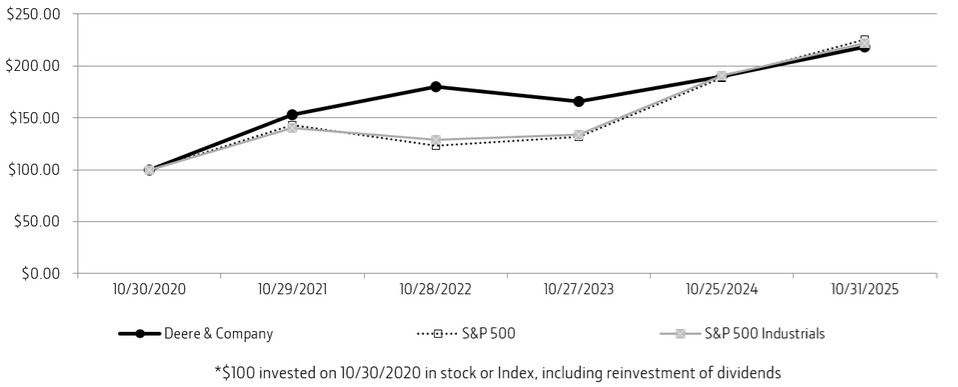
Total Shareholder Returns (TSR) Performance
|
|
2020 |
|
2021 |
|
2022 |
|
2023 |
|
2024 |
|
2025 |
|
||||||
Company / Index |
|
|
|
|
|
|
|
|
|
|
|
|
|
|
|
|
|
|
|
Deere & Company |
|
$ |
100.00 |
|
$ |
153.27 |
|
$ |
179.84 |
|
$ |
165.72 |
|
$ |
189.96 |
|
$ |
217.99 |
|
S&P 500 |
|
|
100.00 |
|
|
142.91 |
|
|
122.94 |
|
|
131.94 |
|
|
188.83 |
|
|
225.31 |
|
S&P 500 Industrials |
|
|
100.00 |
|
|
139.83 |
|
|
128.81 |
|
|
133.62 |
|
|
190.66 |
|
|
221.76 |
|
28
ITEM 6. |
[RESERVED] |
ITEM 7. |
MANAGEMENT’S DISCUSSION AND ANALYSIS OF FINANCIAL CONDITION AND RESULTS OF OPERATIONS. |
See the information under the caption “Management’s Discussion and Analysis.”
ITEM 7A. |
QUANTITATIVE AND QUALITATIVE DISCLOSURES ABOUT MARKET RISK. |
We are exposed to a variety of market risks, including interest rates and currency exchange rates. We attempt to actively manage these risks. See the information under “Management’s Discussion and Analysis,” under “Financial Instrument Market Risk Information” and in Note 26 to the Consolidated Financial Statements.
ITEM 8. |
FINANCIAL STATEMENTS AND SUPPLEMENTARY DATA. |
See the Consolidated Financial Statements and notes thereto and supplementary data.
ITEM 9. |
CHANGES IN AND DISAGREEMENTS WITH ACCOUNTANTS ON ACCOUNTING AND FINANCIAL DISCLOSURE. |
Not applicable.
ITEM 9A. |
CONTROLS AND PROCEDURES. |
Disclosure Controls and Procedures
Our principal executive officer and our principal financial officer have concluded that our disclosure controls and procedures (as defined in Rules 13a-15(e) and 15d-15(e) of the Securities Exchange Act of 1934, as amended (the Exchange Act)) were effective as of November 2, 2025, based on the evaluation of these controls and procedures required by Rule 13a-15(b) or 15d-15(b) of the Exchange Act.
Management’s Report on Internal Control Over Financial Reporting
Management is responsible for establishing and maintaining adequate internal control over financial reporting. Our internal control system was designed to provide reasonable assurance regarding the preparation and fair presentation of published financial statements in accordance with U.S. generally accepted accounting principles.
All internal control systems, no matter how well designed, have inherent limitations. Therefore, even those systems determined to be effective can provide only reasonable assurance with respect to financial statement preparation and presentation in accordance with generally accepted accounting principles.
Management assessed the effectiveness of our internal control over financial reporting as of November 2, 2025, using the criteria set forth in Internal Control – Integrated Framework (2013) issued by the Committee of Sponsoring Organizations of the Treadway Commission. Based on that assessment, management concluded that, as of November 2, 2025, our internal control over financial reporting was effective.
Our independent registered public accounting firm has issued an audit report on the effectiveness of our internal control over financial reporting. That report is included herein.
Changes in Internal Control Over Financial Reporting
During the fourth quarter of 2025, there were no changes that have materially affected or are reasonably likely to materially affect our internal control over financial reporting.
ITEM 9B. |
OTHER INFORMATION. |
Director and Executive Officer Trading Arrangements
None.
ITEM 9C. |
DISCLOSURE REGARDING FOREIGN JURISDICTIONS THAT PREVENT INSPECTIONS. |
Not applicable.
29
PART III
ITEM 10. |
DIRECTORS, EXECUTIVE OFFICERS AND CORPORATE GOVERNANCE. |
The information regarding directors required by this Item 10 will be set forth in the definitive proxy statement for our 2026 annual meeting of stockholders (proxy statement) to be filed with the Commission in advance of such meeting. Information regarding executive officers is presented in Item 1 of this report under the caption "Information about our Executive Officers."
We have adopted a code of ethics that applies to our executives, including our principal executive officer, principal financial officer, and principal accounting officer. This code of ethics and our corporate governance policies are posted on our website at http://www.deere.com/governance. We intend to satisfy disclosure requirements regarding amendments to or waivers from our code of ethics by posting such information on this website. The charters of the Audit Review, Corporate Governance, Compensation, and Finance committees of our Board are available on our website as well. This information is also available in print free of charge to any person who requests it.
ITEM 11. |
EXECUTIVE COMPENSATION. |
The information required by this Item 11 will be set forth in the proxy statement to be filed with the Commission.
ITEM 12. |
SECURITY OWNERSHIP OF CERTAIN BENEFICIAL OWNERS AND MANAGEMENT AND RELATED STOCKHOLDER MATTERS. |
The information required by this Item 12 will be set forth in the proxy statement to be filed with the Commission.
ITEM 13. |
CERTAIN RELATIONSHIPS AND RELATED TRANSACTIONS, AND DIRECTOR INDEPENDENCE. |
The information required by this Item 13 will be set forth in the proxy statement to be filed with the Commission.
ITEM 14. |
PRINCIPAL ACCOUNTANT FEES AND SERVICES. |
Information required by this Item 14, including aggregate fees billed to us by our principal accountant, Deloitte & Touche LLP (PCAOB ID No. 34), will be set forth in the proxy statement to be filed with the Commission.
30
PART IV
ITEM 15. |
EXHIBITS AND FINANCIAL STATEMENT SCHEDULES. |
|
|
Page |
(1) |
Financial Statements |
|
|
|
|
|
47 |
|
|
|
|
|
48 |
|
|
|
|
|
Consolidated Balance Sheets as of November 2, 2025 and October 27, 2024 |
49 |
|
|
|
|
50 |
|
|
|
|
|
51 |
|
|
|
|
|
52 |
|
|
|
|
(2) |
Exhibits |
|
|
|
|
|
|
|
|
|
|
|
Certain instruments relating to long-term borrowings constituting less than 10% of registrant’s total assets are not filed as exhibits herewith pursuant to Item 601(b)4(iii)(A) of Regulation S-K. The registrant agrees to file copies of such instruments upon request of the Commission. |
|
|
|
|
|
Financial Statement Schedules Omitted |
|
|
|
|
|
The following schedules for the Company and consolidated subsidiaries are omitted because of the absence of the conditions under which they are required: I, II, III, IV, and V. |
|
ITEM 16.FORM 10-K SUMMARY.
None.
31
MANAGEMENT’S DISCUSSION AND ANALYSIS
Management’s Discussion and Analysis of Financial Condition and Results of Operations (MD&A) is intended to promote understanding of our financial condition and results of operations. The MD&A is provided as a supplement to, and should be read in conjunction with, the consolidated financial statements and the accompanying Notes to Consolidated Financial Statements. All amounts are presented in millions of U.S. dollars, unless otherwise specified. For comparison of 2024 to 2023 results, refer to the “Management’s Discussion and Analysis” section of our 2024 Form 10-K, which is hereby incorporated by reference.
OVERVIEW |
|
Deere & Company is a global leader in the production of agricultural, turf, construction, and forestry equipment and solutions. John Deere Financial provides financing for John Deere equipment, parts, services, and other inputs customers need to run their operations. Our operations are managed through the Production & Precision Agriculture (PPA), Small Agriculture & Turf (SAT), Construction & Forestry (CF), and Financial Services (FS) operating segments. References to “equipment operations” include PPA, SAT, and CF, while references to “agriculture and turf” include both PPA and SAT.
Net Sales and Revenues by Segment in 2025
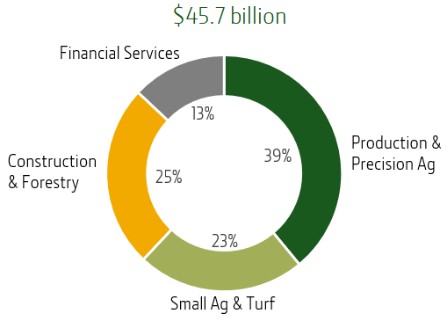
TRENDS & ECONOMIC CONDITIONS |
|
Industry Sales Outlook for Fiscal 2026
Agriculture and Turf
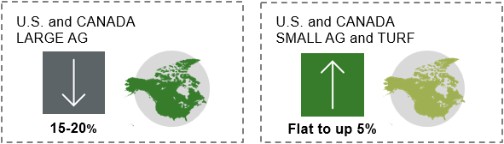
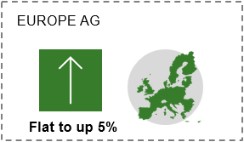

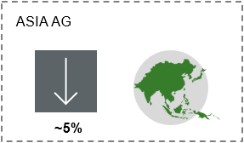
Construction and Forestry
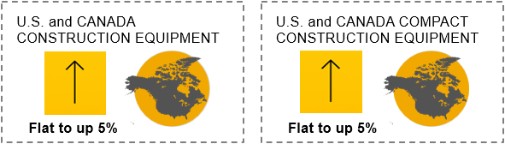
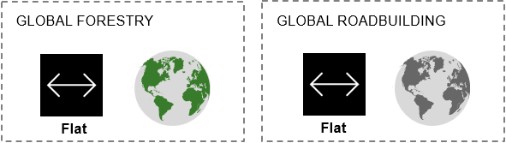
Company Trends
In 2022, we introduced our Leap Ambitions, a set of focused goals designed to guide the implementation of our Smart Industrial Operating Model. These Ambitions are built upon a foundation of product quality and manufacturing excellence, supported by a best-in-class dealer channel, and enabled by employees dedicated to solving some of the world’s most important problems. To build on our accomplishments and lay the foundation for sustained growth as we move toward 2030, in December 2025 we refined our Ambitions. Our refined Ambitions feature multi-year financial and operational goals, emphasizing the use of our differentiated equipment and service solutions, including automation, autonomy, digitalization, lifecycle solutions, and Solutions as a Service (SaaS).
Deeper integration of technology into equipment to enable customers to do more with less remains a persistent market trend. Customers seek to improve profitability, productivity, and sustainability by selecting our equipment and technology solutions. These technologies are incorporated into customer operations across the varied production systems in which we serve. While we continue to benefit from the adoption of these technologies, revenue from SaaS products did not represent a significant percentage of our revenues in 2025.
32
Company Outlook for 2026
| ● | Large agriculture sales in North America are expected to remain subdued. |
| ● | Small agriculture & turf and construction & forestry sales are expected to improve in 2026. |
Agriculture and Turf Outlook for 2026
| ● | Demand in the U.S. and Canada for large agriculture equipment is expected to decrease further amidst challenging farm fundamentals for row crop farmers, which pressures short-term liquidity. Although the used equipment market is improving, it continues to constrain investments in new machines. These factors are partially offset by strong crop yields and consumption, recent U.S. trade agreements, growing demand for biofuels, and supportive government subsidies. |
| ● | We expect small agricultural and turf equipment sales to be flat to up slightly from 2025 levels in the U.S. and Canada. The dairy and livestock segment continues to generate profits driven by solid beef prices. A modest recovery is anticipated in the turf sector following an inflection in the housing market and growth in the overall economy. |
| ● | In Europe, the industry is forecasted to be flat to up slightly supported by strong dairy margins, a stabilizing interest rate environment, and improving crop yields. |
| ● | Demand in South America is expected to be flat. In Brazil, while soybean and corn acreage is expected to grow, demand is projected to be tempered by high interest rates, strong global crop yields weighing on prices, and uncertainty over global trade policies. In Argentina, equipment demand is anticipated to moderate after robust growth in 2025. |
| ● | Industry sales in Asia are forecasted to be down slightly. |
Construction and Forestry Outlook for 2026
| ● | Industry sales in the U.S. and Canada for earthmoving and compact construction equipment are projected to remain flat to slightly higher, supported by modest growth in construction markets. Record employment levels, strong construction backlogs, and U.S. government infrastructure spending continue to provide a solid foundation for the industry. Moreover, declining interest rates, increased investment in rental fleets, and surging data center construction starts are adding further momentum. These positive drivers are expected to be partially tempered by restrained investments in the private commercial sector. |
| ● | Global forestry markets are expected to be flat. |
| ● | Global roadbuilding markets are forecasted to remain flat at strong levels. |
Financial Services Outlook for 2026
Net Income |
|
Down |
|
||||
(-) Average portfolio |
|
Unfavorable |
|
||||
(-) Prior period special items |
|
Unfavorable |
|
||||
+ Financing spreads |
|
Favorable |
|
||||
Additional Trends
Agricultural Market Business Cycle – The agricultural market is affected by various factors including commodity prices, acreage planted, crop yields, government policies, and uncertainty in macroeconomic trends. These factors affect farmers’ income and sentiment which may result in varying demand for our equipment. In 2025, we experienced the following effects due to unfavorable market conditions: lower sales volumes, greater reliance on sales incentives, and elevated receivable write-offs.
Global Trade Policies – During 2025, new tariffs were imposed in the U.S. for imports from a broad range of countries and on certain materials. Several countries also implemented or proposed retaliatory tariffs on imports from the U.S. and introduced additional trade barriers. Trade policies impact us in various ways. We are a net exporter of agriculture and turf equipment from the U.S. Nearly 80% of our domestic sales are assembled in the U.S., with the remaining products imported primarily from Europe, Mexico, India, and Japan. During 2025, incremental import tariffs adversely affected the cost of our products and components and may continue to do so in 2026. In addition, retaliatory tariffs by regions outside the U.S., currently in effect or adopted in the future, may impact the prices and profitability of our exported products. In 2025, the direct impact of incremental tariffs incurred by us was approximately $600, excluding the impact of tariffs on our suppliers and market demand. Trade policies are evolving, causing uncertainty in the agriculture and construction industries. We are actively taking steps to mitigate potential impacts on our business, to the extent possible.
On November 5, 2025, the United States Supreme Court heard oral arguments on tariffs imposed under the International Emergency Economic Powers Act (IEEPA). The court may provide tariff relief and the potential recovery of amounts previously paid. We are monitoring developments in this case and its impact on our future financial statements and business.
Changes in the agricultural market business cycle and global trade policies are driven by factors outside of our control, and as a result we cannot reasonably foresee when these conditions will fully subside.
Legal Proceeding – On January 15, 2025, the Federal Trade Commission (FTC), along with the Attorneys General of the States of Illinois and Minnesota filed a lawsuit against us in the United States District Court for the Northern District of Illinois Western Division. The Attorneys General of the States of Arizona, Michigan, and Wisconsin joined the lawsuit. The lawsuit alleges monopolization and unfair competition in violation of the federal and state antitrust laws. Plaintiffs seek a permanent injunction and other equitable relief to allow owners of our equipment, as well as independent repair providers, access to our repair tools and any other repair resources available to authorized John Deere dealers.
33
We are in preliminary discussions with the FTC with respect to a potential resolution. At this stage, we are unable to estimate the potential impact on our business.
Other Items of Concern and Uncertainties – Other items that could impact our results are:
| ● | global and regional political conditions, including the ongoing war between Russia and Ukraine and the conflicts in the Middle East |
| ● | shifts in energy, including positions with respect to biofuels, economic, and positions on government subsidies of farming |
| ● | capital market disruptions |
| ● | foreign currency and capital control policies |
| ● | right to repair regulations and legislation |
| ● | weather conditions |
| ● | marketplace pace of adoption and monetization of technologies we have invested in |
| ● | our ability to strengthen our digital capabilities, artificial intelligence, automation, and autonomy |
| ● | changes in demand and pricing for new and used equipment |
| ● | delays or disruptions in our supply chain |
| ● | significant fluctuations in foreign currency exchange rates |
| ● | volatility in the prices of many commodities |
| ● | slower economic growth |
CONSOLIDATED RESULTS |
2025 compared to 2024 |
Highlights
| ● | Net income declined in 2025 compared to 2024, driven by declining market conditions. |
| ● | We continue to focus on structural profitability and strategically investing in solutions that deliver value to our customers. |
Net Sales and Revenues
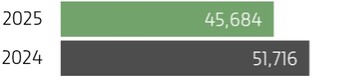
Net Sales (Equipment Operations)
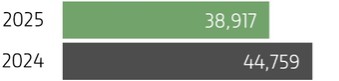
| ● | Net sales decreased in 2025 primarily due to lower sales volumes driven by declining market conditions (see Business Segment Results). |
Net Income (Attributable to Deere & Company)

Diluted Earnings Per Share (EPS) ($ per share)
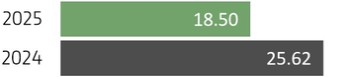
| ● | Net income and diluted EPS decreased driven by lower sales. |
Other Significant Statement of Consolidated Income Changes
An explanation of the cost of sales to net sales ratio and other significant statements of consolidated income changes follows:
Deere & Company |
|
2025 |
|
2024 |
|
% Change |
|
||
Cost of sales to net sales |
|
|
72.4% |
|
|
68.8% |
|
+5 |
|
(-) Tariffs |
|
Unfavorable |
|
||||||
(-) Lower volumes |
|
Unfavorable |
|
||||||
+ Material costs |
|
Favorable |
|
||||||
Increased due to higher tariffs and higher overhead costs from production inefficiencies associated with lower volumes, partially offset by reduced material costs and lower employee profit-sharing incentives. |
|
||||||||
|
|
|
|
|
|
|
|
|
|
Other income |
|
|
1,019 |
|
|
1,198 |
|
-15 |
|
Lower due to a decrease in revenues from certain licenses, reduced investment income, and prior year legal settlements (see Note 4). These items were partially offset by increased extended warranty premiums earned. |
|
||||||||
|
|
|
|
|
|
|
|
|
|
Selling, administrative and general expenses |
|
|
4,663 |
|
|
4,840 |
|
-4 |
|
Decreased due to lower employee profit-sharing incentives, the favorable impact from Banco John Deere S.A. (BJD) deconsolidation (see Note 4), and prior year employee separation programs' expenses (see Note 4). These items were partially offset by an increase in accrued losses on unresolved legal matters (see Note 4). |
|
||||||||
|
|
|
|
|
|
|
|
|
|
Interest expense |
|
|
3,170 |
|
|
3,348 |
|
-5 |
|
Decreased due to lower average borrowing rates and lower average borrowings. |
|
||||||||
|
|
|
|
|
|
|
|
|
|
Other operating expenses |
|
|
1,124 |
|
|
1,257 |
|
-11 |
|
Lower due to higher pension benefits (see Note 9) and foreign exchange gains, partially offset by increased depreciation of equipment on operating leases. |
|
||||||||
|
|
|
|
|
|
|
|
|
|
Provision for income taxes |
|
|
1,259 |
|
|
2,094 |
|
-40 |
|
Decreased as a result of lower pretax income and the favorable impact of tax special items (see Note 4). |
|
||||||||
BUSINESS SEGMENT RESULTS |
2025 compared to 2024 |
The equipment operations segment results were impacted by incremental tariffs in 2025. The cost of additional tariffs was included in the “Production Costs” and “Other” categories. Each equipment operations segment experienced lower shipment volumes during 2025. Economic uncertainty, low commodity prices, elevated interest rates in the first half of the year, and higher used inventory levels contributed to lower shipment volumes for large and small agriculture. Decreases in rental purchases, lower levels of multi-family and commercial real estate construction, trade uncertainty, and elevated interest rates in the first half of the year contributed to lower shipment volumes for construction equipment.
34
Current period results were impacted by special items (see Note 4).
Production & Precision Agriculture Operations
|
|
2025 |
|
2024 |
|
% Change |
|
||
Net sales |
|
$ |
17,311 |
|
$ |
20,834 |
|
-17 |
|
Sales volume and other |
|
|
|
|
|
|
|
-17 |
|
Price realization |
|
|
|
|
|
|
|
+1 |
|
Currency translation |
|
|
|
|
|
|
|
-1 |
|
Operating profit |
|
|
2,671 |
|
|
4,514 |
|
-41 |
|
Operating margin |
|
|
15.4% |
|
|
21.7% |
|
|
|
Sales volumes decreased 30% in the U.S. and Canada, partially offset by an increase of 22% in Brazil. Price realization was up 1% in the U.S. and Canada. In Brazil, price realization was up 4% as demand was strong due to higher grower production. Price realization in the rest of the world was down slightly due to moderating market conditions.
Operating profit decreased primarily due to lower sales volumes/ sales mix, partially offset by price realization.
Production & Precision Agriculture Operating Profit
2025 compared to 2024
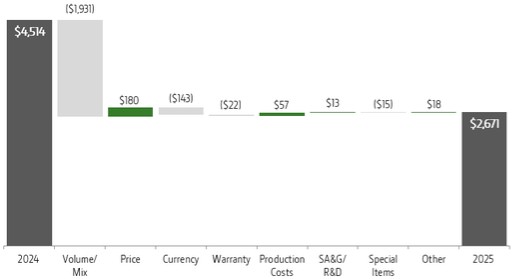
Small Agriculture & Turf Operations
|
|
2025 |
|
2024 |
|
% Change |
|
||
Net sales |
|
$ |
10,224 |
|
$ |
10,969 |
|
-7 |
|
Sales volume and other |
|
|
|
|
|
|
|
-8 |
|
Price realization |
|
|
|
|
|
|
|
+1 |
|
Currency translation |
|
|
|
|
|
|
|
|
|
Operating profit |
|
|
1,207 |
|
|
1,627 |
|
-26 |
|
Operating margin |
|
|
11.8% |
|
|
14.8% |
|
|
|
Sales volumes decreased 17% in the U.S. and Canada, partially offset by an increase of 26% in India and 5% in Europe. Price realization was 1% in the U.S. and Canada and roughly flat outside the U.S. and Canada driven by moderating market conditions.
Operating profit decreased primarily due to lower sales volumes/ sales mix and higher tariffs, partially offset by price realization.
Small Agriculture & Turf Operating Profit
2025 compared to 2024

Construction & Forestry Operations
|
|
2025 |
|
2024 |
|
% Change |
|
||
Net sales |
|
$ |
11,382 |
|
$ |
12,956 |
|
-12 |
|
Sales volume and other |
|
|
|
|
|
|
|
-10 |
|
Price realization |
|
|
|
|
|
|
|
-2 |
|
Currency translation |
|
|
|
|
|
|
|
|
|
Operating profit |
|
|
1,028 |
|
|
2,009 |
|
-49 |
|
Operating margin |
|
|
9.0% |
|
|
15.5% |
|
|
|
Sales volumes decreased 15% in the U.S. and Canada and were roughly flat outside the U.S. and Canada. Price realization decreased 3% in the U.S. and Canada due to incremental incentive programs deployed to address pressures from the competitive environment and was flat outside the U.S. and Canada.
Operating profit decreased primarily due to lower sales volumes/ sales mix, unfavorable price realization, and higher tariffs.
Construction & Forestry Operating Profit
2025 compared to 2024

35
Financial Services Operations
|
|
2025 |
|
2024 |
|
% Change |
|
||
Revenue (including intercompany) |
|
$ |
6,289 |
|
$ |
6,493 |
|
-3 |
|
Average balance of receivables and leases excluding BJD |
|
|
|
|
|
|
|
-1 |
|
Interest expense |
|
|
2,923 |
|
|
3,182 |
|
-8 |
|
Average borrowings |
|
|
|
|
|
|
|
-3 |
|
Average borrowing rates |
|
|
|
|
|
|
|
-5 |
|
Net income |
|
|
890 |
|
|
696 |
|
+28 |
|
The average balance of receivables and leases financed was 5% lower compared to the prior year, primarily due to the deconsolidation of BJD (see Note 4). Revenue also decreased due to a lower average portfolio. Net income increased as a result of special items (see Note 4), lower selling, administrative and general expenses, favorable financing spreads, and a lower provision for credit losses.
Financial Services Net Income
2025 compared to 2024
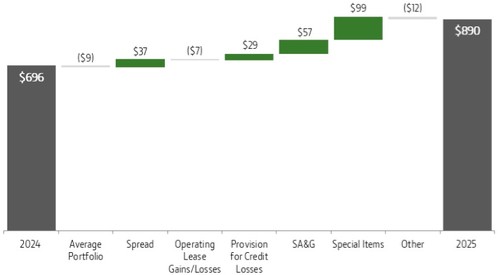
Special Items
The impact of special items on the segments’ operating profit in 2025 and 2024 is presented below (see Note 4).
|
|
PPA |
|
SAT |
|
CF |
|
FS |
|
Total |
|
|||||
2025 Expense (benefit) |
|
|
|
|
|
|
|
|
|
|
|
|
|
|
|
|
Litigation accrual |
|
$ |
47 |
|
$ |
24 |
|
$ |
24 |
|
|
|
|
$ |
95 |
|
Impairment |
|
|
28 |
|
|
17 |
|
|
16 |
|
|
|
|
|
61 |
|
BJD measurement |
|
|
|
|
|
|
|
|
|
|
$ |
(32) |
|
|
(32) |
|
Total expense (benefit) |
|
|
75 |
|
|
41 |
|
|
40 |
|
|
(32) |
|
|
124 |
|
2024 Expense (benefit) |
|
|
|
|
|
|
|
|
|
|
|
|
|
|
|
|
Legal settlements |
|
|
(17) |
|
|
|
|
|
(40) |
|
|
|
|
|
(57) |
|
Impairment |
|
|
|
|
|
28 |
|
|
|
|
|
|
|
|
28 |
|
Employee-separation programs |
|
|
77 |
|
|
43 |
|
|
22 |
|
|
10 |
|
|
152 |
|
BJD measurement |
|
|
|
|
|
|
|
|
|
|
|
59 |
|
|
59 |
|
Total expense (benefit) |
|
|
60 |
|
|
71 |
|
|
(18) |
|
|
69 |
|
|
182 |
|
Year over year change |
|
$ |
15 |
|
$ |
(30) |
|
$ |
58 |
|
$ |
(101) |
|
$ |
(58) |
|
BUSINESS SEGMENT RESULTS |
2024 compared to 2023 |
Please refer to the “Management’s Discussion and Analysis” section of our 2024 Form 10-K.
CAPITAL RESOURCES AND LIQUIDITY |
2025 compared to 2024 |
We have access to global markets at a reasonable cost. Sources of liquidity include:
| ● | cash, cash equivalents, and marketable securities on hand |
| ● | funds from operations |
| ● | the issuance of commercial paper and term debt |
| ● | the securitization of retail notes |
| ● | bank lines of credit |
We closely monitor our cash requirements. Based on the available sources of liquidity, we expect to meet our funding needs in the short term (next 12 months) and long term (beyond 12 months). We are forecasting lower operating cash flows from equipment operations in 2026 compared with 2025, driven by a decrease in net income adjusted for non-cash provisions, partially offset by higher cash flows generated from inventory reductions.
We operate in multiple industries, which have unique funding requirements. The equipment operations are capital intensive. Historically, these operations have been subject to seasonal variations in financing requirements for inventories and receivables from dealers. The financial services operations rely on their ability to raise substantial amounts of funds to finance their receivable and lease portfolios.
Key Metrics and Balance Sheet Changes
Cash, Cash Equivalents, and Marketable Securities

| ● | Cash, cash equivalents, and marketable securities increased to maintain liquidity and improve leverage. |
| ● | See the detailed cash flow discussion in the next section. |
Trade Accounts and Notes Receivable – Net
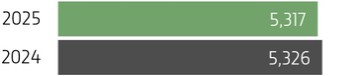
| ● | Receivables are generated from the sales of goods and services to customers. |
| ● | Limited change driven by flat sales in the second half of the year compared to prior period. |
| ● | 3% of receivables were outstanding for periods exceeding 12 months, reflecting a decrease from the prior year. |
Financing Receivables and Equipment on Operating Leases
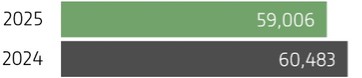
| ● | The decrease is primarily due to lower retail sales. |
| ● | Acquisition volumes were down 13% compared to the prior period. |
36
Inventories
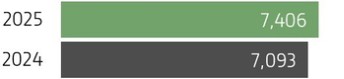
| ● | Inventories increased primarily due to higher CF inventory driven by reduced demand. |
Property and Equipment
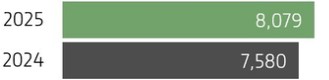
| ● | Cash expenditures were $1.3 billion in 2025. |
| ● | Capital expenditures are forecasted to be $1.4 billion in 2026. |
Accounts Payable and Accrued Expenses
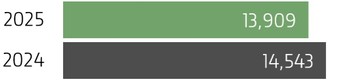
| ● | Accounts payable increased due to higher trade payables. |
| ● | Accrued expenses decreased primarily due to lower accrued taxes, employee benefits, and derivative liabilities. |
Borrowings

| ● | Borrowings decreased corresponding with the level of financing receivable and lease portfolios. |
Unused Credit Lines

| ● | The increase in unused credit lines was due to an increase in bank lines of credit. |
Financial Services Ratio of Interest-Bearing Debt to Stockholder’s Equity

CASH FLOWS |
2025, 2024, and 2023 |
|
|
2025 |
|
2024 |
|
2023 |
|
|||
Net cash provided by operating activities |
|
$ |
7,459 |
|
$ |
9,231 |
|
$ |
8,589 |
|
Net cash used for investing activities |
|
|
(2,057) |
|
|
(6,464) |
|
|
(8,749) |
|
Net cash provided by (used for) financing activities |
|
|
(4,579) |
|
|
(2,717) |
|
|
2,808 |
|
Effect of exchange rate changes on cash, cash equivalents, and restricted cash |
|
|
77 |
|
|
(37) |
|
|
31 |
|
Net increase in cash, cash equivalents, and restricted cash |
|
$ |
900 |
|
$ |
13 |
|
$ |
2,679 |
|
Cash inflows from operating activities were $7.5 billion in 2025, driven by net income adjusted for non-cash provisions and a decrease in receivables related to sales, partially offset by an other postretirement benefit (OPEB) contribution.
Cash outflows from investing activities were $2.1 billion in 2025. The primary drivers were purchases of property and equipment and investments in equipment on operating leases, partially offset by collections of receivables from unconsolidated affiliates.
Cash outflows from financing activities were $4.6 billion in 2025, due to dividends paid, lower borrowings, and repurchases of common stock.
Cash Returned to Shareholders
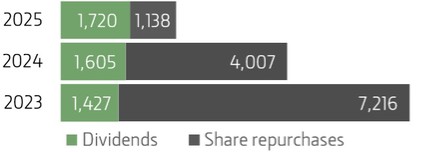
Cash returned to shareholders decreased $2.8 billion in 2025 as we managed cash flows through the declining business cycle in accordance with our use-of-cash priorities by decreasing share repurchases.
DEBT RATINGS |
|
To access public debt capital markets, we rely on credit rating agencies to assign short-term and long-term credit ratings to our debt securities as an indicator of credit quality for fixed income investors. A security rating is not a recommendation by the rating agency to buy, sell, or hold our securities. A credit rating agency may change or withdraw ratings based on its assessment of our current and future ability to meet interest and principal repayment obligations. Each agency’s rating should be evaluated independently of any other rating. Lower credit ratings generally result in higher borrowing costs, including costs of derivative transactions, reduced access to debt capital markets, and may adversely impact our liquidity.
37
The senior long-term and short-term debt ratings and outlook currently assigned to unsecured company securities by the rating agencies engaged by us are as follows:
|
|
Senior |
|
|
|
|
|
|
Long-Term |
|
Short-Term |
|
Outlook |
|
|
|
|
|
|
|
|
|
|
|
|
|
|
Fitch Ratings |
|
A+ |
|
F1 |
|
Stable |
Moody’s Investors Service, Inc. |
|
A1 |
|
Prime-1 |
|
Stable |
Standard & Poor’s |
|
A |
|
A-1 |
|
Stable |
CONTRACTUAL OBLIGATIONS AND CASH REQUIREMENTS |
2026 and Beyond |
Our material cash requirements include the following:
Borrowings – As of November 2, 2025, we had $17.2 billion of payments due on borrowings and securitization borrowings in the next year, along with interest payments of $2.3 billion. The securitization borrowing payments are based on the expected liquidation of the retail notes. See Notes 12 and 19 for additional borrowing details. These payments will likely be replaced with new borrowings to finance the receivable and lease portfolio, which is expected to be lower in 2026.
Purchase Obligations – As of November 2, 2025, our outstanding purchase obligations were $6.1 billion, with $4.5 billion payable within one year. These purchase obligations are noncancelable.
Other Cash Requirements – In addition to our contractual obligations, we have the following commitments:
| ● | capital expenditures of $1.4 billion are planned for 2026 |
| ● | expected quarterly cash dividends throughout 2026 (subject to change at the discretion of our Board of Directors) |
| ● | total pension and OPEB contributions in 2026 are expected to be approximately $250 |
Share repurchases will be considered as a means of deploying excess cash to shareholders once the previously mentioned requirements are met.
CRITICAL ACCOUNTING ESTIMATES |
|
The timely preparation of financial statements requires management to make estimates and assumptions. Those estimates affect reported amounts in these financial statements. Changes in those estimates and assumptions could have a significant effect. The following estimates are the most critical to our financial statements:
| ● | sales incentives |
| ● | product warranties |
| ● | postretirement benefit obligations |
| ● | allowance for credit losses |
| ● | operating lease residual values |
| ● | income taxes |
These items require the most difficult, subjective, or complex judgments. Our accounting policies are described primarily in Note 2 of our consolidated financial statements.
Sales Incentives
We provide sales incentives to dealers. These incentives are offered in two forms:
| ● | volume bonuses – awarded based on a dealer’s sales volume and performance |
| ● | retail sales incentive programs – discounts or financing programs that are due when the dealer sells the equipment to a retail customer |
The estimated cost of these programs is based on:
| ● | historical data |
| ● | announced and expected incentive programs |
| ● | field inventory levels |
| ● | forecasted sales volumes |
At the time a sale is recognized, we record an estimate of the sales incentive costs. The final cost is determined at the end of the volume bonus measurement period or at the time of the retail sale.
There are numerous programs available at any time, and new programs may be announced after we record the equipment sale to the dealer. Changes in the mix and types of sales incentive programs affect these estimates, which are reviewed quarterly. Actual cost differences from the original cost estimate are recognized in “Net sales.”
Sales Incentive Accruals
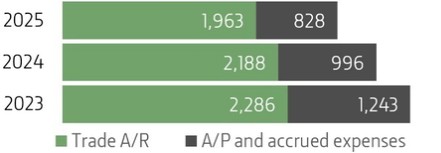
The accruals recorded against receivables relate to programs where we have the contractual right and the intent to offset against existing receivables. The decrease in 2025 resulted from lower sales.
A key assumption of the retail sales incentive accrual is the predictive value of the historical percentage of retail sales incentive costs to retail sales. Over the last five fiscal years, this percent has varied by an average of 1.0%. Holding other assumptions constant, a 1.0% change would have modified the sales incentive accrual by about $106.
Product Warranties
A standard warranty is provided as an assurance that our equipment will function as intended. The standard warranty period varies by product, region, and component.
At the time a sale is recognized, we record an estimate of future warranty costs, based on the following calculation:
| ● | historical claims rate experience – multiplied by – |
| ● | the estimated population |
The historical claims rate is determined by a review of five-year claims costs. The estimated population is based on dealer inventories and retail sales.
38
These estimates are reviewed quarterly. Adjustments are also made for current quality developments.
Product Warranty Accruals
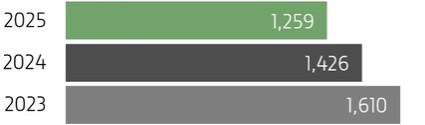
The decrease in 2025 is the result of lower sales volumes.
Product warranty accrual estimates are affected by the historical percent of warranty claims costs as a percentage of gross sales. Over the last five fiscal years, the percent has varied plus or minus 0.14%. Holding all other assumptions constant, if this estimated cost experience percent would have increased or decreased 0.14%, the warranty accrual at November 2, 2025, would have changed by approximately $70.
Postretirement Benefit Obligations
The pension and OPEB defined benefit plan obligations and expenses require the use of estimates. The main estimate is the present value of the projected future benefit payments. These future benefit payments extend several decades.
The estimates are based on existing retirement plan provisions. No assumption is made regarding any potential changes to benefit provisions beyond those to which we are presently committed (e.g., in existing labor contracts).
The key assumptions used by our actuaries to calculate the estimates include:
| ● | discount rates |
| ● | health care cost trend rates |
| ● | expected long-term return on plan assets |
| ● | compensation increases |
| ● | retirement rates |
| ● | mortality rates |
| ● | expected contributions |
Assumptions are set each year-end. These assumptions are not changed during the year unless there is a significant plan event. Actual results that differ from the assumptions affect future expenses and obligations.
The key pension and OPEB amounts follow:
|
|
2025 |
|
2024 |
|
2023 |
|
|||
Pension and OPEB net benefit |
|
$ |
(153) |
|
$ |
(86) |
|
$ |
(13) |
|
Long-term expected return on pension and OPEB plan assets (as a percent) |
|
|
6.9 |
|
|
6.8 |
|
|
6.2 |
|
Long-term expected return on pension and OPEB plan assets |
|
|
1,118 |
|
|
1,075 |
|
|
995 |
|
Actual return (loss) on pension and OPEB plan assets |
|
|
1,052 |
|
|
1,962 |
|
|
(395) |
|
Pension assets, net of pension liabilities |
|
|
2,362 |
|
|
2,003 |
|
|
2,076 |
|
OPEB liabilities, net of OPEB assets |
|
|
541 |
|
|
1,191 |
|
|
1,001 |
|
The increase in the 2025 pension and OPEB net benefit was due to an increase in the expected long-term rates of return on pension plan assets.
The effect of hypothetical changes to selected assumptions on our major U.S. retirement benefit plans would be as follows:
|
|
|
|
|
|
|
|
|
|
|
|
|
|
November 2, 2025 |
|
2026 |
|
||
|
|
|
|
Increase |
|
Increase |
|
||
|
|
Percentage |
|
(Decrease) |
|
(Decrease) |
|
||
Assumptions |
|
Change |
|
PBO/APBO* |
|
Expense |
|
||
Pensions: |
|
|
|
|
|
|
|
|
|
Discount rate** |
|
+/-.5 |
|
$ |
(474)/524 |
|
$ |
8/20 |
|
Expected return on assets |
|
+/-.5 |
|
|
|
|
|
(63)/63 |
|
OPEB: |
|
|
|
|
|
|
|
|
|
Discount rate** |
|
+/-.5 |
|
|
(134)/145 |
|
|
(5)/1 |
|
Expected return on assets |
|
+/-.5 |
|
|
|
|
|
(14)/14 |
|
Health care cost |
|
+/-1.0 |
|
|
255/(223) |
|
|
31/(36) |
|
* Projected benefit obligation (PBO) for pension plans and accumulated postretirement benefit obligation (APBO) for OPEB plans.
** Pretax impact on service cost, interest cost, and amortization of gains or losses.
Allowance for Credit Losses
The allowance for credit losses is an estimate of the credit losses expected over the life of the receivable portfolio. The allowance is measured on a collective basis for receivables with similar risk characteristics. Receivables that do not share risk characteristics are evaluated on an individual basis. Risk characteristics include:
| ● | finance product category |
| ● | market |
| ● | geography |
| ● | credit risk |
| ● | remaining balance |
We utilize the following loss forecast models to estimate expected credit losses:
| ● | Linear regression models are used for large and complex retail customer receivable pools, which represent more than 90% of retail customer receivables. These statistical models utilize independent variables, or predictive features, to estimate lifetime default rates, which are subsequently adjusted for expected recoveries to arrive at lifetime credit loss estimates. Independent variables include credit quality at time of application, remaining account balance, delinquency status, and various economic factors, such as commodity prices, employment levels, and housing data. The economic factors include forward-looking conditions over our reasonable and supportable forecast period. |
| ● | Weighted average remaining maturity (WARM) models are used for smaller and less complex retail customer receivable pools. |
| ● | Historical loss rate models are used on wholesale receivables, with consideration of current economic conditions and dealer financial risk. |
39
Management reviews each model’s output quarterly, and qualitative adjustments are incorporated as necessary to arrive at management’s best estimate of expected credit losses.
Allowance for Credit Losses

During 2025, the allowance for credit losses increased, primarily due to higher expected losses on agriculture and turf customer accounts as a result of elevated delinquencies and a decline in market conditions.
While we believe our allowance is sufficient to provide for losses over the life of our existing receivable portfolio, different assumptions would result in changes to the allowance for credit losses. Within the retail customer receivable portfolio, credit loss estimates are dependent on a number of factors, including credit quality at time of application, remaining account balances, current delinquency levels, various economic factors, and estimated recoveries on defaulted accounts. Changes in any of these factors could impact our credit losses. Conversely, within the wholesale receivable portfolio, changes in economic conditions have historically had limited impact on credit losses.
Holding all other factors constant, a 10% increase in the linear regression models’ forecasted defaults and a simultaneous 10% decrease in recovery rates would have resulted in a $60 increase to the allowance for credit losses at November 2, 2025.
Operating Lease Residual Values
Equipment on operating leases is depreciated to the estimated residual value over the lease term. The residual values are based on several factors, including:
| ● | lease term |
| ● | expected hours of usage |
| ● | historical wholesale sales prices |
| ● | return experience |
| ● | intended equipment use |
| ● | market dynamics and trends |
| ● | dealer residual value guarantees |
We review residual value estimates during the lease term. Depreciation is adjusted over the remaining lease term if residual estimates are revised. Impairments are recorded when events or circumstances necessitate.
At the end of the majority of leases, the equipment is disposed in the following sequence:
| ● | The lessee has the option to purchase the equipment for the contractual residual value. |
| ● | The dealer has the option to purchase the equipment. |
| ● | The equipment is sold to a third party at the equipment’s fair value. In this situation, we may record a gain or a loss for the difference between the residual value and the sale price. |
Operating Lease Residual Values
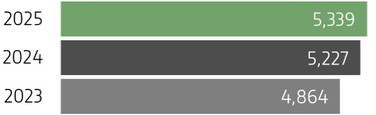
Hypothetically, if (a) future market values for this equipment were to decrease 10% from our present estimates, and (b) all the equipment on operating leases were returned to us for remarketing at the end of the lease term, the total unfavorable impact after consideration of dealer residual value guarantees would be approximately $65. This amount would be recognized as higher depreciation expense over the remaining term of the operating leases, or potentially as an impairment.
Income Taxes
We are subject to federal, state, and foreign income taxes, which can be complex. Implementing these tax laws requires significant judgment and interpretation. Changes in tax laws could materially affect our consolidated financial statements. We record our tax positions in the following categories:
| ● | current taxes |
| ● | deferred taxes |
| ● | uncertain tax positions |
Deferred income taxes represent temporary differences between the tax and the financial reporting basis of assets and liabilities. This will result in taxable or deductible amounts in the future. Loss carryforwards and tax credits are significant components of deferred tax asset balances. These assets are reviewed regularly for the following:
| ● | the likelihood of recoverability from future taxable income |
| ● | reversal of deferred tax liabilities |
| ● | tax planning strategies |
Valuation allowances are established when we determine that the deferred tax benefit may not be realized. The recoverability analysis requires significant judgment and relies on estimates. The valuation allowance as of November 2, 2025, was $1.6 billion. Changes in foreign income tax laws, income for certain jurisdictions, or our tax structure could impact the valuation allowance balance.
Some tax positions contain significant uncertainties. These positions may be challenged or disallowed by taxing authorities. If it is likely the position will be disallowed, no tax benefit is recorded. If it is likely the position will be sustained, a tax benefit is recognized. The ultimate resolution could take many years. This may result in a payment that is significantly different from the original estimate.
See Note 8 for further information on income taxes.
FORWARD-LOOKING STATEMENTS
Certain statements contained herein, including in the section entitled “Overview,” “Trends and Economic Conditions,” and “Notes to Consolidated Financial Statements” relating to future events, expectations, and trends constitute “forward-looking statements” as defined in the Private Securities Litigation Reform Act of 1995 and involve factors that are subject to change, assumptions, risks, and uncertainties that could cause actual results to differ materially.
40
Some of these risks and uncertainties could affect all lines of our operations generally while others could more heavily affect a particular line of business.
Forward-looking statements are based on currently available information and current assumptions, expectations, and projections about future events and should not be relied upon. Except as required by law, we expressly disclaim any obligation to update or revise our forward-looking statements. Many factors, risks, and uncertainties could cause actual results to differ materially from these forward-looking statements. Among these factors are risks related to:
| ● | the agricultural business cycle, which can be unpredictable and is affected by factors such as farm income, international trade, world grain stocks, crop yields, available farm acres, soil conditions, prices for commodities and livestock, input costs, government farm programs, availability of transport for crops, as well as adverse macroeconomic conditions, including unemployment, inflation, interest rate volatility, changes in consumer practices due to slower economic growth or a recession, and regional or global liquidity constraints |
| ● | the uncertainty of government policies and actions with respect to the global trade environment including increased and proposed tariffs announced by the U.S. government and retaliatory trade regulations |
| ● | political, economic, and social instability in the geographies in which we operate, including the ongoing war between Russia and Ukraine and the conflicts in the Middle East |
| ● | worldwide demand for food and different forms of renewable energy impacting the price of farm commodities and consequently the demand for our equipment |
| ● | rationalization, restructuring, relocation, expansion, and/or reconfiguration of manufacturing and warehouse facilities |
| ● | accurately forecasting customer demand for products and services, and adequately managing inventory |
| ● | uncertainty of our ability to sell products domestically or internationally, manage increased costs of production, absorb or pass on increased pricing, and accurately predict financial results and industry trends |
| ● | availability and price of raw materials, components, and whole goods |
| ● | delays or disruptions in our supply chain |
| ● | changes in climate patterns, unfavorable weather events, and natural disasters |
| ● | suppliers’ and manufacturers’ business practices and compliance with laws applicable to topics such as human rights, safety, environmental, and fair wages |
| ● | higher interest rates and currency fluctuations which could adversely affect the U.S. dollar, customer confidence, access to capital, and demand for our products and solutions |
| ● | ability to adapt in highly competitive markets, including understanding and meeting customers’ changing expectations |
| for products and solutions, including delivery and utilization of precision technology |
| ● | the ability to execute business strategies, including our Smart Industrial Operating Model and refined Leap Ambitions |
| ● | dealer practices and their ability to manage new and used inventory, distribute our products, and to provide support and service for precision technology solutions |
| ● | the ability to realize anticipated benefits of acquisitions and joint ventures, including challenges with successfully integrating operations and internal control processes |
| ● | negative claims or publicity that damage our reputation or brand |
| ● | the ability to attract, develop, engage, and retain qualified employees |
| ● | the impact of workforce reductions on company culture, employee retention and morale, and institutional knowledge |
| ● | labor relations and contracts, including work stoppages and other disruptions |
| ● | security breaches, cybersecurity attacks, technology failures, and other disruptions to our information technology infrastructure and products |
| ● | leveraging artificial intelligence and machine learning within our business processes |
| ● | changes to existing laws and regulations, including the implementation of new, more stringent laws, as well as compliance with a variety of U.S., foreign, and international laws, regulations, and policies relating to, but not limited to the following: advertising, anti-bribery and anti-corruption, anti-money laundering, antitrust, consumer finance, cybersecurity, data privacy, encryption, environmental (including climate change and engine emissions), farming, foreign exchange controls and cash repatriation restrictions, foreign ownership and investment, health and safety, human rights, import / export and trade, labor and employment, product liability, tariffs, tax, telematics, and telecommunications |
| ● | governmental and other actions designed to address climate change in connection with a transition to a lower-carbon economy |
| ● | warranty claims, post-sales repairs or recalls, product liability litigation, and regulatory investigations because of the deficient operation of our products |
| ● | investigations, claims, lawsuits, or other legal proceedings, including the lawsuit filed by the Federal Trade Commission (FTC) and the Attorneys General of the States of Arizona, Illinois, Michigan, Minnesota, and Wisconsin alleging that we unlawfully withheld self-repair capabilities from farmers and independent repair providers |
| ● | loss of or challenges to intellectual property rights |
Further information concerning us and our businesses, including factors that could materially affect our financial results, is included in our other filings with the SEC (including, but not limited to, the factors discussed in Item 1A. “Risk Factors” of this Annual Report on Form 10-K). There also may be other factors that we cannot anticipate or that are not described herein because we do not currently perceive them to be material.
41
SUPPLEMENTAL CONSOLIDATING DATA
The supplemental consolidating data presented on the subsequent pages is presented for informational purposes. Equipment operations represent the enterprise without Financial Services. Equipment operations include Production & Precision Agriculture operations, Small Agriculture & Turf operations, Construction & Forestry operations, and other corporate assets, liabilities, revenues, and expenses not reflected within Financial Services. Transactions between the equipment operations and Financial Services have been eliminated to arrive at the consolidated financial statements.
Equipment operations and Financial Services participate in different industries. Equipment operations primarily generate earnings and cash flows by manufacturing and selling equipment, service parts, and technology solutions to dealers and retail customers. Financial Services finance sales and leases by dealers of new and used equipment that is largely manufactured by equipment operations. Those earnings and cash flows generally are the difference between the finance income received from customer payments less interest expense, and depreciation on equipment subject to an operating lease. The two businesses are capitalized differently and have separate performance metrics. The supplemental consolidating data is also used by management due to these differences.
|
|
|
|
|
|
|
|
|
|
|
|
|
|
|
|
|
|
|
|
|
|
|
|
|
|
|
|
|
|
|
|
|
|
|
|
|
|
|
|
INCOME STATEMENTS |
|
|
|
||||||||||||||||||||||||||||||||||||
For the Years Ended November 2, 2025, October 27, 2024, and October 29, 2023 |
|
|
|
||||||||||||||||||||||||||||||||||||
Unaudited |
|
|
|
||||||||||||||||||||||||||||||||||||
|
|
EQUIPMENT |
|
FINANCIAL |
|
|
|
|
|
|
|
||||||||||||||||||||||||||||
|
|
OPERATIONS |
|
SERVICES |
|
ELIMINATIONS |
|
CONSOLIDATED |
|
|
|
||||||||||||||||||||||||||||
|
|
2025 |
|
2024 |
|
2023 |
|
2025 |
|
2024 |
|
2023 |
|
2025 |
|
2024 |
|
2023 |
|
2025 |
|
2024 |
|
2023 |
|
|
|
||||||||||||
Net Sales and Revenues |
|
|
|
|
|
|
|
|
|
|
|
|
|
|
|
|
|
|
|
|
|
|
|
|
|
|
|
|
|
|
|
|
|
|
|
|
|
|
|
Net sales |
|
$ |
38,917 |
|
$ |
44,759 |
|
$ |
55,565 |
|
|
|
|
|
|
|
|
|
|
|
|
|
|
|
|
|
|
|
$ |
38,917 |
|
$ |
44,759 |
|
$ |
55,565 |
|
|
|
Finance and interest income |
|
|
521 |
|
|
596 |
|
|
636 |
|
$ |
5,768 |
|
$ |
6,035 |
|
$ |
5,055 |
|
$ |
(541) |
|
$ |
(872) |
|
$ |
(1,008) |
|
|
5,748 |
|
|
5,759 |
|
|
4,683 |
|
1 |
|
Other income |
|
|
821 |
|
|
1,006 |
|
|
858 |
|
|
521 |
|
|
458 |
|
|
499 |
|
|
(323) |
|
|
(266) |
|
|
(354) |
|
|
1,019 |
|
|
1,198 |
|
|
1,003 |
|
2, 3, 4 |
|
Total |
|
|
40,259 |
|
|
46,361 |
|
|
57,059 |
|
|
6,289 |
|
|
6,493 |
|
|
5,554 |
|
|
(864) |
|
|
(1,138) |
|
|
(1,362) |
|
|
45,684 |
|
|
51,716 |
|
|
61,251 |
|
|
|
|
|
|
|
|
|
|
|
|
|
|
|
|
|
|
|
|
|
|
|
|
|
|
|
|
|
|
|
|
|
|
|
|
|
|
|
|
|
|
|
Costs and Expenses |
|
|
|
|
|
|
|
|
|
|
|
|
|
|
|
|
|
|
|
|
|
|
|
|
|
|
|
|
|
|
|
|
|
|
|
|
|
|
|
Cost of sales |
|
|
28,190 |
|
|
30,803 |
|
|
37,739 |
|
|
|
|
|
|
|
|
|
|
|
(31) |
|
|
(28) |
|
|
(24) |
|
|
28,159 |
|
|
30,775 |
|
|
37,715 |
|
4 |
|
Research and development expenses |
|
|
2,311 |
|
|
2,290 |
|
|
2,177 |
|
|
|
|
|
|
|
|
|
|
|
|
|
|
|
|
|
|
|
|
2,311 |
|
|
2,290 |
|
|
2,177 |
|
|
|
Selling, administrative and general expenses |
|
|
3,856 |
|
|
3,791 |
|
|
3,611 |
|
|
815 |
|
|
1,059 |
|
|
994 |
|
|
(8) |
|
|
(10) |
|
|
(10) |
|
|
4,663 |
|
|
4,840 |
|
|
4,595 |
|
4 |
|
Interest expense |
|
|
372 |
|
|
396 |
|
|
411 |
|
|
2,923 |
|
|
3,182 |
|
|
2,362 |
|
|
(125) |
|
|
(230) |
|
|
(320) |
|
|
3,170 |
|
|
3,348 |
|
|
2,453 |
|
1 |
|
Interest compensation to Financial Services |
|
|
414 |
|
|
640 |
|
|
687 |
|
|
|
|
|
|
|
|
|
|
|
(414) |
|
|
(640) |
|
|
(687) |
|
|
|
|
|
|
|
|
|
|
1 |
|
Other operating expenses |
|
|
(29) |
|
|
133 |
|
|
217 |
|
|
1,439 |
|
|
1,354 |
|
|
1,396 |
|
|
(286) |
|
|
(230) |
|
|
(321) |
|
|
1,124 |
|
|
1,257 |
|
|
1,292 |
|
3, 4, 5 |
|
Total |
|
|
35,114 |
|
|
38,053 |
|
|
44,842 |
|
|
5,177 |
|
|
5,595 |
|
|
4,752 |
|
|
(864) |
|
|
(1,138) |
|
|
(1,362) |
|
|
39,427 |
|
|
42,510 |
|
|
48,232 |
|
|
|
|
|
|
|
|
|
|
|
|
|
|
|
|
|
|
|
|
|
|
|
|
|
|
|
|
|
|
|
|
|
|
|
|
|
|
|
|
|
|
|
Income before Income Taxes |
|
|
5,145 |
|
|
8,308 |
|
|
12,217 |
|
|
1,112 |
|
|
898 |
|
|
802 |
|
|
|
|
|
|
|
|
|
|
|
6,257 |
|
|
9,206 |
|
|
13,019 |
|
|
|
Provision for income taxes |
|
|
1,020 |
|
|
1,887 |
|
|
2,685 |
|
|
239 |
|
|
207 |
|
|
186 |
|
|
|
|
|
|
|
|
|
|
|
1,259 |
|
|
2,094 |
|
|
2,871 |
|
|
|
|
|
|
|
|
|
|
|
|
|
|
|
|
|
|
|
|
|
|
|
|
|
|
|
|
|
|
|
|
|
|
|
|
|
|
|
|
|
|
|
Income after Income Taxes |
|
|
4,125 |
|
|
6,421 |
|
|
9,532 |
|
|
873 |
|
|
691 |
|
|
616 |
|
|
|
|
|
|
|
|
|
|
|
4,998 |
|
|
7,112 |
|
|
10,148 |
|
|
|
Equity in income (loss) of unconsolidated affiliates |
|
|
(17) |
|
|
(29) |
|
|
4 |
|
|
17 |
|
|
5 |
|
|
3 |
|
|
|
|
|
|
|
|
|
|
|
|
|
|
(24) |
|
|
7 |
|
|
|
|
|
|
|
|
|
|
|
|
|
|
|
|
|
|
|
|
|
|
|
|
|
|
|
|
|
|
|
|
|
|
|
|
|
|
|
|
|
|
|
Net Income |
|
|
4,108 |
|
|
6,392 |
|
|
9,536 |
|
|
890 |
|
|
696 |
|
|
619 |
|
|
|
|
|
|
|
|
|
|
|
4,998 |
|
|
7,088 |
|
|
10,155 |
|
|
|
Less: Net loss attributable to noncontrolling interests |
|
|
(29) |
|
|
(12) |
|
|
(11) |
|
|
|
|
|
|
|
|
|
|
|
|
|
|
|
|
|
|
|
|
(29) |
|
|
(12) |
|
|
(11) |
|
|
|
Net Income Attributable to Deere & Company |
|
$ |
4,137 |
|
$ |
6,404 |
|
$ |
9,547 |
|
$ |
890 |
|
$ |
696 |
|
$ |
619 |
|
|
|
|
|
|
|
|
|
|
$ |
5,027 |
|
$ |
7,100 |
|
$ |
10,166 |
|
|
|
1 Elimination of intercompany interest income and expense.
2 Elimination of equipment operations’ margin from inventory transferred to equipment on operating leases (see Note 6).
3 Elimination of income and expenses between equipment operations and Financial Services related to intercompany guarantees of investments in certain international markets.
4 Elimination of intercompany service revenues and fees.
5 Elimination of Financial Services’ lease depreciation expense related to inventory transferred to equipment on operating leases.
42
SUPPLEMENTAL CONSOLIDATING DATA (continued)
|
|
|
|
|
|
|
|
|
|
|
|
|
|
|
|
|
|
|
|
|
|
|
|
|
|
|
|
CONDENSED BALANCE SHEETS |
|
|
|
||||||||||||||||||||||||
As of November 2, 2025 and October 27, 2024 |
|
|
|
||||||||||||||||||||||||
Unaudited |
|
|
|
||||||||||||||||||||||||
|
|
EQUIPMENT |
|
FINANCIAL |
|
|
|
|
|
|
|
||||||||||||||||
|
|
OPERATIONS |
|
SERVICES |
|
ELIMINATIONS |
|
CONSOLIDATED |
|
|
|
||||||||||||||||
|
|
2025 |
|
2024 |
|
2025 |
|
2024 |
|
2025 |
|
2024 |
|
2025 |
|
2024 |
|
|
|
||||||||
ASSETS |
|
|
|
|
|
|
|
|
|
|
|
|
|
|
|
|
|
|
|
|
|
|
|
|
|
|
|
Cash and cash equivalents |
|
$ |
6,340 |
|
$ |
5,615 |
|
$ |
1,936 |
|
$ |
1,709 |
|
|
|
|
|
|
|
$ |
8,276 |
|
$ |
7,324 |
|
|
|
Marketable securities |
|
|
217 |
|
|
125 |
|
|
1,194 |
|
|
1,029 |
|
|
|
|
|
|
|
|
1,411 |
|
|
1,154 |
|
|
|
Receivables from Financial Services |
|
|
4,649 |
|
|
3,043 |
|
|
|
|
|
|
|
$ |
(4,649) |
|
$ |
(3,043) |
|
|
|
|
|
|
|
6 |
|
Trade accounts and notes receivable – net |
|
|
1,316 |
|
|
1,257 |
|
|
5,900 |
|
|
6,225 |
|
|
(1,899) |
|
|
(2,156) |
|
|
5,317 |
|
|
5,326 |
|
7 |
|
Financing receivables – net |
|
|
88 |
|
|
78 |
|
|
44,487 |
|
|
44,231 |
|
|
|
|
|
|
|
|
44,575 |
|
|
44,309 |
|
|
|
Financing receivables securitized – net |
|
|
1 |
|
|
2 |
|
|
6,830 |
|
|
8,721 |
|
|
|
|
|
|
|
|
6,831 |
|
|
8,723 |
|
|
|
Other receivables |
|
|
1,809 |
|
|
2,193 |
|
|
658 |
|
|
427 |
|
|
(64) |
|
|
(75) |
|
|
2,403 |
|
|
2,545 |
|
7 |
|
Equipment on operating leases – net |
|
|
|
|
|
|
|
|
7,600 |
|
|
7,451 |
|
|
|
|
|
|
|
|
7,600 |
|
|
7,451 |
|
|
|
Inventories |
|
|
7,406 |
|
|
7,093 |
|
|
|
|
|
|
|
|
|
|
|
|
|
|
7,406 |
|
|
7,093 |
|
|
|
Property and equipment – net |
|
|
8,047 |
|
|
7,546 |
|
|
32 |
|
|
34 |
|
|
|
|
|
|
|
|
8,079 |
|
|
7,580 |
|
|
|
Goodwill |
|
|
4,188 |
|
|
3,959 |
|
|
|
|
|
|
|
|
|
|
|
|
|
|
4,188 |
|
|
3,959 |
|
|
|
Other intangible assets – net |
|
|
892 |
|
|
999 |
|
|
|
|
|
|
|
|
|
|
|
|
|
|
892 |
|
|
999 |
|
|
|
Retirement benefits |
|
|
3,181 |
|
|
2,839 |
|
|
94 |
|
|
83 |
|
|
(2) |
|
|
(1) |
|
|
3,273 |
|
|
2,921 |
|
8 |
|
Deferred income taxes |
|
|
2,507 |
|
|
2,262 |
|
|
46 |
|
|
43 |
|
|
(269) |
|
|
(219) |
|
|
2,284 |
|
|
2,086 |
|
9 |
|
Other assets |
|
|
2,218 |
|
|
2,194 |
|
|
1,244 |
|
|
715 |
|
|
(1) |
|
|
(3) |
|
|
3,461 |
|
|
2,906 |
|
|
|
Assets held for sale |
|
|
|
|
|
|
|
|
|
|
|
2,944 |
|
|
|
|
|
|
|
|
|
|
|
2,944 |
|
|
|
Total Assets |
|
$ |
42,859 |
|
$ |
39,205 |
|
$ |
70,021 |
|
$ |
73,612 |
|
$ |
(6,884) |
|
$ |
(5,497) |
|
$ |
105,996 |
|
$ |
107,320 |
|
|
|
|
|
|
|
|
|
|
|
|
|
|
|
|
|
|
|
|
|
|
|
|
|
|
|
|
|
|
|
LIABILITIES AND STOCKHOLDERS’ EQUITY |
|
|
|
|
|
|
|
|
|
|
|
|
|
|
|
|
|
|
|
|
|
|
|
|
|
|
|
|
|
|
|
|
|
|
|
|
|
|
|
|
|
|
|
|
|
|
|
|
|
|
|
|
|
|
|
LIABILITIES |
|
|
|
|
|
|
|
|
|
|
|
|
|
|
|
|
|
|
|
|
|
|
|
|
|
|
|
Short-term borrowings |
|
$ |
414 |
|
$ |
911 |
|
$ |
13,382 |
|
$ |
12,622 |
|
|
|
|
|
|
|
$ |
13,796 |
|
$ |
13,533 |
|
|
|
Short-term securitization borrowings |
|
|
1 |
|
|
2 |
|
|
6,595 |
|
|
8,429 |
|
|
|
|
|
|
|
|
6,596 |
|
|
8,431 |
|
|
|
Payables to Equipment Operations |
|
|
|
|
|
|
|
|
4,649 |
|
|
3,043 |
|
$ |
(4,649) |
|
$ |
(3,043) |
|
|
|
|
|
|
|
6 |
|
Accounts payable and accrued expenses |
|
|
12,757 |
|
|
13,534 |
|
|
3,116 |
|
|
3,243 |
|
|
(1,964) |
|
|
(2,234) |
|
|
13,909 |
|
|
14,543 |
|
7 |
|
Deferred income taxes |
|
|
347 |
|
|
434 |
|
|
356 |
|
|
263 |
|
|
(269) |
|
|
(219) |
|
|
434 |
|
|
478 |
|
9 |
|
Long-term borrowings |
|
|
8,756 |
|
|
6,603 |
|
|
34,788 |
|
|
36,626 |
|
|
|
|
|
|
|
|
43,544 |
|
|
43,229 |
|
|
|
Retirement benefits and other liabilities |
|
|
1,646 |
|
|
2,250 |
|
|
66 |
|
|
105 |
|
|
(2) |
|
|
(1) |
|
|
1,710 |
|
|
2,354 |
|
8 |
|
Liabilities held for sale |
|
|
|
|
|
|
|
|
|
|
|
1,827 |
|
|
|
|
|
|
|
|
|
|
|
1,827 |
|
|
|
Total liabilities |
|
|
23,921 |
|
|
23,734 |
|
|
62,952 |
|
|
66,158 |
|
|
(6,884) |
|
|
(5,497) |
|
|
79,989 |
|
|
84,395 |
|
|
|
|
|
|
|
|
|
|
|
|
|
|
|
|
|
|
|
|
|
|
|
|
|
|
|
|
|
|
|
Commitments and contingencies (Note 20) |
|
|
|
|
|
|
|
|
|
|
|
|
|
|
|
|
|
|
|
|
|
|
|
|
|
|
|
Redeemable noncontrolling interest (Note 2) |
|
|
51 |
|
|
82 |
|
|
|
|
|
|
|
|
|
|
|
|
|
|
51 |
|
|
82 |
|
|
|
|
|
|
|
|
|
|
|
|
|
|
|
|
|
|
|
|
|
|
|
|
|
|
|
|
|
|
|
STOCKHOLDERS’ EQUITY |
|
|
|
|
|
|
|
|
|
|
|
|
|
|
|
|
|
|
|
|
|
|
|
|
|
|
|
Total Deere & Company stockholders’ equity |
|
|
25,950 |
|
|
22,836 |
|
|
7,069 |
|
|
7,454 |
|
|
(7,069) |
|
|
(7,454) |
|
|
25,950 |
|
|
22,836 |
|
10 |
|
Noncontrolling interests |
|
|
6 |
|
|
7 |
|
|
|
|
|
|
|
|
|
|
|
|
|
|
6 |
|
|
7 |
|
|
|
Financial Services' equity |
|
|
(7,069) |
|
|
(7,454) |
|
|
|
|
|
|
|
|
7,069 |
|
|
7,454 |
|
|
|
|
|
|
|
10 |
|
Adjusted total stockholders' equity |
|
|
18,887 |
|
|
15,389 |
|
|
7,069 |
|
|
7,454 |
|
|
|
|
|
|
|
|
25,956 |
|
|
22,843 |
|
|
|
Total Liabilities and Stockholders’ Equity |
|
$ |
42,859 |
|
$ |
39,205 |
|
$ |
70,021 |
|
$ |
73,612 |
|
$ |
(6,884) |
|
$ |
(5,497) |
|
$ |
105,996 |
|
$ |
107,320 |
|
|
|
6 Elimination of receivables / payables between equipment operations and Financial Services.
7 Primarily reclassification of sales incentive accruals on receivables sold to Financial Services.
8 Reclassification of net pension assets / liabilities.
9 Reclassification of deferred tax assets / liabilities in the same taxing jurisdictions.
10 Elimination of Financial Services’ equity.
43
SUPPLEMENTAL CONSOLIDATING DATA (continued)
STATEMENTS OF CASH FLOWS |
|
|
|
||||||||||||||||||||||||||||||||||||
For the Years Ended November 2, 2025, October 27, 2024, and October 29, 2023 |
|
|
|
||||||||||||||||||||||||||||||||||||
Unaudited |
|
|
|
||||||||||||||||||||||||||||||||||||
|
|
EQUIPMENT |
|
FINANCIAL |
|
|
|
|
|
|
|
||||||||||||||||||||||||||||
|
|
OPERATIONS |
|
SERVICES |
|
ELIMINATIONS |
|
CONSOLIDATED |
|
|
|
||||||||||||||||||||||||||||
|
|
2025 |
|
2024 |
|
2023 |
|
2025 |
|
2024 |
|
2023 |
|
2025 |
|
2024 |
|
2023 |
|
2025 |
|
2024 |
|
2023 |
|
|
|
||||||||||||
Cash Flows from Operating Activities |
|
|
|
|
|
|
|
|
|
|
|
|
|
|
|
|
|
|
|
|
|
|
|
|
|
|
|
|
|
|
|
|
|
|
|
|
|
|
|
Net income |
|
$ |
4,108 |
|
$ |
6,392 |
|
$ |
9,536 |
|
$ |
890 |
|
$ |
696 |
|
$ |
619 |
|
|
|
|
|
|
|
|
|
|
$ |
4,998 |
|
$ |
7,088 |
|
$ |
10,155 |
|
|
|
Adjustments to reconcile net income to net cash provided by operating activities: |
|
|
|
|
|
|
|
|
|
|
|
|
|
|
|
|
|
|
|
|
|
|
|
|
|
|
|
|
|
|
|
|
|
|
|
|
|
|
|
Provision (credit) for credit losses |
|
|
18 |
|
|
14 |
|
|
7 |
|
|
278 |
|
|
296 |
|
|
(23) |
|
|
|
|
|
|
|
|
|
|
|
296 |
|
|
310 |
|
|
(16) |
|
|
|
Depreciation and amortization |
|
|
1,280 |
|
|
1,220 |
|
|
1,123 |
|
|
1,082 |
|
|
1,040 |
|
|
1,016 |
|
$ |
(133) |
|
$ |
(142) |
|
$ |
(135) |
|
|
2,229 |
|
|
2,118 |
|
|
2,004 |
|
11 |
|
Impairments and other adjustments |
|
|
73 |
|
|
28 |
|
|
18 |
|
|
(32) |
|
|
97 |
|
|
173 |
|
|
|
|
|
|
|
|
|
|
|
41 |
|
|
125 |
|
|
191 |
|
|
|
Share-based compensation expense |
|
|
|
|
|
|
|
|
|
|
|
|
|
|
|
|
|
|
|
|
151 |
|
|
208 |
|
|
130 |
|
|
151 |
|
|
208 |
|
|
130 |
|
12 |
|
Distributed earnings of Financial Services |
|
|
1,368 |
|
|
250 |
|
|
215 |
|
|
|
|
|
|
|
|
|
|
|
(1,368) |
|
|
(250) |
|
|
(215) |
|
|
|
|
|
|
|
|
|
|
13 |
|
Provision (credit) for deferred income taxes |
|
|
(369) |
|
|
(97) |
|
|
(959) |
|
|
81 |
|
|
(197) |
|
|
169 |
|
|
|
|
|
|
|
|
|
|
|
(288) |
|
|
(294) |
|
|
(790) |
|
|
|
Changes in assets and liabilities: |
|
|
|
|
|
|
|
|
|
|
|
|
|
|
|
|
|
|
|
|
|
|
|
|
|
|
|
|
|
|
|
|
|
|
|
|
|
|
|
Receivables related to sales |
|
|
(91) |
|
|
(13) |
|
|
(58) |
|
|
|
|
|
|
|
|
|
|
|
1,175 |
|
|
434 |
|
|
(4,195) |
|
|
1,084 |
|
|
421 |
|
|
(4,253) |
|
14, 16 |
|
Inventories |
|
|
(138) |
|
|
1,011 |
|
|
474 |
|
|
|
|
|
|
|
|
|
|
|
(137) |
|
|
(223) |
|
|
(195) |
|
|
(275) |
|
|
788 |
|
|
279 |
|
15 |
|
Accounts payable and accrued expenses |
|
|
(617) |
|
|
(1,429) |
|
|
1,352 |
|
|
109 |
|
|
277 |
|
|
449 |
|
|
257 |
|
|
112 |
|
|
(971) |
|
|
(251) |
|
|
(1,040) |
|
|
830 |
|
16 |
|
Accrued income taxes payable/receivable |
|
|
(112) |
|
|
(218) |
|
|
8 |
|
|
(24) |
|
|
95 |
|
|
(31) |
|
|
|
|
|
|
|
|
|
|
|
(136) |
|
|
(123) |
|
|
(23) |
|
|
|
Retirement benefits |
|
|
(814) |
|
|
(215) |
|
|
(164) |
|
|
(51) |
|
|
(12) |
|
|
(6) |
|
|
|
|
|
|
|
|
|
|
|
(865) |
|
|
(227) |
|
|
(170) |
|
|
|
Other |
|
|
394 |
|
|
(38) |
|
|
367 |
|
|
147 |
|
|
40 |
|
|
(51) |
|
|
(66) |
|
|
(145) |
|
|
(64) |
|
|
475 |
|
|
(143) |
|
|
252 |
|
11, 12, 15 |
|
Net cash provided by operating activities |
|
|
5,100 |
|
|
6,905 |
|
|
11,919 |
|
|
2,480 |
|
|
2,332 |
|
|
2,315 |
|
|
(121) |
|
|
(6) |
|
|
(5,645) |
|
|
7,459 |
|
|
9,231 |
|
|
8,589 |
|
|
|
|
|
|
|
|
|
|
|
|
|
|
|
|
|
|
|
|
|
|
|
|
|
|
|
|
|
|
|
|
|
|
|
|
|
|
|
|
|
|
|
Cash Flows from Investing Activities |
|
|
|
|
|
|
|
|
|
|
|
|
|
|
|
|
|
|
|
|
|
|
|
|
|
|
|
|
|
|
|
|
|
|
|
|
|
|
|
Collections of receivables (excluding receivables related to sales) |
|
|
|
|
|
|
|
|
|
|
|
27,037 |
|
|
26,029 |
|
|
24,128 |
|
|
(557) |
|
|
(867) |
|
|
(1,077) |
|
|
26,480 |
|
|
25,162 |
|
|
23,051 |
|
14 |
|
Proceeds from maturities and sales of marketable securities |
|
|
46 |
|
|
99 |
|
|
59 |
|
|
440 |
|
|
733 |
|
|
127 |
|
|
|
|
|
|
|
|
|
|
|
486 |
|
|
832 |
|
|
186 |
|
|
|
Proceeds from sales of equipment on operating leases |
|
|
|
|
|
|
|
|
|
|
|
1,917 |
|
|
1,929 |
|
|
1,981 |
|
|
|
|
|
|
|
|
|
|
|
1,917 |
|
|
1,929 |
|
|
1,981 |
|
|
|
Cost of receivables acquired (excluding receivables related to sales) |
|
|
|
|
|
|
|
|
|
|
|
(26,623) |
|
|
(29,152) |
|
|
(29,229) |
|
|
283 |
|
|
336 |
|
|
457 |
|
|
(26,340) |
|
|
(28,816) |
|
|
(28,772) |
|
14 |
|
Acquisitions of businesses, net of cash acquired |
|
|
(101) |
|
|
|
|
|
(82) |
|
|
|
|
|
|
|
|
|
|
|
|
|
|
|
|
|
|
|
|
(101) |
|
|
|
|
|
(82) |
|
|
|
Purchases of marketable securities |
|
|
(125) |
|
|
(209) |
|
|
(173) |
|
|
(578) |
|
|
(846) |
|
|
(318) |
|
|
|
|
|
|
|
|
|
|
|
(703) |
|
|
(1,055) |
|
|
(491) |
|
|
|
Purchases of property and equipment |
|
|
(1,358) |
|
|
(1,636) |
|
|
(1,494) |
|
|
(2) |
|
|
(4) |
|
|
(4) |
|
|
|
|
|
|
|
|
|
|
|
(1,360) |
|
|
(1,640) |
|
|
(1,498) |
|
|
|
Cost of equipment on operating leases acquired |
|
|
|
|
|
|
|
|
|
|
|
(3,053) |
|
|
(3,464) |
|
|
(3,234) |
|
|
185 |
|
|
302 |
|
|
264 |
|
|
(2,868) |
|
|
(3,162) |
|
|
(2,970) |
|
15 |
|
Decrease (increase) in investment in Financial Services |
|
|
(10) |
|
|
4 |
|
|
(870) |
|
|
|
|
|
|
|
|
|
|
|
10 |
|
|
(4) |
|
|
870 |
|
|
|
|
|
|
|
|
|
|
17 |
|
Decrease (increase) in trade and wholesale receivables |
|
|
|
|
|
|
|
|
|
|
|
1,161 |
|
|
21 |
|
|
(5,783) |
|
|
(1,161) |
|
|
(21) |
|
|
5,783 |
|
|
|
|
|
|
|
|
|
|
14 |
|
Collections of receivables from unconsolidated affiliates |
|
|
190 |
|
|
|
|
|
|
|
|
317 |
|
|
|
|
|
|
|
|
|
|
|
|
|
|
|
|
|
507 |
|
|
|
|
|
|
|
|
|
Loans to unconsolidated affiliates |
|
|
|
|
|
|
|
|
|
|
|
(109) |
|
|
|
|
|
|
|
|
|
|
|
|
|
|
|
|
|
(109) |
|
|
|
|
|
|
|
|
|
Collateral on derivatives – net |
|
|
(1) |
|
|
|
|
|
(1) |
|
|
183 |
|
|
413 |
|
|
(11) |
|
|
|
|
|
|
|
|
|
|
|
182 |
|
|
413 |
|
|
(12) |
|
|
|
Other |
|
|
(90) |
|
|
(125) |
|
|
(176) |
|
|
(61) |
|
|
(8) |
|
|
31 |
|
|
3 |
|
|
6 |
|
|
3 |
|
|
(148) |
|
|
(127) |
|
|
(142) |
|
|
|
Net cash provided by (used for) investing activities |
|
|
(1,449) |
|
|
(1,867) |
|
|
(2,737) |
|
|
629 |
|
|
(4,349) |
|
|
(12,312) |
|
|
(1,237) |
|
|
(248) |
|
|
6,300 |
|
|
(2,057) |
|
|
(6,464) |
|
|
(8,749) |
|
|
|
|
|
|
|
|
|
|
|
|
|
|
|
|
|
|
|
|
|
|
|
|
|
|
|
|
|
|
|
|
|
|
|
|
|
|
|
|
|
|
|
Cash Flows from Financing Activities |
|
|
|
|
|
|
|
|
|
|
|
|
|
|
|
|
|
|
|
|
|
|
|
|
|
|
|
|
|
|
|
|
|
|
|
|
|
|
|
Net proceeds (payments) in short-term borrowings (original maturities three months or less) |
|
|
144 |
|
|
28 |
|
|
(113) |
|
|
(2,683) |
|
|
(1,884) |
|
|
4,121 |
|
|
|
|
|
|
|
|
|
|
|
(2,539) |
|
|
(1,856) |
|
|
4,008 |
|
|
|
Change in intercompany receivables/payables |
|
|
(1,695) |
|
|
1,459 |
|
|
2,090 |
|
|
1,695 |
|
|
(1,459) |
|
|
(2,090) |
|
|
|
|
|
|
|
|
|
|
|
|
|
|
|
|
|
|
|
|
|
Proceeds from borrowings issued (original maturities greater than three months) |
|
|
2,369 |
|
|
159 |
|
|
342 |
|
|
10,792 |
|
|
17,937 |
|
|
15,087 |
|
|
|
|
|
|
|
|
|
|
|
13,161 |
|
|
18,096 |
|
|
15,429 |
|
|
|
Payments of borrowings (original maturities greater than three months) |
|
|
(923) |
|
|
(1,123) |
|
|
(901) |
|
|
(11,341) |
|
|
(12,109) |
|
|
(7,012) |
|
|
|
|
|
|
|
|
|
|
|
(12,264) |
|
|
(13,232) |
|
|
(7,913) |
|
|
|
Repurchases of common stock |
|
|
(1,138) |
|
|
(4,007) |
|
|
(7,216) |
|
|
|
|
|
|
|
|
|
|
|
|
|
|
|
|
|
|
|
|
(1,138) |
|
|
(4,007) |
|
|
(7,216) |
|
|
|
Capital investment from (returned to) Equipment Operations |
|
|
|
|
|
|
|
|
|
|
|
10 |
|
|
(4) |
|
|
870 |
|
|
(10) |
|
|
4 |
|
|
(870) |
|
|
|
|
|
|
|
|
|
|
17 |
|
Dividends paid |
|
|
(1,720) |
|
|
(1,605) |
|
|
(1,427) |
|
|
(1,368) |
|
|
(250) |
|
|
(215) |
|
|
1,368 |
|
|
250 |
|
|
215 |
|
|
(1,720) |
|
|
(1,605) |
|
|
(1,427) |
|
13 |
|
Other |
|
|
(53) |
|
|
(46) |
|
|
(7) |
|
|
(26) |
|
|
(67) |
|
|
(66) |
|
|
|
|
|
|
|
|
|
|
|
(79) |
|
|
(113) |
|
|
(73) |
|
|
|
Net cash provided by (used for) financing activities |
|
|
(3,016) |
|
|
(5,135) |
|
|
(7,232) |
|
|
(2,921) |
|
|
2,164 |
|
|
10,695 |
|
|
1,358 |
|
|
254 |
|
|
(655) |
|
|
(4,579) |
|
|
(2,717) |
|
|
2,808 |
|
|
|
|
|
|
|
|
|
|
|
|
|
|
|
|
|
|
|
|
|
|
|
|
|
|
|
|
|
|
|
|
|
|
|
|
|
|
|
|
|
|
|
Effect of Exchange Rate Changes on Cash, Cash Equivalents, and Restricted Cash |
|
|
86 |
|
|
(15) |
|
|
24 |
|
|
(9) |
|
|
(22) |
|
|
7 |
|
|
|
|
|
|
|
|
|
|
|
77 |
|
|
(37) |
|
|
31 |
|
|
|
|
|
|
|
|
|
|
|
|
|
|
|
|
|
|
|
|
|
|
|
|
|
|
|
|
|
|
|
|
|
|
|
|
|
|
|
|
|
|
|
Net Increase (Decrease) in Cash, Cash Equivalents, and Restricted Cash |
|
|
721 |
|
|
(112) |
|
|
1,974 |
|
|
179 |
|
|
125 |
|
|
705 |
|
|
|
|
|
|
|
|
|
|
|
900 |
|
|
13 |
|
|
2,679 |
|
|
|
Cash, Cash Equivalents, and Restricted Cash at Beginning of Year |
|
|
5,643 |
|
|
5,755 |
|
|
3,781 |
|
|
1,990 |
|
|
1,865 |
|
|
1,160 |
|
|
|
|
|
|
|
|
|
|
|
7,633 |
|
|
7,620 |
|
|
4,941 |
|
|
|
Cash, Cash Equivalents, and Restricted Cash at End of Year |
|
$ |
6,364 |
|
$ |
5,643 |
|
$ |
5,755 |
|
$ |
2,169 |
|
$ |
1,990 |
|
$ |
1,865 |
|
|
|
|
|
|
|
|
|
|
$ |
8,533 |
|
$ |
7,633 |
|
$ |
7,620 |
|
|
|
11 Elimination of depreciation on leases related to inventory transferred to equipment on operating leases (see Note 6).
12 Reclassification of share-based compensation expense.
13 Elimination of dividends from Financial Services to the equipment operations, which are included in the equipment operations operating activities.
14 Primarily reclassification of receivables related to the sale of equipment.
15 Reclassification of direct lease agreements with retail customers.
16 Reclassification of sales incentive accruals on receivables sold to Financial Services.
17 Elimination of change in investment from equipment operations to Financial Services.
44
SELECTED FINANCIAL DATA
|
|
2025 |
|
2024 |
|
2023 |
|
2022 |
|
2021 |
|
2020 |
|
2019 |
|
2018 |
|
2017 |
|
2016 |
|
||||||||||
Net sales and revenues |
|
$ |
45,684 |
|
$ |
51,716 |
|
$ |
61,251 |
|
$ |
52,577 |
|
$ |
44,024 |
|
$ |
35,540 |
|
$ |
39,258 |
|
$ |
37,358 |
|
$ |
29,738 |
|
$ |
26,644 |
|
Net sales |
|
|
38,917 |
|
|
44,759 |
|
|
55,565 |
|
|
47,917 |
|
|
39,737 |
|
|
31,272 |
|
|
34,886 |
|
|
33,351 |
|
|
25,885 |
|
|
23,387 |
|
Finance and interest income |
|
|
5,748 |
|
|
5,759 |
|
|
4,683 |
|
|
3,365 |
|
|
3,296 |
|
|
3,450 |
|
|
3,493 |
|
|
3,107 |
|
|
2,732 |
|
|
2,511 |
|
Research and development expenses |
|
|
2,311 |
|
|
2,290 |
|
|
2,177 |
|
|
1,912 |
|
|
1,587 |
|
|
1,644 |
|
|
1,783 |
|
|
1,658 |
|
|
1,373 |
|
|
1,394 |
|
Selling, administrative and general expenses |
|
|
4,663 |
|
|
4,840 |
|
|
4,595 |
|
|
3,863 |
|
|
3,383 |
|
|
3,477 |
|
|
3,551 |
|
|
3,455 |
|
|
3,098 |
|
|
2,791 |
|
Interest expense |
|
|
3,170 |
|
|
3,348 |
|
|
2,453 |
|
|
1,062 |
|
|
993 |
|
|
1,247 |
|
|
1,466 |
|
|
1,204 |
|
|
899 |
|
|
764 |
|
Net income* |
|
|
5,027 |
|
|
7,100 |
|
|
10,166 |
|
|
7,131 |
|
|
5,963 |
|
|
2,751 |
|
|
3,253 |
|
|
2,368 |
|
|
2,159 |
|
|
1,524 |
|
Return on net sales |
|
|
12.9% |
|
|
15.9% |
|
|
18.3% |
|
|
14.9% |
|
|
15.0% |
|
|
8.8% |
|
|
9.3% |
|
|
7.1% |
|
|
8.3% |
|
|
6.5% |
|
Return on beginning Deere & Company stockholders’ equity |
|
|
22.0% |
|
|
32.6% |
|
|
50.2% |
|
|
38.7% |
|
|
46.1% |
|
|
24.1% |
|
|
28.8% |
|
|
24.8% |
|
|
33.1% |
|
|
22.6% |
|
Comprehensive income* |
|
|
5,701 |
|
|
6,508 |
|
|
10,099 |
|
|
6,629 |
|
|
8,963 |
|
|
2,819 |
|
|
2,081 |
|
|
3,222 |
|
|
3,221 |
|
|
627 |
|
|
|
|
|
|
|
|
|
|
|
|
|
|
|
|
|
|
|
|
|
|
|
|
|
|
|
|
|
|
|
|
|
|
|
|
|
|
|
|
|
|
|
|
|
|
|
|
|
|
|
|
|
|
|
|
|
|
|
|
|
|
|
|
|
Net income per share – basic* |
|
$ |
18.55 |
|
$ |
25.73 |
|
$ |
34.80 |
|
$ |
23.42 |
|
$ |
19.14 |
|
$ |
8.77 |
|
$ |
10.28 |
|
$ |
7.34 |
|
$ |
6.76 |
|
$ |
4.83 |
|
– diluted* |
|
|
18.50 |
|
|
25.62 |
|
|
34.63 |
|
|
23.28 |
|
|
18.99 |
|
|
8.69 |
|
|
10.15 |
|
|
7.24 |
|
|
6.68 |
|
|
4.81 |
|
Dividends declared per share |
|
|
6.48 |
|
|
5.88 |
|
|
5.05 |
|
|
4.36 |
|
|
3.61 |
|
|
3.04 |
|
|
3.04 |
|
|
2.58 |
|
|
2.40 |
|
|
2.40 |
|
Dividends paid per share |
|
|
6.33 |
|
|
5.76 |
|
|
4.83 |
|
|
4.28 |
|
|
3.32 |
|
|
3.04 |
|
|
2.97 |
|
|
2.49 |
|
|
2.40 |
|
|
2.40 |
|
Average number of common shares outstanding (in millions) – basic |
|
|
270.9 |
|
|
276.0 |
|
|
292.2 |
|
|
304.5 |
|
|
311.6 |
|
|
313.5 |
|
|
316.5 |
|
|
322.6 |
|
|
319.5 |
|
|
315.2 |
|
– diluted |
|
|
271.7 |
|
|
277.1 |
|
|
293.6 |
|
|
306.3 |
|
|
314.0 |
|
|
316.6 |
|
|
320.6 |
|
|
327.3 |
|
|
323.3 |
|
|
316.6 |
|
|
|
|
|
|
|
|
|
|
|
|
|
|
|
|
|
|
|
|
|
|
|
|
|
|
|
|
|
|
|
|
|
|
|
|
|
|
|
|
|
|
|
|
|
|
|
|
|
|
|
|
|
|
|
|
|
|
|
|
|
|
|
|
|
Total assets |
|
$ |
105,996 |
|
$ |
107,320 |
|
$ |
104,087 |
|
$ |
90,030 |
|
$ |
84,114 |
|
$ |
75,091 |
|
$ |
73,011 |
|
$ |
70,108 |
|
$ |
65,786 |
|
$ |
57,918 |
|
Trade accounts and notes receivable – net |
|
|
5,317 |
|
|
5,326 |
|
|
7,739 |
|
|
6,410 |
|
|
4,208 |
|
|
4,171 |
|
|
5,230 |
|
|
5,004 |
|
|
3,925 |
|
|
3,011 |
|
Financing receivables – net |
|
|
44,575 |
|
|
44,309 |
|
|
43,673 |
|
|
36,634 |
|
|
33,799 |
|
|
29,750 |
|
|
29,195 |
|
|
27,054 |
|
|
25,104 |
|
|
23,702 |
|
Financing receivables securitized – net |
|
|
6,831 |
|
|
8,723 |
|
|
7,335 |
|
|
5,936 |
|
|
4,659 |
|
|
4,703 |
|
|
4,383 |
|
|
4,022 |
|
|
4,159 |
|
|
5,127 |
|
Equipment on operating leases – net |
|
|
7,600 |
|
|
7,451 |
|
|
6,917 |
|
|
6,623 |
|
|
6,988 |
|
|
7,298 |
|
|
7,567 |
|
|
7,165 |
|
|
6,594 |
|
|
5,902 |
|
Inventories |
|
|
7,406 |
|
|
7,093 |
|
|
8,160 |
|
|
8,495 |
|
|
6,781 |
|
|
4,999 |
|
|
5,975 |
|
|
6,149 |
|
|
3,904 |
|
|
3,341 |
|
Property and equipment – net |
|
|
8,079 |
|
|
7,580 |
|
|
6,879 |
|
|
6,056 |
|
|
5,820 |
|
|
5,817 |
|
|
5,973 |
|
|
5,868 |
|
|
5,068 |
|
|
5,171 |
|
Short-term borrowings |
|
|
13,796 |
|
|
13,533 |
|
|
17,939 |
|
|
12,592 |
|
|
10,919 |
|
|
8,582 |
|
|
10,784 |
|
|
11,062 |
|
|
10,035 |
|
|
6,911 |
|
Short-term securitization borrowings |
|
|
6,596 |
|
|
8,431 |
|
|
6,995 |
|
|
5,711 |
|
|
4,605 |
|
|
4,682 |
|
|
4,321 |
|
|
3,957 |
|
|
4,119 |
|
|
4,998 |
|
Long-term borrowings |
|
|
43,544 |
|
|
43,229 |
|
|
38,477 |
|
|
33,596 |
|
|
32,888 |
|
|
32,734 |
|
|
30,229 |
|
|
27,237 |
|
|
25,891 |
|
|
23,703 |
|
Total Deere & Company stockholders’ equity |
|
|
25,950 |
|
|
22,836 |
|
|
21,785 |
|
|
20,262 |
|
|
18,431 |
|
|
12,937 |
|
|
11,413 |
|
|
11,288 |
|
|
9,557 |
|
|
6,520 |
|
|
|
|
|
|
|
|
|
|
|
|
|
|
|
|
|
|
|
|
|
|
|
|
|
|
|
|
|
|
|
|
|
|
|
|
|
|
|
|
|
|
|
|
|
|
|
|
|
|
|
|
|
|
|
|
|
|
|
|
|
|
|
|
|
Book value per share* |
|
$ |
95.99 |
|
$ |
84.03 |
|
$ |
77.37 |
|
$ |
67.82 |
|
$ |
59.83 |
|
$ |
41.25 |
|
$ |
36.45 |
|
$ |
35.45 |
|
$ |
29.70 |
|
$ |
20.71 |
|
Capital expenditures |
|
$ |
1,304 |
|
$ |
1,624 |
|
$ |
1,537 |
|
$ |
1,176 |
|
$ |
867 |
|
$ |
762 |
|
$ |
1,084 |
|
$ |
969 |
|
$ |
586 |
|
$ |
668 |
|
Number of employees (at year-end) |
|
|
73,146 |
|
|
75,847 |
|
|
82,956 |
|
|
82,239 |
|
|
75,550 |
|
|
69,634 |
|
|
73,489 |
|
|
74,413 |
|
|
60,476 |
|
|
56,767 |
|
* Attributable to Deere & Company.
45
FINANCIAL INSTRUMENT MARKET RISK INFORMATION
We are naturally exposed to various interest rate and foreign currency risks. As a result, we enter into derivative transactions to manage this exposure and not for speculative purposes.
From time to time, we enter into interest rate swap agreements to manage our interest rate exposure. We also have entered into derivative agreements related to the management of foreign currency transaction risks.
Interest Rate Risk
Results of Operations – Interest rates volatility impacts us in several ways, primarily affecting the demand for our products, financing spreads for the financial services operations, and the value of our investments.
Fair Value Measurement – Quarterly, we use a combination of cash flow models to assess the sensitivity of our financial instruments with interest rate exposure to changes in market interest rates. The models calculate the effect of adjusting interest rates as follows:
| ● | cash flows for financing receivables are discounted at the current prevailing rate for each receivable portfolio |
| ● | cash flows for marketable securities are discounted at the applicable benchmark yield curve plus market credit spreads |
| ● | cash flows for unsecured borrowings are discounted at the applicable benchmark yield curve plus market credit spreads for similarly rated borrowers |
| ● | cash flows for securitized borrowings are discounted at the swap yield curve plus a market credit spread for similarly rated borrowers |
| ● | cash flows for interest rate swaps are projected and discounted using forward rates from the swap yield curve at the repricing dates |
The net impact on these financial instruments’ fair values, which would be caused by decreasing or increasing the interest rates by 10% from the market rates at November 2, 2025, and October 27, 2024, would have been approximately $150 and $75, respectively.
Foreign Currency Risk
We have foreign currency exposures at some of our foreign and domestic operations related to buying, selling, and financing in currencies other than the functional currencies. We hedge significant currency exposures for our equipment operations. Worldwide foreign currency exposures are reviewed quarterly. Based on the anticipated and committed foreign currency cash inflows, outflows, and hedging policy for the next twelve months, we estimate that a hypothetical 10% strengthening of the U.S. dollar relative to other currencies through 2026 would decrease the 2026 expected net cash inflows by approximately $100. At October 27, 2024, a hypothetical 10% strengthening of the U.S. dollar under similar assumptions and calculations indicated a potential $25 increase in the 2025 net cash inflows. The estimated impacts on net cash outflows and inflows by currency follow:
|
|
2026 |
|
2025 |
|
||
Australian dollar |
|
$ |
(75) |
|
$ |
(75) |
|
Brazilian real |
|
|
(50) |
|
|
25 |
|
British pound |
|
|
(50) |
|
|
(50) |
|
Canadian dollar |
|
|
|
|
|
25 |
|
Euro |
|
|
50 |
|
|
100 |
|
Indian rupee |
|
|
25 |
|
|
|
|
Japanese yen |
|
|
50 |
|
|
50 |
|
Mexican peso |
|
|
50 |
|
|
25 |
|
Polish zloty |
|
|
(25) |
|
|
(25) |
|
Swedish krona |
|
|
(25) |
|
|
|
|
All other |
|
|
(50) |
|
|
(50) |
|
Total increase (decrease) |
|
$ |
(100) |
|
$ |
25 |
|
In addition, in 2025 we entered into a cross-currency interest rate swap designated as a net investment hedge of foreign currency exposure from investments in foreign subsidiaries.
In the financial services operations, our policy is to manage foreign currency risk through hedging strategies if the currency of the borrowing does not match the currency of the receivable portfolio. As a result, a hypothetical 10% adverse change in the value of the U.S. dollar relative to all other foreign currencies would not have a material effect on the financial services cash flows.
46
DEERE & COMPANY
STATEMENTS OF CONSOLIDATED INCOME
For the Years Ended November 2, 2025, October 27, 2024, and October 29, 2023
|
|
2025 |
|
2024 |
|
2023 |
|
|||
Net Sales and Revenues |
|
|
|
|
|
|
|
|
|
|
Net sales |
|
$ |
38,917 |
|
$ |
44,759 |
|
$ |
55,565 |
|
Finance and interest income |
|
|
5,748 |
|
|
5,759 |
|
|
4,683 |
|
Other income |
|
|
1,019 |
|
|
1,198 |
|
|
1,003 |
|
Total |
|
|
45,684 |
|
|
51,716 |
|
|
61,251 |
|
|
|
|
|
|
|
|
|
|
|
|
Costs and Expenses |
|
|
|
|
|
|
|
|
|
|
Cost of sales |
|
|
28,159 |
|
|
30,775 |
|
|
37,715 |
|
Research and development expenses |
|
|
2,311 |
|
|
2,290 |
|
|
2,177 |
|
Selling, administrative and general expenses |
|
|
4,663 |
|
|
4,840 |
|
|
4,595 |
|
Interest expense |
|
|
3,170 |
|
|
3,348 |
|
|
2,453 |
|
Other operating expenses |
|
|
1,124 |
|
|
1,257 |
|
|
1,292 |
|
Total |
|
|
39,427 |
|
|
42,510 |
|
|
48,232 |
|
|
|
|
|
|
|
|
|
|
|
|
Income of Consolidated Group before Income Taxes |
|
|
6,257 |
|
|
9,206 |
|
|
13,019 |
|
Provision for income taxes |
|
|
1,259 |
|
|
2,094 |
|
|
2,871 |
|
|
|
|
|
|
|
|
|
|
|
|
Income of Consolidated Group |
|
|
4,998 |
|
|
7,112 |
|
|
10,148 |
|
Equity in income (loss) of unconsolidated affiliates |
|
|
|
|
|
(24) |
|
|
7 |
|
|
|
|
|
|
|
|
|
|
|
|
Net Income |
|
|
4,998 |
|
|
7,088 |
|
|
10,155 |
|
Less: Net loss attributable to noncontrolling interests |
|
|
(29) |
|
|
(12) |
|
|
(11) |
|
Net Income Attributable to Deere & Company |
|
$ |
5,027 |
|
$ |
7,100 |
|
$ |
10,166 |
|
|
|
|
|
|
|
|
|
|
|
|
Per Share Data |
|
|
|
|
|
|
|
|
|
|
Basic |
|
$ |
18.55 |
|
$ |
25.73 |
|
$ |
34.80 |
|
Diluted |
|
|
18.50 |
|
|
25.62 |
|
|
34.63 |
|
Dividends declared |
|
|
6.48 |
|
|
5.88 |
|
|
5.05 |
|
Dividends paid |
|
|
6.33 |
|
|
5.76 |
|
|
4.83 |
|
|
|
|
|
|
|
|
|
|
|
|
Average Shares Outstanding (in millions of shares) |
|
|
|
|
|
|
|
|
|
|
Basic |
|
|
270.9 |
|
|
276.0 |
|
|
292.2 |
|
Diluted |
|
|
271.7 |
|
|
277.1 |
|
|
293.6 |
|
The notes to consolidated financial statements are an integral part of this statement.
47
DEERE & COMPANY
STATEMENTS OF CONSOLIDATED COMPREHENSIVE INCOME
For the Years Ended November 2, 2025, October 27, 2024, and October 29, 2023
|
|
2025 |
|
2024 |
|
2023 |
|
|||
Net Income |
|
$ |
4,998 |
|
$ |
7,088 |
|
$ |
10,155 |
|
|
|
|
|
|
|
|
|
|
|
|
Other Comprehensive Income (Loss), Net of Income Taxes |
|
|
|
|
|
|
|
|
|
|
Retirement benefits adjustment |
|
|
92 |
|
|
(429) |
|
|
(456) |
|
Cumulative translation adjustment |
|
|
538 |
|
|
(134) |
|
|
443 |
|
Unrealized gain (loss) on derivatives |
|
|
18 |
|
|
(64) |
|
|
(29) |
|
Unrealized gain (loss) on debt securities |
|
|
31 |
|
|
36 |
|
|
(16) |
|
|
|
|
|
|
|
|
|
|
|
|
Other Comprehensive Income (Loss), Net of Income Taxes |
|
|
679 |
|
|
(591) |
|
|
(58) |
|
|
|
|
|
|
|
|
|
|
|
|
Comprehensive Income |
|
|
5,677 |
|
|
6,497 |
|
|
10,097 |
|
Less: Comprehensive loss attributable to noncontrolling interests |
|
|
(24) |
|
|
(11) |
|
|
(2) |
|
Comprehensive Income Attributable to Deere & Company |
|
$ |
5,701 |
|
$ |
6,508 |
|
$ |
10,099 |
|
The notes to consolidated financial statements are an integral part of this statement.
48
DEERE & COMPANY
CONSOLIDATED BALANCE SHEETS
As of November 2, 2025 and October 27, 2024
|
|
2025 |
|
2024 |
|
||
ASSETS |
|
|
|
|
|
|
|
Cash and cash equivalents |
|
$ |
8,276 |
|
$ |
7,324 |
|
Marketable securities |
|
|
1,411 |
|
|
1,154 |
|
Trade accounts and notes receivable – net |
|
|
5,317 |
|
|
5,326 |
|
Financing receivables – net |
|
|
44,575 |
|
|
44,309 |
|
Financing receivables securitized – net |
|
|
6,831 |
|
|
8,723 |
|
Other receivables |
|
|
2,403 |
|
|
2,545 |
|
Equipment on operating leases – net |
|
|
7,600 |
|
|
7,451 |
|
Inventories |
|
|
7,406 |
|
|
7,093 |
|
Property and equipment – net |
|
|
8,079 |
|
|
7,580 |
|
Goodwill |
|
|
4,188 |
|
|
3,959 |
|
Other intangible assets – net |
|
|
892 |
|
|
999 |
|
Retirement benefits |
|
|
3,273 |
|
|
2,921 |
|
Deferred income taxes |
|
|
2,284 |
|
|
2,086 |
|
Other assets |
|
|
3,461 |
|
|
2,906 |
|
Assets held for sale |
|
|
|
|
|
2,944 |
|
Total Assets |
|
$ |
105,996 |
|
$ |
107,320 |
|
|
|
|
|
|
|
|
|
LIABILITIES AND STOCKHOLDERS’ EQUITY |
|
|
|
|
|
|
|
|
|
|
|
|
|
|
|
LIABILITIES |
|
|
|
|
|
|
|
Short-term borrowings |
|
$ |
13,796 |
|
$ |
13,533 |
|
Short-term securitization borrowings |
|
|
6,596 |
|
|
8,431 |
|
Accounts payable and accrued expenses |
|
|
13,909 |
|
|
14,543 |
|
Deferred income taxes |
|
|
434 |
|
|
478 |
|
Long-term borrowings |
|
|
43,544 |
|
|
43,229 |
|
Retirement benefits and other liabilities |
|
|
1,710 |
|
|
2,354 |
|
Liabilities held for sale |
|
|
|
|
|
1,827 |
|
Total liabilities |
|
|
79,989 |
|
|
84,395 |
|
|
|
|
|
|
|
|
|
Commitments and contingencies (Note 20) |
|
|
|
|
|
|
|
Redeemable noncontrolling interest (Note 2) |
|
|
51 |
|
|
82 |
|
|
|
|
|
|
|
|
|
STOCKHOLDERS’ EQUITY |
|
|
|
|
|
|
|
|
Common stock, $1 par value (authorized – 1,200,000,000 shares; issued – 536,431,204 shares in 2025 and 2024), at paid-in amount |
|
|
5,668 |
|
|
5,489 |
|
Common stock in treasury, 266,079,164 shares in 2025 and 264,678,912 shares in 2024, at cost |
|
|
(36,362) |
|
|
(35,349) |
|
Retained earnings |
|
|
59,676 |
|
|
56,402 |
|
Accumulated other comprehensive income (loss) |
|
|
(3,032) |
|
|
(3,706) |
|
Total Deere & Company stockholders’ equity |
|
|
25,950 |
|
|
22,836 |
|
Noncontrolling interests |
|
|
6 |
|
|
7 |
|
Total stockholders’ equity |
|
|
25,956 |
|
|
22,843 |
|
Total Liabilities and Stockholders’ Equity |
|
$ |
105,996 |
|
$ |
107,320 |
|
The notes to consolidated financial statements are an integral part of this statement.
49
DEERE & COMPANY
STATEMENTS OF CONSOLIDATED CASH FLOWS
For the Years Ended November 2, 2025, October 27, 2024, and October 29, 2023
|
|
2025 |
|
2024 |
|
2023 |
|
|||
Cash Flows from Operating Activities |
|
|
|
|
|
|
|
|
|
|
Net income |
|
$ |
4,998 |
|
$ |
7,088 |
|
$ |
10,155 |
|
Adjustments to reconcile net income to net cash provided by operating activities: |
|
|
|
|
|
|
|
|
|
|
Provision (credit) for credit losses |
|
|
296 |
|
|
310 |
|
|
(16) |
|
Depreciation and amortization |
|
|
2,229 |
|
|
2,118 |
|
|
2,004 |
|
Impairments and other adjustments |
|
|
41 |
|
|
125 |
|
|
191 |
|
Share-based compensation expense |
|
|
151 |
|
|
208 |
|
|
130 |
|
Credit for deferred income taxes |
|
|
(288) |
|
|
(294) |
|
|
(790) |
|
Changes in assets and liabilities: |
|
|
|
|
|
|
|
|
|
|
Receivables related to sales |
|
|
1,084 |
|
|
421 |
|
|
(4,253) |
|
Inventories |
|
|
(275) |
|
|
788 |
|
|
279 |
|
Accounts payable and accrued expenses |
|
|
(251) |
|
|
(1,040) |
|
|
830 |
|
Accrued income taxes payable/receivable |
|
|
(136) |
|
|
(123) |
|
|
(23) |
|
Retirement benefits |
|
|
(865) |
|
|
(227) |
|
|
(170) |
|
Other |
|
|
475 |
|
|
(143) |
|
|
252 |
|
Net cash provided by operating activities |
|
|
7,459 |
|
|
9,231 |
|
|
8,589 |
|
|
|
|
|
|
|
|
|
|
|
|
Cash Flows from Investing Activities |
|
|
|
|
|
|
|
|
|
|
Collections of receivables (excluding receivables related to sales) |
|
|
26,480 |
|
|
25,162 |
|
|
23,051 |
|
Proceeds from maturities and sales of marketable securities |
|
|
486 |
|
|
832 |
|
|
186 |
|
Proceeds from sales of equipment on operating leases |
|
|
1,917 |
|
|
1,929 |
|
|
1,981 |
|
Cost of receivables acquired (excluding receivables related to sales) |
|
|
(26,340) |
|
|
(28,816) |
|
|
(28,772) |
|
Acquisitions of businesses, net of cash acquired |
|
|
(101) |
|
|
|
|
|
(82) |
|
Purchases of marketable securities |
|
|
(703) |
|
|
(1,055) |
|
|
(491) |
|
Purchases of property and equipment |
|
|
(1,360) |
|
|
(1,640) |
|
|
(1,498) |
|
Cost of equipment on operating leases acquired |
|
|
(2,868) |
|
|
(3,162) |
|
|
(2,970) |
|
Collections of receivables from unconsolidated affiliates |
|
|
507 |
|
|
|
|
|
|
|
Loans to unconsolidated affiliates |
|
|
(109) |
|
|
|
|
|
|
|
Collateral on derivatives – net |
|
|
182 |
|
|
413 |
|
|
(12) |
|
Other |
|
|
(148) |
|
|
(127) |
|
|
(142) |
|
Net cash used for investing activities |
|
|
(2,057) |
|
|
(6,464) |
|
|
(8,749) |
|
|
|
|
|
|
|
|
|
|
|
|
Cash Flows from Financing Activities |
|
|
|
|
|
|
|
|
|
|
Net proceeds (payments) in short-term borrowings (original maturities three months or less) |
|
|
(2,539) |
|
|
(1,856) |
|
|
4,008 |
|
Proceeds from borrowings issued (original maturities greater than three months) |
|
|
13,161 |
|
|
18,096 |
|
|
15,429 |
|
Payments of borrowings (original maturities greater than three months) |
|
|
(12,264) |
|
|
(13,232) |
|
|
(7,913) |
|
Repurchases of common stock |
|
|
(1,138) |
|
|
(4,007) |
|
|
(7,216) |
|
Dividends paid |
|
|
(1,720) |
|
|
(1,605) |
|
|
(1,427) |
|
Other |
|
|
(79) |
|
|
(113) |
|
|
(73) |
|
Net cash provided by (used for) financing activities |
|
|
(4,579) |
|
|
(2,717) |
|
|
2,808 |
|
|
|
|
|
|
|
|
|
|
|
|
Effect of Exchange Rate Changes on Cash, Cash Equivalents, and Restricted Cash |
|
|
77 |
|
|
(37) |
|
|
31 |
|
|
|
|
|
|
|
|
|
|
|
|
Net Increase in Cash, Cash Equivalents, and Restricted Cash |
|
|
900 |
|
|
13 |
|
|
2,679 |
|
Cash, Cash Equivalents, and Restricted Cash at Beginning of Year |
|
|
7,633 |
|
|
7,620 |
|
|
4,941 |
|
Cash, Cash Equivalents, and Restricted Cash at End of Year |
|
$ |
8,533 |
|
$ |
7,633 |
|
$ |
7,620 |
|
|
|
|
|
|
|
|
|
|
|
|
Components of Cash, Cash Equivalents, and Restricted Cash |
|
|
|
|
|
|
|
|
|
|
Cash and cash equivalents |
|
$ |
8,276 |
|
$ |
7,324 |
|
$ |
7,458 |
|
Cash, cash equivalents, and restricted cash (Assets held for sale – Note 4) |
|
|
|
|
|
116 |
|
|
|
|
Restricted cash (Other assets) |
|
|
257 |
|
|
193 |
|
|
162 |
|
Total Cash, Cash Equivalents, and Restricted Cash |
|
$ |
8,533 |
|
$ |
7,633 |
|
$ |
7,620 |
|
The notes to consolidated financial statements are an integral part of this statement.
50
DEERE & COMPANY
STATEMENTS OF CHANGES IN CONSOLIDATED STOCKHOLDERS’ EQUITY
For the Years Ended October 29, 2023, October 27, 2024, and November 2, 2025
|
|
|
|
|
Total Stockholders’ Equity |
|
|
|
|
|
|||||||||||||
|
|
|
|
|
Deere & Company Stockholders |
|
|
|
|
|
|
|
|
||||||||||
|
|
|
|
|
|
|
|
|
|
|
|
|
|
Accumulated |
|
|
|
|
|
|
|
|
|
|
|
Total |
|
|
|
|
|
|
|
|
|
|
Other |
|
|
|
|
Redeemable |
|
||||
|
|
Stockholders’ |
|
Common |
|
Treasury |
|
Retained |
|
Comprehensive |
|
Noncontrolling |
|
|
Noncontrolling |
|
|||||||
|
|
Equity |
|
Stock |
|
Stock |
|
Earnings |
|
Income (Loss) |
|
Interests |
|
|
Interest |
|
|||||||
Balance October 30, 2022 |
|
$ |
20,265 |
|
$ |
5,165 |
|
$ |
(24,094) |
|
$ |
42,247 |
|
$ |
(3,056) |
|
$ |
3 |
|
|
$ |
92 |
|
|
|
|
|
|
|
|
|
|
|
|
|
|
|
|
|
|
|
|
|
|
|
|
|
Net income (loss) |
|
|
10,168 |
|
|
|
|
|
|
|
|
10,166 |
|
|
|
|
|
2 |
|
|
|
(13) |
|
Other comprehensive income (loss) |
|
|
(58) |
|
|
|
|
|
|
|
|
|
|
|
(58) |
|
|
|
|
|
|
9 |
|
Repurchases of common stock |
|
|
(7,274) |
|
|
|
|
|
(7,274) |
|
|
|
|
|
|
|
|
|
|
|
|
|
|
Treasury shares reissued |
|
|
33 |
|
|
|
|
|
33 |
|
|
|
|
|
|
|
|
|
|
|
|
|
|
Dividends declared |
|
|
(1,477) |
|
|
|
|
|
|
|
|
(1,472) |
|
|
|
|
|
(5) |
|
|
|
|
|
Share based awards and other |
|
|
132 |
|
|
138 |
|
|
|
|
|
(10) |
|
|
|
|
|
4 |
|
|
|
9 |
|
Balance October 29, 2023 |
|
|
21,789 |
|
|
5,303 |
|
|
(31,335) |
|
|
50,931 |
|
|
(3,114) |
|
|
4 |
|
|
|
97 |
|
|
|
|
|
|
|
|
|
|
|
|
|
|
|
|
|
|
|
|
|
|
|
|
|
Net income (loss) |
|
|
7,102 |
|
|
|
|
|
|
|
|
7,100 |
|
|
|
|
|
2 |
|
|
|
(14) |
|
Other comprehensive income (loss) |
|
|
(592) |
|
|
|
|
|
|
|
|
|
|
|
(592) |
|
|
|
|
|
|
1 |
|
Repurchases of common stock |
|
|
(4,044) |
|
|
|
|
|
(4,044) |
|
|
|
|
|
|
|
|
|
|
|
|
|
|
Treasury shares reissued |
|
|
30 |
|
|
|
|
|
30 |
|
|
|
|
|
|
|
|
|
|
|
|
|
|
Dividends declared |
|
|
(1,624) |
|
|
|
|
|
|
|
|
(1,622) |
|
|
|
|
|
(2) |
|
|
|
|
|
Noncontrolling interest redemption (Note 4) |
|
|
|
|
|
|
|
|
|
|
|
|
|
|
|
|
|
|
|
|
|
(10) |
|
Share based awards and other |
|
|
182 |
|
|
186 |
|
|
|
|
|
(7) |
|
|
|
|
|
3 |
|
|
|
8 |
|
Balance October 27, 2024 |
|
|
22,843 |
|
|
5,489 |
|
|
(35,349) |
|
|
56,402 |
|
|
(3,706) |
|
|
7 |
|
|
|
82 |
|
|
|
|
|
|
|
|
|
|
|
|
|
|
|
|
|
|
|
|
|
|
|
|
|
Net income (loss) |
|
|
5,029 |
|
|
|
|
|
|
|
|
5,027 |
|
|
|
|
|
2 |
|
|
|
(31) |
|
Other comprehensive income |
|
|
674 |
|
|
|
|
|
|
|
|
|
|
|
674 |
|
|
|
|
|
|
5 |
|
Repurchases of common stock |
|
|
(1,049) |
|
|
|
|
|
(1,049) |
|
|
|
|
|
|
|
|
|
|
|
|
|
|
Treasury shares reissued |
|
|
36 |
|
|
|
|
|
36 |
|
|
|
|
|
|
|
|
|
|
|
|
|
|
Dividends declared |
|
|
(1,758) |
|
|
|
|
|
|
|
|
(1,758) |
|
|
|
|
|
|
|
|
|
|
|
Share based awards and other |
|
|
181 |
|
|
179 |
|
|
|
|
|
5 |
|
|
|
|
|
(3) |
|
|
|
(5) |
|
Balance November 2, 2025 |
|
$ |
25,956 |
|
$ |
5,668 |
|
$ |
(36,362) |
|
$ |
59,676 |
|
$ |
(3,032) |
|
$ |
6 |
|
|
$ |
51 |
|
The notes to consolidated financial statements are an integral part of this statement.
51
NOTES TO CONSOLIDATED FINANCIAL STATEMENTS
Note Listing |
Page |
|
1. |
52 |
|
2. |
Summary of Significant Accounting Policies and New Accounting Pronouncements |
53 |
3. |
56 |
|
4. |
57 |
|
5. |
59 |
|
6. |
60 |
|
7. |
60 |
|
8. |
64 |
|
9. |
65 |
|
10. |
65 |
|
11. |
66 |
|
12. |
70 |
|
13. |
71 |
|
14. |
71 |
|
15. |
71 |
|
16. |
71 |
|
17. |
72 |
|
18. |
72 |
|
19. |
72 |
|
20. |
73 |
|
21. |
73 |
|
22. |
74 |
|
23. |
75 |
|
24. |
76 |
|
25. |
78 |
|
26. |
79 |
|
27. |
81 |
|
28. |
82 |
|
1. ORGANIZATION AND CONSOLIDATION
References to “Deere & Company,” “John Deere,” “Deere,” “we,” “us,” or “our” include our consolidated subsidiaries, unless otherwise stated. We manage our business through the following operating segments: Production & Precision Agriculture (PPA), Small Agriculture & Turf (SAT), Construction & Forestry (CF), and Financial Services (John Deere Financial or FS). References to “equipment operations” include PPA, SAT, and CF, while references to “agriculture and turf” include both PPA and SAT.
Principles of Consolidation
The consolidated financial statements represent the consolidation of all companies in which Deere & Company has a controlling interest. Certain variable interest entities (VIEs) are consolidated since we are the primary beneficiary. The primary beneficiary has both the power to direct the activities that most significantly impact the VIEs’ economic performance and the obligation to absorb losses or the right to receive benefits that could potentially be significant to the VIEs. When we have significant influence in an unconsolidated affiliated company (generally 20% to 50% ownership), we record our investment at cost, adjusted for our share of profit or loss after acquisition, and further reduced for any dividends (equity method of accounting). Other investments (generally less than 20% ownership) are recorded at cost.
Fiscal Year
We use a 52/53 week fiscal year ending on the last Sunday in the reporting period, which generally occurs near the end of October. An additional week is included in the fourth fiscal quarter every five or six years to realign our fiscal quarters with the calendar. Fiscal year 2025 contained 53 weeks compared to 52 weeks in fiscal years 2024 and 2023. The fiscal year ends for 2025, 2024, and 2023 were November 2, 2025, October 27, 2024, and October 29, 2023, respectively. Unless otherwise stated, references to particular years, quarters, or months refer to our fiscal years and the associated periods in those fiscal years.
Presentation of Amounts
All amounts are presented in millions of U.S. dollars, unless otherwise specified. Certain prior period amounts have been reclassified to conform to current period presentation.
Variable Interest Entities
We consolidate certain VIEs related to retail note securitizations (see Note 12).
We have a 50% ownership interest in Banco John Deere S.A. (BJD), an equity method investment that finances retail and wholesale loans for agricultural, construction, and forestry equipment in Brazil. This investment was established in February 2025 through the sale of 50% ownership of a former subsidiary (see Note 3). BJD is a VIE as we provide funding and are exposed to losses that are disproportionate to our voting rights. However, we are not the primary beneficiary of the VIE because the power over significant activities, including the strategic plan, budget, credit policies, and funding guidelines, is shared among equity holders through an equally represented board of directors.
Financial results of BJD are reported in “Equity in income (loss) of unconsolidated affiliates.” The related investment in unconsolidated affiliates is included in “Other assets” on the consolidated balance sheets, while short-term and long-term funding is recorded in receivables from unconsolidated affiliates and included in “Other receivables.”
Our carrying value of receivables from and investments in BJD and maximum exposure to loss at November 2, 2025, follow:
|
|
2025 |
|
|
Receivables from unconsolidated affiliates – “Other receivables” |
|
$ |
394 |
|
Investments in unconsolidated affiliates – “Other assets” |
|
|
405 |
|
Carrying value of assets related to VIE |
|
|
799 |
|
Guarantees |
|
|
157 |
|
Maximum exposure to loss |
|
$ |
956 |
|
Guarantees primarily include BJD debt related to government funding that existed prior to the deconsolidation of BJD. We did not record a contractual liability related to these guarantees on our consolidated balance sheets.
52
Argentina
We have equipment operations and financial services operations in Argentina. The U.S. dollar has historically been the functional currency for our Argentina operations, as our business is indexed to the U.S. dollar due to the highly inflationary conditions. Argentine peso-denominated monetary assets and liabilities are remeasured at each balance sheet date using the official currency exchange rate. The Argentine government has currency controls that restrict our ability to pay certain outstanding intercompany payables. As of November 2, 2025, and October 27, 2024, our net investment in Argentina was $833 and $826, respectively. Net sales and revenues from our Argentine operations represented approximately 2% of consolidated net sales and revenues for 2025 and 1% for 2024 and 2023. As of November 2, 2025, and October 27, 2024, the gross peso exposure was $110 and $69, respectively, while the net peso exposure (after considering the impact of short-term hedges) was $40 and $14, respectively. In 2025 and 2024, we invested in U.S. dollar denominated bonds issued by the central bank of Argentina. The bonds are recorded in “Marketable securities” and classified as “International debt securities.” These bonds can be held until maturity or sold in secondary markets outside of Argentina to settle intercompany debt.
2. SUMMARY OF SIGNIFICANT ACCOUNTING POLICIES AND NEW ACCOUNTING PRONOUNCEMENTS
The following are significant accounting policies in addition to those included in other notes to the consolidated financial statements.
Use of Estimates in Financial Statements
Certain accounting policies require management to make estimates and assumptions in determining the amounts reflected in the financial statements and related disclosures. Actual results could differ from those estimates.
Revenue Recognition
General
Sales of equipment and service parts are recognized when we transfer control of the good to the independent customer, which generally occurs upon shipment. In most situations, the independent customer is a dealer, which subsequently sells the equipment and service parts purchased from us to a retail customer, who can finance the equipment with the financial services segment or another source of financing. In some situations, we sell directly to a retail customer. The term “customer” includes both dealers and retail customers to whom we make direct sales.
Interest-Free Periods and Past-Due Interest
We charge dealers interest on outstanding balances from the earlier of when goods are sold to a retail customer by the dealer or the expiration of the interest-free period granted at the time of the sale to the dealer. Interest-free periods are determined based on the type of equipment sold and the time of year of the sale. These periods range from one to twelve months for most equipment. Interest-free periods may not be extended. Interest charged may
not be forgiven, and past due interest rates are charged at higher rates. If the interest-free or below market interest rate period exceeds one year, we adjust the expected sales revenue for the effects of the time value of money using a current market interest rate. The revenue related to the financing component is recognized in “Finance and interest income” using the interest method. We do not adjust the sales price to account for a financing component if the expected interest-free or below market period is one year or less.
Right of Return
Generally, no right of return exists on sales of equipment. Dealers cannot cancel purchases after we recognize a sale and are responsible for payment even if the equipment is not sold to a retail customer. Service parts and certain attachment returns are estimable and accrued at the time a sale is recognized. The estimated returns are based on historical return rates, current dealer inventory levels, and current economic conditions. The estimated returns are recorded in “Other assets” for the inventory value of estimated returns, adjusted for restocking fees. The estimated dealer refund liability, adjusted for restocking fees, is recorded in “Accounts payable and accrued expenses.”
Remanufacturing
We remanufacture used engines and components (cores) that are sold to dealers and retail customers for maintenance and repair parts. Revenue for remanufactured components is recognized using the same criteria as other parts sales. When a remanufactured part is sold, we collect a deposit that is repaid if the customer returns a core that meets certain specifications within a defined time period. The deposit received from the customer is recognized as a liability in “Accounts payable and accrued expenses” and the used component that is expected to be returned is recognized in “Other assets.” When a customer returns a core, the deposit is repaid, the liability reversed, and the returned core is recorded in inventory to be remanufactured and sold to another customer. If a core is not returned within the required time, the deposit is recognized as revenue in “Net sales,” and the cost of the core is recorded as an expense in “Cost of sales.”
Bundled Technology
Certain equipment is sold with precision guidance, telematics, and other information gathering and analyzing capabilities. These technology solutions require hardware, software, and may include an obligation to provide services for a period of time. These solutions are mostly bundled with the sale of the equipment but can also be purchased or renewed separately. The revenue related to the hardware and embedded software is recognized at the time of the equipment sale and recorded in “Net sales.” The revenue for the future services and usage-based software is deferred and recognized over the service period. The deferred revenue is recorded as a contract liability in “Accounts payable and accrued expenses.”
Financing Revenue and Origination Costs
Financing revenue and deferred costs on the origination of financing receivables are recorded over the lives of the related receivables using the interest method.
53
Deferred costs are recognized as a reduction to “Finance and interest income.” Income and deferred costs on the origination of operating leases are recognized on a straight-line basis over the scheduled lease terms in “Finance and interest income.”
Sales Incentives
We offer sales incentive programs to promote the sale of our products from the dealer to the retail customer. At the time of the sale to a dealer, we record an estimated cost for the sales incentive programs as a reduction to the sales price. The estimated cost is based on historical data, announced and expected incentive programs, field inventory levels, and forecasted sales volumes. The final cost of these programs is determined at the end of the measurement period for volume-based incentives or when the dealer sells the equipment to a retail customer. One type of sales incentive program offered to dealers is pool funds in which we award dealers funds based on new equipment sales. Dealers can use these funds to incentivize sales from the dealer to the end customer. Pool funds, as well as some other incentive programs, are recorded in “Trade accounts and notes receivable – net” when we have the contractual right and the intent to offset against the existing dealer receivables. Actual cost differences from the original cost estimate are recognized in “Net sales.”
Product Warranties
For equipment and service parts sales, we provide a standard warranty. At the time a sale is recognized, the estimated future warranty costs are recorded. The warranty liability is estimated based on historical warranty claims rate experience and the estimated amount of equipment still under warranty. The historical claims rate is primarily determined by a review of five-year claims costs while also taking into consideration current quality developments. The amount of equipment still under warranty is estimated based on dealer inventories and retail sales.
We also offer extended warranty arrangements for purchase at the customer’s option. The premiums for extended warranties are recognized in “Other income” primarily in proportion to the costs expected to be incurred over the contract period. The unamortized extended warranty premiums (deferred revenue) are recorded in “Accounts payable and accrued expenses” (see Note 18).
Sales and Transaction Taxes
We collect and remit taxes for revenue producing transactions as necessary based on various tax laws. These taxes include sales, use, value-added, and some excise taxes. We elected to exclude these taxes from the determination of the sales price. These taxes are not included in revenues.
Contract Costs
Incremental costs of obtaining an equipment revenue contract are recognized as an expense when incurred since the amortization period would be one year or less.
Advertising Costs
Advertising costs are charged to “Selling, administrative and general expenses” as incurred. Advertising costs were $235 in 2025, $230 in 2024, and $244 in 2023.
Depreciation and Amortization
Property and equipment, capitalized software, and other intangible assets are stated at cost less accumulated depreciation or amortization. These assets are depreciated over their estimated useful lives using the straight-line method. Equipment on operating leases is depreciated over the terms of the leases using the straight-line method. Property and equipment expenditures for new and upgraded products, increased capacity, and the replacement or major renewal of significant items are capitalized. Expenditures for maintenance, repairs, and minor renewals are charged to expense as incurred.
Cash and Cash Equivalents
We consider investments with purchased maturities of three months or less to be cash equivalents.
Restricted Cash
Restricted cash includes cash and cash equivalents that are restricted from withdrawal or use under the terms of securitization agreements (see Note 12) and cash held to meet governmental and legal requirements. Restricted cash is recorded in “Other assets.”
Marketable Securities
We have investments in debt and equity securities that are recorded in “Marketable securities,” which include investments in debt securities that are more than three months to maturity at the date of purchase. Debt securities are classified as held-to-maturity or available-for-sale at the time of purchase and at each balance sheet date. Most of our debt securities are classified as available-for-sale and are carried at fair value with unrealized gains or losses, net of tax, reported in other comprehensive income. Held-to-maturity securities are carried at amortized cost. Equity securities are carried at fair value with changes in fair value recorded in “Other income.” We generally determine realized gains or losses on sales of investments based on specific identification and include them in “Other income” on the statements of consolidated income (see Notes 10 and 25).
Receivables and Allowances
All financing and trade receivables are reported on the balance sheet at outstanding principal and accrued interest, adjusted for:
| ● | write-offs |
| ● | allowance for credit losses |
| ● | unamortized deferred fees or costs on originated financing receivables |
The allowance is a reduction to the receivable balances, and the provision is recorded in “Selling, administrative and general expenses.” The allowance for credit losses is an estimate of the credit losses expected over the life of our receivable portfolio. Non-performing receivables are included in the estimate of expected credit losses. The allowance is measured on a collective basis for receivables with similar risk characteristics. Receivables that do not share risk characteristics are evaluated on an individual basis. Risk characteristics include:
| ● | finance product category |
| ● | market |
54
| ● | geography |
| ● | credit risk |
| ● | remaining balance |
We utilize the following loss forecast models to estimate expected credit losses:
| ● | Linear regression models are used for large and complex retail customer receivable pools, which represent more than 90% of retail customer receivables. These statistical models utilize independent variables, or predictive features, to estimate lifetime default rates, which are subsequently adjusted for expected recoveries to arrive at lifetime credit loss estimates. Independent variables included in the models vary by product, but can include credit quality at time of application, remaining account balance, delinquency status, and various economic factors, such as commodity prices, employment levels, and housing data. The economic factors include forward-looking conditions over our reasonable and supportable forecast period. In the fourth quarter of 2024, we transitioned from the use of transition matrix models to linear regression models to estimate expected credit losses. This change in methodology did not have a material impact on our consolidated financial statements. |
| ● | Weighted average remaining maturity (WARM) models are used for smaller and less complex retail customer receivable pools. |
| ● | Historical loss rate models are used on wholesale receivables, with consideration of current economic conditions and dealer financial risk. |
Management reviews each model’s output quarterly, and qualitative adjustments are incorporated as necessary (see Note 11).
Long-Lived Assets, Goodwill, and Other Intangible Asset Impairment
We evaluate the carrying value of long-lived assets (including equipment on operating leases, property and equipment, goodwill, and other intangible assets) when events or circumstances warrant such a review. If the carrying value of the long-lived asset is considered impaired, the long-lived asset is written down to its fair value (see Notes 4 and 25).
Goodwill and unamortized intangible assets are tested for impairment annually at the end of the third quarter of each fiscal year, and more often if events or circumstances may have caused the fair value to fall below the carrying value. Goodwill is allocated and reviewed for impairment by reporting unit. Goodwill is allocated to the reporting unit in which the business that created the goodwill resides. To test for goodwill impairment, the carrying value of each reporting unit is compared with its fair value. If the carrying value of the goodwill is considered impaired, the impairment is measured as the reporting unit’s carrying value minus the fair value. We determined that there was no impairment to goodwill during the annual goodwill impairment review.
Derivative Financial Instruments
It is our policy to use derivative transactions only to manage exposures from the normal course of business. We do not execute derivative transactions for the purpose of creating speculative positions or trading. Our financial services operations have interest rate and foreign currency exposure between (a) the receivable or lease portfolio and (b) how those portfolios are funded. We also have foreign currency exposures at some of our foreign and domestic operations related to buying, selling, and financing in currencies other than the functional currencies. In addition, we have interest rate and foreign currency exposure at certain equipment operations units for sales incentive programs.
All derivatives are recorded at fair value on the consolidated balance sheets. Cash collateral received or paid is not offset against the derivative fair values on the balance sheets. The cash flows from the derivative contracts are recorded in operating activities in the statements of consolidated cash flows. Each derivative is designated as a cash flow hedge, fair value hedge, net investment hedge, or remains undesignated.
Changes in the fair value of derivatives are recorded as follows:
| ● | Cash flow hedges: Recorded in other comprehensive income (OCI) and reclassified to the income statement when the effects of the item being hedged are recognized in the income statement. These amounts offset the effects of interest rate changes on the related borrowings in interest expense. |
| ● | Fair value hedges: Recorded in interest expense, and the gains or losses are offset by the fair value gains or losses on the hedged items (fixed-rate borrowings), which are also recorded in interest expense. |
| ● | Net investment hedges: Changes attributable to spot rate changes are recorded in OCI within “Cumulative translation adjustment” to offset the effects of foreign currency changes on the related net investments in foreign subsidiaries. This amount is reclassified to the income statement when the net investment in the foreign subsidiary is sold or substantially liquidated. The interest accrual for periodic cash settlements of cross-currency swaps is recorded in interest expense. |
| ● | Derivatives not designated as hedging instruments: Changes in the fair value of undesignated hedges are recognized as they occur in the income statement. |
All designated hedges are formally documented as to the relationship with the hedged item as well as the risk-management strategy. Both at inception and on an ongoing basis, the hedging instrument is assessed for its effectiveness. Net investment hedge effectiveness is assessed using the spot method. If and when a derivative is determined not to be highly effective as a hedge, the underlying hedged transaction is no longer likely to occur, the hedge designation is removed, or the derivative is terminated, hedge accounting is discontinued (see Note 26).
Redeemable Noncontrolling Interest
We record redeemable noncontrolling interest at the greater of the redemption fair value or the carrying value of the noncontrolling interest adjusted for income or loss and changes in other comprehensive income components.
55
We have a redeemable noncontrolling interest related to the acquisition of Kreisel Electric Inc. (Kreisel) in 2022. The transaction included a call option to purchase the remaining ownership interest in Kreisel in 2027. The minority interest holders also have a put option that would require us to purchase the holders’ ownership interest in 2027. The put and call options cannot be separated from the noncontrolling interest. Due to the redemption features, the minority interest is classified as redeemable noncontrolling interest in our consolidated balance sheets.
Foreign Currency Translation
The functional currencies for most of our foreign operations are their respective local currencies. The assets and liabilities of these operations are translated into U.S. dollars using the exchange rates at the end of the period. The revenues and expenses are translated at weighted-average rates for the period. The gains or losses from these translations are recorded in OCI.
Foreign currency gains or losses and foreign exchange components of derivative contracts are included in net income, with trade flow activity recorded in “Cost of sales,” sales incentive activity recorded in “Net sales,” and all other activity recorded in “Other operating expenses.” The pretax net loss for foreign exchange in 2025, 2024, and 2023 was $60, $63, and $159, respectively. Foreign exchange components of net investment derivative contracts are included in OCI within “Cumulative translation adjustment.”
New Accounting Pronouncements Adopted
We closely monitor all Accounting Standard Updates (ASUs) issued by the Financial Accounting Standards Board (FASB) and other authoritative guidance. We adopted the following standards in 2025, none of which had a material effect on our consolidated financial statements:
No. 2023-07 — Segment Reporting (Topic 280): Improvements to Reportable Segment Disclosures |
|
No. 2023-05 — Business Combinations – Joint Venture Formations (Subtopic 805-60): Recognition and Initial Measurement |
|
No. 2022-03 — Fair Value Measurement (Topic 820): Fair Value Measurement of Equity Securities Subject to Contractual Sale Restrictions |
|
Accounting Pronouncements to be Adopted
In December 2025, the FASB issued ASU 2025-10, Government Grants (Topic 832): Accounting for Government Grants Received by Business Entities, which provides updated guidance on how to recognize, measure, and present government grants. The ASU will be effective for us beginning with our interim reporting for fiscal year 2030, with early adoption permitted. We are assessing the effect of this update on our consolidated financial statements.
In September 2025, the FASB issued ASU 2025-06, Intangibles – Goodwill and Other – Internal-Use Software (Subtopic 350-40): Targeted Improvements to the Accounting for Internal-Use Software, which provides updated guidance for the capitalization of internal-use software. The ASU will be effective for us beginning with our interim reporting for fiscal year 2029, with early adoption
permitted. We are assessing the effect of this update on our consolidated financial statements.
In November 2024, the FASB issued ASU 2024-03, Income Statement – Reporting Comprehensive Income – Expense Disaggregation Disclosures (Subtopic 220-40): Disaggregation of Income Statement Expenses, which expands disclosures about specific expense categories presented on the face of the income statement. In January 2025, the FASB issued ASU 2025-01, Income Statement – Reporting Comprehensive Income – Expense Disaggregation Disclosures (Subtopic 220-40), which clarifies the effective date of ASU 2024-03. The ASU will be effective for us beginning with our annual reporting for fiscal year 2028 and interim periods thereafter. We are assessing the effect of ASU 2024-03 on our related disclosures.
In December 2023, the FASB issued ASU 2023-09, Income Taxes (Topic 740): Improvements to Income Tax Disclosures, which expands disclosures in an entity’s income tax rate reconciliation table and cash taxes paid both in the U.S. and foreign jurisdictions. The ASU will be effective for us beginning with our annual reporting for fiscal year 2026. We are assessing the effect of this update on our related disclosures.
We will also adopt the following standards in future periods, none of which are expected to have a material effect on our consolidated financial statements. All other accounting standards issued but not yet adopted were not applicable to us.
No. 2025-11 — Interim Reporting (Topic 270): Narrow-Scope Improvements |
|
No. 2025-09 — Derivatives and Hedging (Topic 815): Hedge Accounting Improvements |
|
No. 2025-07 — Derivatives and Hedging (Topic 815) and Revenue from Contracts with Customers (Topic 606): Derivatives Scope Refinements and Scope Clarification for Share-Based Noncash Consideration from a Customer in a Revenue Contract |
|
No. 2025-05 — Financial Instruments – Credit Losses (Topic 326): Measurement of Credit Losses for Accounts Receivable and Contract Assets |
|
No. 2024-04 — Debt – Debt with Conversion and Other Options (Subtopic 470-20): Induced Conversions of Convertible Debt Instruments |
|
No. 2023-06 — Disclosure Improvements: Codification Amendments in Response to the SEC’s Disclosure Update and Simplification Initiative |
|
3. ACQUISITIONS AND DISPOSITIONS
During the presented periods, we completed acquisitions to support our Smart Industrial Operating Model and Leap Ambitions, which focus on advancing our capabilities in technology.
Acquisitions
2025 Acquisitions
In 2025, we acquired several small-scale businesses to advance the capabilities of our existing technology offerings, providing customers with a more comprehensive set of tools to generate and use data to make decisions that aim at improving profitability, efficiency, and sustainability. In addition, we acquired the remaining ownership interest of an equity method investment (see Note 25 for fair value measurement information). The combined purchase price consideration for these acquisitions was $115, consisting of $101 cash, net of cash acquired, and $14 loan forgiven.
56
The businesses were assigned to the PPA, SAT, and CF segments. Most of the purchase price for these acquisitions was allocated to goodwill and intangible assets.
2023 Acquisitions
In 2023, we acquired SparkAI Inc. (Spark AI) and Smart Apply, Inc. (Smart Apply) to accelerate the integration of smart technology innovation in our products. The combined cost of these acquisitions was $82, net of cash acquired of $2. Spark AI was assigned to the PPA segment, while Smart Apply was assigned to the SAT segment. Most of the purchase price for these acquisitions was allocated to goodwill.
Dispositions
2025 Disposition
In February 2025, we completed a transaction with Banco Bradesco S.A. (Bradesco), for Bradesco to invest and become a 50% owner of our wholly-owned subsidiary in Brazil, BJD. Bradesco contributed capital directly to BJD. The transaction resulted in the deconsolidation of BJD in the second quarter of 2025. BJD finances retail and wholesale loans for agricultural, construction, and forestry equipment and was included in our financial services segment. BJD was a part of our Brazil operations which is considered an integrated single foreign entity.
We retained a 50% equity interest in BJD, which was valued at the deconsolidation date at $362 based on the completed transaction with Bradesco and its amount of contributed capital. We are accounting for our investment in BJD using the equity method of accounting and results of its operations are reported in “Equity in income (loss) of unconsolidated affiliates” (see Note 1). The related investments in unconsolidated affiliates and receivables from unconsolidated affiliates are reported in “Other assets” and “Other receivables,” respectively, on the consolidated balance sheets.
The major classes of the total assets and liabilities of BJD at the time of deconsolidation were as follows:
|
|
February 2025 |
|
|
Cash and cash equivalents |
|
$ |
110 |
|
Trade accounts and notes receivable – net |
|
|
119 |
|
Financing receivables – net |
|
|
2,787 |
|
Deferred income taxes |
|
|
33 |
|
Other miscellaneous assets |
|
|
23 |
|
Valuation allowance |
|
|
(65) |
|
Total assets |
|
$ |
3,007 |
|
|
|
|
|
|
Short-term borrowings |
|
$ |
495 |
|
Accounts payable and accrued expenses |
|
|
124 |
|
Long-term borrowings |
|
|
1,241 |
|
Retirement benefits and other liabilities |
|
|
1 |
|
Total liabilities |
|
$ |
1,861 |
|
|
|
|
|
|
Total intercompany payables |
|
$ |
781 |
|
At the time of deconsolidation, the additional gain or loss was not significant. BJD was reclassified as held for sale in the third quarter of 2024 prior to its deconsolidation.
The decrease in cash and cash equivalents resulting from deconsolidation of BJD was recorded in other investing activities in the statements of consolidated cash flows. See Note 6 for information on non-cash transactions.
2023 Dispositions
In October 2023, we sold our roadbuilding business in Russia. At the time of the sale, total assets were $32, consisting primarily of restricted cash, total liabilities were $1, and the cumulative translation loss was $11. Total proceeds from the sale include $16 of cash and $8 of deferred consideration. A pretax and after-tax loss of $18 was recorded in “Other operating expenses” in the CF segment. As of November 2, 2025, our remaining investments in Russia were not material.
In March 2023, we sold our financial services business in Russia (registered in Russia as a leasing company) to Insight Investment Group. The total proceeds, net of restricted cash sold, were $36. The operations were included in the financial services operating segment through the date of sale. At the disposal date, the total assets were $31, consisting primarily of financing receivables, the total liabilities were $5, and the cumulative translation loss was $10. In the first quarter of 2023, we reversed the allowance for credit losses and recorded a valuation allowance on the assets held for sale in “Selling, administrative and general expenses.” We did not incur additional gains or losses upon disposition.
4. SPECIAL ITEMS
2025 Special Items
Litigation Accrual
In the fourth quarter of 2025, we have increased our total accrued losses on unresolved legal matters in connection with a consolidated multidistrict class action antitrust lawsuit by $95 pretax ($75 after-tax) which was included in “Selling, administrative and general expenses” (see Note 20). The expense was allocated $47 to PPA, $24 to SAT, and $24 to CF.
Impairment
In the third quarter of 2025, we recorded a non-cash impairment charge of $61 pretax ($49 after-tax), primarily related to the trade name and customer relationship assets of our external overseas battery operations. Of this amount, $53 was recorded in “Selling, administrative and general expenses” and $8 in “Cost of sales.” This is presented in “Impairments and other adjustments” in the statements of consolidated cash flows. The loss was allocated $28 to PPA, $17 to SAT, and $16 to CF. The impairment resulted from slowing external demand for batteries, which indicated that it is probable future cash flows would not cover the carrying value of the assets (see Note 25).
57
Banco John Deere S.A.
In February 2025, we completed the transaction with Bradesco (see Note 3) for the sale of 50% ownership in BJD. In the first quarter of 2025, a pretax and after-tax gain (reversal of previous losses) of $32 was recorded in “Selling, administrative and general expenses” and presented in “Impairments and other adjustments” in the statements of consolidated income and consolidated cash flows, respectively, related to a decrease in valuation allowance.
Tax Items
In the first quarter of 2025, we recorded favorable net discrete tax items primarily due to tax benefits of $110 related to the realization of foreign net operating losses from the consolidation of certain subsidiaries and $53 from an adjustment to an uncertain tax position of a foreign subsidiary.
2024 Special Items
Legal Settlements
In 2024, we reached legal settlements concerning patent infringement claims. As a result of these settlements, we recognized a total of $57 pretax gain ($45 after-tax) in "Other income," providing a benefit of $17 to PPA and $40 to CF. These settlements resolve the disputes without any admission of liability by the parties involved. We believe that these settlements enhance our ability to protect our intellectual property and reinforce our commitment to innovation and technological advancement.
Impairment
In the fourth quarter of 2024, we recorded a non-cash impairment charge of $28 pretax and after-tax in “Equity in income (loss) of unconsolidated affiliates” for an other than temporary decline in value of an investment recorded in SAT. See Note 25 for fair value measurement information.
Employee-Separation Programs
In the third quarter of 2024, we implemented employee-separation programs for our salaried workforce in several geographic areas, including the United States, Europe, Asia, and Latin America. The programs’ main purpose was to help meet our strategic priorities while reducing overlap and redundancy in roles and responsibilities. The programs were largely involuntary in nature with the expense recorded when management committed to a plan, the plan was communicated to the employees, and the employees were not required to provide service beyond the legal notification period. For the limited voluntary employee-separation programs, the expense was recorded in the period in which the employee irrevocably accepted a separation offer.
In 2024, we recorded $157 pretax expenses ($124 after-tax) related to the programs. The programs’ pretax expenses were as follows:
|
|
|
|
|
|
|
|
|
|
|
|
|
|
|
|
|
|
|
PPA |
|
SAT |
|
CF |
|
FS |
|
Total |
|
|||||
Employee-Separation Programs: |
|
|
|
|
|
|
|
|
|
|
|
|
|
|
|
|
Cost of sales |
|
$ |
21 |
|
$ |
11 |
|
$ |
8 |
|
|
|
|
$ |
40 |
|
Research and development expenses |
|
|
22 |
|
|
9 |
|
|
2 |
|
|
|
|
|
33 |
|
Selling, administrative and general expenses |
|
|
34 |
|
|
23 |
|
|
12 |
|
$ |
10 |
|
|
79 |
|
Total operating profit decrease |
|
$ |
77 |
|
$ |
43 |
|
$ |
22 |
|
$ |
10 |
|
|
152 |
|
Non-operating profit expenses* |
|
|
|
|
|
|
|
|
|
|
|
|
|
|
5 |
|
Total |
|
|
|
|
|
|
|
|
|
|
|
|
|
$ |
157 |
|
* Relates primarily to corporate expenses.
Banco John Deere S.A.
In the third quarter of 2024, we reclassified the BJD business as held for sale, including a reversal of $38 in allowance for credit losses. At October 27, 2024, a $97 valuation allowance was recorded on the assets held for sale, which was presented in “Impairments and other adjustments” in the statements of consolidated cash flows. The net impact of these entries was a pretax and after-tax loss of $59 recorded in “Selling, administrative and general expenses.” See Note 25 for fair value measurement information.
Redeemable Noncontrolling Interest
In the third quarter of 2024, we exercised our right to purchase the remaining 20% interest in SurePoint. The arrangement was accounted for as an equity transaction with no gain or loss recorded in the statements of consolidated income.
2023 Special Items
Sale of Russian Roadbuilding Business
In October 2023, we sold our Russian roadbuilding business, recognizing a loss of $18 (pretax and after-tax). The loss was recorded in “Other operating expenses” in the CF segment.
Brazil Tax Ruling
In the third quarter of 2023, the Brazil Superior Court of Justice published a favorable tax ruling regarding taxability of local incentives, which allowed us to record a $243 reduction in the provision for income taxes and $47 of interest income.
Financial Services Financing Incentives Correction
In the second quarter of 2023, we corrected the accounting treatment for financing incentives offered to John Deere dealers, which impacted the timing of expense recognition and the presentation of incentive costs in the consolidated financial statements. The cumulative effect of this correction, $173 pretax ($135 after-tax), was recorded in “Selling, administrative and general expenses” in the second quarter of 2023. Prior period results for Deere & Company were not restated, as the adjustment was considered immaterial to our financial statements.
58
5. REVENUE RECOGNITION
Our net sales and revenues by primary geographic market, major product line, and timing of revenue recognition follow:
|
|
|
|
|
|
|
|
|
|
|
|
|
|
|
|
|
|
|
PPA |
|
SAT |
|
CF |
|
FS |
|
Total |
|
|||||
2025 |
|
|
|
|
|
|
|
|
|
|
|
|
|
|
|
|
Primary geographic markets: |
|
|
|
|
|
|
|
|
|
|
|
|
|
|
|
|
United States |
|
$ |
7,753 |
|
$ |
5,282 |
|
$ |
6,489 |
|
$ |
4,450 |
|
$ |
23,974 |
|
Canada |
|
|
1,735 |
|
|
496 |
|
|
743 |
|
|
761 |
|
|
3,735 |
|
Western Europe |
|
|
2,070 |
|
|
2,340 |
|
|
1,955 |
|
|
185 |
|
|
6,550 |
|
Central Europe and CIS |
|
|
832 |
|
|
359 |
|
|
373 |
|
|
11 |
|
|
1,575 |
|
Latin America |
|
|
4,021 |
|
|
453 |
|
|
936 |
|
|
197 |
|
|
5,607 |
|
Asia, Africa, Oceania, and Middle East |
|
|
1,338 |
|
|
1,534 |
|
|
1,154 |
|
|
217 |
|
|
4,243 |
|
Total |
|
$ |
17,749 |
|
$ |
10,464 |
|
$ |
11,650 |
|
$ |
5,821 |
|
$ |
45,684 |
|
|
|
|
|
|
|
|
|
|
|
|
|
|
|
|
|
|
Major product lines: |
|
|
|
|
|
|
|
|
|
|
|
|
|
|
|
|
Production agriculture |
|
$ |
16,960 |
|
|
|
|
|
|
|
|
|
|
$ |
16,960 |
|
Small agriculture |
|
|
|
|
$ |
7,215 |
|
|
|
|
|
|
|
|
7,215 |
|
Turf |
|
|
|
|
|
2,731 |
|
|
|
|
|
|
|
|
2,731 |
|
Construction |
|
|
|
|
|
|
|
$ |
4,570 |
|
|
|
|
|
4,570 |
|
Compact construction |
|
|
|
|
|
|
|
|
1,922 |
|
|
|
|
|
1,922 |
|
Roadbuilding |
|
|
|
|
|
|
|
|
3,552 |
|
|
|
|
|
3,552 |
|
Forestry |
|
|
|
|
|
|
|
|
1,124 |
|
|
|
|
|
1,124 |
|
Financial products |
|
|
257 |
|
|
134 |
|
|
84 |
|
$ |
5,821 |
|
|
6,296 |
|
Other |
|
|
532 |
|
|
384 |
|
|
398 |
|
|
|
|
|
1,314 |
|
Total |
|
$ |
17,749 |
|
$ |
10,464 |
|
$ |
11,650 |
|
$ |
5,821 |
|
$ |
45,684 |
|
|
|
|
|
|
|
|
|
|
|
|
|
|
|
|
|
|
Revenue recognized: |
|
|
|
|
|
|
|
|
|
|
|
|
|
|
|
|
At a point in time |
|
$ |
17,311 |
|
$ |
10,249 |
|
$ |
11,494 |
|
$ |
139 |
|
$ |
39,193 |
|
Over time |
|
|
438 |
|
|
215 |
|
|
156 |
|
|
5,682 |
|
|
6,491 |
|
Total |
|
$ |
17,749 |
|
$ |
10,464 |
|
$ |
11,650 |
|
$ |
5,821 |
|
$ |
45,684 |
|
|
|
PPA |
|
SAT |
|
CF |
|
FS |
|
Total |
|
|||||
2024 |
|
|
|
|
|
|
|
|
|
|
|
|
|
|
|
|
Primary geographic markets: |
|
|
|
|
|
|
|
|
|
|
|
|
|
|
|
|
United States |
|
$ |
11,741 |
|
$ |
6,249 |
|
$ |
8,086 |
|
$ |
4,166 |
|
$ |
30,242 |
|
Canada |
|
|
1,818 |
|
|
605 |
|
|
760 |
|
|
717 |
|
|
3,900 |
|
Western Europe |
|
|
2,068 |
|
|
2,203 |
|
|
1,729 |
|
|
189 |
|
|
6,189 |
|
Central Europe and CIS |
|
|
787 |
|
|
284 |
|
|
381 |
|
|
36 |
|
|
1,488 |
|
Latin America |
|
|
3,482 |
|
|
433 |
|
|
1,170 |
|
|
453 |
|
|
5,538 |
|
Asia, Africa, Oceania, and Middle East |
|
|
1,530 |
|
|
1,480 |
|
|
1,128 |
|
|
221 |
|
|
4,359 |
|
Total |
|
$ |
21,426 |
|
$ |
11,254 |
|
$ |
13,254 |
|
$ |
5,782 |
|
$ |
51,716 |
|
|
|
|
|
|
|
|
|
|
|
|
|
|
|
|
|
|
Major product lines: |
|
|
|
|
|
|
|
|
|
|
|
|
|
|
|
|
Production agriculture |
|
$ |
20,574 |
|
|
|
|
|
|
|
|
|
|
$ |
20,574 |
|
Small agriculture |
|
|
|
|
$ |
7,693 |
|
|
|
|
|
|
|
|
7,693 |
|
Turf |
|
|
|
|
|
3,023 |
|
|
|
|
|
|
|
|
3,023 |
|
Construction |
|
|
|
|
|
|
|
$ |
5,523 |
|
|
|
|
|
5,523 |
|
Compact construction |
|
|
|
|
|
|
|
|
2,459 |
|
|
|
|
|
2,459 |
|
Roadbuilding |
|
|
|
|
|
|
|
|
3,641 |
|
|
|
|
|
3,641 |
|
Forestry |
|
|
|
|
|
|
|
|
1,108 |
|
|
|
|
|
1,108 |
|
Financial products |
|
|
240 |
|
|
131 |
|
|
67 |
|
$ |
5,782 |
|
|
6,220 |
|
Other |
|
|
612 |
|
|
407 |
|
|
456 |
|
|
|
|
|
1,475 |
|
Total |
|
$ |
21,426 |
|
$ |
11,254 |
|
$ |
13,254 |
|
$ |
5,782 |
|
$ |
51,716 |
|
|
|
|
|
|
|
|
|
|
|
|
|
|
|
|
|
|
Revenue recognized: |
|
|
|
|
|
|
|
|
|
|
|
|
|
|
|
|
At a point in time |
|
$ |
21,059 |
|
$ |
11,084 |
|
$ |
13,137 |
|
$ |
133 |
|
$ |
45,413 |
|
Over time |
|
|
367 |
|
|
170 |
|
|
117 |
|
|
5,649 |
|
|
6,303 |
|
Total |
|
$ |
21,426 |
|
$ |
11,254 |
|
$ |
13,254 |
|
$ |
5,782 |
|
$ |
51,716 |
|
|
|
|
|
|
|
|
|
|
|
|
|
|
|
|
|
|
|
|
PPA |
|
SAT |
|
CF |
|
FS |
|
Total |
|
|||||
2023 |
|
|
|
|
|
|
|
|
|
|
|
|
|
|
|
|
Primary geographic markets: |
|
|
|
|
|
|
|
|
|
|
|
|
|
|
|
|
United States |
|
$ |
13,917 |
|
$ |
7,796 |
|
$ |
9,109 |
|
$ |
3,283 |
|
$ |
34,105 |
|
Canada |
|
|
1,738 |
|
|
687 |
|
|
1,221 |
|
|
641 |
|
|
4,287 |
|
Western Europe |
|
|
2,640 |
|
|
2,824 |
|
|
1,725 |
|
|
132 |
|
|
7,321 |
|
Central Europe and CIS |
|
|
1,218 |
|
|
530 |
|
|
353 |
|
|
36 |
|
|
2,137 |
|
Latin America |
|
|
5,608 |
|
|
707 |
|
|
1,429 |
|
|
453 |
|
|
8,197 |
|
Asia, Africa, Oceania, and Middle East |
|
|
2,166 |
|
|
1,679 |
|
|
1,183 |
|
|
176 |
|
|
5,204 |
|
Total |
|
$ |
27,287 |
|
$ |
14,223 |
|
$ |
15,020 |
|
$ |
4,721 |
|
$ |
61,251 |
|
|
|
|
|
|
|
|
|
|
|
|
|
|
|
|
|
|
Major product lines: |
|
|
|
|
|
|
|
|
|
|
|
|
|
|
|
|
Production agriculture |
|
$ |
26,450 |
|
|
|
|
|
|
|
|
|
|
$ |
26,450 |
|
Small agriculture |
|
|
|
|
$ |
10,122 |
|
|
|
|
|
|
|
|
10,122 |
|
Turf |
|
|
|
|
|
3,505 |
|
|
|
|
|
|
|
|
3,505 |
|
Construction |
|
|
|
|
|
|
|
$ |
6,842 |
|
|
|
|
|
6,842 |
|
Compact construction |
|
|
|
|
|
|
|
|
2,451 |
|
|
|
|
|
2,451 |
|
Roadbuilding |
|
|
|
|
|
|
|
|
3,794 |
|
|
|
|
|
3,794 |
|
Forestry |
|
|
|
|
|
|
|
|
1,429 |
|
|
|
|
|
1,429 |
|
Financial products |
|
|
219 |
|
|
96 |
|
|
58 |
|
$ |
4,721 |
|
|
5,094 |
|
Other |
|
|
618 |
|
|
500 |
|
|
446 |
|
|
|
|
|
1,564 |
|
Total |
|
$ |
27,287 |
|
$ |
14,223 |
|
$ |
15,020 |
|
$ |
4,721 |
|
$ |
61,251 |
|
|
|
|
|
|
|
|
|
|
|
|
|
|
|
|
|
|
Revenue recognized: |
|
|
|
|
|
|
|
|
|
|
|
|
|
|
|
|
At a point in time |
|
$ |
26,969 |
|
$ |
14,092 |
|
$ |
14,915 |
|
$ |
111 |
|
$ |
56,087 |
|
Over time |
|
|
318 |
|
|
131 |
|
|
105 |
|
|
4,610 |
|
|
5,164 |
|
Total |
|
$ |
27,287 |
|
$ |
14,223 |
|
$ |
15,020 |
|
$ |
4,721 |
|
$ |
61,251 |
|
The “Financial products” category above includes finance and interest income from retail notes related to sales of John Deere equipment to retail customers, wholesale financing to dealers of John Deere equipment, and revolving charge accounts; lease income from retail leases of John Deere equipment; and revenue from extended warranties.
The ”Other” category includes sales of components to other equipment manufacturers that are included in “Net sales;” revenue earned over time from precision guidance, telematics, and other information enabled solutions; revenue from service performed at company owned dealerships and service centers; gains on disposition of property and businesses; trademark licensing revenue; and other miscellaneous revenue items that are included in “Other income.”
Revenues are assigned to the geographic market based on customer location.
We invoice in advance of recognizing the revenue of certain products and services. These relate to extended warranty premiums, advance payments for future equipment sales, and subscription and service revenue related to precision guidance, telematic services, and other information enabled solutions. These advanced customer payments are presented as deferred revenue, a contract liability, in “Accounts payable and accrued expenses.” The deferred revenue received but not recognized in revenue was $2,039 and $1,923 at November 2, 2025, and October 27, 2024, respectively. The contract liability is reduced as the revenue is recognized. Revenue recognized from deferred revenue that was recorded as a contract liability at the beginning of the fiscal year was $654 in 2025, $553 in 2024, and $547 in 2023.
59
The amount of unsatisfied performance obligations for contracts with an original duration greater than one year and the estimated revenue to be recognized by fiscal year at November 2, 2025, follows:
Year |
|
Net Sales and Revenues |
|
|
2026 |
|
$ |
502 |
|
2027 |
|
|
463 |
|
2028 |
|
|
353 |
|
2029 |
|
|
227 |
|
2030 |
|
|
167 |
|
Later years |
|
|
98 |
|
Total |
|
$ |
1,810 |
|
As permitted, we elected only to disclose remaining performance obligations with an original contract duration greater than one year. The contracts with an expected duration of one year or less are for sales to dealers and retail customers for equipment, service parts, repair services, and certain telematics services.
6. SUPPLEMENTAL CASH FLOW INFORMATION
All cash flows from receivables related to sales are included in operating activities. This includes all changes in trade accounts and notes receivables, as well as some financing receivables (see Note 11). Financing receivables that are related to loans on equipment sold by independent dealers are included in investing activities.
During 2025, we issued $2.6 billion and retired $4.4 billion of retail note securitization borrowings, which are presented in “Net proceeds (payments) in short-term borrowings (original maturities three months or less).”
Our noncash transactions as a result of the BJD deconsolidation in February 2025 (see Note 3) include the derecognition of total assets (excluding cash and cash equivalents) of $2,897 and total liabilities of $1,861, and the recognition of the investments in unconsolidated affiliates of $362 and receivables from unconsolidated affiliates (BJD intercompany payables) of $781. The decrease in cash and cash equivalents resulting from the deconsolidation of BJD was recorded in other investing activities in the statements of consolidated cash flows. We also had noncash consideration of a loan forgiven related to a 2025 acquisition of the remaining ownership interest of an equity method investment (see Note 3).
Supplemental cash flow information follows:
|
|
|
|
|
|
|
|
|
|
|
|
|
2025 |
|
2024 |
|
2023 |
|
|||
Cash paid for interest |
|
$ |
3,080 |
|
$ |
3,298 |
|
$ |
2,227 |
|
Cash paid for income taxes |
|
|
1,647 |
|
|
2,518 |
|
|
3,578 |
|
Inventory transferred to equipment on operating leases |
|
|
137 |
|
|
223 |
|
|
195 |
|
Accounts payable related to purchases of property and equipment |
|
|
167 |
|
|
208 |
|
|
211 |
|
7. PENSION AND OTHER POSTRETIREMENT BENEFITS
We have several funded and unfunded defined benefit pension plans and other postretirement benefit (OPEB) plans. These plans cover U.S. employees and certain foreign employees. The measurement date of our plans is October 31. The U.S. salaried qualified pension plan and U.S. salaried and hourly OPEB health care plans are closed to new participants.
The components of net periodic pension and OPEB (benefit) cost excluding the service cost component are included in the line item “Other operating expenses.”
The components of net periodic pension benefit and the related assumptions consisted of the following:
|
|
2025 |
|
2024 |
|
2023 |
|
|||
Pensions: |
|
|
|
|
|
|
|
|
|
|
Service cost |
|
$ |
252 |
|
$ |
230 |
|
$ |
246 |
|
Interest cost |
|
|
517 |
|
|
545 |
|
|
533 |
|
Expected return on plan assets |
|
|
(1,005) |
|
|
(967) |
|
|
(878) |
|
Amortization of actuarial (gain) loss |
|
|
5 |
|
|
3 |
|
|
(13) |
|
Amortization of prior service cost |
|
|
39 |
|
|
40 |
|
|
38 |
|
Settlements/curtailments |
|
|
25 |
|
|
38 |
|
|
37 |
|
Net benefit |
|
$ |
(167) |
|
$ |
(111) |
|
$ |
(37) |
|
Weighted-average assumptions: |
|
|
|
|
|
|
|
|
|
|
Discount rates – service cost |
|
|
4.9% |
|
|
5.8% |
|
|
5.2% |
|
Discount rates – interest cost |
|
|
4.9% |
|
|
5.7% |
|
|
5.1% |
|
Rate of compensation increase |
|
|
4.3% |
|
|
3.8% |
|
|
3.8% |
|
Expected long-term rates of return |
|
|
7.2% |
|
|
7.0% |
|
|
6.3% |
|
Interest crediting rate – U.S. cash balance plans |
|
|
4.2% |
|
|
4.8% |
|
|
4.3% |
|
During 2025 and 2024, curtailment expense of $18 and $35, respectively, was recognized related to U.S. hourly employee layoffs. During 2023, a settlement expense of $36 was recognized for the acceleration of actuarial losses related to the transfer of the Canadian pension plan’s defined benefit obligations and related plan assets to an insurance company.
The 2026 net periodic pension benefit is expected to increase by $60 due to changes in discount rates, decreases in amortization of actuarial losses, and the U.S. hourly pension curtailment recognized in 2025, described above.
The components of net periodic OPEB cost and the assumptions related to the cost consisted of the following:
|
|
2025 |
|
2024 |
|
2023 |
|
|||
OPEB: |
|
|
|
|
|
|
|
|
|
|
Service cost |
|
$ |
17 |
|
$ |
17 |
|
$ |
27 |
|
Interest cost |
|
|
158 |
|
|
174 |
|
|
176 |
|
Expected return on plan assets |
|
|
(113) |
|
|
(108) |
|
|
(117) |
|
Amortization of actuarial gain |
|
|
(44) |
|
|
(54) |
|
|
(59) |
|
Amortization of prior service credit |
|
|
(4) |
|
|
(4) |
|
|
(3) |
|
Net cost |
|
$ |
14 |
|
$ |
25 |
|
$ |
24 |
|
Weighted-average assumptions: |
|
|
|
|
|
|
|
|
|
|
Discount rates – service cost |
|
|
5.7% |
|
|
6.7% |
|
|
6.1% |
|
Discount rates – interest cost |
|
|
5.0% |
|
|
5.9% |
|
|
5.4% |
|
Expected long-term rates of return |
|
|
5.3% |
|
|
5.6% |
|
|
5.7% |
|
60
The OPEB net periodic cost is expected to decrease by $50 due to an increase in the expected return related to the 2025 U.S. voluntary contribution.
The benefit plan obligations, funded status, and the assumptions related to the obligations at November 2, 2025, and October 27, 2024, follow:
|
|
Pensions |
|
OPEB |
|
||||||||
|
|
2025 |
|
2024 |
|
2025 |
|
2024 |
|
||||
Change in benefit obligations: |
|
|
|
|
|
|
|
|
|
|
|
|
|
Beginning of year balance |
|
$ |
(11,077) |
|
$ |
(9,928) |
|
$ |
(3,362) |
|
$ |
(3,029) |
|
Service cost |
|
|
(252) |
|
|
(230) |
|
|
(17) |
|
|
(17) |
|
Interest cost |
|
|
(517) |
|
|
(545) |
|
|
(158) |
|
|
(174) |
|
Actuarial gain (loss) |
|
|
197 |
|
|
(1,097) |
|
|
(25) |
|
|
(385) |
|
Benefits paid |
|
|
752 |
|
|
746 |
|
|
280 |
|
|
263 |
|
Health care subsidies |
|
|
|
|
|
|
|
|
(24) |
|
|
(22) |
|
Foreign exchange and other |
|
|
(99) |
|
|
(23) |
|
|
(2) |
|
|
2 |
|
End of year balance |
|
|
(10,996) |
|
|
(11,077) |
|
|
(3,308) |
|
|
(3,362) |
|
|
|
|
|
|
|
|
|
|
|
|
|
|
|
Change in plan assets (fair value): |
|
|
|
|
|
|
|
|
|
|
|
|
|
Beginning of year balance |
|
|
13,080 |
|
|
12,004 |
|
|
2,171 |
|
|
2,028 |
|
Plan assets actual gain (loss) |
|
|
849 |
|
|
1,703 |
|
|
203 |
|
|
259 |
|
Employer contribution |
|
|
107 |
|
|
96 |
|
|
671 |
|
|
145 |
|
Benefits paid |
|
|
(752) |
|
|
(746) |
|
|
(280) |
|
|
(263) |
|
Foreign exchange and other |
|
|
74 |
|
|
23 |
|
|
2 |
|
|
2 |
|
End of year balance |
|
|
13,358 |
|
|
13,080 |
|
|
2,767 |
|
|
2,171 |
|
Funded status |
|
$ |
2,362 |
|
$ |
2,003 |
|
$ |
(541) |
|
$ |
(1,191) |
|
|
|
|
|
|
|
|
|
|
|
|
|
|
|
Weighted-average assumptions: |
|
|
|
|
|
|
|
|
|
|
|
|
|
Discount rates |
|
|
5.2% |
|
|
5.1% |
|
|
5.1% |
|
|
5.2% |
|
Rate of compensation increase |
|
|
3.9% |
|
|
4.3% |
|
|
|
|
|
|
|
Interest crediting rate – U.S. cash balance plans |
|
|
4.2% |
|
|
4.1% |
|
|
|
|
|
|
|
The actuarial gain for pension for 2025 was due to increases in discount rates. The actuarial losses for pension and OPEB for 2024 were due to decreases in discount rates. The actuarial loss for OPEB for 2024 was also impacted by changes to health care assumptions.
The discount rate assumptions used to determine the pension and OPEB obligations for all periods presented were based on hypothetical AA yield curves represented by a series of annualized individual discount rates. These discount rates represent the rates at which our benefit obligations could effectively be settled at the October 31 measurement dates.
The mortality assumptions for the 2025 and 2024 U.S. benefit plan obligations used the tables based on the plan’s mortality experience and the most recent scales issued by the Society of Actuaries. The 2025 and 2024 mortality assumptions included an adjustment to the scale related to COVID for some plans.
The weighted-average annual rates of increase in the per capita cost of covered health care benefits (the health care cost trend rates) for medical and prescription drug claims for pre- and post-65 age groups used to determine the November 2, 2025, and
October 27, 2024, accumulated postretirement benefit obligations were as follows:
|
|
2025 |
|
2024 |
|
Initial year |
|
18.1% (2025 to 2026) |
|
16.9% (2024 to 2025) |
|
Second year |
|
9.9% (2026 to 2027) |
|
11.5% (2025 to 2026) |
|
Ultimate |
|
4.7% (2034 to 2035) |
|
4.7% (2033 to 2034) |
|
An increase in Medicare Advantage premiums impacted the weighted-average annual rates of increase for the initial year in 2025 and 2024.
Information related to pension plans benefit obligations at November 2, 2025, and October 27, 2024, follows:
|
|
|
|
|
|
|
|
|
|
2025 |
|
2024 |
|
||
Total accumulated benefit obligations for all plans |
|
$ |
10,424 |
|
$ |
10,441 |
|
Plans with accumulated benefit obligation exceeding fair value of plan assets: |
|
|
|
|
|
|
|
Accumulated benefit obligations |
|
|
1,405 |
|
|
1,405 |
|
Fair value of plan assets |
|
|
983 |
|
|
920 |
|
Plans with projected benefit obligation exceeding fair value of plan assets: |
|
|
|
|
|
|
|
Projected benefit obligations |
|
|
1,542 |
|
|
1,541 |
|
Fair value of plan assets |
|
|
1,021 |
|
|
951 |
|
The pension and OPEB amounts recognized in the balance sheet at November 2, 2025, and October 27, 2024, consisted of the following:
|
|
Pensions |
|
OPEB |
|
||||||||
|
|
2025 |
|
2024 |
|
2025 |
|
2024 |
|
||||
Noncurrent asset |
|
$ |
2,883 |
|
$ |
2,593 |
|
$ |
390 |
|
$ |
328 |
|
Less: Current liability |
|
|
56 |
|
|
66 |
|
|
41 |
|
|
39 |
|
Less: Noncurrent liability |
|
|
465 |
|
|
524 |
|
|
890 |
|
|
1,480 |
|
Total |
|
$ |
2,362 |
|
$ |
2,003 |
|
$ |
(541) |
|
$ |
(1,191) |
|
The retirement benefits and other liabilities recognized in the balance sheet at November 2, 2025, and October 27, 2024, consisted of the following:
|
|
|
|
|
|
|
|
|
|
2025 |
|
2024 |
|
||
Deferred compensation – current |
|
$ |
23 |
|
$ |
28 |
|
Deferred compensation and other – noncurrent |
|
|
235 |
|
|
217 |
|
Pensions and OPEB – current |
|
|
97 |
|
|
105 |
|
Pensions and OPEB – noncurrent |
|
|
1,355 |
|
|
2,004 |
|
Total |
|
$ |
1,710 |
|
$ |
2,354 |
|
The amounts recognized in accumulated other comprehensive income ‒ pretax at November 2, 2025, and October 27, 2024, consisted of the following:
|
|
Pensions |
|
OPEB |
|
||||||||
|
|
2025 |
|
2024 |
|
2025 |
|
2024 |
|
||||
Net actuarial (gain) loss |
|
$ |
1,953 |
|
$ |
2,011 |
|
$ |
(653) |
|
$ |
(632) |
|
Prior service cost |
|
|
272 |
|
|
329 |
|
|
8 |
|
|
2 |
|
Total |
|
$ |
2,225 |
|
$ |
2,340 |
|
$ |
(645) |
|
$ |
(630) |
|
61
Actuarial gains and losses are recorded in accumulated other comprehensive income (loss). To the extent unamortized gains and losses exceed 10% of the higher of the market-related value of assets or the benefit obligation, the excess is amortized as a component of net periodic (benefit) cost over the remaining service period of the active participants. For plans in which all or almost all of the plan’s participants are inactive, the amortization period is the remaining life expectancy of the inactive participants.
Contributions
We make any required contributions to the plan assets under applicable regulations and voluntary contributions after evaluating our liquidity position and ability to make tax-deductible contributions. Total contributions to the plans were $778 in 2025 and $241 in 2024, which included both required and voluntary contributions and direct benefit payments. The 2025 contributions include a $520 voluntary contribution to a U.S. OPEB plan. This contribution increased plan assets.
We expect to contribute approximately $100 to our pension plans and approximately $150 to our OPEB plans in 2026. The contributions include voluntary contributions and direct benefit payments from company funds. We have no required contributions to U.S. pension plan assets in 2026 under applicable funding regulations.
Expected Future Benefit Payments
The expected future benefit payments at November 2, 2025, were as follows:
|
|
|
|
|
|
|
|
|
|
Pensions |
|
OPEB* |
|
||
2026 |
|
$ |
750 |
|
$ |
256 |
|
2027 |
|
|
727 |
|
|
262 |
|
2028 |
|
|
725 |
|
|
267 |
|
2029 |
|
|
724 |
|
|
269 |
|
2030 |
|
|
718 |
|
|
275 |
|
2031 to 2035 |
|
|
3,585 |
|
|
1,321 |
|
* Net of prescription drug group benefit subsidy under Medicare Part D.
Plan Asset Information
The fair values of the pension plan assets at November 2, 2025, follow:
|
|
Total |
|
Level 1 |
|
Level 2 |
|
|||
Cash and short-term investments |
|
$ |
275 |
|
$ |
272 |
|
$ |
3 |
|
Equity: |
|
|
|
|
|
|
|
|
|
|
U.S. equity securities |
|
|
479 |
|
|
468 |
|
|
11 |
|
International equity securities and funds |
|
|
249 |
|
|
241 |
|
|
8 |
|
Fixed Income: |
|
|
|
|
|
|
|
|
|
|
Government and agency securities |
|
|
1,279 |
|
|
860 |
|
|
419 |
|
Corporate debt securities |
|
|
5,543 |
|
|
|
|
|
5,543 |
|
Mortgage-backed securities |
|
|
254 |
|
|
|
|
|
254 |
|
Other investments |
|
|
55 |
|
|
31 |
|
|
24 |
|
Derivative contracts – assets |
|
|
95 |
|
|
57 |
|
|
38 |
|
Derivative interest rate contracts – liabilities |
|
|
(75) |
|
|
(3) |
|
|
(72) |
|
Receivables and payables |
|
|
(264) |
|
|
(264) |
|
|
|
|
Securities lending collateral |
|
|
507 |
|
|
|
|
|
507 |
|
Securities lending liability |
|
|
(507) |
|
|
|
|
|
(507) |
|
Securities sold short |
|
|
(107) |
|
|
(105) |
|
|
(2) |
|
Total of Level 1 and Level 2 assets |
|
|
7,783 |
|
$ |
1,557 |
|
$ |
6,226 |
|
Investments at net asset value: |
|
|
|
|
|
|
|
|
|
|
Short-term investments |
|
|
503 |
|
|
|
|
|
|
|
U.S. equity funds |
|
|
211 |
|
|
|
|
|
|
|
International equity funds |
|
|
259 |
|
|
|
|
|
|
|
Fixed income funds |
|
|
1,593 |
|
|
|
|
|
|
|
Real estate funds |
|
|
316 |
|
|
|
|
|
|
|
Hedge funds |
|
|
481 |
|
|
|
|
|
|
|
Private equity |
|
|
1,037 |
|
|
|
|
|
|
|
Venture capital |
|
|
1,121 |
|
|
|
|
|
|
|
Other investments |
|
|
54 |
|
|
|
|
|
|
|
Total net assets |
|
$ |
13,358 |
|
|
|
|
|
|
|
The fair values of the OPEB health care assets at November 2, 2025, follow:
|
|
Total |
|
Level 1 |
|
Level 2 |
|
|||
Cash and short-term investments |
|
$ |
104 |
|
$ |
104 |
|
|
|
|
Equity securities |
|
|
73 |
|
|
67 |
|
$ |
6 |
|
Fixed Income: |
|
|
|
|
|
|
|
|
|
|
Government and agency securities |
|
|
673 |
|
|
621 |
|
|
52 |
|
Corporate debt securities |
|
|
658 |
|
|
|
|
|
658 |
|
Mortgage-backed securities |
|
|
110 |
|
|
|
|
|
110 |
|
Other |
|
|
(28) |
|
|
(30) |
|
|
2 |
|
Securities lending collateral |
|
|
105 |
|
|
|
|
|
105 |
|
Securities lending liability |
|
|
(105) |
|
|
|
|
|
(105) |
|
Total of Level 1 and Level 2 assets |
|
|
1,590 |
|
$ |
762 |
|
$ |
828 |
|
Investments at net asset value: |
|
|
|
|
|
|
|
|
|
|
U.S. equity funds |
|
|
115 |
|
|
|
|
|
|
|
International equity funds |
|
|
75 |
|
|
|
|
|
|
|
Fixed income funds |
|
|
436 |
|
|
|
|
|
|
|
Real estate funds |
|
|
106 |
|
|
|
|
|
|
|
Hedge funds |
|
|
104 |
|
|
|
|
|
|
|
Private equity |
|
|
153 |
|
|
|
|
|
|
|
Venture capital |
|
|
165 |
|
|
|
|
|
|
|
Other investments |
|
|
23 |
|
|
|
|
|
|
|
Total net assets |
|
$ |
2,767 |
|
|
|
|
|
|
|
62
The fair values of the pension plan assets at October 27, 2024, follow:
|
|
Total |
|
Level 1 |
|
Level 2 |
|
|||
Cash and short-term investments |
|
$ |
411 |
|
$ |
399 |
|
$ |
12 |
|
Equity: |
|
|
|
|
|
|
|
|
|
|
U.S. equity securities |
|
|
451 |
|
|
440 |
|
|
11 |
|
International equity securities and funds |
|
|
238 |
|
|
232 |
|
|
6 |
|
Fixed Income: |
|
|
|
|
|
|
|
|
|
|
Government and agency securities |
|
|
1,250 |
|
|
932 |
|
|
318 |
|
Corporate debt securities |
|
|
4,956 |
|
|
|
|
|
4,956 |
|
Mortgage-backed securities |
|
|
177 |
|
|
|
|
|
177 |
|
Other investments |
|
|
57 |
|
|
36 |
|
|
21 |
|
Derivative contracts – assets |
|
|
130 |
|
|
7 |
|
|
123 |
|
Derivative interest rate contracts – liabilities |
|
|
(161) |
|
|
(119) |
|
|
(42) |
|
Receivables, prepaids, and payables |
|
|
(171) |
|
|
(171) |
|
|
|
|
Securities lending collateral |
|
|
662 |
|
|
|
|
|
662 |
|
Securities lending liability |
|
|
(662) |
|
|
|
|
|
(662) |
|
Securities sold short |
|
|
(94) |
|
|
(92) |
|
|
(2) |
|
Total of Level 1 and Level 2 assets |
|
|
7,244 |
|
$ |
1,664 |
|
$ |
5,580 |
|
Investments at net asset value: |
|
|
|
|
|
|
|
|
|
|
Short-term investments |
|
|
492 |
|
|
|
|
|
|
|
U.S. equity funds |
|
|
174 |
|
|
|
|
|
|
|
International equity funds |
|
|
194 |
|
|
|
|
|
|
|
Fixed income funds |
|
|
1,649 |
|
|
|
|
|
|
|
Real estate funds |
|
|
385 |
|
|
|
|
|
|
|
Hedge funds |
|
|
457 |
|
|
|
|
|
|
|
Private equity |
|
|
1,219 |
|
|
|
|
|
|
|
Venture capital |
|
|
1,219 |
|
|
|
|
|
|
|
Other investments |
|
|
47 |
|
|
|
|
|
|
|
Total net assets |
|
$ |
13,080 |
|
|
|
|
|
|
|
The fair values of the OPEB health care assets at October 27, 2024, follow:
|
|
Total |
|
Level 1 |
|
Level 2 |
|
|||
Cash and short-term investments |
|
$ |
77 |
|
$ |
77 |
|
|
|
|
Fixed Income: |
|
|
|
|
|
|
|
|
|
|
Government and agency securities |
|
|
606 |
|
|
561 |
|
$ |
45 |
|
Corporate debt securities |
|
|
551 |
|
|
|
|
|
551 |
|
Mortgage-backed securities |
|
|
92 |
|
|
|
|
|
92 |
|
Other |
|
|
11 |
|
|
7 |
|
|
4 |
|
Securities lending collateral |
|
|
167 |
|
|
|
|
|
167 |
|
Securities lending liability |
|
|
(167) |
|
|
|
|
|
(167) |
|
Total of Level 1 and Level 2 assets |
|
|
1,337 |
|
$ |
645 |
|
$ |
692 |
|
Investments at net asset value: |
|
|
|
|
|
|
|
|
|
|
U.S. equity funds |
|
|
163 |
|
|
|
|
|
|
|
International equity funds |
|
|
84 |
|
|
|
|
|
|
|
Fixed income funds |
|
|
348 |
|
|
|
|
|
|
|
Real estate funds |
|
|
77 |
|
|
|
|
|
|
|
Hedge funds |
|
|
71 |
|
|
|
|
|
|
|
Private equity |
|
|
41 |
|
|
|
|
|
|
|
Venture capital |
|
|
41 |
|
|
|
|
|
|
|
Other investments |
|
|
9 |
|
|
|
|
|
|
|
Total net assets |
|
$ |
2,171 |
|
|
|
|
|
|
|
Investments at net asset value in the preceding tables are measured at fair value using the net asset value per share practical expedient and are not classified in the fair value hierarchy. Fair value measurement levels in the preceding tables are defined in Note 25.
Fair values are determined as follows:
Cash and Short-Term Investments – The investments include (1) cash accounts that are valued based on the account value, which approximates fair value; (2) investments that are valued at quoted prices in the active markets in which the investment trades or using a market approach (matrix pricing model) in which all significant inputs are observable or can be derived from or corroborated by observable market data; and (3) investment funds that are valued based on a constant fund net asset value, which is based on quoted prices in the active market in which the investment fund trades, or the fund’s net asset value using the net asset value per share practical expedient (NAV), which is based on the fair value of the underlying securities.
Equity Securities and Funds – The Level 1 investments are determined using quoted prices in the active market in which the equity investment trades. Equity funds are valued using the fund’s NAV, which is based on the fair value of the underlying securities.
Fixed Income Securities and Funds and Other Funds – The securities are valued using either a market approach (matrix pricing model) in which all significant inputs are observable or can be derived from or corroborated by observable market data such as interest rates, yield curves, volatilities, credit risk, and prepayment speeds, or they are valued using the quoted prices in the active market in which the fixed income investment trades. Fixed income and other funds are valued using the fund’s NAV, which is based on the fair value of the underlying securities.
Real Estate, Venture Capital, Private Equity, and Hedge Funds – The investments that are structured as limited partnerships are valued at estimated fair value based on their proportionate share of the limited partnership’s fair value that is determined by the respective general partner. These investments are valued using the fund’s NAV, which is based on the fair value of the underlying investments. Valuations may be lagged up to six months. The NAV is adjusted for cash flows (additional investments or contributions, and distributions) and any known substantive valuation changes through year end.
Derivative Instruments – The derivatives are valued using either an income approach (discounted cash flow) using market observable inputs, including swap curves and both forward and spot exchange rates, or a market approach (quoted prices in the active market in which the derivative instrument trades).
The investment objective for the pension and health care plan assets is to fulfill the projected obligations to the beneficiaries over a long period of time, while meeting our fiduciary responsibilities. The asset allocation policy is the most important decision in managing the assets, and it is reviewed regularly. The asset allocation policy considers our long-term asset class risk/return expectations for each plan since the obligations are long-term in nature.
63
The target asset allocations as of November 2, 2025, are as follows:
|
|
Pension |
|
Health Care |
|
|
|
Assets |
|
Assets |
|
Equity |
|
8% |
|
10% |
|
Debt |
|
66% |
|
70% |
|
Real estate |
|
3% |
|
3% |
|
Other investments |
|
23% |
|
17% |
|
The assets are diversified and are managed by professional investment firms as well as by investment professionals who are company employees. As a result of our diversified investment policy, there were no significant concentrations of risk.
A market related value of plan assets is used to calculate the expected return on assets. The market related value recognizes changes in the fair value of pension plan assets systematically over a five-year period. The market related value of the health care plan assets equals fair value.
The expected long-term rate of return on plan assets reflects management’s expectations of long-term average rates of return on funds invested to provide for benefits included in the projected benefit obligations. The expected return is based on the outlook for inflation and for returns in multiple asset classes, while also considering historical returns, asset allocation, and investment strategy. Our approach has emphasized the long-term nature of the return estimate such that the return assumption is not changed significantly unless there are fundamental changes in capital markets that affect our expectations for returns over an extended period of time (i.e., 10 to 20 years). The average annual return of our U.S. pension fund was approximately 7.4% during the past 10 years and approximately 7.7% during the past 20 years.
We have Voluntary Employees’ Beneficiary Association trusts (VEBAs) for the funding of hourly and salary postretirement health care benefits. The future expected asset returns for the VEBAs are lower than the expected return on the other pension and health care plan assets due to investment in a higher proportion of liquid securities. These assets are in addition to the other postretirement health care plan assets that have been funded under Section 401(h) of the U.S. Internal Revenue Code and maintained in a separate account in the John Deere Pension Trust.
Defined Contribution Plans
We maintain separate defined contribution plans, primarily in the U.S. Under the plans, we contribute a percentage of each eligible employee’s compensation. Our contributions and costs under these plans were $333 in 2025, $326 in 2024, and $288 in 2023.
8. INCOME TAXES
We are subject to income taxes in a number of jurisdictions. We determine our income tax provision using the asset and liability method. The provision for income taxes by taxing jurisdiction and by significant component consisted of the following:
|
|
|
|
|
|
|
|
|
|
|
|
|
2025 |
|
2024 |
|
2023 |
|
|||
Current: |
|
|
|
|
|
|
|
|
|
|
U.S.: |
|
|
|
|
|
|
|
|
|
|
Federal |
|
$ |
400 |
|
$ |
1,253 |
|
$ |
1,803 |
|
State |
|
|
103 |
|
|
257 |
|
|
386 |
|
Foreign |
|
|
1,044 |
|
|
878 |
|
|
1,472 |
|
Total current |
|
|
1,547 |
|
|
2,388 |
|
|
3,661 |
|
Deferred: |
|
|
|
|
|
|
|
|
|
|
U.S.: |
|
|
|
|
|
|
|
|
|
|
Federal |
|
|
(107) |
|
|
(326) |
|
|
(485) |
|
State |
|
|
(10) |
|
|
(29) |
|
|
(65) |
|
Foreign |
|
|
(171) |
|
|
61 |
|
|
(240) |
|
Total deferred |
|
|
(288) |
|
|
(294) |
|
|
(790) |
|
Provision for income taxes |
|
$ |
1,259 |
|
$ |
2,094 |
|
$ |
2,871 |
|
Based upon the location of our operations, the consolidated income before income taxes in the U.S. in 2025, 2024, and 2023 was $2.7 billion, $5.9 billion, and $7.8 billion, respectively, and in foreign countries was $3.6 billion, $3.3 billion, and $5.2 billion, respectively. Certain foreign operations are branches or partnerships of Deere & Company and are subject to U.S. as well as foreign income tax regulations. The pretax income by location and the preceding analysis of the income tax provision by taxing jurisdiction are not directly related.
A comparison of the statutory and effective income tax provision and reasons for related differences follow:
|
|
2025 |
|
2024 |
|
2023 |
|
|||
U.S. federal income tax provision at the U.S. statutory rate (21%) |
|
$ |
1,314 |
|
$ |
1,933 |
|
$ |
2,734 |
|
State and local taxes, net of federal effect |
|
|
76 |
|
|
179 |
|
|
266 |
|
Other impacts of Tax Cuts and Jobs Act of 2017 |
|
|
41 |
|
|
(60) |
|
|
(58) |
|
Rate differential on foreign subsidiaries |
|
|
238 |
|
|
89 |
|
|
142 |
|
Research and business tax credits |
|
|
(131) |
|
|
(99) |
|
|
(107) |
|
Excess tax benefits on equity compensation |
|
|
(37) |
|
|
(35) |
|
|
(49) |
|
Valuation allowances |
|
|
12 |
|
|
(46) |
|
|
9 |
|
Unrecognized tax benefits |
|
|
(34) |
|
|
70 |
|
|
4 |
|
Differences in taxability of foreign earnings |
|
|
(93) |
|
|
(43) |
|
|
(85) |
|
Other – net |
|
|
(127) |
|
|
106 |
|
|
15 |
|
Provision for income taxes |
|
$ |
1,259 |
|
$ |
2,094 |
|
$ |
2,871 |
|
At November 2, 2025, undistributed profits of subsidiaries outside the U.S. of approximately $8.2 billion are considered indefinitely reinvested. Determination of the amount of a foreign withholding tax liability on these unremitted earnings is not practicable.
Deferred income taxes arise because there are certain items that are treated differently for financial accounting than for income tax reporting purposes.
64
An analysis of the deferred income tax assets and liabilities at November 2, 2025, and October 27, 2024, follows:
|
|
2025 |
|
2024 |
|
||||||||
|
|
Deferred |
|
Deferred |
|
Deferred |
|
Deferred |
|
||||
|
|
Tax |
|
Tax |
|
Tax |
|
Tax |
|
||||
|
|
Assets |
|
Liabilities |
|
Assets |
|
Liabilities |
|
||||
Accrual for employee benefits |
|
$ |
300 |
|
|
|
|
$ |
362 |
|
|
|
|
Accrual for sales allowances |
|
|
773 |
|
|
|
|
|
847 |
|
|
|
|
Allowance for credit losses |
|
|
108 |
|
|
|
|
|
93 |
|
|
|
|
Amortization of R&D expenditures |
|
|
1,287 |
|
|
|
|
|
925 |
|
|
|
|
Deferred compensation |
|
|
56 |
|
|
|
|
|
52 |
|
|
|
|
Goodwill and other intangible assets |
|
|
|
|
$ |
132 |
|
|
|
|
$ |
107 |
|
Lessee lease transactions |
|
|
82 |
|
|
75 |
|
|
73 |
|
|
69 |
|
Lessor lease transactions |
|
|
|
|
|
545 |
|
|
|
|
|
449 |
|
OPEB – net |
|
|
190 |
|
|
|
|
|
256 |
|
|
|
|
Pension – net |
|
|
|
|
|
493 |
|
|
|
|
|
394 |
|
Share-based compensation |
|
|
52 |
|
|
|
|
|
50 |
|
|
|
|
Tax loss and tax credit carryforwards |
|
|
1,700 |
|
|
|
|
|
1,564 |
|
|
|
|
Tax over book depreciation |
|
|
|
|
|
171 |
|
|
|
|
|
195 |
|
Unearned revenue |
|
|
151 |
|
|
|
|
|
174 |
|
|
|
|
Other items |
|
|
496 |
|
|
291 |
|
|
337 |
|
|
313 |
|
Less: valuation allowances |
|
|
(1,638) |
|
|
|
|
|
(1,598) |
|
|
|
|
Total |
|
$ |
3,557 |
|
$ |
1,707 |
|
$ |
3,135 |
|
$ |
1,527 |
|
Deere & Company files a consolidated federal income tax return in the U.S., which includes the wholly-owned financial services subsidiaries. These subsidiaries account for income taxes as if they filed separate income tax returns, with a modification for realizability of certain tax benefits.
At November 2, 2025, tax loss and tax credit carryforwards of $1,700 were available with $1,164 expiring from 2026 through 2045 and $536 with an indefinite carryforward period.
A reconciliation of unrecognized tax benefits at November 2, 2025, October 27, 2024, and October 29, 2023, follows:
|
|
2025 |
|
2024 |
|
2023 |
|
|||
Beginning of year balance |
|
$ |
928 |
|
$ |
907 |
|
$ |
891 |
|
Increases to tax positions taken during the current year |
|
|
57 |
|
|
59 |
|
|
68 |
|
Increases to tax positions taken during prior years |
|
|
62 |
|
|
68 |
|
|
164 |
|
Decreases to tax positions taken during the current year |
|
|
(5) |
|
|
(2) |
|
|
(3) |
|
Decreases to tax positions taken during prior years |
|
|
(202) |
|
|
(99) |
|
|
(209) |
|
Decreases due to lapse of statute of limitations |
|
|
(3) |
|
|
(7) |
|
|
(10) |
|
Other |
|
|
(17) |
|
|
(1) |
|
|
(4) |
|
Foreign exchange |
|
|
3 |
|
|
3 |
|
|
10 |
|
End of year balance |
|
$ |
823 |
|
$ |
928 |
|
$ |
907 |
|
The amount of unrecognized tax benefits at November 2, 2025, and October 27, 2024, that would impact the effective tax rate if the tax benefits were recognized was $322 and $410, respectively. The remaining liability was related to tax positions for which there are offsetting tax receivables, or the uncertainty was only related
to timing. We expect that any reasonably possible change in the amounts of unrecognized tax benefits in the next twelve months would not be significant.
We file our tax returns according to the tax laws of the jurisdictions in which we operate, which includes the U.S. federal jurisdiction and various state and foreign jurisdictions. The U.S. Internal Revenue Service (IRS) has completed the examination of our federal income tax returns for periods prior to 2015. The federal income tax returns for years 2015 to 2020 are currently under examination. Various state and foreign income tax returns also remain subject to examination by taxing authorities.
It is our policy to recognize interest related to income taxes in “Interest expense” and “Finance and interest income” and recognize penalties related to income taxes in “Selling, administrative and general expenses.” Income tax related interest and penalties were not significant in 2025, 2024, or 2023. At November 2, 2025, and October 27, 2024, liabilities for income tax related interest and penalties were not significant.
9. OTHER INCOME AND OTHER OPERATING EXPENSES
The major components of other income and other operating expenses consisted of the following:
|
|
2025 |
|
2024 |
|
2023 |
|
|||
Other income: |
|
|
|
|
|
|
|
|
|
|
Revenues from services |
|
$ |
238 |
|
$ |
367 |
|
$ |
312 |
|
Extended warranty premiums earned |
|
|
433 |
|
|
310 |
|
|
312 |
|
Trademark licensing income |
|
|
92 |
|
|
88 |
|
|
95 |
|
Operating lease disposition gains |
|
|
9 |
|
|
19 |
|
|
33 |
|
Investment income |
|
|
56 |
|
|
127 |
|
|
29 |
|
Other |
|
|
191 |
|
|
287 |
|
|
222 |
|
Total |
|
$ |
1,019 |
|
$ |
1,198 |
|
$ |
1,003 |
|
|
|
|
|
|
|
|
|
|
|
|
Other operating expenses: |
|
|
|
|
|
|
|
|
|
|
Depreciation of equipment on operating leases |
|
$ |
925 |
|
$ |
874 |
|
$ |
853 |
|
Extended warranty claims |
|
|
320 |
|
|
340 |
|
|
309 |
|
Cost of services |
|
|
211 |
|
|
248 |
|
|
227 |
|
Pension and OPEB benefit, excluding the service cost component |
|
|
(422) |
|
|
(333) |
|
|
(286) |
|
Foreign exchange loss |
|
|
8 |
|
|
71 |
|
|
122 |
|
Other |
|
|
82 |
|
|
57 |
|
|
67 |
|
Total |
|
$ |
1,124 |
|
$ |
1,257 |
|
$ |
1,292 |
|
10. MARKETABLE SECURITIES
We have investments in debt securities classified as held-to-maturity or available-for-sale and equity securities, recorded in “Marketable securities” on the consolidated balance sheets. The purchases, maturities, and sale proceeds for all debt and equity marketable securities during 2025, 2024, and 2023 follow:
|
|
|
|
|
|
|
|
|
|
|
|
|
2025 |
|
2024 |
|
2023 |
|
|||
Purchases |
|
$ |
703 |
|
$ |
1,055 |
|
$ |
491 |
|
Maturities and sale proceeds |
|
|
486 |
|
|
832 |
|
|
186 |
|
65
Debt Securities
The amortized cost and fair value of available-for-sale debt securities at the end of 2025 and 2024 follow:
|
|
|
|
|
Gross |
|
Gross |
|
|
|
|
||
|
|
Amortized |
|
Unrealized |
|
Unrealized |
|
Fair |
|
||||
|
|
Cost |
|
Gains |
|
Losses |
|
Value |
|
||||
2025 |
|
|
|
|
|
|
|
|
|
|
|
|
|
Corporate debt securities |
|
$ |
521 |
|
$ |
6 |
|
$ |
17 |
|
$ |
510 |
|
International debt securities |
|
|
176 |
|
|
1 |
|
|
3 |
|
|
174 |
|
Mortgage-backed securities* |
|
|
257 |
|
|
1 |
|
|
24 |
|
|
234 |
|
Municipal debt securities |
|
|
115 |
|
|
1 |
|
|
3 |
|
|
113 |
|
U.S. government debt securities |
|
|
330 |
|
|
3 |
|
|
20 |
|
|
313 |
|
Total |
|
$ |
1,399 |
|
$ |
12 |
|
$ |
67 |
|
$ |
1,344 |
|
|
|
|
|
|
|
|
|
|
|
|
|
|
|
2024 |
|
|
|
|
|
|
|
|
|
|
|
|
|
Corporate debt securities |
|
$ |
445 |
|
$ |
1 |
|
$ |
23 |
|
$ |
423 |
|
International debt securities |
|
|
169 |
|
|
|
|
|
26 |
|
|
143 |
|
Mortgage-backed securities* |
|
|
193 |
|
|
|
|
|
28 |
|
|
165 |
|
Municipal debt securities |
|
|
78 |
|
|
1 |
|
|
5 |
|
|
74 |
|
U.S. government debt securities |
|
|
377 |
|
|
|
|
|
28 |
|
|
349 |
|
Total |
|
$ |
1,262 |
|
$ |
2 |
|
$ |
110 |
|
$ |
1,154 |
|
* Primarily issued by U.S. government-sponsored enterprises.
The contractual maturities of available-for-sale debt securities at November 2, 2025, follow:
|
|
|
|
|
|
|
|
|
|
Amortized |
|
Fair |
|
||
|
|
Cost |
|
Value |
|
||
Due in one year or less |
|
$ |
71 |
|
$ |
72 |
|
Due after one through five years |
|
|
381 |
|
|
376 |
|
Due after five through 10 years |
|
|
472 |
|
|
465 |
|
Due after 10 years |
|
|
218 |
|
|
197 |
|
Mortgage-backed securities |
|
|
257 |
|
|
234 |
|
Debt securities |
|
$ |
1,399 |
|
$ |
1,344 |
|
Actual maturities may differ from contractual maturities because some securities may be called or prepaid. Mortgage-backed securities contain prepayment provisions and are not categorized by contractual maturity.
Proceeds of available-for-sale debt securities sold or matured during 2025, 2024, and 2023 were $486, $619, and $37, respectively. Realized gains, realized losses, and unrealized losses that have been continuous for over twelve months on debt securities were not material in 2025, 2024, and 2023.
Unrealized losses were not recognized in income due to the ability and intent to hold to maturity and recover the unrealized losses. We evaluate investments quarterly for impairment and determine credit losses on available-for-sale debt securities using the specific identification method. There were no allowances for credit losses nor impairment write-downs in the periods presented. The unrealized losses on securities are due to changes in interest rates and market liquidity.
At November 2, 2025, we also had $60 marketable securities classified as held-to-maturity international corporate debt securities that mature in less than one year. We record held-to-
maturity marketable securities at amortized cost, which approximates fair value.
Equity Securities
At November 2, 2025, we also had a $7 investment in an international fixed income fund equity security.
Unrealized gain on equity securities during 2025 and 2024 follows:
|
|
2025 |
|
2024 |
|
||
Net gain recognized on equity securities |
|
|
|
|
$ |
88 |
|
Less: Net gain on equity securities sold |
|
|
|
|
|
88 |
|
Unrealized gain on equity securities |
|
|
|
|
$ |
|
|
11. RECEIVABLES
Trade Accounts and Notes Receivable
Trade accounts and notes receivable arise from sales of goods and services to dealers. See Note 2 for our revenue recognition policy. We evaluate and assess customers’ creditworthiness on an ongoing basis. Receivables are secured with collateral or other credit enhancements. Trade accounts and notes receivable at the end of 2025 and 2024 follow:
|
|
2025 |
|
2024 |
|
||
Trade accounts and notes receivable: |
|
|
|
|
|
|
|
Production & Precision Agriculture |
|
$ |
1,673 |
|
$ |
1,532 |
|
Small Agriculture & Turf |
|
|
1,967 |
|
|
1,657 |
|
Construction & Forestry |
|
|
1,677 |
|
|
2,137 |
|
Trade accounts and notes receivable – net |
|
$ |
5,317 |
|
$ |
5,326 |
|
These receivables have significant concentrations of credit risk in the agriculture and turf and construction and forestry markets. Historically, credit losses have been low. There is not a disproportionate concentration of credit risk with any single customer. On a geographic basis, 48% of our trade accounts and notes receivable are located in the U.S. and Canada at November 2, 2025.
At November 2, 2025, and October 27, 2024, trade accounts and notes receivable balances outstanding greater than 12 months were $172 and $298, respectively.
The allowance for credit losses on trade accounts and notes receivable at November 2, 2025, October 27, 2024, and October 29, 2023, as well as the related activity, follow:
|
|
2025 |
|
2024 |
|
2023 |
|
|||
Beginning of year balance |
|
$ |
66 |
|
$ |
35 |
|
$ |
36 |
|
Provision |
|
|
10 |
|
|
34 |
|
|
7 |
|
Write-offs |
|
|
(8) |
|
|
(5) |
|
|
(8) |
|
Translation adjustments |
|
|
1 |
|
|
2 |
|
|
|
|
End of year balance* |
|
$ |
69 |
|
$ |
66 |
|
$ |
35 |
|
* Individual allowances were not significant.
The equipment operations sell a significant portion of their trade receivables to financial services. Compensation is provided to financial services at market interest rates.
66
Financing Receivables ‒ Overall
Financing receivables originate under the following circumstances:
| ● | Retail customers purchase (or lease) equipment from a dealer and finance the equipment through John Deere Financial. |
| ● | We sell the equipment to a dealer under trade terms. Trade terms end and the dealer finances the equipment on a wholesale receivable. Shown as wholesale notes in “Financing Receivables – Related to the Sale of Equipment.” |
| ● | A dealer finances the purchase of used equipment through John Deere Financial. |
| ● | We sell (or lease) the equipment directly to a retail customer with terms typically greater than 12 months. Shown as retail notes or sales-type leases in the “Financing Receivables –Related to the Sale of Equipment.” |
| ● | The retail customer utilizes a revolving credit product to finance parts, service, or input costs. |
Financing receivables at the end of 2025 and 2024 follow:
|
|
|
|
|
|
|
|
|
|
|
|
|
|
|
|
2025 |
|
2024 |
|
||||||||
|
|
Unrestricted/Securitized |
|
Unrestricted/Securitized |
|
||||||||
Retail notes: |
|
|
|
|
|
|
|
|
|
|
|
|
|
Agriculture and turf |
|
$ |
25,356 |
|
$ |
5,805 |
|
$ |
25,102 |
|
$ |
7,203 |
|
Construction and forestry |
|
|
5,454 |
|
|
1,216 |
|
|
4,550 |
|
|
1,754 |
|
Total |
|
|
30,810 |
|
|
7,021 |
|
|
29,652 |
|
|
8,957 |
|
Wholesale notes |
|
|
8,274 |
|
|
|
|
|
8,951 |
|
|
|
|
Revolving charge accounts |
|
|
4,872 |
|
|
|
|
|
4,730 |
|
|
|
|
Financing leases (direct |
|
|
2,923 |
|
|
|
|
|
3,032 |
|
|
|
|
Total financing receivables |
|
|
46,879 |
|
|
7,021 |
|
|
46,365 |
|
|
8,957 |
|
Less: |
|
|
|
|
|
|
|
|
|
|
|
|
|
Unearned finance income: |
|
|
|
|
|
|
|
|
|
|
|
|
|
Retail notes |
|
|
1,667 |
|
|
149 |
|
|
1,467 |
|
|
187 |
|
Wholesale notes |
|
|
19 |
|
|
|
|
|
24 |
|
|
|
|
Revolving charge accounts |
|
|
71 |
|
|
|
|
|
76 |
|
|
|
|
Financing leases |
|
|
330 |
|
|
|
|
|
307 |
|
|
|
|
Total |
|
|
2,087 |
|
|
149 |
|
|
1,874 |
|
|
187 |
|
Allowance for credit losses |
|
|
217 |
|
|
41 |
|
|
182 |
|
|
47 |
|
Financing receivables – net |
|
$ |
44,575 |
|
$ |
6,831 |
|
$ |
44,309 |
|
$ |
8,723 |
|
Credit risk continues to be evaluated by market, rather than by operating segment. Financing receivables have significant concentrations of credit risk in the agriculture and turf and construction and forestry markets. On a geographic basis, 89% of our financing receivables were located in the U.S. and Canada at November 2, 2025. There is no disproportionate concentration of credit risk with any single customer or dealer. We retain as collateral security in the equipment associated with most financing receivables. Theft and physical damage insurance are required for this equipment.
Financing Receivables ‒ Related to the Sale of Equipment
Financing receivables related to the sale of equipment are presented in the operating section of the cash flow statement. The balances at the end of 2025 and 2024 were as follows:
|
|
|
|
|
|
|
|
|
|
2025 |
|
2024 |
|
||
Retail notes*: |
|
|
|
|
|
|
|
Agriculture and turf |
|
$ |
174 |
|
$ |
376 |
|
Construction and forestry |
|
|
238 |
|
|
271 |
|
Total |
|
|
412 |
|
|
647 |
|
Wholesale notes |
|
|
8,274 |
|
|
8,951 |
|
Direct financing and sales-type leases* |
|
|
228 |
|
|
295 |
|
Total financing receivables |
|
|
8,914 |
|
|
9,893 |
|
Less: |
|
|
|
|
|
|
|
Unearned finance income: |
|
|
|
|
|
|
|
Retail notes |
|
|
27 |
|
|
37 |
|
Wholesale notes |
|
|
19 |
|
|
24 |
|
Direct financing and sales-type leases |
|
|
60 |
|
|
47 |
|
Total |
|
|
106 |
|
|
108 |
|
Financing receivables related to our sales of equipment |
|
$ |
8,808 |
|
$ |
9,785 |
|
* These balances arise from sales and direct financing leases of equipment by company-owned dealers or through direct sales.
Financing Receivables ‒ Contractual Installment Payments
Financing receivable installments, including unearned finance income, at November 2, 2025, and October 27, 2024, were scheduled as follows:
|
|
|
|
|
|
|
|
|
|
|
|
|
|
|
|
2025 |
|
2024 |
|
||||||||
|
|
Unrestricted/Securitized |
|
Unrestricted/Securitized |
|
||||||||
Due in months: |
|
|
|
|
|
|
|
|
|
|
|
|
|
0 – 12 |
|
$ |
21,667 |
|
$ |
3,107 |
|
$ |
23,872 |
|
$ |
3,555 |
|
13 – 24 |
|
|
9,667 |
|
|
2,043 |
|
|
8,187 |
|
|
2,507 |
|
25 – 36 |
|
|
7,313 |
|
|
1,262 |
|
|
6,356 |
|
|
1,702 |
|
37 – 48 |
|
|
4,950 |
|
|
529 |
|
|
4,509 |
|
|
918 |
|
49 – 60 |
|
|
2,591 |
|
|
75 |
|
|
2,660 |
|
|
266 |
|
Thereafter |
|
|
691 |
|
|
5 |
|
|
781 |
|
|
9 |
|
Total |
|
$ |
46,879 |
|
$ |
7,021 |
|
$ |
46,365 |
|
$ |
8,957 |
|
Financing Receivables ‒ Credit Quality Analysis
We monitor the credit quality of financing receivables based on delinquency status, defined as follows:
| ● | Past due balances represent any payments 30 days or more past the due date. |
| ● | Non-performing financing receivables represent receivables for which we have stopped accruing finance income. This generally occurs when receivables are 90 days delinquent. |
| ● | Write-offs generally occur when receivables are 120 days delinquent. In these situations, the estimated uncollectible amount is written off to the allowance for credit losses. |
Finance income for non-performing receivables is recognized on a cash basis. Accrual of finance income is resumed when the receivable becomes contractually current and collections are reasonably assured.
67
The credit quality and aging analysis of retail notes, financing leases, and revolving charge accounts (collectively, retail customer receivables) by year of origination was as follows:
|
|
November 2, 2025 |
|
||||||||||
|
|
2025 |
|
2024 |
|
2023 |
|
2022 |
|
||||
Retail customer receivables: |
|
|
|
|
|
|
|
|
|
|
|
|
|
Agriculture and turf: |
|
|
|
|
|
|
|
|
|
|
|
|
|
Current |
|
$ |
12,380 |
|
$ |
8,389 |
|
$ |
5,228 |
|
$ |
3,003 |
|
30-59 days past due |
|
|
36 |
|
|
73 |
|
|
59 |
|
|
38 |
|
60-89 days past due |
|
|
14 |
|
|
37 |
|
|
28 |
|
|
13 |
|
90+ days past due |
|
|
1 |
|
|
2 |
|
|
|
|
|
1 |
|
Non-performing |
|
|
41 |
|
|
109 |
|
|
98 |
|
|
57 |
|
Construction and forestry: |
|
|
|
|
|
|
|
|
|
|
|
|
|
Current |
|
|
3,175 |
|
|
2,038 |
|
|
1,034 |
|
|
463 |
|
30-59 days past due |
|
|
42 |
|
|
47 |
|
|
31 |
|
|
12 |
|
60-89 days past due |
|
|
21 |
|
|
17 |
|
|
12 |
|
|
8 |
|
90+ days past due |
|
|
1 |
|
|
6 |
|
|
3 |
|
|
2 |
|
Non-performing |
|
|
31 |
|
|
94 |
|
|
78 |
|
|
38 |
|
Total |
|
$ |
15,742 |
|
$ |
10,812 |
|
$ |
6,571 |
|
$ |
3,635 |
|
|
|
|
|
|
|
|
|
|
|
|
|
|
|
Write-offs for the period ended November 2, 2025: |
|
|
|
|
|
|
|
|
|
|
|
|
|
Agriculture and turf |
|
$ |
6 |
|
$ |
32 |
|
$ |
34 |
|
$ |
21 |
|
Construction and forestry |
|
|
9 |
|
|
38 |
|
|
29 |
|
|
12 |
|
Total |
|
$ |
15 |
|
$ |
70 |
|
$ |
63 |
|
$ |
33 |
|
|
|
|
|
|
|
|
|
|
|
|
|
|
|
|
|
November 2, 2025 |
|
||||||||||
|
|
2021 |
|
Prior Years |
|
Revolving Charge Accounts |
|
Total |
|
||||
Retail customer receivables: |
|
|
|
|
|
|
|
|
|
|
|
|
|
Agriculture and turf: |
|
|
|
|
|
|
|
|
|
|
|
|
|
Current |
|
$ |
1,310 |
|
$ |
281 |
|
$ |
4,608 |
|
$ |
35,199 |
|
30-59 days past due |
|
|
15 |
|
|
7 |
|
|
37 |
|
|
265 |
|
60-89 days past due |
|
|
8 |
|
|
2 |
|
|
10 |
|
|
112 |
|
90+ days past due |
|
|
2 |
|
|
|
|
|
|
|
|
6 |
|
Non-performing |
|
|
30 |
|
|
17 |
|
|
14 |
|
|
366 |
|
Construction and forestry: |
|
|
|
|
|
|
|
|
|
|
|
|
|
Current |
|
|
130 |
|
|
12 |
|
|
124 |
|
|
6,976 |
|
30-59 days past due |
|
|
4 |
|
|
1 |
|
|
5 |
|
|
142 |
|
60-89 days past due |
|
|
1 |
|
|
1 |
|
|
2 |
|
|
62 |
|
90+ days past due |
|
|
|
|
|
1 |
|
|
|
|
|
13 |
|
Non-performing |
|
|
19 |
|
|
7 |
|
|
1 |
|
|
268 |
|
Total |
|
$ |
1,519 |
|
$ |
329 |
|
$ |
4,801 |
|
$ |
43,409 |
|
|
|
|
|
|
|
|
|
|
|
|
|
|
|
Write-offs for the period ended November 2, 2025: |
|
|
|
|
|
|
|
|
|
|
|
|
|
Agriculture and turf |
|
$ |
9 |
|
$ |
7 |
|
$ |
102 |
|
$ |
211 |
|
Construction and forestry |
|
|
3 |
|
|
3 |
|
|
7 |
|
|
101 |
|
Total |
|
$ |
12 |
|
$ |
10 |
|
$ |
109 |
|
$ |
312 |
|
|
|
October 27, 2024 |
|
||||||||||
|
|
2024 |
|
2023 |
|
2022 |
|
2021 |
|
||||
Retail customer receivables: |
|
|
|
|
|
|
|
|
|
|
|
|
|
Agriculture and turf: |
|
|
|
|
|
|
|
|
|
|
|
|
|
Current |
|
$ |
14,394 |
|
$ |
8,305 |
|
$ |
5,191 |
|
$ |
2,833 |
|
30-59 days past due |
|
|
44 |
|
|
101 |
|
|
55 |
|
|
27 |
|
60-89 days past due |
|
|
22 |
|
|
50 |
|
|
21 |
|
|
10 |
|
90+ days past due |
|
|
1 |
|
|
1 |
|
|
1 |
|
|
2 |
|
Non-performing |
|
|
23 |
|
|
91 |
|
|
76 |
|
|
50 |
|
Construction and forestry: |
|
|
|
|
|
|
|
|
|
|
|
|
|
Current |
|
|
3,100 |
|
|
1,841 |
|
|
1,064 |
|
|
458 |
|
30-59 days past due |
|
|
54 |
|
|
47 |
|
|
25 |
|
|
10 |
|
60-89 days past due |
|
|
25 |
|
|
28 |
|
|
10 |
|
|
7 |
|
90+ days past due |
|
|
1 |
|
|
4 |
|
|
3 |
|
|
1 |
|
Non-performing |
|
|
40 |
|
|
94 |
|
|
67 |
|
|
32 |
|
Total |
|
$ |
17,704 |
|
$ |
10,562 |
|
$ |
6,513 |
|
$ |
3,430 |
|
|
|
|
|
|
|
|
|
|
|
|
|
|
|
Write-offs for the period ended October 27, 2024: |
|
|
|
|
|
|
|
|
|
|
|
|
|
Agriculture and turf |
|
$ |
5 |
|
$ |
33 |
|
$ |
25 |
|
$ |
11 |
|
Construction and forestry |
|
|
9 |
|
|
38 |
|
|
30 |
|
|
11 |
|
Total |
|
$ |
14 |
|
$ |
71 |
|
$ |
55 |
|
$ |
22 |
|
|
|
|
|
|
|
|
|
|
|
|
|
|
|
|
|
October 27, 2024 |
|
||||||||||
|
|
2020 |
|
Prior Years |
|
Revolving Charge Accounts |
|
Total |
|
||||
Retail customer receivables: |
|
|
|
|
|
|
|
|
|
|
|
|
|
Agriculture and turf: |
|
|
|
|
|
|
|
|
|
|
|
|
|
Current |
|
$ |
992 |
|
$ |
253 |
|
$ |
4,465 |
|
$ |
36,433 |
|
30-59 days past due |
|
|
11 |
|
|
4 |
|
|
40 |
|
|
282 |
|
60-89 days past due |
|
|
8 |
|
|
2 |
|
|
13 |
|
|
126 |
|
90+ days past due |
|
|
|
|
|
|
|
|
|
|
|
5 |
|
Non-performing |
|
|
20 |
|
|
13 |
|
|
15 |
|
|
288 |
|
Construction and forestry: |
|
|
|
|
|
|
|
|
|
|
|
|
|
Current |
|
|
102 |
|
|
45 |
|
|
114 |
|
|
6,724 |
|
30-59 days past due |
|
|
3 |
|
|
2 |
|
|
4 |
|
|
145 |
|
60-89 days past due |
|
|
2 |
|
|
|
|
|
2 |
|
|
74 |
|
90+ days past due |
|
|
|
|
|
|
|
|
|
|
|
9 |
|
Non-performing |
|
|
9 |
|
|
5 |
|
|
1 |
|
|
248 |
|
Total |
|
$ |
1,147 |
|
$ |
324 |
|
$ |
4,654 |
|
$ |
44,334 |
|
|
|
|
|
|
|
|
|
|
|
|
|
|
|
Write-offs for the period ended October 27, 2024: |
|
|
|
|
|
|
|
|
|
|
|
|
|
Agriculture and turf |
|
$ |
11 |
|
$ |
5 |
|
$ |
87 |
|
$ |
177 |
|
Construction and forestry |
|
|
5 |
|
|
3 |
|
|
8 |
|
|
104 |
|
Total |
|
$ |
16 |
|
$ |
8 |
|
$ |
95 |
|
$ |
281 |
|
68
The credit quality and aging analysis of wholesale receivables was as follows:
|
|
2025 |
|
2024 |
|
||
Wholesale receivables: |
|
|
|
|
|
|
|
Agriculture and turf: |
|
|
|
|
|
|
|
Current |
|
$ |
6,731 |
|
$ |
7,568 |
|
30+ days past due |
|
|
|
|
|
|
|
Non-performing |
|
|
|
|
|
1 |
|
Construction and forestry: |
|
|
|
|
|
|
|
Current |
|
|
1,524 |
|
|
1,358 |
|
30+ days past due |
|
|
|
|
|
|
|
Non-performing |
|
|
|
|
|
|
|
Total |
|
$ |
8,255 |
|
$ |
8,927 |
|
Financing Receivables ‒ Allowance for Credit Losses
An analysis of the allowance for credit losses and investment in financing receivables follows:
|
|
Retail Notes |
|
Revolving |
|
|
|
|
|
||||
|
|
& Financing |
|
Charge |
|
Wholesale |
|
|
|
||||
|
|
Leases |
|
Accounts |
|
Receivables |
|
Total |
|
||||
2025 |
|
|
|
|
|
|
|
|
|
|
|
|
|
Allowance: |
|
|
|
|
|
|
|
|
|
|
|
|
|
Beginning of year balance |
|
$ |
219 |
|
$ |
8 |
|
$ |
2 |
|
$ |
229 |
|
Provision |
|
|
217 |
|
|
67 |
|
|
|
|
|
284 |
|
Write-offs |
|
|
(202) |
|
|
(110) |
|
|
|
|
|
(312) |
|
Recoveries |
|
|
15 |
|
|
42 |
|
|
|
|
|
57 |
|
End of year balance* |
|
$ |
249 |
|
$ |
7 |
|
$ |
2 |
|
$ |
258 |
|
|
|
|
|
|
|
|
|
|
|
|
|
|
|
Financing receivables: |
|
|
|
|
|
|
|
|
|
|
|
|
|
End of year balance |
|
$ |
38,608 |
|
$ |
4,801 |
|
$ |
8,255 |
|
$ |
51,664 |
|
2024 |
|
|
|
|
|
|
|
|
|
|
|
|
|
Allowance: |
|
|
|
|
|
|
|
|
|
|
|
|
|
Beginning of year balance |
|
$ |
172 |
|
$ |
21 |
|
$ |
4 |
|
$ |
197 |
|
Provision |
|
|
262 |
|
|
52 |
|
|
|
|
|
314 |
|
Provision reversal for assets held for sale |
|
|
(38) |
|
|
|
|
|
|
|
|
(38) |
|
Provision subtotal |
|
|
224 |
|
|
52 |
|
|
|
|
|
276 |
|
Write-offs |
|
|
(186) |
|
|
(95) |
|
|
|
|
|
(281) |
|
Recoveries |
|
|
13 |
|
|
30 |
|
|
|
|
|
43 |
|
Translation adjustments |
|
|
(4) |
|
|
|
|
|
(2) |
|
|
(6) |
|
End of year balance* |
|
$ |
219 |
|
$ |
8 |
|
$ |
2 |
|
$ |
229 |
|
|
|
|
|
|
|
|
|
|
|
|
|
|
|
Financing receivables: |
|
|
|
|
|
|
|
|
|
|
|
|
|
End of year balance |
|
$ |
39,680 |
|
$ |
4,654 |
|
$ |
8,927 |
|
$ |
53,261 |
|
2023 |
|
|
|
|
|
|
|
|
|
|
|
|
|
Allowance: |
|
|
|
|
|
|
|
|
|
|
|
|
|
Beginning of year balance |
|
$ |
299 |
|
$ |
22 |
|
$ |
4 |
|
$ |
325 |
|
Provision |
|
|
97 |
|
|
22 |
|
|
|
|
|
119 |
|
Provision reversal for assets held for sale |
|
|
(142) |
|
|
|
|
|
|
|
|
(142) |
|
Provision (credit) subtotal |
|
|
(45) |
|
|
22 |
|
|
|
|
|
(23) |
|
Write-offs |
|
|
(84) |
|
|
(45) |
|
|
|
|
|
(129) |
|
Recoveries |
|
|
21 |
|
|
22 |
|
|
|
|
|
43 |
|
Translation adjustments |
|
|
(19) |
|
|
|
|
|
|
|
|
(19) |
|
End of year balance* |
|
$ |
172 |
|
$ |
21 |
|
$ |
4 |
|
$ |
197 |
|
|
|
|
|
|
|
|
|
|
|
|
|
|
|
Financing receivables: |
|
|
|
|
|
|
|
|
|
|
|
|
|
End of year balance |
|
$ |
39,585 |
|
$ |
4,698 |
|
$ |
6,922 |
|
$ |
51,205 |
|
* Individual allowances were not significant.
We monitor the economy as part of the allowance setting process, including potential impacts of the agricultural market business cycle, global trade policies, and interest rates. Adjustments to the allowance are incorporated, as necessary.
The allowance for credit losses on retail notes and financing lease receivables increased in 2025, primarily due to higher expected losses on agriculture and turf customer accounts as a result of elevated delinquencies and a decline in market conditions.
During 2024, the financial services business in Brazil met the held for sale criteria, therefore the receivables were reclassified to “Assets held for sale” and the associated allowance for credit losses was reversed. These operations were deconsolidated in the second quarter of 2025 (see Note 3). Excluding the impact of BJD, the allowance for credit losses on retail notes and financing lease receivables increased in 2024, primarily due to higher expected losses on agriculture customer accounts as a result of elevated delinquencies and a decline in market conditions, partially offset by a decrease in the allowance on revolving charge accounts due to write-offs of seasonal financing program accounts and future recoveries expected.
During 2023, the financial services business in Russia met the held for sale criteria. The financing receivables in Russia were reclassified to “Other assets” and the associated allowance for credit losses was reversed. These operations were sold in the second quarter of 2023 (see Note 3). Excluding the portfolio in Russia, the allowance increased in 2023, primarily driven by growth in the retail notes and financing lease portfolios and higher expected losses on turf and construction customer accounts.
Financing receivables analysis metrics follow:
|
|
2025 |
|
2024 |
|
||
Percent of financing receivables portfolio: |
|
|
|
|
|
|
|
Past-due amounts |
|
|
1.16% |
|
|
1.20% |
|
Non-performing |
|
|
1.23% |
|
|
1.01% |
|
Allowance for credit losses |
|
|
0.50% |
|
|
0.43% |
|
Deposits held as credit enhancements |
|
$ |
134 |
|
$ |
142 |
|
Financing Receivables – Modifications
We occasionally grant contractual modifications to customers experiencing financial difficulties. Before offering a modification, we evaluate the ability of the customer to meet the modified payment terms. Finance charges continue to accrue during the deferral or extension period except for modifications related to bankruptcy proceedings. Our allowance for credit losses incorporates historical loss information, including the effects of loan modifications with customers. Therefore, additional adjustments to the allowance are generally not recorded upon modification of a loan.
We continue to monitor the performance of financing receivables that are modified with borrowers experiencing financial difficulty.
69
The ending amortized cost and performance of financing receivables modified in 2025 and 2024 were as follows:
|
|
2025 |
|
2024 |
|
||
Current |
|
$ |
160 |
|
$ |
78 |
|
30-59 days past due |
|
|
7 |
|
|
1 |
|
60-89 days past due |
|
|
3 |
|
|
2 |
|
Non-performing |
|
|
16 |
|
|
13 |
|
Total |
|
$ |
186 |
|
$ |
94 |
|
Percent of financing receivables portfolio |
|
|
0.36% |
|
|
0.18% |
|
Modifications offered include payment deferrals, term extensions, or a combination thereof. The weighted-average effects for contract modifications were as follows in months:
|
|
2025 |
|
2024 |
|
||
Payment deferral |
|
|
7 |
|
|
8 |
|
Term extension |
|
|
10 |
|
|
10 |
|
Combination modifications |
|
|
|
|
|
|
|
Payment deferral |
|
|
5 |
|
|
4 |
|
Term extension |
|
|
8 |
|
|
7 |
|
Defaults and subsequent write-offs of loans modified in the prior twelve months were not significant during 2025 and 2024. At November 2, 2025, commitments to provide additional financing to these customers were $23.
Financing Receivables – Troubled Debt Restructurings
Prior to adopting ASU 2022-02, modifications of loans to borrowers experiencing financial difficulty were considered troubled debt restructurings when the significant modification of the receivable resulted in a concession we would not otherwise consider.
The following table quantifies troubled debt restructurings:
|
|
2023 |
|
|
Number of receivable contracts |
|
|
209 |
|
Pre-modification balance |
|
$ |
10 |
|
Post modification balance |
|
|
9 |
|
Troubled debt restructurings related to retail notes. In 2023, there were no significant troubled debt restructurings that subsequently defaulted and were written off.
Other Receivables
Other receivables at the end of 2025 and 2024 consisted of:
|
|
2025 |
|
2024 |
|
||
Taxes receivable |
|
$ |
1,554 |
|
$ |
1,874 |
|
Collateral on derivatives |
|
|
72 |
|
|
254 |
|
Receivables from unconsolidated affiliates |
|
|
396 |
|
|
3 |
|
Other |
|
|
381 |
|
|
414 |
|
Other receivables |
|
$ |
2,403 |
|
$ |
2,545 |
|
12. SECURITIZATION OF FINANCING RECEIVABLES
Our funding strategy includes receivable securitizations, which allows us to receive cash for financing receivables immediately. While these securitization programs are administered in various forms, they are accomplished in the following basic steps:
| 1. | We transfer financing receivables into a bankruptcy-remote special purpose entity (SPE). |
| 2. | The SPE issues debt to investors. The debt is secured by the financing receivables. |
| 3. | Investors are paid back based on cash receipts from the financing receivables. |
As part of Step 1, these receivables are legally isolated from the claims of our general creditors. This ensures cash receipts from the financing receivables are accessible to pay back securitization program investors. The structure of these transactions does not meet the accounting criteria for a sale of receivables. As a result, they are accounted for as secured borrowings. The receivables and borrowings remain on our balance sheet and are separately reported as “Financing receivables securitized – net” and “Short-term securitization borrowings,” respectively. SPEs are consolidated as VIEs when we have the power to direct the activities that most significantly impact the SPEs’ economic performance and the obligation to absorb losses or the right to receive benefits that could potentially be significant to the SPEs.
We offer securitization programs to institutional investors and other financial institutions through public issuances or privately through a revolving credit agreement. At November 2, 2025, the revolving agreement had a financing limit of up to $2,500. At November 2, 2025, $1,563 of securitization borrowings were outstanding under the revolving agreement. In November 2025, the agreement was renewed for one year with a capacity of $2,500.
Restricted cash held by the SPE serves as a credit enhancement. It would be used to satisfy receivable payment deficiencies, if any. The cash restriction is removed either after all secured borrowing payments are made or proportionally as the secured receivables are collected and the borrowing obligations are reduced.
The components of securitization programs were as follows at the end of 2025 and 2024:
|
|
|
|
|
|
|
|
|
|
2025 |
|
2024 |
|
||
Financing receivables securitized (retail notes) |
|
$ |
6,872 |
|
$ |
8,770 |
|
Allowance for credit losses |
|
|
(41) |
|
|
(47) |
|
Other assets (primarily restricted cash) |
|
|
171 |
|
|
187 |
|
Total restricted securitized assets |
|
$ |
7,002 |
|
$ |
8,910 |
|
|
|
|
|
|
|
|
|
Short-term securitization borrowings |
|
$ |
6,596 |
|
$ |
8,431 |
|
Accrued interest on borrowings |
|
|
15 |
|
|
14 |
|
Total liabilities related to restricted securitized assets |
|
$ |
6,611 |
|
$ |
8,445 |
|
The weighted-average interest rates on short-term securitization borrowings at November 2, 2025, and October 27, 2024, were 4.8% and 5.0%, respectively.
70
Although these securitization borrowings are classified as short-term since payment is required if the financing receivables are liquidated early, the payment schedule for these borrowings at November 2, 2025, based on the expected liquidation of the retail notes is as follows: 2026 – $3,428, 2027 – $1,942, 2028 – $1,005, 2029 – $198, 2030 – $29, and later years – $3.
13. INVENTORIES
A majority of inventories owned by us are valued at cost on the “last-in, first-out” (LIFO) basis. If all inventories valued on a LIFO basis had been valued on a “first-in, first-out” (FIFO) basis, the estimated inventories by major classification would have been as follows at the end of 2025 and 2024:
|
|
|
|
|
|
|
|
|
|
2025 |
|
2024 |
|
||
Raw materials and supplies |
|
$ |
3,402 |
|
$ |
3,486 |
|
Work-in-process |
|
|
956 |
|
|
930 |
|
Finished goods and parts |
|
|
5,769 |
|
|
5,364 |
|
Total FIFO value |
|
|
10,127 |
|
|
9,780 |
|
Excess of FIFO over LIFO |
|
|
2,721 |
|
|
2,687 |
|
Inventories |
|
$ |
7,406 |
|
$ |
7,093 |
|
Percent valued on LIFO basis |
|
|
53% |
|
|
54% |
|
14. PROPERTY AND DEPRECIATION
A summary of property and equipment at November 2, 2025, and October 27, 2024, follows:
|
|
Useful Lives* |
|
|
|
|
|
|
|
|
|
(Years) |
|
2025 |
|
2024 |
|
||
Land |
|
|
|
$ |
464 |
|
$ |
390 |
|
Buildings and building equipment |
|
22 |
|
|
5,679 |
|
|
5,168 |
|
Machinery and equipment |
|
11 |
|
|
7,684 |
|
|
7,125 |
|
Dies, patterns, tools, etc. |
|
8 |
|
|
1,995 |
|
|
1,797 |
|
All other |
|
5 |
|
|
1,411 |
|
|
1,382 |
|
Construction in progress |
|
|
|
|
1,187 |
|
|
1,313 |
|
Total at cost |
|
|
|
|
18,420 |
|
|
17,175 |
|
Less: accumulated depreciation |
|
|
|
|
(10,341) |
|
|
(9,595) |
|
Property and equipment – net |
|
|
|
$ |
8,079 |
|
$ |
7,580 |
|
* Weighted-averages
Property and equipment depreciation during 2025, 2024, and 2023 was $934, $898, and $838, respectively.
Property and equipment by geographic location follows:
|
|
2025 |
|
2024 |
|
||
U.S. |
|
$ |
4,198 |
|
$ |
4,132 |
|
Germany |
|
|
1,435 |
|
|
1,271 |
|
Other countries |
|
|
2,446 |
|
|
2,177 |
|
Total |
|
$ |
8,079 |
|
$ |
7,580 |
|
15. GOODWILL AND OTHER INTANGIBLE ASSETS – NET
The changes in amounts of goodwill by operating segments were as follows.
|
|
PPA |
|
SAT |
|
CF |
|
Total |
|
||||
October 29, 2023 |
|
$ |
702 |
|
$ |
363 |
|
$ |
2,835 |
|
$ |
3,900 |
|
Translation adjustments and other |
|
|
(1) |
|
|
2 |
|
|
58 |
|
|
59 |
|
October 27, 2024 |
|
|
701 |
|
|
365 |
|
|
2,893 |
|
|
3,959 |
|
Acquisitions (Note 3) |
|
|
30 |
|
|
24 |
|
|
11 |
|
|
65 |
|
Translation adjustments and other |
|
|
13 |
|
|
4 |
|
|
147 |
|
|
164 |
|
November 2, 2025 |
|
$ |
744 |
|
$ |
393 |
|
$ |
3,051 |
|
$ |
4,188 |
|
The components of other intangible assets were as follows:
|
|
2025 |
|
2024 |
|
||
Customer lists and relationships |
|
$ |
482 |
|
$ |
508 |
|
Technology, patents, trademarks, and other |
|
|
1,518 |
|
|
1,423 |
|
Total at cost |
|
|
2,000 |
|
|
1,931 |
|
Less accumulated amortization: |
|
|
|
|
|
|
|
Customer lists and relationships |
|
|
(260) |
|
|
(231) |
|
Technology, patents, trademarks, and other |
|
|
(848) |
|
|
(701) |
|
Total accumulated amortization |
|
|
(1,108) |
|
|
(932) |
|
Other intangible assets – net |
|
$ |
892 |
|
$ |
999 |
|
Actual amortization expense for the past three years and the estimated amortization expense for the next five years follows:
Year |
|
|
Amortization |
|
|
2023 |
|
|
$ |
169 |
|
2024 |
|
|
|
166 |
|
2025 |
|
|
|
143 |
|
Estimated – |
2026 |
|
|
140 |
|
|
2027 |
|
|
133 |
|
|
2028 |
|
|
97 |
|
|
2029 |
|
|
80 |
|
|
2030 |
|
|
72 |
|
16. OTHER ASSETS
Other assets at November 2, 2025, and October 27, 2024, consisted of the following:
|
|
2025 |
|
2024 |
|
||
Operating lease asset (Note 24) |
|
$ |
317 |
|
$ |
274 |
|
Capitalized software, net |
|
|
470 |
|
|
504 |
|
Investments in unconsolidated affiliates |
|
|
510 |
|
|
122 |
|
Deferred charges (including prepaids) |
|
|
417 |
|
|
412 |
|
Derivative assets (Note 26) |
|
|
393 |
|
|
357 |
|
Prepaid taxes |
|
|
259 |
|
|
238 |
|
Parts return asset |
|
|
156 |
|
|
141 |
|
Restricted cash |
|
|
257 |
|
|
193 |
|
Matured lease & repossessed inventory |
|
|
102 |
|
|
106 |
|
Other |
|
|
580 |
|
|
559 |
|
Other Assets |
|
$ |
3,461 |
|
$ |
2,906 |
|
Capitalized software has an estimated useful life of three years. Amortization of these software costs in 2025, 2024, and 2023 was $227, $180, and $144, respectively.
71
17. SHORT-TERM BORROWINGS
Short-term borrowings at the end of 2025 and 2024 consisted of:
|
|
2025 |
|
2024 |
|
||
Commercial paper |
|
$ |
4,218 |
|
$ |
4,008 |
|
Notes payable to banks |
|
|
651 |
|
|
377 |
|
Finance lease obligations due within one year |
|
|
39 |
|
|
33 |
|
Long-term borrowings due within one year |
|
|
8,888 |
|
|
9,115 |
|
Short-term borrowings |
|
$ |
13,796 |
|
$ |
13,533 |
|
The weighted-average interest rates at the end of 2025 and 2024 were:
|
|
2025 |
|
2024 |
|
Short-term borrowings: |
|
|
|
|
|
Commercial paper |
|
4.1% |
|
4.8% |
|
Notes payable to banks |
|
6.9% |
|
11.0% |
|
The decrease in the weighted-average interest rates of notes payable to banks is primarily the result of lower borrowing rates on funding in Argentina.
Worldwide lines of credit totaled $12.2 billion at November 2, 2025, consisting primarily of:
| ● | a 364-day credit facility agreement of $5.0 billion, expiring in the second quarter of 2026 |
| ● | a credit facility agreement of $3.25 billion, expiring in the second quarter of 2028 |
| ● | a credit facility agreement of $3.25 billion, expiring in the second quarter of 2030 |
At November 2, 2025, $7.3 billion of these worldwide lines of credit were unused. For the purpose of computing the unused credit lines, commercial paper and short-term bank borrowings were considered to constitute utilization. These credit agreements require Capital Corporation and other parts of our business to maintain certain performance metrics and liquidity targets. All requirements in the credit agreements have been met during the periods included in the consolidated financial statements.
18. ACCOUNTS PAYABLE AND ACCRUED EXPENSES
Accounts payable and accrued expenses at the end of 2025 and 2024 consisted of the following:
|
|
2025 |
|
2024 |
|
||
Accounts payable: |
|
|
|
|
|
|
|
Trade payables |
|
$ |
2,985 |
|
$ |
2,698 |
|
Dividends payable |
|
|
443 |
|
|
405 |
|
Operating lease liabilities |
|
|
314 |
|
|
270 |
|
Deposits withheld from dealers and merchants |
|
|
143 |
|
|
152 |
|
Payables to unconsolidated affiliates |
|
|
10 |
|
|
6 |
|
Other |
|
|
191 |
|
|
204 |
|
Accrued expenses: |
|
|
|
|
|
|
|
Employee benefits |
|
|
1,577 |
|
|
1,925 |
|
Product warranties |
|
|
1,259 |
|
|
1,426 |
|
Accrued taxes |
|
|
1,155 |
|
|
1,509 |
|
Extended warranty premium |
|
|
1,202 |
|
|
1,179 |
|
Dealer sales incentives |
|
|
828 |
|
|
996 |
|
Unearned revenue (contractual liability) |
|
|
837 |
|
|
744 |
|
Unearned operating lease revenue |
|
|
534 |
|
|
495 |
|
Accrued interest |
|
|
524 |
|
|
455 |
|
Derivative liabilities |
|
|
389 |
|
|
582 |
|
Parts return liability |
|
|
445 |
|
|
420 |
|
Other |
|
|
1,073 |
|
|
1,077 |
|
Accounts payable and accrued expenses |
|
$ |
13,909 |
|
$ |
14,543 |
|
Amounts are presented net of eliminations, which primarily consist of dealer sales incentives with a right of set-off against trade receivables of $1,892 at November 2, 2025, and $2,121 at October 27, 2024. Other eliminations were made for accrued taxes and other accrued expenses.
19. LONG-TERM BORROWINGS
Long-term borrowings at the end of 2025 and 2024 consisted of:
|
|
2025 |
|
2024 |
|
||
Underwritten term debt: |
|
|
|
|
|
|
|
U.S. dollar notes and debentures: |
|
|
|
|
|
|
|
6.55% debentures due 2028 |
|
$ |
200 |
|
$ |
200 |
|
5.375% notes due 2029 |
|
|
500 |
|
|
500 |
|
3.10% notes due 2030 |
|
|
700 |
|
|
700 |
|
8.10% debentures due 2030 |
|
|
250 |
|
|
250 |
|
4.15% notes due 2030* |
|
|
498 |
|
|
|
|
7.125% notes due 2031 |
|
|
300 |
|
|
300 |
|
5.45% notes due 2035 |
|
|
1,250 |
|
|
|
|
3.90% notes due 2042 |
|
|
1,250 |
|
|
1,250 |
|
2.875% notes due 2049 |
|
|
500 |
|
|
500 |
|
3.75% notes due 2050 |
|
|
850 |
|
|
850 |
|
5.70% notes due 2055 |
|
|
750 |
|
|
|
|
Euro notes: |
|
|
|
|
|
|
|
1.85% notes due 2028 (€600 principal) |
|
|
694 |
|
|
650 |
|
2.20% notes due 2032 (€600 principal) |
|
|
694 |
|
|
650 |
|
1.65% notes due 2039 (€650 principal) |
|
|
752 |
|
|
704 |
|
Serial issuances: |
|
|
|
|
|
|
|
Medium-term notes* |
|
|
34,041 |
|
|
36,566 |
|
Other notes and finance lease obligations |
|
|
470 |
|
|
265 |
|
Less: debt issuance costs and debt discounts |
|
|
(155) |
|
|
(156) |
|
Long-term borrowings |
|
$ |
43,544 |
|
$ |
43,229 |
|
* Includes fair value hedge adjustments related to derivatives.
72
The 4.15% notes due 2030 listed above were issued on October 9, 2025, by Deere Funding Canada Corporation (DFCC), an indirect wholly-owned subsidiary. These notes are fully and unconditionally guaranteed on a senior unsecured basis by Deere & Company and, therefore, rank equally with all our outstanding notes and debentures. DFCC financial results were not material to our consolidated financial statements or consolidated results of operations, and as a result, we have elected to exclude summarized financial information.
Medium-term notes due through 2034 are offered by prospectus and issued at fixed and variable rates. All outstanding notes and debentures are senior unsecured borrowings and rank equally with each other.
The principal balances and weighted-average interest rates of the 4.15% notes due 2030 and the medium-term notes at the end of 2025 and 2024 follow:
|
|
2025 |
|
2024 |
|
||
4.15% notes due 2030: |
|
|
|
|
|
|
|
Principal |
|
$ |
500 |
|
|
|
|
Weighted-average interest rate |
|
|
3.4% |
|
|
|
|
Medium-term notes: |
|
|
|
|
|
|
|
Principal |
|
|
34,241 |
|
$ |
37,141 |
|
Weighted-average interest rates |
|
|
4.8% |
|
|
5.2% |
|
The principal amounts of our long-term borrowings maturing in each of the next five years are as follows: 2026 – $8,921, 2027 – $8,935, 2028 – $9,220, 2029 – $6,556, and 2030 – $4,615.
20. COMMITMENTS AND CONTINGENCIES
A standard warranty is provided as assurance that the equipment will function as intended. The standard warranty period varies by product and region. At the time a sale is recognized, we record an estimate of future warranty costs based on historical claims rate experience and estimated population under warranty. The reconciliation of the changes in the warranty liability follows:
|
|
2025 |
|
2024 |
|
||
Beginning of year balance |
|
$ |
1,426 |
|
$ |
1,610 |
|
Warranty claims paid |
|
|
(1,330) |
|
|
(1,327) |
|
New product warranty accruals |
|
|
1,148 |
|
|
1,157 |
|
Foreign exchange |
|
|
15 |
|
|
(14) |
|
End of year balance |
|
$ |
1,259 |
|
$ |
1,426 |
|
The costs for extended warranty programs are recognized as incurred. See Note 9 for extended warranty claim costs.
In certain international markets, we provide guarantees to banks for the retail financing of John Deere equipment. At the end of 2025, the notional value of these guarantees was $135. We may repossess the equipment collateralizing the receivables. At November 2, 2025, the accrued losses under these agreements were not material. We also had guarantees to a VIE (see Note 1) totaling $157 at the end of 2025.
We also had other miscellaneous contingent liabilities and guarantees totaling approximately $100 at November 2, 2025. The accrued liability for these contingencies was $25 at November 2, 2025.
At November 2, 2025, we had commitments of approximately $415 for the construction and acquisition of property and equipment. Also, at November 2, 2025, we had restricted assets of $323, classified as “Other assets,” which includes restricted cash.
We have commitments to extend credit to customers. The commitments are in the form of lines of credit and other pre-approved credit arrangements. We have the right to cancel or amend the terms of these commitments at any time. These commitments are not expected to be fully drawn upon; therefore, the total commitment amounts likely do not represent a future cash requirement. The commitments to extend credit at November 2, 2025, were:
| ● | $13.3 billion to John Deere dealers |
| ● | $34.2 billion to retail customers |
We are subject to various unresolved legal actions. The total accrued losses on unresolved legal matters were approximately $175 as of November 2, 2025 (see Note 4 “Litigation Accrual” item). The accrual is based on management’s best estimate of probable losses as the outcome of litigation is inherently uncertain. We believe the reasonably possible range of losses in excess of the recorded accruals for these unresolved legal actions would not have a material effect on our consolidated financial statements. The most prevalent legal claims relate to:
| ● | antitrust matters (including class action litigation) |
| ● | product liability (including asbestos-related liability) |
| ● | employment |
| ● | patent |
| ● | trademark |
21. CAPITAL STOCK AND NET INCOME PER SHARE
The number of common shares we are authorized to issue is 1.2 billion. The common shares issued at November 2, 2025, October 27, 2024, and October 29, 2023, were 536.4 million. 270.4 million common shares were outstanding at November 2, 2025, with the remainder held in treasury stock.
The number of authorized preferred shares is 9 million. No preferred shares have been issued.
In December 2022, the Board of Directors authorized the repurchase of up to $18.0 billion of common stock. At the end of fiscal year 2025, this repurchase program had $7.9 billion (17.1 million shares based on our fiscal year-end closing NYSE common stock price of $461.63 per share) remaining to be repurchased. Repurchases of our common stock under this plan are made from time to time, at our discretion, and may be made in the open market or in private transactions, under accelerated share repurchase plans or programs pursuant to agreements with third-party financial institutions.
73
A reconciliation of basic and diluted net income per share attributable to Deere & Company follows in millions, except per share amounts:
|
|
2025 |
|
2024 |
|
2023 |
|
|||
Net income attributable to Deere & Company |
|
$ |
5,027 |
|
$ |
7,100 |
|
$ |
10,166 |
|
Average shares outstanding |
|
|
270.9 |
|
|
276.0 |
|
|
292.2 |
|
Basic per share |
|
$ |
18.55 |
|
$ |
25.73 |
|
$ |
34.80 |
|
Average shares outstanding |
|
|
270.9 |
|
|
276.0 |
|
|
292.2 |
|
Effect of dilutive stock options and unvested restricted stock units |
|
|
.8 |
|
|
1.1 |
|
|
1.4 |
|
Total potential shares outstanding |
|
|
271.7 |
|
|
277.1 |
|
|
293.6 |
|
Diluted per share |
|
$ |
18.50 |
|
$ |
25.62 |
|
$ |
34.63 |
|
Shares excluded as antidilutive |
|
|
.2 |
|
|
.3 |
|
|
.1 |
|
Diluted net income per share reflects the potential dilution that could occur from share-based compensation. The effect of dilutive shares is calculated using the treasury stock method. Potentially dilutive shares are excluded from the calculation if they have an anti-dilutive effect in the period.
22. SHARE-BASED COMPENSATION
We grant restricted stock units (RSU) and stock options (collectively, equity incentive awards) to certain employees. RSUs are also granted to nonemployee directors for their services as directors. RSUs consist of service-based, performance/service-based, and market/service-based awards.
The Long-Term Incentive Cash granted to certain employees is accounted for as share-based compensation. This incentive includes a performance metric based, in part, on the price of our shares.
We are authorized to grant shares for equity incentive awards. The outstanding shares authorized were 13.7 million at November 2, 2025. We currently use shares that have been repurchased through our stock repurchase program to satisfy share option exercises and RSU conversions. The stock awards vesting periods and the dividend equivalents earned during the vesting period follow:
|
|
Vesting |
|
Dividend |
|
|
|
Period |
|
Equivalents |
|
Stock options |
|
1-3 years |
|
Not included |
|
Service-based RSUs |
|
1-3 years |
|
Included |
|
Performance/service-based RSUs |
|
3 years |
|
Not included |
|
Market/service-based RSUs |
|
3 years |
|
Not included |
|
Stock options expire ten years from the grant date. Performance/service-based awards are subject to a performance metric based on our compound annual revenue growth rate, compared to a benchmark group of companies. Market/service-based awards are subject to a market related metric based on total shareholder return, compared to a benchmark group of companies. The performance/service-based units and market/service-based units award common stock in a range of zero to 200% for each unit granted based on the level of the metric achieved.
The fair value of stock options and RSUs is determined using our closing price on the grant date. The fair value of the
market/service-based RSUs is determined using a Monte Carlo model. Awards are expensed over the shorter of the award vesting period or the employee’s retirement eligibility period. The performance/service-based units’ expense is adjusted quarterly for the probable number of shares to be awarded. We recognize the effect of award forfeitures as an adjustment to compensation expense in the period the forfeiture occurs.
The assumptions used in determining the fair value of the market/service-based RSUs granted in 2025 and 2024 using the Monte Carlo valuation model follow:
|
|
2025 |
|
2024 |
|
Expected volatility of the Company's stock |
|
28.22% |
|
27.93% |
|
Risk-free interest rate |
|
4.05% |
|
4.17% |
|
The total share-based compensation expense, recognized income tax benefits, and total grant-date fair values of stock options and restricted stock units vested consisted of the following:
|
|
2025 |
|
2024 |
|
2023 |
|
|||
Share-based compensation expense |
|
$ |
151 |
|
$ |
208 |
|
$ |
130 |
|
Income tax benefits |
|
|
34 |
|
|
34 |
|
|
21 |
|
Stock options and restricted stock units vested |
|
|
174 |
|
|
110 |
|
|
84 |
|
At November 2, 2025, there was $89 of total unrecognized compensation cost from share-based compensation arrangements. This compensation is expected to be recognized over a weighted-average period of approximately 1.75 years.
Stock Options
The fair value of each stock option award was estimated on the date of grant using a binomial lattice option valuation model. The assumptions used for the binomial lattice model to determine the fair value of options follow:
|
|
|
|
|
|
|
|
|
|
2025 |
|
2024 |
|
2023 |
|
Risk-free interest rate* |
|
4.09% |
|
3.96% |
|
2.68% |
|
Expected dividends |
|
1.4% |
|
1.6% |
|
1.1% |
|
Volatility* |
|
26.0% |
|
27.0% |
|
33.0% |
|
Expected term (in years)* |
|
5.2 |
|
5.1 |
|
5.1 |
|
* Weighted-averages
The risk-free interest rates are based on U.S. Treasury security yields at the time of grant. Expected volatilities are based on implied volatilities from traded call options on our stock. We use historical data to estimate option exercise behavior representing the weighted-average period that options granted are expected to be outstanding.
74
The activity for outstanding stock options at November 2, 2025, and changes during 2025 follow:
|
|
|
|
|
|
|
Remaining |
|
Aggregate |
|
|
|
|
|
|
Exercise |
|
Contractual |
|
Intrinsic |
|
||
|
|
Shares |
|
Price* |
|
Term |
|
Value |
|
||
|
|
(thousands) |
|
(per share) |
|
(years) |
|
(millions) |
|
||
Outstanding at beginning of year |
|
1,476 |
|
$ |
242.41 |
|
|
|
|
|
|
Granted |
|
169 |
|
|
448.18 |
|
|
|
|
|
|
Exercised |
|
(530) |
|
|
145.40 |
|
|
|
|
|
|
Forfeited |
|
(3) |
|
|
428.60 |
|
|
|
|
|
|
Outstanding at end of year |
|
1,112 |
|
|
319.44 |
|
5.75 |
|
$ |
158.1 |
|
Exercisable at end of year |
|
789 |
|
|
277.80 |
|
4.50 |
|
|
145.1 |
|
* Weighted-averages
The amounts related to stock options were as follows in millions of U.S. dollars unless otherwise noted:
|
|
2025 |
|
2024 |
|
2023 |
|
|||
Weighted-average grant date fair value (per share) |
|
$ |
116.35 |
|
$ |
98.04 |
|
$ |
136.46 |
|
Intrinsic value of options exercised |
|
|
165 |
|
|
125 |
|
|
153 |
|
Cash received from exercises |
|
|
77 |
|
|
44 |
|
|
60 |
|
Tax benefit from exercises |
|
|
35 |
|
|
27 |
|
|
34 |
|
Restricted Stock Units
The weighted-average grant date fair values were as follows:
|
|
2025 |
|
2024 |
|
2023 |
|
|||
Service-based |
|
$ |
448.69 |
|
$ |
377.72 |
|
$ |
428.35 |
|
Performance/service-based |
|
|
429.77 |
|
|
360.53 |
|
|
424.93 |
|
Market/service-based |
|
|
591.13 |
|
|
370.87 |
|
|
|
|
Our nonvested RSUs at November 2, 2025, and changes during 2025 follow:
|
|
|
|
Grant-Date |
|
|
|
|
Shares (thousands) |
|
Fair Value* (per share) |
|
|
Service-based: |
|
|
|
|
|
|
Nonvested at beginning of year |
|
471 |
|
$ |
378.39 |
|
Granted |
|
308 |
|
|
448.69 |
|
Vested |
|
(351) |
|
|
389.61 |
|
Forfeited |
|
(15) |
|
|
418.74 |
|
Nonvested at end of year |
|
413 |
|
|
419.87 |
|
Performance/service-based: |
|
|
|
|
|
|
Nonvested at beginning of year |
|
126 |
|
|
373.35 |
|
Granted |
|
40 |
|
|
429.77 |
|
Vested |
|
(26) |
|
|
331.47 |
|
Performance change |
|
(9) |
|
|
331.47 |
|
Forfeited |
|
(1) |
|
|
401.55 |
|
Nonvested at end of year |
|
130 |
|
|
401.48 |
|
Market/service-based: |
|
|
|
|
|
|
Nonvested at beginning of year |
|
51 |
|
|
370.87 |
|
Granted |
|
40 |
|
|
591.13 |
|
Forfeited |
|
(1) |
|
|
501.36 |
|
Nonvested at end of year |
|
90 |
|
|
467.46 |
|
* Weighted-averages
23. OTHER COMPREHENSIVE INCOME ITEMS
The after-tax components of accumulated other comprehensive income (loss) follow:
|
|
|
2025 |
|
|
2024 |
|
|
2023 |
|
Retirement benefits adjustment |
|
$ |
(1,182) |
|
$ |
(1,274) |
|
$ |
(845) |
|
Cumulative translation adjustment |
|
|
(1,753) |
|
|
(2,286) |
|
|
(2,151) |
|
Unrealized loss on derivatives |
|
|
(54) |
|
|
(72) |
|
|
(8) |
|
Unrealized loss on debt securities |
|
|
(43) |
|
|
(74) |
|
|
(110) |
|
Accumulated other comprehensive income (loss) |
|
$ |
(3,032) |
|
$ |
(3,706) |
|
$ |
(3,114) |
|
The following tables reflect amounts recorded in other comprehensive income (loss), as well as reclassifications out of other comprehensive income (loss).
|
|
Before |
|
Tax |
|
After |
|
|||
|
|
Tax |
|
(Expense) |
|
Tax |
|
|||
|
|
Amount |
|
Credit |
|
Amount |
|
|||
2025 |
|
|
|
|
|
|
|
|
|
|
Cumulative translation adjustment |
|
$ |
539 |
|
$ |
(6) |
|
$ |
533 |
|
Unrealized gain (loss) on derivatives: |
|
|
|
|
|
|
|
|
|
|
Unrealized hedging gain (loss) |
|
|
1 |
|
|
|
|
|
1 |
|
Reclassification of realized (gain) loss to Interest expense |
|
|
21 |
|
|
(4) |
|
|
17 |
|
Net unrealized gain (loss) on derivatives |
|
|
22 |
|
|
(4) |
|
|
18 |
|
Unrealized gain (loss) on debt securities: |
|
|
|
|
|
|
|
|
|
|
Unrealized holding gain (loss) |
|
|
39 |
|
|
(10) |
|
|
29 |
|
Reclassification of realized (gain) loss to Other income |
|
|
3 |
|
|
(1) |
|
|
2 |
|
Net unrealized gain (loss) on debt securities |
|
|
42 |
|
|
(11) |
|
|
31 |
|
Retirement benefits adjustment: |
|
|
|
|
|
|
|
|
|
|
Net actuarial gain (loss) |
|
|
120 |
|
|
(35) |
|
|
85 |
|
Reclassification to Other operating expenses through amortization of: |
|
|
|
|
|
|
|
|
|
|
Actuarial (gain) loss |
|
|
(50) |
|
|
11 |
|
|
(39) |
|
Prior service (credit) cost |
|
|
35 |
|
|
(8) |
|
|
27 |
|
Settlements/curtailment |
|
|
25 |
|
|
(6) |
|
|
19 |
|
Net unrealized gain (loss) on retirement benefits adjustment |
|
|
130 |
|
|
(38) |
|
|
92 |
|
Total other comprehensive income (loss) |
|
$ |
733 |
|
$ |
(59) |
|
$ |
674 |
|
75
|
|
Before |
|
Tax |
|
After |
|
|||
|
|
Tax |
|
(Expense) |
|
Tax |
|
|||
|
|
Amount |
|
Credit |
|
Amount |
|
|||
2024 |
|
|
|
|
|
|
|
|
|
|
Cumulative translation adjustment |
|
$ |
(147) |
|
$ |
12 |
|
$ |
(135) |
|
Unrealized gain (loss) on derivatives: |
|
|
|
|
|
|
|
|
|
|
Unrealized hedging gain (loss) |
|
|
(10) |
|
|
2 |
|
|
(8) |
|
Reclassification of realized (gain) loss to Interest expense |
|
|
(71) |
|
|
15 |
|
|
(56) |
|
Net unrealized gain (loss) on derivatives |
|
|
(81) |
|
|
17 |
|
|
(64) |
|
Unrealized gain (loss) on debt securities: |
|
|
|
|
|
|
|
|
|
|
Unrealized holding gain (loss) |
|
|
45 |
|
|
(8) |
|
|
37 |
|
Reclassification of realized (gain) loss to Other income |
|
|
(1) |
|
|
|
|
|
(1) |
|
Net unrealized gain (loss) on debt securities |
|
|
44 |
|
|
(8) |
|
|
36 |
|
Retirement benefits adjustment: |
|
|
|
|
|
|
|
|
|
|
Net actuarial gain (loss) |
|
|
(568) |
|
|
136 |
|
|
(432) |
|
Reclassification to Other operating expenses through amortization of: |
|
|
|
|
|
|
|
|
|
|
Actuarial (gain) loss |
|
|
(72) |
|
|
19 |
|
|
(53) |
|
Prior service (credit) cost |
|
|
36 |
|
|
(9) |
|
|
27 |
|
Settlements/curtailments |
|
|
38 |
|
|
(9) |
|
|
29 |
|
Net unrealized gain (loss) on retirement benefits adjustment |
|
|
(566) |
|
|
137 |
|
|
(429) |
|
Total other comprehensive income (loss) |
|
$ |
(750) |
|
$ |
158 |
|
$ |
(592) |
|
|
|
Before |
|
Tax |
|
After |
|
|||
|
|
Tax |
|
(Expense) |
|
Tax |
|
|||
|
|
Amount |
|
Credit |
|
Amount |
|
|||
2023 |
|
|
|
|
|
|
|
|
|
|
Cumulative translation adjustment: |
|
|
|
|
|
|
|
|
|
|
Unrealized translation gain (loss) |
|
$ |
424 |
|
$ |
(2) |
|
$ |
422 |
|
Reclassification of realized (gain) loss to: |
|
|
|
|
|
|
|
|
|
|
Selling, administrative and general expenses |
|
|
10 |
|
|
|
|
|
10 |
|
Other operating expenses |
|
|
11 |
|
|
|
|
|
11 |
|
Net unrealized translation gain (loss) |
|
|
445 |
|
|
(2) |
|
|
443 |
|
Unrealized gain (loss) on derivatives: |
|
|
|
|
|
|
|
|
|
|
Unrealized hedging gain (loss) |
|
|
25 |
|
|
(5) |
|
|
20 |
|
Reclassification of realized (gain) loss to Interest expense |
|
|
(62) |
|
|
13 |
|
|
(49) |
|
Net unrealized gain (loss) on derivatives |
|
|
(37) |
|
|
8 |
|
|
(29) |
|
Unrealized gain (loss) on debt securities: |
|
|
|
|
|
|
|
|
|
|
Unrealized holding gain (loss) |
|
|
(20) |
|
|
4 |
|
|
(16) |
|
Net unrealized gain (loss) on debt securities |
|
|
(20) |
|
|
4 |
|
|
(16) |
|
Retirement benefits adjustment: |
|
|
|
|
|
|
|
|
|
|
Net actuarial gain (loss) |
|
|
(589) |
|
|
139 |
|
|
(450) |
|
Reclassification to Other operating expenses through amortization of: |
|
|
|
|
|
|
|
|
|
|
Actuarial (gain) loss |
|
|
(81) |
|
|
20 |
|
|
(61) |
|
Prior service (credit) cost |
|
|
37 |
|
|
(9) |
|
|
28 |
|
Settlements |
|
|
37 |
|
|
(10) |
|
|
27 |
|
Net unrealized gain (loss) on retirement benefits adjustment |
|
|
(596) |
|
|
140 |
|
|
(456) |
|
Total other comprehensive income (loss) |
|
$ |
(208) |
|
$ |
150 |
|
$ |
(58) |
|
24. LEASES
We are both a lessee and a lessor. We lease for our own use warehouse facilities, office space, production equipment, information technology equipment, and vehicles. The financial services operations lease equipment produced or sold by us and a limited amount of other equipment to retail customers. We determine if an arrangement is or contains a lease at the contract inception.
Lessee
The amounts of the lease liability and right of use asset are determined at lease commencement and are based on the present value of the lease payments over the lease term. The lease payments are discounted using our incremental borrowing rate since the rate implicit in the lease is not readily determinable. We determine the incremental borrowing rate for each lease based on the lease term and the economic environment of the country where the asset will be used, adjusted as if the borrowings were collateralized. Leases with contractual periods greater than one year and that do not meet the finance lease criteria are classified as operating leases.
We have elected to combine lease and nonlease components, such as maintenance and utilities costs included in a lease contract, for all asset classes. Leases with an initial term of one year or less are expensed on a straight-line basis over the lease term and recorded in short-term lease expense. Variable lease expense includes warehouse facilities leases with payments based on utilization exceeding contractual minimum amounts and leases with payments indexed to inflation when the index changes after lease commencement.
The lease expense by type consisted of the following:
|
|
2025 |
|
2024 |
|
2023 |
|
|||
Operating lease expense |
|
$ |
144 |
|
$ |
133 |
|
$ |
129 |
|
Short-term lease expense |
|
|
29 |
|
|
38 |
|
|
49 |
|
Variable lease expense |
|
|
65 |
|
|
72 |
|
|
80 |
|
Finance lease: |
|
|
|
|
|
|
|
|
|
|
Depreciation expense |
|
|
40 |
|
|
34 |
|
|
28 |
|
Interest on lease liabilities |
|
|
5 |
|
|
4 |
|
|
2 |
|
Total lease expense |
|
$ |
283 |
|
$ |
281 |
|
$ |
288 |
|
Operating and finance lease right of use assets and lease liabilities follow:
|
|
|
2025 |
|
|
2024 |
|
Operating leases: |
|
|
|
|
|
|
|
Other assets |
|
$ |
317 |
|
$ |
274 |
|
Accounts payable and accrued expenses |
|
|
314 |
|
|
270 |
|
|
|
|
|
|
|
|
|
Finance leases: |
|
|
|
|
|
|
|
Property and equipment — net |
|
$ |
96 |
|
$ |
89 |
|
|
|
|
|
|
|
|
|
Short-term borrowings |
|
|
39 |
|
|
33 |
|
Long-term borrowings |
|
|
73 |
|
|
72 |
|
Total finance lease liabilities |
|
$ |
112 |
|
$ |
105 |
|
76
The weighted-average remaining lease terms in years and discount rates follow:
|
|
|
2025 |
|
|
2024 |
|
Weighted-average remaining lease terms: |
|
|
|
|
|
|
|
Operating leases |
|
|
6 |
|
|
7 |
|
Finance leases |
|
|
4 |
|
|
4 |
|
|
|
|
|
|
|
|
|
Weighted-average discount rates: |
|
|
|
|
|
|
|
Operating leases |
|
|
4.2% |
|
|
3.5% |
|
Finance leases |
|
|
4.3% |
|
|
4.3% |
|
Lease payment amounts in each of the next five years at November 2, 2025, follow:
|
|
Operating |
|
Finance |
|
||
Due in: |
|
Leases |
|
Leases |
|
||
2026 |
|
$ |
110 |
|
$ |
44 |
|
2027 |
|
|
72 |
|
|
32 |
|
2028 |
|
|
57 |
|
|
22 |
|
2029 |
|
|
41 |
|
|
12 |
|
2030 |
|
|
28 |
|
|
5 |
|
Later years |
|
|
37 |
|
|
6 |
|
Total lease payments |
|
|
345 |
|
|
121 |
|
Less: imputed interest |
|
|
(31) |
|
|
(9) |
|
Total lease liabilities |
|
$ |
314 |
|
$ |
112 |
|
Cash paid for amounts included in the measurement of lease liabilities follows:
|
|
|
2025 |
|
|
2024 |
|
|
2023 |
|
Operating cash flows for operating leases |
|
$ |
138 |
|
$ |
129 |
|
$ |
132 |
|
Operating cash flows for finance leases |
|
|
5 |
|
|
4 |
|
|
2 |
|
Financing cash flows for finance leases |
|
|
40 |
|
|
36 |
|
|
31 |
|
Right of use assets obtained in exchange for lease liabilities follow:
|
|
|
2025 |
|
|
2024 |
|
Operating leases |
|
$ |
168 |
|
$ |
75 |
|
Finance leases |
|
|
47 |
|
|
67 |
|
Lessor
We lease equipment manufactured or sold by us through John Deere Financial. Sales-type and direct financing leases are reported in “Financing receivables ‒ net.” Operating leases are reported in “Equipment on operating leases ‒ net.”
At the end of the majority of leases, the lessee has the option to purchase the underlying equipment for the contractual residual value or return it to the dealer. If the equipment is returned to the dealer, the dealer also has the option to purchase the equipment or return it to us for remarketing.
We estimate the residual values for operating leases at lease inception based on several factors, including lease term, expected hours of usage, historical wholesale sale prices, return experience, intended use of the equipment, market dynamics and trends, and dealer residual guarantees. We review residual value estimates during the lease term and test the carrying value of our operating lease assets for impairment when events or circumstances necessitate. The depreciation is adjusted on a straight-line basis over the remaining lease term if residual value estimates change.
Lease agreements include usage limits and specifications on machine condition, which allow us to assess lessees for excess use or damages to the underlying equipment.
We have elected to combine lease and nonlease components. The nonlease components relate to preventative maintenance and extended warranty agreements financed by the retail customer. We have also elected to report consideration related to sales and value added taxes net of the related tax expense. Property taxes on leased assets are recorded on a gross basis in “Finance and interest income” and “Other operating expenses.” Variable lease revenues relate to property taxes on leased assets in certain markets and late fees.
Lease revenues earned by us follow:
|
|
|
2025 |
|
|
2024 |
|
|
2023 |
|
Sales-type and direct finance lease revenues |
|
$ |
184 |
|
$ |
190 |
|
$ |
165 |
|
Operating lease revenues |
|
|
1,472 |
|
|
1,403 |
|
|
1,312 |
|
Variable lease revenues |
|
|
20 |
|
|
17 |
|
|
16 |
|
Total lease revenues |
|
$ |
1,676 |
|
$ |
1,610 |
|
$ |
1,493 |
|
At the time of accepting a lease that qualifies as a sales-type or direct financing lease, we record the gross amount of lease payments receivable, estimated residual value of the leased equipment, and unearned finance income. The unearned finance income is recognized as revenue over the lease term using the interest method.
Sales-type and direct financing lease receivables by market follow:
|
|
|
|
|
|
|
|
|
|
|
2025 |
|
|
2024 |
|
Agriculture and turf |
|
$ |
1,020 |
|
$ |
1,022 |
|
Construction and forestry |
|
|
996 |
|
|
1,034 |
|
Total |
|
|
2,016 |
|
|
2,056 |
|
Guaranteed residual values |
|
|
867 |
|
|
921 |
|
Unguaranteed residual values |
|
|
40 |
|
|
55 |
|
Less: unearned finance income |
|
|
(330) |
|
|
(307) |
|
Financing lease receivables |
|
$ |
2,593 |
|
$ |
2,725 |
|
Scheduled payments, including guaranteed residual values, on sales-type and direct financing lease receivables at November 2, 2025, follow:
Due in: |
|
2025 |
|
|
2026 |
|
$ |
1,385 |
|
2027 |
|
|
628 |
|
2028 |
|
|
424 |
|
2029 |
|
|
230 |
|
2030 |
|
|
176 |
|
Later years |
|
|
40 |
|
Total |
|
$ |
2,883 |
|
Lease payments from operating leases are recorded as income on a straight-line method over the lease terms. Operating lease assets are recorded at cost and depreciated to their estimated residual value on a straight-line method over the terms of the leases. The corresponding depreciation expense was $925 in 2025, $874 in 2024, and $853 in 2023.
77
The cost of equipment on operating leases by market and residual values follows:
|
|
|
2025 |
|
|
2024 |
|
Agriculture and turf |
|
$ |
8,177 |
|
$ |
7,875 |
|
Construction and forestry |
|
|
1,093 |
|
|
1,142 |
|
Total |
|
|
9,270 |
|
|
9,017 |
|
Less: accumulated depreciation |
|
|
(1,670) |
|
|
(1,566) |
|
Equipment on operating leases – net |
|
$ |
7,600 |
|
$ |
7,451 |
|
Operating lease residual values |
|
$ |
5,339 |
|
$ |
5,227 |
|
First-loss residual value guarantees |
|
|
1,443 |
|
|
1,393 |
|
Lease payments for operating leases are scheduled as follows:
Due in: |
|
2025 |
|
|
2026 |
|
$ |
1,155 |
|
2027 |
|
|
867 |
|
2028 |
|
|
527 |
|
2029 |
|
|
255 |
|
2030 |
|
|
62 |
|
Later years |
|
|
7 |
|
Total |
|
$ |
2,873 |
|
25. FAIR VALUE MEASUREMENTS
Fair value is defined as the price that would be received to sell an asset or paid to transfer a liability in an orderly transaction between market participants at the measurement date. To determine fair value, we use various methods including market and income approaches. We utilize valuation models and techniques that maximize the use of observable inputs. The models are industry-standard models that consider various assumptions including time values and yield curves as well as other economic measures. These valuation techniques are consistently applied.
Level 1 measurements consist of quoted prices in active markets for identical assets or liabilities. Level 2 measurements include significant other observable inputs such as quoted prices for similar assets or liabilities in active markets; identical assets or liabilities in inactive markets; observable inputs such as interest rates and yield curves; and other market-corroborated inputs. Level 3 measurements include significant unobservable inputs.
Fair values of the financing receivables and receivables from unconsolidated affiliates that were issued long-term were based on the discounted values of their related cash flows at interest rates currently being offered by us for similar financing receivables or at current market interest rates. The fair values of the remaining receivables approximated the carrying amounts.
Fair values of long-term borrowings and short-term securitization borrowings were based on current market quotes for identical or similar borrowings and credit risk, or on the discounted values of their related cash flows at current market interest rates. Certain long-term borrowings have been swapped to current variable interest rates. The carrying values of these long-term borrowings include adjustments related to fair value hedges.
The fair values of financial instruments that do not approximate the carrying values at November 2, 2025, and October 27, 2024, follow:
|
|
2025 |
|
2024 |
|
||||||||
|
|
Carrying |
|
Fair |
|
Carrying |
|
Fair |
|
||||
|
|
Value |
|
Value* |
|
Value |
|
Value* |
|
||||
Financing receivables – net |
|
$ |
44,575 |
|
$ |
44,779 |
|
$ |
44,309 |
|
$ |
44,336 |
|
Financing receivables securitized – net |
|
|
6,831 |
|
|
6,855 |
|
|
8,723 |
|
|
8,654 |
|
Receivables from unconsolidated affiliates |
|
|
392 |
|
|
400 |
|
|
|
|
|
|
|
Short-term securitization borrowings |
|
|
6,596 |
|
|
6,631 |
|
|
8,431 |
|
|
8,453 |
|
Long-term borrowings due within one year** |
|
|
8,888 |
|
|
8,911 |
|
|
9,115 |
|
|
9,079 |
|
Long-term borrowings** |
|
|
43,471 |
|
|
43,527 |
|
|
43,157 |
|
|
42,804 |
|
* Fair value measurements were Level 3 for receivables and Level 2 for all borrowings.
** Values exclude finance lease liabilities that are presented as borrowings (see Note 24).
Assets and liabilities measured at November 2, 2025, and October 27, 2024, at fair value on a recurring basis follow, excluding items which were carried at a cost that approximates fair value, consisting of our cash equivalents, money market funds and time deposits, and held-to-maturity debt securities (see Note 10):
|
|
2025 |
|
2024 |
|
||
Level 1: |
|
|
|
|
|
|
|
Marketable securities |
|
|
|
|
|
|
|
U.S. government debt securities |
|
$ |
196 |
|
$ |
239 |
|
Total Level 1 marketable securities |
|
|
196 |
|
|
239 |
|
|
|
|
|
|
|
|
|
Level 2: |
|
|
|
|
|
|
|
Marketable securities |
|
|
|
|
|
|
|
International fixed income fund |
|
|
7 |
|
|
|
|
Corporate debt securities |
|
|
510 |
|
|
423 |
|
International debt securities |
|
|
174 |
|
|
143 |
|
Mortgage-backed securities* |
|
|
234 |
|
|
165 |
|
Municipal debt securities |
|
|
113 |
|
|
74 |
|
U.S. government debt securities |
|
|
117 |
|
|
110 |
|
Total Level 2 marketable securities |
|
|
1,155 |
|
|
915 |
|
Other assets – Derivatives |
|
|
393 |
|
|
357 |
|
Accounts payable and accrued expenses – Derivatives |
|
|
389 |
|
|
582 |
|
|
|
|
|
|
|
|
|
Level 3: |
|
|
|
|
|
|
|
Accounts payable and accrued expenses – Deferred consideration |
|
|
113 |
|
|
147 |
|
* Primarily issued by U.S. government sponsored enterprises.
78
Fair value, nonrecurring Level 3 measurements from impairments and other adjustments at November 2, 2025, and October 27, 2024, follow:
|
|
|
|
|
|
|
|
|
|
|
|
|
|
|
|
|
|
|
Fair Value |
|
Losses (Gains) |
|
|||||||||||
|
|
2025 |
|
2024 |
|
2025 |
|
2024 |
|
2023 |
|
|||||
Property and equipment – net |
|
$ |
1 |
|
|
|
|
$ |
8 |
|
|
|
|
|
|
|
Other intangible assets – net |
|
|
3 |
|
|
|
|
|
53 |
|
|
|
|
|
|
|
Other assets |
|
|
8 |
|
$ |
23 |
|
|
12 |
|
$ |
28 |
|
|
|
|
Assets held for sale |
|
|
|
|
|
2,944 |
|
|
(32) |
|
|
97 |
|
|
|
|
The following is a description of the valuation methodologies we use to measure certain financial instruments on the balance sheets at fair value. For more information on asset impairments, see Notes 3 and 4.
Marketable securities – The portfolio of investments is valued on a market approach (matrix pricing model) in which all significant inputs are observable or can be derived from or corroborated by observable market data such as interest rates, yield curves, volatilities, credit risk, and prepayment speeds. Funds are valued using the fund’s net asset value, based on the fair value of the underlying securities.
Derivatives – Our derivative financial instruments consist of interest rate contracts (swaps), foreign currency exchange contracts (futures, forwards, and swaps), and cross-currency interest rate contracts (swaps). The portfolio is valued based on an income approach (discounted cash flow) using market observable inputs, including swap curves and both forward and spot exchange rates for currencies.
Deferred consideration – The total purchase price consideration for three former Deere-Hitachi joint venture factories acquired in 2022 included supply agreement price increases beyond inflation adjustments. This deferred consideration will be paid as we purchase Deere-branded excavators, components, and service parts from Hitachi under the agreement with a duration that ranges from 5 to 30 years after the acquisition date. The deferred consideration balance is reduced as purchases are made and valued on a discounted cash flow approach using market rates.
Property and equipment – net – The valuations were based on the cost approach. The inputs include reproduction cost estimates adjusted for physical deterioration and functional obsolescence (see Note 4).
Other intangible assets – net – The impairment of customer relationships and tradename of our external overseas battery operations was measured using an income approach (see Note 4).
Other assets (Investments in unconsolidated affiliates) – Other than temporary impairments of investments are measured as the difference between the implied fair value and the carrying value of the investments. The estimated fair value for privately held entities is determined by an income approach (discounted cash flows), which includes inputs such as interest rates and margins (see Note 4).
Assets held for sale – The disposal group was measured at the lower of the carrying amount or fair value less costs to sell. Fair value was based on the probable sale price. The inputs included estimates of the final sale price (see Note 4). The gain recorded in 2025 represents a reversal of the prior period valuation allowance, not in excess of the cumulative valuation allowance recorded on “Assets held for sale.”
26. DERIVATIVE INSTRUMENTS
Fair values of our derivative instruments and the associated notional amounts at the end of 2025 and 2024 are presented below. Assets are recorded in “Other assets,” while liabilities are recorded in “Accounts payable and accrued expenses.”
|
|
|
|
Fair Value |
|
|||||
|
|
Notional |
|
Assets |
|
Liabilities |
|
|||
2025 |
|
|
|
|
|
|
|
|
|
|
Cash flow hedges: |
|
|
|
|
|
|
|
|
|
|
Interest rate contracts |
|
$ |
2,675 |
|
|
|
|
$ |
21 |
|
|
|
|
|
|
|
|
|
|
|
|
Fair value hedges: |
|
|
|
|
|
|
|
|
|
|
Interest rate contracts |
|
|
11,465 |
|
$ |
160 |
|
|
228 |
|
Cross-currency interest rate contracts |
|
|
2,058 |
|
|
91 |
|
|
11 |
|
|
|
|
|
|
|
|
|
|
|
|
Net investment hedges: |
|
|
|
|
|
|
|
|
|
|
Cross-currency interest rate contracts |
|
|
1,131 |
|
|
|
|
|
9 |
|
|
|
|
|
|
|
|
|
|
|
|
Not designated as hedging instruments: |
|
|
|
|
|
|
|
|
|
|
Interest rate contracts |
|
|
14,084 |
|
|
94 |
|
|
81 |
|
Foreign exchange contracts |
|
|
7,372 |
|
|
46 |
|
|
33 |
|
Cross-currency interest rate contracts |
|
|
132 |
|
|
2 |
|
|
6 |
|
|
|
|
|
|
|
|
|
|
|
|
2024 |
|
|
|
|
|
|
|
|||
Cash flow hedges: |
|
|
|
|
|
|
|
|
|
|
Interest rate contracts |
|
$ |
2,875 |
|
$ |
3 |
|
$ |
20 |
|
|
|
|
|
|
|
|
|
|
|
|
Fair value hedges: |
|
|
|
|
|
|
|
|
|
|
Interest rate contracts |
|
|
15,864 |
|
|
115 |
|
|
467 |
|
Cross-currency interest rate contracts |
|
|
975 |
|
|
31 |
|
|
|
|
|
|
|
|
|
|
|
|
|
|
|
Not designated as hedging instruments: |
|
|
|
|
|
|
|
|
|
|
Interest rate contracts |
|
|
12,518 |
|
|
97 |
|
|
75 |
|
Foreign exchange contracts |
|
|
7,533 |
|
|
95 |
|
|
20 |
|
Cross-currency interest rate contracts |
|
|
158 |
|
|
16 |
|
|
|
|
79
The amounts recorded in the consolidated balance sheets at November 2, 2025, and October 27, 2024, related to borrowings and fair value hedges are presented in the table below. Fair value hedging adjustments are included in the carrying amount of hedged items.
|
|
Carrying |
|
Cumulative |
|
||
|
|
Amount of |
|
Fair Value |
|
||
|
|
Hedged |
|
Hedging |
|
||
|
|
Items |
|
Amounts |
|
||
2025 |
|
|
|
|
|
|
|
Short-term borrowings |
|
$ |
2,998 |
|
$ |
(30) |
|
Long-term borrowings |
|
|
25,013 |
|
|
(203) |
|
2024 |
|
|
|
|
|
|
|
Short-term borrowings |
|
$ |
2,069 |
|
$ |
6 |
|
Long-term borrowings |
|
|
24,751 |
|
|
(575) |
|
The table above includes carrying amounts of short-term borrowings of $2,544 and $1,782 and of long-term borrowings of $11,963 and $8,626 at November 2, 2025, and October 27, 2024, respectively, for hedged items that are in discontinued hedge relationships. Also included are cumulative fair value hedging amounts on discontinued hedge relationships of short-term borrowings of $(30) and $7 and of long-term borrowings of $(185) and $(228) at November 2, 2025, and October 27, 2024, respectively. At October 27, 2024, long-term borrowings with a carrying amount of $598 were in both active and discontinued hedging relationships as a result of hedging activities associated with reference rate reform.
The classification and gains (losses), including accrued interest expense, related to derivative instruments on the statements of consolidated income consisted of the following:
|
|
2025 |
|
2024 |
|
2023 |
|
|||
Fair value hedges |
|
|
|
|
|
|
|
|
|
|
Interest rate contracts – Interest expense |
|
$ |
103 |
|
$ |
226 |
|
$ |
(542) |
|
|
|
|
|
|
|
|
|
|
|
|
Cash flow hedges |
|
|
|
|
|
|
|
|
|
|
Recognized in OCI: |
|
|
|
|
|
|
|
|
|
|
Interest rate contracts – OCI (pretax) |
|
$ |
1 |
|
$ |
(10) |
|
$ |
25 |
|
Reclassified from OCI: |
|
|
|
|
|
|
|
|
|
|
Interest rate contracts – Interest expense |
|
|
(21) |
|
|
71 |
|
|
62 |
|
|
|
|
|
|
|
|
|
|
|
|
Net investment hedges |
|
|
|
|
|
|
|
|
|
|
Interest rate contracts – Interest expense |
|
$ |
10 |
|
|
|
|
|
|
|
Recognized in OCI: |
|
|
|
|
|
|
|
|
|
|
Interest rate contracts – OCI (pretax) |
|
|
(9) |
|
|
|
|
|
|
|
|
|
|
|
|
|
|
|
|
|
|
Not designated as hedges |
|
|
|
|
|
|
|
|
|
|
Interest rate contracts – Net sales |
|
|
|
|
|
|
|
$ |
1 |
|
Interest rate contracts – Interest expense |
|
$ |
(11) |
|
$ |
(4) |
|
|
40 |
|
Foreign exchange contracts – Net sales |
|
|
(6) |
|
|
(2) |
|
|
(6) |
|
Foreign exchange contracts – Cost of sales |
|
|
(5) |
|
|
10 |
|
|
8 |
|
Foreign exchange contracts – Other operating expenses |
|
|
147 |
|
|
(135) |
|
|
100 |
|
Total not designated |
|
$ |
125 |
|
$ |
(131) |
|
$ |
143 |
|
The amount of loss recorded in OCI at November 2, 2025, that is expected to be reclassified to “Interest expense” in the next twelve months if interest rates remain unchanged is $9 after-tax. There
were no gains or losses reclassified from OCI to earnings based on the probability that the original forecasted transaction would not occur.
Counterparty Risk and Collateral
Derivative instruments are subject to significant concentrations of credit risk to the banking sector. We manage individual counterparty exposure by setting limits that consider the credit rating of the counterparty, the credit default swap spread of the counterparty, and other financial commitments and exposures between us and the counterparty banks. All interest rate derivatives are transacted under International Swaps and Derivatives Association (ISDA) documentation. Some of these agreements include credit support provisions. Each master agreement permits the net settlement of amounts owed in the event of default or termination.
Certain of our derivative agreements contain credit support provisions that may require us to post collateral based on the size of the net liability positions and credit ratings. The aggregate fair value of all derivatives with credit-risk-related contingent features that were in a net liability position at November 2, 2025, and October 27, 2024, was $356 and $562, respectively. In accordance with the limits established in these agreements, we posted $62 and $245 of cash collateral at November 2, 2025, and October 27, 2024, respectively. In addition, we paid $8 of collateral that was outstanding at both November 2, 2025, and October 27, 2024, to participate in an international futures market to hedge currency exposure, not included in the following table.
Derivatives are recorded without offsetting for netting arrangements or collateral. The impact on the derivative assets and liabilities related to netting arrangements and collateral at November 2, 2025, and October 27, 2024, follows:
|
|
|
|
|
|
|
|
|
|
|
|
|
|
|
|
Gross Amounts |
|
Netting |
|
|
|
Net |
|
||||
|
|
Recognized |
|
Arrangements |
|
Collateral |
|
Amount |
|
||||
2025 |
|
|
|
|
|
|
|
|
|
|
|
|
|
Assets |
|
$ |
393 |
|
$ |
(202) |
|
|
|
|
$ |
191 |
|
Liabilities |
|
|
389 |
|
|
(202) |
|
$ |
(64) |
|
|
123 |
|
2024 |
|
|
|
|
|
|
|
|
|
|
|
|
|
Assets |
|
$ |
357 |
|
$ |
(142) |
|
|
|
|
$ |
215 |
|
Liabilities |
|
|
582 |
|
|
(142) |
|
$ |
(246) |
|
|
194 |
|
80
27. SEGMENT DATA
Our operations are organized and reported in four business segments: Production & Precision Agriculture, Small Agriculture & Turf, Construction & Forestry, and Financial Services. This presentation is consistent with how the chief operating decision maker, our Chief Executive Officer (CEO), who also serves as the Chairman of the Board, assesses the performance of the segments and makes decisions regarding resource allocations. Each segment has a group president responsible for managing financial performance and executing strategic initiatives.
| ● | Production & Precision Agriculture – PPA segment defines, develops, and delivers global equipment and technology solutions to unlock customer value for production-scale growers of large grains, small grains, cotton, and sugarcane. The segment’s primary products include four-wheel-drive (4WD), track, and row crop tractors; harvesters; cotton pickers and strippers; sugarcane harvesters and loaders; soil preparation, tillage, seeding, application, crop care equipment; and related attachments and service parts. |
| ● | Small Agriculture & Turf – SAT segment defines, develops, and delivers global equipment and technology solutions to unlock customer value for dairy and livestock producers, high-value and small acreage crop producers, and turf and utility customers. The segment’s primary products include specialty, utility, and compact tractors; as well as self-propelled forage harvesters and attachments; hay and forage equipment; rotary mowers; utility vehicles; riding and commercial lawn equipment; golf course equipment; utility vehicles; and related attachments and service parts. |
| ● | Construction & Forestry – CF segment defines, develops, and delivers a broad range of machines and technology solutions organized along the earthmoving, forestry, and roadbuilding production systems. The segment’s primary products include backhoe loaders, crawler dozers and loaders, four-wheel-drive and compact wheel loaders, excavators, skid-steer loaders, motor graders, milling machines, pavers, rollers, log harvesters, and related attachments and service parts. |
The products and services produced by the segments above are primarily marketed through independent retail dealer networks and major retail outlets. For roadbuilding products in certain markets outside the U.S. and Canada, the products are sold through company-owned sales and service subsidiaries.
| ● | Financial Services – FS segment finances sales and leases by John Deere dealers of new and used production and precision agriculture equipment, small agriculture and turf equipment, and construction and forestry equipment. In addition, the FS segment provides wholesale financing to dealers of the foregoing equipment, finances retail revolving charge accounts, and offers extended equipment warranties. |
The CEO evaluates the performance of the business segments based on operating profit, which for FS includes interest income and expense, and on identifiable segment operating assets. Segment operating profit and operating assets are measured using
accounting policies consistent with those applied in the consolidated financial statements. Because of integrated manufacturing operations and common administrative and marketing support, a substantial number of allocations must be made to determine operating segment data. Intersegment transactions are primarily made between the FS segment and PPA, SAT, and CF segments, and are recognized at current market prices. See Notes 5 and 14 for geographic information.
Total identifiable assets assigned to the equipment operations operating segments are those the segments actively manage, consisting of trade receivables, inventories, property and equipment, intangible assets, and certain other assets. Corporate assets are managed on a consolidated basis, including cash and cash equivalents, retirement benefit net assets, goodwill, and deferred income tax assets. Financial services assets include cash and cash equivalents, retirement benefits, and deferred income tax assets that are managed by the segment.
Segment operating profit and identifiable operating assets are the key metrics used by the CEO to monitor results against forecast and prior period results, and to determine variable compensation for employees at all levels. To manage operations and allocate human and capital resources, the CEO receives monthly reports including sales and revenues, operating profit, and assets by operating segment. Interest income and expenses are significant to the FS operations.
Information relating to operations by operating segment follows for the years ended November 2, 2025, October 27, 2024, and October 29, 2023.
|
|
PPA |
|
SAT |
|
CF |
|
FS |
|
Total |
|
|||||
2025 |
|
|
|
|
|
|
|
|
|
|
|
|
||||
External net sales |
|
$ |
17,311 |
|
$ |
10,224 |
|
$ |
11,382 |
|
|
|
|
$ |
38,917 |
|
External finance and interest income |
|
|
43 |
|
|
45 |
|
|
12 |
|
$ |
5,351 |
|
|
5,451 |
|
External other income |
|
|
211 |
|
|
133 |
|
|
192 |
|
|
470 |
|
|
1,006 |
|
Intersegment income |
|
|
188 |
|
|
30 |
|
|
56 |
|
|
468 |
|
|
742 |
|
Total segment net sales and revenues |
|
|
17,753 |
|
|
10,432 |
|
|
11,642 |
|
|
6,289 |
|
|
46,116 |
|
Cost of sales |
|
|
(11,919) |
|
|
(7,422) |
|
|
(8,849) |
|
|
|
|
|
(28,190) |
|
Interest expense |
|
|
|
|
|
|
|
|
|
|
|
(2,923) |
|
|
(2,923) |
|
Other segment items1 |
|
|
(3,163) |
|
|
(1,803) |
|
|
(1,765) |
|
|
(2,252) |
|
|
(8,983) |
|
Segment operating profit |
|
$ |
2,671 |
|
$ |
1,207 |
|
$ |
1,028 |
|
$ |
1,114 |
|
$ |
6,020 |
|
|
|
|
|
|
|
|
|
|
|
|
|
|
|
|
|
|
2024 |
|
|
|
|
|
|
|
|
|
|
|
|
|
|
|
|
External net sales |
|
$ |
20,834 |
|
$ |
10,969 |
|
$ |
12,956 |
|
|
|
|
$ |
44,759 |
|
External finance and interest income |
|
|
46 |
|
|
42 |
|
|
14 |
|
$ |
5,392 |
|
|
5,494 |
|
External other income |
|
|
329 |
|
|
173 |
|
|
238 |
|
|
390 |
|
|
1,130 |
|
Intersegment income |
|
|
171 |
|
|
31 |
|
|
(2) |
|
|
711 |
|
|
911 |
|
Total segment net sales and revenues |
|
|
21,380 |
|
|
11,215 |
|
|
13,206 |
|
|
6,493 |
|
|
52,294 |
|
Cost of sales |
|
|
(13,621) |
|
|
(7,753) |
|
|
(9,429) |
|
|
|
|
|
(30,803) |
|
Interest expense |
|
|
|
|
|
|
|
|
|
|
|
(3,182) |
|
|
(3,182) |
|
Other segment items1 |
|
|
(3,245) |
|
|
(1,835) |
|
|
(1,768) |
|
|
(2,422) |
|
|
(9,270) |
|
Segment operating profit |
|
$ |
4,514 |
|
$ |
1,627 |
|
$ |
2,009 |
|
$ |
889 |
|
$ |
9,039 |
|
81
|
|
|
|
|
|
|
|
|
|
|
|
|
|
|
|
|
|
|
PPA |
|
SAT |
|
CF |
|
FS |
|
Total |
|
|||||
2023 |
|
|
|
|
|
|
|
|
|
|
|
|
|
|
|
|
External net sales |
|
$ |
26,790 |
|
$ |
13,980 |
|
$ |
14,795 |
|
|
|
|
$ |
55,565 |
|
External finance and interest income |
|
|
28 |
|
|
35 |
|
|
12 |
|
$ |
4,366 |
|
|
4,441 |
|
External other income |
|
|
302 |
|
|
169 |
|
|
175 |
|
|
355 |
|
|
1,001 |
|
Intersegment income |
|
|
169 |
|
|
41 |
|
|
3 |
|
|
833 |
|
|
1,046 |
|
Total segment net sales and revenues |
|
|
27,289 |
|
|
14,225 |
|
|
14,985 |
|
|
5,554 |
|
|
62,053 |
|
Cost of sales |
|
|
(17,143) |
|
|
(9,976) |
|
|
(10,620) |
|
|
|
|
|
(37,739) |
|
Interest expense |
|
|
|
|
|
|
|
|
|
|
|
(2,362) |
|
|
(2,362) |
|
Other segment items1 |
|
|
(3,150) |
|
|
(1,777) |
|
|
(1,670) |
|
|
(2,397) |
|
|
(8,994) |
|
Segment operating profit |
|
$ |
6,996 |
|
$ |
2,472 |
|
$ |
2,695 |
|
$ |
795 |
|
$ |
12,958 |
|
1 Other segment items for PPA, SAT, and CF include selling, administrative and general expenses; advertising; engineering; research and development; certain special items (see Note 4); equity in income (loss) of unconsolidated affiliates; and other miscellaneous operating expenses. Financial Services other segment items include the effect of its selling, administrative and general expenses; foreign exchange gains and losses; equity in income (loss) of unconsolidated affiliates; and other miscellaneous operating expenses.
|
|
2025 |
|
2024 |
|
2023 |
|
|||
Reconciliation of net sales and revenues |
|
|
|
|
|
|
|
|
|
|
Segment net sales and revenues |
|
$ |
46,116 |
|
$ |
52,294 |
|
$ |
62,053 |
|
External other income2 |
|
|
310 |
|
|
333 |
|
|
244 |
|
Elimination of intersegment revenues |
|
|
(742) |
|
|
(911) |
|
|
(1,046) |
|
Net sales and revenues |
|
$ |
45,684 |
|
$ |
51,716 |
|
$ |
61,251 |
|
|
|
|
|
|
|
|
|
|
|
|
Reconciliation of net income |
|
|
|
|
|
|
|
|
|
|
Segment operating profit |
|
$ |
6,020 |
|
$ |
9,039 |
|
$ |
12,958 |
|
Interest income – excluding FS |
|
|
420 |
|
|
492 |
|
|
559 |
|
Interest expense – excluding FS |
|
|
(372) |
|
|
(396) |
|
|
(411) |
|
Pension and OPEB benefit, excluding service cost component |
|
|
422 |
|
|
333 |
|
|
286 |
|
Corporate other – net3 |
|
|
(233) |
|
|
(286) |
|
|
(366) |
|
Income taxes |
|
|
(1,259) |
|
|
(2,094) |
|
|
(2,871) |
|
Net income |
|
$ |
4,998 |
|
$ |
7,088 |
|
$ |
10,155 |
|
2 External other income includes corporate investment income, corporate interest income, and other miscellaneous revenue items that are included in “Other income” on the statements of consolidated income.
3 Corporate other - net includes certain foreign exchange gains and losses, certain investment income, and certain corporate administrative and general expenses.
OPERATING SEGMENTS |
|
2025 |
|
2024 |
|
2023 |
|
|||
Depreciation4 and amortization expense |
|
|||||||||
PPA |
|
$ |
654 |
|
$ |
643 |
|
$ |
581 |
|
SAT |
|
|
261 |
|
|
246 |
|
|
241 |
|
CF |
|
|
365 |
|
|
331 |
|
|
301 |
|
FS |
|
|
1,082 |
|
|
1,040 |
|
|
1,016 |
|
Intersegment |
|
|
(133) |
|
|
(142) |
|
|
(135) |
|
Total |
|
$ |
2,229 |
|
$ |
2,118 |
|
$ |
2,004 |
|
Total Assets |
|
|
|
|
|
|
|
|
|
|
PPA |
|
$ |
8,787 |
|
$ |
8,696 |
|
$ |
8,734 |
|
SAT |
|
|
3,987 |
|
|
4,130 |
|
|
4,348 |
|
CF |
|
|
7,792 |
|
|
7,137 |
|
|
7,139 |
|
FS |
|
|
70,021 |
|
|
73,612 |
|
|
70,732 |
|
Corporate5 |
|
|
15,409 |
|
|
13,745 |
|
|
13,134 |
|
Total Assets |
|
$ |
105,996 |
|
$ |
107,320 |
|
$ |
104,087 |
|
Capital additions |
|
|
|
|
|
|
|
|
|
|
PPA |
|
$ |
716 |
|
$ |
1,025 |
|
$ |
896 |
|
SAT |
|
|
301 |
|
|
327 |
|
|
386 |
|
CF |
|
|
345 |
|
|
352 |
|
|
311 |
|
FS |
|
|
2 |
|
|
3 |
|
|
4 |
|
Total |
|
$ |
1,364 |
|
$ |
1,707 |
|
$ |
1,597 |
|
|
|
|
|
|
|
|
|
|
|
|
Equity investment in unconsolidated affiliates |
|
|||||||||
PPA |
|
$ |
11 |
|
$ |
12 |
|
$ |
10 |
|
SAT |
|
|
37 |
|
|
61 |
|
|
87 |
|
CF |
|
|
|
|
|
|
|
|
1 |
|
FS |
|
|
462 |
|
|
49 |
|
|
28 |
|
Total |
|
$ |
510 |
|
$ |
122 |
|
$ |
126 |
|
4 Depreciation includes depreciation for equipment on operating leases.
5 Corporate assets are managed on a consolidated basis, including cash and cash equivalents, retirement benefit net assets, goodwill, and deferred income tax assets.
28. SUBSEQUENT EVENT
On December 3, 2025, a quarterly dividend of $1.62 per share was declared at the Board of Directors meeting, payable on February 9, 2026, to stockholders of record on December 31, 2025.
82
REPORT OF INDEPENDENT REGISTERED PUBLIC ACCOUNTING FIRM
To the stockholders and the Board of Directors of Deere & Company:
Opinion on the Financial Statements
We have audited the accompanying consolidated balance sheets of Deere & Company and subsidiaries (the "Company") as of November 2, 2025 and October 27, 2024, the related statements of consolidated income, consolidated comprehensive income, changes in consolidated stockholders’ equity and consolidated cash flows for each of the three years in the period ended November 2, 2025, and the related notes (collectively referred to as the "financial statements"). In our opinion, the financial statements present fairly, in all material respects, the financial position of the Company as of November 2, 2025 and October 27, 2024, and the results of its operations and its cash flows for each of the three years in the period ended November 2, 2025, in conformity with accounting principles generally accepted in the United States of America.
We have also audited, in accordance with the standards of the Public Company Accounting Oversight Board (United States) (PCAOB), the Company's internal control over financial reporting as of November 2, 2025, based on criteria established in Internal Control — Integrated Framework (2013) issued by the Committee of Sponsoring Organizations of the Treadway Commission and our report dated December 18, 2025, expressed an unqualified opinion on the Company's internal control over financial reporting.
Basis for Opinion
These financial statements are the responsibility of the Company's management. Our responsibility is to express an opinion on the Company's financial statements based on our audits. We are a public accounting firm registered with the PCAOB and are required to be independent with respect to the Company in accordance with the U.S. federal securities laws and the applicable rules and regulations of the Securities and Exchange Commission and the PCAOB.
We conducted our audits in accordance with the standards of the PCAOB. Those standards require that we plan and perform the audit to obtain reasonable assurance about whether the financial statements are free of material misstatement, whether due to error or fraud. Our audits included performing procedures to assess the risks of material misstatement of the financial statements, whether due to error or fraud, and performing procedures that respond to those risks. Such procedures included examining, on a test basis, evidence regarding the amounts and disclosures in the financial statements. Our audits also included evaluating the accounting principles used and significant estimates made by management, as well as evaluating the overall presentation of the financial statements. We believe that our audits provide a reasonable basis for our opinion.
Critical Audit Matters
The critical audit matters communicated below are matters arising from the current-period audit of the financial statements that were communicated or required to be communicated to the audit committee and that (1) relate to accounts or disclosures that are material to the financial statements and (2) involved our especially challenging, subjective, or complex judgments. The communication of critical audit matters does not alter in any way our opinion on the financial statements, taken as a whole, and we are not, by communicating the critical audit matters below, providing separate opinions on the critical audit matters or on the accounts or disclosures to which they relate.
Sales Incentives — Refer to Note 2 to the financial statements
Critical Audit Matter Description
The Company offers sales incentive programs to promote the sale of products from the dealer to the retail customer. At the time of the sale to a dealer, the Company records an estimated cost for the sales incentive programs as a reduction to the sales price. The estimated cost of these programs is based on:
| ● | historical data, |
| ● | announced and expected incentive programs, |
| ● | field inventory levels, and |
| ● | forecasted sales volumes. |
The final cost of these programs is determined when the dealer sells the equipment to a retail customer. A key assumption is the predictive value of the historical percentage of retail sales incentive costs to retail sales.
The predictive value of the historical percentage for the United States and Canada is a critical audit matter because differences from the historical percentage to current conditions could have a material impact on the sales incentive accrual. Auditing management’s assumptions about the predictive nature of historical sales incentive costs requires a high degree of auditor judgment and an increased extent of effort to evaluate the reasonableness of management’s estimates.
83
How the Critical Audit Matter Was Addressed in the Audit
Our audit procedures related to testing management’s assumption that historical sales incentive costs are predictive of future incentive costs included the following, among others:
| ● | We tested the effectiveness of management’s controls over the assumptions used to estimate the sales incentive accrual. |
| ● | We evaluated management’s ability to accurately forecast future incentive costs by performing a retrospective review that involved comparing actual incentive costs to management’s historical forecasts. |
| ● | We tested the completeness of the population used in the accrual calculation by inspecting incentive program communications to dealers to ensure programs offered were appropriately included in the calculation. |
| ● | We tested the accuracy of sales incentive transactions by recalculating the incentives based on the applicable incentive program terms and comparing these amounts to those settled with dealers. |
| ● | We evaluated the reasonableness of management’s assumption that historical sales incentive costs are predictive of future incentive costs by: |
| o | Considering the impact of changes in the current economic conditions and competitive environment. |
| o | Comparing historical and current sales incentive data for eligible products in the following manner: |
| ◾ | Type and number of programs |
| ◾ | Geography |
| ◾ | Program size and duration. |
Allowance for Credit Losses – Refer to Notes 2 and 11 to the financial statements
Critical Audit Matter Description
The allowance for credit losses is an estimate of the credit losses expected over the life of the Company’s receivable portfolio. Non-performing receivables are included in the estimate of expected credit losses. The allowance is measured on a collective basis for receivables with similar risk characteristics. Receivables that do not share risk characteristics are evaluated on an individual basis. Risk characteristics include:
| ● | finance product category |
| ● | market |
| ● | geography |
| ● | credit risk |
| ● | remaining balance |
The Company utilizes linear regression models to estimate the expected credit losses for large and complex retail customer receivable pools, which represent more than 90 percent of retail customer receivables. These statistical models utilize independent variables, or predictive features, to estimate lifetime default rates, which are subsequently adjusted for expected recoveries to arrive at lifetime credit loss estimates. Independent variables included in the models vary by product, but can include credit quality at time of application, remaining account balance, delinquency status, and various economic factors, such as commodity prices, employment levels, and housing data. The economic factors include forward-looking conditions over the reasonable and supportable forecast period.
Management reviews each model’s output quarterly, and qualitative adjustments are incorporated as necessary.
We identified the allowance for credit losses estimated by the linear regression models and related independent variables and qualitative adjustments used in determining the Company’s United States and Canada retail customer receivable portfolios as a critical audit matter because determining the appropriate methodology and assumptions used in the estimate requires significant judgment by management.
Given the subjective nature and judgment applied by management to determine the allowance for credit losses, auditing the methodology and assumptions requires a high degree of auditor judgment and an increased extent of effort, including the need to involve credit specialists.
How the Critical Audit Matter Was Addressed in the Audit
Our audit procedures to test the allowance for credit losses estimated for the Company’s United States and Canada retail customer receivable portfolio by the linear regression models and related independent variables and qualitative adjustments included the following, among others:
| ● | We tested the effectiveness of management’s controls over the methodology, data and assumptions used to estimate the allowance for credit losses estimated by the linear regression models. |
84
| ● | We tested the accuracy and evaluated the relevance of the underlying historical data used in the Company’s linear regression models. |
| ● | With the assistance of our credit specialists, we evaluated the reasonableness and accuracy of the linear regression models used to estimate the allowance for credit losses, including model assumptions and the selection and application of relevant risk characteristics and use of qualitative adjustments. |
| ● | We evaluated management’s ability to accurately forecast credit losses by performing a retrospective review, which involved comparing actual credit losses to historical estimates. |
/s/ DELOITTE & TOUCHE LLP
Chicago, Illinois
December 18, 2025
We have served as the Company’s auditor since 1910.
85
REPORT OF INDEPENDENT REGISTERED PUBLIC ACCOUNTING FIRM
To the stockholders and the Board of Directors of Deere & Company:
Opinion on Internal Control over Financial Reporting
We have audited the internal control over financial reporting of Deere & Company and subsidiaries (the “Company”) as of November 2, 2025, based on criteria established in Internal Control — Integrated Framework (2013) issued by the Committee of Sponsoring Organizations of the Treadway Commission (COSO). In our opinion, the Company maintained, in all material respects, effective internal control over financial reporting as of November 2, 2025, based on criteria established in Internal Control — Integrated Framework (2013) issued by COSO.
We have also audited, in accordance with the standards of the Public Company Accounting Oversight Board (United States) (PCAOB), the consolidated financial statements as of and for the year ended November 2, 2025, of the Company and our report dated December 18, 2025, expressed an unqualified opinion on those financial statements.
Basis for Opinion
The Company’s management is responsible for maintaining effective internal control over financial reporting and for its assessment of the effectiveness of internal control over financial reporting, included in Management’s Report on Internal Control over Financial Reporting appearing under Item 9A. Our responsibility is to express an opinion on the Company’s internal control over financial reporting based on our audit. We are a public accounting firm registered with the PCAOB and are required to be independent with respect to the Company in accordance with the U.S. federal securities laws and the applicable rules and regulations of the Securities and Exchange Commission and the PCAOB.
We conducted our audit in accordance with the standards of the PCAOB. Those standards require that we plan and perform the audit to obtain reasonable assurance about whether effective internal control over financial reporting was maintained in all material respects. Our audit included obtaining an understanding of internal control over financial reporting, assessing the risk that a material weakness exists, testing and evaluating the design and operating effectiveness of internal control based on the assessed risk, and performing such other procedures as we considered necessary in the circumstances. We believe that our audit provides a reasonable basis for our opinion.
Definition and Limitations of Internal Control over Financial Reporting
A company’s internal control over financial reporting is a process designed to provide reasonable assurance regarding the reliability of financial reporting and the preparation of financial statements for external purposes in accordance with generally accepted accounting principles. A company’s internal control over financial reporting includes those policies and procedures that (1) pertain to the maintenance of records that, in reasonable detail, accurately and fairly reflect the transactions and dispositions of the assets of the company; (2) provide reasonable assurance that transactions are recorded as necessary to permit preparation of financial statements in accordance with generally accepted accounting principles, and that receipts and expenditures of the company are being made only in accordance with authorizations of management and directors of the company; and (3) provide reasonable assurance regarding prevention or timely detection of unauthorized acquisition, use, or disposition of the company’s assets that could have a material effect on the financial statements.
Because of its inherent limitations, internal control over financial reporting may not prevent or detect misstatements. Also, projections of any evaluation of effectiveness to future periods are subject to the risk that controls may become inadequate because of changes in conditions, or that the degree of compliance with the policies or procedures may deteriorate.
/s/ DELOITTE & TOUCHE LLP
Chicago, Illinois
December 18, 2025
86
Index to Exhibits
Exhibit Number |
|
Description of Exhibit |
|
The Filings Referenced for Incorporation are Deere & Company |
|---|---|---|---|---|
3.1 |
|
Restated Certificate of Incorporation* |
|
Exhibit 3.1 to Form 10-Q of registrant for the quarter ended July 28, 2019 |
3.2 |
|
Certificate of Designation Preferences and Rights of Series A Participating Preferred Stock* |
|
Exhibit 3.2 to Form 10-K of registrant for the year ended October 31, 1998 |
3.3 |
|
Bylaws, as amended* |
|
Exhibit 3.2 to Form 10-Q of registrant for the quarter ended July 30, 2023 |
4.1 |
|
Form of common stock certificate* |
|
Exhibit 4.6 to Form 10-K of registrant for the year ended October 31, 1998 |
4.2 |
|
Indenture, dated September 25, 2008 between the registrant and The Bank of New York Mellon as Trustee* |
|
Exhibit 4.1 to the registration statement on Form S-3ASR no, 333-153704 filed September 26, 2008 |
4.3 |
|
Indenture, dated June 15, 2020, among Deere Funding Canada Corporation, as issuer, the registrant, as guarantor, and The Bank of New York Mellon, as Trustee* |
|
Exhibit 4.3 to the registration statement on Form S-3ASR no 333-239165 filed June 15, 2020 |
4.4 |
|
Terms and Conditions of the Euro Medium Term Notes, published June 11, 2025, applicable to the U.S. $9,000,000,000 Euro Medium Term Note Programme of the registrant, John Deere Capital Corporation, John Deere Bank S.A., and John Deere Cash Management. |
|
|
4.5 |
|
Description of Deere & Company’s Common Stock* |
|
Exhibit 4.4 to Form 10-K of the registrant for the year ended November 3, 2019 |
4.6 |
|
Description of Deere & Company’s 6.55% Debentures Due 2028* |
|
Exhibit 4.6 to Form 10-K of registrant for the year ended November 3, 2019 |
|
|
|
|
|
Certain instruments relating to long-term debt constituting less than 10% of the registrant’s total assets are not filed as exhibits herewith pursuant to Item 601(b)(4)(iii)(A) of Regulation S-K. The registrant will furnish copies of such instrument to the Commission upon request. | ||||
|
|
|
|
|
10.1 |
|
Agreement, as amended November 1, 1994, between the registrant and John Deere Capital Corporation concerning agricultural retail notes* |
|
Exhibit 10.1 to Form 10-K of registrant for the year ended October 31, 1998 |
10.2 |
|
Agreement, as amended November 1, 1994, between the registrant and John Deere Capital Corporation concerning lawn and grounds care retail notes* |
|
Exhibit 10.2 to Form 10-K of registrant for the year ended October 31, 1998 |
10.3 |
|
Agreement, as amended November 1, 1994, between John Deere Construction Equipment Company and John Deere Capital Corporation concerning construction retail notes* |
|
Exhibit 10.3 to Form 10-K of registrant for the year ended October 31, 1998 |
10.4 |
|
Agreement, dated July 14, 1997, between John Deere Construction Equipment Company and John Deere Capital Corporation concerning construction retail notes* |
|
Exhibit 10.4 to Form 10-K of registrant for the year ended October 31, 2003 |
10.5 |
|
Second Amended Agreement, dated March 27, 2023, between the registrant and John Deere Capital Corporation relating to fixed charges ratio, ownership, and minimum net worth of John Deere Capital Corporation* |
|
Exhibit 10.4 to Form 10-Q of registrant for the quarter ended April 30, 2023 |
10.6† |
|
Deere & Company Voluntary Deferred Compensation Plan, as amended October 31, 2024* |
|
Exhibit 10.6 to Form 10-K of registrant of the year ended October 27, 2024 |
10.7† |
|
John Deere Short-Term Incentive Bonus Plan, as amended October 27, 2023* |
|
Exhibit 10.1 to Form 8-K of registrant filed October 30, 2023 |
10.8† |
|
John Deere Long-Term Incentive Cash Plan* |
|
Appendix C to Proxy Statement of registrant filed January 12, 2018 |
10.9† |
|
John Deere Omnibus Equity and Incentive Plan, as amended February 25, 2015* |
|
Appendix D to Proxy Statement of registrant filed January 14, 2015 |
10.10† |
|
Form of Terms and Conditions for John Deere Nonqualified Stock Options granted fiscal 2025* |
|
Exhibit 10.4 to Form 10-Q of registrant for the quarter ended April 27, 2025 |
10.11† |
|
Form of Terms and Conditions for John Deere Restricted Stock Units granted fiscal 2025* |
|
Exhibit 10.5 to Form 10-Q of registrant for the quarter ended April 27, 2025 |
10.12† |
|
Form of Terms and Conditions for John Deere Performance Stock Options granted fiscal 2025* |
|
Exhibit 10.6 to Form 10-Q of registrant for the quarter ended April 27, 2025 |
10.13† |
|
Form of Terms and Conditions for John Deere Nonqualified Stock Options granted fiscal 2024* |
|
Exhibit 10.10 to Form 10-K of registrant for the year ended October 27, 2024 |
87
Exhibit Number |
|
Description of Exhibit |
|
The Filings Referenced for Incorporation are Deere & Company |
|---|---|---|---|---|
10.14† |
|
Form of Terms and Conditions for John Deere Restricted Stock Units granted fiscal 2024* |
|
Exhibit 10.11 to Form 10-K of registrant for the year ended October 27, 2024 |
10.15† |
|
Form of Terms and Conditions for John Deere Performance Stock Options granted fiscal 2024* |
|
Exhibit 10.12 to Form 10-K of registrant for the year ended October 27, 2024 |
10.16† |
|
Form of Terms and Conditions for John Deere Nonqualified Stock Options granted fiscal 2023* |
|
Exhibit 10.10 to Form 10-K of registrant for the year ended October 29, 2023 |
10.17† |
|
Form of Terms and Conditions for John Deere Restricted Stock Units and Performance Stock Units granted fiscal 2023* |
|
Exhibit 10.11 to Form 10-K of registrant for the year ended October 29, 2023 |
10.18† |
|
Form of Terms and Conditions for John Deere Nonqualified Stock Options granted fiscal 2022* |
|
Exhibit 10.10 to Form 10-K of registrant for the year ended October 30, 2022 |
10.19† |
|
Form of Terms and Conditions for John Deere Nonqualified Stock Options granted fiscal 2021* |
|
Exhibit 10.10 to Form 10-K of registrant for the year ended October 31, 2021 |
10.20† |
|
Form of John Deere Restricted Stock Unit Grant for Directors* |
|
Exhibit 10.16 to Form 10-K of registrant for the year ended October 29, 2023 |
10.21† |
|
Form of John Deere Restricted Stock Unit Grant for Directors* |
|
Exhibit 10.13 to Form 10-K of registrant for the year ended October 31, 2008 |
10.22† |
|
Form of Terms and Conditions for Deere & Company Nonemployee Director Stock Ownership Plan* |
|
Exhibit 10.13 to Form 10-K of registrant for the year ended October 31, 2021 |
10.23† |
|
John Deere Defined Contribution Restoration Plan, as amended October 31, 2024* |
|
Exhibit 10.21 to Form 10-K of registrant for the year ended October 27, 2024 |
10.24† |
|
John Deere Supplemental Pension Benefit Plan, as amended December 31, 2020* |
|
Exhibit 10.15 to Form 10-K of registrant for the year ended October 31, 2021 |
10.25† |
|
John Deere Senior Supplementary Pension Benefit Plan, as amended October 31, 2022* |
|
Exhibit 10.23 to Form 10-K of registrant for the year ended October 27, 2024 |
10.26† |
|
John Deere ERISA Supplementary Pension Benefit Plan, as amended October 31, 2022* |
|
Exhibit 10.1 to Form 10-Q of registrant for the quarter ended January 29, 2023 |
10.27† |
|
Deere & Company Nonemployee Director Stock Ownership Plan, as amended February 29, 2012* |
|
Appendix A to Proxy Statement of registrant filed on January 13, 2012 |
10.28† |
|
Deere & Company Nonemployee Director Stock Ownership Plan, as amended February 23, 2022* |
|
Appendix C to Proxy Statement of registrant filed on January 7, 2022 |
10.29† |
|
Deere & Company Nonemployee Director Deferred Compensation Plan, as amended October 31, 2024 |
|
|
10.30† |
|
Amended and Restated Change in Control Severance Program of Deere & Company, effective August 29, 2023* |
|
Exhibit 10.1 to Form 10-Q of registrant for the quarter ended July 30, 2023 |
10.31† |
|
John Deere 2020 Equity and Incentive Plan* |
|
Appendix C to Proxy Statement of registrant filed January 10, 2020 |
10.32 |
|
Asset Purchase Agreement, dated October 29, 2001, between the registrant and Deere Capital, Inc. concerning the sale of trade receivables* |
|
Exhibit 10.19 to Form 10-K of registrant for the year ended October 31, 2001 |
10.33 |
|
Second Amendment, dated February 21, 2020, to the Asset Purchase Agreement dated October 29, 2001, between the registrant and Deere Capital, Inc. (including conformed copy of the Asset Purchase Agreement as Exhibit A thereto) * |
|
Exhibit 10.1 to Form 10-Q of the registrant for the quarter ended February 2, 2020 |
10.34 |
|
Asset Purchase Agreement, dated October 29, 2001, between John Deere Construction & Forestry Company and Deere Capital, Inc. concerning the sale of trade receivables* |
|
Exhibit 10.20 to Form 10-K registrant for the year ended October 31, 2001 |
10.35 |
|
Second Amendment, dated February 21, 2020, to the Asset Purchase Agreement dated October 29, 2001, between John Deere Construction & Forestry Company and Deere Capital, Inc. (including conformed copy of the Asset Purchase Agreement as Exhibit A thereto) * |
|
Exhibit 10.2 to Form 10-Q of registrant for the quarter ended February 2, 2020 |
10.36 |
|
2028 Credit Agreement, dated March 24, 2025, among the registrant John Deere Capital Corporation, John Deere Bank S.A., various financial institutions, JPMorgan Chase Bank, N.A., as Administrative Agent, Bank of America, N.A., and Citibank, N.A., as Co-Syndication Agents, and J.P. Morgan Securities LLC, as Sustainability Structuring Agent* |
|
Exhibit 10.2 to Form 10-Q of registrant for the quarter ended April 27, 2025 |
88
Exhibit Number |
|
Description of Exhibit |
|
The Filings Referenced for Incorporation are Deere & Company |
|---|---|---|---|---|
10.37 |
|
2030 Credit Agreement, dated March 24, 2025, among the registrant, John Deere Capital Corporation, John Deere Bank, S.A., various financial institutions, JPMorgan Chase Bank, N.A., as Administrative Agent, Bank of America, N.A., and Citibank, N.A., as Co-Syndication Agents, and J.P. Morgan Securities LLC, as Sustainability Structuring Agent* |
|
Exhibit 10.3 to Form 10-Q of registrant for the quarter ended April 27, 2025 |
10.38 |
|
364-Day Credit Agreement, dated March 24, 2025, among the registrant, John Deere Capital Corporation, John Deere Bank S.A., various financial institutions, JPMorgan Chase Bank, N.A., as Administrative Agent, Bank of America, N.A., and Citibank, N.A., as Co-Syndication Agents, and J.P. Morgan Securities LLC, as Sustainability Structuring Agent* |
|
Exhibit 10.1 to Form 10-Q of registrant for the quarter ended April 27, 2025 |
19 |
|
Global Insider Trader Policy* |
|
Exhibit 19 to Form 10-K of registrant for the year ended October 27, 2024 |
21 |
|
Subsidiaries |
|
|
22 |
|
List of Guarantors and Subsidiary Issuers of Guaranteed Securities |
|
|
23 |
|
Consent of Deloitte & Touche |
|
|
24 |
|
Power of Attorney (included on signature page) |
|
|
31.1 |
|
Rule 13a-14(a)/15d-14(a) Certification |
|
|
31.2 |
|
Rule 13a-14(a)/15d-14(a) Certification |
|
|
32 |
|
Section 1350 Certifications |
|
|
|
|
|
|
|
97 |
|
Incentive Compensation Recovery Policy effective August 29, 2023* |
|
Exhibit 10.27 to Form 10-K of registrant for the year ended October 29, 2023 |
|
|
|
|
|
101.INS |
|
Inline XBRL Instance Document (the instance document does not appear in the Interactive Date File because its XBRL tags are embedded within the Inline XBRL document) |
|
|
101.SCH |
|
Inline XBRL Taxonomy Extension Schema Document |
|
|
101.CAL |
|
Inline XBRL Taxonomy Extension Calculation Linkbase Document |
|
|
101.DEF |
|
Inline XBRL Taxonomy Extension Definition Linkbase Document |
|
|
101. LAB |
|
Inline XBRL Taxonomy Extension Label Linkbase Document |
|
|
101.PRE |
|
Inline XBRL Taxonomy Extension Presentation Linkbase Document |
|
|
104 |
|
Cover Page Interactive Data File (formatted as Inline XBRL and contained in Exhibit 101) |
|
|
* Incorporated by reference.
† Management contract or compensatory plan or arrangement Pursuant to the requirements of Section 13 or 15(d) of the Securities Exchange Act of 1934, the registrant has duly caused this report to be signed on its behalf by the undersigned, thereunto duly authorized.
89
SIGNATURES
|
|
DEERE & COMPANY |
|
|
|
|
By: |
/s/ John C. May |
|
|
John C. May |
|
|
Chairman and Chief Executive Officer |
|
|
(Principal Executive Officer) |
Date: December 18, 2025
Pursuant to the requirements of the Securities Exchange Act of 1934, this report has been signed below by the following persons on behalf of the registrant and in the capacities and on the date indicated.
Each person signing below also hereby appoints John C. May, Joshua A. Jepsen, and Kellye L. Walker, and each of them singly, his or her lawful attorney-in-fact with full power to execute and file any and all amendments to this report together with exhibits thereto and generally to do all such things as such attorney-in-fact may deem appropriate to enable Deere & Company to comply with the provisions of the Securities Exchange Act of 1934 and all requirements of the Securities and Exchange Commission.
Signature |
|
Title |
|
Date |
|
|
|
|
|
|
|
|
|
|
|
|
|
/s/ Leanne G. Caret |
|
Director |
) |
|
December 18, 2025 |
Leanne G. Caret |
|
|
) |
|
|
|
|
|
) |
|
|
|
|
|
) |
|
|
/s/ Tamra A. Erwin |
|
Director |
) |
|
|
Tamra A. Erwin |
|
|
) |
|
|
|
|
|
) |
|
|
|
|
|
) |
|
|
/s/ R. Preston Feight |
|
Director |
) |
|
|
R. Preston Feight |
|
|
) |
|
|
|
|
|
) |
|
|
|
|
|
) |
|
|
/s/ Alan C. Heuberger |
|
Director |
) |
|
|
Alan C. Heuberger |
|
|
) |
|
|
|
|
|
) |
|
|
|
|
|
) |
|
|
/s/ L. Neil Hunn |
|
Director |
) |
|
|
L. Neil Hunn |
|
|
) |
|
|
|
|
|
) |
|
|
|
|
|
) |
|
|
/s/ Joshua A. Jepsen |
|
Senior Vice President and |
) |
|
|
Joshua A. Jepsen |
|
Chief Financial Officer |
) |
|
|
|
|
(Principal Financial Officer and Principal |
) |
|
|
|
|
Accounting Officer) |
) |
|
|
|
|
|
) |
|
|
|
|
|
) |
|
|
/s/ Michael O. Johanns |
|
Director |
) |
|
|
Michael O. Johanns |
|
|
) |
|
|
|
|
|
) |
|
|
|
|
|
) |
|
|
/s/ John C. May |
|
Chairman and Chief Executive Officer |
) |
|
|
John C. May |
|
(Principal Executive Officer) |
) |
|
|
|
|
|
) |
|
|
|
|
|
) |
|
|
90
/s/ Gregory R. Page |
|
Director |
) |
|
|
Gregory R. Page |
|
|
) |
|
|
|
|
|
) |
|
|
|
|
|
) |
|
|
/s/ Dmitri L. Stockton |
|
Director |
) |
|
|
Dmitri L. Stockton |
|
|
) |
|
|
|
|
|
) |
|
|
|
|
|
) |
|
|
/s/ Sheila G. Talton |
|
Director |
) |
|
|
Sheila G. Talton |
|
|
) |
|
|
|
|
|
|
|
|
|
|
|
|
|
|
91
Exhibit 4.4
TERMS AND CONDITIONS OF THE NOTES
The following is the text of the terms and conditions which, as completed by the relevant Final Terms, will be endorsed on each Note in definitive form issued under the Programme. The terms and conditions applicable to any Note in global form will differ from those terms and conditions which would apply to the Note were it in definitive form to the extent described under "Summary of Provisions Relating to the Notes while in Global Form" below.
| 1. | Introduction |
| (a) | Programme |
Deere & Company ("Deere"), John Deere Capital Corporation ("Deere Capital"), John Deere Bank S.A. ("Deere Luxembourg") and John Deere Cash Management ("Deere Cash Management") (each an "Issuer", and, collectively the "Issuers") have established a Euro Medium Term Note Programme (the "Programme") for the issuance of up to U.S.$9,000,000,000 in aggregate principal amount of notes outstanding at any time (the "Notes"). Notes issued by Deere Cash Management are guaranteed by Deere (a "Guarantor") and Notes issued by Deere Luxembourg are guaranteed by Deere Capital (a "Guarantor" and together with Deere, the "Guarantors").
In these Conditions, references to "Issuer" are to Deere, Deere Capital, Deere Luxembourg or Deere Cash Management, as the case may be, as the Issuer of the Notes under the Programme and references to the "relevant Issuer" shall be construed accordingly. In these Conditions, references to "Guarantor" are to Deere or Deere Capital as Guarantor, in the case of Deere, of Notes to be issued by Deere Cash Management and, in the case of Deere Capital, of Notes to be issued by Deere Luxembourg and references to the "relevant Guarantor" shall be construed accordingly.
| (b) | Final Terms |
Notes issued under the Programme are issued in series (each a "Series") and each Series may comprise one or more tranches (each a "Tranche") of Notes. Each Tranche is the subject of a final terms (the "Final Terms") which completes these terms and conditions (the "Conditions"). The terms and conditions applicable to any particular Tranche of Notes are these Conditions as completed by the relevant Final Terms. The applicable Final Terms will specify whether the Issuer is Deere, Deere Capital, Deere Luxembourg or Deere Cash Management. In the event of any inconsistency between these Conditions and the relevant Final Terms, the relevant Final Terms shall prevail.
| (c) | Agency Agreement |
The Notes are the subject of an amended and restated issue and paying agency agreement dated 11 June 2025 (the "Agency Agreement") between the Issuers, the Guarantors, The Bank of New York Mellon, London Branch (the "Fiscal Agent", which expression includes any successor fiscal agent appointed from time to time in connection with the Notes), The Bank of New York Mellon SA/NV, Luxembourg Branch as registrar (the "Registrar") which expression includes any successor registrar appointed from time to time in connection with the Notes, the paying agents named therein (together with the Fiscal Agent, the "Paying Agents", which expression includes any successor or additional paying agents appointed from time to time in connection with the Notes) and the transfer agents named therein (together with the Registrar, the "Transfer Agents", which expression includes any successor or additional transfer agents appointed from time to time in connection with the Notes). In these Conditions references to "Agents" are to the Paying Agents and the Transfer Agents and any reference to "Agent" is to any one of them.
| (d) | Deeds of Guarantee |
Notes issued by Deere Cash Management are the subject of a deed of guarantee dated 12 June 2024 (the "Deere Deed of Guarantee") entered into by Deere. Notes issued by Deere Luxembourg are the subject of a deed of guarantee dated 12 June 2024 (the "JDCC Deed of Guarantee" together with the Deere Deed of Guarantee, the "Deeds of Guarantee" and each a "Deed of Guarantee") entered into by Deere Capital.
|
|
|
| (e) | Deed of Covenant |
The Notes may be issued in bearer form ("Bearer Notes"), or in registered form ("Registered Notes"). The Notes have the benefit of a Deed of Covenant dated 12 June 2024 ("the Deed of Covenant"). The Registered Notes are constituted by the Deed of Covenant entered into by the relevant Issuer.
| (f) | The Notes |
All subsequent references in these Conditions to "Notes" are to the Notes which are the subject of the relevant Final Terms. Copies of the relevant Final Terms are available for inspection by Noteholders during normal business hours at the Specified Office of the Fiscal Agent, the initial Specified Office of which is set out below.
| (g) | Summaries |
Certain provisions of these Conditions are summaries of the Agency Agreement, the Deeds of Guarantee and the Deed of Covenant and are subject to their detailed provisions. Noteholders and the holders of the related interest coupons, if any, (the "Couponholders" and the "Coupons", respectively) are bound by, and are deemed to have notice of, all the provisions of the Agency Agreement, the Deeds of Guarantee and the Deed of Covenant applicable to them. Copies of the Agency Agreement, the Deeds of Guarantee and the Deed of Covenant are available for inspection by Noteholders during normal business hours at the Specified Offices of each of the Agents, the initial Specified Offices of which are set out below.
| 2. | Interpretation |
| (a) | Definitions |
In these Conditions the following expressions have the following meanings:
"2006 ISDA Definitions" means, in relation to a Series of Notes, the 2006 ISDA Definitions (as supplemented, amended and updated as at the date of issue of the first Tranche of the Notes of such Series) as published by ISDA (copies of which may be obtained from ISDA at www.isda.org);
"2021 ISDA Definitions" means, in relation to a Series of Notes, the latest version of the 2021 ISDA Interest Rate Derivatives Definitions (including each Matrix (and any successor Matrix thereto), as defined in such 2021 ISDA Interest Rate Derivatives Definitions) as at the date of issue of the first Tranche of Notes of such Series, as published by ISDA on its website (www.isda.org);
"Accrual Yield" has the meaning given in the relevant Final Terms;
"Additional Business Centre(s)" means the city or cities specified as such in the relevant Final Terms;
"Additional Financial Centre(s)" means the city or cities specified as such in the relevant Final Terms;
"Attributable Debt" shall mean, as of any particular time, the present value, discounted at a rate per annum equal to the weighted average interest rate of all Notes denominated in euro outstanding at the time under the Programme, compounded semi-annually, of the obligation of a lessee for rental payments during the remaining term of any lease (including any period for which such lease has been extended or may, at the option of the lessor, be extended); the net amount of rent required to be paid for any such period shall be the total amount of the rent payable by the lessee with respect to such period, but may exclude amounts required to be paid on account of maintenance and repairs, insurance, taxes, assessments, water rates and similar charges; and, in the case of any lease which is terminable by the lessee upon the payment of a penalty, such net amount shall also include the amount of such penalty, but no rent shall be considered as required to be paid under such lease subsequent to the first date upon which it may be so terminated;
|
|
|
"BBSW" means, in respect of any Specified Currency and any Specified Period, the interest rate benchmark known as the Bank Bill Swap reference rate which is calculated and published by a designated distributor (currently Thomson Reuters) in accordance with the requirements from time to time of the Australian Financial Markets Association (or any other person which takes over the administration of that rate) based on estimated interbank borrowing rates for a number of designated currencies and maturities which are provided, in respect of each such currency, by a panel of contributor banks (details of historic BBSW rates can be obtained from the designated distributor);
"Business Day" means:
| (i) | in relation to any sum payable in euro, a TARGET Settlement Day and a day on which commercial banks and foreign exchange markets settle payments generally in each (if any) Additional Business Centre; |
| (ii) | in relation to any sum payable in Renminbi, a day on which commercial banks and foreign exchange markets are open for business and settlement of Renminbi payments in Hong Kong and in each (if any) Additional Business Centre; |
| (iii) | in relation to any sum payable in a currency other than euro and Renminbi, a day on which commercial banks and foreign exchange markets settle payments generally in London, in the Principal Financial Centre of the relevant currency and in each (if any) Additional Business Centre; and |
| (iv) | in respect of Notes for which the Reference Rate is specified as SOFR in the relevant Final Terms, any weekday that is a U.S. Government Securities Business Day and is not a legal holiday in New York and each (if any) Additional Business Centre(s) and is not a date on which banking institutions in those cities are authorised or required by law or regulation to be closed; |
"Business Day Convention", in relation to any particular date, has the meaning given in the relevant Final Terms and, if so specified in the relevant Final Terms, may have different meanings in relation to different dates and, in this context, the following expressions shall have the following meanings:
| (i) | "Following Business Day Convention" means that the relevant date shall be postponed to the first following day that is a Business Day; |
| (ii) | "Modified Following Business Day Convention" or "Modified Business Day Convention" means that the relevant date shall be postponed to the first following day that is a Business Day unless that day falls in the next calendar month in which case that date will be the first preceding day that is a Business Day, save in respect of Notes for which the Reference Rate is SOFR, for which the final Interest Payment Date will not be postponed and interest on that payment will not accrue during the period from and after the scheduled final Interest Payment Date; |
| (iii) | "Preceding Business Day Convention" means that the relevant date shall be brought forward to the first preceding day that is a Business Day; |
| (iv) | "FRN Convention", "Floating Rate Convention" or "Eurodollar Convention" means that each relevant date shall be the date which numerically corresponds to the preceding such date in the calendar month which is the number of months specified in the relevant Final Terms as the Specified Period after the calendar month in which the preceding such date occurred provided, however, that: |
| (A) | if there is no such numerically corresponding day in the calendar month in which any such date should occur, then such date will be the last day which is a Business Day in that calendar month; |
|
|
|
| (B) | if any such date would otherwise fall on a day which is not a Business Day, then such date will be the first following day which is a Business Day unless that day falls in the next calendar month, in which case it will be the first preceding day which is a Business Day; and |
| (C) | if the preceding such date occurred on the last day in a calendar month which was a Business Day, then all subsequent such dates will be the last day which is a Business Day in the calendar month which is the specified number of months after the calendar month in which the preceding such date occurred; and |
| (v) | "No Adjustment" means that the relevant date shall not be adjusted in accordance with any Business Day Convention; |
"Calculation Agent" means the Fiscal Agent or such other Person specified in the relevant Final Terms as the party responsible for calculating the Rate(s) of Interest and Interest Amount(s) and/or such other amount(s) as may be specified in the relevant Final Terms;
"Calculation Amount" has the meaning given in the relevant Final Terms;
"Central Bank" means the Central Bank of Ireland, competent authority for the purposes of the EU Prospectus Regulation;
"CNY" means Renminbi Yuan, the lawful currency of the PRC;
"CNY Dealer" means an independent foreign exchange dealer of international repute active in the Renminbi exchange market in Hong Kong;
"Code" means the U.S. Internal Revenue Code of 1986, as amended;
"Consolidated Net Worth" shall mean the aggregate of capital and surplus of Deere and its consolidated Subsidiaries, less minority interests in Subsidiaries, determined in accordance with accounting principles generally accepted in the United States of America ("GAAP");
"Coupon Sheet" means, in respect of a Note, a coupon sheet relating to the Note;
"DA Selected Bond" means the government security or securities selected by the Determination Agent as having the nearest actual or interpolated maturity comparable with the Remaining Term of the relevant Notes to be redeemed and that would be utilised, at the time of selection and in accordance with customary financial practice, in determining the redemption price of corporate debt securities denominated in the Specified Currency and with a comparable remaining maturity to the Remaining Term; provided however, that, if the Remaining Term of the Notes to be redeemed is less than one year, a fixed maturity of one year shall be used;
"Day Count Fraction" means (subject as provided in Condition 6 (Fixed Rate Note Provisions)), in respect of the calculation of an amount for any period of time (whether or not constituting an Interest Period) (the "Calculation Period"), such day count fraction as may be specified in these Conditions or the relevant Final Terms and:
| (i) | if "Actual/Actual (ICMA)" is so specified, means: |
(a) |
where the Calculation Period is equal to or shorter than the Regular Period during which it falls, the actual number of days in the Calculation Period divided by the product of (1) the actual number of days in such Regular Period and (2) the number of Regular Periods in any year; and |
(b)where the Calculation Period is longer than one Regular Period, the sum of:
(A) |
the actual number of days in such Calculation Period falling in the Regular Period in which it begins divided by the product of (1) the actual number of days in such Regular Period and (2) the number of Regular Periods in any year; and |
|
|
|
(B) |
the actual number of days in such Calculation Period falling in the next Regular Period divided by the product of (1) the actual number of days in such Regular Period and (2) the number of Regular Periods in any year; |
| (ii) | if "Actual/Actual" or "Actual/Actual (ISDA)" is specified, means the actual number of days in the Calculation Period in respect of which payment is being made divided by 365 (or, if any portion of the Calculation Period falls in a leap year, the sum of (A) the actual number of days in that portion of the Calculation Period falling in a leap year divided by 366 and (B) the actual number of days in that portion of the Calculation Period falling in a non-leap year divided by 365); |
| (iii) | if "Actual/365 (Fixed)" is specified, means the actual number of days in the Calculation Period in respect of which payment is being made divided by 365; |
| (iv) | if "Actual/360" is specified, means the actual number of days in the Calculation Period in respect of which payment is being made divided by 360; |
| (v) | if "30/360", "360/360" or "Bond Basis" is specified, means the number of days in the Calculation Period in respect of which payment is being made divided by 360, calculated on a formula basis as follows: |
Day Count Fraction = 
where:
"Y1" is the year, expressed as a number, in which the first day of the Calculation Period falls;
"Y2" is the year, expressed as a number, in which the day immediately following the last day included in the Calculation Period falls;
"M1" is the calendar month, expressed as a number, in which the first day of the Calculation Period falls;
"M2" is the calendar month, expressed as number, in which the day immediately following the last day included in the Calculation Period falls;
"D1" is the first calendar day, expressed as a number, of the Calculation Period, unless such number would be 31, in which case D1 will be 30; and
"D2" is the calendar day, expressed as a number, immediately following the last day included in the Calculation Period, unless such number would be 31 and D1 is greater than 29, in which case D2 will be 30;
| (vi) | if "30E/360" or "Eurobond Basis" is specified, means the number of days in the Calculation Period in respect of which payment is being made divided by 360, calculated on a formula basis as follows: |
Day Count Fraction =
where:
"Y1" is the year, expressed as a number, in which the first day of the Calculation Period falls;
"Y2" is the year, expressed as a number, in which the day immediately following the last day included in the Calculation Period falls;
"M1" is the calendar month, expressed as a number, in which the first day of the Calculation Period falls;
|
|
|
"M2" is the calendar month, expressed as a number, in which the day immediately following the last day included in the Calculation Period falls;
"D1" is the first calendar day, expressed as a number, of the Calculation Period, unless such number would be 31, in which case D1 will be 30; and
"D2" is the calendar day, expressed as a number, immediately following the last day included in the Calculation Period, unless such number would be 31, in which case D2 will be 30;
| (vii) | if "30E/360 (ISDA)" is specified, means the number of days in the Calculation Period in respect of which payment is being made divided by 360, calculated on a formula basis as follows: |
Day Count Fraction =
where:
"Y1" is the year, expressed as a number, in which the first day of the Calculation Period falls;
"Y2" is the year, expressed as a number, in which the day immediately following the last day included in the Calculation Period falls;
"M1" is the calendar month, expressed as a number, in which the first day of the Calculation Period falls;
"M2" is the calendar month, expressed as a number, in which the day immediately following the last day included in the Calculation Period falls;
"D1" is the first calendar day, expressed as a number, of the Calculation Period, unless (i) that day is the last day of February or (ii) such number would be 31, in which case D1 will be 30; and
"D2" is the calendar day, expressed as a number, immediately following the last day included in the Calculation Period, unless (i) that day is the last day of February but not the Maturity Date or (ii) such number would be 31, in which case D2 will be 30,
provided, however, that in each such case the number of days in the Calculation Period is calculated from and including the first day of the Calculation Period to but excluding the last day of the Calculation Period;
"Determination Agent" means an independent adviser, investment bank or financial institution of recognised standing with appropriate expertise selected by the Issuer;
"Discount Basis" has the meaning given in the relevant Final Terms;
"Early Redemption Amount (Tax)" means, in respect of any Note, its principal amount or such other amount as may be specified in, or determined in accordance with, the relevant Final Terms;
"Early Termination Amount" means, in respect of any Note, its principal amount or such other amount as may be specified in, or determined in accordance with, these Conditions or the relevant Final Terms;
"EU Prospectus Regulation" means Regulation (EU) 2017/1129, as amended or superseded;
"EURIBOR" means, in respect of any Specified Currency and any Specified Period, the interest rate benchmark known as the Euro zone interbank offered rate which is calculated and published by a designated distributor (currently Thomson Reuters) in accordance with the requirements from time to time of the European Money Markets Institute (or any person which takes over administration of that rate); "Extraordinary Resolution" has the meaning given in the Agency Agreement;
|
|
|
"Excluded Sale and Lease-back Transaction" means (A) a Sale and Lease-back Transaction which, if the Attributable Debt in respect of such Sale and Lease-back Transaction had been a Security Interest, would have been permitted by paragraph (i) of the definition of Permitted Security Interest and (B) other Sale and Lease-back Transactions where the net proceeds of such sale are at least equal to the fair value (as determined by the Board of Directors of Deere) of the property and (i) Deere, within 120 days of the effective date of any such arrangement, applies an amount equal to the fair value (as so determined) of such property to any Notes redeemed prior to their Maturity Date or the purchase and retirement of Notes or to the payment or other retirement of funded debt for money borrowed, incurred or assumed by Deere which ranks senior to or pari passu with the Notes or of funded debt for money borrowed, incurred or assumed by any Material Subsidiary (other than, in either case, funded debt owned by Deere or any Material Subsidiary), or (ii) Deere shall, at or prior to the time of entering into the Sale and Lease-back Transaction, enter into a bona fide commitment or commitments to expend for the acquisition or improvement of any Important Property an amount at least equal to the fair value (as so determined) of such property. For this purpose, funded debt means any Debt (as defined in Condition 5(a) (Negative Pledge with respect to Senior Notes)) which by its terms matures at or is extendable or renewable at the sole option of the obligor without requiring the consent of the obligee to a date more than twelve months after the date of the creation of such Debt;
"FATCA" means (a) sections 1471 to 1474 of the Code or any associated regulations or other official guidance; (b) any treaty, law, regulation or other official guidance enacted in any other jurisdiction that seeks to implement a similar financial account information reporting or withholding tax regime; (c) any intergovernmental agreement, treaty, regulation, guidance, standard or other agreement between or among Governmental Authorities entered into in order to comply with, facilitate, supplement or implement any matter described in (a) through (b) above; and (d) any agreement pursuant to the implementation of any matter described in (a) or (c) above with the U.S. Internal Revenue Service, the U.S. government or any governmental or taxation authority in any other jurisdiction;
"Final Redemption Amount" means, in respect of any Note, its principal amount or such other amount as may be specified in, or determined in accordance with, the relevant Final Terms;
"Fixed Coupon Amount" has the meaning given in the relevant Final Terms;
"Governmental Authority" means any de facto or de jure government (or any agency or instrumentality thereof), court, tribunal, administrative or other governmental authority or any other entity (private or public) charged with the regulation of the financial markets (including the central bank) of Hong Kong;
"Guarantee" means, in relation to any Indebtedness of any Person, any obligation of another Person to pay such Indebtedness;
"Guarantee of the Notes" means either the guarantee of the Notes given by Deere in the Deere Deed of Guarantee or the guarantee of the Notes given by Deere Capital in the JDCC Deed of Guarantee;
"Holder", in the case of Bearer Notes, has the meaning given in Condition 3(b) (Form, Denomination, Title and Transfer – Title to Bearer Notes) and, in the case of Registered Notes has the meaning given in Condition 3(d) (Form, Denomination, Title and Transfer – Title to Registered Notes);
"Hong Kong" means the Hong Kong Special Administrative Region of the PRC;
|
|
|
"Illiquidity" means where the general Renminbi exchange market in Hong Kong becomes illiquid and, as a result of which, the Issuer cannot obtain sufficient Renminbi in order to satisfy its obligation to pay interest and principal (in whole or in part) in respect of the Notes as determined by the Issuer in good faith and in a commercially reasonable manner following consultation (if practicable) with two other CNY Dealers; "Important Property" means (a) any manufacturing plant, including land, all buildings and other improvements thereon, and all manufacturing machinery and equipment located therein, used by the Issuer or Deere or a Material Subsidiary primarily for the manufacture of products to be sold by the Issuer or Deere or such Material Subsidiary, (b) the executive office and administrative building of Deere in Moline, Illinois, and (c) research and development facilities, including land and buildings and other improvements thereon and research and development machinery and equipment located therein, in each case, used by the Issuer or Deere or a Material Subsidiary; except in any case property of which the aggregate fair value as determined by the Board of Directors of Deere does not at the time exceed 1 per cent. of Consolidated Net Worth of Deere, as shown on the audited consolidated balance sheet contained in the latest annual report to stockholders of Deere;
"Inconvertibility" means the occurrence of any event that makes it impossible for the Issuer to convert any amount due in respect of the Notes in the general Renminbi exchange market in Hong Kong, other than where such impossibility is due solely to the failure of the Issuer to comply with any law, rule or regulation enacted by any Governmental Authority (unless such law, rule or regulation is enacted after the Issue Date and it is impossible for the Issuer, due to an event beyond its control, to comply with such law, rule or regulation);
"Indebtedness" means any indebtedness of any Person for money borrowed or raised including (without limitation) any indebtedness for or in respect of:
| (i) | amounts raised by acceptance under any acceptance credit facility; |
| (ii) | amounts raised under any note purchase facility; |
| (iii) | the amount of any liability in respect of leases or hire purchase contracts which would, in accordance with applicable law and generally accepted accounting principles, be treated as finance or capital leases; |
| (iv) | the amount of any liability in respect of any purchase price for assets or services the payment of which is deferred for a period in excess of 60 days; and |
| (v) | amounts raised under any other transaction (including, without limitation, any forward sale or purchase agreement) having the commercial effect of a borrowing; |
"Interest Amount" means, in relation to a Note and an Interest Period, the amount of interest payable in respect of that Note for that Interest Period;
"Interest Commencement Date" means the Issue Date of the Notes or such other date as may be specified as the Interest Commencement Date in the relevant Final Terms;
"Interest Determination Date" has the meaning given in the relevant Final Terms;
"Interest Payment Date" means the date or dates specified as such in, or determined in accordance with the provisions of, the relevant Final Terms and, if a Business Day Convention is specified in the relevant Final Terms:
| (i) | as the same may be adjusted in accordance with the relevant Business Day Convention; or |
| (ii) | if the Business Day Convention is the FRN Convention, Floating Rate Convention or Eurodollar Convention and an interval of a number of calendar months is specified in the relevant Final Terms as being the Specified Period, each of such dates as may occur in accordance with the FRN Convention, Floating Rate Convention or Eurodollar Convention at such Specified Period of calendar months following the Interest Commencement Date (in the case of the first Interest Payment Date) or the previous Interest Payment Date (in any other case); |
"Interest Period" means each period beginning on (and including) the Interest Commencement Date or any Interest Payment Date and ending on (but excluding) the next Interest Payment Date (or, if the Notes are redeemed on an earlier date, the relevant redemption date); "ISDA" means the International Swaps and Derivatives Association, Inc. (or any successor);
|
|
|
"ISDA Definitions" has the meaning given in the relevant Final Terms;
"Issue Date" has the meaning given in the relevant Final Terms;
"Luxembourg" means the Grand Duchy of Luxembourg;
"Make Whole Redemption Price" has the meaning given in Condition 10(c) (Redemption and Purchase - Redemption at the option of the Issuer);
"Margin" has the meaning given in the relevant Final Terms;
"Material Subsidiary" shall mean any Subsidiary of Deere which is engaged in, or whose principal assets consist of property used by Deere or any Material Subsidiary in, the manufacture of products within the United States of America or Canada, or in the sale of products principally to customers located in the United States of America or Canada, except any corporation which is a retail dealer in which Deere has, directly or indirectly, an investment under an arrangement providing for the liquidation of such investment;
"Maturity Date" has the meaning given in the relevant Final Terms;
"Maximum Redemption Amount" has the meaning given in the relevant Final Terms;
"Minimum Redemption Amount" has the meaning given in the relevant Final Terms;
"Non-transferability" means the occurrence of any event that makes it impossible for the Issuer to deliver Renminbi between accounts inside Hong Kong or from an account inside Hong Kong to an account outside Hong Kong, other than where such impossibility is due solely to the failure of the Issuer to comply with any law, rule or regulation enacted by any Governmental Authority (unless such law, rule or regulation is enacted after the Issue Date and it is impossible for the Issuer, due to an event beyond its control, to comply with such law, rule or regulation);
"Noteholder", in the case of Bearer Notes, has the meaning given in Condition 3(b) (Form, Denomination, Title and Transfer – Title to Bearer Notes) and, in the case of Registered Notes, has the meaning given in Condition 3(d) (Form, Denomination, Title and Transfer – Title to Registered Notes);
"Optional Redemption Amount (Call)" means, in respect of any Note, its principal amount or such other amount as may be specified in, or determined in accordance with, the relevant Final Terms;
"Optional Redemption Amount (Put)" means, in respect of any Note, its principal amount or such other amount as may be specified in, or determined in accordance with, the relevant Final Terms;
"Optional Redemption Date (Call)" has the meaning given in the relevant Final Terms;
"Optional Redemption Date (Put)" has the meaning given in the relevant Final Terms;
"Par Redemption Date" has the meaning given in the relevant Final Terms;
"Participating Member State" means a Member State of the European Union which adopts the euro as its lawful currency in accordance with the Treaty;
|
|
|
"Payment Business Day" means:
| (i) | if the currency of payment is euro, any day which is: |
| (A) | a day on which banks in the relevant place of presentation outside the United States and its possessions are open for presentation and payment of bearer debt securities and for dealings in foreign currencies; and |
| (B) | in the case of payment by transfer to an account, a TARGET Settlement Day and a day on which dealings in foreign currencies may be carried on in each (if any) Additional Financial Centre; or |
| (ii) | if the currency of payment is not euro, any day which is: |
| (A) | a day on which banks in the relevant place of presentation outside the United States and its possessions are open for presentation and payment of bearer debt securities and for dealings in foreign currencies; and |
| (B) | in the case of payment by transfer to an account, a day on which dealings in foreign currencies (including, in the case of Renminbi Notes, settlement of Renminbi payments) may be carried on in the Principal Financial Centre of the currency of payment and in each (if any) Additional Financial Centre; |
"Permitted Lien" means:
| (i) | any Security Interest created on or over any fixed assets or other physical properties hereafter acquired to secure all or part of the purchase price thereof or the acquiring hereafter of such assets or properties subject to any existing lien or charge securing indebtedness (whether or not assumed); |
| (ii) | easements, liens, franchises or other minor encumbrances on or over any real property which do not materially detract from the value of such property or its use in the business of the Issuer, Deere Capital (as Guarantor) or a Subsidiary of Deere Capital; |
| (iii) | any deposit or pledge of assets (i) with any surety company or clerk of any court, or in escrow, as collateral in connection with, or in lieu of, any bond on appeal from any judgment or decree against the Issuer, Deere Capital (as Guarantor) or a Subsidiary, or in connection with other proceedings or actions at law or in equity by or against the Issuer, Deere Capital (as Guarantor) or a Subsidiary, or (ii) as security for the performance of any contract or undertaking not directly or indirectly related to the borrowing of money or the security of indebtedness, if made in the ordinary course of business, or (iii) with any governmental agency, which deposit or pledge is required or permitted to qualify the Issuer, Deere Capital (as Guarantor) or a Subsidiary to conduct business, to maintain self-insurance, or to obtain the benefits of any law pertaining to workmen's compensation, unemployment insurance, old age pensions, social security, or similar matters, or (iv) made in the ordinary course of business to obtain the release of mechanics', workmen's, repairmen's, warehousemen's or similar liens, or the release of property in the possession of a common carrier; |
| (iv) | any Security Interest by a Subsidiary as security for indebtedness owed to the Issuer or Deere Capital (as Guarantor) or to another Subsidiary; |
| (v) | liens for taxes and governmental charges not yet due or contested by appropriate proceeding in good faith; |
| (vi) | any Security Interest existing on property acquired by the Issuer or Deere Capital (as Guarantor) or a Subsidiary of Deere Capital through the exercise of rights arising out of defaults on receivables acquired in the ordinary course of business; |
| (vii) | judgment liens, so long as the finality of such judgment is being contested in good faith and execution thereon is stayed; |
|
|
|
| (viii) | any pledge or lien (other than directly or indirectly to secure borrowed money) if, after giving effect thereto, the aggregate principal sums secured by pledges or liens otherwise within the above restrictions do not exceed U.S.$500,000; |
| (ix) | any Security Interest securing Securitisation Indebtedness; or |
| (x) | any Security Interest in cash provided to any counterparty of Deere Capital or any of Deere Capital's Subsidiaries in connection with any derivative transaction; |
"Permitted Security Interest" means:
| (i) | any Security Interest created on or over any property acquired, constructed or improved by the Issuer, Deere or any Material Subsidiary which is created or assumed contemporaneously with, or within 120 days after, such acquisition, construction or improvement to secure or provide for the payment of all or any part of the purchase price of such property or the cost of such construction or improvement incurred or (in addition to Security Interests contemplated by paragraphs (ii), (iii) and (iv) below) Security Interests on any property existing at the time of acquisition thereof provided that such Security Interest shall not apply to any Important Property theretofore owned by the Issuer, Deere or any Material Subsidiary other than, in the case of any such construction or improvement, any theretofore unimproved real property on which the property so constructed, or the improvement, is located; |
| (ii) | any Security Interest created on or over any property, shares of stock, or indebtedness existing at the time of acquisition thereof from a corporation which is consolidated or amalgamated with or merged into, or substantially all of the assets of which are acquired by, the Issuer, Deere or a Material Subsidiary; |
| (iii) | any Security Interest created on or over any property of a corporation which Security Interest was existing at the time such corporation becomes a Material Subsidiary; |
| (iv) | any Security Interest created on or over any property to secure Debt (as defined in Condition 5(a) (Negative Pledge with respect to Senior Notes)) of a Material Subsidiary to the Issuer, Deere or to another Material Subsidiary; |
| (v) | any Security Interest created on or over any property in favour of the United States of America or any State thereof, or any department, agency or instrumentality or political subdivision of the United States of America or any State thereof, to secure partial, progress, advance or other payments pursuant to any contract or statute or to secure any indebtedness incurred for the purpose of financing all or any part of the purchase price or the cost of constructing or improving the property subject to such Security Interest and Security Interests given to secure indebtedness incurred in connection with the financing of construction of pollution control facilities, the interest on which indebtedness is exempt from income taxes under the Code; |
| (vi) | any deposit or pledge of assets (1) with any surety company or clerk of any court, or in escrow, as collateral in connection with, or in lieu of, any bond on appeal from any judgment or decree against the Issuer, Deere or a Subsidiary, or in connection with other proceedings or actions at law or in equity by or against the Issuer, Deere or a Material Subsidiary, or (2) as security for the performance of any contract or undertaking not directly related to the borrowing of money or the securing of indebtedness, if made in the ordinary course of business, or (3) with any governmental agency, which deposit or pledge is required or permitted to qualify the Issuer, Deere or a Material Subsidiary to conduct business, to maintain self-insurance, or to obtain the benefits of any law pertaining to worker's compensation, unemployment insurance, old age pensions, social security, or similar matters, or (4) made in the ordinary course of business to obtain the release of mechanics', workmen's, repairmen's, warehousemen's or similar liens, or the release of property in the possession of a common carrier; |
| (vii) | any Security Interest created on or over any property acquired by the Issuer, Deere or a Material Subsidiary through the exercise of rights arising out of defaults on receivables acquired in the ordinary course of business; |
| (viii) | judgment liens, so long as the finality of such judgment is being contested in good faith and execution thereon is stayed; |
|
|
|
| (ix) | any Security Interest created on and over any property for the sole purpose of extending, renewing or replacing in whole or part, Debt secured by any Security Interest referred to in paragraphs (i) to (viii) above, inclusive or in this paragraph, provided, however, that the principal amount of Debt secured in such extension, renewal or replacement does not exceed the principal amount of Debt secured at the time of such extension, renewal or replacement and that such extension, renewal or replacement shall be limited to all or a part of the property subject to such Security Interest so extended, renewed or replaced (plus improvements on such property); |
| (x) | liens for taxes or assessments or governmental charges or levies not yet due or delinquent, or which can thereafter be paid without penalty, or which are being contested in good faith by appropriate proceedings; landlord's liens on property held under lease; and any other liens of a nature similar to those hereinabove described in this paragraph (x) which do not, in the opinion of the Issuer and Deere, materially impair the use of such property in the operation of the business of the Issuer, Deere or a Material Subsidiary or the value of such property for the purposes of such business; |
| (xi) | any transaction characterised as a sale of receivables (retail or otherwise) but reflected as secured indebtedness on a balance sheet in conformity with generally accepted accounting principles then in effect; |
| (xii) | any Security Interest created on or over any Margin Stock (as defined in Regulation U of the Board of Governors of the Federal Reserve System of the United States of America) owned by the Issuer, Deere and its Material Subsidiaries to the extent such Margin Stock so secured exceeds 25 per cent. of the fair market value of the sum of the Important Property of the Issuer, Deere and the Material Subsidiaries plus the shares of stock (including Margin Stock) and indebtedness issued or incurred by the Material Subsidiaries; or |
| (xiii) | any Security Interest created on or over any Important Property of, or any shares of stock or indebtedness issued or incurred by, any Material Subsidiary organised under the laws of Canada; |
"Person" means any individual, company, corporation, firm, partnership, joint venture, association, organisation, state or agency of a state or other entity, whether or not having separate legal personality;
"PRC" means the People's Republic of China which, for the purpose of these Conditions, shall exclude Hong Kong, the Macao Special Administrative Region of the People's Republic of China and Taiwan;
"Principal Financial Centre" means, in relation to any currency, the principal financial centre for that currency provided, however, that:
| (i) | in relation to euro, it means the principal financial centre of such Member State of the European Union as is selected (in the case of a payment) by the payee or (in the case of a calculation) by the Calculation Agent; |
| (ii) | in relation to New Zealand dollars, it means either Wellington or Auckland as is selected (in the case of a payment) by the payee or (in the case of a calculation) by the Calculation Agent; and |
| (iii) | in relation to Renminbi, it means Hong Kong or the principal financial centre as is specified in the relevant Final Terms; |
"Put Option Notice" means a notice which must be delivered to a Paying Agent by any Noteholder wanting to exercise a right to redeem a Note at the option of the Noteholder;
"Put Option Receipt" means a receipt issued by a Paying Agent to a depositing Noteholder upon deposit of a Note with such Paying Agent by any Noteholder wanting to exercise a right to redeem a Note at the option of the Noteholder;
"Quotation Time" has the meaning given in the relevant Final Terms; "Rate Calculation Business Day" means a day (other than a Saturday, Sunday or public holiday) on which commercial banks are open for general business (including dealings in foreign exchange) in Hong Kong and in New York City;
|
|
|
"Rate Calculation Date" means the day which is two Rate Calculation Business Days before the due date for any payment of the relevant amount under these Conditions;
"Rate of Interest" means the rate or rates (expressed as a percentage per annum) of interest payable in respect of the Notes specified in the relevant Final Terms or calculated or determined in accordance with the provisions of these Conditions and the relevant Final Terms;
"Redemption Amount" means, as appropriate, the Final Redemption Amount, the Early Redemption Amount (Tax), the Optional Redemption Amount (Call), the Make Whole Redemption Price, the Optional Redemption Amount (Put), the Early Termination Amount or such other amount in the nature of a redemption amount as may be specified in, or determined in accordance with the provisions of, the relevant Final Terms;
"Redemption Margin" means the figure specified in the relevant Final Terms;
"Reference Bond" means the bond specified in the relevant Final Terms or, if not so specified or to the extent that such Reference Bond specified in the Final Terms is no longer outstanding on the relevant Reference Date, the DA Selected Bond;
"Reference Bond Price" means, with respect to any Reference Bond and any Reference Date, (i) if at least five Reference Government Bond Dealer Quotations are received, the arithmetic average of the Reference Government Bond Dealer Quotations for such Reference Date, after excluding the highest (or in the event of equality, one of the highest) and lowest (or in the event of equality, one of the lowest) such Reference Government Bond Dealer Quotations, (ii) if fewer than five such Reference Government Bond Dealer Quotations are received, the arithmetic average of all such quotations, or (iii) if only one such Reference Government Bond Dealer Quotation is received, such quotation;
"Reference Bond Rate" means, with respect to any Reference Bond and any Reference Date, the rate per annum equal to the annual or semi-annual yield (as the case may be) for the Remaining Term or interpolated yield for the Remaining Term (on the relevant day count basis) of the Notes, assuming a price for the Reference Bond (expressed as a percentage of its principal amount) equal to the Reference Bond Price for such Reference Date;
"Reference Date" means the date falling three London Business Days prior to the Optional Redemption Date (Call);
"Reference Government Bond Dealer" means each of five banks selected by the Issuer (following, where practicable, consultation with the Determination Agent, if one is appointed), or their affiliates, which are (i) primary government securities dealers, and their respective successors, or (ii) market makers in pricing corporate bond issues;
"Reference Government Bond Dealer Quotations" means, with respect to each Reference Government Bond Dealer and any Reference Date, the arithmetic average, as determined by the Determination Agent, of the bid and offered prices for the Reference Bond (expressed in each case as a percentage of its principal amount): (a) which appear on the Relevant Make Whole Screen Page as at the Quotation Time on the Reference Date; or (b) to the extent that in the case of (a) above either such bid and offered prices do not appear on that page, fewer than two such bid and offered prices appear on that page, or if the Relevant Make Whole Screen Page is unavailable, then as quoted in writing to the Determination Agent by such Reference Government Bond Dealer;
"Reference Price" has the meaning given in the relevant Final Terms;
"Reference Rate" means one of the following benchmark rates (as specified in the relevant Final Terms) in respect of the currency and period specified in the relevant Final Terms:
| (i) | EURIBOR; |
| (ii) | SHIBOR; |
|
|
|
| (iii) | BBSW; |
| (iv) | SONIA; |
| (v) | SONIA Compounded Index; |
| (vi) | SOFR; and |
| (vii) | SOFR Compounded Index, |
other than in the case of U.S. dollar-denominated floating rate Notes for which the Reference Rate is specified in the relevant Final Terms as being SOFR, the term "Reference Rate" shall, following the occurrence of a Benchmark Event under Condition 7(n) (Benchmark Discontinuation), include any Successor Rate or Alternative Rate and shall, if a Benchmark Event should occur subsequently in respect of any such Successor Rate or Alternative Rate, also include any further Successor Rate or further Alternative Rate;
"Regular Period" means:
| (i) | in the case of Notes where interest is scheduled to be paid only by means of regular payments, each period from and including the Interest Commencement Date to but excluding the first Interest Payment Date and each successive period from and including one Interest Payment Date to but excluding the next Interest Payment Date; |
| (ii) | in the case of Notes where, apart from the first Interest Period, interest is scheduled to be paid only by means of regular payments, each period from and including a Regular Date falling in any year to but excluding the next Regular Date, where "Regular Date" means the day and month (but not the year) on which any Interest Payment Date falls; and |
| (iii) | in the case of Notes where, apart from an Interest Period other than the first Interest Period, interest is scheduled to be paid only by means of regular payments, each period from and including a Regular Date falling in any year to but excluding the next Regular Date, where "Regular Date" means the day and month (but not the year) on which any Interest Payment Date falls other than the Interest Payment Date falling at the end of such irregular Interest Period; |
"Relevant Date" means, in relation to any payment, whichever is the later of (a) the date on which the payment in question first becomes due and (b) if the full amount payable has not been received by the Fiscal Agent on or prior to such due date, the date on which (the full amount having been so received) notice to that effect has been given to the Noteholders;
"Relevant Financial Centre" has the meaning given in the relevant Final Terms provided, however, that in no event shall any location within the United States or its possessions be a Relevant Financial Centre for the purposes of any payments in respect of any Note;
"Relevant Jurisdiction" means the United States where the Issuer or the Guarantor, if applicable, is Deere or Deere Capital, or Luxembourg where the Issuer is Deere Luxembourg or Deere Cash Management;
"Relevant Make Whole Screen Page" means the page, section or other part of a particular information service (or any successor or replacement page, section or other part of a particular information service, including, without limitation, Bloomberg) specified as the Relevant Make Whole Screen Page in the relevant Final Terms, or such other page, section or other part as may replace it on that information service or such other information service, in each case, as may be nominated by the Determination Agent for the purpose of displaying comparable relevant bid and offered prices for the Reference Bond;
"Relevant Screen Page" means the page, section or other part of a particular information service (including, without limitation, Reuters) specified as the Relevant Screen Page in the relevant Final Terms, or such other page, section or other part as may replace it on that information service or such other information service, in each case, as may be nominated by the Person providing or sponsoring the information appearing there for the purpose of displaying rates or prices comparable to the Reference Rate; "Relevant Time" has the meaning given in the relevant Final Terms;
|
|
|
"Remaining Term" means the term to maturity or, if a Par Redemption Date is specified in the relevant Final Terms, to such Par Redemption Date;
"Renminbi" or "CNY" means the official currency of the PRC;
"Renminbi Notes" means Notes issued in Renminbi;
"Reserved Matter" means any proposal to change any date fixed for payment of principal or interest in respect of the Notes, to reduce the amount of principal or interest payable on any date in respect of the Notes, to alter the method of calculating the amount of any payment in respect of the Notes or the date for any such payment, to change the currency of any payment under the Notes or to change the quorum requirements relating to meetings or the majority required to pass an Extraordinary Resolution;
"Sale and Lease-back Transactions" means any arrangement with any Person providing for the leasing to the Issuer, the Guarantor or any Material Subsidiary of any Important Property owned or hereafter acquired by the Issuer, the Guarantor or such Material Subsidiary (except for temporary leases for a term, including any renewal thereof, of not more than three years and except for leases between the Issuer, the Guarantor and Material Subsidiary or between Material Subsidiaries), which Important Property has been or is to be sold or transferred by the Issuer, the Guarantor or such Material Subsidiary to such Person;
"Security Interest" means any mortgage, charge, pledge, lien or other security interest including, without limitation, anything analogous to any of the foregoing under the laws of any jurisdiction;
"Securitisation Indebtedness" shall mean the aggregate outstanding indebtedness for borrowed money, owner trust certificates (however classified) or credit enhancements incurred in connection with transactions involving (i) the sale, transfer or other disposition of receivables or leases (retail or wholesale) by Deere Capital or any of its Subsidiaries and (ii) the issuance of commercial paper, medium term notes or any other form of financing by any structured bankruptcy-remote Subsidiary of Deere Capital or any related conduit lender (such transactions, "Securitisations"), provided, that the aggregate outstanding credit enhancements in the form of cash or letter(s) of credit provided by Deere Capital or any of its Subsidiaries (other than any structured bankruptcy-remote Subsidiary) in excess of 10 per cent. of the aggregate outstanding indebtedness for borrowed money and owner trust certificates (however classified) incurred in connection with such Securitisations shall not be deemed for the purposes of the Programme to be Securitisation Indebtedness;
"SHIBOR" means, in respect of a Renminbi-denominated issuance and any Specified Period, the interest rate benchmark known as the Shanghai Interbank Offered Rate which is calculated and published by a designated distributor (currently Thomson Reuters) in accordance with the requirements from time to time of the National Interbank Funding (or any other person which takes over the administration of that rate) based on estimated interbank Renminbi-denominated borrowing rates on various maturities which are provided by a panel of contributor banks (details of historic SHIBOR rates can be obtained from the designated distributor);
"SOFR" has the meaning given in Condition 7(f) (Screen Rate Determination (Floating Rate Notes referencing SOFR));
"SONIA" has the meaning given in Condition 7(e) (Screen Rate Determination (Floating Rate Notes referencing SONIA));
"Specified Currency" has the meaning given in the relevant Final Terms;
"Specified Denomination(s)" has the meaning given in the relevant Final Terms provided that Notes will be issued in denominations of at least EUR 100,000 or the equivalent in any other specified currency as may be specified in the relevant Final Terms, subject to compliance with all applicable legal and/or regulatory and/or central bank requirements; "Specified Office" has the meaning given in the Agency Agreement;
|
|
|
"Specified Period" has the meaning given in the relevant Final Terms;
"Spot Rate", for a Rate Calculation Date, means the spot U.S. dollar/Renminbi exchange rate for the purchase of U.S. dollars with Renminbi in the over-the-counter Renminbi exchange market in Hong Kong for settlement in two business days, as determined by the Calculation Agent at or around 11.00 a.m. (Hong Kong time) on such date, on a deliverable basis by reference to Reuters Screen Page TRADCNY3, or if no such rate is available, on a non-deliverable basis by reference to Reuters Screen Page TRADNDF. If neither rate is available, the most recently available Renminbi/U.S. dollar official fixing rate for settlement in two business days reported by The State Administration of Foreign Exchange of the PRC, which is reported on the Reuters Screen Page CNY=SAEC. Reference to a page on the Reuters Screen means the display page so designated on the Reuter Monitor Money Rates Service (or any successor service) or such other page as may replace that page for the purpose of displaying a comparable currency exchange rate, and if a spot rate is not readily available, the Calculation Agent may consult with two CNY Dealers to determine the applicable rate, taking into consideration all available information which the CNY Dealers deem relevant, including price information obtained from the Renminbi non-deliverable exchange market in Hong Kong or elsewhere and the U.S. dollar/CNY exchange rate in the PRC's domestic foreign exchange market;
"Subsidiary" means any corporation a majority of the outstanding voting stock of which is owned, directly or indirectly, by the Issuer or by one or more other Subsidiaries of such Issuer. For the purposes of this definition, "voting stock" means stock having voting power for the election of directors, whether at all times or only so long as no senior class of stock has such voting power by reason of any contingency;
"Talon" means a talon for further Coupons;
"T2" means the real time gross settlement system operated by the Eurosystem or any successor system;
"TARGET Settlement Day" means any day on which T2 is open for the settlement of payments in euro;
"Treaty" means the Treaty on the Functioning of the European Union, as amended;
"U.S. Dollar Equivalent" means the Renminbi amount converted into U.S. dollars using the Spot Rate for the relevant Rate Calculation Date; and
"Zero Coupon Note" means a Note specified as such in the relevant Final Terms.
| (b) | Interpretation |
In these Conditions:
| (i) | if the Notes are Zero Coupon Notes or are Registered Notes, references to Coupons and Couponholders are not applicable; |
| (ii) | if Talons are specified in the relevant Final Terms as being attached to the Notes at the time of issue, references to Coupons shall be deemed to include references to Talons; |
| (iii) | if Talons are not specified in the relevant Final Terms as being attached to the Notes at the time of issue, references to Talons are not applicable; |
| (iv) | any reference to principal shall be deemed to include the Redemption Amount, any additional amounts in respect of principal which may be payable under Condition 13 (Taxation), any premium payable in respect of a Note and any other amount in the nature of principal payable pursuant to these Conditions; |
|
|
|
| (v) | any reference to interest shall be deemed to include any additional amounts in respect of interest which may be payable under Condition 13 (Taxation) and any other amount in the nature of interest payable pursuant to these Conditions; |
| (vi) | references to Notes being "outstanding" shall be construed in accordance with the Agency Agreement; |
| (vii) | if an expression is stated in Condition 2(a) (Definitions) to have the meaning given in the relevant Final Terms, but the relevant Final Terms gives no such meaning or specifies that such expression is "not applicable" then such expression is not applicable to the Notes; |
| (viii) | any reference to the Amended and Restated Agency Agreement or either of the Deere Deed of Guarantee or the JDCC Deed of Guarantee shall be construed as a reference to the Amended and Restated Agency Agreement or the Deere Deed of Guarantee or the JDCC Deed of Guarantee, as the case may be, as amended and/or supplemented up to and including the Issue Date of the Notes; and |
| (ix) | any reference in these Conditions to any legislation (whether primary legislation or regulations or other subsidiary legislation made pursuant to primary legislation) shall be construed as a reference to such legislation as the same may have been, or may from time to time be, amended or re-enacted. |
| 3. | Form, Denomination, Title and Transfer |
| (a) | Bearer Notes: Notes in bearer form will not be issued under the Programme, unless and until there is a change in U.S. income tax law that permits the issuance of bearer debt without adverse tax consequences to the Issuer or the relevant Guarantor. Bearer Notes are in the Specified Denomination(s) with Coupons and, if specified in the relevant Final Terms, Talons attached at the time of issue. In the case of a Series of Bearer Notes with more than one Specified Denomination, Bearer Notes of one Specified Denomination will not be exchangeable for Bearer Notes of another Specified Denomination. |
| (b) | Title to Bearer Notes: Title to Bearer Notes and the Coupons will pass by delivery. In the case of Bearer Notes, "Holder" means the holder of such Bearer Note and "Noteholder" and "Couponholder" shall be construed accordingly. |
| (c) | Registered Notes: Registered Notes are in the Specified Denomination(s), which may include a minimum denomination specified in the relevant Final Terms and higher integral multiples of a smaller amount specified in the relevant Final Terms. |
| (d) | Title to Registered Notes: The Registrar will maintain the register (the "Register") in accordance with the provisions of the Agency Agreement. A certificate (each, a "Note Certificate") will be issued to each Holder of Registered Notes in respect of its registered holding. With respect to Notes issued by Deere Luxembourg or Deere Cash Management, each time the relevant Register is amended or updated, the Registrar shall send a copy of the relevant Register to the relevant Issuer who will keep an updated copy of the Register at its registered office (the "Duplicate Register"). In the event of inconsistency between the Register and the Duplicate Register, the Duplicate Register shall, for purposes of Luxembourg law, prevail. Each Note Certificate will be numbered serially with an identifying number which will be recorded in the Register. In the case of Registered Notes, "Holder" means the person in whose name such Registered Note is for the time being registered in the Register or the Duplicate Register if different from the Register (with respect to Registered Notes issued by Deere Luxembourg and Deere Cash Management) (or, in the case of a joint holding, the first named thereof) and "Noteholder" shall be construed accordingly. |
| (e) | Ownership: The Holder of any Note or Coupon shall (except as otherwise required by law) be treated as its absolute owner for all purposes (whether or not it is overdue and regardless of any notice of ownership, trust or any other interest therein, any writing thereon or, in the case of Registered Notes, on the Note Certificate relating thereto (other than the endorsed form of transfer) or any notice of any previous loss or theft thereof) and no Person shall be liable for so treating such Holder. No person shall have any right to enforce any term or condition of any Note under the Contracts (Rights of Third Parties) Act 1999. |
| (f) | Transfers of Registered Notes: Subject to Condition 3(i) and Condition 3(j) below, a Registered Note may be transferred upon surrender of the relevant Note Certificate, with the endorsed form of transfer |
|
|
|
duly completed, at the Specified Office of the Registrar or any Transfer Agent, together with such evidence as the Registrar or (as the case may be) such Transfer Agent may reasonably require to prove the title of the transferor and the authority of the individuals who have executed the form of transfer; provided, however, that a Registered Note may not be transferred unless the principal amount of Registered Notes transferred and (where not all of the Registered Notes held by a Holder are being transferred) the principal amount of the balance of Registered Notes not transferred are Specified Denominations. Where not all the Registered Notes represented by the surrendered Note Certificate are the subject of the transfer, a new Note Certificate in respect of the balance of the Registered Notes will be issued to the transferor. With respect to Notes issued by Deere Luxembourg or Deere Cash Management, the transfer will not be deemed to be effective until its registration in the relevant Duplicate Register in accordance with Condition 3(g) below.
| (g) | Registration and delivery of Note Certificates: Within five business days of the surrender of a Note Certificate in accordance with Condition 3(f), the Registrar will register the transfer in question and procure each Duplicate Register held respectively by Deere Luxembourg or Deere Cash Management to be updated and deliver a new Note Certificate of a like principal amount to the Registered Notes transferred to each relevant Holder at its Specified Office or (as the case may be) the Specified Office of any Transfer Agent or (at the request and risk of any such relevant Holder) by uninsured first class mail (airmail if overseas) to the address specified for the purpose by such relevant Holder. In this Condition 3(g), "business day" means a day on which commercial banks are open for general business (including dealings in foreign currencies) in the city where the Registrar or (as the case may be) the relevant Transfer Agent has its Specified Office. |
| (h) | No charge: The transfer of a Registered Note will be effected without charge by or on behalf of the Issuer or the Registrar or any Transfer Agent but against such indemnity as the Registrar or (as the case may be) such Transfer Agent may require in respect of any tax or other duty of whatsoever nature which may be levied or imposed in connection with such transfer. |
| (i) | Closed periods: Noteholders may not require transfers to be registered during the period of 15 days ending on the due date for any payment of principal or interest in respect of the Registered Notes. |
| (j) | Regulations concerning transfers and registration: All transfers of Registered Notes and entries on the Register and the Duplicate Registers respectively held by Deere Luxembourg and Deere Cash Management are subject to the detailed regulations concerning the transfer of Registered Notes scheduled to the Agency Agreement. The regulations may be changed by the Issuer with the prior written approval of the Registrar. A copy of the current regulations will be mailed (free of charge) by the Registrar to any Noteholder who requests in writing a copy of such regulations. |
| 4. | Status of the Notes and the Guarantees |
| (a) | Status of the Senior Notes |
This Condition 4(a) is applicable in relation to Notes specified in the relevant Final Terms as being unsubordinated or not specified as being subordinated ("Senior Notes"). The Senior Notes constitute direct, general, unconditional and unsubordinated obligations of the Issuer which will at all times rank pari passu and without any preference among themselves and at least pari passu with all other present and future unsecured and unsubordinated obligations of the Issuer, save for such obligations as may be preferred by provisions of law that are both mandatory and of general application.
| (b) | Status of the Subordinated Notes |
This Condition 4(b) is applicable only in relation to Notes which are specified in the relevant Final Terms as being subordinated ("Subordinated Notes") and are issued by Deere or Deere Capital. Subordinated Notes issued by Deere or Deere Capital constitute direct, unsecured and subordinated obligations of Deere or Deere Capital, as the case may be, which will at all times rank pari passu without prejudice among themselves and at least pari passu and rateably with all other present and future unsecured and subordinated obligations of Deere or Deere Capital from time to time outstanding save for such obligations as may be preferred by provisions of law that are both mandatory and of general application. The rights and claims of holders of the Subordinated Notes issued by Deere or Deere Capital, as the case may be, will, in the event that Deere or Deere Capital, as the case may be, is wound-up, dissolved, liquidated or ceases to exist as a body corporate, excluding where such event results in there being a successor to Deere or Deere Capital, as the case may be, and the obligations under the Notes are assumed by that successor, be subordinated in right of payment to unsubordinated and unsecured creditors of Deere or Deere Capital, as the case may be.
|
|
|
| (c) | Guarantee by Deere of Notes issued by Deere Cash Management |
Deere has in the Deere Deed of Guarantee unconditionally and irrevocably guaranteed the due and punctual payment of all sums from time to time payable by Deere Cash Management, in respect of Senior Notes issued by it. This Guarantee of the Senior Notes constitutes direct, general, unconditional and unsubordinated obligations of Deere which will at all times rank at least pari passu with all other present and future unsubordinated and unsecured obligations of Deere, save for such obligations as may be preferred by provisions of law that are both mandatory and of general application.
| (d) | Guarantee by Deere Capital of Notes issued by Deere Luxembourg |
Deere Capital has in the JDCC Deed of Guarantee unconditionally and irrevocably guaranteed the due and punctual payment of all sums from time to time payable by Deere Luxembourg in respect of Senior Notes issued by them. This Guarantee of the Senior Notes constitutes direct, general, unconditional and unsubordinated obligations of Deere Capital which will at all times rank at least pari passu with all other present and future unsubordinated and unsecured obligations of Deere Capital, save for such obligations as may be preferred by provisions of law that are both mandatory and of general application.
| 5. | Negative Pledge with respect to Senior Notes |
| (a) | This Condition 5(a) is applicable only in relation to Senior Notes issued by Deere and Deere Cash Management. So long as any Senior Note remains outstanding, the relevant Issuer shall not and Deere (as Guarantor) shall not permit any Material Subsidiary to, issue, incur, assume or guarantee any debt ("Debt") secured by any Security Interest (other than a Permitted Security Interest) upon any present or future Important Property, or upon any present or future shares of stock or indebtedness issued by any Material Subsidiary without (a) at the same time or prior thereto securing the Senior Notes equally and rateably therewith or (b) providing such other security for the Senior Notes as may be approved by an Extraordinary Resolution of Noteholders. |
Notwithstanding the foregoing, the relevant Issuer or Deere (as Guarantor) or any Material Subsidiary may, without (a) equally and rateably securing the Senior Notes or (b) providing such other security for the Senior Notes as may be approved by an Extraordinary Resolution of Noteholders, issue, incur, assume or guarantee Debt secured by a Security Interest which does not constitute a Permitted Security Interest, up to an aggregate amount which, together with the sum of (A) all other Debt issued or incurred by the relevant Issuer, Deere (as Guarantor) and its Material Subsidiaries secured by Security Interests (other than a Permitted Security Interest) which would otherwise be subject to the foregoing restrictions and (B) the Attributable Debt in respect of Sale and Lease-back Transactions in existence at such time does not at such time (other than Excluded Sale and Lease-back Transactions) exceed 5 per cent. of the Consolidated Net Worth of Deere, as shown on the audited consolidated balance sheet contained in the latest annual report of Deere.
| (b) | This Condition 5(b) is applicable only in relation to Senior Notes issued by Deere Capital and Deere Luxembourg. So long as any Senior Notes remain outstanding, the relevant Issuer shall not and Deere Capital (as Guarantor) shall not permit any of its Subsidiaries to issue, incur, assume or guarantee any Debt secured by any Security Interest (other than a Permitted Lien) on any of its property or assets, or any of the property or assets of any of its Subsidiaries, without (a) at the same time or prior thereto securing the Senior Notes equally and rateably therewith or (b) providing such other security for the Senior Notes as may be approved by an Extraordinary Resolution of Noteholders. |
| 6. | Fixed Rate Note Provisions |
| (a) | Application |
This Condition 6 is applicable to the Notes only if the Fixed Rate Note Provisions are specified in the relevant Final Terms as being applicable.
|
|
|
| (b) | Accrual of Interest |
The Notes bear interest from, and including, the Interest Commencement Date at the Rate of Interest payable in arrear on each Interest Payment Date, subject as provided in Conditions 11 (Payments – Bearer Notes) and 12 (Payments – Registered Notes). Each Note will cease to bear interest from the due date for final redemption unless, upon due presentation, payment of the Redemption Amount is improperly withheld or refused, in which case it will continue to bear interest in accordance with this Condition 6 (as well after as before judgment) until whichever is the earlier of (i) the day on which all sums due in respect of such Note up to that day are received by or on behalf of the relevant Noteholder and (ii) the day which is seven days after the Fiscal Agent has notified the Noteholders that it has received all sums due in respect of the Notes up to such seventh day (except to the extent that there is any subsequent default in payment).
| (c) | Fixed Coupon Amount |
The amount of interest payable in respect of each Note for any Interest Period shall be the relevant Fixed Coupon Amount and, if the Notes are in more than one Specified Denomination, shall be the relevant Fixed Coupon Amount in respect of the relevant Specified Denomination.
| (d) | Calculation of Interest Amount |
The amount of interest payable in respect of each Note for any period for which a Fixed Coupon Amount is not specified shall be calculated by applying the Rate of Interest to the Calculation Amount, multiplying the product by the relevant Day Count Fraction, rounding the resulting figure to the nearest sub-unit of the Specified Currency (half a sub-unit being rounded upwards) and multiplying such rounded figure by a fraction equal to the Specified Denomination of such Note divided by the Calculation Amount. For this purpose a "sub-unit" means, in the case of any currency other than euro, the lowest amount of such currency that is available as legal tender in the country of such currency and, in the case of euro, means one cent.
| (e) | Renminbi Notes |
This Condition 6(e) shall apply to Renminbi Notes which are Fixed Rate Notes only where the Final Terms for such Notes specify that the Interest Payment Dates are subject to adjustment. The relevant Fixed Coupon Amount for such Notes shall be calculated by the Calculation Agent by multiplying the product of the Rate of Interest and the Calculation Amount by the relevant Day Count Fraction and rounding the resultant figure to the nearest CNY0.01, with CNY0.005 being rounded upwards. The Calculation Agent shall cause the relevant Fixed Coupon Amount and the relevant Interest Payment Date to be notified to the Issuer, the Paying Agents, the Registrar (in the case of Registered Notes) and the Holders in accordance with Condition 20 (Notices) and, if the Notes are listed on a stock exchange and the rules of such exchange so requires, such exchange as soon as possible after their determination or calculation but in no event later than the fourth Business day thereafter or, if earlier in the case of notification to the stock exchange, the time required by the rules of the relevant stock exchange.
| 7. | Floating Rate Note Provisions |
| (a) | Application |
This Condition 7 is applicable to the Notes only if the Floating Rate Note Provisions are specified in the relevant Final Terms as being applicable.
| (b) | Accrual of interest |
The Notes bear interest from (and including) the Interest Commencement Date at the Rate of Interest payable in arrear on each Interest Payment Date, subject as provided in Conditions 11 (Payments – Bearer Notes) and 12 (Payments – Registered Notes). Each Note will cease to bear interest from the due date for final redemption unless, upon due presentation, payment of the Redemption Amount is improperly withheld or refused, in which case it will continue to bear interest in accordance with this Condition (both before and after judgment) until whichever is the earlier of (i) the day on which all sums due in respect of such Note up to that day are received by or on behalf of the relevant Noteholder and (ii) the day which is seven days after the Fiscal Agent has notified the Noteholders that it has received all sums due in respect of the Notes up to such seventh day (except to the extent that there is any subsequent default in payment).
|
|
|
| (c) | Screen Rate Determination (Floating Rate Notes other than those referencing SONIA, SONIA Compounded Index, SOFR or SOFR Compounded Index) |
Subject to Condition 7(n) (Benchmark Discontinuation), if Screen Rate Determination is specified in the relevant Final Terms as the manner in which the Rate(s) of Interest is/are to be determined, the Rate of Interest applicable to the Notes for each Interest Period will be (other than in respect of Notes for which SONIA, SOFR or any related index is specified as the Reference Rate in the relevant Final Terms) determined by the Calculation Agent on the following basis:
(i) |
if the Reference Rate is a composite quotation or customarily supplied by one entity, the Calculation Agent will determine the Reference Rate which appears on the Relevant Screen Page as of the Relevant Time on the relevant Interest Determination Date; |
(ii) |
if Linear Interpolation is specified as applicable in respect of an Interest Period in the applicable Final Terms, the Rate of Interest for such Interest Period shall be calculated by the Calculation Agent by straight-line linear interpolation by reference to two rates which appear on the Relevant Screen Page as of the Relevant Time on the relevant Interest Determination Date, where: |
(A) |
one rate shall be determined as if the relevant Interest Period were the period of time for which rates are available next shorter than the length of the relevant Interest Period; and |
(B) |
the other rate shall be determined as if the relevant Interest Period were the period of time for which rates are available next longer than the length of the relevant Interest Period, |
provided, however, that if no rate is available for a period of time next shorter or, as the case may be, next longer than the length of the relevant Interest Period, then the Calculation Agent shall calculate the Rate of Interest at such time and by reference to such sources as the Issuer, in consultation with an Independent Adviser appointed by the Issuer (and such Independent Adviser acting in good faith and in a commercially reasonable manner) determines appropriate;
(iii) |
in any other case, the Calculation Agent will determine the arithmetic mean of the Reference Rates which appear on the Relevant Screen Page as of the Relevant Time on the relevant Interest Determination Date, |
and the Rate of Interest for such Interest Period shall be the sum of the Margin and the rate or (as the case may be) the arithmetic mean so determined, provided, however, that if the Calculation Agent is unable to determine a rate or (as the case may be) an arithmetic mean in accordance with the above provisions in relation to any Interest Period, the Rate of Interest applicable to the Notes during such Interest Period will be the sum of the Margin and the rate or (as the case may be) the arithmetic mean last determined in relation to the Notes in respect of a preceding Interest Period.
| (d) | ISDA Determination |
If ISDA Determination is specified in the relevant Final Terms as the manner in which the Rate(s) of Interest is/are to be determined, the Rate of Interest applicable to the Notes for each Interest Period will be the sum of the Margin and the relevant ISDA Rate where "ISDA Rate" in relation to any Interest Period means a rate equal to the Floating Rate that would be determined by the Calculation Agent under an interest rate swap transaction if the Calculation Agent were acting as Calculation Agent for that interest rate swap transaction under the terms of an agreement incorporating the ISDA Definitions and under which:
| (i) | if the Final Terms specify either "2006 ISDA Definitions" or "2021 ISDA Definitions" as the applicable ISDA Definitions: |
| (A) | the Floating Rate Option is as specified in the relevant Final Terms; |
| (B) | the Designated Maturity, if applicable, is a period specified in the relevant Final Terms; |
|
|
|
| (C) | the relevant Reset Date, unless otherwise specified in the relevant Final Terms, has the meaning given to it in the ISDA Definitions; and |
| (D) | if Linear Interpolation is specified as applicable in respect of an Interest Period in the applicable Final Terms, the rate for such Interest Period shall be calculated by the Calculation Agent by straight-line linear interpolation by reference to two rates based on the relevant Floating Rate Option, where: |
| (1) | one rate shall be determined as if the Designated Maturity were the period of time for which rates are available next shorter than the length of the relevant Interest Period; and |
| (2) | the other rate shall be determined as if the Designated Maturity were the period of time for which rates are available next longer than the length of the relevant Interest Period, |
provided, however, that if there is no rate available for a period of time next shorter than the length of the relevant Interest Period or, as the case may be, next longer than the length of the relevant Interest Period, then the Calculation Agent shall calculate the Rate of Interest at such time and by reference to such sources as the Issuer, in consultation with an Independent Adviser appointed by the Issuer, and such Independent Adviser acting in good faith and in a commercially reasonable manner, determines appropriate;
| (E) | if the specified Floating Rate Option is an Overnight Floating Rate Option, Compounding is specified to be applicable in the relevant Final Terms and: |
| (1) | if Compounding with Lookback is specified as the Compounding Method in the relevant Final Terms then (a) Compounding with Lookback is the Overnight Rate Compounding Method and (b) Lookback is the number of Applicable Business Days specified in the relevant Final Terms; |
| (2) | if Compounding with Observation Period Shift is specified as the Compounding Method in the relevant Final Terms then (a) Compounding with Observation Period Shift is the Overnight Rate Compounding Method, (b) Observation Period Shift is the number of Observation Period Shift Business Days specified in the relevant Final Terms and (c) Observation Period Shift Additional Business Days, if applicable, are the days specified in the relevant Final Terms; or |
| (3) | if Compounding with Lockout is specified as the Compounding Method in the relevant Final Terms then (a) Compounding with Lockout is the Overnight Rate Compounding Method, (b) Lockout is the number of Lockout Period Business Days specified in the relevant Final Terms and (c) Lockout Period Business Days, if applicable, are the days specified in the relevant Final Terms; |
| (F) | if the specified Floating Rate Option is an Overnight Floating Rate Option, Averaging is specified to be applicable in the relevant Final Terms and: |
| (1) | if Averaging with Lookback is specified as the Averaging Method in the relevant Final Terms then (a) Averaging with Lookback is the Overnight Rate Averaging Method and (b) Lookback is the number of Applicable Business Days specified in the relevant Final Terms; |
| (2) | if Averaging with Observation Period Shift is specified as the Averaging Method in the relevant Final Terms then (a) Averaging with Observation Period Shift is the Overnight Rate Averaging Method, (b) Observation Period Shift is the number of Observation Period Shift Business Days specified in the relevant Final Terms and (c) Observation Period Shift Additional Business Days, if applicable, are the days specified in the relevant Final Terms; or |
| (3) | if Averaging with Lockout is specified as the Averaging Method in the relevant Final Terms then (a) Averaging with Lockout is the Overnight Rate Averaging |
|
|
|
| (4) | Method, (b) Lockout is the number of Lockout Period Business Days specified in the relevant Final Terms, and (c) Lockout Period Business Days, if applicable, are the days specified in the relevant Final Terms; |
| (G) | if the specified Floating Rate Option is an Index Floating Rate Option and Index Provisions are specified to be applicable in the relevant Final Terms, the Compounded Index Method with Observation Period Shift shall be applicable and, (a) Observation Period Shift is the number of Observation Period Shift Business Days (as defined in the ISDA Definitions) specified in the relevant Final Terms and (b) Observation Period Shift Additional Business Days, if applicable, are the days specified in the relevant Final Terms; and |
| (H) | if the specified Floating Rate Option is EUR-EURIBOR or EUR-EURIBOR- Reuters and an Index Cessation Event occurs the Applicable Fallback Rate will be determined as if the Fallback Observation Day in respect of a Reset Date and the relevant Interest Period was five Business Days preceding the related Interest Payment Date; |
| (ii) | references in the ISDA Definitions to: |
| (A) | "Confirmation" shall be references to the relevant Final Terms; |
| (B) | "Calculation Period" shall be references to the relevant Interest Period; |
| (C) | "Termination Date" shall be references to the Maturity Date; and |
| (D) | "Effective Date" shall be references to the Interest Commencement Date; and |
| (iii) | if the Final Terms specify "2021 ISDA Definitions" as the applicable ISDA Definitions: |
| (A) | "Administrator/Benchmark Event" shall be disapplied; and |
| (B) | if the Temporary Non-Publication Fallback in respect of any specified Floating Rate Option is specified to be "Temporary Non-Publication Fallback – Alternative Rate" in the Floating Rate Matrix of the 2021 ISDA Definitions the reference to "Calculation Agent Alternative Rate Determination" in the definition of "Temporary Non-Publication Fallback – Alternative Rate" shall be replaced by "Temporary Non-Publication Fallback – Previous Day's Rate". |
| (iv) | Unless otherwise defined, capitalised terms used in this Condition 7(d) shall have the meaning ascribed to them in the ISDA Definitions. |
| (e) | Screen Rate Determination (Floating Rate Notes referencing SONIA) |
| (i) | This Condition 7(e) is applicable to the Notes only if the Floating Rate Note Provisions are specified in the relevant Final Terms as being applicable, Screen Rate Determination is specified in the relevant Final Terms as the manner in which the Rate(s) of Interest is/are to be determined, and the Reference Rate is specified in the relevant Final Terms as being SONIA. |
| (ii) | Where SONIA is specified as the Reference Rate in the Final Terms, the Rate of Interest for each Interest Period will, subject as provided below, be Compounded Daily SONIA plus or minus (as specified in the relevant Final Terms) the Margin, all as determined by the Calculation Agent. |
| (iii) | For the purposes of this Condition 7(e): |
"Compounded Daily SONIA", with respect to an Interest Period, will be calculated by the Calculation Agent on each Interest Determination Date in accordance with the following formula, and the resulting percentage will be rounded, if necessary, to the fourth decimal place, with 0.00005 being rounded upwards:
|
|
|
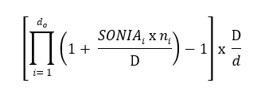
"d" means the number of calendar days in:
(i) |
where "Lag" is specified as the Observation Method in the relevant Final Terms, the relevant Interest Period; or |
(ii) |
where "Observation Shift" is specified as the Observation Method in the relevant Final Terms, the relevant Observation Period; |
"D" is the number specified in the relevant Final Terms (or, if no such number is specified, 365);
"do" means the number of London Banking Days in:
(i) |
where "Lag" is specified as the Observation Method in the relevant Final Terms, the relevant Interest Period; or |
(ii) |
where "Observation Shift" is specified as the Observation Method in the relevant Final Terms, the relevant Observation Period; |
"i" means a series of whole numbers from one to do, each representing the relevant London Banking Day in chronological order from, and including, the first London Banking Day in:
(i) |
where "Lag" is specified as the Observation Method in the relevant Final Terms, the relevant Interest Period; or |
(ii) |
where "Observation Shift" is specified as the Observation Method in the relevant Final Terms, the relevant Observation Period; |
to, and including, the last London Banking Day in such period;
"Interest Determination Date" means, in respect of any Interest Period, the date falling "p" London Banking Days prior to the Interest Payment Date for such Interest Period (or the date falling "p" London Banking Days prior to such earlier date, if any, on which the Notes are due and payable).
"London Banking Day" or "LBD" means any day on which commercial banks are open for general business (including dealing in foreign exchange and foreign currency deposits) in London;
"ni" for any London Banking Day "i", in the relevant Interest Period or Observation Period (as applicable) is the number of calendar days from, and including, such London Banking Day "i" up to, but excluding, the following London Banking Day;
"Observation Period" means, in respect of an Interest Period, the period from, and including, the date falling "p" London Banking Days prior to the first day of such Interest Period (and the first Interest Period shall begin on and include the Interest Commencement Date) and ending on, but excluding, the date which is "p" London Banking Days prior to the Interest Payment Date for such Interest Period (or the date falling "p" London Banking Days prior to such earlier date, if any, on which the Notes become due and payable);
"p" for any Interest Period or Observation Period (as applicable), means the number of London Banking Days specified as the "Lag Period" or the "Observation Shift Period" (as applicable) in the relevant Final Terms or if no such period is specified, five London Banking Days;
"SONIA Reference Rate" means, in respect of any London Banking Day, a reference rate equal to the daily Sterling Overnight Index Average ("SONIA") rate for such London Banking Day as provided by the administrator of SONIA to authorised distributors and as then published on the Relevant Screen Page (or if the Relevant Screen Page is unavailable, as otherwise is published by such authorised distributors) on the London Banking Day immediately following such London Banking Day; and
|
|
|
"SONIAi" means the SONIA Reference Rate for:
(i) |
where "Lag" is specified as the Observation Method in the relevant Final Terms, the London Banking Day falling "p" London Banking Days prior to the relevant London Banking Day "i"; or |
(ii) |
where "Observation Shift" is specified as the Observation Method in the relevant Final Terms, the relevant London Banking Day "i"; |
For the avoidance of doubt, the formula for the calculation of Compounded Daily SONIA only compounds the SONIA Reference Rate in respect of any London Banking Day. The SONIA Reference Rate applied to a day that is a non-London Banking Day will be taken by applying the SONIA Reference Rate for the previous London Banking Day but without compounding.
| (iv) | If, in respect of any London Banking Day in the relevant Interest Period or Observation Period (as applicable), the Calculation Agent determines that the SONIA Reference Rate is not available on the Relevant Screen Page and has not otherwise been published by the relevant authorised distributors, such SONIA Reference Rate shall, subject to Condition 7(n) (Benchmark Discontinuation), be: |
| (A) | the sum of (a) the Bank of England's Bank Rate (the "Bank Rate") prevailing at close of business on the relevant London Banking Day; and (b) the mean of the spread of the SONIA Reference Rate to the Bank Rate over the previous five London Banking Days on which a SONIA Reference Rate has been published, excluding the highest spread (or, if there is more than one highest spread, one only of those highest spreads) and lowest spread (or, if there is more than one lowest spread, one only of those lowest spreads) to the Bank Rate; or |
| (B) | if the Bank Rate is not published by the Bank of England at close of business on the relevant London Banking Day, (a) the SONIA Reference Rate published on the Relevant Screen Page (or otherwise published by the relevant authorised distributors) for the first preceding London Banking Day on which the SONIA Reference Rate was published on the Relevant Screen Page (or otherwise published by the relevant authorised distributors) or (b) if this is more recent, the latest determined rate under (A). |
| (v) | Subject to Condition 7(n) (Benchmark Discontinuation), if the Rate of Interest cannot be determined in accordance with the foregoing provisions of this Condition 7(e), the Rate of Interest shall be (A) that determined as at the last preceding Interest Determination Date (though substituting, where a different Margin is to be applied to the relevant Interest Period from that which applied to the last preceding Interest Period, the Margin relating to the relevant Interest Period, in place of the Margin relating to that last preceding Interest Period) or (B) if there is no such preceding Interest Determination Date, the initial Rate of Interest which would have been applicable to the Notes for the first Interest Period had the Notes been in issue for a period equal in duration to the scheduled first Interest Period but ending on (and excluding) the Interest Commencement Date (but applying the Margin applicable to the first Interest Period). |
| (f) | Screen Rate Determination (Floating Rate Notes referencing SOFR) |
| (i) | This Condition 7(f) is applicable to the Notes only if the Floating Rate Note Provisions are specified in the relevant Final Terms as being applicable, Screen Rate Determination is specified in the relevant Final Terms as the manner in which the Rate(s) of Interest is/are to be determined, and the Reference Rate is specified in the relevant Final Terms as being SOFR. |
| (ii) | Where SOFR is specified as the Reference Rate in the Final Terms, the Rate of Interest for each Interest Period will, subject as provided below, be the Benchmark plus or minus (as specified in the relevant Final Terms) the Margin, all as determined by the Calculation Agent on each Interest Determination Date. |
| (iii) | For the purposes of this Condition 7(f): |
|
|
|
"Benchmark" means Compounded SOFR, which is a compounded average of daily SOFR, as determined for each Interest Period in accordance with the specific formula and other provisions set out in this Condition 7(f).
Daily SOFR rates will not be published in respect of any day that is not a U.S. Government Securities Business Day, such as a Saturday, Sunday or holiday. For this reason, in determining Compounded SOFR in accordance with the specific formula and other provisions set forth herein, the daily SOFR rate for any U.S. Government Securities Business Day that immediately precedes one or more days that are not U.S. Government Securities Business Days will be multiplied by the number of calendar days from and including such U.S. Government Securities Business Day to, but excluding, the following U.S. Government Securities Business Day.
If the Issuer determines that a Benchmark Transition Event and its related Benchmark Replacement Date have occurred in respect of Compounded SOFR (or the daily SOFR used in the calculation hereof) prior to the relevant SOFR Determination Time, then the provisions under Condition 7(f)(iv) below will apply.
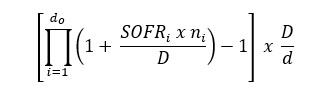
"Compounded SOFR" with respect to any Interest Period, means the rate of return of a daily compound interest investment computed in accordance with the following formula (and the resulting percentage will be rounded, if necessary, to the nearest one hundred-thousandth of a percentage point, with 0.000005 being rounded upwards to 0.00001):
"d" is the number of calendar days in:
(i) |
where "Lag" is specified as the Observation Method in the relevant Final Terms, the relevant Interest Period; or |
(ii) |
where "Observation Shift" is specified as the Observation Method in the relevant Final Terms, the relevant Observation Period. |
"D" is the number specified in the relevant Final Terms (or, if no such number is specified, 360);
"do" is the number of U.S. Government Securities Business Days in:
(i) |
where "Lag" is specified as the Observation Method in the relevant Final Terms, the relevant Interest Period; or |
(ii) |
where "Observation Shift" is specified as the Observation Method in the relevant Final Terms, the relevant Observation Period. |
"i" is a series of whole numbers from one to do, each representing the relevant U.S. Government Securities Business Day in chronological order from, and including, the first U.S. Government Securities Business Day in:
(i) |
where "Lag" is specified as the Observation Method in the relevant Final Terms, the relevant Interest Period; or |
(ii) |
where "Observation Shift" is specified as the Observation Method in the relevant Final Terms, the relevant Observation Period, |
to and including the last U.S. Government Securities Business Day in such period;
"Interest Determination Date" means, in respect of any Interest Period, the date falling "p" U.S. Government Securities Business Days prior to the Interest Payment Date for such Interest Period (or the date falling "p" U.S. Government Securities Business Days prior to such earlier date, if any, on which the Notes are due and payable); "ni" for any U.S. Government Securities Business Day "i" in the relevant Interest Period or Observation Period (as applicable), is the number of calendar days from, and including, such U.S. Government Securities Business Day "i" to, but excluding, the following U.S. Government Securities Business Day ("i+1");
|
|
|
"Observation Period" in respect of an Interest Period means the period from, and including, the date falling "p" U.S. Government Securities Business Days preceding the first day in such Interest Period (and the first Interest Period shall begin on and include the Interest Commencement Date) to, but excluding, the date falling "p" U.S. Government Securities Business Days preceding the Interest Payment Date for such Interest Period (or the date falling "p" U.S. Government Securities Business Days prior to such earlier date, if any, on which the Notes become due and payable);
"p" for any Interest Period or Observation Period (as applicable) means the number of U.S. Government Securities Business Days specified as the "Lag Period" or the "Observation Shift Period" (as applicable) in the relevant Final Terms or if no such period is specified, five U.S. Government Securities Business Days;
"SOFR" with respect to any U.S. Government Securities Business Day, means:
(i) |
the Secured Overnight Financing Rate published for such U.S. Government Securities Business Day as such rate appears on the SOFR Administrator's Website at 3:00 p.m. (New York time) on the immediately following U.S. Government Securities Business Day (the "SOFR Determination Time"); or |
(ii) |
Subject to Condition 7(f)(iv) below, if the rate specified in (i) above does not so appear, the Secured Overnight Financing Rate as published in respect of the first preceding U.S. Government Securities Business Day for which the Secured Overnight Financing Rate was published on the SOFR Administrator's Website; |
"SOFR Administrator" means the Federal Reserve Bank of New York (or a successor administrator of the Secured Overnight Financing Rate);
"SOFR Administrator's Website" means the website of the Federal Reserve Bank of New York, or any successor source;
"SOFRi" means the SOFR for:
(i) |
where "Lag" is specified as the Observation Method in the applicable Final Terms, the U.S. Government Securities Business Day falling "p" U.S. Government Securities Business Days prior to the relevant U.S. Government Securities Business Day "i"; or |
(ii) |
where "Observation Shift" is specified as the Observation Method in the relevant Final Terms, the relevant U.S. Government Securities Business Day "i"; and |
"U.S. Government Securities Business Day" means any day except for a Saturday, a Sunday or a day on which the Securities Industry and Financial Markets Association recommends that the fixed income departments of its members be closed for the entire day for purposes of trading in U.S. government securities.
| (iv) | If the Issuer determines on or prior to the relevant Reference Time that a Benchmark Transition Event and its related Benchmark Replacement Date have occurred with respect to the then-current Benchmark, the Benchmark Replacement will replace the then-current Benchmark for all purposes relating to the Notes in respect of all determinations on such date and for all determinations on all subsequent dates. In connection with the implementation of a Benchmark Replacement, the Issuer will have the right to make Benchmark Replacement Conforming Changes from time to time, without any requirement for the consent or approval of the Noteholders. |
Any determination, decision or election that may be made by the Issuer pursuant to this Condition 7(f)(iv), including any determination with respect to a tenor, rate or adjustment or of the occurrence or non-occurrence of an event, circumstance or date and any decision to take or refrain from taking any action or any selection:
|
|
|
(i) |
will be conclusive and binding absent manifest error; |
(ii) |
will be made in the sole discretion of the Issuer; and |
(iii) |
notwithstanding anything to the contrary in the documentation relating to the Notes, shall become effective without consent from the Noteholders or any other party. |
"Benchmark" means, initially, Compounded SOFR, as such term is defined above; provided that if the Issuer determines on or prior to the Reference Time that a Benchmark Transition Event and its related Benchmark Replacement Date have occurred with respect to Compounded SOFR (or the published daily SOFR used in the calculation thereof) or the then-current Benchmark, then "Benchmark" shall mean the applicable Benchmark Replacement.
"Benchmark Replacement" means the first alternative set forth in the order below that can be determined by the Issuer as of the Benchmark Replacement Date:
(i) |
the sum of: (A) the alternate rate of interest that has been selected or recommended by the Relevant Governmental Body as the replacement for the then-current Benchmark and (B) the Benchmark Replacement Adjustment; |
(ii) |
the sum of: (A) the ISDA Fallback Rate and (B) the Benchmark Replacement Adjustment; or |
(iii) |
the sum of: (A) the alternate rate of interest that has been selected by the Issuer as the replacement for the then-current Benchmark giving due consideration to any industry-accepted rate of interest as a replacement for the then-current Benchmark for U.S. dollar-denominated floating rate notes at such time and (B) the Benchmark Replacement Adjustment; |
"Benchmark Replacement Adjustment" means the first alternative set forth in the order below that can be determined by the Issuer as of the Benchmark Replacement Date:
(i) |
the spread adjustment, or method for calculating or determining such spread adjustment, (which may be a positive or negative value or zero) that has been selected or recommended by the Relevant Governmental Body for the applicable Unadjusted Benchmark Replacement; |
(ii) |
if the applicable Unadjusted Benchmark Replacement is equivalent to the ISDA Fallback Rate, the ISDA Fallback Adjustment; or |
(iii) |
the spread adjustment (which may be a positive or negative value or zero) that has been selected by the Issuer giving due consideration to any industry-accepted spread adjustment, or method for calculating or determining such spread adjustment, for the replacement of the then-current Benchmark with the applicable Unadjusted Benchmark Replacement for U.S. dollar-denominated floating rate notes at such time; |
"Benchmark Replacement Conforming Changes" means, with respect to any Benchmark Replacement, any technical, administrative or operational changes (including changes to the timing and frequency of determining rates and making payments of interest, rounding of amounts or tenors, and other administrative matters) that the Issuer decides may be appropriate to reflect the adoption of such Benchmark Replacement in a manner substantially consistent with market practice (or, if the Issuer decides that adoption of any portion of such market practice is not administratively feasible or if the Issuer determines that no market practice for use of the Benchmark Replacement exists, in such other manner as the Issuer determines is reasonably necessary);
"Benchmark Replacement Date" means the earliest to occur of the following events with respect to the then-current Benchmark (including the daily published component used in the calculation thereof):
|
|
|
(i) |
in the case of paragraph (i) or (ii) of the definition of "Benchmark Transition Event", the later of (a) the date of the public statement or publication of information referenced therein and (b) the date on which the administrator of the Benchmark permanently or indefinitely ceases to provide the Benchmark (or such component); or |
(ii) |
in the case of paragraph (iii) of the definition of "Benchmark Transition Event", the date of the public statement or publication of information referenced therein. |
For the avoidance of doubt, if the event that gives rise to the Benchmark Replacement Date occurs on the same day as, but earlier than, the Reference Time in respect of any determination, the Benchmark Replacement Date will be deemed to have occurred prior to the Reference Time for such determination;
"Benchmark Transition Event" means the occurrence of one or more of the following events with respect to the then-current Benchmark (including the daily published component used in the calculation thereof):
(i) |
a public statement or publication of information by or on behalf of the administrator of the Benchmark (or such component) announcing that such administrator has ceased or will cease to provide the Benchmark (or such component), permanently or indefinitely, provided that, at the time of such statement or publication, there is no successor administrator that will continue to provide the Benchmark (or such component); or |
(ii) |
a public statement or publication of information by the regulatory supervisor for the administrator of the Benchmark (or such component), the central bank for the currency of the Benchmark (or such component), an insolvency official with jurisdiction over the administrator for the Benchmark (or such component), a resolution authority with jurisdiction over the administrator for the Benchmark (or such component) or a court or an entity with similar insolvency or resolution authority over the administrator for the Benchmark, which states that the administrator of the Benchmark (or such component) has ceased or will cease to provide the Benchmark (or such component) permanently or indefinitely, provided that, at the time of such statement or publication, there is no successor administrator that will continue to provide the Benchmark (or such component); or |
(iii) |
a public statement or publication of information by the regulatory supervisor for the administrator of the Benchmark announcing that the Benchmark is no longer representative; |
"ISDA Fallback Adjustment" means the spread adjustment (which may be a positive or negative value or zero) that would apply for derivatives transactions referencing the 2006 ISDA Definitions to be determined upon the occurrence of an index cessation event with respect to the Benchmark;
"ISDA Fallback Rate" means the rate that would apply for derivatives transactions referencing the 2006 ISDA Definitions to be effective upon the occurrence of an index cessation date with respect to the Benchmark for the applicable tenor excluding the applicable ISDA Fallback Adjustment;
"Reference Time" with respect to any determination of the Benchmark means (i) if the Benchmark is Compounded SOFR, the SOFR Determination Time, and (ii) if the Benchmark is not Compounded SOFR, the time determined by the Issuer after giving effect to the Benchmark Replacement Conforming Changes;
"Relevant Governmental Body" means the Federal Reserve Board and/or the Federal Reserve Bank of New York, or a committee officially endorsed or convened by the Federal Reserve Board and/or the Federal Reserve Bank of New York or any successor thereto; and
"Unadjusted Benchmark Replacement" means the Benchmark Replacement excluding the Benchmark Replacement Adjustment.
|
|
|
| (v) | Any Benchmark Replacement, Benchmark Replacement Adjustment and the specific terms of any Benchmark Replacement Conforming Changes, determined under Condition 7(f)(iv) above will be notified promptly by the Issuer to the Fiscal Agent, the Calculation Agent, the Paying Agents and, in accordance with Condition 20 (Notices), the Noteholders. Such notice shall be irrevocable and shall specify the effective date on which such changes take effect. |
No later than notifying the Fiscal Agent of the same, the Issuer shall deliver to the Fiscal Agent a certificate signed by two authorised signatories of the Issuer:
(A) |
confirming (x) that a Benchmark Transition Event has occurred, (y) the relevant Benchmark Replacement and, (z) where applicable, any Benchmark Replacement Adjustment and/or the specific terms of any relevant Benchmark Replacement Conforming Changes, in each case as determined in accordance with the provisions of this Condition 7(f); and |
(B) |
certifying that the relevant Benchmark Replacement Conforming Changes are necessary to ensure the proper operation of such Benchmark Replacement and/or Benchmark Replacement Adjustment. |
| (vi) | If the Rate of Interest cannot be determined in accordance with the foregoing provisions of this Condition 7(f), the Rate of Interest shall be (A) that determined as at the last preceding Interest Determination Date (though substituting, where a different Margin is to be applied to the relevant Interest Period from that which applied to the last preceding Interest Period, the Margin relating to the relevant Interest Period, in place of the Margin relating to that last preceding Interest Period) or (B) if there is no such preceding Interest Determination Date, the initial Rate of Interest which would have been applicable to the Notes for the first Interest Period had the Notes been in issue for a period equal in duration to the scheduled first Interest Period but ending on (and excluding) the Interest Commencement Date (but applying the Margin applicable to the first Interest Period). |
| (g) | Screen Rate Determination (Floating Rate Notes referencing SONIA Compounded Index or SOFR Compounded Index) |
This Condition 7(g) is applicable to the Notes only if the Floating Rate Note Provisions are specified in the relevant Final Terms as being applicable, Screen Rate Determination is specified in the relevant Final Terms as the manner in which the Rate(s) of Interest is/are to be determined, and Index Determination is specified in the relevant Final Terms as being applicable.

Where Index Determination is specified in the relevant Final Terms as being applicable, the Rate of Interest for each Interest Period will be the compounded daily reference rate for the relevant Interest Period, calculated in accordance with the following formula:
and rounded to the Relevant Decimal Place, plus or minus the Margin (if any), all as determined and calculated by the Calculation Agent, where:
"Compounded Index" means either the SONIA Compounded Index or the SOFR Compounded Index, as specified in the relevant Final Terms;
"Compounded Index End" means the relevant Compounded Index value on the End date;
"Compounded Index Start" means the relevant Compounded Index value on the Start date;
"d" is the number of calendar days from (and including) the day on which the relevant Compounded Index Start is determined to (but excluding) the day on which the relevant Compounded Index End is determined;
"End" means the day falling the Relevant Number of Index Days prior to the Interest Payment Date for such Interest Period, or such other date on which the relevant payment of interest falls due (but which by its definition or the operation of the relevant provisions is excluded from such Interest Period); "Index Days" means, in the case of the SONIA Compounded Index, London Banking Days, and, in the case of the SOFR Compounded Index, U.S. Government Securities Business Days;
|
|
|
"Numerator" means, in the case of the SONIA Compounded Index, 365 and, in the case of the SOFR Compounded Index, 360;
"Relevant Decimal Place" shall, unless otherwise specified in the Final Terms, be the fifth decimal place, rounded up or down, if necessary (with 0.000005 being rounded upwards);
"Relevant Number" is as specified in the applicable Final Terms, but, unless otherwise specified shall be five;
"SOFR Compounded Index" means the Compounded SOFR rate as published at 15:00 (New York time) by Federal Reserve Bank of New York (or a successor administrator of SOFR) on the website of the Federal Reserve Bank of New York, or any successor source;
"SONIA Compounded Index" means the Compounded Daily SONIA rate as published at 10:00 (London time) by the Bank of England (or a successor administrator of SONIA) on the Bank of England's Interactive Statistical Database, or any successor source; and
"Start" means the day falling the Relevant Number of Index Days prior to the first day of the relevant Interest Period.
If, with respect to any Interest Period, the relevant rate is not published for the relevant Compounded Index either on the relevant Start or End date, then the Calculation Agent shall calculate the rate of interest for that Interest Period as if Index Determination was not specified in the applicable Final Terms and as if Compounded Daily SONIA or Compounded SOFR (as defined in Condition 7(e) (Screen Rate Determination (Floating Rate Notes referencing SONIA)) or Condition 7(f) (Screen Rate Determination (Floating Rate Notes referencing SOFR)), as applicable) had been specified instead in the Final Terms, and in each case "Observation Shift" had been specified as the Observation Method in the relevant Final Terms, and where the Observation Shift Period for the purposes of the references to that term in Condition 7(e) (Screen Rate Determination (Floating Rate Notes referencing SONIA)) or Condition 7(f) (Screen Rate Determination (Floating Rate Notes referencing SOFR)) (as applicable) shall be deemed to be the same as the Relevant Number specified in the Final Terms and where, in the case of Compounded Daily SONIA, the Relevant Screen Page will be determined by the Issuer. For the avoidance of doubt, if (i) (in the case of SONIA Compounded Index) a Benchmark Event has occurred in respect of SONIA, the provisions of Condition 7(n) (Benchmark Discontinuation) shall apply, and (ii) (in the case of SOFR Compounded Index) a Benchmark Transition Event and its related Benchmark Replacement Date has occurred in respect of SOFR, the provisions of Condition 7(f) (Screen Rate Determination (Floating Rate Notes referencing SOFR)) shall apply.
| (h) | Maximum or Minimum Rate of Interest |
If any Maximum Rate of Interest or Minimum Rate of Interest is specified in the relevant Final Terms, then the Rate of Interest shall in no event be greater than the maximum or be less than the minimum so specified. If no Minimum Rate of Interest is specified in the relevant Final Terms, then the Minimum Rate of Interest in respect of each relevant Interest Period shall be deemed to be zero, and in no event shall the Rate of Interest calculated in accordance with this Condition 7 be less than zero.
| (i) | Calculation of Interest Amount |
The Calculation Agent will, as soon as practicable after the time at which the Rate of Interest is to be determined in relation to each Interest Period, calculate the Interest Amount payable in respect of each Note for such Interest Period. The Interest Amount will be calculated by applying the Rate of Interest for such Interest Period to the Calculation Amount multiplying the product by the relevant Day Count Fraction, rounding the resulting figure to the nearest sub-unit of the Specified Currency (half a sub-unit being rounded upwards) and multiplying such rounded figure by a fraction equal to the Specified Denomination of the relevant Note divided by the Calculation Amount. For this purpose a "sub-unit" means, in the case of any currency other than euro, the lowest amount of such currency that is available as legal tender in the country of such currency and, in the case of euro, means one cent.
|
|
|
| (j) | Calculation of other amounts |
If the relevant Final Terms specifies that any other amount is to be calculated by the Calculation Agent, the Calculation Agent will, as soon as practicable after the time or times at which any such amount is to be determined, calculate the relevant amount. The relevant amount will be calculated by the Calculation Agent in the manner specified in the relevant Final Terms.
| (k) | Publication |
The Calculation Agent will cause each Rate of Interest and Interest Amount determined by it, together with the relevant Interest Payment Date, and any other amount(s) required to be determined by it together with any relevant payment date(s) to be notified to the Paying Agents and each competent authority, stock exchange and/or quotation system (if any) by which the Notes have then been admitted to listing, trading and/or quotation as soon as practicable after such determination but (in the case of each Rate of Interest, Interest Amount and Interest Payment Date) in any event not later than the first day of the relevant Interest Period. Notice thereof shall also promptly be given to the Noteholders. The Calculation Agent will be entitled to recalculate any Interest Amount (on the basis of the foregoing provisions) without notice in the event of an extension or shortening of the relevant Interest Period. If the Calculation Amount is less than the minimum Specified Denomination the Calculation Agent shall not be obliged to publish each Interest Amount but instead may publish only the Calculation Amount and the Interest Amount in respect of a Note having the minimum Specified Denomination.
| (l) | Notifications etc |
All notifications, opinions, determinations, certificates, calculations, quotations and decisions given, expressed, made or obtained for the purposes of this Condition by the Calculation Agent will (in the absence of manifest error) be binding on the Issuer, the Guarantor, the Paying Agents, the Noteholders and the Couponholders and (subject as aforesaid) no liability to any such Person will attach to the Calculation Agent in connection with the exercise or non-exercise by it of its powers, duties and discretions for such purposes.
| (m) | Determination of Rate of Interest following acceleration |
If (i) the Notes become due and payable in accordance with Condition 14 (Events of Default) and (ii) the Rate of Interest for the Interest Period during which the Notes become due and payable is to be determined by reference to any of Condition 7(e) (Screen Rate Determination (Floating Rate Notes referencing SONIA)), Condition 7(f) (Screen Rate Determination (Floating Rate Notes referencing SOFR)) and Condition 7(g) (Screen Rate Determination (Floating Rate Notes referencing SONIA Compounded Index or SOFR Compounded Index)), then the final Interest Determination Date shall be the date on which the Notes become so due and payable, and such Rate of Interest shall continue to apply to the Notes for so long as interest continues to accrue thereon as provided in the Conditions.
| (n) | Benchmark Discontinuation |
| (i) | Independent Adviser |
Other than in the case of a U.S. dollar-denominated floating rate Note for which the Reference Rate is specified in the relevant Final Terms as being SOFR or where SOFR Compounded Index is specified in the Final Terms as the Index Determination, notwithstanding Condition 7(c) (Screen Rate Determination (Floating Rate Notes other than those referencing SONIA, SONIA Compounded Index, SOFR or SOFR Compounded Index)) and Condition 7(e) (Screen Rate Determination (Floating Rate Notes referencing SONIA)), if a Benchmark Event occurs in relation to an Original Reference Rate at any time when these Conditions provide for any remaining Rate of Interest (or any component part thereof) to be determined by reference to such Original Reference Rate, then the Issuer shall use its reasonable endeavours to appoint an Independent Adviser, as soon as reasonably practicable, to determine a Successor Rate, failing which an Alternative Rate (in accordance with Condition 7(n)(ii)) and, in either case, an Adjustment Spread, if any (in accordance with Condition 7(n)(iii)) and any Benchmark Amendments (in accordance with Condition 7(n)(iv)).
An Independent Adviser appointed pursuant to this Condition 7(n) shall act in good faith and in a commercially reasonable manner and in consultation with the Issuer.
|
|
|
In the absence of bad faith or fraud, the Independent Adviser shall have no liability whatsoever to the Issuer, the Guarantor, the Agents, any other party specified in the relevant Final Terms as being responsible for calculating the Rate of Interest, the Noteholders or Couponholders for any determination made by it or for any advice given to the Issuer in connection with the operation of this Condition 7(n).
| (ii) | Successor Rate or Alternative Rate |
If the Independent Adviser determines that:
| (A) | there is a Successor Rate, then such Successor Rate shall (subject to adjustment as provided in Condition 7(n)(iii)) subsequently be used in place of the Original Reference Rate to determine the relevant Rate of Interest (or the relevant component part(s) thereof) for the relevant Interest Period and all following Interest Periods, subject to the further operation of this Condition 7(n) in the event of a further Benchmark Event affecting the Successor Rate; or |
| (B) | there is no Successor Rate but that there is an Alternative Rate, then such Alternative Rate shall (subject to adjustment as provided in Condition 7(n)(iii)) subsequently be used in place of the Original Reference Rate to determine the relevant Rate of Interest (or the relevant component part(s) thereof) for the relevant Interest Period and all following Interest Periods, subject to the further operation of this Condition 7(n) in the event of a further Benchmark Event affecting the Alternative Rate. |
If, following the occurrence of a Benchmark Event and in relation to the determination of the Rate of Interest on the relevant Interest Determination Date, no Successor Rate or Alternative Rate (as applicable) is determined pursuant to this Condition 7(n) by such Interest Determination Date, the Rate of Interest applicable to the next succeeding Interest Period shall be determined in accordance with Condition 7(n)(vii).
| (iii) | Adjustment Spread |
If the Independent Adviser determines (A) that an Adjustment Spread should be applied to the Successor Rate or the Alternative Rate (as the case may be) and (B) the quantum of, or a formula or methodology for determining, such Adjustment Spread, then such Adjustment Spread shall be applied to the Successor Rate or the Alternative Rate (as the case may be for each subsequent determination of a relevant Rate of Interest (or a relevant component part thereof) by reference to such Successor Rate or Alternative Rate (as applicable)).
| (iv) | Benchmark Amendments |
If any Successor Rate, Alternative Rate or Adjustment Spread is determined in accordance with this Condition 7(n) and the Independent Adviser determines (A) that amendments to these Conditions (including, without limitation, amendments to the definitions of Day Count Fraction, Business Day, Interest Payment Date, Interest Determination Date, Relevant Time or Relevant Screen Page and related provisions) and/or the Agency Agreement are necessary to ensure the proper operation of such Successor Rate, Alternative Rate and/or Adjustment Spread (such amendments, the "Benchmark Amendments") and (B) the terms of the Benchmark Amendments, then the Calculation Agent shall, at the discretion and expense of the Issuer and subject to the Issuer giving notice thereof in accordance with Condition 7(n)(v), without any requirement for the consent or approval of Noteholders, vary these Conditions and/or the Agency Agreement to give effect to such Benchmark Amendments with effect from the date specified in such notice; provided that, the Calculation Agent shall not be obliged to effect any Benchmark Amendment if in the sole opinion of the Calculation Agent doing so would impose more onerous obligations upon it or expose it to any additional duties, responsibilities or liabilities or reduce or amend the protective provisions afforded to it in these Conditions or the Agency Agreement in any way.
In connection with any such variation in accordance with this Condition 7(n)(iv), the Issuer shall comply with the rules of any stock exchange or other relevant authority on which the Notes are for the time being listed or on which they have been admitted to trading.
|
|
|
| (v) | Notices, etc. |
The Issuer will notify the Fiscal Agent, the Paying Agent, any other party specified in the applicable Final Terms as being responsible for calculating the Rate of Interest and, in accordance with Condition 20 (Notices), the Noteholders promptly of any Successor Rate, Alternative Rate, Adjustment Spread and the specific terms of any Benchmark Amendments and the effective date of such Benchmark Amendments, if any, determined under this Condition 7(n).
The Successor Rate or Alternative Rate and the Adjustment Spread (if any) and the Benchmark Amendments (if any) specified in such notice will (in the absence of manifest error or bad faith in the determination of the Successor Rate or Alternative Rate and the Adjustment Spread (if any) and the Benchmark Amendments (if any)) be binding on the Issuer, the Fiscal Agent, the Calculation Agent, the Paying Agent and the Noteholders.
| (vi) | Survival of Original Reference Rate |
Without prejudice to the obligations of the Issuer under the provisions of this Condition 7(n), the Original Reference Rate and the fallback provisions provided for in Condition 7(c) (Screen Rate Determination (Floating Rate Notes other than those referencing SONIA, SONIA Compounded Index, SOFR or SOFR Compounded Index)) or Condition 7(e) (Screen Rate Determination (Floating Rate Notes referencing SONIA)) (as applicable) will continue to apply unless and until a Benchmark Event has occurred.
| (vii) | Fallbacks |
If, following the occurrence of a Benchmark Event and in relation to the determination of the Rate of Interest on the relevant Interest Determination Date, no Successor Rate or Alternative Rate (as applicable) is determined pursuant to this Condition 7(n) by such Interest Determination Date, the Rate of Interest applicable to the next succeeding Interest Period shall be equal to the Rate of Interest last determined in relation to the Notes in respect of the immediately preceding Interest Period (though substituting, where a different Margin or Maximum or Minimum Rate of Interest is to be applied to the relevant Interest Period from that which applied to the last preceding Interest Period, the Margin or Maximum or Minimum Rate of Interest relating to the relevant Interest Period, in place of the Margin or Maximum or Minimum Rate of Interest relating to that last preceding Interest Period).
For the avoidance of doubt, this Condition 7(n)(vii) shall apply to the determination of the Rate of Interest on the relevant Interest Determination Date only, and the Rate of Interest applicable to any subsequent Interest Period(s) is subject to the subsequent operation of, and to adjustment as provided in, this Condition 7(n).
| (viii) | Definitions |
As used in this Condition 7(n):
"Adjustment Spread" means either a spread (which may be positive or negative), or the formula or methodology for calculating a spread, in either case, which the Independent Adviser determines is required to be applied to the relevant Successor Rate or the relevant Alternative Rate (as the case may be) and is the spread, formula or methodology which:
| (A) | in the case of a Successor Rate, is formally recommended, or formally provided as an option for parties to adopt, in relation to the replacement of the Original Reference Rate with the Successor Rate by any Relevant Nominating Body; or |
| (B) | (if no such recommendation has been made, or in the case of an Alternative Rate), the Independent Adviser determines is customarily applied to the relevant Successor Rate |
|
|
|
| (C) | (if no such recommendation has been made, or in the case of an Alternative Rate), the Independent Adviser determines is recognised or acknowledged as being the industry standard for over-the-counter derivative transactions which reference the Reference Rate, where such rate has been replaced by the Successor Rate or the Alternative Rate (as the case may be); or |
| (D) | (if the Independent Adviser determines that no such industry standard is so recognised or acknowledged) the Independent Adviser determines to be appropriate to reduce or eliminate, to the extent reasonably practicable in the circumstances, any economic prejudice or benefit (as the case may be) to Noteholders as a result of the replacement of the Reference Rate with the Successor Rate or the Alternative Rate (as the case may be); |
or Alternative Rate (as the case may be) in international debt capital markets transactions to produce an industry-accepted replacement rate for the Reference Rate; or "Alternative Rate" means an alternative benchmark or screen rate which the Independent Adviser determines in accordance with Condition 7(n)(ii) is customary in market usage in the international debt capital markets for the purposes of determining rates of interest (or the relevant component part thereof) for a commensurate period and in the same Specified Currency as the Notes;
"Benchmark Amendments" has the meaning given to it in Condition 7(n)(iv);
"Benchmark Event" means:
(A) |
the Original Reference Rate ceasing to be published on the Relevant Screen Page as a result of such benchmark ceasing to be calculated or administered; |
(B) |
the later of (i) the making of a public statement by the administrator of the Original Reference Rate that it will, on or before a specified date, cease publishing the Original Reference Rate permanently or indefinitely (in circumstances where no successor administrator has been appointed that will continue publication of the Original Reference Rate) and (ii) the date falling six months prior to the specified date referred to in (B)(i) above; |
(C) |
the making of a public statement by the supervisor of the administrator of the Original Reference Rate that the Original Reference Rate has been permanently or indefinitely discontinued; |
(D) |
the later of (i) the making of a public statement by the supervisor of the administrator of the Original Reference Rate that the Original Reference Rate will, on or before a specified date, be permanently or indefinitely discontinued and (ii) the date falling six months prior to the specified date referred to in (D)(i) above; |
(E) |
the later of (i) the making of a public statement by the supervisor of the administrator of the Original Reference Rate that means the Original Reference Rate will be prohibited from being used or that its use will be subject to restrictions or adverse consequences, in each case on or before a specified date and (ii) the date falling six months prior to the specified date referred to in (E)(i) above; |
(F) |
a public statement by the supervisor of the administrator of the relevant Reference Rate (as applicable) that, in the view of such supervisor, such Reference Rate is no longer representative of an underlying market; or |
(G) |
it has or will become unlawful for the Calculation Agent or any Paying Agent to calculate any payments due to be made to any Noteholder using the Original Reference Rate; |
"Independent Adviser" means an independent financial institution of international repute or other independent financial adviser experienced in the international capital markets appointed by the Issuer under Condition 7(n)(i) at its own expense; "Original Reference Rate" means the originally-specified benchmark or screen rate (as applicable) used to determine the relevant Rate of Interest (or any component part thereof) on the Notes;
|
|
|
"Relevant Nominating Body" means, in respect of a benchmark or screen rate (as applicable):
(A) |
the central bank, reserve bank, monetary authority or any similar institution for the currency to which the benchmark or screen rate (as applicable) relates, or any central bank or other supervisory authority which is responsible for supervising the administrator of the benchmark or screen rate (as applicable); or |
(B) |
any working group or committee sponsored by, chaired or co-chaired by or constituted at the request of (a) the central bank, reserve bank, monetary authority or any similar institution for the currency to which the benchmark or screen rate (as applicable) relates, (b) any central bank or other supervisory authority which is responsible for supervising the administrator of the benchmark or screen rate (as applicable), (c) a group of the aforementioned central banks or other supervisory authorities, or (d) the Financial Stability Board or any part thereof; and |
"Successor Rate" means a successor to or replacement of the Original Reference Rate which is formally recommended by any Relevant Nominating Body.
| 8. | Zero Coupon Note Provisions |
| (a) | Application |
This Condition 8 is applicable to the Notes only if the Zero Coupon Note Provisions are specified in the relevant Final Terms as being applicable.
| (b) | Late payment on Zero Coupon Notes |
If the Redemption Amount payable in respect of any Zero Coupon Note is improperly withheld or refused, the Redemption Amount shall thereafter be an amount equal to the sum of:
| (i) | the Reference Price; and |
| (ii) | the product of the Accrual Yield (compounded annually) being applied to the Reference Price from (and including) the Issue Date to (but excluding) whichever is the earlier of (i) the day on which all sums due in respect of such Note up to that day are received by or on behalf of the relevant Noteholder and (ii) the day which is seven days after the Fiscal Agent has notified the Noteholders that it has received all sums due in respect of the Notes up to such seventh day (except to the extent that there is any subsequent default in payment). |
| 9. | Interest to be non-contingent |
Interest on the Notes will not be determined by reference to the receipts, sales, income, profits or cashflow of the Issuer or a related person, or by reference to the change in the value of any property held by the Issuer or a related person.
| 10. | Redemption and Purchase |
| (a) | Scheduled redemption |
Unless previously redeemed, or purchased and cancelled, the Notes will be redeemed at their Final Redemption Amount on the Maturity Date, subject as provided in Conditions 11 (Payments – Bearer Notes) and 12 (Payments – Registered Notes).
|
|
|
| (b) | Redemption for tax reasons |
The Notes may be redeemed at the option of the Issuer in whole, but not in part:
| (i) | at any time (if the Floating Rate Note Provisions are not specified in the relevant Final Terms as being applicable); or |
| (ii) | on any Interest Payment Date (if the Floating Rate Note Provisions are specified in the relevant Final Terms as being applicable), |
on giving not less than 30 nor more than 60 days' notice to the Noteholders, or such other period(s) as may be specified in the relevant Final Terms (which notice shall be irrevocable), at their Early Redemption Amount (Tax), together with interest accrued (if any) to the date fixed for redemption, if:
| (A) | (1) the Issuer has or will become obliged to pay additional amounts as provided or referred to in Condition 13 (Taxation) as a result of any change in, or amendment to, the laws or regulations of the applicable Relevant Jurisdiction or any political subdivision or any authority thereof or therein having power to tax, or any change in the application or official interpretation of such laws or regulations (including a holding by a court of competent jurisdiction), which change or amendment becomes effective on or after the date of issue of the first Tranche of the Notes and (2) such obligation cannot be avoided by the Issuer taking reasonable measures available to it; or |
| (B) | (1) the Guarantor has or (if a demand was made under the Guarantee of the Notes) would become obliged to pay additional amounts as provided or referred to in the Guarantee of the Notes or the Guarantor has or will become obliged to make any such withholding or deduction as is referred to in the Guarantee of the Notes from any amount paid by it to the Issuer in order to enable the Issuer to make a payment of principal or interest in respect of the Notes, in either case as a result of any change in, or amendment to, the laws or regulations of the United States or any political subdivision or any authority thereof or therein having power to tax, or any change in the application or official interpretation of such laws or regulations (including a holding by a court of competent jurisdiction), which change or amendment becomes effective on or after the date of issue of the first Tranche of the Notes, and (2) such obligation cannot be avoided by the Guarantor taking reasonable measures available to it, |
provided, however, that no such notice of redemption shall be given earlier than:
| (1) | where the Notes may be redeemed at any time, 90 days prior to the earliest date on which the Issuer or the Guarantor would be obliged to pay such additional amounts or the Guarantor would be obliged to make such withholding or deduction if a payment in respect of the Notes were then due or (as the case may be) a demand under the Guarantee of the Notes were then made; or |
| (2) | where the Notes may be redeemed only on an Interest Payment Date, 60 days prior to the Interest Payment Date occurring immediately before the earliest date on which the Issuer or the Guarantor would be obliged to pay such additional amounts or the Guarantor would be obliged to make such withholding or deduction if a payment in respect of the Notes were then due or (as the case may be) a demand under the Guarantee of the Notes were then made. |
Prior to the publication of any notice of redemption pursuant to this Condition 10(b), the Issuer shall deliver or procure that there is delivered to the Fiscal Agent (1) a certificate signed by two directors of the Issuer stating that the Issuer is entitled to effect such redemption and setting forth a statement of facts showing that the conditions precedent to the right of the Issuer so to redeem have occurred and (2) an opinion of independent legal advisers of recognised standing to the effect that the Issuer or (as the case may be) the Guarantor has or will become obliged to pay such additional amounts or (as the case may be) the Guarantor has or will become obliged to make such withholding or deduction as a result of such change or amendment. Upon the expiry of any such notice as is referred to in this Condition 10(b), the Issuer shall be bound to redeem the Notes in accordance with this Condition 10(b).
|
|
|
| (c) | Redemption at the option of the Issuer |
If the Call Option is specified in the relevant Final Terms as being applicable, the Notes may be redeemed at the option of the Issuer in whole or, if so specified in the relevant Final Terms, in part. Such Notes may be redeemed on any Optional Redemption Date (Call) on the Issuer's giving not less than 30 nor more than 60 days' notice to the Noteholders, or such other period(s) as may be specified in the relevant Final Terms (which notice shall be irrevocable, but may (at the option of the Issuer) be conditional on one or more conditions precedent being satisfied, or waived by the Issuer). The notice shall oblige the Issuer to redeem the Notes or, as the case may be, the Notes specified in such notice on the relevant Optional Redemption Date (Call) at the applicable amount specified in the relevant Final Terms (together, if appropriate, with accrued interest to (but excluding) the relevant Optional Redemption Date (Call)) at one of:
| (i) | the Optional Redemption Amount (Call); or |
| (ii) | the Make Whole Redemption Price. |
The "Make Whole Redemption Price" will, in respect of Notes to be redeemed, be an amount equal to the greater of:
| (A) | 100 per cent. of the principal amount of the Notes to be redeemed; and |
| (B) | the sum of the then present values (as determined by the Determination Agent) of the remaining scheduled payments of principal and interest on the Notes to be redeemed, up to and including the Maturity Date or, if applicable, any earlier Par Redemption Date (in which case the last remaining scheduled payments of principal and interest shall be treated as falling due on such Par Redemption Date) discounted to the Optional Redemption Date (Call) on the Discount Basis specified in the relevant Final Terms (based on the Day Count Fraction specified herein) at a rate equal to the sum of: |
| (1) | the Reference Bond Rate; plus |
| (2) | the Redemption Margin, |
less an amount equal to any accrued but unpaid interest on the Notes to, but excluding, the Optional Redemption Date (Call), all as determined by the Determination Agent provided however that, in the case of either (A) or (B) above, if a Par Redemption Date is specified in the relevant Final Terms and the Optional Redemption Date (Call) occurs on or after the Par Redemption Date, the Make Whole Redemption Price will be equal to 100 per cent. of the principal amount of the Notes.
| (d) | Partial redemption |
If the Notes are to be redeemed in part only on any date in accordance with Condition 10(c) (Redemption at the option of the Issuer), in the case of Bearer Notes, the Notes to be redeemed shall be selected by the drawing of lots in such place as the Fiscal Agent approves and in such manner as the Fiscal Agent considers appropriate, subject to compliance with applicable law, the rules of each competent authority, stock exchange and/or quotation system (if any) by which the Notes have then been admitted to listing, trading and/or quotation and the notice to Noteholders referred to in Condition 10(c) (Redemption at the option of the Issuer) shall specify the serial numbers of the Notes so to be redeemed and, in the case of Registered Notes, each Note shall be redeemed in part in the proportion which the aggregate principal amount of the outstanding Notes to be redeemed on the relevant Optional Redemption Date (Call) bears to the aggregate principal amount of outstanding Notes on such date. If any Maximum Redemption Amount or Minimum Redemption Amount is specified in the relevant Final Terms, then the Optional Redemption Amount (Call) shall in no event be greater than the maximum or be less than the minimum so specified.
| (e) | Redemption at the option of Noteholders |
If the Put Option is specified in the relevant Final Terms as being applicable, the Issuer shall at the option of the Holder of any Note redeem such Note on the Optional Redemption Date (Put) specified in the relevant Put Option Notice at the relevant Optional Redemption Amount (Put) together with interest (if any) accrued to such date.
|
|
|
In order to exercise the option contained in this Condition 10(e), the Holder of a Note must, not less than 30 nor more than 60 days before the relevant Optional Redemption Date (Put) (or such other period(s) as may be specified in the relevant Final Terms), deposit with any Paying Agent (in the case of Bearer Notes) such Note together with all unmatured Coupons relating thereto or (in the case of Registered Notes) the certificate representing such Notes with the Registrar or any Transfer Agent, together with a duly completed Put Option Notice in the form obtainable from any Paying Agent. The Paying Agent with which a Note is so deposited shall deliver a duly completed Put Option Receipt to the depositing Noteholder. No Note, once deposited with a duly completed Put Option Notice in accordance with this Condition 10(e), may be withdrawn; provided, however, that if, prior to the relevant Optional Redemption Date (Put), any such Note becomes immediately due and payable or, upon due presentation of any such Note on the relevant Optional Redemption Date (Put), payment of the redemption moneys is improperly withheld or refused, the relevant Paying Agent shall mail notification thereof to the depositing Noteholder at such address as may have been given by such Noteholder in the relevant Put Option Notice and shall hold such Note at its Specified Office for collection by the depositing Noteholder against surrender of the relevant Put Option Receipt. For so long as any outstanding Note is held by a Paying Agent in accordance with this Condition 10(e), the depositor of such Note and not such Paying Agent shall be deemed to be the Holder of such Note for all purposes.
| (f) | No other redemption |
The Issuer shall not be entitled to redeem the Notes otherwise than as provided in Conditions 10(a) to 10(e) above.
| (g) | Early redemption of Zero Coupon Notes |
Unless otherwise specified in the relevant Final Terms, the Redemption Amount payable on redemption of a Zero Coupon Note at any time before the Maturity Date shall be an amount equal to the sum of:
| (i) | the Reference Price; and |
| (ii) | the product of the Accrual Yield (compounded annually) being applied to the Reference Price from (and including) the Issue Date to (but excluding) the date fixed for redemption or (as the case may be) the date upon which the Note becomes due and payable. |
Where such calculation is to be made for a period which is not a whole number of years, the calculation in respect of the period of less than a full year shall be made on the basis of such Day Count Fraction as may be specified in the relevant Final Terms for the purposes of this Condition 10(g) or, if none is so specified, a Day Count Fraction of 30E/360.
| (h) | Purchase |
The Issuer, the Guarantor or any of their respective Subsidiaries may at any time after 183 days following the Issue Date purchase Notes in the open market or otherwise and at any price, provided that all unmatured Coupons are purchased therewith.
| (i) | Cancellation |
All Notes so redeemed or purchased by the Issuer, the Guarantor or any of their respective Subsidiaries and any unmatured Coupons attached to or surrendered with them shall be cancelled and may not be reissued or resold.
| 11. | Payments – Bearer Notes |
This Condition 11 is only applicable to Bearer Notes.
| (a) | Principal: Payments of principal shall be made only against presentation and (provided that payment is made in full) surrender of Bearer Notes at the Specified Office of any Paying Agent outside the United States by cheque drawn in the currency in which the payment is due on, or by transfer to an account denominated in that currency (or, if that currency is euro, any other account to which euro may be credited or transferred) and maintained by the payee with, a bank in the Principal Financial Centre of that currency. |
|
|
|
| (b) | Interest: Payments of interest shall, subject to Condition 11(h), be made only against presentation and (provided that payment is made in full) surrender of the appropriate Coupons at the Specified Office of any Paying Agent outside the United States in the manner described in Condition 11(a). |
| (c) | Payments in New York City: Payments of principal or interest may be made at the Specified Office of a Paying Agent in New York City if (i) the Issuer has appointed Paying Agents outside the United States with the reasonable expectation that such Paying Agents will be able to make payment of the full amount of the interest on the Notes in the currency in which the payment is due when due, (ii) payment of the full amount of such interest at the offices of all such Paying Agents is illegal or effectively precluded by exchange controls or other similar restrictions and (iii) payment is permitted by applicable United States law (including applicable United States tax law). |
| (d) | Payments subject to fiscal laws: All payments in respect of the Bearer Notes are subject in all cases to (i) any fiscal or other laws and regulations applicable thereto in the place of payment, but without prejudice to the provisions of Condition 13 (Taxation) and (ii) any withholding or deduction required pursuant to FATCA. No commissions or expenses shall be charged to the Noteholders or Couponholders in respect of such payments. |
| (e) | Deductions for unmatured Coupons: If the relevant Final Terms specifies that the Fixed Rate Note Provisions are applicable and a Bearer Note is presented without all unmatured Coupons relating thereto: |
| (i) | if the aggregate amount of the missing Coupons is less than or equal to the amount of principal due for payment, a sum equal to the aggregate amount of the missing Coupons will be deducted from the amount of principal due for payment; provided, however, that if the gross amount available for payment is less than the amount of principal due for payment, the sum deducted will be that proportion of the aggregate amount of such missing Coupons which the gross amount actually available for payment bears to the amount of principal due for payment; |
| (ii) | if the aggregate amount of the missing Coupons is greater than the amount of principal due for payment: |
| (A) | so many of such missing Coupons shall become void (in inverse order of maturity) as will result in the aggregate amount of the remainder of such missing Coupons (the "Relevant Coupons") being equal to the amount of principal due for payment; provided, however, that where this Condition 11(e)(ii)(A) would otherwise require a fraction of a missing Coupon to become void, such missing Coupon shall become void in its entirety; and |
| (B) | a sum equal to the aggregate amount of the Relevant Coupons (or, if less, the amount of principal due for payment) will be deducted from the amount of principal due for payment; provided, however, that, if the gross amount available for payment is less than the amount of principal due for payment, the sum deducted will be that proportion of the aggregate amount of the Relevant Coupons (or, as the case may be, the amount of principal due for payment) which the gross amount actually available for payment bears to the amount of principal due for payment. |
Each sum of principal so deducted shall be paid in the manner provided in Condition 11(a) against presentation and (provided that payment is made in full) surrender of the relevant missing Coupons.
| (f) | Unmatured Coupons void: If the relevant Final Terms specifies that this Condition 11(f) is applicable or that the Floating Rate Note Provisions are applicable, on the due date for final redemption of any Note or early redemption in whole of such Note pursuant to Condition 10(b) (Redemption for tax reasons), Condition 10(e) (Redemption at the option of Noteholders), Condition 10(c) (Redemption at the option of the Issuer) or Condition 14 (Events of Default), all unmatured Coupons relating thereto (whether or not still attached) shall become void and no payment will be made in respect thereof. |
| (g) | Payments on business days: If the due date for payment of any amount in respect of any Bearer Note or Coupon is not a Payment Business Day in the place of presentation, the Holder shall not be entitled to payment in such place of the amount due until the next succeeding Payment Business Day in such place and shall not be entitled to any further interest or other payment in respect of any such delay. |
|
|
|
| (h) | Payments other than in respect of matured Coupons: Payments of interest other than in respect of matured Coupons shall be made only against presentation of the relevant Bearer Notes at the Specified Office of any Paying Agent outside the United States (or in New York City if permitted by Condition 11(c)). |
| (i) | Partial payments: If a Paying Agent makes a partial payment in respect of any Bearer Note or Coupon presented to it for payment, such Paying Agent will endorse thereon a statement indicating the amount and date of such payment. |
| (j) | Exchange of Talons: On or after the maturity date of the final Coupon which is (or was at the time of issue) part of a Coupon Sheet relating to the Bearer Notes, the Talon forming part of such Coupon Sheet may be exchanged at the Specified Office of the Fiscal Agent for a further Coupon Sheet (including, if appropriate, a further Talon but excluding any Coupons in respect of which claims have already become void pursuant to Condition 15 (Prescription)). Upon the due date for redemption of any Bearer Note, any unexchanged Talon relating to such Note shall become void and no Coupon will be delivered in respect of such Talon. |
| (k) | Payment of U.S. Dollar Equivalent: Notwithstanding the foregoing, if by reason of Inconvertibility, Non-transferability or Illiquidity, the Issuer is not able to satisfy payments of principal or interest (in whole or in part) in respect of the Notes when due in Renminbi in Hong Kong, the Issuer shall, on giving not less than five or more than 30 days' irrevocable notice to the Holders prior to the due date for payment, settle any such payment (in whole or in part) in U.S. dollars on the due date at the U.S. Dollar Equivalent of any such Renminbi denominated amount. |
All notifications, opinions, determinations, certificates, calculations, quotations and decisions given, expressed, made or obtained for the purposes of the provisions of this Condition 11(k) by the Calculation Agent, will (in the absence of wilful default, bad faith or manifest error) be binding on the Issuer, the Agents and all Holders.
| 12. | Payments – Registered Notes |
This Condition 12 is only applicable to Registered Notes.
| (a) | Principal: Payments of principal shall be made by cheque drawn in the currency in which the payment is due drawn on, or, upon application by a Holder of a Registered Note to the Specified Office of the Fiscal Agent not later than the fifteenth day before the due date for any such payment, by transfer to an account denominated in that currency (or, if that currency is euro, any other account to which euro may be credited or transferred) and maintained by the payee with, a bank in the Principal Financial Centre of that currency (in the case of a sterling cheque, a town clearing branch of a bank in the City of London) and (in the case of redemption) upon surrender (or, in the case of part payment only, endorsement) of the relevant Note Certificates at the Specified Office of any Paying Agent. |
| (b) | Interest: Payments of interest shall be made by cheque drawn in the currency in which the payment is due drawn on, or, upon application by a Holder of a Registered Note to the Specified Office of the Fiscal Agent not later than the fifteenth day before the due date for any such payment, by transfer to an account denominated in that currency (or, if that currency is euro, any other account to which euro may be credited or transferred) and maintained by the payee with, a bank in the Principal Financial Centre of that currency (in the case of a sterling cheque, a town clearing branch of a bank in the City of London) and (in the case of interest payable on redemption) upon surrender (or, in the case of part payment only, endorsement) of the relevant Note Certificates at the Specified Office of any Paying Agent. |
| (c) | Payments subject to fiscal laws: All payments in respect of the Registered Notes are subject in all cases to (i) any fiscal or other laws and regulations applicable thereto in the place of payment, but without prejudice to the provisions of Condition 13 (Taxation) and (ii) any withholding or deduction required pursuant to FATCA. No commissions or expenses shall be charged to the Noteholders in respect of such payments. |
| (d) | Payments on business days: Where payment is to be made by transfer to an account, payment instructions (for value the due date, or, if the due date is not Payment Business Day, for value the next succeeding Payment Business Day) will be initiated and, where payment is to be made by cheque, the cheque will be mailed (i) (in the case of payments of principal and interest payable on redemption) on the later of the |
|
|
|
| (e) | due date for payment and the day on which the relevant Note Certificate is surrendered (or, in the case of part payment only, endorsed) at the Specified Office of a Paying Agent and (ii) (in the case of payments of interest payable other than on redemption) on the due date for payment. A Holder of a Registered Note shall not be entitled to any interest or other payment in respect of any delay in payment resulting from (A) the due date for a payment not being a Payment Business Day or (B) a cheque mailed in accordance with this Condition 12 arriving after the due date for payment or being lost in the mail. |
| (f) | Partial payments: If a Paying Agent makes a partial payment in respect of any Registered Note in relation to a partial redemption or otherwise, the Issuer shall procure that the amount and date of such payment are noted on the Register and the relevant Duplicate Register and, in the case of partial payment upon presentation of a Note Certificate, that a statement indicating the amount and the date of such payment is endorsed on the relevant Note Certificate. |
| (g) | Payment of U.S. Dollar Equivalent: Notwithstanding the foregoing, if by reason of Inconvertibility, Non-transferability or Illiquidity, the Issuer is not able to satisfy payments of principal or interest (in whole or in part) in respect of the Notes when due in Renminbi in Hong Kong, the Issuer shall, on giving not less than five or more than 30 days' irrevocable notice to the Holders prior to the due date for payment, settle any such payment (in whole or in part) in U.S. dollars on the due date at the U.S. Dollar Equivalent of any such Renminbi denominated amount. |
In such event, payments of the U.S. Dollar Equivalent of the relevant principal or interest in respect of Registered Notes represented by Note Certificates shall be made by a U.S. dollar denominated cheque drawn on a bank in New York City and mailed to the holder of such Note Certificates at its address appearing in the Register, or, upon application by the holder to the specified office of the Registrar or any Transfer Agent before the Record Date, by transfer to a U.S. dollar denominated account with a bank in New York City.
All notifications, opinions, determinations, certificates, calculations, quotations and decisions given, expressed, made or obtained for the purposes of the provisions of this Condition 12(f) by the Calculation Agent, will (in the absence of wilful default, bad faith or manifest error) be binding on the Issuer, the Agents and all Holders.
| 13. | Taxation |
| (a) | Gross up |
All payments of principal and interest in respect of the Notes and the Coupons by or on behalf of the Issuer or the Guarantor shall be made free and clear of, and without withholding or deduction for or on account of, any present or future taxes, duties, assessments or governmental charges of whatsoever nature imposed, levied, collected, withheld or assessed by the applicable Relevant Jurisdiction (in the case of payments by the Issuer) or the United States of America (in the case of payments by the Guarantor) or any political subdivision therein or any authority therein or thereof having power to tax, unless the withholding or deduction of such taxes, duties, assessments or governmental charges is required by law. In that event, the Issuer or (as the case may be) the Guarantor shall pay such additional amounts as will result in receipt by the Noteholders and the Couponholders after such withholding or deduction of such amounts as would have been received by them had no such withholding or deduction been required, except that no such additional amounts shall be payable in respect of any Note or Coupon:
| (i) | held by, or on behalf of, a Holder which is liable to such taxes, duties, assessments or governmental charges in respect of such Note or Coupon by reason of its having some connection with the jurisdiction by which such taxes, duties, assessments or charges have been imposed, levied, collected, withheld or assessed other than the mere holding of such Note or Coupon; or |
| (ii) | presented for payment in the applicable Relevant Jurisdiction; or |
| (iii) | held by, or by a third party on behalf of, a Holder which is liable to such taxes, duties, assessments or governmental charges in respect of such Note or Coupon by reason of its (or a fiduciary, settlor, member or shareholder, beneficiary of, or possessor of a power over, such holder, if such holder is an estate, trust, partnership or corporation) having some present or former connection with the applicable Relevant Jurisdiction (including being or having been a citizen or resident of such Relevant Jurisdiction or being or having been engaged in trade or business or present therein |
|
|
|
having or having had a permanent establishment therein) other than the mere holding of such Note or Coupon; or
| (iv) | held by a Holder which is or was a personal holding company, passive foreign investment company with respect to the United States or a corporation that accumulates earnings to avoid United States federal income tax; or |
| (v) | if such tax is an estate, inheritance, gift, sales, transfer or personal property tax or any similar tax, assessment, or governmental charge; or |
| (vi) | if such amount is payable otherwise than by withholding from a payment on such Note or Coupon or such amount is required to be withheld by a paying agent, if such payment can be made without such withholding by any other paying agent under the Agency Agreement; or |
| (vii) | if such tax, duty, assessment or governmental charge (A) would not have been imposed but for the failure to comply with applicable certification, information, documentation or other reporting requirements concerning the nationality, residence, identity or connection with the Relevant Jurisdiction of the Holder or beneficial owner of such Note if such compliance is required as a precondition to relief or exemption from withholding or deduction of all or part of such tax, duty, assessment or governmental charge, or (B) is withheld, deducted or otherwise imposed pursuant to FATCA; or |
| (viii) | held by a Holder which is or has been a "10 per cent. shareholder" of the obligor of the Note as defined in Section 871(h)(3) of the Code or any successor provisions, a Holder which is a "bank" that is a Non-United States Person with respect to which the purchase or acquisition of the Note, Coupon or Note Certificate is described in Section 881(c)(3)(A) of the Code, or a Holder which is a "controlled foreign corporation" with respect to the obligor as described in Section 881(c)(3)(C) of the Code; or |
| (ix) | where the relevant Note or Coupon or Note Certificate is presented or surrendered for payment more than 30 days after the Relevant Date except to the extent that the relevant Holder would have been entitled to such additional amounts on presenting or surrendering such Note, Coupon or Note Certificate for payment on the last day of such period of 30 days; or |
| (x) | where such withholding or deduction is imposed on savings income received from a paying agent established in Luxembourg as regards to Luxembourg resident individuals according to the law of 23 December 2005, as 20 per cent. withholding tax; or |
| (xi) | (except in the case of Registered Notes) held by or on behalf of a Holder who would have been able to avoid such withholding or deduction by presenting the relevant Note or Coupon to another Paying Agent in a Member State of the European Union; or |
| (xii) | in the case of any combination of items (i) through (xi), |
nor shall additional amounts be paid to a holder that is a fiduciary or partnership or other than the sole beneficial owner of such payment to the extent that a beneficiary or settlor of such fiduciary or partnership or beneficial owner would not have been entitled to such additional amounts had such beneficiary, settlor or beneficial owner been the Holder of the Note.
| (b) | Taxing jurisdiction |
If the Issuer or the Guarantor becomes subject at any time to any taxing jurisdiction other than the Relevant Jurisdiction or the United States respectively, references in these Conditions to the Relevant Jurisdiction or the United States shall be construed as references to the Relevant Jurisdiction or (as the case may be) the United States and/or such other jurisdiction.
|
|
|
| 14. | Events of Default |
If any of the following events occurs and is continuing:
| (a) | Non-payment of interest: default in the payment of any interest upon any Note of that Series or any related Coupon, when such interest or Coupon becomes due and payable, and continuance of such default for a period of 30 days; or |
| (b) | Non-payment of principal: default in the payment of the principal of (or premium, if any, on) any Note of that Series when it becomes due and payable; or |
| (c) | Breach of other obligations: default in the performance, or breach, of any covenant or agreement of the Issuer (or, if applicable, the Guarantor) in respect of the Notes of the relevant Series, the Agency Agreement or the Deed of Guarantee (other than a covenant or warranty in respect of the Notes of such Series, a default in the performance of which or the breach of which is elsewhere in this Condition specifically dealt with or which has expressly been included in such Notes solely for the benefit of Series of Notes other than that Series) and continuance of such default or breach for a period of 60 days after there has been given, by registered or certified mail, to the Issuer or, if applicable, the Guarantor or the Specified Office of the Fiscal Agent by Noteholders of at least 25 per cent. in principal amount of Notes outstanding of that Series a written notice specifying such default or breach and requiring it to be remedied stating that such notice is a "Notice of Default"; or |
| (d) | Insolvency etc: in the case of Notes issued by Deere Luxembourg or Deere Cash Management (i) such Issuer or its Subsidiaries becomes insolvent or is unable to pay its debts as they fall due, (ii) an administrator or liquidator of the Issuer, or the whole or a substantial part of the undertaking, assets and revenues of the Issuer, is appointed (or application for any such appointment is made), (iii) the Issuer takes any action for a readjustment or deferment of any of its obligations or makes a general assignment or an arrangement or composition with or for the benefit of its creditors or declares a moratorium in respect of any of its Indebtedness or any Guarantee of any Indebtedness given by it or (iv) the Issuer is ordered by a court of competent jurisdiction to cease to carry on all or any substantial part of its business (otherwise than, in the case of the Issuer, for the purposes of or pursuant to an amalgamation, reorganisation or restructuring whilst solvent and in the case of a Subsidiary of the Issuer, for the purposes of or pursuant to any amalgamation, reorganisation or restructuring); or |
| (e) | Bankruptcy, etc of Deere or Deere Capital: in the case of Notes issued by or guaranteed by Deere or Deere Capital (i) Deere or Deere Capital (as the case may be) pursuant to or within the meaning of any Bankruptcy Law commences a voluntary case, or consents to the entry of an order for relief against it in an involuntary case, or consents to the appointment of a Custodian of it or for all or substantially all of its property or makes a general assignment for the benefit of its creditors; or (ii) a court of competent jurisdiction enters an order or decree under any Bankruptcy Law that is for relief against Deere or Deere Capital (as the case may be) in an involuntary case, or appoints a Custodian of it or for all or substantially all of its property, or orders the liquidation of it and the order or decree remains unstayed and in effect for 90 days. In this Condition, the term "Bankruptcy Law" means title 11, U.S. Code or any similar Federal or State law for the relief of debtors. The term "Custodian" means any receiver, trustee, assignee, liquidator or other similar official under any Bankruptcy law, then any Senior Note of any Issuer or any Subordinated Note issued by Deere or Deere Capital may, by written notice addressed by the holder thereof to the Issuer and the Guarantor and delivered to the Issuer and the Guarantor or to the Specified Office of the Fiscal Agent, be declared immediately due and payable, whereupon it shall become immediately due and payable at its Early Termination Amount together with accrued interest (if any) without further action or formality. |
| 15. | Prescription |
Claims for principal in respect of Bearer Notes shall become void unless the relevant Bearer Notes are presented for payment within ten years of the appropriate Relevant Date. Claims for interest in respect of Bearer Notes shall become void unless the relevant Coupons are presented for payment within five years of the appropriate Relevant Date. Claims for principal and interest in respect of Registered Notes shall become void unless the relevant Note Certificates are surrendered for payment within ten years of the appropriate Relevant Date.
|
|
|
| 16. | Replacement of Notes and Coupons |
If any Note, Note Certificate or Coupon is lost, stolen, mutilated, defaced or destroyed, it may be replaced at the Specified Office of the Fiscal Agent, in the case of Bearer Notes, or the Registrar, in the case of Registered Notes (and, if the Notes are then admitted to listing, trading and/or quotation by any competent authority, stock exchange and/or quotation system which requires the appointment of a Paying Agent or Transfer Agent in any particular place, the Paying Agent or Transfer Agent having its Specified Office in the place required by such competent authority, stock exchange and/or quotation system), subject to all applicable laws and competent authority, stock exchange and/or quotation system requirements, upon payment by the claimant of the expenses incurred in connection with such replacement and on such terms as to evidence, security, indemnity and otherwise as the Issuer may reasonably require. Mutilated or defaced Notes, Note Certificates or Coupons must be surrendered before replacements will be issued.
| 17. | Agents |
In acting under the Agency Agreement and in connection with the Notes and the Coupons, the Paying Agents act solely as agents of the Issuer and the Guarantor and do not assume any obligations towards or relationship of agency or trust for or with any of the Noteholders or Couponholders.
The initial Calculation Agent (if any) is specified in the relevant Final Terms. The Issuer and the Guarantor reserve the right at any time to vary or terminate the appointment of any Paying Agent and to appoint a successor fiscal agent or Calculation Agent and additional or successor paying agents; provided, however, that:
| (i) | the Issuer and the Guarantor shall at all times maintain a fiscal agent and a registrar; and |
| (ii) | if a Calculation Agent is specified in the relevant Final Terms, the Issuer and the Guarantor shall at all times, whilst any such Note remains outstanding, maintain a Calculation Agent; and |
| (iii) | if and for so long as the Notes are admitted to listing, trading and/or quotation by any competent authority, stock exchange and/or quotation system which requires the appointment of a Paying Agent and/or a Transfer Agent in any particular place, the Issuer and the Guarantor shall maintain a Paying Agent and/or a Transfer Agent having its Specified Office in the place required by such competent authority, stock exchange and/or quotation system. |
Notice of any change in any of the Agents or in their Specified Offices shall promptly be given to the Noteholders.
| 18. | Meetings of Noteholders; Modification and Waiver |
| (a) | Meetings of Noteholders |
The Agency Agreement contains provisions for convening meetings of Noteholders to consider matters relating to the Notes, including the modification of any provision of these Conditions. Any such modification may be made if sanctioned by an Extraordinary Resolution. Such a meeting may be convened by the Issuer and the Guarantor (acting together) and shall be convened by them upon the request in writing of Noteholders holding not less than one-tenth of the aggregate principal amount of the outstanding Notes. The quorum at any meeting convened to vote on an Extraordinary Resolution will be two or more Persons holding or representing one more than half of the aggregate principal amount of the outstanding Notes or, at any adjourned meeting, two or more Persons being or representing Noteholders whatever the principal amount of the Notes held or represented; provided, however, that Reserved Matters may only be sanctioned by an Extraordinary Resolution passed at a meeting of Noteholders at which two or more Persons holding or representing not less than three-quarters or, at any adjourned meeting, one quarter of the aggregate principal amount of the outstanding Notes form a quorum. Any Extraordinary Resolution duly passed at any such meeting shall be binding on all the Noteholders and Couponholders, whether present or not.
Any such meeting of the Noteholders may be convened at a physical location, or such other method (which may include, without limitation, a conference call or video conference) as the Fiscal Agent may determine in accordance with the provisions of the Agency Agreement.
|
|
|
In addition, a resolution in writing signed by or on behalf of all Noteholders who for the time being are entitled to receive notice of a meeting of Noteholders will take effect as if it were an Extraordinary Resolution. Such a resolution in writing may be contained in one document or several documents in the same form, each signed by or on behalf of one or more Noteholders.
For the avoidance of doubt, Articles 470-3 to 470-19 of the Luxembourg law on commercial companies dated 10 August 1915, as amended, are hereby excluded in respect of the Notes, Coupons and Talons.
| (b) | Modification |
The Notes, these Conditions, the Deeds of Guarantee and the Deed of Covenant may be amended without the consent of the Noteholders or the Couponholders to correct a manifest error. In addition, the parties to the Agency Agreement may agree to modify any provision thereof, but the Issuer and the Guarantor shall not agree, without the consent of the Noteholders, to any such modification unless it is of a formal, minor or technical nature, it is made to correct a manifest error or it is, in the opinion of such parties, not materially prejudicial to the interests of the Noteholders.
In addition, the parties to the Agency Agreement may agree such modifications to the Agency Agreement, the Notes, these Conditions, the Deeds of Guarantee and the Deed of Covenant as may be required in order to give effect to Condition 7(n) (Benchmark Discontinuation) in connection with effecting any Alternative Reference Rate, Successor Rate, Adjustment Spread or Benchmark Amendments referred to in Condition 7(n) (Benchmark Discontinuation) or Condition 7(f) (Screen Rate Determination (Floating Rate Notes referencing SOFR)) in connection with any Benchmark Replacement or Benchmark Conforming Changes without the requirement for the consent or sanction of the Noteholders or Couponholders.
| 19. | Further Issues |
The Issuer may from time to time, without the consent of the Noteholders or the Couponholders, create and issue further notes having the same terms and conditions as the Notes in all respects (or in all respects except for the first payment of interest) so as to form a single series with the Notes.
| 20. | Notices |
| (a) | Bearer Notes: Notices to the Holders of Bearer Notes admitted to the Official List of the Irish Stock Exchange plc, trading as Euronext Dublin ("Euronext Dublin") and/or admitted to trading on the regulated market of Euronext Dublin will be deemed to be validly given if published on the website of Euronext Dublin or published in a leading English language daily newspaper of general circulation in Ireland and approved by Euronext Dublin. It is expected that such publication will be made in The Irish Times. Any such notice shall be deemed to have been given on the date of first publication (or if required to be published in more than one newspaper, on the first date on which publication shall have been made in all the required newspapers). Couponholders shall be deemed for all purposes to have notice of the contents of any notice given to the Holders of Bearer Notes. |
| (b) | Registered Notes: Notices to the Holders of Registered Notes shall be sent to them by first class mail (or its equivalent) or (if posted to an overseas address) by airmail at their respective addresses on the Register and the Duplicate Register if different from the Register (with respect to Registered Notes issued by Deere Luxembourg or Deere Cash Management) or, if such publication is not practicable, in a leading English language daily newspaper having general circulation in Europe. Any such notice shall be deemed to have been given on the fourth day after the date of mailing. |
| 21. | Currency Indemnity |
If any sum due from the Issuer in respect of the Notes or the Coupons or any order or judgment given or made in relation thereto has to be converted from the currency (the "first currency") in which the same is payable under these Conditions or such order or judgment into another currency (the "second currency") for the purpose of (a) making or filing a claim or proof against the Issuer, (b) obtaining an order or judgment in any court or other tribunal or (c) enforcing any order or judgment given or made in relation to the Notes, the Issuer shall indemnify each Noteholder, on the written demand of such Noteholder addressed to the Issuer and delivered to the Issuer or to the Specified Office of the Fiscal Agent, against any loss suffered as a result of any discrepancy between (i) the rate of exchange used for such purpose to convert the sum in question from the first currency into the second currency and (ii) the rate or rates of exchange at which such Noteholder may in the ordinary course of business purchase the first currency with the second currency upon receipt of a sum paid to it in satisfaction, in whole or in part, of any such order, judgment, claim or proof.
|
|
|
This indemnity constitutes a separate and independent obligation of the Issuer and shall give rise to a separate and independent cause of action.
| 22. | Rounding |
For the purposes of any calculations referred to in these Conditions (unless otherwise specified in these Conditions or the relevant Final Terms), (a) all percentages resulting from such calculations will be rounded, if necessary, to the nearest one hundred-thousandth of a percentage point (with 0.000005 per cent. being rounded up to 0.00001 per cent.), (b) all United States dollar amounts used in or resulting from such calculations will be rounded to the nearest cent (with one half cent being rounded up), (c) all Japanese yen amounts used in or resulting from such calculations will be rounded downwards to the next lower whole Japanese yen amount, and (d) all amounts denominated in any other currency used in or resulting from such calculations will be rounded to the nearest two decimal places in such currency, with 0.005 being rounded upwards.
| 23. | Governing Law and Jurisdiction |
| (a) | Governing law: The Notes, each Deed of Guarantee, the Agency Agreement and the Deed of Covenant and all non-contractual obligations arising out of or in connection with them are governed by, English law except that in the case of Subordinated Notes issued by Deere or Deere Capital, the provisions of Condition 4(b) (Status of the Subordinated Notes) and all matters arising from or in connection with them shall be governed by and construed in accordance with the federal laws of the United States of America. For the avoidance of doubt, the provisions of articles 470-3 to 470-19 of the Luxembourg law on commercial companies dated 10 August 1915, as amended, are excluded in respect of the Notes, Coupons and Talons. |
| (b) | English courts: The courts of England have exclusive jurisdiction to settle any dispute (a "Dispute") arising from or in connection with the Notes. |
| (c) | Appropriate forum: Each Issuer and Guarantor agrees that the courts of England are the most appropriate and convenient courts to settle any Dispute and, accordingly, that it will not argue to the contrary. |
| (d) | Rights of the Noteholders to take proceedings outside England: Condition 23(b) (English Courts) is for the benefit of the Noteholders only. As a result, nothing in this Condition 23 prevents any Noteholder from taking proceedings in relation to a Dispute ("Proceedings") in any other courts with jurisdiction. To the extent allowed by law, Noteholders may take concurrent Proceedings in any number of jurisdictions. |
| (e) | Service of process: Each Issuer and Guarantor agrees that the documents which start any Proceedings and any other documents required to be served in relation to those Proceedings may be served on it by being delivered to Law Debenture Corporate Services Limited at its registered office from time to time, being at the date of these Conditions at 8th Floor, 100 Bishopsgate, London, EC2N 4AG, United Kingdom, or, if different, its registered office for the time being or at any address of the Issuers or the Guarantors in Great Britain at which process may be served on it in accordance with the Companies Act 2006. If such person is not or ceases to be effectively appointed to accept service of process on behalf of the Issuers or the Guarantors, the Issuers and Guarantors (acting together) shall, on the written demand of any of the Noteholders addressed to the Issuers and the Guarantors and delivered to the Issuers and the Guarantors or to the Specified Office of the Fiscal Agent, appoint a further person in England to accept service of process on its behalf and, failing such appointment within 15 days, any Noteholder shall be entitled to appoint such a person by written notice addressed to the Issuers and the Guarantors and delivered to the Issuers and the Guarantors or to the Specified Office of the Fiscal Agent. Nothing in this Condition 23(e) shall affect the right of any Noteholder to serve process in any other manner permitted by law. This Condition applies to Proceedings in England and to Proceedings elsewhere. |
|
|
|
| 24. | Rights of Third Parties |
No person shall have any right to enforce any term or condition of the Notes under the Contract (Rights of Third Parties) Act 1999 but this shall not affect any right or remedy of a third party which exists or is available apart from such Act.
| 25. | Acknowledgement of Bail-in and Loss Absorption Powers in respect of Notes and Coupons issued by Deere Luxembourg |
This Condition applies to the Notes and Coupons issued by Deere Luxembourg only.
| (a) | Notwithstanding, and to the exclusion of, any other term of the Notes or any other agreements, arrangements or understandings between Deere Luxembourg, any Noteholder or Couponholder and, by its acquisition of any Note or Coupon, each Noteholder and Couponholder (which, for the purposes of this Condition 25, includes each holder of a beneficial interest in the Notes and/or the Coupons) acknowledges and accepts that any liability arising under the Notes or Coupons may be subject to the exercise of Bail-in and Loss Absorption Powers by the Relevant Resolution Authority and acknowledges, accepts, consents to and agrees to be bound by: |
| (i) | the effect of the exercise of any Bail-in and Loss Absorption Powers by the Relevant Resolution Authority, which exercise (without limitation) may include and result in any of the following, or a combination thereof: |
| (A) | the reduction of all, or a portion, of the Liability in respect of the Notes and/or Coupons; |
| (B) | the conversion of all, or a portion, of the Liability in respect of the Notes and/or Coupons into shares, other securities or other obligations of the Issuer or another person, and the issue to or conferral on the Noteholder or Couponholder of such shares, securities or obligations, including by means of an amendment, modification or variation of the terms of the Notes and/or Coupons; |
| (C) | the cancellation of the Notes and/or Coupons or the Liability in respect thereof; |
| (D) | the amendment or alteration of the Maturity Date of the Notes or amendment of the amount of interest payable on the Notes and/or Coupons, or the date on which interest becomes payable, including by suspending payment for a temporary period; and |
| (ii) | the variation of the terms of the Notes and/or Coupons, as deemed necessary by the Relevant Resolution Authority, to give effect to the exercise of any Bail-in and Loss Absorption Powers by the Relevant Resolution Authority. |
| (b) | No repayment or payment of Amounts Due on the Notes, will become due and payable or be paid after the exercise of any Bail-in Power by the Resolution Authority if and to the extent such amounts have been reduced, converted, cancelled, amended or altered as a result of such exercise. |
| (c) | Neither a reduction or cancellation, in part or in full, of the Amounts Due, the conversion thereof into another security or obligation of Deere Luxembourg or another person, as a result of the exercise of the Bail-in Power by the Resolution Authority with respect to Deere Luxembourg, nor the exercise of the Bail-in Power by the Resolution Authority with respect to the Notes will be an Event of Default or a default for any purpose. |
| (d) | Upon the exercise of the Bail-in Power by the Resolution Authority with respect to the Notes, Deere Luxembourg will provide a written notice to the Noteholders in accordance with Condition 20 (Notices) as soon as practicable regarding such exercise of the Bail-in Power. Deere Luxembourg will also deliver a copy of such notice to the Fiscal Agent for information purposes. Any delay or failure by Deere Luxembourg in delivering any notice referred to in this Condition 25(d) shall not affect the validity and enforceability of the Bail-in Powers. |
| (e) | For the purposes of this Condition: |
"Bail-in and Loss Absorption Powers" means any loss absorption, write-down, conversion, transfer, modification, suspension or similar or resolution related power existing from time to time under, and exercised in compliance with, any laws, regulations, rules or requirements in effect in Luxembourg, relating to: (i) the transposition of Directive 2014/59/EU, as amended (the "BRRD"), including without limitation, the law of 18 December 2015 on the default of credit institutions and certain investment firms, as amended (the "Luxembourg Resolution Law"), and Regulation (EU) No.
|
|
|
806/2014 of the European Parliament and of the Council of 15 July 2014 establishing uniform rules and a uniform procedure for the resolution of credit institutions and certain investment firms in the framework of a Single Resolution Mechanism and a Single Resolution Fund and amending Regulation (EU) No. 1093/2010, as amended from time to time (the "Single Resolution Mechanism Regulation"), or otherwise arising under Luxembourg law; and (ii) in each case the instruments, rules and standards created thereunder, pursuant to which any obligation of Deere Luxembourg (or any affiliate of Deere Luxembourg) can be reduced (in part or in whole), cancelled, modified, or converted into shares, other securities or other obligations of Deere Luxembourg or any other person (or suspended for a temporary period), whether in connection with the implementation of a bail-in tool following placement in resolution or otherwise;
"Liability" means any contractual or non-contractual liability (engagement) of Deere Luxembourg under or in relation to the Notes and/or Coupons (other than an Excluded Liability), including without limitation the Relevant Amounts in respect of the Notes and/or Coupons, in accordance with laws, regulations, rules or requirements implementing the BRRD into Luxembourg law, including, but not limited to, the Luxembourg Resolution Law;
"Excluded Liability" means a liability (engagement) excluded from the Bail-in or Loss Absorption Powers pursuant to the laws, regulations, rules or requirements in effect in Luxembourg, in particular, without limitation, pursuant to Article 45 (2) of the Luxembourg Resolution Law;
"Relevant Amounts" means the outstanding principal amount of the Notes, together with any accrued but unpaid interest and additional amounts due on the Notes and/or Coupons. References to such amounts will include amounts that have become due and payable, but which have not been paid, prior to the exercise of any Bail-in and Loss Absorption Powers by the Relevant Resolution Authority; and
"Relevant Resolution Authority" means the resolution authority with the ability to exercise any Bail-in and Loss Absorption Powers in relation to Deere Luxembourg, including in respect of Luxembourg, the Commission de Surveillance du Secteur Financier, acting in its capacity as resolution authority within the meaning of Article 3(1) of BRRD, the Single Resolution Board established pursuant to the Single Resolution Mechanism Regulation, and/or any other authority entitled to exercise or participate in the exercise of any Bail-in or Loss Absorption Power from time to time (including the Council of the European Union and the European Commission when acting pursuant to Article 18 of the Single Resolution Mechanism Regulation).
|
|
|
Exhibit 10.29
DEERE & COMPANY
NONEMPLOYEE DIRECTOR DEFERRED COMPENSATION PLAN
EFFECTIVE DATE: 01 JANUARY 1997
REVISED: 26 MAY 1999
AMENDED BY SUPPLEMENT: 30 AUGUST 2006
AMENDED: 29 NOVEMBER 2006
AMENDED AND RESTATED 13 DECEMBER 2007: EFFECTIVE 1 JANUARY 2008
AMENDED: 25 FEBRUARY 2009EFFECTIVE: 25 FEBRUARY 2009
AMENDED: 30 OCTOBER 2015 EFFECTIVE: 1 NOVEMBER 2015
AMENDED: 31 OCTOBER 2016 EFFECTIVE: 1 NOVEMBER 2015
AMENDED: 31 OCTOBER 2017 EFFECTIVE: 1 NOVEMBER 2016
AMENDED: 31 OCTOBER 2017 EFFECTIVE: 1 NOVEMBER 2017
AMENDED: 31 OCTOBER 2019 EFFECTIVE: 1 NOVEMBER 2018
AMENDED: 31 OCTOBER 2020 EFFECTIVE: 1 NOVEMBER 2019
AMENDED: 31 OCTOBER 2021 EFFECTIVE 1 NOVEMBER 2020
AMENDED: 31 OCTOBER 2022 EFFECTIVE 1 NOVEMBER 2021
AMENDED: 31 OCTOBER 2023 EFFECTIVE 1 NOVEMBER 2022
AMENDED: 31 OCTOBER 2024 EFFECTIVE 1 NOVEMBER 2023
(For special rules applicable to deferrals after 2004
see the supplement beginning on page 14)
DEERE & COMPANY
NONEMPLOYEE DIRECTOR DEFERRED COMPENSATION PLAN
I. |
Purpose |
The purposes of the Deere & Company Nonemployee Director Deferred Compensation Plan (“Plan”) are to attract and retain highly qualified individuals to serve as Directors of Deere & Company (“Company”) and to relate Nonemployee Directors’ interests more closely to the Company’s performance and its shareholders’ interests.
II. |
Eligibility |
Each member of the Board of Directors (“Board”) of the Company who is not an employee of the Company or any of its subsidiaries (“Nonemployee Director”) is eligible to participate in the Plan.
III. |
Definitions |
(a) |
Committee. The Nominating Committee of the Board or any successor committee of the Board. |
(b) |
Common Stock. The publicly traded $1 par value common stock of the Company or any successor. |
(c) |
Compensation. Amounts payable for services as a Nonemployee Director, excluding reimbursed expenses. |
(d) |
Deferred Account. The bookkeeping account maintained for each participating Nonemployee Director which will be credited with Deferred Amounts pursuant to the terms hereof. |
(e) |
Deferred Amounts. All amounts credited to a Nonemployee Director’s Deferred Account pursuant to the Plan. |
(f) |
Elective Deferrals. Compensation voluntarily deferred by a Nonemployee Director under the Plan after 31 December 1996 (other than Lump-Sum Deferral defined below). |
(g) |
Investment Return. Any amounts (positive or negative) attributable to the Interest Alternative or the Equity Alternative (as such terms are defined in Section VII(c)) and any return (positive or negative) attributable to Notional Investments determined pursuant to VII(j). |
2
Revised October 2024
(h) |
Lump-Sum Deferral. A one-time lump-sum amount for each Nonemployee Director serving on 31 December 1996, which amount is deferred under the Plan as described in Section V, below, as a result of the termination of the John Deere Pension Benefit Plan for Directors (“Retirement Plan”). |
(i) |
Notional Investment Options. The mutual funds and other investment vehicles designated by the Committee to be used to measure the return (positive or negative) to be attributed to deferred amounts |
(j) |
Participant. A Nonemployee Director for whom a Lump-Sum Deferral occurs on the Effective Date, or who elects to participate in the Plan. |
(k) |
Pre-1997 Elective Deferrals. Compensation deferred by a Nonemployee Director prior to 1 January 1997 under the predecessor Directors’ Deferred Compensation Plan approved 30 January 1973, as amended from time to time. |
(l) |
Recordkeeper. The entity which the Employer has selected to recordkeep the Nonemployee Director Deferred Compensation Plan. |
(m) |
Secretary. The Secretary of the Company. |
(n) |
Transition Date. 7 October 2016 |
IV. |
Effective Date |
The effective date of the Plan is 1 January 1997 (“Effective Date”).
V. |
Lump-Sum Deferral |
As of the Effective Date, the Retirement Plan will be eliminated and the present value of the life annuity offered under the Retirement Plan for each Nonemployee Director who is both a participant in the Retirement Plan and a member of the Board on the Effective Date will be deposited into the Deferred Account of such Nonemployee Director. The present value will be determined by using a discount factor which shall be the rate for 10-year treasury stripped bonds in effect as of 31 December 1996 and by using the 1984 Unisex Pension Mortality tables published in the Pension Benefit Guaranty Corporation Regulation 2619, Appendix A.
VI. |
Elective Deferral |
(a) |
Participants may elect to defer a part or all of their annual Compensation by making an irrevocable deferral election in writing on a form provided by the Company and delivered to the Company not later than the Company may direct. Elective Deferrals will become effective on the first day of the |
3
Revised October 2024
following calendar quarter, at which time they become irrevocable. Notwithstanding the preceding sentence, any person who first becomes a Nonemployee Director during a calendar quarter, may elect, before his or her term begins, to defer a part or all of his or her compensation that would otherwise be payable to him or her during the remainder of such calendar quarter and each succeeding calendar quarter until such election is modified or terminated as provided herein. A Participant may discontinue deferrals, or may change his or her investment choices, for future quarters by providing a written election delivered to the Company not later than the Company may direct. These changes will become effective on the first day of the following calendar quarter.
(b) |
If the amount of a Participant’s Compensation is changed, the deferral percentage and investment alternative elections shall continue to be applied to the new Compensation amount after the change. |
VII. |
Deferred Account |
(a) |
The Recordkeeper shall establish a separate Deferred Account for each Participant. |
(b) |
Unless and until reallocated pursuant to Section VII(j), pre-1997 Elective Deferrals and the interest earned thereon shall be credited to the Deferred Account and will continue to be invested in the Interest Alternative described below. |
(c) |
As of the Effective Date and continuing for periods ending on the Transition Date, two investment alternatives will be available: an interest-bearing alternative (the “Interest Alternative”) and an equity alternative denominated in units of Deere Common Stock (the “Equity Alternative”). Additional investment alternatives may be added by subsequent amendment of the Plan. |
(d) |
For deferral elections made prior to the Transition Date, at the time of Elective Deferral, Participants may direct their deferrals into either the Interest Alternative or the Equity Alternative, or a combination of the two, in increments of 5%. |
(e) |
Effective October 1, 2022, deferred amounts credited to the Interest Alternative will be credited daily with interest at the interest rate equal to the average of Prime Rate plus two percent, as determined by U.S. Federal Reserve Statistical Release for the month immediately preceding the month for which such rate shall be credited. |
(f) |
Deferred Amounts credited into the Equity Alternative shall be expressed |
4
Revised October 2024
and credited to each Participant’s Deferred Account in units (“Units”) determined as hereinafter provided. As of each date on which Deferred Amounts are credited into the Equity Alternative, the Recordkeeper shall credit to such Deferred Account a number of Units and fractional Units, rounded to three decimal places, determined by dividing such Deferred Amounts by the Unit Value (as defined below) of one share of Common Stock. The “Unit Value” of one share of Common Stock shall be the closing price of the Common Stock on the New York Stock Exchange on the date on which Deferred Amounts are credited to the Deferred Account or a payment is to be valued under Section VIII (b) below, as the case may be; or if there were no sales on that day, then Unit Value shall be the closing price on the New York Stock Exchange Composite Tape on the most recent preceding day on which there were sales. The Lump-Sum Deferral shall be credited as of the Effective Date.
(g) |
When dividends are paid with respect to the Company’s Common Stock, the Recordkeeper shall calculate the amount which would have been payable on the Units in each Participant’s Deferred Account on each dividend record date as if each Unit represented one issued and outstanding share of the Company’s Common Stock. The applicable number of Units and fractional Units equal to the amount of such dividends (based on the Unit Value of one share of the Company’s Common Stock on the dividend payment date) shall be credited to each Participant’s Deferred Account. In the event of any capital stock adjustment to the Company’s Common Stock or other similar event, the number of Units or fractional Units credited to Deferred Accounts shall be adjusted to appropriately reflect such event. |
(h) |
Participants credited with Units hereunder shall not have any voting rights in respect thereof. |
| (i) | For periods beginning on or after the Transition Date, a Participant’s account shall continue to be valued as provided in the foregoing Sections VII(b) through (h), except that the account shall be valued in such manner only on the portion of the account that is not allocated to other Notional Investment Options pursuant to Section VII(j). |
(j) |
For periods beginning on the Transition Date, the Committee has established the Notional Investment Options listed on Schedule A which shall be available for exchanges and future contributions. The Committee may from time to time in its discretion modify the list of Notional Investment Options set forth on Schedule A and, as so modified, such list shall constitute the Notional Investment Options available for exchanges and future contributions occurring after the effective date of such modification. A Participant may reallocate the Participant’s account balance among the |
5
Revised October 2024
available Notional Investment Options on a daily basis pursuant to procedures established by the Committee. If a Participant fails to allocate the Participant’s account balance among the Notional Investment Options, the Participant’s deferrals on or after October 1, 2022 shall be allocated to the BTC LifePath Fund that is closest to the Participant’s 65th birthday, until modified by the Participant in accordance with this Section VII(j).
(k) |
Unless otherwise determined by the Committee, neither the Interest Alternative nor the Equity Alternative shall be available as a Notional Investment Option for amounts deferred after 31 December 2016. All such deferrals shall instead be allocated to one or more Notional Investment Options pursuant to a Participant’s election made pursuant to Section VII(j) above and shall thereafter be available for reallocation as specified therein. With respect to amounts deferred before 1 January 2017: (I) no such amount (including return thereon) that has been allocated from the Interest Alternative or the Equity Alternative to another Notional Investment Option may be reallocated back to either such alternative at any time. |
(l) |
A Participant’s account shall be credited (or debited) with returns (positive or negative) on the Notional Investment Options to which the Participant’s account is allocated. The Recordkeeper shall from time to time calculate each Participant’s account value based on the Participant’s deferred amounts and elections with respect to the deemed allocation of the Participant’s account among the Notional Investment Options available to the Participant. Such calculation will be based on the best information available to the Recordkeeper as of the date of determination, which information may include estimates. |
(m) |
The Committee may, from time to time, change the Notional Investment Options available to Participants. Nothing in the Plan shall be construed to confer on a Participant the right to continue to have any particular Notional Investment Option available for purposes of measuring the value of the Participant’s account. |
(n) |
The value of a Participant’s account is subject to risk at all times based upon the performance of the Notional Investment Options to which the Participant’s account is allocated. If the value of a Participant’s Notional Investment Options decreases in the future, the value of the Participant’s account may be lower than the Participant’s original deferred amounts. Although a Participant will not be an investor in the elected Notional Investment Options, a Participant’s account will be subject to gains and losses attributable to the performance of the elected Notional Investment Options. Payment of the Participant’s account is also subject to the risks associated with the Participant’s status as an unsecured general creditor of the Company as described in Section XI. |
6
Revised October 2024
VIII. |
Payment of Benefits |
(a) |
The value of a Participant’s Deferred Account shall be payable solely in cash, either in (i) a lump sum, or (ii) in up to ten equal annual installments, in accordance with an election made by the Participant by written notice delivered to the Recordkeeper prior to the calendar year in which payments are to be made or commence. Such payment or payments shall be made or commence, as the case may be, on the first business day of the calendar year following the year of the termination of service as Director. |
(b) |
Any lump sum payment shall be valued as of the end of the most recent calendar month prior to the payment date. The amount of each installment payment shall be determined by dividing the aggregate value credited to the Participant’s Deferred Account (as of the end of the most recent calendar month prior to the payment date) by the remaining number of unpaid installments; provided, however, that the Committee may, in its absolute discretion, approve any other method of determining the amount of each installment payment in order to achieve approximately equal installment payments over the installment period. |
(c) |
The Company shall have the right to deduct from all payments under this Plan the amount necessary to satisfy any Federal, state, or local withholding tax requirements. |
(d) |
The Committee, at its sole discretion, may alter the timing or manner of payment of Deferred Amounts in the event that the Participant establishes, to the satisfaction of the Board, severe financial hardship. In such event, the Committee may: |
(1) |
provide that all or a portion of the amount previously deferred by the Participant shall be paid immediately in a lump-sum cash payment; |
(2) |
provide that all or a portion of the installments payable over a period of time shall be paid immediately in a lump sum; or |
(3) |
provide for such other installment payment schedules as it deems appropriate under the circumstances. |
It is expressly provided that the amount distributed shall not be in excess of that amount which is necessary for the Participant to meet the financial hardship. Severe financial hardship will be deemed to have occurred in the event of the Participant’s impending bankruptcy, the long and serious illness of Participant or a dependent, other events of similar magnitude, or the invalidation of a deferral election by the Internal Revenue Service.
7
Revised October 2024
The Committee’s decision in passing on the severe financial hardship of the Participant and the manner in which, if at all, the payment of Deferred Amounts shall be altered or modified shall be final, conclusive and not subject to appeal.
IX. |
Death of Participant |
(a) |
In the event of the death of a Participant, any amounts remaining in the Deferred Account will be paid to the Participant’s designated beneficiary in accordance with the distribution choices (e.g., lump sum or installments) elected by the Participant. These payments will commence on the first business day of the calendar year following the Participant’s death. Amounts unpaid after the death of both the Participant and the designated beneficiary will be paid in a lump sum to the executor or administrator of the estate of the last of them to die. In the event that a Participant had not properly filed a beneficiary designation with the Recordkeeper prior to his or her death or, in the event a beneficiary predeceases the Participant, any unpaid deferrals will be paid in a lump sum to the Participant’s estate. |
(b) |
No beneficiary hereunder shall have any right to assign, alienate, pledge, hypothecate, anticipate, or in any way create a lien upon any part of this Plan, nor shall the interest of any beneficiary or any distributions due or accruing to such beneficiary be liable in any way for the debts, defaults, or obligations of such beneficiary, whether such obligations arise out of contract or tort. |
X. |
Change of Control |
The following acceleration and valuation provisions shall apply in the event of a “Change of Control” or “Potential Change of Control,” as defined in this Section X.
(a) |
In the event that: |
(i) |
a “Change of Control” as defined in paragraph (b) of this Section X occurs; or |
(ii) |
a “Potential Change of Control” as defined in paragraph (c) of this Section X occurs and the Committee or the Board determines that the provisions of this paragraph (a) should be invoked; |
8
Revised October 2024
then, unless otherwise determined by the Committee or the Board in writing prior to the occurrence of such Change of Control, the value of all Units credited to a Participant’s Deferred Account shall be converted to cash based on the “Change of Control Price” (as defined in paragraph X(d)) and the aggregate amount credited to the Participant’s Deferred Account under the Plan shall be paid in one lump-sum payment as soon as practicable following the date the Change of Control or Potential Change of Control occurs, but in no event more than 90 days after such date.
(b) |
For purposes of paragraph (a) of this Section X, a “Change of Control” means a change in control of a nature that would be required to be reported in response to Schedule 14A of Regulation 14A promulgated under the Securities Exchange Act of 1934 (“Exchange Act”) whether or not the Company is then subject to such reporting requirement, provided that, without limitation, such a Change of Control shall be deemed to have occurred if: |
(i) |
any “person” (as defined in Sections 13(d) and 14(d) of the Exchange Act), other than a Participant in the Plan or group of Participants in the Plan, is or becomes the “beneficial owner” (as defined in Rule 13(d)(3) under the Exchange Act), directly or indirectly, of securities of the Company representing 30% or more of the combined voting power of the Company’s then outstanding securities; |
(ii) |
during any period of two consecutive years, there shall cease to be a majority of the Board comprised as follows: individuals who at the beginning of such period constitute the Board and any new director(s) whose election by the Board or nomination for election by the Company’s stockholders was approved by a vote of at least _ of the directors then still in office who either were directors at the beginning of the period or whose election or nomination for election was previously so approved; |
(iii) |
the shareholders of the Company approve a merger or consolidation of the Company with any other company, other than a merger or consolidation which would result in the voting securities of the Company outstanding immediately prior thereto continuing to represent (either by remaining outstanding or by being converted into voting securities of the surviving entity) at least 80% of the combined voting power of the voting securities of the Company or such surviving entity outstanding immediately after such merger of consolidation; or |
(iv) |
the shareholders of the Company approve a plan of complete liquidation of the Company or an agreement for the sale or disposition by the Company of all or substantially all of the |
9
Revised October 2024
Company’s assets.
(c) |
For purposes of paragraph (a) of this Section X, a “Potential Change of Control” means the happening of any of the following: |
(i) |
the entering into an agreement by the Company (other than with a Participant in the Plan or group of Participants in the Plan), the consummation of which would result in a Change of Control of the Company as defined in paragraph (b) of this Section X; or |
(ii) |
the acquisition of beneficial ownership, directly or indirectly, by any entity, person or group (other than a Participant or group of Participants, the Company or a majority owned subsidiary of the Company, or any of the Company’s employee benefit plans including its trustee) of securities of the Company representing 5% or more of the combined voting power of the Company’s outstanding securities and the adoption by the Board of a resolution to the effect that a Potential Change of Control of the Company has occurred for purposes of the Plan. |
(d) |
For purposes of this Section X, “Change of Control Price” means the highest price per share of the Common Stock paid in any transaction reported on the New York Stock Exchange Composite Tape, or offered in any transaction related to a Potential or actual Change of Control of the Company at: |
(i) |
the date the Change of Control occurs; |
(ii) |
the date the Potential Change of Control is determined to have occurred; or |
(iii) |
such other date as the Committee may determine before the Change of Control occurs, or before or at the time the Potential Change of Control is determined to have occurred or the Committee or the Board determines that the provisions of paragraph X(a) shall be invoked, or at any time selected by the Committee during the 60 day period preceding such date. |
(e) |
Notwithstanding anything to the contrary in the Plan, in the event of a Change of Control (i) the Plan may not be amended to reduce the formulas contained in paragraph VII(e) which determine the rate at which amounts equivalent to interest accrue with respect to cash amounts credited to a Participant’s Deferred Account, including cash amounts attributable to the conversion of Units in a Participant’s Deferred Account pursuant to paragraph X(a), and (ii) the successor Plan Administrator referred to in |
10
Revised October 2024
paragraph XI(d) shall determine the rates under the interest formulas contained in paragraph VII(e).
XI. |
Miscellaneous |
(a) |
The right of a Participant to receive any amount credited to the Participant’s Deferred Account shall not be transferable or assignable by the Participant, in whole or in part, either directly or by operation of law or otherwise, including, but not by way of limitation, execution, levy, garnishment, attachment, pledge, bankruptcy, or in any other manner, and no right or interest established herein shall be liable for, or subject to, any obligation or liability of the Participant, except by will or by the laws of descent and distribution. To the extent that any person acquires a right to receive any amount credited to a Participant’s Deferred Account hereunder, such right shall be no greater than that of an unsecured general creditor of the Company. Except as expressly provided herein, any person having an interest in any amount credited to a Participant’s Deferred Account under the Plan shall not be entitled to payment until the date the amount is due and payable. No person shall be entitled to anticipate any payment by assignment, alienation, sale, pledge, encumbrance or transfer in any form or manner prior to actual or constructive receipt thereof. |
(b) |
The amounts credited to the Deferred Account shall constitute an unsecured claim against the general funds of the Company. The Company shall not be required to reserve or otherwise set aside funds or shares of Common Stock for the payment of its obligations hereunder. The Plan is unfunded, and the Company will make Plan benefit payments solely from the general assets of the Company as benefit payments come due from time to time. |
(c) |
Except as herein provided, this Plan shall be binding upon the parties hereto, their designated beneficiaries, heirs, executors, administrators, successors (including but not limited to successors resulting from any corporate merger, purchase, consolidation or otherwise of all or substantially all of the business or assets of the Company) or assigns. |
(d) |
In the event of a Change in Control, the Committee shall interpret the Plan and make all determinations, construe any ambiguity, supply any omission, and reconcile any inconsistency, deemed necessary or desirable for the Plan’s implementation. The determination of the Committee shall be conclusive. The Committee may obtain such advice or assistance as it deems appropriate from persons not serving on the Committee. The Secretary or other appropriate officer of the Company shall, in the event of any Change in Control, name as successor Plan Administrator any person or entity (including, without limitation, a bank or trust company). Following |
11
Revised October 2024
a Change in Control, the successor Plan Administrator shall interpret the Plan and make all determinations deemed necessary or desirable for the Plan’s implementation. The determination of the successor Plan Administrator shall be conclusive. The Company shall provide the successor Plan Administrator with such records and information as are necessary for the proper administration of the Plan. The successor Plan Administrator shall rely on such records and other information as the successor Plan Administrator shall in its judgment deem necessary or appropriate in determining the eligibility of a Participant and the amount payable to a Participant under the Plan.
(e) |
The Board, upon recommendation of the Committee, may at any time amend or terminate the Plan provided that no amendment or termination shall impair the rights of a Participant with respect to amounts then credited to the Participant’s Deferred Account, except with his or her consent. |
(f) |
Each Participant will receive a quarterly statement indicating the amounts credited to the Participant’s Deferred Account as of the end of the preceding calendar quarter. |
(g) |
If adjustments are made to outstanding shares of Common Stock as a result of stock dividends, stock splits, recapitalizations, reorganizations, mergers, consolidations and other changes in the corporate structure of the Company affecting the Common Stock, an appropriate adjustment shall also be made in the number and type of Units credited to the Participant’s Deferred Account to prevent dilution or enlargement of rights. The Committee’s or Board’s determination as to what adjustments shall be made, and the extent thereof, shall be final. |
(h) |
This Plan and all elections hereunder shall be construed in accordance with and governed by the laws of the State of Illinois. |
(i) |
Except where otherwise indicated by the context, any term used herein connoting gender also shall include both the masculine and feminine; the plural shall include the singular, and the singular shall include the plural. |
(j) |
In the event any provision of the Plan shall be held illegal or invalid for any reason, the illegality or invalidity shall not affect the remaining parts of the Plan, and the Plan shall be construed and enforced as if the illegal or invalid provision had not been included. |
(k) |
Nothing in the Plan shall be deemed to create any obligation on the part of the Board to nominate any Nonemployee Director for reelection by the Company’s shareholders, or rights to any benefits not specifically provided by the Plan. |
12
Revised October 2024
(l) |
The crediting of Units and the payment of cash under the Plan shall be subject to all applicable laws, rules, and regulations, and to such approvals by any governmental agencies as may be required. |
(m) |
The Company may impose such other restrictions on any Units credited pursuant to the Plan as it may deem advisable including, without limitation, restrictions intended to achieve compliance with the Securities Act of 1933, as amended, Section 16 of the Securities Exchange Act of 1934, as amended, with the requirements of any stock exchange upon which Common Stock is listed, and with any blue sky or other securities laws applicable to such Units. |
(n) |
With respect to any Participants subject to Section 16 of the Securities Exchange Act, transactions under the Plan are intended to comply with all applicable conditions of Rule 16b-3 or its successors. To the extent any provision of the Plan or action by the Board fails to so comply, it shall be deemed null and void to the extent permitted by law and deemed advisable by the Board. |
13
Revised October 2024
SUPPLEMENT TO
DEERE & COMPANY
NONEMPLOYEE DIRECTOR DEFERRED COMPENSATION PLAN
APPLICABLE TO AMOUNTS DEFERRED AFTER DECEMBER 31, 2004
The following provisions will apply only to amounts deferred under the Plan after December 31, 2004 and not to amounts deferred under the Plan that were both earned and vested before January 1, 2005. Amounts deferred under the Plan prior to January 1, 2005 will be subject to the terms of the Plan without regard to this supplement. Except to the extent amended hereby, the terms of the Plan shall continue to apply to amounts deferred pursuant to the Plan.
1. |
The following definitions are added to Section III (Definitions). |
(a) |
Change in Control Event. A change in ownership, a change in effective control, or a change in the ownership of a substantial portion of the assets of the Company within the meaning of the default rules under Section 409A. |
(l) |
Section 409A. Section 409A of the Internal Revenue Code and the regulations and other guidance thereunder. |
(m) |
Separation from Service. With respect to a Participant, a separation from service as a director or independent contractor within the meaning of the default rules of Section 409A. |
(n) |
Unforeseeable Emergency. A severe financial hardship to the Participant resulting from (i) an illness or accident of the Participant or his spouse, dependent (within the meaning of Section 152 of the Internal Revenue Code, but without giving effect to Section 152(b)(1), (b)(2) and (d)(1)(B) (“Dependent”)) or beneficiary, (ii) the loss of the Participant’s property due to casualty (including the need to rebuild a home following damage to a home not otherwise covered by insurance, for example, not as a result of a natural disaster), (iii) the imminent foreclosure of or eviction from the Participant’s primary residence, (iv) the need to pay for medical expenses, including non-refundable deductibles, as well as for the costs of prescription drug medication, (v) the need to pay for the funeral expenses of a spouse, Dependent or beneficiary, or (vi) other similar extraordinary and unforeseeable circumstances arising as a result of events beyond the control of the Participant. The purchase of a primary residence and the payment of college tuition shall not constitute Unforeseeable Emergencies. |
14
Revised October 2024
2. |
Subsections (a) through (j) of Section III (Definitions) are renumbered as subsections (b) through (k). |
3. |
Section VI(a) (Elective Deferral) is restated in its entirety as follows: |
| (a) | Participants may elect to defer a part or all of their annual Compensation by making an irrevocable deferral election in writing on a form provided by the Company and delivered to the Company not later than the last day of the calendar year preceding the calendar year in which the deferrals are to commence, at which time the deferral election becomes irrevocable. Notwithstanding the preceding sentence, any person who first becomes a Nonemployee Director during a calendar year, may elect, before or within 30 days after his or her term begins, to defer a part or all of his or her compensation that would otherwise be payable to him or her during the remainder of such calendar year, except that no such election shall be available to a Nonemployee Director if prior to becoming eligible to participate in the Plan, the Nonemployee Director was eligible to participate in any other arrangement of the Company or its subsidiaries or affiliates that is an “elective account balance” plan (as such term is defined for purposes of Section 409A) for directors or independent contractors, other than a separation pay arrangement. Elections made pursuant to this Section 3(a) shall apply to the calendar year in which the deferrals are to commence and to each succeeding calendar year until such election is modified or terminated as provided in the following sentence. A Participant may modify or discontinue deferrals, or may change his or her investment choices, for future calendar years by providing an irrevocable written election delivered to the Company not later than the close of the calendar year preceding the calendar year in which the changes are to take effect. |
4. |
Section VIII (Payment of Benefits) is restated in its entirety as follows: |
(a) |
The value of a Participant’s Deferred Account attributable to amounts deferred in respect of any calendar year (including related investment returns) shall be payable solely in cash, either in (i) a lump sum, or (ii) in up to ten equal annual installments, in accordance with an election made by the Participant by written notice delivered to the Recordkeeper prior to the calendar year for which the services to the Company are rendered. Such payment or payments shall be made or commence, as the case may be, on the first business day of the calendar year following the year of the Participant’s Separation from Service. |
(b) |
Notwithstanding anything else herein to the contrary, to the extent that a Participant is a “specified employee” within the meaning of Section |
15
Revised October 2024
409A(a)(2)(B)(i) of the Internal Revenue Code, as determined under the Company’s established methodology for determining specified employees, on the date on which the Participant incurs a Separation from Service, no distribution upon Separation from Service (including upon retirement or other termination) may be made before the first business day of the first calendar quarter that begins at least six (6) months after such Participant’s date of Separation from Service, or, if earlier, the date of the Participant’s death, and any distribution that would be made but for application of this provision shall instead be aggregated with, and paid together with, the first distribution scheduled to be made after the end of such delay period (or, if earlier, the date of the Participant’s death).
(c) |
Any lump sum payment shall be valued as of the end of the most recent calendar month prior to the payment date. The amount of each installment payment shall be determined by dividing the aggregate value credited to the Participant’s Deferred Account (as of the end of the most recent calendar month prior to the payment date) by the remaining number of unpaid installments. |
(d) |
The Company shall have the right to deduct from all payments under this Plan the amount necessary to satisfy any Federal, state, or local withholding tax requirements. |
(e) |
The Committee, at its sole discretion, may alter the timing or manner of payment of Deferred Amounts in the event that the Participant establishes, to the satisfaction of the Board, that there has occurred an Unforeseeable Emergency. In such event, the Committee may: |
(i) |
provide that all or a portion of the amount previously deferred by the Participant shall be paid immediately in a lump-sum cash payment; or |
(ii) |
provide that all or a portion of the installments payable over a period of time shall be paid immediately in a lump sum. |
It is expressly provided that, as determined under regulations of the Secretary of the United States Treasury, the amount distributed shall not be in excess of that amount which is reasonably necessary to satisfy the Unforeseeable Emergency (which may include amounts necessary to pay taxes reasonably anticipated as a result of such distribution(s)), after taking into account the extent to which such hardship is or may be relieved through reimbursement or compensation by insurance or otherwise, or by liquidation of the Participant’s assets to the extent liquidation of such assets would not cause severe financial hardship, or by cessation of deferrals under the Plan.
16
Revised October 2024
If a Participant requests and receives a distribution on account of Unforeseeable Emergency, the Participant’s deferrals under the Plan shall cease and his election under the Plan shall be canceled. Any new deferral election following cancellation of a prior deferral election due to Unforeseeable Emergency shall be subject to the timing requirements of Section VI and Section 409A.
The Committee’s decision in passing on the occurrence of an Unforeseeable Emergency for the Participant and the manner in which, if at all, the payment of Deferred Amounts shall be altered or modified shall be final, conclusive and not subject to appeal.
(f) |
Notwithstanding anything to the contrary herein, this Plan does not permit the acceleration of the time or schedule of any distribution under the Plan, except as would not result in the imposition on any person of additional taxes, penalties or interest under Section 409A. |
5. |
Subsection (a) of Section IX (Death of Participant) is restated in its entirety as follows: |
(a)In the event of the death of a Participant, any amounts remaining in the Deferred Account will be paid to the Participant’s designated beneficiary in a single lump sum on the first business day of the calendar year following the Participant’s death. In the event that a Participant had not properly filed a beneficiary designation with the Recordkeeper prior to his or her death, or if the beneficiary dies prior to the payment date set forth in the preceding sentence, the balance of the Participant’s Deferred Account will be paid to his or her estate on such payment date.
6. |
Section X (Change in Control) is restated in its entirety as follows: |
The following acceleration and valuation provisions shall apply in the event of a Change in Control Event.
(a)In the event that a Change in Control Event occurs, then the value of all Units credited to a Participant’s Deferred Account shall be converted to cash, determined by multiplying the number of Units credited to the Participant’s Deferred Account on the date of the Change in Control Event by the “Change in Control Price” (as defined in paragraph X(b)), and the aggregate amount credited to the Participant’s Deferred Account under the Plan shall be paid in one lump-sum payment as soon as practicable following the date the Change in Control Event occurs, but in no event more than 90 days after such date.
17
Revised October 2024
(b)For purposes of this Section X, “Change in Control Price” means the closing selling price of a share of Common Stock on the date the Change in Control Event occurs, or if there are no sales on the date the Change in Control Event occurs, the closing selling price of a share of Common Stock on the trading day immediately preceding the date the Change in Control Event occurs, in either case as reported on the composite tape for securities listed on the NYSE, or such other national securities exchange as may be designated by the Committee.
(c)Notwithstanding anything to the contrary in the Plan, in the event of a Change in Control Event (i) the Plan may not be amended to reduce the formulas contained in paragraph VII(e), which determine the rate at which amounts equivalent to interest accrue with respect to cash amounts credited to a Participant’s Deferred Account, including cash amounts attributable to the conversion of Units in a Participant’s Deferred Account pursuant to paragraph X(a), and (ii) the successor Plan Administrator referred to in paragraph XI(d) shall determine the rates under the interest formulas contained in paragraph VII(e).
7. Subsection XI(b) (Miscellaneous) is amended by adding the following after the initial sentence thereof:
“No Participant or beneficiary shall have any interest whatsoever in any specific asset of the Company.
8. Subsection XI(d) (Miscellaneous) is amended by replacing each occurrence of the term “Change in Control” with “Change in Control Event”.
9. Subsection XI(e) (Miscellaneous) is amended by adding thereto:
“If the Plan is terminated, the balance of the Participant’s Deferred Account shall be paid in accordance with normal time and form of payment specified hereunder, provided that the Committee, in its discretion and in full and complete settlement of the Company’s obligations under this Plan, may cause the Company to distribute the full amount of a Participant’s Deferred Account to the Participant in a single lump sum to the extent that such distribution may be effected in a manner that will not result in the imposition on any person of additional taxes, penalties or interest under Section 409A.
Notwithstanding any provision in this Plan to the contrary, the Board, the Committee or the Vice President of Human Resources of the Company shall have the unilateral right to amend or modify the Plan to the extent the Board, the Committee or the Vice President of Human Resources of the Company deems such action to be necessary or advisable to avoid the imposition on any person of adverse or unintended tax consequences under Section 409A, including recognition of income in respect of any benefits under this Plan before such benefits are paid or the imposition of additional taxes, penalties or interest.
18
Revised October 2024
Any determinations made by the Board, the Committee or the Vice President of Human Resources of the Company in this regard shall be final, conclusive and binding on all persons.”
19
Revised October 2024
SCHEDULE A
Notional Investment Options
BTC LIFEPATH RET G
BTC LIFEPATH 2025 G (Effective through September 30, 2024)
BTC LIFEPATH 2030 G
BTC LIFEPATH 2035 G
BTC LIFEPATH 2040 G
BTC LIFEPATH 2045 G
BTC LIFEPATH 2050 G
BTC LIFEPATH 2055 G
BTC LIFEPATH 2060 G
BTC LIFEPATH 2065 G
BTC LIFEPATH 2070 G (Effective October 1, 2024)
S & P 500 STOCK INDEX, CLASS F
SMALL/MID STOCK INDEX, CLASS F
INTERNATIONAL STOCK INDEX, CLASS F
U.S. TIPS BOND INDEX, CLASS F
U.S. BOND INDEX, CLASS F
COMMODITY INDEX, CLASS F
REAL ESTATE INDEX, CLASS F
FIDELITY GROWTH COMPANY COMMINGLED POOL CLASS #3 (Effective through September 30, 2024)
FIDELITY GROWTH COMPANY COMMINGLED POOL CLASS S (Effective October 1, 2024)
20
Revised October 2024
BOSTON PARTNERS LARGE CAP VALUE FUND SHARE CLASS E
QMA US SMALL CAP CORE EQUITY FD CL
INTERNATIONAL STOCK INDEX CLASS F
U.S. EQUITY FUND (effective November 1, 2023)
ALLSPRING EMERGING MARKETS EQUITY CIT E2 (Effective through 25 March 2024)
BTC EMERGING MARKETS EQUITY FUND (Effective 26 March 2024
CIT-ALLSPRING ENHANCED CORE BOND E2
FIDELITY® INVESTMENTS MONEY MARKET FUNDS GOVERNMENTPORTFOLIO INSTITUTIONAL CLASS As of November 2, 2025
21
Revised October 2024
EXHIBIT 21
DEERE & COMPANY
AND CONSOLIDATED SUBSIDIARIES
SUBSIDIARIES OF THE REGISTRANT
Subsidiary companies of Deere & Company are listed below.
Direct and Indirect Wholly Owned Subsidiaries |
Organized under the laws of |
Subsidiaries included in consolidated financial statements * |
|
|
|
|
Deere Capital, Inc. Deere Credit, Inc. Deere Credit Services, Inc. Deere Receivables LLC FPC Receivables, Inc. |
Nevada Delaware Delaware Nevada Nevada |
|
Hamm AG Industrias John Deere Argentina S.A. |
Germany Argentina |
|
John Deere Asia (Singapore) Private Limited John Deere Bank S.A. |
Singapore Luxembourg |
John Deere Brasil LTDA. |
Brazil |
John Deere Canada ULC |
Canada |
John Deere Capital Corporation |
Delaware |
|
John Deere Cash Management John Deere (China) Investment Co., Ltd. |
Luxembourg China |
John Deere Construction & Forestry Company |
Delaware |
John Deere Financial Inc. |
Canada |
John Deere Financial India Private Limited |
India |
|
John Deere Financial Limited John Deere Financial Mexico, S.A. de C.V. SOFOM, ENR John Deere Financial Services, Inc |
Australia Mexico Delaware |
John Deere Forestry AB (Sweden) |
Sweden |
|
John Deere Forestry Oy John Deere GmbH & Co. KG |
Finland Germany |
John Deere India Private Limited |
India |
John Deere Italiana S.r.l. (Italy) |
Italy |
John Deere Kernersville LLC |
Delaware |
John Deere Limited |
Australia |
John Deere Limited |
Scotland |
|
John Deere Receivables LLC John Deere, S. de R.L. de C.V. |
Nevada Mexico |
John Deere Sales Hispanoamérica, S. de R.L. de C.V. |
Mexico |
John Deere Shared Services LLC |
Iowa |
John Deere Walldorf GmbH & Co. KG |
Germany |
John Deere Walldorf International GmbH |
Germany Vermont |
John Deere Warranty, Inc. |
|
Joseph Vögele Aktiengesellschaft |
Germany |
|
Wirtgen America, Inc. Wirtgen Deutschland Vertriebs- und Service GmbH |
Tennessee Germany |
Wirtgen GmbH |
Germany |
|
|
|
Affiliated Subsidiaries (50% or less ownership) |
Organized under the laws of |
|
Banco John Deere S.A. |
Brazil |
____________________________ |
|
* One hundred seventy-seven consolidated subsidiaries and twenty-five unconsolidated affiliates, whose names are omitted, considered in the aggregate as a single subsidiary, would not constitute a significant subsidiary.
EXHIBIT 22
LIST OF SUBSIDIARY ISSUERS OF GUARANTEED SECURITIES
From time to time, the following 100%-owned subsidiaries of Deere & Company, a Delaware corporation (the “Company”), may issue debt securities that are fully and unconditionally guaranteed by the Company under a registration statement on Form S-3 filed with the Securities and Exchange Commission.
Name of Subsidiary Issuer |
Jurisdiction |
Deere Funding Canada Corporation |
Ontario |
Exhibit 23
CONSENT OF INDEPENDENT REGISTERED PUBLIC ACCOUNTING FIRM
We consent to the incorporation by reference in Registration Statement No. 333-273045 on Form S-3 and Registration Statement Nos. 333-165069, 333-62669, 333-132013, 333-140980, 333-140981, 333-202299 and 333-236655 on Form S-8 of our reports dated December 18, 2025, relating to the consolidated financial statements of Deere & Company, and the effectiveness of Deere & Company’s internal control over financial reporting, appearing in this Annual Report on Form 10-K for the year ended November 2, 2025.
/s/ DELOITTE & TOUCHE LLP |
Chicago, Illinois |
|
December 18, 2025 |
Exhibit 31.1
CERTIFICATIONS
I, John C. May, certify that:
1.I have reviewed this annual report on Form 10-K of Deere & Company;
2.Based on my knowledge, this report does not contain any untrue statement of a material fact or omit to state a material fact necessary to make the statements made, in light of the circumstances under which such statements were made, not misleading with respect to the period covered by this report;
3.Based on my knowledge, the financial statements, and other financial information included in this report, fairly present in all material respects the financial condition, results of operations and cash flows of the registrant as of, and for, the periods presented in this report;
4.The registrant’s other certifying officer(s) and I are responsible for establishing and maintaining disclosure controls and procedures (as defined in Exchange Act Rules 13a-15(e) and 15d-15(e)) and internal control over financial reporting (as defined in Exchange Act Rules 13a-15(f) and 15d-15(f)) for the registrant and have:
(a) Designed such disclosure controls and procedures, or caused such disclosure controls and procedures to be designed under our supervision, to ensure that material information relating to the registrant, including its consolidated subsidiaries, is made known to us by others within those entities, particularly during the period in which this report is being prepared;
(b) Designed such internal control over financial reporting, or caused such internal control over financial reporting to be designed under our supervision, to provide reasonable assurance regarding the reliability of financial reporting and the preparation of financial statements for external purposes in accordance with generally accepted accounting principles;
(c) Evaluated the effectiveness of the registrant’s disclosure controls and procedures and presented in this report our conclusions about the effectiveness of the disclosure controls and procedures, as of the end of the period covered by this report based on such evaluation; and
(d) Disclosed in this report any change in the registrant’s internal control over financial reporting that occurred during the registrant’s most recent fiscal quarter (the registrant’s fourth fiscal quarter in the case of an annual report) that has materially affected, or is reasonably likely to materially affect, the registrant’s internal control over financial reporting; and
5.The registrant’s other certifying officer(s) and I have disclosed, based on our most recent evaluation of internal control over financial reporting, to the registrant’s auditors and the audit committee of the registrant’s board of directors (or persons performing the equivalent functions):
(a) All significant deficiencies and material weaknesses in the design or operation of internal control over financial reporting which are reasonably likely to adversely affect the registrant’s ability to record, process, summarize and report financial information; and
(b) Any fraud, whether or not material, that involves management or other employees who have a significant role in the registrant’s internal control over financial reporting.
Date: December 18, 2025 |
By: |
/s/ John C. May |
|
|
John C. May |
|
|
Chairman and Chief Executive Officer |
|
|
(Principal Executive Officer) |
Exhibit 31.2
CERTIFICATIONS
I, Joshua A. Jepsen, certify that:
1.I have reviewed this annual report on Form 10-K of Deere & Company;
2.Based on my knowledge, this report does not contain any untrue statement of a material fact or omit to state a material fact necessary to make the statements made, in light of the circumstances under which such statements were made, not misleading with respect to the period covered by this report;
3.Based on my knowledge, the financial statements, and other financial information included in this report, fairly present in all material respects the financial condition, results of operations and cash flows of the registrant as of, and for, the periods presented in this report;
4.The registrant’s other certifying officer(s) and I are responsible for establishing and maintaining disclosure controls and procedures (as defined in Exchange Act Rules 13a-15(e) and 15d-15(e)) and internal control over financial reporting (as defined in Exchange Act Rules 13a-15(f) and 15d-15(f)) for the registrant and have:
(a) Designed such disclosure controls and procedures, or caused such disclosure controls and procedures to be designed under our supervision, to ensure that material information relating to the registrant, including its consolidated subsidiaries, is made known to us by others within those entities, particularly during the period in which this report is being prepared;
(b) Designed such internal control over financial reporting, or caused such internal control over financial reporting to be designed under our supervision, to provide reasonable assurance regarding the reliability of financial reporting and the preparation of financial statements for external purposes in accordance with generally accepted accounting principles;
(c) Evaluated the effectiveness of the registrant’s disclosure controls and procedures and presented in this report our conclusions about the effectiveness of the disclosure controls and procedures, as of the end of the period covered by this report based on such evaluation; and
(d) Disclosed in this report any change in the registrant’s internal control over financial reporting that occurred during the registrant’s most recent fiscal quarter (the registrant’s fourth fiscal quarter in the case of an annual report) that has materially affected, or is reasonably likely to materially affect, the registrant’s internal control over financial reporting; and
5.The registrant’s other certifying officer(s) and I have disclosed, based on our most recent evaluation of internal control over financial reporting, to the registrant’s auditors and the audit committee of the registrant’s board of directors (or persons performing the equivalent functions):
(a) All significant deficiencies and material weaknesses in the design or operation of internal control over financial reporting which are reasonably likely to adversely affect the registrant’s ability to record, process, summarize and report financial information; and
(b) Any fraud, whether or not material, that involves management or other employees who have a significant role in the registrant’s internal control over financial reporting.
Date: December 18, 2025 |
By: |
/s/ Joshua A. Jepsen |
|
|
Joshua A. Jepsen |
|
|
Senior Vice President and Chief Financial Officer (Principal Financial Officer and Principal Accounting Officer) |
Exhibit 32
STATEMENT PURSUANT TO
18 U.S.C. SECTION 1350
AS REQUIRED BY
SECTION 906 OF THE SARBANES-OXLEY ACT OF 2002
In connection with the Annual Report of Deere & Company (the “Company”) on Form 10-K for the period ended November 2, 2025, as filed with the Securities and Exchange Commission on the date hereof (the “Report”), the undersigned hereby certify that to the best of our knowledge:
1. |
The Report fully complies with the requirements of Section 13(a) or 15(d) of the Securities Exchange Act of 1934; and |
2. |
The information contained in the Report fairly presents, in all material respects, the financial condition and results of operations of the Company. |
December 18, 2025 |
/s/ John C. May |
|
Chairman and Chief Executive Officer |
|
John C. May |
|
(Principal Executive Officer) |
|
|
|
|
December 18, 2025 |
/s/ Joshua A. Jepsen |
|
Senior Vice President and Chief Financial Officer |
|
Joshua A. Jepsen |
|
(Principal Financial Officer and Principal |
|
|
|
Accounting Officer) |
A signed original of this written statement required by Section 906 has been provided to Deere & Company and will be retained by Deere & Company and furnished to the Securities and Exchange Commission or its staff upon request.


