 エドガーで原本を確認する
UNITED STATES
SECURITIES AND EXCHANGE COMMISSION
Washington, D.C. 20549
FORM 10-Q
(MARK ONE)
☒ QUARTERLY REPORT PURSUANT TO SECTION 13 OR 15(d) OF THE SECURITIES EXCHANGE ACT OF 1934
For the quarterly period ended: September 30, 2025
OR
☐ TRANSITION REPORT PURSUANT TO SECTION 13 OR 15(d) OF THE SECURITIES EXCHANGE ACT OF 1934
For the transition period from to
Commission file number: 001-42463
ScanTech AI Systems Inc. |
(Exact name of registrant as specified in its charter) |
Delaware |
|
93-3502562 |
(State or other jurisdiction of incorporation or organization) |
|
(I.R.S. Employer Identification No.) |
|
1735 Enterprise Drive Buford, Georgia |
|
30518 |
(Address of principal executive offices) |
|
(Zip Code) |
+1 (470) 655 0886
(Registrant’s telephone number, including area code)
Securities registered pursuant to Section 12(b) of the Act:
Title of each class |
|
Trading Symbol(s) |
|
Name of each exchange on which registered |
Common Stock, par value of $0.0001 per share |
|
STAI |
|
The Nasdaq Stock Market LLC |
Indicate by check mark whether the registrant (1) has filed all reports required to be filed by Section 13 or 15(d) of the Securities Exchange Act of 1934 during the preceding 12 months (or for such shorter period that the registrant was required to file such reports), and (2) has been subject to such filing requirements for the past 90 days. Yes ☐ No ☒
Indicate by check mark whether the registrant has submitted electronically every Interactive Data File required to be submitted pursuant to Rule 405 of Regulation S-T (§ 232.405 of this chapter) during the preceding 12 months (or for such shorter period that the registrant was required to submit such files). Yes ☒ No ☐
Indicate by check mark whether the registrant is a large accelerated filer, an accelerated filer, a non-accelerated filer, a smaller reporting company, or an emerging growth company. See the definitions of “large accelerated filer,” “accelerated filer,” “smaller reporting company,” and “emerging growth company” in Rule 12b-2 of the Exchange Act. ☐
Large accelerated filer |
☐ |
Accelerated filer |
☐ |
Non-accelerated filer |
☒ |
Smaller reporting company |
☒ |
|
|
Emerging Growth Company |
☒ |
If an emerging growth company, indicate by check mark if the registrant has elected not to use the extended transition period for complying with any new or revised financial accounting standards provided pursuant to Section 13(a) of the Exchange Act. ☐
Indicate by check mark whether the registrant is a shell company (as defined in Rule 12b-2 of the Act). Yes ☐ No ☒
The number of shares of the common stock of the registrant issued and outstanding as of December 11, 2025 was 75,613,124 shares of common stock.
SCANTECH AI SYSTEMS INC.
FORM 10-Q FOR THE QUARTER ENDED SEPTEMBER 30, 2025
TABLE OF CONTENTS
2
PART 1 - FINANCIAL INFORMATION
Item 1. – Condensed Consolidated Financial Statements (unaudited)
SCANTECH AI SYSTEMS INC.
CONDENSED CONSOLIDATED BALANCE SHEETS
|
|
September 30, 2025 |
|
December 31, 2024 |
||
|
|
(Unaudited) |
|
|
||
ASSETS |
|
|
|
|
|
|
Current assets: |
|
|
|
|
|
|
Cash |
|
$ |
157,646 |
|
$ |
22,317 |
Prepaid expenses and other current assets |
|
|
397,782 |
|
|
103,178 |
Prepaid inventory |
|
|
57,071 |
|
|
61,213 |
Research and development tax credit receivable |
|
|
38,475 |
|
|
164,761 |
Accounts receivable |
|
|
— |
|
|
287,448 |
Inventories |
|
|
1,541,348 |
|
|
1,426,140 |
Securities pledged to creditors – common stock |
|
|
2,872,653 |
|
|
— |
Total current assets |
|
|
5,064,975 |
|
|
2,065,057 |
Property and equipment, net |
|
|
45,020 |
|
|
51,387 |
Other long-term assets |
|
|
36,333 |
|
|
36,333 |
Total assets |
|
$ |
5,146,328 |
|
$ |
2,152,777 |
LIABILITIES AND SHAREHOLDERS’ DEFICIT |
|
|
|
|
|
|
Current liabilities: |
|
|
|
|
|
|
Accounts payable |
|
$ |
3,533,531 |
|
$ |
4,733,031 |
Accrued advisory fees |
|
|
7,625,000 |
|
|
7,625,000 |
Accrued expenses and other current liabilities |
|
|
316,433 |
|
|
1,817,304 |
Accrued compensation |
|
|
950,020 |
|
|
1,692,327 |
Accrued federal tax liability, including penalties and interest |
|
|
6,062,983 |
|
|
6,232,925 |
Interest payable |
|
|
693,202 |
|
|
17,762,972 |
Interest payable to related parties |
|
|
992,348 |
|
|
39,711,139 |
Dividend payable |
|
|
— |
|
|
427,766 |
Deferred revenue |
|
|
727,634 |
|
|
1,621,707 |
Derivative liabilities |
|
|
— |
|
|
8,327,602 |
Warrant liabilities |
|
|
— |
|
|
16,241,092 |
Related parties payable |
|
|
105,095 |
|
|
1,547,082 |
Short-term debt, net |
|
|
7,700,078 |
|
|
27,648,051 |
Short-term debt from related parties, net |
|
|
— |
|
|
22,346,055 |
Total current liabilities |
|
|
28,706,324 |
|
|
157,734,053 |
Long-term debt, net |
|
|
3,000,000 |
|
|
— |
Long-term debt from related parties, net |
|
|
14,701,451 |
|
|
— |
Earn-out liability |
|
|
8,000 |
|
|
— |
Total liabilities |
|
|
46,415,775 |
|
|
157,734,053 |
Commitments and contingencies (Note 13) |
|
|
|
|
|
|
Series A units subject to possible redemption, 9,965,000 units at a redemption value of $2.90 per unit as of December 31, 2024; none as of September 30, 2025 |
|
|
— |
|
|
28,895,316 |
Shareholders’ deficit |
|
|
|
|
|
|
Series A units (prior to reverse recapitalization, 245,300 units authorized, issued and outstanding as of December 31, 2024; after reverse recapitalization, no units issued and outstanding as of December 31, 2024 and September 30, 2025) |
|
|
— |
|
|
— |
Series B units (prior to reverse recapitalization, 315,539,527 units authorized, 9,906,827 issued and outstanding as of December 31, 2024; after reverse recapitalization, no units issued and outstanding as of December 31, 2024 and September 30, 2025) |
|
|
— |
|
|
— |
Series C units (prior to reverse recapitalization, 1,748,264 units authorized, 1,584,327 issued and outstanding as of December 31, 2024; after reverse recapitalization, no units issued and outstanding as of December 31, 2024 and September 30, 2025) |
|
|
— |
|
|
— |
Preferred stock, $0.0001 par value; 10,000,000 shares authorized; none issued |
|
|
— |
|
|
— |
Common stock, $0.0001 par value; 500,000,000 shares authorized; 65,067,752 shares issued and outstanding as of September 30, 2025; 14,184,397 as of December 31, 2024 |
|
|
6,507 |
|
|
1,418 |
Shares to be issued (851,083 shares of common stock as of September 30, 2025; none as of December 31, 2024) |
|
|
491,612 |
|
|
— |
Additional paid-in capital |
|
|
177,228,725 |
|
|
— |
Accumulated deficit |
|
|
(218,996,291) |
|
|
(184,478,010) |
Total shareholders’ deficit |
|
|
(41,269,447) |
|
|
(184,476,592) |
Total liabilities and shareholders’ deficit |
|
$ |
5,146,328 |
|
$ |
2,152,777 |
The accompanying notes are an integral part of these condensed consolidated financial statements.
3
SCANTECH AI SYSTEMS INC.
CONDENSED CONSOLIDATED STATEMENTS OF OPERATIONS
(UNAUDITED)
|
|
For the Three Months Ended September 30, |
|
For the Nine Months Ended September 30, |
||||||||
|
|
2025 |
|
2024 |
|
2025 |
|
2024 |
||||
Revenue |
|
$ |
631,021 |
|
$ |
— |
|
$ |
1,861,045 |
|
$ |
522,166 |
Cost of goods sold |
|
|
456,590 |
|
|
— |
|
|
1,458,234 |
|
|
448,095 |
Gross margin |
|
|
174,431 |
|
|
— |
|
|
402,811 |
|
|
74,071 |
Operating expenses: |
|
|
|
|
|
|
|
|
|
|
|
|
General and administrative expenses |
|
|
4,530,392 |
|
|
1,378,388 |
|
|
21,889,320 |
|
|
3,863,403 |
Research and development expenses |
|
|
517,629 |
|
|
814,539 |
|
|
2,845,937 |
|
|
2,604,500 |
Depreciation and amortization |
|
|
5,194 |
|
|
8,137 |
|
|
22,307 |
|
|
24,376 |
Total operating expenses |
|
|
5,053,215 |
|
|
2,201,064 |
|
|
24,757,564 |
|
|
6,492,279 |
Loss from operations |
|
|
(4,878,784) |
|
|
(2,201,064) |
|
|
(24,354,753) |
|
|
(6,418,208) |
Other income (expense) |
|
|
|
|
|
|
|
|
|
|
|
|
Change in fair value of derivative liabilities |
|
|
— |
|
|
(529,546) |
|
|
(827,445) |
|
|
(1,104,939) |
Change in fair value of warrant liabilities |
|
|
— |
|
|
(17,452,684) |
|
|
223,162 |
|
|
(30,931,345) |
Change in fair value of convertible notes |
|
|
51,672 |
|
|
— |
|
|
51,672 |
|
|
— |
Change in fair value of earnout liability |
|
|
5,000 |
|
|
— |
|
|
(8,000) |
|
|
— |
Transaction costs expensed |
|
|
— |
|
|
— |
|
|
(8,763,915) |
|
|
— |
Gain on settlement of forward purchase agreement |
|
|
— |
|
|
— |
|
|
1,406,669 |
|
|
— |
Other expense |
|
|
— |
|
|
— |
|
|
— |
|
|
(16,176) |
Interest expense |
|
|
(654,788) |
|
|
(3,249,134) |
|
|
(1,991,141) |
|
|
(9,106,317) |
Loss on extinguishment of debt |
|
|
(4,195,962) |
|
|
— |
|
|
(254,530) |
|
|
— |
Total other expense |
|
|
(4,794,078) |
|
|
(21,231,364) |
|
|
(10,163,528) |
|
|
(41,158,777) |
Loss before income taxes |
|
|
(9,672,862) |
|
|
(23,432,428) |
|
|
(34,518,281) |
|
|
(47,576,985) |
Provision for income taxes |
|
|
— |
|
|
— |
|
|
— |
|
|
— |
Net loss |
|
$ |
(9,672,862) |
|
$ |
(23,432,428) |
|
$ |
(34,518,281) |
|
$ |
(47,576,985) |
Net loss per share: |
|
|
|
|
|
|
|
|
|
|
|
|
Basic and diluted |
|
$ |
(0.16) |
|
$ |
(1.69) |
|
$ |
(0.82) |
|
$ |
(3.47) |
Weighted average number of shares/units: |
|
|
|
|
|
|
|
|
|
|
|
|
Basic and diluted |
|
|
58,968,437 |
|
|
14,184,397 |
|
|
41,919,904 |
|
|
14,184,397 |
The accompanying notes are an integral part of these condensed consolidated financial statements.
4
SCANTECH AI SYSTEMS INC.
CONDENSED CONSOLIDATED STATEMENTS OF SHAREHOLDERS’ DEFICIT
(UNAUDITED)
|
|
Series A Preferred |
|
|
|
|
|
|
|
|
|
|
|
|
|
|
|
|
|
|
|
|
|
|
|
|
|
|
|
|||
|
|
Nonvoting Units |
|
|
|
|
|
|
Series C Profit |
|
|
|
|
|
|
|
|
|
|
|
|
|
|
|
|
|
||||||
|
|
Non |
|
|
|
|
|
|
|
|
|
Interest |
|
Common Stock |
|
Additional |
|
Shares to be |
|
|
|
|
Total |
|||||||||
|
|
redeemable |
|
|
|
|
Series B Unit |
|
Nonvoting |
|
Number of |
|
|
|
|
Paid-in |
|
Issued |
|
Accumulated |
|
Shareholders’ |
||||||||||
Nine Months Ended September 30, 2025 |
|
Units |
|
Amount |
|
Units |
|
Amount |
|
Units |
|
Amount |
|
Shares |
|
Amount |
|
Capital |
|
Amount |
|
Deficit |
|
Deficit |
||||||||
Balance as of December 31, 2024 |
|
245,300 |
|
$ |
— |
|
9,906,827 |
|
$ |
— |
|
1,584,327 |
|
$ |
— |
|
— |
|
$ |
— |
|
$ |
— |
|
$ |
— |
|
$ |
(184,476,592) |
|
$ |
(184,476,592) |
Retroactive application of recapitalization |
|
(245,300) |
|
|
— |
|
(9,906,827) |
|
|
— |
|
(1,584,327) |
|
|
— |
|
14,184,397 |
|
|
1,418 |
|
|
— |
|
|
— |
|
|
(1,418) |
|
|
— |
Adjusted Balances, beginning of period |
|
— |
|
|
— |
|
— |
|
|
— |
|
— |
|
|
— |
|
14,184,397 |
|
|
1,418 |
|
|
— |
|
|
— |
|
|
(184,478,010) |
|
|
(184,476,592) |
Conversion of debt to common shares |
|
— |
|
|
— |
|
— |
|
|
— |
|
— |
|
|
— |
|
10,882,329 |
|
|
1,088 |
|
|
19,985,546 |
|
|
— |
|
|
— |
|
|
19,986,634 |
Issuance of common shares for the settlement of accounts payable |
|
— |
|
|
— |
|
— |
|
|
— |
|
— |
|
|
— |
|
18,911,133 |
|
|
1,891 |
|
|
16,141,661 |
|
|
— |
|
|
— |
|
|
16,143,552 |
Settlement of derivative liabilities into common shares |
|
— |
|
|
— |
|
— |
|
|
— |
|
— |
|
|
— |
|
2,593,000 |
|
|
259 |
|
|
5,906,181 |
|
|
— |
|
|
— |
|
|
5,906,440 |
Issuance of common shares in connection with non-redemption agreements |
|
— |
|
|
— |
|
— |
|
|
— |
|
— |
|
|
— |
|
4,858,876 |
|
|
486 |
|
|
10,834,808 |
|
|
— |
|
|
— |
|
|
10,835,294 |
Share-based compensation |
|
— |
|
|
— |
|
— |
|
|
— |
|
— |
|
|
— |
|
855,125 |
|
|
86 |
|
|
752,632 |
|
|
— |
|
|
— |
|
|
752,718 |
Common shares issued in exchange for cash |
|
— |
|
|
— |
|
— |
|
|
— |
|
— |
|
|
— |
|
303,951 |
|
|
30 |
|
|
999,970 |
|
|
— |
|
|
— |
|
|
1,000,000 |
Shares issued upon warrant exercise |
|
— |
|
|
— |
|
— |
|
|
— |
|
— |
|
|
— |
|
3,000,000 |
|
|
300 |
|
|
6,089,700 |
|
|
— |
|
|
— |
|
|
6,090,000 |
Securities pledged to creditors - common stock |
|
— |
|
|
— |
|
— |
|
|
— |
|
— |
|
|
— |
|
2,835,138 |
|
|
284 |
|
|
2,707,170 |
|
|
— |
|
|
— |
|
|
2,707,454 |
Reverse recapitalization transactions, net |
|
— |
|
|
— |
|
— |
|
|
— |
|
— |
|
|
— |
|
4,548,273 |
|
|
455 |
|
|
112,464,679 |
|
|
— |
|
|
— |
|
|
112,465,134 |
Shares issued to settle debt issuance cost |
|
|
|
|
— |
|
— |
|
|
— |
|
— |
|
|
— |
|
2,095,530 |
|
|
210 |
|
|
1,346,378 |
|
|
— |
|
|
— |
|
|
1,346,588 |
Common shares to be issued-250,000 shares |
|
— |
|
|
— |
|
— |
|
|
— |
|
— |
|
|
— |
|
— |
|
|
— |
|
|
— |
|
|
250,000 |
|
|
— |
|
|
250,000 |
Common shares to be issued-400,000 shares |
|
— |
|
|
— |
|
— |
|
|
— |
|
— |
|
|
— |
|
— |
|
|
— |
|
|
— |
|
|
165,200 |
|
|
— |
|
|
165,200 |
Common shares to be issued-201,083 shares |
|
— |
|
|
— |
|
— |
|
|
— |
|
— |
|
|
— |
|
— |
|
|
— |
|
|
— |
|
|
76,412 |
|
|
— |
|
|
76,412 |
Net loss |
|
— |
|
|
— |
|
— |
|
|
— |
|
— |
|
|
— |
|
— |
|
|
— |
|
|
— |
|
|
— |
|
|
(34,518,281) |
|
|
(34,518,281) |
Balance as of September 30, 2025 |
|
— |
|
$ |
— |
|
— |
|
$ |
— |
|
— |
|
$ |
— |
|
65,067,752 |
|
$ |
6,507 |
|
$ |
177,228,725 |
|
$ |
491,612 |
|
$ |
(218,996,291) |
|
$ |
(41,269,447) |
|
|
Series A Preferred |
|
|
|
|
|
|
|
|
|
|
|
|
|
|
|
|
|
|
|
|
|
|
|
|
|||
|
|
Nonvoting Units |
|
|
|
|
|
|
|
|
|
|
|
|
|
|
|
|
|
|
|
|
|
||||||
|
|
Non |
|
|
|
|
|
|
|
|
|
|
|
|
|
|
|
|
Additional |
|
|
|
|
Total |
|||||
|
|
redeemable |
|
|
|
|
Series B Units |
|
Series C Units |
|
Common Shares |
|
Paid-In |
|
Accumulated |
|
Shareholders’ |
||||||||||||
Nine Months Ended September 30, 2024 |
|
Units |
|
Amount |
|
Units |
|
Amount |
|
Units |
|
Amount |
|
Shares |
|
Amount |
|
Capital |
|
Deficit |
|
Deficit |
|||||||
Balance as of December 31, 2023 |
|
245,300 |
|
$ |
— |
|
9,906,827 |
|
$ |
— |
|
1,584,327 |
|
$ |
— |
|
— |
|
$ |
— |
|
$ |
— |
|
$ |
(159,184,883) |
|
$ |
(159,184,883) |
Retroactive application of recapitalization |
|
(245,300) |
|
|
— |
|
(9,906,827) |
|
|
— |
|
(1,584,327) |
|
|
— |
|
14,184,397 |
|
|
1,418 |
|
|
— |
|
|
(1,418) |
|
|
— |
Adjusted Balances, beginning of period |
|
— |
|
|
— |
|
— |
|
|
— |
|
— |
|
|
— |
|
14,184,397 |
|
|
1,418 |
|
|
— |
|
|
(159,186,301) |
|
|
(159,184,883) |
Adjustment to shareholder receivables |
|
— |
|
|
— |
|
— |
|
|
— |
|
— |
|
|
— |
|
— |
|
|
— |
|
|
(4,113) |
|
|
— |
|
|
(4,113) |
Unit-based compensation |
|
— |
|
|
— |
|
— |
|
|
— |
|
— |
|
|
— |
|
— |
|
|
— |
|
|
38,486 |
|
|
— |
|
|
38,486 |
Preferred A Unit dividend |
|
— |
|
|
— |
|
— |
|
|
— |
|
— |
|
|
— |
|
— |
|
|
— |
|
|
(34,373) |
|
|
(1,640,718) |
|
|
(1,675,091) |
Net loss |
|
— |
|
|
— |
|
— |
|
|
— |
|
— |
|
|
— |
|
— |
|
|
— |
|
|
— |
|
|
(47,576,985) |
|
|
(47,576,985) |
Balance as of September 30, 2024 |
|
— |
|
|
— |
|
— |
|
|
— |
|
— |
|
|
— |
|
14,184,397 |
|
$ |
1,418 |
|
$ |
— |
|
$ |
(208,404,004) |
|
$ |
(208,402,586) |
5
|
|
Series A Preferred |
|
|
|
|
|
|
|
|
|
|
|
|
|
|
|
|
|
|
|
|
|
|
|
|
|
|
|
|||
|
|
Nonvoting Units |
|
|
|
|
|
|
Series C Profit |
|
|
|
|
|
|
|
|
|
|
|
|
|
|
|
|
|
||||||
|
|
Non |
|
|
|
|
|
|
|
|
|
Interest |
|
Common Stock |
|
Additional |
|
Shares to be |
|
|
|
|
Total |
|||||||||
|
|
redeemable |
|
|
|
|
Series B Unit |
|
Nonvoting |
|
Number of |
|
Paid-in |
|
Issued |
|
Accumulated |
|
Shareholders’ |
|||||||||||||
Three Months Ended September 30, 2025 |
|
Units |
|
Amount |
|
Units |
|
Amount |
|
Units |
|
Amount |
|
Shares |
|
Amount |
|
Capital |
|
Amount |
|
Deficit |
|
Deficit |
||||||||
Balance as of June 30, 2025 |
|
— |
|
$ |
— |
|
— |
|
$ |
— |
|
— |
|
$ |
— |
|
48,262,310 |
|
$ |
4,826 |
|
$ |
168,611,934 |
|
$ |
250,000 |
|
$ |
(209,323,429) |
|
$ |
(40,456,669) |
Conversion of debt to common shares |
|
— |
|
|
— |
|
— |
|
|
— |
|
— |
|
|
— |
|
200,000 |
|
|
20 |
|
|
(1,475,652) |
|
|
— |
|
|
— |
|
|
(1,475,632) |
Issuance of common shares for the settlement of accounts payable |
|
— |
|
|
— |
|
— |
|
|
— |
|
— |
|
|
— |
|
12,411,265 |
|
|
1,241 |
|
|
8,019,842 |
|
|
— |
|
|
— |
|
|
8,021,083 |
Share-based compensation |
|
— |
|
|
— |
|
— |
|
|
— |
|
— |
|
|
— |
|
580,125 |
|
|
58 |
|
|
234,704 |
|
|
— |
|
|
— |
|
|
234,762 |
Securities pledged to creditors - common stock |
|
— |
|
|
— |
|
— |
|
|
— |
|
— |
|
|
— |
|
1,518,522 |
|
|
152 |
|
|
641,879 |
|
|
— |
|
|
— |
|
|
642,031 |
Shares issued to settle debt issuance cost |
|
— |
|
|
— |
|
— |
|
|
— |
|
— |
|
|
— |
|
2,095,530 |
|
|
210 |
|
|
1,346,378 |
|
|
— |
|
|
— |
|
|
1,346,588 |
Common shares to be issued-400,000 shares |
|
— |
|
|
— |
|
— |
|
|
— |
|
— |
|
|
— |
|
— |
|
|
— |
|
|
— |
|
|
165,200 |
|
|
— |
|
|
165,200 |
Common shares to be issued-201,083 shares |
|
— |
|
|
— |
|
— |
|
|
— |
|
— |
|
|
— |
|
— |
|
|
— |
|
|
— |
|
|
76,412 |
|
|
— |
|
|
76,412 |
Net loss |
|
— |
|
|
— |
|
— |
|
|
— |
|
— |
|
|
— |
|
— |
|
|
— |
|
|
— |
|
|
— |
|
|
(9,672,862) |
|
|
(9,672,862) |
Balance as of September 30, 2025 |
|
— |
|
$ |
— |
|
— |
|
$ |
— |
|
— |
|
$ |
— |
|
65,067,752 |
|
$ |
6,507 |
|
$ |
177,228,725 |
|
$ |
491,612 |
|
$ |
(218,996,291) |
|
$ |
(41,269,447) |
|
|
Series A Preferred |
|
|
|
|
|
|
|
|
|
|
|
|
|
|
|
|
|
|
|
|
|
|
|
|
|||
|
|
Nonvoting Units |
|
|
|
|
|
|
|
|
|
|
|
|
|
|
|
|
|
|
|
|
|
||||||
|
|
Non |
|
|
|
|
|
|
|
|
|
|
|
|
|
|
|
|
Additional |
|
|
|
|
Total |
|||||
|
|
redeemable |
|
|
|
|
Series B Units |
|
Series C Units |
|
Common Shares |
|
Paid-In |
|
Accumulated |
|
Shareholders’ |
||||||||||||
Three Months Ended September 30, 2024 |
|
Units |
|
Amount |
|
Units |
|
Amount |
|
Units |
|
Amount |
|
Shares |
|
Amount |
|
Capital |
|
Deficit |
|
Deficit |
|||||||
Balance as of June 30, 2024 |
|
245,300 |
|
$ |
— |
|
9,906,827 |
|
$ |
— |
|
1,584,327 |
|
$ |
— |
|
— |
|
$ |
— |
|
$ |
— |
|
$ |
(184,393,971) |
|
$ |
(184,393,971) |
Retroactive application of recapitalization |
|
(245,300) |
|
|
— |
|
(9,906,827) |
|
|
— |
|
(1,584,327) |
|
|
— |
|
14,184,397 |
|
|
1,418 |
|
|
— |
|
|
(1,418) |
|
|
— |
Adjusted Balances, beginning of period |
|
— |
|
|
— |
|
— |
|
|
— |
|
— |
|
|
— |
|
— |
|
|
1,418 |
|
|
— |
|
|
(184,395,389) |
|
|
(184,393,971) |
Adjustment to shareholder receivables |
|
— |
|
|
— |
|
— |
|
|
— |
|
— |
|
|
— |
|
— |
|
|
— |
|
|
(2,625) |
|
|
— |
|
|
(2,625) |
Preferred A Unit dividend |
|
— |
|
|
— |
|
— |
|
|
— |
|
— |
|
|
— |
|
— |
|
|
— |
|
|
2,625 |
|
|
(576,187) |
|
|
(573,562) |
Net loss |
|
— |
|
|
— |
|
— |
|
|
— |
|
— |
|
|
— |
|
— |
|
|
— |
|
|
— |
|
|
(23,432,428) |
|
|
(23,432,428) |
Balance as of September 30, 2024 |
|
— |
|
|
— |
|
— |
|
|
— |
|
— |
|
|
— |
|
14,184,397 |
|
$ |
1,418 |
|
$ |
— |
|
$ |
(208,404,004) |
|
$ |
(208,402,586) |
The accompanying notes are an integral part of these condensed consolidated financial statements.
6
SCANTECH AI SYSTEMS INC.
CONDENSED CONSOLIDATED STATEMENTS OF CASH FLOWS
(UNAUDITED)
|
|
Nine Months Ended September 30, |
||||
|
|
2025 |
|
2024 |
||
OPERATING ACTIVITIES |
|
|
|
|
|
|
Net loss |
|
$ |
(34,518,281) |
|
$ |
(47,576,985) |
Adjustments to reconcile net loss to net cash used in operating activities: |
|
|
|
|
|
|
Depreciation and amortization |
|
|
22,307 |
|
|
24,376 |
Share-based compensation expense |
|
|
829,129 |
|
|
38,486 |
Fair value of shares issued as non-redemption compensation |
|
|
10,835,294 |
|
|
— |
Shares issued to settle debt issuance cost |
|
|
1,346,588 |
|
|
— |
Gain on extinguishment of debt, net |
|
|
254,530 |
|
|
— |
Amortization of debt issuance cost |
|
|
60,709 |
|
|
443 |
Change in fair value of derivative liabilities |
|
|
827,445 |
|
|
1,104,939 |
Change in fair value of warrant liabilities |
|
|
(223,162) |
|
|
30,931,345 |
Change in fair value of convertible notes |
|
|
(51,672) |
|
|
— |
Change in fair value of earnout liabilities |
|
|
8,000 |
|
|
— |
Transaction costs expensed |
|
|
8,763,915 |
|
|
— |
Interest expense paid in shares |
|
|
242,748 |
|
|
— |
Payment of advisory and insurance expenses |
|
|
715,000 |
|
|
— |
Reverse recapitalization transaction |
|
|
129,676 |
|
|
— |
Change in operating assets and liabilities: |
|
|
|
|
|
|
Research and development tax credit receivable |
|
|
126,286 |
|
|
82,170 |
Prepaid and other current assets |
|
|
(341,662) |
|
|
(240,439) |
Accounts receivable |
|
|
287,448 |
|
|
— |
Inventory |
|
|
(115,208) |
|
|
(770,256) |
Accounts payable |
|
|
5,467,916 |
|
|
776,975 |
Accrued liabilities |
|
|
105,198 |
|
|
(36,522) |
Accrued compensation |
|
|
289,882 |
|
|
59,494 |
Accrued federal tax liability, including penalties and interest |
|
|
(169,942) |
|
|
732,919 |
Interest payable |
|
|
674,715 |
|
|
3,676,348 |
Interest payable to related parties |
|
|
992,348 |
|
|
5,251,784 |
Deferred revenue |
|
|
(894,073) |
|
|
208,062 |
Related parties payable |
|
|
(33,260) |
|
|
627,814 |
Long term assets |
|
|
— |
|
|
(36,333) |
Net cash used in operating activities |
|
|
(4,368,126) |
|
|
(5,145,380) |
INVESTING ACTIVITIES |
|
|
|
|
|
|
Purchases of property, plant and equipment |
|
|
(15,940) |
|
|
(1,100) |
Net cash used in investing activities |
|
|
(15,940) |
|
|
(1,100) |
FINANCING ACTIVITIES |
|
|
|
|
|
|
Proceeds from loans |
|
|
4,437,000 |
|
|
5,018,940 |
Proceeds from stock options and warrants exercised |
|
|
30,010 |
|
|
— |
Payment of loans |
|
|
(197,615) |
|
|
— |
Proceeds from issuance of common stock |
|
|
250,000 |
|
|
— |
Loan origination fees |
|
|
— |
|
|
(20,000) |
Adjustment to shareholder receivables |
|
|
— |
|
|
(4,113) |
Net cash provided by financing activities |
|
|
4,519,395 |
|
|
4,994,827 |
Net increase (decrease) in cash during period |
|
|
135,329 |
|
|
(151,652) |
Cash, beginning of period |
|
|
22,317 |
|
|
333,084 |
Cash, end of period |
|
$ |
157,646 |
|
$ |
181,432 |
SUPPLEMENTAL DISCLOSURE OF NON-CASH ACTIVITIES |
|
|
|
|
|
|
Conversion of debt, warrants and derivatives to equity, other |
|
$ |
34,866,513 |
|
$ |
— |
Conversion of debt, warrants and derivatives to equity, troubled debt restructuring |
|
$ |
54,499,066 |
|
$ |
— |
Conversion of Seaport warrants to equity |
|
$ |
18,447,186 |
|
$ |
— |
Conversion of accounts payable to equity |
|
$ |
16,143,555 |
|
$ |
— |
Securities pledged to creditors |
|
$ |
2,872,653 |
|
$ |
— |
The accompanying notes are an integral part of these condensed consolidated financial statements.
7
SCANTECH AI SYSTEMS INC.
NOTES TO CONDENSED CONSOLIDATED FINANCIAL STATEMENTS (UNAUDITED)
NOTE 1 — Description of Organization and Business Operations
Organization and Nature of Operations
ScanTech AI Systems Inc. (the “Company” or “ScanTech AI”), formerly known as ScanTech Identification Beam Systems, LLC (the “Legacy Company” or “ScanTech”), is incorporated in Delaware with headquarters in Buford, Georgia. The Company is developing and deploying security screening systems that protect travelers and other members of the public from criminals, terrorists and other bad actors. It has developed a proprietary Computed Tomography scanning system that uses fixed-gantry technology to detect explosives, weapons, narcotics and other contraband. Since inception, the Company’s operations have been focused primarily on research and development, product testing, sales and marketing, as well as raising capital to support its domestic and international certification efforts.
On September 5, 2023, Mars Acquisition Corp. (“Mars”) entered into a Business Combination Agreement (as amended on December 19, 2023, April 2, 2024, April 17, 2024, and September 30, 2024, “Business Combination Agreement”or “BCA”) with ScanTech AI Systems Inc., a Delaware corporation and a wholly owned subsidiary of Mars, Mars Merger Sub I Corp., a Cayman Islands exempted company and a wholly owned subsidiary of the Company (“Purchaser Merger Sub”), Mars Merger Sub II LLC, a Delaware limited liability company and a wholly owned subsidiary of the Company (“Company Merger Sub”), the Legacy Company, and Dolan Falconer in the capacity as the representative (the “Seller Representative”).
The Company, Purchaser Merger Sub and Company Merger Sub are newly formed entities that were formed for the sole purpose of entering into and consummating the transactions set forth in the Business Combination Agreement. The Company was a wholly-owned direct subsidiary of Mars and both Purchaser Merger Sub and Company Merger Sub are wholly-owned direct subsidiaries of the Company. Pursuant to the Business Combination Agreement, on January 2, 2025 (the “Effective Time”), each of the following transactions occurred in the following order: (a) Purchaser Merger Sub merged with and into Mars, with Mars continuing as the surviving entity (“Purchaser Merger”), and, in connection therewith, each ordinary share of Mars issued and outstanding immediately prior to the Effective Time were cancelled in exchange for the right of the holder thereof to receive, with respect to each ordinary share that is not redeemed or converted at closing, one share of common stock of the Company; (b) Company Merger Sub merged with and into ScanTech, with ScanTech continuing as the surviving entity (“Company Merger”, and together with the Purchaser Merger, the “Mergers”), and, in connection therewith, (i) ScanTech Units issued and outstanding immediately prior to the Effective Time were cancelled in exchange for the right of the holders thereof to receive shares of common stock as set forth in the Business Combination Agreement and (ii) any convertible securities of ScanTech were terminated; and (c) as a result of the Mergers, Mars and ScanTech each became wholly owned subsidiaries of the Company, and the Company became a publicly traded company, all upon the terms and subject to the conditions set forth in the Business Combination Agreement and in accordance with the provisions of applicable law.
Going Concern Consideration
As of September 30, 2025, the Company had $157,646 in cash, a significant working capital deficit of $23,641,349 and accumulated deficit of $218,996,291. For the nine months ending September 30, 2025, net cash used in operating activities was $4,368,126. The Company’s business plan is dependent on several factors, including securing customer agreements, achieving the Transportation Safety Administration’s APSS 6.2 certification, and raising capital to fund operations, each of which may not occur. The Company is expected to continue to incur losses, and its ability to achieve and sustain profitability will depend on the achievement of sufficient revenues to support the Company’s cost structure. The Company may never achieve profitability and, unless and until it does, the Company will need to continue to raise additional capital.
We currently have limited cash resources and significantly greater current liabilities than current assets. The majority of our funding consists of advances from Seaport Group SIBS LLC (“Seaport”). Should Seaport cease to make such advances prior to us obtaining other sources of financing sufficient to pay our expenses and current liabilities, we would be unable to continue in business.
Historically, we have financed operations primarily through cash generated from debt offerings and equity raises. Our primary short-term requirements for liquidity and capital are to fund general working capital and capital expenditures. Our principal long-term working capital are primarily used for research and development expenses, operational payroll and development of scanning for customers.
8
Our liquidity needs will be dependent on the performance of our business. We may be required to pursue additional financing sources or take other measures to improve our liquidity. As a result of the foregoing, management has determined that there is substantial doubt about the Company’s ability to continue as a going concern for at least one year from the date these condensed consolidated financial statements are issued.
On June 18, 2024, the Legacy Company entered into a settlement and mutual release agreement with Taylor Frères Americas LLP and TFGS VII Gestion LLC (together, “TFA”), as amended on October 24, 2024 (the “TFA Settlement Agreement”). Under the agreement, TFA agreed to accept 1,445,000 shares of common stock at the closing of the Business Combination as full satisfaction of certain equity interests and $7,625,000 of alleged debt (which the Company neither confirms nor denies). The Company believes that the TFA Settlement Agreement expired and terminated on December 31, 2024, before the Business Combination closed. Of the total shares issued, 850,000 were allocated to settle TFA’s equity interests in the Legacy Company, and 595,000 were issued in settlement of accrued liabilities of $7,625,000, although the liability remained unsettled as of September 30, 2025.
NOTE 2 — Summary of Significant Accounting Policies
Basis of Presentation
The Company’s condensed consolidated financial statements have been prepared in conformity with accounting principles generally accepted in the United States of America (“U.S. GAAP”), as determined by the Financial Accounting Standards Board (“FASB”) through the Accounting Standards Codification (“ASC”) and should be read in conjunction with the Company’s audited consolidated financial statements and related footnotes for the year ended December 31, 2024.
The unaudited condensed consolidated financial statements reflect all adjustments, which include only normal recurring adjustments necessary for the fair presentation of the Company’s financial position, and its results of operations and cash flows for the reported periods, in accordance with US GAAP. The unaudited condensed consolidated financial statements do not include all of the information and footnotes required by US GAAP for complete financial statements, as allowed by the relevant U.S. Securities and Exchange Commission rules and regulations; however, the Company believes its disclosures are adequate to ensure the information presented is not misleading.
Accounting for the Business Combination
The Business Combination is accounted for as a reverse recapitalization, with Mars being treated as the acquired company and the Legacy Company treated as the accounting acquirer for financial reporting purposes. This accounting treatment is equivalent to the Legacy Company issuing stock for the net assets of Mars, accompanied by a recapitalization whereby no goodwill or other intangible assets are recorded. Operations prior to the Business Combination are presented as those of the Legacy Company and the accumulated deficit of the Legacy Company has been carried forward after closing.
All periods prior to the Business Combination have been retrospectively adjusted to reflect the reverse recapitalization. In connection with the reverse recapitalization treatment of the Business Combination, all issued and outstanding securities of Mars upon closing were treated as issuances of the Company upon the consummation of the Business Combination.
Emerging Growth Company
Section 102(b)(1) of the JOBS Act exempts emerging growth companies from being required to comply with new or revised financial accounting standards until private companies (that is, those that have not had a Securities Act registration statement declared effective or do not have a class of securities registered under the Section 21E of the Securities Exchange Act of 1934, as amended (the “Exchange Act”) are required to comply with the new or revised financial accounting standards. The JOBS Act provides that a company can elect to opt out of the extended transition period and comply with the requirements that apply to non-emerging growth companies but any such election to opt out is irrevocable. The Company has elected not to opt out of such extended transition period which means that when an accounting standard is issued or revised and it has different application dates for public or private companies, the Company, as an emerging growth company, can adopt the new or revised accounting standard at the time private companies adopt the new or revised standard.
9
Recently Issued Accounting Pronouncements
In November 2023, the FASB issued Accounting Standard Update No.(“ASU”) 2023-07, Segment Reporting (Topic 280): Improvements to Reportable Segment Disclosures, requiring public entities to disclose information about their reportable segments’ significant expenses and other segment items on an interim and annual basis. Public entities with a single reportable segment are required to apply the disclosure requirements in ASU No. 2023-07, as well as all existing segment disclosures and reconciliation requirements in ASC 280 on an interim and annual basis. The Company adopted ASU No. 2023-07 during the year ended December 31, 2024. (See Note 17 - Segment and Geographic Information for further detail.)
In December 2023, the FASB issued ASU No. 2023-09, Income Taxes, which prescribes standardized categories and disaggregation of information in the reconciliation of provision for income taxes, requires disclosure of disaggregated income taxes paid, and modifies other income tax-related disclosure requirements. The updated standard is effective for us beginning with our fiscal year 2025 annual reporting period. The Company does not anticipate the adoption of this standard to have a material impact on the consolidated financial statements for the year ending December 31, 2025.
In November 2024, the FASB issued ASU No. 2024-03, Disaggregation of Income Statement Expenses, which requires disclosures of certain additional expense information on an annual and interim basis, including, among other items, the amounts of purchases of inventory, employee compensation, depreciation and intangible asset amortization included within each statement of operations expense caption, as applicable. The updated standard is effective for our annual periods beginning in fiscal year 2026 and interim periods beginning in the first quarter of fiscal year 2027. The Company is still evaluating the impact on the consolidated financial statements.
Risks and Uncertainties
The Company is currently in the development stage and has commenced principal operations and generated revenue in the second quarter of 2024. The development of the Company’s projects is subject to a number of risks and uncertainties including, but not limited to, the receipt of the necessary permits and regulatory approvals, the availability and ability to obtain the necessary financing for the manufacturing and development of projects.
Use of Estimates
The preparation of condensed consolidated financial statements in conformity with U.S. GAAP requires management to make estimates and assumptions that affect the reported amounts of liabilities and disclosure of contingent assets and liabilities at the date of the condensed consolidated financial statements. The Company bases its estimates on historical experience, known or expected trends, and various other assumptions that are believed to be reasonable given the quality of information available as of the date of these condensed consolidated financial statements. The results of these assumptions provide the basis for making estimates about the carrying amounts of assets and liabilities that are not readily apparent from other sources. Actual results could differ from these estimates.
Cash and Cash Equivalents
The Company considers all highly liquid temporary cash investments with an original maturity of three months or less to be cash equivalents. The Company maintains its cash deposits with major financial institutions over the FDIC limit. There were no cash equivalents as of September 30, 2025 and December 31, 2024.
Fair Value Measurement
Fair value is defined as the exchange price that would be received for an asset or paid to transfer a liability (an exit price) in the principal or most advantageous market for the asset or liability in an orderly transaction between market participants as of the measurement date. Applicable accounting guidance provides an established hierarchy for inputs used in measuring fair value that maximizes the use of observable inputs and minimizes the use of unobservable inputs by requiring that the most observable inputs be used when available. Observable inputs are inputs that market participants would use in valuing the asset or liability and are developed based on market data obtained from sources independent of us. Unobservable inputs are inputs that reflect our assumptions about the factors that market participants would use in valuing the asset or liability.
10
There are three levels of input that may be used to measure fair value:
Level 1 - Quoted prices in active markets for identical assets or liabilities that the entity can access.
Level 2 - Inputs other than Level 1 that are observable, either directly or indirectly, such as quoted prices for similar assets or liabilities, quoted prices in markets that are not active, or other inputs that are observable or can be corroborated by observable market data for substantially the full term of the assets and liabilities.
Level 3 - Unobservable inputs that are supported by little or no market activity and that are significant to the fair value of the assets and liabilities.
Assets and liabilities measured at fair value are classified based on the lowest level of input that is significant to the fair value measurement. The Company reviews the fair value hierarchy classification on an as needed basis. Changes in the observability of valuation inputs may result in a reclassification of levels for certain securities within the fair value hierarchy. The Company recognizes transfers into and out of levels within the fair value hierarchy in the appropriate period in which the actual event or change in circumstances caused the transfer to occur.
Prepaid Expenses and Other Current Assets
Prepaid expenses consist primarily of prepaid insurance premiums and retainers for services.
Property and Equipment
Property and equipment are stated at cost less accumulated depreciation. Maintenance, repairs, and minor replacements are charged to expenses as incurred. Depreciation on property and equipment is recorded using the straight-line method over the estimated useful lives of the related assets. When assets are retired or otherwise disposed of, the cost and accumulated depreciation are removed from the accounts, and any resulting gain or loss is reflected in the accompanying condensed consolidated statements of operations in the period realized.
We evaluate our long-lived assets each quarter for indicators of potential impairment. Indicators of impairment include current period losses combined with a history of losses, or when changes in other circumstances indicate the carrying amount of an asset may not be recoverable. The assets of the Company with indicators of impairment are evaluated for recoverability by comparing its undiscounted future cash flow with its carrying value. If the carrying value is greater than the undiscounted future cash flows, we then measure the asset’s fair value to determine whether an impairment loss should be recognized. If the resulting fair value is less than the carrying value, an impairment loss is recognized for the difference between the carrying value and the estimated fair value. There were no impairment charges for the three and nine months ended September 30, 2025 and 2024, respectively.
Inventory
Inventory is valued at the lower of cost or net realizable value. Costs include materials and direct labor on a first-in-first-out basis. We review inventory quantities on hand and record provisions for estimated excess, slow moving, and obsolete inventory. The evaluation of the carrying value of our inventories takes into consideration such factors as historical and anticipated future sales compared to quantities on hand and the prices we expect to obtain for products. We adjust excess and obsolete inventories to net realizable value, and write-downs of excess and obsolete inventories are recorded as a component of cost of goods sold. See Note 8 – Inventories, for further details.
Leases
The Company accounts for leases under ASC 842, Leases. The core principle of this standard is that a lessee should recognize the assets and liabilities that arise from leases, by recognizing in the condensed consolidated balance sheets a liability to make lease payments (the lease liability) and a right-of-use asset representing its right to use the underlying asset for the lease term.
The Company recognizes right-of-use (“ROU”) assets and lease liabilities for leases with terms greater than 12 months. Leases are classified as either finance or operating leases. This classification dictates whether lease expense is recognized based on an effective interest method or on a straight-line basis over the term of the lease.
11
The Company’s leases are capitalized at the present value of the minimum lease payments not yet paid. The Company uses either the rate implicit in the lease, if readily determinable, or the Company’s incremental borrowing rate for a period comparable to the lease term in order to calculate the net present value of the lease liability.
Short-term leases (leases with an initial term of 12 months or less or leases that are cancelable by the lessee and lessor without significant penalties) are not capitalized but are expensed on a straight-line basis over the lease term. The Company has one short-term operating lease for the Company’s combined office and warehouse facility located in Buford, Georgia.
Revenue Recognition
Overview
The Company’s sales revenue includes revenues related to deliveries of new CT Sentinel scanning systems, and specific other products and services that meet the definition of a performance obligation under ASC 606, Revenue from Contracts with Customers, including applicable operating system updates and bins. We recognize revenue from CT Sentinel scanning systems upon customer acceptance. Customer acceptance occurs at the earlier of when the customer provides notice or within 30 days of customer receipt of goods. We recognize revenue on bins once goods are delivered. Revenue attributable to applicable operating system updates, if material, are recognized on a straight-line basis over the expected ownership life of the CT Sentinel scanning systems, as we have a stand-ready obligation to deliver such services to the customer. All our revenue for the nine month ended September 30, 2025 and 2024 was recognized at point-in-time upon customer acceptance.
For our performance obligations, we allocate the transaction price using the expected cost plus a margin approach. Stand alone selling prices are estimated by considering costs used to develop and deliver the service, third-party pricing of similar options and other information that may be available. The Company recognizes its revenues net of any value-added tax or sales tax. Payments are received at three milestone dates including at contract inception, upon delivery and after customer acceptance.
The Company currently has one distribution customer to whom it sells its baggage scanning systems. We act as principal in this transaction as we are primarily responsible for fulfilling the contract and have inventory risk, and thus record the gross amount earned within total revenue. Baggage scanning systems including fixed gantry detectors, image-processing units and conveyance systems are sold as a combined baggage scanning system. Training services designed to enable distributor customers to service baggage scanning systems they sell to end users of such systems are deemed to be immaterial in the context of the contract.
Restocking fees
Restocking fees for goods expected to be returned are included in the estimate of the transaction price at contract inception and recorded as revenue when control of the goods are transferred. Restocking costs are recorded as a reduction of the amount of return assets when control goods are transferred to the customer. There were no goods expected to be returned at contract inception. No restocking fees were incurred for the nine months ended September 30, 2025 or 2024, respectively.
Disaggregation of Revenue
The Company has one reportable operating segment. Currently the Company has only one revenue contract, all of which relates to a customer located in North America.
Contract Balances
Contract liabilities are included within the deferred revenues in the condensed consolidated balance sheets. The Company does not have any material contract assets.
Deferred revenue represents the Company’s obligation to transfer goods or services to its customers for which it has already received consideration (or the amount is due) from the customer. The Company’s deferred revenue balance primarily relates to contract advances. Deferred revenue in the amount of $727,634 and $1,621,707 were recorded in the condensed consolidated balance sheets as of September 30, 2025 and December 31, 2024, respectively.
The Company recognized revenue of $631,021 and $1,861,045 for the three and nine months ended September 30, 2025, respectively, and $0 and $522,166 for the three and nine months ended September 30, 2024, respectively.
12
Research and Development
Research and development costs for prototype scanning machines were expensed as incurred because they have no alternative future use beyond their current testing programs and therefore no economic benefit in the future. Labor costs, including salaries, employee benefits, payroll taxes, and third-party contractor expenses, were expensed as incurred.
Share-Based Compensation
Following the completion of the Business Combination on January 2, 2025, the Company filed a registration statement with the SEC to register 4,000,000 shares of common stock on February 18, 2025, which may be issued pursuant to awards under the Equity Incentive Plan of ScanTech AI Systems Inc. (the “2025 Equity Incentive Plan”). The number of shares of common stock that may be issued under the 2025 Equity Incentive Plan is equal to 15% of the aggregate number of shares of common stock issued and outstanding immediately after the closing of the Business Combination (calculated on a fully diluted basis).
The 2025 Equity Incentive Plan provides for noncash equity-based compensation through grants of common stock. Share-based compensation is based on the fair value of the common stock on the grant date, as determined by the daily price movement of the Nasdaq stock market. Compensation expense is recognized over the period from the grant date through the expected vesting date.
Net Income (Loss) per Share
The Company computes basic net income (loss) per share by dividing net income (loss) attributable to shareholders by the weighted average number of shares outstanding. Diluted income (loss) per unit is computed by giving effect to all potentially dilutive issuances of shares using the treasury stock method for warrants and the if-converted method for convertible notes. When the Company incurs a net loss, the effect of the Company’s outstanding warrants and convertible notes are not included in the calculation of diluted loss per share as the effect would be anti-dilutive.
Research and Development (R&D) Tax Credit
The Company accounts for Georgia R&D tax credits receivable as current assets on its condensed consolidated balance sheets. Georgia R&D tax credits are calculated at the time of annual state income tax filing, and management considers R&D tax credits to be assets once the Georgia Department of Revenue approves the R&D tax credit calculation. The Company is permitted to elect to apply credits to future state employer payroll withholding or income taxes. When the Company elects to apply R&D tax credits to employer payroll withholding, application of R&D tax credits reduces the liability for employer payroll withholding for the quarter in which such tax credits are applied.
Transaction costs
The Company accounts for transaction costs incurred in connection with de-SPAC transactions in accordance with ASC 805, Business Combinations. Costs that are directly attributable to the issuance of equity instruments, such as legal, accounting, and advisory fees related to the merger and recapitalization, are recorded as a reduction to additional paid-in capital. Other costs that are not directly related to the equity issuance, including costs associated with business combination activities, are expensed as incurred. The Company evaluates each cost to determine the appropriate accounting treatment based on its nature and purpose.
Debt Issuance Costs
Debt issuance costs are incremental costs directly attributable to the issuance of a debt instrument, such as legal fees, underwriting fees, registration costs, and other professional services. Under ASC 835 - 30, Interest, these costs are not expensed immediately; instead, they are capitalized and presented as a direct deduction from the carrying amount of the related debt liability on the condensed consolidated balance sheets (except for revolving credit arrangements, where they are recorded as an asset). The capitalized costs are then amortized over the term of the debt using the effective interest method, and the amortization is recorded as interest expense in the condensed consolidated statement of operations.
The debt issuance costs incurred by the Company during the periods presented relate to the Seaport operating debt incurred in the prior year and the debt associated with Maximcash Solutions LLC. In accordance with ASC 835 - 30, the Company capitalized these issuance costs as a direct deduction from the carrying amount of the related debt liability. The capitalized costs are being amortized over the term of the respective debt agreements using the effective interest method, with the amortization recorded as interest expense in the condensed consolidated financial statements.
13
Reclassification
Certain previously reported amounts have been reclassified to conform to the current year’s presentation.
NOTE 3 — Business Combination and Reverse Recapitalization
Business Combination
On September 5, 2023, ScanTech AI entered into the Business Combination Agreement with Mars, Purchaser Merger Sub, Company Merger Sub, the Legacy Company, and the Seller Representative. See Note 1 for additional information. The transactions contemplated by the Business Combination Agreement are hereinafter referred to collectively as the “Business Combination.”
On January 2, 2025 (“Closing”), the Company consummated its Business Combination pursuant to the terms of the Business Combination Agreement. The Business Combination was structured as follows:
Redemption
Prior to the Closing, certain public shareholders of Mars exercised their rights to redeem certain Ordinary Shares for funds previously held in the trust account, resulting in the redemption of 1,434,626 Ordinary Shares for an aggregate payment of approximately $16.0 million. After redemptions, there was a total of 646,806 Ordinary Shares, which were converted into common stock in connection with the Business Combination, and approximately $7.27 million remained in the trust account.
Forward Purchase Agreement with RiverNorth (“RiverNorth FPA”)
Pursuant to the forward purchase agreement by and among ScanTech, the Company and RiverNorth, entered into prior to the Business Combination Agreement, RiverNorth purchased 400,000 Ordinary Shares from the open market, and these shares were not redeemed at Closing and were subsequently converted into shares of common stock upon Closing. When the funds held in the trust account were disbursed, RiverNorth was reimbursed approximately $4.50 million from the funds.
14
Share Ownership Upon Closing
The number of shares of common stock issued in connection with the Business Combination and subsequent equity conversion was as follows:
|
|
Common Stock |
Ordinary Shares, outstanding prior to the Business Combination |
|
2,081,432 |
Less: Redemption of Ordinary Shares |
|
(1,434,626) |
Ordinary Shares, including 400,000 shares subject to the RiverNorth FPA |
|
646,806 |
Ordinary Shares from the conversion of Rights |
|
1,380,000 |
Ordinary Shares held by Mars’ officers and directors, the Sponsor and each transferee of founder shares |
|
2,245,467 |
Ordinary Shares held by Maxim |
|
276,000 |
Common Stock issued to holders of ScanTech units |
|
14,184,397 |
Common Stock Upon the Business Combination |
|
18,732,670 |
Transaction Financing
Forward Purchase Agreement with RiverNorth
RiverNorth was allowed to sell the Ordinary Shares at a price that is either (1) equal or exceed the price at redemption, the Volume-Weighted Average Price (VWAP) for the preceding 10 trading days that is higher than $10.00 per share, (3) or a lower price agreed by ScanTech AI. Following sales of the Ordinary Shares, RiverNorth shall remit the funds from sale of Ordinary Shares to ScanTech AI, subject to adjustments. All Ordinary Shares were sold by RiverNorth pursuant to the terms of the FPA and approximately $1.4 million was remitted to ScanTech AI.
Until the date that gross proceeds from the sale of the shares by RiverNorth were remitted to ScanTech AI, ScanTech AI recognizes the shares held by RiverNorth as a liability at fair value, with subsequent changes in fair value recognized in ScanTech AI’s condensed consolidated statements of operations each reporting period until the date of the remittal. Upon receipt of consideration related to the sale of Ordinary Shares sold by RiverNorth, ScanTech AI recorded the receipt of funds as an increase to cash and a decrease to the liability associated with the shares to be sold by RiverNorth to zero.
Polar Non-Redemption Agreement
On December 31, 2024, Mars and Polar Multi-Strategy Master Fund (“Polar”) entered into a non-redemption agreement. Under the non-redemption agreement, Polar agreed not to redeem 200,000 Ordinary Shares and to leave $750,000 in Mars’ trust account as a transaction financing in connection with the Business Combination, which corresponds to the amount Polar would have received if it had redeemed the shares.
Seaport Promissory Note
On December 31, 2024, Seaport Group SIBS LLC and ScanTech AI entered into a senior unsecured promissory note (“Seaport Promissory Note”), pursuant to which Seaport provided ScanTech with an investment of $1,000,000 as transaction financing in connection with the Business Combination. On February 18, 2025, the Company issued 303,951 shares of common stock in full settlement of the principal and all accrued interest.
Seaport Credit Facility
On December 31, 2024, Seaport SIBS LLC, an affiliate of Seaport, entered into a senior secured credit facility with ScanTech AI (the “Seaport Credit Facility”) for a maximum of $2,000,000, with the initial advance available 15 days after execution. The principal amount and accrued interest are due upon demand no later than 12 months from the date of funding. The Seaport Credit Facility bears Payment-In-Kind (PIK) interest at 15.0% per annum, calculated on a 360-day year. Secured by the borrower’s collateral pool, the facility designates the holder as a party to the Intercreditor Agreement dated September 24, 2024. As of September 30, 2025, none was drawn from the Seaport Credit Facility.
15
Troubled Debt Restructuring
In accordance with ASC 470-60, Troubled Debt Restructurings by Debtors, the Company evaluated certain debt modifications that occurred in connection with the Closing of the Business Combination on January 2, 2025. At the time of the transaction, the Company was experiencing financial difficulties, including being in default on existing debt obligations and lacking the ability to service such debts.
As part of the Business Combination, the Company entered into agreements with various holders of warrants, derivatives, and promissory notes for the cancellation of outstanding liabilities. The total carrying amount of principal and accrued interest extinguished was approximately $104.2 million. In exchange, the creditors received shares of the Company valued at approximately $20.5 million, based on the closing share price of $2.23 per share on January 2, 2025.
Management determined that the restructuring constituted a troubled debt restructuring as defined by ASC 470-60, as the creditors granted concessions and the Company was experiencing financial difficulty. The transaction resulted in an aggregate gain on troubled debt restructuring of $83.7 million, of which $29.2 million of the gain was recognized in gain on extinguishment of debt in the condensed consolidated statement of operations, and $54.5 million of the gain was recognized as an adjustment to additional paid-in capital as these debts were held by a related party and tantamount to a capital transaction.
Share Issuances in Connection with the Financing and Debt to Equity Conversions at or after the Closing
On January 6, 2025, ScanTech AI issued 362,676 shares of common stock in connection with the non-redemption agreement entered into in January 2024 by ScanTech AI, Mars, and the investors party thereto, who agreed not to exercise their redemption rights with respect to their shares in Mars in connection with the extraordinary meeting held on January 30, 2024. ScanTech AI also issued 41,400 shares of common stock in connection with the convertible promissory notes dated March 31, 2024, and April 30, 2024, and in exchange for funding provided by the investors in support of the Business Combination.
On December 31, 2024, Polar agreed to reduce its entitlement from 1,250,000 subscription shares under the Subscription Agreements dated April 4, 2024 and May 5, 2024 to 312,500 shares of common stock. On January 30, 2025, the Company issued a total of 1,500,000 shares of common stock to Polar, consisting of 312,500 shares issued pursuant to the non-redemption agreement and 1,187,500 shares issued in connection with the elimination of derivative liability associated with the April 2 and May 29, 2024 subscription agreements. The Company also issued 100,000 shares of common stock to Roth Capital Partners for their services as capital markets advisor, and 50,000 shares of common stock to Outside the Box Capital in connection with marketing and distribution services provided.
On February 10, 2025, ScanTech AI filed a registration statement with the U.S. Securities and Exchange Commission (the “SEC”) to register (i) 1,149,230 shares of common stock to Seaport Group SIBS LLC pursuant to BCA Amendment No. 4 and in connection with the promissory bridge note dated March 27, 2024; (ii) 100,000 shares of common stock to Seaport pursuant to the supplemental agreement dated January 2, 2025. All of these shares were issued on February 18, 2025.
On February 18, 2025, ScanTech AI also issued (i) 200,000 shares of common stock to Steele Interests SIBS LLC in accordance with the supplemental agreement entered into as of January 31, 2025, (ii) 234,380 shares of common stock to Aegus Corp. (“Aegus”) pursuant to BCA Amendment No. 4; (iii) 70,000 shares of common stock to Aegus in accordance with the settlement agreement and mutual release dated October 14, 2024; (iv) 23,000 shares of common stock to Aegus in accordance with the letter agreement dated February 7, 2025; (v) 75,000 shares of common stock to MG Partners, LLC in accordance with the settlement agreement and mutual release dated October 14, 2024; (vi) 316,616 shares of common stock to St. James Bank & Trust Co. Ltd. in accordance with the NACS/ScanTech refinance and repayment summary of non-binding terms dated February 7, 2025; (vii) 200,000 shares of common stock to Bay Point Capital Partners LP (“Bay Point”) in accordance with the supplemental agreement dated January 2, 2025; and (viii) 100,000 shares of common stock to Catalytic Holdings I LLC in accordance with the supplemental agreement dated January 2, 2025.
On December 31, 2024, the Company entered into a senior unsecured promissory note agreement with Seaport Group SIBS LLC, under which Seaport agreed to lend the Company $1,000,000. The note was unsecured and repayable, including all accrued interest, in the form of 303,951 ordinary shares of the Company’s common stock. These shares were issued to Seaport on February 18, 2025 in full satisfaction of the outstanding balance under the note.
16
On January 7, 2025, Seaport exercised the option related to the second bridge loan, executed on November 14, 2024, by paying an exercise price of $10 to receive 1,000,000 shares of the Company’s common stock. The 1,000,000 shares were issued on February 18, 2025.
On March 20, 2025, the Company entered into a settlement agreement with Silverback. Pursuant to the agreement, Silverback agreed to assume the Company’s outstanding liabilities totaling $8,230,977, and the Company agreed to issue its common stock, par value $0.0001 per share, to Silverback at a price of $1.50 per share. On March 27, 2025, Silverback completed the first tranche of the agreement by acquiring $1,378,303 of liabilities in exchange for 918,868 shares of common stock. In addition, the Company agreed to issue 150,000 shares of common stock as a legal fee and 33,000 shares as a settlement fee, resulting in Silverback receiving a total of 1,101,868 shares of common stock for the first tranche.
On March 31, 2025, Seaport Group SIBS LLC exercised 3,000,000 warrants by paying the Company $30,000 in cash pursuant to an amendment to the Seaport bridge loan agreements executed on the same date. The corresponding shares were issued on April 2, 2025. As of September 30, 2025, the Company recognized additional paid-in capital of $6,090,000 in connection with the warrant exercise.
On April 2, 2025, the Company issued an additional 4,454,800 shares of common stock to the legacy Mars shareholders that was not redeemed or sold between the Closing and the 90 days following the Closing pursuant to the Business Combination Agreement. The Company also issued 200,000 shares of common stock to Seaport Group SIBS LLC pursuant to BCA Amendment No. 4.
On March 31, 2025, ScanTech AI entered into an amendment to the Seaport Bridge Loans (the “Seaport Bridge Loan Amendment”), pursuant to which it agreed to issue 2,250,000 shares of common stock to Seaport in exchange for the termination of the Seaport Credit Facility originally entered into on December 31, 2024. The share issuance was made as a return of capital and to effect the termination of all related documents. In addition, ScanTech AI agreed to issue (i) 2,600,000 shares of common stock in connection with the termination of the debt agreement related to the Ontario Power Generation order, and (ii) 500,000 shares of common stock as compensation for the transaction. The shares issued under the Seaport Bridge Loan Amendment will not be registered until the Company files a registration statement for the resale of the securities. Seaport will be subject to a six-month lock-up period following the Closing of the business combination. A total of 5,350,000 shares of common stock were issued on April 17, 2025. The fair value of the shares was recorded in additional paid-in capital on the issuance date, and the related liability of $4,693,210 was derecognized from the condensed consolidated balance sheets, with the difference recognized as a $6,196,441 loss on debt extinguishment.
On May 16, 2025, the Company issued 1,050,000 shares of common stock to Maximcash Fund Partnership LLC, consisting of 1,000,000 shares as pledged security collateral for the $500,000 loan and 50,000 shares as consulting service fees.
On May 19, 2025, the Company issued 1,700,000 shares of common stock to TH Investor, LP to settle $2,326,241 of accrued expenses related to a profit-sharing interest associated with one of the Company’s earliest lenders. The Company also issued 1,500,000 shares of common stock to Polar Multi-Strategy Master Fund to settle a $1,250,000 loan and recorded a $325,000 loss on debt extinguishment, representing the difference between the fair value of the shares issued and the $1,250,000 debt balance.
On October 10, 2025, the Company received a notice from Polar asserting that, because certain shares issued under the Polar subscription and settlement agreement had not been registered with the SEC by August 1, 2025, (i) the settlement was void and the Polar Note matured as of that date, and (ii) the Polar Note was in default and began accruing interest at 18% effective August 1, 2025. In response, the Company adjusted the previously recorded loss on debt extinguishment and reinstated the $1,250,000 principal balance, along with accrued interest of $37,885, calculated at 18% from August 1, 2025, for the three and nine months ended September 30, 2025.
In connection with the settlement agreement with Silverback dated March 20, 2025, the Company subsequently issued 1,500,000 shares to Silverback Capital Corporation on May 7, 2025 for the second tranche to assume $540,000 of accounts payable and $600,000 of loans; 1,600,000 shares on May 21, 2025 for the third tranche to assume $742,033 of accounts payable and $42,966 of loans; 2,298,000 shares on June 11, 2025 for the fourth tranche to assume $554,300 of accounts payable and $250,000 of loans; 1,500,000 and 1,565,762 on July 18 and July 29, 2025 respectively for the fifth tranche to assume $1,064,489 of accounts payable; 2,680,000 and 1,165,503 shares on July 30 and July 31, 2025 respectively for the sixth tranche to assume $993,185 of accounts payable and $300,000 of loans; and 2,700,000 and 2,800,000 on August 19 and September 4, 2025 respectively for the seventh tranche to assume $1,120,606 of accounts payable.
17
On June 18, 2025, the Company entered into Amendment No. 1 to its loan and security agreement with Maximcash Fund Partnership LLC, under which it agreed to issue 200,000 shares of common stock upon the closing of the first $250,000 funding tranche. The Company issued the 200,000 shares on July 25, 2025.
On July 3, 2025, the Company entered into a security purchase agreement with 340 Broadway Holdings LLC and agreed to issue 2,095,530 shares of common stock as an origination fee for a $1,500,000 convertible note executed on the same date. On July 9, 2025, 340 Broadway Holdings LLC assigned half of the loan ($750,000) and half of the origination shares (1,047,765 shares) to Southern Point Capital Corporation under a partial assignment and assumption agreement. On July 25, 2025, the Company issued 1,047,765 shares each to 340 Broadway Holdings LLC and Southern Point Capital Corporation, totaling 2,095,530 shares.
On August 25, 2025, the Company received a shortfall notice under the stock pledge agreement from Maximcash Fund Partnership LLC requesting that it pledge an additional 1,518,522 shares of common stock to support the $500,000 loan borrowed on May 15, 2025, due to a decline in the value of the previously pledged shares. The Company issued 1,518,522 shares on August 29, 2025 to satisfy the requirement.
On September 24, 2025, the Company issued 580,125 shares as stock compensation to its employees.
The following tables summarizes the number of shares of common stock issued in connection with the Business Combination and subsequent equity issuance:
|
|
Common Stock |
Common Stock Upon the Business Combination |
|
18,732,670 |
Common Stock issued on January 6, 2025 |
|
352,795 |
Common Stock issued on January 30, 2025 |
|
1,650,000 |
Common Stock issued on February 18, 2025 |
|
3,772,177 |
Common Stock issued on March 27, 2025 |
|
1,101,868 |
Common Stock issued on April 2, 2025 |
|
7,654,800 |
Common Stock issued on April 17, 2025 |
|
5,350,000 |
Common Stock issued on May 7, 2025 |
|
1,500,000 |
Common Stock issued on May 16, 2025 |
|
1,050,000 |
Common Stock issued on May 19, 2025 |
|
3,200,000 |
Common Stock issued on May 21, 2025 |
|
1,600,000 |
Common Stock issued on June 11, 2025 |
|
2,298,000 |
Common Stock issued on July 18, 2025 |
|
1,500,000 |
Common Stock issued on July 25, 2025 |
|
2,295,530 |
Common Stock issued on July 29, 2025 |
|
1,565,762 |
Common Stock issued on July 30, 2025 |
|
2,680,000 |
Common Stock issued on July 31, 2025 |
|
1,165,503 |
Common Stock issued on August 19, 2025 |
|
2,700,000 |
Common Stock issued on August 29, 2025 |
|
1,518,522 |
Common Stock issued on September 5, 2025 |
|
2,800,000 |
Common Stock issued on September 24, 2025 |
|
580,125 |
Common Stock issued and outstanding as of September 30, 2025 |
|
65,067,752 |
18
The following table reconciles elements of the Business Combination to the Company’s condensed consolidated financial statements, and should be read in conjunction with the footnotes referenced above.
Closing proceeds |
|
|
|
Proceeds from Seaport promissory note |
|
|
1,000,000 |
Proceeds from investors |
|
|
2,000,000 |
Proceeds from trust account |
|
|
7,273,513 |
Payments from trust account1 |
|
|
(7,273,513) |
Net cash proceeds from the Business Combination at Closing |
|
$ |
3,000,000 |
Noncash activity |
|
|
|
Conversion of legacy ScanTech loans into shares |
|
|
8,682,434 |
Conversion of preferred A unit dividend into shares |
|
|
29,324,500 |
Conversion of related party debt into shares (troubled debt restructuring) |
|
|
54,499,066 |
Closing costs expensed |
|
|
6,567,351 |
Liability-classified instruments |
|
|
|
Shares issued for settlement of derivative liability |
|
|
291,015 |
Shares issued for settlement of warrant liability |
|
|
12,387,186 |
Cash activity |
|
|
|
Payment of advisory and insurance expense |
|
|
715,000 |
Net equity impact of the Business Combination |
|
$ |
115,466,552 |
|
|
|
|
Loan borrowed from Seaport |
|
|
(1,000,000) |
Loan borrowed from investors |
|
|
(2,000,000) |
Total Impact of Business Combination on total -shareholders’ deficit |
|
|
112,466,552 |
Par value of common stock issued |
|
|
(1,873) |
Total Impact of Business Combination on additional paid-in capital |
|
$ |
112,464,679 |
| (1) | The Mars transaction costs include $375,000 to Benjamin Securities, Inc., $1,499,055 to Polar Mult-Strategy Master Fund, $4,498,111 to RiverNorth SPAC Arbitrage Fund, LP, $100,000 to Continental Stock Transfer & Trust, $440,000 for D&O insurance, and $361,347 to Mars Acquisition Corp. |
The Company applied the guidance in ASC 815-40 analyzes common equity-linked instrument provisions on reclassifying a contract from permanent equity to an asset or liability. Under this approach any difference between the fair value of the security to be recorded in temporary equity and the previous carrying value of the security recorded in permanent equity would be accounted for as an adjustment to shareholders’ equity. As such, the gain from conversion of related party debt into shares was recorded as an adjustment to additional paid-in capital. As a result, $54,499,066 of related party debt liabilities were reclassified to additional paid-in capital, as reflected in the following table.
|
|
Total Liabilities Extinguished |
|
Fair Value of Shares Issued |
|
To Additional Paid-in-Capital |
|||
NACS |
|
$ |
50,059,315 |
|
$ |
1,662,340 |
|
$ |
48,396,975 |
Azure |
|
|
6,539,742 |
|
|
1,658,942 |
|
|
4,880,800 |
Stephen Sale |
|
|
817,501 |
|
|
56,484 |
|
|
761,017 |
John Quinn |
|
|
545,000 |
|
|
84,726 |
|
|
460,274 |
Total |
|
$ |
57,961,558 |
|
$ |
3,462,492 |
|
$ |
54,499,066 |
19
Earn-out Liability
As part of the BCA, the Company agreed that former shareholders participating in the Business Combination may receive up to 10% of the fully diluted shares of common stock immediately following the Closing, contingent upon achieving certain milestones over the three-year Earnout Period from the Closing.
The milestones include the following (i) fiscal year 2025 revenue equals or exceeds $75 million, and (ii) fiscal year 2025 EBITDA equals or exceeds $20 million, as reported in audited financial statements. If any Earnout Shares are not earned based on these criteria, all unearned shares may be earned and issued if the Company achieves one of the following: (a) revenue of $150 million and EBITDA of $60 million in fiscal year 2026; (b) revenue of $300 million and EBITDA of $120 million in fiscal year 2027; or (c) revenue of $500 million and EBITDA of $200 million in fiscal year 2028, each as reported in the respective audited annual financial statements. If there is a Change of Control (as defined in the Business Combination Agreement) during the Earnout Period, the shareholders have the right to receive all Earnout Shares not previously earned and issued.
At the Closing date, the fair value of the earn-out liability was estimated to be $30,000 using a probability-weighted income approach. This valuation reflects management’s expectations regarding the likelihood of achieving the performance targets and a probability-adjusted forecast of earnings. The earn-out liability will continue to be remeasured at fair value at each reporting date until the contingency is resolved, with changes recognized in earnings. As of September 30, 2025, the earn-out liability was estimated to be $8,000. A change in fair value of earn-out liability of $5,000 and $(8,000) was recorded for both the three and nine months ended September 30, 2025, respectively.
NOTE 4 — Net Loss Per Share
Basic net loss per share is calculated by dividing the net loss attributable to common shareholders by the weighted-average number of common shares outstanding during the period, without consideration for potentially dilutive securities. Diluted net loss per share is computed by dividing the net loss attributable to common shareholders by the weighted-average number of common shares and potentially dilutive common share equivalents outstanding for the period determined using the treasury-stock and if-converted methods. For the purpose of the diluted net loss per share calculation, common stock equivalents are considered to be potentially dilutive securities.
Prior to the Business Combination Closing Date, the Legacy Company was a limited liability company and issued Series A, Series B and Series C membership units. Series A units are entitled to a preferred rate of return and Series C units are equivalent to profits interests. Only Series B units have voting rights. All Series B and Series C units are used in the computation of net loss per unit.
The Legacy Company has also issued a number of warrants, exercisable at $0.01 per unit at any time from the warrant agreement execution dates to the exercise period end dates. Depending on the warrant agreement, the exercise period varies from seventh to tenth anniversary of the warrant agreement execution date. Given the nominal exercise price, penny warrants are considered to be outstanding in the context of basic earnings per share, and thus the units are included in the computation of basic and diluted earnings per unit. However, the puttable warrants associated with the Bay Point note are anti-dilutive. Therefore, the Bay Point warrants are excluded from the calculation of diluted net loss per unit. All warrants issued by the Legacy Company were exercised upon the completion of the Business Combination as of January 2, 2025. There were 0 and 4,837,348 warrants outstanding as of September 30, 2025 and 2024, respectively.
Following the completion of the Business Combination, the Company issued common stock to its stockholders. It had 58,968,437 and 41,919,904 weighted average shares of Common Shares for the three and nine months ended September 30, 2025. For the three and nine months ended September 30, 2024, the Company had equivalent weighted average Common Shares of 14,184,397.
The dividend calculation in the numerator represents the dividend expenses accrued but not yet paid for the periods indicated to the various owners of Series A units. Series A Units entitle the holders to receive an eight percent per annum rate of return on the unrecovered capital contribution of such holder.
Series A units, some of which are redeemable and some of which are nonredeemable, are excluded in the net loss per unit calculation below as they are not participating units. Series C units are non-voting units. These units are included in the basic and diluted weighted Series B units and Series C units outstanding calculation below. Warrants are also included in the below calculation of basic and diluted weighted average Series B units and Series C units outstanding because they are fully exercisable at any time by the holders.
20
The following table sets forth the computation of the Company’s basic and diluted net loss per share for the three and nine months ended September 30, 2025 and 2024.
|
|
For the Three Months Ended September 30, |
|
For the Nine Months Ended September 30, |
||||||||
|
|
2025 |
|
2024 |
|
2025 |
|
2024 |
||||
Numerator: |
|
|
|
|
|
|
|
|
|
|
|
|
Net loss |
|
$ |
(9,672,862) |
|
$ |
(23,432,428) |
|
$ |
(34,518,281) |
|
$ |
(47,576,985) |
Dividend |
|
|
— |
|
|
(573,562) |
|
|
— |
|
|
(1,675,090) |
Earnings available for common shares/units |
|
$ |
(9,672,862) |
|
$ |
(24,005,990) |
|
$ |
(34,518,281) |
|
$ |
(49,252,075) |
Denominator: |
|
|
|
|
|
|
|
|
|
|
|
|
Weighted average common shares/units outstanding (basic) |
|
|
58,968,437 |
|
|
14,184,397 |
|
|
41,919,904 |
|
|
14,184,397 |
Dilutive effect of potential shares/units |
|
|
— |
|
|
— |
|
|
— |
|
|
— |
Weighted average common shares/units outstanding (diluted) |
|
|
58,968,437 |
|
|
14,184,397 |
|
|
41,919,904 |
|
|
14,184,397 |
Basic net loss per share/unit |
|
$ |
(0.16) |
|
$ |
(1.69) |
|
$ |
(0.82) |
|
$ |
(3.47) |
Diluted net loss per share/unit |
|
$ |
(0.16) |
|
$ |
(1.69) |
|
$ |
(0.82) |
|
$ |
(3.47) |
NOTE 5 — Property and Equipment, Net
Property and equipment, net, as of September 30, 2025 and December 31, 2024, consisted of the following:
|
|
Estimated useful life |
|
September 30, 2025 |
|
December 31, 2024 |
||
Finance lease ROU asset |
|
4-5 years |
|
$ |
33,662 |
|
$ |
33,662 |
Computers and equipment |
|
3-5 years |
|
|
180,239 |
|
|
164,299 |
Less: Accumulated depreciation and amortization |
|
|
|
|
(168,881) |
|
|
(146,574) |
Property and equipment, net |
|
|
|
$ |
45,020 |
|
$ |
51,387 |
Depreciation expenses were $22,307 and $24,376 for the nine months ended September 30, 2025 and 2024, respectively and $5,194 and $8,137 for the three months ended September 30, 2025 and 2024, respectively. For the nine months ended September 30, 2025 and the years ended December 31, 2024, the Company focused primarily on research and development which were expensed as incurred as the costs had no alternative future use.
NOTE 6 — Related Party Transactions
John Redmond
John Redmond was the former chairman of ScanTech’s board of directors prior to Business Combination. Upon the consummation of the Business Combination, the majority of the loan balances, including accrued interest, owed to John Redmond were converted into shares of the Company’s common stock.
At the Closing of Business Combination, only three loans, together totaling $3.4 million, issued by St. James Bank and Trust Company Ltd (“SJBT”) via the promissory note agreements between Azure LLC and ScanTech remained on the condensed consolidated balance sheets. The remaining loan balances, along with the related accrued interest payable, had been converted into shares of the Company’s common stock at the Closing of the Business Combination. The settlement was treated as a capital transaction, with the corresponding gain being recorded in additional paid-in capital, as the settlement was deemed to be a troubled debt restructuring. As of December 31, 2024, the Company’s outstanding loan balances with these entities, including accrued interest, were approximately $61.3 million. As of December 31, 2024, the Company was in default on all notes held by Azure.
The conversion feature did not meet the definition of a derivative and did not contain a significant premium. Therefore, the Company did not account for the conversion feature separately. Mr. Redmond also has an intercreditor agreement with the Seed financing noteholders, which provides drag-along conversion and certain collateral agency rights under certain terms and conditions. The drag-along conversion rights were deemed to be a contingent conversion feature, which would not require recognition until the contingency is met.
21
The drag-along conversion rights also did not meet the definition of a derivative. These drag-along conversion rights were exercised and no longer outstanding upon the consummation of the business combination.
On February 7, 2025, the Company entered into a non-binding refinancing term sheet with NACS, LLC, John Redmond, and SJBT. Under the terms of this agreement, the Company agreed to issue 316,616 shares of common stock to SJBT. SJBT would sell these shares, subject to a leak-out agreement, and use the sale proceeds to repay the carryforward amounts of the existing loans. The proceeds from the share sales were specifically designated to reduce accrued and unpaid interest on the Azure loans. The 316,616 shares were issued but not yet registered with the SEC as of the date of the condensed consolidated financial statements, and the shares have not been sold in the public market. Upon issuance, the fair value of the shares was recorded in the condensed consolidated balance sheet under the caption of “securities pledged to creditors” and was remeasured at the time the shares were pledged. The corresponding fair value was recorded in the condensed consolidated statement of operations.
On April 25, 2025, the Company executed a promissory note agreement with SJBT for $2,850,000 bearing interest at 12% per annum. This note replaced all outstanding principal and accrued interest under the Azure loans.
On May 15, 2025, the Company executed a subscription agreement with John Redmond for the purchase of 250,000 shares of common stock at $1 per share. John Redmond remitted the $250,000 on May 13, 2025. As of the date of these condensed consolidated financial statements, the shares have not yet been issued, and the Company has recorded the $250,000 as “shares to be issued” in the condensed consolidated balance sheets.
The following table lists the accrued interest and principal balances of the notes issued to related parties associated with John Redmond.
|
|
As of September 30, 2025 |
|
As of December 31, 2024 |
||||||||||||||
|
|
Interest |
|
Principal |
|
|
|
|
Interest |
|
Principal |
|
|
|
||||
Entity |
|
Payable |
|
Payable |
|
Total |
|
Payable |
|
Payable |
|
Total |
||||||
Azure-SJBT |
|
$ |
— |
|
$ |
— |
|
$ |
— |
|
$ |
3,095,947 |
|
$ |
6,831,987 |
|
$ |
9,927,934 |
NACS, LLC |
|
|
— |
|
|
— |
|
|
— |
|
|
25,052,756 |
|
|
11,493,949 |
|
|
36,546,705 |
Assumed notes |
|
|
— |
|
|
— |
|
|
— |
|
|
11,092,887 |
|
|
3,770,119 |
|
|
14,863,006 |
Total |
|
$ |
— |
|
$ |
— |
|
$ |
— |
|
$ |
39,241,590 |
|
$ |
22,096,055 |
|
$ |
61,337,645 |
Mr. Redmond also paid expenses on behalf of the Company which were not included as principal balance in any of Mr. Redmond’s outstanding loans. As of September 30, 2025 and December 31, 2024, Mr. Redmond’s outstanding expense advances were $0.1 million and $1.3 million, respectively. These items are presented in the condensed consolidated balance sheets under the caption of related parties payables.
Dolan Falconer
On September 26, 2024, the Company entered into a conversion and mutual release agreement with Mr. Falconer, the Company’s CEO. Under the terms of the agreement, the parties agreed that it would be mutually beneficial for Mr. Falconer to convert all of his deferred compensation, totaling $1,189,716, into 275,751 shares of the Company’s common stock upon the closing of the Business Combination.
The total deferred compensation of $1,189,716 as of December 31, 2024 is comprised of the following components: deferred compensation of $726,318, associated late fees of $247,321, a deferred incentive of $41,651, unpaid hardship compensation of $16,899, and a payable balance of $208,727 for operating expenses paid on behalf of the Company. This total is partially offset by employee advances of $51,200. These amounts were presented on the Company’s condensed consolidated balance sheets as of December 31, 2024, under the following captions: accrued compensation ($1,032,189), related parties payables ($208,727), and other current assets ($51,200).
Alice Wilson
Ms. Wilson is the sister of Mr. Falconer. Ms. Wilson has extended an expense advance on behalf of the Company. The balance of Mrs. Wilson’s expense advance as of September 30, 2025 and December 31,2024 was $20,000. The amount was presented in the condensed consolidated balance sheets under the caption of related parties payable.
22
Seaport Group SIBS LLC
On September 23, 2024, the Company entered into an intercreditor and collateral agency agreement with Seaport Group SIBS LLC. Pursuant to the agreement, the Company agreed to exchange the entire outstanding principal and accrued interest on the Seaport Global loan, as of the date of the Business Combination, for a new loan in the same total amount. The accumulated interest was capitalized into the principal balance of the new loan. As of December 31, 2024 and September 30, 2025, the total principal, including rolled-in interest, was $14,701,451.
On December 31, 2024, the Company entered into the Seaport Credit Facility with Seaport Group SIBS LLC. Under the terms of the agreement, Seaport agreed to provide the Company with a credit facility up to $2,000,000 in principal. The outstanding principal and all accrued interest under the Seaport Credit Facility are due and payable 12 months from the date the funds are disbursed. The facility carries an annual interest rate of 15%. No amounts were drawn as of the filing date of this condensed consolidated financial statements.
On December 31, 2024, the Company entered into a senior unsecured promissory note agreement with Seaport Group SIBS LLC, under which Seaport agreed to lend the Company $1,000,000. The note was unsecured and repayable, including all accrued interest, in the form of 303,951 ordinary shares of the Company’s common stock. These shares were issued to Seaport on February 18, 2025 in full satisfaction of the outstanding balance under the note.
Upon the closing of the Business Combination, the outstanding warrants associated with the Seaport Global loan and the first Seaport bridge loan, executed on March 27, 2024, were exercised. These warrants, which had an aggregate fair value of $18,575,421 as of December 31, 2024, were converted into 5,554,792 shares of the Company’s common stock. Subsequently, on January 7, 2025, Seaport exercised the option related to the second bridge loan, executed on November 14, 2024, by paying an exercise price of $10 to receive 1,000,000 shares of the Company’s common stock. The fair value of this option was estimated at $2,212,000 as of December 31, 2024.
The Company executed the Fourth Amendment to the Business Combination Agreement on September 30, 2024, pursuant to which it agreed to issue 1,149,230 shares of common stock to Seaport Group SIBS LLC in connection with the promissory bridge note dated March 27, 2024. Separately, on January 2, 2025, the Company entered into a supplemental agreement with Seaport, under which Seaport agreed to waive any and all claims it and its affiliates may have against the Company in exchange for 100,000 shares of common stock. In total, 1,249,230 shares of common stock were issued to Seaport on February 18, 2025 in connection with these agreements.
On March 31, 2025, the Company entered into an amendment to Seaport Bridge Loans. Under the terms of the amendment, Seaport Group SIBS LLC agreed to convert the cumulative principal and accrued interest from the first and second bridge loans, purchase order loans, and multiple promissory note agreements with Seaport Group SIBS, LLC in the third and fourth quarters of 2024 (the “Seaport OPG Promissory Notes”) into 5,350,000 shares of the Company’s common stock. The fair value of the shares was recorded in additional paid-in capital on the issuance date, and the related liability of $4,693,210 was derecognized from the condensed consolidated balance sheets, with the difference recognized as a $6,196,441 loss on debt extinguishment.
In addition, in the same amendment, the Company granted Seaport Group SIBS LLC a warrant to purchase 3,000,000 shares of common stock at an exercise price of $0.01 per share. Seaport exercised the warrant on March 31, 2025 by paying $30,000 cash, and 3,000,000 shares of common stock were subsequently issued to Seaport Group SIBS LLC. In total, 8,350,000 shares of common stock were issued to Seaport in April 2025 in connection with this agreement.
23
NOTE 7 — Leases
The Company is headquartered in Buford, Georgia, operating out of an approximately 14,000-square-foot office space. The Company pays $15,773 per month in rent under a month-to-month arrangement, as there is no formal fully executed lease agreement currently in place. This arrangement does not include a purchase option that the Company is reasonably certain to exercise. In accordance with the practical expedient under ASC 842, the Company has elected not to apply lease recognition requirements to short-term leases. As a result, this lease is not recorded on the condensed consolidated balance sheets.
The components of lease cost were as follows:
|
|
For the Three Months Ended September 30, |
|
For the Nine Months Ended September 30, |
||||||||
|
|
2025 |
|
2024 |
|
2025 |
|
2024 |
||||
Short-term Lease Cost |
|
$ |
47,320 |
|
$ |
45,500 |
|
$ |
140,747 |
|
$ |
129,667 |
NOTE 8 — Inventories
The following table summarizes the Company’s inventories, net as of September 30, 2025 and December 31, 2024:
|
|
September 30, 2025 |
|
December 31, 2024 |
||
Raw materials and parts |
|
$ |
1,033,738 |
|
$ |
643,410 |
Work-in-progress |
|
|
117,151 |
|
|
257,395 |
Finished goods |
|
|
390,459 |
|
|
525,335 |
Total inventories |
|
$ |
1,541,348 |
|
$ |
1,426,140 |
NOTE 9 — Federal Tax Liability, Penalties and Interest
From the first quarter of 2017 through October 31, 2023, the Company failed to remit U.S. federal taxes from amounts withheld from employee wages and failed to remit the employer portion of such taxes. In addition, during the same period, the Company did not file quarterly federal tax returns on Form 941 to report income taxes and payroll taxes withheld from employee wages. As a result, the Company has an accrued payroll tax liability on its condensed consolidated balance sheets that amounted to $6.06 million and $6.23 million as of September 30, 2025 and December 31, 2024, respectively. The Company has devised and implemented a plan to become compliant with its obligations, including hiring appropriate counsel, preparing and filing appropriate historical filings, making payments, and engaging in discussions with appropriate parties, including the Internal Revenue Service (“IRS”). There can be no assurance that the IRS will agree to the terms of a settlement and instead not demand immediate payment of the amounts due. Even if a settlement offer is accepted, the terms of any settlement may require substantial upfront payments, which the Company may not have sufficient funds available for. In addition, willful failure to comply with statutory obligations to collect, account for and pay over taxes imposed on employees is a federal criminal offense. There can be no assurance that the Department of Justice will not commence criminal charges against the Company and management for failure to remit payroll taxes to the IRS.
The Company has remitted payments to the IRS for employee income tax withholdings as well as both the employee and employer portions of payroll taxes. All payroll taxes and withholdings for the payroll periods from November 1, 2023, through September 30, 2025, have been fully paid. However, the Company submitted payments for four payroll cycles after the applicable deadlines and has accrued the related penalties and interest associated with these late payments.
As of September 30, 2025, the Company had not fully remitted to the IRS the employee income taxes withheld and payroll taxes accrued prior to November 1, 2023. The related failure-to-deposit penalties and associated interest have been calculated and recorded on the condensed consolidated balance sheets under the caption “Accrued federal tax liability, penalties, and interest.” On January 8, 2025, the Company remitted an additional $500,000 to the IRS toward satisfying these outstanding liabilities.
NOTE 10 — Share-Based Compensation
On February 18, 2025, the Company filed a registration statement on Form S-8 with the SEC to register 4,000,000 shares of common stock for issuance under the 2025 Equity Incentive Plan. The number of shares available under the plan equals 15% of the total common shares issued and outstanding immediately after the Business Combination, calculated on a fully diluted basis. The 2025 Equity Incentive Plan provides non-cash, equity-based compensation through grants of common stock, with share-based compensation measured at the fair value of the common stock on the grant date based on Nasdaq trading prices.
24
For the three months ended September 30, 2025, the Company granted restricted stock unit awards to employees, all with vesting start dates of January 2, 2025. Share-based compensation expense is calculated using the share price on the award-execution date which also serves as the grant date. Employees vest in these awards over service periods generally ranging from two to five years, with most awards beginning to vest on January 2, 2025 and continuing to vest on a straight-line basis as services are rendered.
The following table presents a summary regarding restricted stock units issued as compensation to employees:
|
|
|
|
Weight-Average |
|
|
|
|
|
|
|
|
Grant Date Fair Value |
|
Share-Based |
||
|
|
Total Units |
|
Per Share |
|
Compensation Expense |
||
Outstanding at December 31, 2024 |
|
— |
|
$ |
— |
|
$ |
— |
Granted |
|
1,740,375 |
|
|
0.40 |
|
|
— |
Vested |
|
(580,125) |
|
|
0.40 |
|
|
234,762 |
Forfeited |
|
— |
|
|
— |
|
|
— |
Outstanding at September 30, 2025 |
|
1,160,250 |
|
$ |
0.40 |
|
$ |
234,762 |
On January 8, 2020, the Company entered into a consulting agreement with MG Partners, LLC to provide referral and strategic financing advisory services for an initial term of one year. The agreement was automatically renewed for additional six-month period unless terminated by either party. As compensation, MG Partners, LLC was entitled to receive a fee for any debt or equity financing procured on behalf of the Company. As of December 31, 2024, no such fees were payable as fees were contingent on a business combination. The agreement further provided that if a Business Combination occurred during the term of the agreement, or within two years thereafter, MG Partners, LLC may be entitled to receive between 2.5% and 5.0% of the proceeds in the event of a sale of the Company. 75,000 shares of common stock were issued on February 18, 2025. The fair value of the shares on the grant date was $263,250, which was recorded as share-based compensation in the condensed consolidated statement of operations.
On January 30, 2025, the Company issued 100,000 shares of common stock to Roth Capital Partners for their services as capital markets advisor, and 50,000 shares of common stock to Outside the Box Capital in connection with marketing and distribution services provided. On May 16, 2025, the Company issued 50,000 shares of common stock to Maximcash Fund Partnership for their services as financial advisor. The shares were measured at fair value on the date of issuance, and corresponding share-based compensation expenses of $138,000 and $69,000 were recorded, respectively.
On May 16, 2025, the Company issued 50,000 shares of common stock to Maximcash Fund Partnership LLC for lender consulting and other origination services. The shares were measured at fair value on the issuance date, and the Company recorded $47,705 of share-based compensation expense.
On September 1, 2025, the Company entered into a consultancy agreement with FSR Group, under which FSR will provide financial advisory services for an initial six-month term beginning on that date. As consideration, the Company agreed to issue 1,206,500 shares of common stock as an advisory fee. The shares were measured at fair value on the agreement’s effective date and vest over the service period from September 1, 2025 through February 28, 2026. As of the date of these condensed consolidated financial statements, the shares have not yet been issued. For the three months ended September 30, 2025, the Company recorded $76,412 of share-based compensation expense and an equal amount as “shares to be issued” in the condensed consolidated balance sheets for the vested portion.
NOTE 11 — Fair Value Measurements
Derivative Instruments: Derivative instruments that are not traded on an exchange are valued using conventional calculations/models that are primarily based on unobservable inputs such as private company unit price and volatilities, and therefore, such derivative instruments are included in Level 3.
Warrant Liabilities: Warrant liabilities that are not traded on an exchange are valued using conventional calculations/models that are primarily based on unobservable inputs such as private company unit price and volatilities, and therefore, such warrant instruments are included in Level 3.
Earn-out Liability: Earn-out liability is derived from inputs that are unobservable and valued using conventional calculations/models that utilizes key assumptions including forecasted revenues and volatilities of the underlying financial metrics during the Earnout period, and therefore, such instrument is included in Level 3.
25
Upon the completion of the Business Combination, all outstanding warrants and options were exercised and converted into shares of the Company’s common stock, with the exception of the options related to Seaport’s second bridge loan, which were exercised on January 7, 2025. On March 31, 2025, the Company entered into an amendment to its bridge loan agreements with Seaport Group SIBS LLC. Under the terms of the amendment, Seaport agreed to convert the cumulative principal and accrued interest from the first and second bridge loans, purchase order loans, and OPG loans into 5,350,000 shares of the Company’s common stock. Additionally, in the same amendment, the Company granted Seaport a warrant to purchase 3,000,000 shares of common stock at an exercise price of $0.01 per share. Seaport exercised the warrant on March 31, 2025 by remitting $30,000, and the 3,000,000 shares of common stock were subsequently issued on April 2, 2025.
The following table presents information about the Company’s assets and liabilities that are measured at fair value on a recurring basis as of September 30, 2025 and December 31, 2024, respectively, and indicates the fair value hierarchy of the valuation inputs the Company utilized.
Description |
|
Level |
|
September 30, 2025 |
|
December 31, 2024 |
||
Liabilities |
|
|
|
|
|
|
|
|
Warrant liabilities |
|
3 |
|
$ |
— |
|
$ |
16,241,092 |
Derivative liabilities |
|
3 |
|
$ |
— |
|
$ |
8,327,602 |
Earn-out liability |
|
3 |
|
$ |
8,000 |
|
$ |
— |
The Company determined that the warrants, as of December 31, 2024, associated with notes are subject to treatment as a liability as the warrants for units of the Legacy Company are not indexed to its own membership interests. The warrants were subject to remeasurement at each Balance Sheet date and any change in fair value is recognized as a component of other expenses on the condensed consolidated statements of operations.
The following tables present information about the change in fair value of the Company’s Level 3 warrant liabilities and derivative liabilities for the three and nine months ended September 30, 2025.
|
|
Three Months Ended |
|
Nine Months Ended |
||
Warrant liabilities |
|
September 30, 2025 |
|
September 30, 2025 |
||
Fair value - beginning of period |
|
$ |
— |
|
$ |
16,241,092 |
Issuance |
|
|
— |
|
|
— |
Warrant exercised |
|
|
— |
|
|
(16,017,930) |
Change in fair value |
|
|
— |
|
|
(223,162) |
Fair value - end of period |
|
$ |
— |
|
$ |
— |
|
|
Three Months Ended |
|
Nine Months Ended |
||
Derivative liabilities |
|
September 30, 2025 |
|
September 30, 2025 |
||
Fair value - beginning of period |
|
$ |
— |
|
$ |
8,327,602 |
Issuance |
|
|
— |
|
|
— |
Option exercised |
|
|
— |
|
|
(9,155,047) |
Change in fair value |
|
|
— |
|
|
827,445 |
Fair value - end of period |
|
$ |
— |
|
$ |
— |
|
|
Three Months Ended |
|
Nine Months Ended |
||
Earn-out liabilities |
|
September 30, 2025 |
|
September 30, 2025 |
||
Fair value - beginning of period |
|
$ |
13,000 |
|
$ |
— |
Issuance |
|
|
— |
|
|
— |
Change in fair value |
|
|
(5,000) |
|
|
8,000 |
Fair value - end of period |
|
$ |
8,000 |
|
$ |
8,000 |
26
NOTE 12 — Debt and Warrant Liabilities
The following table presents the outstanding principal and accrued interest balances as of September 30, 2025 and December 31, 2024. Interest expense includes both contractual interest in the notes and the amortization of original issue discounts. Original issue discounts reflect debt issuance costs as well as the relative fair value of warrants issued concurrently with certain debt instruments. All outstanding indebtedness is secured by a continuing security interest in substantially all of the Company’s assets.
Notes |
|
Maturities |
|
Effective Rate |
|
September 30, 2025 |
|
December 31, 2024 |
||
340 Broadway holdings |
|
2026 |
|
15.0 |
% |
$ |
1,000,000 |
|
$ |
— |
Silverback Capital Corporation |
|
2026 |
|
15.0 |
% |
|
1,000,000 |
|
|
— |
Aegus Corp |
|
2024 |
|
12.0 |
% |
|
230,000 |
|
|
230,000 |
Maximcash Solutions LLC |
|
2025 |
|
44.0 |
% |
|
471,750 |
|
|
— |
Seaport notes |
|
2030 |
|
9.0 |
% |
|
14,701,451 |
|
|
17,612,166 |
Steele consolidated |
|
2028 |
|
9.0 |
% |
|
3,000,000 |
|
|
2,863,000 |
St. James Bank&Trust |
|
2025 |
|
12.0 |
% |
|
2,850,000 |
|
|
— |
Christopher Green |
|
2025 |
|
20.0 |
% |
|
50,000 |
|
|
— |
Convertible notes |
|
2026 |
|
15.0 |
% |
|
848,328 |
|
|
— |
Polar note |
|
2025 |
|
18.0 |
% |
|
1,250,000 |
|
|
1,175,000 |
Azure SJBT notes |
|
2024 |
|
14.5 |
% |
|
— |
|
|
2,275,000 |
LAM LHA |
|
2024 |
|
7.8 |
% |
|
— |
|
|
40,456 |
John Redmond(other) |
|
2018-2024 |
|
12.0 |
% |
|
— |
|
|
19,821,055 |
Catalytic notes |
|
2020 |
|
12.0 |
% |
|
— |
|
|
1,563,796 |
Bay Point notes |
|
2023 |
|
15.0 |
% |
|
— |
|
|
813,633 |
Seed financing notes |
|
2024 |
|
12.0 |
% |
|
— |
|
|
3,600,000 |
Total Principal |
|
|
|
|
|
$ |
25,401,529 |
|
$ |
49,994,106 |
Accrued interest (compounded) |
|
|
|
|
|
|
1,685,550 |
|
|
57,474,111 |
Total debt |
|
|
|
|
|
$ |
27,087,079 |
|
$ |
107,468,217 |
Reported as: |
|
|
|
|
|
|
|
|
|
|
Short-term debt |
|
|
|
|
|
|
9,385,628 |
|
|
107,468,217 |
Long-term debt |
|
|
|
|
|
|
17,701,451 |
|
|
— |
Total debt |
|
|
|
|
|
$ |
27,087,079 |
|
$ |
107,468,217 |
As of January 2, 2025. nearly all lenders agreed to convert their outstanding principal and accrued interest balances into common stock of the Company with the exceptions of Aegus Corporation, Azure SJBT, LAM LHA, Polar loan, Seaport Group SIBS, and Steele note.
John Redmond Notes
Azure Notes
The Company has issued multiple notes to Azure, which is an affiliate of and controlled by John Redmond.
As of January 2, 2025, two of the five Azure notes were converted into 743,920 shares of the Company’s common stock. The settlement was treated as a capital transaction, with the corresponding gain being recorded in additional paid-in capital, as the settlement was deemed to be a troubled debt restructuring.
On February 7, 2025, the Company entered into a non-binding refinancing term sheet with NACS, LLC, John Redmond, and SJBT. Under the terms of this agreement, the Company agreed to issue 316,616 shares of common stock to SJBT. SJBT would sell these shares, subject to a leak-out agreement, and use the sale proceeds to repay the carryforward amounts of the existing loans. The proceeds from the share sales were specifically designated to reduce accrued and unpaid interest on the Azure loans. As of the reporting date of these condensed consolidated financial statements, the Company has not yet been able to register the 316,616 shares issued. Upon issuance, the fair value of the shares was recorded in balance sheet under the caption of “Security pledged to creditors” and is remeasured at the time the shares were pledged. The corresponding fair value changes are recorded in the condensed consolidated statement of operations.
27
On April 25, 2025, the Company executed a promissory note agreement with SJBT for $2,850,000 bearing interest at 12% per annum. This note replaced all outstanding principal and accrued interest under the three remaining Azure loans. As of September 30, 2025, no principal or accrued interest related to the Azure loans was recorded in the Company’s condensed consolidated balance sheets.
The following table presents the accrued interest and principal balances of the Azure notes outstanding to related parties affiliated with John Redmond.
|
|
|
|
|
|
Principal and Accrued Interest |
||||
Issuance date |
|
Maturities |
|
Interest Rate |
|
As of September 30, 2025 |
|
As of December 31, 2024 |
||
January 1, 2021 |
|
March 31, 2024 |
|
12.00 |
% |
$ |
— |
|
$ |
1,110,178 |
January 1, 2021 |
|
March 31, 2024 |
|
12.00 |
% |
|
— |
|
|
5,412,393 |
October 25, 2021 |
|
March 31, 2024 |
|
14.50 |
% |
|
— |
|
|
632,888 |
October 25, 2021 |
|
March 31, 2024 |
|
14.50 |
% |
|
— |
|
|
1,423,997 |
October 1, 2022 |
|
March 31, 2024 |
|
14.50 |
% |
|
— |
|
|
1,348,478 |
|
|
|
|
Total |
|
$ |
— |
|
$ |
9,927,934 |
NACS Note
On October 11, 2013, the Legacy Company issued a promissory note to NACS LLC (the “2013 NACS Note”) bearing interest at 8% per annum, with a default interest rate of 12% and a principal amount of $11,493,949. The 2013 Note allowed for prepayment of principal and accrued interest at any time without penalty. On June 1, 2016, the 2013 NACS Note was amended to provide NACS with the right to convert the principal and accrued interest into Series A and Series B units of the Legacy Company at conversion prices of $1.00 and $0.47 per unit, respectively. The amended maturity date of the note was December 31, 2018. The loan remained unpaid as of the effective date of Business Combination on January 2, 2025. At closing of the Business Combination, the loan was converted to shares and settled. The settlement was treated as a capital transaction, with the corresponding gain being recorded in additional paid-in capital, as the settlement was deemed to be a troubled debt restructuring.
In accordance with ASC 815, the Legacy Company evaluated the embedded conversion features for potential bifurcation. After assessment, it was determined that bifurcation was not required, as the embedded features did not meet the net settlement criteria necessary for derivative accounting treatment.
Additionally, John Redmond entered into an intercreditor agreement with the Seed financing noteholders, which granted drag-along conversion rights and certain collateral agency rights under specified terms. These drag-along rights were determined to be contingent conversion features and did not require recognition until the triggering contingency occurred. Furthermore, the rights did not meet the definition of a derivative under ASC 815.
Assumed Notes
On September 12, 2012, the Legacy Company issued a promissory note with a principal amount of $3,270,119 to a third party. The note bore interest at 8% per annum and a default interest rate of 12%, with a maturity date of December 31, 2018. The note was subsequently acquired by NACS LLC. As of December 31, 2024, the principal and accrued interest on the note totaled $13,512,610.
On October 2, 2019, Mr. Redmond acquired from another party (i) a secured promissory note with a principal amount of $300,000 bearing interest at 12% per annum, and (ii) a warrant to purchase 2.26% of the Legacy Company’s issued and outstanding Series B units for every $1,000,000 of initial principal and accrued unpaid interest, with an exercise price of $0.01 per unit. The warrant is exercisable at any time, in whole or in part, but not for fractional units. The warrant includes a contingent conversion provision under which, if any portion of the NACS-held senior secured notes is converted into equity of the Company, a proportionate portion of this warrant is automatically deemed exercised. As of December 31, 2024, the outstanding principal and accrued interest on this note were $810,238.
Also on October 2, 2019, Mr. Redmond purchased an additional secured promissory note from a third party with a principal balance of $200,000 and a 12% annual interest rate. This note included a warrant with terms similar to those described above. As of December 31, 2024, the principal and accrued interest on this note totaled $540,159.
28
Upon the closing of the Business Combination on January 2, 2025, the outstanding principal and accrued interest related to the NACS note and all assumed notes were converted into 745,444 shares of the Company’s common stock. The conversion eliminated the associated debt balances from the Company’s condensed consolidated balance sheet, and the fair value of the shares issued was recognized as a capital transaction with the corresponding gain recorded in additional paid-in capital as the settlement was deemed to be a troubled debt restructuring.
Following table summarizes the position in all the notes owned by Mr. Redmond.
|
|
As of September 30, 2025 |
|
As of December 31, 2024 |
||||||||||||||
|
|
Interest |
|
Principal |
|
|
|
|
Interest |
|
Principal |
|
|
|
||||
Entity |
|
Payable |
|
Payable |
|
Total |
|
Payable |
|
Payable |
|
Total |
||||||
Azure-SJBT |
|
$ |
— |
|
$ |
— |
|
$ |
— |
|
$ |
3,095,947 |
|
$ |
6,831,987 |
|
$ |
9,927,934 |
NACS, LLC |
|
|
— |
|
|
— |
|
|
— |
|
|
25,052,756 |
|
|
11,493,949 |
|
|
36,546,705 |
Assumed Notes |
|
|
— |
|
|
— |
|
|
— |
|
|
11,092,887 |
|
|
3,770,119 |
|
|
14,863,006 |
Total |
|
$ |
— |
|
$ |
— |
|
$ |
— |
|
$ |
39,241,591 |
|
$ |
22,096,055 |
|
$ |
61,337,646 |
Seaport Loans
Seaport Global Loans
On July 17, 2019, the Legacy Company issued a note to Seaport Group SIBS LLC with an interest rate of 12% and a maturity date of August 31, 2019. As subsequently amended, the note provides for a maximum principal amount of $4,500,000. As amended, the note contains a $10.00 option to purchase a percentage of membership interests of the Legacy Company (determined on a fully diluted basis at the time of such exercise) equal to (i) the outstanding principal amount under such note, plus accrued and unpaid interest by (ii) $22,500,000.
On June 13, 2023, the Legacy Company amended and restated its note with Seaport (the “2023 Seaport Note”). The 2023 Seaport Note provides for a new principal loan amount of $7,853,008, a maximum loan amount of $10,000,000, a 12% annual interest rate a maturity date of March 31, 2024, and is senior secured indebtedness. In addition to the principal and interest payable under the 2023 Seaport Note, the note grants Seaport an option to purchase a percentage of membership interests of the Legacy Company (determined on a fully diluted basis at the time of such exercise) equal to (i) the outstanding principal amount under such note, plus accrued and unpaid interest by (ii) $20,010,000. The option has no expiration date and will be in full force and effect until it is exercised, or the principal and accrued interest of the Seaport note are paid in full. As of December 31, 2024, the Company recorded a warrant liability of $16,096,421. At the Closing of the Business Combination, the Company issued 5,554,792 shares of common stock to settle the derivative liability associated with the first bridge loan and the warrant liability related to the Seaport Global loans. The Company subsequently reduced the warrant liability to $0.
Pursuant to the loan amendment agreement executed on December 1, 2023, on September 28, 2023, the total accrued and unpaid interest in the amount of $500,853 were rolled into the principal in the amount of $10,170,000 at the time to reach at an aggregate principal amount of $10,670,853. On December 31, 2023, the total accrued and unpaid interest in the amount of $352,725 were rolled into the principal in the amount of $12,317,475 at the time to reach at an aggregate principal amount of $12,670,200 as of December 31, 2023.
On September 23, 2024, the Company entered into an intercreditor and collateral agency agreement with Seaport Group SIBS LLC. Pursuant to the agreement, the Company agreed to exchange the entire outstanding principal and accrued interest on the Seaport Group SIBS LLC loan, as of the date of the Business Combination, for a new loan in the same total amount. The accumulated interest was rolled into the principal balance of the new loan. As of December 31, 2024, the total principal, including rolled-in interest, was $14,701,451. This amount was recorded as the new principal balance as of the Closing date. The Company accrued $330,783 and $992,348 interest on this loan for the three and nine months ended September 30, 2025, respectively.
Seaport Bridge Loans
On March 24, 2024, the Legacy Company signed the first bridge loan with Seaport Group SIBS, LLC, with an initial principal amount of $421,200. The terms of the first bridge financing are separate from the existing Seaport financing already in place with the Legacy Company. The first bridge loan has a maximum principal draw amount up to $1,000,000, a maturity date of June 30, 2024, an annual interest rate of 12% and default interest rate of 18%, and is pari-passu in seniority to the Seaport Global Loans.
29
In addition, at the consummation of the Business Combination, the note was to be repaid in full out of the proceeds of the transaction and Seaport Group SIBS, LLC was issued 1 share for every $1 lent to the Company under the terms of the bridge financing. The note remained outstanding post Business Combination. The Company concluded that the features in the bridge financing are embedded derivatives which are included in the Derivative Liability balance on December 31, 2024 condensed consolidated balance sheets in the amount of $2,479,000. At the Closing of the Business Combination, the Company issued 5,554,792 shares of common stock to settle the derivative liability associated with the first bridge loan and the warrant liability related to the Seaport Global loans.
On November 14, 2024, the Legacy Company signed the second bridge loan with Seaport Group SIBS, LLC, with an initial principal amount of $210,000. The terms of the second bridge financing are separate from the Seaport Global Loans already in place with the Legacy Company. The second bridge financing has a maximum principal draw amount of up to $1,000,000, a maturity date of February 12, 2025, an annual interest rate of 9%, compounded daily, and a default interest rate of 18%, compounded daily. Repayment of this note is senior to payment of any and all other outstanding indebtedness owed by the Legacy Company. In addition, at the consummation of the Business Combination, the Company granted the lender the right and option to acquire common stock of the Company with the exercise price of $10.00. The number of shares of common stock to be issued to the lender upon its exercise of its option shall be equal one share of the Company’s common stock for each dollar of the unpaid principals up to $1,000,000. The Company concluded that the features in the Bridge Financing are embedded derivatives which are included in the Derivative Liability balance on the December 31, 2024 condensed consolidated balance sheets in the amount of $2,212,000. On January 7, 2025, Seaport exercised the option related to the second bridge loan, executed on November 14, 2024, by paying an exercise price of $10 to receive 1,000,000 shares of the Company’s common stock.
On March 31, 2025, the Company entered into an amendment to the Seaport bridge loan agreements. Under the terms of the amendment, Seaport agreed to convert the cumulative principal and accrued interest from the first and second bridge loans, purchase order loans, and OPG loans into 5,350,000 shares of the Company’s common stock. The 5,350,000 shares of common stock were subsequently issued to Seaport on April 17, 2025. The fair value of the shares was recorded in additional paid-in capital on the issuance date, and the related liability of $4,693,210 was derecognized from the condensed consolidated balance sheets, with the difference recognized as a $6,196,441 loss on debt extinguishment.
Seaport Purchase Order loan
On June 27, 2024, the Company executed a purchase order purchase agreement with Seaport Group SIBS, LLC (the “Seaport PO Agreement”). Pursuant to the Seaport PO Agreement, the Company agreed to sell and Seaport Group SIBS, LLC agreed to buy certain purchase orders that the Company is entitled to bill its customer in the future. Two purchase orders amounted to $3,410,023 were approved by the customer in October 2023. For the year ended December 31, 2024, the Company sold invoices in the amount of $364,780 collectively to Seaport Group SIBS LLC in exchange for cash payments of $350,000.
As of December 31, 2024, Seaport Group SIBS, LLC has paid the Company in the amount of $1,777,400 in exchange for the right to receive the full balance of $1,955,140 on the invoice to be billed to the customer in the future. Because the invoices were not billed to the customer at the time of the Seaport PO Agreement, the Company concluded that the total balance of $1,955,140 is considered a series of collateral purchase order loans from Seaport Group SIBS, LLC to the Company by using the underlying cash receipt of the future invoices as collateral. The Company received $330,000 from the customer on the purchase order and forwarded $288,165 of it to Seaport Group SIBS, LLC for the year ended December 31, 2024. The Company paid back $122,615 to Seaport on January 23, 2025.
Seaport OPG Loan
The Company executed multiple promissory note agreements with Seaport Group SIBS, LLC in the third and fourth quarters of 2024 (the “Seaport OPG Promissory Notes”). Each Seaport OPG Promissory Note has an interest rate of 12.0%, and a charge of 10% net proceed as original issue discount. The outstanding principal amount and any accrued interest shall be due and payable at the earlier of: (i) The date on which the Company receives proceeds from customer purchases tied to new purchase orders or invoices (which is separate from the $3,410,023 purchase order loan); (ii) six months from the date of execution.
On March 31, 2025, the Company entered into an amendment to the Seaport bridge loan agreements. Under the terms of the amendment, Seaport agreed to convert the cumulative principal and accrued interest from the first and second bridge loans, purchase order loans, and OPG loans into 5,350,000 shares of the Company’s common stock. The 5,350,000 shares of common stock were subsequently issued to Seaport on April 17, 2025. In addition, in the same amendment, the Company granted Seaport a warrant to purchase 3,000,000 shares of common stock at an exercise price of $0.01 per share.
30
Seaport exercised the warrant on March 31, 2025 by paying $30,000 in cash, and 3,000,000 shares of common stock were subsequently issued to Seaport on April 2, 2025.
Seaport Credit Facilities
On December 31, 2024, the Company entered into the Seaport Credit Facility with Seaport Group SIBS LLC. Under the terms of the agreement, Seaport agreed to provide the Company with a credit facility up to $2,000,000 in principal. The outstanding principal and all accrued interest under the Seaport Credit Facility are due and payable upon demand by Seaport, 12 months from the date the funds are disbursed. The Seaport Credit Facility carries an annual interest rate of 15%. As of September 30, 2025, none was drawn from the Seaport Credit Facility.
Catalytic Note and Warrant
On January 23, 2019, the Legacy Company issued a note to Catalytic Holdings I LLC (“Catalytic”) with an interest rate of 12.0% per annum accruing from March 15, 2019, a principal amount of $1,080,000 and a maturity date of April 30, 2019. The principal amount of this note is subject to a 20% original issue discount. As a result, the Legacy Company received cash in the amount of $900,000. Principal and accrued interest on the note as of December 31, 2024 were $2,409,490.
In January 2019, the Legacy Company also issued a warrant to Catalytic. As amended, the warrant entitles Catalytic to purchase 2.0% of the units of the Legacy Company on a fully diluted basis at an exercise price of $0.01 per unit. The warrant expires on the tenth anniversary of the warrant issue date.
On June 26, 2019, the Legacy Company entered into a consulting agreement with Alchemy Advisory LLC (“Alchemy”), a subsidiary of Catalytic. In exchange for the business and strategic advice service from Alchemy, the Company agreed to issue Alchemy warrants which grant Alchemy the ten-year right to purchase membership interests representing voting common Unit of the Legacy Company with a per share exercise price of $0.01 per unit and representing 1.0% of the outstanding common membership interests and membership interest equivalents of the Company.
On May 18, 2023, Catalytic was awarded a summary judgment against the Legacy Company in Kings County New York State Court. On July 14, 2023, Catalytic notified the Company that it would be presenting the Court a proposed order for settlement of its summary judgment, scheduled with the Court on August 7, 2023. The proposed order was in the amount of $1,563,796 in satisfaction of Catalytic’s indebtedness with the Company. On September 7, 2023, the Court granted Catalytic both the order and judgment amount of $1,563,796 plus accruing interest at a rate of 12% per annum from October 6, 2020. These amounts are incorporated in the amounts on the Company’s condensed consolidated balance sheets plus accrued interest since the summary judgment.
Upon the Closing of the Business Combination on January 2, 2025, the outstanding principal and accrued interest related to the Catalytic note of $2,409,490 and derivative liability of $224,434 were settled through the issuance of 391,712 shares of the Company’s common stock. The conversion eliminated the associated debt balances from the Company’s condensed consolidated balance sheets, and there is no outstanding liability as of September 30, 2025. Separately, the Company issued 100,000 shares of common stock to Catalytic on February 18, 2025 in connection with the waiver of all claims Catalytic and its affiliates may have against the Company.
Bay Point Note and Warrant
On August 22, 2018, the Legacy Company issued a promissory note to Bay Point Capital Partners, LP (“Bay Point”), with an interest rate of 15%, a default interest rate of 20%, a principal amount of $670,000 and a maturity date of December 1, 2023. Principal and accrued interest on the note as of December 31, 2024 were $1,351,647.
On August 22, 2018, John Redmond executed an unconditional guaranty of payment agreement with Bay Point. For and in consideration of $10.00, John Redmond unconditionally and irrevocably guarantees to Bay Point the complete payment of the principal in the amount of $420,000 and all other obligations of the Legacy Company to Bay Point under the terms of the note or any other documents evidencing, securing or otherwise relating to the note.
In July 2019, the Legacy Company issued Bay Point a warrant to purchase 3.5% of the Series B units of the Legacy Company on a fully diluted basis at an exercise price of $0.01 per unit. The warrant expires on the tenth anniversary of the issue date. The warrant may also be converted, in whole or in part, into a number of units (rounded down to the nearest whole number) equal to (i) the fair market value of the warrant or portion thereof being converted divided by (ii) (A) 70% of the most recent pre-money Company valuation that pertains to securities issued in exchange for raising capital, divided by (B) all issued and outstanding Legacy Company units or securities at the time the warrant is converted to units.
31
Bay Point has a right to put the warrants to the Company at any time.
In November 2023, the Legacy Company amended its loan agreement dated December 15, 2022 and agreed to pay $1,400,000 exit fees, $116,850 legal fees and $89,220 late fees on unpaid interest and principal. The exit fees, legal fees and late fees amounted to $1,606,070 as of December 31, 2024 were recorded in accrued expenses and other current liabilities in the condensed consolidated balance sheets.
On April 24, 2024, the Legacy Company signed a term sheet agreement with Bay Point Capital Partners, LP, defining the terms of the conversion of Bay Point’s indebtedness with the Legacy Company into equity simultaneous with the consummation of the Business Combination. Per the term sheet, Bay Point is to convert its total indebtedness, including any accrued interest and fees, into equity equal to 120% of its total indebtedness as of the date of the consummation of the Business Combination. Successful conversion also releases the Legacy Company from any and all claims Bay Point may have.
Upon the closing of the Business Combination on January 2, 2025, the outstanding principal and accrued interest related to the Bay Point note totaling $1,351,647, the derivative liability of $254,167, and accrued exit fees, legal fees, and late fees totaling $1,606,070 were converted into 402,745 shares of the Company’s common stock. This conversion eliminated the related debt balances from the Company’s condensed consolidated balance sheets, and there is no outstanding liability as of September 30, 2025. Separately, on February 18, 2025, the Company issued 100,000 shares of common stock to Bay Point in connection with the waiver of all claims by Bay Point and its affiliates, and an additional 100,000 shares in settlement of legal fees incurred in the process.
Polar Note
On April 2, 2024, Polar Multi-Strategy Master Fund (“Polar”), Mars, the Sponsor, and the Company entered into a subscription agreement. Under the agreement, the Sponsor aimed to raise funds from existing Mars investors, which would then be loaned to the Legacy Company for working capital purposes (the “Polar Note”). Polar agreed to contribute up to $1,000,000 to the Sponsor as a capital contribution in exchange for subscription shares. The Company was obligated to repay the full principal amount of the Polar Loan to Polar upon the closing of the Business Combination. As consideration for the capital investments funded by Polar the Company issued to Polar one common share for each dollar of loan as of or prior to the Business Combination. The Polar Loan shall not accrue interest. The Company concluded that the feature in the Polar Loan is embedded derivatives which are included in the derivative liability balance on the December 31, 2024 balance sheet in the amount of $2,607,000.
On May 29, 2024, Polar, the Sponsor and the Company executed another subscription agreement to increase the total capital investment amount from $1,000,000 to $1,250,000.
The Company made its first and second draw requests of $500,000 each on April 3 and April 5, 2024, respectively, both of which were fully funded by the Sponsor. A third draw request of $250,000 was made on May 31, 2024, of which $175,000 was funded; the remaining $75,000 was retained by the Sponsor to cover shared transaction expenses related to the Business Combination. Upon the Closing of the Business Combination on January 2, 2025, the Company assumed the additional $75,000 liability, resulting in a total debt balance of $1,250,000 owed to Polar. On May 19, 2025, the Company issued 1,500,000 shares of common stock in full settlement of this liability and recorded a $325,000 loss on debt extinguishment, representing the difference between the fair value of the shares issued and the $1,250,000 debt balance.
On December 30, 2024, the Company entered into a non-redemption agreement with Polar, under which Polar agreed to reduce its entitlement from 1,250,000 subscription shares (originally granted under agreements dated April 2, 2024 and May 29, 2024) to 312,500 shares of common stock. On January 30, 2025, the Company issued a total of 1,500,000 shares of common stock to Polar, consisting of 312,500 shares issued pursuant to the non-redemption agreement and 1,187,500 shares issued in connection with the settlement of derivative liabilities associated with the April 2 and May 29, 2024 subscription agreements.
On October 10, 2025, the Company received a notice from Polar asserting that, because certain shares issued under the Polar subscription and settlement agreement had not been registered with the SEC by August 1, 2025, (i) the settlement was void and the Polar Note matured as of that date, and (ii) the Polar Note was in default and began accruing interest at 18% effective August 1, 2025. In response, the Company adjusted the previously recorded loss on debt extinguishment and reinstated the $1,250,000 principal balance, along with accrued interest of $37,885, calculated at 18% from August 1, 2025, for the three and nine months ended September 30, 2025.
32
Aegus Bridge Financing Notes
On May 7, 2024, the Company signed a bridge financing note with Aegus Corporation, with an initial principal amount of $230,000. The bridge financing note has a maximum principal draw amount of up to $500,000, a maturity date of November 15, 2024, and an annual interest rate of 12%, In addition, at the consummation of the Business Combination, the note is to be repaid in full out of the proceeds of the transaction and Aegus Corporation is to be issued 1 share for every $1 lent to the Company under the terms of the bridge financing. Upon the completion of the Business Combination on January 2, 2025, the principal and interest on the Aegus bridge financing note remained unpaid. On February 10, 2025, the Company agreed to issue (i)234,380 shares of common stock to Aegus Corporation pursuant to BCA Amendment No. 4; (ii) 70,000 shares of common stock to Aegus Corporation in accordance with the settlement agreement and mutual release dated October 14, 2024; (iii) 23,000 shares of common stock to Aegus Corporation in accordance with the letter agreement dated February 7, 2025.
The Company concluded that the features in the bridge financing were embedded derivatives, which were included in the derivative liability balance of the condensed consolidated balance sheets as of December 31, 2024. Upon the Closing of the Business Combination on January 2, 2025, the derivative liability of $551,000 was settled through the issuance of 130,500 shares of common stock.
As of September 30, 2025 and December 31, 2024, the aggregate principal and accrued interest on the note were $269,187 and $248,487, respectively.
Seed Financing Notes
The Legacy Company obtained financing from individual lenders in a principal amount of approximately $3.6 million as of December 31, 2024, and issued notes to lenders with stated interest rates between 7.8% and 12% and default interest rates between 15% and 18% between 2014 and 2024. Each noteholder has a continuing security interest in all of the Company’s property and assets. All such notes were in default as of December 31, 2024.
Contemporaneously with the issuance of the Seed financing notes, the Legacy Company issued warrants to purchase Series B units at an exercise price of $0.01 per unit. The warrants typically expire ten years after issuance and are each exercisable for up to approximately 3.0% of the total issued and outstanding Series B units.
Upon the Closing of the Business Combination on January 2, 2025, all of the outstanding principal and accrued interest, associated derivative liabilities and warrant liabilities were converted into shares of the Company’s common stock. The conversion eliminated the associated liability balances from the Company’s condensed consolidated balance sheets, and there is no outstanding liability as of September 30, 2025.
340 Broadway Holdings notes
On January 22, 2025 and January 24, 2025, the Company entered into a series of senior secured promissory note agreements with 340 Broadway Holdings LLC. Pursuant to the terms of these agreements, 340 Broadway Holdings LLC agreed to provide the Company with senior secured financing totaling $2,000,000. The notes bear interest at an annual rate of 15% and mature 12 months from the respective funding dates. The Company received $1,200,000 on January 23, 2025, and the remaining $800,000 on January 30, 2025. On January 22, 2025, $1,000,000 of the outstanding balance was assigned to Silverback Capital Corporation. As of September 30, 2025, the outstanding principal on the 340 Broadway Holdings notes were $1,000,000, and the accrued interest amounted to $101,000.
On July 3, 2025, the Company entered into a senior secured convertible promissory note with 340 Broadway Holdings LLC, under which 340 Broadway Holdings LLC agreed to provide $1,500,000 in senior secured financing. The notes bear interest at 15% per annum and mature 12 months from the agreement date. On the same date, the Company entered into a security purchase agreement with 340 Broadway Holdings LLC and agreed to issue 2,095,530 shares of common stock as an origination fee for the $1,500,000 convertible note.
On July 9, 2025, 340 Broadway Holdings LLC assigned half of the loan ($750,000) and half of the origination shares (1,047,765 shares) to Southern Point Capital Corporation under a partial assignment and assumption agreement. On July 25, 2025, the Company issued 1,047,765 shares each to 340 Broadway Holdings LLC and Southern Point Capital Corporation, totaling 2,095,530 shares. Of the total loan commitment, $450,000 was funded by 340 Broadway Holdings LLC during the third quarter of 2025.
33
Southern Point Capital Corporation note
Pursuant to the partial assignment and assumption agreement executed on July 9, 2025, Southern Point Capital Corporation assumed $750,000 of the note from 340 Broadway Holdings LLC and received the corresponding 1,047,765 origination shares on July 25, 2025. Of the total loan commitment, $450,000 was funded by Southern Point Capital Corporation during the third quarter of 2025.
Silverback Capital Corporation notes
On January 22, 2025, 340 Broadway Holdings LLC assigned $1,000,000 of senior secured promissory note agreements with the Company to Silverback Capital Corporation (“Silverback”). The notes bear interest at an annual rate of 15% and mature 12 months from the respective funding dates. As of September 30, 2025, the outstanding principal on the Silverback Capital Corporation notes were $1,000,000, and the accrued interest amounted to $103,333.
Steele Consolidated notes
On September 23, 2024, the Company executed an intercreditor and collateral agency agreement with the holders of Steele Interests SIBS, LLC, Steele Interests SIBS II, LLC, Steele Interests SIBS III, LLC, and Steele Interests SIBS IV, LLC (the “Steele Lenders”). Under this agreement, the Steele Lenders agreed to convert the total outstanding principal and accrued interest on their respective loans into a single new loan with a principal balance of $3,000,000 upon the closing of the Business Combination. This loan bears interest at 9% per annum and matures in 2028. As of September 30, 2025, the outstanding principal on the Steele consolidated notes were $3,000,000, and the accrued interest amounted to $202,500.
Maximcash notes
On May 14, 2025, the Company entered into a loan and security agreement with Maximcash Solutions LLC (“Maximcash”). Under the agreement, Maximcash provided a $500,000 loan, net of a $13,000 origination fee deducted at funding. The loan matures on November 14, 2025 and is repayable in six monthly installments, with the first three payments interest-only, for a total repayment obligation of $610,000. As security for the loan, the Company pledged 1,000,000 shares of its common stock (the “Pledged Shares”) pursuant to the stock pledge agreement executed on the same date. In addition, the Company agreed to issue 50,000 shares of common stock to Maximcash for consulting and origination services.
On May 16, 2025, the Company issued 1,050,000 shares of common stock to Maximcash. While the loan agreement remains outstanding, if the Company’s common stock price closes below $1.00 per share, the Company is required to issue additional shares (the “Additional Pledge Shares”) such that the fair market value of the pledged shares, defined as the 10-day average volume weighted average price (“VWAP”) prior to any calculation date determined by Maximcash, equals or exceeds 200% of the total loan amount. Under the stock pledge agreement, if the loan is not repaid and any event of default is not cured, Maximcash has the right to sell or encumber the pledged shares and apply the proceeds to the outstanding loan balance. If the proceeds are insufficient to fully repay the obligations, Maximcash is required to provide an accounting of the sale price, proceeds applied, and remaining balance, and may pursue further collection remedies at law or in equity.
On August 25, 2025, the Company received a shortfall notice under the stock pledge agreement from Maximcash Fund Partnership LLC requesting that it pledge an additional 1,518,522 shares of common stock to support the $500,000 loan borrowed on May 15, 2025, due to a decline in the value of the previously pledged shares. The Company issued 1,518,522 shares on August 29, 2025 to satisfy the requirement.
On September 29, 2025, the Company entered into a Second Amendment to the Loan and Security Agreement with Maximcash, under which it agreed to issue 400,000 shares of common stock as additional pledged shares for the two months in which the Company elected to pay interest only rather than interest and principal. These shares are to be registered in accordance with Section 12(i) of the Stock Pledge Agreement as “Initial Pledge Shares” and are subject to all applicable pledge terms under that agreement. As of the date of these condensed consolidated financial statements, the shares have not yet been issued, and their fair value at the amendment execution date has been recorded as “shares to be issued” in the equity section and an equal amount as “ Securities pledged to creditors- common stock” in the asset section in the condensed consolidated balance sheet.
The Company recorded a total of $1,761,331, representing the fair value of the Pledged Shares on the issuance date or the agreement execution date, as an asset under “security pledged to creditors” in its condensed consolidated balance sheet as of September 30, 2025.
34
Christopher Green notes
On September 25, 2025, the Company entered into a short-term promissory note with Christopher Green, under which he provided $50,000 in financing. The note bears interest at 20% per annum and matures one month from the agreement date. Funding was received on the same date. As of the date of these condensed consolidated financial statements, the Company has not repaid the principal or interest, and the note is in default. The default interest rate is 24% per annum.
Liabilities Trigged by Business Combination
Pursuant to the Fifth Amended and Restated Operating Agreement of SIBS, NACS LLC purchased all of the ownership interests in the Company previously held by York Capital Management Global Advisors, LLC (“York”). As part of the agreement, the Legacy Company agreed that if, at any time following the Closing date, it receives aggregate proceeds of $20 million or more in connection with a sale, liquidation, recapitalization, merger, initial public offering, or other transaction (including the distribution of profits or other consideration such as stock or securities), it would be obligated to pay York the following: (i) 20% of all proceeds exceeding $20 million but less than $100 million; and (ii) 10% of all proceeds equal to or exceeding $100 million but less than $200 million. Upon the Closing of the Business Combination, the equity value of the Legacy Company was determined to be $31,631,205. In accordance with the agreement with York, the Company recorded an accrued liability of $2,326,241 as of the date of closing, as the option was contingent upon a business combination. On May 19, 2025, the Company issued 1,700,000 shares of common stock in full settlement of the $2,326,241 liability, and no liability related to York was outstanding as of September 30, 2025.
During the fourth quarter of 2023, Ellenoff Grossman and Schole LLP (“EGS”), the Legacy Company’s legal counsel, agreed to receive delay payments on the service fees for services provided to the Company. Pursuant to the agreement, the Company is required to pay deferral service fees contingent upon the successful completion of the Business Combination. As of the date of Business Combination, the deferred service fees remained unpaid, and the Company recorded an accrued liability of $1,061,002 as of September 30, 2025 related to these unpaid services.
On June 18, 2024, the Legacy Company entered into a settlement and mutual release agreement (as amended on October 24, 2024, the “TFA Settlement Agreement”) with Taylor Frères Americas LLP and TFGS VII Gestion LLC (together, “TFA”). The TFA Settlement provided that TFA agreed to accept at the closing of the Business Combination, 1,445,000 shares of common stock in exchange for and as satisfaction in full for certain equity owned by TFA and $7,625,000 of debt allegedly owed to TFA (which alleged debt the Company neither confirms or denies). However, the Company believes that the TFA Settlement Agreement expired on December 31, 2024, prior to the closing of the Business Combination, and accordingly, that the TFA Settlement Agreement terminated on December 31, 2024. Of the total shares issued, 850,000 shares were allocated in exchange for TFA’s equity interests in the Legacy Company, while the remaining 595,000 shares were issued in settlement of accrued liabilities of $7,625,000, though the liability has not ultimately been settled as of September 30, 2025.
NOTE 13 — Commitments and Contingencies
From time to time, we may be subjected to claims or lawsuits which arise in the ordinary course of business, including the matters described below. Estimates for resolution of legal and other contingencies are accrued when losses are probable and reasonably estimable in accordance with ASC 450, Contingencies.
Business Combination
As part of the Company’s recent business combination, certain obligations were converted into equity or otherwise settled. The Company has entered into a waiver agreement with one lender, which is expressly contingent upon a corresponding waiver being executed by another shareholder, an unrelated third party.
As of the date of these condensed consolidated financial statements, the waiver with the unrelated third party has not been finalized. If a settlement is not reached, the waiver with the lender may be rendered void or unenforceable. In such an event, the Company may be required to satisfy certain obligations that were previously assumed to be extinguished as part of the business combination.
Management believes that while a settlement with the unrelated third party is reasonably possible, the outcome remains uncertain. Accordingly, no liability has been accrued as of the balance sheet date. However, in accordance with ASC 450-20-50, Contingencies, the Company has disclosed this contingency due to the potential for a material adverse effect on the Company’s financial position, results of operations, or cash flows should the waivers not be mutually executed, though at this time a liability cannot be reasonably estimated.
35
The Company continues to evaluate the situation and will update its assessment as new information becomes available.
Tax Matters
From the first quarter of 2017 until October 31, 2023, the Company failed to remit U.S. federal taxes from amounts withheld from employee wages and also failed to remit the employer portion of such taxes. In addition, during the same period, the Company did not file quarterly federal tax returns on Form 941 to report income taxes and payroll taxes withheld from employee wages. As a result, the Company has an accrued payroll tax liability on its condensed consolidated balance sheets that amounted to $6.1 million and $6.2 million as of September 30, 2025 and December 31, 2024, respectively.
The Company has remitted payments to the IRS for employee income tax withholdings as well as both the employee and employer portions of payroll taxes. All payroll taxes and withholdings for the payroll periods from November 1, 2023, through September 30, 2025, have been fully paid. However, the Company submitted payments for four payroll cycles after the applicable deadlines and has accrued the related penalties and interest associated with these late payments.
As of September 30, 2025, the Company had not fully remitted to the IRS the employee income taxes withheld and payroll taxes accrued prior to November 1, 2023. The related failure-to-deposit penalties and associated interest have been calculated and recorded on the condensed consolidated balance sheets under the caption “Accrued federal tax liability, penalties, and interest.” On January 8, 2025, the Company remitted an additional $500,000 to the IRS toward satisfying these outstanding liabilities.
The Company is subject to a state tax lien from the State of Georgia, Gwinnett County, for the tax years 2019 to 2022, for a total lien amount of $71,486. These liens are secured by business inventory and equipment. The Company intends to settle this amount in full.
The Company is subject to a city tax lien from the City of Buford, Georgia, for the tax years 2018 and 2019, and 2022, in the amounts of $975, $9,955 and $403, respectively.
Charging Order
On August 15, 2019, the Superior Court of Fulton County Georgia issued its Order Charging Judgment Debtors (the “Charging Order”). This Charging Order pertained to Judgment Debtors ScanTech Holdings and ScanTech Security and prohibited certain related entities, including the Company, from making distributions to ScanTech Holdings or ScanTech Security.
The Charging Order specifically mandated that all distributions that would otherwise be made to or on behalf of ScanTech Holdings or ScanTech Security shall be paid to Epstein, Becker & Green, PC (“EBG”) instead of being paid to ScanTech Holdings or ScanTech Security until the Judgments are paid in full with interest. EBG was legal counsel to ScanTech Holdings and ScanTech Security, two entities that are not related parties for disclosure purposes but have common ownership with ScanTech.
Subsequent to the issuance of the Charging Order, the Company made a series of payments to third parties on behalf of ScanTech Holdings and ScanTech Security. These payments, which totaled at least $54,000, included the payment of legal fees incurred by ScanTech Holdings and ScanTech Security to defend themselves in the ongoing legal action. The Company intends to address this matter in accordance with the legal process and is taking steps to rectify the situation by working with the Court to ensure full compliance with the Charging Order.
NOTE 14 — Income Taxes
Prior to the closing of the Business Combination, the Legacy Company was structured as a limited liability company and treated as a partnership for U.S. federal and state income tax purposes. As such, the responsibility for determining and paying income taxes was passed through to its members, and the Legacy Company itself was not subject to income taxes.
Following the closing of the Business Combination, the Company became a corporation subject to U.S. federal and applicable state income taxes. For interim reporting periods, the Company estimates its annual effective tax rate and applies this rate to year-to-date pre-tax income or loss.
36
The Company also recognizes the tax effects of discrete items in the period in which they occur, including changes in enacted tax laws or rates.
For the nine months ended September 30, 2025, the Company’s effective tax rate was 0%. The Company expects its effective tax rate for the full fiscal year 2025 will remain at 0%, primarily due to the following (i) the gains on the extinguishment of debt recognized for financial statement purposes were not taxable to the Company, the gains were recognized by the Legacy Company prior to the Business Combination, and (ii) the full valuation allowance recorded against deferred tax assets.
The Company uses the asset and liability method of accounting for income taxes. Under this method, deferred tax assets and liabilities are determined based on the differences between the financial reporting and the tax bases of assets and liabilities and are measured using the enacted tax rates and laws that will be in effect when the differences are expected to reverse. A valuation allowance is provided when it is more likely than not that some portion or all of a deferred tax asset will not be realized.
Deferred tax assets are evaluated for future realization and reduced by a valuation allowance to the extent that the Company believes they will not be realized. The Company considers all available evidence, including historical information, long range forecast of future taxable income and evaluation of tax planning strategies. Amounts recorded for valuation allowance can result from a complex series of judgments about future events and can rely on estimates and assumptions. Based primarily on the negative evidence outweighing the positive evidence, including the Company’s expected tax losses, the Company believes there is uncertainty as to when it will be possible to utilize certain net operating losses (“NOL”) and other deferred tax assets. Therefore, the Company recorded a valuation allowance against the deferred tax assets for which it is more-likely-than-not they will not be realized.
Should the Company’s operating results improve, and projections show continued utilization of the tax attributes, the Company would consider that as significant positive evidence and future reassessment may result in the determination that all or a portion of the valuation allowance is no longer required. If this were to occur, any reversal of the valuation allowance would result in a corresponding non-cash income tax benefit, thereby increasing total deferred tax assets.
The Company accounts for income taxes in accordance with ASC 740, Income Taxes. Under these principles, tax positions are evaluated in a two-step process. The Company first determines whether it is more likely than not that a tax position will be sustained upon examination. If a tax position meets the more-likely-than-not recognition threshold, it is then measured to determine the amount of benefit to be recognized in the condensed consolidated financial statements. The tax position is the most significant benefit, with a greater than 50 percent likelihood of being realized upon ultimate settlement.
NOTE 15 — Series A Units
Series A Units
As of December 31, 2024, the Legacy Company had 9,965,000 Series A units authorized and outstanding with a stated value of $1 per unit. Series A Units entitle the holder to receive an eight percent per annum rate of return on the unrecovered capital contribution of such holder.
Mezzanine Classification
Series A units held by NACS are redeemable at any time if the Legacy Company has not carried out either a Qualified IPO or Change of Control (as defined in the ScanTech Operating Agreement). These Series A units are classified as “mezzanine” and are accounted for under the ASC accounting topics as Debt — Debt With Conversion and Other Options (Subtopic 470-20) and Derivatives and Hedging — Contracts in Entity’s Own Equity (Subtopic 815-40): Accounting for Convertible Instruments and Contracts in an Entity’s Own Equity.
S99-3A(2) of the SEC’s Accounting Series Release No. 268 (“ASR 268”) requires preferred securities that are redeemable for cash or other assets to be classified outside of permanent equity if they are redeemable (i) at a fixed or determinable price on a fixed or determinable date, (ii) at the option of the holder or (iii) upon the occurrence of an event that is not solely within the control of the issuer. Preferred securities that are mandatorily redeemable are required to be classified by the issuer as liabilities whereas under ASR 268, an issuer should classify a preferred security whose redemption is contingent on an event not entirely in control of the issuer as mezzanine equity. If the Legacy Company has not carried out either a qualified IPO or a change of control within five years after the date of the NACS Purchase Agreement, which was dated August 2013, NACS may require the Legacy Company to redeem any portion of its Series A Units at any time.
37
Accordingly, as the contingent redemption is not solely in control of the Legacy Company, the Legacy Company determined that the Series A units should be treated as mezzanine equity.
Liquidation Preference
The Series A units rank, with respect to distribution rights and rights on liquidation, winding-up and dissolution, (i) senior and in priority of payment to the Legacy Company’s Series B and C units and (ii) junior in priority of payment to the Legacy Company’s creditors.
Voting
The Series A units confer no voting rights, except as otherwise required by applicable law.
Other Accounting Matters
FASB ASC 815 generally requires an analysis of embedded terms and features that have characteristics of derivatives to be evaluated for bifurcation and separate accounting in instances where their economic risks and characteristics are not clearly and closely related to the risks of the host contract. The Legacy Company performed an evaluation and determined Series A and the host instrument is more akin to equity. The Legacy Company identified certain embedded redemption features which it evaluated for bifurcation and determined no bifurcation of these embedded or conversion features was required.
Dividends on redeemable Series A units are included in Accumulated Deficit and accrued in Series A units subject to possible redemption.
As of December 31, 2024, the Legacy Company had Series A units subject to possible redemption of $28,895,316. This includes the original investment in the amount of $10,000,000. Upon the closing of the Business Combination, the total balance of $28,895,316 was written off as an adjustment to additional paid-in capital.
NOTE 16 — Shareholders’ Deficit
Series A Units
The Legacy Company has 245,300 units of Series A units authorized and outstanding as of December 31, 2024. Series A units entitle the holder to receive an eight percent per annum rate of return on the unrecovered capital contribution of such holder, and such holder shall receive priority in distributions with respect to such preferred return.
Holders of the Series A units are not entitled to vote on, or consent to, any matter reserved for vote, or presented for vote, of the members. Series A units are not entitled to receive any distributions other than the preferred return and a return of the capital contributions. Accrued dividends on Series A units are included in Accumulated Deficit and accrued in Dividend Payable.
As of December 31, 2024, the Legacy Company had accrued dividends payable to Series A unit holders of $427,766. Upon the Closing of the Business Combination on January 2, 2025, the entire dividends payable balance, along with all outstanding Series A units, was converted into 26,595 shares of the Company’s common stock. The conversion eliminated the associated liability and equity balance from the Company’s condensed consolidated balance sheets, and the fair value of the shares issued was recognized as a capital transaction.
Series B Units
The Legacy Company has authorized 315,539,527 Series B units. The Series B units entitle the holder to receive a proportionate share of all distributions after payment of the preferred return and the return of capital on the Series A units. As of December 31, 2024, the legacy company had 9,906,827 Series B units outstanding.
Upon the Closing of the Business Combination on January 2, 2025, all outstanding Series B units were converted into 1,438,755 shares of the Company’s common stock. The conversion eliminated the associated equity balance from the Company’s condensed consolidated balance sheets, and the fair value of the shares issued was recognized as a capital transaction.
38
Series C Units
The Series C units are “profits interests” granted to directors, employees and consultants from time to time under the 2012 Equity Incentive Plan. Holders of the Series C units do not have voting rights. A number of Series C units equal to 15% of the total outstanding Series B units and Series C units are reserved for grants under the plan. The allocation and vesting terms of grants of Series C units are determined by the Board of Directors.
As of December 31, 2024, there were 1,748,264 of Series C membership interests authorized, and 1,584,327 units of Series C membership interests issued and outstanding. Upon the Closing of the Business Combination on January 2, 2025, all outstanding Series C units were converted into 160,287 shares of the Company’s common stock. The conversion eliminated the associated equity balance from the Company’s condensed consolidated balance sheets, and the fair value of the shares issued was recognized as a capital transaction.
Common Stock
Upon the completion of the Business Combination, the Company had a total of 18,732,670 shares of common stock outstanding. Of this amount, 14,184,397 shares were allocated to the Legacy Company’s stakeholders, and 4,548,273 shares were issued to the shareholders of Mars.
For the nine months ended September 30, 2025, the Company issued an additional 46,335,082 shares of common stock to settle various liabilities and raise funding, including amounts previously owed to Seaport and the conversion of certain accounts payable into common stock. As a result, the Company reflected a total of 65,067,752 shares of common stock as issued and outstanding on its books as of September 30, 2025.
On March 20, 2025, the Company entered into a settlement agreement with Silverback. Pursuant to the agreement, Silverback agreed to assume the Company’s outstanding liabilities totaling $8,230,977, and the Company agreed to issue its common stock, par value $0.0001 per share, to Silverback at a price of $1.50 per share. On March 27, 2025, Silverback completed the first tranche of the agreement by acquiring $1,378,303 of liabilities in exchange for 918,868 shares of common stock. In addition, the Company agreed to issue 150,000 shares of common stock as a legal fee and 33,000 shares as a settlement fee, resulting in Silverback receiving a total of 1,101,868 shares of common stock for the first tranche.
During second quarter of 2025, Silverback completed the second, third, and fourth tranches of the agreement by acquiring $2,729,299 of liabilities in exchange for 5,398,000 shares of common stock. During third quarter of 2025, Silverback completed the fifth, sixth and seventh tranches of the agreement by acquiring $3,478,280 of liabilities in exchange for 12,411,265 shares of common stock.
The Company entered into a subscription agreement with John Redmond on May 15, 2025, under which it agreed to sell him 250,000 shares of its common stock at $1.00 per share. Mr. Redmond remitted the $250,000 purchase price on May 12, 2025. As of September 30, 2025, the Company had not yet issued the 250,000 shares, and accordingly, the related amount was recorded as “shares to be issued” in the condensed consolidated balance sheet as of September 30, 2025.
39
NOTE 17 — Segment and Geographic Information
The Company operates as one operating segment. The Company’s chief operating decision maker (“CODM”) is its chief executive officer, who review financial information presented on a consolidated basis for purposes of making operating decisions, assessing financial performance and allocating resources. The CODM uses operating income and net income to assess financial performance and allocate resources. These financial metrics are used by the CODM to make key operating decisions, such as the determination of the rate at which the Company seeks to grow operating income and the allocation of budget between cost of goods sold, research and development, and general and administrative expenses.
The following table presents selected financial information with respect to the Company’s single operating segment for the three and nine months ended September 30, 2025 and 2024:
|
|
For the Three Months Ended September 30, |
|
For the Nine Months Ended September 30, |
||||||||
|
|
2025 |
|
2024 |
|
2025 |
|
2024 |
||||
Revenue |
|
$ |
631,021 |
|
$ |
— |
|
$ |
1,861,045 |
|
$ |
522,166 |
Cost of goods sold |
|
|
456,590 |
|
|
— |
|
|
1,458,234 |
|
|
448,095 |
Gross margin |
|
|
174,431 |
|
|
— |
|
|
402,811 |
|
|
74,071 |
Operating expenses: |
|
|
|
|
|
|
|
|
|
|
|
|
General and administrative expenses |
|
|
4,530,392 |
|
|
1,378,388 |
|
|
21,889,320 |
|
|
3,863,403 |
Research and development expenses |
|
|
517,629 |
|
|
814,539 |
|
|
2,845,937 |
|
|
2,604,500 |
Depreciation and amortization |
|
|
5,194 |
|
|
8,137 |
|
|
22,307 |
|
|
24,376 |
Total operating expenses |
|
|
5,053,215 |
|
|
2,201,064 |
|
|
24,757,564 |
|
|
6,492,279 |
Loss from operations |
|
|
(4,878,784) |
|
|
(2,201,064) |
|
|
(24,354,753) |
|
|
(6,418,208) |
Other income (expense) |
|
|
|
|
|
|
|
|
|
|
|
|
Change in fair value of derivative liabilities |
|
|
— |
|
|
(529,546) |
|
|
(827,445) |
|
|
(1,104,939) |
Change in fair value of warrant liabilities |
|
|
— |
|
|
(17,452,684) |
|
|
223,162 |
|
|
(30,931,345) |
Change in fair value of convertible notes |
|
|
51,672 |
|
|
— |
|
|
51,672 |
|
|
— |
Change in fair value of earnout liability |
|
|
5,000 |
|
|
— |
|
|
(8,000) |
|
|
— |
Transaction costs expensed |
|
|
— |
|
|
— |
|
|
(8,763,915) |
|
|
— |
Gain on settlement of forward purchase agreement |
|
|
— |
|
|
— |
|
|
1,406,669 |
|
|
— |
Other expense |
|
|
— |
|
|
— |
|
|
— |
|
|
(16,176) |
Interest expense |
|
|
(654,788) |
|
|
(3,249,134) |
|
|
(1,991,141) |
|
|
(9,106,317) |
Loss on extinguishment of debt |
|
|
(4,195,962) |
|
|
— |
|
|
(254,530) |
|
|
— |
Total other expense |
|
|
(4,794,078) |
|
|
(21,231,364) |
|
|
(10,163,528) |
|
|
(41,158,777) |
Loss before income taxes |
|
|
(9,672,862) |
|
|
(23,432,428) |
|
$ |
(34,518,281) |
|
$ |
(47,576,985) |
Provision for income taxes |
|
|
— |
|
|
— |
|
|
— |
|
|
— |
Net loss |
|
$ |
(9,672,862) |
|
$ |
(23,432,428) |
|
$ |
(34,518,281) |
|
$ |
(47,576,985) |
40
NOTE 18 — Subsequent Events
On October 8, 2025, ScanTech AI Systems Inc. (the “Company”) entered into a Purchase Agreement, dated as of October 8, 2025 (the “ELOC Purchase Agreement”), with ARC Group International Ltd. (the “Investor”), for an equity line of credit. Under the ELOC Purchase Agreement, the Company has the right, but not the obligation, to direct the Investor to purchase up to $50 million (the “Commitment Amount”) in shares of the Company’s common stock, par value $0.0001 per share, subject to the terms and conditions contained in the ELOC Purchase Agreement (such shares to be purchased, the “Purchase Shares”). In addition, pursuant to the ELOC Purchase Agreement, the Investor agreed to purchase 1,403,863 shares (the “Subscription Shares”) of the Company’s common stock from the Company for a purchase price equal to $500,000 in the aggregate at a purchase price per share of $0.35616 per share. In consideration for the Investor’s execution and delivery of the ELOC Purchase Agreement, the Company agreed to issue 3,869,969 shares of the Company’s common stock to the Investor (the “Commitment Fee Shares”), having an aggregate value of $1,750,000. The Commitment Fee Shares were deemed fully earned on the date of the ELOC Purchase Agreement. Pursuant to the terms of the ELOC Purchase Agreement, the Company agreed to issue to the Investor in satisfaction of its obligations for the Commitment Fee Shares and Subscription Shares, 3,365,934 shares of common stock and 1,907,898 pre-funded warrants to purchase shares of common stock (the “Pre-Funded Warrants”). Each Pre-Funded Warrant has a nominal exercise price of $0.0001 per share, was pre-funded at issuance, and is exercisable at any time after issuance subject to a 4.99%/9.99% beneficial ownership limitation.
On October 10, 2025, the Company received written notice (the “SPCC Notice”) from SPCC that asserted that the terms of the Purchase Agreement entered into by the Company and ARC Group International Ltd. on October 8, 2025 (the “Purchase Agreement”) violated the covenants of the 340 Broadway/SPCC Note, constitute an “Event of Default” under the 340 Broadway/SPCC Note, and trigger mandatory repayment of the 340 Broadway/SPCC Note under Clause 2.12 of the 340 Broadway/SPCC Note. The SPCC Notice further asserted that (i) the 340 Broadway/SPCC Note accrued default interest at a rate of 18% per annum beginning on September 11, 2025 and the accrued interest since September 11, 2025 totals $15,283, resulting in a current balance as of September 10, 2025 of $1,083,922; (ii) the mandatory repayment amount equals $1,625,883 as of October 10, 2025, and will continue to accrue interest at the 18% default rate; and (iii) the conversion discount underlying the 340 Broadway/SPCC Note of 20% was to be increased to 45% for all future conversions.
On October 10, 2025, the Company received correspondence (the “Polar Notice”) from Polar that asserted that, because certain shares of the Company’s common stock issued under the Polar Subscription and Settlement Agreement had not been registered with the SEC by August 1, 2025, (i) the settlement is void and the Polar Note matured as of August 1, 2025, and (ii) the Polar Note is now in default and has been collecting interest at 18% since August 1, 2025. As previously disclosed, on April 29, 2025, the Company, ScanTech Identification Beam Systems, LLC (“SIBS”), and Polar Multi-Strategy Master Fund (“Polar”) entered into a subscription and settlement agreement (the “Polar Subscription and Settlement Agreement”) related to a promissory note dated December 31, 2024 with a principal amount of $1,250,000 (the “Polar Note”). In response, the Company adjusted the previously recorded loss on debt extinguishment and reinstated the $1,250,000 principal balance, along with accrued interest of $37,885, calculated at 18% from August 1, 2025, for the three and nine months ended September 30, 2025.
On October 23, 2025, the Company received written notice (the “Silverback Notice”) from Silverback that asserted that the Company failed to make a quarterly interest rate payment as of October 22, 2025 and failed to notify Silverback five business days in advance that the Company would not make the quarterly interest rate payment. Silverback asserts that such violation constitutes an “Event of Default” under the Note and requires that the quarterly interest rate payment be capitalized into the principal amount of the Note. Further, as previously disclosed, the Company entered into a Securities Purchase Agreement with 340 Broadway, effective as of July 3, 2025, pursuant to the terms of which the Company issued a senior secured promissory note (the “340 Broadway/SPCC Note”) to 340 Broadway with a total principal amount of up to $1,500,000. Subsequently, 340 Broadway assigned a portion of the 340 Broadway/SPCC Note to Southern Point Capital Corporation (“SPCC”). Under the 340 Broadway/SPCC Note, an “Event of Default” includes: “The occurrence of an Event of Default under and as defined herein or any event of default (or similar term) under any other agreement evidencing indebtedness of at least $100,000.” Consequently, the alleged Event of Default under the Note may also constitute an Event of Default under the 340 Broadway/SPCC Note. An Event of Default under the 340 Broadway/SPCC Note could result in additional default interest at a rate of 18% per annum and a greater conversion discount underlying the 340 Broadway/SPCC Note for all future conversions of principal or interest under the 340 Broadway/SPCC Note into common stock.
On November 24, 2025 (the “Effective Date”), the Company entered into an Agreement and Amendment No. 1 to the Supplemental Agreement (the “Steele Agreement”) by and between the Company, Karl Brenza (for limited purposes), ScanTech Identification Beam Systems LLC (“SIBS”), Steele Interest SIBS LLC (“Steele I”), Steele Interest SIBS II LLC (“Steele II”), Steele Interest SIBS III LLC (“Steele III”), Steele Interest SIBS IV LLC (“Steele IV” and together with Steele I, Steele II, and Steele III, referred to as the “Steele Lenders”), and Steele Interest LLC (“Steele Interests” and, collectively with the Steele Lenders, “Steele”).
41
The Steele Agreement amends the Supplemental Agreement (the “Supplemental Agreement”) entered into with the same parties on January 31, 2025 which related to the Loan Exchange & Release Agreement entered into on September 25, 2025.
Pursuant to the Steele Agreement, on the Satisfaction Date (as defined below), the mutual release and waiver provided for in accordance with the Supplemental Agreement shall no longer be subject to Section G of the Supplemental Agreement which shall be deleted in its entirety. Section G of the Supplemental Agreement had originally conditioned the mutual release and waiver provided for by the Supplemental Agreement on the condition that Taylor Freres Americas LLP, TFGS VII Gestion LLC, Zachary Taylor, and their affiliates (the “TF Parties”) extend the date by which the business combination agreement, entered into by the Company, SIBS, and Mars Acquisition Corp., must close by January 2, 2025 and that the TF Parties and the Company release all claims against each other. In addition, pursuant to the Steele Agreement, up and until the Satisfaction Date, the Steele Lenders agree not to object to any settlement agreement entered into by and between the Company and the TF Parties so long as the settlement agreement does not involve any compensation paid to the TF Parties other than in the form of common stock of the Company and the amendment to the Company’s Registration Statement on Form S-1 (SEC File No. 333-284806) (the “Resale Registration Statement”) has been filed with the Securities and Exchange Commission (the “SEC”) by January 30, 2026. The “Satisfaction Date” is defined as the date on which each of the following shall have occurred: (i) the First Additional Shares (as defined in the Supplemental Agreement), the Second Additional Shares (as defined in the Supplemental Agreement), the Steele Shares (as defined below) and the Legal and Expense Shares (as defined below) have all been included to be registered in the Resale Registration Statement; (ii) the Resale Registration Statement shall have been filed with the SEC prior to 5:00 p.m. (Eastern) on January 30, 2026; (ii) the Company has issued and delivered, or caused to be issued and delivered, the First Additional Shares, the Second Additional Shares, the Steele Shares, the Legal and Expense Shares and the Exchange Agreement Shares (as defined below) to an account for the benefit of Steele at Continental Stock Transfer & Trust Company (“Continental”); and (d) the Resale Registration Statement has been declared effective by the SEC. Pursuant to the Agreement, the Company is also obligated to issue 1,200,000 shares consisting of the First Tranche Shares
The Company and SIBS each acknowledged and agreed that they, on a joint and several basis, are justly indebted to, and currently owe and shall pay, the Steele Lenders a total of $550,000 as reimbursement of legal fees paid and/or previously incurred by the Steele Lenders in connection with certain loans made by the Steele Lenders to SIBS and the Exchange Agreement (as defined in the Supplemental Agreement) (collectively, the “Steele Legal Fees”). On November 25, 2025, the Company issued to Steele, at Continental, 2,500,000 shares of the Company’s common stock (the “Legal and Expense Shares”), to cover in full the obligation of the Company and SIBS to pay to Steele for (or reimburse Steele for the payment of) the Steele Legal Fees.
In certain circumstances, the Company may be obligated to issue additional shares of its common stock if the amendment to the Resale Registration Statement is not filed by certain dates.
Notwithstanding anything to the contrary in the Steele Agreement or the Supplemental Agreement, in no event will the Company be required to (a) issue shares of the Company’s common stock or securities convertible into or exercisable for the Company’s common stock (including the First Additional Shares, the Second Additional Shares, the Steele Shares, the Legal and Expense Shares, and the Exchange Agreement Shares) exceeding 19.99% of the Company’s common stock or exceeding 19.99% of the voting power outstanding either as of the Effective Date or the date immediately preceding the Effective Date, as determined in accordance with the relevant stock exchange rules, or (b) otherwise issue shares of the Company’s common stock or other securities which issuance would violate any rule of the SEC or the relevant stock exchange or trading market on which the Company’s common stock is then listed or quoted.
The foregoing description of the Steele Agreement does not purport to be complete and is qualified in its entirety by reference to the full text of the Steele Agreement, a copy of which will be filed in a future filing with the SEC.
On December 5, 2025, our Board of Directors approved a reverse stock split of our common stock at a ratio of 1-for-20. The reverse stock split was declared but is not yet effective as of September 30, 2025. The effectiveness of the reverse stock split is subject to satisfying Nasdaq listing requirements and CUSIP number adjustments, and is expected to occur on or about December 16, 2025.
Upon the effectiveness of the reverse stock split, every 20 shares of common stock issued and outstanding will be automatically converted into one share of common stock. The par value and authorized number of shares of common stock will not change. All outstanding options, warrants, and other securities entitling their holders to acquire shares of common stock will be adjusted proportionally.
42
The historical earnings per share (EPS) data included in the accompanying condensed consolidated financial statements have been prepared on a pre-reverse stock split basis. To provide relevant information to investors, unaudited pro forma basic and diluted EPS data, giving effect to the reverse stock split, are as follows:
|
|
For the Three Months Ended |
|
For the Nine Months Ended |
||||||||
|
|
September 30, 2025 |
|
September 30, 2025 |
||||||||
|
|
Historical |
|
Pro Forma |
|
Historical |
|
Pro Forma |
||||
|
|
(Unaudited, |
|
(Unaudited, |
|
(Unaudited, |
|
(Unaudited, |
||||
|
|
Pre-Split) |
|
Post Split) |
|
Pre-Split) |
|
Post Split) |
||||
Basic EPS |
|
$ |
(0.16) |
|
$ |
(3.28) |
|
$ |
(0.82) |
|
$ |
(16.47) |
Diluted EPS |
|
$ |
(0.16) |
|
$ |
(3.28) |
|
$ |
(0.82) |
|
$ |
(16.47) |
Weighted average common shares/units outstanding (basic) |
|
|
58,968,437 |
|
|
2,948,422 |
|
|
41,919,904 |
|
|
2,095,995 |
Weighted average common shares/units outstanding (diluted) |
|
|
58,968,437 |
|
|
2,948,422 |
|
|
41,919,904 |
|
|
2,095,995 |
43
Item 2. – Management’s Discussion and Analysis of Financial Condition And Results of Operations
The discussions in this Quarterly Report on Form 10-Q (“Report”) contain forward-looking statements reflecting our current expectations that involve risks and uncertainties. These statements are made under the “safe harbor” provisions of the U.S. Private Securities Litigation Reform Act of 1995. When used in this Report, the words “anticipate,” “expect,” “plan,” “believe,” “seek,” “estimate” and similar expressions are intended to identify forward-looking statements. The following discussion and analysis of our financial condition and results of operations should be read in conjunction with our condensed consolidated financial statements and related notes included elsewhere in this Quarterly Report on Form 10-Q and with our audited consolidated financial statements included in our Annual Report on Form 10-K filed with the SEC on May 14, 2025. Factors that could cause or contribute to these differences include those discussed below as well as those discussed elsewhere in this Quarterly Report on Form 10-Q (including under “Risk Factors”) and in our Annual Report on Form 10-K filed with the SEC on May 14, 2025. The forward-looking statements included in this Quarterly Report on Form 10-Q are made only as of the date hereof. These statements are based upon information available to us as of the filing date of this Quarterly Report on Form 10-Q, and while we believe such information forms a reasonable basis for such statements, such information may be limited or incomplete, and our statements should not be read to indicate that we have conducted an exhaustive inquiry into, or review of, all potentially available relevant information. These statements are inherently uncertain, and we caution investors against unduly relying upon these statements. In all events, we undertake no obligation to revise or update any forward-looking statements, whether as a result of new information, change in circumstances, future events or otherwise, and you are advised to consult any additional disclosures that we may make directly to you or through reports that we, in the future, may file with the SEC, including Annual Reports on Form 10-K, Quarterly Reports on Form 10-Q, and current reports on Form 8-K. Forward-looking statements speak only as of the date they are made. We expressly disclaim any obligation or undertaking to release publicly any updates or revisions to any forward-looking statements contained herein to reflect any change in our expectations with regard thereto or any change in events, conditions or circumstances on which any such statement is based, except as required by law.
Overview
Our mission is to develop and deploy security screening systems that protect travelers and other members of the public from criminals, terrorists and other bad actors. We have developed a proprietary fixed-gantry Computed Tomography (“CT”) scanning system that detects explosives, weapons, narcotics and other contraband.
Our initial market focus is domestic and international aviation checkpoints. However, we believe a significant global market opportunity also exists for deploying our scanners in (i) other government facilities such as border crossings, seaports, military bases, embassies, federal buildings, prisons and postal facilities and (ii) the private sector at manufacturing plants, entertainment facilities, power plants, petrochemical facilities, convention centers, schools, sports stadiums and other highly-trafficked public buildings or venues.
Our SENTINEL fixed-gantry scanner has already achieved several third-party certifications, including the TSA’s Tier 2 Explosive Detection Certification. Certification to the TSA’s Accessible Property Screening System 6.2.0 Explosive Detection Standard and to the European Civil Aviation Conference Explosive Detection System for Cabin Baggage Certification are in advanced stages.
We believe that our scanner systems and fixed-gantry CT technology have advantages and improved threat detection capacity as compared to traditional rotating-gantry systems.
Our SENTINEL scanners are designed to be deployed at security checkpoints. They can be quickly installed and easily maintained without major infrastructure modifications to existing checkpoints.
Most CT security scanners on the market are based on rotating-gantry technology, which was first developed in the 1970s for use in medical imaging. Rotating gantry involves a single X-ray tube and detectors opposite this tube. These revolve around the object being scanned, generating images which are reconstructed to produce a three-dimensional image.
SENTINEL Scanner Description
SENTINEL’s fix-gantry CT architecture incorporates four discrete pairs of fixed multi-energy X-ray generators and detector arrays. Each generator/ detector pair is optimally configured to provide non- traditional planar slices significantly expanding the robustness, reliability and repeatability of image data reconstruction and improving the system’s ability to discriminate/interrogate threat materials and hidden objects. The orientation of the generators/detectors yield three discrete slices of the target for interrogation: 1) Perpendicular to the tunnel; 2) 45° angle along the Belt from Entrance to Exit, and; 3) 45° angle backwards along the Belt from Exit to Entrance.
44
The three slices of metadata are used to reconstruct a three- dimensional map of the effective atomic numbers (Zeff) and mass densities of the scanned contents. The projections in this innovative geometry provide three unique planes while the projections of conventional CT systems are essentially in a single plane. Three integrated and interlaced slices through an object versus the typical single plane slice of data in rotating-gantry CT improves spatial recognition, particularly in high clutter situations, as the four X-ray projections are traveling through unique paths for a given area of interest. Coupled with few-view CT reconstruction and advanced threat detection algorithms, SENTINEL’S architecture expands the robustness, reliability and repetition of the measurement data.
The figure below depicts the SENTINEL’s fixed-gantry projection geometry showing the four X-ray sources tunnel entrance, exit, top and side projections. The red box depicts the traditional 90° planer slice perpendicular to the conveyor. Two additional 45° planar slices (not shown) are also created.
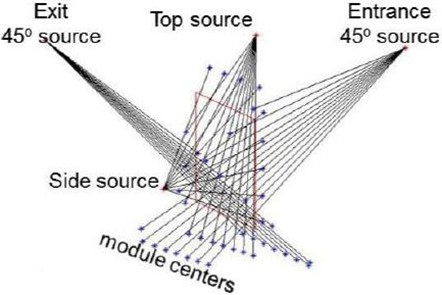
SENTINEL Scanner Installation
First and foremost, the SENTINEL has been designed for easy deployment and installation at domestic and international checkpoints. Following production, assembly and factory acceptance testing, SENTINEL systems, simulators and peripheral equipment are packaged and marked in accordance with TSA packaging and marking requirements for transportation security screening equipment. The system is shipped directly to the customer’s site in one piece along with ingress and egress conveyors, primary and auxiliary viewing stations and peripheral equipment in three simple shipping crates. We assign an installation site lead to coordinate system receipt, rigging unloading, installation and start-up. For installed systems, the installation site lead collects data, performs on-site functional testing, and prepares a commissioning report. For each system installed, the commissioning report will document i) Visual Inspection; ii) Operational/ Functional Test; iii) Image Quality Test; and, iv) Explosive Simulant Detection Test. Because the system is delivered to the site in one piece, the installation, setup, startup and functional test process is typically completed in four to six hours if the checkpoint has been prepared for system setting.
SENTINEL Scanner Maintenance
Modular construction of SENTINEL plays a major role in the system’s serviceability and ensures fast field service to get the machine back online. Furthermore, as system upgrades and enhancements are designed, engineered, tested and approved, respective modules can easily be changed-out in the field. System electrical and control components are mounted on four (4) back-plates that are easy to inspect, basic troubleshoot, and remove & replace if necessary. All modules are individually certified by Underwriter’s Laboratory (UL) in addition to the entire machine being UL certified. The four back-plate modules are located behind the same exterior panel and can easily be accessed by an authorized service technician. If a module is diagnosed with a problem, the entire module is removed by unplugging the wiring harness connectors, unscrewing four nuts, removing the module and simply installing a new module, which takes five to ten minutes to complete. The defective module is then returned to ScanTech for detailed troubleshooting, evaluation and if economical, repair. Likewise, X-ray generators are a modular monoblock design hermetically enclosing the X-ray tube, high-voltage power supply, collimator, and cooling system. The replacement of an X-ray generator takes less than an hour as the monoblock is mounted on a factory laser- aligned mounting frame. The monoblock is removed by unbolting four bolts plus two connectors.
45
Simply remove and replace the unit with a new X-ray monoblock and the system is ready to scan. No alignment of the X-ray monoblock is required because of the pre-aligned precision of the X-ray generator and detector array mounting frames, so an X-ray monoblock change out is simply a ‘pull-plug-scan’ service call. Detector Arrays can also be easily replaced. Each array is a modular unit mounted on a precision mounting bracket or frame. To replace the detector board(s), one must merely remove the access plate(s), unplug the communication & power connectors, remove the array bracket or frame, and repeat the process to reinstall. SENTINEL’s modular design provides a low-cost component upgrade path, reduced system downtime, faster field service and troubleshooting, and lower maintenance costs.
SENTINEL Scanner Operation
In similar fashion to current protocols at aviation checkpoint security stations, ‘carry-on’ baggage and other approved ‘carry-on’ items are loaded onto the SENTINEL’s conveyor and queued for scanning through the system’s tunnel. Once loaded onto the conveyor belt, each item passes through the system’s X-ray inspection tunnel, and within a matter of seconds, reappears at the opposite end. Instead of a rotating gantry, SENTINEL’s four fixed independent and synchronized X-ray sources project X-ray images of scanned items onto the system’s four independent arrays of detectors where various signatures associated with the materials the X-rays interact with inside of the tunnel are measured or calculated. Advanced and proprietary algorithms provide highly reliable automatic threat detection, not only differentiating between threatening and non-threatening materials, but also specifically identifying the items as benign (such as face cream,) or dangerous (such as explosives), as well as drugs and other hazardous materials. During a scan, four separate high-definition visual images are generated and displayed on the system’s high definition monitor. Operators can access vertical, horizontal and ±45o snapshots of each item being scanned and will also be able to access a 3D reconstructed image of the scanned item. This supplies the operator with the necessary visual tools to identify threats which otherwise would be difficult to distinguish. During the inspection process, the image scrolls in the direction of conveyor travel to simulate the conveyor moving a target through the inspection tunnel. The system provides real time storage of a selectable number of individual scanned items, which are maintained in a historical memory buffer depicted at the bottom of the screen. Touch screen access allows screeners to easily move back and forth between items in the system’s immediate memory. In addition, item scans can easily be saved to permanent storage and subsequently re-loaded and analyzed as if the scan was just made. SENTINEL also has the ability to wirelessly transmit large bits of data in real time to any number of on- and off-site ancillary locations. Systems can be connected to a network in a matrix networked architecture allowing remote system threat reporting and operation, remote management of diagnostics, remote reporting of operator performance, remote handling of the data of interest and even remote and automatic software upgrades. Any supervisor, manager or regulatory agency, and any number of other off-site personnel can look in on any particular system in action as dictated by conduct of operations.
SENTINEL systems are based on the company’s proprietary fixed-gantry CT technology, which employs four fixed X-ray generators and detector arrays to create a three-dimensional visualization of the object being scanned. Each generator/detector array is optimally configured to provide planar projections that significantly expand the robustness, reliability and repetition of image data and volumetric reconstruction to improve the discrimination and interrogation of threat materials and hidden objects.
While nearly identical in size and overall appearance to traditional rotating-gantry scanners, we believe that SENTINEL has several important advantages, including modular design, improved image quality, increased throughput, operation on simple 120V power and plug and play installation.
Our proprietary operator-friendly SENTINEL software, which includes modules that we refer to as Automatic Threat Identification and Ray Trace Biopsy, enables SENTINEL to automatically identify materials and substances hidden inside a scanned bag or parcel, by measuring X-ray attenuation data and calculating Zeff number and mass densities by volumetric element and then comparing these calculated values to values of known materials. Potential threat materials are then highlighted on the operator’s screen and flagged for further action by a screener. ATI and RTB data can be provided to the operator or alternatively directed to remote auxiliary viewing or centralized monitoring stations.
SENTINEL successfully completed TSA’s Tier 2 Explosive Detection Standard testing in March 2018. Our application for APSS 6.2 certification is in advanced stages, and we currently anticipate receiving APSS 6.2 certification in the first quarter of 2026. We were invited by ECAC to submit SENTINEL for ECAC certification, and we expect to commence EDSCB certification testing and receive certification. We have applied for certification of our SENTINEL CT scanner for placement on TSA’s Air Cargo Screening Technology List as a small bore air cargo visual inspection system for inspecting small parcels and packages, and expect to receive such certification. We are also designing and developing a large bore fixed gantry CT scanner for air cargo screening of break-bulk cargo and larger packages and parcels, and except to receive ACSTL certification of this scanner in 2026.
46
Results of Operations
We have not been profitable since inception. As of September 30, 2025, our accumulated deficit was $219.0 million and as of December 31, 2024, our accumulated deficit was $184.5 million. Since inception, we have financed our operations primarily through different forms of debt, primarily promissory notes.
Operating expenses primarily consist of general and administrative costs, including payroll, as well as research and development expenses. As of September 30, 2025, general and administrative expenses represented the largest component of our operating expenses. These costs have increased significantly over the past 12 months, primarily due to expenses associated with capital markets activities related to the Business Combination.
For the three months ended September 30, 2025 and 2024, operating expenses were $5.1 million and $2.2 million, respectively, an increase of 229% during the period. For the nine months ended September 30, 2025 and 2024, operating expenses were $21.9 million and $3.9 million, respectively, an increase of 467% during the period.
|
|
For the Three Months Ended September 30, |
|
For the Nine Months Ended September 30, |
||||||||
|
|
2025 |
|
2024 |
|
2025 |
|
2024 |
||||
Operating expenses: |
|
|
|
|
|
|
|
|
|
|
|
|
General and administrative expenses |
|
$ |
4,530,392 |
|
$ |
1,378,388 |
|
$ |
21,889,320 |
|
$ |
3,863,403 |
Research and development expenses |
|
|
517,629 |
|
|
814,539 |
|
|
2,845,937 |
|
|
2,604,500 |
Depreciation and amortization |
|
|
5,194 |
|
|
8,137 |
|
|
22,307 |
|
|
24,376 |
Total operating expenses |
|
$ |
5,053,215 |
|
$ |
2,201,064 |
|
$ |
24,757,564 |
|
$ |
6,492,279 |
Research and Development Expenses
Research and development expenses consist primarily of engineering and regulatory activities. R&D costs are expensed as incurred. We recognize expenses for certain development activities, such as software and hardware development and manufacturing, based on an evaluation of progress toward completion using data or other information provided by our vendors. Payments for these activities follow the terms of the underlying agreements, which may differ from the timing of expense recognition. Nonrefundable advance payments for goods or services to be received in the future for use in R&D activities are recorded as prepaid expenses and recognized as an expense as the goods are delivered or the related services are performed, or when it is no longer anticipated that the goods will be delivered or the services rendered. R&D activities represent a significant portion of our operating expenses. R&D expenses are expected to rise substantially in future periods as we continue to implement our business strategy, including advancing our business plan, expanding our R&D programs, hiring additional personnel to support these efforts, and pursuing regulatory approvals.
General and Administrative Expenses
General and administrative expenses consist primarily of personnel-related costs for our finance, legal, human resources, and administrative teams, as well as information technology expenses, professional services, insurance, travel, and other administrative costs. The Company has invested and will continue to invest in its corporate organization and has incurred additional expenses associated with transitioning to and operating as a public company, including higher legal, audit, tax and accounting fees, investor relations costs, increased insurance premiums, and compliance-related costs. As a result, general and administrative expenses are positioned to rise in absolute dollars in future periods.
Interest Expense
Interest expense consists of accrued and unpaid interest, including default interest, due on the Company’s outstanding promissory notes. Interest expense consists of accrued and unpaid interest, including default interest, due on the Company’s outstanding promissory notes.
Results of Operations
The results of operations presented below should be reviewed in conjunction with the Company’s condensed consolidated financial statements for the three and nine months ended September 30, 2025 and 2024, and other information included elsewhere in this filing.
47
The following table sets forth our condensed consolidated statement of operations for the three and nine months ended September 30, 2025 and 2024, respectively.
For the three and nine months ended September 30, 2025, the Company reported a net loss of $9.7 million and $34.5 million. The primary driver of net loss during the period was de-SPAC transaction costs, non-redemption compensation expenses and equity recapitalization that occurred upon the Closing of the Business Combination.
As of January 2, 2025, nearly all lenders agreed to convert their outstanding principal and accrued interest into the Company’s common stock, except for Aegus Corporation, Azure SJBT, LAM LHA, Polar, Seaport Group SIBS, and Steele. The Azure SJBT loans were consolidated into a new $2.9 million loan with SJBT bearing interest at 12% per annum. The LAM LHA loan was settled pursuant to the arrangement with Silverback Capital Corporation.
Under the settlement agreement with Silverback dated March 20, 2025, the Company issued approximately 18.9 million shares of common stock during the nine months ended September 30, 2025, across seven tranches to settle a total of $7.6 million of accounts payable and debt, resulting in an $8.3 million loss on debt extinguishment. The Company also issued 5,350,000 shares to Seaport to settle cumulative principal and accrued interest related to the first and second bridge loans, purchase order loans, and OPG loans, generating a $6.2 million net loss on debt extinguishment.
As a result of these settlements, the Company recognized a net loss on extinguishment of debt of $4.2 million and $0.3 million for the three and nine months ended September 30, 2025, respectively. For the three and nine months ended September 30, 2025, the Company recorded transaction costs of $0 and $8.8 million, respectively, primarily related to the de-SPAC transactions. To facilitate the Business Combination, the Company issued 4.9 million non-redemption shares to legacy Mars shareholders in exchange for retaining their public shares, resulting in $10.8 million of non-redemption compensation expense recorded in the first quarter of 2025.
For the three and nine months ended September 30, 2024, the Company reported a net loss of $23.4 million and $47.6 million. The loss was primarily driven by a non-cash increase in warrant and derivative liabilities, as well as higher interest expenses, reflecting the impact of increased outstanding debt and fair value adjustments related to warrants and derivative instruments during the period.
|
|
For the Three Months Ended September 30, |
|
For the Nine Months Ended September 30, |
||||||||
|
|
2025 |
|
2024 |
|
2025 |
|
2024 |
||||
Revenue |
|
$ |
631,021 |
|
$ |
— |
|
$ |
1,861,045 |
|
$ |
522,166 |
Cost of goods sold |
|
|
456,590 |
|
|
— |
|
|
1,458,234 |
|
|
448,095 |
Gross margin |
|
|
174,431 |
|
|
— |
|
|
402,811 |
|
|
74,071 |
Operating expenses: |
|
|
|
|
|
|
|
|
|
|
|
|
General and administrative expenses |
|
|
4,530,392 |
|
|
1,378,388 |
|
|
21,889,320 |
|
|
3,863,403 |
Research and development expenses |
|
|
517,629 |
|
|
814,539 |
|
|
2,845,937 |
|
|
2,604,500 |
Depreciation and amortization |
|
|
5,194 |
|
|
8,137 |
|
|
22,307 |
|
|
24,376 |
Total operating expenses |
|
|
5,053,215 |
|
|
2,201,064 |
|
|
24,757,564 |
|
|
6,492,279 |
Loss from operations |
|
|
(4,878,784) |
|
|
(2,201,064) |
|
|
(24,354,753) |
|
|
(6,418,208) |
Other income (expense) |
|
|
|
|
|
|
|
|
|
|
|
|
Change in fair value of derivative liabilities |
|
|
— |
|
|
(529,546) |
|
|
(827,445) |
|
|
(1,104,939) |
Change in fair value of warrant liabilities |
|
|
— |
|
|
(17,452,684) |
|
|
223,162 |
|
|
(30,931,345) |
Change in fair value of convertible notes |
|
|
51,672 |
|
|
— |
|
|
51,672 |
|
|
— |
Change in fair value of earnout liability |
|
|
5,000 |
|
|
— |
|
|
(8,000) |
|
|
— |
Transaction costs expensed |
|
|
— |
|
|
— |
|
|
(8,763,915) |
|
|
— |
Gain on settlement of forward purchase agreement |
|
|
— |
|
|
— |
|
|
1,406,669 |
|
|
— |
Other expense |
|
|
— |
|
|
— |
|
|
— |
|
|
(16,176) |
Interest expense |
|
|
(654,788) |
|
|
(3,249,134) |
|
|
(1,991,141) |
|
|
(9,106,317) |
Loss on extinguishment of debt |
|
|
(4,195,962) |
|
|
— |
|
|
(254,530) |
|
|
— |
Total other expense |
|
|
(4,794,078) |
|
|
(21,231,364) |
|
|
(10,163,528) |
|
|
(41,158,777) |
Loss before income taxes |
|
|
(9,672,862) |
|
|
(23,432,428) |
|
|
(34,518,281) |
|
|
(47,576,985) |
Provision for income taxes |
|
|
— |
|
|
— |
|
|
— |
|
|
— |
Net loss |
|
$ |
(9,672,862) |
|
$ |
(23,432,428) |
|
$ |
(34,518,281) |
|
$ |
(47,576,985) |
48
General and Administrative Expense
For the three months ended September 30, 2025 and 2024, general and administrative expenses were $4.5 million and $1.4 million, respectively, representing a year-over-year increase of 229%. For the nine months ended September 30, 2025 and 2024, general and administrative expenses were $21.9 million and $3.9 million, respectively, representing a year-over-year increase of 467%. This significant increase was primarily driven by higher professional service fees related to the Business Combination and share-based compensation issued to legacy Mars shareholders for retaining their public shares and service providers who supported the completion of the Business Combination.
Pursuant to BCA Amendment No. 4, the Company agreed to issue 4.9 million non-redemption shares to legacy Mars shareholders for not redeeming their public shares prior to the business combination, for which $10.8 million of compensation expense was recorded in the first quarter of 2025. Several vendors provided critical services in connection with the Business Combination, and the Company agreed to compensate them with shares of common stock upon the completion of the Business Combination. On January 2, 2025, the Company also issued 75,000 shares to MG Partners, LLC; 50,000 shares to Outside The Box Capital Inc; 100,000 shares to Roth Capital Partners LLC; and 50,000 shares to Maximcash Solution LLC. The aggregate fair value of these shares was $518.0 thousand, which the Company recorded as share-based compensation expense for the nine months ended September 30, 2025. In addition, the Company incurred legal service fees of $1.1 million to Ellenoff Grossman & Schole LLP in connection with the Business Combination.
Research and Development Expense
For the three months ended September 30, 2025 and 2024, research and development expenses were $0.5 million and $0.8 million, respectively, a 36% decrease during the period. For the nine months ended September 30, 2025 and 2024, research and development expenses were $2.8 million and $2.6 million, respectively, a 9% increase during the period.
The increase in research and development expenses was attributable primarily to a continued and ongoing increase in investment in the Company’s artificial intelligence software and continued investment in its proprietary algorithms with the anticipation of filing additional patents in the future.
Depreciation and Amortization
For the three months ended September 30, 2025 and 2024, depreciation and amortization expenses were $5.2 thousand and $8.1 thousand, respectively. For the nine months ended September 30, 2025 and 2024, depreciation and amortization expenses were $22.3 thousand and $24.4 thousand, respectively. The change was not material.
Interest Expense
For the three months ended September 30, 2025 and 2024, interest expense was $0.7 million and $3.2 million, respectively, representing a decrease of 80% year over year. For the nine months ended September 30, 2025 and 2024, interest expense was $2.0 million and $9.1 million, respectively, representing a decrease of 78% year over year. Interest expense includes accrued interest and any penalties, including default interest, on outstanding promissory notes. The decrease in interest expense is primarily attributable to the settlement of a majority of the Company’s debt obligations through conversion into common stock upon the completion of the Business Combination. As a result, only a limited number of debt instruments remained outstanding on the Company’s condensed consolidated balance sheets as of September 30, 2025.
Other Income (Expense)
For the three months ended September 30, 2025 and 2024, the Company recorded total other expenses of $4.8 million and $21.2 million, respectively. The decrease was primarily driven by a $17.5 million reduction in the fair value of warrant liabilities, 2.6 million reduction in interest expenses, partially offset by a $4.3 million increase in loss on extinguishment of debt.
For the nine months ended September 30, 2025 and 2024, the Company recorded total other expenses of $10.2 million and $41.2 million respectively. The decrease was primarily attributable to a net $31.5 million decrease in the fair value of warrant liabilities, derivative liabilities and earnout liability, a $7.1 million reduction in interest expense, and a $1.4 million gain on settlement of the forward purchase agreement. These favorable impacts were partially offset by $8.8 million of transaction costs expensed and a $0.4 million loss on extinguishment of debt.
49
Upon completion of the Business Combination, all outstanding warrants and options were exercised and converted into shares of the Company’s common stock, except for the options related to Seaport’s second bridge loan, which were exercised on January 7, 2025. The options and warrants were fair valued prior to conversion, and the resulting changes in the fair value of derivative and warrant liabilities were recorded accordingly. As of September 30, 2025, no derivative or warrant liabilities were recorded in the Company’s condensed consolidated balance sheet.
Trend Information
Other than as disclosed elsewhere in this Quarterly Report on Form 10-Q, we are not aware of any trends, uncertainties, demands, commitments or events that are reasonably likely to have a material effect on our revenues, net income, profitability, liquidity or capital resources, or that would cause reported financial information not necessarily to be indicative of future operating results or financial condition.
Liquidity and Capital Resources
To date, we have financed our operations primarily through the issuance of debt. Since our inception, we have incurred significant operating losses and negative cash flows. As of September 30, 2025 and December 31, 2024, we had an accumulated deficit of $219.0 million and $184.5 million, respectively. The Company’s liabilities ae significantly greater than its assets.
We did not receive sufficient proceeds from the Business Combination to fund our operating expenses for at least 12 months after the date of our condensed consolidated financial statements included in this filing. As a result, management has determined that there is substantial doubt about our ability to continue as a going concern.
We expect to incur significant expenses in connection with our ongoing activities as we continue to implement our business strategy. We will need additional funding in connection with these activities. Our future funding requirements, both short-term and long-term, will depend on many factors, including the level of sales, the expansion of our sales and marketing activities, the timing and extent of our spending to support our research and development efforts, investments in infrastructure, operating costs, expansion into other markets, and the costs of operating as a public company (including hiring additional personnel as well as increased director and officer insurance premiums, audit and legal fees, investor relations fees and expenses related to compliance with public company reporting requirements under the Exchange Act and rules implemented by the SEC and Nasdaq).
For the foreseeable future, we expect to continue financing our operations through the sale of equity, debt, borrowings under credit facilities or through potential collaborations with other companies, other strategic transactions or government or other grants. Adequate capital may not be available to us when needed or on acceptable terms. We do not currently have any committed external source of funds. To the extent that we raise additional capital through the sale of equity or convertible debt securities, the ownership interest of our shareholders will be diluted, and the terms of these securities may include liquidation or other preferences that adversely affect the rights of shareholders. Debt financing and preferred equity financing, if available, may involve agreements that include covenants limiting or restricting our ability to take specific actions, such as incurring additional debt, making acquisitions or capital expenditures. Debt financing would also result in fixed payment obligations. If we are unable to raise additional funds through equity or debt financing or other arrangements when needed, we may be required to delay, reduce, suspend or cease our research and development programs or any future commercialization efforts, which would have a negative impact on our business, prospects, operating results and financial condition. See the section entitled “Risk Factors” for additional risks associated with our substantial capital requirements.
The Company’s operating losses raise substantial doubt about our ability to continue as a going concern for one year from the date the condensed consolidated financial statements are issued. As of September 30, 2025 and December 31, 2024, our cash balance was $157,646 and $22,317, respectively. As a result, our previous auditor included an explanatory paragraph in its report on our consolidated financial statements for the year ended December 31, 2024 with respect to this uncertainty.
Prior to the Business Combination, the Company financed operations primarily through cash generated from debt offerings and equity raises. The Company’s primary short-term requirements for liquidity and capital are to fund general working capital and capital expenditures. The Company’s principal long-term working capital uses primarily include research and development expenses and operational payroll.
In connection with the consummation of the Business Combination, certain current debt holders of ScanTech agreed to convert their existing indebtedness into equity and to cancel any outstanding warrants. Specifically, Polar received 1,187,500 shares of common stock upon the conversion of its Series P Membership Units.
50
Steele Interests SIBS LLC received 200,000 shares of common stock pursuant to a supplemental agreement entered into as of January 31, 2025. Aegus Corp. received 234,380 shares of common stock pursuant to BCA Amendment No. 4, 70,000 shares under a settlement agreement and mutual release dated October 14, 2024, and 23,000 shares under a letter agreement dated February 7, 2025. MG Partners, LLC received 75,000 shares of common stock under a settlement agreement and mutual release dated October 14, 2024. St. James Bank & Trust Co. Ltd. received 316,616 shares of common stock in accordance with the NACS/ScanTech refinance and repayment summary of non-binding terms dated February 7, 2025. Bay Point Capital Partners LP received 200,000 shares, Catalytic Holdings I LLC received 100,000 shares, and Seaport received 100,000 shares, each pursuant to supplemental agreements dated January 2, 2025. In addition, the Company registered 1,149,230 shares of common stock to Seaport Group SIBS LLC pursuant to BCA Amendment No. 4 and in connection with the promissory bridge note dated March 27, 2024; 1,000,000 shares in connection with the senior unsecured promissory note dated November 14, 2024; and 100,000 shares to Seaport pursuant to the supplemental agreement dated January 2, 2025.
Following the completion of restructuring the Company’s balance sheet, recapitalizing outstanding indebtedness and converting it into equity as described above, our liquidity needs will depend on both the performance of our business and our ability to obtain additional financing. If we do not generate sufficient proceeds from operations or financing activities to execute our business plan or if our business underperforms relative to expectations, we may need to seek additional funding or implement other measures to enhance our liquidity position. See “Risk Factors — We may require additional capital to support business growth, and this capital might not be available on acceptable terms, if at all.” in our Annual Report on Form 10-K for the year ended December 31, 2024 filed with the SEC on May 14, 2025.
Cash Flow
The following table provides information regarding our cash flows for the periods presented:
|
|
Nine Months Ended September 30, |
||||
|
|
2025 |
|
2024 |
||
Operating activities |
|
$ |
(4,368,126) |
|
$ |
(5,145,380) |
Investing activities |
|
|
(15,940) |
|
|
(1,100) |
Financing activities |
|
|
4,519,395 |
|
|
4,994,827 |
Net increase (decrease) in cash during period |
|
$ |
135,329 |
|
$ |
(151,652) |
For the nine months ended September 30, 2025, cash used in operating activities was $4.4 million, reflecting a net loss of $34.5 million, adjusted for non-cash charges of $23.8 million and changes in operating assets and liabilities of $6.4 million. Non-cash charges primarily included $10.8 million of fair value of shares issued as non-redemption compensation and $8.8 million of transaction costs expensed, and 1.3 million on shares to settle debt issuance cost.
For the nine months ended September 30, 2024, cash used in operating activities was $5.1 million, reflecting a net loss of $47.6 million, adjusted for non-cash charges of $32.1 million and changes in operating assets and liabilities of $10.3 million. Non-cash charges primarily included $32.0 million of change in fair value expense.
For the nine months ended September 30, 2025, cash used in investing activities was $16 thousand, consisting of purchases of property, plant and equipment of $16 thousand.
For the nine months ended September 30, 2024, cash used in investing activities was $1 thousand, consisting of purchases of property, plant and equipment of $1 thousand.
For the nine months ended September 30, 2025, cash provided by financing activities was $4.5 million, consisting of $4.4 million in loan proceeds, $30 thousand from stock option and warrant exercises, and $250 thousand from the issuance of common stock, partially offset by $198 thousand in loan repayments.
For the nine months ended September 30, 2024, cash provided by financing activities was $5.0 million, consisting of $5.0 million in loan proceeds, partially offset by a $20 thousand adjustment to loan origination fees and $1 thousand in shareholder receivables.
Indebtedness Conversion
The Company continuously worked with its creditors to secure agreements to convert its existing indebtedness to equity for the nine months ended September 30, 2025.
51
On March 20, 2025, the Company entered into a settlement agreement and stipulation with Silverback Capital Corporation (“SCC”). Under the terms of the agreement, SCC agreed to assume the Company liabilities totaling $8,230,977 in exchange for shares of common stock at a conversion price of $1.50 per share. On March 26, 2025, SCC completed the first tranche of the agreement, acquiring $1,378,303 in accounts payable and receiving 918,869 shares of common stock in exchange. In addition, the Company agreed to issue 33,000 shares as settlement fees and 150,000 shares for legal fees, for a total of 1,101,869 shares issued in the first tranche. The Company subsequently issued 1,500,000 shares to SCC on May 7, 2025 for the second tranche to acquire $540,000 of accounts payable and $600,000 of loans; 1,600,000 shares on May 21, 2025 for the third tranche to acquire $742,033 of accounts payable and $42,966 of loans; 2,298,000 shares on June 11, 2025 for the fourth tranche to acquire $554,300 of accounts payable and $250,000 of loans; 1,500,000 and 1,565,762 on July 18 and July 29, 2025 respectively for the fifth tranche to acquire $1,064,489 of accounts payable; 2,680,000 and 1,165,503 shares on July 30 and July 31, 2025 respectively for the sixth tranche to acquire $993,185 of accounts payable and $300,000 of loans; and 2,700,000 and 2,800,000 on August 19 and September 4, 2025 respectively for the seventh tranche to acquire $1,120,606 of accounts payable.
On March 31, 2025, the Company entered into an amendment to the Seaport bridge loan agreements. Under the terms of the amendment, Seaport agreed to convert the cumulative principal and accrued interest from the first and second bridge loans, purchase order loans, and OPG loans into 5,350,000 shares of the Company’s common stock. 5,350,000 shares of common stock were subsequently issued to Seaport on April 17, 2025. The fair value of the shares was recorded in additional paid-in capital on the issuance date, and the related liability of $4,693,210 was derecognized from the condensed consolidated balance sheets, with the difference recognized as a $6,196,441 loss on debt extinguishment.
In addition, in the same amendment, the Company granted Seaport a warrant to purchase 3,000,000 shares of common stock at an exercise price of $0.01 per share. Seaport exercised the warrant on March 31, 2025 by paying $30,000 in cash, and 3,000,000 shares of common stock were subsequently issued to Seaport on April 2, 2025.
On May 19, 2025, the Company issued 1,700,000 shares of common stock in full settlement of the $2,326,241 liability to York pursuant to the Fifth Amended and Restated Operating Agreement of SIBS.
Off-Balance Sheet Arrangements
We did not have any off-balance sheet arrangements, as defined in the rules and regulations of the SEC, over the past three fiscal years, as of December 31, 2024 and for the nine month ending September 30, 2025.
Item 3. – Quantitative and Qualitative Disclosures about Market Risk
As a smaller reporting company, we are not required to provide the information otherwise required under this item.
Item 4. – Controls and Procedures
We maintain disclosure controls and procedures, as defined in Rule 13a-15(e) and Rule 15d-15(e) promulgated under the Exchange Act that are designed to ensure that information required to be disclosed by us in the reports that we file or submit under the Exchange Act is recorded, processed, summarized and reported within the time periods specified in the SEC’s rules and forms and that such information is accumulated and communicated to our senior management, consisting of Dolan Falconer, President and Chief Executive Officer (Principal Executive Officer) and James C. White (Principal Financial and Accounting Officer), as appropriate to allow timely decisions regarding required disclosure.
We carried out an evaluation, under the supervision and with the participation of our senior management, consisting of Dolan Falconer, President and Chief Executive Officer (Principal Executive Officer) and James C. White (Principal Financial and Accounting Officer), of the effectiveness of the design and operation of our disclosure controls and procedures as of September 30, 2025. As previously disclosed, our disclosure controls and procedures were not effective due to the following material weaknesses identified: (1) a material weakness in our internal controls over financial reporting related to valuation of matters associated with accounting for warrants, derivatives and unit-based compensation awards, particularly our process for developing the estimates, our application of the appropriate methodologies utilized, and our evaluation of the completeness and accuracy of the underlying data utilized in deriving the estimates; (2) a material weakness in the complete identification and accounting interpretation of the complex terms in various contractual arrangements entered into, including those related to debt and equity arrangements, revenue arrangements with our customer, consulting and vendor arrangements for services provided and legal judgments; (3) a material weakness related to the lack of appropriate approvals related to related party transactions; (4) a material weakness related to the financial reporting close process, including the preparation and review of technical accounting interpretations and the recording of such balances, account reconciliations including inventory, preparation of tax provision, and journal entries, and; 5) a material weakness related to the IT environment including controls over cybersecurity, logical, network, and physical security, data backup and recovery, change management and vendor management, including review of SOC1 Type 2 reports and the consideration of the reports’ recommended end-user control considerations.
52
In addition, the restatement of our condensed consolidated financial statements for the six months ended June 30, 2025 identified a further material weakness related to ineffective controls over the identification, recording, classification, and presentation of various transactions, including share-based arrangements with non-redemption shareholders, de-SPAC transaction cost classifications, duplicate expense recognition, tax penalty and interest accruals, revenue and cost of goods sold adjustments, balance sheet presentation of pledged shares, and the classification of prepaid inventory and accrued advisory fees. These errors demonstrated deficiencies in our period-end financial reporting controls and review procedures.
As of the end of the reporting period, none of these material weaknesses had been fully remediated. Accordingly, management concluded that our internal control over financial reporting was not effective.
Changes in Internal Control over Financial Reporting
There were no material changes in our internal control over financial reporting (as defined in Rules 13a-15(f) and 15d-15(f) under the Exchange Act) during the nine months ended September 30, 2025, that have materially affected, or are reasonably likely to materially affect, our internal control over financial reporting.
53
PART II – OTHER INFORMATION
Item 1. – Legal Proceedings
As previously disclosed in the Company’s Annual Report on Form 10-K filed with the SEC on May 14, 2025, the Company had failed to remit U.S. federal taxes from amounts withheld from employee wages and the employer portion of such taxes during the period from the first quarter of 2017 through October 31, 2023. All payroll taxes and withholdings for the foregoing tax periods have been paid in full. However, the Company has accrued additional penalties and interest associated with late payments. On January 8, 2025, the Company remitted an additional $500,000 to the IRS toward satisfying these outstanding liabilities. As of September 30, 2025, the Company has not fully remitted to the IRS its tax obligations. The failure to deposit penalty and associated interest was calculated and recorded in the condensed consolidated balance sheets under the caption of accrued federal tax liability, penalties and interest.
Other than the above, the Company is not currently a party to any material legal proceedings. From time to time, we may be subject to various legal proceedings and claims that arise in the ordinary course of our business activities. Although the results of litigation and claims cannot be predicted with certainty, any such future litigation could have an adverse impact on us because of defense and settlement costs, diversion of management resources and other factors.
Item 1A. – Risk Factors
You should consider the risks and uncertainties described under Item 1A of Part I of our Annual Report on Form 10-K for the fiscal year ended December 31, 2024, which we filed with the Securities and Exchange Commission on May 14, 2025, together with all other information contained or incorporated by reference in this Quarterly Report on Form 10-Q, when evaluating our business and our prospects. The risks and uncertainties that we face are not limited to those set forth in the Annual Report on 10-K. Additional risks and uncertainties not presently known to us or that we currently believe to be immaterial may also adversely affect our business and the trading price of our securities. There are no material changes to the risk factors set forth in Part I, Item 1A, in our Annual Report on Form 10-K for the year ended December 31, 2024, except as described below.
If we fail to comply with the rules of the Nasdaq Stock Market for continued listing or other requirements, our shares may be delisted.
Our common stock is listed on the Nasdaq Stock Market (“Nasdaq”) under the symbol “STAI.” If we fail to comply with Nasdaq’s rules for continued listing, Nasdaq may take steps to delist our common stock. On May 27, 2025, the Company received an additional deficiency letter from Nasdaq (the “MVLS Notice”), notifying the Company that, based on the market value of listed securities for the previous 30 consecutive business days, the listing of the Company’s common stock was not in compliance with Nasdaq Listing Rule 5450(b)(2)(A) to maintain a minimum market value of listed securities of at least $50 million (the “MVLS Requirement”). In accordance with Nasdaq rules, the Company has a period of 180 calendar days (or until November 24, 2025) to regain compliance with the MVLS Requirement. To regain compliance during this 180-day compliance period, the minimum market value of listed securities must close at $50 million or more for a minimum of 10 consecutive business days. On November 26, 2025, the Staff notified the Company (the “Notice”) that its securities are subject to delisting from The Nasdaq Global Market as a result of not satisfying the requirement by the aforementioned deadline.
Further, on July 10, 2025, the Company received a written notice (the “Bid Price Notice”) from Nasdaq indicating that the Company is not in compliance with the $1.00 minimum bid price requirement set forth in Nasdaq Listing Rule 5450(a)(1) (the “Bid Price Requirement”) for continued listing on The Nasdaq Global Market. The Nasdaq Listing Rules require listed securities to maintain a minimum bid price of $1.00 per share, and, based upon the closing bid price of the Company’s common stock for the 30 consecutive business days for the period of May 23, 2025 to July 8, 2025, the Company no longer meets this requirement. The Bid Price Notice has no immediate effect on the listing of the Company’s common stock on The Nasdaq Global Market. The Bid Price Notice indicated that the Company will be provided 180 calendar days (or until January 6, 2026) to regain compliance. If at any time during this 180 calendar day period the closing bid price of the Company’s common stock is at least $1.00 per share for a minimum of ten consecutive business days, Nasdaq stated that it will provide the Company with a written confirmation of compliance and the matter will be closed.
On July 30, 2025, the Company received an additional deficiency letter (the “MVPHS Notice”) from the Listing Qualifications Department of the Nasdaq notifying the Company that, based upon Nasdaq’s review of the Company’s market value of publicly held shares (“MVPHS”) for previous 30 consecutive business days ended July 28, 2025, the Company is not in compliance with Nasdaq Listing Rule 5450(b)(2)(C) to maintain a MVPHS of at least $15 million (the “MVPHS Requirement”). In accordance with Nasdaq rules, the Company has a period of 180 calendar days (or until January 26, 2026) to regain compliance with the MVPHS Requirement.
54
To regain compliance during this 180-day compliance period, the minimum MVPHS must close at $15 million or more for a minimum of 10 consecutive business days. The MVPHS Notice has no immediate effect on the listing of the Company’s common stock on The Nasdaq Global Market.
On August 26, 2025, the Company received a deficiency letter (the “Periodic Report Notice”) from Nasdaq Listing Qualifications notifying the Company that it is not in compliance with the requirements of Nasdaq Listing Rule 5250(c)(1) as a result of not having timely filed with the SEC its Quarterly Report on Form 10-Q for the quarterly period ended June 30, 2025. The Periodic Report Notice had no immediate effect on the listing of the Company’s common stock on The Nasdaq Global Market, and the Company filed Form 10-Q/A for the quarterly period ended June 30, 2025 on November 28, 2025.
On November 5, 2025, the Staff notified the Company that compliance with MVPHS has been regained and the matter is now closed
The Company has requested a hearing before the Nasdaq Hearings Panel and paid the associated fee. Because the Notice cites non-compliance with Nasdaq Listing Rule 5250(c)(1) as an additional basis for the Staff determination, the Company has received an automatic 15-day stay of suspension under Nasdaq Listing Rule 5815(a)(1)(B) in connection with that deficiency. The Company has also submitted a request for an extended stay of suspension applicable to the full determination, including the MVLS deficiency, pending the outcome of the hearing. At the hearing, the Company plans to present a comprehensive compliance plan addressing both the MVLS Rule and its recent filing status. The Notice also referenced the Company’s delinquency under Nasdaq Listing Rule 5250(c)(1) (the “Periodic Reporting Rule”) relating to its Form 10-Q for the periods ended June 30, 2025 and September 30, 2025. Consistent with Listing Rule 5810(c)(2)(A), the Company is ineligible for Staff to review and accept a compliance plan with respect to these delinquent filings, and non-compliance with the Periodic Reporting Rule serves as an additional and separate basis for delisting. Since the date of the Notice, the Company has filed its amended and restated Quarterly Report on Form 10-Q/A for the quarter ended March 31, 2025 and its amended and restated Quarterly Report on Form 10-Q/A for the quarter ended June 30, 2025. A hearing before the Panel has been scheduled for January 22, 2026, to appeal the previously disclosed Nasdaq Listing Qualification Staff (“Staff”) determination regarding delisting.
In the event that the Company does not regain compliance with the MVLS Requirement, or Bid Price Requirement, prior to the expiration of each respective 180-day compliance period, the Company will receive written notification from Nasdaq that the Company’s securities are subject to delisting. Alternatively, the Company may transfer the listing of its securities to The Nasdaq Capital Market, provided the Company will only be able to transfer the listing to The Nasdaq Capital Market if the Company then meets the continued listing requirements on The Nasdaq Capital Market.
If we fail to regain compliance with the MVLS Requirement, or Bid Price Requirement, or for any other reason, Nasdaq delists our common stock from trading on its exchange and we are unable to obtain listing on another national securities exchange or take action to restore our compliance with the Nasdaq continued listing requirements, a reduction in some or all of the following may occur, each of which could have a material adverse effect on our stockholders:
| ● | the liquidity of our common stock; |
| ● | the market price of our common stock; |
| ● | we will become a “penny stock”, which will make trading of our common stock much more difficult; |
| ● | our ability to obtain financing for the continuation of our operations; |
| ● | the number of institutional and general investors that will consider investing in our common stock; |
| ● | the number of investors in general that will consider investing in our common stock; |
| ● | the number of market makers in our common stock; |
| ● | the availability of information concerning the trading prices and volume of our common stock; and |
| ● | the number of broker-dealers willing to execute trades in shares of our common stock. |
55
Item 2. – Unregistered Sales of Equity Securities and Use of Proceeds
Unregistered Sales
The following table lists issuances of common stock that were not registered under the Securities Act of 1933, as amended (the “Securities Act”), and were made pursuant to Section 4(a)(2) of the Securities Act.
|
|
Unregistered Shares |
Common Stock issued on January 6, 2025 |
|
352,795 |
Common Stock issued on January 30, 2025 |
|
1,650,000 |
Common Stock issued on February 18, 2025 |
|
3,772,177 |
Common Stock issued on March 27, 2025 |
|
1,101,868 |
Common Stock issued on April 2, 2025 |
|
7,654,800 |
Common Stock issued on April 17, 2025 |
|
5,350,000 |
Common Stock issued on May 7, 2025 |
|
1,500,000 |
Common Stock issued on May 16, 2025 |
|
1,050,000 |
Common Stock issued on May 19, 2025 |
|
3,200,000 |
Common Stock issued on May 21, 2025 |
|
1,600,000 |
Common Stock issued on June 11, 2025 |
|
2,298,000 |
Common Stock issued on July 18, 2025 |
|
1,500,000 |
Common Stock issued on July 25, 2025 |
|
2,295,530 |
Common Stock issued on July 29, 2025 |
|
1,565,762 |
Common Stock issued on July 30, 2025 |
|
2,680,000 |
Common Stock issued on July 31, 2025 |
|
1,165,503 |
Common Stock issued on August 19, 2025 |
|
2,700,000 |
Common Stock issued on August 29, 2025 |
|
1,518,522 |
Common Stock issued on September 5, 2025 |
|
2,800,000 |
Common Stock issued on September 24, 2025 |
|
580,125 |
Total unregistered shares |
|
46,335,082 |
Repurchases
As of September 30, 2025, the Company has not repurchased any of its outstanding common stock.
Item 3. – Defaults Upon Senior Securities
None.
Item 4. – Mine Safety Disclosures
Not Applicable.
Item 5. – Other Information
As previously disclosed, the Company entered into a Securities Purchase Agreement with 340 Broadway Holdings, LLC (“340 Broadway”) effective as of July 3, 2025, pursuant to the terms of which the Company issued a senior secured promissory note (the “Note”) to 340 Broadway with a total principal amount of up to $1,500,000 which bears interest at an annual rate of 15% and matures on July 3, 2026. 340 Broadway subsequently assigned a portion of the Note to Southern Point Capital Corporation (“SPCC”). On September 11, 2025, the Company received written notice (the “Default Notice”) from SPCC that stated that the Company’s failure to timely file its Quarterly Report on Form 10-Q for the period ended June 30, 2025 constituted an “Event of Default” under the Note. The Default Notice further asserted that (i) as a consequence of the Event of Default, interest on the Note accrues at a rate of 18% per annum, effective as of the date of issuance of the Note, or July 3, 2025; (ii) SPCC elected to require the Default Payment equal to 115% of the outstanding principal amount of the Note, plus accrued (default-rate) interest and all other amounts due; and (iii) the conversion discount underlying the Note of 20% was to be increased to 40%. Based on a principal amount and accrued interest outstanding on the Note of $929,950 as of September 11, 2025, the Default Payment would be approximately $1,068,639.
56
The Company is providing the disclosure in the paragraph above relating to the Default Notice to comply with the Company’s filing requirements with the U.S. Securities and Exchange Commission but does not by virtue hereof admit that the Company agrees with any assertion contained in the Default Notice. The Company is reviewing the Default Notice, including the Note and its amendments in their entirety, and reserves the right to dispute. If the Company is unable to resolve the alleged Event of Default and other assertions in the Default Notice, it could have a material adverse effect on the Company’s liquidity, financial condition, and results of operations.
Rule 10b5-1 Trading Plans
During the fiscal quarter ended September 30, 2025, none of our executive officers or directors (as defined in Section 16 of the Securities Exchange Act of 1934, as amended), adopted, terminated, or modified a “Rule 10b5-1 trading arrangement” or a “non-Rule 10b5-1 trading arrangement” (as each of those terms is defined in Item 408 of Regulation S-K), other than Karl Brenza who was Chairman and a member of the Board of Directors of the Company until June 9, 2025. On April 14, 2025, Mr. Brenza adopted a trading arrangement (the “Brenza Rule 10b5-1 Trading Plan”) for the sale of the Company’s common stock that is intended to satisfy the affirmative defense of Rule 10b5-1(c). The Brenza Rule 10b5-1 Trading Plan provides for the sale of up to 1,035,000 shares of common stock pursuant to the terms of the plan and expires on December 31, 2025 (subject to earlier termination for certain specified events set forth in the plan).
57
Item 6. – Exhibits
The following exhibits are filed as part of, or incorporated by reference into, this Quarterly Report on Form 10-Q.
EXHIBITS INDEX
Exhibit No. |
|
Description |
31.1* |
|
|
31.2* |
|
|
32.1§ |
|
|
32.2§ |
|
|
101.INS* |
|
Inline XBRL Instance Document. |
101.CAL* |
|
Inline XBRL Taxonomy Extension Calculation Linkbase Document. |
101.SCH* |
|
Inline XBRL Taxonomy Extension Schema Document. |
101.DEF* |
|
Inline XBRL Taxonomy Extension Definition Linkbase Document. |
101.LAB* |
|
Inline XBRL Taxonomy Extension Labels Linkbase Document. |
101.PRE* |
|
Inline XBRL Taxonomy Extension Presentation Linkbase Document. |
104 |
|
Cover Page Interactive Data File (embedded within the Inline XBRL document). |
* |
Filed herewith. |
§ |
In accordance with Item 601(b)(32)(ii) of Regulation S-K and SEC Release Nos. 33-8238 and 34-47986, Final Rule: Management’s Reports on Internal Control Over Financial Reporting and Certification of Disclosure in Exchange Act Periodic Reports, the certifications furnished in Exhibits 32.1 and 32.2 hereto is deemed to accompany this Quarterly Report on Form 10-Q and will not be deemed “filed” for purposes of Section 18 of the Exchange Act. Such certification will not be deemed to be incorporated by reference into any filing under the Securities Act or the Exchange Act, except to the extent that the registrant specifically incorporates it by reference. |
# |
Management contract or compensation plan or arrangement. |
58
SIGNATURES
Pursuant to the requirements of Section 13 or 15(d) of the Securities Act of 1934, the registrant has duly caused this report to be signed on its behalf by the undersigned, thereunto duly authorized.
Date: December 12, 2025 |
|
ScanTech AI Systems Inc. |
|
|
|
|
|
|
|
|
|
By: |
/s/ Dolan Falconer |
|
|
|
Name: |
Dolan Falconer |
|
|
|
Title: |
Chief Executive Officer |
|
|
|
|
|
|
|
|
By: |
/s/ James White |
|
|
|
Name: |
James White |
|
|
|
Title: |
Chief Financial Officer |
|
59
Exhibit 31.1
Certification Pursuant to Section 302 of the Sarbanes-Oxley Act of 2002
I, Dolan Falconer, certify that:
1. |
I have reviewed this Quarterly Report on Form 10-Q for the fiscal quarter ended September 30, 2025 of ScanTech AI Systems Inc. (the “registrant”); |
2. |
Based on my knowledge, this report does not contain any untrue statement of a material fact or omit to state a material fact necessary to make the statements made, in light of the circumstances under which such statements were made, not misleading with respect to the period covered by this report; |
3. |
Based on my knowledge, the condensed consolidated financial statements, and other financial information included in this report, fairly present in all material respects the financial condition, results of operations and cash flows of the registrant as of, and for, the periods presented in this report; |
4. |
The registrant’s other certifying officer and I are responsible for establishing and maintaining disclosure controls and procedures (as defined in Exchange Act Rules 13a-15(e) and 15d-15(e)) and internal control over financial reporting (as defined in Exchange Act Rules 13a-15(f) and 15d-15(f)) for the registrant and have: |
a. |
Designed such disclosure controls and procedures, or caused such disclosure controls and procedures to be designed under our supervision, to ensure that material information relating to the registrant, including its consolidated subsidiaries, is made known to us by others within those entities, particularly during the period in which this report is being prepared; |
b. |
Designed such internal control over financial reporting, or caused such internal control over financial reporting to be designed under my supervision, to provide reasonable assurance regarding the reliability of financial reporting and the preparation of condensed consolidated financial statements for external purposes in accordance with generally accepted accounting principles; |
c. |
Evaluated the effectiveness of the registrant’s disclosure controls and procedures and presented in this report our conclusions about the effectiveness of the disclosure controls and procedures, as of the end of the period covered by this report based on such evaluation; and |
d. |
Disclosed in this report any change in the registrant’s internal control over financial reporting that occurred during the registrant’s most recent fiscal quarter (the registrant’s fourth fiscal quarter in the case of an annual report) that has materially affected, or is reasonably likely to materially affect, the registrant’s internal control over financial reporting; and |
5. |
The registrant’s other certifying officer and I have disclosed, based on our most recent evaluation of internal control over financial reporting, to the registrant’s auditors and the audit committee of the registrant’s board of directors (or persons performing the equivalent functions): |
a. |
All significant deficiencies and material weaknesses in the design or operation of internal control over financial reporting which are reasonably likely to adversely affect the registrant’s ability to record, process, summarize and report financial information; and |
b. |
Any fraud, whether or not material, that involves management or other employees who have a significant role in the registrant’s internal control over financial reporting. |
Date: December 12, 2025 |
|
|
/s/ Dolan Falconer |
|
Dolan Falconer |
|
Chief Executive Officer |
|
(Principal Executive Officer) |
Exhibit 31.2
Certification Pursuant to Section 302 of the Sarbanes-Oxley Act of 2002
I, James White, certify that:
1. |
I have reviewed this Quarterly Report on Form 10-Q for the fiscal quarter ended September 30, 2025 of ScanTech AI Systems Inc. (the “registrant”); |
2. |
Based on my knowledge, this report does not contain any untrue statement of a material fact or omit to state a material fact necessary to make the statements made, in light of the circumstances under which such statements were made, not misleading with respect to the period covered by this report; |
3. |
Based on my knowledge, the condensed consolidated financial statements, and other financial information included in this report, fairly present in all material respects the financial condition, results of operations and cash flows of the registrant as of, and for, the periods presented in this report; |
4. |
The registrant’s other certifying officer and I are responsible for establishing and maintaining disclosure controls and procedures (as defined in Exchange Act Rules 13a-15(e) and 15d-15(e)) and internal control over financial reporting (as defined in Exchange Act Rules 13a-15(f) and 15d-15(f)) for the registrant and have: |
a. |
Designed such disclosure controls and procedures, or caused such disclosure controls and procedures to be designed under our supervision, to ensure that material information relating to the registrant, including its consolidated subsidiaries, is made known to us by others within those entities, particularly during the period in which this report is being prepared; |
b. |
Designed such internal control over financial reporting, or caused such internal control over financial reporting to be designed under my supervision, to provide reasonable assurance regarding the reliability of financial reporting and the preparation of condensed consolidated financial statements for external purposes in accordance with generally accepted accounting principles; |
c. |
Evaluated the effectiveness of the registrant’s disclosure controls and procedures and presented in this report our conclusions about the effectiveness of the disclosure controls and procedures, as of the end of the period covered by this report based on such evaluation; and |
d. |
Disclosed in this report any change in the registrant’s internal control over financial reporting that occurred during the registrant’s most recent fiscal quarter (the registrant’s fourth fiscal quarter in the case of an annual report) that has materially affected, or is reasonably likely to materially affect, the registrant’s internal control over financial reporting; and |
5. |
The registrant’s other certifying officer and I have disclosed, based on our most recent evaluation of internal control over financial reporting, to the registrant’s auditors and the audit committee of the registrant’s board of directors (or persons performing the equivalent functions): |
a. |
All significant deficiencies and material weaknesses in the design or operation of internal control over financial reporting which are reasonably likely to adversely affect the registrant’s ability to record, process, summarize and report financial information; and |
b. |
Any fraud, whether or not material, that involves management or other employees who have a significant role in the registrant’s internal control over financial reporting. |
Date: December 12, 2025 |
|
|
/s/ James White |
|
James White |
|
Chief Financial Officer |
(Principal Financial and Accounting Officer) |
Exhibit 32.1
Certification Pursuant to 18 U.S.C. Section 1350 as Adopted Pursuant to Section 906 of the Sarbanes-Oxley Act of 2002
In connection with the Quarterly Report on Form 10-Q of ScanTech AI Systems Inc. (the “Company”), as filed with the Securities and Exchange Commission on the date hereof (the “Report”), I, Dolan Falconer, Chief Executive Officer of the Company, pursuant to 18 U.S.C. Section 1350, as adopted pursuant to Section 906 of the Sarbanes-Oxley Act of 2002, that, to my knowledge:
1. |
the Report fully complies with the requirements of Section 13(a) or 15(d) of the Securities Exchange Act of 1934, as amended; and |
2. |
the information contained in the Report fairly presents, in all material respects, the financial condition and results of operations of the Company. |
Date: December 12, 2025 |
|
/s/ Dolan Falconer |
|
|
Dolan Falconer |
|
Chief Executive Officer |
|
(Principal Executive Officer) |
Exhibit 32.2
Certification Pursuant to 18 U.S.C. Section 1350 as Adopted Pursuant to Section 906 of the Sarbanes-Oxley Act of 2002
In connection with the Quarterly Report on Form 10-Q of ScanTech AI Systems Inc. (the “Company”), as filed with the Securities and Exchange Commission on the date hereof (the “Report”), I, James White, Chief Financial Officer of the Company, pursuant to 18 U.S.C. Section 1350, as adopted pursuant to Section 906 of the Sarbanes-Oxley Act of 2002, that, to my knowledge:
1. |
the Report fully complies with the requirements of Section 13(a) or 15(d) of the Securities Exchange Act of 1934, as amended; and |
2. |
the information contained in the Report fairly presents, in all material respects, the financial condition and results of operations of the Company. |
Date: December 12, 2025 |
|
|
/s/ James White |
|
James White |
|
Chief Financial Officer |
|
(Principal Financial and Accounting Officer) |