 エドガーで原本を確認する
UNITED STATES
SECURITIES AND EXCHANGE COMMISSION
Washington, D.C. 20549
FORM 6-K
REPORT OF FOREIGN PRIVATE ISSUER
PURSUANT TO RULE 13a-16 OR 15d-16
UNDER THE SECURITIES EXCHANGE ACT OF 1934
For the month of November 2025
Commission File Number: 001-13184
TECK RESOURCES LIMITED
(Exact name of registrant as specified in its charter)
Suite 3300 – 550 Burrard Street
Vancouver, British Columbia V6C 0B3
(Address of principal executive offices)
Indicate by check mark whether the registrant files or will file annual reports under cover of Form 20-F or Form 40-F.
Form 20-F ¨ Form 40-F x Pursuant to the requirements of the Securities Exchange Act of 1934, the registrant has duly caused this report to be signed on its behalf by the undersigned, thereunto duly authorized.
EXHIBIT INDEX
| Exhibit Number | Description | |
| 99.1 | NI 43-101 Technical Report – Quellaveco Property; November 3,2025 |
SIGNATURE
| Teck Resources Limited | ||
| (Registrant) | ||
| Date: November 10, 2025 | By: | /s/ Amanda R. Robinson |
| Amanda R. Robinson | ||
| Corporate Secretary | ||
Exhibit 99.1

NI 43-101 Technical Report – Quellaveco Property, Mariscal Nieto Province, Peru
Prepared for Anglo
American plc by
Datamine Australia Pty Ltd (Snowden Optiro)
Project Number DA214498
Qualified Persons:
Mr. Allan Earl, FAusIMM
Mr. Aaron Radonich, FAusIMM (CP)
Mr. Ian Glacken, FAusIMM (CP)
Mr. Graeme Lyall, FAusIMM
Mr. Paulo Laymen, FAusIMM
Mr. Gordon Cunningham, FSAIMM
Mr Peter Theron, MSAIMM, Pr Eng ECSA
Ms. Gené Main, EAPASA, Pr.Sci.Nat. SACNASP
Effective Date: November 3, 2025

 |
Anglo American plc NI 43-101 Technical Report – Quellaveco Property, Mariscal Nieto Province, Peru |
This report was prepared as a National Instrument 43-101 Standards of Disclosure for Mineral Projects Technical Report for Anglo American plc (Anglo American) by Datamine Australia Pty Ltd (Snowden Optiro). The quality of information, conclusions, and estimates contained herein are consistent with the quality of effort involved in Snowden Optiro’s services. The information, conclusions, and estimates contained herein are based on: i) information available at the time of preparation, ii) data supplied by outside sources, and iii) the assumptions, conditions, and qualifications set forth in this report. This report is intended for use by Anglo American subject to the terms and conditions of its contract with Snowden Optiro and relevant securities legislation. The contract permits Anglo American to file this report as a Technical Report with Canadian securities regulatory authorities under Teck Resources Limited’s profile pursuant to National Instrument 43-101. Except for the purposes legislated under Canadian securities law, any other uses of this report by any third party are at that party’s sole risk. The responsibility for this disclosure remains with Anglo American. The user of this document should ensure that this is the most recent Technical Report for the property as it is not valid if a new Technical Report has been issued.
Ó 2025
All rights are reserved. No part of this document may be reproduced, stored in a retrieval system, or transmitted in any form or by any means, electronic, mechanical, photocopying, recording or otherwise, without the prior written permission of Snowden Optiro.
| Issued by: | Perth Office | |
| Document ref: | DA214498 AA Quellaveco NI 43-101 TR (Final).docx |
|
| Issue date: | November 3, 2025 | |
| Effective date: | November 3, 2025 |
| OFFICE LOCATIONS |
| PERTH | LIMA | www.snowdenoptiro.com |
| BRISBANE | BELO HORIZONTE | comtact@snowdenoptiro.com |
| JOHANNESBURG | DENVER | |
| LONDON | SANTIAGO | Snowden Optiro is a business unit of |
| ALMATY CITY | SUDBURY | the Datamine Software group |
| NEW DELHI | JAKARTA | |
| MOSCOW |
|
Anglo American plc NI 43-101 Technical Report – Quellaveco Property, Mariscal Nieto Province, Peru |
Table of contents
| 1 | Summary | 11 | |||
| 1.1 | Property description, ownership and background | 11 | |||
| 1.2 | History | 13 | |||
| 1.3 | Geological setting, mineralization and deposit type | 13 | |||
| 1.4 | Drilling | 14 | |||
| 1.5 | Sampling, analyses and data verification | 14 | |||
| 1.6 | Mineral processing and metallurgical testing | 15 | |||
| 1.7 | Mineral Resource estimates | 16 | |||
| 1.8 | Mining and Mineral Reserve estimates | 18 | |||
| 1.9 | Processing methods and infrastructure | 20 | |||
| 1.10 | Permitting, environmental and social | 22 | |||
| 1.11 | Costs and economic analysis | 22 | |||
| 1.12 | Market studies and contracts | 23 | |||
| 1.13 | Conclusions and recommendations | 24 | |||
| 2 | Introduction | 25 | |||
| 2.1 | Terms of reference | 25 | |||
| 2.2 | Abbreviations and units | 27 | |||
| 3 | Reliance on other experts | 30 | |||
| 4 | Property description and location | 31 | |||
| 4.1 | Area and location | 31 | |||
| 4.2 | Type of mineral tenure | 31 | |||
| 4.2.1 | Legal framework | 31 | |||
| 4.2.2 | Property mineral titles | 31 | |||
| 4.3 | Issuer’s interest | 40 | |||
| 4.4 | Surface rights | 40 | |||
| 4.5 | Royalties, back-in rights, payments, agreements, encumbrances | 40 | |||
| 4.6 | Environmental liabilities | 40 | |||
| 4.7 | Permits | 40 | |||
| 4.8 | Other significant factors and risks | 40 | |||
| 5 | Accessibility, climate, local resources, infrastructure, and physiography | 42 | |||
| 5.1 | Topography, elevation and vegetation | 42 | |||
| 5.2 | Access | 42 | |||
| 5.3 | Proximity to population centre and transport | 42 | |||
| 5.4 | Climate and length of operating season | 42 | |||
| 5.5 | Infrastructure | 42 | |||
| 5.6 | Workforce | 45 | |||
| FINAL | 3 November 2025 | PAGE |
|
Anglo American plc NI 43-101 Technical Report – Quellaveco Property, Mariscal Nieto Province, Peru |
| 6 | History | 46 | |||
| 6.1 | Previous exploration | 46 | |||
| 6.2 | Historical resource estimates | 46 | |||
| 6.3 | Production history | 47 | |||
| 7 | Geological setting and mineralization | 48 | |||
| 7.1 | Regional geology | 48 | |||
| 7.1.1 | Toquepala Group | 48 | |||
| 7.1.2 | Regional Granodiorite | 49 | |||
| 7.1.3 | Huaylillas Formation | 49 | |||
| 7.1.4 | Regional structure | 51 | |||
| 7.2 | Local geology | 51 | |||
| 7.2.1 | Lithology | 52 | |||
| 7.2.2 | Local structure | 54 | |||
| 7.3 | Mineralization | 54 | |||
| 7.3.1 | Hypogene mineralization and alteration | 55 | |||
| 7.3.2 | Supergene alteration and mineralization | 56 | |||
| 8 | Deposit types | 57 | |||
| 9 | Exploration | 58 | |||
| 10 | Drilling | 59 | |||
| 10.1 | Type and extent | 59 | |||
| 10.2 | Procedures | 60 | |||
| 10.2.1 | Collar and downhole surveying | 60 | |||
| 10.2.2 | Core photo register | 60 | |||
| 10.2.3 | Core logging and sampling | 61 | |||
| 10.2.4 | Core recovery measurements | 61 | |||
| 10.2.5 | RC drilling and processing | 61 | |||
| 10.2.6 | Drilling data management | 62 | |||
| 10.2.7 | Qualified Person’s opinion of drilling quality | 62 | |||
| 11 | Sample preparation, analyses and security | 63 | |||
| 11.1 | Sample preparation and analysis | 63 | |||
| 11.1.1 | Core processing | 63 | |||
| 11.1.2 | RC sample processing | 64 | |||
| 11.1.3 | Sample preparation – DD core and RC | 64 | |||
| 11.2 | Sample analysis | 64 | |||
| 11.3 | Bulk density determination | 65 | |||
| 11.4 | QAQC procedures | 66 | |||
| 11.4.1 | Historical QAQC and re-assaying | 66 | |||
| 11.4.2 | Recent QAQC (since 2008) | 67 | |||
| 11.4.3 | RC sample processing at site laboratory | 70 | |||
| 11.5 | Sample security and storage | 70 | |||
| 11.6 | Qualified Person’s opinion on the adequacy of sample preparation, security and analytical procedures | 70 | |||
| FINAL | 3 November 2025 | PAGE |
|
Anglo American plc NI 43-101 Technical Report – Quellaveco Property, Mariscal Nieto Province, Peru |
| 12 | Data verification | 71 | |||
| 12.1 | Introduction | 71 | |||
| 12.2 | Data management | 71 | |||
| 12.3 | Surveying | 71 | |||
| 12.3.1 | 2023 | 71 | |||
| 12.3.2 | 2025 | 71 | |||
| 12.4 | Drilling and sampling | 72 | |||
| 12.4.1 | 2023 | 72 | |||
| 12.4.2 | 2025 | 72 | |||
| 12.5 | Sample analysis | 73 | |||
| 12.6 | Density verification | 73 | |||
| 12.7 | Qualified Person’s opinion on the adequacy of the data for the purposes used in the Technical Report | 73 | |||
| 13 | Mineral processing and metallurgical testing | 74 | |||
| 13.1 | Introduction | 74 | |||
| 13.2 | Historical evaluation | 74 | |||
| 13.3 | Historical testwork | 74 | |||
| 13.3.1 | 1974–1975 program | 74 | |||
| 13.3.2 | 1994–1995 program | 75 | |||
| 13.3.3 | 1996–1997 program | 75 | |||
| 13.3.4 | 2007 program | 75 | |||
| 13.3.5 | 2013–2014 program | 76 | |||
| 13.3.6 | Recent evaluations | 76 | |||
| 13.4 | Expected recovery performance | 76 | |||
| 13.5 | Copper concentrate quality | 77 | |||
| 14 | Mineral Resource estimates | 78 | |||
| 14.1 | Introduction | 78 | |||
| 14.2 | Mineral Resource estimation criteria | 78 | |||
| 14.2.1 | Data preparation and analysis | 78 | |||
| 14.2.2 | Exploratory data analysis and domaining | 81 | |||
| 14.2.3 | Contact analysis | 81 | |||
| 14.2.4 | Compositing | 82 | |||
| 14.2.5 | Flattening of supergene enrichment blanket | 82 | |||
| 14.2.6 | Top cuts | 83 | |||
| 14.2.7 | Variography | 84 | |||
| 14.2.8 | Cross-validation | 84 | |||
| 14.2.9 | Quantitative kriging neighborhood analysis | 85 | |||
| 14.2.10 | Search strategy | 85 | |||
| 14.2.11 | Kriging parameters | 85 | |||
| 14.2.12 | Treatment of missing values | 86 | |||
| FINAL | 3 November 2025 | PAGE |
|
Anglo American plc NI 43-101 Technical Report – Quellaveco Property, Mariscal Nieto Province, Peru |
| 14.2.13 | Geological interpretation and modelling | 86 | |||
| 14.2.14 | Block modelling | 86 | |||
| 14.2.15 | Grade estimation | 87 | |||
| 14.2.16 | Density | 87 | |||
| 14.2.17 | Model validation | 87 | |||
| 14.2.18 | Reconciliation | 88 | |||
| 14.2.19 | Classification | 88 | |||
| 14.3 | Mineral Resources | 88 | |||
| 14.3.1 | Reasonable prospects of economic extraction (RPEE) | 90 | |||
| 14.3.2 | Independent review | 90 | |||
| 14.3.3 | Internal controls | 90 | |||
| 15 | Mineral Reserve estimates | 91 | |||
| 15.1 | Key parameters and assumptions | 91 | |||
| 15.2 | Pit optimization | 92 | |||
| 15.3 | Pit design | 92 | |||
| 15.4 | Dilution and ore loss | 93 | |||
| 15.4.1 | Dilution | 93 | |||
| 15.4.2 | Ore loss | 94 | |||
| 15.5 | Cut-off grade | 94 | |||
| 15.6 | Mineral Reserve estimate | 94 | |||
| 15.7 | Risks and opportunities | 95 | |||
| 15.8 | Independent reviews | 95 | |||
| 16 | Mining methods | 96 | |||
| 16.1 | Geotechnical parameters | 96 | |||
| 16.2 | Hydrological parameters | 97 | |||
| 16.3 | Mining method and parameters | 98 | |||
| 16.3.1 | Mining and ancillary fleet requirements | 99 | |||
| 16.4 | Life-of-asset plan production schedule | 100 | |||
| 17 | Recovery methods | 101 | |||
| 17.1 | Process flowsheet design and specifications | 101 | |||
| 17.2 | Ancillary processing facilities | 102 | |||
| 17.3 | Recent performance | 102 | |||
| 18 | Project infrastructure | 105 | |||
| 18.1 | Concentrate transport and port facilities | 105 | |||
| 18.2 | Tailings storage facility | 106 | |||
| 18.2.1 | Facility layout and infrastructure | 106 | |||
| 18.2.2 | Capacity and design criteria | 106 | |||
| 18.2.3 | Operations and water management | 106 | |||
| 18.2.4 | Expansion and in-pit disposal | 107 | |||
| 18.2.5 | Closure considerations | 107 | |||
| 18.2.6 | GISTM conformance | 108 | |||
| FINAL | 3 November 2025 | PAGE |
|
Anglo American plc NI 43-101 Technical Report – Quellaveco Property, Mariscal Nieto Province, Peru |
| 18.3 | Waste rock dumps | 108 | |||
| 18.4 | Ancillary infrastructure | 108 | |||
| 18.5 | Water supply | 108 | |||
| 18.6 | Power supply | 109 | |||
| 18.7 | Access and security | 109 | |||
| 18.8 | Accommodation | 109 | |||
| 18.9 | Communications | 110 | |||
| 18.10 | Logistics | 110 | |||
| 19 | Market studies and contracts | 111 | |||
| 19.1 | Market studies | 111 | |||
| 19.2 | Products | 111 | |||
| 19.3 | Offtake agreements | 111 | |||
| 19.4 | Price assumptions and market studies | 111 | |||
| 19.5 | Material contracts | 112 | |||
| 19.6 | Qualified Person review | 112 | |||
| 20 | Environmental studies, permitting, and social or community impact | 113 | |||
| 20.1 | Background | 113 | |||
| 20.1.1 | Climate | 113 | |||
| 20.1.2 | Air quality | 113 | |||
| 20.1.3 | Noise | 113 | |||
| 20.1.4 | Biodiversity | 113 | |||
| 20.1.5 | Land use | 114 | |||
| 20.1.6 | Hydrology | 114 | |||
| 20.1.7 | Hydrogeology | 114 | |||
| 20.1.8 | Social | 115 | |||
| 20.1.9 | Heritage | 115 | |||
| 20.2 | Environmental studies | 115 | |||
| 20.3 | Waste disposal, site monitoring, and water management | 115 | |||
| 20.4 | Approvals and permitting | 116 | |||
| 20.5 | Social and community | 118 | |||
| 20.5.1 | Social performance framework | 118 | |||
| 20.5.2 | Stakeholder engagement | 118 | |||
| 20.5.3 | Resettlement and land access | 118 | |||
| 20.5.4 | Community development and livelihood restoration | 119 | |||
| 20.5.5 | Social management and monitoring | 119 | |||
| 20.5.6 | Social licence to operate | 119 | |||
| 20.6 | Mine closure | 119 | |||
| 20.7 | Risks and opportunities | 120 | |||
| 20.7.1 | Risks | 120 | |||
| 20.7.2 | Opportunities | 121 | |||
| FINAL | 3 November 2025 | PAGE |
|
Anglo American plc NI 43-101 Technical Report – Quellaveco Property, Mariscal Nieto Province, Peru |
| 21 | Capital and operating costs | 122 | ||
| 21.1 | Capital costs | 122 | ||
| 21.2 | Operating costs | 123 | ||
| 22 | Economic analysis | 125 | ||
| 23 | Adjacent properties | 126 | ||
| 23.1 | Cuajone | 127 | ||
| 23.2 | Toquepala | 127 | ||
| 24 | Other relevant data and information | 128 | ||
| 25 | Interpretation and conclusions | 129 | ||
| 25.1 | Conclusions | 129 | ||
| 25.2 | Risks | 129 | ||
| 26 | Recommendations | 130 | ||
| 27 | References | 131 | ||
| 28 | Certificates | 132 | ||
| 28.1 | Certificate of Qualified Person | 132 | ||
| Figures | |||
| Figure 1.1 | Location of Quellaveco mine | 12 | |
| Figure 1.2 | LoAP concentrate production (five-year periods) | 20 | |
| Figure 4.1 | Quellaveco concessions | 32 | |
| Figure 4.2 | Quellaveco mine area mineral titles | 39 | |
| Figure 5.1 | Quellaveco site layout | 44 | |
| Figure 7.1 | Regional geological setting | 48 | |
| Figure 7.2 | Generalized stratigraphic column | 50 | |
| Figure 7.3 | Quellaveco local geology | 52 | |
| Figure 7.4 | Representative cross-section looking north | 55 | |
| Figure 10.1 | Example of core photographic register | 60 | |
| Figure 10.2 | Schramm T660 RC drill rig and associated Involution Cyclone sample collection system | 62 | |
| Figure 11.1 | Core processing and storage inspection: (a) core reception, regularization and measurement of sample recovery, (b) logging, (c) core photography, (d) splitting, (e) storage | 63 | |
| Figure 11.2 | Salviani site laboratory inspection: (a) sample reception; (b) barcoding and drying; (c) crushing; (d) pulverizing and splitting; (e) weighing (f) digestion – specific to geological samples (g) ICP-OES determinations; (h) AAS determinations | 65 | |
| Figure 11.3 | 2009 drilling: total copper CRM control chart LBS3 – all assays performed using “ore”-grade AA62 method | 68 | |
| Figure 11.4 | 2008–2009 drilling: total copper CRM control chart LBS7 – assays using AA61 trace-element method showing low bias (-6%) | 68 | |
| Figure 11.5 | 2019–2022 drilling – total copper control chart for CRM QV-STD2 | 68 | |
| Figure 11.6 | Coarse blanks 2008–2022 drilling, total copper control chart | 69 | |
| Figure 11.7 | Coarse blanks 2008–2022 drilling, molybdenum control chart | 69 | |
| Figure 12.1 | Core inspection – selected mineralization intervals: (a) AQDEX25012 at 242 m – chalcopyrite (b) AQDEX25012 at 242 m – molybdenite (+ chalcopyrite); (c) AQEX24004 at >900 m – chalcopyrite-magnetite stockwork | 72 |
| FINAL | 3 November 2025 | PAGE |
|
Anglo American plc NI 43-101 Technical Report – Quellaveco Property, Mariscal Nieto Province, Peru |
| Figure 14.1 | Quellaveco drilling plan | 80 | |
| Figure 14.2 | Boxplots showing the distribution of total CuT grades by alteration type, lithology and minzone (from left to right) | 81 | |
| Figure 14.3 | Cross-validation for supergene enrichment zone | 85 | |
| Figure 15.1 | Plan view of the Quellaveco open pit and waste dump showing end of life general arrangement | 93 | |
| Figure 17.1 | Simplified 142 kt/d Quellaveco process flowsheet | 102 | |
| Figure 17.2 | Recent concentrator throughput performance | 103 | |
| Figure 17.3 | Concentrate performance | 103 | |
| Figure 17.4 | Concentrate recovery performance | 104 | |
| Figure 18.1 | Plan view of the port facilities | 105 | |
| Figure 20.1 | Quellaveco 5-year permitting plan | 118 | |
| Figure 23.1 | Quellaveco adjacent properties | 126 |
Tables
| Table 1.1 | Quellaveco production history | 13 | |
| Table 1.2 | Quellaveco Mineral Resources as of 31 December 2025 reported at a cut-off grade of 0.18% Cu (100% attributable basis) | 17 | |
| Table 1.3 | Quellaveco Mineral Reserve estimate as of 31 December 2025 (100% attributable basis) | 18 | |
| Table 1.4 | LoAP mine production (five-year increments) | 19 | |
| Table 1.5 | LoAP SIB cost (2025–2057) | 22 | |
| Table 1.6 | LoAP unit costs | 23 | |
| Table 1.7 | LoAP opex ($million) in five-year periods | 23 | |
| Table 2.1 | Responsibilities of each Qualified Person | 25 | |
| Table 2.2 | Anglo American information sources | 26 | |
| Table 3.1 | Anglo American subject matter experts | 30 | |
| Table 4.1 | Property mineral titles | 33 | |
| Table 6.1 | Summary of previous drilling at Quellaveco | 46 | |
| Table 6.2 | Quellaveco production history | 47 | |
| Table 10.1 | Summary of drilling incorporated into the December 2025 Mineral Resource estimate | 59 | |
| Table 11.1 | Density determinations by campaign used for the resource modelling | 66 | |
| Table 13.1 | Copper concentrate quality | 77 | |
| Table 14.1 | Summary of drilling used for the December 2025 Mineral Resource estimate | 78 | |
| Table 14.2 | Impact of compositing strategy on CuT statistics | 82 | |
| Table 14.3 | Top cuts applied by domain | 83 | |
| Table 14.4 | Experimental variogram parameters | 84 | |
| Table 14.5 | Summary kriging parameters used for the December 2025 Mineral Resource estimate | 86 | |
| Table 14.6 | Block model parameters | 87 | |
| Table 14.7 | Quellaveco Mineral Resources as of 31 December 2025 reported at a cut-off grade of 0.18% Cu (100% attributable basis) | 89 | |
| Table 15.1 | Quellaveco Mineral Reserve estimate as of 31 December 2025 (100% attributable basis) | 95 | |
| Table 16.1 | Current mining fleet | 99 | |
| Table 16.2 | LoAP production and processing schedule (five-year increments) | 100 | |
| Table 20.1 | Environmental and associated approvals | 116 | |
| Table 21.1 | LoAP capital cost ($million) to 2056 | 122 | |
| Table 21.2 | LoAP average unit operating costs | 123 | |
| Table 21.3 | LoAP opex ($million) five-year increments | 123 | |
| Table 21.4 | Five-year plan mining operating costs | 124 |
| FINAL | 3 November 2025 | PAGE |
|
Anglo American plc NI 43-101 Technical Report – Quellaveco Property, Mariscal Nieto Province, Peru |
Forward-looking information
This Technical Report contains “forward-looking information” within the meaning of applicable Canadian securities legislation which involves a number of risks and uncertainties. Forward-looking information includes, but is not limited to: information with respect to strategy, plans, expectations or future financial or operating performance, such as expectations and guidance regarding project development, production outlook, including estimates of production, grades, recoveries and costs; estimates of Mineral Resources and Mineral Reserves; construction plans; mining and recovery methods; mining and mineral processing and rates; tailings disposal design and capacity; mine life; timing and success of exploration programs and project related risks as well as any other information that expresses plans and expectations or estimates of future performance. Often, but not always, forward-looking information can be identified by the use of words such as “plans”, “expects”, or “does not expect”, “is expected”, “budget”, “scheduled”, “estimates”, “forecasts”, “intends”, “anticipates”, or “does not anticipate”, or “believes”, or variations of such words and phrases or state that certain actions, events or results “may”, “could”, “would”, “might” or “will” be taken, occur or be achieved.
Forward-looking information is based on the opinions, estimates and assumptions of contributors to this Technical Report. Certain key assumptions are discussed in more detail. Forward-looking information involves known and unknown risks, uncertainties and other factors which may cause the actual results, performance or achievements to be materially different from any other future results, performance or achievements expressed or implied by the forward-looking information.
Such factors and assumptions underlying the forward-looking information in this Technical Report includes, but are not limited to: risks associated with community relationships; risks related to estimates of production, cash flows and costs; risks inherent to mining operations; shortages of critical supplies; the cost of non-compliance and compliance; volatility in commodity prices; risks related to compliance with environmental laws and liability for environmental contamination; the lack of availability of infrastructure; risks related to the ability to obtain, maintain or renew regulatory approvals, permits and licences; imprecision of Mineral Reserve and Mineral Resource estimates; deficient or vulnerable title to concessions, easements and surface rights; inherent safety hazards and risk to the health and safety of employees and contractors; risks related to the workforce and its labour relations; key talent recruitment and retention of key personnel; the adequacy of insurance; uncertainty as to reclamation and decommissioning; the uncertainty regarding risks posed by climate change; the potential for litigation; and risks due to conflicts of interest.
There may be other factors than those identified that could cause actual actions, events or results to differ materially from those described in forward-looking information, there may be other factors that cause actions, events or results not to be anticipated, estimated or intended. There can be no assurance that forward-looking information will prove to be accurate, as actual results and future events could differ materially from those anticipated in such information. Accordingly, readers are cautioned not to place undue reliance on forward-looking information. Unless required by Canadian securities legislation, the authors and Snowden Optiro undertake no obligation to update the forward-looking information if circumstances or opinions should change.
| FINAL | 3 November 2025 | PAGE |
|
Anglo American plc NI 43-101 Technical Report – Quellaveco Property, Mariscal Nieto Province, Peru |
| 1 | Summary |
This Technical Report was prepared in accordance with National Instrument 43-101 Standards of Disclosure for Mineral Projects (NI 43-101) for Anglo American plc (Anglo American) to support the disclosure of Mineral Resources and Mineral Reserves for the Quellaveco Project (Quellaveco or the Property), a production stage property in the Moquegua Department of southern Peru.
This Technical Report was authored by the following Qualified Persons:
| · | Messrs. Glacken, Earl, Radonich, Lyall and Laymen of Snowden Optiro, a business unit of Datamine Australia Pty Ltd. Snowden Optiro was responsible for the preparation of this Technical Report, including the review of the drilling, data, geology, Mineral Resources, Mineral Reserves, mining, market studies and costs. |
| · | Mr. Gordon Cunningham of Turnberry Projects was responsible for the review of the metallurgical testwork, processing and infrastructure. |
| · | Mr. Peter Theron and Ms. Gené Main of Prime Resources were responsible for the review of the environment and permitting. |
The effective date of this Technical Report is 3 November 2025.
Unless otherwise specified, all units of currency are in United States dollars ($) and all measurements are metric.
| 1.1 | Property description, ownership and background |
Quellaveco is in the Mariscal Nieto Province of southern Peru, approximately 48 km by road northeast of the town of Moquegua and approximately 220 km by road southeast of Arequipa city (Figure 1.1). Access from Moquegua to the Quellaveco mine site is via a paved road. The area of the Property is 1,206.93 km2.
The Property is owned by Anglo American Quellaveco S.A. (AAQSA), in which Anglo American holds a 60% interest and Mitsubishi Corporation holds a 40% interest. The Quellaveco operation is an autonomous truck-and-shovel open pit mine with an associated concentrator for comminution, flotation and filtration. The resulting copper concentrate is transported by road to the ore handling and shipping facilities at the Port of Ilo, operated under a long-term agreement with the owner, ENGIE. Molybdenum concentrate is sold to Anglo American Marketing entities for resale to global roasters.
The Quellaveco mine site is at an elevation of approximately 3,500 metres above sea level (masl) along the sparsely vegetated, rugged western flank of the Andes. The climate is characterized by a wet season between December and March and a dry season between April and November when the highest daytime temperatures are recorded. Subzero temperatures are frequently recorded during June and July, and the average annual rainfall is 268 mm recorded on an average of 62 days. Mining and processing operations at Quellaveco are conducted year-round.
Commercial copper production was achieved in September 2022. The 2024 copper equivalent in concentrate production volume was 306,300 tonnes at a unit cost of $1.05/lb inclusive of by-product credits. Production guidance for 2025 is 310,000–340,000 tonnes of copper at a unit cost of $1.00/lb.
The Life-of-Asset Plan (LoAP) is currently forecast to produce about 309,000 tonnes of copper equivalent in concentrate per annum on average over the next five years, gradually declining as lower-grade zones are mined in later phases of the 22-year Mineral Reserve mine plan and 31-year processing plan.
| FINAL | 3 November 2025 | PAGE |
|
Anglo American plc NI 43-101 Technical Report – Quellaveco Property, Mariscal Nieto Province, Peru |
Figure 1.1 Location of Quellaveco mine

Source: Fluor, 2017
| FINAL | 3 November 2025 | PAGE |
|
Anglo American plc NI 43-101 Technical Report – Quellaveco Property, Mariscal Nieto Province, Peru |
Quellaveco received approval for its Environmental Impact Assessment (EIA) in 2010. In 2015, the fourth Modification to the EIA (4th MEIA) was approved. This modification authorized the operation of the concentrator at a throughput rate of up to 127.5 kt/d and a total material movement of 140 Mt/a. Following the 4th MEIA, additional operational enhancements were approved through Supporting Technical Reports (Informes Técnicos Sustentatorios or ITS). The most recent approvals, ITS 12 and ITS 13 in 2025, permitted an increase in concentrator throughput to 150 kt/d and total mine material movement to 150 Mt/a.
The 4th MEIA does not encompass the full extent of the open pit as defined by the 2025 Mineral Reserve estimate and a 5th MEIA is currently under preparation, with submission planned in the first half of 2026 and regulatory approval anticipated by mid-2027. Upon approval of the 5th MEIA, the Quellaveco open pit will be fully permitted for development and operation.
| 1.2 | History |
The discovery of the Quellaveco porphyry copper-molybdenum deposit dates back to 1938. Following several changes in ownership, Anglo American acquired the Quellaveco deposit in 1992 through a privatization process by the state-owned mining company Minero Peru. In 1993, Anglo American reached an agreement with the International Finance Corporation (IFC) to jointly finance the development of the mine. IFC’s 18.11% interest in the Property was acquired by Mitsubishi Corporation in 2011. Mitsubishi Corporation increased its stake in AAQSA to 40% in 2018.
Following a series of studies culminating in the 2017 Feasibility Study (FS) for a 127,500 t/d operation, development of the mine and construction of a concentrator was approved in 2018. Commercial copper production was achieved in September 2022. The molybdenum plant commenced commercial production in 2023. The production history at Quellaveco is summarized in Table 1.1.
| Table 1.1 | Quellaveco production history |
| Year | Tonnes processed (Mt) |
Grade processed (% Cu) |
Copper concentrate produced (dmt) |
Copper produced (t) |
Mo concentrate produced (dmt) |
Mo produced (t) |
C1 unit cost incl. by- product credits ($/lb) |
Capex ($ M) |
| 2022 | 11.72 | 1.12 | 329,211 | 102,300 | 6,519 | 3,382 | 1.36 | 814 |
| 2023 | 39.76 | 0.96 | 1,031,000 | 319,000 | 10,880 | 5,663 | 1.11 | 416 |
| 2024 | 49.90 | 0.76 | 1,113,400 | 306,300 | 4,504 | 2,363 | 1.05 | 437 |
Source: Anglo American
| 1.3 | Geological setting, mineralization and deposit type |
The Quellaveco deposit forms part of the Paleocene-Eocene porphyry copper belt that hosts several major deposits such as Cerro Verde, Cuajone and Toquepala in the southwest of the Western Cordillera of Peru. The deposit is associated with a large granodioritic complex (~60 Ma) that intruded volcanic and volcaniclastic sequences of the Toquepala Group. Regionally, the Incapuquio Fault System and associated northwest-trending splays, particularly the Asana Fault, were the primary structural control on intrusion emplacement and mineralization.
The mineralized system measures approximately 1.5 km (northwest-southeast) by 3.5 km (northeast-southwest) and extends to depths exceeding 1 km. Copper-molybdenum mineralization is centred on multiple phases of monzonitic porphyry intrusions within the granodiorite host, associated with intense hydrothermal alteration and disseminated to vein-hosted chalcopyrite, molybdenite and pyrite mineralization. Alteration is zoned from a potassic core through phyllic (quartz-sericite) halos to outer propylitic assemblages.
Subsequent supergene enrichment produced a vertically zoned profile comprising a leached cap, oxide copper zones, and a secondary enriched sulphide blanket dominated by chalcocite and covellite. The enrichment zone averages ~60 m in thickness.
| FINAL | 3 November 2025 | PAGE |
|
Anglo American plc NI 43-101 Technical Report – Quellaveco Property, Mariscal Nieto Province, Peru |
The Quellaveco deposit is a classic porphyry copper system within the South American porphyry copper belt, which extends from central Chile to Panama. The system exhibits typical hypogene sulphide mineralization and concentric alteration zonation modified by supergene enrichment, forming a leached cap, oxide zones, and a secondary enrichment sulphide blanket.
| 1.4 | Drilling |
Between 1939 and 2024, multiple campaigns using churn drilling, diamond drilling (DD) and reverse circulation (RC) drilling techniques were completed. Drilling in the 1940s was led by Northern Peru Mining & Smelting, then by Southern Peru Copper Corporation (1972), Minero Perú (1972–1974) and Anglo American from 1993 to the present. None of the pre-1970 drilling has been used for Mineral Resource estimation.
Since 1970, 716 DD holes for 172,168 m and 649 RC holes for 52,270 m (inclusive of grade control drilling) have been completed. For Anglo American’s DD holes, standard DD drilling methods with PQ (85.0 mm), HQ (63.5 mm) and NQ (47.6 mm) core sizes were used. PQ is typically only used in weathered materials. Most holes were inclined at approximately -75°. For Anglo American’s RC holes, standard RC drilling methods included 127 mm (5-inch) diameter hammers, tricone bits and face bits with samples of up to 50 kg routinely collected at 1 m intervals via a fully enclosed cyclone system. For more recent RC drilling, 3 m sampling intervals were also used, yielding up to 100 kg of sample.
Recovered core is placed into core boxes, with the depth interval marked on core blocks at the end of each run, as measured by the driller, prior to delivery to the core shed. Core photography is conducted prior to sampling. Geotechnical and geological logging is conducted by company geologists or a contractor under close supervision at the core shed.
Geologists identify lithological units, geological contacts, fault and fracture zones, ferruginous horizons and internal waste zones. All logging information is reviewed and validated by a senior geologist. Digital logging using acQuire™ based tablets was implemented in 2016.
There is no available recovery information for drill campaigns prior to 2000. Campaigns conducted after 2000 have daily recovery reports from the drilling contractor that are verified by the geologist. Mean DD core recovery is reported at above 90%.
| 1.5 | Sampling, analyses and data verification |
DD core samples are collected for analysis following logging. Sampling is performed by cutting the core lengthwise in half. Prior to 2017, core was cut with a hydraulic splitter, after which the use of a diamond circular saw was implemented. One half of the cut core is placed into pre-numbered sample bags and dispatched to the laboratory; the other half is stored for reference
Since 2023, RC drilling has become an important evaluation component, focused on improving the predictability of the near-term production plan. RC holes are drilled on a 20 m spacing, and samples are collected over 3 m intervals using an Involution Cyclone system and placed into consecutively numbered sample bags for dispatch to the assay laboratory. Standards, blanks and duplicates are inserted into the sample number sequence at a rate of 1 in 20. Sieved reference rock chip samples are collected in chip trays for logging and are also photographed.
For recent drilling campaigns (2017 onwards), the primary assay laboratory is SGS Lima. Analysis is performed for copper, silver, molybdenum and arsenic using a four-acid total digestion (HNO3, HClO4, HF, and HCl) with reading by atomic absorption. Cyanide soluble and citric acid soluble copper assays are determined by atomic absorption. Batches also included a 35-element inductively coupled plasma-optical emission spectroscopy (ICP-OES) assay suite, following an aqua regia partial digestion (HNO3, and HCl).
| FINAL | 3 November 2025 | PAGE |
|
Anglo American plc NI 43-101 Technical Report – Quellaveco Property, Mariscal Nieto Province, Peru |
For drilling campaigns conducted between 2008 and 2015, the primary assay laboratory was ALS Lima using similar protocols to those used later at SGS; however, it should be noted that two different protocols (AA61_ppm, and AA62_pct) were used for total copper. Information on assay protocols for drilling conducted prior to 2008 is not available.
Each batch of samples submitted for analysis must meet or exceed the minimum sample insertion rates for QAQC. The QAQC procedures used for samples analysed prior to 2000 are unknown; however, in 2018 a review of this information was conducted. A re-analysis campaign of 7,480 samples (approximately 25% of historical drillhole samples) was conducted by SGS Lima for total copper using Quellaveco’s standard four-acid protocol. In addition, 5,966 samples were assayed for molybdenum using a four-acid digestion.
QAQC measures during the re-assaying campaign included regular insertions of certified reference materials (CRMs) and duplicate samples. The results of the re-assays for total copper compared well with the original values without any indication of biases and showed acceptable levels of precision. Furthermore, the QAQC controls verified the reliability of the new assays. The exercise concluded that total copper assays from the historical assaying are reliable and no further re-assaying for total copper is required.
Historical molybdenum assays were conducted on 15 m composites, which did not cover all the available drillholes. Moreover, comparing the re-assay results composited to the same intervals as the original showed a bias, with the original results being approximately 25% higher than the re-assay determinations. As a result, in 2019 all available historical pulps (some 29,684 samples) were assayed for molybdenum at SGS Lima using the four-acid protocol. Control samples, including CRMs and duplicates were included, delivering acceptable results. The new assays replaced any historical molybdenum determinations in the Mineral Resource estimate.
Samples analysed after 2000 have QAQC reports indicating controls, results, actions and conclusions.
| 1.6 | Mineral processing and metallurgical testing |
Metallurgical testwork has been completed over a period exceeding 35 years to characterize the processing response of the Quellaveco porphyry copper-molybdenum mineralization. Test programs have progressively advanced from laboratory-scale studies to pilot and mini-pilot plant campaigns, supporting process design and metallurgical performance forecasts for feasibility and life-of-asset planning.
Early metallurgical investigations by Minero Perú and Southern Peru Copper Corporation (1976) established ore amenability to flotation. Subsequent testwork by AAQSA between 1993 and 1998 defined key parameters for grinding, flotation, thickening and filtration using samples representative of primary and secondary ore zones. These results formed the basis of the 2000 feasibility design.
Campaigns in 2007 and 2013–2014 incorporated methodologies such as JK drop-weight, Semi-Autogenous Grinding (SAG) Mill Comminution Test (SMC), SAG Power Index (SPI) and Bond Work Index (BWI) tests to construct a detailed geometallurgical model linking ore hardness, throughput and metallurgical recovery. Laboratory and mini-pilot flotation testing performed by SGS Chile confirmed robust copper recovery relationships with grind size and ore type.
Metallurgical performance is summarized as follows:
| · | Copper recovery: about 86% overall, varying with ore type and grind size (P80 150–180 µm). |
| · | Molybdenum recovery: 50–60% |
| · | Copper concentrate grade: 32% Cu (secondary ore) and 28% Cu (primary ore) |
| · | Molybdenum grades in molybdenum concentrate of about 52% |
| · | Tailings thickening: 50% solids underflow going to the tailings dam with reclaimed water returned to the process plant. |
| FINAL | 3 November 2025 | PAGE |
|
Anglo American plc NI 43-101 Technical Report – Quellaveco Property, Mariscal Nieto Province, Peru |
| 1.7 | Mineral Resource estimates |
The December 2025 Mineral Resource estimate is based on an acQuire™/SQL server database, Leapfrog Geo™ geological modelling, and block models generated using Anglo American’s Rapid Resources Modelling (RRM) platform. The following evaluation methodologies were used:
| · | Database compilation into a useable and verifiable format |
| · | Geological modelling and wireframing |
| · | Interpretation, definition and wireframing of mineralized domains |
| · | Geostatistical analysis and variography by domain |
| · | Block modelling, grade and bulk density estimation |
| · | Model validation. |
Only RC and DD holes were used for geological interpretation, compositing, geostatistical analysis, and resource estimation.
Geological modelling of each mineralization, lithology, and alteration unit was conducted where sufficient and reliable drillhole logging and pit mapping information were available. Statistical analysis and variography were conducted on 47 total copper (CuT), soluble copper (CuS), cyanide copper (CuCN), molybdenum (Mo), silver (Ag), arsenic (As), iron (Fe), zinc (Zn) lead (Pb), and specific gravity (SG) domains. Domaining was based on a combination of mineral zonation (minzone), alteration, and lithology. Grade estimation was conducted for five CuT (two supergene and three hypogene), three CuS (two supergene and one hypogene), two CuCN (one supergene and one hypogene), and three Mo domains. CuT domains were based on a combination of minzone, alteration, and lithology, CuS and CuCN domains were based exclusively on minzone, and Mo domains were based exclusively on lithology. Ag, As, Fe, S, Zn and Pb domains were also defined, however, these are not discussed in this report as they are not considered material to the Mineral Resource estimate. SG data was grouped into geological domains based on a combination of minzone, alteration and lithology. A total of 12 domains were defined.
Ordinary kriging (OK) and simple kriging (SK) were selected as the preferred grade interpolation methods, dependent on the variable being estimated and the drill spacing of the estimation domain. Grade estimation was conducted on seven separate estimation domains, defined on the basis of mineralization, lithology and alteration characteristics.
Mineral Resource classification was determined through geostatistical uncertainty assessments, which were applied to the resource model according to average drillhole spacing.
The December 2025 Exclusive Mineral Resource estimate for Quellaveco above a cut-off grade of 0.18% Cu is summarized in Table 1.2.
| FINAL | 3 November 2025 | PAGE |
|
Anglo American plc NI 43-101 Technical Report – Quellaveco Property, Mariscal Nieto Province, Peru |
Table 1.2 Quellaveco Mineral Resources as of 31 December 2025 reported at a cut-off grade of 0.18% Cu (100% attributable basis)
| Mineralization type |
Resource category |
Tonnes (Mt) |
Cu (%) |
Contained Cu metal (kt) |
Mo (%) |
Contained Mo metal (kt) |
| Sulphide flotation | Measured | 108.2 | 0.37 | 403 | 0.014 | 15 |
| Indicated | 846.0 | 0.40 | 3,416 | 0.016 | 138 | |
| Measured + Indicated | 954.2 | 0.40 | 3,819 | 0.016 | 152 | |
| Inferred | 1,253.5 | 0.38 | 4,752 | 0.015 | 187 |
Source: Anglo American, 2025a
Notes:
| · | The Quellaveco Mineral Resources were updated in 2025, utilizing an updated geological model and LoAP. The estimates consider forecast production to the end of 2025 and are therefore quoted as of 31 December 2025, which aligns with Anglo American’s reporting cycle. |
| · | Tonnes and grades have been rounded and may result in minor discrepancies in the totals. |
| · | All tonnages reported on a dry basis. |
| · | Mineral Resources are reported exclusive of Mineral Reserves. |
| · | Mineral Resources are reported within an optimized Mineral Resource shell (using Anglo American’s $5.57/lb copper price assumption) and are constrained by Anglo American’s mineral rights. |
| · | Mineral Resources that are not Mineral Reserves do not have demonstrated economic viability. |
| · | Anglo American’s equity interest is 60%. |
| · | The Mineral Resources were prepared by an Anglo American Competent Person under the JORC Code and reviewed by the Qualified Person Mr Graeme Lyall. |
The December 2025 Quellaveco Mineral Resource estimate is reported above a 0.18% Cu cut-off grade within an optimized Lerchs-Grossmann Mineral Resource shell generated using Minesight™ software, and is based on Anglo American Reasonable Prospects of Economic Extraction (RPEE) standards and assessments and Anglo American’s copper price assumption of $5.57/lb.
The Qualified Person independently verified the Mineral Resource estimates presented in Table 14.7 and was able to reproduce the reported tonnages and grades within ±1%.
The Mineral Resource was initially classified in accordance with the guidelines of the 2012 Edition of the Australasian Joint Ore Reserves Committee Code (JORC Code, 2012). The confidence categories assigned under the JORC Code (2012) were reconciled to the confidence categories in the Canadian Institute of Mining, Metallurgy and Petroleum (CIM) Definition Standards for Mineral Resources and Mineral Reserves (the 2014 CIM Standards). As the confidence category definitions are the same, no modifications to the confidence categories were required. Mineral Resources and Mineral Reserves in this Technical Report are reported in accordance with the 2014 CIM Definition Standards.
The Qualified Person, Mr. Graeme Lyall, has critically examined the Mineral Resource estimate, made his own enquiries, and applied his general mineral industry competence to conclude that the information is adequate for the purposes of this Technical Report, and that it complies with the definitions and guidelines of the CIM Standards. The Qualified Person considers the reported Mineral Resource to be a fair reflection of the exploration activity and modelling processes undertaken.
To the best of the Qualified Person’s knowledge, at the time of estimation, there were no known environmental, permitting, legal, title, taxation, socio-economic, marketing, political or other relevant issues that could materially impact the eventual extraction of the Mineral Resource.
| FINAL | 3 November 2025 | PAGE |
|
Anglo American plc NI 43-101 Technical Report – Quellaveco Property, Mariscal Nieto Province, Peru |
| 1.8 | Mining and Mineral Reserve estimates |
Quellaveco is a large-scale open-pit mine using conventional drill-and-blast, load-and-haul methods at high altitude. Mining advances through nine phases on 15 m benches (30 m double benches in final walls) at overall slope angles of up to 40°. Ore is hauled to a near-pit primary crusher or stockpiles, with waste placed in engineered dumps to the west. The operation sustains a 142 kt/d plant throughput and averages 125 Mt/a total material movement over the LoAP.
The diversion of the Asana River was an important environmental and engineering component, designed to protect local water resources and minimize downstream impact. Progressive in-pit co-disposal of tailings and waste from 2042 onwards will enable final closure and restoration of the Asana River.
The 2025 Quellaveco Mineral Reserve reported in Table 1.3 incorporates geological, geotechnical and geometallurgical parameters to define ore zones and grade distributions across nine pit phases. Metallurgical recoveries were derived from validated recovery factors for both primary and secondary ores, consistent with recent plant data.
Table 1.3 Quellaveco Mineral Reserve estimate as of 31 December 2025 (100% attributable basis)
| Category/classification | Tonnage (Mt) |
Cu grade (%) |
Mo grade (%) |
Cu contained (Mt) |
Mo contained (Mt) |
||
| Open pit | |||||||
| Proven | 457.1 | 0.61 | 0.020 | 2.81 | 0.09 | ||
| Probable | 1,016.3 | 0.43 | 0.016 | 4.40 | 0.16 | ||
| Subtotal open pit | 1,473.4 | 0.49 | 0.017 | 7.21 | 0.26 | ||
| Stockpiles | |||||||
| Probable | 14.4 | 0.65 | 0.011 | 0.09 | 0.00 | ||
| Subtotal stockpiles | 14.4 | 0.65 | 0.011 | 0.09 | 0.00 | ||
| Total | 1,487.8 | 0.49 | 0.017 | 7.31 | 0.26 | ||
Notes:
| · | The Quellaveco Mineral Reserves were updated in 2025, utilizing an updated geological model and LoAP. The estimates include forecast production to the end of 2025 and are therefore quoted as of 31 December 2025, which aligns with Anglo American’s reporting cycle. |
| · | Tonnes and grades have been rounded and may result in minor discrepancies in the totals. |
| · | Mineral Reserves are derived solely from Measured and Indicated Mineral Resources. |
| · | Point of reference is delivery to the process plant. |
| · | All tonnages are reported on a dry basis. |
| · | Anglo American’s equity interest is 60%. |
A pit optimization was completed considering only Measured and Indicated Resources. Cost assumptions were $2.99/t mined for mining, $13.33/t ore milled for processing and $3.07/t ore milled for general and administration (G&A), a Cu price of $5.58/lb, Mo $13.61/lb and with an average mill throughput of 142 kt/d (or 51.8 Mt/a). The economic shell selected for final design corresponded to revenue factor (RF) 0.5 equivalent to a copper price assumption of $2.78/lb. Process recoveries averaged 81.3% Cu. Key pit design parameters included overall slope angles of 34–40°, 15 m benches, 38 m haul ramps, a maximum gradient of 10%, and meeting waste and tailings capacity constraints.
A value-per-hour (VPH) optimization approach was applied for cut-off determination, ensuring only material with positive economic contribution (VPH >0) is included in the Mineral Reserve. Allowances for dilution (about 8–10%) and ore loss (3–5%) were embedded in the mine schedule. Environmental and permitting constraints are governed by the approved 4th MEIA, with the 5th MEIA under preparation for submission in 2026.
| FINAL | 3 November 2025 | PAGE |
|
Anglo American plc NI 43-101 Technical Report – Quellaveco Property, Mariscal Nieto Province, Peru |
The Ore Reserve categories reported under the JORC Code (2012) were also reconciled with the CIM classification framework. As a result, the Proved Ore Reserve under the JORC Code has been re-stated as Proven Mineral Reserves and Probable Ore Reserves have been re-stated at Probable Mineral Reserves, ensuring consistency in the levels of estimation confidence, data support and modifying factors between the two standards.
Hydrological and hydrogeological studies have supported Quellaveco from feasibility through the current LoAP. Baseline monitoring networks, aquifer testing and modelling defined pit inflows of 40–60 L/s, with operational inflows averaging 45 L/s. Dewatering capacity will be expanded to 65 L/s for deeper phases. Water supply is drawn from the Titire and Vizcachas Rivers (about 78% and 22%, respectively) complemented by stormwater diversions and continuous rainfall monitoring.
Geotechnical investigations support pit design, slope stability and infrastructure development. These included core logging, laboratory strength testing, structural mapping and in-pit performance monitoring, combined with detailed rock mass classification (RMR, GSI, Q-system). The pit area is divided into geotechnical domains based on lithology, alteration and weathering. Overall slope angles range from 34° to 40°, depending on material strength and structural orientation. Continuous slope monitoring, including survey prisms, radar systems, and piezometers, has been installed to monitor pit wall performance.
The primary loading fleet consists of electric rope shovels (56 m3) and hydraulic backhoes (34 m3), matched with a fleet of 300-tonne class haul trucks (CAT 794 AC). Drilling and blasting are performed using diesel rotary drills and emulsion blasting systems, with dozers, graders and water trucks providing auxiliary support. The current fleet provides sufficient capacity to meet long-term production targets, with periodic equipment replacement included in the stay-in-business (SIB) capital forecast under the LoAP plan.
Total material movement averages about 125 Mt/a, maintaining a strip ratio of about 0.61 (waste:ore) consistent with the long-term pit design. The LoAP schedule outlines a 22-year mine plan and a 31-year concentrator life, sustaining ore feed of 142 kt/d from 2028 onwards, with stockpiles providing lower grade concentrator feed for the last nine years (Table 1.4).
Table 1.4 LoAP mine production (five-year increments)
| Item | Unit | Total | 2025–29 | 2030–34 | 2035–39 | 2040–44 | 2045–49 | 2050–54 | 2055–59 |
| Ore mined | Mt | 1,544 | 375 | 357 | 333 | 392 | 87 | - | - |
| Mined grade | % | 0.50 | 0.60 | 0.44 | 0.51 | 0.43 | 0.53 | - | - |
| Waste mined | Mt | 948 | 295 | 248 | 235 | 146 | 24 | - | - |
| Total open pit movement |
Mt | 2,495 | 671 | 605 | 569 | 539 | 111 | - | - |
| Ore processed | Mt | 1,556 | 252 | 259 | 259 | 259 | 258 | 257 | 11 |
| Process grade | % | 0.50 | 0.72 | 0.54 | 0.58 | 0.51 | 0.41 | 0.24 | 0.23 |
| Process recovery | % | 83.05 | 84.81 | 84.99 | 87.42 | 87.14 | 79.25 | 75.00 | 75.00 |
| Cu contained | kt | 6,550 | 1,545 | 1,182 | 1,315 | 1,162 | 858 | 470 | 19 |
| Cu contained | Mlb | 14,439 | 3,406 | 2,605 | 2,898 | 2,562 | 1,891 | 1,035 | 42 |
| Cu concentrate | kt | 25,899 | 5,030 | 4,851 | 5,504 | 4,819 | 3,612 | 2,002 | 82 |
| Mo concentrate | kt | 304 | 47 | 59 | 65 | 54 | 52 | 26 | 1 |
Source: LoAP
Copper production averages approximately 309 kt/a copper in concentrate during the first five years, declining gradually as lower-grade zones are processed in later phases (Figure 1.2). Molybdenum and silver are recovered as by-products, contributing additional revenue.
| FINAL | 3 November 2025 | PAGE |
|
Anglo American plc NI 43-101 Technical Report – Quellaveco Property, Mariscal Nieto Province, Peru |
Figure 1.2 LoAP concentrate production (five-year periods)

Source: LoAP
The schedule maintains alignment with the tailings storage facility (TSF) and waste dump capacities. Equipment hours, haul profiles and bench advance rates match the available fleet capacity and processing constraints. The LoAP financial model confirms that the production schedule supports the declared Mineral Reserve and demonstrates a positive economic performance under the Mineral Reserve cost and metal price assumptions.
| 1.9 | Processing methods and infrastructure |
The Quellaveco concentrator employs a conventional crush-grind-flotation circuit designed to treat the copper-molybdenum ore from open pit mining operations. The plant is achieving a capacity of 142 kt/d throughput, which is the basis of the LoAP. The potential expansion to 150 kt/d is being considered by Anglo American.
Run-of-mine (ROM) ore is delivered to a primary gyratory crusher, then conveyed to a coarse ore stockpile. The material is fed to two 40’ x 22’ SAG mills followed by two 28’ x 44’ ball mills operating in closed circuit with cyclones to achieve a final grind of P80 of between 150 µm and 180 µm. Ground slurry is conditioned and pumped to the flotation area.
The flotation circuit consists of rougher, scavenger and cleaner stages producing a bulk copper-molybdenum concentrate. Concentrate is thickened and pumped to the molybdenum separation circuit, where molybdenite concentrate is recovered via selective flotation. Final copper and molybdenum concentrates are filtered to low moisture content and dispatched for transport.
Tailings are thickened to approximately 50% solids and pumped to the Cortadera TSF, where reclaim water is returned to the plant for reuse. The plant includes integrated reagent preparation facilities with water reclaim and process control systems (Supervisory Control and Data Acquisition – SCADA).
The flow configuration is proven, and based on extensive pilot and laboratory testwork, ensuring efficient metal recovery, energy performance and water recycling.
The process plant is about 4 km from the primary crusher and the open pit, and includes crushing, grinding, flotation, thickening and filtration facilities, along with reagent storage, laboratories and workshops. Tailings are deposited in the Cortadera TSF, a downstream-constructed impoundment with an ultimate capacity exceeding 1,300 Mt, incorporating reclaim-water systems for recycling process water to the plant.
| FINAL | 3 November 2025 | PAGE |
|
Anglo American plc NI 43-101 Technical Report – Quellaveco Property, Mariscal Nieto Province, Peru |
The TSF comprises a single containment wall (valley fill) designed to be developed using the downstream raising method. The initial containment is provided by an 85 m high earth fill starter wall constructed from compacted borrow material. Future development includes two additional downstream raises, which will be constructed using compacted cyclone slurry underflow (cycloned sand). Construction of the embankment for the first raise has commenced and is currently below the starter wall crest. The final dam height is planned to reach 315 m, inclusive of the cycloned sand embankment.
Tailings, with a solids concentration of 50%, are delivered to the TSF via an 18.4 km long concrete launder. The tailings are deposited as slimes (cyclone overflow) and are contained by the high-density polyethylene (HDPE) lined starter embankment and subsequent raises. Water recovered from the tailings pond, as well as from the drainage and seepage collection systems, is returned to the process water circuit via a steel pipeline. The tailings delivery launder and return water pipeline follow the same route, traversing varied terrain with tunnels and bridge structures constructed along the alignment.
The TSF was originally designed to accommodate 1,000 Mt of tailings, as approved in the 2000 EIA. The capacity was subsequently increased by approximately 30% to support the 2017 FS base case plant throughput of 127.5 kt/d, resulting in a total storage capacity of approximately 1,300 Mt, inclusive of both basin and sand dam volumes. The current capacity is reported to be 1,350 Mt. The TSF and associated infrastructure were designed for a 127.5 kt/d throughput scenario but can accommodate an increase in throughput to 150 kt/d. In the event of a production capacity increase, selected infrastructure can be readily upgraded, particularly through raising the tailings launder walls with appropriate structural reinforcements. Based on the current Mineral Reserves and TSF capacity, in-pit co-disposal of tailings is planned from 2050, providing an additional capacity of approximately 240 Mt.
Copper concentrate produced at the Quellaveco concentrator is thickened and filtered on site before being transported by sealed trucks to the Port of Ilo, located approximately 82 km southwest of the mine. The concentrate is hauled along a dedicated, paved mine-to-port corridor designed to minimize dust generation and environmental impacts, following the Ilo–Moquegua highway route. The site is accessed via a 48 km paved mine access road from Moquegua, with heavy equipment transported from the coast via the Ilo–Moquegua corridor. A maximum of 120 trips is allowed per day.
At the port, concentrate is received at Anglo American’s dedicated storage and ship-loading facilities, which include enclosed storage sheds, conveyor systems and a mechanical ship loader. The Port of Ilo handles all copper concentrate exports, with water recovered from port filtration returned to the process water circuit where feasible.
Industrial water is supplied from licensed abstraction at the Titire and Vizcachas rivers, supplemented by pit dewatering systems and process water reclaim from the TSF. A dedicated 220 kV powerline connects the site to the national grid, supplying power to the mine, concentrator and associated infrastructure through on-site substations.
Supporting infrastructure includes mine workshops, administrative offices, maintenance areas, fuel and reagent storage facilities, communication systems and accommodation for operational and contractor personnel. An Integrated Operations Centre (IOC) coordinates production, logistics and environmental monitoring across the operation.
All major facilities including the process plant, workshops and administrative buildings are pressurized and climate-controlled to maintain worker comfort and limit altitude-related fatigue. The accommodation village provides medical and acclimatization facilities, including on-site clinics staffed with medical personnel trained in high-altitude health management.
Emergency response infrastructure includes oxygen supply systems, first-aid stations and dedicated aeromedical evacuation capabilities coordinated with regional hospitals in Moquegua and Arequipa. Personnel transportation between the camp, mine and nearby communities is provided through company-operated buses. Rotation schedules are designed to minimize altitude exposure and fatigue, with medical support and acclimatization protocols integrated into site operations.
| FINAL | 3 November 2025 | PAGE |
|
Anglo American plc NI 43-101 Technical Report – Quellaveco Property, Mariscal Nieto Province, Peru |
| 1.10 | Permitting, environmental and social |
Quellaveco operates under an approved EIA (EIA, 2000) and subsequent modifications authorized by the Peruvian Ministry of Energy and Mines. All key permits covering water use, tailings storage, waste rock management, and river diversion are in place, and compliance is overseen by the Environmental Assessment and Enforcement Agency of Peru (OEFA). Quellaveco implements an Environmental Management System consistent with Anglo American and IFC Performance Standards, addressing biodiversity, water, air quality, and rehabilitation. Extensive community engagement through the Moquegua Dialogue Table established commitments on water management, employment, and regional development, supported by ongoing social investment and transparent reporting to authorities and stakeholders.
| 1.11 | Costs and economic analysis |
As no material expansion, production increase or new development phase is currently proposed for the Quellaveco LoAP, an economic analysis has not been prepared or disclosed in this Technical Report. The project remains an operating asset, and its financial performance is governed by Anglo American’s internal budgets and corporate reporting standards rather than a standalone discounted cashflow analysis.
LoAP SIB costs listed in Table 1.5 are estimated at $5,883 million from 1 January 2025 to 2057. These costs cover the mine fleet refurbishment and replacement, process plant refurbishment, mining equipment, mine footprint expansion, tailings dam lifts, social, closure and rehabilitation activities, and the port. Capital estimates are prepared using engineering design, vendor quotations and benchmarked unit rates developed during each project phase.
| Table 1.5 | LoAP SIB cost (2025–2057) |
| SIB item | Cost ($ M) |
| Open pit SIB | 725 |
| Processing | 4,597 |
| Other SIB | 449 |
| Other capital | 113 |
| Total | 5,883 |
Source: LoAP
The Quellaveco LoAP includes post-production closure costs totalling $1,412 million, scheduled for the period 2058 to 2065. These costs cover the principal closure and rehabilitation commitments defined in the LoAP, namely:
| · | Final rehabilitation of the pit (including backfilling and Asana River restoration) |
| · | Decommissioning of the plant and tailings facilities |
| · | Post-closure monitoring and water management commitments. |
Operating unit costs listed in Table 1.6 were developed from first-principles estimates based on current performance and the first five years of the LoAP. Costs are expressed as unit rates in $/t of rock moved, $/t of ore, royalty (%), and $/t of concentrate, and are projected forward for the full mine life. LoAP operating costs are summarised in five-year periods in Table 1.7.
| FINAL | 3 November 2025 | PAGE |
|
Anglo American plc NI 43-101 Technical Report – Quellaveco Property, Mariscal Nieto Province, Peru |
| Table 1.6 | LoAP unit costs |
| Item | Unit | Value |
| Mining | $/t rock mined | 3.63 |
| Processing | $/t ore processed | 7.89 |
| G&A | $/t ore processed | 2.34 |
| Royalty | % net revenue | 3.58 |
| Freight | $/t conc | 112 |
| As penalty | $/ lb Cu | 0.39 |
| TCs | $/ t conc | 47.89 |
| RCs | $/ lb Cu | 0.05 |
Source: LoAP
| Table 1.7 | LoAP opex ($ million) in five-year periods |
| Cost centre | Total | 2025–29 | 2030–34 | 2035–39 | 2040–44 | 2045–49 | 2050–54 | 2055–57 |
| Mining | 9,068 | 2,088 | 1,845 | 1,717 | 1,845 | 865 | 557 | 151 |
| Processing | 12,275 | 1,925 | 2,027 | 2,027 | 2,028 | 2,044 | 2,106 | 117 |
| G&A | 3,636 | 802 | 761 | 761 | 761 | 330 | 152 | 67 |
| Royalty | 2,888 | 593 | 541 | 601 | 529 | 398 | 217 | 9 |
| Freight | 2,931 | 549 | 554 | 628 | 550 | 412 | 228 | 9 |
| As penalty | 6 | 0 | 0 | 0 | 0 | 0 | 5 | 0 |
| TC | 1,255 | 211 | 243 | 275 | 241 | 181 | 100 | 4 |
| RC | 665 | 136 | 125 | 139 | 123 | 91 | 50 | 2 |
| Total | 32,722 | 6,305 | 6,096 | 6,148 | 6,078 | 4,320 | 3,416 | 360 |
Source: LoAP
| 1.12 | Market studies and contracts |
Quellaveco produces two primary concentrate products: copper concentrate and molybdenum concentrate. Production is allocated between the shareholders according to their ownership interests – Anglo American (60%) and Mitsubishi (40%) – with Anglo American acting as the operating partner. All copper and molybdenum concentrate production is sold to the shareholders under long-term offtake agreements that collectively cover 100% of Quellaveco’s output. The terms and conditions of these agreements are the same for both shareholders and are consistent with customary industry practices for related-party offtake arrangements.
Copper concentrates are sold on a cost, insurance and freight (CIF) basis through the Port of Ilo, under market-referenced terms that include London Metal Exchange (LME) copper pricing, London Bullion Market Association (LBMA) precious metal credits, benchmark treatment costs/refining charges (TC/RCs), and impurity adjustments. Molybdenum concentrate is sold to Anglo American Marketing entities for resale to global roasters at Platts-referenced prices with standard quality deductions. The products are clean, low-impurity concentrates suitable for major international smelters and are marketed globally to customers in Asia, Europe, and the Americas through Anglo American’s established marketing network.
Quellaveco does not engage in metal price hedging, and sales proceeds are fully exposed to prevailing market prices for copper and molybdenum at the time of settlement. Price assumptions and market outlooks are based on Anglo American’s long-term planning case, supported by internal market analyses benchmarked against external consensus forecasts. The Qualified Person has reviewed the offtake agreements and related assumptions and considers them reasonable and consistent with current market practice.
| FINAL | 3 November 2025 | PAGE |
|
Anglo American plc NI 43-101 Technical Report – Quellaveco Property, Mariscal Nieto Province, Peru |
| 1.13 | Conclusions and recommendations |
Quellaveco is a large-scale, long-life copper-molybdenum operation owned by Anglo American (60%) and Mitsubishi Corporation (40%), located in southern Peru’s Moquegua Department. The project has transitioned to stable operations following successful commissioning in 2022, with the molybdenum circuit achieving commercial production in 2023.
The LoAP schedule outlines a 22-year mine life and 31-year concentrator life processing lower-grade stockpiles in the final years, sustaining ore feed of about 50 - 52 Mt/a to the concentrator at a nominal throughput of 142 kt/day. Total material movement averages about 120-125 Mt/a, maintaining a strip ratio of about 0.61 (waste: ore) consistent with the long-term pit design. Ore is processed through a conventional crush-grind-flotation circuit, producing clean, low-impurity copper and molybdenum concentrates.
The 2025 Mineral Reserve (reported at 31 December 2025) stands at 1,488 Mt at 0.49% Cu and 0.017% Mo. Metallurgical recoveries average 84% Cu with a 2.2% coarse particle flotation (CPF) uplift. The LoAP financial model confirms that the declared Mineral Reserve is economically viable under Anglo American’s metal price and cost assumptions.
All major permits and environmental approvals are in place for the current production rate. The 5th MEIA, planned for submission in 2026, will support the full pit expansion based on 2025 Mineral Reserve estimate. Continuous slope monitoring, water management, and community engagement programs remain integral to maintaining safe and responsible operations.
The Qualified Persons recommend that AAQSA:
| · | Proceeds with preparation and submission of the 5th MEIA to secure approvals for the expanded pit and waste dump |
| · | Continue refinement of geotechnical and hydrogeological models, with emphasis on the north pit wall and deeper mining phases, to ensure slope stability and dewatering efficiency |
| · | Maintains optimization of mining and processing parameters through ongoing reconciliation, CPF performance tracking and recovery model updates. |
| · | Advance studies for a throughput expansion to 150 kt/d, contingent on 5th MEIA approvals and water-supply augmentation |
| · | Sustain community engagement and environmental monitoring programs consistent with Anglo American’s Social Way 3.0 (AASW3) and IFC Performance Standards. |
| FINAL | 3 November 2025 | PAGE |
|
Anglo American plc NI 43-101 Technical Report – Quellaveco Property, Mariscal Nieto Province, Peru |
| 2 | Introduction |
| 2.1 | Terms of reference |
This Technical Report was prepared in accordance with NI 43-101 for Anglo American to support the disclosure of Mineral Resources and Mineral Reserves for the Quellaveco Project, a production stage property in the Moquegua Department of southern Peru. The Technical Report was authored by the following Qualified Persons:
| · | Messrs. Glacken, Earl, Radonich, Lyall and Laymen of Snowden Optiro, a business unit of Datamine Australia Pty Ltd. Snowden Optiro was responsible for the preparation of this Technical Report, including the review of the drilling, data, geology, Mineral Resources, Mineral Reserves, mining, market studies and costs. |
| · | Mr. Gordon Cunningham of Turnberry Projects was responsible for the review of the metallurgical testwork, processing and infrastructure. |
| · | Mr. Peter Theron and Ms. Gené Main of Prime Resources were responsible for the review of the environment and permitting. |
Messrs. Lyall and Laymen completed a three-day site visit to the Property in October 2025. The site visit included an inspection of drilling activities, core processing and storage facilities, the site laboratory, the mining area, an inspection of the open pit, mineral processing facilities, site offices, mine management operational centre, waste dumps, ROM pad and primary crusher. Snowden Optiro has prior familiarity with the Property, with Mr. Lyall and another consultant completing a site visit in 2023 as part of a Mineral Resource and Ore Reserve audit.
All the Qualified Persons are eligible members in good standing of a recognized professional organization (RPO) within the mining industry and have at least five years of relevant experience in the type of mineralization and type of deposit under consideration and in the specific type of activity that the Qualified Person is undertaking as disclosed in Table 2.1 at the time this Technical Report was prepared.
| Table 2.1 | Responsibilities of each Qualified Person |
| Qualified Person | Employer | Qualifications and affiliation | Details of site inspection |
Responsibility |
| Mr. Ian Glacken | Snowden Optiro | BSc (Hons) Geology (University of Durham); MSc, DIC (Mining Geology) (Royal School of Mines); MS (Geostatistics) (Stanford University); Grad. Dip Computing (Deakin University) FAusIMM (CP); FAIG; MIMMM; CEng | - | Snowden Optiro’s Qualified Person responsible for this report. Items 1 to 6, 9 to 11, and 23 to 27. |
| Mr. Allan Earl | Snowden Optiro | AWASM, FAusIMM | - | Items 18.3 to 18.10, 19, 21. |
| Mr. Aaron Radonich | Snowden Optiro | PGradCert (Geostatistics); BSc (Hons) Geology, FAusIMM (CP) | - | Items 7 and 8. |
| Mr. Graeme Lyall | Snowden Optiro | BSc (Hons) Geology FAusIMM | Oct 24–26, 2023; Oct 14–16, 2025 | Items 12 and 14. |
| Mr. Paulo Laymen | Snowden Optiro | BEng, MEng (Mining Engineering) - Universidad Politécnica de Madrid; FAusIMM | Oct 14–16, 2025 | Items 15 and 16. |
| Mr. Gordon Cunningham | Turnberry Projects | BE (Chemical), FSAIMM | - | Items 13,17 and 18.1. |
| Mr. Peter Theron | Prime Resources | B Eng (Civil), MSAIMM, Pr Eng ECSA | - | Item 18.2. |
| Ms. Gené Main | Prime Resources | MSc (Botany), Member EAPASA; Pr.Sci.Nat. SACNASP | - | Item 20. |
| FINAL | 3 November 2025 | PAGE |
|
Anglo American plc NI 43-101 Technical Report – Quellaveco Property, Mariscal Nieto Province, Peru |
Unless otherwise stated, the information and data contained in this Technical Report or used in its preparation was provided by the Property owner, Anglo American. The Qualified Persons of this Technical Report reviewed data, information and documents provided by Anglo American. The primary information sources are listed in Item 27.
Further information was received from the Anglo American representatives listed in Table 2.2 in response to queries submitted by Snowden Optiro.
| Table 2.2 | Anglo American information sources |
| Name | Position |
| Dr. Alastair Cornah | Vice President Resources and Reserves |
| Mr. Juan Pablo Llanos | Principal Ore Reserves Base Metals |
| Mr. Fernando Camana | Mineral Resource Superintendent |
| Mr. Daniel Endara | Specialist Ore Reserves Base Metals |
| Mr. Andrew Smith | Vice President Ore Reserves |
The Quellaveco Mineral Resources and Mineral Reserves were initially classified under the 2012 Edition of the Australasian Joint Ore Reserves Committee Code (JORC Code, 2012). The confidence categories assigned under the JORC Code (2012) were reconciled and reported to the confidence categories in the CIM Definition Standards for Mineral Resources and Mineral Reserves (the 2014 CIM Definition Standards).
For the Mineral Resources, the confidence category definitions are the same and no modifications to the confidence categories were required. The Ore Reserve categories reported under the JORC Code (2012) were also reconciled with the CIM classification framework. As a result, the Proved Ore Reserve under the JORC Code has been restated as Proven Mineral Reserves and Probable Ore Reserves have been re-stated at Probable Mineral Reserves, ensuring consistency in the levels of estimation confidence, data support and modifying factors between the two standards.
The Qualified Persons listed in Table 2.1 were responsible for this Technical Report and declare that they have taken all reasonable care to ensure that the information contained in this report is, to the best of their knowledge, in accordance with the facts and contains no material omissions.
In preparing this report, the Qualified Persons have extensively relied on information collated by other parties. The Qualified Persons have critically examined this information, made their own enquiries, and applied their general mineral industry competence to conclude that the information presented in this Technical Report complies with the definitions and guidelines of the CIM.
The Qualified Persons believe that their opinions must be considered as a whole, and that selection of portions of the analysis or factors considered by them, without considering all factors and analyses together, could create a misleading view of the process underlying the opinions presented in this Technical Report. The preparation of a Technical Report is a complex process and does not lend itself to partial analysis or summary.
Except for the purposes legislated under applicable securities laws, any use of this Technical Report by a third party is at that party’s sole risk.
A draft copy of this Technical Report was provided to Anglo American for review on omission and factual accuracy. The Qualified Persons who have authored this Technical Report do not disclaim responsibility for the contents of this report.
| FINAL | 3 November 2025 | PAGE |
|
Anglo American plc NI 43-101 Technical Report – Quellaveco Property, Mariscal Nieto Province, Peru |
The effective date of this Technical Report is 3 November 2025. As at the effective date of this Technical Report, none of the Qualified Persons had an association with Anglo American or its individual employees, or any interest in the securities of Anglo American or any other interests that could reasonably be regarded as capable of affecting their ability to give an independent unbiased opinion in relation to the Property.
Snowden Optiro will be paid a fee for the preparation by its Qualified Persons of this Technical Report based on a standard schedule of rates for professional services, plus any expenses incurred. This fee is not contingent on the outcome of the Technical Report, and neither Snowden Optiro nor the Qualified Persons will receive any other benefit for the preparation of this report.
Unless otherwise stated, all units of currency are in United States dollars ($) and all measurements are metric.
| 2.2 | Abbreviations and units |
| Abbreviation/Unit | Description |
| $ | United States dollars |
| % | percent |
| ° | degrees |
| °C | degrees Celsius |
| µm | microns or micrometres |
| 3D | three-dimensional |
| a | annum |
| AAMC | Anglo American Marketing Chile SpA |
| AAML | Anglo American Marketing Limited |
| AAMP | Anglo American Marketing Peru S.A. |
| AAQSA | Anglo American Quellaveco S.A. |
| AASPL | Anglo American Sur S.A. (Peru) Ltda |
| Ag | silver |
| ANCOLD | Australian National Committee on Large Dams |
| Anglo American | Anglo American plc |
| As | arsenic |
| ASX | Australian Securities Exchange |
| Au | gold |
| Bt | billion tonnes |
| BWI | Bond Work Index |
| capex | capital expenditure |
| CAT | Caterpillar |
| CIF | cost, insurance and freight |
| CIM | Canadian Institute of Mining, Metallurgy and Petroleum |
| cm | centimetres |
| CPF | coarse particle flotation |
| CRM | certified reference material |
| Cu | copper |
| CuCN | cyanide soluble copper |
| CuS | soluble copper |
| CuSC | citric-acid soluble copper |
| CuT | total copper |
| d | day(s) |
| DD | diamond (drillhole/drilling) |
| FINAL | 3 November 2025 | PAGE |
|
Anglo American plc NI 43-101 Technical Report – Quellaveco Property, Mariscal Nieto Province, Peru |
| Abbreviation/Unit | Description |
| DL | detection limit |
| dmt | dry metric tonne(s) |
| EG | equivalent grid |
| EIA | Environmental Impact Assessment |
| EPCM | engineering, procurement, construction and management |
| Fe | iron |
| FS | feasibility study |
| ft | feet or foot |
| g | gram |
| G&A | general and administration |
| g/t | gram(s) per tonne |
| GAAP | Generally Accepted Accounting Principles |
| gal | gallons |
| GISTM | Global Industry Standard on Tailings Management |
| GL | gigalitre(s) |
| GPS | global positioning system |
| Gt | gigatonnes |
| h | hour(s) |
| ha | hectare(s) |
| HDPE | high-density polyethylene |
| HPGR | high pressuring grinding roll |
| ICP-OES | inductively coupled plasma – optical emission spectroscopy |
| IFC | International Finance Corporation |
| IFRS | International Financial Reporting Standards |
| IMS | Integrated management system |
| IOC | Integrated Operations Centre |
| ISO | International Organization for Standardization |
| ITS | Informes Técnicos Sustentatorios (Supporting Technical Reports) |
| JORC Code | Australasian Code for Reporting of Exploration Results, Mineral Resources and Ore Reserves (2012 Edition) |
| KE | kriging efficiency |
| kg, kg/t | kilogram(s), kilograms per tonne |
| km, km2 | kilometres, square kilometres |
| KPI | key performance indicator |
| kt, kt/a, kt/d | thousand tonnes, thousand tonnes per annum, thousand tonnes per day |
| kV | kilovolts |
| kWh/t | kilowatt hours per tonne |
| L, L/s | litre(s), litres per second |
| lb | pound(s) |
| LBMA | London Bullion Market Association |
| LME | London Metal Exchange |
| LoAP | Life-of-Asset Plan |
| M | million(s) |
| m, m2, m3 | metre(s), square metres, cubic metres |
| masl | metres above sea level |
| MCB | Modification of Construction Authorization |
| MEIA | Environmental Impact Assessment Modification |
| FINAL | 3 November 2025 | PAGE |
|
Anglo American plc NI 43-101 Technical Report – Quellaveco Property, Mariscal Nieto Province, Peru |
| Abbreviation/Unit | Description |
| mg/L | milligrams per litre |
| ML | megalitre(s) |
| Mlb | million pound(s) |
| mm | millimetre(s) |
| Mo | molybdenum |
| Mt, Mt/a | million tonnes, million tonnes per annum |
| NGO | Non-governmental organization |
| NI 43-101 | (Canadian Securities Administrator’s) National Instrument 43-101 |
| NPV | net present value |
| OK | ordinary kriging |
| opex | operating expenditure or operating cost |
| Pa, kPa | pascal, kilopascal |
| Pb | lead |
| PFS | pre-feasibility study |
| PMF | possible maximum flood |
| QAQC | quality assurance and quality control |
| QKNA | quantitative kriging neighbourhood analysis |
| RC | reverse circulation |
| RF | revenue factor |
| ROM | run-of-mine |
| RPEE | reasonable prospects of economic extraction |
| RPO | recognized professional organization |
| s | second(s) |
| SAG | semi-autogenous grinding |
| SCADA | Supervisory Control and Data Acquisition |
| SEC | (United States) Securities and Exchange Commission |
| SG | specific gravity |
| SHIRA | Social and Human Rights Impact and Risk Analysis |
| SIB | stay-in-business |
| SK | simple kriging |
| SMC | Mill Comminution Test(s) |
| Southern Copper | Southern Copper Corporation |
| SPI | SAG Power Index |
| t, t/a, t/d, t/h | tonne(s), tonnes per annum, tonnes per day, tonnes per hour |
| TC/RCs | Treatment costs/refining charges |
| TSF | tailings storage facility |
| US$ | United States dollar(s) |
| UTM | Universal Transverse Mercator |
| VPH | value-per-hour |
| VPT | value-per-tonne |
| WGS84 | World Geodetic System 1984 |
| wmt | wet metric tonne(s) |
| Zn | zinc |
| FINAL | 3 November 2025 | PAGE |
|
Anglo American plc NI 43-101 Technical Report – Quellaveco Property, Mariscal Nieto Province, Peru |
| 3 | Reliance on other experts |
The information, conclusions, opinions and estimates contained in this Technical Report are based on the following parameters:
| · | Information made available to the Qualified Persons by Anglo American as at the effective date of this Technical Report. |
| · | Assumptions, conditions and qualifications as set forth in this Technical Report. |
The Qualified Persons have reviewed such information to verify it using their professional judgement and have no reasons to doubt its reliability and have determined it to be adequate for the purposes of this Technical Report. Except as specified below, the authors do not disclaim any responsibility for the information, conclusions and estimates contained in this Technical Report.
The Qualified Persons have not performed an independent verification of the land title and mineral tenure information, as summarized in Item 4 of this Technical Report, nor have they verified the legality of any underlying agreement(s) that may exist concerning the permits or other agreement(s) between third parties, as summarized in Item 4 of this Technical Report. The Qualified Persons have relied on information provided by representatives of Anglo American in this regard.
The Qualified Persons have relied on the Anglo American personnel listed in Table 2.2 for guidance on applicable legal, political and environmental matters for the Property.
The Qualified Persons have relied on the Anglo American personnel listed in Table 3.1 for guidance on applicable legal, political and environmental matters in Items 4, 19 and 20.
| Table 3.1 | Anglo American subject matter experts |
| Name | Position |
| Chantal Rocio Maurer Madueño | Manager SHE, IRM and permits |
| Veronica Valdez | Legal Superintendent |
| Fernando Montero | Land acquisition and tenure superintendent |
| Miguel Morales | Environmental Control Superintendent |
Having made enquiries and where possible taken appropriate steps to confirm this information in the public domain, the Qualified Persons consider it reasonable to rely on the information provided by other experts.
This Technical Report includes certain non-GAAP (Generally Accepted Accounting Principles) financial measures which the authors believe, together with measures determined in accordance with International Financial Reporting Standards (IFRS), provide an improved ability to evaluate the underlying performance of Quellaveco. Non-GAAP financial measures do not have any standardized meaning prescribed under IFRS, and therefore they may not be comparable to similar measures employed by other companies. The data is intended to provide additional information and should not be considered in isolation or as a substitute for measures of performance prepared in accordance with IFRS. The non-GAAP financial measure included in this Technical Report includes cashflows and production costs.
| FINAL | 3 November 2025 | PAGE |
|
Anglo American plc NI 43-101 Technical Report – Quellaveco Property, Mariscal Nieto Province, Peru |
| 4 | Property description and location |
| 4.1 | Area and location |
The Quellaveco mining and processing operation is in the Mariscal Nieto Province of Moquegua Department, Peru (latitude 17°06’08” S, longitude 70°37’01” W), approximately 48 km by road northeast of the town of Moquegua and approximately 220 km by road southeast of Arequipa city (Figure 1.1). The area of the Property is 1,206.93 km2.
| 4.2 | Type of mineral tenure |
| 4.2.1 | Legal framework |
Under the Constitution of Peru 1993 (rev. 2021), the State owns all mineral resources which can be exploited by private parties via concessions; however, foreign entities may not acquire or possess mineral resources within 50 km of the country’s borders. General Mining Law 1992 (Supreme Decree No. 014-92-EM) governs the exploration, exploitation, beneficiation (processing), transport and commercialization of minerals.
Concessions are granted by the Geological, Mining and Metallurgical Institute (INGEMMET) for an indefinite duration if the holder complies with the obligations (payment of annual fees ($3/ha), minimum production, and environmental rules). If a concession is not brought into production within a set period (generally 10 years), the holder must pay penalties or risk losing the concession.
Types of concessions include:
| · | Exploration concession |
| · | Exploitation (mining) concession |
| · | Beneficiation concession (plants for concentration/refining) |
| · | Transport and commercialization concessions. |
Concessions have a minimum area of 100 ha and a maximum area of 1,000 ha.
A mining concession grants the right to the mineral resources below the surface. This right is legally distinct from the ownership of the surface land, meaning the concession holder and the surface landowner can be different entities requiring separate access rights.
An EIA must be submitted and an Environmental Certification obtained prior to the start of any major activity. Projects that affect indigenous or local communities require prior consultation.
Mining royalties are based on operating profit (1–12%). A Special Mining Tax of 2.0–8.4% is applied on the operating margin. Stability agreements that fix the tax and regulatory terms for 10–15 years are available for large investors.
| 4.2.2 | Property mineral titles |
There are 185 concessions with a combined area of 120,693 ha (1,206.93 km2) covering the mine area, process plant, waste dumps, tailings storage facility and water supply points (Figure 4.1and Table 4.1).
The Quellaveco mine area, inclusive of the Mineral Resource and Mineral Reserve areas, comprises 26 concessions covering an area of 2,882.5 ha (28.83 km2) (highlighted in Table 4.1 and shown in Figure 4.2). An overlying beneficiation concession covering the process plant, and tailings and waste storage areas covers 13,731 ha (137.31 km2) in area.
| FINAL | 3 November 2025 | PAGE |
|
Anglo American plc NI 43-101 Technical Report – Quellaveco Property, Mariscal Nieto Province, Peru |
| Figure 4.1 | Quellaveco concessions |
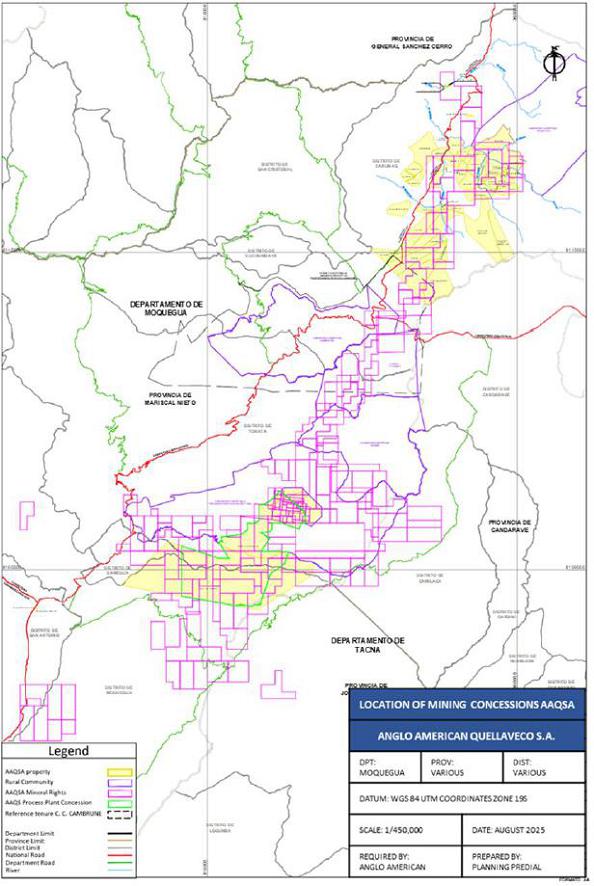
Source: Anglo American
Notes: Mineral concessions – purple borders, beneficiation concession – green border, surface rights – yellow shading.
| FINAL | 3 November 2025 | PAGE |
|
Anglo American plc NI 43-101 Technical Report – Quellaveco Property, Mariscal Nieto Province, Peru |
| Table 4.1 | Property mineral titles |
| ID | Code | Name | Status | Registered owner | Area (ha) | Grant date | Expiry date | Comments |
| 1 | 10414010 | ALTURAS 14 | Granted | AAQSA | 1,000.00 | 11/05/2011 | NA | |
| 2 | 10414110 | ALTURAS 15 | Granted | AAQSA | 900.00 | 06/04/2011 | NA | |
| 3 | 10414210 | ALTURAS 16 | Granted | AAQSA | 700.00 | 11/05/2011 | NA | |
| 4 | 10414310 | ALTURAS 17 | Granted | AAQSA | 1,000.00 | 11/05/2011 | NA | |
| 5 | 10428007 | ALTURAS 9 | Granted | AAQSA | 500.00 | 21/10/2009 | NA | |
| 6 | 10209907 | ALTURAS 1 | Granted | AAQSA | 1,000.00 | 17/09/2007 | NA | |
| 7 | 10210007 | ALTURAS 2 | Granted | AAQSA | 600.00 | 07/11/2007 | NA | |
| 8 | 10428107 | ALTURAS 10 | Granted | AAQSA | 500.00 | 05/09/2008 | NA | |
| 9 | 10332310 | ALTURAS 11 | Granted | AAQSA | 600.00 | 04/02/2011 | NA | |
| 10 | 10332410 | ALTURAS 12 | Granted | AAQSA | 900.00 | 11/05/2011 | NA | |
| 11 | 10427707 | ALTURAS 6 | Granted | AAQSA | 700.00 | 02/02/2008 | NA | |
| 12 | 10210107 | ALTURAS 3 | Granted | AAQSA | 900.00 | 07/11/2007 | NA | |
| 13 | 10427807 | ALTURAS 7 | Granted | AAQSA | 700.00 | 05/02/2008 | NA | |
| 14 | 10210207 | ALTURAS 4 | Granted | AAQSA | 900.00 | 14/09/2009 | NA | |
| 15 | 10210307 | ALTURAS 5 | Granted | AAQSA | 300.00 | 07/11/2007 | NA | |
| 16 | 10427907 | ALTURAS 8 | Granted | AAQSA | 400.00 | 11/06/2008 | NA | |
| 17 | 10414410 | ALTURAS 18 | Granted | AAQSA | 200.00 | 06/04/2011 | NA | |
| 18 | 10414510 | ALTURAS 19 | Granted | AAQSA | 400.00 | 11/05/2011 | NA | |
| 19 | 10414610 | ALTURAS 20 | Granted | AAQSA | 500.00 | 11/05/2011 | NA | |
| 20 | 10414710 | ALTURAS 21 | Granted | AAQSA | 800.00 | 11/05/2011 | NA | |
| 21 | 10414810 | ALTURAS 22 | Granted | AAQSA | 400.00 | 06/04/2011 | NA | |
| 22 | 10332510 | ALTURAS 13 | Granted | AAQSA | 600.00 | 11/05/2011 | NA | |
| 23 | 10416510 | DEMETRIO 2010 | Granted | AAQSA | 300.00 | 11/05/2011 | NA | |
| 24 | 10014196 | VALLECITO 10 | Granted | AAQSA | 1,000.00 | 14/06/1996 | NA | |
| 25 | 10014596 | VALLECITO 14 | Granted | AAQSA | 1,000.00 | 15/08/1996 | NA | |
| 26 | 10014296 | VALLECITO 11 | Granted | AAQSA | 1,000.00 | 14/06/1996 | NA | |
| 27 | 10201102 | VALLECITO 20 | Granted | AAQSA | 300.00 | 05/06/2023 | NA | |
| 28 | 10201002 | VALLECITO 21 | Granted | AAQSA | 200.00 | 05/06/2003 | NA | |
| 29 | 10377505 | CARPANITO 16 | Granted | AAQSA | 1,000.00 | 05/04/2006 | NA | |
| 30 | 10377005 | CARPANITO 22 | Granted | AAQSA | 418.60 | 05/04/2016 | NA | |
| 31 | 10376905 | CARPANITO 17 | Granted | AAQSA | 400.00 | 08/05/2006 | NA |
| FINAL | 3 November 2025 | PAGE |
|
Anglo American plc NI 43-101 Technical Report – Quellaveco Property, Mariscal Nieto Province, Peru |
| ID | Code | Name | Status | Registered owner | Area (ha) | Grant date | Expiry date | Comments |
| 32 | 10376805 | CARPANITO 15 | Granted | AAQSA | 998.38 | 08/05/2006 | NA | |
| 33 | 10377405 | CARPANITO 14 | Granted | AAQSA | 998.38 | 08/05/2006 | NA | |
| 34 | 10376505 | CARPANITO 10 | Granted | AAQSA | 998.38 | 05/04/2006 | NA | |
| 35 | 10376605 | CARPANITO 11 | Granted | AAQSA | 998.39 | 05/04/2006 | NA | |
| 36 | 10348810 | CARPANITO 23-2010 | Granted | AAQSA | 100.00 | 08/11/2011 | NA | |
| 37 | 10414910 | CARPANITO 26 | Granted | AAQSA | 400.00 | 06/04/2011 | NA | |
| 38 | 10415010 | CARPANITO 27 | Granted | AAQSA | 400.00 | 11/05/2011 | NA | |
| 39 | 10415110 | CARPANITO 28 | Granted | AAQSA | 500.00 | 06/04/2011 | NA | |
| 40 | 10377105 | CARPANITO 18 | Granted | AAQSA | 1,000.00 | 10/07/2006 | NA | |
| 41 | 10376705 | CARPANITO 12 | Granted | AAQSA | 998.38 | 08/05/2006 | NA | |
| 42 | 10377305 | CARPANITO 13 | Granted | AAQSA | 998.39 | 05/04/2006 | NA | |
| 43 | 10003806 | CARPANITO 19 | Granted | AAQSA | 1,000.00 | 05/06/2006 | NA | |
| 44 | 10415210 | CARPANITO 29 | Granted | AAQSA | 300.00 | 06/04/2011 | NA | |
| 45 | 10415310 | CARPANITO 30 | Granted | AAQSA | 300.00 | 06/04/2011 | NA | |
| 46 | 10348910 | CARPANITOS 24 | Granted | AAQSA | 500.00 | 04/02/2011 | NA | |
| 47 | 10415410 | CARPANITO 31 | Granted | AAQSA | 600.00 | 11/05/2011 | NA | |
| 48 | 10349010 | CARPANITO 25 | Granted | AAQSA | 200.00 | 01/06/2012 | NA | |
| 49 | 10415510 | CARPANITO 32 | Granted | AAQSA | 400.00 | 06/04/2011 | NA | |
| 50 | 10415610 | CARPANITO 33 | Granted | AAQSA | 500.00 | 11/05/2011 | NA | |
| 51 | 10298317 | CARPANITO 43 | Granted | AAQSA | 300.00 | 05/06/2006 | NA | |
| 52 | 10003906 | CARPANITO 20 | Granted | AAQSA | 1,000.00 | 05/06/2006 | NA | |
| 53 | 10004006 | CARPANITO 21 | Granted | AAQSA | 700.00 | 08/05/2021 | NA | |
| 54 | 10088793 | QUELLAVECO KELLY | Granted | AAQSA | 900.00 | 18/11/1994 | NA | |
| 55 | 10088593 | QUELLAVECO ELIZABETH | Granted | AAQSA | 300.00 | 18/07/1995 | NA | |
| 56 | 10088893 | QUELLAVECO CICI | Granted | AAQSA | 500.00 | 06/10/1995 | NA | |
| 57 | 10088693 | QUELLAVECO ANDREA | Granted | AAQSA | 300.00 | 28/11/1994 | NA | |
| 58 | 10298417 | CARPANITO 44 | Granted | AAQSA | 900.00 | 08/03/2019 | NA | |
| 59 | 10415710 | QUELLAVECO DAVID | Granted | AAQSA | 600.00 | 06/04/2011 | NA | |
| 60 | 10298517 | CARPANITO 45 | Granted | AAQSA | 700.00 | 06/12/2018 | NA | |
| 61 | 10415810 | QUELLAVECO DIEGO | Granted | AAQSA | 500.00 | 11/05/2011 | NA | |
| 62 | 10218117 | CARPANITO 34 | Granted | AAQSA | 900.00 | 13/06/2022 | NA | |
| 63 | 10218217 | CARPANITO 35 | Granted | AAQSA | 900.00 | 09/01/2019 | NA | |
| 64 | 10218517 | CARPANITO 36 | Granted | AAQSA | 1,000.00 | 09/01/2019 | NA |
| FINAL | 3 November 2025 | PAGE |
|
Anglo American plc NI 43-101 Technical Report – Quellaveco Property, Mariscal Nieto Province, Peru |
| ID | Code | Name | Status | Registered owner | Area (ha) | Grant date | Expiry date | Comments |
| 65 | 10218817 | CARPANITO 37 | Granted | AAQSA | 1,000.00 | 09/01/2019 | NA | |
| 66 | 10218717 | CARPANITO 42 | Granted | AAQSA | 1,000.00 | 09/01/2019 | NA | |
| 67 | 10218917 | CARPANITO 38 | Granted | AAQSA | 1,000.00 | 05/04/2019 | NA | |
| 68 | 10218617 | CARPANITO 41 | Granted | AAQSA | 500.00 | 09/09/2019 | NA | |
| 69 | 10218417 | CARPANITO 40 | Granted | AAQSA | 1,000.00 | 09/01/2019 | NA | |
| 70 | 10218317 | CARPANITO 39 | Granted | AAQSA | 1,000.00 | 04/10/2019 | NA | |
| 71 | 10088993 | QUELLAVECO MARINA | Granted | AAQSA | 900.00 | 14/02/1997 | NA | |
| 72 | 10049794 | QUELLAVECO SARA | Granted | AAQSA | 800.00 | 23/11/2022 | NA | |
| 73 | 10104593 | PROMOTA-56 | Granted | AAQSA | 400.00 | 15/11/1994 | NA | |
| 74 | 10085393 | TOQUEPALA 70 | Granted | AAQSA | 600.00 | 16/02/1996 | NA | |
| 75 | 10089393 | QUELLAVECO PATRICIA | Granted | AAQSA | 200.00 | 17/09/1996 | NA | |
| 76 | 10049894 | QUELLAVECO ESTER | Granted | AAQSA | 1,000.00 | 23/11/2024 | NA | |
| 77 | 10267005 | CARPANITO 8 | Granted | AAQSA | 1,000.00 | 20/01/2005 | NA | |
| 78 | 10267105 | CARPANITO 9 | Granted | AAQSA | 200.00 | 08/05/2006 | NA | |
| 79 | 10049994 | QUELLAVECO VERONICA | Granted | AAQSA | 900.00 | 15/12/1994 | NA | |
| 80 | 10124296 | PROMOTA 171 | Granted | AAQSA | 600.00 | 27/12/1996 | NA | |
| 81 | 10107393 | PROMOTA-84 | Granted | AAQSA | 1,000.00 | 27/06/2007 | NA | |
| 82 | 10107293 | PROMOTA-83 | Granted | AAQSA | 800.00 | 27/06/2007 | NA | |
| 83 | 10266905 | CARPANITO 7 | Granted | AAQSA | 600.00 | 20/01/2006 | NA | |
| 84 | 10266805 | CARPANITO 6 | Granted | AAQSA | 1,000.00 | 20/01/2006 | NA | |
| 85 | 10266605 | CARPANITO 4 | Granted | AAQSA | 1,000.00 | 20/01/2006 | NA | |
| 86 | 10266705 | CARPANITO 5 | Granted | AAQSA | 600.00 | 20/01/2006 | NA | |
| 87 | 10266505 | CARPANITO 3 | Granted | AAQSA | 1,000.00 | 20/01/2006 | NA | |
| 88 | 10090093 | QUELLAVECO WENDY | Granted | AAQSA | 300.00 | 22/01/1996 | NA | |
| 89 | 010088893A | QUELLAVECO CICI 1 | Granted | AAQSA | 100.00 | 20/05/1996 | NA | |
| 90 | 14000784X01 | VISCACHA N° UNO | Granted | AAQSA | 119.86 | 27/06/2007 | NA | |
| 91 | 14000785X01 | VISCACHA N° DOS | Granted | AAQSA | 119.86 | 27/11/1993 | NA | |
| 92 | 14000789X01 | VISCACHA N° TRES | Granted | AAQSA | 29.97 | 27/11/1993 | NA | |
| 93 | 14000783X01 | SAN MIGUEL | Granted | AAQSA | 107.88 | 27/11/1993 | NA | |
| 94 | 010088593A | QUELLAVECO ERICKA | Granted | AAQSA | 300.00 | 26/04/1996 | NA | |
| 95 | 14000756X01 | ORRANTIA | Granted | AAQSA | 119.86 | 27/09/1993 | NA | |
| 96 | 14000697X01 | SAN ISIDRO | Granted | AAQSA | 89.89 | 27/09/1993 | NA | |
| 97 | 14000106Y01 | MOQUEGUA | Granted | AAQSA | 23.97 | 27/09/1993 | NA |
| FINAL | 3 November 2025 | PAGE |
|
Anglo American plc NI 43-101 Technical Report – Quellaveco Property, Mariscal Nieto Province, Peru |
| ID | Code | Name | Status | Registered owner | Area (ha) | Grant date | Expiry date | Comments |
| 98 | 14878644Z07 | QUELLAVECO C | Granted | AAQSA | 47.94 | 27/09/1993 | NA | |
| 99 | 14000655X01 | TORATA | Granted | AAQSA | 31.96 | 27/09/1993 | NA | |
| 100 | 14000656X01 | ESPERANZA | Granted | AAQSA | 47.94 | 08/02/1996 | NA | |
| 101 | 14000632X01 | MILLUNE N° 2 | Granted | AAQSA | 47.94 | 27/09/1993 | NA | |
| 102 | 14000631X01 | MILLUNE N° 1 | Granted | AAQSA | 15.98 | 27/09/1993 | NA | |
| 103 | 14000104Y01 | MILLUNE NUMERO CERO | Granted | AAQSA | 11.99 | 27/09/1993 | NA | |
| 104 | 14878644Z03 | QUELLAVECO E | Granted | AAQSA | 23.97 | 27/09/1993 | NA | |
| 105 | 14878644Z05 | QUELLAVECO D | Granted | AAQSA | 59.93 | 27/09/1993 | NA | |
| 106 | 14878644Z01 | QUELLAVECO N° 2 | Granted | AAQSA | 39.95 | 27/09/1993 | NA | |
| 107 | 14878644Z02 | QUELLAVECO N° 1 | Granted | AAQSA | 39.95 | 27/09/1993 | NA | |
| 108 | 14878644Z08 | QUELLAVECO A | Granted | AAQSA | 111.87 | 27/09/1993 | NA | |
| 109 | 14000633X01 | MILLO N° 1 | Granted | AAQSA | 119.86 | 27/09/1993 | NA | |
| 110 | 010089393A | QUELLAVECO CHERYL | Granted | AAQSA | 100.00 | 16/02/1996 | NA | |
| 111 | 14000088Y01 | QUELLAVECO B | Granted | AAQSA | 71.92 | 27/09/1993 | NA | |
| 112 | 14000437X01 | QUELLAVECO N° 3 | Granted | AAQSA | 119.86 | 27/09/1993 | NA | |
| 113 | 14878644Z09 | QUELLAVECO N° 4 | Granted | AAQSA | 47.94 | 27/09/1993 | NA | |
| 114 | 14878644Z06 | QUELLAVECO OESTE N° 3 | Granted | AAQSA | 31.96 | 27/09/1993 | NA | |
| 115 | 14000638X01 | QUELLAVECO OESTE N° 2 | Granted | AAQSA | 63.93 | 27/09/1993 | NA | |
| 116 | 14000791X01 | DESMONTE NUMERO UNO | Granted | AAQSA | 119.86 | 27/09/1993 | NA | |
| 117 | 14878644Z04 | QUELLAVECO X | Granted | AAQSA | 565.52 | 27/09/1993 | NA | |
| 118 | 10091898 | QUELLAVECO TERESA | Granted | AAQSA | 1,000.00 | 21/12/1998 | NA | |
| 119 | 10091998 | QUELLAVECO ISABEL | Granted | AAQSA | 1,000.00 | 21/12/1998 | NA | |
| 120 | 10089093 | QUELLAVECO LILIANA | Granted | AAQSA | 400.00 | 20/05/1996 | NA | |
| 121 | 14000792X01 | DESMONTE N° DOS | Granted | AAQSA | 59.93 | 27/09/1993 | NA | |
| 122 | 14000790X01 | PEÑON N° DOS | Granted | AAQSA | 35.96 | 27/09/1993 | NA | |
| 123 | 14000658X01 | PEÑON | Granted | AAQSA | 53.94 | 27/09/1993 | NA | |
| 124 | 14000659X01 | CUATRO DE JULIO | Granted | AAQSA | 71.92 | 27/09/1993 | NA | |
| 125 | 10085493 | TOQUEPALA 71 | Granted | AAQSA | 800.00 | 29/04/1996 | NA | |
| 126 | 10089293 | QUELLAVECO ROSA | Granted | AAQSA | 400.00 | 23/03/1993 | NA | |
| 127 | 10089493 | QUELLAVECO LINDA | Granted | AAQSA | 400.00 | 27/06/2007 | NA | |
| 128 | 10160307 | CARACOLES 4 | Granted | AAQSA | 200.00 | 09/05/2008 | NA | |
| 129 | 10048899 | DORALUZ | Granted | AAQSA | 1,000.00 | 03/12/1999 | NA | |
| 130 | 10048799 | NERY EMILIA | Granted | AAQSA | 1,000.00 | 09/11/1999 | NA | |
| 131 | 10160407 | CARACOLES 3 | Granted | AAQSA | 300.00 | 22/01/2008 | NA |
| FINAL | 3 November 2025 | PAGE |
|
Anglo American plc NI 43-101 Technical Report – Quellaveco Property, Mariscal Nieto Province, Peru |
| ID | Code | Name | Status | Registered owner | Area (ha) | Grant date | Expiry date | Comments |
| 132 | 10095693 | EVA | Granted | AAQSA | 900.00 | 03/08/1994 | NA | |
| 133 | 10160207 | CARACOLES 2 | Granted | AAQSA | 500.00 | 22/01/2008 | NA | |
| 134 | 10160507 | CARACOLES 1 | Granted | AAQSA | 600.00 | 07/11/2007 | NA | |
| 135 | 10816695 | PORQUENE | Granted | AAQSA | 800.00 | 05/07/1996 | NA | |
| 136 | 10095893 | PIERINA | Granted | AAQSA | 800.00 | 08/08/2000 | NA | |
| 137 | 10106193 | PROMOTA-72 | Granted | AAQSA | 600.00 | 10/12/1999 | NA | |
| 138 | 10093893 | VIVIANA | Granted | AAQSA | 1,000.00 | 08/08/2000 | NA | |
| 139 | 10106293 | PROMOTA-73 | Granted | AAQSA | 100.00 | 10/12/1999 | NA | |
| 140 | 10093293 | MABEL | Granted | AAQSA | 1,000.00 | 08/08/2000 | NA | |
| 141 | 10266205 | CARPANITO | Granted | AAQSA | 1,000.00 | 20/01/2006 | NA | |
| 142 | 10092298 | QUELLAVECO LOURDES | Granted | AAQSA | 200.00 | 21/12/1998 | NA | |
| 143 | 10089593 | QUELLAVECO MAXINE | Granted | AAQSA | 400.00 | 06/10/1995 | NA | |
| 144 | 10266305 | CARPANITO 1 | Granted | AAQSA | 600.00 | 20/01/2006 | NA | |
| 145 | 10266405 | CARPANITO 2 | Granted | AAQSA | 600.00 | 20/01/2006 | NA | |
| 146 | 10093193 | LUCIA | Granted | AAQSA | 1,000.00 | 09/08/2000 | NA | |
| 147 | 10093393 | ANABELA | Granted | AAQSA | 1,000.00 | 09/08/2000 | NA | |
| 148 | 10093493 | DIANA | Granted | AAQSA | 1,000.00 | 09/08/2000 | NA | |
| 149 | 10095293 | NAOMI | Granted | AAQSA | 1,000.00 | 09/08/2000 | NA | |
| 150 | 10095193 | ANGELA | Granted | AAQSA | 1,000.00 | 09/08/2000 | NA | |
| 151 | 10107793 | PROMOTA-88 | Granted | AAQSA | 500.00 | 10/12/1999 | NA | |
| 152 | 10160107 | TOLAR | Granted | AAQSA | 300.00 | 05/02/2008 | NA | |
| 153 | 10097316 | QUELLA 16 | Granted | AAQSA | 600.00 | 08/03/2018 | NA | |
| 154 | 10097416 | QUELLA 15 | Granted | AAQSA | 600.00 | 05/06/2017 | NA | |
| 155 | 10416610 | CARACOLES 5 | Granted | AAQSA | 100.00 | 06/04/2011 | NA | |
| 156 | 10415910 | CARACOLES 6 | Granted | AAQSA | 200.00 | 06/04/2011 | NA | |
| 157 | 10416010 | CARACOLES 7 | Granted | AAQSA | 200.00 | 06/04/2011 | NA | |
| 158 | 10416110 | CARACOLES 8 | Granted | AAQSA | 200.00 | 11/05/2011 | NA | |
| 159 | 10332610 | LUCIANA 2011 | Granted | AAQSA | 600.00 | 01/02/2011 | NA | |
| 160 | 10332710 | CAMILA 2010 | Granted | AAQSA | 600.00 | 04/02/2011 | NA | |
| 161 | 10332810 | ISABEL 2011 | Granted | AAQSA | 700.00 | 08/11/2011 | NA | |
| 162 | 10097916 | QUELLA 09 | Granted | AAQSA | 1,000.00 | 06/12/2017 | NA | |
| 163 | 10332910 | DIALDANA | Granted | AAQSA | 800.00 | 06/04/2011 | NA | |
| 164 | 10333010 | CECILIA 2010 | Granted | AAQSA | 800.00 | 06/04/2011 | NA | |
| 165 | 10333110 | URSULA 2011 | Granted | AAQSA | 300.00 | 04/02/2011 | NA |
| FINAL | 3 November 2025 | PAGE |
|
Anglo American plc NI 43-101 Technical Report – Quellaveco Property, Mariscal Nieto Province, Peru |
| ID | Code | Name | Status | Registered owner | Area (ha) | Grant date | Expiry date | Comments |
| 166 | 10333210 | SANDRA 2010 | Granted | AAQSA | 500.00 | 11/05/2011 | NA | |
| 167 | 10098016 | QUELLA 07 | Granted | AAQSA | 300.00 | 06/12/2017 | NA | |
| 168 | 10098516 | QUELLA 11 | Granted | AAQSA | 800.00 | 08/05/2017 | NA | |
| 169 | 10055317 | EL CHORRO 02 | Granted | AAQSA | 1,000.00 | 06/08/2018 | NA | |
| 170 | 10055417 | EL CHORRO 01 | Granted | AAQSA | 1,000.00 | 10/01/2018 | NA | |
| 171 | 10055217 | EL CHORRO 03 | Granted | AAQSA | 1,000.00 | 03/02/2023 | NA | |
| 172 | 10055117 | EL CHORRO 04 | Granted | AAQSA | 700.00 | 06/12/2017 | NA | |
| 173 | 10055017 | EL CHORRO 05 | Granted | AAQSA | 800.00 | 05/02/2018 | NA | |
| 174 | 10054917 | EL CHORRO 06 | Granted | AAQSA | 800.00 | 05/02/2018 | NA | |
| 175 | 10054717 | EL CHORRO 07 | Granted | AAQSA | 900.00 | 03/02/2023 | NA | |
| 176 | 10054817 | EL CHORRO 08 | Granted | AAQSA | 900.00 | 05/08/2018 | NA | |
| 177 | 10097516 | QUELLA 14 | Granted | AAQSA | 1,000.00 | 06/12/2017 | NA | |
| 178 | 10146306 | ESPEJOS 1 | Granted | AAQSA | 1,000.00 | 08/08/2006 | NA | |
| 179 | 10146406 | ESPEJOS 2 | Granted | AAQSA | 1,000.00 | 08/08/2006 | NA | |
| 180 | 10146506 | ESPEJOS 3 | Granted | AAQSA | 1,000.00 | 08/08/2006 | NA | |
| 181 | 10147006 | ESPEJOS 7 | Granted | AAQSA | 400.00 | 10/01/2007 | NA | |
| 182 | 10146906 | ESPEJOS 6 | Granted | AAQSA | 600.00 | 06/08/2007 | NA | |
| 183 | 10146806 | ESPEJOS 5 | Granted | AAQSA | 1,000.00 | 08/08/2006 | NA | |
| 184 | 10146706 | ESPEJOS 4 | Granted | AAQSA | 1,000.00 | 08/08/2006 | NA | |
| 185 | P000000112 | QUELLAVECO | Granted | AAQSA | 13,731.09 | NA | NA | Process plant and TSF |
Source: AAQSA
Notes: Mine area concessions – grey shading.
NA – not applicable
| FINAL | 3 November 2025 | PAGE |
|
Anglo American plc NI 43-101 Technical Report – Quellaveco Property, Mariscal Nieto Province, Peru |
| Figure 4.2 | Quellaveco mine area mineral titles |
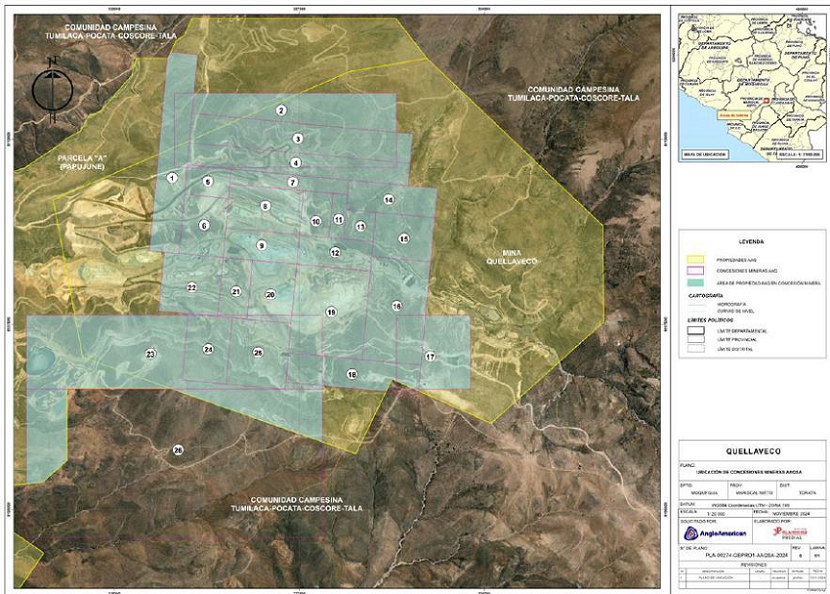
Source: Anglo American
Notes: Mining concessions – teal shading; surface rights – yellow shading.
| FINAL | 3 November 2025 | PAGE |
|
Anglo American plc NI 43-101 Technical Report – Quellaveco Property, Mariscal Nieto Province, Peru |
| 4.3 | Issuer’s interest |
Anglo American holds a 60% interest in the Property through Anglo American Quellaveco S.A. (AAQSA) with the other 40% interest is held by Mitsubishi Corporation.
| 4.4 | Surface rights |
AAQSA holds surface rights covering a total area of 429.22 km2. The southern block (~220 km2) covers the operations, and tailings and waste storage areas, The northern block (~209 km2) covers the water intake areas (Figure 4.1).
| 4.5 | Royalties, back-in rights, payments, agreements, encumbrances |
In December 2019, AAQSA signed a Tax Stability Agreement for 15 years from 1 January 2021, covering tax rates and methods for calculating tax on all major government taxes, duties, royalties and other similar payments.
| 4.6 | Environmental liabilities |
Environmental assurances currently lodged against the Property are summarized in Item 20.6.
A Rehabilitation and Mine Closure Plan has been prepared in accordance with the Peruvian Mine Closure Law (Law 28090) and its Regulations under Supreme Decree 033-2005-EM. The current undiscounted closure cost estimate (2022 PCM update) is $1,956 million, comprising $647 million for progressive closure during the mine’s production life, $1,196 million for final closure and $113 million for post-closure activities. Further details on closure requirements, implementation schedule, and financial assurance are provided in Item 20.6.
No other surface disturbances, land compensation, road maintenance obligations or environmental liabilities are known to exist beyond those described in the approved closure plan.
| 4.7 | Permits |
Quellaveco has all the major permits and approvals in place to support commercial operations.
The fourth amendment to the EIA (4th MEIA) was approved in 2015 along with the associated sectoral permits. The 2025 base case Mineral Reserve mine plan will extend the open pit outside of the 4th MEIA approved boundaries. The 5th MEIA application supporting the increase in the footprint for the open pit and waste dump will also increase the approved capacity for mine dewatering. The Supporting Technical Report (ITS 13), approved in January 2025, allows increased concentrator throughput to 150 kt/d. ITS 14, approved in August 2025, allows an increase in the total movement of the mine to 150 Mt/a. The 5th MEIA is planned to be submitted in 2026, and approval is expected by mid-2027.
Further details on the status of permitting are provided in Item 20.
| 4.8 | Other significant factors and risks |
The north wall of the Quellaveco open pit is influenced by major fault structures, variable rock strength, and elevated pore pressures. The principal risks involve inter ramp-scale instability, particularly during wet periods or active pushbacks. These are managed through controlled blasting, slope-scale depressurization, detailed geotechnical mapping and continuous slope monitoring using prisms, radar, and piezometers. Current slope performance is within design expectations, with no significant departures from predicted factors of safety.
| FINAL | 3 November 2025 | PAGE |
|
Anglo American plc NI 43-101 Technical Report – Quellaveco Property, Mariscal Nieto Province, Peru |
The Asana River diversion tunnel lies near the northern pit sector and is subject to potential stress and vibration impacts from mining. Ground support and monitoring programs are in place to control convergence and prevent water inflows. Future closure works will include concrete plugs at both ends of the tunnel, with grout curtains and pressure-relief measures to ensure long-term hydraulic stability.
Facilities and waste storage locations are constrained by geotechnical, hydrological and environmental limits. Areas outside permitted boundaries (pending the 5th MEIA) are classified as Probable Mineral Reserves until permits for this zone are granted.
| FINAL | 3 November 2025 | PAGE |
|
Anglo American plc NI 43-101 Technical Report – Quellaveco Property, Mariscal Nieto Province, Peru |
| 5 | Accessibility, climate, local resources, infrastructure, and physiography |
| 5.1 | Topography, elevation and vegetation |
The Quellaveco mine is at an elevation of approximately 3,500 masl along the western flank of the Andes in southern Peru. The property covers a rugged terrain characterized by steep sided valleys and sharp changes in elevation within an extensive arid desert region. Vegetation cover is limited to mainly thorny plants, shrubs and grasslands.
| 5.2 | Access |
The Property can be accessed by air through the international airports at Arequipa or Tacna and via the Southern Panamericana Highway to Moquegua. The road distance from Arequipa is approximately 220 km and approximately 160 km from Tacna to the southeast near the Chilean border.
Access from Moquegua to the Quellaveco mine site is via a paved road for approximately 48 km.
| 5.3 | Proximity to population centre and transport |
Moquegua, with a population of approximately 70,000, is predominantly a mining and agriculture services town offering a range of supply, medical and accommodation services. Ilo is a port town on the southern coastline of Peru in the Moquegua region with a population of approximately 67,000. Copper concentrate from Quellaveco is trucked 82 km to the Port of Ilo for shipment to customers.
| 5.4 | Climate and length of operating season |
The climate at the mine site is characterized by a wet season between December and March and a dry season between April and November when the highest daytime temperatures are recorded (up to 22°C). Subzero temperatures (down to -6°C) are frequently recorded during June and July. The average annual rainfall is 266 mm recorded on an average of 62 days. Mining and processing operations at Quellaveco are conducted year-round. Weather-related downtime is minimal due to the region’s semi-arid climate and strong seasonality.
| 5.5 | Infrastructure |
The sufficiency of the surface rights to support the project is discussed in Item 4.4. Existing infrastructure and facilities include:
| · | Concentrator including crushing and grinding, flotation, thickening and filtration circuits |
| · | Concentrate transportation and port |
| · | Administration and mine offices |
| · | Maintenance workshops |
| · | Warehouse |
| · | Analytical laboratory |
| · | Accommodation camp |
| · | Tailings storage |
| · | Waste rock dumps |
| FINAL | 3 November 2025 | PAGE |
|
Anglo American plc NI 43-101 Technical Report – Quellaveco Property, Mariscal Nieto Province, Peru |
| · | Sediment ponds |
| · | Fuel station |
| · | Grid power supply and powerlines |
| · | Main access road and service roads |
| · | Freshwater intake and distribution |
| · | Asana Valley river diversion. |
The site layout is shown in Figure 5.1.
| FINAL | 3 November 2025 | PAGE |
|
Anglo American plc NI 43-101 Technical Report – Quellaveco Property, Mariscal Nieto Province, Peru |
| Figure 5.1 | Quellaveco site layout |
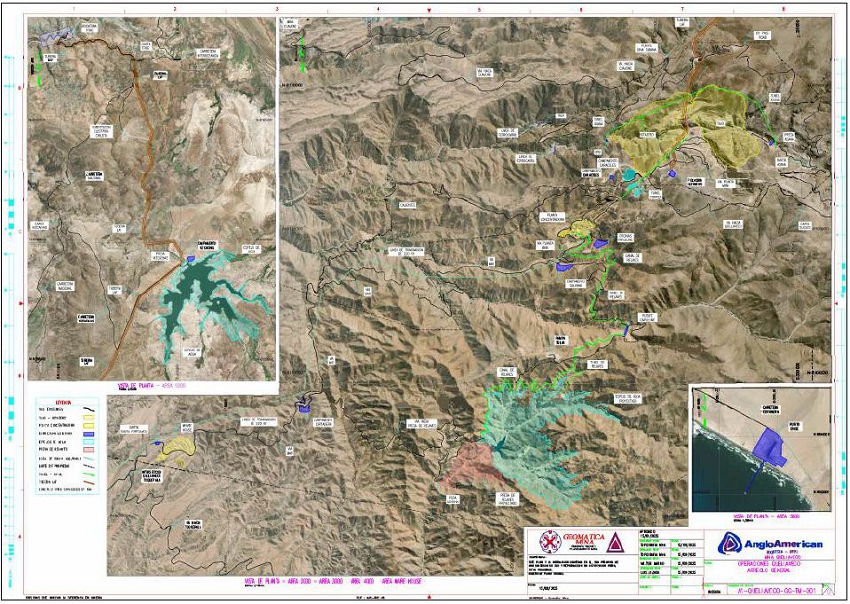
Source: Anglo American
| FINAL | 3 November 2025 | PAGE |
|
Anglo American plc NI 43-101 Technical Report – Quellaveco Property, Mariscal Nieto Province, Peru |
| 5.6 | Workforce |
Quellaveco employs a steady-state operational workforce of approximately 9,000 personnel, including about 3,500–4,000 Anglo American employees and 5,000–6,000 contractors supporting mining, processing, maintenance, logistics and site services. Camp facilities near the plant site provide accommodation for up to 5,000 people and include medical, catering and recreational amenities. Work schedules are typically 14 x 7 or 10 x 5 rotations. Approximately 80% of unskilled labour and 30–40% of the total workforce are sourced from the Moquegua Region, consistent with Dialogue Table commitments and AASW3 3.0 standards. Workforce levels peaked at around 20,000 during construction and have since stabilized at operational levels.
| FINAL | 3 November 2025 | PAGE |
|
Anglo American plc NI 43-101 Technical Report – Quellaveco Property, Mariscal Nieto Province, Peru |
| 6 | History |
The discovery of the Quellaveco porphyry copper-molybdenum deposit dates to 1938 with initial ownership by Cerro de Pasco Corporation from 1938, ASARCO/Northern Peru Mining & Smelting from 1944 and Southern Peru Copper Corporation from 1952.
In 1970, ownership of the Quellaveco deposit reverted to the State-owned mining company Minero Peru. In 1992, Anglo American acquired the Quellaveco deposit for about $12 million through a privatization process.
In 1993, Anglo American reached an agreement with the IFC to jointly finance the development of the mine. IFC’s 18.11% interest in the Property was acquired by Mitsubishi Corporation in 2011. Mitsubishi Corporation increased its stake in Quellaveco to 40% in 2018.
Following a series of studies culminating in the 2017 FS for a 127,500 t/d operation, development of the mine and construction of a concentrator was approved in 2018. Commercial copper production was achieved in September 2022. The molybdenum plant commenced commercial production in 2023.
| 6.1 | Previous exploration |
Various churn and DD drilling campaigns were conducted between 1947 and 2024 to evaluate the Quellaveco deposit as summarized in Table 6.1.
| Table 6.1 | Summary of previous drilling at Quellaveco |
| Date | Drillholes | Type | Total metres |
| 1947 | 112 | Churn | ~15,600 |
| 1970 | 31 | DD | 4,230 |
| 1972–1974 | 81 | DD | 15,104 |
| 1993 | 40 | DD | 5,739 |
| 1996 | 5 | DD | 1,443 |
| 1999 | 4 | DD | 1,836 |
| 2007 | 12 | DD | 9,466 |
| 2008 | 30 | RC | 5,569 |
| 2009 | 84 | RC | 12,026 |
| 2013–2014 | 57 | DD | 9,953 |
| 2015 | 8 | DD | 6,366 |
| 2017 | 29 | DD | 16,496 |
| 2018 | 5 | DD | 3,222 |
| 2019 | 15 | DD | 4,446 |
| 2022 | 14 | DD | 2,800 |
| 2023 | 147 | DD/RC | 11,344 |
| 2024 | 666 | DD/RC | 77,223 |
Source: Anglo American, 2025a
Further details of the drilling programs completed are disclosed in Item 10.
| 6.2 | Historical resource estimates |
The Qualified Person has not done sufficient work to classify the historical estimates prior to 2024 as current Mineral Resources. Anglo American is not treating the historical estimates as current Mineral Resources as they may not meet the 2014 CIM Definition Standards for Mineral Resources and Mineral Reserves and they should not be relied upon.
| FINAL | 3 November 2025 | PAGE |
|
Anglo American plc NI 43-101 Technical Report – Quellaveco Property, Mariscal Nieto Province, Peru |
| 6.3 | Production history |
The production history at Quellaveco since the commencement of operations in mid-2022 is summarized in Table 6.2.
| Table 6.2 | Quellaveco production history |
| Year | Tonnes processed (Mt) |
Grade processed (% Cu) |
Copper concentrate produced (dmt) |
Copper produced (t) |
C1 unit cost incl. by-product credits ($/lb) |
Capex ($ M) |
| 2022 | 11.72 | 1.12 | 329,211 | 102,300 | 1.36 | 814 |
| 2023 | 39.76 | 0.96 | 1,031,000 | 319,000 | 1.11 | 416 |
| 2024 | 49.90 | 0.76 | 1,113,400 | 306,300 | 1.05 | 437 |
Source: Anglo American
| FINAL | 3 November 2025 | PAGE |
|
Anglo American plc NI 43-101 Technical Report – Quellaveco Property, Mariscal Nieto Province, Peru |
| 7 | Geological setting and mineralization |
| 7.1 | Regional geology |
The Quellaveco porphyry copper-molybdenum deposit is hosted within a large batholithic, equigranular granodiorite complex (~60 Ma), which intruded into Toquepala Group (~72.4–65 Ma) volcanic rocks. The deposit is in the southwest of the Western Cordillera of Peru (Figure 7.1).
The Incapuquio fault system is the regional structural control on the Peruvian side of the Paleocene-Eocene copper belt, spatially associated with porphyry copper-molybdenum deposits such as Cerro Verde, Cuajone, Quellaveco and Toquepala, whereas on the Chilean side, Cerro Colorado and Spence are the most well-known representatives of the belt.
| Figure 7.1 | Regional geological setting |
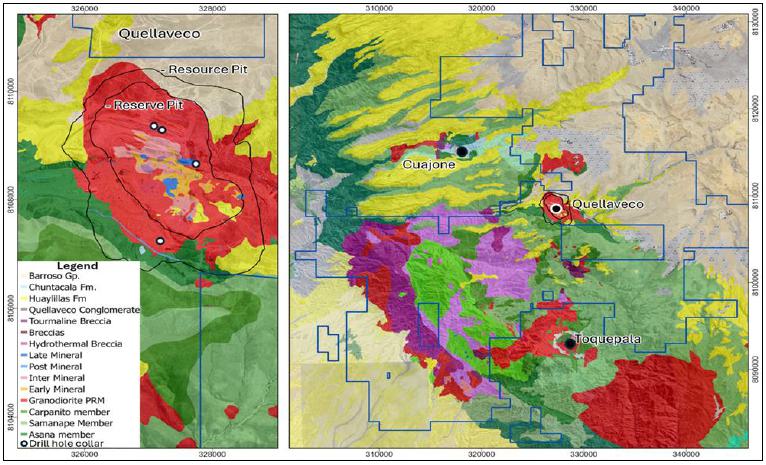
Source: Anglo American, 2024
The Quellaveco geological district has been affected by differing sequences of volcanic and intrusive activity, which are grouped into the following units:
| 7.1.1 | Toquepala Group |
Comprised of thick sequences of unconformably interfingered rhyolite and andesite lava flows and pyroclastic rocks. The following members are identified within the Toquepala Group:
| · | Quellaveco Rhyolites: The Quellaveco Rhyolite forms the lower member of the Toquepala Group where it unconformably overlies granodioritic intrusions. It comprises rhyolitic lava flows exhibiting pinkish-white to grey hues and a porphyritic texture, characterized by white orthoclase and quartz phenocrysts up to 2 cm in size set within a fine-grained siliceous aphanitic matrix. This unit represents an early phase of felsic volcanism preceding the emplacement of the overlying andesitic sequences of the Toquepala Group. |
| FINAL | 3 November 2025 | PAGE |
|
Anglo American plc NI 43-101 Technical Report – Quellaveco Property, Mariscal Nieto Province, Peru |
| · | Alta Series: The intermediate and most extensive member of the Toquepala Group unconformably overlies the Quellaveco Rhyolite and is composed of interfingered andesitic lava flows, coarse pyroclastic deposits and autobreccias. The rocks display grey, reddish and greenish hues, and vary texturally from aphanitic to porphyritic, containing plagioclase phenocrysts set in a groundmass of volcanic glass and plagioclase microliths. |
| · | Asana Rhyolites: The Asana Rhyolite constitutes the upper member of the Toquepala Group, unconformably overlying the Alta Series Member. It is composed of thickly stratified rhyolitic lava flows exhibiting grey to pink hues with a porphyritic texture of feldspar and occasional hornblende phenocrysts irregularly distributed within an aphanitic to microgranular groundmass. |
| 7.1.2 | Regional Granodiorite |
Granodioritic intrusions cut the volcanic sequences of the Toquepala Group and are characterized by a greenish-grey coloration with equigranular to porphyritic textures. The rock is phaneritic and holocrystalline, with biotite and amphibole as the dominant mafic minerals. This intrusive phase represents a key pre-mineral event that provided the structural and compositional framework for subsequent porphyry intrusions and hydrothermal mineralization within the region.
| 7.1.3 | Huaylillas Formation |
This unit unconformably overlies the Toquepala Group and adjacent intrusive bodies and consists predominantly of welded tuffs and rhyolitic ignimbrites, interbedded with compacted cineritic layers. Locally, these tuffs have undergone meteoric alteration, producing thick horizons of coarse-grained sand. The formation is interpreted to be Pliocene in age, representing a younger volcanic and sedimentary sequence that blankets the older volcanic and intrusive rocks of the region.
Figure 7.2 presents a generalized stratigraphic column for the region.
| FINAL | 3 November 2025 | PAGE |
|
Anglo American plc NI 43-101 Technical Report – Quellaveco Property, Mariscal Nieto Province, Peru |
| Figure 7.2 | Generalized stratigraphic column |
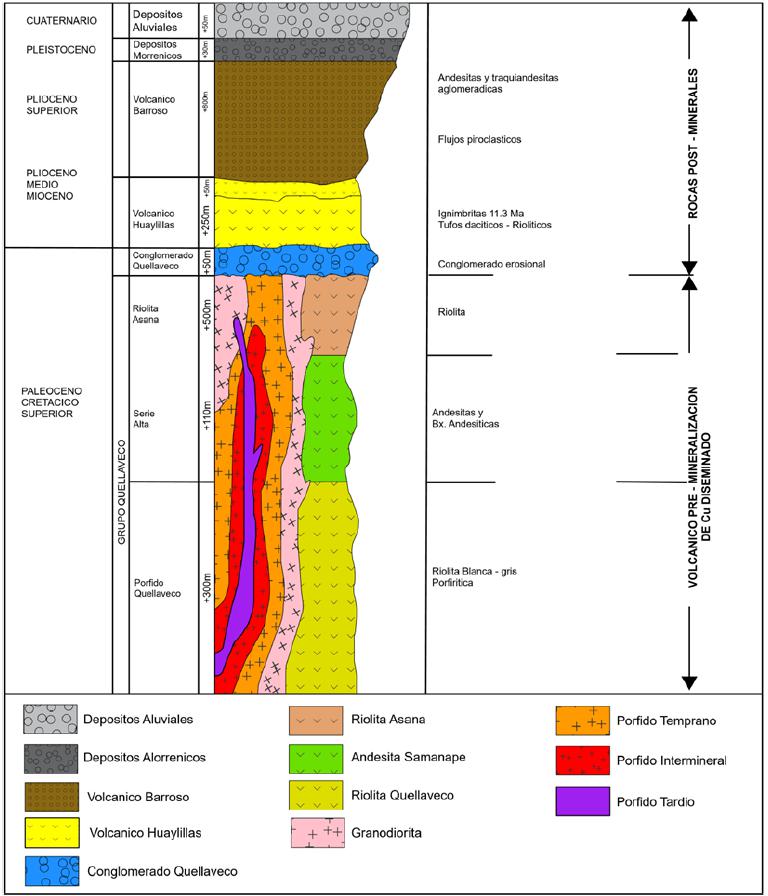
Source: Anglo American
| FINAL | 3 November 2025 | PAGE |
|
Anglo American plc NI 43-101 Technical Report – Quellaveco Property, Mariscal Nieto Province, Peru |
| 7.1.4 | Regional structure |
The Moquegua region is subdivided into three principal geotectonic units:
| · | Arequipa Massif (Macizo de Arequipa): A rigid block composed of Precambrian and Paleozoic rocks forming the continental margin. |
| · | Moquegua Basin (Cuenca de Moquegua): A thick sedimentary basin containing Cretaceous and Paleogene sequences. |
| · | Western Cordillera (Toquepala-Quellaveco belt): Dominated by volcanic and acidic intrusive rocks forming the western slope of the Andes, and hosting the Toquepala, Cuajone and Quellaveco porphyry deposits. |
These geotectonic units trend to the northwest with their boundaries defined by major northwest-trending faults broadly perpendicular to the principal direction of compression. Other east-west and northeast-southwest trending faults are associated with the convergence of the Nazca and South American plates.
At a district scale, the porphyry deposits are controlled by N45°W trending lineaments, including the Incapuquio fault, Micalaco fault and Quellaveco fault. These faults are readily identified on satellite imagery and in the field by large escarpments, abrupt lithological contacts and elongated intrusions. They are predominantly transcurrent faults, and their intersection with minor perpendicular structures created zones of weakness that localized porphyry intrusions during the Paleocene-Eocene.
At Quellaveco, the Asana fault, aligned with the Asana River and oriented perpendicular to the Quellaveco fault, provided the principal structural control for the emplacement of the mineralized intrusions.
| 7.2 | Local geology |
The Quellaveco porphyry copper-molybdenum deposit is hosted within a large batholithic, equigranular granodiorite intrusive complex (~60 Ma) intruding Toquepala Group volcanic rocks.
The porphyry system is an elongate mineralized zone trending to the northwest and covering an area of approximately 1 km2. The deposit is partially exposed in the Asana River valley, which transects the deposit.
The Quellaveco deposit is underlain by a sequence of pre-mineral volcanic rocks and intrusives represented by an extensive granodiorite pluton (Figure 7.3). This was subsequently intruded by multiple phases of monzonitic porphyry, which are directly associated with hydrothermal alteration and primary sulphide mineralization consisting of chalcopyrite, molybdenite and pyrite.
Following mineralization, the intrusive complex underwent partial erosion, after which it was unconformably overlain by pyroclastic volcanic rocks and localized breccia bodies. A subsequent phase of erosion further modified the present-day geological setting.
| FINAL | 3 November 2025 | PAGE |
|
Anglo American plc NI 43-101 Technical Report – Quellaveco Property, Mariscal Nieto Province, Peru |
| Figure 7.3 | Quellaveco local geology |

Source: Anglo American
| 7.2.1 | Lithology |
The various lithological types present in the deposit area are divided into pre-mineral, post-mineral and intrusive rocks.
Pre-mineralization volcanic rocks
Quellaveco Rhyolite
Rhyolite belonging to the basal part of the Quellaveco Formation outcrops in the southern and northwestern (Charaque) sectors of the deposit. These rhyolites are white-pink to grey, with a porphyritic texture and quartz phenocrysts in a fluidal matrix. Hydrothermal overprinting is marked by vertical fracturing, silicification, sporadic pyrite dissemination and thin quartz-tourmaline veinlets with quartz-sericite halos.
Post-mineralization rocks
Quellaveco Conglomerate
A sequence of poorly consolidated conglomerates and breccias (30–60 m thick) formed by prolonged weathering and erosion is characterized by rhyolite, andesite, andesitic breccia, granodiorite and altered quartz porphyry clasts in a detrital matrix. Minor exotic copper mineralization (chrysocolla) occurs in this unit which underlies ignimbrites of the Chuntacala Formation.
| FINAL | 3 November 2025 | PAGE |
|
Anglo American plc NI 43-101 Technical Report – Quellaveco Property, Mariscal Nieto Province, Peru |
Chuntacala Formation
Ignimbrites which discordantly overlie the conglomerate and older rocks and consist of dacitic tuffs and rhyolitic ignimbrites. Outcrops north of the Asana River reach thicknesses of up to 300 m and completely cover the deposit. These rocks are fresh, aphanitic and well-consolidated, with limited structural disruption aside from columnar jointing.
Intrusive rocks
The intrusive rocks hosting the Quellaveco deposit are grouped into the following units:
Granodiorite
Granodiorite is the principal host rock and is widely distributed across the deposit. It is a biotite-hornblende granodiorite, medium-grained to coarse-grained, with equigranular to porphyritic textures. Alteration varies from propylitic on the margins (epidote, chlorite, kaolinite) to potassic and quartz-sericite within the deposit, particularly adjacent to early and intermediate porphyries. The granodiorite intrudes the Quellaveco Rhyolite and is itself intruded by younger porphyries.
Early monzonitic porphyry
Early porphyry is the largest hypabyssal porphyry stock and is elliptical in plan (~1,500 m x 400–500 m) with a northwest-southeast trend. It intrudes the granodiorite and is cut by intermediate porphyry, dacite dykes and late porphyry. Two sub-types are recognized:
| · | Early Porphyry 1 – Rare (identified in two drillholes) with textures obliterated by alteration, consisting of dense quartz aggregates with magnetite, chlorite, pyrite and disseminated chalcopyrite. |
| · | Early Porphyry 2 – Light grey granodioritic porphyry with plagioclase, biotite, amphibole phenocrysts and quartz eyes (7%) in a fine groundmass. Copper grades average 0.3–0.9% Cu as disseminated chalcopyrite in association with K-feldspar and sericite veinlets. |
Intermediate monzonitic porphyry
This porphyry body was initially defined in the north-central deposit area (600 m x 200 m body) but later identified in the south from deep drilling. Three sub-types are recognized:
| · | Intermineral Porphyry 1 – Light grey porphyry with 30% plagioclase phenocrysts and 5% quartz eyes with weak secondary biotite. |
| · | Intermineral Porphyry 2 – Similar to Type 1 but with fewer quartz eyes (<3%) and reduced quartz veinlets. |
| · | Late Intermineral Porphyry – Dark grey, intensely biotized, with plagioclase phenocrysts and minor quartz eyes and typically appears as narrow dykes (1–5 m). Mineralization occurs as disseminated chalcopyrite and veinlets with grades ranging from 0.2% to 0.7% Cu. |
Late monzonitic porphyry
Late porphyry occurs as four discrete bodies aligned southeast–northwest. The largest outcrops in the central-southern area of the deposit (~350 m x 200 m to the northwest) are characterized by a porphyritic texture with 35–40% plagioclase, 8% quartz eyes, ferromagnesian minerals and weak chloritization. Below the supergene zone, it is essentially barren (<0.15% Cu), though grades may reach 1.5% Cu in mixed oxide-secondary sulphide zones.
| FINAL | 3 November 2025 | PAGE |
|
Anglo American plc NI 43-101 Technical Report – Quellaveco Property, Mariscal Nieto Province, Peru |
Dacite dykes
Numerous minor intrusions crosscut earlier porphyries and granodiorite. They are porphyritic with plagioclase phenocrysts in a quartz-orthoclase-biotite matrix and weakly mineralized with pyrite and minor chalcopyrite (<0.3% Cu). Drilling has identified 187 dykes, ranging from 0.13 m to 18.00 m in thickness (average 2.50 m), trending northwest–southeast.
Breccias
Breccias are volumetrically limited but locally significant with two types recognized:
| · | Hydrothermal breccias – Occur as northwest-trending chimneys of up to 150 m in length, with porphyry clasts in a quartz-rock powder matrix, infilled with quartz, anhydrite and traces of sphalerite, galena, tetrahedrite, pyrite and calcite. |
| · | Intrusive breccias (pebble dykes) – Occur as small pipes/dykes up to 5 m in thickness with rounded intrusive clasts in a crushed matrix. They are barren of mineralization. |
| 7.2.2 | Local structure |
The Quellaveco deposit is controlled by a network of regional and local faults that have created a zone of structural weakness for the emplacement of porphyry intrusions, hydrothermal breccias and associated alteration.
The deposit lies at the intersection of northwest trending faults (parallel to the regional Incapuquio and Micalaco systems) with subordinate east-west and northeast-southwest trending faults. The northwest-southeast structural trend is clearly developed in the porphyry intrusions.
The Asana fault, which follows the Asana River, trends west-northwest with a subvertical dip and a width of 2–20 m. It is characterized by fault gouge, slickensides and wide lateral fracture zones. A vertical displacement of ~70 m has been observed outside the deposit footprint. Grade distributions of copper and molybdenum indicate that the Asana fault offsets the higher-grade northern sector of the deposit from the lower-grade southern sector.
Post-mineral faulting also affects the deposit. The east-west trending Moises fault outcrops for over 400 m along the Asana River. The fault zone is 10–15 m wide, consisting of parallel fault strands with gouge and secondary fracturing, producing local displacements of up to 12 m. The northeast-trending Bobby fault is a tensional structure of up to 50 cm in width, dipping 45–50° to the northwest, exhibiting minor offsets of less than 10 m and filled with post-mineral gouge.
| 7.3 | Mineralization |
The Quellaveco deposit is a large porphyry copper system formed by hydrothermal alteration and mineralization associated with the Paleocene-Eocene porphyry intrusions. The hydrothermally altered and mineralized host rocks form an elliptically shaped zone measuring approximately 1.5 km x 3.5 km, with the long axis trending northwest-southeast parallel to the regional structural trend. A representative cross-section through the deposit is presented in Figure 7.4.
| FINAL | 3 November 2025 | PAGE |
|
Anglo American plc NI 43-101 Technical Report – Quellaveco Property, Mariscal Nieto Province, Peru |
| Figure 7.4 | Representative cross-section looking north |

Source: Anglo American
| 7.3.1 | Hypogene mineralization and alteration |
The principal hypogene alteration styles at Quellaveco are typical of porphyry copper systems and include potassic, phyllic (quartz-sericite) and propylitic alteration. Argillic alteration is also present but is primarily associated with later supergene processes. The alteration zones are broadly concentric around the porphyry intrusions, with potassic alteration at the core and propylitic alteration toward the margins.
Mineralization
Beneath the secondary enrichment zone, primary sulfide mineralization consists mainly of pyrite, chalcopyrite and molybdenite, with minor amounts of bornite, sphalerite, pyrrhotite and tetrahedrite. A distinct vertical metal zonation is observed: chalcopyrite abundance increases with depth in the potassic zone, while pyrite dominates in the upper levels of the deposit but decreases downward.
The lower extent of the sulphide zone has not been fully defined; however, results from recent deep drilling program indicate that primary mineralization (0.5–0.7% Cu) extends to a depth of 600 m. Further deep drilling is planned to test the extent of mineralization at a depth of 1,100–1,500 m. Hypogene bornite, commonly present at depth in many porphyry copper systems, is rare at Quellaveco.
Alteration
Potassic
Potassic alteration is extensively developed in the central part of the Quellaveco deposit and is closely associated with both the early and intermediate porphyry phases. It is characterized by intense biotitization with sparse K-feldspar veinlets in the core, grading outward into stronger K-feldspar, chlorite, magnetite and biotite alteration, and extending locally into the granodiorite host. Two distinct alteration assemblages are recognized:
| · | Potassic Alteration 1 – Widespread across the deposit. K-feldspar occurs in early quartz-sulphide veinlets and as replacement of plagioclase, particularly within granodiorite and early porphyry. Secondary biotite is abundant in granodiorite but is commonly chloritized. Associated sulphides include chalcopyrite, pyrite and molybdenite. |
| · | Potassic Alteration 2 – Forms the core of the alteration system and is spatially coincident with intermediate porphyry intrusions. The assemblage consists of secondary biotite and K-feldspar with minor anhydrite and gypsum. Sulphides are disseminated with pyrite to chalcopyrite ratios between 1:2 and 2:1. Copper grades typically range from 0.5% to 0.8% Cu. |
| FINAL | 3 November 2025 | PAGE |
|
Anglo American plc NI 43-101 Technical Report – Quellaveco Property, Mariscal Nieto Province, Peru |
Quartz-sericite (phyllic)
Quartz-sericite (phyllic) alteration occurs as irregular zones fringing or overprinting Potassic Alteration 2 domains, and along the outer margins of Potassic Alteration 1. It is characterized by quartz-sericite veinlets, pervasive sericitization and localized silicification. Sericitization is most strongly developed at higher levels of the deposit, where plagioclase and ferromagnesian minerals in granodiorite and early to intermediate porphyries are replaced by fine sericite flakes. Silicification is localized in the central part of the deposit and is expressed as swarms of crystalline quartz veinlets.
Sulphide mineralization consists primarily of pyrite, chalcopyrite and molybdenite, occurring in both disseminated and veinlet form. The average sulphide content ranges from 4% to 5% by volume, with pyrite to chalcopyrite ratios of 3:1 to 5:1. Copper grades are variable, typically ranging from 0.3% to 0.9% Cu.
Propylitic
Propylitic alteration is developed mainly at the periphery of the deposit and within late porphyries and dykes. The alteration is best developed in granodiorite and late porphyry intrusions, where ferromagnesian minerals have been replaced by chlorite and epidote. The characteristic alteration assemblage consists of chlorite, epidote, calcite, with minor quartz and magnetite.
Sulphides occur primarily in veinlets and consist mostly of pyrite, which dominates at the margins of the deposit. Chalcopyrite and molybdenite are present in minor amounts. The total sulphide content varies from 1% to 7% by volume, with a pyrite to chalcopyrite ratio of ~5:1. Copper grades within the propylitic zone average approximately 0.15% Cu.
| 7.3.2 | Supergene alteration and mineralization |
Supergene processes at Quellaveco have produced a well-developed vertical profile of alteration and mineralization, including leached caps, copper oxide zones and secondary sulphide enrichment blankets that overprint hypogene mineralization. The intensity of enrichment is strongly influenced by host intrusion type: early porphyries typically exhibit strong chalcocite enrichment, whereas intermediate and late intrusions display weaker or negligible enrichment.
The leached zone extends from surface to an average depth of approximately 60 m. The copper oxide zone consists of small, irregular bodies of copper oxides, sulphates, carbonates and silicates that occur discontinuously within the leached zone and lack clear structural or lithological control. These bodies typically contain >80% of total copper in acid-soluble form. The principal oxide copper minerals include malachite, chrysocolla, chalcanthite, atacamite, cuprite, neotocite and native copper, commonly occurring as veinlets and impregnations. Cuprite is also observed replacing chalcocite. The highest concentration of oxide copper is found in the northern part of the deposit where pyrite contents are relatively low.
The mixed oxide-sulphide zone forms the transition between the leached zone and the supergene enrichment zone. It is characterized by the coexistence of copper oxide minerals, limonite and remnant primary copper sulphides. The oxide minerals are the same as those present in the copper oxide zone but occur in lower abundance.
The supergene enrichment zone occurs between the leached horizon and the primary sulphide zone. It has an average thickness of ~60 m and forms a sub-horizontal blanket approximately parallel to the land surface, coincident with the paleo-water table. This zone is characterized by chalcocite, covellite and digenite, which coat and replace pyrite and chalcopyrite to varying degrees.
The enrichment zone is subdivided into strong and weak enrichment sub-zones, though in practice these are often considered part of a single supergene unit. Average grades in the enrichment zone are approximately 0.89% Cu.
| FINAL | 3 November 2025 | PAGE |
|
Anglo American plc NI 43-101 Technical Report – Quellaveco Property, Mariscal Nieto Province, Peru |
| 8 | Deposit types |
The Quellaveco deposit is a classic example of a porphyry copper system within the prolific South American porphyry copper belt that extends from central Chile to Panama. The deposit shares many features with nearby large-scale porphyry systems such as Toquepala and Cuajone in southern Peru, and with other deposits such as Escondida, Collahuasi and Chuquicamata in northern Chile.
Porphyry copper deposits are characterized by large-tonnage, low-grade to medium-grade mineralization hosted within and around porphyritic intrusions. Mineralization is typically disseminated and vein-controlled and is spatially and genetically linked to multi-phase intrusive activity and hydrothermal alteration. These systems commonly display:
| · | Zonation of alteration assemblages, typically potassic cores overlain and flanked by phyllic, propylitic and argillic halos |
| · | Hypogene sulphide mineralization, dominated by chalcopyrite, pyrite and molybdenite, with minor bornite |
| · | Supergene enrichment profiles, where meteoric leaching and oxidation have produced leached caps, oxide copper zones and secondary sulphide blankets of variable thickness and grade |
| · | Large mineralized footprints, often elliptical in plan and aligned with regional structural trends. |
At Quellaveco, mineralization is hosted within a series of granodiorite and multi-phase quartz monzonitic porphyry intrusions emplaced during the Paleocene-Eocene. These intrusions are localized along northwest trending regional lineaments at structural intersections. Hydrothermal activity associated with these intrusions are characterized by a potassic core (biotite-K-feldspar) hosting the highest copper grades, surrounded by phyllic (quartz-sericite-pyrite) and propylitic (chlorite-epidote-calcite) zones.
Primary sulphide mineralization is dominated by chalcopyrite and molybdenite with accessory pyrite, while bornite is rare. Sulphide zonation is vertically developed, with chalcopyrite increasing in abundance at depth and pyrite more common at higher levels of the system.
The Quellaveco deposit conforms to the porphyry copper deposit model, exhibiting the characteristic intrusion-related mineralization, alteration zonation and supergene modification typical of the deposit type.
The geological model applied to exploration at the Property assumes mineralization controlled by the interaction of magmatic-hydrothermal fluids with the host rocks in favourable structural settings, resulting in stockwork veining and pervasive alteration centred on porphyry intrusions. Ongoing exploration is guided by three-dimensional (3D) geological modelling, geochemical vectoring and geophysical surveying to evaluate extensions at depth and repetitions along structural corridors controlling intrusion emplacement.
| FINAL | 3 November 2025 | PAGE |
|
Anglo American plc NI 43-101 Technical Report – Quellaveco Property, Mariscal Nieto Province, Peru |
| 9 | Exploration |
Quellaveco has a long history of exploration and drilling, which commenced in 1938 with the ownership of the Cerro de Pasco Corporation. In 1939, Cerro de Pasco developed 16 galleries or adits horizontally into the deposit and sunk one small vertical shaft, with a total of 6,700 ft of development. Presumably, these galleries were mapped and sampled, but the results are no longer available.
Between 1972 and 1974, then owners Empresa Minera del Peru or Minero Peru, the state-owned mining company, carried out more drilling and an induced polarization (IP) study to help define mineralized zones.
Further exploration adits were driven in 1993 and 1996 by Minera Quellaveco SA. These adits were used to collect bulk samples for metallurgical testing and for exploration purposes. The broken rock (muck piles) for each 6 ft blast or round was sampled by cutting two vertical channels, with care being taken to break down large rock fragments to a manageable size for splitting. The Qualified Person considers that these samples would have generated unbiased estimates of copper and molybdenum.
Exploration activities since 1996 have been carried out at the Quellaveco deposit and district-scale targets. Geological and structural mapping was completed at 1:25,000 scale for the district and at 1:10,000 scale for the targets, including Quellaveco. A total of 2,307 rock samples were collected over the district, as well as 166 soil samples and 68 geochronology samples.
Several geophysical and spectral datasets were collected, including:
| · | IP surveys on the following district targets: |
| - | Yarito target (1995) |
| - | Charaque target (2010) |
| - | Puca Urkku target (2013) |
| - | Pedregal target (2014) |
| - | Porquene target (2015). |
| · | District-scale magnetics and radiometrics surveys. |
| · | Ground magnetics, IP and seismic surveys at Quellaveco (deposit scale). |
| · | District scale Z-Tipper Axis Electromagnetic (ZTEM) survey. |
| · | Aster and TerraSpec remote sensing data processing at a district and deposit scale. |
Given the exposure and outcrop, most exploration between 1939 and the present has been carried out by drilling of various types, as described in Item 10.
| FINAL | 3 November 2025 | PAGE |
|
Anglo American plc NI 43-101 Technical Report – Quellaveco Property, Mariscal Nieto Province, Peru |
| 10 | Drilling |
| 10.1 | Type and extent |
Between 1939 and 2024, multiple drilling campaigns using churn, DD and RC methods were conducted with the aim of delineating the Quellaveco deposit both vertically and horizontally and to prepare Mineral Resource estimates. Anglo American has been the majority owner of the Property since 1992, and part owner (with Mitsubishi Corporation) since 2011. Much of the earlier churn drilling (before 1970) has been replicated by DD or RC, providing much higher quality data, and is no longer relevant.
Table 10.1 presents a summary of drilling completed at Quellaveco and used in resource estimation. This is subdivided into historical drilling (DD and RC) and drilling added and incorporated between the 2022 and the most recent (2024) resource estimate. In total, 1,365 holes for 224,438 m has been used in resource estimation. Most of this drilling data (since 1992) was collected under the auspices of Anglo American as project manager. Of the drilling added since the 2022 estimate (75,806 m), 40,776 m was from DD drilling and 35,030 m from RC drilling. For the data used prior to the 2024 estimate, all apart from the AAQ2008 and AAQ2009 programs was DD drilling.
| Table 10.1 | Summary of drilling incorporated into the December 2025 Mineral Resource estimate |
| Information | Campaign | Year | Drillholes | Type | Metres |
| Historical drilling | AAQ2007 | 2007 | 12 | DD | 9,466 |
| AAQ2008 | 2008 | 30 | RC | 5,569 | |
| AAQ2009 | 2009 | 84 | RC | 12,026 | |
| CONDENACION | 1996 | 5 | DD | 1,442 | |
| EXPLO2018 | 2018 | 5 | DD | 3,472 | |
| GEOMET | 2017 | 29 | DD | 16,496 | |
| GEOT | 1999 | 4 | DD | 1,836 | |
| GEOTEC2019 | 2019 | 15 | DD | 4,445 | |
| INFILL | 2014 | 57 | DD | 9,953 | |
| INFILL2022 | 2022 | 14 | DD | 2,799 | |
| MP72 | 1972 | 81 | DD | 15,103 | |
| MQ93 | 1993 | 40 | DD | 5,739 | |
| MQ96 | 1996 | 137 | DD | 36,920 | |
| SAN MARTIN 2015 | 2015 | 8 | DD | 6,365 | |
| SP70 | 1970 | 31 | DD | 4,231 | |
| New drilling (incorporated into 2025 estimate) | GEOTECNIA2021 | 2021 | 38 | DD | 12,426 |
| INFILL2023 | 2023 | 51 | DD | 6,118 | |
| ADVDRILL2021 | 2021 | 32 | RC | 1,425 | |
| PITDEWATERING2022 | 2022 | 12 | RC/DD | 1,743 | |
| AD2023 | 2023 | 64 | RC | 3,801 | |
| AD2024 | 2024 | 430 | RC | 28,061 | |
| GEOTECNIA2024 | 2024 | 18 | DD | 6,276 | |
| INFILL2023 | 2023 | 164 | DD | 23,949 | |
| EXPLO2024 | 2024 | 4 | DD | 4,768 | |
| Total | 1,365 | 224,438 | |||
Source: Anglo American, 2025b
| FINAL | 3 November 2025 | PAGE |
|
Anglo American plc NI 43-101 Technical Report – Quellaveco Property, Mariscal Nieto Province, Peru |
| 10.2 | Procedures |
| 10.2.1 | Collar and downhole surveying |
In terms of the majority of holes included in the 2024 resource estimate, drillhole collars are surveyed using a total station or differential global positioning system (GPS) using the Universal Transverse Mercator (UTM) World Geodetic System 1984 (WGS84) datum. The surveyor completes a signed-off registry document that includes the collar identification, surveyed coordinates, and for more recent campaigns, the initial collar azimuth and dip of the hole.
Holes drilled prior to the first FS (1996 and before), representing a relatively small proportion of the drillholes and metreage used in the 2024 resource estimate, do not include downhole survey measurements and only record collar survey data.
Downhole survey measurements for drillholes included in the resource estimate are available for holes drilled from 1999 onwards, except for the 2007 campaign, where only one of the 12 deep exploration holes in the database included downhole surveys. Downhole survey measurements were taken using a gyroscope.
The Qualified Person has viewed certificates for downhole measurements for holes drilled since 2015. Downhole measurements for this period were taken by a reputable contractor company, Bornav, a Comprobe Group Company. Measurements were taken using a gyroscope every 10 m down-the-hole and checked with measurements taken every 20 m up-the-hole. The check surveys generally showed errors of less than 0.2% (i.e. <20 cm over 100 m).
Overall, the Qualified Person considers that the surveying information for drillholes that include these measurements is reliable. For holes that do not include downhole survey measurements in the earlier campaigns, the Qualified Person notes these holes were mostly drilled to depths of less than 300 m and that expected deviations should be less significant compared to the deeper drillholes.
| 10.2.2 | Core photo register |
Core recovered from DD drilling is transferred to PVC core trays and transported to the logging facilities, with photography taken before proceeding to logging. The Qualified Person has verified a large number of core photography registers for holes drilled both before 2017, and between 2017 and 2024. An example of the core photography register (for a 2022 hole) is shown in Figure 10.1.
| Figure 10.1 | Example of core photographic register |
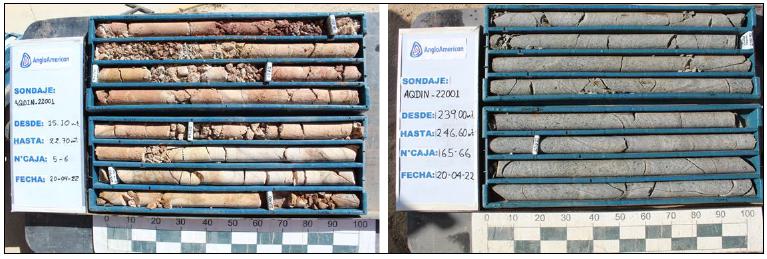
Source: Snowden Optiro
| FINAL | 3 November 2025 | PAGE |
|
Anglo American plc NI 43-101 Technical Report – Quellaveco Property, Mariscal Nieto Province, Peru |
| 10.2.3 | Core logging and sampling |
Geological logging is completed by Anglo American or contractor geologists on an as-needed basis. The logging is performed following the preparation of the sampling plan and the taking of core photographs.
An acQuire™ tablet log template is used to capture information on lithology, mineralization, structure, veining and mineralization with standardized coding. Quantitative and qualitative estimates of alteration type and mineralogy, sulphide speciation and vein types are also recorded. On completion, geological logs are uploaded into the acQuire centralized database repository.
The Qualified Person notes that core logging is carried out by different geologists and can differ depending on the knowledge, experience and criteria employed. In consequence, Anglo American has procedures in place that cross-check drill logs between geologists, with final logs reviewed by the geology supervisor.
The Qualified Person has reviewed the data collected and considers that all relevant geological data has been captured in a consistent manner.
Different laboratories and cutting facilities have been used over the life of the Quellaveco project since 1993, including Lima and Arequipa.
For the more recent drilling campaigns, and following logging, the core is transported to the SGS sample preparation facilities in Arequipa for core splitting and sampling. Geologists are responsible for determining the sample intervals and marking the core axis for cutting using a diamond saw. The cutting line is drawn perpendicular to any preferred veining orientation to avoid potential biases. For the 2024 drilling campaign, in addition to SGS Arequipa, the SGS facility close to the mine site in Salviani was used (refer to Item 11.1).
| 10.2.4 | Core recovery measurements |
There is no recovery registry for DD drilling campaigns before 2000. Later campaigns have daily reports from the drilling contractor which are verified by Anglo American’s project geologist. Quellaveco has established minimum recovery requirements for payment (≥90% per drillhole) in the drilling contracts to maximize core recovery. Anglo American reports core recoveries in recent campaigns (since 2022) of over 95%. The Qualified Person was able to verify the good core recoveries through inspection of core and core photographs.
| 10.2.5 | RC drilling and processing |
RC drilling was carried out sporadically before 2022, with three programs (AAQ2008, AAQ2009 and ADVDRILL2021) for around 19,000 m or 8% of the drilling database used in the 2025 resource estimate. Since 2021, the proportion of RC drilling has increased, with 35,030 m drilled. During the site visit by the Qualified Person, RC drilling was being carried out using a Schramm T660 rig, equipped with an Involution Cyclone (essentially a cone splitter) designed to provide unbiased samples.
RC chips are collected over a 3 m interval, providing around 100 kg of material, which is split through the cyclone splitter to two representative 6 kg samples. Pictures of the RC drilling and splitting system are provided in Figure 10.2. The Qualified Person notes that Anglo American has carried out comparisons between the two 6 kg field splits and notes unbiased comparisons.
In general, RC drilling is used for infill drilling between prior DD holes and to reduce grade uncertainty and upgrade the confidence levels of mineral resources.
| FINAL | 3 November 2025 | PAGE |
|
Anglo American plc NI 43-101 Technical Report – Quellaveco Property, Mariscal Nieto Province, Peru |
| Figure 10.2 | Schramm T660 RC drill rig and associated Involution Cyclone sample collection system |

Source: Anglo American
| 10.2.6 | Drilling data management |
Geological and assay data is managed and stored in an acQuire™ database. The general workflow involves:
| · | Initial drillholes are created by filling out drillhole information and loading collars and downhole surveys from digital files. |
| · | A sampling plan is developed by the geologist. Sample intervals are mostly 3 m but can be smaller when split at geological contacts. |
| · | QAQC samples (duplicates, blanks and CRMs) are inserted at field sampling, preparation and assaying stages at intervals of approximately 1 in 20. The acQuire™ system inserts these at random positions in the sample batches. Barcoded number tickets are generated for dispatch to the sample preparation facilities and, then again, new numbering for the assaying laboratory ensuring that the control samples remain blind to the laboratory. |
| · | Geological logs for lithology, alteration and mineralization are captured using acQuire™ on tablets and uploaded by the geologists to the database. |
| · | Laboratory results are sent by email in protected PDF as well as digital CSV formats. The CSV files are uploaded to acQuire™. |
| · | QAQC samples are reviewed in acQuire™. |
| · | Individual drillholes are frozen by the system administrator once all data has been loaded and verified. |
The acQuire™ database is centralized in an IT Datacentre server situated at the Quellaveco campsite and is backed up daily. Regular maintenance is carried out to improve system performance. Two administrators (the database specialist and a geologist) have full control. Project geologists have more restricted use and control.
| 10.2.7 | Qualified Person’s opinion of drilling quality |
The Qualified Person considers that both the DD and RC drilling has provided and continues to provide appropriate samples for mineral resource estimation.
| FINAL | 3 November 2025 | PAGE |
|
Anglo American plc NI 43-101 Technical Report – Quellaveco Property, Mariscal Nieto Province, Peru |
| 11 | Sample preparation, analyses and security |
| 11.1 | Sample preparation and analysis |
| 11.1.1 | Core processing |
DD core has been processed at various laboratories during Anglo American’s tenure of Quellaveco; mostly at SGS in Lima, Arequipa, and more recently at the independent SGS Salviani and at the mine site. A pictorial summary of the core processing is presented in Figure 11.1, as taken by the Qualified Person during the site visit.
| Figure 11.1 | Core processing and storage inspection: (a) core reception, regularization and measurement of sample recovery, (b) logging, (c) core photography, (d) splitting, (e) storage |

Source: Snowden Optiro
On arrival, the core is checked against drilling documentation. Depth intervals are verified, recorded in the core trays and recoveries are measured and uploaded to the acQuire™ database.
A core sampling plan is developed by the geologist. Sample intervals are mostly 3 m but can be shorter when split at geological contacts. A core splitting line is drawn along the axis of the core to ensure appropriate splitting in relation to geological structures and vein orientations. Full core samples are selected for specific gravity/bulk density determinations. Geological logs for lithology, alteration, mineralization and structure are captured using acQuire™ on tablets and uploaded by the geologists to the database.
Core samples are split in half using an automated Corewise™ saw. One half is ticketed and bagged for dispatch to the SGS sample preparation laboratory in Arequipa, and the other half is retained for reference. Larger diameter PQ core and core from deeper exploration drillholes are dispatched for splitting at SGS’s facilities in Arequipa. Following cutting, all half core is returned to the Quellaveco storage area.
| FINAL | 3 November 2025 | PAGE |
|
Anglo American plc NI 43-101 Technical Report – Quellaveco Property, Mariscal Nieto Province, Peru |
| 11.1.2 | RC sample processing |
Following splitting at the RC rig, samples are dispatched to the SGS Salviani facility where they are dried. Both the RC samples (at Salviani) and the DD samples (at Arequipa) then undergo a similar generalized protocol, as described in the following section.
| 11.1.3 | Sample preparation – DD core and RC |
A similar protocol is followed for the samples used in the Mineral Resource, whether they be core or RC splits and whether they are processed at the SGS Salviani facility (RC) or at SGS Arequipa (core), both independent and ISO17025-accredited laboratories. The same broad sample preparation scheme is followed:
| · | Drying |
| · | Crushing to 90% passing 2 mm (80% passing at Salviani) |
| · | Reduce to 1 kg using a rotary sample divider; coarse reject stored |
| · | Pulverization to 95% passing 105 µm |
| · | Reduce the pulp to 100 g using a rotary splitter; pulp reject stored. |
Both laboratories regularly clean the crushing, grinding and splitting equipment and make regular use of a silica flush. Particle size testing (granulometry) by sieving is carried out on both the crushed and pulverized products. Assaying of the core pulps from Arequipa is carried out at SGS Lima and the RC pulps at SGS Salviani. All pulps from preparation at SGS Arequipa are returned to the Quellaveco storage facility. The crushed rejects from the RC sample preparation at SGS Silviani are stored for one month and then discarded.
| 11.2 | Sample analysis |
For most of the recent drilling campaigns and for core samples, the primary assay laboratory was SGS Lima, with pulps delivered from SGS Arequipa. Assays were generated for copper, silver, molybdenum and arsenic using a four-acid total digestion (HNO3, HClO4, HF and HCl), with reading by atomic absorption. Cyanide soluble and citric acid soluble copper assays were determined by atomic absorption. Batches also included a 35-element ICP-OES assay suite, following an aqua regia partial digestion (HNO3, HCl).
For drill campaigns from 2008 to 2015, the primary assay laboratory was ALS Lima, also accredited to ISO17025, using similar protocols to those used later at SGS. However, it is noted that different protocols were used for CuT.
Recent 2023 and 2024 RC samples are analysed at the Salviani laboratory adjacent to the mine. This site laboratory is operated by SGS and is certified under ISO/IEC 17025, an international standard for the competence of testing and calibration laboratories. Metallurgical, production and RC drilling samples are processed at the laboratory. The laboratory employs a STARLIMS information management system to track and manage samples from reception to the final results. A composite of laboratory procedures is shown in Figure 11.2.
| FINAL | 3 November 2025 | PAGE |
|
Anglo American plc NI 43-101 Technical Report – Quellaveco Property, Mariscal Nieto Province, Peru |
| Figure 11.2 | Salviani site laboratory inspection: (a) sample reception; (b) barcoding and drying; (c) crushing; (d) pulverizing and splitting; (e) weighing (f) digestion – specific to geological samples (g) ICP-OES determinations; (h) AAS determinations |

Source: Graeme Lyall, 2025
| 11.3 | Bulk density determination |
For density determination from drill core between 1970 and 1996, three approaches were used:
| 1) | An Archimedes-style approach, using the weight of the sample in air and water. |
| 2) | An adaptation of this approach, allowing the sample to become saturated by submerging it in water for 30 minutes. |
| 3) | A resin coating approach before weighing the sample in air and water. |
Between 2013 and 2014, two approaches were used; the same Archimedes method as described above, and a pycnometer approach which used a pulverized sample displacing solvent, which was used as a check on the whole core measurements, but not used in estimates. It is noted that the pycnometer method was used for comparison with the Archimedes approach, with and without resin or wax coating.
Between 2017 and the present, core samples were measured at SGS’s facilities using paraffin wax coating and water submergence as per the classic Archimedes approach.
| FINAL | 3 November 2025 | PAGE |
|
Anglo American plc NI 43-101 Technical Report – Quellaveco Property, Mariscal Nieto Province, Peru |
A summary of density determinations by drilling campaign up to 2022 is presented in Table 11.1.
| Table 11.1 | Density determinations by campaign used for the resource modelling |
| Year | Campaign | Type | No. of holes | Metres | No. of samples | No. verified |
| 1970 | SP70 | DDH | 31 | 4,231 | 28 | - |
| 1972 | MP72 | DDH | 81 | 15,104 | 6,512 | 183 |
| 1993 | MQ93 | DDH | 40 | 5,739 | 45 | - |
| 1996 | MQ96 | DDH | 137 | 36,921 | 3,368 | 85 |
| 2007 | AAQ2007 | DDH | 12 | 9,466 | 4 | - |
| 2017 | GEOMET | DDH | 29 | 16,497 | 300 | 300 |
| 2019 | GEOTEC2019 | DDH | 15 | 4,446 | 331 | 331 |
| 2021 | GEOTECNIA | 18 | 6,536 | 66 | - | |
| 2022 | INFILL2022 | DDH | 14 | 2,800 | 44 | 44 |
| 2022 | SUR22 | Surface | - | - | 200 | - |
| SUR | Surface | - | - | 107 | - | |
| Total | 377 | 101,740 | 11,005 | 943 |
Source: Snowden Optiro, 2024
| 11.4 | QAQC procedures |
| 11.4.1 | Historical QAQC and re-assaying |
Shortly after acquiring the project in 1993, Anglo American conducted checks on drill samples from the Southern Peru Copper Corporation (1970) and Minero Peru (1972–1974) campaigns to verify the historical information. Total copper re-assaying of quarter cores, core pulps and composited pulps at Geolab and CIMM laboratories showed good correlations and lack of any significant bias. No samples were available for the earliest Northern Peru (1947) churn drilling that had focused on the secondary enriched mineralization. While the 2000 FS had detected significant downhole contamination in these holes, they have now been discarded and replaced with new drilling. The 40 holes drilled in 1993 did not include any control samples.
A total of 137 holes were drilled as part of the 1996 drill campaign focused on the feasibility initiatives. During this period the primary laboratory used was Geolab. Checks on total copper assays included duplicate pulps sent to Bondar Clegg in Canada for approximately 5% of sample pulps. A close comparison was observed in the total copper assay results, without any indication of bias.
No QAQC information has been provided on four geotechnical holes drilled in 1999. No control samples are available for the 12 holes drilled in 2007 to explore for depth extensions to the hypogene mineralization.
The lack of modern QAQC measures for the historical drilling prompted Anglo American to conduct a re-assaying program of historical samples from stored sample pulps.
In 2018, 7,480 stored sample pulps, corresponding to approximately 25% of the historical drillhole samples, were re-assayed at SGS Lima for total copper using the standard four-acid protocol used by Quellaveco. In addition, 5,966 samples were assayed for molybdenum using a four-acid digestion. QAQC measures during the re-assaying included regular insertions of CRMs and duplicate samples. The results of the re-assays for total copper compared well with the original values without any indication of biases and showed acceptable levels of precision. Furthermore, the QAQC controls verified the reliability of the new assays. The exercise concluded that total copper assays from the historical assaying are reliable and no further re-assaying for total copper was required.
Historical molybdenum assays were carried out on 15 m composites, which did not cover all the available drillholes. Moreover, comparing the re-assayed results composited to the same intervals as the original showed a bias, with the original results being approximately 25% higher than the re-assayed determinations. As a result, in 2019 all available historical pulps (some 29,684 samples) were assayed for molybdenum at SGS Lima using the four-acid protocol. Control samples, including CRMs and duplicates were included, delivering acceptable results. The new assays have replaced any historical molybdenum determinations used in the Mineral Resource estimates.
| FINAL | 3 November 2025 | PAGE |
|
Anglo American plc NI 43-101 Technical Report – Quellaveco Property, Mariscal Nieto Province, Peru |
| 11.4.2 | Recent QAQC (since 2008) |
Drilling campaigns undertaken from 2008 have included rigorous QAQC protocols with most of the following controls:
| · | RC field duplicates – duplicate taken at first sample split of RC sampling |
| · | Quarter-core field duplicates – quarter-core duplicate, compared to original half-core sample |
| · | Preparation duplicates – coarse 2 mm duplicate taken at first split after crushing |
| · | Pulp duplicates – splits on fine-grained pulp duplicates |
| · | Coarse blanks – certified inert coarse materials to detect possible contamination during the preparation (and assaying) process |
| · | Pulp blanks – certified inert fine material to detect possible contamination at the assaying process |
| · | CRMs – insertion of reference pulp samples with certified values for copper and molybdenum. |
The findings from a review of QAQC carried out between 2008 and 2022 are summarized by control sample type as follows:
Duplicates
The results of all duplicate sample checks (field, preparation and pulps) showed good reproducibility for copper and molybdenum, indicating that sampling protocols are of a high standard. The higher dispersions observed for molybdenum are to be expected due to the overall low concentrations and geological mode of occurrence (in B-type veins) of this element.
CRMs
The RC drilling campaigns of 2008 and 2009, comprising some 17,000 m of drilling, were designed to replace the unreliable churn drill data. For these campaigns, Anglo American included some matrix-matched standards from Collahuasi and five standards, also matrix-matched, from Anglo American’s Los Bronces mine in Chile.
Samples from the 2008–2009 RC drilling were assayed at ALS Lima using CuT_AA61_ppm, CuT_AA62_pct and Mo_ AA61_ppm protocols. Both copper and molybdenum methods use a four-acid digestion and reading by atomic absorption. However, the AA61_ppm protocol is designed for trace element concentrations and the AA62_pct is appropriate for “ore”-grade samples. The control charts for total copper generated for this period generally showed a low bias for total copper using the AA61_ppm protocol, while the AA62_pct protocol resulted in unbiased control charts. Figure 11.3 is an example control chart for the AA62_pct protocol, whereas Figure 11.4 shows the AA61_ppm method with a low bias.
Notwithstanding the low bias, which averages around 3%, the Qualified Person does not consider this to be material to the overall Mineral Resource database.
| FINAL | 3 November 2025 | PAGE |
|
Anglo American plc NI 43-101 Technical Report – Quellaveco Property, Mariscal Nieto Province, Peru |
| Figure 11.3 | 2009 drilling: total copper CRM control chart LBS3 – all assays performed using “ore”-grade AA62 method |
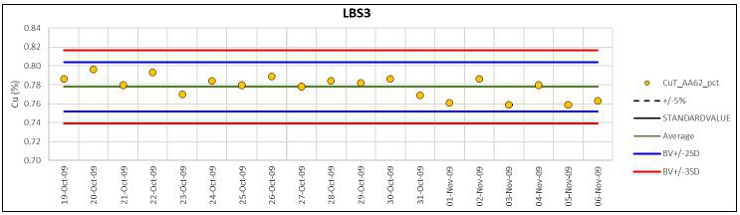
Source: Anglo American
| Figure 11.4 | 2008–2009 drilling: total copper CRM control chart LBS7 – assays using AA61 trace-element method showing low bias (-6%) |

Source: Anglo American
Drilling campaigns between 2014 and 2018 used prepared and CRMs from Michiquillay, along with a commercial standard (which was certified for copper but not molybdenum). Control charts generated for CRMs during this period show results largely within the accepted limits and lacking significant bias.
For the 2019 drilling, three matrix-matched CRMs were prepared from Quellaveco drill core, reflecting low, medium and high total copper grades; these were certified for four-acid digest by OREAS in Australia. One CRM (QV-STD1) was re-certified by Smee and Associates in Canada. These CRMs have been used in most drilling campaigns since 2019. An example of a control chart for standard QV-STD2 (Figure 11.5) showed no bias and low variability, attesting to the accuracy of assays during the most recent drilling campaigns.
| Figure 11.5 | 2019–2022 drilling – total copper control chart for CRM QV-STD2 |

Source: Anglo American
| FINAL | 3 November 2025 | PAGE |
|
Anglo American plc NI 43-101 Technical Report – Quellaveco Property, Mariscal Nieto Province, Peru |
Blanks
From 2008, Anglo American has included regular insertions of blank control samples, either coarse, pulp or both. Drilling since 2020 has included both types. Blank materials used consist of quartz samples previously certified by a laboratory. Certificates for blank samples used in 2009 and 2019 provided by Anglo American indicate molybdenum and copper contents close to the detection limit (DL) of 2 ppm Mo and 0.001% Cu. Anglo American’s protocols consider values over 3x DL as warnings and 5x DL as failures. Batches that “fail” are submitted for further checks, and if confirmed, the whole batch is re-assayed.
For the drilling between 2008 and 2020, the following observations are relevant:
| · | No significant issues were noted with pulp blanks for copper and molybdenum. |
| · | Coarse blanks for copper inserted during the 2009 (RC) drilling campaign are indicative of some contamination, which may affect up to 4,000 samples. The Qualified Person does not consider the levels of copper contamination (Figure 11.6) to be material. |
| · | Coarse blanks for molybdenum returned several failures in 2017, 2020, 2021 and 2022, indicating contamination which does not correspond to copper contamination at the same time, suggesting external (equipment) contamination of molybdenum (Figure 11.7). While not ideal, the Qualified Person does not consider the potential molybdenum contamination to be significant. |
| Figure 11.6 | Coarse blanks 2008–2022 drilling, total copper control chart |

Source: Anglo American
| Figure 11.7 | Coarse blanks 2008–2022 drilling, molybdenum control chart |

Source: Anglo American
| FINAL | 3 November 2025 | PAGE |
|
Anglo American plc NI 43-101 Technical Report – Quellaveco Property, Mariscal Nieto Province, Peru |
| 11.4.3 | RC sample processing at site laboratory |
The Salviani site laboratory, operated by SGS, has been certified to ISO 17025 standard, and processes plant and blasthole samples in addition to the RC samples used in the Mineral Resources. The Qualified Person’s inspection of the laboratory did not reveal any issues. RC samples are tracked with barcodes. Control samples include the insertion of matrix-matched CRMs prepared from Quellaveco material as described above, along with blanks (coarse and pulp) and duplicates. The analysis is by multi-acid digestion followed by ICP-OES determination, with key assays for total copper, cyanide-soluble copper, citric-acid soluble copper, as well as molybdenum and other minor elements.
The Qualified Person considers the laboratory procedures employed to be of good industry standard and well suited for Mineral Resource evaluations.
| 11.5 | Sample security and storage |
During a 2023 site visit by the Qualified Person, and again in 2025, the core logging and storage areas were inspected. These are in secure sheds, and the Qualified Person found that the storage areas were well maintained and numbered. Core is stored in weather-resistant PVC trays.
Drill core from the mine was bundled securely and transported by road to Arequipa, where checks were made at the SGS Geosol facility against the sample submission sheets. Since 2024, drill core has been cut before dispatch to Arequipa, apart from larger diameter PQ core, which is sent whole to Arequipa for cutting, with transport organized by SGS Arequipa. The sampling plan and dispatch order are prepared by Anglo American. At the laboratory in Arequipa, the core samples are received and checked against the sample submission information. Samples are tracked through the LIMS using barcodes. Prepared samples (pulps) are sent by air to the SGS Lima (Callao) laboratory, where traceability is again via barcodes.
The preparation rejects from the DD core are returned from Arequipa to site, where they are kept permanently.
For RC samples from the mine, 6 kg splits from approximately 100 kg of material per 3 m interval, are bundled into larger bags, labelled both on the individual bags and on the containing bag. The weights are recorded at the drill rig by the contractor. The sample dispatch order is prepared by Anglo American and the samples are transported to the laboratory reception area on site, where they are entered into the laboratory LIMS system. The laboratory verifies that the samples received are the same as those in the sample preparation request. Samples are controlled through SGS Salviani by means of barcodes.
| 11.6 | Qualified Person’s opinion on the adequacy of sample preparation, security and analytical procedures |
The Qualified Person considers that the sample preparation, data security measures and analytical procedures at both the laboratories used for assaying are of a high standard and do not present any obstacles to the generation of a Mineral Resource.
| FINAL | 3 November 2025 | PAGE |
|
Anglo American plc NI 43-101 Technical Report – Quellaveco Property, Mariscal Nieto Province, Peru |
| 12 | Data verification |
| 12.1 | Introduction |
The Qualified Person for the Mineral Resource estimate, Mr. Lyall, has completed two recent site visits to Quellaveco; the first in late 2023 as part of a resource and reserve audit commissioned by Anglo American, and the second in October 2025 for the purpose of this Technical Report. On both visits, a range of data verification activities were carried out, as summarized in this section.
| 12.2 | Data management |
All geological and assay data is stored in an acQuire™ database as per Anglo American’s standards. The acQuire™ database is centralized in an IT Datacentre server situated at the Quellaveco campsite. The system is backed up daily. Regular maintenance is carried out to improve the system performance. Two administrators (the database specialist and a geologist) have full control while project geologists have more restricted use and control.
As part of the 2023 audit, and the 2025 review, the Qualified Person compared original records for collar and downhole surveys and assays from digital documents against the database. The results of this verification are incorporated below.
| 12.3 | Surveying |
| 12.3.1 | 2023 |
Documentation certifying collar survey coordinate information from 28 drillholes (comprising 5% of all drillhole collars) drilled during the 2017, 2018 and 2022 campaigns were verified against information stored in the database. No discrepancies were noted.
Downhole survey certificates provided by contractor Bornav (Comprobe Group Company) for 30 drillholes, including 1,390 survey measurements (comprising 13% of all survey measurements up to end of 2023) drilled during the 2017, 2018 and 2022 campaigns were verified against information stored in the database. No discrepancies were noted.
In conclusion, the 2023 data verification checks provided sufficient assurance regarding the reliability and sources of data used in the Mineral Resource estimate.
| 12.3.2 | 2025 |
New drilling incorporated in the December 2025 Mineral Resource estimate includes RC and DD infill holes focused on improving estimates of the near-term mine plan. RC holes drilled on a 20 m grid spacing are vertical, reaching depths of around 60 m, with single surveys at the collar. DD holes include collar and downhole surveys,
The Qualified Person, Mr. Lyall, verified collar survey documentation from 20 RC holes and 10 DD holes from the 2023–2024 infill drilling (comprising 4% of the new drilling) against the database. In addition, downhole surveys from the DD holes were compared against contractor certificates. No discrepancies were noted.
| FINAL | 3 November 2025 | PAGE |
|
Anglo American plc NI 43-101 Technical Report – Quellaveco Property, Mariscal Nieto Province, Peru |
| 12.4 | Drilling and sampling |
| 12.4.1 | 2023 |
As part of the independent resource and reserve audit, Mr. Lyall conducted a review to verify selected data against original certificates and registries. The following verifications were conducted:
| · | SG (bulk density) determinations: Records and certificates for 943 density determinations, comprising 8.6% of the total density to end of 2023 were compared to the database, revealing only minor insignificant differences. |
| · | Assays: Copper assays for 7,463 sample intervals for holes drilled during the 2017, 2018 and 2022 campaigns (comprising 13.2% of the total assay database to end of 2023) were compared to the original assay certificates, revealing a perfect match. Assays checked against certificates for molybdenum revealed some minor differences (refer to Item 11.4.2) that were not considered material. |
The 2023 data verification checks provided sufficient assurance regarding the reliability and sources of data used in the Mineral Resource estimate.
| 12.4.2 | 2025 |
During the October 2025 site visit, high copper and molybdenum assays in logs and the database were confirmed via visual core inspection. Examples included:
| · | Moderately strong chalcopyrite and molybdenum mineralization were observed hosted in a porphyry intrusion in hole AQDEX25012 at a downhole depth of 242 m (Figure 12.1 (a) and (b)). |
| · | Abundant chalcopyrite-magnetite veining accompanied by potassic alteration was observed in hole AQEX24004 at downhole depths below 900 m, verifying the existence strong mineralization below the bottom of the Mineral Resource pit shell (Figure 12.1 (c)). |
| Figure 12.1 | Core inspection – selected mineralization intervals: (a) AQDEX25012 at 242 m – chalcopyrite (b) AQDEX25012 at 242 m – molybdenite (+ chalcopyrite); (c) AQEX24004 at >900 m – chalcopyrite-magnetite stockwork |

Source: Snowden Optiro
For the 2023–2024 RC and DD infill drilling, total copper and molybdenum assays were performed at the on-site Quellaveco laboratory for the RC holes, and at SGS Lima for the DD holes. Mr. Lyall (Qualified Person) compared assays included in the database against certificates for 789 sample intervals (4% of the 2023–2024 RC and DD hole database), revealing no differences.
| FINAL | 3 November 2025 | PAGE |
|
Anglo American plc NI 43-101 Technical Report – Quellaveco Property, Mariscal Nieto Province, Peru |
| 12.5 | Sample analysis |
During the October 2025 site visit, the relatively new onsite laboratory (operated by SGS) was inspected. As previously noted, the laboratory is certified to ISO 17025 standard. The Qualified Person noted that the laboratory procedures (preparation and assaying) are of a good industry standard and are suited to Mineral Resource evaluation.
The Qualified Person did not inspect the SGS laboratory facilities in Arequipa or Lima, where core samples are processed and assayed, but did analyse a large selection of QAQC data (CRMs, duplicates and blanks – refer to Item 11.4), and concluded that overall there are no material issues with control sample insertion and assaying.
| 12.6 | Density verification |
As part of the 2023 audit, the Qualified Person reviewed records and certificates for 943 density determinations, comprising 8.6% of the total density determinations used for resource modelling. These included:
| · | 183 determinations carried out by Minero Peru in the 1972 campaign. Records included scanned copies of the original field determinations. Values were compared to those included in the resource database and no discrepancies were noted. |
| · | 85 determinations carried out by Anglo American during the 1996 campaign. Records included scanned copies of the original field determinations. Values were compared to those included in the acQuire™ database and showed minor differences in 53 of the 85 determinations. A comparison was plotted which revealed the differences to be insignificant. It is possible the values in the database corresponded to new measurements on the same samples carried out at a different time. It is recommended that these are investigated to provide clarification. |
| · | 675 determinations performed at SGS Lima from the 2017 geometallurgy, 2019 geotechnical and 2022 infill campaigns. A comparison of the original laboratory certificates to the values included in the database were found to be identical. |
| 12.7 | Qualified Person’s opinion on the adequacy of the data for the purposes used in the Technical Report |
The drilling and sampling data used in the Quellaveco Mineral Resource estimate dates back to the 1970s; however, most of the DD and RC data used has been collected during Anglo American’s stewardship of the project from 1993, and particularly since 2022 when over 30% of the samples used in the 2025 Mineral Resource estimate were generated. As such, the data verification carried out by the Qualified Person in 2023, as part of an independent audit and in 2025 as part of this Technical Report, is considered relevant.
The Qualified Person has carried out extensive checking and validation of the collar and downhole surveys, the assay certificates and the bulk density measurements, representing between 5% and 10% of the total data in each case. Independent processing of QAQC data has also been carried out, with extensive checking and verification.
The Qualified Person considers the data processing and capture of collar and downhole survey information, and assay and density data as reflected in the database to be of a high standard, generating reliable data for resource estimation. QAQC processing has highlighted some issues, but these are not deemed to have any significance related to the overall reliability of the quality control data.
The Qualified Person therefore considers that the drilling, sampling, assay, density and quality control data are overall of a high quality and more than adequate for the purposes of generating Mineral Resource estimates.
| FINAL | 3 November 2025 | PAGE |
|
Anglo American plc NI 43-101 Technical Report – Quellaveco Property, Mariscal Nieto Province, Peru |
| 13 | Mineral processing and metallurgical testing |
| 13.1 | Introduction |
Extensive metallurgical testwork has been completed over a period exceeding 35 years to characterize the processing response of the Quellaveco porphyry copper-molybdenum deposit. Test programs have progressively advanced from laboratory-scale studies to comprehensive mini-pilot and pilot plant campaigns, supporting process design and metallurgical performance forecasts for feasibility and life-of-asset planning.
Early metallurgical investigations by Minero Peru and Southern Peru Copper Corporation (1976) established the ore’s amenability to flotation. Subsequent testwork by AAQSA between 1993 and 1998 defined key parameters for grinding, flotation, thickening and filtration using samples representative of primary and secondary ore zones. These results formed the basis for the 2000 feasibility design.
Campaigns in 2007 and 2013–2014 incorporated methodologies such as JK drop-weight, SMC, SPI and BWI tests to construct a detailed geometallurgical model linking ore hardness, throughput and metallurgical recovery. Laboratory and mini-pilot flotation testing performed by SGS Chile confirmed robust copper recovery relationships with grind size and ore type. These additional results along with the historical information formed the basis of the 2017 FS and the implementation design.
| 13.2 | Historical evaluation |
The Quellaveco deposit exhibits three recognizable copper mineralization zones: primary ore, secondary enriched ore, and oxidized ore:
| · | Primary ore is characterized by the presence of chalcopyrite, pyrite and molybdenite and the absence (or presence of only traces) of chalcocite. Chalcopyrite is the principal copper sulphide mineral. |
| · | Secondary enriched ore comprises chalcocite, pyrite and small amounts of covellite. In the intermediate and secondary ores, chalcocite minerals replace chalcopyrite. Various degrees of chalcopyrite replacement by chalcocite and/or covellite are observed. On average, the pyrite content of the secondary ore is higher and more variable than in the primary ore. |
| · | Oxide ore is characterized by copper minerals such as chrysocolla. |
Quartz and sericite (mica) are the main gangue minerals. The high percentage of sericite in some of the samples (up to 27%), the particle shape and its overall size distribution may have a negative effect on the copper recovery. The fine-grained sericite, together with the kaolinite (clay) present in the samples, may cause sliming and may lead to surface reactions/interactions with the flotation reagents. The mineralogical evaluation guided the metallurgical decision to test and design a sulphide flotation circuit for the recovery of copper.
| 13.3 | Historical testwork |
| 13.3.1 | 1974–1975 program |
The early testwork conducted in 1974–1975 by Minero Peru and Southern Peru Copper Corporation was based upon 46 core samples intersecting both primary and secondary ore types. This work indicated that the BBWi is 12.6 kWh/t, the optimal grind is P80 125 µm and that all samples responded well to flotation. An unsuccessful pilot as a result of equipment failure was conducted on 3,000 tonnes but did highlight the need for a multi-stage cleaner/cleaner scavenger configuration. Copper recoveries varied from 72% to 93%, depending upon the degree of oxidation. Rougher concentrate required regrinding to P80 44 µm.
| FINAL | 3 November 2025 | PAGE |
|
Anglo American plc NI 43-101 Technical Report – Quellaveco Property, Mariscal Nieto Province, Peru |
| 13.3.2 | 1994–1995 program |
During 1994–1995, a flotation program was completed consisting of five drill cores and 23 composites from adit and raise development, considering leaching and flotation evaluation but mostly conducted on secondary ore. This program indicated the ore contained a high pyrite content (1.6–6.6%) with a high proportion of the copper contained in chalcocite rather than chalcopyrite. The samples contained molybdenum (0.038% Mo) and silver (2 g/t Au) with minimal gold. The BBWi ranged from 11.7–14.5 kWh/t, averaging 13.2 kWh/t. The ore SG was measured at 2.7. The pH required for pyrite depression was 11 in the roughers and 12.5 in the cleaner flotation circuits. A primary grind of P80 85 µm and a regrind of P80 34 µm were determined to achieve a primary ore recovery of 94% and a secondary ore recovery of 89%. The fine grind associated with these tests was deemed to be uneconomical although beneficial to recovery. The concentrate did not contain deleterious contaminants that could impact concentrate quality.
| 13.3.3 | 1996–1997 program |
A testwork campaign was conducted in 1996–1997 on coarse rejects from 96 drill cores with 289 composites being evaluated, based upon the ore type (139 for primary ore and 141 for secondary ore). Additional bulk samples were obtained from five adits for pilot grinding and flotation testwork on 26 composites. Four blends were created from these composites representing the anticipated production blend. Detailed mineralogical evaluation was completed on all composites as identified previously. The comminution testwork delivered a BBWi of 14.3 kWh/t for secondary ore and 15.2 kWh/t for primary ore with an extreme of 18.1 kWh/t.
The detailed pilot plant grinding evaluation confirmed that the SAG with Ball Mill combination including pebble crushing resulted in the lowest steel ball consumption and highest power efficiency and this configuration was maintained for all future testwork and project execution. A relationship between the chalcopyrite content of the ore and the ore hardness was created as a preliminary geometallurgical model.
The ore SG was measured between 2.66 and 2.73, averaging 2.70.
Extensive flotation testwork was completed considering grind size, reagent selection and reagent addition. The optimal grind size was selected as P80 150 µm, with the oxidation state of the ore having a significant impact upon overall copper recovery in a sulphide flotation circuit. Thirteen locked cycle tests (five cycles) were completed during the program resulting in primary ore achieving a concentrate grade of 33% Cu and a recovery of 89%, while the secondary ore achieved concentrate grade of 47.6% Cu and a recovery of 85.5%. A total of 49 pilot plant runs resulted in an expected increase in copper recovery to 91% for primary ore and 89% for secondary ore.
Molybdenum recovery from final concentrate was evaluated and proved feasible with a concentrate grade of 42% Mo and an overall recovery of 52% being achievable. Silver recovery was evaluated at 78% for primary ore and 73% for secondary ore into a final copper concentrate containing around 80–100 g/t Ag.
Thickening and filtration testwork was completed for sizing of thickeners and filtration equipment. The concentrate settling rate was significantly lower than for the float tailings, as expected. Concentrate filtration indicated that all pressure filtration or ceramic filters achieved acceptable final moisture content.
| 13.3.4 | 2007 program |
Initial studies conducted prior to 2007 were based upon comminution evaluation and flotation optimization. High pressure grinding roll (HPGR) evaluation was conducted on primary ore samples remaining from the 1996 testwork program. The testwork indicated that Quellaveco primary ore is amenable to HPGR with medium to high abrasion but with excessive dust generation. The energy reduction seemed minimal, and this option was not pursued. Detailed JK and SMC testwork was completed which confirmed that the SAG-Ball Mill milling circuit is appropriate and that the previously indicated BBWi indices are consistent.
| FINAL | 3 November 2025 | PAGE |
|
Anglo American plc NI 43-101 Technical Report – Quellaveco Property, Mariscal Nieto Province, Peru |
Flotation samples (fresh primary) were extracted from adits for flotation evaluation, with a total of 19 tonnes delivered. The program evaluated a new flotation collector, and to optimize the metallurgical parameters, considered site water. Locked cycle testing completed at P80 120 µm produced a final concentrate at 42.8% Cu and a recovery of 82.8% with low contaminants.
The copper flotation performance with various site waters were evaluated and indicated that potable water resulted in no significant improvement in recovery than site water from the Titire River or a combination of Titire/Vizcachas rivers.
A total of 1,500 samples were combined into 54 composites for a detailed variability testwork program. This evaluation determined that a primary ore grind of P80 165 µm and secondary ore at P80 150 µm were the most economical for the project. The overall results from the locked cycle tests for primary ore was a concentrate grade of 24.1% Cu at a recovery of 84.6% with secondary ore at 43% Cu in concentrate and 81.1% recovery. All concentrate samples confirmed that the copper concentrate contained no contaminants of significance.
Thickening testwork on flotation tails indicated a final product moisture of 55–65% could be achieved with sedimentation rate of 0.06–0.08 m2/t/d with a flocculant addition of 15–25 g/t. Preliminary geometallurgical models were constructed linking mineralogy and lithology with the impact upon milling power, tonnes treated and flotation performance.
| 13.3.5 | 2013–2014 program |
Between October 2013 and May 2014, 57 drill core samples were evaluated at SGS Santiago considering comminution tests, flotation tests with reagent optimization and mini-pilot plant trials with mineralogy and rheology/sedimentation evaluation.
Detailed comminution reviews were completed with several grinding expert reviews being conducted to develop the proposed SAG-Ball Mill combination and to confirm the capacity expectation from this milling combination with the 127.5 kt/d production level.
CPF was further evaluated and considered to add value to the overall copper concentrate production by about 2%. These reviews confirmed that a P80 165–185 µm is to be considered as optimal with an overall copper recovery of 86%.
| 13.3.6 | Recent evaluations |
A high-level bulk sorting evaluation was developed, which indicated that this technical innovation was not considered economically viable in 2017 when applied to mined ore. Low-grade and mineralized waste were not evaluated at the time. It is recommended that this evaluation be updated as production samples can now be tested.
| 13.4 | Expected recovery performance |
Metallurgical performance from all the testwork programs is summarized as follows:
| · | Copper recovery: About 86% overall, varying with ore type and grind size (P80 150–180 µm). |
| · | Molybdenum recovery: 50–60%, with concentrate grades of about 52% Mo. |
| · | Concentrate grade: 32% Cu (secondary ore) and 28% Cu (primary ore). |
| · | Tailings thickening: 50% solids underflow going to tailings dam, with reclaim water returned to the process plant. |
| FINAL | 3 November 2025 | PAGE |
|
Anglo American plc NI 43-101 Technical Report – Quellaveco Property, Mariscal Nieto Province, Peru |
| 13.5 | Copper concentrate quality |
The expected copper concentrate quality as determined through testwork is detailed in Table 13.1.
| Table 13.1 | Copper concentrate quality |
| Mineral | Secondary | Primary | ||
| Range | Average | Range | Average | |
| Cu (%) | 28.1–55.9 | 42.9 | 25.8–34.1 | 30.5 |
| Acid soluble Cu (%) | 0.28–0.92 | 0.74 | 0.21–0.48 | 0.35 |
| Mo (%) | 0.13–1.98 | 0.83 | 0.28–0.45 | 0.36 |
| Fe (%) | 6.2–29.8 | 13.3 | 19.9–25.4 | 23.2 |
| S (%) | 24.9–37.9 | 28.8 | 24.4–30.8 | 29.3 |
| Insoluble minerals (%) | 5.2–20.7 | 11.3 | 5.8–16.4 | 10.9 |
| Al2O3 (%) | 1.12–5.91 | 2.90 | 1.36–3.98 | 2.77 |
| SO4 (%) | 0.15–0.66 | 0.38 | 0.18–0.55 | 0.34 |
| CaO (%) | 0.13–0.64 | 0.33 | 0.13–0.50 | 0.36 |
| SiO2 (%) | 4.3–16.9 | 9.2 | 4.4–13.9 | 10.1 |
| MgO (%) | 0.08–0.30 | 0.20 | 0.35–0.55 | 0.45 |
| Zn (%) | 0.01–0.34 | 0.04 | 0.05–0.23 | 0.11 |
| Ag (g/t) | 31–141 | 86 | 90–123 | 105 |
| Au (g/t) | 0.15–0.60 | 0.37 | 0.30–0.50 | 0.35 |
| Pb (ppm) | 23–155 | 83 | 85–140 | 118 |
| Cd (ppm) | 5.0–18.0 | 6.8 | 5.5–17.0 | 11.3 |
| Hg (ppm) | <0.1 | <0.1 | <0.1 | <0.1 |
| As (ppm) | 50–90 | 58 | 50–95 | 66 |
| Sb (ppm) | 4–22 | 17.5 | 11–19 | 15.3 |
| Bi (ppm) | 2–5 | 2 | 3–6 | 4 |
| Cl (ppm) | 7–168 | 41 | 34–56 | 48 |
| Br (ppm) | <50 | <50 | <50 | <50 |
| F (ppm) | <200 | <200 | <200 | <200 |
| Se (ppm) | <0.1 | <0.1 | <0.1 | <0.1 |
| Te (ppm) | <0.1 | <0.1 | <0.1 | <0.1 |
Source: Anglo American
Test programs conducted during the FS and pilot-scale campaigns demonstrated that arsenic, bismuth, antimony, and mercury occur at very low concentrations, with arsenic typically below 0.1%. These results indicated that the concentrate met international smelter specifications and could be marketed without blending or impurity-related deductions. In the Qualified Person’s opinion, the flowsheet configuration is proven, low-risk and based on extensive pilot and laboratory testwork, ensuring efficient metal recovery, energy performance and water recycling consistent with Anglo American’s global copper operations.
| FINAL | 3 November 2025 | PAGE |
|
Anglo American plc NI 43-101 Technical Report – Quellaveco Property, Mariscal Nieto Province, Peru |
| 14 | Mineral Resource estimates |
| 14.1 | Introduction |
Several Mineral Resource estimates have been generated over the life of the Quellaveco project. The most recent is the December 2025 estimate. This comprises a resource model generated during 2025, as examined and verified by the Qualified Person, which has been depleted to reflect the likely mining position at 31 December 2025 using a combination of the actual pit survey and the forecast mining position at the end of the year.
| 14.2 | Mineral Resource estimation criteria |
| 14.2.1 | Data preparation and analysis |
Database
All geological, assay and survey data are securely stored within the acQuire™ database hosted on a dedicated server and administered by a professional database administrator. The system provides centralized, controlled access and ensures full data integrity throughout the exploration and evaluation process.
Since 2009, the database has incorporated a validation protocol and QAQC management tool to verify the accuracy and completeness of all data entries. A chain-of-custody system utilizing barcode tracking is integrated with acQuire™, enabling continuous sample traceability from field collection through to laboratory analysis and data upload. This structure ensures that all geological, analytical and spatial data meet the required standards of traceability, transparency and reliability required for resource reporting.
The entire validated drilling database used for the estimate encompassed legacy RC drillholes and data from the most recent advanced and infill drilling campaigns conducted between 2021 and 2024. In total, 75,806 m of new drilling was added to the database, comprising 40,776 m of DD and 35,030 m of RC drilling. The December 2025 Mineral Resource estimate brings the total dataset to 1,365 drillholes, representing 224,238 m of drilling (Table 14.1).
Table 14.1 presents a summary of drilling used for the December 2025 Mineral Resource estimate. The first column of drillholes represents data used prior to 2025, the second column represents additional drillholes used in the December 2025 Mineral Resource estimate, and the third drillhole column represents the total.
| Table 14.1 | Summary of drilling used for the December 2025 Mineral Resource estimate |
| Information | Campaign | Drillholes (2022) |
Metres | Drillholes (2025) |
Metres | Total drillholes |
Total metres |
| Historical drilling | AAQ2007 | 12 | 9,466 | - | - | 12 | 9,466 |
| AAQ2008 | 30 | 5,569 | - | - | 30 | 5,569 | |
| AAQ2009 | 84 | 12,026 | - | - | 84 | 12,026 | |
| CONDENACION | 5 | 1,442 | - | - | 5 | 1,442 | |
| EXPLO2018 | 5 | 3,472 | - | - | 5 | 3,472 | |
| GEOMET | 29 | 16,496 | - | - | 29 | 16,496 | |
| GEOT | 4 | 1,836 | - | - | 4 | 1,836 | |
| GEOTEC2019 | 15 | 4,445 | - | - | 15 | 4,445 | |
| INFILL | 57 | 9,953 | - | - | 57 | 9,953 | |
| INFILL2022 | 14 | 2,799 | - | - | 14 | 2,799 | |
| MP72 | 81 | 15,103 | - | - | 81 | 15,103 | |
| MQ93 | 40 | 5,739 | - | - | 40 | 5,739 |
| FINAL | 3 November 2025 | PAGE |
|
Anglo American plc NI 43-101 Technical Report – Quellaveco Property, Mariscal Nieto Province, Peru |
| Information | Campaign | Drillholes (2022) |
Metres | Drillholes (2025) |
Metres | Total drillholes |
Total metres |
| MQ96 | 137 | 36,920 | - | - | 137 | 36,920 | |
| SAN MARTIN 2015 | 8 | 6,365 | - | - | 8 | 6,365 | |
| SP70 | 31 | 4,231 | - | - | 31 | 4,231 | |
| New drilling (incorporated into 2025 estimate | GEOTECNIA2021 | 36 | 12,114 | 2 | 312 | 38 | 12,426 |
| INFILL2023 | 5 | 649 | 46 | 5,468 | 51 | 6,118 | |
| ADVDRILL2021 | - | - | 32 | 1,425 | 32 | 1,425 | |
| PITDEWATERING2022 | - | - | 12 | 1,743 | 12 | 1,743 | |
| AD2023 | - | - | 64 | 3,801 | 64 | 3,801 | |
| AD2024 | - | - | 430 | 28,061 | 430 | 28,061 | |
| GEOTECNIA2024 | - | - | 18 | 6,276 | 18 | 6,276 | |
| INFILL2023 | - | - | 164 | 23,949 | 164 | 23,949 | |
| EXPLO2024 | - | - | 4 | 4,768 | 4 | 4,768 | |
| Total | 593 | 148,632 | 772 | 75,806 | 1,365 | 224,238 | |
Source: Anglo American, 2025b
The spatial distribution of the new drilling information and its integration with existing datasets is presented in Figure 14.1, demonstrating the coverage and data density to support the current geological model and Mineral Resource estimate.
| FINAL | 3 November 2025 | PAGE |
|
Anglo American plc NI 43-101 Technical Report – Quellaveco Property, Mariscal Nieto Province, Peru |
| Figure 14.1 | Quellaveco drilling plan |

Source: Anglo American
| FINAL | 3 November 2025 | PAGE |
|
Anglo American plc NI 43-101 Technical Report – Quellaveco Property, Mariscal Nieto Province, Peru |
| 14.2.2 | Exploratory data analysis and domaining |
All copper assays were flagged by alteration, lithology and minzone, ensuring that grade variability is evaluated within consistent geological domains. The mineral zonation was defined using CuCN/CuT ratios, allowing clear differentiation between the supergene enrichment, hypogene and leached environments. Statistical analyses using boxplots were performed to evaluate the distribution and variability of copper grades with differing lithology, alteration and mineral zonation (Figure 14.2).
| Figure 14.2 | Boxplots showing the distribution of total CuT grades by alteration type, lithology and minzone (from left to right) |
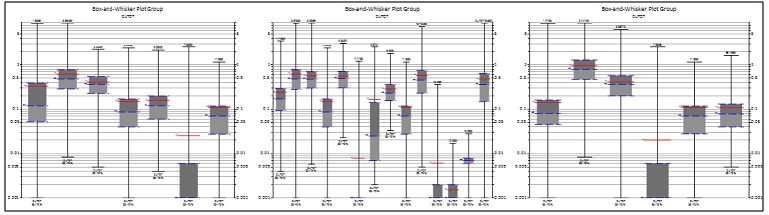
Source: Anglo American 2025b
These comparisons confirm distinct grade populations and justify separate treatment of the supergene, hypogene and leached zones during subsequent geostatistical modelling and resource estimation.
Descriptive statistical analyses demonstrate that alteration and lithological units do not exclusively correspond to a single ore type. For example, approximately 50% of the regional granodiorite (GRD) samples report copper grades above 0.17% Cu, while approximately 25% of the porphyritic granodiorite samples report copper grades below 0.20% Cu, indicating overlapping grade distributions between lithological and alteration units. Similar variability is observed across alteration domains, confirming the need for combined geological and geochemical criteria in defining estimation domains.
The variables analysed include copper, molybdenum, silver, arsenic, iron, sulphur, lead, zinc and SG, which was treated as an additional continuous variable. To improve consistency and reduce internal variability, boxplots were evaluated for combinations of alteration and lithology, facilitating the grouping of data into more homogeneous estimation domains. Based on these analyses, five CuT domains (two supergene and three hypogene), three CuS domains (two supergene and one hypogene), two CuCN domains (one supergene and one hypogene) and three Mo domains were defined for the purposes of Mineral Resource estimation. CuT domains were based on a combination of minzone, alteration and lithology, CuS and CuCN domains were based exclusively on minzone, and Mo domains were based exclusively on lithology. The defined domains formed the basis for subsequent grade interpolation and resource estimation. Silver, arsenic, iron, sulphur, zinc and lead domains were also defined, however, these are not discussed in this report as they are not considered material to the Mineral Resource estimate. SG data was grouped into geological domains based on a combination of minzone and alteration. A total of 12 domains were defined.
| 14.2.3 | Contact analysis |
Contact analysis found that hard boundaries were generally observed between the supergene enrichment zone and all other surrounding domains, reflecting sharp geochemical and mineralogical contrasts related to secondary copper enrichment processes. Similarly, Upper Volcanics and Late Porphyry units exhibit hard contacts with adjacent lithologies due to possessing distinct lithological and alteration characteristics. In contrast, boundaries within the primary (hypogene) zone were considered soft, as grade and alteration variations across these contacts are gradual, and do not indicate significant geological or geochemical discontinuities. These interpretations were used to guide domain coding and boundary treatment during resource estimation.
| FINAL | 3 November 2025 | PAGE |
|
Anglo American plc NI 43-101 Technical Report – Quellaveco Property, Mariscal Nieto Province, Peru |
| 14.2.4 | Compositing |
Sample lengths have varied historically across various exploration programs, generally ranging from 1 m to 3 m. This range has been maintained to balance geological resolution with sampling efficiency across different drilling campaigns. Less than 5% of samples fall outside this range, reflecting a consistent sampling practice appropriate for porphyry copper-style mineralization and suitable for use in geostatistical analysis and resource estimation.
Sample compositing was conducted within geological and mineralization domains, including portions across soft boundaries where applicable. For most domains, samples were composited to a fixed length of 15 m, with a minimum composite length of 3 m and a maximum of 25 m, to reduce potential ore loss while maintaining representative grade continuity. In the supergene enrichment zone, where grade variability is higher, variable-length composites were used. Composite lengths average 5 m, with 99% of these ranging between 3 m and 6 m.
Given the transitional grade behaviour within the primary (hypogene) zone, compositing across soft boundaries was applied to further minimize data loss and preserve grade trends.
Table 14.2 presents details on the impact of the compositing strategy on CuT statistics for the December 2025 Mineral Resource estimate.
| Table 14.2 | Impact of compositing strategy on CuT statistics |
| Domain | Count | Minimum | Maximum | Mean | Standard deviation | |||||
| Raw | Cmp_15 | Raw | Cmp_15 | Raw | Cmp_15 | Raw | Cmp_15 | Raw | Cmp_15 | |
| 1 | 8,002 | 1,570 | 0.003 | 0.007 | 9.6 | 6.08 | 0.16 | 0.18 | 0.35 | 0.34 |
| 3 | 14,807 | 1,988 | 0.008 | 0.043 | 9.01 | 5.48 | 0.96 | 0.9 | 0.7 | 0.56 |
| 5 | 39,135 | 5,991 | 0.001 | 0.003 | 6.5 | 2.37 | 0.42 | 0.41 | 0.3 | 0.26 |
| 7 | 2,520 | 575 | 0.001 | 0.001 | 1.58 | 0.99 | 0.02 | 0.02 | 0.1 | 0.09 |
| 11 | 192 | 59 | 0.001 | 0.002 | 0.49 | 0.19 | 0.07 | 0.06 | 0.07 | 0.04 |
| 99 | 2,033 | 380 | 0.005 | 0.011 | 1.64 | 1.5 | 0.12 | 0.12 | 0.13 | 0.14 |
Source: Anglo American, 2025b
| 14.2.5 | Flattening of supergene enrichment blanket |
The supergene enrichment blanket exhibits a sub-horizontal, layered geometry, typical of secondary enrichment blankets. However, the mineralized horizon shows evidence of gentle folding and local undulation, likely influenced by the evolution of the paleo-water table, variations in host-rock permeability and structural or diagenetic deformation associated with copper remobilization processes. These subtle but pervasive geometric distortions result in variations in flatness and thickness continuity across the deposit. Such irregularities can significantly affect variogram modelling and spatial correlation, potentially leading to sub-optimal estimation performance if not accounted for. Accordingly, these geometric variations were considered when defining estimation parameters and search strategies to ensure reliable spatial modelling of supergene mineralization.
To address the geometric irregularities of the supergene enrichment blanket and improve spatial correlation, a mathematical normalization (flattening) technique was applied to restore the deposit to a topologically planar configuration. This method enables samples to be evaluated within a consistent horizontal reference frame, facilitating optimal sample selection and variogram modelling.
The procedure involves normalizing the vertical (Z) coordinate of the deposit’s geometry, assigning a value of 0% to the base of the enrichment zone and 100% to the top, thereby scaling the thickness to a uniform normalized range. Each sample and block centroid within the deposit is then reassigned a corresponding normalized Z value proportional to its relative position between the base and top surfaces. In this flattened (normalized) space, the geometry behaves as a planar tablet, allowing all samples to be spatially connected in a single plane without distorting their relative vertical relationships.
| FINAL | 3 November 2025 | PAGE |
|
Anglo American plc NI 43-101 Technical Report – Quellaveco Property, Mariscal Nieto Province, Peru |
The process involves a sequence of flattening and back-flattening transformations. Once the deposit is normalized, variogram analysis and grade estimation are conducted in this planar space, achieving a more efficient and geologically coherent sample selection. After estimation, the block centroids are transformed back to real space, integrating the results seamlessly into the overall geological block model. This approach minimizes geometric bias and enhances the robustness of spatial modelling within the supergene enrichment zone.
| 14.2.6 | Top cuts |
In porphyry copper deposits, occasional high or erratic copper assay values can occur within otherwise continuous mineralized zones. These extreme grades, while legitimate in some cases, can distort estimation results due to the sensitivity of most geostatistical algorithms to outliers, as they rely on weighted averaging of grade distributions. It is therefore essential to analyse the data to determine whether such values represent isolated anomalies or localized high-grade sub-populations that may warrant distinct treatment.
To manage this variability, top cuts were applied to the composite dataset, which is the principal source of grade variance used in estimation. This approach ensures that the influence of extreme grades on the block estimates is reduced while preserving the representative nature of the underlying population. It is recognized that erratic values are often partially masked within composited samples, and the application of top cuts at the composite stage may lead to some metal loss, particularly where longer composites are used. Nevertheless, the applied capping strategy provides a balanced compromise between data representativity and estimation stability, supporting a more robust and geologically realistic resource model.
Table 14.3 presents the top cuts applied by domain for the December 2025 Mineral Resource estimate.
| Table 14.3 | Top cuts applied by domain |
| Variable | Domain | Top cut | Element | Domain | Top cut |
| CuT (%) | 1 | 1 | Density | 16 | 2.8 |
| 2 | 3.5 | Density | 21 | 2.7 | |
| 3 | 3.5 | Density | 23 | 2.7 | |
| 4 | 0.5 | Density | 99 | - | |
| 5 | 1.5 | As (ppm) | 301 | 45 | |
| 6 | 0.8 | As (ppm) | 302 | 20 | |
| 7 | 0.25 | Mo (%) | 1 | 0.025 | |
| 11 | 0.25 | Mo (%) | 2 | 0.08 | |
| 99 | 0.35 | Mo (%) | 3 | 0.2 | |
| CuS (%) | 10 | 0.25 | Ag (ppm) | 201 | 6 |
| 11 | 1.7 | Ag (ppm) | 202 | 4 | |
| 110 | 1 | Fe (%) | 1 | 7 | |
| 100 | 0.1 | Fe (%) | 2 | 5 | |
| CuCN (%) | 1 | 0.3 | Fe (%) | 3 | 6 |
| 3 | 3 | Fe (%) | 4 | 5 | |
| 5 | 0.2 | S (%) | 1 | 2 | |
| SG | 30 | - | S (%) | 2 | 4 |
| 31 | 2.2 | S (%) | 3 | 5 | |
| 32 | 2.58 | S (%) | 4 | 4 | |
| 33 | 2.1 | Pb (ppm) | 100 | 200 |
| FINAL | 3 November 2025 | PAGE |
|
Anglo American plc NI 43-101 Technical Report – Quellaveco Property, Mariscal Nieto Province, Peru |
| Variable | Domain | Top cut | Element | Domain | Top cut |
| 34 | 2.4 | Pb (ppm) | 101 | 500 | |
| 35 | 2.6 | Pb (ppm) | 102 | 2000 | |
| 36 | 2.5 | Zn (ppm) | 100 | 350 | |
| 12 | 2.9 | Zn (ppm) | 101 | 1000 | |
| 13 | 2.9 | Zn (ppm) | 102 | 1500 |
Source: Anglo American, 2025b
Multiple graphical analyses were employed such as histograms, cumulative frequency and probability plots to evaluate the impact of capping on metal content, grade variability and coefficient of variation. In each case, the proportion of metal loss resulting from the applied caps was quantified to ensure the procedure remained statistically and geologically reasonable. Results demonstrate that none of the applied top cuts reduced total metal by more than 2%, confirming that the capping strategy effectively mitigates the influence of outliers while maintaining the integrity and representativity of the composite data.
| 14.2.7 | Variography |
The parameters used in experimental variogram development are presented in Table 14.4.
| Table 14.4 | Experimental variogram parameters |
| Parameters | |
| Lag | 30–50 m |
| Lag tolerance | 20–30 m |
| Horizontal angular tolerance | 10° |
| Horizontal angular increment | 10° |
| Number of horizontal directions | 18 |
| Vertical angular tolerance | 45° |
| Vertical angular increment | 90° |
| Bandwidth | 80 m |
| Number of vertical directions | 2 |
Source: Anglo American, 2025b
Variograms were modelled three-dimensionally, using two or three structures, a nugget effect of approximately 10% and a total variance (sill) normalized to 1 for practical purposes. The variogram models were used in the resource estimate.
| 14.2.8 | Cross-validation |
Cross-validation was applied to assess the reliability of the grade estimation strategy by comparing actual (composite) sample grades with their corresponding estimated values. The procedure involves sequentially removing one sample from the dataset and re-estimating its grade at the same location using the established variogram models, search parameters and sample selection criteria. This process provides a direct measure of how well the estimation model reproduces known data.
The results were analysed through a scatterplot of estimated vs actual grades, where the regression line (SOR) and the correlation coefficient (R) indicate the model’s predictive accuracy (Figure 14.3). Estimation parameters such as variogram ranges, number of informing samples, declustering strategy and search ellipse orientation were iteratively adjusted until a SOR approximating 1.0 and a strong correlation coefficient were achieved. Cross-validation confirmed that the chosen estimation parameters provided an unbiased and geologically consistent representation of grade continuity for the deposit.
| FINAL | 3 November 2025 | PAGE |
|
Anglo American plc NI 43-101 Technical Report – Quellaveco Property, Mariscal Nieto Province, Peru |
| Figure 14.3 | Cross-validation for supergene enrichment zone |
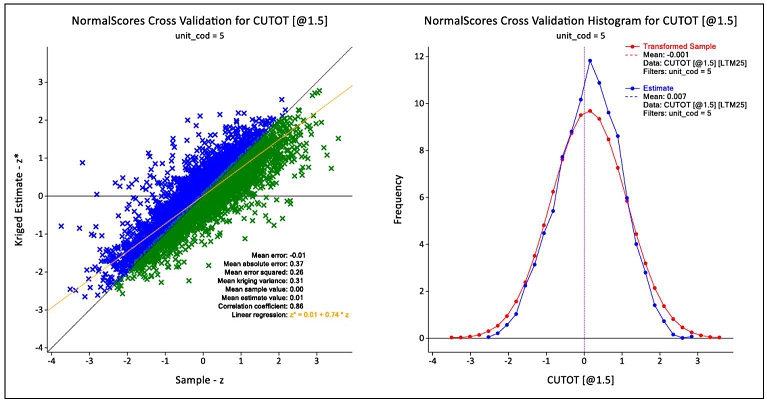
Source: Anglo American, 2025b
| 14.2.9 | Quantitative kriging neighborhood analysis |
Quantitative kriging neighbourhood analysis (QKNA) was used to assist in the selection of kriging parameters. QKNA essentially involves a series of techniques applied to optimize the estimation (kriging) parameters by varying some of the inputs for estimation and observing the changes or improvements in a series of kriging quality metrics.
| 14.2.10 | Search strategy |
The search strategy applied was developed based on the results of the QKNA conducted in 2022. This analysis optimized the spatial parameters used for sample selection during kriging, ensuring a balance between estimation precision and local representativity. The 2021 kriging plan served as the initial reference for determining the number of informing samples; however, given the re-definition of geological and estimation domains for the current model, it was necessary to re-assess search distances and preferential orientations using the newly derived variogram parameters.
The updated search strategy incorporates anisotropic search ellipsoids aligned with the principal continuity directions defined by variography, ensuring that grade interpolation honours both the geological geometry and spatial structure of the mineralization.
| 14.2.11 | Kriging parameters |
The Mineral Resource estimate was generated using Anglo American’s Rapid Resources Modelling (RRM) platform, employing a customized suite of macros developed to ensure a fully reproducible and auditable estimation workflow. Estimation was conducted using a combination of OK and SK. OK was applied as the primary interpolation method within mineralized domains, while SK was selectively used in areas where kriging efficiency (KE) values were negative, typically occurring outside the Mineral Resource pit shell or in sparsely informed zones.
| FINAL | 3 November 2025 | PAGE |
|
Anglo American plc NI 43-101 Technical Report – Quellaveco Property, Mariscal Nieto Province, Peru |
All interpolation parameters, including search strategy, sample selection and variogram models, were aligned with the outcomes of the 2022 QKNA and domain-specific variography studies.
Table 14.5 presents a summary of the kriging parameters used for the current Mineral Resource estimate.
| Table 14.5 | Summary kriging parameters used for the December 2025 Mineral Resource estimate |
| Parameters | |
| Block size | 15 m x 15 m x 15 m |
| Discretization | 5 m x 5 m x 2 m |
| Number of passes | 3 |
| Flattening | For secondary enrichment |
| Kriging technique |
OK and SK (CuT, Mo, As and Ag) OK (CuS, CuCN, Fe, S, Pb, and Zn) SK (SG) |
| Soft boundaries |
Between hypogene domains (60 m tolerance) and hard boundaries Between mineral domains and waste or supergene domains |
| Compositing | 5 m (flattening), 15 m |
Source: Anglo American, 2025b
| 14.2.12 | Treatment of missing values |
During the interpolation process, missing values were assigned in instances where insufficient samples were available within the defined search neighborhood, or when available samples were beyond the maximum search distance specified in the kriging plan. In such cases, block grades were substituted using the global mean values calculated for each estimation domain, ensuring that the model remained complete and geostatistically consistent. These global means were derived from domain-based statistical analyses and were specifically applied under SK conditions, where the mean is an explicit input parameter.
| 14.2.13 | Geological interpretation and modelling |
The geological model was constructed using the WGS84 Zone 19S coordinate system, with model limits defined between 8,106,480 mN and 8,110,845 mN (northing), 325,155 mE and 329,520mE (easting) and extending to an elevation of 2,490 masl, extending to 4,740 masl. A total of 1,365 drillholes were used in the modelling process.
3D models of lithology, alteration and mineralization units were constructed using Leapfrog™ software. Lithology and alteration were modelled using a deterministic implicit approach, consistent with the previous version of the model. Mineralization zones were defined based on the CuCN/CuT ratio, while structural features were interpreted by the Anglo American geology team.
Following model construction, a back-flagging validation exercise confirmed alignment between drillhole data and the defined geological units. Validation accuracy exceeded 90% for lithology, alteration and mineralization zones, with the supergene enrichment zone achieving 95% accuracy, confirming the robustness of the updated model.
| 14.2.14 | Block modelling |
Table 14.6 presents the key parameters of the block model used for the 2025 Mineral Resource estimate.
| FINAL | 3 November 2025 | PAGE |
|
Anglo American plc NI 43-101 Technical Report – Quellaveco Property, Mariscal Nieto Province, Peru |
| Table 14.6 | Block model parameters |
| MD_QV_250211 | |
| Coordinate system | UTM WGS84 |
| Rotation | 0° |
| Block dimensions | 15 m x 15 m x 15 m |
| X origin | 325,200 |
| Y origin | 8,106,690 |
| Z origin | 2,490 |
| Number of cells (X) | 274 |
| Number of cells (Y) | 274 |
| Number of cells (Z) | 150 |
Source: Anglo American, 2025a
| 14.2.15 | Grade estimation |
Grades were estimated into blocks using a combination of OK and SK. SK was applied in areas where the OK resulted in negative values of the KE, typically in sparsely drilled or extrapolated areas beyond the optimized Mineral Resource shell.
| 14.2.16 | Density |
Density was assigned to the model based upon grouping the relatively large bulk density dataset into a series of SG domains. These domains have been allocated on the bases of alteration (phyllic, potassic and propylitic, as defined by logging), mineral zonation (leached and supergene), and in the hypogene or fresh material a subdivision by lithology (lava, ignimbrite, tuff, quaternary material, conglomerate and agglomerate).
| 14.2.17 | Model validation |
Swath plot validation was conducted to evaluate local consistency between estimated block grades and the composite (declustered) sample data used for estimation. The comparison was performed along the northing, easting and elevation directions, using swaths spaced at 50 m in the horizontal directions (north and east) and 15 m vertically. For each swath, weighted averages were calculated separately for the declustered samples and the estimated blocks, allowing a direct comparison of grade trends.
Swath plots were generated for CuT, CuSC and CuCN across all estimation domains. The results showed a strong correlation between estimated and sample grades, demonstrating that the interpolated model faithfully reproduced the field data and preserved both local and global grade distributions within acceptable limits for resource reporting.
Visual inspection of the block model was undertaken to confirm that the geological and grade interpretations were consistent with the input data and wireframe constraints. This process involved reviewing north-south and east-west, transverse and plan sections throughout the model area to ensure that lithological boundaries, alteration zones and mineralization domains in the block model correctly aligned with the geological wireframes and that estimated grades corresponded closely to drillhole assay data. The inspections confirmed a high degree of agreement between modelled and observed data, indicating that the estimation process accurately captured the spatial distribution of mineralization.
| FINAL | 3 November 2025 | PAGE |
|
Anglo American plc NI 43-101 Technical Report – Quellaveco Property, Mariscal Nieto Province, Peru |
| 14.2.18 | Reconciliation |
The 2025 Mineral Resource model was reconciled against the previous (2024) model, using the 2025 life of asset pit shells. Comparisons were made based on inclusive Mineral Resources (including material converted to Mineral Reserves) and exclusive Mineral Resources (material not converted to Mineral Reserves). Changes between the 2025 and 2024 models were subdivided into differences due to the addition of new information, model refinement, or changes to the estimation (kriging) plan.
Results show notable changes in the exclusive Mineral Resource inventory, with tonnages decreasing by approximately 6%, contained copper by approximately 7%, and contained molybdenum by 9% compared with the December 2024 Mineral Resource statement.
Anglo American attributes this variation to a reduction in Inferred Resources, which decreased by 18% in tonnage relative to 2024, and interpreted the reduction as resulting from a re-interpretation of the barren late porphyry and inter-mineral porphyry units, with a significant increase in the proportion of the late porphyry at the expense of the inter-mineral unit.
The late porphyry is recognized as a barren intrusive phase, and its expanded definition within the current geological model has consequently reduced the volume of mineralized material classified as Mineral Resource. The result of this change has also seen a significant increase in copper grades in the centre of the deposit.
| 14.2.19 | Classification |
Anglo American uses the Equivalent Grid (EG) classification methodology, which was developed using Conditional Simulation studies to ensure compliance with Anglo American Copper’s internal Resource Classification Guidelines. This approach quantitatively assesses spatial confidence by relating drilling density to expected grade estimation error. Simulation studies conducted for the supergene and hypogene mineralization zones have demonstrated that the classification thresholds achieved the required error limits i.e. specifically, grade estimation errors of <15% at a 90% confidence level within the first 15 years of planned production.
The EG is calculated for each block as the average distance to the three nearest drillholes, providing a numerical measure of data support. Based on this metric, Mineral Resources are classified as follows:
| · | Measured Resources: Blocks where monthly-scale grade variability corresponds to an EG distance yielding ≤15% error at 90% confidence (EG ≤80 m in the supergene zone; EG ≤100 m in the hypogene zone). |
| · | Indicated Resources: Blocks where annual-scale grade variability corresponds to ≤15% error at 90% confidence (EG between 100 m and 200 m). |
| · | Inferred Resources: Blocks with EG distances between 200 m and 400 m and a nearest-neighbor distance (DIST_NN) ≤200 m. |
This classification system ensures consistency with both statistical uncertainty targets and geological understanding of the deposit. The method recognizes that additional drilling may not automatically convert all Inferred Resources to higher confidence categories, as classification also depends on geological continuity, data quality and local grade variability.
| 14.3 | Mineral Resources |
The information in this Technical Report that relates to Quellaveco Mineral Resource estimate is based on information compiled by Mr. Fernando Camara and fairly represents this information. Mr. Camara is a Member of the Australian Institute of Geoscientists (MAIG) and is employed by Anglo American.
| FINAL | 3 November 2025 | PAGE |
|
Anglo American plc NI 43-101 Technical Report – Quellaveco Property, Mariscal Nieto Province, Peru |
Mr. Camara has sufficient experience which is relevant to the style of mineralization and type of deposit under consideration, and to the activity which he undertook to qualify as a Competent Person as defined in the JORC Code (2012). Mr. Camara consents to the inclusion in this Technical Report of the matters based on this information in the form and context in which it appears.
The Mineral Resources were initially classified in accordance with the guidelines of the JORC Code (2012). The confidence categories assigned under the JORC Code (2012) were reconciled to the confidence categories in the CIM Definition Standards for Mineral Resources and Mineral Reserves (the 2014 CIM Definition Standards). As the confidence category definitions are the same, no modifications to the confidence categories were required. Mineral Resources and Mineral Reserves in this Technical Report are reported in accordance with the 2014 CIM Definition Standards.
The Qualified Person responsible for Item 14 (Mr. Lyall) has critically examined this information, made his own enquiries, and applied his general mineral industry competence to conclude that the information is adequate for the purposes of this Technical Report, and complies with the definitions and guidelines of the CIM. The Qualified Person considers the reported Mineral Resource to be a fair reflection of the exploration activity and modelling processes undertaken.
To the best of the Qualified Person’s knowledge, at the time of estimation there were no known environmental, permitting, legal, title, taxation, socio-economic, marketing, political or other relevant issues that could materially impact the eventual extraction of the Mineral Resource.
The December 2025 Mineral Resource estimate for Quellaveco above a cut-off grade of 0.18% Cu is summarized in Table 14.7.
| Table 14.7 | Quellaveco Mineral Resources as of 31 December 2025 reported at a cut-off grade of 0.18% Cu (100% attributable basis) |
| Mineralization type |
Resource category | Tonnes (Mt) |
Cu (%) |
Contained
Cu metal (kt) |
Mo (%) |
Contained Mo metal (kt) |
| Sulphide flotation | Measured | 108.2 | 0.37 | 403 | 0.014 | 15 |
| Indicated | 846.0 | 0.40 | 3,416 | 0.016 | 138 | |
| Measured + Indicated | 954.2 | 0.40 | 3,819 | 0.016 | 152 | |
| Inferred | 1,253.5 | 0.38 | 4,752 | 0.015 | 187 |
Source: Anglo American, 2025a
Notes:
| · | The Quellaveco Mineral Resources were updated in 2025, utilizing an updated geological model and LoAP. The estimates consider forecast production to the end of 2025 and are therefore quoted as of 31 December 2025, which aligns with Anglo American’s reporting cycle. | |
| · | Tonnes and grades have been rounded and may result in minor discrepancies in the totals. | |
| · | All tonnages are reported on a dry basis. | |
| · | Mineral Resources are reported exclusive of Mineral Reserves. | |
| · | Mineral Resources are reported within an optimized Mineral Resource shell (using Anglo American’s $5.57/lb copper price assumption) and are constrained by Anglo American’s mineral rights. | |
| · | Mineral Resources that are not Mineral Reserves do not have demonstrated economic viability. | |
| · | Anglo American’s equity interest is 60%. | |
| · | The Mineral Resources were prepared by an Anglo American Competent Person under the JORC Code and reviewed by the Qualified Person Mr Graeme Lyall. |
The Qualified Person independently verified the Mineral Resource estimates presented in Table 14.7 and was able to reproduce the reported tonnages and grades within ±1%.
| FINAL | 3 November 2025 | PAGE |
|
Anglo American plc NI 43-101 Technical Report – Quellaveco Property, Mariscal Nieto Province, Peru |
| 14.3.1 | Reasonable prospects of economic extraction (RPEE) |
The December 2025 Mineral Resource estimate was constrained using an optimized Lerchs-Grossmann Mineral Resource shell, and by existing Anglo American mineral rights. A cut-off grade of 0.18% Cu was applied.
The operation’s mine planning team developed the optimized Mineral Resource shell using the 2025 resource model and other constraints. Minesight™ software (Lerchs-Grossman algorithm) was used to generate the shell, which is based on Anglo American RPEE standards and assessments and Anglo American’s copper price assumption of $5.57/lb.
| 14.3.2 | Independent review |
Between October 2023 and January 2024, Snowden Optiro conducted an audit of the Mineral Resource estimate. The audit was focused on geological interpretation, database integrity and estimation methodology.
As part of the audit, Snowden Optiro verified data from source to model and undertook a systematic examination of interpretations and processes leading to the Mineral Resource estimate.
Snowden Optiro confirmed that it had reviewed and verified data, processes and procedures relating to all stages of the Mineral Resource estimate and did not identify any fatal flaws or material errors. Improvement opportunities were identified and recommendations made for implementation during the next reporting cycle.
Snowden Optiro was satisfied that the reported Mineral Resource was compliant with internal Anglo American procedures, the JORC Code (2012) and with Section 5 of the Australian Securities Exchange (ASX) Listing Rules.
| 14.3.3 | Internal controls |
After the completion of each geological model update and Mineral Resource estimate, Anglo American’s Mineral Resources and Reserves (MinRes) team conducts an internal peer review to verify the procedures involved in the development of the geological model used to support the Mineral Resource estimate. An internal peer review of the current resource model was completed in January 2025. No major risks or concerns were identified.
| FINAL | 3 November 2025 | PAGE |
|
Anglo American plc NI 43-101 Technical Report – Quellaveco Property, Mariscal Nieto Province, Peru |
| 15 | Mineral Reserve estimates |
The Mineral Reserve for Quellaveco was estimated using the 2025 Mineral Resource block model, which integrates geological, geotechnical, and geometallurgical information to define ore zones, grade distribution and material classification across nine pit phases. The geometallurgical model, developed in parallel with the block model, applies laboratory and pilot-scale test data to characterize ore hardness, grindability and metallurgical recovery performance.
Recoveries were calculated using the validated recovery algorithm derived from pilot plant and laboratory flotation testwork, which relates total and soluble copper grades to metallurgical recovery, adjusted for variable grind sizes and CPF performance. Updated recovery equations incorporate a 2.2% uplift factor for CPF in both primary and secondary ores, consistent with the latest operational outcomes. This adjustment reflects actual plant results from the CPF circuit’s performance.
| 15.1 | Key parameters and assumptions |
The key optimization parameters used for the Quellaveco pit and reserve estimation included technical, economic and processing factors that guided the Lerchs-Grossmann pit optimization and mine plan development. These parameters were:
| · | Mine design parameters: |
| - | Overall slope angles: 34–40° (north above level 3,570 masl = 34°, below = 40°, south = 40°) | |
| - | Bench height: 15 m (30 m for final walls, mined in 15 m operating benches) | |
| - | Minimum mining width: 90 m | |
| - | Ramp width: 38 m, maximum gradient: 10%. |
| · | Revenue and cost parameters: |
| - | Cu price: $5.58/lb | |
| - | Mo price: $13.61/lb | |
| - | Mining cost: $2.99/t total material mined | |
| - | Processing cost: $13.33/t processed | |
| - | G&A: $3.07/t ore milled | |
| - | Transport and TC/RCs: $14.13/t wet concentrate and $0.19/lb copper, respectively. |
| · | Production and throughput constraints: |
| - | Mill throughput: 142 kt/d (51.8 Mt/a) | |
| - | Maximum mine movement: 150 Mt/a | |
| - | Total waste dump capacity: about 1.37 Gt | |
| - | Total tailings capacity: about 1.53 Gt (Cortadera + in-pit) | |
| - | Truck fleet: 120 concentrate truck trips per day (36 tonnes each). |
| · | Cut-off and optimization: |
| - | Cut-off policy: value-per-hour (VPH) optimization using COMET strategy software | |
| - | Revenue factor for pit selection: 0.5 (at copper price = $2.78/lb) – chosen to meet tailings and waste capacity constraints. |
| · | Metallurgical parameters: |
| - | Process: SAG milling + flotation | |
| - | Copper recovery: about 81.3% (primary and secondary, CPF uplift 2.2%) |
| FINAL | 3 November 2025 | PAGE |
|
Anglo American plc NI 43-101 Technical Report – Quellaveco Property, Mariscal Nieto Province, Peru |
| - | Concentrate grades: primary 28% Cu, secondary 32% Cu | |
| - | Stockpile recovery assumption: 75% Cu for long-term low grade/very low grade (LG/VLG) material. |
| · | Other constraints: |
| - | Environmental and permitting: 4th Modificación del Estudio de Impacto Ambiental, 2015 (MEIA 2015) approved; 5th MEIA approval | |
| - | Hydrological constraint: water availability is the key limiting factor for expansion beyond 142 kt/d | |
| - | Co-disposal: planned implementation from 2049 for closure compliance. |
| 15.2 | Pit optimization |
The pit optimization for the 2025 Mineral Reserve was based on the updated 2025 resource model and Anglo American’s assumptions. Optimization was performed using the Lerchs-Grossman algorithm in Minesight™, considering only Measured and Indicated Mineral Resources. The process generated a series of pit shells using different RFs to evaluate economic limits and capacity constraints.
The selected economic pit corresponds to a RF 0.5 pit shell, which satisfies the waste dump and tailings storage capacity restrictions. Beyond this RF, the net present value (NPV) gains became marginal, and larger pit shells exceed the mine’s infrastructure and waste storage limits.
Geotechnical parameters including overall slope angles of between 34° and 40° (refer to Item 16.1) and boundary constraints, such as mineral title limits and crusher and truck shop locations, were applied as hard constraints.
| 15.3 | Pit design |
The pit designs were developed from the selected RF 0.5 shell incorporating recent geotechnical and operational parameters. Nine mining phases were defined, maintaining the general configuration of earlier designs but refined to improve operability, slope stability and haulage efficiency. Phases 1 to 4 were re-designed using geotechnical data collected between 2022 and 2024, which introduced more detailed zoning based on lithology and alteration. Inter-ramp angles in these phases range between 38° and 52°, while Phases 5 to 9 retained earlier (2021) geotechnical parameters.
The pit layout was adjusted to account for spatial constraints imposed by the crusher and truck shop, mineral title boundaries and the waste dump and stockpile areas, all treated as hard constraints. The design ensures a minimum working width of 90 m, ramp widths of 38 m and a maximum gradient of 10%, suitable for 300-tonne capacity haul trucks and 56 m3 capacity shovels.
Figure 15.1 is a plan view of the Quellaveco open pit and waste dump at the end of the mine life.
In the Qualified Person’s opinion, the final design and waste dump provides a technically and economically optimized open pit, integrating updated slope designs, realistic equipment parameters and environmental constraints, while maintaining compliance with waste and tailings storage capacities.
| FINAL | 3 November 2025 | PAGE |
|
Anglo American plc NI 43-101 Technical Report – Quellaveco Property, Mariscal Nieto Province, Peru |
| Figure 15.1 | Plan view of the Quellaveco open pit and waste dump showing end of life general arrangement |
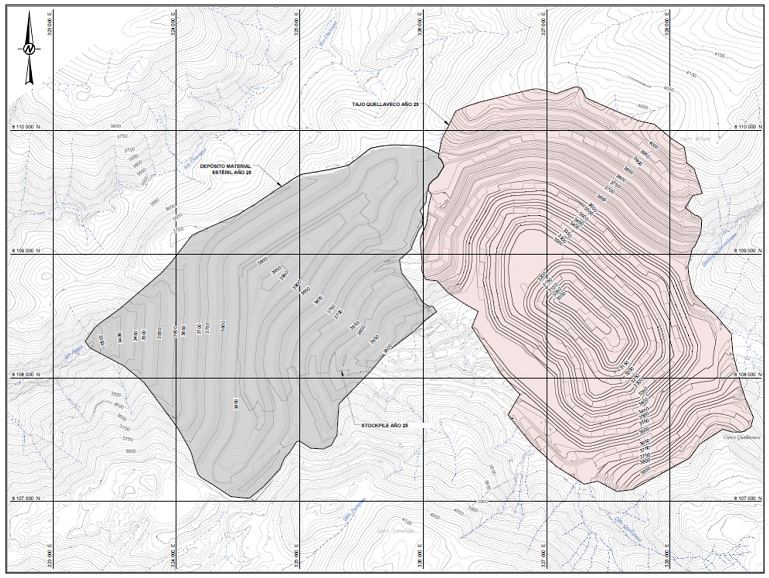
Source: Anglo American, 2025a
| 15.4 | Dilution and ore loss |
| 15.4.1 | Dilution |
At Quellaveco, dilution refers to the inclusion of non-mineralized or lower-grade material into ore during the mining process. This occurs mainly due to:
| · | The geological contact between mineralized and waste zones not being perfectly defined in the block model (especially in the supergene transition zone) |
| · | The selective loading and blasting process at 15 m benches |
| · | Practical limitations of excavation equipment (shovels and loaders) when mining narrow or irregular zones. |
In the 2025 Mineral Reserve estimation, dilution is accounted for through:
| · | The resource model validation and reconciliation process, where actual production and blast-hole data are used to adjust block model grades |
| · | Application of a model-level dilution factor derived from reconciliation between the long-term model (LTM) and in-pit model (IRM). |
| FINAL | 3 November 2025 | PAGE |
|
Anglo American plc NI 43-101 Technical Report – Quellaveco Property, Mariscal Nieto Province, Peru |
The average difference observed in 2024 was about 8.4% in contained copper and about 7.4% in tonnage, which is considered the effective in-situ dilution effect.
Dilution effects are managed within the COMET optimization and mine scheduling process rather than through an external global factor, ensuring internal consistency of grade-tonnage relationships. No explicit mining dilution factor has been applied in the 2025 reserve statement.
| 15.4.2 | Ore loss |
Ore loss is the proportion of in-situ mineralized material not recovered due to:
| · | Operational constraints, such as pit geometry, equipment selectivity or safety berm requirements |
| · | Design catch berms and geotechnical buffers introduced in the final wall configuration |
| · | Model uncertainty, particularly in contact zones where grade continuity is variable. |
A nominal allowance of 3–5% ore loss is embedded in the mine scheduling process.
| 15.5 | Cut-off grade |
Ore and waste were distinguished using profit ≥ 0, expressed as value per tonne (VPT) and then converted into value per hour (VPH) to reflect processing constraints.
The model evaluates every block’s economic contribution by determining:
| · | Revenue = (Cu sold × Cu price) + (Mo sold × Mo price) + (Ag sold × Ag price) |
| · | Total costs = mining + processing + selling costs, including CPF uplift and SIB costs |
| · | VPH = [(revenue − total costs) / tonnes] × throughput (t/h). |
Grind size optimization (140–210 µm) was incorporated: coarser grind increases throughput but lowers recovery.
Ore must have a VPH >0, while material with VPH ≤0 is classified as waste.
The key assumptions in the cut-off value calculation are:
| · | Recovery: 81.3% including a CPF uplift of 2.2% |
| · | Processing cost: $13.33/t milled |
| · | Mining cost: $2.99/t mined |
| · | Plant throughput: 142 kt/d (51.8 Mt/a). |
The VPH values range from $83,000 per mill hour in the early years, reflecting high throughput and grade blending; declining in later years as lower-grade ore is processed.
Anglo American’s metal price forecasts are based on Anglo American’s internal market analysis and planning assumptions. The Qualified Person has reviewed the metal price assumptions used in the pit optimization and Mineral Reserve estimate and considers them reasonable.
| 15.6 | Mineral Reserve estimate |
The Mineral Reserve is based on the Quellaveco LoAP 2026 and reported as of December 2025 in Table 15.1. Material classification into ore and waste based on economic value. Any block reporting a VPH greater than zero (VPH > 0) is considered ore.
| FINAL | 3 November 2025 | PAGE |
|
Anglo American plc NI 43-101 Technical Report – Quellaveco Property, Mariscal Nieto Province, Peru |
| Table 15.1 | Quellaveco Mineral Reserve estimate as of 31 December 2025 (100% attributable basis) |
| Category/classification | Tonnage (Mt) |
Cu
grade (%) |
Mo
grade (%) |
Cu
contained (Mt) |
Mo
contained (Mt) |
| Open pit | |||||
| Proven | 457.1 | 0.61 | 0.020 | 2.81 | 0.09 |
| Probable | 1,016.3 | 0.43 | 0.016 | 4.40 | 0.16 |
| Subtotal open pit | 1,473.4 | 0.49 | 0.017 | 7.21 | 0.26 |
| Stockpiles | |||||
| Probable | 14.4 | 0.65 | 0.011 | 0.09 | 0.00 |
| Subtotal stockpiles | 14.4 | 0.65 | 0.011 | 0.09 | 0.00 |
| Total Mineral Reserve | 1,487.8 | 0.49 | 0.017 | 7.31 | 0.26 |
Notes:
| · | The Quellaveco Mineral Reserves were updated in 2025, utilizing an updated geological model and LoAP. The estimates include forecast production to the end of 2025 and are therefore quoted as of 31 December 2025. | |
| · | Tonnes and grades have been rounded and may result in minor discrepancies in the totals. | |
| · | Point of reference is delivery to the process plant. | |
| · | All tonnages are reported on a dry basis. | |
| · | Mineral Reserves are derived solely from Measured and Indicated Mineral Resources. | |
| · | Anglo American’s equity interest is 60%. |
The Quellaveco Mineral Reserve was previously estimated and reported by Anglo American in accordance with the JORC Code (2012). The Qualified Person, Mr. Laymen, has reviewed the estimation methodologies, classification criteria, and all relevant modifying factors applied to the Ore Reserve statement to confirm alignment with the 2014 CIM Definition Standards. Following this review, the Ore Reserve categories reported under the JORC Code (2012) were reconciled with the CIM classification framework. As a result, the Proved and Probable Ore Reserve under the JORC Code has been restated as Proven and Probable Mineral Reserves, ensuring consistency in the levels of estimation confidence, data support and modifying factors between the two standards.
| 15.7 | Risks and opportunities |
The Mineral Reserve estimate is considered robust, with mining, processing, and infrastructure already fully developed and in operation, supported by established power, water, transport, and port logistics. The mine and concentrator have the technical assumptions underlying the Reserve. The principal potential factor that could materially affect the Ore Reserve is permitting, as the planned expansion and associated tailings and waste-storage extensions require approval of the 5th MEIA. The approved tailings storage plan comprises the TSF with a capacity of 1,350 Mt. Future in-pit co-disposal of tailings is considered from 2050 onwards.
Metallurgical performance, based on pilot-scale testing and operational results, is well understood and is not expected to materially impact the Mineral Reserve.
The Quellaveco Mineral Reserve is supported by a LoAP and independent review (Snowden Optiro, 2023). Remaining high-impact risks include permitting, slope design, co-disposal execution, and long-term metallurgical behaviour, and all are under active mitigation. The Qualified Person, Mr. Laymen, concludes that, despite these uncertainties, the LoAP Mineral Reserves are technically achievable and economically viable under current assumptions.
| 15.8 | Independent reviews |
Snowden Optiro conducted an independent audit in October 2023 covering both Mineral Resources and Ore Reserves at Quellaveco. The review confirmed that Anglo American’s estimation processes comply with the JORC Code (2012) and Anglo American’s standards, with no material issues affecting the public reporting of Mineral Resources or Ore Reserves. A follow-up audit by SRK was in progress during 2025.
| FINAL | 3 November 2025 | PAGE |
|
Anglo American plc NI 43-101 Technical Report – Quellaveco Property, Mariscal Nieto Province, Peru |
| 16 | Mining methods |
| 16.1 | Geotechnical parameters |
A 2025 geotechnical program integrated new investigations and updates to refine slope design criteria, domain definition, and pit stability assessments. The program incorporated:
| · | New geotechnical and hydrogeological drilling (2023–2024) to improve understanding of structural domains, weathering profiles, and rock-mass properties, particularly along the northern and western pit walls |
| · | Slope stability analyses using limit-equilibrium and numerical modelling methods, updated with 2024 pit geometries, material parameters, and in-situ monitoring data |
| · | Back-analysis of slope performance and wall movements recorded since 2022 using radar, prism, and piezometric monitoring to calibrate strength parameters and groundwater assumptions |
| · | Integration of geological and hydrogeological models to delineate distinct geotechnical domains and groundwater control zones, supporting the update of pit wall depressurization strategies. |
The northern wall remains the principal geotechnical risk area due to variable lithology and fault intersections. Localized failures recorded between 2021 and 2024 led to revisions of inter-ramp angles, ramp spacing, and catch-berm configurations for Phase 4. The 2024–2025 slope design update introduced the following design parameters:
| · | Inter-ramp angles of 34–36° for the northern wall above elevation 3,570 m, and 40° below this level |
| · | Inter-ramp angle of 40° for the southern and western walls, consistent with competent intrusive and volcaniclastic lithologies |
| · | Catch-berm widths of 40–50 m in high-risk sectors to improve containment and overall wall stability |
| · | Bench heights of 15 m for standard operating benches and 30 m double benching on final walls, with presplit blasting in tuff and ignimbrite zones. |
A 2021 design defined two principal slope zones:
| · | Zone 1 – inter-ramp angle 38°, face angle 45°, inter-ramp height 120 m, berm 4.2 m |
| · | Zone 2 – inter-ramp angle 52°, face angle 90°, inter-ramp height 150 m, berm 23.4 m. |
These criteria were supported by the AKL Ingeniería 2014 numerical modelling study, which verified the stability of representative sections using Phase2 finite-element analysis. The study demonstrated acceptable factors of safety ≥1.3 and displacements <5 m even with steeper overall slope angles, confirming that the current geometries remain within stable design limits.
The waste rock dump design is based on the 2021 SRK detailed engineering, with the following parameters:
| · | Overall slope = 26° downstream, 24° upstream |
| · | Lift height = 80 m, berm width = 60 m, face angle = 37° |
| · | Maximum dump height = 610 m and capacity about 1.3 Bt. |
Design controls include construction using dry material, avoidance of convex geometries, and foundation investigations in ignimbrite areas to confirm bearing capacity and slope interaction. Instrumentation for ongoing performance verification includes vibrating wire piezometers, open standpipes, extensometers, and prisms installed progressively across both pit and dump areas.
Key residual risks include bench-stack and inter-ramp failures, groundwater inflows, and uncertainties in fault continuity along the northern wall. Mitigations include ongoing depressurization, double bench presplit blasting and enhanced real-time slope monitoring. A geotechnical update is scheduled for 2026, incorporating new structural, hydrogeological, and strength-parameter data from current field campaign.
| FINAL | 3 November 2025 | PAGE |
|
Anglo American plc NI 43-101 Technical Report – Quellaveco Property, Mariscal Nieto Province, Peru |
| 16.2 | Hydrological parameters |
Hydrological and hydrogeological investigations have been undertaken to:
| · | Understand groundwater and surface water interactions (Asana and Vizcachas rivers) |
| · | Design an adequate pit dewatering system for safe slope performance |
| · | Ensure water supply reliability for the concentrator and dust suppression |
| · | Support environmental compliance under the MEIA (Environmental Impact Assessment Modification) process. |
During the 2017 FS, a hydrogeological baseline and numerical groundwater model was developed to predict inflows to the pit and guide design of the mine water management system. The key elements included:
| · | Hydrogeological drilling and testing: Several pumping and slug tests were carried out to characterize hydraulic conductivity and aquifer continuity across the pit area. |
| · | Groundwater modelling: |
| - | Developed using MODFLOW software to simulate steady-state and transient flow conditions | |
| - | Model calibration based on measured piezometric data and surface water levels in the Asana and Vizcachas catchments. |
| · | Pit inflow predictions: Estimated inflows of 40–60 L/s at peak mining depth, depending on rainfall intensity and pit advance rate. |
| · | Surface hydrology studies: |
| - | Detailed rainfall–runoff analysis for the 3,500–4,200 m elevation range | |
| - | Design of stormwater diversion channels and sediment control works to isolate contact and non-contact water around the pit and dumps. |
A key FS deliverable was the design and completion of the Asana River diversion tunnel, rerouting the river around the mine footprint to prevent contamination and maintain natural flow continuity. Subsequent investigations refined the FS model and addressed operational and expansion requirements:
| · | Updated numerical groundwater model (2023–2024): |
| - | Incorporated new hydrogeological drilling data and piezometer networks installed during mine ramp-up | |
| - | Extended the model domain to include northern wall and F04–F07 phases, where depressurization interacts with faulted lithologies. |
| · | Pit dewatering performance: |
| - | Verified current inflows remain within about 45 L/s average, consistent with model predictions | |
| - | Confirmed the effectiveness of existing pumping wells and horizontal drains | |
| - | Future requirement: Increase total dewatering capacity to about 65 L/s to support deeper Phase 7–9 mining (included in 5th MEIA scope). |
| · | Water balance and supply: |
| - | Continued use of water from Titire River (approximately 78%) and Vizcachas River (approximately 22%), both managed under approved surface water abstraction permits | |
| - | No additional water sources are available until new permitting or desalination options are approved. |
| FINAL | 3 November 2025 | PAGE |
|
Anglo American plc NI 43-101 Technical Report – Quellaveco Property, Mariscal Nieto Province, Peru |
| · | Surface hydrology: |
| - | Continuous monitoring of storm events and runoff behaviour, particularly during the wet season (January to March) | |
| - | Implementation of stormwater diversion and collection channels around waste dumps and tailings, consistent with 2025 mining assumptions (BP25) | |
| - | Seasonal operational adjustments (e.g. haul road design, equipment efficiency) are reflected in mine productivity models. |
The 5th MEIA (to be submitted April 2026) will incorporate:
| · | Expanded dewatering infrastructure |
| · | Updated water balance for future throughput increases (142–150 kt/d) |
| · | Cumulative impact assessment on Asana and Vizcachas watersheds. |
Groundwater inflows currently remain controlled under the current pumping system; however, expanded dewatering capacity (about 65 L/s) will be required to maintain stability in deeper phases. The 5th MEIA will include the pit dewatering system upgrade to accommodate future pit expansion. Continuous piezometer data and radar monitoring indicate that current depressurization measures are effective in controlling pore pressures in the active mining sectors.
| 16.3 | Mining method and parameters |
The Quellaveco deposit is mined by large-scale open pit methods, using conventional drill, blast, load and haul techniques. The method and equipment selection were defined during the 2017 FS with updates reflecting current operating performance and throughput targets.
The nominal maximum movement rate is limited by tailings-storage and waste-storage capacities (about 1.6 Bt combined). Mining is performed on a 24-hour 365-day schedule, with allowance for reduced utilization during the wet season (January to March). Material is blasted in 15 m benches, mined in 15 m operating lifts or 30 m double benches on the final walls. Ore is hauled either to the primary crusher or to the designated stockpiles for high-grade, low-grade or mineralized waste material. Waste rock is transported to engineered dumps located to the west of the pit or temporarily rehandled as part of the co-disposal strategy.
The bench height is 15 m for operational benches and 30 m for final walls. The main haul ramps are 40 m wide with a maximum gradient of 10°. The minimum phase width is 100–120 m. Overall slope angles range between 34° and 40°, with the north wall designed at 34° above elevation 3,570 m and 40° below, and the south wall at 40°. The maximum total mine movement is 150 Mt/a, and the milling throughput is 142,000 t/d (about 51.8 Mt/a).
The pit is mined in nine phases (Phases 1 to 9), progressing generally from north to south. Selective mining within Phase 4 targets the higher-grade core to support early copper production of approximately 320,000 tonnes copper in 2026 under the LoAP.
Mine sequencing is optimized using COMET software and a VPH cut-off strategy to maximize project NPV. Mining advances through successive pushbacks with up to eight benches mined per year to maintain operational flexibility. Rehandle operations of around 10 Mt/a during 2026–2027 are used to optimize blending and maintain consistent plant feed.
ROM ore is crushed in a gyratory primary crusher located near the pit rim and conveyed to the concentrator. Low-grade and very-low-grade ore is stockpiled adjacent to the waste dump for later treatment.
Waste rock is placed in engineered dumps with zoning for potentially acid-forming and non-acid-forming material. From 2042 onwards, waste and tailings will be progressively backfilled into the open pit as part of the co-disposal plan, supporting the restoration of the Asana River to its original course and meeting closure commitments.
| FINAL | 3 November 2025 | PAGE |
|
Anglo American plc NI 43-101 Technical Report – Quellaveco Property, Mariscal Nieto Province, Peru |
| 16.3.1 | Mining and ancillary fleet requirements |
Mining at Quellaveco is undertaken by large-scale conventional open pit methods using electric rope shovels, hydraulic backhoes and large rear-dump haul trucks. The primary production fleet consists of the equipment listed in Table 16.1.
| Table 16.1 | Current mining fleet |
| Equipment type | Model | Quantity | Nominal capacity | Notes |
| Electric rope shovel | CAT 7495 | 3 | 56 m3 bucket | Primary loading units |
| Hydraulic backhoe | CAT 6060 BH | 2 | 34 m3 bucket | Selective and narrow-bench loading |
| Wheel loader | P&H L-2350 | 1 | 41 m3 | Auxiliary and rehandle operations |
| Haul truck | CAT 794 AC | Up to 36 | 300 t payload | Main haulage fleet (autonomy-ready) |
| Support truck | CAT 777 series | 100 t class | Short-haul and rehandle | |
| Rotary production drill | Epiroc Pit Viper 351 | 6 | 10–12¼ inch diameter holes | Diesel rotary drills |
| Pre-split drill | Sandvik D65 | 2 | 6½ in holes | Presplit and trim drilling |
Source: LoAP
Equipment productivity is derived from the mine-planning database and field performance monitoring:
| · | Rope shovels (CAT 7495): 10,500 t/h (one-sided), 12,200 t/h (double-sided), 7,500 t/h on ramp, 8,000 t/h on wall. |
| · | Hydraulic backhoes (CAT 6060 BH): 6,400 t/h under most conditions; 6,000 t/h on ramps. |
| · | Truck speeds (CAT 794 AC): 20–21 km/h loaded; 25–26 km/h empty. |
| · | Average fuel consumption: 48–50 gal/h per truck. |
| · | Average operating hours per truck: 650 h per month. |
These parameters are consistent with the 2024 actuals and are used for production scheduling and haulage simulations within the COMET strategic planning software.
The primary production fleet is complemented by dozers, graders, water trucks and front-end loaders for road maintenance, dust suppression and stockpile management. Maintenance facilities include a truck workshop and electric-shovel service bay adjacent to the pit exit, along with an equipment refuelling and dispatch area connected to the operations control centre.
The mine operates under an integrated digital operations platform with dispatch, fleet-health monitoring and semi-autonomous haulage capability using Caterpillar MineStar Command. The system enables optimization of truck-shovel matching, cycle-time monitoring and predictive maintenance scheduling.
The mining fleet has been sized to sustain full production at 142 kt/d ore throughput and up to 150 Mt/a total movement. Fleet growth from 30 to 32 trucks (2024–2025) supports the LoAP26 throughput increase and operational redundancy. A rolling five-year replacement plan renews major units on 60,000-hour cycles for trucks and 70,000-hour cycles for shovels.
Anglo American’s global decarbonization roadmap includes assessment of electric or trolley-assist haulage options for Quellaveco to reduce diesel consumption and greenhouse gas intensity. Phased introduction of autonomous truck operation is forecast from 2027 onward, building upon trials and digital operations centre capability already implemented.
| FINAL | 3 November 2025 | PAGE |
|
Anglo American plc NI 43-101 Technical Report – Quellaveco Property, Mariscal Nieto Province, Peru |
| 16.4 | Life-of-asset plan production schedule |
The LoAP reports the integrated mine-to-mill schedule commencing January 2025. It forms the technical and economic basis for the current 2025 Mineral Reserve estimate and is aligned with Quellaveco’s operational capacity. The plan reports mining and processing activities extending to 2055. The LoAP was generated through pit-by-pit optimization using MinePlan Evaluator software, followed by strategic scheduling in COMET software. The LoAP limiting factors are:
| · | Tailings and waste storage capacity: Combined 2.98 Bt (waste + tailings). |
| · | Water supply: 78% Titire/22% Vizcachas rivers. |
| · | Permitting boundary: Phases 7–9 extend beyond the 4th MEIA and require approval under the 5th MEIA. |
| · | Dewatering expansion: Increase to 65 L/s planned as part of the 5th MEIA. |
| · | Any throughput increase beyond 142 kt/d is contingent on these approvals and water supply augmentation. |
Table 16.2 summarizes the LoAP mining and processing schedule in five-year increments, showing ore and waste mined, ore processed, concentrate production and copper and molybdenum production over the life of the operation. Over the life-of-mine, the LoAP projects a total of approximately 1.5 Bt of ore processed, yielding an estimated 6,550 kt of copper contained in concentrate through to 2055. Ore throughput averages about 51 Mt/a at full capacity.
During the 2025–2029 period, the Quellaveco open pit completes its ramp-up to steady-state operation, achieving an average mining rate of about 75 Mt/a of ore and 59 Mt/a waste with a head grade of about 0.6% Cu as mining focuses on Phases 2 to 4. Between 2030 and 2034, the operation enters a plateau phase, sustaining ore mining rates of 71 Mt/a ore and 50 Mt/a waste with grades of about 0.44% Cu. Through 2035 to 2039, output transitions into the deeper Phase 6 zones, with mining at about 67 Mt/a ore and 47 Mt/a waste, average 0.51% Cu. From 2040 to 2044, the mine advances into Phase 7, mining about 78 Mt/a ore and 29 Mt/a waste but at a lower grade of 0.43% Cu. From 2045 to 2046, production declines to the end of the open pit life. Quellaveco uses a processing strategy where higher-grade ore is preferentially processed, and lower-grade ore is stockpiled for processing at the end of the mine life. The concentrator maintains a throughput of about 51 Mt/a, but the grade gradually declines from 0.72% Cu in 2025–2029 (309 kt/a copper) to 0.41% Cu (230 kt/a copper) at the end of the mine life, when open pit ore is depleted and low-grade stockpiles are processed.
| Table 16.2 | LoAP production and processing schedule (five-year increments) |
| Item | Unit | Total | 2025-29 | 2030-34 | 2035-39 | 2040-44 | 2045-49 | 2050-54 | 2055-59 |
| Ore mined | Mt | 1,544 | 375 | 357 | 333 | 392 | 87 | - | - |
| Mined grade | % | 0.50 | 0.60 | 0.44 | 0.51 | 0.43 | 0.53 | - | - |
| Waste mined | Mt | 948 | 295 | 248 | 235 | 146 | 24 | - | - |
| Total open pit movement | Mt | 2,495 | 671 | 605 | 569 | 539 | 111 | - | - |
| Ore processed | Mt | 1,556 | 252 | 259 | 259 | 259 | 258 | 257 | 11 |
| Process Cu grade | % | 0.50 | 0.72 | 0.54 | 0.58 | 0.51 | 0.41 | 0.24 | 0.23 |
| Process Cu recovery | % | 83 | 85 | 85 | 87 | 87 | 79 | 75 | 75 |
| Cu contained | kt | 6,550 | 1,545 | 1,182 | 1,315 | 1,162 | 858 | 470 | 19 |
| Cu contained | lb (million) | 14,439 | 3,406 | 2,605 | 2,898 | 2,562 | 1,891 | 1,035 | 42 |
| Cu concentrate | kt | 25,899 | 5,030 | 4,851 | 5,504 | 4,819 | 3,612 | 2,002 | 82 |
| Mo concentrate | kt | 304 | 47 | 59 | 65 | 54 | 52 | 26 | 1 |
Source: LoAP
Notes: Schedule includes 2025 forecast production.
| FINAL | 3 November 2025 | PAGE |
|
Anglo American plc NI 43-101 Technical Report – Quellaveco Property, Mariscal Nieto Province, Peru |
| 17 | Recovery methods |
The Quellaveco flotation concentrator was commissioned in June 2022 with a nominal capacity of 127.5 kt/d or between 38 Mt/a and 40 Mt/a at a rate of about 5,600 t/h with a 0.98% Cu feed grade. Based on plant performance, the nominal capacity was increased to 133.3 kt/d with options to achieve 150 kt/d being considered by Anglo American. The plant is achieving a capacity of 142 kt/d throughput, which is the basis of the LoAP. The potential expansion to 150 kt/d is being considered by Anglo American.
The concentrator is located at an elevation of 3,500 masl, which challenges conventional process plant design considering the extreme cold weather and oxygen deprivation.
| 17.1 | Process flowsheet design and specifications |
The Quellaveco concentrator employs a conventional primary crushing, milling, pebble crushing and flotation circuit designed to treat copper-molybdenum ore from the open pit mining operation.
ROM ore is delivered to twin primary gyratory crushers by truck with the crushed ore conveyed to the coarse ore stockpile (live capacity 75 kt) via a 4.7 km overland conveyor with a tunnel. The primary crusher plant is designed to treat up to 10,625 t/h with an availability of 65%.
The primary crushed ore at about 150 mm is fed to two parallel milling circuits, each with a 12.4 m diameter (40 ft) and 6.7 m long (22 ft) SAG mill (23.5 MW drive) in combination with one 8.5 m diameter (28 ft) and 13.4 m long (44 ft) ball mill (22.2 MW drive) operating in closed circuit with cyclones to achieve a final grind of P80 150–180 µm. The milled product is conditioned with flotation reagents and pumped to the flotation circuit.
The flotation circuit consists of four banks of rougher tank cells (eight x 300 m3 per bank). Rougher concentrate is reground in three regrind “vertimills” with the fine product reporting to the twin stream cleaner/cleaner scavenger circuit followed by final cleaning in four column flotation cells. The bulk concentrate produced containing the copper, molybdenum and silver is thickened in one 50 m diameter thickener and pumped to the molybdenum separation circuit, where molybdenite is recovered via selective reverse flotation.
The comminution circuit and the bulk flotation schematic is depicted in Figure 17.1. Tailings are thickened in twin 120 m diameter thickeners to approximately 50% solids and pumped via an 18 km launder to the Cortadera TSF, where reclaim water is returned to the plant for reuse.
There is a CPF circuit with Hydrofloat technology and concentrate regrind treating the rougher flotation tailings to improve overall recovery.
The molybdenum concentrate is recovered by selective twin stream multi-stage flotation from the bulk concentrate with the float tails reporting to the final copper concentrate thickener and the multi-stage cleaner concentrate reporting to the molybdenum concentrate filtration plant.
Final copper concentrate (containing silver) is filtered to a low moisture content filter cake and trucked to the export terminal at Ilo. Molybdenum concentrate is filtered, dried and trucked to refineries in Chile or for export.
The plant also includes integrated reagent preparation; water reclaim and process control systems (SCADA).
The plant produces ~100 kt/m of concentrate with some 75–90 trucks of concentrate per day travelling from mine site to the port of Ilo.
| FINAL | 3 November 2025 | PAGE |
|
Anglo American plc NI 43-101 Technical Report – Quellaveco Property, Mariscal Nieto Province, Peru |
| Figure 17.1 | Simplified 142 kt/d Quellaveco process flowsheet |
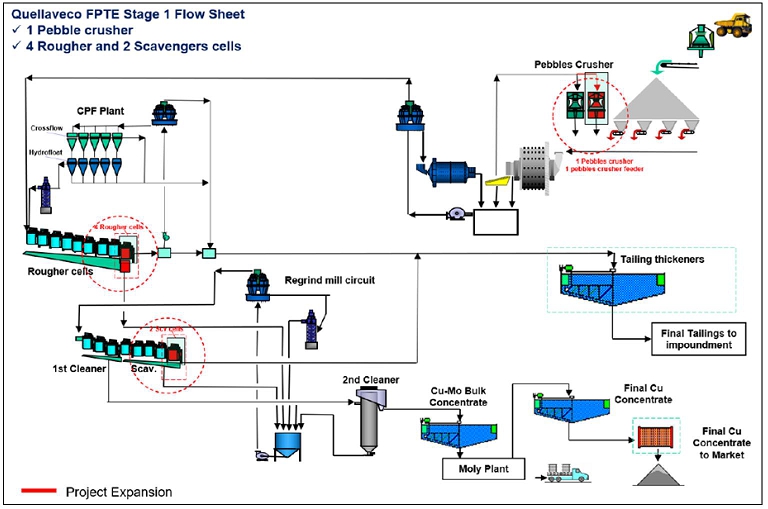
Source: Anglo American
| 17.2 | Ancillary processing facilities |
Reagent storage, mixing facilities, a blower and compressed air are the main ancillary facilities required for the plant. Milk of lime is required to modify the pH of the solution to optimize copper recovery and is delivered as hydrated lime with a target pH of 11.0–11.5. Solid (xanthate) and liquid flotation reagents consisting of collectors and frothers are stored and mixed on site to the required strength for addition to the mills and conditioner tanks, ahead of flotation. Flocculant is used in the thickening process and is mixed on site to the required strength for consumption within the process. Sulphuric acid is required for molybdenum flotation with a pH 8 being required.
There is about 15 days storage capacity for reagents and 7 days for lime on site. Grinding balls (125 mm diameter for SAG and 75 mm diameter for Ball Milling) have an expected consumption of 0.25 kg/t and 0.50 kg/t respectively with 7 days storage in the plant bins. Blower air is supplied to the flotation tank cells and compressed air is available for instrumentation and general use around the plant.
| 17.3 | Recent performance |
The concentrator tonnage performance since commissioning in 2022 is shown in Figure 17.2 with the tonnes milled and head grade indicated on a monthly basis.
| FINAL | 3 November 2025 | PAGE |
|
Anglo American plc NI 43-101 Technical Report – Quellaveco Property, Mariscal Nieto Province, Peru |
| Figure 17.2 | Recent concentrator throughput performance |
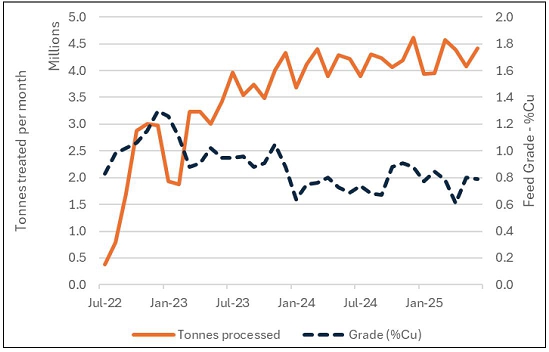
Source: Quellaveco production data
The plant ramp-up in tonnage was achieved at the end of 2023 with 4.0 Mt being milled per month. The grade has decreased from about 1.0% Cu to around the current grade of 0.8% Cu. The molybdenum grade is less than 0.03% and averages 0.018%, with the 2025 head grade at 0.015% Mo. The silver head grade is between 1.9 g/t and 3.3 g/t Ag, averaging 2.3 g/t Ag. Copper concentrate production (Figure 17.3) is about 100 kt/m (dry) with a concentrate grade ranging from 33% to 27% Cu. In the first six months of 2025, copper recovery has ranged from 80% to 85% (average 82%), and molybdenum recovery has averaged 65%, as shown in Figure 17.4. The copper production performance is detailed in Table 16.2. The reported monthly mill run-time varies from 88% to 99%, with an average of 94%.
| Figure 17.3 | Concentrate performance |
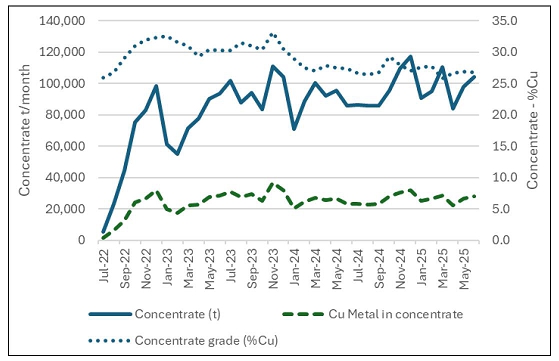
Source: Quellaveco production data
| FINAL | 3 November 2025 | PAGE |
|
Anglo American plc NI 43-101 Technical Report – Quellaveco Property, Mariscal Nieto Province, Peru |
| Figure 17.4 | Concentrate recovery performance |
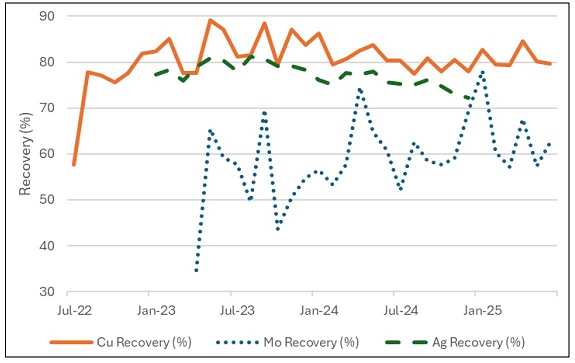
Source: Quellaveco production data
At full production, the Quellaveco concentrator requires approximately 170 MW of power, 35 ML/d of water (with 85% recycle), and about 100,000 t/a of process consumables. The Qualified Person is of the opinion that the selected milling and flotation process is suitable for Quellaveco ore and that the concentrator performance is fair and reasonable.
| FINAL | 3 November 2025 | PAGE |
|
Anglo American plc NI 43-101 Technical Report – Quellaveco Property, Mariscal Nieto Province, Peru |
| 18 | Project infrastructure |
| 18.1 | Concentrate transport and port facilities |
Copper concentrate produced at the Quellaveco concentrator is thickened and filtered on site before being transported by sealed trucks to the Port of Ilo, located approximately 82 km southwest of the mine. The concentrate is hauled along a dedicated, paved mine-to-port corridor designed to minimize dust generation and environmental impacts, following the Ilo–Moquegua highway route.
At the port, concentrate is received at Anglo American’s dedicated storage and ship-loading facilities, which include enclosed storage sheds, conveyor systems and a mechanical ship loader. The Port of Ilo handles all copper concentrate exports, with water recovered from port filtration returned to the process water circuit where feasible. Figure 18.1 presents a plan view of the port facilities.
| Figure 18.1 | Plan view of the port facilities |
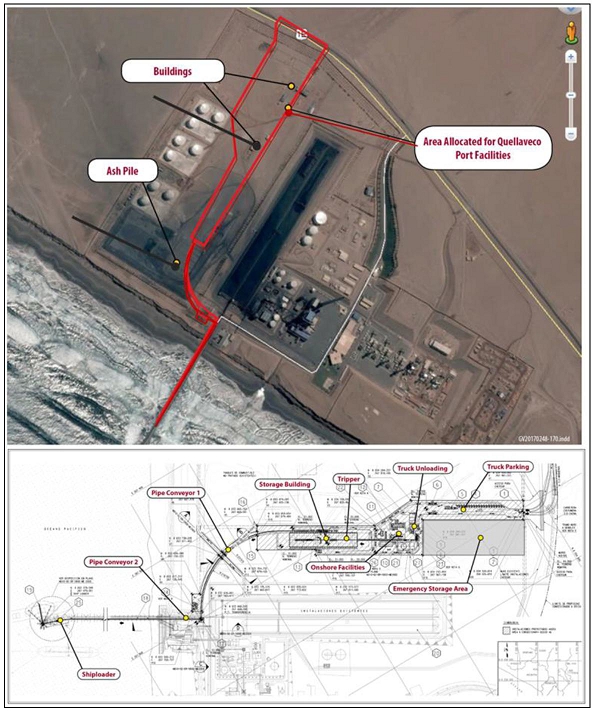
Source: Anglo American
| FINAL | 3 November 2025 | PAGE |
|
Anglo American plc NI 43-101 Technical Report – Quellaveco Property, Mariscal Nieto Province, Peru |
| 18.2 | Tailings storage facility |
The tailings produced by the Quellaveco concentrator plant is deposited and contained at the Cortadera TSF, located approximately 18.4 km (via road) from the plant site (Figure 5.1). The TSF comprises a single valley-fill embankment designed to be constructed and developed using the downstream raising method. Initial containment is provided by an 85 m (3,118.5 masl) high earth-fill starter wall constructed from compacted borrow material, with future development including two additional downstream raises formed using compacted cyclone underflow (cycloned sand). The ultimate dam height is planned to reach approximately 315 m (3,325 masl), inclusive of the cycloned sand raises.
| 18.2.1 | Facility layout and infrastructure |
Tailings are produced at a solids concentration of approximately 50%, which are transported from the process plant to the TSF via a concrete launder that traverses varied terrain, including tunnels and bridge structures. The launder is accompanied by a steel return water pipeline along the same platform. The delivery system includes emergency ponds along the route to contain any spills outside of the basin area. The tailings transport system crosses several major structures, including two tunnels (Salveani–Capillune and Capillune–Cortadera) and the Capillune bridge, a 300 m long, 90 m high steel truss structure designed to support both the launder and the return water pipeline. Four additional minor bridges are located along the route.
Tailings are processed through hydro-cyclones at the TSF with the cyclone underflow (sand fraction) used for embankment construction and the cyclone overflow (slimes fraction) is pumped to the TSF and deposited within the impoundment. The embankment is constructed at a slope of 1V:2H and 1V:4H on the upstream and downstream faces, respectively. The upstream face of the embankment is HDPE-lined to reduce seepage. Drainage and seepage collection systems are installed at the base of the embankment, with collected water returned to the process water circuit through a dedicated pumping system.
| 18.2.2 | Capacity and design criteria |
The TSF was originally permitted for 1,000 Mt of tailings, as defined in the 2000 EIA. Capacity was subsequently increased by approximately 30% to 1,300 Mt to support a base case throughput of 127.5 kt/d. The current design can accommodate an increase in throughput to 150 kt/d with relatively minor modifications, primarily through raising the tailings launder walls and associated structural reinforcement.
Key facilities within the Cortadera TSF have been classified as “major consequence” under Anglo American’s TS 602 001 standard, which requires managing the probable maximum flood (PMF) from the start of operations. This differs from the original design, which allowed for management of the 1:1000-year event during operations and PMF only at closure. A risk assessment determined that the current design could accommodate the 1:5,000-year event from month 8, the 1:10,000-year event from month 11 and the PMF from month 27 of operations. The short wet season (4 months) helps reduce hydrological risk. An exemption to the standard based on these parameters has been requested and was under review at the time of publishing the 2017 FS.
The final dam height and associated loading conditions required specific geotechnical assessments, including compressibility studies of drainage materials and sand behaviour at depth. Drainage and filter layers were conservatively designed to accommodate settlement and deformation over the facility’s life. Constructability considerations, including starter dam sequencing and high initial raise rates, were addressed through incorporation of a downstream sand wedge to distribute loads and reduce sand placement rates during early operations.
| 18.2.3 | Operations and water management |
Seepage and supernatant water are recovered through a combination of toe drains, seepage collection ponds and intake towers. The reclaim water system comprises vertical turbine pumps and a multi-stage pumping system, returning water to the process plant to minimize freshwater makeup requirements. The design includes provisions for future adaptation of the reclaim system as the pond elevation increases with embankment raises. The water management plan for the Cortadera area provides for all contact water to be captured and incorporated into the reclaimed water system, preventing discharge to the environment. Collected water is temporarily stored for recovery and reuse in operational activities and process circuits. Floodwater will be fully contained within the TSF, including surface inflows from the catchment area upstream of the Cortadera TSF, which will be captured within the facility and recovered for reuse in the process plant.
| FINAL | 3 November 2025 | PAGE |
|
Anglo American plc NI 43-101 Technical Report – Quellaveco Property, Mariscal Nieto Province, Peru |
| 18.2.4 | Expansion and in-pit disposal |
The tailings dam was originally designed for a 127.5 kt/d throughput scenario, and no additional capacity was included for a higher production rate. This is reflected in the design basis reported in the 2017 FS. If throughput were increased to 150 kt/d (Phase 2 of the Throughput Expansion Project), the final dam elevation would remain unchanged, as the total volume of tailings is based on the same reserve base.
Certain components, such as the tailings launder walls, could be readily expanded through wall raising and reinforcement. The hydro-cyclone station was designed to process around 60% of total tailings under the wall growth plan, but the equipment can handle 100% of tailings for 60–70% of the time, providing some operational flexibility. Other systems, including water reclaim infrastructure, would be more complex to upgrade, though modest increases may be achievable by adding pumps and increasing flow velocities.
The TSF can be expanded with limited technical constraints, but drainage system capacity would need to be increased in future stages, and some key structures such as tunnels and bridges could limit expansion potential and would require detailed engineering review. Additionally, final capacity is partly constrained by the Patilla and Los Chalsos ravines and the associated seepage control system. Raising the walls in these areas may be required to support any increase in capacity beyond the current 1.35 Bt.
The approved tailings storage plan for the Quellaveco operation comprises the TSF with a capacity of 1,350 Mt. Future in-pit co-disposal of tailings is considered from 2050 onwards. The in-pit co-disposal will comprise placement of waste rock along the pit walls to create a rock lining, with the tailings deposited into the pit. The co-disposal will accommodate 405 Mt of waste rock and 240 Mt of tailings, with an additional 100 Mt of rock to be the excavation for the restoration of the river channel on surface. The proposed co-disposal includes drainage measures to allow for consolidation of the tailings.
| 18.2.5 | Closure considerations |
The closure plan (Knight Piesold, 2022) reports on the proposed closure related works for the TSF, with the assessment of closure stability with a minimum static factor of safety of exceeding 1.50 and a seismic factor of safety exceeding 1.10. The proposed TSF closure works include the following:
| · | Re-grading of tailings beaches to eliminate the reclaim pond and promote positive drainage |
| · | Placement of a 1.5 m multi-layer cover system (0.5 m low-permeability barrier, 0.5 m drainage layer and 0.5 m growth medium), achieving an infiltration target of <5 mm/a |
| · | Establishment of permanent surface water management through armoured diversion channels routing flow to the eastern spillway designed for the PMF |
| · | Revegetation with native high-Andean species |
| · | Seepage collection through a basal drainage system, with flows predicted to remain <0.5 L/s |
| · | Long-term instrumentation and monitoring, including 60 piezometers, inclinometers and vibrating wire cells, to be undertaken for at least 30 years post-closure. |
The TSF closure cost estimate is $135 million (2022 terms, excluding taxes and includes 10% contingency and 5% EPCM). The in-pit co-disposal of waste rock and tailings forms part of the restoration of the Asana River, which is a key element in the mine closure plan.
| FINAL | 3 November 2025 | PAGE |
|
Anglo American plc NI 43-101 Technical Report – Quellaveco Property, Mariscal Nieto Province, Peru |
| 18.2.6 | GISTM conformance |
A Global Industry Standard on Tailings Management (GISTM) disclosure report was published by Anglo American in August 2024, which includes disclosure of specific details of the TSF in accordance with Requirement 15.1b, and a summary of the current GISTM conformance levels (self-assessed). Anglo American has reported to be fully conformant to GISTM, in line with the requirements for an extreme consequence classification facility. A third-party validation of the GISTM disclosure is planned for 2025.
| 18.3 | Waste rock dumps |
Waste rock from the Quellaveco open pit is stored in a series of engineered waste rock dumps located within the Asana Valley, adjacent to the mining area. The total approved waste storage capacity is approximately 1.37 Bt, comprising 882 Mt of surface waste dump capacity and an additional 484 Mt available for in-pit backfilling later in the mine life. Dump design parameters, including overall slope angles, lift heights and drainage systems, were established through geotechnical studies consistent with Anglo American’s global standards and Peruvian regulatory requirements. Material placement is sequenced to maintain operational efficiency, slope stability and compliance with waste rock management plans defined in the current EIA.
Waste rock is classified according to its acid-generating potential, with selective placement and cover systems to control runoff and prevent acid rock drainage. In accordance with Quellaveco’s closure and environmental commitments, waste rock will ultimately be rehandled for co-disposal within the open pit, enabling restoration of the Asana River valley at the end of mining.
| 18.4 | Ancillary infrastructure |
The main truck and equipment workshops are located near the open pit and crusher area. The workshops are purpose-built for the large-scale mining fleet, including 300-tonne haul trucks, electric rope shovels and hydraulic excavators. The facilities comprise multiple service bays, heavy-lift cranes, lubrication and tire bay, and component rebuild areas, with supporting warehouses for spare parts and consumables. The layout provides efficient fleet movement and safety separation between light and heavy vehicles. Adjacent to the workshops are mine operations offices, a dispatch centre and training rooms equipped with digital fleet management systems integrated into the site communications network.
At the concentrator and plant complex, administrative and technical offices support processing, maintenance and environmental teams. These facilities house the plant control room, laboratory and engineering offices, all connected via the fibre-optic communications system to the Moquegua offices and Anglo American’s regional network.
In Moquegua, Anglo American maintains regional corporate and community offices that coordinate administration, logistics and stakeholder engagement.
| 18.5 | Water supply |
Freshwater for operations is drawn from the Titire River and Vizcachas River. These high-altitude sources provide a reliable year-round supply. The main water supply system includes pipelines, pumping stations, and storage tanks designed to support the concentrator throughput up to 142 kt/d, with provision for expansion to 150 kt/d.
Water is distributed to the mine, concentrator and auxiliary facilities through a closed-loop system to minimize consumption. Dewatering systems (pumps and piezometers) are installed in the pit area to manage groundwater inflows, particularly as mining deepens.
| FINAL | 3 November 2025 | PAGE |
|
Anglo American plc NI 43-101 Technical Report – Quellaveco Property, Mariscal Nieto Province, Peru |
| 18.6 | Power supply |
Quellaveco’s electrical power is supplied through the Moquegua source substation extension, which includes an outdoor 220 kV gas-insulated substation. The system is connected to the national Peruvian grid (SEIN), ensuring stable, high-voltage power delivery suitable for large-scale mining and processing operations.
The infrastructure includes two 220 kV transmission line bays, providing redundancy and reliability for continuous plant and mine operations. Power is distributed from the main substation to the open pit mine, concentrator plant, pumping stations and auxiliary facilities. The system supports the SAG milling and flotation concentrator, dewatering pumps and other major equipment such as the electric rope shovels.
The installed capacity is designed to support a nominal throughput of 133.8 kt/d, with sufficient redundancy to enable the ramp-up to 142–150 kt/d under the LoAP plan.
| 18.7 | Access and security |
The Quellaveco operation is accessed via a 48 km paved road linking the mine and concentrator areas in the Asana and Papujone valleys to Moquegua. This all-weather route was constructed as part of the project’s main infrastructure and is maintained year-round to support the transport of personnel, supplies and concentrate. Heavy haulage trucks operate under controlled schedules, and personnel movements are managed through dedicated shuttle services between Moquegua and the mine camp to minimize private vehicle use and improve safety. The mine’s logistics corridor also connects to the Port of Ilo.
The Moquegua airstrip (Aeródromo de Moquegua, ICAO code SPOM) is a small regional facility, approximately 30 km west of the mine site by road, primarily used for charter flights, company logistics and emergency medical evacuations. For regular commercial air travel, the nearest major airport is Rodríguez Ballón International Airport in Arequipa (IATA: AQP). This airport provides daily national and international flights and serves as the main aviation hub for personnel transfers and cargo support to the Moquegua region. In practice, most Anglo American and contractor staff transit through Arequipa or Ilo, then travel to Quellaveco by road via Moquegua.
| 18.8 | Accommodation |
Accommodation is provided for operational, technical and maintenance personnel at the mine and plant sites in the Asana Valley and Papujone Valley, approximately 30 km east of Moquegua. The facilities are part of the operational infrastructure established during construction (2018–2022) and have transitioned into permanent use for operations.
The camp was initially constructed to house construction workers and was subsequently downsized and reconfigured for operational staff rotations. Accommodation is based on modular, fully serviced camp units with shared or single rooms, dining facilities, recreation areas and medical services.
Working at 3,500 m presents physiological challenges – hypoxia, fatigue and altitude sickness – particularly for workers commuting from Moquegua (1,400 m). Mitigation includes:
| · | Rotational schedules allowing acclimatization periods |
| · | Medical screening and on-site clinics for monitoring oxygen saturation and blood pressure |
| · | Work-rest regimes to minimize exertion stress |
| · | Supplemental oxygen available at medical stations |
| · | Camp facilities designed for controlled temperature and comfort to reduce fatigue. |
| FINAL | 3 November 2025 | PAGE |
|
Anglo American plc NI 43-101 Technical Report – Quellaveco Property, Mariscal Nieto Province, Peru |
| 18.9 | Communications |
The Quellaveco operation is supported by a high-altitude communications network designed to ensure reliable, real-time connectivity across the open pit, concentrator, tailings and support facilities. A redundant fibre-optic backbone links the mine and process plant to Anglo American’s corporate network, enabling continuous data transmission for fleet dispatch, process control, slope monitoring and environmental systems. Wireless LTE and radio systems provide pit-wide coverage for mobile equipment and personnel communications, with satellite backup ensuring continuity in the event of terrestrial outages. All communications infrastructure is designed for operation at approximately 3,500 masl, with environmental hardening and redundant power supply systems to maintain reliability and safety in extreme climatic conditions.
| 18.10 | Logistics |
The elevation and mountainous terrain increase logistics complexity. The 48 km paved access road from Moquegua traverses steep gradients requiring specialized transport and maintenance schedules. The site’s distance from the coast requires coordination for fuel, reagents and concentrate transport through altitude transitions.
All material and concentrate transport is conducted by road, using a dedicated logistics corridor between the mine and Port of Ilo. The concentrate is hauled by a fleet of 36-tonne capacity trucks, making up to 120 trips per day as part of the operation’s regular export logistics.
| FINAL | 3 November 2025 | PAGE |
|
Anglo American plc NI 43-101 Technical Report – Quellaveco Property, Mariscal Nieto Province, Peru |
| 19 | Market studies and contracts |
| 19.1 | Market studies |
Global copper demand remains dominated by China but is increasingly supported by growth in India, the United States and Europe. Electrification, renewable power expansion and electric-vehicle manufacturing are structural drivers that sustain long-term copper use. The smelter treatment and refining charge (TC/RC) cycle has tightened since 2023 due to mine disruptions and slower greenfield growth.
| 19.2 | Products |
Quellaveco produces a clean copper concentrate with payable credits for gold and silver. The expected typical composition includes copper, silver, sulphur, silica, iron, alumina, magnesia, calcium, lead, gold, tin, arsenic and moisture. Anglo American does not warrant fixed concentrate grades.
The molybdenum by-product is sold as technical-grade molybdenum concentrate averaging roughly 50–52% Mo with acceptable limits between 25% and 56% Mo. Material specifications classify lower-grade product as off-grade or off-specification with associated payable adjustments and discounts. Impurity and moisture penalties apply for copper >2%, iron >3.5%, calcium >0.6%, lead >500 ppm or arsenic >1,000 ppm. Moisture above 8% attracts deductions subject to commercial negotiation. Pricing is referenced to the Platts molybdenum oxide benchmark, with floors and caps of $12/lb and $22/lb molybdenum respectively.
| 19.3 | Offtake agreements |
Anglo American’s marketing organization and Mitsubishi RTM International sell its copper concentrates to major smelters in China, Japan, Korea, Europe and the Americas. The product’s low impurity levels and consistent chemistry make it suitable for high-efficiency smelters and blending. The molybdenum concentrate agreement (May 2023) appoints AAMP as distributor. AAQSA sells 100% of output to AAMP, which resells to AAML, AAMC and Mitsubishi. Deliveries follow largely back-to-back commercial terms, ensuring arm’s-length alignment among affiliates.
Under the agreement, annual molybdenum concentrate volumes are proportionally allocated (Anglo American 60%, Mitsubishi 40%). AAML primarily beneficiates its portion of concentrate via toll roasting agreements in Europe and Asia, where the beneficiated roasted molybdenum oxide is marketed and sold into the alloy-steel and energy-infrastructure sectors.
| 19.4 | Price assumptions and market studies |
Price assumptions derive from Anglo American’s internal corporate market analysis which are benchmarked to multi-analyst consensus forecasts. The copper price assumption corresponds to Anglo American’s LoAP case, expressed in real terms and supported by sensitivity analysis for LME price, TC/RC variability, exchange rate and by-product credits. Molybdenum pricing follows Platts Metals Week quotations averaged over declared quotational periods, with negotiated discounts reflecting international long-term contracts between major producers and roasters.
All copper and molybdenum concentrate production is sold to the shareholders under long-term off-take agreements that collectively cover 100% of Quellaveco’s concentrate output.
The terms and conditions of these agreements are the same for all shareholders and are consistent with customary industry practices for related-party off-take arrangements. Quellaveco does not conduct independent market sales or external marketing studies, as all concentrate is placed under these shareholder agreements.
| FINAL | 3 November 2025 | PAGE |
|
Anglo American plc NI 43-101 Technical Report – Quellaveco Property, Mariscal Nieto Province, Peru |
| 19.5 | Material contracts |
Quellaveco’s concentrate production is covered under long-term offtake arrangements with AAML and Mitsubishi Corporation RTM International, reflecting the joint venture ownership structure. Contracts are market-referenced and consistent with international industry practice. Other material contracts are:
| · | Port and logistics contracts: Long-term transport and handling agreements with TISUR S.A. (Port of Ilo operator) and Mitsui O.S.K. Lines for containerized shipments. |
| · | Energy supply contract: 15-year renewable-energy PPA with ENGIE Energía Perú S.A., providing 100% certified renewable power. |
| · | Water rights and utilities: Licensed by ANA (Autoridad Nacional del Agua) for the Vizcachas and Titire rivers. |
| 19.6 | Qualified Person review |
The Qualified Person has reviewed the executed copper and molybdenum offtake agreements, Anglo American’s marketing analyses and pricing assumptions. The Qualified Person concluded that the contractual terms, market forecasts and pricing parameters are reasonable and supportable, providing a valid basis for the economic assessment and Mineral Reserve estimation in this Technical Report.
| FINAL | 3 November 2025 | PAGE |
|
Anglo American plc NI 43-101 Technical Report – Quellaveco Property, Mariscal Nieto Province, Peru |
| 20 | Environmental studies, permitting, and social or community impact |
| 20.1 | Background |
For environmental characterization purposes, the Property area was divided into five sub-areas:
| · | High Mountain water supply and pipeline |
| · | Quellaveco operations (including Quellaveco mine, Papujune process plant and Cortadera tailings dam areas) |
| · | Power supply line |
| · | Transport corridor to port |
| · | Export port. |
| 20.1.1 | Climate |
Temperature and evaporation ranges from -1°C
to 23°C and 1,184 mm to 1,894 mm at the Quellaveco station. Temperature at Huachunta station in the High Mountain (water
supply) area reaches a minimum of
-18.7°C. Maximum wind speeds range from 97.5 km/h at upper Quellaveco station to 112 km/h at the High Mountain area. Average annual
precipitation in the High Mountain area is 528.4 mm, ranging from 332.9 mm to 759.7 mm. At the Quellaveco operations area, the
average annual precipitation is 266 mm, with 93% of this occurring in the wet season (December to March).
| 20.1.2 | Air quality |
Baseline air quality measurements were conducted between 2010 and 2014, covering both wet and dry seasons, at six monitoring areas (Tala, Charaque, Quimsuta, Cortadera, Calientes and Coscore). Average concentration levels of particulate matter (dust) with a diameter of less than 10 µm and 2.5 µm (PM10 and PM2.5) were below the average 24-hour and annual Environmental Quality Standards (Fluor, 2017).
| 20.1.3 | Noise |
Noise and vibration levels were evaluated at four monitoring stations located in the villages of Tala, Coscore, San Antonio and Chen Chen. During the daytime, average noise levels below the limit of 60 dB were recorded at San Antonio and Chen Chen. At Tala and Coscore, average noise levels met the standard for residential areas. At night, San Antonio and Chen Chen were recorded as having noise levels frequently exceeding the standard of 50 dB for residential areas.
| 20.1.4 | Biodiversity |
In the study area, 598 plant species, including four undetermined species, were recorded. Nine vegetation formations were identified, including (among others) columnar cacti, bushlands, scrublands, desert, grasslands, riverside and small stream grass. Bushlands had the highest species diversity and richness. Of the species recorded, 85 are protected (in terms of national legislation, CITES and/or IUCN) or are endemic. Of these, 5 are considered Critically Endangered. Additionally, 33 endemic species have been identified in the study area.
A total of 138 vertebrate species were recorded in the study area, 105 of which are birds, 22 are mammals and 11 are reptiles and amphibians. Under national regulations, 7 bird species had a conservation status:
| · | Andean condor (Vultur gryphus): Endangered. |
| · | Tamarugo conebill (Conirostrum tamarugense), black-faced ibis (Theristicus melanopis) and slender-billed finch (Xenospingus concolor): Vulnerable. |
| FINAL | 3 November 2025 | PAGE |
|
Anglo American plc NI 43-101 Technical Report – Quellaveco Property, Mariscal Nieto Province, Peru |
| · | Peregrine falcon (Falco peregrines), giant conebill (Oreomanes fraseri) and puna tinamou (Tinamotis pentlandii): Near Threatened. |
Three endemic bird species were recorded. The guanaco (Lama guanicoe) is the only identified mammal species considered Critically Endangered. According to the national regulations, two protected reptile species were recorded and one Vulnerable amphibian species. Both reptile species are endemic.
| 20.1.5 | Land use |
Most (94%) of the study area consists of lands with severe limitations which makes it unsuitable for agriculture, livestock or forestry activities at economically acceptable levels. The remaining soils are composed of lands suitable for temporary pastures of low agricultural quality. Furthermore, baseline land use indicated that 49% of the lands in the study area were unused and/or unproductive and 39% of the baseline land use was scrubland. Local residents occasionally use scrub as a source of firewood.
| 20.1.6 | Hydrology |
Except for the rivers in the study area that flow continuously (i.e. Vizcachas, Asana, Tumilaca and Coscore rivers), streams in the area are intermittent, with streamflow during the dry season being fed by underground reserves and during the rainy season by rainfall and runoff from upstream.
The hydrological study included an analysis of basins in the Asana, Charaque, Coscore, Capillune, Huancanane, Tumilaca and upper Tambo rivers; and the Quellaveco, Papujune, Salveani, Cortadera, and Lloquene valleys. The upper Tambo River is formed by the Vizcachas, Chilota and Titire rivers that make up the Coralaque River at their confluence.
The Vizcachas dam is in the basin of the Vizcachas River. Major project infrastructure is located in the basins of the Asana River and in the Papujune and Cortadera valleys.
Baseline surface water quality data was obtained from monitoring activities carried out in 2013 and 2014. According to the results, water bodies in the study area have neutral to slightly alkaline waters; only Quebrada Millune has naturally acidic characteristics. Electrical conductivity values higher than 2,000 μS/cm were recorded in Cortadera and Salveani rivers. Water bodies have good oxygenation levels with dissolved oxygen concentrations above 5 mg/L.
The upper part of the Tambo River basin, where the Vizcachas and Chilota rivers are located, has relatively good water quality, with few parameters exceeding the national surface water quality standards.
The Titire River has natural characteristics that exceed national quality standards, including conductivity, fluorides, sulphates, chlorides, sodium, arsenic, boron, calcium, lithium and manganese. The lower part of the Tambo River basin receives the pollutant load of its tributaries, resulting in some parameters exceeding their respective standards for quality, such as pH, conductivity, sulphates, sodium, arsenic and boron.
| 20.1.7 | Hydrogeology |
The Quellaveco hydrogeological system drains only to channels and not to evapotranspiration processes, due to the depth of the water table (always above 5 m in the valley areas and very deep on the slopes). The drainages to channels occur by diffuse drainage (towards the Asana River and tributaries) and point drainage (springs).
In the Papujune (plant) area, the hydrogeological system is characterized by limited recharge, slow groundwater flow, limited discharge volume and insignificant storage capacity. The existing discontinuities determine the deep groundwater flow. The groundwater discharge occurs mainly into riverbeds through alluvium and slope deposits.
In the Cortadera (tailings) area, the hydrogeological system recharge is primarily developed through rainwater seepage processes.
| FINAL | 3 November 2025 | PAGE |
|
Anglo American plc NI 43-101 Technical Report – Quellaveco Property, Mariscal Nieto Province, Peru |
| 20.1.8 | Social |
Quellaveco is in the Torata District of the Mariscal Nieto Province of the Moquegua Region, one of Peru’s least populated areas (~178,000 inhabitants). The region is 85% urban, with high literacy and education levels (46% have higher education). Approximately 430 individuals live in communities nearest to the mine in the settlements of Asana, Tala, Pocata, Calientes, Coscore, Quebrada Honda, San Antonio and Chen Chen.
| 20.1.9 | Heritage |
Archaeological assessments in the Quellaveco area commenced in 1997 as part of the baseline studies for the original EIA. Additional studies have been completed to comply with Ministry of Culture requirements, including site delimitation and notification. Certificates of No Existence of Archaeological Remains (CIRA) have been issued for all areas designated for mine infrastructure. Where archaeological sites overlapped with project components, formal rescue excavations were undertaken in accordance with regulations. In total, 10 sites were rescued and the recovered materials delivered to the regional cultural authority.
| 20.2 | Environmental studies |
Environmental and social studies have been undertaken for the EIA and each subsequent EIA modification (MEIA) to inform the development of the Quellaveco project.
In 2014, environmental and social studies were undertaken to support the 4th MEIA, to consider the increase in ore processing capacity from 85 kt/d to 127 kt/d, as well as the increase in mineable reserves. These studies included socio-economic, conceptual closure studies, air quality, seismicity, hydrology, inventory and characterization of water uses, surface water quality, inventory of springs, groundwater quality, flora and vegetation, avifauna, mammals, herpetofauna, aquatic life, agriculture, landscape, soils and archaeology.
Updated studies are underway for the 2026 submission of the 5th MEIA.
| 20.3 | Waste disposal, site monitoring, and water management |
The tailings, waste rock and co-disposal facilities at Quellaveco are engineered to ensure long-term physical stability, geochemical neutrality and hydrological security in line with Peruvian and international standards.
Waste management at Quellaveco is governed by strict technical, environmental and economic constraints. The 2025 Mineral Resource and Mineral Reserve statements reflect updated models, infrastructure limits and strategic planning aligned with Anglo American’s standards and the JORC Code (2012). The locations for waste disposal are constrained by geotechnical design, infrastructure and environmental limits. The waste dump capacity (1.37 Bt in total) is made up of 882 Mt in surface dumps (remaining capacity) and 484 Mt available for in-pit deposition. Tailings storage capacity is 1.6 Bt in total, with about 1.35 Bt planned for disposal in the Cortadera TSF and 240 Mt to be co-disposed in the pit.
Geochemical testing confirms that potential acid-forming material constitutes less than 10% of total waste; these materials are encapsulated within non-acid-forming cells and covered with low permeability layers. Seepage interception and toe-drain systems minimize infiltration and route contact water to lined collection ponds for monitoring and treatment prior to reuse or discharge.
The Quellaveco water supply system incorporates robust environmental and social safeguards designed to ensure operational resilience and community alignment. Hydrological studies based on precipitation runoff modelling, and data from SENAMHI, AMEC, Knight Piésold and WSP, established flow estimates and precipitation extremes to guide infrastructure design. The pipeline route includes engineered crossings for rivers, creeks, wetlands and roads, with protective casing, elevated structures and post-construction restoration measures to minimize ecological disruption. Drainage systems are integrated into tank and pipeline designs to manage overflow and rainfall.
| FINAL | 3 November 2025 | PAGE |
|
Anglo American plc NI 43-101 Technical Report – Quellaveco Property, Mariscal Nieto Province, Peru |
The Titire River is a primary source (78%) of industrial water for Quellaveco. It is unsuitable for human consumption or agricultural use due to its poor water quality and corrosive characteristics. The river receives discharge from the Puente Bello thermal springs, which contributes to elevated mineral content and potential contamination. Engineering specifications for the intake system, including stainless steel piping and reinforced concrete structures, reflect the need to mitigate corrosion risks posed by the river’s water chemistry. These conditions, combined with the absence of treatment infrastructure for potable standards, render the Titire River water inappropriate for domestic or irrigation purposes, ensuring its use remains strictly industrial.
The Vizcachas Dam supplies the remaining 22%. The dam, while primarily designed to support the Quellaveco mining operation, incorporates features that benefit surrounding communities. The dam’s regulated flow, supported by upstream infrastructure like the Pasto Grande Dam, enhances regional water management, offering stabilization of downstream water availability during dry periods.
The water supply strategy has been engineered to withstand a six-year drought (based on conditions from 1993 to 1999). The water supply system is independent of allocations for human consumption and agricultural use in local communities. All designs conform to approved environmental permits and EIA amendments, with early works prioritized to secure water for construction and operations.
The Asana River diversion was designed to divert the portion of the Asana River that passed through the proposed Quellaveco mine and waste dump areas. The diversion tunnel now allows water to flow around the main pit and waste dump to the middle of the existing Asana riverbed to the north of the mine limits.
Environmental and site monitoring requirements are designed to ensure compliance with national regulations and minimize impacts on surrounding ecosystems and communities. Key components include water quality monitoring, air quality and noise control, biodiversity surveillance, waste and effluent management, community engagement and reporting, and compliance audits. These measures are part of a broader Environmental Management Plan that integrates technical controls with social accountability, ensuring that the project operates responsibly within its ecological and regulatory context.
| 20.4 | Approvals and permitting |
Quellaveco has obtained all the required environmental and related approvals for its current operations. It has an EIA, four EIA amendments (MEIAs) and 12 Supporting Technical Reports (ITSs), as listed in Table 20.1.
| Table 20.1 | Environmental and associated approvals |
| Report | Approval | Date of approval |
| EIA and modifications | ||
| EIA – Full project approval for construction and operation, including the port in Arequipa | Resolution No. 266-2000-EM/DGAA | 2000 |
| 1st MEIA – Modification to surface water supply; Vizcachas Dam | Res No. 140-2010-MEM/AAM | 2010 |
| 2nd MEIA – Modification to the Port of Ilo; power transmission line | Res No. 319-2010-MEM/AAM | 2010 |
| 3rd MEIA – Increase in capacity of Vizcachas Dam | Res No. 377-2012-MEM/AAM | 2012 |
| 4th MEIA – Increased concentrator plant capacity to 127.5 kt/d; TSF capacity; Mining Plan update | Res No. R.D. 339-2015-MEM/DGAAM | 2015 |
| ITS1 (for minor or non-significant amendments) | ||
| ITS for amendments | Res No. 214-2014-MEM-AAM | 2014 |
| ITS1 – Minor changes in auxiliary construction components; relocation of operating components | Board Res No. 087-2017-SENACE/DCA | 2017 |
| ITS2 and ITS3 – Optimization of auxiliary components | 2018 | |
1 Informe Técnico Sustentario
| FINAL | 3 November 2025 | PAGE |
|
Anglo American plc NI 43-101 Technical Report – Quellaveco Property, Mariscal Nieto Province, Peru |
| Report | Approval | Date of approval |
| ITS4 – Minor changes to auxiliary construction components | 2019 | |
| ITS5 – Modification of the layout of the power transmission line | 2019 | |
| ITS6 – Increased stockpile capacity; extended facility use | 2020 | |
| ITS7 – Addition of CPF (Coarse Particle Flotation); extended facility use | 2020 | |
| ITS8 – Increase in the number of concentrate transport trips | 2022 | |
| ITS9 – Increased movement of mine material | 2022 | |
| ITS10 – Addition of loan material areas | 2024 | |
| ITS11 – Addition of flotation cells and pebble crusher | 2024 | |
| ITS12 – Increase in concentration plant capacity | 2025 | |
| Water licences | ||
| Water licence for Cortadera TSF | 2000 | |
| Water use licence for mining (operations) (abstraction from Titire and Vizcachas rivers) | Valid until 2035 | |
| Water use licence for mining (water in facilities at mine and plant) | Renewed 2023 | |
| Mining Plan | ||
| Mining Plan (MP) | 2012 | |
| First Amendment to MP | 2015 | |
| Second Amendment to MP | 2020 | |
| Mining Technical Report (ITM2) | ||
| For operations to date | 2023 and 2024 | |
| Beneficiation Concession (CB) | ||
| Construction Authorization of the CB | 2012 | |
| Modification of (Construction Authorization) of the CB (MCB) | 2015, 2016 | |
| Added/updated components | 2019, 2020 | |
| Operation Authorization of the CB – Line 1 and 2 | 2022 | |
| Modification of (Operation Authorization) of the CB | ||
| Moly plant and seven TSF stages | 2023 | |
| Three additional stages | 2024 | |
Source: Knight Piésold, 2022
The 2025 base case Mineral Reserve mine plan will extend the open pit outside of the 4th MEIA approved boundaries. The Supporting Technical Report to the 5th MEIA application (ITS 13), approved in January 2025, allows increased concentrator throughput to 150 kt/d and ITS 14, approved in August 2025, allows an increase in the total movement of the mine to 150 Mt/a. Approval of the 5th MEIA is required to allow the construction of any further supporting infrastructure.
The implementation of Phase 7 (pit extraction) is planned for 2032. There is sufficient time for processing of subsequent permit applications to ensure that approval is in place in good time for dewatering. Part of the information to be provided to the authorities for the approval of the 5th MEIA is an update of the closure plan a year after the approval of the 5th MEIA, specifically addressing details in the restoration of the Asana River at the end of operations. An updated FS is required to determine the viability of the project and as a precursor to the detailed environmental work required for the 5th MEIA submission. The five-year permitting plan is presented in Figure 20.1.
2 Informe Técnico Minero
| FINAL | 3 November 2025 | PAGE |
|
Anglo American plc NI 43-101 Technical Report – Quellaveco Property, Mariscal Nieto Province, Peru |
| Figure 20.1 | Quellaveco 5-year permitting plan |
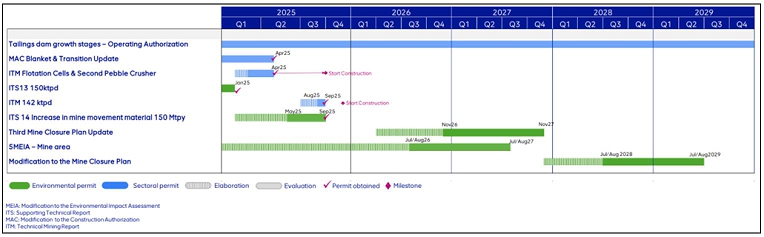
Source: Anglo American
| 20.5 | Social and community |
| 20.5.1 | Social performance framework |
Quellaveco’s social performance system is designed to comply with both Peruvian regulatory requirements and international lender standards, notably the IFC Performance Standards 1 and 5, Equator Principles IV and AASW3. Social risks and opportunities are evaluated annually through the Social and Human Rights Impact and Risk Analysis (SHIRA), a multi-disciplinary process that integrates contextual, perceptual and performance data. This framework embeds the mitigation hierarchy (avoid, minimise, mitigate, remediate) and ensures consistency between corporate commitments, site-level actions and national legislation. The SHIRA process categorizes social risks by likelihood, consequence and stakeholder sensitivity, ensuring early identification of issues such as land access, water perception and employment expectations. Results are reviewed by Anglo American’s Socio-Environmental Management Group (GSA) and linked directly to the Integrated Management System (IMS) for monitoring, audit and corrective action.
| 20.5.2 | Stakeholder engagement |
The Moquegua Dialogue Table (2011 to 2013) formed the basis for Quellaveco’s social licence to operate. The process involved 31 institutions and resulted in 26 commitments addressing water supply, environmental management and social investment. Key design modifications included potable water expansion, co-disposal closure design and restoration of the Asana riverbed. Ongoing stakeholder engagement follows an annually updated Stakeholder Engagement Plan (PES), which defines six engagement zones ranging from highland catchments to Ilo and the Tambo Valley. During 2023–2024, 29 community forums were held, all minuted and tracked through the IMS (Knight Piesold, 2022). Over 800 stakeholders are mapped, and engagement is guided by vulnerability classifications. Surveys indicate improving trust but continued sensitivity around water and dust.
| 20.5.3 | Resettlement and land access |
Although Quellaveco did not involve physical relocation of villages, some land acquisition affected high-Andean campesino communities holding collective land rights. Land negotiations were carried out through a structured, participatory process that mirrored Peru’s consulta previa principles, ensuring consent and compensation for landholders.
The most significant case involved the Tumilaca-Pocata-Coscore-Tala community, whose land was required for part of the Asana diversion tunnel. Agreements covered financial compensation, irrigation canal upgrades and livelihood restoration initiatives. Quellaveco has since expanded its Resettlement Stakeholder Engagement Plan, establishing transparent communication systems and livelihood monitoring for relocated pastoral families.
| FINAL | 3 November 2025 | PAGE |
|
Anglo American plc NI 43-101 Technical Report – Quellaveco Property, Mariscal Nieto Province, Peru |
| 20.5.4 | Community development and livelihood restoration |
Anglo American committed approximately $310 million to the Moquegua Regional Development Fund, benefitting over 26,500 people in education, health, agriculture and nutrition. Between June 2023 and June 2024, 166 service orders and 2,671 community requests were processed (Knight Piesold, 2022). The Productive Restructuring Program and Technical Assistance and Rural Extension (ATER) initiatives assist relocated families in restoring livelihoods.
| 20.5.5 | Social management and monitoring |
Social management practices align with Anglo American’s Health, Safety, Environment and Community (HSEC) standards and Zero Harm vision. Key commitments include 80% local unskilled labour hiring, local employment policies, supplier development, participatory monitoring and grievance management. The Participatory Monitoring Program, established during the Dialogue Table, publishes quarterly reports on air, water and noise quality, reinforcing transparency and accountability.
While Quellaveco enjoys strong community acceptance in Moquegua, inter-regional tensions persist in the Tambo Valley. Anglo American mitigates these through transparent hydrological data sharing, third-party verification and joint community inspections. Labour relations are monitored through IMS tracking to prevent industrial unrest. Following a 2023 strike, communication systems were improved. Community health and safety programs include emergency response training and coordination with regional authorities for off-site risks.
A core Dialogue Table commitment is the post-mining restoration of the Asana River, via co-disposal and backfilling the pit with Asana waste rock material. This approach was endorsed by communities and remains a central environmental and social licence element. Emergency response systems compliant with Supreme Decree 055-2010-EM are maintained and integrated with the AAQSA General Security and Emergency Response Plan.
| 20.5.6 | Social licence to operate |
Quellaveco maintains a high level of social and political support, underpinned by Dialogue Table commitments and social investment delivery. Key sensitivities remain regarding employment decline, water quality, investment timeliness and urban infrastructure pressure. Controls include regular stakeholder forums, grievance channels (AATE), communication campaigns, participatory environmental monitoring and continuous tracking of social commitments. Given the mine’s proximity to the Cuajone and Toquepala operations, regional instability could cause spill-over disruptions; monitoring of non-governmental organization (NGO) activity and social volatility is maintained.
| 20.6 | Mine closure |
Mine closure at Quellaveco is regulated under the Peruvian Mine Closure Law (Law 28090) and Supreme Decree 033-2005-EM, which require progressive closure planning, financial assurance and periodic updates every five years. The Mine Closure Plan (PCM) for the initial 85 kt/d throughput was approved in 2013 and modified in 2014. It was updated in 2016 to align with the 127.5 kt/d throughput. The current PCM has been prepared by Knight Piésold and was approved in 2022 and covers all operational facilities and associated infrastructure. The next formal update is scheduled for 2027. The plan is consistent with Anglo American’s corporate Integrated Mine Closure (IMC) Standard and international best practice guidelines (ICMM 2019; ICOLD; GISTM 2021).
Anglo American implements progressive closure, integrating rehabilitation throughout the mine life. Activities already completed include topsoil recovery, early re-vegetation of completed waste dump lifts, decommissioning of temporary infrastructure and installation of water management controls. By 2024, approximately 160 ha had been re-shaped and re-vegetated within the plant, access road and waste dump areas.
| FINAL | 3 November 2025 | PAGE |
|
Anglo American plc NI 43-101 Technical Report – Quellaveco Property, Mariscal Nieto Province, Peru |
An important element in the closure plan is the restoration of the Asana River upon closure of the mine, to an open watercourse, abandoning the long-term use of the tunnel and waste dump in the Asana Valley. To accomplish this, rockfill and fines will be co-disposed in the pit after the reserves are depleted. The river diversion tunnel will be closed with concrete plugs at the inlet and outlet.
Post-closure monitoring includes physical, geotechnical, geochemical, hydrological and ecological parameters. Typically, post-closure monitoring will occur quarterly for the first 5 years, thereafter annually for up to 30 years. The long-term vision is for the Quellaveco site to be integrated into the surrounding landscape with stable, revegetated landforms and maintained water quality meeting national standards.
The schedule for post-closure activities, in accordance with Mine Closure Plan regulations, will begin upon completion of the final closure activities for each of the components to be closed. The estimated time required to complete these activities is 38 years, from 2056 to 2093. This period is determined by the pit’s post-closure schedule, which is considered a 33-year period. The post-closure schedule for the remaining components has been estimated at 5 years after their respective final closure.
The budgets for the progressive, final and post-closure phases were estimated considering the costs associated with each activity for the closure of the various infrastructure:
| · | Progressive closure activities amount to $647 million |
| · | Final closure activities amounts to $1,196 million |
| · | Post-closure activities amount to $113 million. |
The Law Regulating Mine Closure (Law 28090) as well as the Mine Closure Regulations (Supreme Decree 033-2005-EM) establish that the mining titleholder must provide a financial guarantee in favour of the competent authority to cover the costs associated with the implementation of the Final Closure and Post-Closure measures for the Quellaveco project. The 2022 PCM update confirms that closure financial assurance complies with the Peruvian Mine Closure Law and is secured through Type II (bank guarantee) and Type III (trust fund) instruments (Knight Piésold, 2022):
| · | Type II (Bank Guarantee): about $3.35 million |
| · | Type III (Trust Fund): about $34 million |
| · | Total Financial Assurance (closure + post-closure): about $37 million, derived from the closure base cost (~$1.96 billion). |
| 20.7 | Risks and opportunities |
| 20.7.1 | Risks |
| · | TSF contamination: Downstream contamination from the TSF has been detected and is under monitoring. A ~20% increase in TSF operating costs is expected due to the installation of new control wells and other remedial measures. |
| · | Stakeholder relations and community engagement: Delays or failures in meeting Dialogue Table commitments, or changes to them, may affect community trust. Community concerns persist regarding water quality and dam safety. |
| · | Social unrest and NGO opposition: Activism or protests from NGOs and local communities may lead to temporary operational disruptions. |
| · | 5th MEIA approval: The approval of the 5th MEIA is critical for developing Phases 7 to 9 of the mine. Legal reforms, stakeholder resistance or social conflict could delay or prevent its approval, impacting the Mineral Reserve. Delays in approvals or meeting social commitments could increase capital and operating costs, particularly related to environmental control systems. |
| FINAL | 3 November 2025 | PAGE |
|
Anglo American plc NI 43-101 Technical Report – Quellaveco Property, Mariscal Nieto Province, Peru |
| 20.7.2 | Opportunities |
| · | Improving water use efficiency or accessing additional water will reduce the risk of water shortages for operations or allow potential plant throughput expansion. |
| · | With the EIA modification approved for 127.5 kt/d, the capacity of the plant could be expanded up to a maximum of 191 kt/d (50% over the 127.5 kt/d base case) requiring relatively simple environmental permit modifications (ITM and ITS already submitted) as well as the permits related to additional water sources, while the Beneficiation Concession and new Mining Plan can be amended in parallel to reflect the new production levels. Throughput can therefore be increased to 150 kt/d while awaiting approval of the 5th MEIA, presuming no further significant impacts are generated. |
| FINAL | 3 November 2025 | PAGE |
|
Anglo American plc NI 43-101 Technical Report – Quellaveco Property, Mariscal Nieto Province, Peru |
| 21 | Capital and operating costs |
Anglo American defines capital (capex) and operating (opex) expenditures in accordance with the LoAP, which incorporates the first five years of an approved five-year plan. Capex estimates are developed from first principles using supplier quotations, equipment specifications, and engineering quantities. Opex is based on first-principles unit costs for the mine, process plant, and G&A functions, derived from the five-year plan and directly linked to key production drivers such as processed tonnage and total material moved.
For periods beyond Year 5, LoAP projections apply a capex/opex ratio to estimate SIB capital, incorporating defined major activities such as waste stripping for pit phases and TSF raises. Operating costs beyond this horizon are based on the average unit costs of the initial five years, adjusted as required to reflect anticipated operational changes and cost structure evolution.
| 21.1 | Capital costs |
LoAP capital costs total $5,883 million from January 2025 to a planned completion date of processing in 2055, plus two years (2057). For the first five years, capital costs are prepared using engineering design, vendor quotations and benchmarked unit rates developed during each project phase. From Year 6 onwards, Capex projections are developed using historical capex/opex ratios and identified capital activities including open pit cutbacks and TSF lifts. The forecast LoAP capital costs to 2057 are summarized in Table 21.1.
| Table 21.1 | LoAP capital cost ($ million) to 2056 |
| Capital item | Total | 2025–29 | 2030–34 | 2035–39 | 2040–44 | 2045–49 | 2050–54 | 2055–59 |
| Open pit SIB | 725 | 461 | 2 | 29 | 232 | 1 | - | - |
| Processing | 4,597 | 558 | 724 | 676 | 701 | 1,143 | 676 | 118 |
| Other SIB | 449 | 298 | 66 | 47 | 13 | 16 | 0 | 9 |
| Expansion | 113 | 113 | - | - | - | - | - | - |
| Total | 5,883 | 1,430 | 793 | 752 | 946 | 1,159 | 676 | 127 |
Source: LoAP
The main capex activities in the five-year plan are:
| · | Open pit SIB – Includes mine equipment activities and consumables required for a continuous mine operation, as fuel, tyres and energy consumption. An additional trucks requirement is located at the end of the five-year plan, according to plan to maintain the expected capacity and production. |
| · | Processing – Maintenance programs and components to go according to throughput expectations are included in the SIB cost, considering plant spare parts to consumables, and tailing activities according to plan. |
| · | Other SIB – Capital required according to achieve the strategy included into the plan, defined by studies. |
| · | Expansion – Milling/leaching expansion cost of $105 million is included in the 142 kt/d expansion capital costs. |
Anglo American has included in the Quellaveco economic model post-production closure costs totalling $1,412 million, scheduled for the period 2058 to 2065. These costs cover the principal closure and rehabilitation commitments defined in the LoAP, namely:
| · | Final rehabilitation of the pit (including backfilling and Asana River restoration) |
| · | Decommissioning of the plant and tailings facilities |
| · | Post-closure monitoring and water management commitments. |
| FINAL | 3 November 2025 | PAGE |
|
Anglo American plc NI 43-101 Technical Report – Quellaveco Property, Mariscal Nieto Province, Peru |
| 21.2 | Operating costs |
LoAP average unit operating costs at Quellaveco comprise mining, processing, G&A, royalties, freight, TC/RCs, and arsenic penalties, as detailed in Table 21.2. Operating costs were developed from first-principles estimates based on current performance and the first five years of the LoAP. Total opex forecast by Anglo American over the LoAP amounts to US$32,722 million, as summarised in Table 21.3. By-product credits from molybdenum and silver sales are approximately 1.8% of total revenue. The diesel cost ranges from $3.97/gal to $4.11/gal and power cost from $0.0710/kWh to 0.0889/kWh.
| Table 21.2 | LoAP average unit operating costs |
| Cost centre | Unit | Value |
| Mining | $/t rock mined | 3.63 |
| Processing | $/t ore processed | 7.89 |
| G&A | $/t ore processed | 2.34 |
| Royalty | % net revenue | 3.58 |
| Freight | $/t conc | 112 |
| Arsenic penalty | $/lb Cu | 0.39 |
| TC | $/t concentrate | 47.89 |
| RC | $ lb Cu | 0.05 |
Source: LoAP
| Table 21.3 | LoAP opex ($ million) five-year increments |
| Cost centre | Total | 2025-29 | 2030-34 | 2035-39 | 2040-44 | 2045-49 | 2050-54 | 2055-59 |
| Mining | 9,068 | 2,088 | 1,845 | 1,717 | 1,845 | 865 | 557 | 151 |
| Processing | 12,275 | 1,925 | 2,027 | 2,027 | 2,028 | 2,044 | 2,106 | 117 |
| G&A | 3,636 | 802 | 761 | 761 | 761 | 330 | 152 | 67 |
| Royalty | 2,888 | 593 | 541 | 601 | 529 | 398 | 217 | 9 |
| Freight | 2,931 | 549 | 554 | 628 | 550 | 412 | 228 | 9 |
| Arsenic penalty | 6 | 0 | 0 | 0 | 0 | 0 | 5 | 0 |
| TC | 1,255 | 211 | 243 | 275 | 241 | 181 | 100 | 4 |
| RC | 665 | 136 | 125 | 139 | 123 | 91 | 50 | 2 |
| Total | 32,722 | 6,305 | 6,096 | 6,148 | 6,078 | 4,320 | 3,416 | 360 |
Source: LoAP
| FINAL | 3 November 2025 | PAGE |
|
Anglo American plc NI 43-101 Technical Report – Quellaveco Property, Mariscal Nieto Province, Peru |
The key cost drivers in the five-year plan for mining and processing opex are listed in Table 21.4.
| Table 21.4 | Five-year plan mining operating costs |
| Cost centre | Cost ($ M) |
| Fuel | 586 |
| Load and haul | 548 |
| Drill and blast | 340 |
| Maintenance | 331 |
| Technical services | 120 |
| Operation support | 96 |
| Services | 25 |
| Contractor | 18 |
| Other | 17 |
| Materials | 9 |
Source: LoAP
| FINAL | 3 November 2025 | PAGE |
|
Anglo American plc NI 43-101 Technical Report – Quellaveco Property, Mariscal Nieto Province, Peru |
| 22 | Economic analysis |
Issuers who are classified as a producing issuer may exclude the information required under Item 22 for technical reports on properties currently in production unless the technical report includes a material expansion of current production. As no material expansion, production increase or new development phase is currently proposed for the Quellaveco LoAP, an economic analysis has not been prepared or disclosed in this Technical Report. The project remains an operating asset, and its financial performance is governed by Anglo American’s internal budgets and corporate reporting standards rather than a standalone discounted cashflow analysis.
| FINAL | 3 November 2025 | PAGE |
|
Anglo American plc NI 43-101 Technical Report – Quellaveco Property, Mariscal Nieto Province, Peru |
| 23 | Adjacent properties |
Southern Peru is host to several significant porphyry copper ± molybdenum ± gold deposits. Of note are the operating Cuajone and Toquepala copper mines of Southern Copper Corporation immediately adjoining the Property (Figure 23.1).
| Figure 23.1 | Quellaveco adjacent properties |
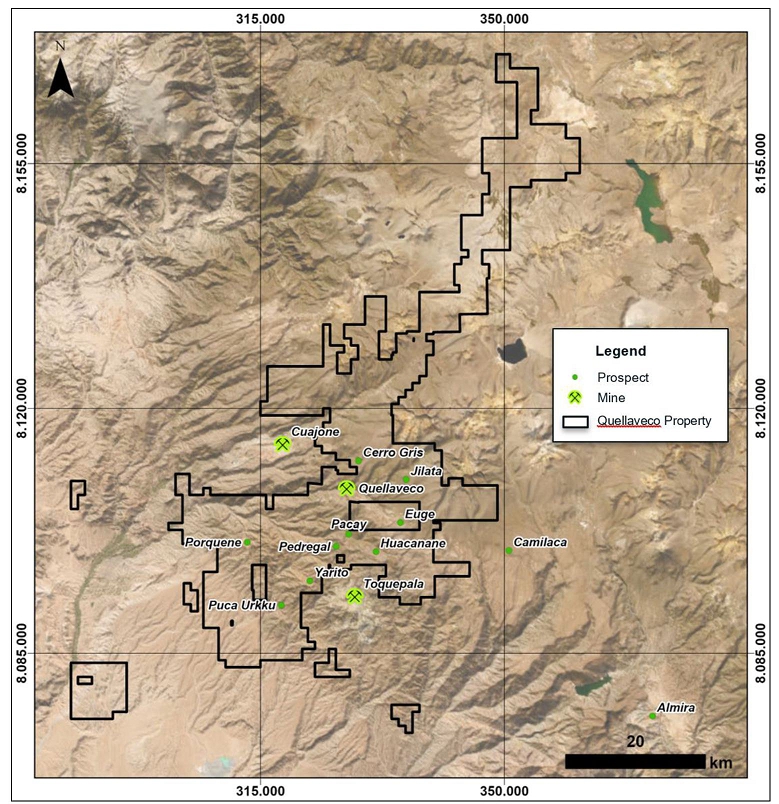
Source: Anglo American
| FINAL | 3 November 2025 | PAGE |
|
Anglo American plc NI 43-101 Technical Report – Quellaveco Property, Mariscal Nieto Province, Peru |
The information disclosed in this Item regarding adjacent properties have been sourced from S-K 1300 Technical Report Summaries dated 31 December 2024 included as Exhibits to the Form 10-K Annual Report by Southern Copper Corporation and filed on the US Securities and Exchange Commission (SEC) on 3 March 2025. The Qualified Person has been unable to verify the information disclosed in the Technical Report Summaries and cautions that this information is not necessarily indicative of the mineralization on the Property that is the subject of this Technical Report.
The Qualified Person is not aware of any other material information concerning adjacent properties that warrants disclosure.
| 23.1 | Cuajone |
Cuajone is a porphyry copper-molybdenum deposit related to a multi-stage latite porphyry that intrudes basaltic andesites and overlying rhyolite porphyries of the Toquepala Group. The mineralization currently being exploited in the open pit is hypogene and consists of pyrite, chalcopyrite and bornite, with sparse sphalerite, galena and enargite.
Southern Copper Corporation has held an interest in the project since 1954 and commenced open pit operations in 1976. The total open pit Proven and Probable Mineral Reserve reported by Southern Copper Corporation as of 31 December 2024 is 1,518 Mt at 0.48% Cu, with an additional Measured and Indicated Mineral Resource of 506 Mt at 0.33% Cu and an Inferred Mineral Resource of 865 Mt at 0.28% Cu.
The conventional truck-and-shovel open pit mining operation has a remaining mine life of 50 years. Ore is crushed adjacent to the pit a nominal rate of 90,000 t/d and transported via a 7 km long conveyor to the concentrator. Oxide material is crushed separately and trucked and deposited on a nearby leach pad.
Most of the copper concentrate is railed to a dedicated smelter and refinery near Ilo with a nominal capacity of 1.2 Mt/a of copper concentrate to produce copper cathodes as a final product for export. Molybdenum concentrate is sold to third parties.
| 23.2 | Toquepala |
Toquepala is also a porphyry copper-molybdenum deposit associated with a complex intrusive center dominated by four phases of porphyritic dacite plugs, a dacite diatreme and agglomerates, extensive hydrothermal breccias and latite porphyry stocks and dykes.
Primary mineralization occurs as hypogene sulphides mainly restricted to the dacite porphyry and breccias. Chalcopyrite is the dominant economic mineral with lesser bornite, molybdenite and enargite as disseminations, fracture fillings, and breccia matrix.
Southern Copper Corporation has held an interest in the project since 1945. Mine operations commenced in 1960.
The total open pit Proven and Probable Mineral Reserve reported by Southern Copper Corporation as of 31 December 2024 is 4,379 Mt at 0.32% Cu, with an additional Measured and Indicated Mineral Resource of 336 Mt at 0.40% Cu and an Inferred Mineral Resource of 214 Mt at 0.25% Cu.
The conventional truck-and-shovel open pit mining operation has a remaining mine life of 41 years. A crusher adjoining the open pit has a nominal capacity of 120,000 t/d with crushed ore transported along a 2.0 km long conveyor through a tunnel to the concentrator. Crushed oxide material is transported via a 6.5 km long conveyor to the crushed leach dump.
Copper concentrate is transported by rail to the Ilo smelter and refinery. Molybdenum concentrate is sold as a final product.
| FINAL | 3 November 2025 | PAGE |
|
Anglo American plc NI 43-101 Technical Report – Quellaveco Property, Mariscal Nieto Province, Peru |
| 24 | Other relevant data and information |
The Qualified Persons are not aware of any other relevant data and information to disclose.
| FINAL | 3 November 2025 | PAGE |
|
Anglo American plc NI 43-101 Technical Report – Quellaveco Property, Mariscal Nieto Province, Peru |
| 25 | Interpretation and conclusions |
| 25.1 | Conclusions |
Quellaveco is a large-scale, long-life copper-molybdenum operation owned by Anglo American (60%) and Mitsubishi Corporation (40%), located in southern Peru’s Moquegua Department. The project has transitioned to stable operations following successful commissioning in 2022, with the molybdenum circuit achieving commercial production in 2023.
Current operations deliver a throughput of 142 kt/d, producing approximately 309 kt copper equivalent per annum over the next five years under the LoAP. Ore is processed through a conventional crush-grind-flotation circuit, producing clean, low-impurity copper and molybdenum concentrates for export via the Port of Ilo.
The 2025 Mineral Reserve (reported as of 31 December 2025 assuming depletion through such date) stands at 1,488 Mt at 0.49% Cu and 0.017% Mo, supporting a 22-year mine life and a 31-year concentrator life through the processing of lower-grade stockpiles during the final 9 years of operation. Metallurgical recoveries average 81.3% Cu with a 2.2% CPF uplift. The LoAP financial model confirms that the declared Mineral Reserve is economically viable under Anglo American’s metal price and cost assumptions.
All major permits and environmental approvals are in place for the current production rate. The 5th MEIA, planned for submission in 2026, will support a pit expansion and throughput increases to 140–150 kt/d. Continuous slope monitoring, water management and community engagement programs remain integral to maintaining safe and responsible operations.
The Qualified Persons conclude that:
| · | The available geological, geotechnical and metallurgical data provide a sound basis for the Mineral Resource and Ore Reserve estimates |
| · | Operating and capital cost assumptions derived from the current five-year plan are reasonable and in line with comparable operations |
| · | The project demonstrates positive economic viability under Anglo American’s metal price forecasts |
| · | There are no known legal, environmental or social factors that materially affect the ability to extract the Mineral Reserve. |
| 25.2 | Risks |
Principal risks include copper price volatility, long-term water availability, geotechnical stability of the open pit and potential community or regulatory delays that could affect future expansions or mine life extensions. These risks are considered manageable within Anglo American’s current operational and governance framework.
| FINAL | 3 November 2025 | PAGE |
|
Anglo American plc NI 43-101 Technical Report – Quellaveco Property, Mariscal Nieto Province, Peru |
| 26 | Recommendations |
The following recommended activities are considered part of normal operational and compliance improvements and are not expected to materially affect the economic viability of the project.
Permitting and regulatory:
| · | Proceed with preparation and submission of the 5th MEIA to secure approvals for the expanded open pit, waste and tailings facilities, and increased concentrator throughput to 140–150 kt/d. |
| · | Maintain proactive engagement with the Ministry of Energy and Mines and the Environmental Assessment and Enforcement Agency (OEFA) to ensure continuous compliance and timely approval of modifications. |
Geotechnical and hydrogeological:
| · | Continue refinement of the geotechnical model, with emphasis on the north wall and deeper pit sectors, incorporating new drilling and slope-monitoring data to verify stability and depressurization performance. |
| · | Expand hydrogeological modelling to confirm long-term pit inflow predictions and optimize dewatering infrastructure for future mining phases. |
Resource and Reserve development:
| · | Maintain regular updates of the geological and geometallurgical models using production and infill drilling data to improve local grade control and recovery prediction. |
| · | Conduct additional drilling to test extensions of the hypogene mineralization at depth and along structural corridors identified by recent modelling. |
Processing and metallurgy:
| · | Advance studies to confirm the throughput expansion to 150 kt/d, including validation of the CPF recovery uplift and assessment of energy efficiency improvements. |
| · | Evaluate opportunities for tailings thickening and in-pit co-disposal to extend storage capacity and support progressive closure objectives. |
Operations and cost optimization:
| · | Continue refinement of the LoAP using updated cost and production data, ensuring alignment between operational key performance indicators, opex/capex ratios and price assumptions. |
| · | Review mining fleet replacement and refurbishment schedules to maintain availability and optimize lifecycle costs. |
Environmental and social performance:
| · | Sustain community engagement and regional development programs under the Moquegua Dialogue Table framework to preserve social licence to operate. |
| · | Implement continuous improvement in water, air-quality and biodiversity monitoring, aligned with AASW3 and IFC Performance Standards. |
| · | Progress closure planning and financial assurance updates consistent with Peru’s Mine Closure Law 28090. |
Anglo American has established corporate protocols to fund exploration programs and mining studies through its corporate overheads and mine budgets, ensuring adequate financial and technical support for advancing project development activities in alignment with corporate governance and reporting standards. The budget for the recommended works, including resource definition drilling, metallurgical testing, technical studies, and the FS assessment program, is incorporated within Anglo American’s corporate overheads as well as the mine’s approved capex and opex allocations reported in Item 21.
| FINAL | 3 November 2025 | PAGE |
|
Anglo American plc NI 43-101 Technical Report – Quellaveco Property, Mariscal Nieto Province, Peru |
| 27 | References |
| Author | Title |
| Anglo American, 2024 | Anglo American. (2024). Quellaveco Depth Extension Exploration Target Report. Published May 2024. Available at: https://www.angloamerican.com (Accessed: 26 September 2025) |
| Anglo American, 2025a | Anglo American. (2025). Quellaveco Competent Persons’ Statement: Ore Reserves and Mineral Resources. Anglo American plc, [Unpublished internal company report]. |
| Anglo American, 2025b | Anglo American. (2025). Mineral Resource Model Update Report 2025. Anglo American plc, [Unpublished internal company report]. |
| CIM, 2014 | CIM Definition Standards for Mineral Resources & Mineral Reserves. Prepared by the CIM Standing Committee on Reserve Definitions. Adopted by CIM Council on 19 May, 2014 |
| Fluor, 2017 | Fluor. (2017). Quellaveco Project: 127.5 ktpd Feasibility Report. Fluor Corporation. [Unpublished internal company report]. |
| JORC Code, 2012 | The Australasian Code for Reporting of Exploration Results, Mineral Resources and Ore Reserves. Prepared by the Joint Ore Reserves Committee of The Australasian Institute of Mining and Metallurgy, Australian Institute of Geoscientists and Minerals Council of Australia (JORC). |
| Knight Piésold, 2022. | Knight Piésold. (2022). Quellaveco Project- Second update of the Mines Closure Plan. Revision 2, Final. May 2022. [Unpublished internal company report]. Knight Piésold Consultores S.A. |
| Snowden Optiro, 2024 | Snowden Optiro. (2024). Anglo American Quellaveco S.A. - Quellaveco: Mineral Resource and Ore Reserve Audit. January 2024. [Unpublished internal company report]. Snowden Optiro Pty Ltd. |
| FINAL | 3 November 2025 | PAGE |
|
Anglo American plc NI 43-101 Technical Report – Quellaveco Property, Mariscal Nieto Province, Peru |
| 28 | Certificates |
| 28.1 | Certificate of Qualified Person |
| FINAL | 3 November 2025 | PAGE |
|
Anglo American plc NI 43-101 Technical Report – Quellaveco Property, Mariscal Nieto Province, Peru |
CERTIFICATE OF QUALIFIED PERSON
I, Gordon Cunningham, Associate Principal Consultant of Snowden Optiro, 216 St Georges Terrace, Perth Western Australia, do hereby certify that:
| a) | I am the co-author of the technical report titled NI 43-101 Technical Report – Quellaveco Property, Mariscal Nieto Province, Peru with an effective date of November 3, 2025 (the “Technical Report”) prepared for Anglo American plc. |
| b) | I graduated with a B. Eng. (Chemical) from the University of Queensland in 1975. |
| c) | I am a member in good standing of the Engineering Council of South Africa and am registered as a Professional Engineer – Registration No. 920082. I am a Fellow in good standing of the South African Institute of Mining and Metallurgy (SAIMM) – Membership No. 19584. |
| d) | I have worked as a metallurgist in production for more than 20 years since my graduation. I have worked as a corporate Consulting Metallurgist for 5 years, an independent metallurgical consultant for 2 years and for Turnberry Projects for 21 years as a Project and Principal Engineer and Director, primarily associated with mining and metallurgy projects. |
| e) | I have read the definition of “qualified person” set out in National Instrument 43-101 – Standards of Disclosure for Mineral Projects (the “Instrument”) and certify that by reason of my education, affiliation with a professional association and past relevant work experience, I fulfil the requirements of a “qualified person” for the purposes of the Instrument. |
| f) | I have not made a current visit to the Quellaveco Copper Mine. |
| g) | I am responsible for the preparation of Items 13, 17 and 18.1 of the Technical Report. |
| h) | I am independent of Anglo American plc as defined in section 1.5 of the Instrument. |
| i) | I have not had prior involvement with the Quellaveco Property. |
| j) | I have read the Instrument and Form 43-101F1, and the Technical Report has been prepared in compliance with that instrument and form. |
| k) | As of the effective date of the Technical Report, to the best of my knowledge, information and belief, the Technical Report contains all the scientific and technical information that is required to be disclosed to make the Technical Report not misleading. |
Dated at Dated at Johannesburg, South Africa this 3rd November, 2025.
(signed)
“Gordon Cunningham”
Gordon Cunningham B. Eng. (Chemical), Pr. Eng. (ECSA), FSAIMM
Associate Principal Consultant
| FINAL | 3 November 2025 | PAGE |
|
Anglo American plc NI 43-101 Technical Report – Quellaveco Property, Mariscal Nieto Province, Peru |
CERTIFICATE OF QUALIFIED PERSON
I, Allan Earl, Executive Consultant of Snowden Optiro, 216 St Georges Terrace Perth, Western Australia, do hereby certify that:
| a) | I am the co-author of the technical report titled NI 43-101 Technical Report – Quellaveco Property, Mariscal Nieto Province, Peru with an effective date of November 3, 2025 (the “Technical Report”) prepared for Anglo American plc. |
| b) | I graduated with an Associateship in Mining Engineering from the Western Australian School of Mines in 1977. |
| c) | I am a Fellow in good standing of the Australasian Institute of Mining and Metallurgy (AusIMM) – Membership No. 110247. |
| d) | I have worked as a mining engineer continuously for 45 years since graduation. I have been involved as a mining and resource evaluation consultant for over 20 years, and my work has included scoping studies, prefeasibility studies, feasibility studies, and reserve estimation and reporting for open pit and underground mines for at least five of these years. |
| e) | I have read the definition of “qualified person” set out in National Instrument 43-101 – Standards of Disclosure for Mineral Projects (the “Instrument”) and certify that by reason of my education, affiliation with a professional association and past relevant work experience, I fulfil the requirements of a “qualified person” for the purposes of the Instrument. |
| f) | I have not made a current visit to the Quellaveco Copper Mine. |
| g) | I am responsible for the preparation of Items 18.3, 18.4, 18.5, 18.6, 18.7, 18.8, 18.9, 18.10, 19 and 21 of the Technical Report. |
| h) | I am independent of Anglo American plc as defined in section 1.5 of the Instrument. |
| i) | I have had no prior involvement with the property that is the subject of the Technical Report. |
| j) | I have read the Instrument and Form 43-101F1, and the Technical Report has been prepared in compliance with that instrument and form. |
| k) | As of the effective date of the Technical Report, to the best of my knowledge, information and belief, the Technical Report contains all the scientific and technical information that is required to be disclosed to make the Technical Report not misleading. |
Dated at Perth, Western Australia this 3rd November, 2025.
(signed)
“Allan Earl”
Allan Earl AWASM, FAusIMM
Executive Consultant
| FINAL | 3 November 2025 | PAGE |
|
Anglo American plc NI 43-101 Technical Report – Quellaveco Property, Mariscal Nieto Province, Peru |
CERTIFICATE OF QUALIFIED PERSON
I, Ian Glacken, Executive Consultant of Snowden Optiro, 216 St Georges Terrace Perth, Western Australia, do hereby certify that:
| a) | I am the co-author of the technical report titled NI 43-101 Technical Report – Quellaveco Property, Mariscal Nieto Province, Peru with an effective date of November 3, 2025 (the “Technical Report”) prepared for Anglo American plc. |
| b) | I graduated with a B.Sc. (Hons) in Geology from the University of Durham (United Kingdom) in 1979, with an M.Sc. in Mining Geology from Royal School of Mines (United Kingdom) in 1981, and with an M.Sc. in Geostatistics from Stanford University (USA) in 1996. |
| c) | I am a Fellow and Chartered Professional (Geology) in good standing of the Australasian Institute of Mining and Metallurgy (AusIMM) – Membership No. 107194, a Fellow in good standing of the Australian Institute of Geoscientists (AIG) – Membership No. 6400, and a Member and Chartered Engineer in good standing of the Institute of Mining, Metallurgy and Materials (United Kingdom) – Membership No. 46394. |
| d) | I have worked as a mining geologist and geostatistician continuously for 44 years since graduation from the Royal School of Mines. I have worked in operational (geology supervision, resource geology) roles for a major mining company and have worked as a consultant for the past 27 years, working on resource estimation, due diligence studies, reconciliation and training for a range of commodities, but including copper. |
| e) | I have read the definition of “qualified person” set out in National Instrument 43-101 – Standards of Disclosure for Mineral Projects (the “Instrument”) and certify that by reason of my education, affiliation with a professional association and past relevant work experience, I fulfil the requirements of a “qualified person” for the purposes of the Instrument. |
| f) | I have not made a current visit to the Quellaveco Copper Mine. |
| g) | I am responsible for the preparation of Items 1, 2, 3, 4, 5, 6, 9, 10, 11, 23, 24, 25, 26 and 27 of the Technical Report. |
| h) | I am independent of Anglo American plc as defined in section 1.5 of the Instrument. |
| i) | I have had no prior involvement with the property that is the subject of the Technical Report. |
| j) | I have read the Instrument and Form 43-101F1, and the Technical Report has been prepared in compliance with that instrument and form. |
| k) | As of the effective date of the Technical Report, to the best of my knowledge, information and belief, the Technical Report contains all the scientific and technical information that is required to be disclosed to make the Technical Report not misleading. |
Dated at Perth, Western Australia this 3rd November, 2025.
(Signed)
“Ian M Glacken”
Ian M Glacken FAusIMM(CP), FAIG, MIMMM, CEng, DIC, BSc, MSc, MS
Executive Consultant
| FINAL | 3 November 2025 | PAGE |
|
Anglo American plc NI 43-101 Technical Report – Quellaveco Property, Mariscal Nieto Province, Peru |
CERTIFICATE OF QUALIFIED PERSON
I, Paulo Laymen, Associate Consultant of Snowden Optiro, Av. Álvares Cabral 593, Belo Horizonte, Minas Gerais state, Brazil, do hereby certify that:
| a) | I am the co-author of the technical report titled NI 43-101 Technical Report – Quellaveco Property, Mariscal Nieto Province, Peru with an effective date of November 3, 2025 (the “Technical Report”) prepared for Anglo American plc. |
| b) | I graduated with a ME (Mining Engineering) and BE (Mining Engineering) from Universidad Politécnica de Madrid, Spain in 2002, and with a Diploma in Block Cave Engineering from Universidad de Chile, Chile in 2015. |
| c) | I am a Fellow in good standing of the Australasian Institute of Mining and Metallurgy (AusIMM) – Membership No. 320977, a Registered Member in good standing of the Chilean Mining Commission – Membership No. 0320, and a Member in good standing of the Society of Economic Geologists (SEG) – Membership No. 917263. |
| d) | My relevant experience is that of a Mining Engineer with over 23 years’ mining experience in Europe, South America, Africa, Central Asia and the Middle East. I have worked in a range of roles including mine planning and operation management of open pit and underground mines for a variety of commodities. I specialize in mineral reserve estimation and reporting. |
| e) | I have read the definition of “qualified person” set out in National Instrument 43-101 – Standards of Disclosure for Mineral Projects (the “Instrument”) and certify that by reason of my education, affiliation with a professional association and past relevant work experience, I fulfil the requirements of a “qualified person” for the purposes of the Instrument. |
| f) | I have made a current visit to the Quellaveco Copper Mine on 14 and 15 October 2025. |
| g) | I am responsible for the preparation of Items 15 and 16 of the Technical Report. |
| h) | I am independent of Anglo American plc as defined in section 1.5 of the Instrument. |
| i) | I have prior involvement with the property that is the subject of the Technical Report. I conducted an ore reserve audit for the Quellaveco Property between October 2023 and January 2024, while employed by Snowden Optiro. |
| j) | I have read the Instrument and Form 43-101F1, and the Technical Report has been prepared in compliance with that instrument and form. |
| k) | As of the effective date of the Technical Report, to the best of my knowledge, information and belief, the Technical Report contains all the scientific and technical information that is required to be disclosed to make the Technical Report not misleading. |
Dated at Belo Horizonte, Brazil this 3rd November, 2025.
(signed)
“Paulo Laymen”
Paulo Laymen, BEng, MEng (Mining), FAusIMM
Associate Consultant
| FINAL | 3 November 2025 | PAGE |
|
Anglo American plc NI 43-101 Technical Report – Quellaveco Property, Mariscal Nieto Province, Peru |
CERTIFICATE OF QUALIFIED PERSON
I, Graeme Lyall, Executive Consultant of Snowden Optiro, Av. Suecia 0155, Of.902, Providencia, Santiago, Chile, do hereby certify that:
| a) | I am the co-author of the technical report titled NI 43-101 Technical Report – Quellaveco Property, Mariscal Nieto Province, Peru with an effective date of November 3, 2025 (the “Technical Report”) prepared for Anglo American plc. |
| b) | I graduated with a B.Sc. (Hons) in Geology from the University of Edinburgh in 1990. |
| c) | I am a Fellow in good standing of the Australasian Institute of Mining and Metallurgy (AusIMM) – Membership No. 224791 |
| d) | I have worked as a geologist continuously since graduation from university in 1990. I have over 30 years of experience in the fields of mineral exploration, geological modelling, resource estimation and reporting. Throughout my career I have participated in numerous evaluations from exploration to development of porphyry Cu-Mo deposit types in the region. |
| e) | I have read the definition of “qualified person” set out in National Instrument 43-101 – Standards of Disclosure for Mineral Projects (the “Instrument”) and certify that by reason of my education, affiliation with a professional association and past relevant work experience, I fulfil the requirements of a “qualified person” for the purposes of the Instrument. |
| f) | I have made a current visit to the Quellaveco Copper Mine on 14 and 15 October 2025. I also made a visit between 24 and 26 October 2023. |
| g) | I am responsible for the preparation of Items 12 and 14 of the Technical Report. |
| h) | I am independent of Anglo American plc as defined in section 1.5 of the Instrument. |
| i) | I have prior involvement with the property that is the subject of the Technical Report. Specifically, I participated in technical and development studies on the property while employed by Anglo American Chile and its affiliates from 1992 to 2012. In addition, I conducted an ore reserve audit for the Quellaveco Property between October 2023 and January 2024, while employed by Snowden Optiro. |
| j) | I have read the Instrument and Form 43-101F1, and the Technical Report has been prepared in compliance with that instrument and form. |
| k) | As of the effective date of the Technical Report, to the best of my knowledge, information and belief, the Technical Report contains all the scientific and technical information that is required to be disclosed to make the Technical Report not misleading. |
Dated at Santiago, Chile this 3rd November, 2025.
(signed)
“Graeme Lyall”
Graeme Lyall B.Sc. (Hons), FAusIMM
Executive Consultant
| FINAL | 3 November 2025 | PAGE |
|
Anglo American plc NI 43-101 Technical Report – Quellaveco Property, Mariscal Nieto Province, Peru |
CERTIFICATE OF QUALIFIED PERSON
I, Gené Main, Principal Environmental Consultant of Prime Resources (Pty) Ltd, The Workshop, 70-7th Avenue, Parktown North, Johannesburg, South Africa, do hereby certify that:
| a) | I am the co-author of the technical report titled NI 43-101 Technical Report – Quellaveco Property, Mariscal Nieto Province, Peru with an effective date of November 3, 2025 (the “Technical Report”) prepared for Anglo American plc. |
| b) | I graduated with a B.Sc. (Hons.) in Environmental Science from Rhodes University (South Africa) in 2003, and with a M.Sc. in Botany from the University of the Western Cape (South Africa) in 2006. |
| c) | I am a member in good standing of the Environmental Assessment Practitioners Association of South Africa (EAPASA), I am registered as a Certified Environmental Assessment Practitioner (Registration No. 2019/1257), and the South African Council for Natural Scientific Professions (SACNASP), registered as a Professional Natural Scientist (Environmental Science) (Registration No. 400370/13). |
| d) | I have worked as an environmental and social consultant for 18 years since graduation. I have worked as a Principal Environmental Consultant for 10 years, primarily in the mining and waste management sectors. |
| e) | I have read the definition of “qualified person” set out in National Instrument 43-101 – Standards of Disclosure for Mineral Projects (the “Instrument”) and certify that by reason of my education, affiliation with a professional association and past relevant work experience, I fulfil the requirements of a “qualified person” for the purposes of the Instrument. |
| f) | I have not made a current visit to the Quellaveco Copper Mine. |
| g) | I am responsible for the preparation of Item 20 of the Technical Report. |
| h) | I am independent of Anglo American plc as defined in section 1.5 of the Instrument. |
| i) | I have had no prior involvement with the property that is the subject of the Technical Report. |
| j) | I have read the Instrument and Form 43-101F1, and the Technical Report has been prepared in compliance with that instrument and form. |
| k) | As of the effective date of the Technical Report, to the best of my knowledge, information and belief, the Technical Report contains all the scientific and technical information that is required to be disclosed to make the Technical Report not misleading. |
Dated at Johannesburg, South Africa this 3rd November, 2025.
(signed)
“Gené Main”
Gené Main, M.Sc. (Botany), Registered EAP (EAPASA), Pr.Sci.Nat. (Environmental Science)
Associate Principal Consultant
| FINAL | 3 November 2025 | PAGE |
|
Anglo American plc NI 43-101 Technical Report – Quellaveco Property, Mariscal Nieto Province, Peru |
CERTIFICATE OF QUALIFIED PERSON
I, Aaron Radonich, Executive Consultant of Snowden Optiro, 216 St Georges Terrace Perth, Western Australia, do hereby certify that:
| a) | I am the co-author of the technical report titled NI 43-101 Technical Report – Quellaveco Property, Mariscal Nieto Province, Peru with an effective date of November 3, 2025 (the “Technical Report”) prepared for Anglo American plc. |
| b) | I graduated with a B.Sc. (Hons) in Geology from the University of Tasmania in 2002, and with a Post Graduate Certificate in Geostatistics (PGradCertGeostats) from Edith Cowan University in 2016. |
| c) | I am a Fellow and Charted Professional (Geology) in good standing of the Australasian Institute of Mining and Metallurgy (AusIMM) – Membership No. 221172. |
| d) | I have worked as a geologist continuously for 23 years since graduation. I have worked in the areas of training, exploration program design and management, technical due diligence, independent technical reviews/audits, geological modelling, and resource estimation and reporting for open pit and underground mines for at least five of these years. I have been involved in various levels of technical studies and have worked on greenfields, brownfields and operational sites in Australia and internationally. |
| e) | I have read the definition of “qualified person” set out in National Instrument 43-101 – Standards of Disclosure for Mineral Projects (the “Instrument”) and certify that by reason of my education, affiliation with a professional association and past relevant work experience, I fulfil the requirements of a “qualified person” for the purposes of the Instrument. |
| f) | I have not made a current visit to the Quellaveco Copper Mine. |
| g) | I am responsible for the preparation of Items 7 and 8 of the Technical Report. |
| h) | I am independent of Anglo American plc as defined in section 1.5 of the Instrument. |
| i) | I have had no prior involvement with the property that is the subject of the Technical Report. |
| j) | I have read the Instrument and Form 43-101F1, and the Technical Report has been prepared in compliance with that instrument and form. |
| k) | As of the effective date of the Technical Report, to the best of my knowledge, information and belief, the Technical Report contains all the scientific and technical information that is required to be disclosed to make the Technical Report not misleading. |
Dated at Perth, Western Australia this 3rd November, 2025.
(signed)
“Aaron D Radonich”
Aaron D Radonich B.Sc. (Hons), FAusIMM (CP)
Executive Consultant
| FINAL | 3 November 2025 | PAGE |
|
Anglo American plc NI 43-101 Technical Report – Quellaveco Property, Mariscal Nieto Province, Peru |
CERTIFICATE OF QUALIFIED PERSON
I, Peter Jonathan Theron, Director and Principal Consultant of Prime Resources (Pty) Ltd, The Workshop, 70-7th Avenue, Parktown North, Johannesburg, South Africa, do hereby certify that:
| a) | I am the co-author of the technical report titled NI 43-101 Technical Report – Quellaveco Property, Mariscal Nieto Province, Peru with an effective date of November 3, 2025 (the “Technical Report”) prepared for Anglo American plc. |
| b) | I graduated from the University of Pretoria with a B. Eng.. (Civil) in 1985 and from the Witwatersrand University with a Graduate Diploma in Engineering (GDE) in 1995. |
| c) | I am a member in good standing of the Engineering Council of South Africa and am registered as a Professional Engineer – Registration No. 950329. I am a Member in good standing of the South African Institute of Mining and Metallurgy (SAIMM) – Membership No. 703496. |
| d) | I have worked as a civil and environmental engineer continuously since graduation. I have more than 35 years of consulting experience in the field of tailings design, waste management and environmental studies. |
| e) | I have read the definition of “qualified person” set out in National Instrument 43-101 – Standards of Disclosure for Mineral Projects (the “Instrument”) and certify that by reason of my education, affiliation with a professional association and past relevant work experience, I fulfil the requirements of a “qualified person” for the purposes of the Instrument. |
| f) | I have not made a current visit to the Quellaveco Copper Mine. |
| g) | I am responsible for the preparation of Item 18.2 of the Technical Report. |
| h) | I am independent of Anglo American plc as defined in section 1.5 of the Instrument. |
| i) | I have had no prior involvement with the property that is the subject of the Technical Report. |
| j) | I have read the Instrument and Form 43-101F1, and the Technical Report has been prepared in compliance with that instrument and form. |
| k) | As of the effective date of the Technical Report, to the best of my knowledge, information and belief, the Technical Report contains all the scientific and technical information that is required to be disclosed to make the Technical Report not misleading. |
Dated at Hermanus, South Africa this 3rd November, 2025.
(signed)
“Peter J Theron”
Peter J Theron B. Eng. (Civil), GDE, Pr. Eng. (ECSA), MSAIMM
Associate Principal Consultant
| FINAL | 3 November 2025 | PAGE |