 エドガーで原本を確認する
UNITED STATES
SECURITIES AND EXCHANGE COMMISSION
Washington, D.C. 20549
FORM 6-K
REPORT OF FOREIGN PRIVATE ISSUER
PURSUANT TO RULE 13a-16 OR 15d-16
UNDER THE SECURITIES EXCHANGE ACT OF 1934
For the month of November, 2025
Commission File Number: 001-35936
B2Gold Corp.
(Translation of registrant’s name into English)
British Columbia, Canada
(Jurisdiction of incorporation or organization)
Suite 3400, Park Place
666 Burrard Street
Vancouver, British Columbia V6C 2X8
Canada
(Address of principal executive office)
Indicate by check mark whether the registrant files or will file annual reports under cover of Form 20-F or Form 40-F:
¨ Form 20-F x Form 40-F
DOCUMENTS INCLUDED AS PART OF THIS FORM 6-K
See the Exhibit Index hereto.
SIGNATURES
Pursuant to the requirements of the Securities Exchange Act of 1934, the registrant has duly caused this report to be signed on its behalf by the undersigned, thereunto duly authorized.
| B2Gold Corp. | ||
| Date: November 7, 2025 | By: | /s/ Randall Chatwin |
| Name: | Randall Chatwin | |
| Title: | Senior Vice President, Legal and Corporate Communications | |
EXHIBIT INDEX
| Exhibit No. |
Description | |
| 99.1 | Technical Report for the Masbate Gold Project, Philippines |

November 7, 2025
British Columbia Securities Commission
Corporate Finance
P.O. Box 10142, Pacific Centre
701 West Georgia Street
Vancouver, BC V7Y 1L2
Dear Sirs and Mesdames:
| Re: | Filing by B2Gold Corp. (“B2Gold”) of a Technical Report not required by National Instrument 43-101 - Standards of Disclosure for Mineral Projects (“NI 43-101”) |
B2Gold is filing the attached technical report entitled “Masbate Gold Project, Philippines, NI 43-101 Technical Report” dated effective September 30, 2025 (the “Report”) in respect of its Masbate Gold Project located in the Philippines (the “Project”). The Report is being filed at this time to provide an incremental update for the Project on a voluntary basis as contemplated under section 4.2(12) of the Companion Policy to NI 43-101 and not as a result of a requirement under section 4.2 of NI 43-101.
Yours sincerely,
B2GOLD CORP.
| By: | /s/ Randall Chatwin | |
| Randall Chatwin | ||
| SVP, Legal and Corporate Communications |
cc: Alberta Securities Commission, Financial and Consumer Affairs Authority of Saskatchewan, Manitoba Securities Commission, Ontario Securities Commission, Autorite des marches financiers, Quebec, Nova Scotia Securities Commission, New Brunswick Securities Commission, Office of the Superintendent of Securities, Prince Edward Island, Office of the Superintendent of Securities, Newfoundland and Labrador I, Michael Johnson, P.Geo., am employed as the Manager, Technical Services, with B2Gold Corp.

Exhibit 99.1


CERTIFICATE OF QUALIFIED PERSON
(“B2Gold”), which has its head offices at 666 Burrard St #3400, Vancouver, BC V6C 2X8, Canada.
This certificate applies to the technical report titled “Masbate Gold Project, Philippines, NI 43-101 Technical Report”, that has an effective date of September 30, 2025 (the “Technical Report”).
I am a Professional Geoscientist in good standing with Engineers and Geoscientists British Columbia, Canada (#34923). I graduated from Queen's University with a B.Sc. in geology in 1996.
I have practiced my profession continuously for 29 years. In this time, I have been directly involved in mineral exploration, mine geology, mine reconciliation, and mineral resource estimates for a variety of commodities and mineral deposit types.
As a result of my experience and qualifications, I am a Qualified Person as defined in National Instrument 43–101 Standards of Disclosure for Mineral Projects (“NI 43–101”).
I visited the Masbate Gold Project most recently from September 26–October 10, 2024, a duration of 15 days.
I am responsible for Sections 1.1, 1.2, 1.3, 1.4, 1.5, 1.6, 1.7, 1.8, 1.10, 1.11, 1.23, 1.25; Sections 2.1, 2.2, 2.3, 2.4.1; 2.5, 2.6, 2.7; Section 3; Section 4; Section 5; Section 6; Section 7; Section 8; Section 9; Section 10; Section 11; Sections 12.1, 12.2, 12.3.1; Section 14; Section 23; Sections 25.1, 25.2, 25.3, 25.4, 25.6, 25.17; Section 26, and Section 27 of the Technical Report.
I am not independent of B2Gold as independence is described by Section 1.5 of NI 43–101.
I have been continuously involved with the Masbate Gold Project since 2013.
I have read NI 43–101 and the sections of the Technical Report for which I am responsible have been prepared in compliance with that Instrument.
As of the effective date of the Technical Report, to the best of my knowledge, information and belief, the sections of the Technical Report for which I am responsible contain all scientific and technical information that is required to be disclosed to make the Technical Report not misleading.
Dated: November 7, 2025
(Signed) “Michael Johnson”
Michael Johnson, P.Geo.


CERTIFICATE OF QUALIFIED PERSON
I, Peter Montano, P.E., am employed as the Vice President of Projects with B2Gold Corp. (“B2Gold”), which has its head offices at 666 Burrard St #3400, Vancouver, BC V6C 2X8, Canada.
This certificate applies to the technical report titled “Masbate Gold Project, Philippines, NI 43-101 Technical Report”, that has an effective date of September 30, 2025 (the “Technical Report”).
I am a registered Professional Engineer (#42745, Colorado, USA). I graduated from the Colorado School of Mines in 2004 with a B.Sc. in engineering and a B.Sc. in economics.
I have been directly involved in the design, construction, and operation of gold mines in Nicaragua, Namibia, Mali and have participated in and contributed to projects and studies of gold and coal projects in Canada, Venezuela, El Salvador, Colombia, Australia, and the Philippines. I have participated in long-term and strategic mine planning, Mineral Reserve estimation, and economic analyses of mining projects and mining operations, including from development to closure.
As a result of my experience and qualifications, I am a Qualified Person as defined in National Instrument 43–101 Standards of Disclosure for Mineral Projects (NI 43–101).
I visited the Masbate Gold Project most recently from October 21–24, 2022, a duration of four days.
I am responsible for Sections 1.1, 1.2, 1.8, 1.12, 1.13, 1.14, 1.16, 1.18, 1.19 (excepting process), 1.20 (excepting process), 1.21, 1.22, 1.23, 1.24, 1.25; Sections 2.1, 2.2, 2.3, 2.4.2, 2.5, 2.6; Section 3; Section 5; Section 12.3.2; Section 15; Section 16; Section 18; Section 19; Sections 21.1, 21.2.1, 21.2.2, 21.2.4, 21.2.5, 21.2.6, 21.3.1, 21.3.2, 21.3.4, 21.3.5; Section 22; Section 24; Sections 25.1, 25.7, 25.8, 25.10, 25.12, 25.13 (excepting process), 25.14 (excepting process), 25.15, 25.16, 25.17, 25.18; Section 26; and Section 27 of the Technical Report.
I am not independent of B2Gold as independence is described by Section 1.5 of NI 43–101.
I have been involved with the Masbate Gold Project since 2013.
I have read NI 43–101 and the sections of the Technical Report for which I am responsible have been prepared in compliance with that Instrument.
As of the effective date of the Technical Report, to the best of my knowledge, information and belief, the sections of the Technical Report for which I am responsible contain all scientific and technical information that is required to be disclosed to make the Technical Report not misleading.
Dated: November 7, 2025
(Signed) “Peter Montano”
Peter Montano, P.E.


CERTIFICATE OF QUALIFIED PERSON
I, John Rajala, P.E., am employed as the Vice President, Metallurgy with B2Gold Corp. (“B2Gold”), which has its head offices at 666 Burrard St #3400, Vancouver, BC V6C 2X8, Canada.
This certificate applies to the technical report titled “Masbate Gold Project, Philippines, NI 43-101 Technical Report”, that has an effective date of September 30, 2025 (the “Technical Report”).
I am a registered professional engineer in the state of Washington (No. 43299) and have a B.Sc. and M.Sc. in Metallurgical Engineering from Michigan Technological University (1976) and the University of Nevada – Mackay School of Mines (1981), respectively. I received a M.E. in Mining Engineering from the University of Arizona in 2022.
I have practiced my profession for 47 years, during which I have been directly involved in the operations and management of mineral processing plants for gold and base metals, and in process plant design and commissioning of projects located in Africa, Asia, North, Central and South America.
As a result of my experience and qualifications, I am a Qualified Person as defined in National Instrument 43–101 Standards of Disclosure for Mineral Projects (“NI 43–101”).
I visited the Masbate Gold Project most recently from July 10–13, 2023, a duration of four days.
I am responsible for Sections 1.1, 1.2, 1.8, 1.9, 1.15, 1.19 (process costs only), 1.20 (process costs only), 1.25; Sections 2.1, 2.2, 2.3, 2.4.3; Section 12.3.3; Section 13; Section 17; Sections 21.2.3, 21.3.3; Sections 25.1, 25.5, 25.9, 25.13 (process costs only), 25.14 (process costs only); Section 26; and Section 27 of the Technical Report.
I am not independent of B2Gold as independence is described by Section 1.5 of NI 43–101.
I have been involved with the Masbate Gold Project since 2013. I previously co-authored a technical report on the Masbate Gold Project as follows:
| · | Garagan, T., Pemberton, K., Jones, K., Rajala, J., 2016: Masbate Gold Operation, Republic of Philippines: NI43-101 Technical Report on Operations: report prepared for B2Gold Corp., effective date December 31, 2016. |
I have read NI 43–101 and the sections of the Technical Report for which I am responsible have been prepared in compliance with that Instrument.
As of the effective date of the Technical Report, to the best of my knowledge, information and belief, the sections of the Technical Report for which I am responsible contain all scientific and technical information that is required to be disclosed to make the Technical Report not misleading.
Dated: November 7, 2025
(Signed) “John Rajala”
John Rajala, P.E.


CERTIFICATE OF QUALIFIED PERSON
I, Ken Jones, P.E., am employed as the Director, Sustainability, with B2Gold Corp. (“B2Gold”), which has its head offices at 666 Burrard St #3400, Vancouver, BC V6C 2X8, Canada.
This certificate applies to the technical report titled “Masbate Gold Project, Philippines, NI 43-101 Technical Report”, that has an effective date of September 30, 2025 (the “Technical Report”).
I am a registered Professional Engineer (#42718, Colorado, USA). I graduated from the University of Iowa in 2001 with a B. Sc. in Chemical Engineering.
I have practiced my profession for over 20 years. I have developed, conducted and/or directed environmental and social studies including baseline investigations; materials geochemical characterization; hydrologic, air and noise modeling; closure planning and costing; and environmental and social impact assessment for hard rock mining projects in over a dozen countries in North and South America, Africa and Asia. I have developed, implemented and maintained programs for engineering and administrative compliance regarding international environmental, health and safety regulations and best practices at gold projects in Canada, Nicaragua, Namibia, the Philippines, and Mali.
As a result of my experience and qualifications, I am a Qualified Person as defined in National Instrument 43–101 Standards of Disclosure for Mineral Projects (NI 43–101).
I visited the Masbate Gold Project most recently from August 21–28, 2025, a duration of eight days.
I am responsible for Sections 1.1, 1.2, 1.8, 1.17, 1.25; Sections 2.1, 2.2, 2.3, 2.4.4; Sections 4.8, 4.9, 4.10; Section 12.3.4; Section 20; Sections 25.1, 25.11, Section 26; and Section 27 of the Technical Report.
I am not independent of B2Gold as independence is described by Section 1.5 of NI 43–101.
I have been involved with the Masbate Gold Project since 2013. I previously co-authored a technical report on the Masbate Gold Project as follows:
| · | Garagan, T., Pemberton, K., Jones, K., and Rajala, J., 2016: Masbate Gold Operation, Republic of Philippines: NI43-101 Technical Report on Operations: report prepared for B2Gold Corp., effective date December 31, 2016. |
I have read NI 43–101 and the sections of the Technical Report for which I am responsible have been prepared in compliance with that Instrument.

| Page | 2 |
As of the effective date of the Technical Report, to the best of my knowledge, information and belief, the sections of the Technical Report for which I am responsible contain all scientific and technical information that is required to be disclosed to make the Technical Report not misleading.
Dated: November 7, 2025.
(Signed) “Ken Jones”
Ken Jones, P.E.
CAUTIONARY NOTE REGARDING FORWARD-LOOKING INFORMATION
This NI 43-101 Technical Report (the Report) contains “forward-looking information” and “forward-looking statements” (collectively “forward-looking statements”) within the meaning of applicable Canadian and United States securities legislation, including, but not limited to, B2Gold Corp.’s (B2Gold): objectives, strategies, intentions and expectations; projections; outlook; guidance; forecasts; estimates; schedules; plans; designs; and other statements regarding future or estimated financial and operational performance, gold production and sales, revenues and cash flows, capital (sustaining and non-sustaining) and operating costs, and budgets; assumptions as to closure costs and closure requirements; estimated ore grades, throughput and processing; statements regarding anticipated exploration, drilling, development, construction and permitting; statements regarding indications from, and potential impacts of, drilling results; and including, but not limited to: the objectives, strategies, intentions, expectations, production, cost, capital and exploration expenditure guidance, anticipated timelines, potential mineralization and recovery estimates, mine life and the estimated economics of the Masbate Gold Project (Project); events that may affect the Project’s operations, including systems, equipment and materials requirements; anticipated cash flows from the Project and related liquidity requirements; the Project’s ability and timeline to secure all relevant rights, licences, permits and authorizations; the anticipated effect of external factors on revenue, mining and/or development activities, such as commodity prices, exchange rates and metal price assumptions, estimation of Mineral Reserves and Mineral Resources, mine life projections, environmental liabilities, reclamation costs, economic outlook, tailings dam and storage facilities, the maintenance or provision of required infrastructure and information technology systems, government regulation of mining operations, potential effects of extreme weather events, including disruption of mining and transport operations, property damage, increased risk of food insecurity, water scarcity, civil unrest and the prevalence of disease; potential environmental, physical, social and economic impacts and plans, measures, and requirements to address such impacts, including the socio-economic impact of the Project, environmental considerations and closing and reclamation planning; stakeholder engagement; and other expectations regarding community relations and social licence to operate and artisanal and small miners working in the Project area; the lack of sole decision-making authority related to Filminera Resources Corporation; and outcomes of any government agency audits. All statements in this Report that address events or developments that are expected to occur in the future are forward-looking statements. Forward- looking statements are statements that are not historical facts and are generally, although not always, identified by words such as “expect”, “plan”, “anticipate”, “project”, “target”, “potential”, “schedule”, “forecast”, “budget”, “estimate”, “intend” or “believe” and similar expressions or their negative connotations, or that events or conditions “will”, “would”, “may”, “could”, “should”, “might” or will “likely” occur. All such forward-looking statements are based on the opinions and estimates of management as of the date such statements are made. All of the forward-looking statements in this Report are qualified by this cautionary note.
Forward-looking statements are not, and cannot be, a guarantee of future results or events. Forward- looking statements are based on, among other things, opinions, assumptions, estimates and analyses of qualified persons, as defined in NI 43-101, that, while considered reasonable at the date the forward- looking statements is provided, inherently are subject to significant risks, uncertainties, contingencies and other factors that may cause actual results and events to be materially different from those expressed or implied by the forward-looking statements. The material factors or assumptions that are identified and applied in drawing conclusions or making forecasts or projections set out in the forward-looking statements include, but are not limited to: the factors identified in Sections 1.9, 1.10, 1.11, 14 and 25 (and the tables identified thereunder) of this Report, which may affect the Mineral Resource estimate; the forward-looking statements and factors identified in Sections 1.12, 1.13, 1.19, 1.20, 15, 20 and 25 (and the tables identified thereunder) of this Report, which may affect the Mineral Reserve estimate; the metallurgical recovery estimates identified in Sections 1.9 and 13 of this Report; the assumptions identified in Table 14-6 and Sections 1.11, 1.12, and 14.11 of this Report as being used in evaluating prospects for eventual economic extraction; the factors and assumptions identified in Sections 15.4 to 15.8 of this Report as forming the basis for converting Mineral Resources to Mineral Reserves, as well as the assumptions identified in Section 16; the design parameters set forth in Table 16-1; the assumptions relating to waste rock storage facilities identified in Section 16.6, including Table 16-2; the assumptions relating to the production schedule in Section 16.8 (and the tables identified thereunder); the design and equipment assumptions identified in Sections 16, 17 and 18, including Table 17-1 and Figure 17-1 of this Report; the general assumptions identified in Sections 1.13, 1.14, 1.15, 1.16, 1.17, 1.18, 1.19, 1.20, 1.21, 16, 17, 18, 19, 20, 21, 22 and 25 of this Report, as well as the tables included therein; dilution, ore loss and mining recovery assumptions; assumptions regarding stockpiles; the success of mining, processing, exploration and development activities; the accuracy of geological, mining and metallurgical estimates; the financial models used; the supply and demand for, and the anticipated metals prices and the costs of production; no significant unanticipated operational or technical difficulties; the execution of B2Gold’s business and growth strategies, including the success of B2Gold’s strategic investments and initiatives; the availability of additional financing, if needed; the availability of personnel for exploration, development, and operational projects and ongoing employee relations; maintaining good relations with the communities surrounding the Project; no significant unanticipated events or changes relating to regulatory, environmental, health and safety matters; diminishing quantities or grades of reserves; increased costs, delays, suspensions, and technical challenges associated with the construction of capital projects; geotechnical and hydrogeological considerations during mining being different from what was assumed; market competition; no contests over title to B2Gold’s properties; no significant unanticipated litigation; certain tax matters; and no significant and continuing adverse changes in general economic conditions or conditions in the financial markets (including commodity prices and foreign exchange rates).
The risks, uncertainties, contingencies and other factors that may cause actual results to differ materially from those expressed or implied by the forward-looking statements may include, but are not limited to: risks generally associated with mining operations, including problems related to resource shortages and severe weather and climate in the Project area; economic factors, including fluctuations in commodity prices, currency, energy prices and general cost escalation; uncertainties related to the continued development and operation of the Project; the speculative nature of mineral exploration and development; changes to production, exploitation and exploration successes, cost and other estimates; changes to national and local government legislation, taxation laws, policies and practices in the jurisdictions in which we operate, and risks and uncertainties associated with political and economic instability in those jurisdictions; changes in the administration of laws, policies and practices, including political or economic developments in the United States; fluctuations in the price and availability of infrastructure, energy and other commodities; the impact of inflation; the market price of our common shares; compliance with government regulations, including anti-bribery and corruption laws, environmental, health and safety regulations and internal control over financial reporting; risks associated with infectious diseases; damage to B2Gold’s reputation due to actual or perceived occurrence of any number of events, including negative publicity with respect to the handling of environmental matters or dealings with community groups, whether true or not; risk of loss due to acts of war, terrorism, sabotage and civil disturbances; challenges to mineral or surface rights to our properties; the failure to obtain required licences, permits, approvals or clearances from governmental authorities, including environmental permits, on a timely basis or at all; contests over title to properties or over access to water, power and other required infrastructure; climate change; risks related to community relations and opposition, including claims by local communities; the ability to service our debt; uncertainties relating to Mineral Reserve and Mineral Resource estimates, including in relation to the geology, continuity, grade and estimates of Mineral Reserves and Mineral Resources and the potential for variations in grade and recovery rates; the potential for conflict with small scale miners; volatile financial markets and the ability to obtain additional financing; hedging transactions; the inability to insure against all risks; litigation risks; dependence on key personnel and employee relations; operational risks and hazards, industrial accidents, unusual or unexpected formations, unanticipated environmental, industrial and geological events and developments, ground conditions, pressures, slope instability, cave-ins, fire, flooding and gold ore losses (and the risk of inadequate insurance, or inability to obtain insurance, to cover these risks), failure of plant, equipment, processes, transportation and other infrastructure to operate as anticipated; depletion of Mineral Reserves; uncertain costs of reclamation activities, and the final outcome thereof; as well as other factors identified and as described in more detail under the heading “Risk Factors” in B2Gold’s most recent Annual Information Form and B2Gold’s other filings with Canadian securities regulators and the U.S. Securities and Exchange Commission, which may be viewed at www.sedar.ca and www.sec.gov, respectively.
The list is not exhaustive of the factors that may affect B2Gold’s forward-looking statements. There can be no assurance that such statements will prove to be accurate, and actual results, performance or achievements could differ materially from those expressed in, or implied by, these forward-looking statements. Accordingly, no assurance can be given that any events anticipated by the forward-looking statements will transpire or occur, or if any of them do, what benefits or liabilities B2Gold will derive therefrom. B2Gold’s forward-looking statements reflect current expectations regarding future events and operating performance and speak only as of the date hereof and B2Gold does not assume any obligation to update forward-looking statements if circumstances or management's beliefs, expectations or opinions should change other than as required by applicable law. For the reasons set forth above, undue reliance should not be placed on forward-looking statements.
| Masbate Gold Project | |
| Philippines | |
| NI 43-101 Technical Report |
Contents
| 1.0 | SUMMARY | 1-1 | |
| 1.1 | Introduction | 1-1 | |
| 1.2 | Terms of Reference | 1-1 | |
| 1.3 | Project Setting | 1-1 | |
| 1.4 | Mineral Tenure, Surface Rights, Water Rights, and Royalties | 1-2 | |
| 1.5 | Geology and Mineralization | 1-2 | |
| 1.6 | History | 1-3 | |
| 1.7 | Drilling and Sampling | 1-4 | |
| 1.8 | Data Verification | 1-5 | |
| 1.9 | Metallurgical Testwork | 1-6 | |
| 1.10 | Mineral Resource Estimation | 1-6 | |
| 1.11 | Mineral Resource Statement | 1-8 | |
| 1.12 | Mineral Reserve Estimation | 1-10 | |
| 1.13 | Mineral Reserve Statement | 1-10 | |
| 1.14 | Mining Methods | 1-10 | |
| 1.15 | Recovery Methods | 1-12 | |
| 1.16 | Project Infrastructure | 1-13 | |
| 1.17 | Environmental, Permitting and Social Considerations | 1-14 | |
| 1.17.1 | Environmental | 1-14 | |
| 1.17.2 | Closure | 1-15 | |
| 1.17.3 | Permitting | 1-15 | |
| 1.17.4 | Social | 1-16 |
| 1.18 | Markets and Contracts | 1-16 | |
| 1.19 | Capital Cost Estimates | 1-17 | |
| 1.20 | Operating Cost Estimates | 1-17 | |
| 1.21 | Economic Analysis | 1-17 | |
| 1.22 | Risks | 1-17 | |
| 1.23 | Opportunities | 1-18 | |
| 1.24 | Interpretation and Conclusions | 1-18 | |
| 1.25 | Recommendations | 1-18 | |
| 2.0 | INTRODUCTION | 2-1 | |
| 2.1 | Introduction | 2-1 | |
| 2.2 | Terms of Reference | 2-1 | |
| 2.3 | Qualified Persons | 2-1 | |
| 2.4 | Site Visits and Scope of Personal Inspection | 2-3 | |
| 2.4.1 | Mr. Michael Johnson | 2-3 |
| November 2025 | TOC |
 |
| Masbate Gold Project | |
| Philippines | |
| NI 43-101 Technical Report |
| 2.4.2 | Mr. Peter Montano | 2-3 | |
| 2.4.3 | Mr. John Rajala | 2-3 | |
| 2.4.4 | Mr. Ken Jones | 2-3 |
| 2.5 | Effective Dates | 2-4 | |
| 2.6 | Information Sources and References | 2-4 | |
| 2.7 | Previous Technical Reports | 2-4 | |
| 3.0 | RELIANCE ON OTHER EXPERTS | 3-1 | |
| 4.0 | PROPERTY DESCRIPTION AND LOCATION | 4-1 | |
| 4.1 | Introduction | 4-1 | |
| 4.2 | Property and Title in the Philippines | 4-1 | |
| 4.2.1 | Mineral Title | 4-1 | |
| 4.2.2 | Surface Rights | 4-3 | |
| 4.2.3 | Mining Taxes (Royalties) | 4-3 | |
| 4.2.4 | Environmental | 4-3 |
| 4.3 | Project Ownership | 4-3 | |
| 4.4 | Mineral Tenure | 4-3 | |
| 4.5 | Surface Rights | 4-4 | |
| 4.6 | Water Rights | 4-10 | |
| 4.7 | Royalties and Encumbrances | 4-10 | |
| 4.8 | Permitting Considerations | 4-10 | |
| 4.9 | Environmental Considerations | 4-10 | |
| 4.10 | Social License Considerations | 4-10 | |
| 4.11 | Comments on Property Description and Location | 4-10 | |
| 5.0 | ACCESSIBILITY, CLIMATE, LOCAL RESOURCES, INFRASTRUCTURE, AND PHYSIOGRAPHY | 5-1 | |
| 5.1 | Accessibility | 5-1 | |
| 5.2 | Climate | 5-1 | |
| 5.3 | Local Resources and Infrastructure | 5-1 | |
| 5.4 | Physiography | 5-2 | |
| 5.5 | Seismicity | 5-2 | |
| 5.6 | Comments on Sufficiency of Surface Rights | 5-2 | |
| 6.0 | HISTORY | 6-1 | |
| 6.1 | Project History | 6-1 | |
| 6.2 | Production | 6-1 | |
| 7.0 | GEOLOGICAL SETTING AND MINERALIZATION | 7-1 | |
| 7.1 | Regional Geology | 7-1 | |
| 7.2 | Project Geology | 7-1 | |
| November 2025 | TOC |
|
| Masbate Gold Project | |
| Philippines | |
| NI 43-101 Technical Report |
| 7.3 | Deposit Descriptions | 7-7 |
| 7.3.1 | Main Vein | 7-7 | |
| 7.3.2 | Blue Quartz | 7-10 | |
| 7.3.3 | Old Lady | 7-13 | |
| 7.3.4 | Pajo | 7-16 | |
| 7.3.5 | Colorado | 7-19 | |
| 7.3.6 | Montana | 7-22 |
| 7.4 | Prospects and Exploration Potential | 7-25 | |
| 8.0 | DEPOSIT TYPES | 8-1 | |
| 8.1 | Deposit Model | 8-1 | |
| 8.2 | Comments on Deposit Types | 8-1 | |
| 9.0 | EXPLORATION | 9-1 | |
| 9.1 | Topographic Surveys | 9-1 | |
| 9.2 | Geological Mapping | 9-1 | |
| 9.3 | Geochemistry | 9-1 | |
| 9.4 | Pits and Trenches | 9-1 | |
| 9.5 | Geophysics | 9-1 | |
| 9.5.1 | Airborne Geophysics | 9-1 | |
| 9.5.2 | Ground Geophysics | 9-7 |
| 9.6 | Artisanal Small Miners | 9-7 | |
| 9.7 | Exploration Potential | 9-7 | |
| 10.0 | DRILLING | 10-1 | |
| 10.1 | Introduction | 10-1 | |
| 10.2 | Drill Methods | 10-1 | |
| 10.3 | Logging Procedures | 10-1 | |
| 10.4 | Recovery | 10-9 | |
| 10.5 | Collar Surveys | 10-9 | |
| 10.6 | Downhole Surveys | 10-9 | |
| 10.7 | Grade Control Drilling | 10-12 | |
| 10.8 | Metallurgical Drilling | 10-12 | |
| 10.9 | Condemnation and Geotechnical Drilling | 10-12 | |
| 10.10 | Sample Length/True Thickness | 10-12 | |
| 10.11 | Drilling Since Database Close-out Date | 10-15 | |
| 10.12 | Comments on Drilling | 10-15 | |
| 11.0 | SAMPLE PREPARATION, ANALYSES, AND SECURITY | 11-1 | |
| 11.1 | Geochemical Programs | 11-1 | |
| 11.2 | RC Sampling | 11-1 | |
| 11.3 | Core Sampling | 11-1 | |
| November 2025 | TOC |
|
| Masbate Gold Project | |
| Philippines | |
| NI 43-101 Technical Report |
| 11.4 | Density Determinations | 11-2 | |
| 11.5 | Analytical and Test Laboratories | 11-2 | |
| 11.6 | Sample Preparation | 11-2 | |
| 11.7 | Analysis | 11-5 | |
| 11.8 | Quality Assurance and Quality Control | 11-5 |
| 11.8.1 | Standards | 11-5 | |
| 11.8.2 | Blanks | 11-5 | |
| 11.8.3 | Duplicate Samples | 11-8 | |
| 11.8.4 | QA/QC Validation Criteria | 11-8 |
| 11.9 | Databases | 11-9 | |
| 11.10 | Sample Security | 11-9 | |
| 11.11 | Comments on Sample Preparation, Analyses and Security | 11-10 | |
| 12.0 | DATA VERIFICATION | 12-1 | |
| 12.1 | Data Verification by Third Parties | 12-1 | |
| 12.2 | B2Gold Data Checks | 12-1 | |
| 12.3 | Data Verification by Qualified Persons | 12-1 | |
| 12.3.1 | Mr. Michael Johnson | 12-1 | |
| 12.3.2 | Mr. Peter Montano | 12-2 | |
| 12.3.3 | Mr. John Rajala | 12-3 | |
| 12.3.4 | Mr. Ken Jones | 12-3 | |
| 13.0 | MINERAL PROCESSING AND METALLURGICAL TESTING | 13-1 | |
| 13.1 | Introduction | 13-1 | |
| 13.2 | Metallurgical Testwork | 13-1 | |
| 13.2.1 | 2013–2014 | 13-1 | |
| 13.2.2 | 2018 | 13-1 | |
| 13.2.3 | 2021 | 13-2 | |
| 13.2.4 | 2022 | 13-2 |
| 13.3 | Recovery Estimates | 13-3 | |
| 13.4 | Metallurgical Variability | 13-3 | |
| 13.5 | Deleterious Elements | 13-4 | |
| 14.0 | MINERAL RESOURCE ESTIMATES | 14-1 | |
| 14.1 | Introduction | 14-1 | |
| 14.2 | Exploratory Data Analysis | 14-1 | |
| 14.3 | Geological Models | 14-1 | |
| 14.3.1 | Mineralization Domains | 14-2 | |
| 14.3.2 | Lithology Model | 14-2 | |
| 14.3.3 | Weathering Domains and Regolith Models | 14-2 | |
| 14.3.4 | Historic Mined-Out Models | 14-2 |
| November 2025 | TOC |
|
| Masbate Gold Project | |
| Philippines | |
| NI 43-101 Technical Report |
| 14.3.5 | Metallurgical Recovery Model | 14-2 |
| 14.4 | Density Assignment | 14-3 | |
| 14.5 | Grade Capping/Outlier Restrictions | 14-3 | |
| 14.6 | Composites | 14-3 |
| 14.6.1 | Grade Composites | 14-3 | |
| 14.6.2 | Metallurgical Composites | 14-5 |
| 14.7 | Variography | 14-5 |
| 14.7.1 | Grade Variography | 14-5 | |
| 14.7.2 | Metallurgical Variography | 14-5 |
| 14.8 | Estimation/Interpolation Methods | 14-5 |
| 14.8.1 | Grade Estimation | 14-5 | |
| 14.8.2 | Metallurgical Estimation | 14-7 |
| 14.9 | Block Model Validation | 14-7 | |
| 14.10 | Classification of Mineral Resources | 14-8 | |
| 14.11 | Reasonable Prospects of Eventual Economic Extraction | 14-8 | |
| 14.12 | Mineral Resource Statement | 14-9 | |
| 14.13 | Factors That May Affect the Mineral Resource Estimate | 14-11 | |
| 14.14 | Comments on Mineral Resources | 14-11 | |
| 15.0 | MINERAL RESERVE ESTIMATES | 15-1 | |
| 15.1 | Introduction | 15-1 | |
| 15.2 | Mineral Reserves Statement | 15-1 | |
| 15.3 | Factors that May Affect the Mineral Reserves | 15-1 | |
| 15.4 | Basis of Estimates | 15-2 | |
| 15.5 | Process Costs and Recovery | 15-3 | |
| 15.6 | Gold Price, Excise Tax, and Discounting | 15-7 | |
| 15.7 | Cut-Off Grade | 15-7 | |
| 15.8 | Ore Loss and Dilution | 15-8 | |
| 15.9 | Comments on Open Pit Mineral Reserves | 15-8 | |
| 16.0 | MINING METHODS | 16-1 | |
| 16.1 | Overview | 16-1 | |
| 16.2 | Geotechnical Considerations | 16-1 | |
| 16.2.1 | Main Vein Pit | 16-4 | |
| 16.2.2 | Old Lady Pit | 16-4 | |
| 16.2.3 | Blue Quartz Pit | 16-5 | |
| 16.2.4 | Pajo Pit | 16-5 |
| 16.3 | Hydrogeological Considerations | 16-5 | |
| 16.4 | Open Pit Mining | 16-6 | |
| 16.5 | Stockpiles | 16-6 | |
| 16.6 | Waste Rock Storage Facility Design Criteria | 16-6 |
| November 2025 | TOC |
|
| Masbate Gold Project | |
| Philippines | |
| NI 43-101 Technical Report |
| 16.7 | Operational Cut-off Grades | 16-10 | |
| 16.8 | Production Schedule | 16-10 | |
| 16.9 | Open Pit Mobile Mining Equipment | 16-10 | |
| 17.0 | RECOVERY METHODS | 17-1 | |
| 17.1 | Process Flow Sheet | 17-1 | |
| 17.2 | Plant Design | 17-1 | |
| 17.3 | Product/Materials Handling | 17-1 | |
| 17.4 | Energy, Water, and Process Materials Requirements | 17-1 | |
| 17.4.1 | Reagents | 17-1 | |
| 17.4.2 | Power | 17-7 | |
| 17.4.3 | Water | 17-7 |
| 18.0 | PROJECT INFRASTRUCTURE | 18-1 | |
| 18.1 | Introduction | 18-1 | |
| 18.2 | Road and Logistics | 18-3 | |
| 18.2.1 | Roads | 18-3 | |
| 18.2.2 | Airstrip | 18-3 | |
| 18.2.3 | Port | 18-3 |
| 18.3 | Stockpiles | 18-3 | |
| 18.4 | Waste Rock Storage Facilities | 18-3 | |
| 18.5 | Tailings Storage Facilities | 18-4 |
| 18.5.1 | Development History and Overview | 18-4 | |
| 18.5.2 | Current Status and Future Expansion | 18-5 |
| 18.6 | Water Management | 18-5 | |
| 18.7 | Water Supply | 18-5 | |
| 18.8 | Camps and Accommodation | 18-6 | |
| 18.9 | Power and Electrical | 18-6 | |
| 19.0 | MARKET STUDIES AND CONTRACTS | 19-1 | |
| 19.1 | Market Studies | 19-1 | |
| 19.2 | Commodity Price Projections | 19-1 | |
| 19.3 | Contracts | 19-1 | |
| 19.4 | Comments on Market Studies and Contracts | 19-1 | |
| 20.0 | ENVIRONMENTAL STUDIES, PERMITTING, AND SOCIAL OR COMMUNITY IMPACT | 20-1 | |
| 20.1 | Introduction | 20-1 | |
| 20.2 | Environmental Studies and Consideration | 20-1 | |
| 20.3 | Reclamation and Closure Considerations | 20-3 | |
| 20.4 | Permitting | 20-5 | |
| 20.5 | Considerations of Social and Community Impacts | 20-5 | |
| November 2025 | TOC |
|
| Masbate Gold Project | |
| Philippines | |
| NI 43-101 Technical Report |
| 20.5.1 | Community Development | 20-6 | |
| 20.5.2 | Advancement of Mining Technology and Geosciences | 20-7 | |
| 20.5.3 | Information, Education, and Communication | 20-8 | |
| 21.0 | CAPITAL AND OPERATING COSTS | 21-1 | |
| 21.1 | Introduction | 21-1 | |
| 21.2 | Capital Cost Estimates | 21-1 | |
| 21.2.1 | Basis of Estimate | 21-1 | |
| 21.2.2 | Mine Capital Costs | 21-1 | |
| 21.2.3 | Process Capital Costs | 21-1 | |
| 21.2.4 | Site General Capital Costs | 21-1 | |
| 21.2.5 | Closure Costs | 21-2 | |
| 21.2.6 | Capital Cost Summary | 21-2 |
| 21.3 | Operating Cost Estimates | 21-2 |
| 21.3.1 | Basis of Estimate | 21-2 | |
| 21.3.2 | Mine Operating Costs | 21-2 | |
| 21.3.3 | Process Operating Costs | 21-2 | |
| 21.3.4 | Site General Operating Costs | 21-5 | |
| 21.3.5 | Operating Cost Summary | 21-5 | |
| 22.0 | ECONOMIC ANALYSIS | 22-1 | |
| 23.0 | ADJACENT PROPERTIES | 23-1 | |
| 24.0 | OTHER RELEVANT DATA AND INFORMATION | 24-1 | |
| 25.0 | INTERPRETATION AND CONCLUSIONS | 25-1 | |
| 25.1 | Introduction | 25-1 | |
| 25.1.1 | Ownership | 25-1 |
| 25.2 | Mineral Tenure, Surface Rights, Water Rights, and Royalties | 25-1 | |
| 25.3 | Geology and Mineralization | 25-2 | |
| 25.4 | Exploration, Drilling and Analytical Data Collection in Support of Mineral Resource Estimation | 25-2 | |
| 25.5 | Metallurgical Testwork | 25-3 | |
| 25.6 | Mineral Resource Estimates | 25-3 | |
| 25.7 | Mineral Reserve Estimates | 25-3 | |
| 25.8 | Mine Plan | 25-4 | |
| 25.9 | Recovery Plan | 25-4 | |
| 25.10 | Infrastructure | 25-4 | |
| 25.11 | Environmental, Permitting and Social Considerations | 25-5 | |
| 25.12 | Markets and Contracts | 25-5 | |
| 25.13 | Capital Cost Estimates | 25-6 |
| November 2025 | TOC |
|
| Masbate Gold Project | |
| Philippines | |
| NI 43-101 Technical Report |
| 25.14 | Operating Cost Estimates | 25-6 | |
| 25.15 | Economic Analysis in Support of Mineral Reserve Estimation | 25-6 | |
| 25.16 | Risks | 25-6 | |
| 25.17 | Opportunities | 25-7 | |
| 25.18 | Conclusions | 25-7 | |
| 26.0 | RECOMMENDATIONS | 26-1 | |
| 27.0 | REFERENCES | 27-1 | |
Tables
| Table 1-1: | Indicated Mineral Resource Statement | 1-9 |
| Table 1-2: | Inferred Mineral Resource Statement | 1-9 |
| Table 1-3: | Mineral Reserves Statement | 1-11 |
| Table 1-4: | Capital Cost Schedule By Area | 1-18 |
| Table 4-1: | Deposit Centroids | 4-2 |
| Table 4-2: | Patented Claims | 4-5 |
| Table 4-3: | Granted MPSA Mineral Concessions | 4-6 |
| Table 4-4: | Exploration Permits | 4-7 |
| Table 4-5: | Exploration Permit Applications Mineral Concessions | 4-7 |
| Table 6-1: | Exploration and Development History | 6-2 |
| Table 6-2: | Production History | 6-3 |
| Table 8-1: | Epithermal Deposit Type Features | 8-2 |
| Table 9-1: | Geochemical Sampling Programs | 9-2 |
| Table 9-2: | Airborne Geophysical Surveys | 9-10 |
| Table 9-3: | Ground Geophysics Campaigns | 9-12 |
| Table 9-4: | Advanced Prospects | 9-13 |
| Table 10-1: | Summary of Drilling and Continuous Surface Sampling by Year and Operator | 10-2 |
| Table 10-2: | Drilling Used in Mineral Resource Estimation | 10-4 |
| Table 11-1: | Sample Preparation and Analytical Laboratories | 11-3 |
| Table 11-2: | Analytical Methods | 11-6 |
| Table 11-3: | QA/QC Measures | 11-8 |
| Table 12-1: | Third Party Data Verification | 12-2 |
| Table 13-1: | Metallurgical Recovery Forecasts for LOM | 13-4 |
| Table 14-1: | Density Values Used for Tonnage Estimates | 14-4 |
| Table 14-2: | Gold Grade Capping Summary | 14-4 |
| Table 14-3: | Gold Grade Compositing Summary | 14-4 |
| Table 14-4: | Estimation Plan Composite Parameters | 14-6 |
| Table 14-5: | Metallurgical Recovery Estimation Parameters | 14-8 |
| Table 14-6: | Pit Shell Input Parameters | 14-9 |
| Table 14-7: | Indicated Mineral Resource Statement | 14-10 |
| Table 14-8: | Inferred Mineral Resource Statement | 14-10 |
| Table 15-1: | Mineral Reserves Statement | 15-2 |
| Table 15-2: | Main Vein Pit Optimization Parameters | 15-4 |
| November 2025 | TOC |
|
| Masbate Gold Project | |
| Philippines | |
| NI 43-101 Technical Report |
| Table 15-3: | Old Lady Pit Optimization Parameters | 15-5 |
| Table 15-4: | Blue Quartz Pit Optimization Parameters | 15-6 |
| Table 15-5: | Pajo Pit Optimization Parameters | 15-7 |
| Table 16-1: | Open Pit Design Parameters | 16-4 |
| Table 16-2: | WRSF Design Parameters | 16-7 |
| Table 16-3: | LOM Production Schedule Summary | 16-11 |
| Table 16-4: | LOM Mine Production Schedule | 16-12 |
| Table 16-5: | Stockpile Opening Balance | 16-13 |
| Table 16-6: | LOM Processing Summary | 16-14 |
| Table 16-7: | Open Pit Mining Equipment | 16-15 |
| Table 17-1: | Plant Design Assumptions | 17-3 |
| Table 17-2: | Plant Equipment List | 17-3 |
| Table 17-3: | Process Plant Key Equipment Numbers | 17-6 |
| Table 21-1: | Capital Cost Schedule By Area | 21-3 |
| Table 21-2: | Mine Operating Cost Summary | 21-3 |
| Table 21-3: | Process Operating Cost Summary | 21-4 |
| Table 21-4: | Site General Operating Cost Summary | 21-6 |
Figures
| Figure 2-1: | Location Plan | 2-2 |
| Figure 4-1: | Mineral Concessions Location Plan | 4-8 |
| Figure 4-2: | Mineral Concessions Location Plan Showing Major Deposits and Prospects | 4-9 |
| Figure 7-1: | Regional Geology Map | 7-2 |
| Figure 7-2: | Masbate Area Stratigraphy | 7-3 |
| Figure 7-3: | Project Geology Map | 7-4 |
| Figure 7-4: | Project Structural Geology Map | 7-6 |
| Figure 7-5: | Main Vein Geological Map | 7-8 |
| Figure 7-6: | Main Vein Geological Cross Section | 7-9 |
| Figure 7-7: | Blue Quartz Geological Map | 7-11 |
| Figure 7-8: | Blue Quartz Geological Cross Section | 7-12 |
| Figure 7-9: | Old Lady Geological Map | 7-14 |
| Figure 7-10: | Old Lady Geological Cross Section | 7-15 |
| Figure 7-11: | Pajo Geological Map | 7-17 |
| Figure 7-12: | Pajo Geological Cross Section | 7-18 |
| Figure 7-13: | Colorado Geological Map | 7-20 |
| Figure 7-14: | Colorado Geological Cross Section | 7-21 |
| Figure 7-15: | Montana Geological Map | 7-23 |
| Figure 7-16: | Montana Geological Cross Section | 7-24 |
| Figure 8-1: | Epithermal Model Schematic | 8-3 |
| Figure 9-1: | Rock and Stream Sediment Sample Location Map, North | 9-3 |
| Figure 9-2: | Rock Chip and Stream Sediment Sample Location Map, South | 9-4 |
| Figure 9-3: | Soil Sample Location Map, North | 9-5 |
| Figure 9-4: | Soil Sample Location Map, South | 9-6 |
| Figure 9-5: | Pit and Trench Location Map, North | 9-8 |
| November 2025 | TOC |
|
| Masbate Gold Project | |
| Philippines | |
| NI 43-101 Technical Report |
| Figure 9-6: | Pit and Trench Location Map, South | 9-9 |
| Figure 9-7: | Geophysical Survey – RTP Magnetic Tilt Derivative | 9-11 |
| Figure 10-1: | Project Drill Collar Location Plan | 10-6 |
| Figure 10-2: | Exploration Drill Hole Plan Map, North | 10-7 |
| Figure 10-3: | Exploration Drill Hole Plan Map, South | 10-8 |
| Figure 10-4: | RC Drilling Flowsheet | 10-10 |
| Figure 10-5: | Core Drilling Flowsheet | 10-11 |
| Figure 10-6: | Metallurgical Drill Hole Locations with Property Boundary | 10-13 |
| Figure 10-7: | Geotechnical and Sterilization Drill Hole Locations | 10-14 |
| Figure 16-1: | Main Vein Pit Geotechnical Design Sectors | 16-2 |
| Figure 16-2: | Old Lady Pit Geotechnical Design Sectors | 16-2 |
| Figure 16-3: | Blue Quartz Pit Geotechnical Design Sectors | 16-3 |
| Figure 16-4: | Pajo Pit Geotechnical Design Sectors | 16-3 |
| Figure 16-5: | Main Vein South Pit 1 WRSF | 16-7 |
| Figure 16-6: | Main Vein Stage 6 WRSF | 16-8 |
| Figure 16-7: | Colorado S4/S5 WRSF | 16-8 |
| Figure 16-8: | Blue Quartz WRSF | 16-9 |
| Figure 16-9: | Pajo WRSF | 16-9 |
| Figure 16-10: | Open Pit LOM Schedule | 16-11 |
| Figure 16-11: | Ore Grade and Tonnes Processed by Stockpile Bin | 16-13 |
| Figure 16-12: | Forecast LOM Gold Production | 16-14 |
| Figure 17-1: | Process Flowsheet | 17-2 |
| Figure 18-1: | Infrastructure Location Plan | 18-2 |
| November 2025 | TOC |
|
| Masbate Gold Project | |
| Philippines | |
| NI 43-101 Technical Report |
| 1.0 | SUMMARY |
| 1.1 | Introduction |
Mr. Michael Johnson, P.Geo., Mr. Peter Montano, P.E., Mr. John Rajala, P.E., and Mr. Ken Jones, P.E., prepared an NI 43-101 Technical Report (the Report) on the Masbate Gold Project (the Project) for B2Gold Corp. (B2Gold). The Masbate Gold Project is in the municipality of Aroroy, Masbate Island, Region V, Republic of the Philippines.
B2Gold holds the Project interest through its indirect 40% interest in Filminera Resources Corporation (Filminera) and its indirect 100% interest in the Phil. Gold Processing & Refining Corp. (PGPRC). The remaining 60% interest in Filminera is held by a Philippines-registered company, Zoom Mineral Holdings Inc. (Zoom).
Filminera owns almost all of the mineral tenements and is responsible for the mining, environmental, social and community relations on the Project site. PGPRC developed and owns the process plant on the island of Masbate and is responsible for the sale of all gold. PGPRC and Filminera are parties to an ore purchase agreement pursuant to which PGPRC purchases all of the ore production from Filminera at a price equal to the cost for the ore plus a predetermined percentage, while maintaining joint financial and legal liability for the social and environmental obligations under Filipino laws.
| 1.2 | Terms of Reference |
This Report provides updated information on the operation of the Masbate Gold Project, including an updated Mineral Resource and Mineral Reserve estimate.
Units used in the Report are metric units unless otherwise noted. Monetary units are in United States dollars (US$) unless otherwise stated. Mineral Resources and Mineral Reserves are classified using the 2014 edition of the Canadian Institute of Mining and Metallurgy (CIM) Definition Standards for Mineral Resources and Mineral Reserves (the 2014 CIM Definition Standards).
| 1.3 | Project Setting |
The Masbate Gold Project is located within the Republic of the Philippines near the northern extremity of the island of Masbate. The mine is situated about 360 km southeast of Manila, the capital of the Philippines, within the municipality of Aroroy, Masbate Province, Region V.
The operations are accessed by commercial airline service from Clark City or Cebu City on alternate days to Masbate City. From there, it is a 70 km drive on a partially sealed road to the mine site. Alternate access to the site is via a one-hour boat ride from Masbate City. A registered Civil Aviation Authority of the Philippines light air strip and helipad are located close to the Masbate Gold Project. Charter flights to Manila take approximately one hour. The mine site is equipped with a barge loading jetty where heavy equipment and consumables are delivered.
| November 2025 | Page 1- |
|
| Masbate Gold Project | |
| Philippines | |
| NI 43-101 Technical Report |
The Philippines has a tropical climate, including a monsoon season. Mining operations are conducted year-round. Rainfall may curtail access to exploration areas for short periods.
The mining operation is within the Aroroy municipality, and about 5 km from the main municipality township of Aroroy. The Project area falls within approximately 22 barangays (villages), eight of which are host to, or directly impacted by, mining operations. Coconut farming and artisanal gold mining are the primary livelihood of the residents in the mine area. Coastal residents primarily engage in fishing and small-scale vegetable farming.
| 1.4 | Mineral Tenure, Surface Rights, Water Rights, and Royalties |
Mining permits in the Project area are held in the name of Filminera, and consist of 29 patented mineral claims, three mineral production sharing agreements, and five exploration permits. Collectively the patented claims, mineral production sharing agreements, and exploration permits cover an area of 9,940.63 ha. Renewal applications have been lodged where required. At the Report effective date there were three exploration permit applications, covering about 4,392.60 ha. The property boundaries are marked by legal description and surface markers where practicable. Filminera has carried out numerous surveys on the property to properly ascertain the lease boundaries and the Philippines Mines and Geosciences Bureau have reviewed these boundaries.
Filminera holds the surface rights to all current open pits, waste rock storage facilities (WRSFs) and stockpiles, the process plant, tailings storage facility (TSF) and associated infrastructure facilities, such as the causeway, port, airstrip, and housing areas. Additional surface rights will need to be acquired to support mining operations for some of the planned satellite pits.
Filminera holds the appropriate permits that allow for extraction of water from various sources, including groundwater, rivers, and seawater.
Filminera holds an interest in the Pajo property, which is situated to the north of mineral production sharing agreement (MPSA) 95-97-V and the area of patented claims. The property is covered by MPSA 219-2005-V which was later consolidated into MPSA 255. Although the Pajo area was assigned to Filminera, Vicar Mining Corporation holds a royalty share equivalent to 2% of the gross receipts (less certain expenses) of the mineral products realized from the Pajo portion of the mineral production sharing agreement.
An excise tax of 1–5% on the gross output of minerals or mineral products extracted or produced is payable annually to the Philippine government. Under Filipino laws, mining companies are required to spend an amount equal to 1.5% of their annual operating cost from the previous year on expenditures for social development of host communities.
| 1.5 | Geology and Mineralization |
The Masbate deposits are considered to be examples of low-sulphidation epithermal systems.
| November 2025 | Page 1- |
|
| Masbate Gold Project | |
| Philippines | |
| NI 43-101 Technical Report |
Mineralization is developed in an Early Pliocene volcano–plutonic arc and is controlled by the central segment of the Philippine Fault Zone.
Mineralization is primarily hosted within monomictic to polymictic andesitic volcaniclastic units, interbedded with coherent andesites interpreted as lava flows, domes, and plugs. Additionally, diorite and quartz diorite bodies serve as mineralization hosts, particularly where epithermal structures intersect the mid- to late-Eocene Aroroy Diorite. The width and structural style of mineralization, whether vein, breccia, or veinlet, are influenced by the host lithology. All formations have demonstrated mineralization potential, however augite-hornblende porphyritic plugs and dikes are typically barren and interpreted as post- to syn-mineralization intrusions.
Gold bearing veins are located along regional and local scale faults. Reactivation of secondary northeast-trending cross-faults/fracture systems structurally offset the host stratigraphic sequence and mineralization in an apparent sinistral movement.
Hydrothermal alteration shows distinct zonation, progressing from a core of intense silicification to an outward argillic (sericite-illite-smectite) zone, and finally to a surrounding propylitic (chlorite–calcite ± epidote) zone. The alteration envelope is more widespread where tectonic fracturing has affected the host rocks.
Approximately 31 gold vein deposits and prospects have been identified to date in the wider district, over an area of about 24 x 4 km. Gold is typically hosted in grey to white crystalline to chalcedonic quartz, and is frequently associated with pyrite, marcasite, and minor amounts of chalcopyrite and sphalerite. Veins typically show epithermal textures, mostly massive and comb, but also colloform–crustiform banding and hydrothermal vein–breccia textures. The carbonate species are mainly calcite and manganite.
High-grade veins are generally narrow, but some may reach 20 m in width, while sheeted veinlets and stockworks can reach as much as 75 m in width. Individual veins may be traced for long distances, as much as 2 km. Veins are commonly faulted, and high gold grades can be associated with cataclastic or gouge-rich, quartz bearing structures. Carbonate-dominated veins are generally lower in gold grades.
The vein systems typically remain open at depth, and Main Vein, Colorado and Montana veins retain some potential along strike. Filminera has identified several advanced prospects that may warrant additional exploration.
| 1.6 | History |
A number of companies have completed exploration activities in the general Project area, including Atlas Consolidated Mining & Development Corporation (Atlas), London Fiduciary Trust PLC/Philippine Gold PLC (Philippine Gold), Thistle Mining Inc. (Thistle Mining), and CGA Mining Limited (CGA). Filminera became the in-country operating entity for the Masbate Gold Project in 1997. B2Gold obtained its Project interest in 2013.
| November 2025 | Page 1- |
|
| Masbate Gold Project | |
| Philippines | |
| NI 43-101 Technical Report |
Work programs completed have included geological mapping, mapping of artisanal workings, geochemical sampling (stream sediment, rock chip, grab, channel and trench, and soil auger), helicopter geophysical surveys (magnetics and radiometrics), an orientation induced polarization (IP) survey, core, and reverse circulation (RC) drilling, metallurgical testwork, environmental studies, and mining and technical studies.
Artisanal miners are currently active in the Project area.
| 1.7 | Drilling and Sampling |
The Project exploration drill hole database as of September 30, 2025 contains a total of 4,282 drill holes (546,510 m), of which there are 1,996 core holes (299,261 m), 2,057 RC holes (205,022 m), 229 holes pre-collared with RC and completed with core tails (42,227 m) and three core holes from grade control (293 m). Additionally, there are 1,129 units of surface sampling including 1,087 trench/channel (27,817 m) and 42 pits (157 m).
The Mineral Resource estimate for the Masbate Gold Project was updated in late 2023. The exploration drill hole cut-off date was August 15, 2023, and the grade control database cut-off was May 31, 2023. Data used for the 2023 update include a total of 1,782 core (293,059 m), 1,928 RC drill holes (195,891 m) and 1,015 trenches (24,684 m) from the exploration database and 124,001 drill holes (2,516,709 m) from the grade control RC drilling database.
Drilling used for Mineral Resource estimation had a cut-off date of August 15, 2023 for exploration drill holes. Drilling that has been completed since the Mineral Resource estimate database close-out date include 46 core holes totalling 9,503 m. Additional core drilling is generally outside of Mineral Resource areas. Where new drilling affects existing resources, the drill holes generally support modeled interpretations and grades with only minor variations.
RC drill holes were typically 11.4 cm (4½ inch), 13.3 cm (5 ¼ inch), or 14 cm (5.5 inch) in diameter. Core diameters completed included PQ core (83.1 mm core diameter), HQ (61.1 mm), and NQ (47.6 mm). BQ (36.5 mm) and AQ (27 mm) core were primarily drilled underground.
For RC drill holes, samples are split at the rig using a riffle splitter. The RC cuttings were logged following mineralogical examination of a small, washed sample. Chip trays were retained for each drill hole. Core is photographed, logged, and sampled. Meter intervals are marked up and the core cut in half using a diamond saw. Hand sampling could be used when the core is soft or very broken. Geological information collected during logging includes lithologies, alteration types, vein percentages, sulphide type and quantity, and structures. Geotechnical information collected includes weathering condition, type of structures, joint spacing, joint condition, and type of joint filling (e.g. gouge, mylonite, breccia, vein). Magnetic susceptibility is also measured by Filminera.
Core recovery can vary depending on the degree of mineralization and the era drilled. Filminera programs during the B2Gold era have averaged 92.2% core recovery.
Methods used to survey drill hole collar locations have included theodolite, total station, and global positioning system (GPS) instruments. Down-hole surveys have been performed at regular downhole intervals using a number of different instrument types, including Tropari, Ausmine, Eastman, Proshot and Reflex instrumentation.
| November 2025 | Page 1- |
|
| Masbate Gold Project | |
| Philippines | |
| NI 43-101 Technical Report |
Depending on the drill program and drill type, sample lengths have varied from 1–3 m. Current sampling is typically conducted on 1 m intervals for RC, core, and grade control drilling.
The database currently contains approximately 15,276 bulk density measurements. Measurements were taken on oxide, transitional and fresh rocks.
Sample preparation and analytical laboratories varied over time. Where known, the following independent laboratories were used: McPhar Laboratories, SGS Philippines, SGS Tianjin, SGS Masbate, Intertek, Manila, and ACME/Bureau Veritas Vancouver. Laboratory accreditations included ISO 9001 and ISO/IEC 17025. Non-independent laboratories included the Atlas laboratory in Cebu, and the onsite mine laboratory, neither of which were/are accredited.
Sample preparation has used crush and pulverization criteria that were in line with industry norms at the time. Crush sizes include <6 mm, <2 mm, 75% passing -2 mm, and pulverization sizes included <200 mesh (75 µm), 90% passing -200 mesh, and 85% passing 75 µm mesh. Analytical methods for core and RC samples included fire assay for gold, a multi-element suite from inductively coupled plasma with either an optical emission spectroscopy or mass spectrometry finish, and carbon and sulphur assays using a carbon and sulphur analyser or carbon assays using infrared combustion.
Modern quality assurance and quality control (QA/QC) programs have been in place since at least 2000, and include submission of blank, standard reference materials (standards) and duplicates. QA/QC results are reviewed on a regular basis upon receipt of analytical results from the laboratory. Any discrepancies or outliers identified during these reviews are reported to the laboratory for investigation, and are documented in a monthly QA/QC report. When a warning or failure is identified, additional investigation is conducted.
Data are verified by the project geologists and database manager prior to upload into the database.
Sample security practices were in line with industry norms prevailing at the time the sample was collected. Samples are currently stored in a secure facility prior to being shipped to the preparation and analytical laboratories.
| 1.8 | Data Verification |
Site visits were completed. The QPs individually reviewed the information in their areas of expertise, and concluded that the information supported Mineral Resource and Mineral Reserve estimation, and could be used in mine planning and in the economic analysis that supports the Mineral Reserve estimates.
| November 2025 | Page 1- |
|
| Masbate Gold Project | |
| Philippines | |
| NI 43-101 Technical Report |
| 1.9 | Metallurgical Testwork |
Metallurgical testwork was performed by Atlas prior to commencing operations, and by Filminera in support of feasibility studies that were undertaken in 1998 and 2006. These supported that the Masbate ores were amenable to conventional whole ore cyanidation processes. Experimental testwork investigated recovery variation due to grind size, leach time, and cyanide concentration, as well as documenting leach kinetics, cyanide and lime consumption, silver recovery, slurry rheology, carbon adsorption, and cyanide detoxification. Ores ranged in hardness, depending on oxidation state, but were typically classified as “medium hard”. From the recovery response obtained for the cyanidation testwork, the material can be categorized as either free-milling or mildly refractory. Gold recoveries were also established by oxidation type and gold head grade, ranging from 74% in fresh ore (<1 g/t Au) to 93% in oxide ore (>1 g/t Au). Gold recovery was found to increase with finer grind size. As a result, the plant design grind was established at P80 grind size of 106 µm, and design leach residence time was 24 hours for a 4 Mt/a plant.
The process plant was expanded to 6.5 Mt/a in 2016 primarily with additional leach capacity and again in 2019 with crushing circuit upgrades and the addition of a third ball mill. Current plant throughput is 8 Mt/a, grind size P80 is 130–150 µm and leach residence time is 26 hours.
PGPRC completed a major testwork campaign at SGS Minerals from 2013–2014 to optimize the existing mill process and to examine the response of samples from a number of mineralized zones to cyanide leaching using an optimized carbon-in-leach (CIL) process. CIL modelling results indicated that the current circuit was operating well and the performance was very good for a CIL plant that has significant leaching occurring in the adsorption tanks.
Samples from the Old Lady and Blue Quartz deposits were tested in 2018 and 2021, and included detailed chemical analysis, Bond work index, and standard bottle roll tests, to determine the effect on the process plant if the material from these deposits was blended into the mill feed. The mineralization was considered amenable to the current process circuit.
Current metallurgical recoveries vary by deposit and zone. The life-of-mine (LOM) average recovery is estimated at approximately 75.6% from all sources to be treated in the LOM plan.
There are no known deleterious elements that incur penalties in the doré or cause metallurgical processing issues.
| 1.10 | Mineral Resource Estimation |
Mineral Resources were estimated for Pajo, Colorado, Montana, Blue Quartz, Old Lady, and several sub-deposits collectively referred to as Main Vein including Libra, Main Vein, and Panique. The Mineral Resources for all deposits were captured in a single block model. Software used in the estimation included Leapfrog Geo (modelling), Surpac (estimation), Supervisor (geostatistics), and Whittle (open pit optimization).
| November 2025 | Page 1- |
|
| Masbate Gold Project | |
| Philippines | |
| NI 43-101 Technical Report |
Both exploration and grade control drill data were used in the Mineral Resource estimate. Geological logging, structural logging and assay results from exploration core and RC drill holes were used as the basis of the three-dimensional (3D) models of overburden, lithology, structure, mineralization zones, and gold grade estimates. The model was created in late 2023. Drill hole data cut-offs for this model are August 15, 2023 for exploration drilling data and May 31, 2023 for all grade control drilling data. The resource model accounts for depletion to September 30, 2025.
Geological models were created for higher-grade quartz vein and breccia structures and lower-grade stockwork halo zones. In many areas, fault and lithology models were created and are used to guide mineralization models where needed. Models of historic and current mined-out areas were also created. Metallurgical sample data were used to estimate metallurgical recovery into the block model mineralization domains using ordinary kriging (OK) over a variety of scales. This resulted in local estimates of metallurgical recovery and the ability to calculate a recoverable gold grade for each block.
Gold assay values were capped before compositing and estimation. Regularized composites for grade estimation were created using 3 m “best fit” lengths with hard boundaries on each mineralization domain boundary (i.e. vein and halo), except when similar domains were grouped. Estimations of metallurgical recovery used 6 m composites, approximately the most common length of the sample data.
Variograms were created for domains with sufficient composites to determine the directions and distances of gold grade continuity. The modeled variograms were used as input for ordinary kriging interpolation and other estimation parameters. In domains where insufficient composites were available for variography, a typical variogram was used. A global variogram was modeled for all metallurgical recovery data and used as input for recovery estimation parameters.
Mineralization and oxidation domains were coded to 10 x 10 x 6.67 m blocks using sub-cells of 2.5 x 2.5 x 1.67 m. Gold grades were interpolated into five types of domains: vein/breccia, halo, surficial (eluvial/alluvial), dump, and mined-out/void/backfilled stopes.
For each domain type, grades were estimated using ordinary kriging (OK), inverse distance squared (ID2), and nearest-neighbour (NN) interpolation methods. In the halo domains, estimation is also completed using indicator kriging (IK). ID2 and NN models are used for comparison and validation of estimates. The final grade model for halo domains uses the IK estimate while OK is used for all other domain types. Estimation search ellipses were aligned along domain structure trends. In all cases, estimations were completed in three passes. Grade control composites were used (unrestricted) in conjunction with exploration data for Pass 1. In Pass 2, grade control composites were treated as a single drill hole and constrained by the maximum number of composites permitted per drill hole for each domain. Grade control composites were not used in Pass 3 at all. Metallurgical recovery was estimated into all vein and halo mineralization domains as a single grouped domain. Estimation was completed by OK with NN and ID2 used for validation and comparison. Estimation was completed in one pass, aligned along the individual mineralization domains using dynamic anisotropy.
| November 2025 | Page 1- |
|
| Masbate Gold Project | |
| Philippines | |
| NI 43-101 Technical Report |
Resource models were classified using an assessment of geological and mineralization complexity, data quality, and data density. Classification was implemented using drill hole spacing as the primary criterion.
| · | Indicated: blocks in regions of 50 m spacing; supported by two or more drill holes and estimated in Pass 1 or Pass 2; |
| · | Inferred: blocks in regions of 100 m spacing and estimated in Pass 2 or Pass 3. |
No Measured Mineral Resources were classified.
Mineral Resources considered potentially amenable to open pit mining methods were constrained within Whittle optimized pit shells.
Because the mineralization has variable metallurgical recoveries, the Mineral Resource estimates are stated at variable cut-off grades that average 0.29 g/t Au.
| 1.11 | Mineral Resource Statement |
Mineral Resources are reported in situ or in stockpiles using the CIM Definition Standards and have an effective date of September 30, 2025.
The Qualified Person for the estimate is Michael Johnson, P.Geo., Manager of Technical Services for B2Gold.
The Mineral Resource estimates account for depletion to September 30, 2025.
Indicated Mineral Resources are reported in Table 1-1 inclusive of those Indicated Mineral Resources that were converted to Probable Mineral Reserves. Mineral Resources that are not Mineral Reserves do not have demonstrated economic viability. Inferred Mineral Resources are reported in Table 1-2.
Factors that may affect the Mineral Resource estimates include: metal price and exchange rate assumptions; changes to the assumptions used to generate the gold grade cut-off grade; changes to geological and mineralization shapes, and geological and grade continuity assumptions; accuracy of historical drilling and mining records; density and domain assignments; geometallurgical and oxidation assumptions; changes to geotechnical, mining, and metallurgical recovery assumptions; accuracy of historical drilling and mining records changes to the input and design parameter assumptions that pertain to the conceptual pit constraining the estimates; and assumptions as to the continued ability to access the site, retain mineral and surface rights titles, maintain environment and other regulatory permits, and maintain the social license to operate.
| November 2025 | Page 1- |
|
| Masbate Gold Project | |
| Philippines | |
| NI 43-101 Technical Report |
| Table 1-1: | Indicated Mineral Resource Statement |
| Region | Tonnes
(x 1000 t) |
Gold
Grade (g/t Au) |
Contained
Gold (x 1000 oz) |
| North | 30,818 | 0.66 | 656 |
| South | 80,339 | 0.74 | 1,918 |
| Stockpiles | 38,610 | 0.59 | 735 |
| Total Indicated | 149,767 | 0.69 | 3,308 |
| Table 1-2: | Inferred Mineral Resource Statement |
| Region | Tonnes
(x 1000 t) |
Gold
Grade (g/t Au) |
Contained
Gold (x 1000 oz) |
| North | 17,587 | 0.67 | 381 |
| South | 34,117 | 0.70 | 767 |
| Total Inferred | 51,704 | 0.69 | 1,148 |
Notes:
| 1. | Mineral Resources have been classified using the 2014 CIM Definition Standards. Mineral Resources are reported in situ or in stockpiles inclusive of those Mineral Resources that have been modified to Mineral Reserves. Mineral Resources that are not Mineral Reserves do not have demonstrated economic viability. |
| 2. | Mineral Resources are reported on a 100% project basis. Pursuant to the ore sales and purchase agreement between Filminera and PGPRC, a wholly-owned subsidiary of B2Gold, PGPRC has the right to purchase all ore from Filminera. B2Gold has a 40% interest in Filminera, which owns the mineral tenements, and the remaining 60% is owned by a Philippines-registered company, Zoom Mineral Holdings Inc. |
| 3. | The Qualified Person for the in situ Mineral Resource estimate is Michael Johnson, P.Geo., Manager Technical Services, Exploration, B2Gold. |
| 4. | The Qualified Person for the stockpile estimate is Peter Montano, P.E., Vice President, Projects, B2Gold. |
| 5. | The Mineral Resource estimate for the Masbate Gold Project accounts for mining depletion as of September 30, 2025. The Mineral Resource estimate has an effective date of September 30, 2025. |
| 6. | Mineral Resource estimates assume an open pit mining method. |
| 7. | Mineral Resources are reported within conceptual open pit shells based on a gold price of US$2,550/oz, modeled metallurgical recovery (resulting in average metallurgical recoveries by resource area that range from 61–89%), and operating cost estimates of US$1.50–US$2.00/t mined (mining), US$14.26/t processed (processing) , US$2.48–US$3.78/t processed (general and administrative) and a selling cost of US$108.00/oz. |
| 8. | Mineral Resources are reported at an average cut-off grade of 0.29 g/t Au. |
| 9. | North and South designations refer to locations north and south of the Guinobatan River, respectively. |
| 10. | All tonnage, grade and contained metal content estimates have been rounded; rounding may result in apparent summation differences between tonnes, grade and contained metal content. |
| November 2025 | Page 1- |
|
| Masbate Gold Project | |
| Philippines | |
| NI 43-101 Technical Report |
| 1.12 | Mineral Reserve Estimation |
Mineral Reserves were estimated from four deposits based on open pit mining methods: Main Vein, Old Lady, Blue Quartz, and Pajo.
Mineral Reserves were converted from Indicated Mineral Resources. Inferred Mineral Resources are treated as waste in all pit optimization and production scheduling. The mine plan is based on open-cut mining using conventional mining methods and equipment. The economic parameters used for open pit optimization were used to create cut-off grades for reporting of Mineral Reserves. Final pit designs were completed by personnel at the mine site. Mineral Reserves include stockpiled ore which is reported from operational survey data for volume calculation of individual stockpiles, with grade estimated from grade control. Mined Mineral Reserves in the LOM plan presented in this Report are contained within four main open pits, with the Main Vein pit being the largest and the only pit that is mined in phases.
Mineral Reserves are reported at an assay cut-off grade of 0.42 g/t Au. Mining dilution and mining losses are applied to the Mineral Resource block model to create a Mineral Reserve model for pit optimization analysis.
| 1.13 | Mineral Reserve Statement |
The Mineral Reserve estimates, reported within the ultimate open pits and stockpiles, are presented in Table 1-3. The Qualified Person for the estimate of Mineral Reserves in the open pits and stockpiles is Mr. Peter Montano, P.E., Vice President, Projects, an employee of B2Gold. The estimate has an effective date of September 30, 2025.
Factors that may affect the Mineral Reserve estimates apply to both open pit and underground reserves, and include: changes to the gold price assumptions; changes to the input assumptions used to optimize the pit shell and the mine plan that is based on the resulting open pit designs; changes to geotechnical, hydrogeological, and dewatering assumptions; changes to inputs to capital and operating cost estimates; changes in mining or milling productivity assumptions; changes to modifying factor assumptions, including environmental, permitting, and social licence to operate; accuracy of historical drilling and mining records; ability to obtain mining permits and/or surface rights for the satellite pit areas; ability to maintain social and environmental licence to operate.
| 1.14 | Mining Methods |
Mining operations use conventional open pit mining method and equipment. Under the current mine plan, mining operations will end in 2028 and stockpile processing will be completed in 2034. The mine plan assumes that all necessary permits will be granted in support of the mining operations and that the necessary surface rights can be obtained.
| November 2025 | Page 1- |
|
| Masbate Gold Project | |
| Philippines | |
| NI 43-101 Technical Report |
| Table 1-3: | Mineral Reserves Statement |
| Deposit | Mining Method | Tonnes
(x 1,000 t) |
Gold
Grade (g/t Au) |
Contained
Gold (x 1,000 oz) |
| Main Vein Pit, Phase 1 | Open pit | 14,290 | 1.06 | 490 |
| Main Vein Pit, Phase 3 | Open pit | 290 | 1.53 | 10 |
| Main Vein Pit, Phase 5 | Open pit | 2,190 | 0.72 | 50 |
| Old Lady Pit | Open pit | 3,020 | 0.77 | 80 |
| Blue Quartz Pit | Open pit | 2,010 | 0.86 | 60 |
| Pajo Pit | Open pit | 6,190 | 0.75 | 150 |
| Subtotal - Open Pits | 27,980 | 0.92 | 830 | |
| Stockpiles | 38,610 | 0.59 | 740 | |
| Total Probable Reserves | 66,590 | 0.73 | 1,560 | |
Notes:
| 1. | Mineral Reserves have been classified using the 2014 CIM Definition Standards, and are reported at the point of delivery to the process plant. |
| 2. | Mineral Reserves are reported on a 100% project basis. Pursuant to the ore sales and purchase agreement between Filminera and PGPRC, PGPRC has the right to purchase all ore from Filminera. B2Gold has a 40% interest in Filminera, which owns the mineral tenements, and the remaining 60% is owned by a Philippines-registered company, Zoom Mineral Holdings Inc. |
| 3. | The Qualified Person for the Mineral Reserve estimate is Peter Montano, P.E., B2Gold’s Vice President, Projects. |
| 4. | Mineral Reserves are based on a conventional open pit mining method, gold price of US$1,750/oz, modeled metallurgical recovery (resulting in average LOM metallurgical recoveries by pit that range from 63–87%), and average base operating cost estimates of US$1.46–US$2.23/t mined (mining), US$14.26/t processed (processing), US$2.48–3.78/t processed (site general), and US$75.34/oz selling cost including freight and excise tax. |
| 5. | Reserve model dilution and ore loss were applied through whole block averaging such that at a 0.45 g/t Au cut-off there is a 5.1% increase in tonnes, a 5.9% reduction in grade, and a 1.2% reduction in ounces when compared to the Mineral Resource model. |
| 6. | Mineral Reserves are reported at an assay cut-off grade of 0.42 g/t Au. |
| 7. | All tonnage, grade and contained metal content estimates have been rounded; rounding may result in apparent summation differences between tonnes, grade, and contained metal content. |
Pit wall designs were developed based on guidelines provided by a third-party geotechnical consultant. Design considerations included considerations of voids and backfill from historical mining activities, and the presence of fault zones, and rock and clay types within the pit walls. Pit wall depressurisation programs are typically carried out using 30 m long sub horizontal depressurisation holes. No hydrological information is currently available for the Old Lady, Blue Quartz, and Pajo pits. The mine plan allows for wall depressurisation drilling.
The open pit mining sequence involves grade control drilling; drill and blast operations; and excavation and hauling of materials to run-of-mine (ROM) pad of the process plant, or to temporary low-grade ore stockpiles or to the waste rock storage facility. Mining operations are conducted under an owner operator model and activities scheduled on 24 hours, seven days per week basis.
| November 2025 | Page 1- |
|
| Masbate Gold Project | |
| Philippines | |
| NI 43-101 Technical Report |
Open pit operations stockpile materials of various grade and oxidation types. High-grade ore is stockpiled on the ROM pad for short-term mill feed, while low-grade ore is stored in one of four long-term low-grade stockpiles.
WRSF locations were selected based on several criteria which include proximity to source of waste material, water catchment and water management criteria, and foundation. Mined out pits are used for WRSF where appropriate. Waste rock is also used for construction purposes such as TSF embankments.
An average of 33 Mt/a of ore and waste will be mined from four different pits. The projected mill throughput is 8.0 Mt/a over the LOM.
The forecast production schedule involves surface mining operations at the following locations:
| · | Main Vein Pit: currently being mined; projected to be depleted during 2028; |
| · | Old Lady Pit: mining to commence in Q4 2025; projected to be depleted during 2026; |
| · | Blue Quartz Pit: currently being mined; projected to be depleted during 2028; |
| · | Pajo Pit: mining to commence in 2026; projected to be depleted during 2027. |
Open pit equipment will be shared between the four open pits. Equipment requirements are well understood for the remaining mine life.
| 1.15 | Recovery Methods |
The process plant uses a conventional semi-autogenous-ball milling-crushing (SABC) grinding circuit, cyanidation leach, and adsorption (CIP), Anglo American Research Laboratories (AARL) elution, electrowinning, and smelting gold recovery stages; and a cyanide detoxification stage treating process plant tailings before disposal in a TSF. Material is ground to an 80% passing size range of 130–150 µm, and the leach residence time is 26 hours.
The process plant was expanded to 6.5 Mt/a in 2016, primarily with additional leach capacity, and again in 2019 with crushing circuit upgrades and the addition of a third ball mill. Current plant throughput is 8 Mt/a, with a maximum permitted annual throughput of 9.0 Mt/a.
Materials handling within the plant consists of 13 conveyor belts that are used to transport ore from the crushing plant to the grinding and classification area. A 2.1 km long, 630 mm operative diameter high-density polyethylene tailings line runs from the process plant to the TSF.
Reagents are conventional to CIP processing. Power is generated from the mine site powerhouse and solar field. The primary source of process water (94%) is from the tailings dam. The remaining 6% of requirements is provided by water sourced from a weir constructed on the Guinobatan River. Potable water for the process area is sourced from two ground water wells.
| November 2025 | Page 1- |
|
| Masbate Gold Project | |
| Philippines | |
| NI 43-101 Technical Report |
| 1.16 | Project Infrastructure |
The key infrastructure required for the LOM plan includes:
| · | Four open pits (Main Vein, Old Lady, Blue Quartz, and Pajo); |
| · | Five WRSFs (Blue Quartz; Colorado S4/S5; Main Vein S6; Main Vein SP1; Pajo); |
| · | Four low-grade stockpiles; |
| · | TSF; |
| · | Process plant and ROM pad; |
| · | Power station and solar farm; |
| · | Mobile crusher; |
| · | Maintenance workshop; |
| · | General and administrative office; |
| · | Fuel farm; |
| · | Colorado repeater station; |
| · | Emulsion plant; |
| · | Air strip; |
| · | Causeway; |
| · | Accommodations facility; |
| · | Access and haul roads; |
| · | Sediment control and water diversion structures; |
| · | Water supply structures (wells, freshwater reservoir). |
Over the LOM up to 47 Mt of low-grade material, with an average grade 0.63 g/t Au is expected to be stockpiled. These stockpiles will be treated through the process plant at the end of the active mining operation. There are currently four low-grade stockpiles in use.
The remaining LOM waste rock storage requirement is about 50 Mt of waste rock. Where practical, mined-out pits are used for waste rock storage. WRSF design and construction follow guidelines and principles developed in conjunction with acid rock drainage management consultants, Environmental Geochemistry International, and incorporates placement of potentially acid generating (PAG) and non acid generating (NAG) material within specific locations within waste rocks such that all PAG material is encapsulated from the atmosphere by NAG material to eliminate potential acid generation.
| November 2025 | Page 1- |
|
| Masbate Gold Project | |
| Philippines | |
| NI 43-101 Technical Report |
The TSF was established in 2009 with the Stage 1 construction of a cross-valley dam, a saddle dam, and a water diversion dam. As the facility expanded, additional saddle dams were constructed to impound the growing tailings footprint. The current configuration includes the Main Dam and Saddle Dams 1, 2, 4, 8, and 7. The TSF is currently at 67 mRL crest elevation, after the completion of Stage 14 of the dam raise in 2024. The Engineer of Record is advancing the design for the LOM ultimate dam height of 77 mRL, which will provide sufficient tailings storage capacity to support operations through to the end of 2034. The design will accommodate an estimated 8 Mt/a of tailings deposition. Classified as an Extreme Consequence facility under the Australian National Committee on Large Dams (ANCOLD) guidelines, the TSF is subject to daily inspections by the site tailings team, with quarterly and annual inspections conducted by the Engineer of Record.
Water storage and water management is currently performed through construction and progressive improvement of sediment ponds, silt traps, silt fence, drainage systems, rehabilitation works and appropriate bund walls along haul/access roads, and operations of several water storage weirs. The TSF, Guinobatan weir, and boreholes are the major water source for operations and potable water supply.
Supervisory and management level employees are accommodated within a camp facility. Non-supervisory level employees live within local communities.
A heavy fuel oil and diesel power plant consisting of seven generator sets provides power to the operations. About 1.3 MW of rooftop solar has been installed, and a solar farm project is being constructed as part of the commitment to generate clean energy and help reduce B2Gold’s global carbon footprint. These solar panels are expected to generate 8.2 MW of electricity. A second phase solar farm similar in size to the first is in the final planning, design, and cost estimation stages.
| 1.17 | Environmental, Permitting and Social Considerations |
| 1.17.1 | Environmental |
The Masbate Gold Project’s environmental protection and management programs have been implemented since the commencement of operations. These programs are guided by the conditions stipulated in the issued environmental compliance certificate and described in the approved environmental protection and enhancement program, including the environmental impact assessment documents of the Project, to meet necessary regulatory requirements.
PGPRC operates a water treatment plant to ensure the stability and safety of the TSF, with treated water discharged to the marine environment in compliance with effluent standards. After evaluating several treatment options, a technical assessment supported the inclusion of a 300 m mixing zone at Port Barrera, incorporated into the water treatment plant discharge permit issued in 2023 and renewed in 2025. Ongoing sampling, monitoring, and risk assessments are conducted to maintain sustained regulatory compliance.
| November 2025 | Page 1- |
|
| Masbate Gold Project | |
| Philippines | |
| NI 43-101 Technical Report |
For biodiversity, the Masbate Gold Project has mapped and continues to monitor biodiversity corridors, exceeding regulatory requirements, and conducts regular ecosystem assessments in surrounding areas. The Project also continues with mangrove reforestation initiatives in partnership with local stakeholders and supports the management of nationally designated protected areas.
Aligned with the Department of Environment and Natural Resources (DENR) Administrative Order (AO) No. 2025-10, the Masbate Gold Project social development and management program integrates key sustainable development goals in collaboration with local communities, focusing on poverty reduction, health, education, gender equality, clean water, and climate action. Progress is tracked and reported annually to ensure transparency, accountability, and compliance.
| 1.17.2 | Closure |
Closure planning is described in the final mine rehabilitation and decommissioning plans for both Filminera and PGPRC. Filminera has implemented a progressive rehabilitation schedule, with rehabilitation costs incorporated into operational phases wherever practicable.
Closure costs, including a 10-year post-closure monitoring program, are estimated at approximately US$39.9 M. These costs are revised annually as part of the asset retirement obligation estimate.
| 1.17.3 | Permitting |
The Masbate Gold Project maintains a database of comprehensive listing of permitting requirements and key operational documents. The key permits are the MPSAs. Additional significant permits and documents for the operation include the following:
| · | Environmental compliance certificate; |
| · | Mineral processing permit; |
| · | Environmental protection and enhancement program and the annual environmental protection and enhancement program, being an annual update of the original document; |
| · | Final mine rehabilitation and decommissioning plan; |
| · | Wastewater discharge permits or key installations including the TSF, water treatment plant, sewerage treatment plants, and batching plant; |
| · | Permits to operate for power generation and other fuel-burning equipment; |
| · | Chemical control orders registration and chemical control order Importation clearances; |
| · | Hazardous waste generator registry certificates and permits to transport; |
| · | National water resources board water permit. |
| November 2025 | Page 1- |
|
| Masbate Gold Project | |
| Philippines | |
| NI 43-101 Technical Report |
Renewal of these documents is an ongoing process for the Masbate Gold Project depending on the circumstances of the operation and individual permit requirements.
PGPRC also holds a mineral processing permit. Filminera holds other permits and applications. Special land use permits were also granted for infrastructure construction and operation outside the MPSA areas, including TSF, WRSFs, and airstrip. Additional permits will be required in support of mining operations at the planned satellite open pits.
| 1.17.4 | Social |
The Community Relations Department is responsible for establishing and maintaining strong relationships with stakeholders to obtain and sustain social acceptability of operations by implementing the Social Development and Management Program (SDMP). Stakeholders include residents of host and neighboring communities; local government units (provincial, municipal, and barangay levels); national and regional government agencies; media; religious organizations; non-governmental organizations (NGOs); educational institutions; and the Philippine National Police and Military.
Emphasizing sustainability and post-mining preparedness, PRPRC and Filminera incorporate strategies that promote long-term environmental stewardship and socio-economic resilience. These strategies include responsible resource management, progressive land rehabilitation, and minimization of ecological impacts. Community participation in mine closure planning is prioritized, focusing on economic diversification, education and training, and infrastructure development to support continued growth beyond mining.
| 1.18 | Markets and Contracts |
No market studies are currently relevant as the Masbate Gold Project is an operating mine producing a readily-saleable commodity in the form of doré. Doré produced by the operations typically contains 60% Au and 40% Ag. The doré produced is exported to Metalor Technologies S.A. in Switzerland for refining.
Commodity prices used in Mineral Resource and Mineral Reserve estimates are provided as recommendations by B2Gold to PGPRC and Filminera, and were adopted by PGPRC and Filminera. The current gold price used in the Mineral Reserve estimation is US$1,750/oz, and US$2,550/oz for Mineral Resource estimation.
As noted in Section 1.1, PGPRC and Filminera have a contractual relationship, which includes PGPRC purchasing all of the ore production from Filminera at a price equal to the cost for the ore plus a predetermined percentage, while maintaining joint financial and legal liability for the social and environmental obligations under Filipino laws.
Major contracts include blasting operations and support, power house operations and maintenance, fuel supply, explosives and accessories, camp and transportation services, support for construction projects, site security, support for major maintenance events, and grade control drilling. Contracts are negotiated and renewed as needed. Contract terms are within industry norms, and typical of similar contracts in the Philippines that the Masbate Gold Project is familiar with.
| November 2025 | Page 1- |
|
| Masbate Gold Project | |
| Philippines | |
| NI 43-101 Technical Report |
| 1.19 | Capital Cost Estimates |
All capital costs are considered sustaining capital apart from reclamation and closure costs. All costs are at a minimum at a pre-feasibility confidence level as the Masbate Gold Project is in operation.
The capital cost estimates are based on a combination of the 2025 mine plan, estimated Mineral Reserves, and operating experience with the Masbate Gold Project.
Capital cost estimates were prepared for expenditures required to maintain production and include expansion and replacement of mobile equipment, land acquisition, TSF raises, and mill sustaining capital.
The estimated LOM capital cost is US$105.4 M (Table 1-4).
| 1.20 | Operating Cost Estimates |
Operating costs were developed based on a combination of fixed and variable cost standards applied to mine, mill, general and administrative aspects to forecast total mine site operating costs.
The estimated LOM plan average operating cost forecasts, on a per gold ounce basis, include:
| · | Mining cost per ounce mined: US$213.40; |
| · | Mining cost per ounce produced: US$149.66; |
| · | Process cost per ounce produced: US$716.67; |
| · | Site general cost per ounce produced: US$170.12. |
| 1.21 | Economic Analysis |
B2Gold is using the provision for producing issuers, whereby producing issuers may exclude the information required under Item 22 for technical reports on properties currently in production. Mineral Reserve declaration is supported by a positive cashflow.
| 1.22 | Risks |
The Masbate Gold Project is in a seismically active area, and there is potential for significant seismic events.
Additional permits are required to support the LOM plan as outlined in this Report. Delays in obtaining the permits, or non-grant of permits would result in changes to the LOM plan and to the economic assumptions in the Report.
| November 2025 | Page 1- |
|
| Masbate Gold Project | |
| Philippines | |
| NI 43-101 Technical Report |
| Table 1-4: | Capital Cost Schedule By Area |
| Area | Unit | Total | 2025 | 2026 | 2027 | 2028 | 2029 | 2030–2034 |
| Mining | US$ M | 30.9 | 7.2 | 9.5 | 9.9 | 4.3 | 0.0 | 0.0 |
| Processing | US$ M | 69.4 | 3.5 | 10.4 | 9.6 | 8.0 | 9.4 | 28.4 |
| Site general | US$ M | 5.1 | 0.2 | 1.0 | 1.1 | 1.7 | 0.4 | 0.6 |
| Total | US$ M | 105.4 | 10.9 | 20.9 | 20.6 | 14.1 | 9.9 | 29.0 |
Note: 2025 production numbers exclude the first three quarters. Mining capital cost estimates exclude capitalized waste. Numbers have been rounded.
| 1.23 | Opportunities |
There is upside potential for the estimates if mineralization that is currently classified as Inferred can be upgraded to higher-confidence Mineral Resource categories.
Filminera is actively reviewing areas of known mineralization, including strike extensions to known deposits and prospects for potential to support additional Mineral Resource estimates.
Reviews of the open pits are also being undertaken to assess the potential for pit expansions.
| 1.24 | Interpretation and Conclusions |
An economic analysis was performed in support of estimation of the Mineral Reserves; this indicated a positive cash flow using the assumptions detailed in this Report.
| 1.25 | Recommendations |
As the Masbate Gold Project is in operation, the QPs have no meaningful recommendations to make.
| November 2025 | Page 1- |
|
| Masbate Gold Project | |
| Philippines | |
| NI 43-101 Technical Report |
| 2.0 | INTRODUCTION |
| 2.1 | Introduction |
Mr. Michael Johnson, P.Geo., Mr. Peter Montano, P.E., Mr. John Rajala, P.E., and Mr. Ken Jones, P.E., prepared an NI 43-101 Technical Report (the Report) on the Masbate Gold Project (the Project) for B2Gold Corp. (B2Gold). The Masbate Gold Project is in the municipality of Aroroy, Masbate Island, Region V, Republic of the Philippines (Figure 2-1).
B2Gold holds the Project interest through its indirect 40% interest in Filminera Resources Corporation (Filminera) and its indirect 100% interest in the Phil. Gold Processing & Refining Corp. (PGPRC). The remaining 60% interest in Filminera is held by a Philippines-registered company, Zoom Mineral Holdings Inc. (Zoom).
Filminera owns almost all of the mineral tenements and is responsible for the mining, environmental, social and community relations on the Project site. PGPRC developed and owns the process plant on the island of Masbate and is responsible for the sale of all gold. PGPRC and Filminera are parties to an ore purchase agreement pursuant to which PGPRC purchases all of the ore production from Filminera at a price equal to the cost for the ore plus a predetermined percentage, while maintaining joint financial and legal liability for the social and environmental obligations under Filipino laws.
| 2.2 | Terms of Reference |
This Report provides updated information on the operation of the Masbate Gold Project, including an updated Mineral Resource and Mineral Reserve estimate.
Units used in the Report are metric units unless otherwise noted. Monetary units are in United States dollars (US$) unless otherwise stated.
Mineral Resources and Mineral Reserves are classified using the 2014 edition of the Canadian Institute of Mining and Metallurgy (CIM) Definition Standards for Mineral Resources and Mineral Reserves (the 2014 CIM Definition Standards).
| 2.3 | Qualified Persons |
The following serve as the qualified persons for this Technical Report as defined in National Instrument 43-101, Standards of Disclosure for Mineral Projects, and in compliance with Form 43-101F1:
| · | Mr. Michael Johnson, P.Geo.; Manager, Technical Services, B2Gold; |
| · | Mr. Peter Montano, P.E.; Vice President of Projects, B2Gold; |
| · | Mr. John Rajala, P.E.; Vice President, Metallurgy, B2Gold; |
| · | Mr. Ken Jones, P.E., Director, Sustainability, B2Gold. |
| November 2025 | Page 2- |
|
| Masbate Gold Project | |
| Philippines | |
| NI 43-101 Technical Report |
| Figure 2-1: | Location Plan |

Note: Figure prepared by the Masbate Gold Project, 2025.
| November 2025 | Page 2- |
|
| Masbate Gold Project | |
| Philippines | |
| NI 43-101 Technical Report |
| 2.4 | Site Visits and Scope of Personal Inspection |
| 2.4.1 | Mr. Michael Johnson |
Mr. Johnson most recently visited the Masbate Gold Project from September 26–October 10, 2024. He has also visited the Masbate Gold Project every year, sometimes multiple times, over the periods 2014–2019 and 2022–2023.
During the visits Mr. Johnson inspected examples of drill core, the open pit mining operations, toured the site infrastructure, and discussed aspects of geology, exploration methodology, sampling, and mining practices with site staff.
| 2.4.2 | Mr. Peter Montano |
Mr. Peter Montano has visited the Masbate Gold Project on a number of occasions, most recently from October 21–24, 2022. During the most recent site visit Mr. Montano visited the Main Vein and Montana open pits, the Colorado waste rock storage facility (WRSF), other rehabilitated waste dumps, the tailings storage facility (TSF), the processing plant area, mobile equipment workshop, ore stockpiles, and site offices.
| 2.4.3 | Mr. John Rajala |
Mr. Rajala most recently visited the Masbate Gold Project from July 10–13, 2023. The purpose of the site visit was to review the process plant operations, assist with a grinding survey designed to optimize the circuit performance and provide technical support for plant improvement projects and initiatives.
He has also visited the Masbate Gold Project every year, sometimes multiple times, over the period 2012–2019, prior to Covid-19. These trips were to review the process plant and powerhouse operations, assist with commissioning plant expansions in 2016 and 2019, and to provide general technical support.
| 2.4.4 | Mr. Ken Jones |
Mr. Ken Jones has visited the Masbate Gold Project on a number of occasions, most recently from August 21–28, 2025. During the most recent site visit, Mr. Jones viewed the mine open pits including Main Vein and Blue Quartz and potential future open pits including Old Lady and Pajo, tailings storage facilities (TSFs), and WRSFs. Mr. Jones discussed with staff the status of, and improvements to, the implementation and performance of the environmental and social management systems, environmental permitting, environmental and social management plans and work plans, including progressive reclamation and closure and reclamation planning, water management, resettlement and livelihood development and restoration.
| November 2025 | Page 2- |
|
| Masbate Gold Project | |
| Philippines | |
| NI 43-101 Technical Report |
| 2.5 | Effective Dates |
There are a number of effective dates pertinent to the Report, as follows:
| · | Date of information on the most recent drilling: September 30, 2025; |
| · | Database close-out date for the Mineral Resource estimate: August 15, 2023 for exploration drill holes and May 31, 2023 for grade control drill holes; |
| · | Effective date of the Mineral Resource estimate: September 30, 2025; |
| · | Effective date of the Mineral Reserve estimate: September 30, 2025. |
The overall Report effective date is taken to be the date of the Mineral Reserve estimate and is September 30, 2025.
| 2.6 | Information Sources and References |
Reports and documents listed in Section 27 of this Report were used to support preparation of the Report. Additional information was provided by PGPRC and Filminera personnel as requested. Supplemental information was also provided to the QPs by third-party consultants retained by PGPRC and Filminera in their areas of expertise.
| 2.7 | Previous Technical Reports |
B2Gold previously filed the following technical report on the Project:
| · | Garagan, T., Pemberton, K., Jones, K., and Rajala, J., 2016: Masbate Gold Operation, Republic of Philippines: NI43-101 Technical Report on Operations: report prepared for B2Gold Corp., effective date December 31, 2016. |
Prior to acquisition by B2Gold, CGA Mining Limited (CGA) had filed the following technical reports on the Project:
| · | Turner, M.B., Vigar, A.J., and Jones, S.T., 2012: NI43-101 Technical Report, Masbate Gold Project, Republic of the Philippines: report prepared for CGA Mining Limited, effective date October 31, 2011; |
| · | Tuffin, D., and Keers, A., 2008: NI43-101 Technical Report, October 2008, Masbate Gold Project, Masbate Island, Philippines: report prepared by Lower Quartile Solutions Pty Ltd for CGA Mining Limited, effective date December 5, 2008; |
| · | Vigar, A.J., 2008: Technical Report on the Mineral Resources of the Masbate Deposit, Masbate Province, Republic of the Philippines: report prepared by Mining Associates Pty Ltd for CGA Mining Limited, effective date May 20, 2008. |
| November 2025 | Page 2- |
|
| Masbate Gold Project | |
| Philippines | |
| NI 43-101 Technical Report |
Thistle Mining Inc. (Thistle), a predecessor company to B2Gold and CGA, filed the following technical reports on the Project:
| · | Lewis, S., and Vigar, A., 2006: Masbate Gold Project, Masbate Island, Philippines, Form NI43-101F1 Technical Report: report prepared by IMC Consultants Pty Ltd for Thistle Mining Inc., effective date April 30, 2006; |
| · | Powell, G.R., 2001: Technical Review Report, Masbate Gold Project, Aroroy, Masbate, Philippines: report prepared for Thistle Mining Inc., effective date May 1, 2001. |
| November 2025 | Page 2- |
|
| Masbate Gold Project | |
| Philippines | |
| NI 43-101 Technical Report |
| 3.0 | RELIANCE ON OTHER EXPERTS |
This section is not relevant to this Report.
| November 2025 | Page 3- |
|
| Masbate Gold Project | |
| Philippines | |
| NI 43-101 Technical Report |
| 4.0 | PROPERTY DESCRIPTION AND LOCATION |
| 4.1 | Introduction |
The Masbate Gold Project is located within the Republic of the Philippines near the northern extremity of the island of Masbate. The mine is situated about 360 km southeast of Manila, the capital of the Philippines, within the municipality of Aroroy, Masbate Province, Region V.
The Project location is latitude 12º 28’ N and longitude 123º 24’ E. Centroids of the deposits with Mineral Resource and Mineral Reserve estimates are provided in Table 4-1.
For operational purposes, the mining operation is divided into two regions:
| · | “North” designates the area north of the Guinobatan River, and includes the Colorado, Montana/Grandview, and Pajo deposits; |
| · | “South” indicates the area south of the Guinobatan River, and includes the Main Vein, Blue Quartz, and Old Lady deposits. |
| 4.2 | Property and Title in the Philippines |
| 4.2.1 | Mineral Title |
Information in this subsection has been summarized from public sources.
Mining in the Philippines is currently governed by the 1995 Philippines Mining Act, and its implementing Rules and Regulations, which is administered by the Department of Environment and Natural Resources (DENR).
Mineral titles that can be granted include exploration permits (EPs), mineral production sharing agreements (MPSAs), and financial or technical assistance agreements. Small-scale mining permits and quarry permits can also be granted.
Patented Claims
Patented claims granted under the Philippines Organic Act of 1902 are grandfathered into the 1995 Philippines Mining Act and remain current.
Exploration Permits
An exploration permit is granted for an initial two-year period and can be renewed for additional two-year periods. An exploration permit cannot exceed a total term of four years for non-metallic mineral exploration, or a six-year term for metallic mineral exploration. Exploration permits have maximum sizes, which for corporations, cannot exceed 16,200 ha in any one province, and 32,400 ha in the entire Philippines. Annual ground relinquishments are required for permittees with areas bigger than 5,000 ha. Grant of a permit requires submission of an exploration work program and environmental work program.
| November 2025 | Page 4- |
|
| Masbate Gold Project | |
| Philippines | |
| NI 43-101 Technical Report |
| Table 4-1: | Deposit Centroids |
| Region | Deposit | Latitude North | Longitude West |
| North | Colorado | 123° 23.84' | 12° 28.95' |
| Montana | 123° 23.47' | 12° 28.87' | |
| Pajo | 123° 23.76' | 12° 29.87' | |
| South | Main Vein | 123° 23.75' | 12° 28.08' |
| Blue Quartz | 123° 24.32' | 12° 27.39' | |
| Old Lady | 123° 24.89' | 12° 27.11' | |
| Plant | 123° 23.31' | 12° 28.24' | |
If the holder of an exploration permit determines that mining operations are feasible within the permit area, then a Declaration of Mining Project Feasibility must be lodged with the DENR. The DENR then determines whether a mineral production sharing agreement or a financial or technical assistance agreement should be granted.
Mineral Production Sharing Agreements
A mineral production sharing agreement typically grants the holder an exclusive right to conduct mining operations within a specified area, and the Philippines Government is paid mining taxes currently on gross output, and, starting in 2026, on net income (see Section 4.2.3). The holder must provide the financing, technology, management, and personnel necessary for the implementation of the mineral production sharing agreement. The most common mineral production sharing agreement is called an integrated mineral production sharing agreement.
Financial or Technical Assistance Agreements
This agreement type has a 25-year term and can be renewed for a second 25-year term, where mutually agreed by the holder and the Philippines Government. The initial term assumes a number of work periods, including exploration, pre-feasibility, feasibility, development and construction, and operations.
Mineral Processing Permit
A mineral processing permit (MPP) is required to process, mill, beneficiate, leach, smelt, cyanidation, calcination or upgrading of “ores, minerals, rocks, mill tailings, mine waste and/or other metallurgical by-products”. A MPP is granted for a five-year term and is renewable. Based on Section 55 of Republic Act No. 7942 of the Philippines, a MPP cannot exceed a maximum term of 25 years.
| November 2025 | Page 4- |
|
| Masbate Gold Project | |
| Philippines | |
| NI 43-101 Technical Report |
| 4.2.2 | Surface Rights |
Grant of an integrated mineral production sharing agreement provides the holder with easement rights, and the use of timber, water, and other natural resources for mining operations. Appropriate compensation payments may be required.
| 4.2.3 | Mining Taxes |
On September 4, 2025, a new tax framework for the mining sector was signed into law providing for:
| · | The royalty tax on net income is based on a profit margin ranging from 1–5%. If the net income is zero or negative, the royalty tax shall be 0.1% of the gross output; |
| · | A windfall profit tax on net income based on profit margin, ranging from 1–10%. |
This new tax framework is in addition to the existing excise tax on gross output of 4%.
| 4.2.4 | Environmental |
An Environmental Compliance Certificate (ECC) is required before mining operations can commence. It contains specific measures and conditions that the holder must undertake before and during the operation of a project and encompasses closure and reclamation. Holders are expected to contribute payments to the Contingent Liability and Rehabilitation Fund to cover aspects of monitoring, closure, and reclamation/rehabilitation.
| 4.3 | Project Ownership |
B2Gold indirectly owns 100% of the Phil. Gold Processing & Refining Corp. and indirectly owns 40% of Filminera Resources Corporation with the remaining 60% being owned by Zoom Mineral Holdings Inc., a 100% Filipino-owned company.
Filminera owns almost all of the mineral tenements and is responsible for the mining, environmental, social and community relations on the Project site.
PGPRC developed and owns the process plant on the island of Masbate and is responsible for the sale of all gold.
PGPRC and Filminera have a contractual relationship, which includes PGPRC purchasing all of the ore production from Filminera at a price equal to the cost for the ore plus a predetermined percentage, while maintaining joint financial and legal liability for the social and environmental obligations under Filipino laws.
| 4.4 | Mineral Tenure |
Mineral concessions in the Project area are held in the name of Filminera, and consist of 29 patented mineral claims, three mineral production sharing agreements, and five exploration permits. Collectively the patented claims, mineral production sharing agreements, and exploration permits cover an area of 9,940.63 ha.
| November 2025 | Page 4- |
|
| Masbate Gold Project | |
| Philippines | |
| NI 43-101 Technical Report |
Mineral production sharing agreement applications have reverted to exploration permit applications (EXPA) following the issuance of Department Administrative Order 2021-25 or the Implementing Rules and Regulations (IRR) of Executive Order (EO) No. 130 which amends the provision of Section 4 of EO No. 79 S. 2012, Institutionalizing and Implementing Reforms in the Philippine Mining Sector, Providing Policies and Guidelines to Ensure Environmental Protection and Responsible Mining in the Utilization of Mineral Resources, effectively lifting the nine-year moratorium on new mining projects. At the Report effective date there were three exploration permit applications, covering about 4,392.60 ha.
The majority of the Mineral Resources and Mineral Reserves are located on the patented mineral claims that have perpetual rights with no expiry date.
Table 4-2 to Table 4-4 summarize the mineral concessions held. Table 4-5 summarizes the concession applications.
Figure 4-1 shows the locations of the granted concessions, and Figure 4-2 indicates the locations of the main deposits and prospects within the concessions.
The property boundaries are marked by legal description and surface markers where practicable. Filminera has carried out numerous surveys on the property to properly ascertain the lease boundaries and the Philippines Mines and Geosciences Bureau have reviewed these boundaries.
The MPP 10 permit can be renewed up to four times. The third renewal for MPP 10 was granted on September 13, 2022 and is valid until September 12, 2027. PGPRC may still renew MPP 10 for a fourth and final time, giving it the right to process ores until September 2032,
ECC 9804 was granted on June 29, 1998 and has an area of 443 ha. On January 22, 2019, ECC-CO-1808-0022 was granted to Filminera for the Masbate Gold Pit Expansion Project Phase I, superseding ECC 9804.
In 2022, Filminera applied for another ECC Amendment for the Masbate Gold Pit Expansion Project Phase II, which was granted on January 15, 2024 as ECC-CO-2302-0004, superseding the previous ECCs.
| 4.5 | Surface Rights |
Filminera holds the surface rights to all current open pits, WRSFs and stockpiles, the process plant, tailings storage facility (TSF) and associated infrastructure facilities, such as the causeway, port, airstrip, and housing areas.
| November 2025 | Page 4- |
|
| Masbate Gold Project | |
| Philippines | |
| NI 43-101 Technical Report |
| Table 4-2: | Patented Claims |
| Claim ID | Title No. | Holder ID | Area
(ha) |
| Oregon Fr. | T-14545 | Filminera | 9.00 |
| Idaho Fr. | T-14561 | Filminera | 5.35 |
| Grand View Fr. | T-14571 | Filminera | 8.66 |
| Bay View Fr. | T-14558 | Filminera | 8.03 |
| Mountain View Fr. | T-14570 | Filminera | 9.00 |
| Colorado | T-14562 | Filminera | 9.00 |
| Montana | T-14553 | Filminera | 9.00 |
| Buenasuerte Fr. | T-14544 | Filminera | 7.73 |
| Buenavista Fr. | T-14546 | Filminera | 5.04 |
| Forest View Fr. | T-14551 | Filminera | 8.74 |
| Excelsior Fr. | T-14559 | Filminera | 7.93 |
| Salida Fr. | T-14556 | Filminera | 6.30 |
| Mabel Fr. | T-14550 | Filminera | 9.14 |
| Holy Moses | T-14555 | Filminera | 9.12 |
| Limestone | T-14569 | Filminera | 9.00 |
| St. Luis Fr. | T-14564 | Filminera | 8.62 |
| Nebraska Fr. | T-15548 | Filminera | 9.29 |
| Cando Fr. | T-14568 | Filminera | 2.43 |
| Nancy Fr. | T-14547 | Filminera | 9.26 |
| Panique | T-14552 | Filminera | 9.00 |
| Sweetheart | T-14560 | Filminera | 9.29 |
| Doris Fr. | T-14557 | Filminera | 5.15 |
| Have Got Fr. | T-14566 | Filminera | 8.74 |
| El Dinero Fr. | T-14567 | Filminera | 8.99 |
| Imitation | T-14565 | Filminera | 9.00 |
| El Oro | T-14554 | Filminera | 9.00 |
| King Fr. | T-14549 | Filminera | 9.29 |
| Eastern Fr. | T-14563 | Filminera | 7.57 |
| Elise Fr. | CT-35 | Transfer of title in progress | 9.29 |
| Area Total | 236 | ||
Note: The areas for the patented claims have been rounded. Totals may not sum due to rounding. Fr = fraction.
| November 2025 | Page 4- |
|
| Masbate Gold Project | |
| Philippines | |
| NI 43-101 Technical Report |
| Table 4-3: | Granted MPSA Mineral Concessions |
| MPSA Identification |
Status | Holder | Area
(ha) |
Date Approved (mm/dd/yy) |
Expiry Date | Note |
| MPSA-095-97-V | Granted | Filminera | 289.94 |
11/20/1997 11/20/2022 |
19/11/2047 subject for turnover on or before 2047 |
Will operate until 2028 based on Life of Mine Plan |
| MPSA-255-2007-V Amended-I | Granted | Filminera | 4,988.26 | 3/23/2010 Ordered 11/14/2019 |
29/07/2032, can be renewed for a further 25-year period | Consolidation of 3 MPSA and 1 EP denominated as MPSA-255-2007-V, MPSA-256-2007-V, EP 010-2010-V and MPSA 219-2005-V |
| MPSA-329-2010-V | Granted | Filminera | 584.20 | 3/23/2010 | 22/03/2035; can be renewed for a further 25-year period | DMPF application filed 29/10/2010 |
| Area Total | 5,862.40 | |||||
Note: the areas for the MPSAs have been rounded. Totals may not sum due to rounding.
| November 2025 | Page 4- |
|
| Masbate Gold Project | |
| Philippines | |
| NI 43-101 Technical Report |
| Table 4-4: | Exploration Permits |
| Permit
Identification |
Status | Holder | Area (ha) | Grant
Date (mm/dd/yy) |
Expiry
Date (mm/dd/yy) |
Notes |
| EP 022-2023-V | Expired | Filminera | 108.00 | 8/18/2023 | 8/17/2025 | Former EXPA-000225-V: Renewal application lodged 6/10/2025 |
| EP 024-2024-V | Granted | Filminera | 86.38 | 2/28/2024 | 2/27/2026 | Former APSA-V-0032 |
| EP 026-2024-V | Granted | Filminera | 63.00 | 11/4/2024 | 4/10/2026 | Former APSA-V-0277 |
| EP 027-2024-V | Granted | Filminera | 1,077.88 | 11/22/2024 | 11/21/2025 | Former APSA-V-0030 |
| EP 023-2023-V | Expired | Vicar | 918.66 | 10/10/2023 | 10/9/2025 | Portion of EP-010: renewal application lodged 8/6/2025 |
| EP 029-2025-V | Granted | Filminera | 1,588.31 | 18/8/2025 | 8/17/2027 | Former ExPA-000067-V |
| Area Total | 3,842.23 | |||||
Note: Renewal application of EP 022-2023-V and EP 023-2023-V were lodged on June 10, 2025 and August 6, 2025, respectively.
| Table 4-5: | Exploration Permit Applications Mineral Concessions |
| Exploration
Permit Identification |
Status | Holder | Area
(ha) |
Application
Date (mm/dd/yy) |
| ExPA-000100-V | Application | Filminera | 809.43 | 7/30/2007 |
| ExPA-000167-V | Application | Filminera | 2,529.42 | 9/23/2010 |
| ExPA-000259-V | Application | Filminera | 1,053.75 | 9/3/2013 |
| Area Total | 4,392.60 | |||
Note: the areas for the EP applications have been rounded. Totals may not sum due to rounding.
| November 2025 | Page 4- |
|
| Masbate Gold Project | |
| Philippines | |
| NI 43-101 Technical Report |
| Figure 4-1: | Mineral Concessions Location Plan |

Note: Figure prepared by the Masbate Gold Project, 2025.
| November 2025 | Page 4- |
|
| Masbate Gold Project | |
| Philippines | |
| NI 43-101 Technical Report |
| Figure 4-2: | Mineral Concessions Location Plan Showing Major Deposits and Prospects |

Note: Figured prepared by the Masbate Gold Project, 2025.
| November 2025 | Page 4- |
|
| Masbate Gold Project | |
| Philippines | |
| NI 43-101 Technical Report |
Additional surface rights will need to be acquired to support mining operations for some of the planned satellite pits.
| 4.6 | Water Rights |
Filminera holds the appropriate permits that allow for extraction of water from various sources, including:
| · | Groundwater wells: permit allowances that range from 1.50–7 L/sec; |
| · | River extraction: permit allowances that range from 25–150 L/sec from the Bangon, Lanang, and Guinobatan Rivers; |
| · | Seawater: permit allowance of approximately 140 L/sec. |
| 4.7 | Royalties and Encumbrances |
An excise tax of 1–5% on the gross output of minerals or mineral products extracted or produced is payable annually to the Philippine government. Under Filipino laws, mining companies are required to spend an amount equal to 1.5% of their annual operating cost from the previous year on expenditures for social development of host communities.
Filminera holds an interest in the Pajo property, which is situated to the north of MPSA 95-97-V and the area of patented claims. The property is covered by MPSA 219-2005-V which was later consolidated into MPSA 255. Although the Pajo area was assigned to Filminera, Vicar Mining Corporation holds a royalty share equivalent to 2% of the gross receipts (less certain expenses) of the mineral products realized from the Pajo portion of the mineral production sharing agreement.
| 4.8 | Permitting Considerations |
Permitting considerations for operations are discussed in Section 20.
| 4.9 | Environmental Considerations |
Environmental and closure considerations for operations are discussed in Section 20.
| 4.10 | Social License Considerations |
Social licence considerations for operations are discussed in Section 20.
| 4.11 | Comments on Property Description and Location |
To the extent known to the QP, there are no other significant factors and risks that may affect access, title, or the right or ability to perform work on the Project that have not been discussed in this Report.
| November 2025 | Page 4- |
|
| Masbate Gold Project | |
| Philippines | |
| NI 43-101 Technical Report |
| 5.0 | ACCESSIBILITY, CLIMATE, LOCAL RESOURCES, INFRASTRUCTURE, AND PHYSIOGRAPHY |
| 5.1 | Accessibility |
The Masbate Gold Project accessed by commercial airline service from Clark City or Cebu City on alternate days to Masbate City. From there, it is a 70 km drive on a partially sealed road to the mine site.
Alternate access to the site is via a one-hour boat ride from Masbate City.
A registered Civil Aviation Authority of the Philippines light air strip and helipad are located close to the Masbate Gold Project. Charter flights to Manila take approximately one hour.
The Masbate Gold Project site is equipped with a barge loading jetty where heavy equipment and consumables are delivered.
| 5.2 | Climate |
The Philippines has a tropical climate, including a monsoon season. At the Masbate Gold Project, there is a short dry season from February to April, and higher rainfalls in the remaining months. Average rainfall is approximately 2,000 mm. The average monthly rainfall is approximately 170 mm, ranging from around 40 mm in April to about 250 mm in December. The area can be affected by tropical depressions (typhoons).
Average annual temperatures range from 28–33ºC during the wet season and 30–35ºC during the dry season.
Mining operations are conducted year-round. Rainfall may curtail access to exploration areas for short periods.
| 5.3 | Local Resources and Infrastructure |
Masbate province covers three major islands, Masbate, Ticao and Burias. Masbate Island is subdivided into 20 municipalities and one city: Masbate City which serves as the provincial capital. The mining operation is within the Aroroy municipality, and about 5 km from the main municipality township of Aroroy. The Project area falls within approximately 22 barangays (villages), eight of which are host to, or directly impacted by, mining operations.
Coconut farming and artisanal gold mining are the primary livelihood of the residents in the mine area. Coastal residents primarily engage in fishing and small-scale vegetable farming.
A discussion on the infrastructure for the mining operation is included in Section 18.
| November 2025 | Page 5- |
|
| Masbate Gold Project | |
| Philippines | |
| NI 43-101 Technical Report |
| 5.4 | Physiography |
The maximum elevation in the Project area is 705 m RL. The physiography consists of a series of hills with moderate to steep slopes, and steeply incised river and stream beds. Toward the ocean is a narrow coastal plain.
The Project area is drained by two main river systems, the Guinobatan and the Lanang Rivers, both of which drain into Port Barrera Cove, which forms a large embayment to the west of the Project area. A small portion of the northern Project area is drained by small waterways along Tinago and Pajo creeks towards the Aroroy coastline, or by the Panique River to the west towards Balawing Cove. The drainage pattern is generally dendritic.
The predominant vegetation types are modified forests and secondary regrowth. Lower elevations are host to coconut plantations. Near the coastal plain, areas of grassland can be present, and some mangroves remain along the shoreline.
| 5.5 | Seismicity |
The province of Masbate is part of the mobile belt that extends longitudinally through Luzon, Visayas and Mindanao. This belt is characterized by abundant earthquakes, volcanism and deposits related to active or pre-existing subduction zones. Earthquakes in the area are dominantly along the active Philippine Fault.
Knight Piésold Pty Ltd noted that a maximum credible earthquake would be expected to produce a horizontal ground acceleration of about 0.45g in the Masbate Gold Project area (cited in George, Orr, and Associates Pty Ltd., 2007). The province of Masbate is seismically active, and earthquakes are not uncommon.
| 5.6 | Comments on Sufficiency of Surface Rights |
There is sufficient surface area for the open pit, WRSFs, plant, TSF, associated infrastructure, and other operational requirements for the life-of-mine (LOM) plan discussed in this Report.
| November 2025 | Page 5- |
|
| Masbate Gold Project | |
| Philippines | |
| NI 43-101 Technical Report |
| 6.0 | HISTORY |
| 6.1 | Project History |
A summary of the exploration and development history is provided in Table 6-1.
Filminera has been the in-country operating entity since 1997. Several different companies have held the controlling ownership interest in Filminera since that date.
| 6.2 | Production |
Atlas Consolidated Mining & Development Corporation (Atlas) started commercial operations in April 1980 and halted mining in 1994. Open pit mining provided most of the ore until 1986, thereafter, underground operations also provided mill feed. The total recorded Atlas mine production was 1.078 Moz gold and 0.994 Moz silver from open pit and 0.318 Moz of gold from underground sources for a total of 1.351 Moz gold (Lewis and Vigar, 2006).
Open-pit mining and commercial production recommenced in 2009 under CGA.
Formal production from April 2009 to September 2025 from the Project is summarized in Table 6-2.
Artisanal miners are currently active in the Project area. Current and historic production totals from artisanal sources is unknown.
| November 2025 | Page 6- |
|
| Masbate Gold Project | |
| Philippines | |
| NI 43-101 Technical Report |
| Table 6-1: | Exploration and Development History |
| Year | Operator | Comment |
| Pre-1935 | American and Filipino mining companies | Small-scale mining operations |
| 1935 | Masbate Consolidated and Mining Company, Inc/Atlas Consolidated Mining & Development Corporation (Atlas) | Amalgamation and merger of Masbate Consolidated Mining Company, Antamok Goldfields Mining Company and IXL Mining Company; undocumented mining activities |
| 1941 | Masbate Consolidated and Mining Company, Inc | Closure of operations due to WWII |
| 1979–1994 | Atlas Consolidated Mining & Development Corporation |
Formed Masbate Gold Operations. Conducted a limited drilling campaign (<3,000 m) at Main Vein, Colorado and Binstar as part of an initial feasibility assessment. Completed 50,000 m of subsequent core and reverse circulation (RC) drilling and undertook geological mapping and stream sediment sampling. Commenced open pit and, later, underground mining, of oxide, transition and fresh material with subsequent processing using carbon-in-leach (CIL) and heap leach processing. Atlas mined the Masbate gold deposit between April 1980 and 1994. |
| 1995–1997 | London
Fiduciary Trust PLC/ Philippine Gold PLC (Philippine Gold) Base Metals Mineral Resources Corporation |
Acquired 100% of Masbate Gold Operations from Atlas. All mineral concessions and assets transferred to Base Metals Mineral Resources Corporation, later renamed to Filminera Resources Corporation in 1997. Work focused on the Main Vein, Libra, Holy Moses–Basalt, Colorado, Grand View and Montana prospects. Completed 31,700 m of core and RC drilling, and mining studies. |
| 1999–2006 | Thistle Mining Inc. |
Acquisition of Philippine Gold. 26,000 m of drilling and major surface geological mapping program. Also completed helicopter-borne geophysical surveys (magnetics and radiometrics). Completion of mineral resource estimates, scoping study, and feasibility study. |
| 2007–2012 | Filminera (CGA era) |
Acquired Thistle Mining’s interests. 22,000 m of drilling, including sterilization drilling. Stream sediment, rock chip, grab, channel and trench, and soil auger sampling; geological mapping; mapping of artisanal workings; orientation induced polarization (IP) survey. Mining operations commenced in April 2009. |
| 2013 to date | Filminera (B2Gold era) |
Acquisition of CGA by B2Gold. Geological mapping; pit mapping; stream sediment, rock chip, grab, channel and trench, and soil auger sampling; core and RC drilling; metallurgical testwork; acid rock drainage characterization; mining studies. |
| November 2025 | Page 6- |
|
| Masbate Gold Project | |
| Philippines | |
| NI 43-101 Technical Report |
| Table 6-2: | Production History |
| Year | Tonnage (kt) |
Gold
Ounces (koz Au)* |
| 2009 (April to December) | 2,414 | 79 |
| 2010 | 5,506 | 183 |
| 2011 | 4,589 | 134 |
| 2012 | 6,656 | 194 |
| 2013 | 6,156 | 176 |
| 2014 | 6,134 | 186 |
| 2015 | 6,876 | 176 |
| 2016 | 6,921 | 206 |
| 2017 | 6,962 | 202 |
| 2018 | 6,962 | 216 |
| 2019 | 7,997 | 217 |
| 2020 | 7,760 | 205 |
| 2021 | 7,600 | 222 |
| 2022 | 7,929 | 213 |
| 2023 | 8,302 | 193 |
| 2024 | 8,600 | 194 |
| 2025 (January to September) | 6,640 | 147 |
| Total | 114,004 | 3,143 |
Note: * Recovered, actual ounces produced from the mill
| November 2025 | Page 6- |
|
| Masbate Gold Project | |
| Philippines | |
| NI 43-101 Technical Report |
| 7.0 | GEOLOGICAL SETTING AND MINERALIZATION |
| 7.1 | Regional Geology |
The Philippine Archipelago is the product of a complex tectonic history in the southern segment of the Circum-Pacific Belt, and includes magmatic island arc formation and terrane accretion (oceanic, continental and ophiolitic lithosphere). Island arcs were formed by eastward subduction of the South China Sea, Sulu Sea, and Celebes Basin Plates under the west side of the Philippines along the Manila-Negros-Sulu-Cotabato Trenches. A similar array of volcanic arcs was formed to the east of the archipelago, as the Philippine Sea Plate subducts along the west-dipping Philippine Trench (Yumul et al., 2009). This interaction resulted in protracted deformation, crustal thickening, and uplift. Oblique plate collision is accommodated by movement along the Philippine Fault Zone, a major left lateral strike slip fault that transects the whole archipelago with a known strike length of approximately 1,200 km (Aurelio, 2000).
The Masbate Gold Project is located in a central segment of the Philippine Fault Zone, characterized by trans-tensional deformation with dominant northwest-trending faults and antithetic, northeast-striking subordinate fault structures.
A regional geology map is included as Figure 7-1.
| 7.2 | Project Geology |
The Project is situated within a volcano-sedimentary sequence ranging from Eocene to Pliocene age, comprising the Kaal Formation, Aroroy Diorite, Lanang Formation, and Nabongsuran Formation. The stratigraphy of the Aroroy mineral district, which hosts the Masbate Gold Project, was documented by Ruelo (2012) and is illustrated in Figure 7-2.
Mineralization at the Masbate Gold Project is primarily hosted within monomictic to polymictic andesitic volcaniclastic units, interbedded with coherent andesites interpreted as lava flows, domes, and plugs. Pillow textures, hyaloclastite breccia and peperitic breccia have been observed and are indicative of a deep marine depositional setting. Additionally, diorite and quartz diorite bodies serve as mineralization hosts, particularly where epithermal structures intersect the mid- to late-Eocene Aroroy Diorite.
The width and structural style of mineralization, whether vein, breccia, or veinlet, are influenced by the host lithology. All formations have demonstrated mineralization potential, however augite-hornblende porphyritic plugs and dikes are typically barren and interpreted as post- to syn-mineralization intrusions. The Project area geology is shown in Figure 7-3.
| November 2025 | Page 7- |
|
| Masbate Gold Project | |
| Philippines | |
| NI 43-101 Technical Report |
| Figure 7-1: | Regional Geology Map |

Note: Figure prepared by the Masbate Gold Project, 2025.
| November 2025 | Page 7- |
|
| Masbate Gold Project | |
| Philippines | |
| NI 43-101 Technical Report |
| Figure 7-2: | Masbate Area Stratigraphy |

Note: Figure prepared by Geological and Technical Services, 2012.
| November 2025 | Page 7- |
|
| Masbate Gold Project | |
| Philippines | |
| NI 43-101 Technical Report |
| Figure 7-3: | Project Geology Map |

Note: Figure prepared by the Masbate Gold Project, 2025.
| November 2025 | Page 7- |
|
| Masbate Gold Project | |
| Philippines | |
| NI 43-101 Technical Report |
The Aroroy Mineral District is situated in an arc-basin pair terrane, proximal to the central segment of the Philippine Fault Zone, and is interpreted to control an Early Pliocene volcano-plutonic arc responsible for the formation of the large epithermal vein system currently known in the Project and adjacent areas.
The Project area has a complex structural history of regional faulting, dominated by the latest movement along the northwest–southeast-trending Philippine Fault Zone. The Philippine Fault Zone has a known spatial association with other large porphyry and epithermal districts in the Philippines. On a district scale, the Project is bounded by the northwest-trending Pinanaan and Malubi-Lanang Faults, which may have played a significant role on the emplacement and orientation of the mineralized veins within the Project area. The structural configuration of the Project is shown in Figure 7-4.
Gold bearing veins are located along regional and local scale faults. Reactivation of secondary northeast-trending cross-faults/fracture systems structurally offset the host stratigraphic sequence and mineralization in an apparent sinistral movement.
Hydrothermal alteration shows distinct zonation, progressing from a core of intense silicification to an outward argillic (sericite–illite–smectite) zone, and finally to a surrounding propylitic (chlorite–calcite ± epidote) zone. The alteration envelope is more widespread where tectonic fracturing has affected the host rocks.
Approximately 31 gold vein deposits and prospects have been identified to date in the wider district, over an area of about 24 x 4 km.
Gold is typically hosted in grey to white crystalline to chalcedonic quartz, and is frequently associated with pyrite, marcasite, and minor amounts of chalcopyrite and sphalerite. Veins typically show epithermal textures, mostly massive and comb, but also colloform–crustiform banding and hydrothermal vein–breccia textures. The carbonate species are mainly calcite and manganite.
High-grade veins are generally narrow, but some may reach 20 m in width, while sheeted veinlets and stockworks can reach as much as 75 m in width. Individual veins may be traced for long distances, as much as 2 km. Veins are commonly faulted, and high gold grades can be associated with cataclastic or gouge-rich, quartz bearing structures. Carbonate-dominated veins are generally lower in gold grades.
| November 2025 | Page 7- |
|
| Masbate Gold Project | |
| Philippines | |
| NI 43-101 Technical Report |
| Figure 7-4: | Project Structural Geology Map |

Note: Figure prepared by the Masbate Gold Project, 2025.
| November 2025 | Page 7- |
|
| Masbate Gold Project | |
| Philippines | |
| NI 43-101 Technical Report |
| 7.3 | Deposit Descriptions |
Deposit descriptions are provided for the main zones that host Mineral Resource estimates.
| 7.3.1 | Main Vein |
Deposit Dimensions
The term “Main Vein” refers to a complex fault system that includes multiple vein arrays and veinlet halos following two principal orientations:
| · | Northwest-trending veins that extend over a strike distance of 1,500 m with variable widths of 1–20 m; |
| · | East–west vein system parallel to a major fault extending for 1,000 m strike and up to 100 m wide. |
The Main Vein area has been drilled to about 750 m depth below the pre-mining surface. The vein system remains open along strike and at depth.
Lithologies
Main Vein mineralization is hosted by andesitic volcaniclastic and coherent units interbedded with conglomerates and minor fine-grained sediments. Toward the west, the veins are hosted by pyroclastic units, while toward the southeast, the veins are predominantly hosted by the conglomerates. Localized late augite–hornblende andesite porphyry dikes are also present but are not mineralized.
A geological map of the Main Vein area is provided in Figure 7-5, and a geological cross-section showing the mineralization is included in Figure 7-6.
Structure
The Main Vein is located along a steeply dipping northwest-trending fault corridor parallel to the Philippines Fault Zone. Movement along the corridor is complex and includes episodic dextral, sinistral, and normal movement senses. Individual fault zones can be 30–40 m wide and comprise tectonic breccia and gouge surrounded by broad cataclastic deformation zones.
Veining is associated with en-echelon structures following the dominant northwesterly trend, as well as deflected into a northeast-trending cross-structure in the central part of the deposit. Within the Main Vein, several northwest–southeast Riedel shear zones have been mapped in addition to antithetic northeast trending structures. The highest volumes of veining and gold mineralization are spatially associated with stockworks at the intersection of the two structural trends.
Post mineralization, east–west-trending fracturing with dextral displacement invariably truncates and offsets most of the vein systems by a few metres.
| November 2025 | Page 7- |
|
| Masbate Gold Project | |
| Philippines | |
| NI 43-101 Technical Report |
| Figure 7-5: | Main Vein Geological Map |

Note: Figure prepared by the Masbate Gold Project, 2025.
| November 2025 | Page 7- |
|
| Masbate Gold Project | |
| Philippines | |
| NI 43-101 Technical Report |
| Figure 7-6: | Main Vein Geological Cross Section |

Note: Figure prepared by the Masbate Gold Project, 2025. B2Gold/FRC = Filminera (B2Gold era).
| November 2025 | Page 7- |
|
| Masbate Gold Project | |
| Philippines | |
| NI 43-101 Technical Report |
Alteration
The alteration proximal to and within the multiple vein arrays is predominantly moderate to strong silicic ± argillic alteration, with localized adularia. Propylitic alteration is observed beyond the identified hanging wall and footwall halo zones, while hematite alteration is locally observed. Smectite–gypsum alteration mineralogy is also prominent in the Main Vein area.
Mineralization
Veining is characterized by quartz ± calcite vein breccias and stockworks, typically exhibiting massive textures with limited evidence of boiling or open-space textures. Quartz occurs in both chalcedonic and crystalline forms.
Gold-associated sulphides are generally fresh and consist predominantly of disseminated pyrite within both the vein material and adjacent wall rock. While gold grades are typically low, concentrations can exceed 2 g/t Au in zones containing sooty pyrite and dark sulphides or sulphosalts, which may locally display visible gold.
Base metal mineralization is rare, but becomes more prominent at greater depths within the Main Vein Pit.
| 7.3.2 | Blue Quartz |
Deposit Dimensions
The Blue Quartz deposit extends approximately 950 m along strike, with a width ranging from 2–40 m. Drilling has tested the mineralization to a vertical depth of 250 m. The deposit remains open down plunge to the southeast, where it appears to follow the conglomerate unit, interpreted as a preferred host rock.
Lithologies
The Blue Quartz vein system is located at a faulted contact between younger fine grained sedimentary units (siltstones and mudstones) and older conglomerates, interpreted as part of the Kaal Formation. A late augite–hornblende andesite porphyry intrudes through the same fault structure and into the conglomerate. The porphyry was later brecciated, indicating post-mineralization movement along the fault.
A geology map is provided in Figure 7-7, and a geological cross-section showing the mineralization in Figure 7-8.
Structure
The Blue Quartz vein system formed along a northwest-striking (295–305°) fault zone. The same system continues along strike to the Panique Vein system and Holy Cross prospects, and ultimately links with the central part of the Main Vein area.
| November 2025 | Page 7- |
|
| Masbate Gold Project | |
| Philippines | |
| NI 43-101 Technical Report |
| Figure 7-7: | Blue Quartz Geological Map |

Note: Figure prepared by the Masbate Gold Project, 2025.
| November 2025 | Page 7- |
|
| Masbate Gold Project | |
| Philippines | |
| NI 43-101 Technical Report |
| Figure 7-8: | Blue Quartz Geological Cross Section |
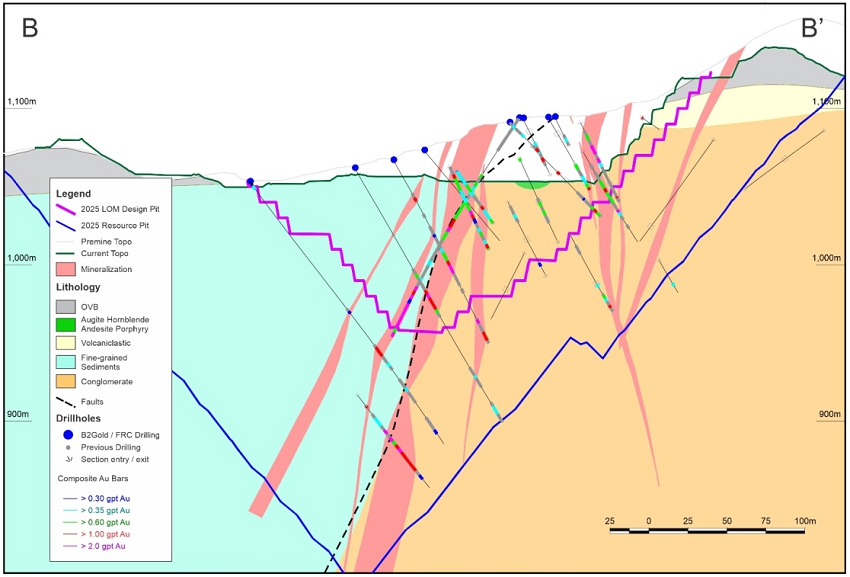
Note: Figure prepared by the Masbate Gold Project, 2025. B2Gold/FRC = Filminera (B2Gold era).
| November 2025 | Page 7- |
|
| Masbate Gold Project | |
| Philippines | |
| NI 43-101 Technical Report |
The Blue Quartz fault system is a typical left-lateral strike-slip with veining occurring along dilational jogs associated with left-lateral displacement. Subordinate veining also occurs along east–west-oriented fault splays, resulting in minor vein sets to the north.
Alteration
Higher permeability along structural weaknesses resulted in confined up-flow along the structural feature and a narrow alteration halo. Alteration is dominantly propylitic with local narrow silicic and argillic alteration zones along the veins.
Mineralization
Blue Quartz veins consist of white massive–crystalline calcite and clear to light grey and white massive-comb quartz stockworks and vein breccia.
The vein hanging wall is on average 7 m wide and characterized by calcite-quartz veinlet/stockwork zones in the sedimentary unit. Along the main fault contact there is an approximately 2 m wide central zone of calcite–quartz stockworks and vein breccia.
The footwall zone is about 6 m wide and dominated by calcite–quartz veinlets, hosted in a weakly bleached conglomerate. Faulting is more prevalent in the hanging wall.
| 7.3.3 | Old Lady |
Deposit Dimensions
The Old Lady deposit extends approximately 750 m along strike, with a width ranging from 2–45 m. Mineralization has been tested to a vertical depth of 230 m.
The widest portion of Old Lady extends about 450 m, but the mineralization appears to extend towards Blue Quartz to the northwest by narrow, discrete high-grade shoots and towards the southeast to the Young Lady or Water West vein systems. Mineralization is open at depth towards the northwest and southeast.
Lithologies
Old Lady deposit is hosted by diorite intrusive rocks from the Aroroy Diorite batholith, intruding siltstones and andesites, interpreted as upper Kaal Formation. Veins are localized in the diorite intrusive which plunges shallowly to the north–northeast, and is traceable to about 800 m elevation.
A geological map is included as Figure 7-9, and a geological cross-section showing the mineralization in Figure 7-10.
| November 2025 | Page 7- |
|
| Masbate Gold Project | |
| Philippines | |
| NI 43-101 Technical Report |
| Figure 7-9: | Old Lady Geological Map |

Note: Figure prepared by the Masbate Gold Project, 2025.
| November 2025 | Page 7- |
|
| Masbate Gold Project | |
| Philippines | |
| NI 43-101 Technical Report |
| Figure 7-10: | Old Lady Geological Cross Section |

Note: Figure prepared by the Masbate Gold Project, 2025. B2Gold/FRC = Filminera (B2Gold era).
| November 2025 | Page 7- |
|
| Masbate Gold Project | |
| Philippines | |
| NI 43-101 Technical Report |
Structure
The Old Lady vein system formed along the same northwest-striking (295–305°) fault system that controls the Blue Quartz deposit. Veins at Old Lady occur within a positive flower structure that formed in a restraining bend along the main fault strand.
Alteration
Silicification and argillic alteration are extensive and affect the major lithological units, due to high fracture density. Hematite alteration is present and is restricted to the fine-sedimentary units.
Mineralization
The Old Lady vein system is characterized by quartz vein/vein breccia zones, and narrow veinlets. Laterally from the southeast, the main zone breaks into several minor splays towards the northwest. The system has a general northeasterly (55°) plunge. Gold occurs mainly within limonite forming within the quartz veins, or is associated with pyrite and minor sooty pyrite beyond the extent of the oxidation front.
| 7.3.4 | Pajo |
Deposit Dimensions
The Pajo deposit is about 1,800 m long and consists of multiple vein structures within a 380 m-wide alteration corridor. The three principal veins in the corridor are Pajo Main, Mid, and West. Mineralization has been tested down to 200 m at Pajo West, and remains open at depth and to the northwest, principally toward Pajo Mid and West. Individual mineralized structures vary in width from 1.5–50 m.
Lithologies
The Pajo deposit is hosted in a predominantly coherent andesite sequence, with interbedded flows and autobreccias, and minor polymictic and poorly-sorted volcaniclastic units. Later augite–hornblende andesite porphyritic plugs intrude the sequence following a major northwest-trending fault system that is coincidental with the vein system.
A fine-grained sediment overlies these units on the southern and northern flanks of Pajo hill.
A geological map and vertical cross section are shown in Figure 7-11 and Figure 7-12 respectively.
Structure
The main Pajo fault zone strikes northwest and is contiguous with the Grandview and Colorado Vein systems. Fault planes are northeast-dipping and display slight normal offsets.
| November 2025 | Page 7- |
|
| Masbate Gold Project | |
| Philippines | |
| NI 43-101 Technical Report |
| Figure 7-11: | Pajo Geological Map |

Note: Figure prepared by the Masbate Gold Project, 2025.
| November 2025 | Page 7- |
|
| Masbate Gold Project | |
| Philippines | |
| NI 43-101 Technical Report |
| Figure 7-12: | Pajo Geological Cross Section |

Note: Figure prepared by the Masbate Gold Project, 2025. B2Gold/FRC = Filminera (B2Gold era).
| November 2025 | Page 7- |
|
| Masbate Gold Project | |
| Philippines | |
| NI 43-101 Technical Report |
The Pajo West system forms a narrow series of sub-parallel veins that merge at depth. Individual veins are locally offset where intersected by secondary east–west- or west–northwest-oriented structures. Textural evidence supports vein emplacement in a dominantly extensional stress regime.
Veins are confined to the Pajo Fault zone and exhibit evidence of reactivation by post-mineralization deformation.
Alteration
Argillic alteration dominates the host rock with intensity increasing towards the surface. Illite is present locally as a light green clay hosted in grey quartz veins. Andesite flows are chlorite and hematite altered at depth.
Mineralization
The Pajo deposit is characterized by a wide zone of quartz ± adularia vein, vein breccia and stockworks that ranges between 5–50 m in width. Quartz varies from grey chalcedonic to white crystalline quartz and is commonly brecciated. Vein textures vary from massive, to vuggy, and minor lattice-bladed textures. Fine comb stringers are also present. Pyrite is the main sulphide associated with mineralization and is predominantly oxidized within the Pajo Main structure. Pajo West is characterized by an elevated fresh pyrite content. Carbonate-bearing veins are also present in the system, with occasionally coarse calcite crystals.
| 7.3.5 | Colorado |
Deposit Dimensions
The Colorado deposit includes the Syndicate and Grandview zones. The strike length is approximately 2,200 m, and the overall system width is about 300–350 m.
Colorado and Grand View veins have variable widths, from 1–20 m. The Syndicate vein widths range from 1–4 m.
The Colorado area has been drill tested to approximately 500 m depth below the pre-mining surface. The vein system remains open at depth, trends into Pajo West to the north, and is terminated to the south by a large-scale fault under the Guinobatan River.
Lithologies
The Colorado vein system is hosted in a predominantly coherent andesitic sequence, similar to Pajo vein system. Minor volcaniclastics and later augite–hornblende andesite porphyries are observed.
A geological map is included as Figure 7-13, and a geological cross-section is provided in Figure 7-14.
| November 2025 | Page 7- |
|
| Masbate Gold Project | |
| Philippines | |
| NI 43-101 Technical Report |
| Figure 7-13: | Colorado Geological Map |

Note: Figure prepared by the Masbate Gold Project, 2025.
| November 2025 | Page 7- |
|
| Masbate Gold Project | |
| Philippines | |
| NI 43-101 Technical Report |
| Figure 7-14: | Colorado Geological Cross Section |

Note: Figure prepared by the Masbate Gold Project, 2025. B2Gold/FRC = Filminera (B2Gold era).
| November 2025 | Page 7- |
|
| Masbate Gold Project | |
| Philippines | |
| NI 43-101 Technical Report |
Structure
The Colorado vein system is northwest trending, with Grandview forming a kink near the north end of the system, resulting in east–west-trending veins. The Syndicate vein strikes northwest, and dips steeply to the northeast at 70–80°.
Alteration
Pervasive argillic alteration and strong silicification is typical on peripheries of quartz vein/vein breccia and is widespread, comparable to Pajo and Old Lady. Adularia is common within the veins and host rock, while sericite is observed along vein selvages.
Mineralization
Gold is hosted within quartz vein/vein breccia and stockworks. Pyrite is the main sulphide, but deep oxidation has resulted in abundant iron oxides/hydroxides associated with mineralization. Colorado is adularia-rich, occurring as pink to creamy white bands with chalcedonic quartz veins and breccia. Lattice and colloform textures are common, with lesser cockade textures. Syndicate vein textures are described as comb and massive.
| 7.3.6 | Montana |
Deposit Dimensions
The Montana vein system has a strike length of 1,300 m. The system is about 20 m wide with vein widths ranging from 1–20 m. It has been drilled to a depth of 250 m below the pre-mining surface. The vein is terminated to the south by the Guinobatan River fault, and at depth by a vein-parallel fault system. It remains open to the north and plunges to the northwest.
Lithologies
The Montana vein system is hosted in a predominantly coherent andesitic units, similar to Pajo and Colorado vein systems. Minor volcaniclastics and intrusive plugs have been identified with drilling.
Figure 7-15 is a geological map of the Montana vein system. Figure 7-16 is a geological cross-section.
Structure
The Montana vein sits along a major northwest fault. Secondary structures in the area are primarily local normal faults (possible oblique-slip faults) that act as conduits for, and structural controls on, mineralization.
| November 2025 | Page 7- |
|
| Masbate Gold Project | |
| Philippines | |
| NI 43-101 Technical Report |
| Figure 7-15: | Montana Geological Map |

Note: Figure prepared by the Masbate Gold Project, 2025.
| November 2025 | Page 7- |
|
| Masbate Gold Project | |
| Philippines | |
| NI 43-101 Technical Report |
| Figure 7-16: | Montana Geological Cross Section |

Note: Figure prepared by the Masbate Gold Project, 2025. B2Gold/FRC = Filminera (B2Gold era).
| November 2025 | Page 7- |
|
| Masbate Gold Project | |
| Philippines | |
| NI 43-101 Technical Report |
Alteration
The argillic and silicification halo is narrow and confined proximally to the veins. Widespread chloritic alteration dominates distal to the main vein. The vein matrix is composed of quartz, fine secondary K-feldspar and calcite.
Mineralization
Several instances of visible gold were recorded in grey chalcedonic and amorphous quartz vein/breccia and veinlets. Sooty pyrite is very common as selvages in banded grey to white quartz.
| 7.4 | Prospects and Exploration Potential |
Prospects and exploration potential are discussed in Section 9.
| November 2025 | Page 7- |
|
| Masbate Gold Project | |
| Philippines | |
| NI 43-101 Technical Report |
| 8.0 | DEPOSIT TYPES |
| 8.1 | Deposit Model |
Low sulphidation epithermal deposits form in shallow crustal environments where hydrothermal fluids interact with host rocks under relatively low temperatures and near-neutral pH conditions. These systems are typically associated with volcanic arcs and extensional tectonic settings. Mineralization occurs primarily through quartz vein networks, stockworks, and breccia zones, often localized along faults and fractures that served as fluid conduits. Alteration is generally zoned, with adularia-sericite and argillic assemblages near veins, grading outward to propylitic halos. Gold is commonly hosted in fine-grained quartz veins with minor base metals and low concentrations of sulphide minerals.
In the case of the Masbate Gold Project, mineralization is structurally controlled and hosted within volcanic and volcaniclastic rocks, with gold occurring in quartz vein systems and veinlet halos. The deposit exhibits classic low sulphidation features, including limited wall-rock alteration, low sulphide content, and gold deposition linked to boiling and pressure drop mechanisms within structurally prepared zones.
Key features of the low sulphidation epithermal deposit type are summarized in Table 8-1, based on information summarized from Sillitoe (1993; 2015) and Hedenquist et al, (1996). A schematic section showing the typical setting of low sulphidation epithermal deposits is provided in Figure 8-1.
| 8.2 | Comments on Deposit Types |
In the QP’s opinion, exploration programs that use a low-sulphidation epithermal deposit type model are considered appropriate for the Project area.
| November 2025 | Page 8- |
|
| Masbate Gold Project | |
| Philippines | |
| NI 43-101 Technical Report |
| Table 8-1: | Epithermal Deposit Type Features |
| Item | Note |
| Global examples | Cripple Creek (Colorado, USA), Emperor (Fiji), and Lihir and Porgera (Papua New Guinea). |
| Setting | Volcanic arcs, commonly in extensional tectonic settings. Epithermal deposits represent distal portions of magmatic-hydrothermal systems. |
| Depth of formation | Vertically limited, typically within 300–500 m from the paleosurface but may occasionally extend deeper. |
| Host features | Bimodal or andesitic volcanic arc sequences, calderas, diatremes, hypabyssal intrusive stocks and volcanic sector-collapse amphitheaters. |
| Mineralization textures | Quartz and quartz-adularia veins, vein stockworks, disseminated zones and breccias. |
| Mineralization characteristics | Gold is usually fine-grained and occurs as electrum or native gold, often associated with quartz and adularia. These systems contain minimal sulphide minerals, typically < 5%. |
| Alteration characteristics | Neutral pH and K-silicate minerals such as adularia, illite, and muscovite. The alteration core is typified by silica-adularia followed by clay alteration (sericite + smectite + illite + kaolinite) outwards, grading to more distal chlorite + calcite + pyrite + epidote alteration. The distal alteration can be widespread and may mask the underlying mineralization. |
| Sulphide associations | Pyrite-dominant. Typically, base metal-poor, only containing traces of sphalerite, galena, chalcopyrite, tetrahedrite and/or molybdenite. |
| Mineralizing fluids | Temperature <300°C and low salinity (<10 wt% NaCl eq.) with moderate to high CO₂ concentrations. |
| Isotopes | Some stable isotopes (δC, δS, δD and δO) are used to identify the respective contributions of magmatic and meteoric fluids, often combined in the formation of low sulphidation epithermal deposits. The meteoric waters contribution in equilibrium with the host rocks, create the reduced and near-neutral fluids that characterize these deposits |
| November 2025 | Page 8- |
|
| Masbate Gold Project | |
| Philippines | |
| NI 43-101 Technical Report |
| Figure 8-1: | Epithermal Model Schematic |

Note: Figure prepared by CSA Global, 2002.
| November 2025 | Page 8- |
|
| Masbate Gold Project | |
| Philippines | |
| NI 43-101 Technical Report |
| 9.0 | EXPLORATION |
| 9.1 | Topographic Surveys |
The current Project-wide topography is from an aerial LIDAR survey conducted by third-party consultants AB Surveying in October 2017. The survey has an accuracy of ±3 cm.
Filminera completed an additional drone LIDAR survey over the Balete prospect area in 2024.
A local coordinate reference grid is used for all topographic and digital terrain models. Elevations are raised by +1000RL to remove negative elevations in mine operations.
| 9.2 | Geological Mapping |
Mapping has been conducted from regional to prospect scales. The mapping delineated and confirmed the location of mineralized veins, structures, lithologies and their relationship to each other. Mapping programs were used to assist drill program planning.
From 2015 onward, the mine geology department has undertaken daily mapping within all active pits. These data are compiled into vein models that are used as guidance during Mineral Resource estimation.
| 9.3 | Geochemistry |
Geochemical sampling completed to date in the Project area include stream sediments, soils, rock chip, grab, channel, and trench samples detailed in Table 9-1. Sample results are shown for the regional programs (rocks and stream sediments) in Figure 9-1 and Figure 9-2, and for the prospect-scale soil sampling in Figure 9-3 and Figure 9-4. The figures show the locations of the main gold anomalies outlined by the surveys.
| 9.4 | Pits and Trenches |
Pits and trenches were used to determine the width and strike length potential of each geochemical anomaly identified during regional mapping and soil sampling programs. A total of 1,129 trenches and channels were excavated (27,974 m). The locations are shown on Figure 9-5 and Figure 9-6. Pits and trenching were used to identify and prioritize drill targets.
| 9.5 | Geophysics |
| 9.5.1 | Airborne Geophysics |
Airborne geophysical surveys including magnetics and radiometrics were conducted over the Project area, and are summarized in Table 9-2. Survey data initially generated in 2009 were subject to a number of re-processing campaigns. The resulting data were used to identify magnetic signature indicative of lithology, alteration, and structure. An example of a resulting magnetics map is provided in Figure 9-7.
| November 2025 | Page 9- |
|
| Masbate Gold Project | |
| Philippines | |
| NI 43-101 Technical Report |
| Table 9-1: | Geochemical Sampling Programs |
| Company/Operator | Year | Number of Samples | Description |
| Atlas, Base Metals, Thistle, and Filminera (CGA era from 2007–2009) | Unknown | Unknown | Rock chip and stream sediment sampling completed, however, there are no readily available records as to the number of samples in these programs. |
| Filminera (CGA era) | 2010–2012 | 3,382
stream sediment; 2,291 rock chip; 383 soil |
Stream sediment samples were taken at an approximate density of 50 samples per square kilometre, and consisted of a wet sieved -80 mesh sample of about 1.5 kg, and a heavy mineral concentrate sample of approximately 300–350 g. |
| Filminera (B2Gold era) | 2013–2025 |
2,312 rock chips; 1,083 trenches and channels with aggregate length of 27,552meters |
Grab and rock chip samples were taken during the course of mapping activities, in areas of particular interest, channel and trench samples were taken across mineralized outcrops. Samples were analysed for gold, silver, and a multi-element suite, similar to the soil sampling campaigns. Regional soil sampling in the southern licences was on 200 m spaced, north–south-oriented lines with 50 m sample spacing, except for the TSF area where the line orientation was rotated to northeast–southwest. Regional soil sampling in the northern licences was on 200 m spaced northeast–southwest-oriented lines with typically 50 m sample spacing. Soil lines at Pajo West were completed on 100 m spaced lines, with 50 m sample spacing. Soil lines at the Balete and Nabob prospects were at a 200 x 25 m grid spacing and oriented north–south. Soil lines at the Bangkal prospect used a 300 x 50 m spacing and were oriented north–south. |
| November 2025 | Page 9- |
|
| Masbate Gold Project | |
| Philippines | |
| NI 43-101 Technical Report |
| Figure 9-1: | Rock and Stream Sediment Sample Location Map, North |

Note: Figure prepared by the Masbate Gold Project, 2025.
| November 2025 | Page 9- |
|
| Masbate Gold Project | |
| Philippines | |
| NI 43-101 Technical Report |
| Figure 9-2: | Rock Chip and Stream Sediment Sample Location Map, South |

Note: Figure prepared by the Masbate Gold Project, 2025.
| November 2025 | Page 9- |
|
| Masbate Gold Project | |
| Philippines | |
| NI 43-101 Technical Report |
| Figure 9-3: | Soil Sample Location Map, North |
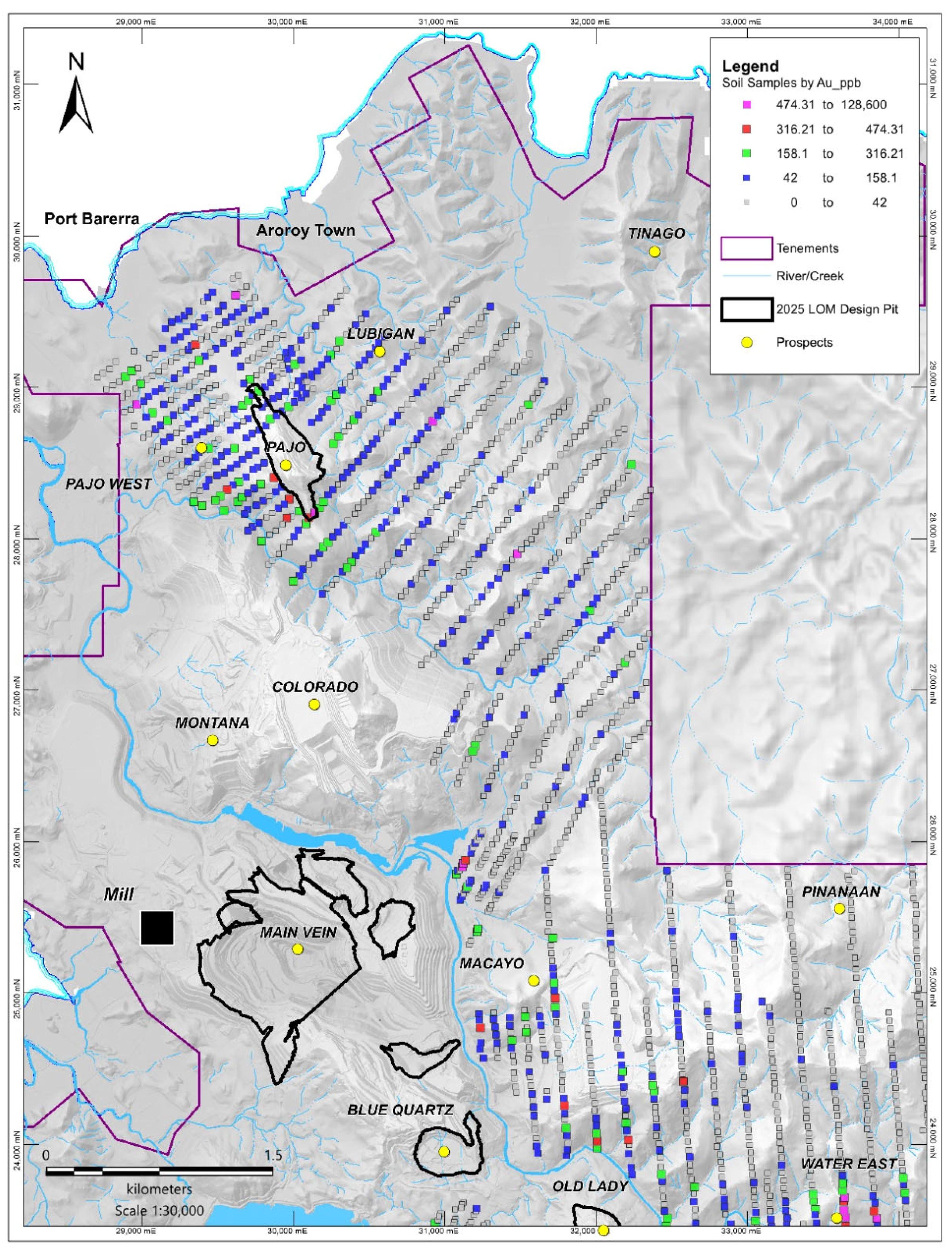
Note: Figure prepared by the Masbate Gold Project, 2025.
| November 2025 | Page 9- |
|
| Masbate Gold Project | |
| Philippines | |
| NI 43-101 Technical Report |
| Figure 9-4: | Soil Sample Location Map, South |

Note: Figure prepared by the Masbate Gold Project, 2025.
| November 2025 | Page 9- |
|
| Masbate Gold Project | |
| Philippines | |
| NI 43-101 Technical Report |
| 9.5.2 | Ground Geophysics |
Ground geophysical surveys conducted at Masbate are summarized in Table 9-3.
| 9.6 | Artisanal Small Miners |
Artisanal and small-scale mining (ASM) is prevalent across the Project and exploration areas. An ASM Management Plan was developed by Filminera, which maintains a centralized database that records the landowner/operator, location/coordinates, ASM category and status (active/inactive/dismantled). ASM-related activities can include underground excavations on gold-bearing quartz veins, panning and sluicing for placer gold, small-scale processing plants, or sampling of exposed vein outcrops/floats outside the mine operations area.
ASM information is compared to known gold-bearing veins and faults to identify mineralization projections and provide support for risk assessments. Planned exploration or mining-related activities to be conducted by Filminera are communicated to potentially-affected ASM workers.
| 9.7 | Exploration Potential |
Historic exploration data were compiled and digitized to aid geological interpretations and drill targeting. This dataset included trenches, drill holes, underground workings, face sampling, and level plans.
Filminera has identified several advanced prospects, namely Luy A, Bart-Ag and Balete. These have been systematically explored with geophysical surveys (magnetics and radiometric), geological mapping, geochemical sampling (e.g. soil, channels, rocks), trenches and wide-spaced drilling.
The regional exploration potential of the advanced prospects is summarized in Table 9-4. Figure 9-2 showed the prospect locations.
| November 2025 | Page 9- |
|
| Masbate Gold Project | |
| Philippines | |
| NI 43-101 Technical Report |
| Figure 9-5: | Pit and Trench Location Map, North |

Note: Figure prepared by the Masbate Gold Project, 2025.
| November 2025 | Page 9- |
|
| Masbate Gold Project | |
| Philippines | |
| NI 43-101 Technical Report |
| Figure 9-6: | Pit and Trench Location Map, South |

Note: Figure prepared by the Masbate Gold Project, 2025.
| November 2025 | Page 9- |
|
| Masbate Gold Project | |
| Philippines | |
| NI 43-101 Technical Report |
| Table 9-2: | Airborne Geophysical Surveys |
| Operator/Company | Year | Survey Type | Description |
| GPX Surveys | 2009 | Helicopter airborne magnetic and radiometric survey over a portion of MPSA 255-2007-V Amended 1 | Traverse line spacing of 100 m and a 1,000 m tie line spacing. Lines were oriented 000° and 180° while tie line direction was oriented 090° and 270°. Flight height was set at 50 m. Total survey length of 996.8-line km. Outputs included GIS files of the digital terrain model, total magnetic intensity and derivatives, reduced to pole and derivatives, and the total count as well as individual potassium, uranium, and thorium plots. |
| Logantek (Beijing) Geophysical Exploration Co Ltd | 2009 | Data processing | Completed processing, modelling and interpretation of the survey data generated by GPX Surveys. Identified radiometric signatures relating the lithology and alteration with potassic clays (sericitic) related to the gold mineralization, limestones, and volcanic units. Magnetic 3D modelling was also conducted; the inversion model was used to define large magnetic units; the forward model was used to identify smaller magnetic units and fault traces. |
| G.J. Elliot | 2011 | Data reprocessing | Re-processed the survey data generated by GPX Surveys. Identified nine prospective areas for additional work. |
| GeoDiscovery Group Pty Ltd | 2023 | Data reprocessing | Processing and image enhancement of the GPX Surveys data. 3D magnetic inversion models were generated. Strong potassium signature over the Main Vein and Colorado pits, and a distinct high potassium anomaly east of the mine area interpreted as a buried intrusion (Pinanaan). Several weaker potassium anomalies were identified south and southeast of the exploration licenses that resulted to a project-wide soil and mapping program as well as scout drill testing. |
| November 2025 | Page 9- |
|
| Masbate Gold Project | |
| Philippines | |
| NI 43-101 Technical Report |
| Figure 9-7: | Geophysical Survey – RTP Magnetic Tilt Derivative |

Note: Figured prepared by the Masbate Gold Project, 2025.
| November 2025 | Page 9- |
|
| Masbate Gold Project | |
| Philippines | |
| NI 43-101 Technical Report |
| Table 9-3: | Ground Geophysics Campaigns |
| Operator | Year | Survey Type | Description |
| GPX Surveys | 2011 | Gradient array induced polarization |
0 m dipole spacing; 50 m line spacing; block of 1 km acquired between transmitters. Covered the southern section of Main Vein |
| GPX Surveys | 2012 | Off-set pole-dipole |
16 receiver lines; IP 11 channels; 200 m line spacing; line length 800 m (14) and 1600m (2); 225º degrees local grid with A-space = 100 m and receiver/transmitter separations up to N = 15. Covered the Baleno area, considered prospective for porphyry copper/gold mineralization |
| GeoDiscovery Group | 2023 | Data reprocessing | Conducted reprocessing and 3D modelling of the IP data in 2023. Assessment of the gradient data was able to confirm the resistive signature of the host rock of the gold mineralization while sulphides/gold mineralization were characterized by weak to moderate chargeability anomalies. The pole–dipole data showed several chargeable and conductive zones that may warrant follow up drill testing at depth |
| November 2025 | Page 9- |
|
| Masbate Gold Project | |
| Philippines | |
| NI 43-101 Technical Report |
| Table 9-4: | Advanced Prospects |
| Prospect | Description |
| Bart-ag | Located at the southeast portion of the Filminera licenses and approximately 8 km from the process plant. Previously mined by Atlas as an open pit. Quartz veins were observed along the interpreted northwest trending regional fault which dips around 50–90º extending for about 2 km of strike. Veins width varies from 1–16 m. Prospective area covers about 352 ha. |
| Luy A Main | Located approximately 8 km south of the process plant. The veins are believed to form part of a 4 km vein system that connects with Bart-Ag and Concepcion vein towards Balete. Prospective area covers about 895 ha. |
| Balete | Located at the southeast portion of the Filminera licenses and approximately 11 km from the process plant. Previously mined by Atlas as both an open pit and underground operation. The known Balete vein system is approximately 1 km in strike length with significant veins varying in width from 1–20 m. The strike length potentially extends further to the southwest based on soil anomalies, but gold grades generally decrease with depth. Prospective area covers about 362 ha. |
| Bangkal | Located at the southeast portion of the Filminera licenses and approximately 9 km from the process plant. The mineralized zone has an estimated area of 500 x 500 m ; the trend is generally east–northeast, dipping south–southeast. Some minor veins are northwest-trending. Veins have an average 1–2 m thickness, based on the observed outcrops and information from ASM workers. Better grades are associated with high sulphide content and faults. Prospective area covers about 643 ha. |
| Ajax-Nabob | Located approximately 4.5 km east–southeast of the process plant. Formerly mined as an underground operation by Atlas. Localized argillic and silicic alteration have been observed, particularly around quartz veins. Prospective area covers about 105 ha. |
| Kupang-Akle | Located approximately 8 km southwest of the process plant. Forms a 4 km long magnetic and potassium anomaly. Gold mineralization is observed in white massive, drusy, comb quartz veinlets and stringers. Alteration is dominantly propylitic and haematitic with some argillic altered rocks. Silicic alteration is localized near the quartz veinlets/stringer zones. |
| November 2025 | Page 9- |
|
| Masbate Gold Project | |
| Philippines | |
| NI 43-101 Technical Report |
| 10.0 | DRILLING |
| 10.1 | Introduction |
The Project exploration drill hole database as of September 30, 2025 contains a total of 4,282 drill holes (546,510 m), of which there are 1,996 core holes (299,261 m), 2,057 RC holes (205,022 m), 229 holes pre-collared with RC and completed with core tails (42,227 m) and three core holes from grade control (293 m). Additionally, there are 1,129 units of surface sampling, including 1,087 trench/channel (27,817 m) and 42 pits (157 m), see Table 10-1.
Drill hole collar locations for the Project area are shown in Figure 10-1. The areas where Mineral Resources have been estimated are shown in more detail in Figure 10-2 (northern Project area) and Figure 10-3 (southern Project area).
The Mineral Resource estimate for the Masbate Gold Project was updated in late 2023. The exploration drill hole cut-off date was August 15, 2023, and the grade control database cut-off was May 31, 2023. Data used for the 2023 update include a total of 1,782 core (293,059 m) and 1,928 RC drill holes (195,891 m) and 1,015 trenches (24,684 m) from the exploration database and 124,001 drill holes (2,516,709 m) from the grade control RC drilling database (Table 10-2).
| 10.2 | Drill Methods |
Where known, drill contractors included Exploration Drilling Corporation (EDCO), a Canadian drilling contractor based in Manila; East–West Drilling, an Australian drilling contractor; United Philippines Drilling; DrillCorp Asia; Bradley Drilling Incorporated; Major Drilling Incorporated; and Quest Exploration Drilling, Inc. Company-owned drill rigs were used in the Atlas campaigns. Drill rig types, where known, included Diamec, Gem Pac 800 track-mounted, demountable skid-mounted CS1000 wireline, Christianson CS1000 wireline core, Edson 3000 RC skid-mounted, Edson 3000 RC track-mounted, and Edson 1000 tractor-mounted types.
RC drill holes were typically 11.4 cm (4½ inch), 13.3 cm (5 ¼ inch), or 14 cm (5.5 inch) in diameter.
Core diameters completed included PQ core (83.1 mm core diameter), HQ (61.1 mm), and NQ (47.6 mm). BQ (36.5 mm) and AQ (27 mm) core were primarily drilled underground.
| 10.3 | Logging Procedures |
There is no information on the logging procedures for the Atlas campaigns.
RC cuttings were logged following mineralogical examination of a small, washed sample. Chip trays were retained for each drill hole.
Core was photographed, logged, and sampled. Geological information collected during logging included lithologies, alteration types, vein percentages, sulphide type and quantity, and structures. Geotechnical information collected included weathering condition, type of structures, joint spacing, joint condition, and type of joint filling (e.g. gouge, mylonite, breccia, vein).
| November 2025 | Page 10- |
|
| Masbate Gold Project | |
| Philippines | |
| NI 43-101 Technical Report |
| Table 10-1: | Summary of Drilling and Continuous Surface Sampling by Year and Operator |
| Operator | Drilled | Type | Core | RC | RC–Core | Drilling Total | Trench/ Channel | Pit | Surface Total |
| Atlas | 1975–1994 | Drill Holes | 530 | 228 | 5 | 763 | — | — | — |
| Metres | 48,438 | 13,491 | 413 | 62,342 | — | — | — | ||
| Base Metals | 1997–1998 | Drill Holes | 120 | 215 | 7 | 342 | — | — | — |
| Metres | 19,189 | 18,684 | 1,269 | 39,142 | — | — | — | ||
| Thistle | 2003–2005 | Drill Holes | 7 | 268 | 57 | 332 | — | 42 | 42 |
| Metres | 784 | 17,749 | 7,531 | 26,064 | — | 157 | 157 | ||
| Filminera (CGA era) | 2007–2012 | Drill Holes | 219 | 1,072 | 106 | 1,397 | 4 | — | 4 |
| Metres | 56,544 | 120,560 | 23,835 | 200,939 | 265 | — | 265 | ||
| Filminera (B2Gold era) | 2013 | Drilling/Units | 163 | 44 | 46 | 253 | 31 | — | 31 |
| Metres | 22,439 | 5,127 | 7,785 | 35,351 | 910 | — | 910 | ||
| 2014 | Drilling/Units | 149 | 11 | — | 160 | 91 | — | 91 | |
| Metres | 17,270 | 1,248 | — | 18,518 | 4,141 | — | 4,141 | ||
| 2015 | Drilling/Units | 106 | 80 | 2 | 188 | 99 | — | 99 | |
| Metres | 12,480 | 9,347 | 632 | 22,459 | 5,766 | — | 5,766 | ||
| 2016 | Drilling/Units | 100 | 66 | — | 166 | 138 | — | 138 | |
| Metres | 12,424 | 9,259 | — | 21,683 | 3,781 | — | 3,781 | ||
| 2017 | Drilling/Units | 112 | 28 | 6 | 146 | 99 | — | 99 | |
| Metres | 13,066 | 3,771 | 761 | 17,598 | 3,504 | — | 3,504 | ||
| 2018 | Drilling/Units | 82 | 15 | — | 97 | 429 | — | 429 | |
| Metres | 13,648 | 2,058 | — | 15,706 | 4,150 | — | 4,150 | ||
| 2019 | Drilling/Units | 33 | 32 | — | 65 | 73 | — | 73 | |
| Metres | 6,736 | 3,729 | — | 10,465 | 1,217 | — | 1,217 | ||
| 2020 | Drilling/Units | 152 | — | — | 152 | 7 | — | 7 | |
| Metres | 30,283 | — | — | 30,283 | 350 | — | 350 |
| November 2025 | Page 10- |
|
| Masbate Gold Project | |
| Philippines | |
| NI 43-101 Technical Report |
| Operator | Drilled | Type | Core | RC | RC–Core | Drilling Total | Trench/ Channel | Pit | Surface Total |
| 2021 | Drilling/Units | 89 | — | — | 89 | — | — | — | |
| Metres | 16,638 | — | — | 16,638 | — | — | — | ||
| 2022 | Drilling/Units | 62 | — | — | 62 | — | — | — | |
| Metres | 13,549 | — | — | 13,549 | — | — | — | ||
| 2023 | Drilling/Units | 33 | — | — | 33 | 21 | — | 21 | |
| Metres | 7,773 | — | — | 7,773 | 48 | — | 48 | ||
| 2024 | Drilling/Units | 25 | — | — | 25 | 53 | — | 53 | |
| Metres | 5,464 | — | — | 5,464 | 2,270 | — | 2,270 | ||
| January to September 30, 2025 | Drilling/Units | 14 | — | — | 14 | 42 | — | 42 | |
| Metres | 2,536 | — | — | 2,536 | 1,415 | — | 1,415 | ||
| Totals | 1975–September 30, 2025 | Drilling/Units | 1,996 | 2,057 | 229 | 4,282 | 1,087 | 42 | 1,129 |
| Metres | 299,261 | 205,022 | 42,227 | 546,510 | 27,817 | 157 | 27,974 |
| November 2025 | Page 10- |
|
| Masbate Gold Project | |
| Philippines | |
| NI 43-101 Technical Report |
| Table 10-2: | Drilling Used in Mineral Resource Estimation |
| Drill Year |
Grade-Control | Core | RC | RC-Core | Trench | |||||
| Number | Metres | Number | Metres | Number | Metres | Number | Metres | Number | Metres | |
| 1975 | — | — | 12 | 1,547 | — | — | — | — | — | — |
| 1976 | — | — | 3 | 224 | — | — | — | — | — | — |
| 1980 | — | — | 1 | 187 | — | — | — | — | — | — |
| 1981 | — | — | 36 | 2,987 | — | — | — | — | — | — |
| 1982 | — | — | 30 | 2,961 | — | — | — | — | — | — |
| 1983 | — | — | 32 | 3,403 | — | — | — | — | — | — |
| 1984 | — | — | 21 | 1,237 | — | — | — | — | — | — |
| 1985 | — | — | 2 | 101 | — | — | — | — | — | — |
| 1986 | — | — | 5 | 589 | — | — | — | — | — | — |
| 1987 | — | — | 26 | 1,330 | — | — | — | — | — | — |
| 1988 | — | — | 61 | 4,116 | — | — | — | — | — | — |
| 1989 | — | — | 28 | 2,330 | 40 | 2,578 | — | — | — | — |
| 1990 | — | — | 1 | 131 | 96 | 4,907 | 2 | 224 | — | — |
| 1991 | — | — | 8 | 690 | 26 | 1,789 | — | — | — | — |
| 1992 | — | — | 4 | 274 | 6 | 359 | — | — | — | — |
| 1993 | — | — | 12 | 675 | — | — | — | — | — | — |
| 1994 | — | — | 4 | 211 | — | — | — | — | — | — |
| 1997 | — | — | 84 | 13,957 | 146 | 14,212 | 6 | 965 | — | — |
| 1998 | — | — | 25 | 3,230 | 29 | 1,766 | — | — | ||
| 2002 | — | — | — | — | 40 | 3,690 | 13 | 2,105 | — | — |
| 2003 | — | — | 2 | 358 | 17 | 1,437 | 13 | 2,156 | — | — |
| 2004 | — | — | — | — | 41 | 2,615 | — | — | — | — |
| 2005 | — | — | 5 | 426 | 160 | 9,497 | 29 | 3,032 | — | — |
| 2007 | — | — | 5 | 90 | 121 | 7,929 | 3 | 390 | — | — |
| November 2025 | Page 10- |
|
| Masbate Gold Project | |
| Philippines | |
| NI 43-101 Technical Report |
| Drill Year |
Grade-Control | Core | RC | RC-Core | Trench | |||||
| Number | Metres | Number | Metres | Number | Metres | Number | Metres | Number | Metres | |
| 2008 | 540 | 22,957 | 11 | 1,622 | 89 | 9,161 | 13 | 2,376 | — | — |
| 2009 | 2,851 | 71,650 | — | — | — | — | 4 | 496 | — | — |
| 2010 | 11,516 | 139,483 | 17 | 3,650 | 221 | 21,529 | 3 | 425 | — | — |
| 2011 | 10,268 | 116,081 | 53 | 16,013 | 422 | 49,172 | 24 | 5,570 | — | — |
| 2012 | 13,211 | 204,586 | 131 | 34,667 | 204 | 31,192 | 57 | 13,874 | 4 | 265 |
| 2013 | 8,637 | 161,245 | 119 | 18,387 | 50 | 5,763 | 36 | 6,066 | 33 | 931 |
| 2014 | 9,450 | 173,323 | 132 | 16,340 | 11 | 1,248 | — | — | 93 | 4,225 |
| 2015 | 12,129 | 222,528 | 92 | 11,750 | 72 | 8,473 | 2 | 632 | 101 | 6,077 |
| 2016 | 8,684 | 177,442 | 86 | 11,183 | 64 | 9,112 | — | — | 155 | 3,928 |
| 2017 | 10,952 | 225,543 | 93 | 12,792 | 27 | 3,705 | 6 | 761 | 99 | 3,504 |
| 2018 | 10,146 | 213,798 | 81 | 13,684 | 15 | 2,058 | — | — | 450 | 4,187 |
| 2019 | 8,832 | 225,646 | 31 | 6,629 | 31 | 3,702 | — | — | 73 | 1,217 |
| 2020 | 5,240 | 153,003 | 143 | 29,962 | — | — | — | — | 7 | 350 |
| 2021 | 5,559 | 193,682 | 88 | 16,468 | — | — | — | — | — | — |
| 2022 | 5,940 | 211,391 | 61 | 13,515 | — | — | — | — | — | — |
| 2023 | 46 | 4,351 | 26 | 6,270 | — | — | — | — | — | — |
| Total | 124,001 | 2,516,709 | 1,571 | 253,987 | 1,928 | 195,891 | 211 | 39,072 | 1,015 | 24,684 |
| November 2025 | Page 10- |
|
| Masbate Gold Project | |
| Philippines | |
| NI 43-101 Technical Report |
| Figure 10-1: | Project Drill Collar Location Plan |
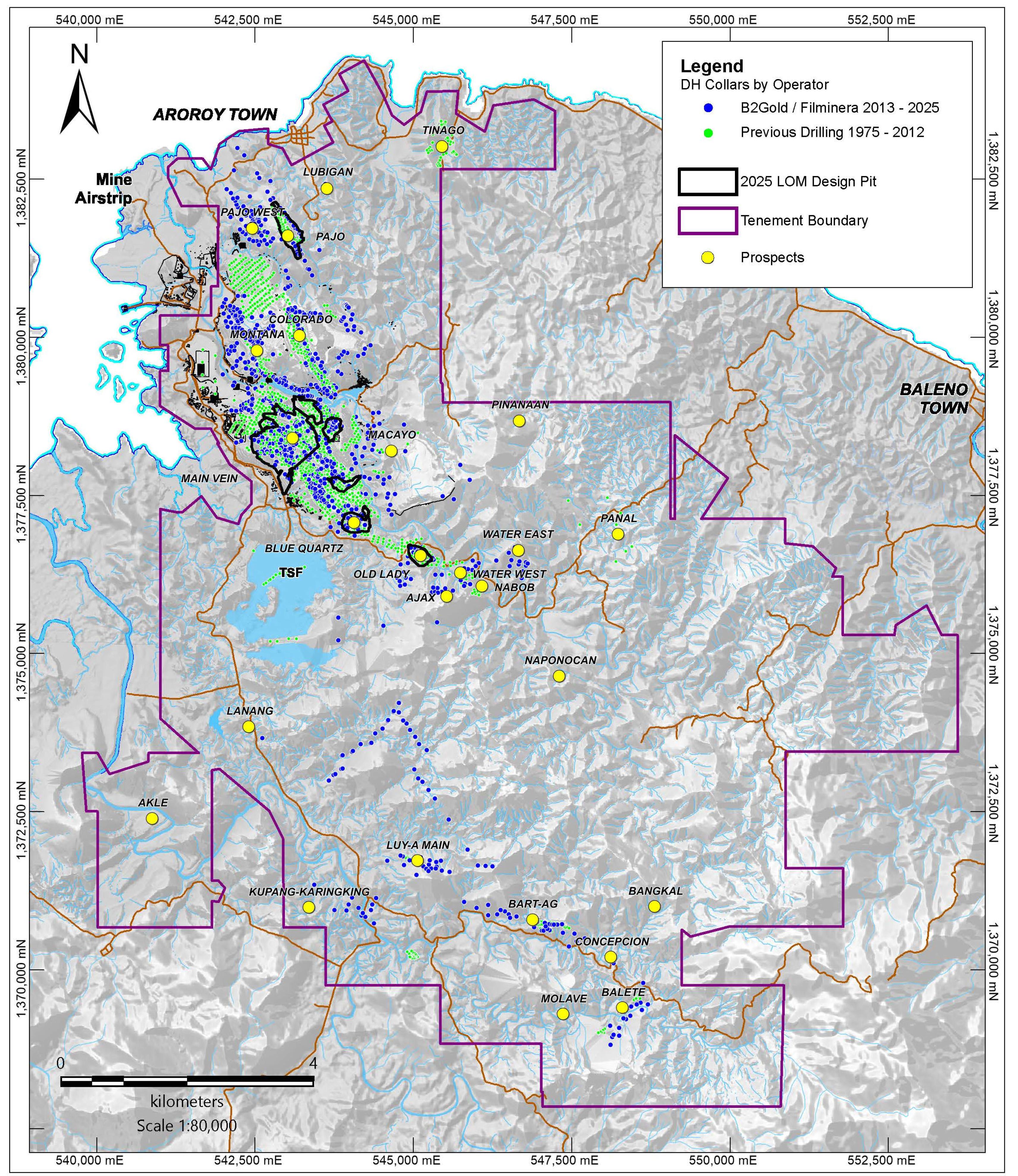
Note: Figure prepared by the Masbate Gold Project, 2025.
| November 2025 | Page 10- |
|
| Masbate Gold Project | |
| Philippines | |
| NI 43-101 Technical Report |
| Figure 10-2: | Exploration Drill Hole Plan Map, North |

Note: Figure prepared by the Masbate Gold Project, 2025.
| November 2025 | Page 10- |
|
| Masbate Gold Project | |
| Philippines | |
| NI 43-101 Technical Report |
| Figure 10-3: | Exploration Drill Hole Plan Map, South |

Note: Figure prepared by the Masbate Gold Project, 2025.
| November 2025 | Page 10- |
|
| Masbate Gold Project | |
| Philippines | |
| NI 43-101 Technical Report |
Magnetic susceptibility was also measured. Recent exploration campaigns and specific geotechnical drill holes also included oriented core for structural data capturing.
A summary of the RC and core logging procedures is provided in Figure 10-4 and Figure 10-5, respectively.
| 10.4 | Recovery |
Core recovery can vary depending on the degree of mineralization and the era drilled.
| · | Atlas (1975–1994): average 71%; |
| · | Base Metals (1997–1998): average 94.7%; |
| · | Thistle Mining (2003–2005): average 91%; |
| · | Filminera (CGA era) (2007–2012): average 91.6%; |
| · | Filminera (B2Gold era) (2013-September 2025): average 92.2%. |
Split tube (or triple-tube) is the standard practice for recent drilling to ensure proper recoveries in the highly faulted and altered terrains. Current protocols require samplers to measure and record the length of core recovered from the split tube for each drill run.
| 10.5 | Collar Surveys |
Instrumentation used to determine collar locations varied over time and include theodolite, global positioning system, differential global positioning system (DGPS), and total station instruments. Drill hole collars were typically surveyed before and after drilling.
The database of accepted locations for the Atlas drilling was re-assessed, validated, and corrected by Base Metals (1997–1998), Behre Dolbear (1997–1998), Powell (2001), and Thistle (2005–2006).
| 10.6 | Downhole Surveys |
Downhole survey instrumentation varied over time, and include Tropari instruments, Ausmine and Eastman battery-operated, single-shot cameras, and Proshot and Reflex instruments.
Downhole surveys were not carried out on RC holes as these were generally less than 100 m deep.
Initially, surveys on core drill holes were completed at 30–60 m intervals downhole.
Current corporate protocols state that if drill hole deflections are >2º dip or >2º azimuth from the planned hole location, drilling must be halted until it is confirmed that the drill trace will still intercept the target at an acceptable angle.
| November 2025 | Page 10- |
|
| Masbate Gold Project | |
| Philippines | |
| NI 43-101 Technical Report |
| Figure 10-4: | RC Drilling Flowsheet |

Note: Figure prepared by the Masbate Gold Project, 2025.
| November 2025 | Page 10- |
|
| Masbate Gold Project | |
| Philippines | |
| NI 43-101 Technical Report |
| Figure 10-5: | Core Drilling Flowsheet |

Note: Figure prepared by the Masbate Gold Project, 2025.
| November 2025 | Page 10- |
|
| Masbate Gold Project | |
| Philippines | |
| NI 43-101 Technical Report |
From 2010–2022, a magnetic declination of -1.10º west was accounted for and implemented in the drill programs. Beginning in 2023, the magnetic declination was adjusted to -2.40º west to account shifts in the location of the magnetic pole.
| 10.7 | Grade Control Drilling |
Grade control drilling is conducted by Filminera personnel using dedicated RC rigs.
In ore zones, drilling follows a pattern spacing of 6 x 12 m, while in waste areas a broader spacing of 24 x 24 m is used. Grade control drill holes have 13 m or 25 m of downhole lengths to provide coverage over a 10 m or 20 m vertical interval. Grade control drill holes are generally drilled at a 60º dip angle, as perpendicular as is practicable to the mineralization trend.
Drill rigs are equipped with integrated sampling systems, where samples pass through a cyclone and are then split using a cone splitter. Samples, in the form of 2 mm rock chips, are collected at 1 m intervals, and only 12.5% of the split sample is sent to the laboratory for analysis, ensuring both efficiency and representative sampling. Samples from ore zones are analyzed for gold grade, while those from waste areas are composited into 3 m intervals and tested for sulphur and carbon content, supporting acid rock drainage (ARD) assessments. In addition, chip samples are logged for vein composition, lithology, and oxidation state, providing critical data for vein modeling and estimation.
| 10.8 | Metallurgical Drilling |
In total, approximately 101 metallurgical drill holes (about 12,908 m) have been drilled for the purpose of metallurgical studies. Areas sampled include Colorado, Grandview, Libra East, Main Vein (including Main Vein North and South), Old Lady and Blue Quartz.
In addition to metallurgical-specific drill holes, many other holes have been sampled for metallurgical recovery and are used in the metallurgical model. A drill hole location plan of drill holes that have been sampled for metallurgical purposes is included as Figure 10-6.
| 10.9 | Condemnation and Geotechnical Drilling |
Approximately 104 geotechnical drill holes (about 10,596 m) have been completed. Drill hole locations for the geotechnical and condemnation (sterilization) drilling are shown in Figure 10-7.
| 10.10 | Sample Length/True Thickness |
Drill holes were optimized to drill through the mineralized zone as perpendicular as possible to ensure representativity and to maintain sample spacing. The domains are mostly sub-vertical, with a few exceptions (offshoots), and most of the holes were drilled from the hanging wall. On a few occasions, holes were drilled from the footwall due to access issues (surface rights) and terrain.
| November 2025 | Page 10- |
|
| Masbate Gold Project | |
| Philippines | |
| NI 43-101 Technical Report |
| Figure 10-6: | Metallurgical Drill Hole Locations with Property Boundary |

Note: Figure prepared by the Masbate Gold Project, 2025.
| November 2025 | Page 10- |
|
| Masbate Gold Project | |
| Philippines | |
| NI 43-101 Technical Report |
| Figure 10-7: | Geotechnical and Sterilization Drill Hole Locations |

Note: Figure prepared by the Masbate Gold Project, 2025.
| November 2025 | Page 10- |
|
| Masbate Gold Project | |
| Philippines | |
| NI 43-101 Technical Report |
When drilling was conducted using a diamond core rig, it allowed for flexible hole orientation. Drill hole inclinations ranged from -16° to -80°, resulting in variable angles between the drill axis and the mineralized structures. Consequently, the true width factors for downhole reported intercepts vary between 0.58 and 0.99. Using surrounding drilling, geological controls and structural interpretations, true widths have been estimated. The wide range of drill hole length and true width factors also applies for the RC drill holes.
| 10.11 | Drilling Since Database Close-out Date |
Drilling used for Mineral Resource estimation had a cut-off date of August 15, 2023 for exploration drill holes.
Drilling that has been completed since the Mineral Resource estimate database close-out date include 46 core holes totalling 9,503 m.
Additional core drilling is generally outside of Mineral Resource areas. Where new drilling affects existing resources, the drill holes generally support modeled interpretations and grades with only minor variations.
A total 17,077 RC grade-control holes, totalling 451,326 m, were drilled since the database close-out date. These drill holes are in mined-out areas.
| 10.12 | Comments on Drilling |
In the opinion of the QP, the quantity and quality of the lithological, geotechnical, collar and downhole survey data collected in drill campaigns are sufficient to support Mineral Resource and Mineral Reserve estimation.
There are no drilling, sampling, or recovery factors known to the QP that could materially impact the accuracy and reliability of the results.
| November 2025 | Page 10- |
|
| Masbate Gold Project | |
| Philippines | |
| NI 43-101 Technical Report |
| 11.0 | SAMPLE PREPARATION, ANALYSES, AND SECURITY |
| 11.1 | Geochemical Programs |
Soil samples are typically 2 kg in weight and taken from the B-horizon, approximately 20–40 cm from the surface. Rock grab samples and channels are collected from the face of the outcrop or floor in the case of manually-dug trenches, and must have a minimum weight of 2 kg.
Samples were dried, crushed, and pulverized, then typically assayed for a muti-element suite using aqua regia digestion with either an inductively coupled plasma (ICP) optical emission spectrometry (OES) or mass spectrometry (MS) finish.
| 11.2 | RC Sampling |
For RC drill holes, samples are split at the rig using a riffle splitter and approximately 5 kg from each metre sample was bagged and taken to the assay laboratory for analysis. The remainder was bagged and stored at the core shed.
During the Atlas RC drilling (1975–1994) samples were collected from 1–3 m intervals with mixing and splitting of the samples on the drill site using a tarpaulin. RC samples were taken at 1 m intervals during the Base Metals drill campaigns (1997-1998). An approximate 5 kg sample was collected via a cyclone and riffle splitter.
During the Thistle drilling (2002–2005) samples were collected in 1 m intervals . The whole sample interval was collected then a 5kg split was taken using a Jones riffle splitter.
RC samples taken by Filminera during the CGA era (2007–2012) were collected in 1 m intervals. The whole sample interval was collected then a 3kg split was taken using a Jones riffle splitter.
For Filminera campaigns during the B2Gold era (2013–September 2025), RC drill holes were sampled on 1 m intervals. On some occasions if the drilling was believed to be well into waste, 3 m or 5 m composite samples were taken using spear samples from each bag prior to splitting. The split sample was retained, and only assayed if the composite grade was >0.12 g/t Au.
Occasional wet samples were dried in trays before weighing and splitting. Wet samples were generally avoided by changing to core drilling for the remainder of the drill hole.
| 11.3 | Core Sampling |
Atlas drill core was typically sampled in 1.5 m lengths through the mineralized zones although lengths varied to conform to major geological contacts. The core was not split. A geologically selected 10 cm portion was retained from each sampled interval as a record and the remaining core crushed to minus ½ inch. The sample was split and 50% sent to the assay laboratory for further sample preparation and analysis.
| November 2025 | Page 11- |
|
| Masbate Gold Project | |
| Philippines | |
| NI 43-101 Technical Report |
During the Base Metals (1997–1998) campaigns, ore was marked in 1 m intervals prior to being cut in half using a diamond saw. Smaller intervals were marked up on geological intervals. Hand sampling was used when the core was soft or very broken.
During the Thistle drilling campaigns (2002–2005), drill core was marked in 1 m intervals prior to geological logging, photography, and sampling. The core was cut in half longitudinally using a diamond saw. Half the core was sent for assays and the other half is retained as a record.
For Filminera CGA era (2007–2012) campaigns, the core was marked up in 1 m intervals prior to geological logging, photography, and sampling. The core was cut in half longitudinally using a diamond saw. Half the core was sent for assays and the other half was retained as a record.
For the Filminera (B2Gold era) drilling (2013–September 2025), core is marked within each interval with a line drawn on the middle of the core to guide cutting and splitting. The sample interval is typically 1 m, but ranges from 0.4–1.2 m to adjust the sampling to lithological, alteration or mineralization contacts. Sampling convention dictates that the left side of the core (when looking down the holes) is retained, and the right side is sent to the laboratory.
| 11.4 | Density Determinations |
A number of bulk density determinations have been performed by Base Metals, Thistle, and Filminera personnel, including measurements by:
| · | Water immersion; |
| · | Waxed sample water immersion; |
| · | Direct measurement of whole core; |
| · | Direct measurement of half core. |
Measurements were taken on oxide, transitional and fresh rocks.
The database currently contains approximately 15,276 bulk density measurements completed using the waxed sample/water immersion method, which is the preferred method and more commonly used. Overall, oxidized samples have an average bulk density of 2.32 g/cm3, transition samples have an average bulk density of 2.44 g/cm3, and fresh rock samples have an average bulk density of 2.57 g/cm3.
| 11.5 | Analytical and Test Laboratories |
Sample preparation and analytical laboratories varied over time, and, where known, are summarized in Table 11-1.
| 11.6 | Sample Preparation |
Sample preparation for the Atlas samples consisted of drying, crushing to <6 mm, and pulverizing for three minutes (pulverization size is unknown).
| November 2025 | Page 11- |
|
| Masbate Gold Project | |
| Philippines | |
| NI 43-101 Technical Report |
| Table 11-1: | Sample Preparation and Analytical Laboratories |
| Laboratory | Operator | Program/Year | Purpose | Independent | Accreditation |
| Atlas laboratory, Cebu | Atlas | Pre-1980 | Sample preparation/analysis | Not independent | None |
| Masbate
onsite mine laboratory |
Atlas | 1980-1994 | Sample preparation/analysis | Not independent | None |
| Masbate
onsite mine laboratory |
Base Metals | 1997–1998 | Sample preparation/analysis | Not independent | None |
| McPhar Laboratories | Thistle | 2002–2004 | Sample preparation/analysis | Independent | ISO 9001:2000 |
| Masbate
onsite mine laboratory |
Thistle | 2005 | Sample preparation | Not independent | None |
| McPhar Laboratories | Thistle | 2005 | Analysis | Independent | ISO 9001:2000 |
| McPhar Laboratories | Filminera (CGA era) | 2007–2008 | Sample preparation/analysis | Independent | ISO 9001:2000 |
| McPhar Laboratories | Filminera (CGA era) | 2009–2011 | Sample preparation/analysis | Independent | ISO 9001:2000 accredited with ISO 17025 accreditation in progress |
| SGS Philippines | Filminera (CGA era) | 2009–2010 | Sample preparation for grade control and ore processing | Independent | Unknown |
| SGS Tianjin | Filminera (CGA era) | 2011–2012 | Sample preparation/analysis for exploration/resource | Independent | ISO 9001 and ISO/IEC 17025 |
| SGS Masbate | Filminera (B2Gold era) | 2013–2015 | Sample preparation/analysis for exploration/resource; drill core, RC, trench and rock samples | Independent |
| November 2025 | Page 11- |
|
| Masbate Gold Project | |
| Philippines | |
| NI 43-101 Technical Report |
| Laboratory | Operator | Program/Year | Purpose | Independent | Accreditation |
| SGS Masbate | Filminera (B2Gold era) | 2016 –2025 | Sample preparation/analysis for exploration/resource; drill core, RC, trench and rock samples | Independent | ISO/IEC 17025:2005 |
| Intertek, Manila | Filminera (B2Gold era) | 2016–2025 | Multi-element analysis of all soil samples and select trench/rock samples | Independent | ISO/IEC 17025:2017 |
| ACME/Bureau Veritas Vancouver | Filminera (B2Gold era) | 2016–2025 | Check assay laboratory | Independent | ISO/IEC 17025:2017 |
| Masbate onsite mine laboratory |
Filminera (B2Gold era) | 2020 to present | Sample preparation for grade control and ore processing | Not Independent | Not accredited |
| Masbate onsite mine laboratory |
Filminera (B2Gold era) | 2025 to present | Sample preparation/analysis for exploration/resource; drill core, RC, trench and rock samples | Not Independent | Not accredited |
| November 2025 | Page 11- |
|
| Masbate Gold Project | |
| Philippines | |
| NI 43-101 Technical Report |
Base Metals (1997–1998) samples were dried, then crushed to <6 mm, crushed further to <2 mm, then pulverized to <200 mesh (75 µm).
Thistle Mining changed the sample preparation protocol for the 2002–2005 drilling campaigns. Samples were dried, crushed, and pulverized to 90% passing -200 mesh.
From 2007 onwards, Filminera sample preparation consisted of drying, crushing, and pulverizing, with crushing to 75% passing -2 mm and pulverizing to 85% passing 75 µm mesh.
| 11.7 | Analysis |
Analytical methods used over time are summarized in Table 11-2.
| 11.8 | Quality Assurance and Quality Control |
Modern quality assurance and quality control (QA/QC) programs have been in place since about 2000 and are summarized in Table 11-3.
| 11.8.1 | Standards |
Certified reference materials (standards) are sourced from internationally recognized suppliers, including OREAS (Ore Research and Exploration Pty Ltd), AMIS (African Mineral Standards), and Geostats Pty, and are selected to match the expected grade ranges and matrix types of the project samples.
The use of multiple standards covering a range of gold concentrations (e.g., low-, medium- and high-grade standards) ensures that laboratory accuracy is effectively monitored across the range of expected assay values.
| 11.8.2 | Blanks |
Blank samples are inserted into the sample stream. Blanks are fresh, barren rock sourced in local quarries since 2013 and manually crushed to gravel size using a hammer. This material is intended to contain non-detectable concentrations of the target elements and is used to monitor potential contamination during sample preparation and analysis.
Prior to its use, blank material is analyzed to confirm that it does not contain elevated concentrations of the target elements. Only batches that return results below detection limits are approved and used as blanks.
Any elevated results in blank samples during routine analysis may indicate cross-contamination and trigger a review or re-assay of affected sample batches.
| November 2025 | Page 11- |
|
| Masbate Gold Project | |
| Philippines | |
| NI 43-101 Technical Report |
| Table 11-2: | Analytical Methods |
| Year | Operator | Method Code | Laboratory Code | Description | Analytes | Limits |
| 1975–1994 | Atlas | FA_AAS | Atlas | Fire assay; AAS | Au | |
| 1997–1998 | Base Metals | FA_AAS | Atlas | Fire assay; AAS | Au | |
| 2002–2012 | Thistle and Filminera (CGA era) |
FA50/AA | Intertek | 50 g fire assay; AAS | Au | 0.005 ppm |
| FAA505 | SGS | 50 g, fire assay; AAS finish | Au | 0.01–100 ppm | ||
| FAA515 | SGS | 50 g, fire assay; AAS finish | Au | 5–10,000 ppb | ||
| G6-50 | ACME | Lead collection fire assay fusion; AAS finish | Au | 0.005 ppm | ||
| MMI-M | SGS | Mobile metal ion standard ICP-MS | Multi-element | |||
| 3AH1/OE101 | Intertek | Ore grade 3 acid digest; ICP-OES | Multi-element | |||
| 4AB1/OE101 | Intertek | 4 acid digestion; ICP-OES | Multi-element | |||
| ICP14B | SGS | Two acid aqua regia digestion; ICP-AES | Multi-element | |||
| ICP3 | McPhar | 4 acid digest ore grade; ICP-AES | Multi-element | |||
| AAS13Y | SGS | Double acid digestion; AAS finish | Cu, Ag | 10 ppm (Cu), 0.10 ppm (Ag) | ||
| 2013–2025 | Filminera (B2Gold era) | AR01/OM10 | Intertek | Aqua regia digestion 1 g; ICP-OES and ICP-MS | Multi-element | |
| ARU10/OM10 | Intertek | Aqua regia digestion 10 g; ICP-OES and ICP-MS | Multi-element | |||
| BLE63G | SGS | Cyanide soluble gold shake leach test | Au | |||
| CN20/SAA | Intertek | 20 g leach; AAS | Au | |||
| FA30/AA | Intertek | 30 g fire assay; AAS | Au | 0.01 ppm |
| November 2025 | Page 11- |
|
| Masbate Gold Project | |
| Philippines | |
| NI 43-101 Technical Report |
| Year | Operator | Method Code | Laboratory Code | Description | Analytes | Limits |
| FA450 | ACME | 50 g fire assay; AAS | Au | 0.005–10 ppm | ||
| FA50/AA | Intertek | 50 g fire assay; AAS | Au | 0.005 ppm | ||
| FA50N/AA | Intertek | 50 g fire assay, new pots; AAS | Au | 0.005 ppm | ||
| FA550 | ACME | 50 g fire assay; gravimetric | Au,Ag | 0.9–1000 ppm | ||
| FAA505 | SGS | 50 g fire assay; AAS finish | Au | 0.01–100 ppm | ||
| 4A/OE01 | Intertek | Four acid digestion; ICP-OES | Multi-element | |||
| 4A/OM10 | Intertek | Four acid standard; ICP-OES and ICP-MS | Multi-element | |||
| 4A/OM20 | Intertek | Comprehensive ICP-OES and ICP-MS | Multi-element | |||
| ICP14B | SGS | Two acid aqua regia digestion; ICP-AES | Multi-element | |||
| CSA06V | SGS | IR combustion | C, S | 0.01–75% | ||
| CSA01 | Intertek | Total carbon by CS analyser | C | 0.01–50% | ||
| CSA02 | Intertek | Total sulphur by CS analyser | S | 0.01–50% | ||
| CSA03 | Intertek | Total carbon and sulphur by CS analyser | C, S | 0.01–50% | ||
| AAS13Y | SGS | Double acid digestion; AAS finish | Cu, Ag | 10 ppm (Cu), 0.10 ppm (Ag) | ||
| FA50GR/GR | Intertek | 50 g fire assay; gravimetric | Au | 3 ppm | ||
| GC_FAA35V | SGS | Variable weight, fire assay, AAS finish | Au, Pt, Pd | 0.02 ppm to 20% | ||
| GC_CSA06V | SGS | IR combustion | C | <30% |
Note: AAS = atomic absorption spectroscopy; ICP = inductively coupled plasma; OES = optical emission spectroscopy; MS = mass spectrometry; AES = atomic emission spectroscopy; CS = carbon and sulphur analyser; IR = infrared combustion.
| November 2025 | Page 11- |
|
| Masbate Gold Project | |
| Philippines | |
| NI 43-101 Technical Report |
| Table 11-3: | QA/QC Measures |
| Program | Duration | QA/QC Measures | Frequency |
| Atlas | 1975–1994 | Blanks, laboratory standards, inter-laboratory round robin analyses | 1:10 to 1:25 (blank and standards) |
| Base Metals | 1997–1998 | Blanks, standards, sample resubmissions, reanalysis of samples with >10 g/t Au |
1:15 (resubmission) 1:30 (blank and duplicates) |
| Thistle | 2002–2005 | Duplicates, standards, blanks, inter-laboratory round robin analyses |
1:10 (duplicate) 1:30 (standard 1:100 (blank) |
| Filminera (CGA era) | 2007–2012 | Duplicates, standards, blanks, inter-laboratory round robin analyses |
1:10 (duplicate) 1:30 (standard 1:100 (blank) |
| Filminera (B2Gold era) | 2013–2025 | Duplicates, standards, blanks, inter-laboratory check samples |
1:39 (duplicate) 1:39 (standard) 1:39 (blank) |
| 11.8.3 | Duplicate Samples |
Three types of duplicate samples are used to assess the precision of both sampling and analytical processes:
| · | Field duplicates consist of a second split taken from the same sample interval (drill core, RC, or surface sample). These are collected during sampling and are used to evaluate the variability introduced during sample collection; |
| · | Preparation duplicates are obtained by splitting the sample after the crushing stage, to assess the consistency of the sample preparation process; |
| · | Pulp duplicates are splits taken after the pulverization stage and are analyzed to evaluate the precision of the laboratory's analytical method. |
The comparison between original and duplicate results provides a quantitative measure of precision across different stages of the sampling and analytical workflow.
The Thompson-Howarth method is used to evaluate precision and identify sources of variability.
| 11.8.4 | QA/QC Validation Criteria |
QA/QC results are reviewed on a regular basis upon receipt of analytical results from the laboratory. Any discrepancies or outliers identified during these reviews are reported to the laboratory for investigation, and are documented in a monthly QA/QC report.
| November 2025 | Page 11- |
|
| Masbate Gold Project | |
| Philippines | |
| NI 43-101 Technical Report |
When a warning or failure is identified, additional investigation is conducted. This can include reviewing results in the context of the entire batch to detect possible sample swaps and checking photographic records to verify proper sample insertion.
In cases where failures are determined to fall within the insignificant results criteria, the database manager may accept the original certificate, as these results are not expected to impact Mineral Resource estimation. However, an investigation must still be conducted to document and understand the discrepancy. In cases where the failed standard or blank is within ore or halo material, the surrounding samples are sent for re-analysis. Occasionally, the entire sample batch can be reanalyzed if consecutive standards show failures or warnings (minor discrepancies with the expected value).
| 11.9 | Databases |
Data are verified by the project geologists and database manager prior to upload into the database. Once data are validated and consolidated, the Access database is uploaded daily to Box, B2Gold’s cloud-based data storage platform, where project teams can access the most up-to-date information.
All data management activities follow B2Gold’s corporate data protocols, including regular backups and version control to ensure data integrity and security.
| 11.10 | Sample Security |
Sample security measures include moving of RC samples and core from the drill site to a secure area at the mine site, where access is controlled. Sample transmittal forms are implemented to track the samples from the origin at the drill rig to core shed, from core shed to sample prep as well as retrieval of pulverized samples and rejects from the laboratories. Sample submissions are handled by Filminera personnel.
Sample shipments are tracked using industry-standard procedures. All samples remain in the custody of Filminera personnel, until they are transferred to the control of the assay laboratory. Samples are checked on arrival at the laboratory and any issues are communicated.
Since 2010, remaining half-cores from exploration and resource delineation programs are stored in a covered building.
Chip trays from RC exploration and resource drilling have been retained since 2010. Chip trays from RC holes completed for mining purposes (grade control) are retained only if the samples are required for a specific purpose.
Exploration and resource coarse rejects from March 2013 onward have been retained and are stored in plastic pails at the exploration core shed. Corresponding pulp rejects are also stored in carton boxes stacked in containers with shelves and locked for security. Access is limited to Filminera personnel.
| November 2025 | Page 11- |
|
| Masbate Gold Project | |
| Philippines | |
| NI 43-101 Technical Report |
Starting in 2023, drill core, coarse rejects and pulp rejects from mined-out areas have been discarded to allow the storage of new core and rejects from recent drilling and new exploration licenses.
| 11.11 | Comments on Sample Preparation, Analyses and Security |
In the opinion of the QP, sample preparation, security, and analytical procedures are adequate and follow accepted industry standards. The data are acceptable to support Mineral Resource and Mineral Reserve estimates and can be used in mine planning.
| November 2025 | Page 11- |
|
| Masbate Gold Project | |
| Philippines | |
| NI 43-101 Technical Report |
| 12.0 | DATA VERIFICATION |
| 12.1 | Data Verification by Third Parties |
A number of data verification programs have been completed over the Project history in support of technical reports or mining studies and are summarized in Table 12-1. These third-party reviewed identified no material issues with the data that had been checked.
| 12.2 | B2Gold Data Checks |
Internal data verification includes the use of software tools that employ a set of scripts that identify and display any inconsistent data related to Project logging rules.
Validation query sets within the database evaluate the completeness/integrity of the data set for any given drill hole within and between data tables.
Senior geologists have periodically reviewed the database subset used for Mineral Resource estimation, for information consistency, consistency in use of designated codes and data completeness.
Where errors or omissions were noted, these were corrected as required.
| 12.3 | Data Verification by Qualified Persons |
| 12.3.1 | Mr. Michael Johnson |
Mr. Johnson completed a site visit, see Section 2.4.1.
During those site visits he personally inspected:
| · | Core drilling at various drills and the core retrieval and handling procedures; |
| · | Core metre and low line marking and geotechnical assessment procedures; |
| · | Core logging procedures, protocols, and geological control; |
| · | Core photography procedures and quality; |
| · | Core cutting and sampling procedures; |
| · | Core storage and security; |
| · | Density measurement and density QA/QC procedures; |
| · | Sample shipping and chain of custody procedures; |
| · | Data entry and data verification procedures; |
| November 2025 | Page 12- |
|
| Masbate Gold Project | |
| Philippines | |
| NI 43-101 Technical Report |
| Table 12-1: | Third Party Data Verification |
| Year | Company/Consultant | Note |
| 1996 | ACA Howe | |
| 1996 | Behre Dolbear | |
| 1997 | Behre Dolbear | Drill audits and independent sampling |
| 1998 | Behre Dolbear | |
| 2000 | Mining and Resource Technology | |
| 2001 | Mining and Resource Technology | |
| 2001 | Powell | Data verification in support of technical report |
| 2002 | Powell | |
| 2003 | International Mining Consultants (IMC) | Drill audits and independent sampling |
| 2006 | International Mining Consultants (IMC) | Data verification in support of technical report |
| 2008 | Mining Associates | Data verification in support of technical report |
| 2011 | CGA Mining | Data verification in support of technical report |
| 2011 | Rock Solid Data Consultancy | Review of sample quality control for 2010 and 2011 data |
| 2013 | Smee and Associates Consulting Ltd | Mine sample preparation and assay laboratory |
| · | Spot inspections of data filing and organization; |
| · | Database management procedures; |
| · | Accuracy of geological interpretations and grade interpretations on section and plan and in geological models. |
As a result of the data verification, Mr. Johnson concluded that the Project data and database are acceptable for use in Mineral Resource and Mineral Reserve estimation and can be used to support mine planning.
| 12.3.2 | Mr. Peter Montano |
Mr. Montano completed a site visit, see Section 2.4.2.
Mr. Montano performed a number of reviews in support of the open pit and stockpile Mineral Reserves and cost assumptions that included:
| · | Pit design and optimization parameters; |
| · | Open pit geotechnical designs; |
| · | Equipment selection; |
| · | Production and development rates; |
| · | Sustaining and non-sustaining capital and operating costs; |
| · | Sensitivity of costs to key input parameters. |
| November 2025 | Page 12- |
|
| Masbate Gold Project | |
| Philippines | |
| NI 43-101 Technical Report |
He reviewed the Mineral Reserves mine plan.
As a result of the data verification, Mr. Montano concluded that the data are acceptable for use in Mineral Reserve estimation and can be used to support mine planning.
| 12.3.3 | Mr. John Rajala |
Mr. Rajala completed site visits, see Section 2.4.3.
He performed reviews with the site process group of the available plant and metallurgical testwork data with the supporting metallurgical recoveries used in the LOM plan; assessed process plant consumable usages and predicted requirements for suitability for LOM plan purposes; and reviewed sustaining and operating cost forecasts for the process plant in the LOM plan.
During the site visit (see Section 2.4.3), Mr. Rajala reviewed the progress and status in the following areas: process plant and powerhouse operating results, metallurgical testing on exploration samples of satellite deposits, and projected future metallurgical performance.
As a result of the data verification, he considers that the metallurgical recovery forecasts used in the Mineral Resource, Mineral Reserve and economic analysis supporting the Mineral Reserves are appropriate. The process portion of the LOM plan can be used to support the Mineral Reserve estimates.
| 12.3.4 | Mr. Ken Jones |
Mr. Jones completed site visits, see Section 2.4.4.
Mr. Jones undertook reviews of, and discussed aspects of, the implementation and performance of the environmental and social management systems, environmental permitting and approvals, environmental and social management plans, and work plans, including progressive reclamation and closure and reclamation planning, water management, resettlement and livelihood development and restoration with appropriate staff.
As a result of the data verification, Mr. Jones considers that the mine plan is achievable.
| November 2025 | Page 12- |
|
| Masbate Gold Project | |
| Philippines | |
| NI 43-101 Technical Report |
| 13.0 | MINERAL PROCESSING AND METALLURGICAL TESTING |
| 13.1 | Introduction |
Metallurgical testwork was performed by Atlas prior to commencing operations, and in support of feasibility studies that were undertaken in 1998 and 2006. These supported that the mineralization was amenable to conventional whole ore cyanidation processes. Experimental testwork investigated recovery variation due to grind size, leach time, and cyanide concentration, as well as documenting leach kinetics, cyanide and lime consumption, silver recovery, slurry rheology, carbon adsorption, and cyanide detoxification. Ores ranged in hardness, depending on oxidation state, but were typically classified as “medium hard”. From the recovery response obtained for the cyanidation testwork, the material can be categorized as either free-milling or mildly refractory. Gold recoveries were also established by oxidation type and gold head grade, ranging from 74% in fresh ore (<1 g/t Au) to 93% in oxide ore (>1 g/t Au). Gold recovery was found to increase with finer grind size. As a result, the plant design grind was established at P80 grind size of 106 µm, and design leach residence time was 24 hours for a 4 Mt/a plant.
The process plant was expanded to 6.5 Mt/a in 2016 primarily with additional leach capacity and again in 2019 with crushing circuit upgrades and the addition of a third ball mill. Current plant throughput is 8 Mt/a, grind size P80 is 130–150 µm and leach residence time is 26 hours.
| 13.2 | Metallurgical Testwork |
| 13.2.1 | 2013–2014 |
PGPRC completed a major testwork campaign at SGS Minerals from 2013–2014 to optimize the existing mill process and to examine the response of samples from a number of mineralized zones to cyanide leaching using an optimized carbon-in-leach (CIL) process.
Sample tested were generally amenable to gold extraction using the conventional cyanide process. Gold extractions varied over the deposits from lows of 50% to highs of 88%, with an average extraction of 70%. Lower gold recoveries were caused by gold locked in pyrite and silicates. Cyanide leach durations were well within the “normal” range and leach times of 24 to 28 hours resulted in maximum gold extractions from the samples, depending on the grind size employed. The 28 hour leach time was optimum for the 150 µm grind size which was selected based on an economic assessment. CIL modelling results indicated that the current Masbate circuit was operating well and the performance was very good for a CIL plant that has significant leaching occurring in the adsorption tanks. Changes were not recommended for the operation.
| 13.2.2 | 2018 |
A total of 13 samples from the Old Lady (oxide, transition, and fresh) and Blue Quartz (fresh) were tested using detailed chemical analysis, Bond work index, standard bottle roll, to determine the effect on the process plant if the material from these deposits was blended into the mill feed.
| November 2025 | Page 13- |
|
| Masbate Gold Project | |
| Philippines | |
| NI 43-101 Technical Report |
The Bond work index values were 14.6 kWh/t for the Old Lady Composite and 16.2 kWh/t for the Blue Quartz Composite, which correspond to the medium range in the SGS database.
The samples generally responded well to leaching, with gold and silver extractions similar to that obtained for previous Masbate samples. Gold extraction ranged from 78–88% for the Blue Quartz samples, and 70–97% for the Old Lady samples. The oxide samples gave the highest gold extractions, and generally the gold extraction decreased with depth in the sequence gold oxide > transition ore > fresh ore. Four of the samples showed concentration of gold in the +150 mesh fraction, and could respond to gravity recovery methods.
Reagent consumption for all the samples were low to moderate when leached for 32 hours. When leached for 24 hours, there was a small reduction in extraction, on average about 2% for gold and 6% for silver from the Old Lady samples, and 4% for gold and 10% for silver from the Blue Quartz samples.
| 13.2.3 | 2021 |
Bottle roll tests were conducted on five Blue Quartz composite samples in triplicate using a carbon-in-pulp leaching procedure for 26 hours, maintaining 300 ppm cyanide concentration for the 12-hour leaching period. A repeat test was performed to all samples to verify the head grade variability by screen metallics analysis and to correct the actual P80 grind size of the final residue to be closer to 141 µm. Gold extractions ranged between 59.6–94.4%. The effect of total sulphur content in the ore on gold extraction was found to be inversely proportional, indicating that an increase in total sulphur head grade would result in a lower gold extraction and hence recovery. Reagent consumptions in the CIP leach test ranged from 0.70–0.90 kg/t NaCN and 0.91–1.49 kg/t CaO. Particle size analysis on the residual solids confirmed actual grind size were at a range of 135–146 µm.
Bottle roll tests were conducted on seven Old Lady composite samples in triplicate, also using a carbon-in-pulp leaching procedure for 26 hours, maintaining 300 ppm cyanide concentration for the 12-hour leaching period. Screen metallics analysis was performed on all samples to verify the head grade variability. Grind calibration was conducted prior the leach tests to attain P80 grind size of the final residue to be closer to 141 µm. Gold extractions ranged between 36.4–78.8%. As with the Blue Quartz samples, effect of total sulphur content in the ore on gold extraction was found to be inversely proportional, indicating that an increase in total sulphur head grade would result in a lower gold extraction and hence recovery. Reagent consumptions in the CIP leach test ranged from 0.34–0.97 kg/t NaCN and 0.88–4.53 kg/t CaO. Particle size analysis on the residual solids confirmed actual grind sizes were at a range of 96–120 µm.
| 13.2.4 | 2022 |
A review of the 2021 testwork was performed by site personnel in 2022. The review noted:
| · | Sample selection was primarily based on grades and location within vein domains; |
| November 2025 | Page 13- |
|
| Masbate Gold Project | |
| Philippines | |
| NI 43-101 Technical Report |
| · | Metallurgical recovery results were compared across geological parameters such as grades, vein percentage, sulphides, lithology, and spatial distribution to check for correlation and possibly establish a basis for domaining the recovery models. Metallurgical recovery is influenced by a combination of these parameters in varying degrees; |
| · | Metallurgical test results showed generally higher recoveries for Blue Quartz domains compared to the 2020 recovery model. Old Lady results were consistently high within the oxide zone but lower on the fresh ore; |
| · | There was a weak to moderate positive association between gold grades and recovery: |
− |
High grades generally yield high recoveries; |
| − | Vein percentages influence the recovery depending on the vein textures. When grades are similar, narrow vein breccia zones, veinlets or stockworks yield higher recoveries than silicified, solid quartz-calcite vein breccia or vein intercepts. Old Lady, composed of wider solid indurated quartz vein intercepts, yielded lower average recoveries compared to Blue Quartz, which is primarily composed of narrow breccia zones and veinlets; |
| · | Cyanide soluble results were reported to be historically comparable to metallurgical recovery but this campaign showed variability up to ±40%. Cyanide solubilities also tended to be higher than bottle roll tests, especially for Old Lady samples. |
| 13.3 | Recovery Estimates |
Current metallurgical recoveries by deposit and zone are listed in Table 13-1. The LOM average recovery is estimated at approximately 75.6% from all sources to be treated in the LOM plan.
| 13.4 | Metallurgical Variability |
The feasibility studies completed sufficient variability testwork to adequately characterize the material that was in the original mine plan. Additional testwork was conducted in 2013–2021 to sufficiently characterize material to be processed through the plant over the current LOM.
| November 2025 | Page 13- |
|
| Masbate Gold Project | |
| Philippines | |
| NI 43-101 Technical Report |
| Table13-1: | Metallurgical Recovery Forecasts for LOM |
| Pit | Metallurgical
Recovery (%) |
| Main Vein Phase 1 | 69.67 |
| Main Vein Phase 3 | 63.37 |
| Main Vein Phase 5 | 83.06 |
| Blue Quartz | 86.83 |
| Old Lady | 81.21 |
| Pajo | 79.62 |
| Sub-Total | 74.36 |
| Stockpiles | 76.92 |
| Total | 75.56 |
As a result, the metallurgical testwork completed, and summarized in this Report, is based on samples that adequately represent the variability of the mineralization to be treated in the current LOM plan.
| 13.5 | Deleterious Elements |
There are no known deleterious elements that incur penalties in the doré or cause metallurgical processing issues.
| November 2025 | Page 13- |
|
| Masbate Gold Project | |
| Philippines | |
| NI 43-101 Technical Report |
| 14.0 | MINERAL RESOURCE ESTIMATES |
| 14.1 | Introduction |
Mineral Resources were estimated for Pajo, Colorado, Montana, Blue Quartz, Old Lady, and several sub-deposits collectively referred to as Main Vein including Libra, Main Vein, and Panique. The Mineral Resources for all deposits are captured in a single block model.
Software used in the estimation included Leapfrog Geo (modelling), Surpac (estimation), Supervisor (geostatistics), and Whittle (open pit optimization).
Geological logging, structural logging and assay results from exploration diamond and RC drill holes, were used as the basis of the three-dimensional (3D) models of overburden, lithology, structure, mineralization zones, and gold grade estimates.
The model was created in late 2023. Drill hole data cut-offs for this model are August 15, 2023 for exploration drilling data and May 31, 2023 for all grade control drilling data.
The resource model was depleted to September 30, 2025, and this date is taken to be the effective date for the Mineral Resource estimate.
| 14.2 | Exploratory Data Analysis |
Both exploration and grade control drill data were used in the Mineral Resource estimate. Grade control data were based on short RC drill holes, while exploration data were based on RC and core samples.
Data used for the 2023 update include a total of 1,782 core (293,059 m) and 1,978 RC drill holes (195,891 m) and 1,016 trenches (24,684 m) from the exploration database and 124,001 drill holes (2,516,709 m) from the grade control RC drilling database.
Statistics were completed on gold assays by logged quartz percent, alteration mineralogy, lithology, stratigraphy, vein types, structure, texture, grain size, and sulphide content. The statistical results confirmed field observations that quartz (vein) percentage was the strongest identified control on gold mineralization, although gold was also associated with quartz veinlets and sheeted veins along the margins of vein structures. Exploratory data analysis indicated that hard boundaries were appropriate between domains; however, in some cases domains were grouped and assays were shared with adjacent domains with similar statistics.
| 14.3 | Geological Models |
Geological models were created for higher-grade quartz vein and breccia structures and lower-grade stockwork halo zones. In many areas, fault and lithology models were created and were used to guide mineralization models where needed. Models of historic and current mined-out areas were also created.
| November 2025 | Page 14- |
|
| Masbate Gold Project | |
| Philippines | |
| NI 43-101 Technical Report |
| 14.3.1 | Mineralization Domains |
Mineralization domains were captured in two grade groupings:
| · | Higher-grade quartz vein-breccias; |
| · | Lower-grade stockwork halo domains. |
Higher-grade domains were characterized by quartz–calcite vein breccias and may also include associated higher-grade stockwork and veinlet zones. The vein domains were modelled using an approximate 0.3–0.4 g/t Au cut-off; however, a significant amount of geological data were also used to define the domain boundaries, including vein percent, vein mineralogy, vein texture, and quartz percent.
Halo domains encompassed a mixed stockwork zone and used an approximate 0.1 g/t Au cut-off. Halos may include limited volumes of higher-grade that were not captured in the vein-breccia domains.
Domains were also created for historic low-grade dumps, and eluvial/alluvial surface deposits.
The deposit model included 273 vein-breccia domains, 14 stockwork halo domains, six historic dump domains, 10 surficial domains, and 12 mined-out domains.
| 14.3.2 | Lithology Model |
Lithology models were based on coarse groupings of lithologies, including volcaniclastic rocks, coherent andesites, intrusions, and associated sedimentary rocks.
| 14.3.3 | Weathering Domains and Regolith Models |
Weathering domains were defined using surfaces created from logging and mapping data. These surfaces represented the bottom of a heavily-weathered oxide zone and the bottom of a partially-weathered transitional zone above a largely unweathered fresh rock zone. Weathering zones were used to control block model bulk density.
| 14.3.4 | Historic Mined-Out Models |
Historically, mined-out models were used to define areas that have been mined using underground methods prior to 2009. They were created based on historic section and level plan information and are confirmed by the modern drilling data. In a few areas, the historic mined-out shapes became mineralization domains because back fill and collapse fill materials were sometimes above the economic cut-off grade.
| 14.3.5 | Metallurgical Recovery Model |
Metallurgical recovery is variable. The metallurgical recovery is controlled by the proportion of gold encapsulated in sulphides, sulphide content, as well as the weathering regime. Domains north of the Guinobatan River (Colorado, Montana, Pajo) and southern zones south of the Main Vein domain have higher recovery, while the northern Main Vein, including the Libra domain, tends to have lower recoveries. There is local variation at each of the deposits and zones.
| November 2025 | Page 14- |
|
| Masbate Gold Project | |
| Philippines | |
| NI 43-101 Technical Report |
Metallurgical sample data were used to estimate metallurgical recovery into the block model mineralization domains using ordinary kriging (OK) over a variety of scales. This resulted in local estimates of metallurgical recovery and the ability to calculate a recoverable gold grade for each block.
| 14.4 | Density Assignment |
The bulk density values used for tonnage estimates are summarized in Table 14-1 and were based on exploration sample data and values used by the mine operations department.
The density values used for tonnage estimates were supported by recent wax-coated/water-immersion density measurements performed on drill core from across the deposit. Densities do not vary significantly other than by oxidation type. Mined-out/backfill, surficial, dumps and stockpiles have assumed density values; these values are reasonable based on production history.
| 14.5 | Grade Capping/Outlier Restrictions |
The mineralization is generally low-grade with relatively low variability; however, outlier high-grade assays do occur and can have an undue influence on estimated grades. To mitigate this risk, gold assay values were capped before compositing and estimation. Capping thresholds were determined by reviewing outliers spatially, probability plots, and through descriptive statistics, in particular, analysis of mean, median, and variance. Table 14-2 summarizes the ranges of capping values per mineralization domain type.
No outlier restrictions were applied to metallurgical recovery data.
| 14.6 | Composites |
| 14.6.1 | Grade Composites |
Regularized composites for grade estimation were created using 3 m “best fit” lengths with hard boundaries on each mineralization domain boundary (i.e. vein and halo), except when similar domains were grouped.
The 3 m composite length was chosen based on considerations including mineralization widths, estimated block size, mining bench heights, mining selectivity, and sample lengths. Grouped domains were allowed to share samples across the contacts.
Unsampled intervals, which are rare, and largely associated with historical underground mining or rare core loss, were assigned a null grade value and do not affect composite grades.
Table 14-3 summarizes the grade estimation composites by domain type.
| November 2025 | Page 14- |
|
| Masbate Gold Project | |
| Philippines | |
| NI 43-101 Technical Report |
| Table 14-1: | Density Values Used for Tonnage Estimates |
| Material Type/Oxidation State | Bulk
Density Assigned to Block Model (g/cm3) |
||
| Oxide | Transition | Fresh | |
| All in situ consolidated material (waste) | 2.40 | 2.50 | 2.60 |
| All in situ consolidated material (ore) | 2.40 | 2.50 | 2.65 |
| Historically mined-out workings | 1.50 | n/a | n/a |
| Eluvial/alluvial deposits | 2.00 | n/a | n/a |
| Modern and historic dumps | n/a | 2.00 | n/a |
| Stockpiles (low grade, high grade) | n/a | 2.00 | n/a |
Note: n/a = not applicable
| Table 14-2: | Gold Grade Capping Summary |
| Domain Type | Minium
Au Cap (g/t) |
Maximum
Au Cap (g/t) |
Average
Metal Lost (%) |
Average CV |
| Vein–breccia | 1.40 | 80.00 | 7 | 1.36 |
| Halo | 1.00 | 12.00 | 21 | 1.40 |
| Surficial | 0.90 | 4.00 | 8 | 1.49 |
| Historical dump | 3.00 | 5.00 | 7 | 1.06 |
| Historical underground mined-out | 0.70 | 15.00 | 10 | 1.37 |
Note: CV = co-efficient of variation
| Table 14-3: | Gold Grade Compositing Summary |
| Domain Type | Total
Composites |
Avg.
Composite Length (m) |
Average
Capped Composite Au Grade (g/t) |
Average
Capped Composite CV |
| Vein–breccia | 264,934 | 2.83 | 0.93 | 0.94 |
| Halo | 337,867 | 2.84 | 0.29 | 1.11 |
| Surficial | 846 | 2.33 | 0.64 | 0.83 |
| Historic dump | 45,250 | 2.83 | 0.57 | 0.74 |
| Historic underground mined-out | 11,927 | 2.83 | 0.84 | 1.05 |
| November 2025 | Page 14- |
|
| Masbate Gold Project | |
| Philippines | |
| NI 43-101 Technical Report |
| 14.6.2 | Metallurgical Composites |
Regularized metallurgical composites were created from the metallurgical recovery sample data. Estimations of metallurgical recovery used 6 m composites, approximately the most common length of the sample data. Some longer samples were broken into several composites. Metallurgical composites were not limited to domain boundaries because adjacent mineralization domains had similar recovery characteristics. Composites were grade weighted, such that higher-grade sample data carry more weight than low-grade samples, as higher grades have a greater effect on the overall average metallurgical recovery.
| 14.7 | Variography |
| 14.7.1 | Grade Variography |
Variograms were created for domains with sufficient composites to determine the directions and distances of gold grade continuity. The modeled variograms were used as input for ordinary kriging interpolation and other estimation parameters. In domains where insufficient composites were available for variography, a typical variogram was used.
Typical variogram nugget values used for OK estimates were 10–45% of the sill (average 22%), with higher-grade domains typically having higher nugget values. Total ranges were typically 100 m in the major direction (ranging 30–300 m) and 65 m in the semi-major and 26 m in the minor directions.
| 14.7.2 | Metallurgical Variography |
A global variogram was modeled for all metallurgical recovery data and used as input for recovery estimation parameters. Spatial analysis of recovery data shows good long-range continuity. A two-structure variogram was used for the metallurgical recovery estimation, with a low nugget (1%) and long ranges (1,200 m).
| 14.8 | Estimation/Interpolation Methods |
| 14.8.1 | Grade Estimation |
The block model for the Masbate Gold Project extends from Pajo in the north to Water West which is an eastern extension of Old Lady in the south. The model covers an area of 6.6 km by 4.6 km and 720 m in elevation. Mineralization and oxidation domains were coded to 10 x 10 x 6.67 m blocks using sub-cells of 2.5 x 2.5 x 1.67 m. All grades were estimated into parent blocks using the search parameters summarized in Table 14-4.
Gold grades were interpolated into five types of domains: vein/breccia, halo, surficial (eluvial/alluvial), dump, and mined-out/void/backfilled stopes.
| November 2025 | Page 14- |
|
| Masbate Gold Project | |
| Philippines | |
| NI 43-101 Technical Report |
| Table 14-4: | Estimation Plan Composite Parameters |
| Domain Type |
Pass | Primary Search Radius (m) |
Minimum
Number of Composites |
Maximum
Number of Composites |
Maximum
Number of Composites Per Drill Hole |
Minimum
Number of Drill Holes Used |
Data
used in Estimate |
| Vein | 1 | 18–20 | 10–16 | 20–36 | 4–8 | 3 | Grade control and exploration |
| 2 * | 50–70 | 4–9 | 6–20 | 3–5 | 2 | Grade control and exploration | |
| 3 | 100–150 | 1 | 3–12 | 3–6 | 1 | Exploration | |
| Halo | 1 | 18–30 | 12–16 | 36 | 5 | 3 | Grade control and exploration |
| 2 * | 70 | 6–8 | 16 | 4–5 | 2 | Grade control and exploration | |
| 3 | 200–210 | 1 | 10 | 5–6 | 1 | Exploration | |
| Surficial and dump | 1 | 18–20 | 12–16 | 24–36 | 5–6 | 3 | Grade control and exploration |
| 2 * | 30–60 | 4–6 | 16–18 | 3–4 | 2 | Grade control and exploration | |
| 3 | 120–200 | 1 | 9 | 5 | 1 | Exploration |
Note: * All grade control RC drill holes treated as one hole in Pass 2.
For each domain type, grades were estimated using ordinary kriging (OK), inverse distance squared (ID2), and nearest-neighbour (NN) interpolation methods. In the halo domains, estimation is also completed using indicator kriging (IK). ID2 and NN models are used for comparison and validation of estimates. The final grade model for halo domains uses the IK estimate while OK is used for all other domain types.
Estimation search ellipses were aligned along domain structure trends, which are based on modeled spatial trends, vein boundaries, and continuity analysis. Dynamic anisotropic searches are used to create variable search directions that follow local orientation changes. Variogram directions were aligned to local search directions.
In all cases, estimations were completed in three passes:
| · | Pass 1 used short search radius’ to estimate material with significant grade control support considered to have a high confidence. |
| November 2025 | Page 14- |
|
| Masbate Gold Project | |
| Philippines | |
| NI 43-101 Technical Report |
| · | Pass 2 used a search radius close to the full range of the variograms to estimate material considered to have a moderate confidence. |
| · | Pass 3 used a long search radius to estimate blocks beyond Pass 1 and 2. |
Grade control composites were used (unrestricted) in conjunction with exploration data for Pass 1. In Pass 2, grade control composites were treated as a single drill hole and constrained by the maximum number of composites permitted per drill hole for each domain. Grade control composites were not used in Pass 3 at all. Table 14-4 includes the search criteria in each pass.
| 14.8.2 | Metallurgical Estimation |
Metallurgical recovery was estimated into all vein and halo mineralization domains as a single grouped domain. Estimation was completed by OK with NN and ID2 used for validation and comparison. Estimation was completed in one pass, aligned along the individual mineralization domains using dynamic anisotropy. Because the data were significantly wider spaced than grade data, larger search ellipses were used with limitations in the number of composites.
Where closer-spaced data were available, a local average was interpolated, and where wider-spaced data occurred, a more regional average is applied.
Table 14-5 summarizes the parameters used for the metallurgical recovery estimation.
| 14.9 | Block Model Validation |
Block grade and metallurgical estimates were validated using the following methods:
| · | Visual comparison of block grades to composites on cross-sections and levels. |
| · | Global statistical comparison of NN, ID2, and OK estimates. |
| · | Swath plots by estimation domain to check for potential local biases in the estimates. |
Block indicator and grade estimates were visually inspected relative to drill hole composites on sections and levels on screen. Mineralization domains (wireframes or indicators) coincide with the current understanding of the deposit. Local grade variability is sometimes high; however, the block grade estimates reasonably represent the composite grades.
Global statistical comparisons of gold grades in the OK, ID2, and NN estimates at a cut-off of 0 g/t Au were calculated for each estimation domain. Kriged estimates were within 5% of the NN estimate for the high-grade domains, except for a few domains where the bigger differences were caused by highly variable spacing and grades.
| November 2025 | Page 14- |
|
| Masbate Gold Project | |
| Philippines | |
| NI 43-101 Technical Report |
| Table 14-5: | Metallurgical Recovery Estimation Parameters |
| Metallurgical Estimation Parameter | Value |
| Estimation method | Ordinary kriging with dynamic anisotropy |
| Estimation passes | 1 |
| Major direction search (m) | 2,000 |
| Semi-major direction search (m) | 1,333 |
| Minor direction search (m) | 667 |
| Major direction | Variable with the nearest structure and horizontal |
| Semi-major direction | Variable with the nearest structure and down dip |
| Minor direction | Variable with the nearest structure and across structure |
| Composite length (m) | 6 |
| Minimum number of composites | 5 |
| Maximum number of composites | 15 |
| Drill hole limits | none |
| 14.10 | Classification of Mineral Resources |
Resource models were classified using an assessment of geological and mineralization complexity, data quality, and data density. Classification was implemented using drill hole spacing as the primary criterion:
| · | Indicated: blocks in regions of 50 m spacing; supported by two or more drill holes and estimated in Pass 1 or Pass 2; |
| · | Inferred: blocks in regions of 100 m spacing and estimated in Pass 2 or Pass 3. |
No Measured Mineral Resources were classified.
The distance to the nearest composite that was used for resource classification is calculated in a separate estimation run using isotropic distances between the block centroid and the composite mid-points.
| 14.11 | Reasonable Prospects of Eventual Economic Extraction |
Mineral Resources considered potentially amenable to open pit mining methods were constrained within Whittle optimized pit shells using the parameters in Table 14-6.
Operating costs were based on the life-of-mine plans, budget, and actuals (see Section 15 for additional details on the cost basis and other pit optimization parameters).
| November 2025 | Page 14- |
|
| Masbate Gold Project | |
| Philippines | |
| NI 43-101 Technical Report |
| Table 14-6: | Pit Shell Input Parameters |
| Parameter | Unit | Mineral Resource |
| Gold price | US$/oz | 2,550 |
| Metallurgical recovery | % | Variable, in model, generally 60–85%, averaging 70–75%. |
| Pit slopes | º | Variable, by geotechnical zone, direction, and material: 33–50º. |
| Dilution | % | 0% for reporting and optimization. |
| Ore loss | % | No ore loss |
| Mining costs | US$/t mined | Variable, 1.50-2.00 |
| Processing costs (includes process, general and administrative (G&A), sustaining capital, stockpile, and re-handle costs) | US$/t processed | Variable, 17.36–18.37. |
| Cut-off grade | g/t Au | Variable, average 0.29 |
| 14.11.1 | Cut-off Criteria |
Cut-off grade calculations assumed the costs, prices, and recoveries are summarized in Table 14-6.
Because of variable metallurgical recoveries, the Mineral Resource estimates are stated at variable cut-off grades that average 0.29 g/t Au.
| 14.12 | Mineral Resource Statement |
Mineral Resources are reported in situ or in stockpiles using the CIM Definition Standards and have an effective date of September 30, 2025. The Qualified Person for the estimate is Michael Johnson, P.Geo. Manager of Technical Services for B2Gold.
Mineral resources account for depletion to September 30, 2025.
Indicated Mineral Resources are reported in Table 14-7 inclusive of those Indicated Mineral Resources that were converted to Probable Mineral Reserves. Mineral Resources that are not Mineral Reserves do not have demonstrated economic viability.
Inferred Mineral Resources are reported in Table 14-8.
| November 2025 | Page 14- |
|
| Masbate Gold Project | |
| Philippines | |
| NI 43-101 Technical Report |
| Table 14-7: | Indicated Mineral Resource Statement |
| Region | Tonnes
(x 1000 t) |
Gold
Grade (g/t Au) |
Contained
Gold (x 1000 oz) |
| North | 30,818 | 0.66 | 656 |
| South | 80,339 | 0.74 | 1,918 |
| Stockpiles | 38,610 | 0.59 | 735 |
| Total Indicated | 149,767 | 0.69 | 3,308 |
| Table 14-8: | Inferred Mineral Resource Statement |
| Region | Tonnes
(x 1000 t) |
Gold
Grade (g/t Au) |
Contained
Gold (x 1000 oz) |
| North | 17,587 | 0.67 | 381 |
| South | 34,117 | 0.70 | 767 |
| Total Inferred | 51,704 | 0.69 | 1,148 |
Notes:
| 1. | Mineral Resources have been classified using the 2014 CIM Definition Standards. Mineral Resources are reported in situ or in stockpiles inclusive of those Mineral Resources that have been modified to Mineral Reserves. Mineral Resources that are not Mineral Reserves do not have demonstrated economic viability. |
| 2. | Mineral Resources are reported on a 100% project basis. Pursuant to the ore sales and purchase agreement between Filminera and PGPRC, a wholly-owned subsidiary of B2Gold, PGPRC has the right to purchase all ore from Filminera. B2Gold has a 40% interest in Filminera, which owns the mineral tenements, and the remaining 60% is owned by a Philippines-registered company, Zoom Mineral Holdings Inc. |
| 3. | The Qualified Person for the in situ Mineral Resource estimate is Michael Johnson, P.Geo., Manager Technical Services, Exploration, B2Gold. |
| 4. | The Qualified Person for the stockpile estimate is Peter Montano, P.E., Vice President, Projects, B2Gold. |
| 5. | The Mineral Resource estimate for the Masbate Gold Project accounts for mining depletion as of September 30, 2025. The Mineral Resource estimate has an effective date of September 30, 2025. |
| 6. | Mineral Resource estimates assume an open pit mining method. |
| 7. | Mineral Resources are reported within conceptual open pit shells based on a gold price of US$2,550/oz, modeled metallurgical recovery (resulting in average metallurgical recoveries by resource area that range from 61–89%), and operating cost estimates of US$1.50–US$2.00/t mined (mining), US$14.26/t processed (processing) , US$2.48–US$3.78/t processed (general and administrative) and a selling cost of US$108.00/oz. |
| 8. | Mineral Resources are reported at an average cut-off grade of 0.29 g/t Au. |
| 9. | North and South designations refer to locations north and south of the Guinobatan River, respectively. |
| 10. | All tonnage, grade and contained metal content estimates have been rounded; rounding may result in apparent summation differences between tonnes, grade and contained metal content |
| November 2025 | Page 14- |
|
| Masbate Gold Project | |
| Philippines | |
| NI 43-101 Technical Report |
| 14.13 | Factors That May Affect the Mineral Resource Estimate |
Factors that may affect the Mineral Resource estimates include:
| · | Metal price and exchange rate assumptions; |
| · | Changes to the assumptions used to generate the gold grade cut-off grade; |
| · | Changes to geological and mineralization shapes, and geological and grade continuity assumptions; |
| · | Accuracy of historical drilling and mining records; |
| · | Density and domain assignments; |
| · | Geometallurgical and oxidation assumptions; |
| · | Changes to geotechnical, mining, and metallurgical recovery assumptions; |
| · | Accuracy of historical drilling and mining records; |
| · | Changes to the input and design parameter assumptions that pertain to the conceptual pit constraining the estimates; |
| · | Assumptions as to the continued ability to access the site, retain mineral and surface rights titles, maintain environment and other regulatory permits, and maintain the social license to operate. |
| 14.14 | Comments on Mineral Resources |
The QP notes the following.
Mineral Resources are reported in accordance with the 2014 CIM Definition Standards.
There is upside potential for the estimates if mineralization that is currently classified as Inferred can be upgraded to higher-confidence Mineral Resource categories.
There are no other known environmental, legal, title, taxation, socioeconomic, marketing, political or other relevant factors that would materially affect the estimation of Mineral Resources that are not discussed in this Report.
| November 2025 | Page 14- |
|
| Masbate Gold Project | |
| Philippines | |
| NI 43-101 Technical Report |
| 15.0 | MINERAL RESERVE ESTIMATES |
| 15.1 | Introduction |
Mineral Reserves were estimated from four deposits based on open pit mining methods: Main Vein, Old Lady, Blue Quartz, and Pajo.
Mineral Reserves were converted from Indicated Mineral Resources. Inferred Mineral Resources are treated as waste in all pit optimization and production scheduling. The mine plan is based on open-cut mining using conventional mining methods and equipment. The economic parameters used for open pit optimization were used to create cut-off grades for reporting of Mineral Reserves. Final pit designs were completed by personnel at the mine site. Mineral Reserves include stockpiled ore which is reported from operational survey data for volume calculation of individual stockpiles, with grade estimated from grade control. Mined Mineral Reserves in the LOM plan presented in this Report are contained within four main open pits, with the Main Vein pit being the largest and the only pit that is mined in phases.
| 15.2 | Mineral Reserves Statement |
The Mineral Reserve estimates, reported within the ultimate open pits and stockpiles, are presented in Table 15-1.
The Qualified Person for the estimate of Mineral Reserves in the open pits and stockpiles is Mr. Peter Montano, P.E., Vice President, Projects, an employee of B2Gold.
The estimate has an effective date of September 30, 2025.
| 15.3 | Factors that May Affect the Mineral Reserves |
Factors that may affect the Mineral Reserve estimates apply to both open pit and underground reserves, and include:
| · | Changes to the gold price assumptions; |
| · | Changes to the input assumptions used to optimize the pit shell and the mine plan that is based on the resulting open pit designs; |
| · | Changes to geotechnical, hydrogeological. and dewatering assumptions; |
| · | Changes to inputs to capital and operating cost estimates; |
| · | Changes in mining or milling productivity assumptions; |
| · | Changes to modifying factor assumptions, including environmental, permitting, and social licence to operate; |
| · | Accuracy of historical drilling and mining records; |
| November 2025 | Page 15- |
|
| Masbate Gold Project | |
| Philippines | |
| NI 43-101 Technical Report |
| Table 15-1: | Mineral Reserves Statement |
| Deposit | Mining Method | Tonnes
(x 1,000 t) |
Gold
Grade (g/t Au) |
Contained
Gold (x 1,000 oz) |
| Main Vein Pit, Phase 1 | Open pit | 14,290 | 1.06 | 490 |
| Main Vein Pit, Phase 3 | Open pit | 290 | 1.53 | 10 |
| Main Vein Pit, Phase 5 | Open pit | 2,190 | 0.72 | 50 |
| Old Lady Pit | Open pit | 3,020 | 0.77 | 80 |
| Blue Quartz Pit | Open pit | 2,010 | 0.86 | 60 |
| Pajo Pit | Open pit | 6,190 | 0.75 | 150 |
| Subtotal - Open Pits | 27,980 | 0.92 | 830 | |
| Stockpiles | 38,610 | 0.59 | 740 | |
| Total Probable Reserves | 66,590 | 0.73 | 1,560 | |
Notes:
| 1. | Mineral Reserves have been classified using the 2014 CIM Definition Standards, and are reported at the point of delivery to the process plant. |
| 2. | Mineral Reserves are reported on a 100% project basis. Pursuant to the ore sales and purchase agreement between Filminera and PGPRC, PGPRC has the right to purchase all ore from Filminera. B2Gold has a 40% interest in Filminera, which owns the mineral tenements, and the remaining 60% is owned by a Philippines-registered company, Zoom Mineral Holdings Inc. |
| 3. | The Qualified Person for the Mineral Reserve estimate is Peter Montano, P.E., B2Gold’s Vice President, Projects. |
| 4. | Mineral Reserves are based on a conventional open pit mining method, gold price of US$1,750/oz, modeled metallurgical recovery (resulting in average LOM metallurgical recoveries by pit that range from 63–87%), and average base operating cost estimates of US$1.46–US$2.23/t mined (mining), US$14.26/t processed (processing), US$2.48–3.78/t processed (site general), and US$75.34/oz selling cost including freight and excise tax. |
| 5. | Reserve model dilution and ore loss were applied through whole block averaging such that at a 0.45 g/t Au cut-off there is a 5.1% increase in tonnes, a 5.9% reduction in grade, and a 1.2% reduction in ounces when compared to the Mineral Resource model. |
| 6. | Mineral Reserves are reported at an assay cut-off grade of 0.42 g/t Au. |
| 7. | All tonnage, grade and contained metal content estimates have been rounded; rounding may result in apparent summation differences between tonnes, grade, and contained metal content. |
| · | Ability to obtain mining permits and/or surface rights for the satellite pit areas; |
| · | Ability to maintain social and environmental licence to operate. |
| 15.4 | Basis of Estimates |
The overall pit optimization process was consistent for all open pit deposits.
Pit optimizations were completed using Pseudoflow with Geovia Whittle pit optimisation software. The pit shell sequences obtained from optimisations were analysed to define a practical mining sequence for the pit stage designs. All open pits except Main Vein are too small for phasing and will be mined in one pass, with the Main Vein pit mined in several optimized phases.
| November 2025 | Page 15- |
|
| Masbate Gold Project | |
| Philippines | |
| NI 43-101 Technical Report |
For a given block model, cost, recovery, and slope data, the software determines a series of incremental pit shells, in which each shell is an optimum for a slightly higher price factor. In the analysis of the incremental pit shells, indicative net present values (NPV) were calculated by discounting the preliminary cash flows over time. The reported NPVs in pit optimisation results were indicative operating values for relative comparison purposes only. As well as the indicative NPVs, the incremental operating cost per ounce for the pit shells was also used to guide the pit shell selection and design process.
The optimum pit shell according to the software is not necessarily selected if other constraints to mining or scheduling are present. The following assumptions were incorporated when converting Mineral Resources to Mineral Reserves:
| · | An exclusion zone set up along the river so pits would not extend into the Guinobatan River, which separates the northern half of the mining operations from the southern half; |
| · | Variable pit slope angles based on geotechnical studies by a third-party consultant (George, Orr, and Associates); |
| · | Variable mining costs based on the haul distances to the destination stockpile, waste dump, or ROM stockpile at the primary crusher; |
| · | Where necessary, pits were expanded to encompass voids from historic underground workings. If historical mine workings daylight in the pit, the local wall stability is reduced. Based on mine operational experience and geotechnical input, pit walls were designed to avoid historical stopes and voids to increase pit wall stability. |
The pit optimization parameters used in the Main Vein pit, Old Lady pit, Blue Quartz pit, and Pajo pit are provided in Table 15-2, Table 15-3, Table 15-4, and Table 15-5, respectively.
| 15.5 | Process Costs and Recovery |
All ore will be processed at a single on-site processing facility. Long-term planning is based on a mill throughput of 8.0 Mt/a. Processing cost was estimated by the site team, based on actual costs with adjustments as needed to account expected variations. Process operating costs for pit optimization purposes, prior to general and administrative (G&A) and selling cost application, is US$14.26/t processed.
Process recovery varies per deposit and is applied in the model.
| November 2025 | Page 15- |
|
| Masbate Gold Project | |
| Philippines | |
| NI 43-101 Technical Report |
| Table 15-2: | Main Vein Pit Optimization Parameters |
| Parameter | Unit | Value |
| Gold price | US$/oz Au | 1,750 |
| Mined tonnage | Mt/year | 19.38 |
| Mining cost* | US$/t mined | 1.93 |
| Processing cost** | US$/t processed | 14.26 |
| Ore waste haul differential*** | US$/t processed | -0.19 |
| Site general | US$/t processed | 3.78 |
| Sustaining capital cost mining | US$/t mined | 0.33 |
| Selling cost | US$/oz produced | 75.34 |
| Mining sinking rate | US$/10 m bench | 0.02 |
| Processing recovery | % of contained | 71.31 |
| Cut-off grade calculated | g/t | 0.32 |
| Cut-off grade applied | g/t | 0.42 |
| Inter-ramp angle | degrees | 30–46 |
Note:
* Mining cost is applied at the elevation of the natural topography and increases with depth due to application of the mining sinking rate.
**Processing cost is inclusive of ore treatment cost, mill sustaining cost and TSF lift.
*** Ore waste haul differential is a debit when the waste haul is longer than the ore haul, and a credit when the ore haul is longer than the waste haul. Selling cost is inclusive of excise tax, security, and freight.
| November 2025 | Page 15- |
|
| Masbate Gold Project | |
| Philippines | |
| NI 43-101 Technical Report |
| Table 15-3: | Old Lady Pit Optimization Parameters |
| Parameter | Unit | Value |
| Gold price | US$/oz Au | 1,750 |
| Mined tonnage | Mt/year | 9.48 |
| Mining cost* | US$/t mined | 1.79 |
| Processing cost** | US$/t processed | 14.26 |
| Ore waste haul differential*** | US$/t processed | 0.46 |
| Site general | US$/t processed | 3.78 |
| Sustaining capital cost mining | US$/t mined | 0.33 |
| Selling cost | US$/oz produced | 75.34 |
| Mining sinking rate | US$/10 m bench | 0.02 |
| Processing recovery | % of contained | 81.21 |
| Cut-off grade calculated | g/t | 0.33 |
| Cut-off grade applied | g/t | 0.42 |
| Inter-ramp angle | degrees | 30–44 |
Note:
* Mining cost is applied at the elevation of the natural topography and increases with depth due to application of the mining sinking rate.
**Processing cost is inclusive of ore treatment cost, mill sustaining cost and TSF lift.
*** Ore waste haul differential is a debit when the waste haul is longer than the ore haul, and a credit when the ore haul is longer than the waste haul. Selling cost is inclusive of excise tax, security, and freight.
| November 2025 | Page 15- |
|
| Masbate Gold Project | |
| Philippines | |
| NI 43-101 Technical Report |
| Table 15-4: | Blue Quartz Pit Optimization Parameters |
| Parameter | Unit | Value |
| Gold price | US$/oz Au | 1,750 |
| Mined tonnage | Mt/year | 2.51 |
| Mining cost* | US$/t mined | 1.88 |
| Processing cost** | US$/t processed | 14.26 |
| Ore waste haul differential*** | US$/t processed | 0.08 |
| Site general | US$/t processed | 3.78 |
| Sustaining capital cost mining | US$/t mined | 0.33 |
| Selling cost | US$/oz produced | 75.34 |
| Mining sinking rate | US$/10 m bench | 0.02 |
| Processing recovery | % of contained | 86.83 |
| Cut-off grade calculated | g/t | 0.32 |
| Cut-off grade applied | g/t | 0.42 |
| Inter-ramp angle | degrees | 24–46 |
Note:
* Mining cost is applied at the elevation of the natural topography and increases with depth due to application of the mining sinking rate.
**Processing cost is inclusive of ore treatment cost, mill sustaining cost and TSF lift.
*** Ore waste haul differential is a debit when the waste haul is longer than the ore haul, and a credit when the ore haul is longer than the waste haul. Selling cost is inclusive of excise tax, security, and freight.
| November 2025 | Page 15- |
|
| Masbate Gold Project | |
| Philippines | |
| NI 43-101 Technical Report |
| Table 15-5: | Pajo Pit Optimization Parameters |
| Parameter | Unit | Value |
| Gold price | US$/oz Au | 1,750 |
| Mined tonnage | Mt/year | 12.58 |
| Mining cost* | US$/t mined | 1.67 |
| Processing cost** | US$/t processed | 14.26 |
| Ore waste haul differential** | US$/t processed | 0.71 |
| Site general | US$/t processed | 3.78 |
| Sustaining capital cost mining | US$/t mined | 0.33 |
| Selling cost | US$/oz produced | 75.34 |
| Mining sinking rate | US$/10 m bench | 0.02 |
| Processing recovery | % of contained | 79.62 |
| Cut-off grade calculated | g/t | 0.34 |
| Cut-off grade applied | g/t | 0.42 |
| Inter-ramp angle | degrees | 33–48 |
Note:
* Mining cost is applied at the elevation of the natural topography and increases with depth due to application of the mining sinking rate.
**Processing cost is inclusive of ore treatment cost, mill sustaining cost and TSF lift.
*** Ore waste haul differential is a debit when the waste haul is longer than the ore haul, and a credit when the ore haul is longer than the waste haul. Selling cost is inclusive of excise tax, security, and freight.
| 15.6 | Gold Price, Excise Tax, and Discounting |
A gold price of US$1,750/oz Au was used in the pit optimisations and the calculation of the break-even cut-off grade for Mineral Reserves reporting.
The modelled excise tax was 4%, with an additional US$5.34/oz Au for freight and insurance, for a total of US$75.34/oz Au.
| 15.7 | Cut-Off Grade |
Mineral Reserves are reported at an assay cut-off grade of 0.42 g/t Au. Cut-off grades were shown in Table 15-2 to Table 15-5.
| November 2025 | Page 15- |
|
| Masbate Gold Project | |
| Philippines | |
| NI 43-101 Technical Report |
| 15.8 | Ore Loss and Dilution |
Mining dilution and mining losses are applied to the Mineral Resource block model to create a Mineral Reserve model for pit optimization analysis.
Mineral Reserves are reported from a re-blocked 5 x 5 x 3.33 m block model, termed the “Mineral Reserve block model”. The re-blocking approximately accounts for the smallest selective mining unit used at the Masbate Gold Project, averaging grades that occur on a small scale, and blurring contact boundaries where mining dilution is likely to occur.
This averaging process imparts both dilution and ore loss. Each block in the Mineral Reserve block model has a single diluted grade and density as well as single values for all categorical variables such as Mineral Resource classification and oxidation (assigned by the dominant code).
The impact of re-blocking on dilution and ore loss depends on cut-off grade and reflects the net result of dilution and ore loss. at a 0.45 g/t Au assay cut-off there is a 5.1% increase in tonnes, a 5.9% reduction in grade, and a 1.2% reduction in ounces when compared to the Mineral Resource model.
The resulting ore loss and dilution are reasonable when compared to reconciliation over the past two years of mining. However, it is possible for the trends of these parameters to change with mining depth and the width of structures above ore cut-off grades. Mineral Reserve modifying factors including ore loss and dilution are reviewed yearly.
All mine planning was carried out on the diluted Mineral Reserve block model.
| 15.9 | Comments on Open Pit Mineral Reserves |
The QP note the following:
Mineral Reserves are reported using the 2014 CIM Definition Standards.
There are no other known environmental, legal, title, taxation, socioeconomic, marketing, political or other relevant factors that would materially affect the estimation of Mineral Reserves that are not discussed in this Report.
There is upside potential for the estimates if mineralization that is currently classified as Mineral Resources potentially can be converted to Mineral Reserves following appropriate technical studies, or if higher gold prices support larger open pits that do not have otherwise physical constraints.
| November 2025 | Page 15- |
|
| Masbate Gold Project | |
| Philippines | |
| NI 43-101 Technical Report |
| 16.0 | MINING METHODS |
| 16.1 | Overview |
Mining operations use conventional open pit mining method and equipment. The open pit mining sequence includes RC drilling for grade control, drill, and blast operations, and loading and hauling. Under the current mine plan, mining operations will end in 2028 and stockpile processing will be completed in 2034. The mine plan assumes that all necessary permits will be granted in support of the mining operations and that the necessary surface rights can be obtained.
| 16.2 | Geotechnical Considerations |
Pit wall designs were developed based on guidelines provided by a third-party geotechnical consultant, George Orr and Associates, through data obtained by drilling and field inspection, employing mine design and analytical software. Design parameters can vary from typical values in sub-sections of pit walls in response to local variations in rock mass conditions.
The main risks to future pit wall stability include:
| · | The anticipated influence of major geological structures such as clay-rich cataclasite zones and other faults; |
| · | The presence of unforeseen voids and potential for spillage from them; |
| · | The presence of high groundwater pressures within wall rocks; |
| · | Limited information from available geotechnical drilling to identify the presence and location of cataclasite fault zones within future wall areas. |
Mitigation measures in place or planned to address these risks include:
| · | Consideration of the location of cataclasite zones with respect to walls during the pit design process; |
| · | Conducting systematic probe drilling and laser surveys of voids; |
| · | Completing recommended hydrogeological investigations; |
| · | Conducting wall depressurisation drilling and associated piezometric monitoring; |
| · | Routine pit wall mapping; |
| · | Routine pit wall stability monitoring. |
Geotechnical design sectors are shown in Figure 16-1 (Main Vein), Figure 16-2 (Old Lady), Figure 16-3 (Blue Quartz), and Figure 16-4 (Pajo). Geotechnical design parameters are outlined in Table 16-1.
| November 2025 | Page 16- |
|
| Masbate Gold Project | |
| Philippines | |
| NI 43-101 Technical Report |
| Figure 16-1: | Main Vein Pit Geotechnical Design Sectors |

Note: Figure prepared by the Masbate Gold Project, 2025.
| Figure 16-2: | Old Lady Pit Geotechnical Design Sectors |

Note: Figure prepared by the Masbate Gold Project, 2025.
| November 2025 | Page 16- |
|
| Masbate Gold Project | |
| Philippines | |
| NI 43-101 Technical Report |
| Figure 16-3: | Blue Quartz Pit Geotechnical Design Sectors |

Note: Figure prepared by the Masbate Gold Project, 2025.
| Figure 16-4: | Pajo Pit Geotechnical Design Sectors |
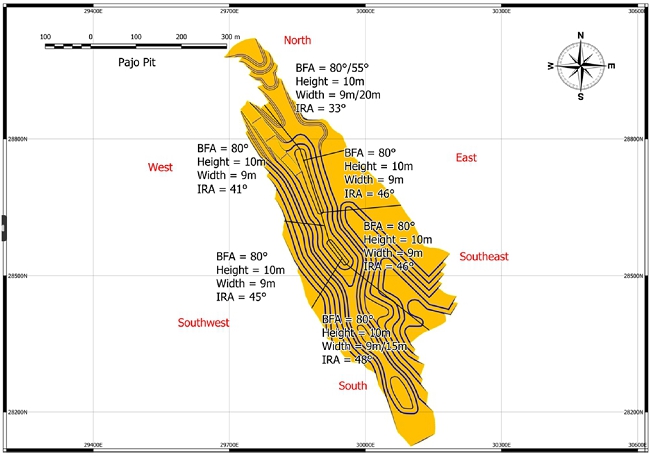
Note: Figure prepared by the Masbate Gold Project, 2025.
| November 2025 | Page 16- |
|
| Masbate Gold Project | |
| Philippines | |
| NI 43-101 Technical Report |
| Table16-1: | Open Pit Design Parameters |
| Description | Units | Main Vein Pit | Old Lady Pit | Blue Quartz Pit | Pajo Pit |
| Bench height | m | 10 m final pit | |||
| 5–10 m on overburden | |||||
| Face angle | degrees | 80 | |||
| 55˚ in overburden | |||||
| Berm width | m | 5.5–15 | 5.5–15 | 5.5–10 | 9–20 |
| Inter-ramp angle | degrees | 30–46 | 30–44 | 24–46 | 33–48 |
| Ramp width, double lane | m | 23–25 | 23–25 | 25 | 25 |
| Ramp width, single lane, lower benches | m | 12–15 | |||
| Ramp gradient | percent | 10 | |||
| 16.2.1 | Main Vein Pit |
Fresh rock wall design parameters were amended in October 2016. The principal purposes of the design amendment were based on a non-geotechnical issue relating to scheduling difficulties (which could impact poorly on future production) associated with the mining of 15 m vertical height benches. Allowance was made to incorporate 15 m wide berms (as applicable) to restrict maximum inter-ramp slope heights to around 50 m. The wider berm increases catching capacity for possible rock fall and allows access to install survey and hydrogeological instrumentation.
The key design aspects which need to be managed in the final pit phase consist of clay-rich cataclasite fault zones, unforeseen voids not shown in existing mining plans, and time-related degradation and loosening of smectite-rich (swelling clay) jointed rocks within portions of the future pit walls. Future mining in the Main Vein Pit is expected to encounter waste rock (oxide) back-filled stopes and possibly partially filled and unfilled stopes and associated development in the southern pit sector. The final pit design ensures that portions of pit walls are not mined along strike above open development, within or immediately above partially backfilled or unfilled voids.
| 16.2.2 | Old Lady Pit |
Rock quality is generally good to very good; however, poor ground conditions are noted in cataclasite fault zones.
The likelihood of localized failures taking place in benches mined at steep face angles is expected to accompany mining in the future northeast, east and southeast wall sectors. The potential for double-bench scale failures to occur in fresh rocks mined to the current wall design parameters is expected to be highest in the southeast wall sector.
Wider 15 m berms are incorporated into the design to restrict maximum inter-ramp slope height to 50 m. These wider berms have been recommended considering the interpreted presence of poor-quality cataclasite structures within pit walls.
| November 2025 | Page 16- |
|
| Masbate Gold Project | |
| Philippines | |
| NI 43-101 Technical Report |
| 16.2.3 | Blue Quartz Pit |
The Blue Quartz deposit has an atypical very shallow weathering profile, which may reflect a more recent (geologically speaking) removal of weathered rock from the hillslope overlying the deposit by mass wasting or landsliding. Due to this, there is no need to have wider berms in this pit. Berm widths were capped at 10 m.
| 16.2.4 | Pajo Pit |
The current preliminary pit wall design parameters are considered appropriate for mining purposes.
The potential for a rotational wall failure was assessed using static and pseudo-static loading conditions. The results of the evaluations suggest that the final 70 m high wall mined to current wall design parameters should be stable against potential rotational (circular-type) shearing.
With the current pit design parameters, wall instability issues are not likely.
| 16.3 | Hydrogeological Considerations |
Groundwater seepage from geological structures located at depths greater than 40 m in the walls of the Binstar and HMBE Pits was noted in 2012. Initial hydrogeological studies were conducted later that year by Groundwater Resource Management Pty Ltd. Results implied that wall rock at Main Vein has a low permeability.
Results obtained from hydraulic testing in boreholes at Main Vein indicated a range in rock permeabilities from “very low” (K <0.0001 m/day) to “relatively high” (K > 1 m/day) within a complex hydrogeological environment exhibiting both lateral and vertical variations in groundwater levels (Groundwater Resource Management, 2016).
A pit wall depressurisation program carried out using 30 m long sub horizontal depressurisation holes was established. These hole lengths would be expected to assist in depressurising the outermost portions of the future Main Vein final pit walls mined below the groundwater table and assist in maintaining wall stability at a bench to triple-bench scale.
A 2019 groundwater modeling study, conducted by Terra Techniques Environmental Consultancy, revealed that groundwater recharge and movement into Main Vein Pit will emanate from the Bangon Creek watershed to the east and from the higher areas of Guinobatan River watershed.
No hydrological information is currently available for the Old Lady, Blue Quartz, and Pajo pits. The mine plan allows for wall depressurisation drilling, using 30 m long holes, to aid in maintaining wall stability at a bench and double-bench scale once mining proceeds beyond the groundwater table. The drill hole spacing will depend on results of pit wall inspections after mining has started. Vibrating wire piezometers should be installed in sub-horizontal holes (as required) to monitor the effectiveness of wall depressurisation drilling.
| November 2025 | Page 16- |
|
| Masbate Gold Project | |
| Philippines | |
| NI 43-101 Technical Report |
| 16.4 | Open Pit Mining |
The open pit mining sequence involves grade control drilling; drill and blast operations; and excavation and hauling of materials to run-of-mine (ROM) pad of the process plant, or to temporary low-grade ore stockpiles or to the WRSF. Mining operations are conducted under an Owner-operator model and activities scheduled on a 24-hour, seven day per week basis.
Drill and blast operations are conducted on 10 m bench heights with subsequent excavation and haulage taking place over flitches (sub-benches) to allow selective mining of ore. Ore is fed to the process plant using a fleet of front-end wheeled loaders from the ROM stockpiles to achieve the planned grade and ore type blends.
Underground workings associated with Atlas’s historical mining operations are present in some areas of open pit mining.
| 16.5 | Stockpiles |
Materials of various grades and oxidation types are stockpiles. High-grade ore is stockpiled on the ROM pad for short-term mill feed, while low-grade ore is stored in one of four long-term low-grade stockpiles. Stockpile balances are calculated daily from truck counts and loader bucket count feeds. Adjustments are made at month-end to these daily balances, using an end-of-month truck factor, which is reconciled to surveyed volumes, and the mill crushed tonnes data.
Stockpiles are surveyed at month end. Stockpile balances are then compared to the surveyed tonnage, which uses in situ density and swell factor assumptions.
| 16.6 | Waste Rock Storage Facility Design Criteria |
WRSFs are designed using the parameters in Table 16-2. There are five WRSFs:
| · | Main Vein South Pit 1; |
| · | Main Vein Stage 6; |
| · | Colorado Stage 4/Stage 6; |
| · | Blue Quartz; |
| · | Pajo. |
WRSF locations were selected based on several criteria which include proximity to source of waste material, water catchment and water management criteria, and foundation.
The WRSF locations are provided in Figure 16-5 to Figure 16-9.
| November 2025 | Page 16- |
|
| Masbate Gold Project | |
| Philippines | |
| NI 43-101 Technical Report |
| Table 16-2: | WRSF Design Parameters |
| Description | Units | MVS P1 | MVS6 | Col S4/S5 | BQ | Pajo |
| Lift height | m | 20 | 20 | 20 | 20 | 20 |
| Lift face angle | degrees | 36 | 36 | 36 | 36 | 36 |
| Lift face angle reclaimed | degrees | 22 | 22 | 22 | 22 | 22 |
| Berm width (every 20 m lift) | m | 8 | 8 | 8 | 8 | 8 |
| Ramp width | m | 25 | 25 | 25 | 25 | 25 |
| Ramp gradient | percent | 10 | 10 | 10 | 10 | 10 |
| Figure 16-5: | Main Vein South Pit 1 WRSF |

Note: Figure prepared by the Masbate Gold Project, 2025
| November 2025 | Page 16- |
|
| Masbate Gold Project | |
| Philippines | |
| NI 43-101 Technical Report |
| Figure 16-6: | Main Vein Stage 6 WRSF |

Note: Figure prepared by the Masbate Gold Project, 2025
| Figure 16-7: | Colorado S4/S5 WRSF |

Note: Figure prepared by the Masbate Gold Project, 2025. WRD = WRSF.
| November 2025 | Page 16- |
|
| Masbate Gold Project | |
| Philippines | |
| NI 43-101 Technical Report |
| Figure 16-8: | Blue Quartz WRSF |

Note: Figure prepared by the Masbate Gold Project, 2025
| Figure 16-9: | Pajo WRSF |

Note: Figure prepared by the Masbate Gold Project, 2025. WRD = WRSF.
| November 2025 | Page 16- |
|
| Masbate Gold Project | |
| Philippines | |
| NI 43-101 Technical Report |
| 16.7 | Operational Cut-off Grades |
Mineral Reserves are reported at an assay cut-off grade of 0.42 g/t Au.
| 16.8 | Production Schedule |
An average of 33 Mt/a of ore and waste will be mined from four different pits. The projected mill throughput is 8.0 Mt/a over the LOM.
The forecast production schedule involves surface mining operations at the following locations:
| · | Main Vein Pit: currently being mined; projected to be depleted during 2028; |
| · | Old Lady Pit: mining to commence in Q4 2025; projected to be depleted during 2026; |
| · | Blue Quartz Pit: currently being mined; projected to be depleted during 2028; |
| · | Pajo Pit: mining to commence in 2026; projected to be depleted during 2027. |
LOM production is summarized in Figure 16-10 and Table 16-3, and the production summary per period and per mining location is summarized in Table 16-4.
The stockpile opening balance as at September 30, 2025 is shown in Table 16-5. The stockpiled ore to be processed over the LOM is presented in Figure 16-11.
The LOM processing summary is provided in Table 16-6. The forecast LOM gold production is outlined in Figure 16-12.
| 16.9 | Open Pit Mobile Mining Equipment |
Open pit equipment will be shared between the four open pits. Equipment requirements are detailed in Table 16-7.
Equipment requirements for the remaining LOM are well understood.
| November 2025 | Page 16- |
|
| Masbate Gold Project | |
| Philippines | |
| NI 43-101 Technical Report |
| Figure 16-10: | Open Pit LOM Schedule |

Note: Figure prepared by the Masbate Gold Project; 2025. 2025 production numbers exclude the first three quarters of the year.
| Table 16-3: | LOM Production Schedule Summary |
| Item | Unit | Value |
| Open pit mine life | years | 2.5 |
| Open pit nominal production rate | Mt/a rock (max) | 33 |
| Process plant life | Years | 8.32 |
| Processing rate | Mt/a | 8.00 |
| Processing recovery (average) | % | 76.35 |
| Average mined ore grade | g/t Au | 0.92 |
| Maximum reserve stockpile tonnage | Mt | 47 |
| Total life of mine gold production | koz | 1,187 |
| Average life of mine gold production | koz/a | 143 |
| Average gold production first five years | koz/a five yrs | 157 |
Note: Numbers have been rounded.
| November 2025 | Page 16- |
|
| Masbate Gold Project | |
| Philippines | |
| NI 43-101 Technical Report |
| Table 16-4: | LOM Mine Production Schedule |
| LOM Mine Production Schedule | Units | Total LOM | 2025 | 2026 | 2027 | 2028 |
| Main Vein Pit | ||||||
| Total waste | kt | 31,870 | 3,570 | 14,990 | 9,660 | 3,640 |
| Stripping ratio | w:o | 1.90 | 2.83 | 2.67 | 1.14 | 2.62 |
| Ore | kt | 16,760 | 1,260 | 5,610 | 8,510 | 1,390 |
| Grade | g/t Au | 1.02 | 1.03 | 1.03 | 0.98 | 1.21 |
| Contained gold | koz Au | 550 | 40 | 190 | 270 | 50 |
| Old Lady Pit | ||||||
| Total waste | kt | 8,440 | 1,670 | 6,780 | — | — |
| Stripping ratio | w:o | 2.79 | 5.24 | 2.51 | — | — |
| Ore | kt | 3,020 | 320 | 2,700 | — | — |
| Grade | g/t Au | 0.77 | 0.61 | 0.79 | — | — |
| Contained gold | koz Au | 70 | 10 | 70 | — | — |
| Blue Quartz Pit | ||||||
| Total waste | kt | 5,090 | 750 | 550 | 1,740 | 2,050 |
| Stripping ratio | w:o | 2.53 | 1.61 | 1.74 | 3.09 | 3.09 |
| Ore | kt | 2,010 | 470 | 310 | 560 | 660 |
| Grade | g/t Au | 0.86 | 1.00 | 0.70 | 0.85 | 0.85 |
| Contained gold | koz Au | 60 | 10 | 10 | 20 | 20 |
| Pajo Pit | ||||||
| Total waste | kt | 8,530 | — | 1,270 | 7,260 | — |
| Stripping ratio | w:o | 1.38 | — | 1.45 | 1.37 | — |
| Ore | kt | 6,190 | — | 870 | 5,320 | — |
| Grade | g/t Au | 0.75 | — | 0.84 | 0.73 | — |
| Contained gold | koz Au | 150 | — | 20 | 130 | — |
| Open Pit Total | ||||||
| Total waste | kt | 53,930 | 5,980 | 23,580 | 18,670 | 5,690 |
| Stripping ratio | w:o | 1.93 | 2.93 | 2.48 | 1.30 | 2.77 |
| Ore | kt | 27,980 | 2,040 | 9,500 | 14,390 | 2,050 |
| Grade | g/t Au | 0.92 | 0.96 | 0.93 | 0.88 | 1.10 |
| Contained gold | koz Au | 830 | 60 | 280 | 410 | 70 |
Note: Numbers have been rounded. 2025 production numbers exclude the first three quarters of the year.
| November 2025 | Page 16- |
|
| Masbate Gold Project | |
| Philippines | |
| NI 43-101 Technical Report |
| Table 16-5: | Stockpile Opening Balance |
| Metric | Units | Value |
| Ore tonnes | kt | 38,610 |
| Grade | g/t Au | 0.59 |
| Contained gold | koz Au | 740 |
Note: Numbers have been rounded. Stockpile balance is dated September 30, 2025.
| Figure 16-11: | Ore Grade and Tonnes Processed by Stockpile Bin |

Note: Figure prepared by the Masbate Gold Project, 2025. 2025 production numbers exclude the first three quarters of the year. HG = high grade; LG = low grade.
| November 2025 | Page 16- |
|
| Masbate Gold Project | |
| Philippines | |
| NI 43-101 Technical Report |
| Table 16-6: | LOM Processing Summary |
| LOM
Processing Summary |
Units | LOM
Total |
2025 | 2026 | 2027 | 2028 | 2029 | 2030 | 2031 | 2032 | 2033 | 2034 |
| Ore | kt | 66,600 | 1,970 | 8,000 | 8,000 | 8,000 | 8,000 | 8,000 | 8,000 | 8,000 | 8,000 | 630 |
| Grade | g/t Au | 0.73 | 0.90 | 0.94 | 0.95 | 0.94 | 0.62 | 0.56 | 0.59 | 0.61 | 0.61 | 0.57 |
| Contained gold | koz Au | 1,564 | 57 | 241 | 244 | 241 | 160 | 144 | 152 | 156 | 158 | 12 |
| Recovery | % | 76.35 | 80.41 | 75.74 | 74.71 | 74.21 | 75.96 | 83.93 | 77.00 | 73.60 | 72.73 | 74.45 |
| Produced gold | koz Au | 1,187 | 46 | 183 | 182 | 179 | 122 | 121 | 117 | 115 | 115 | 9 |
Note: Numbers have been rounded. 2025 production numbers exclude the first three quarters of the year.
| Figure 16-12: | Forecast LOM Gold Production |

Note: Figure prepared by the Masbate Gold Project, 2025. 2025 production numbers exclude the first three quarters of the year.
| November 2025 | Page 16- |
|
| Masbate Gold Project | |
| Philippines | |
| NI 43-101 Technical Report |
| Table 16-7: | Open Pit Mining Equipment |
| Mining Equipment | Unit Numbers |
| Production drills Sandvik DP1500i | 8 |
| Grade control drill | 4 |
| Loading unit PC2000 | 5 |
| Loading unit PC1250 | 1 |
| Komatsu PC500 | 3 |
| Komatsu PC350 | 1 |
| CAT 777 (Max) | 34 |
| Dozer (KOM D375) | 3 |
| Dozer (KOM D155) | 5 |
| Light plants | 21 |
| Compactor | 1 |
| Motor grader | 3 |
| Water truck CAT777 | 3 |
| Water truck Komatsu-HD325 | 1 |
| Wheel loader (WA600) | 5 |
| Fuel truck | 2 |
| Tyre handler | 1 |
| Forklift | 3 |
| Water pumps | 13 |
| Service truck | 2 |
| November 2025 | Page 16- |
|
| Masbate Gold Project | |
| Philippines | |
| NI 43-101 Technical Report |
| 17.0 | RECOVERY METHODS |
| 17.1 | Process Flow Sheet |
The process plant uses a conventional semi-autogenous–ball milling–crushing (SABC) grinding circuit, cyanidation leach, and adsorption (CIP), Anglo American Research Laboratory (AARL) elution, electrowinning, and smelting gold recovery stages; and a cyanide detoxification stage treating process plant tailings before disposal in a TSF. Material is ground to an 80% passing size range of 130–150 µm, and the leach residence time is 26 hours. A process flowsheet is provided in Figure 17-1.
The process plant was expanded to 6.5 Mt/a in 2016, primarily with additional leach capacity, and again in 2019 with crushing circuit upgrades and the addition of a third ball mill. Current plant throughput is 8 Mt/a, with a maximum permitted annual throughput of 9.0 Mt/a.
| 17.2 | Plant Design |
The process plant design assumptions are summarized in Table 17-1.
The process plant equipment list is provided in Table 17-2.
Table 17-3 summarizes the number of key equipment required in support of the process flowsheet.
| 17.3 | Product/Materials Handling |
Materials handling within the process plant consists of 13 conveyor belts that are used to transport ore from the crushing plant to the grinding and classification area.
A 2.1 km long, 630 mm operative diameter high-density polyethylene (HDPE) tailings line runs from the process plant to the TSF.
| 17.4 | Energy, Water, and Process Materials Requirements |
| 17.4.1 | Reagents |
Major reagents used within the process plant, and the areas that use those reagents include:
| · | Sodium cyanide (leaching and elution); |
| · | Quicklime (leaching); |
| · | Lead nitrate (leaching); |
| · | Activated carbon (adsorption); |
| November 2025 | Page 17- |
|
| Masbate Gold Project | |
| Philippines | |
| NI 43-101 Technical Report |
| Figure 17-1: | Process Flowsheet |

Note: Figure prepared by the Masbate Gold Project, 2019.
| November 2025 | Page 17- |
|
| Masbate Gold Project | |
| Philippines | |
| NI 43-101 Technical Report |
| Table 17-1: | Plant Design Assumptions |
| Area | Item | Unit | Nominal | Maximum | Design |
| Crushing plant operation (existing) | Modelled throughput | Mt/a | 6.8 | ||
| Operating days per year | days | 365 | |||
| Operating hours per day | hours | 24 | |||
| Availability | % | 90 | |||
| Operating hours per year | hours | 7884 | |||
| Feed rate | dry t/h | 863 | |||
| wet t/h | 958 | ||||
| Crushing plant operation (supplementary) | Modelled throughput | Mt/a | 1.2 | 2.8 | |
| Operating days per year | days | 365 | |||
| Operating hours per day | hours | 24 | |||
| Availability | % | 70 | |||
| Operating hours per year | hours | 6,132 | |||
| Feed rate | dry t/h | 196 | |||
| wet t/h | 217 | ||||
| Total crushing circuit | Operating feed rate | dry t/h | 1058 | ||
| wet t/h | 1,176 | ||||
| Ore Blend | oxide:transition:fresh | 60:40 |
| Table 17-2: | Plant Equipment List |
| Area | Item | Comment |
| Primary crushing plant | Rock breaker and grizzly | Hydraulic, mobile, Grizzly: inclined, 800 mm x 800 mm |
| ROM bin | 220 t live capacity | |
| ROM bin static grizzly | 800 mm x 800 mm | |
| ROM ore top size | P100 800 mm; P80 500 mm | |
| ROM feeder | Nominal: 863 dry t/h Design: 763 dry t/h |
|
| ROM grizzly screen | Vibrating, inclined,150 mm aperture | |
| Primary crusher | Jaw, Metso C160; 500 dry t/h maximum at selected closed space setting (CSS); 518 dry t/h nominal; 95% loading at nominal; crusher CSS 160 mm |
| November 2025 | Page 17- |
|
| Masbate Gold Project | |
| Philippines | |
| NI 43-101 Technical Report |
| Area | Item | Comment |
| Supplementary crushing plant | Rock breaker and grizzly | Hydraulic, mobile, Grizzly: inclined, 800 mm x 800 mm |
| ROM bin | 200 t live capacity | |
| ROM bin static grizzly | 600 mm x 650 mm | |
| ROM ore top size | P100 600 mm; P80 500 mm | |
| ROM feeder | Nominal 196 dry t/h | |
| ROM grizzly screen | Vibrating Inclined Grizzly: 90 mm aperture |
|
| Primary crusher | Jaw, Metso C125; 400 dry t/h maximum at selected CSS; 117 dry t/h nominal; 29.4% loading at nominal; crusher CSS 136 mm. |
|
| Primary screen | 1.82 m x 4.84 m; 8.8 m2 in area | |
| Secondary crusher | 215 dry t/h nominal at selected CSS; 230 dry t/h design maximum at selected CSS Crusher CSS: 62 mm |
|
| Product screens (1 & 2) |
2.38 x 6.10 m; 14.5 m2 in area | |
| Tertiary crusher | Cone; Metso HP4; 228 dry t/h nominal maximum at selected CSS; 275 dry t/h design maximum at selected CSS Crusher CSS at 15 mm |
|
| Crusher product conveyor | 1,248 dry t/h nominal; 1,375 dry t/h design |
|
| Mill feed bin | 125 dry t capacity | |
| Mill feed reclaim feeder | 1000 dry t/h per feeder nominal; 1,100 dry t/h per feeder design |
|
| Mill feed conveyor | Design duty: 1375 dry t/h nominal; 1,250 dry t/h design |
|
| SAG mill |
9.75 m diameter inside setting (IS) x 3.62 m effective grinding length (EGL); 0.37 length:diameter (L:D) ratio; 1,000 dry t/h design new ore. specific energy 6.0 kWh/t |
|
| SAG discharge screen | 1,250 dry t/h nominal; 1,500 dry t/h design (including cyclone underflow recycle) |
|
| Pebble crushing |
Cone, model: HP6; Feed rate: 250 dry t/h nominal Crusher CSS: 12 mm |
| November 2025 | Page 17- |
|
| Masbate Gold Project | |
| Philippines | |
| NI 43-101 Technical Report |
| Area | Item | Comment |
| Secondary mill (2 ball mills) |
5.30 m diameter IS; 7.55 m EGL nominal; 1.42 L:D ratio; 250–350% circulating load (range (cyclone underflow/cyclone overflow) nominal; specific energy 9.7 kWh/t nominal; grind size P80 150 µm nominal; | |
| Ball mill 3 (new) | 6.10 m diameter IS; 9.50 m EGL; 1.56 L:D ratio; 150-300% circulating load (range (cyclone underflow/cyclone overflow) nominal; specific energy 9.7 kWh/t nominal | |
| Mill discharge pumpbox | Live capacity: 70 m3 | |
| Cyclone feed pump | Operating pressure 110 kPa | |
| Classification cyclones | 20 duty, 2 standby; classification target P80 150 µm nominal; | |
| Cyclone underflow recycle |
Circulating load – range: 150–300% Circulating load – design: 300% |
|
| Trash screen | 3.6 x 7.30 m; 26.8 m2 area | |
| Leach feed tank | 4.4 minutes residence time | |
| Leach feed pump | Slurry: 2,273 t/h | |
| Leach feed sampler | Full stream primary crosscut followed by secondary vezin sampler | |
| Pre-aeration | Pre-aeration tankage | 15.76 m diameter (Ø) x 18.30 m; 1 pre-aeration tank |
| Leach residence time | 24 h nominal; 5 leach tanks, 8 adsorption tanks | |
| Leach tankage | 15.76 m Ø x 18.30 m | |
| CIL tankage | 15.76 m Ø x 16.48 m | |
| Pre-aeration aeration | Dissolved oxygen level target 15 ppm nominal | |
| CIL aeration | Dissolved oxygen level target 9 ppm nominal | |
| CIL carbon movement |
20.8 t/d carbon advance rate nominal 12 t/batch |
|
| Carbon transfer | Vertical recessed Impeller Pump Slurry: 160 m3/h |
|
| Intertank screens | 2.4 m diameter, 3.3 m drum height; 1,654 m3/h flow rate nominal | |
| Loaded carbon recovery screen | 1.5 m x 3.6 m; 5.4 m2 area | |
| Carbon safety screen | 3.6 m x 7.30 m; 26.8 m2 area | |
| Barren carbon dewatering screen | 0.915 m x 1.83 m; 1.7 m2 area | |
| Barren carbon sizing screen | 0.915 m x 1.83 m; 1.7 m2 area |
| November 2025 | Page 17- |
|
| Masbate Gold Project | |
| Philippines | |
| NI 43-101 Technical Report |
| Area | Item | Comment |
| CIL tailings sampler | Full stream primary crosscut followed by secondary vezin sampler | |
| CIL tailings |
Slurry flowrate: 1,946 m3/h nominal Slurry flowrate: 2,000 m3/h design |
|
| CIL tailings cyanide destruction | Caro’s acid | |
| AARL circuit | 20.8 t/d nominal carbon movement; HCl acid wash; | |
| Eluate heater | Diesel fired 3,780 kW |
|
| Strip solution tank |
8.6 bed volume 220 m3 / tank |
|
| Pregnant eluate tank |
8.6 bed volume 220 m3 / tank |
|
| Electrowinning | Three cells; 18 cathodes per cell | |
| Carbon regeneration | Kiln feed hopper | 15 t live capacity nominal |
| Kiln capacity | 600–1,100 kg/h nominal | |
| Quench tank | 12 t capacity nominal |
| Table 17-3: | Process Plant Key Equipment Numbers |
| Plant Description | No. of Units | Plant Description | No. of Units | |
| C160 primary jaw crusher | 1 | Regeneration kiln | 2 | |
| C125 primary crusher | 1 | Tailings pump | 6 | |
| GP 200 secondary crusher | 1 | Event pond pump | 2 | |
| HP4 tertiary crusher | 2 | Process water pump | 5 | |
| Product screen | 2 | Raw water pump | 2 | |
| 8.5 MW SAG mill | 1 | Fire water pump | 3 | |
| 3.6 MW ball mill | 2 | Power plant | 1 | |
| 6.0 MW ball mill | 1 | Workshop | 1 | |
| Pebble crusher | 1 | Onsite laboratory | 1 | |
| Vibrating screen | 4 | Mill office | 1 | |
| Vibrating grizzly | 2 | Compressor | 4 | |
| Cyclone feed pump | 2 | Plant air blower | 5 | |
| Hydrocyclones | 22 | Oxygen generator | 2 | |
| Hydrocyclones (new) | 20 | Decant water treatment plant | 1 | |
| Leach feed pump | 2 | Raw water treatment plant | 1 |
| November 2025 | Page 17- |
|
| Masbate Gold Project | |
| Philippines | |
| NI 43-101 Technical Report |
| Plant Description | No. of Units | Plant Description | No. of Units | |
| Oxygen injection pump | 1 | Reagent mixing area | 1 | |
| CIL tank (2,900 m3) | 8 | Forklift | 1 | |
| Leach tank (3,500 m3) | 5 | Pick & carry | 1 | |
| Pre-aeration tank (3,500 m3) | 1 | Telehandler | 2 | |
| Interstage tank screen | 8 | Work pick-ups | 5 | |
| Acid wash column | 1 | Boom truck | 1 | |
| Elution column | 1 | Concrete batching plant | 1 | |
| Electrowinning cell | 3 | Mobile crane | 2 |
| · | Hydrochloric acid (elution); |
| · | Sulphuric acid (cyanide detox); |
| · | Caustic soda (elution); |
| · | Hydrogen peroxide (cyanide detox). |
| 17.4.2 | Power |
The average power consumption ranges from approximately 16,500–18,500 MWh per month.
Power supplies are discussed in Section 18.9.
| 17.4.3 | Water |
The primary source of process water (94%) is from the TSF. The remaining 6% of requirements is provided by water sourced from a weir constructed on the Guinobatan River.
Potable water is sourced from two ground water wells.
There is also an option to use sea water if process water shortages exist.
| November 2025 | Page 17- |
|
| Masbate Gold Project | |
| Philippines | |
| NI 43-101 Technical Report |
| 18.0 | PROJECT INFRASTRUCTURE |
| 18.1 | Introduction |
The key infrastructure required for the LOM plan includes:
| · | Four open pits (Main Vein, Old Lady, Blue Quartz, and Pajo); |
| · | Five WRSFs (Blue Quartz; Colorado S4/S5; Main Vein S6; Main Vein SP1; Pajo); |
| · | Four low-grade stockpiles; |
| · | TSF; |
| · | Process plant and ROM pad; |
| · | Power station and solar farm; |
| · | Mobile crusher; |
| · | Maintenance workshop; |
| · | General and administrative office; |
| · | Fuel farm; |
| · | Colorado repeater station; |
| · | Emulsion plant; |
| · | Airstrip; |
| · | Causeway; |
| · | Accommodations facility; |
| · | Access and haul roads; |
| · | Sediment control and water diversion structures; |
| · | Water supply structures (wells, freshwater reservoir). |
Figure 18-1 is a layout plan shows key mine infrastructure locations.
| November 2025 | Page 18- |
|
| Masbate Gold Project | |
| Philippines | |
| NI 43-101 Technical Report |
| Figure 18-1: | Infrastructure Location Plan |

| November 2025 | Page 18- |
|
| Masbate Gold Project | |
| Philippines | |
| NI 43-101 Technical Report |
| 18.2 | Road and Logistics |
| 18.2.1 | Roads |
Roads currently connect the open pit mines, process plant area, solar farm, and accommodations areas. These roads are regularly sheeted with crushed gravel, graded, cleared of vegetation along the sides, and are provided with drainage channels.
| 18.2.2 | Airstrip |
The existing airstrip in Aroroy is registered with the Civil Aviation Authority of the Philippines (CAAP), and is operated and maintained according to CAAP standards. The airstrip is suitable for daylight operations and is used to transport critical personnel and spare parts.
| 18.2.3 | Port |
The causeway at Port Barrera can dock and unload up to 2,000 dead-weight tonnage (DWT) flat-bottom barges at high tide. Barges transport heavy equipment, lime, bulk materials, spare parts, and other oversized items.
| 18.3 | Stockpiles |
Information on stockpile balances is provided in Section 16.5, and the planned stockpile movements were included in Table 16-5 and Figure 16-11.
Over the LOM up to 47 Mt of low-grade material, with an average grade 0.63 g/t Au is expected to be stockpiled. These stockpiles will be treated through the process plant at the end of the active mining operation.
There are four low-grade stockpiles that will be available for stockpiling low-grade material.
| 18.4 | Waste Rock Storage Facilities |
Design criteria were provided in Section 16.2. WRSFs locations were provided in Figure 16-5 to Figure 16-9.
The remaining LOM waste rock storage requirement is about 50 Mt of waste rock. Where practical, mined-out pits are used for waste rock storage. WRSFs are constructed as needed. WRSF design typically consists of 8 m wide berms, 20 m high batters with a batter face angle of 36° (angle of repose), for an overall slope angle of 23°. In all cases, design criteria and overall dump angles are assessed for stability under both static and seismic conditions. Where appropriate, final dump design criteria are used during construction to allow progressive rehabilitation of dump surfaces. In this case the batter face is reclaimed to 22°.
| November 2025 | Page 18- |
|
| Masbate Gold Project | |
| Philippines | |
| NI 43-101 Technical Report |
Both potentially acid generating (PAG) and non acid generating (NAG) rock have been identified at the Masbate Gold Project. Detailed studies have shown, for the rock mass present, net acid generation potential of samples can be approximated by measurement of total sulphur (STOT) content and additional measurement of total carbon (CTOT) content further improves the accuracy of classification. PAG/NAG waste rock identification and segregation is ongoing during mining operations with classification based on STOT and CTOT analyses determined from grade control drill samples. WRSF design and construction follow guidelines and principles developed in conjunction with acid rock drainage management consultants, Environmental Geochemistry International, and incorporates placement of PAG and NAG material within specific locations within waste rocks such that all PAG material is encapsulated from the atmosphere by NAG material to eliminate potential acid generation.
Regular water quality monitoring throughout the Masbate mining operations includes analysis of acid generation parameters (pH, dissolved metal content).
STOT and CTOT information is being progressively updated via campaign assays of existing sample material and repeat drill campaigns where samples from previous drilling is not complete. It is estimated that the volume of NAG material to be mined in the LOM plan is sufficient to encapsulate identified PAG material. Acid rock drainage management from the WRSFs and completed pits is incorporated within mine closure planning.
| 18.5 | Tailings Storage Facilities |
| 18.5.1 | Development History and Overview |
The TSF was established in 2009 with the Stage 1 construction of a cross-valley dam, a saddle dam, and a water diversion dam. As the facility expanded, additional saddle dams were constructed to impound the growing tailings footprint. The current configuration includes the Main Dam and Saddle Dams 1, 2, 4, 8, and 7. The facility primarily employs a downstream raise method. However, stages 10 and 11 of the Main Dam, along with stage 11 of Saddle Dams 7 and 8, were constructed using modified centreline raises.
The TSF comprises an upstream clay liner, a transitional filter zone, and an outer shell of crushed waste rock. The downstream slope varies between 2H:1V and 2.5H:1V. Seepage and surface runoff are managed through sumps located downstream of the embankments. Diversion channels surrounding the facility are designed to intercept and redirect external runoff away from the TSF.
A floating pump decant system is installed along the northern causeway of the TSF. This system enables flexible decanting of supernatant water from the tailings pond. Reclaimed water is returned to the process water pond for reuse in the processing plant or treatment via the water treatment plant (WTP) prior to environmental discharge.
Tailings are delivered from the process plant via a steel pipeline connected to high density polyethylene distribution lines, which run along the upstream crests of embankments and accessible access roads. Tailings discharge is controlled through spigots equipped with gate valves positioned along the embankment crests.
| November 2025 | Page 18- |
|
| Masbate Gold Project | |
| Philippines | |
| NI 43-101 Technical Report |
Classified as an Extreme Consequence facility under the Australian National Committee on Large Dams (ANCOLD) guidelines, the TSF is subject to daily inspections by the site tailings team, with quarterly and annual inspections conducted by the Engineer of Record. Monitoring instrumentation includes standpipe and vibrating wire piezometers, survey monuments, a V-notch weir system, and accelerometers. A dam safety review was completed by an independent consultant in July 2024.
| 18.5.2 | Current Status and Future Expansion |
The TSF is currently at 67 mRL crest elevation, after the completion of Stage 14 of the dam raise in 2024. The Engineer of Record is advancing the design for the LOM ultimate dam height of 77 mRL, which will provide sufficient tailings storage capacity to support operations through to the end of 2034. The design will accommodate an estimated 8 Mt/a of tailings deposition.
As part of the remaining expansion, Saddle Dam 15 will be constructed at the southeastern portion of the TSF. Preparation activities including drilling and site setup, are scheduled to begin in 2026. Additionally, an interim spillway will be constructed on natural ground near Saddle Dam 15, providing emergency water management during current and upcoming dam raise stages.
Future dam raises will primarily use the downstream construction method. However, due to the proximity of the national highway along the northern section of the Main Dam, a modified centerline raise will be required to maintain the mandated 20 m buffer of the dam toe from the national highway. The Engineer of Record is finalizing the design for the LOM raise to RL 77 m, which will be executed in Stage 15 and Stage 16. Final design documentation is expected to be delivered in Q1 2026.
Preliminary closure design work is underway. Multiple consultants are contributing to key aspects of the site-wide closure plan, including TSF, site-wide water balance, load modeling, closure cover design, and the final closure spillway layout and design.
| 18.6 | Water Management |
Water storage and water management is currently performed through construction and progressive improvement of sediment ponds, silt traps, silt fence, drainage systems, rehabilitation works and appropriate bund walls along haul/access roads, and operations of several water storage weirs.
| 18.7 | Water Supply |
The Guinobatan weir, TSF, and boreholes are the major water source for operations and potable water supply. Water is supplied by the following:
| · | Tailings supernatant: reclaimed from the TSF at a rate of 1.4 m3/t and used in the process plant; |
| November 2025 | Page 18- |
|
| Masbate Gold Project | |
| Philippines | |
| NI 43-101 Technical Report |
| · | Water reservoir constructed on the Guinobatan River: provides firewater, elution water, and process make-up and wash-down water; |
| · | Deep well bores. |
| 18.8 | Camps and Accommodation |
Supervisory and management level employees are accommodated within a camp facility. Non-supervisory level employees live within local communities.
| 18.9 | Power and Electrical |
A power plant consisting of seven generator sets provides power to the operations. This power plant is fueled with a hybrid mixture of heavy fuel oil (HFO) and light fuel oil (LFO). The power plant consists of two 6.4 MW units, three 5.6 MW units, one 6.3 MW unit and one 9.4 MW unit. This allows for two units to be on standby or undergoing maintenance, while five are producing power.
The solar farm project is part of the Project’s commitment to generate clean energy and help B2Gold reduce its global carbon footprint. The solar farm is installed on 8.7 ha of land owned by Filminera. These solar panels are expected to generate 8.2 MW of electricity when the project is completed. This will reduce daytime generator use from five to four (and sometimes three), and will reduce carbon emissions by approximately 8,500 t/a. A second phase solar farm of similar size is in the final planning, design, and cost estimation stages. Rooftop solar has been installed on existing buildings for an additional 1.3 MW of solar power.
| November 2025 | Page 18- |
|
| Masbate Gold Project | |
| Philippines | |
| NI 43-101 Technical Report |
| 19.0 | MARKET STUDIES AND CONTRACTS |
| 19.1 | Market Studies |
No market studies are currently relevant as the Masbate Gold Project is an operating mine producing a readily-saleable commodity in the form of doré.
Doré produced by the operations typically contains 60% Au and 40% Ag. The doré produced is exported to Metalor Technologies S.A. in Switzerland for refining.
| 19.2 | Commodity Price Projections |
Commodity prices used in Mineral Resource and Mineral Reserve estimates are provided as recommendations by B2Gold to PGPRC and Filminera, and were adopted by PGPRC and Filminera. The current gold price used in the Mineral Reserve estimation is US$1,750/oz, and US$2,550/oz for Mineral Resource estimation.
| 19.3 | Contracts |
As noted in Section 4.3, PGPRC and Filminera have a contractual relationship, which includes PGPRC purchasing all of the ore production from Filminera at a price equal to the cost for the ore plus a predetermined percentage, while maintaining joint financial and legal liability for the social and environmental obligations under Filipino laws.
Major contracts include blasting operations and support, power house operations and maintenance, fuel supply, explosives and accessories, camp and transportation services, support for construction projects, site security, support for major maintenance events, and grade control drilling. Contracts are negotiated and renewed as needed. Contract terms are within industry norms, and typical of similar contracts in the Philippines that the Masbate Gold Project is familiar with.
| 19.4 | Comments on Market Studies and Contracts |
The QP notes the following.
The doré produced by the mine is readily marketable. Metal prices are set corporately for Mineral Resource and Mineral Reserve estimation, and the gold price used for Mineral Resources and Mineral Reserves in this Report was US$2,550/oz and US$1,750/oz, respectively.
The QP reviewed commodity pricing assumptions, marketing assumptions, and the current major contract areas, and considers the information acceptable for use in estimating Mineral Reserves and in the economic analysis that supports the Mineral Reserves.
| November 2025 | Page 19- |
|
| Masbate Gold Project | |
| Philippines | |
| NI 43-101 Technical Report |
| 20.0 | ENVIRONMENTAL STUDIES, PERMITTING, AND SOCIAL OR COMMUNITY IMPACT |
| 20.1 | Introduction |
At the start of operations, Filminera was the main proponent of the Masbate Gold Project. During submission of environmental compliance certificate compliance and monitoring reports, the DENR and the Mines and Geosciences Bureau required PGPRC to obtain a separate permit and compliance scheme for the processing plant. As a result, PGPRC secured a mineral processing permit and began submitting its own periodic self-monitoring reports and social development and management program reports.
The social development and management program projects prepared by Filminera and PGPRC were separately presented to barangay officials and community beneficiaries to clarify the distinct management responsibilities of each company for the Project.
In 2015, Filminera applied for an environmental compliance certificate amendment for the Montana Extension Pit Project (Phase 1), which was approved and issued in January 2019. A subsequent environmental compliance certificate amendment for the mill expansion, covering an increase in processing capacity from 7.3–9.0 Mt/a, was issued on December 18, 2019. Another Environmental compliance certificate amendment, for the Phase 2 of the Masbate Gold Project, to include the Blue Quartz and Old Lady areas, was approved on January 15, 2024.
Filminera has initiated the process for an additional environmental compliance certificate amendment application for the proposed Pajo project, which is currently undergoing review through the environmental performance report and management plan. The Pajo open pits are planned to be mined for approximately 1.75 years, with direct impact areas identified in accordance with DENR guidelines. Two additional barangays, Ambolong and Talabaan, will be directly affected. At the Report effective date, there are eight host or impact barangays associated with the Masbate mining operations: Amoroy, Bangon, Capsay, Panique, Puro, Lanang, Balawing, and Syndicate.
| 20.2 | Environmental Studies and Consideration |
Masbate Gold Project’s environmental protection and management programs have been implemented since the commencement of operations. These programs are guided by the conditions stipulated in the issued environmental compliance certificate and described in the approved environmental protection and enhancement program, including the environmental impact assessment documents of the Project, to meet necessary regulatory requirements.
Environmental risk assessments, along with formal environmental audits and reviews of environmental compliance certificate conditions, are also conducted periodically through initiatives by Filminera. Independent consultants such as GAIA South Inc., Axceltechs Inc., and BMP Environmental Care of the Philippines, and Integrated Environmental Systems Pty Ltd and Earth Systems Consulting Pty Ltd of Australia have been engaged to externally validate environmental compliance and program implementation.
| November 2025 | Page 20- |
|
| Masbate Gold Project | |
| Philippines | |
| NI 43-101 Technical Report |
Filminera and PGPRC obtained ISO 14001 certification in 2016 to ensure continuous improvement of its environmental management system. Various environmental monitoring programs, construction and installation of environmental control measures, and other initiatives have been implemented, including:
| · | Regular air quality, surface water, groundwater, noise level, river flow, and climatological monitoring; |
| · | Semi-annual marine and limnological monitoring; |
| · | Baseline water quality characterization for water bodies within the existing areas of exploration and drilling activities; |
| · | Management of surface water run-off through construction and progressive improvement of sediment ponds, silt traps, silt fence, drainage systems, rehabilitation works and appropriate bund walls along haul/access roads; |
| · | Environmental geochemistry and water quality assessment; |
| · | Power plant stack emission tests, ambient air quality monitoring/assessments, and greenhouse gas emissions inventory; |
| · | Monitoring and inventory of chemicals and dangerous goods; |
| · | Process and non-process wastes management and recycling program; |
| · | Monitoring of the cyanide detoxification system. The cyanide content of the slurry (spigot) coming out of the tailings pipeline and contained within the TSF is also monitored; |
| · | Operation and monitoring of water treatment facilities: decant water treatment plant, sewage treatment plants, and oil-water separators. |
| · | Build-up of the TSF main dam, spillway, coffer dams, and saddle dams are undertaken as necessary; |
| · | The TSF freeboard is regularly monitored; |
| · | Progressive rehabilitation and re-vegetation of existing WRSFs is conducted for slope stabilization; |
| · | Mangrove reforestation/rehabilitation through the joint effort of Filminera and several coastal barangay/community associations has been ongoing since 2013 and will continue; |
| · | Continuing support of the Government’s National Greening Program and implementation of other Filminera-related reforestation programs and initiatives are undertaken. |
| · | Biodiversity management, conservation, and monitoring; |
| November 2025 | Page 20- |
|
| Masbate Gold Project | |
| Philippines | |
| NI 43-101 Technical Report |
| · | Climate change and energy management; |
| · | Support to national declared protected areas. |
In 2012, Executive Order No. 79 initiated key reforms in the Philippine mining sector, emphasizing stricter environmental standards, child welfare, and regular compliance reviews. These reforms were reinforced in 2016 through company suspensions and comprehensive audits, during which the Masbate Gold Project was reviewed as part of this nationwide initiative. Executive Order No. 130, issued in 2021, lifted the moratorium on new mining projects and institutionalized ongoing reforms by introducing policies and guidelines to further enhance environmental protection and promote responsible mining practices.
Subsequent regulations strengthened the environmental framework with stricter water and effluent standards (DENR Administrative Order (AO) No. 2016-08 and DENR AO No. 2021-19), new biodiversity conservation and monitoring requirements (DENR AO No. 2022-04), and the integration of the United Nations Sustainable Development Goals into Social Development and Management Programs (DENR AO No. 2025-10).
PGPRC operates a water treatment plant to ensure the stability and safety of the TSF, with treated water discharged to the marine environment in compliance with effluent standards. After evaluating several treatment options, a technical assessment supported the inclusion of a 300-meter mixing zone at Port Barrera, incorporated into the water treatment plant discharge permit issued in 2023 and renewed in 2025. Ongoing sampling, monitoring, and risk assessments are conducted to maintain sustained regulatory compliance.
For biodiversity, the Masbate Gold Project has mapped and continues to monitor biodiversity corridors, exceeding regulatory requirements, and conducts regular ecosystem assessments in surrounding areas. The Project also continues with mangrove reforestation initiatives in partnership with local stakeholders and supports the management of nationally designated protected areas.
Aligned with DENR AO No. 2025-10, the Masbate Gold Project social development and management program integrates key sustainable development goals in collaboration with local communities, focusing on poverty reduction, health, education, gender equality, clean water, and climate action. Progress is tracked and reported annually to ensure transparency, accountability, and compliance.
| 20.3 | Reclamation and Closure Considerations |
Closure planning is described in the final mine rehabilitation and decommissioning plans for both Filminera and PGPRC. Filminera has implemented a progressive rehabilitation schedule, with rehabilitation costs incorporated into operational phases wherever practicable.
| November 2025 | Page 20- |
|
| Masbate Gold Project | |
| Philippines | |
| NI 43-101 Technical Report |
The final mine rehabilitation and decommissioning plans for both Filminera and PGPRC were updated in 2025 to comply with the recently approved environmental compliance certificate amendment for Blue Quartz/Old Lady operations and are subject to review and approval by the Contingent Liability and Rehabilitation Fund – Steering Committee. These plans will be updated again following approval of the proposed environmental compliance certificate amendment to include the Pajo project. The current LOM schedule indicates completion of mining in mid-2028, with processing of low-grade materials continuing into 2034. All key aspects of the operation, including major structures and facilities, are covered in the plan and prioritized on a risk basis. Risk areas requiring detailed assessment as part of the next final mine rehabilitation and decommissioning plan update (planned for 2026) will include surface water management, potential acid rock drainage, and post-closure land uses.
Closure costs, including a 10-year post-closure monitoring program, are estimated at approximately US$39.9 M. These costs are revised annually as part of the asset retirement obligation estimate.
Filminera has prepared for three mine closure scenarios:
| · | Planned closure at the end of the Project life; |
| · | Temporary closure due to operational or economic factors, with stakeholder notification and implementation of a care and maintenance program; |
| · | Sudden closure resulting from unexpected events or regulatory issues, requiring immediate decommissioning and safety measures. |
Decommissioning activities will include the removal or treatment of hazardous materials and structures, followed by rehabilitation works such as earth grading, drainage stabilization, and revegetation. Pits may be repurposed, WRSFs revegetated, and infrastructure either decommissioned, rehabilitated, or repurposed, as appropriate.
A social closure plan supports employees and communities through retrenchment, training, financial guidance, asset handover to government, and stakeholder consultations. An information, education, and communication program ensures transparency with affected stakeholders. Maintenance and monitoring of structures and reforestation areas are managed by a closure team in coordination with government agencies, with ongoing environmental monitoring and reporting. Contractors must be accredited and workers certified, in compliance to all legal and regulatory standards.
Rehabilitation success is measured through quantitative, stakeholder-agreed completion criteria, adapted to site conditions and tracked using reliable indicators. The objective is to restore or improve post-mining land use in accordance with the comprehensive land use plan, taking into account pre-mining uses, stakeholder input, and environmental, social, and economic factors. Options for post-mining land use include community facility donation, revegetation to an acceptable post-mining state, and in some cases the maintenance of altered landforms (e.g., open pits).
| November 2025 | Page 20- |
|
| Masbate Gold Project | |
| Philippines | |
| NI 43-101 Technical Report |
Decommissioning planning prioritizes minimizing environmental impact and retaining infrastructure that may serve community needs, with all asset transfers and maintenance to be conducted in consultation with stakeholders and per DENR guidelines. Asset transfers, including vehicles, will be formalized through agreements. Mine closure development is documented in regular reports, and the closure plan is updated as required.
Upon meeting closure objectives and securing regulatory approval, the company will submit a final rehabilitation report and may be issued a certificate of final relinquishment, formally ending its obligations for rehabilitated areas.
| 20.4 | Permitting |
Filminera maintains a database of comprehensive listing of permitting requirements and key operational documents. The key permits are the MPSAs (see Section 4). Additional significant permits and documents for the operation include the following:
| · | Environmental compliance certificate; |
| · | Mineral processing permit; |
| · | Environmental protection and enhancement program and the annual environmental protection and enhancement program, being an annual update of the original document; |
| · | Final mine rehabilitation and decommissioning plan; |
| · | Wastewater discharge permits or key installations including the TSF, water treatment plant, sewerage treatment plants, and batching plant; |
| · | Permits to operate for power generation and other fuel-burning equipment; |
| · | Chemical control orders registration and chemical control order Importation clearances; |
| · | Hazardous waste generator registry certificates and permits to transport; |
| · | National water resources board water permit. |
Renewal of these documents is an ongoing process for Filminera and PGPRC depending on the circumstances of the operation and individual permit requirements. There are no currently known significant issues with the above-mentioned permits or documents.
PGPRC also holds a mineral processing permit. Filminera holds permits and applications. Special land use permits were also granted for infrastructure construction and operation outside the MPSA areas, including the TSF, WRSFs, and airstrip.
Additional permits will be required in support of mining operations at the planned satellite open pits.
| 20.5 | Considerations of Social and Community Impacts |
The Community Relations Department is responsible for establishing and maintaining strong relationships with stakeholders to obtain and sustain social acceptability of operations. Stakeholders include: residents of host and neighboring communities; local government units (provincial, municipal, and barangay levels); national and regional government agencies; media; religious organizations; non-governmental organizations (NGOs); educational institutions; and the Philippine National Police and Military.
| November 2025 | Page 20- |
|
| Masbate Gold Project | |
| Philippines | |
| NI 43-101 Technical Report |
The social development and management program is a mandatory, long-term community development program established under the Philippine Mining Act and related DENR Administrative Orders. It is implemented by the Community Relations Department to enhance the welfare and participation of host and neighboring barangays through projects that improve access to healthcare, education, livelihood, infrastructure, institutional capacity, and the preservation of socio-cultural heritage. Filminera and PGPRC implement the social development and management program in close collaboration with local stakeholders, including barangay councils, sectoral representatives, and relevant government agencies.
Emphasizing sustainability and post-mining preparedness, the social development and management program incorporates strategies that promote long-term environmental stewardship and socio-economic resilience. These strategies include responsible resource management, progressive land rehabilitation, and minimization of ecological impacts. Community participation in mine closure planning is prioritized, focusing on economic diversification, education and training, and infrastructure development to support continued growth beyond mining.
The Community Relations Department oversees engagement with residents, government agencies, NGOs, educational and health institutions, media, religious groups, and security organizations to maintain social acceptability. An amount equal to 1.5% of the previous year’s annual operating costs is allocated to the social development and management program (as mandated by regulatory requirements), Development of Mining Technology and Geosciences, and information, education, and communication activities. Unspent funds are reprogrammed based on further community consultations. Program development follows participatory rapid appraisal methods, including mapping, workshops, and needs assessments, to align initiatives with local priorities and the United Nations Sustainable Development Goals. All proposals undergo review and are formalized through Memoranda of Agreement pending approval by the Mines and Geosciences Bureau Regional Office. Quarterly monitoring and annual reporting ensure transparency, with financial and physical accomplishments disclosed to stakeholders.
Key aspects of the Filminera and PGPRC social responsibility approach, focusing on the social development and management program, Development of Mining Technology and Geosciences, and information, education, and communication programs, as well as the grievance mechanism required under Philippine mining regulations, are presented in the following sub-sections.
| 20.5.1 | Community Development |
The social development and management program is a legally mandated five-year plan that supports community development, education, infrastructure, livelihood, health, and institutional capacity building. Implementation is phased, beginning with eight host barangays and later expanding to all 41 barangays in Aroroy.
| November 2025 | Page 20- |
|
| Masbate Gold Project | |
| Philippines | |
| NI 43-101 Technical Report |
| · | Phase 1 (2009–2013): focused on community development and education within eight barangays, resulting in 117 graduates and support for school staff; |
| · | Phase 2 (2014–2018): expanded coverage to all barangays, emphasizing education and infrastructure; |
| · | Phase 3 (2019–2023): continued coverage while prioritizing livelihood, health, and institutional capacity building; |
| · | Phase 4 (2024–2028): approved by the Mines and Geosciences Bureau and commenced in 2024, with a focus on education, human resource development, and institutional strengthening. |
Key social development and management program initiatives include:
| · | Human resource development and employment: recruitment of qualified residents from host and neighboring barangays, skills enhancement, and employment programs in partnership with the Technical Education and Skills Development Authority and the Department of Information and Communications Technology, providing technical, vocational, and digital training. |
| · | Health and social services: implementation of medical missions, health screenings, equipment provision, and disaster relief efforts, notably during events such as typhoon, earthquake, and volcanic eruption; |
| · | Infrastructure and livelihood: investments in water systems, road networks, and livelihood restoration, together with support for enterprise development, education, and cultural preservation; |
| · | Education: high school and college scholarship programs, construction and repair of classrooms, provision of transport services to students and subsidies to village teachers. |
| 20.5.2 | Advancement of Mining Technology and Geosciences |
Filminera and PGPRC allocate a portion of their operating costs (under the social development and management program budget) to the advancement of mining technology and geosciences.
| · | Research and scholarships: funding for basic and applied research, scholarships, and grants related to mining, with a focus on improving operational efficiency and environmental protection; |
| · | Environmental programs: ongoing projects addressing climate change adaptation, biodiversity enhancement, and agroforestry, conducted in partnership with academic and government institutions. |
| November 2025 | Page 20- |
|
| Masbate Gold Project | |
| Philippines | |
| NI 43-101 Technical Report |
| 20.5.3 | Information, Education, and Communication |
The information, education, and communication program promotes public awareness and understanding of responsible mining practices.
| · | Stakeholder engagement: regular dialogues, public forums, and awareness campaigns to ensure transparency and address stakeholder concerns regarding mining operations and environmental initiatives; |
| · | Materials and outreach: production of educational materials, organization of mine tours, and participation in community events to strengthen trust and understanding. The information, education, and communication program employs multimedia and community-based communication platforms, including publications, radio, and print media, as well as a dedicated information, education, and communication centre. |
A formal grievance redress mechanism is in place to manage community concerns, ensuring that complaints are systematically documented, evaluated, and resolved. Details of the process are regularly communicated to stakeholders.
The social development and management program, development of mining technology and geosciences, and information, education, and communication programs, supported by a functional grievance mechanism, are comprehensive, well-funded, and aligned with local and national development objectives. These programs provide significant benefits in employment, healthcare, education, infrastructure, and environmental management, while ensuring transparent stakeholder engagement and continuous improvement. Collectively, they fulfill regulatory obligations and promote long-term sustainability, community resilience beyond mine closure, and continued social acceptability of mining activities in the Masbate Gold Project area.
| November 2025 | Page 20- |
|
| Masbate Gold Project | |
| Philippines | |
| NI 43-101 Technical Report |
| 21.0 | CAPITAL AND OPERATING COSTS |
| 21.1 | Introduction |
All capital costs are considered sustaining capital, apart from reclamation and closure costs.
All costs are at a minimum at a pre-feasibility confidence level as the Masbate Gold Project is in operation.
| 21.2 | Capital Cost Estimates |
| 21.2.1 | Basis of Estimate |
The capital cost estimates are based on a combination of the 2025 mine plan, estimated Mineral Reserves, and operating experience with the Masbate Gold Project.
Capital cost estimates were prepared for expenditures required to maintain production which include expansion and replacement of mobile equipment, land acquisition, TSF raises and mill sustaining capital.
| 21.2.2 | Mine Capital Costs |
Mine capital costs are estimated based on Owner operation of mining fleets. Actual costs are available, and maintenance practices are well established. Rebuilds and equipment replacement costs are estimated based on actual or forecast data from equipment manufacturers. Major mine equipment fleet replacements are carried out on an as-needed basis, depending on equipment condition and utilization.
The total mining capital cost is estimated to be US$30.9 M over the LOM, excluding capitalized waste.
| 21.2.3 | Process Capital Costs |
Process capital costs include allowances for equipment rebuilds and replacements, as well as TSF expansions.
Process capital costs are estimated at US$69.4 M over the LOM.
| 21.2.4 | Site General Capital Costs |
Site general capital costs consist mostly of equipment rebuild and replacement estimates for auxiliary equipment in the support departments around the Masbate Gold Project including site services, airstrip, and causeway.
Total site general capital costs are estimated to be US$5.1 M over the LOM.
| November 2025 | Page 21- |
|
| Masbate Gold Project | |
| Philippines | |
| NI 43-101 Technical Report |
| 21.2.5 | Closure Costs |
The total reclamation and closure capital cost is estimated at US$39.9 M, with costs occurring concurrently with operations where feasible. However most costs will occur at the end of mining and processing operations.
| 21.2.6 | Capital Cost Summary |
The estimated LOM capital cost is US$105.4 M (Table 21-1).
| 21.3 | Operating Cost Estimates |
| 21.3.1 | Basis of Estimate |
Operating costs were developed based on a combination of fixed and variable cost standards applied to mine, mill, general and administrative aspects to forecast total mine site operating costs.
| 21.3.2 | Mine Operating Costs |
Mine operating costs include: drill-and-blast for oxide and non-oxide materials, pre-split, loading, hauling, waste materials, void management, grade control, labour, ownership, drainage, haul road maintenance, dewatering, site roads and accesses and diesel costs. Costs vary by open pit and material mined.
Mine operating cost forecasts are provided in Table 21-2. Over the LOM, including all Mineral Reserve pits, the surface mine overall average operating cost is estimated at US$1.98/t mined, excluding capitalized waste.
| 21.3.3 | Process Operating Costs |
Processing costs include all activities related to ore process. Variable costs are costs which change with plant production, consisting largely of consumables/supplies and power costs, as well as maintenance and allocation for ore-waste haulage differential. Period costs are time-related costs which are incurred regardless of production, including labour, contractors, and a portion of maintenance and other distributed costs. Total process costs vary year over year depending on the operational plan.
Stockpile and ore rehandle costs are included with the processing costs, as well as TSF raises.
Process operating cost forecasts are provided in Table 21-3. The total process operating cost is estimated to average US$13.19/t milled over the processing life of eight years.
| November 2025 | Page 21- |
|
| Masbate Gold Project | |
| Philippines | |
| NI 43-101 Technical Report |
| Table 21-1: | Capital Cost Schedule By Area |
| Area | Unit | Total | 2025 | 2026 | 2027 | 2028 | 2029 | 2030–2034 |
| Mining | US$ M | 30.9 | 7.2 | 9.5 | 9.9 | 4.3 | 0.0 | 0.0 |
| Processing | US$ M | 69.4 | 3.5 | 10.4 | 9.6 | 8.0 | 9.4 | 28.4 |
| Site general | US$ M | 5.1 | 0.2 | 1.0 | 1.1 | 1.7 | 0.4 | 0.6 |
| Total | US$ M | 105.4 | 10.9 | 20.9 | 20.6 | 14.1 | 9.9 | 29.0 |
Note: 2025 production numbers exclude the first three quarters. Mining capital cost estimates exclude capitalized waste. Numbers have been rounded.
| Table 21-2: | Mine Operating Cost Summary |
| Activity | Unit | 2025 | 2026 | 2027 | 2028 |
| Drilling | US$/t mined | 0.13 | 0.14 | 0.14 | 0.15 |
| Blasting | US$/t mined | 0.43 | 0.44 | 0.44 | 0.48 |
| Loading and hauling | US$/t mined | 0.75 | 0.78 | 0.74 | 0.92 |
| Dewatering and pumping | US$/t mined | 0.02 | 0.02 | 0.02 | 0.02 |
| Dumps and haul roads | US$/t mined | 0.04 | 0.04 | 0.04 | 0.04 |
| Mine technical services | US$/t mined | 0.06 | 0.06 | 0.06 | 0.11 |
| Mine maintenance | US$/t mined | 0.08 | 0.08 | 0.09 | 0.22 |
| Grade control | US$/t mined | 0.22 | 0.23 | 0.25 | 0.44 |
| Total | US$/t mined | 1.74 | 1.80 | 1.78 | 2.40 |
| November 2025 | Page 21- |
|
| Masbate Gold Project | |
| Philippines | |
| NI 43-101 Technical Report |
| Table 21-3: | Process Operating Cost Summary |
| Activity | Unit | 2025 | 2026 | 2027 | 2028 | 2029 | 2030 | 2031 | 2032 | 2033 | 2034 |
| Feed crusher/rehandle | US$/t processed | 0.61 | 0.59 | 0.55 | 0.56 | 0.80 | 0.80 | 0.80 | 0.80 | 0.80 | 0.80 |
| Crushing | US$/t processed | 1.12 | 1.11 | 1.11 | 1.11 | 1.11 | 1.11 | 1.11 | 1.11 | 1.11 | 1.45 |
| Grinding | US$/t processed | 6.52 | 6.35 | 6.35 | 6.36 | 6.35 | 6.35 | 6.35 | 6.36 | 6.35 | 8.58 |
| Leaching | US$/t processed | 2.28 | 2.25 | 2.25 | 2.26 | 2.25 | 2.25 | 2.25 | 2.26 | 2.25 | 2.63 |
| CIP carbon in pulp | US$/t processed | 0.08 | 0.08 | 0.08 | 0.08 | 0.08 | 0.08 | 0.08 | 0.08 | 0.08 | 0.08 |
| Adsorption plant | US$/t processed | 0.04 | 0.04 | 0.04 | 0.04 | 0.04 | 0.04 | 0.04 | 0.04 | 0.04 | 0.04 |
| Carbon elution and regeneration | US$/t processed | 0.17 | 0.17 | 0.17 | 0.17 | 0.17 | 0.17 | 0.17 | 0.17 | 0.17 | 0.17 |
| Cyanide destruction | US$/t processed | 0.06 | 0.06 | 0.06 | 0.06 | 0.06 | 0.06 | 0.06 | 0.06 | 0.06 | 0.06 |
| Electrowinning and refinery | US$/t processed | 0.15 | 0.15 | 0.15 | 0.15 | 0.15 | 0.15 | 0.15 | 0.15 | 0.15 | 0.26 |
| Tailings storage facility | US$/t processed | 0.85 | 0.83 | 0.87 | 0.87 | 0.87 | 0.87 | 0.87 | 0.87 | 0.87 | 1.68 |
| Fresh-process-reclaim | US$/t processed | 0.48 | 0.47 | 0.47 | 0.47 | 0.47 | 0.47 | 0.47 | 0.47 | 0.47 | 0.84 |
| Reagent systems | US$/t processed | 0.06 | 0.06 | 0.06 | 0.06 | 0.06 | 0.06 | 0.06 | 0.06 | 0.06 | 0.09 |
| Metallurgical laboratory | US$/t processed | 0.03 | 0.03 | 0.02 | 0.06 | 0.39 | 0.20 | 0.20 | 0.20 | 0.20 | 0.24 |
| Process general | US$/t processed | 0.47 | 0.46 | 0.46 | 0.46 | 0.46 | 0.46 | 0.46 | 0.46 | 0.46 | 2.62 |
| Total | US$/t processed | 12.91 | 12.65 | 12.66 | 12.71 | 13.27 | 13.08 | 13.08 | 13.09 | 13.08 | 19.53 |
Note: 2034 is a partial year.
| November 2025 | Page 21- |
|
| Masbate Gold Project | |
| Philippines | |
| NI 43-101 Technical Report |
| 21.3.4 | Site General Operating Costs |
Site general costs are modelled largely as period costs. These include period costs for administrative labour and supplies costs, camp costs, information and technology services, personnel transport, health, and safety, environmental, security, supply chain, warehousing, site services, and site finance costs. Total general and administrative costs vary year over year depending on the operational plan.
Site general operating cost forecasts are provided in Table 21-4. The total site general cost is estimated at an average of US$3.25/t processed.
| 21.3.5 | Operating Cost Summary |
The estimated LOM plan average operating cost forecasts, on a per gold ounce basis, include:
| · | Mining cost per ounce mined: US$213.40; |
| · | Mining cost per ounce produced: US$149.66; |
| · | Process cost per ounce produced: US$716.67; |
| · | Site general cost per ounce produced: US$170.12. |
| November 2025 | Page 21- |
|
| Masbate Gold Project | |
| Philippines | |
| NI 43-101 Technical Report |
| Table 21-4: | Site General Operating Cost Summary |
| Activity | Unit | 2025 | 2026 | 2027 | 2028 | 2029 | 2030 | 2031 | 2032 | 2033 | 2034 |
| General administration | US$/t processed | 1.11 | 1.11 | 1.11 | 1.10 | 0.95 | 0.77 | 0.67 | 0.67 | 0.67 | 0.64 |
| Accounting | US$/t processed | 0.08 | 0.08 | 0.08 | 0.06 | 0.05 | 0.05 | 0.05 | 0.05 | 0.05 | 0.33 |
| Camp facility | US$/t processed | 0.29 | 0.29 | 0.29 | 0.19 | 0.16 | 0.13 | 0.12 | 0.12 | 0.12 | 0.46 |
| Environmental | US$/t processed | 0.64 | 0.62 | 0.59 | 0.54 | 0.44 | 0.38 | 0.34 | 0.34 | 0.34 | 1.03 |
| Human resources | US$/t processed | 0.13 | 0.13 | 0.13 | 0.12 | 0.11 | 0.09 | 0.08 | 0.08 | 0.08 | 0.21 |
| Information technology (IT) | US$/t processed | 0.07 | 0.07 | 0.07 | 0.06 | 0.05 | 0.05 | 0.04 | 0.04 | 0.04 | 0.14 |
| Medical services | US$/t processed | 0.04 | 0.04 | 0.04 | 0.03 | 0.03 | 0.03 | 0.02 | 0.02 | 0.02 | 0.13 |
| Safety | US$/t processed | 0.08 | 0.08 | 0.08 | 0.06 | 0.06 | 0.05 | 0.05 | 0.05 | 0.05 | 0.25 |
| Security | US$/t processed | 0.45 | 0.45 | 0.45 | 0.44 | 0.38 | 0.32 | 0.28 | 0.28 | 0.28 | 0.01 |
| Supply chain management | US$/t processed | 1.00 | 1.00 | 1.00 | 0.97 | 0.85 | 0.72 | 0.63 | 0.63 | 0.63 | 1.60 |
| Total | US$/t processed | 3.88 | 3.86 | 3.83 | 3.57 | 3.08 | 2.59 | 2.28 | 2.28 | 2.28 | 4.81 |
Note: 2034 is a partial year.
| November 2025 | Page 21- |
|
| Masbate Gold Project | |
| Philippines | |
| NI 43-101 Technical Report |
| 22.0 | ECONOMIC ANALYSIS |
B2Gold is using the provision for producing issuers, whereby producing issuers may exclude the information required under Item 22 for technical reports on properties currently in production.
Mineral Reserve declaration is supported by a positive cashflow.
| November 2025 | Page 22- |
|
| Masbate Gold Project | |
| Philippines | |
| NI 43-101 Technical Report |
| 23.0 | ADJACENT PROPERTIES |
This section is not relevant to this Report.
| November 2025 | Page 23- |
|
| Masbate Gold Project | |
| Philippines | |
| NI 43-101 Technical Report |
| 24.0 | OTHER RELEVANT DATA AND INFORMATION |
This section is not relevant to this Report.
| November 2025 | Page 24- |
|
| Masbate Gold Project | |
| Philippines | |
| NI 43-101 Technical Report |
| 25.0 | INTERPRETATION AND CONCLUSIONS |
| 25.1 | Introduction |
The QPs note the following interpretations and conclusions in their respective areas of expertise, based on the review of data available for this Report.
| 25.1.1 | Ownership |
B2Gold holds the Project interest through its indirect 40% interest in Filminera Resources Corporation (Filminera) and its indirect 100% interest in the Phil. Gold Processing & Refining Corp. (PGPRC). The remaining 60% interest in Filminera is held by a Philippines-registered company, Zoom Mineral Holdings Inc. (Zoom).
Filminera owns almost all of the mineral tenements and is responsible for the mining, environmental, social and community relations on the Project site. PGPRC developed and owns the process plant on the island of Masbate and is responsible for the sale of all gold. PGPRC and Filminera are parties to an ore purchase agreement pursuant to which PGPRC purchases all of the ore production from Filminera at a price equal to the cost for the ore plus a predetermined percentage, while maintaining joint financial and legal liability for the social and environmental obligations under Filipino laws.
| 25.2 | Mineral Tenure, Surface Rights, Water Rights, and Royalties |
Information obtained from Filminera supports that the mineral tenure held is valid. All mining tenures were in good standing at the Report effective date. Renewal applications have been lodged where required. The majority of the Mineral Resources and Mineral Reserves are located on the patented mineral claims that have perpetual rights with no expiry date.
Filminera holds the surface rights to all current open pits, WRSFs and stockpiles, the process plant, TSF and associated infrastructure facilities, such as the causeway, port, airstrip, and housing areas. Additional surface rights will need to be acquired to support mining operations for some of the planned satellite pits.
Filminera holds the appropriate permits that allow for extraction of water from various sources, including groundwater, rivers, and seawater.
Vicar Mining Corporation holds a royalty share equivalent to 2% of the gross receipts (less certain expenses) of the mineral products realized from the mineral production sharing agreement of the Pajo portion.
An excise tax of 1–5% on the gross output of minerals or mineral products extracted or produced is payable annually to the Philippine government. Under Filipino laws, mining companies are required to spend an amount equal to 1.5% of their annual operating cost from the previous year on expenditures for social development of host communities.
| November 2025 | Page 25- |
|
| Masbate Gold Project | |
| Philippines | |
| NI 43-101 Technical Report |
To the extent known to the QP, there are no other significant factors and risks that may affect access, title, or the right or ability to perform work on the Project that have not been discussed in this Report.
| 25.3 | Geology and Mineralization |
Deposits within the Project area are characterized as low-sulphidation epithermal deposits.
The geological understanding of the settings, lithologies, and structural and alteration controls on mineralization in the different zones is sufficient to support estimation of Mineral Resources and Mineral Reserves. The geological knowledge of the area is also considered sufficiently acceptable to reliably inform conceptual mine planning.
The mineralization style and setting are well understood and can support estimation of Mineral Resources and Mineral Reserves.
The vein systems typically remain open at depth, and Main Vein, Colorado and Montana veins retain some potential along strike. Filminera has identified several advanced prospects that may warrant additional exploration.
| 25.4 | Exploration, Drilling and Analytical Data Collection in Support of Mineral Resource Estimation |
The exploration programs completed to date are appropriate for the style of the deposits in the Project area.
Sampling methods are acceptable for Mineral Resource and Mineral Reserve estimation.
Sample preparation, analysis, and security are generally performed in accordance with exploration best practices and industry standards.
The quantity and quality of the lithological, geotechnical, collar and down hole survey data collected during the exploration and delineation drilling programs are sufficient to support Mineral Resource and Mineral Reserve estimation. The collected sample data adequately reflect deposit dimensions, true widths of mineralization, and the style of the deposits. Sampling is representative of the gold and silver grades in the deposits, reflecting areas of higher and lower grades.
The QA/QC programs adequately address issues of precision, accuracy, and contamination. Drilling programs typically included blanks, duplicates, and standards. QA/QC submission rates meet industry-accepted standards.
The data verification programs concluded that the data collected from the Project adequately support the geological interpretations and constitute a database of sufficient quality to support the use of the data in Mineral Resource and Mineral Reserve estimation.
| November 2025 | Page 25- |
|
| Masbate Gold Project | |
| Philippines | |
| NI 43-101 Technical Report |
| 25.5 | Metallurgical Testwork |
Metallurgical testwork and associated analytical procedures are appropriate to the mineralization type, appropriate to establish the conceptual processing routes, and were performed using samples that are typical of the mineralization styles.
Samples selected for testing were representative of the various types and styles of mineralization. Samples were selected from a range of depths within the deposit. Sufficient samples were taken so that tests were performed on sufficient sample mass.
Recovery factors estimated are based on appropriate metallurgical testwork. Current metallurgical recoveries vary by deposit and zone. The LOM average recovery is estimated at approximately 75.6% from all sources to be treated in the LOM plan.
There are no known deleterious elements that incur penalties in the doré, or cause metallurgical processing issues.
| 25.6 | Mineral Resource Estimates |
Mineral Resources are reported using the 2014 CIM Definition Standards, and assume open pit mining methods. Mineral resources are reported in situ or in stockpiles. Mineral resources account for depletion to September 30, 2025.
Factors that may affect the Mineral Resource estimates include: metal price and exchange rate assumptions; changes to the assumptions used to generate the gold grade cut-off grade; changes to geological and mineralization shapes, and geological and grade continuity assumptions; accuracy of historical drilling and mining records; density and domain assignments; geometallurgical and oxidation assumptions; changes to geotechnical, mining, and metallurgical recovery assumptions; accuracy of historical drilling and mining records changes to the input and design parameter assumptions that pertain to the conceptual pit constraining the estimates; and assumptions as to the continued ability to access the site, retain mineral and surface rights titles, maintain environment and other regulatory permits, and maintain the social license to operate.
| 25.7 | Mineral Reserve Estimates |
Mineral Reserves are reported using the 2014 CIM Definition Standards and are based on open pit mining methods.
Factors that may affect the Mineral Reserve estimates apply to both open pit and underground reserves, and include: changes to the gold price assumptions; changes to the input assumptions used to optimize the pit shell and the mine plan that is based on the resulting open pit designs; changes to geotechnical, hydrogeological. and dewatering assumptions; changes to inputs to capital and operating cost estimates; changes in mining or milling productivity assumptions; changes to modifying factor assumptions, including environmental, permitting, and social licence to operate; accuracy of historical drilling and mining records; ability to obtain mining permits and/or surface rights for the satellite pit areas; ability to maintain social and environmental licence to operate.
| November 2025 | Page 25- |
|
| Masbate Gold Project | |
| Philippines | |
| NI 43-101 Technical Report |
| 25.8 | Mine Plan |
Mining operations use, conventional open pit mining methods and equipment.
An average of 33 Mt/a of ore and waste will be mined from four different pits. The projected mill throughput is 8.0 Mt/a over the LOM.
The forecast production schedule involves surface mining operations at the following locations:
| · | Main Vein Pit: currently being mined; projected to be depleted during 2028; |
| · | Old Lady Pit: mining to commence in Q4 2025; projected to be depleted during 2026; |
| · | Blue Quartz Pit: currently being mined; projected to be depleted during 2028; |
| · | Pajo Pit: mining to commence in 2026; projected to be depleted during 2027. |
Under the current mine plan, mining operations will end in 2028 and stockpile processing will be completed in 2034. The mine plan assumes that all necessary permits will be granted in support of the mining operations and that the necessary surface rights can be obtained.
| 25.9 | Recovery Plan |
The process plant design is based on a robust metallurgical flowsheet designed for optimum recovery with well understood operating costs. The flowsheet is based upon unit operations that are well proven in industry.
The process plant is a conventional CIL type facility consisting of primary crushing, two-stage SAG/ball mill grinding with pebble crushing, leaching, adsorption, elution, electrowinning, and smelting gold recovery stages; and a cyanide detoxification stage treating process plant tailings before disposal in a TSF. Material is ground to 130–150 µm, and the leach residence time is 26 hours.
The plant will produce variations in recovery due to the day-to-day changes in ore type or combinations of ore type being processed. These variations are expected to trend to the forecast recovery value for monthly or longer reporting periods.
| 25.10 | Infrastructure |
The key infrastructure required for the LOM plan is in place.
The TSF was established in 2009. The Engineer of Record is advancing the design for the LOM ultimate dam height of 77 mRL, which will provide sufficient tailings storage capacity to support operations through to the end of 2034.
| November 2025 | Page 25- |
|
| Masbate Gold Project | |
| Philippines | |
| NI 43-101 Technical Report |
Classified as an Extreme Consequence facility under the Australian National Committee on Large Dams (ANCOLD) guidelines, the TSF is subject to daily inspections by the site tailings team, with quarterly and annual inspections conducted by the Engineer of Record.
| 25.11 | Environmental, Permitting and Social Considerations |
Filminera’s environmental protection and management programs have been implemented since the commencement of operations. These programs are guided by the conditions stipulated in the issued environmental compliance certificate and described in the approved environmental protection and enhancement program, including the environmental impact assessment documents of the Project, to meet necessary regulatory requirements.
Closure planning is described in the final mine rehabilitation and decommissioning plans for both Filminera and PGPRC. Filminera, has implemented a progressive rehabilitation schedule, with rehabilitation costs incorporated into operational phases wherever practicable. The total reclamation and closure capital cost is estimated at US$39.9 M.
Filminera maintains a database of comprehensive listing of permitting requirements and key operational documents. Renewal of these documents is an ongoing process for Filminera and PGPRC depending on the circumstances of the operation and individual permit requirements. PGPRC also holds a mineral processing permit and an exploration permit under Filminera. Special land use permits were also granted for infrastructure construction and operation outside the MPSA areas, including TSF, WRSFs, and airstrip. Additional permits will be required in support of mining operations at the planned satellite open pits.
The Community Relations and Social Development and Management Program Department is responsible for establishing and maintaining strong relationships with stakeholders to obtain and sustain social acceptability of operations. Stakeholders include: residents of host and neighboring communities; local government units (provincial, municipal, and barangay levels); national and regional government agencies; media; religious organizations; NGOs; educational institutions; and the Philippine National Police and Military.
| 25.12 | Markets and Contracts |
No market studies are currently relevant as the Masbate Gold Project is an operating mine producing a readily-saleable commodity in the form of doré. Doré produced by the operations typically contains 60% Au and 40% Ag. The doré produced is exported to Metalor Technologies S.A. in Switzerland for refining.
Commodity prices used in Mineral Resource and Mineral Reserve estimates are provided as recommendations by B2Gold to PGPRC and Filminera, and were adopted by PGPRC and Filminera. The gold price used in the Mineral Reserve estimation is US$1,750/oz, and is US$2,550/oz for Mineral Resource estimation.
| November 2025 | Page 25- |
|
| Masbate Gold Project | |
| Philippines | |
| NI 43-101 Technical Report |
PGPRC and Filminera have a contractual relationship, which includes PGPRC purchasing all of the ore production from Filminera at a price equal to the cost for the ore plus a predetermined percentage, while maintaining joint financial and legal liability for the social and environmental obligations under Filipino laws.
Major contracts include blasting operations and support, power house operations and maintenance, fuel supply, explosives and accessories, camp and transportation services, support for construction projects, site security, support for major maintenance events, and grade control drilling. Contracts are negotiated and renewed as needed. Contract terms are within industry norms, and typical of similar contracts in the Philippines that the Masbate Gold Project is familiar with.
| 25.13 | Capital Cost Estimates |
All capital costs are considered sustaining capital apart from reclamation and closure costs. As Masbate is an operating mine, all costs are at a minimum at a pre-feasibility confidence level. The capital cost estimates are based on a combination of the 2025 mine plan, estimated Mineral Reserves, and operating experience with the Masbate Gold Project. Capital cost estimates were prepared for expenditures required to maintain production which include expansion and replacement of mobile equipment, land acquisition, TSF raises and mill sustaining capital.
The estimated LOM capital cost is US$105.4 M.
| 25.14 | Operating Cost Estimates |
Operating costs were developed based on a combination of fixed and variable cost standards applied to mine, mill, general and administrative aspects to forecast total mine site operating costs.
The estimated LOM plan average operating cost forecasts, on a per gold ounce basis, include:
| · | Mining cost per ounce mined: US$213.40; |
| · | Mining cost per ounce produced: US$149.66; |
| · | Process cost per ounce produced: US$716.67; |
| · | Site general cost per ounce produced: US$170.12. |
| 25.15 | Economic Analysis in Support of Mineral Reserve Estimation |
B2Gold is using the provision for producing issuers, whereby producing issuers may exclude the information required under Item 22 for technical reports on properties currently in production.
| 25.16 | Risks |
The Masbate Gold Project is in a seismically active area, and there is potential for significant seismic events.
| November 2025 | Page 25- |
|
| Masbate Gold Project | |
| Philippines | |
| NI 43-101 Technical Report |
Additional permits are required to support the LOM plan as outlined in this Report. Delays in obtaining the permits, or non-grant of permits would result in changes to the LOM plan and to the economic assumptions in the Report.
| 25.17 | Opportunities |
There is upside potential for the estimates if mineralization that is currently classified as Inferred can be upgraded to higher-confidence Mineral Resource categories.
Filminera is actively reviewing areas of known mineralization, including strike extensions to known deposits and prospects for potential to support additional Mineral Resource estimates.
Reviews of the open pits are also being undertaken to assess the potential for pit expansions.
| 25.18 | Conclusions |
An economic analysis was performed in support of estimation of the Mineral Reserves; this indicated a positive cash flow using the assumptions detailed in this Report.
| November 2025 | Page 25- |
|
| Masbate Gold Project | |
| Philippines | |
| NI 43-101 Technical Report |
| 26.0 | RECOMMENDATIONS |
As the Masbate Gold Project is in operation, the QPs have no meaningful recommendations to make.
| November 2025 | Page 26- |
|
| Masbate Gold Project | |
| Philippines | |
| NI 43-101 Technical Report |
| 27.0 | REFERENCES |
Alejan, L.C., 2022: Review of 2021 Metallurgical Test Results of Blue Quartz, Old Lady, and Dabu: internal Filminera memorandum, April 5, 2022, 43 p.
Aurelio, M.A., 2000: Shear Partitioning In The Philippines: Constraints From Philippine Fault And Global Positioning System Data: The Island Arc, vol 9, pp. 584–597.
Canadian Institute of Mining, Metallurgy and Petroleum (CIM), 2003: Estimation of Mineral Resources and Mineral Reserves – Best Practice Guidelines, May 30, 2003: adopted by CIM Council on November 23, 2003.
Canadian Institute of Mining, Metallurgy and Petroleum (CIM), 2014: CIM Definition Standards – for Mineral Resources and Mineral Reserves, prepared by the CIM Standing Committee on Reserve Definitions: adopted by the CIM Council, May, 2014.
Canadian Securities Administrators, 2011: National Instrument 43-101, Standards of Disclosure for Mineral Projects, Canadian Securities Administrators.
Corbett, G., 2007: Controls To Low Sulphidation Epithermal Au-Ag Mineralisation: https://corbettgeology.com/wp-content/uploads/2016/07/Controls-to-low-sulphidation-epithermal-Au-2009.pdf.
CSA Global, 2012: Masbate Exploration Review: report prepared for CGA Mining, May 24, 2012, 38 p.
Garagan, T., Pemberton, K., Jones, K., Rajala, J., 2016: Masbate Gold Operation, Republic of Philippines: NI43-101 Technical Report on Operations: report prepared for B2Gold Corp., effective date December 31, 2016.
George, Orr and Associates Pty Ltd , 2017: Masbate Gold Mine, Philippines: Main Vein, Colorado, Montana, Pajo, Blue Quartz/Bost and Old Lady Deposits: Updated Geotechnical Appraisal for Open Pit Mining: report prepared for B2Gold Corp, 26 February 2017.
Groundwater Resource Management, 2016: Summary Report on Site Visit October 2016: report prepared for Filminera Resources Corporation, 10 p.
Hedenquist J.W., Izawa E., Arribas Jr A., White N.C., 1996: Epithermal Gold Deposits: Styles, Characteristics, And Exploration: Resource Geology Special Publication 1, 17 pp.
Lewis, S., and Vigar, A., 2006: Masbate Gold Project, Masbate Island, Philippines, Form NI43-101F1 Technical Report: report prepared by IMC Consultants Pty Ltd for Thistle Mining Inc., effective date April 30, 2006.
Powell, G.R., 2001: Technical Review Report, Masbate Gold Project, Aroroy, Masbate, Philippines: report prepared for Thistle Mining Inc., effective date May 1, 2001.
Ruelo, H.B., 2012: Final Report On Masbate Geological Mapping & Sampling Program: report prepared for Filminera Resources Corporation, November 30, 2012, 95 p.
| November 2025 | Page 27- |
|
| Masbate Gold Project | |
| Philippines | |
| NI 43-101 Technical Report |
Sillitoe R.H., 1993: Epithermal Models: Genetic Types, Geometrical Controls and Shallow Features: in Kirkham R.V., Sinclair W.D., Thorpe R.I., and Duke J.M. ed: Mineral deposit Modelling, Geological Association of Canada Special Paper 40, pp.403–417.
Sillitoe, R.H., 2015: Epithermal Paleosurfaces: Mineralium Deposit, vol 50., pp. 767–793.
Terra Techniques Environmental Consultancy, 2019: Groundwater Modeling At The Mine Pits Of Masbate Gold Project: report prepared for Filminera Resources Corporation, September 2019, 43 p.
Turner, M.B., Vigar, A.J., and Jones, S.T., 2012: NI43-101 Technical Report, Masbate Gold Project, Republic of the Philippines: report prepared for CGA Mining Limited, effective date October 31, 2011.
Tuffin, D., and Keers, A., 2008: NI43-101 Technical Report, October 2008, Masbate Gold Project, Masbate Island, Philippines: report prepared by Lower Quartile Solutions Pty Ltd for CGA Mining Limited, effective date December 5, 2008.
Yumul, G.P., Dimalanta, C. B., Edanjarlo, J. M., and Queaño, K.L., 2008: Onland Signatures Of The Palawan Microcontinental Block And Philippine Mobile Belt Collision And Crustal Growth Process: A Review: Journal of Asian Earth Sciences, vol 34 , pp. 610–623.
| November 2025 | Page 27- |
|