 エドガーで原本を確認する
UNITED
STATES
SECURITIES AND EXCHANGE COMMISSION
Washington, D.C. 20549
FORM 8-K
CURRENT REPORT
Pursuant to Section 13 or 15(d) of the Securities Exchange Act of 1934
Date of Report (date of earliest event reported): July 1, 2025
Ramaco Resources, Inc.
(Exact name of registrant as specified in its charter)
| Delaware | 001-38003 | 38-4018838 |
| (State or other jurisdiction of incorporation) | (Commission File Number) | (I.R.S. Employer Identification No.) |
250 West Main Street, Suite 1900
Lexington, Kentucky 40507
(Address of principal executive offices, including zip code)
(859) 244-7455
(Registrant’s telephone number, including area code)
Check the appropriate box below if the Form 8-K filing is intended to simultaneously satisfy the filing obligation of the registrant under any of the following provisions:
| ¨ | Written communications pursuant to Rule 425 under the Securities Act (17 CFR 230.425) |
| ¨ | Soliciting material pursuant to Rule 14a-12 under the Exchange Act (17 CFR 240.14a-12) |
| ¨ | Pre-commencement communications pursuant to Rule 14d-2(b) under the Exchange Act (17 CFR 240.14d-2(b)) |
| ¨ | Pre-commencement communications pursuant to Rule 13e-4(c) under the Exchange Act (17 CFR 240.13e-4(c)) |
Securities registered pursuant to Section 12(b) of the Act:
| Title of each class | Trading Symbol(s) | Name of each
exchange on which registered |
| Class A Common Stock, $0.01 par value | METC | Nasdaq Global Select Market |
| Class B Common Stock, $0.01 par value | METCB | Nasdaq Global Select Market |
| 9.00% Senior Notes due 2026 | METCL | Nasdaq Global Select Market |
| 8.375% Senior Notes due 2029 | METCZ | Nasdaq Global Select Market |
Indicate by check mark whether the registrant is an emerging growth company as defined in Rule 405 of the Securities Act of 1933 (§ 230.405 of this chapter) or Rule 12b-2 of the Securities Exchange Act of 1934 (§240.12b-2 of this chapter).
Emerging growth company ¨
If an emerging growth company, indicate by check mark if the registrant has elected not to use the extended transition period for complying with any new or revised financial accounting standards provided pursuant to Section 13(a) of the Exchange Act. ¨
| Item 7.01. | Regulation FD Disclosure |
On July 1, 2025, Ramaco Resources, Inc. (the "Company") issued a press release (the "PEA Press Release") announcing that it will receive a full Preliminary Economic Assessment ("PEA") report on the Company’s Brook Mine in Wyoming on or before July 8, 2025. The PEA Press Release also disclosed that the Company had received summary results from the PEA report. A copy of the PEA Press Release is attached as Exhibit 99.1 to this Current Report on Form 8-K and is incorporated herein by reference.
On July 1, 2025, the Company disclosed the summary results of the PEA in a letter to its shareholders related to the Brook Mine project (the "Shareholder Letter"). A copy of the Shareholder Letter is attached as Exhibit 99.2 to this Current Report on Form 8-K and is incorporated herein by reference.
On July 1, 2025, the Company issued a second press release (the "Second Press Release") announcing that it has released and posted the following to its website at www.ramacoresources.com:
| · | A press release on the groundbreaking ceremony for the Company’s Brook Mine, | |
| · | The PEA Press Release, | |
| · | The Company’s summary related to the PEA (the “Summary”), | |
| · | The Shareholder Letter; and | |
| · | A time-lapse video of the initial mining activity at the Brook Mine. |
A copy of the Second Press Release and the Summary are attached as Exhibits 99.3 and 99.4, respectively, to this Current Report on Form 8-K and are incorporated herein by reference.
| Item 9.01 | Financial Statements and Exhibits |
| Exhibit No. |
Description | |
| 99.1 | Press Release issued by Ramaco Resources, Inc. dated July 1, 2025 | |
| 99.2 | Letter to Shareholders released by Ramaco Resources, Inc. dated July 1, 2025 | |
| 99.3 | Press Release issued by Ramaco Resources, Inc. dated July 1, 2025 | |
| 99.4 | Company Summary related to the Preliminary Economic Assessment | |
| 104 | Cover Page Interactive Data File (formatted as Inline XBRL) |
SIGNATURE
Pursuant to the requirements of the Securities Exchange Act of 1934, the registrant has duly caused this report to be signed on its behalf by the undersigned hereunto duly authorized.
| RAMACO RESOURCES, INC. | |||
| Date: | July 1, 2025 | By: | /s/ Randall W. Atkins |
| Randall W. Atkins | |||
| Chairman, Chief Executive Officer |
Exhibit 99.1

Independent Preliminary Economic Assessment
Report from Fluor Corporation
Confirms Commercial and Technical Feasibility of Ramaco's Brook Mine Rare Earth
Deposit
LEXINGTON, Ky., July 1, 2025 /PRNewswire/ -- Ramaco Resources, Inc. (NASDAQ: METC, METCB) ("Ramaco Resources" or the "Company") is pleased to announce that the Fluor Corporation ("Fluor") will deliver its full Preliminary Economic Assessment (“PEA”) of Ramaco's Brook Mine on or before July 8, 2025. Today, Fluor has provided Ramaco with the summary results of that report which the Company is disclosing in a separate letter to Shareholders from Ramaco’s Chairman and Chief Executive Randall Atkins.
The Fluor PEA states that the project is both commercially and technologically feasible. This report marks a significant step forward and builds on Fluor’s earlier interim preliminary techno-economic analysis. The Brook Mine holds what is believed to be the nation’s largest unconventional deposit of rare earth elements and critical minerals sourced from coal and carbonaceous ore.
Key Highlights:
| ● | Shareholder Letter: In conjunction with today’s press release, the Company is releasing a shareholder letter from Randall Atkins, Ramaco’s Chairman and Chief Executive describing the economics and the Company’s vision for the Brook Mine rare earth element and critical mineral project. The shareholder letter can be found on the Company’s website. |
| ● | NPV & IRR: The results of the Brook Mine PEA outline NPV8 (net present value using an 8% discount rate) of $1.197 billion and NPV10 (net present value using a 10% discount rate) of $898 million (pre-tax) and an IRR (internal rate of return) of 38% with a total initial capital cost estimate of $473 million (excluding a 22% capital expenditure contingency). |
| ● | Annual Economics and Production: The results of the Brook Mine PEA outline that based upon the current mine plan of a 2 million ton per annum production of coal that the adjusted EBITDA (see footnote for definition) from the rare earth and critical mineral operation would be $134 million by 2028. Steady state adjusted EBITDA of $143 million would be reached by 2029 on $378 million of annual revenue. At steady state, 1,242 annual short tons of oxide are projected to be produced, which include 456 tons of gallium, germanium, scandium, terbium, dysprosium, neodymium, and praseodymium. Given the size of the Brook Mine deposit, this level of both mining and processed oxide production is scalable. |
| ● | Full PEA: The full Preliminary Economic Assessment from Fluor will be available on or before July 8th on the Company’s website. The Company’s recently updated Exploration Target from Weir International Inc. remains unchanged and is on the Company’s website. As a reminder, it shows a total rare earth oxide of up to 1.7 million tons from the currently permitted 4,500-acre area of the Brook Mine. An additional approximately 11,500 acres remain for future exploration and development. |
We believe that the updated Preliminary Economic Assessment conducted by Fluor offers compelling new confirmation of the Brook Mine project's viability. This independent evaluation not only validates Ramaco’s current development strategy but also provides strong momentum to advance the project’s next phases.
Unlike traditional rare earth element (REE) deposits, which often involve complex, high-cost processing and the management of radioactive elements contained in the ore, the Brook Mine deposit is composed of soft, friable, clay and rock associated with coal and negligible radioactive elements. This unique geological profile significantly reduces the cost and requirement for energy-intensive processing typically required in hard rock mining.
As a result, the project is expected to benefit from a more efficient separation and extraction process with lower capital intensity than with hard rock deposits. Additionally, the simplified mineralogy supports a streamlined flow sheet, which could reduce operational complexity and lead to lower overall capital and operating costs.
Specifically, a flowsheet for the Brook Mine project comprises a conventional comminution circuit, a multi-stage liberation process, followed by purification, separation, and calcination to produce separated critical mineral oxides. Aspects of this flowsheet contain proprietary intellectual property.
In terms of the details, the capital cost estimate was completed by Fluor to an AACE Class 5 estimate including a 22% contingency and escalation. This is shown below.
| Capital Costs | ($ MM) | |||
| Mine | $ | 30 | ||
| Processing Plant | $ | 439 | ||
| Infrastructure | $ | 4 | ||
| Total Before Contingency | $ | 473 | ||
| Contingency & Escalation (22%) | $ | 106 | ||
| Total Initial Capital Cost | $ | 579 | ||
Specifically, a successful bench-scale test work program managed by Fluor, supports flowsheet development and confirms exceptional light and heavy rare earth element leach extractions averaging 90%, and overall leach extractions including critical minerals achieving mid-80’s%.
On the production front, the chart below shows projected annual production levels.
| Annual Production Rare Earth Oxides (Steady State) | (short tons) | |||
| NdPr | 254 | |||
| Gallium | 98 | |||
| Scandium | 65 | |||
| Dysprosium | 25 | |||
| Germanium | 9 | |||
| Terbium | 5 | |||
| Total of Above | 456 | |||
| Other | 786 | |||
| Total Rare Earth Oxide Production | 1,242 | |||
The project cost estimates are shown below.
| Annual Costs (Steady State) | ($ MM) | |||
| Mining (net) | $ | 27 | ||
| Processing | $ | 195 | ||
| Production Taxes | $ | 9 | ||
| SG&A and Other | $ | 4 | ||
| Total Annual Costs | $ | 235 | ||
On the revenue front, long term rare earth and critical mineral pricing forecasts for domestic sourced materials were obtained from industry sources. The chart below shows the prices for our most valuable products together with their projected revenue and production metrics.
Brook Mine Summary
| Tons (Short) | Revenue ($ MM) | Price ($/Metric Ton) | % Of Production | ||||||||||||
| NdPr | 254 | $ | 30 | $ | 130,000 | 20.4 | % | ||||||||
| Gallium | 98 | $ | 68 | $ | 770,000 | 7.9 | % | ||||||||
| Scandium | 65 | $ | 222 | $ | 3,750,000 | 5.3 | % | ||||||||
| Dysprosium | 25 | $ | 19 | $ | 850,000 | 2.0 | % | ||||||||
| Germanium | 9 | $ | 21 | $ | 2,435,250 | 0.8 | % | ||||||||
| Terbium | 5 | $ | 14 | $ | 3,000,000 | 0.4 | % | ||||||||
| Total | 456 | $ | 374 | $ | 904,711 | 36.7 | % | ||||||||
| Other REEs | 786 | $ | 3 | $ | 4,806 | 63.3 | % | ||||||||
| Total | 1,242 | $ | 378 | $ | 335,189 | 100.0 | % |
The chart below shows that Adjusted EBITDA of $143 million is anticipated by 2029 at steady state production on the back of $378 million of annual revenue.
| Annual Revenue & Adjusted EBITDA (Steady State) | ($ MM) | |||
| Total Revenue | $ | 378 | ||
| Total Costs | $ | 235 | ||
| Total Adjusted EBITDA | $ | 143 | ||
An initial mine life of 42 years is assumed in the PEA. However, the initial mine life consumes less than 4% of the estimated total mineral inventory at the Brook Mine deposit. This highlights the large-scale long-term potential of this mine to be a major domestic producer of rare earths and critical minerals.
Initial mining activities have commenced at the Brook Mine to procure representative ore for the upcoming pilot scale metallurgical testing. These efforts will support the construction and commissioning of an onsite pilot plant, targeted to begin in the fourth quarter of 2025. The on-site pilot plant will support commercial design and product development and is anticipated to be fully operational by mid-2026 to ship product to potential customers for testing.
"This report marks an important milestone in Ramaco's transition to become both a rare earth and critical mineral, as well as metallurgical coal producer. The development of our Brook Mine deposit is important not only to Ramaco but also to our country," said Randall Atkins, Chairman and CEO of Ramaco Resources. "Importantly, this analysis from Fluor, an internationally recognized independent engineering firm, validates our continued pursuit of the development of this potentially valuable and nationally strategic deposit.
“When we are in production, the Brook Mine will be one of only two domestic sources of rare earth elements. However, it will be the only domestic source of both heavy rare earth elements and critical minerals that are vital to our nation’s defense industry. Based on just the magnet rare earth oxides projected to be produced at current levels, we believe the Brook Mine would support 3-5% of total United States permanent magnet demand or more than 30% of the demand for U.S. defense applications estimated at 10% of total U.S. magnet metal demand.
“Today is an exciting day for Ramaco’s transition, but also for a new supply line for the country’s critical need for rare earth elements. China may now be dominating these critical materials. But this will be America’s rare earth mine.
“We will continue to keep our shareholders apprised of important developments along our path to full-scale commercialization. I would encourage you to read my shareholder letter that outlines our vision for the Brook Mine." Please note that information and details contained in the summary of the PEA provided by Fluor has been generally summarized or redacted from inclusion herein.
About Ramaco Resources, Inc.
Ramaco Resources, Inc. is an operator and developer of high-quality, low-cost metallurgical coal in southern West Virginia, and southwestern Virginia and a developing producer of coal, rare earth and critical minerals in Wyoming. Its executive offices are in Lexington, Kentucky, with operational offices in Charleston, West Virginia and Sheridan, Wyoming. The Company currently has four active metallurgical coal mining complexes in Central Appalachia and one coal mine and rare earth development near Sheridan, Wyoming in the initial stages of production. In 2023, the Company announced that a major deposit of primary magnetic rare earths and critical minerals was discovered at its mine near Sheridan, Wyoming. Contiguous to the Wyoming mine, the Company operates a carbon research and pilot facility related to the production of advanced carbon products and materials from coal. In connection with these activities, it holds a body of roughly 76 intellectual property patents, pending applications, exclusive licensing agreements and various trademarks. News and additional information about Ramaco Resources, including filings with the Securities and Exchange Commission, are available at https://www.ramacoresources.com. For more information, contact investor relations at (859) 244-7455.
INFORMATION REGARDING SUMMARY DESCRIPTIONS FROM FLUOR REPORT OF PROPRIETARY INFORMATION
The summary or redaction of the details and Information provided by Fluor as it is presented herein does not affect the overall findings or conclusions presented herein. Ramaco reserves all its intellectual property ownership and rights to any and all of the information disclosed herein and does not waive its rights or ownership regarding the proprietary data, information and processes described herein.
CAUTIONARY STATEMENT REGARDING FORWARD-LOOKING STATEMENTS
Many of the statements contained in this letter constitute “forward-looking statements” within the meaning of the meaning of Section 27A of the Securities Act of 1933, as amended (the “Securities Act”) and Section 21E of the Securities Exchange Act of 1934, as amended (the “Exchange Act”). All statements, other than statements of historical fact included in this letter, regarding our strategy, objectives, intended investigative, research and development efforts, future operations, estimated value of the REE deposits, projected costs, prospects, plans and objectives of management are forward-looking statements. When used in this letter the words “could,” “believe,” “anticipate,” “intend,” “estimate,” “expect,” “project” and similar expressions are intended to identify forward-looking statements, although not all forward-looking statements contain such identifying words. Forward-looking statements may include statements about:
| ● | identification and implementation of commercially feasible extraction processes, and establishment of pilot and production extraction facilities. |
| ● | expected costs to develop planned and future operations, including the costs to construct necessary processing, refuse disposal and transport facilities. |
| ● | the availability of the equipment and components necessary to construct our pilot and production extraction facilities. |
| ● | estimated quantities or quality of our reserves. |
| ● | our ability to obtain additional financing on favorable terms, if required, to complete the contemplated development. |
| ● | maintenance, operating or other expenses or changes in the timing thereof. |
| ● | competition in REE and critical minerals mining and extraction markets. |
| ● | the price of REEs and critical minerals. |
| ● | compliance with stringent laws and regulations, including environmental, climate change and health and safety regulations, and permitting requirements, as well as changes in the regulatory environment, the adoption of new or revised laws, regulations and permitting requirements. |
| ● | potential legal proceedings and regulatory inquiries against us. |
| ● | the impact of weather and natural disasters on plant construction, demand, production and transportation. |
| ● | geologic, equipment, permitting, site access and operational risks and new technologies related to REE and critical minerals mining. |
| ● | transportation availability, performance and costs. |
| ● | availability, timing of delivery and costs of key supplies, capital equipment or commodities such as diesel fuel, steel, explosives and tires. |
| ● | timely review and approval of permits, permit renewals, extensions and amendments by regulatory authorities. |
| ● | our ability to comply with certain debt covenants; and |
| ● | risks related to weakened global economic conditions and inflation. |
These forward-looking statements represent Ramaco Resources’ expectations or beliefs concerning guidance, future events, anticipated revenue, future demand and production levels, macroeconomic trends, the development of ongoing projects, costs and expectations regarding the commercial feasibility of mining and extracting Ramaco's REEs, and it is possible that the results described in this letter will not be achieved. These forward-looking statements are subject to risks, uncertainties and other factors, many of which are outside of Ramaco Resources’ control, which could cause actual results to differ materially from the results discussed in the forward-looking statements. Any forward-looking statement speaks only as of the date on which it is made, and, except as required by law, Ramaco Resources does not undertake any obligation to update or revise any forward-looking statement, whether as a result of new information, future events or otherwise. New factors emerge from time to time, and it is not possible for Ramaco Resources to predict all such factors. When considering these forward-looking statements, you should keep in mind the risk factors and other cautionary statements found in Ramaco Resources’ filings with the Securities and Exchange Commission (“SEC”), including its Annual Report on Form 10-K and Quarterly Reports on Form 10-Q. The risk factors and other factors noted in Ramaco Resources’ SEC filings could cause its actual results to differ materially from those contained in any forward-looking statement.
Non-GAAP Measure - Adjusted EBITDA
Adjusted EBITDA is used as a supplemental non-GAAP financial measure by management and external users of our financial statements, such as industry analysts, investors, lenders, and rating agencies. We believe Adjusted EBITDA is useful because it allows us to evaluate our operating performance more effectively.
We define Adjusted EBITDA as revenue minus operating expenses, exclusive of net interest expense, depreciation, depletion, and amortization expenses; income taxes; and accretion of asset retirement obligations.
Point of Contact:
INVESTOR RELATIONS:
info@ramacometc.com or 859-244-7455
SOURCE Ramaco Resources, Inc.
Exhibit 99.2

PLEASE SEE THE CAUTIONARY STATEMENT FOLLOWING THIS LETTER

July 1, 2025
Dear Shareholders,
Last May, I wrote you updating the progress we had made with our unique rare earth and critical mineral deposit called the Brook Mine (“Brook”) near Sheridan, Wyoming. We have been providentially blessed that Brook contains what we believe is the largest unconventional deposit of rare earth elements (“REEs”) and critical minerals discovered to date in the United States.
As we have continued our diligence and work alongside both our independent consultants as well as the federal government, we have discovered that the mine and its ultimate development hold significantly greater promise than we originally suspected.
The size of the deposit, its ultimate development potential and the economics of Brook have grown to assume certainly transformational character for Ramaco as a company, but also transformational opportunity for our country. This deposit was first discovered by the Dept. of Energy’s national laboratories under the first Trump Administration.
China may now be dominating these critical materials. But this will be America’s rare earth mine.
Ramaco will be hosting the groundbreaking for the Brook Mine on July 11 in Sheridan. We are honored that representing the federal government at the groundbreaking will be U.S. Secretary of Energy Chris Wright, the entire Wyoming Congressional delegation led by Senator John Barrasso, Senator Cynthia Lummis, and Congresswoman Harriet Hageman, and former U.S. Senator as well as current Ramaco Board member Joe Manchin. We will also be honored by hosting Wyoming Governor Mark Gordon, whose Wyoming Energy Authority has partnered on our future rare earth pilot plant, as well as a number of other State and local elected officials.
Shareholders are certainly welcome and can please contact us for more information at info@ramacometc.com. We intend to schedule a call with shareholders, investors and analysts in the near future to more fully explain the Brook Mine project and next steps.
As I explain in this letter, we have made very significant progress over the past year. There has been continued effort to advance our understanding of the deposit geology. We have done extensive chemical and hydrometallurgical testing. We have also been working with a variety of independent groups like Fluor and others to analyze the deposit in order to develop the optimal processing and separation techniques necessary to commercialize the future oxide production of both our magnetic rare earths and valuable critical minerals.
Before I present both the Fluor and Weir International findings, I want to frame the dimensional potential. We have studied roughly one third or roughly 4,500 acres of a 16,000-acre deposit. Ramaco largely owns the mineral reserves in fee. The overall Brook Mine contains over 1.1 billion tons of coal deposit and is one of the largest private mineral holdings in the West.
As I explain in more detail below, we have reason to believe that as we progress our further analysis of the overall site, and the remaining two thirds of the deposit is then tested and cored at greater depths, that the overall size of the deposit may increase with similar mineral profile characteristics. Interestingly, given the location of the deposit on the far edge of the Powder River Basin (PRB), we have been advised that the rare earth deposit characteristics at the Brook Mine may be narrowly confined to the immediate area of the site.
We received an original mining permit from the State of Wyoming to annually mine roughly 2 million tons of ore contained in coal on the site. We have been encouraged by the federal government in order to meet the nation’s critical supply needs to consider both the acceleration of the timing of development of the mine, as well as a possible future expansion of its production and processing capacity. We will be working with stakeholders to consider our ability to do both, which could enhance the ultimate potential to both our shareholders as well as the country.
As to the mine’s potential, based on the work that we have done with our technical partners, we believe the Brook Mine would support about 3% to 5% of total United States permanent magnet demand, or more than 30% of the demand for U.S. defense applications, which is estimated at 10% of total U.S. magnet metal demand.
I also note that as described in the article linked below, we continue to work with the Dept. of Energy’s National Energy Technology Laboratory on the groundbreaking use of new AI technologies. We are using these to analyze and enhance our geological and testing capabilities both to find and ultimately process our rare earth and critical mineral deposits. We hope to expand our work to include related scientific and technological work alongside other Dept. of Energy national labs as well.
(https://www.energy.gov/technologycommercialization/articles/ai-tool-speeds-critical-mineral-hunt-boosting-us-supply).
We regard our basic business proposition as mining the Brook Mine deposit to provide ore that is ultimately used to make a variety of rare earth and critical mineral oxides manufactured in a processing facility located on the mine site. These oxides will be sold to domestic customers for the ultimate production of magnets, semiconductors and wide variety of other valuable products.
| I. | Key Findings Regarding the REE and Critical Mineral Deposit |
First, I will summarize the principal geological findings as published in the most recent Weir Exploration Target Technical report of March 2025. I would note that our test coring and profile has been confined both to the existing permit area footprint and taken at shallow depths (150-200’). We expect to expand that in the future.
| · | Below is a map depicting the overall area of control of the Brook Mine together with the current permit boundary: |

| · | Test results indicate that the reported high end in place REE volume estimate has increased to ~1.7 million tons (inclusive of three critical minerals - gallium, germanium and scandium) with average parts per million (“ppm”) concentration grades of ~570 ppm. |
| Brook Mine In-Place REO Tons | |||||||||||||||||
| Total | Primary Magnetics | Gallium & Germanium | Scandium | ||||||||||||||
| Range | Tons ('000) | Grade (ppm) | Tons ('000) | Grade (ppm) | Tons ('000) | Grade (ppm) | Tons ('000) | Grade (ppm) | |||||||||
| Low | 1,326 | 455 | 258 | 89 | 127 | 44 | 102 | 35 | |||||||||
| High | 1,658 | 569 | 322 | 111 | 159 | 54 | 128 | 44 | |||||||||
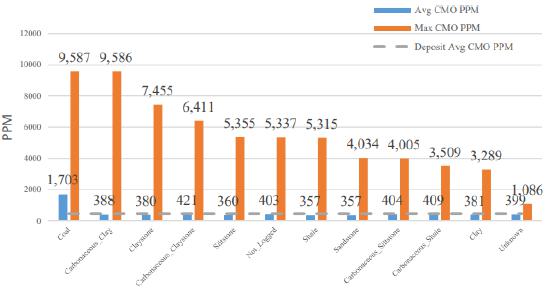
| · | On an ash basis, material lithologies in coal and the associated carbonaceous clay showed maximum ppm concentrations approaching 10,000 ppm. Indeed, coal and carbonaceous clay showed the highest concentrations with almost a ~10,000 maximum ppm with an ~1,800 average ppm. |
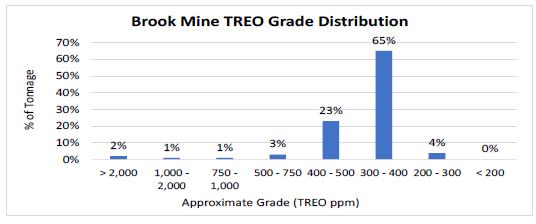
| · | The testing results reflect that approximately 95% of the deposit exceeds 300 ppm with an average concentration of over ~450 ppm on even the low end of the range. |
| · | The next three charts show what we regard as the most valuable products. On an oxide basis, 40% of the deposit contains primary magnetic rare earths (Nd, Pr, Dy and Tb) as well as three critical minerals (Ga, Sc and Ge): |

| Brook Mine TREO Distribution By Oxide | ||||
| REO | Mine REOs | |||
| Primary Magnetic REOs | ||||
| Neodymium | 13.3 | % | ||
| Praseodymium | 3.5 | % | ||
| Dysprosium | 2.1 | % | ||
| Terbium | 0.4 | % | ||
| % of Primary Total | 19.3 | % | ||
| Critical Minerals | ||||
| Gallium | 14.7 | % | ||
| Scandium | 5.8 | % | ||
| Germanium | 0.5 | % | ||
| % of Critical Minerals Total | 21.0 | % | ||
| % of All Primary +Critical Minerals Total | 40.3 | % | ||
| Other REOs | 59.6 | % | ||
| Brook Mine Basket | 100 | % | ||
| · | A significant number of additional samples and drill data have been tested since 2024, with data included from older drill core logs going back decades. In sum, to date 610 drill holes have been tested with over 4,875 ICP-MS tests. |
Table 1.4-1 Drilling Programs
| Base Data | |||||||||||||||||||||||||||||
| Drill | Downhole | Quality Analysis | |||||||||||||||||||||||||||
| Drill Holes | Hole Type | Hole | Geophysical | Deviation | Geologist's | XRF Analysis(1) | ICP Analysis(2) | ||||||||||||||||||||||
| Exploration Program | Count | Drill Depth (Ft) | Rotary | Core | Hearler | Logs | Log | Log | Holes | Samples | Feet | Holes | Samples | Feet | |||||||||||||||
| Bighorn Coal Drilling | 417 | 81,083 | 336 | 81 | 417 | 318 | - | 417 | - | - | - | - | - | - | |||||||||||||||
| Ramaco Coal Drilling | 59 | 11,306 | - | 59 | 36 | 28 | - | 8 | - | - | - | - | - | - | |||||||||||||||
| 2019 Drilling | 6 | 1,132 | - | 6 | 6 | - | - | 6 | 3 | 125 | 74 | 5 | 115 | 74 | |||||||||||||||
| 2021-2022 Drilling | 14 | 1,937 | - | 14 | 14 | 14 | - | 14 | 14 | 2,196 | 549 | 14 | 421 | 270 | |||||||||||||||
| 2022-2023 Drilling | 102 | 21,593 | - | 102 | 102 | - | - | 100 | 94 | 26,173 | 6,661 | 94 | 2,437 | 1,649 | |||||||||||||||
| 2023-2024 Drilling | 9 | 900 | 9 | 9 | 9 | 9 | 9 | 723 | 186 | 9 | 734 | 192 | |||||||||||||||||
| Deep Drilling | 3 | 2,030 | - | 3 | 3 | 3 | - | 3 | 2 | 1,584 | 404 | 2 | 1,168 | 791 | |||||||||||||||
| Total | 610 | 119,981 | 336 | 274 | 587 | 372 | - | 557 | 122 | 30,801 | 7,874 | 124 | 4,875 | 2,976 | |||||||||||||||
| (1) | As of Dec-31-2024 | |
| (2) | As of Jan-31-2025; |
| · | The ICP-MS testing was conducted on an “ash basis” where the testing protocol combusted the organic carbon material (like coal) before testing. |
| · | In summary, by volume roughly 19% of the REEs are primary magnetics, and approximately 21% are germanium, scandium and gallium. The balance is a mix of roughly 10 additional rare earths. |

As I mentioned earlier, the Brook Mine represents a geologically unique rare earth deposit within the PRB formed we believe some 60 million years ago. While there have been numerous REE assays collected from carbonaceous and claystone intervals throughout the PRB, none to our knowledge have demonstrated the concentration or consistency seen at Brook Mine.
In particular, the Brook Mine deposit has yielded claystone assay grades (on a whole rock basis) ranging from 400 to over 1,000 ppm total critical mineral oxides (CMO) on 6-inch core composites, exceptionally high values in a sedimentary system.
This enrichment is believed to be the result of Brook’s distinctive structural and stratigraphic positioning. The deposit sits along the northwestern margin of the Powder River Basin, where stratigraphy is steeply dipping and intersected by multiple fault and fracture systems.
These structural features likely facilitated secondary mobilization and concentration of REEs via fluid flow, enriching the already favorable host coal and associated carbonaceous materials. Additionally, the Fort Union Formation coal deposits in this area is not only carbon-rich but is also near-surface and more geochemically reactive in this structural setting, further enhancing mineral deposition and preservation.
Given these geologic and structural factors, it is unlikely that similar REE grades are repeatable elsewhere within the PRB, even in areas with comparable lithologies. Brook Mine’s mineralization appears to result from a unique confluence of depositional, diagenetic, and tectonic factors, setting it apart from any known sediment-hosted REE occurrences in the region or indeed the nation.
Importantly, while current drilling and core sampling have focused within Ramaco’s initial 4,500-acre permitted area, Ramaco controls an additional roughly 11,500 acres of contiguous land. Although core drilling has not yet occurred outside the permitted footprint, historic lithologic and wireline logs suggest these areas share similar geologic characteristics, including the same REE-hosting lithologies and structural trends.
Furthermore, multiple high-grade assay results have been encountered in drillholes near the existing permit boundary, reinforcing the expectation that REE mineralization extends beyond the current permitted area. To validate and expand the resource base, Ramaco plans to initiate a new phase of coring and exploration across its broader land package beginning this fall. This work will target areas of similar structural position and lithologic signature, with the goal of confirming resource continuity and significantly increasing the overall scale of the deposit and the ultimate project.
| II. | Next Steps |
Since I last wrote in 2024, we have also undertaken several significant steps toward the processing of the ore and the commercial development of the Brook Mine REE deposit. Although further testing and analysis is still in progress, based on this body of work the Fluor Corporation has prepared a Preliminary Economic Assessment (PEA) which concluded that the Brook Mine is both technically and commercially feasible.
In summary, Fluor has used the geological, chemical and hydrometallurgical test results to form the basis for determining which methods of extraction, separation, refining and processing could be used to achieve the highest oxide recovery of the most valuable rare earth and critical mineral elements.
We are blazing some new ground here, because most rare earths are found in hard rock formations which are usually characterized by high levels of radioactive tailings. This is why most rare earths are processed and refined in China. By contrast, our mineralized ores are found in coal (which we call carbon ore) and the associated clay, carbonaceous material and shale which comprise the over and under burdens surrounding the coal seams.
Through over more than a year of hydrometallurgical and chemical testing, working with third party laboratories as well as Fluor, Ramaco has developed various proprietary chemical and hydrometallurgical processes with a related flowsheet describing the process flow. This flowsheet includes a multi-step critical mineral liberation process to refine rare earths from what is a unique ore derived from coal and carbonaceous ores.
This was then used to develop the financial models for capex, opex and cash flows of the project. These current results still represent early findings which will require even more testing, refinement and optimization to ultimately get to the best results. The process of developing commercial rare earth and critical mineral oxides from our deposit involves highly technical both proprietary and conventional forms of separation, processing and refining of the raw carbon ore in order to create an oxide product.
In brief summary, ore is fed to the process plant first through a two-stage mineral sizing, followed by a grinding circuit to achieve a target particle size for downstream leaching. Liberation of the rare earths and other critical minerals is achieved in multi-stage leaching and purification processes that include chemical precipitation, solvent extraction, and ion exchange. The products produced from the flowsheet are various separated mixed critical mineral oxides.
Through these refining processes we were able to achieve oxide recovery levels exceeding 90% for the four rare earth elements listed further below in this letter and over 80% when combined with the three most valuable critical minerals. We hope to improve on these recoveries as the process is optimized through the pilot phase. These are regarded as impressive recoveries for this stage of development.
A more complete description of these processes will be in the Fluor PEA, although with Fluor’s consent we are releasing today the key summary findings of their PEA. Their complete report will be delivered to us by July 8. The delay, as previously noted, was engendered by an inability to obtain timely test results from third party laboratories.
Please note that some information contained in both the summary and final PEA has or will be redacted or summarized owing to the proprietary nature of some of the information as well as for protection of our intellectual property rights. The inclusion herein of these redacted or summarized findings does not affect Fluor's overall findings and conclusions.
Based on Fluor’s findings and recommendations of technical and commercial feasibility we have proceeded with mine development (which began in early June) to procure representative carbon ore for ongoing pilot-scale metallurgical testing. A time lapse video of our current mine work will be posted on our website at www.ramacoresources.com.
Before we would proceed to design and construct a full-scale commercial plant, we will test these processes in a pilot processing plant we will construct at the Brook Mine site, near our current iCAM Research Center outside Sheridan. This work will begin later this summer, and the pilot plant will hopefully be in place by year end.
As previously noted, we received a $6.1 million matching grant from the Wyoming Energy Authority’s Energy Matching Fund to be applied toward development of the pilot facility.
This pilot plant will conduct testing to design and optimize the processing techniques for the commercial production of rare earth and critical mineral oxides from a concentrate developed from the Brook Mine ore.
It is expected that the pilot testing will be conducted over an initial period of approximately 6 months to generate product for testing. The pilot plant will be used to validate the flowsheet on a continuous scale and generate product for quality testing. Over the longer term, it will be used to train operators.
A rendering of the pilot facility is shown below:

Based upon results of this pilot testing the full commercial oxide plant will be engineered and designed by Fluor. It is expected that the construction period for the full plant will take approximately 18 months. This would make the project operational in 2027. We would expect a 2-year “shakedown” period for the plant to be optimized and reach full steady state capacity. We will be working to accelerate this timeframe if possible.
In parallel with the pilot plant work, we will continue advancing our geological work to refine the understanding of this unique coal-hosted critical mineral deposit. A targeted infill drilling campaign is being planned to tighten drill spacing in key areas of the deposit, enabling enhanced grade control, and improved resource classification. This work will also inform updates to the block model and support future mine planning and sequencing.
We will also begin expansion of our drilling exploration activity to other areas we control outside the existing permit boundary as well as explore deeper formations where we hope to find both additional and perhaps more concentrated mineral deposits.
On our commercial path, we intend to shortly initiate discussions on supply and procurement arrangements for the sale of oxides with a host of potential domestic customers. The range of possible customers includes both domestic corporations as well as governmental and defense related entities. We are encouraged that our initial outreach to potential customers indicates that the Brook Mine will be able to provide future supply arrangements for specific rare earths and critical minerals that are not currently available from existing domestic sources.
| III. | Project Economics |
Fluor estimates in the PEA assume that the Brook Mine has an annual production rate of 2 million tons of coal, which once refined and processed would produce steady state annual production of ~1,240 tons of rare earth and critical minerals.
| Brook Mine Summary | ||||||||||||||||
| Tons (Short) | Revenue ($ MM) | Price ($/Metric Ton) | % Of Production | |||||||||||||
| NdPr | 254 | $ | 30 | $ | 130,000 | 20.4 | % | |||||||||
| Gallium | 98 | $ | 68 | $ | 770,000 | 7.9 | % | |||||||||
| Scandium | 65 | $ | 222 | $ | 3,750,000 | 5.3 | % | |||||||||
| Dysprosium | 25 | $ | 19 | $ | 850,000 | 2.0 | % | |||||||||
| Germanium | 9 | $ | 21 | $ | 2,435,250 | 0.8 | % | |||||||||
| Terbium | 5 | $ | 14 | $ | 3,000,000 | 0.4 | % | |||||||||
| Total | 456 | $ | 374 | $ | 904,711 | 36.7 | % | |||||||||
| Other REEs | 786 | $ | 3 | $ | 4,806 | 63.3 | % | |||||||||
| Total | 1,242 | $ | 378 | $ | 335,189 | 100.0 | % | |||||||||
On the revenue front, long term rare earth and critical mineral pricing forecasts were obtained from industry sources. The chart above shows the prices for our most valuable oxide products together with their projected revenue and production metrics.
At this preliminary phase, Fluor’s project cost estimation is approximately $580 million, inclusive of a $106 million for contingency and escalation. At steady state production beginning in 2029 Fluor estimates the project will generate roughly $143 million in annual EBITDA.
Fluor and Ramaco jointly prepared the cash flow statement shown below. Ramaco has calculated an estimated Equity Value using a comparable public company EV/EBITDA. Fluor has calculated a project Payback period and an unlevered-pretax Internal Rate of Return (IRR), again as shown below:
Brook Mine Summary
Cash Flow Build ($ ’000)
Year Ended December 31
| 2027 | 2028 | 2029 | 2030 | 2031 | 2032 | 2027-2032 | ||||||||||||||||
| Margin Analysis | ||||||||||||||||||||||
| * TREO + Critical Minerals Production (Short Tons) | 94 | 1,159 | 1,242 | 1,242 | 1,242 | 1,242 | 6,219 | |||||||||||||||
| Realized Price ($/REO Short Ton) | $ | 304,082 | $ | 304,082 | $ | 304,082 | $ | 304,082 | $ | 304,082 | $ | 304,082 | $ | 304,082 | ||||||||
| Cash Cost ($/REO Short Ton) | $ | 148,214 | $ | 188,397 | $ | 189,156 | $ | 189,156 | $ | 189,156 | $ | 189,156 | $ | 188,396 | ||||||||
| Mining REE Material ($/REO Short Ton) | $ | 60,921 | $ | 17,422 | $ | 21,411 | $ | 21,411 | $ | 21,411 | $ | 21,411 | $ | 21,264 | ||||||||
| Processing ($/REO Short Ton) | $ | 31,935 | $ | 159,967 | $ | 157,057 | $ | 157,057 | $ | 157,057 | $ | 157,057 | $ | 155,709 | ||||||||
| Production Taxex & Other ($/REO Short Ton) | $ | 55,358 | $ | 11,008 | $ | 10,688 | $ | 10,688 | $ | 10,688 | $ | 10,688 | $ | 11,422 | ||||||||
| Margins ($/REO Short Ton) | $ | 155,867 | $ | 115,684 | $ | 114,926 | $ | 114,926 | $ | 114,926 | $ | 114,926 | $ | 115,686 | ||||||||
| Gross Margin % | 51 | % | 38 | % | 38 | % | 38 | % | 38 | % | 38 | % | 38 | % | ||||||||
| Cash Flow Analysis | ||||||||||||||||||||||
| Total Revenue | $ | 28,566 | $ | 352,381 | $ | 377,554 | $ | 377,554 | $ | 377,554 | $ | 377,554 | $ | 1,891,163 | ||||||||
| Total Costs | $ | 13,923 | $ | 218,322 | $ | 234,860 | $ | 234,860 | $ | 234,860 | $ | 234,860 | $ | 1,171,684 | ||||||||
| Mining Costs | $ | 5,723 | $ | 20,190 | $ | 26,584 | $ | 26,584 | $ | 26,584 | $ | 26,584 | $ | 132,249 | ||||||||
| Processing Costs | $ | 3,000 | $ | 185,375 | $ | 195,006 | $ | 195,006 | $ | 195,006 | $ | 195,006 | $ | 968,398 | ||||||||
| Production Taxes | $ | 1,400 | $ | 8,957 | $ | 9,470 | $ | 9,470 | $ | 9,470 | $ | 9,470 | $ | 48,237 | ||||||||
| Other | $ | 3,800 | $ | 3,800 | $ | 3,800 | $ | 3,800 | $ | 3,800 | $ | 3,800 | $ | 22,800 | ||||||||
| EBITDA | $ | 14,642 | $ | 134,059 | $ | 142,694 | $ | 142,694 | $ | 142,694 | $ | 142,694 | $ | 719,479 | ||||||||
| Capex: Growth - Total | $ | (31,132 | ) | $ | (414,390 | ) | $ | (133,035 | ) | - | - | - | $ | (578,557 | ) | |||||||
| Mining Capex | $ | (15,625 | ) | $ | (14,285 | ) | - | - | - | - | $ | (29,910 | ) | |||||||||
| Processing Capex | $ | (12,000 | ) | $ | (320,355 | ) | $ | (106,785 | ) | - | - | - | $ | (439,140 | ) | |||||||
| Infrastructure Capex | $ | (3,507 | ) | - | - | - | - | - | $ | (3,507 | ) | |||||||||||
| Contingency & Escalation (~22%) | - | $ | (79,750 | ) | $ | (26,250 | ) | - | - | - | $ | (106,000 | ) | |||||||||
| Capex: Maintenance - Total (Currently included in Opex) | - | - | - | - | $ | (1,166 | ) | $ | (1,166 | ) | $ | (2,331 | ) | |||||||||
| Capex - Total | $ | (31,132 | ) | $ | (414,390 | ) | $ | (133,035 | ) | - | $ | (1,166 | ) | $ | (1,166 | ) | $ | (580,888 | ) | |||
| FCF ($ '000) - EBITDA Less Capex | $ | (16,490 | ) | $ | (280,331 | ) | $ | 9,659 | $ | 142,694 | $ | 141,529 | $ | 141,529 | $ | 138,591 | ||||||
| Valuation | ($ '000) | |||
| Equity Value (Multiples Approach, Undiscounted) | $ | 3,753,665 | ||
| Target EV/EBITDA Multiple | 28x | |||
| Payback (years) | ~5 | |||
| IRR (Unlevered; Pre tax) | 38 | % | ||
Investors, analysts and shareholders are encouraged to draw their own conclusions on valuation. There is currently only one publicly traded rare earth company in the United States which is MP Materials, Inc. (NYSE: MP). Comparing MP’s forward 2028 EV/EBITDA valuation to the proposed Fluor results from the Brook Mine would be as follows:
Ramaco's Brook Mine Peer Comparison
| Current EV ($ MM) | 2028 Consensus EBITDA ($ MM) | EV/EBITDA | ||||||||||
| MP Materials | $ | 5,867 | $ | 210 | 28x | |||||||
| Implied EV At 28x | 2028 EBITDA Estimate ($ MM) | EV/EBITDA | ||||||||||
| Ramaco's Brook Mine | $ | 3,754 | $ | 134 | 28x | |||||||
Source: Bloomberg, Fluor, Ramaco
It is perhaps useful to outline some differences between the two companies, since just as in the metallurgical coal business, there are important distinctions between producers even within the same industry.
First starting with geology, the Brook Mine and MP’s Mountain Pass mine represent two fundamentally different types of REE deposits, each with distinct geology, mineralogy, development pathways, and long-term strategic positioning.
Mountain Pass is a well-established, hard rock deposit mined since 1952 and hosted in a carbonatite intrusion, with REEs primarily occurring in the mineral bastnasite, which is rich in light rare earth elements (LREEs), especially cerium (Ce) and lanthanum (La). These two elements comprise almost 85% of Mountain Pass’s total rare earth oxide (TREO) content, with lower amounts of the more valuable mid and heavy rare earth elements (MREEs and HREEs).
In contrast, the Brook Mine is an unconventional, softer sediment-hosted REE deposit, where rare earths are concentrated in carbonaceous claystones and coal seams. The REEs are associated with microcrystalline monazite, clays, and organic matter. Brook exhibits a much more balanced REE distribution, with Ce and La comprising only ~40% of TREO.
The Brook Mine also possesses significantly higher relative proportions of elements like dysprosium, gadolinium, and terbium, elements that are essential for permanent magnets, advanced electronics, and defense technologies. In short, Brook possesses all the key rare earth elements and critical minerals that are necessary to make permanent magnets.
However, in addition the Brook Mine also contains significant amounts of critical minerals such as gallium, scandium, and germanium, which make up more than 20% of the Brook deposit. These are used to make a variety of other valuable products.
From a development and operational standpoint, the differences between the two mines are equally compelling:
| · | Ore hardness and mining cost: |
Brook Mine ore is soft, composed of unconsolidated to semi-consolidated carbonaceous material. This translates to significantly lower mining, grinding, and energy costs compared to hard, igneous rock, which requires intense crushing and milling.
| · | Radioactivity: |
Brook Mine ore contains negligible concentrations of uranium and thorium, minimizing both handling complexity and future permitting risk. By contrast, Mountain Pass contains elevated levels of radioactive elements, which historically complicated its operations and remain an ongoing regulatory consideration.
| · | Co-product potential: |
Brook Mine ore is enriched not only in REEs but also in gallium (Ga), germanium (Ge), and scandium (Sc), critical elements with growing demand in semiconductors, solar, aerospace, and clean energy. These valuable co-products provide additional revenue streams.
| · | Vertical integration: |
Ramaco plans to mine, process, and refine REEs entirely on site at the Brook Mine, creating a fully domestic, mine mouth-to-metals operation. Mountain Pass currently mines and concentrates REEs on site but exports most of its concentrate to China for final refining and then sale into Chinese markets. In the future Ramaco has the optionality to consider further on-site vertical integration to produce and manufacture magnets or even semiconductors from its own feedstock. Currently that is only for future consideration.
| · | Resource scale and life-of-mine potential: |
Mountain Pass has been actively mined for over 50 years, largely extracting the highest-grade material. Brook Mine, by comparison, is in early-stage mine development with significant expansion possibilities ahead. It possesses an estimated 1.7 million tons of critical mineral oxides across just the initial 4,500 permitted acres of a 16,000-acre land package, offering potential for decades of further growth and expansion.
| IV. | Future Project Funding and Share Structure: |
Based on the level of future project capital investment required Ramaco will explore external financing options, in addition to the use of its own capital or existing share structure. These options could include the possibility of accessing capital markets or the potential spin-off of the rare earth operations into a separately traded public vehicle in some manner.
The Company intends to also explore both procurement and funding opportunities that might be available through the federal government and its agencies as well as sales arrangements to private customers. Those discussions will of course impact the direction, scope and nature of future project funding. We expect to clarify our approach to financing as the project advances through its development phases and as we engage in future sales arrangements.
At this time no conclusions have been reached regarding the manner that the Company will proceed in terms of financing the Brook Mine development. All such decisions will be determined by the Company’s Board of Directors.
Questions have also previously arisen regarding Ramaco’s existing dual share structure as it relates to the Brook mine. It is contemplated that once the rare earth project is developed that a royalty stream would be allocated to the METCB shares based on income from production at the Brook Mine rare earth and critical mineral deposit. This would be in addition to royalty income from intellectual property developed in connection with our research into the use of coal to develop advanced high value carbon products and materials.
| V. | Conclusion |
Our guiding principle for developing this unique opportunity will be what is in the best interest for building long-term value for our shareholders. In parallel, we will work responsibly with our United States government partners to insure an adequate national supply of these critically needed rare elements and critical minerals.
As I said at the outset, this will be America’s mine…hopefully for many decades to come.
| All the best, | |
| /s/ Randall W. Atkins | |
| Randall W. Atkins | |
| Chairman and Chief Executive Officer |
CAUTIONARY STATEMENT REGARDING FORWARD-LOOKING STATEMENTS
Many of the statements contained in this letter constitute “forward-looking statements” within the meaning of the meaning of Section 27A of the Securities Act of 1933, as amended (the “Securities Act”) and Section 21E of the Securities Exchange Act of 1934, as amended (the “Exchange Act”). All statements, other than statements of historical fact included in this letter, regarding our strategy, objectives, intended investigative, research and development efforts, future operations, estimated value of the REE deposits, projected costs, prospects, plans and objectives of management are forward-looking statements. When used in this letter the words “could,” “believe,” “anticipate,” “intend,” “estimate,” “expect,” “project” and similar expressions are intended to identify forward-looking statements, although not all forward-looking statements contain such identifying words. Forward-looking statements may include statements about:
| · | identification and implementation of commercially feasible extraction processes, and establishment of pilot and production extraction facilities. |
| · | expected costs to develop planned and future operations, including the costs to construct necessary processing, refuse disposal and transport facilities. |
| · | the availability of the equipment and components necessary to construct our pilot and production extraction facilities. |
| · | estimated quantities or quality of our reserves. |
| · | our ability to obtain additional financing on favorable terms, if required, to complete the contemplated development. |
| · | maintenance, operating or other expenses or changes in the timing thereof. |
| · | competition in REE and critical minerals mining and extraction markets. |
| · | the price of REEs and critical minerals. |
| · | compliance with stringent laws and regulations, including environmental, climate change and health and safety regulations, and permitting requirements, as well as changes in the regulatory environment, the adoption of new or revised laws, regulations and permitting requirements. |
| · | potential legal proceedings and regulatory inquiries against us. |
| · | the impact of weather and natural disasters on plant construction, demand, production and transportation. |
| · | geologic, equipment, permitting, site access and operational risks and new technologies related to REE and critical minerals mining. |
| · | transportation availability, performance and costs. |
| · | availability, timing of delivery and costs of key supplies, capital equipment or commodities such as diesel fuel, steel, explosives and tires. |
| · | timely review and approval of permits, permit renewals, extensions and amendments by regulatory authorities. |
| · | our ability to comply with certain debt covenants; and |
| · | risks related to weakened global economic conditions and inflation. |
These forward-looking statements represent Ramaco Resources’ expectations or beliefs concerning guidance, future events, anticipated revenue, future demand and production levels, macroeconomic trends, the development of ongoing projects, costs and expectations regarding the commercial feasibility of mining and extracting Ramaco's REEs, and it is possible that the results described in this letter will not be achieved. These forward-looking statements are subject to risks, uncertainties and other factors, many of which are outside of Ramaco Resources’ control, which could cause actual results to differ materially from the results discussed in the forward-looking statements. Any forward-looking statement speaks only as of the date on which it is made, and, except as required by law, Ramaco Resources does not undertake any obligation to update or revise any forward-looking statement, whether as a result of new information, future events or otherwise. New factors emerge from time to time, and it is not possible for Ramaco Resources to predict all such factors. When considering these forward-looking statements, you should keep in mind the risk factors and other cautionary statements found in Ramaco Resources’ filings with the Securities and Exchange Commission (“SEC”), including its Annual Report on Form 10-K and Quarterly Reports on Form 10-Q. The risk factors and other factors noted in Ramaco Resources’ SEC filings could cause its actual results to differ materially from those contained in any forward-looking statement.
NON-GAAP MEASURE- ADJUSTED EBITDA
Adjusted EBITDA is used as a supplemental non-GAAP financial measure by management and external users of our financial statements, such as industry analysts, investors, lenders, and rating agencies. We believe Adjusted EBITDA is useful because it allows us to evaluate our operating performance more effectively.
We define Adjusted EBITDA as revenue minus operating expenses, exclusive of net interest expense, depreciation, depletion, and amortization expenses; income taxes; and accretion of asset retirement obligations.
Point of Contact:
INVESTOR RELATIONS:
info@ramacometc.com
or 859-244-7455
SOURCE Ramaco Resources, Inc.
Exhibit 99.3

Documents Available Regarding Ramaco's
Brook Mine Rare Earth and Critical Minerals Project
LEXINGTON, Ky., July 1, 2025, Ramaco Resources, Inc. (NASDAQ: METC, METCB) ("Ramaco Resources" or the "Company") announces that this morning it has released and posted to its website at www.ramacoresources.com, the following:
· A press release on the Groundbreaking Ceremony for the Brook Mine,
· A press release and Ramaco's report summary related to the Fluor Corp. Preliminary Economic Assessment of the Brook Mine Rare Earth and Critical Minerals project,
· A Letter to Shareholders from its Chairman and Chief Executive Randall W. Atkins related to the Brook Mine Project, and
· A time-lapse video of the initial mining activity at the Brook Mine.
About Ramaco Resources, Inc.
Ramaco Resources, Inc. is an operator and developer of high-quality, low-cost metallurgical coal in southern West Virginia, and southwestern Virginia and a developing producer of coal, rare earth and critical minerals in Wyoming. Its executive offices are in Lexington, Kentucky, with operational offices in Charleston, West Virginia and Sheridan, Wyoming. The Company currently has four active metallurgical coal mining complexes in Central Appalachia and one coal mine and rare earth development near Sheridan, Wyoming in the initial stages of production. In 2023, the Company announced that a major deposit of primary magnetic rare earths and critical minerals was discovered at its mine near Sheridan, Wyoming. Contiguous to the Wyoming mine, the Company operates a carbon research and pilot facility related to the production of advanced carbon products and materials from coal. In connection with these activities, it holds a body of roughly 76 intellectual property patents, pending applications, exclusive licensing agreements and various trademarks. News and additional information about Ramaco Resources, including filings with the Securities and Exchange Commission, are available at https://www.ramacoresources.com. For more information, contact investor relations at (859) 244-7455.
Point of Contact:
INVESTOR RELATIONS:
info@ramacometc.com
or 859-244-7455
SOURCE Ramaco Resources, Inc.
Exhibit 99.4
|
|
Brook Mine Rare Earth Project Preliminary Economic Assessment Summary |
|
Brook Mine Rare Earth Project Preliminary Economic Assessment (PEA) Summary
JULY 1, 2025
Ramaco Commentary
This Preliminary Economic Assessment Summary (PEA Summary) has been internally prepared by Ramaco Resources, Inc. (Ramaco) by redacting certain data, information and processes prepared by Fluor Corporation (Fluor) for Ramaco which we believe to be proprietary. This has been done in order to only summarize and protect such proprietary and confidential data, information and processes provided to Ramaco by Fluor.
Ramaco believes that the summarization and redaction of the data, information and processes provided by Fluor as presented herein does not affect the overall findings and conclusions presented herein in the PEA Summary. Ramaco reserves all its intellectual property ownership and rights to any and all of the details, data and information disclosed herein. It also does not waive its rights or ownership regarding the proprietary data, information and processes described herein.
The following statement below from Fluor accompanied the presentation of the original PEA Summary.
Fluor Statement
Fluor has been engaged by Ramaco Resources, Inc. (Ramaco) to prepare this report. Fluor is currently under contract to Ramaco to perform services in addition to and independent of this report. This report was prepared solely for the use and benefit of Ramaco by Fluor and is based in part on information not within the control of Ramaco and entirely on information not within the control of Fluor. While it is believed that the information contained herein will be reliable under the conditions and subject to the limitations set forth herein, neither Ramaco nor Fluor guarantees the accuracy of completeness thereof. The prime objective of this report is to review relied upon information provided by Ramaco to determine an AACE Class 5 estimate for the project. The use of this report or any information contained therein shall be at the user’s sole risk. Such use shall constitute an agreement to release, defend, and indemnify Ramaco and Fluor from and against any and all liability in connection therewith (including any liability for special, indirect, incidental or consequential damages), whether such liability arises in contract, negligence, or otherwise.
|
© 2025 Ramaco. All Rights Reserved. |
Ramaco Resources Brook Mine Rare Earth Project PEA |
|
|
Brook Mine Rare Earth Project Preliminary Economic Assessment Summary |
|
Fluor is a registered service mark of Fluor Corporation
TABLE OF CONTENTS
| Table of Contents | 2 | |||
| 1.0 | PRELIMINARY ECONOMIC ASSESSMENT SUMMARY | 3 | ||
| 1.1 | Process Design | 3 | ||
| 1.2 | Capital and Operating Costs | 5 | ||
| 1.2.1 | Summary of Capital Expenses | 5 | ||
| 1.2.2 | Summary of Operational Expenses | 6 | ||
| 1.3 | Risks and Opportunities | 8 | ||
| 1.4 | Project Advancement Action Plan | 11 | ||
| 1.5 | Recommendation | 12 | ||
|
© 2025 Ramaco. All Rights Reserved. |
Ramaco Resources Brook Mine Rare Earth Project PEA |
|
|
Brook Mine Rare Earth Project Preliminary Economic Assessment Summary |
|
| 1.0 | PRELIMINARY ECONOMIC ASSESSMENT SUMMARY |
Ramaco Resources Inc. (Ramaco) is exploring the establishment of a rare earth elements (REE) production facility at the Brook Mine site near Sheridan, Wyoming, United States. To support this study, Ramaco engaged Fluor Corporation to conduct a PEA, including an AACE Class 5 capital and operating cost estimate, for the processing facilities. This report presents the results of this assessment.
The PEA is based on a conceptual flowsheet and mass balance with inputs derived from metallurgical testing at Hazen Research Inc., combined with key data from Ramaco, including ore feed grades and product pricing. Fluor also utilized in-house data to determine equipment pricing and benchmark inputs for the capital and operating cost estimates, which were integral to the financial model developed jointly by Ramaco and Fluor.
Recent test work indicates that high REE extraction rates from the Brook Mine deposit are achievable. The multi-stage leach method yielded the highest extraction rates for REEs, Scandium, Gallium, and Germanium, with all REEs exceeding 90% extraction and over 80% when combined with the three most valuable critical minerals. These results form the basis of the process design for the PEA.
The PEA estimates the capital cost for the proposed processing facility at $533.1 million (USD) excluding mine-related capital and residue placement, and the operational cost at $71.22 (USD) per tonne of mill feed excluding mining and filter cake residue handling. Approximately 85% of the processing costs are attributed to reagents and consumables. Based on these inputs, the financial model estimated an unlevered pre-tax internal rate of return (IRR) of 38% and a payback period of 5 years (base case).
The presence of high-value minerals such as Scandium, Gallium, and Germanium in the Brook Mine deposit is crucial to the project’s success, potentially accounting for up to 82% of the revenue. Scandium sales alone account for 58% of the revenue.
Below is more specific information about the process design, estimate development, risks, and opportunities as well as a recommended action plan.
| 1.1 | PROCESS DESIGN |
To develop the metallurgical process design, along with the conceptual flowsheet and mass balance, Fluor utilizes Metso’s HSC Chemistry Software to simulate the processing circuit. The simulation model is built using available process feed data and results from metallurgical laboratory testing. Specific unit operations are incorporated to achieve the desired process outcomes.
The accuracy and reliability of the simulation are closely tied to the progression of laboratory and pilot plant test work. These tests provide essential thermodynamic and kinetic data for each unit operation, which are critical for refining the model. As the project advances, the simulation is continuously updated with new and evolving process information.
|
© 2025 Ramaco. All Rights Reserved. |
Ramaco Resources Brook Mine Rare Earth Project PEA |
|
|
Brook Mine Rare Earth Project Preliminary Economic Assessment Summary |
|
Below are the steps typically employed to develop the process simulation.
| 1. | Process Feed and Lab Test Data: Initial inputs for the simulation. |
| 2. | HSC Chemistry Simulation: Core modeling tool used to simulate the circuit. |
| 3. | Unit Operations: Specific processes modeled to achieve desired outcomes. |
| 4. | Pilot Plant Data and Refinement: Iterative updates based on evolving test data. |
| 5. | Evaluation of Processing Options: Final step to assess and optimize alternatives. |
Once established, simulation becomes a powerful tool for evaluating alternative processing strategies, enabling the identification of more cost-effective and efficient options.
The block flow diagram provided in Figure 1, is an illustration of Brook Mine processing facility with the capacity of 1,000 t/a of Total Critical Mineral Oxides (CMO) comprising of Rare Earth Oxides (TREO) + Scandium (Sc) + Gallium (Ga) + Germanium (Ge) oxides. This process design is the basis for the PEA estimate.
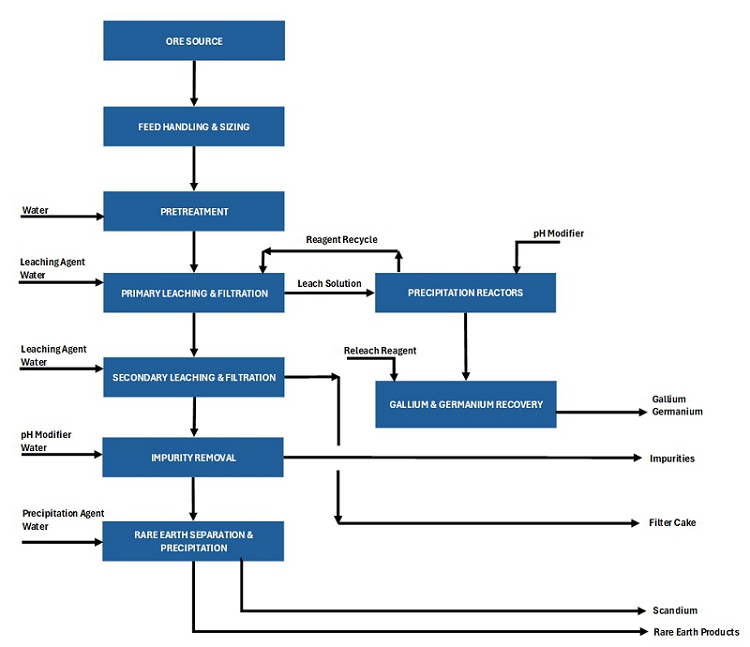
Figure 1. High-Level Block Flow Diagram – Brook Mine Rare Earth Project.
|
© 2025 Ramaco. All Rights Reserved. |
Ramaco Resources Brook Mine Rare Earth Project PEA |
|
|
Brook Mine Rare Earth Project Preliminary Economic Assessment Summary |
|
| 1.2 | CAPITAL AND OPERATING COSTS |
| 1.2.1 | Summary of Capital Expenses |
For this PEA, Fluor generated a capital estimate that meets the AACE Class 5 level CAPEX requirements. It is one of the main inputs for the financial model, which in turn will aid Ramaco in determining the level of economic benefit achieved by processing the Brook Mine rare earth deposit.
| 1.2.1.A | Estimate Methodology |
This deliverable represents an AACE Class 5 level estimate, for a 1,000-tonne-per-year TREO mining operation focused on rare earth minerals, specifically Total Rare Earth Oxides (TREO) and CMO.
A process simulation of the Brook Mine was developed to support this estimate, which provided a mass balance aligned with the specified plant capacity. Based on this simulation, a Process Design Criteria (PDC) document was created, serving as the foundation for the mechanical equipment list (MEL).
The MEL was priced using a combination of:
| 4 | Budgetary vendor quotes | |
| 4 | In-house historical cost data | |
| 4 | Industry-standard factoring methods |
This priced equipment list formed the basis of the capital cost estimate.
For additional scope elements including site preparation and improvements, plant roads, site infrastructure, power supply and distribution, plant utilities, and water systems – costs were estimated using percentage-based benchmarks derived from Fluor’s database for similar plant types.
| 1.2.1.B | General Assumptions and Qualifications |
Below is a list of the assumptions and qualifications used in determining the capital expense estimate.
| 4 | The cost estimate is in U.S. dollars. |
| 4 | The estimate was based on a typical contracting strategy of EP & CM direct managed subcontractors by the typical discipline/trade scope. |
| 4 | The project execution is based on a greenfield project. |
| 4 | The primary estimating procedure for developing process scope and costs is by “factoring” on the plant capacity costs. |
| 4 | No demolition scope is included in the estimate. |
| 4 | The estimate does not include any work associated with removal of contaminated materials and hazardous waste. This applies to handling, removal, disposal, and remediation of asbestos, lead paint, galvanizing fluids, contaminated soils, or disposing of process fluids. |
|
© 2025 Ramaco. All Rights Reserved. |
Ramaco Resources Brook Mine Rare Earth Project PEA |
|
|
Brook Mine Rare Earth Project Preliminary Economic Assessment Summary |
|
| 1.2.1.C | General Exclusions |
|
4 Sunk costs. 4 Permits, licenses, royalties, and commissions. 4 Land acquisition and right-of-ways. 4 Fluctuation of currency exchange rates. 4 Owner’s costs. 4 Force majeure. 4 Labor strikes and other business interruption risks. 4 Unknown site conditions. |
4 Scope changes. 4 Opex and training costs. 4 Working capital and other owners’ costs. 4 Environmental permit costs. 4 Event and schedule contingency. 4 Mine development capital cost. 4 Pilot plant costs. 4 Initial capital costs – tailings handling and storage. |
| 1.2.1.D | Conclusions |
The capital cost estimate is $579 million including escalation of $21 million and a contingency of $85 million for the process plant scope. Ramaco provided estimates for mining, pilot plant, and residue handling. The capital cost estimate is effective Q2-2025 and has an accuracy of -30% /+50%. The following Table 1 provides an indicative total cost (ITC) estimate by area.
CAPITAL COST ESTIMATE SUMMARY
| TOTAL COST | ||||||
| AREA | DESCRIPTION | (MILLION USD) | ||||
| Processing Total Direct Cost | Including Owner’s Estimate for the Pilot Plant and Residue Handling | 389.14 | ||||
| Processing Indirect Cost | 50.00 | |||||
| Mine Development | Owner’s Internal Estimate | 30.00 | ||||
| Infrastructure | 4.00 | |||||
| Sub-Total | 473.14 | |||||
| Contingency | 85.00 | |||||
| Escalation | 21.00 | |||||
| Total CAPEX Estimate | 579.14 |
Figure 2. Summary of Initial Capital Cost Estimate
| 1.2.2 | Summary of Operational Expenses |
The process operating cost estimate meets the requirements for a PEA and encompasses all processing areas from mill feed through to product handling. The estimate is structured into four primary cost categories:
|
4 Labor 4 Utilities – Electricity, Raw Water, and Natural Gas |
4 Reagents and Consumables 4 Maintenance supplies. |
|
© 2025 Ramaco. All Rights Reserved. |
Ramaco Resources Brook Mine Rare Earth Project PEA |
|
|
Brook Mine Rare Earth Project Preliminary Economic Assessment Summary |
|
| 1.2.2.A | Bases of Estimate |
| 4 | Annualized Costs. Operating costs are presented on an annual basis, categorized by cost type and plant area. |
| 4 | Reagents and Consumables. Estimated using unit consumption rates and delivered unit costs. Consumption rates were derived from metallurgical test work, mass balance, and design assumptions. Delivered costs were informed by supplier discussions, transport quotes, and internal benchmarks. |
| 4 | Labor. The plant operates 24/7 with four 12-hour shift rotations. Non-shift labor is based on a 40-hour work week. Staffing levels were benchmarked against similar-scale operations. Labor rates were sourced from the U.S. Bureau of Labor Statistics (OEWS) for Wyoming. |
| 4 | Utilities. Power consumption was estimated from the mechanical equipment list, factoring in equipment run times and absorbed power. A grid power rate of $0.07/kWh was provided by Ramaco. |
| 4 | Maintenance Supplies. Estimated as a percentage of the total direct installed cost for the process. |
| 4 | Sales and General Administrative Costs. Based on a total site headcount of 190 personnel (mine, process, and general and administration), using a multiplier based on existing operations per employee, as provided by Ramaco. |
The estimate reflects one full year of operation at nameplate capacity. Historical or quoted costs were escalated to the estimate base date using Fluor’s standard escalation practices.
| 1.2.2.B | General Exclusions |
The following items are excluded from this estimate:
|
4 Mining costs 4 Dry stacking and residue storage 4 General and administrative overhead (community, environmental, regulatory, corporate) 4 Assaying 4 Site raw water treatment |
4 Wastewater treatment 4 Sustaining capital 4 Insurance 4 Import duties and taxes 4 Contingency and inflation 4 Utilities – Electricity |
| 1.2.2.C | Conclusions |
Over the 42-year life-of-mine, the average annual process operating cost is estimated at $188.4 million, equating to:
| 4 | $71.22 per tonne of mill feed | |
| 4 | $185,095 per tonne of TREO + Sc + Ga + Ge |
Notably, reagents and consumables account for approximately 85% of total process operating costs. A summary of the OPEX costs is shown below in Figure 3.
|
© 2025 Ramaco. All Rights Reserved. |
Ramaco Resources Brook Mine Rare Earth Project PEA |
|
|
Brook Mine Rare Earth Project Preliminary Economic Assessment Summary |
|
| DESCRIPTION | OPEX COST (MILLION USD) |
OPEX COST/ FEED TONNE (USD) |
||||||
| Direct Labor | ||||||||
| Wages and Benefits (Process Plant) | 9.624 | 3.64 | ||||||
| Consumables | ||||||||
| Reagents/Chemicals | 142.128 | 53.72 | ||||||
| Minor Reagent & Consumables | 14.213 | 5.37 | ||||||
| Utilities | ||||||||
| Electricity | 5.587 | 2.11 | ||||||
| Raw Water | 1.612 | 0.61 | ||||||
| Natural Gas | 2.412 | 0.91 | ||||||
| Maintenance Supplies | ||||||||
| Maintenance Supplies (2.0%) | 9.051 | 3.42 | ||||||
| Sales, General and Administrative | ||||||||
| General & Administrative | 3.800 | 1.44 | ||||||
| Total OPEX/Year and Cost/Ton | 188.427 | 71.22 | ||||||
Figure 3. Annual OPEX Summary and Cost per tonne of TREO+Sc+Ga+Ge+Oxides.
| 1.3 | RISKS AND OPPORTUNITIES |
The process risks and opportunities originate from three interrelated parts, namely, low ore feed grade, high reagent consumption, and unique bespoke combinations of elements. Figure 4 and Figure 5 below outline the risks and opportunities with suitable actions to mitigate or promote the outcomes.
|
© 2025 Ramaco. All Rights Reserved. |
Ramaco Resources Brook Mine Rare Earth Project PEA |
|
|
Brook Mine Rare Earth Project Preliminary Economic Assessment Summary |
|
| Ore Grade and Mineralogy |
4 Low ore grade (450 ppm REO)
4 No mineral beneficiation opportunity due to mineralogy
|
4 Higher throughput to meet production target
4 Increased CAPEX/OPEX due to larger Mechanical Equipment and higher reagent consumptions rates
4 Risks Economic viability
|
4 Target higher REO grade through exploration
4 Reduce commodity recovery scope (i.e., target only REOs)
4 Consider High Purity Alumina (HPA) production as by-product
4 Lower reagent consumption by investigating alternative lixiviants and pretreatment practices
|
| High Leach Rates of Gangue Minerals |
4 70% of Leach reagents are consumed by gangue
4 Some leached species interfere with REE/Ga/Ge recovery
4 High reagent consumption for non-valuable metals
|
4 High operational costs
4 Reduced valuable metal recovery due to high concentration of impurities
|
4 Targeted Test work for lower cost acids/salts
4 Include HPA production to capitalize on Aluminum as by-product
4 Targeted test work to selectively extract valuable metals using technologies in the presence of gangue minerals like iron
4 Engage external Subject Matter Experts to tackle complex parts of the flowsheet
|
| Test Work Turnaround |
4 Bespoke ore flowsheet development requires investigative test work
4 Metallurgical labs are not geared toward investigative workflows
4 Very slow turnaround times (12 tests in 6 months) vs. expected turnaround of 10 tests per week
4 Reliability of results – Questionable results need to be rechecked and assayed ASAP. Commercial Labs are slow to action this
|
4 Delayed project development as laboratories assay queue caters for multiple client projects – Not just Ramaco |
4 Shift test work in-house (owner-operator advantage)
4 Dedicated assay personnel and equipment will ensure high reliability of results and fast assay turnaround times
4 Full-time test work management to supervise, interpret, and communicate results to project stakeholders
4 Engage external Subject Matter Experts to tackle complex parts of the flowsheet
4 Consider partnership with IJSA government agencies
|
|
© 2025 Ramaco. All Rights Reserved. |
Ramaco Resources Brook Mine Rare Earth Project PEA |
|
|
Brook Mine Rare Earth Project Preliminary Economic Assessment Summary |
|
| Germanium Recovery |
4 Very low Germanium head grade
4 Low concentration makes it difficult to track Germanium through the process
4 Existing technology targets Germanium recovery in other ways
4 Unusual extraction chemistry
|
4 Germanium recovery can be uneconomical for the low concentration
4 Loss of revenue due to low recovery of Germanium
|
4 Dedicated Germanium tracking test work
4 Investigate other leaching options
4 Evaluate economic impact vs. REEs/Gallium
|
| Reagent Transport Logistics | 4 High reagent consumption means complex reagent transport logistics |
4 Potential for high transportation costs
4 Reagent storage challenges
4 Supply chain complexity and sensitivity
|
4 Reduce reagent consumption
4 Ensure reagents are purchased and transported as anhydrous where possible
|
Figure 4. Project Risks and Potential Mitigations
|
© 2025 Ramaco. All Rights Reserved. |
Ramaco Resources Brook Mine Rare Earth Project PEA |
|
|
Brook Mine Rare Earth Project Preliminary Economic Assessment Summary |
|
| HPA Production |
4 HPA is high-value commodity used in specialized glass, ceramics, batteries, catalysts
4 HPA is preferentially made from kaolinite
4 Many synergies between HPA production and Ramaco flowsheet
|
4 Adds significant additional revenue stream
4 Value-added by-product is produced from otherwise reagent consuming waste product
|
4 Develop HPA purification capabilities as part of process flowsheet |
Figure 5. Project Opportunities and Promotive Actions
| 4 | Primary Challenge |
| ‒ | Low-grade ore with dispersed valuable elements driving high reagent consumption | |
| ‒ | Gangue minerals consume the bulk of reagents | |
| ‒ | Slow test work turnaround |
| 4 | Strategic Advantage |
| ‒ | Owner-operator status allows in-house test work and faster development. | |
| ‒ | While the ore is low-grade, it contains a high percentage of magnetic and strategic elements (30-40%) in addition to being hosted in soft, sedimentary rock significantly reducing energy consumption during mining, crushing, and grinding. | |
| ‒ | Strong strategic support from U.S. organizations for REE, Ga, and Ge supply chain. | |
| ‒ | Multiple alternative process routes remain unexplored which have the potential to significantly reduce OPEX. |
| 4 | Economic Balancing |
| ‒ | High-value metals (REEs, Sc, Ga, Ge) must offset high reagent costs to ensure an economically viable project. |
| 4 | Process Optimization Focus |
| ‒ | Investigate alternative calcining and leaching options. | |
| ‒ | Test and develop flowsheets wholistically i.e., not just leach or calcining but purification as well. | |
| ‒ | By-product recovery (HPA) for a revenue boost. |
| 1.4 | PROJECT ADVANCEMENT ACTION PLAN |
To make sure that the Brook Mine Rare Earth Element and Critical Mineral Project progress as expected, the following key initiatives must be executed:
| 1. | Parallel Execution of Prefeasibility Study and Pilot Plant Design. Building on the findings of the PEA, which confirmed the project’s technical and economic feasibility, additional testing will be conducted to: |
| ‒ | Optimize leach design parameters | |
| ‒ | Reduce reagent consumption | |
| ‒ | Generate critical design data for the downstream flowsheet |
|
© 2025 Ramaco. All Rights Reserved. |
Ramaco Resources Brook Mine Rare Earth Project PEA |
|
|
Brook Mine Rare Earth Project Preliminary Economic Assessment Summary |
|
| 2. | Prefeasibility Study (PFS) Testing. Bench-scale testing will be intensified to validate the entire process design. This work is essential to support the PFS and associated estimates. Target Completion: Q4 2025 |
| 3. | Head Grade Optimization. Enhance early stage project economics by targeting higher ore grades through advanced exploration and geological modeling. This will improve Net Present Value (NPV) and IRR. |
| 4. | Reagent Optimization. Investigate alternative lixiviants and cost-effective reagents to reduce overall reagent consumption and operating costs. |
| 5. | Product Value Maximization. Refine the process design to prioritize the recovery of the most valuable products, enhancing overall project profitability. |
| 6. | High Purity Alumina (HPA) Feasibility. Assess the potential to produce HPA as a coproduct, leveraging aluminum content to create an additional revenue stream. |
| 7. | Alternative Unit Operations. Evaluate advanced ion exchange and solvent extraction technologies that selectively recover valuable metals while minimizing impurity interference (e.g., iron). |
| 8. | In-House Testing Facility Development. Establish internal metallurgical testing capabilities to: |
| ‒ | Improve turnaround time and data reliability | |
| ‒ | Support advanced design phases | |
| ‒ | Retain critical process knowledge within Ramaco. This facility will be essential throughout the life of the mine. |
| 9. | Engagement of Subject Matter Experts (SMEs). Involve SMEs for complex flowsheet areas and explore partnerships with U.S. government agencies to leverage technical and regulatory support. |
| 10. | Reagent Logistics Evaluation. Assess reagent availability and logistics in the next project phase to ensure supply chain reliability and cost control. |
| 11. | Schedule Compression Strategy. Develop a schedule-driven execution plan to identify opportunities for timeline acceleration. Early engagement with key stakeholders is critical. |
| 1.5 | RECOMMENDATION |
Based on the findings of the PEA and the accompanying pricing provided by Ramaco, Fluor concludes that there is a technically and economically viable pathway to production. Fluor recommends that Ramaco continue advancing the Brook Mine Rare Earth Project. This includes advancing geological studies, progressing with further engineering studies for both the mine and the processing plant to increase confidence in the overall design, execution strategy, schedule, and cost estimates.
|
© 2025 Ramaco. All Rights Reserved. |
Ramaco Resources Brook Mine Rare Earth Project PEA |
|
|
Brook Mine Rare Earth Project Preliminary Economic Assessment Summary |
|
The PEA estimates the capital cost for the proposed processing facility at $533.1 million USD, excluding mine-related capital expenditures and residue placement infrastructure. Operating costs are projected at $71.22 USD per tonne of mill feed, excluding mining and filter cake residue handling. Notably, approximately 85% of processing costs are attributed to reagents and consumables.
Based on these inputs, the financial model projects an unlevered pre-tax IRR of 38% and a payback period of 5 years under the base case scenario.
These results support continued investment in the project, with a focus on optimizing reagent use, refining and enhancing the process design, and validating assumptions through additional technical studies.
|
© 2025 Ramaco. All Rights Reserved. |
Ramaco Resources Brook Mine Rare Earth Project PEA |
