エドガーで原本を確認する
UNITED STATES
SECURITIES AND EXCHANGE COMMISSION
Washington, D.C. 20549
FORM 20-F
(Mark One)
☐ |
REGISTRATION STATEMENT PURSUANT TO SECTION 12(b) OR (g) OF THE SECURITIES EXCHANGE ACT OF 1934 |
OR
☒ |
ANNUAL REPORT PURSUANT TO SECTION 13 OR 15(d) OF THE SECURITIES EXCHANGE ACT OF 1934 |
For the fiscal year ended December 31, 2024
OR
☐ |
TRANSITION REPORT PURSUANT TO SECTION 13 OR 15(d) OF THE SECURITIES EXCHANGE ACT OF 1934 |
OR
☐ |
SHELL COMPANY REPORT PURSUANT TO SECTION 13 OR 15(d) OF THE SECURITIES EXCHANGE ACT OF 1934 |
Date of event requiring this shell company report: N/A
Commission File Number: 001-41339
SWVL HOLDINGS CORP
(Exact name of Registrant as specified in its charter)
Not Applicable |
|
British Virgin Islands |
(Translation of Registrant’s name into English) |
|
(Jurisdiction of incorporation or organization) |
The Offices 4, One Central
Dubai World Trade Centre
Dubai, United Arab Emirates
(Address of principal executive offices)
Mostafa Kandil
Swvl Holdings Corp
The Offices 4, One Central
Dubai World Trade Centre
Dubai, United Arab Emirates
Telephone Number: +971 42241293
(Name, Telephone, Email and/or Facsimile number and Address of Company Contact Person)
Securities registered or to be registered pursuant to Section 12(b) of the Act:
Title of each class |
|
Trading |
|
Name of each exchange |
Ordinary Shares, par value $0.0025 per share |
|
SWVL |
|
The Nasdaq Capital Market |
Warrants |
|
SWVLW |
|
The Nasdaq Capital Market |
Securities registered or to be registered pursuant to Section 12(g) of the Act: None
Securities for which there is a reporting obligation pursuant to Section 15(d) of the Act: None
Indicate the number of outstanding shares of each of the issuer’s classes of capital or common stock as of the close of the period covered by the annual report.
Outstanding as of December 31, 2024: 9,898,516 Class A Ordinary Share and 1,588,093 warrants.
Indicate by check mark if the registrant is a well-known seasoned issuer, as defined in Rule 405 of the Securities Act. Yes ☐ No ☒
If this report is an annual or transition report, indicate by check mark if the registrant is not required to file reports pursuant to Section 13 or 15(d) of the Securities Exchange Act of 1934. Yes ☐ No ☒
Indicate by check mark whether the registrant (1) has filed all reports required to be filed by Section 13 or 15(d) of the Securities Exchange Act of 1934 during the preceding 12 months (or for such shorter period that the registrant was required to file such reports), and (2) has been subject to such filing requirements for the past 90 days. Yes ☒ No ☐
Indicate by check mark whether the registrant has submitted electronically every Interactive Data File required to be submitted pursuant to Rule 405 of Regulation S-T (§232.405 of this chapter) during the preceding 12 months (or for such shorter period that the registrant was required to submit and post such files). Yes ☒ No ☐
Indicate by check mark whether the registrant is a large accelerated filer, an accelerated filer, anon-accelerated filer, or an emerging growth company. See definition of “large accelerated filer,” “accelerated filer,” and “emerging growth company” in Rule 12b-2 of the Exchange Act.
Large accelerated filer |
☐ |
|
Accelerated filer |
☐ |
Non-accelerated filer |
☒ |
Emerging growth company |
☒ |
If an emerging growth company that prepares its financial statements in accordance with U.S. GAAP, indicate by check mark if the registrant has elected to use the extended transition period for complying with any new or revised financial accounting standards† provided pursuant to Section 13(a) of the Exchange Act. ☐
† The term “new or revised financial accounting standard” refers to any update issued by the Financial Accounting Standards Board to its Accounting Standards Codification after April 5, 2012.
Indicate by check mark whether the registrant has filed a report on and attestation to its management’s assessment of the effectiveness of its internal control over financial reporting over Section 404(b) of the Sarbanes-Oxley Act (15 U.S.C. 7262(b)) by the registered public accounting firm that prepared or issued its audit report. ☐
If securities are registered pursuant to Section 12(b) of the Act, indicate by check mark whether the financial statements of the registrant included in the filing reflect the correction of an error to previously issued financial statements. ☐
Indicate by check mark whether any of those error corrections are restatements that required a recovery analysis of incentive-based compensation received by any of the registrant’s executive officers during the relevant recovery period pursuant to §240.10D-1(b). ☐
Indicate by check mark which basis of accounting the registrant has used to prepare the financial statements included in this filing:
US GAAP ☐ |
|
International Financial Reporting Standards as issued by |
|
Other ☐ |
|
|
the International Accounting Standards Board |
☒ |
If “Other” has been checked in response to the previous question indicate by check mark which financial statement item the registrant has elected to follow. Item 17 ☐ Item 18 ☐
If this is an annual report, indicate by check mark whether the registrant is a shell company (as defined in Rule 12b-2 of the Exchange Act). Yes ☐ No ☒
SWVL HOLDINGS CORP
TABLE OF CONTENTS
3 |
||
|
|
|
4 |
||
|
|
|
|
5 |
|
|
|
|
5 |
||
|
|
|
5 |
||
|
|
|
5 |
||
|
|
|
40 |
||
|
|
|
52 |
||
|
|
|
53 |
||
|
|
|
73 |
||
|
|
|
78 |
||
|
|
|
82 |
||
|
|
|
82 |
||
|
|
|
83 |
||
|
|
|
94 |
||
|
|
|
95 |
||
|
|
|
96 |
||
|
|
|
96 |
||
|
|
|
MATERIAL MODIFICATIONS TO THE RIGHTS OF SECURITY HOLDERS AND USE OF PROCEEDS |
96 |
|
|
|
|
96 |
||
|
|
|
98 |
||
|
|
|
98 |
||
|
|
|
98 |
||
|
|
|
98 |
||
|
|
|
99 |
||
|
|
|
PURCHASES OF EQUITY SECURITIES BY THE ISSUER AND AFFILIATED PURCHASERS |
99 |
|
|
|
|
99 |
||
|
|
|
99 |
||
|
|
|
99 |
||
|
|
|
DISCLOSURE REGARDING FOREIGN JURISDICTIONS THAT PREVENT INSPECTIONS. |
100 |
|
|
|
|
100 |
||
|
|
|
100 |
||
|
|
|
101 |
||
|
|
|
101 |
||
|
|
|
101 |
||
|
|
|
102 |
||
i
Explanatory Note
This Annual Report on Form 20-F for the year ended December 31, 2024, includes a classification restatement of the following consolidated financial statements:
1. |
Our consolidated statement of comprehensive income, and our consolidated statement of cash flows for the year ended December 31, 2023. |
2. |
Management’s Discussion and Analysis of Financial Condition and Results of Operations for the year ended December 31, 2023 (see Item 5 of this Annual report on Form 20-F). |
Restatement Overview
During the preparation of the consolidated financial statements for the year ended 31 December 2024, management has identified a classification misstatement in the presentation of certain financial statement items for the year ended 31 December 2023.
The misstatement occurred due to an incorrect classification in the gain and loss on disposal of Swvl Pakistan (Private) Ltd., Shotl Transportation, S.L., Volt Lines B.V., and Urbvan Mobility Ltd.’s results being included as part of continuing operations, rather than as discontinued operations, in accordance with IFRS 5: Non-current Assets Held for Sale and Discontinued Operations. The subsidiary's disposal met the criteria for classification as a discontinued operation under IFRS 5.
The impact of this re-classification is $8,285,250 being deducted from loss on disposal of subsidiaries and instead added as part of loss for the year from discontinued operations and its related disclosure. There is no impact on total (loss)/profit.
Effect of restatement
The effect of this restatement on the consolidated statements of comprehensive income and cash flows for the year ended December 31, 2023 is as follows:
|
|
|
|
|
|
|
|
|
|
As restated |
|
|
|
|
|
|
|
|
Other |
|
after other |
|
|
As reported |
|
Adjustment |
|
As restated |
|
reclassifications* |
|
classifications |
Continuing operations |
|
|
|
|
|
|
|
|
|
|
Loss on disposal of subsidiary |
|
(8.29) |
|
8.29 |
|
— |
|
— |
|
— |
Profit/(loss) on continuing operations |
|
4.12 |
|
8.29 |
|
12.41 |
|
0.73 |
|
13.14 |
Discontinued operations |
|
|
|
|
|
|
|
|
|
|
Loss on disposal of subsidiary |
|
— |
|
(8.29) |
|
(8.29) |
|
— |
|
(8.29) |
Loss on discontinued operations |
|
(1.06) |
|
(8.29) |
|
(9.35) |
|
(0.73) |
|
(10.08) |
Profit for the year |
|
3.06 |
|
— |
|
3.06 |
|
— |
|
3.06 |
|
|
|
|
|
|
|
|
|
|
As restated |
|
|
|
|
|
|
|
|
Other reclassifications in |
|
after other |
|
|
As reported |
|
Adjustment |
|
As restated |
|
line with IFRS 5 |
|
classifications |
Profit before tax from continuing operations |
|
4.07 |
|
8.29 |
|
12.36 |
|
0.73 |
|
13.09 |
Loss before tax from discontinued operations |
|
(1.06) |
|
(8.29) |
|
(9.34) |
|
(0.73) |
|
(10.08) |
Profit for the year before tax |
|
3.02 |
|
— |
|
3.02 |
|
— |
|
3.02 |
*Other reclassifications pertain to presenting results for subsidiaries disposed during the year to discontinued operations, instead of continuing operations as per disclosure requirements of IFRS 5 to conform to current year’s presentation. These are ordinary classifications and are not related to the classification misstatement of FY 2023.
1
Internal Control Considerations
The above misstatement is in connection with our previously identified material weakness in our internal controls over financial reporting, as explained in more detail in this section of the Report entitled “Item 3D. Risk Factors”. This misstatement pertains specifically to the failure in accurately classifying continued and discontinued results of operations, in compliance with IFRS 5.
2
Swvl Holdings Corp.

INTRODUCTION
In this Annual Report on Form 20-F (this “Annual Report”), “we”, “us”, “our”, the “Company” and “Swvl” refer, to Swvl Holdings Corp.
On March 31, 2022, Swvl Holdings Corp, formerly known as Pivotal Holdings Corp, a British Virgin Islands business company limited by shares incorporated under the laws of the British Virgin Islands (“BVI”), consummated the transactions contemplated by the Business Combination Agreement (the “Business Combination Agreement”), dated as of July 28, 2021, as amended, by and among Holdings, Queen’s Gambit Growth Capital, a Cayman Islands exempted company with limited liability (“SPAC”), Swvl Inc., a British Virgin Islands business company limited by shares incorporated under the laws of the British Virgin Islands (“Swvl”), Pivotal Merger Sub Company I, a Cayman Islands exempted company with limited liability and wholly owned subsidiary of Holdings (“Cayman Merger Sub”) and Pivotal Merger Sub Company II Limited, a British Virgin Islands business company limited by shares incorporated under the laws of the British Virgin Islands and wholly owned subsidiary of SPAC (“BVI Merger Sub”), pursuant to which Swvl became a wholly owned subsidiary of Holdings.
We are a technology - driven disruptive mobility company that aims to provide reliable, safe, cost - effective and environmentally responsible mass transit solutions. Our mission is to identify and solve inefficiencies associated with low - quality or sometimes non - existent public transportation infrastructure in urban areas that are in critical need of such services. Our technology and services provide commuters, travelers and businesses with a valuable alternative to traditional public transportation, taxi companies or other ridesharing companies. Through our Swvl platform, we provide thousands of riders per day with a dynamically - routed self - optimizing network of minibuses and other vehicles, helping people get where they need to go.
On April 1, 2022, our ordinary shares (“Ordinary Shares”) and public warrants (“Warrants”) (together, our “Securities”) began trading on the Nasdaq Global Market under the symbols “SWVL” and “SWVLW”, respectively. In July 2023, we received approval from the Nasdaq Stock Market LLC of our request to transfer the listing of our Ordinary Shares and Warrants to the Nasdaq Capital Market from the Nasdaq Global Market, and effective July 19, 2023, the Ordinary Shares and Warrants are traded on the Nasdaq Capital Market.
On January 25, 2023, we implemented a 1-for-25 reverse stock split of our Ordinary Shares, pursuant to which holders of our Ordinary Shares received one Ordinary Share for every twenty-five Ordinary Shares as of such date. Unless the context expressly dictates otherwise, all references to share and per share amounts referred to in this Report give effect to the reverse stock split.
Our reporting currency and functional currency is the U.S. dollar. Unless otherwise expressly stated or the context otherwise requires, references in the Annual Report to “dollars”, “USD” or “$” mean U.S. dollars, and references to EGP,AED and SAR are to Egyptian pounds, United Arab Emirates Dirham and Saudi Riyals, respectively.
We report our financial statements in accordance with the International Financial Reporting Standards (“IFRS”), as issued by the International Accounting Standards Board (the “IASB”).
3
CAUTIONARY NOTE REGARDING FORWARD-LOOKING STATEMENTS
Certain information included or incorporated by reference in this Annual Report may be deemed to be “forward-looking statements”. Forward-looking statements are often characterized by the use of forward-looking terminology such as “may,” “will,” “expect,” “anticipate,” “estimate,” “continue,” “believe,” “should,” “intend,” “project” or other similar words, but are not the only way these statements are identified.
These forward-looking statements may include, but are not limited to, statements relating to our objectives, plans and strategies, statements that contain projections of results of operations or of financial condition, expected capital needs, and expenses, statements relating to the research, development, completion and use of our products, and all statements (other than statements of historical facts) that address activities, events or developments that we intend, expect, project, believe or anticipate will or may occur in the future.
Forward-looking statements are not guarantees of future performance and are subject to risks and uncertainties. We have based these forward-looking statements on assumptions and assessments made by our management in light of their experience and their perception of historical trends, current conditions, expected future developments, and other factors they believe to be appropriate.
Important factors that could cause actual results, developments, and business decisions to differ materially from those anticipated in these forward-looking statements include, among other things:
| ● | Our planned level of revenues, expenditures and liquidity; |
| ● | Our available case and our ability to obtain additional funding; |
| ● | Our ability to market and sell our products; |
| ● | Our ability to continue to invest in developing out products; |
| ● | Our assessment of the potential of our products and future potential products; |
| ● | Our ability to maintain our relationships with suppliers, partners and other third-parties; |
| ● | Our ability to retain key executive members and office holders; |
| ● | Our ability to internally develop and protect new inventions and intellectual property; |
| ● | The overall global economic environment; |
| ● | The impact of competition and new technologies; |
| ● | The possible impacts of cybersecurity incidents on our business and operations; |
| ● | How long we will qualify as an emerging growth company or a foreign private issuer; |
| ● | Interpretations of current laws and passage of future laws; |
| ● | Changes in our strategy; and |
| ● | Litigation. |
Readers are urged to carefully review and consider the various disclosures made throughout this Annual Report which are designed to advise interested parties of the risks and factors that may affect our business, financial condition, results of operations and prospects.
You should not put undue reliance on any forward-looking statements. Any forward-looking statements in this Annual Report are made as of the date hereof, and we undertake no obligation to publicly update or revise any forward-looking statements, whether as a result of new information, future events or otherwise, except as required by law.
4
PART I
ITEM 1.IDENTITY OF DIRECTORS, SENIOR MANAGEMENT AND ADVISERS
Not applicable.
ITEM 2.OFFER STATISTICS AND EXPECTED TIMETABLE
Not applicable.
ITEM 3.KEY INFORMATION
A.[Reserved]
B.Capitalization and Indebtedness
Not applicable.
C.Reasons for the Offer and Use of Proceeds
Not applicable.
D.Risk Factors
Our business faces significant risks. You should carefully consider the risks described below, together with all other information in this Annual Report. The risks described below are not the only risks facing us. Additional risks and uncertainties not currently known to us or that we currently deem to be immaterial may also materially and adversely affect our business operations. If any of these risks actually occurs, our business and financial condition could suffer, and the price of our securities could decline. This Annual Report also contains forward-looking statements that involve risks and uncertainties. Our results could materially differ from those anticipated in these forward-looking statements, as a result of certain factors including the risks described below and elsewhere in this report and our other Securities and Exchange Commission, or SEC, filings. See “Cautionary Note Regarding Forward-Looking Statements” above.
Summary Risk Factors
The risk factors described below are a summary of the principal risk factors associated with an investment in us. These are not the only risks we face. You should carefully consider these risk factors, together with the risk factors set forth in Item 3D. of this annual report on Form 20-F and the other reports and documents filed by us with the SEC.
Risks Related to Our Business, Industry, Operations and Financial Condition
| ● | Our limited operating history and evolving business make it particularly difficult to evaluate our prospects and the risks and challenges we may encounter; |
| ● | We face competition and could lose market share to competitors, which could adversely affect our business, financial condition and operating results. If we cannot successfully compete with new or existing technologies, products and services, our marketing and sales will suffer, and we may not be profitable; |
| ● | The mass transit ridesharing market is still in relatively early stages of growth and if the market does not continue to grow, grows more slowly than we expect or fails to grow as large as we expect, our business, financial condition and operating results could be adversely affected; |
| ● | If we fail to cost-effectively attract and retain qualified drivers to use our platform, or to increase utilization of our platform by existing drivers using our platform, our business, financial condition and operating results could be harmed; |
5
| ● | If we fail to cost-effectively attract and retain new corporate customers, our business, financial condition and operating results could be harmed; |
| ● | We rely on our key personnel and other highly skilled personnel, and if we fail to attract, retain, motivate or integrate our personnel, our business, financial condition and operating results could be adversely affected; |
| ● | Our reputation, brand and the network effects among the drivers and riders using our platform are important to our success, and if we are not able to maintain and continue developing our reputation, brand and network effects, our business, financial condition and operating results could be adversely affected, and the recent market exits might impact the reputation and brand for us in the markets they operated in with their original brand name and was exited later; |
| ● | Our company culture has contributed to our success and if we cannot maintain this culture as it grows, our business, financial condition and operating results could be harmed; |
| ● | Our growth strategy will subject us to additional costs, compliance requirements and risks, and our plans may not be successful; |
| ● | Our growth strategy will subject us to additional costs, compliance requirements and risks, and our plans may not be successful; |
| ● | We have not historically maintained insurance coverage for our operations. We may not be able to mitigate the risks facing our business and could incur significant uninsured losses, which could adversely affect our business, financial condition and operating results; |
| ● | There is no guaranty that we will be able to generate the revenue necessary to support our cost structure or obtain the level of financing necessary for our operations; |
| ● | Changes to our pricing could adversely affect our ability to attract or retain qualified drivers and riders to use our platform; |
| ● | Any actual or perceived security or privacy breach could interrupt our operations and adversely affect our reputation, brand, business, financial condition and operating results. We have previously experienced a data breach that resulted in the exposure of customer information; |
| ● | If we fail to effectively predict rider demand and set pricing and routing accordingly or to run routes that are consistent with the availability of drivers using our platform, our business, financial condition and operating results could be affected; |
| ● | If we are not able to successfully develop new offerings on our platform and enhance our existing offerings, our business, financial condition and operating results could be adversely affected; |
| ● | Our metrics and estimates, including the key metrics included in this Report, are subject to inherent challenges in measurement, and real or perceived inaccuracies in those metrics may harm our reputation and negatively affect our business, financial condition and operating results; |
| ● | Any failure to offer high-quality user support may harm our relationships with users and could adversely affect our reputation, brand, business, financial condition, and operating results; and |
| ● | Systems failures and resulting interruptions in the availability of our website, applications, platform, or offerings could adversely affect our business, financial condition, and operating results. |
Risks Related to Regulatory, Legal and Tax Factors Affecting our Business
| ● | Uncertainties with respect to the legal systems in the jurisdictions in which we operate, including changes in laws and the adoption and interpretation of new laws and regulations, could adversely affect our business, financial condition and operating results; |
6
| ● | As we expand our offerings, we may become subject to additional laws and regulations, and any actual or perceived failure by us to comply with such laws and regulations or manage the increased costs associated with such laws and regulations could adversely affect our business, financial condition, and operating results; |
| ● | Failure to protect or enforce our intellectual property rights could harm our business, financial condition and operating results; |
| ● | Claims by others that we infringed their proprietary technology or other intellectual property rights could harm our business, financial condition and operating results; |
| ● | Changes in laws or regulations relating to privacy, data protection or the protection or transfer of personal data, or any actual or perceived failure by us to comply with such laws and regulations or any other obligations relating to privacy, data protection or the protection or transfer of personal data, could adversely affect our business; |
| ● | The classification status of drivers that operate on ridesharing platforms is the subject of ongoing litigation and debate in multiple countries. Our business would be adversely affected if the drivers using our platform were classified as employee; and |
| ● | We are subject to changing laws and regulations regarding regulatory matters, corporate governance and public disclosure that have increased, and are likely to continue to increase, both our costs and the risk of non-compliance. |
Risks Related to Our Status as a Public Company and Ownership of our Ordinary Shares and Warrants
| ● | Failure to meet Nasdaq’s continued listing requirements could result in the delisting of our Ordinary Shares, negatively impact the price of our Ordinary Shares and negatively impact our ability to raise additional capital; |
| ● | Our management team has limited experience managing a public company, which may result in difficulty adequately operating and growing our business; |
| ● | We have identified material weaknesses in our internal control over financial reporting that could, if not remediated, result in material misstatements in our financial statements. If we fail to maintain an effective system of internal control over financial reporting, we may not be able to accurately report our financial results or prevent fraud. As a result, shareholders could lose confidence in our financial and other public reporting, which would harm our business and the trading price of our Ordinary Shares; and |
| ● | We are an “emerging growth company”, and any decision on our part to comply only with certain reduced reporting and disclosure requirements applicable to emerging growth companies could make our Securities less attractive to investors. |
Risks Related to Our Business, Industry, Operations and Financial Condition
Our limited operating history and evolving business make it particularly difficult to evaluate our prospects and the risks and challenges we may encounter.
While we have primarily focused on mass transit ridesharing services since Swvl launched in 2017, our business continues to evolve. Beginning in 2020, we reevaluated and adjusted our pricing methodologies and expanded our business offerings to include transport as a service (“TaaS”) and afterwards, software as a service (“SaaS”). While it is difficult to evaluate the prospects and risks of any business, our relatively new and evolving business makes it particularly difficult to assess our prospects and the risks and challenges it may encounter. Risks and challenges hawse have faced or expect to face include our ability to:
| ● | forecast our revenue and budget for and manage expenses; |
| ● | attract new qualified drivers and new riders to use our platform and have existing qualified drivers and riders continue to use our platform in a cost-effective manner; |
| ● | comply with existing or developing and new or modified laws and regulations applicable to our business and the data we process, including in jurisdictions where such regulations may still be developing or changing rapidly; |
| ● | plan for and manage expenditures for our current and future offerings, including expenses relating to our growth strategy; |
| ● | deploy and ensure utilization of the vehicles operating on our platform; |
7
| ● | anticipate and respond to macroeconomic changes and changes in the markets in which we operate; |
| ● | maintain and enhance the value of our reputation and brand; |
| ● | effectively manage our growth and business operations; |
| ● | successfully expand our geographic reach; |
| ● | successfully expand our TaaS and SaaS business; |
| ● | hire, integrate and retain talented personnel; and |
| ● | successfully develop new platform features and offerings to enhance the experience of riders, drivers and corporate customers (as well as schools and municipalities). |
If we fail to address the risks and difficulties that we face, including those associated with the challenges listed above as well as those described elsewhere in this “Risk Factors” section, our business, financial condition and operating results could be adversely affected. Further, because we have limited historical financial data, operates in a rapidly evolving market and its growth strategy is premised on international expansion, including potentially in the United States and the United Kingdom any predictions about our future revenue and expenses may not be as accurate as they would be if we had a longer operating history or operated in a more predictable market. If our assumptions regarding these risks and uncertainties, which we use to plan and operate its business, are incorrect or change, or if it does not address these risks successfully, our operating results could differ materially from our expectations and our business, financial condition and operating results could be adversely affected.
We operate in an evolving industry and, as a result, our past results may not be indicative of future operating performance.
We operate in a rapidly evolving industry that may not develop in a manner favorable to our business. Therefore, it may be difficult to assess our future performance. You should consider our business and prospects in light of the risks and difficulties we may encounter.
Our future success will depend in large part upon our ability to, inter alia:
| ● | Compete effectively against existing and new competition entering the market; |
| ● | Anticipate and respond to macroeconomic changes and in the markets we operate in; |
| ● | Effectively manage our growth while sustaining expenditures; |
| ● | Attract and retain the right talent at all levels of our organization; |
| ● | Maintain the quality of our technology infrastructure; and |
| ● | Innovate and continue to develop products that are needed by the customers we serve. |
We face competition and could lose market share to competitors, which could adversely affect our business, financial condition and operating results. If we cannot successfully compete with new or existing technologies, products and services, our marketing and sales will suffer, and we may not be profitable.
We believe that our principal competition for ridership is public transportation services and private bus companies. Our business model is premised in part on promoting the safety, efficiency and convenience of its offerings to convert public transportation users into riders on our platform. While we have previously been successful in attracting and retaining new riders, public transportation is often available at a lower price and with a greater variety of routes than the rides we offer. In addition, public transportation operators in our markets may in the future make improvements or implement measures to enhance the safety, efficiency and convenience of their networks. If current and potential riders do not view the advantages of our platform as outweighing the difference in price, or if the successful introduction of such improvements or measures weakens the competitive advantages of our offerings, we may be unable to retain existing riders or attract new riders and its business, financial condition and operating results may be adversely affected.
8
We also face competition from other traditional transportation companies in regard of their business-to-business offerings in addition to other ridesharing companies and car hire and taxi companies. The ridesharing market in particular is intensely competitive and is characterized by rapid changes in technology, shifting rider needs and preferences and frequent introductions of new services and offerings. We expect competition to increase, both from existing competitors and new entrants in the markets in which we operate or plan to operate, and such competitors may be well-established and enjoy greater resources or other strategic advantages. If we are unable to anticipate or successfully react to these competitive challenges in a timely manner, our competitive position could weaken, or fail to improve, and we could experience a decline in revenue or growth stagnation that could adversely affect our business, financial condition and operating results.
Certain of our current and potential competitors have greater financial, technical, marketing, research and development and other resources, greater name recognition, longer operating histories or a larger global user base than we do. Such competitors may be able to devote greater resources to the development, promotion and sale of offerings and offer lower prices in certain markets than we do, which could adversely affect our business, financial condition and operating results. These and other factors may allow our competitors to derive greater revenue and profits from their existing user bases, attract and retain qualified drivers and riders at lower costs or respond more quickly to new and emerging technologies and trends. Current and potential competitors may also establish cooperative or strategic relationships, or consolidate, amongst themselves or with third parties that may further enhance their resources and offerings.
We believe that our ability to compete effectively depends upon many factors both within and beyond our control, including:
| ● | the popularity, utility, ease of use, performance and reliability of our offerings; |
| ● | our reputation, including the perceived safety of our platform, and brand strength; |
| ● | our pricing models and the prices of our offerings; |
| ● | our ability to attract and retain qualified drivers and riders to use our platform; |
| ● | our ability to develop new offerings, including the expansion of our TaaS and SaaS business; |
| ● | our ability to continue leveraging and enhancing our data analytics capabilities; |
| ● | our ability to establish and maintain relationships with strategic partners and third-party service providers; |
| ● | our ability to deploy and ensure utilization of the vehicles operating on our platform; |
| ● | changes mandated by, or that we elect to make to address, legislation, regulatory authorities or litigation, including settlements, judgments, injunctions and consent decrees; |
| ● | our ability to attract, retain and motivate talented employees; |
| ● | our ability to raise additional capital as needed; and |
| ● | acquisitions or consolidation within our industry. |
If we are unable to compete successfully, our business, financial condition and operating results could be adversely affected.
We may be unable to keep pace with changes in technology as our business and market strategy evolves.
We will need to respond to technological advances in a cost-effective and timely manner in order to remain competitive. The need to respond to technological changes may require us to make substantial, unanticipated expenditures. There can be no assurance that we will be able to respond successfully to technological changes. If we will be unable to respond successfully to technological advance, we may lose our competitive advantage, which could adversely affect our business.
If we fail to offer high-quality customer support, our business and reputation may suffer.
High-quality customer support is important for the successful retention of existing customers. Providing this support requires that our support personnel have specific knowledge and expertise of our products, services and markets, and that we continuously evaluate our customer support services, technologies and processes. The importance of high-quality customer support will increase as we expand our business and pursue new customers. If we do not provide effective and timely ongoing support, our ability to retain existing customers may suffer, and our reputation with existing or potential customers may be harmed, which would have a material adverse effect on our business, results of operations, financial condition and prospects.
9
The mass transit ridesharing market is still in relatively early stages of growth and if the market does not continue to grow, grows more slowly than we expect or fails to grow as large as we expect, our business, financial condition and operating results could be adversely affected.
The mass transit ridesharing market is still relatively new, and it is uncertain to what extent market acceptance will continue to grow and at what pace. Our success depends to a substantial extent on the willingness of people to widely adopt mass transit ridesharing. If the public does not perceive our offerings as beneficial, or chooses not to adopt them as a result of concerns regarding public health or safety, affordability or for other reasons, then the market for our offerings may not further develop, may develop more slowly than we expect or may not achieve the growth potential we expect. Any of the foregoing risks and challenges could adversely affect our business, financial condition and operating results.
If we fail to cost-effectively attract and retain qualified drivers to use our platform, or to increase utilization of our platform by existing drivers using our platform, our business, financial condition and operating results could be harmed.
Our continued growth depends in part on our ability to cost-effectively attract and retain qualified drivers who satisfy our screening criteria and procedures to use our platform and to increase utilization of our platform by existing drivers.
To attract and retain qualified drivers to use our platform, we have, among other things, offered bonus payments and other incentives to high-performing drivers. If we do not continue to provide drivers with compelling opportunities to earn income and other incentive programs for using our platform, or if drivers become dissatisfied with our requirements for drivers to use our platform, we may fail to attract new drivers to use our platform, retain current drivers to use our platform or increase their utilization of our platform, or we may experience complaints, negative publicity, or services disruptions that could adversely affect our users and our business.
The incentives we provide to attract drivers could fail to attract and retain qualified drivers to use our platform or fail to increase utilization of our platform by existing drivers or could have other unintended adverse consequences. In addition, changes in certain laws and regulations, labor and employment laws, licensing requirements or background check requirements, may result in a shift or decrease in the pool of qualified drivers, which may result in increased competition for the services of qualified drivers or higher costs of recruitment, operation and retention with respect to drivers providing services through our platform. Other factors outside of our control, such as the COVID-19 pandemic or other concerns about personal health and safety, or concerns about the availability of government or other assistance programs if drivers continue to drive using our platform, may also reduce the number of drivers available through our platform or utilization of our platform by drivers, or impact our ability to attract new drivers to use our platform. If we fail to attract qualified drivers to use its platform on favorable terms, fail to increase utilization of our platform by existing drivers or loses qualified drivers using its platform to competitors, we may not be able to meet the demand of riders, including maintaining competitive prices for riders, and our business, financial condition and operating results could be adversely affected.
If we fail to cost-effectively attract and retain new corporate customers, our business, financial condition and operating results could be harmed.
Our success depends, in part, on our ability to cost-effectively attract and retain new corporate customers. Companies have a variety of options for employee transportation, such as public transit, traditional shuttle services or employee car allowances. Corporate transportation may also evolve due to factors such as cost considerations, employee well-being initiatives, sustainability goals and shift in workplace policies.
To expand our corporate customer base, we must appeal to businesses through our brand awareness, reputation for reliability, cost-effectiveness and employee safety and satisfaction. We believe that our core technologies, which enable us to reduce cost and increase safety, compared to other means of transportation have been a key in increasing adoption among companies, and retaining them.
We rely on our key personnel and other highly skilled personnel, and if we fail to attract, retain, motivate or integrate our personnel, our business, financial condition and operating results could be adversely affected.
Our success depends in part on the continued service of our co-founder and Chief Executive Officer, senior management team, key technical employees and other highly skilled personnel, and on our ability to identify, hire, develop, motivate, retain and integrate highly qualified personnel for all areas of our organization. We may not be successful in attracting and retaining qualified personnel to fulfill our current or future needs. Our competitors may be successful in recruiting and hiring members of our management team or other key employees, and it may be difficult to find suitable replacements on a timely basis, on competitive terms, or at all. If we are unable to attract and retain the necessary personnel, particularly in critical areas of our business, we may not achieve our strategic goals.
10
We face intense competition for highly skilled personnel. To attract and retain top talent, we had to offer, and we believe we need to continue to offer, competitive compensation and benefits packages. Job candidates and existing personnel often consider the value of the equity awards they receive in connection with their employment. If the perceived value of our equity or equity awards declines or if we are unable to provide competitive compensation packages, our ability to attract and retain highly qualified personnel may be adversely affected and we may experience increased attrition. We may need to invest significant amounts of cash and equity to attract and retain new employees and expend significant time and resources to identify, recruit, train and integrate such employees, and we may never realize returns on these investments. If we are unable to effectively manage its hiring needs or successfully integrate new hires, our efficiency, ability to meet forecasts and employee morale, productivity and retention could suffer, which could adversely affect our business, financial condition and operating results.
Our reputation, brand and the network effects among the drivers and riders using our platform are important to our success, and if we are not able to maintain and continue developing our reputation, brand and network effects, our business, financial condition and operating results could be adversely affected, and the recent market exits might impact the reputation and brand for us in the markets they operated in with their original brand name and was exited later.
We believe that building a strong reputation and brand as a safe, reliable and affordable platform and continuing to increase the strength of the network effects among the drivers and riders using our platform (i.e., the advantages that derive from having more drivers and riders using our platform) are critical to our ability to attract and retain qualified drivers and riders. The successful development of our reputation, brand and network effects depends on a number of factors, many of which are outside our control. Negative perception of us or our platform may harm our reputation, brand and network effects, including as a result of:
| ● | complaints or negative publicity about us or drivers or riders on our platform, our offerings or our policies and guidelines, including our practices and policies with respect to drivers, or the ridesharing industry, even if factually incorrect or based on isolated incidents; |
| ● | illegal, negligent, reckless or otherwise inappropriate behavior by drivers, riders or third parties; |
| ● | a failure to offer riders competitive pricing and convenient service; |
| ● | a failure to provide the range of routes, Dynamic Routing (as defined below), and ride types sought by riders; |
| ● | actual or perceived inaccuracies in demand prediction and other defects or errors in our platform; |
| ● | actual or perceived disruptions in our platform, site outages, payment disruptions or other incidents that impact the reliability of our offerings; |
| ● | failure to protect our customer personal data, or other privacy or data security breaches; |
| ● | litigation involving, or investigations by regulators into, our business; |
| ● | users’ lack of awareness of, or compliance with, our policies; |
| ● | our policies or changes thereto that users or others perceive as overly restrictive, unclear or inconsistent with our values or mission or that are not clearly articulated; |
| ● | a failure to enforce our policies in a manner that users perceive as effective, fair and transparent; |
| ● | a failure to operate our business in a way that is consistent with our stated values and mission; |
| ● | inadequate or unsatisfactory user support service experiences; |
| ● | illegal or otherwise inappropriate behavior by our management team or other employees or contractors; |
| ● | negative responses by drivers or riders to new offerings on our platform; |
11
| ● | a failure to balance the interests of driver and riders; |
| ● | accidents or other negative incidents involving the use of our platform; |
| ● | perception of our treatment of employees or contractors and our response to employee sentiment related to political or social causes or actions of management; |
| ● | political or social policies or activities; or |
| ● | any of the foregoing with respect to our competitors, to the extent such resulting negative perception affects the public’s perception of us or its industry as a whole. |
If we does not successfully maintain and develop our brand, reputation and network effects and successfully differentiate our offerings from the offerings of competitors, our business may not grow, we may not be able to compete effectively and we could lose existing qualified drivers or existing riders or fail to attract new qualified drivers or new riders to use our platform, any of which could adversely affect our business, financial condition and operating results.
Our company culture has contributed to our success and if we cannot maintain this culture as it grows, our business, financial condition and operating results could be harmed.
We believe that our culture, which promotes proactivity, taking ownership and putting riders and drivers first has been critical to its success. We face a number of challenges that may affect our ability to sustain our corporate culture, including:
| ● | failure to identify, attract, reward and retain people in leadership positions in our organization who share and further our culture, values and mission; |
| ● | our rapid growth strategy, which involves increasing the size and geographic dispersion of our workforce; |
| ● | shelter-in-place orders in certain jurisdictions where we operate that have required many of our employees to work remotely, as well as return to work arrangements and workplace strategies; |
| ● | the inability to achieve adherence to our internal policies and core values, including our diversity, equity and inclusion practices; |
| ● | competitive pressures to move in directions that may divert us from our mission, vision and values; |
| ● | the continued challenges of the rapidly evolving mass-transit ridesharing industry; |
| ● | the increasing need to develop expertise in new areas of business and operate across borders; |
| ● | potential negative perception of our treatment of employees or our response to employee sentiment related to political or social causes or actions of management; and |
| ● | the integration of new personnel and businesses from potential acquisitions. |
If we are not able to maintain our corporate culture, our business, financial condition and operating results could be adversely affected.
Our growth strategy will subject us to additional costs, compliance requirements and risks, and our plans may not be successful.
We intend to pursue steady growth strategy to expand our operations into new international markets, including potentially in the United States and other Gulf Corporation Council countries such as Kuwait and Qatar. Our growth strategy for 2025 focuses on growth with keeping expansion cost in balance, as well as keeping a lot of operation functions centralized in cost-effective markets to help with cost management, in line with how it operated in 2024.
12
We implemented a rapid growth strategy in the first half of 2022, acquiring multiple entities to expand operations into new international markets. We aimed to expand our B2C (as defined below) offerings in countries in the Middle East and Latin America, and to introduce Swvl Business offerings in countries in Latin America, Western Europe and Southeast Asia, Operating in a large number of countries requires significant attention of our management to oversee operations over a broad geographic area with varying legal and regulatory environments, competitive dynamics and cultural norms and customs and places significant burdens on our operations, engineering, finance and legal and compliance functions. During 2022 and 2023, we have discontinued several operations and markets, and decided to continue our operations in Egypt, Kingdom of Saudi Arabia (“KSA) and the United Arab Emirates (“UAE”). We incurred significant operating expenses as a result of our international presence and our expansion plans were subject to a variety of challenges, including:
| ● | recruitment and retention of talented and capable employees in foreign countries while maintaining our company culture in each of its markets; |
| ● | competition from local incumbents with existing knowledge of local markets that may market and operate more effectively and may enjoy greater local affinity or awareness; |
| ● | differing rider and driver demand dynamics, which may make our offerings less successful; |
| ● | the need to adapt to new markets, including the need to localize our offerings and marketing efforts to the preferences of local riders and drivers; |
| ● | public health concerns or emergencies, including the COVID-19 pandemic and other highly communicable diseases or viruses; |
| ● | compliance with varying laws and regulatory standards, including with respect to data privacy, cybersecurity, tax, trade compliance, environmental and other vehicle standards and local regulatory restrictions; |
| ● | the risk that local laws and business practices favor local competitors; |
| ● | compliance with the U.S. Foreign Corrupt Practices Act of 1977, as amended (the “FCPA”) and similar laws in other jurisdictions; |
| ● | obtaining any required government approvals, licenses or other authorizations; |
| ● | varying levels of Internet and mobile technology adoption and infrastructure; |
| ● | currency exchange restrictions or costs and exchange rate fluctuations; |
| ● | political, economic, or social instability, which may cause disruptions to our business; |
| ● | operating in jurisdictions with reduced, nonexistent or unenforceable protection for intellectual property rights or where we do not have registered intellectual property rights in its brand and/or technology; and |
| ● | limitations on the repatriation and investment of funds as well as foreign currency exchange restrictions. |
Our limited experience in operating our business in multiple countries increases the risk that any potential expansion efforts that we may undertake will not be successful and that historically led to us exiting certain markets we were operating in due to difficulties in those markets and the funding available to maintain operation and growth. We intend to invest substantial time and resources to expand our operations internationally. As a result, if we are unable to manage these risks effectively, our business, financial condition and operating results could be adversely affected.
13
If we fail to effectively manage our growth and optimize our organizational structure, our business, financial condition and operating results could be adversely affected.
Since our launch in 2017, we have experienced rapid growth in our business, revenues and the number of users on our platform. We expect this growth to be slower than prior periods, focusing on profitability of the new expansions or growth in existing markets given the current market conditions which increase the cost of capital to support growth activities.
This growth has placed, and will continue to place, significant demands on our management and our operational and financial infrastructure. The steps we take to manage our business operations, including policies for employees, and to align our operations with our strategies for growth, may adversely affect our reputation and brand and our ability to recruit, retain and motivate highly skilled personnel.
Our ability to manage growth and business operations effectively and to integrate new employees, technologies and acquisitions into our existing business will require us to continue to expand our operational and financial infrastructure and to continue to retain, attract, train, motivate and manage employees. Continued growth could strain our ability to develop and improve our operational, financial and management controls, enhance our reporting systems and procedures, recruit, train and retain highly skilled personnel and maintain user satisfaction. Additionally, if we do not effectively manage the growth of our business and operations, then our reputation, brand, business, financial condition and operating results could be adversely affected.
We have not historically maintained insurance coverage for our operations. We may not be able to mitigate the risks facing our business and could incur significant uninsured losses, which could adversely affect our business, financial condition and operating results.
We do not currently maintain any insurance policies to cover general business liabilities, business interruptions, crime, losses of key personnel or security breaches and incidents relating to our network systems or operations. As a result, any losses arising from or relating to, among other things, personal injury, property damage, labor and employment disputes, commercial disputes, fraudulent transactions or other criminal activity, business interruptions, noncompliance with applicable laws and regulations, infringement or misappropriation of intellectual property or security or privacy breaches, or the successful assertion of one or more claims against or related to any of the foregoing, could require us to service such losses or claims using internal resources, which would have an adverse effect on our business, financial condition and operating results.
Our business depends on insurance coverage which is independently required to be maintained by the drivers using its platform.
We are in the process of obtaining coverage for general business liabilities and cyber insurance. We are also evaluating whether other types of insurance coverage may be appropriate for our business, such as transportation network company insurance. Nevertheless, we may not obtain enough insurance to adequately mitigate the operations-related risks we face, and some operations-related risks may not be covered at all. We may have to pay high premiums, self-insured retentions or deductibles for the coverage we do obtain. We may also be unable to obtain cyber insurance coverage in certain countries at commercially reasonable rates or at all, and it may experience losses as a result. Additionally, if any of our insurance providers becomes insolvent, such providers could be unable to pay any operations-related claims that we make. Certain losses may be excluded from insurance coverage.
We maintain and provides medical insurance for all drivers and riders using our platform only in Egypt. To do so, we rely on a limited number of third-party insurance service providers to service-related claims. If any of our third-party insurance service providers fails to service claims to our expectations, discontinues or increases the cost of coverage or changes the terms of such coverage in a manner unfavorable to drivers, riders or to us, we cannot guarantee that we would be able to secure replacement coverage or services on reasonable terms in an acceptable time frame or at all. If we cannot find alternate third-party insurance service providers on acceptable terms, we may incur additional expenses related to servicing such ride-related claims using internal resources.
Insurance providers have raised premiums and deductibles for many types of claims, coverages and for a variety of commercial risk and are likely to do so in the future. As a result, our insurance and claims expense could increase, or we may decide to raise our deductibles or self-insured retentions when policies are renewed or replaced to manage pricing pressure. Our business, financial condition and operating results could be adversely affected if (i) cost per claim, premiums or the number of claims significantly exceeds our historical experience, (ii) we experience a claim in excess of our coverage limits, (iii) our insurance providers fail to pay on our insurance claims, (iv) we experience a claim for which coverage is not provided, (v) the number of claims and average claim cost under our deductibles or self-insured retentions differs from historic averages or (vi) an insurance policy is cancelled or not renewed.
14
There is no guaranty that we will be able to generate the revenue necessary to support our cost structure or obtain the level of financing necessary for our operations.
In the fiscal year ended December 31, 2024 (“FY 2024”), we incurred losses for the year of $9.61 million while reducing the negative cashflow from operations to $3.29 million. During the fiscal year ended December 31, 2023 (“FY 2023”), we achieved profits of $3.06 million and reduced the negative cashflow from operations to $9.1 million. We have funded our operations to date mainly through working capital cycles and external fundraising.
In FY 2024, we continued to revise our capital structure to be funded through working capital and cashflows generated from operations. We have also secured a working capital line to ensure that there is continuity of funds available for the Egyptian market if needed. Our current markets are profitable and generate sufficient cash flows for our day to day operations, however, Swvl and its subsidiaries (together, the “Group”) have incurred losses and negative cashflows on account of our corporate expenses and listing costs.
In FY 2023, we revised our capital structure to be funded through working capital and cashflows generated from operations. We were profitable in the largest operating market and achieved profitability and positive cashflow for the Group. We started also exploring opportunities for external debt financing from banks and financial institutions to obtain funding required to continue our operations.
We monitor our cash flow projections on a current basis and take active measures to accelerate the working capital cycle. However, these cash flow projections are subject to various uncertainties concerning their fulfilment such as the ability to increase revenues by attracting and expanding its customer base or reducing cost structure. If we will not succeed in generating sufficient cash flow or completing additional financing, then it will need to continue our cost reduction plan that has been started. Our transition to profitable operations is dependent on generating a level of revenue adequate to support our cost structure. We expect to fund operations using cash on hand, through operational cash flows and raising additional proceeds. There are no assurances, however, we will be able to generate the revenue necessary to support our cost structure or that we will be successful in obtaining the level of financing necessary for its operations.
An inability to generate positive cash flow from operating activities for the near term may adversely affect our ability to raise needed capital through external debt for our business on reasonable terms, or at all, diminish supplier or customer willingness to enter into transactions with us, and have other adverse effects that may decrease our long-term viability. There can be no assurance that we will achieve positive cash flow in the near future or at all.
Illegal, improper or otherwise inappropriate activity of riders, drivers or other users, whether or not occurring while utilizing our platform, could expose us to liability and harm our business, brand, financial condition and operating results.
Illegal, improper or otherwise inappropriate activities by riders, drivers or other users, including the activities of individuals who may have previously engaged with, but are not then receiving or providing services offered through, our platform could adversely affect our brand, business, financial condition and operating results. These activities may include assault, theft, unauthorized use or sharing of rider or driver accounts and other misconduct. Such conduct could expose us to liability or adversely affect our brand or reputation.
While we have taken measures to guard against these illegal, improper or otherwise inappropriate activities, these measures may prove inadequate to prevent such activities or we may not be successful in implementing them effectively. Although we require certain qualification processes for drivers using our platform, including submission of criminal record checks in certain jurisdictions, these qualification processes may not expose all potentially relevant information and may be limited in certain jurisdictions according to national and local laws, and we may fail to conduct such qualification processes adequately or identify information that could be relevant to a determination of driver eligibility.
Further, any negative publicity related to the foregoing, whether an incident occurred on our platform, on our competitors’ platforms, or on any ridesharing platform, could adversely affect our reputation and brand or public perception of the ridesharing industry as a whole, which could negatively affect demand for our platform and potentially lead to increased regulatory or litigation exposure. Any of the foregoing risks could harm our business, financial condition and operating results.
15
Changes to our pricing could adversely affect our ability to attract or retain qualified drivers and riders to use our platform.
Demand for our offerings is sensitive to the price of rides. Many factors, including operating costs, legal and regulatory requirements or constraints and our current and future competitors’ pricing and marketing strategies, could significantly affect our pricing strategies. Competitors may offer, or may in the future offer, lower-priced or a broader range of offerings or use marketing strategies that enable them to attract or retain qualified drivers and riders at a lower cost than we do.
We use pricing algorithms to set prices depending on the route, time of day and expected rates of utilization. In the past, we have made pricing changes and spent significant resources on marketing rider incentives, and there can be no assurance that we will not be forced, through competitive pressures, regulation or otherwise, to reduce the price of rides for riders, to increase the rates we offer for driver services or to increase our marketing and other expenses to attract and retain qualified drivers and riders using our platform.
Furthermore, the economic sensitivity of drivers and riders using our platform may vary by geographic location, and as we expand into new markets, our pricing methodologies may not enable us to compete effectively in these locations. Local regulations may affect our pricing in certain geographic locations, which could amplify these effects. For example, we and other ridesharing companies have made commitments to the Egyptian Competition Authority not to set prices below certain profitability benchmarks with respect to their B2C ridesharing offerings in Egypt. We have launched, and may in the future launch, new pricing strategies and initiatives, such as subscription packages and driver or rider loyalty programs. We have also modified, and may in the future modify, existing pricing methodologies, such as our up-front pricing policy. Any of the foregoing actions may not ultimately be successful in attracting and retaining qualified drivers and riders.
Any actual or perceived security or privacy breach could interrupt our operations and adversely affect our reputation, brand, business, financial condition and operating results. We have previously experienced a data breach that resulted in the exposure of customer information.
Our business involves the collection, storage, transmission and other processing of our users’ personal and other sensitive data. An increasing number of organizations, including large online and off-line merchants and businesses, other large Internet companies, financial institutions and government institutions, have disclosed breaches of their information security systems and other information security incidents, some of which have involved sophisticated and highly targeted attacks. Because techniques used to obtain unauthorized access to or to sabotage information systems change frequently and may not be known until launched, we may be unable to anticipate, detect or prevent these attacks.
We have previously experienced a data breach. In July 2020, unauthorized parties gained access to a Swvl database containing identifiable information of its riders by exploiting a breach in certain third-party software used by us. While such breach has not had a material impact on our business or operations and we have since implemented measures designed to restrict any similar data breach, unauthorized parties may in the future gain access to our systems or facilities through various means, including gaining unauthorized access into our systems or facilities or those of our service providers, partners or users on our platform, or attempting to fraudulently induce our employees, service providers, partners, users or others into disclosing rider names, passwords, payment card information or other sensitive information, which may in turn be used to access our information technology systems, or attempting to fraudulently induce our employees, partners or others into manipulating payment information, resulting in the fraudulent transfer of funds to criminal actors. In addition, users on our platform could have vulnerabilities on their own mobile devices that are entirely unrelated to our systems and platform but could mistakenly attribute their own vulnerabilities to us. Further, breaches experienced by other companies may also be leveraged against us. For example, credential stuffing and ransomware attacks are becoming increasingly common, and sophisticated actors can mask their attacks, making them increasingly difficult to identify and prevent. Certain efforts may be state-sponsored or supported by significant financial and technological resources, making them even more difficult to detect.
Although we have developed systems and processes that are designed to protect users’ data, prevent data loss and prevent other privacy or security breaches, these measures cannot guarantee security. Our information technology and infrastructure may be vulnerable to cyberattacks or security breaches, and third parties may be able to access our users’ payment card data and other personal information that are accessible through those systems. We are still a growing company and may not have sufficient dedicated personnel or internal oversight to detect, identify, and respond to all privacy or security incidents. Additionally, as we expand its operations, including sharing data with third parties or continuing the work-from-home practices of our employees (including increased use of video conferencing), our exposure to cyberattacks or security breaches may increase. Further, employee error, malfeasance or other errors in the storage, use or transmission of personal information could result in an actual or perceived privacy or security breach or other security incident. Although we have implemented policies restricting the access to the personal information it stores, these policies may be breached or prove inadequate.
16
Any actual or perceived breach of privacy or security could interrupt our operations, result in our platform being unavailable, result in loss or improper disclosure of data, result in fraudulent transfer of funds, harm our reputation and brand, damage our relationships with strategic partners and third-party service providers, result in significant legal, regulatory and financial exposure and lead to loss of driver or rider confidence in, or decreased use of, our platform, any of which could adversely affect our business, financial condition and operating results. Any breach of privacy or security impacting any entities with which we may share or disclose data could have similar effects. Further, any cyber-attacks or security and privacy breaches directed at our competitors could reduce confidence in the ridesharing industry as a whole and, as a result, reduce confidence in us.
Additionally, responding to any privacy or security breach, including defending against claims, investigations or litigation in connection with any privacy or security breach, regardless of their merit, could be costly and divert management’s attention. We do not currently maintain any insurance to cover security breaches and incidents or losses relating to its network systems or operations. As a result, the successful assertion of one or more large claims against us could have an adverse effect on our reputation, brand, business, financial condition and operating results. For more information see “Item 16K. Cybersecurity”.
Defects, errors or vulnerabilities in our applications, backend systems or other technology systems and those of third-party technology providers could harm our reputation and brand and adversely impact our business, financial condition and operating results.
The software underlying our platform is highly complex and may contain undetected errors or vulnerabilities, some of which may only be discovered after the code has been released. The third-party software that we incorporate into our platform may also be subject to errors or vulnerability. Any errors or vulnerabilities discovered in our code or third-party software could result in negative publicity, loss of users, loss of revenue and access or other performance issues. Such vulnerabilities could also be exploited by malicious actors and result in exposure of data of users on our platform, or otherwise result in a data breach. We may need to expend significant financial and development resources to analyze, correct, eliminate or work around errors or defects or to address and eliminate vulnerabilities. Any failure to timely and effectively resolve any such errors, defects or vulnerabilities could adversely affect our business, financial condition and operating results as well as negatively impact our reputation or brand.
We rely on various third-party product and service providers and if such third parties do not perform adequately or terminate their relationships with us, our costs may increase and our business, financial condition and operating results could be adversely affected.
Our success depends in part on our relationships with third-party product and service providers. For example, we rely on third-parties to fulfill various marketing, web hosting, payment, communications and data analytics services to support our platform. If any of our partners terminate their relationship with us or refuses to renew their agreement on commercially reasonable terms, we would need to find an alternate provider, and may not be able to secure similar terms or replace such providers in an acceptable time frame. While we do not own or operate vehicles, in the event that vehicle manufacturers issue recalls or the supply of vehicles or automotive parts is interrupted, affecting the vehicles operating on our platform, the availability of vehicles on our platform could become constrained.
In addition, our business may be adversely affected to the extent the software and services used by our third-party service providers do not meet expectations, contain errors or vulnerabilities, are compromised or experience outages. We cannot be certain that our licensors are not infringing the intellectual property rights of others or that the suppliers and licensors have sufficient rights to the technology in all jurisdictions in which we may operate. If we are unable to obtain or maintain rights to any of this technology because of intellectual property infringement claims brought by third parties against suppliers, licensors or ourselves, or if we are unable to continue to obtain the technology or enter into new agreements on commercially reasonable terms, our ability to develop our platform containing that technology could be severely limited and our business could be harmed. If we are unable to obtain necessary technology from third parties, we may be forced to acquire or develop alternate technology, which may require significant time and effort and may be of lower quality or performance standards. This would limit and delay our ability to provide new or competitive offerings and increase our costs. If alternate technology cannot be obtained or developed, we may not be able to offer certain functionality as part of its offerings, which could adversely affect our business, financial condition and operating results.
Any of these risks could increase our costs and adversely affect our business, financial condition and operating results. Further, any negative publicity related to any of our strategic partners and third-party service providers, including any publicity related to quality standards or safety concerns, could adversely affect our reputation and brand, and could potentially lead to increased regulatory or litigation exposure.
17
If we fail to effectively predict rider demand and set pricing and routing accordingly or to run routes that are consistent with the availability of drivers using our platform, our business, financial condition and operating results could be affected.
We rely on our proprietary technology to predict and dynamically update routing in response to changes in demand, to optimize pricing in response to such demand and to maximize per-vehicle utilization. If we are unable to effectively predict and meet rider demand and to update our routing and pricing accordingly, we may lose ridership and its revenues may decrease. In addition, riders’ price sensitivity varies by geographic location, among other factors, and if we are unable to effectively account for such variability in our pricing methodologies, our ability to compete effectively in these locations could be adversely affected. Our success also depends, in part, on our ability to match route plans with the availability and preferences of the drivers using our platform. If we are unable to determine and allocate routes in a manner consistent with the availability and preferences of such drivers, drivers may reduce or discontinue their participation on our platform and may use competitors’ platforms. Any of the foregoing risks could negatively impact our business, financial condition and operating results.
If we are not able to successfully develop new offerings on our platform and enhance our existing offerings, our business, financial condition and operating results could be adversely affected.
Our ability to attract new qualified drivers and new riders, retain existing qualified drivers and existing riders and increase utilization of our offerings will depend in part on our ability to successfully create and introduce new offerings and to improve upon and enhance existing offerings. As a result, we may introduce significant changes to our existing offerings or develop and introduce new and unproven offerings. If any of our new or enhanced offerings are unsuccessful, including as a result of any inability to obtain and maintain required permits or authorizations or other regulatory constraints or because they fail to generate sufficient return on our investments, our business, financial condition and operating results could be adversely affected.
Furthermore, new driver or rider demands regarding platform features, the availability of superior competitive offerings or a deterioration in the quality of our offerings or ability to bring new or enhanced offerings to market quickly and efficiently could negatively affect the attractiveness of our platform and the economics of our business, requiring us to make substantial changes to and additional investments in our offerings or business model. In addition, Swvl frequently experiments with and tests different offerings and marketing strategies. If these experiments and tests are unsuccessful, or if the offerings and strategies we introduce based on the results of such experiments and tests do not perform as expected, our ability to attract new qualified drivers and new riders, retain existing qualified drivers and existing riders and maintain or increase utilization of our offerings may be adversely affected.
Our market is characterized by rapid technology change, particularly across the anticipated TaaS and SaaS offerings, which require us to develop new products and product innovations, and any delays in such development could adversely affect market adoption of our products and our financial results. Developing and launching new offerings or enhancements to the existing offerings on our platform, such as our launch of our TaaS offering in 2020 and our subsequent launch of our SaaS offering for use by corporate customers and other third parties, involves significant risks and uncertainties, including risks related to the reception of such offerings by existing and potential future drivers and riders, increases in operational complexity, unanticipated delays or challenges in implementing such offerings or enhancements, increased strain on our operational and internal resources (including an impairment of our ability to accurately forecast rider demand and the number of drivers using our platform) and negative publicity in the event such new or enhanced offerings are perceived to be unsuccessful. We intend to continue to scale our business rapidly, and significant new initiatives have in the past resulted in, and in the future may result in, operational challenges affecting our business.
In addition, developing and launching new offerings and enhancements to our existing offerings may involve significant up-front capital investments. Such investments may not generate a positive return on investment. Further, from time to time we may reevaluate, discontinue and/or reduce these investments and decide to discontinue one or more of its offerings. Any of the foregoing risks and challenges could negatively impact our ability to attract and retain qualified drivers and riders, our ability to increase utilization of our offerings and our visibility into expected operating results, and could adversely affect our business, financial condition and operating results. Additionally, our near-term operating results may be impacted by long-term investments in the future.
18
We may require additional capital to support the growth of our business, which capital may not be available on terms acceptable to us, or at all. To the extent we obtain additional capital through future issuances of our Securities, such issuances could dilute the interests of existing shareholders.
Since commencing operations in 2017, we have funded our operations and capital expenditures primarily through equity issuances, convertible note issuances. By the end of 2022 along with the economic downturn, we shifted dependency to rely more on cash generated from operations rather than equity issuances to avoid dilution to shareholders. To support and grow our business, we must have sufficient capital.
We may issue additional Swvl Securities in the future, for example, under employee incentive plans, in the public market, in a private placement or as part of an acquisition in which the seller receives our Securities as consideration. The issuance of additional Swvl Securities by us may significantly dilute the equity interests of existing Swvl shareholders and could cause a change in control if a substantial number of our Securities are issued, which may adversely affect prevailing market prices for our Securities.
Our ability to obtain financing in the future will depend upon, among other things, our development efforts, business plans and operating performance and the condition of the capital markets at the time we seek such financing. We cannot be certain that additional financing will be available to us on favorable terms, or at all. If we are unable to obtain adequate financing or financing on terms satisfactory to us or within the timeframe we require, our ability to continue to support its business growth and to respond to business challenges could be significantly limited, and our business, financial condition and operating results could be adversely affected.
Our metrics and estimates, including the key metrics included in this Report, are subject to inherent challenges in measurement, and real or perceived inaccuracies in those metrics may harm our reputation and negatively affect our business, financial condition and operating results.
We regularly review and may adjust our processes for calculating the metrics used to evaluate growth, measure performance and make strategic decisions. These metrics, including utilization, avoided emissions and driver retention rates, among others, which are calculated using internal company data and have not been evaluated by a third-party. Our metrics may differ from estimates published by third parties or from similarly titled metrics of our competitors due to differences in methodology or the assumptions on which we rely, and we may make material adjustments to our processes for calculating our metrics in order to enhance accuracy, because better information becomes available or for other reasons, which may result in changes to such metrics. The estimates and forecasts we disclose relating to the size and expected growth of our addressable market may prove to be inaccurate. Even if the markets in which we compete meet the size estimates and growth we have forecasted, our business could fail to grow at similar rates, if at all. Additionally, while we may at times create and publish metrics or other disclosures regarding environmental, social and governance (“ESG”) matters, many of the statements in those voluntary disclosures are based on expectations and assumptions that may or may not be representative of current or actual risks or events or forecasts of expected risks or events, including the costs associated therewith. Such expectations and assumptions are necessarily uncertain given the long timelines involved and the lack of an established single approach to identify, measuring, and reporting on many ESG matters. If investors or analysts do not consider our metrics to be accurate representations of our business, or if we discover material inaccuracies in our metrics, then our business, financial condition and operating results could be adversely affected.
Our marketing efforts to help grow our business may not be effective.
Promoting awareness of our offerings is important to our ability to grow our business and to attract new qualified drivers and riders and can be costly. We believe that much of the growth in our rider base and the number of drivers using our platform is attributable to our paid marketing initiatives. Our marketing efforts currently include offline marketing (such as billboard advertisements and in-person promotional events), online marketing (such as social media and Internet-driven advertising campaigns), and partnerships with other businesses, through which we offer promotions and other incentives to the customers of such businesses. As we expand our business into new markets, our marketing initiatives may become increasingly expensive, and generating a meaningful return on those initiatives may be difficult. Even if we successfully increase revenue due to our paid marketing efforts, such an increase may not offset the additional marketing expenses we incur.
19
If our marketing efforts are not successful in promoting awareness of our offerings or attracting new qualified drivers, riders, or corporate customers, or if we cannot cost-effectively manage our marketing expenses, our operating results and financial condition could be adversely affected. If our marketing efforts successfully increase awareness of its offerings, this could also lead to increased public scrutiny of our business and increase the likelihood of third parties bringing legal proceedings against us. Any of the foregoing risks could harm our business, financial condition, and operating results.
Any failure to offer high-quality user support may harm our relationships with users and could adversely affect our reputation, brand, business, financial condition, and operating results.
Our ability to attract and retain drivers, riders and corporate customers to use our platform depends partly on the ease and reliability of our offerings, including our ability to provide high-quality support. Riders, drivers and other users of our platform depend on our support services to resolve any issues relating to our offerings, such as issues relating to payments or reporting a safety incident. Our ability to provide adequate and timely support is dependent on our ability to automate support services for simple issues (such as route inquiries) and, for other issues, to retain and deploy third-party service providers who are qualified to support users and sufficiently knowledgeable regarding our offerings. As we continue to grow our business and improve and expand our offerings, we will face challenges in providing quality support services at scale. As we expand our offerings into new territories, we will be required to provide support services specific to our offerings and the needs of users in the applicable market. Any failure to provide high-quality user support, or a market perception that we do not offer high-quality support, could adversely affect our reputation, brand, business, financial condition and operating results.
Systems failures and resulting interruptions in the availability of our website, applications, platform, or offerings could adversely affect our business, financial condition, and operating results.
Our systems, or those of the third parties upon which we rely, may experience service interruptions or degradation because of hardware and software defects or malfunctions, distributed denial-of-service and other cyberattacks, human error, earthquakes, hurricanes, floods, fires, natural disasters, power losses, disruptions in telecommunications services, fraud, military or political conflicts, terrorist attacks, computer viruses, ransomware, malware or other events. Our systems may also be subject to break-ins, sabotage, theft and intentional acts of vandalism, including by our employees. Some of our systems are not fully redundant, and our disaster recovery planning may not be sufficient for all eventualities. Any business interruption insurance that we obtain in the future may not be adequate to cover all our losses that may result from interruptions in our service due to systems failures and similar events.
We may experience system failures and other events or conditions from time to time that interrupt the availability or reduce or affect the speed or functionality of our offerings. These events could result in loss of revenue. A prolonged interruption in the availability or reduction in the availability, speed, or other functionality of our offerings could adversely affect our business and reputation and could result in the loss of users. Moreover, to the extent that any system failure or similar event results in harm to the users using our platform, we may make voluntary payments to compensate for such harm or the affected users could seek monetary recourse or contractual remedies from us for their losses and such claims, even if unsuccessful, would likely be time-consuming and costly for us to address.
Our business could be adversely impacted by changes in users’ access to the Internet and mobile devices or unfavorable changes in, or our failure to comply with, existing or future laws governing the Internet and mobile devices.
Our business depends on users’ access to our platform via the Internet and mobile devices. We operate in and plans to expand into markets that may have low levels of Internet penetration or provide limited Internet connectivity in some areas. The price of mobile devices and Internet access may limit our potential growth in such markets. Internet infrastructure in such markets may not support, and may be disrupted by, continued growth in the number of Internet users, their frequency of use or their bandwidth requirements. Any such failure in Internet or mobile device accessibility, even for a short period, could adversely affect our business, financial condition, or operating results.
20
We are subject to several laws and regulations specifically governing the Internet and mobile devices that are constantly evolving. Existing and future laws and regulations, or changes thereto, may impede the growth and availability of the Internet and our offerings, require us to change our business practices, or raise compliance costs or other costs of doing business. These laws and regulations, which continue to evolve, cover taxation, privacy and data protection, pricing, copyrights, mobile and other communications, advertising practices, consumer protections, online payment services, and the characteristics and quality of offerings, among other things. Any failure, or perceived failure, by us to comply with any of these laws or regulations could result in damage to our reputation and brand, a loss of users, and fines or proceedings by governmental agencies, any of which could adversely affect our business, financial condition and operating results.
We rely on mobile operating systems and application marketplaces to make our mobile applications available to the drivers and riders using our platform. If we do not effectively operate with or receive favorable placements within such application marketplaces and maintain high user reviews, our usage or brand recognition could decline and our business, financial results and operating results could be adversely affected.
We depend in part on mobile operating systems, such as Android and iOS, and their respective application marketplaces to make its applications available to drivers and riders using our platform. Any changes in such systems and application marketplaces that degrade the functionality of our applications or give preferential treatment to competitors’ applications could adversely affect the usage of our platform. If such mobile operating systems or application marketplaces limit or prohibit us from making its applications available to drivers and riders, make changes that degrade the functionality of our applications, increase the cost of using its applications, impose terms of use unsatisfactory to us or modify their search or ratings algorithms in ways that are detrimental to it, or if the placement of competitors in such mobile operating systems’ application marketplaces is more prominent than the placement of our applications, overall growth in our rider or driver base could slow. Our applications have experienced fluctuations in number of downloads in the past, and we anticipate fluctuations in the future. Any of the foregoing risks could adversely affect our business, financial condition and operating results.
As new mobile devices and mobile platforms are released, there is no guarantee that certain mobile devices will continue to support our platform or effectively roll out updates to our applications. Additionally, we need to ensure that its offerings are designed to work effectively with a range of mobile technologies, systems, networks, and standards to deliver high-quality applications. We may not be successful in developing or maintaining relationships with key participants in the mobile industry that enhance the experience of drivers and riders. If drivers or riders on our platform encounter any difficulty accessing or using our applications on their mobile devices, or if we are unable to adapt to changes in popular mobile operating systems, our business, financial condition, and operating results could be adversely affected.
Our product integrates with other third-party applications, products and services, which we do not control. We may not be able to ensure compatibility with third parties’ product developments and we may not ensure that these third-parties’ applications, products and services will not disrupt the interoperability of our platform. Should any of these third parties’ applications, products or services degrades the functionality or performance of our product, our business and operating results may be adversely affected.
Our platform integrates with various communications, ticketing, payment and social media vendors. As our offerings expand and evolve, our platform may have an increasing number of integrations with other third-party applications, products and services. Third-party applications, products, and services are constantly evolving, and we may not be able to maintain or modify its platform to ensure its compatibility with third-party offerings following development changes. In addition, some of our competitors or third-parties upon which we rely may take actions that disrupt the interoperability of our platform with their products or services or exert strong business influence on our ability to operate and distribute its platform or the terms on which it does so. As our respective products evolve, we expect the types and levels of competition to increase. Should any of our competitors or other third-parties modify their products, standards or terms of use in a manner that degrades the functionality or performance of our platform or is otherwise unsatisfactory to us or gives preferential treatment to competitive products or services, our products, platform, business, financial condition and operating results could be adversely affected.
21
We do not have written contractual arrangements in place with certain of its historically material customers. In any event of a dispute, the lack or a written contract would make it difficult for us to enforce its right under such agreements, if at all.
We have provided TaaS services to certain corporate customers without a written contract governing such arrangement. These non-contractual arrangements with TaaS customers made up approximately 7% and 2% of our revenue in each of fiscal year ended December 31, 2021 and fiscal year ended December 31, 2022, respectively, while there was none in the fiscal years ended December 31, 2024 and December 31, 2023. While the counterparties have performed under such arrangements without any material disputes, in the event of a dispute, the lack of a written contract could make it particularly difficult for us to enforce its rights under the arrangement, if at all. During 2023, Swvl entered into definitive documentation to govern its relationships with such corporate customers and progressed in setting up internal procedures to ensure that future relationships are governed by written contractual arrangements at the outset. As a result, Swvl was able to eliminate the percentage of revenue attributable to TaaS customers without contractual arrangements over time and operate only after getting into definitive documentation with all TAAS customers.
Our business may be adversely affected by current or future unfavorable economic and market conditions, natural disasters, public health crises, political crises, or other unexpected events.
A natural disaster, such as an earthquake, fire, hurricane, tornado or flood, or significant power outage, could disrupt our operations, mobile networks, the Internet or the operations of our third-party technology providers. In addition, any public health crises, other epidemics, political crises, such as terrorist attacks, war and other political or social instability, or other catastrophic events could adversely affect our operations or the economy as a whole. Moreover, the likelihood of such events may increase as a result of climate change or other systemic impacts. Climate change may also put pressure on companies like us that rely on hydrocarbons for their operations to reduce its carbon emissions which may result in additional costs to us. The impact of such events or other disruption to us or its third-party providers’ abilities could result in decreased demand for our offerings or a disruption in the provision of our offerings, which could adversely affect our business, financial condition and operating results.
Our business, financial condition and operating results are also subject to general economic conditions in the markets in which we operate. Any deterioration of economic conditions in such markets could lead to, among other things, increased unemployment and decreased consumer spending and commercial activity. As a result, demand for our platform by riders and drivers may decline. We cannot predict the timing or duration of any economic slowdown or subsequent economic recovery in the markets in which we operate or intends to operate. An economic downturn resulting in a prolonged recessionary period may adversely affect our business, financial condition and operating results.
Our operations are subject to currency volatility and inflation risk.
The U.S. dollar is our financial presentation currency as a group. We also derive revenues and incurs expenses in other currencies relevant to each country of operations, including Egyptian pounds and Saudi Ryals. We currently operate in Egypt and Saudia Arabia. Operations in Egypt are in Egyptian pounds and subject to currency devaluation as the Egyptian pounds devaluated around 63% in the period between January 2024 and the date of this Annual Report and is expected to decline further in value against the U.S. dollar. We are therefore subject to foreign currency exchange fluctuations through both translation risk and transaction risk. As a result, we are exposed to the risk that, if the Egyptian pound devalue relative to the dollar, inflation rates may exceed the speed of devaluation, or that the timing of such depreciation may lag behind inflation. The dollar cost of our operations would increase in any such event, and our dollar-denominated operating results would be adversely affected.
Generally, increases in inflation raise our costs for commodities, labor, services and other costs required to grow and operate our business, and failure to secure these on reasonable terms may adversely affect our financial condition. Increases in inflation, geopolitical developments and global supply chain disruptions, may cause, global economic uncertainty and uncertainty about the interest rate environment. A failure to adequately respond to these risks could have a material adverse impact on our financial condition, results of operations or cash flows.
Risks Related to Regulatory, Legal and Tax Factors Affecting us
We may be subject to general litigation, regulatory disputes and government inquiries.
As a growing company with expanding operations, we may in the future increasingly face the risk of claims, lawsuits, government investigations and other proceedings involving competition and antitrust, intellectual property, privacy, consumer protection, accessibility claims, securities, tax, labor and employment, commercial disputes, services and other matters.
22
We cannot predict the outcome of such disputes and inquiries with certainty. Regardless of the outcome, these can have an adverse impact on us because of legal costs, diversion of management resources and other factors. Determining reserves for any litigation is a complex, fact-intensive process that is subject to judgment calls. It is possible that a resolution of one or more such proceedings could require us to make substantial payments to satisfy judgments, fines or penalties or to settle claims or proceedings, any of which could harm our business. These proceedings could also result in reputational harm, criminal sanctions, consent decrees or orders preventing us from offering certain products or services or requiring a change in our business practices in costly ways or requiring development of non-infringing or otherwise altered products or technologies. Litigation and other claims and regulatory proceedings against us could result in unexpected expenses and liabilities, which could have a material adverse effect on our business, results of operations, financial condition and prospects.
Uncertainties with respect to the legal systems in the jurisdictions in which we operate, including changes in laws and the adoption and interpretation of new laws and regulations, could adversely affect our business, financial condition and operating results.
Since 2023, we operate only in Egypt and Saudi Arabia with our headquarters office in Dubai, UAE and in Riyadh, Saudi Arabia. During FY 2024, we expanded our operations in the UAE.
There are, and will likely continue to be, substantial uncertainties regarding the interpretation and application of laws and regulations in the jurisdictions in which we operate, including the laws and regulations governing our business, the enforcement and performance of contractual arrangements and the protection of intellectual property rights. The legal systems in the countries in which we operate may not be as predictable or developed as that of the United States, and in particular, may not have developed laws and regulations relating to the ridesharing industry. As a result, existing laws and regulations may be applied inconsistently and, in certain circumstances, it may be difficult to determine what actions or omissions may be deemed to violate applicable laws and regulations. There can be no assurance that our business will not be found to violate applicable laws or regulations in these jurisdictions in the future.
In addition, the jurisdictions in which we have business operations may in the future enact new laws and regulations relating to the Internet, emissions and other environmental matters associated with ridesharing operations, the ridesharing industry generally and the operation of our business, and the interpretation and enforcement of such laws may involve significant uncertainties. New laws and regulations that affect our existing and proposed future businesses may also be applied retroactively.
We are, and may in the future be, required to hold registrations, licenses, permits and approvals in connection with its business operations. New laws and regulations may be adopted from time to time that require us to obtain registrations, licenses, permits and approvals in addition to those we already hold. We do not hold all of the required licenses and registrations for certain jurisdictions where we operate.
Other than ordinary course business permits generally applicable to companies operating in each particular jurisdiction and regulations pertaining to foreign investment (described in further detail below), we do not believe it is required to obtain any other registrations, licenses, permits or approvals to conduct our business as presently conducted in each of the other jurisdictions in which we operate. We further believe that we possesse all such business permits, the failure of which to possess would be material to our operations as presently conducted in the jurisdictions in which we operate. However, as regulation of the ridesharing industry in these jurisdictions remains under development, new laws and regulations may be adopted or implemented that could increase or otherwise change the requirements applicable to us. In addition, regulators may interpret existing laws and regulations that were not intended to apply to ridesharing businesses to apply to us or our operations. Further, we may expand our operations in the jurisdictions in which we operate in ways that would require additional licenses. If we fail to obtain any required registrations, licenses, permits or approvals or is otherwise found to be operating its business in a manner that is not compliant with applicable law, we may be subject to fines, revocation of our licenses and permits or other sanctions or be required to discontinue or restrict our operations in such jurisdictions. Any such required registrations, licensees, permits and approvals may be difficult for us to obtain. We cannot predict the effect that the interpretation of existing or new laws or regulations may have on our business.
23
In addition, governments in the jurisdictions we operate or intends to operate may restrict or control to varying degrees the ability of foreign investors to invest in businesses located or operating in such jurisdictions. Because we are incorporated in the British Virgin Islands, we may be deemed to be foreign investors and therefore be subject to such restrictions or controls. As a result, there may be a risk of loss due to, among other things, expropriation, nationalization or confiscation of assets or the imposition of restrictions on repatriation of capital invested, in each case by the governmental or regulatory agencies empowered in such jurisdictions. While, in some cases, the British Virgin Islands has entered into international investment treaties or agreements designed to encourage and protect investment by BVI persons in foreign jurisdictions, there can be no guarantee that such treaties or agreements will cover the jurisdictions in which we operate in or that such treaties or agreements will be fully implemented or effective. In other cases, we are not able to take advantage of certain treaties because we are a British Virgin Islands company and are therefore exposed to additional risk of such loss.
While we are not aware of any material limitations on foreign investment in the jurisdictions in which we operate, we are required to comply with certain regulations related to such investment. In the UAE, foreign investors are required to operate via an onshore licensed entity or an onshore branch of a foreign or free zone entity. We have established such an onshore branch and has obtained the requisite licenses and approvals for such branch’s operations. We may become subject to additional limitations and regulations as we expand our operations in the jurisdictions in which we operate and into new jurisdictions, and such limitations and regulations may impair our ability to operate effectively in such jurisdictions.
Any of the foregoing or similar occurrences or developments could significantly disrupt our business operations and restrict us from conducting a substantial portion of our business operations in these jurisdictions, which could adversely affect our business, financial condition or operating results.
As we expand our offerings, we may become subject to additional laws and regulations, and any actual or perceived failure by us to comply with such laws and regulations or manage the increased costs associated with such laws and regulations could adversely affect our business, financial condition, and operating results.
As we continue to expand our offerings and user base, we may become subject to additional laws and regulations, which may differ or conflict from one jurisdiction to another. Many of these laws and regulations were adopted prior to the advent of our industry and related technologies and, as a result, do not contemplate or address the unique issues faced by our industry.
Despite our efforts to comply with applicable laws, regulations and other obligations relating to its offerings, it is possible that our practices, offerings or platform could be inconsistent with, or fail or be alleged to fail to meet all requirements of, such laws, regulations or obligations. Our failure to comply with such laws, regulations or obligations may result in us being blocked from or limited in providing or operating our products and offerings in such jurisdictions, or it may be required to modify our business model in those or other jurisdictions as a result. Moreover, our failure, or the failure by our third-party service providers, to comply with applicable laws or regulations or any other obligations relating to our offerings, could harm our reputation and brand, discourage new and existing drivers and riders from using our platform, lead to refunds of rider fares or result in fines or proceedings by governmental agencies or private claims and litigation, any of which could adversely affect our business, financial condition and operating results.
We are subject to various laws relating to anti-corruption, anti-bribery, anti-money laundering, and countering the financing of terrorism and have operations in certain countries known to experience high levels of corruption. We have not implemented, or have only recently implemented, certain policies and procedures for the operation of our business and compliance with applicable laws and regulations, including policies with respect to anti-bribery and anti-corruption matters and cyber protection.
We are subject to anti-corruption, anti-bribery, and anti-money laundering and countering the financing of terrorism laws in the jurisdictions in which we do business. We will be subject to such laws in other jurisdictions in the future, including, for example, the FCPA. These laws generally prohibit us, our employees and agents from improperly influencing government officials or commercial parties to, among other things, obtain or retain business, direct business to any person, or gain any improper advantage. Under applicable anti-bribery and anti-corruption laws, we could be held liable for acts of corruption and bribery committed by third-party business partners and service providers, representatives, and agents who acted on our behalf.
24
We have operations in, and have business relationships with, entities in countries known to experience high levels of corruption. We and our third-party business partners, representatives, and agents may have direct or indirect interactions with officials and employees of government agencies or state-owned or affiliated entities. We are subject to the risk that we could be held liable for the corrupt or other illegal activities of these third-party business partners and intermediaries and their respective employees, representatives, contractors, and agents, even if we do not authorize such activities. Our employees from time to time consult or engage in discussions with government officials in the jurisdictions where we operate with respect to potential changes in government policies or laws relating to the mass transit ridesharing industry, which may heighten such anti-corruption-related risks.
In addition, our activities in certain countries with high levels of corruption enhance the risk of unauthorized payments or offers of payments by business partners and service providers, employees, or consultants in violation of various anti-corruption laws, including the FCPA, even though the actions of these parties are often outside our control. We adopted anti-bribery and anti-corruption policies in September 2020, enhanced our policies in December 2021 and implementation of these policies is ongoing. While these policies are intended to address compliance with such laws, there can be no guarantee that they are or will be fully effective at all times, and our employees and agents may take actions in violation of our anti-bribery and anti-corruption policies or applicable laws, for which we may be ultimately held responsible. We are in the process of reviewing our compliance program to identify areas for enhancements, and we intend to continuously update and improve its compliance program as it expands its operations into new jurisdictions and becomes subject to a larger number of anti-corruption-related laws. However, there remains no guarantee that any such expanded compliance program will be fully effective at all times.
Any violation of applicable anti-bribery, anti-corruption, anti-money laundering, and countering the financing of terrorism laws could result in whistleblower complaints, adverse media coverage, harm to our reputation and brand, investigations, imposition of significant legal fees, severe criminal or civil sanctions and disgorgement of profits, suspension or loss of required licenses and permits, exit from an important market, substantial diversion of management’s attention, a drop in our share price, or other adverse consequences, any or all of which could have a material and adverse effect on our business, financial condition and operating results.
We may be subject to claims, lawsuits, government investigations and other proceedings that adversely affect our business, financial condition and operating results.
We have been subject to claims, lawsuits, government investigations and other legal and regulatory proceedings in the ordinary course of business, including those involving labor and employment, commercial disputes and tax matters. For more information see “Item 8. Financial Information” under section “Legal Proceedings”.
We expect to continue to be subject to claims, lawsuits, government investigations and other legal or regulatory proceedings in the ordinary course of business, which may involve any of the foregoing matters as well as licensing and permits, pricing practices, competition, consumer complaints, personal injury, anti-discrimination, intellectual property disputes and other matters, and we may become subject to additional types of claims, lawsuits, government investigations and other legal or regulatory proceedings as our business grows and as we deploy new offerings. Moreover, certain liabilities may be imposed by jurisdictions where we operate, including tax liability, which may subject it to regulatory enforcement procedures if it does not or cannot comply.
The results of any such claims, lawsuits, government investigations or other legal or regulatory proceedings cannot be predicted. Any claims against us, whether meritorious or not, could be time-consuming, result in costly litigation, harm our reputation, require significant management attention and divert substantial resources. It is possible that a resolution of such proceedings could result in substantial damages, settlement costs, fines and penalties that could adversely affect our business, financial condition and operating results. These proceedings could also result in harm to our reputation and brand, sanctions, injunctions or other orders requiring a change in our business practices. Any of these consequences could adversely affect our business, financial condition and operating results. Furthermore, under certain circumstances, we have contractual and other legal obligations to indemnify and to incur legal expenses on behalf of our business and commercial partners.
A determination in, or settlement of, any legal proceeding, whether we are a party to such legal proceeding or not, that involves our industry could harm our business, financial condition and operating results. For example, a determination that classifies a driver of a ridesharing platform as an employee, whether we are a party to such determination or not, could cause us to incur significant expenses or require substantial changes to our business model.
25
In addition, our regularly includes arbitration provisions in our terms of service with drivers and riders using our platform. These provisions are intended to streamline the dispute resolution process for all parties involved, as arbitration can, in some cases, be faster and less costly than litigating disputes in court. However, arbitration may become more expensive, or the volume of arbitration may increase and become burdensome. The use of arbitration provisions may subject us to certain risks to our reputation and brand, as these provisions have been the subject of increasing public scrutiny in certain jurisdictions.
Further, with the potential for conflicting rules regarding the scope and enforceability of arbitration across the jurisdictions in which we operate and may operate in the future, there is a risk that some or all of our arbitration provisions could be subject to challenge or may need to be revised to exempt certain categories of protection. If our arbitration agreements were found to be unenforceable, in whole or in part, or particular claims are required to be exempted from arbitration, we could experience an increase in our costs to litigate disputes and the time involved in resolving such disputes, and qw could face increased exposure to potentially costly lawsuits, each of which could adversely affect our business, financial condition and operating results.
Failure to protect or enforce our intellectual property rights could harm our business, financial condition and operating results.
Our success is dependent in part upon protecting our intellectual property rights and technology (such as code, confidential information, data, processes and other forms of information, knowhow and technology). As we grow, we will continue to develop intellectual property that is important for our existing or future business. We rely on a combination of copyright, trademark, service mark, trade secret, know-how and confidential information laws and contractual restrictions to establish and protect our intellectual property. However, the steps we take to protect our intellectual property may not be sufficient and may vary by jurisdiction.
Even if we do detect violations, we may need to engage in litigation to enforce our rights. Any enforcement efforts we undertake, including litigation, could be time-consuming and expensive and could divert the attention of management. While we take precautions designed to protect our intellectual property, it may still be possible for competitors and other unauthorized third parties to copy our technology, reverse engineer our data and use our proprietary information to create or enhance competing solutions and services, which could adversely affect our position in the rapidly evolving and increasingly competitive mass-transit ridesharing industry.
As of March 15, 2025, we have one patent pending in the United States. We have no other patent applications filed, or under examination in key global jurisdictions. Our failure to register our brand names or logos in jurisdictions in which we operate could allow competitors to register the same or similar names or logos that confuse potential consumers and/or prevent us from subsequently protecting our names and logos. Some license provisions that protect against unauthorized use, copying, transfer and disclosure of our technology may be unenforceable under the laws of certain countries. The laws of some countries do not provide the same level of protection of intellectual property as the laws of the United States, and adequate intellectual property protection may not be available or may be limited in such countries. Our intellectual property protection and enforcement strategy is influenced by many considerations, including costs, where we have business operations, where we might have business operations in the future, legal protections available in a specific jurisdiction and/or other strategic considerations. As such, we do not have identical or analogous intellectual property protection in all jurisdictions, which could limit our freedom to operate as we expand into new jurisdictions. As we expand our offerings into new jurisdictions, our exposure to unauthorized use, copying, transfer and disclosure of proprietary information will likely increase. We may need to expend additional resources to protect, enforce or defend our intellectual property, which could harm our business, financial condition or operating results. We may also need to expend additional resources to understand and analyze the varying protections available in different jurisdictions and whether formal protection for intellectual property, such as rights in software, is available, commercially advisable and/or enforceable.
We enter into confidentiality and intellectual property assignment agreements with employees and contractors and enter into confidentiality agreements with third-party providers and corporate customers. There can be no assurance that these agreements will effectively control access to, and use and distribution of, our platform and proprietary information. Further, these agreements do not prevent our competitors from independently developing technologies that are substantially equivalent or superior to our offerings. Competitors and other third parties may also attempt to reverse engineer our data, which would compromise our trade secrets and other rights.
26
We may be required to spend significant resources monitoring and protecting our intellectual property rights, and some violations may be difficult or nearly impossible to detect. Litigation to defend and enforce our intellectual property rights could be costly, time-consuming and distracting to management and could result in the impairment or loss of portions of our intellectual property. Our efforts to enforce our intellectual property rights may be met with defenses, counterclaims and countersuits attacking the validity and enforceability of our intellectual property rights. Our inability to protect our intellectual property and proprietary technology against unauthorized copying or use, as well as any costly litigation or diversion of our management’s attention and resources, could impair the functionality of our platform, delay introductions of enhancements to our platform, result in us substituting inferior or more costly technologies into our platform or harm our reputation or brand. In addition, we may be required to license additional technology from third parties to develop and market new offerings or platform features, which may not be on commercially reasonable terms and could adversely affect our ability to compete.
The ridesharing industry has also been subject to attempts to steal intellectual property. Although we take measures to protect our property, if we are unable to prevent the theft of our intellectual property or its exploitation, the value of our investments may be undermined and our business, financial condition and operating results may be negatively impacted.
Claims by others that we infringed their proprietary technology or other intellectual property rights could harm our business, financial condition and operating results.
Technology companies are frequently subject to litigation based on allegations of infringement or other violations of intellectual property rights. In addition, certain companies and rights holders seek to enforce and monetize patents or other intellectual property rights they own or otherwise obtained. As our public profile grows and the number of competitors in our markets increases, and as we continue to develop new technologies and intellectual property, the possibility of intellectual property rights claims against us may grow. From time to time, third parties may assert claims of infringement of intellectual property rights against us. We do not hold any granted patents but has one pending patent. Competitors of us and others may now and in the future have significantly larger and more mature patent portfolios than have. In addition, future litigation may involve patent holding companies or other adverse patent owners who have no relevant product or service revenue and against whom our own patents (if and when acquired) may therefore provide little or no deterrence or protection. Many potential litigants, including some of our competitors and patent-holding companies, have the ability to dedicate substantial resources to assert their intellectual property rights. Any claim of infringement by a third-party, even those without merit, could cause us to incur substantial costs defending against such claim, could distract management’s attention from the operation of our business and could require us to cease our use of certain intellectual property. Furthermore, because intellectual property litigation may involve a substantial amount of discovery, we may risk compromising our own confidential information in the course of any such litigation. We may be required to pay substantial damages, royalties or other fees in connection with a claimant securing a judgment against us, we may be subject to an injunction or other restrictions that prevent us from using or distributing our intellectual property, or we may agree to a settlement that prevents us from distributing our offerings or a portion thereof, which could adversely affect our business, financial condition and operating results.
With respect to any intellectual property rights claim, we may have to seek out a license to continue operations if found to be in violation of such rights, which may not be available on favorable or commercially reasonable terms and may significantly increase our operating expenses. Some licenses may be non-exclusive, and therefore our competitors may have access to the same technology licensed to us. If a third-party does not offer us a license to our intellectual property on reasonable terms, or at all, we may be required to develop alternative, non-infringing technology or other intellectual property, which could require significant time (during which we would be unable to continue to offer our affected offerings), effort and expense and may ultimately not be successful. Any of these events could adversely affect our business, financial condition and operating results.
27
Changes in laws or regulations relating to privacy, data protection or the protection or transfer of personal data, or any actual or perceived failure by us to comply with such laws and regulations or any other obligations relating to privacy, data protection or the protection or transfer of personal data, could adversely affect our business.
We receive, transmit and store a large volume of personally identifiable information and other data relating to the users of our platform. Numerous national and international laws, rules and regulations applicable to the jurisdictions in which we operate relate to privacy, data protection and the collection, storing, sharing, use, disclosure and protection of certain types of data. These laws, rules and regulations evolve frequently, and their scope may continually change, through new legislation, amendments to existing legislation and changes in enforcement, and may be inconsistent from one jurisdiction to another and may conflict with each other. For example, changes in laws or regulations relating to privacy, data protection and information security, particularly any new or modified laws or regulations that require enhanced protection of certain types of data or new obligations with regard to data retention, transfer or disclosure, could greatly increase the cost of providing our offerings, require significant changes to our operations or even prevent us from providing certain offerings in jurisdictions in which we currently operate and in which we may operate in the future. Further, as we continue to expand our platform offerings and user base, we may become subject to additional privacy-related laws and regulations. Since we are no longer operating in the European Union (“EU”), we are no longer subject to the General Data Protection Regulation (“GDPR”) (Regulation (EU) 2016/679). However, if in the future we will continue our operations in the EU, we may be subject to GDPR (please see the risk factor “We may face particular privacy, data security, and data protection risks if we decide to expand in the future into the European Union or United Kingdom in connection with the GDPR and other data protection regulations” below). Additionally, we have incurred, and expect to continue to incur, expenses in an effort to comply with privacy, data protection and information security standards and protocols imposed by law, regulation, industry standards or contractual obligations.
Despite our efforts to comply with applicable laws, regulations and other obligations relating to privacy, data protection and information security, it is possible that our practices, offerings or platform could be inconsistent with, or fail or be alleged to fail to meet all requirements of, such laws, regulations or obligations. our failure, or the failure by our third-party providers or partners, to comply with applicable laws or regulations or any other obligations relating to privacy, data protection or information security, or any compromise of security that results in unauthorized access to, or use or release of personally identifiable information or other driver or rider data, or the perception that any of the foregoing types of failure or compromise has occurred, could damage our reputation, discourage new and existing drivers and riders from using our platform or result in fines or proceedings by governmental agencies and private claims and litigation, any of which could adversely affect our business, financial condition and operating results. Even if not subject to legal challenge, the perception of privacy concerns, whether or not valid, may harm our reputation and brand and adversely affect our business, financial condition and operating results.
We may face particular privacy, data security, and data protection risks if we decide to expand in the future into the European Union or United Kingdom in connection with the GDPR and other data protection regulations.
While we are currently not operating in the EU or the United Kingdom, future expansion into the EU or the United Kingdom or marketing directed to those jurisdictions may subject us and certain personal data it processes to the GDPR (Regulation (EU) 2016/679), supplemented by national laws and further implemented through binding guidance from the European Data Protection Board, which regulates the collection, control, sharing, disclosure, use and other processing of personal data and imposes stringent data protection requirements with significant penalties, and the risk of civil litigation, for noncompliance.
Among other requirements, the GDPR regulates transfers of personal data subject to the GDPR to third countries that have not been found to provide adequate protection to such personal data, including the United States. The enactment of the GDPR also introduced numerous privacy-related changes for companies operating in the EU, including greater control for data subjects (including, for example, the “right to be forgotten”), increased data portability for EU consumers, data breach notification requirements, and increased fines. The GDPR requirements likely apply not only to third-party transactions, but also to transfers of information between us and our subsidiaries, including employee information.
Since January 2021 (when the transitional period following Brexit expired), there are two parallel regimes with potentially divergent interpretations and enforcement actions for certain violations. The European Commission adopted an adequacy decision for the U.K., which means that certain aspects of data protection law between the U.K. and EU will remain the same. However, because the U.K.’s Information Commissioner’s Office remains the independent supervisory body regarding the U.K. GDPR but will not be the regulator for any activities under the GDPR, there may be increasing divergence in application, interpretation and enforcement of the data protection law as between the U.K. and the European Economic Area.
28
As a result of the Shotl acquisition, we were previously subject to the U.K. General Data Protection Regulation (“U.K. GDPR”) (i.e., a version of the GDPR as implemented into U.K. law. Additionally, in 2022 we started to bring all of our operations (legacy and post-Shotl acquisition) into compliance with the GDPR. However, pursuant to the exit of European markets and the sale back for Shotl’s ownership stake, the process of GDPR compliance is now paused, and we are also no longer subject to the U.K. GDPR. Such process of GDPR compliance may be continued only if we decided to expand into the European market again.
Noncompliance could result in the commencement of legal proceedings against us by governmental and regulatory entities or others. Any inability to adequately address data privacy or security-related concerns, even if unfounded, or to comply with the GDPR (if applicable) or other applicable laws, regulations, standards and other obligations relating to data privacy and security, could result in litigation, breach notification obligations, regulatory or administrative sanctions, additional cost and liability to us, harm to our reputation and brand, damage to our relationships with riders, drivers and corporate customers and have an adverse effect on our business, financial condition and operating results. In particular, under the GDPR, fines of up to €20 million or up to 4% of the annual global revenue of the non-compliant company, whichever is greater, could be imposed for violations of certain of the GDPR’s requirements. Such penalties are in addition to any civil litigation claims by customers and data subjects.
The classification status of drivers that operate on ridesharing platforms is the subject of ongoing litigation and debate in multiple countries. Our business would be adversely affected if the drivers using our platform were classified as employees.
The classification status of drivers that operate on ridesharing platforms is the subject of ongoing litigation and debate in multiple countries. Certain global ridesharing businesses are currently involved in legal proceedings in multiple jurisdictions, including putative class and collective action lawsuits, charges and claims before administrative agencies, and investigations or audits by labor, social security, and tax authorities, that claim that drivers using their platforms should be treated as employees (or as workers or quasi-employees where those statuses exist) of such companies, rather than as independent contractors.
We classify the drivers that use our platform as independent contractors or as employees of third parties in certain of the jurisdictions in which we currently operate. However, in certain of the jurisdictions that we operate, such classifications are based on an interpretation of applicable law, and our interpretation may be subject to challenge. In particular, in Egypt, as the Egyptian Ridesharing Laws (as defined below) do not require drivers to be classified as employees, any challenge to our determination that drivers are not employees would need to be based on principles of Egyptian labor laws. Under such laws, a person is classified as an employee if he or she works in exchange for a salary for an employer and under the employer’s control and supervision. Thus, in assessing whether drivers should be classified as employees in Egypt, we consider, among other things, the level of direct administration and supervision it has over drivers using our platform.
While we believe our classification of drivers as independent contractors in each of the jurisdictions we operate currently (Egypt and KSA) is correct, we may in the future be subject to proceedings relating to the classification of drivers using our platform as laws and regulations governing the ridesharing industry, labor and employment develop further (or if interpretations of existing laws and regulations change) and as we expand our business operations in new jurisdictions. We may incur substantial expenses in defending such proceedings. If we are not successful in defending such proceedings, we may be required to pay significant damages to drivers or incur other fines, penalties or sanctions. In addition, if, as a result of legislation or judicial decisions in jurisdictions where the employee-contractor distinction is applicable, we are required to classify drivers as employees in such jurisdictions, we may incur significant additional expenses for compensating drivers or making payments on their behalf, including expenses associated with the application of, as applicable, wage and hour laws (including minimum wage, overtime, and meal and rest period requirements), employee benefits, social security contributions, taxes (direct and indirect), and potential penalties. In such event, we may be required to increase our pricing to offset these additional expenses or to discontinue lower-margin offerings or routes, abandon its efforts to expand into new markets or forego other expenditures, such as marketing or hiring key personnel. As a result, our ability to attract new riders and to retain existing riders could be adversely affected and utilization of our platform may decrease. Any of the foregoing risks would have an adverse effect on our business, financial condition and operating results.
29
We could be subject to claims from riders, drivers or third parties that are harmed whether or not our platform is in use, which could adversely affect our brand, business, financial condition and operating results.
We may be subject to claims, lawsuits, investigations and other legal proceedings relating to injuries to, or deaths of, riders, drivers or third parties that may be attributed to us through our offerings. We may also be subject to claims alleging that we are directly or vicariously liable for the acts of the drivers using our platform or for harm related to the actions of drivers, riders, or third parties, or the management and safety of our platform and assets. We may also be subject to personal injury claims whether or not such injury actually occurred as a result of activity on our platform. We may incur expenses to settle personal injury claims, which we may choose to settle for reasons including expediency, protection of our reputation and to prevent the uncertainty of litigating, and we expect that such expenses may increase as our business grows and we face increasing public scrutiny. Regardless of the outcome of any legal proceeding, any injuries to, or deaths of, any riders, drivers or third parties could result in negative publicity and harm to our brand, reputation, business, financial condition and operating results. Our insurance policies and programs may not provide sufficient coverage to adequately mitigate the potential liability we face, especially where any one incident, or a group of incidents, could cause disproportionate harm, and we may have to pay high premiums or deductibles for our coverage and, for certain situations, we may not be able to secure coverage at all. Any of the foregoing risks could adversely affect our business, financial condition and operating results.
We are subject to changing laws and regulations regarding regulatory matters, corporate governance and public disclosure that have increased, and are likely to continue to increase, both our costs and the risk of non-compliance.
We are subject to rules and regulations by various governing bodies, including, for example, the SEC, which are charged with the protection of investors and the oversight of companies whose securities are publicly traded, and to new and evolving regulatory measures under applicable law, including the laws of the BVI and the various countries and cities in which we operate. Our efforts to comply with new and changing laws and regulations in the jurisdictions in which we operate have resulted in and are likely to continue to result in, increased general and administrative expenses and a diversion of management time and attention from revenue-generating activities to compliance activities.
Moreover, because these laws, regulations and standards are subject to varying interpretations and changes due to the emerging nature of the markets in which we operate, their application in practice may evolve over time as new guidance becomes available. This evolution may result in continuing uncertainty regarding compliance matters and additional costs necessitated by ongoing revisions to our disclosure and governance practices. If we fail to address and comply with these regulations and any subsequent changes, we may be subject to penalty and our business may be harmed.
As a result of plans to expand our business operations, including to jurisdictions in which tax laws may not be favorable, our obligations may change or fluctuate, become significantly more complex or become subject to greater risk of examination by taxing authorities, any of which could adversely affect our after-tax profitability and financial results.
Because we have expansion plans, our effective tax rate may fluctuate or increase in the future. Future effective tax rates could be affected, possibly materially, by changes in tax laws or the regulatory environment, the recognition of operating losses in jurisdictions where no tax benefit can be recorded under the applicable method of accounting, changes in the composition of operating income across tax jurisdictions, changes in deferred tax assets and liabilities, or changes in accounting and tax standards or practices.
Due to the complexity of multinational tax obligations and filings, we may have a heightened risk related to audits or examinations by the relevant taxing authorities. Outcomes from these audits or examinations could have an adverse effect on our after-tax profitability and financial condition. Additionally, various taxing authorities have increasingly focused attention on intercompany transfer pricing with respect to sales of products and services and the use of intangibles. Taxing authorities could disagree with our intercompany charges, cross-jurisdictional transfer pricing or other matters and assess additional taxes. If we do not prevail in any such disagreements, our profitability may be affected.
Our after-tax profitability and financial results may also be adversely affected by changes in the relevant tax laws and tax rates, treaties, regulations, administrative practices and principles, judicial decisions and interpretations thereof, in each case, possibly with retroactive effect.
30
Risks Related to Our Status as a Public Company and Ownership of our Securities
As of December 31, 2024, our principal shareholders, officers and directors beneficially owned approximately 38% of our outstanding Ordinary Shares. They will therefore be able to exert significant control over matters submitted to our shareholders for approval.
As of December 31, 2024, our principal shareholders, officers and directors, in the aggregate, beneficially owned approximately 45.5% of our outstanding Ordinary Shares. This significant concentration of share ownership may adversely affect the trading price for our Ordinary Shares because investors often perceive disadvantages in owning shares in companies with controlling shareholders. As a result, these shareholders, if they acted together, could significantly influence matters requiring approval by our shareholders, including the election of directors and the approval of mergers or other business combination transactions. The interests of these shareholders may not always coincide with our interests or the interests of other shareholders.
Failure to meet Nasdaq’s continued listing requirements could result in the delisting of our Ordinary Shares, negatively impact the price of our Ordinary Shares and negatively impact our ability to raise additional capital.
Pursuant to Nasdaq Listing Rule 5550(b)(1), 5550(b)(2) and 5550(b)(3) (the “Nasdaq Listing Rule”), we are required to maintain a minimum of $2,500,000 in shareholders’ equity, have market value of listed securities of at least $35 million, or have net income from continuing operations of $500,000 for continued listing on The Nasdaq Capital Market. As of December 31, 2024 and as of the date of this Report, our market value of listed securities is above $35 million, however there can be no assurance that we will continue to meet such Nasdaq requirements in the future.
In order to maintain this listing, we must comply with Nasdaq Listing Rule 5550(a)(2), which requires the minimum bid price of our Ordinary Shares on Nasdaq to remain above $1.00. If the bid price of our Ordinary Shares closes below $1.00 per share for thirty consecutive trading days, we would be in violation of Nasdaq Listing Rule 5550(a)(2). In accordance with Nasdaq Listing Rule 5810(c)(3)(A), we would have 180 calendar days to regain compliance with the minimum bid requirement to achieve compliance with the minimum bid price requirement. If we violate Nasdaq listing requirements, our Securities may be delisted.
We have previously received written notice from Nasdaq indicating that, as a result of not having timely filed its Annual Report for the fiscal year ended December 31, 2022, we were not in compliance with Nasdaq Listing Rule 5250(c)(1), which requires timely filing of all required periodic financial reports with the Securities and Exchange Commission. Although we have since regained compliance, and thus maintained our listing, there can be no assurance that we will continue to meet all applicable Nasdaq requirements in the future.
If our Ordinary Shares are removed from listing with the Nasdaq, it may be subject to the so-called “penny stock” rules. The SEC has adopted regulations that define a “penny stock” to be any equity security that has a market price per share of less than $5.00, subject to certain exceptions, such as any securities listed on a national securities exchange, which is the exception on which we currently rely. For any transaction involving a “penny stock,” unless exempt, the rules impose additional sales practice requirements on broker-dealers, subject to certain exceptions. If our Ordinary Shares were delisted and determined to be a “penny stock,” a broker-dealer may find it more difficult to trade our Ordinary Shares and an investor may find it more difficult to acquire or dispose of our Ordinary Shares on the secondary market.
If our Ordinary Shares is delisted and there is no longer an active trading market for our shares, it may, among other things:
| ● | cause stockholders difficulty in selling our shares without depressing the market price for the shares or selling our shares at all; |
| ● | substantially impair our ability to raise additional funds; |
| ● | result in a loss of institutional investor interest and fewer financing opportunities for us; and/or |
| ● | result in costly litigation, significant liabilities and diversion of our management’s time and attention and could have a material adverse effect on our financial condition, business and results of operations. |
A delisting would also reduce the value of our equity compensation plans, which could negatively impact our ability to retain employees.
31
In addition, our Board may determine that the cost of maintaining the listing on a national securities exchange outweighs the benefits of such listing. A delisting of our Securities may materially impair shareholders’ ability to buy and sell our Ordinary Shares and could have an adverse effect on the market price of, and the efficiency of the trading market for our Securities. The delisting of our Securities could significantly impair our ability to raise capital and the value of your investment.
The market price of our Ordinary Shares and Warrants could fluctuate significantly, which could cause you to lose some or all of your investment in our Securities and also subject us to litigation.
The market price of our Ordinary Shares and Warrants is affected by the supply and demand for such shares, which may be influenced by numerous factors, many of which are beyond our control, including:
| ● | fluctuation in actual or projected operating results; |
| ● | failure to meet analysts’ earnings expectations; |
| ● | the absence of analyst coverage; |
| ● | negative analyst recommendations; |
| ● | changes in trading volumes in our Securities; |
| ● | changes in our shareholder structure; |
| ● | changes in macroeconomic conditions; |
| ● | the activities of competitors; |
| ● | changes in the market valuations of comparable companies; |
| ● | changes in investor and analyst perception with respect to our business or the mass-transit ridesharing industry in general; and |
| ● | changes in the statutory framework applicable to our business. |
As a result, the market price of our Securities may be subject to substantial fluctuation.
In addition, general market conditions and fluctuation of share prices and trading volumes could lead to pressure on the market price of our Securities, even if there may not be a reason for this based on our business performance or earnings outlook. Furthermore, investors in the secondary market may view our business more critically than prior or current investors, which could adversely affect the market price of our Securities in the secondary market.
If the market price of our Securities declines as a result of the realization of any of these or other risks, investors could lose part or all of their investment in our Securities.
Additionally, in the past, when the market price of a stock has been volatile, holders of that stock have sometimes instituted securities class action litigation against the company that issued the shares. If any of our shareholders brought a lawsuit against us, we could incur substantial costs defending the lawsuit. Such a lawsuit could also divert the time and attention of management from the business, which could significantly harm our business, financial condition and operating results.
We may be subject to securities litigation, which is expensive and could divert management attention.
In the past, companies that have experienced volatility in the market price of their stock have been subject to securities class action litigation. We may be the target of this type of litigation in the future. Litigation of this type could result in substantial costs and diversion of management’s attention and resources, which could seriously hurt our business. Any adverse determination in litigation could also subject us to significant liabilities.
Future resales of our Ordinary Shares may cause the market price of our Ordinary Shares to drop significantly, even if our business is doing well.
Sales of a substantial number of our Securities, including our Ordinary Shares, in the public market could occur at any time. Sales of a substantial number of our Securities in the public market or the perception that these sales might occur, could depress the market price of our securities and could impair our ability to raise capital through the sale of additional equity securities. Sales of a substantial number of our Securities upon any future waivers or expiration of lock-up agreements entered into by our shareholders, or the perception that such sales may occur, could have a material and adverse effect on the trading price of our Securities. These sales, or the perception in the market that the holders of a large number of Ordinary Shares intend to sell Ordinary Shares, could cause the market price of our securities to decline or increase the volatility in the market price of our Securities.
32
Investor perceptions of risks in developing countries could reduce investor appetite for investments in these countries or for the securities of issuers operating in these countries.
Investing in securities of issuers operating in developing countries generally involves a higher degree of risk than investing in securities of issuers from more developed countries. Economic crises in one or more such countries may reduce overall investor appetite for securities of issuers operating in developing countries generally, even for such issuers that operate outside the regions directly affected by the crises. Past economic crises in developing countries, including in Egypt, have often resulted in significant outflows of international capital and caused issuers operating in developing countries to face higher costs for raising funds, and in some cases have effectively impeded access to international capital markets for extended periods.
Thus, even if the economies of the countries in which we operate remain relatively stable, financial turmoil in any developing market country could have an adverse effect on our business, financial condition and operating results.
If securities or industry analysts do not publish research or publish inaccurate or unfavorable research about our business, the market price for our Securities and trading volume could decline.
The trading market for our Securities depends in part on the research and reports that securities or industry analysts publish about us or our business. If securities or industry analyst coverage results in downgrades of our Securities or publishes inaccurate or unfavorable research about our business, the share price of our Securities would likely decline. If one or more of these analysts cease coverage of us or fail to publish reports on us regularly, we could lose visibility in the financial markets and demand for our Securities could decrease, which, in turn, could cause the market price or trading volume for our Securities to decline significantly.
In addition, organizations that provide information to investors on corporate governance and related matters have developed ratings processes for evaluating companies on their approach to ESG matters. Such ratings are used by some investors to inform their investment and voting decisions. Inaccurate or unfavorable ESG ratings could lead to negative investor sentiment towards us, which could have a negative impact on the market price and demand for our Securities, as well as our access to and cost of capital.
We do not intend to pay dividends for the foreseeable future.
We currently intend to retain any future earnings to finance the operation and expansion of our business, and we do not expect to declare or pay any dividends in the foreseeable future. Consequently, shareholders must rely on sales of their Ordinary Shares after price appreciation as the only way to realize any future gains on their investment.
Furthermore, to the extent that we pay any dividends in the future, the ability to offer fully franked dividends, i.e. dividends that come from already taxed earnings, is contingent on making taxable profits in excess of accumulated losses. Taxable profits may be volatile, making the payment of dividends unpredictable.
The value and availability of franking credits to a shareholder will differ depending on the shareholder’s particular tax circumstances. Shareholders should also be aware that the ability to use franking credits, either as a tax offset or to claim a refund after the end of the income year, will depend on the individual tax position of each shareholder.
33
Our investors’ ownership in the Company may be diluted in the future.
In the future, we may issue additional authorized but previously unissued equity securities, resulting in the dilution of ownership interests of our present shareholders. Furthermore, we may issue equity awards to management, employees and other eligible persons in the future under our existing 2019 Share Option Plan (the “2019 Plan”) and our 2021 Omnibus Incentive Compensation Plan (the “2021 Plan”). Additional Ordinary Shares issued by us in the future will dilute an investor’s investment in the Company. In addition, we may seek shareholder approval to increase the amount of the Company’s authorized shares, which would create the potential for further dilution of current investors.
The market prices of our Ordinary Shares could be affected by our involvement in a possible, future litigation.
In the ordinary course of business, we may be involved in litigation disputes from time to time. Litigation disputes brought by third parties, including but not limited to intellectual property, distribution partners, customers, suppliers, business partners and employees may adversely impact the financial performance and industry standing of the business, in the case where the impact of legal proceedings is greater than or outside the scope of our insurance. We are not currently involved in any litigation.
There is no guarantee that the Warrants will be in the money at the time they become exercisable, and they may expire worthless.
The exercise price for certain Warrants are higher than our current share price. There is no guarantee that the Warrants will be in the money following the time they become exercisable and prior to their expiration, and as such, the Warrants may expire worthless.
We may amend the terms of the Warrants in a manner that may be adverse to holders with the approval by the holders of at least 50% of the then-outstanding Warrants. As a result, the exercise price of your Warrants could be increased, the exercise period could be shortened and the number of Ordinary Shares purchasable upon exercise of a Warrant could be decreased, all without your approval.
We may redeem unexpired Warrants prior to their exercise at a time that is disadvantageous to warrant holders, thereby making their warrants worthless.
We have the ability to redeem certain outstanding Warrants at any time after they become exercisable and prior to their expiration, at a price of $0.0025 per Warrant, provided that the last reported sales price of the Ordinary Shares equals or exceeds $450 per share (as adjusted for stock splits, stock dividends, reorganizations, recapitalizations and the like) for any 20 trading days within a 30-trading day period ending on the third trading day prior to the date on which we give proper notice of such redemption and provided certain other conditions are met. If and when the Warrants become redeemable by us, we may exercise our redemption right even if we are unable to register or qualify the underlying securities for sale under all applicable state securities laws. Redemption of the outstanding Warrants could force you to (a) exercise your Warrants and pay the exercise price therefor at a time when it may be disadvantageous for you to do so, (b) sell your Warrants at the then-current market price when you might otherwise wish to hold your Warrants, or (c) accept the nominal redemption price which, at the time the outstanding Warrants are called for redemption, is likely to be substantially less than the market value of your Warrants.
In addition, we have the ability to redeem certain outstanding Warrants at any time after they become exercisable and prior to their expiration, at a price of $0.0025 per Warrant upon a minimum of 30 days’ prior written notice of redemption provided that the last reported sales price per Ordinary Share equals or exceeds $250 per share (as adjusted for share subdivisions, share dividends, reorganizations, recapitalizations and the like) on the trading day prior to the date on which we send the notice of redemption, and provided that certain other conditions are met, including that holders will be able to exercise their Warrants prior to redemption for a number of Ordinary Shares determined based on the redemption date and the fair market value of our Ordinary Shares. The value received upon exercise of the Warrants (i) may be less than the value the holders would have received if they had exercised their Warrants at a later time where the underlying share price is higher and (ii) may not compensate the holders for the value of the Warrants, including because the number of Ordinary Shares received is capped at 0.361 Ordinary Shares per Warrant (subject to adjustment) irrespective of the remaining life of the Warrants. Any such redemption may have similar consequences to a cash redemption described above. In addition, such redemption may occur at a time when the warrants are “out-of-the-money,” in which case you would lose any potential embedded value from a subsequent increase in the value of the Ordinary Shares had your warrants remained outstanding.
34
We may become a “passive foreign investment company,” or PFIC, for U.S. federal income tax purposes in the current taxable year or may become one in any subsequent taxable year. There generally would be negative tax consequences for U.S. taxpayers that are holders of the Ordinary Shares if we are or were to become a PFIC.
If we are a PFIC for any taxable year (or portion thereof) in which a U.S. Holder (as defined below in ”Item 10.E. Taxation”), holds Ordinary Shares, such U.S. Holder may be subject to adverse U.S. federal income tax consequences and certain information reporting requirements. U.S. Holders are strongly encouraged to consult with their own tax advisors to determine the application of the PFIC rules to them in their particular circumstances and any resulting tax consequences. Please see the section of this Report entitled “Item 10.E. Taxation” for a more detailed discussion with respect to the PFIC status of us and the resulting tax consequences to U.S. Holders.
We will incur increased costs as a result of operating as a public company, and our management will be required to devote substantial time to new compliance initiatives and corporate governance practices.
As a public company in the United States, we incur significant legal, accounting and other expenses that we did not incur as a private company. For example, we are subject to the reporting requirements of the Exchange Act and is required to comply with the applicable requirements of the Sarbanes-Oxley Act and the Dodd-Frank Wall Street Reform and Consumer Protection Act, as well as rules and regulations of the SEC and Nasdaq.
We expect that compliance with these requirements will increase its legal and financial compliance costs and will make some activities more time-consuming and costly. In addition, our management and other personnel may be required to divert their attention from operational and other business matters to devote substantial time to these public company requirements. In particular, we are incurring significant expenses and devoting substantial management effort toward ensuring compliance with the requirements of Section 404 of the Sarbanes-Oxley Act, which will increase further when we are no longer an “emerging growth company” as defined under the Jumpstart Our Business Startups Act of 2012 (the “JOBS Act”) (Please see the section entitled “Swvl is an “emerging growth company”, and the reduced disclosure requirements applicable to emerging growth companies may make Swvl Securities less attractive to investors”). As a public company, we have been hiring and are continuing to hire additional accounting and financial staff with appropriate public company experience and technical accounting knowledge and may need to establish an internal audit function.
The estimates of market opportunity, market size and forecasts of market growth included in our publicly filed documents may prove to be inaccurate, and even if the market in which we compete achieves the forecasted growth, our business could fail to grow at similar rate, if at all.
Any market opportunity, size estimates and growth forecasts we make public are subject to significant uncertainty and are based on assumptions and estimates that may not prove to be accurate. Net revenue and operating results are difficult to forecast because they generally depend on the volume, timing and type of orders we receive, all of which are uncertain. We base our expense levels and investment plans on our estimates of total net revenue and gross margins using human judgment combined with machine learning, natural language processing and data analytics. We cannot be sure the same growth rates, trends and other key performance metrics are meaningful predictors of future growth. If our assumptions and calculations prove to be wrong, we may spend more than we anticipate acquiring and retaining customers or may generate less net revenue per active customer than anticipated, any of which could have a negative impact on our business and results of operations.
35
In addition, we are evaluating our total addressable market with respect to new product offerings and new markets. These estimates of total addressable market and growth forecasts are subject to significant uncertainty, are based on assumptions and estimates that may not prove to be accurate and are based on data published by third parties that we have not independently verified. Even if the market in which we compete meets the size estimates and growth forecasted in this Annual Report, our business could fail to grow at similar rates, if at all. Our business is also affected by general economic and business conditions in international markets. A significant portion of our expenses is fixed, and as a result, we may be unable to adjust our spending in a timely manner to compensate for any unexpected shortfall in net revenue. Any failure to accurately predict net revenue or gross margins could cause our operating results to be lower than expected, which could materially adversely affect our financial condition and share price.
Our management team has limited experience managing a public company, which may result in difficulty adequately operating and growing our business.
Our management team has limited experience managing a publicly traded company, interacting with public company investors and complying with the increasingly complex laws pertaining to public companies. Our management team may not successfully or efficiently manage their new roles and responsibilities or the transition to being a public company subject to significant regulatory oversight and reporting obligations under U.S. federal securities laws and the continuous scrutiny of analysts and investors. These new obligations and constituents will require significant attention from our senior management and could divert their attention from the day-to-day management of our business, which could adversely affect our business, financial condition and operating results.
We have identified material weaknesses in our internal control over financial reporting that could, if not remediated, result in material misstatements in our financial statements. If we fail to maintain a proper and effective system of internal control over financial reporting, we may not be able to timely and accurately report our financial results or prevent fraud. As a result shareholders could lose confidence in our financial and other public reporting, which would harm our business and the trading price of our shares.
Effective internal controls over financial reporting are necessary for us to provide reliable financial reports and, together with adequate disclosure controls and procedures are designed to prevent fraud. Pursuant to Section 404 of the Sarbanes-Oxley Act, subject to accommodations available to newly public companies and emerging growth companies, a report by management on internal control over financial reporting and an attestation of our independent registered public accounting firm is required. As a newly public company, we have previously not been required to conduct an internal control evaluation and assessment. The rules governing the standards that must be met for management to assess internal control over financial reporting are complex and require significant documentation, testing and possible remediation. To comply with the Sarbanes-Oxley Act, the requirements of being a reporting company under the Exchange Act and any complex accounting rules in the future, we are in the process of upgrading our information technology systems, implementing additional financial and management controls, reporting systems and procedures, and hiring additional qualified accounting and finance staff. If we are unable to hire the additional accounting and finance staff necessary to comply with these requirements, we may need to retain additional outside consultants. We may not be able to effectively and timely implement controls and procedures that adequately respond to the increased regulatory compliance and reporting requirements. If we are not able to comply with the requirements of Section 404 of the Sarbanes-Oxley Act, including if we are unable to maintain proper and effective internal controls, we may not be able to produce timely and accurate financial statements. If we cannot provide reliable financial reports or prevent fraud, our business and results of operations could be harmed, investors could lose confidence in our reported financial information and we could be subject to sanctions or investigations by Nasdaq, the SEC or other regulatory authorities.
As of December 31, 2024, we have identified material weaknesses in its internal control over financial reporting and there can be no assurances that there will not be material weaknesses in our internal control over financial reporting in the future. Material weakness identified is (1) the sufficiency of resources with an appropriate level of technical accounting and SEC reporting experience, (2) a lack of sufficient financial reporting policies and procedures that are commensurate with IFRS and SEC reporting requirements, and (3) the design and operating effectiveness of IT general controls for information systems that are relevant to the preparation of our consolidated financial statements.
36
Any failure to maintain internal control over financial reporting could severely inhibit our ability to accurately report our financial condition, operating results or cash flows. If we are unable to comply with the requirements of the Sarbanes-Oxley Act or conclude that its internal control over financial reporting is effective, investors may lose confidence in the accuracy and completeness of our financial reports, the market price of our securities could decline, and we could be subject to sanctions or investigations by Nasdaq, the SEC or other regulatory authorities. Failure to remedy any material weakness in our internal control over financial reporting, or to implement or maintain other effective control systems required of public companies, could also restrict our future access to the capital markets.
In addition, failure to implement adequate internal controls or ensure that books and records accurately reflect transactions could result in criminal and civil fines and penalties under the FCPA, as well as related reputational harm and legal fees in defense of such investigations. Any of the foregoing risks could have an adverse effect on our business, financial condition and results of operations.
Even if we develop effective internal control over financial reporting, these controls may become inadequate because of changes in conditions or the degree of compliance with these policies or procedures may deteriorate, and material weaknesses and deficiencies may be discovered in them. We are working with our legal, independent accounting and financial advisors to identify those areas in which changes should be made to our financial and management control systems to manage our growth and our obligations as a public company. These areas include corporate governance, corporate control, disclosure controls and procedures and financial reporting.
We have made, and will continue to make, changes in these and other areas. In any event, the process of determining whether our existing internal controls are compliant with Section 404 and sufficiently effective will require the investment of substantial time and resources, including by our chief financial officer and other members of our senior management. As a result, this process may divert internal resources and take a significant amount of time and effort to complete, even more so after we are no longer an “emerging growth company”. In addition, we cannot predict the outcome of this process and whether we will need to implement remedial actions in order to implement effective controls over financial reporting. The determination of whether or not our internal controls are sufficient and any remedial actions required could result in us incurring additional costs that we did not anticipate, including the hiring of outside consultants. We may also fail to complete our evaluation, testing and any required remediation needed to comply with Section 404 in a timely fashion. Irrespective of compliance with Section 404, any additional failure of our internal controls could have a material adverse effect on our stated results of operations and harm our reputation. As a result, we may experience higher than anticipated operating expenses, as well as higher independent auditor fees during and after the implementation of these changes. If we are unable to implement any of the required changes to our internal control over financial reporting effectively or efficiently or are required to do so earlier than anticipated, it could adversely affect our operations, financial reporting or results of operations and could result in an adverse opinion on internal controls from our independent auditors.
We are an “emerging growth company”, and any decision on our part to comply only with certain reduced reporting and disclosure requirements applicable to emerging growth companies could make our Securities less attractive to investors.
We are an emerging growth company and, for as long as we continue to be an emerging growth company, we may choose to take advantage of exemptions from various reporting requirements applicable to other public companies but not to “emerging growth companies,” including:
| ● | furnish two rather than three years of income statements and statements of cash flows in various required filings; |
| ● | not being required to have our independent registered public accounting firm audit our internal control over financial reporting under Section 404 of the Sarbanes-Oxley Act; |
| ● | permission to delay adopting new or revised accounting standards until such time as those standards apply to private companies; |
| ● | reduced disclosure obligations regarding executive compensation in our periodic reports and Annual Report on Form 20-F; and |
| ● | exemptions from the requirements of holding non-binding advisory votes on executive compensation and shareholder approval of any golden parachute payments not previously approved. |
We may take advantage some or all of these and other exemptions until we are no longer an “emerging growth company”. We could be an emerging growth company up to the end of the fiscal year in which the fifth anniversary of the completion of our initial public offering, or until the earliest of:
| ● | the last day of the fiscal year in which we have more than $1.235 billion in annual revenue; |
| ● | the date we qualify as a “large-accelerated filer,” with at least $700 million of equity securities held by non-affiliates; |
37
| ● | the date we qualify as a “large-accelerated filer,” with at least $700 million of equity securities held by non-affiliates; |
| ● | the last day of the fiscal year ending after the fifth anniversary after we become a public company. |
We cannot predict if investors will find our securities less attractive if we choose to rely on any of the exemptions afforded emerging growth companies. If some investors find our securities less attractive because we rely on any of these exemptions, there may be a less active trading market for our securities and the market price of our securities may be more volatile.
Even after we no longer qualify as an emerging growth company, we may qualify as a “smaller reporting company”, which would allow us to take advantage of many of the same exemptions from disclosure requirements (excluding the exemption from compliance with the auditor attestation requirements of Section 404 of the Sarbanes-Oxley Act) and reduced disclosure obligations regarding executive compensation in our periodic reports and proxy statements. However, as a foreign private issuer we are not eligible to use the requirements for smaller reporting companies unless we use the forms and rules designated for domestic issuers and provide financial statements prepared in accordance with U.S. GAAP. We cannot predict if investors will find our securities less attractive if we may rely on either of these exemptions. If some investors find our securities less attractive as a result, there may be a less active trading market for our securities and our share price may be more volatile.
As a foreign private issuer, we are not subject to U.S. proxy rules and are subject to Exchange Act reporting obligations that, to some extent, are more lenient and less frequent than those of a U.S. domestic public company.
We report under the Exchange Act as a non-U.S. company with foreign private issuer status. Because we qualify as a foreign private issuer under the Exchange Act, we are exempt from certain provisions of the Exchange Act that are applicable to U.S. domestic public companies, including (1) the sections of the Exchange Act regulating the solicitation of proxies, consents or authorizations in respect of a security registered under the Exchange Act, (2) the sections of the Exchange Act requiring insiders to file public reports of their share ownership and trading activities and liability for insiders who profit from trades made in a short period of time and (3) the rules under the Exchange Act requiring the filing with the SEC of quarterly reports on Form 10-Q containing unaudited financial and other specified information. In addition, foreign private issuers are not required to file their Annual Report on Form 20-F until 120 days after the end of each fiscal year, while U.S. domestic issuers that are accelerated filers are required to file their Annual Report on Form 10-K within 75 days after the end of each fiscal year and U.S. domestic issuers that are large accelerated filers are required to file their Annual Report on Form 10-K within 60 days after the end of each fiscal year. Foreign private issuers are also exempt from Regulation FD, which is intended to prevent issuers from making selective disclosures of material information. As a result of all of the above, holders of our Securities may not have the same protections afforded to shareholders of a company that is not a foreign private issuer.
As a company incorporated in the British Virgin Islands, we are permitted to adopt certain home country practices in relation to corporate governance matters that differ significantly from Nasdaq corporate governance listing standards; these practices may afford less protection to shareholders than they would enjoy if we complied fully with Nasdaq corporate governance listing standards.
We are subject to Nasdaq corporate governance listing standards. However, Nasdaq rules permit a foreign private issuer such as us to follow the corporate governance practices of its home country. Certain corporate governance practices in the British Virgin Islands, which is our home country, may differ significantly from Nasdaq corporate governance listing standards. For instance, we may choose to follow home country practice in lieu of Nasdaq corporate governance listing standards such as:
| ● | have a majority of the board be independent (although all of the members of the audit committee must be independent under the Exchange Act); |
| ● | have a compensation committee or a nominating or corporate governance committee consisting entirely of independent directors; |
| ● | have regularly scheduled executive sessions for non-management directors; |
| ● | have annual meetings and director elections; and |
| ● | obtain shareholder approval prior to certain issuances (or potential issuances) of securities. |
We follow home country practice and are exempt from requirements to obtain shareholder approval for the issuance of 20% or more of our outstanding shares under Nasdaq Listing Rule 5635(d). If, in the future, we choose to follow other home country practices in lieu of Nasdaq corporate governance listing standards (such as the ones listed above), our shareholders may be afforded less protection than they otherwise would have under corporate governance listing standards applicable to U.S. domestic issuers. For more information about our corporate governance practices, please see the subsection of this Report entitled “Item 16.G. Board Practices-Foreign Private Issuer Status.”
38
As the rights of shareholders under BVI law differ from those under U.S. law, you may have fewer protections as a shareholder.
Our corporate affairs are governed by our amended and restated memorandum and articles of association (the “Swvl Public Company Articles”), the BVI Companies Act and the common law of the BVI. The rights of shareholders to take legal action against our directors, actions by minority shareholders and the fiduciary responsibilities of directors under BVI law are governed by the BVI Companies Act and the common law of the BVI. The common law of the BVI is derived in part from comparatively limited judicial precedent in the BVI as well as from the common law of England, which has persuasive, but not binding, authority on a court in the BVI. The rights of our shareholders and the fiduciary responsibilities of our directors under BVI law are largely codified in the BVI Companies Act but are not as clearly established as they would be under statutes or judicial precedents in some jurisdictions in the United States. In particular, the BVI has a less exhaustive body of securities laws as compared to the United States, and some states (such as Delaware) have more fully developed and judicially interpreted bodies of corporate law. There is no statutory recognition in the BVI of judgments obtained in the U.S., although the courts of the BVI will in certain circumstances recognize and enforce a non-penal judgment of a foreign court of competent jurisdiction without retrial on the merits. As a result of all of the above, holders of our Securities may have more difficulty in protecting their interests in the face of actions taken by our management, members of the board of directors or major shareholders than they would as shareholders of a U.S. company.
The Swvl Public Company Articles and the Swvl Shareholders Agreement contain certain provisions, including anti-takeover provisions, that limit the ability of shareholders to take certain actions and could delay or discourage takeover attempts that shareholders may consider favorable.
The Swvl Public Company Articles and the shareholders agreement by and among Swvl and certain of our shareholders (the “Swvl Shareholders Agreement”) contain provisions that could have the effect of rendering more difficult, delaying, or preventing an acquisition that shareholders may consider favorable, including transactions in which shareholders might otherwise receive a premium for their shares. These provisions could also limit the price that investors might be willing to pay in the future for our Securities, and therefore depress the trading price. These provisions could also make it difficult for shareholders to take certain actions, including electing directors who are not nominated by the incumbent members of our Board or taking other corporate actions, including effecting changes in our management, and may inhibit the ability of an acquiror to effect an unsolicited takeover attempt. Such provisions include, among other things:
| ● | a classified board of directors with staggered, three-year terms; |
| ● | the ability of our Board to issue preferred shares and to determine the price and other terms of those shares, including preferences and voting rights, without shareholder approval; |
| ● | the right of Mostafa Kandil to serve as Chairman of our Board so long as he remains Chief Executive Officer of Swvl and to serve as a director so long as he beneficially owns at least 1% of the outstanding shares of Swvl and his employment has not been terminated for cause; |
| ● | until the completion of our third annual meeting of shareholders, commitments by major shareholders to vote in favor of the appointment of our designees to our Board at any shareholder meeting (and, thereafter, to vote in favor of the appointment of Mostafa Kandil or his designee to our Board, subject to specified conditions); |
| ● | the limitation of liability of, and the indemnification of and advancement of expenses to, members of our Board; |
| ● | advance notice procedures with which shareholders must comply to nominate candidates to our Board or to propose matters to be acted upon at a shareholders’ meeting, which could preclude shareholders from bringing matters before annual or special meetings and delay changes in our Board and also may discourage or deter a potential acquirer from conducting a solicitation of proxies to elect the acquirer’s own slate of directors or otherwise from attempting to obtain control of us; |
| ● | that directors may be removed only for cause and only upon the vote of two-thirds of the directors then in office; |
| ● | that shareholders may not act by written consent in lieu of a meeting; |
| ● | the right of our Board to fill vacancies created by the expansion of our Board or the resignation, death or removal of a director; and |
| ● | that the Swvl Public Company Articles may be amended only by our Board or by the affirmative vote of holders of a majority of not less than 75% of the votes of the shares of Swvl entitled to vote. |
39
Shareholders may experience difficulties in effecting service of legal process, enforcing foreign judgments or bringing original actions in the jurisdictions in which we operate based on U.S. or other foreign laws against us, our management or the experts named in this Annual Report.
We are a British Virgin Islands company and substantially all of our assets and operations are located outside of the United States. In addition, most of our directors and officers reside outside the United States and the substantial majority of their assets are located outside of the United States. As a result, it may be difficult to effect service of process within the United States. or elsewhere upon these persons. It may also be difficult to enforce judgments in the jurisdictions in which we operate or British Virgin Islands courts against us and our officers and directors. It may be difficult or impossible to bring an action against us in the British Virgin Islands if you believe your rights under the U.S. securities laws have been infringed. In addition, there is uncertainty as to whether the courts of the British Virgin Islands or jurisdictions in which we operate would recognize or enforce judgments of U.S. courts against us or such persons predicated upon the civil liability provisions of the securities laws of the United States or any state and it is uncertain whether such British Virgin Islands courts or courts in jurisdictions in which we operate would hear original actions brought in the British Virgin Islands or jurisdictions in which we operate against us or such persons predicated upon the securities laws of the United States or any state.
Mail sent to us may be delayed.
Mail addressed to us and received at our registered office is forwarded unopened to the forwarding address supplied by us. None of us, our directors, officers, advisors or service providers (including the organization which provides registered office services in the BVI) bears any responsibility for any delay whatsoever caused in mail reaching the forwarding address. As a result, shareholder communications sent by mail to us may be delayed.
It may be difficult to enforce judgments obtained in the U.S. in BVI.
There is no statutory enforcement in the British Virgin Islands of judgments obtained in the United States, however, the courts of the British Virgin Islands will in certain circumstances recognize such a foreign judgment and treat it as a cause of action in itself which may be sued upon as a debt at common law so that no retrial of the issues would be necessary, provided that:
| ● | the U.S. court issuing the judgment had jurisdiction in the matter and the company either submitted to such jurisdiction or was resident or carrying on business within such jurisdiction and was duly served with process; |
| ● | the judgment is final and for a liquidated sum; |
| ● | the judgment given by the U.S. court was not in respect of penalties, taxes, fines or similar fiscal or revenue obligations of the company; |
| ● | in obtaining judgment there was no fraud on the part of the person in whose favor judgment was given or on the part of the court; |
| ● | recognition or enforcement of the judgment in the British Virgin Islands would not be contrary to public policy; and |
| ● | the proceedings pursuant to which judgment was obtained were not contrary to natural justice. |
The British Virgin Islands courts are unlikely:
| ● | to recognize or enforce against us, judgments of courts of the United States. predicated upon the civil liability provisions of the securities laws of the United States; and |
| ● | to impose liabilities against us, predicated upon the certain civil liability provisions of the securities laws of the United States so far as the liabilities imposed by those provisions are penal in nature. |
ITEM 4.INFORMATION ON THE COMPANY
A. History and Development of the Company
General Corporate Information
Swvl Holdings Corp. is a BVI business company incorporated under the laws of the BVI on July 23, 2021 for the purpose of effecting the Business Combination. On March 31, 2022, the Business Combination was consummated and Swvl completed its listing on Nasdaq. See “Explanatory Note” for further details regarding the Business Combination.
40
We are a technology-driven disruptive mobility company that aims to provide reliable, safe, cost-effective and environmentally responsible mass transit solutions. Our mission is to identify and solve inefficiencies associated with low-quality or sometimes non-existent public transportation infrastructure in urban areas that are in critical need of such services. Our technology and services provide commuters, travelers and businesses with a valuable alternative to traditional public transportation, taxi companies or other ridesharing companies. Through our Swvl platform, we provide thousands of riders per day with a dynamically-routed self-optimizing network of minibuses and other vehicles, helping people get where they need to go.
The Company currently operates in Egypt, KSA and the UAE, with our employees working out of these three countries in addition to Pakistan and India.
Since April 1, 2022 and until July 19, 2023, our Ordinary Shares and Warrants traded on the Nasdaq Global Market, and since July 19, 2023 our Ordinary Shares and Warrants are traded on the Nasdaq Capital Market under the symbols “SWVL” and “SWVLW,” respectively.
Our principal executive office is located at Offices 4 at One Central, Dubai World Trade Center, Dubai, UAE and our telephone number is +971 42241293. The mailing address of our registered office is Kingston Chambers, P.O. Box 173, Road Town, Tortola, the British Virgin Islands. Our principal website address is https://www.swvl.com. We do not incorporate the information contained on, or accessible through, the Company’s websites into this Report, and you should not consider it as a part of this Report. The SEC maintains an Internet site that contains reports, proxy and information statements, and other information regarding issuers that file electronically with the SEC. The SEC’s website is www.sec.gov.
We are an “emerging growth company,” as defined in Section 2(a) of the Securities Act of 1933, as amended, or the Securities Act, as modified by the JOBS Act. As such, we are eligible to, and intend to, take advantage of certain exemptions from various reporting requirements applicable to other public companies that are not “emerging growth companies” such as not being required to comply with the auditor attestation requirements of Section 404 of the Sarbanes-Oxley Act of 2002, or the Sarbanes-Oxley Act. We could remain an “emerging growth company” for up to five years, or until the earliest of (a) the last day of the first fiscal year in which our annual gross revenues exceeds $1.235 billion, (b) the date that we become a “large accelerated filer” as defined in Rule 12b-2 under the U.S. Securities Exchange Act of 1934, as amended, or the Exchange Act, which would occur if the market value of our Ordinary Shares that is held by non-affiliates exceeds $700 million as of the last business day of our most recently completed second fiscal quarter, or (c) the date on which we have issued more than $1 billion in nonconvertible debt during the preceding three-year period.
We are also a foreign private issuer as defined by the rules under the Securities Act and the Exchange Act. Our status as a foreign private issuer also exempts us from compliance with certain laws and regulations of the SEC and certain regulations of Nasdaq, including the proxy rules, the short-swing profits recapture rules, and certain governance requirements such as independent director oversight of the nomination of directors and executive compensation. In addition, we are not required to file annual, quarterly and current reports and financial statements with the SEC as frequently or as promptly as U.S. domestic companies registered under the Exchange Act.
On January 25, 2023, we implemented a 1-for-25 reverse stock split of our Ordinary Shares, pursuant to which holders of our Ordinary Shares received one Ordinary Share for every twenty-five Ordinary Shares as of such date. Unless the context expressly dictates otherwise, all references to share and per share amounts referred to in this Report give effect to the reverse stock split.
B. Business Overview
Overview
We are a technology-driven disruptive mobility company that aims to provide reliable, safe, cost-effective and environmentally responsible mass transit solutions. Our mission is to identify and solve inefficiencies associated with low-quality or sometimes non-existent public transportation infrastructure in urban areas that are in critical need of such services. Our technology and services provide commuters, travelers and businesses with a valuable alternative to traditional public transportation, taxi companies or other ridesharing companies. Through our Swvl platform, we provide thousands of riders per day with a dynamically-routed self-optimizing network of minibuses and other vehicles, helping people get where they need to go.
We currently serve the customers on our platform through two offerings: (i) business to consumer (“B2C”), and (ii) we also offer enterprise products sold to corporate customers called business to business (“B2B”) for businesses, schools, municipal transit agencies and other customers that operate their own transportation programs, leveraging the technology that we use for the B2C offerings. These products include, among other things, access to our Swvl platform, use of our proprietary technologies, fleet management consulting and reporting services and use of the vehicles and drivers on our network to operate such transportation programs. We package our B2B products to meet the specific needs of each customer.
41
Our business was founded on February 8, 2017 by Mostafa Kandil, our Chief Executive Officer, Mahmoud Nouh and Ahmed Sabbah. We launched our first commuter services in Cairo, Egypt in March 2017, before expanding to Alexandria, Egypt the same year. As of December 31, 2021, we have expanded our operations to multiple cities across seven countries, with our B2C offering available in select cities in Egypt, Kenya, Pakistan and Jordan. In January 2019, we commenced operations in Nairobi, Kenya. Namely, in the second half of 2019, we commenced operations in major cities in Pakistan, including Lahore, Islamabad and Karachi, and relocated our headquarters from Cairo, Egypt to Dubai, UAE. In 2020 and 2021, we also launched TaaS offerings in the UAE, Jordan, Saudi Arabia and Malaysia. In October 2024, we launched our regional headquarters in Riyadh, Saudi Arabia.
We are also subject to seasonality in certain sectors of our B2B offerings, for example, our contracts with schools, universities and other educational institutions have low activity during the summer months, which are between July and September of each year within our operating markets. We try to diversify the industries we work with to ensure that our revenues are stable within the year, we do not currently have any single industry that contributes to more than 20% of our total revenues. We are also subject to seasonality in certain sectors of our B2C offerings, for example, during the summer season in Egypt, from July to September, we observe high activity due to more people commuting for vacation.
Our Offerings
We currently serve the customers on our platform through two offerings: B2C and B2B (marketed as Swvl Business), which includes our Transport as a Service (“TaaS”) and Software as a Service (“SaaS”) model.
B2C is our initial core product. Using our platform, we provide riders with a network of minibuses and other vehicles that operate on fixed and semi-fixed routes throughout and between the cities we serve. Riders book seats on vehicles available exclusively through Swvl to commute within a city. Riders can book journeys up to five days in advance and pay a fixed rate, determined based on ride distance and anticipated demand, with the option to pay in cash or by credit card or digital wallet. Riders manage their user experience via the Swvl mobile application, through which riders can access and book available trips, track vehicles in real-time, receive an estimated pick-up time, manage payments and access customer support services.
Our consumer services are operated through the Swvl mobile application to book rides between pre-defined pick-up points located within or between the cities. Our service is powered by a suite of proprietary technologies that regularly optimize routing, predict rider demand, set pricing and provide a seamless user experience for customers and drivers. We believe that our platform offers a transportation alternative that is more efficient, reliable and safe than traditional public transportation options, at an accessible price point. This has allowed us to grow our business rapidly.
Swvl Business (TaaS and SaaS)
In addition to our B2C offerings, we developed ways of diversifying our revenues and identifying potentially higher-margin offerings. The result is our B2B TaaS and SaaS products, marketed together as Swvl Business.
Swvl Business enables our corporate customers (as well as schools and municipalities) to use our technology and platform to optimize the commute and travel programs they operate for their employees (and students). Since Swvl Business uses technology already developed for our B2C offerings, its development and deployment does not (and did not) impose significant additional research and development (“R&D”) costs on our business. Our TaaS offerings are targeted at companies that do not operate their own vehicle fleets. With TaaS, we offer dedicated routes (for use exclusively by the organization’s employees and students) using vehicles and drivers already operating on Swvl to transport employees and students to and from their places of work and study. Unlike our B2C offerings, pricing, routing and vehicle allocation are fixed in our agreements with each customer, and only drivers that meet the criteria set forth in these agreements are dispatched to operate on the applicable TaaS routes. Our customers typically pay for our TaaS offerings on a per route basis, with pricing determined based on the length and location of such route and without regard to the number of riders on such route.
We have expanded our Swvl Business offerings with SaaS in 2024, and will continue to do so throughout 2025. Our SaaS offerings are targeted at corporate customers (as well as schools and municipalities) that operate their own vehicle fleets, with specific services tailored to the needs of each customer. Our basic offerings include access to our dedicated Swvl Business application, which centralizes passenger management, billing, scheduling, data analytics and support functions in one platform. At higher service tiers, we will provide the use of our network optimization and Dynamic Routing technologies as described below, as well as access to our fleet management modules, which will enable our customers to more easily manage their drivers and track their rides. We also plan to offer fleet management consulting and reporting services. We use a tiered cost-plus pricing model for our SaaS products.
42
As our B2B customers do not pay for TaaS and SaaS services on a per rider or per utilized seat basis, Swvl does not assume any utilization risk on such offerings. As a result, we anticipate that TaaS and SaaS have the potential to be higher-margin offerings, which would allow us to enhance our margins.
Market Opportunity and Competitive Advantage
We believe that traditional modes of public transportation represent a rigid and outdated approach to the needs of the modern world. Particularly in developing countries, existing mass-transit infrastructure often suffers from a combination of being inaccessible, unreliable and unsafe. Urban populations in such countries are often unserved or underserved by public transportation networks. Where access to public transportation is available, many commuters must endure long wait times and inconsistent or delayed service. In turn, commuters and society at large waste hours waiting for transportation. In addition, mass-transit networks often fail to provide a safe travel environment - particularly for women. Overcrowding on vehicles can expose riders to a greater risk of sexual harassment, assault or theft. In fact, the Asian Development Bank’s 2015 report, Policy Brief: A Safe Public Transportation Environment for Women and Girls, found that 78% of women surveyed in Karachi reported being harassed on public transport at least once over the preceding year.
Alternatives to public transportation are also inaccessible for many commuters. In the markets we serve, such as Egypt, taxi companies and other ridesharing companies generally cater to wealthier customers. While more convenient and safer than public transportation, high prices (even with discounts and promotions) may put these services out of reach for many commuters.
Our business strategy is to create new options for mass-transit by occupying the space between traditional public transportation and expensive private options to attract ridership to our platform:
| ● | Reliability: In some of our markets, it is common for public buses to wait at stops until buses are full, resulting in unpredictable scheduling and long delays. Because our vehicles operate through a booking system, drivers know exactly how many passengers will board at a given pre-defined pick-up point and do not wait to collect additional riders. We also gather and analyze large amounts of traffic data in the cities we serve to predict travel conditions, which allows riders to receive estimated pickup and arrival times, as well as track their vehicle in real time. In FY 2024, we maintained an average monthly first station reliability rate of approximately 97.2% (versus 94.4% in FY 2023), meaning that drivers using our platform arrived on-time (i.e., within five minutes of the estimated time) at the first pick-up point of their daily routes approximately 97.2% of the time. |
| ● | Convenience: Optimized route planning and scheduling allow us to create and update routes that react to and satisfy rider demand, in contrast to public transportation that operates solely on fixed routes. This means we can ensure that our riders have convenient access to pick-up points. Our Swvl application allows riders to make bookings up to five days in advance, and we offer payment by cash, credit card or digital wallet. |
| ● | Safety: Safety is an essential part of our value proposition. We recognize that consumers in the markets we serve often feel unsafe on public transportation. We have built our user experience around functionalities designed to increase safety. Our one-passenger-per-seat booking system avoids overcrowding on our vehicles, reducing the likelihood of harassment, assault and theft during rides. Unlike public transportation, the fact that each rider has a unique user account facilitates identification of riders acting improperly, thereby increasing accountability and incentivizing good conduct. Through our Swvl application, riders can share their live ride status with others. We also partner with insurance companies to provide in-ride medical insurance to all riders and drivers using our platform in Egypt and maintain dedicated teams to respond to critical incidents. Our driver engagement procedures are also designed to ensure the safety of our riders, including by requiring drivers using our platform to submit recent criminal record checks and drug tests as part of their engagement process. In order to help ensure the health and safety of drivers and riders using our platform during the COVID-19 pandemic, we ran SMS-based campaigns to educate drivers using our platform on heightened safety measures. Further, we have international SOS and incident intervention teams who are on standby during Swvl’s operational hours in select markets to ensure fast response along with the relevant authorities to any road accidents, incidents or disturbances, subsequently, on account of the Portfolio Optimization Program, a security team was built in-house with the same duties and responsibilities in Egypt. |
| ● | Comfort: We also differentiate our customer experience on the basis of comfort. Riders are guaranteed a seat, which eliminates crowding and the need to stand during rides. All vehicles must meet specific criteria relating to age, distance traveled, maintenance history and overall condition before being allowed to operate on our platform. |
43
| ● | Value: Our services are priced to be accessible to a large rider base and cheaper than taxis or other ridesharing companies in the markets we serve. |
Our main source of competition is public transportation. We strive to harness the competitive advantages of our offerings described above to convert users of public transportation into users of our platform. We also compete against taxi companies and traditional private fleet operators. By offering comfortable, reliable and safe rides at an accessible price point, our offerings aim to attract users of single-rider services by offering a lower-cost alternative that offers a better rider experience than public transportation.
In the markets we serve, the mass-transit ridesharing industry is a relatively new phenomenon, and as a result there are a small but growing number of businesses that offer services equivalent to ours. Examples of such businesses include Via, Flixbus and Shuttl. We believe that the technology powering our offerings (please see the section entitled “Our Technology” below), as well as our early entry into the mass-transit ridesharing space (and the network effects that such early entry enables), have allowed and will allow us to scale our business efficiently, in turn enabling us to create and maintain a strong competitive position in the markets in which we operate.
In addition to our B2C business, we have expanded our market opportunity by targeting corporate clients through our Swvl Business (TaaS) offerings. We believe Swvl Business products offer a comprehensive solution to the inefficiencies that commonly affect businesses (as well as schools and municipalities) operating commute and travel programs for their employees (and students). Many companies rely on large vehicle fleets to compensate for unoptimized and rigid routing. Poor fleet utilization - such as using large buses to accommodate a relatively small number of passengers - drives up per-rider costs. Traditional dispatching infrastructure and the associated administrative burdens, including manual data collection, invoice reconciliation and inconsistencies in records, contribute to costly and time-consuming process management. With our TaaS and SaaS offerings, we compete with other ridesharing companies, such as Via.
We also believe the diversity of our offerings is a key competitive advantage. Whereas other companies in the ridesharing industry focus on one or two product categories (such as intracity and intercity B2C offerings), our offerings include both B2C and B2B offerings, which provide our business with multiple avenues for growth.
Product Information
Swvl delivers tech-enabled transit solutions that aim to redefine mobility by providing reliable, scalable, and efficient transit options for individuals, enterprises, and governments. Our services goal is to address the unique challenges of mass transit across diverse markets and geographies, focusing on enhancing affordability, convenience, and operational efficiency.
Swvl’s mobility solutions are built on a foundation of proprietary technology, which powers a suite of interconnected products that, in turn, enable our diverse service offerings. Our technology stack, including smart routing algorithms, real-time monitoring systems, compliance automation, and fleet optimization tools form the backbone of our platform, ensuring efficiency, reliability, and scalability.
44
These core technologies integrate seamlessly into our Rider Application, Captain Application, and Swvl Cloud Platform (the “Rider App”, “Captain App” and “Swvl Cloud Platform”, respectively), each designed to optimize different aspects of the transit experience. By bringing these products together, Swvl delivers a range of mobility solutions tailored for individuals, businesses, and governments.
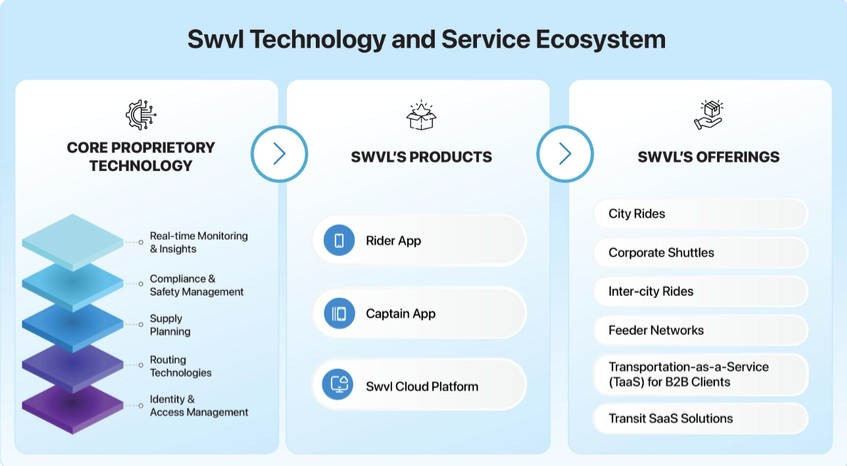
Platform Ecosystem
Swvl’s platform integrates a suite of interconnected tools and applications, delivering end-to-end transit solutions for riders, captains, and enterprises. Our ecosystem is designed to address varying user needs while maintaining scalability and simplicity.
Rider App
The Swvl Rider App empowers users with a seamless and intuitive interface to book, manage, and track their rides. With features like real-time tracking, users can monitor vehicle locations, estimated arrival times, and trip progress, ensuring transparency and reliability. Riders can share their trips with friends and family, choose private rides for personalized travel, and enjoy the convenience of direct billing for corporate clients.
The Rider App’s reservation management tools allow users to adjust trip details or cancel bookings effortlessly. Additionally, riders benefit from 24/7 customer support, enabling quick issue resolution and fostering trust in the service. The Rider App is a cornerstone of Swvl’s mission to simplify and enhance the daily transit experience for individuals and organizations alike.
Captain App
The Captain App equips Swvl’s drivers (which are also referred to as captains) with tools to manage trips effectively and provide exceptional service. From trip scheduling and performance insights to rider check-in and check-out systems, the Captain App ensures operational efficiency while maintaining a high standard of service. Captains can monitor their earnings transparently, access a multilingual help center, and leverage guided onboarding processes to get started quickly. With features tailored to simplify daily tasks, such as route optimization and trip history review, the Captain App fosters professionalism and reliability, ensuring that Swvl’s network of captains is both scalable and high-performing.
Unified Swvl Cloud Platform
At the heart of Swvl’s ecosystem is the Swvl Cloud Platform, a unified product that powers all internal and external personas, including riders, captains, businesses, and suppliers. This platform combines the functionalities of operational tools, such as dashboards and reporting systems, with scalable infrastructure to create a seamless transit management experience.
45
The Swvl Cloud Platform includes:
| ● | Real-time operational monitoring, enabling users to track fleet performance, service disruptions, and trip metrics instantly. |
| ● | Smart routing and resource allocation systems, which adapt to demand fluctuations and ensure operational efficiency. |
| ● | Integrated compliance tracking, which automates the management of regulatory and safety requirements for fleets, drivers, and suppliers. |
| ● | Comprehensive financial reporting, offering insights into costs, savings, and revenue generation to support data-driven decisions. |
The Swvl Cloud Platform’s functionality is underpinned by Swvl’s in-house Identity and Access Management system, which dynamically manages user permissions while maintaining data scoping and personally identifiable information safeguards. This ensures secure, personalized access for all users and enhances the platform’s adaptability across diverse use cases.
Proprietary Technology
Swvl’s proprietary technologies drive operational excellence, address transit inefficiencies, and enhance user satisfaction. These systems are tailored to meet the needs of diverse transit models, ensuring both flexibility and reliability.
Routing Technologies
Swvl employs a range of smart routing systems designed to optimize transit operations:
| ● | Routimizer (Fixed Routing): For public transit, Routimizer predicts demand using historical data and customer search trends. By segmenting cities into hexagonal grids, it identifies the shortest and most efficient routes, accounting for traffic and other variables. |
| ● | Oracle (Corporate Commutes): For corporate transportation, Oracle uses advanced optimization algorithms to design cost-effective routes that align with known demand. |
| ● | Roudyna (Dynamic Routing): For first- and last-mile connectivity, Roudyna introduces dynamic virtual stops, eliminating long walks to transit points and enhancing accessibility for riders. |
These routing technologies are supported by Ratimator, Swvl’s proprietary Estimated Time of Arrival model, which ensures accurate arrival time predictions, fostering trust and reliability in transit services.
Supply Planning
Swvl’s Supply Assignment Problem Solver (“SAP Solver”) addresses vehicle underutilization and ensures optimal fleet performance. By analyzing factors like vehicle capacity, captain availability, and demand schedules, the SAP Solver dynamically reallocates resources to high-demand areas, reducing idle time and increasing operational efficiency.
Compliance and Safety Management
Swvl prioritizes compliance and safety with rigorous standards, such as:
| ● | No-overcrowding policies which ensure that every passenger has a guaranteed seat; |
| ● | Comprehensive captain vetting, including regular drug testing, which upholds service reliability and safety; and |
| ● | In-house document management systems that automate compliance tracking and audits, which ensures that all vehicles and suppliers comply with Swvl’s standards. |
Rider Feedback and Support
Swvl continuously improves its services by integrating rider feedback into operational workflows. Passengers rate their experiences through the platform, allowing Swvl to identify and address service gaps proactively. Operators gain insights through real-time monitoring on Swvl’s Admin Dashboard, and passengers have access to 24/7 customer support for a seamless experience.
46
Product Roadmap
Swvl’s product roadmap is centered on financial and operational excellence, superior customer experience, and future-proof technology. Our focus will be on enhancing the Rider App, Captain App, and Mobility Platform to deliver a seamless, efficient, and scalable transit experience. We are planning to introduce value-added services, such as premium ride subscriptions, corporate mobility solutions, and white-label transit offerings, to drive cross-sell and upsell opportunities, which can potentially unlock new revenue streams while strengthening customer engagement.
At the same time, we are investing time in AI-driven optimizations to improve routing, demand forecasting, operational efficiency and customer support. Additionally, we will explore sustainable mobility initiatives, such as electric and hybrid fleet solutions and carbon offset reporting to enhance environmental impact while expanding market reach. Underpinning this growth is our commitment to a scalable, reliable tech stack, ensuring seamless operations, compliance, and adaptability for future expansion into new markets.
Our Vision and Evolution
Swvl is aiming to redefine mobility by creating seamless, efficient, and accessible transit solutions that cater to individuals, businesses, and governments. What began as a solution for daily commuting, is transforming into a technology-driven platform, integrating smart routing, AI-powered optimization, and scalable infrastructure to address the evolving needs of urban and inter-city transit.
Our commitment to innovation and operational excellence has allowed us to bridge gaps in traditional transportation, offering a more reliable and cost-effective alternative to existing mobility options.
As we continue to scale, our vision extends beyond just moving people -we aim to shape the future of smart mobility by expanding our global footprint, enhancing sustainability efforts, and leveraging proprietary technology to drive efficiency and accessibility.
Our Impact
Swvl’s product and technology innovations are at the core of our impact, enabling us to create safer, more inclusive, and more sustainable mobility solutions. By leveraging proprietary routing algorithms, real-time monitoring, and fleet optimization tools, we ensure that transportation is efficient, accessible, and affordable. Our platform provides dedicated seating, eliminating overcrowding, and implementing robust safety features such as trained captains and direct hotline support, in an effort to increase the quality of transportation for our users. At the same time, our smart-routing technology reduces congestion, cutting CO₂ emissions, and we are also continuously working to adopt electric vehicles to accelerate the transition to a greener, more sustainable urban mobility ecosystem.
Beyond enhancing mobility for riders, our technology also creates financial independence and career growth opportunities for our captains. Our fleet optimization tools maximize captain earnings, while our leasing program provides affordable financing options, allowing captains to own and operate their own vehicles. This tech-driven approach ensures that transportation is not just a service but an engine for economic empowerment. By integrating advanced AI, data-driven decision-making, and scalable digital infrastructure, Swvl is redefining mobility at scale, aiming to create a future where public transit is safer, more reliable, and sustainable for all.
Growth Strategy
On December 2, 2024, we announced the relaunch of our product in the UAE, which represents our strategy to expand into regional and global markets. To date, we have secured four new customers in the UAE, marking a strong relaunch of our journey in adding value to the mobility ecosystem within the country. The United Arab Emirates transit market presents significant growth opportunities for us, driven by the country’s commitment to developing world-class infrastructure and its focus on innovation and technology, which aligns perfectly with our offerings.
47
Expansion in the United States and other Gulf Cooperation Council Countries
We intend to expand our services into the United States, with a goal of capturing an enormous opportunity that exists in these developed markets -applying a bespoke approach in each country to ensure a successful rollout. We believe that these developed markets are more attractive for our services, given that these markets (i) have larger addressable Taas/SasS mass transit markets, (ii) higher prices can be charged for the same offering when compared to developing markets which results in higher margins, and (iii) their public transport systems function efficiently, yet still have the potential efficiency improvements. In addition, in developed markets, sustainability is seen as important, and reducing the carbon footprint of transport is a significant factor in decision making. In that regard, governments may provide subsidies for transport initiatives since Taas/SaaS mass transit solutions can potentially help address labor shortages by expanding employee catchment areas.
Our go-to-market strategy for the United States. includes (i) target expansion in large cities (such as Texas and Chicago), (ii) hire personnel with industry knowledge and existing network for the sales teams, (iii) target contracts that do not demand requests for proposal and proactively reach out to customers directly.
Our go-to-market strategy for Gulf Corporation Council Countries, including Kuwait and Qatar include (i) leveraging our existing client base in Egypt and KSA to cross-sell (ii) employing the same sales strategy in place in current markets to those new markets, given proximity of culture, time zone and market similarity, these countries will be relatively cheaper for us to expand into.
| ● | Geographic Expansion: We aim to become the pre-eminent mass-transit provider in emerging and developed markets. Our growth strategy is to identify opportunities for market entry in countries and cities where we can leverage the competitive advantages of our technology and platform. We examine factors such as total addressable market size and average fare per trip to assess whether expansion offers a viable path to profitability. We also review the quality of existing public transportation infrastructure to assess ease of market penetration and convertibility of public transportation users to our platform. Other considerations, such as ease and cost of doing business, as well as political stability, also factor into our expansion planning. We follow a standardized plan for market entry, premised on rapid commencement of operations and building scale across similar socio-economic blocks and regions. |
| ● | Continued Innovation: We are consistently working to improve our proprietary technology. As our optimization of demand prediction, routing and pricing improves, our user base, utilization rates and customer experience are expected to improve. |
| ● | Category Expansion: We frequently consider how our core assets - our technology, access to a large vehicle fleet and customer base - can be leveraged to generate new streams of revenue while minimizing incremental R&D costs. |
Marketing
Our marketing strategy is designed to accelerate growth by targeting high-potential segments through precise ideal customer profile identification and delivering tailored, use case-driven content that demonstrates the value and impact of our solutions. We prioritize product marketing and client education to ensure seamless onboarding and to drive long-term customer success and retention. Our approach integrates account-based marketing, enabling us to develop personalized campaigns that engage key decision-makers within strategic accounts. These campaigns are supported by long-form content, such as in-depth case studies, that showcase real-world success stories and highlight specific use cases relevant to each vertical.
To generate a consistent pipeline of qualified leads, we deploy a comprehensive inbound and outbound marketing strategy. This includes the creation of optimized landing pages for lead generation, designed to capture and convert high-intent prospects through gated content, webinars, and exclusive offers. We try to amplify our thought leadership and brand authority through strategic public relations initiatives, positioning our leadership as industry experts and leveraging earned media to build trust and credibility in both existing and new markets.
Intellectual Property
The protection of our technology, including as described above under “Our Technology”, and other intellectual property is an important aspect of our business. We seek to protect our intellectual property through trademark and copyright laws as well as confidentiality agreements, other contractual commitments and security procedures. We enter into confidentiality and intellectual property assignment agreements with certain employees to control access to, and clarify ownership of, our technology and other proprietary information. We regularly review our technology development efforts and branding strategy to identify and assess options for protection of new intellectual property.
48
Intellectual property laws, contractual commitments and security and technical procedures provide only limited protection, and any of our intellectual property rights may be challenged, invalidated, circumvented, infringed or misappropriated. Further, intellectual property laws vary from country to country, and we are in the process of transferring our intellectual property from Egypt to other jurisdictions in which we operate. Therefore, in other jurisdictions, we may be unable to adequately protect certain rights in our proprietary technology, brands, or other intellectual property from use by unauthorized entities or individuals. Please see the section entitled “Item 3D. Risks Related to Regulatory, Legal and Tax Factors Affecting Swvl.” Failure to protect or enforce our intellectual property rights could harm our business, financial condition and operating results.”
Data Protection and Privacy
We have made commitments to protect and respect the personal data and privacy of all our external users. Our business depends on the collection, storage, transmission, use and processing of personal data of our users’ and other sensitive information. As a result, our ability to protect such data and comply with the numerous laws, rules and regulations related to the collection, storage, transmission, use and other processing of such data is integral to our operations.
We are in the process of developing systems and processes that are designed to protect users’ data, prevent data loss and prevent other privacy or security breaches. These measures, however, cannot guarantee security and may not be effective against all cyberattacks or breaches. For example, in July 2020, by exploiting a breach in certain third-party software used by us, unauthorized parties gained access to a our database containing personal data of its riders. While such breach has not had a material impact on our business or operations and we have since implemented measures to prevent a similar data breach, unauthorized parties may further exploit the breached information and may in the future gain access to our systems or facilities through various other means.
We are also obligated to comply with all applicable laws, regulations and other obligations relating to privacy, data protection and information security. These laws, rules and regulations evolve frequently and their scope may continually change, through new legislation, amendments to existing legislation and changes in enforcement, and may be inconsistent from one jurisdiction to another and may conflict with each other. Nevertheless, we maintain and provide our users with a copy of our privacy policy, which is intended to succinctly describe the type of information we collect and how we use such information (including restrictions on disclosure and sharing of such information), as well as our security policies and procedures. We periodically update our privacy policy to reflect changes required by law or changes in the way we intend to collect or use information.
For more information on the risks related to data protection, data security and privacy as they relate to our business, please see the section entitled “Item 3D. Risk Factors.”
Insurance
We maintain insurance policies with global insurance providers to provide in-ride medical coverage to all riders and drivers in our Egypt market. We also provide comprehensive health and life insurance to employees in Egypt, Saudi Arabia and the UAE. We also provide directors’ and officers’ insurance for the board of directors of Swvl Holdings. We are currently in the process of obtaining other forms of insurance, such as general business liabilities.(Please see the section entitled “Item 3D. Risk Factors-Risks Related to Operational Factors Affecting Swvl.) Swvl has not historically maintained insurance coverage for its operations. Swvl may not be able to mitigate the risks facing its business and could incur significant uninsured losses, which could adversely affect its business, financial condition and operating results.
Government Regulation
We are subject to a wide variety of laws and regulations in the jurisdictions in which we operate. The ridesharing industry and our business model are relatively nascent and rapidly evolving. New laws and regulations and changes to existing laws and regulations continue to be adopted, implemented and interpreted in response to our industry and related technologies. We strive to comply with all laws and regulations applicable to our operations, and believe that we are in compliance with such laws and regulations in all material respects, other than as described below.
49
While we are not aware of any material limitations on foreign investment in the jurisdictions in which we operates, we are required to comply with certain regulations related to such investment. In particular, in Jordan, non-Jordanian investors are restricted from wholly owning any project or business venture that involves certain trade, construction or services activities. While we do not intend to engage in any such activities in Jordan, the organizational documents of the entity that currently conducts our operations in Jordan erroneously includes certain restricted activities as potential objectives of such entity. Prior to the Portfolio Optimization Program (Phase 2), such entity was in the process of amending its organizational documents such that Swvl will be permitted to acquire and hold all of the equity thereof. As part of the aforementioned Program, Swvl ceased operations in Jordan. In addition, in the UAE, foreign investors are required to operate via an onshore licensed entity or an onshore branch of a foreign or free zone entity. We have established such an onshore branch and have obtained the requisite licenses and approvals for such branch’s operations. We may become subject to additional limitations and regulations as we expands our operations in the jurisdictions in which we operates and into new jurisdictions, and such limitations and regulations may impair our ability to operate effectively in such jurisdictions.
In Egypt, we are subject to Law No. 87 of 2018 and the Executive Regulation by Presidential Decree No. 2180 of 2019 (collectively, “Egyptian Ridesharing Laws”). Pursuant to such Egyptian Ridesharing Laws, we, as well as any other land transport service company in Egypt that utilizes information technology, are required to obtain a license issued by Egypt’s Land Transport Regulatory Authority (the “Egyptian LTRA”). While companies were required under the Egyptian Ridesharing Laws to obtain such licenses by December 12, 2018, the Egyptian LTRA was not established until June 11, 2019, On December 12, 2019, Swvl submitted an application to the Egyptian LTRA, seeking the required license. In May 2023, we received the first license issued by the Egyptian LTRA under Law No. 87 of 2018, and have since been in full compliance with the Egyptian Ridesharing Laws. The license remains valid through May 2028, subject to remaining compliant with all license requirements.
We are also subject to a number of laws and regulations specifically governing the internet and mobile devices that are constantly evolving. Existing and future laws and regulations, or changes thereto, may impede the growth and availability of the internet and online offerings, require us to change our business practices or raise compliance costs or other costs of doing business. These laws and regulations, which continue to evolve, cover taxation, privacy and data protection, pricing, copyrights, distribution, mobile and other communications, to our offerings and the characteristics and quality of online offerings, among other things. In particular, as we expand our operations internationally, we could become subject to the GDPR and U.K. GDPR, which regulates the collection, control, sharing, disclosure, use and other processing of personal data and imposes stringent data protection requirements and significant penalties, and the risk of civil litigation, for noncompliance. The GDPR and U.K.GDPR has resulted in and will continue to result in significantly greater compliance burdens and costs for companies with users and operations in the EU or United Kingdom.
As we expand our business internationally, we could become subject to these costs and burdens in an effort to ensure that our operations are GDPR and U.K. GDPR compliant.
In addition to these laws and regulations that apply specifically to the mass-transit ridesharing industry, related technology, the internet and related regulations, our business operations are subject to other broadly applicable laws and regulations governing such issues as labor and employment, anti-discrimination, worker confidentiality obligations, consumer protection, taxation, competition, unionizing and collective action, background checks, anti-corruption, anti-bribery, import and export restrictions, environmental protection, sustainability, trade and economic sanctions, foreign ownership and investment and foreign exchange controls. Please see the section entitled “Item 3D. Risk Factors - Risks Related to Regulatory, Legal and Tax Factors Affecting us.” Swvl is subject to various laws relating to anti-corruption, anti-bribery, anti-money laundering, and countering the financing of terrorism and has operations in certain countries known to experience high levels of corruption. We have not implemented, or have only recently implemented, certain policies and procedures for the operation of our business and compliance with applicable laws and regulations, including policies with respect to anti-bribery and anti-corruption matters and cyber protection.
As we continue to expand our platform offerings and user base, we may become subject to additional laws and regulations, which may differ or conflict from one jurisdiction to another. Please see the section entitled “Item 3D. Risk Factors - Risks Related to Regulatory, Legal and Tax Factors Affecting Swvl.” As we expand our offerings, we may become subject to additional laws and regulations, and any actual or perceived failure by us to comply with such laws and regulations or manage the increased costs associated with such laws and regulations could adversely affect our business, financial condition, and operating results.
50
C. Organizational Structure
Swvl Holdings Corp is a British Virgin Islands business company incorporated under the laws of the British Virgin Islands. Swvl Holdings Corp has thirteen wholly-owned subsidiaries, three beneficially owned subsidiaries and one majority-owned subsidiaries.
Swvl Holdings Corp’s wholly owned subsidiaries are: Swvl Inc., a British Virgin Islands business company incorporated under the laws of the British Virgin Islands; Swvl Holdco Corp., a British Virgin Islands business company incorporated under the laws of the British Virgin Islands; Swvl Group Corp., a British Virgin Islands business company incorporated under the laws of the British Virgin Islands; Pivotal Merger Sub Company I, a Cayman Islands exempted company with limited liability; SWVL NBO Limited, a private limited company organized under the laws of Kenya; SWVL Saudi for Information Technology, a single person limited liability company organized under the laws of Saudi Arabia; Swvl Technologies Limited, a private limited company organized under the laws of Kenya; Swvl Global FZE, a limited liability company organized under the laws of Dubai; SWVL Technologies FZE, a limited liability company organized under the laws of Dubai and a directly wholly owned subsidiary of Swvl Global FZE; Swvl MY For Information Technology SDN BHD, a company limited by shares organized under the laws of Malaysia; Swvl For Smart Transport Applications and Services LLC, a limited liability company organized under the laws of Egypt; Swvl Germany GmbH and its direct subsidiary Door2Door GmBH, which are both limited liability companies organized under the laws of Germany.
Swvl Holdings Corp also beneficially owns: Smart Mobility Solutions for Transportation Services, a single person limited liability company organized under the laws of Saudi Arabia; Swvl for Mobility Solutions FZE, a limited liability company organized under the laws of Dubai; and Smart Way Transportation LLC, a single person limited liability company organized under the laws of Jordan. In certain cases, the Group is required to have a resident as one of the shareholders besides the Parent Company to comply with local laws and regulations. However, in such cases, the Group continues to remain the economic beneficiary of the shareholding held by such resident shareholder and therefore is said to have a “beneficial ownership” of such legal entity.
Swvl Holdings Corp also owns a 55% stake in Viapool Inc., which is a Delaware incorporated entity. Viapool Inc. fully owns: Movilidad Digital S.A.S., Viapool SRL, Viapool SPA which are organized under the laws of Argentina, and Swvl Brasil Tecnologica LTDA, a company organized under the laws of Brazil.
51
A diagram of Swvl’s group structure, as described above, is provided below:
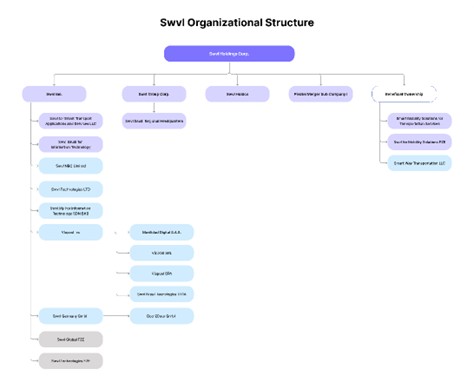
D. Property, Plants and Equipment
We lease approximately 13,391 square feet of office space for our corporate headquarters, located at the Offices 4 at One Central, Dubai World Trade Center, Dubai, UAE, and approximately 2,055 square feet of office space for our regional headquarters, located at 7451,2215 Al Ulaya, Riyadh, Saudi Arabia. Our existing headquarters lease in Dubai, UAE, expires on September 14, 2024, which we expect to extend to December 31, 2026, including in connection with an office expansion plan for our headquarters. Our existing headquarters lease in Riyadh, Saudi Arabia are leased annually and can be renewed at our discretion. Our monthly rent payment for both of our offices in Dubai and Riyadh is approximately $56,562. During 2024, we subleased approximately 10,417 square feet of our office space in Dubai while keeping the remaining office space for Swvl’s use.
ITEM 4A.UNRESOLVED STAFF COMMENTS
Not applicable.
52
ITEM 5.OPERATING AND FINANCIAL REVIEW AND PROSPECTS
MANAGEMENT’S DISCUSSION AND ANALYSIS OF
FINANCIAL CONDITION AND RESULTS OF OPERATIONS
| A. | Operating Results. |
The following discussion and analysis of our financial condition and results of operations provides information that we believe to be relevant to an assessment and understanding of our results of operations and financial condition for the FY described. You should read the following discussion and analysis of our financial condition and results of operations together in conjunction with our financial statements and the related notes included elsewhere in this Annual Report.
The discussion below contains forward-looking statements that are based upon our current expectations and are subject to uncertainty and changes in circumstances. Actual results may differ materially from these expectations due to inaccurate assumptions and known or unknown risks and uncertainties, including those identified in “Cautionary Note Regarding Forward-Looking Statements” and under “Risk Factors” elsewhere in this Annual Report. Our discussion and analysis for the year ended December 31, 2023 compared to the year ended December 31, 2022 can be found in our annual report on Form 20-F for the fiscal year ended December 31, 2023, filed with the SEC on April 20, 2024.
We report financial information under IFRS, as issued by the IASB and related interpretations issued by the IFRS Interpretations Committee. None of the financial statements were prepared in accordance with generally accepted accounting principles in the United States.
Overview
We are a technology-driven disruptive mobility company that aims to provide reliable, safe, cost-effective and environmentally responsible mass transit solutions. Our mission is to identify and solve inefficiencies associated with low-quality or sometimes non-existent public transportation infrastructure in urban areas that are in critical need of such services. Our technology and services provide commuters, travelers and businesses with a valuable alternative to traditional public transportation, taxi companies or other ridesharing companies. Through our Swvl platform, we provide thousands of riders per day with a dynamically-routed self-optimizing network of minibuses and other vehicles, helping people get where they need to go.
Factors Affecting Our Business and Results of Operations
We believe that our future performance and success depend to a substantial extent on the following factors, each of which is in turn subject to significant risks and challenges, including those discussed below and in the section of this Annual Report entitled “Item 3D. Risk Factors.”
Our ability to cost-effectively retain and increase the number of riders or employees of our corporate customers who use our platform, and increase our share of their transportation spend.
We grow our business by attracting new riders to our platform (i.e., unique users taking their first ride with Swvl) and increasing their usage of our platform over time. As a result, the number of riders on our platform and their utilization of our offerings are the key drivers of our B2C business. Our ability to cost-effectively attract new riders and retain and increase the use of our platform by existing riders is critical to scaling our business. More riders accessing offerings on our platform and greater utilization drive increased revenue and profitability. We seek to increase both the number of riders on our platform and the usage of our platform through product innovation, improved user experience, and additional offerings.
While we anticipate this increasing level of investment will drive growth through word-of-mouth referrals, we also continue to invest in brand and growth marketing, as well as the use of paid marketing initiatives, rider and driver incentives and marketing partnerships with third parties in an effort to attract new riders to our platform and to enhance rider utilization (calculated as Total Bookings divided by Total Available Seats, over the period of measurement). Once riders start using Swvl, we seek to provide a quality experience and a diverse offering of routes and products to accommodate different transportation use cases in order to retain riders and encourage repeat usage.
53
We also grow our business by attracting new companies to our B2B offering and increasing their usage over time. As a result, the number of corporates with Swvl and their size (i.e how many seats they require over a period of measurement) are the key drivers of our B2B business.
If we fail to continue to attract riders to our platform and grow our rider base from individuals and corporations, expand riders’ usage of our platform over time or increase our share of riders’ transportation spend, our results of operations would be harmed.
Our ability to cost-effectively attract and retain drivers to use our platform, or to increase utilization of our platform by existing drivers.
Growing the number of drivers enables us to increase the number of routes on our network, thereby increasing the aggregate earnings potential for drivers and third-party vehicle operators while simultaneously improving access and availability for riders. Our ability to maintain and grow our driver base and increase driver utilization of our platform depends in part on our ability to continue to deliver meaningful earning opportunities for drivers and third-party vehicle operators who use our platform, as well as our ability to provide a seamless user experience for drivers that incentivizes continued use of our platform. We therefore continue to invest in developing technology that is intended to not only allow drivers and vehicle operators to maximize earnings while using our platform, but also improves the day-to-day experience for those drivers.
For instance, we believe our development of route optimization technology provides a key incentive for drivers and third-party vehicle operators to use our platform. By optimizing our plans, cross-dispatching across B2C and B2B routes and reducing the amount of time drivers spend moving between routes (as well as assigning routes so that drivers complete their route plans near their homes), we are able to increase the number of drivable routes per day and increase drivers’ and vehicle operators’ earnings. We believe this has contributed to our strong rates of driver retention.
Additionally, maintaining and continuing to grow our base of drivers is critical to delivering a quality experience on our platform. The more dedicated and able drivers that decide to use our platform, the more routes and rides we are able to provide. We also believe this allows us to maintain high quality service and low wait times. Our incentive programs to attract qualified drivers include bonus payments and other incentives to high-performing drivers and vehicle operators. During the COVID-19 pandemic, we provided temporary financial assistance to support drivers using our platform.
Our ability to grow and retain drivers is linked to our ability to maintain and increase the number of riders on our platform. We believe that the more riders we have on our platform, the easier it can be to maintain and attract new drivers to our platform. If we fail to continue to attract drivers to our platform and grow the number of routes we offer, riders’ usage of our platform may decrease and our results of operations would be harmed. In addition, when we enter a new market, we typically need to make significant upfront investments to drive sufficient scale of drivers in order to establish a functioning marketplace for our riders, which could adversely affect our results of operations in the periods in which such investments are made and delay our efforts to achieve profitability.
Our ability to successfully develop new offerings on our platform and enhance our existing offerings.
As part of our business, we consider how our core assets - our technology, access to a large vehicle fleet and our customer base - can be leveraged to generate new streams of revenue while minimizing incremental costs. For example, we initially launched with our core B2C offering, through which we connect riders using our platform to a network of minibuses and other vehicles that operate on fixed and semi-fixed routes within and between the cities we serve. We have since expanded our B2C offerings to allow riders to book and take intercity, long-distance trips.
We have also diversified our revenues beyond B2C offerings with our TaaS enterprise products, which are marketed as Swvl Business and which have historically been higher-margin products. Swvl Business enables our corporate customers (as well as schools and municipalities) to use our technology and platform to optimize the commute and travel programs they operate for their employees (and students). Since Swvl Business uses technology already developed for our B2C offerings, its development and deployment does not (and did not) impose significant additional R&D costs on our business. We currently intend to expand our Swvl Business offerings with SaaS in 2025. Our SaaS offerings are expected to be targeted at corporate customers (as well as schools and municipalities) that operate their own vehicle fleets, with specific services tailored to the needs of each customer. We currently intend for our basic offerings to include access to our dedicated Swvl Business application, which centralizes passenger management, billing, scheduling, data analytics and support functions in one platform. At higher service tiers, we currently intend to provide the use of our network optimization and Dynamic Routing technologies, as well as access to our fleet management modules, which will enable our customers to more easily manage their drivers and track their rides. We also currently plan to offer consulting and reporting services. We use a tiered cost-plus pricing model for our SaaS products, which we expect will allow us to enhance our margins.
54
Our ability to invest effectively in technology and research and development and to successfully integrate them into our business.
Our technology is a critical component of our business proposition. Our ability to provide a seamless experience for our riders and drivers, to effectively predict rider demand, to create efficient, high-utilization route plans and to price our offerings accordingly depends on ongoing innovation and the effectiveness of our data analysis, modeling and algorithms. As a result, we have made, and will continue to make, significant investments in research and development and technology in an effort to improve our platform and to attract and retain drivers and riders, expand the capabilities and scope of our offerings, and enhance our customer experience. We review and target our research and development activities on an ongoing basis based on the needs of our business. We believe that continued optimization of demand prediction, routing and pricing can improve our user base, utilization rates and customer experience, which we believe in turn can reduce inefficiency costs and improve our margins.
Our engineers and data scientists are critical to the success of our business and we will continue to invest in these areas. In addition, we will continue to dedicate significant resources to research and development efforts, focusing on continuing to improve our proprietary technology and developing innovative applications.
Our ability to operate in distinct geographic markets and our ability to expand into new markets.
Our capacity for continued growth and ability to achieve and maintain profitability depends in part on our ability to operate and compete effectively in different geographic markets. Each market is subject to distinct competitive and operational dynamics. These include our ability to offer more attractive transportation offerings than alternative options, our ability to efficiently attract and retain drivers and riders, ride length and the number of routes available on our platform, all of which affect our sales, results of operations and key business metrics. As a result, we may experience fluctuations in our results of operations due to the changing dynamics in the geographic markets where we operate.
Since our founding, we have been able to expand into new geographies and markets. Since 2017, we expanded our operations to 115 cities, however, on account of the Portfolio Optimization Program, certain entities were discontinued as below:
On August 18, 2021, we entered into a definitive agreement to acquire a controlling interest in Shotl, a mass transit platform that partners with municipalities and corporations to provide on-demand bus and van services in Europe, Latin America and the Asia Pacific region, which expanded our geographic footprint to 22 additional cities in 10 countries. The transaction closed on November 19, 2021. Subsequently, as part of the Portfolio Optimization Program, Shotl’s shared were sold by the Group back to the original shareholders, this transaction was approved and finalized in FY 2023.
On November 16, 2021, we entered into a definitive agreement to acquire a controlling interest in Viapool, a mass transit platform currently operating in Buenos Aires, Argentina and Santiago, Chile. The transaction closed on January 14, 2022. Subsequently, as part of the Portfolio Optimization Program, it was decided in December 2022 that Viapool and its subsidiaries will be liquidated. The process is still ongoing to be completed within the date of this report.
On June 3, 2022, we acquired 100% of the shares of Blitz B22-203 GmbH, a company based in Germany which subsequently acquired 100% of the shares of Door2Door GmbH, a mass transit platform operating in Germany. As part of the Portfolio Optimization Program, it was decided in December 2022 that both companies will be liquidated. Both companies filed for insolvency in December 2022, which was accepted by the German government and proceeded on March 15, 2023. The process is still ongoing to the date of this report.
On April 26, 2022, Swvl announced a definitive agreement to acquire a controlling interest in Volt Lines, a B2B mobility platform that manages a rider app and a driver app that operates in Turkey. The transaction closed on April 19, 2022. Subsequently, as part of the Portfolio Optimization Program, it was decided in December 2022 that the shares would be sold back by the Group back to the original shareholders. This transaction was completed on January 6, 2023.
During December 2022, it was decided that Swvl entities in Kenya, Jordan and Malaysia under the trading names of “Swvl NBO Limited”, “Swvl Technologies Ltd”, “Smart Way Transportation LLC” and “Swvl MY For Information Technology” would be liquidated. The liquidation process is still ongoing as of the date of this Report and expected to be completed before the end of 2024.
During the FY 2023, the Group approved the sales of the subsidiary operating in Pakistan, Swvl Pakistan (Private) Ltd. (“Swvl Pakistan”), and the sale to Mr. Danish Elahi was completed on April 15, 2023.
55
Further, during the FY 2023, we have Urbvan Mobility Ltd, our entity in Mexico as means of refinancing the Group.
Our ability to compete effectively.
We operate in a competitive market and must continue to compete effectively in order to grow, improve our results of operations and achieve and maintain long-term profitability. Our principal source of competition is public transportation. We strive to harness the competitive advantages of our offerings to convert users of public transportation into users of our platform. We also compete against taxi companies and traditional ridesharing platforms, such as Uber. By offering comfortable, reliable and safe rides at an accessible price point, our offerings aim to attract users of these single-rider services by offering a lower-cost alternative that offers a better rider experience than public transportation. We believe we have differentiated our business from these competitors by building a diverse set of offerings on a transportation network at scale, while upholding our culture and values and creating a brand that embodies a commitment to exceptional offerings and social responsibility. However, we must continue to respond to competitive pressures. Consequently, we intend to keep investing in our platform to attract and retain drivers and riders, and respond to shifts in competitors’ pricing levels, revenue models or business practices. If we are not able to compete effectively with our competitors, including our main competition of public transportation, our results of operations will be harmed.
Our ability to maintain and continue developing our reputation and to promote brand awareness and to optimize driver and rider incentives.
We believe that maintaining and enhancing our reputation and brand is critical to our ability to attract and retain employees and platform users. A core component of our marketing strategy involves focusing on expanding ridership in existing markets while rapidly accelerating brand awareness in new territories. We utilize a multi-channel approach, built on a foundation of digital marketing, to develop awareness of our offerings and expand our user base. We use a digital-focused marketing approach because we believe it offers the most effective means of accessing our target demographics in a cost-effective manner. Our advertising is conducted primarily through social media campaigns and placed web advertisements. We also rely on search engine optimization and application marketplace optimization tools to build and maintain the prominence of our brand. In new markets, we also advertise our offerings through offline advertising, such as billboards and events at public venues (such as shopping malls) where we may host promotional events, giveaways and conduct in-person account activations. We also seek to develop and maintain partnerships with other businesses, such as telecom companies, that allow us to deploy promotions and incentives to the customers of such businesses. We monitor the effectiveness of our marketing spend via several metrics, including customer acquisition cost.
We offer various incentives from time to time, such as promotions for new riders and discounts for bulk purchases or specific trips. We also operate a referral program that offers incentives for riders to refer new users.
The impact of uncertainties with respect to government laws, policies and regulations in the markets in which we operate.
We are subject to a wide variety of laws in the jurisdictions in which we operate. The ridesharing industry and our business model are relatively nascent and rapidly evolving. Regulations have impacted or could impact, among others, the nature of and scope of offerings we are able to make available through our platform, the pricing of offerings on our platform, our relationship with, and incentives, fees and commissions provided to or charged from, drivers, incentives provided to riders, our ability to operate in certain segments of our business, our ownership percentage in operating entities that may be subject to foreign ownership restrictions and insurance we are required to maintain. For example, in Egypt we are subject to licensing and other requirements under Law No. 87 of 2018 and the Executive Regulation by Presidential Decree No. 2180 of 2019, which regulate ridesharing companies such as ours. We have also previously entered into agreements with the Egyptian Competition Authority in relation to the regulation of pricing and offerings in our industry. We expect that our ability to manage our relationships with regulators in each of our markets, as well as existing and evolving regulations, will continue to impact our results in the future. Due to the nascent and uncertain state of the legal frameworks governing the ridesharing industry in the jurisdictions in which we operate, we have not obtained all of the required licenses and permits for certain cities where we operate; however, we are continuously making efforts to obtain such licenses and permits. (Please see the section entitled “Item 3.D. Risk Factors- Risks Related to Regulatory, Legal and Tax Factors Affecting Swvl.) Uncertainties with respect to the legal systems in the jurisdictions in which Swvl operates, including changes in laws and the adoption and interpretation of new laws and regulations, could adversely affect Swvl’s business, financial condition and operating results.
56
We are also subject to a number of laws and regulations specifically governing the Internet and mobile devices, and these laws and regulations are constantly evolving. Existing and future laws and regulations, or changes thereto, may impede the growth and availability of the Internet and online offerings, require us to change our business practices or raise compliance costs or other costs of doing business. In particular, if we expand our operations internationally, we expect to become subject to GDPR, which regulates the collection, control, sharing, disclosure, use and other processing of personal data and imposes stringent data protection requirements and significant penalties, and the risk of litigation or other action, for noncompliance. The GDPR has resulted in and will continue to result in significantly greater compliance burdens and costs for companies with users and operations in the EU. As we expand our business internationally, we will become subject to these costs and burdens in an effort to comply with GDPR.
The impact of uncertainties with respect to our B2B offering prices
We enter into annual contracts with our corporate customers offering, and whilst we employ a proprietary machine learning model to dynamically set pricing for rides and maximize per-vehicle revenue, akin to the models used in the airline industry, due to the long term nature of our contracts being 12 months, we are subject to changes in market conditions and currency devaluations that can expose us to translation risk. Therefore, our contracts are renewed on an annual basis and upon renewal, factors such as current market prices, currency and inflation are taken into account to ensure that our contracts are net present value positive and provide the highest possible margins throughout its tenure. Further, certain components in our contracts contain variable prices to hedge against possible price increases.
The impact of seasonality within certain sectors in our B2B offerings
We are also subject to seasonality in certain sectors of our B2B offerings, for example, our contracts with schools, universities and other educational institutions have low activity during the summer months, which are between July and September of each year within our operating markets. We try to diversify the industries we work with to ensure that our revenues are stable within the year, we do not currently have any single industry that contributes to more than 20% of our total revenues.
The impact of seasonality within certain sectors in our B2C offerings
We are also subject to seasonality in our B2C offerings, for example, B2C revenues have higher activity during the summer months, which are between July and September, also, for the times where there is national holidays, while B2C activities might get impacted, not significantly, by national holidays or summer months, according to the fact that a good percentage of our individual customer base is university students and the daily work commuters.
Components of Results of Operations
Revenue
Our revenue consists of two components: (i) a B2C component, representing the gross amount of fares charged to end-users of our platform, not including reductions of end-user discounts and promotions, sales refunds, uncollected cash and Sales waivers (as defined below); and (ii) a B2B component representing contractual smart transportation services for our corporate customer’s employees through the Swvl application, which is referred to as TaaS and SaaS, which enables corporate customers to manage their own fleets more efficiently. For further details on our revenue recognition, please see the Revenue details in the subsection “Critical Accounting Estimates” in this Annual Report.
Cost of Sales
Our cost of sales consists of costs directly related to delivering transportation services, which include payments to captains for operating our routes (net of any deductions, including any amount charged to captains on account of breach of terms of service), bonuses payable to captains, tolls and fines paid by Swvl. Our cost of sales does not include any depreciation or amortization expenses. Our depreciation and amortization expenses are almost exclusively attributable to non-revenue generating activities, including depreciation of our facilities and equipment which support our back-office operations and depreciation of right-of-use assets associated with corporate leases.
57
General and Administrative Expenses
Our general and administrative expenses primarily consist of personnel-related compensation costs including employee share scheme charges, professional services fees, technology costs, office costs, travel costs, depreciation, insurance, rent, bank fees, foreign exchange losses/gains, utilities, communication and other corporate costs. Our general and administrative expenses are expensed as incurred.
Sales and Marketing Expenses
Our sales and marketing expenses primarily consist of growth marketing expenses, offline marketing expenses, personnel compensation expenses and the costs of credits offered to riders for referring new riders. Our sales and marketing costs are expensed as incurred.
Charge for provision for expected credit losses
Our provision for expected credit losses consists of the provision for expected credit loss against trade and other receivables.
Expiration of deferred tax assets
Pertains mainly to the expired portion of our deferred tax assets.
Other income
Our other income consists primarily of recovery of previously written off assets that were not expected to be recovered, or the portion of discounts obtained from creditors on previously recorded liabilities.
Finance Income
Our finance income consists primarily of dividend income from bank deposits.
Finance costs
Our finance costs consist primarily of lease finance charges and interest expense on financial liabilities.
Gain/(loss) on disposal of subsidiaries
This component pertains to the gains and losses from the net book value of subsidiaries disposed of during each year.
Change in fair value of financial liabilities
Changes in fair value of financial liabilities consist of the change in the fair value of the Group’s earnouts liabilities, and certain warrant liabilities.
Change in fair value of deferred purchase price
Changes in fair value of deferred purchase price consists of the change in fair value of deferred purchase price resulting from the acquisition of certain subsidiaries by the Group, such as Shotl and Urbvan.
Change in fair value of employee share compensation schemes
This component consists of the change in fair value of employee share scheme reserve.
58
Income tax benefit
Income tax benefit primarily relates to the deferred tax asset created on tax losses incurred by the Company, which can be set off against future taxable income. We have deferred tax asset balances in Egypt as carried forward losses from the early years of operation, planned to be utilized against future taxable income.
Loss from the year from discontinued operations
The Group has discontinued various operations in select markets on account of a certain portfolio optimization program during FY 2023 onward, resulting in shareholders approving the sale and discontinuation of certain entities. Some of the entities are still under liquidation and are incurring immaterial administrative costs.
Impact of foreign currency translation
As we have operations in countries with different currencies, foreign currencies have an impact on our results of operations. The main impact of foreign currency fluctuations on us is from the change.
In our results of operations discussion below, we have provided certain comparisons both on an as reported and on a constant currency basis. The constant currency presentation, which is a non-IFRS measure, excludes the impact of fluctuations in foreign currency exchange rates. We believe that providing constant currency information provides valuable supplemental information regarding our results of operations and also provides a framework for assessing how our underlying business performed, excluding the effects of foreign currency rate fluctuations. We calculate constant currency percentages by converting our current period local currency financial results using the prior period exchange rates from the corresponding prior period, and compare these adjusted amounts to its prior period reported results. Amounts may not foot due to rounding.
Comparison of the Year Ended December 31, 2024 and 2023
Results of Operations
The following selected consolidated financial data are derived from the audited financial statements of the Company for FY 2024 and FY 2023 and should be read in conjunction with our consolidated financial statements, the related notes and the rest of the section of this Report entitled “Item 5. Operating and Financial Review and Prospects.” The historical results are not necessarily indicative of the results of future operations. For a comparison of FY 2023 to the fiscal year ended December 31, 2022, see our Annual Report on Form 20-F for FY 2023.
59
During FY 2024, we deconsolidated our SWVL Global FZE subsidiary in the UAE. As a result, the figures for FY 2023 in the current financial statements have been updated to reflect the split between continued and discontinued operations. Management reviews the results of operations for continued and discontinued operations separately for the years presented below.
|
|
Year Ended December 31 |
||
|
|
|
|
2023 |
($million) |
|
2024 |
|
(Restated) |
Continued operations |
|
|
|
|
Revenue |
|
17.21 |
|
22.85 |
Cost of sales |
|
(13.57) |
|
(18.74) |
Gross profit |
|
3.64 |
|
4.11 |
General and administrative expenses |
|
(10.0) |
|
(9.25) |
Selling and marketing expenses |
|
(0.12) |
|
(0.09) |
Charge for provision for expected credit losses |
|
(0.58) |
|
(0.27) |
Other provisions |
|
(0.56) |
|
— |
Other income |
|
0.26 |
|
18.83 |
Operating (loss)/ profit |
|
(7.35) |
|
13.33 |
|
|
|
|
|
Finance income |
|
0.07 |
|
0.06 |
Finance costs |
|
(0.04) |
|
(0.06) |
Gain/(loss) on disposal of subsidiaries |
|
1.13 |
|
(8.28) |
Change in fair value of financial liabilities |
|
(0.56) |
|
1.21 |
Change in fair value of deferred purchase price |
|
(1.87) |
|
0.73 |
Change in fair value of employee share scheme reserve |
|
(0.18) |
|
(1.64) |
(Loss)/profit for the year before tax from continuing operations |
|
(8.81) |
|
5.35 |
Income tax benefit |
|
— |
|
0.04 |
(Loss)/profit for the year from continuing operations |
|
(8.81) |
|
5.39 |
|
|
|
|
|
Discontinued operations |
|
|
|
|
Loss for the year from discontinued operations |
|
(1.46) |
|
(2.33) |
(Loss)/profit for the year |
|
(10.27) |
|
3.06 |
|
|
|
|
|
Other comprehensive income |
|
|
|
|
Exchange difference on translations of foreign operations |
|
(4.87) |
|
(5.30) |
Total comprehensive loss for the year |
|
(15.14) |
|
(2.24) |
FY 2024 Compared to FY 2023
Revenue
|
|
Year Ended December 31 |
|
|
|
||||
|
|
|
|
|
|
FY 2023 - FY 2024 |
|
||
($million) |
|
2024 |
|
2023 |
|
% Change |
|
||
Total Revenue |
|
$ |
17.21 |
|
$ |
22.85 |
|
(25) |
% |
Disaggregated by |
|
|
|
|
|
|
|
|
|
Business to customers |
|
$ |
4.23 |
|
$ |
6.21 |
|
(32) |
% |
Business to business |
|
$ |
12.98 |
|
$ |
16.64 |
|
(22) |
% |
We disaggregate revenue by the type of customer served as follows: Revenue from B2C, who are individual customers, and revenue from B2B, which are corporates. Below is the disaggregated revenue information for FY 2024 and FY 2023.
B2C revenues for FY 2024 were approximately $4.23 million, a decrease of approximately $1.98 million, or 32%, compared to FY 2023. The decrease in revenue was directly related to our continued strategy of focusing heavily on the most profitable and utilized routes across our network. Further, the devaluation of EGP against the USD from an average of USD/EGP exchange rate of 30.66 during FY 2023 to 43.94 during FY 2024 also led to lower reported figures, as discussed in more detail in the below section ‘Further Analysis Using Constant Currency’.
60
B2B revenues for FY 2024 were approximately $12.98 million, a decrease of approximately $3.66 million, or 22%, compared to FY 2023. The decrease in revenue was directly related to our continued strategy of focusing heavily on the most profitable and utilized routes across our network. The Group has terminated certain contracts that did not meet the minimum profit requirements following the portfolio optimization plan, this led to a decrease of the total sales value. Further, the devaluation of EGP against the USD from an average of USD/EGP exchange rate of 30.66 during FY 2023 to 43.94 during FY 2024 also led to lower reported figures, as discussed in more detail in the below section ‘Further Analysis Using Constant Currency’.
Please refer to the below section ‘Further Analysis Using Constant Currency’ for the impact of devaluation.
Cost of Sales
|
|
Year Ended December 31 |
|
|
|
||||
|
|
|
|
|
|
FY 2023 - FY 2024 |
|
||
($million) |
|
2024 |
|
2023 |
|
% Change |
|
||
Cost of transportation (B2B) |
|
$ |
10.65 |
|
$ |
14.19 |
|
(25) |
% |
Captain costs (B2C) |
|
$ |
2.92 |
|
$ |
4.56 |
|
(36) |
% |
Total cost of sales |
|
$ |
13.57 |
|
$ |
18.75 |
|
(28) |
% |
Cost of sales for FY 2024 was approximately $13.56 million, a decrease of approximately $5.17 million, or 28%, compared to FY 2023. This decrease is due to the reduction in revenue, aligning with our strategy of focusing on profitable operations and the further development of our technologies (which is expected to enhance our fleet operations, as described in further detail under our Routing Technologies section).
Further Analysis Using Constant Currency
During FY 2024 and FY 2023, 78.7% and 91.8% of our total revenues were generated in Egypt, respectively. We continue to monitor the economic environment for changes impacting our business and have taken multiple measures to try to minimize the impact of devaluations on the business, such as expanding operations in dollar pegged countries like Saudi Arabia and the UAE. We also plan to expand into other markets including the United States.
Had our business observed a constant currency from FY 2023 to FY 2024, our results of operations would have varied. We measured this variation to understand actual operating performance, without influence from currency exchange fluctuations.
The below table represents our FY 2024 revenue numbers using constant currency presentation. The currency is held constant as the average USD/EGP exchange rate, which was EGP 30.66 throughout FY 2023. This rate was used to translate all revenue generated in Egypt during FY 2024, and we have not changed the exchange rate of the revenue generated in SAR from KSA and in AED from the UAE to its USD equivalent as they are pegged currencies:
|
|
Constant Currency Presentation |
|
|
|
||||
|
|
|
|
|
|
FY 2023 - FY 2024 |
|
||
Constant currency, translated at EGP 30.66 per USD ($million) |
|
FY 2024 |
|
FY 2023 |
|
%Change |
|
||
Revenue |
|
$ |
23.08 |
|
$ |
22.85 |
|
1 |
% |
Disaggregated by |
|
|
|
|
|
|
|
|
|
Business to customers |
|
$ |
6.07 |
|
$ |
6.22 |
|
(2) |
% |
Business to business |
|
$ |
17.01 |
|
$ |
16.64 |
|
1 |
% |
In a constant currency presentation, our B2C revenue would have been stated at $6.07 million, compared to $4.23 million, on actual currency presentation, which represents a $1.84 million increase, or 43%. Our B2B would have been stated at $17.01 million, compared to $12.98 million, on actual currency presentation, which represents a $4.03 million increase, or 31%.
|
|
Constant Currency Presentation |
|
|
|
||||
|
|
|
|
|
|
FY 2023 - FY 2024 |
|
||
Constant currency, translated at EGP 30.66 per USD ($million) |
|
FY 2024 |
|
FY 2023 |
|
%Change |
|
||
Revenue |
|
$ |
23.08 |
|
$ |
22.85 |
|
1 |
% |
Cost of sales |
|
$ |
(18.26) |
|
$ |
(18.74) |
|
(3) |
% |
Gross profit |
|
$ |
4.82 |
|
$ |
4.11 |
|
17 |
% |
61
In a constant currency presentation, our total revenue would have been stated at $23.08, compared to $17.21, on actual currency presentation, which represents a $5.87 million increase, or 34%. Our cost of sales would have been stated at $18.26, compared to $13.57, on actual currency presentation, which represents a $4.69 million decrease, or 35%. Our gross profit would have been stated at $4.82, compared to $3.64, on actual currency presentation, which represents a $1.18 million increase, or 32%.
|
|
|
|
|
Impact of using |
|
Constant Currency |
||
FY 2024 |
|
IFRS Measure |
|
Constant Currency |
|
Presentation |
|||
Revenue |
|
$ |
17.2 |
|
$ |
(5.9) |
|
$ |
23.08 |
Cost of sales |
|
$ |
(13.6) |
|
$ |
4.7 |
|
$ |
(18.26) |
Gross profit |
|
$ |
3.6 |
|
$ |
(1.2) |
|
$ |
4.82 |
General and Administrative Expenses
|
|
Year Ended December 31 |
|
|
|
||||
|
|
|
|
|
|
FY 2023- FY 2024 |
|
||
($million) |
|
2024 |
|
2023 |
|
% Change |
|
||
General and administrative expenses |
|
$ |
10.0 |
|
$ |
9.25 |
|
8.1 |
% |
General and administrative expenses for FY 2024 were approximately $10.0 million, an increase of approximately $0.75 million, or 8.1%, compared to FY 2023. This increase was primarily due to an increase in staff costs, resulting from RSU grants to management which was recognized in 2024 and are not recurring transactions. This increase was offset by a decrease in technology and insurance costs aligning with our strategy of focusing on profitable operations and cutting costs, as we have taken initiatives to reduce costs and entered into new agreements with suppliers through procurement efforts to reduce our operating costs.
Sales and Marketing Expenses
|
|
Year Ended December 31 |
|
|
|
||||
|
|
|
|
|
|
|
FY 2023 - FY 2024 |
|
|
($million) |
|
2024 |
|
2023 |
|
% Change |
|
||
Selling and marketing expenses |
|
$ |
0.12 |
|
$ |
0.09 |
|
33 |
% |
Our sales and marketing expenses for FY 2024 were approximately $0.12 million, an increase of approximately $0.03 million, or approximately 33%, compared to FY 2023. This increase was immaterial.
Charge for provision for Expected Credit Losses
|
|
Year ended December 31 |
|
|
|
||||
|
|
|
|
|
|
FY 2023 - FY 2024 |
|
||
($million) |
|
2024 |
|
2023 |
|
% Change |
|
||
Charge for provision for expected credit losses |
|
$ |
0.58 |
|
$ |
0.27 |
|
115 |
% |
Charge for provision for expected credit losses for FY 2024 was approximately $058 million, an increase of approximately $0.31 million, or approximately 115%, compared to FY 2023. This increase was calculated by our expected credit losses model, the charge is mainly related to our B2C business in Egypt.
Expiration of deferred tax assets
|
|
Year ended December 31 |
|
|
|
||||
|
|
|
|
|
|
FY 2023 - FY 2024 |
|
||
($ million) |
|
2024 |
|
2023 |
|
%Change |
|
||
Other provisions |
|
$ |
0.56 |
|
$ |
— |
|
** |
|
** |
Percentage not meaningful |
Other provisions for FY 2024 were approximately $0.56 million and nil in FY 2023. These provisions are related to the expiry of certain amounts of our deferred tax assets in Egypt.
62
Other Income
|
|
Year ended December 31 |
|
|
|
||||
|
|
|
|
|
|
FY 2023 - FY 2024 |
|
||
($million) |
|
2024 |
|
2023 |
|
% Change |
|
||
Other income |
|
$ |
0.17 |
|
$ |
0.07 |
|
** |
|
Waiver of creditor balances |
|
$ |
0.09 |
|
$ |
18.76 |
|
** |
|
** |
Percentage not meaningful |
In FY 2023 other income was approximately $18.8 million, which relate to the creditors settlement we executed during FY 2023 reflecting an approximate decrease of 85% from the total liabilities that were settled. In FY 2024, other income was approximately $0.26 million, mainly pertaining to $0.17 million of other income and $0.09 from creditors settlements.
Finance Income
|
|
Year ended December 31 |
|
|
|
||||
|
|
|
|
|
|
FY 2023 - FY 2024 |
|
||
($million) |
|
2024 |
|
2023 |
|
% Change |
|
||
Finance income |
|
$ |
0.07 |
|
$ |
0.06 |
|
17 |
% |
Finance income for FY 2023 was approximately $0.07 million, as compared to $0.06 million for FY 2023, an increase of $0.01 million, primarily related to dividends income that remained stable in FY 2024 and FY 2023.
Finance Cost
|
|
Year ended December 31 |
|
|
|
||||
|
|
|
|
|
|
FY 2023 -FY 2024 |
|
||
($million) |
|
2024 |
|
2023 |
|
% Change |
|
||
Finance cost |
|
$ |
0.04 |
|
$ |
0.06 |
|
(33) |
% |
Finance costs in FY 2024 were approximately $0.04 million, as compared to $0.06 million for FY 2023. The decrease in finance costs from FY 2024 to FY2023 was immaterial.
Gain on disposal of subsidiaries
|
|
Year ended December 31 |
|
|
|
||||
|
|
|
|
|
|
FY 2023 -FY 2024 |
|
||
($million) |
|
2024 |
|
2023 |
|
% Change |
|
||
Gain on disposal of subsidiaries |
|
$ |
1.13 |
|
$ |
1.83 |
|
(38) |
% |
Gain on disposal of subsidiaries for FY 2024 relates to disposal of subsidiaries in the UAE, compared to gains on disposal of certain subsidiaries including our business in Turkey, Spain and Pakistan during FY2023.
Write-down of assets held for sale
|
|
Year ended December 31 |
|
|
|
||||
|
|
|
|
|
|
FY 2023 -FY 2024 |
|
||
($million) |
|
2024 |
|
2023 |
|
% Change |
|
||
Write-down of assets held for sale |
|
$ |
— |
|
$ |
10.12 |
|
(100) |
% |
63
Write-down of assets held of sale was nil for FY 2024, compared to $10.12 million for FY 2023. This pertained particularly to our entity in Mexico, which was sold during FY 2023. This amount was recognized upon the sale of the entity to record the difference between the fair value of consideration and net assets of the Company.
Change in fair value of financial liabilities
|
|
Year ended December 31 |
|
|
|
||||
|
|
|
|
|
|
FY 2023 -FY 2024 |
|
||
($million) |
|
2024 |
|
2023 |
|
% Change |
|
||
Changes in fair value of financial liabilities |
|
$ |
(0.56) |
|
$ |
1.21 |
|
(146) |
% |
Change in fair value of financial liabilities for FY 2024, was approximately a loss of $0.56 million, compared to a gain of $1.21 million in FY 2023. This loss is mainly on account of the change in valuation for warrants issued in connection to our fiscal year ended December 31, 2022 fundraising activities (such warrants remain to be out of the money), however, the increase in stock price from $1.67 per share to $6.38 per share from December 31, 2023 to December 31, 2024 has increased the valuation amount.
Change in fair value of deferred purchase price
|
|
Year ended December 31 |
|
|
|
||||
|
|
|
|
|
|
FY 2023 -FY 2024 |
|
||
($million) |
|
2024 |
|
2023 |
|
% Change |
|
||
Change in fair value of deferred purchase price |
|
$ |
(1.87) |
|
$ |
0.73 |
|
** |
|
** |
Percentage not meaningful |
Change in fair value of deferred purchase price for FY 2024 was a loss of $1.87 million on account of change in share price, whereas in FY 2023 change was approximately a gain of $0.73 million. This loss is mainly due to certain warrants which were outstanding and held at a higher fair value as of December 31, 2024, compared to their fair value as of December 31, 2023 (due to a change in our stock price from $1.67 per share to $6.38 per share on December 31, 2023 and 2024, respectively). Most warrant holders exercised their warrants, and the remaining warrants will expire in June 2025, if not exercised beforehand.
Change in fair value of employee share - based scheme reserve
|
|
Year ended December 31 |
|
|
|
||||
|
|
|
|
|
|
FY 2023 -FY 2024 |
|
||
($million) |
|
2024 |
|
2023 |
|
% Change |
|
||
Change in fair value of employee share based scheme reserve |
|
$ |
0.18 |
|
$ |
1.64 |
|
(89) |
% |
Change in fair value of employee share-based scheme reserve for FY 2024 was approximately $0.18 million, compared to approximately $1.64 million in FY 2023. The charges are a result of the fair value changes and new options granted and vested during the year that are related to share-based payment transactions, and are recognized in the consolidated statement of comprehensive income.
Tax
|
|
Year ended December 31 |
|
|
|
||||
|
|
|
|
|
|
FY 2023 -FY 2024 |
|
||
($million) |
|
2024 |
|
2023 |
|
% Change |
|
||
Income tax benefit |
|
$ |
— |
|
$ |
0.04 |
|
(100) |
% |
Income tax benefit for FY 2024 was nil, as compared to $0.04 million in FY 2023.
Loss from discontinued operations
|
|
Year ended December 31 |
|
|
|
||||
|
|
|
|
2023 |
|
FY 2023 -FY 2024 |
|
||
($million) |
|
2024 |
|
(Restated) |
|
% Change |
|
||
Loss from discontinued operations |
|
$ |
1.46 |
|
$ |
2.33 |
|
(37) |
% |
64
Loss from discontinued operations in FY 2024 was approximately $1.46 million, compared to $2.33 million in FY 2023, a decrease of $0.87 million, or approximately 37%. The loss is attributed to the Group discontinued operations in its subsidiary in UAE in 2024.
In FY 2023, loss from discontinued operations represents all losses made in locations where Swvl has decided not to continue operations during the fiscal year ended December 31, 2022 on account of the portfolio optimization program. As most of the entities were discontinued in the fiscal year ended December 31, 2022, all charges related to those entities were disclosed under loss from discounted operations. In accordance with IFRS, loss from discontinued operations must be included in the current financial statements for all periods presented. For the fiscal year ended December 31, 2022, loss from discontinued operations primarily consisted of losses in Swvl entities in Germany, Spain, Argentina, Jordan, Kenya, Turkey and Pakistan which were operating until November 2022. In FY 2023 the only operating entity was the entity in Mexico, which was discontinued in September 2023. Other immaterial administrative charges for the entities are still undergoing liquidation.
Non-IFRS Financial Measures
In addition to the measures presented in our consolidated financial statements, we use the below non-IFRS financial measure to help us evaluate our business results. All data coming from the discontinued operations has been omitted from current and comparative periods.
Adjusted EBITDA
Adjusted earnings before interest, taxes, depreciation, and amortization (“EBITDA”) is a non-IFRS financial measure calculated as loss for the year, adjusted to exclude the following items which we do not believe are reflective of our operating performance:
| (i) | depreciation of property and equipment, and right-of-use assets; |
| (ii) | amortization of intangible assets; |
| (iii) | provision for employees’ end of service benefits; |
| (iv) | employee share-based payment charges; |
| (v) | impairment of financial assets; |
| (vi) | impairment of assets; |
| (vii) | recapitalization costs; |
| (viii) | finance income; |
| (ix) | Non-cash provisions; |
| (x) | fair value gains rising from financial liabilities; and |
| (xi) | taxes. |
Our definition of adjusted EBITDA may be different from those used by other companies, and therefore, may not be comparable. Furthermore, our definition of adjusted EBITDA has certain limitations by that it does not include the impact of certain expenses that are reflected in our consolidated financial statements that are necessary to run our business. Thus, adjusted EBITDA should be considered in addition to, not as a substitute for, or in isolation from, measures prepared in accordance with IFRS.
We compensate for these limitations by providing a reconciliation of adjusted EBITDA to the most directly comparable IFRS financial measure, which is loss for the fiscal year. We encourage readers, investors and others to review our financial information in its entirety, not to rely on any single financial measure and to view our adjusted EBITDA in conjunction with its related IFRS financial measure.
65
Adjusted EBITDA has limitations as a financial measure, and as such should be considered as supplemental in nature. It is not meant as a substitute for the related financial information prepared in accordance with IFRS. These limitations include the following:
| (viii) | Adjusted EBITDA does not reflect period to period changes in taxes, income tax expense or the cash necessary to pay income taxes; and |
Reconciliation from (Loss)/ profit for the year to adjusted EBITDA
|
|
For the year ended December 31 |
||||
($million) |
|
2024 |
|
2023 |
||
(Loss)/profit for the year from continuing operations |
|
$ |
(8.81) |
|
$ |
5.39 |
Add: Depreciation of property and equipment |
|
$ |
0.26 |
|
$ |
0.36 |
Add: Depreciation of right-of-use assets |
|
$ |
0.18 |
|
$ |
0.36 |
Add: Amortization of intangible assets |
|
$ |
0.04 |
|
$ |
0.03 |
Add/(less): Employee share-based payments charges / (reversals) |
|
$ |
0.18 |
|
$ |
1.6 |
Add/Less: Change in of fair value of deferred purchase price |
|
$ |
1.86 |
|
$ |
(0.73) |
Less: Finance income |
|
$ |
(0.07) |
|
$ |
(0.06) |
Add: Non-cash provisions |
|
$ |
1.87 |
|
$ |
— |
Add/Less: Change in fair value of financial liabilities |
|
$ |
0.56 |
|
$ |
(1.21) |
Less: Tax |
|
$ |
— |
|
$ |
(0.04) |
Adjusted EBITDA |
|
$ |
(3.79) |
|
$ |
5.03 |
66
B. Liquidity and Capital Resources
Overview
Our principal sources of liquidity have been cash and cash equivalents raised from our operating cash flows in Egypt and Kingdom of Saudi Arabia, which partially support the day-to-day business, and from the issuance of shares. Our total liabilities exceeded our total assets by approximately $0.68 million in FY 2024 compared to total assets exceeding total liabilities by $5.9 million in FY 2023. We incurred a loss for the year of approximately $10.3 million in FY 2024, and incurred a profit of approximately $3.1 million in FY 2023 which was mainly generated by other income from the waiver of creditor liabilities. In addition, we had accumulated losses of approximately $339.9 million and $329.5 as of December 31, 2024 and as of December 31, 2023, respectively. To support our business, we have generated net cash flows from financing activities approximating to $4.04 million and $0.34 million during FY 2024 and FY 2023, respectively, through issuance of shares and other equity instruments. We have generated net cash flows from investing activities of approximately $0.58 million and $8.8 million during FY 2024 and FY 2023, respectively.
To support our business plans, during FY 2023, we obtained additional financing amounting to $12 million by selling our Urbvan subsidiary ($9.5 million net of selling costs) and have issued 253,834 class A ordinary shares through our equity financing line, amounting to $789,462. During FY 2023, we have used these proceeds to continue to support our business and enter into agreements with prior creditors to extinguish our prior liabilities.
As of December 31, 2024 and 2023, we had cash and cash equivalents of approximately $4.96 million and $2.92 million, respectively. On November 17, 2024, we entered into a definitive securities purchase agreement (the “Securities Purchase Agreement”) for a private placement financing with certain investors, including certain members of our Board to purchase $4.7 million of our Class A Ordinary Shares. Under the Securities Purchase Agreement, the investors agreed to purchase 981,211 of the Company’s Class A Ordinary Shares or pre-funded warrants in lieu thereof at a purchase price of $4.79. The investors in the offering also agreed to execute lock up and leak out agreements, pursuant to which they agreed to lock up the securities purchased in the offering for a period of six months, as well as agreed to transfer up to twenty percent of the securities purchased for each ninety-day period thereafter in an amount not more than twenty percent of the trading volume on a proposed date of sale.
On February 10, 2025, the investors exercised their right to purchase additional securities pursuant to the Securities Purchase Agreement and purchased additional 417,537 of our Class A Ordinary Shares at a purchase price of $4.79. Such offering resulted in gross proceeds to the Company of $2 million. The investors also agreed to execute lock up and leak out agreements, pursuant to which they agreed to lock up the securities purchase in the offering for a period of six months, as well as agreed to transfer up to twenty percent of the securities purchase for each ninety-day period thereafter in an amount not more than twenty percent of the trading volume on a proposed date of sale.
On November 25, 2024, we obtained a sustainable credit facility with HSBC Bank in the amount of up to $0.6 million (subject to certain milestone conditions) aimed at financing our expansions and pipeline of contracts. This sustainable credit facility enables us to factor invoices with certain customers at our discretion, and we believe this allows us to have better management over the timing of our cash flows. To date, we have drawn down an immaterial amount from this credit facility.
Our cash and cash equivalents consist primarily of cash held with banks or other financial institutions, and t is not restricted as to withdrawal and use. Our cash and cash equivalents are primarily denominated in USD as well as in local currencies of the markets in which we operate.
We believe that our current available cash and cash equivalents will be sufficient to meet our working capital requirements and capital expenditures in the ordinary course of business for a period of at least twelve months from the date of this Report. We intend to finance our future working capital requirements and capital expenditures from cash generated from operating activities, funds raised from financing activities.
Our future capital requirements depend on many factors including our growth rate, the continuing market acceptance of our offerings, the timing and extent of spending to support our efforts to develop our platform, the expansion of sales and marketing activities, and the expansion of our business into new geographies and markets. To enhance our liquidity position or increase our cash reserve for future investments or operations through additional financing activities, we may in the future seek equity or debt financing. The issuance and sale of additional equity would result in further dilution to our shareholders. The incurrence of indebtedness would result in increased fixed obligations and could result in operating covenants that would restrict our operations.
67
We have an effective Form F-3 registration statement (File No. 333-279918), filed under the Securities Act of 1933, as amended, with the SEC using a “shelf” registration process. Under this shelf registration process, we may, from time to time, sell in one or more offerings up to the total amount of $100,000,000 of our Ordinary Shares, par value $0.0025, warrants or units comprising a combination of Ordinary Shares and warrants. As of the date of this Annual Report we have not sold any Ordinary Shares under the registration statement on Form F-3.
Cash Flows
The following table sets forth a summary of our cash flows for the years indicated.
|
|
Year ended December 31 |
||||
($million) |
|
2024 |
|
2023 |
||
Cash flow (used in)/ from: |
|
|
|
|
|
|
Operating Activities |
|
$ |
(3.57) |
|
$ |
(9.11) |
Investing Activities |
|
$ |
0.58 |
|
$ |
8.79 |
Financing Activities |
|
$ |
4.04 |
|
$ |
0.34 |
Net (decrease) increase in cash and cash equivalents |
|
$ |
1.05 |
|
$ |
0.02 |
Operating Activities
Net cash used in operating activities was $3.57 million for FY 2024, primarily consisting of $10.27 million loss for the year before tax adjusted for certain non-cash items. The net change in operating assets and liabilities is primarily the result of a gain on disposal of subsidiary for $1.13 million offset by a loss in change in fair value of deferred purchase price and financial liabilities amounting to $2.43 million. This increase is on account of the share price increase from $1.67 to $6.38 on December 31, 2023 and December 31, 2024, respectively. Furthermore, there was an increase in cash flows from changes in working capital of $2.13 million in trade and other receivables, and $1.48 million in accounts payables, accruals and other payables. Both of these changes are on account of our efforts to increase our cash conversion cycle.
Net cash used in operating activities was $9.1 million for FY 2023, primarily consisting of $3.02 million profit for the year before tax adjusted for certain non-cash items. The net change in operating assets and liabilities is primarily the result of non-cash income, finance cost, changes in fair value of deferred purchase price and financial liabilities, impairment of assets and employee share-based payments charge equating to $13.5 million net impact offset by a $1.9 million increase in working capital mainly on account of a reduction in trade receivables of $3.91 million.
Investing Activities
Net cash generated from investing activities was $0.58 million for FY 2024, which primarily consisted of cash received from sub-lease activities.
Net cash used in investing activities was $8.79 million in FY 2023, which primarily consisted of $8.40 million proceeds from disposal of subsidiaries as well as $0.67 million received from sub-lease activities. This was reduced by the purchase of intangible assets amounting to $0.26 million and $0.02 million as well as the purchase of property and equipment.
Financing Activities
Net cash provided by financing activities was $4.04 million for FY 2024, primarily consisting of $2.56 million of share issuance and $1.89 million of proceeds from issuance of other instruments, offset by lease liabilities paid during the year which amounted to $0.41 million.
Net cash provided by financing activities was $0.34 million for FY 2023, primarily consisting of $0.79 million of share issuance, offset by lease liabilities paid during the year which amounted to $0.45 million.
Holding Company Structure and Dividends
Swvl Holdings Corp is a holding company without substantive business operations. Swvl Holdings Corp conducts its operations primarily through its subsidiaries in the jurisdictions in which it operates. As a result, our ability to pay dividends depends upon dividends paid by our subsidiaries. If our subsidiaries or any newly formed subsidiaries incur debt on their own behalf in the future, the instruments governing their debt may restrict their ability to pay dividends to us.
68
In addition, as determined in accordance with local regulations, our subsidiaries in certain jurisdictions may be restricted from paying us dividends offshore or from transferring a portion of their assets to us, either in the form of dividends, loans or advances, unless certain requirements are met, and regulatory approvals are obtained. Even though we currently do not require any such dividends, loans, or advances from our entities for working capital and other funding purposes, we may in the future require additional cash resources from them due to changes in our business conditions, to fund future acquisitions and development, or merely to declare and pay dividends or distributions to our shareholders.
Capital Expenditures
We did not incur any capital expenditures during FY 2024. Our historical capital expenditures are primarily related to additions and purchases of property and equipment, which included the purchase of fixtures and furniture, leasehold improvements and employee laptops. While we are an asset-light business, we expect to moderately increase our capital expenditures to meet the expected growth in scale of our business and as we expand geographically and bolster our existing offerings. We expect that cash received in connection with the Business Combination and cash from operating activities and financing activities will be used to meet our capital expenditure and marketing spend needs in the foreseeable future.
Indebtedness
The Group does not currently have any long-term loans or convertible debts outstanding.
Off-Balance Sheet Arrangements
As of December 31, 2024 and December 31, 2023, we did not have any off-balance sheet arrangements that have or are reasonably likely to have a current or future effect on our financial condition, revenues or expenses, results of operations, liquidity, capital expenditures or capital resources.
Contractual Obligations and Commitments
The following table summarizes our contractual obligations and commitments as of December 31, 2024.
|
|
Payments Due by Period |
||||||
($million) |
|
<1 year |
|
1-5 years |
|
>5 years |
|
Total |
Lease Liabilities Commitments |
|
0.62 |
|
0.45 |
|
— |
|
1.07 |
Deferred and Contingent Consideration |
|
1.15 |
|
— |
|
— |
|
1.15 |
Dispositions
Urbvan Disposition
On September 7th, 2023, we entered into a definitive agreement with Kolors Inc. (“Kolors”), a leading transport provider in Latin America, to sale our entire holdings in Urbvan Mobility Ltd. (“Urbvan”), for aggregate gross proceeds of $12 million. Urbvan was acquired by us in July 2022 in an all-share acquisition, and the sale of Urbvan to Kolors is comprised entirely of cash. Pursuant to the agreement, we will receive gross proceeds equal to $12 million for the sale of Urbvan reduced by $2.4 million transaction costs. We received $8.4 million in cash at closing, and the remaining net proceeds will be paid over one year. Urbvan constituted 7% of our IFRS revenues as of December 31, 2022. The sale of Urbvan reflects our strategy to focus on higher priority markets.
Volt Lines Disposition
Effective January 6, 2023, we and our subsidiary, Swvl Global FZE, entered into a definitive agreement with certain former shareholders (the “Former Volt Lines Shareholders”) of Volt Lines B.V. (“Volt Lines”), a private company with limited liability duly incorporated under the laws of the Netherlands and a Turkey-based B2B and Transport as a service mobility business, to unwind our previous acquisition of Volt Lines. Pursuant to the agreement, the Former Volt Lines Shareholders are not obligated to retransfer or cancel the tranche of their Ordinary Shares already received from the prior acquisition agreement.
69
Shotl disposition
Effective February 22, 2023, we and our subsidiary, Swvl Global FZE, entered into a definitive agreement with certain former shareholders (the “Former Shotl Shareholders”) of Shotl Transportation, S.L. (“Shotl”), a private company with limited liability duly incorporated under the laws of Spain, to unwind our previous acquisition of Shotl . Pursuant to the agreement, the Former Shotl Shareholders are not obligated to retransfer or cancel the tranche of their Ordinary Shares already received from the prior acquisition agreement.
SWVL Pakistan disposition
Effective April 15, 2023, we and our subsidiary, Swvl Pakistan, entered into a definitive agreement with Mr. Danish Elahi, to sell the shares in Swvl Pakistan as part of our Portfolio Optimization Program. Pursuant to the agreement, Mr. Danish Elahi acquired 99.99% of all the issued and outstanding shares in Swvl Pakistan, with the purchase price of $20,000. After the acquisitions Mr. Muhammad Arid Shafi owns 0.01% of all the issued and outstanding shares in Swvl Pakistan.
Institutional PIPE Financing
On August 10, 2022, we entered into a securities purchase agreement with an institutional investor pursuant to which we sold 484,849 Ordinary Shares at a purchase price of $41.25 per Ordinary Share, for which the purchase price included series A and series B warrants of the Company immediately exercisable upon issuance for one Ordinary Share at an exercise price of $41.25. The series A warrants provide the right to purchase up to 484,849 Ordinary Shares for a period of five years. The series B warrants provide the right to purchase up to 484,849 Ordinary Shares for a period of two years. A.G.P./Alliance Global Partners acted as the sole placement agent for the private placement and received customary compensation for its services, including the issuance thereto of 121,212 Ordinary Shares. As per such securities purchase agreement, the series B warrants have expired in full during 2024.
Pursuant to the terms of the securities purchase agreement with an institutional investor, we agreed, among other things, to refrain from (i) issuing, entering into any agreement to issue or announcing the issuance or proposed issuance of certain of our securities (including Ordinary Shares pursuant to a stock purchase agreement with B. Riley) for a period commencing August 10, 2022 until the date that is 60 calendar days after the date that the SEC declares effective the registration statement registering the resale of the Ordinary Shares and Ordinary Shares issuable upon exercise of the warrants issued in the offering (or, in the event of a “review” by the SEC of the registration statement, 30 days after the date that the SEC declares the registration statement registering the resale of the institutional investor’s securities effective) and (ii) entering into variable rate transactions (as defined in the securities purchase agreement with the institutional investor), subject to certain exceptions, for a period of 12 months after the SEC declares the registration statement registering the resale of the institutional investor’s securities effective.
In connection with the private placement, we also entered into a registration rights agreement (the “Institutional Investor Registration Rights Agreement”), pursuant to which we agreed, among other things, to (i) file the Institutional Investor Registration Statement no later than August 30, 2022 and (ii) use our reasonable best efforts to cause the Institutional Investor Registration Statement to become effective as promptly as practicable thereafter, and, in any event no later than 90 days after the closing of the private placement.
In connection with the private placement, certain of the directors of the Swvl Board entered into lock-up agreements and agreed not to sell or transfer any of the Ordinary Shares they hold, subject to certain exceptions, during the Restricted Period.
Equity Line Financing
On March 22, 2022, we entered into an equity line financing pursuant to a common stock purchase agreement with B. Riley pursuant to which B. Riley committed to purchase up to $471.7 million (the “Total Commitment”) of Ordinary Shares, subject to certain limitations and conditions set forth in the purchase agreement. Pursuant to this stock purchase agreement, from March 22, 2022 and until the date of this Report, we have sold a total shares of 492,707 for total cash proceeds of $10,517,696 with an average share price of $26.63 . The agreement with B. Riley was valid until August 2024, and was not renewed after its expiry.
70
Creditor Settlement Arrangements
From 2022 onwards, we have entered into settlement arrangements with the parties to reduce aggregate amount of unpaid invoices. The parties offered us a discount of 85% of the original amount owed in return for prompt payment of the new discounted amount. During FY 2023, we entered into 13 settlement arrangement agreements, totaling to $18,7 million of discounted fees. As of the date of this report, we are still having discussions with other creditors for more extended payment plans and liability discount in effort of re-capitalizing the Group and settle all liabilities that existed before the portfolio optimization program.
C. Research and Development, Patents and Licenses
We have made, and will continue to make, significant investments in research, development and technology in an effort to improve our platform, to attract and retain drivers and riders, expand the capabilities and scope of our offerings, and enhance our customer experience. We review and target our research and development activities on an ongoing basis based on the needs of our business. For further details regarding our research and development costs, please refer to “Item 4.B. Business Overview” in this Annual Report.
D. Trend Information
For a discussion of the trends that affect our business, financial condition and results of operations, please see other portions entitled “Item 5.A. Operating Results” and “Item 3.D. Risk Factors” of this Annual Report and the section of this Annual Report entitled “Item 3.D. Risk Factors.”
E. Critical Accounting Estimates
Our consolidated financial statements are prepared in accordance with IFRS. The preparation of these consolidated financial statements requires us to make estimates and assumptions that affect the reported amounts of assets, liabilities, revenue, expenses and related disclosures. We evaluate our estimates and assumptions on an ongoing basis. Our estimates are based on historical experience and other assumptions that we believe to be reasonable under the circumstances. Our actual results could differ from these estimates under different assumptions or conditions. We believe that the following critical accounting policies reflect the more significant judgments, estimates and assumptions used in the preparation of our consolidated financial statements.
Revenue
We recognize revenue in accordance with IFRS 15, which we adopted as of January 1, 2019.The Company derives its revenue principally from end-users who use the Swvl platform to access routes predetermined by the Company. Revenue for transport represents the gross amount of fares charged to the end-user for these services. The sole performance obligation of the Company is to provide transportation services to the end-users by integrating the use of the Swvl platform and a network of captains and vehicles registered on the platform. The end-users are charged for using transportation services (i.e. fare charges, net of the discounts and incentives) and are given various incentives (as discussed below). The Company recognizes revenue when its performance obligation towards the end-users has been satisfied (i.e. when the ride is completed). It is at that point in time that the end-user becomes liable to transfer the due consideration to the Company.
We evaluate the presentation of revenue on a gross versus net basis based on whether we control the service provided to the end-user and are the principal in the transaction (gross), or whether we arrange for other parties (operators and individual captains) to provide the service to the end-user and is the agent in the transaction (net). The Company considers itself a principal for the transportation services because it controls the services provided to riders.
End-user discounts and promotions
We offer discounts and promotions to end-users to encourage the use of our transportation services. These discounts and promotions are offered in various forms and include:
| ● | Targeted end user discounts and promotions. These discounts and promotions are offered to specific end-users in a market with a goal to acquire, re-engage or increase the end-users’ use of the platform. Because the end-user does not provide the Company with a distinct goods or services against these promotions and discounts, the Company deducts the amount of these promotions and discounts from the transaction price when recognizing revenue. |
71
| ● | Free credits. We provide end-users booking intercity routes using Swvl’s Travel platform with free credits to encourage bookings of a two-way trip between origin and destination cities. Under Swvl’s free credit program, a credit is transferred to an end-user’s wallet on the Swvl application after the completion of the first trip. that the end-user can then consume while paying for the return trip. Because we provide the discount that is to be used in the future by the end-user, the free credit is recognized as a liability until it is redeemed by the end-user or the validity period of such credit lapses. However, this liability is not recognized when it is immaterial. |
| ● | End-user referrals. End-user referrals are earned when an existing end-user (the “Referring end-User”) refers a new end-user (the “Referred End-User”) to the Swvl platform and the Referred End-User books their first ride on the platform. These referrals are typically paid in the form of a credit given to the Referring End-User. The Referring End-User is deemed to provide growth and marketing services to the Company as it provides a distinct good or service against the end-user referral discounts. As a result of this, the end-user referrals are recognized as sales and marketing costs. |
| ● | Market-wide promotions. Market-wide promotions reduce the end-user fare charged for all or substantially all rides in a specific market in the form of discounts. As a result, we recognize the cost of these promotions as a reduction of revenue when the ride is completed. |
Deferred tax
As we are incorporated in the British Virgin Islands, our profits from operations are not subject to taxation. However, certain subsidiaries of us are based in taxable jurisdictions such as Egypt, where they are liable for tax.
We record deferred tax to provide for temporary differences between the carrying amounts of assets and liabilities for financial reporting purposes and the amounts used for taxation purposes. Deferred tax assets have been recognized by a certain subsidiary of the us on their trading losses where utilization is probable, given that there are probable future taxable profits to offset against these losses. We continuously review the recoverability of the deferred tax asset for any significant changes to these assumptions.
Share-based payments
Our employees (including senior executives) received remuneration in the form of share-based payments starting in May 2017, whereby employees have rendered services as consideration for equity instruments (i.e., equity-settled transactions).
We have issued share-based payment awards, for which the “grant date” was not achieved, due to the absence of a formal approval of the terms and conditions of the grant that reflected the intent of this long-term incentive scheme. The award’s terms, however, included a condition that the employees would be eligible to exercise their vested options only on an exit event occurrence. If an employee leaves the Company before the exit event, the employee could exercise options on a pro-rata basis (based on the length of time that the employee has served since the award was granted). Therefore, the cost of awards is recognized in advance of the grant date, over the period in which services are rendered by the employees, by estimating the fair value of the equity instruments at the end of each reporting period despite the Company’s awards being classified as equity-settled. The grant date was achieved subsequently in July 2021, when the formal terms and conditions were finalized by our Board, which will be communicated and clarified with the employees as part of the exit event. The cost is recognized in employee benefits expense, together with a corresponding increase in equity (other capital reserves). The cumulative expense recognized reflects our best estimate of the number of equity instruments that will ultimately vest.
Service and non-market performance conditions are not taken into account when determining the grant date fair value of awards, but the likelihood of the conditions being met is assessed as part of our best estimate of the number of equity instruments that will ultimately vest. Market performance conditions are reflected within the grant date fair value. Any other conditions attached to an award, but without an associated service requirement, are considered to be non-vesting conditions. Non-vesting conditions are reflected in the fair value of an award. The probability of an exit event occurring is a non-vesting condition and is included in the fair value of the awards, whose charge is amortized over the period in which services are rendered by the employees.
72
ITEM 6.DIRECTORS, SENIOR MANAGEMENT AND EMPLOYEES
A. Directors and Executive Officers
The following table sets forth information regarding our executive officers, key employees and directors as of the date of this Annual Report:
Name |
|
Age |
|
Position(s) |
Executive Officers |
|
|
|
|
Mostafa Kandil |
|
32 |
|
Chief Executive Officer, Chairman |
Ahmed Misbah |
|
29 |
|
Chief Financial Officer |
|
|
|
|
|
Non-Employee Directors |
|
|
|
|
Dany Farha |
|
51 |
|
Lead Independent Director |
Esther Dyson |
|
71 |
|
Independent Director |
Victoria Grace |
|
47 |
|
Independent Director |
Ahmed Sabbah |
|
30 |
|
Director |
Ayman Ismail |
|
61 |
|
Independent Director |
Youssef Salem |
|
32 |
|
Director |
Executive Officers
Mostafa Kandil is Swvl’s co-founder and has served as its Chief Executive Officer since 2017. Prior to founding Swvl, Mr. Kandil held several leadership positions in the ridesharing and technology industries. Mr. Kandil began his career at Rocket Internet, where he launched the car sales platform Carmudi in the Philippines, which became the largest car classifieds company in the country in just six months. He then served as Rocket Internet’s Head of Operations. In 2016, Mr. Kandil joined Careem, a ridesharing company and the first unicorn in the Middle East. He supported the platform’s expansion into multiple new markets. Careem is now a subsidiary of Uber, based in Dubai, with operations across 100 cities and 15 countries. Mr. Kandil graduated from the American University in Cairo in 2014 with a Bachelor’s Degree in Petroleum and Energy Engineering.
Ahmed Misbah has served as its Chief Financial Officer since 2025. Prior this role, Mr. Misbah has been an integral part of Swvl’s finance leadership since June 2021, having served as Group Finance Manager, Head of Finance, and Director of Finance. During his tenure, he has played a pivotal role in overseeing accounting, reporting, cash management, budgeting, treasury, tax, and compliance across Swvl’s global operations. Mr. Misbah has played a key role in the Company's successful milestones, including the pricing of a $4.7 million private placement in 2024 and $2 million follow up in 2025, and securing sustainable finance with HSBC Bank. Mr. Misbah has also been a key player in Swvl’s Nasdaq listing via a Special Purpose Acquisition Company transaction and led Swvl’s first phase of the portfolio optimization plan, which turned Swvl and its subsidiaries profitable 18 months ahead of schedule. Prior to joining Swvl, Mr. Misbah served as associate and senior associate in PricewaterhouseCoopers, Mr Misbah graduated from the American University in Cairo in 2018 with a Bachelor’s Degree in Accounting.
Ahmed Sabbah was a co-founder of Swvl and has served on the Swvl Board since 2018. Between 2017 and January 2021, Mr. Sabbah was the Chief Technology Officer of Swvl. In February 2021, Mr. Sabbah co-founded Telda, a financial technology company aimed at improving the payment and peer-to-peer money transfer experience in the Middle East and North Africa. Mr. Sabbah currently serves as the Managing Director and Chief Executive Officer of Telda. Mr. Sabbah is a graduate of The German University in Cairo.
Non-Employee Directors
Dany Farha has served on the Swvl Board since February 2018. Mr. Farha is the co-founder, CEO and Managing Partner at BECO Capital Investment LLC, a venture capital firm that provides early stage growth capital and hands-on operational support for technology companies in the Middle East and North Africa. At BECO Capital, he is responsible for investment decisions, fundraising and general management of the firm. Mr. Farha also currently serves as a director on the boards of Kitopi, PropertyFinder International Ltd., North Ladder and DrBridge Holding Ltd. Mr. Farha is a graduate of UCL in London in Management Sciences and Finance.
73
Esther Dyson has served on the Swvl Board since April 2018. Ms. Dyson is the active executive founder of the nonprofit project Wellville and is a leading angel investor focused on technology and other core sectors, with notable investments including 23andMe (former board member), Evernote (former board member), Flickr, Ilara Health, Meetup (former board member), Omada Health, ProofPilot, Square, WPP Group (former board member) and Yandex (board member). Ms. Dyson is also an accomplished journalist, author, commentator, and philanthropist. Ms. Dyson was Founding Chair of ICANN (Internet Corporation for Assigned Names and Numbers) from 1998 to 2000 and currently sits on the boards of the Long Now Foundation, Open Corporates and The Commons Project. Ms. Dyson’s prior experience also includes working as a securities analyst for New Court Securities and then Oppenheimer & Co. from 1977 to 1982, where she covered companies in technology and logistics, including the startup Federal Express. Ms. Dyson is also author of the bestselling, widely translated 1996 book “Release 2.0: A Design for Living in the Digital Age.”
Victoria Grace has served on the Swvl Board since March 2022. Ms. Grace was formerly SPAC’s Chief Executive Officer. Ms. Grace is a founding partner of Colle Capital Partners I, LP, an opportunistic, early stage technology venture fund and Chief Executive Officer and Director of Queen’s Gambit Growth Capital II. Prior to founding Colle Capital, Ms. Grace was a partner at Wall Street Technology Partners LP, a mid-stage technology fund, from November 2000 to February 2014, and a director of Dresdner Kleinwort Wasserstein Private Equity Group from November 2000 to October 2004. In addition, Ms. Grace co-founded, co-managed and served as President of Work It, Mom! LLC, a network site for professional moms with an advertising revenue model from 2007 until its merger with another content company in 2012. She also served on the board of directors of VNV Global Ltd., an investment company with a focus on companies with network effects. Ms. Grace has worked with, and made investments in a broad range of companies, including enterprise software, wireless technologies, medical devices, health IT, FinTech, hardware, virtual reality and D2C retail companies. Notable investments that Ms. Grace either led or worked closely with include Apriso (acquired by Dassault Systemes), AZA Group (formerly BitPesa Ltd.), Lon, Inc. (d/b/a Bread) (acquired by Alliance Data Systems Operations), CargoX Ltd., Concourse Global Enrollment, Inc., Health Platforms Inc. (Doctor.com) (acquired by Press Ganey Associates LLC), EnsoData Inc., Hyliion Inc. (NYSE: HYLN), Maven Clinic Co., MaxBone, Inc., MetaStorm Inc. (acquired by OpenText Corporation), Netki, Inc., Numan, Parkside Securities, Inc., QMerit, Inc., Radar, Sensydia Corporation, Skopenow, Inc., Swiftmile, Inc., Syft (acquired by Recruit Holdings Co Ltd., owner of indeed.co.uk) and Vergent Bioscience, Inc. Ms. Grace received her Bachelor of Arts in economics and biochemistry from Washington University in St. Louis in 1997.
Ayman Ismail has served on the Swvl Board since May 2023. Mr. Ismail served as the Founding Chairman of Egypt New Administrative Capital. He is an accomplished executive with over 30 years’ experience across large multinationals in leadership roles. Previously, he worked with Pepsi as President, North Africa, and Chairman & CEO, with approximately 10,000 employees where he established the joint venture with El Maraay to enter the dairy market. Prior to Pepsi, Mr. Ismail served in a senior position with Procter & Gamble across Europe and Americas, responsible for significant transactions, such as its acquisition of Gillette. Mr. Ismail is a graduate of Harvard University and served as Chairman of the Board - Endeavor Egypt.
Youssef Salem has served on the Swvl Board since February 2024. Mr. Salem previously served as Swvl’s Chief Financial Officer from September 1, 2021 to March 31, 2023, where he led accounting, tax, treasury, financial planning and analysis functions. From October 2023 until the present, Mr. Salem has served as Chief Financial Officer of ADNOC Drilling. Prior to joining Swvl, Mr. Salem spent nine years in investment banking at Moelis & Company and QInvest LLC, where he executed M&A, capital raises and other financing transactions across numerous sectors, including infrastructure, technology, media and telecommunications, financial services and real estate. Mr. Salem was previously an Adjunct Professor of Practice at the American University in Cairo. Mr. Salem received a Bachelor of Science in Actuarial Science from the American University in Cairo and is a CFA Charter-holder and Fellow of the Society of Actuaries.
Appointments and Resignations of Directors and Executive Officers
On February 12, 2024, the Swvl Board appointed Youssef Salem to serve as a director of the Board. Mr. Salem is to hold office until removal or resignation for the remainder of the full term of Bjorn von Sivers, whose resignation created such vacancy. In addition, on December 23, 2024, the Swvl Board ratified and confirmed the appointment of Mr. Salem as an additional Class II director of the Swvl Board, to hold office until the second succeeding annual meeting after the meeting and/or until his respective successor has been appointed and duly qualified and/or until his removal or resignation.
On February 4, 2025, Abdullah Mansour tendered his resignation as Interim Chief Financial Officer of the Company, effective immediately. Mr. Mansour’s resignation was not related to any disagreement with the Company on any matter relating to the Company’s operations, policies, or practices.
On February 4, 2025, the Board appointed Ahmed Misbah to serve as the Chief Financial Officer of the Company.
74
B. Compensation
Swvl Executive and Senior Management Team Compensation
The following table presents all compensation paid by us to our officers for the year ended December 31, 2024.
All amounts reported in the tables below reflect the cost to the Company, in U.S. Dollars, for the year ended December 31, 2024.
(Dollars in thousands) |
|
All individuals |
|
Base salary |
|
$ |
0.38 |
Bonuses |
|
$ |
0.00 |
Additional benefit payments |
|
$ |
0.00 |
Total cash compensation |
|
$ |
0.38 |
On December 26, 2023, Swvl, Swvl Global FZE, a free zone limited liability company organized under the laws of the UAE, and Swvl’s Chief Executive Officer, Mostafa Kandil, executed an amendment to Mr. Kandil’s employment agreement pursuant to which his annual base salary was reduced to $327,000.
In addition, on December 26, 2023, the Swvl Board approved a grant of RSUs to Swvl’s Chief Executive Officer, Mostafa Kandil, and its former Chief Financial Officer, Youssef Salem. Mr. Kandil was issued 1,758,242 RSUs and Mr. Salem was issued 557,692 RSUs, each vesting on March 31, 2024. The RSUs were issued pursuant to their respective employment agreements with Swvl and were issued in consideration for services provided to Swvl or its affiliates. The form of RSU agreement is attached hereto as Exhibit 99.2 and incorporated herein by reference.
Director Compensation
We do not pay any compensation to our directors who are our executives or employees. For non-executive/employee directors, we reimburse reasonable expenses incurred by such directors in connection with attending meetings. Additionally, in FY 2024, we issued warrants to purchase up to 415,000 ordinary shares to our independent directors as compensation.
Aggregate Equity Award Information as of December 31, 2024 for directors and senior management
Our directors, executives and senior management held 46,802 Swvl Options (both vested and unvested) as of December 31, 2024 at an exercise price of $0.001, and expiration dates that are ten years following their original grant date (subject to earlier expiration as described below).
Swvl 2019 Share Option Plan
Our board of directors (the “Swvl Inc. Board”) adopted the 2019 Share Option Plan, in order to offer persons selected by the Swvl Board an opportunity to acquire a proprietary interest in the success of Swvl, or to increase such interests by acquiring Swvl Common Shares B. The 2019 Plan provides for the grant of options to purchase Swvl Common Shares B (“Swvl Options”). Eligible employees, consultants, advisors and/or directors of Swvl or its parent or applicable subsidiary were eligible to participate in the 2019 Plan.
Grants of Swvl Options under the 2019 Plan generally vest over a four-year period, with 25% of Swvl Options underlying such grant vesting on the first anniversary of the grant, and the remaining 75% vesting over the next three years, with 25% vesting per year. Vested Swvl Options become exercisable following the occurrence of certain corporate transactions of Swvl, such as the Business Combination. To the extent any holder of vested Swvl Options terminates employment (other than due to fraud or cause) prior to such applicable corporate transaction, such vested Swvl Options remain outstanding until the three-month anniversary of such corporate transaction. Our founders and executive officers will be entitled to an additional year of vesting to the extent their employment is terminated without cause or constructively terminated within one-year after such corporate transaction.
75
Swvl 2021 Omnibus Incentive Compensation Plan
The Swvl Board adopted, and our shareholders approved, the 2021. Plan in order to give Swvl a competitive advantage in attracting, retaining, awarding and motivating directors, officers, employees and consultants by granting equity and equity-based awards. The 2021 Plan, which superseded the 2019 Plan upon its effectiveness, permits the grant of options to purchase Swvl Securities, stock appreciation rights, restricted shares, RSUs, other equity or equity related awards in each case, in respect of Swvl Securities and cash incentive awards, thus enhancing the alignment of employee and shareholder interests. The 2021 Plan replaced the 2019 Plan upon its effectiveness and no further grants will be made under the 2019 Plan.
The initial share limit under the 2021 Plan is 644,651 post reverse split. Such share limit will increase annually on the first day of each fiscal year beginning FY 2023 by the number of Swvl Securities equal to the lesser 5% of (i) the total outstanding Swvl Securities on the last day of the prior fiscal year or (ii) such lesser amount determined by the Swvl Board.
Employment Arrangements with Swvl Executive Officers
We have entered into written employment or service agreements with each of our executive officers. All of these agreements contain customary provisions regarding noncompetition, confidentiality of information and assignment of inventions. However, the enforceability of the noncompetition provisions may be limited under applicable law. In addition, we have entered into our standard form of indemnification agreement, in the form filed as an exhibit to this Annual Report on Form 20-F, with each of our directors and members of our senior management. Each such indemnification agreement provides the indemnified person with indemnification to the maximum extent permitted under applicable law and up to a certain amount, and to the extent that these liabilities are not covered by directors and officers insurance or other indemnification agreement. Insofar as indemnification for liabilities arising under the Securities Act may be permitted to directors, officers and controlling persons of the registrant, we have been advised that in the opinion of the SEC such indemnification is against public policy as expressed in the Act and is, therefore, unenforceable. Certain of our executive officers are party to employment agreements with Swvl or its subsidiaries. Please see the section entitled “Item 7. Major Shareholders and Related Party Transactions.”
C. Board Practices
Board Composition
On May 17, 2023, the Swvl Board resolved to reduce the size of the Board to seven members, subject to a future Board resolution to increase or further decrease the size of the Board.
The Swvl Board is divided into three classes with staggered three-year terms. At each annual meeting of shareholders, the successors to directors whose terms then expire will be elected to serve from the time of election and qualification until the third annual meeting following election. Our directors are divided among the three classes as follows:
| ● | the Class I directors are Esther Dyson, Ahmed Sabbah and Ayman Ismail and their terms will expire at the annual general meeting of shareholders to be held in 2025; |
| ● | the Class II director is Youssef Salem and his term will expire at the annual general meeting of shareholders to be held in 2025; and |
| ● | the Class III directors are Mostafa Kandil, Victoria Grace and Dany Farha and their terms will expire at the annual general meeting of shareholders to be held in 2028. |
Directors in a particular class are elected for three-year terms at the annual general meeting of shareholders in the year in which their terms expire. As a result, only one class of directors is elected at each annual meeting of Swvl’s shareholders, with the other classes continuing for the remainder of their respective three-year terms. Each director’s term continues until the election and qualification of his or her successor, or the earlier of his or her death, resignation or removal.
The Swvl Public Company Articles provide that only the Swvl Board can fill vacant directorships, including newly-created seats. Any additional directorships resulting from an increase in the authorized number of directors would be distributed pro rata among the three classes so that, as nearly as possible, each class would consist of one-third of the authorized number of directors.
76
Director Independence
Each member of the Swvl Board, other than Mostafa Kandil, Ahmed Sabbah and Youssef Salem, qualifies as independent, as defined under the listing rules of Nasdaq.
Board Committees
The Swvl Board has established the following committees: an audit committee, a compensation committee and a nominating and corporate governance committee. The Swvl Board may also establish from time to time any other committees that it deems necessary or desirable. The Swvl Board and its committees set schedules for meeting throughout the year and can also hold special meetings and act by written consent from time to time, as appropriate. The Swvl Board delegates various responsibilities and authority to its committees as generally described below. The committees regularly report on their activities and actions to the full Swvl Board. Each member of each committee of the Swvl Board is qualified as an independent director in accordance with the listing standards of the Nasdaq. Each committee of the Swvl Board has a written charter approved by the Swvl Board. Copies of each charter are posted on Swvl’s website at www.swvl.com. The inclusion of Swvl’s website address in this Report does not include or incorporate by reference the information on Swvl’s website into this Report. Members serve on these committees until their resignation or until otherwise determined by the Swvl Board.
Audit Committee
The members of our audit committee are Mr. Ismail, Chairman, Ms. Dyson and Mr. Farha, each of who can read and understand fundamental financial statements. Mr. Ismail, Mr. Farha and Ms. Dyson are independent under the rules and regulations of the SEC and the listing rules of the Nasdaq applicable to audit committee members. Mr. Ismail is the chairman of the audit committee. Mr. Ismail, Mr. Farha and Ms. Dyson each qualify as an audit committee financial expert within the meaning of SEC regulations and meets the financial sophistication requirements of the Nasdaq.
Our audit committee assists the Swvl Board with its oversight of the following: the integrity of our financial statements; Our compliance with legal and regulatory requirements; the qualifications, independence and performance of the independent registered public accounting firm; and the design and implementation of our internal audit function and risk assessment and risk management. Among other things, our audit committee is responsible for reviewing and discussing with our management the adequacy and effectiveness of our disclosure controls and procedures. The audit committee also discusses with our management and independent registered public accounting firm the annual audit plan and scope of audit activities, scope and timing of the annual audit of our financial statements, and the results of the audit, quarterly reviews of our financial statements and, as appropriate, initiates inquiries into certain aspects of our financial affairs. Our audit committee is responsible for establishing and overseeing procedures for the receipt, retention and treatment of any complaints regarding accounting, internal accounting controls or auditing matters, as well as for the confidential and anonymous submissions by our employees of concerns regarding questionable accounting or auditing matters. In addition, our audit committee has direct responsibility for the appointment, compensation, retention and oversight of the work of our independent registered public accounting firm. Our audit committee has sole authority to approve the hiring and discharging of our independent registered public accounting firm, all audit engagement terms and fees and all permissible non-audit engagements with the independent auditor. Our audit committee reviews and oversees all related person transactions in accordance with our policies and procedures.
Compensation Committee
The members of our compensation committee are Mr. Farha and Ms. Grace. Mr. Farha is the chairman of the compensation committee. Each member of our compensation committee is considered independent under the rules and regulations of the SEC and the listing rules of the Nasdaq applicable to compensation committee members. Our compensation committee assists the Swvl Board in discharging certain of our responsibilities with respect to compensating our executive officers, and the administration and review of our incentive plans for employees and other service providers, including our equity incentive plans, and certain other matters related to our compensation programs.
Compensation Committee Interlocks and Insider Participation
None of the members of our compensation committee has ever been a member of the board of directors or compensation committee of any other entity that has or has had one or more executive officers serving as a member of the Swvl Board or compensation committee.
77
Nominating and Corporate Governance Committee
The members of our nominating and corporate governance committee comprise of Ms. Dyson. Our nominating and corporate governance committee assists the Swvl Board with its oversight of and identification of individuals qualified to become members of the Swvl Board, consistent with criteria approved by the Swvl Board, and selects, or recommends that the Swvl Board selects, director nominees, develops and recommends to the Swvl Board a set of corporate governance guidelines and oversees the evaluation of the Swvl Board.
D. Employees
As of December 31, 2024, we had 284 full-time (or full-time equivalent) employees: 17 employees based in the KSA, 9 in the UAE, 4 in remote locations and the remaining in Egypt. None of our employees are represented by a labor union, and we consider our relations with employees to be good. To date, we have not experienced any work stoppages.
E. Share Ownership
See “Item 7.A. Major Shareholders” below.
F. Disclosure of a Registrant’s Action to Recover Erroneously Awarded Compensation
Not applicable
ITEM 7.MAJOR SHAREHOLDERS AND RELATED PARTY TRANSACTIONS
A. Major Shareholders
The following table sets forth information regarding the beneficial ownership of our Ordinary Shares as of the date of this Report.
Beneficial ownership is determined in accordance with the rules of the SEC, which generally provide that a person has beneficial ownership of a security if he, she or it possesses sole or shared voting or investment power over that security, and includes shares underlying options that are currently exercisable or exercisable within 60 days. Percentage of shares beneficially owned is based on 9,898,516 Ordinary Shares outstanding on December 31, 2024.
We are not controlled by another corporation, by any foreign government or by any natural or legal persons except as set forth herein, and there are no arrangements known to us which would result in a change in control of our company at a subsequent date. Unless otherwise indicated, we believe that the shareholders named in this table have sole voting and investment power with respect to all shares shown to be beneficially owned by them, based on information provided to us by such shareholders.
|
|
Swvl |
|
% of Swvl’s |
|
|
|
Ordinary |
|
Ordinary |
|
Beneficial Owner |
|
Shares |
|
Shares |
|
Holders of 5% or more of our voting securities: |
|
|
|
|
|
Queen’s Gambit Holdings LLC (1) (9) |
|
345,000 |
|
3.5 |
% |
Memphis Equity Ltd. (2) (5) (6) |
|
715,723 |
|
7.2 |
% |
VNV (Cyprus) Limited (3) (7) |
|
578,497 |
|
5.8 |
% |
Directors and Executive Officers of Swvl: (4) |
|
|
|
|
|
Mostafa Kandil (6) (8) |
|
2,282,625 |
|
23.1 |
% |
Ahmed Misbah |
|
0 |
|
0 |
% |
Dany Farha (2) (5) |
|
0 |
|
0 |
% |
Esther Dyson |
|
13,409 |
|
0.01 |
% |
Victoria Grace (1) |
|
0 |
|
0 |
% |
Ahmed Sabbah |
|
0 |
|
0 |
% |
Ayman Ismail |
|
11,295 |
|
0.01 |
% |
Youssef Salem (10) |
|
558,840 |
|
5.6 |
% |
All Directors and Executive Officers of Swvl as a Group (Eight Individuals) |
|
4,505,389 |
|
45.5 |
% |
* |
Less than one percent. |
78
| (1) | Consisting of 345,000 Ordinary Shares and 237,333 Sponsor Warrants. Queen’s Gambit Holdings LLC is the record holder of the shares reported herein. Victoria Grace is the managing member of Queen’s Gambit Holdings LLC. |
| (2) | Investment and voting decisions for securities held by Memphis Equity Ltd. are made by the investment committee of Memphis Equity Ltd., which, Swvl has been informed by Memphis Equity Ltd., consists of Dany Farha and Yousef Hammad. |
| (3) | Investment and voting decisions for securities held by VNV (Cyprus) Limited are made by a majority of the members of the board of directors of VNV (Cyprus) Limited, which Swvl has been informed by VNV (Cyprus) Limited, is comprised of Boris Sinegubko, Eleni Chrysostomides, Georgia Chrysostomides and Chrystalla Dekatris. |
| (4) | The business address for each director and executive officer of Swvl is The Offices 4, One Central, Dubai World Trade Centre, Dubai, UAE. |
| (5) | Consists of 715,723 Ordinary Shares held by Memphis Equity Ltd. and deemed beneficially owned by Mr. Farha as a result of his membership on the investment committee of Memphis Equity Ltd. |
| (6) | Party to the Shareholders’ Agreement, which is filed as Exhibit 4.6 to this Report. |
| (7) | The number of Ordinary Shares beneficially owned by VNV (Cyprus) Limited is based on the information disclosed on the Schedule 13D filed with the SEC on April 8, 2022. |
| (8) | The number of Ordinary Shares beneficially owned by Mostafa Kandil is based on the information disclosed on the Schedule 13D filed with the SEC on February 15, 2024 |
| (9) | The number of Ordinary Shares beneficially owned by Queen’s Gambit Holdings LLC is based on the information disclosed on the Schedule 13D filed with the SEC on April 7, 2022. |
| (10) | The number of Ordinary Shares beneficially owned by Youssef Salem is based on the information disclosed on the Schedule 13D filed with the SEC on May 20, 2024. |
Significant Changes in Ownership by Major Shareholders
We have experienced significant changes in the percentage ownership held by major shareholders as a result of the Business Combination. Prior to the Business Combination, Swvl Inc.’s principal shareholder was Memphis Equity Ltd., which held ordinary shares representing 10.58% of Swvl Inc.’s outstanding ordinary shares prior to the Business Combination. Prior to the Business Combination, Swvl Holdings Corp (then known as Pivotal Holdings Corp) was a wholly-owned subsidiary of Swvl Inc.
B. Related Party Transactions
Board participation in private placement
On November 17, 2024, we entered into a Securities Purchase Agreement for a private placement financing with certain investors, including certain members of our Board to purchase a total of $4.7 million of our Class A Ordinary Shares. Certain Board members agreed to purchase 146,138 of the Company’s Class A Ordinary Shares or pre-funded warrants in lieu thereof at a purchase price of $4.79. The Board members in the offering also agreed to execute lock up and leak out agreements, pursuant to which they agreed to lock up the securities purchased in the offering for a period of six months, as well as agreed to transfer up to twenty percent of the securities purchased for each ninety-day period thereafter in an amount not more than twenty percent of the trading volume on a proposed date of sale.
VNV (Cyprus) Loan
VNV (Cyprus) is one of our major shareholders with current percentage ownership of 8.5% (578,497 Common A shares). On June 30, 2023, Swvl and VNV entered into a loan agreement for the express purpose of extending the term of coverage under the Directors’ and Officers’ liability insurance. The loan amount is $0.13 million with an interest of 10 per cent per annum. The loan was fully repaid in December, 2023.
79
Payment on Behalf Board Members
Board Members Ayman Ismail, Esther Dyson, Victoria Grace and Danny Farha agreed on June 30, 2023 to collectively pay on behalf of Swvl an amount of $0.5 million in aggregate ($0.13 million for each) for the express purpose of extending the term of coverage under the Directors’ and Officers’ liability insurance. The amount paid on behalf of Swvl was reimbursed to the mentioned Board Members upon the closing sale of the subsidiary in Mexico.
Registration Rights
In connection with the Business Combination, on July 28, 2021, Swvl, SPAC, Queens Gambit Holdings LLC (the “Sponsor”) and certain security holders of Swvl (the “Registration Rights Holders”) entered into a registration rights agreement (the “Registration Rights Agreement”). Pursuant to the Registration Rights Agreement, within 20 business days after the consummation of the Business Combination, Swvl is required to (a) file with the SEC a registration statement (the “Resale Registration Statement”) registering the resale of certain securities of Swvl held by the Registration Rights Holders and (b) use its reasonable best efforts to cause the Resale Registration Statement to become effective as soon as reasonably practicable after the filing thereof. Under the Registration Rights Agreement, the Registration Rights Holders may demand up to (i) three underwritten offerings and (ii) within any 12-month period, two block trades or “at-the-market” or similar registered offerings of the securities held by the Registration Rights Holders through a broker or agent. The Registration Rights Holders are also entitled to customary piggyback registration rights.
Sponsor Agreement
In connection with the Business Combination, on July 28, 2021, the Sponsor entered into a letter agreement among Swvl and SPAC (the “Sponsor Agreement”), pursuant to which, among other things, (i) the Sponsor agreed to vote all of their Ordinary Shares in favor of the adoption and approval of the Business Combination, and, subject to certain other exceptions, (ii) not transfer any of their Swvl securities until the earlier of (a) one year after the consummation of the Business Transaction or (b) (x) the first date on which the last sale price of Swvl’s Ordinary Shares equals or exceeds $12.00 per share (as adjusted for share splits, share dividends, reorganizations, recapitalizations and the like) for any 20 trading days within any 30-trading day period commencing at least 150 days after the Closing (y) the date on which Swvl completes a liquidation, merger, capital stock exchange, reorganization or other similar transaction that results in all of Swvl’s shareholders having the right to exchange their Ordinary Shares for cash, securities or other property following consummation of the Business Combination and (z) in the case of the Sponsor Warrants (or Ordinary Shares underlying such warrants), until 30 days after the consummation of the Business Transaction.
PIPE Financing
In connection with the PIPE Financing, on July 28, 2021, the Concordium Foundation, a Swiss Foundation (Stiftung) and affiliate of Concordium AG, executed a subscription agreement agreeing to purchase 2,500 Swvl Common Shares A for $10.00 per share for an aggregate purchase price of $25,000. Lone Fønss Schrøder, a member of the Swvl Board at the date of the execution of the subscription agreement, served as the Chief Executive Officer of Concordium AG but had no ownership interest in nor control over the Concordium Foundation.
On November 17, 2024, we entered into a Securities Purchase Agreement for a private placement financing with certain investors, including certain members of our Board to purchase $4.7 million of our Class A Ordinary Shares. Under the Securities Purchase Agreement, the investors agreed to purchase 981,211 of the Company’s Class A Ordinary Shares or pre-funded warrants in lieu thereof at a purchase price of $4.79. The investors in the offering also agreed to execute lock up and leak out agreements, pursuant to which they agreed to lock up the securities purchased in the offering for a period of six months, as well as agreed to transfer up to twenty percent of the securities purchased for each ninety-day period thereafter in an amount not more than twenty percent of the trading volume on a proposed date of sale.
On February 10, 2025, the investors exercised their right to purchase additional securities pursuant to the Securities Purchase Agreement and purchased additional 417,537 of our Class A Ordinary Shares at a purchase price of $4.79. Such offering resulted in gross proceeds to the Company of $2 million. The investors also agreed to execute lock up and leak out agreements, pursuant to which they agreed to lock up the securities purchase in the offering for a period of six months, as well as agreed to transfer up to twenty percent of the securities purchase for each ninety-day period thereafter in an amount not more than twenty percent of the trading volume on a proposed date of sale.
80
Employment Agreement with Mr. Mostafa Kandil
On July 28, 2021, Swvl and Swvl Global FZE entered into an employment agreement with Mostafa Kandil, pursuant to which, in connection with the consummation of the Business Combination, Mr. Kandil commenced service as Swvl’s Chairman and Chief Executive Officer and Swvl Global FZE’s manager. Mr. Kandil’s employment agreement provides for, among other things, an annual base salary of $650,000 per year, an annual performance based cash bonus in a targeted amount equal to 100% of his annual base salary, an initial grant of options to purchase Swvl Ordinary Shares with an aggregate financial accounting grant date fair value equal to $650,000 and a grant of RSUs with an aggregate value of $1,600,000 based on the closing price of Swvl Ordinary Shares on the grant date. Mr. Kandil’s employment agreement further provides that if Mr. Kandil’s employment is terminated by Swvl other than for cause, death or disability or, by Mr. Kandil for good reason (each as defined in Mr. Kandil’s employment agreement), subject to Mr. Kandil’s execution and non-revocation of a release of claims, Mr. Kandil will be entitled to receive (i) one time (and in the case of such qualifying termination within two years following a change in control, two times) the sum of his annual base salary and his annual bonus earned in respect of the fiscal year ending immediately prior to the effective termination date, (ii) payment of a pro rata portion of his annual bonus in respect of the fiscal year in which such termination or resignation occurs, (iii) payment of any unpaid annual bonus earned for the year prior to the year of termination or resignation and (iv) full acceleration of the equity awards granted to him on connection with the commencement of his employment as summarized in the paragraph immediately above. Mr. Kandil is subject to non-competition and non-solicitation covenants during his employment and for a period of one-year following termination of employment and non-disparagement and confidentiality covenants during and following termination of his employment.
On December 26, 2023, Swvl and Swvl Global FZE executed an amendment to Mr. Kandil’s employment agreement pursuant to which his annual base salary was reduced to $327,000.
On December 26, 2024, the Board of Directors of Swvl approved a grant of RSUs to Swvl’s Chief Executive Officer, Mostafa Kandil, and its former Chief Financial Officer, Youssef Salem. Mr. Kandil was issued 1,758,242 RSUs and Mr. Salem was issued 557,692 RSUs, each vesting on March 31, 2024. The RSUs were issued pursuant to their respective employment agreements with Swvl and were issued in consideration for services provided to Swvl or its affiliates.
Employment Agreement with Mr. Abdullah Mansour
On April 1, 2023, Swvl and Swvl For Smart Transport Applications and Services LLC entered into an employment agreement with Abdullah Mansour to commence service as Swvl’s Interim Chief Financial Officer for an indefinite period (the “Mansour Employment Agreement”). The Mansour Employment Agreement provides for, among other things, an annual base salary of $38,710 to be paid to Mr. Mansour per year. Mr Mansour is subject to non-competition and non-solicitation covenants during his employment and for a period of one-year following termination of employment and non-disparagement and confidentiality covenants during and following termination of his employment. Mr. Abdullah Mansour has resigned from his role on February 5, 2025.
Employment Agreement with Mr. Ahmed Misbah
On February 5, 2025, Swvl entered into an employment agreement with Ahmed Misbah to commence service as Swvl’s Chief Financial Officer for an indefinite period. The employment agreement provides for, among other things, an annual base salary of $114,363 to be paid to Mr. Misbah per year. Mr Misbah is subject to non-competition and non-solicitation covenants during his employment and for a period of one-year following termination of employment and non-disparagement and confidentiality covenants during and following termination of his employment.
Grant of Stock Options to Executive Officers and Directors
On October 1, 2024, Swvl granted Mr Ahmed Misbah, an Option Award to purchase 20,000 shares at an exercise price of $0.001 per share, subject to a four-year vesting term, with 25% of the shares underlying such applicable grant vesting on the first anniversary of the grant date, and the remainder vesting in 12 equal quarterly installments following such anniversary and subject to Mr Misbah’s continued employment as discussed in the section of this Report entitled “Item 6. Directors, Senior Management and Employees-Compensation- Swvl 2021 Omnibus Incentive Compensation Plan.”
On March 31, 2022, Swvl granted Mr. Kandil an Initial Kandil Option Award (consisting of an option to purchase 130,495 Swvl Ordinary Shares) with an exercise price of $10 per share and subject to a four-year vesting term, with 25% of the shares underlying such applicable grant vesting on the first anniversary of the grant date, and the remainder vesting in 12 equal quarterly installments following such anniversary and subject to the terms of Mr. Kandil’s employment agreement discussed above and the terms of the 2021 Plan as discussed in the section of this Report entitled “Item 6. Directors, Senior Management and Employees-Compensation- Swvl 2021 Omnibus Incentive Compensation Plan.”
81
In connection with Mr. Albrecht’s commencement as the chair of Swvl’s audit committee, on March 31, 2022, Swvl granted Mr. Albrecht an option to purchase 50,000 Swvl Ordinary Shares with an exercise price of $10 per share and subject to a four-year vesting term, with 25% of the shares underlying such grant vesting on the first anniversary of the grant, and the remainder vesting in 12 equal quarterly installments following such anniversary and subject to the terms of the 2021 Plan as discussed in the section of this Report entitled “Item 6. Directors, Senior Management and Employees-Compensation- Swvl 2021 Omnibus Incentive Compensation Plan.”
C. Interests of Experts and Counsel
Not applicable.
ITEM 8.FINANCIAL INFORMATION
A. Consolidated Statements and Other Financial Information
See “Item 18. Financial Statements”.
Legal Proceedings
From time to time, we may become involved in actions, claims, suits, and other legal proceedings arising in the ordinary course of business, including assertions by third parties relating to intellectual property infringement, breaches of contract or warranties or employment-related matters. In 2023, Marfina S.L and Camina Lab S.L, who are both former shareholders of Shotl Transportation S.L have brought a claim against Swvl Global FZE and Swvl Inc, to pay them a sums of $0.63 million and $1 million in their respective shares of the Company. As of the date of this Report, the litigation is on-going. We are currently not a party to any other actions, claim, suit or other legal proceedings the outcome of which, if determined adversely to us, would individually or in the aggregate have a material adverse effect on our business, financial condition and results of operations.
Dividends and Distributions
We have never declared or paid any dividends on our Ordinary Shares and presently do not expect to declare or pay such dividends in the foreseeable future and expect to reinvest all undistributed earnings to expand our operations, which we believe would be of the most benefit to our shareholders. The declaration of dividends, if any, will be subject to the discretion of our board of directors, which may consider such factors as our results of operations, financial condition, capital needs and acquisition strategy, among others.
B. Significant Changes
Except as disclosed elsewhere in this Annual Report, there have been no significant changes in our operations since the date of our audited consolidated financial statements included in this Annual Report.
ITEM 9.THE OFFER AND LISTING
A. Offer and Listing Details
Our Ordinary Shares and Warrants are listed on the Nasdaq Capital Market under the symbols “SWVL” and “SWVLW,” respectively.
B. Plan of Distribution
Not applicable.
C. Markets
See “Item 9.A. Offer and Listing Details”.
82
D. Selling Shareholders
Not applicable.
E. Dilution
Not applicable.
F. Expenses of the Issue
Not applicable.
ITEM 10.ADDITIONAL INFORMATION
A. Share Capital
Not applicable.
B. Memorandum and Articles of Association
The following represents a summary of certain key provisions of the Swvl Public Company Articles. The summary does not purport to be a summary of all of the provisions of the Swvl Public Company Articles. Please refer to the Swvl Public Company Articles, filed as Exhibit 1.1 to this Report, for more information.
Swvl is a British Virgin Islands company limited by shares and its affairs are governed by the Swvl Public Company Articles and the British Virgin Islands Companies Act (the “BVI Companies Act”) (each as amended or modified from time to time). Under the Swvl Public Company Articles, and subject to the BVI Companies Act, Swvl has full capacity to carry on or undertake any business or activity, do any act or enter into any transaction, and, for such purposes, full rights, powers and privileges.
Authorized Shares
The Swvl Public Company Articles authorize the issuance of up to 75,000,000 shares, consisting of (a) 20,000,000 Ordinary Shares, par value $0.0025 per share, and (b) 55,000,000 preferred shares, par value $0.0001 per share. All outstanding Ordinary Shares are fully paid and non-assessable. To the extent they are issued, certificates representing Ordinary Shares are issued in registered form.
All options, regardless of grant dates, will entitle holders to an equivalent number of Ordinary Shares once the vesting and exercising conditions are met.
Key Provisions of the Swvl Public Company Articles and British Virgin Islands Law Affecting Swvl’s Ordinary Shares or Corporate Governance
Voting Rights
The holders of Ordinary Shares securities are entitled to one vote per share on all matters to be voted on by shareholders. The Swvl Public Company Articles do not provide for cumulative voting with respect to the election of directors.
Transfer
All Ordinary Shares are issued in registered form and may be freely transferred under the Swvl Public Company Articles, unless any such transfer is restricted or prohibited by another instrument, Nasdaq rules or applicable securities laws.
Under the BVI Companies Act, shares that are listed on a recognized exchange may be transferred without the need for a written instrument of transfer if the transfer is carried out in accordance with the laws, rules, procedures and other requirements applicable to shares listed on the recognized exchange and subject to the Swvl Public Company Articles.
83
Among other things, certain of the shareholders of Swvl, pursuant to the lock-up agreements entered into in connection with the Business Combination and the Sponsor Agreement, may not transfer their Ordinary Shares during the 6 or 12 month period (as applicable) following consummation of the Business Combination. Additionally, any Swvl securities received in the Business Combination by persons who are or become affiliates of Swvl for purposes of Rule 144 under the Securities Act may be resold only in transactions permitted by Rule 144, or as otherwise permitted under the Securities Act. Persons who may be deemed affiliates of Swvl generally include individuals or entities that control, are controlled by or are under common control with, Swvl and may include the directors and executive officers of Swvl, as well as its significant shareholders.
Redemption Rights
The BVI Companies Act and the Swvl Public Company Articles permit Swvl to purchase its own shares with the prior written consent of the relevant members, on such terms and in such manner as may be determined by its board of directors and by a resolution of directors and in accordance with the BVI Companies Act.
Dividends and Distributions
Pursuant to the Swvl Public Company Articles and the BVI Companies Act, the Swvl Board may from time to time declare dividends and other distributions, and authorize payment thereof, if, in accordance with the BVI Companies Act, the Swvl Board is satisfied that immediately after the payment of any such dividend or distribution, (a) the value of Swvl’s assets exceeds its liabilities and (b) Swvl is able to pay its debts as they fall due. Each of holder of Ordinary Shares has equal rights with regard to dividends and to distributions of the surplus assets of Swvl, if any.
Other Rights
Under the Swvl Public Company Articles, the holders of Swvl securities are not entitled to any preemptive rights or anti-dilution rights. Swvl securities are not subject to any sinking fund provisions.
Calls on Ordinary Shares and Forfeiture of Ordinary Shares
The Swvl Board may from time to time make calls upon members for any amounts unpaid on their Ordinary Shares in a notice served to such members at least 14 clear days prior to the specified time of payment. The Ordinary Shares that have been called upon and remain unpaid are subject to forfeiture.
Issuance of Additional Shares
The Swvl Public Company Articles authorize the Swvl Board to issue additional Ordinary Shares from time to time as the board of directors shall determine, subject to the BVI Companies Act and the provisions, if any, in the Swvl Public Company Articles (and to any direction that may be given by Swvl in general meeting) and, where applicable, the rules and regulations of any applicable exchange, the SEC and/or any other competent regulatory authority and without prejudice to any rights attached to any existing shares.
However, under British Virgin Islands law, our directors may only exercise the rights and powers granted to them under the Swvl Public Company Articles for a proper purpose and for what they believe in good faith to be in the best interests of Swvl.
Meetings of Shareholders
Under the Swvl Public Company Articles, Swvl may, but is not obligated to, hold an annual general meeting each year. The Swvl Board or the chair, if in office, may call an annual general meeting or an extraordinary general meeting upon not less than seven (7) days’ notice unless such notice is waived in accordance with the Swvl Public Company Articles. A meeting notice must specify the place, day and hour of the meeting and the general nature of the business to be conducted at such meeting. At any general meeting of Swvl shareholders, a majority of the voting power of the Swvl shares entitled to vote at such meeting shall constitute a quorum. Subject to the requirements of the BVI Companies Act, only those matters set forth in the notice of the general meeting or (solely in the case of a meeting convened upon a Swvl Members’ Requisition (as defined below)) properly requested in connection with a Members’ Requisition may be considered or acted upon at a meeting of Swvl shareholders.
84
Each general meeting, other than an annual general meeting, shall be an extraordinary general meeting. Under the Swvl Public Company Articles, shareholders have the right to call extraordinary general meetings of shareholders (a “Swvl Members’ Requisition”). To properly call an extraordinary general meeting pursuant to a Swvl Members Requisition, (a) the request of shareholders representing not less than 30% of the voting power represented by all issued and outstanding shares of Swvl in respect of the matter for which such meeting is requested must be deposited at the registered office of Swvl and (b) the requisitioning shareholders must comply with certain information requirements specified in the Swvl Public Company Articles.
In connection with any meeting of shareholders, the right of a shareholder to bring other business or to nominate a candidate for election to the Swvl Board must be exercised in compliance with the requirements of the Swvl Public Company Articles. Among other things, notice of such other business or nomination must be received at the registered office of Swvl not later than the close of business on the date that is 120 days before, and not earlier than the close of business on the date that is 150 days before, the one-year anniversary of the preceding year’s annual general meeting, subject to certain exceptions.
Liquidation
On a liquidation or winding up of Swvl, assets available for distribution among the holders of Ordinary Shares shall be distributed among the holders of Ordinary Shares on a pro rata basis.
Inspection of Books and Records
A member of Swvl is entitled, on giving written notice to Swvl, to inspect (a) the Swvl Public Company Articles; (b) the register of members; (c) the register of directors; and (d) the minutes of meetings and resolutions of members and of those classes of members of which he is a member; and to make copies of or take extracts from the documents and records. Subject to the Swvl Public Company Articles, the directors may, if they are satisfied that it would be contrary to the interests of Swvl to allow a member to inspect any document, or part of a document, specified in (b), (c) and (d) above, refuse to permit the member to inspect the document or limit the inspection of the document, including limiting the making of copies or the taking of extracts from the records.
Where a company fails or refuses to permit a member to inspect a document or permits a member to inspect a document subject to limitations, that member may apply to the BVI High Court for an order that he should be permitted to inspect the document or to inspect the document without limitation.
A company is required to keep at the office of its registered agent: its memorandum and articles of association of the company; the register of members or a copy of the register of members; the register of directors or a copy of the register of directors; and copies of all notices and other documents filed by the company in the previous ten years.
Preference Shares
The Swvl Public Company Articles provide that preference shares may be issued from time to time in one or more series. The board of directors of Swvl are authorized to fix the voting rights, if any, designations, powers, preferences, the relative, participating, optional or other special rights and any qualifications, limitations and restrictions thereof, applicable to the shares of each series by an amendment to the Swvl Public Company Articles to be approved by the board of directors of Swvl. The board of directors of Swvl is able to, without shareholder approval, issue preference shares with voting and other rights that could adversely affect the voting power and other rights of the holders of Ordinary Shares and could have anti-takeover effects. The ability of the board of directors of Swvl to issue preference shares without shareholder approval could have the effect of delaying, deferring or preventing a change of control of us or the removal of existing management. Swvl has no preference shares issued and outstanding at the date of this Report. Any amendment to the Swvl Public Company Articles by the board of directors of Swvl in order to assign rights to any preference shares and the issuance of such preference shares would be subject to applicable directors’ duties.
Anti-Takeover Provisions
Some provisions of the Swvl Public Company Articles may discourage, delay or prevent a change of control of Swvl or management that members may consider favorable, including, among other things:
| ● | a classified board of directors with staggered, three-year terms; |
85
| ● | the ability of the Swvl Board to issue preferred shares and to determine the price and other terms of those shares, including preferences and voting rights, potentially without shareholder approval; |
| ● | the right of Mostafa Kandil to serve as Chair of the Swvl Board so long as he remains Chief Executive Officer of Swvl and to serve as a director so long as he beneficially owns at least 1% of the outstanding shares of Swvl; |
| ● | until the completion of Swvl’s third annual meeting of shareholders following the consummation of the Business Combination, commitments by major shareholders to vote in favor of the appointment of Swvl designees to the Swvl Board at any shareholder meeting (and, thereafter, to vote in favor of the appointment of Mostafa Kandil or his designee to the Swvl Board, subject to specified conditions); |
| ● | the limitation of liability of, and the indemnification of and advancement of expenses to, members of the Swvl Board; |
| ● | advance notice procedures with which shareholders must comply to nominate candidates to the Swvl Board or to propose matters to be acted upon at a shareholders’ meeting, which could preclude shareholders from bringing matters before annual or special meetings and delay changes in the Swvl Board and also may discourage or deter a potential acquirer from conducting a solicitation of proxies to elect the acquirer’s own slate of directors or otherwise from attempting to obtain control of Swvl; |
| ● | that directors may be removed only for cause and only upon the vote of two-thirds of the directors then in office; |
| ● | that shareholders may not act by written consent in lieu of a meeting or call extraordinary meetings; |
| ● | the right of the Swvl Board to fill vacancies created by the expansion of the Swvl Board or the resignation, death or removal of a director; and |
| ● | that the Swvl Public Company Articles may be amended only by the Swvl Board of Directors or by the affirmative vote of holders of a majority of not less than 75% of the voting power of all of the then-outstanding shares of Swvl. |
However, under British Virgin Islands law, the directors of Swvl may only exercise the rights and powers granted to them under our the Swvl Public Company Articles for a proper purpose and for what they believe in good faith to be in the best interests of Swvl.
C. Material Contracts
For a description of each material contract, other than material contracts entered into in the ordinary course of business, to which we are or have been a party, for the two years immediately preceding the date of this Annual Report, see “Item 4.A. History and Development of the Company” above, “Item 4.B. Business Overview” above, “Item 6.C Board Practices - Indemnification,” “Item 6.C Share Ownership - Share Option Plan,” “Item 7.A. Major Shareholders,” or “Item 7.B. Related Party Transactions,” above.
Viapool Stock Purchase Agreement
On January 14, 2022, we acquired a 51% controlling interest in Viapool, a company incorporated under the laws of the State of Delaware, pursuant to a stock purchase agreement. Viapool is engaged in the development, implementation and commercialization of new mobility and transport systems, including different services and connecting travelers with buses and private cars in Argentina. The total value of the purchase consideration is approximately $4.5 million in cash and shares.
B. Riley Purchase Agreement and Registration Rights Agreement
On March 22, 2022, we entered into an equity line financing pursuant to a common stock purchase agreement with B. Riley pursuant to which B. Riley committed to purchase up to $471.7 million of Ordinary Shares, subject to certain limitations and conditions set forth in the purchase agreement. The Ordinary Shares that may be issued under the purchase agreement may be sold by us to B. Riley at our discretion from time to time over an approximately 24-month period commencing on the date that a related resale registration statement is declared effective by the SEC. We may ultimately decide to sell all, some, or none of the Ordinary Shares that may be available for us to sell to B. Riley pursuant to the purchase agreement. The purchase price for the shares that we may sell to B. Riley will fluctuate based on the price of our Ordinary Shares. Depending on market liquidity at the time, sales of such shares may cause the trading price of our Ordinary Shares to fall.
86
If and when we do sell shares to B. Riley, after B. Riley has acquired the shares, B. Riley may resell all, some, or none of those shares at any time or from time to time in its discretion. Therefore, our sales to B. Riley could result in substantial dilution to the interests of other holders of our Ordinary Shares. Additionally, the sale of a substantial number of shares of our Ordinary Shares to B. Riley, or the anticipation of such sales, could make it more difficult for us to sell equity or equity-related securities in the future at a price that we might otherwise wish to effect sales. As consideration for B. Riley’s commitment under the purchase agreement to purchase our Ordinary Shares, we issued 386,971 Ordinary Shares to B. Riley and such Ordinary Shares are fully earned and non-refundable, even in the event we do not sell any Ordinary Shares to B. Riley under the purchase agreement.
For more information on the purchase agreement with B. Riley, please see the sections of this Report entitled “Item 3. Risk Factors” and “Item 5. Operating and Financial Review and Prospects”.
Institutional Investor Securities Purchase Agreement
On August 10, 2022, we entered into a securities purchase agreement with the Institutional Investor pursuant to which we sold 12,121,214 (484,849 post reverse split) Ordinary at a purchase price of $1.65 per Ordinary Share, which purchase price included series A and series B warrants of the Company immediately exercisable upon issuance for one Ordinary Share at an exercise price of $1.65. The series A warrants provide the right to purchase up to 12,121,214 (484,849 post reverse split) Ordinary Shares for a period of five years. The series B warrants provide the right to purchase up to 6,060,607 (242,424 post reverse split) Ordinary Shares for a period of two years. A.G.P./Alliance Global Partners acted as the sole placement agent for the Private Placement and received customary compensation for its services, including the issuance thereto of 121,212 Ordinary Shares. The series B warrants have expired during 2024 in line with this securities purchase agreement.
Pursuant to the terms of the securities purchase agreement with the Institutional Investor, we agreed to, among other things, to refrain from (i) issuing, entering into any agreement to issue or announcing the issuance or proposed issuance of certain of our securities (including Ordinary Shares pursuant to the B. Riley Facility) for a period commencing August 10, 2022 until the date that is 60 calendar days after the date that the SEC declares effective the registration statement registering the resale of the Ordinary Shares and Ordinary Shares issuable upon exercise of the Institutional Investor Warrants (or, in the event of a “review” by the SEC of the Registration Statement, 30 days after the date that the SEC declares the registration statement registering the resale of the Institutional Investor securities effective) and (ii) entering into variable rate transactions (as defined in the securities purchase agreement with the Institutional Investor), subject to certain exceptions, for a period of 12 months after the SEC declares the registration statement registering the resale of the Institutional Investor securities effective.
In connection with the Institutional Investor Private Placement, we also entered into the Institutional Investor Registration Rights Agreement pursuant to which we agreed to, among other things, to (i) file the Institutional Investor Registration Statement no later than August 30, 2022 and (ii) use our reasonable best efforts to cause the Institutional Investor Registration Statement to become effective as promptly as practicable thereafter, and, in any event no later than 90 days after the closing of the Institutional Investor Private Placement.
In connection with the Institutional Investor Private Placement, certain of the directors of the Swvl Board entered into lock-up agreements and agreed not to sell or transfer any of the Ordinary Shares they hold, subject to certain exceptions, during the Restricted Period.
Definitive Agreement for the Disposition of Urbvan
On September 7, 2023, we entered into a definitive agreement with Kolors, a leading transport provider in Latin America, to sale our entire holdings in Urbvan, for aggregate gross proceeds of $12 million (9.1 net of all selling costs). Urbvan was acquired by us in July 2022 in an all-share acquisition, and the sale of Urbvan to Kolors is comprised entirely of cash. Pursuant to the agreement, we will receive $12 million for the sale of Urbvan, of which $9.5 million in cash was paid at closing, and $2.5 million to be paid over one year. Urbvan constituted 7% of our IFRS revenues as of December 31, 2022. The sale of Urbvan reflects our strategy to focus on higher priority markets.
87
Definitive Agreement for the Disposition of Volt Lines
Effective January 6, 2023, we and our subsidiary, Swvl Global FZE, entered into a definitive agreement with the Former Volt Lines Shareholders of Volt Lines, a private company with limited liability duly incorporated under the laws of the Netherlands and a Turkey-based B2B and Transport as a service mobility business, to unwind our previous acquisition of Volt Lines. Pursuant to the agreement, the Former Volt Lines Shareholders are not obligated to retransfer or cancel the tranche of their Ordinary Shares already received from the prior acquisition agreement.
Definitive Agreement for the Disposition of Shotl transportation
Effective February 22, 2023, we entered into a definitive agreement with Former Shotl Shareholders , to sell the shares in Shotl as part of our Portfolio Optimization Program. Pursuant to the agreement, former shareholders acquired full control of Shotl Transportation, with the purchase price of $0.37 million
Definitive Agreement for the Disposition of Swvl Pakistan
Effective April 15, 2023, we and our subsidiary, Swvl Pakistan, entered into a definitive agreement with Mr. Danish Elahi, to sell the shares in Swvl Pakistan as part of our Portfolio Optimization Program. Pursuant to the agreement, Mr. Danish Elahi acquired 99.99% of all the issued and outstanding shares in Swvl Pakistan, with the purchase price of $20,000. After the acquisitions Mr. Muhammad Arid Shafi owns 0.01% of all the issued and outstanding shares in Swvl Pakistan.
We have otherwise not entered into any material contracts in the two years immediately preceding the date of this Report other than in the ordinary course of business, and other than those described in this Report in the sections entitled “Item 4. Information on the Company,” “Item 7.B Related Party Transactions” or elsewhere in this Report.
Creditor Settlement Arrangements
Throughout 2023, the Group entered into settlement agreements with a significant number of creditors. These agreements release the Group of a significant portion of creditor balances, mainly associated with the SPAC transaction, as of the reporting period by discounting a portion of the liability. These agreements resulted in discounts amounting to approximately $18.7 million that are contingent on the Group’s immediate settlement of these outstanding balances upon the closing date of the agreements. Subsequently, the Group abided by the terms of these agreements and settled the outstanding balances at the respective closing date of each agreement.
e& Egypt Agreement
On July 10, 2024 we entered a 5-year contract with telecom giant e& Egypt, with approximate total value of up to $6.3 million. E& Egypt is one of Egypt’s top techo operators, it operates under the framework of e& Group, providing reliable services in telecommunications and information technology, all powered by a strong vision to become the leading techo and with a deep commitment to the mission of enriching lives in an ever-changing world.
Such agreement reflects our commitment to offering tech-based mobility solutions that transform daily commutes regionally and globally, particularly in high-density, dynamic workplace environments, which demand exceptional operational and technological capabilities to ensure efficiency, reliability, and an enhanced customer experience.
Agreements with Leading Enterprises
During 2024, we won contracts with total value of $4.2 million with Key clients in Egypt. These contracts with leading enterprises in strategic mobility sectors, including fast-moving consumer goods (“FMCG”), telecom, e-commerce, consumer goods, and banking, are expected to not only drive revenue growth but also showcase how our solutions are effectively addressing the diverse transportation needs of clients across various industries, further expanding its client portfolio and value-added offerings. We offer both fully managed services and Software as a Service (SaaS)-based solutions that efficiently support a variety of industries and client needs. We implement a flexible model for shift-based transportation contracts for call center agents, ensure reliable transportation for workforces across plants, and provide seamless employee commutes for major corporations, as well as student commutes. We believe that our tailored solutions effectively address the specific transportation challenges of each sector, offering customized tech solutions to meet diverse requirements.
88
G4S Agreement
On November 21, 2024, we entered into a three-year contract with almajal G4S (“G4S”), a leading facility management provider in KSA. This collaboration will enable Swvl to deliver innovative SaaS-based mobility solutions that boost G4S’s fleet efficiency, driving operational excellence and enhancing service quality across the Kingdom. The scope of this agreement covers operations across multiple cities in KSA, including Riyadh, Jeddah, and Dammam, with over 14,000 trips performed monthly. It aims to enhance fleet operations by creating and optimizing routes, tracking the fleet in real time, and providing advanced analytics on fleet performance, which would drive greater efficiency and deliver significant cost reductions to G4S. Under the terms of the agreement, we will provide G4S a SaaS platform designed for enterprises that own and operate fleets. Our Mobility Platform offers a complete suite of products to streamline fleet management, ensuring fleet operators, captains, and riders have the necessary tools for seamless operations and an improved transportation experience.
D. Exchange Controls
There are currently no laws of the British Virgin Islands, decrees, regulations or other legislation limit the import or export of capital or the payment of dividends to shareholders who do not reside in the British Virgin Islands.
E. Taxation
The following description is not intended to constitute a complete analysis of all tax consequences relating to the ownership or disposition of our Ordinary Shares. You should consult your own tax advisor concerning the tax consequences of your particular situation, as well as any tax consequences that may arise under the laws of any state, local, foreign, including Israeli, or other taxing jurisdiction.
Material U.S. Federal Income Tax Considerations for U.S. Holders
The following is a discussion of the material U.S. federal income tax considerations for U.S. Holders (as defined below) of the ownership and disposition of Ordinary Shares and Warrants. For purposes of this discussion, a “Holder” is a beneficial owner Ordinary Shares or Warrants. This discussion applies only to Ordinary Shares and Warrants, as the case may be, that are held as “capital assets” within the meaning of Section 1221 of the Code for U.S. federal income tax purposes (generally, property held for investment). This discussion is based on the provisions of the Code, U.S. Treasury regulations (“Treasury Regulations”), administrative rules, and judicial decisions, all as in effect on the date of this Report, and all of which are subject to change or differing interpretations, possibly with retroactive effect. Any such change or differing interpretation could significantly alter the tax considerations described herein. The Company has not sought any rulings from the IRS with respect to the statements made and the positions or conclusions described in this summary. Such statements, positions and conclusions are not free from doubt, and there can be no assurance that your tax advisor, the IRS, or a court will agree with such statements, positions, and conclusions.
This summary does not address the Medicare tax on certain investment income, U.S. federal estate or gift tax laws, any U.S. state or local or non-U.S. tax laws, or any tax treaties. Furthermore, this discussion does not address all U.S. federal income tax considerations that may be relevant to particular holders in light of their personal circumstances or that may be relevant to certain categories of investors that may be subject to special rules under the U.S. federal income tax laws, such as:
| ● | banks, insurance companies, or other financial institutions; |
| ● | tax-exempt or governmental organizations; |
| ● | “qualified foreign pension funds” as defined in Section 897(l)(2) of the Code (or any entities all of the interests of which are held by a qualified foreign pension fund); |
| ● | dealers in securities or foreign currencies; |
| ● | persons whose functional currency is not the U.S. dollar; |
| ● | traders in securities that use the mark-to-market method of accounting for U.S. federal income tax purposes; |
89
| ● | “controlled foreign corporations,” “passive foreign investment companies,” and corporations that accumulate earnings to avoid U.S. federal income tax; |
| ● | entities or arrangements treated as partnerships or other pass-through entities for U.S. federal income tax purposes or holders of interests therein; |
| ● | persons deemed to sell Ordinary Shares or Warrants under the constructive sale provisions of the Code; |
| ● | persons that acquired Ordinary Shares or Warrants through the exercise of employee stock options or otherwise as compensation or through a tax-qualified retirement plan; |
| ● | persons that hold Ordinary Shares or Warrants as part of a straddle, appreciated financial position, synthetic security, hedge, conversion transaction or other integrated investment or risk reduction transaction; |
| ● | certain former citizens or long-term residents of the United States; |
| ● | except as specifically provided below, persons that actually or constructively own 5% or more (by vote or value) of any class of shares of the Company; |
| ● | holders of Sponsor Warrants; |
| ● | the Company’s officers or directors; and |
| ● | holders who are not U.S. Holders. |
If a partnership (including an entity or arrangement treated as a partnership for U.S. federal income tax purposes) holds Ordinary Shares or Warrants, the tax treatment of a partner in such partnership generally will depend upon the status of the partner, upon the activities of the partnership and upon certain determinations made at the partner level. Accordingly, partners in partnerships (including entities or arrangements treated as partnerships for U.S. federal income tax purposes) holding Ordinary Shares or Warrants are urged to consult with their own tax advisors regarding the U.S. federal income tax consequences to them relating to the matters discussed below.
ALL HOLDERS SHOULD CONSULT WITH THEIR OWN TAX ADVISORS WITH RESPECT TO THE APPLICATION OF THE U.S. FEDERAL INCOME TAX LAWS (INCLUDING ANY POTENTIAL FUTURE CHANGES THERETO) TO THEIR PARTICULAR SITUATIONS, AS WELL AS ANY TAX CONSEQUENCES ARISING UNDER ANY OTHER TAX LAWS, INCLUDING U.S. FEDERAL ESTATE OR GIFT TAX LAWS OR ANY U.S. STATE OR LOCAL OR NON-U.S. TAX LAWS, OR UNDER ANY APPLICABLE INCOME TAX TREATY.
U.S. Holder Defined
For purposes of this discussion, a “U.S. Holder” is a Holder that, for U.S. federal income tax purposes, is:
| ● | an individual who is a citizen or resident of the United States; |
| ● | a corporation (or other entity treated as a corporation for U.S. federal income tax purposes) created or organized in or under the laws of the United States, any state thereof, or the District of Columbia; |
| ● | an estate the income of which is subject to U.S. federal income tax regardless of its source; or |
| ● | a trust (i) the administration of which is subject to the primary supervision of a U.S. court and which has one or more “United States persons” (within the meaning of Section 7701(a)(30) of the Code) who have the authority to control all substantial decisions of the trust or (ii) that has made a valid election under applicable Treasury Regulations to be treated as a United States person. |
90
Passive Foreign Investment Company Rules
Adverse U.S. federal income tax rules apply to United States persons that hold shares in a foreign (i.e., non-U.S.) corporation classified as a PFIC for U.S. federal income tax purposes. In general, the Company will be treated as a PFIC with respect to a U.S. Holder in any taxable year in which, after applying certain look-through rules, either (a) at least 75% of its gross income for such taxable year consists of passive income (e.g., dividends, interest, rents (other than rents derived from the active conduct of a trade or business), and gains from the disposition of passive assets); or (b) the average percentage (ordinarily averaged quarterly over the year) by value of its assets during such taxable year that produce or are held for the production of passive income is at least 50%.
Because PFIC status is based on income, assets and activities for the entire taxable year and because revenue production of the Company is uncertain, it is not possible to determine PFIC status for any taxable year until after the close of the taxable year. There can be no assurance that the Company will not meet the PFIC income or asset test for the current taxable year or any future taxable year. If the Company is a PFIC for any taxable year in which a U.S. Holder held Ordinary Shares or Warrants, the Company will be treated as a PFIC for subsequent years even if the Company would not be classified as a PFIC in those years.
If the Company were treated as a PFIC for any taxable year during which a U.S. Holder held Ordinary Shares or Warrants, a U.S. Holder would be subject to significant adverse tax consequences, including interest charges and additional taxes, on certain excess distributions, sales, exchanges, or other dispositions of Ordinary Shares and certain transactions involving subsidiaries of the Company that are themselves PFICs. A U.S. Holder may mitigate certain, but not all, of these adverse consequences by timely making certain elections with respect to its Ordinary Shares. In this regard, there can be no assurances that the Company will provide U.S. Holders the information required to make certain of these elections. In addition, certain information reporting requirements apply with respect to the ownership of Ordinary Shares. It is unclear how various aspects of the PFIC rules apply to the Warrants, and U.S. Holders are strongly urged to consult with their own tax advisors regarding the application of such rules to their Warrants in their particular circumstances.
Special Considerations For U.S. Holders that Acquired Our Interests As A Result of the Business Combination. As a result of the Business Combination, the application of the PFIC tests for the taxable year ending December 31, 2023 (the “2023 Tax Year”) will reflect the assets and income of the SPAC for the period prior to Closing, and the income and assets of the Company following Closing. Accordingly, the application of the PFIC test in the 2023 Tax Year could differ from the application of the PFIC tests in other years. In addition, U.S. Holders who received their Warrants or Ordinary Shares in exchange for the warrants issued by SPAC at the time of SPAC’s initial public offering or ordinary shares issued by SPAC (“SPAC Shares”) pursuant to the Business Combination (“Former SPAC Holders”) should consult the Form F-4 section entitled “Material Tax Considerations” and their own tax advisors about special PFIC rules that apply to them as a result of their historic ownership of these respective interests.
The remainder of this discussion assumes Company has not and will not be classified as PFIC.
THE PFIC RULES ARE VERY COMPLEX, ARE AFFECTED BY VARIOUS FACTORS IN ADDITION TO THOSE DESCRIBED ABOVE, AND THEIR APPLICATION IS UNCERTAIN. U.S. HOLDERS ARE STRONGLY URGED TO CONSULT WITH THEIR OWN TAX ADVISORS TO DETERMINE THE APPLICATION OF THE PFIC RULES TO THEM IN THEIR PARTICULAR CIRCUMSTANCES AND ANY RESULTING TAX CONSEQUENCES.
Tax Characterization of Distributions with Respect to Ordinary Shares
If the Company pays distributions of cash or other property to U.S. Holders of shares of Ordinary Shares, such distributions generally will constitute dividends for U.S. federal income tax purposes to the extent paid from the Company’s current or accumulated earnings and profits, as determined under U.S. federal income tax principles, and will be treated as described in the section entitled “Distributions Treated as Dividends” below. The Company does not expect to determine earnings and profits in accordance with United States federal income tax principles. Therefore, U.S. Holders should expect that any distribution by the Company will generally be treated as a dividend.
91
Possible Constructive Distributions with Respect to Warrants
The terms of the Warrants provide for an adjustment to the number of Ordinary Shares for which Warrants may be exercised or to the exercise price of the Warrants in certain events. An adjustment which has the effect of preventing dilution generally is not taxable. U.S. Holders of the Warrants would, however, be treated as receiving a constructive distribution from the Company if, for example, the adjustment increases the warrantholders’ proportionate interest in the Company’s assets or earnings and profits (e.g., through an increase in the number of Ordinary Shares that would be obtained upon exercise or through a decrease in the exercise price of the Warrants) as a result of a distribution of cash or other property to the U.S. Holders of shares of Ordinary Shares. Any such constructive distribution would be treated in the same manner as if U.S. Holders of Warrants received a cash distribution from the Company generally equal to the fair market value of the increased interest and would be taxed in a manner similar to distributions to U.S. Holders of Ordinary Shares described herein. Please see the section entitled “Tax Characterization of Distributions with Respect to Ordinary Shares” above. For certain information reporting purposes, the Company is required to determine the date and amount of any such constructive distributions. Proposed Treasury Regulations, which the Company may rely on prior to the issuance of final Treasury Regulations, specify how the date and amount of any such constructive distributions are determined.
Distributions Treated as Dividends
Dividends paid by the Company will be taxable to a corporate U.S. Holder at regular rates and will not be eligible for the dividends-received deduction generally allowed to domestic corporations in respect of dividends received from other domestic corporations. Dividends the Company pays to a non-corporate U.S. Holder generally will constitute “qualified dividends” that will be subject to U.S. federal income tax at the lower applicable long-term capital gains tax rate only if (i) Ordinary Shares are readily tradable on an established securities market in the United States, and (ii) a certain holding period and other requirements are met. The application of these rules to any Ordinary Shares that are not registered for resale is uncertain and U.S. Holders of such unregistered Ordinary Shares should consult their own tax advisors regarding the availability of “qualified dividend” treatment. If such requirements are not satisfied, a non-corporate U.S. Holder may be subject to tax on the dividend at regular ordinary income tax rates instead of the preferential rate that applies to qualified dividend income. Former SPAC shareholders should consult their own tax advisers about special rules regarding the extent to which their holding period for Ordinary Shares includes their holding period of SPAC Shares.
Gain or Loss on Sale or Other Taxable Exchange or Disposition of Ordinary Shares and Warrants
Upon a sale or other taxable disposition of Ordinary Shares or Warrants (which, in general, would include a redemption of Ordinary Shares or Warrants that is treated as a sale of such securities), a U.S. Holder generally will recognize capital gain or loss in an amount equal to the difference between (i) the sum of the amount of cash and the fair market value of any property received in such disposition and (ii) the U.S. Holder’s adjusted tax basis in the Ordinary Shares or Warrants. Any such capital gain or loss generally will be long-term capital gain or loss if the U.S. Holder’s holding period for the Ordinary Shares or Warrants, as applicable, so disposed of exceeds one year. Former SPAC Holders should consult the Form F-4 section entitled “Material Tax Consideration” and their own tax advisers about special rules regarding the extent to which their holding period for Ordinary Shares includes their holding period of SPAC Shares. Long-term capital gains recognized by non-corporate U.S. Holders may be eligible to be taxed at reduced rates. The deductibility of capital losses is subject to limitations.
Cash Exercise of a Warrant
A U.S. Holder generally will not recognize gain or loss on the acquisition of Ordinary Shares upon the exercise of a Warrant for cash. The U.S. Holder’s tax basis in its Ordinary Shares received upon exercise of a Warrant generally will be an amount equal to the sum of the U.S. Holder’s tax basis in the Warrant and the exercise price of such Warrant. It is unclear whether a U.S. Holder’s holding period for the Ordinary Shares received upon exercise of the Warrant will commence on the date of exercise of the Warrant or the immediately following date. In either case, the holding period will not include the period during which the U.S. Holder held the Warrant.
Cashless Exercise of a Warrant
The tax characterization of a cashless exercise of a Warrant is not clear under current U.S. federal tax law. Due to the absence of authority on the U.S. federal income tax treatment of a cashless exercise, there can be no assurance which, if any, of the alternative tax characterizations and resultant tax consequences would be adopted by the IRS or upheld by a court of law. Accordingly, U.S. Holders should consult with their own tax advisors regarding the tax consequences of a cashless exercise.
92
A cashless exercise could potentially be characterized as any of the following for U.S. federal income tax purposes: (i) not a realization event and thus tax-deferred, (ii) a realization event that qualifies as a tax-deferred “recapitalization,” or (iii) a taxable realization event. The tax consequences of all three characterizations are generally described below. U.S. Holders should consult with their own tax advisors regarding the tax consequences of a cashless exercise.
If a cashless exercise were characterized as either not a realization event or as a realization event that qualifies as a recapitalization, a U.S. Holder would not recognize any gain or loss on the exchange of Warrants for Ordinary Shares. A U.S. Holder’s basis in the shares of Ordinary Shares received would generally equal the U.S. Holder’s aggregate basis in the exchanged Warrants.
If the cashless exercise were not a realization event, it is unclear whether a U.S. Holder’s holding period in the Ordinary Shares would be treated as commencing on the date of exchange of the Warrants or on the immediately following date, but the holding period would not include the period during which the U.S. Holder held the Warrants. On the other hand, if the cashless exercise were characterized as a realization event that qualifies as a recapitalization, the holding period of the Ordinary Shares would include the holding period of the warrants exercised therefor.
If the cashless exercise were treated as a realization event that does not qualify as a recapitalization, the cashless exercise could be treated in whole or in part as a taxable exchange in which gain or loss would be recognized by the U.S. Holder. Under this characterization, a portion of the Warrants to be exercised on a cashless basis would be deemed to have been surrendered in payment of the exercise price of the remaining portion of such warrants, which would be deemed to be exercised. In such a case, a U.S. Holder would effectively be deemed to have sold a number of Warrants having an aggregate value equal to the exercise price of the remaining Warrants deemed exercised. The U.S. Holder would recognize capital gain or loss in an amount generally equal to the difference between the value of the portion of the warrants deemed sold and its adjusted tax basis in such warrants (generally in the manner described in the section entitled “Gain or Loss on Sale or Other Taxable Exchange or Disposition of Ordinary Shares and Warrants” above), and the U.S. Holder’s tax basis in its Ordinary Shares received would generally equal the sum of the U.S. Holder’s tax basis in the remaining Warrants deemed exercised and the exercise price of such warrants. It is unclear whether a U.S. Holder’s holding period for the Ordinary Shares would commence on the date of exercise of the Warrants or on the date following the date of exercise of the Warrants, but the holding period would not include the period during which the U.S. Holder held the Warrants.
Redemption or Repurchase of Warrants for Cash
If the Company redeems the Warrants for cash as permitted under the terms of the Warrant Agreement or if the Company repurchases Warrants in an open market transaction, such redemption or repurchase generally will be treated as a taxable disposition to the U.S. Holder, taxed as described in the section entitled “Gain or Loss on Sale or Other Taxable Exchange or Disposition of Ordinary Shares and Warrants” above.
Expiration of a Warrant
If a Warrant is allowed to expire unexercised, a U.S. Holder generally will recognize a capital loss equal to such U.S. Holder’s tax basis in the Warrant. The deductibility of capital losses is subject to certain limitations.
Information Reporting and Backup Withholding
Dividends paid to U.S. Holders with respect to Ordinary Shares and proceeds from the sale, exchange, or redemption of Ordinary Shares or Warrants may be subject, under certain circumstances, to information reporting and backup withholding. Backup withholding will not apply, however, to a U.S. Holder that (i) is a corporation or entity that is otherwise exempt from backup withholding (which, when required, certifies as to its exempt status) or (ii) furnishes a correct taxpayer identification number and makes any other required certification on IRS Form W-9 (Request for Taxpayer Identification Number and Certification). Backup withholding is not an additional tax. Rather, the U.S. federal income tax liability (if any) of persons subject to backup withholding will be reduced by the amount of tax withheld. If backup withholding results in an overpayment of taxes, a refund generally may be obtained, provided that the required information is timely furnished to the IRS.
93
Certain U.S. Holders may be required to file an IRS Form 926 (Return by a U.S. Transferor of Property to a Foreign Corporation) to report a transfer of property (including stock, securities, or cash) to us. Substantial penalties may be imposed on a U.S. Holder that fails to comply with this reporting requirement, and the period of limitations on assessment and collection of U.S. federal income taxes will be extended in the event of a failure to comply. Furthermore, certain U.S. Holders who are individuals and certain entities will be required to report information with respect to such U.S. Holder’s investment in “specified foreign financial assets” on IRS Form 8938 (Statement of Specified Change in fair value of employee share based scheme reserve for FY 2023 Foreign Financial Assets), subject to certain exceptions. An interest in the Company constitutes a specified foreign financial asset for these purposes. Persons who are required to report specified foreign financial assets and fail to do so may be subject to substantial penalties, and the period of limitations on assessment and collection of U.S. federal income taxes will be extended in the event of a failure to comply. U.S. Holders are urged to consult with their own tax advisors regarding the foreign financial asset and other reporting obligations and their application to their ownership of Ordinary Shares and Warrants.
THE FOREGOING DISCUSSION IS NOT A COMPREHENSIVE DISCUSSION OF ALL OF THE U.S. FEDERAL INCOME TAX CONSEQUENCES TO HOLDERS OF ORDINARY SHARES AND WARRANTS. SUCH HOLDERS SHOULD CONSULT WITH THEIR OWN TAX ADVISORS TO DETERMINE THE SPECIFIC TAX CONSEQUENCES TO THEM OF OWNING ORDINARY SHARES AND WARRANTS, INCLUDING THE APPLICABILITY AND EFFECT (AND ANY POTENTIAL FUTURE CHANGES THERETO) OF ANY U.S. FEDERAL, STATE OR LOCAL OR NON-U.S. TAX LAWS AND ANY INCOME TAX TREATIES.
F. Dividends and Paying Agents
Not applicable.
G. Statement by Experts
Not applicable.
H. Documents on Display
We are subject to certain of the informational filing requirements of the Exchange Act. As a foreign private issuer, we are not subject to all of the disclosure requirements applicable to public companies organized within the United States. For example, we are exempt from certain rules under the Exchange Act that regulate disclosure obligations and procedural requirements related to the solicitation of proxies, consents or authorizations applicable to a security registered under the Exchange Act, including the U.S. proxy rules under Section 14 of the Exchange Act. In addition, our officers and directors are exempt from the reporting and “short-swing” profit recovery provisions of Section 16 of the Exchange Act and related rules with respect to their purchases and sales of our securities. Moreover, while we expect to submit quarterly interim consolidated financial data to the SEC under cover of the SEC’s Form 6-K, we are not required to file periodic reports and financial statements with the SEC as frequently or as promptly as U.S. public companies and are not be required to file quarterly reports on Form 10-Q or current reports on Form 8-K under the Exchange Act.
The SEC maintains a website at http://www.sec.gov that contains reports and other information that we file with or furnish electronically with the SEC.
I. Subsidiary Information
See “Item 4.C. Information on the Company-Organizational Structure.”
J. Annual Report to Security Holders
Not applicable.
ITEM 11.QUANTITATIVE AND QUALITATIVE DISCLOSURES ABOUT MARKET RISK
In the ordinary course of our operations, we are exposed to market risks in the ordinary course of our business. These risks primarily include credit risk, currency risk, interest rate risk and other price risk. See Note 3 to our consolidated financial statements included elsewhere in this Report for further details.
94
Credit Risk
Credit risk is the risk that our contractual counterparties are unable to perform their obligations. We are exposed to credit risk as a result of our operating and investing activities. With respect to our operating activities, our exposure to credit risk arises from our trade and other receivables. However, we are not exposed to increased credit risk as a result of a single counterparty and we mitigate concentration of credit risk with respect to our receivables by performing ongoing credit evaluations of customers. With respect to our financial instruments, our cash and cash equivalents are all held with reputable bank and financial institution counterparties.
Interest Rate Risk
Interest rate risk is the risk that our earnings will be affected as a result of fluctuations in the value of financial instruments due to changes in market interest rates. We do not have any material borrowings which are exposed to interest rate risk. We have certain financial assets that generate interest income. However, we are not exposed to material interest rate risk on these financial assets.
Foreign Currency Risk
Foreign currency risk is the risk that the value of a financial instrument will fluctuate because of changes in foreign exchange rates. We are not exposed in our transactions denominated in Emirati dirham as it is pegged against the US dollar. However, for the transactions denominated in other currencies (i.e., Pakistani rupees, Egyptian pounds or Kenyan shillings), we are exposed to currency risks as these currencies are not pegged against the US dollar. For detailed discussion and sensitivity analysis on currency risk, see Note 3 of our audited consolidated financial statements included elsewhere in this Report.
Other Price Risk
Other price risk is the risk that the fair value or future cash flows of a financial instrument will fluctuate because of changes in market prices (other than those arising from currency risk or interest rate risk), whether those changes are caused by factors specific to the individual financial instrument or its issuer, or factors affecting all similar financial instruments traded in the market.
We were not exposed to price risk as of December 31, 2023, as we have no financial instruments which are sensitive to market prices.
ITEM 12.DESCRIPTION OF SECURITIES OTHER THAN EQUITY SECURITIES
A. Debt Securities
Not applicable.
B. Warrants
There were 697,330 warrants outstanding as of the consummation of the Business Combination, consisting of 459,997 Warrants and 237,333 Sponsor Warrants.
Each Warrant represents the right to purchase one Ordinary Share at a price of $287.50 per share in cash. The Warrants are exercisable thirty (30) days after the consummation of the Business Combination and expire upon the earlier of (a) the date that is five (5) years after the consummation of the Business Combination and (b) a liquidation of the Company.
The exercise price of the Warrants, and the number of Ordinary Shares issuable upon exercise thereof, is subject to adjustment under certain circumstances, including if Swvl (a) pays any dividend in Ordinary Shares, (b) subdivides the outstanding Ordinary Shares or (c) pays an extraordinary dividend in cash.
Once the Warrants are exercisable, Swvl has the right to redeem not less than all of the Warrants at any time prior to their expiration, at a redemption price of $0.0025 per warrant, if (i) the last reported sales price of Ordinary Shares is at least $450 per share on each of twenty (20) trading days within the thirty (30) trading-day period ending on the third (3rd) trading day prior to the date on which notice of the redemption is given and (ii) an effective registration statement covering the Ordinary Shares issuable upon exercise of the Warrants, and a current prospectus relating thereto, is available throughout the 30-day redemption period or the Company has elected to require the exercise of the Warrants on a “cashless basis.”
95
In addition, once the Warrants are exercisable, Swvl has the right to redeem not less than all of the Warrants at any time while exercisable and prior to their expiration, at a redemption price of $0.0025 per warrant, if the last reported sales price of Ordinary Shares is at least $250 per share on each of twenty (20) trading days within the thirty (30) trading-day period ending on the third (3rd) trading day prior to the date on which notice of the redemption is given; provided that during the 30-day period following notice of the redemption, holders of the Warrants are entitled to exercise such warrants on a “cashless basis” and to receive a number of Ordinary Shares determined by reference to an agreed table based on the redemption date and the “fair market value” (as defined in the Warrant Agreement) of Ordinary Shares.
No fractional shares will be issued upon exercise of the Warrants. If, upon exercise, a holder would be entitled to receive a fractional interest in Ordinary Shares, Swvl will round down to the nearest whole number of shares to be issued to the warrant holder.
In accordance with the Warrant Agreement, the Sponsor Warrants have terms identical to the Warrants, except that, so long as the Sponsor Warrants are held by the Sponsor or a permitted transferee, the Sponsor Warrants (a) may not be redeemed by Swvl and (b) may be exercised on a cashless basis for a number of Ordinary Shares equal to the quotient of (i) the product of (A) the number of Ordinary Shares underlying such warrant multiplied by (B) the excess of the “fair market value” (as defined below) over the exercise price of such warrant divided by (ii) the “fair market value.” For purposes of this paragraph, “fair market value” is equal to the average last reported sale price of the Ordinary Shares as reported for the ten (10) trading days ending on the third (3rd) trading day prior to the date on which notice of exercise of the warrant is sent to the warrant agent. In addition, such Sponsor Warrants may not be transferred, sold or assigned by the holder thereof until the date that is thirty (30) days after the consummation of the Business Combination.
C. Other Securities
Not applicable.
D. American Depositary Shares
Not applicable.
PART II
ITEM 13.DEFAULTS, DIVIDEND ARREARAGES AND DELINQUENCIES
Not applicable.
ITEM 14.MATERIAL MODIFICATIONS TO THE RIGHTS OF SECURITY HOLDERS AND USE OF PROCEEDS
Not applicable.
ITEM 15.CONTROLS AND PROCEDURES.
(a) |
Disclosure Controls and Procedures |
As required by Rules 13a-15 and 15d-15 under the Exchange Act, our management, including our Chief Executive Officer and Chief Financial Officer, carried out an evaluation of the effectiveness of the design and operation of our disclosure controls and procedures as of December 31, 2024. Based upon that evaluation, our management, with the participation of our Chief Executive Officer and Chief Financial Officer, has concluded that, due to the material weaknesses described below, as of December 31, 2024, our disclosure controls and procedures were not effective. We are in the process of undertaking certain remedial steps to address the material weaknesses in our disclosure controls and procedures as set forth below under “Changes in Internal Control over Financial Reporting.”
96
(b)Management’s Annual Report on Internal Control Over Financial Reporting
Our management is responsible for establishing and maintaining adequate internal control over financial reporting. Internal control over financial reporting is defined in Rules 13a-15(f) and 15d-15(f) under the Exchange Act as a process designed by, or under the supervision of, a company’s principal executive officer and principal financial officer, or persons performing similar functions, and effected by a company’s board of directors, management, and other personnel, to provide reasonable assurance regarding the reliability of financial reporting and the preparation of financial statements for external purposes in accordance with generally accepted accounting principles and includes those policies and procedures that:
| ● | pertain to the maintenance of records that in reasonable detail accurately and fairly reflect the transactions and dispositions of a company’s assets; |
| ● | provide reasonable assurance that transactions are recorded as necessary to permit preparation of financial statements in accordance with generally accepted accounting principles, and that a company’s receipts and expenditures are being made only in accordance with authorizations of the company’s management and directors; and |
| ● | provide reasonable assurance regarding prevention or timely detection of unauthorized acquisition, use or disposition of our assets that could have a material effect on the financial statements. |
Because of its inherent limitations, internal control over financial reporting may not prevent or detect misstatements. Projections of any evaluation of effectiveness to future periods are subject to the risk that controls may become inadequate because of changes in conditions, or that the degree of compliance with the policies or procedures may deteriorate.
As described in Item 3.D. “Risk Factors,” as of December 31, 2024, we have material weaknesses in our internal control over financial reporting relating to (1) the sufficiency of resources with an appropriate level of technical accounting and SEC reporting experience, (2) a lack of sufficient financial reporting policies and procedures that are commensurate with IFRS and SEC reporting requirements, and (3) the design and operating effectiveness of IT general controls for information systems that are relevant to the preparation of Swvl’s consolidated financial statements.
Under the supervision of and with the participation of our principal executive officer and principal financial officer, our management assessed the effectiveness of our internal control over financial reporting as of December 31, 2024, based on the criteria set forth by the Committee of Sponsoring Organizations of the Treadway Commission in Internal Control-Integrated Framework (2013). Based on this assessment, management concluded that our internal control over financial reporting was not effective as of December 31, 2024.
(c) |
Attestation Report of the Registered Public Accounting Firm |
Not applicable.
(d) |
Changes in Internal Control Over Financial Reporting |
In connection with the preparation of its financial statements as of and for the year ended December 31, 2024, we and our independent registered public accounting firm identified material weaknesses in our internal control over financial reporting related to (1) the sufficiency of resources with an appropriate level of technical accounting and SEC reporting experience, (2) a lack of sufficient financial reporting policies and procedures that are commensurate with IFRS and SEC reporting requirements, and (3) the design and operating effectiveness of IT general controls for information systems that are relevant to the preparation of our consolidated financial statements.
The Public Company Accounting Oversight Board has defined a “material weakness” as a deficiency, or a combination of deficiencies, in internal control over financial reporting, such that there is a reasonable possibility that a material misstatement of our financial statements will not be prevented or detected on a timely basis.
97
We have developed and are in the process of implementing a remediation plan to address these control deficiencies, which will address the underlying causes of our material weaknesses. As part of our remediation plan, we started hiring and will continue to hire additional qualified personnel within our finance and accounting functions who are experienced in IFRS and SEC reporting, in addition to starting to conduct training for our personnel with respect to IFRS and SEC financial reporting. We are establishing more robust processes to support our internal control over financial reporting, including sufficient financial reporting policies and procedures that are commensurate with IFRS and SEC reporting requirements. Furthermore, with respect to the effectiveness of our IT general controls, we are establishing formal processes and controls for information systems that are key to the preparation of our consolidated financial statements, including access and change controls. If these measures are ineffective, we may be unable to remediate these issues in the anticipated timeframe, which may have an adverse effect on our operating results, our ability to operate its business or investors’ views of us.
For more information on our internal control over financial reporting, please see the sections of this Report entitled “Item 3D. Risk Factors”. We have identified material weaknesses in our internal control over financial reporting. If for any reason we are unable to remediate these material weaknesses and otherwise to maintain proper and effective internal controls over financial reporting in the future, our ability to produce accurate and timely consolidated financial statements may be impaired, which may harm our operating results, our ability to operate its business or investors’ views of Swvl.
ITEM 16.[RESERVED]
A. Audit Committee Financial Expert
Our board of directors has determined that all of the members of the audit committee financial expert as such term is defined by the SEC rules and has the requisite financial experience as defined by the Nasdaq Rules. Each of the members of our audit committee is “independent” as such term is defined in Rule 10A-3(b)(1) under the Exchange Act and satisfies the independent director requirements under the Nasdaq Rules.
B. Code of Ethics
Code of Conduct
The Swvl Board has adopted a code of conduct (the “Code of Conduct”) which applies to all of our employees, officers and directors, as well as all of our contractors, consultants, suppliers and agents in connection with their work for us. The Code of Conduct is posted on our website at www.swvl.com. We intend to disclose future amendments to, or waivers of, the post-combination Swvl’s Code of Conduct, as and to the extent required by SEC regulations, at the same location on our website identified above or in public filings. Information contained on our website is not incorporated by reference into this Annual Report, and you should not consider information contained on our website to be part of this Annual Report.
C. Principal Accountant Fees and Services
The following table sets forth the aggregate fees by categories specified below in connection with certain professional services rendered by Grant Thornton.
|
|
For the Year Ended |
|
For the Year Ended |
||
|
|
December 31, 2024 |
|
December 31, 2023 |
||
Audit Fees |
|
$ |
310,000 |
|
$ |
425,000 |
Audit-Related Fees |
|
|
— |
|
|
— |
Tax Fees |
|
|
— |
|
|
— |
All Other Fees |
|
|
— |
|
|
— |
Total |
|
$ |
310,000 |
|
$ |
425,000 |
*“Audit Fees” represents the aggregate fees billed for professional services rendered by our auditor for the audit of our consolidated financial statements and review of documents filed with the SEC.
98
Approval of Auditors’ Compensation
Our board of directors have adopted an audit committee charter setting forth, among others, the responsibilities of the audit committee consistent with the rules of the SEC and Nasdaq Listing Rules (in addition to the requirements for such committee under the Companies Law), including, among others, the responsibility for the appointment, compensation, retention and oversight of the work of our independent registered public accounting firm. Our audit committee has sole authority to approve the hiring and discharging of our independent registered public accounting firm, all audit engagement terms and fees and all permissible non-audit engagements with the independent auditor. For more information about our audit committee’s responsibilities see “Item 6. Directors, Senior Management and Employees”.
ITEM 16D. Exemptions from the Listing Standards for Audit Committees
Not applicable.
ITEM 16E. Purchases of Equity Securities by the Issuer and Affiliated Purchasers
Neither we nor any “affiliated purchaser,” as defined in Rule 10b-18(a)(3) of the Exchange Act, purchased any of our equity securities during the period covered by this Annual Report.
ITEM 16F. Change in Registrant’s Certifying Accountant
Not applicable.
ITEM 16G. Corporate Governance.
Foreign Private Issuer Status
We are considered a “foreign private issuer” under the securities laws of the U.S. and the rules of Nasdaq. Under the applicable securities laws of the U.S., “foreign private issuers” are subject to different disclosure requirements than U.S. domiciled issuers. Under Nasdaq’s rules, a “foreign private issuer” is subject to less stringent corporate governance and compliance requirements and subject to certain exceptions, Nasdaq permits a “foreign private issuer” to follow its home country’s practice in lieu of the listing requirements of Nasdaq. Accordingly, our shareholders may not receive the same protections afforded to shareholders of companies that are subject to all of Nasdaq’s corporate governance requirements.
As permitted by Nasdaq Rule 5615(a)(3)(A), we follow home country practice in lieu of Nasdaq corporate governance requirements with respect to Nasdaq Rule 5635(d). Nasdaq Rule 5635(d) generally provides that shareholder approval is required of U.S. domestic companies listed on Nasdaq prior to issuance (or potential issuance) of securities equaling 20% or more of the company’s shares or voting power for less than a price that is the lower of (i) the Nasdaq Official Closing Price (as reflected on Nasdaq.com) immediately preceding the signing of the binding agreement or (ii) the average Nasdaq Official Closing Price (as reflected on Nasdaq.com) of the shares for the five trading days immediately preceding the signing of the binding agreement. The British Virgin Islands do not require shareholder approval prior to such issuances. We, therefore, are not required to obtain such shareholder approval prior to entering into a transaction with the potential to issue securities as described above. Specifically, we follow home country practice and are exempt from the requirements to obtain shareholder approval for the issuance of 20% or more of our outstanding ordinary shares under Nasdaq Listing Rule 5635(d).
We intend to take all actions necessary for us to maintain compliance as a foreign private issuer under the applicable corporate governance requirements of the Sarbanes-Oxley Act of 2002, the rules adopted by the SEC and the Nasdaq corporate governance rules and listing standards.
Because we are a foreign private issuer, our directors and senior management are not subject to short-swing profit and insider trading reporting obligations under Section 16 of the Exchange Act. They are, however, be subject to the obligations to report changes in share ownership under Section 13 of the Exchange Act and related SEC rules.
ITEM 16H. Mine Safety Disclosure.
Not applicable.
99
ITEM 16I. Disclosure Regarding Foreign Jurisdictions that Prevent Inspections.
Not applicable.
ITEM 16J. Insider Trading Policies
Our Insider Trading Policy (the “Insider Trading Policy”), governs the purchase, sale and other transactions in our securities that applies to our directors, officers, employees, consultants, contractors, agents and others acting on behalf of the Company (the “Covered Individuals”, and each a “Covered Individual”), as well as to the Company itself.
The Insider Trading Policy prohibits, among other things, insider trading and certain speculative transactions in our securities, including trading on inside information, trading during blackout periods, pre-clearance for designated persons, additional prohibited transactions, certain exceptions, confidentiality policy and the consequences of insider trading violations. According to the Insider Trading Policy, each Covered Individuals has an obligation to become familiar with and to comply with the Insider Trading Policy, as well as any other policies and procedure applicable to that Covered Individual.
The Company believes that the Insider Trading Policy is reasonably designed to promote compliance with applicable insider trading laws, rules and regulations, and listing standards applicable to the Company. A copy of our Insider Trading Policy is attached as Exhibit 11.1 to this Annual Report. The information called for by this Item is set forth in Exhibit 11.1 to this Annual Report and is incorporated by reference into this Annual Report.
ITEM 16K. Cybersecurity
Our Board and senior management recognize the critical importance of maintaining the trust and confidence of our clients, business partners and employees. Our management, led by our Chief Executive Officer and Chief Financial Officer, is actively involved in the oversight of our risk management efforts, and cybersecurity represents an important component of the Company’s overall approach to enterprise risk management (“ERM”). Our cybersecurity processes and practices are fully integrated into the Company’s ERM efforts. In general, we seek to address cybersecurity risks through a cross-functional approach that is focused on preserving the confidentiality, security and availability of the information that we collect and store by identifying, preventing and mitigating cybersecurity threats and effectively responding to cybersecurity incidents when they occur.
The responsibility for assessing and managing risks from cybersecurity threats primarily rests with the Head of Engineering. Head of Engineering plays a pivotal role in ensuring the security and resilience of our systems and data against cyber threats as he possesses a deep understanding of our technological infrastructure, software development processes, and inherent security requirements. Our Engineering and IT Team follows the below Cybersecurity policy:
Brief & Purpose
Our cyber security outlines the guidelines for limiting and managing the risk of security related incidents that would impact our customers, data and technology infrastructure.
While we continue to implement technical solutions, cyber security practices and alerts to improve our response to any potential cyber security risk, it’s still important to address the most common weakest link in any security platform; the human factor.
Scope
This policy applies to all of our employees, vendors, suppliers, and anyone who has permanent or temporary access to our systems, offices and hardware across the globe in any of our physical hubs or remotely.
Components
| ● | Confidential Data. |
| ● | Personally Identifiable Information (PII). |
| ● | Digital devices and IT assets. |
| ● | Passwords. |
| ● | Email & Textual Communication Security. |
100
| ● | API Keys, Service Accounts and Cryptographic Keys. |
Disciplinary Action
We recognize that the price of learning is mistakes. However, continued behavior that compromises the security of our customers and organization is no accepted or tolerated. Employees who fail to adhere to this policy may face disciplinary action:
| ◾ | First-time, unintentional, small-scale breach of policy: |
A verbal warning shall be issued along with the necessary security training.
| ◾ | Intentional, repeated or large-scale breach of policy: |
Severe disciplinary action up to and including termination, as well as legal litigation.
Risk Management and Strategy
As one of the critical elements of our overall ERM approach, our cybersecurity efforts are focused on the following key areas:
| ● | Governance: Management oversees cybersecurity risk mitigation and reports to the Swvl Board any cybersecurity incidents. Further, our Audit Committee periodically discusses cybersecurity. Our engineering management has prior work experience in cybersecurity and possess relevant degrees and certifications. |
| ● | Collaborative Approach: We have implemented a cross-functional approach to identifying, preventing and mitigating cybersecurity threats and incidents, while also implementing controls and procedures that provide for the prompt escalation of certain cybersecurity incidents so that decisions regarding the public disclosure and reporting of such incidents can be made by management in a timely manner. |
| ● | Technical Safeguards: We deploy technical safeguards that are designed to protect our information systems from cybersecurity threats, including firewalls, intrusion prevention and detection systems, anti-malware functionality and access controls, which are evaluated and improved through vulnerability assessments and cybersecurity threat intelligence. |
Third parties also play a role in our cybersecurity. We engage third-party service providers to conduct evaluations of our security controls, independent audits or consulting on best practices to address new challenges.
While we have experienced cybersecurity threats in the past in the normal course of business and expect to continue to experience such threats from time to time, to date, none have had or are reasonably likely to have a material adverse effect on our business, financial condition, results of operations or cash flows. Even with the approach we take to cybersecurity, we may not be successful in preventing or mitigating a cybersecurity incident that could have a material adverse effect on us.
PART III
ITEM 17.FINANCIAL STATEMENTS
We have elected to provide financial statements pursuant to Item 18 of this Report.
ITEM 18.FINANCIAL STATEMENTS
The Company’s financial statements are filed as part of this Report beginning on page F-1.
101
ITEM 19.EXHIBITS
EXHIBIT INDEX
Exhibit |
|
Description |
|---|---|---|
|
|
|
|
|
|
1.1 |
|
|
|
|
|
2.1 |
|
|
|
|
|
2.2 |
|
|
|
|
|
2.3 |
|
|
|
|
|
2.4 |
|
|
|
|
|
2.5* |
|
|
|
|
|
4.1 |
|
|
|
|
|
4.2 |
|
|
|
|
|
4.3 |
|
|
|
|
|
4.6 |
|
|
|
|
|
4.12† |
|
|
|
|
|
4.13† |
|
|
|
|
|
4.15† |
|
|
|
|
|
4.16† |
|
|
|
|
|
4.17† |
|
|
|
|
|
4.18† |
|
|
|
|
|
4.19† |
|
|
|
|
|
4.20† |
|
|
|
|
|
4.21† |
|
|
|
|
|
4.22 |
|
|
|
|
|
4.23 |
|
|
|
|
|
4.24 |
|
|
|
|
|
4.25 |
|
102
Exhibit |
|
Description |
|---|---|---|
|
|
|
|
|
|
4.26 |
|
|
|
|
|
4.27 |
|
|
|
|
|
4.28 |
|
|
|
|
|
4.29 |
|
|
|
|
|
4.30 |
|
|
|
|
|
4.31 |
|
|
|
|
|
4.32† |
|
|
|
|
|
4.33 |
|
|
|
|
|
4.34† |
|
|
|
|
|
4.35† |
|
|
|
|
|
8.1* |
|
|
|
|
|
11.1* |
|
|
|
|
|
12.1* |
|
Rule 13a-14(a)/15d-14(a) - Section 302 - Certification of Chief Executive Officer. |
|
|
|
12.2* |
|
Rule 13a-14(a)/15d-14(a) - Section 302 - Certification of Chief Financial Officer. |
|
|
|
13.1** |
|
18 U.S.C. SECTION 1350 - Section 906 - Certification of Chief Executive Officer. |
|
|
|
13.2** |
|
18 U.S.C. SECTION 1350 - Section 906 - Certification of Chief Financial Officer. |
|
|
|
15.1* |
|
|
|
|
|
97.1 |
|
|
|
|
|
101.INS |
|
XBRL Instance Document |
|
|
|
101.SCH |
|
XBRLTaxonomy Extension Schema Document |
|
|
|
101.CAL |
|
XBRLTaxonomy Extension Calculation Linkbase Document |
|
|
|
101.DEF |
|
XBRLTaxonomy Extension Definition Linkbase Document |
|
|
|
101.LAB |
|
XBRLTaxonomy Extension Label Linkbase Document |
|
|
|
101.PRE |
|
XBRLTaxonomy Extension Presentation Linkbase Document |
|
|
|
104 |
|
Cover Page Interactive Data File (embedded within the Inline XBRL document and contained in Exhibit 101). |
* Filed herewith
** Furnished herewith
† Indicates a management contract or compensatory plan The registrant hereby certifies that it meets all of the requirements for filing on Form 20-F and that it has duly caused and authorized the undersigned to sign this Report on its behalf.
103
SIGNATURES
SWVL HOLDINGS CORP
April 1, 2025 |
By: |
/s/ Mostafa Kandil |
|
|
|
Name: |
Mostafa Kandil |
|
|
Title: |
Chief Executive Officer |
104
Swvl Holdings Corp and its subsidiaries
Consolidated financial statements
as of 31 December 2024
Consolidated financial statements as of 31 December 2024
|
Page(s) |
|
|
Report of Independent Registered Public Accounting Firm (Grant Thornton Audit and Accounting Limited, Dubai Branch, (PCAOB ID 3211) |
|
|
|
F-2 |
|
|
|
F-3 |
|
|
|
F-4 |
|
|
|
F-5 |
|
|
|
F-6 - F-63 |
To the Board of Directors and Shareholders
Swvl Holdings Corp
Opinion on the consolidated financial statements
We have audited the accompanying consolidated statements of financial position of Swvl Holdings Corp (the “Parent Company”) and its subsidiaries (together the “Group”) as of December 31, 2024 and 2023, the related consolidated statements of comprehensive income, changes in shareholders’ equity, and cash flows for each of the three years in the period ended December 31, 2024, and the related notes (collectively referred to as the “consolidated financial statements”).
In our opinion, the consolidated financial statements present fairly, in all material respects, the financial position of the Group as of December 31, 2024 and 2023, and the results of its operations and its cash flows for each of the three years in the period ended December 31, 2024, in accordance with International Financial Reporting Standards (“IFRS”), as issued by International Accounting Standards Board.
Restatement of previously issued financials statements
As discussed in Note 2.1, the December 31, 2023 consolidated financial statements have been restated to correct a misstatement.
Going Concern
The accompanying consolidated financial statements have been prepared assuming that the Group will continue as a going concern. As discussed in Note 2 to the consolidated financial statement, the Group incurred a net loss of $10,269,693 (a net profit of $3,056,476 for the year ended 31 December, 2023) during the year ended December 31, 2024, and as of that date, the Group’s accumulated losses are $339,845,041 ($329,506,304 as of 31 December 2023) and has negative operating cash flows of $3,565,317 ($9,105,229 for the year ended 31 December 2023). These conditions, along with other matters as set forth in Note 2.2, raise substantial doubt about the Group’s ability to continue as a going concern. Management’s plans in regard to these matters are also described in Note 2.2. The consolidated financial statements do not include any adjustments that might result from the outcome of this uncertainty.
Basis for opinion
These consolidated financial statements are the responsibility of the Group’s management. Our responsibility is to express an opinion on the Group’s consolidated financial statements based on our audits. We are a public accounting firm registered with the Public Company Accounting Oversight Board (United States) (“PCAOB”) and are required to be independent with respect to the Group in accordance with the U.S. federal securities laws and the applicable rules and regulations of the Securities and Exchange Commission and the PCAOB.
We conducted our audits in accordance with the standards of the PCAOB. Those standards require that we plan and perform the audit to obtain reasonable assurance about whether the consolidated financial statements are free of material misstatement, whether due to error or fraud. The Group is not required to have, nor were we engaged to perform, an audit of its internal control over financial reporting. As part of our audits, we are required to obtain an understanding of internal control over financial reporting but not for the purpose of expressing an opinion on the effectiveness of the Group’s internal control over financial reporting. Accordingly, we express no such opinion.
Basis for opinion (continued)
Our audits included performing procedures to assess the risks of material misstatement of the consolidated financial statements, whether due to error or fraud, and performing procedures that respond to those risks. Such procedures included examining, on a test basis, evidence supporting the amounts and disclosures in the consolidated financial statements. Our audits also included evaluating the accounting principles used and significant estimates made by management, as well as evaluating the overall presentation of the consolidated financial statements. We believe that our audits provide a reasonable basis for our opinion.
/s/ Grant Thornton Audit and Accounting Limited (Dubai Branch)
We have served as the Group’s auditor since 2020.
Dubai, United Arab Emirates
April 1, 2025
F-1
Swvl Holdings Corp and its subsidiaries
Consolidated statement of financial position - As of 31 December 2024
(All amounts are shown in USD unless otherwise stated)
|
|
Note |
|
2024 |
|
2023 |
ASSETS |
|
|
|
|
|
|
Non-current assets |
|
|
|
|
|
|
Property and equipment |
|
5 |
|
457,802 |
|
751,693 |
Intangible assets |
|
6 |
|
106,262 |
|
225,776 |
Right-of-use assets |
|
18.1 |
|
232,612 |
|
484,362 |
Deferred tax assets |
|
27.2 |
|
5,288,913 |
|
9,468,808 |
|
|
|
|
6,085,589 |
|
10,930,639 |
|
|
|
|
|
|
|
Current assets |
|
|
|
|
|
|
Trade and other receivables |
|
10 |
|
4,009,282 |
|
5,327,877 |
Prepaid expenses and other current assets |
|
11 |
|
1,310,807 |
|
2,142,194 |
Sublease receivables |
|
18.2 |
|
— |
|
571,022 |
Cash and cash equivalents |
|
12 |
|
4,958,983 |
|
2,922,755 |
|
|
|
|
10,279,072 |
|
10,963,848 |
Assets classified as held for sale |
|
32 |
|
1,522 |
|
1,261 |
Total assets |
|
|
|
16,366,183 |
|
21,895,748 |
|
|
|
|
|
|
|
EQUITY AND LIABILITIES |
|
|
|
|
|
|
EQUITY |
|
|
|
|
|
|
Share capital |
|
13 |
|
24,746 |
|
16,979 |
Share premium |
|
13 |
|
353,883,768 |
|
347,295,152 |
Employee share scheme reserve |
|
14 |
|
564,127 |
|
507,677 |
Foreign currency translation reserve |
|
15 |
|
(16,603,786) |
|
(11,466,066) |
Reserve of disposal groups classified as held for sale |
|
15 |
|
2,372,514 |
|
2,106,737 |
Other reserves |
|
16.1 |
|
1,886,000 |
|
— |
Accumulated losses |
|
|
|
(339,845,041) |
|
(329,506,304) |
Equity attributable to equity holders of the Parent Company |
|
|
|
2,282,328 |
|
8,954,175 |
|
|
|
|
|
|
|
Non-controlling interests |
|
|
|
(2,970,273) |
|
(3,039,317) |
Total (deficit)/equity |
|
|
|
(687,945) |
|
5,914,858 |
|
|
|
|
|
|
|
LIABILITIES |
|
|
|
|
|
|
Non-current liabilities |
|
|
|
|
|
|
Provision for employees’ end of service benefits |
|
23 |
|
45,957 |
|
— |
Derivative warrant liabilities |
|
16.2 |
|
669,156 |
|
106,420 |
Accounts payable, accruals and other payables |
|
17 |
|
30,850 |
|
83,961 |
Lease liabilities |
|
18.3 |
|
440,183 |
|
1,021,716 |
|
|
|
|
1,186,146 |
|
1,212,097 |
|
|
|
|
|
|
|
Current liabilities |
|
|
|
|
|
|
Deferred purchase price |
|
7 |
|
1,148,013 |
|
1,207,682 |
Accounts payable, accruals and other payables |
|
17 |
|
9,351,406 |
|
7,829,837 |
Current tax liabilities |
|
|
|
836,117 |
|
627,068 |
Due to related party |
|
29 |
|
— |
|
131,523 |
Lease liabilities |
|
18.3 |
|
606,881 |
|
640,695 |
|
|
|
|
11,942,417 |
|
10,436,805 |
Liabilities directly associated with assets classified as held for sale |
|
32 |
|
3,925,565 |
|
4,331,988 |
Total liabilities |
|
|
|
17,054,128 |
|
15,980,890 |
Total equity and liabilities |
|
|
|
16,366,183 |
|
21,895,748 |
The accompanying notes are an integral part of these consolidated financial statements.
F-2
Swvl Holdings Corp and its subsidiaries
Consolidated statement of comprehensive income - For the year ended 31 December 2024
(All amounts are shown in USD unless otherwise stated)
|
|
|
|
|
|
2023 |
|
|
|
|
Note |
|
2024 |
|
(restated) |
|
2022 |
Continuing operations |
|
|
|
|
|
|
|
|
Revenue |
|
19 |
|
17,207,362 |
|
22,852,263 |
|
42,997,089 |
Cost of sales |
|
20 |
|
(13,568,140) |
|
(18,741,277) |
|
(42,817,258) |
Gross income |
|
|
|
3,639,222 |
|
4,110,986 |
|
179,831 |
|
|
|
|
|
|
|
|
|
General and administrative expenses |
|
21 |
|
(11,126,656) |
|
(9,785,735) |
|
(62,709,036) |
Selling and marketing expenses |
|
22 |
|
(120,984) |
|
(93,431) |
|
(17,455,198) |
Charge for provision for expected credit losses |
|
10 |
|
(578,341) |
|
(273,975) |
|
(451,526) |
Expiration of deferred tax assets |
|
27.2 |
|
(563,709) |
|
— |
|
— |
Other income |
|
24 |
|
261,624 |
|
18,834,177 |
|
353,589 |
Operating (loss)/profit |
|
|
|
(8,488,844) |
|
12,792,022 |
|
(80,082,340) |
|
|
|
|
|
|
|
|
|
Finance income |
|
25 |
|
74,361 |
|
59,812 |
|
198,432 |
Finance cost |
|
26 |
|
(40,979) |
|
(61,440) |
|
(3,576,767) |
Change in fair value of financial liabilities |
|
16.2 |
|
(562,736) |
|
1,210,671 |
|
109,720,648 |
Change in fair value of deferred purchase price |
|
7 |
|
(1,865,274) |
|
727,134 |
|
31,844,346 |
Change in fair value of employee share compensation schemes |
|
|
|
(181,590) |
|
(1,636,738) |
|
36,155,857 |
Recapitalization costs |
|
33 |
|
— |
|
— |
|
(139,609,424) |
Impairment of financial assets |
|
|
|
— |
|
— |
|
(10,000,880) |
Impairment of assets |
|
|
|
— |
|
— |
|
(46,381,441) |
(Loss)/profit before tax from continuing operations |
|
|
|
(11,065,062) |
|
13,091,461 |
|
(101,731,569) |
|
|
|
|
|
|
|
|
|
Income tax benefit |
|
27.1 |
|
— |
|
41,305 |
|
3,225,251 |
|
|
|
|
|
|
|
|
|
(Loss)/profit for the year from continuing operations |
|
|
|
(11,065,062) |
|
13,132,766 |
|
(98,506,318) |
|
|
|
|
|
|
|
|
|
Discontinued operations |
|
|
|
|
|
|
|
|
Profit/(loss) for the year from discontinued operations |
|
32 |
|
795,369 |
|
(10,076,290) |
|
(25,073,130) |
(Loss)/profit for the year |
|
|
|
(10,269,693) |
|
3,056,476 |
|
(123,579,448) |
|
|
|
|
|
|
|
|
|
Attributable to: |
|
|
|
|
|
|
|
|
Equity holders of the Parent Company |
|
|
|
(10,338,737) |
|
3,056,476 |
|
(116,496,525) |
Non-controlling interests |
|
|
|
69,044 |
|
— |
|
(7,082,923) |
|
|
|
|
(10,269,693) |
|
3,056,476 |
|
(123,579,448) |
|
|
|
|
|
|
|
|
|
(Loss)/profit per share attributable to equity holders of the Parent Company |
|
|
|
|
|
|
|
|
Basic |
|
28 |
|
(1.19) |
|
0.45 |
|
(18.21) |
Diluted |
|
28 |
|
(1.19) |
|
0.28 |
|
(18.21) |
|
|
|
|
|
|
|
|
|
|
|
|
|
|
|
|
|
|
(Loss)/profit per share attributable to equity holders of the Parent Company for continuing operations |
|
|
|
|
|
|
|
|
Basic |
|
28 |
|
(1.28) |
|
1.94 |
|
(14.52) |
Diluted |
|
28 |
|
(1.28) |
|
1.19 |
|
(14.52) |
|
|
|
|
|
|
|
|
|
|
|
|
|
|
|
|
|
|
Other comprehensive income |
|
|
|
|
|
|
|
|
Items that may be reclassified subsequently to profit or loss: |
|
|
|
|
|
|
|
|
Exchange differences on translation of foreign operations, net of tax |
|
|
|
(4,871,943) |
|
(5,299,295) |
|
(5,290,594) |
Total comprehensive loss for the year |
|
|
|
(15,141,636) |
|
(2,242,819) |
|
(128,870,042) |
|
|
|
|
|
|
|
|
|
Attributable to: |
|
|
|
|
|
|
|
|
Equity holders of the Parent Company |
|
|
|
(15,210,680) |
|
(2,242,819) |
|
(121,787,119) |
Non-controlling interests |
|
|
|
69,044 |
|
— |
|
(7,082,923) |
|
|
|
|
(15,141,636) |
|
(2,242,819) |
|
(128,870,042) |
The accompanying notes are an integral part of these consolidated financial statements.
F-3
Swvl Holdings Corp and its subsidiaries
Consolidated statement of changes in equity - As of 31 December 2024
(All amounts are shown in USD unless otherwise stated)
|
|
|
|
|
|
|
|
|
|
|
|
|
|
|
|
Equity/(deficit) |
|
|
|
|
|
|
|
|
|
|
|
|
Reserve for |
|
Foreign |
|
|
|
|
|
attributable to |
|
|
|
|
|
|
|
|
|
|
Share-based |
|
disposal |
|
currency |
|
|
|
|
|
equity holders of |
|
|
|
|
|
|
Share |
|
Share |
|
compensation |
|
group held |
|
translation |
|
Other |
|
Accumulated |
|
the Parent |
|
Non-controlling |
|
Total |
|
|
capital |
|
premium |
|
reserve |
|
for sale |
|
reserve |
|
reserves |
|
losses |
|
Company |
|
interests |
|
equity/(deficit) |
As of January 1, 2022 |
|
8,529 |
|
88,873,188 |
|
36,929,523 |
|
— |
|
450,863 |
|
— |
|
(216,066,255) |
|
(89,804,152) |
|
66,378 |
|
(89,737,774) |
|
|
|
|
|
|
|
|
|
|
|
|
|
|
|
|
|
|
|
|
|
Total comprehensive loss for the year |
|
|
|
|
|
|
|
|
|
|
|
|
|
|
|
|
|
|
|
|
Loss for the year |
|
— |
|
— |
|
— |
|
— |
|
— |
|
— |
|
(116,496,525) |
|
(116,496,525) |
|
(7,082,923) |
|
(123,579,448) |
Other comprehensive loss for the year |
|
— |
|
— |
|
— |
|
— |
|
(5,290,594) |
|
— |
|
— |
|
(5,290,594) |
|
— |
|
(5,290,594) |
|
|
— |
|
— |
|
— |
|
— |
|
(5,290,594) |
|
— |
|
(116,496,525) |
|
(121,787,119) |
|
(7,082,923) |
|
(128,870,042) |
|
|
|
|
|
|
|
|
|
|
|
|
|
|
|
|
|
|
|
|
|
Issuance of shares (note 13) |
|
1,970 |
|
31,887,125 |
|
— |
|
— |
|
— |
|
— |
|
— |
|
31,889,095 |
|
— |
|
31,889,095 |
Issuance of shares to PIPE Investors |
|
397 |
|
39,663,603 |
|
— |
|
— |
|
— |
|
— |
|
— |
|
39,664,000 |
|
— |
|
39,664,000 |
Issuance of shares to SPAC shareholders |
|
1,395 |
|
— |
|
— |
|
— |
|
— |
|
— |
|
— |
|
1,395 |
|
— |
|
1,395 |
Conversion of convertible notes |
|
1,612 |
|
145,952,505 |
|
— |
|
— |
|
— |
|
— |
|
— |
|
145,954,117 |
|
— |
|
145,954,117 |
Recapitalizations costs |
|
— |
|
121,077,329 |
|
— |
|
— |
|
— |
|
— |
|
— |
|
121,077,329 |
|
— |
|
121,077,329 |
Costs attributable to the issuance of shares in connection with the business combination |
|
— |
|
(8,467,766) |
|
— |
|
— |
|
— |
|
— |
|
— |
|
(8,467,766) |
|
— |
|
(8,467,766) |
Fair value of shares earnouts |
|
— |
|
(75,550,455) |
|
— |
|
— |
|
— |
|
— |
|
— |
|
(75,550,455) |
|
— |
|
(75,550,455) |
Acquisition of a subsidiary |
|
— |
|
— |
|
— |
|
— |
|
— |
|
— |
|
— |
|
— |
|
2,825,151 |
|
2,825,151 |
Share-based compensation reversal |
|
— |
|
— |
|
(36,155,857) |
|
— |
|
— |
|
— |
|
— |
|
(36,155,857) |
|
— |
|
(36,155,857) |
Discontinued operations |
|
— |
|
— |
|
— |
|
(492,474) |
|
492,474 |
|
— |
|
— |
|
— |
|
— |
|
— |
|
|
5,374 |
|
254,562,341 |
|
(36,155,857) |
|
(492,474) |
|
492,474 |
|
— |
|
— |
|
218,411,858 |
|
2,825,151 |
|
221,237,009 |
As of December 31, 2022 |
|
13,903 |
|
343,435,529 |
|
773,666 |
|
(492,474) |
|
(4,347,257) |
|
— |
|
(332,562,780) |
|
6,820,587 |
|
(4,191,394) |
|
2,629,193 |
|
|
|
|
|
|
|
|
|
|
|
|
|
|
|
|
|
|
|
|
|
Total comprehensive loss for the year |
|
|
|
|
|
|
|
|
|
|
|
|
|
|
|
|
|
|
|
|
Profit for the year |
|
— |
|
— |
|
— |
|
— |
|
— |
|
— |
|
3,056,476 |
|
3,056,476 |
|
— |
|
3,056,476 |
Other comprehensive loss for the year |
|
— |
|
— |
|
— |
|
953,002 |
|
(6,252,297) |
|
— |
|
— |
|
(5,299,295) |
|
— |
|
(5,299,295) |
|
|
— |
|
— |
|
— |
|
953,002 |
|
(6,252,297) |
|
— |
|
3,056,476 |
|
(2,242,819) |
|
— |
|
(2,242,819) |
|
|
|
|
|
|
|
|
|
|
|
|
|
|
|
|
|
|
|
|
|
Issuance of shares (note 13) |
|
3,076 |
|
3,859,623 |
|
(551,640) |
|
— |
|
— |
|
— |
|
— |
|
3,311,059 |
|
— |
|
3,311,059 |
Discontinued operations |
|
— |
|
— |
|
— |
|
866,512 |
|
(866,512) |
|
— |
|
— |
|
— |
|
— |
|
— |
Share-based compensation charge (note 14) |
|
— |
|
— |
|
285,651 |
|
— |
|
— |
|
— |
|
— |
|
285,651 |
|
— |
|
285,651 |
Disposal of a subsidiary |
|
— |
|
— |
|
— |
|
779,697 |
|
— |
|
— |
|
— |
|
779,697 |
|
1,152,077 |
|
1,931,774 |
|
|
3,076 |
|
3,859,623 |
|
(265,989) |
|
1,646,209 |
|
(866,512) |
|
— |
|
— |
|
4,376,407 |
|
1,152,077 |
|
5,528,484 |
As of December 31, 2023 |
|
16,979 |
|
347,295,152 |
|
507,677 |
|
2,106,737 |
|
(11,466,066) |
|
— |
|
(329,506,304) |
|
8,954,175 |
|
(3,039,317) |
|
5,914,858 |
|
|
|
|
|
|
|
|
|
|
|
|
|
|
|
|
|
|
|
|
|
Total comprehensive loss for the year |
|
|
|
|
|
|
|
|
|
|
|
|
|
|
|
|
|
|
|
|
Loss for the year |
|
— |
|
— |
|
— |
|
— |
|
— |
|
— |
|
(10,338,737) |
|
(10,338,737) |
|
69,044 |
|
(10,269,693) |
Other comprehensive loss for the year |
|
— |
|
— |
|
— |
|
265,777 |
|
(5,137,720) |
|
— |
|
— |
|
(4,871,943) |
|
— |
|
(4,871,943) |
|
|
— |
|
— |
|
— |
|
265,777 |
|
(5,137,720) |
|
— |
|
(10,338,737) |
|
(15,210,680) |
|
69,044 |
|
(15,141,636) |
|
|
|
|
|
|
|
|
|
|
|
|
|
|
|
|
|
|
|
|
|
Issuance of shares (note 13) |
|
7,767 |
|
6,588,616 |
|
— |
|
— |
|
— |
|
— |
|
— |
|
6,596,383 |
|
— |
|
6,596,383 |
Other reserves (note 16.1) |
|
— |
|
— |
|
— |
|
— |
|
— |
|
1,886,000 |
|
— |
|
1,886,000 |
|
— |
|
1,886,000 |
Share-based compensation charge (note 14) |
|
— |
|
— |
|
56,450 |
|
— |
|
— |
|
— |
|
— |
|
56,450 |
|
— |
|
56,450 |
|
|
7,767 |
|
6,588,616 |
|
56,450 |
|
— |
|
— |
|
1,886,000 |
|
— |
|
8,538,833 |
|
— |
|
8,538,833 |
As of December 31, 2024 |
|
24,746 |
|
353,883,768 |
|
564,127 |
|
2,372,514 |
|
(16,603,786) |
|
1,886,000 |
|
(339,845,041) |
|
2,282,328 |
|
(2,970,273) |
|
(687,945) |
The accompanying notes are an integral part of these consolidated financial statements.
F-4
Swvl Holdings Corp and its subsidiaries
Consolidated statement of cash flows - For the year ended 31 December 2024
(All amounts are shown in USD unless otherwise stated)
|
|
|
|
|
|
2023 |
|
|
|
|
Note |
|
2024 |
|
(restated) |
|
2022 |
(Loss)/profit before tax from continuing operations |
|
|
|
(11,065,062) |
|
13,091,461 |
|
(101,731,569) |
Profit/(loss) before tax from discontinued operations |
|
|
|
795,369 |
|
(10,076,290) |
|
(25,073,130) |
(Loss)/profit for the year before tax |
|
|
|
(10,269,693) |
|
3,015,171 |
|
(126,804,699) |
|
|
|
|
|
|
|
|
|
Adjustments to reconcile profit before tax to net cash flows: |
|
|
|
|
|
|
|
|
Depreciation of property and equipment |
|
5 |
|
256,666 |
|
356,288 |
|
604,304 |
Depreciation of right-of-use assets |
|
18.1 |
|
177,107 |
|
364,116 |
|
1,216,495 |
Amortization of intangible assets |
|
6 |
|
36,372 |
|
32,375 |
|
2,455,243 |
Charge for provision for expected credit losses |
|
10 |
|
578,341 |
|
535,340 |
|
873,442 |
(Gain)/loss on disposal of subsidiaries |
|
32 |
|
(1,126,100) |
|
8,285,250 |
|
— |
Other income |
|
24 |
|
(261,624) |
|
(18,834,177) |
|
— |
Gain on recognition of sublease receivable |
|
|
|
— |
|
— |
|
(87,026) |
Sublease income |
|
18.2 |
|
(12,349) |
|
(37,706) |
|
(8,340) |
Provision for employees’ end of service benefits, net of reversals |
|
23 |
|
45,957 |
|
— |
|
(171,447) |
Finance cost |
|
26 |
|
15,858 |
|
12,192 |
|
3,466,593 |
Listing costs |
|
|
|
— |
|
— |
|
139,609,424 |
Change in fair value of deferred purchase price |
|
7 |
|
1,865,274 |
|
(727,134) |
|
(31,844,346) |
Change in fair value of financial liabilities |
|
16.2 |
|
562,736 |
|
(1,210,671) |
|
(109,720,648) |
Impairment of assets |
|
|
|
— |
|
— |
|
46,381,441 |
Impairment of financial assets |
|
|
|
— |
|
— |
|
10,000,880 |
Employee share-based payments charges/(reversals) |
|
14 |
|
56,450 |
|
285,651 |
|
(36,155,857) |
|
|
|
|
(8,075,005) |
|
(7,923,305) |
|
(100,184,541) |
Changes in working capital: |
|
|
|
|
|
|
|
|
Trade and other receivables |
|
|
|
2,132,317 |
|
3,917,812 |
|
(11,489,377) |
Prepaid expenses and other current assets |
|
|
|
831,387 |
|
995,660 |
|
(2,584,987) |
Accounts payable, accruals and other payables |
|
|
|
1,468,458 |
|
(6,471,125) |
|
(3,571,712) |
Current tax liabilities |
|
|
|
209,049 |
|
244,206 |
|
793,105 |
Due to related parties |
|
|
|
(131,523) |
|
131,523 |
|
— |
|
|
|
|
(3,565,317) |
|
(9,105,229) |
|
(117,037,512) |
Payment of employees’ end of service benefits |
|
|
|
— |
|
— |
|
(635,314) |
Net cash flows used in operating activities |
|
|
|
(3,565,317) |
|
(9,105,229) |
|
(117,672,826) |
|
|
|
|
|
|
|
|
|
Cash flows from an investing activity |
|
|
|
|
|
|
|
|
Purchase of property and equipment |
|
5 |
|
— |
|
(17,237) |
|
(817,586) |
Proceeds from disposal of subsidiaries |
|
|
|
— |
|
8,400,000 |
|
— |
Payment for acquisition of subsidiary, net of cash acquired |
|
|
|
— |
|
— |
|
(743,292) |
Sublease rentals received |
|
18.2 |
|
583,371 |
|
668,236 |
|
138,410 |
Purchase of financial assets |
|
|
|
— |
|
— |
|
(5,000,010) |
Purchase of intangible assets |
|
6 |
|
— |
|
(258,151) |
|
(1,666,934) |
Net cash flows generated from/(used in) investing activities |
|
|
|
583,371 |
|
8,792,848 |
|
(8,089,412) |
|
|
|
|
|
|
|
|
|
Cash flows from financing activities |
|
|
|
|
|
|
|
|
Proceeds from issuance of share capital |
|
|
|
2,564,000 |
|
789,462 |
|
60,787,038 |
Proceeds from issuance of other instruments |
|
16.1 |
|
1,886,000 |
|
— |
|
— |
Proceeds from issuance of convertible notes |
|
|
|
— |
|
— |
|
26,336,000 |
Proceeds from PIPE subscription |
|
|
|
— |
|
— |
|
39,664,000 |
Payments of external loan |
|
|
|
— |
|
— |
|
(134,830) |
Repayment of loan from related party |
|
|
|
— |
|
— |
|
(195,270) |
Finance cost paid |
|
|
|
— |
|
— |
|
(543,432) |
Finance lease liabilities paid, net of accretion |
|
18.3 |
|
(411,162) |
|
(445,571) |
|
(850,773) |
Net cash flows generated from financing activities |
|
|
|
4,038,838 |
|
343,891 |
|
125,062,733 |
|
|
|
|
|
|
|
|
|
Net increase/(decrease) in cash and cash equivalents |
|
|
|
1,056,892 |
|
31,510 |
|
(699,505) |
Cash and cash equivalents at the beginning of the year |
|
|
|
2,924,016 |
|
2,696,276 |
|
9,529,723 |
Effects of exchange rate changes on cash and cash equivalents |
|
|
|
979,597 |
|
196,230 |
|
(6,133,942) |
Cash and cash equivalents at the end of the year |
|
12 |
|
4,960,505 |
|
2,924,016 |
|
2,696,276 |
Non-cash financing and investing activities: |
|
|
|
|
|
|
|
|
Settlement of deferred purchase price |
|
|
|
— |
|
5,377,829 |
|
— |
Issuance of shares during the year |
|
|
|
4,032,383 |
|
3,073,237 |
|
3,432,493 |
Fair value of shares earnouts |
|
|
|
— |
|
— |
|
(75,550,455) |
Acquisitions of non-controlling interests |
|
|
|
— |
|
— |
|
(3,036,641) |
Costs attributable to the issuance of shares |
|
|
|
— |
|
— |
|
8,467,766 |
Conversion of convertible notes |
|
|
|
— |
|
— |
|
145,952,505 |
Property and equipment additions through acquisition of business |
|
|
|
— |
|
— |
|
(586,452) |
Intangible assets additions through acquisition of business |
|
|
|
— |
|
— |
|
(20,580,000) |
The accompanying notes are an integral part of these consolidated financial statements.
F-5
Swvl Holdings Corp and its subsidiaries
Notes to the consolidated financial statements
as of 31 December 2024
1 |
Establishment and operations |
Swvl Holdings Corp (the “Parent Company”) (formerly known as “Pivotal Holdings Corp”) is a business company limited by shares incorporated under the laws of the British Virgin Islands and was registered on 23 July 2021. The registered office of the Company is at P.O. Box 173, Kingston Chambers, Road Town, Tortola, the British Virgin Islands.
The consolidated financial statements as of 31 December 2024 consist of the Parent Company and its subsidiaries (together referred to as the “Group”). The Group’s principal head office is located in The Offices 4, One Central, Dubai World Trade Centre, Dubai, United Arab Emirates.
Swvl Inc. was founded on 17 May 2017. Swvl Holdings Corp was incorporated as a direct wholly-owned subsidiary of Swvl Inc. As a result of various legal entity reorganization transactions undertaken in March 2022, Swvl Holdings Corp became the holding company of the Group, and the then-shareholders of Swvl Inc. became the shareholders of Swvl Holdings Corp. For financial reporting purposes, Swvl Inc. is the predecessor of Swvl Holdings Corp.
The Group operates multimodal transportation networks that offer access to transportation options through the Group’s platform and mobile-based application. The Group also licenses its technology to transport operators to manage their service. The Group operates a technology platform that uses a widespread transportation network. The Group uses leading technology, operational excellence and product expertise to operate transportation services on predetermined routes. The Group develops and operates proprietary technology applications supporting a variety of offerings on its platform (“platform(s)” or “Platform(s)”). The Group provides transportation services through contracting with other service providers (or transportation operators). Riders are collectively referred to as “end-user(s)” or “consumer(s)”. The drivers are referred to as “captain(s)”.
1.1 |
Reverse recapitalization |
On 28 July 2021, the Parent Company and Queen’s Gambit Growth Capital, a Cayman Islands exempted company with limited liability (the “SPAC”) listed on the Nasdaq Capital Market (“NASDAQ”), and certain other parties have entered into a definitive agreement for a business combination that would result in the Group becoming a publicly listed company upon completion of the aforementioned transaction.
On 31 March 2022 (the “Closing Date”), the Parent Company consummated the transactions contemplated by the Business Combination Agreement (the “Business Combination Agreement”), dated as of 28 July 2021, as amended, between Swvl Inc., Queen’s Gambit Growth Capital and other merger companies.
As a result of the mergers and the other transactions (the “Transaction”) contemplated by the Business Combination Agreement, the merged Queen’s Gambit Surviving Company and Swvl Inc. each became wholly owned subsidiaries of the Parent Company, and the securityholders of the SPAC and Swvl Inc. became securityholders of the Parent Company.
The Parent Company’s Second Amended and Restated Memorandum and Articles of Association authorizes the issuance of up to 555,000,000 shares, consisting of (a) 500,000,000 Class A Ordinary Shares and (b) 55,000,000 preferred shares. All outstanding Class A Ordinary Shares are fully paid and non-assessable. To the extent they are issued, certificates representing Class A Ordinary Shares are issued in registered form. All options, regardless of grant dates, will entitle holders to an equivalent number of Class A Ordinary Shares once the vesting and exercising conditions are met.
Subsequent to the closing of the Transaction, there were 118,496,102 Class A Ordinary Shares with par value of $0.0001 per share that were outstanding and issued. There were also 17,433,333 Warrants outstanding, at the closing of the Transaction, each exercisable at $11.50 per one Class A Ordinary Share, of which 11,500,000 are public warrants (“Public Warrants”) listed on NASDAQ and 5,933,333 private placement warrants (“Private Warrants”) held by the Sponsor.
F-6
Swvl Holdings Corp and its subsidiaries
Notes to the consolidated financial statements
as of 31 December 2024 (continued)
1 |
Establishment and operations (continued) |
1.1 |
Reverse recapitalization (continued) |
Pursuant to the terms of the Business Combination Agreement, at the Closing Date, among other things, each shareholder of Swvl Inc.’s outstanding a) Common Shares A, b) Common Shares B and c) Class A, B, C, D and D-1 preferred shares received approximately 1,510 (“Conversion Ratio”) shares of the Parent Company’s common shares A and the contingent right to receive certain Earnout Shares (Note 13), for each share of the Company’s common shares, par value $0.0001 per share in exchange of original shares. The conversion ratio was calculated by dividing the total number of shares to be allocated to the pre-Business Combination shareholders (which was obtained by dividing the valuation by $10 SPAC share price) by the number of shares outstanding pre-Business Combination. Owing to the nature of the transaction, the comparative figures have been recast.
Concurrently at the Closing Date, each outstanding and unexercised option (vested or not) to purchase Swvl Inc.’s Common Shares, was converted to an option to purchase approximately 1,510 of the Parent Company’s common Shares A and the contingent right to receive certain Earnout restricted Stock Units (“Earnout RSUs”) at an exercise price per option equal to (x) the exercise price per option divided by (y) the exchange ratio.
Considering the facts of the Business Combination Agreement, it was assumed that the quoted price of the Company’s Common Shares A inherently considers the impact of the contingently issuable Earnout Shares, and it was part of an equity transaction between parties to the Transaction.
In addition, pursuant to the terms of the Business Combination Agreement, at the Closing Date, each outstanding Queen’s Gambit Warrant was automatically assumed and converted into a new Warrant to acquire new Swvl’s Common Share A, subject to the same terms and conditions (including exercisability terms) as were applicable to the corresponding former Queen’s Gambit Warrants.
In connection with the consummated Business Combination Agreement, certain investors (“PIPE Investors”) completed a private placement of 12,188,711 Common Shares A of the Parent Company for an aggregate purchase price of $111.5 million, of which $71.8 million were automatically exchanged to shares representing exchangeable notes issued by Swvl Inc. to certain PIPE investors prior to the consummated Merger.
Pursuant to the Business Combination Agreement, the SPAC does not meet the definition of a business under the guidance of IFRS 3, hence the Transaction was accounted for as a recapitalization in accordance with IFRS 2. Under this method of accounting, Queen’s Gambit Growth Company is treated as the acquired company and Swvl Inc. is treated as the acquirer for financial statement reporting purposes. Swvl Inc. has been determined to be the accounting acquirer based on evaluation of the facts and circumstances of the business combination.
The following table summarizes the proceeds raised and issuance costs incurred related to the Business Combination on 31 March 2022:
|
|
Number of |
|
|
|
|
shares |
|
USD |
Public shares outstanding |
|
34,500,000 |
|
345,000,000 |
Shares redeemed |
|
(29,175,999) |
|
(291,759,990) |
Shares issued to SPAC public investors (Note 33) |
|
5,324,001 |
|
53,240,010 |
Shares converted for SPAC founders (Note 33) |
|
8,625,000 |
|
— |
|
|
13,949,001 |
|
53,240,010 |
|
|
|
|
|
Cash from reverse recapitalization |
|
— |
|
53,240,010 |
SPAC reverse recapitalization professional fees |
|
— |
|
(20,906,209) |
Net proceeds from reverse recapitalization |
|
— |
|
32,333,801 |
The business combination agreement was an extraordinary transaction that took place in 2022 as part of the SPAC and listing procedures, there was not any similar transactions or impact of this transaction incurred in the years ending as of 31 December 2024 and 31 December 2023.
F-7
Swvl Holdings Corp and its subsidiaries
Notes to the consolidated financial statements
as of 31 December 2024 (continued)
1 |
Establishment and operations (continued) |
1.2 |
Consolidated subsidiaries |
Subsidiaries are all entities over which the Group has control. The Group controls an entity when the Group is exposed, or has right to, variable returns from its involvement with the entity and has the ability to affect those returns through its power over the entity. Subsidiaries are consolidated from the date on which control is transferred and are deconsolidated from the date that control ceases.
As of 31 December 2024, certain subsidiaries were decided to be held for sale or to be discontinued, subsidiaries listed below will be presented with the same alignment.
| i) | Continued operations |
|
|
Country of |
|
Legal ownership % |
|
Principal |
||
Company name |
|
incorporation |
|
31-Dec-24 |
|
31-Dec-23 |
|
business activities |
Swvl Inc. |
|
British Virgin Islands |
|
100 |
% |
100 |
% |
Holding company |
Swvl Group Corp |
|
|
|
100 |
% |
— |
|
Holding company |
Swvl Holdco Corp |
|
|
|
100 |
% |
100 |
% |
Dormant entity |
Pivotal Merger Sub Company I |
|
Cayman Islands |
|
100 |
% |
100 |
% |
Merger entity |
Swvl for Smart Transport Applications and Services LLC |
|
Egypt |
|
99.80 |
% |
99.80 |
% |
Providing a technology |
Swvl Saudi for Information Technology |
|
Kingdom of Saudi Arabia (“KSA”) |
|
100 |
% |
100 |
% |
platform to enable |
Swvl Saudi Regional Headquarters |
|
|
|
100 |
% |
— |
|
|
Smart Mobility Solutions for Transportation Services (i) |
|
|
|
— |
|
— |
|
|
Swvl for Mobility Solutions FZE (i) |
|
United Arab Emirates (“UAE”) |
|
— |
|
— |
|
passenger transportation |
F-8
Swvl Holdings Corp and its subsidiaries
Notes to the consolidated financial statements
as of 31 December 2024 (continued)
1 |
Establishment and operations (continued) |
1.2 |
Consolidated subsidiaries (continued) |
ii) |
Discontinued operations |
|
|
Country of |
|
Legal ownership % |
|
Principal |
||
Company name |
|
incorporation |
|
31-Dec-24 |
|
31-Dec-23 |
|
business activities |
Swvl NBO Limited |
|
Kenya |
|
100 |
% |
100 |
% |
|
Swvl Technologies Ltd. |
|
Kenya |
|
100 |
% |
100 |
% |
Providing a technology |
Smart Way Transportation LLC (ii) |
|
Jordan |
|
— |
|
— |
|
platform to enable |
Swvl My For Information Technology SDN BHD |
|
Malaysia |
|
100 |
% |
100 |
% |
passenger transportation |
Viapool Inc. |
|
Delaware, USA |
|
51 |
% |
51 |
% |
|
Movilidad Digital SAS, a subsidiary of Viapool, Inc. |
|
Argentina |
|
51 |
% |
51 |
% |
Holding company |
Viapool SRL, a subsidiary of Viapool, Inc. |
|
Argentina |
|
51 |
% |
51 |
% |
Providing a technology |
Viapool SPA, a subsidiary of Viapool, Inc. |
|
Chile |
|
51 |
% |
51 |
% |
platform to enable |
Swvl Brasil Tecnologia LTDA, a subsidiary of Viapool, Inc. |
|
Brazil |
|
51 |
% |
51 |
% |
passenger transportation |
Swvl Germany GmbH (formerly “Blitz B22-203 GmbH”) |
|
Germany |
|
100 |
% |
100 |
% |
Holding company |
Door2Door GmbH, a subsidiary of Swvl Germany GmbH |
|
Germany |
|
100 |
% |
100 |
% |
Providing a technology platform to enable passenger transportation |
Swvl Global FZE |
|
UAE |
|
— |
|
100 |
% |
Headquarters and management activities |
Swvl Technologies FZE |
|
UAE |
|
— |
|
100 |
% |
Providing a technology platform to enable passenger transportation |
In certain cases, the Group is required to have a resident as one of the shareholders besides the Parent Company to comply with local laws and regulations. However, in such cases, the Group continues to remain the economic beneficiary of the shareholding held by such resident shareholder and therefore is said to have a “beneficial ownership” of such non-controlling interests, except as indicated. Legal ownership and beneficial ownership are the same except as indicated below.
| (i) | The Parent Company’s subsidiary’s Swvl for Mobility Solutions FZE and Smart Mobility Solutions for Transportation Services were incorporated during the year ended 31 December 2024. The subsidiaries are currently legally owned by a member of the Group’s management and are in the process of a legal ownership transfer to the Group. The subsidiaries have been consolidated based on the beneficial ownership and effective control. |
| (ii) | The Parent Company’s subsidiary Smart Way Transportation LLC was incorporated during the year ended 31 December 2021. The subsidiary is currently legally owned by a member of the Group’s management. During 2022, the Group’s board of directors resolved to discontinue the subsidiary’s operations (Note 32). As of 31 December 2024, the company is still in liquidation process. The subsidiary has been consolidated based on the beneficial ownership and effective control. |
2 |
Material accounting policies |
The principal accounting policies applied by the Group in the preparation of these consolidated financial statements are set out below.
2.1 |
Basis of preparation |
i) |
Compliance with IFRS |
These consolidated financial statements have been prepared in accordance with the International Financial Reporting Standards (“IFRS”) as issued by the International Accounting Standards Board (IASB). These consolidated financial statements have been approved by the Board of Directors on April 1, 2025.
F-9
Swvl Holdings Corp and its subsidiaries
Notes to the consolidated financial statements
as of 31 December 2024 (continued)
2 |
Material accounting policies (continued) |
2.1 |
Basis of preparation (continued) |
i) |
Compliance with IFRS (continued) |
The preparation of the consolidated financial statements in conformity with IFRS requires the use of certain critical accounting estimates. It also requires management to exercise its judgement in the process of applying the accounting policies. The areas involving a higher degree of complexity, or areas where judgements, assumptions and estimates are significant to the consolidated financial statements are disclosed in Note 4.
During the preparation of the financial statements for the year ended 31 December 2024, management has identified a reclassification misstatement in the presentation of certain financial statement items for the year ended 31 December 2023.
The misstatement occurred due to an incorrect classification in the gain and loss on disposal of Swvl Pakistan (Private) Ltd.), Shotl Transportation, S.L., Volt Lines B.V., and Urbvan Mobility Ltd.’s results being included as part of continuing operations, rather than as discontinued operations, in accordance with IFRS 5: Non-current Assets Held for Sale and Discontinued Operations. The subsidiary's disposal met the criteria for classification as a discontinued operation under IFRS 5.
The table below summarizes the impact of this re-classification:
|
|
|
|
|
|
|
|
Other |
|
|
|
|
As |
|
|
|
As |
|
reclassifications |
|
As Restated after |
Consolidated statement of comprehensive income: |
|
reported |
|
Adjustment |
|
restated |
|
in line with IFRS 5 |
|
other classifications |
Continuing operations |
|
|
|
|
|
|
|
|
|
|
Loss on disposal of subsidiary |
|
(8,285,250) |
|
8,285,250 |
|
— |
|
— |
|
— |
Profit/(loss) on continuing operations |
|
4,115,151 |
|
8,285,250 |
|
12,400,401 |
|
732,365 |
|
13,132,766 |
Discontinued operations |
|
|
|
|
|
|
|
|
|
|
Loss on disposal of subsidiary |
|
— |
|
(8,285,250) |
|
(8,285,250) |
|
— |
|
(8,285,250) |
Loss on discontinued operations |
|
(1,058,675) |
|
(8,285,250) |
|
(9,343,925) |
|
(732,365) |
|
(10,076,290) |
Profit for the year |
|
3,056,476 |
|
— |
|
3,056,476 |
|
— |
|
3,056,476 |
|
|
|
|
|
|
|
|
Other |
|
|
|
|
As |
|
|
|
As |
|
reclassifications in |
|
As Restated after |
Consolidated statement of cash flows: |
|
reported |
|
Adjustment |
|
restated |
|
line with IFRS 5 |
|
other classifications |
Profit before tax from continuing operations |
|
4,073,846 |
|
8,285,250 |
|
12,359,096 |
|
732,365 |
|
13,091,461 |
Loss before tax from discontinued operations |
|
(1,058,675) |
|
(8,285,250) |
|
(9,343,925) |
|
(732,365) |
|
(10,076,290) |
Profit for the year before tax |
|
3,015,171 |
|
— |
|
3,015,171 |
|
— |
|
3,015,171 |
F-10
Swvl Holdings Corp and its subsidiaries
Notes to the consolidated financial statements
as of 31 December 2024 (continued)
2 |
Material accounting policies (continued) |
2.1 |
Basis of preparation (continued) |
i) |
Compliance with IFRS (continued) |
|
|
|
|
|
|
|
|
Other |
|
|
|
|
As |
|
|
|
As |
|
reclassifications in |
|
As Restated after |
(Loss)/earnings per share: |
|
reported |
|
Adjustment |
|
restated |
|
line with IFRS 5 |
|
other classifications |
Profit from continuing operations for the year attributable to equity holders of the Parent Company |
|
4,115,151 |
|
8,285,250 |
|
12,400,401 |
|
732,365 |
|
13,132,766 |
Loss from discontinued operations for the year attributable to equity holders of the Parent Company |
|
(1,058,675) |
|
(8,285,250) |
|
(9,343,925) |
|
(732,365) |
|
(10,076,290) |
|
|
|
|
|
|
|
|
|
|
|
Weighted average number of ordinary shares outstanding during the year for basic EPS |
|
6,785,700 |
|
— |
|
6,785,700 |
|
— |
|
6,785,700 |
Weighted average number of ordinary shares adjusted for the effect of dilution |
|
11,026,477 |
|
— |
|
11,026,477 |
|
— |
|
11,026,477 |
|
|
|
|
|
|
|
|
|
|
|
Profit per share attributable to equity holders of the Parent Company from continuing operations – basic |
|
0.61 |
|
|
|
1.83 |
|
|
|
1.94 |
Profit per share attributable to equity holders of the Parent Company from continuing operations – diluted |
|
0.37 |
|
|
|
1.12 |
|
|
|
1.19 |
Profit per share attributable to equity holders of the Parent Company – basic |
|
0.45 |
|
|
|
0.45 |
|
|
|
0.45 |
Profit per share attributable to equity holders of the Parent Company – Diluted |
|
0.28 |
|
|
|
0.28 |
|
|
|
0.28 |
ii) |
Historical cost convention |
These consolidated financial statements have been prepared under the historical cost convention except for the following:
| ● | Certain financial assets, derivative warrant liabilities, and earnouts liabilities that are measured at fair value; and, |
| ● | Income and expenses that have been accounted for using the accrual basis. |
The consolidated financial statements have been presented in US Dollars (“USD”, “$”) which is the reporting currency of the Group.
2.2 |
Going concern |
These consolidated financial statements have been prepared on a going concern basis, which assumes that the Group will be able to discharge its liabilities in the ordinary course of business. The Group had net loss of $11.1 million from continued operations and $10.3 million after discontinued operations losses (net profits of $13.1 million and $3.06 million respectively for the year ended 31 December 2023), accumulated losses of $339.8 million as of 31 December 2024 ($329.5 million as of 31 December 2023), and negative operating cash flows of $3.7 million for the year ended 31 December 2024 (negative of $9.1 million for the year ended 31 December 2023).
The Group supports its expenditures by the cash flow generated from operations, and from raising funds through the issuance of new shares or similar instruments. The Group’s management acknowledge that there is a risk that the amount and timing of cash flows may not be achievable in line with the twelve months forecast from the date of approval of the consolidated financial statements. Hence, a review of the strategic plan, budget, commercial achievements and other macro-economic factors were considered.
F-11
Swvl Holdings Corp and its subsidiaries
Notes to the consolidated financial statements
as of 31 December 2024 (continued)
2 |
Material accounting policies (continued) |
2.2 |
Going concern (continued) |
Based on the Group’s current cash balance, monthly expenditure, management’s forecast, working capital surplus, access to additional funding, and operations in KSA, UAE and Egypt, we anticipate that we will be able to sufficiently discharge our liabilities in the ordinary course of business.
Notwithstanding these results, management believes there are no events or conditions that give rise to doubt the ability of the Group to continue as a going concern for a period of twelve months after the preparation of the consolidated financial statements. Accordingly, we did not include any adjustments relating to the recoverability and classification of recorded asset amounts, the amounts and classification of liabilities, or any other adjustments that might result in the event the Group is unable to continue as a going concern.
Management has performed a going concern assessment for a period of twelve months from the date of approval of these consolidated financial statements to assess whether conditions exist that raise substantial doubt regarding the Group’s ability to continue as a going concern. Management has assumed growth rates through the twelve months following the issuance date of these consolidated financial statements based on (i) historical data, (ii) the operational results subsequent to the financial reporting date up to the date of the assessment, and (iii) sales projections and strategic operational expansion plans within existing markets. This assessment indicates that the Group has sufficient liquidity to settle liabilities as they become due for the next twelve months.
Based on the above facts, management believes that they will be successful in maintaining existing markets as self-sufficient, cash generating operational units with positive working capital and executing the planned strategy to meet working capital and capital expenditure requirements that may fall for the next twelve months after the approval of the consolidated financial statements. Based on this, management believes that it remains appropriate to prepare these consolidated financial statements on a going concern basis.
2.3 |
Initial application of a standard, amendment or an interpretation to existing standards |
i) |
New standards, amendments to published approved accounting and reporting standards and interpretations which are effective during the year |
The group has applied the following standards and amendments for the first time for its annual reporting for the period commencing 1 January 2024:
| ● | Classification of Liabilities as Current or Non-current (Amendments to International Accounting Standard (“IAS”) 1; |
| ● | Non-current Liabilities with Covenants (Amendments to IAS 1); |
| ● | Lease Liability in a Sale and Leaseback (Amendments to IFRS 16); and, |
| ● | Supplier Finance Arrangements (Amendments to IAS 7 and IFRS 7). |
The amendments listed above did not have any impact on the amounts recognised in prior periods and are not expected to significantly affect the current or future periods.
ii) |
Standards, amendments to published standards and interpretations that are not yet effective and have not been early adopted by the Group |
| ● | Lack of Exchangeability (Amendments to IAS 21); |
| ● | Amendments to the Classification and Measurement of Financial Instruments (Amendments to IFRS 9 and IFRS 7); |
| ● | Annual Improvements to IFRS Accounting Standards – Volume 11; |
| ● | Contracts Referencing Nature-dependent Electricity (Amendments to IFRS 9 and IFRS 7); |
| ● | Presentation and Disclosure in Financial Statements; and |
| ● | Subsidiaries without Public Accountability: Disclosures. |
F-12
Swvl Holdings Corp and its subsidiaries
Notes to the consolidated financial statements
as of 31 December 2024 (continued)
2 |
Material accounting policies (continued) |
2.3 |
Initial application of a standard, amendment or an interpretation to existing standards (continued) |
The amendments listed above have been published but are not mandatory for 31 December 2024 reporting periods and have not been early adopted by the Group. These amendments are not expected to have a material impact on then entity in the current or future reporting periods and on foreseeable future transactions.
2.4 |
Basis of consolidation |
| i) | Subsidiaries |
Subsidiaries are all entities (including structured entities) over which the Group has control. The Group controls an entity where the Group is exposed to, or has rights to, variable returns from its involvement with the entity and has the ability to affect those returns
through its power to direct the activities of the entity. Subsidiaries are fully consolidated from the date on which control is transferred to the Group. They are deconsolidated from the date that control ceases. The acquisition method of accounting is used to account for business combinations by the Group (Note 7).
ii)Transactions eliminated on consolidation
Inter-company transactions, balances, income and expenses on transactions between Group companies are eliminated. Profits and losses resulting from inter-company transactions that are recognised in assets are also eliminated. Consolidated financial statements are prepared using uniform accounting policies for like transactions and other events in similar circumstances.
2.5 |
Foreign currencies |
i) |
Functional and presentation currency |
Items included in the financial statements of each of the Group’s entities are measured using the currency of the primary economic environment in which the entity operates (‘the functional currency’).
Subsidiaries determine their own functional currency and items included in the financial statements of these companies are measured using that functional currency. These consolidated financial statements are presented in USD which is the Group’s presentation currency. All financial information presented in USD has been rounded to the nearest dollar, except when otherwise indicated.
ii) |
Foreign currency transactions |
Transactions in foreign currencies are translated into the respective functional currency of Group entities at the spot exchange rates at the date of the transactions. Monetary assets and liabilities denominated in foreign currencies at the reporting date are translated into the functional currency at the spot exchange rate at that date.
Non-monetary assets and liabilities that are measured at fair value in a foreign currency are translated into the functional currency at the spot exchange rate at the date on which the fair value is determined. Non-monetary items that are measured based on historical cost in a foreign currency are translated using the spot exchange rate at the date of the historical transaction. Foreign currency differences arising on translation are generally recognised in the consolidated statement of comprehensive income.
iii) |
Group companies |
On consolidation, the assets and liabilities of foreign operations are translated to USD at the rate of exchange prevailing at the reporting date and their statements of profit or loss are translated at exchange rates prevailing at the dates of the transactions or an appropriate average rate. Equity elements are translated at the date of the transaction and not retranslated in subsequent periods. The exchange differences arising on translation for consolidation are recognised in Other Comprehensive Income (“OCI”). On disposal of a foreign operation, the component of OCI relating to that particular foreign operation is reclassified to profit or loss.
F-13
Swvl Holdings Corp and its subsidiaries
Notes to the consolidated financial statements
as of 31 December 2024 (continued)
2 |
Material accounting policies (continued) |
2.6 |
Non-current assets (or disposal groups) held for sale and discontinued operations |
Non-current assets (or disposal groups) are classified as held for sale if their carrying amount will be recovered principally through a sale transaction rather than through continuing use and a sale is considered highly probable. They are measured at the lower of their carrying amount and fair value less costs to sell, except for assets such as deferred tax assets, assets arising from employee benefits, financial assets and investment property that are carried at fair value and contractual rights under insurance contracts, which are specifically exempt from this requirement.
The criteria for held for sale classification is regarded as met only when the sale is highly probable, and the asset or disposal group is available for immediate sale in its present condition. Actions required to complete the sale should indicate that it is unlikely that significant changes to the sale will be made or that the decision to sell will be withdrawn. Management must be committed to the plan to sell the asset and the sale expected to be completed within one year from the date of the classification.
An impairment loss is recognised for any initial or subsequent write-down of the asset (or disposal group) to fair value less costs to sell. A gain is recognised for any subsequent increases in fair value less costs to sell of an asset (or disposal group), but not in excess of any cumulative impairment loss previously recognised. A gain or loss not previously recognised by the date of the sale of the noncurrent asset (or disposal group) is recognised at the date of derecognition.
Non-current assets (including those that are part of a disposal group) are not depreciated or amortised while they are classified as held for sale. Interest and other expenses attributable to the liabilities of a disposal group classified as held for sale continue to be recognised.
Non-current assets classified as held for sale and the assets of a disposal group classified as held for sale are presented separately from the other assets in the consolidated financial statements. The liabilities of a disposal group classified as held for sale are presented separately from other liabilities in the consolidated statement of financial position.
A discontinued operation is a component of the entity that has been disposed of or is classified as held for sale and that represents a separate major line of business or geographical area of operations, is part of a single co-ordinated plan to dispose of such a line of business or area of operations, or is a subsidiary acquired exclusively with a view to resale. The results of discontinued operations are presented separately in the consolidated statement of comprehensive income.
2.7 |
Property and equipment |
Recognition and measurement
Items of property and equipment are stated at cost less accumulated depreciation and accumulated impairment losses, if any. Capital work in progress is stated at cost and subsequently transferred to assets when it is available for use. Cost of an item of property and equipment comprises its acquisition cost including borrowing costs and all directly attributable costs of bringing the asset to working conditions for its intended use. Such costs include the cost of replacing part of the property and equipment when that cost is incurred, if the recognition criteria are met. Repair and maintenance costs are recognised in the consolidated statement of comprehensive income as incurred. Depreciation is computed using the straight-line method based on the estimated useful lives of assets as follows:
|
|
Years |
Furniture, fittings and equipment |
|
3 – 5 |
Leasehold improvements |
|
5 |
The assets’ residual values and useful lives are reviewed and adjusted, if appropriate, at each financial year end to determine whether there is an indication of impairment. If any such indicator exists, an impairment loss is recognised in the consolidated statement of comprehensive income. For the purpose of assessing impairment, assets are grouped at the lowest levels for which there are separately identifiable cash flows (cash generating units).
F-14
Swvl Holdings Corp and its subsidiaries
Notes to the consolidated financial statements
as of 31 December 2024 (continued)
2 |
Material accounting policies (continued) |
2.7 |
Property and equipment (continued) |
Recognition and measurement (continued)
An asset’s carrying amount is written down immediately to its recoverable amount if the asset’s carrying amount is greater than its estimated recoverable amount, as detailed in the impairment section of this note below.
An item of property and equipment is derecognised upon disposal or when no future economic benefits are expected from its use or disposal. Any gain or loss arising on derecognition of the asset (calculated as the difference between the net disposal proceeds and the carrying amount of the asset) is included in the consolidated statement of comprehensive income in the year the asset is derecognised.
Subsequent costs
The cost of replacing part of an item of property or equipment is recognised in the carrying amount of the item if it is probable that the future economic benefits embodied within the part will flow to the Group and its cost can be measured reliably. The costs of the day-to-day servicing of property and equipment are recognised in the consolidated statement of comprehensive income as incurred. Subsequently, any gains or losses on disposal of assets are recognised in the consolidated statement of comprehensive income.
Impairment
The carrying values of property and equipment are reviewed for impairment when events or changes in circumstances indicate that the carrying values may not be recoverable. If such indications exist and where the carrying values exceed the estimated recoverable amounts, the assets are written down to the recoverable amounts.
Identifying a cash-generating unit (“CGU”) is a critical step that requires judgement in the impairment review and can have a significant impact on its results. A CGU is defined as the smallest identifiable group of assets that generates cash inflows that are largely independent of the cash inflows from other assets or groups of assets. CGUs are identified at the lowest level to minimise the possibility that impairments of one asset or group will be masked by a high-performing asset. To identify a CGU, management considers whether (i) a group of assets generate largely independent cash inflows and (ii) there is an active market for the output. When the group of assets does not generate cash inflows that are largely independent and there is no active market for its output (even if used internally), the group is not a CGU. Management then has to combine these assets with others that contribute to the same revenue stream until a CGU is identified. Unless a change is justified, CGUs are identified consistently from period to period for the same asset or types of assets.
Reversal of impairment is affected in the case of indications of a change in recoverable amount and is recognised in comprehensive income, however, is restricted to the net book value of the asset had there been no impairment.
2.8 |
Intangible assets |
Acquired intangible assets other than goodwill comprise of operating and software licenses, developed technology, customer relationships and trade names. At initial recognition, intangible assets acquired in a business combination are recognized at their fair value as of the date of acquisition. Following initial recognition, intangible assets are carried at cost less accumulated amortization and impairment losses.
The Group invests a substantial cost in development of its software and enhancement of its product platforms. Expenditure on research activities is recognised in the consolidated statement of comprehensive income as incurred. The costs associated with the development of new or substantially improved products or modules are capitalized when the following criteria are met:
| ● | Technical feasibility to complete the development; |
| ● | Management intent and ability to complete the product and use or sell it; |
| ● | The likelihood of success is probable; |
| ● | Availability of technical and financial resources to complete the development phase; |
F-15
Swvl Holdings Corp and its subsidiaries
Notes to the consolidated financial statements
as of 31 December 2024 (continued)
2 |
Material accounting policies (continued) |
2.8 |
Intangible assets (continued) |
| ● | Costs can be reliably measured; and |
| ● | Probable future economic benefits can be demonstrated. |
The technical feasibility of the Group’s internally developed software or modules is not proven until significant development risks are resolved by testing working models and pre-launch versions. The software or modules, by then, are ready to be deployed in a live environment. Therefore, software development costs meeting the capitalization criteria are insignificant and have been charged to the consolidated statement of comprehensive income as incurred. However, the Group continues to assess these costs for capitalization eligibility on an ongoing basis at a project level.
Intangible assets with finite lives are typically amortized on a straight-line basis over their estimated useful lives, typically 3 to 10 years for the developed technology, customer relationships and trade names, useful life for the obtained software and operating licenses depends on the licenses validity and are assessed for impairment whenever there is an indication that the intangible asset may be impaired. The amortization period and the amortization method for an intangible asset are reviewed at least annually. Changes in the expected useful life or the expected pattern of consumption of future economic benefits embodied in the asset are accounted for by changing the amortization period or method, as appropriate, and are treated as changes in accounting estimates. The amortization of intangible assets is recognized in the consolidated statement of comprehensive income in the expense category consistent with the function of the intangible assets.
The carrying values of intangible assets are reviewed for impairment when events or changes in circumstances indicate that the carrying values may not be recoverable. If such indications exist and where the carrying values exceed the estimated recoverable amounts, the assets are written down to the recoverable amounts.
Reversal of impairment is affected in the case of indications of a change in recoverable amount and is recognised in comprehensive income, however, is restricted to the net book value of the asset had there been no impairment.
2.9 |
Business combination and goodwill |
Business combinations are accounted for using the acquisition method. The cost of an acquisition is measured as the aggregate of the consideration transferred, which is measured at acquisition date fair value, and the amount of any non-controlling interests in the acquiree. For each business combination, the Group elects whether to measure the non-controlling interests in the acquiree at fair value or at the proportionate share of the acquiree’s identifiable net assets. Acquisition-related costs are expensed as incurred and included in administrative expenses.
The Group determines that it has acquired a business when the acquired set of activities and assets include an input and a substantive process that together significantly contribute to the ability to create outputs. The acquired process is considered substantive if it is critical to the ability to continue producing outputs, and the inputs acquired include an organised workforce with the necessary skills, knowledge, or experience to perform that process or it significantly contributes to the ability to continue producing outputs and is considered unique or scarce or cannot be replaced without significant cost, effort, or delay in the ability to continue producing outputs.
When the Group acquires a business, it assesses the financial assets and liabilities assumed for appropriate classification and designation in accordance with the contractual terms, economic circumstances and pertinent conditions as of the acquisition date. This includes the separation of embedded derivatives in host contracts by the acquiree.
Goodwill is initially measured at cost (being the excess of the aggregate of the consideration transferred and the amount recognised for non-controlling interests and any previous interest held over the net identifiable assets acquired and liabilities assumed). If the fair value of the net assets acquired is in excess of the aggregate consideration transferred, the Group re-assesses whether it has correctly identified all of the assets acquired and all of the liabilities assumed and reviews the procedures used to measure the amounts to be recognised at the acquisition date. If the reassessment still results in an excess of the fair value of net assets acquired over the aggregate consideration transferred, then the gain is recognised in profit or loss.
F-16
Swvl Holdings Corp and its subsidiaries
Notes to the consolidated financial statements
as of 31 December 2024 (continued)
2 |
Material accounting policies (continued) |
2.9 |
Business combination and goodwill (continued) |
After initial recognition, goodwill is measured at cost less any accumulated impairment losses. For the purpose of impairment testing, goodwill acquired in a business combination is, from the acquisition date, allocated to each of the Group’s cash-generating units that are expected to benefit from the combination, irrespective of whether other assets or liabilities of the acquiree are assigned to those units. The impairment assessment is carried out annually at the end of the reporting period or when significant impairment indicators arise.
Where goodwill has been allocated to a CGU and part of the operation within that unit is disposed of, the goodwill associated with the disposed operation is included in the carrying amount of the operation when determining the gain or loss on disposal. Goodwill disposed in these circumstances is measured based on the relative values of the disposed operation and the portion of the cash-generating unit retained.
Contingent consideration, resulting from business combinations, is valued at fair value at the acquisition date as part of the business combination. When the contingent consideration meets the definition of a financial liability, it is subsequently remeasured to fair value at each reporting date. The determination of the fair value is based on discounted cash flows.
2.10 |
Deferred transaction cost |
The Group incurs various incremental qualifying transaction costs in anticipation of, issuance or acquiring its own equity instruments. Those costs include registration and other regulatory fees, underwriting costs and brokerage fees, amounts paid to lawyers, accountants, investments bankers and other professional advisors, fees and commissions paid to agents, brokers and dealers, printing costs and stamp duties.
The transaction costs of an equity transaction are accounted for as a deduction from equity, net of any related income tax benefit, to the extent they are incremental costs directly attributable to the equity transaction that otherwise would have been avoided. The costs of an equity transaction that is abandoned are recognised as an expense.
2.11 |
Cash and cash equivalents |
Cash and cash equivalents include cash on hand, cash held in current and savings accounts, deposits held at call with financial institutions, and other short-term and highly liquid investments with original maturities of three months or less that are readily convertible to known amounts of cash and which are subject to an insignificant risk of changes in value.
2.12 |
Share capital |
Common shares
Common shares are classified as equity. Incremental costs directly attributable to the issue of Common shares are recognised as a deduction from equity.
Preferred shares
Preferred shares are classified as equity. Incremental costs directly attributable to the issue of ordinary shares are recognised as a deduction from equity. Preferred shares have similar rights to ordinary shares, in addition to rights of conversion into ordinary shares at a certain conversion ratio at any time, liquidation preferences, and the right to participate in non-liquidation asset distribution events.
2.13 |
Employees’ end of service benefits |
The Group provides end of service benefits to its employees in the UAE and the KSA as required by each country’s respective Labour Law. The entitlement to these benefits is based upon the employees’ final salary and length of service, subject to the completion of a minimum service period. The expected costs of these benefits are accrued over the period of employment. Management considers these as long-term obligations and, accordingly, this obligation has been classified as a non-current liability. At each reporting date, Management assesses the impact of accounting for the provision at present value under IAS 19 ‘Employee benefits’ while considering forward-looking factors such as the employees’ expected salary increases and expected length of future service.
F-17
Swvl Holdings Corp and its subsidiaries
Notes to the consolidated financial statements
as of 31 December 2024 (continued)
2 |
Material accounting policies (continued) |
2.14 |
Defined contribution plans |
The Group’s obligation under the applicable schemes is limited to specific contributions legislated from time to time, per month per employee. The Group’s contributions are charged to the consolidated statement of comprehensive income in the year to which they relate. The Group has no further obligation once the contributions have been paid.
2.15 |
Convertible notes |
Convertible notes are presented as financial liability in the consolidated statement of financial position. On issuance of the convertible notes, the liability is measured at fair value and subsequently carried at amortised cost (net of transaction costs) until it is extinguished on conversion or redemption. Convertible notes are classified as current liabilities based on the expected conversion date in accordance with the convertible note’s agreements.
2.16 |
Embedded derivatives |
A derivative embedded in a hybrid contract is separated from the host and accounted for as a separate derivative if, the economic characteristics and risks are not closely related to the host, a separate instrument with the same terms as the embedded derivative would meet the definition of a derivative, and the hybrid contract is not measured at fair value through profit or loss. Embedded derivatives are measured at fair value with changes in fair value recognised in profit or loss. Reassessment only occurs if there is either a change in the terms of the contract that significantly modifies the cash flows that would otherwise be required or a reclassification of a financial asset out of the fair value through profit or loss category.
2.17 |
Interest-bearing loans |
Interest-bearing loans are recognised initially at fair value, net of transaction costs incurred. Interest-bearing loans are subsequently stated at amortised cost; any difference between the proceeds and the redemption value is recognised in the consolidated statement of comprehensive income over the term of the loan using the effective interest method. Interest-bearing loans are classified as non-current liabilities when the Group has an unconditional right to defer settlement of the liabilities for more than twelve months after the reporting date.
2.18 |
Leases |
The Group assesses at contract inception whether a contract is, or contains, a lease. That is, if the contract conveys the right to control the use of an identified asset for a period of time in exchange for consideration.
Group as a lessee
i) |
Identifying a lease |
At inception of a contract, the Group assesses whether a contract is, or contains a lease. A contract is, or contains, a lease if the contract conveys the right to control the use of an identified asset for a period of time in exchange for consideration.
To assess whether a contract conveys the right to control the use of an identified asset, the Group assesses whether:
| ● | The contract involves the use of an identified asset; |
| ● | The Group has the right to obtain substantially all of the economic benefits from use of the asset throughout the period of use; and/or |
| ● | The Group has the right to direct the use of the asset. |
In assessing whether a lessee is reasonably certain to exercise an option to extend a lease, or not to exercise an option to terminate a lease, the Group considers all relevant facts and circumstances that create an economic incentive for the lessee to exercise the option to extend the lease, or not to exercise the option to terminate the lease. The Group revises the lease term if there is a change in the non-cancellable period of a lease.
F-18
Swvl Holdings Corp and its subsidiaries
Notes to the consolidated financial statements
as of 31 December 2024 (continued)
2 |
Material accounting policies (continued) |
2.18 |
Leases (continued) |
Group as a lessee (continued)
| i) | Identifying a lease (continued) |
For determination of the lease term, the Group reassesses whether it is reasonably certain to exercise an extension option, or not to exercise a termination option, upon the occurrence of either a significant event or a significant change in circumstances that:
| ● | is within the control of the Group; and |
| ● | affects whether the Group is reasonably certain to exercise an option not previously included in its determination of the lease term, or not to exercise an option previously included in its determination of the lease term. |
For a contract that contains a lease component and one or more additional lease or non-lease components, the Group can allocate the consideration in the contract to each lease component on the basis of the relative stand-alone price of the lease component and the aggregate stand-alone price of the non-lease component, where applicable. For existing office rental contracts in multiple locations, the Group does not opt to segregate the lease and non-lease component as such non-lease components are inseparable in the contract and are insignificant in comparison to the overall lease payment.
| ii) | Right-of-use assets |
At the commencement date, the Group recognises a right-of-use asset and a lease liability presented separately on the consolidated statement of financial position.
The right-of-use asset is initially recognised at cost comprising of:
| ● | the amount of the initial measurement of the lease liability; |
| ● | any lease payments made at or before the commencement date, less any lease incentives received; |
| ● | any initial direct costs incurred by the Group; and |
| ● | an estimate of costs to be incurred by the Group in dismantling and removing the underlying asset, restoring the site on which it is located or restoring the underlying asset to the condition required by the terms and conditions of the lease. These costs are recognised as part of the cost of the right-of-use asset when the Group incurs an obligation for these costs. The obligation for these costs is incurred either at the commencement date or as a consequence of having used the underlying asset during a particular period. |
After initial recognition, the Group amortises the right-of-use asset over the term of the lease. In addition, the right-of-use asset is periodically reduced by impairment losses, if any, and adjusted for certain re-measurements of the lease liability.
The Group has elected not to recognise right-of-use assets and lease liabilities to short term leases that have a lease of twelve months or less and leases of low-value assets when new. The Group recognises the lease payments associated with these leases as an expense on a straight-line basis over the lease term.
F-19
Swvl Holdings Corp and its subsidiaries
Notes to the consolidated financial statements
as of 31 December 2024 (continued)
2 |
Material accounting policies (continued) |
2.18 |
Leases (continued) |
Group as a lessee (continued)
iv) |
Lease liability |
The lease liability is initially recognised at the present value of the lease payments that are not paid at the commencement date. The lease payments are discounted using the interest rate implicit in the lease, if that rate can be readily determined. If that rate cannot be readily determined, the Group uses its incremental borrowing rate, being the rate that the individual lessee would have to pay to borrow the funds necessary to obtain an asset of similar value to the right-of-use asset in a similar economic environment with similar terms, security, and conditions. The Group determines its incremental borrowing rate by obtaining interest rates from various external financing sources and makes certain adjustments to reflect the terms of the lease and type of the asset leased. After initial recognition, the lease liability is measured by (a) increasing the carrying amount to reflect interest on the lease liability; (b) reducing the carrying amount to reflect the lease payments made; and (c) remeasuring the carrying amount to reflect any reassessment or lease modifications or to reflect revised in-substance fixed lease payments.
Where, (a) there is a change in the lease term as a result of the reassessment of certainty to exercise an option, or not to exercise a termination option as discussed above; or (b) there is a change in the assessment of an option to purchase the underlying asset, assessed considering the events and circumstances in the context of a purchase option, the Group remeasures the lease liabilities to reflect changes to lease payments by discounting the revised lease payments using a revised discount rate. The Group determines the revised discount rate as the interest rate implicit in the lease for the remainder of the lease term, if that rate can be readily determined, or its incremental borrowing rate at the date of reassessment, if the interest rate implicit in the lease cannot be readily determined. Where, (a) there is a change in the amounts expected to be payable under a residual value guarantee; or (b) there is a change in future lease payments resulting from a change in an index or a rate used to determine those payments, including a change to reflect changes in market rental rates following a market rent review, the Group remeasures the lease liabilities by discounting the revised lease payments using an unchanged discount rate, unless the change in lease payments results from a change in floating interest rates. In such cases, the Group uses a revised discount rate that reflects changes in the interest rate.
The Group recognises the amount of the re-measurement of the lease liability as an adjustment to the right-of-use asset. Where the carrying amount of the right-of-use asset is reduced to zero and there is a further reduction in the measurement of the lease liability, the Group recognises any remaining amount of the re-measurement in the consolidated statement of comprehensive income.
The Group exercises the exemptions available to apply a portfolio approach to their leases when assessing application of the discount rate and lease term.
The Group accounts for a lease modification as a separate lease if both:
| ● | the modification increases the scope of the lease by adding the right to use one or more underlying assets; and |
| ● | the consideration for the lease increases by an amount commensurate with the stand-alone price for the increase in scope and any appropriate adjustments to that stand-alone price to reflect the circumstances of the particular contract. |
F-20
Swvl Holdings Corp and its subsidiaries
Notes to the consolidated financial statements
as of 31 December 2024 (continued)
2 |
Material accounting policies (continued) |
2.18 |
Leases (continued) |
Group as a lessor
When the Group acts as a lessor, it determines at lease inception whether each lease is a finance lease or an operating lease.
i) |
Operating lease |
Leases where the Group does not transfer substantially all the risks and benefits of ownership of the asset to the customers are classified as operating leases. Initial direct costs incurred in negotiating an operating lease are added to the carrying amount of the leased asset and recognised over the lease term on the same bases as rental income. Contingent rents are recognised as revenue in the period in which they are earned. Where the Group determines that the leasing agreements contain an operating lease, capacity payments are recognised as operating lease rentals on a systematic basis to the extent that capacity has been made available to the customers during the year. Rental income arising from operating leases is accounted for on a straight-line basis over the lease terms and included in revenue due to its operating nature.
ii) |
Finance lease |
To classify each lease, the Group makes an overall assessment of whether the lease transfers substantially all of the risks and rewards incidental to ownership of the underlying asset. If this is the case, then the lease is a finance lease; if not, then it is an operating lease. As part of this assessment, the Group considers certain indicators such as whether the lease is for the major part of the economic life of the asset. The Group reviews the contractual arrangements it enters into with its customers. In instances where the contract conveys the right to control the use of the identified asset for substantially all the economic benefits and the right to direct the use, such contracts are accounted for as a finance lease. The amounts due from the lessee are recorded in the consolidated statement of financial position as financial assets (finance lease receivables) and are carried at the amount of the net investment in the lease after making provision for impairment.
Lease payments are payments made by a lessee to a lessor relating to the right to use an underlying asset during the lease term, comprising the fixed payments (including in-substance fixed payments), less any lease incentives (for e.g. reimbursement of maintenance fee); variable lease payments that depend on an index or a rate; the exercise price of a purchase option if the lessee is reasonably certain to exercise that option; and payments of penalties for terminating the lease, if the lease term reflects the lessee exercising an option to terminate the lease.
When the Group is an intermediate lessor, it accounts for its interests in the head lease and the sub-lease separately. It assesses the lease classification of a sub-lease with reference to the right-of-use asset arising from the head lease, not with reference to the underlying asset. If a head lease is a short-term lease to which the Group applies the exemption described above, then it classifies the sub-lease as an operating lease.
2.19 |
Provisions |
Provisions are recognised when the Group has a legal or constructive obligation as a result of past events, and it is probable that outflow of economic benefits will be required to settle the obligation and a reliable estimate of the amount can be made. Provisions are reviewed at each reporting date and adjusted to reflect the current best estimate.
Provisions are measured at the present value of the expenditure expected to be required to settle the obligation at the end of the reporting period, using a rate that reflects current market assessments of the time value of money and the risks specific to the obligation.
F-21
Swvl Holdings Corp and its subsidiaries
Notes to the consolidated financial statements
as of 31 December 2024 (continued)
2 |
Material accounting policies (continued) |
2.20 |
Share-based payments |
Employees (including senior executives) of the Group receive remuneration in the form of share-based payments, whereby employees render services as consideration for equity instruments i.e. equity-settled transactions. The cost of equity-settled transactions is determined by the fair value at the date when the grant is made using an appropriate valuation model, further details of which are given in Note 14.
That cost is recognised in employee benefits expense, together with a corresponding increase in equity (employee share scheme reserve), over the period in which the service and, where applicable, the performance conditions are fulfilled (the vesting period). The cumulative expense recognised for equity-settled transactions at each reporting date until the vesting date reflects the extent to which the vesting period has expired and the Group’s best estimate of the number of equity instruments that will ultimately vest. The expense or credit in the consolidated statement of comprehensive income for a period represents the movement in cumulative expense recognised as of the beginning and end of that period.
The Group has previously issued share-based payment awards, for which the “grant date” was not achieved, due to the absence of a formal approval of the terms and conditions of the grant that reflect the intent of this long-term incentive scheme. The services provided by the employees prior to the grant date counts towards the vesting period of the awards. Therefore, the cost of awards is recognised in advance of the grant date, over the period services are rendered by the employees, by estimating the fair value of the equity instruments at the end of each reporting period.
Service and non-market performance conditions are not taken into account when determining the grant date fair value of awards, but the likelihood of the conditions being met is assessed as part of the Group’s best estimate of the number of equity instruments that will ultimately vest. Market performance conditions are reflected within the grant date fair value. Any other conditions attached to an award, but without an associated service requirement, are non-vesting conditions. Non-vesting conditions are reflected in the fair value of an award and lead to an immediate expense of an award unless there are also service and/or performance conditions.
No expense is recognised for awards that do not ultimately vest because non-market performance and/or service conditions have not been met. Where awards include a market or non-vesting condition, the transactions are expensed irrespective of whether the market or non-vesting condition is satisfied, provided that all other performance and/or service conditions are satisfied.
When the terms of an equity-settled award are modified, the minimum expense recognised is the grant date fair value of the unmodified award, provided the original vesting terms of the award are met. An additional expense, measured as of the date of modification, is recognised for any modification that increases the total fair value of the share-based payment transaction, or is otherwise beneficial to the employee. Where an award is cancelled by the entity or by the counterparty, any remaining element of the fair value of the award is expensed immediately through comprehensive income.
2.21 |
Financial instruments |
2.21.1 |
Financial assets |
The financial assets consist of the following:
| i) | Cash and cash equivalents; |
| ii) | Current financial assets (financial asset at fair value through profit or loss); and |
| iii) | Trade and other receivables – the Group’s customers include individuals (business to customers (“B2C”)) and corporate customers (business to business (“B2B”)). |
F-22
Swvl Holdings Corp and its subsidiaries
Notes to the consolidated financial statements
as of 31 December 2024 (continued)
2 |
Material accounting policies (continued) |
2.21 |
Financial instruments (continued) |
2.21.1 |
Financial assets (continued) |
Individual customers – are persons who fill bus seats on rides. The individual customer pays for the transportation services through the end-users’ authorised payment method (i.e. either through cash or through the application). When payment is made through the application (i.e. through the credit/debit card configured by the end-user in the application or through third party electronic payment solutions) and the fare charge has not yet been settled with third party payment processors, this causes a negative balance to appear in the customer wallet which is a receivable for the Group. There is a maximum limit to the customer wallet exclusively defined for each territory. The customer is required to settle the amount before booking further riders through the Group’s platform; and
Corporate customers – represent customers where the Group will provide transportation services through dedicated routes exclusively to individuals determined by the customers, for which an agreed contract terms will be signed. The corporate customers are billed on a monthly basis. In cases where the transactions have been completed and the amounts owed by the corporate customers have either been invoiced or are unbilled as of the reporting date, these are recognised as trade receivables by the Group.
Classification
The Group classifies its financial assets, which consists of cash and cash equivalents and trade and other receivables and to be measured at amortised cost.
The classification is driven on the Group’s business model for managing the financial assets where the financial assets are held within a business model whose objective is to hold financial assets in order to collect contractual cash flows and the contractual terms of the financial asset give rise on specified dates to cash flows that are solely payments of principal and interest on the principal amount outstanding. Management determines the classification of its investment at initial recognition.
A financial asset is measured at amortised cost if it meets both of the following conditions and is not designated at Fair Value Through Profit or Loss:
the asset is held within a business model whose objective is to hold assets to collect contractual cash flows; and the contractual terms of the financial asset give rise to cash flows on specified date that are solely payments of principal and interest on the principal amount outstanding.
Recognition and measurement
Financial assets are classified, at initial recognition, as subsequently measured at amortised cost, fair value through OCI, and fair value through profit or loss. The classification of financial assets at initial recognition depends on the financial asset’s contractual cash flow characteristics and the Group’s business model for managing them.
Cash and cash equivalents
Cash and cash equivalents are subject to an insignificant risk of changes in value.
Current financial assets (financial assets at fair value through profit or loss)
For debt instruments at fair value through profit or loss, fair value changes, interest income, foreign exchange revaluation and impairment losses or reversals are recognised in the consolidated statement of comprehensive income.
F-23
Swvl Holdings Corp and its subsidiaries
Notes to the consolidated financial statements
as of 31 December 2024 (continued)
2 |
Material accounting policies (continued) |
2.21 |
Financial instruments (continued) |
2.21.1 |
Financial assets (continued) |
Trade and other receivables
Trade and other receivables are recognised initially at the amount of consideration that is unconditional unless they contain significant financing components, in which case they are recognised at fair value. The Group holds the trade and other receivables with the objective to collect contractual cash flows and, therefore, measures them subsequently at amortised cost using effective interest method subject to credit loss impairment.
Derecognition of financial assets
The Group derecognises financial assets when the contractual right to the cash flows from the financial assets expires, or when it transfers the rights to receive the contractual cash flows on the financial assets in a transaction in which substantially all the risk and rewards of the ownership of the financial assets are transferred or in which the Group neither transfers nor retains substantially all of the risks and rewards of ownership and it does not retain control of the financial asset.
Impairment of financial assets
The Group has two types of financial assets that are subject to IFRS 9’s Expected Credit Loss (“ECL”) provisioning model:
| ● | cash and cash equivalents; and |
| ● | trade and other receivables. |
| i) | Cash and cash equivalents |
Cash and cash equivalents are held in banks with high credit rating, the ECL is estimated to be immaterial.
ii) |
Trade and other receivables |
For trade and other receivables, the Group has applied the standard’s simplified approach and has calculated ECLs based on lifetime expected credit losses. The Group calculates the ECL based on the Group’s historical credit loss experience, adjusted for forward-looking factors specific to the customer and the economic environment.
The default definition determined by the Group in accordance with IFRS 9 is as follows:
| ● | Corporate customers – the Group considers a corporate customer to be in default when it is overdue for more than 90 days, except for Egypt where customers are considered to be in default when it is overdue for more than 180 days; and |
| ● | Individual customers – the Group considers an individual customer to be in default when it is overdue for more than 90 days. |
The amount of the provision is charged to the consolidated statement of comprehensive income. Trade and other receivables considered irrecoverable are written-off.
2.21.2 |
Financial liabilities |
Recognition and measurement – Accounts payable, accruals and other payables
Accounts payable, accruals and other payables consist of amounts payable to captains or operators and other vendors, accrued expenses, advance from riders and taxes payable.
F-24
Swvl Holdings Corp and its subsidiaries
Notes to the consolidated financial statements
as of 31 December 2024 (continued)
2 |
Material accounting policies (continued) |
2.21.2 |
Financial liabilities (continued) |
Recognition and measurement – Accounts payable, accruals and other payables (continued)
Accounts payable, accruals and other payables are recognised initially at fair value and subsequently measured at amortised cost using the effective interest method. These are classified as current liabilities if payment is due within one year or less (or in the normal operating cycle of the business if longer). If not, they are presented as non-current liability.
Derecognition of financial liability
The Group derecognises a financial liability when its contractual obligations are discharged, cancelled, or expired.
2.21.3 |
Offsetting financial instruments |
Financial assets and financial liabilities are offset and the net amount presented in the consolidated statement of financial position when, and only when, the Group currently has a legally enforceable right to set off the amounts and it intends either to settle them on a net basis or to realise the asset and settle the liability simultaneously.
Income and expenses are presented on a net basis only when permitted by the accounting standards, or for gains and losses arising from a group of similar transactions.
2.22 |
Revenue recognition |
The Group derives its revenue principally from end-users who use the Group’s platform to access routes predetermined by the Group. Revenue for transport represents the gross amount of fees charged to the end user for these services. Costs incurred with captains for transportation are recorded in cost of sales.
The end-user contracts with the Group to utilize the Group’s network of independent operators and individual captains to deliver the transportation services. Captains are drivers using Swvl’s platform. The Group enters into contracts with the end-users that define the price for each ride and payment terms. The Group’s acceptance of the ride request establishes enforceable rights and obligations for each contract. By accepting the end-user’s ride request, the Group has responsibility for transportation of the end user from origin to destination. The Group enters into separate contracts with independent operators and is responsible for payment to the operator/individual captains regardless of the payment by the end user.
The Group serves customers on its platform through two offerings: B2C and B2B.
Business to customer (B2C)
Using Swvl’s platform, the Group provides customers with a network of minibuses and other vehicles that operate on fixed and semi-fixed routes within the cities and between cities. Customers book seats on vehicles available exclusively through Swvl to commute within a city and make intercity trips.
Business to business (B2B)
The Group enables its corporate customers to use Swvl’s technology and platform to optimize the commute and travel programs they operate for their passengers. Our offerings include corporate customers dedicated routes using vehicles and drivers already operating on Swvl to transport passengers to and from predetermined destinations. No significant contract assets or liabilities exist since revenue is recognized at a point in time. Further, no assets are recognized from the costs to fulfil or obtain the contracts since such costs are not recoverable and the durations of the contracts are typically one year.
F-25
Swvl Holdings Corp and its subsidiaries
Notes to the consolidated financial statements
as of 31 December 2024 (continued)
2 |
Material accounting policies (continued) |
2.22 |
Revenue recognition (continued) |
Business to business (B2B) (continued)
The Group recognizes revenue at a point in time for B2C and B2B when the services are provided.
Revenue is recognised to the extent that it is probable that the economic benefits will flow to the Group and the amount of revenue can be measured reliably. Revenue is measured at the fair value of the consideration received or receivable. The principle for revenue recognition is based on the five steps in accordance with IFRS 15 as follows:
| ● | Identify the contract with the customer; |
| ● | Identifying the performance obligations in the contract; |
| ● | Determine the transaction price; |
| ● | Allocating the transaction price to the performance obligations in the contract; and |
| ● | Recognising revenue when (or as) the Group satisfies a performance obligation. |
Principal versus agent considerations
The Group evaluates the presentation of revenue on a gross versus net basis based on whether they control the service provided to the end-user and are the principal in the transaction (gross), or they arrange for other parties (operators and individual captains) to provide the service to the end-user and are the agent in the transaction (net).
The Group considers itself a principal for the transportation services because it controls the services provided to riders. The control over the services provided to riders is demonstrated through the following key considerations:
| ● | The Group determines the routes on which the transportation services are operated which includes deciding on the pickup and drop off points; |
| ● | The Group reserves the right to assign the routes to the captains; |
| ● | The Group reserves the right to decide the fares and the captain does not have the right to amend the fare; |
| ● | The captains are entitled to a fixed fee irrespective of the ride fare collected on a particular route whereas the Group is entitled to the entire ride fare revenue. There is no cost-plus arrangement or revenue sharing arrangement with the captain or the operator; |
| ● | The Group has complete discretion over assigning the buses to the various business models; |
| ● | The Group is responsible for accepting or rejecting the ride request once placed on the platform. There is no involvement of the captain in this process; |
| ● | The credit risk is borne entirely by the Group. The Group pays the consideration due to the operators or captains irrespective of whether the rider has paid the ride fare. |
| ● | The riders associate the Group as a primary obligor in the arrangement as the identity of the captains is not disclosed to the end-users; |
| ● | The Group assumes responsibility for receiving and resolving the complaints registered by the end-users over the quality of the service; |
| ● | The Group defines the quality standards, provides training to the captains and inspects vehicles to ensure that service provided meet the expectations of end-users; |
| ● | The captain has no share in the cancellation fee paid by the end-users; and |
| ● | Any incentives and discounts given to the end-users are entirely determined by the Group. |
F-26
Swvl Holdings Corp and its subsidiaries
Notes to the consolidated financial statements
as of 31 December 2024 (continued)
2Material accounting policies (continued)
2.22 |
Revenue recognition (continued) |
Performance obligation and recognition of revenue
As the Group is acting as a principal in accordance with IFRS 15 (as discussed above), the Group considers the end-users to be its customers. The performance obligation of the Group is to provide transportation services to the end-users by integrating the use of the Swvl platform and a network of captains and buses registered on the platform for B2C and B2B. For B2C and B2B, the end-users are charged for using transportation services (i.e. fare charges net off the discounts and incentives) and are given various incentives (discussed below). It is at this point in time that the end-user becomes liable to transfer the due consideration to the Group. The Group recognises revenue when its performance obligation towards the end-users has been satisfied, i.e. when the ride is completed for B2C and B2B. As of the end of the reporting period, there is no transaction price to allocate to unsatisfied performance obligations.
End-user discounts and promotions
The Group offers various discounts and promotions to incentivize platform use, impacting revenue recognition and expenses as follows:
| ● | Targeted Discounts & Promotions – Discounts (e.g., first-ride promotions) reduce transaction price and recognized revenue upon satisfaction of our performance obligation which is ride completion. |
| ● | Free Credits – Incentives for intercity travel (e.g., return-trip credits) are recorded as liabilities until redeemed or expired, unless immaterial. |
| ● | Referrals – Existing users earn credits for referring new users. As this constitutes a marketing service, costs are recorded as selling and marketing expenses. |
| ● | Market-Wide Promotions – Broad discounts reduce fare prices and are accounted for as a reduction of revenue upon satisfaction of our performance obligation which is ride completion. |
Sales refunds and waivers
The Group has a policy which entitles the end-users to register complaints regarding quality of service within a certain number of days. Once registered, the Group assesses the complaint and decides whether the end-users are entitled to a refund (“Sales waivers”). The Group defers a portion from the fare and recognises it as refund liability at the completion of every ride. Upon the conclusion of refund claims or when the time to register such complaints lapses, the refund liability is reversed against revenue or cash (or customer wallet). However, the refund liability is not recognised when it is immaterial. The riders are entitled to a full or partial refund upon the cancellation of trips (“Sales refunds”). These Sales refunds are accounted for as a reversal of revenue at the time of recognition.
2.23 |
Earnings per share |
Basic loss/earnings per share amounts are calculated by dividing the loss/income of the Group by the weighted average number of ordinary shares in issue during the financial period.
Diluted loss/earnings per share adjusts the figures used in the determination of basic loss/earnings per share to take into account the after-income tax effect of interest and other financing costs associated with dilutive potential ordinary shares, and the weighted average number of additional ordinary shares that would have been outstanding assuming the conversion of all dilutive potential ordinary shares.
F-27
Swvl Holdings Corp and its subsidiaries
Notes to the consolidated financial statements
as of 31 December 2024 (continued)
2 |
Material accounting policies (continued) |
2.24 |
Taxes |
Current income taxes
The Group records income taxes in accordance with IAS 12. As the Parent Company is incorporated in the British Virgin Islands, profits from operations of the Parent Company are not subject to taxation. However, certain subsidiaries of the Parent Company are based in taxable jurisdictions and are therefore liable for tax. Income tax on the profit or loss for the year comprises current and deferred tax on the profits of these subsidiaries. Current income tax assets and liabilities are measured at the amount expected to be recovered from or paid to the taxation authorities. The tax rates and tax laws used to compute the amount are those that are enacted or substantively enacted, at the reporting date in countries where the Group operates and generates taxable income.
Management periodically evaluates the position taken in the tax returns with respect to situations in which applicable tax regulations are subject to interpretations and establishes provision where appropriate.
Deferred tax
Deferred tax is recognised in respect of temporary differences between the carrying amounts of assets and liabilities for financial reporting purposes and the amounts used for taxation purposes.
Deferred tax is not recognised for:
| ● | temporary differences on the initial recognition of assets or liabilities in a transaction that is not a business combination and that affects neither accounting nor taxable profit or loss; or |
| ● | temporary differences related to investments in subsidiaries to the extent that the Group is able to control the timing of the reversal of the temporary differences and it is probable that they will not reverse in the foreseeable future. |
Deferred tax is measured at the tax rates that are expected to be applied to temporary differences when they reverse, based on the laws that have been enacted or substantively enacted by the reporting date. Deferred tax assets and liabilities are offset if there is a legally enforceable right to offset current tax liabilities and assets, and they relate to income taxes levied by the same tax authority on the same taxable entity, or on different tax entities, but they intend to settle current tax liabilities and assets on a net basis, or their tax assets and liabilities will be realised simultaneously.
A deferred tax asset is recognised for unused tax losses, tax credits and deductible temporary differences, to the extent that it is probable that future taxable profits will be available against which they can be utilised. Deferred tax assets are reviewed at each reporting date and are reduced to the extent that it is no longer probable that the related tax benefit will be realised.
2.25 |
Segment reporting |
Operating segments are defined as components of an entity for which separate financial information is available and that is regularly reviewed by the Chief Operating Decision Maker (“CODM”) in deciding how to allocate resources to an individual segment and in assessing performance. The CODM reviews financial information presented on a consolidated basis for purposes of making operating decisions, allocating resources, and evaluating financial performance. As such, the Group has determined that it operates as one operating segment.
2.26 |
Earnout liabilities |
Earnout liabilities are initially recognized at fair value at their inception, and subsequently at fair value at each reporting date. Valuation of shares earnout liability is measured using an appropriate valuation model which considers various factors such as the current trading stock price, equity volatility and cost of equity. The change in fair value of the earnout liabilities is recognized in the consolidated statement of comprehensive income.
F-28
Swvl Holdings Corp and its subsidiaries
Notes to the consolidated financial statements
as of 31 December 2024 (continued)
2 |
Material accounting policies (continued) |
2.27 |
Derivative warrants |
Warrants assumed in the Transaction give the holder the right, but not the obligation to subscribe to the Company’s Ordinary Shares at a fixed or determinable price for a specified period. These instruments were part of the net assets acquired in the Transaction and, therefore, have applied the provisions of debt and equity classification under IAS 32 and IFRS 9.
Therefore, the warrants are accounted for as a financial liability (derivative liability) recognized at fair value upon the closing of the Transaction, and subsequently remeasured at fair value through profit and loss.
Pre-funded warrants are classified as equity in accordance with IAS 32 as they are a non-derivative instrument with a fixed number of shares, that do not contain a contractual obligation to deliver cash or another financial asset. The full amount received at issuance is recognized within equity, and no subsequent remeasurement is required. Upon exercise, the carrying amount of the pre-funded warrant is reclassified to share capital and share premium respectively. No gain or loss is recognized in profit or loss on issuance or exercise.
2.28 |
Current versus non-current classification |
The Group presents assets and liabilities in the consolidated statement of financial position based on current/non-current classification.
An asset is current when it is expected to be realised or intended to be sold or consumed in the normal operating cycle, held primarily for the purpose of trading, expected to be realised within twelve months after the reporting period, or cash or cash equivalent unless restricted from being exchanged or used to settle a liability for at least twelve months after the reporting period. All other assets are classified as non-current.
A liability is current when it is expected to be settled in the normal operating cycle, it is held primarily for the purpose of trading, it is due to be settled within twelve months after the reporting period, or there is no unconditional right to defer the settlement of the liability for at least twelve months after the reporting period. The Group classifies all other liabilities as non-current.
2.29 |
Financial reporting in hyperinflationary economies |
The Group’s subsidiary located in Argentina is operating in a hyperinflationary economy. Accordingly, the results, cash flows and financial position of this subsidiary have been expressed in terms of the measuring unit current, as of the end of the year.
The price index identification and movement are indicated as below:
|
|
Argentina |
Price index identity |
|
Consumer |
|
|
price index |
|
|
(Basis points) |
Price index level as of 1 Jan 2024 |
|
3,533 |
Price index level as of 31 December 2024 |
|
7,694 |
Change in index |
|
4,161 |
Since the operations of the subsidiary listed above were discontinued in 2022, the hyperinflation adjustment is included as part of the results of discontinued operations (Note 32).
F-29
Swvl Holdings Corp and its subsidiaries
Notes to the consolidated financial statements
as of 31 December 2024 (continued)
3 |
Financial risk management objectives and policies |
The Group’s activities expose it to a variety of financial risks: market risk (including currency risk, interest rate risk and other price risk), credit risk and liquidity risk. Management reviews and agrees on policies for managing each of these risks which are summarised below.
3.1 |
Market risk |
Market risk is the risk that changes in market prices such as foreign exchange rates, interest and equity prices will affect the Group’s income or the value of its holdings of financial instruments. The objective of market risk management is to manage and control market risk exposures within acceptable parameters, while optimising the return.
3.1.1 |
Interest rate risk |
Interest rate risk is the risk that the Group’s earnings will be affected as a result of fluctuations in the value of financial instruments due to changes in market interest rates. The Group’s cash flow exposure to the risk of changes in market interest rates relates primarily to the Group’s debt obligations. The Group has certain financial assets that generate interest income, however the Group is not exposed to material interest rate risk on these financial assets.
Interest rate sensitivity
|
|
Effect |
|
|
USD |
31 December 2024 |
|
|
+/- 100 basis point increase |
|
894 |
31 December 2023 |
|
|
+/- 100 basis point increase |
|
12,935 |
31 December 2022 |
|
|
+/- 100 basis point increase |
|
37,968 |
3.1.2 |
Currency risk |
Currency risk is the risk that the value of a financial instrument will fluctuate because of changes in foreign exchange rates. The Group is not exposed in its transactions denominated in AED, SAR, as it is pegged against USD. The Group is exposed to currency risk because of the Group’s net investments in foreign subsidiaries. The Group’s significant exposure is from the point the cash flows of the transactions are forecasted up to the point of settlement of the resulting receivable or payable that is denominated in the foreign currency.
The following are exchange rates applied during the years 2024 and 2023 in respect of currencies where the Group has exposures to currency risk:
|
|
Spot rate |
|
Average rate |
||||
|
|
As of 31 December |
|
As of 31 December |
||||
|
|
2024 |
|
2023 |
|
2024 |
|
2023 |
EGP |
|
50.77 |
|
30.97 |
|
43.94 |
|
30.65 |
KES |
|
129.22 |
|
157.28 |
|
134.14 |
|
139.32 |
EUR |
|
0.96 |
|
1.10 |
|
1.08 |
|
1.08 |
MYR |
|
4.47 |
|
4.59 |
|
4.61 |
|
4.55 |
ARS |
|
1,030.05 |
|
809.71 |
|
1,014.90 |
|
261.60 |
F-30
Swvl Holdings Corp and its subsidiaries
Notes to the consolidated financial statements
as of 31 December 2024 (continued)
3 |
Financial risk management objectives and policies (continued) |
3.1 |
Market risk (continued) |
3.1.2Currency risk (continued)
Sensitivity analysis
A 10% strengthening/weakening of the following currency against USD currency as of 31 December would have increased/decreased financial instruments by USD equivalent amounts shown below:
|
|
As of 31 December |
||||
|
|
2024 |
|
2023 |
|
2022 |
|
|
USD |
|
USD |
|
USD |
EGP to USD |
|
191,279 |
|
232,797 |
|
471,056 |
KES to USD |
|
52,186 |
|
43,250 |
|
35,975 |
EUR to USD |
|
227,204 |
|
241,043 |
|
329,551 |
MYR to USD |
|
1,269 |
|
1,235 |
|
1,069 |
ARS to USD |
|
65,688 |
|
101,488 |
|
209,497 |
Pre-tax impact |
|
537,626 |
|
619,813 |
|
1,047,148 |
3.2 |
Credit risk |
Credit risk is a risk of financial loss to the Group if a customer or counterparty to a financial instrument fails to meet its contractual obligations and arises principally from the Group’s trade and other receivables and cash and cash equivalents held with banks.
The Groups’ exposure to credit risk is influenced mainly by the individual characteristics of each counterparty. However, Management also considers the factors that may influence the credit risk of its counterparties, including the default risk of the industry and the country in which counterparties operate.
The carrying value of the financial assets represents the maximum credit exposure, which is as follows:
Exposure to credit risk
|
|
As of 31 December |
||
|
|
2024 |
|
2023 |
|
|
USD |
|
USD |
Trade and other receivables |
|
4,009,282 |
|
5,327,877 |
Cash and cash equivalents |
|
4,958,983 |
|
2,922,755 |
Sublease receivables |
|
— |
|
571,022 |
|
|
8,968,265 |
|
8,821,654 |
F-31
Swvl Holdings Corp and its subsidiaries
Notes to the consolidated financial statements
as of 31 December 2024 (continued)
3 |
Financial risk management objectives and policies (continued) |
3.2 |
Credit risk (continued) |
| (i) | Expected credit losses on trade receivables |
As of 31 December 2024
Days outstanding |
|
Current |
|
0 – 30 |
|
31 – 60 |
|
61 – 90 |
|
91 – 120 |
|
121 – 150 |
|
151 – 180 |
|
180+ |
|
Total |
|
Exposure at default |
|
1,514,964 |
|
265,026 |
|
217,930 |
|
104,129 |
|
20,471 |
|
8,878 |
|
40,878 |
|
442,669 |
|
2,614,945 |
|
Loss rate |
|
6 |
% |
11 |
% |
15 |
% |
18 |
% |
44 |
% |
48 |
% |
52 |
% |
100 |
% |
25 |
% |
Expected credit losses |
|
94,851 |
|
29,454 |
|
32,637 |
|
18,959 |
|
9,061 |
|
4,278 |
|
21,062 |
|
442,669 |
|
652,971 |
|
As of 31 December 2023
Days outstanding |
|
Current |
|
0 – 30 |
|
31 – 60 |
|
61 – 90 |
|
91 – 120 |
|
121 – 150 |
|
151 – 180 |
|
180+ |
|
Total |
|
Exposure at default |
|
1,944,166 |
|
236,350 |
|
73,680 |
|
135,003 |
|
104,733 |
|
41,880 |
|
101,313 |
|
1,354,050 |
|
3,991,175 |
|
Loss rate |
|
8 |
% |
15 |
% |
24 |
% |
33 |
% |
48 |
% |
65 |
% |
85 |
% |
100 |
% |
45 |
% |
Expected credit losses |
|
161,118 |
|
36,310 |
|
17,436 |
|
44,483 |
|
50,759 |
|
27,354 |
|
85,969 |
|
1,354,050 |
|
1,777,479 |
|
| - | Totals of expected credit losses as a percentage of the exposure may not tie due to percentage rounding. |
| - | Payment terms are typically 30-60 days. |
| - | Following the portfolio optimization plans (Note 32), there has been significant focus on improving liquidity through collections from corporate accounts with high outstanding receivables. |
| (ii) | Expected credit losses on customer wallet receivables |
As of 31 December 2024
Days outstanding |
|
Current |
|
0 – 30 |
|
31 – 60 |
|
61 – 90 |
|
91 – 120 |
|
121 – 150 |
|
151 – 180 |
|
180+ |
|
Total |
|
Exposure at default |
|
151,646 |
|
173,664 |
|
177,214 |
|
173,287 |
|
196,888 |
|
177,555 |
|
58,949 |
|
476,442 |
|
1,585,645 |
|
Loss rate |
|
9 |
% |
18 |
% |
27 |
% |
36 |
% |
45 |
% |
59 |
% |
77 |
% |
98 |
% |
54 |
% |
Expected credit losses |
|
13,648 |
|
31,259 |
|
47,848 |
|
62,383 |
|
88,600 |
|
103,870 |
|
45,096 |
|
468,911 |
|
861,615 |
|
As of 31 December 2023
Days outstanding |
|
Current |
|
0 – 30 |
|
31 – 60 |
|
61 – 90 |
|
91 – 120 |
|
121 – 150 |
|
151 – 180 |
|
180+ |
|
Total |
|
Exposure at default |
|
22,602 |
|
9,546 |
|
40,942 |
|
49,618 |
|
46,961 |
|
65,738 |
|
76,341 |
|
404,207 |
|
715,955 |
|
Loss rate |
|
9 |
% |
18 |
% |
27 |
% |
36 |
% |
45 |
% |
59 |
% |
77 |
% |
99 |
% |
77 |
% |
Expected credit losses |
|
2,034 |
|
1,718 |
|
11,054 |
|
17,863 |
|
21,132 |
|
38,457 |
|
58,401 |
|
400,170 |
|
550,829 |
|
| - | Totals of expected credit losses as a percentage of the exposure may not tie due to percentage rounding. |
| (iii) | Expected credit losses on other financial assets |
Credit risk is managed on a Group basis. For banks and financial institutions, only independently rated parties with a minimum rating of BB+’ are accepted. The Group considers ‘low credit risk’ in relation to the bank balances as they have a low risk of default supported by high credit rating carried by a major credit rating agency. These financial institutions have a strong capacity to meet its contractual cash flow obligations in the near term.
F-32
Swvl Holdings Corp and its subsidiaries
Notes to the consolidated financial statements
as of 31 December 2024 (continued)
3 |
Financial risk management objectives and policies (continued) |
3.3 |
Liquidity risk |
Liquidity risk is the risk that the Group will encounter difficulty in meeting obligations associated with its financial liabilities. Liquidity requirements are monitored on a daily basis and management ensures that sufficient cash and cash equivalents are available to meet their commitments for liabilities as they fall due.
The Group’s liquidity management involves projecting cash flows and considering the level of liquid assets necessary to meet these, monitoring liquidity ratios against internal and external regulatory requirements and maintaining debt financing plans.
The table below analyses the Group’s financial liabilities into relevant maturity groupings based on the remaining period at the reporting date to contractual maturity dates excluding the impact of netting agreements. The amounts disclosed in the table below are the contractual undiscounted cash flows.
|
|
|
|
Between one |
|
Between two |
|
|
|
|
Maturity up |
|
and two |
|
and three |
|
|
|
|
to one year |
|
years |
|
years |
|
Total |
|
|
USD |
|
USD |
|
USD |
|
USD |
31 December 2024 |
|
|
|
|
|
|
|
|
Accounts payable, accruals and other payables |
|
9,345,716 |
|
30,850 |
|
— |
|
9,376,566 |
Lease liabilities |
|
606,881 |
|
440,183 |
|
— |
|
1,047,064 |
Deferred purchase price |
|
1,148,013 |
|
— |
|
— |
|
1,148,013 |
Current tax liabilities |
|
836,117 |
|
— |
|
— |
|
836,117 |
Derivatives warrant liabilities |
|
— |
|
— |
|
669,156 |
|
669,156 |
|
|
11,936,727 |
|
471,033 |
|
669,156 |
|
13,076,916 |
|
|
|
|
|
|
|
|
|
31 December 2023 |
|
|
|
|
|
|
|
|
Accounts payable, accruals and other payables |
|
7,810,902 |
|
83,961 |
|
— |
|
7,894,863 |
Lease liabilities |
|
640,695 |
|
579,335 |
|
442,381 |
|
1,662,411 |
Deferred purchase price |
|
1,207,682 |
|
— |
|
— |
|
1,207,682 |
Current tax liabilities |
|
627,068 |
|
— |
|
— |
|
627,068 |
Due to a related party |
|
131,523 |
|
— |
|
— |
|
131,523 |
Derivatives warrant liabilities |
|
— |
|
— |
|
106,420 |
|
106,420 |
|
|
10,417,870 |
|
663,296 |
|
548,801 |
|
11,629,967 |
Accounts payable, accruals and other payables exclude advances from individual customers (e-wallets) and advances from customers amounting to $5,690 (2023: $18,935).
3.4 |
Capital risk |
The Group’s objective when managing capital is to safeguard the Group’s ability to continue as a going concern in order to provide returns for shareholders and benefit for other stakeholders and to maintain an optimal capital structure to reduce the cost of capital. The Group manages its capital structure and makes adjustments to it in the light of changes in economic conditions. To maintain or adjust the capital structure, the Group may adjust the dividend payment to shareholders or issue new shares. Management seeks to maintain a balance between higher returns and a sound capital position.
F-33
Swvl Holdings Corp and its subsidiaries
Notes to the consolidated financial statements
as of 31 December 2024 (continued)
4 |
Critical accounting judgments and estimates |
The preparation of the Group’s consolidated financial statements in conformity with the above requirements requires Management to make certain critical accounting estimates and assumptions that affect the reported amounts of assets and liabilities, and the accompanying disclosures, and the disclosure of contingent liabilities. Estimates and judgments are continually evaluated and are based on historical experience and other factors, including expectations of future events that are believed to be reasonable under the circumstances. Revision to accounting estimates are recognised in the period in which the estimate is revised and in any future periods affected. Uncertainty about these assumptions and estimates could result in outcomes that require a material adjustment to the carrying amount of asset or liability affected in future periods. Such estimates and assumptions are as follows:
4.1 |
Business combinations |
The Group records tangible and intangible assets acquired and liabilities assumed in business combinations under the acquisition method of accounting. Acquisition consideration typically includes cash payments and equity issued as consideration. In acquisitions where no consideration is transferred, goodwill is measured based on the fair value of the acquiree. Amounts paid for each acquisition are allocated to the assets acquired and liabilities assumed based on their estimated fair values at the date of acquisition inclusive of identifiable intangible assets. The estimated fair value of identifiable assets and liabilities, including intangibles, are based on valuations that use information and assumptions available to management. The Group allocates any excess purchase price over the fair value of the tangible and identifiable intangible assets acquired and liabilities assumed to goodwill.
Significant management judgments and assumptions are required in determining the fair value of assets acquired and liabilities assumed, particularly for acquired intangible assets, including estimated useful lives. The valuation of purchased intangible assets is based upon estimates of the future performance and discounted cash flows of the acquired business. Each asset acquired or liability assumed is measured at estimated fair value from the perspective of a market participant.
4.2 |
Impairment of assets |
The carrying values of long-lived assets are reviewed for impairment whenever events or changes in circumstances indicate that the carrying amount of an asset may no longer be recoverable. If any indication exists, then the asset’s recoverable amount is estimated. Determining the recoverable amount is subjective and requires management to estimate future growth, profitability, discount and terminal growth rates, and project future cash flows, among other factors. Future events and changing market conditions may impact our assumptions as to prices, costs or other factors that may result in changes to our estimates of future cash flows.
If it is concluded that a definite or indefinite long-lived asset is impaired, a loss in an amount equal to the excess of the carrying value of the asset over its fair value at the date of impairment is recognized. The fair value at the date of the impairment becomes the new cost basis and will result in a lower depreciation expense than for periods before the asset’s impairment.
4.3 |
Earnout liabilities |
The Group uses accounting estimates in measuring the fair value of its earnouts liabilities. The Group used a Monte Carlo simulation based on the frequency that each tranche vests to value the dilutive impact of per share. The assumptions used in the valuation are disclosed in Note 31.
4.4 |
Derivative warrant liabilities |
The Group’s derivative liabilities related to its public and private warrants are measured using appropriate valuation method. Public warrants derivative liabilities are measured using Binomial lattice model while Black-Scholes Options Pricing Model (“BSOPM”) was used to value the private warrants. The assumptions used in the valuation are disclosed in Note 31.
F-34
Swvl Holdings Corp and its subsidiaries
Notes to the consolidated financial statements
as of 31 December 2024 (continued)
4 |
Critical accounting judgments and estimates (continued) |
4.5 |
Leases |
i) |
Determination of lease term |
IFRS 16 requires the Group to assess the lease term as the non-cancellable lease term in line with the lease contract together with the period for which the Group has extension options which the Group is reasonably certain to exercise and the periods for which the Group has termination options for which the Group is not reasonably certain to exercise those termination options. The Group assesses the options to extend or terminate their leases offices in multiple locations of operations. Management has not assessed the lease extension term where such clauses are required to be mutually agreed between the Group and the lessor. In cases where the lease extension is solely at the discretion of the Group as a lessee, Management is reasonably certain that such leases will not be renewed beyond the non-cancellable lease term and no extension options have been exercised.
ii) |
Discount rate |
The lease payments are discounted using the interest rate implicit in the lease. If that rate cannot be readily determined, which is generally the case for leases in the Group, the lessee’s incremental borrowing rate is used, being the rate that the individual lessee would have to pay to borrow the funds necessary to obtain an asset of similar value to the right-of-use asset in a similar economic environment with similar terms, security, and conditions.
4.6 |
Deferred tax asset |
Deferred tax is recognised and provides for temporary differences between the carrying amounts of assets and liabilities for financial reporting purposes and the amounts used for taxation purposes. Deferred tax reflects the manner of recovery of underlying assets and is measured at the prevailing tax rates that are expected to be applied to the temporary differences when they reverse. A deferred tax asset is recognised to the extent that it is probable that future taxable profits will be available against which temporary differences can be utilized. Deferred tax assets are reviewed periodically and reduced to the extent that it is no longer probable that the related tax benefit will be realised. Deferred tax assets have been recognised by a certain subsidiary of the Group on their trading losses where utilisation is probable, given that there is probable future taxable gain to offset against these losses. The Group continuously reviews the recoverability of the deferred tax asset for any significant changes to these assumptions.
4.7 |
Share-based payments |
The Group issued share-based payment awards to employees starting from May 2017. While there was a mutual understanding with the employees regarding the terms of the award, its formal approval was pending, and therefore “grant date” was not achieved. The grant date will be achieved on an “exit event” which includes “merger, consolidation, sale of assets, or other change in control of the Parent Company, or otherwise in accordance with the terms of the Option Rules and the Award agreement”. However, the cost of awards is recognised in advance of the grant date, over the period services are rendered by the employees, by estimating the fair value of the equity instruments at the end of each reporting period to comply with the requirements of IFRS.
During 2022, the exit event was achieved on 31 March 2022 and all the awards outstanding were granted. The employees are eligible to exercise their vested options in accordance with the SEC rules which include a lock-up period of 6 months after the exit event. The exit event is not a vesting condition.
The shares’ awarded charge is amortised over the period services are rendered by the employees.
4.8 |
ECL assumptions |
The Group estimates the expected credit loss under the simplified approach using a provision matrix which applies the relevant loss rates to the outstanding trade receivable balances (i.e. an aged analysis). Different loss rates are determined depending on the number of days that the trade and other receivables are outstanding. Depending on the diversity of the end-user base, the Group uses appropriate groupings (known as customer segments) based on homogeneous risk characteristics.
F-35
Swvl Holdings Corp and its subsidiaries
Notes to the consolidated financial statements
as of 31 December 2024 (continued)
4 |
Critical accounting judgments and estimates (continued) |
4.8 |
ECL assumptions (continued) |
The estimates mainly involve the following:
| ● | Determining appropriate customer segments – Estimating the risk characteristics and concluding whether a group of customers will exhibit similar loss patterns in the future; |
| ● | Appropriateness of historical loss rates – Estimating whether the macroeconomic outlook for the prior periods is consistent with the current outlook or if any adjustment is needed; |
| ● | Default definition – Management defines its policy of what is considered as a default which is consistent with the internal credit risk management policy of the Group. The default definition includes the impact of qualitative factors wherever necessary; and |
| ● | Forward-looking analysis – Management assesses whether in the past, there has been a plausible relationship between the macroeconomic indicators and the historical loss patterns. In case there is a plausible relationship and a strong correlation, Management estimates the impact of the future economic outlook on the loss patterns based on forecasted statistics. |
The Group uses a simplified approach which includes a provision matrix for large portfolio of customers which have similar risk characteristics (through ‘determining appropriate customer segments’ discussed above) to calculate expected credit losses (ECL) for trade receivables and other receivables based on the Group’s historical observed default rates, derived from the number of days past due for various customer segments that have similar loss patterns. These historical observed default rates are then adjusted for forward-looking information through the forward looking analysis discussed above.
The assessment of the correlation between historical observed default rates, forecasted economic conditions and resulting ECL is a significant estimate. The amount of ECL is sensitive to changes in circumstances and of forecast economic conditions. The Group’s historical credit loss experience and forecast of economic conditions may also not be representative of the customer’s actual default in the future.
4.9 |
Legal claims and obligations |
The Group estimates the legal provisions and liabilities based on the legal opinion of the in-house counsel and with the use of external experts if necessary and with reference to historical events. For a liability to qualify for recognition there must be not only a present obligation but also the probability of an outflow of resources embodying economic benefits to settle that obligation. When an event is more likely to occur than not to occur, management regards the event as probable and if all recognition criteria is met a provision is recognised.
In rare cases when a reliable estimate cannot be made, or when the likelihood of an event occurring is equal to or less than the likelihood of the event not occurring, a liability cannot be recognized. In such cases, the group discloses a contingent liability unless the possibility of an outflow of resources embodying economic benefits is remote, in which case no disclosure is required.
Contingent liabilities may develop in a way not initially expected. Therefore, the management asses the contingent liabilities continually to determine whether an outflow of resources embodying economic benefits has become probable. If it becomes probable that an outflow of future economic benefits will be required for an item previously dealt with as a contingent liability, a provision is recognised in the consolidated financial statements of the period in which the change in probability occurs.
F-36
Swvl Holdings Corp and its subsidiaries
Notes to the consolidated financial statements
as of 31 December 2024 (continued)
5 |
Property and equipment |
|
|
Furniture, |
|
|
|
|
|
|
fittings and |
|
Leasehold |
|
|
|
|
equipment |
|
improvements |
|
Total |
|
|
USD |
|
USD |
|
USD |
Cost |
|
|
|
|
|
|
As of 1 January 2023 |
|
1,415,970 |
|
838,169 |
|
2,254,139 |
Additions |
|
17,237 |
|
— |
|
17,237 |
Foreign currency adjustments |
|
(36,171) |
|
(325) |
|
(36,496) |
Assets classified as held for sale |
|
(417,987) |
|
— |
|
(417,987) |
As of 31 December 2023 |
|
979,049 |
|
837,844 |
|
1,816,893 |
Foreign currency adjustments |
|
(525,629) |
|
(61,583) |
|
(587,212) |
As of 31 December 2024 |
|
453,420 |
|
776,261 |
|
1,229,681 |
|
|
|
|
|
|
|
Accumulated depreciation and impairment |
|
|
|
|
|
|
As of 1 January 2023 |
|
894,882 |
|
88,419 |
|
983,301 |
Charge for the year |
|
198,063 |
|
158,225 |
|
356,288 |
Foreign currency adjustments |
|
(13,984) |
|
(126) |
|
(14,110) |
Assets classified as held for sale |
|
(260,279) |
|
— |
|
(260,279) |
As of 31 December 2023 |
|
818,682 |
|
246,518 |
|
1,065,200 |
Charge for the year |
|
102,162 |
|
154,504 |
|
256,666 |
Foreign currency adjustments |
|
(504,625) |
|
(45,362) |
|
(549,987) |
As of 31 December 2024 |
|
416,219 |
|
355,660 |
|
771,879 |
|
|
|
|
|
|
|
Net book value |
|
|
|
|
|
|
As of 31 December 2024 |
|
37,201 |
|
420,601 |
|
457,802 |
As of 31 December 2023 |
|
160,367 |
|
591,326 |
|
751,693 |
Depreciation is allocated as detailed below:
|
|
2024 |
|
2023 |
|
2022 |
|
|
USD |
|
USD |
|
USD |
General and administrative expenses (Note 21) |
|
96,727 |
|
100,691 |
|
92,920 |
Discontinued operations |
|
159,939 |
|
255,597 |
|
511,384 |
|
|
256,666 |
|
356,288 |
|
604,304 |
F-37
Swvl Holdings Corp and its subsidiaries
Notes to the consolidated financial statements
as of 31 December 2024 (continued)
6 |
Intangible assets |
|
|
2024 |
|
2023 |
|
|
USD |
|
USD |
Cost |
|
|
|
|
As of 1 January |
|
258,151 |
|
21,081,303 |
Additions |
|
— |
|
258,151 |
Assets classified as held for sale |
|
— |
|
(21,052,103) |
Foreign currency adjustments |
|
(100,655) |
|
(29,200) |
As of 31 December |
|
157,496 |
|
258,151 |
|
|
|
|
|
Accumulated amortization and impairment |
|
|
|
|
As of 1 January |
|
32,375 |
|
10,547,025 |
Charge for the year |
|
36,372 |
|
32,375 |
Assets classified as held for sale |
|
— |
|
(10,546,694) |
Foreign currency adjustments |
|
(17,513) |
|
(331) |
As of 31 December |
|
51,234 |
|
32,375 |
Net book value as of 31 December |
|
106,262 |
|
225,776 |
|
|
2024 |
|
2023 |
|
|
USD |
|
USD |
LTRA license (i) |
|
106,262 |
|
225,776 |
|
|
106,262 |
|
225,776 |
(i)In May 2023 the Group obtained the Smart transportation operating license in Egypt in collaboration with Land Transport Regulatory Authority (LTRA) which granted the Egyptian entity a five-year operating license that started on 16 May 2023 and expires on 15 May 2028.
In 2022, the Management has performed an impairment assessment of intangible assets. As a result, an impairment of USD 8,221,754 has been charged to the consolidated statement of comprehensive income. A charge of USD 6,721,513 is related to discontinued operations. The details and circumstances of the subsidiaries’ asset assessment are outlined in Note 32. A charge of USD 1,500,241 is related to continuing operations. This impairment is related to internally generated software that was developed and intended to be used in one of the exited locations. Pursuant to the exit, management deemed the asset to be non-recoverable.
Amortization is allocated as detailed below:
|
|
2024 |
|
2023 |
|
2022 |
|
|
USD |
|
USD |
|
USD |
General and administrative expenses (Note 21) |
|
36,372 |
|
32,375 |
|
166,693 |
Discontinued operations |
|
— |
|
— |
|
2,288,550 |
|
|
36,372 |
|
32,375 |
|
2,455,243 |
7 |
Business combinations and goodwill |
(i) |
Viapool |
On 14 January 2022, the Group acquired a 51% controlling interest in Viapool Inc, (“Viapool”) a company incorporated under the laws of the U.S. State of Delaware, pursuant to the signed stock purchase agreement. Viapool is engaged in the development, implementation and commercialization of new mobility and transport systems, including different services and connecting travellers with buses and private cars in Argentina and Chile. This acquisition has been accounted for in accordance with IFRS 3 Business Combinations.
F-38
Swvl Holdings Corp and its subsidiaries
Notes to the consolidated financial statements
as of 31 December 2024 (continued)
7 |
Business combinations and goodwill (continued) |
(i) |
Viapool (continued) |
The Group incurred insignificant acquisition-related costs, which are not included as part of the consideration transferred and have been recognized as an expense in the consolidated statement of comprehensive income, as part of professional expenses.
The purchase consideration and the fair value of the identifiable assets and liabilities of Viapool at the date of acquisition are as follows:
|
|
Fair value recognized |
|
|
on acquisition |
|
|
USD |
Assets |
|
|
Intangible assets |
|
5,530,000 |
Right of use asset |
|
34,524 |
Property and equipment |
|
45,170 |
Trade and other receivables |
|
907,040 |
Cash and cash equivalents |
|
332,005 |
|
|
6,848,739 |
Liabilities |
|
|
Interest-bearing loans |
|
16,697 |
Trade and other payables |
|
1,004,118 |
Lease liabilities |
|
44,554 |
|
|
1,065,369 |
Total identifiable net assets at fair value |
|
5,783,370 |
|
|
|
Non-controlling interest measured at fair value |
|
(2,833,851) |
|
|
|
Fair value of purchase consideration |
|
4,400,000 |
Goodwill arising on acquisition |
|
1,450,481 |
|
|
Cash flow on |
|
|
acquisition |
|
|
USD |
Net cash acquired with the subsidiary |
|
332,005 |
Cash consideration paid at the closing date |
|
(1,000,000) |
Purchase consideration transferred |
|
(667,995) |
Non-controlling interest was measured on the fair value of the net identifiable assets multiplied by the ownership percentage owned by the non-controlling interest at the date of the acquisition. To reach the fair value of the identifiable net assets, management used the following non-observable market assumptions:
| - | Discount rate of 9.3%; |
| - | Internal rate of return of 43.3%; and |
| - | Company-wide required return rate of 45.0%. |
Additional purchase consideration is detailed as follows:
| ● | $0.5 million in the Parent Company shares payable at closing date. The number of shares to be issued will be determined based on the share price at the date of payment; |
| ● | $2.4 million in cash, payable ten business days counted as from of 31 March 2022; and |
| ● | Maximum of $0.5 million in cash, payable subject to achieving certain revenue level as outlined in the stock purchase agreement. |
In November 2022, the Group’s Board of Directors resolved to liquidate the company and its subsidiaries. As of 31 December 2024 the liquidation process is still ongoing (Note 32).
F-39
Swvl Holdings Corp and its subsidiaries
Notes to the consolidated financial statements
as of 31 December 2024 (continued)
7 |
Business combinations and goodwill (continued) |
(ii) |
Volt Lines |
On 25 May 2022, the Group acquired 100% of the shares of Volt Lines B.V. (“Volt Lines”), a company incorporated under the laws of the Netherlands, pursuant to the signed sale and purchase agreement. Volt Lines is engaged in the development, implementation and commercialization of new mobility and transport systems, including different services and connecting travellers with buses and private cars in Turkey. This acquisition has been accounted for in accordance with IFRS 3 Business Combinations.
The Group incurred insignificant acquisition-related costs, which are not included as part of consideration transferred and have been recognized as an expense in the consolidated statement of comprehensive income, as part of professional expenses.
The purchase consideration and the fair value of the identifiable assets and liabilities of Volt Lines at the date of acquisition are as follows:
|
|
Fair value recognized |
|
|
on acquisition |
|
|
USD |
Assets |
|
|
Intangible assets |
|
2,170,000 |
Property and equipment |
|
178,561 |
Right of use asset |
|
173,389 |
Trade and other receivables |
|
570,966 |
Cash and cash equivalents |
|
142,918 |
|
|
3,235,834 |
Liabilities |
|
|
Interest-bearing loans |
|
96,796 |
Trade and other payables |
|
489,979 |
Convertible loan |
|
241,506 |
Lease liabilities |
|
188,010 |
|
|
1,016,291 |
Total identifiable net assets at fair value |
|
2,219,543 |
|
|
|
Fair value of purchase consideration |
|
13,200,000 |
Goodwill arising on acquisition |
|
10,980,457 |
|
|
Cash flow on |
|
|
acquisition |
|
|
USD |
Net cash acquired with the subsidiary |
|
(142,918) |
Cash consideration paid at the closing date |
|
— |
Purchase consideration transferred |
|
(142,918) |
Purchase consideration is detailed as follows:
| ● | $5 million in cash, payable by the Group within 6 months of the closing date; |
| ● | 1,400,000 of the Parent Company shares (fair valued at $6.5 million at agreement closing date), payable at closing; and |
| ● | Maximum of 1,800,000 of the Parent Company shares (fair valued at $1.7 million at agreement closing date), payable subject to achieving certain revenue milestones as outlined in the sale and purchase agreement. |
In December 2022, the Group’s Board of Directors resolved to sell Volt Lines B.V and its subsidiaries. The sale was consummated in January 2023 (Note 32).
F-40
Swvl Holdings Corp and its subsidiaries
Notes to the consolidated financial statements
as of 31 December 2024 (continued)
7 |
Business combinations and goodwill (continued) |
(iii) |
Door2Door |
On 3 June 2022, the Group acquired 100% of the shares of Blitz B22-203 GmbH a Company based in Germany, subsequently Blitz B22-203 GmbH acquired 100% of the shares of Door2Door GMBH (“Door2Door”), a company incorporated under the laws of Germany, pursuant to the signed sale and purchase agreement. Door2Door is a high-growth mobility operations platform that partners with municipalities, public transit operators, corporations, and automotive companies to optimize shared mobility solutions across Europe. This acquisition has been accounted for in accordance with IFRS 3 Business Combination.
The purchase consideration and the fair value of the identifiable assets and liabilities of Door2Door at the date of acquisition are as follows:
|
|
Fair value recognized |
|
|
on acquisition |
|
|
USD |
Assets |
|
|
Intangible assets |
|
1,160,000 |
Property and equipment |
|
48,730 |
Right of use asset |
|
599,087 |
Trade and other receivables |
|
250,495 |
Cash and cash equivalents |
|
136,626 |
|
|
2,194,938 |
Liabilities |
|
|
Interest-bearing loans |
|
1,320,773 |
Trade and other payables |
|
1,640,583 |
Lease liabilities |
|
677,866 |
|
|
3,639,222 |
Total identifiable net deficit at fair value |
|
(1,444,284) |
|
|
|
Fair value of purchase consideration |
|
2,615,000 |
Goodwill arising on acquisition |
|
4,059,284 |
|
|
Cash flow on |
|
|
acquisition |
|
|
USD |
Net cash acquired with the subsidiary |
|
136,626 |
Cash consideration paid at the closing date |
|
(1,074,842) |
Purchase consideration transferred |
|
(938,216) |
Additional purchase consideration is detailed as follows:
| - | $0.87 million in cash, payable by the Group at closing date; and |
| - | $1.54 million, to be paid in shares of the Parent Company, within six months from initial listing of the shares of the Parent Company on NASDAQ, but no later than nine months from closing date. The number of shares to be issued will be determined based on the share price at the date of payment. |
In November 2022, the Group’s Board of Directors resolved to liquidate the two subsidiaries. As of 31 December 2024 the liquidation process is still ongoing (Note 32).
F-41
Swvl Holdings Corp and its subsidiaries
Notes to the consolidated financial statements
as of 31 December 2024 (continued)
7 |
Business combinations and goodwill (continued) |
(iv) |
Urbvan |
On 11 July 2022, the Group acquired a 100% controlling interest in Urbvan Mobility Ltd, and its subsidiaries, a company incorporated under the laws of BVI and operates in Mexico. Urbvan is a high-growth mobility platform offering tech-enabled transportation services across Mexico. This acquisition has been accounted for in accordance with IFRS 3 Business Combination.
The Group incurred insignificant acquisition-related costs, which are not included as part of consideration transferred and have been recognized as an expense in the consolidated statement of comprehensive income, as part of professional expenses.
The purchase consideration and the fair value of the identifiable assets and liabilities of Urbvan at the date of acquisition are as follows:
|
|
Fair value |
|
|
recognized |
|
|
on acquisition |
|
|
USD |
Assets |
|
|
Intangible assets |
|
11,720,000 |
Deferred tax assets |
|
4,104,774 |
Right of use asset |
|
279,002 |
Property and equipment |
|
313,991 |
Trade and other receivables |
|
5,216,992 |
Cash and cash equivalents |
|
720,001 |
|
|
22,354,760 |
Liabilities |
|
|
Provision for employees’ end of service benefits |
|
259,105 |
Trade and other payables |
|
3,053,864 |
Lease liabilities |
|
327,473 |
|
|
3,640,442 |
Total identifiable net assets at fair value |
|
18,714,318 |
Fair value of purchase consideration |
|
27,607,000 |
Goodwill arising on acquisition |
|
8,892,682 |
|
|
Cash flow on |
|
|
acquisition |
|
|
USD |
Net cash acquired with the subsidiary |
|
720,001 |
Convertible note deduction against purchase price at the closing date |
|
(5,000,000) |
Purchase consideration transferred |
|
(4,279,999) |
Additional purchase consideration is detailed as follows:
| ● | On the 6-month anniversary of the agreement closing date (the “First Payment”), the Group shall make a share payment of 2,931,639 Class A Ordinary Shares, and cash payment equivalent to 30,740 Class A Ordinary Shares multiplied by the share market price on the First Payment date. |
| ● | On the 10-month anniversary of the agreement closing date (the “Second Payment”), the Group shall make a share payment of 2,899,999 Class A Ordinary Shares, and cash payment equivalent to 30,407 Class A Ordinary Shares multiplied by the share market price on the Second Payment date. |
| ● | On the 12-month anniversary of the agreement closing date (the “Third Payment”), the Group shall make a share payment of 2,899,999 Class A Ordinary Shares, and cash payment equivalent to 30,407 Class A Ordinary Shares multiplied by the share market price on the Third Payment date. |
F-42
Swvl Holdings Corp and its subsidiaries
Notes to the consolidated financial statements
as of 31 December 2024 (continued)
7 |
Business combinations and goodwill (continued) |
(iv) |
Urbvan (continued) |
| ● | On the 16-month anniversary of the agreement closing date (the “Forth Payment”), the Group shall make a share payment of 1,399,998 Class A Ordinary Shares, and cash payment equivalent to 14,677 Class A Ordinary Shares multiplied by the share market price on the Forth Payment date. |
| ● | On the 24-month anniversary of the agreement closing date (the “Fifth Payment”), the Group shall make a share payment of 1,399,998 Class A Ordinary Shares, and cash payment equivalent to 14,677 Class A Ordinary Shares multiplied by the share market price on the Fifth Payment date. |
| ● | Maximum of 750,000 Class A Ordinary Shares, payable subject to achieving certain revenue level as outlined in the sales and purchase agreement. |
In September 2023, the sale of Urbvan Mobility Ltd and its subsidiaries was consummated (Note 32).
In 2022, the Group’s strategy depended on rapid growth and expansions as continuous funding following the SPAC transaction was expected. Goodwill is the excess of consideration paid over the acquiree’s net assets. This represents the expected economic benefits generated from the synergies arising from the combination of the operations and resources of the acquirer and the acquiree. Mainly, the synergies were expected to arise from trade names, customer lists, and developed technologies of the combination. Following the global economic downturn, the Group initiated the portfolio optimization plan and eventually ceased operations in non-profitable locations. Following the disposal of those subsidiaries, management charged a full impairment of goodwill ($ 29,653,409) since there is no expected future economic benefits from those subsidiaries. The details and circumstances of the assessment are outlined in Note 32.
The movement in the deferred purchase price is as follows:
|
|
As of 31 December |
||
|
|
2024 |
|
2023 |
|
|
USD |
|
USD |
Opening balance |
|
1,207,682 |
|
7,619,581 |
Change in fair value |
|
1,865,274 |
|
(727,134) |
Issuance of shares |
|
(1,924,943) |
|
(306,936) |
Settlements |
|
— |
|
(5,377,829) |
Ending balance |
|
1,148,013 |
|
1,207,682 |
The deferred purchase price consists of outstanding cash payments and share issuances. The change in fair value is a result of revaluing the shares outstanding to reflect share price as per the purchase agreements. Management has not used any complex assumptions in arriving at the fair value of the deferred purchase price.
The deferred purchase price is detailed as follows:
|
|
As of 31 December |
||
|
|
2024 |
|
2023 |
|
|
USD |
|
USD |
Shotl |
|
627,158 |
|
627,158 |
Urbvan |
|
491,344 |
|
572,799 |
Door2Door |
|
29,511 |
|
7,725 |
|
|
1,148,013 |
|
1,207,682 |
|
|
As of 31 December |
||
Maturity analysis |
|
2024 |
|
2023 |
|
|
USD |
|
USD |
Less than one year (current) |
|
1,148,013 |
|
1,207,682 |
|
|
1,148,013 |
|
1,207,682 |
F-43
Swvl Holdings Corp and its subsidiaries
Notes to the consolidated financial statements
as of 31 December 2024 (continued)
8 |
Current financial assets |
During 2021, the Group entered into Convertible Promissory Note Agreements with total investment of $10 million (the “Notes”) With Zeelo LTD. The Notes are convertible, on the discretion of the issuing parties to number of shares, determined based on the specific scenarios outlined in the agreements. The acquisition transaction was announced on 28 April 2022 and expected to close on 24 May 2022. All pre-completion obligations were met, but following financial market volatility, the Group and Zeelo mutually agreed on 29 July 2022 to terminate the planned transaction and to waive the convertible note debt. Accordingly, the notes were completely written off during 2022.
9 |
Deferred transaction costs |
In accordance with the Business Combination Agreement and Reverse Recapitalization (Note 1.1), the Group incurred consulting and legal costs of $1,112,362 in 2022 related to the SPAC transaction. This amount was charged to the consolidated statement of changes in equity (Note 13).
All costs were incurred in 2022, and the Group did not incur any transaction related costs for the years ended 31 December 2023 and 31 December 2024.
10 |
Trade and other receivables |
|
|
As of 31 December |
||
|
|
2024 |
|
2023 |
|
|
USD |
|
USD |
Trade receivables |
|
2,614,945 |
|
3,991,175 |
Customer wallet receivables |
|
1,585,645 |
|
715,955 |
Accrued income |
|
1,318,327 |
|
2,001,030 |
Less: provision for expected credit losses |
|
(1,514,586) |
|
(2,328,308) |
|
|
4,004,331 |
|
4,379,852 |
Other receivables |
|
4,951 |
|
948,025 |
|
|
4,009,282 |
|
5,327,877 |
Trade receivables are non-interest bearing and are generally due within up to 60 days. It is not the practice of the Group to obtain collateral over trade receivables and are therefore, unsecured.
The movement in provision for expected credit losses are as follows:
|
|
2024 |
|
2023 |
|
|
USD |
|
USD |
As of 1 January |
|
2,328,308 |
|
2,465,258 |
Charge to the consolidated statement of comprehensive income |
|
578,341 |
|
535,340 |
Assets classified as held for sale |
|
(1,392,063) |
|
(672,290) |
As of 31 December |
|
1,514,586 |
|
2,328,308 |
Charge for expected credit losses is allocated as detailed below:
|
|
2024 |
|
2023 |
|
2022 |
|
|
USD |
|
USD |
|
USD |
|
|
|
|
|
|
|
Continuing operations |
|
578,341 |
|
273,975 |
|
451,526 |
Discontinued operations |
|
— |
|
261,365 |
|
421,916 |
|
|
578,341 |
|
535,340 |
|
873,442 |
F-44
Swvl Holdings Corp and its subsidiaries
Notes to the consolidated financial statements
as of 31 December 2024 (continued)
11 |
Prepaid expenses and other current assets |
|
|
As of 31 December |
||
|
|
2024 |
|
2023 |
|
|
USD |
|
USD |
Withholding tax receivables |
|
983,770 |
|
1,219,986 |
Refundable deposits |
|
160,902 |
|
206,011 |
Other assets |
|
134,826 |
|
198,275 |
Prepaid expenses |
|
31,309 |
|
517,922 |
|
|
1,310,807 |
|
2,142,194 |
12 |
Cash and cash equivalents |
|
|
As of 31 December |
||
|
|
2024 |
|
2023 |
|
|
USD |
|
USD |
Cash at banks |
|
4,958,983 |
|
2,922,755 |
|
|
4,958,983 |
|
2,922,755 |
For the purpose of the consolidated statement of cash flow, cash and cash equivalents comprise the following:
|
|
As of 31 December |
||||
|
|
2024 |
|
2023 |
|
2022 |
|
|
USD |
|
USD |
|
USD |
Cash at banks and on hand attributable to continued operations |
|
4,958,983 |
|
2,922,755 |
|
1,538,347 |
Cash at banks and on hand attributable to discontinued operations (Note 32) |
|
1,522 |
|
1,261 |
|
1,157,929 |
|
|
4,960,505 |
|
2,924,016 |
|
2,696,276 |
13 |
Share capital |
a.Reverse share split:
In 2023, the Group restructured its authorised shares and issued ordinary shares as detailed below:
(a)The number of ordinary shares which the Group is authorised to issue has been decreased to 20,000,000 ordinary shares by the consolidation of every 25 ordinary shares of $0.0001 par value each currently in issue into 1 ordinary share of $0.0025 par value each; and
(b)the issued ordinary shares have been combined into a small number of shares, resulting in every 25 issued ordinary share being combined into 1 ordinary share with a par value of $0.0025 each.
Following the restructuring, the Group is authorised to issue 20,000,000 ordinary shares and 55,000,000 preference shares. The restructuring was approved on 4 January 2023 and became effective on 25 January 2023.
b.Share capital:
The below table sets out the Group’s share structure during the year ended 31 December 2024 and 2023:
|
|
As of 31 December 2024 |
|
As of 31 December 2023 |
||||
|
|
Authorised |
|
Issued |
|
Authorised |
|
Issued |
Class A ordinary shares |
|
20,000,000 |
|
9,898,516 |
|
20,000,000 |
|
6,791,605 |
Preferred shares |
|
55,000,000 |
|
— |
|
55,000,000 |
|
— |
|
|
75,000,000 |
|
9,898,516 |
|
75,000,000 |
|
6,791,605 |
F-45
Swvl Holdings Corp and its subsidiaries
Notes to the consolidated financial statements
as of 31 December 2024 (continued)
13 |
Share capital (continued) |
b.Share capital: (continued)
|
|
As of 31 December 2024 |
|
As of 31 December 2023 |
||||
|
|
Number |
|
Share |
|
Number |
|
Share |
|
|
of shares |
|
capital |
|
of shares |
|
capital |
Issuance of shares in the normal course of business |
|
5,125,472 |
|
12,812 |
|
2,018,561 |
|
5,045 |
Issuance of shares to Swvl Inc. shareholders |
|
3,411,410 |
|
8,529 |
|
3,411,410 |
|
8,529 |
Issuance of shares to SPAC shareholders |
|
557,960 |
|
1,395 |
|
557,960 |
|
1,395 |
Conversion of convertible notes |
|
645,018 |
|
1,613 |
|
645,018 |
|
1,613 |
Issuance of shares to PIPE investors |
|
158,656 |
|
397 |
|
158,656 |
|
397 |
|
|
9,898,516 |
|
24,746 |
|
6,791,605 |
|
16,979 |
c.Share premium:
|
|
As of 31 December 2024 |
|
|
Share Premium |
Issuance of shares to Swvl Inc. shareholders |
|
88,873,188 |
Conversion of convertible notes |
|
145,952,505 |
Issuance of share to PIPE investors |
|
39,663,603 |
Recapitalization costs (Note 33) |
|
121,077,329 |
Less: |
|
|
Costs attributable to the issuance of shares in connection with the business combination |
|
(8,467,766) |
Fair value of earnout shares |
|
(75,550,455) |
|
|
311,548,404 |
Issuance of shares in the normal course of business |
|
42,335,364 |
|
|
353,883,768 |
|
|
As of 31 December 2023 |
|
|
Share Premium |
Issuance of shares to Swvl Inc. shareholders |
|
88,873,188 |
Conversion of convertible notes |
|
145,952,505 |
Issuance of share to PIPE investors |
|
39,663,603 |
Recapitalization costs (Note 33) |
|
121,077,329 |
Less: |
|
|
Costs attributable to the issuance of shares in connection with the business combination |
|
(8,467,766) |
Fair value of earnout shares |
|
(75,550,455) |
|
|
311,548,404 |
Issuance of shares in the normal course of business |
|
35,746,748 |
|
|
347,295,152 |
14 |
Employee share scheme reserve |
As of 31 December 2024, the employee share-based compensation reserve balance was $564,127 (as of 31 December 2023: $507,677 and as of 31 December 2022: $773,666).
Total charges for the year, as a result of the fair value changes and new options granted and vested during the year, related to share-based payment transactions recognized in the consolidated statement of comprehensive income were $56,450 for the year ended 31 December 2024 (charges of $285,651 for the year ended 31 December 2023 and reversal of $36,155,857 for the year ended 31 December 2022). Options exercised during the year ended 31 December 2024 were nil ($551,640 for the year ended 31 December 2023 and nil for the year ended 31 December 2022).
F-46
Swvl Holdings Corp and its subsidiaries
Notes to the consolidated financial statements
as of 31 December 2024 (continued)
14 |
Employee share scheme reserve (continued) |
|
|
2024 |
|
2023 |
|
2022 |
||||||
|
|
Average |
|
|
|
Average |
|
|
|
Average |
|
|
|
|
exercise |
|
|
|
exercise |
|
|
|
exercise |
|
|
|
|
price per |
|
Number of |
|
price per |
|
Number of |
|
price per |
|
Number of |
|
|
share option |
|
options |
|
share option |
|
options |
|
share option |
|
options |
|
|
USD |
|
|
|
USD |
|
|
|
USD |
|
|
As of 1 January |
|
40.33 |
|
106,304 |
|
3.554 |
|
10,866,324 |
|
1.609 |
|
8,514,500 |
Reverse stock split effect (1 to 25) (i) |
|
— |
|
— |
|
88.86 |
|
434,203 |
|
— |
|
— |
Granted during the year |
|
0.01 |
|
140,000 |
|
162.50 |
|
2,728 |
|
6.710 |
|
5,324,390 |
Exercised during the year |
|
— |
|
— |
|
0.001 |
|
(116,629) |
|
0.001 |
|
(986,733) |
Forfeited during the year |
|
— |
|
— |
|
162.30 |
|
(213,998) |
|
3.948 |
|
(1,985,833) |
As of 31 December |
|
18.77 |
|
246,304 |
|
40.33 |
|
106,304 |
|
3.554 |
|
10,866,324 |
As of 31 December reflecting reverse share split |
|
— |
|
— |
|
40.33 |
|
106,304 |
|
88.86 |
|
434,203 |
Vested and exercisable |
|
36.61 |
|
126,304 |
|
38.79 |
|
105,529 |
|
1.364 |
|
3,780,424 |
(i)Reverse share split: on 25 January 2023, the Company restructured its outstanding and authorized shares through reverse share split with a ratio of 1 to 25, accordingly all the share awards and strike prices were adjusted using the same ratio.
Share options outstanding at the end of each year have the following expiry date and exercise prices:
|
|
As of 31 December |
||||
|
|
2024 |
|
2023 |
|
2022 |
Number of options outstanding |
|
246,303 |
|
106,304 |
|
434,203 |
Range of exercise price |
|
$0-$250 |
|
$0-$250 |
|
$0 - $250 |
Range of expiry dates |
|
April 2027 – June 2036 |
|
April 2027– June 2036 |
|
April 2027 – June 2036 |
Weighted average remaining contractual life (in years) |
|
7.72 |
|
6.05 |
|
3.52 |
|
|
As of 31 December |
||
Strike price |
|
2024 |
|
2023 |
$0-20 |
|
180,610 |
|
42,433 |
$20-47.5 |
|
17,646 |
|
17,586 |
$47.5-61.5 |
|
6,565 |
|
6,565 |
$61.5-85 |
|
36,894 |
|
36,157 |
$250 |
|
4,588 |
|
3,562 |
The following assumptions are used in calculating the fair values of the options:
|
|
As of 31 December |
|
||||
Particulars |
|
2024 |
|
2023 |
|
2022 |
|
Expected weighted average volatility (%) |
|
98.5 |
% |
120 |
% |
120 |
% |
Expected dividends (%) |
|
0 |
% |
0 |
% |
0 |
% |
Expected term (in years) |
|
7.72 |
|
6.05 |
|
3.52 |
|
Risk free rate (%) |
|
3.74 |
% |
4.05 |
% |
4.16 |
% |
Market price |
|
6.38 |
|
1.67 |
|
0.137 |
|
The volatility has been measured as the standard deviation of quoted share prices of comparable peer entities over the last one year from each respective/expected grant date.
F-47
Swvl Holdings Corp and its subsidiaries
Notes to the consolidated financial statements
as of 31 December 2024 (continued)
15 |
Foreign currency translation reserve |
Exchange differences arising on translation of the foreign controlled entities are recognised in other comprehensive income and accumulated in a separate reserve within equity. The cumulative amount is reclassified to profit or loss when the net investment is disposed of.
The following table represents the movement of the foreign currency translation reserve:
|
|
Foreign currency |
|
|
translation reserve |
|
|
USD |
As of 1 January 2022 |
|
450,863 |
Currency translation difference |
|
(5,290,594) |
Transfer to reserve of disposal groups classified as held for sale |
|
492,474 |
As of 31 December 2022 |
|
(4,347,257) |
Currency translation difference |
|
(6,252,297) |
Transfer to reserve of disposal groups classified as held for sale |
|
(866,512) |
As of 31 December 2023 |
|
(11,466,066) |
Currency translation difference |
|
(5,137,720) |
As of 31 December 2024 |
|
(16,603,786) |
The following table represents the movement of the reserve of disposal groups classified as held for sale:
|
|
Reserve of disposal |
|
|
groups classified as held |
|
|
for sale |
|
|
USD |
As of 1 January 2022 |
|
— |
Transfer from foreign currency translation reserve |
|
(492,474) |
As of 31 December 2022 |
|
(492,474) |
Currency translation difference |
|
953,002 |
Transfer from foreign currency translation reserve |
|
866,512 |
Disposal of subsidiaries |
|
779,697 |
As of 31 December 2023 |
|
2,106,737 |
Currency translation difference |
|
265,777 |
As of 31 December 2024 |
|
2,372,514 |
16 |
Other reserves, derivative warrant liabilities, and earnouts liabilities |
16.1.Other reserves
On 19 November 2024, in relation to the private placement financing round announced, the Group received $1,636,000 and in return issued 341,545 pre-funded warrants at an exercise price of $4.79 which give the holder the right to subscribe to 341,545 Class A Ordinary Shares with par value of $0.0025 per share in Swvl Holdings Corp’s equity. Pre-funded warrants are classified as equity in accordance with IAS 32 as they are a non-derivative with a fixed number of shares, that do not contain a contractual obligation to deliver cash or another financial asset. The full amount received at issuance is recognized within equity, and no subsequent remeasurement is required. Upon exercise, the carrying amount of the pre-funded warrant is reclassified to share capital and share premium respectively. No gain or loss is recognized in profit or loss on issuance or exercise.
Further, the Group has received $250,000 in cash from a Board members in connection to it’s private placement, for which the shares had not been issued as of 31 December 2024, which is classified as other reserves until the issuance of such shares. The shares will be recognized within share capital and share premium upon issuance with par value of $0.0025 per share.
F-48
Swvl Holdings Corp and its subsidiaries
Notes to the consolidated financial statements
as of 31 December 2024 (continued)
16 |
Other reserves, derivative warrant liabilities, and earnouts liabilities (continued) |
16.2. |
Derivative warrant liabilities: |
Private and Public Warrants
Prior to the Transaction, the SPAC issued 17,433,333 warrants each exercisable at $11.50 per one Class A Ordinary Share, of which 11,500,000 are Public Warrants listed on NASDAQ and 5,933,333 Private Warrants held by the sponsor. Upon closing of the Transaction, the Parent Company assumed the Public Warrants and Private Warrants. Each whole warrant entitles the holder to purchase one share of the Company’s Class A ordinary shares at a price of $11.50 per share.
Post to stock reverse split on January 2023, the public warrants were split using the same 1:25 ratio, Public warrants to be 460,000 exercisable at $287.5 per one Class A Ordinary Share and private warrants to be 237,333 exercisable at $287.5 per one Class A Ordinary Share.
The Public Warrants will expire 5 years after completion of the transaction. The Parent Company has the ability to redeem the outstanding Public Warrants at any time after they become exercisable and prior to their expiration, at a price of $0.0025 per warrant, provided that the last reported sales price of the Parent Company’s Class A ordinary shares equals or exceeds $450.00 per share.
The Private Warrants are identical to the Public Warrants, except that the Private Warrants and the ordinary shares issuable upon exercise of the Private Warrants, so long as they are held by the sponsor or its permitted transferees, (i) will not be redeemable by the Parent Company, (ii) may not be transferred, assigned or sold by the holders until 30 days after the completion of the Transaction, (iii) may be exercised by the holders on a cashless basis and (iv) will be entitled to registration rights. If the Private Warrants are held by holders other than the sponsor or its permitted transferees, the Private Placement Warrants will be redeemable by the Company and exercisable by the holders on the same basis as the Public Warrants.
Series A and Series B Warrants
On 9 August 2022, the Group entered a private placement agreement (“Securities Purchase Agreement”) to sell Class A Ordinary Shares and Warrants to an investor for a total subscription amount of $20 million which are paid in full at the date of execution. In accordance with the terms of the Securities Purchase Agreement, the investor received 12,121,214 (post share reverse split: 484,389) Series A Warrants exercisable within 5 years from the agreement inception date and 6,060,607 (post stock reverse split: 242,424) Series B Warrants exercisable within 2 years from the agreement inception date. On 8 August 2024, the full amount of Series B Warrants, which have not been exercised, have expired as per terms of the Securities Purchase Agreement.
|
|
As of 31 December |
||
|
|
2024 |
|
2023 |
|
|
USD |
|
USD |
Opening balance |
|
106,420 |
|
1,317,091 |
Change in fair value during the year |
|
562,736 |
|
(1,210,671) |
Ending balance |
|
669,156 |
|
106,420 |
16.3. |
Earnouts liabilities: |
During the time period between the Closing Date and the five-year anniversary of the Closing Date (the “Earnout Period”), eligible Swvl Shareholders may receive up to 15 million additional shares of the Parent Company’s Common Shares A (the “Earnout Shares”) in the aggregate in three equal tranches of 5 million shares if the volume-weighted average closing sale price of our Common Stock is greater than or equal to $12.50 (tranche 1), $15.00 (tranche 2), and $17.50 (tranche 3) for any 20 trading days within any 30 consecutive trading day period (the “Trigger Events”) (or an earlier Change of Control event).
Post reverse share split the sale price determining the triggering event was changed to be equal to $313 (tranche 1), $375 (tranche 2) and $438 (tranche 3), while the earnout shares were also affected by the same reverse split ratio 1:25 to be 600,000 shares in the aggregate in three equal tranches of 200,000 shares if other conditions existed.
F-49
Swvl Holdings Corp and its subsidiaries
Notes to the consolidated financial statements
as of 31 December 2024 (continued)
16 |
Other reserves, derivative warrant liabilities, and earnouts liabilities (continued) |
16.3.Earnouts liabilities: (continued)
Earn-out shares were valued on probability of vesting 0.2% for tranche 1, 0.1% for the second two tranches. Equity volatility of 82.5% is based on the Group’s size relative to that of the guideline comparable companies as of the reporting date. Cost of equity of 23.5% is based on the risk-free rate at the date of reporting taking into consideration equity and country risk premiums.
The Effective Time, which will be subject to potential forfeiture, and which will be able to be settled in Holdings Common Shares A upon the occurrence of the applicable Earnout Triggering Events (or an earlier Change of Control event).
The management estimated the probability of vesting for each tranche based on frequency that each trance vests across multiple simulation paths using a Monte Carlo simulation. The probability of vesting was very distant and accordingly the management recorded the fair value of the earnout liabilities as of 31 December 2024 to be nil.
17 |
Accounts payable, accruals and other payables |
|
|
As of 31 December |
||
|
|
2024 |
|
2023 |
|
|
USD |
|
USD |
Financial items |
|
|
|
|
Accounts payables (i) |
|
5,709,577 |
|
6,812,265 |
Accrued expenses |
|
2,592,446 |
|
205,729 |
Captain payables |
|
367,436 |
|
441,815 |
Salaries payable (ii) |
|
372,034 |
|
289,236 |
Credit facility (iii) |
|
158,203 |
|
— |
LTRA payable (iv) |
|
78,125 |
|
105,557 |
Other payables |
|
98,745 |
|
40,261 |
|
|
9,376,566 |
|
7,894,863 |
LTRA payable non-current portion (iv) |
|
(30,850) |
|
(83,961) |
|
|
9,345,716 |
|
7,810,902 |
Non-financial items |
|
|
|
|
Advances from individual customers (e-wallets) (v) |
|
5,690 |
|
18,935 |
Total accounts payable, accruals and other payables |
|
9,351,406 |
|
7,829,837 |
| (i) | The Group entered into settlement agreements with certain creditors that release the Group of a portion of creditor balances by discounting a portion of the outstanding liabilities, these creditors are mainly associated with the SPAC transaction costs. The agreements resulted in discounts of $86,911 during the year ended 2024, (2023: $18,765,248) (Note 24). The discounted amounts were charged to the consolidated statement of comprehensive income. |
| (ii) | Salaries payable include $94,007 (2023: $99,131) related to outstanding compensation for key management. |
| (iii) | This amount represents the outstanding amount due to a financial institution where Swvl for Smart Transport Applications and Services LLC has obtained a credit facility to fund its working capital operations. The credit facility is in Egyptian Pounds, repayable in 30 to 60 days, with an effective annual interest rate of approximately 27.7%. |
| (iv) | This amount represents the outstanding balance due to LTRA. Total undiscounted outstanding balance is EGP 4,500,000 (equivalent to $88,442) and to be paid on four instalments starting at May-24 and ends at May-27. Outstanding balance has been discounted using an appropriate market discount rate at the date of agreement inception. |
F-50
Swvl Holdings Corp and its subsidiaries
Notes to the consolidated financial statements
as of 31 December 2024 (continued)
17 |
Accounts payable, accruals and other payables (continued) |
Maturity analysis of LTRA payable discounted to present value is as follows:
|
|
As of 31 December |
||
|
|
2024 |
|
2023 |
|
|
USD |
|
USD |
Less than one year (current) |
|
47,275 |
|
21,596 |
One to three years |
|
30,850 |
|
58,083 |
More than three years |
|
— |
|
25,878 |
As of 31 December |
|
78,125 |
|
105,557 |
| (v) | Advances from individual customers (e-wallets) are used by customers against future bookings. |
18 |
Lease liabilities and right-of-use assets |
The Group’s lease environment includes rental of office space across different locations of operation.
Office leases
The Group has leased office space across different locations of operations with lease terms ranging from 1 to 5 years. The Group has determined the non-cancellable lease term for individual leases based on the requirements under IFRS 16 and considering the options available to extend the lease agreement or not to terminate the lease agreements.
Lease term
The Group’s contractual arrangements with the lessors generally contain lease term extension and early termination options that are to be mutually agreed upon between the lessor and the Group. Certain other leased office spaces contractually allow the lease agreement to be extended or terminated beyond the non-cancellable period solely upon the Group’s discretion.
Low value leases
The Group has not identified any low value leases for the years ended 31 December 2024 and 31 December 2023.
18.1 |
Right-of-use assets |
|
|
As of 31 December |
||
|
|
2024 |
|
2023 |
|
|
USD |
|
USD |
Balance as of 1 January |
|
484,362 |
|
815,646 |
Additions during the year |
|
— |
|
436,769 |
Depreciation charge for the year |
|
(177,107) |
|
(364,116) |
Assets classified as held for sale (Note 32) |
|
— |
|
(78,175) |
Termination of lease |
|
— |
|
(272,421) |
Foreign currency adjustment |
|
(74,643) |
|
(53,341) |
Balance as of 31 December |
|
232,612 |
|
484,362 |
Depreciation is allocated as detailed below:
|
|
2024 |
|
2023 |
|
2022 |
|
|
USD |
|
USD |
|
USD |
General and administrative expenses (Note 21) |
|
97,200 |
|
127,979 |
|
320,155 |
Discontinued operations |
|
79,907 |
|
236,137 |
|
896,340 |
|
|
177,107 |
|
364,116 |
|
1,216,495 |
F-51
Swvl Holdings Corp and its subsidiaries
Notes to the consolidated financial statements
as of 31 December 2024 (continued)
18 |
Lease liabilities and right-of-use assets (continued) |
18.2 |
Sublease receivables |
|
|
As of 31 December |
||
|
|
2024 |
|
2023 |
|
|
USD |
|
USD |
Balance as of 1 January |
|
571,022 |
|
1,201,552 |
Interest income |
|
12,349 |
|
37,706 |
Lease rentals received |
|
(583,371) |
|
(668,236) |
Balance as of 31 December |
|
— |
|
571,022 |
On 1 November 2022, the Group entered into a sub-lease agreement for a space of 10,417 square feet part of the head office in Dubai. The agreement commenced on same date of the agreement and expired on 1 November 2024.
Maturity analysis
|
|
As of 31 December |
||
|
|
2024 |
|
2023 |
|
|
USD |
|
USD |
Less than one year (current) |
|
— |
|
571,022 |
Sublease receivables as of 31 December |
|
— |
|
571,022 |
Interest income is allocated as detailed below:
|
|
2024 |
|
2023 |
|
2022 |
|
|
USD |
|
USD |
|
USD |
Discontinued operations |
|
12,349 |
|
37,706 |
|
8,340 |
|
|
12,349 |
|
37,706 |
|
8,340 |
18.3 |
Lease liabilities |
|
|
As of 31 December |
||
|
|
2024 |
|
2023 |
|
|
USD |
|
USD |
Balance as of 1 January |
|
1,662,411 |
|
2,343,126 |
Additions during the year |
|
— |
|
436,769 |
Accretion of interest |
|
73,528 |
|
127,426 |
Repayments |
|
(484,690) |
|
(572,997) |
Liabilities directly associated with assets classified as held for sale (Note 32) |
|
— |
|
(256,966) |
Termination of lease |
|
— |
|
(341,350) |
Foreign currency adjustment |
|
(204,185) |
|
(73,597) |
Balance as of 31 December |
|
1,047,064 |
|
1,662,411 |
Maturity analysis
|
|
As of 31 December |
||
|
|
2024 |
|
2023 |
|
|
USD |
|
USD |
Current portion |
|
606,881 |
|
640,695 |
Non-current portion |
|
440,183 |
|
1,021,716 |
Lease liabilities as of 31 December |
|
1,047,064 |
|
1,662,411 |
F-52
Swvl Holdings Corp and its subsidiaries
Notes to the consolidated financial statements
as of 31 December 2024 (continued)
18 |
Lease liabilities and right-of-use assets (continued) |
18.3 |
Lease liabilities (continued) |
Accretion of interest is allocated as detailed below:
|
|
2024 |
|
2023 |
|
2022 |
|
|
USD |
|
USD |
|
USD |
Finance cost (Note 26) |
|
25,121 |
|
49,248 |
|
110,174 |
Discontinued operations |
|
48,407 |
|
78,178 |
|
231,336 |
|
|
73,528 |
|
127,426 |
|
341,510 |
Amounts recognised in the consolidated statement of comprehensive income:
|
|
As of 31 December |
||||
|
|
2024 |
|
2023 |
|
2022 |
|
|
USD |
|
USD |
|
USD |
Interest expense on lease liabilities |
|
(73,528) |
|
(127,426) |
|
(341,510) |
Interest income on sublease receivables |
|
12,349 |
|
37,706 |
|
8,340 |
Depreciation for right-of-use assets |
|
(177,107) |
|
(364,116) |
|
(1,216,495) |
|
|
(238,286) |
|
(453,836) |
|
(1,549,665) |
19 |
Revenue |
The Group derives its revenue principally from end-users who use the Group’s platform to access routes predetermined by the Group or as per agreement with corporate customer. The Group derives revenue from the transfer of services at a point in time. This level of disaggregation takes into consideration how the nature, amount, timing, and uncertainty of revenue and cash flows are affected by economic factors.
|
|
For the year ended 31 December |
||||
|
|
2024 |
|
2023 |
|
2022 |
|
|
USD |
|
USD |
|
USD |
Business to business |
|
12,975,199 |
|
16,636,471 |
|
29,398,523 |
Business to customers |
|
4,232,163 |
|
6,215,792 |
|
13,598,566 |
|
|
17,207,362 |
|
22,852,263 |
|
42,997,089 |
The following table presents the Group’s revenue reconciliation disaggregated by geographical location. Revenue by geographical location is based on where the transaction occurred.
|
|
For the year ended 31 December |
||||
|
|
2024 |
|
2023 |
|
2022 |
|
|
USD |
|
USD |
|
USD |
Egypt |
|
13,545,819 |
|
20,970,829 |
|
39,734,817 |
KSA |
|
3,600,308 |
|
1,881,434 |
|
3,262,272 |
UAE |
|
61,235 |
|
— |
|
— |
|
|
17,207,362 |
|
22,852,263 |
|
42,997,089 |
20 |
Cost of sales |
|
|
For the year ended 31 December |
||||
|
|
2024 |
|
2023 |
|
2022 |
|
|
USD |
|
USD |
|
USD |
Cost of transportation (B2B) |
|
10,654,177 |
|
14,185,568 |
|
27,447,735 |
Captain costs (B2C) |
|
2,913,963 |
|
4,555,709 |
|
15,369,523 |
|
|
13,568,140 |
|
18,741,277 |
|
42,817,258 |
F-53
Swvl Holdings Corp and its subsidiaries
Notes to the consolidated financial statements
as of 31 December 2024 (continued)
21 |
General and administrative expenses |
|
|
For the year ended 31 December |
||||
|
|
2024 |
|
2023 |
|
2022 |
|
|
USD |
|
USD |
|
USD |
Staff costs |
|
7,543,521 |
|
2,825,482 |
|
21,965,014 |
Professional fees |
|
1,242,604 |
|
1,622,712 |
|
14,335,174 |
Technology costs |
|
750,033 |
|
1,118,557 |
|
9,043,380 |
Insurance |
|
659,280 |
|
3,213,714 |
|
4,927,856 |
Outsourced employees |
|
265,837 |
|
378,028 |
|
4,627,024 |
Other expenses |
|
253,982 |
|
167,413 |
|
2,015,109 |
Depreciation of right-of-use assets (Note 18.1) |
|
97,200 |
|
127,979 |
|
320,155 |
Depreciation of property and equipment (Note 5) |
|
96,727 |
|
100,691 |
|
92,920 |
Travel and accommodation |
|
72,996 |
|
55,990 |
|
1,398,025 |
Rent expense |
|
53,203 |
|
56,755 |
|
611,401 |
Utilities |
|
40,277 |
|
45,255 |
|
246,446 |
Amortization of intangible assets (Note 6) |
|
36,372 |
|
32,375 |
|
166,693 |
Entertainment |
|
14,624 |
|
19,748 |
|
81,282 |
Customer experience costs |
|
— |
|
21,036 |
|
2,878,557 |
|
|
11,126,656 |
|
9,785,735 |
|
62,709,036 |
22 |
Selling and marketing expenses |
|
|
For the year ended 31 December |
||||
|
|
2024 |
|
2023 |
|
2022 |
|
|
USD |
|
USD |
|
USD |
Offline marketing expenses |
|
71,571 |
|
48,272 |
|
1,420,687 |
Staff costs |
|
49,413 |
|
38,252 |
|
7,358,107 |
Growth marketing expenses |
|
— |
|
6,907 |
|
8,676,404 |
|
|
120,984 |
|
93,431 |
|
17,455,198 |
23 |
Staff costs |
|
|
For the year ended 31 December |
||||
|
|
2024 |
|
2023 |
|
2022 |
|
|
USD |
|
USD |
|
USD |
Salaries and other benefits |
|
7,490,527 |
|
2,578,083 |
|
58,489,874 |
Share compensation scheme charge/(reversal) |
|
56,450 |
|
285,651 |
|
(36,155,857) |
Employee end of service benefits charge/(reversal) |
|
45,957 |
|
— |
|
(171,447) |
Severance payments |
|
— |
|
— |
|
7,160,551 |
|
|
7,592,934 |
|
2,863,734 |
|
29,323,121 |
24 |
Other income |
|
|
For the year ended 31 December |
||||
|
|
2024 |
|
2023 |
|
2022 |
|
|
USD |
|
USD |
|
USD |
|
|
|
|
|
|
|
Other income |
|
174,713 |
|
68,929 |
|
353,589 |
Waiver of creditor balances (Note 17) |
|
86,911 |
|
18,765,248 |
|
— |
|
|
261,624 |
|
18,834,177 |
|
353,589 |
F-54
Swvl Holdings Corp and its subsidiaries
Notes to the consolidated financial statements
as of 31 December 2024 (continued)
25 |
Finance income |
|
|
For the year ended 31 December |
||||
|
|
2024 |
|
2023 |
|
2022 |
|
|
USD |
|
USD |
|
USD |
Dividend income |
|
72,748 |
|
51,438 |
|
141,030 |
Interest income |
|
1,613 |
|
8,374 |
|
57,402 |
|
|
74,361 |
|
59,812 |
|
198,432 |
26 |
Finance cost |
|
|
For the year ended 31 December |
||||
|
|
2024 |
|
2023 |
|
2022 |
|
|
USD |
|
USD |
|
USD |
Lease finance charges (Note 18.3) |
|
25,121 |
|
49,248 |
|
110,174 |
Interest accretion on financial liabilities |
|
15,858 |
|
12,192 |
|
— |
Cost of acquiring equity facility (B. Riley) |
|
— |
|
— |
|
2,772,934 |
Interest expense on convertible notes |
|
— |
|
— |
|
439,026 |
Loss on conversion of notes |
|
— |
|
— |
|
150,227 |
Interest expense on loans |
|
— |
|
— |
|
104,406 |
|
|
40,979 |
|
61,440 |
|
3,576,767 |
27 |
Taxes |
27.1 |
Components of provision for income taxes |
The Group did not incur income tax expenses for the years ended 31 December 2024, 2023 and 2022 as it has not generated taxable income. The components of the provision for income taxes were as follows:
|
|
For the year ended 31 December |
||||
|
|
2024 |
|
2023 |
|
2022 |
|
|
USD |
|
USD |
|
USD |
Income tax benefit |
|
— |
|
41,305 |
|
3,225,251 |
|
|
— |
|
41,305 |
|
3,225,251 |
27.2 |
Deferred tax asset |
Deferred income taxes reflect the net tax effects of temporary differences between the carrying amounts of assets and liabilities for financial reporting purposes and the amounts used for income tax purposes at the enacted rates. The significant components of the Group’s deferred tax assets resulted from the carried forward tax losses from current and previous year which are expected to be recoverable once the group is able to generate taxable income in future periods. The movement of deferred tax assets during the year was as follows:
|
|
As of 31 December |
||
|
|
2024 |
|
2023 |
|
|
USD |
|
USD |
As of 1 January |
|
9,468,808 |
|
18,708,988 |
Income tax benefit |
|
— |
|
41,305 |
Transfers to assets held for sale (Note 32) |
|
— |
|
(4,241,746) |
Expiration |
|
(563,709) |
|
— |
Foreign currency adjustments |
|
(3,616,186) |
|
(5,039,739) |
As of 31 December |
|
5,288,913 |
|
9,468,808 |
F-55
Swvl Holdings Corp and its subsidiaries
Notes to the consolidated financial statements
as of 31 December 2024 (continued)
27 |
Taxes (continued) |
27.3 |
UAE Federal Corporate Tax |
On 9 December 2022, the UAE Ministry of Finance released the Federal Decree Law No. 47 of 2022 on the Taxation of Corporations and Businesses (the Law) to enact a Federal Corporate Tax (CT) regime in the UAE. The CT regime will become effective for accounting periods beginning on or after 1 June 2023.
For the Group, current taxes shall be accounted for as appropriate in the consolidated financial statements for the period beginning 1 January 2024. In accordance with IAS 12 income Taxes, the Group has assessed the deferred tax implications for the year ended 31 December 2024 and, after considering its interpretations of applicable tax law, official pronouncements, cabinet decisions and ministerial decisions (especially with regard to transition rules), it has been concluded that it is not material.
28 |
(Loss)/earnings per share |
Basic (loss)/earnings per share (“EPS”) is computed by dividing the net (loss)/profit attributable to ordinary shareholders by the weighted average number of ordinary shares outstanding during the year, adjusted for the effect of the Conversion Ratio as discussed in Note 1 and applied retrospectively to all prior years presented.
15 million Earnout Shares, 1,424,606 convertible warrants and 64,000 employees share options before the impact of reverse share split have been excluded from the calculation of weighted average shares outstanding, as they are deemed to be out of money during the year as the share price was significantly below exercise prices.
As the Group was loss-making, potentially dilutive instruments all have an anti-dilutive impact and therefore have been excluded in the calculation of diluted weighted average number of ordinary shares outstanding. These instruments include certain outstanding equity awards, warrants, share options and convertible loans and could potentially dilute earnings per share in the future.
The following table sets forth the computation of basic and dilutive (loss)/earnings from the continued operations per share attributable to the Group’s ordinary shareholders:
|
|
As of 31 December |
||||
|
|
2024 |
|
2023 (Restated) |
|
2022 |
|
|
USD |
|
USD |
|
USD |
(Loss)/profit from continuing operations for the year attributable to equity holders of the Parent Company |
|
(11,065,062) |
|
13,132,766 |
|
(98,506,318) |
Profit/(loss) from discontinued operations for the year attributable to equity holders of the Parent Company |
|
795,369 |
|
(10,076,290) |
|
(25,073,130) |
|
|
|
|
|
|
|
Weighted average number of ordinary shares outstanding during the year for basic EPS |
|
8,656,553 |
|
6,785,700 |
|
6,785,700 |
|
|
|
|
|
|
|
Weighted average number of ordinary shares adjusted for the effect of dilution |
|
8,656,553 |
|
11,026,477 |
|
11,026,477 |
|
|
|
|
|
|
|
(Loss)/profit per share attributable to equity holders of the Parent Company from continuing operations – basic |
|
(1.28) |
|
1.94 |
|
(14.52) |
|
|
|
|
|
|
|
(Loss)/profit per share attributable to equity holders of the Parent Company from continuing operations – diluted |
|
(1.28) |
|
1.19 |
|
(14.52) |
|
|
|
|
|
|
|
(Loss)/profit per share attributable to equity holders of the Parent Company – basic |
|
(1.19) |
|
0.45 |
|
(18.21) |
|
|
|
|
|
|
|
(Loss)/profit per share attributable to equity holders of the Parent Company – Diluted |
|
(1.19) |
|
0.28 |
|
(18.21) |
F-56
Swvl Holdings Corp and its subsidiaries
Notes to the consolidated financial statements
as of 31 December 2024 (continued)
29 |
Related party transactions and balances |
Parties are considered to be related if one party has the ability to control the other party or exercise significant influence over the other party in making financial and operating decisions. Related parties include associates, parent, subsidiaries, and key management personnel or their close family members. The terms and conditions of these transactions have been mutually agreed between the Group and the related parties. To determine significance, the Group considers various qualitative and quantitative factors including whether transactions with related parties are conducted in the ordinary course of business.
Interest in subsidiaries
The details of interests in the subsidiaries with whom the Group had entered into transactions or had agreements or arrangements in place during the year are disclosed in Note 1 of the consolidated financial statements.
Compensation of key management personnel
Key management personnel of the Group comprise the directors and senior management of the Group.
|
|
As of 31 December |
||||
|
|
2024 |
|
2023 |
|
2022 |
|
|
USD |
|
USD |
|
USD |
Short-term employee benefits |
|
384,221 |
|
365,710 |
|
1,900,084 |
Provision for end of service benefits |
|
— |
|
— |
|
271,009 |
Share-based payments |
|
2,013,773 |
|
93,667 |
|
201,932 |
|
|
2,397,994 |
|
459,377 |
|
2,373,025 |
No. of key management |
|
3 |
|
3 |
|
7 |
Transactions with related parties
Details of transactions with related parties during the year, other than those which have been disclosed elsewhere in these consolidated financial statements, are as follows:
|
|
As of 31 December |
||
|
|
2024 |
|
2023 |
|
|
USD |
|
USD |
Payments made by board members on behalf of the Group |
|
— |
|
526,092 |
Loan from shareholder |
|
— |
|
131,523 |
Repayments made to board members |
|
131,523 |
|
394,569 |
Settlement of loan from shareholder |
|
— |
|
131,523 |
Group financing through private placement |
|
450,000 |
|
— |
Balances with related parties
The following balances are outstanding at the end of the year in relation to the above transactions with related parties:
|
|
As of 31 December |
||
|
|
2024 |
|
2023 |
|
|
USD |
|
USD |
Due to Board member |
|
— |
|
131,523 |
F-57
Swvl Holdings Corp and its subsidiaries
Notes to the consolidated financial statements
as of 31 December 2024 (continued)
30 |
Financial instruments by category |
Financial assets as per consolidated statement of financial position
|
|
As of 31 December |
||
|
|
2024 |
|
2023 |
|
|
USD |
|
USD |
At fair value |
|
|
|
|
Sublease receivables |
|
— |
|
571,022 |
At amortised cost |
|
|
|
|
Trade and other receivables |
|
4,009,282 |
|
5,327,877 |
Cash and cash equivalents |
|
4,958,983 |
|
2,922,755 |
|
|
8,968,265 |
|
8,821,654 |
Financial liabilities as per consolidated statement of financial position
|
|
As of 31 December |
||
|
|
2024 |
|
2023 |
|
|
USD |
|
USD |
Accounts payable, accruals and other payables excluding non-financial items (i) |
|
9,376,566 |
|
7,894,863 |
Lease liabilities |
|
1,047,064 |
|
1,662,411 |
Deferred purchase price |
|
1,148,013 |
|
1,207,682 |
Current tax liabilities |
|
836,117 |
|
627,068 |
Derivative warrant liabilities |
|
669,156 |
|
106,420 |
Due to related party |
|
— |
|
131,523 |
|
|
13,076,916 |
|
11,629,967 |
| (i) | Non-financial items include advances from individual customers (e-wallets) and advances from customers as disclosed in Note 17. |
31 |
Fair value of financial instruments |
Fair value is the price that would be received to sell an asset or paid to transfer a liability in an orderly transaction between market participants at the measurement date. The fair value measurement is based on the presumption that the transaction to sell the asset or transfer the liability takes place either:
| ● | in the principal market for the asset or liability; or |
| ● | in the absence of a principal market, in the most advantageous market for the asset or liability. |
The principal or the most advantageous market must be accessible to the Group. The fair value of an asset or liability is measured using the assumptions that market participants would use when pricing the asset or liability, assuming that market participants act in their economic best interest.
A fair value measurement of a non-financial asset takes into account a market participant’s ability to generate economic benefits by using the asset in its highest and best use or by selling it to another market participant that would use the asset in its highest and best use.
The Group uses valuation techniques that are appropriate in the circumstances and for which sufficient data are available to measure fair value, maximising the use of relevant observable inputs and minimising the use of unobservable inputs.
F-58
Swvl Holdings Corp and its subsidiaries
Notes to the consolidated financial statements
as of 31 December 2024 (continued)
31 |
Fair value of financial instruments (continued) |
In addition, for financial reporting purposes, fair value measurements are categorised into Level 1, 2 or 3 based on the degree to which the inputs to the fair value measurement are observable and the significance of the inputs to the fair value measurement in its entirety, which are described as follows:
Level 1: quoted market price (unadjusted) in an active market for identical assets or liabilities that the entity can access at the measurement date.
Level 2: inputs other than quoted prices included within Level 1 that are observable for the asset or liability; either directly or indirectly.
Level 3: inputs that are unobservable inputs for the asset or liability.
The carrying amounts of the financial assets and financial liabilities approximate their fair values.
The Group’s measurement of embedded derivatives are classified in Level 3 using valuation technique inputs that are not based on observable market data. The significant unobservable inputs used in the fair value measurements, together with a quantitative sensitivity analysis are presented below: The significant unobservable input for valuation of embedded derivatives is the Discount for Lack of Marketability (“DLOM”) of underlying equity shares of the Parent Company. The Management has considered a DLOM of 30% for calculating the fair value of the Parent Company’s equity shares. A range of inputs are considered while concluding the DLOM for this purpose by management, which includes but not limited to, use of various put option pricing models such as the Finnerty Model, Asian Put Model and the Chaffe Model. Management also considers liquidity date assumptions, implied volatilities of a portfolio of comparable companies after making suitable necessary adjustments, among other factors to arrive at the DLOM. Management considers 20% to 36% to reflect reasonably possible range for alternative assumptions of DLOM while estimating fair value of the Parent Company’s equity shares. A change in DLOM% would have an inverse relationship to the fair value of the embedded derivative, i.e., a higher DLOM would lead to reduction in the fair value of the embedded derivative. A shift (+/-) of 1% in DLOM would therefore change the fair value (inversely) of the embedded derivative by $0.80 million with the resultant impact on the consolidated statement of comprehensive income.
32 |
Discontinued operations |
According to the guidance provided by IFRS 5 “Non-current Assets Held for Sale and Discontinued Operations”, the assets and liabilities associated with those subsidiaries whose operations were discontinued have been presented as held for sale in the consolidated financial statements. The results, major classes of assets and liabilities, and net cash flows of these subsidiaries are presented below.
|
|
2024 |
|
2023 |
ASSETS |
|
|
|
|
Current assets |
|
|
|
|
Cash and cash equivalents |
|
1,522 |
|
1,261 |
Total assets classified as held for sale |
|
1,522 |
|
1,261 |
|
|
|
|
|
LIABILITIES |
|
|
|
|
Current liabilities |
|
|
|
|
Interest-bearing loans |
|
1,171,546 |
|
1,297,372 |
Accounts payable, accruals and other payables |
|
2,754,019 |
|
3,034,616 |
Total liabilities classified as held for sale |
|
3,925,565 |
|
4,331,988 |
Net assets directly associated with assets classified as held for sale |
|
(3,924,043) |
|
(4,330,727) |
F-59
Swvl Holdings Corp and its subsidiaries
Notes to the consolidated financial statements
as of 31 December 2024 (continued)
32 |
Discontinued operations (continued) |
|
|
2024 |
|
2023 (Restated) |
|
2022 |
Results for the year from discontinued operations |
|
|
|
|
|
|
Revenue |
|
— |
|
13,354,491 |
|
44,257,724 |
Cost of sales |
|
— |
|
(10,638,283) |
|
(44,027,703) |
Gross income from discontinued operations |
|
— |
|
2,716,208 |
|
230,021 |
|
|
|
|
|
|
|
General and administrative expenses |
|
(536,383) |
|
(3,509,132) |
|
(22,898,357) |
Selling and marketing expenses |
|
— |
|
(1,023,741) |
|
(2,009,890) |
Other income, net |
|
254,059 |
|
80,842 |
|
353,169 |
Operating loss from discontinued operations |
|
(282,324) |
|
(1,735,823) |
|
(24,325,057) |
|
|
|
|
|
|
|
Gain/(loss) on disposal of subsidiaries |
|
1,126,100 |
|
(8,285,250) |
|
— |
Finance cost, net |
|
(48,407) |
|
(55,217) |
|
(748,073) |
Profit/(loss) before tax from discontinued operations |
|
795,369 |
|
(10,076,290) |
|
(25,073,130) |
|
|
|
|
|
|
|
Income tax benefit |
|
— |
|
— |
|
— |
|
|
|
|
|
|
|
Profit/(loss) for the year from discontinued operations |
|
795,369 |
|
(10,076,290) |
|
(25,073,130) |
|
|
|
|
|
|
|
Attributable to: |
|
|
|
|
|
|
Equity holders of the Parent Company |
|
726,325 |
|
(10,076,290) |
|
(17,990,207) |
Non-controlling interests |
|
69,044 |
|
— |
|
(7,082,923) |
|
|
795,369 |
|
(10,076,290) |
|
(25,073,130) |
|
|
|
|
|
|
|
Profit/(loss) per share |
|
|
|
|
|
|
Basic |
|
0.09 |
|
(1.48) |
|
(3.69) |
Diluted |
|
0.09 |
|
(0.91) |
|
(3.69) |
|
|
|
|
|
|
|
Cash flow |
|
|
|
|
|
|
Operating |
|
795,369 |
|
(10,076,290) |
|
1,911,960 |
Investing |
|
— |
|
— |
|
(62,764) |
Financing |
|
— |
|
— |
|
2,441,134 |
Net cash flow |
|
795,369 |
|
(10,076,290) |
|
4,290,330 |
32.1. Disposal of subsidiaries
During the year 2024, the Group entered into a sale agreement to dispose the subsidiary Swvl Global FZE which carried out operations in the UAE. During the year 2023, the Group entered into multiple sales agreements to dispose the subsidiaries SWVL Pakistan, Voltline, Shotl and Urbvan which carried out the Group’s operations in Pakistan, Turkey, Spain and Mexico respectively. The disposal was effected in order to generate cashflows for the continuity and expansion of the Group’s other businesses and focus on profitable Group entities, the details of each sale was as below.
32.1.1. Swvl Global FZE
The disposal was completed on 15 October 2024, on which date full control of Swvl Global FZE was passed to the acquirer. The results of Swvl Global FZE which was included in the discontinued operations for the year are disclosed in the table above.
A gain of $1,126,100 arose on the disposal of Swvl Global FZE, being the carrying amount of the subsidiary’s disposed net assets.
F-60
Swvl Holdings Corp and its subsidiaries
Notes to the consolidated financial statements
as of 31 December 2024 (continued)
32 |
Discontinued operations (continued) |
32.1.2. SWVL Pakistan (private) Ltd.
The disposal was completed on 15 April 2023, on which date full control of Pakistan Private ltd. was passed to the acquirer. During 2023 there was no movement included in the discontinued operations as the entity was dormant.
A loss of $1,662,132 arose on the disposal of SWVL Pakistan (private) LTD, being the difference between the proceeds of the disposal and the carrying amount of the subsidiary’s net assets and attributable goodwill.
32.1.3. Voltline BV.
The disposal was completed on 6 January 2023, on which date full control of Voltline BV. was passed to the acquirer. During 2023 there was no movement included in the discontinued operations as the entity was dormant.
A gain of $2,391,487 arose on the disposal of Voltline BV, being the difference between the proceeds of the disposal and the carrying amount of the subsidiary’s net assets and attributable goodwill.
32.1.4. Shotl
The disposal was completed on 22 February 2023, on which date full control of Shotl was passed to the acquirer. During 2023 there was no movement included in the discontinued operations as the entity was dormant.
A gain of $242,257 arose on the disposal of Voltline BV, being the difference between the proceeds of the disposal and the carrying amount of the subsidiary’s net assets and attributable goodwill.
32.1.5. Urbvan
The disposal was completed on 7 September 2023, on which date full control of Urbvan group was passed to the acquirer. The results of Urbvan which was included in the discontinued operations for the year are disclosed in the table above.
A loss of $9,256,862 arose on the disposal of Urbvan, being the difference between the proceeds of the disposal and the carrying amount of the subsidiary’s net assets and attributable goodwill.
32.2. Summary of (gain)/loss on disposal groups
For the year ended 31 December 2024
|
|
Swvl Global FZE |
Liabilities |
|
1,126,100 |
Gain on disposal |
|
(1,126,100) |
The major classes of assets and liabilities are detailed as follows:
|
|
Swvl Global FZE |
|
|
|
Accounts payable, accruals and other payables |
|
1,126,100 |
Total liabilities |
|
1,126,100 |
F-61
Swvl Holdings Corp and its subsidiaries
Notes to the consolidated financial statements
as of 31 December 2024 (continued)
32 |
Discontinued operations (continued) |
32.2. Summary of (gain)/loss on disposal groups (continued)
For the year ended 31 December 2023
|
|
Pakistan Private |
|
Voltline BV. |
|
Shotl |
|
Urbvan |
|
Total |
Sale consideration |
|
(20,000) |
|
(5,000,000) |
|
(377,829) |
|
(9,335,867) |
|
(14,733,696) |
Foreign currency reserve |
|
1,600,981 |
|
103,808 |
|
(58,580) |
|
(866,512) |
|
779,697 |
Non-controlling interest |
|
— |
|
— |
|
1,152,077 |
|
— |
|
1,152,077 |
Assets |
|
103,834 |
|
4,357,712 |
|
— |
|
22,300,011 |
|
26,761,557 |
Liabilities |
|
(22,683) |
|
(1,853,007) |
|
(957,925) |
|
(1,952,619) |
|
(4,786,234) |
Loss for the year |
|
— |
|
— |
|
— |
|
(888,151) |
|
(888,151) |
(Gain)/loss on disposal |
|
1,662,132 |
|
(2,391,487) |
|
(242,257) |
|
9,256,862 |
|
8,285,250 |
The major classes of assets and liabilities are detailed as follows:
|
|
Pakistan |
|
|
|
|
|
|
|
|
|
|
Private Ltd. |
|
Voltline BV. |
|
Shotl |
|
Urbvan |
|
Total |
Property and equipment |
|
— |
|
115,310 |
|
— |
|
180,094 |
|
295,404 |
Intangible assets |
|
— |
|
2,024,065 |
|
— |
|
10,534,278 |
|
12,558,343 |
Right-of-use assets |
|
— |
|
576,299 |
|
— |
|
131,516 |
|
707,815 |
Deferred tax assets |
|
— |
|
— |
|
— |
|
4,241,746 |
|
4,241,746 |
Trade and other receivables |
|
— |
|
690,241 |
|
— |
|
6,695,629 |
|
7,385,870 |
Prepaid expenses and other current assets |
|
— |
|
65,347 |
|
— |
|
160,523 |
|
225,870 |
Cash and cash equivalents |
|
103,834 |
|
886,450 |
|
— |
|
356,225 |
|
1,346,509 |
Total assets |
|
103,834 |
|
4,357,712 |
|
— |
|
22,300,011 |
|
26,761,557 |
|
|
|
|
|
|
|
|
|
|
|
Interest-bearing loans |
|
— |
|
407,615 |
|
316,293 |
|
— |
|
723,908 |
Provision for employees’ end of service benefits |
|
— |
|
— |
|
— |
|
267,751 |
|
267,751 |
Lease liability |
|
— |
|
628,845 |
|
— |
|
330,563 |
|
959,408 |
Accounts payable, accruals and other payables |
|
22,683 |
|
816,547 |
|
186,945 |
|
1,354,305 |
|
2,380,480 |
Loans from a related party |
|
— |
|
— |
|
454,687 |
|
— |
|
454,687 |
Total liabilities |
|
22,683 |
|
1,853,007 |
|
957,925 |
|
1,952,619 |
|
4,786,234 |
32.3. |
Subsidiaries under liquidation |
As per the second stage of the portfolio optimization plan, there are no intentions to further develop operations for the below subsidiaries or sell them. Further, since the date of the second stage of the portfolio optimization plan, discussions have been underway to commence the liquidation and winding up process of the subsidiaries.
| ● | Swvl NBO Limited |
| ● | Swvl Technologies Ltd. |
| ● | Smart Way Transportation LLC |
| ● | Swvl MY For Information Technology SDN BHD |
| ● | Viapool Inc. |
| ● | Swvl Germany GmbH |
F-62
Swvl Holdings Corp and its subsidiaries
Notes to the consolidated financial statements
as of 31 December 2024 (continued)
33 |
Recapitalization costs |
The difference in the fair value of the shares issued by the Group, the accounting acquirer, and the fair value of the SPAC’s, accounting acquiree’s, identifiable net assets represent a service received by the accounting acquirer. This difference is considered as cost of listing (recapitalization) and recorded in the consolidated statement of comprehensive income.
During 2022, the Group incurred certain expenses as a result of the SPAC transaction. No expenses were incurred in 2024 and 2023. The following table displays the calculation of the listing costs recognized during 2022:
|
|
Number of |
|
|
|
|
shares/warrants |
|
At Closing Date |
|
|
|
|
USD |
Net deficit from SPAC transferred to the Group |
|
— |
|
18,532,095 |
|
|
|
|
|
SPAC ordinary shares outstanding |
|
34,500,000 |
|
— |
SPAC ordinary shares redeemed |
|
(29,175,999) |
|
— |
Remaining Class A Ordinary Shares |
|
5,324,001 |
|
— |
SPAC Class B Sponsor Shares |
|
8,625,000 |
|
— |
Total shares issued to SPAC |
|
13,949,001 |
|
— |
|
|
|
|
|
Diluted share price at Closing Date |
|
8.68 |
|
— |
Total value transferred to the SPAC |
|
— |
|
121,077,329 |
Recapitalization costs |
|
— |
|
139,609,424 |
34 |
Contingent liabilities |
The Group has contingent liabilities as of 31 December 2024 in respect of legal claims amounting to $49,290.
The claims are related to on-going cases in Egypt within the normal course of business and the group’s lawyers have advised that they do not consider that the claim has merit, and they have recommended that it be contested.
35 |
Subsequent events |
On 10 February 2025, the Group announced that investors have exercised their right to purchase additional securities pursuant to the previously executed definitive agreement dated 17 November 2024. The investors subscribed and paid $2 million of pre-funded warrants to purchase ordinary shares in a private placement, at a purchase price of $4.79 per share. The purchasers have agreed to lock up the securities purchased in the offering for a period of six months, and also to transfer less than 20% of the securities purchased for each 90-day period thereafter in an amount not more than 20% of the trading volume on the date of sale.
36 |
Reclassifications |
In 2024, the sale of Swvl Global FZE was finalized. As such, the subsidiary’s 2024 results are presented as part of discontinued operations and the 2023 and 2022 results were reclassified to “loss for the year from discontinued operations” as per the disclosure requirements of IFRS 5 to conform to current year’s presentation.
F-63
Exhibit 2.5
DESCRIPTION OF SECURITIES
The following summary of the material terms of our securities is not intended to be a complete summary of the rights and preferences of such securities. Please refer to the warrant agreement and to our amended and restated memorandum and articles of association (the “Swvl Public Company Articles”), each of which has been filed as an exhibit to our annual report on Form 20-F, for a complete description of the right and preferences of our securities.
General
Swvl Holdings Corp (“Swvl” or the “Company”) is a British Virgin Islands company limited by shares and its affairs are governed by the Swvl Public Company Articles and the British Virgin Islands Companies Act (the “BVI Companies Act”) (each as amended or modified from time to time). Under the Swvl Public Company Articles, and subject to the BVI Companies Act, Swvl has full capacity to carry on or undertake any business or activity, do any act or enter into any transaction, and, for such purposes, full rights, powers and privileges. The registered office of Swvl is c/o Maples Corporate Services Limited, P.O. Box 173, Road Town, Tortola, British Virgin Islands.
As of March 31, 2025, there were 9,911,164 Common A Ordinary Shares, par value $0.0025 per share (“Ordinary Shares”), 697,133 public warrants (“Warrants”) and 878,112 private warrants (“Sponsor Warrants”).
Authorized Shares
The Swvl Public Company Articles authorize the issuance of up to 75,000,000 shares, consisting of (a) 20,000,000 Ordinary Shares, par value $0.0025 per share each, and (b) 55,000,000 preferred shares, par value 0.0001 per share each. All outstanding Ordinary Shares are fully paid and non-assessable. To the extent they are issued, certificates representing Ordinary Shares are issued in registered form.
All options, regardless of grant dates, will entitle holders to an equivalent number of Ordinary Shares once the vesting and exercising conditions are met.
Key Provisions of the Swvl Public Company Articles and British Virgin Islands Law Affecting Swvl’s Ordinary Shares or Corporate Governance
Voting Rights
The holders of Ordinary Shares securities are entitled to one vote per share on all matters to be voted on by shareholders. The Swvl Public Company Articles do not provide for cumulative voting with respect to the election of directors.
Transfer
All Ordinary Shares are issued in registered form and may be freely transferred under the Swvl Public Company Articles, unless any such transfer is restricted or prohibited by another instrument, Nasdaq Stock Market LLC rules or applicable securities laws.
Under the BVI Companies Act, shares that are listed on a recognized exchange may be transferred without the need for a written instrument of transfer if the transfer is carried out in accordance with the laws, rules, procedures and other requirements applicable to shares listed on the recognized exchange and subject to the Swvl Public Company Articles.
Among other things, certain of the shareholders of Swvl, pursuant to the lock-up agreements entered into in connection with the business combination with Queen’s Gambit Growth Capital (the “Business Combination”) and the sponsor agreement with Queen’s Gambit Holdings, LLC (the “Sponsor”), may not transfer their Ordinary Shares during the 6 or 12 month period (as applicable) following consummation of the Business Combination. Additionally, any Swvl securities received in the Business Combination by persons who are or become affiliates of Swvl for purposes of Rule 144 under the Securities Act may be resold only in transactions permitted by Rule 144, or as otherwise permitted under the Securities Act. Persons who may be deemed affiliates of Swvl generally include individuals or entities that control, are controlled by or are under common control with, Swvl and may include the directors and executive officers of Swvl, as well as its significant shareholders. The lock up agreements have since expired.
Redemption Rights
The BVI Companies Act and the Swvl Public Company Articles permit Swvl to purchase its own shares with the prior written consent of the relevant members, on such terms and in such manner as may be determined by its board of directors and by a resolution of directors and in accordance with the BVI Companies Act.
Dividends and Distributions
Pursuant to the Swvl Public Company Articles and the BVI Companies Act, the Swvl Board may from time to time declare dividends and other distributions, and authorize payment thereof, if, in accordance with the BVI Companies Act, the Swvl Board is satisfied that immediately after the payment of any such dividend or distribution, (a) the value of Swvl’s assets exceeds its liabilities and (b) Swvl is able to pay its debts as they fall due. Each of holder of Ordinary Shares has equal rights with regard to dividends and to distributions of the surplus assets of Swvl, if any.
Other Rights
Under the Swvl Public Company Articles, the holders of Swvl securities are not entitled to any preemptive rights or anti-dilution rights. Swvl securities are not subject to any sinking fund provisions.
Calls on Ordinary Shares and Forfeiture of Ordinary Shares
The Swvl Board may from time to time make calls upon members for any amounts unpaid on their Ordinary Shares in a notice served to such members at least 14 clear days prior to the specified time of payment. The Ordinary Shares that have been called upon and remain unpaid are subject to forfeiture.
Issuance of Additional Shares
The Swvl Public Company Articles authorize the Swvl Board to issue additional Ordinary Shares from time to time as the board of directors shall determine, subject to the BVI Companies Act and the provisions, if any, in the Swvl Public Company Articles (and to any direction that may be given by Swvl in general meeting) and, where applicable, the rules and regulations of any applicable exchange, the SEC and/or any other competent regulatory authority and without prejudice to any rights attached to any existing shares.
However, under British Virgin Islands law, our directors may only exercise the rights and powers granted to them under the Swvl Public Company Articles for a proper purpose and for what they believe in good faith to be in the best interests of Swvl.
Meetings of Shareholders
Under the Swvl Public Company Articles, Swvl may, but is not obligated to, hold an annual general meeting each year. The Swvl Board or the chair, if in office, may call an annual general meeting or an extraordinary general meeting upon not less than seven (7) days’ notice unless such notice is waived in accordance with the Swvl Public Company Articles.
A meeting notice must specify the place, day and hour of the meeting and the general nature of the business to be conducted at such meeting. At any general meeting of Swvl shareholders, a majority of the voting power of the Swvl shares entitled to vote at such meeting shall constitute a quorum. Subject to the requirements of the BVI Companies Act, only those matters set forth in the notice of the general meeting or (solely in the case of a meeting convened upon a Swvl Members’ Requisition (as defined below)) properly requested in connection with a Members’ Requisition may be considered or acted upon at a meeting of Swvl shareholders.
Each general meeting, other than an annual general meeting, shall be an extraordinary general meeting. Under the Swvl Public Company Articles, shareholders have the right to call extraordinary general meetings of shareholders (a “Swvl Members’ Requisition”). To properly call an extraordinary general meeting pursuant to a Swvl Members Requisition, (a) the request of shareholders representing not less than 30% of the voting power represented by all issued and outstanding shares of Swvl in respect of the matter for which such meeting is requested must be deposited at the registered office of Swvl and (b) the requisitioning shareholders must comply with certain information requirements specified in the Swvl Public Company Articles.
In connection with any meeting of shareholders, the right of a shareholder to bring other business or to nominate a candidate for election to the Swvl Board must be exercised in compliance with the requirements of the Swvl Public Company Articles. Among other things, notice of such other business or nomination must be received at the registered office of Swvl not later than the close of business on the date that is 120 days before, and not earlier than the close of business on the date that is 150 days before, the one-year anniversary of the preceding year’s annual general meeting, subject to certain exceptions.
Liquidation
On a liquidation or winding up of Swvl, assets available for distribution among the holders of Ordinary Shares shall be distributed among the holders of Ordinary Shares on a pro rata basis.
Inspection of Books and Records
A member of Swvl is entitled, on giving written notice to Swvl, to inspect (a) the memorandum and articles of association of Swvl; (b) the register of members; (c) the register of directors; and (d) the minutes of meetings and resolutions of members and of those classes of members of which he is a member; and to make copies of or take extracts from the documents and records. Subject to the Swvl Public Company Articles, the directors may, if they are satisfied that it would be contrary to the interests of Swvl to allow a member to inspect any document, or part of a document, specified in (b), (c) and (d) above, refuse to permit the member to inspect the document or limit the inspection of the document, including limiting the making of copies or the taking of extracts from the records.
Where a company fails or refuses to permit a member to inspect a document or permits a member to inspect a document subject to limitations, that member may apply to the BVI High Court for an order that he should be permitted to inspect the document or to inspect the document without limitation.
A company is required to keep at the office of its registered agent: its memorandum and articles of association of the company; the register of members or a copy of the register of members; the register of directors or a copy of the register of directors; and copies of all notices and other documents filed by the company in the previous ten years.
Preference Shares
The Swvl Public Company Articles provide that preference shares may be issued from time to time in one or more series. The board of directors of Swvl are authorized to fix the voting rights, if any, designations, powers, preferences, the relative, participating, optional or other special rights and any qualifications, limitations and restrictions thereof, applicable to the shares of each series by an amendment to the Swvl Public Company Articles to be approved by the board of directors of Swvl. The board of directors of Swvl is able to, without shareholder approval, issue preference shares with voting and other rights that could adversely affect the voting power and other rights of the holders of Ordinary Shares and could have anti-takeover effects. The ability of the board of directors of Swvl to issue preference shares without shareholder approval could have the effect of delaying, deferring or preventing a change of control of us or the removal of existing management.
Swvl has no preference shares issued and outstanding at the date of this Report. Any amendment to the Swvl Public Company Articles by the board of directors of Swvl in order to assign rights to any preference shares and the issuance of such preference shares would be subject to applicable directors’ duties.
Anti-Takeover Provisions
Some provisions of the Swvl Public Company Articles may discourage, delay or prevent a change of control of Swvl or management that members may consider favorable, including, among other things:
| • | a classified board of directors with staggered, three-year terms; |
| • | the ability of the Swvl Board to issue preferred shares and to determine the price and other terms of those shares, including preferences and voting rights, potentially without shareholder approval; |
| • | the right of Mostafa Kandil to serve as Chair of the Swvl Board so long as he remains Chief Executive Officer of Swvl and to serve as a director so long as he beneficially owns at least 1% of the outstanding shares of Swvl; |
| • | until the completion of Swvl’s third annual meeting of shareholders following the consummation of the Business Combination, commitments by major shareholders to vote in favor of the appointment of Swvl designees to the Swvl Board at any shareholder meeting (and, thereafter, to vote in favor of the appointment of Mostafa Kandil or his designee to the Swvl Board, subject to specified conditions); |
| • | the limitation of liability of, and the indemnification of and advancement of expenses to, members of the Swvl Board; |
| • | advance notice procedures with which shareholders must comply to nominate candidates to the Swvl Board or to propose matters to be acted upon at a shareholders’ meeting, which could preclude shareholders from bringing matters before annual or special meetings and delay changes in the Swvl Board and also may discourage or deter a potential acquirer from conducting a solicitation of proxies to elect the acquirer’s own slate of directors or otherwise from attempting to obtain control of Swvl; |
| • | that directors may be removed only for cause and only upon the vote of two-thirds of the directors then in office; |
| • | that shareholders may not act by written consent in lieu of a meeting or call extraordinary meetings; |
| • | the right of the Swvl Board to fill vacancies created by the expansion of the Swvl Board or the resignation, death or removal of a director; and |
| • | that the Swvl Public Company Articles may be amended only by the Swvl Board of Directors or by the affirmative vote of holders of a majority of not less than 75% of the voting power of all of the then-outstanding shares of Swvl. |
However, under British Virgin Islands law, the directors of Swvl may only exercise the rights and powers granted to them under our the Swvl Public Company Articles for a proper purpose and for what they believe in good faith to be in the best interests of Swvl.
Listing
Swvl’s Ordinary Shares and Warrants are listed on the Nasdaq Capital Market under the symbols “SWVL” and “SWVLW,” respectively.
Warrants
As of March 31, 2025, there are 697,133 Warrants outstanding, consisting of 459,997 Warrants and 237,333 Sponsor Warrants.
Each Warrant represents the right to purchase one Ordinary Share at a price of $287.5 per share. The Warrants are exercisable on and after April 30, 2022, which is thirty (30) days after the consummation of the Business Combination and expire upon the earlier of (a) March 31, 2027, which is the date that is five (5) years after the consummation of the Business Combination and (b) a liquidation of the Company. Pursuant to the warrant agreement, a warrant holder may exercise its Warrants only for a whole number of Ordinary Shares. This means that only a whole Warrant may be exercised at any given time by a warrant holder.
If, upon exercise, a holder would be entitled to receive a fractional interest in Ordinary Shares, Swvl will round down to the nearest whole number of shares to be issued to the warrant holder such that no fractional Warrants will be issued upon separation of the units and only whole Warrants will trade. The exercise price of the Warrants, and the number of Ordinary Shares issuable upon exercise thereof, is subject to adjustment under certain circumstances, including if Swvl (a) pays any dividend in Ordinary Shares, (b) subdivides the outstanding Ordinary Shares or (c) pays an extraordinary dividend in cash.
Swvl is not obligated to deliver any Ordinary Shares pursuant to the exercise of a Warrant and has no obligation to settle such Warrant exercise unless a registration statement under the Securities Act of 1933, as amended (the “Securities Act”) with respect to the Ordinary Shares underlying the Warrants is then effective and a prospectus relating thereto is current, subject to Swvl satisfying its obligations described below with respect to registration. No Warrant will be exercisable and Swvl will not be obligated to issue Ordinary Shares upon exercise of a Warrant unless the Ordinary Shares issuable upon such Warrant exercise has been registered, qualified or deemed to be exempt under the securities laws of the state of residence of the registered holder of the Warrants. In the event that the conditions in the two immediately preceding sentences are not satisfied with respect to a Warrant, the holder of such Warrant will not be entitled to exercise such Warrant and such Warrant may have no value and expire without value to the holder. In no event will we be required to net cash settle any Warrant.
Swvl has agreed that as soon as practicable, but in no event later than 20 business days, after the closing of the Business Combination, Swvl will use its commercially reasonable efforts to file with the SEC a registration statement for the registration, under the Securities Act, of the Ordinary Shares issuable upon exercise of the Warrants. Swvl will use its commercially reasonable efforts to cause the same to become effective and to maintain the effectiveness of such registration statement, and a current prospectus relating thereto, until the expiration of the Warrants in accordance with the provisions of the warrant agreement. Notwithstanding the above, if Swvl’s Ordinary shares are at the time of any exercise of a Warrant not listed on a national securities exchange such that it satisfies the definition of a “covered security” under Section 18(b)(1) of the Securities Act, Swvl may, at its option, require holders of Warrants who exercise their Warrants to do so on a “cashless basis” in accordance with Section 3(a)(9) of the Securities Act and, in the event Swvl so elects, Swvl will not be required to file or maintain in effect a registration statement, but Swvl will be required to use its commercially reasonable efforts to register or qualify the shares under applicable blue sky laws to the extent an exemption is not available. To exercise Warrants on a cashless basis, each holder would pay the exercise price by surrendering the Warrants in exchange for a number of Ordinary Shares equal to the lesser of (A) the quotient obtained by dividing (x) the product of (i) the number of Ordinary Shares underlying the Warrants, and (ii) the excess of the “fair market value” (defined below) over the exercise price of the Warrants by (y) the fair market value and (B) the product of the number of Warrants surrendered and 0.361 (subject to adjustment). The “fair market value” as used in this paragraph shall mean the average last reported sale price of Swvl’s Ordinary Shares for the 10 trading days ending on the trading day prior to the date on which the notice of exercise is received by the warrant agent.
A holder of a Warrant may notify Swvl in writing in the event it elects to be subject to a requirement that such holder will not have the right to exercise such Warrant, to the extent that after giving effect to such exercise, such person (together with such person’s affiliates), to the arrant agent’s actual knowledge, would beneficially own in excess of 9.8% (or such other amount as a holder may specify) of the Ordinary Shares outstanding immediately after giving effect to such exercise.
Redemption of Warrants for cash when the price per Ordinary Share equals or exceeds $450
Once the Warrants are exercisable, Swvl has the right to redeem not less than all of the Warrants at any time prior to their expiration, at a redemption price of $0.0025 per Warrant, if (i) the last reported sales price of Ordinary Shares is at least $450 per share on each of twenty (20) trading days within the thirty (30) trading-day period ending on the third (3rd) trading day prior to the date on which notice of the redemption is given and (ii) an effective registration statement covering the Ordinary Shares issuable upon exercise of the Warrants, and a current prospectus relating thereto, is available throughout the 30-day redemption period or the Company has elected to require the exercise of the Warrants on a “cashless basis.”
If and when the Warrants become redeemable by Swvl, Swvl may exercise its redemption right even if Swvl is unable to register or qualify the underlying securities for sale under all applicable state securities laws.
Redemption of Warrants for cash when the price per Ordinary Share equals or exceeds $250
Once the Warrants are exercisable, Swvl has the right to redeem not less than all of the Warrants at any time prior to their expiration, at a redemption price of $0.0025 per Warrant upon a minimum of 30 days’ prior written notice of redemption provided that during such 30-day period holders will be able to exercise their Warrants on a “cashless basis” prior to redemption and receive that number of Ordinary Shares determined by reference to the table below, based on the redemption date and the “fair market value” of Swvl’s Ordinary Shares (as defined below) except as otherwise described below, if the last reported sales price of Ordinary Shares is at least $250 per share on the trading day prior to the date on which Swvl sends the notice of redemption to the warrant holders.
Beginning on the date the notice of redemption is given until the Warrants are redeemed or exercised, holders may elect to exercise their Warrants on a “cashless basis.” The numbers in the table below represent the number of Ordinary Shares that a warrant holder will receive upon a cashless exercise in connection with a redemption by Swvl pursuant to this redemption feature, based on the “fair market value” of Swvl’s Ordinary Shares on the corresponding redemption date (assuming holders elect to exercise their Warrants and such Warrants are not redeemed for $0.10 per Warrant), and the number of months that the corresponding redemption date precedes the expiration date of the Warrants, each as set forth in the table below.
Redemption Date |
|
Fair Market Value of Ordinary Shares |
|
|||||||||||||||||||||||
(period to expiration of Warrants) |
|
≤$250.00 |
|
$ |
275.00 |
|
$ |
300.00 |
|
$ |
325.00 |
|
$ |
350.00 |
|
$ |
375.00 |
|
$ |
400.00 |
|
$ |
425.00 |
|
≥$450.00 |
|
60 months |
|
0.261 |
|
|
0.281 |
|
|
0.297 |
|
|
0.311 |
|
|
0.324 |
|
|
0.337 |
|
|
0.318 |
|
|
0.358 |
|
0.361 |
|
57 months |
|
0.257 |
|
|
0.277 |
|
|
0.294 |
|
|
0.310 |
|
|
0.324 |
|
|
0.337 |
|
|
0.348 |
|
|
0.358 |
|
0.361 |
|
54 months |
|
0.252 |
|
|
0.272 |
|
|
0.291 |
|
|
0.307 |
|
|
0.322 |
|
|
0.335 |
|
|
0.347 |
|
|
0.357 |
|
0.361 |
|
51 months |
|
0.246 |
|
|
0.268 |
|
|
0.287 |
|
|
0.304 |
|
|
0.320 |
|
|
0.333 |
|
|
0.346 |
|
|
0.357 |
|
0.361 |
|
48 months |
|
0.241 |
|
|
0.263 |
|
|
0.283 |
|
|
0.301 |
|
|
0.317 |
|
|
0.332 |
|
|
0.344 |
|
|
0.356 |
|
0.361 |
|
45 months |
|
0.235 |
|
|
0.258 |
|
|
0.279 |
|
|
0.298 |
|
|
0.315 |
|
|
0.330 |
|
|
0.343 |
|
|
0.356 |
|
0.361 |
|
42 months |
|
0.228 |
|
|
0.252 |
|
|
0.274 |
|
|
0.294 |
|
|
0.312 |
|
|
0.328 |
|
|
0.342 |
|
|
0.355 |
|
0.361 |
|
39 months |
|
0.221 |
|
|
0.246 |
|
|
0.269 |
|
|
0.290 |
|
|
0.309 |
|
|
0.325 |
|
|
0.340 |
|
|
0.354 |
|
0.361 |
|
36 months |
|
0.213 |
|
|
0.239 |
|
|
0.263 |
|
|
0.285 |
|
|
0.305 |
|
|
0.323 |
|
|
0.339 |
|
|
0.353 |
|
0.361 |
|
33 months |
|
0.205 |
|
|
0.232 |
|
|
0.257 |
|
|
0.280 |
|
|
0.301 |
|
|
0.320 |
|
|
0.337 |
|
|
0.352 |
|
0.361 |
|
30 months |
|
0.196 |
|
|
0.224 |
|
|
0.250 |
|
|
0.274 |
|
|
0.297 |
|
|
0.316 |
|
|
0.335 |
|
|
0.351 |
|
0.361 |
|
27 months |
|
0.185 |
|
|
0.214 |
|
|
0.242 |
|
|
0.268 |
|
|
0.291 |
|
|
0.313 |
|
|
0.332 |
|
|
0.350 |
|
0.361 |
|
24 months |
|
0.173 |
|
|
0.204 |
|
|
0.233 |
|
|
0.260 |
|
|
0.285 |
|
|
0.308 |
|
|
0.329 |
|
|
0.348 |
|
0.361 |
|
21 months |
|
0.161 |
|
|
0.193 |
|
|
0.223 |
|
|
0.252 |
|
|
0.279 |
|
|
0.304 |
|
|
0.326 |
|
|
0.347 |
|
0.361 |
|
18 months |
|
0.146 |
|
|
0.179 |
|
|
0.211 |
|
|
0.242 |
|
|
0.271 |
|
|
0.298 |
|
|
0.322 |
|
|
0.345 |
|
0.361 |
|
15 months |
|
0.130 |
|
|
0.164 |
|
|
0.197 |
|
|
0.230 |
|
|
0.262 |
|
|
0.291 |
|
|
0.317 |
|
|
0.342 |
|
0.361 |
|
12 months |
|
0.111 |
|
|
0.146 |
|
|
0.181 |
|
|
0.216 |
|
|
0.250 |
|
|
0.282 |
|
|
0.312 |
|
|
0.339 |
|
0.361 |
|
9 months |
|
0.090 |
|
|
0.125 |
|
|
0.162 |
|
|
0.199 |
|
|
0.237 |
|
|
0.272 |
|
|
0.305 |
|
|
0.336 |
|
0.361 |
|
6 months |
|
0.065 |
|
|
0.099 |
|
|
0.137 |
|
|
0.178 |
|
|
0.219 |
|
|
0.259 |
|
|
0.296 |
|
|
0.331 |
|
0.361 |
|
3 months |
|
0.034 |
|
|
0.065 |
|
|
0.104 |
|
|
0.150 |
|
|
0.197 |
|
|
0.243 |
|
|
0.286 |
|
|
0.326 |
|
0.361 |
|
0 months |
|
— |
|
|
— |
|
|
0.042 |
|
|
0.115 |
|
|
0.179 |
|
|
0.233 |
|
|
0.281 |
|
|
0.323 |
|
0.361 |
|
The “fair market value” of Swvl’s Ordinary Shares shall mean the average last reported sale price of Swvl’s Ordinary Shares for the 10 trading days immediately following the date on which the notice of redemption is sent to the holders of Warrants. Swvl will provide its warrant holders with the final fair market value no later than one business day after the 10 trading day period described above ends.
The exact fair market value and redemption date may not be set forth in the table above, in which case, if the fair market value is between two values in the table or the redemption date is between two redemption dates in the table, the number of Ordinary Shares to be issued for each Warrant exercised will be determined by a straight-line interpolation between the number of shares set forth for the higher and lower fair market values and the earlier and later redemption dates, as applicable, based on a 365-day year.
For example, if the average last reported sale price of Swvl’s Ordinary Shares for the 10 trading days immediately following the date on which the notice of redemption is sent to the holders of the Warrants is $275.00 per share, and at such time there are 57 months until the expiration of the Warrants, warrant holders may choose to, in connection with this redemption feature, exercise their Warrants for 0.277 Ordinary Shares for each whole Warrant. For an example where the exact fair market value and redemption date are not as set forth in the table above, if the average last reported sale price of Swvl’s Ordinary Shares for the 10 trading days immediately following the date on which the notice of redemption is sent to the holders of the Warrants is $13.50 per share, and at such time there are 38 months until the expiration of5 the Warrants, warrant holders may choose to, in connection with this redemption feature, redeem their Warrants at a “redemption price” of 0.298 Ordinary Shares for each whole Warrant. In no event will the Warrants be exercisable on a “cashless basis” in connection with this redemption feature for more than 0.361 Ordinary Shares per whole Warrant (subject to adjustment). Finally, as reflected in the table above, if the Warrants are “out of the money” (i.e. the last reported trading price of Ordinary Shares is below the exercise price of the Warrants) and about to expire, they cannot be exercised on a “cashless basis” in connection with a redemption by Swvl pursuant to this redemption feature, since they will not be exercisable for any Ordinary Shares.
Redemption Procedures
If Swvl exercises its right to redeem the Warrants, notice of such redemption shall be mailed by first class mail, postage prepaid, by Swvl to registered holders of the Warrants to be redeemed at their last addresses as they shall appear on the registration books.
Anti-Dilution Adjustments
The share prices set forth in the column headings of the table above shall be adjusted as of any date on which the number of shares issuable upon exercise of a Warrant is adjusted pursuant to the warrant agreement. The adjusted share prices in the column headings shall equal the share prices immediately prior to such adjustment, multiplied by a fraction, the numerator of which is the number of shares deliverable upon exercise of a Warrant immediately prior to such adjustment and the denominator of which is the number of shares deliverable upon exercise of a Warrant as so adjusted. The number of shares in the table above shall be adjusted in the same manner and at the same time as the number of shares issuable upon exercise of a Warrant.
In case of certain reclassifications or reorganizations of the outstanding Ordinary Shares, or in the case of any merger or consolidation of Swvl with or into another corporation (other than a consolidation or merger in which Swvl is the continuing corporation and that does not result in any reclassification or reorganization of Swvl’s outstanding Ordinary Shares), or in the case of any sale or conveyance to another corporation or entity of the assets or other property of Swvl as an entirety or substantially as an entirety in connection with which Swvl is dissolved, the holders of the Warrants will thereafter have the right to purchase and receive, upon the basis and upon the terms and conditions specified in the Warrants and in lieu of Ordinary Shares immediately theretofore purchasable and receivable upon the exercise of the rights represented thereby, the kind and amount of shares or other securities or property (including cash) receivable upon such reclassification, reorganization, merger or consolidation, or upon a dissolution following any such sale or transfer, that the holder of the Warrants would have received if such holder had exercised their Warrants immediately prior to such event. If less than 70% of the consideration receivable by the holders of Ordinary Shares in such a transaction is payable in the form of ordinary shares in the successor entity that is listed for trading on a national securities exchange or is quoted in an established over-the-counter market, or is to be so listed for trading or quoted immediately following such event, and if the registered holder of the Warrant properly exercises the Warrant within thirty days following public disclosure of such transaction, the warrant exercise price will be reduced as specified in the warrant agreement based on the Black-Scholes value (as defined in the warrant agreement) of the Warrant.
The Warrants were issued in registered form under a warrant agreement between Continental Stock Transfer & Trust Company, as warrant agent, and Swvl. The warrant agreement provides that the terms of the warrants may be amended without the consent of any holder to cure any ambiguity or correct any defective provision, but requires the approval by the holders of at least 50% of the then outstanding Warrants to make any change that adversely affects the interests of the registered holders of Warrants.
Sponsor Warrants
The Sponsor Warrants (including the Ordinary Shares issuable upon exercise of the Sponsor Warrants) were not transferable, assignable or salable until April 30, 2022, which was 30 days after the completion of the Business Combination (except, among other limited exceptions, to the Sponsor’s officers and directors and other persons or entities affiliated with the Sponsor), and they are not redeemable by Swvl so long as they are held by the Sponsor or its permitted transferees. The Sponsor, or its permitted transferees, has the option to exercise the Sponsor Warrants on a cashless basis. Except as described below, the Sponsor Warrants have terms and provisions that are identical to those of the Warrants, including as to exercise price, exercisability and exercise period. If the Sponsor Warrants are held by holders other than the Sponsor or its permitted transferees, the Sponsor Warrants will be redeemable by Swvl in all redemption scenarios and exercisable by the holders on the same basis as the Warrants.
If holders of the Sponsor Warrants elect to exercise them on a cashless basis, they would pay the exercise price by surrendering his, her or its Sponsor Warrants in exchange for a number of Ordinary Shares equal to the quotient obtained by dividing (x) the product of (A) the number of Ordinary Shares underlying the Sponsor Warrants and (B) the excess of the fair market value over the exercise price of the Sponsor Warrants by (y) the fair market value. The “fair market value” shall mean the average last reported sale price of the Ordinary Shares as reported for the 10 trading days ending on the third trading day prior to the date on which the notice of warrant exercise is sent to the warrant agent.
Exhibit 8.1
Company name |
|
Country of incorporation |
|
|
|
Swvl Inc. |
|
British Virgin Islands |
Swvl Group Corp |
|
British Virgin Islands |
Swvl Holdco Corp |
|
British Virgin Islands |
Pivotal Merger Sub Company 1 |
|
Cayman Islands |
Swvl Saudi Regional Headquarters |
|
Kingdom of Saudi Arabia |
Smart Mobility Solutions for Transportation Services |
|
Kingdom of Saudi Arabia |
Swvl for Mobility Solutions FZE |
|
United Arab Emirates |
Smart Way Transportation LLC |
|
Jordan |
Swvl for Smart Transport Applications and Services LLC |
|
Egypt |
Swvl Saudi for Information Technology |
|
Kingdom of Saudi Arabia |
Swvl MY For Information Technology SDN BHD |
|
Malaysia |
Viapool Inc. |
|
USA |
Movilidad Digital S.A.S |
|
Argentina |
Viapool SRL |
|
Argentina |
Viapool SPA |
|
Argentina |
Swvl Brasil Tecnologia LTDA |
|
Brazil |
Swvl Germany GmbH |
|
Germany |
Door2Door GmbH |
|
Germany |
Swvl Global FZE (disposed during 2024) |
|
United Arab Emirates |
Swvl Technologies FZE (disposed during 2024) |
|
United Arab Emirates |
Exhibit 11.1
SWVL Insider Trading Policy
SWVL Holdings Corporation
Date: 31 March, 2025
INSIDER TRADING POLICY
OF
SWVL HOLDINGS CORP
Policy Owner: Chief Financial Officer All directors, officers, employees, consultants, contractors and agents and other related persons (each, a “Covered Individual”) acting on behalf of Swvl Holdings Corp and its subsidiaries (collectively, the “Company”) are subject to the provisions of this Insider Trading Policy (this “Policy”). Every Covered Individual has an obligation to become familiar with and to comply with this Policy, as well as any other policies and procedures applicable to that Covered Individual.
In addition, the Company itself must comply with securities laws applicable to its own securities trading activities, and must not engage in any transaction involving a purchase or sale of its securities, including any offer to purchase of offer to sell or other disposition of its securities, when it is in possession of material non-public information concerning the company, other than in compliance with applicable law, subject to the policies and procedures adopted by the Company and the exceptions listed in Section V of this policy to the extent applicable.
Any member of company personnel who believes a violation of this Policy may have occurred or may be about to occur should immediately contact the Company’s most senior ranking legal officer (“Senior Legal Officer”) or the Chief Financial Officer for guidance.
An individual who ceases to be an employee of the Company has a continuing obligation to maintain the confidentiality of all Company confidential information for as long as the individual possesses such information learned during the course of his or her employment or affiliation with the Company.
Temporary employees and consultants are bound by confidentiality agreements as specified in their contracts. In some circumstances, it may also be appropriate to require the temporary employee or consultant to comply with this Policy. The business unit that retains the temporary employee or consultant, in consultation with the Senior Legal Officer, is responsible for providing this Policy to the temporary employee or consultant as appropriate.
I.Trading on Inside Information Is Prohibited
The Company’s common stock is traded on the NASDAQ Stock Market (“NASDAQ”) under the symbol “SWVL”. It is a serious violation of federal and state securities laws, and of Company policy, for any Covered Individual or any Related Party (as defined herein) to engage in any transaction involving a purchase or sale of the Company’s securities (collectively, “Equity Securities”) or any other securities of the Company (together with the Equity Securities, “Company Securities”), including any offer to purchase or offer to sell or gift, or any other disposition of the Company’s Securities, while in possession of material non-public information relating to the Company or to engage in any other action to take advantage of such information or to pass such information on to others. This prohibition also applies to information relating to any other company, including, but not limited to, the Company’s customers, partners or suppliers, obtained in the course of employment.
Transactions that may be necessary or justifiable for independent reasons (such as the need to raise money for a personal emergency expenditure) are not an exception to this Policy. In addition, federal and state securities laws and this Policy apply regardless of the number of shares or the dollar amount of the transaction. The appearance of any improper transactions should also be avoided to preserve the Company’s reputation for adhering to the highest standards of ethical conduct. Violations of insider trading rules can lead to severe penalties as discussed in more detail below.
1.Material Information. Material information is any information that a reasonable investor would likely consider important in making a decision to buy, hold, sell or vote Company Securities or would consider to have altered the total mix of information available about the Company. Any information, including event-specific information, that could be reasonably expected to affect the price of any Company Securities (whether it relates directly or indirectly to the Company or to trading in Company Securities), whether such impact is positive or negative, should be considered material. There is no bright-line test for assessing materiality. Rather, materiality is determined based on an assessment of all of the relevant facts and circumstances at a particular time.
To protect the Company’s confidential business information and avoid even the appearance of impropriety, Covered Individuals should not disclose any information that could reasonably affect the price, either favorably or unfavorably, of Company Securities. While it is not possible to provide an exhaustive list, the following are some of the types of information that would ordinarily be considered material:
| i. | News of a potential, pending or proposed Company acquisition, disposition or other significant business combination or transaction; |
| ii. | Financial results, especially quarterly and year-end earnings (and projections of future earnings or losses or any other financial projections), and significant changes in financial results or liquidity; |
| iii. | Significant changes in Company strategy or objectives; |
| iv. | Take-over bids or bids to buy back Company Securities; |
| v. | Changes in ownership that may affect control of the Company; |
| vi. | Significant changes in management or the Company’s Board of Directors; |
| vii. | Changes in auditors or auditor notification that the Company may no longer rely on an audit report; |
| viii. | Cybersecurity risks and incidents, including vulnerabilities and breaches; |
| ix. | Significant changes in reserve levels or practices; |
| x. | Public or private issues of additional equity or debt securities; |
| xi. | Significant changes in capital structure; |
| xii. | Defaults or events of default under financings or other agreements; |
| xiii. | Actual or threatened major litigation or regulatory actions, or the resolution of such litigation or regulatory actions; |
| xiv. | Significant changes in operating or financial circumstances, cash flow changes or liquidity changes; |
| xv. | The declaration of dividends or a change in the Company’s dividend policy; |
| xvi. | Significant new ventures, including new product or service introductions; |
| xvii. | Entering into new material customer or supplier contracts; |
| xviii. | The gain or loss of a significant customer or supplier; |
| xix. | Status of contract negotiations with significant customers; |
| xx. | Significant milestones relating to the Company’s business; and |
| xxi. | Significant regulatory developments or changes. |
2.Non-public Information. Non-public information is any information that has not already been disclosed generally to the public. Information about the Company that is not yet in general circulation is considered non-public. All information that a Covered Individual learns about the Company or its business plans in connection with his or her employment is potentially “insider” information until publicly disclosed.
Proprietary information is non-public information of any type that is owned, created or obtained by the Company for its business purposes. Examples of proprietary information include, but are not limited to, information about the Company’s business, operations, financial condition, strategies and performance; information about the Company’s relationship with customers, product or service providers and vendors and the Company’s computer programs, data, trade secrets or other proprietary software. Some proprietary information may constitute material non-public information. For example, non-public information about a contemplated transaction with another company could be material to the Company. Similarly, non-public information about the Company’s revenues or financial condition could be material to the Company.
3.Twenty-Twenty Hindsight. If a Covered Individual’s (or a Related Party’s) securities transactions become the subject of scrutiny, they will be viewed after-the-fact with the benefit of hindsight. As a result, before engaging in any transaction, Covered Individuals and their Related Parties should carefully consider how regulators and others might view such a transaction in hindsight.
4.Transactions by Related Parties. The restrictions set forth in this Policy apply equally to family members of Covered Individuals and to any entity over which the Covered Individual or such other family members exercise or share investment control, such as a partnership or family trust. Such parties are herein collectively referred to as “Related Parties”. For purposes of this Policy, family members include a person’s (including through adoptive relationship) spouse, parents, grandparents, children, siblings, mothers-in-law and fathers-in-law, sons-in-law and daughters-in-law, brothers-in-law and sisters-in-law and anyone, whether or not related, who shares such person’s home (other than domestic employees). Covered Individuals are responsible for the compliance of Related Parties.
5.“Tipping” Company Information to Others. Whether the information is proprietary information about the Company or non-public information, Covered Individuals and their Related Parties must not pass through any means (e.g., by phone, through the mail, by electronic mail, WhatsApp or social media or on the Internet) such information on to others (either explicitly or by way of generally advising, inducing or motivating others to buy or sell Company Securities). Applicable insider trading laws are construed broadly, and violations of applicable law may occur even if a Covered Individual (or a Related Party) does not personally engage in transactions in Company Securities, and the penalties discussed below apply whether or not Covered Individuals (or their Related Parties) derive any personal benefit, whether tangible or intangible, from another’s actions.
II. |
Trading During Blackout Periods Is Prohibited |
It is also a violation of Company policy for any Covered Individual or any Related Party of a Covered Individual to purchase, sell, gift or otherwise dispose of Company Securities during the periods discussed below (each such period, a “Blackout Period”):
1.Quarterly and Annual Results. A Blackout Period will be in effect for a period that begins (15) calendar days before the due date (which date does not include any available extension periods) of the Company’s periodic or annual report and ends at the beginning of the first day that follows 1 full day of trading on NASDAQ after the release of the Company’s quarterly or annual results to the public. Thus, if the Company’s results are released before markets open on a Monday, Tuesday generally would be the first day on which Covered Individuals and Related Parties may t execute transactions. If the Company’s results are released after markets close on a Monday, Wednesday generally would be the first day on which Covered Individuals and Related Parties may execute transactions. The Senior Legal Officer may alter the commencement and ending of any quarterly or annual Blackout Period.
2.Public Announcements of Material Information. Immediately after the Company has made a public announcement of material information, the Company’s stockholders and the investing public should be afforded the time to receive the information and act upon it. As a general rule, Covered Individuals and Related Parties should not engage in any transactions until the first day that follows two full days of trading on NASDAQ after the information has been released.
3.Anticipated Material Events. The Company may issue a suspension of trading because a material event is anticipated (e.g., a financial development, merger, acquisition or any other significant Company action). That a suspension of trading has been implemented may itself be considered material information and should not be communicated to any other person.
III. |
Pre-Clearance for Designated Persons |
In addition, in the case of directors and executive officers of the Company (and their respective Related Parties) and any other persons (and their respective Related Parties) specifically designated by the Senior Legal Officer as being subject to this paragraph from time to time, at any time when not otherwise prohibited from transacting in Company Securities, such persons must also obtain prior clearance from the Company’s Senior Legal Officer (or in the Senior Legal Officer’s absence, or if the Senior Legal Officer is proposing to transact in Company Securities, the Company’s Chief Financial Officer) before placing any order for the purchase or sale of Company Securities. Clearance of a transaction is valid for three business days unless the transaction otherwise becomes prohibited at an earlier time.
In the event that a director, executive officer or other person designated by the Senior Legal Officer to be subject to the pre-clearance provisions of this section retires, resigns, is terminated or undergoes any other change in his or her relationship with the Company such that the person is no longer specifically designated by the Senior Legal Officer as being subject to the pre-clearance requirements of this section, that person (and his or her Related Parties) must continue to pre-clear any proposed transaction involving Company Securities, including any offer to purchase or offer to sell or gift or any other disposition of the Company’s securities, with the Senior Legal Officer for six months from the day such person ceases being a director or executive officer. Certain reporting requirements may continue to apply during this period.
IV. |
Additional Prohibited Transactions |
Because we believe it is improper and inappropriate for Covered Individuals to engage in short-term or speculative transactions involving Company Securities, it is the Company’s policy that Covered Individuals (and their respective Related Parties) should not engage in any of the following activities with respect to Company Securities whether or not in possession of material non-public information:
1.Trading in Equity Securities on a Short-Term Basis. Any Equity Securities purchased in the open market should be held for a minimum of six months and ideally longer. This rule may not apply to certain types of transactions such as stock option exercises, the receipt of performance shares and the receipt of restricted shares; however, any such transactions should be discussed in advance with the Senior Legal Officer to avoid potential problems.
2.Short Sales. Selling Company Securities short is not permitted. Selling short is the practice of selling borrowed securities, a technique that may be used to speculate on a decline in the price of those securities.
3.Buying or Selling Puts, Calls or Derivatives. The purchase or sale of options of any kind, whether puts, calls or other derivative securities, related to Company Securities is not permitted unless authorized by Senior Legal officer and in his/ her absence the CFO. The speculative nature of the market for these financial instruments imposes timing considerations that are inconsistent with careful avoidance, or even the appearance of use, of inside information. A put is a right to sell at a specified price a specific number of shares by a certain date and is utilized in anticipation of a decline in the share price. A call is a right to buy at a specified price a specified number of shares by a certain date and is utilized in anticipation of a rise in the share price. A derivative is an option, warrant, convertible security, stock appreciation right or similar right with an exercise or conversion privilege at a price related to an equity security, or similar securities with a value derived from the value of an equity security.
4.Margin Accounts. Purchasing Company Securities on margin without the prior approval of the Company’s Senior Legal Officer (or in the Senior Legal Officer’s absence, or if the Senior Legal Officer is proposing to transact in Company Securities, the Company’s Chief Financial Officer) is not permitted; except that the foregoing restriction on purchasing Company Securities on margin does not apply to the “cashless exercise” of stock options (i.e., the exercise of a stock option where the Covered Individual sells some of the shares underlying the option to pay the taxes required to be withheld and/or the exercise price of the option so exercised).
V. |
Certain Exceptions |
The following transactions are exempted from this Policy:
1.401(k) Contributions. The purchase of Company Securities pursuant to systematic contributions to the Company’s 401(k) retirement plans is exempt from this Policy. This Policy, however, does apply to a voluntary election to make an intra-plan transfer of an existing account balance into or out of the Company stock fund or to elections to make purchases through systematic investments in the Company stock fund.
2.10b5-1 Automatic Trading Programs.
The restrictions set forth in this policy shall not apply to sales made pursuant to a Qualified Plan. For purposes of this exception, a “Qualified Plan” is a written plan for selling the Company’s securities which meets each of the following requirements: (a) the plan is adopted by the insider during a trading window and when the insider is not in possession of material non-public information; (b) the plan is adhered to strictly by the insider; (c) the plan either (i) specifies the amount of securities to be sold and the date on which the securities are to be sold, (ii) includes a written formula or algorithm, or computer program, for determining the amount of securities to be sold and the price at which and the date on which the securities are to be purchased or sold, or (iii) does not permit the insider to exercise any subsequent influence over how, when, or whether to effect sales; provided, in addition, that any other person who, pursuant to the plan, does exercise such influence must not have been aware of the material non-public information when doing so; (d) the plan includes a representation from the insider adopting the plan that such insider (i) is not aware of any material nonpublic information about the Company or its securities and (ii) is adopting the plan in good faith and not as part of a plan or scheme to evade the prohibitions of Rule 10b-5 under the Securities Exchange Act of 1934, as amended (the “Exchange Act”); (e) the plan provides that trading under the plan cannot begin until the later of (i) 90 days after the adoption of the plan or (ii) two business days following the disclosure of the Company’s financial results in a Form 6-K or Form 20-F (such period being referred to as the “cooling-off period”, but, in either case, not to exceed 120 days following the adoption of the plan, and provided that if the insider is not a director or officer of the Company, such cooling-off period shall be at least 30 days rather than the longer periods set forth above); and (e) at the time it is adopted the plan conforms to all other requirements of Rule 10b5-1 under the Exchange Act as then in effect. Rule 10b5-1 provides an affirmative defense from insider trading liability under the U.S. federal securities laws for trading plans that meet the above requirements.
In accordance with Rule 10b5-1 under the Exchange Act, any change to the amount, price, or timing of the purchase or sale of securities underlying a Qualified Plan constitutes termination of the Qualified Plan and the adoption of a new Qualified Plan, which triggers the cooling-off period described above. No insider may have more than one Qualified Plan for purchases or sales of securities on the open market during the same period. In addition, no insider may have more than one single-trade Qualified Plan during any 12-month period. A single-trade plan is one that has the practical effect of requiring the purchase or sale of securities as a single transaction.
With respect to overlapping Qualified Plans, an insider may have two separate plans provided (i) the later-commencing plan does not begin until all trades have been completed under the first plan or the first plan expires without execution, and trading during the cooling-off period that would have applied if the later-commencing plan was adopted on the date the earlier-commencing plan terminates and (ii) the separate plans satisfy all other conditions applicable to Qualified Plans. With respect to overlapping Qualified Plans, an insider may have separate plans for “sell-to-cover” transactions in which an insider instructs an agent to sell securities in order to satisfy tax withholding obligations at the time an equity award vests. Any such additional plan must only authorize qualified “sell-to-cover” transactions. With respect to single-trade Qualified Plans, an insider may have a single-trade plan for “sell-to-cover” transactions.
3.Stock Option Exercise. The exercise of stock options issued by the Company (but not the sale of any shares issued upon such exercise or purchase) is exempt from this Policy.
VI. |
Confidentiality Policy |
The unauthorized disclosure of non-public information about the Company, whether or not for the purpose of facilitating improper trading in Company Securities, could cause serious harm to the Company. Covered Individuals should treat all such information as confidential and proprietary to the Company. All Covered Individuals of the Company should refrain from discussing non-public information about the Company or developments within the Company with anyone outside the Company, except as required in the performance of their regular Company duties and for legitimate business reasons.
This provision applies specifically (but not exclusively) to inquiries about the Company that may be made by the financial press, investment analysts or others in the financial community. Only certain designated officers may make communications on behalf of the Company. Unless an employee is expressly authorized to do so, any inquiries of this nature should be referred to the Senior Legal Officer or the Company’s Chief Financial Officer.
VII.Consequences
The consequences of insider trading violations under U.S. law can be severe.
For individuals who execute transactions on inside information (or tip information to others):
| i. | A civil penalty of up to three times the profit gained or loss avoided; |
| ii. | A criminal fine, regardless of the profit or loss on the execution or transaction, of up to $5 million; and |
| iii. | A jail term of up to 20 years. |
For a company (as well as possibly any supervisory person) that fails to take appropriate steps to prevent illegal trading:
| i. | A civil penalty of the greater of $1 million and three times the profit gained or loss avoided as a result of the employee’s violation; and |
| ii. | A criminal penalty of up to $25 million. |
Moreover, Company-imposed sanctions, up to and including dismissal for cause, could result from failing to comply with Company policies or procedures. Needless to say, any of the above consequences, or even a government investigation that does not result in prosecution, can tarnish one’s reputation and irreparably damage a career.
VIII. |
Assistance |
The ultimate responsibility for adhering to this Policy and avoiding improper transactions rests with the Covered Individual. It is imperative that Covered Individuals use their best judgment. The existence of a personal financial emergency does not excuse compliance with this Policy. Any person who has any questions about specific transactions may obtain additional guidance from the Compliance/Finance department or the Senior Legal Officer.
IX. |
Acknowledgement |
Covered Individuals may, from time to time, be required to acknowledge their receipt of, and compliance with, this Policy.
Policy approved by:
/s/ Mostafa Kandil
Mostafa Kandil CEO
Effective 31 March, 2025
Exhibit 12.1
CERTIFICATION OF THE CHIEF EXECUTIVE OFFICER PURSUANT TO
SECTION 302 OF THE SARBANES-OXLEY ACT OF 2002
I, Mostafa Kandil, certify that:
1. |
I have reviewed this annual report on Form 20-F of Swvl Holdings Corp; |
2. |
Based on my knowledge, this report does not contain any untrue statement of a material fact or omit to state a material fact necessary to make the statements made, in light of the circumstances under which such statements were made, not misleading with respect to the period covered by this report; |
3. |
Based on my knowledge, the financial statements, and other financial information included in this report, fairly present in all material respects the financial condition, results of operations and cash flows of the company as of, and for, the periods presented in this report; |
4. |
The company’s other certifying officer and I are responsible for establishing and maintaining disclosure controls and procedures (as defined in Exchange Act Rules 13a-15(e) and 15d-15(e)) and internal control over financial reporting (as defined in Exchange Act Rules 13a-15(f) and 15d-15(f)) for the company and have: |
a. |
Designed such disclosure controls and procedures, or caused such disclosure controls and procedures to be designed under our supervision, to ensure that material information relating to the company, including its consolidated subsidiaries, is made known to us by others within those entities, particularly during the period in which this report is being prepared; |
b. |
Designed such internal control over financial reporting, or caused such internal control over financial reporting to be designed under our supervision, to provide reasonable assurance regarding the reliability of financial reporting and the preparation of financial statements for external purposes in accordance with generally accepted accounting principles; |
c. |
Evaluated the effectiveness of the company’s disclosure controls and procedures and presented in this report our conclusions about the effectiveness of the disclosure controls and procedures, as of the end of the period covered by this report based on such evaluation; and |
d. |
Disclosed in this report any change in the company’s internal control over financial reporting that occurred during the period covered by the annual report that has materially affected, or is reasonably likely to materially affect, the company’s internal control over financial reporting; and |
5. |
The company’s other certifying officer and I have disclosed, based on our most recent evaluation of internal control over financial reporting, to the company’s auditors and the audit committee of the company’s board of directors (or persons performing the equivalent functions): |
a. |
All significant deficiencies and material weaknesses in the design or operation of internal control over financial reporting which are reasonably likely to adversely affect the company’s ability to record, process, summarize and report financial information; and |
b. |
Any fraud, whether or not material, that involves management or other employees who have a significant role in the company’s internal control over financial reporting. |
Date: 1 April, 2025 | |
|
|
By: |
/s/ Mostafa Kandil |
Name: |
Mostafa Kandil |
Title: |
Chief Executive Officer |
Exhibit 12.2
CERTIFICATION OF THE CHIEF FINANCIAL OFFICER PURSUANT TO
SECTION 302 OF THE SARBANES-OXLEY ACT OF 2002
I, Ahmed Samir Farid Misbah Abouramadan, certify that:
| 1. | I have reviewed this annual report on Form 20-F of Swvl Holdings Corp; |
| 2. | Based on my knowledge, this report does not contain any untrue statement of a material fact or omit to state a material fact necessary to make the statements made, in light of the circumstances under which such statements were made, not misleading with respect to the period covered by this report; |
| 3. | Based on my knowledge, the financial statements, and other financial information included in this report, fairly present in all material respects the financial condition, results of operations and cash flows of the company as of, and for, the periods presented in this report; |
| 4. | The company’s other certifying officer and I are responsible for establishing and maintaining disclosure controls and procedures (as defined in Exchange Act Rules 13a-15(e) and 15d-15(e)) and internal control over financial reporting (as defined in Exchange Act Rules 13a-15(f) and 15d-15(f)) for the company and have: |
| a. | Designed such disclosure controls and procedures, or caused such disclosure controls and procedures to be designed under our supervision, to ensure that material information relating to the company, including its consolidated subsidiaries, is made known to us by others within those entities, particularly during the period in which this report is being prepared; |
| b. | Designed such internal control over financial reporting, or caused such internal control over financial reporting to be designed under our supervision, to provide reasonable assurance regarding the reliability of financial reporting and the preparation of financial statements for external purposes in accordance with generally accepted accounting principles; |
| c. | Evaluated the effectiveness of the company’s disclosure controls and procedures and presented in this report our conclusions about the effectiveness of the disclosure controls and procedures, as of the end of the period covered by this report based on such evaluation; and |
| d. | Disclosed in this report any change in the company’s internal control over financial reporting thatoccurred during the period covered by the annual report that has materially affected, or is reasonably likely to materially affect, the company’s internal control over financial reporting; and |
| 5. | The company’s other certifying officer and I have disclosed, based on our most recent evaluation of internal control over financial reporting, to the company’s auditors and the audit committee of the company’s board of directors (or persons performing the equivalent functions): |
| a. | All significant deficiencies and material weaknesses in the design or operation of internal control over financial reporting which are reasonably likely to adversely affect the company’s ability to record, process, summarize and report financial information; and |
| b. | Any fraud, whether or not material, that involves management or other employees who have a significant role in the company’s internal control over financial reporting. |
Date: 1 April, 2025 | |
|
|
By: |
/s/ Ahmed Samir Farid Misbah Abouramadan |
Name: |
Ahmed Samir Farid Misbah Abouramadan |
Title: |
Chief Financial Officer |
Exhibit 13.1
CERTIFICATION OF THE CHIEF EXECUTIVE OFFICER PURSUANT TO
SECTION 906 OF THE SARBANES-OXLEY ACT OF 2002
In connection with the Annual Report of Swvl Holdings Corp (“Holdings”) on Form 20-F for the year ended December 31, 2024, as filed with the Securities and Exchange Commission on the date hereof (the “Report”), I, Mostafa Kandil, Chief Executive Officer of Holdings, certify, pursuant to 18 U.S.C. Section 1350, as adopted pursuant to Section 906 of the Sarbanes-Oxley Act of 2002, that to my knowledge:
1. |
The Report fully complies with the requirements of Section 13(a) or 15(d) of the Securities Exchange Act of 1934; and the information contained in the Report fairly presents, in all material respects, the financial condition and results of operations of Holdings. |
Date: 1 April, 2025
By: |
/s/ Mostafa Kandil |
Name: |
Mostafa Kandil |
Title: |
Chief Executive Officer |
Exhibit 13.2
CERTIFICATION OF THE CHIEF FINANCIAL OFFICER PURSUANT TO SECTION 906 OF THE SARBANES-OXLEY ACT OF 2002
In connection with the Annual Report of Swvl Holdings Corp (“Holdings”) on Form 20-F for the year ended December 31, 2024, as filed with the Securities and Exchange Commission on the date hereof (the “Report”), I, Ahmed Samir Farid Misbah Abouramadan, Chief Financial Officer of Holdings, certify, pursuant to 18 U.S.C. Section 1350, as adopted pursuant to Section 906 of the Sarbanes-Oxley Act of 2002, that to my knowledge:
1. |
The Report fully complies with the requirements of Section 13(a) or 15(d) of the Securities Exchange Act of 1934; and the information contained in the Report fairly presents, in all material respects, the financial condition and results of operations of Holdings. |
Date: 1 April, 2025 | |
|
|
By: |
/s/ Ahmed Samir Farid Misbah Abouramadan |
Name: |
Ahmed Samir Farid Misbah Abouramadan |
Title: |
Chief Financial Officer |
|
© 2021 Grant Thornton UAE - All rights reserved. Grant Thornton UAE represents all legal licenses under which Grant Thornton Audit and Accounting Limited, A British Virgin Islands registered company, operate in the UAE. These licenses include the Abu Dhabi based branch – Grant Thornton Audit and Accounting Limited – registered with the Abu Dhabi Global Market and the Dubai based branch – Grant Thornton Audit and Accounting Limited (BVI) – registered with the Dubai Financial Services Authority. “Grant Thornton” refers to the brand under which the Grant Thornton member firms provide assurance, tax and advisory services to their clients and/or refers to one or more member firms, as the context requires. GTIL and the member firms are not a worldwide partnership. GTIL and each member firm is a separate legal entity. Services are delivered by the member firms. GTIL does not provide services to clients. GTIL and its member firms are not agents of, and do not obligate, one another and are not liable for one another’s acts or omissions. grantthornton.ae CONSENT OF INDEPENDENT REGISTERED PUBLIC ACCOUNTING FIRM We have issued our report dated April 1, 2025, with respect to the consolidated financial statements incorporated by reference in the Annual Report of Swvl Holdings Corp and its subsidiaries on Form 20-F for the year ended December 31, 2024 We consent to the incorporation by reference of the aforementioned report in this Registration Statements of Swvl Holdings Corp and its subsidiaries on Form F-3 (No. 333-279918) and on Form S-8 (No. 333-265464). _____________________________ Dubai, United Arab Emirates April 1, 2025 Grant Thornton Audit and Accounting Limited (Dubai Branch) The Offices 5 Level 3 Office 303 One Central, DWTC P.O. Box 1620 Dubai, UAE T +971 4 388 9925 F +971 4 388 9915 |