 エドガーで原本を確認する
UNITED STATES
SECURITIES AND EXCHANGE COMMISSION
Washington, D.C. 20549
FORM 40-F
☐ REGISTRATION STATEMENT PURSUANT TO SECTION 12 OF THE SECURITIES
EXCHANGE ACT OF 1934
OR
☒ ANNUAL REPORT PURSUANT TO SECTION 13 (a) OR 15(d) OF THE SECURITIES EXCHANGE ACT
OF 1934
For the fiscal year ended December 31, 2024
Commission file number: 001-13422
AGNICO EAGLE MINES LIMITED
(Exact name of Registrant as specified in its charter)
Ontario, Canada |
|
1040 |
|
98-0357066 |
|
(Province of other jurisdiction of incorporation or organization) |
|
(Primary Standard Industrial Classification Code Number) |
|
(I.R.S. Employer Identification Number) |
145 King Street East, Suite 400
Toronto, Ontario, Canada M5C 2Y7
(416) 947-1212
(Address and telephone number of Registrant’s principal executive offices)
Davies Ward Phillips & Vineberg LLP
900 Third Avenue, 24th Floor, New York, New York 10022
Attention: Jeffrey Nadler
(212) 588-5505
(Name, address (including zip code) and telephone number (including area code) of agent for service in the United States)
Securities registered or to be registered pursuant to Section 12(b) of the Act:
Common Shares, without par value |
|
AEM |
|
New York Stock Exchange |
(Title of each class) |
|
(Trading Symbol(s)) |
|
(Name of each exchange on which registered) |
Securities registered or to be registered pursuant to Section 12(g) of the Act:
None
(Title of Class)
Securities for which there is a reporting obligation pursuant to Section 15(d) of the Act:
None
(Title of Class)
For annual reports, indicate by check mark the information filed with this Form:
☒ Annual information form ☒ Audited annual financial statements
Indicate the number of outstanding shares of each of the issuer’s classes of capital or common stock as of the close of the period covered by the annual report.
501,729,505 Common Shares as of December 31, 2024
Indicate by check mark whether the Registrant (1) has filed all reports required to be filed by Section 13 or 15(d) of the Exchange Act during the preceding 12 months (or for such shorter period that the Registrant was required to file such reports) and (2) has been subject to such filing requirements for the past 90 days.
Yes ☒ No ☐
Indicate by check mark whether the Registrant has submitted electronically every Interactive Data File required to be submitted pursuant to Rule 405 of Regulation S-T (§232.405 of this chapter) during the preceding 12 months (or for such shorter period that the Registrant was required to submit such files).
Yes ☒ No ☐
Indicate by check mark whether the registrant is an emerging growth company as defined in Rule 12b-2 of the Exchange Act.
Emerging growth company ☐
If an emerging growth company that prepares its financial statements in accordance with U.S. GAAP, indicate by check mark if the registrant has elected not to use the extended transition period for complying with any new or revised financial accounting standards† provided pursuant to Section 13(a) of the Exchange Act. ☐
† The term “new or revised financial accounting standard” refers to any update issued by the Financial Accounting Standards Board to its Accounting Standards Codification after April 5, 2012.
Indicate by check mark whether the registrant has filed a report on and attestation to its management’s assessment of the effectiveness of its internal control over financial reporting under Section 404(b) of the Sarbanes-Oxley Act (15 U.S.C. 7262(b)) by the registered public accounting firm that prepared or issued its audit report. ☒
If securities are registered pursuant to Section 12(b) of the Act, indicate by check mark whether the financial statements of the registrant included in the filing reflect the correction of an error to previously issued financial statements. ☐
Indicate by check mark whether any of those error corrections are restatements that required a recovery analysis of incentive-based compensation received by any of the registrant’s executive officers during the relevant recovery period pursuant to §240.10D-1(b). ☐
Page 1 of 9
EXPLANATORY NOTE
Agnico Eagle Mines Limited (“Agnico Eagle” or the “Company”) is a Canadian issuer eligible to file its annual report pursuant to Section 13 of the Securities Exchange Act of 1934, as amended (the “Exchange Act”), on Form 40-F pursuant to the multi-jurisdictional disclosure system of the Exchange Act (the “MJDS”). The Company is a “foreign private issuer” as defined in Rule 405 under the Securities Act of 1933, as amended. Equity securities of the Company are accordingly exempt from Sections 14(a), 14(b), 14(c), 14(f) and 16 of the Exchange Act pursuant to Rule 3a12-3.
FORWARD-LOOKING INFORMATION
This Annual Report on Form 40-F and the exhibits attached hereto (this “Form 40-F”) contain “forward-looking statements” within the meaning of the United States Private Securities Litigation Reform Act of 1995. These statements relate to, among other things, the Company’s plans, objectives, expectations, estimates, beliefs, strategies and intentions and can generally be identified by the use of words such as “achieve”, “aim”, “anticipate”, “believe”, “budget”, “commit”, “could”, “estimate”, “expect”, “forecast”, “future”, “guide”, “intend”, “likely”, “may”, “plan”, “potential”, “project”, “schedule”, “should”, “target”, “track”, “will”, “would” or other variations of these terms or similar words. Forward-looking statements in this Form 40-F include, but are not limited to, the following:
| ● | the Company’s outlook for 2025 and future periods, including estimates of metal production, ore grades, ore tonnage, recovery rates, project timelines, drilling targets or results, life of mine, total cash costs per ounce, all-in sustaining costs per ounce, minesite costs per tonne, capital expenditures, exploration expenditures, other expenses, and cash flows |
| ● | the potential for additional gold production at the Company’s sites, including the Company’s target of one million ounces of gold per year at each of Detour Lake and Canadian Malartic, the “fill the mill” strategy at Canadian Malartic, including the potential for the second shaft at Odyssey and plans at Wasamac and Marban Alliance; |
| ● | statements regarding future earnings and the sensitivity of earnings to gold and other metal prices; |
| ● | anticipated levels or trends for prices of gold and by-product metals mined by the Company or for exchange rates between currencies in which capital is raised, revenue is generated or expenses are incurred by the Company; |
| ● | estimates of future capital expenditures, exploration expenditures, development expenditures and other cash needs, and expectations as to the funding thereof; |
| ● | estimated timing and conclusions of studies, analyses and evaluations undertaken by the Company or others; |
| ● | statements regarding the projected exploration, development and exploitation of ore deposits, including estimates of the timing of such exploration, development and production or decisions with respect thereto; |
| ● | estimates of mineral reserves and mineral resources and their sensitivities to gold prices and other factors, ore grades and mineral recoveries and statements regarding anticipated future exploration results; |
| ● | anticipated timing of events at the Company’s mines, mine development projects and exploration projects, including those relating to funding, construction and commissioning thereof; |
| ● | methods by which ore will be extracted or processed; |
| ● | estimates of future costs and other liabilities for environmental remediation; |
| ● | statements with respect to greenhouse gas emission reduction plans and targets; |
| ● | statements concerning expansion projects, mill throughput, optimization and projected exploration, including costs and other estimates upon which such projections are based; |
| ● | statements regarding the Company’s ability to obtain the necessary permits and authorizations in connection with its current or proposed operations and the anticipated timing thereof; |
| ● | statements regarding the sufficiency of the Company’s cash resources; |
Page 2 of 9
| ● | statements regarding anticipated and new legislation and regulations, including with respect to climate change, other environmental matters and estimates of the impact thereof on the Company; and |
| ● | other anticipated trends with respect to the Company’s capital resources and results of operations. |
Forward-looking statements are necessarily based upon a number of factors and assumptions that, while considered reasonable by Agnico Eagle as of the date of such statements, are inherently subject to significant business, economic and competitive uncertainties and contingencies. The factors and assumptions of Agnico Eagle upon which the forward-looking statements in this Form 40-F are based, and which may prove to be incorrect, include the assumptions set out elsewhere in this Form 40-F as well as: that there are no significant disruptions affecting Agnico Eagle’s operations, whether due to labour disruptions, supply disruptions, damage to equipment, natural or man-made occurrences, environmental concerns, pandemics, mining or milling issues, political changes, title issues, community protests, including by Indigenous groups, information technology issues, or otherwise; that production, permitting, development, expansion and the ramp up of operations at each of Agnico Eagle’s mines, mine development projects and exploration projects proceed on a basis consistent with expectations and that Agnico Eagle does not change its exploration or development plans relating to such projects; that the exchange rates between the Canadian dollar, Euro, Australian dollar, Mexican peso and the U.S. dollar will be approximately consistent with current levels or as set out in this Form 40-F and the Company’s management discussion and analysis for the year ended December 31, 2024 (the “Annual MD&A”); that prices for gold, silver, zinc and copper will be consistent with Agnico Eagle’s expectations; that prices and availability of key mining and construction supplies, including labour costs, remain consistent with Agnico Eagle’s expectations; that production meets expectations; that Agnico Eagle’s current estimates of mineral reserves, mineral resources, mineral grades and mineral recoveries are accurate; that there are no material delays in the timing for completion of development projects; that seismic activity at the Company’s operations at LaRonde, Goldex, Fosterville and other properties is as expected by the Company; that the Company’s current plans to optimize production are successful; and that there are no material variations in the current tax and regulatory environments that affect Agnico Eagle; and that governments, the Company or others do not take measures in response to pandemics or other health emergencies, or otherwise that, individually or in the aggregate, materially affect the Company’s ability to operate its business including obtaining necessary supplies and deliver them to its mine sites.
The forward-looking statements in this Form 40-F reflect the Company’s views as at the date hereof and involve known and unknown risks, uncertainties and other factors which could cause the actual results, performance or achievements of the Company or industry results to be materially different from any future results, performance or achievements expressed or implied by such forward-looking statements. Such factors include, the risk factors set out under “Risk Factors” on page 65 of the Company’s annual information form for the year ended December 31, 2024, which is filed as Exhibit 99.1 to this Form 40-F and incorporated by reference herein (the “AIF”). Given these uncertainties, readers are cautioned not to place undue reliance on these forward-looking statements, which speak only as of the date made. Except as otherwise required by law, the Company expressly disclaims any obligation or undertaking to release publicly any updates or revisions to any such statements to reflect any change in the Company’s expectations or any change in events, conditions or circumstances on which any such statement is based. This Form 40-F contains information regarding anticipated total cash costs per ounce, all-in sustaining costs per ounce, minesite costs per tonne, sustaining capital expenditures and development capital expenditures, sustaining capitalized exploration, development capital exploration, and operating margin in respect of the Company or at certain of the Company’s mines and mine development projects. The Company believes that these generally accepted industry measures are realistic indicators of operating performance and are useful in allowing year over year comparisons. Investors are cautioned that this information may not be suitable for other purposes.
CURRENCY
Agnico Eagle presents its consolidated financial statements in United States dollars. All dollar amounts in this Form 40-F are stated in United States dollars (“U.S. dollars”, “$” or “US$”), except where otherwise indicated. On February 25, 2025, the exchange rate (based on the daily average exchange rate as reported by the Bank of Canada) for U.S. dollars into Canadian dollars (“C$”) was US$1.00 equals C$1.4287.
NOTES TO INVESTORS REGARDING THE USE OF MINERAL RESOURCES
The mineral reserve and mineral resource estimates contained in this Form 40-F have been prepared in accordance with the Canadian Security Administrators’ (“CSA”) National Instrument 43-101 Standards of Disclosure for Mineral Projects (“NI 43-101”).
The United States Securities and Exchange Commission’s (the “SEC”) disclosure requirements and policies for mining properties were amended in 2019 to more closely align with current industry and global regulatory practices and standards, including NI 43-101. However, Canadian issuers that report in the United States using the MJDS, such as Agnico Eagle, may still use NI 43-101 rather than the SEC’s disclosure requirements when using the SEC’s MJDS registration statement and annual report forms. Accordingly, mineral reserve and mineral resource information contained or incorporated by reference herein may not be comparable to similar information disclosed by U.S. companies.
Page 3 of 9
Investors are cautioned that while the SEC now recognizes “measured mineral resources”, “indicated mineral resources” and “inferred mineral resources”, investors should not assume that any part or all of the mineral deposits in these categories will ever be converted into a higher category of mineral resources or into mineral reserves. These terms have a great amount of uncertainty as to their economic and legal feasibility. Accordingly, investors are cautioned not to assume that any “measured mineral resources”, “indicated mineral resources”, or “inferred mineral resources” that the Company reports in this Form 40-F are or will be economically or legally mineable.
Further, “inferred mineral resources” have a great amount of uncertainty as to their existence and as to their economic and legal feasibility. It cannot be assumed that any part or all of an inferred mineral resource will ever be upgraded to a higher category. Under Canadian regulations, estimates of inferred mineral resources may not form the basis of feasibility or pre-feasibility studies, except in limited circumstances. Investors are cautioned not to assume that all or any part of an inferred mineral resource exists, or is or will ever be economically or legally mineable.
The mineral reserve and mineral resource data contained or incorporated by reference herein are estimates, and no assurance can be given that the anticipated tonnages and grades will be achieved or that the indicated level of recovery will be realized. The Company does not include equivalent gold ounces for by-product metals contained in mineral reserves in its calculation of contained ounces and mineral reserves are not reported as a subset of mineral resources. See “Mineral Reserves and Mineral Resources” in the AIF for additional information.
NOTE TO INVESTORS CONCERNING CERTAIN MEASURES OF PERFORMANCE
This Form 40-F presents certain financial performance measures, including “total cash costs per ounce”, “all-in sustaining costs per ounce”, “minesite costs per tonne”, “adjusted net income”, “adjusted net income per share”, “realized prices”, “sustaining capital expenditures”, “development capital expenditures”, “sustaining capitalized exploration”, “development capital exploration”, and “operating margin” that are not standardized measures under International Financial Reporting Standards (“IFRS”). These measures may not be comparable to similar measures reported by other gold producers. For a reconciliation of these measures to the most directly comparable financial information presented in the consolidated financial statements prepared in accordance with IFRS, and for an explanation of how management uses these measures and why management believes them to be useful to investors, please see the Company’s management’s discussion and analysis for the year ended December 31, 2024, which is filed as Exhibit 99.3 to this Form 40-F and incorporated by reference herein (the “Annual MD&A”) and the Company’s AIF. The Company believes that these generally accepted industry measures are realistic indicators of operating performance and are useful in allowing year over year comparisons. However, these non-IFRS measures should be considered together with other data prepared in accordance with IFRS, and these measures, taken by themselves, are not necessarily indicative of operating costs or cash flow measures prepared in accordance with IFRS. This Form 40-F also contains information as to estimated future total cash costs per ounce, all-in sustaining costs per ounce and minesite costs per tonne. The estimates of total cash costs per ounce, all-in sustaining costs per ounce and minesite costs per tonne are based upon the total cash costs per ounce, all-in sustaining costs per ounce and minesite costs per tonne that the Company expects to incur to mine gold at its projects and, consistent with the reconciliation of these actual costs referred to above, do not include production costs attributable to accretion expense and other asset retirement costs, which will vary over time as each project is developed and mined. It is therefore not practicable to reconcile these forward-looking non-IFRS financial measures to the most comparable IFRS measure.
DISCLOSURE CONTROLS AND PROCEDURES
The Company’s management, with the participation of the Company’s Chief Executive Officer and Chief Financial Officer, evaluated the effectiveness of the Company’s disclosure controls and procedures as of December 31, 2024 pursuant to Rule 13a-15 under the Exchange Act. In designing and evaluating the disclosure controls and procedures, management recognizes that any controls and procedures, no matter how well designed and operated, can provide only reasonable assurance of achieving the desired control objectives. In addition, the design of disclosure controls and procedures must reflect the fact that there are resource constraints and that management is required to apply its judgment in evaluating the benefits of possible controls and procedures relative to their costs.
Based on such evaluation, the Company’s Chief Executive Officer and Chief Financial Officer concluded that, as of December 31, 2024, the Company’s disclosure controls and procedures were designed at a reasonable assurance level and were effective to provide reasonable assurance that information the Company is required to disclose in reports that the Company files or submits under the Exchange Act is recorded, processed, summarized and reported within the time periods specified in SEC rules and forms, and that such information is accumulated and communicated to the Company’s management, including the Company’s Chief Executive Officer and Chief Financial Officer, as appropriate, to allow timely decisions regarding required disclosure.
Page 4 of 9
MANAGEMENT’S ANNUAL REPORT ON INTERNAL CONTROL OVER FINANCIAL REPORTING
Management of the Company is responsible for establishing and maintaining adequate internal control over financial reporting. Internal control over financial reporting is a process designed by, or under the supervision of, the Company’s Chief Executive Officer and Chief Financial Officer and effected by the Company’s board of directors (the “Board”), management and other personnel to provide reasonable assurance regarding the reliability of financial reporting and the preparation of financial statements for external purposes in accordance with generally accepted accounting principles. Because of its inherent limitations, internal control over financial reporting may not prevent or detect misstatements. Also, projections of any evaluation of effectiveness to future periods are subject to risk that controls may become inadequate because of changes in conditions, or that the degree of compliance with the policies or procedures may deteriorate.
The Company’s management, including the Company’s Chief Executive Officer and Chief Financial Officer, assessed the effectiveness of the Company’s internal control over financial reporting as of December 31, 2024. In making this assessment, the Company’s management used the criteria set out by the Committee of Sponsoring Organizations of the Treadway Commission in Internal Control — Integrated Framework (2013). Based upon its assessment, management concluded that, as of December 31, 2024, the Company’s internal control over financial reporting was effective.
Ernst & Young LLP, an independent registered public accounting firm, has audited the Annual Financial Statements and has included its attestation report on management’s assessment of the Company’s internal control over financial reporting, which is found on page 5 of the Annual Financial Statements.
The Company will continue to periodically review its disclosure controls and procedures and internal control over financial reporting and may make modifications from time to time as considered necessary or desirable.
ATTESTATION REPORT OF THE REGISTERED PUBLIC ACCOUNTING FIRM
Ernst & Young LLP’s attestation report on management’s assessment of the Company’s internal control over financial reporting is found on page 5 of the Annual Financial Statements.
CHANGES IN INTERNAL CONTROL OVER FINANCIAL REPORTING
Management regularly reviews its system of internal control over financial reporting and makes changes to the Company’s processes and systems to improve controls and increase efficiency, while ensuring that the Company maintains an effective internal control environment. Changes may include such activities as implementing new, more efficient systems, consolidating activities, and migrating processes.
During the year ended December 31, 2024, there have been no changes in the Company’s internal control over financial reporting that have materially affected, or are reasonably likely to materially affect, the Company’s internal control over financial reporting
NOTICES PURSUANT TO REGULATION BTR
The Company did not send any notices required by Rule 104 of Regulation BTR during the year ended December 31, 2024 concerning any equity security subject to a blackout period under Rule 101 of Regulation BTR.
IDENTIFICATION OF THE AUDIT COMMITTEE
The Board has a separately-designated standing Audit Committee established in accordance with Section 3(a)(58)(A) of the Exchange Act. The Audit Committee is composed of Mr. Jeffrey Parr (Chair), Mr. J. Merfyn Roberts and Mr. Jamie Sokalsky, as described under “Audit Committee — Composition of the Audit Committee” on page 90 of the AIF.
AUDIT COMMITTEE FINANCIAL EXPERT
The Board has determined that the Company has at least one “audit committee financial expert” (as defined in paragraph (8) of General Instruction B to Form 40-F) and that Mr. Jeffrey Parr, Mr. J. Merfyn Roberts and Mr. Jamie Sokalsky are the Company’s “audit committee financial experts” serving on the Audit Committee of the Board. Each of the Audit Committee financial experts is “independent” under applicable listing standards.
Page 5 of 9
PRINCIPAL ACCOUNTANT FEES AND SERVICES
Ernst & Young LLP, Toronto, Canada, PCAOB ID No. 1263, served as the Company’s independent public accountant for each of the fiscal years in the two-year period ended December 31, 2024. For a description of the total amount billed to the Company by Ernst & Young LLP for services performed in the last two fiscal years by category of service (audit fees, audit-related fees, tax fees and all other fees), see “Audit Committee — External Auditor Service Fees” on page 90 of the AIF. No audit-related fees, tax fees or other non-audit fees were approved by the Audit Committee pursuant to paragraph (c)(7)(i)(C) of Rule 2-01 of Regulation S-X.
AUDIT COMMITTEE PRE-APPROVAL POLICIES AND PROCEDURES
For a description of the pre-approval policies and procedures of the Company’s Audit Committee, see “Audit Committee — Pre-Approval Policies and Procedures” on page 90 of the AIF.
CODE OF ETHICS
The Company has a “code of ethics” (as defined in paragraph (9) of General Instruction B to Form 40-F) that applies to its Chief Executive Officer, Chief Financial Officer, principal accounting officer, controller and persons performing similar functions. The Company’s Code of Business Conduct and Ethics is available on the Company’s website at www.agnicoeagle.com or, without charge, upon request from the Corporate Secretary, Agnico Eagle Mines Limited, Suite 400, 145 King Street East, Toronto, Ontario M5C 2Y7 (telephone 416-947-1212).
During the fiscal year ended December 31, 2024 there have not been any amendments to, or waivers of, including implicit waivers of, any provision of the Company’s Code of Business Conduct and Ethics which is applicable to the Company’s Chief Executive Officer, Chief Financial Officer, principal accounting officer or controller, or persons performing similar functions and that relates to any element of the code of ethics definition enumerated in paragraph (9)(b) of General Instruction B to Form 40-F.
OFF-BALANCE SHEET ARRANGEMENTS
The Company does not have any off-balance sheet arrangements (as defined in paragraph (11) of General Instruction B to Form 40-F) that have or are reasonably likely to have a current or future effect on the Company’s financial condition, changes in financial condition, revenues or expenses, results of operations, liquidity, capital expenditures or capital resources that is material to investors.
CONTRACTUAL OBLIGATIONS
For tabular disclosure of the Company’s contractual obligations, see page 20 of the Annual MD&A under the heading “Liquidity and Capital Resources — Contractual Obligations”.
MINE SAFETY DISCLOSURE
Not applicable.
CORPORATE GOVERNANCE
The Company is subject to a variety of corporate governance guidelines and requirements enacted by the Toronto Stock Exchange (the ”TSX”), the Canadian securities regulatory authorities, the New York Stock Exchange (the ”NYSE”) and the SEC. The Company is listed on the NYSE and, although the Company is not required to comply with most of the NYSE corporate governance requirements to which the Company would be subject if it were a U.S. corporation, the Company’s governance practices differ from those required of U.S. domestic issuers in only the following respects. The NYSE rules for U.S. domestic issuers require shareholder approval of all equity compensation plans (as defined in the NYSE rules) regardless of whether new issuances, treasury shares or shares that the Company has purchased in the open market are used. The TSX rules require shareholder approval of share compensation arrangements involving new issuances of shares, and of certain amendments to such arrangements, but do not require such approval if the compensation arrangements involve only shares purchased in the open market. The NYSE rules for U.S. domestic issuers also require shareholder approval of certain transactions or series of related transactions that result in the issuance of common shares, or securities convertible into or exercisable for common shares, that have, or will have upon issuance, voting power equal to or in excess of 20% of the voting power outstanding prior to the transaction or if the issuance of common shares, or securities convertible into or exercisable for common shares, are, or will be upon issuance, equal to or in excess of 20% of the number of common shares outstanding prior to the transaction. The TSX rules require shareholder approval of acquisition transactions resulting in dilution in excess of 25%. The TSX also has broad general discretion to require shareholder approval in connection with any issuances of listed securities. The Company complies with the TSX rules described in this paragraph.
Page 6 of 9
RECOVERY OF ERRONEOUSLY AWARDED COMPENSATION
The Company has adopted a compensation recovery policy, most recently amended effective July 26, 2023 (referred to as the “Executive Compensation Clawback Policy”) as required by NYSE listing standards and pursuant to Rule 10D-1 of the Exchange Act. The Executive Compensation Clawback Policy is filed as Exhibit 97 to this Form 40-F. At no time during or after the fiscal year ended December 31, 2024 (as of the date of this Form 40-F), was the Company required to prepare an accounting restatement that required recovery of erroneously awarded compensation pursuant to the Executive Compensation Clawback Policy and, as of December 31, 2024, there was no outstanding balance of erroneously awarded compensation to be recovered from the application of the Executive Compensation Clawback Policy to a prior restatement.
DISCLOSURE PURSUANT TO SECTION 13(r) OF THE EXCHANGE ACT
In accordance with Section 13(r) of the Exchange Act, the Company is required to include certain disclosures in its periodic reports if it or any of its affiliates knowingly engaged in certain specified activities during the period covered by the report. Neither the Company nor its affiliates have knowingly engaged in any transaction or dealing reportable under Section 13(r) of the Exchange Act during the year ended December 31, 2024.
UNDERTAKING
Agnico Eagle undertakes to make available, in person or by telephone, representatives to respond to inquiries made by the SEC staff, and to furnish promptly, when requested to do so by the SEC staff, information relating to: the securities in relation to which the obligation to file an annual report on Form 40-F arises; or transactions in said securities.
CONSENT TO SERVICE OF PROCESS
Any change to the name or address of the Company’s agent for service shall be communicated promptly to the SEC by amendment to the Form F-X referencing the file number of the Company.
INCORPORATION BY REFERENCE
This Form 40-F, which includes the exhibits filed herewith (other than the section of the AIF entitled “Ratings”), is incorporated by reference into the Company’s Registration Statements on Form F-3 (File Nos. 333-271854 and 333-280180), Form F-10 (File No. 333-280114) and Form S-8 (File Nos. 333-130339 and 333-152004).
Page 7 of 9
EXHIBIT INDEX
Exhibit |
|
Description |
97 |
|
|
99.1 |
|
Annual Information Form of the Company for the year ended December 31, 2024 |
99.2 |
|
|
99.3 |
|
Management’s Discussion and Analysis for the year ended December 31, 2024 |
99.4 |
|
|
99.5 |
|
|
99.6 |
|
|
99.7 |
|
|
99.8 |
|
|
99.9 |
|
|
99.10 |
|
|
99.11 |
|
|
99.12 |
|
|
99.13 |
|
|
101.INS |
|
XBRL Instance |
101.SCH |
|
XBRL Taxonomy Extension Schema |
101.CAL |
|
XBRL Taxonomy Extension Calculation Linkbase |
101.DEF |
|
XBRL Taxonomy Extension Definition Linkbase |
101.LAB |
|
XBRL Taxonomy Extension Label Linkbase |
101.PRE |
|
XBRL Taxonomy Extension Presentation Linkbase |
Page 8 of 9
SIGNATURES
Pursuant to the requirements of the Exchange Act, the Company certifies that it meets all of the requirements for filing on Form 40-F and has duly caused this annual report to be signed on its behalf by the undersigned, thereto duly authorized.
Toronto, Canada |
|
AGNICO EAGLE MINES LIMITED |
|
February 26, 2025 |
|
|
|
|
|
by |
/s/ Jamie Porter |
|
|
|
|
|
|
|
Jamie Porter |
|
|
|
Executive Vice-President, Finance and |
|
|
|
Chief Financial Officer |
Page 9 of 9
Exhibit 97

AGNICO EAGLE MINES LIMITED
EXECUTIVE INCENTIVE COMPENSATION RECOUPMENT POLICY
I. |
INTRODUCTION |
1. |
Purpose |
The board of directors (the “Board”) of Agnico Eagle Mines Limited (together with its affiliates, the “Corporation”) believes that it is in the best interests of the Corporation to adopt this executive compensation clawback policy (the “Policy”) to enhance the Corporation’s alignment with good compensation governance practices and to assist the Corporation in managing its reputation and compensation related risk. Among other things, this Policy is intended to comply with (i) Section 304 of the United States Sarbanes-Oxley Act of 2002 (see Part II below) and (ii) Section 10D of the United States Securities Exchange Act of 1934, as amended (the “Exchange Act”), Rule 10D-1 promulgated under the Exchange Act (“Rule 10D-1”) and Section 303A.14 of the New York Stock Exchange Listed Corporation Manual (the “NYSE Listing Standards”) (see Part III below).
2. |
Authority |
Except as specifically set forth herein, the Policy shall be administered by the Compensation Committee of the Board of Directors (the “Administrator”). The Administrator is authorized to interpret and construe the Policy and to make all determinations necessary, appropriate or advisable for the administration of the Policy. Any determinations made by the Administrator shall be final and binding on all affected individuals.
In the administration of the Policy, the Administrator is authorized and directed to consult with the full Board or such other committees of the Board as may be necessary or appropriate as to matters within the scope of such other committee’s responsibility and authority. Subject to any limitation at applicable law, the Administrator may authorize and empower any officer or employee of the Corporation to take any and all actions necessary or appropriate to carry out the purpose and intent of the Policy (other than with respect to any recovery under the Policy involving such officer or employee).
3. |
Amendment; Termination |
The Board may amend, modify, supplement, rescind or replace all or any portion of the Policy at any time and from time to time in its discretion, and shall amend the Policy as it deems necessary to comply with applicable law or any rules or standards adopted by a securities exchange on which the Corporation’s securities are listed.
4. |
Severability |
If any provision of the Policy or its application shall be adjudicated to be invalid, illegal or unenforceable in any respect, such invalidity, illegality or unenforceability shall not affect any other provisions of the Policy, and the invalid, illegal or unenforceable provisions shall be deemed amended to the minimum extent necessary to render any such provision or application enforceable.
5. |
Other Recoupment Rights |
The Board intends that the Policy shall be applied to the fullest extent permitted by law. Any right of recoupment under the Policy is in addition to, and not in lieu of, any other remedies or rights of recoupment that may be available to the Corporation under applicable law, rules or regulations with respect to the claw back or recoupment of erroneously awarded compensation or pursuant to the terms of any employment agreement, equity award agreement, or similar agreement. To the extent that the Corporation, the Board, or any committee of the Board is required to comply with any such laws, rules or regulations, the Policy shall be read to incorporate such requirements to the extent applicable.
6. |
Other Claims |
Nothing contained in the Policy, and no recoupment or recovery as contemplated by the Policy, shall limit any claims, damages or other legal remedies the Corporation or any of its affiliates may have against any person arising out of or resulting from any actions or omissions by such person.
7. |
Absence of Conflicts |
Subject to Section 5(b) of Part III of the Policy, the application of the Policy by the Administrator may result in recoupment of compensation pursuant to Part II or Part III of the Policy or both Part II and Part III of the Policy, as determined to be necessary, appropriate and advisable.
8. |
Successors |
The Policy shall be binding and enforceable against all persons subject thereto and their beneficiaries, heirs, executors, administrators or other legal representatives.
9. |
Disclosure Requirements |
The Corporation shall file all disclosures with respect to the Policy required by applicable laws and regulations, including applicable rules of the United States Securities and Exchange Commission (“SEC”).
II. |
SARBANES-OXLEY CLAWBACK |
Part II of the Policy is designed to comply with, and shall be interpreted in a manner consistent with, the provisions of Section 304 of the United States Sarbanes-Oxley Act of 2002.
1. |
Definitions |
As used in this Part II of the Policy, the following capitalized terms have the meanings set out below:
“Executives” means each officer or employee of the Corporation at the level of “Executive Vice President” or above, including, without limitation, the Executive Chair, the Chief Executive and Chief Financial Officer, and “Executive” means any one of the Executives.
“Incentive Compensation” means compensation relating to the achievement of financial or performance goals or similar conditions, any award or payment under the Corporation’s annual incentive plan or long term incentive plan and any bonus payment, stock options, performance share unit, restricted share unit or other award of equity based compensation whether vesting is based on the achievement of performance conditions, the passage of time or both.
“Overcompensation Amount” has the meaning set out below in Section 3 of Part II of this Policy.
“Part II Effective Date” means January 1, 2015.
“Restatement” means an accounting restatement or the correction of a material error due to the Corporation’s material non-compliance with any applicable financial reporting requirement, other than as a result of a change or amendment in accounting principles or securities laws.
“Restatement Date” means the date upon which the Corporation is required to prepare a Restatement.
“Wrongful Conduct” shall mean fraud, gross negligence or intentional misconduct.
2. |
Application |
Part II of the Policy applies to all persons who are or become Executives on or after the Part II Effective Date and applies to all Incentive Compensation awarded, granted or paid to an Executive on or after the Part II Effective Date. The right of recoupment survives the cessation of an Executive’s employment in such capacity.
3. |
Determination of Overcompensation Amounts |
If (i) the Corporation is required to prepare a Restatement; or (ii) the Board determines that an Executive has engaged in Wrongful Conduct, the Board will review all Incentive Compensation paid or granted to Executives on the basis of having met or exceeded specific performance targets for performance periods during the time period covered by the Restatement or in which the Wrongful Conduct occurred, as applicable. Any determination made by the Board under Part II of the Policy shall be final, binding and conclusive on all parties.
To the extent permitted by applicable law and taking into account all factors considered relevant by the Board in its sole discretion, the Board may seek to recoup Incentive Compensation paid or granted to any current or former Executive in the three (3) year period preceding the date of the Restatement or the Wrongful Conduct, if and to the extent that (i) the amount or the granting of Incentive Compensation was calculated based upon the achievement of certain financial results or performance targets that were subsequently reduced or otherwise determined not to have been properly achieved due to a Restatement or the Wrongful Conduct, and (ii) the amount or the granting of Incentive Compensation that would have been paid or granted to the Executive had the financial results been properly reported or the performance targets been properly determined would have been lower than the amount actually paid or granted (the difference between the amounts determined in (i) and (ii) being the “Overcompensation Amount”).
4. |
Recoupment of Overcompensation Amounts |
To the extent that an Executive received an Overcompensation Amount, the Board shall be entitled:
(a)to the extent the Overcompensation Amount has been paid, transferred or otherwise made available to the Executive, require, by written demand, the Executive to reimburse the Corporation for all or part of the Overcompensation Amount;
(b)to the extent the Overcompensation Amount has not been paid, transferred or otherwise made available to the Executive by the Corporation, the right of the Executive to the Overcompensation Amount shall be immediately forfeited by the Executive and/or cancelled by the Corporation, to the extent required such that, if recalculated following such forfeiture or cancellation, the Overcompensation Amount is equal to zero; and
(c)to the extent the Overcompensation Amount is not immediately recovered upon demand from the Executive, or forfeited and/or cancelled, require any compensation owing by the Corporation to the Executive including any salary or any unvested or unexercised Incentive Compensation, be immediately withheld and/or irrevocably cancelled by the Corporation to compensate for the Overcompensation Amount or any unrecovered portion thereof, and to bring any other actions against the Executive which they may deem necessary or advisable to recover the Overcompensation Amount.
The Corporation may recover the Overcompensation Amount from the Executive (i) in the case of a Restatement, for three years from the Restatement Date, and (ii) in the case of Wrongful Conduct, if the Wrongful Conduct has been discovered by the Corporation within 36 months from the date on which the Wrongful Conduct occurred. Recoupment of Overcompensation Amounts under Part II of the Policy shall be initiated by the Corporation at the request of the Board, and all amounts recoverable or payable hereunder shall be paid to the Corporation or as otherwise directed by the Board.
5. |
Effective Date of Part II of the Policy |
This Part II of the Policy is intended to replace the Agnico Eagle Mines Limited Executive Incentive Compensation Recoupment Policy, as of March 2021, and shall apply to all Incentive Compensation awarded, granted or paid to an Executive on or after January 1, 2015.
III. |
DODD-FRANK CLAWBACK |
Part III of the Policy is intended to comply with, and shall be interpreted to be consistent with, Section 10D of the Exchange Act, Rule 10D-1 and Section 303A.14 of the NYSE Listing Standards.
1. |
Definitions |
As used in this Part III of the Policy, the following capitalized terms have the meanings set out below:
“Accounting Restatement” means an accounting restatement due to the material noncompliance of the Corporation with any financial reporting requirement under securities laws, including any required accounting restatement to correct an error in previously issued financial statements that is material to the previously issued financial statements (a “Big R” restatement), or that would result in a material misstatement if the error were corrected in the current period or left uncorrected in the current period (a “little r” restatement).
“Applicable Period” means the three completed fiscal years immediately preceding the date on which the Corporation is required to prepare an Accounting Restatement, as well as any transition period (that results from a change in the Corporation’s fiscal year) within or immediately following those three completed fiscal years (except that a transition period that comprises a period of at least nine months shall count as a completed fiscal year).
The “date on which the Corporation is required to prepare an Accounting Restatement” is the earlier to occur of (a) the date the Board, a committee of the Board, or the officer or officers of the Corporation authorized to take such action (if Board action is not required) concludes, or reasonably should have concluded, that the Corporation is required to prepare an Accounting Restatement or (b) the date a court, regulator or other legally authorized body directs the Corporation to prepare an Accounting Restatement, in each case regardless of if or when the restated financial statements are filed.
“Erroneously Awarded Compensation” has the meaning set forth in Section 4 of this Part III of the Policy.
“Executives” means the Corporation’s current and former executive chair, president, chief executive officer, principal financial officer, principal accounting officer (or, if there is no such accounting officer, the controller), any vice-president of the Corporation in charge of a principal business unit, division or function (such as sales, administration or finance), any other executive who performs a policy-making function, or any other person who performs similar policy-making functions for the Corporation, as determined by the Administrator in accordance with the definition of executive officer set forth in Rule 10D-1 and the NYSE Listing Standards.
“Financial Reporting Measure” means measures that are determined and presented in accordance with the accounting principles used by the Corporation in preparing its financial statements, and all other measures that are derived wholly or in part from such measures. Share price and total shareholder return (and any measures that are derived wholly or in part from share price or total shareholder return) shall, for purposes of this Part III of the Policy, be considered Financial Reporting Measures. For the avoidance of doubt, a Financial Reporting Measure need not be presented within the Corporation’s financial statements or included in a filing with any securities regulatory authority, including the SEC.
“Incentive-Based Compensation” means any compensation that is granted, earned or vested based wholly or in part upon the attainment of a Financial Reporting Measure.
Incentive-Based Compensation is “received” for purposes of this Part III of the Policy in the Corporation’s fiscal period during which the Financial Reporting Measure specified in the Incentive-Based Compensation award is attained, even if the payment or grant of such Incentive-Based Compensation occurs after the end of that period.
2. |
Covered Executives; Incentive-Based Compensation |
Part III of the Policy applies to Incentive-Based Compensation received by an Executive (i) after beginning services as an Executive; (ii) if the Executive served as an Executive at any time during the performance period for such Incentive-Based Compensation; and (iii) while the Corporation has (or had) a class of securities listed on the New York Stock Exchange (“NYSE”) or any other U.S. national securities exchange.
3. |
Recoupment of Erroneously Awarded Compensation in the Event of an Accounting Restatement |
If the Corporation is required to prepare an Accounting Restatement, the Corporation shall promptly recoup the amount of any Erroneously Awarded Compensation received by any Executive during the Applicable Period as calculated pursuant to Section 4 of this Part III of the Policy.
4. |
Erroneously Awarded Compensation: Amount Subject to Recovery |
The amount of Erroneously Awarded Compensation subject to recovery under this Part III of the Policy, as determined by the Administrator, is the amount of Incentive-Based Compensation received by the Executive that exceeds the amount of Incentive Based-Compensation that would have been received by the Executive had it been determined based on the restated amounts.
Erroneously Awarded Compensation shall be computed by the Administrator without regard to any taxes paid by the Executive in respect of the Erroneously Awarded Compensation.
For Incentive-Based Compensation based on share price or total shareholder return, where the amount of Erroneously Awarded Compensation is not subject to mathematical recalculation directly from the information in the applicable Accounting Restatement:
(a) |
the Administrator shall determine the amount of Erroneously Awarded Compensation based on a reasonable estimate of the effect of the Accounting Restatement on the share price or total shareholder return upon which the Incentive-Based Compensation was received; and |
(b) |
the Corporation shall maintain documentation of the determination of that reasonable estimate and provide such documentation to the NYSE. |
5. |
Method of Recoupment |
(a) |
The Administrator shall have discretion to determine the appropriate means of recouping Erroneously Awarded Compensation based on the particular facts and circumstances. Notwithstanding the foregoing, except as set forth in Section 6 of this Part III of the Policy, in |
no event may the Corporation accept an amount that is less than the amount of Erroneously Awarded Compensation in satisfaction of an Executive’s obligations hereunder.
(b) |
To the extent that the Executive reimburses the Corporation for any Incentive-Based Compensation received that constitutes Erroneously Awarded Compensation under any duplicative recovery obligation established by the Corporation in the Policy or otherwise, or pursuant to applicable law, any such reimbursed amount may be credited to the amount of Erroneously Awarded Compensation that is subject to recovery under this Part III of the Policy. |
(c) |
To the extent that an Executive fails to repay all Erroneously Awarded Compensation to the Corporation when due, the Corporation shall take all actions reasonable and appropriate to recover such Erroneously Awarded Compensation from the applicable Executive. The applicable Executive shall be required to reimburse the Corporation for any and all expenses reasonably incurred (including legal fees) by the Corporation in recovering such Erroneously Awarded Compensation in accordance with the immediately preceding sentence. |
6. |
Exceptions to Recovery |
The Corporation will recover Erroneously Awarded Compensation in compliance with this Part III of the Policy unless any of the following conditions are met and the Administrator determines that recovery would be impracticable:
(a) |
The direct expense paid to a third party to assist in enforcing this Part III of the Policy would exceed the amount to be recovered. Before concluding that it would be impracticable to recover any amount of Erroneously Awarded Compensation based on the expense of enforcement, the Corporation must make a reasonable attempt to recover such Erroneously Awarded Compensation, document such reasonable attempt(s) to recover, and provide that documentation to the NYSE. |
(b) |
Recovery would violate applicable Canadian federal or provincial law (provided that law was adopted prior to November 28, 2022). Before concluding that it would be impracticable to recover any amount of Erroneously Awarded Compensation based on violation of Canadian federal or provincial law, the Corporation shall obtain an opinion of Canadian counsel, acceptable to the NYSE, that recovery would result in such a violation, and must provide such opinion to the NYSE. |
(c) |
Recovery would likely cause an otherwise tax-qualified retirement plan, under which benefits are broadly available to employees of the Corporation, to fail to meet the requirements of Section 401(a)(13) or 411(a) of the United States Internal Revenue Code and the regulations thereunder. |
7. |
No indemnification of Executives |
The Corporation shall not insure or indemnify any Executive against (i) the loss of any Erroneously Awarded Compensation that is repaid, returned or recovered pursuant to the terms of this Part III of the Policy, or (ii) any claims relating to the Corporation’s enforcement of its rights under this Part III of the Policy. The Corporation shall not enter into any agreement that exempts any Incentive-Based Compensation that is granted, paid or awarded to an Executive from the application of this Part III of the Policy or that waives the Corporation’s right to recovery of any
Erroneously Awarded Compensation, and this Part III of the Policy shall supersede any such agreement (whether entered into before, on or after the Effective Date of this Part III of the Policy).
8. |
Effective Date; Retroactive Application |
Part III of the Policy shall be effective as of October 2, 2023 (the “Part III Effective Date”). The terms of Part III of the Policy shall apply to any Incentive-Based Compensation that is received by Executives on or after the Part III Effective Date, even if such Incentive-Based Compensation was approved, awarded, granted or paid to Executives prior to the Part III Effective Date. Without limiting the generality of Section 5 of this Part III of the Policy, and subject to applicable law, the Administrator may affect recovery under this Part III of the Policy from any amount of compensation approved, awarded, granted, payable or paid to the Executive prior to, on or after the Part III Effective Date.
[TO BE SIGNED BY AGNICO EXECUTIVES:]
Acknowledgment of the Agnico Eagle Mining Limited Executive Incentive Compensation Recoupment Policy
I, the undersigned, agree and acknowledge that I have read, and that I am fully bound by, and subject to, all of the terms and conditions of the Agnico Eagle Mining Limited Executive Incentive Compensation Recoupment Policy (as such policy may be amended, restated, supplemented or otherwise modified from time to time, the “Policy”). Any capitalized terms used in this Acknowledgment without definition shall have the meaning set forth in the Policy.
If there is any inconsistency between the Policy and the terms of any employment agreement to which I am a party, or the terms of any compensation plan, program or agreement under which any compensation has been granted, awarded, earned or paid, the terms of the Policy shall govern. If it is determined by the Administrator that any amounts granted, awarded, earned or paid to me must be forfeited or reimbursed to the Corporation, I will promptly take any action necessary to effectuate such forfeiture and/or reimbursement.
By: |
|
|
|
[Name] |
|
|
[Title] |
|
Date: |
|
|
![[MISSING IMAGE: lg_agnicoeagle-bw.jpg]](/disclosures/0001104659-25-017551/asset?file=lg_agnicoeagle-bw.jpg)
| | | | |
Page
|
| |||
| | | | | | iii | | | |
| | Currency and Exchange Rates | | | | | iii | | |
| | Forward-Looking Statements | | | | | iii | | |
| | Presentation of Financial Information | | | | | v | | |
| | Note to Investors Concerning Estimates of Mineral Reserves and Mineral Resources | | | | | v | | |
| | Note to Investors Concerning Certain Measures of Performance | | | | | v | | |
| | | | | | 1 | | | |
| | | | | | 2 | | | |
| | | | | | 3 | | | |
| | | | | | 5 | | | |
| | | | | | 6 | | | |
| | | | | | 11 | | | |
| | Business Units and Foreign Operations | | | | | 11 | | |
| | Regional Exploration | | | | | 47 | | |
| | Mineral Reserves and Mineral Resources | | | | | 47 | | |
| | Principal Products and Distribution | | | | | 61 | | |
| | Employees | | | | | 61 | | |
| | Competitive Conditions | | | | | 61 | | |
| | Sustainable Development | | | | | 61 | | |
| | Employee Health and Safety | | | | | 62 | | |
| | Community | | | | | 62 | | |
| | Environmental Protection | | | | | 63 | | |
| | IT Systems | | | | | 64 | | |
| | | | | | 65 | | | |
| | | | | | 82 | | | |
| | | | | | 83 | | | |
| | | | | | 84 | | | |
| | | | | | 85 | | | |
| |
Annual Information Form – Year ended December 31, 2024
|
| |
![[MISSING IMAGE: lg_agnicoeaglefooter-pn.jpg]](/disclosures/0001104659-25-017551/asset?file=lg_agnicoeaglefooter-pn.jpg)
|
| |
i
|
|
| | | | |
Page
|
| |||
| | | | | | 86 | | | |
| | Directors | | | | | 86 | | |
| | Committees | | | | | 88 | | |
| | Officers | | | | | 88 | | |
| | Shareholdings of Directors and Officers | | | | | 89 | | |
| | Cease Trade Orders, Bankruptcies, Penalties or Sanctions | | | | | 89 | | |
| | Conflicts of Interest | | | | | 89 | | |
| | | | | | 90 | | | |
| | Composition of the Audit Committee | | | | | 90 | | |
| | Relevant Education and Experience | | | | | 90 | | |
| | Pre-Approval Policies and Procedures | | | | | 90 | | |
| | External Auditor Service Fees | | | | | 90 | | |
| | | | | | 92 | | | |
| | | | | | 93 | | | |
| | | | | | 94 | | | |
| | | | | | 95 | | | |
| | | | | | 97 | | | |
| | | | | | 98 | | | |
| | | | | | A-1 | | | |
| | | | | | B-1 | | | |
| | ||||||||
| |
ii
|
| |
|
| |
Annual Information Form – Year ended December 31, 2024
|
|
| | | | |
Year Ended December 31,
|
| |||||||||||||||||||||||||||
| | | | |
2024
|
| |
2023
|
| |
2022
|
| |
2021
|
| |
2020
|
| |||||||||||||||
| | High | | | | | 1.4416 | | | | | | 1.3875 | | | | | | 1.3858 | | | | | | 1.2942 | | | | | | 1.4496 | | |
| | Low | | | | | 1.3316 | | | | | | 1.3128 | | | | | | 1.2451 | | | | | | 1.2040 | | | | | | 1.2718 | | |
| | End of Period | | | | | 1.4389 | | | | | | 1.3226 | | | | | | 1.3544 | | | | | | 1.2678 | | | | | | 1.2732 | | |
| | Average | | | | | 1.3698 | | | | | | 1.3497 | | | | | | 1.3013 | | | | | | 1.2535 | | | | | | 1.3415 | | |
| | | | |
2025
|
| |
2024
|
| ||||||||||||||||||||||||||||||||||||
| | | | |
February
(to February 21) |
| |
January
|
| |
December
|
| |
November
|
| |
October
|
| |
September
|
| |
August
|
| |||||||||||||||||||||
| | High | | | | | 1.4603 | | | | | | 1.4484 | | | | | | 1.4416 | | | | | | 1.4082 | | | | | | 1.3916 | | | | | | 1.3599 | | | | | | 1.3858 | | |
| | Low | | | | | 1.4166 | | | | | | 1.4330 | | | | | | 1.4038 | | | | | | 1.3854 | | | | | | 1.3491 | | | | | | 1.3462 | | | | | | 1.3460 | | |
| | End of Period | | | | | 1.4207 | | | | | | 1.4484 | | | | | | 1.4389 | | | | | | 1.4010 | | | | | | 1.3916 | | | | | | 1.3499 | | | | | | 1.3491 | | |
| | Average | | | | | 1.4286 | | | | | | 1.4390 | | | | | | 1.4240 | | | | | | 1.3755 | | | | | | 1.3755 | | | | | | 1.3546 | | | | | | 1.3652 | | |
| |
Annual Information Form – Year ended December 31, 2024
|
| |
|
| |
iii
|
|
| |
iv
|
| |
|
| |
Annual Information Form – Year ended December 31, 2024
|
|
| |
Annual Information Form – Year ended December 31, 2024
|
| |
|
| |
v
|
|
| | | | |
Year Ended December 31,
|
| |||||||||||||||||||||||||||
| | | | |
2024
|
| |
2023
|
| |
2022
|
| |
2021*
|
| |
2020
|
| |||||||||||||||
| | | | |
(in thousands of U.S. dollars, other than share and per share information)
|
| |||||||||||||||||||||||||||
| | Income Statement Data | | | | | | | | | | | | | | | | | | | | | | | | | | | | | | | |
| | Revenues from mining operations | | | | | 8,285,753 | | | | | | 6,626,909 | | | | | | 5,741,162 | | | | | | 3,869,625 | | | | | | 3,138,113 | | |
| | Production | | | | | 3,086,080 | | | | | | 2,933,263 | | | | | | 2,643,321 | | | | | | 1,773,121 | | | | | | 1,424,152 | | |
| | Exploration and corporate development | | | | | 219,610 | | | | | | 215,781 | | | | | | 271,117 | | | | | | 152,514 | | | | | | 113,492 | | |
| |
Amortization of property, plant and mine development
|
| | | | 1,514,076 | | | | | | 1,491,771 | | | | | | 1,094,691 | | | | | | 738,129 | | | | | | 631,101 | | |
| | General and administrative | | | | | 207,450 | | | | | | 208,451 | | | | | | 220,861 | | | | | | 142,003 | | | | | | 116,288 | | |
| | (Gain) Loss on derivative financial instruments | | | | | 155,819 | | | | | | -68,432 | | | | | | 90,692 | | | | | | 11,103 | | | | | | -107,873 | | |
| | Finance costs | | | | | 126,738 | | | | | | 130,087 | | | | | | 82,935 | | | | | | 92,042 | | | | | | 95,134 | | |
| | Other expenses (income) | | | | | 69,749 | | | | | | 63,557 | | | | | | 130,891 | | | | | | 21,742 | | | | | | 48,234 | | |
| | Environmental remediation | | | | | 14,719 | | | | | | 2,712 | | | | | | 10,417 | | | | | | 576 | | | | | | 27,540 | | |
| | Foreign currency translation (gain) loss | | | | | 9,383 | | | | | | -328 | | | | | | -16,081 | | | | | | 5,672 | | | | | | 22,480 | | |
| | Care and maintenance | | | | | 60,574 | | | | | | 47,392 | | | | | | 41,895 | | | | | | — | | | | | | — | | |
| | Income (loss) before income and mining taxes | | | | | 2,821,555 | | | | | | 2,359,069 | | | | | | 1,115,423 | | | | | | 932,723 | | | | | | 767,565 | | |
| | Income and mining taxes expense | | | | | 925,974 | | | | | | 417,762 | | | | | | 445,174 | | | | | | 370,778 | | | | | | 255,958 | | |
| | Net income (loss) for the year | | | | | 1,895,581 | | | | | | 1,941,307 | | | | | | 670,249 | | | | | | 561,945 | | | | | | 511,607 | | |
| | Net income (loss) per share – basic | | | | | 3.79 | | | | | | 3.97 | | | | | | 1.53 | | | | | | 2.31 | | | | | | 2.12 | | |
| | Net income (loss) per share – diluted | | | | | 3.78 | | | | | | 3.95 | | | | | | 1.53 | | | | | | 2.30 | | | | | | 2.10 | | |
| | Weighted average number of common shares outstanding – basic | | | | | 499,903,828 | | | | | | 488,722,676 | | | | | | 437,678,131 | | | | | | 243,707,991 | | | | | | 241,508,347 | | |
| | Weighted average number of common shares outstanding – diluted | | | | | 500,861,487 | | | | | | 489,912,686 | | | | | | 438,533,089 | | | | | | 244,732,372 | | | | | | 243,072,085 | | |
| | Cash dividends declared per common share | | | | | 1.60 | | | | | | 1.60 | | | | | | 1.60 | | | | | | 1.40 | | | | | | 0.95 | | |
| | Balance Sheet Data (at end of period) | | | | | | | | | | | | | | | | | | | | | | | | | | | | | | | |
| | Property, plant and mine development | | | | | 21,466,499 | | | | | | 21,221,905 | | | | | | 18,459,400 | | | | | | 7,675,595 | | | | | | 7,325,418 | | |
| | Total assets | | | | | 29,987,018 | | | | | | 28,684,949 | | | | | | 23,494,808 | | | | | | 10,216,090 | | | | | | 9,614,755 | | |
| | Long-term debt | | | | | 1,142,956 | | | | | | 1,843,086 | | | | | | 1,342,070 | | | | | | 1,565,223 | | | | | | 1,565,241 | | |
| | Reclamation provision | | | | | 1,085,207 | | | | | | 1,073,504 | | | | | | 901,836 | | | | | | 729,996 | | | | | | 667,053 | | |
| | Net assets | | | | | 20,832,900 | | | | | | 19,422,915 | | | | | | 16,241,345 | | | | | | 5,999,771 | | | | | | 5,683,213 | | |
| | Common shares | | | | | 18,675,660 | | | | | | 18,334,869 | | | | | | 16,251,221 | | | | | | 5,863,512 | | | | | | 5,751,479 | | |
| | Shareholders’ equity | | | | | 20,832,900 | | | | | | 19,422,915 | | | | | | 16,241,345 | | | | | | 5,999,771 | | | | | | 5,683,213 | | |
| | Total common shares outstanding | | | | | 501,729,505 | | | | | | 497,299,441 | | | | | | 456,465,296 | | | | | | 245,001,857 | | | | | | 242,884,314 | | |
| |
Annual Information Form – Year ended December 31, 2024
|
| |
|
| |
1
|
|
| |
2
|
| |
|
| |
Annual Information Form – Year ended December 31, 2024
|
|
| |
Annual Information Form – Year ended December 31, 2024
|
| |
|
| |
3
|
|
![[MISSING IMAGE: fc_eaglemines-bw.jpg]](/disclosures/0001104659-25-017551/asset?file=fc_eaglemines-bw.jpg)
| |
4
|
| |
|
| |
Annual Information Form – Year ended December 31, 2024
|
|
| | | | |
Date of
Acquisition(1) |
| |
Date of
Commencement of Construction(1) |
| |
Date of achieving
Commercial Production(1) |
| |
Estimated
Mine Life(2) |
|
| |
LaRonde mine
|
| |
1992
|
| |
1985
|
| |
1988
|
| |
2034
|
|
| |
LZ5
|
| |
2003
|
| |
2017
|
| |
June 2018
|
| |
2034
|
|
| |
Canadian Malartic
|
| |
June 2014
|
| |
n/a
|
| |
n/a
|
| |
2042
|
|
| | Goldex(3) | | |
December 1993
|
| |
July 2012
|
| |
October 2013
|
| |
2032
|
|
| | Detour Lake(4) | | |
February 2022
|
| |
n/a
|
| |
n/a
|
| |
2052
|
|
| | Macassa(4) | | |
February 2022
|
| |
n/a
|
| |
n/a
|
| |
2031
|
|
| | Meadowbank(5) | | |
April 2007
|
| |
Pre-April 2007
|
| |
March 2010
|
| |
2028
|
|
| |
Meliadine
|
| |
July 2010
|
| |
2017
|
| |
May 2019
|
| |
2032
|
|
| | Fosterville(4) | | |
February 2022
|
| |
n/a
|
| |
n/a
|
| |
2036
|
|
| |
Kittila
|
| |
November 2005
|
| |
June 2006
|
| |
May 2009
|
| |
2036
|
|
| |
Pinos Altos
|
| |
March 2006
|
| |
August 2007
|
| |
November 2009
|
| |
2028
|
|
| |
Annual Information Form – Year ended December 31, 2024
|
| |
|
| |
5
|
|
| | | | |
2022 Capital Expenditures(1)
(thousands of $) |
| |||||||||||||||||||||
| | | | | | | | | | | | | | | | |
Capitalized Exploration
|
| |||||||||
| | | | |
Sustaining
|
| |
Development
|
| |
Sustaining
|
| |
Development
|
| ||||||||||||
| | LaRonde | | | | $ | 100,111 | | | | | $ | 72,020 | | | | | | 2,068 | | | | | | – | | |
| | Canadian Malartic (50%) | | | | | 69,137 | | | | | | 115,997 | | | | | | – | | | | | | 12,554 | | |
| | Goldex | | | | | 23,480 | | | | | | 35,136 | | | | | | 1,645 | | | | | | 3,944 | | |
| | Detour Lake | | | | | 214,060 | | | | | | 148,672 | | | | | | – | | | | | | 31,400 | | |
| | Macassa | | | | | 29,393 | | | | | | 70,468 | | | | | | 905 | | | | | | 21,707 | | |
| | Meadowbank | | | | | 86,435 | | | | | | 53,393 | | | | | | – | | | | | | – | | |
| | Meliadine | | | | | 58,485 | | | | | | 90,859 | | | | | | 3,601 | | | | | | 2,949 | | |
| | Fosterville | | | | | 56,131 | | | | | | 9,876 | | | | | | 213 | | | | | | 28,492 | | |
| | Kittila | | | | | 43,803 | | | | | | 50,315 | | | | | | 4,996 | | | | | | 2,449 | | |
| | Pinos Altos | | | | | 25,664 | | | | | | 26,749 | | | | | | 837 | | | | | | – | | |
| | La India | | | | | 8,955 | | | | | | 6,129 | | | | | | 8 | | | | | | – | | |
| | Other | | | | | 3,291 | | | | | | 16,289 | | | | | | 328 | | | | | | 3,956 | | |
| | Total Capital Expenditures | | | | $ | 718,945 | | | | | $ | 695,903 | | | | | $ | 14,601 | | | | | $ | 107,451 | | |
| |
6
|
| |
|
| |
Annual Information Form – Year ended December 31, 2024
|
|
| | | | |
2023 Capital Expenditures(1)
(thousands of $) |
| |||||||||||||||||||||
| | | | | | | | | | | | | | | | |
Capitalized Exploration
|
| |||||||||
| | | | |
Sustaining
|
| |
Development
|
| |
Sustaining
|
| |
Development
|
| ||||||||||||
| | LaRonde | | | | $ | 81,043 | | | | | $ | 68,930 | | | | | $ | 2,038 | | | | | $ | – | | |
| | Canadian Malartic(2) | | | | | 91,028 | | | | | | 160,513 | | | | | | – | | | | | | 9,447 | | |
| | Goldex(3) | | | | | 25,908 | | | | | | 56,977 | | | | | | 1,295 | | | | | | 2,459 | | |
| | Detour Lake | | | | | 249,765 | | | | | | 140,388 | | | | | | – | | | | | | 32,515 | | |
| | Macassa | | | | | 43,333 | | | | | | 75,125 | | | | | | 1,696 | | | | | | 26,105 | | |
| | Meadowbank | | | | | 121,653 | | | | | | 80 | | | | | | – | | | | | | – | | |
| | Meliadine | | | | | 67,947 | | | | | | 106,953 | | | | | | 7,328 | | | | | | 11,927 | | |
| | Fosterville | | | | | 33,751 | | | | | | 33,575 | | | | | | 895 | | | | | | 19,218 | | |
| | Kittila | | | | | 47,355 | | | | | | 26,410 | | | | | | 2,184 | | | | | | 5,053 | | |
| | Pinos Altos | | | | | 28,449 | | | | | | 4,196 | | | | | | 1,692 | | | | | | 1,101 | | |
| | Other | | | | | 247 | | | | | | 11,449 | | | | | | – | | | | | | 840 | | |
| | Total Capital Expenditures | | | | $ | 790,479 | | | | | $ | 684,596 | | | | | $ | 17,128 | | | | | $ | 108,665 | | |
| |
Annual Information Form – Year ended December 31, 2024
|
| |
|
| |
7
|
|
| | | | |
2024 Capital Expenditures(1)
(thousands of $) |
| |||||||||||||||||||||
| | | | | | | | | | | | | | | | |
Capitalized Exploration
|
| |||||||||
| | | | |
Sustaining
|
| |
Development
|
| |
Sustaining
|
| |
Development
|
| ||||||||||||
| | LaRonde | | | | | 90,259 | | | | | | 83,414 | | | | | | 1,927 | | | | | | – | | |
| | Canadian Malartic | | | | | 127,536 | | | | | | 189,489 | | | | | | – | | | | | | 5,770 | | |
| | Goldex | | | | | 51,839 | | | | | | 12,856 | | | | | | 1,747 | | | | | | 1,518 | | |
| | Detour Lake | | | | | 267,588 | | | | | | 205,185 | | | | | | – | | | | | | 29,983 | | |
| | Macassa | | | | | 44,300 | | | | | | 91,800 | | | | | | 1,767 | | | | | | 32,916 | | |
| | Meadowbank | | | | | 91,944 | | | | | | 3,266 | | | | | | – | | | | | | – | | |
| | Meliadine | | | | | 70,848 | | | | | | 72,320 | | | | | | 8,824 | | | | | | 10,480 | | |
| | Fosterville | | | | | 40,313 | | | | | | 38,070 | | | | | | – | | | | | | 11,658 | | |
| | Kittila | | | | | 69,047 | | | | | | 4,562 | | | | | | 2,054 | | | | | | 7,283 | | |
| | Pinos Altos | | | | | 29,224 | | | | | | 3,378 | | | | | | 1,658 | | | | | | 21 | | |
| | Other | | | | | 7,153 | | | | | | 63,026 | | | | | | 725 | | | | | | 65,212 | | |
| | Total Capital Expenditures | | | | $ | 890,051 | | | | | $ | 767,366 | | | | | $ | 18,702 | | | | | $ | 164,841 | | |
| | | | |
2025 Capital Expenditures (Estimated)(1)
(thousands of $) |
| |||||||||||||||||||||||||||
| | | | |
Capital Expenditures
|
| |
Capitalized Exploration
|
| | | | | | | ||||||||||||||||||
| | | | |
Sustaining
Capital |
| |
Development
Capital |
| |
Sustaining
|
| |
Development
|
| |
Total
|
| |||||||||||||||
| | LaRonde | | | | | 110,700 | | | | | | 59,500 | | | | | | 5,500 | | | | | | – | | | | |
|
175,700
|
| |
| | Canadian Malartic | | | | | 137,300 | | | | | | 287,700 | | | | | | 2,800 | | | | | | 22,300 | | | | |
|
450,100
|
| |
| | Goldex | | | | | 45,200 | | | | | | 12,300 | | | | | | 2,200 | | | | | | 2,100 | | | | |
|
61,800
|
| |
| | Quebec | | | | | 293,200 | | | | | | 359,500 | | | | | | 10,500 | | | | | | 24,400 | | | | | | 687,600 | | |
| |
8
|
| |
|
| |
Annual Information Form – Year ended December 31, 2024
|
|
| | | | |
2025 Capital Expenditures (Estimated)(1)
(thousands of $) |
| |||||||||||||||||||||||||||
| | | | |
Capital Expenditures
|
| |
Capitalized Exploration
|
| | | | | | | ||||||||||||||||||
| | | | |
Sustaining
Capital |
| |
Development
Capital |
| |
Sustaining
|
| |
Development
|
| |
Total
|
| |||||||||||||||
| | Detour Lake | | | | | 205,000 | | | | | | 252,900 | | | | | | – | | | | | | – | | | | |
|
457,900
|
| |
| | Detour Lake underground | | | | | – | | | | | | 2,700 | | | | | | – | | | | | | 68,000 | | | | |
|
70,700
|
| |
| | Macassa | | | | | 41,500 | | | | | | 106,800 | | | | | | 2,600 | | | | | | 31,000 | | | | |
|
181,900
|
| |
| | Upper Beaver | | | | | – | | | | | | 10,300 | | | | | | – | | | | | | 87,100 | | | | |
|
97,400
|
| |
| | Ontario | | | | | 246,500 | | | | | | 372,700 | | | | | | 2,600 | | | | | | 186,100 | | | | | | 807,900 | | |
| | Meliadine | | | | | 79,600 | | | | | | 74,400 | | | | | | 7,100 | | | | | | 12,100 | | | | |
|
173,200
|
| |
| | Meadowbank | | | | | 90,800 | | | | | | 14,000 | | | | | | – | | | | | | – | | | | |
|
104,800
|
| |
| | Hope Bay | | | | | – | | | | | | 97,600 | | | | | | – | | | | | | 33,800 | | | | |
|
131,400
|
| |
| | Nunavut | | | | | 170,400 | | | | | | 186,000 | | | | | | 7,100 | | | | | | 45,900 | | | | | | 409,400 | | |
| | Fosterville | | | | | 62,800 | | | | | | 26,400 | | | | | | 800 | | | | | | 9,700 | | | | |
|
99,700
|
| |
| | Kittila | | | | | 59,600 | | | | | | 800 | | | | | | 3,900 | | | | | | 6,900 | | | | |
|
71,200
|
| |
| | Pinos Altos | | | | | 25,000 | | | | | | 12,300 | | | | | | 2,100 | | | | | | – | | | | |
|
39,400
|
| |
| | San Nicolas | | | | | – | | | | | | 22,900 | | | | | | – | | | | | | – | | | | |
|
22,900
|
| |
| | Other regional | | | | | 10,100 | | | | | | 1,800 | | | | | | – | | | | | | – | | | | |
|
11,900
|
| |
| | Total Capital Expenditures | | | | | 867,600 | | | | | | 982,400 | | | | | | 27,000 | | | | | | 273,000 | | | | | | 2,150,000 | | |
| |
Annual Information Form – Year ended December 31, 2024
|
| |
|
| |
9
|
|
| |
10
|
| |
|
| |
Annual Information Form – Year ended December 31, 2024
|
|
| |
Annual Information Form – Year ended December 31, 2024
|
| |
|
| |
11
|
|
![[MISSING IMAGE: mp_laronde-4c.jpg]](/disclosures/0001104659-25-017551/asset?file=mp_laronde-4c.jpg)
| |
12
|
| |
|
| |
Annual Information Form – Year ended December 31, 2024
|
|
![[MISSING IMAGE: mp_abitibi-4c.jpg]](/disclosures/0001104659-25-017551/asset?file=mp_abitibi-4c.jpg)
![[MISSING IMAGE: mp_larondesurface-4c.jpg]](/disclosures/0001104659-25-017551/asset?file=mp_larondesurface-4c.jpg)
| |
Annual Information Form – Year ended December 31, 2024
|
| |
|
| |
13
|
|
| |
14
|
| |
|
| |
Annual Information Form – Year ended December 31, 2024
|
|
| | | | |
Head
Grades |
| |
Copper Concentrate
2,290 tonnes produced |
| |
Zinc Concentrate
6,339 tonnes produced |
| |
Overall
Metal Recoveries |
| |
Payable
Production |
| |||||||||||||||||||||||||||
| | | | |
Grade
|
| |
Recovery
|
| |
Grade
|
| |
Recovery
|
| ||||||||||||||||||||||||||||||
| |
Gold
|
| | | | 3.62g/t | | | | | | 348.87 | | | | | | 59.06% | | | | | | 19.49g/t | | | | | | 3.38% | | | | | | 92.7% | | | | | | 306,750oz | | |
| |
Silver
|
| | | | 15.61g/t | | | | | | 871.41 | | | | | | 46.40% | | | | | | 138.45g/t | | | | | | 7.92% | | | | | | 82.5% | | | | | | 588,530oz | | |
| |
Copper
|
| | | | 0.2% | | | | | | 18.08% | | | | | | 80.13% | | | | | | – | | | | | | – | | | | | | 80% | | | | | | 2,290t | | |
| |
Zinc
|
| | | | 0.7% | | | | | | – | | | | | | – | | | | | | 52.48% | | | | | | 69.35% | | | | | | 70% | | | | | | 6,339t | | |
| |
Annual Information Form – Year ended December 31, 2024
|
| |
|
| |
15
|
|
| |
16
|
| |
|
| |
Annual Information Form – Year ended December 31, 2024
|
|
| |
Annual Information Form – Year ended December 31, 2024
|
| |
|
| |
17
|
|
| |
18
|
| |
|
| |
Annual Information Form – Year ended December 31, 2024
|
|
![[MISSING IMAGE: mp_canmalsurfpln-4c.jpg]](/disclosures/0001104659-25-017551/asset?file=mp_canmalsurfpln-4c.jpg)
| |
Annual Information Form – Year ended December 31, 2024
|
| |
|
| |
19
|
|
| | | | |
Head
Grade |
| |
Overall
Metal Recovery |
| |
Payable
Production |
| |||||||||
| | Gold | | | | | 1.09g/t | | | | | | 92.5% | | | | | | 655,654oz | | |
| | Silver | | | | | 0.70g/t | | | | | | 67.0% | | | | | | 305,766oz | | |
| |
20
|
| |
|
| |
Annual Information Form – Year ended December 31, 2024
|
|
| |
Annual Information Form – Year ended December 31, 2024
|
| |
|
| |
21
|
|
| |
22
|
| |
|
| |
Annual Information Form – Year ended December 31, 2024
|
|
![[MISSING IMAGE: mp_detourlake-4c.jpg]](/disclosures/0001104659-25-017551/asset?file=mp_detourlake-4c.jpg)
| |
Annual Information Form – Year ended December 31, 2024
|
| |
|
| |
23
|
|
| |
Property
|
| |
NSR Amount
|
| |
NSR Holder
|
| |
Buy-Out Option
|
|
| | Blocks A through E | | |
2%
|
| |
Franco-Nevada
Corporation |
| |
n/a
|
|
| | Mine Property | | |
2%
|
| |
Franco-Nevada
Corporation |
| |
n/a
|
|
| | Purchased claims (individual) | | |
2%
|
| |
Individual Prospector
|
| |
n/a
|
|
| | Gowest | | |
1%
|
| |
Franco-Nevada
Corporation |
| |
C$750,000
|
|
![[MISSING IMAGE: mp_detourlakesurfpln-4c.jpg]](/disclosures/0001104659-25-017551/asset?file=mp_detourlakesurfpln-4c.jpg)
| |
24
|
| |
|
| |
Annual Information Form – Year ended December 31, 2024
|
|
| | | | |
Head Grade
|
| |
Overall Metal
Recovery |
| |
Payable
Production |
| |||||||||
| | Gold | | | | | 0.85g/t | | | | | | 89.4% | | | | | | 671,950oz | | |
| |
Annual Information Form – Year ended December 31, 2024
|
| |
|
| |
25
|
|
| |
26
|
| |
|
| |
Annual Information Form – Year ended December 31, 2024
|
|
| |
Annual Information Form – Year ended December 31, 2024
|
| |
|
| |
27
|
|
![[MISSING IMAGE: mp_meadowbank-4c.jpg]](/disclosures/0001104659-25-017551/asset?file=mp_meadowbank-4c.jpg)
| |
28
|
| |
|
| |
Annual Information Form – Year ended December 31, 2024
|
|
| |
Annual Information Form – Year ended December 31, 2024
|
| |
|
| |
29
|
|
![[MISSING IMAGE: mp_meadowsurfpln-4c.jpg]](/disclosures/0001104659-25-017551/asset?file=mp_meadowsurfpln-4c.jpg)
| |
30
|
| |
|
| |
Annual Information Form – Year ended December 31, 2024
|
|
![[MISSING IMAGE: mp_amaruqsurfpln-4c.jpg]](/disclosures/0001104659-25-017551/asset?file=mp_amaruqsurfpln-4c.jpg)
| |
Annual Information Form – Year ended December 31, 2024
|
| |
|
| |
31
|
|
| | | | |
Head
Grade |
| |
Overall
Metal Recovery |
| |
Payable
Production |
| |||||||||
| | Gold | | | | | 4.18g/t | | | | | | 90.8% | | | | | | 504,719oz | | |
| |
32
|
| |
|
| |
Annual Information Form – Year ended December 31, 2024
|
|
| |
Annual Information Form – Year ended December 31, 2024
|
| |
|
| |
33
|
|
| |
34
|
| |
|
| |
Annual Information Form – Year ended December 31, 2024
|
|
![[MISSING IMAGE: mp_meliadine-4c.jpg]](/disclosures/0001104659-25-017551/asset?file=mp_meliadine-4c.jpg)
| |
Annual Information Form – Year ended December 31, 2024
|
| |
|
| |
35
|
|
![[MISSING IMAGE: mp_meliadinesurfpln-4c.jpg]](/disclosures/0001104659-25-017551/asset?file=mp_meliadinesurfpln-4c.jpg)
| |
36
|
| |
|
| |
Annual Information Form – Year ended December 31, 2024
|
|
| | | | |
Head
Grade |
| |
Overall
Metal Recovery |
| |
Payable
Production |
| |||||||||
| | Gold | | | | | 6.22g/t | | | | | | 96.6% | | | | | | 378,886oz | | |
| |
Annual Information Form – Year ended December 31, 2024
|
| |
|
| |
37
|
|
| |
38
|
| |
|
| |
Annual Information Form – Year ended December 31, 2024
|
|
| |
Annual Information Form – Year ended December 31, 2024
|
| |
|
| |
39
|
|
![[MISSING IMAGE: mp_goldex-4c.jpg]](/disclosures/0001104659-25-017551/asset?file=mp_goldex-4c.jpg)
| |
40
|
| |
|
| |
Annual Information Form – Year ended December 31, 2024
|
|
![[MISSING IMAGE: mp_macassa-4c.jpg]](/disclosures/0001104659-25-017551/asset?file=mp_macassa-4c.jpg)
| |
Annual Information Form – Year ended December 31, 2024
|
| |
|
| |
41
|
|
![[MISSING IMAGE: mp_fosterville-4c.jpg]](/disclosures/0001104659-25-017551/asset?file=mp_fosterville-4c.jpg)
| |
42
|
| |
|
| |
Annual Information Form – Year ended December 31, 2024
|
|
| |
Annual Information Form – Year ended December 31, 2024
|
| |
|
| |
43
|
|
![[MISSING IMAGE: mp_kittila-4c.jpg]](/disclosures/0001104659-25-017551/asset?file=mp_kittila-4c.jpg)
| |
44
|
| |
|
| |
Annual Information Form – Year ended December 31, 2024
|
|
![[MISSING IMAGE: mp_pinosaltos-4c.jpg]](/disclosures/0001104659-25-017551/asset?file=mp_pinosaltos-4c.jpg)
| |
Annual Information Form – Year ended December 31, 2024
|
| |
|
| |
45
|
|
![[MISSING IMAGE: mp_laindia-4c.jpg]](/disclosures/0001104659-25-017551/asset?file=mp_laindia-4c.jpg)
| |
46
|
| |
|
| |
Annual Information Form – Year ended December 31, 2024
|
|
| |
Annual Information Form – Year ended December 31, 2024
|
| |
|
| |
47
|
|
| |
Metal Prices For Mineral Reserve Estimation(1)
|
| |||||||||
| |
Gold
(US$/oz) |
| |
Silver
(US$/oz) |
| |
Copper
(US$/lb) |
| |
Zinc
(US$lb) |
|
| |
$1,450
|
| |
20.00
|
| |
3.75
|
| |
1.10
|
|
| |
Metal Prices for Mineral Resources
|
| |||||||||
| |
Gold
(US$/oz) |
| |
Silver
(US$/oz) |
| |
Copper
(US$/lb) |
| |
Zinc
(US$lb) |
|
| |
1,750
|
| |
23.00
|
| |
4.00
|
| |
1.20
|
|
| |
Exchange Rates(1)
|
| |||||||||
| |
C$ per US$1.00
|
| |
Mexican peso per US$1.00
|
| |
A$ per US$1.00
|
| |
€ per US1.00
|
|
| |
C$1.34
|
| |
MXP18.00
|
| |
A$1.45
|
| |
€0.91
|
|
| |
48
|
| |
|
| |
Annual Information Form – Year ended December 31, 2024
|
|
| |
OPERATION / PROJECT
|
| |
PROVEN
|
| |
PROBABLE
|
| |
PROVEN & PROBABLE
|
| ||||||||||||||||||||||||||||||||||||||||||||||||||||||
| |
GOLD
|
| |
Mining
Method* |
| |
000
Tonnes |
| |
g/t
|
| |
000 Oz
Au |
| |
000
Tonnes |
| |
g/t
|
| |
000 Oz
Au |
| |
000
Tonnes |
| |
g/t
|
| |
000 Oz
Au |
| |
Recovery
%** |
| ||||||||||||||||||||||||||||||
| | LaRonde mine(1) | | |
U/G
|
| | | | 2,398 | | | | | | 4.84 | | | | | | 373 | | | | | | 8,334 | | | | | | 6.38 | | | | | | 1,709 | | | | | | 10,731 | | | | | | 6.03 | | | | | | 2,081 | | | | | | 94.6 | | |
| | LZ5(2) | | |
U/G
|
| | | | 5,026 | | | | | | 2.10 | | | | | | 339 | | | | | | 4,241 | | | | | | 2.34 | | | | | | 319 | | | | | | 9,267 | | | | | | 2.21 | | | | | | 659 | | | | | | 94.7 | | |
| | LaRonde Total | | | | | 7,424 | | | | | | 2.98 | | | | | | 712 | | | | | | 12,574 | | | | | | 5.02 | | | | | | 2,028 | | | | | | 19,998 | | | | | | 4.26 | | | | | | 2,740 | | | | | | | | | |||
| |
Canadian Malartic mine(3)
|
| |
O/P
|
| | | | 40,383 | | | | | | 0.52 | | | | | | 677 | | | | | | 34,533 | | | | | | 1.14 | | | | | | 1,267 | | | | | | 74,916 | | | | | | 0.81 | | | | | | 1,944 | | | | | | 89.3 | | |
| | Odyssey deposit(4) | | |
U/G
|
| | | | 36 | | | | | | 2.41 | | | | | | 3 | | | | | | 4,318 | | | | | | 2.27 | | | | | | 315 | | | | | | 4,354 | | | | | | 2.27 | | | | | | 317 | | | | | | 94.2 | | |
| | East Gouldie(5) | | |
U/G
|
| | | | – | | | | | | – | | | | | | – | | | | | | 48,278 | | | | | | 3.37 | | | | | | 5,236 | | | | | | 48,278 | | | | | | 3.37 | | | | | | 5,236 | | | | | | 95.0 | | |
| | Canadian Malartic Total | | | | | 40,419 | | | | | | 0.52 | | | | | | 680 | | | | | | 87,128 | | | | | | 2.43 | | | | | | 6,818 | | | | | | 127,547 | | | | | | 1.83 | | | | | | 7,497 | | | | | | | | | |||
| | Goldex(6) | | |
U/G
|
| | | | 5,472 | | | | | | 1.43 | | | | | | 251 | | | | | | 10,137 | | | | | | 1.65 | | | | | | 538 | | | | | | 15,609 | | | | | | 1.57 | | | | | | 789 | | | | | | 86.9 | | |
| | Akasaba West(7) | | |
O/P
|
| | | | 846 | | | | | | 0.82 | | | | | | 22 | | | | | | 3,948 | | | | | | 0.91 | | | | | | 116 | | | | | | 4,794 | | | | | | 0.90 | | | | | | 138 | | | | | | 77.0 | | |
| | Goldex Total | | | | | | | | 6,318 | | | | | | 1.34 | | | | | | 273 | | | | | | 14,085 | | | | | | 1.44 | | | | | | 654 | | | | | | 20,403 | | | | | | 1.41 | | | | | | 927 | | | | | | | | |
| | Wasamac | | |
U/G
|
| | | | – | | | | | | – | | | | | | – | | | | | | 14,757 | | | | | | 2.90 | | | | | | 1,377 | | | | | | 14,757 | | | | | | 2.90 | | | | | | 1,377 | | | | | | 89.7 | | |
| | Quebec Total | | | | | | | | 54,161 | | | | | | 0.96 | | | | | | 1,665 | | | | | | 128,545 | | | | | | 2.63 | | | | | | 10,876 | | | | | | 182,706 | | | | | | 2.13 | | | | | | 12,541 | | | | | | | | |
| |
Detour Lake
(At or above 0.5 g/t) |
| |
O/P
|
| | | | 75,405 | | | | | | 1.08 | | | | | | 2,616 | | | | | | 447,790 | | | | | | 0.90 | | | | | | 13,020 | | | | | | 523,195 | | | | | | 0.93 | | | | | | 15,636 | | | | | | 92.0 | | |
| |
Detour Lake
(Below 0.5 g/t) |
| |
O/P
|
| | | | 53,049 | | | | | | 0.42 | | | | | | 717 | | | | | | 218,861 | | | | | | 0.38 | | | | | | 2,698 | | | | | | 271,910 | | | | | | 0.39 | | | | | | 3,415 | | | | | | 92.0 | | |
| | Detour Lake Total(8) | | | | | | | | 128,454 | | | | | | 0.81 | | | | | | 3,333 | | | | | | 666,651 | | | | | | 0.73 | | | | | | 15,718 | | | | | | 795,105 | | | | | | 0.75 | | | | | | 19,051 | | | | | | | | |
| | Macassa(9) | | |
U/G
|
| | | | 325 | | | | | | 13.24 | | | | | | 138 | | | | | | 5,096 | | | | | | 10.32 | | | | | | 1,691 | | | | | | 5,421 | | | | | | 10.50 | | | | | | 1,829 | | | | | | 97.1 | | |
| |
Macassa Near Surface(10)
|
| |
U/G
|
| | | | 4 | | | | | | 7.76 | | | | | | 1 | | | | | | 65 | | | | | | 5.15 | | | | | | 11 | | | | | | 69 | | | | | | 5.31 | | | | | | 12 | | | | | | 95.0 | | |
| | AK deposit(11) | | |
U/G
|
| | | | 23 | | | | | | 5.11 | | | | | | 4 | | | | | | 1,514 | | | | | | 4.71 | | | | | | 229 | | | | | | 1,537 | | | | | | 4.71 | | | | | | 233 | | | | | | 93.7 | | |
| | Macassa Total | | | | | | | | 352 | | | | | | 12.65 | | | | | | 143 | | | | | | 6,675 | | | | | | 9.00 | | | | | | 1,931 | | | | | | 7,027 | | | | | | 9.18 | | | | | | 2,074 | | | | | | | | |
| | Upper Beaver(12) | | |
O/P
|
| | | | – | | | | | | – | | | | | | – | | | | | | 3,235 | | | | | | 1.82 | | | | | | 189 | | | | | | 3,235 | | | | | | 1.82 | | | | | | 189 | | | | | | 95.5 | | |
| | Upper Beaver(12) | | |
U/G
|
| | | | – | | | | | | – | | | | | | – | | | | | | 19,946 | | | | | | 4.02 | | | | | | 2,579 | | | | | | 19,946 | | | | | | 4.02 | | | | | | 2,579 | | | | | | 95.5 | | |
| | Upper Beaver Total | | | | | | | | – | | | | | | – | | | | | | – | | | | | | 23,181 | | | | | | 3.71 | | | | | | 2,768 | | | | | | 23,181 | | | | | | 3.71 | | | | | | 2,768 | | | | | | | | |
| | Hammond Reef(13) | | |
O/P
|
| | | | – | | | | | | – | | | | | | – | | | | | | 123,473 | | | | | | 0.84 | | | | | | 3,323 | | | | | | 123,473 | | | | | | 0.84 | | | | | | 3,323 | | | | | | 89.2 | | |
| | Ontario Total | | | | | | | | 128,806 | | | | | | 0.84 | | | | | | 3,476 | | | | | | 819,979 | | | | | | 0.90 | | | | | | 23,740 | | | | | | 948,785 | | | | | | 0.89 | | | | | | 27,216 | | | | | | | | |
| | Amaruq | | |
O/P
|
| | | | 3,310 | | | | | | 1.81 | | | | | | 193 | | | | | | 8,657 | | | | | | 3.33 | | | | | | 928 | | | | | | 11,967 | | | | | | 2.91 | | | | | | 1,121 | | | | | | 90.7 | | |
| | Amaruq | | |
U/G
|
| | | | 45 | | | | | | 4.86 | | | | | | 7 | | | | | | 2,858 | | | | | | 5.23 | | | | | | 481 | | | | | | 2,903 | | | | | | 5.23 | | | | | | 488 | | | | | | 90.7 | | |
| |
Meadowbank Total(14)
|
| | | | | | | 3,355 | | | | | | 1.86 | | | | | | 200 | | | | | | 11,516 | | | | | | 3.80 | | | | | | 1,408 | | | | | | 14,871 | | | | | | 3.36 | | | | | | 1,609 | | | | | | | | |
| | Meliadine | | |
O/P
|
| | | | 324 | | | | | | 3.47 | | | | | | 36 | | | | | | 5,241 | | | | | | 4.10 | | | | | | 690 | | | | | | 5,565 | | | | | | 4.06 | | | | | | 726 | | | | | | 96.0 | | |
| | Meliadine | | |
U/G
|
| | | | 1,666 | | | | | | 6.93 | | | | | | 371 | | | | | | 12,557 | | | | | | 5.62 | | | | | | 2,268 | | | | | | 14,223 | | | | | | 5.77 | | | | | | 2,639 | | | | | | 96.0 | | |
| | Meliadine Total(15) | | | | | | | | 1,990 | | | | | | 6.37 | | | | | | 407 | | | | | | 17,798 | | | | | | 5.17 | | | | | | 2,958 | | | | | | 19,788 | | | | | | 5.29 | | | | | | 3,365 | | | | | | | | |
| | Hope Bay(16) | | |
U/G
|
| | | | 93 | | | | | | 6.77 | | | | | | 20 | | | | | | 16,120 | | | | | | 6.52 | | | | | | 3,378 | | | | | | 16,212 | | | | | | 6.52 | | | | | | 3,398 | | | | | | 87.5 | | |
| | Nunavut Total | | | | | | | | 5,438 | | | | | | 3.59 | | | | | | 628 | | | | | | 45,433 | | | | | | 5.30 | | | | | | 7,744 | | | | | | 50,871 | | | | | | 5.12 | | | | | | 8,372 | | | | | | | | |
| | Fosterville(17) | | |
U/G
|
| | | | 888 | | | | | | 5.77 | | | | | | 165 | | | | | | 8,666 | | | | | | 5.33 | | | | | | 1,486 | | | | | | 9,553 | | | | | | 5.37 | | | | | | 1,650 | | | | | | 92.0 | | |
| | Australia Total | | | | | | | | 888 | | | | | | 5.77 | | | | | | 165 | | | | | | 8,666 | | | | | | 5.33 | | | | | | 1,486 | | | | | | 9,553 | | | | | | 5.37 | | | | | | 1,650 | | | | | | | | |
| | Kittila(18) | | |
U/G
|
| | | | 616 | | | | | | 4.33 | | | | | | 86 | | | | | | 24,782 | | | | | | 4.16 | | | | | | 3,314 | | | | | | 25,398 | | | | | | 4.16 | | | | | | 3,400 | | | | | | 86.4 | | |
| | Europe Total | | | | | | | | 616 | | | | | | 4.33 | | | | | | 86 | | | | | | 24,782 | | | | | | 4.16 | | | | | | 3,314 | | | | | | 25,398 | | | | | | 4.16 | | | | | | 3,400 | | | | | | | | |
| | Pinos Altos | | |
O/P
|
| | | | – | | | | | | – | | | | | | – | | | | | | 1,884 | | | | | | 1.04 | | | | | | 63 | | | | | | 1,884 | | | | | | 1.04 | | | | | | 63 | | | | | | 94.4 | | |
| | Pinos Altos | | |
U/G
|
| | | | 1,484 | | | | | | 2.09 | | | | | | 100 | | | | | | 3,589 | | | | | | 2.35 | | | | | | 271 | | | | | | 5,072 | | | | | | 2.27 | | | | | | 370 | | | | | | 94.1 | | |
| | Pinos Altos Total(19) | | | | | | | | 1,484 | | | | | | 2.09 | | | | | | 100 | | | | | | 5,472 | | | | | | 1.90 | | | | | | 334 | | | | | | 6,956 | | | | | | 1.94 | | | | | | 433 | | | | | | | | |
| | San Nicolás (50%)(20) | | |
O/P
|
| | | | 23,858 | | | | | | 0.41 | | | | | | 314 | | | | | | 28,761 | | | | | | 0.39 | | | | | | 358 | | | | | | 52,619 | | | | | | 0.40 | | | | | | 672 | | | | | | 17.6 | | |
| | Mexico Total | | | | | | | | 25,341 | | | | | | 0.51 | | | | | | 414 | | | | | | 34,234 | | | | | | 0.63 | | | | | | 691 | | | | | | 59,575 | | | | | | 0.58 | | | | | | 1,105 | | | | | | | | |
| | Total Gold | | | | | | | | 215,249 | | | | | | 0.93 | | | | | | 6,433 | | | | | | 1,061,639 | | | | | | 1.40 | | | | | | 47,852 | | | | | | 1,276,888 | | | | | | 1.32 | | | | | | 54,284 | | | | | | | | |
| |
Annual Information Form – Year ended December 31, 2024
|
| |
|
| |
49
|
|
| |
OPERATION / PROJECT
|
| |
PROVEN
|
| |
PROBABLE
|
| |
PROVEN & PROBABLE
|
| ||||||||||||||||||||||||||||||||||||||||||||||||||||||
| |
SILVER
|
| |
Mining
Method* |
| |
000
Tonnes |
| |
g/t
|
| |
000 Oz
Ag |
| |
000
Tonnes |
| |
g/t
|
| |
000 Oz
Ag |
| |
000
Tonnes |
| |
g/t
|
| |
000 Oz
Ag |
| |
Recovery
%** |
| ||||||||||||||||||||||||||||||
| | LaRonde mine | | |
U/G
|
| | | | 2,398 | | | | | | 13.29 | | | | | | 1,024 | | | | | | 8,334 | | | | | | 21.67 | | | | | | 5,805 | | | | | | 10,731 | | | | | | 19.79 | | | | | | 6,830 | | | | | | 77.4 | | |
| | Pinos Altos | | |
O/P
|
| | | | – | | | | | | – | | | | | | – | | | | | | 1,884 | | | | | | 32.53 | | | | | | 1,970 | | | | | | 1,884 | | | | | | 32.53 | | | | | | 1,970 | | | | | | 44.5 | | |
| | Pinos Altos | | |
U/G
|
| | | | 1,484 | | | | | | 48.13 | | | | | | 2,296 | | | | | | 3,589 | | | | | | 36.72 | | | | | | 4,236 | | | | | | 5,072 | | | | | | 40.05 | | | | | | 6,532 | | | | | | 48.1 | | |
| | Pinos Altos Total | | | | | | | | 1,484 | | | | | | 48.13 | | | | | | 2,296 | | | | | | 5,472 | | | | | | 35.28 | | | | | | 6,206 | | | | | | 6,956 | | | | | | 38.02 | | | | | | 8,502 | | | | | | | | |
| | San Nicolás (50%) | | |
O/P
|
| | | | 23,858 | | | | | | 23.93 | | | | | | 18,356 | | | | | | 28,761 | | | | | | 20.91 | | | | | | 19,333 | | | | | | 52,619 | | | | | | 22.28 | | | | | | 37,689 | | | | | | 38.6 | | |
| | Total Silver | | | | | | | | 27,739 | | | | | | 24.31 | | | | | | 21,677 | | | | | | 42,567 | | | | | | 22.90 | | | | | | 31,344 | | | | | | 70,307 | | | | | | 23.46 | | | | | | 53,021 | | | | | | | | |
| |
COPPER
|
| |
Mining
Method* |
| |
000
Tonnes |
| |
%
|
| |
Tonnes
Cu |
| |
000
Tonnes |
| |
%
|
| |
Tonnes
Cu |
| |
000
Tonnes |
| |
%
|
| |
Tonnes
Cu |
| |
Recovery
%** |
| ||||||||||||||||||||||||||||||
| | LaRonde mine | | |
U/G
|
| | | | 2,398 | | | | | | 0.20 | | | | | | 4,808 | | | | | | 8,334 | | | | | | 0.30 | | | | | | 25,224 | | | | | | 10,731 | | | | | | 0.28 | | | | | | 30,033 | | | | | | 83.8 | | |
| | Akasaba West | | |
O/P
|
| | | | 846 | | | | | | 0.49 | | | | | | 4,144 | | | | | | 3,948 | | | | | | 0.50 | | | | | | 19,851 | | | | | | 4,794 | | | | | | 0.50 | | | | | | 23,995 | | | | | | 77.4 | | |
| | Upper Beaver | | |
O/P
|
| | | | – | | | | | | – | | | | | | – | | | | | | 3,235 | | | | | | 0.14 | | | | | | 4,477 | | | | | | 3,235 | | | | | | 0.14 | | | | | | 4,477 | | | | | | 79.2 | | |
| | Upper Beaver | | |
U/G
|
| | | | – | | | | | | – | | | | | | – | | | | | | 19,946 | | | | | | 0.25 | | | | | | 50,453 | | | | | | 19,946 | | | | | | 0.25 | | | | | | 50,453 | | | | | | 79.2 | | |
| | Upper Beaver Total | | | | | | | | – | | | | | | – | | | | | | – | | | | | | 23,181 | | | | | | 0.24 | | | | | | 54,930 | | | | | | 23,181 | | | | | | 0.24 | | | | | | 54,930 | | | | | | | | |
| | San Nicolás (50%) | | |
O/P
|
| | | | 23,858 | | | | | | 1.26 | | | | | | 299,809 | | | | | | 28,761 | | | | | | 1.01 | | | | | | 291,721 | | | | | | 52,619 | | | | | | 1.12 | | | | | | 591,530 | | | | | | 78.2 | | |
| | Total Copper | | | | | | | | 27,102 | | | | | | 1.14 | | | | | | 308,761 | | | | | | 64,224 | | | | | | 0.61 | | | | | | 391,727 | | | | | | 91,326 | | | | | | 0.77 | | | | | | 700,488 | | | | | | | | |
| |
ZINC
|
| |
Mining
Method* |
| |
000
Tonnes |
| |
%
|
| |
Tonnes
Zn |
| |
000
Tonnes |
| |
%
|
| |
Tonnes
Zn |
| |
000
Tonnes |
| |
%
|
| |
Tonnes
Zn |
| |
Recovery
%** |
| ||||||||||||||||||||||||||||||
| | LaRonde mine | | |
U/G
|
| | | | 2,398 | | | | | | 0.49 | | | | | | 11,803 | | | | | | 8,334 | | | | | | 1.12 | | | | | | 93,022 | | | | | | 10,731 | | | | | | 0.98 | | | | | | 104,825 | | | | | | 66.9 | | |
| | San Nicolás (50%) | | |
O/P
|
| | | | 23,858 | | | | | | 1.61 | | | | | | 383,313 | | | | | | 28,761 | | | | | | 1.37 | | | | | | 394,115 | | | | | | 52,619 | | | | | | 1.48 | | | | | | 777,428 | | | | | | 80.9 | | |
| | Total Zinc | | | | | | | | 26,256 | | | | | | 1.50 | | | | | | 395,115 | | | | | | 37,095 | | | | | | 1.31 | | | | | | 487,137 | | | | | | 63,351 | | | | | | 1.39 | | | | | | 882,252 | | | | | | | | |
| |
50
|
| |
|
| |
Annual Information Form – Year ended December 31, 2024
|
|
| |
OPERATION / PROJECT
|
| |
MEASURED
|
| |
INDICATED
|
| |
MEASURED &
INDICATED |
| |
INFERRED
|
| |||||||||||||||||||||||||||||||||||||||||||||||||||||||||||||||
| |
GOLD
|
| |
Mining
Method* |
| |
000
Tonnes |
| |
g/t
|
| |
000
Oz Au |
| |
000
Tonnes |
| |
g/t
|
| |
000
Oz Au |
| |
000
Tonnes |
| |
g/t
|
| |
000
Oz Au |
| |
000
Tonnes |
| |
g/t
|
| |
000
Oz Au |
| ||||||||||||||||||||||||||||||||||||
| | LaRonde mine | | |
U/G
|
| | | | – | | | | | | – | | | | | | – | | | | | | 5,851 | | | | | | 3.75 | | | | | | 705 | | | | | | 5,851 | | | | | | 3.75 | | | | | | 705 | | | | | | 1,619 | | | | | | 5.39 | | | | | | 281 | | |
| | LZ5 | | |
U/G
|
| | | | – | | | | | | – | | | | | | – | | | | | | 11,094 | | | | | | 2.29 | | | | | | 817 | | | | | | 11,094 | | | | | | 2.29 | | | | | | 817 | | | | | | 7,187 | | | | | | 4.15 | | | | | | 960 | | |
| | LaRonde Total | | | | | | | | – | | | | | | – | | | | | | – | | | | | | 16,945 | | | | | | 2.79 | | | | | | 1,522 | | | | | | 16,945 | | | | | | 2.79 | | | | | | 1,522 | | | | | | 8,806 | | | | | | 4.38 | | | | | | 1,240 | | |
| |
Canadian Malartic mine
|
| |
O/P
|
| | | | – | | | | | | – | | | | | | – | | | | | | – | | | | | | – | | | | | | – | | | | | | – | | | | | | – | | | | | | – | | | | | | 5,550 | | | | | | 0.72 | | | | | | 129 | | |
| | Odyssey deposit | | |
U/G
|
| | | | – | | | | | | – | | | | | | – | | | | | | 1,847 | | | | | | 1.77 | | | | | | 105 | | | | | | 1,847 | | | | | | 1.77 | | | | | | 105 | | | | | | 20,275 | | | | | | 2.33 | | | | | | 1,520 | | |
| | East Malartic | | |
U/G
|
| | | | – | | | | | | – | | | | | | – | | | | | | 45,783 | | | | | | 1.95 | | | | | | 2,869 | | | | | | 45,783 | | | | | | 1.95 | | | | | | 2,869 | | | | | | 57,354 | | | | | | 1.98 | | | | | | 3,651 | | |
| | East Gouldie | | |
U/G
|
| | | | – | | | | | | – | | | | | | – | | | | | | 5,243 | | | | | | 1.52 | | | | | | 257 | | | | | | 5,243 | | | | | | 1.52 | | | | | | 257 | | | | | | 61,155 | | | | | | 2.32 | | | | | | 4,557 | | |
| | Odyssey Total | | | | | | | | – | | | | | | – | | | | | | – | | | | | | 52,873 | | | | | | 1.90 | | | | | | 3,232 | | | | | | 52,873 | | | | | | 1.90 | | | | | | 3,232 | | | | | | 138,784 | | | | | | 2.18 | | | | | | 9,728 | | |
| | Canadian Malartic Total | | | | | – | | | | | | – | | | | | | – | | | | | | 52,873 | | | | | | 1.90 | | | | | | 3,232 | | | | | | 52,873 | | | | | | 1.90 | | | | | | 3,232 | | | | | | 144,334 | | | | | | 2.12 | | | | | | 9,857 | | | |||
| | Goldex | | |
U/G
|
| | | | 12,360 | | | | | | 1.86 | | | | | | 739 | | | | | | 18,137 | | | | | | 1.48 | | | | | | 865 | | | | | | 30,496 | | | | | | 1.64 | | | | | | 1,604 | | | | | | 16,946 | | | | | | 1.62 | | | | | | 885 | | |
| | Akasaba West | | |
O/P
|
| | | | – | | | | | | – | | | | | | – | | | | | | 4,133 | | | | | | 0.68 | | | | | | 90 | | | | | | 4,133 | | | | | | 0.68 | | | | | | 90 | | | | | | – | | | | | | – | | | | | | – | | |
| | Goldex Total | | | | | | | | 12,360 | | | | | | 1.86 | | | | | | 739 | | | | | | 22,270 | | | | | | 1.33 | | | | | | 955 | | | | | | 34,630 | | | | | | 1.52 | | | | | | 1,694 | | | | | | 16,946 | | | | | | 1.62 | | | | | | 885 | | |
| | Wasamac | | |
U/G
|
| | | | – | | | | | | – | | | | | | – | | | | | | 9,479 | | | | | | 2.19 | | | | | | 667 | | | | | | 9,479 | | | | | | 2.19 | | | | | | 667 | | | | | | 3,911 | | | | | | 2.48 | | | | | | 312 | | |
| | Quebec Total | | | | | | | | 12,360 | | | | | | 1.86 | | | | | | 739 | | | | | | 101,567 | | | | | | 1.95 | | | | | | 6,376 | | | | | | 113,927 | | | | | | 1.94 | | | | | | 7,115 | | | | | | 173,997 | | | | | | 2.20 | | | | | | 12,294 | | |
| | Detour Lake | | |
O/P
|
| | | | 33,923 | | | | | | 1.10 | | | | | | 1,201 | | | | | | 630,463 | | | | | | 0.60 | | | | | | 12,188 | | | | | | 664,386 | | | | | | 0.63 | | | | | | 13,389 | | | | | | 65,093 | | | | | | 1.40 | | | | | | 2,926 | | |
| | Detour Lake | | |
U/G
|
| | | | – | | | | | | – | | | | | | – | | | | | | 27,738 | | | | | | 2.10 | | | | | | 1,870 | | | | | | 27,738 | | | | | | 2.10 | | | | | | 1,870 | | | | | | 59,269 | | | | | | 1.93 | | | | | | 3,679 | | |
| |
Detour Lake Zone 58N
|
| |
U/G
|
| | | | – | | | | | | – | | | | | | – | | | | | | 2,868 | | | | | | 5.80 | | | | | | 534 | | | | | | 2,868 | | | | | | 5.80 | | | | | | 534 | | | | | | 973 | | | | | | 4.35 | | | | | | 136 | | |
| | Detour Lake Total | | | | | | | | 33,923 | | | | | | 1.10 | | | | | | 1,201 | | | | | | 661,068 | | | | | | 0.69 | | | | | | 14,592 | | | | | | 694,991 | | | | | | 0.71 | | | | | | 15,793 | | | | | | 125,335 | | | | | | 1.67 | | | | | | 6,742 | | |
| | Macassa | | |
U/G
|
| | | | 278 | | | | | | 8.46 | | | | | | 76 | | | | | | 2,716 | | | | | | 7.39 | | | | | | 645 | | | | | | 2,994 | | | | | | 7.49 | | | | | | 721 | | | | | | 5,036 | | | | | | 7.77 | | | | | | 1,259 | | |
| |
Macassa Near Surface
|
| |
U/G
|
| | | | – | | | | | | – | | | | | | – | | | | | | 94 | | | | | | 5.03 | | | | | | 15 | | | | | | 94 | | | | | | 5.03 | | | | | | 15 | | | | | | 205 | | | | | | 4.74 | | | | | | 31 | | |
| | AK deposit | | |
U/G
|
| | | | – | | | | | | – | | | | | | – | | | | | | 333 | | | | | | 4.81 | | | | | | 52 | | | | | | 333 | | | | | | 4.81 | | | | | | 52 | | | | | | 283 | | | | | | 3.52 | | | | | | 32 | | |
| | Macassa Total | | | | | | | | 278 | | | | | | 8.46 | | | | | | 76 | | | | | | 3,144 | | | | | | 7.05 | | | | | | 712 | | | | | | 3,422 | | | | | | 7.16 | | | | | | 788 | | | | | | 5,524 | | | | | | 7.44 | | | | | | 1,322 | | |
| | Aquarius | | |
O/P
|
| | | | – | | | | | | – | | | | | | – | | | | | | 12,364 | | | | | | 2.15 | | | | | | 856 | | | | | | 12,364 | | | | | | 2.15 | | | | | | 856 | | | | | | 122 | | | | | | 3.59 | | | | | | 14 | | |
| | Holt complex | | |
U/G
|
| | | | 5,806 | | | | | | 4.29 | | | | | | 800 | | | | | | 5,884 | | | | | | 4.75 | | | | | | 898 | | | | | | 11,690 | | | | | | 4.52 | | | | | | 1,699 | | | | | | 9,097 | | | | | | 4.48 | | | | | | 1,310 | | |
| | Anoki-McBean | | |
U/G
|
| | | | – | | | | | | – | | | | | | – | | | | | | 3,919 | | | | | | 2.77 | | | | | | 349 | | | | | | 3,919 | | | | | | 2.77 | | | | | | 349 | | | | | | 867 | | | | | | 3.84 | | | | | | 107 | | |
| | Upper Beaver | | |
O/P
|
| | | | – | | | | | | – | | | | | | – | | | | | | 54 | | | | | | 0.87 | | | | | | 2 | | | | | | 54 | | | | | | 0.87 | | | | | | 2 | | | | | | – | | | | | | – | | | | | | – | | |
| | Upper Beaver | | |
U/G
|
| | | | – | | | | | | – | | | | | | – | | | | | | 7,510 | | | | | | 2.04 | | | | | | 493 | | | | | | 7,510 | | | | | | 2.04 | | | | | | 493 | | | | | | 2,953 | | | | | | 4.12 | | | | | | 391 | | |
| | Upper Beaver Total | | | | | | | | – | | | | | | – | | | | | | – | | | | | | 7,564 | | | | | | 2.03 | | | | | | 495 | | | | | | 7,564 | | | | | | 2.03 | | | | | | 495 | | | | | | 2,953 | | | | | | 4.12 | | | | | | 391 | | |
| | Upper Canada | | |
O/P
|
| | | | – | | | | | | – | | | | | | – | | | | | | 2,006 | | | | | | 1.62 | | | | | | 104 | | | | | | 2,006 | | | | | | 1.62 | | | | | | 104 | | | | | | 1,020 | | | | | | 1.44 | | | | | | 47 | | |
| | Upper Canada | | |
U/G
|
| | | | – | | | | | | – | | | | | | – | | | | | | 8,433 | | | | | | 2.28 | | | | | | 618 | | | | | | 8,433 | | | | | | 2.28 | | | | | | 618 | | | | | | 17,588 | | | | | | 3.21 | | | | | | 1,816 | | |
| | Upper Canada Total | | | | | | | | – | | | | | | – | | | | | | – | | | | | | 10,439 | | | | | | 2.15 | | | | | | 722 | | | | | | 10,439 | | | | | | 2.15 | | | | | | 722 | | | | | | 18,608 | | | | | | 3.11 | | | | | | 1,863 | | |
| | Hammond Reef | | |
O/P
|
| | | | 47,063 | | | | | | 0.54 | | | | | | 819 | | | | | | 86,304 | | | | | | 0.53 | | | | | | 1,478 | | | | | | 133,367 | | | | | | 0.54 | | | | | | 2,298 | | | | | | – | | | | | | – | | | | | | – | | |
| | Ontario Total | | | | | | | | 87,070 | | | | | | 1.03 | | | | | | 2,896 | | | | | | 790,685 | | | | | | 0.79 | | | | | | 20,104 | | | | | | 877,755 | | | | | | 0.82 | | | | | | 23,000 | | | | | | 162,506 | | | | | | 2.25 | | | | | | 11,748 | | |
| | Amaruq | | |
O/P
|
| | | | – | | | | | | – | | | | | | – | | | | | | 3,115 | | | | | | 3.37 | | | | | | 338 | | | | | | 3,115 | | | | | | 3.37 | | | | | | 338 | | | | | | 187 | | | | | | 2.88 | | | | | | 17 | | |
| | Amaruq | | |
U/G
|
| | | | – | | | | | | – | | | | | | – | | | | | | 6,801 | | | | | | 4.30 | | | | | | 940 | | | | | | 6,801 | | | | | | 4.30 | | | | | | 940 | | | | | | 3,773 | | | | | | 4.73 | | | | | | 574 | | |
| | Meadowbank Total | | | | | | | | – | | | | | | – | | | | | | – | | | | | | 9,915 | | | | | | 4.01 | | | | | | 1,277 | | | | | | 9,915 | | | | | | 4.01 | | | | | | 1,277 | | | | | | 3,960 | | | | | | 4.65 | | | | | | 592 | | |
| | Meliadine | | |
O/P
|
| | | | 1 | | | | | | 3.46 | | | | | | – | | | | | | 4,229 | | | | | | 2.98 | | | | | | 406 | | | | | | 4,231 | | | | | | 2.98 | | | | | | 406 | | | | | | 614 | | | | | | 4.43 | | | | | | 87 | | |
| | Meliadine | | |
U/G
|
| | | | 524 | | | | | | 4.53 | | | | | | 76 | | | | | | 9,187 | | | | | | 4.17 | | | | | | 1,232 | | | | | | 9,711 | | | | | | 4.19 | | | | | | 1,308 | | | | | | 11,082 | | | | | | 6.00 | | | | | | 2,138 | | |
| | Meliadine Total | | | | | | | | 525 | | | | | | 4.53 | | | | | | 76 | | | | | | 13,416 | | | | | | 3.80 | | | | | | 1,638 | | | | | | 13,941 | | | | | | 3.82 | | | | | | 1,714 | | | | | | 11,696 | | | | | | 5.92 | | | | | | 2,225 | | |
| | Hope Bay | | |
U/G
|
| | | | – | | | | | | – | | | | | | – | | | | | | 14,689 | | | | | | 4.54 | | | | | | 2,143 | | | | | | 14,689 | | | | | | 4.54 | | | | | | 2,143 | | | | | | 13,232 | | | | | | 5.44 | | | | | | 2,312 | | |
| | Nunavut Total | | | | | | | | 525 | | | | | | 4.53 | | | | | | 76 | | | | | | 38,020 | | | | | | 4.14 | | | | | | 5,058 | | | | | | 38,545 | | | | | | 4.14 | | | | | | 5,135 | | | | | | 28,888 | | | | | | 5.52 | | | | | | 5,129 | | |
| |
Annual Information Form – Year ended December 31, 2024
|
| |
|
| |
51
|
|
| |
OPERATION / PROJECT
|
| |
MEASURED
|
| |
INDICATED
|
| |
MEASURED &
INDICATED |
| |
INFERRED
|
| |||||||||||||||||||||||||||||||||||||||||||||||||||||||||||||||
| |
GOLD
|
| |
Mining
Method* |
| |
000
Tonnes |
| |
g/t
|
| |
000
Oz Au |
| |
000
Tonnes |
| |
g/t
|
| |
000
Oz Au |
| |
000
Tonnes |
| |
g/t
|
| |
000
Oz Au |
| |
000
Tonnes |
| |
g/t
|
| |
000
Oz Au |
| ||||||||||||||||||||||||||||||||||||
| | Fosterville | | |
O/P
|
| | | | 843 | | | | | | 2.79 | | | | | | 75 | | | | | | 2,371 | | | | | | 3.21 | | | | | | 245 | | | | | | 3,214 | | | | | | 3.10 | | | | | | 320 | | | | | | 692 | | | | | | 2.45 | | | | | | 54 | | |
| | Fosterville | | |
U/G
|
| | | | 474 | | | | | | 4.27 | | | | | | 65 | | | | | | 9,094 | | | | | | 3.91 | | | | | | 1,142 | | | | | | 9,567 | | | | | | 3.92 | | | | | | 1,207 | | | | | | 12,070 | | | | | | 4.42 | | | | | | 1,715 | | |
| | Fosterville Total | | | | | | | | 1,316 | | | | | | 3.32 | | | | | | 141 | | | | | | 11,465 | | | | | | 3.76 | | | | | | 1,386 | | | | | | 12,781 | | | | | | 3.72 | | | | | | 1,527 | | | | | | 12,761 | | | | | | 4.31 | | | | | | 1,769 | | |
| | Northern Territory | | |
O/P
|
| | | | 269 | | | | | | 3.65 | | | | | | 32 | | | | | | 16,416 | | | | | | 1.42 | | | | | | 749 | | | | | | 16,685 | | | | | | 1.46 | | | | | | 781 | | | | | | 13,536 | | | | | | 1.75 | | | | | | 762 | | |
| | Northern Territory | | |
U/G
|
| | | | – | | | | | | – | | | | | | – | | | | | | 5,115 | | | | | | 5.39 | | | | | | 887 | | | | | | 5,115 | | | | | | 5.39 | | | | | | 887 | | | | | | 4,284 | | | | | | 4.45 | | | | | | 613 | | |
| | Northern Territory Total | | | | | 269 | | | | | | 3.65 | | | | | | 32 | | | | | | 21,531 | | | | | | 2.36 | | | | | | 1,636 | | | | | | 21,800 | | | | | | 2.38 | | | | | | 1,668 | | | | | | 17,820 | | | | | | 2.40 | | | | | | 1,376 | | | |||
| | Australia Total | | | | | | | | 1,585 | | | | | | 3.38 | | | | | | 172 | | | | | | 32,996 | | | | | | 2.85 | | | | | | 3,023 | | | | | | 34,581 | | | | | | 2.87 | | | | | | 3,195 | | | | | | 30,581 | | | | | | 3.20 | | | | | | 3,145 | | |
| | Kittilä | | |
O/P
|
| | | | – | | | | | | – | | | | | | – | | | | | | – | | | | | | – | | | | | | – | | | | | | – | | | | | | – | | | | | | – | | | | | | 373 | | | | | | 3.89 | | | | | | 47 | | |
| | Kittilä | | |
U/G
|
| | | | 4,749 | | | | | | 2.87 | | | | | | 438 | | | | | | 15,079 | | | | | | 3.01 | | | | | | 1,461 | | | | | | 19,828 | | | | | | 2.98 | | | | | | 1,899 | | | | | | 6,038 | | | | | | 4.97 | | | | | | 965 | | |
| | Kittilä Total | | | | | | | | 4,749 | | | | | | 2.87 | | | | | | 438 | | | | | | 15,079 | | | | | | 3.01 | | | | | | 1,461 | | | | | | 19,828 | | | | | | 2.98 | | | | | | 1,899 | | | | | | 6,411 | | | | | | 4.91 | | | | | | 1,011 | | |
| | Barsele (55%) | | |
O/P
|
| | | | – | | | | | | – | | | | | | – | | | | | | 3,178 | | | | | | 1.08 | | | | | | 111 | | | | | | 3,178 | | | | | | 1.08 | | | | | | 111 | | | | | | 2,260 | | | | | | 1.25 | | | | | | 91 | | |
| | Barsele (55%) | | |
U/G
|
| | | | – | | | | | | – | | | | | | – | | | | | | 1,158 | | | | | | 1.77 | | | | | | 66 | | | | | | 1,158 | | | | | | 1.77 | | | | | | 66 | | | | | | 13,552 | | | | | | 2.10 | | | | | | 914 | | |
| | Barsele Total (55%) | | | | | | | | – | | | | | | – | | | | | | – | | | | | | 4,335 | | | | | | 1.27 | | | | | | 176 | | | | | | 4,335 | | | | | | 1.27 | | | | | | 176 | | | | | | 15,811 | | | | | | 1.98 | | | | | | 1,005 | | |
| | Europe Total | | | | | | | | 4,749 | | | | | | 2.87 | | | | | | 438 | | | | | | 19,414 | | | | | | 2.62 | | | | | | 1,638 | | | | | | 24,163 | | | | | | 2.67 | | | | | | 2,076 | | | | | | 22,222 | | | | | | 2.82 | | | | | | 2,016 | | |
| | Pinos Altos | | |
O/P
|
| | | | – | | | | | | – | | | | | | – | | | | | | 1,248 | | | | | | 0.79 | | | | | | 32 | | | | | | 1,248 | | | | | | 0.79 | | | | | | 32 | | | | | | 106 | | | | | | 0.60 | | | | | | 2 | | |
| | Pinos Altos | | |
U/G
|
| | | | – | | | | | | – | | | | | | – | | | | | | 9,798 | | | | | | 2.25 | | | | | | 709 | | | | | | 9,798 | | | | | | 2.25 | | | | | | 709 | | | | | | 972 | | | | | | 1.79 | | | | | | 56 | | |
| | Pinos Altos Total | | | | | | | | – | | | | | | – | | | | | | – | | | | | | 11,045 | | | | | | 2.09 | | | | | | 741 | | | | | | 11,045 | | | | | | 2.09 | | | | | | 741 | | | | | | 1,077 | | | | | | 1.67 | | | | | | 58 | | |
| | La India | | |
O/P
|
| | | | 4,478 | | | | | | 0.52 | | | | | | 74 | | | | | | 880 | | | | | | 0.53 | | | | | | 15 | | | | | | 5,358 | | | | | | 0.52 | | | | | | 89 | | | | | | – | | | | | | – | | | | | | – | | |
| | San Nicolás (50%) | | |
O/P
|
| | | | 261 | | | | | | 0.08 | | | | | | 1 | | | | | | 3,037 | | | | | | 0.20 | | | | | | 19 | | | | | | 3,297 | | | | | | 0.19 | | | | | | 20 | | | | | | 2,468 | | | | | | 0.13 | | | | | | 10 | | |
| | Tarachi | | |
O/P
|
| | | | – | | | | | | – | | | | | | – | | | | | | 19,290 | | | | | | 0.58 | | | | | | 361 | | | | | | 19,290 | | | | | | 0.58 | | | | | | 361 | | | | | | 242 | | | | | | 0.52 | | | | | | 4 | | |
| | Chipriona | | |
O/P
|
| | | | – | | | | | | – | | | | | | – | | | | | | 10,983 | | | | | | 0.92 | | | | | | 326 | | | | | | 10,983 | | | | | | 0.92 | | | | | | 326 | | | | | | 976 | | | | | | 0.66 | | | | | | 21 | | |
| | El Barqueño Gold | | |
O/P
|
| | | | – | | | | | | – | | | | | | – | | | | | | 8,834 | | | | | | 1.16 | | | | | | 331 | | | | | | 8,834 | | | | | | 1.16 | | | | | | 331 | | | | | | 9,628 | | | | | | 1.13 | | | | | | 351 | | |
| | Santa Gertrudis | | |
O/P
|
| | | | – | | | | | | – | | | | | | – | | | | | | 19,267 | | | | | | 0.91 | | | | | | 563 | | | | | | 19,267 | | | | | | 0.91 | | | | | | 563 | | | | | | 9,819 | | | | | | 1.36 | | | | | | 429 | | |
| | Santa Gertrudis | | |
U/G
|
| | | | – | | | | | | – | | | | | | – | | | | | | – | | | | | | – | | | | | | – | | | | | | – | | | | | | – | | | | | | – | | | | | | 9,079 | | | | | | 3.44 | | | | | | 1,004 | | |
| |
Santa Gertrudis Total
|
| | | | | | | – | | | | | | – | | | | | | – | | | | | | 19,267 | | | | | | 0.91 | | | | | | 563 | | | | | | 19,267 | | | | | | 0.91 | | | | | | 563 | | | | | | 18,898 | | | | | | 2.36 | | | | | | 1,433 | | |
| | Total Mexico | | | | | | | | 4,739 | | | | | | 0.49 | | | | | | 75 | | | | | | 73,336 | | | | | | 1.00 | | | | | | 2,355 | | | | | | 78,075 | | | | | | 0.97 | | | | | | 2,430 | | | | | | 33,289 | | | | | | 1.75 | | | | | | 1,876 | | |
| | Total Gold | | | | | | | | 111,028 | | | | | | 1.23 | | | | | | 4,397 | | | | | | 1,056,019 | | | | | | 1.14 | | | | | | 38,553 | | | | | | 1,167,047 | | | | | | 1.14 | | | | | | 42,950 | | | | | | 451,483 | | | | | | 2.49 | | | | | | 36,208 | | |
| |
52
|
| |
|
| |
Annual Information Form – Year ended December 31, 2024
|
|
| |
OPERATION / PROJECT
|
| |
MEASURED
|
| |
INDICATED
|
| |
MEASURED &
INDICATED |
| |
INFERRED
|
| |||||||||||||||||||||||||||||||||||||||||||||||||||||||||||||||
| |
SILVER
|
| |
Mining
Method* |
| |
000
Tonnes |
| |
g/t
|
| |
000 Oz
Ag |
| |
000
Tonnes |
| |
g/t
|
| |
000 Oz
Ag |
| |
000
Tonnes |
| |
g/t
|
| |
000 Oz
Ag |
| |
000
Tonnes |
| |
g/t
|
| |
000 Oz
Ag |
| ||||||||||||||||||||||||||||||||||||
| | LaRonde mine | | |
U/G
|
| | | | – | | | | | | – | | | | | | – | | | | | | 5,851 | | | | | | 15.28 | | | | | | 2,873 | | | | | | 5,851 | | | | | | 15.28 | | | | | | 2,873 | | | | | | 1,619 | | | | | | 11.14 | | | | | | 580 | | |
| | Pinos Altos | | |
O/P
|
| | | | – | | | | | | – | | | | | | – | | | | | | 1,248 | | | | | | 19.20 | | | | | | 770 | | | | | | 1,248 | | | | | | 19.20 | | | | | | 770 | | | | | | 106 | | | | | | 12.38 | | | | | | 42 | | |
| | Pinos Altos | | |
U/G
|
| | | | – | | | | | | – | | | | | | – | | | | | | 9,798 | | | | | | 50.88 | | | | | | 16,028 | | | | | | 9,798 | | | | | | 50.88 | | | | | | 16,028 | | | | | | 972 | | | | | | 41.51 | | | | | | 1,297 | | |
| | Pinos Altos Total | | | | | | | | – | | | | | | – | | | | | | – | | | | | | 11,045 | | | | | | 47.30 | | | | | | 16,798 | | | | | | 11,045 | | | | | | 47.30 | | | | | | 16,798 | | | | | | 1,077 | | | | | | 38.65 | | | | | | 1,339 | | |
| | La India | | |
O/P
|
| | | | 4,478 | | | | | | 2.72 | | | | | | 391 | | | | | | 880 | | | | | | 2.58 | | | | | | 73 | | | | | | 5,358 | | | | | | 2.70 | | | | | | 464 | | | | | | – | | | | | | – | | | | | | – | | |
| | San Nicolás (50%) | | |
O/P
|
| | | | 261 | | | | | | 6.40 | | | | | | 54 | | | | | | 3,037 | | | | | | 11.86 | | | | | | 1,158 | | | | | | 3,297 | | | | | | 11.43 | | | | | | 1,211 | | | | | | 2,468 | | | | | | 9.26 | | | | | | 735 | | |
| | Chipriona | | |
O/P
|
| | | | – | | | | | | – | | | | | | – | | | | | | 10,983 | | | | | | 100.72 | | | | | | 35,566 | | | | | | 10,983 | | | | | | 100.72 | | | | | | 35,566 | | | | | | 976 | | | | | | 86.77 | | | | | | 2,722 | | |
| | El Barqueño Silver | | |
O/P
|
| | | | – | | | | | | – | | | | | | – | | | | | | – | | | | | | – | | | | | | – | | | | | | – | | | | | | – | | | | | | – | | | | | | 4,393 | | | | | | 124.06 | | | | | | 17,523 | | |
| | El Barqueño Gold | | |
O/P
|
| | | | – | | | | | | – | | | | | | – | | | | | | 8,834 | | | | | | 4.73 | | | | | | 1,343 | | | | | | 8,834 | | | | | | 4.73 | | | | | | 1,343 | | | | | | 9,628 | | | | | | 16.86 | | | | | | 5,218 | | |
| | Santa Gertrudis | | |
O/P
|
| | | | – | | | | | | – | | | | | | – | | | | | | 19,267 | | | | | | 3.66 | | | | | | 2,269 | | | | | | 19,267 | | | | | | 3.66 | | | | | | 2,269 | | | | | | 9,819 | | | | | | 1.85 | | | | | | 585 | | |
| | Santa Gertrudis | | |
U/G
|
| | | | – | | | | | | – | | | | | | – | | | | | | – | | | | | | – | | | | | | – | | | | | | – | | | | | | – | | | | | | – | | | | | | 9,079 | | | | | | 23.31 | | | | | | 6,803 | | |
| | Santa Gertrudis Total | | | | | – | | | | | | – | | | | | | – | | | | | | 19,267 | | | | | | 3.66 | | | | | | 2,269 | | | | | | 19,267 | | | | | | 3.66 | | | | | | 2,269 | | | | | | 18,898 | | | | | | 12.16 | | | | | | 7,389 | | | |||
| | Total Silver | | | | | | | | 4,739 | | | | | | 2.92 | | | | | | 445 | | | | | | 59,897 | | | | | | 31.20 | | | | | | 60,080 | | | | | | 64,636 | | | | | | 29.13 | | | | | | 60,525 | | | | | | 39,058 | | | | | | 28.27 | | | | | | 35,504 | | |
| |
COPPER
|
| |
Mining
Method* |
| |
000
Tonnes |
| |
%
|
| |
Tonnes
Cu |
| |
000
Tonnes |
| |
%
|
| |
Tonnes
Cu |
| |
000
Tonnes |
| |
%
|
| |
Tonnes
Cu |
| |
000
Tonnes |
| |
%
|
| |
Tonnes
Cu |
| ||||||||||||||||||||||||||||||||||||
| | LaRonde mine | | |
U/G
|
| | | | – | | | | | | – | | | | | | – | | | | | | 5,851 | | | | | | 0.14 | | | | | | 8,213 | | | | | | 5,851 | | | | | | 0.14 | | | | | | 8,213 | | | | | | 1,619 | | | | | | 0.25 | | | | | | 4,101 | | |
| | Akasaba West | | |
O/P
|
| | | | – | | | | | | – | | | | | | – | | | | | | 4,133 | | | | | | 0.41 | | | | | | 17,126 | | | | | | 4,133 | | | | | | 0.41 | | | | | | 17,126 | | | | | | – | | | | | | – | | | | | | – | | |
| | Upper Beaver | | |
O/P
|
| | | | – | | | | | | – | | | | | | – | | | | | | 54 | | | | | | 0.10 | | | | | | 56 | | | | | | 54 | | | | | | 0.10 | | | | | | 56 | | | | | | – | | | | | | – | | | | | | – | | |
| | Upper Beaver | | |
U/G
|
| | | | – | | | | | | – | | | | | | – | | | | | | 7,510 | | | | | | 0.16 | | | | | | 12,063 | | | | | | 7,510 | | | | | | 0.16 | | | | | | 12,063 | | | | | | 2,953 | | | | | | 0.36 | | | | | | 10,649 | | |
| |
Upper Beaver Total
|
| | | | | | | – | | | | | | – | | | | | | – | | | | | | 7,564 | | | | | | 0.16 | | | | | | 12,118 | | | | | | 7,564 | | | | | | 0.16 | | | | | | 12,118 | | | | | | 2,953 | | | | | | 0.36 | | | | | | 10,649 | | |
| | San Nicolás (50%) | | |
O/P
|
| | | | 261 | | | | | | 1.35 | | | | | | 3,526 | | | | | | 3,037 | | | | | | 1.17 | | | | | | 35,489 | | | | | | 3,297 | | | | | | 1.18 | | | | | | 39,015 | | | | | | 2,468 | | | | | | 0.94 | | | | | | 23,144 | | |
| | Chipriona | | |
O/P
|
| | | | – | | | | | | – | | | | | | – | | | | | | 10,983 | | | | | | 0.16 | | | | | | 17,291 | | | | | | 10,983 | | | | | | 0.16 | | | | | | 17,291 | | | | | | 976 | | | | | | 0.12 | | | | | | 1,174 | | |
| | El Barqueño Gold | | |
O/P
|
| | | | – | | | | | | – | | | | | | – | | | | | | 8,834 | | | | | | 0.19 | | | | | | 16,400 | | | | | | 8,834 | | | | | | 0.19 | | | | | | 16,400 | | | | | | 9,628 | | | | | | 0.22 | | | | | | 21,152 | | |
| | El Barqueño Silver | | |
O/P
|
| | | | – | | | | | | – | | | | | | – | | | | | | – | | | | | | – | | | | | | – | | | | | | – | | | | | | – | | | | | | – | | | | | | 4,393 | | | | | | 0.04 | | | | | | 1,854 | | |
| | Total Copper | | | | | | | | 261 | | | | | | 1.35 | | | | | | 3,526 | | | | | | 40,402 | | | | | | 0.26 | | | | | | 106,637 | | | | | | 40,662 | | | | | | 0.27 | | | | | | 110,163 | | | | | | 22,036 | | | | | | 0.28 | | | | | | 62,075 | | |
| |
ZINC
|
| |
Mining
Method* |
| |
000
Tonnes |
| |
%
|
| |
Tonnes
Zn |
| |
000
Tonnes |
| |
%
|
| |
Tonnes
Zn |
| |
000
Tonnes |
| |
%
|
| |
Tonnes
Zn |
| |
000
Tonnes |
| |
%
|
| |
Tonnes
Zn |
| ||||||||||||||||||||||||||||||||||||
| | LaRonde mine | | |
U/G
|
| | | | – | | | | | | – | | | | | | – | | | | | | 5,851 | | | | | | 1.00 | | | | | | 58,633 | | | | | | 5,851 | | | | | | 1.00 | | | | | | 58,633 | | | | | | 1,619 | | | | | | 0.34 | | | | | | 5,520 | | |
| | San Nicolás (50%) | | |
O/P
|
| | | | 261 | | | | | | 0.39 | | | | | | 1,012 | | | | | | 3,037 | | | | | | 0.71 | | | | | | 21,618 | | | | | | 3,297 | | | | | | 0.69 | | | | | | 22,630 | | | | | | 2,468 | | | | | | 0.62 | | | | | | 15,355 | | |
| | Chipriona | | |
O/P
|
| | | | – | | | | | | – | | | | | | – | | | | | | 10,983 | | | | | | 0.83 | | | | | | 91,637 | | | | | | 10,983 | | | | | | 0.83 | | | | | | 91,637 | | | | | | 976 | | | | | | 0.73 | | | | | | 7,073 | | |
| | Total Zinc | | | | | | | | 261 | | | | | | 0.39 | | | | | | 1,012 | | | | | | 19,870 | | | | | | 0.87 | | | | | | 171,888 | | | | | | 20,131 | | | | | | 0.86 | | | | | | 172,900 | | | | | | 5,062 | | | | | | 0.55 | | | | | | 27,949 | | |
| |
Annual Information Form – Year ended December 31, 2024
|
| |
|
| |
53
|
|
| |
54
|
| |
|
| |
Annual Information Form – Year ended December 31, 2024
|
|
| | | | |
As at
December 31, |
| |||
| | | | |
2024
|
| |||
| | Gold | | | | | | | |
| |
Proven mineral reserves – tonnes
|
| | | | 2,398,000 | | |
| |
Average grade – grams per tonne
|
| | | | 4.84 | | |
| |
Probable mineral reserves – tonnes
|
| | | | 8,334,000 | | |
| |
Average grade – grams per tonne
|
| | | | 6.38 | | |
| | Total proven and probable mineral reserves – tonnes | | | | | 10,731,000 | | |
| | Average grade – grams per tonne | | | | | 6.03 | | |
| | Total contained ounces | | | | | 2,081,000 | | |
| | | | |
Proven
|
| |
Probable
|
| |
Total
|
| |||||||||
| | December 31, 2023 – thousand tonnes | | | |
|
2,342
|
| | | |
|
8,568
|
| | | |
|
10,910
|
| |
| | Processed in 2024 – thousand tonnes | | | | | (1,554) | | | | | | 0 | | | | | | (1,554) | | |
| | Revision – thousand tonnes | | | | | 1,610 | | | | | | (234) | | | | | | 1,376 | | |
| | December 31, 2024 – thousand tonnes | | | | | 2,398 | | | | | | 8,334 | | | | | | 10,731 | | |
| |
Annual Information Form – Year ended December 31, 2024
|
| |
|
| |
55
|
|
| | | | |
As at
December 31, |
| |||
| | | | |
2024
|
| |||
| | Gold | | | | | | | |
| |
Proven mineral reserves – tonnes
|
| | | | 5,026,000 | | |
| |
Average grade – grams per tonne
|
| | | | 2.10 | | |
| |
Probable mineral reserves – tonnes
|
| | | | 4,241,000 | | |
| |
Average grade – grams per tonne
|
| | | | 2.34 | | |
| | Total proven and probable mineral reserves – tonnes | | | | | 9,267,000 | | |
| | Average grade – grams per tonne | | | | | 2.21 | | |
| | Total contained ounces | | | | | 659,000 | | |
| | | | |
Proven
|
| |
Probable
|
| |
Total
|
| |||||||||
| | December 31, 2023 – thousand tonnes | | | |
|
4,450
|
| | | |
|
4,523
|
| | | |
|
8,973
|
| |
| | Processed in 2024 – thousand tonnes | | | | | (1,295) | | | | | | 0 | | | | | | (1,295) | | |
| | Revision – thousand tonnes | | | | | 1,871 | | | | | | (282) | | | | | | 1,589 | | |
| | December 31, 2024 – thousand tonnes | | | | | 5,026 | | | | | | 4,241 | | | | | | 9,267 | | |
| |
56
|
| |
|
| |
Annual Information Form – Year ended December 31, 2024
|
|
| | | | |
As at
December 31, |
| |||
| | | | |
2024
|
| |||
| | Gold | | | | | | | |
| |
Proven mineral reserves – tonnes
|
| | | | 40,419,000 | | |
| |
Average grade – grams per tonne
|
| | | | 0.52 | | |
| |
Probable mineral reserves – tonnes
|
| | | | 87,128,000 | | |
| |
Average grade – grams per tonne
|
| | | | 2.43 | | |
| | Total proven and probable mineral reserves – tonnes | | | | | 127,547,000 | | |
| | Average grade – grams per tonne | | | | | 1.83 | | |
| | Total contained ounces | | | | | 7,497,000 | | |
| | | | |
Proven
|
| |
Probable
|
| |
Total
|
| |||||||||
| | December 31, 2023 – thousand tonnes | | | |
|
45,491
|
| | | |
|
96,760
|
| | | |
|
142,251
|
| |
| | Processed in 2024 – thousand tonnes | | | | | (19,047) | | | | | | 0 | | | | | | (19,047) | | |
| | Revision – thousand tonnes | | | | | 13,975 | | | | | | (9,632) | | | | | | 4,343 | | |
| | December 31, 2024 – thousand tonnes | | | | | 40,419 | | | | | | 87,128 | | | | | | 127,547 | | |
| |
Annual Information Form – Year ended December 31, 2024
|
| |
|
| |
57
|
|
| | | | |
As at
December 31, |
| |||
| | | | |
2024
|
| |||
| | Gold | | | | | | | |
| |
Proven mineral reserves – tonnes
|
| | | | 128,454,000 | | |
| |
Average grade – grams per tonne
|
| | | | 0.81 | | |
| |
Probable mineral reserves – tonnes
|
| | | | 666,651,000 | | |
| |
Average grade – grams per tonne
|
| | | | 0.73 | | |
| | Total proven and probable mineral reserves – tonnes | | | | | 795,105,000 | | |
| | Average grade – grams per tonne | | | | | 0.75 | | |
| | Total contained ounces | | | | | 19,051,000 | | |
| | | | |
Proven
|
| |
Probable
|
| |
Total
|
| |||||||||
| | December 31, 2023 – thousand tonnes | | | |
|
118,703
|
| | | |
|
700,346
|
| | | |
|
819,049
|
| |
| | Processed in 2024 – thousand tonnes | | | | | (27,462) | | | | | | 0 | | | | | | (27,462) | | |
| | Revision – thousand tonnes | | | | | 37,213 | | | | | | (33,695) | | | | | | 3,518 | | |
| | December 31, 2024 – thousand tonnes | | | | | 128,454 | | | | | | 666,651 | | | | | | 795,105 | | |
| |
58
|
| |
|
| |
Annual Information Form – Year ended December 31, 2024
|
|
| | | | |
As at
December 31, |
| |||
| | | | |
2024
|
| |||
| | Gold | | | | | | | |
| |
Proven mineral reserves – tonnes
|
| | | | 3,355,000 | | |
| |
Average grade – grams per tonne
|
| | | | 1.86 | | |
| |
Probable mineral reserves – tonnes
|
| | | | 11,516,000 | | |
| |
Average grade – grams per tonne
|
| | | | 3.80 | | |
| | Total proven and probable mineral reserves – tonnes | | | | | 14,871,000 | | |
| | Average grade – grams per tonne | | | | | 3.36 | | |
| | Total contained ounces | | | | | 1,609,000 | | |
| | | | |
Proven
|
| |
Probable
|
| |
Total
|
| |||||||||
| | December 31, 2024 – thousand tonnes | | | |
|
3,059
|
| | | |
|
12,298
|
| | | |
|
15,357
|
| |
| | Processed in 2024 – thousand tonnes | | | | | (4,143) | | | | | | − | | | | | | (4,143) | | |
| | Revision – thousand tonnes | | | | | 4,439 | | | | | | (782) | | | | | | 3,657 | | |
| | December 31, 2024 – thousand tonnes | | | | | 3,355 | | | | | | 11,516 | | | | | | 14,871 | | |
| |
Annual Information Form – Year ended December 31, 2024
|
| |
|
| |
59
|
|
| | | | |
As at
December 31, |
| |||
| | | | |
2024
|
| |||
| | Gold | | | | | | | |
| |
Proven mineral reserves – tonnes
|
| | | | 1,990,000 | | |
| |
Average grade – grams per tonne
|
| | | | 6.37 | | |
| |
Probable mineral reserves – tonnes
|
| | | | 17,798,000 | | |
| |
Average grade – grams per tonne
|
| | | | 5.17 | | |
| | Total proven and probable mineral reserves – tonnes | | | | | 19,788,000 | | |
| | Average grade – grams per tonne | | | | | 5.29 | | |
| | Total contained ounces | | | | | 3,365,000 | | |
| | | | |
Proven
|
| |
Probable
|
| |
Total
|
| |||||||||
| | December 31, 2022 – thousand tonnes | | | |
|
1,780
|
| | | |
|
16,478
|
| | | |
|
18,258
|
| |
| | Processed in 2023 – thousand tonnes | | | | | (1,966) | | | | | | − | | | | | | (1,966) | | |
| | Revision – thousand tonnes | | | | | 2,176 | | | | | | 1,320 | | | | | | 3,496 | | |
| | December 31, 2023 – thousand tonnes | | | | | 1,990 | | | | | | 17,798 | | | | | | 19,788 | | |
| |
60
|
| |
|
| |
Annual Information Form – Year ended December 31, 2024
|
|
| |
Annual Information Form – Year ended December 31, 2024
|
| |
|
| |
61
|
|
| |
62
|
| |
|
| |
Annual Information Form – Year ended December 31, 2024
|
|
| |
Annual Information Form – Year ended December 31, 2024
|
| |
|
| |
63
|
|
| |
64
|
| |
|
| |
Annual Information Form – Year ended December 31, 2024
|
|
| | | | |
2025
(to February 21) |
| |
2024
|
| |
2023
|
| |
2022
|
| |
2021
|
| |
2020
|
| ||||||||||||||||||
| | High price ($ per ounce) | | | | | 2,937 | | | | | | 2,778 | | | | | | 2,078 | | | | | | 2,039 | | | | | | 1,943 | | | | | | 2,067 | | |
| | Low price ($ per ounce) | | | | | 2,826 | | | | | | 1,985 | | | | | | 1,811 | | | | | | 1,629 | | | | | | 1,684 | | | | | | 1,474 | | |
| | Average price ($ per ounce) | | | | | 2,894 | | | | | | 2,386 | | | | | | 1,941 | | | | | | 1,800 | | | | | | 1,799 | | | | | | 1,770 | | |
| |
Annual Information Form – Year ended December 31, 2024
|
| |
|
| |
65
|
|
| |
Operations
|
| |
Percentage of
Gold Production % |
| |
Percentage of
Company’s operating margin % |
| ||||||
| | LaRonde | | | | | 9 | | | | | | 9 | | |
| | Canadian Malartic | | | | | 19 | | | | | | 18 | | |
| | Detour Lake | | | | | 19 | | | | | | 21 | | |
| | Meadowbank | | | | | 14 | | | | | | 14 | | |
| | Meliadine | | | | | 11 | | | | | | 10 | | |
| |
66
|
| |
|
| |
Annual Information Form – Year ended December 31, 2024
|
|
| |
Annual Information Form – Year ended December 31, 2024
|
| |
|
| |
67
|
|
| |
68
|
| |
|
| |
Annual Information Form – Year ended December 31, 2024
|
|
| |
Annual Information Form – Year ended December 31, 2024
|
| |
|
| |
69
|
|
| |
70
|
| |
|
| |
Annual Information Form – Year ended December 31, 2024
|
|
| |
Annual Information Form – Year ended December 31, 2024
|
| |
|
| |
71
|
|
| |
72
|
| |
|
| |
Annual Information Form – Year ended December 31, 2024
|
|
| |
Annual Information Form – Year ended December 31, 2024
|
| |
|
| |
73
|
|
| |
74
|
| |
|
| |
Annual Information Form – Year ended December 31, 2024
|
|
| |
Annual Information Form – Year ended December 31, 2024
|
| |
|
| |
75
|
|
| |
76
|
| |
|
| |
Annual Information Form – Year ended December 31, 2024
|
|
| |
Annual Information Form – Year ended December 31, 2024
|
| |
|
| |
77
|
|
| |
78
|
| |
|
| |
Annual Information Form – Year ended December 31, 2024
|
|
| |
Annual Information Form – Year ended December 31, 2024
|
| |
|
| |
79
|
|
| |
80
|
| |
|
| |
Annual Information Form – Year ended December 31, 2024
|
|
| |
Annual Information Form – Year ended December 31, 2024
|
| |
|
| |
81
|
|
| |
82
|
| |
|
| |
Annual Information Form – Year ended December 31, 2024
|
|
| |
Annual Information Form – Year ended December 31, 2024
|
| |
|
| |
83
|
|
| |
84
|
| |
|
| |
Annual Information Form – Year ended December 31, 2024
|
|
| | | | |
TSX
|
| |
NYSE
|
| ||||||||||||||||||||||||||||||
| | | | |
High
(C$) |
| |
Low
(C$) |
| |
Average
Daily Volume |
| |
High
($) |
| |
Low
($) |
| |
Average
Daily Volume |
| ||||||||||||||||||
| | 2024 | | | | | | | | | | | | | | | | | | | | | | | | | | | | | | | | | | | | | |
| |
January
|
| | | | 72.05 | | | | | | 66.08 | | | | | | 1,613,200 | | | | | | 54.05 | | | | | | 48.95 | | | | | | 2,595,363 | | |
| |
February
|
| | | | 67.76 | | | | | | 61.03 | | | | | | 2,435,197 | | | | | | 50.61 | | | | | | 44.98 | | | | | | 3,358,863 | | |
| |
March
|
| | | | 80.77 | | | | | | 67.28 | | | | | | 2,638,475 | | | | | | 59.65 | | | | | | 49.62 | | | | | | 3,415,858 | | |
| |
April
|
| | | | 89.94 | | | | | | 82.08 | | | | | | 2,298,747 | | | | | | 65.81 | | | | | | 60.59 | | | | | | 3,872,759 | | |
| |
May
|
| | | | 95.71 | | | | | | 88.41 | | | | | | 1,850,219 | | | | | | 70.78 | | | | | | 64.24 | | | | | | 2,302,633 | | |
| |
June
|
| | | | 93.92 | | | | | | 87.65 | | | | | | 2,126,207 | | | | | | 68.69 | | | | | | 63.80 | | | | | | 2,366,337 | | |
| |
July
|
| | | | 106.53 | | | | | | 89.77 | | | | | | 1,260,301 | | | | | | 77.17 | | | | | | 65.04 | | | | | | 1,842,944 | | |
| |
August
|
| | | | 112.44 | | | | | | 99.34 | | | | | | 1,453,050 | | | | | | 82.79 | | | | | | 72.24 | | | | | | 2,329,440 | | |
| |
September
|
| | | | 113.67 | | | | | | 104.18 | | | | | | 1,876,510 | | | | | | 84.24 | | | | | | 76.89 | | | | | | 2,296,964 | | |
| |
October
|
| | | | 123.74 | | | | | | 106.56 | | | | | | 1,518,074 | | | | | | 88.85 | | | | | | 78.17 | | | | | | 2,368,450 | | |
| |
November
|
| | | | 119.75 | | | | | | 106.43 | | | | | | 1,642,072 | | | | | | 85.89 | | | | | | 75.99 | | | | | | 2,334,401 | | |
| |
December
|
| | | | 123.76 | | | | | | 111.34 | | | | | | 1,354,721 | | | | | | 87.35 | | | | | | 77.36 | | | | | | 1,594,374 | | |
| | 2025 | | | | | | | | | | | | | | | | | | | | | | | | | | | | | | | | | | | | | |
| |
January
|
| | | | 136.73 | | | | | | 114.15 | | | | | | 1,271,693 | | | | | | 94.46 | | | | | | 79.66 | | | | | | 1,694,961 | | |
| |
February (up to February 21)
|
| | | | 143.78 | | | | | | 135.62 | | | | | | 1,838,012 | | | | | | 100.81 | | | | | | 94.86 | | | | | | 2,890,373 | | |
| |
Annual Information Form – Year ended December 31, 2024
|
| |
|
| |
85
|
|
| |
86
|
| |
|
| |
Annual Information Form – Year ended December 31, 2024
|
|
| |
Annual Information Form – Year ended December 31, 2024
|
| |
|
| |
87
|
|
| |
88
|
| |
|
| |
Annual Information Form – Year ended December 31, 2024
|
|
| |
Annual Information Form – Year ended December 31, 2024
|
| |
|
| |
89
|
|
| | | | |
Year Ended
December 31 |
| |||||||||
| | | | |
2024
|
| |
2023
|
| ||||||
| | | | |
(C$ thousands)
|
| |||||||||
| | Audit fees | | | | | 9,088 | | | | | | 7,866 | | |
| | Audit-related fees(1) | | | | | 154 | | | | | | 262 | | |
| | Tax fees(2) | | | | | 915 | | | | | | 549 | | |
| | All other fees(3) | | | | | 176 | | | | | | 52 | | |
| |
Total(4)
|
| | | | 10,333 | | | | | | 8,729 | | |
| |
90
|
| |
|
| |
Annual Information Form – Year ended December 31, 2024
|
|
| |
Annual Information Form – Year ended December 31, 2024
|
| |
|
| |
91
|
|
| |
92
|
| |
|
| |
Annual Information Form – Year ended December 31, 2024
|
|
| |
Annual Information Form – Year ended December 31, 2024
|
| |
|
| |
93
|
|
| |
94
|
| |
|
| |
Annual Information Form – Year ended December 31, 2024
|
|
| |
Annual Information Form – Year ended December 31, 2024
|
| |
|
| |
95
|
|
| |
96
|
| |
|
| |
Annual Information Form – Year ended December 31, 2024
|
|
| |
Annual Information Form – Year ended December 31, 2024
|
| |
|
| |
97
|
|
| |
98
|
| |
|
| |
Annual Information Form – Year ended December 31, 2024
|
|
| |
Annual Information Form – Year ended December 31, 2024
|
| |
|
| |
A-1
|
|
| |
A-2
|
| |
|
| |
Annual Information Form – Year ended December 31, 2024
|
|
| |
Annual Information Form – Year ended December 31, 2024
|
| |
|
| |
A-3
|
|
| |
A-4
|
| |
|
| |
Annual Information Form – Year ended December 31, 2024
|
|
| |
“alteration”
|
| |
Any physical or chemical change in the mineral composition of a rock subsequent to its formation, generally produced by weathering or hydrothermal solutions. Milder and more localized than metamorphism.
|
|
| |
“anastomosing”
|
| | A network of branching and rejoining fault or vein surfaces or surface traces. | |
| |
“assay”
|
| |
To analyze the proportions of metals in an ore; to test an ore or mineral for composition, purity, weight or other properties of commercial interest.
|
|
| |
“brecciated”
|
| |
A rock in which angular rock fragments are surrounded by a mass of fine-grained minerals.
|
|
| |
“brittle”
|
| |
Of minerals, proneness to fracture under low stress. A quality affecting behaviour during comminution of ore, whereby one species fractures more readily than others in the material being crushed.
|
|
| |
“by-product”
|
| | A secondary metal or mineral product recovered from the processing of rock. | |
| |
“carbon-in-leach” or “CIL”
|
| |
A precious metals recovery step in the mill. Gold and silver are leached from the ground ore and at the same time adsorbed onto granules of activated carbon, which is then separated by screening and processed to remove the precious metals.
|
|
| |
“carbon-in-pulp” or “CIP”
|
| |
A precious metals recovery step in the mill. After gold and silver have been leached from ground ore, they are adsorbed onto granules of activated carbon, which is then separated by screening and processed to remove the precious metals. A CIP circuit comprises a series of tanks through which leached slurry flows. Gold is captured onto captive activated carbon that will periodically be moved counter- currently from tank to tank. Head tank carbon is extracted periodically to further recover adsorbed gold before being returned to the circuit tails tank.
|
|
| |
“chalcopyrite”
|
| | A sulphide mineral of copper and iron. | |
| |
“concentrate”
|
| | The clean product recovered by froth flotation in the plant. | |
| |
“conglomerate”
|
| |
A coarse-grained sedimentary rock composed of rounded fragments set in a fine- grained cemented matrix.
|
|
| |
“contact”
|
| | A plane or irregular surface between two types or ages of rock. | |
| |
“crosscut”
|
| |
An underground passage driven from a shaft, ramp or drift towards the ore, at (or near) right angles to the strike of a vein or other orebody.
|
|
| |
“cut-off grade”
|
| | The minimum metal grade in an ore that can be mined economically. | |
| |
“cyanidation”
|
| |
A method of extracting exposed gold or silver grains from crushed or ground ore by dissolving (leaching) it in a weak cyanide solution. May be carried out in tanks inside a mill or in heaps of ore out of doors (heap leach).
|
|
| |
“deposit”
|
| |
A natural occurrence of mineral or mineral aggregate, in such quantity and quality to invite exploitation.
|
|
| |
“development”
|
| |
The preparation of a mining property or area so that an orebody can be analyzed and its tonnage and quality estimated. Development is an intermediate stage between exploration and mining.
|
|
| |
“diamond drill”
|
| |
A drilling machine with a rotating, hollow, diamond-studded bit that cuts a circular channel around a core, which can be recovered to provide a more-or-less continuous and complete columnar sample of the rock penetrated.
|
|
| |
Annual Information Form – Year ended December 31, 2024
|
| |
|
| |
B-1
|
|
| |
“dike”
|
| |
An earthen embankment, as around a drill sump or tank, or to impound a body of water or mill tailings. Also, a tabular body of igneous rock that cuts across the structure of adjacent rocks.
|
|
| |
“dilution”
|
| |
The contamination of ore with barren wall rock in stoping, increasing tonnage mined and lowering the overall ore grade.
|
|
| |
“dip”
|
| |
The angle at which a vein, structure or rock bed is inclined from the horizontal as measured at right angles to the strike.
|
|
| |
“disseminated”
|
| |
Said of a mineral deposit (especially of metals) in which the desired minerals occur as scattered particles in the rock, but in sufficient quantity to make the deposit an ore. Some disseminated deposits are very large.
|
|
| |
“dore”
|
| |
Unrefined gold and silver bullion bars, which will be further refined to almost pure metal.
|
|
| |
“drift”
|
| |
A horizontal opening in or near an orebody and parallel to the long dimension of the orebody, as opposed to a crosscut that crosses the orebody.
|
|
| |
“electrowinning”
|
| |
An electrochemical process in which a metal dissolved within an electrolyte is plated onto an electrode. Used to recover metals such as copper and gold from solution in the leaching of concentrates.
|
|
| |
“envelope”
|
| |
1.
The outer or covering part of a fold, especially of a folded structure that includes some sort of structural break.
2.
A metamorphic rock surrounding an igneous intrusion.
3.
In a mineral, an outer part different in origin from an inner part.
|
|
| |
“fault”
|
| |
A fracture or a fracture zone in crustal rocks along which there has been displacement of the two sides relative to one another parallel to the fracture. The displacement may be a few inches or many kilometres long.
|
|
| |
“feasibility study”
|
| |
A comprehensive technical and economic study of the selected development option for a mineral project that includes appropriately detailed assessments of realistically assumed mining, processing, metallurgical, economic, marketing, legal, environmental, social and governmental considerations, together with any other relevant operational factors and a detailed financial analysis, that are necessary to demonstrate at the time of reporting that extraction is reasonably justified (economically mineable). The results of the study may reasonably serve as the basis for a final decision by a proponent or financial institution to proceed with, or finance, the development of the project. The confidence level of the study will be higher than that of a pre-feasibility study.
|
|
| |
“felsic”
|
| |
A term used to describe light-coloured rocks containing feldspar, feldspathoids and silica
|
|
| |
“flotation”
|
| |
The method of mineral separation in which a froth created by a variety of reagents floats some finely crushed minerals, whereas other minerals sink. The metal-rich flotation concentrate is then skimmed off the surface.
|
|
| |
“foliation”
|
| |
A general term for a planar arrangement of features in any type of rock, especially the planar structure that results in a metamorphic rock.
|
|
| |
“footwall”
|
| | The rock beneath an inclined vein or ore deposit (opposite of a hanging wall). | |
| |
“fracture”
|
| |
Any break in a rock, whether or not it causes displacement, due to mechanical failure by stress; includes cracks, joints and faults.
|
|
| |
“free gold”
|
| | Gold not combined with other substances. | |
| |
B-2
|
| |
|
| |
Annual Information Form – Year ended December 31, 2024
|
|
| |
“grade”
|
| |
The relative quantity or the percentage of metal content of an orebody (e.g., grams of gold per tonne of rock or percent copper).
|
|
| |
“greenstone belt”
|
| |
An area underlain by metamorphosed volcanic and sedimentary rocks, usually in a continental shield.
|
|
| |
“hanging wall”
|
| | The rock on the upper side of a vein or ore deposit. | |
| |
“igneous rock”
|
| |
Rock formed by the solidification of molten material that originated within the Earth.
|
|
| |
“indicated mineral resource”
|
| |
That part of a mineral resource for which quantity, grade or quality, densities, shape and physical characteristics can be estimated with a level of confidence sufficient to allow the appropriate application of technical and economic parameters to support mine planning and evaluation of the economic viability of the deposit. The estimate is based on detailed and reliable exploration and testing information gathered through appropriate techniques from locations such as outcrops, trenches, pits, workings and drill holes that are spaced closely enough for geological and grade continuity to be reasonably assumed.
Investors are cautioned not to assume that any part or all of the mineral deposits in this category will ever be converted into mineral reserves
|
|
| |
“inferred mineral resource”
|
| |
That part of a mineral resource for which quantity and grade or quality can be estimated on the basis of geological evidence and limited sampling and reasonably assumed, but not verified, geological and grade continuity. The estimate is based on limited information and sampling gathered through appropriate techniques from locations such as outcrops, trenches, pits, workings and drill holes.
Investors are cautioned not to assume that any part or all of the mineral deposits in this category will ever be upgraded to a higher category. Investors are cautioned not to assume that part of or all of an inferred mineral resource exists, or is economically or legally mineable.
|
|
| |
“intrusive”
|
| |
A body of igneous rock formed by the consolidation of magma intruded below surface into other rocks, in contrast to lava, which is extruded upon the Earth’s surface.
|
|
| |
“iron formation”
|
| |
A chemical sedimentary rock, typically thin-bedded or finely laminated, containing at least 15% iron of sedimentary origin and commonly containing layers of chert
|
|
| |
“leaching”
|
| |
A chemical process for the extraction of valuable minerals from ore; also, a natural process by which ground waters dissolve minerals.
|
|
| |
“lens”
|
| |
A geological deposit that is thick in the middle and tapers towards the ends, resembling a convex lens.
|
|
| |
“lode”
|
| | A mineral deposit consisting of a zone of veins, veinlets or disseminations. | |
| |
“longitudinal retreat”
|
| |
An underground mining method where the ore is excavated in horizontal slices along the orebody and the stoping starts below and advances upwards. The ore is recovered underneath in the stope.
|
|
| |
“mafic”
|
| |
Igneous rocks composed mostly of dark, iron- and magnesium-rich silicate minerals.
|
|
| |
“massive”
|
| |
Said of a mineral deposit, especially of sulphides, characterized by a great concentration of ore in one place, as opposed to a disseminated or vein-like deposit. Said of any rock that has a homogeneous texture or fabric over a large area, with an absence of layering or any similar directional structure.
|
|
| |
“matrix”
|
| | The fine-grained rock material in which a larger mineral is embedded. | |
| |
Annual Information Form – Year ended December 31, 2024
|
| |
|
| |
B-3
|
|
| |
“measured mineral resource”
|
| |
That part of a mineral resource for which quantity, grade or quality, densities, shape and physical characteristics are so well established that they can be estimated with confidence sufficient to allow the appropriate application of technical and economic parameters to support production planning and evaluation of the economic viability of the deposit. The estimate is based on detailed and reliable exploration, sampling and testing information gathered through appropriate techniques from locations such as outcrops, trenches, pits, workings and drill holes that are spaced closely enough to confirm both geological and grade continuity.
Investors are cautioned not to assume that any part or all of the mineral deposits in this category will ever be converted into mineral reserves.
|
|
| |
“metamorphism”
|
| |
The process by which the form or structure of sedimentary or igneous rocks is changed by heat and pressure.
|
|
| |
“mill”
|
| |
A mineral treatment plant in which crushing, wet grinding and further treatment of ore is conducted; also a revolving drum used for the grinding of ore in preparation for treatment.
|
|
| |
“mineral reserve”
|
| |
The economically mineable part of a measured or indicated mineral resource demonstrated by at least a preliminary feasibility study. This study must include adequate information on mining, processing, metallurgical, economic and other relevant factors that demonstrate, at the time of reporting, that economic extraction can be justified. A mineral reserve includes diluting materials and allowances for losses that may occur when the material is mined.
|
|
| |
“mineral resource”
|
| |
A concentration or occurrence of diamonds, natural solid inorganic material or natural solid fossilized organic material including base and precious metals, coal and industrial minerals in or on the Earth’s crust in such form and quantity and of such a grade or quality that it has reasonable prospects for economic extraction. The location, quantity, grade, geological characteristics and continuity of a mineral resource are known, estimated or interpreted from specific geological evidence and knowledge. Investors are cautioned not to assume that any part or all of the mineral deposits in any category of resources will ever be converted into mineral reserves.
|
|
| |
“muck”
|
| | Finely blasted rock (ore or waste) underground. | |
| |
“net smelter return royalty” or “NSR Royalty”
|
| |
A royalty payment made by a producer of metals based on the proceeds from the sale of mineral products after deducting off-site processing and distribution costs including smelting, refining, transportation and insurance costs.
|
|
| |
“ounce”
|
| |
A measurement of weight, especially used for gold, silver and platinum group metals. 1 troy ounce = 31.1035 grams.
|
|
| |
“outcrop”
|
| | The part of a rock formation that appears at the surface of the Earth. | |
| |
“oxidation”
|
| |
A chemical reaction caused by exposure to oxygen, which results in a change in the chemical composition of a mineral.
|
|
| |
“pillarless mining”
|
| |
A mining method whereby stopes are mined sequentially which removes the usage of temporary pillars. This method is distinct from primary-secondary stope mining method.
|
|
| |
“plunge”
|
| |
The inclination of a fold axis or other linear structure from a horizontal plane, measured in the vertical plane.
|
|
| |
“polydeformed”
|
| |
A rock that has been subjected to more than one instance of folding, faulting, shearing, compression or extension as a result of various tectonic forces.
|
|
| |
“porphyritic”
|
| |
Rock texture in which one or more minerals has a larger grain size than the accompanying minerals.
|
|
| |
B-4
|
| |
|
| |
Annual Information Form – Year ended December 31, 2024
|
|
| |
“porphyry”
|
| |
Any igneous rock in which relatively large crystals are set in a fine-grained groundmass.
|
|
| |
“preliminary feasibility study” or “pre-feasibility study”
|
| |
A comprehensive study of a range of options for the technical and economic viability of a mineral project that has advanced to a stage where a preferred mining method (in the case of underground mining) or the pit configuration (in the case of an open pit) is established, and an effective method of mineral processing is determined. It includes a financial analysis based on reasonable assumptions on mining, processing, metallurgical, economic, marketing, legal, environmental, social and governmental considerations and the evaluation of any other relevant factors which are sufficient for a qualified person, acting reasonably, to determine if all or part of the mineral resource may be classified as a mineral reserve.
|
|
| |
“probable mineral reserve”
|
| |
The economically mineable part of an indicated and, in some circumstances, a measured mineral resource demonstrated by at least a preliminary feasibility study.
|
|
| |
“proven mineral reserve”
|
| |
The economically mineable part of a measured mineral resource demonstrated by at least a preliminary feasibility study
|
|
| |
“pyrite”
|
| |
A yellow iron sulphide mineral, FeS2, normally of little value. It is sometimes referred to as “fool’s gold”.
|
|
| |
“recovery”
|
| |
The percentage of valuable metal in the ore that is recovered by metallurgical treatment.
|
|
| |
“rock burst”
|
| |
A sudden and often violent breaking of a mass of rock from the walls of a mine, caused by failure of highly stressed rock and the rapid release of accumulated strain energy.
|
|
| |
“sandstone”
|
| | A sedimentary rock consisting of grains of sand cemented together. | |
| |
“schist”
|
| |
A strongly foliated crystalline rock that can be readily split into thin flakes or slabs due to the well-developed parallelism of more than 50% of the minerals present in it, such as mica or hornblende.
|
|
| |
“sedimentary rocks”
|
| |
Rocks resulting from the consolidation of loose sediment that has accumulated in layers. Examples are limestone, shale and sandstone.
|
|
| |
“semi-autogenous grinding” or “SAG”
|
| |
A method of grinding rock whereby larger chunks of the rock itself and steel balls form the grinding media.
|
|
| |
“shear” or “shearing”
|
| |
The deformation of rocks by lateral movement along innumerable parallel planes, generally resulting from pressure and producing metamorphic structures such as cleavage and schistosity.
|
|
| |
“shear zone”
|
| |
A tabular zone of rock that has been crushed and brecciated by many parallel fractures due to shear stress. Such an area is often mineralized by ore-forming solutions.
|
|
| |
“slurry”
|
| | Fine rock particles in circulating water in a treatment plant. | |
| |
“stope”
|
| |
1.
Any excavation in a mine, other than development workings, made for the purpose of extracting ore.
2.
To excavate ore in an underground mine.
|
|
| |
“strike”
|
| |
The direction, or bearing from true north, of a horizontal line on a vein or rock formation at right angles to the dip.
|
|
| |
“stringers”
|
| |
Mineral veinlets or filaments occurring in a discontinuous subparallel pattern in a host rock.
|
|
| |
“sulphide”
|
| |
A mineral characterized by the linkage of sulphur with a metal, such as pyrite (FeS2).
|
|
| |
Annual Information Form – Year ended December 31, 2024
|
| |
|
| |
B-5
|
|
| |
“tabular”
|
| |
Said of a feature having two dimensions that are much larger or longer than the third, such as a dike.
|
|
| |
“tailings”
|
| |
Material discharged from a mill after the economically and technically recoverable valuable minerals have been extracted.
|
|
| |
“tailings dam” or “tailings impoundment” or “tailings pond”
|
| |
Area closed at the lower end by a constraining wall or dam to which tailings are sent, the prime function of which is to allow enough time for metals to settle out or for cyanide to be naturally destroyed before the water is returned to the mill or discharged into the local watershed.
|
|
| |
“thickener”
|
| | A vessel for reducing the proportion of water in a pulp by means of sedimentation. | |
| |
“thickness”
|
| |
The distance at right angles between the hanging wall and the footwall of a lode or lens.
|
|
| |
“tonne”
|
| |
A metric measurement of mass. 1 tonne = 1,000 kilograms = 2,204.6 pounds = 1.1 tons.
|
|
| |
“transverse open stoping”
|
| |
An underground mining method in which the ore is excavated in horizontal slices perpendicular to the orebody length and the stoping starts below and advances upwards. The ore is recovered underneath the stope through a drawpoint system.
|
|
| |
“trench”
|
| |
A narrow excavation dug through overburden, or blasted out of rock, to expose a vein or ore structure for sampling or observation.
|
|
| |
“vein”
|
| | A mineral filling of a fault or other fracture in a host rock. | |
| |
“wacke”
|
| |
A “dirty” sandstone that consists of a mixture of poorly sorted mineral and rock fragments in an abundant matrix of clay and fine silt.
|
|
| |
“winze”
|
| | An internal mine shaft. | |
| |
“Zadra elution circuit”
|
| |
The process in this part of a gold mill strips gold and silver from carbon granules and puts them into solution.
|
|
| |
“zone”
|
| | An area of distinct mineralization (i.e., a deposit) | |
| |
B-6
|
| |
|
| |
Annual Information Form – Year ended December 31, 2024
|
|
Exhibit 99.2
Annual Audited
Consolidated
Financial Statements
(Prepared in accordance with International
Financial Reporting Standards)

MANAGEMENT REPORT ON INTERNAL CONTROL OVER FINANCIAL REPORTING
Management of Agnico Eagle Mines Limited (“Agnico Eagle” or the “Company”) is responsible for establishing and maintaining adequate internal control over financial reporting. Internal control over financial reporting is a process designed by, or under the supervision of, the Company’s Chief Executive Officer and Chief Financial Officer and effected by the Company’s Board, management and other personnel, to provide reasonable assurance regarding the reliability of financial reporting and the preparation of financial statements for external purposes in accordance with generally accepted accounting principles. Because of its inherent limitations, internal control over financial reporting may not prevent or detect misstatements. Also, projections of any evaluation of effectiveness to future periods are subject to the risk that controls may become inadequate because of changes in conditions, or that the degree of compliance with the policies or procedures may deteriorate.
The Company’s management, including the Company’s Chief Executive Officer and Chief Financial Officer, assessed the effectiveness of the Company’s internal control over financial reporting as of December 31, 2024. In making this assessment, the Company’s management used the criteria outlined by the Committee of Sponsoring Organizations of the Treadway Commission in Internal Control – Integrated Framework issued in 2013. Based on its assessment, management concluded that, as of December 31, 2024, the Company’s internal control over financial reporting was effective.
The effectiveness of the Company’s internal control over financial reporting as of December 31, 2024 has been audited by Ernst & Young LLP, an independent registered public accounting firm, as stated in their report that appears herein.
Toronto, Canada |
By |
/s/ Ammar Al-Joundi |
February 13, 2025 |
|
Ammar Al-Joundi |
|
|
President and Chief Executive Officer |
|
|
|
|
By |
/s/ Jamie Porter |
|
|
Jamie Porter |
|
|
Executive Vice-President, Finance and |
|
|
Chief Financial Officer |
2 AGNICO EAGLE CONSOLIDATED FINANCIAL STATEMENTS
REPORT OF INDEPENDENT REGISTERED PUBLIC ACCOUNTING FIRM
To the Shareholders and the Board of Directors of Agnico Eagle Mines Limited
Opinion on the Consolidated Financial Statements
We have audited the accompanying consolidated balance sheets of Agnico Eagle Mines Limited (the “Company”) as of December 31, 2024, and 2023, the related consolidated statements of income, comprehensive income, equity and cash flows for the years then ended, and the related notes (collectively referred to as the “consolidated financial statements”). In our opinion, the consolidated financial statements present fairly, in all material respects, the financial position of the Company at December 31, 2024 and 2023, and the results of its operations and its cash flows for the years then ended in conformity with International Financial Reporting Standards as issued by the International Accounting Standards Board.
We also have audited, in accordance with the standards of the Public Company Accounting Oversight Board (United States) (the “PCAOB”), the Company’s internal control over financial reporting as of December 31, 2024, based on the criteria established in Internal Control – Integrated Framework issued by the Committee of Sponsoring Organizations of the Treadway Commission (2013 framework), and our report dated February 13, 2025, expressed an unqualified opinion thereon.
Basis for Opinion
These financial statements are the responsibility of the Company’s management. Our responsibility is to express an opinion on the Company’s financial statements based on our audits. We are a public accounting firm registered with the PCAOB and are required to be independent with respect to the Company in accordance with the U.S. federal securities laws and the applicable rules and regulations of the Securities and Exchange Commission and the PCAOB.
We conducted our audits in accordance with the standards of the PCAOB. Those standards require that we plan and perform the audit to obtain reasonable assurance about whether the financial statements are free of material misstatement, whether due to error or fraud. Our audits included performing procedures to assess the risks of material misstatement of the financial statements, whether due to error or fraud, and performing procedures that respond to those risks. Such procedures included examining, on a test basis, evidence regarding the amounts and disclosures in the financial statements. Our audits also included evaluating the accounting principles used and significant estimates made by management, as well as evaluating the overall presentation of the financial statements. We believe that our audits provide a reasonable basis for our opinion.
Critical Audit Matter
The critical audit matter communicated below is a matter arising from the current period audit of the financial statements that was communicated or required to be communicated to the audit committee and that: (1) relate to accounts or disclosures that are material to the financial statements and (2) involved our especially challenging, subjective, or complex judgments. The communication of the critical audit matter does not alter in any way our opinion on the consolidated financial statements, taken as a whole, and we are not, by communicating the critical audit matter below, providing separate opinions on the critical audit matter or on the account or disclosure to which it relates.
CONSOLIDATED FINANCIAL STATEMENTS AGNICO EAGLE 3
|
|
Impairment assessment for Goodwill |
Description of the Matter |
|
At December 31, 2024, the carrying value of goodwill was $ 4,157.7 million. As required by IAS 36 Impairment of Assets, an entity assesses at least annually, or at any time if an indicator of impairment exists, whether there has been an impairment loss in the carrying value. As part of an impairment test, the Company calculates the estimated recoverable value of its CGU, requiring management to make significant assumptions with respect to discount rate, future gold price, production levels, future operating and capital costs, and net asset value (“NAV”) multiple. The Company discloses these significant judgements, estimates and assumptions in respect of impairment in Note 4 to the consolidated financial statements and the results of their analysis in Note 24. This matter was identified as a critical audit matter due to the significant estimation uncertainty and judgement applied by management in determining the recoverable amount, primarily due to the sensitivity of the underlying significant assumptions to the future cash flows and the effect changes in these assumptions would have on the recoverable amount. |
How We Addressed the Matter in Our Audit |
|
Our procedures included obtaining an understanding, evaluating the design, and testing the operating effectiveness of controls over the Company’s impairment process. Our procedures also included, among other things, involving valuation specialists to evaluate the discount rate against current industry and economic trends, comparing future gold prices against market data including a range of analyst forecasts, comparing NAV multiples, where applicable, to the market information including analyst estimates, considering the characteristics of the assets, and performing sensitivity analyses over certain assumptions to assess the impact on the recoverable amounts. We tested the completeness, accuracy, and relevance of underlying data used in the Company’s models. We involved our mining specialists to assist in evaluating the methods and assumptions used by management’s specialists to estimate production levels. We also involved our mining specialists in evaluating the methods and assumptions employed by management’s specialists to develop operating and capital cost inputs that form the basis of cash flow estimates. |
/s/ Ernst & Young LLP |
|
Chartered Professional Accountants |
|
Licensed Public Accountants |
|
We have served as the Company’s auditor since 1983.
Toronto, Canada
February 13, 2025
4 AGNICO EAGLE CONSOLIDATED FINANCIAL STATEMENTS
REPORT OF INDEPENDENT REGISTERED PUBLIC ACCOUNTING FIRM
To the Shareholders and the Board of Directors of Agnico Eagle Mines Limited
Opinion on Internal Control over Financial Reporting
We have audited Agnico Eagle Mines Limited’s internal control over financial reporting as of December 31, 2024, based on criteria established in Internal Control—Integrated Framework issued by the Committee of Sponsoring Organizations of the Treadway Commission (2013 framework) (the “COSO criteria”). In our opinion, Agnico Eagle Mines Limited (the “Company”) maintained, in all material respects, effective internal control over financial reporting as of December 31, 2024, based on the COSO criteria.
We also have audited, in accordance with the standards of the Public Company Accounting Oversight Board (United States) (“PCAOB”), the consolidated balance sheets of the Company as of December 31, 2024 and 2023, and the related consolidated statements of income, comprehensive income, equity and cash flows for the years then ended, and the related notes and our report dated February 13, 2025 expressed an unqualified opinion thereon.
Basis for Opinion
The Company’s management is responsible for maintaining effective internal control over financial reporting and for its assessment of the effectiveness of internal control over financial reporting included in the accompanying Management’s Report on Internal Control over Financial Reporting. Our responsibility is to express an opinion on the Company’s internal control over financial reporting based on our audit. We are a public accounting firm registered with the PCAOB and are required to be independent with respect to the Company in accordance with the U.S. federal securities laws and the applicable rules and regulations of the Securities and Exchange Commission and the PCAOB.
We conducted our audit in accordance with the standards of the PCAOB. Those standards require that we plan and perform the audit to obtain reasonable assurance about whether effective internal control over financial reporting was maintained in all material respects.
Our audit included obtaining an understanding of internal control over financial reporting, assessing the risk that a material weakness exists, testing and evaluating the design and operating effectiveness of internal control based on the assessed risk, and performing such other procedures as we considered necessary in the circumstances. We believe that our audit provides a reasonable basis for our opinion.
Definition and Limitations of Internal Control Over Financial Reporting
A company’s internal control over financial reporting is a process designed to provide reasonable assurance regarding the reliability of financial reporting and the preparation of financial statements for external purposes in accordance with International Financial Reporting Standards as issued by the International Accounting Standards Board. A company’s internal control over financial reporting includes those policies and procedures that (1) pertain to the maintenance of records that, in reasonable detail, accurately and fairly reflect the transactions and dispositions of the assets of the company; (2) provide reasonable assurance that transactions are recorded as necessary to permit preparation of financial statements in accordance with International Financial Reporting Standards as issued by the International Accounting Standards Board, and that receipts and expenditures of the company are being made only in accordance with authorizations of management and directors of the company; and (3) provide reasonable assurance regarding prevention or timely detection of unauthorized acquisition, use, or disposition of the company’s assets that could have a material effect on the financial statements.
Because of its inherent limitations, internal control over financial reporting may not prevent or detect misstatements. Also, projections of any evaluation of effectiveness to future periods are subject to the risk that controls may become inadequate because of changes in conditions, or that the degree of compliance with the policies or procedures may deteriorate.
/s/ Ernst & Young LLP |
|
Chartered Professional Accountants |
|
Licensed Public Accountants |
|
|
|
Toronto, Canada |
|
February 13, 2025 |
|
CONSOLIDATED FINANCIAL STATEMENTS AGNICO EAGLE 5
AGNICO EAGLE MINES LIMITED
CONSOLIDATED BALANCE SHEETS
(thousands of United States dollars, except share amounts)
|
|
As at |
|
As at |
||
|
|
December 31, |
|
December 31, |
||
|
|
2024 |
|
2023 |
||
ASSETS |
|
|
|
|
|
|
Current assets: |
|
|
|
|
|
|
Cash and cash equivalents |
|
$ |
926,431 |
|
$ |
338,648 |
Inventories (Note 7) |
|
|
1,510,716 |
|
|
1,418,941 |
Income taxes recoverable |
|
|
26,432 |
|
|
27,602 |
Fair value of derivative financial instruments (Notes 6 and 21) |
|
|
1,348 |
|
|
50,786 |
Other current assets (Note 8A) |
|
|
340,354 |
|
|
355,175 |
Total current assets |
|
|
2,805,281 |
|
|
2,191,152 |
Non-current assets: |
|
|
|
|
|
|
Goodwill (Notes 23 and 24) |
|
|
4,157,672 |
|
|
4,157,672 |
Property, plant and mine development (Note 9) |
|
|
21,466,499 |
|
|
21,221,905 |
Investments (Notes 6 and 10) |
|
|
612,889 |
|
|
345,257 |
Deferred income and mining tax asset (Note 25) |
|
|
29,198 |
|
|
53,796 |
Other assets (Note 8B) |
|
|
915,479 |
|
|
715,167 |
Total assets |
|
$ |
29,987,018 |
|
$ |
28,684,949 |
|
|
|
|
|
|
|
LIABILITIES |
|
|
|
|
|
|
Current liabilities: |
|
|
|
|
|
|
Accounts payable and accrued liabilities (Note 11) |
|
$ |
817,649 |
|
$ |
750,380 |
Share based liabilities (Note 17) |
|
|
27,290 |
|
|
24,316 |
Interest payable |
|
|
5,763 |
|
|
14,226 |
Income taxes payable (Note 25) |
|
|
372,197 |
|
|
81,222 |
Current portion of long-term debt (Note 14) |
|
|
90,000 |
|
|
100,000 |
Reclamation provision (Note 12) |
|
|
58,579 |
|
|
24,266 |
Lease obligations (Note 13) |
|
|
40,305 |
|
|
46,394 |
Fair value of derivative financial instruments (Notes 6 and 21) |
|
|
100,182 |
|
|
7,222 |
Total current liabilities |
|
|
1,511,965 |
|
|
1,048,026 |
Non-current liabilities: |
|
|
|
|
|
|
Long-term debt (Note 14) |
|
|
1,052,956 |
|
|
1,743,086 |
Reclamation provision (Note 12) |
|
|
1,026,628 |
|
|
1,049,238 |
Lease obligations (Note 13) |
|
|
98,921 |
|
|
115,154 |
Share based liabilities (Note 17) |
|
|
12,505 |
|
|
11,153 |
Deferred income and mining tax liabilities (Note 25) |
|
|
5,162,249 |
|
|
4,973,271 |
Other liabilities (Note 15) |
|
|
288,894 |
|
|
322,106 |
Total liabilities |
|
|
9,154,118 |
|
|
9,262,034 |
|
|
|
|
|
|
|
EQUITY |
|
|
|
|
|
|
Common shares (Note 16): |
|
|
|
|
|
|
Outstanding — 502,440,336 common shares issued, less 710,831 shares held in trust |
|
|
18,675,660 |
|
|
18,334,869 |
Stock options (Notes 16 and 17) |
|
|
172,145 |
|
|
201,755 |
Contributed surplus |
|
|
— |
|
|
22,074 |
Retained earnings |
|
|
2,026,242 |
|
|
963,172 |
Other reserves (Note 18) |
|
|
(41,147) |
|
|
(98,955) |
Total equity |
|
|
20,832,900 |
|
|
19,422,915 |
Total liabilities and equity |
|
$ |
29,987,018 |
|
$ |
28,684,949 |
|
|
|
|
|
|
|
Commitments and contingencies (Note 27) |
|
|
|
|
|
|
On behalf of the Board:
|
|
Ammar Al-Joundi, Director |
Jeffrey Parr, Director |
See accompanying notes
6 AGNICO EAGLE CONSOLIDATED FINANCIAL STATEMENTS
AGNICO EAGLE MINES LIMITED
CONSOLIDATED STATEMENTS OF INCOME
(thousands of United States dollars, except per share amounts)
|
|
Year Ended December 31, |
||||
|
|
2024 |
|
2023 |
||
|
|
|
|
|
|
|
REVENUES |
|
|
|
|
|
|
Revenues from mining operations (Note 19) |
|
$ |
8,285,753 |
|
$ |
6,626,909 |
COSTS, INCOME AND EXPENSES |
|
|
|
|
|
|
Production(i) |
|
|
3,086,080 |
|
|
2,933,263 |
Exploration and corporate development |
|
|
219,610 |
|
|
215,781 |
Amortization of property, plant and mine development (Note 9) |
|
|
1,514,076 |
|
|
1,491,771 |
General and administrative |
|
|
207,450 |
|
|
208,451 |
Finance costs (Note 14) |
|
|
126,738 |
|
|
130,087 |
Loss (gain) on derivative financial instruments (Note 21) |
|
|
155,819 |
|
|
(68,432) |
Impairment loss (Note 24) |
|
|
— |
|
|
787,000 |
Foreign currency translation loss (gain) |
|
|
9,383 |
|
|
(328) |
Care and maintenance |
|
|
60,574 |
|
|
47,392 |
Revaluation gain (Note 5) |
|
|
— |
|
|
(1,543,414) |
Other expenses (Note 22) |
|
|
84,468 |
|
|
66,269 |
Income before income and mining taxes |
|
|
2,821,555 |
|
|
2,359,069 |
Income and mining taxes expense (Note 25) |
|
|
925,974 |
|
|
417,762 |
Net income for the year |
|
$ |
1,895,581 |
|
$ |
1,941,307 |
Net income per share — basic (Note 16) |
|
$ |
3.79 |
|
$ |
3.97 |
Net income per share — diluted (Note 16) |
|
$ |
3.78 |
|
$ |
3.95 |
Cash dividends declared per common share |
|
$ |
1.60 |
|
$ |
1.60 |
Note:
| (i) | Exclusive of amortization, which is shown separately. |
See accompanying notes
CONSOLIDATED FINANCIAL STATEMENTS AGNICO EAGLE 7
AGNICO EAGLE MINES LIMITED
CONSOLIDATED STATEMENTS OF COMPREHENSIVE INCOME
(thousands of United States dollars)
|
|
Year Ended December 31, |
||||
|
|
2024 |
|
2023 |
||
|
|
|
|
|
|
|
Net income for the year |
|
$ |
1,895,581 |
|
$ |
1,941,307 |
|
|
|
|
|
|
|
Other comprehensive income: |
|
|
|
|
|
|
Items that may be subsequently reclassified to net income: |
|
|
|
|
|
|
Derivative financial instruments (Note 18): |
|
|
|
|
|
|
Reclassified from the cash flow hedge reserve to net income |
|
|
1,176 |
|
|
1,176 |
|
|
|
1,176 |
|
|
1,176 |
Items that will not be subsequently reclassified to net income: |
|
|
|
|
|
|
Pension benefit obligations: |
|
|
|
|
|
|
Remeasurement (loss) gain on pension benefit obligations (Note 15) |
|
|
(2,254) |
|
|
1,641 |
Income tax impact |
|
|
46 |
|
|
166 |
Equity securities (Note 18): |
|
|
|
|
|
|
Net change in fair value of equity securities |
|
|
56,944 |
|
|
(73,865) |
Income tax impact |
|
|
— |
|
|
695 |
|
|
|
54,736 |
|
|
(71,363) |
Other comprehensive income (loss) for the year |
|
|
55,912 |
|
|
(70,187) |
Comprehensive income for the year |
|
$ |
1,951,493 |
|
$ |
1,871,120 |
See accompanying notes
8 AGNICO EAGLE CONSOLIDATED FINANCIAL STATEMENTS
AGNICO EAGLE MINES LIMITED
CONSOLIDATED STATEMENTS OF EQUITY
(thousands of United States dollars, except share and per share amounts)
|
|
Common Shares |
|
|
|
|
|
|
|
Retained |
|
|
|
|
|
|||||
|
|
Outstanding |
|
Stock |
|
Contributed |
|
Earnings |
|
Other |
|
Total |
||||||||
|
|
Shares |
|
Amount |
|
Options |
|
Surplus |
|
(Deficit) |
|
Reserves |
|
Equity |
||||||
Balance at December 31, 2022 |
|
456,465,296 |
|
$ |
16,251,221 |
|
$ |
197,430 |
|
$ |
23,280 |
|
$ |
(201,580) |
|
$ |
(29,006) |
|
$ |
16,241,345 |
Net income |
|
— |
|
|
— |
|
|
— |
|
|
— |
|
|
1,941,307 |
|
|
— |
|
|
1,941,307 |
Other comprehensive income (loss) |
|
— |
|
|
— |
|
|
— |
|
|
— |
|
|
1,807 |
|
|
(71,994) |
|
|
(70,187) |
Total comprehensive income (loss) |
|
— |
|
|
— |
|
|
— |
|
|
— |
|
|
1,943,114 |
|
|
(71,994) |
|
|
1,871,120 |
Transfer of loss on disposal of equity securities to retained earnings (Note 10) |
|
— |
|
|
— |
|
|
— |
|
|
— |
|
|
(2,045) |
|
|
2,045 |
|
|
— |
Transactions with owners: |
|
|
|
|
|
|
|
|
|
|
|
|
|
|
|
|
|
|
|
|
Shares issued under employee stock option plan (Notes 16 and 17A) |
|
940,921 |
|
|
48,155 |
|
|
(7,778) |
|
|
— |
|
|
— |
|
|
— |
|
|
40,377 |
Shares issued pursuant to Yamana Transaction (Note 5) |
|
36,177,931 |
|
|
1,858,219 |
|
|
— |
|
|
— |
|
|
— |
|
|
— |
|
|
1,858,219 |
Stock options (Notes 16 and 17A) |
|
— |
|
|
— |
|
|
12,103 |
|
|
— |
|
|
— |
|
|
— |
|
|
12,103 |
Shares issued under incentive share purchase plan (Note 17B) |
|
885,842 |
|
|
44,818 |
|
|
— |
|
|
— |
|
|
— |
|
|
— |
|
|
44,818 |
Shares issued under dividend reinvestment plan |
|
2,905,726 |
|
|
137,737 |
|
|
— |
|
|
— |
|
|
— |
|
|
— |
|
|
137,737 |
Normal Course Issuer Bid (“NCIB”) (Note 16) |
|
(100,000) |
|
|
(3,569) |
|
|
— |
|
|
(1,206) |
|
|
— |
|
|
— |
|
|
(4,775) |
Dividends declared ($1.60 per share) |
|
— |
|
|
— |
|
|
— |
|
|
— |
|
|
(776,317) |
|
|
— |
|
|
(776,317) |
Restricted Share Unit plan (“RSU”), Performance Share Unit plan (“PSU”) and Long Term Incentive Plan (“LTIP”) (Notes 16 and 17C, D) |
|
23,725 |
|
|
(1,712) |
|
|
— |
|
|
— |
|
|
— |
|
|
— |
|
|
(1,712) |
Balance at December 31, 2023 |
|
497,299,441 |
|
$ |
18,334,869 |
|
$ |
201,755 |
|
$ |
22,074 |
|
$ |
963,172 |
|
$ |
(98,955) |
|
$ |
19,422,915 |
Net income |
|
— |
|
|
— |
|
|
— |
|
|
— |
|
|
1,895,581 |
|
|
— |
|
|
1,895,581 |
Other comprehensive (loss) income |
|
— |
|
|
— |
|
|
— |
|
|
— |
|
|
(2,208) |
|
|
58,120 |
|
|
55,912 |
Total comprehensive income |
|
— |
|
|
— |
|
|
— |
|
|
— |
|
|
1,893,373 |
|
|
58,120 |
|
|
1,951,493 |
Transfer of gain on disposal of equity securities to retained earnings (Note 10) |
|
— |
|
|
— |
|
|
— |
|
|
— |
|
|
312 |
|
|
(312) |
|
|
— |
Transactions with owners: |
|
|
|
|
|
|
|
|
|
|
|
|
|
|
|
|
|
|
|
|
Shares issued under employee stock option plan (Notes 16 and 17A) |
|
3,402,181 |
|
|
237,979 |
|
|
(39,447) |
|
|
— |
|
|
— |
|
|
— |
|
|
198,532 |
Stock options (Notes 16 and 17A) |
|
— |
|
|
— |
|
|
9,837 |
|
|
— |
|
|
— |
|
|
— |
|
|
9,837 |
Shares issued under incentive share purchase plan (Note 17B) |
|
801,645 |
|
|
55,467 |
|
|
— |
|
|
— |
|
|
— |
|
|
— |
|
|
55,467 |
Shares issued under dividend reinvestment plan |
|
2,015,963 |
|
|
126,089 |
|
|
— |
|
|
— |
|
|
— |
|
|
— |
|
|
126,089 |
Normal Course Issuer Bid (“NCIB”) (Note 16) |
|
(1,749,086) |
|
|
(64,898) |
|
|
— |
|
|
(22,074) |
|
|
(32,915) |
|
|
— |
|
|
(119,887) |
Dividends declared ($1.60 per share) |
|
— |
|
|
— |
|
|
— |
|
|
— |
|
|
(797,700) |
|
|
— |
|
|
(797,700) |
RSU, PSU and LTIP (Notes 16 and 17C, D) |
|
(40,639) |
|
|
(13,846) |
|
|
— |
|
|
— |
|
|
— |
|
|
— |
|
|
(13,846) |
Balance at December 31, 2024 |
|
501,729,505 |
|
$ |
18,675,660 |
|
$ |
172,145 |
|
$ |
— |
|
$ |
2,026,242 |
|
$ |
(41,147) |
|
$ |
20,832,900 |
See accompanying notes
CONSOLIDATED FINANCIAL STATEMENTS AGNICO EAGLE 9
AGNICO EAGLE MINES LIMITED
CONSOLIDATED STATEMENTS OF CASH FLOWS
(thousands of United States dollars)
|
|
Year Ended |
||||
|
|
December 31, |
||||
|
|
2024 |
|
2023 |
||
OPERATING ACTIVITIES |
|
|
|
|
|
|
Net income for the year |
|
$ |
1,895,581 |
|
$ |
1,941,307 |
Add (deduct) adjusting items: |
|
|
|
|
|
|
Amortization of property, plant and mine development (Note 9) |
|
|
1,514,076 |
|
|
1,491,771 |
Deferred income and mining taxes (Note 25) |
|
|
213,845 |
|
|
52,041 |
Unrealized loss (gain) on currency and commodity derivatives (Note 21) |
|
|
142,396 |
|
|
(112,904) |
Unrealized (gain) loss on warrants (Note 21) |
|
|
(20,383) |
|
|
11,198 |
Stock-based compensation (Note 17) |
|
|
77,404 |
|
|
71,553 |
Impairment loss (Note 24) |
|
|
— |
|
|
787,000 |
Foreign currency translation loss (gain) |
|
|
9,383 |
|
|
(328) |
Revaluation gain (Note 5) |
|
|
— |
|
|
(1,543,414) |
Other |
|
|
48,566 |
|
|
49,734 |
Changes in non-cash working capital balances: |
|
|
|
|
|
|
Income taxes |
|
|
259,327 |
|
|
103,850 |
Inventories |
|
|
(208,300) |
|
|
(169,168) |
Other current assets |
|
|
1,166 |
|
|
(80,931) |
Accounts payable and accrued liabilities |
|
|
36,726 |
|
|
2,778 |
Interest payable |
|
|
(8,895) |
|
|
(2,925) |
Cash provided by operating activities |
|
|
3,960,892 |
|
|
2,601,562 |
INVESTING ACTIVITIES |
|
|
|
|
|
|
Additions to property, plant and mine development (Note 9) |
|
|
(1,817,949) |
|
|
(1,654,129) |
Yamana Transaction, net of cash and cash equivalents (Note 5) |
|
|
— |
|
|
(1,000,617) |
Contributions for acquisition of mineral assets (Note 5) |
|
|
(16,296) |
|
|
(10,950) |
Purchase of equity securities and other investments |
|
|
(183,021) |
|
|
(104,738) |
Other investing activities |
|
|
10,152 |
|
|
9,651 |
Cash used in investing activities |
|
|
(2,007,114) |
|
|
(2,760,783) |
FINANCING ACTIVITIES |
|
|
|
|
|
|
Proceeds from Credit Facility (Note 14) |
|
|
600,000 |
|
|
1,300,000 |
Repayment of Credit Facility (Note 14) |
|
|
(600,000) |
|
|
(1,300,000) |
Proceeds from Term Loan Facility, net of financing costs (Note 14) |
|
|
— |
|
|
598,958 |
Repayment of Term Loan Facility (Note 14) |
|
|
(600,000) |
|
|
— |
Repayment of Senior Notes (Note 14) |
|
|
(100,000) |
|
|
(100,000) |
Long-term debt financing costs (Note 14) |
|
|
(3,544) |
|
|
— |
Repayment of lease obligations |
|
|
(47,319) |
|
|
(47,589) |
Dividends paid |
|
|
(671,655) |
|
|
(638,642) |
Repurchase of common shares (Notes 16 and 17) |
|
|
(169,357) |
|
|
(47,003) |
Proceeds on exercise of stock options (Note 17A) |
|
|
198,532 |
|
|
40,377 |
Common shares issued (Note 16) |
|
|
37,012 |
|
|
29,941 |
Cash used in financing activities |
|
|
(1,356,331) |
|
|
(163,958) |
Effect of exchange rate changes on cash and cash equivalents |
|
|
(9,664) |
|
|
3,202 |
Net increase (decrease) in cash and cash equivalents during the year |
|
|
587,783 |
|
|
(319,977) |
Cash and cash equivalents, beginning of year |
|
|
338,648 |
|
|
658,625 |
Cash and cash equivalents, end of year |
|
$ |
926,431 |
|
$ |
338,648 |
|
|
|
|
|
|
|
SUPPLEMENTAL CASH FLOW INFORMATION |
|
|
|
|
|
|
Interest paid |
|
$ |
103,692 |
|
$ |
104,845 |
Income and mining taxes paid |
|
$ |
474,028 |
|
$ |
290,525 |
See accompanying notes
10 AGNICO EAGLE CONSOLIDATED FINANCIAL STATEMENTS
AGNICO EAGLE MINES LIMITED
NOTES TO CONSOLIDATED FINANCIAL STATEMENTS
(thousands of United States dollars, except share and per share amounts, unless otherwise indicated)
December 31, 2024
1.CORPORATE INFORMATION
Agnico Eagle Mines Limited (“Agnico Eagle” or the “Company”) is principally engaged in the production and sale of gold, as well as related activities such as exploration and mine development. The Company’s mining operations are located in Canada, Australia, Finland and Mexico and the Company has exploration activities in Canada, Europe, Latin America, Australia and the United States. Agnico Eagle is a public company incorporated under the laws of the Province of Ontario, Canada with its head and registered office located at 145 King Street East, Suite 400, Toronto, Ontario, M5C 2Y7. The Company’s common shares are listed on the Toronto Stock Exchange (“TSX”) and the New York Stock Exchange (“NYSE”). Agnico Eagle sells its gold production into the world market.
2.BASIS OF PREPARATION
Unless otherwise stated, references to “LaRonde”, “Canadian Malartic”, “Meadowbank” and “Goldex” are to the Company’s operations at the LaRonde complex, the Canadian Malartic complex, the Meadowbank complex and the Goldex complex, respectively. The LaRonde complex consists of the mill and processing operations at the LaRonde mine and the LaRonde Zone 5 mine (“LZ5”). The Canadian Malartic complex consists of the mill and processing operations at the Canadian Malartic mine and the Odyssey mine. The Meadowbank complex consists of the mill and processing operations at the Meadowbank mine and the Amaruq mine. The Goldex complex consists of the mill and processing operations at the Goldex mine and the Akasaba West open pit mine (the “Akasaba West mine”). References to other operations are to the relevant mines, projects or properties, as applicable.
Statement of Compliance
The accompanying consolidated financial statements of Agnico Eagle have been prepared in accordance with International Financial Reporting Standards (“IFRS”) as issued by the International Accounting Standards Board (“IASB”).
These consolidated financial statements were authorized for issuance by the Board of Directors of the Company (the “Board”) on February 13, 2025.
Basis of Consolidation
These consolidated financial statements were prepared on a going concern basis under the historical cost method except for certain financial assets and liabilities which are measured at fair value. The consolidated financial statements are presented in US dollars and all values are rounded to the nearest thousand, except where otherwise indicated.
These consolidated financial statements include the accounts of Agnico Eagle and its consolidated subsidiaries. All intercompany balances, transactions, income and expenses and gains or losses have been eliminated on consolidation. Subsidiaries are consolidated where Agnico Eagle has the ability to exercise control. Control of an investee exists when Agnico Eagle is exposed to variable returns from the Company’s involvement with the investee and has the ability to affect those returns through its power over the investee. The Company reassesses whether or not it controls an investee if facts and circumstances indicate that there are changes to one or more of the elements of control.
11 AGNICO EAGLE CONSOLIDATED FINANCIAL STATEMENTS
AGNICO EAGLE MINES LIMITED
NOTES TO CONSOLIDATED FINANCIAL STATEMENTS (Continued)
(thousands of United States dollars, except share and per share amounts, unless otherwise indicated)
December 31, 2024
2.BASIS OF PRESENTATION (Continued)
Joint Arrangements
A joint arrangement is defined as an arrangement in which two or more parties have joint control and is classified as either a joint operation or a joint venture. A joint operation is a joint arrangement whereby the parties have joint control of the arrangement and have rights to the assets and obligations for the liabilities relating to the arrangement. These consolidated financial statements include the Company’s interests in the assets, liabilities, revenues and expenses of joint operations from the date that joint control commenced. Agnico Eagle’s 50% interest in each of Canadian Malartic Corporation (“CMC”) and Canadian Malartic GP (the “Partnership”), the general partnership that held the Canadian Malartic complex located in Quebec, were accounted for as a joint operation until the remaining 50% was acquired on March 31, 2023 (Note 5).
On April 6, 2023, Agnico and Teck Resources Limited (“Teck”) entered into a joint venture shareholders agreement in respect of the San Nicolás copper-zinc development project. The agreement provides that Agnico, through a wholly-owned Mexican subsidiary, will subscribe for a 50% interest in Minas de San Nicolás, S.A.P.I. de C.V. (“MSN”) for $580.0 million, to be contributed as study and development costs are incurred by MSN, though for governance purposes, the agreement treats Agnico Eagle as a 50% shareholder of MSN regardless of the number of shares that have been issued to Agnico Eagle or its affiliates, except in certain circumstances of default. The Company accounts for its 50% interest in the joint venture as a joint operation (Note 5).
3. MATERIAL ACCOUNTING POLICIES
A)Business Combinations
In a business combination, the acquisition method of accounting is used, whereby the purchase consideration is allocated to the fair value of identifiable assets acquired and liabilities assumed at the date of acquisition. Where the cost of the acquisition exceeds the fair values of the identifiable net assets acquired, the difference is recorded as goodwill. Preliminary fair values allocated at a reporting date are finalized as soon as the relevant information is available, within a period not to exceed 12 months from the acquisition date with retroactive restatement of the impact of adjustments to those preliminary fair values effective as at the acquisition date. Acquisition related costs are expensed as incurred.
B)Foreign Currency Translation
The functional currency of the Company, for each subsidiary and for joint arrangements, is the currency of the primary economic environment in which it operates. The functional currency of all of the Company’s operations is the US dollar.
Once the Company determines the functional currency of an entity, it is not changed unless there is a significant change in the relevant underlying transactions, events and circumstances.
At the end of each reporting period, the Company translates foreign currency balances as follows:
| ● | monetary items are translated at the closing rate in effect at the consolidated balance sheet date; |
| ● | non-monetary items that are measured in terms of historical cost are translated using the exchange rate at the date of the transaction. Items measured at fair value are translated at the exchange rate in effect at the date the fair value was measured; and |
| ● | revenue and expense items are translated using the average exchange rate during the period. |
12 AGNICO EAGLE CONSOLIDATED FINANCIAL STATEMENTS
AGNICO EAGLE MINES LIMITED
NOTES TO CONSOLIDATED FINANCIAL STATEMENTS (Continued)
(thousands of United States dollars, except share and per share amounts, unless otherwise indicated)
December 31, 2024
3. MATERIAL ACCOUNTING POLICIES (Continued)
C)Cash and Cash Equivalents
The Company’s cash and cash equivalents include cash on hand and short-term investments in money market instruments with remaining maturities of three months or less at the date of purchase. The Company places its cash and cash equivalents and short-term investments in what it believes are high quality securities issued by government agencies, financial institutions and major corporations and attempts to limit the amount of credit exposure by diversifying its holdings. Cash and cash equivalents are classified as financial assets measured at amortized cost.
D)Inventories
Inventories consist of ore stockpiles, concentrates, doré bars and supplies. Inventories are carried at the lower of cost and net realizable value (“NRV”). Cost is determined using the weighted average basis and includes all costs of purchase, costs of conversion and other costs incurred in bringing the inventories to their present location and condition. Cost of inventories include direct costs of materials and labour related directly to mining and processing activities, including production phase stripping costs, amortization of property, plant and mine development directly involved in the related mining and production process, amortization of any stripping costs previously capitalized and directly attributable overhead costs. When interruptions to production occur, an adjustment is made to the costs included in inventories, such that they reflect normal capacity. Abnormal costs are expensed in the period they are incurred.
The current portion of ore stockpiles, ore on leach pads and inventories is determined based on the amounts expected to be processed within the next 12 months. Ore stockpiles, ore on leach pads and inventories not expected to be processed or used within the next 12 months are classified as long-term.
NRV is estimated by calculating the net selling price less costs to be incurred in converting the relevant inventories to saleable product and delivering it to a customer. Costs to complete are based on management’s best estimate as at the consolidated balance sheet date. An NRV impairment may be reversed in a subsequent period if the circumstances that triggered the impairment no longer exist.
E)Financial Instruments
The Company’s financial assets and liabilities (financial instruments) include cash and cash equivalents, trade receivables, loans receivable, equity securities, share purchase warrants, accounts payable and accrued liabilities, long-term debt and derivative financial instruments. Financial instruments are recorded at fair value and classified at initial recognition and subsequently measured at amortized cost, fair value through other comprehensive income (“FVOCI”), or fair value through profit or loss (“FVPL”). Subsequent to initial recognition, financial instruments classified as cash and cash equivalents, loans receivable, accounts payable and accrued liabilities and long-term debt are measured at amortized cost using the effective interest method. Other financial instruments are recorded at fair value subsequent to initial recognition.
Equity Securities
The Company’s equity securities consist primarily of investments in common shares of entities in the mining industry recorded using trade date accounting. On initial recognition of an equity investment, the Company may irrevocably elect to measure the investment at FVOCI where changes in the fair value of equity securities are permanently recognized in other comprehensive income and will not be reclassified to profit or loss. The realized gain or loss is reclassified from other comprehensive income to retained earnings when the asset is derecognized. The election is made on an investment-by-investment basis.
CONSOLIDATED FINANCIAL STATEMENTS AGNICO EAGLE 13
AGNICO EAGLE MINES LIMITED
NOTES TO CONSOLIDATED FINANCIAL STATEMENTS (Continued)
(thousands of United States dollars, except share and per share amounts, unless otherwise indicated)
December 31, 2024
3. MATERIAL ACCOUNTING POLICIES (Continued)
Derivative Instruments
The Company uses derivative financial instruments (primarily option and forward contracts) to manage exposure to fluctuations in by-product metal prices, diesel fuel, interest rates and foreign currency exchange rates and may use such means to manage exposure to certain input costs.
The Company recognizes all derivative financial instruments in the consolidated financial statements at fair value and they are classified based on contractual maturity. Derivative instruments are recorded at fair value at the balance sheet date, with changes in fair value recognized in the gain or loss on derivative financial instruments line item in the consolidated statements of income (FVPL).
The Company also holds share purchase warrants of certain publicly traded entities where it has an investment in equity securities. Share purchase warrants are accounted for as derivative financial instruments and presented as part of investments in the consolidated balance sheets.
F)Goodwill
Goodwill is recognized in a business combination if the cost of the acquisition exceeds the fair values of the identifiable net assets acquired. Goodwill is then allocated to the cash generating unit (“CGU”) or group of CGUs that are expected to benefit from the synergies of the combination. A CGU is the smallest identifiable group of assets that generates cash inflows which are largely independent of the cash inflows from other assets or groups of assets.
The Company performs goodwill impairment tests on an annual basis in the fourth quarter of each year. In addition, the Company assesses for indicators of impairment at each reporting period-end and, if an indicator of impairment is identified, goodwill is tested for impairment at that time. If the carrying value of the CGU or group of CGUs to which goodwill is assigned exceeds its recoverable amount, an impairment loss is recognized. Goodwill impairment losses are recorded in the consolidated statements of income and they are not subsequently reversed.
The recoverable amount of a CGU or group of CGUs is measured as the higher of value in use and fair value less costs of disposal.
G)Mining Properties, Plant and Equipment and Mine Development Costs
Mining Properties
The cost of mining properties includes the fair value attributable to proven and probable mineral reserves and mineral resources acquired in a business combination or asset acquisition, underground mine development costs, deferred stripping, capitalized exploration and evaluation costs and capitalized borrowing costs.
Significant payments related to the acquisition of land and mineral rights are capitalized as mining properties at cost. If a mineable ore body is discovered, such costs are amortized to income when commercial production commences, using the units-of-production method, based on estimated proven and probable mineral reserves and the mineral resources included in the current life of mine plan. If no mineable ore body is discovered, such costs are expensed in the period in which it is determined that the property has no future economic value. Cost components of a specific project that are included in the capital cost of the asset include salaries and wages directly attributable to the project, supplies and materials used in the project and incremental overhead costs that can be directly attributable to the project.
14 AGNICO EAGLE CONSOLIDATED FINANCIAL STATEMENTS
AGNICO EAGLE MINES LIMITED
NOTES TO CONSOLIDATED FINANCIAL STATEMENTS (Continued)
(thousands of United States dollars, except share and per share amounts, unless otherwise indicated)
December 31, 2024
3. MATERIAL ACCOUNTING POLICIES (Continued)
Assets under construction are not amortized until the earlier of the end of the construction period or once commercial production is achieved. Upon achieving the production stage, the capitalized construction costs are transferred to the appropriate category within property, plant and mine development. The estimated fair value attributed to certain mineral resources at the time of the acquisition is not subject to depreciation until the resources are considered in use, which is the point at which they are incorporated into the current life of mine (“LOM”) plan.
Plant and Equipment
Expenditures for new facilities and improvements that can extend the useful lives of existing facilities are capitalized as plant and equipment at cost. The cost of an item of plant and equipment includes: its purchase price, including import duties and non-refundable purchase taxes, after deducting trade discounts and rebates; any costs directly attributable to bringing the asset to the location and condition necessary for it to be capable of operating in the manner intended by management; and the estimate of the costs of dismantling and removing the item and restoring the site on which it is located other than costs that arise as a consequence of having used the item to produce inventories during the period.
An item of property, plant and equipment is derecognized upon disposal or when no future economic benefits are expected from its use or disposal. Any gain or loss arising on derecognition of the asset (calculated as the difference between the net disposal proceeds and the carrying amount of the asset) is included in the consolidated statements of income when the asset is derecognized.
Amortization of an asset begins when the asset is in the location and condition necessary for it to operate in the manner intended by management. Amortization ceases at the earlier of the date the asset is classified as held for sale or the date the asset is derecognized. Assets under construction are not amortized until the earlier of the end of the construction period or once commercial production is achieved. Amortization is charged according to either the units-of-production method or on a straight-line basis, according to the pattern in which the asset’s future economic benefits are expected to be consumed. Amortization does not cease when an asset becomes idle or is retired from active use unless the asset is fully amortized; however, under the units-of-production method of amortization, the amortization charge can be zero when there is no production. The amortization method applied to an asset is reviewed at least annually.
Useful lives of property, plant and equipment are based on the lesser of the estimated mine lives as determined by proven and probable mineral reserves and the mineral resources included in the current life of mine plan and the estimated useful life of the asset. Remaining mine lives at December 31, 2024 range from an estimated one to 28 years.
The following table sets out the useful lives of certain assets:
|
|
Useful Life |
Buildings |
|
5 to 28 years |
Leasehold Improvements |
|
15 years |
Software and IT Equipment |
|
1 to 10 years |
Furniture and Office Equipment |
|
3 to 5 years |
Machinery and Equipment |
|
1 to 28 years |
CONSOLIDATED FINANCIAL STATEMENTS AGNICO EAGLE 15
AGNICO EAGLE MINES LIMITED
NOTES TO CONSOLIDATED FINANCIAL STATEMENTS (Continued)
(thousands of United States dollars, except share and per share amounts, unless otherwise indicated)
December 31, 2024
3. MATERIAL ACCOUNTING POLICIES (Continued)
Mine Development Costs
Mine development costs incurred after the commencement of commercial production are capitalized when they are expected to have a future economic benefit. Activities that are typically capitalized include costs incurred to build shafts, drifts, ramps and access corridors which enables the Company to extract ore underground.
The Company records amortization on underground mine development costs on a units-of-production basis based on the estimated tonnage of proven and probable mineral reserves and the mineral resources included in the current life of mine plan of the identified component of the ore body. The units-of-production method defines the denominator as the total tonnage of proven and probable mineral reserves and the mineral resources included in the current life of mine plan.
Deferred Stripping
In open pit mining operations, it is necessary to remove overburden and other waste materials to access ore from which minerals can be extracted economically. The process of mining overburden and waste materials is referred to as stripping.
During the development stage of the mine, stripping costs are capitalized as part of the cost of building, developing and constructing the mine and are amortized once the mine has entered the production stage.
During the production stage of a mine, stripping costs are recorded as a part of the cost of inventories unless these costs are expected to provide a future economic benefit and, in such cases, are capitalized to property, plant and mine development.
Production stage stripping costs provide a future economic benefit when:
| ● | It is probable that the future economic benefit (e.g., improved access to the ore body) associated with the stripping activity will flow to the Company; |
| ● | The Company can identify the component of the ore body for which access has been improved; and |
| ● | The costs relating to the stripping activity associated with that component can be measured reliably. |
Capitalized production stage stripping costs are amortized over the expected useful life of the identified component of the ore body that becomes more accessible as a result of the stripping activity.
H)Leases
At inception of a contract, the Company assesses whether a contract is, or contains, a lease. A contract contains a lease if the contract conveys the right to control the use of an identified asset for a period of time in exchange for consideration. The Company assesses whether:
| ● | The contract involves the use of an explicitly or implicitly identified asset; |
| ● | The Company has the right to obtain substantially all of the economic benefits from the use of the asset throughout the contract term; and |
| ● | The Company has the right to direct the use of the asset. |
16 AGNICO EAGLE CONSOLIDATED FINANCIAL STATEMENTS
AGNICO EAGLE MINES LIMITED
NOTES TO CONSOLIDATED FINANCIAL STATEMENTS (Continued)
(thousands of United States dollars, except share and per share amounts, unless otherwise indicated)
December 31, 2024
3. MATERIAL ACCOUNTING POLICIES (Continued)
The Company recognizes a right-of-use asset and a lease obligation at the commencement date of the lease (e.g. the date the underlying asset is available for use).
Right-of-use assets are measured at cost, less any accumulated depreciation and impairment losses, and adjusted for any remeasurement of lease obligations. The cost of right-of-use assets includes the initial amount of lease obligations recognized, initial direct costs incurred and lease payments made at or before the commencement date less any lease incentives received.
Unless the Company is reasonably certain to obtain ownership of the leased asset at the end of the lease term, the right-of-use assets are depreciated on a straight-line basis over the shorter of the estimated useful life and the lease term. Right-of-use assets are subject to impairment.
At the commencement date of the lease, the Company recognizes lease obligations measured at the present value of lease payments to be made over the lease term, discounted using the interest rate implicit in the lease or, if that rate cannot be readily determined, the Company’s incremental borrowing rate. The lease payments include fixed payments, variable lease payments that depend on an index or a rate, amounts expected to be paid under residual value guarantees and the exercise price of a purchase option reasonably certain to be exercised by the Company.
After the commencement date, the amount of lease obligations is increased to reflect the accretion of interest and reduced for the lease payments made. In addition, the carrying amount of lease obligations is remeasured if there is a modification, a change in the lease term, a change in the fixed lease payments, changes based on an index or rate or a change in the assessment to purchase the underlying asset.
The Company presents right-of-use assets in the property, plant and mine development line item on the consolidated balance sheets and lease obligations in the lease obligations line item on the consolidated balance sheets.
The Company has elected not to recognize right-of-use assets and lease obligations for leases that have a lease term of 12 months or less and do not contain a purchase option, for leases related to low value assets, or for leases with variable lease payments. Payments on short-term leases, leases of low value assets and leases with variable payment amounts are recognized as an expense in the consolidated statements of income.
I)Development Stage Expenditures
Development stage expenditures are costs incurred to obtain access to mineral reserves or mineral resources and provide facilities for extracting, treating, gathering, transporting and storing the minerals. The development stage of a mine commences when the technical feasibility and commercial viability of extracting the mineral resource has been determined. Costs that are directly attributable to mine development are capitalized as property, plant and mine development to the extent that they are necessary to bring the property to commercial production.
Abnormal costs are expensed as incurred. Indirect costs are included only if they can be directly attributed to the area of interest. General and administrative costs are capitalized as part of the development expenditures when the costs are directly attributed to a specific mining development project.
CONSOLIDATED FINANCIAL STATEMENTS AGNICO EAGLE 17
AGNICO EAGLE MINES LIMITED
NOTES TO CONSOLIDATED FINANCIAL STATEMENTS (Continued)
(thousands of United States dollars, except share and per share amounts, unless otherwise indicated)
December 31, 2024
3. MATERIAL ACCOUNTING POLICIES (Continued)
Commercial Production
A mine construction project is considered to have entered the production stage when the mine construction assets are available for use. In determining whether mine construction assets are considered available for use, the criteria considered include, but are not limited to, the following:
| ● | completion of a reasonable period of testing mine plant and equipment; |
| ● | ability to produce minerals in saleable form (within specifications); and |
| ● | ability to sustain ongoing production of minerals. |
When a mine construction project moves into the production stage, amortization commences, the capitalization of certain mine construction costs ceases and expenditures are either capitalized to inventories or expensed as incurred. Exceptions include costs incurred for additions or improvements to property, plant and mine development and open-pit stripping activities.
J)Impairment and Impairment Reversal of Long-lived Assets
At the end of each reporting period, the Company assesses whether there is any indication that long-lived assets other than goodwill may be impaired. If an indicator of impairment exists, the recoverable amount of the asset is calculated in order to determine if any impairment loss is required. If it is not possible to estimate the recoverable amount of the individual asset, assets are grouped at the CGU level for the purpose of assessing the recoverable amount. An impairment loss is recognized for any excess of the carrying amount of the CGU over its recoverable amount. If the CGU includes goodwill, the impairment loss related to a CGU is first allocated to goodwill and the remaining loss is allocated to the remaining long-lived assets of the CGU based on their carrying amounts. Impairment losses are recorded in the consolidated statements of income in the period in which they occur.
Any impairment charge that is taken on a long-lived asset other than goodwill is reversed if there are subsequent changes in the estimates or significant assumptions that were used to recognize the impairment loss that result in an increase in the recoverable amount of the CGU. If an indicator of impairment reversal has been identified, the recoverable amount of the asset is calculated in order to determine if any impairment reversal is required. A reversal is recognized to the extent the recoverable amount of the asset exceeds its carrying amount. The amount of the reversal is limited to the difference between the current carrying amount and the amount which would have been the carrying amount had the earlier impairment not been recognized and amortization of that carrying amount had continued. The impairment reversal is allocated on a pro-rata basis to the existing long-lived assets of the CGU based on their carrying amounts. Impairment reversals are recorded in the consolidated statements of income in the period in which they occur.
18 AGNICO EAGLE CONSOLIDATED FINANCIAL STATEMENTS
AGNICO EAGLE MINES LIMITED
NOTES TO CONSOLIDATED FINANCIAL STATEMENTS (Continued)
(thousands of United States dollars, except share and per share amounts, unless otherwise indicated)
December 31, 2024
3. MATERIAL ACCOUNTING POLICIES (Continued)
K)Reclamation Provisions
Asset retirement obligations (“AROs”) arise from the acquisition, development and construction of mining properties and plant and equipment due to government controls and regulations that protect the environment on the closure and reclamation of mining properties. The major parts of the carrying amount of AROs relate to tailings and heap leach pad closure and rehabilitation, demolition of buildings and mine facilities, ongoing water treatment and ongoing care and maintenance of closed mines. The Company recognizes an ARO at the time the environmental disturbance occurs or a constructive obligation is determined to exist based on the Company’s best estimate of the timing and amount of expected cash flows expected to be incurred. When the ARO provision is recognized, the corresponding cost is capitalized to the related item of property, plant and mine development. Reclamation provisions that result from disturbance in the land to extract ore in the current period is included in the cost of inventories.
The timing of the actual environmental remediation expenditures is dependent on a number of factors such as the life and nature of the asset, the operating licence conditions and the environment in which the mine operates. Reclamation provisions are measured at the expected value of future cash flows discounted to their present value using a risk-free interest rate. AROs are adjusted each period to reflect the passage of time (accretion). Accretion expense is recorded in finance costs each period. Upon settlement of an ARO, the Company records a gain or loss if the actual cost differs from the carrying amount of the ARO. Settlement gains or losses are recorded in the consolidated statements of income.
Expected cash flows are updated to reflect changes in facts and circumstances. The principal factors that can cause expected cash flows to change are the construction of new processing facilities, changes in the quantities of material in mineral reserves and mineral resources and a corresponding change in the life of mine plan, changing ore characteristics that impact required environmental protection measures and related costs, changes in water quality that impact the extent of water treatment required and changes in laws and regulations governing the protection of the environment.
Each reporting period, provisions for AROs are remeasured to reflect any changes to significant assumptions, including the amount and timing of expected cash flows and risk-free interest rates. Changes to the reclamation provision resulting from changes in estimate are added to or deducted from the cost of the related asset, except where the reduction of the reclamation provision exceeds the carrying value of the related assets in which case the asset is reduced to nil and the remaining adjustment is recognized in the consolidated statements of income.
Environmental remediation liabilities (“ERLs”) are differentiated from AROs in that ERLs do not arise from environmental contamination in the normal operation of a long-lived asset or from a legal or constructive obligation to treat environmental contamination resulting from the acquisition, construction or development of a long-lived asset. The Company is required to recognize a liability for obligations associated with ERLs arising from past acts. ERLs are measured by discounting the expected related cash flows using a risk-free interest rate. The Company prepares estimates of the timing and amount of expected cash flows when an ERL is incurred. Each reporting period, the Company assesses cost estimates and other assumptions used in the valuation of ERLs to reflect events, changes in circumstances and new information available. Changes in these cost estimates and assumptions have a corresponding impact on the value of the ERL. Any change in the value of ERLs results in a corresponding charge or credit to the consolidated statements of income. Upon settlement of an ERL, the Company records a gain or loss if the actual cost differs from the carrying amount of the ERL in the consolidated statements of income.
CONSOLIDATED FINANCIAL STATEMENTS AGNICO EAGLE 19
AGNICO EAGLE MINES LIMITED
NOTES TO CONSOLIDATED FINANCIAL STATEMENTS (Continued)
(thousands of United States dollars, except share and per share amounts, unless otherwise indicated)
December 31, 2024
3. MATERIAL ACCOUNTING POLICIES (Continued)
L)Stock-based Compensation
The Company offers stock - based compensation awards (the employee stock option plan, incentive share purchase plan, restricted share unit plan and performance share unit plan) to certain employees, officers and directors of the Company.
Employee Stock Option Plan (“ESOP”)
The Company’s ESOP provides for the granting of options to directors, officers, employees and service providers to purchase common shares. Options have exercise prices equal to the market price on the day prior to the date of grant. The fair value of these options is recognized in the consolidated statements of income or in the consolidated balance sheets if capitalized as part of property, plant and mine development over the applicable vesting period as a compensation cost. Any consideration paid by employees on exercise of options or purchase of common shares is credited to share capital.
Fair value is determined using the Black-Scholes option valuation model, which requires the Company to estimate the expected volatility of the Company’s share price and the expected life of the stock options. Limitations with existing option valuation models and the inherent difficulties associated with estimating these variables create difficulties in determining a reliable single measure of the fair value of stock option grants. The cost is recorded over the vesting period of the award to the same expense category as the award recipient’s payroll costs and the corresponding entry is recorded in equity. Equity-settled awards are not remeasured subsequent to the initial grant date. The dilutive impact of stock option grants is factored into the Company’s reported diluted net income per share. The stock option expense incorporates an expected forfeiture rate, estimated based on expected employee turnover.
Restricted Share Unit (“RSU”) Plan
The RSU plan is open to directors and certain employees, including senior executives, of the Company. Common shares are purchased and held in a trust until the RSU has vested. The cost is recorded over the vesting period of the award to the same expense category as the award recipient’s payroll costs. The cost of the RSUs is recorded within equity until settled. Equity-settled awards are not remeasured subsequent to the initial grant date.
Performance Share Unit (“PSU”) Plan
The PSU plan is open to senior executives of the Company. PSUs are subject to vesting requirements based on specific performance measurements by the Company. PSUs awarded to eligible executives are settled in cash. They are measured at fair value at the grant date. The fair value of the estimated number of PSUs awarded that are expected to vest is recognized as share-based compensation expense over the vesting period of the PSUs with a corresponding amount recorded to share-based liabilities until the liability is settled through a cash payment. At each reporting date and on settlement, the share-based liability is remeasured, with any changes in fair value recorded as compensation expense.
20 AGNICO EAGLE CONSOLIDATED FINANCIAL STATEMENTS
AGNICO EAGLE MINES LIMITED
NOTES TO CONSOLIDATED FINANCIAL STATEMENTS (Continued)
(thousands of United States dollars, except share and per share amounts, unless otherwise indicated)
December 31, 2024
3. MATERIAL ACCOUNTING POLICIES (Continued)
M)Revenue from Contracts with Customers
Gold and Silver
The Company sells gold and silver to customers in the form of bullion and doré bars.
The Company recognizes revenue from these sales when control of the gold or silver has transferred to the customer. This is generally at the point in time when the gold or silver is credited to the metal account of the customer. Once the gold or silver has been credited to the customer’s metal account, the customer has legal title to, physical possession of, and the risks and rewards of ownership of the gold or silver; therefore, the customer is able to direct the use of and obtain substantially all of the remaining benefits from the gold or silver.
Under certain contracts with customers, the transfer of control may occur when the gold or silver is in transit from the mine to the refinery. At this point in time, the customer has legal title to and the risk and rewards of ownership of the gold or silver; therefore, the customer is able to direct the use of and obtain substantially all of the remaining benefits from the gold or silver.
Revenue is measured at the transaction price agreed under the contract. Payment of the transaction price is due immediately when control of the gold or silver is transferred to the customer.
Generally, all of the gold and silver in the form of doré bars recovered in the Company’s milling process is sold in the period in which it is produced.
Metal Concentrates
The Company sells concentrate from certain of its mines to third-party smelter customers. These concentrates predominantly contain zinc and copper, along with quantities of gold and silver.
The Company recognizes revenue from these concentrate sales when control of the concentrate has transferred to the customer, which is the point in time that the concentrate is delivered to the customer. Upon delivery, the customer has legal title to, physical possession of, and the risks and rewards of ownership of the concentrate. The customer is also committed to accept and pay for the concentrates once delivered; therefore, the customer is able to direct the use of and obtain substantially all of the remaining benefits from the concentrate.
The final prices for metals contained in the concentrate are generally determined based on the prevailing spot market metal prices on a specific future date, which is established as of the date the concentrate is delivered to the customer. Upon transfer of control at delivery, the Company measures revenue under these contracts based on forward prices at the time of delivery and the most recent determination of the quantity of contained metals less smelting and refining charges charged by the customer. This reflects the best estimate of the transaction price expected to be received at final settlement. A receivable is recognized for this amount and subsequently measured at fair value to reflect variability associated with the embedded derivative for changes in the market metal prices. These changes in the fair value of the receivable are adjusted through revenue from other sources at each subsequent financial statement date.
CONSOLIDATED FINANCIAL STATEMENTS AGNICO EAGLE 21
AGNICO EAGLE MINES LIMITED
NOTES TO CONSOLIDATED FINANCIAL STATEMENTS (Continued)
(thousands of United States dollars, except share and per share amounts, unless otherwise indicated)
December 31, 2024
3. MATERIAL ACCOUNTING POLICIES (Continued)
Under certain contracts with customers, the sale of gold contained in copper concentrate occurs once the metal has been processed into refined gold and is sold separately similar to the gold and silver doré bar terms described above. The transaction price for the sale of gold contained in concentrate is determined based on the spot market price upon delivery and provisional pricing does not apply.
N)Exploration and Evaluation Expenditures
Exploration and evaluation expenditures are the costs incurred in the initial search for mineral deposits with economic potential or in the process of obtaining more information about existing mineral deposits. Exploration expenditures typically include costs associated with prospecting, sampling, mapping, diamond drilling and other work involved in searching for ore. Evaluation expenditures are the costs incurred to establish the technical and commercial viability of developing mineral deposits identified through exploration activities or by acquisition.
Exploration and evaluation expenditures are expensed as incurred unless it can be demonstrated that the project will generate future economic benefit. When it is determined that a project can generate future economic benefit the costs are capitalized in the property, plant and mine development line item in the consolidated balance sheets.
The exploration and evaluation phase ends when the technical feasibility and commercial viability of extracting the mineral is demonstrable.
O)Net Income Per Share
Basic net income per share is calculated by dividing net income for a given period by the weighted average number of common shares outstanding during that same period. Diluted net income per share reflects the potential dilution that could occur if holders with rights to convert instruments to common shares exercise these rights. The weighted average number of common shares used to determine diluted net income per share includes an adjustment, using the treasury stock method, for stock options outstanding. Under the treasury stock method:
| ● | the exercise of options is assumed to occur at the beginning of the period (or date of issuance, if later); |
| ● | the proceeds from the exercise of options plus the future period compensation expense on options granted are assumed to be used to purchase common shares at the average market price during the period; and |
| ● | the incremental number of common shares (the difference between the number of shares assumed issued and the number of shares assumed purchased) is included in the denominator of the diluted net income per share calculation. |
P)Income Taxes
Current and deferred tax expenses are recognized in the consolidated statements of income except to the extent that they relate to a business combination, or to items recognized directly in equity or in other comprehensive income.
Current tax expense is based on substantively enacted statutory tax rates and laws at the consolidated balance sheet date.
22 AGNICO EAGLE CONSOLIDATED FINANCIAL STATEMENTS
AGNICO EAGLE MINES LIMITED
NOTES TO CONSOLIDATED FINANCIAL STATEMENTS (Continued)
(thousands of United States dollars, except share and per share amounts, unless otherwise indicated)
December 31, 2024
3. MATERIAL ACCOUNTING POLICIES (Continued)
Deferred tax is recognized in respect of temporary differences between the carrying amounts of assets and liabilities for financial reporting purposes and the tax basis of such assets and liabilities measured using tax rates and laws that are substantively enacted at the consolidated balance sheet date and effective for the reporting period when the temporary differences are expected to reverse.
Deferred taxes are not recognized in the following circumstances:
| ● | where a deferred tax liability arises from the initial recognition of goodwill; |
| ● | where a deferred tax asset or liability arises on the initial recognition of an asset or liability in a transaction which is not a business combination and, at the time of the transaction, affects neither net income nor taxable profits; and |
| ● | for temporary differences relating to investments in subsidiaries and jointly controlled entities to the extent that the Company can control the timing of the reversal of the temporary difference and it is probable that the temporary difference will not reverse in the foreseeable future. |
Deferred tax assets are recognized for unused tax losses and tax credits carried forward and deductible temporary differences to the extent that it is probable that future taxable profits will be available against which they can be utilized except as noted above.
At each reporting period, previously unrecognized deferred tax assets are reassessed to determine whether it has become probable that future taxable profits will allow the deferred tax assets to be recovered.
Q)Comparative Figures
Certain figures in the consolidated financial statements have been reclassified from statements previously presented to conform to the presentation of these financial statements as at and for the year ended December 31, 2024.
New Accounting Standards Issued But Not Yet Adopted
In April 2024, the IASB issued IFRS 18 Presentation and Disclosure in the Financial Statements (“IFRS 18”) replacing IAS 1. IFRS 18 introduces new requirements for presentation within the statement of profit or loss, including specified totals and subtotals. IFRS 18 is effective for annual reporting periods beginning on or after January 1, 2027, and is to be applied retrospectively, with early adoption permitted. The Company is currently assessing the impact of the standard on its consolidated financial statements.
In May 2024, the IASB issued Amendments to the Classification and Measurement of Financial Instruments (IFRS 9 and IFRS 7). The amendments are effective on January 1, 2026, with early adoption permitted. The Company is currently assessing the impact of the amendments on its consolidated financial statements.
CONSOLIDATED FINANCIAL STATEMENTS AGNICO EAGLE 23
AGNICO EAGLE MINES LIMITED
NOTES TO CONSOLIDATED FINANCIAL STATEMENTS (Continued)
(thousands of United States dollars, except share and per share amounts, unless otherwise indicated)
December 31, 2024
4.SIGNIFICANT JUDGMENTS, ESTIMATES AND ASSUMPTIONS
The preparation of these consolidated financial statements in conformity with IFRS requires management to make judgments, estimates and assumptions that affect the amounts reported in the consolidated financial statements and accompanying notes. Management believes that the estimates used in the preparation of the consolidated financial statements are reasonable; however, actual results may differ materially from these estimates. The key areas where significant judgments, estimates and assumptions have been made are summarized below.
Impairment and Impairment Reversals
The Company evaluates each asset or CGU (excluding goodwill, which is assessed for impairment annually regardless of indicators and is not eligible for impairment reversals) in each reporting period to determine if any indicators of impairment or impairment reversal exist. The Company considers both external and internal sources of information for indications of potential impairment of non-current assets or goodwill. When completing an impairment test, the Company calculates the estimated recoverable amount of CGUs, which requires management to make estimates and assumptions with respect to items such as future production levels, future operating and capital costs, long-term commodity prices, future foreign exchange rates, discount rates, amounts of recoverable reserves, mineral resources and exploration potential and closure and environmental remediation costs. These estimates and assumptions are subject to risk and uncertainty, particularly in circumstances where there is limited operating history of the asset or CGU. Judgment is also required in determining the appropriate valuation method for mineralization, ascribing anticipated economics to mineralization in cases where only limited or no comprehensive economic study has been completed and selection of an appropriate NAV multiple. Therefore, there is a possibility that changes in circumstances will have an impact on these projections, which may impact the recoverable amount of assets or CGUs. Accordingly, it is possible that some or the entire carrying amount of the assets or CGUs may be further impaired or the impairment charge reversed with the impact recognized in the consolidated statements of income.
Mineral Reserve and Mineral Resource Estimates and Life of Mine Plans
Mineral reserves and mineral resources are estimates of the amount of ore that can be extracted from the Company’s mining properties. The estimates are based on information compiled by “qualified persons” as defined under the Canadian Securities Administrators’ National Instrument 43-101 – Standards of Disclosure for Mineral Projects (“NI 43-101”). An analysis relating to the geological and technical data on the size, depth, shape and grade of the ore body and suitable production techniques and recovery rates requires complex geological judgments to interpret the data. The estimation of mineral reserves and mineral resources is based upon factors such as estimates of commodity prices, future capital requirements and production costs, geological and metallurgical assumptions and judgments made in estimating the size and grade of the ore body and foreign exchange rates. Estimates of the quantities of proven and probable mineral reserves and mineral resources form the basis for our life of mine plans, which are used for several important business and accounting purposes, including:
| ● | The carrying value of the Company’s property, plant and mine development and goodwill may be affected due to changes in estimated future cash flows; |
| ● | Amortization charges in the consolidated statements of income may change where such charges are determined using the units-of-production method or where the useful life of the related assets change; |
| ● | Capitalized stripping costs recognized in the consolidated balance sheets as either part of mining properties or as part of inventories or charged to income may change due to changes in the ratio of ore to waste extracted; |
| ● | The classification of the Company’s stockpiles as current or non - current may be affected due to changes in the nature and size of the ore body and changes in life of mine plans; |
24 AGNICO EAGLE CONSOLIDATED FINANCIAL STATEMENTS
AGNICO EAGLE MINES LIMITED
NOTES TO CONSOLIDATED FINANCIAL STATEMENTS (Continued)
(thousands of United States dollars, except share and per share amounts, unless otherwise indicated)
December 31, 2024
4.SIGNIFICANT JUDGMENTS, ESTIMATES AND ASSUMPTIONS (Continued)
| ● | Reclamation provisions may change where changes to the mineral reserve and mineral resource estimates affect expectations about when such activities will occur and the associated cost of these activities; and |
| ● | Mineral reserve and mineral resource estimates are used to calculate the estimated recoverable amounts of CGUs for impairment tests of goodwill and non-current assets. |
Reclamation Provisions
Environmental remediation costs will be incurred by the Company at the end of the operating life of the Company’s mining properties. Management assesses its reclamation provision each reporting period and when new information becomes available. The ultimate environmental remediation costs are uncertain and cost estimates can vary in response to many factors, including estimates of the extent and costs of reclamation activities, technological changes, regulatory changes, cost increases as compared to the inflation rate and changes in discount rates. These uncertainties may result in future actual expenditures differing from the amount of the current provision. As a result, there could be significant adjustments to the provisions established that would affect future financial results. The reclamation provision at each reporting date represents management’s best estimate of the present value of the future environmental remediation costs required.
Business Combinations
Business combinations are accounted for using the acquisition method of accounting. The allocation of the purchase price requires estimates as to the fair value of acquired assets and liabilities. The information necessary to measure the fair values as at the acquisition date of assets acquired and liabilities assumed requires management to make certain judgments and estimates, including but not limited to the most appropriate valuation methodology, estimates of mineral reserves and mineral resources and exploration potential of the assets acquired, value of resources outside LOM plans including assumptions for market values per ounce, future production levels, future operating costs, capital expenditures and closure costs, discount rates, future metal prices and long term foreign exchange rates. Changes to the preliminary measurements of assets and liabilities acquired may be retrospectively adjusted when new information is obtained until the final measurements are determined within one year of the acquisition date. Refer to Note 5 for further details on acquisitions.
Income and Mining Taxes
Management is required to make estimates regarding the tax basis of assets and liabilities and related deferred income and mining tax assets and liabilities, amounts recorded for uncertain tax positions, the measurement of income and mining tax expense and estimates of the timing of repatriation of income. Several of these estimates require management to make assessments of future taxable profit and, if actual results are significantly different than the Company’s estimates, the ability to realize any deferred income and mining tax assets recorded on the consolidated balance sheets could be affected.
Joint Arrangements
Judgment is required to determine when the Company has joint control of a contractual arrangement, which requires a continuous assessment of the relevant activities and when the decisions in relation to those activities require unanimous consent. Judgment is also continually required to classify a joint arrangement as either a joint operation or a joint venture when the arrangement has been structured through a separate vehicle. Classifying the arrangement requires the Company to assess its rights and obligations arising from the arrangement. Specifically, the Company considers the legal form of the separate vehicle, the terms of the contractual arrangement and other relevant facts and circumstances. This assessment often requires significant judgment, and a different conclusion on joint control, or whether the arrangement is a joint operation or a joint venture, may have a material impact on the accounting treatment.
CONSOLIDATED FINANCIAL STATEMENTS AGNICO EAGLE 25
AGNICO EAGLE MINES LIMITED
NOTES TO CONSOLIDATED FINANCIAL STATEMENTS (Continued)
(thousands of United States dollars, except share and per share amounts, unless otherwise indicated)
December 31, 2024
4.SIGNIFICANT JUDGMENTS, ESTIMATES AND ASSUMPTIONS (Continued)
On April 6, 2023, Agnico Eagle entered into a joint venture shareholders’ agreement defined above under which it agreed to subscribe for a 50% interest in Minas de San Nicolás, S.A.P.I. de C.V. (“MSN”), which is the entity that holds the San Nicolás copper-zinc project (Note 5). Management concluded that joint control exists, evaluated the joint arrangement under the principles of IFRS 11 and determined that the arrangement qualified as a joint operation upon considering the following significant factors:
| ● | While the San Nicolás deposit is not currently a producing asset, upon entering commercial production the joint operators are required to purchase all output from MSN and MSN is restricted from selling the output to any third party; and |
| ● | The joint operators are substantially the only source of cash flow contributing to the continuity of the arrangement indicating that the joint operators assume the risk associated with the activities of the arrangement and are obligated to continuously settle the liabilities of the joint arrangement. |
5.ACQUISITIONS
Acquisition of Investment in San Nicolás Joint Arrangement
On April 6, 2023, Agnico Eagle and Teck entered into a joint venture shareholders’ agreement in respect of the San Nicolás copper - zinc development project located in Zacatecas, Mexico. The agreement provides that Agnico Eagle, through a wholly - owned Mexican subsidiary, will subscribe for a 50% interest in MSN for $580.0 million, to be contributed as study and development costs are incurred by MSN. For governance purposes, the agreement treats Agnico Eagle as a 50% shareholder in MSN regardless of the number of shares that have been issued to Agnico Eagle or its affiliates, except in certain circumstances of default. Under IFRS 11, Agnico Eagle jointly controls MSN as both parties have the ability to make decisions relating to the relevant activities of MSN through their equal representation on the Board of Directors and corresponding 50/50 voting rights. As a joint operation, the Company accounts for its interest in MSN by recognizing its share of the respective assets, liabilities, revenues, expenses and cash flows.
On closing of the transaction, the Company recorded the initial acquisition of the mineral property and a $265.1 million liability representing the minimum unavoidable obligation under the agreement (Note 15).
Acquisition of the Canadian Assets of Yamana Gold Inc. (“Yamana”)
On March 31, 2023, the Company completed a transaction (the “Yamana Transaction”) under an arrangement agreement entered into with Yamana and Pan American Silver Corp. (“Pan American”) pursuant to which Pan American acquired all of the issued and outstanding common shares of Yamana and Yamana sold the subsidiaries and partnerships that held Yamana’s interests in its Canadian assets to Agnico Eagle, including the remaining 50% of Canadian Malartic that the Company did not then hold, a 100% interest in the Wasamac project located in the Abitibi region of Quebec and several other exploration properties located in Ontario and Manitoba. The acquisition increased the Company’s production, mineral reserves and cash flow.
The Company determined that the acquisition represented a business combination under IFRS 3- Business Combinations (“IFRS 3”), with Agnico Eagle identified as the acquirer and, as such, was accounted for using the acquisition method of accounting in accordance with IFRS 3.
26 AGNICO EAGLE CONSOLIDATED FINANCIAL STATEMENTS
AGNICO EAGLE MINES LIMITED
NOTES TO CONSOLIDATED FINANCIAL STATEMENTS (Continued)
(thousands of United States dollars, except share and per share amounts, unless otherwise indicated)
December 31, 2024
5.ACQUISITIONS (Continued)
Prior to the Yamana Transaction, Agnico Eagle’s 50% interest in CMC and the Partnership were jointly controlled with Yamana and met the definition of a joint operation under IFRS 11, with Agnico Eagle recognizing its share of the assets, liabilities, revenues and expenses in its consolidated results. As of March 31, 2023, Agnico Eagle controlled 100% of CMC and the Partnership and, upon applying the requirements under IFRS 3 for a business combination achieved in stages, the Company re - measured its previously held 50% interest in CMC and the Partnership to fair value on acquisition date. The acquisition date fair value of the previously held 50% interest was determined to be $2,697.6 million, resulting in the recognition of a re - measurement gain through net earnings of $1,543.4 million. The fair value of $2,697.6 million forms part of the total consideration transferred under the Yamana Transaction as reflected in the table below. The fair value of common shares issued was calculated based on 36,177,931 common shares issued at the closing share price on the trading day immediately prior to the closing of the Yamana Transaction.
The aggregate purchase consideration for the acquired assets, net of the assumed liabilities is as follows:
Fair value of common shares issued |
|
$ |
1,858,219 |
Cash |
|
|
1,001,291 |
Fair value of previously held 50% interest |
|
|
2,697,604 |
|
|
$ |
5,557,114 |
The following table sets out the final allocation of the purchase price to the assets acquired and liabilities assumed based on management’s estimates of fair value.
|
|
Preliminary(i) |
|
Adjustments |
|
Final |
|||
Cash and cash equivalents |
|
$ |
1,049 |
|
$ |
— |
|
$ |
1,049 |
Inventories |
|
|
165,423 |
|
|
— |
|
|
165,423 |
Other current assets |
|
|
29,890 |
|
|
— |
|
|
29,890 |
Property, plant and mine development |
|
|
4,949,392 |
|
|
(1,183,876) |
|
|
3,765,516 |
Goodwill |
|
|
2,078,562 |
|
|
803,666 |
|
|
2,882,228 |
Other assets |
|
|
330,215 |
|
|
(96,940) |
|
|
233,275 |
Accounts payable and accrued and other liabilities |
|
|
(117,905) |
|
|
— |
|
|
(117,905) |
Reclamation provision |
|
|
(203,341) |
|
|
(4,950) |
|
|
(208,291) |
Deferred income and mining tax liabilities |
|
|
(1,646,500) |
|
|
482,100 |
|
|
(1,164,400) |
Other liabilities |
|
|
(29,671) |
|
|
— |
|
|
(29,671) |
Total assets acquired, net of liabilities assumed |
|
$ |
5,557,114 |
|
$ |
— |
|
$ |
5,557,114 |
Note:
(i) Estimates of the fair value of assets acquired and liabilities assumed are presented as reported in the Company’s condensed interim consolidated financial statements as at March 31, 2023.
Goodwill represents items including the expected value of additional exploration potential arising from the acquisition. None of the goodwill is expected to be deductible for income and mining tax purposes.
The Company incurred $18.4 million of acquisition-related costs in the year ended December 31, 2023. Acquisition-related costs are recorded in the other expenses line of the consolidated statements of income.
The results of operations, cash flows and net assets acquired in the Yamana Transaction have been consolidated with those of the Company from March 31, 2023. For the year ended December 31, 2023, the Yamana Transaction contributed revenue of $493.8 million and earnings before income and mining taxes of $108.2 million.
Total consolidated revenue and earnings before income and mining taxes of the Company for the year ended December 31, 2023 were $6,626.9 million and $2,359.1 million, respectively. If the Yamana transaction had taken place on January 1, 2023, pro forma total consolidated revenue and income before income and mining taxes for the Company would have been approximately $6,765.3 million and $2,408.3 million, respectively, for the year ended December 31, 2023.
CONSOLIDATED FINANCIAL STATEMENTS AGNICO EAGLE 27
AGNICO EAGLE MINES LIMITED
NOTES TO CONSOLIDATED FINANCIAL STATEMENTS (Continued)
(thousands of United States dollars, except share and per share amounts, unless otherwise indicated)
December 31, 2024
6.FAIR VALUE MEASUREMENT
Fair value is the price that would be received to sell an asset or paid to transfer a liability in an orderly transaction between market participants at the measurement date. All assets and liabilities for which fair value is measured or disclosed in the consolidated financial statements are categorized within the fair value hierarchy, described, as follows, based on the lowest level input that is significant to the fair value measurement as a whole:
Level 1 — Unadjusted quoted prices in active markets for identical assets or liabilities;
Level 2 — Quoted prices in markets that are not active or inputs that are observable, either directly or indirectly, for substantially the full term of the asset or liability; and
Level 3 — Prices or valuation techniques that require inputs that are both significant to the fair value measurement and unobservable (supported by little or no market activity).
The fair value hierarchy gives the highest priority to Level 1 inputs and the lowest priority to Level 3 inputs.
Assets and Liabilities Measured at Fair Value on a Recurring Basis
For items that are recognized at fair value on a recurring basis, the Company determines whether transfers have occurred between levels in the hierarchy by reassessing their classification at the end of each reporting period.
During the year ended December 31, 2024, there were no transfers between Level 1 and Level 2 fair value measurements, and no transfers into or out of Level 3 fair value measurements.
The fair values of cash and cash equivalents and accounts payable and accrued liabilities approximate their carrying values due to their short-term nature.
The following table sets out the Company’s financial assets and liabilities measured at fair value on a recurring basis as at December 31, 2024 using the fair value hierarchy:
|
|
Level 1 |
|
Level 2 |
|
Level 3 |
|
Total |
||||
Financial assets: |
|
|
|
|
|
|
|
|
|
|
|
|
Trade receivables (Notes 8A and 19) |
|
$ |
— |
|
$ |
7,646 |
|
$ |
— |
|
$ |
7,646 |
Equity securities (FVOCI) (Note 10) |
|
|
526,726 |
|
|
32,439 |
|
|
— |
|
|
559,165 |
Share purchase warrants (FVPL) (Note 10) |
|
|
— |
|
|
53,724 |
|
|
— |
|
|
53,724 |
Fair value of derivative financial instruments (Note 21) |
|
|
— |
|
|
1,348 |
|
|
— |
|
|
1,348 |
Total financial assets |
|
$ |
526,726 |
|
$ |
95,157 |
|
$ |
— |
|
$ |
621,883 |
Financial liabilities: |
|
|
|
|
|
|
|
|
|
|
|
|
Fair value of derivative financial instruments (Note 21) |
|
|
— |
|
|
100,182 |
|
|
— |
|
|
100,182 |
Total financial liabilities |
|
$ |
— |
|
$ |
100,182 |
|
$ |
— |
|
$ |
100,182 |
28 AGNICO EAGLE CONSOLIDATED FINANCIAL STATEMENTS
AGNICO EAGLE MINES LIMITED
NOTES TO CONSOLIDATED FINANCIAL STATEMENTS (Continued)
(thousands of United States dollars, except share and per share amounts, unless otherwise indicated)
December 31, 2024
6.FAIR VALUE MEASUREMENT (Continued)
The following table sets out the Company’s financial assets and liabilities measured at fair value on a recurring basis as at December 31, 2023 using the fair value hierarchy:
|
|
Level 1 |
|
Level 2 |
|
Level 3 |
|
Total |
||||
Financial assets: |
|
|
|
|
|
|
|
|
|
|
|
|
Trade receivables (Notes 8A and 19) |
|
$ |
— |
|
$ |
8,148 |
|
$ |
— |
|
$ |
8,148 |
Equity securities (FVOCI) (Note 10) |
|
|
293,145 |
|
|
30,566 |
|
|
— |
|
|
323,711 |
Share purchase warrants (FVPL) (Note 10) |
|
|
— |
|
|
21,546 |
|
|
— |
|
|
21,546 |
Fair value of derivative financial instruments (Note 21) |
|
|
— |
|
|
50,786 |
|
|
— |
|
|
50,786 |
Total financial assets |
|
$ |
293,145 |
|
$ |
111,046 |
|
$ |
— |
|
$ |
404,191 |
Financial liabilities: |
|
|
|
|
|
|
|
|
|
|
|
|
Fair value of derivative financial instruments (Note 21) |
|
|
— |
|
|
7,222 |
|
|
— |
|
|
7,222 |
Total financial liabilities |
|
$ |
— |
|
$ |
7,222 |
|
$ |
— |
|
$ |
7,222 |
Valuation Techniques
Trade Receivables
Trade receivables from provisional invoices for concentrate sales are valued using quoted forward rates derived from observable market data based on the month of expected settlement (classified within Level 2 of the fair value hierarchy) (Notes 8A and 19).
Equity securities
Equity securities representing shares of publicly traded entities are recorded at fair value using quoted market prices (classified within Level 1 of the fair value hierarchy). Equity securities representing shares of non-publicly traded entities are recorded at fair value using external broker-dealer quotations corroborated by option pricing models (classified within Level 2 of the fair value hierarchy) (Note 10).
Derivative Financial Instruments and Warrants
The Company holds share purchase warrants of certain publicly traded entities. Share purchase warrants are accounted for as derivative financial instruments and are presented as part of investments in the consolidated balance sheet. Derivative financial instruments classified within Level 2 of the fair value hierarchy are recorded at fair value using external broker-dealer quotations corroborated by option pricing models or option pricing models that utilize a variety of inputs that are a combination of quoted prices and market-corroborated inputs (Notes 10 and 21).
Fair Value of Financial Assets and Liabilities Not Measured and Recognized at Fair Value
Long-term debt is recorded on the consolidated balance sheets at December 31, 2024 at amortized cost. The fair value of long-term debt is determined by applying a discount rate, reflecting the credit spread based on the Company’s credit rating to future related cash flows which is categorized within Level 2 of the fair value hierarchy. As at December 31, 2024, the Company’s long-term debt had a fair value of $1,097.3 million (2023 - $1,797.9 million) (Note 14).
The committed subscription proceeds for the San Nicolás project are recorded on the consolidated balance sheets at December 31, 2024 at amortized cost. The fair value of the San Nicolás liability is determined by discounting the minimum unavoidable obligation under the joint venture shareholders’ agreement between Agnico Eagle and Teck at a discount rate that reflects the Company’s credit rating. The fair value of the San Nicolás liability is not materially different from the carrying amount as the difference between the discount rate used at the initial recognition date and the current market rates at December 31, 2024 is not material (Note 15).
CONSOLIDATED FINANCIAL STATEMENTS AGNICO EAGLE 29
AGNICO EAGLE MINES LIMITED
NOTES TO CONSOLIDATED FINANCIAL STATEMENTS (Continued)
(thousands of United States dollars, except share and per share amounts, unless otherwise indicated)
December 31, 2024
6.FAIR VALUE MEASUREMENT (Continued)
Non-current loans receivable and other receivables are included in the other assets line item in the consolidated balance sheets at amortized cost. The fair value of loans and other receivables is the present value of future cash inflows discounted at a market interest rate. The fair value of these financial assets is not materially different from the carrying amounts as at December 31, 2024 (Note 8B).
7.INVENTORIES
|
|
As at |
|
As at |
||
|
|
December 31, |
|
December 31, |
||
|
|
2024 |
|
2023 |
||
Ore in stockpiles and on leach pads |
|
$ |
330,723 |
|
$ |
238,197 |
Concentrates and doré bars |
|
|
255,516 |
|
|
237,805 |
Supplies |
|
|
924,477 |
|
|
942,939 |
Total current inventories |
|
$ |
1,510,716 |
|
$ |
1,418,941 |
Non-current ore in stockpiles and on leach pads (Note 8B) |
|
|
819,294 |
|
|
632,049 |
Total inventories |
|
$ |
2,330,010 |
|
$ |
2,050,990 |
During the year ended December 31, 2024, a charge of $3.7 million (December 31, 2023 - $2.7 million) was recorded within production costs to reduce the carrying value of inventories to their net realizable value.
8.OTHER ASSETS
A)Other Current Assets
|
|
As at |
|
As at |
||
|
|
December 31, |
|
December 31, |
||
|
|
2024 |
|
2023 |
||
Federal, provincial and other sales taxes receivable |
|
$ |
155,548 |
|
$ |
149,153 |
Prepaid expenses |
|
|
124,566 |
|
|
151,741 |
Trade receivables (Note 19) |
|
|
7,646 |
|
|
8,148 |
Short term investments |
|
|
7,306 |
|
|
10,199 |
Other |
|
|
45,288 |
|
|
35,934 |
Total other current assets |
|
$ |
340,354 |
|
$ |
355,175 |
B)Other Assets
|
|
As at |
|
As at |
||
|
|
December 31, |
|
December 31, |
||
|
|
2024 |
|
2023 |
||
Non-current ore in stockpiles and on leach pads |
|
$ |
819,294 |
|
$ |
632,049 |
Non-current prepaid expenses |
|
|
58,438 |
|
|
53,191 |
Investment in associate |
|
|
12,361 |
|
|
10,865 |
Non-current loans receivable |
|
|
12,039 |
|
|
10,108 |
Other |
|
|
13,347 |
|
|
8,954 |
Total other assets |
|
$ |
915,479 |
|
$ |
715,167 |
30 AGNICO EAGLE CONSOLIDATED FINANCIAL STATEMENTS
AGNICO EAGLE MINES LIMITED
NOTES TO CONSOLIDATED FINANCIAL STATEMENTS (Continued)
(thousands of United States dollars, except share and per share amounts, unless otherwise indicated)
December 31, 2024
9.PROPERTY, PLANT AND MINE DEVELOPMENT
|
|
|
|
|
|
|
|
Mine |
|
|
|
|
|
|
Mining |
|
Plant and |
|
Development |
|
|
||||
|
|
Properties |
|
Equipment |
|
Costs |
|
Total |
||||
As at December 31, 2022 |
|
$ |
9,668,305 |
|
$ |
6,254,428 |
|
$ |
2,536,667 |
|
$ |
18,459,400 |
Additions |
|
|
408,439 |
|
|
419,072 |
|
|
962,095 |
|
|
1,789,606 |
Acquisitions (Note 5)(i) |
|
|
749,498 |
|
|
946,754 |
|
|
1,320,855 |
|
|
3,017,107 |
Impairment loss (Note 24) |
|
|
(282,030) |
|
|
— |
|
|
(84,083) |
|
|
(366,113) |
Disposals |
|
|
— |
|
|
(39,248) |
|
|
— |
|
|
(39,248) |
Amortization |
|
|
(648,052) |
|
|
(757,949) |
|
|
(232,846) |
|
|
(1,638,847) |
Transfers between categories |
|
|
3,348 |
|
|
446,804 |
|
|
(450,152) |
|
|
— |
As at December 31, 2023 |
|
$ |
9,899,508 |
|
$ |
7,269,861 |
|
$ |
4,052,536 |
|
$ |
21,221,905 |
Additions |
|
|
429,239 |
|
|
486,746 |
|
|
1,096,341 |
|
|
2,012,326 |
Disposals |
|
|
(9,328) |
|
|
(33,458) |
|
|
— |
|
|
(42,786) |
Amortization |
|
|
(715,100) |
|
|
(751,404) |
|
|
(258,442) |
|
|
(1,724,946) |
Transfers between categories |
|
|
— |
|
|
495,419 |
|
|
(495,419) |
|
|
— |
As at December 31, 2024 |
|
$ |
9,604,319 |
|
$ |
7,467,164 |
|
$ |
4,395,016 |
|
$ |
21,466,499 |
|
|
|
|
|
|
|
|
|
|
|
|
|
As at December 31, 2023 |
|
|
|
|
|
|
|
|
|
|
|
|
Cost |
|
$ |
14,359,568 |
|
$ |
12,458,000 |
|
$ |
5,652,853 |
|
$ |
32,470,421 |
Accumulated amortization and impairments |
|
|
(4,460,060) |
|
|
(5,188,139) |
|
|
(1,600,317) |
|
|
(11,248,516) |
Carrying value - December 31, 2023 |
|
$ |
9,899,508 |
|
$ |
7,269,861 |
|
$ |
4,052,536 |
|
$ |
21,221,905 |
|
|
|
|
|
|
|
|
|
|
|
|
|
As at December 31, 2024 |
|
|
|
|
|
|
|
|
|
|
|
|
Cost |
|
$ |
14,779,479 |
|
$ |
13,291,636 |
|
$ |
6,253,774 |
|
$ |
34,324,889 |
Accumulated amortization and impairments |
|
|
(5,175,160) |
|
|
(5,824,472) |
|
|
(1,858,758) |
|
|
(12,858,390) |
Carrying value - December 31, 2024 |
|
$ |
9,604,319 |
|
$ |
7,467,164 |
|
$ |
4,395,016 |
|
$ |
21,466,499 |
(i) Acquisitions include all re-measurement gains on the Company’s previously owned property, plant and mine development in CMC and the Partnership at the date of the Yamana Transaction in addition to the acquisition of property, plant and mine development that the Company did not previously own. Acquisitions also include property, plant and mine development acquired as part of the San Nicolás project (Note 5).
During the year ended December 31, 2024, net additions to plant and equipment included $23.7 million of right-of-use assets for lease arrangements entered into during the year (December 31, 2023 - $50.6 million) (Note 13).
As at December 31, 2024, major assets under construction, and therefore not yet being depreciated, included in the carrying value of property, plant and mine development was $697.5 million (December 31, 2023 - $868.7 million).
During the year ended December 31, 2024, the Company disposed of property, plant and mine development with a carrying value of $42.8 million (December 31, 2023 — $39.2 million). The net loss on disposal of $37.7 million (2023 — $26.8 million) was recorded in the other expenses line item in the consolidated statements of income (Note 22).
CONSOLIDATED FINANCIAL STATEMENTS AGNICO EAGLE 31
AGNICO EAGLE MINES LIMITED
NOTES TO CONSOLIDATED FINANCIAL STATEMENTS (Continued)
(thousands of United States dollars, except share and per share amounts, unless otherwise indicated)
December 31, 2024
9.PROPERTY, PLANT AND MINE DEVELOPMENT (Continued)
Geographic Information:
|
|
As at |
|
As at |
||
|
|
December 31, |
|
December 31, |
||
|
|
2024 |
|
2023 |
||
Canada |
|
$ |
18,165,400 |
|
$ |
17,900,132 |
Australia |
|
|
1,169,784 |
|
|
1,173,090 |
Finland |
|
|
1,409,724 |
|
|
1,446,548 |
Sweden |
|
|
13,812 |
|
|
13,812 |
Mexico |
|
|
702,120 |
|
|
682,572 |
United States |
|
|
5,659 |
|
|
5,751 |
Total property, plant and mine development |
|
$ |
21,466,499 |
|
$ |
21,221,905 |
10.INVESTMENTS
|
|
As at December 31, |
|
As at December 31, |
||
|
|
2024 |
|
2023 |
||
Equity securities |
|
$ |
559,165 |
|
$ |
323,711 |
Share purchase warrants |
|
|
53,724 |
|
|
21,546 |
Total investments |
|
$ |
612,889 |
|
$ |
345,257 |
The following tables set out details of the Company’s largest equity investments by carrying value:
|
|
As at December 31, 2024 |
|||||||
|
|
Equity |
|
Share purchase |
|
|
|
||
|
|
securities |
|
warrants |
|
Total |
|||
Orla Mining Ltd. |
|
$ |
152,697 |
|
$ |
36,730 |
|
$ |
189,427 |
Foran Mining Corporation |
|
|
106,861 |
|
|
— |
|
|
106,861 |
Rupert Resources Ltd. |
|
|
88,690 |
|
|
— |
|
|
88,690 |
ATEX Resources Inc. |
|
|
33,543 |
|
|
7,460 |
|
|
41,003 |
Other(i) |
|
|
177,374 |
|
|
9,534 |
|
|
186,908 |
Total investments |
|
$ |
559,165 |
|
$ |
53,724 |
|
$ |
612,889 |
|
|
As at December 31, 2023 |
|||||||
|
|
Equity |
|
Share purchase |
|
|
|
||
|
|
securities |
|
warrants |
|
Total |
|||
Orla Mining Ltd. |
|
$ |
90,158 |
|
$ |
15,093 |
|
$ |
105,251 |
Rupert Resources Ltd. |
|
|
88,505 |
|
|
— |
|
|
88,505 |
Canada Nickel Company Inc. |
|
|
16,894 |
|
|
1,830 |
|
|
18,724 |
Other(i) |
|
|
128,154 |
|
|
4,623 |
|
|
132,777 |
Total investments |
|
$ |
323,711 |
|
$ |
21,546 |
|
$ |
345,257 |
Note:
(i) The balance is comprised of 58 (2023 — 48) equity investments, none of which are individually material.
32 AGNICO EAGLE CONSOLIDATED FINANCIAL STATEMENTS
AGNICO EAGLE MINES LIMITED
NOTES TO CONSOLIDATED FINANCIAL STATEMENTS (Continued)
(thousands of United States dollars, except share and per share amounts, unless otherwise indicated)
December 31, 2024
11.ACCOUNTS PAYABLE AND ACCRUED LIABILITIES
|
|
As at |
|
As at |
||
|
|
December 31, |
|
December 31, |
||
|
|
2024 |
|
2023 |
||
Trade payables |
|
$ |
295,998 |
|
$ |
317,888 |
Accrued liabilities |
|
|
276,462 |
|
|
235,806 |
Wages payable |
|
|
108,142 |
|
|
94,368 |
Other liabilities |
|
|
137,047 |
|
|
102,318 |
Total accounts payable and accrued liabilities |
|
$ |
817,649 |
|
$ |
750,380 |
In 2024 and 2023, the other liabilities balance consisted primarily of various employee benefits, employee payroll tax withholdings, other payroll taxes and the current portion of the remaining obligation of the committed subscription proceeds for the San Nicolás project (Note 15).
12.RECLAMATION PROVISION
Agnico Eagle’s reclamation provision includes both asset retirement obligations and environmental remediation liabilities. Reclamation provision estimates are based on current legislation, third party estimates, management’s estimates and feasibility study calculations. Assumptions based on current economic conditions, which the Company believes are reasonable, have been used to estimate the reclamation provision. However, actual reclamation costs will ultimately depend on future economic conditions and costs for the necessary reclamation work. Changes in reclamation provision estimates during the period reflect changes in cash flow estimates as well as assumptions including discount and inflation rates. The discount rates used in the calculation of the reclamation provision at December 31, 2024 ranged between 2.80% and 4.35% (2023 – between 2.69% and 4.27%).
The following table reconciles the beginning and ending carrying amounts of the Company’s asset retirement obligations. The settlement of the obligation is estimated to occur through to 2142.
|
|
As at |
|
As at |
||
|
|
December 31, |
|
December 31, |
||
|
|
2024 |
|
2023 |
||
Asset retirement obligations - non-current, beginning of year |
|
$ |
1,040,003 |
|
$ |
865,319 |
Asset retirement obligations - current, beginning of year |
|
|
22,570 |
|
|
22,127 |
Current year additions and changes in estimate, net |
|
|
89,017 |
|
|
127,413 |
Current year accretion |
|
|
33,815 |
|
|
32,906 |
Liabilities settled |
|
|
(14,976) |
|
|
(9,085) |
Foreign exchange revaluation |
|
|
(93,672) |
|
|
23,893 |
Reclassification from non-current to current, end of year |
|
|
(56,909) |
|
|
(22,570) |
Asset retirement obligations - non-current, end of year |
|
$ |
1,019,848 |
|
$ |
1,040,003 |
CONSOLIDATED FINANCIAL STATEMENTS AGNICO EAGLE 33
AGNICO EAGLE MINES LIMITED
NOTES TO CONSOLIDATED FINANCIAL STATEMENTS (Continued)
(thousands of United States dollars, except share and per share amounts, unless otherwise indicated)
December 31, 2024
12.RECLAMATION PROVISION (Continued)
The following table reconciles the beginning and ending carrying amounts of the Company’s environmental remediation liability. The settlement of the obligation is estimated to occur through to 2031.
|
|
As at |
|
As at |
||
|
|
December 31, |
|
December 31, |
||
|
|
2024 |
|
2023 |
||
Environmental remediation liability - non-current, beginning of year |
|
$ |
9,235 |
|
$ |
13,009 |
Environmental remediation liability - current, beginning of year |
|
|
1,696 |
|
|
1,381 |
Liabilities settled |
|
|
(1,664) |
|
|
(3,737) |
Foreign exchange revaluation |
|
|
(817) |
|
|
278 |
Reclassification from non-current to current, end of year |
|
|
(1,670) |
|
|
(1,696) |
Environmental remediation liability - non-current, end of year |
|
$ |
6,780 |
|
$ |
9,235 |
13.LEASES
The Company is party to a number of contracts that contain a lease, most of which include office facilities, storage facilities and various plant and equipment. Leases of low value assets, short term leases and leases with variable payments proportional to the rate of use of the underlying asset do not give rise to a lease obligation and a right-of-use asset. The expenses associated with such leases are included in operating costs in the consolidated statements of income.
The following table sets out the carrying amounts of right-of-use assets included in property, plant and mine development in the consolidated balance sheets and the movements during the period:
|
|
As at December 31, |
|
As at December 31, |
||
|
|
2024 |
|
2023 |
||
Balance, beginning of year |
|
$ |
182,306 |
|
$ |
165,708 |
Additions and modifications, net of disposals (Note 9) |
|
|
23,726 |
|
|
50,644 |
Amortization |
|
|
(33,998) |
|
|
(34,046) |
Balance, end of year |
|
$ |
172,034 |
|
$ |
182,306 |
The following table sets out the lease obligations included in the consolidated balance sheets:
|
|
As at December 31, |
|
As at December 31, |
||
|
|
2024 |
|
2023 |
||
Current |
|
$ |
40,305 |
|
$ |
46,394 |
Non-current |
|
|
98,921 |
|
|
115,154 |
Total lease obligations |
|
$ |
139,226 |
|
$ |
161,548 |
34 AGNICO EAGLE CONSOLIDATED FINANCIAL STATEMENTS
AGNICO EAGLE MINES LIMITED
NOTES TO CONSOLIDATED FINANCIAL STATEMENTS (Continued)
(thousands of United States dollars, except share and per share amounts, unless otherwise indicated)
December 31, 2024
13.LEASES (Continued)
Future minimum lease payments required to meet obligations that have initial or remaining non-cancellable lease terms are set out in the table below. Because leases with variable lease payments do not give rise to fixed minimum lease payments, no amounts are included below for such leases.
|
|
As at December 31, |
|
As at December 31, |
||
|
|
2024 |
|
2023 |
||
Within 1 year |
|
$ |
42,347 |
|
$ |
47,600 |
Between 1 — 3 years |
|
|
34,141 |
|
|
40,261 |
Between 3 — 5 years |
|
|
19,261 |
|
|
24,904 |
Thereafter |
|
|
40,638 |
|
|
55,498 |
Total undiscounted lease obligations |
|
$ |
136,387 |
|
$ |
168,263 |
The Company recognized the following amounts in the consolidated statements of income with respect to leases:
|
|
Year Ended December 31, |
||||
|
|
2024 |
|
2023 |
||
Amortization of right-of-use assets |
|
$ |
33,998 |
|
$ |
34,046 |
Interest expense on lease obligations |
|
$ |
4,437 |
|
$ |
4,350 |
Variable lease payments not included in the measurement of lease obligations |
|
$ |
141,602 |
|
$ |
115,467 |
Expenses relating to short-term leases |
|
$ |
8,476 |
|
$ |
6,598 |
Expenses relating to leases of low value assets, excluding short-term leases of low value assets |
|
$ |
3,339 |
|
$ |
3,114 |
During the year ended December 31, 2024, the Company recognized $274.2 million (2023 — $275.2 million) in the consolidated statements of cash flows with respect to lease payments.
14.LONG-TERM DEBT
|
|
As at |
|
As at |
||
|
|
December 31, |
|
December 31, |
||
|
|
2024 |
|
2023 |
||
Credit Facilities(i)(ii) |
|
$ |
(3,930) |
|
$ |
(2,323) |
Term Loan Facility(i)(iii) |
|
|
— |
|
|
599,333 |
2020 Notes(i)(iii) |
|
|
199,092 |
|
|
198,945 |
2018 Notes(i)(iii) |
|
|
348,828 |
|
|
348,657 |
2017 Notes(i)(iii) |
|
|
299,319 |
|
|
299,103 |
2016 Notes(i)(iii) |
|
|
249,695 |
|
|
249,530 |
2015 Note(i)(iii) |
|
|
49,952 |
|
|
49,886 |
2012 Notes(i)(iii) |
|
|
— |
|
|
99,955 |
Total debt |
|
$ |
1,142,956 |
|
$ |
1,843,086 |
Less: current portion |
|
|
90,000 |
|
|
100,000 |
Total long-term debt |
|
$ |
1,052,956 |
|
$ |
1,743,086 |
Notes:
| (i) | Inclusive of unamortized deferred financing costs. |
| (ii) | Credit Facilities refers to the Credit Facility and the Old Credit Facility as defined below. There were no amounts outstanding under the Credit Facilities as at December 31, 2024 and December 31, 2023. The December 31, 2024 and December 31, 2023 balances relate to unamortized deferred financing costs. |
| (iii) | The Term Loan Facility, 2020 Notes, 2018 Notes, 2017 Notes, 2016 Notes, 2015 Note and 2012 Notes are defined below. |
CONSOLIDATED FINANCIAL STATEMENTS AGNICO EAGLE 35
AGNICO EAGLE MINES LIMITED
NOTES TO CONSOLIDATED FINANCIAL STATEMENTS (Continued)
(thousands of United States dollars, except share and per share amounts, unless otherwise indicated)
December 31, 2024
14.LONG-TERM DEBT (Continued)
Scheduled Debt Principal Repayments
|
|
|
|
|
|
|
|
|
|
|
|
|
|
|
|
|
|
|
|
|
|
|
|
2025 |
|
2026 |
|
2027 |
|
2028 |
|
2029 |
|
Thereafter |
|
Total |
|||||||
2020 Notes |
|
$ |
— |
|
$ |
— |
|
$ |
— |
|
$ |
— |
|
$ |
— |
|
$ |
200,000 |
|
$ |
200,000 |
2018 Notes |
|
|
— |
|
|
— |
|
|
— |
|
|
45,000 |
|
|
— |
|
|
305,000 |
|
|
350,000 |
2017 Notes |
|
|
40,000 |
|
|
— |
|
|
100,000 |
|
|
— |
|
|
150,000 |
|
|
10,000 |
|
|
300,000 |
2016 Notes |
|
|
— |
|
|
200,000 |
|
|
— |
|
|
50,000 |
|
|
— |
|
|
— |
|
|
250,000 |
2015 Note |
|
|
50,000 |
|
|
— |
|
|
— |
|
|
— |
|
|
— |
|
|
— |
|
|
50,000 |
Total |
|
$ |
90,000 |
|
$ |
200,000 |
|
$ |
100,000 |
|
$ |
95,000 |
|
$ |
150,000 |
|
$ |
515,000 |
|
$ |
1,150,000 |
Old Credit Facility
During the year ended December 31, 2024, drawdowns and repayments on the Company’s previous $1.2 billion unsecured revolving credit facility (the “Old Credit Facility”) each totaled $200.0 million. During the year ended December 31, 2023, Old Credit Facility drawdowns and repayments each totaled $1.3 billion. As at December 31, 2023, no amounts were outstanding under the Old Credit Facility.
On February 12, 2024, the Company entered into the Credit Facility (as defined below) and terminated the Old Credit Facility.
Credit Facility
On February 12, 2024, the Company entered into a new credit facility with a group of financial institutions that provides the Company a $2.0 billion unsecured revolving credit facility and includes a $1.0 billion uncommitted accordion facility (the “Credit Facility”). The Credit Facility matures and all indebtedness thereunder is due and payable on February 12, 2029. The Credit Facility is available in US dollars through Secured Overnight Financing Rate (“SOFR”) and base rate advances, or in Canadian dollars through Canadian Overnight Repo Rate Average (“CORRA”) and prime rate advances, priced at the applicable rate plus a margin that ranges from 0.00% to 2.00%. The Credit Facility also provides for the issuance of letters of credit, priced at the applicable rate plus a margin that varies from 0.60% to 2.00%. The lenders under the Credit Facility are each paid a standby fee at a rate that ranges from 0.09% to 0.25% of the undrawn portion of the Credit Facility. In each case, the applicable margin or standby fees vary depending on the Company’s credit rating. The Company’s payment and performance of its obligations under the Credit Facility are not guaranteed by any of its subsidiaries, however the Company must provide guarantees from certain of its subsidiaries if (i) any existing material indebtedness of the Company benefits from guarantees and the Company no longer maintains an investment grade credit rating, or (ii) if the Company incurs new material indebtedness for borrowed money, or refinances existing material indebtedness (including material alterations to the terms of such indebtedness, but excluding maturity date extensions) and provides guarantees of such new or refinanced material indebtedness from any of its subsidiaries.
As at December 31, 2024, no amounts were outstanding under the Credit Facility. During the year ended December 31, 2024, Credit Facility drawdowns and repayments each totaled $400.0 million. As at December 31, 2024, $1,976.5 million was available for future drawdown under the Credit Facility. Credit Facility availability is reduced by outstanding letters of credit, which were $23.5 million as at December 31, 2024.
36 AGNICO EAGLE CONSOLIDATED FINANCIAL STATEMENTS
AGNICO EAGLE MINES LIMITED
NOTES TO CONSOLIDATED FINANCIAL STATEMENTS (Continued)
(thousands of United States dollars, except share and per share amounts, unless otherwise indicated)
December 31, 2024
14.LONG-TERM DEBT (Continued)
Term Loan Facility
On April 20, 2023, the Company entered into a credit agreement with two financial institutions that provides a $600.0 million unsecured term credit facility (the “Term Loan Facility”). The Company drew the full amount of the Term Loan Facility on April 28, 2023. The Term Loan Facility was scheduled to mature and all indebtedness thereunder was due and payable on April 21, 2025. The Term Loan Facility was available as a single advance in US dollars through SOFR and base rate advances, priced at the applicable rate plus a margin that ranged from 0.00% to 2.00%, depending on the Company’s credit rating.
On February 12, 2024, the Company and the lenders under the Term Loan Facility amended the Term Loan Facility in connection with the Company’s entry into the Credit Facility to, among other things, release the subsidiary guarantees previously provided to the lenders under the facility.
During the year ended December 31, 2024, Agnico Eagle fully repaid the $600.0 million outstanding on its Term Loan Facility.
2020 Notes
On April 7, 2020, the Company closed a $200.0 million private placement of guaranteed senior unsecured notes (the “2020 Notes”) with a weighted average maturity of 11 years and weighted average yield of 2.83%.
The following table sets out details of the individual series of the 2020 Notes:
|
|
Principal |
|
Interest Rate |
|
Maturity Date |
|
Series A |
|
$ |
100,000 |
|
2.78 |
% |
4/7/2030 |
Series B |
|
|
100,000 |
|
2.88 |
% |
4/7/2032 |
Total |
|
$ |
200,000 |
|
|
|
|
2018 Notes
On April 5, 2018, the Company closed a $350.0 million private placement of guaranteed senior unsecured notes (the “2018 Notes”).
The following table sets out details of the individual series of the 2018 Notes:
|
|
Principal |
|
Interest Rate |
|
Maturity Date |
|
Series A |
|
$ |
45,000 |
|
4.38 |
% |
4/5/2028 |
Series B |
|
|
55,000 |
|
4.48 |
% |
4/5/2030 |
Series C |
|
|
250,000 |
|
4.63 |
% |
4/5/2033 |
Total |
|
$ |
350,000 |
|
|
|
|
CONSOLIDATED FINANCIAL STATEMENTS AGNICO EAGLE 37
AGNICO EAGLE MINES LIMITED
NOTES TO CONSOLIDATED FINANCIAL STATEMENTS (Continued)
(thousands of United States dollars, except share and per share amounts, unless otherwise indicated)
December 31, 2024
14.LONG-TERM DEBT (Continued)
2017 Notes
On June 29, 2017, the Company closed a $300.0 million private placement of guaranteed senior unsecured notes (the “2017 Notes”).
The following table sets out details of the individual series of the 2017 Notes:
|
|
Principal |
|
Interest Rate |
|
Maturity Date |
|
Series A |
|
$ |
40,000 |
|
4.42 |
% |
6/29/2025 |
Series B |
|
|
100,000 |
|
4.64 |
% |
6/29/2027 |
Series C |
|
|
150,000 |
|
4.74 |
% |
6/29/2029 |
Series D |
|
|
10,000 |
|
4.89 |
% |
6/29/2032 |
Total |
|
$ |
300,000 |
|
|
|
|
2016 Notes
On June 30, 2016, the Company closed a $350.0 million private placement of guaranteed senior unsecured notes (the “2016 Notes”). On June 30, 2023, the Company repaid $100.0 million of the Series A 4.54% Notes at maturity.
The following table sets out details of the remaining series of the 2016 Notes:
|
|
Principal |
|
Interest Rate |
|
Maturity Date |
|
Series B |
|
$ |
200,000 |
|
4.84 |
% |
6/30/2026 |
Series C |
|
|
50,000 |
|
4.94 |
% |
6/30/2028 |
Total |
|
$ |
250,000 |
|
|
|
|
2015 Note
On September 30, 2015, the Company closed a private placement of a $50.0 million guaranteed senior unsecured note (the ”2015 Note”) with a September 30, 2025 maturity date and a yield of 4.15%.
2012 Notes
On July 24, 2012, the Company closed a $200.0 million private placement of guaranteed senior unsecured notes (the ”2012 Notes “) and, together with the 2020 Notes, 2018 Notes, the 2017 Notes, the 2016 Notes and the 2015 Note, the “Notes”. The 2012 Notes consisted of a $100.0 million tranche of 4.87% notes due July 25, 2022 and a $100.0 million tranche of 5.02% notes due July 23, 2024.
On July 24, 2024, the Company repaid $100.0 million of 2012 Series B 5.02% notes at maturity. As at December 31, 2024, the principal amount of the 2012 Notes was fully repaid.
38 AGNICO EAGLE CONSOLIDATED FINANCIAL STATEMENTS
AGNICO EAGLE MINES LIMITED
NOTES TO CONSOLIDATED FINANCIAL STATEMENTS (Continued)
(thousands of United States dollars, except share and per share amounts, unless otherwise indicated)
December 31, 2024
14.LONG-TERM DEBT (Continued)
Covenants
Payment and performance of Agnico Eagle’s obligations under the Old Credit Facility, Term Loan Facility, and the Notes were guaranteed by each of its material subsidiaries and certain of its other subsidiaries (the “Guarantors”). However, in connection with the Company’s entry into the Credit Facility on February 12, 2024, the subsidiary guarantees provided in connection with the Term Loan Facility and the Notes were released.
The Old Credit Facility contained, and the Credit Facility contains, customary covenants that limit, among other things, the ability of the Company to incur additional indebtedness, make distributions in certain circumstances and sell material assets.
The Term Loan Facility contained covenants that limit the actions of the Company in the same manner and to the same extent as the existing limitations under the Credit Facility.
The note purchase agreements pursuant to which the Notes were issued (the “Note Purchase Agreements”) contain covenants that restrict, among other things, the ability of the Company to amalgamate or otherwise transfer its assets, sell material assets, carry on a business other than one related to mining and the ability of the Guarantors to incur indebtedness.
The Credit Facility and Note Purchase Agreements also require, and the Term Loan Facility also required, the Company to maintain a total net debt to capitalization ratio below a specified maximum value and the Note Purchase Agreements require the Company to maintain a total net debt to EBITDA ratio below a specified maximum value and, other than the 2018 and 2020 Notes, a minimum tangible net worth.
The Company was in compliance with all covenants contained in the Credit Facility, Old Credit Facility, Term Loan Facility and Note Purchase Agreements throughout the years-ended and as at December 31, 2024 and 2023.
Finance Costs
Total finance costs consist of the following:
|
|
Year Ended December 31, |
||||
|
|
2024 |
|
2023 |
||
Interest on Notes |
|
$ |
53,229 |
|
$ |
57,192 |
Interest on Term Loan Facility |
|
|
32,712 |
|
|
26,273 |
Interest on Credit Facilities |
|
|
3,350 |
|
|
10,928 |
Credit Facilities fees |
|
|
6,167 |
|
|
6,374 |
Amortization of credit and term loan financing and note issuance costs |
|
|
3,845 |
|
|
3,290 |
Accretion expense on reclamation provisions |
|
|
33,815 |
|
|
32,906 |
Interest on lease obligations and other interest expense (income) |
|
|
(3,566) |
|
|
(3,699) |
Interest capitalized to assets under construction |
|
|
(2,814) |
|
|
(3,177) |
Total finance costs |
|
$ |
126,738 |
|
$ |
130,087 |
Borrowing costs were capitalized to assets under construction during the year ended December 31, 2024 at a weighted average capitalization rate of 1.41% (2023 — 1.28%).
CONSOLIDATED FINANCIAL STATEMENTS AGNICO EAGLE 39
AGNICO EAGLE MINES LIMITED
NOTES TO CONSOLIDATED FINANCIAL STATEMENTS (Continued)
(thousands of United States dollars, except share and per share amounts, unless otherwise indicated)
December 31, 2024
15.OTHER LIABILITIES
Other liabilities consist of the following:
|
|
As at |
|
As at |
||
|
|
December 31, |
|
December 31, |
||
|
|
2024 |
|
2023 |
||
Committed subscription proceeds for San Nicolás project |
|
$ |
195,952 |
|
$ |
229,950 |
Pension benefit obligations |
|
|
51,793 |
|
|
56,255 |
Deferred income |
|
|
34,888 |
|
|
24,046 |
Other |
|
|
6,261 |
|
|
11,855 |
Total other liabilities |
|
$ |
288,894 |
|
$ |
322,106 |
The committed subscription proceeds represent the minimum unavoidable obligation under the joint venture shareholders’ agreement between Agnico Eagle and Teck. During the year ended December 31, 2024, contributions of $16.3 million were recorded against the obligation (2023- $11.0 million). The current portion of the remaining obligation is recorded on the accounts payable and accrued liabilities line item of the consolidated financial statements (Note 11).
The Company provides pension and retirement programs for certain current and former senior officers, and eligible employees in Canada and Mexico, each of which are considered defined benefit plans under IAS 19 — Employee Benefits. The funded status of the plans are based on actuarial valuations performed as at December 31, 2024. The plans operate under similar regulatory frameworks and generally face similar risks.
Other Plans
In addition to its defined benefit pension plans, the Company maintains two defined contribution plans - the Basic Plan and the Supplemental Plan. Under the Basic Plan, Agnico Eagle contributes 5.0% of certain employees’ base employment compensation to a defined contribution plan. In 2024, $20.0 million (2023 — $20.0 million) was contributed to the Basic Plan. The Company also maintains the Supplemental Plan for designated executives at the level of Vice-President or above. The Company’s liability related to the Supplemental Plan is $11.8 million at December 31, 2024 (2023 — $10.7 million).
40 AGNICO EAGLE CONSOLIDATED FINANCIAL STATEMENTS
AGNICO EAGLE MINES LIMITED
NOTES TO CONSOLIDATED FINANCIAL STATEMENTS (Continued)
(thousands of United States dollars, except share and per share amounts, unless otherwise indicated)
December 31, 2024
16. EQUITY
Common Shares
The Company’s authorized share capital includes an unlimited number of common shares with no par value. As at December 31, 2024, Agnico Eagle’s issued common shares totaled 502,440,336 (December 31, 2023 – 497,970,524), of which 710,831 common shares are held in trusts as described below (2023 — 671,083).
The common shares held in trusts relate to the Company’s RSU plan, PSU plan and LTIP. The trusts have been evaluated under IFRS 10 - Consolidated Financial Statements and are consolidated in the accounts of the Company, with shares held in trust offset against the Company’s issued shares in its consolidated financial statements. The common shares purchased and held in trusts are excluded from the basic net income per share calculations until they have vested. All of the non-vested common shares held in trusts are included in the diluted net income per share calculations, unless the impact is anti-dilutive.
On April 29, 2024, the Company received approval from the TSX to renew its NCIB pursuant to which the Company may purchase up to $500.0 million of its common shares subject to a maximum of 5% of its issued and outstanding common shares. Under the NCIB, the Company may purchase its common shares on the open market, at its discretion, during the period commencing May 4, 2024 and ending on May 3, 2025. Purchases under the NCIB will be made through the facilities of the TSX, the NYSE or other designated exchanges and alternative trading systems in Canada and the United States in accordance with applicable regulatory requirements. All common shares purchased under the NCIB will be cancelled.
During the year ended December 31, 2024, the Company repurchased and cancelled 1,749,086 common shares (2023 - 100,000) for aggregate consideration of $119.9 million (2023 - $4.8 million) at an average price of $68.54 (2023 - $47.74) under the NCIB. The book value of the cancelled shares was $64.9 million (2023 - $3.6 million) and was treated as a reduction to common share capital. The portion of the consideration paid for the repurchased shares in excess of their book value, $55.0 million (2023 - $1.2 million), was treated as a reduction from contributed surplus and retained earnings.
The following table sets out the maximum number of common shares that would be outstanding if all dilutive instruments outstanding as at December 31, 2024 were exercised:
Common shares outstanding at December 31, 2024 |
|
501,729,505 |
Employee stock options |
|
2,125,773 |
Common shares held in trusts in connection with the RSU plan (Note 17C), PSU plan (Note 17D) and LTIP |
|
710,831 |
Total |
|
504,566,109 |
CONSOLIDATED FINANCIAL STATEMENTS AGNICO EAGLE 41
AGNICO EAGLE MINES LIMITED
NOTES TO CONSOLIDATED FINANCIAL STATEMENTS (Continued)
(thousands of United States dollars, except share and per share amounts, unless otherwise indicated)
December 31, 2024
16. EQUITY (Continued)
Net Income Per Share
The following table sets out the weighted average number of common shares used in the calculation of basic and diluted net income per share:
|
|
Year Ended December 31, |
||||
|
|
2024 |
|
2023 |
||
Net income for the year - basic |
|
$ |
1,895,581 |
|
$ |
1,941,307 |
Add: Dilutive impact of cash settling stock-based compensation |
|
|
— |
|
|
(4,736) |
Net income for the year - diluted |
|
|
1,895,581 |
|
|
1,936,571 |
Weighted average number of common shares outstanding — basic (in thousands) |
|
|
499,904 |
|
|
488,723 |
Add: Dilutive impact of common shares related to the RSU plan, PSU plan and LTIP |
|
|
567 |
|
|
1,174 |
Add: Dilutive impact of employee stock options |
|
|
390 |
|
|
16 |
Weighted average number of common shares outstanding — diluted (in thousands) |
|
|
500,861 |
|
|
489,913 |
Net income per share — basic |
|
$ |
3.79 |
|
$ |
3.97 |
Net income per share — diluted |
|
$ |
3.78 |
|
$ |
3.95 |
Diluted net income per share has been calculated using the treasury stock method. In applying the treasury stock method, outstanding employee stock options with an exercise price greater than the average quoted market price of the common shares for the period outstanding are not included in the calculation of diluted net income per share as the impact would be anti-dilutive.
For the year ended December 31, 2024, nil (2023 — 3,323,122) employee stock options were excluded from the calculation of diluted net income per share as their impact would have been anti-dilutive.
17.STOCK-BASED COMPENSATION
A) |
Employee Stock Option Plan (“ESOP”) |
The Company’s ESOP provides for the grant of stock options to directors, officers, employees and service providers to purchase common shares. Under the ESOP, stock options are granted at the fair market value of the underlying shares on the day prior to the date of grant. The number of common shares that may be reserved for issuance to any one person pursuant to stock options (under the ESOP or otherwise), warrants, share purchase plans or other arrangements may not exceed 5.0% of the Company’s common shares issued and outstanding at the date of grant.
On April 24, 2021, the Compensation Committee of the Board adopted a policy pursuant to which stock options granted after that date have a maximum term of five years. In 2021, the shareholders approved a resolution to increase the number of common shares reserved for issuance under the ESOP to 38,700,000 common shares.
Of the stock options granted under the ESOP, 25% vest within 30 days of the grant date and the remaining stock options vest in equal installments on the next three anniversary dates of the grant. Upon the exercise of stock options under the ESOP, the Company issues common shares from treasury to settle the obligation.
42 AGNICO EAGLE CONSOLIDATED FINANCIAL STATEMENTS
AGNICO EAGLE MINES LIMITED
NOTES TO CONSOLIDATED FINANCIAL STATEMENTS (Continued)
(thousands of United States dollars, except share and per share amounts, unless otherwise indicated)
December 31, 2024
17.STOCK-BASED COMPENSATION (Continued)
The following table sets out activity with respect to Agnico Eagle’s outstanding stock options:
|
|
Year Ended |
|
Year Ended |
||||||
|
|
December 31, 2024 |
|
December 31, 2023 |
||||||
|
|
|
|
Weighted |
|
|
|
Weighted |
||
|
|
Number of |
|
Average |
|
Number of |
|
Average |
||
|
|
Stock |
|
Exercise |
|
Stock |
|
Exercise |
||
|
|
Options |
|
Price |
|
Options |
|
Price |
||
Outstanding, beginning of year |
|
4,646,412 |
|
C$ |
77.54 |
|
4,976,636 |
|
C$ |
75.04 |
Granted |
|
1,021,400 |
|
|
72.65 |
|
873,950 |
|
|
70.36 |
Exercised |
|
(3,402,181) |
|
|
79.34 |
|
(940,921) |
|
|
57.68 |
Forfeited |
|
(126,933) |
|
|
76.81 |
|
(240,603) |
|
|
78.03 |
Expired |
|
(12,925) |
|
|
74.90 |
|
(22,650) |
|
|
71.95 |
Outstanding, end of year |
|
2,125,773 |
|
C$ |
72.37 |
|
4,646,412 |
|
C$ |
77.54 |
Options exercisable, end of year |
|
632,584 |
|
C$ |
76.15 |
|
2,950,555 |
|
C$ |
80.18 |
The average closing share price of Agnico Eagle’s common shares during the year ended December 31, 2024 was C$94.89 (2023 — C$68.94).
The weighted average grant date fair value of stock options granted in 2024 was C$13.85 (2023 — C$17.00). The following table sets out information about Agnico Eagle’s stock options outstanding and exercisable as at December 31, 2024:
|
|
Stock Options Outstanding |
|
Stock Options Exercisable |
||||||||||
|
|
|
|
Weighted |
|
|
|
|
|
|
Weighted |
|
|
|
|
|
|
|
Average |
|
Weighted |
|
|
|
Average |
|
|
|
|
|
|
|
|
Remaining |
|
Average |
|
|
|
Remaining |
|
Weighted |
||
|
|
Number |
|
Contractual |
|
Exercise |
|
Number |
|
Contractual |
|
Average |
||
Range of Exercise Prices |
|
Outstanding |
|
Life |
|
Price |
|
Exercisable |
|
Life |
|
Exercise Price |
||
C$67.19 - C$72.65 |
|
1,904,223 |
|
3.13 |
|
C$ |
70.38 |
|
411,034 |
|
2.61 |
|
C$ |
68.94 |
C$79.98 - C$89.59 |
|
221,550 |
|
1.01 |
|
|
89.52 |
|
221,550 |
|
1.01 |
|
|
89.52 |
C$67.19 - C$89.59 |
|
2,125,773 |
|
2.91 |
|
C$ |
72.37 |
|
632,584 |
|
2.05 |
|
C$ |
76.15 |
The Company has reserved for issuance 2,125,773 common shares in the event that these stock options are exercised.
The number of common shares available for the grant of stock options under the ESOP as at December 31, 2024 was 2,137,825.
Agnico Eagle estimated the fair value of stock options under the Black-Scholes option pricing model using the following weighted average assumptions:
|
|
Year Ended |
|
||
|
|
December 31, |
|
||
|
|
2024 |
|
2023 |
|
Risk-free interest rate |
|
4.11 |
% |
4.26 |
% |
Expected life of stock options (in years) |
|
2.4 |
|
2.5 |
|
Expected volatility of Agnico Eagle’s share price |
|
32.0 |
% |
36.0 |
% |
Expected dividend yield |
|
3.0 |
% |
3.6 |
% |
The Company uses historical volatility to estimate the expected volatility of Agnico Eagle’s share price. The expected term of stock options granted is derived from historical data on employee exercise and post-vesting employment termination experience.
CONSOLIDATED FINANCIAL STATEMENTS AGNICO EAGLE 43
AGNICO EAGLE MINES LIMITED
NOTES TO CONSOLIDATED FINANCIAL STATEMENTS (Continued)
(thousands of United States dollars, except share and per share amounts, unless otherwise indicated)
December 31, 2024
17.STOCK-BASED COMPENSATION (Continued)
Compensation expense related to the ESOP amounted to $10.3 million for the year ended December 31, 2024 (2023 — $12.1 million).
Subsequent to the year ended December 31, 2024, 873,464 stock options were granted under the ESOP, of which 218,366 stock options vested within 30 days of the grant date. The remaining stock options, all of which expire in 2030, vest in equal installments on each anniversary date of the grant over a three-year period.
B)Incentive Share Purchase Plan (“ISPP”)
In 2024, 801,645 common shares were subscribed for under the ISPP (2023 – 885,842) for a value of $55.5 million (2023 — $44.8 million). Eligible participants under the ISPP may contribute up to 10% of their basic annual salaries to subscribe for common shares of the Company and the Company will contribute an amount equal to 50.0% of each participant’s contribution. All common shares subscribed for under the ISPP are issued by the Company. In April 2024, the Company’s shareholders approved an increase in the maximum number of common shares reserved for issuance under the ISPP to 13,600,000 from 9,600,000 . As at December 31, 2024, Agnico Eagle has reserved for issuance 3,570,046 common shares(2023 — 371,691) under the ISPP.
The total compensation cost recognized in 2024 related to the ISPP was $18.5 million (2023 — $14.9 million).
C)RSU Plan
The Company offers a RSU plan for certain employees, directors and senior executives of the Company.
A deferred compensation balance is recorded for the total grant date value on the date of each RSU plan grant. The deferred compensation balance is recorded as a reduction of equity and is amortized as compensation expense over the vesting period of up to three years.
The following table sets out activity with respect to the Company’s RSUs for the years ended December 31, 2024 and 2023:
|
|
Year Ended |
|
Year Ended |
||||||
|
|
December 31, 2024 |
|
December 31, 2023 |
||||||
|
|
|
|
Weighted |
|
|
|
Weighted |
||
|
|
|
|
Average |
|
|
|
Average |
||
|
|
Number of |
|
Grant Date |
|
Number of |
|
Grant Date |
||
|
|
units |
|
Fair Value |
|
units |
|
Fair Value |
||
Outstanding, beginning of year |
|
1,023,648 |
|
$ |
51.02 |
|
912,823 |
|
$ |
56.28 |
Granted |
|
527,623 |
|
|
53.27 |
|
599,004 |
|
|
54.50 |
Vested |
|
(496,898) |
|
|
47.47 |
|
(477,016) |
|
|
65.37 |
Forfeited |
|
(32,448) |
|
|
51.82 |
|
(11,163) |
|
|
55.34 |
Outstanding, end of year |
|
1,021,925 |
|
$ |
53.88 |
|
1,023,648 |
|
$ |
51.02 |
In 2024, the Company funded the RSU plan by transferring $37.7 million (2023 — $32.0 million) to an employee benefit trust that then purchased common shares of the Company in the open market. The grant date fair value of the RSUs generally approximates the cost of purchasing the shares in the open market. Once vested, the common shares in the trust are distributed to settle the obligation along with a cash payment reflecting the accumulated amount that would have been paid as dividends had the common shares been outstanding.
44 AGNICO EAGLE CONSOLIDATED FINANCIAL STATEMENTS
AGNICO EAGLE MINES LIMITED
NOTES TO CONSOLIDATED FINANCIAL STATEMENTS (Continued)
(thousands of United States dollars, except share and per share amounts, unless otherwise indicated)
December 31, 2024
17.STOCK-BASED COMPENSATION (Continued)
Compensation expense related to the RSU plan was $30.4 million in 2024 (2023 — $38.1 million). Compensation expense related to the RSU plan is included in the production and general and administrative line items, as applicable, in the consolidated statements of income.
Subsequent to the year ended December 31, 2024, 415,465 RSUs were granted under the RSU plan.
D)PSU Plan
The Company offers a PSU plan for senior executives of the Company. PSUs are subject to vesting requirements over a three-year period based on specific performance measurements established by the Company. The PSUs are accounted for as cash-settled share-based liabilities. At each reporting date and on settlement, the share-based liabilities are remeasured, with changes in fair value recognized as share-based compensation expense in the period.
In 2024, 182,400 PSUs were granted (2023 — 154,000). The value of a PSU at the grant date approximates the market price of a common share of the Company on that date.
Compensation expense related to the PSU plan was $19.6 million in 2024 (2023 — $15.5 million). Compensation expense related to the PSU plan is included in the production and general and administrative line items, as applicable, in the consolidated statements of income.
Subsequent to the year ended December 31, 2024, 129,300 PSUs were granted under the PSU plan.
18.OTHER RESERVES
The following table sets out the movements in other reserves for the years ended December 31, 2024 and 2023:
|
|
Equity |
|
Cash flow |
|
|
|
||
|
|
securities |
|
hedge |
|
|
|
||
|
|
reserve |
|
reserve |
|
Total |
|||
Balance at December 31, 2022 |
|
$ |
(20,518) |
|
$ |
(8,488) |
|
$ |
(29,006) |
Net change in cash flow hedge reserve |
|
|
— |
|
|
1,176 |
|
|
1,176 |
Transfer of net loss on disposal of equity securities to retained earnings |
|
|
2,045 |
|
|
— |
|
|
2,045 |
Net change in fair value of equity securities |
|
|
(73,170) |
|
|
— |
|
|
(73,170) |
Balance at December 31, 2023 |
|
$ |
(91,643) |
|
$ |
(7,312) |
|
$ |
(98,955) |
Net change in cash flow hedge reserve |
|
|
— |
|
|
1,176 |
|
|
1,176 |
Transfer of net gain on disposal of equity securities to retained earnings |
|
|
(312) |
|
|
— |
|
|
(312) |
Net change in fair value of equity securities |
|
|
56,944 |
|
|
— |
|
|
56,944 |
Balance at December 31, 2024 |
|
$ |
(35,011) |
|
$ |
(6,136) |
|
$ |
(41,147) |
The cash flow hedge reserve represents the settlement of an interest rate derivative related to the Senior Notes issued in 2020. The reserve will be amortized over the term of the Notes. Amortization of the reserve is included in the finance costs line item in the consolidated statements of income.
CONSOLIDATED FINANCIAL STATEMENTS AGNICO EAGLE 45
AGNICO EAGLE MINES LIMITED
NOTES TO CONSOLIDATED FINANCIAL STATEMENTS (Continued)
(thousands of United States dollars, except share and per share amounts, unless otherwise indicated)
December 31, 2024
19.REVENUES FROM MINING OPERATIONS AND TRADE RECEIVABLES
Agnico Eagle is a gold mining company with mining operations in Canada, Australia, Finland and Mexico. The Company earns a significant proportion of its revenues from the production and sale of gold. The remainder of revenue and cash flow is generated by the production and sale of by-product metals. The revenue from by-product metals is primarily generated by production at the LaRonde mine in Canada (silver, zinc and copper) and the Pinos Altos mine in Mexico (silver).
The cash flow and profitability of the Company’s operations are significantly affected by the market price of gold and, to a lesser extent, silver, zinc and copper. The prices of these metals can fluctuate significantly and are affected by numerous factors beyond the Company’s control.
During the year ended December 31, 2024, four customers each contributed more than 10.0% of total revenues from mining operations for a combined total of approximately 73.8% of revenues from mining operations. However, because gold can be sold through numerous gold market traders worldwide, the Company is not economically dependent on a limited number of customers for the sale of its product.
The following table sets out sales to individual customers that exceeded 10.0% of revenues from mining operations:
|
|
Year Ended December 31, |
|
||||
|
|
2024 |
|
2023 |
|
||
Customer 1 |
|
$ |
1,718,298 |
|
$ |
1,858,921 |
|
Customer 2 |
|
|
1,607,542 |
|
|
1,574,546 |
|
Customer 3 |
|
|
1,480,736 |
|
|
1,319,800 |
|
Customer 4 |
|
|
1,304,802 |
|
|
— |
|
Total sales to customers exceeding 10.0% of revenues from mining operations |
|
$ |
6,111,378 |
|
$ |
4,753,267 |
|
Percentage of total revenues from mining operations |
|
|
73.8 |
% |
|
71.7 |
% |
Trade receivables are recognized once the transfer of control for the metals sold has occurred and reflect the amounts owing to the Company in respect of its sales of concentrates to third parties prior to the satisfaction in full of the payment obligations of the third parties. As at December 31, 2024, the Company had $7.6 million (December 31, 2023 — $8.1 million) in receivables relating to provisionally priced concentrate sales.
The Company has recognized the following amounts relating to revenue in the consolidated statements of income:
|
|
Year Ended December 31, |
||||
|
|
2024 |
|
2023 |
||
Revenue from contracts with customers |
|
$ |
8,285,815 |
|
$ |
6,628,073 |
Provisional pricing adjustments on concentrate sales |
|
|
(62) |
|
|
(1,164) |
Total revenues from mining operations |
|
$ |
8,285,753 |
|
$ |
6,626,909 |
46 AGNICO EAGLE CONSOLIDATED FINANCIAL STATEMENTS
AGNICO EAGLE MINES LIMITED
NOTES TO CONSOLIDATED FINANCIAL STATEMENTS (Continued)
(thousands of United States dollars, except share and per share amounts, unless otherwise indicated)
December 31, 2024
19.REVENUES FROM MINING OPERATIONS AND TRADE RECEIVABLES (Continued)
The following table sets out the disaggregation of revenue by metal:
|
|
Year Ended December 31, |
||||
|
|
2024 |
|
2023 |
||
Revenues from contracts with customers: |
|
|
|
|
|
|
Gold |
|
$ |
8,170,356 |
|
$ |
6,539,273 |
Silver |
|
|
79,208 |
|
|
63,666 |
Zinc |
|
|
3,937 |
|
|
6,557 |
Copper |
|
|
32,314 |
|
|
18,577 |
Total revenues from contracts with customers |
|
$ |
8,285,815 |
|
$ |
6,628,073 |
In 2024, precious metals (gold and silver) accounted for 99.6% of Agnico Eagle’s revenues from mining operations (2023– 99.6%). The remaining revenues from mining operations consisted of net by-product metal revenues from non-precious metals.
20.CAPITAL AND FINANCIAL RISK MANAGEMENT
The Company’s activities expose it to a variety of financial risks: market risk (including interest rate risk, commodity price risk and foreign currency risk), credit risk and liquidity risk. The Company’s overall risk management policy is to support the delivery of the Company’s financial targets while minimizing the potential adverse effects on the Company’s performance.
Risk management is carried out by a centralized treasury department under policies approved by the Board. The Company’s financial activities are governed by policies and procedures and its financial risks are identified, measured and managed in accordance with its policies and risk tolerance.
| A) | Market Risk |
Market risk is the risk that changes in market factors, such as interest rates, commodity prices and foreign exchange rates, will affect the value of Agnico Eagle’s financial instruments. The Company can choose to either accept market risk or mitigate it through the use of derivatives and other economic hedging strategies.
i.Interest Rate Risk
Interest rate risk is the risk that the fair value of future cash flows of a financial instrument will fluctuate as a result of changes in market interest rates. The Company’s exposure to the risk of changes in market interest rates relates primarily to the Company’s long-term debt obligations that have floating interest rates.
There is no significant impact on income before income and mining taxes or on equity of a 1.0% increase or decrease in interest rates as at December 31, 2024.
CONSOLIDATED FINANCIAL STATEMENTS AGNICO EAGLE 47
AGNICO EAGLE MINES LIMITED
NOTES TO CONSOLIDATED FINANCIAL STATEMENTS (Continued)
(thousands of United States dollars, except share and per share amounts, unless otherwise indicated)
December 31, 2024
20.CAPITAL AND FINANCIAL RISK MANAGEMENT (Continued)
ii.Commodity Price Risk
a.Metal Prices
Agnico Eagle’s revenues from mining operations and net income are sensitive to metal prices. Changes in the market price of gold may be attributed to factors such as demand, global mine production levels, central bank purchases and sales and investor sentiment. Changes in the market prices of by-product metals (silver, zinc and copper) may be attributed to factors such as demand and global mine production levels.
In order to mitigate the impact of fluctuating by-product metal prices, the Company occasionally enters into derivative financial instrument contracts under its Board-approved Risk Management Policies and Procedures. The Company has a long-standing policy of no long-term forward gold sales. However, the policy does allow the Company to use other economic hedging strategies, where appropriate, to mitigate by-product metal pricing risks. The Company’s policy does not allow speculative trading. As at December 31, 2024, there were no metal derivative positions.
b.Fuel
To mitigate the risks associated with fluctuating diesel fuel prices, the Company uses derivative financial instruments as economic hedges of the price risk on a portion of its diesel fuel costs (see Note 21 for further details on the Company’s derivative financial instruments).
iii.Foreign Currency Risk
The Company receives payment for all of its metal sales in US dollars and pays most of its operating and capital costs in Canadian and Australian dollars, Euros, or Mexican pesos. This gives rise to significant foreign currency risk exposure. The Company enters into currency economic hedging transactions under the Board-approved Foreign Exchange Risk Management Policies and Procedures to hedge part of its foreign currency exposure. The policy does not permit the hedging of translation exposure (that is, the gains and losses that arise from the accounting translation of non-US dollar denominated assets and liabilities into US dollars), which does not give rise to cash exposure. The Company’s foreign currency derivative financial instrument strategy includes (but is not limited to) the use of purchased puts, sold calls, collars and forwards that are not held for speculative purposes (see Note 21 for further details on the Company’s derivative financial instruments).
The following table sets out the translation impact, based on financial instruments in place as at December 31, 2024, on income before income and mining taxes and on equity for the year ended December 31, 2024 of a 10.0% weakening in the exchange rate of the US dollar relative to the Canadian dollar, Australian dollar, Euro and Mexican peso, with all other variables held constant. A 10.0% strengthening of the US dollar against the foreign currencies would have had the equal but opposite effect as at December 31, 2024.
|
|
Positive (negative) impact on |
|
|
|
Income before Income and |
|
|
|
Mining Taxes and on Equity |
|
Canadian dollar |
|
$ |
(15,979) |
Australian dollar |
|
$ |
(3,675) |
Euro |
|
$ |
(4,734) |
Mexican peso |
|
$ |
786 |
48 AGNICO EAGLE CONSOLIDATED FINANCIAL STATEMENTS
AGNICO EAGLE MINES LIMITED
NOTES TO CONSOLIDATED FINANCIAL STATEMENTS (Continued)
(thousands of United States dollars, except share and per share amounts, unless otherwise indicated)
December 31, 2024
20.CAPITAL AND FINANCIAL RISK MANAGEMENT (Continued)
B)Credit Risk
Credit risk is the risk that a third party might fail to fulfill its obligations under the terms of a financial instrument. Credit risk arises from cash and cash equivalents, short-term investments, trade receivables, loan receivable and certain derivative financial instruments. The Company holds its cash and cash equivalents and short-term investments in highly rated financial institutions which it believes results in a low level of credit risk. For trade receivables and derivative financial instruments, historical levels of default have been negligible, which the Company believes results in a low level of credit risk. The Company mitigates credit risk by dealing with what it believes to be credit-worthy counterparties and limiting concentration risk. For derivative financial instrument liabilities, the Company assumes no credit risk when the fair value of an instrument is negative. The maximum exposure to credit risk is equal to the carrying amount of the instruments as follows:
|
|
As at |
|
As at |
||
|
|
December 31, |
|
December 31, |
||
|
|
2024 |
|
2023 |
||
Cash and cash equivalents |
|
$ |
926,431 |
|
$ |
338,648 |
Trade receivables (Notes 6, 8A and 19) |
|
|
7,646 |
|
|
8,148 |
Fair value of derivative financial instruments (Notes 6 and 21) |
|
|
1,348 |
|
|
50,786 |
Short-term investments (Note 8A) |
|
|
7,306 |
|
|
10,199 |
Non-current loans receivable (Note 8B) |
|
|
12,039 |
|
|
10,108 |
Total |
|
$ |
954,770 |
|
$ |
417,889 |
C)Liquidity Risk
Liquidity risk is the risk that the Company will encounter difficulty in meeting obligations associated with financial liabilities that are settled by delivering cash or another financial asset. The Company monitors its risk of a shortage of funds by monitoring its credit rating and projected cash flows taking into account the maturity dates of existing debt and other payables. The Company manages exposure to liquidity risk by maintaining cash balances, having access to undrawn credit facilities and access to public debt markets. Contractual maturities relating to lease obligations are set out in Note 13 and contractual maturities relating to long-term debt are set out in Note 14. Other financial liabilities have maturities within one year of December 31, 2024.
D)Capital Risk Management
The Company’s primary capital management objective is to maintain an optimal capital structure to support current and long-term business activities and to provide financial flexibility in order to maximize value for equity holders.
Agnico Eagle’s capital structure comprises a mix of lease financing, long-term debt and total equity as follows:
|
|
As at |
|
As at |
||
|
|
December 31, |
|
December 31, |
||
|
|
2024 |
|
2023 |
||
Lease obligations (Note 13) |
|
$ |
139,226 |
|
$ |
161,548 |
Long-term debt (Note 14) |
|
|
1,142,956 |
|
|
1,843,086 |
Total equity |
|
|
20,832,900 |
|
|
19,422,915 |
Total |
|
$ |
22,115,082 |
|
$ |
21,427,549 |
CONSOLIDATED FINANCIAL STATEMENTS AGNICO EAGLE 49
AGNICO EAGLE MINES LIMITED
NOTES TO CONSOLIDATED FINANCIAL STATEMENTS (Continued)
(thousands of United States dollars, except share and per share amounts, unless otherwise indicated)
December 31, 2024
20.CAPITAL AND FINANCIAL RISK MANAGEMENT (Continued)
The Company manages its capital structure and makes adjustments to it based on changes in economic conditions and the requirements of financial covenants. To effectively manage its capital requirements, Agnico Eagle has in place a rigorous planning, budgeting and forecasting process with the goal of ensuring it has the appropriate liquidity to meet its operating and growth objectives. The Company has the ability to adjust its capital structure by various means.
See Note 14 for details related to Agnico Eagle’s compliance with its long-term debt covenants.
E)Changes in liabilities arising from financing activities
|
|
As at |
|
Changes from |
|
|
|
|
|
|
As at |
||||
|
|
December 31, |
|
Financing Cash |
|
Foreign |
|
|
|
|
December 31, |
||||
|
|
2023 |
|
Flows |
|
Exchange |
|
Other(i) |
|
2024 |
|||||
Long-term debt |
|
$ |
1,843,086 |
|
|
(703,544) |
|
|
— |
|
|
3,414 |
|
$ |
1,142,956 |
Lease obligations |
|
|
161,548 |
|
|
(47,319) |
|
|
1,271 |
|
|
23,726 |
|
|
139,226 |
Total liabilities from financing activities |
|
$ |
2,004,634 |
|
|
(750,863) |
|
|
1,271 |
|
|
27,140 |
|
$ |
1,282,182 |
Note:
| (i) | Includes the amortization of deferred financing costs on long-term debt reflected in finance costs and lease obligation additions. |
21.DERIVATIVE FINANCIAL INSTRUMENTS
Currency Risk Management
The Company uses foreign exchange economic hedges to reduce the variability in expected future cash flows arising from changes in foreign currency exchange rates. The Company is primarily exposed to currency fluctuations relative to the US dollar as a significant portion of the Company’s operating costs and capital expenditures are denominated in foreign currencies, primarily the Canadian dollar, the Australian dollar, the Euro and the Mexican peso.
These potential currency fluctuations increase the volatility of, and could have a significant impact on, the Company’s production costs and capital expenditures. The economic hedges relate to a portion of the foreign currency denominated cash outflows arising from foreign currency denominated expenditures.
As at December 31, 2024, the Company had outstanding derivative contracts related to $4,006.5 million of 2025 and 2026 expenditures (December 31, 2023 — $3,324.7 million). The Company recognized mark-to-market adjustments in the loss (gain) on derivative financial instruments line item in the consolidated statements of income. The Company did not apply hedge accounting to these arrangements.
Mark-to-market gains and losses related to foreign exchange derivative financial instruments are recorded at fair value based on broker-dealer quotations corroborated by option pricing models that utilize period-end forward pricing of the applicable foreign currency to calculate fair value.
The Company’s other foreign currency derivative strategies in 2024 and 2023 consisted mainly of writing US dollar call options with short maturities to generate premiums that would, in essence, enhance the spot transaction rate received when exchanging US dollars for foreign currencies. All of these derivative transactions expired prior to period-end such that no derivatives were outstanding as at December 31, 2024 or December 31, 2023. The call option premiums were recognized in the loss (gain) on derivative financial instruments line item in the consolidated statements of income.
50 AGNICO EAGLE CONSOLIDATED FINANCIAL STATEMENTS
AGNICO EAGLE MINES LIMITED
NOTES TO CONSOLIDATED FINANCIAL STATEMENTS (Continued)
(thousands of United States dollars, except share and per share amounts, unless otherwise indicated)
December 31, 2024
21.DERIVATIVE FINANCIAL INSTRUMENTS (Continued)
Commodity Price Risk Management
To mitigate the risks associated with fluctuating diesel fuel prices, the Company uses derivative financial instruments as economic hedges of the price risk on a portion of diesel fuel costs associated primarily with its Canadian operations’ diesel fuel exposure. There were derivative financial instruments outstanding as at December 31, 2024 relating to 28.0 million gallons of heating oil (December 31, 2023 — 15.0 million). The related mark-to-market adjustments prior to settlement were recognized in the loss (gain) on derivative financial instruments line item in the consolidated statements of income. The Company did not apply hedge accounting to these arrangements.
Mark-to-market gains and losses related to heating oil derivative financial instruments are based on broker-dealer quotations that utilize period-end forward pricing to calculate fair value.
The following table sets out a summary of the amounts recognized in the loss (gain) on derivative financial instruments line item in the consolidated statements of income.
|
|
Year Ended December 31, |
||||
|
|
2024 |
|
2023 |
||
Premiums realized on written foreign exchange call options |
|
$ |
(1,735) |
|
$ |
(181) |
Unrealized (gain) loss on warrants |
|
|
(20,383) |
|
|
11,198 |
Realized loss on currency and commodity derivatives |
|
|
35,541 |
|
|
33,455 |
Unrealized loss (gain) on currency and commodity derivatives |
|
|
142,396 |
|
|
(112,904) |
Loss (gain) on derivative financial instruments |
|
$ |
155,819 |
|
$ |
(68,432) |
22.OTHER EXPENSES
The following table sets out amounts recognized in the other expenses line item in the consolidated statements of income:
|
|
Year Ended December 31, |
||||
|
|
2024 |
|
2023 |
||
Loss on disposal of property, plant and mine development (Note 9) |
|
$ |
37,669 |
|
$ |
26,759 |
Interest income |
|
|
(18,174) |
|
|
(7,959) |
Acquisition costs (Note 5) |
|
|
— |
|
|
21,503 |
Environmental remediation |
|
|
14,719 |
|
|
2,712 |
Other |
|
|
50,254 |
|
|
23,254 |
Total other expenses |
|
$ |
84,468 |
|
$ |
66,269 |
CONSOLIDATED FINANCIAL STATEMENTS AGNICO EAGLE 51
AGNICO EAGLE MINES LIMITED
NOTES TO CONSOLIDATED FINANCIAL STATEMENTS (Continued)
(thousands of United States dollars, except share and per share amounts, unless otherwise indicated)
December 31, 2024
23.SEGMENTED INFORMATION
The Company identifies its operating segments as those operations whose operating results are reviewed by the Chief Operating Decision Maker (“CODM”), the Chief Executive Officer, for the purpose of allocating resources and assessing performance. Each of the Company’s operating mines and significant projects are considered to be separate operating segments. Reportable operating segments represent more than 10.0% of the combined revenue from mining operations, income or loss or total assets of all operating segments. Certain operating segments that do not meet the quantitative thresholds are still disclosed where the Company believes that the information is useful. The CODM also reviews segment income (defined as revenues from mining operations less production costs, exploration and corporate development expenses and impairment losses and reversals) on a mine-by-mine basis. Revenues from mining operations and production costs for the reportable segments are reported net of intercompany transactions. Corporate and other assets and specific income and expense items are not allocated to reportable segments.
|
|
Year Ended December 31, 2024 |
||||||||||
|
|
Revenues from |
|
|
|
|
Exploration and |
|
Segment |
|||
|
|
Mining |
|
Production |
|
Corporate |
|
Income |
||||
|
|
Operations |
|
Costs |
|
Development |
|
(Loss) |
||||
LaRonde mine |
|
$ |
588,839 |
|
$ |
(239,309) |
|
$ |
— |
|
$ |
349,530 |
LZ5 |
|
|
181,475 |
|
|
(80,186) |
|
|
— |
|
|
101,289 |
Canadian Malartic |
|
|
1,492,313 |
|
|
(532,037) |
|
|
— |
|
|
960,276 |
Goldex |
|
|
321,346 |
|
|
(129,977) |
|
|
— |
|
|
191,369 |
Meliadine |
|
|
890,243 |
|
|
(350,280) |
|
|
— |
|
|
539,963 |
Meadowbank |
|
|
1,178,132 |
|
|
(463,464) |
|
|
— |
|
|
714,668 |
Kittila |
|
|
523,550 |
|
|
(227,334) |
|
|
— |
|
|
296,216 |
Detour Lake |
|
|
1,582,974 |
|
|
(497,079) |
|
|
— |
|
|
1,085,895 |
Macassa |
|
|
670,568 |
|
|
(201,371) |
|
|
— |
|
|
469,197 |
Fosterville |
|
|
545,152 |
|
|
(147,045) |
|
|
— |
|
|
398,107 |
Pinos Altos |
|
|
245,997 |
|
|
(168,231) |
|
|
— |
|
|
77,766 |
La India |
|
|
65,164 |
|
|
(49,767) |
|
|
— |
|
|
15,397 |
Exploration |
|
|
— |
|
|
— |
|
|
(219,610) |
|
|
(219,610) |
Segment totals |
|
$ |
8,285,753 |
|
$ |
(3,086,080) |
|
$ |
(219,610) |
|
$ |
4,980,063 |
Total segments income |
|
|
|
|
|
|
|
|
|
|
$ |
4,980,063 |
Corporate and other: |
|
|
|
|
|
|
|
|
|
|
|
|
Amortization of property, plant and mine development |
|
|
|
|
|
|
|
|
|
|
|
(1,514,076) |
General and administrative |
|
|
|
|
|
|
|
|
|
|
|
(207,450) |
Finance costs |
|
|
|
|
|
|
|
|
|
|
|
(126,738) |
Loss on derivative financial instruments |
|
|
|
|
|
|
|
|
|
|
|
(155,819) |
Foreign currency translation loss |
|
|
|
|
|
|
|
|
|
|
|
(9,383) |
Care and maintenance |
|
|
|
|
|
|
|
|
|
|
|
(60,574) |
Other expenses |
|
|
|
|
|
|
|
|
|
|
|
(84,468) |
Income before income and mining taxes |
|
|
|
|
|
|
|
|
|
|
$ |
2,821,555 |
52 AGNICO EAGLE CONSOLIDATED FINANCIAL STATEMENTS
AGNICO EAGLE MINES LIMITED
NOTES TO CONSOLIDATED FINANCIAL STATEMENTS (Continued)
(thousands of United States dollars, except share and per share amounts, unless otherwise indicated)
December 31, 2024
23.SEGMENTED INFORMATION (Continued)
|
|
Year Ended December 31, 2023 |
|||||||||||||
|
|
Revenues from |
|
|
|
|
Exploration and |
|
|
|
|
|
Segment |
||
|
|
Mining |
|
Production |
|
Corporate |
|
Impairment |
|
|
Income |
||||
|
|
Operations |
|
Costs |
|
Development |
|
Loss |
|
|
(Loss) |
||||
LaRonde mine |
|
$ |
483,065 |
|
$ |
(218,020) |
|
$ |
— |
|
$ |
— |
|
$ |
265,045 |
LZ5 |
|
|
130,711 |
|
|
(81,624) |
|
|
— |
|
|
— |
|
|
49,087 |
Canadian Malartic |
|
|
1,124,480 |
|
|
(465,814) |
|
|
— |
|
|
— |
|
|
658,666 |
Goldex |
|
|
272,801 |
|
|
(112,022) |
|
|
— |
|
|
— |
|
|
160,779 |
Meliadine |
|
|
697,431 |
|
|
(343,650) |
|
|
— |
|
|
— |
|
|
353,781 |
Meadowbank |
|
|
858,209 |
|
|
(524,008) |
|
|
— |
|
|
— |
|
|
334,201 |
Kittila |
|
|
448,719 |
|
|
(205,857) |
|
|
— |
|
|
— |
|
|
242,862 |
Detour Lake |
|
|
1,262,839 |
|
|
(453,498) |
|
|
— |
|
|
— |
|
|
809,341 |
Macassa |
|
|
431,827 |
|
|
(155,046) |
|
|
— |
|
|
(675,000) |
|
|
(398,219) |
Fosterville |
|
|
552,468 |
|
|
(131,298) |
|
|
— |
|
|
— |
|
|
421,170 |
Pinos Altos |
|
|
212,876 |
|
|
(145,936) |
|
|
— |
|
|
(112,000) |
|
|
(45,060) |
La India |
|
|
151,483 |
|
|
(96,490) |
|
|
— |
|
|
— |
|
|
54,993 |
Exploration |
|
|
— |
|
|
— |
|
|
(215,781) |
|
|
— |
|
|
(215,781) |
Segment totals |
|
$ |
6,626,909 |
|
$ |
(2,933,263) |
|
$ |
(215,781) |
|
$ |
(787,000) |
|
$ |
2,690,865 |
Total segments income |
|
|
|
|
|
|
|
|
|
|
|
|
|
$ |
2,690,865 |
Corporate and other: |
|
|
|
|
|
|
|
|
|
|
|
|
|
|
|
Amortization of property, plant and mine development |
|
|
|
|
|
|
|
|
|
|
|
|
|
|
(1,491,771) |
General and administrative |
|
|
|
|
|
|
|
|
|
|
|
|
|
|
(208,451) |
Finance costs |
|
|
|
|
|
|
|
|
|
|
|
|
|
|
(130,087) |
Gain on derivative financial instruments |
|
|
|
|
|
|
|
|
|
|
|
|
|
|
68,432 |
Foreign currency translation gain |
|
|
|
|
|
|
|
|
|
|
|
|
|
|
328 |
Care and maintenance |
|
|
|
|
|
|
|
|
|
|
|
|
|
|
(47,392) |
Revaluation gain |
|
|
|
|
|
|
|
|
|
|
|
|
|
|
1,543,414 |
Other expenses |
|
|
|
|
|
|
|
|
|
|
|
|
|
|
(66,269) |
Income before income and mining taxes |
|
|
|
|
|
|
|
|
|
|
|
|
|
$ |
2,359,069 |
CONSOLIDATED FINANCIAL STATEMENTS AGNICO EAGLE 53
AGNICO EAGLE MINES LIMITED
NOTES TO CONSOLIDATED FINANCIAL STATEMENTS (Continued)
(thousands of United States dollars, except share and per share amounts, unless otherwise indicated)
December 31, 2024
23.SEGMENTED INFORMATION (Continued)
The following table sets out revenues from mining operations by geographic area(i):
|
|
Year Ended December 31, |
||||
|
|
2024 |
|
2023 |
||
Canada |
|
$ |
6,905,890 |
|
$ |
5,261,363 |
Australia |
|
|
545,152 |
|
|
552,468 |
Finland |
|
|
523,550 |
|
|
448,719 |
Mexico |
|
|
311,161 |
|
|
364,359 |
Total revenues from mining operations |
|
$ |
8,285,753 |
|
$ |
6,626,909 |
Note:
(i) Based on the location of the mine from which the product originated.
The following table sets out total assets by segment:
|
|
Total Assets as at |
||||
|
|
December 31, |
|
December 31, |
||
|
|
2024 |
|
2023 |
||
LaRonde mine |
|
$ |
1,064,726 |
|
$ |
1,031,331 |
LZ5 |
|
|
166,484 |
|
|
133,531 |
Canadian Malartic |
|
|
6,833,320 |
|
|
6,898,179 |
Goldex |
|
|
457,204 |
|
|
401,573 |
Meliadine |
|
|
2,344,399 |
|
|
2,356,234 |
Meadowbank |
|
|
1,343,936 |
|
|
1,346,911 |
Kittila |
|
|
1,559,735 |
|
|
1,685,400 |
Detour Lake |
|
|
9,730,258 |
|
|
9,353,435 |
Macassa |
|
|
1,774,106 |
|
|
1,638,864 |
Fosterville |
|
|
1,044,241 |
|
|
976,221 |
Pinos Altos |
|
|
392,480 |
|
|
410,653 |
La India |
|
|
94,806 |
|
|
113,736 |
Exploration |
|
|
1,418,441 |
|
|
1,253,334 |
Corporate and other |
|
|
1,762,882 |
|
|
1,085,547 |
Total assets |
|
$ |
29,987,018 |
|
$ |
28,684,949 |
The following table sets out non-current assets by geographic area:
|
|
As at December 31, |
|
As at December 31, |
||
|
|
2024 |
|
2023 |
||
Canada |
|
$ |
23,803,520 |
|
$ |
23,049,670 |
Australia |
|
|
1,176,213 |
|
|
1,174,789 |
Finland |
|
|
1,431,114 |
|
|
1,471,378 |
Mexico |
|
|
747,392 |
|
|
774,154 |
Sweden |
|
|
13,812 |
|
|
14,970 |
United States |
|
|
9,686 |
|
|
8,836 |
Total non-current assets |
|
$ |
27,181,737 |
|
$ |
26,493,797 |
54 AGNICO EAGLE CONSOLIDATED FINANCIAL STATEMENTS
AGNICO EAGLE MINES LIMITED
NOTES TO CONSOLIDATED FINANCIAL STATEMENTS (Continued)
(thousands of United States dollars, except share and per share amounts, unless otherwise indicated)
December 31, 2024
23.SEGMENTED INFORMATION (Continued)
The following table sets out the carrying amount of goodwill by segment for the years ended December 31, 2024 and December 31, 2023:
|
|
|
|
|
|
|
|
Canadian |
|
|
|
|
|
|
|
|
|
|
|
|
|
|
|
Malartic |
|
|
|
|
|
|
|
|
|
Detour |
|
Macassa |
|
Complex |
|
Exploration |
|
Total |
|||||
Cost |
|
$ |
1,215,444 |
|
$ |
420,887 |
|
$ |
2,882,228 |
|
$ |
60,000 |
|
$ |
4,578,559 |
Accumulated impairment |
|
|
— |
|
|
(420,887) |
|
|
— |
|
|
— |
|
|
(420,887) |
Carrying amount |
|
$ |
1,215,444 |
|
$ |
— |
|
$ |
2,882,228 |
|
$ |
60,000 |
$ |
|
4,157,672 |
The following table sets out capital expenditures by segment:
|
|
Year Ended December 31, |
||||
|
|
2024 |
|
2023 |
||
LaRonde mine |
|
$ |
127,613 |
|
$ |
122,917 |
LZ5 |
|
|
48,593 |
|
|
38,930 |
Canadian Malartic |
|
|
320,103 |
|
|
263,151 |
Goldex |
|
|
69,884 |
|
|
87,001 |
Meliadine |
|
|
173,770 |
|
|
191,011 |
Meadowbank |
|
|
96,137 |
|
|
128,063 |
Kittila |
|
|
79,259 |
|
|
82,301 |
Detour Lake |
|
|
502,756 |
|
|
422,668 |
Macassa |
|
|
170,783 |
|
|
146,259 |
Fosterville |
|
|
90,041 |
|
|
87,439 |
Pinos Altos |
|
|
31,836 |
|
|
36,498 |
La India |
|
|
30 |
|
|
266 |
Exploration |
|
|
103,180 |
|
|
27,316 |
Corporate and other |
|
|
3,964 |
|
|
20,309 |
Total capital expenditures |
|
$ |
1,817,949 |
|
$ |
1,654,129 |
CONSOLIDATED FINANCIAL STATEMENTS AGNICO EAGLE 55
AGNICO EAGLE MINES LIMITED
NOTES TO CONSOLIDATED FINANCIAL STATEMENTS (Continued)
(thousands of United States dollars, except share and per share amounts, unless otherwise indicated)
December 31, 2024
24.IMPAIRMENT
Goodwill Impairment Tests
In the fourth quarter of 2024, the Company performed the annual goodwill impairment test as required by IAS 36. The estimated recoverable amount of each CGU was calculated under the fair value less costs to dispose (“FVLCD”) basis and compared to the carrying amount. The estimated recoverable amounts were calculated by discounting the estimated future net cash flows over the estimated life of the mine and, in certain circumstances, by reference to comparable market transactions. No impairment losses were recorded during the year ended December 31, 2024.
Macassa
The recoverable amount as at December 31, 2023 for the Macassa CGU was calculated to be less than the carrying amount and an impairment loss of $675.0 million ($594.0 million net of tax) was recognized, of which $420.9 million was recognized against goodwill and $254.1 million ($173.2 million net of tax) was recognized against property, plant and mine development costs. After giving effect to the impairment, the carrying value of the Macassa CGU was $1,595.3 million, as at December 31, 2023.
Impairment of Long Lived Assets
Recoverable amounts are determined under the FVLCD basis and are calculated by discounting the estimated future net cash flows of the respective mines and certain exploration projects within the respective CGUs. Certain mineralization outside of the discounted cashflow models is calculated by reference to comparable market transactions. The discounted cash flow approach uses significant unobservable inputs and is therefore considered a Level 3 fair value measurement under the fair value hierarchy. The key assumptions used in this assessment are consistent with the Company’s testing of goodwill impairment, as listed below.
Pinos Altos
In the fourth quarter of 2023, the Company determined that there was an indicator of impairment at the Pinos Altos CGU primarily due to an increase in its carrying value, increasing costs due to inflation, additional ground support required at the underground mine and the strengthening of the Mexican peso. The recoverable amount was calculated to be less than the carrying amount and an impairment loss of $112.0 million ($73.4 million net of tax) was recognized against the property, plant and mine development costs. After giving effect to the impairment, the carrying value of the Pinos Altos CGU was $299.5 million, as at December 31, 2023.
Key Assumptions
The determination of the recoverable amount within level 3 of the fair value hierarchy, includes the following key applicable assumptions:
| ● | Discount rates were based on each asset group’s weighted average cost of capital (“WACC”), of which the two main components are the cost of equity and the after-tax cost of debt. Cost of equity was calculated based on the capital asset pricing model, incorporating the risk-free rate of return based on local government marketable bond yields as at the valuation date, the Company’s beta coefficient adjustment to the market equity risk premium based on the volatility of the Company’s return in relation to that of a comparable market portfolio, plus a size premium and Company-specific risk factors for each mine or project. Cost of debt was determined by applying an appropriate market indication of the Company’s borrowing capabilities and the corporate income tax rate applicable to each asset group’s jurisdiction; |
| ● | Gold price estimates were determined using forecasts of future prices prepared by industry analysts, which were available as at or close to the valuation date; |
56 AGNICO EAGLE CONSOLIDATED FINANCIAL STATEMENTS
AGNICO EAGLE MINES LIMITED
NOTES TO CONSOLIDATED FINANCIAL STATEMENTS (Continued)
(thousands of United States dollars, except share and per share amounts, unless otherwise indicated)
December 31, 2024
24.IMPAIRMENT (Continued)
| ● | Foreign exchange estimates are based on a combination of currency forward curves and estimates that reflect the outlooks of major global financial institutions; |
| ● | Estimated production levels, and future operating and capital costs are based on detailed life of mine plans and also take into account management’s expected development plans; |
| ● | Estimates of the fair value attributable to mineralization in excess of life of mine plans are based on various assumptions, including determination of the appropriate valuation method for mineralization and ascribing anticipated economics to mineralization in cases where only limited economic study has been completed; and |
| ● | Market participants may utilize a net asset value (“NAV”) multiple when companies trade at a market capitalization greater than the net present value (“NPV”) of their expected cash flows. The NAV multiple takes into account a variety of additional value factors such as the exploration potential of the mineral property to find and produce more metal than what is currently included in the cashflow model and the benefit of gold price optionality. The Company applied NAV multiples to the NPV of CGUs that it judged to be appropriate. |
The range of key assumptions used in the impairment tests are summarized as set out below:
|
|
As at December 31, |
|
||
|
|
2024 |
|
2023 |
|
Gold price per oz |
|
$2,050 - $2,500 |
|
$1,750 - $1,950 |
|
WACC |
|
6.3% - 9.0 |
% |
6.3% - 8.9 |
% |
NAV multiple |
|
1.00x - 1.58x |
|
1.00x - 1.66x |
|
Foreign exchange rates |
|
US$0.74:C$1.00 to US$0.78:C$1.00 |
|
US$0.77:C$1.00 to US$0.80:C$1.00 |
|
Inflation |
|
2.0 |
% |
2.0 |
% |
25.INCOME AND MINING TAXES
Income and mining taxes expense is made up of the following components:
|
|
Year Ended December 31, |
||||
|
|
2024 |
|
2023 |
||
Current income and mining taxes |
|
$ |
712,129 |
|
$ |
365,721 |
Deferred income and mining taxes: |
|
|
|
|
|
|
Origination and reversal of temporary differences |
|
|
213,845 |
|
|
52,041 |
Total income and mining taxes expense |
|
$ |
925,974 |
|
$ |
417,762 |
CONSOLIDATED FINANCIAL STATEMENTS AGNICO EAGLE 57
AGNICO EAGLE MINES LIMITED
NOTES TO CONSOLIDATED FINANCIAL STATEMENTS (Continued)
(thousands of United States dollars, except share and per share amounts, unless otherwise indicated)
December 31, 2024
25.INCOME AND MINING TAXES (Continued)
The income and mining taxes expense is different from the amount that would have been calculated by applying the Canadian statutory income tax rate as a result of the following:
|
|
Year Ended December 31, |
|
||||
|
|
2024 |
|
2023 |
|
||
Combined federal and composite provincial tax rates |
|
|
26 |
% |
|
26 |
% |
Expected income tax expense at statutory income tax rate |
|
$ |
733,605 |
|
$ |
613,358 |
|
Increase (decrease) in income and mining taxes resulting from: |
|
|
|
|
|
|
|
Mining taxes |
|
|
221,461 |
|
|
101,433 |
|
Impact of foreign tax rates and change in future tax rates |
|
|
12,656 |
|
|
23,460 |
|
Permanent differences |
|
|
(68,458) |
|
|
(300,567) |
|
Impact of foreign exchange on deferred income tax balances |
|
|
35,341 |
|
|
(45,412) |
|
Other |
|
|
(8,631) |
|
|
25,490 |
|
Total income and mining taxes expense |
|
$ |
925,974 |
|
$ |
417,762 |
|
The following table sets out the components of Agnico Eagle’s net deferred income tax assets:
|
|
As at |
|
As at |
||
|
|
December 31, 2024 |
|
December 31, 2023 |
||
Mining properties |
|
$ |
12,023 |
|
$ |
28,388 |
Mining taxes |
|
|
5,086 |
|
|
6,098 |
Reclamation provisions and other liabilities |
|
|
12,089 |
|
|
19,310 |
Total net deferred income tax assets |
|
$ |
29,198 |
|
$ |
53,796 |
The following table sets out the components of Agnico Eagle’s deferred income and mining tax liabilities:
|
|
As at |
|
As at |
||
|
|
December 31, 2024 |
|
December 31, 2023 |
||
Mining properties |
|
$ |
5,850,988 |
|
$ |
4,960,289 |
Net operating and capital loss carry forwards |
|
|
— |
|
|
(77,247) |
Mining taxes |
|
|
(423,505) |
|
|
308,157 |
Reclamation provisions and other liabilities |
|
|
(265,234) |
|
|
(217,928) |
Total deferred income and mining tax liabilities |
|
$ |
5,162,249 |
|
$ |
4,973,271 |
Changes in net deferred tax assets and liabilities for the years ended December 31, 2024 and 2023 are as follows:
|
|
As at |
|
As at |
||
|
|
December 31, 2024 |
|
December 31, 2023 |
||
Net deferred income and mining tax liabilities - beginning of year |
|
$ |
4,919,475 |
|
$ |
3,970,301 |
Income and mining tax impact recognized in net income |
|
|
213,845 |
|
|
52,041 |
Income tax impact recognized in other comprehensive income and equity |
|
|
(269) |
|
|
984 |
Deferred income tax liability acquired on Yamana Transaction (Note 5) |
|
|
— |
|
|
896,149 |
Net deferred income and mining tax liabilities - end of year |
|
$ |
5,133,051 |
|
$ |
4,919,475 |
58 AGNICO EAGLE CONSOLIDATED FINANCIAL STATEMENTS
AGNICO EAGLE MINES LIMITED
NOTES TO CONSOLIDATED FINANCIAL STATEMENTS (Continued)
(thousands of United States dollars, except share and per share amounts, unless otherwise indicated)
December 31, 2024
25.INCOME AND MINING TAXES (Continued)
The Company operates in different jurisdictions and, accordingly, it is subject to income and other taxes under the various tax regimes in the countries in which it operates. The tax rules and regulations in many countries are highly complex and subject to interpretation. The Company may be subject, in the future, to a review of its historic income and other tax filings and, in connection with such reviews, disputes can arise with the taxing authorities over the interpretation or application of certain tax rules and regulations to the Company’s business conducted within the country involved.
The deductible temporary differences in respect of which a deferred tax asset has not been recognized in the consolidated balance sheets are as follows:
|
|
As at |
|
As at |
||
|
|
December 31, 2024 |
|
December 31, 2023 |
||
Other deductible temporary differences |
|
$ |
1,262,999 |
|
$ |
1,485,481 |
The Company has $11.1 million (2023 — $433.5 million) of taxable temporary differences associated with its investments in subsidiaries for which deferred income tax has not been recognized, as the Company is able to control the timing of the reversal of the taxable temporary differences and it is probable that they will not reverse in the foreseeable future.
The Company is subject to taxes in Canada, Australia, Finland and Mexico, each with varying statutes of limitations. Prior taxation years generally remain subject to examination by applicable taxation authorities.
The Company is within the scope of the OECD Pillar Two model rules. As at December 31, 2024, Pillar Two legislation has come into effect in some of the jurisdictions in which the Company’s entities are incorporated.
The Company applies the exception to recognizing and disclosing information about deferred tax assets and liabilities related to Pillar Two income taxes, as provided in the amendments to IAS 12 issued in May 2023.
Under the legislation, the Company is liable to pay a top-up tax for the difference between their Global Anti-Base Erosion effective tax rate per jurisdiction and the 15% minimum rate. No material top-up tax is payable for the Company for the December 31, 2024 fiscal year and no material top-up tax is expected for the fiscal years after December 31, 2024.
26.EMPLOYEE BENEFITS AND COMPENSATION OF KEY MANAGEMENT PERSONNEL
During the year ended December 31, 2024, employee benefits expense recognized in the consolidated statements of income was $1,345.0 million (2023 — $1,269.6 million). In 2024 and 2023, there were no material related party transactions other than compensation of key management personnel. Key management personnel include the members of the Board and the senior leadership team.
The following table sets out the compensation of key management personnel:
|
|
Year Ended December 31, |
||||
|
|
2024 |
|
2023 |
||
Salaries, short-term incentives and other benefits |
|
$ |
12,999 |
|
$ |
14,273 |
Post-employment benefits |
|
|
3,779 |
|
|
2,474 |
Share-based payments |
|
|
24,943 |
|
|
28,355 |
Total |
|
$ |
41,721 |
|
$ |
45,102 |
CONSOLIDATED FINANCIAL STATEMENTS AGNICO EAGLE 59
AGNICO EAGLE MINES LIMITED
NOTES TO CONSOLIDATED FINANCIAL STATEMENTS (Continued)
(thousands of United States dollars, except share and per share amounts, unless otherwise indicated)
December 31, 2024
27.COMMITMENTS AND CONTINGENCIES
As part of its ongoing business and operations, the Company has been required to provide assurance in the form of letters of credit for environmental and site restoration costs, custom credits, government grants and other general corporate purposes. As at December 31, 2024, the total amount of these guarantees was $1,035.6 million.
Certain of the Company’s properties are subject to royalty arrangements. Set out below are the Company’s most significant royalty arrangements related to operating mines:
| ● | The Company has a royalty agreement with the Finnish government relating to Kittila. Starting 12 months after Kittila’s operations commenced, the Company has been required to pay 2.0% net smelter return royalty, defined as revenue less processing costs. |
| ● | The Company is committed to pay a royalty on production or metal sales from certain Canadian Malartic properties in Quebec, Canada. The type of royalty agreements include, but are not limited to, net smelter return royalties, with percentages ranging from 1.5% to 5.0%. |
| ● | The Company is committed to pay a 5.0% net profits interest royalty on production from the Terrex property at LaRonde in Quebec, Canada. |
| ● | The Company is committed to pay a 2.0% net smelter return royalty on the metal sales from the LaRonde Zone 5 mine in Quebec, Canada. |
| ● | The Company is committed to pay a 1.2% net smelter return royalty on sales from Meliadine in Nunavut, Canada. |
| ● | The Company is committed to two royalty arrangements on production from the Amaruq mine in Nunavut, Canada; a 1.4% net smelter return royalty and a 12.0% net profits interest royalty. |
| ● | The Company is committed to three royalty arrangements on production from Hope Bay in Nunavut, Canada; two 1.0% net smelter return royalties and a 12.0% net profit interest royalty. |
| ● | The Company is committed to pay a royalty on production from certain properties in Mexico. The type of royalty agreements include, but are not limited to, net smelter return royalties, with percentages ranging from 2.5% to 3.5% at Pinos Altos. |
| ● | The Company is committed to various royalties on production from Macassa in Ontario, Canada. The type of royalty agreements include, but are not limited to, net smelter return royalties, with percentages ranging from 0.5% to 1.5%. |
| ● | The Company is committed to various royalty arrangements at Detour Lake in Ontario, Canada, including a 0.5% and 2.0% net smelter return royalty on the gold sales and royalties based on gold price and annual revenues payable to relevant First Nations communities. |
| ● | The Company is committed to two royalty agreements on gold sales from Fosterville in Victoria, Australia, comprising of a 2.0% net smelter return royalty and a 2.75% net smelter return royalty payable to the Victorian government. |
The Company also has certain payments associated with First Nation collaboration agreements at LaRonde, Canadian Malartic, Detour Lake, Macassa, Upper Beaver and Fosterville.
60 AGNICO EAGLE CONSOLIDATED FINANCIAL STATEMENTS
AGNICO EAGLE MINES LIMITED
NOTES TO CONSOLIDATED FINANCIAL STATEMENTS (Continued)
(thousands of United States dollars, except share and per share amounts, unless otherwise indicated)
December 31, 2024
27.COMMITMENTS AND CONTINGENCIES (Continued)
The Company regularly enters into various earn-in and shareholder agreements, often with commitments to pay net smelter return and other royalties.
The Company had the following contractual commitments as at December 31, 2024, of which $172.2 million related to capital expenditures:
|
|
Contractual |
|
|
|
Commitments |
|
2025 |
|
$ |
412,378 |
2026 |
|
|
34,126 |
2027 |
|
|
15,370 |
2028 |
|
|
5,137 |
2029 |
|
|
4,836 |
Thereafter |
|
|
7,116 |
Total |
|
$ |
478,963 |
In addition to the above, the Company has $290.0 million of committed subscription proceeds related to the San Nicolás project (Note 5).
28.ONGOING LITIGATION
Kirkland
Effective as of February 8, 2022, the Company acquired all the issued and outstanding shares of Kirkland in the Merger. Kirkland had previously disclosed the existence of certain contingent liabilities relating to outstanding litigation matters involving Kirkland and/or its wholly owned subsidiaries, some of which were amalgamated as part of a pre-closing corporate reorganization completed in early February 2022. One litigation matter remained outstanding at the time of acquisition as described below.
Kirkland was the defendant in two putative class action complaints filed on June 29, 2020 and July 17, 2020 (and subsequently amended) in the United States District Court for the Southern District of New York (the “Court”). The complaints alleged that during the period from January 8, 2018 to November 25, 2019, Kirkland and Kirkland’s former chief executive officer violated the United States securities laws by misrepresenting or failing to disclose material information regarding Kirkland’s acquisition of Detour Gold Corporation, which closed in January 2020.
Following motions filed by both individual complainants, the Court entered an order on September 24, 2020 appointing one lead plaintiff and one lead counsel. On January 22, 2021, Kirkland filed a motion to dismiss. On September 30, 2021, the Court dismissed certain of the plaintiff’s claims against Kirkland. The parties subsequently carried out documentary and oral discoveries regarding the remaining claims, and the plaintiff filed for class certification in October 2023. The Court issued an order denying plaintiff’s motion for class certification on March 29, 2024. Defendants filed a motion for summary judgement, and that motion is fully briefed and pending before the Court. On April 14, 2024, the plaintiff applied to the United States Court of Appeals for the Second Circuit (“Second Circuit”) for permission to appeal the Court’s class certification decision. On September 12, 2024, the Second Circuit ordered that plaintiff’s application be held in abeyance pending the resolution of the previously-filed summary judgment motion by the Court. On December 13, 2024, the Court issued an order granting Kirkland’s motion for summary judgment. The plaintiff did not appeal this decision and accordingly, this litigation is now completed.
CONSOLIDATED FINANCIAL STATEMENTS AGNICO EAGLE 61
AGNICO EAGLE MINES LIMITED
NOTES TO CONSOLIDATED FINANCIAL STATEMENTS (Continued)
(thousands of United States dollars, except share and per share amounts, unless otherwise indicated)
December 31, 2024
29.SUBSEQUENT EVENTS
Acquisition of O3 Mining Inc.
On January 23, 2025, the Company, indirectly through a wholly-owned subsidiary, took up and acquired 110,424,431 common shares (“O3 Shares”) of O3 Mining Inc. (“O3 Mining”) under the Company’s take-over bid for O3 Mining (the “O3 Offer”) for aggregate consideration of C$184.4 million. The Company also extended the O3 Offer until February 3, 2025 to allow remaining shareholders of O3 Mining to tender to the O3 Offer. The O3 Shares initially taken up represented approximately 94.1% of the outstanding O3 Shares on an undiluted basis. On February 3, 2025, the Company, indirectly through a wholly-owned subsidiary, took up and acquired an additional 4,360,803 O3 Shares during the extension period of the O3 Offer, resulting an aggregate of 114,785,237 O3 Shares being taken up and acquired under the O3 Offer, representing approximately 96.5% of the outstanding O3 Shares on an undiluted basis, for aggregate consideration of C$193.5 million. The Company also announced that O3 Mining and one of the Company’s wholly-owned subsidiaries would amalgamate under the OBCA, which will result in the Company owning 100% of the O3 Shares. The amalgamation is expected to close in the first quarter of 2025. The Company will report the financial statement impact of the acquisition in its interim financial statements for the first quarter ending March 31, 2025.
Dividends Declared
On February 13, 2025, Agnico Eagle announced that the Board approved the payment of a quarterly cash dividend of $0.40 per common share (a total value of approximately $200.7 million), payable on March 14, 2025 to holders of record of the common shares of the Company on February 28, 2025.
62 AGNICO EAGLE CONSOLIDATED FINANCIAL STATEMENTS


Management’s
Discussion and
Analysis
For the year ended December 31, 2024
AGNICO EAGLE MINES LIMITED MANAGEMENT’S DISCUSSION AND ANALYSIS
|
Page |
1 |
|
2 |
|
2 |
|
3 |
|
9 |
|
9 |
|
10 |
|
10 |
|
11 |
|
12 |
|
12 |
|
14 |
|
14 |
|
14 |
|
14 |
|
15 |
|
15 |
|
15 |
|
16 |
|
16 |
|
16 |
|
17 |
|
17 |
|
17 |
|
17 |
|
19 |
|
20 |
|
20 |
|
21 |
|
21 |
|
34 |
|
34 |
|
35 |
|
35 |
|
35 |
|
36 |
|
41 |
|
41 |
|
42 |
|
42 |
|
43 |
|
43 |
|
43 |
|
43 |
|
44 |
|
44 |
|
45 |
|
47 |
|
47 |
|
48 |
|
Free Cash Flow and Free Cash Flow before Changes in Non-Cash Components of Working Capital |
49 |
Total Cash Costs per Ounce of Gold Produced and Minesite Costs per Tonne |
50 |
56 |
|
58 |
|
58 |
|
59 |
|
61 |
|
Note to Investors Concerning Estimates of Mineral Reserves and Mineral Resources |
61 |
62 |
|
66 |
This Management’s Discussion and Analysis (“MD&A”) dated February 13, 2025 of Agnico Eagle Mines Limited (“Agnico Eagle” or the “Company”) should be read in conjunction with the Company’s consolidated annual financial statements for the year ended December 31, 2024 that were prepared in accordance with International Financial Reporting Standards (“IFRS”) as issued by the International Accounting Standards Board (“IASB”) (the “Annual Financial Statements”). The Annual Financial Statements and this MD&A are presented in United States dollars (“US dollars”, “$” or “US$”) and all units of measurement are expressed using the metric system unless otherwise specified. Certain information in this MD&A is presented in Canadian dollars (“C$”), Mexican pesos, European Union euros (“Euros” or “€”) or Australian dollars (“A$”). Additional information relating to the Company, including the Company’s Annual Information Form for the year ended December 31, 2023 (the ”AIF”), is available on the Canadian Securities Administrators’ (the ”CSA”) SEDAR+ website at www.sedarplus.ca and the Form 40-F is on file with the Securities and Exchange Commission (“SEC”) at www.sec.gov/edgar.
Certain statements contained in this MD&A, referred to herein as “forward-looking statements”, constitute “forward-looking information” under the provisions of Canadian provincial securities laws and constitute “forward-looking statements” within the meaning of the United States Private Securities Litigation Reform Act of 1995. See “Forward-Looking Statements” in this MD&A.
This MD&A discloses certain financial performance measures, including “total cash costs per ounce”, “all-in sustaining costs per ounce” (also referred to as “AISC per ounce”), “minesite costs per tonne”, “adjusted net income”, “adjusted net income per share”, “earnings before interest, taxes, depreciation and amortization” (also referred to as “EBITDA”), “adjusted earnings before interest, taxes, depreciation and amortization” (also referred to as “adjusted EBITDA”), “free cash flow”, “free cash flow before changes in non-cash components of working capital”, “sustaining capital expenditures”, “development capital expenditures” and “operating margin” that are not standardized measures under IFRS. These measures may not be comparable to similar measures reported by other gold producers. For a discussion of the composition and usefulness of these measures and reconciliation of each of them to the most directly comparable financial information presented in the annual consolidated financial statements prepared in accordance with IFRS, see “Non-GAAP Financial Performance Measures” in this MD&A.
This MD&A also contains information as to estimated future total cash costs per ounce, AISC per ounce and minesite costs per tonne. The estimates are based upon the total cash costs per ounce, AISC per ounce and minesite costs per tonne that the Company expects to incur to mine gold at its mines and projects and, consistent with the reconciliation of these actual costs referred to below under “Non-GAAP Financial Performance Measures”, do not include production costs attributable to accretion expense and other asset retirement costs, which will vary over time as each project is developed and mined. It is therefore not practicable to reconcile these forward-looking non-GAAP financial measures to the most comparable IFRS measure.
Payable production (a non-GAAP non-financial performance measure) is the quantity of mineral produced during a period contained in products that have been or will be sold by the Company, whether such products are sold during the period or held as inventories at the end of the period. Unless otherwise stated per ounce measures such as “production costs per ounce”, “total cash costs per ounce” and “AISC per ounce” are reported on a “per ounce of gold produced” basis.
The mineral reserve and mineral resource estimates contained in this MD&A have been prepared in accordance with the Canadian Securities Administrators’ (the “CSA”) National Instrument 43-101 “Standards of Disclosure for Mineral Projects” (“NI 43-101”). See “Note to Investors Concerning Estimates of Mineral Reserves and Mineral Resources”.
Unless otherwise stated, references to “LaRonde”, “Canadian Malartic”, “Meadowbank” and “Goldex” are to the Company’s operations at the LaRonde complex, the Canadian Malartic complex, the Meadowbank complex and the Goldex complex, respectively. The LaRonde complex consists of the mill and processing operations at the LaRonde mine and the LaRonde Zone 5 mine (“LZ5”). The Canadian Malartic complex consists of the mill and processing operations at the Canadian Malartic mine and the Odyssey mine. The Meadowbank complex consists of the mill and processing operations at the Meadowbank mine and the Amaruq mine. The Goldex complex consists of the mill and processing operations at the Goldex mine and the Akasaba West open pit mine (the “Akasaba West mine”). References to other operations are to the relevant mines, projects or properties, as applicable.
On March 31, 2023, Agnico Eagle closed the transaction (the “Yamana Transaction”) with Pan American Silver Corp. and Yamana Gold Inc. (“Yamana”) pursuant to which, among other things, Agnico Eagle acquired all of Yamana’s Canadian assets including the 50% of the Canadian Malartic that Agnico Eagle did not then hold. Accordingly, contributions from the 100% interest in Canadian Malartic have been included in the consolidated statements of income for the year ended December 31, 2024 while the comparative period reflects the previously held 50% interest in Canadian Malartic up to and including March 30, 2023.
Meaning of “including” and “such as”: When used in this MD&A the terms “including” and “such as” mean including and such as, without limitation, respectively.
Agnico Eagle is a senior Canadian gold mining company that has produced precious metals since its formation in 1972. The Company’s mines are located in Canada, Australia, Finland and Mexico, with exploration and development activities in these countries as well as the United States. The Company and its shareholders have full exposure to gold prices due to the Company’s long-standing policy of no forward gold sales. Agnico Eagle has declared a cash dividend every year since 1983.
Agnico Eagle earns a significant proportion of its revenue and cash flow from the production and sale of gold in both doré bar and concentrate form. The remainder of revenue and cash flow is generated by the production and sale of by-product metals, primarily silver, zinc and copper. In 2024, Agnico Eagle recorded production costs per ounce of $885 and total cash costs per ounce(i) of $903 on a by-product basis and $940 on a co-product basis on payable production of 3,485,336 ounces of gold. The average realized price of gold increased by 22.5% from $1,946 per ounce in 2023 to $2,384 per ounce of payable production in 2024.
Agnico Eagle’s operating mines and development projects are located in what the Company believes to be politically stable countries that are supportive of the mining industry. The political stability of the regions in which Agnico Eagle operates helps to provide confidence in its current and future prospects and profitability. This is important for Agnico Eagle as it believes that many of its new mines and recently acquired mining projects have long-term mining potential.
Highlights
| ● | Strong operational performance with payable production of 3,485,336 ounces of gold and production costs per ounce of gold of $885 during 2024. |
| ● | Total cash costs per ounce in 2024 of $903 on a by-product basis and $940 on a co-product basis. |
| ● | All-in sustaining costs(ii) in 2024 of $1,239 on a by-product basis and $1,276 on a co-product basis. |
| ● | Proven and probable gold mineral reserves totaled 54.3 million ounces at December 31, 2024, a 0.9% increase compared with 53.8 million ounces at December 31, 2023. |
| ● | As at December 31, 2024, Agnico Eagle had strong liquidity with $933.7 million in cash and cash equivalents and short-term investments along with approximately $2.0 billion in undrawn credit lines. |
| ● | During the year ended December 31, 2024, the Company repaid $700.0 million in debt. As at December 31, 2024, total debt was $1,143.0 million compared with total debt of $1,843.1 million as at December 31, 2023. |
| ● | The Company’s operations are located in mining-friendly regions that the Company believes have low political risk and long-term mining potential. |
| ● | The Company continues to maintain its investment grade credit rating and believes it has adequate financial flexibility to finance capital requirements at its mines and development projects from operating cash flow, cash and cash equivalents, short-term investments and undrawn credit lines. |
| ● | In February 2024, the Company replaced its $1.2 billion unsecured revolving bank credit facility (the “Old Credit Facility”) with a new $2.0 billion unsecured revolving bank credit facility, including an increased uncommitted accordion feature of $1.0 billion, and having a maturity date of February 12, 2029 (the “Credit Facility”). |
Notes:
| (i) | Total cash costs per ounce are non-GAAP measures that are not standardized financial measures under IFRS. For a reconciliation to production costs on both a by-product and co-product basis see “Non-GAAP Financial Performance Measures” below. Unless otherwise stated, in this MD&A, total cash costs per ounce is reported on a by-product basis. |
| (ii) | All-in sustaining costs per ounce is a non-GAAP measure that is not a standardized financial measure under IFRS. For a reconciliation to production costs on both a by-product and co-product basis and a discussion of the composition and usefulness of this non-GAAP measure see “Non-GAAP Financial Performance Measures”. Unless otherwise stated, in this MD&A, all-in sustaining cost per ounce is reported on a by-product basis |
MANAGEMENT’S DISCUSSION AND ANALYSIS AGNICO EAGLE 1
| ● | On January 23, 2025, the Company, indirectly through a wholly-owned subsidiary, took-up and acquired 110,424,431 common shares (“O3 Shares”) of O3 Mining Inc. (“O3 Mining”) under the Company’s take-over bid for O3 Mining (the “O3 Offer”) for aggregate consideration of C$184.4 million. The Company also extended the O3 Offer until February 3, 2025 to allow remaining shareholders of O3 Mining to tender to the O3 Offer. The O3 Shares taken up represented approximately 94.1% of the outstanding O3 Shares on an undiluted basis. On February 3, 2025, the Company, indirectly through a wholly-owned subsidiary, took-up and acquired an additional 4,360,806 O3 Shares during the extension period of the O3 Offer, resulting an aggregate of 114,784,237 O3 Shares being taken up and acquired under the O3 Offer, representing 96.5% of the outstanding O3 Shares on an undiluted basis, for aggregate consideration of C$193.7 million. The Company also announced that O3 Mining and one of the Company’s wholly-owned subsidiaries would amalgamate under the Business Corporations Act (Ontario) (the “OBCA”), which will result in the Company owning 100% of the O3 Shares. The amalgamation is expected to close in the first quarter of 2025. |
| ● | As at December 31, 2024 and January 31, 2025, the Company’s issued and outstanding common shares were 502,440,336 and 502,936,915, respectively. |
| ● | On February 13, 2025, the Company declared a quarterly cash dividend of $0.40 per common share. Agnico Eagle has declared a cash dividend every year since 1983. |
Agnico Eagle’s ability to consistently execute its business strategy has provided a solid foundation for growth.
The Company’s goals are to:
| ● | Deliver on performance and growth expectations: Ensure our existing portfolio delivers on expectations, lowers operational risk and generates free cash flow; |
| ● | Build and maintain a high-quality project pipeline: Ensure we develop a best-in-class project pipeline to replenish reserves and production, while maintaining the quality, manageability and fit of our future portfolio; |
| ● | Develop our people: Develop and provide growth opportunities for our people and provide the skills infrastructure to support the development of our operations and projects; |
| ● | Operate in a safe, socially and environmentally responsible manner: Create value for our shareholders while operating in a safe, socially and environmentally responsible manner, as we contribute to the prosperity of our people, their families and the communities in which we operate. |
The three pillars - performance, pipeline, people - form the basis of Agnico Eagle’s success and competitive advantage. By delivering on these pillars, the Company strives to continue to build its production base and generate increased value for shareholders, while operating in a safe, socially and environmentally responsible manner, as we contribute to the prosperity of our people, their families and the communities in which we operate.
Tariffs
On February 1, 2025, an executive order was signed by the President of the United States, which introduced tariffs on imports from countries including Canada. In response, the Canadian government announced retaliatory tariffs on imports from the United States. Subsequently, both countries postponed their previously announced tariffs for 30 days. The Company believes its revenue structure will be largely unaffected by the tariffs as its gold production is mostly refined in Canada, Australia or Europe. The Company is reviewing its exposure to the potential tariffs and alternatives to inputs sourced from suppliers that may be subject to the tariffs, if implemented. However, approximately 60% of the Company’s cost structure relates to labour, contractors, energy and royalties, which are not expected to be directly affected by any of the tariffs. While there is uncertainty as to whether the tariffs or retaliatory tariffs will be implemented, the quantum of such tariffs, the goods on which they may be applied and the ultimate effect on the Company’s supply chains, the Company will continue to monitor developments and may take steps to limit the impact of any tariffs as may be appropriate in the circumstances.
2 AGNICO EAGLE MANAGEMENT’S DISCUSSION AND ANALYSIS
Acquisition of O3 Mining Inc.
On December 12, 2024, the Company announced that it had entered into a definitive support agreement with O3 Mining, pursuant to which the Company agreed to offer to acquire, directly or indirectly, all of the outstanding common shares of O3 Mining at C$1.67 per share in cash by way of the O3 Offer. The O3 Offer was valued at approximately C$204.0 million on a fully diluted in-the-money basis.
On January 23, 2025, the Company, indirectly through a wholly-owned subsidiary, took-up and acquired 110,424,431 common shares of O3 Mining under the O3 Offer for aggregate consideration of C$184.4 million. The Company also extended the O3 Offer until February 3, 2025 to allow remaining shareholders of O3 Mining to tender to the O3 Offer. The O3 Shares taken up represented approximately 94.1% of the outstanding O3 Shares on an undiluted basis. On February 3, 2025, the Company, indirectly through a wholly-owned subsidiary, took up and acquired an additional 4,360,803 O3 Shares during the extension period of the O3 Offer, resulting an aggregate of 114,785,237 O3 Shares being taken up and acquired under the O3 Offer, representing approximately 96.5% of the outstanding O3 Shares on an undiluted basis, for aggregate consideration of C$193.5 million. The Company also announced that O3 Mining and one of the Company’s wholly-owned subsidiaries would amalgamate under the OBCA, which will result in the Company owning 100% of the O3 Shares. The amalgamation is expected to close in the first quarter of 2025.
O3 Mining’s primary asset is its 100%-owned Marban Alliance property located near Val d’Or, in the Abitibi region of Québec, and is adjacent to Canadian Malartic. The Marban Alliance property includes the Marban deposit, which is an advanced exploration project with potential to support an open pit mining operation similar to those at the Barnat open pit at Canadian Malartic.
Repayment of Long-term Debt
On July 24, 2024, Agnico Eagle repaid $100.0 million of its 2012 Series B senior 5.02% guaranteed senior unsecured notes on maturity.
During the year ended December 31, 2024, Agnico Eagle fully repaid its $600.0 million unsecured term credit facility (the “Term Loan Facility”).
Reconciliation Action Plan and 2023 Climate Action Report
On July 10, 2024, the Company released its first Reconciliation Action Plan, reinforcing its commitment to reconciliation with Indigenous Peoples and communities. On July 31, 2024, the Company released its 2023 Climate Action Report. In line with the recommendations of the Task Force on Climate-related Financial Disclosures and Towards Sustainable Mining Climate Change protocol, the 2023 Climate Action Report outlines how the Company is addressing climate change risks and opportunities.
Additional Investments at Detour Lake Underground and Upper Beaver
The Company has approved expenditures of $200.0 million and $100.0 million at its Upper Beaver and Detour Lake underground projects, respectively, to further study the projects over approximately three years. At Detour Lake, a 2.0-kilometre exploration ramp will be developed to collect a bulk sample and to facilitate infill and expansion drilling of the current underground mineral resource. At Upper Beaver, an exploration ramp and an exploration shaft will be developed at depth to establish underground drilling platforms and collect bulk samples.
Canada - LaRonde
The 100% owned LaRonde, located in northwestern Quebec includes the LaRonde mine and the LZ5 mine. The LaRonde mine is the Company’s oldest operating mine and achieved commercial production in 1988. In 2003, the Company acquired LZ5, which lies adjacent to and west of the LaRonde mine and was an open pit operation under a previous owner. The LZ5 mine achieved commercial production in June 2018 as an underground operation with ore processed at LaRonde’s processing facilities.
Ore is processed at the LaRonde mill, which includes copper and zinc flotation circuits as well as precious metals recovery and refining facilities. The mill produces doré bars containing gold and silver, as well as zinc and copper concentrates with additional gold and silver.
MANAGEMENT’S DISCUSSION AND ANALYSIS AGNICO EAGLE 3
The plant has a daily capacity of 7,000 tonnes of ore and has been expanded four times since it opened in 1988. In addition, a dedicated 2,000-tonnes per day carbon-in-leach (“CIL”) processing facility has the capacity to treat ore and refine concentrates into doré bars.
LaRonde mine
The LaRonde mine extension, the portion of the mine below level 245, achieved commercial production in December 2011, and under current mine plans is expected to be in production through 2034. Access to LaRonde’s underground mining operation is through the 2,250-metre-deep Penna Shaft, which was completed in 2000. An internal winze is used to hoist materials from depth to facilities on level 215, approximately 2,150 metres below surface.
The LaRonde mine has gradually been implementing automation for its production activities and is increasingly relying on automated technology.
The risk of more frequent and larger seismic events has increased as the Company mines deeper at the LaRonde mine. The Company continues to adjust its mining methods, ground support and protocols to address seismic activity in the deeper portions of the mine, refer to the operations outlook section below for additional details.
LaRonde’s proven and probable mineral reserves were approximately 2.1 million ounces at December 31, 2024.
LZ5
In 2003, the Company acquired the Bousquet property, which adjoins the LaRonde mine to the west and hosts the Bousquet Zone 5 deposit. Commercial production at LZ5 was achieved in June 2018 and, under current mine plans, is expected to be in production through 2034. LZ5 is mined from underground ramp access.
LZ5 has gradually been implementing automation for its production activities and is increasingly relying on automated technology.
LZ5 proven and probable mineral reserves were approximately 0.7 million ounces at December 31, 2024.
Canada - Canadian Malartic
Canadian Malartic is 100% owned and is located within the town of Malartic, Quebec, approximately 25 kilometres west of the City of Val-d’Or and 80 kilometres east of City of Rouyn-Noranda. In 2014, Agnico Eagle acquired 50% of Canadian Malartic, which was held jointly with Yamana through the Canadian Malartic General Partnership. On March 31, 2023, following the completion of the Yamana Transaction, Agnico Eagle now owns 100% of Canadian Malartic.
Canadian Malartic is comprised of the open-pit Canadian Malartic mine and the underground Odyssey mine and a processing plant and related facilities. Under current mine plans, the Company expects Canadian Malartic will be in production through 2042.
Canadian Malartic has historically been a large open-pit operation using large-scale excavators and trucks. The Canadian Malartic pit was depleted in 2023 and open pit operations continue at the Barnat pit. Mining at the Odyssey project is done using underground methods. The mine design at the Odyssey project includes a 1,800 metre deep production-services shaft with an expected capacity of approximately 20,000 tonnes of ore per day once commissioned. During the second quarter of 2023, production using the ramp at the Odyssey South deposit commenced.
Ore is processed at the Canadian Malartic mineral processing complex, which has a 60,000 tonnes per day nominal throughput capacity.
Canadian Malartic’s proven and probable mineral reserves at December 31, 2024 were approximately 7.5 million ounces, including 5.2 million ounces at the East Gouldie deposit.
Canada - Goldex
Goldex is 100% owned by the Company and consists of the mining and processing facilities at the Goldex mine and the open pit operations at the Akasaba West mine.The Goldex mine is located in the city of Val d’Or in northwestern Quebec, approximately 60 kilometres and 25 kilometres east of LaRonde and Canadian Malartic, respectively, and achieved commercial production from the M and E satellite zones in October 2013.
4 AGNICO EAGLE MANAGEMENT’S DISCUSSION AND ANALYSIS
The Deep 1 Zone achieved commercial production in July 2017. Production from the Deep 1 Zone is expected to extend Goldex’s mine life through 2032 under current mine plans.
Ore from the Goldex mine is treated using a two-stage crushing process, followed by a two-stage grinding circuit that consists of a semi-autogenous grinding mill and a ball mill.
During the second quarter of 2022, the Company approved the development of the Akasaba West mine. Akasaba West is located approximately 30 kilometres from the Goldex mine and in 2024 contributed approximately 1,500 tonnes of ore per day to throughput at the mill. Shipment of ore for processing commenced during the fourth quarter of 2023. Ore from Akasaba West is processed at the Goldex mill.
Goldex’s proven and probable mineral reserves were approximately 0.9 million ounces at December 31, 2024, including approximately 0.1 million ounces at Akasaba West.
Canada - Meliadine
In 2010, Agnico Eagle acquired its 100% interest Meliadine through its acquisition of Comaplex Minerals Corp. Meliadine is located near the western shore of Hudson Bay in the Kivalliq region of Nunavut, approximately 25 kilometres north of the hamlet of Rankin Inlet and 290 kilometres southeast of Meadowbank.
Commercial production was achieved at Meliadine in May 2019. In 2020, the Company’s Board of Directors (“Board”) approved the Phase 2 expansion at Meliadine which accelerated the development of the Tiriganiaq open pit, where commercial production was achieved in 2021. Under current mine plans, the Meliadine mine is expected to be in production through 2032.
Over the course of its planned operations, mining at Meliadine will be carried out through thirteen open pits and two underground mining operations. Underground access is by decline, with long-hole mining methods. The mill employs a conventional gold circuit comprising crushing, grinding, gravity separation and cyanide leaching with a carbon-in-leach circuit, followed by cyanide destruction and filtration of the tailings for dry stacking. In 2024, milling rates averaged 5,372 tonnes per day. The Phase 2 mill expansion project was commissioned during the fourth quarter of 2024 and increased the throughput to 6,500 tonnes per day after commissioning.
Meliadine’s proven and probable mineral reserves were approximately 3.4 million ounces at December 31, 2024.
Canada - Meadowbank
In 2007, the Company acquired Cumberland Resources Ltd., which held a 100% interest in Meadowbank. Commercial production was achieved at Meadowbank in March 2010. Mining operations at the Meadowbank minesite ceased in 2019 but the Meadowbank mill and other infrastructure remain active in support of operations at the Amaruq mine.
The 100% owned Amaruq mine is located approximately 50 kilometres northwest of Meadowbank and was approved for development in 2016. A 64-kilometre road from the Meadowbank minesite to Amaruq was completed in August 2017 and widened for ore haulage in November 2018. Ore from Amaruq is hauled to the Meadowbank mill using long haul off-road type trucks. Commercial production was achieved at Amaruq open pit in September 2019 and at Amaruq underground in August 2022. Under current mine plans, Amaruq is expected to be in production through 2028.
The Amaruq mine uses the existing infrastructure at Meadowbank, including the mill, tailings facilities, camp and airstrip. The process design at the Meadowbank mill consists of two-stage crushing, grinding, gravity concentration, cyanide leaching and gold recovery in a carbon-in-pulp circuit with a current capacity of 9,840 tonnes processed per day.
Meadowbank’s proven and probable mineral reserves were approximately 1.6 million ounces at December 31, 2024.
Canada - Hope Bay
On February 2, 2021, Agnico Eagle completed the acquisition of TMAC Resources Inc. (“TMAC”) comprising a 100% interest in Hope Bay, which is located in the Kitikmeot region of Nunavut. The 80-kilometre long Hope Bay greenstone belt hosts three gold deposits (Doris, Madrid and Boston), with historical mineral reserves and mineral resources and over 90 regional exploration targets.
MANAGEMENT’S DISCUSSION AND ANALYSIS AGNICO EAGLE 5
The Company suspended mining activities at the Hope Bay project in February 2022 and since that time the Company’s primary focus on the project is to accelerate exploration activities and the evaluation of larger production scenarios.
Hope Bay’s proven and probable mineral reserves were approximately 3.4 million ounces at December 31, 2024.
Finland - Kittila
The 100% owned Kittila mine in northern Finland was acquired by the Company through the acquisition of Riddarhyttan Resources AB in 2005. Kittila is located in the Lapland region of northern Finland, approximately 900 kilometres north of Helsinki and 150 kilometres north of the Arctic Circle. Construction at Kittila was completed in 2008 and commercial production was achieved in May 2009. Under current mine plans, Kittila is expected to be in production through 2036.
Ore is treated by grinding, flotation, pressure oxidation, and carbon-in-leach circuits. Ore is processed in a surface processing plant with a current capacity of 6,000 tonnes per day.
In 2020, Agnico Eagle Finland Oy (“Agnico Finland”) was granted environmental and water permits necessary to enlarge the CIL2 tailings storage facility, expand the operations to a size that would permit a mining rate of 2.0 million tonnes per annum (“mtpa”) and build a new discharge waterline. These permits were subsequently appealed by third party non-governmental organizations to various levels of superior courts but, in October 2023, were ultimately found upheld by the Supreme Administrative Court of Finland (“SAC”). Prior to the SAC’s final decision, the Company had reduced its production levels to comply with the mining volume requirements, operating under the previous mining permit at a 1.6 mtpa rate though maintaining operational flexibility to reach the 2.0 mtpa rate if permitted. The mining rate for the full year of 2023 was 2.0 mtpa.
Proven and probable mineral reserves at Kittila were approximately 3.4 million ounces at December 31, 2024.
Canada - Detour Lake
Detour Lake is located in northeastern Ontario, approximately 300 kilometres northeast of Timmins and 185 kilometres by road northeast of Cochrane, within the northernmost portion of the Abitibi Greenstone Belt. The Company acquired its 100% interest in Detour Lake on February 8, 2022 as a result of the merger of equals (the “Merger”) by way of plan of arrangement with Kirkland Lake Gold Ltd., and, under current mine plans, it is expected to be in production through 2052.
Conventional truck-shovel open pit mining methods are used to mine the Detour Lake deposit, using large scale equipment. The milling operation uses a conventional crushing, grinding, gravity, cyanidation and carbon-in-pulp processing facility currently operating at approximately 24 million tonnes per year, with the Company achieving an annualized rate of 28 million tonnes per year late in the second half of 2024.
The West Detour project is a proposed expansion of Detour Lake. The project is intended to provide additional ore to feed the existing Detour Lake processing plant by developing two satellite open pits and the additional westward expansion of the currently operating open pit.
In 2024, the Company approved expenditure of $100.0 million at its Detour Lake Underground project to further study the project over approximately three years. A 2.0-kilometre exploration ramp will be developed at depth to collect a bulk sample and to facilitate infill and expansion drilling of the current underground mineral resource.
Detour Lake’s proven and probable mineral reserves were approximately 19.1 million ounces at December 31, 2024.
Canada - Macassa
The 100% owned Macassa mine, located in the historic gold mining region of Kirkland Lake, Ontario, was acquired as a result of the Merger. Production at Macassa first commenced in 1933, with the mine being operated continuously until 1999, when operations were suspended due to low gold prices. Production resumed in 2002 and in 2005, the South Mine Complex (“SMC”) was discovered. The SMC is a high-grade zone that resulted in significant grade improvement at the mine and an increase in production levels above historic averages. Macassa was among the first mines globally to introduce battery-electric vehicles. Under current mine plans, Macassa is expected to be in production through 2031.
6 AGNICO EAGLE MANAGEMENT’S DISCUSSION AND ANALYSIS
Macassa is primarily mined from underground shaft access. In 2023, as part of the optimization efforts, the Company incorporated the sourcing of additional production from near surface deposits at Macassa and the neighbouring Amalgamated Kirkland deposits to its production profile and guidance. Both of these areas are accessible from a shallow ramp at Macassa.
Since the completion of #4 Shaft and the new ventilation infrastructure in 2023, the operational constraint at Macassa has shifted from the mine to the mill – with a continued focus on asset optimization, the Company is working on improving the ore grind size and load in the grinding circuit to further improve mill throughput.
Ore is processed on-site at the Macassa mill which has capacity to process 1,650 tonnes of ore per day.
Macassa’s proven and probable mineral reserves were approximately 2.1 million ounces at December 31, 2024.
Canada - Kirkland Lake
The Company acquired 50% of the Kirkland Lake project in 2014 as part of its initial acquisition of Canadian Malartic and, in 2018, acquired the remaining 50% that it did not already own, resulting in Agnico Eagle’s 100% ownership of the project.
The Kirkland Lake project is comprised of the Upper Canada and Upper Beaver properties. The Upper Beaver deposit is located approximately 27 kilometres from Macassa. The Upper Canada deposit lies approximately 6 kilometres southwest of the Upper Beaver property, and 1.6 kilometres north of the main Larder Lake-Cadillac Deformation Zone, within a 300 to 400-metre-wide strongly altered deformation corridor. The properties lie within the southern Abitibi Greenstone Belt of the Superior Province of the Canadian Shield, approximately 110 kilometres west of Agnico Eagle’s LaRonde mine.
In 2024, the Company approved expenditures of $200.0 million at its Upper Beaver project to further study the project over approximately three years. An exploration ramp and an exploration shaft are expected to be developed to a depth of 250 metres and 760 metres, respectively, to establish underground drilling platforms and collect bulk samples.
The Upper Beaver deposit’s proven and probable mineral reserves were approximately 2.8 million ounces at December 31, 2024. No proven and probable mineral reserves have been declared at the Upper Canada project.
Canada - Hammond Reef
The Company acquired 50% of Hammond Reef in 2014 as part of its initial acquisition of Canadian Malartic and, in 2018, acquired the remaining 50% that it did not already own, resulting in Agnico Eagle’s 100% ownership of Hammond Reef. The property covers approximately 32,070 hectares and is located in Northwestern Ontario approximately 260 kilometres west of Thunder Bay. The property is accessible via secondary gravel roads from the town of Atikokan, which is located approximately 30 kilometres to the southwest.
The Hammond Reef deposit is a high tonnage, low grade gold deposit that is primarily hosted in variably sheared and altered granitoid rocks. Gold mineralization is typically associated with fine grained pyrite mineralization that is often associated with fractures, veinlets and veins filled with various combinations of chlorite, calcite and quartz.
In January 2020, the Company purchased a 2% net smelter royalty (“NSR”) on the Hammond Reef project from Kinross Gold Corporation for $12.0 million. The property remains subject to a 2% NSR held by Osisko Royalties.
The Hammond Reef deposit’s proven and probable mineral reserves were approximately 3.3 million ounces at December 31, 2024.
Canada - Wasamac
The Wasamac project was acquired in March 2023 as part of the Yamana Transaction.
The Wasamac property is comprised of six mining concessions, covering approximately 10,547 hectares. The property is adjacent to the Trans-Canada Highway and Ontario Northland rail line, and approximately 100 km west of Canadian Malartic. A secondary road leads directly to the Wasamac deposit from the Trans-Canada Highway.
Wasamac’s proven and probable mineral reserves were approximately 1.4 million ounces at December 31, 2024.
MANAGEMENT’S DISCUSSION AND ANALYSIS AGNICO EAGLE 7
Australia - Fosterville
Fosterville is located approximately 20 kilometres northeast of the city of Bendigo and 130 kilometres north of the city of Melbourne in Victoria, Australia. The Company acquired its 100% interest in Fosterville on February 8, 2022 as a result of the Merger and, under current mine plans, it is expected to be in production through 2036.
The mine is located in an area with well-developed infrastructure and is accessible by paved roads. Access to the underground workings is through two portals, located in the Ellesmere and Falcon open pits. Underground mining is conducted using a conventional fleet including jumbo trucks, production drills, loaders, trucks and ancillary equipment. Ore is processed at the Fosterville mill which has a capacity of 2,275 tonnes per day.
The Fosterville property includes approximately 1,400 sq. kilometres of land with numerous brownfield and greenfield exploration targets that are a key focus of the Company’s ongoing exploration efforts.
Fosterville’s proven and probable mineral reserves were approximately 1.6 million ounces at December 31, 2024.
Mexico - Pinos Altos
In 2006, the Company completed the acquisition of the Pinos Altos property in northern Mexico, which was then an advanced stage exploration property. Commercial production was achieved at Pinos Altos in November 2009 and, under current mine plans, the mine is expected to be in production through 2028. A shaft sinking project was completed in June 2016 at the Pinos Altos mine and, during 2018, the site transitioned into a predominantly underground mining operation.
In 2020, the Company started underground and open pit production at Sinter, located approximately 2 kilometres northwest of the Pinos Altos minesite and depleted the Bravo pit at Creston Mascota in the third quarter of 2020, with residual gold leaching continuing through 2023.
At Reyna de Plata, open pit pre-stripping activities at Pit 1 were completed in the fourth quarter of 2022, operations were ceased in the fourth quarter of 2024, now focus has shifted to underground operations at the Cubiro and Sinter underground deposits. Initial production at Cubiro commenced in the fourth quarter of 2024.
Ore from Pinos Altos is treated by one of two processes: conventional processing in a mill for higher-grade ore; and heap-leaching for lower grade ore. The conventional, 5,500 tonnes per day processing plant includes circuits for crushing, grinding, gravity concentration and agitated leaching followed by counter-current decantation.
Pinos Altos’s proven and probable mineral reserves were approximately 0.4 million ounces at December 31, 2024.
Mexico - La India
Agnico Eagle acquired 100% of La India project, which is located approximately 70 kilometres northwest of the Pinos Altos mine and approximately 200 kilometres east of Hermosillo in Sonora, northern Mexico in January 2012. Commercial production was achieved in February 2014. Mining operation ceased during the fourth quarter of 2023 and processing activities of ore currently stacked on the heap leach pads continued through 2024. During 2025, the focus will be on transitioning the site to start rehabilitation activities in accordance with the plan.
Mexico - San Nicolás
The San Nicolás copper-zinc project is located in Zacatecas State in central Mexico. The property encompasses 8,888 hectares of mineral claims, approximately 60 km southeast of the city of Zacatecas at an elevation of 2,150 metres above sea level.
Agnico Eagle is earning into a 50% interest in the project in April 2023 from Teck Resources Limited and the two companies have formed a joint venture partnership to advance permitting and development of San Nicolás.
In addition, various surface rights and water rights in the immediate project area are held by the San Nicolás project. A fully permitted drill core storage, field office and camp facility have been maintained at the San Nicolas project site since 2001.
San Nicolás’ proven and probable mineral reserves were approximately 0.7 million ounces at December 31, 2024.
8 AGNICO EAGLE MANAGEMENT’S DISCUSSION AND ANALYSIS
The key drivers of financial performance for Agnico Eagle for the year-ended December 31, 2024 include:
| ● | the spot price of gold and silver; |
| ● | production volumes; |
| ● | production costs; and |
| ● | US dollar/Canadian dollar, US dollar/Australian dollar, US dollar/Euro and US dollar/Mexican peso exchange rates. |
Details on future drivers of financial performance are discussed in the Outlook section of this MD&A.
GOLD ($ per ounce)
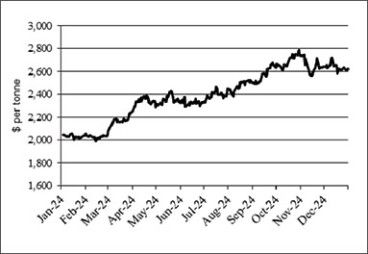
|
|
2024 |
|
2023 |
|
% Change |
|
||
High price |
|
$ |
2,778 |
|
$ |
2,078 |
|
33.7 |
% |
Low price |
|
$ |
1,985 |
|
$ |
1,811 |
|
9.6 |
% |
Average market price |
|
$ |
2,386 |
|
$ |
1,941 |
|
22.9 |
% |
Average realized price |
|
$ |
2,384 |
|
$ |
1,946 |
|
22.5 |
% |
MANAGEMENT’S DISCUSSION AND ANALYSIS AGNICO EAGLE 9
In 2024, the average market price per ounce of gold was 22.9% higher than in 2023. The Company’s average realized price per ounce of gold in 2024 was 22.5% higher than in 2023.
SILVER ($ per ounce)
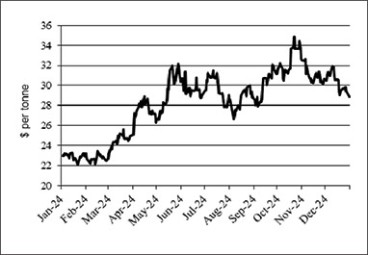
|
|
2024 |
|
2023 |
|
% Change |
|
||
High price |
|
$ |
34.51 |
|
$ |
26.07 |
|
32.4 |
% |
Low price |
|
$ |
22.09 |
|
$ |
20.09 |
|
10.0 |
% |
Average market price |
|
$ |
28.27 |
|
$ |
23.35 |
|
21.1 |
% |
Average realized price |
|
$ |
28.85 |
|
$ |
23.72 |
|
21.6 |
% |
In 2024, the average market price per ounce of silver was 21.1% higher than in 2023. The Company’s average realized price per ounce of silver in 2024 was 21.6% higher than in 2023.
By-product metals are mainly produced at LaRonde (silver, zinc and copper) and Pinos Altos (silver). Net by-product (primarily silver, zinc and copper) revenue is treated as a reduction of production costs in calculating total cash costs per ounce of gold produced on a by-product basis and all-in sustaining costs per ounce of gold produced on a by-product basis.
Changes in production volumes have a direct impact on the Company’s financial results. Payable production of gold was 3,485,336 ounces in 2024, an increase of 1.3% compared with 3,439,654 ounces in 2023. The increase is attributed to higher throughput, partially offset by lower grades and recovery in the current year when compared to prior year. Increased production in 2024 is mainly due to additional gold being produced at Meadowbank and Macassa and the contribution of production from Canadian Malartic following the Yamana Transaction, which closed on March 30, 2023. Partially offsetting the overall increase in gold production was a decrease in gold production at Fosterville and La India.
Production costs are discussed in detail in the Results of Operations section below.
Foreign Exchange Rates (Ratio to US$)
The exchange rate of the Canadian dollar, Australian dollar, Euro and Mexican peso relative to the US dollar is an important financial driver for the Company for the following reasons:
| ● | all revenues are earned in US dollars; |
| ● | a significant portion of operating costs at LaRonde, Canadian Malartic, Goldex, Meliadine, Meadowbank, Detour Lake and Macassa are incurred in Canadian dollars; |
| ● | a significant portion of operating costs at Fosterville are incurred in Australian dollars; |
| ● | a significant portion of operating costs at the Kittila mine are incurred in Euros, and |
| ● | a significant portion of operating costs at the Pinos Altos and La India are incurred in Mexican pesos. |
10 AGNICO EAGLE MANAGEMENT’S DISCUSSION AND ANALYSIS
The Company mitigates part of its foreign currency exposure by using currency hedging strategies.
On average, the Canadian dollar, Australian dollar, Euros and Mexican Pesos weakened relative to the US dollar in 2024 compared with 2023, decreasing costs denominated in the local currency when translated into US dollars for reporting purposes.
Agnico Eagle reported net income of $1,895.6 million, or $3.79 per share, in 2024 compared with net income of $1,941.3 million, or $3.97 per share in 2023 and net income of $670.2 million, or $1.53 per share in 2022. Agnico Eagle reported adjusted net income(i) of $2,117.8 million, or $4.24 per share(i), in 2024 compared with adjusted net income of $1,095.9 million, or $2.24 per share, in 2023 and adjusted net income of $1,003.6 million , or $2.29 per share in 2022.
EBITDA(i) totaled $4,462.4 million in the year ended December 31, 2024 compared with $3,980.9 million in 2023 and $2,293.0 million in 2022. Adjusted EBITDA(i) totaled $4,693.7 million in the year ended December 31, 2024 compared with $3,236.5 million in 2023 and $2,706.1 million in 2022. In 2024, operating margin(i) increased to $5,199.7 million from $3,693.6 million in 2023. In 2022, operating margin was $3,097.8 million.
Agnico Eagle reported free cash flow(i) of $2,142.9 million in 2024, compared with free cash flow of $947.4 million in 2023 and $558.4 million in 2022. Free cash flow before changes in non-cash components of working capital(i) totaled $2,062.9 million in 2024 compared with $1,093.8 million in 2023 and $577.6 million in 2022.
Notes:
| (i) | Adjusted net income, adjusted net income per share, EBITDA, adjusted EBITDA, free cash flow, free cash flow before changes in non-cash components of working capital and operating margin are non-GAAP measures or ratios that are not standardized financial measures or ratios under IFRS. For a reconciliation to net income, net income per share and cash provided by operating activities and discussion of the composition and usefulness of these non-GAAP measures or ratios see “Non-GAAP Financial Performance Measures”. |
MANAGEMENT’S DISCUSSION AND ANALYSIS AGNICO EAGLE 11
Revenues from Mining Operations
Revenues from mining operations, net of selling costs, increased by $1,658.8 million, or 25.0%, to $8,285.8 million in 2024 from $6,626.9 million in 2023 primarily due to a 22.5% increase in realized prices and a 2.1% increase in the sales volume of gold. The increased contribution of gold sales volume from Macassa, the additional 50% of Canadian Malartic, following the Yamana Transaction, and Meadowbank was partially offset by lower sales volume from Fosterville and La India. Revenues from mining operations were $5,741.2 million in 2022.
Sales of precious metals (gold and silver) accounted for 99.5% of revenues from mining operations in 2024, similar to the 99.6% in 2023 and 99.5% in 2022.
The table below sets out revenues from mining operations, payable production volumes and sales volumes by metal:
|
|
2024 |
|
2023 |
|
2022 |
|||
Revenues from mining operations: |
|
(thousands of United States dollars) |
|||||||
Gold |
|
$ |
8,174,102 |
|
$ |
6,540,077 |
|
$ |
5,656,201 |
Silver |
|
|
79,270 |
|
|
63,544 |
|
|
55,212 |
Zinc |
|
|
4,008 |
|
|
4,736 |
|
|
9,390 |
Copper |
|
|
28,373 |
|
|
18,552 |
|
|
20,359 |
Total revenues from mining operations |
|
$ |
8,285,753 |
|
$ |
6,626,909 |
|
$ |
5,741,162 |
Payable production: |
|
|
|
|
|
|
|
|
|
Gold (ounces) |
|
|
3,485,336 |
|
|
3,439,654 |
|
|
3,135,007 |
Silver (thousands of ounces) |
|
|
2,485 |
|
|
2,408 |
|
|
2.292 |
Zinc (tonnes) |
|
|
6,339 |
|
|
7,702 |
|
|
8,195 |
Copper (tonnes) |
|
|
3,951 |
|
|
2,617 |
|
|
2,901 |
Payable metal sold(ii): |
|
|
|
|
|
|
|
|
|
Gold (ounces) |
|
|
3,434,094 |
|
|
3,364,132 |
|
|
3,148,593 |
Silver (thousands of ounces) |
|
|
2,483 |
|
|
2,354 |
|
|
2.354 |
Zinc (tonnes) |
|
|
6,209 |
|
|
8,526 |
|
|
6,727 |
Copper (tonnes) |
|
|
3,952 |
|
|
2,630 |
|
|
2,916 |
| (ii) | Canadian Malartic’s payable metal sold excludes the 5.0% in-kind net smelter return royalty held by Osisko Gold Royalties Ltd. Detour Lake’s payable metal sold excludes the 2% in-kind net smelter royalty held by Franco-Nevada Corporation. Macassa’s payable metal sold excludes the 1.5% in-kind net smelter royalty held by Franco-Nevada Corporation. |
Revenues from gold, net of selling costs, increased by $1,634.0 million or 25.0% in 2024 compared with 2023 primarily due to higher gold prices and an increase in the sales volume of gold which was the result of increased contribution of gold sales volume from Macassa, the additional 50% of Canadian Malartic, following the Yamana Transaction, and Meadowbank,being partially offset by lower sales volume from Fosterville and La India. The Company’s average realized price of gold increased by 22.5% to $2,384 in 2024 compared to $1,946 in 2023, and the sales volume of gold increased by 2.1% to 3,434,094 ounces in 2024 compared to 3,364,132 ounces in 2023.
Revenues from silver, net of selling costs, increased by $15.7 million or 24.8% in 2024 compared with 2023 primarily due to a 21.6% increase in the average realized price of silver between periods.
Production costs increased to $3,086.1 million in 2024 compared with $2,933.3 million in 2023 with the increase due to the contribution from the additional 50% of Canadian Malartic, following the Yamana Transaction, and higher production costs mainly at Macassa and Detour Lake, partially offset by lower production costs at Meadowbank and La India. Production costs were $2,643.3 million in 2022 which included fair value adjustments to inventory at Detour Lake and Fosterville.
Production costs increased in 2024 when compared to the prior-year period primarily due to higher royalties arising from higher gold prices combined with increased contractor and labour costs related to underground mining operations, partially offset by the benefit of the weaker Canadian dollar during the period. For a more detailed discussion of production costs and cost metrics by mine see Minesite Discussion section below.
12 AGNICO EAGLE MANAGEMENT’S DISCUSSION AND ANALYSIS
The table below sets out production costs by mine:
|
|
2024 |
|
2023 |
|
2022 |
|||
|
|
(thousands of United States dollars) |
|||||||
LaRonde mine |
|
$ |
239,309 |
|
$ |
218,020 |
|
$ |
213,393 |
LZ5 |
|
|
80,186 |
|
|
81,624 |
|
|
72,096 |
LaRonde |
|
|
319,495 |
|
|
299,644 |
|
|
285,489 |
Canadian Malartic(i) |
|
|
532,037 |
|
|
465,814 |
|
|
235,735 |
Goldex |
|
|
129,977 |
|
|
112,022 |
|
|
103,830 |
Meliadine |
|
|
350,280 |
|
|
343,650 |
|
|
318,141 |
Meadowbank |
|
|
463,464 |
|
|
524,008 |
|
|
442,681 |
Kittila |
|
|
227,334 |
|
|
205,857 |
|
|
210,661 |
Detour Lake(ii) |
|
|
497,079 |
|
|
453,498 |
|
|
489,703 |
Macassa(ii) |
|
|
201,371 |
|
|
155,046 |
|
|
129,774 |
Fosterville(ii) |
|
|
147,045 |
|
|
131,298 |
|
|
204,649 |
Pinos Altos |
|
|
168,231 |
|
|
145,936 |
|
|
144,489 |
Creston Mascota |
|
|
— |
|
|
— |
|
|
1,943 |
La India |
|
|
49,767 |
|
|
96,490 |
|
|
76,226 |
Total production costs |
|
$ |
3,086,080 |
|
$ |
2,933,263 |
|
$ |
2,643,321 |
Notes:
| (i) | The information set out in this table reflects the Company’s 50% interest in Canadian Malartic up to and including the closing of the Yamana transaction on March 30, 2023 and 100% interest thereafter. |
| (ii) | The information set out in this table reflects the Company’s acquisition of the Detour Lake, Macassa and Fosterville in the Merger, following its closing on February 8, 2022. |
The table below sets out the major components of production costs:
Total Production Costs by Category 2024

MANAGEMENT’S DISCUSSION AND ANALYSIS AGNICO EAGLE 13
Exploration and Corporate Development Expense
Exploration and corporate development expense increased by 1.8% to $219.6 million in 2024 from $215.8 million in 2023. Exploration and corporate development expense was $271.1 million in 2022.
A summary of the Company’s significant 2024 exploration and corporate development activities is set out below:
| ● | Exploration expenses at various mine sites decreased by 30.9% to $39.0 million in 2024 compared with $56.5 million in 2023 primarily due to lower expensed exploration at Hope Bay and Meadowbank, partially offset by higher expensed exploration at Fosterville. |
| ● | Exploration expenses in Canada increased by 26.4% to $100.5 million in 2024 compared with $79.5 million in 2023 primarily due to higher expensed exploration drilling at regional targets at Hope Bay and Canadian Malartic. |
| ● | Increased exploration expenses in regional targets located in Europe, Australia and in the United States were offset by decreased exploration expenses in Latin America. |
| ● | Corporate development and project evaluation expenses increased by 1.8% to $54.0 million in 2024 compared with $53.0 million in 2023 primarily due to increased project evaluation expenses at projects in Canada. |
The table below sets out exploration expense by region and total corporate development expense:
|
|
2024 |
|
2023 |
|
2022 |
|||
|
|
(thousands of United States dollars) |
|||||||
Minesites |
|
$ |
39,003 |
|
$ |
56,475 |
|
$ |
63,066 |
Canada |
|
|
100,484 |
|
|
79,509 |
|
|
107,305 |
Latin America |
|
|
10,221 |
|
|
13,585 |
|
|
24,147 |
United States |
|
|
4,670 |
|
|
4,177 |
|
|
5,807 |
Europe |
|
|
6,167 |
|
|
4,986 |
|
|
9,939 |
Australia |
|
|
5,088 |
|
|
4,033 |
|
|
4,212 |
Corporate development and project evaluation expenses |
|
|
53,977 |
|
|
53,016 |
|
|
56,641 |
Total exploration and corporate development expense |
|
$ |
219,610 |
|
$ |
215,781 |
|
$ |
271,117 |
Amortization of Property, Plant and Mine Development
Amortization of property, plant and mine development expense increased to $1,514.1 million in 2024 compared with $1,491.8 million in 2023 and $1,094.7 million in 2022. The increase in amortization of property, plant and mine development between 2024 and 2023 was primarily due to higher amortization at Detour Lake, Meliadine and LaRonde partially offset by decreases at Meadowbank, La India and Pinos Altos.
General and Administrative Expense
General and administrative expenses were $207.5 million in 2024 essentially unchanged from expenses of $208.5 million in 2023. General and administrative expenses were $220.9 million in 2022.
Finance costs were $126.7 million in 2024 compared with $130.1 million in 2023 and $82.9 million in 2022. The decrease between 2024 and 2023 was primarily due to a decrease in interest expense under the Old Credit Facility and Credit Facility (the “Credit Facilities”) following reduced drawdowns in 2024 and a decrease in interest expense on the Company’s guaranteed senior unsecured notes (the “Notes”) as the $100.0 million owing under the 2012 Series B Notes was repaid in July 2024, partially offset by an increase in interest expense on the Term Loan Facility.
14 AGNICO EAGLE MANAGEMENT’S DISCUSSION AND ANALYSIS
The table below sets out the components of finance costs:
|
|
2024 |
|
2023 |
|
2022 |
|||
Interest on Notes |
|
$ |
53,229 |
|
$ |
57,192 |
|
$ |
64,481 |
Interest on Term Loan Facility |
|
|
32,712 |
|
|
26,273 |
|
|
— |
Interest on Credit Facilities |
|
|
3,350 |
|
|
10,928 |
|
|
536 |
Credit Facilities fees |
|
|
6,167 |
|
|
6,374 |
|
|
3,859 |
Amortization of credit and term loan facilities financing and note issuance costs |
|
|
3,845 |
|
|
3,290 |
|
|
3,042 |
Accretion expense on reclamation provisions |
|
|
33,815 |
|
|
32,906 |
|
|
15,951 |
Interest on lease obligations and other interest expense (income) |
|
|
(3,566) |
|
|
(3,699) |
|
|
(1,290) |
Interest capitalized to assets under construction |
|
|
(2,814) |
|
|
(3,177) |
|
|
(3,644) |
Total finance costs |
|
$ |
126,738 |
|
$ |
130,087 |
|
$ |
82,935 |
See Note 14 in the consolidated financial statements for additional details on the Company’s Credit Facilities, the Term Loan Facility and Notes referenced above.
Derivative Financial Instruments
Loss on derivative financial instruments was $155.8 million in 2024 compared to a gain on derivative financial instruments of $68.4 million in 2023 and a loss of $90.7 million in 2022. The change between 2024 and 2023 was primarily due to unrealized losses on foreign exchange and fuel hedges of $142.4 million in 2024 compared to unrealized gains on foreign exchange and fuel hedges of $112.9 million in 2023. This was partially offset by unrealized gains of $20.4 million on warrants in 2024 compared to $11.2 million in unrealized losses on warrants in the prior year.
During the fourth quarter of 2024, the Company completed its goodwill impairment testing and its review of indicators of potential impairment of the Company’s cash generating units (“CGUs”). The Company did not identify any indicators of potential impairment and no impairment losses were recorded for the year ended December 31, 2024.
As at December 31, 2023, the Company identified indicators of potential impairment for the Company’s Pinos Altos mine. As a result of the identification of these indicators, the Company estimated the recoverable amount of this CGU and the recoverable amount was calculated to be less than the carrying amount. The Company recognized an impairment loss of $112.0 million ($73.4 million net of tax) against property, plant and mine development. The Company completed its goodwill impairment testing and the recoverable amount for the Macassa CGU was calculated to be less than the carrying amount. An impairment loss of $675.0 million ($594.0 million net of tax) was recognized against the Macassa CGU, of which $420.9 million was recognized against goodwill and $254.1 million ($173.1 million net of tax) was recognized against property, plant and mine development costs.
As at December 31, 2022, the Company identified indicators of potential impairment for the Company’s La India mine. As a result of the identification of these indicators, the Company estimated the recoverable amount of this CGU and concluded that the carrying amounts exceeded its recoverable amount. The Company recorded an impairment loss of $55.0 million ($52.7 million net of tax) at the La India mine.
Management’s estimates of recoverable amounts are subject to risk and uncertainties. Therefore, it is reasonably possible that changes could occur which may affect the recoverability of the Company’s long-lived assets and goodwill. This may have a material effect on the Company’s future financial results.
See Note 24 in the consolidated financial statements for further details on impairment losses.
Foreign Currency Translation Loss (Gain)
The Company’s operating results and cash flow are significantly affected by changes in the exchange rate between the US dollar and each of the Canadian dollar, Australian dollar, Euro and Mexican peso as all of the Company’s revenues are earned in US dollars while a significant portion of its operating and capital costs are incurred in such other currencies. During the period from January 1, 2024 through December 31, 2024, the daily US dollar closing exchange rate per US$1.00 fluctuated between C$1.33 and C$1.44 as reported by the Bank of Canada, A$1.44 and A$1.61 as reported by the Reserve Bank of Australia, €0.89 and €0.96 as reported by the European Central Bank and 16.34 and 20.72 Mexican pesos as reported by the Central Bank of Mexico.
MANAGEMENT’S DISCUSSION AND ANALYSIS AGNICO EAGLE 15
A foreign currency translation loss of $9.4 million was recorded in 2024 compared with a $0.3 million gain in 2023 and a $16.1 million gain in 2022. On average in 2024, the US dollar strengthened relative to the Canadian dollar, the Australian dollar and the Mexican peso. As at December 31, 2024, the US dollar strengthened relative to the Canadian dollar, the Australian dollar, the Euro and the Mexican peso as compared to December 31, 2023. The net foreign currency translation loss in 2024 was primarily due to the translation impact on the Company’s net monetary assets denominated in foreign currencies between periods.
Other expenses increased to $84.5 million in the year ended December 31, 2024 compared with $66.3 million in the year ended December 31, 2023, primarily due to increased disposals of property, plant and mine equipment. Other expenses amounted to $141.3 million in the year ended December 31, 2022, which included non-recurring severance and acquisition costs associated with the Merger in 2022.
Income and Mining Taxes Expense
In 2024, the Company recorded income and mining taxes expense of $926.0 million on income before income and mining taxes of $2,821.6 million at an effective tax rate of 32.8%. In 2023, the Company recorded income and mining taxes expense of $417.8 million on income before income and mining taxes of $2,359.1 million at an effective tax rate of 17.7%. The Company’s 2024 effective tax rate is higher than the applicable statutory tax rate of 26.0% due to the impact of mining taxes. The Company’s 2023 effective tax rate is lower than the applicable statutory tax rate of 26.0% due to the non-taxable accounting gain resulting from the Yamana Transaction. In 2022, the Company recorded income and mining taxes expense of $445.2 million on income before income and mining taxes of $1,115.4 million at an effective tax rate of 39.9%.
(thousands of United States dollars) |
|
As at December 31, 2024 |
|
As at December 31, 2023 |
|
As at December 31, 2022 |
|||
Current assets |
|
$ |
2,805,281 |
|
$ |
2,191,152 |
|
$ |
2,180,059 |
Non-current assets |
|
|
27,181,737 |
|
|
26,493,797 |
|
|
21,314,749 |
Total assets |
|
$ |
29,987,018 |
|
$ |
28,684,949 |
|
$ |
23,494,808 |
Current liabilities |
|
$ |
1,511,965 |
|
$ |
1,048,026 |
|
$ |
946,422 |
Non-current liabilities |
|
|
7,642,153 |
|
|
8,214,008 |
|
|
6,307,041 |
Total liabilities |
|
$ |
9,154,118 |
|
$ |
9,262,034 |
|
$ |
7,253,463 |
Total assets at December 31, 2024 of $30.0 billion increased by 4.5%, or $1.3 billion compared with total assets of $28.7 billion at December 31, 2023. The Company’s total assets are primarily comprised of non-current assets such as property, plant and mine development and goodwill.
Total liabilities at December 31, 2024 of $9.2 billion decreased by 1.2%, or $0.1 billion compared with total liabilities of $9.3 billion at December 31, 2023. The Company’s total liabilities are primarily comprised of non-current liabilities such as deferred income and mining tax liabilities, long-term debt and reclamation provisions.
The increase in total assets between December 31, 2024 and December 31, 2023 was primarily due to an increase in cash and cash equivalents and increases in current and non-current inventory balances. The decrease in total liabilities between December 31, 2024 and December 31, 2023 is primarily due to the repayment of the $600.0 million Term Loan Facility in 2024.
Both total assets and total liabilities at December 31, 2023 increased compared with total assets and total liabilities at December 31, 2022 primarily due to the assets acquired and liabilities assumed as part of the Yamana Transaction.
16 AGNICO EAGLE MANAGEMENT’S DISCUSSION AND ANALYSIS
Liquidity and Capital Resources
As at December 31, 2024, the Company’s cash and cash equivalents totaled $926.4 million compared with $338.6 million as at December 31, 2023. The Company’s policy is to invest excess cash in what the Company believes to be highly liquid investments of high credit quality to attempt to reduce risks associated with these investments. Investments with remaining maturities of less than three months at the time of purchase are classified as cash equivalents. The Company’s decisions regarding the length of maturities it holds are based on cash flow requirements, rates of return and other factors.
Working capital (current assets less current liabilities) increased to $1,293.3 million as at December 31, 2024, compared with $1,143.1 million as at December 31, 2023, primarily due to a $587.8 million increase in cash and cash equivalents from a 22.5% increase in the realized gold price and a 2.1% increase in the sales volume of gold. The increase in cash and cash equivalents was partially offset by a $291.0 million increase in income tax payable and a $142.4 million increase in net derivative financial instrument liabilities.
Subject to various risks and uncertainties, including those set in this Annual MD&A and in the Company’s AIF, the Company believes it will generate sufficient cash flow from operations and has adequate cash and debt facilities available to finance its current operations, working capital requirements, contractual obligations, debt maturities, planned capital expenditure and exploration programs. While the Company believes its capital resources will be sufficient to satisfy all its mandatory and discretionary commitments, the Company may choose to decrease certain of its discretionary expenditure commitments, which include certain capital expenditures and exploration and corporate development expenses, should unexpected financial circumstances arise in the future. See “Risk Profile” in this MD&A for further details.
Cash provided by operating activities increased by $1,359.3 million to $3,960.9 million in 2024 compared with $2,601.6 million in 2023. The increase in cash provided by operating activities was primarily due to higher gold prices, a 2.1% increase in the sales volume of gold and favourable working capital movements. Cash provided by operating activities was $2,096.6 million in 2022.
Cash used in investing activities decreased to $2,007.1 million in 2024 compared to $2,760.8 million in 2023. The decrease in cash used in investing activities between periods was primarily due to $1,000.6 million in non-recurring net cash consideration paid by the Company in the Yamana Transaction in 2023, partially offset by a $163.8 million increase in additions to property, plant and mine development and a $78.3 million increase in purchases of equity securities and other investments between periods. Cash used in investing activities was $710.5 million in 2022, which included $1,538.2 million of additions to property, plant and mine development, partially offset by $838.7 million in non-recurring cash and cash equivalents acquired in the Merger.
In 2024, additions to property, plant and mine development totaled $1,817.9 million compared with $1,654.1 million in 2023. The $163.8 million increase in additions to property, plant and mine development between 2024 and 2023 was primarily due to increases at Detour Lake and Canadian Malartic.
In 2024, the Company purchased $183.0 million of equity securities and other investments compared with $104.7 million in 2023 and $47.4 million in 2022. The Company’s investments in equity securities consist primarily of investments in common shares of entities in the mining industry.
Cash used in financing activities increased to $1,356.3 million in 2024 compared to $164.0 million in 2023 primarily due to the $600.0 million repayment of the Term Loan Facility in 2024 originally drawn down in 2023. Cash used in financing activities was $914.9 million in 2022.
The Company issued common shares for net proceeds of $235.5 million in 2024 compared to $70.3 million in 2023, attributable to employee stock option plan exercises, issuances under the incentive share purchase plan and the dividend reinvestment plan. Net proceeds from the issuance of common shares were $62.1 million in 2022.
On May 1, 2024, the Company received approval from the TSX to renew its normal course issuer bid (“NCIB”), pursuant to which the Company may purchase up to $500.0 million of its common shares subject to a maximum of 5% of its issued and outstanding common shares. Under the NCIB, the Company may purchase such common shares on the open market at its discretion, during the period starting on May 4, 2024 and ending on May 3, 2025.
MANAGEMENT’S DISCUSSION AND ANALYSIS AGNICO EAGLE 17
Purchases under the NCIB may be made through the facilities of the TSX, the New York Stock Exchange or other designated exchanges and alternative trading systems in Canada and the United States in accordance with applicable regulatory requirements. All common shares purchased under the NCIB will be cancelled.
During the year ended December 31, 2024, the Company repurchased 1,749,086 common shares for $119.9 million at an average price of $68.54 under the NCIB. During the year ended December 31, 2023, the Company repurchased 100,000 common shares for $4.8 million at an average price of $47.74 under the NCIB. During the year ended December 31, 2022, the Company repurchased 1,569,620 common shares for $69.9 million at an average price of $44.53 under the NCIB.
In 2024, the Company declared dividends of $1.60 per share and paid cash dividends totaling $671.7 million compared with dividends declared of $1.60 per share and cash dividends paid of $638.6 million in 2023. In 2022, the Company declared dividends of $1.60 per share and paid cash dividends totaling $608.3 million. Agnico Eagle has declared a cash dividend every year since 1983. Although the Company expects to continue paying dividends, future dividends will be at the discretion of the Board and will be subject to factors such as income, financial condition and capital requirements.
On February 12, 2024, the Company terminated its Old Credit Facility and entered into the Credit Facility. The Credit Facility matures and all indebtedness thereunder is due and payable on February 12, 2029. The Credit Facility is available in US dollars through Secured Overnight Financing Rate (“SOFR”) and base rate advances, or in Canadian dollars through Canadian Overnight Repo Rate Average (“CORRA”) and prime rate advances, priced at the applicable rate plus a margin that ranges from 0.00% to 2.00%. The Credit Facility also provides for the issuance of letters of credit, priced at the applicable rate plus a margin that varies from 0.60% to 2.00%. The lenders under the Credit Facility are each paid a standby fee at a rate that ranges from 0.09% to 0.25% of the undrawn portion of the Credit Facility. In each case, the applicable margin or standby fees vary depending on the Company’s credit rating. The Company’s payment and performance of its obligations under the Credit Facility are not guaranteed by any of its subsidiaries, however the Company must provide guarantees from certain of its subsidiaries (i) if any existing material indebtedness of the Company benefits from guarantees and the Company no longer maintains an investment grade credit rating, (ii) or if the Company incurs new material indebtedness for borrowed money, or refinances existing material indebtedness (including material alterations to the terms of such indebtedness, but excluding maturity date extensions), and provides guarantees of such new or refinanced indebtedness from any of its subsidiaries.
On April 20, 2023, the Company entered into a credit agreement with two financial institutions that provided the $600.0 million Term Loan Facility. The Company drew the full amount available when the Term Loan Facility on April 28, 2023. The Term Loan Facility matured and all indebtedness thereunder was to become due and payable on April 21, 2025. The Term Loan Facility was made available as a single advance in US dollars through SOFR and base rate advances, priced at the applicable rate plus a margin that ranges from 0.00% to 2.00%, depending on the Company’s credit rating. On February 12, 2024, the Term Loan Facility was amended to align with the Company’s Credit Facility. During the year ended December 31, 2024, the Company fully repaid the Term Loan Facility.
As at December 31, 2024, the Company’s outstanding balance under the Credit Facility was nil. Credit Facility availability is reduced by outstanding letters of credit which were $23.5 million as of December 31, 2024, resulting in $1,976.5 million available for future drawdown.
Effective September 20, 2022, the Company amended its credit agreement with a financial institution relating to an uncommitted letter of credit facility (as amended, the “First LC Facility”) to increase the amount available to C$400.0 million. The First LC Facility may be used to support the reclamation obligations or non-financial or performance obligations of the Company or its subsidiaries. As at December 31, 2024, the aggregate undrawn face amount of letters of credit under the First LC Facility is $276.9 million.
Effective September 16, 2021, the Company amended its uncommitted standby letter of credit facility (as amended, the “Second LC Facility”) to increase the amount available to C$200.0 million. Payment and performance of the Company’s obligations under the Second LC Facility are supported by an account performance security guarantee issued by Export Development Canada in favour of the lender. The Second LC Facility may be used by the Company to support the reclamation obligations of the Company, its subsidiaries or any entity in which the Company has a direct or indirect interest or the performance obligations (other than with respect to indebtedness for borrowed money) of the Company, its subsidiaries or any entity in which the Company has a direct or indirect interest that are not directly related to reclamation obligations. As at December 31, 2024, the aggregate undrawn face amount of letters of credit under the Second LC Facility is nil.
Effective May 25, 2023, the Company amended its uncommitted standby letter of credit facility with a financial institution (the “Third LC Facility”) to increase the amount available to C$200.0 million. Letters of credit issued under the Third LC Facility may be used to support the reclamation obligations or non-financial or performance obligations of the Company or its subsidiaries; however the subsidiary guarantees were released in connection with the entry into the New Credit Facility.
18 AGNICO EAGLE MANAGEMENT’S DISCUSSION AND ANALYSIS
As at December 31, 2024, the aggregate undrawn face amount of letters of credit under the Third LC Facility was $114.8 million.
In October 2021, the Company entered into a $75.0 million uncommitted standby letter of credit facility (the “Fourth LC Facility”) with a financial institution. Letters of credit issued under the Fourth LC Facility may be used to support the reclamation obligations or non-financial or performance obligations of the Company or its subsidiaries. In October 2024, the Fourth LC Facility was amended to increase the amount available to $150.0 million. As at December 31, 2024, the aggregate undrawn face amount of letters of credit under the Fourth LC Facility was $65.0 million.
In January 2022, the Company entered into a C$100.0 million uncommitted standby letter of credit facility (the “Fifth LC Facility”) with a financial institution. Upon the acquisition of Kirkland in February 2022, the Company acquired a standby letter of credit facility with the same financial institution providing for an additional C$120.0 million uncommitted letter of credit facility for the Kirkland subsidiary. Effective September 2022, an amended and restated standby letter of facility combined these facilities and the amount available under the amended and restated facility was increased to C$320.0 million. Letters of credit issued under the Fifth LC Facility may be used to support the reclamation obligations or non-financial or performance obligations of the Company or its subsidiaries. As at December 31, 2024, the aggregate undrawn face amount of letters of credit under the Fifth LC Facility was $202.5 million.
The obligations of the Company under each of the LC Facilities other than then Second LC Facility were guaranteed by certain of its subsidiaries, however in connection with the Company’s entry into the Credit Facility on February 24, 2024, these subsidiary guarantees were released.
In February 2022, upon the acquisition of Kirkland, the Company acquired a standby letter of guarantee facility (the “Guarantee Facility”) with a financial institution providing for a $25.0 million uncommitted letter of guarantee facility. Guarantees issued under the Guarantee Facility may be used to support the reclamation obligations or non-financial or performance obligations of certain subsidiaries of the Company. The obligations of the Company under this Guarantee Facility were guaranteed by certain of its subsidiaries; however the subsidiary guarantees were released in connection with the entry into the Credit Facility. In October 2024, the Company entered into a $200.0 million uncommitted standby letter of credit facility (the “Sixth LC Facility” and, together with the First LC Facility, the Second LC Facility, the Third LC Facility, the Fourth LC Facility and the Fifth LC Facility, the “LC Facilities”) with a financial institution, which superseded and canceled the Guarantee Facility. As at December 31, 2024, the aggregate undrawn face amount of letters of credit under the Sixth LC Facility was $27.8 million.
As at December 31, 2024, the Company has indemnity agreements with three companies for the issuance of surety bonds of which $321.8 million of such surety bonds have been issued under these agreements.
The Company was in compliance with all covenants contained in the Credit Facility, Term Loan Facility, the LC Facilities, and the Notes as at December 31, 2024.
Off-Balance Sheet Arrangements
The Company’s off-balance sheet arrangements as at December 31, 2024 include outstanding letters of credit for environmental and site restoration costs, custom credits, government grants and other general corporate purposes of $1,035.6 million under the Credit Facility and the LC Facilities (see Note 27 to the consolidated financial statements). If the Company were to terminate these off-balance sheet arrangements, the Company’s liquidity position (as outlined in the table below) is sufficient to satisfy any related penalties or obligations.
MANAGEMENT’S DISCUSSION AND ANALYSIS AGNICO EAGLE 19
Agnico Eagle’s contractual obligations as at December 31, 2024 are set out below:
|
|
Total |
|
2025 |
|
2026-2027 |
|
2028-2029 |
|
Thereafter |
|||||
|
|
(millions of United States dollars) |
|||||||||||||
Reclamation provisions(i) |
|
$ |
1,077.9 |
|
$ |
57.4 |
|
$ |
151.5 |
|
$ |
111.9 |
|
$ |
757.1 |
Contractual commitments(ii) |
|
|
478.9 |
|
|
412.4 |
|
|
49.5 |
|
|
9.9 |
|
|
7.1 |
Pension obligations(iii) |
|
|
97.9 |
|
|
7.2 |
|
|
7.7 |
|
|
28.3 |
|
|
54.7 |
Lease obligations |
|
|
136.4 |
|
|
42.3 |
|
|
34.2 |
|
|
19.3 |
|
|
40.6 |
Long-term debt - principal(iv) |
|
|
1,150.0 |
|
|
90.0 |
|
|
300.0 |
|
|
245.0 |
|
|
515.0 |
Long-term debt - interest(iv) |
|
|
223.2 |
|
|
48.5 |
|
|
75.3 |
|
|
52.8 |
|
|
46.6 |
Total(v) |
|
$ |
3,164.3 |
|
$ |
657.8 |
|
$ |
618.2 |
|
$ |
467.2 |
|
$ |
1,421.1 |
Notes:
| (i) | Mining operations are subject to environmental regulations that require companies to reclaim and remediate land disturbed by mining operations. The Company has submitted closure plans to the appropriate governmental agencies which estimate the nature, extent and costs of reclamation for each of its mining properties. Expected reclamation cash flows are presented above on an undiscounted basis. Reclamation provisions recorded in the Company’s consolidated financial statements are measured at the expected value of future cash flows discounted to their present value using a risk-free interest rate. |
| (ii) | Purchase commitments include contractual commitments for the acquisition of property, plant and mine development. In addition to the above, the Company has $290.0 million of committed subscription proceeds related to the San Nicolás project. |
| (iii) | Agnico Eagle provides defined benefit plans for certain current and former senior officers and certain employees. The benefits are generally based on the employee’s years of service, age and level of compensation. The data included in this table have been actuarially determined. |
| (iv) | The Company has assumed that repayment of its long-term debt obligations will occur on each instrument’s respective maturity date. |
| (v) | The Company’s future operating cash flows are expected to be sufficient to satisfy its contractual obligations. |
2025 Liquidity and Capital Resources Analysis
The Company believes that it has sufficient capital resources to satisfy its 2025 mandatory expenditure commitments (including the contractual obligations set out above) and discretionary expenditure commitments. The following table sets out expected capital requirements and resources for 2025:
|
|
Amount |
|
|
|
(millions of United States dollars) |
|
2025 Mandatory Commitments: |
|
|
|
Contractual obligations, including capital expenditures (see table above) |
|
$ |
657.8 |
Accounts payable and accrued liabilities (as at December 31, 2024) |
|
|
817.6 |
Total 2025 mandatory expenditure commitments |
|
$ |
1,475.4 |
2025 Discretionary Commitments: |
|
|
|
Expected capital expenditures |
|
$ |
2,150.0 |
Expected exploration and corporate development expenses |
|
|
225.0 |
Total 2025 discretionary expenditure commitments |
|
|
2,375.0 |
Total 2025 mandatory and discretionary expenditure commitments |
|
$ |
3,850.4 |
As of December 31, 2024, the Company believes it had adequate capital resources available to satisfy its commitments, which include cash, cash equivalents and short-term investments of $933.7 million, working capital (excluding cash, cash equivalents and short-term investments) of $359.6 million and approximately $2.0 billion of available credit under the Credit Facility. In addition, the Company anticipates funding its commitments through cash provided by operating activities.
While the Company believes its capital resources will be sufficient to satisfy all 2025 commitments (mandatory and discretionary), the Company may choose to decrease certain of its discretionary expenditure commitments, which include certain capital expenditures and exploration and corporate development expenses, should unexpected financial circumstances arise in the future. The Company believes that it will continue to have sufficient capital resources available to satisfy its planned development and growth activities.
20 AGNICO EAGLE MANAGEMENT’S DISCUSSION AND ANALYSIS
LaRonde mine
LaRonde mine – Operating Statistics |
|
Three Months Ended |
|
Year Ended |
||||||||
|
|
December 31, |
|
December 31, |
|
December 31, |
|
December 31, |
||||
|
|
2024 |
|
2023 |
|
2024 |
|
2023 |
||||
Tonnes of ore milled (thousands of tonnes) |
|
|
405 |
|
|
400 |
|
|
1,554 |
|
|
1,501 |
Tonnes of ore milled per day |
|
|
4,402 |
|
|
4,348 |
|
|
4,246 |
|
|
4,112 |
Gold grade (g/t) |
|
|
5.47 |
|
|
5.75 |
|
|
4.91 |
|
|
5.23 |
Gold production (ounces) |
|
|
66,124 |
|
|
68,520 |
|
|
227,512 |
|
|
235,991 |
Production costs per tonne (C$) |
|
C$ |
158 |
|
C$ |
162 |
|
C$ |
210 |
|
C$ |
196 |
Minesite costs per tonne (C$) |
|
C$ |
211 |
|
C$ |
208 |
|
C$ |
208 |
|
C$ |
201 |
Production costs per ounce |
|
$ |
693 |
|
$ |
699 |
|
$ |
1,052 |
|
$ |
924 |
Total cash costs per ounce |
|
$ |
780 |
|
$ |
814 |
|
$ |
889 |
|
$ |
840 |
Gold production
Fourth Quarter of 2024 – At the LaRonde mine, gold production decreased by 3.5% to 66,124 ounces in the fourth quarter of 2024, compared with 68,520 ounces in the fourth quarter of 2023, primarily due to lower gold grades, as expected under the planned mining sequence, partially offset by higher throughput levels.
Year Ended 2024 – Gold production decreased by 3.6% to 227,512 ounces in the year ended 2024, compared with 235,991 ounces in the year ended 2023 at the LaRonde mine primarily due to lower gold grades, as expected under the planned mining sequence, and recovery, partially offset by higher throughput levels.
Production costs
Fourth Quarter of 2024 – Production costs at the LaRonde mine were $45.8 million in the fourth quarter of 2024, a decrease of 4.3% compared with production costs of $47.9 million in the fourth quarter of 2023, primarily due to the timing of inventory sales and the weakening of the Canadian dollar relative to the US dollar between periods, partially offset by higher underground maintenance costs.
Production costs per tonne decreased when compared to the prior-year period primarily due to the higher volume of ore milled in the current period. Production costs per ounce decreased when compared to the prior-year period due to the same reasons outlined above for production costs, partially offset by fewer ounces of gold produced in the current period.
Year Ended 2024 – Production costs at the LaRonde mine were $239.3 million in the year ended 2024, an increase of 9.8% compared with production costs of $218.0 million in the year ended 2023, primarily due to timing of inventory sales, the consumption of stockpiles, which results in the incurrance of re-handling costs, and higher underground maintenance costs, partially offset by the weakening of the Canadian dollar relative to the US dollar between periods.
Production costs per tonne increased when compared to the prior-year period due to the reasons outlined above, other than foreign exchanges effects between periods, partially offset by higher volume of ore milled in the current period. Production costs per ounce increased when compared to the prior-year period due to the reasons outlined above and fewer ounces of gold produced in the current period.
Minesite cost per tonne and total cash costs per ounce
Fourth Quarter of 2024 – Minesite costs per tonne increased when compared to the prior-year period primarily due to higher underground mining costs, partially offset by the higher volume of ore milled. Total cash costs per ounce decreased for the same reasons described above for production costs per ounce.
Year Ended 2024 – Minesite costs per tonne increased when compared to the prior-year period primarily due to the consumption of stockpiles, including re-handling costs, and higher underground and mill maintenance costs, partially offset by the higher volume of ore milled. Total cash costs per ounce increased for the same reasons described above for production costs per ounce.
MANAGEMENT’S DISCUSSION AND ANALYSIS AGNICO EAGLE 21
LZ5
LZ5 – Operating Statistics |
|
Three Months Ended |
|
Year Ended |
||||||||
|
|
December 31, |
|
December 31, |
|
December 31, |
|
December 31, |
||||
|
|
2024 |
|
2023 |
|
2024 |
|
2023 |
||||
Tonnes of ore milled (thousands of tonnes) |
|
|
397 |
|
|
263 |
|
|
1,295 |
|
|
1,157 |
Tonnes of ore milled per day |
|
|
4,315 |
|
|
2,859 |
|
|
3,538 |
|
|
3,170 |
Gold grade (g/t) |
|
|
2.06 |
|
|
2.16 |
|
|
2.06 |
|
|
2.01 |
Gold production (ounces) |
|
|
24,323 |
|
|
17,245 |
|
|
79,238 |
|
|
70,657 |
Production costs per tonne (C$) |
|
C$ |
78 |
|
C$ |
98 |
|
C$ |
85 |
|
C$ |
95 |
Minesite costs per tonne (C$) |
|
C$ |
81 |
|
C$ |
80 |
|
C$ |
90 |
|
C$ |
91 |
Production costs per ounce |
|
$ |
910 |
|
$ |
1,097 |
|
$ |
1,012 |
|
$ |
1,155 |
Total cash costs per ounce |
|
$ |
980 |
|
$ |
965 |
|
$ |
1,105 |
|
$ |
1,148 |
Gold production
Fourth Quarter of 2024 – At LZ5, gold production increased by 41.0% to 24,323 ounces in the fourth quarter of 2024 compared with 17,245 ounces in the fourth quarter of 2023, primarily due to higher throughput levels from increased productivity gains from automation initiatives, partially offset by lower gold grades.
Year Ended 2024 – Gold production increased by 12.1% to 79,238 ounces in the year ended 2024 from 70,657 ounces in the year ended 2023 at LZ5 primarily due to higher throughput levels from increased productivity gains from automation initiatives and higher gold grades partially offset by lower recovery.
Production costs
Fourth Quarter of 2024 – Production costs at LZ5 were $22.1 million in the fourth quarter of 2024, an increase of 16.9% compared with production costs of $18.9 million in the fourth quarter of 2023, primarily due to the consumption of stockpiles, including re-handling costs and higher milling costs, partially offset by the weakening of the Canadian dollar relative to the US dollar between periods.
Production costs per tonne decreased when compared to the prior-year period primarily due to the higher volume of ore milled in the current period, partially offset by the consumption of stockpiles, including re-handling costs, in the current period. Production costs per ounce decreased when compared to the prior-year period due to more ounces of gold produced in the current period, partially offset by the consumption of stockpiles, including re-handling costs, in the current period.
Year Ended 2024 – Production costs at LZ5 were $80.2 million in the year ended 2024, a decrease of 1.8% compared with production costs of $81.6 million in the year ended 2023, primarily due to the timing of inventory sale and the weakening of the Canadian dollar relative to the US dollar between periods, partially offset by higher underground maintenance and service costs and the consumption of stockpiles, which results in the incurrance of re-handling costs.
Production costs per tonne decreased when compared to the prior-year period primarily due to the higher volume of ore milled in the current period. Production costs per ounce decreased when compared to the prior-year period due to the same reasons outlined above for production costs and more ounces of gold produced in the current period.
Minesite cost per tonne and total cash costs per ounce
Fourth Quarter of 2024 – Minesite costs per tonne increased when compared to the prior-year period due to the consumption of stockpiles, which results in the incurrance of re-handling costs, and higher milling costs. Total cash costs per ounce increased when compared to the prior-year period due to the consumption of stockpiles, which results in the incurrance of re-handling costs, and higher milling costs, partially offset by the weakening of the Canadian dollar relative to the US dollar between periods.
Year Ended 2024 – Minesite costs per tonne decreased as compared to the prior-year period for the same reasons outlined above for the lower production cost per tonne. Total cash costs per ounce decreased when compared to the prior-year period due to the same reasons outlined above for the lower production costs per ounce.
22 AGNICO EAGLE MANAGEMENT’S DISCUSSION AND ANALYSIS
LaRonde
LaRonde – Operating Statistics |
|
Three Months Ended |
|
Year Ended |
||||||||
|
|
December 31, |
|
December 31, |
|
December 31, |
|
December 31, |
||||
|
|
2024 |
|
2023 |
|
2024 |
|
2023 |
||||
Tonnes of ore milled (thousands of tonnes) |
|
|
802 |
|
|
663 |
|
|
2,849 |
|
|
2,658 |
Tonnes of ore milled per day |
|
|
8,717 |
|
|
7,207 |
|
|
7,784 |
|
|
7,282 |
Gold grade (g/t) |
|
|
3.78 |
|
|
4.33 |
|
|
3.62 |
|
|
3.83 |
Gold production (ounces) |
|
|
90,447 |
|
|
85,765 |
|
|
306,750 |
|
|
306,648 |
Production costs per tonne (C$) |
|
C$ |
118 |
|
C$ |
137 |
|
C$ |
153 |
|
C$ |
152 |
Minesite costs per tonne (C$) |
|
C$ |
146 |
|
C$ |
157 |
|
C$ |
154 |
|
C$ |
153 |
Production costs per ounce |
|
$ |
751 |
|
$ |
779 |
|
$ |
1,042 |
|
$ |
977 |
Total cash costs per ounce |
|
$ |
834 |
|
$ |
845 |
|
$ |
945 |
|
$ |
911 |
Gold production
Fourth Quarter of 2024 – Gold production at LaRonde increased by 5.45% when compared to the prior-year period primarily due to higher volumes of ore mined and milled at LZ5 as part of the mining plan, partially offset by lower gold grades as per the mining sequence.
Year Ended 2024 – Gold production at LaRonde increased slightly when compared to the prior-year period due to higher volumes of ore mined and milled at LZ5 as part of the mining plan, offset by lower gold grades as per the mining sequence and lower recovery.
Production costs
Fourth Quarter of 2024 – Production costs at LaRonde increased by 1.7% in the fourth quarter of 2024 when compared with the fourth quarter of 2023, primarily due to the consumption of stockpiles, which results in the incurrance of re-handling costs, and higher underground maintenance and service costs, partially offset by the timing of inventory sales and the weakening of the Canadian dollar relative to the US dollar between periods.
Production costs per tonne decreased when compared to the prior-year period due to the higher volume of ore milled in the current period, partially offset by higher production costs discussed above. Production costs per ounce decreased when compared to the prior period due to more ounces of gold being produced in the current period.
Year Ended 2024 – Production costs at LaRonde increased by 6.6% in the year ended 2024 compared with the year ended 2023 primarily due to the consumption of stockpiles, which results in the incurrance of re-handling costs, higher underground maintenance and service costs, partially offset by weakening of the Canadian dollar relative to the US dollar between periods.
Production costs per tonne increased when compared to the prior-year period primarily due to higher underground maintenance and service costs, partially offset by the higher volume of ore milled in the current period. Production costs per ounce increased when compared to the prior-year period primarily due to higher production costs as described above for production costs.
Minesite cost per tonne and total cash costs per ounce
Fourth Quarter of 2024 – Minesite costs per tonne decreased when compared to the prior-year period due to the same reasons outlined above regarding the decrease in production costs per tonne. Total cash costs per ounce decreased when compared to the prior-year period for the same reasons outlined above for the decrease in production costs per ounce.
Year Ended 2024 – Minesite costs per tonne increased when compared to the prior-year period primarily due to the reasons outlined above regarding the increase in production costs per tonne. Total cash costs per ounce increased when compared to the prior-year period primarily for the same reasons as the increase in production costs per ounce.
MANAGEMENT’S DISCUSSION AND ANALYSIS AGNICO EAGLE 23
Canadian Malartic
Canadian Malartic – Operating Statistics |
|
Three Months Ended |
|
Year Ended |
||||||||
|
|
December 31, |
|
December 31, |
|
December 31, |
|
December 31, |
||||
|
|
2024 |
|
2023 |
|
2024 |
|
2023 |
||||
Tonnes of ore milled (thousands of tonnes) (100%) |
|
|
5,100 |
|
|
5,278 |
|
|
20,317 |
|
|
19,595 |
Tonnes of ore milled per day (100%) |
|
|
55,446 |
|
|
57,370 |
|
|
55,511 |
|
|
53,685 |
Gold grade (g/t) |
|
|
0.97 |
|
|
1.08 |
|
|
1.09 |
|
|
1.17 |
Gold production (ounces)(1) |
|
|
146,485 |
|
|
168,272 |
|
|
655,654 |
|
|
603,955 |
Production costs per tonne (C$) |
|
C$ |
36 |
|
C$ |
36 |
|
C$ |
36 |
|
C$ |
36 |
Minesite costs per tonne (C$) |
|
C$ |
41 |
|
C$ |
40 |
|
C$ |
41 |
|
C$ |
39 |
Production costs per ounce |
|
$ |
902 |
|
$ |
825 |
|
$ |
811 |
|
$ |
771 |
Total cash costs per ounce |
|
$ |
1,014 |
|
$ |
913 |
|
$ |
930 |
|
$ |
824 |
Note:
| (i) | Reflects Agnico Eagle’s 50% interest in Canadian Malartic up to and including March 30, 2023 and 100% thereafter. |
Gold production
Fourth Quarter of 2024 – At Canadian Malartic, gold production decreased by 12.9% to 146,485 ounces in the fourth quarter of 2024 compared with gold production of 168,272 ounces in the fourth quarter of 2023, due to lower grade from mining sequence combined with lower throughput and recovery.
Year Ended 2024 – At Canadian Malartic, gold production increased by 8.6% to 655,654 ounces in the year ended 2024 compared with attributable gold production of 603,955 ounces in the year ended 2023, due to the increase in the Company’s ownership percentage of Canadian Malartic between periods from 50% to 100% as a result of the Yamana Transaction.
Production costs
Fourth Quarter of 2024 – Production costs at Canadian Malartic were $132.1 million in the fourth quarter of 2024, a decrease of 4.8% compared with production costs of $138.9 million in the fourth quarter of 2023, primarily due to lower open pit mining costs, a higher deferred strip ratio and the weakening of the Canadian dollar relative to the US dollar between periods, partially offset by the timing of inventory sales and higher royalty costs.
Production costs per tonne remained the same when compared to the prior-year period as the decrease in production costs was offset by the decrease in throughput. Production costs per ounce increased when compared to the prior-year period due to fewer ounces of gold produced in the current period.
Year Ended 2024 – Production costs at Canadian Malartic were $532.0 million in the year ended 2024, an increase of 14.2% compared with production costs of $465.8 million in the year ended 2023, due to the impact of the change in ownership percentage between periods and the recognition of fair value adjustments to inventory resulting from the Yamana Transaction and higher royalty costs, partially offset by a higher deferred strip ratio and the weakening of the Canadian dollar relative to the US dollar between periods.
Production costs per tonne remained the same as the prior-year period as the increase in production costs was offset by the increase in throughput. Production costs per ounce increased when compared to the prior-year period primarily due to higher royalty costs and higher underground production costs with the ramp-up of operations at the Odyssey mine, partially offset by more ounces of gold produced in the current period.
Minesite cost per tonne and total cash costs per ounce
Fourth Quarter of 2024 – Minesite costs per tonne increased when compared to the prior-year period due to higher royalty costs during the quarter, and a lower volume of ore milled. Total cash costs per ounce increased when compared to the prior-year period primarily due to fewer ounces of gold produced in the current period.
Year Ended 2024 – Minesite costs per tonne increased when compared to the prior-year period due to higher royalty costs in the current period partially offset by higher volume of ore milled. Total cash costs per ounce increased when compared to the prior-year period for the same reasons outlined above for the increased production costs per ounce.
24 AGNICO EAGLE MANAGEMENT’S DISCUSSION AND ANALYSIS
Goldex
Goldex – Operating Statistics |
|
Three Months Ended |
|
Year Ended |
||||||||
|
|
December 31, |
|
December 31, |
|
December 31, |
|
December 31, |
||||
|
|
2024 |
|
2023 |
|
2024 |
|
2023 |
||||
Tonnes of ore milled (thousands of tonnes) |
|
|
812 |
|
|
672 |
|
|
3,076 |
|
|
2,887 |
Tonnes of ore milled per day |
|
|
8,826 |
|
|
7,304 |
|
|
8,404 |
|
|
7,910 |
Gold grade (g/t) |
|
|
1.45 |
|
|
1.79 |
|
|
1.55 |
|
|
1.74 |
Gold production (ounces) |
|
|
32,341 |
|
|
33,364 |
|
|
130,813 |
|
|
140,983 |
Production costs per tonne (C$) |
|
C$ |
51 |
|
C$ |
55 |
|
C$ |
58 |
|
C$ |
52 |
Minesite costs per tonne (C$) |
|
C$ |
56 |
|
C$ |
58 |
|
C$ |
59 |
|
C$ |
53 |
Production costs per ounce |
|
$ |
910 |
|
$ |
816 |
|
$ |
994 |
|
$ |
795 |
Total cash costs per ounce |
|
$ |
859 |
|
$ |
877 |
|
$ |
923 |
|
$ |
820 |
Gold production
Commercial production was achieved at the Akasaba West mine in February 2024.
Fourth Quarter of 2024 – Gold production at Goldex decreased by 3.1% to 32,341 ounces in the fourth quarter of 2024, compared with 33,364 ounces in the fourth quarter of 2023, primarily due to lower gold grades from increased ore sourced from Akasaba West, partially offset by higher throughput.
Year Ended 2024 – Gold production decreased by 7.2% to 130,813 ounces in the year ended 2024, compared with 140,983 ounces in the year ended 2023 at Goldex due to lower gold grades resulting from increased ore sourced from Akasaba West and lower recovery, partially offset by a higher throughput.
Production costs
Fourth Quarter of 2024 – Production costs at Goldex were $29.4 million in the fourth quarter of 2024, an increase of 8.2% compared with production costs of $27.2 million in the fourth quarter of 2023, primarily due to a lower stripping ratio associated with Akasaba West, partially offset by the timing of inventory sales and a build-up in stockpiles and the weakening of the Canadian dollar relative to the US dollar between periods.
Production costs per tonne decreased when compared to the prior-year period due to higher volume of ore milled in the period. Production costs per ounce increased when compared to the prior-year period due to the same reasons outlined above for production costs and fewer ounces of gold produced in the current period.
Year Ended 2024 – Production costs at Goldex were $130.0 million in the year ended 2024, an increase of 16.0% compared with production costs of $112.0 million in the year ended 2023, primarily due to a lower deferred stripping ratio associated with Akasaba West and higher milling costs partially offset by a build-up in stockpiles and the weakening of the Canadian dollar relative to the US dollar between periods.
Production costs per tonne increased when compared to the prior-year period for the same reasons described above for production costs, other than foreign exchange effects between periods, partially offset by higher volume of ore milled in the current period. Production costs per ounce increased when compared to the prior-year period due to the same reasons outlined above for production costs and fewer ounces of gold produced in the current period.
Minesite cost per tonne and total cash costs per ounce
Fourth Quarter of 2024 – Minesite costs per tonne decreased when compared to the prior-year period mainly due to the higher volume of ore milled in the period. Total cash costs per ounce decreased when compared to the prior-year period mainly due to a build-up in stockpiles and the weakening of the Canadian dollar relative to the US dollar between periods.
Year Ended 2024 – Minesite costs per tonne increased when compared to the prior-year period primarily due to the same reasons outlined above for the higher production costs per tonne. Total cash costs per ounce increased when compared to the prior-year period due to the same reasons outlined above for the higher production costs per ounce.
MANAGEMENT’S DISCUSSION AND ANALYSIS AGNICO EAGLE 25
Detour Lake
Detour Lake – Operating Statistics |
|
Three Months Ended |
|
Year Ended |
||||||||
|
|
December 31, |
|
December 31, |
|
December 31, |
|
December 31, |
||||
|
|
2024 |
|
2023 |
|
2024 |
|
2023 |
||||
Tonnes of ore milled (thousands of tonnes) |
|
|
7,086 |
|
|
6,608 |
|
|
27,462 |
|
|
25,435 |
Tonnes of ore milled per day |
|
|
77,022 |
|
|
71,826 |
|
|
75,033 |
|
|
69,685 |
Gold grade (g/t) |
|
|
0.87 |
|
|
1.02 |
|
|
0.85 |
|
|
0.91 |
Gold production (ounces) |
|
|
179,061 |
|
|
193,475 |
|
|
671,950 |
|
|
677,446 |
Production costs per tonne (C$) |
|
C$ |
23 |
|
C$ |
25 |
|
C$ |
25 |
|
C$ |
24 |
Minesite costs per tonne (C$) |
|
C$ |
26 |
|
C$ |
27 |
|
C$ |
26 |
|
C$ |
26 |
Production costs per ounce |
|
$ |
657 |
|
$ |
622 |
|
$ |
740 |
|
$ |
669 |
Total cash costs per ounce |
|
$ |
755 |
|
$ |
691 |
|
$ |
796 |
|
$ |
735 |
Gold production
Fourth Quarter of 2024 – At Detour Lake, gold production decreased by 7.5% to 179,061 ounces in the fourth quarter of 2024 compared with 193,475 ounces in the fourth quarter of 2023, primarily due to lower gold grades as expected from the mining sequence and lower recovery as a result of higher solution losses, partially offset by higher throughput from a higher mill run-time and optimized mill equipment.
Year Ended 2024 – Gold production at Detour Lake decreased by 0.8% to 671,950 ounces in the year ended 2024 compared with 677,446 ounces in the year ended 2023, primarily due to lower recovery and gold grades, mainly due to abnormal chipping of grinding media affecting grinding efficiency, partially offset by higher throughput from a higher mill run-time and optimized mill equipment.
Production costs
Fourth Quarter of 2024 – Production costs at Detour Lake were $117.7 million in the fourth quarter of 2024, a decrease of 2.1% compared with production costs of $120.3 million in the fourth quarter of 2023, primarily due to lower mining and milling costs and the weakening of the Canadian dollar relative to the US dollar between periods, partially offset by higher royalty costs and higher open pit maintenance costs.
Production costs per tonne decreased when compared to the prior-year period mainly due to the higher volume of ore milled in the current period. Production costs per ounce increased when compared to the prior-year period due to fewer ounces of gold produced in the current period.
Year Ended 2024 – Production costs at Detour Lake were $497.1 million in the year ended 2024, an increase of 9.6% compared to production costs of $453.5 million during the year ended 2023, primarily due to higher open pit maintenance costs, higher milling costs as a result of lower grinding media efficiency in the SAG mill and higher royalty costs, partially offset by a higher stripping ratio and the weakening of the Canadian dollar relative to the US dollar between periods.
Production costs per tonne increased when compared to the prior-year period due to the same reasons outlined above for production costs partially offset by higher volume of ore milled in the current period. Production costs per ounce increased when compared to the prior-year period due to the same reasons outlined above for production costs and fewer ounces of gold produced in the current period.
Minesite cost per tonne and total cash costs per ounce
Fourth Quarter of 2024 – Minesite costs per tonne decreased when compared to the prior period due to the higher volume of ore milled in the current period. Total cash costs per ounce increased when compared to the prior-year period due to fewer ounces of gold produced in the current period.
Year Ended 2024 – Minesite costs per tonne remained the same compared to the prior-year period with the increased production costs being offset by the increase in volume of ore milled in the current period. Total cash cost per ounce increased when compared to the prior year period due to the same reasons outlined above for the higher production costs per ounce.
26 AGNICO EAGLE MANAGEMENT’S DISCUSSION AND ANALYSIS
Additional Information Regarding Detour Lake
At Detour Lake, the Company estimates that a $130 increase or decrease in the gold price assumption would result in an approximate 30% increase or 20% decrease, respectively, in mineral reserves. Additional information regarding the Company’s other material properties will be available in the AIF for the year ended December 31, 2024.
Macassa
Macassa – Operating Statistics |
|
Three Months Ended |
|
Year Ended |
||||||||
|
|
December 31, |
|
December 31, |
|
December 31, |
|
December 31, |
||||
|
|
2024 |
|
2023 |
|
2024 |
|
2023 |
||||
Tonnes of ore milled (thousands of tonnes) |
|
|
154 |
|
|
131 |
|
|
574 |
|
|
442 |
Tonnes of ore milled per day |
|
|
1,674 |
|
|
1,424 |
|
|
1,568 |
|
|
1,211 |
Gold grade (g/t) |
|
|
15.87 |
|
|
14.82 |
|
|
15.55 |
|
|
16.47 |
Gold production (ounces) |
|
|
76,336 |
|
|
60,584 |
|
|
279,384 |
|
|
228,535 |
Production costs per tonne (C$) |
|
C$ |
498 |
|
C$ |
445 |
|
C$ |
482 |
|
C$ |
475 |
Minesite costs per tonne (C$) |
|
C$ |
489 |
|
C$ |
473 |
|
C$ |
498 |
|
C$ |
503 |
Production costs per ounce |
|
$ |
715 |
|
$ |
704 |
|
$ |
721 |
|
$ |
678 |
Total cash costs per ounce |
|
$ |
708 |
|
$ |
763 |
|
$ |
748 |
|
$ |
731 |
Gold production
Fourth Quarter of 2024 – At Macassa, gold production increased by 26.0% to 76,336 ounces in the fourth quarter of 2024 compared with 60,584 ounces in the fourth quarter of 2023, primarily due to higher throughput resulting from increased productivity from a larger workforce, new ventilation infrastructure, improved equipment availability and the addition of ore sourced from the Near Surface deposit and higher gold grades from the mine sequence.
Year Ended 2024 – Gold production at Macassa increased by 22.2% to 279,384 ounces in the year ended 2024 compared to 228,535 ounces in the year ended 2023, primarily due to higher throughput resulting from increased productivity from a larger workforce, new ventilation infrastructure, improved equipment availability and the addition of ore sourced from the Near Surface deposit, partially offset by lower gold grades.
Production costs
Fourth Quarter of 2024 – Production costs were $54.6 million in the fourth quarter of 2024, an increase of 28.0% compared with production costs of $42.7 million in the fourth quarter of 2023, primarily due to higher mining costs resulting from increased mining rate in the period when compared to the prior period, higher royalty costs and the timing of inventory sales, partially offset by the weakening of the Canadian dollar relative to the US dollar between periods.
Production costs per tonne increased when compared to the prior-year period due to the same reasons outlined above for higher production costs, partially offset by the higher volume of ore milled in the current period. Production costs per ounce increased when compared to the prior-year period due to the same reasons outlined above for higher production costs, partially offset by more ounces of gold production in the current period.
Year Ended 2024 – Production costs were $201.4 million in the year ended 2024, an increase of 29.9% compared to production costs of $155.0 million during the year ended 2023, primarily due to higher mining costs as a result of increased mining rate when compared to prior period, partially offset by the weakening of the Canadian dollar relative to the US dollar between periods.
Production costs per tonne increased when compared to the prior-year period due to the same reasons outlined above for higher production costs, partially offset by the higher volume of ore milled in the current period. Production costs per ounce increased when compared to the prior-year period due to the same reasons outlined above for higher production costs, partially offset by more ounces of gold produced in the current period.
MANAGEMENT’S DISCUSSION AND ANALYSIS AGNICO EAGLE 27
Minesite cost per tonne and total cash costs per ounce
Fourth Quarter of 2024 – Minesite costs per tonne increased when compared to the prior-year period due to the same reasons as for the higher production costs per tonne. Total cash costs per ounce decreased when compared to the prior-year period due to more ounces of gold produced in the current period.
Year Ended 2024 – Minesite costs per tonne decreased when compared to the prior-year period due to the higher volume of ore milled in the current period. Total cash costs per ounce increased when compared to the prior-year period due to the same reasons as for the higher production costs per ounce.
Meliadine
Meliadine – Operating Statistics |
|
Three Months Ended |
|
Year Ended |
||||||||
|
|
December 31, |
|
December 31, |
|
December 31, |
|
December 31, |
||||
|
|
2024 |
|
2023 |
|
2024 |
|
2023 |
||||
Tonnes of ore milled (thousands of tonnes) |
|
|
516 |
|
|
511 |
|
|
1,966 |
|
|
1,918 |
Tonnes of ore milled per day |
|
|
5,620 |
|
|
5,554 |
|
|
5,372 |
|
|
5,255 |
Gold grade (g/t) |
|
|
5.89 |
|
|
6.03 |
|
|
6.22 |
|
|
6.11 |
Gold production (ounces) |
|
|
94,648 |
|
|
96,285 |
|
|
378,886 |
|
|
364,141 |
Production costs per tonne (C$) |
|
C$ |
257 |
|
C$ |
251 |
|
C$ |
243 |
|
C$ |
241 |
Minesite costs per tonne (C$) |
|
C$ |
263 |
|
C$ |
249 |
|
C$ |
247 |
|
C$ |
249 |
Production costs per ounce |
|
$ |
1,012 |
|
$ |
981 |
|
$ |
924 |
|
$ |
944 |
Total cash costs per ounce |
|
$ |
1,037 |
|
$ |
992 |
|
$ |
940 |
|
$ |
980 |
Gold production
Fourth Quarter of 2024 – At Meliadine, gold production decreased by 1.7% to 94,648 ounces in the fourth quarter of 2024 compared with 96,285 ounces in the fourth quarter of 2023, primarily due to lower gold grades under the mining sequence, partially offset by higher throughput as a result of the commissioning of the Phase 2 mill expansion.
Year Ended 2024 – Gold production increased by 4.0% to 378,886 ounces in the year ended 2024 compared with 364,141 ounces in the year ended 2023, primarily due to higher throughput and higher gold grades under the mining sequence.
Production costs
Fourth Quarter of 2024 – Production costs at Meliadine were $95.8 million in the fourth quarter of 2024, an increase of 1.5% compared with production costs of $94.4 million in the fourth quarter of 2023, primarily due to higher underground services and royalty costs, partially offset by the weakening of the Canadian dollar relative to the US dollar between periods.
Production costs per tonne increased when compared to the prior-year period due to the same reasons outlined above for higher production costs, other than foreign exchange effects between periods, partially offset by a higher volume of ore milled in the current period. Production costs per ounce increased when compared to the prior-year period due to the same reasons outlined above for production costs and fewer ounces of gold produced in the current period.
Year Ended 2024 – Production costs at Meliadine were $350.3 million during the year ended 2024, an increase of 1.9% compared to production costs of $343.7 million during the year ended 2023, primarily due to higher underground services and royalty costs, partially offset by the build-up of stockpiles in the current period and the weakening of the Canadian dollar relative to the US dollar between periods.
Production costs per tonne increased when compared to the prior-year period for the same reasons described above for production costs, other than foreign exchange effects between periods and the timing of inventory sales, partially offset by a higher volume of ore milled in the current period. Production costs per ounce decreased in the current period due to more ounces of gold being produced in the current period.
28 AGNICO EAGLE MANAGEMENT’S DISCUSSION AND ANALYSIS
Minesite cost per tonne and total cash costs per ounce
Fourth Quarter of 2024 – Minesite costs per tonne increased when compared to the prior-year period for the same reasons outlined above for the higher production costs per tonne. Total cash costs per ounce increased when compared to the prior-year period for the same reasons outlined above for the production costs per ounce.
Year Ended 2024 – Minesite costs per tonne decreased when compared to the prior-year period primarily due to the higher volume of ore milled. Total cash costs per ounce decreased when compared to the prior-year period primarily due to the same reasons outlined above for production costs per ounce.
Meadowbank
Meadowbank – Operating Statistics |
|
Three Months Ended |
|
Year Ended |
||||||||
|
|
December 31, |
|
December 31, |
|
December 31, |
|
December 31, |
||||
|
|
2024 |
|
2023 |
|
2024 |
|
2023 |
||||
Tonnes of ore milled (thousands of tonnes) |
|
|
999 |
|
|
938 |
|
|
4,143 |
|
|
3,843 |
Tonnes of ore milled per day |
|
|
10,848 |
|
|
10,196 |
|
|
11,320 |
|
|
10,529 |
Gold grade (g/t) |
|
|
4.07 |
|
|
3.97 |
|
|
4.18 |
|
|
3.86 |
Gold production (ounces) |
|
|
117,024 |
|
|
109,226 |
|
|
504,719 |
|
|
431,666 |
Production costs per tonne (C$) |
|
C$ |
154 |
|
C$ |
206 |
|
C$ |
153 |
|
C$ |
183 |
Minesite costs per tonne (C$) |
|
C$ |
161 |
|
C$ |
185 |
|
C$ |
156 |
|
C$ |
179 |
Production costs per ounce |
|
$ |
945 |
|
$ |
1,306 |
|
$ |
918 |
|
$ |
1,214 |
Total cash costs per ounce |
|
$ |
988 |
|
$ |
1,186 |
|
$ |
938 |
|
$ |
1,176 |
Gold production
Fourth Quarter of 2024 – At Meadowbank, gold production increased by 7.1% to 117,024 ounces in the fourth quarter of 2024, compared with 109,226 ounces in the fourth quarter of 2023, primarily due to higher throughput and higher gold grades as expected under the mine sequence, partially offset by lower recovery.
Year Ended 2024 – Gold production increased by 16.9% to 504,719 ounces in the year ended 2024 compared with 431,666 ounces in the year ended 2023, primarily due to higher gold grades as expected under the mine sequence and higher throughput, as the comparative period was affected by unplanned downtime at the SAG mill and unplanned shutdowns of the Amaruq to Meadowbank road due to caribou migration patterns.
Production costs
Fourth Quarter of 2024 – Production costs at Meadowbank were $110.6 million in the fourth quarter of 2024, a decrease of 22.5% compared with production costs of $142.6 million in the fourth quarter of 2023, primarily due to a build-up in stockpiles, the timing of inventory sales, and the weakening of the Canadian dollar relative to the US dollar between periods, partially offset by higher royalty costs.
Production costs per tonne decreased when compared to the prior-year period due to the higher volume of ore milled and the build-up in stockpiles in the current period. Production costs per ounce decreased when compared to the prior-year period due to more ounces of gold being produced in the current period and the same reasons outlined above for lower production costs.
Year Ended 2024 – Production costs at Meadowbank were $463.5 million in the year ended 2024, a decrease of 11.6% compared with production costs of $524.0 million in the year ended 2023, primarily due to a build-up in stockpiles, the timing of inventory sales, and the weakening of the Canadian dollar relative to the US dollar between periods, partially offset by a lower stripping ratio and higher royalty costs.
Production costs per tonne decreased when compared to the prior-year period primarily due to a higher volume of ore milled in the current period. Production costs per ounce decreased when compared to the prior-year period primarily due to more ounces of gold produced in the current period.
MANAGEMENT’S DISCUSSION AND ANALYSIS AGNICO EAGLE 29
Minesite cost per tonne and total cash costs per ounce
Fourth Quarter of 2024 – Minesite costs per tonne decreased when compared to the prior-year period due to the same reasons as for the lower production costs per tonne. Total cash costs per ounce decreased when compared to the prior-year period due to the same reasons outlined above for the lower production costs per ounce.
Year Ended 2024 – Minesite costs per tonne decreased when compared to the prior-year period due to the same reasons as for the lower production costs per tonne. Total cash costs per ounce decreased when compared to the prior-year period due to the same reasons outlined above for the lower production costs per ounce.
Fosterville
Fosterville – Operating Statistics |
|
Three Months Ended |
|
Year Ended |
||||||||
|
|
December 31, |
|
December 31, |
|
December 31, |
|
December 31, |
||||
|
|
2024 |
|
2023 |
|
2024 |
|
2023 |
||||
Tonnes of ore milled (thousands of tonnes) |
|
|
158 |
|
|
183 |
|
|
810 |
|
|
651 |
Tonnes of ore milled per day |
|
|
1,717 |
|
|
1,989 |
|
|
2,213 |
|
|
1,784 |
Gold grade (g/t) |
|
|
7.65 |
|
|
8.79 |
|
|
8.96 |
|
|
13.61 |
Gold production (ounces) |
|
|
37,139 |
|
|
49,533 |
|
|
225,203 |
|
|
277,694 |
Production costs per tonne (A$) |
|
A$ |
319 |
|
A$ |
259 |
|
A$ |
277 |
|
A$ |
304 |
Minesite costs per tonne (A$) |
|
A$ |
325 |
|
A$ |
261 |
|
A$ |
276 |
|
A$ |
301 |
Production costs per ounce |
|
$ |
868 |
|
$ |
632 |
|
$ |
653 |
|
$ |
473 |
Total cash costs per ounce |
|
$ |
878 |
|
$ |
723 |
|
$ |
647 |
|
$ |
488 |
Gold production
Fourth Quarter of 2024 – At Fosterville, gold production decreased by 25.0% to 37,139 ounces in the fourth quarter of 2024 compared with 49,533 ounces in the fourth quarter of 2023, primarily due to lower throughput and lower gold grades when compared to the prior period as the ultra-high grade Swan zone is depleting in line with the mine plan.
Year Ended 2024 – Gold production at Fosterville decreased by 18.9% to 225,203 ounces in the year ended 2024, compared with 277,694 ounces in the year ended 2023, primarily due to lower grades as the ultra-high grade Swan zone is depleting in line with the mine plan, partially offset by the higher throughput.
Production costs
Fourth Quarter of 2024 – Production costs were $32.2 million in the fourth quarter of 2024, an increase of 2.8% compared with production costs of $31.3 million in the fourth quarter of 2023, primarily due to higher mining and milling costs and the timing of inventory sales, partially offset by the weakening of the Australian dollar relative to the US dollar in the period.
Production costs per tonne increased when compared to the prior-year period due to a lower volume of ore milled in the period. Production costs per ounce increased when compared to the prior-year period due to fewer ounces of gold produced in the period.
Year Ended 2024 – Production costs were $147.0 million in the year ended 2024, an increase of 12.0% compared to production costs of $131.3 million during the year ended 2023, primarily due to higher mining and milling costs, as a result increased volumes as the Company continues to focus on productivity gains and cost control at the mine and the mill to maximize throughput and reduce unit costs as gold grades continue to decline with the depletion of the Swan zone, and higher royalty costs, partially offset by the weakening of the Australian dollar relative to the US dollar in the period.
Production costs per tonne decreased when compared to the prior-year period due to the higher volume of ore milled. Production costs per ounce increased when compared to the prior-year period due to fewer ounces produced in the period.
On May 29, 2023 the Victorian Environment Protection Authority lifted the prohibition notice related to excess noise levels on Fosterville that was imposed in late 2021, allowing Fosterville to resume normal activities throughout the month of June 2023.
30 AGNICO EAGLE MANAGEMENT’S DISCUSSION AND ANALYSIS
Minesite cost per tonne and total cash costs per ounce
Fourth Quarter of 2024 – Minesite costs per tonne increased when compared to the prior-year period due to the same reasons as for the higher production costs per tonne. Total cash costs per ounce increased when compared to the prior-year period due to the same reasons outlined above for higher production costs per ounce.
Year Ended 2024 – Minesite costs per tonne decreased when compared to the prior-year period due to the same reasons as for the lower production costs per tonne. Total cash costs per ounce increased when compared to the prior-year period due to the same reasons outlined above for higher production costs per ounce.
Kittila
Kittila – Operating Statistics |
|
Three Months Ended |
|
Year Ended |
||||||||
|
|
December 31, |
|
December 31, |
|
December 31, |
|
December 31, |
||||
|
|
2024 |
|
2023 |
|
2024 |
|
2023 |
||||
Tonnes of ore milled (thousands of tonnes) |
|
|
476 |
|
|
514 |
|
|
2,026 |
|
|
1,954 |
Tonnes of ore milled per day |
|
|
5,174 |
|
|
5,587 |
|
|
5,536 |
|
|
5,353 |
Gold grade (g/t) |
|
|
4.15 |
|
|
4.55 |
|
|
4.11 |
|
|
4.48 |
Gold production (ounces) |
|
|
51,893 |
|
|
61,172 |
|
|
218,860 |
|
|
234,402 |
Production costs per tonne (€) |
|
€ |
100 |
|
€ |
91 |
|
€ |
103 |
|
€ |
98 |
Minesite costs per tonne (€) |
|
€ |
106 |
|
€ |
96 |
|
€ |
103 |
|
€ |
99 |
Production costs per ounce |
|
$ |
979 |
|
$ |
828 |
|
$ |
1,039 |
|
$ |
878 |
Total cash costs per ounce |
|
$ |
1,026 |
|
$ |
858 |
|
$ |
1,031 |
|
$ |
871 |
Gold production
Fourth Quarter of 2024 – At Kittila, gold production decreased by 15.2% to 51,893 ounces in the fourth quarter of 2024, compared with 61,172 ounces in the fourth quarter of 2023, primarily due to lower gold grades as expected under the mining sequence and lower throughput.
Year Ended 2024 – Gold production decreased by 6.6% to 218,860 ounces in the year ended 2024, compared with 234,402 ounces in the year ended 2023 due to lower grades as expected under the mining sequence and lower recovery, partially offset by higher throughput.
Production costs
Fourth Quarter of 2024 – Production costs at Kittila were $50.8 million in the fourth quarter of 2024, an increase of 0.3% compared with production costs of $50.7 million in the fourth quarter of 2023, primarily due to higher mill maintenance and royalty costs, partially offset by the weakening of the Euros relative to the US dollar between periods.
Production costs per tonne increased when compared to the prior-year period primarily due to a lower volume of ore milled in the current period. Production costs per ounce increased when compared to the prior-year period primarily due to fewer ounces of gold produced in the current period.
Year Ended 2024 – Production costs at Kittila were $227.3 million in the year ended of 2024, an increase of 10.4% compared with production costs of $205.9 million in the year ended 2023, primarily due to higher underground mining and maintenance costs, higher milling and royalty costs.
Production costs per tonne increased when compared to the prior-year period primarily due to the same reasons outlined above for production costs, partially offset by a higher volume of ore milled in the current period. Production costs per ounce increased when compared to the prior-year period due to the same reasons outlined above for production costs and fewer ounces of gold produced in the current period.
MANAGEMENT’S DISCUSSION AND ANALYSIS AGNICO EAGLE 31
Minesite cost per tonne and total cash costs per ounce
Fourth Quarter of 2024 – Minesite costs per tonne increased when compared to the prior-year period due to the same reasons as for the higher production costs per tonne. Total cash costs per ounce increased when compared to the prior-year period due to the same reasons as the higher production costs per ounce.
Year Ended 2024 – Minesite costs per tonne increased when compared to the prior year period due to the same reasons as for the higher production costs per tonne. Total cash costs per ounce increased when compared to the prior year period due to the same reasons as the higher production costs per ounce.
Pinos Altos
Pinos Altos – Operating Statistics |
|
Three Months Ended |
|
Year Ended |
||||||||
|
|
December 31, |
|
December 31, |
|
December 31, |
|
December 31, |
||||
|
|
2024 |
|
2023 |
|
2024 |
|
2023 |
||||
Tonnes of ore milled (thousands of tonnes) |
|
|
381 |
|
|
441 |
|
|
1,707 |
|
|
1,656 |
Tonnes of ore milled per day |
|
|
4,141 |
|
|
4,793 |
|
|
4,664 |
|
|
4,537 |
Gold grade (g/t) |
|
|
1.58 |
|
|
1.91 |
|
|
1.69 |
|
|
1.92 |
Gold production (ounces) |
|
|
18,583 |
|
|
25,963 |
|
|
88,433 |
|
|
97,642 |
Production costs per tonne |
|
$ |
119 |
|
$ |
87 |
|
$ |
99 |
|
$ |
88 |
Minesite costs per tonne |
|
$ |
115 |
|
$ |
88 |
|
$ |
99 |
|
$ |
88 |
Production costs per ounce |
|
$ |
2,435 |
|
$ |
1,470 |
|
$ |
1,902 |
|
$ |
1,495 |
Total cash costs per ounce |
|
$ |
1,921 |
|
$ |
1,210 |
|
$ |
1,530 |
|
$ |
1,229 |
Gold production
Fourth Quarter of 2024 – At Pinos Altos, gold production decreased by 28.4% to 18,583 ounces in the fourth quarter of 2024, compared with 25,963 ounces in the fourth quarter of 2023, primarily due to lower gold grades expected under the mining sequence and lower throughput.
Year Ended 2024 – Gold production decreased by 9.4% to 88,433 ounces in the year ended 2024, compared with 97,642 ounces in the year ended 2023 at Pinos Altos, primarily due to lower gold grades expected under the mining sequence, partially offset by the higher throughput.
Production costs
Fourth Quarter of 2024 – Production costs at Pinos Altos were $45.3 million in the fourth quarter of 2024, an increase of 18.6% compared with production costs of $38.2 million in the fourth quarter of 2023, primarily due to the timing of inventory sales and higher underground development and maintenance costs, partially offset by the weakening of the Mexican peso relative to the US dollar between periods.
Production costs per tonne increased when compared to the prior-year period primarily due to the timing of inventory sales and higher underground development and maintenance costs and the lower mill throughput in the period. Production costs per ounce increased when compared to the prior-year period for the same reasons outlined above for production costs and fewer ounces of gold produced in the current period.
Year Ended 2024 – Production costs at Pinos Altos were $168.2 million in the year ended 2024, an increase of 15.3% compared with production costs of $145.9 million in the year ended 2023, primarily due to higher underground development and services costs, higher milling costs and a lower deferred stripping ratio.
Production costs per tonne increased when compared to the prior-year period primarily due to the same reasons outlined above for the higher production costs , partially offset by the higher volume of ore milled in the current period. Production costs per ounce increased when compared to the prior-year period due to the same reasons outlined above for the higher production costs and fewer ounces of gold produced in the period.
32 AGNICO EAGLE MANAGEMENT’S DISCUSSION AND ANALYSIS
Minesite cost per tonne and total cash costs per ounce
Fourth Quarter of 2024 – Minesite costs per tonne increased when compared to the prior-year period due to the same reasons as the higher production costs per tonne, except for the timing of inventory sales. Total cash costs per ounce increased when compared to the prior-year period due to the same reasons as the higher production costs per ounce.
Year Ended 2024 – Minesite costs per tonne increased when compared to the prior-year period due to the same reasons as the higher production costs per tonne. Total cash costs per ounce increased when compared to the prior-year period due to the same reasons as the higher production costs per ounce.
La India
La India – Operating Statistics |
|
Three Months Ended |
|
Year Ended |
||||||||
|
|
December 31, |
|
December 31, |
|
December 31, |
|
December 31, |
||||
|
|
2024 |
|
2023 |
|
2024 |
|
2023 |
||||
Tonnes of ore milled (thousands of tonnes) |
|
|
— |
|
|
500 |
|
|
— |
|
|
3,010 |
Tonnes of ore milled per day |
|
|
— |
|
|
5,435 |
|
|
— |
|
|
8,247 |
Gold grade (g/t) |
|
|
— |
|
|
0.92 |
|
|
— |
|
|
0.87 |
Gold production (ounces) |
|
|
3,390 |
|
|
19,481 |
|
|
24,580 |
|
|
75,904 |
Production costs per tonne |
|
|
— |
|
$ |
49 |
|
|
— |
|
$ |
32 |
Minesite costs per tonne |
|
|
— |
|
$ |
45 |
|
|
— |
|
$ |
32 |
Production costs per ounce |
|
$ |
3,045 |
|
$ |
1,254 |
|
$ |
2,025 |
|
$ |
1,271 |
Total cash costs per ounce |
|
$ |
1,835 |
|
$ |
1,149 |
|
$ |
1,945 |
|
$ |
1,241 |
Gold production
Fourth Quarter of 2024 – At La India, gold production decreased by 82.6% to 3,390 ounces in the fourth quarter of 2024, compared with 19,481 ounces in the fourth quarter of 2023, due to cessation of mining operations in the fourth quarter of 2023. Gold production in the fourth quarter of 2024 resulted only from residual leaching.
Year Ended 2024 – Gold production decreased by 67.6% to 24,580 ounces in the year ended 2024, compared with 75,904 ounces in the year ended 2023 for the same reasons outlined above for the fourth quarter of 2024.
Production costs
Fourth Quarter of 2024 – Production costs at La India were $10.3 million in the fourth quarter of 2024, a decrease of 57.8% compared with production costs of $24.4 million in the fourth quarter of 2023, driven primarily by the cessation of mining activities.
Production costs per ounce increased when compared to the prior-year period due to the same reasons outlined above and due to fewer ounces of gold produced in the period.
Year Ended 2024 – Production costs at La India were $49.8 million in the year ended 2024, a decrease of 48.4% compared with production costs of $96.5 million in the year ended 2023, driven primarily by the cessation of mining activities.
Production costs per ounce increased when compared to the prior-year period due to the same reasons outlined above and due to fewer ounces of gold produced in the period.
Minesite cost per tonne and total cash costs per ounce
Fourth Quarter of 2024 – Total cash costs per ounce increased when compared to the prior-year period primarily due to fewer ounces of gold produced in the period.
Year Ended 2024 – Total cash costs per ounce increased when compared to the prior-year period primarily due to fewer ounces of gold produced in the period.
MANAGEMENT’S DISCUSSION AND ANALYSIS AGNICO EAGLE 33
Fourth Quarter 2024 vs. Fourth Quarter 2023
Revenues from mining operations, net of selling costs, increased by $467.1 million to $2,223.7 million in the fourth quarter of 2024 compared with $1,756.6 million in the fourth quarter of 2023, primarily due to a 34.2% increase in the average realized price of gold, partially offset by a decrease in gold sales volume between periods. The lower gold sales volume was driven by La India, Canadian Malartic and Detour Lake.
Production costs decreased by $30.6 million to $746.9 million in the fourth quarter of 2024 compared with production costs of $777.5 million in the fourth quarter of 2023, primarily due to the lower costs at Meadowbank and La India, partially offset by higher costs at Macassa.
Exploration and corporate development expenses increased by $6.8 million to $52.8 million in the fourth quarter of 2024 compared with $46.0 million in the fourth quarter of 2023, primarily due to higher expenses at Canadian Malartic.
Amortization of property, plant and mine development decreased by $7.8 million to $388.2 million in the fourth quarter of 2024 compared with $380.4 million in the fourth quarter of 2023 primarily due to higher expenses at Detour Lake partially offset by lower expenses at Canadian Malartic and Meadowbank.
Net income of $509.3 million was recorded in the fourth quarter of 2024 after income and mining taxes expense of $273.3 million compared with a net loss of $374.1 million in the fourth quarter of 2023 after income and mining taxes expense of $61.1 million. The increase in net income was primarily due a 34.2% increase in the average realized price of gold between periods and an after tax impairment loss of $667.4 million charged against Macassa and Pinos Altos in the fourth quarter of 2023 with no comparative in 2024.
Cash provided by operating activities increased by $404.0 million to $1,131.8 million in the fourth quarter of 2024 compared with $727.9 million in the fourth quarter of 2023. The increase in cash provided by operating activities is primarily due to higher operating margin and favourable working capital movements.
Fourth Quarter 2024 vs. Third Quarter 2024
Revenues from mining operations, net of selling costs, increased by $68.1 million to $2,223.7 million in the fourth quarter of 2024 compared with $2,155.6 million in the third quarter of 2024, primarily due to a 6.7% higher average realized price of gold, partially offset by a 3.6% decrease in the sales volume of gold between periods at Fosterville, Meadowbank and Kittila, partially offset by higher sales volumes at Macassa and Meliadine.
Production costs decreased by $36.8 million to $746.9 million in the fourth quarter of 2024 compared with production costs of $783.7 million in the third quarter of 2024, primarily due to lower production costs at LaRonde, Fosterville and Kittila, partially offset by higher production costs at Meliadine and Macassa.
Exploration and corporate development expenses decreased by $7.5 million to $52.8 million in the fourth quarter of 2024 compared with $60.3 million in the third quarter of 2024. The decrease in exploration and corporate development expenses between periods is primarily due to lower exploration expenses at regional areas of Meliadine and Hope Bay.
Amortization of property, plant and mine development decreased by $2.0 million to $388.2 million in the fourth quarter of 2024 compared with amortization of property, plant and mine development of $390.2 million in the third quarter of 2024, primarily due to lower expenses at Fosterville and Kittila, partially offset by higher expenses at Meliadine and Canadian Malartic.
Net income of $509.3 million was recorded in the fourth quarter of 2024 after income and mining taxes expense of $273.3 million compared with net income of $567.1 million in the third quarter of 2024 after income and mining taxes expense of $272.7 million. The decrease in net income was primarily due to unfavourable movements on the Company’s financial derivative instruments between periods.
Cash provided by operating activities increased by $47.3 million to $1,131.8 million in the fourth quarter of 2024 compared with $1,084.5 million in the third quarter of 2024 primarily due to higher operating margin between periods.
For the Company’s detailed 2024 and 2023 quarterly financial and operating results see “Summarized Quarterly Data” in this MD&A.
34 AGNICO EAGLE MANAGEMENT’S DISCUSSION AND ANALYSIS
The following section contains “forward-looking statements” and “forward-looking information” within the meaning of applicable securities laws. See “Note to Investors Concerning Forward-Looking Information” in this MD&A for a discussion of assumptions and risks relating to such statements.
2024 Results Comparison to 2024 Outlook
Gold Production and Costs
Payable gold production for the full year 2024 was 3,485,336 ounces, above the midpoint of the previous guidance range of 3,350,000 and 3,550,000 ounces. Total cash costs per ounce on a by-product basis for the full year 2024 was $903, essentially at the midpoint of the previous guidance range of approximately $875 to $925.
Capital Expenditures and All-In Sustaining Costs per Ounce
Total capital expenditures (including sustaining capital) for the full year 2024 were $1,841.0 million, compared to the previous guidance range of $1,705.0 million to $1,885.0 million, which included capitalized exploration.
All-in sustaining costs per ounce on a by-product basis for the full year 2024 were $1,239, which was within the previous guidance range of approximately $1,200 to $1,250.
Exploration and Corporate Development Expense
Previous guidance for exploration and corporate development expense was $271.4 million, updated from the original $230.0 million. Exploration and corporate development expense for the full year 2024 was $219.6 million, $51.8 million lower than the updated previous guidance, due to lower than anticipated corporate development expense and lower drilling unit costs than expected.
Amortization of Property, Plant and Mine Development
Amortization of property, plant and mine development expense for the full year 2024 was $1,514.1 million, which was lower than the previous guidance range of approximately $1.56 to $1.61 billion primarily due to lower expenses at Canadian Malartic.
General and Administrative Expense
General and administrative expenses for the full year 2024 were $207.5 million which was higher than the range in previous guidance of approximately $175 to $195 million, primarily due to non-cash revaluation of stock-based compensation due to an increase in the Company’s share price during 2024.
2025 to 2026 Outlook Production Update
Payable gold production is forecasted to be between 3.3 to 3.5 million ounces in 2025, 2026 and 2027, compared to prior production forecast of 3.35 to 3.55 million ounces in 2025 and 3.40 and 3.60 million ounces in 2026, and its updated to include 2027.
The slight decrease in gold production forecast for 2025 compared to the previous guidance is primarily due to a reduced mining rate at Pinos Altos to accommodate more challenging ground conditions at Santo Nino and increased ore sourcing from satellite deposits and a deferral of the restart of pre-crushing lower grade ore at Canadian Malartic allowing for a slower ramp-up of in-pit tailings disposal.
The slight decrease in gold production in 2026 compared to the previous guidance reflects primarily the reduced mining rate at Pinos Altos, and an adjustment to the mining sequence at LaRonde, resulting in increased sourcing from the shallower, lower grade zones combined with a slower mining rate at the deep mine.
MANAGEMENT’S DISCUSSION AND ANALYSIS AGNICO EAGLE 35
LaRonde
In 2024, LaRonde produced 306,750 ounces of gold at total cash costs per ounce of $945. In 2025, the Company expects production at LaRonde to be between 300,000 and 320,000 ounces at total cash costs per ounce of approximately $978.
The LaRonde mine consists of the East and West mines. The mining at both mines extends below three kilometres from surface where the in-situ stress contributes to influence the ground conditions surrounding the excavations. Seismicity is a significant aspect of the operation and a team of rock mechanics experts has been engaged to attempt to manage the seismic related challenges. The Company’s objective remains to address the seismic risk by continuously improving mitigation measures to keep a safe work environment while maintaining reasonable production rates. These mitigation measures include non-entry protocols, dynamic ground support and, increasingly, remote operation from surface.
The mining sequence is also designed to attempt to push the stress away from the orebody to reduce the seismic risk. For the lower levels at the LaRonde mine, the transverse open stoping method, combined with a primary-secondary stope mining sequence, is almost exclusively used to address the deep and high stress conditions. In the primary-secondary stope mining sequence, primary stopes are mined out first and backfilled with pastefill, leaving secondary stopes as temporary pillars. Secondary stopes are mined once the pastefill in the primary stopes has cured. Secondary stopes are backfilled with waste rock or pastefill.
With the deepening of the mine, the Company has changed the mining sequence in the East mine attempting to reduce the stress levels on the secondary stopes, reduce seismic risk and promote sustainability of the operation in the long run. At the LaRonde mine, longitudinal and transverse longhole open stoping are the main mining methods used for the extraction of the orebody. In 2023, the LaRonde mine transitioned to “pillarless” mining and an adjusted development plan to manage seismicity within the mine, resulting in a lower mining rate when compared to the prior year. In addition, the design of the ramp in the East mine has been adjusted to be further away from the geological structures. Pillarless mining, combined with an adjusted development plan, results in a longer cycle time to extract stopes, resulting in a reduced mining rate.
The Company completed the planned overhaul of the leach tanks in the LZ5 processing facility that was in care and maintenance until the second half of 2024, under the current plans, ore from the AK deposit at Macassa will be processed at the LZ5 facility starting in the fourth quarter of 2025.
The Company has integrated new sources of ore to the LaRonde production profile, including the Fringe, Dumagami and 11-3 zones, and has adjusted the mining rate in the deep mine. These new zones enhance mine production flexibility, which helps manage the effects of seismicity at depth.
Canadian Malartic
In 2024, Canadian Malartic produced 655,654 ounces of gold at total cash costs per ounce of $930. In 2025, the Company expects production at Canadian Malartic to be between 575,000 and 605,000 ounces at total cash costs per ounce of approximately $995.
Production in 2025 is expected to continue to be sourced from the Barnat pit and the Odyssey underground mine.
The Odyssey mine construction continued to advance on schedule. The design mining rate of 3,500 tonnes per day (“tpd”) was reached in October 2023 at Odyssey South and sustained through 2024. In the fourth quarter of 2024 the rate was 3,608 tpd.
Advancing the main ramp remains the development priority for the Odyssey project. Shaft sinking activities continued to ramp-up through the fourth quarter of 2024 and the Company still expects to complete excavation of the shaft in 2027.
Surface construction progressed as planned during 2024. The service hoist is expected to be operational to a temporary loading station at Level 102 (1,050 metres below surface) by 2025. The engineering work for the second phase of the paste plant has been initiated. In the second phase, which is expected to be completed in 2027, the paste backfill plant will be expanded to a capacity of approximately 20,000 tpd from the current 4,000 tpd.
During 2025, production is expected to be sourced from the Barnat pit with increasing quantities of ore from the Odyssey mine over the year and low grade stockpiles. The Odyssey mine is expected to contribute approximately 85,000 ounces of gold to Canadian Malartic production in 2025.
36 AGNICO EAGLE MANAGEMENT’S DISCUSSION AND ANALYSIS
Goldex
In 2024, Goldex produced 130,813 ounces of gold at cash costs per ounce of $923. In 2025, the Company expects to produce between 125,000 and 135,000 ounces of gold at Goldex at cash costs per ounce of $971.
Goldex had solid operational performance throughout the year with record annual throughput during 2024.
The Akasaba West mine achieved commercial production as planned in February 2024 and contributed approximately 1,500 tpd to throughput at the mill and expects to in increase this rate to 1,750 tpd and 12,000 ounces of gold in 2025.
Meliadine
In 2024, Meliadine produced 378,886 ounces of gold at total cash costs per ounce of $940. In 2025, the Company expects production at Meliadine to be between 375,000 and 395,000 ounces at total cash costs per ounce of approximately $936.
The waterline installation is underway with commissioning expected in 2025, allowing for utilization in the summer of 2025.
The Meliadine Phase 2 expansion is progressing as planned and mill throughput of 6,000 tpd was achieved in December 2024. Under current plans, the throughput is expected to increase to 6,250 tpd in 2025.
During the first quarter of 2024, the Company submitted a proposal to the Nunavut Water Board to amend the current Type A Water license to include tailings, water and waste management infrastructure at the Pump, F-zone, Wesmeg and Discovery deposits. The Company received the water license in December 2024 and issued an 60-day notice to initiate mining.
Meadowbank
In 2024, Meadowbank produced 504,719 ounces of gold at total cash costs per ounce of $938. In 2025, the Company expects production at Meadowbank to be between 485,000 and 505,000 ounces at total cash costs per ounce of approximately $1,022.
Despite the delays related to an extended caribou migration and excessive rainfall, the open pit operation continued to deliver solid performance during the fourth quarter of 2024. The Company continues to account for the caribou migration in its production plan as this migration can affect the ability to move materials on the roads between Amaruq and the Meadowbank minesite and between the Meadowbank minesite and Baker Lake.
The Company expects that Amaruq underground will contribute approximately 160,000 ounces of gold to Meadowbank’s production in 2025.
Kittila
In 2024, Kittila produced 218,860 ounces of gold at cash costs per ounce of $1,031. In 2025, the Company expects to produce between 220,000 to 240,000 ounces of gold at Kittila at cash costs per ounce of $1,020.
At the mine, the production hoist ramp up was completed in December 2023, and 100% of ore hoisted through the shaft since the ramp up completion.
Several initiatives in improving recoveries are planned for 2025, including autoclave and carbon circuits optimization.
Detour Lake
In 2024, Detour Lake produced 671,950 ounces of gold at cash costs per ounce of $796. In 2025, the Company expects production at Detour Lake to be between 705,000 and 735,000 ounces at total cash costs per ounce of approximately $775.
Mill performance during the fourth quarter of 2024 was a record 77,022 tpd, equivalent to an annualized mill throughput of 28 Mtpa, as expected under the mill optimization project, which rate is expected to be sustained during 2025.
MANAGEMENT’S DISCUSSION AND ANALYSIS AGNICO EAGLE 37
Assembly and the commissioning of the new Komatsu rope shovel was completed in the third quarter of 2024. The new rope shovel is expected to add increased capacity required under the life of mine plan, replacing a diesel shovel of lower capacity.
An upgrade of the 230kV main substation commenced in 2024 to improve the power quality at the mine, this upgrade is expected to improve the site readiness for future power expansion for potential projects such as the trolley assist mine haulage system. Commissioning of the project is expected for the fourth quarter of 2025.
Macassa
In 2024, Macassa produced 279,384 ounces of gold at cash costs per ounce of $748. In 2025, the Company expects production at Macassa to be between 300,000 and 320,000 ounces at total cash costs per ounce of approximately $760.
Construction of the new paste plant is on schedule for commissioning in the first half of 2025
The Amalgamated Kirkland (“AK”) deposit has been added to the mining profile starting 2024, the Company initially planned to start trucking ore from AK to the LZ5 processing facility in the fourth quarter of 2024. Due to delays in the necessary modifications at the LZ5 processing facility to accommodate the AK ore, the Company now expects to begin processing the AK ore at the LZ5 mill in the fourth quarter of 2025. Production from the AK deposit is forecast to be approximately 10,000 ounces of gold in 2025.
Fosterville
In 2024, Fosterville produced 225,203 ounces of gold at cash costs per ounce of $647. In 2025, the Company expects production at Fosterville to be between 140,000 and 160,000 ounces at total cash costs per ounce of approximately $1,015.
Production profile has been negatively affected by grade reconciliation in the remaining portions of the high grade Swan zone and the depletion of the zone, with a shift in focus to increase the mining rates to aiming to partially offset the lower average grade in 2024 onwards.
The Company progressed with the upgrade of the primary ventilation system to sustain the mining rate in the Lower Phoenix zones in future years and expects the project to be completed in the first half of 2025.
During 2024, the Company continued to give priority to the key underground development in Robbins Hill and Cygnet, which are now in production and will provide production alternatives for 2025.
In 2024, Fosterville successfully replaced mining depletion through continued exploration success in the Robbins Hill and Lower Phoenix areas and improved mining parameters.
Gold production in the fourth quarter of 2024 was affected by a 3.4 Mw (Moment Magnitude) seismic event in November 2024, which caused damage to the underground infrastructure in the Lower Phoenix area. Rehabilitation work is ongoing and a phased approach has been adopted to resume development and production, which is expected to be completed in the first quarter of 2025. The Company continues to adjust the mining methods, ground support and protocols to address seismic activity in the deeper portions of the mine.
With the commencement of operations in Robbins Hill and the site operational improvements, the mining and milling rate is forecast to increase by approximately 6% in 2025, partially offsetting the lower average gold grade of approximately 5.80 g/t.
Pinos Altos
In 2024, Pinos Altos produced 88,433 ounces of gold at total cash costs per ounce of $1,530. In 2025, the Company expects production at Pinos Altos to be between 75,000 and 85,000 ounces at total cash costs per ounce of approximately $1,717.
The Company concluded the activities at the Reyna del Plata pit in the fourth quarter of 2024 and initiated production activities at the underground Cubiro deposit. In 2025 production will be mainly sourced from Cubiro and Sinter underground deposits.
La India
In 2024, La India produced 24,580 ounces of gold at total cash costs per ounce of $1,945.
38 AGNICO EAGLE MANAGEMENT’S DISCUSSION AND ANALYSIS
Revenue from Mining Operations and Production Costs
In 2025, the Company expects to continue to generate solid cash flow with payable production of approximately 3,300,000 to 3,500,000 ounces of gold which is comparable with 3,485,336 ounces in 2024.
The table below sets out expected payable production in 2025 and actual payable production in 2024:
|
|
2025 |
|
2024 |
|
|
Forecast |
|
Actual |
Gold (ounces) |
|
3,400,000 |
|
3,485,336 |
Silver (thousands of ounces) |
|
2,299 |
|
2,485 |
In 2025, the Company expects total cash costs per ounce on a by-product basis to be between $915 and $965. As production costs at LaRonde, Canadian Malartic, Goldex, Detour Lake, Macassa, Meliadine and Meadowbank mines are incurred primarily in Canadian dollars, production costs at Fosterville are incurred primarily in Australian dollars, production costs at Kittila are incurred primarily in Euros, and a portion of the production costs at Pinos Altos are incurred in Mexican pesos, the US dollar/Canadian dollar, US dollar/Australian dollar, US dollar/Euro, and US dollar/Mexican peso exchange rates also affect the Company’s expectations for the total cash costs per ounce both on a by-product and co-product basis.
The table below sets out the diesel price and exchange rate assumptions used in deriving the expected 2025 total cash costs per ounce on a by-product basis (forecast production for each metal is shown in the table above) as well as the actual market average closing prices for each variable for the period of January 1, 2025 through January 31, 2025:
|
|
|
|
|
Actual |
|
|
|
|
|
|
Market Average |
|
|
|
2025 |
|
(January 1, 2025 - |
||
|
|
Assumptions |
|
January 31, 2025) |
||
Diesel ($per litre) |
|
$ |
0.78 |
|
$ |
0.65 |
C$/US$exchange rate (C$) |
|
$ |
1.38 |
|
$ |
1.44 |
US$/Euro exchange rate (Euros) |
|
€ |
1.08 |
|
€ |
1.04 |
A$/US$ exchange rate (A$) |
|
$ |
1.50 |
|
$ |
1.61 |
See Risk Profile - Commodity Prices and Foreign Currencies in this MD&A for the expected impact on forecast 2025 total cash costs per ounce on a by-product basis of certain changes in commodity prices and exchange rate assumptions.
Exploration and Corporate Development Expenditures
In 2025, Agnico Eagle expects to incur exploration and corporate development expenses of between $215.0 million and $235.0 million compared with $219.6 million in 2024.
The Company’s objective is to build on recent exploration success and identify additional mineral resources and convert mineral resources into mineral reserves. This is part of the strategy to develop the full potential of existing operations and key projects in the Company’s pipeline.
The Company’s exploration focus remains on extending mine life at existing operations, testing near-mine opportunities and advancing key value driver projects. Exploration priorities for 2025 include mineral resource conversion and expansion at Detour Lake’s underground project and the East Gouldie zone in Canadian Malartic, and exploration targets at Hope Bay.
Amortization of Property, Plant and Mine Development
Amortization of property, plant and mine development expense is expected to be between $1.55 and $1.75 billion in 2025 compared with $1.51 billion in 2024.
Other Expenses
General and administrative expenses are expected to be between $190.0 million and $210.0 million in 2025 compared with $207.5 million in 2024, including share-based compensation, which is expected to be between $55.0 million and $65.0 million. In 2025, the Company expects to incur additional expenses ranging between $105.0 million and $115.0 million, which includes $82.0 million to $85.0 million related to site maintenance costs primarily at Hope Bay in Canada, La India in Mexico and Northern Territory in Australia and $23.0 million to $30.0 million related to remediation expenses and other miscellaneous costs.
MANAGEMENT’S DISCUSSION AND ANALYSIS AGNICO EAGLE 39
Tax Rates
For 2025, the Company expects its effective tax rates to be between 35% to 40% in Canada, 35% to 40% in Mexico, 30% in Australia and 20% in Finland. The Company’s overall effective tax rate is expected to be approximately 33% to 38% for the full year 2025.
Capital Expenditures
Capital expenditures, including sustaining capital, construction and development costs and capitalized exploration costs, are expected to total approximately $2,150 million in 2025. The Company expects to fund its 2025 capital expenditures through operating cash flow from the sale of its gold production and the associated by-product metals. Significant components of the expected 2025 capital expenditures program include the following:
| ● | $894.6 million in sustaining capital expenditures relating to Detour Lake ($205.0 million), Canadian Malartic ($140.1 million), Meadowbank ($90.8 million), Kittila ($63.5 million), LaRonde ($116.2 million), Meliadine ($86.7 million), Macassa ($44.1 million), Goldex ($47.4 million), Fosterville ($63.6 million), Pinos Altos ($27.1 million) and other regional areas ($10.1 million); |
| ● | $1,255.4 million in development capital expenditures(i) relating to Detour Lake ($252.9 million), Detour Lake underground project ($70.7 million), Canadian Malartic ($310.0 million), Macassa ($137.8 million), Meliadine ($86.5 million), LaRonde ($59.5 million), Fosterville ($36.1 million), Pinos Altos ($12.3 million), Goldex ($14.4 million), Kittila ($7.7 million), and other projects, including Hope Bay ($131.4 million) and Upper Beaver ($97.4 million) and San Nicolás ($22.9 million); |
| ● | Capitalized exploration expenditure, included in the figures above, are expected to be $300.0 million in 2025. |
The Company continues to examine other possible corporate development opportunities which may result in the acquisition of companies or assets using the Company’s securities, cash or a combination thereof. If cash is used to fund acquisitions, Agnico Eagle may be required to issue debt or securities to satisfy cash payment requirements.
All-in Sustaining Costs per Ounce of Gold Produced
Agnico Eagle’s all-in sustaining costs per ounce of gold produced on a by-product basis are expected to be approximately $1,250 to $1,300 in 2025 compared with $1,239 in 2024.
Note:
| (i) | Development capital expenditures is a non-GAAP measure that is not a standardized financial measure under IFRS. For a reconciliation to total capital expenditures and a discussion of the composition and usefulness of this non-GAAP measure, see “Non-GAAP Financial Performance Measures” below. |
40 AGNICO EAGLE MANAGEMENT’S DISCUSSION AND ANALYSIS
The Company is subject to significant risks due to the inherent nature of the business of exploration, development and mining of properties with precious metals. The risks described below are not the only ones facing the Company. The risk factors below may include details of how the Company seeks to mitigate these risks where possible. For a more comprehensive discussion of these inherent risks, see “Risk Factors” in the Company’s most recent AIF on file with the Canadian provincial securities regulatory authorities and included in the Company’s most recent Form 40-F on file with the SEC, respectively.
The Company’s principal financial liabilities are comprised of accounts payable and accrued liabilities, long-term debt and derivative financial instruments. The Company uses these financial instruments to manage its cash flows which are used to support ongoing operations and future growth.
The Company’s principal financial assets are comprised of cash and cash equivalents, trade receivables, equity securities and derivative financial instruments, including share purchase warrants. Cash and cash equivalents and trade receivables are generated by the Company’s operations. Equity securities and share purchase warrants are generally strategic investments made in other mining companies.
Using financial instruments exposes the Company to a variety of financial risks: credit risk, liquidity risk and market risk (including interest rate risk, commodity price risk and foreign currency risk, as discussed below).
Credit risk is the risk that the counterparties to financial contracts will fail to perform on an obligation to the Company. Credit risk is partially mitigated by dealing with what the Company believes to be high quality counterparties such as major banks and limiting concentration risk.
Liquidity risk is the risk that the Company will encounter difficulty in meeting obligations associated with financial liabilities that are settled by delivering cash or another financial asset. The Company attempts to mitigate liquidity risk primarily by monitoring its debt rating and the maturity dates of existing debt and other payables.
Market risk is the risk that changes in market factors, such as interest rates, commodity prices and foreign exchange rates, will affect the value of Agnico Eagle’s financial instruments.
The following table sets out a summary of the Company’s financial instruments(i) as at December 31, 2024:
Financial Instrument |
|
Carrying Value |
|
Associated Risks |
|
Cash and cash equivalents |
|
$ |
926,431 |
|
Credit, Market |
Short-term investments |
|
$ |
7,306 |
|
Credit, Market |
Loans receivable |
|
$ |
12,039 |
|
Credit, Market |
Equity securities |
|
$ |
559,165 |
|
Liquidity, Market |
Share purchase warrants |
|
$ |
53,724 |
|
Liquidity, Market |
Fair value of derivative financial instruments |
|
$ |
1,348 |
|
Credit, Market |
Accounts payable and accrued liabilities |
|
$ |
(817,649) |
|
Liquidity, Market |
Fair value of derivative financial instruments |
|
$ |
(100,182) |
|
Liquidity, Market |
Long-term debt |
|
$ |
(1,142,956) |
|
Liquidity, Market |
Lease obligations |
|
$ |
(139,226) |
|
Liquidity, Market |
Note:
| (i) | See Note 6 and Note 20 in the consolidated annual financial statements for details on the Company’s financial instruments, fair value measurements and financial risk management. |
MANAGEMENT’S DISCUSSION AND ANALYSIS AGNICO EAGLE 41
The Company’s current exposure to market risk for changes in interest rates relates primarily to drawdowns on its credit facilities, Term Loan Facility, its cash and cash equivalents and its short-term investments. Drawdowns on the credit facilities are used primarily to fund a portion of the capital expenditures related to the Company’s development projects and working capital requirements. As at December 31, 2024, there were no amounts outstanding on the Company’s New Credit Facility. As at December 31, 2024, the Company’s Term Loan Facility was fully repaid. In addition, the Company invests its cash in investments with short maturities or with frequent interest reset terms and a credit rating of R-1 or better. As a result, the Company’s interest income fluctuates with short-term market conditions. As at December 31, 2024, short-term investments were $7.3 million.
Amounts drawn under the New Credit Facility and Term Loan Facility are subject to floating interest rates based on SOFR and CORRA benchmark rates. In the past, the Company has entered into derivative instruments to hedge against unfavourable changes in interest rates. The Company monitors its interest rate exposure and may enter into such agreements to manage its exposure to fluctuating interest rates.
Commodity Prices and Foreign Currencies
Agnico Eagle’s net income is sensitive to metal prices and the US dollar/Canadian dollar, US dollar/Australian dollar, US dollar/Euro and US dollar/Mexican peso exchange rates.
Changes in the market price of gold may be attributed to numerous factors such as demand, global mine production levels, central bank purchases and sales and investor sentiment. Changes in the market prices of other metals may be attributed to factors such as demand and global mine production levels. Changes in the market price of diesel may be attributed to factors such as supply and demand. Changes in exchange rates may be attributed to factors such as supply and demand for currencies and economic conditions in each country or currency area. In 2024, the ranges of metal prices, diesel prices and exchange rates were as follows:
| ● | Gold: $1,985 – $2,778 per ounce, averaging $2,386 per ounce; |
| ● | Silver: $22.09 – $34.51 per ounce, averaging $28.27 per ounce; |
| ● | Diesel: $0.54 – $0.79 per litre, averaging $0.64 per litre; |
| ● | US dollar/Canadian dollar: C$1.33 – C$1.44 per $1.00, averaging C$1.37 per $1.00; |
| ● | US dollar/Australian dollar: A$1.44 – A$1.61 per $1.00, averaging A$1.52 per $1.00; |
| ● | US dollar/Euro: €0.89 – €0.96 per $1.00, averaging €0.92 per $1.00; and |
| ● | US dollar/Mexican peso: 16.34 – 20.72 Mexican pesos per $1.00, averaging 18.30 Mexican pesos per $1.00. |
To attempt to mitigate the impact of fluctuating by-product metal prices, the Company occasionally enters into derivative financial instrument contracts under its Board-approved Risk Management Policies and Procedures. The Company has a long-standing policy of no forward gold sales. However, the Risk Management Policies and Procedures does allow the Company to use other hedging strategies where appropriate to mitigate foreign exchange and by-product metal pricing risks. The Company occasionally buys put options, enters into price collars and enters into forward contracts to protect minimum by-product metal prices while maintaining full exposure to the price of gold. The Risk Management Committee has approved the strategy of using short-term call options in an attempt to enhance realized by-product metal prices. The Company’s policy does not allow speculative trading.
42 AGNICO EAGLE MANAGEMENT’S DISCUSSION AND ANALYSIS
The Company receives payment for all of its metal sales in US dollars and pays most of its operating and capital costs in Canadian dollars, Australian dollars, Euros, or Mexican pesos. This gives rise to significant currency risk exposure. The Company enters into currency hedging transactions under its Board-approved Foreign Exchange Risk Management Policies and Procedures to hedge part of its foreign currency exposure. The policy does not permit the hedging of translation exposure (that is, the gains and losses that arise from the accounting translation into US dollars of assets and liabilities denominated in other currencies), as it does not give rise to cash exposure. The Company’s foreign currency derivative financial instrument strategy includes the use of purchased puts, written calls, collars and forwards that are not held for speculative purposes. As at December 31, 2024, there were foreign exchange derivatives outstanding related to $4,006.5 million of 2025 and 2026 expenditures (December 31, 2023 - $3,324.7 million). During the year ended December 31, 2024 the Company recognized a loss of $174.2 million on foreign exchange derivatives in the loss (gain) on derivative financial instruments line item of the consolidated statements of income (2023 - gain of $80.3 million).
The Company considers, and may enter into, risk management strategies to mitigate price risk on certain consumables, including diesel fuel. These strategies may include longer term purchasing contracts and financial and derivative instruments. As at December 31, 2024, there were derivative financial instruments outstanding relating to 28.0 million gallons of heating oil (December 31, 2023 - 15.0 million). During the year ended December 31, 2024 the Company recognized a loss of $3.7 million on heating oil derivatives in the loss (gain) on derivative financial instruments line item of the consolidated statements of income (2023 - loss of $0.9 million).
Detour Lake, Canadian Malartic and Meadowbank were the Company’s most significant contributors in 2024 to the Company’s payable production of gold at 19.3%, 18.8% and 14.5%, respectively, and are expected to account for a significant portion of the Company’s payable production of gold in the future.
Mining is a complex and unpredictable business and, therefore, actual payable production of gold ounces may differ from expectations. Adverse conditions affecting mining or milling may have a material adverse impact on the Company’s financial performance and results of operations. The Company anticipates using revenue generated by its operations to finance the capital expenditures required at its mine projects.
The Company’s mining and mineral processing operations, exploration activities and properties are subject to the laws and regulations of federal, provincial, state and local governments in the jurisdictions in which the Company operates. These laws and regulations are extensive and govern prospecting, exploration, development, production, exports, taxes, labour standards, occupational health and safety, waste disposal, tailings management, toxic substances, environmental protection, greenhouse gases, mine safety, reporting of payments to governments and other matters. Compliance with such laws and regulations increases the costs of planning, designing, drilling, developing, constructing, operating, managing, closing, reclaiming and rehabilitating mines and other facilities. New laws or regulations, amendments to current laws and regulations governing operations and activities on mining properties or more stringent implementation or interpretation thereof could have a material adverse effect on the Company, increase costs, cause a reduction in levels of production and delay or prevent the development of new mining properties. Regulatory enforcement, in the form of compliance or infraction notices, has occurred at some of the Company’s mines and, while the current risks related to such enforcement are not expected to be material, the risk of material fines or corrective action cannot be ruled out in the future.
The Company’s management is responsible for establishing and maintaining adequate internal control over financial reporting (“ICFR”) and disclosure controls and procedures (“DC&P”).
ICFR is a framework designed to provide reasonable assurance regarding the reliability of financial reporting and the preparation of financial statements for external purposes in accordance with IFRS. Management has used the Internal Control – Integrated Framework issued by the Committee of Sponsoring Organizations of the Treadway Commission (2013 framework) in order to assess the effectiveness of the Company’s ICFR.
MANAGEMENT’S DISCUSSION AND ANALYSIS AGNICO EAGLE 43
DC&P form a broader framework designed to provide reasonable assurance that information required to be disclosed by the Company in its annual and interim filings and other reports filed under securities legislation is recorded, processed, summarized and reported within the time frame specified in securities legislation and includes controls and procedures designed to ensure that information required to be disclosed by the Company in its annual and interim filings and other reports submitted under securities legislation is accumulated and communicated to the Company’s management to allow timely decisions regarding required disclosure.
Together, the ICFR and DC&P frameworks provide internal control over financial reporting and disclosure. The Company maintains disclosure controls and procedures that are designed to provide reasonable assurance that information which is required to be disclosed in the Company’s annual and interim filings and other reports filed under securities legislation is accumulated and communicated in a timely fashion. Due to their inherent limitations, the Company acknowledges that, no matter how well designed, ICFR and DC&P can provide only reasonable assurance of achieving the desired control objectives and as such may not prevent or detect all misstatements. Further, the effectiveness of ICFR is subject to the risk that controls may become inadequate because of changes in conditions or that the degree of compliance with policies or procedures may change.
There have been no material changes in our internal controls during the year ended December 31, 2024 that have materially affected, or are reasonably likely to materially affect, internal control over financial reporting.
The Company’s management, under the supervision of the Company’s Chief Executive Officer and Chief Financial Officer, has evaluated the effectiveness of its ICFR and DC&P as at December 31, 2024. Based on this evaluation, management concluded that the Company’s ICFR and DC&P were effective as at December 31, 2024.
The following table sets out the maximum number of common shares that would be outstanding if all dilutive instruments outstanding at January 31, 2025 were exercised:
Common shares outstanding |
|
502,936,915 |
Employee stock options |
|
2,497,933 |
Common shares held in a trust in connection with the Restricted Share Unit plan, Performance Share Unit plan and Long Term Incentive Plan |
|
754,087 |
Total |
|
506,188,935 |
Critical IFRS Accounting Policies and Accounting Estimates
The Company’s consolidated financial statements are prepared in accordance with International Financial Reporting Standards (“IFRS”) as issued by the International Accounting Standards Board. Agnico Eagle’s material accounting policies including a summary of current and future changes in accounting policies are disclosed in Note 3 in the consolidated financial statements.
The preparation of the consolidated financial statements in accordance with IFRS requires management to make estimates and judgments that affect the reported amounts of assets, liabilities, revenues and expenses. Critical accounting estimates have a reasonable likelihood that materially different amounts could be reported under different conditions or using different assumptions. In making judgments about the carrying value of assets and liabilities, the Company uses estimates based on historical experience and assumptions that are considered reasonable in the circumstances. Although the Company evaluates its accounting estimates on an ongoing basis using the most current information available, actual results may differ from these estimates. The critical judgments and key sources of estimation uncertainties in the application of accounting policies during the year ended December 31, 2024 are disclosed in Note 4 to the consolidated financial statements.
44 AGNICO EAGLE MANAGEMENT’S DISCUSSION AND ANALYSIS
Management has discussed the development and selection of critical accounting policies and estimates with the Audit Committee which has reviewed the Company’s disclosure included or incorporated by reference in this MD&A.
The scientific and technical information contained in this MD&A relating to Nunavut, Quebec and Finland operations has been approved by Dominique Girard, Eng., Executive Vice-President & Chief Operating Officer – Nunavut, Quebec & Europe; relating to Ontario, Australia and Mexico operations has been approved by Natasha Vaz, P.Eng., Executive Vice-President & Chief Operating Officer – Ontario, Australia & Mexico; relating to exploration has been approved by Guy Gosselin, Eng. and P.Geo., Executive Vice-President, Exploration; and relating to mineral reserves and mineral resources has been approved by Dyane Duquette, P.Geo., Vice-President, Mineral Resources Management, each of whom is a “Qualified Person” for the purposes of NI 43-101.
The assumptions used for the mineral reserve estimates at all mines and advanced projects held by Agnico Eagle on December 31, 2024 are $1,450 per ounce of gold and $20.00 per ounce of silver as at December 31, 2024, except for $1,400 per ounce of gold used for the Detour Lake open pit,$1,350 per ounce of gold for the Hope Bay and Hammond Reef; $1,650 per ounce of gold used for Wasamac and Amaruq; $1,800 per ounce of gold and $24.00 per ounce of silver used for Pinos Altos; and US$1,300 per ounce of gold, US$20.00 per ounce of silver, US$3.00 per pound of copper and US$1.10 per pound of zinc used for San Nicolás. Foreign exchange rates assumptions of C$1.34 per US$1.00, A$1.45 per US$1.00, €0.91 per US$1.00, and 18.00 Mexican pesos per US$1.00 were used for all mines and projects, except for C$1.25 per US$1.00 used for Upper Canada, the Holt complex and Detour Zone 58N; C$1.30 per US$1.00 used for Detour Lake open pit, Detour lake underground, Hammond Reef and Hope Bay.
MANAGEMENT’S DISCUSSION AND ANALYSIS AGNICO EAGLE 45
The following table sets out the proven and probable gold mineral reserves for properties held by Agnico Eagle as of December 31, 2024:
|
|
|
|
Gold Grade |
|
Contained |
|
|
|
|
(Grams per |
|
Gold |
Proven and Probable Mineral Reserves by Property(i)(ii) |
|
Tonnes |
|
Tonne) |
|
(Ounces)(iii) |
|
|
(thousands) |
|
|
|
(thousands) |
Proven Mineral Reserves |
|
|
|
|
|
|
LaRonde mine |
|
2,398 |
|
4.84 |
|
373 |
LZ5 |
|
5,026 |
|
2.10 |
|
339 |
LaRonde |
|
7,424 |
|
2.98 |
|
712 |
Canadian Malartic |
|
40,419 |
|
0.52 |
|
680 |
Goldex mine |
|
5,472 |
|
1.43 |
|
251 |
Akasaba West |
|
846 |
|
0.82 |
|
22 |
Goldex |
|
6,318 |
|
1.34 |
|
273 |
Detour Lake |
|
128,454 |
|
0.81 |
|
3,333 |
Macassa |
|
352 |
|
12.65 |
|
143 |
Meadowbank |
|
3,355 |
|
1.86 |
|
200 |
Meliadine |
|
1,990 |
|
6.37 |
|
407 |
Hope Bay |
|
93 |
|
6.77 |
|
20 |
Fosterville |
|
888 |
|
5.77 |
|
165 |
Kittila |
|
616 |
|
4.33 |
|
86 |
Pinos Altos |
|
1,484 |
|
2.09 |
|
100 |
San Nicolás(50%) |
|
23,858 |
|
0.41 |
|
314 |
Total Proven Mineral Reserves |
|
215,249 |
|
0.93 |
|
6,433 |
Probable Mineral Reserves |
|
|
|
|
|
|
LaRonde mine |
|
8,334 |
|
6.38 |
|
1,709 |
LZ5 |
|
4,241 |
|
2.34 |
|
319 |
LaRonde |
|
12,574 |
|
5.02 |
|
2,028 |
Canadian Malartic |
|
87,128 |
|
2.43 |
|
6,818 |
Goldex mine |
|
10,137 |
|
1.65 |
|
538 |
Akasaba West |
|
3,948 |
|
0.91 |
|
116 |
Goldex |
|
14,085 |
|
1.44 |
|
654 |
Detour Lake |
|
666,651 |
|
0.73 |
|
15,718 |
Macassa |
|
6,675 |
|
9.00 |
|
1,931 |
Wasamac |
|
14,757 |
|
2.90 |
|
1,377 |
Upper Beaver |
|
23,181 |
|
3.71 |
|
2,768 |
Hammond Reef |
|
123,473 |
|
0.84 |
|
3,323 |
Meadowbank |
|
11,516 |
|
3.80 |
|
1,408 |
Meliadine |
|
17,798 |
|
5.17 |
|
2,958 |
Hope Bay project |
|
16,120 |
|
6.52 |
|
3,378 |
Fosterville |
|
8,666 |
|
5.33 |
|
1,486 |
Kittila |
|
24,782 |
|
4.16 |
|
3,314 |
Pinos Altos |
|
5,472 |
|
1.90 |
|
334 |
San Nicolás (50%) |
|
28,761 |
|
0.39 |
|
358 |
Total Probable Mineral Reserves |
|
1,061,639 |
|
1.40 |
|
47,852 |
Total Proven and Probable Mineral Reserves |
|
1,276,888 |
|
1.32 |
|
54,284 |
Notes:
| (i) | Amounts presented in this table have been rounded to the nearest thousand and therefore totals may differ slightly from the addition of the numbers. |
| (ii) | Complete information on the verification procedures, quality assurance program, quality control procedures, parameters and methods and other factors that may materially affect scientific and technical information presented in this MD&A and definitions of certain terms used herein may be found in: the AIF under the heading ‘Information on Mineral Reserves and Mineral Resources of the Company”; the Technical Report on the 2022 LaRonde Mineral Resource & Mineral Reserve Estimate filed with Canadian securities regulatory authorities on SEDAR+ on March 23, 2022; the Technical Report on the Mineral Resources and Mineral Reserves at Meadowbank Gold Complex including the Amaruq satellite deposit, Nunavut, Canada as at December 31, 2017 filed with Canadian securities regulatory authorities on SEDAR+ on February 14, 2018; the Updated Technical Report on the Meliadine Gold Project, Nunavut, Canada dated February 11, 2015 filed with Canadian securities regulatory authorities on SEDAR+ on March 12, 2015; the Technical Report on the Mineral Resource and Mineral Reserve Estimates for the Canadian Malartic property in Quebec, Canada with an effective date of December 31, 2020 filed with the Canadian securities regulatory authorities on SEDAR+ on March 25, 2021; the Technical Report on the Mineral Resource and Mineral Reserve Estimates for the LaRonde Complex in Quebec, Canada with an effective date of December 31, 2022 filed with the Canadian securities regulatory authorities on SEDAR+ on March 24, 2023; the Technical Report on the Mineral Resource and Mineral Reserve Estimates for the Detour Lake Operation in Ontario, Canada as at March 31, 2024 filed with Canadian securities regulatory authorities on September 20, 2024; and the Technical Report on the Mineral Resource and Mineral Reserve Estimates for the Fosterville Gold Mine in the State of Victoria, Australia as at December 31, 2018 filed on April 1, 2019. |
| (iii) | Total contained gold ounces does not include equivalent gold ounces for the by-product metals contained in the mineral reserves. |
46 AGNICO EAGLE MANAGEMENT’S DISCUSSION AND ANALYSIS
Non-GAAP Financial Performance Measures
This MD&A discloses certain financial performance measures and ratios, including adjusted net income, adjusted net income per share, EBITDA, adjusted EBITDA, free cash flow, free cash flow before changes in working capital, total cash costs per ounce (on both a by-product and co-product basis), minesite costs per tonne, all-in sustaining costs per ounce (on both a by-product and co-product basis), operating margin, sustaining capital expenditures and development capital expenditures, that are not recognized measures or ratios under IFRS. These measures and ratios may not be comparable to similar measures reported by other gold producers. Non-GAAP financial performance measures and ratios should be considered together with other data prepared in accordance with IFRS.
Adjusted Net Income and Adjusted Net Income Per Share
Adjusted net income takes the net income as recorded in the consolidated statements of income and adjusts for the effects of certain non-recurring, unusual and other items that the Company believes are not reflective of the Company’s underlying performance for the reporting period. Adjusted net income is calculated by adjusting net income for items such as foreign currency translation gains or losses, realized and unrealized gains or losses on derivative financial instruments, impairment loss charges and reversals, environmental remediation charges, severance and transaction costs related to acquisitions, integration costs, purchase price allocations to inventory, revaluation gains, self-insurance losses, gains on the sale of non-strategic exploration properties, gains and losses on disposal of assets, multi-year health care donations, income and mining taxes adjustments as well as other items (which include retroactive payments and disposals of supplies inventory at non-operating sites). Adjusted net income per share is calculated by dividing adjusted net income by the number of shares outstanding at the end of the period on a basic and diluted basis.
The Company believes that adjusted net income and adjusted net income per share are useful to investors in that they allow for the evaluation of the results of continuing operations and in making comparisons between periods. These generally accepted industry measures are intended to provide investors with information about the Company’s continuing income generating capabilities from its core mining business, excluding the above adjustments, which the Company believes are not reflective of operational performance. Management uses this measure to, and believes it is helpful to investors so they can, understand and monitor for the operating performance of the Company in conjunction with other data prepared in accordance with IFRS.
MANAGEMENT’S DISCUSSION AND ANALYSIS AGNICO EAGLE 47
The following table sets out the calculation of adjusted net income and adjusted net income per share for the years ended December 31, 2024, December 31, 2023 and December 31, 2022.
|
|
2024 |
|
2023 |
|
2022 |
|||
|
|
(thousands of United States dollars) |
|||||||
Net income for the year - basic |
|
$ |
1,895,581 |
|
$ |
1,941,307 |
|
$ |
670,249 |
Dilutive impact of cash settling LTIP |
|
|
— |
|
|
(4,736) |
|
|
— |
Net income for the year - diluted |
|
|
1,895,581 |
|
|
1,936,571 |
|
|
670,249 |
Foreign currency translation loss (gain) |
|
|
9,383 |
|
|
(328) |
|
|
(16,081) |
Loss (gain) on derivative financial instruments |
|
|
155,819 |
|
|
(68,432) |
|
|
90,692 |
Impairment loss |
|
|
— |
|
|
787,000 |
|
|
55,000 |
Environmental remediation |
|
|
14,719 |
|
|
2,712 |
|
|
10,417 |
Severance and transaction costs related to acquisitions |
|
|
— |
|
|
21,503 |
|
|
95,035 |
Integration costs |
|
|
— |
|
|
— |
|
|
956 |
Purchase price allocation to inventory(i) |
|
|
(5,771) |
|
|
26,477 |
|
|
158,510 |
Revaluation gain on Yamana Transaction |
|
|
— |
|
|
(1,543,414) |
|
|
— |
Penna self-insurance for Meadowbank fire |
|
|
— |
|
|
— |
|
|
6,500 |
Net loss on disposal of property, plant and equipment |
|
|
37,669 |
|
|
26,759 |
|
|
8,754 |
Other(ii) |
|
|
19,555 |
|
|
3,262 |
|
|
3,258 |
Income and mining taxes adjustments(iii) |
|
|
(9,183) |
|
|
(100,910) |
|
|
(79,737) |
Adjusted net income for the year - basic |
|
$ |
2,117,772 |
|
$ |
1,095,936 |
|
$ |
1,003,553 |
Adjusted net income for the year - diluted |
|
$ |
2,117,772 |
|
$ |
1,091,200 |
|
$ |
1,003,553 |
Net income per share - basic |
|
$ |
3.79 |
|
$ |
3.97 |
|
$ |
1.53 |
Net income per share - diluted |
|
$ |
3.78 |
|
$ |
3.95 |
|
$ |
1.53 |
Adjusted net income per share - basic |
|
$ |
4.24 |
|
$ |
2.24 |
|
$ |
2.29 |
Adjusted net income per share - diluted |
|
$ |
4.23 |
|
$ |
2.23 |
|
$ |
2.29 |
Notes:
| (i) | As part of the purchase price allocation in a business combination, the Company is required to determine the fair value of net assets acquired. The fair value of inventory acquired is estimated based on the selling cost less costs to be incurred plus a profit margin on those costs resulting in a fair value adjustment to the carrying value of inventories acquired. The revalued inventory sold during the year ended December 31, 2024 resulted in reduced production costs of $5.8 million ($3.6 million after tax). The revalued inventory sold during the year ended December 31, 2023 resulted in additional production costs of approximately $26.5 million ($15.9 million after tax). The revalued inventory sold during the year ended December 31, 2022 resulted in additional production costs of $158.5 million ($109.8 million after tax). These non-cash fair value adjustments which affected the cost of inventory sold during the period and are not representative of ongoing operations, were removed from net income in the calculation of adjusted net income. |
| (ii) | Other adjustments are comprised of retroactive payments, disposals of supplies inventory at non-operating sites and other unusual items that management considers are not reflective of the Company’s underlying performance in the period. |
| (iii) | Income and mining taxes adjustments reflect items such as foreign currency translation recorded to the income and mining taxes expense, the impact of income and mining taxes on adjusted items, recognition of previously unrecognized capital losses, the result of income and mining taxes audits, impact of changes in tax laws and adjustments to prior period tax filings. |
EBITDA is calculated by adjusting the net income as recorded in the consolidated statements of income for finance costs, income and mining tax expense and amortization of property, plant and mine development line items as reported in the consolidated statements of income. Adjusted EBITDA removes the effects of certain non-recurring, unusual and other items that the Company believes are not reflective of the Company’s underlying performance for the reporting period. Adjusted EBITDA is calculated by adjusting EBITDA for foreign currency translation gains or losses, realized and unrealized gains or losses on derivative financial instruments, impairment loss charges and reversals, environmental remediation, severance and transaction costs related to acquisitions, integration costs, purchase price allocations to inventory, revaluation gains, self-insurance losses, gains on the sale of non-strategic exploration properties, gains and losses on disposal of assets, multi-year health care donations as well as other items (which includes retroactive payments and disposals of supplies inventory at non-operating sites).
The Company believes that EBITDA and Adjusted EBITDA are useful in that they allow for the evaluation of the cash generating capability of the Company to fund its working capital, capital expenditure and debt repayments. These generally accepted industry measures are intended to provide investors with information about the Company’s continuing cash generating capability from its core mining business, excluding the above adjustments, which management believes are not reflective of operational performance. Management uses these measures to, and believes it is helpful to investors so they can, understand and monitor for the cash generating capability of the Company in conjunction with other data prepared in accordance with IFRS.
48 AGNICO EAGLE MANAGEMENT’S DISCUSSION AND ANALYSIS
The following table sets out the calculation of EBITDA and Adjusted EBITDA for the year ended December 31, 2024, December 31, 2023 and December 31, 2022.
|
|
Year Ended December 31, |
|||||||
|
|
2024 |
|
2023 |
|
2022 |
|||
|
|
(thousands of United States dollars) |
|||||||
Net income for the period |
|
$ |
1,895,581 |
|
$ |
1,941,307 |
|
$ |
670,249 |
Finance costs |
|
|
126,738 |
|
|
130,087 |
|
|
82,935 |
Income and mining tax expense |
|
|
925,974 |
|
|
417,762 |
|
|
445,174 |
Amortization of property, plant and mine development |
|
|
1,514,076 |
|
|
1,491,771 |
|
|
1,094,691 |
EBITDA |
|
|
4,462,369 |
|
|
3,980,927 |
|
|
2,293,049 |
Foreign currency translation loss (gain) |
|
|
9,383 |
|
|
(328) |
|
|
(16,081) |
Loss (gain) on derivative financial instruments |
|
|
155,819 |
|
|
(68,432) |
|
|
90,692 |
Impairment loss |
|
|
— |
|
|
787,000 |
|
|
55,000 |
Environmental remediation |
|
|
14,719 |
|
|
2,712 |
|
|
10,417 |
Severance and transaction costs related to acquisitions |
|
|
— |
|
|
21,503 |
|
|
95,035 |
Integration costs |
|
|
— |
|
|
— |
|
|
956 |
Purchase price allocation to inventory(i) |
|
|
(5,771) |
|
|
26,477 |
|
|
158,510 |
Revaluation gain on Yamana Transaction |
|
|
— |
|
|
(1,543,414) |
|
|
— |
Penna self-insurance for Meadowbank fire |
|
|
— |
|
|
— |
|
|
6,500 |
Net loss on disposal of property. plant and equipment |
|
|
37,669 |
|
|
26,759 |
|
|
8,754 |
Other(ii) |
|
|
19,555 |
|
|
3,262 |
|
|
3,258 |
Adjusted EBITDA |
|
$ |
4,693,743 |
|
$ |
3,236,466 |
|
$ |
2,706,090 |
Notes:
| (i) | As part of the purchase price allocation in a business combination, the Company is required to determine the fair value of net assets acquired. The fair value of inventory acquired is estimated based on the selling cost less costs to be incurred plus a profit margin on those costs resulting in a fair value adjustment to the carrying value of inventories acquired. The revalued inventory sold during the year ended December 31, 2024 resulted in reduced production costs of $5.8 million ($3.6 million after tax). The revalued inventory sold during the year ended December 31, 2023 resulted in additional production costs of approximately $26.5 million ($15.9 million after tax). The revalued inventory sold during the year ended December 31, 2022 resulted in additional production costs of $158.5 million ($109.8 million after tax). These non-cash fair value adjustments which affected the cost of inventory sold during the period and are not representative of ongoing operations, were removed from net income in the calculation of adjusted EBITDA. |
| (ii) | Other adjustments are comprised of retroactive payments, disposals of supplies inventory at non-operating sites and other unusual items that management considers are not reflective of the Company’s underlying performance in the period. |
Free Cash Flow and Free Cash Flow before Changes in Non-Cash Components of Working Capital
Free cash flow is calculated by deducting additions to property, plant and mine development from the cash provided by operating activities line item as recorded in the consolidated statements of cash flows. Free cash flow before changes in non-cash components of working capital is calculated by excluding the effect of changes in non-cash components of working capital from free cash flow such as income taxes, inventory, other current assets, accounts payable and accrued liabilities and interest payable.
The Company believes that free cash flow and free cash flow before changes in non-cash components of working capital are useful in that they allow for the evaluation of the Company’s ability to repay creditors and return cash to shareholders without relying on external sources of funding. These generally accepted industry measures also provide investors with information about the Company’s financial position and its ability to generate cash to fund operational and capital requirements as well as return cash to shareholders. Management uses these measures in conjunction with other data prepared in accordance with IFRS to, and believes it is helpful to investors so they can, understand and monitor the cash generating capability of the Company.
MANAGEMENT’S DISCUSSION AND ANALYSIS AGNICO EAGLE 49
The following table sets out the calculation of free cash flow and free cash flow before changes in non-cash components of working capital for the years ended December 31, 2024, December 31, 2023 and December 31, 2022.
|
|
2024 |
|
2023 |
|
2022 |
|||
|
|
(thousands of United States dollars) |
|||||||
Cash provided by operating activities |
|
$ |
3,960,892 |
|
$ |
2,601,562 |
|
$ |
2,096,636 |
Additions to property, plant and mine development |
|
|
(1,817,949) |
|
|
(1,654,129) |
|
|
(1,538,237) |
Free cash flow |
|
|
2,142,943 |
|
|
947,433 |
|
|
558,399 |
Changes in income taxes |
|
$ |
(259,327) |
|
$ |
(103,850) |
|
$ |
35,010 |
Changes in inventory |
|
|
208,300 |
|
|
169,168 |
|
|
46,236 |
Changes in other current assets |
|
|
(1,166) |
|
|
80,931 |
|
|
(1,354) |
Changes in accounts payable and accrued liabilities |
|
|
(36,726) |
|
|
(2,778) |
|
|
(59,460) |
Changes in interest payable |
|
|
8,895 |
|
|
2,925 |
|
|
(1,200) |
Free cash flow before changes in non-cash components of working capital |
|
$ |
2,062,919 |
|
$ |
1,093,829 |
|
$ |
577,631 |
Total Cash Costs per Ounce of Gold Produced and Minesite Costs per Tonne
Total cash costs per ounce of gold produced (also referred to as “total cash costs per ounce”) is reported on both a by-product basis (deducting by-product metal revenues from production costs) and co-product basis (without deducting by-product metal revenues). Total cash costs per ounce of gold produced on a by-product basis is calculated by adjusting production costs as recorded in the consolidated statements of (loss) income for by-product revenues, inventory production costs, the impact of purchase price allocation in connection with mergers and acquisitions on inventory accounting, realized gains and losses on hedges of production costs, operational care and maintenance costs due to COVID-19 and other adjustments, which include the costs associated with a 5% in-kind royalty paid in respect of certain portions of Canadian Malartic, a 2% in-kind royalty paid in respect of Detour Lake, a 1.5% in-kind royalty paid in respect of Macassa, as well as smelting, refining and marketing charges and then dividing by the number of ounces of gold produced. Given the nature of the fair value adjustment on inventory related to mergers and acquisitions and the use of the total cash costs per ounce measures to reflect the cash generating capabilities of the Company’s operations, the calculations of total cash costs per ounce for Detour Lake, Macassa and Fosterville have been adjusted for this purchase price allocation in the comparative period data and for Canadian Malartic in year ended December 31, 2023. Investors should note that total cash costs per ounce are not reflective of all cash expenditures, as they do not include income tax payments, interest costs or dividend payments. Total cash costs per ounce of gold produced on a co-product basis is calculated in the same manner as the total cash costs per ounce of gold produced on a by-product basis, except that no adjustment is made for by-product metal revenues. Accordingly, the calculation of total cash costs per ounce of gold produced on a co-product basis does not reflect a reduction in production costs or smelting, refining and marketing charges associated with the production and sale of by-product metals.
Total cash costs per ounce of gold produced is intended to provide investors information about the cash-generating capabilities of the Company’s mining operations. Management also uses these measures to, and believes they are helpful to investors so investors can, understand and monitor the performance of the Company’s mining operations. The Company believes that total cash costs per ounce is useful to help investors understand the costs associated with producing gold and the economics of gold mining. As market prices for gold are quoted on a per ounce basis, using the total cash costs per ounce of gold produced on a by-product basis measure allows management and investors to assess a mine’s cash-generating capabilities at various gold prices. Management is aware, and investors should note, that these per ounce measures of performance can be affected by fluctuations in exchange rates and, in the case of total cash costs per ounce of gold produced on a by-product basis, by-product metal prices. Management compensates for these inherent limitations by using, and investors should also consider using, these measures in conjunction with data prepared in accordance with IFRS and minesite costs per tonne as these measures are not necessarily indicative of operating costs or cash flow measures prepared in accordance with IFRS. Management also performs sensitivity analyses in order to quantify the effects of fluctuating metal prices and exchange rates.
Agnico Eagle’s primary business is gold production and the focus of its current operations and future development is on maximizing returns from gold production, with other metal production being incidental to the gold production process. Accordingly, all metals other than gold are considered by-products.
In this MD&A, unless otherwise indicated, total cash costs per ounce of gold produced is reported on a by-product basis. Total cash costs per ounce of gold produced is reported on a by-product basis because (i) the majority of the Company’s revenues are from gold, (ii) the Company mines ore, which contains gold, silver, zinc, copper and other metals, (iii) it is not possible to specifically assign all costs to revenues from the gold, silver, zinc, copper and other metals the Company produces, (iv) it is a method used by management and the Board to monitor operations, and (v) many other gold producers disclose similar measures on a by-product rather than a co-product basis. Minesite costs per tonne are calculated by adjusting production costs as recorded in the consolidated statements of (loss)
50 AGNICO EAGLE MANAGEMENT’S DISCUSSION AND ANALYSIS
income for inventory production costs, operational care and maintenance costs due to COVID-19 and other adjustments, and then dividing by tonnage of ore processed. As the total cash costs per ounce of gold produced can be affected by fluctuations in by–product metal prices and foreign exchange rates, management believes that minesite costs per tonne is useful to investors in providing additional information regarding the performance of mining operations, eliminating the impact of varying production levels. Management also uses this measure to determine the economic viability of mining blocks. As each mining block is evaluated based on the net realizable value of each tonne mined, in order to be economically viable the estimated revenue on a per tonne basis must be in excess of the minesite costs per tonne. Management is aware, and investors should note, that this per tonne measure of performance can be affected by fluctuations in processing levels. This inherent limitation may be partially mitigated by using this measure in conjunction with production costs and other data prepared in accordance with IFRS.
The following tables set out a reconciliation of total cash costs per ounce of gold produced (on both a by-product basis and co-product basis) and minesite costs per tonne to production costs, exclusive of amortization, as presented in the consolidated statements of income in accordance with IFRS.
Total Production Costs by Mine
|
|
Year Ended |
|
Year Ended |
|
Year Ended |
|||
(thousands of United States dollars) |
|
December 31, 2024 |
|
December 31, 2023 |
|
December 31, 2022 |
|||
LaRonde mine |
|
$ |
239,309 |
|
$ |
218,020 |
|
$ |
213,393 |
LZ5 |
|
|
80,186 |
|
|
81,624 |
|
|
72,096 |
LaRonde |
|
|
319,495 |
|
|
299,644 |
|
|
285,489 |
Canadian Malartic(i) |
|
|
532,037 |
|
|
465,814 |
|
|
235,735 |
Goldex |
|
|
129,977 |
|
|
112,022 |
|
|
103,830 |
Meliadine |
|
|
350,280 |
|
|
343,650 |
|
|
318,141 |
Meadowbank |
|
|
463,464 |
|
|
524,008 |
|
|
442,681 |
Kittila |
|
|
227,334 |
|
|
205,857 |
|
|
210,661 |
Detour Lake(vii) |
|
|
497,079 |
|
|
453,498 |
|
|
489,703 |
Macassa(vii) |
|
|
201,371 |
|
|
155,046 |
|
|
129,774 |
Fosterville(vii) |
|
|
147,045 |
|
|
131,298 |
|
|
204,649 |
Pinos Altos |
|
|
168,231 |
|
|
145,936 |
|
|
144,489 |
Creston Mascota |
|
|
— |
|
|
— |
|
|
1,943 |
La India |
|
|
49,767 |
|
|
96,490 |
|
|
76,226 |
Production costs per the consolidated statements of income |
|
$ |
3,086,080 |
|
$ |
2,933,263 |
|
$ |
2,643,321 |
Reconciliation of Production Costs to Total Cash Costs per Ounce of Gold Produced by Mine and Reconciliation of Production Costs to Minesite Costs per Tonne by Mine
(thousands of United States dollars, except as noted)
LaRonde mine |
|
Year Ended |
|
Year Ended |
|
Year Ended |
||||||||||||
Per Ounce of Gold Produced |
|
December 31, 2024 |
|
December 31, 2023 |
|
December 31, 2022 |
||||||||||||
Gold production (ounces) |
|
|
|
|
|
227,512 |
|
|
|
|
|
235,991 |
|
|
|
|
|
284,780 |
|
|
(thousands) |
|
($ per ounce) |
|
(thousands) |
|
($ per ounce) |
|
(thousands) |
|
($ per ounce) |
||||||
Production costs |
|
$ |
239,309 |
|
$ |
1,052 |
|
$ |
218,020 |
|
$ |
924 |
|
$ |
213,393 |
|
$ |
749 |
Inventory adjustments(ii) |
|
|
5,725 |
|
|
25 |
|
|
13,448 |
|
|
57 |
|
|
6,569 |
|
|
23 |
Realized gains and losses on hedges of production costs |
|
|
1,364 |
|
|
6 |
|
|
2,966 |
|
|
13 |
|
|
6,879 |
|
|
24 |
Other adjustments(vii) |
|
|
12,201 |
|
|
54 |
|
|
17,478 |
|
|
73 |
|
|
15,331 |
|
|
54 |
Total cash costs (co-product basis) |
|
$ |
258,599 |
|
$ |
1,137 |
|
$ |
251,912 |
|
$ |
1,067 |
|
$ |
242,172 |
|
$ |
850 |
By-product metal revenues |
|
|
(56,265) |
|
|
(248) |
|
|
(53,694) |
|
|
(227) |
|
|
(64,654) |
|
|
(227) |
Total cash costs (by-product basis) |
|
$ |
202,334 |
|
$ |
889 |
|
$ |
198,218 |
|
$ |
840 |
|
$ |
177,518 |
|
$ |
623 |
LaRonde mine |
|
Year Ended |
|
Year Ended |
|
Year Ended |
||||||||||||
Per Tonne |
|
December 31, 2024 |
|
December 31, 2023 |
|
December 31, 2022 |
||||||||||||
Tonnes of ore milled (thousands of tonnes) |
|
|
|
|
|
1,554 |
|
|
|
|
|
1,501 |
|
|
|
|
|
1,670 |
|
|
(thousands) |
|
($ per tonne) |
|
(thousands) |
|
($ per tonne) |
|
(thousands) |
|
($ per tonne) |
||||||
Production costs |
|
$ |
239,309 |
|
$ |
154 |
|
$ |
218,020 |
|
$ |
145 |
|
$ |
213,393 |
|
$ |
128 |
Production costs (C$) |
|
C$ |
326,489 |
|
C$ |
210 |
|
C$ |
293,627 |
|
C$ |
196 |
|
C$ |
278,014 |
|
C$ |
166 |
Inventory adjustments (C$)(iii) |
|
|
9,512 |
|
|
6 |
|
|
20,501 |
|
|
14 |
|
|
5,360 |
|
|
3 |
Other adjustments (C$)(vii) |
|
|
(12,150) |
|
|
(8) |
|
|
(12,990) |
|
|
(9) |
|
|
(12,208) |
|
|
(7) |
Minesite costs (C$) |
|
C$ |
323,851 |
|
C$ |
208 |
|
C$ |
301,138 |
|
C$ |
201 |
|
C$ |
271,166 |
|
C$ |
162 |
MANAGEMENT’S DISCUSSION AND ANALYSIS AGNICO EAGLE 51
LZ5 |
|
Year Ended |
|
Year Ended |
|
Year Ended |
||||||||||||
Per Ounce of Gold Produced |
|
December 31, 2024 |
|
December 31, 2023 |
|
December 31, 2022 |
||||||||||||
Gold production (ounces) |
|
|
|
|
|
79,238 |
|
|
|
|
|
70,657 |
|
|
|
|
|
71,557 |
|
|
(thousands) |
|
($ per ounce) |
|
(thousands) |
|
($ per ounce) |
|
(thousands) |
|
($ per ounce) |
||||||
Production costs |
|
$ |
80,186 |
|
$ |
1,012 |
|
$ |
81,624 |
|
$ |
1,155 |
|
$ |
72,096 |
|
$ |
1,008 |
Inventory adjustments(ii) |
|
|
4,555 |
|
|
58 |
|
|
(3,494) |
|
|
(49) |
|
|
(503) |
|
|
(7) |
Realized gains and losses on hedges of production costs |
|
|
476 |
|
|
6 |
|
|
988 |
|
|
14 |
|
|
1,602 |
|
|
22 |
Other adjustments(vii) |
|
|
3,351 |
|
|
42 |
|
|
2,705 |
|
|
38 |
|
|
136 |
|
|
2 |
Total cash costs (co-product basis) |
|
$ |
88,568 |
|
$ |
1,118 |
|
$ |
81,823 |
|
$ |
1,158 |
|
$ |
73,331 |
|
$ |
1,025 |
By-product metal revenues |
|
|
(1,022) |
|
|
(13) |
|
|
(711) |
|
|
(10) |
|
|
(259) |
|
|
(4) |
Total cash costs (by-product basis) |
|
$ |
87,546 |
|
$ |
1,105 |
|
$ |
81,112 |
|
$ |
1,148 |
|
$ |
73,072 |
|
$ |
1,021 |
LZ5 |
|
Year Ended |
|
Year Ended |
|
Year Ended |
||||||||||||
Per Tonne |
|
December 31, 2024 |
|
December 31, 2023 |
|
December 31, 2022 |
||||||||||||
Tonnes of ore milled (thousands of tonnes) |
|
|
|
|
|
1,295 |
|
|
|
|
|
1,157 |
|
|
|
|
|
1,146 |
|
|
(thousands) |
|
($ per tonne) |
|
(thousands) |
|
($ per tonne) |
|
(thousands) |
|
($ per tonne) |
||||||
Production costs |
|
$ |
80,186 |
|
$ |
62 |
|
$ |
81,624 |
|
$ |
71 |
|
$ |
72,096 |
|
$ |
63 |
Production costs (C$) |
|
C$ |
109,741 |
|
C$ |
85 |
|
C$ |
109,991 |
|
C$ |
95 |
|
C$ |
93,655 |
|
C$ |
82 |
Inventory adjustments (C$)(iii) |
|
|
6,422 |
|
|
5 |
|
|
(4,717) |
|
|
(4) |
|
|
(289) |
|
|
(1) |
Minesite costs (C$) |
|
C$ |
116,163 |
|
C$ |
90 |
|
C$ |
105,274 |
|
C$ |
91 |
|
C$ |
93,366 |
|
C$ |
81 |
LaRonde |
|
Year Ended |
|
Year Ended |
|
Year Ended |
||||||||||||
Per Ounce of Gold Produced |
|
December 31, 2024 |
|
December 31, 2023 |
|
December 31, 2022 |
||||||||||||
Gold production (ounces) |
|
|
|
|
|
306,750 |
|
|
|
|
|
306,648 |
|
|
|
|
|
356,337 |
|
|
(thousands) |
|
($ per ounce) |
|
(thousands) |
|
($ per ounce) |
|
(thousands) |
|
($ per ounce) |
||||||
Production costs |
|
$ |
319,495 |
|
$ |
1,042 |
|
$ |
299,644 |
|
$ |
977 |
|
$ |
285,489 |
|
$ |
801 |
Inventory adjustments(ii) |
|
|
10,280 |
|
|
33 |
|
|
9,954 |
|
|
32 |
|
|
6,066 |
|
|
17 |
Realized gains and losses on hedges of production costs |
|
|
1,840 |
|
|
6 |
|
|
3,954 |
|
|
13 |
|
|
8,481 |
|
|
24 |
Other adjustments(vii) |
|
|
15,552 |
|
|
51 |
|
|
20,183 |
|
|
66 |
|
|
15,467 |
|
|
43 |
Total cash costs (co-product basis) |
|
$ |
347,167 |
|
$ |
1,132 |
|
$ |
333,735 |
|
$ |
1,088 |
|
$ |
315,503 |
|
$ |
885 |
By-product metal revenues |
|
|
(57,287) |
|
|
(187) |
|
|
(54,405) |
|
|
(177) |
|
|
(64,913) |
|
|
(182) |
Total cash costs (by-product basis) |
|
$ |
289,880 |
|
$ |
945 |
|
$ |
279,330 |
|
$ |
911 |
|
$ |
250,590 |
|
$ |
703 |
LaRonde |
|
Year Ended |
|
Year Ended |
|
Year Ended |
||||||||||||
Per Tonne |
|
December 31, 2024 |
|
December 31, 2023 |
|
December 31, 2022 |
||||||||||||
Tonnes of ore milled (thousands of tonnes) |
|
|
|
|
|
2,849 |
|
|
|
|
|
2,658 |
|
|
|
|
|
2,816 |
|
|
(thousands) |
|
($ per tonne) |
|
(thousands) |
|
($ per tonne) |
|
(thousands) |
|
($ per tonne) |
||||||
Production costs |
|
$ |
319,495 |
|
$ |
112 |
|
$ |
299,644 |
|
$ |
113 |
|
$ |
285,489 |
|
$ |
101 |
Production costs (C$) |
|
C$ |
436,230 |
|
C$ |
153 |
|
C$ |
403,618 |
|
C$ |
152 |
|
C$ |
371,669 |
|
C$ |
132 |
Inventory adjustments (C$)(iii) |
|
|
15,934 |
|
|
5 |
|
|
15,784 |
|
|
6 |
|
|
5,071 |
|
|
1 |
Other adjustments (C$)(vii) |
|
|
(12,150) |
|
|
(4) |
|
|
(12,990) |
|
|
(5) |
|
|
(12,208) |
|
|
(4) |
Minesite costs (C$) |
|
C$ |
440,014 |
|
C$ |
154 |
|
C$ |
406,412 |
|
C$ |
153 |
|
C$ |
364,532 |
|
C$ |
129 |
Canadian Malartic |
|
Year Ended |
|
Year Ended |
|
Year Ended |
||||||||||||
Per Ounce of Gold Produced(i) |
|
December 31, 2024 |
|
December 31, 2023 |
|
December 31, 2022 |
||||||||||||
Gold production (ounces) |
|
|
|
|
|
655,654 |
|
|
|
|
|
603,955 |
|
|
|
|
|
329,396 |
|
|
(thousands) |
|
($ per ounce) |
|
(thousands) |
|
($ per ounce) |
|
(thousands) |
|
($ per ounce) |
||||||
Production costs |
|
$ |
532,037 |
|
$ |
811 |
|
$ |
465,814 |
|
$ |
771 |
|
$ |
235,735 |
|
$ |
716 |
Inventory adjustments(ii) |
|
|
(1,968) |
|
|
(3) |
|
|
4,738 |
|
|
8 |
|
|
(1,867) |
|
|
(6) |
Realized gains and losses on hedges of production costs |
|
|
4,138 |
|
|
6 |
|
|
— |
|
|
— |
|
|
— |
|
|
— |
Purchase price allocation to inventory(v) |
|
|
5,771 |
|
|
9 |
|
|
(26,447) |
|
|
(44) |
|
|
— |
|
|
— |
In-kind royalties and other adjustments(vii) |
|
|
78,230 |
|
|
120 |
|
|
60,149 |
|
|
100 |
|
|
30,568 |
|
|
93 |
Total cash costs (co-product basis) |
|
$ |
618,208 |
|
$ |
943 |
|
$ |
504,254 |
|
$ |
835 |
|
$ |
264,436 |
|
$ |
803 |
By-product metal revenues |
|
|
(8,386) |
|
|
(13) |
|
|
(6,732) |
|
|
(11) |
|
|
(5,087) |
|
|
(16) |
Total cash costs (by-product basis) |
|
$ |
609,822 |
|
$ |
930 |
|
$ |
497,522 |
|
$ |
824 |
|
$ |
259,349 |
|
$ |
787 |
Canadian Malartic |
|
Year Ended |
|
Year Ended |
|
Year Ended |
||||||||||||
Per Tonne(i) |
|
December 31, 2024 |
|
December 31, 2023 |
|
December 31, 2022 |
||||||||||||
Tonnes of ore milled (thousands of tonnes) |
|
|
|
|
|
20,317 |
|
|
|
|
|
17,333 |
|
|
|
|
|
9,770 |
|
|
(thousands) |
|
($ per tonne) |
|
(thousands) |
|
($per tonne) |
|
(thousands) |
|
($ per tonne) |
||||||
Production costs |
|
$ |
532,037 |
|
$ |
26 |
|
$ |
465,814 |
|
$ |
27 |
|
$ |
235,735 |
|
$ |
24 |
Production costs (C$) |
|
C$ |
726,836 |
|
C$ |
36 |
|
C$ |
627,946 |
|
C$ |
36 |
|
C$ |
302,734 |
|
C$ |
31 |
Inventory adjustments (C$)(iii) |
|
|
(2,025) |
|
|
— |
|
|
6,919 |
|
|
— |
|
|
902 |
|
|
— |
Purchase price allocation to inventory(C$)(v) |
|
|
8,073 |
|
|
— |
|
|
(34,555) |
|
|
(2) |
|
|
— |
|
|
— |
In-kind royalties and other adjustments (C$)(vii) |
|
|
106,163 |
|
|
5 |
|
|
79,962 |
|
|
5 |
|
|
35,981 |
|
|
4 |
Minesite costs (C$) |
|
C$ |
839,047 |
|
C$ |
41 |
|
C$ |
680,272 |
|
C$ |
39 |
|
C$ |
339,617 |
|
C$ |
35 |
52 AGNICO EAGLE MANAGEMENT’S DISCUSSION AND ANALYSIS
Goldex |
|
Year Ended |
|
Year Ended |
|
Year Ended |
||||||||||||
Per Ounce of Gold Produced |
|
December 31, 2024 |
|
December 31, 2023 |
|
December 31, 2022 |
||||||||||||
Gold production (ounces) |
|
|
|
|
|
130,813 |
|
|
|
|
|
140,983 |
|
|
|
|
|
141,502 |
|
|
(thousands) |
|
($ per ounce) |
|
(thousands) |
|
($ per ounce) |
|
(thousands) |
|
($ per ounce) |
||||||
Production costs |
|
$ |
129,977 |
|
$ |
994 |
|
$ |
112,022 |
|
$ |
795 |
|
$ |
103,830 |
|
$ |
734 |
Inventory adjustments(ii) |
|
|
2,438 |
|
|
18 |
|
|
1,650 |
|
|
11 |
|
|
1,227 |
|
|
9 |
Realized gains and losses on hedges of production costs |
|
|
816 |
|
|
6 |
|
|
1,944 |
|
|
14 |
|
|
3,048 |
|
|
21 |
Other adjustments(vii) |
|
|
3,009 |
|
|
23 |
|
|
336 |
|
|
2 |
|
|
199 |
|
|
1 |
Total cash costs (co-product basis) |
|
$ |
136,240 |
|
$ |
1,041 |
|
$ |
115,952 |
|
$ |
822 |
|
$ |
108,304 |
|
$ |
765 |
By-product metal revenues |
|
|
(15,452) |
|
|
(118) |
|
|
(378) |
|
|
(2) |
|
|
(48) |
|
|
— |
Total cash costs (by-product basis) |
|
$ |
120,788 |
|
$ |
923 |
|
$ |
115,574 |
|
$ |
820 |
|
$ |
108,256 |
|
$ |
765 |
Goldex |
|
Year Ended |
|
Year Ended |
|
Year Ended |
||||||||||||
Per Tonne |
|
December 31, 2024 |
|
December 31, 2023 |
|
December 31, 2022 |
||||||||||||
Tonnes of ore milled (thousands of tonnes) |
|
|
|
|
|
3,076 |
|
|
|
|
|
2,887 |
|
|
|
|
|
2,940 |
|
|
(thousands) |
|
($ per tonne) |
|
(thousands) |
|
($ per tonne) |
|
(thousands) |
|
($ per tonne) |
||||||
Production costs |
|
$ |
129,977 |
|
$ |
42 |
|
$ |
112,022 |
|
$ |
39 |
|
$ |
103,830 |
|
$ |
35 |
Production costs (C$) |
|
C$ |
177,816 |
|
C$ |
58 |
|
C$ |
151,185 |
|
C$ |
52 |
|
C$ |
135,084 |
|
C$ |
46 |
Inventory adjustments (C$)(iii) |
|
|
3,702 |
|
|
1 |
|
|
2,189 |
|
|
1 |
|
|
1,818 |
|
|
1 |
Minesite costs (C$) |
|
C$ |
181,518 |
|
C$ |
59 |
|
C$ |
153,374 |
|
C$ |
53 |
|
C$ |
136,902 |
|
C$ |
47 |
Meliadine |
|
Year Ended |
|
Year Ended |
|
Year Ended |
||||||||||||
Per Ounce of Gold Produced |
|
December 31, 2024 |
|
December 31, 2023 |
|
December 31, 2022 |
||||||||||||
Gold production (ounces) |
|
|
|
|
|
378,886 |
|
|
|
|
|
364,141 |
|
|
|
|
|
372,874 |
|
|
(thousands) |
|
($ per ounce) |
|
(thousands) |
|
($ per ounce) |
|
(thousands) |
|
($ per ounce) |
||||||
Production costs |
|
$ |
350,280 |
|
$ |
924 |
|
$ |
343,650 |
|
$ |
944 |
|
$ |
318,141 |
|
$ |
853 |
Inventory adjustments(ii) |
|
|
3,279 |
|
|
9 |
|
|
11,898 |
|
|
33 |
|
|
653 |
|
|
2 |
Realized gains and losses on hedges of production costs |
|
|
3,165 |
|
|
8 |
|
|
1,682 |
|
|
4 |
|
|
3,500 |
|
|
9 |
Other adjustments(vii) |
|
|
250 |
|
|
1 |
|
|
128 |
|
|
— |
|
|
313 |
|
|
1 |
Total cash costs (co-product basis) |
|
$ |
356,974 |
|
$ |
942 |
|
$ |
357,358 |
|
$ |
981 |
|
$ |
322,607 |
|
$ |
865 |
By-product metal revenues |
|
|
(860) |
|
|
(2) |
|
|
(630) |
|
|
(1) |
|
|
(753) |
|
|
(2) |
Total cash costs (by-product basis) |
|
$ |
356,114 |
|
$ |
940 |
|
$ |
356,728 |
|
$ |
980 |
|
$ |
321,854 |
|
$ |
863 |
Meliadine |
|
Year Ended |
|
Year Ended |
|
Year Ended |
||||||||||||
Per Tonne |
|
December 31, 2024 |
|
December 31, 2023 |
|
December 31, 2022 |
||||||||||||
Tonnes of ore milled (thousands of tonnes) |
|
|
|
|
|
1,966 |
|
|
|
|
|
1,918 |
|
|
|
|
|
1,757 |
|
|
(thousands) |
|
($ per tonne) |
|
(thousands) |
|
($ per tonne) |
|
(thousands) |
|
($ per tonne) |
||||||
Production costs |
|
$ |
350,280 |
|
$ |
178 |
|
$ |
343,650 |
|
$ |
179 |
|
$ |
318,141 |
|
$ |
181 |
Production costs (C$) |
|
C$ |
478,335 |
|
C$ |
243 |
|
C$ |
462,052 |
|
C$ |
241 |
|
C$ |
407,871 |
|
C$ |
232 |
Inventory adjustments (C$)(iii) |
|
|
6,578 |
|
|
4 |
|
|
16,188 |
|
|
8 |
|
|
2,510 |
|
|
2 |
Minesite costs (C$) |
|
C$ |
484,913 |
|
C$ |
247 |
|
C$ |
478,240 |
|
C$ |
249 |
|
C$ |
410,381 |
|
C$ |
234 |
Meadowbank |
|
Year Ended |
|
Year Ended |
|
Year Ended |
||||||||||||
Per Ounce of Gold Produced |
|
December 31, 2024 |
|
December 31, 2023 |
|
December 31, 2022 |
||||||||||||
Gold production (ounces) |
|
|
|
|
|
504,719 |
|
|
|
|
|
431,666 |
|
|
|
|
|
373,785 |
|
|
(thousands) |
|
($ per ounce) |
|
(thousands) |
|
($ per ounce) |
|
(thousands) |
|
($ per ounce) |
||||||
Production costs |
|
$ |
463,464 |
|
$ |
918 |
|
$ |
524,008 |
|
$ |
1,214 |
|
$ |
442,681 |
|
$ |
1,184 |
Inventory adjustments(ii) |
|
|
9,464 |
|
|
19 |
|
|
(12,021) |
|
|
(28) |
|
|
14,807 |
|
|
40 |
Realized gains and losses on hedges of production costs |
|
|
4,624 |
|
|
9 |
|
|
(1,205) |
|
|
(3) |
|
|
(1,691) |
|
|
(4) |
Operational care and maintenance due to COVID-19(iv) |
|
|
— |
|
|
— |
|
|
— |
|
|
— |
|
|
(1,436) |
|
|
(4) |
Other adjustments(vii) |
|
|
(41) |
|
|
— |
|
|
(19) |
|
|
— |
|
|
34 |
|
|
— |
Total cash costs (co-product basis) |
|
$ |
477,511 |
|
$ |
946 |
|
$ |
510,763 |
|
$ |
1,183 |
|
$ |
454,395 |
|
$ |
1,216 |
By-product metal revenues |
|
|
(4,138) |
|
|
(8) |
|
|
(2,958) |
|
|
(7) |
|
|
(2,127) |
|
|
(6) |
Total cash costs (by-product basis) |
|
$ |
473,373 |
|
$ |
938 |
|
$ |
507,805 |
|
$ |
1,176 |
|
$ |
452,268 |
|
$ |
1,210 |
Meadowbank |
|
Year Ended |
|
Year Ended |
|
Year Ended |
||||||||||||
Per Tonne |
|
December 31, 2024 |
|
December 31, 2023 |
|
December 31, 2022 |
||||||||||||
Tonnes of ore milled (thousands of tonnes) |
|
|
|
|
|
4,143 |
|
|
|
|
|
3,843 |
|
|
|
|
|
3,739 |
|
|
(thousands) |
|
($ per tonne) |
|
(thousands) |
|
($ per tonne) |
|
(thousands) |
|
($ per tonne) |
||||||
Production costs |
|
$ |
463,464 |
|
$ |
112 |
|
$ |
524,008 |
|
$ |
136 |
|
$ |
442,681 |
|
$ |
118 |
Production costs (C$) |
|
C$ |
632,661 |
|
C$ |
153 |
|
C$ |
702,879 |
|
C$ |
183 |
|
C$ |
574,895 |
|
C$ |
154 |
Inventory adjustments (C$)(iii) |
|
|
14,234 |
|
|
3 |
|
|
(15,934) |
|
|
(4) |
|
|
12,203 |
|
|
3 |
Operational care and maintenance due to COVID-19 (C$)(iv) |
|
|
— |
|
|
— |
|
|
— |
|
|
— |
|
|
(1,793) |
|
|
— |
Minesite costs (C$) |
|
C$ |
646,895 |
|
C$ |
156 |
|
C$ |
686,945 |
|
C$ |
179 |
|
C$ |
585,305 |
|
C$ |
157 |
MANAGEMENT’S DISCUSSION AND ANALYSIS AGNICO EAGLE 53
Kittila |
|
Year Ended |
|
|
Year Ended |
|
Year Ended |
|||||||||||
Per Ounce of Gold Produced |
|
December 31, 2024 |
|
December 31, 2023 |
|
December 31, 2022 |
||||||||||||
Gold production (ounces) |
|
|
|
|
|
218,860 |
|
|
|
|
|
234,402 |
|
|
|
|
|
216,947 |
|
|
(thousands) |
|
($ per ounce) |
|
(thousands) |
|
($ per ounce) |
|
(thousands) |
|
($ per ounce) |
||||||
Production costs |
|
$ |
227,334 |
|
$ |
1,039 |
|
$ |
205,857 |
|
$ |
878 |
|
$ |
210,661 |
|
$ |
971 |
Inventory adjustments(ii) |
|
|
(1,172) |
|
|
(6) |
|
|
2,958 |
|
|
13 |
|
|
(5,349) |
|
|
(25) |
Realized gains and losses on hedges of production costs |
|
|
151 |
|
|
1 |
|
|
(2,999) |
|
|
(13) |
|
|
7,329 |
|
|
34 |
Other adjustments(vii) |
|
|
(212) |
|
|
(1) |
|
|
(1,338) |
|
|
(6) |
|
|
274 |
|
|
1 |
Total cash costs (co-product basis) |
|
$ |
226,101 |
|
$ |
1,033 |
|
$ |
204,478 |
|
$ |
872 |
|
$ |
212,915 |
|
$ |
981 |
By-product metal revenues |
|
|
(483) |
|
|
(2) |
|
|
(358) |
|
|
(1) |
|
|
(295) |
|
|
(1) |
Total cash costs (by-product basis) |
|
$ |
225,618 |
|
$ |
1,031 |
|
$ |
204,120 |
|
$ |
871 |
|
$ |
212,620 |
|
$ |
980 |
Kittila |
|
Year Ended |
|
Year Ended |
|
Year Ended |
||||||||||||
Per Tonne |
|
December 31, 2024 |
|
December 31, 2023 |
|
December 31, 2022 |
||||||||||||
Tonnes of ore milled (thousands of tonnes) |
|
|
|
|
|
2,026 |
|
|
|
|
|
1,954 |
|
|
|
|
|
1,925 |
|
|
(thousands) |
|
($ per tonne) |
|
(thousands) |
|
($ per tonne) |
|
(thousands) |
|
($ per tonne) |
||||||
Production costs |
|
$ |
227,334 |
|
$ |
112 |
|
$ |
205,857 |
|
$ |
105 |
|
$ |
210,661 |
|
$ |
109 |
Production costs (€) |
|
€ |
210,285 |
|
€ |
103 |
|
€ |
191,023 |
|
€ |
98 |
|
€ |
198,484 |
|
€ |
103 |
Inventory adjustments (€)(iii) |
|
|
(633) |
|
|
— |
|
|
2,112 |
|
|
1 |
|
|
(3,853) |
|
|
(2) |
Minesite costs (€) |
|
€ |
209,652 |
|
€ |
103 |
|
€ |
193,135 |
|
€ |
99 |
|
€ |
194,631 |
|
€ |
101 |
Detour Lake |
|
Year Ended |
|
Year Ended |
|
Year Ended |
||||||||||||
Per Ounce of Gold Produced |
|
December 31, 2024 |
|
December 31, 2023 |
|
December 31, 2022(vi) |
||||||||||||
Gold production (ounces) |
|
|
|
|
|
671,950 |
|
|
|
|
|
677,446 |
|
|
|
|
|
651,182 |
|
|
(thousands) |
|
($ per ounce) |
|
(thousands) |
|
($ per ounce) |
|
(thousands) |
|
($ per ounce) |
||||||
Production costs |
|
$ |
497,079 |
|
$ |
740 |
|
$ |
453,498 |
|
$ |
669 |
|
$ |
489,703 |
|
$ |
752 |
Inventory adjustments(ii) |
|
|
(1,348) |
|
|
(2) |
|
|
8,232 |
|
|
12 |
|
|
(8,195) |
|
|
(13) |
Realized gains and losses on hedges of production costs |
|
|
4,714 |
|
|
7 |
|
|
4,867 |
|
|
8 |
|
|
— |
|
|
— |
Purchase price allocation to inventory(v) |
|
|
— |
|
|
— |
|
|
— |
|
|
— |
|
|
(74,509) |
|
|
(113) |
In-kind royalties and other adjustments(vii) |
|
|
37,788 |
|
|
56 |
|
|
33,149 |
|
|
49 |
|
|
24,483 |
|
|
37 |
Total cash costs (co-product basis) |
|
$ |
538,233 |
|
$ |
801 |
|
$ |
499,746 |
|
$ |
738 |
|
$ |
431,482 |
|
$ |
663 |
By-product metal revenues |
|
|
(3,049) |
|
|
(5) |
|
|
(2,073) |
|
|
(3) |
|
|
(3,712) |
|
|
(6) |
Total cash costs (by-product basis) |
|
$ |
535,184 |
|
$ |
796 |
|
$ |
497,673 |
|
$ |
735 |
|
$ |
427,770 |
|
$ |
657 |
Detour Lake |
|
Year Ended |
|
Year Ended |
|
Year Ended |
||||||||||||
Per Tonne |
|
December 31, 2024 |
|
December 31, 2023 |
|
December 31, 2022(vi) |
||||||||||||
Tonnes of ore milled (thousands of tonnes) |
|
|
|
|
|
27,462 |
|
|
|
|
|
25,435 |
|
|
|
|
|
22,782 |
|
|
(thousands) |
|
($ per tonne) |
|
(thousands) |
|
($ per tonne) |
|
(thousands) |
|
($ per tonne) |
||||||
Production costs |
|
$ |
497,079 |
|
$ |
18 |
|
$ |
453,498 |
|
$ |
18 |
|
$ |
489,703 |
|
$ |
21 |
Production costs (C$) |
|
C$ |
678,877 |
|
C$ |
25 |
|
C$ |
611,244 |
|
C$ |
24 |
|
C$ |
637,567 |
|
C$ |
28 |
Inventory adjustments (C$)(iii) |
|
|
(458) |
|
|
— |
|
|
11,038 |
|
|
— |
|
|
(8,782) |
|
|
— |
Purchase price allocation to inventory (C$)(v) |
|
|
— |
|
|
— |
|
|
— |
|
|
— |
|
|
(95,791) |
|
|
(4) |
In-kind royalties and other adjustments (C$)(vii) |
|
|
44,125 |
|
|
1 |
|
|
39,323 |
|
|
2 |
|
|
31,917 |
|
|
1 |
Minesite costs (C$) |
|
C$ |
722,544 |
|
C$ |
26 |
|
C$ |
661,605 |
|
C$ |
26 |
|
C$ |
564,911 |
|
C$ |
25 |
Macassa |
|
Year Ended |
|
Year Ended |
|
Year Ended |
||||||||||||
Per Ounce of Gold Produced |
|
December 31, 2024 |
|
December 31, 2023 |
|
December 31, 2022(vi) |
||||||||||||
Gold production (ounces) |
|
|
|
|
|
279,384 |
|
|
|
|
|
228,535 |
|
|
|
|
|
180,833 |
|
|
(thousands) |
|
($ per ounce) |
|
(thousands) |
|
($ per ounce) |
|
|
(thousands) |
|
($ per ounce) |
|||||
Production costs |
|
$ |
201,371 |
|
$ |
721 |
|
$ |
155,046 |
|
$ |
678 |
|
$ |
129,774 |
|
$ |
718 |
Inventory adjustments(ii) |
|
|
(3,607) |
|
|
(13) |
|
|
1,382 |
|
|
6 |
|
|
38 |
|
|
— |
Realized gains and losses on hedges of production costs |
|
|
1,679 |
|
|
6 |
|
|
3,127 |
|
|
14 |
|
|
— |
|
|
— |
Purchase price allocation to inventory(v) |
|
|
— |
|
|
— |
|
|
— |
|
|
— |
|
|
(10,326) |
|
|
(57) |
In-kind royalties and other adjustments(vii) |
|
|
10,564 |
|
|
38 |
|
|
8,041 |
|
|
35 |
|
|
4,237 |
|
|
23 |
Total cash costs (co-product basis) |
|
$ |
210,007 |
|
$ |
752 |
|
$ |
167,596 |
|
$ |
733 |
|
$ |
123,723 |
|
$ |
684 |
By-product metal revenues |
|
|
(1,020) |
|
|
(4) |
|
|
(649) |
|
|
(2) |
|
|
(298) |
|
|
(1) |
Total cash costs (by-product basis) |
|
$ |
208,987 |
|
$ |
748 |
|
$ |
166,947 |
|
$ |
731 |
|
$ |
123,425 |
|
$ |
683 |
54 AGNICO EAGLE MANAGEMENT’S DISCUSSION AND ANALYSIS
Macassa |
|
Year Ended |
|
Year Ended |
|
Year Ended |
||||||||||||
Per Tonne |
|
December 31, 2024 |
|
December 31, 2023 |
|
December 31, 2022(vi) |
||||||||||||
Tonnes of ore milled (thousands of tonnes) |
|
|
|
|
|
574 |
|
|
|
|
|
442 |
|
|
|
|
|
280 |
|
|
(thousands) |
|
($ per tonne) |
|
(thousands) |
|
($ per tonne) |
|
(thousands) |
|
($ per tonne) |
||||||
Production costs |
|
$ |
201,371 |
|
$ |
351 |
|
$ |
155,046 |
|
$ |
351 |
|
$ |
129,774 |
|
$ |
463 |
Production costs (C$) |
|
C$ |
276,532 |
|
C$ |
482 |
|
C$ |
209,928 |
|
C$ |
475 |
|
C$ |
168,400 |
|
C$ |
602 |
Inventory adjustments (C$)(iii) |
|
|
(4,605) |
|
|
(8) |
|
|
1,836 |
|
|
4 |
|
|
533 |
|
|
2 |
Purchase price allocation to inventory (C$)(v) |
|
|
— |
|
|
— |
|
|
— |
|
|
— |
|
|
(13,248) |
|
|
(47) |
In-kind royalties and other adjustments (C$)(vii) |
|
|
13,896 |
|
|
24 |
|
|
10,517 |
|
|
24 |
|
|
5,538 |
|
|
20 |
Minesite costs (C$) |
|
C$ |
285,823 |
|
C$ |
498 |
|
C$ |
222,281 |
|
C$ |
503 |
|
C$ |
161,223 |
|
C$ |
577 |
Fosterville |
|
Year Ended |
|
Year Ended |
|
Year Ended |
||||||||||||
Per Ounce of Gold Produced |
|
December 31, 2024 |
|
December 31, 2023 |
|
December 31, 2022(vi) |
||||||||||||
Gold production (ounces) |
|
|
|
|
|
225,203 |
|
|
|
|
|
277,694 |
|
|
|
|
|
338,327 |
|
|
(thousands) |
|
($ per ounce) |
|
(thousands) |
|
($ per ounce) |
|
(thousands) |
|
($ per ounce) |
||||||
Production costs |
|
$ |
147,045 |
|
$ |
653 |
|
$ |
131,298 |
|
$ |
473 |
|
$ |
204,649 |
|
$ |
605 |
Inventory adjustments(ii) |
|
|
(1,011) |
|
|
(4) |
|
|
1,345 |
|
|
5 |
|
|
(2,691) |
|
|
(8) |
Realized gains and losses on hedges of production costs |
|
|
222 |
|
|
1 |
|
|
3,097 |
|
|
11 |
|
|
— |
|
|
— |
Purchase price allocation to inventory(v) |
|
|
— |
|
|
— |
|
|
— |
|
|
— |
|
|
(73,674) |
|
|
(218) |
Other adjustments(vii) |
|
|
70 |
|
|
— |
|
|
52 |
|
|
— |
|
|
— |
|
|
— |
Total cash costs (co-product basis) |
|
$ |
146,326 |
|
$ |
650 |
|
$ |
135,792 |
|
$ |
489 |
|
$ |
128,284 |
|
$ |
379 |
By-product metal revenues |
|
|
(565) |
|
|
(3) |
|
|
(397) |
|
|
(1) |
|
|
(527) |
|
|
(1) |
Total cash costs (by-product basis) |
|
$ |
145,761 |
|
$ |
647 |
|
$ |
135,395 |
|
$ |
488 |
|
$ |
127,757 |
|
$ |
378 |
Fosterville |
|
Year Ended |
|
Year Ended |
|
Year Ended |
||||||||||||
Per Tonne |
|
December 31, 2024 |
|
December 31, 2023 |
|
December 31, 2022(vi) |
||||||||||||
Tonnes of ore milled (thousands of tonnes) |
|
|
|
|
|
809 |
|
|
|
|
|
651 |
|
|
|
|
|
524 |
|
|
(thousands) |
|
($ per tonne) |
|
(thousands) |
|
($ per tonne) |
|
(thousands) |
|
($ per tonne) |
||||||
Production costs |
|
$ |
147,045 |
|
$ |
182 |
|
$ |
131,298 |
|
$ |
202 |
|
$ |
204,649 |
|
$ |
391 |
Production costs (A$) |
|
A$ |
224,121 |
|
A$ |
277 |
|
A$ |
197,921 |
|
A$ |
304 |
|
A$ |
293,875 |
|
A$ |
561 |
Inventory adjustments (A$)(iii) |
|
|
(1,253) |
|
|
(1) |
|
|
(2,155) |
|
|
(3) |
|
|
(3,045) |
|
|
(6) |
Purchase price allocation to inventory (A$)(v) |
|
|
— |
|
|
— |
|
|
— |
|
|
— |
|
|
(104,507) |
|
|
(199) |
Minesite costs (A$) |
|
A$ |
222,868 |
|
A$ |
276 |
|
A$ |
195,766 |
|
A$ |
301 |
|
A$ |
186,323 |
|
A$ |
356 |
Pinos Altos |
|
Year Ended |
|
Year Ended |
|
Year Ended |
||||||||||||
Per Ounce of Gold Produced |
|
December 31, 2024 |
|
December 31, 2023 |
|
December 31, 2022 |
||||||||||||
Gold production (ounces) |
|
|
|
|
|
88,433 |
|
|
|
|
|
97,642 |
|
|
|
|
|
96,522 |
|
|
(thousands) |
|
($per ounce) |
|
(thousands) |
|
($per ounce) |
|
(thousands) |
|
($per ounce) |
||||||
Production costs |
|
$ |
168,231 |
|
$ |
1,902 |
|
$ |
145,936 |
|
$ |
1,495 |
|
$ |
144,489 |
|
$ |
1,497 |
Inventory adjustments(ii) |
|
|
678 |
|
|
8 |
|
|
2,979 |
|
|
31 |
|
|
(2,295) |
|
|
(24) |
Realized gains and losses on hedges of production costs |
|
|
68 |
|
|
1 |
|
|
(2,819) |
|
|
(29) |
|
|
(879) |
|
|
(9) |
Other adjustments(vii) |
|
|
1,287 |
|
|
14 |
|
|
1,248 |
|
|
12 |
|
|
1,235 |
|
|
13 |
Total cash costs (co-product basis) |
|
$ |
170,264 |
|
$ |
1,925 |
|
$ |
147,344 |
|
$ |
1,509 |
|
$ |
142,550 |
|
$ |
1,477 |
By-product metal revenues |
|
|
(34,924) |
|
|
(395) |
|
|
(27,339) |
|
|
(280) |
|
|
(21,983) |
|
|
(228) |
Total cash costs (by-product basis) |
|
$ |
135,340 |
|
$ |
1,530 |
|
$ |
120,005 |
|
$ |
1,229 |
|
$ |
120,567 |
|
$ |
1,249 |
Pinos Altos |
|
Year Ended |
|
Year Ended |
|
Year Ended |
||||||||||||
Per Tonne |
|
December 31, 2024 |
|
December 31, 2023 |
|
December 31, 2022 |
||||||||||||
Tonnes of ore processed (thousands of tonnes) |
|
|
|
|
|
1,707 |
|
|
|
|
|
1,656 |
|
|
|
|
|
1,510 |
|
|
(thousands) |
|
($per tonne) |
|
(thousands) |
|
($per tonne) |
|
(thousands) |
|
($per tonne) |
||||||
Production costs |
|
$ |
168,231 |
|
$ |
99 |
|
$ |
145,936 |
|
$ |
88 |
|
$ |
144,489 |
|
$ |
96 |
Inventory adjustments(iii) |
|
|
746 |
|
|
— |
|
|
160 |
|
|
— |
|
|
(2,295) |
|
|
(2) |
Minesite costs |
|
$ |
168,977 |
|
$ |
99 |
|
$ |
146,096 |
|
$ |
88 |
|
$ |
142,194 |
|
$ |
94 |
Creston Mascota |
|
Year Ended |
|
Year Ended |
|
Year Ended |
||||||||||||
Per Ounce of Gold Produced |
|
December 31, 2024 |
|
December 31, 2023 |
|
December 31, 2022 |
||||||||||||
Gold production (ounces) |
|
|
|
|
|
104 |
|
|
|
|
|
638 |
|
|
|
|
|
2,630 |
|
|
(thousands) |
|
($per ounce) |
|
(thousands) |
|
($per ounce) |
|
(thousands) |
|
($per ounce) |
||||||
Production costs |
|
$ |
— |
|
$ |
— |
|
$ |
— |
|
$ |
— |
|
$ |
1,943 |
|
$ |
739 |
Inventory adjustments(ii) |
|
|
— |
|
|
— |
|
|
— |
|
|
— |
|
|
222 |
|
|
84 |
Other adjustments(vii) |
|
|
— |
|
|
— |
|
|
— |
|
|
— |
|
|
78 |
|
|
30 |
Total cash costs (co-product basis) |
|
$ |
— |
|
$ |
— |
|
$ |
— |
|
$ |
— |
|
$ |
2,243 |
|
$ |
853 |
By-product metal revenues |
|
|
— |
|
|
— |
|
|
— |
|
|
— |
|
|
(158) |
|
|
(60) |
Total cash costs (by-product basis) |
|
$ |
— |
|
$ |
— |
|
$ |
— |
|
$ |
— |
|
$ |
2,085 |
|
$ |
793 |
MANAGEMENT’S DISCUSSION AND ANALYSIS AGNICO EAGLE 55
Creston Mascota |
|
Year Ended |
|
Year Ended |
|
Year Ended |
||||||||||||
Per Tonne(viii) |
|
December 31, 2024 |
|
December 31, 2023 |
|
December 31, 2022 |
||||||||||||
Tonnes of ore processed (thousands of tonnes) |
|
|
|
|
|
— |
|
|
|
|
|
— |
|
|
|
|
|
— |
|
|
(thousands) |
|
($per tonne) |
|
(thousands) |
|
($per tonne) |
|
(thousands) |
|
($per tonne) |
||||||
Production costs |
|
$ |
— |
|
$ |
— |
|
$ |
— |
|
$ |
— |
|
$ |
1,943 |
|
$ |
— |
Inventory adjustments(ii) |
|
|
— |
|
|
— |
|
|
— |
|
|
— |
|
|
222 |
|
|
— |
Other adjustments(vii) |
|
|
— |
|
|
— |
|
|
— |
|
|
— |
|
|
(2,165) |
|
|
— |
Minesite costs |
|
$ |
— |
|
$ |
— |
|
$ |
— |
|
$ |
— |
|
$ |
— |
|
$ |
— |
La India |
|
Year Ended |
|
Year Ended |
|
Year Ended |
||||||||||||
Per Ounce of Gold Produced |
|
December 31, 2024 |
|
December 31, 2023 |
|
December 31, 2022 |
||||||||||||
Gold production (ounces) |
|
|
|
|
|
24,580 |
|
|
|
|
|
75,904 |
|
|
|
|
|
74,672 |
|
|
(thousands) |
|
($ per ounce) |
|
(thousands) |
|
($ per ounce) |
|
(thousands) |
|
($ per ounce) |
||||||
Production costs |
|
$ |
49,767 |
|
$ |
2,025 |
|
$ |
96,490 |
|
$ |
1,271 |
|
$ |
76,226 |
|
$ |
1,021 |
Inventory adjustments(ii) |
|
|
(1,322) |
|
|
(54) |
|
|
(1,335) |
|
|
(18) |
|
|
3,598 |
|
|
48 |
Other adjustments(vii) |
|
|
401 |
|
|
16 |
|
|
584 |
|
|
8 |
|
|
699 |
|
|
9 |
Total cash costs (co-product basis) |
|
$ |
48,846 |
|
$ |
1,987 |
|
$ |
95,739 |
|
$ |
1,261 |
|
$ |
80,523 |
|
$ |
1,078 |
By-product metal revenues |
|
|
(1,038) |
|
|
(42) |
|
|
(1,566) |
|
|
(20) |
|
|
(1,689) |
|
|
(22) |
Total cash costs (by-product basis) |
|
$ |
47,808 |
|
$ |
1,945 |
|
$ |
94,173 |
|
$ |
1,241 |
|
$ |
78,834 |
|
$ |
1,056 |
La India |
|
Year Ended |
|
Year Ended |
|
Year Ended |
||||||||||||
Per Tonne(ix) |
|
December 31, 2024 |
|
December 31, 2023 |
|
December 31, 2022 |
||||||||||||
Tonnes of ore processed (thousands of tonnes) |
|
|
|
|
|
— |
|
|
|
|
|
3,010 |
|
|
|
|
|
5,102 |
|
|
(thousands) |
|
($per tonne) |
|
(thousands) |
|
($per tonne) |
|
(thousands) |
|
($per tonne) |
||||||
Production costs |
|
$ |
49,767 |
|
$ |
— |
|
$ |
96,490 |
|
$ |
32 |
|
$ |
76,226 |
|
$ |
15 |
Inventory adjustments(iii) |
|
|
(49,767) |
|
|
— |
|
|
(1,335) |
|
|
— |
|
|
3,598 |
|
|
1 |
Minesite costs |
|
$ |
— |
|
$ |
— |
|
$ |
95,155 |
|
$ |
32 |
|
$ |
79,824 |
|
$ |
16 |
Notes:
| (i) | The information set out in this table reflects the Company’s 50% interest in Canadian Malartic up to and including March 30, 2023 and 100% interest thereafter following the closing of the Yamana Transaction. |
| (ii) | Under the Company’s revenue recognition policy, revenue from contracts with customers is recognized upon the transfer of control over metals sold to the customer. As the total cash costs per ounce of gold produced are calculated on a production basis, an inventory adjustment is made to reflect the portion of production not yet recognized as revenue. |
| (iii) | This inventory adjustment reflects production costs associated with the portion of production still in inventory. |
| (iv) | This adjustment reflects the costs associated with the temporary suspension of mining activities at the Company’s Nunavut mine sites in response to the COVID-19 pandemic and primarily includes payroll and other incidental costs associated with maintaining the sites and properties and payroll costs associated with employees who were not working during the period of reduced or suspended operations. These expenses also include payroll costs of employees who could not work following the period of temporary suspension or reduced operations due to the Company’s effort to prevent or curtail community transmission of COVID-19. |
| (v) | On February 8, 2022, the Company completed the Merger and this adjustment reflects the fair value allocated to inventory at Detour Lake, Macassa and Fosterville as part of the purchase price allocation. On March 31, 2023, the Company completed the Yamana Transaction and this adjustment reflects the fair value allocated to inventory on Canadian Malartic as part of the purchase price allocation. |
| (vi) | On February 8, 2022, the Company completed the Merger. Accordingly, the contributions from Detour Lake, Macassa and Fosterville for the year ended December 31, 2022 reflects the period from February 8 to December 31, 2022. |
| (vii) | Other adjustments consists of costs associated with a 5% in-kind royalty paid in respect of Canadian Malartic, a 2% in-kind royalty paid in respect of Detour Lake, a 1.5% in-kind royalty paid in respect of Macassa and smelting, refining, and marketing charges to production costs. |
| (viii) | Creston Mascota’s cost calculations per tonne for the year ended December 31, 2022 exclude approximately $2.2 million of production costs incurred during the period, following the cessation of mining activities at the Bravo pit during the third quarter of 2020. |
| (ix) | La India’s cost calculations per tonne for the year ended December 31, 2024 exclude approximately $49.8 million of production costs incurred during the period, following the cessation of mining activities at La India during the fourth quarter of 2023. |
All-in Sustaining Costs per Ounce of Gold Produced
All-in sustaining costs per ounce of gold produced (also referred to as “all-in sustaining costs per ounce” or “AISC per ounce”) on a by-product basis is calculated as the aggregate of total cash costs on a by-product basis, sustaining capital expenditures (including capitalized exploration), general and administrative expenses (including stock options), lease payments related to sustaining assets and reclamation expenses, and then dividing by the number of ounces of gold produced. These additional costs reflect the additional expenditures that are required to be made to maintain current production levels. AISC per ounce on a co-product basis is calculated in the same manner as AISC per ounce on a by-product basis, except that the total cash costs on a co-product basis are used, meaning no adjustment has been made for by-product metal revenues.
56 AGNICO EAGLE MANAGEMENT’S DISCUSSION AND ANALYSIS
Investors should note that AISC per ounce is not reflective of all cash expenditures as it does not include income tax payments, interest costs or dividend payments, nor does it include non-cash expenditures, such as depreciation and amortization. In this MD&A , unless otherwise indicated, all-in sustaining costs per ounce of gold produced is reported on a byproduct basis (see “Non-GAAP measures - Total cash costs per ounce of gold produced” for a discussion of regarding the Company’s use of by-product basis reporting).
Management believes that AISC per ounce is helpful to investors as it reflects total sustaining expenditures of producing and selling an ounce of gold while maintaining current operations and, as such, provides helpful information about operating performance. Management is aware, and investors should note, that these per ounce measures of performance can be affected by fluctuations in foreign exchange rates and, in the case of AISC per ounce on a by-product basis, by-product metal prices. Management compensates for these inherent limitations by using, and investors should also consider using, these measures in conjunction with data prepared in accordance with IFRS and minesite costs per tonne, as AISC per ounce is not necessarily indicative of operating costs or cash flow measures prepared in accordance with IFRS.
The Company follows the guidance on calculation of AISC per ounce released by the World Gold Council (“WGC”) in 2018. The WGC is a non-regulatory market development organization for the gold industry that has worked closely with its member companies to develop guidance in respect of relevant non-GAAP measures. Notwithstanding the Company’s adoption of the WGC’s guidance, AISC per ounce of gold produced reported by the Company may not be comparable to data reported by other gold mining companies.
The following tables set out a reconciliation of production costs to all-in sustaining costs per ounce of gold produced for the years ended December 31, 2024, December 31, 2023, and December 31, 2022 on both a by-product basis (deducting by-product metal revenues from production costs) and co-product basis (without deducting by-product metal revenues).
Reconciliation of Production Costs to All-in Sustaining Costs per Ounce of Gold Produced
|
|
Year Ended |
|
Year Ended |
|
Year Ended |
|||
|
|
December 31, |
|
December 31, |
|
December 31, |
|||
(United States dollars per ounce of gold produced, except where noted) |
|
2024 |
|
2023 |
|
2022 |
|||
Production costs per the consolidated statements of income (thousands of United States dollars) |
|
$ |
3,086,080 |
|
$ |
2,933,263 |
|
$ |
2,643,321 |
Gold production (ounces) |
|
|
3,485,336 |
|
|
3,439,654 |
|
|
3,135,007 |
Production costs per ounce of gold production |
|
$ |
885 |
|
$ |
853 |
|
$ |
843 |
Adjustments: |
|
|
|
|
|
|
|
|
|
Inventory adjustments(i) |
|
|
5 |
|
|
9 |
|
|
2 |
Purchase price allocation to inventory(ii) |
|
|
2 |
|
|
(8) |
|
|
(51) |
Realized gains and losses on hedges of production costs |
|
|
6 |
|
|
3 |
|
|
6 |
Other(iii) |
|
|
42 |
|
|
36 |
|
|
25 |
Total cash costs per ounce of gold produced (co-product basis) |
|
$ |
940 |
|
$ |
893 |
|
$ |
825 |
By-product metal revenues |
|
|
(37) |
|
|
(28) |
|
|
(32) |
Total cash costs per ounce of gold produced (by-product basis) |
|
$ |
903 |
|
$ |
865 |
|
$ |
793 |
Adjustments: |
|
|
|
|
|
|
|
|
|
Sustaining capital expenditures (including capitalized exploration) |
|
|
258 |
|
|
235 |
|
|
232 |
General and administrative expenses (including stock option expense) |
|
|
60 |
|
|
61 |
|
|
70 |
Non-cash reclamation provision and sustaining leases(iv) |
|
|
18 |
|
|
18 |
|
|
14 |
All-in sustaining costs per ounce of gold produced (by-product basis) |
|
$ |
1,239 |
|
$ |
1,179 |
|
$ |
1,109 |
By-product metal revenues |
|
|
37 |
|
|
28 |
|
|
32 |
All-in sustaining costs per ounce of gold produced (co-product basis) |
|
$ |
1,276 |
|
$ |
1,207 |
|
$ |
1,141 |
Notes:
| (i) | Under the Company’s revenue recognition policy, revenue from contracts with customers is recognized upon the transfer of control over metals sold to the customer. As the total cash costs per ounce of gold produced are calculated on a production basis, an inventory adjustment is made to reflect the portion of production not yet recognized as revenue. |
| (ii) | On February 8, 2022, the Company completed the Merger and this adjustment reflects the fair value allocated to inventory at Detour Lake, Macassa and Fosterville as part of the purchase price allocation. On March 31, 2023, the Company completed the Yamana Transaction and this adjustment reflects the fair value allocated to inventory at Canadian Malartic as part of the purchase price allocation. |
| (iii) | Other adjustments consists of in-kind royalties, smelting, refining and marketing charges to production costs. |
MANAGEMENT’S DISCUSSION AND ANALYSIS AGNICO EAGLE 57
| (iv) | Sustaining leases are lease payments related to sustaining assets. |
Operating margin is calculated by deducting production costs from revenue from mining operations. In order to reconcile operating margin to net income as recorded in the consolidated financial statements, the Company adds the following items to the operating margin: income and mining taxes expense; other expenses (income); care and maintenance expenses; foreign currency translation (gain) loss; environmental remediation costs; gain (loss) on derivative financial instruments; finance costs; general and administrative expenses; amortization of property, plant and mine development; exploration and corporate development expenses; revaluation gain and impairment losses (reversals). The Company believes that operating margin is a useful measure to investors as it reflects the operating performance of its individual mines associated with the ongoing production and sale of gold and by-product metals without allocating Company-wide overhead, such as exploration and corporate development expenses, amortization of property, plant and mine development, general and administrative expenses, finance costs, gain and losses on derivative financial instruments, environmental remediation costs, foreign currency translation gains and losses, other expenses and income and mining tax expenses. Management uses this measure internally to plan and forecast future operating results. Management believes this measure is helpful to investors as it provides them with additional information about the Company’s underlying operating results, though it should be evaluated in conjunction with other data prepared in accordance with IFRS. For a reconciliation of operating margin to revenue from operations, see “Three Year Financial and Operating Summary”.
Sustaining and Development Capital Expenditures by Mine
Capital expenditures are classified into sustaining capital expenditures and development capital expenditures. Sustaining capital expenditures are expenditures incurred during the production phase to sustain and maintain existing assets so they can achieve constant expected levels of production from which the Company will derive economic benefits. Sustaining capital expenditures include expenditure for assets to retain their existing productive capacity as well as to enhance performance and reliability of the operations. Development capital expenditures represent the spending at new projects and/or expenditures at existing operations that are undertaken with the intention to increase production levels or mine life above the current plans. Management uses these measures in the capital allocation process and to assess the effectiveness of its investments. Management believes these measures are useful so investors can assess the purpose and effectiveness of the capital expenditures split between sustaining and development in each reporting period. The classification between sustaining and development capital expenditures does not have a standardized definition in accordance with IFRS and other companies may classify expenditures in a different manner.
58 AGNICO EAGLE MANAGEMENT’S DISCUSSION AND ANALYSIS
Reconciliation of Sustaining and Development Capital Expenditures to the Statements of Cash Flows
|
|
Three Months Ended December 31, |
|
Year Ended December 31, |
||||||||||||||
(thousands of United States dollars) |
|
2024 |
|
2023 |
|
2022 |
|
2024 |
|
2023 |
|
2022 |
||||||
LaRonde mine |
|
$ |
22,696 |
|
$ |
21,890 |
|
$ |
26,247 |
|
$ |
74,448 |
|
$ |
72,828 |
|
$ |
92,921 |
LZ5 |
|
|
5,016 |
|
|
3,368 |
|
|
2,272 |
|
|
17,738 |
|
|
10,253 |
|
|
9,258 |
LaRonde |
|
|
27,712 |
|
|
25,258 |
|
|
28,519 |
|
|
92,186 |
|
|
83,081 |
|
|
102,179 |
Canadian Malartic(i) |
|
|
35,649 |
|
|
18,809 |
|
|
18,858 |
|
|
127,536 |
|
|
91,028 |
|
|
69,137 |
Goldex |
|
|
11,138 |
|
|
12,267 |
|
|
7,125 |
|
|
53,586 |
|
|
27,203 |
|
|
25,125 |
Meliadine |
|
|
19,860 |
|
|
21,244 |
|
|
19,392 |
|
|
79,672 |
|
|
75,275 |
|
|
62,086 |
Meadowbank |
|
|
20,226 |
|
|
21,297 |
|
|
40,872 |
|
|
91,944 |
|
|
121,653 |
|
|
86,435 |
Kittila |
|
|
18,107 |
|
|
16,514 |
|
|
14,503 |
|
|
71,101 |
|
|
49,539 |
|
|
48,799 |
Detour Lake(ii) |
|
|
78,341 |
|
|
67,123 |
|
|
58,546 |
|
|
267,588 |
|
|
249,765 |
|
|
214,060 |
Macassa(ii) |
|
|
16,419 |
|
|
15,888 |
|
|
9,558 |
|
|
46,067 |
|
|
45,029 |
|
|
30,298 |
Fosterville(ii) |
|
|
18,015 |
|
|
9,322 |
|
|
19,525 |
|
|
40,313 |
|
|
34,646 |
|
|
56,343 |
Pinos Altos |
|
|
11,030 |
|
|
7,041 |
|
|
8,333 |
|
|
30,882 |
|
|
30,141 |
|
|
26,500 |
La India |
|
|
— |
|
|
(6) |
|
|
1,793 |
|
|
22 |
|
|
100 |
|
|
8,963 |
Other |
|
|
3,347 |
|
|
— |
|
|
15 |
|
|
7,856 |
|
|
147 |
|
|
3,620 |
Sustaining capital expenditures |
|
$ |
259,844 |
|
$ |
214,757 |
|
$ |
227,039 |
|
$ |
908,753 |
|
$ |
807,607 |
|
$ |
733,545 |
LaRonde mine |
|
$ |
13,480 |
|
$ |
12,401 |
|
$ |
11,870 |
|
$ |
52,434 |
|
$ |
44,862 |
|
$ |
54,829 |
LZ5 |
|
|
8,766 |
|
|
5,236 |
|
|
6,787 |
|
|
30,980 |
|
|
24,068 |
|
|
17,191 |
LaRonde |
|
|
22,246 |
|
|
17,637 |
|
|
18,657 |
|
|
83,414 |
|
|
68,930 |
|
|
72,020 |
Canadian Malartic(i) |
|
|
70,529 |
|
|
50,509 |
|
|
42,649 |
|
|
195,259 |
|
|
169,960 |
|
|
128,551 |
Goldex |
|
|
5,488 |
|
|
10,730 |
|
|
17,709 |
|
|
14,374 |
|
|
59,436 |
|
|
39,081 |
Meliadine |
|
|
15,942 |
|
|
25,990 |
|
|
21,023 |
|
|
82,800 |
|
|
118,880 |
|
|
93,808 |
Meadowbank |
|
|
3,286 |
|
|
(277) |
|
|
1,614 |
|
|
3,266 |
|
|
80 |
|
|
53,394 |
Kittila |
|
|
3,144 |
|
|
5,177 |
|
|
15,918 |
|
|
11,845 |
|
|
31,463 |
|
|
52,764 |
Detour Lake(ii) |
|
|
87,745 |
|
|
66,671 |
|
|
63,824 |
|
|
235,168 |
|
|
172,903 |
|
|
180,072 |
Macassa(ii) |
|
|
37,483 |
|
|
26,120 |
|
|
27,998 |
|
|
124,716 |
|
|
101,230 |
|
|
92,175 |
Fosterville(ii) |
|
|
13,215 |
|
|
16,591 |
|
|
7,399 |
|
|
49,728 |
|
|
52,793 |
|
|
38,368 |
Pinos Altos |
|
|
1,579 |
|
|
(635) |
|
|
6,682 |
|
|
3,399 |
|
|
5,297 |
|
|
26,749 |
La India |
|
|
— |
|
|
— |
|
|
338 |
|
|
— |
|
|
— |
|
|
6,129 |
San Nicolás |
|
|
3,770 |
|
|
— |
|
|
— |
|
|
18,847 |
|
|
— |
|
|
— |
Other |
|
|
51,574 |
|
|
3,391 |
|
|
6,324 |
|
|
109,391 |
|
|
12,289 |
|
|
20,244 |
Development capital expenditures |
|
$ |
316,001 |
|
$ |
221,904 |
|
$ |
230,135 |
|
$ |
932,207 |
|
$ |
793,261 |
|
$ |
803,355 |
Total capital expenditures |
|
$ |
575,845 |
|
$ |
436,661 |
|
$ |
457,174 |
|
$ |
1,840,960 |
|
$ |
1,600,868 |
|
$ |
1,536,900 |
Working capital adjustments |
|
|
(13,682) |
|
|
(10,919) |
|
|
(56,343) |
|
|
(23,011) |
|
|
53,261 |
|
|
1,337 |
Additions to property, plant and mine development per the consolidated statements of cash flows |
|
$ |
562,163 |
|
$ |
425,742 |
|
$ |
400,831 |
|
$ |
1,817,949 |
|
$ |
1,654,129 |
|
$ |
1,538,237 |
Notes:
| (i) | The information set out in this table reflects the Company’s 50% interest in Canadian Malartic up to and including March 30, 2023 and 100% interest thereafter following the closing of the Yamana Transaction. |
| (ii) | On February 8, 2022, the Company completed the Merger. Accordingly, the contributions from the Detour Lake, Macassa and Fosterville mines for the year ended December 31, 2022 reflects the period from February 8 to December 31, 2022. |
NOTE TO INVESTORS CONCERNING FORWARD-LOOKING INFORMATION
Certain statements in this MD&A, referred to herein as “forward-looking statements”, constitute “forward-looking information” under the provisions of Canadian provincial securities laws and constitute “forward-looking statements” within the meaning of the United States Private Securities Litigation Reform Act of 1995. These statements relate to, among other things, the Company’s plans, objectives, expectations, estimates, beliefs, strategies and intentions and can generally be identified by the use of words such as “anticipate”, “believe”, “budget”, “could”, “estimate”, “expect”, “forecast”, “likely”, “may”, “plan”, “project”, “schedule”, “should”, “target”, “will”, “would” or other variations of these terms or similar words.
MANAGEMENT’S DISCUSSION AND ANALYSIS AGNICO EAGLE 59
Forward-looking statements in this MD&A include the following: the Company’s forward-looking guidance, including metal production, estimated ore grades, recovery rates, project timelines, drilling targets or results, life of mine estimates, total cash costs per ounce, AISC per ounce, minesite costs per tonne, other expenses and cash flows; the potential for additional gold production at the Company’s sites; the estimated timing and conclusions of the Company’s studies and evaluations; the methods by which ore will be extracted or processed; the Company’s expansion plans at Detour Lake, Upper Beaver and Odyssey, including the timing, funding, completion and commissioning thereof and the commencement of production therefrom; the Company’s plans at Hope Bay and San Nicolás; statements concerning other expansion projects, recovery rates, mill throughput, optimization efforts and projected exploration, including costs and other estimates upon which such projections are based; timing and amounts of capital expenditures, other expenditures and other cash needs, and expectations as to the funding thereof; estimates of future mineral reserves, mineral resources, mineral production and sales; the projected development of certain ore deposits, including estimates of exploration, development and production and other capital costs and estimates of the timing of such exploration, development and production or decisions with respect to such exploration, development and production; anticipated cost inflation and its effect on the Company’s costs and results; estimates of mineral reserves and mineral resources and the effect of drill results and studies on future mineral reserves and mineral resources; the Company’s ability to obtain the necessary permits and authorizations in connection with its proposed or current exploration, development and mining operations, including at Meliadine, Upper Beaver and San Nicolás, and the anticipated timing thereof; future exploration; the anticipated timing of events with respect to the Company’s mine sites; the Company’s plans and strategies with respect to climate change and greenhouse gas emissions reductions; the sufficiency of the Company’s cash resources; the Company’s plans with respect to hedging and the effectiveness of its hedging strategies; future activity with respect to the Company’s unsecured revolving bank credit facility and other indebtedness; future dividend amounts, record dates and payment dates; plans with respect to activity under the NCIB; and anticipated trends with respect to the Company’s operations, exploration and the funding thereof. Such statements reflect the Company’s views as at the date of this news release and are subject to certain risks, uncertainties and assumptions, and undue reliance should not be placed on such statements.
Forward-looking statements are necessarily based upon a number of factors and assumptions that, while considered reasonable by Agnico Eagle as of the date of such statements, are inherently subject to significant business, economic and competitive uncertainties and contingencies. The material factors and assumptions used in the preparation of the forward-looking statements contained herein, which may prove to be incorrect, include, but are not limited to, the assumptions set forth herein and in the Company’s most recent Annual Information Form (“AIF”) filed with Canadian securities regulators and that are included in its Annual Report on Form 40-F (“Form 40-F”) filed with the U.S. Securities and Exchange Commission (the “SEC”) as well as: that there are no significant disruptions affecting operations; that production, permitting, development, expansion and the ramp-up of operations at each of Agnico Eagle’s properties proceeds on a basis consistent with current expectations and plans; that the Company’s plans for its mining operations are not changed or amended in a material way; that the relevant metal prices, foreign exchange rates and prices for key mining and construction inputs (including labour and electricity) will be consistent with Agnico Eagle’s expectations; that the effect of tariffs will not materially affect the price or availability of the inputs the Company uses at its operations; that Agnico Eagle’s current estimates of mineral reserves, mineral resources, mineral grades and metal recovery are accurate; that there are no material delays in the timing for completion of ongoing growth projects; that seismic activity at the Company’s operations at LaRonde, Goldex, Fosterville and other properties is as expected by the Company and that the Company’s efforts to mitigate its effect on mining operations, including with respect to community relations, are successful; that the Company’s current plans to address climate change and reduce greenhouse gas emissions are successful; that the Company’s current plans to optimize production are successful; that there are no material variations in the current tax and regulatory environment; that governments, the Company or others do not take measures in response to pandemics or other health emergencies or otherwise that, individually or in the aggregate, materially affect the Company’s ability to operate its business or its productivity; and that measures taken relating to, or other effects of, pandemics or other health emergencies do not affect the Company’s ability to obtain necessary supplies and deliver them to its mine sites.
Many factors, known and unknown, could cause the actual results to be materially different from those expressed or implied by such forward-looking statements. Such risks include, but are not limited to: the volatility of prices of gold and other metals; uncertainty of mineral reserves, mineral resources, mineral grades and mineral recovery estimates; uncertainty of future production, project development, capital expenditures and other costs; foreign exchange rate fluctuations; inflationary pressures; financing of additional capital requirements; cost of exploration and development programs; seismic activity at the Company’s operations, including at LaRonde, Goldex and Fosterville; mining risks; community protests, including by Indigenous groups; risks associated with foreign operations; risks associated with joint ventures; governmental and environmental regulation; the volatility of the Company’s stock price; risks associated with the Company’s currency, fuel and by-product metal derivative strategies; the current interest rate environment; the potential for major economies to encounter a slowdown in economic activity or a recession; the potential for increased conflict or hostilities in various regions, including Europe and the Middle East; and the extent and manner of communicable diseases or outbreaks, and measures taken by governments, the Company or others to attempt to mitigate the spread thereof may directly or indirectly affect the Company.
For a more detailed discussion of such risks and other factors that may affect the Company’s ability to achieve the expectations set forth in the forward-looking statements contained in this MD&A, see the AIF filed on SEDAR+ at www.sedarplus.ca and included in the Form 40-F filed on EDGAR at www.sec.gov, as well as the Company’s other filings with the Canadian securities regulators and the SEC. Other than as required by law, the Company does not intend, and does not assume any obligation, to update these forward-looking statements.
60 AGNICO EAGLE MANAGEMENT’S DISCUSSION AND ANALYSIS
SCIENTIFIC AND TECHNICAL INFORMATION
The scientific and technical information set out in this MD&A relating to Nunavut, Quebec and Finland operations has been approved by Dominique Girard, Eng., Executive Vice-President & Chief Operating Officer – Nunavut, Quebec & Europe; relating to Ontario, Australia and Mexico operations has been approved by Natasha Vaz, Executive Vice-President & Chief Operating Officer – Ontario, Australia & Mexico; relating to exploration has been approved by Guy Gosselin, Eng. and P.Geo., Executive Vice-President, Exploration; and relating to mineral reserves and mineral resources has been approved by Dyane Duquette, P.Geo., Vice-President, Mineral Resources Management, each of whom is a “Qualified Person” for the purposes of NI 43-101.
NOTE TO INVESTORS CONCERNING ESTIMATES OF MINERAL RESERVES AND MINERAL RESOURCES
The mineral reserve and mineral resource estimates contained in this MD&A have been prepared in accordance with the Canadian Security Administrators’ (the “CSA”) National Instrument 43-101 Standards of Disclosure for Mineral Projects (“NI 43-101”).
Effective February 25, 2019, the SEC’s disclosure requirements and policies for mining properties with current industry and global regulatory practices and standards, including NI 43-101. However, Canadian issuers that report in the United States using the Multijurisdictional Disclosure System (“MJDS”), such as the Company, may still use NI 43-101 rather than the SEC’s disclosure requirements when using the SEC’s MJDS registration statement and annual report forms. Accordingly, mineral reserve and mineral resource information contained in this MD&A may not be comparable to similar information disclosed by U.S. companies.
Investors are cautioned that while the SEC now recognizes “measured mineral resources”, “indicated mineral resources” and “inferred mineral resources”, investors should not assume that any part or all of the mineral deposits in these categories will ever be converted into a higher category of mineral resources or into mineral reserves. These terms have a great amount of uncertainty as to their economic and legal feasibility. Accordingly, investors are cautioned not to assume that any “measured mineral resources”, “indicated mineral resources”, or “inferred mineral resources” that the Company reports in this MD&A are or will be economically or legally mineable.
Further, “inferred mineral resources” have a great amount of uncertainty as to their existence and as to their economic and legal feasibility. It cannot be assumed that any part or all of an inferred mineral resource will ever be upgraded to a higher category. Under Canadian regulations, estimates of inferred mineral resources may not form the basis of feasibility or pre-feasibility studies, except in limited circumstances. Investors are cautioned not to assume that all or any part of an inferred mineral resource exists, or is or will ever be economically or legally mineable.
The mineral reserve and mineral resource data set out in this MD&A are estimates, and no assurance can be given that the anticipated tonnages and grades will be achieved or that the indicated level of recovery will be realized. The Company does not include equivalent gold ounces for by-product metals contained in mineral reserves in its calculation of contained ounces and mineral reserves are not reported as a subset of mineral resources. See “Mineral Reserves and Mineral Resources” in the AIF for additional information.
MANAGEMENT’S DISCUSSION AND ANALYSIS AGNICO EAGLE 61
AGNICO EAGLE MINES LIMITED
SUMMARIZED QUARTERLY DATA
(thousands of United States dollars, except where noted)
|
|
Three Months Ended |
|
|
|
||||||||||
|
|
March 31, |
|
June 30, |
|
September 30, |
|
December 31, |
|
Total |
|||||
Operating margin(ii): |
|
2024 |
|
2024 |
|
2024 |
|
2024 |
|
2024 |
|||||
Revenues from mining operations |
|
$ |
1,829,823 |
|
$ |
2,076,621 |
|
$ |
2,155,609 |
|
$ |
2,223,700 |
|
$ |
8,285,753 |
Production costs |
|
|
783,585 |
|
|
771,984 |
|
|
783,653 |
|
|
746,858 |
|
|
3,086,080 |
Total operating margin(ii) |
|
|
1,046,238 |
|
|
1,304,637 |
|
|
1,371,956 |
|
|
1,476,842 |
|
|
5,199,673 |
Amortization of property, plant and mine development |
|
|
357,225 |
|
|
378,389 |
|
|
390,245 |
|
|
388,217 |
|
|
1,514,076 |
Exploration, corporate and other |
|
|
199,965 |
|
|
216,042 |
|
|
141,921 |
|
|
306,114 |
|
|
864,042 |
Income before income and mining taxes |
|
|
489,048 |
|
|
710,206 |
|
|
839,790 |
|
|
782,511 |
|
|
2,821,555 |
Income and mining taxes |
|
|
141,856 |
|
|
238,190 |
|
|
272,672 |
|
|
273,256 |
|
|
925,974 |
Net income for the period |
|
$ |
347,192 |
|
$ |
472,016 |
|
$ |
567,118 |
|
$ |
509,255 |
|
$ |
1,895,581 |
Net income per share — basic |
|
$ |
0.70 |
|
$ |
0.95 |
|
$ |
1.13 |
|
$ |
1.02 |
|
$ |
3.79 |
Net income per share — diluted |
|
$ |
0.70 |
|
$ |
0.94 |
|
$ |
1.13 |
|
$ |
1.01 |
|
$ |
3.78 |
Cash flows: |
|
|
|
|
|
|
|
|
|
|
|
|
|
|
|
Cash provided by operating activities |
|
$ |
783,175 |
|
$ |
961,336 |
|
$ |
1,084,532 |
|
$ |
1,131,849 |
|
$ |
3,960,892 |
Realized prices: |
|
|
|
|
|
|
|
|
|
|
|
|
|
|
|
Gold (per ounce) |
|
$ |
2,062 |
|
$ |
2,342 |
|
$ |
2,492 |
|
$ |
2,660 |
|
$ |
2,384 |
Silver (per ounce) |
|
$ |
23.80 |
|
$ |
30.09 |
|
$ |
30.69 |
|
$ |
30.31 |
|
$ |
28.85 |
Zinc (per tonne) |
|
$ |
2,453 |
|
$ |
2,792 |
|
$ |
2,822 |
|
$ |
2,955 |
|
$ |
2,755 |
Copper (per tonne) |
|
$ |
8,731 |
|
$ |
9,192 |
|
$ |
8,254 |
|
$ |
9,193 |
|
$ |
9,291 |
Payable production(iv): |
|
|
|
|
|
|
|
|
|
|
|
|
|
|
|
Gold (ounces) |
|
|
|
|
|
|
|
|
|
|
|
|
|
|
|
LaRonde mine |
|
|
51,815 |
|
|
62,260 |
|
|
47,313 |
|
|
66,124 |
|
|
227,512 |
LZ5 |
|
|
16,549 |
|
|
20,074 |
|
|
18,292 |
|
|
24,323 |
|
|
79,238 |
Canadian Malartic(iii) |
|
|
186,906 |
|
|
180,871 |
|
|
141,392 |
|
|
146,485 |
|
|
655,654 |
Goldex |
|
|
34,388 |
|
|
33,750 |
|
|
30,334 |
|
|
32,341 |
|
|
130,813 |
Meliadine |
|
|
95,725 |
|
|
88,675 |
|
|
99,838 |
|
|
94,648 |
|
|
378,886 |
Meadowbank |
|
|
127,774 |
|
|
126,419 |
|
|
133,502 |
|
|
117,024 |
|
|
504,719 |
Kittila |
|
|
54,581 |
|
|
55,671 |
|
|
56,715 |
|
|
51,893 |
|
|
218,860 |
Detour Lake |
|
|
150,751 |
|
|
168,247 |
|
|
173,891 |
|
|
179,061 |
|
|
671,950 |
Macassa |
|
|
68,259 |
|
|
64,062 |
|
|
70,727 |
|
|
76,336 |
|
|
279,384 |
Fosterville |
|
|
56,569 |
|
|
65,963 |
|
|
65,532 |
|
|
37,139 |
|
|
225,203 |
Pinos Altos |
|
|
24,725 |
|
|
23,754 |
|
|
21,371 |
|
|
18,583 |
|
|
88,433 |
Creston Mascota |
|
|
28 |
|
|
13 |
|
|
9 |
|
|
54 |
|
|
104 |
La India |
|
|
10,582 |
|
|
6,079 |
|
|
4,529 |
|
|
3,390 |
|
|
24,580 |
Total gold (ounces) |
|
|
878,652 |
|
|
895,838 |
|
|
863,445 |
|
|
847,401 |
|
|
3,485,336 |
Silver (thousands of ounces) |
|
|
615 |
|
|
628 |
|
|
602 |
|
|
640 |
|
|
2,485 |
Zinc (tonnes) |
|
|
1,682 |
|
|
1,883 |
|
|
914 |
|
|
1,860 |
|
|
6,339 |
Copper (tonnes) |
|
|
804 |
|
|
1,072 |
|
|
797 |
|
|
1,278 |
|
|
3,951 |
62 AGNICO EAGLE MANAGEMENT’S DISCUSSION AND ANALYSIS
AGNICO EAGLE MINES LIMITED
SUMMARIZED QUARTERLY DATA
(thousands of United States dollars, except where noted)
|
|
Three Months Ended |
|
|
||||||
|
|
March 31, |
|
June 30, |
|
September 30, |
|
December 31, |
|
Total |
Payable metal sold: |
|
2024 |
|
2024 |
|
2024 |
|
2024 |
|
2024 |
Gold (ounces) |
|
|
|
|
|
|
|
|
|
|
LaRonde mine |
|
65,164 |
|
51,565 |
|
58,357 |
|
53,525 |
|
228,611 |
LZ5 |
|
20,251 |
|
16,265 |
|
18,920 |
|
20,647 |
|
76,083 |
Canadian Malartic(iii)(v) |
|
159,548 |
|
176,651 |
|
139,694 |
|
148,753 |
|
624,646 |
Goldex |
|
34,442 |
|
33,783 |
|
31,671 |
|
29,501 |
|
129,397 |
Meliadine |
|
98,540 |
|
94,438 |
|
83,900 |
|
97,898 |
|
374,776 |
Meadowbank |
|
121,110 |
|
131,003 |
|
126,010 |
|
114,497 |
|
492,620 |
Kittila |
|
55,000 |
|
56,984 |
|
59,464 |
|
48,100 |
|
219,548 |
Detour Lake |
|
167,008 |
|
153,622 |
|
176,585 |
|
166,057 |
|
663,272 |
Macassa |
|
67,500 |
|
65,340 |
|
65,000 |
|
80,624 |
|
278,464 |
Fosterville |
|
58,000 |
|
62,049 |
|
67,198 |
|
41,900 |
|
229,147 |
Pinos Altos |
|
20,300 |
|
25,510 |
|
23,700 |
|
19,900 |
|
89,410 |
La India |
|
12,200 |
|
7,020 |
|
5,400 |
|
3,500 |
|
28,120 |
Total gold (ounces) |
|
879,063 |
|
874,230 |
|
855,899 |
|
824,902 |
|
3,434,094 |
Silver (thousands of ounces) |
|
604 |
|
637 |
|
573 |
|
669 |
|
2,483 |
Zinc (tonnes) |
|
1,507 |
|
1,547 |
|
1,748 |
|
1,407 |
|
6,209 |
Copper (tonnes) |
|
762 |
|
1,113 |
|
806 |
|
1,271 |
|
3,952 |
MANAGEMENT’S DISCUSSION AND ANALYSIS AGNICO EAGLE 63
AGNICO EAGLE MINES LIMITED
SUMMARIZED QUARTERLY DATA
(thousands of United States dollars, except where noted)
|
|
Three Months Ended |
|||||||||||||
|
|
March 31, |
|
June 30, |
|
September 30, |
|
December 31, |
|
Total |
|||||
Operating margin(ii): |
|
2023 |
|
2023(i) |
|
2023(i) |
|
2023(i) |
|
2023 |
|||||
Revenues from mining operations |
|
$ |
1,509,661 |
|
$ |
1,718,197 |
|
$ |
1,642,411 |
|
$ |
1,756,640 |
|
$ |
6,626,909 |
Production costs |
|
|
653,144 |
|
|
743,253 |
|
|
759,411 |
|
|
777,455 |
|
|
2,933,263 |
Total operating margin(ii) |
|
|
856,517 |
|
|
974,944 |
|
|
883,000 |
|
|
979,185 |
|
|
3,693,646 |
Impairment loss |
|
|
— |
|
|
— |
|
|
— |
|
|
787,000 |
|
|
787,000 |
Amortization of property, plant and mine development |
|
|
303,959 |
|
|
386,314 |
|
|
421,091 |
|
|
380,407 |
|
|
1,491,771 |
Revaluation gain |
|
|
(1,543,414) |
|
|
— |
|
|
— |
|
|
— |
|
|
(1,543,414) |
Exploration, corporate and other |
|
|
150,473 |
|
|
127,342 |
|
|
196,694 |
|
|
124,711 |
|
|
599,220 |
Income (loss) before income and mining taxes |
|
|
1,945,499 |
|
|
461,288 |
|
|
265,215 |
|
|
(312,933) |
|
|
2,359,069 |
Income and mining taxes |
|
|
128,608 |
|
|
137,618 |
|
|
90,412 |
|
|
61,124 |
|
|
417,762 |
Net income (loss) for the period |
|
$ |
1,816,891 |
|
$ |
323,670 |
|
$ |
174,803 |
|
$ |
(374,057) |
|
$ |
1,941,307 |
Net income (loss) per share — basic |
|
$ |
3.87 |
|
$ |
0.66 |
|
$ |
0.35 |
|
$ |
(0.75) |
|
$ |
3.97 |
Net income (loss) per share — diluted |
|
$ |
3.86 |
|
$ |
0.65 |
|
$ |
0.35 |
|
$ |
(0.75) |
|
$ |
3.95 |
Cash flows: |
|
|
|
|
|
|
|
|
|
|
|
|
|
|
|
Cash provided by operating activities |
|
$ |
649,613 |
|
$ |
722,000 |
|
$ |
502,088 |
|
$ |
727,861 |
|
$ |
2,601,562 |
Realized prices: |
|
|
|
|
|
|
|
|
|
|
|
|
|
|
|
Gold (per ounce) |
|
$ |
1,892 |
|
$ |
1,975 |
|
$ |
1,928 |
|
$ |
1,982 |
|
$ |
1,946 |
Silver (per ounce) |
|
$ |
22.95 |
|
$ |
24.43 |
|
$ |
23.55 |
|
$ |
23.88 |
|
$ |
23.72 |
Zinc (per tonne) |
|
$ |
3,169 |
|
$ |
2,343 |
|
$ |
2,360 |
|
$ |
2,583 |
|
$ |
2,746 |
Copper (per tonne) |
|
$ |
10,113 |
|
$ |
7,898 |
|
$ |
8,223 |
|
$ |
7,998 |
|
$ |
8,740 |
Payable production(iv): |
|
|
|
|
|
|
|
|
|
|
|
|
|
|
|
Gold (ounces) |
|
|
|
|
|
|
|
|
|
|
|
|
|
|
|
LaRonde mine |
|
|
59,533 |
|
|
58,635 |
|
|
49,303 |
|
|
68,520 |
|
|
235,991 |
LZ5 |
|
|
20,074 |
|
|
18,145 |
|
|
15,193 |
|
|
17,245 |
|
|
70,657 |
Canadian Malartic(iii) |
|
|
80,685 |
|
|
177,755 |
|
|
177,243 |
|
|
168,272 |
|
|
603,955 |
Goldex |
|
|
34,023 |
|
|
37,716 |
|
|
35,880 |
|
|
33,364 |
|
|
140,983 |
Meliadine |
|
|
90,467 |
|
|
87,682 |
|
|
89,707 |
|
|
96,285 |
|
|
364,141 |
Meadowbank |
|
|
111,110 |
|
|
94,775 |
|
|
116,555 |
|
|
109,226 |
|
|
431,666 |
Kittila |
|
|
63,692 |
|
|
50,130 |
|
|
59,408 |
|
|
61,172 |
|
|
234,402 |
Detour Lake |
|
|
161,857 |
|
|
169,352 |
|
|
152,762 |
|
|
193,475 |
|
|
677,446 |
Macassa |
|
|
64,115 |
|
|
57,044 |
|
|
46,792 |
|
|
60,584 |
|
|
228,535 |
Fosterville |
|
|
86,558 |
|
|
81,813 |
|
|
59,790 |
|
|
49,533 |
|
|
277,694 |
Pinos Altos |
|
|
24,134 |
|
|
22,159 |
|
|
25,386 |
|
|
25,963 |
|
|
97,642 |
Creston Mascota |
|
|
244 |
|
|
165 |
|
|
141 |
|
|
88 |
|
|
638 |
La India |
|
|
16,321 |
|
|
17,833 |
|
|
22,269 |
|
|
19,481 |
|
|
75,904 |
Total gold (ounces) |
|
|
812,813 |
|
|
873,204 |
|
|
850,429 |
|
|
903,208 |
|
|
3,439,654 |
Silver (thousands of ounces) |
|
|
545 |
|
|
619 |
|
|
589 |
|
|
655 |
|
|
2,408 |
Zinc (tonnes) |
|
|
2,287 |
|
|
2,611 |
|
|
1,420 |
|
|
1,384 |
|
|
7,702 |
Copper (tonnes) |
|
|
530 |
|
|
746 |
|
|
659 |
|
|
682 |
|
|
2,617 |
64 AGNICO EAGLE MANAGEMENT’S DISCUSSION AND ANALYSIS
AGNICO EAGLE MINES LIMITED
SUMMARIZED QUARTERLY DATA
(thousands of United States dollars, except where noted)
|
|
Three Months Ended |
||||||||
|
|
March 31, |
|
June 30, |
|
September 30, |
|
December 31, |
|
Total |
Payable metal sold: |
|
2023 |
|
2023 |
|
2023 |
|
2023 |
|
2023 |
Gold (ounces) |
|
|
|
|
|
|
|
|
|
|
LaRonde mine |
|
48,162 |
|
61,920 |
|
62,413 |
|
54,043 |
|
226,538 |
LZ5 |
|
15,461 |
|
18,923 |
|
17,748 |
|
16,042 |
|
68,174 |
Canadian Malartic(iii)(v) |
|
71,809 |
|
168,257 |
|
164,974 |
|
165,518 |
|
570,558 |
Goldex |
|
35,917 |
|
37,114 |
|
35,517 |
|
31,692 |
|
140,240 |
Meliadine |
|
89,586 |
|
79,153 |
|
93,426 |
|
96,320 |
|
358,485 |
Meadowbank |
|
110,025 |
|
98,980 |
|
108,579 |
|
121,831 |
|
439,415 |
Kittila |
|
60,720 |
|
51,800 |
|
58,540 |
|
59,000 |
|
230,060 |
Detour Lake(v) |
|
163,294 |
|
160,281 |
|
149,747 |
|
177,083 |
|
650,405 |
Macassa(v) |
|
62,928 |
|
57,102 |
|
44,400 |
|
58,100 |
|
222,530 |
Fosterville |
|
89,000 |
|
85,500 |
|
60,750 |
|
49,000 |
|
284,250 |
Pinos Altos |
|
24,236 |
|
22,355 |
|
24,543 |
|
25,000 |
|
96,134 |
La India |
|
16,420 |
|
17,463 |
|
22,460 |
|
21,000 |
|
77,343 |
Total gold (ounces) |
|
787,558 |
|
858,848 |
|
843,097 |
|
874,629 |
|
3,364,132 |
Silver (thousands of ounces) |
|
552 |
|
597 |
|
571 |
|
634 |
|
2,354 |
Zinc (tonnes) |
|
2,131 |
|
2,743 |
|
2,108 |
|
1,544 |
|
8,526 |
Copper (tonnes) |
|
568 |
|
713 |
|
657 |
|
692 |
|
2,630 |
Notes:
| (i) | Certain previously reported line items have been restated to reflect the final purchase price allocation of the 50% Canadian Malartic acquired in the Yamana Transaction. |
| (ii) | Operating margin (a non-GAAP measure) is calculated as revenues from mining operations less production costs. Details by minesite are disclosed in the “Three Year Financial and Operating Summary” below. For a discussion of the composition and usefulness of operating margin, see “Non-GAAP Financial Performance Measures”. |
| (iii) | The information set out in this table reflects the Company’s 50% interest in Canadian Malartic up to and including March 30, 2023 and 100% interest thereafter following the closing of the Yamana Transaction. |
| (iv) | Payable production (a non-GAAP non-financial performance measure) is the quantity of mineral produced during a period contained in products that are or will be sold by the Company, whether such products are sold during the period or held as inventories at the end of the period. |
| (v) | Canadian Malartic’s payable metal sold excludes the 5.0% net smelter return royalty, a 2% in-kind royalty paid in respect of Detour Lake, a 1.5% in-kind royalty paid in respect of Macassa. |
MANAGEMENT’S DISCUSSION AND ANALYSIS AGNICO EAGLE 65
AGNICO EAGLE MINES LIMITED
THREE YEAR FINANCIAL AND OPERATING SUMMARY
(thousands of United States dollars, except where noted)
|
|
2024 |
|
2023 |
|
2022 |
|||
Revenues from mining operations |
|
|
|
|
|
|
|
|
|
LaRonde mine |
|
$ |
588,839 |
|
$ |
483,065 |
|
$ |
553,931 |
LZ5 |
|
|
181,475 |
|
|
130,711 |
|
|
129,569 |
LaRonde |
|
|
770,314 |
|
|
613,776 |
|
|
683,500 |
Canadian Malartic(ii) |
|
|
1,492,313 |
|
|
1,124,480 |
|
|
575,938 |
Goldex |
|
|
321,346 |
|
|
272,801 |
|
|
250,512 |
Meliadine |
|
|
890,243 |
|
|
697,431 |
|
|
677,713 |
Meadowbank |
|
|
1,178,132 |
|
|
858,209 |
|
|
645,021 |
Hope Bay |
|
|
— |
|
|
— |
|
|
144 |
Kittila |
|
|
523,550 |
|
|
448,719 |
|
|
407,669 |
Detour Lake |
|
|
1,582,974 |
|
|
1,262,839 |
|
|
1,188,741 |
Macassa |
|
|
670,568 |
|
|
431,827 |
|
|
327,028 |
Fosterville |
|
|
545,152 |
|
|
552,468 |
|
|
645,371 |
Pinos Altos |
|
|
245,997 |
|
|
212,876 |
|
|
199,830 |
Creston Mascota |
|
|
— |
|
|
— |
|
|
4,476 |
La India |
|
|
65,164 |
|
|
151,483 |
|
|
135,219 |
Revenues from mining operations |
|
|
8,285,753 |
|
|
6,626,909 |
|
|
5,741,162 |
Production costs |
|
|
3,086,080 |
|
|
2,933,263 |
|
|
2,643,321 |
Operating margin(i) |
|
|
5,199,673 |
|
|
3,693,646 |
|
|
3,097,841 |
Impairment loss |
|
|
— |
|
|
787,000 |
|
|
55,000 |
Amortization of property, plant and mine development |
|
|
1,514,076 |
|
|
1,491,771 |
|
|
1,094,691 |
Revaluation gain |
|
|
— |
|
|
(1,543,414) |
|
|
— |
Exploration, corporate and other |
|
|
864,042 |
|
|
599,220 |
|
|
832,727 |
Income before income and mining taxes |
|
|
2,821,555 |
|
|
2,359,069 |
|
|
1,115,423 |
Income and mining taxes |
|
|
925,974 |
|
|
417,762 |
|
|
445,174 |
Net income for the year |
|
$ |
1,895,581 |
|
$ |
1,941,307 |
|
$ |
670,249 |
Net income per share — basic |
|
$ |
3.79 |
|
$ |
3.97 |
|
$ |
1.53 |
Net income per share — diluted |
|
$ |
3.78 |
|
$ |
3.95 |
|
$ |
1.53 |
Cash provided by operating activities |
|
$ |
3,960,892 |
|
$ |
2,601,562 |
|
$ |
2,096,636 |
Cash used in investing activities |
|
$ |
(2,007,114) |
|
$ |
(2,760,783) |
|
$ |
(710,458) |
Cash used in financing activities |
|
$ |
(1,356,331) |
|
$ |
(163,958) |
|
$ |
(914,853) |
Dividends declared per share |
|
$ |
1.60 |
|
$ |
1.60 |
|
$ |
1.60 |
Capital expenditures per Consolidated Statements of Cash Flows |
|
$ |
1,817,949 |
|
$ |
1,654,129 |
|
$ |
1,538,237 |
Realized price per ounce of gold |
|
$ |
2,384 |
|
$ |
1,946 |
|
$ |
1,797 |
Realized price per ounce of silver |
|
$ |
28.85 |
|
$ |
23.72 |
|
$ |
21.63 |
Realized price per tonne of zinc |
|
$ |
2,755 |
|
$ |
2,705 |
|
$ |
3,440 |
Realized price per tonne of copper |
|
$ |
9,291 |
|
$ |
8,282 |
|
$ |
8,381 |
Weighted average number of common shares outstanding - basic (thousands) |
|
|
499,904 |
|
|
488,723 |
|
|
437,678 |
Total assets |
|
$ |
29,987,018 |
|
$ |
28,684,949 |
|
$ |
23,494,808 |
Long-term debt |
|
$ |
1,052,956 |
|
$ |
1,743,086 |
|
$ |
1,242,070 |
Shareholders’ equity |
|
$ |
20,832,900 |
|
$ |
19,422,915 |
|
$ |
16,241,345 |
66 AGNICO EAGLE MANAGEMENT’S DISCUSSION AND ANALYSIS
AGNICO EAGLE MINES LIMITED
THREE YEAR FINANCIAL AND OPERATING SUMMARY
(thousands of United States dollars, except where noted)
Operating Summary |
|
2024 |
|
2023 |
|
2022 |
|||
LaRonde mine |
|
|
|
|
|
|
|
|
|
Revenues from mining operations |
|
$ |
588,839 |
|
$ |
483,065 |
|
$ |
553,931 |
Production costs |
|
|
239,309 |
|
|
218,020 |
|
|
213,393 |
Operating margin(i) |
|
$ |
349,530 |
|
$ |
265,045 |
|
$ |
340,538 |
Amortization of property, plant and mine development |
|
|
119,295 |
|
|
101,016 |
|
|
79,067 |
Tonnes of ore milled |
|
|
1,554,153 |
|
|
1,501,481 |
|
|
1,669,900 |
Gold — grams per tonne |
|
|
4.91 |
|
|
5.23 |
|
|
5.62 |
Gold production — ounces |
|
|
227,512 |
|
|
235,991 |
|
|
284,780 |
Silver production — thousands of ounces |
|
|
577 |
|
|
575 |
|
|
609 |
Zinc production — tonnes |
|
|
6,339 |
|
|
7,663 |
|
|
8,195 |
Copper production — tonnes |
|
|
2,212 |
|
|
2,543 |
|
|
2,901 |
Production costs per ounce of gold produced ($per ounce basis) |
|
$ |
1,052 |
|
$ |
924 |
|
$ |
749 |
Total cash costs per ounce of gold produced - co-product basis(ii) |
|
$ |
1,137 |
|
$ |
1,067 |
|
$ |
850 |
By-product metal revenues |
|
|
(248) |
|
|
(227) |
|
|
(227) |
Total cash costs per ounce of gold produced - by-product basis(ii) |
|
$ |
889 |
|
$ |
840 |
|
$ |
623 |
Production costs per tonne |
|
C$ |
210 |
|
C$ |
196 |
|
C$ |
166 |
Minesite costs per tonne(iii) |
|
C$ |
208 |
|
C$ |
201 |
|
C$ |
162 |
LZ5 |
|
|
|
|
|
|
|
|
|
Revenues from mining operations |
|
$ |
181,475 |
|
$ |
130,711 |
|
$ |
129,569 |
Production costs |
|
|
80,186 |
|
|
81,624 |
|
|
72,096 |
Operating margin(i) |
|
$ |
101,289 |
|
$ |
49,087 |
|
$ |
57,473 |
Amortization of property, plant and mine development |
|
|
17,824 |
|
|
13,333 |
|
|
8,927 |
Tonnes of ore milled |
|
|
1,295,238 |
|
|
1,156,915 |
|
|
1,145,788 |
Gold — grams per tonne |
|
|
2.06 |
|
|
2.01 |
|
|
2.05 |
Gold production — ounces |
|
|
79,238 |
|
|
70,657 |
|
|
71,557 |
Silver production — thousands of ounces |
|
|
12 |
|
|
13 |
|
|
13 |
Zinc production — tonnes |
|
|
— |
|
|
39 |
|
|
— |
Copper production — tonnes |
|
|
78 |
|
|
35 |
|
|
— |
Production costs per ounce of gold produced ($per ounce basis) |
|
$ |
1,012 |
|
$ |
1,155 |
|
$ |
1,008 |
Total cash costs per ounce of gold produced - co-product basis(ii) |
|
$ |
1,118 |
|
$ |
1,158 |
|
$ |
1,025 |
By-product metal revenues |
|
|
(13) |
|
|
(10) |
|
|
(4) |
Total cash costs per ounce of gold produced - by-product basis(ii) |
|
$ |
1,105 |
|
$ |
1,148 |
|
$ |
1,021 |
Production costs per tonne |
|
C$ |
85 |
|
C$ |
95 |
|
C$ |
82 |
Minesite costs per tonne(iii) |
|
C$ |
90 |
|
C$ |
91 |
|
C$ |
81 |
MANAGEMENT’S DISCUSSION AND ANALYSIS AGNICO EAGLE 67
AGNICO EAGLE MINES LIMITED
THREE YEAR FINANCIAL AND OPERATING SUMMARY
(thousands of United States dollars, except where noted)
LaRonde |
|
2024 |
|
2023 |
|
2022 |
|||
Revenues from mining operations |
|
$ |
770,314 |
|
$ |
613,776 |
|
$ |
683,500 |
Production costs |
|
|
319,495 |
|
|
299,644 |
|
|
285,489 |
Operating margin(i) |
|
$ |
450,819 |
|
$ |
314,132 |
|
$ |
398,011 |
Amortization of property, plant and mine development |
|
|
137,119 |
|
|
114,349 |
|
|
87,994 |
Tonnes of ore milled |
|
|
2,849,391 |
|
|
2,658,396 |
|
|
2,815,688 |
Gold — grams per tonne |
|
|
3.62 |
|
|
3.83 |
|
|
4.17 |
Gold production — ounces |
|
|
306,750 |
|
|
306,648 |
|
|
356,337 |
Silver production — thousands of ounces |
|
|
589 |
|
|
588 |
|
|
622 |
Zinc production — tonnes |
|
|
6,339 |
|
|
7,702 |
|
|
8,195 |
Copper production — tonnes |
|
|
2,290 |
|
|
2,578 |
|
|
2,901 |
Production costs per ounce of gold produced ($per ounce basis) |
|
$ |
1,042 |
|
$ |
977 |
|
$ |
801 |
Total cash costs per ounce of gold produced - co-product basis(ii) |
|
$ |
1,132 |
|
$ |
1,088 |
|
$ |
885 |
By-product metal revenues |
|
|
(187) |
|
|
(177) |
|
|
(182) |
Total cash costs per ounce of gold produced - by-product basis(ii) |
|
$ |
945 |
|
$ |
911 |
|
$ |
703 |
Production costs per tonne |
|
C$ |
153 |
|
C$ |
152 |
|
C$ |
132 |
Minesite costs per tonne(iii) |
|
C$ |
154 |
|
C$ |
153 |
|
C$ |
129 |
Canadian Malartic(iv) |
|
|
|
|
|
|
|
|
|
Revenues from mining operations |
|
$ |
1,492,313 |
|
$ |
1,124,480 |
|
$ |
575,938 |
Production costs |
|
|
532,037 |
|
|
465,814 |
|
|
235,735 |
Operating margin(i) |
|
$ |
960,276 |
|
$ |
658,666 |
|
$ |
340,203 |
Amortization of property, plant and mine development |
|
|
348,866 |
|
|
340,737 |
|
|
127,842 |
Tonnes of ore milled |
|
|
20,317,261 |
|
|
17,332,886 |
|
|
9,769,942 |
Gold — grams per tonne |
|
|
1.09 |
|
|
1.17 |
|
|
1.15 |
Gold production — ounces |
|
|
655,654 |
|
|
603,955 |
|
|
329,396 |
Silver production — thousands of ounces |
|
|
306 |
|
|
311 |
|
|
245 |
Production costs per ounce of gold produced ($per ounce basis) |
|
$ |
811 |
|
$ |
771 |
|
$ |
716 |
Total cash costs per ounce of gold produced - co-product basis(ii) |
|
$ |
943 |
|
$ |
835 |
|
$ |
803 |
By-product metal revenues |
|
|
(13) |
|
|
(11) |
|
|
(16) |
Total cash costs per ounce of gold produced - by-product basis(ii) |
|
$ |
930 |
|
$ |
824 |
|
$ |
787 |
Production costs per tonne |
|
C$ |
36 |
|
C$ |
36 |
|
C$ |
31 |
Minesite costs per tonne(iii) |
|
C$ |
41 |
|
C$ |
39 |
|
C$ |
35 |
68 AGNICO EAGLE MANAGEMENT’S DISCUSSION AND ANALYSIS
AGNICO EAGLE MINES LIMITED
THREE YEAR FINANCIAL AND OPERATING SUMMARY
(thousands of United States dollars, except where noted)
Goldex |
|
2024 |
|
2023 |
|
2022 |
|||
Revenues from mining operations |
|
$ |
321,346 |
|
$ |
272,801 |
|
$ |
250,512 |
Production costs |
|
|
129,977 |
|
|
112,022 |
|
|
103,830 |
Operating margin(i) |
|
$ |
191,369 |
|
$ |
160,779 |
|
$ |
146,682 |
Amortization of property, plant and mine development |
|
|
43,562 |
|
|
39,069 |
|
|
42,160 |
Tonnes of ore milled |
|
|
3,075,697 |
|
|
2,886,927 |
|
|
2,940,103 |
Gold — grams per tonne |
|
|
1.55 |
|
|
1.74 |
|
|
1.68 |
Gold production — ounces |
|
|
130,813 |
|
|
140,983 |
|
|
141,502 |
Silver production — thousands of ounces |
|
|
3 |
|
|
2 |
|
|
2 |
Copper production — tonnes |
|
|
1,661 |
|
|
39 |
|
|
— |
Production costs per ounce of gold produced ($per ounce basis) |
|
$ |
994 |
|
$ |
795 |
|
$ |
734 |
Total cash costs per ounce of gold produced - co-product basis(ii) |
|
$ |
1,041 |
|
$ |
822 |
|
$ |
765 |
By-product metal revenues |
|
|
(118) |
|
|
(2) |
|
|
— |
Total cash costs per ounce of gold produced - by-product basis(ii) |
|
$ |
923 |
|
$ |
820 |
|
$ |
765 |
Production costs per tonne |
|
C$ |
58 |
|
C$ |
52 |
|
C$ |
46 |
Minesite costs per tonne(iii) |
|
C$ |
59 |
|
C$ |
53 |
|
C$ |
47 |
Meliadine |
|
|
|
|
|
|
|
|
|
Revenues from mining operations |
|
$ |
890,243 |
|
$ |
697,431 |
|
$ |
677,713 |
Production costs |
|
|
350,280 |
|
|
343,650 |
|
|
318,141 |
Operating margin(i) |
|
$ |
539,963 |
|
$ |
353,781 |
|
$ |
359,572 |
Amortization of property, plant and mine development |
|
|
202,834 |
|
|
182,530 |
|
|
155,482 |
Tonnes of ore milled |
|
|
1,966,236 |
|
|
1,918,143 |
|
|
1,756,971 |
Gold — grams per tonne |
|
|
6.22 |
|
|
6.11 |
|
|
6.83 |
Gold production — ounces |
|
|
378,886 |
|
|
364,141 |
|
|
372,874 |
Silver production — thousands of ounces |
|
|
34 |
|
|
27 |
|
|
35 |
Production costs per ounce of gold produced ($per ounce basis) |
|
$ |
924 |
|
$ |
944 |
|
$ |
853 |
Total cash costs per ounce of gold produced - co-product basis(ii) |
|
$ |
942 |
|
$ |
981 |
|
$ |
865 |
By-product metal revenues |
|
|
(2) |
|
|
(1) |
|
|
(2) |
Total cash costs per ounce of gold produced - by-product basis(ii) |
|
$ |
940 |
|
$ |
980 |
|
$ |
863 |
Production costs per tonne |
|
C$ |
243 |
|
C$ |
241 |
|
C$ |
232 |
Minesite costs per tonne(iii) |
|
C$ |
247 |
|
C$ |
249 |
|
C$ |
234 |
MANAGEMENT’S DISCUSSION AND ANALYSIS AGNICO EAGLE 69
AGNICO EAGLE MINES LIMITED
THREE YEAR FINANCIAL AND OPERATING SUMMARY
(thousands of United States dollars, except where noted)
Meadowbank |
|
2024 |
|
2023 |
|
2022 |
|||
Revenues from mining operations |
|
$ |
1,178,132 |
|
$ |
858,209 |
|
$ |
645,021 |
Production costs |
|
|
463,464 |
|
|
524,008 |
|
|
442,681 |
Operating margin(i) |
|
$ |
714,668 |
|
$ |
334,201 |
|
$ |
202,340 |
Amortization of property, plant and mine development |
|
|
148,414 |
|
|
192,509 |
|
|
117,068 |
Tonnes of ore milled |
|
|
4,142,766 |
|
|
3,842,649 |
|
|
3,739,419 |
Gold — grams per tonne |
|
|
4.18 |
|
|
3.86 |
|
|
3.40 |
Gold production — ounces |
|
|
504,719 |
|
|
431,666 |
|
|
373,785 |
Silver production — thousands of ounces |
|
|
142 |
|
|
125 |
|
|
103 |
Production costs per ounce of gold produced ($per ounce basis) |
|
$ |
918 |
|
$ |
1,214 |
|
$ |
1,184 |
Total cash costs per ounce of gold produced - co-product basis(ii) |
|
$ |
946 |
|
$ |
1,183 |
|
$ |
1,216 |
By-product metal revenues |
|
|
(8) |
|
|
(7) |
|
|
(6) |
Total cash costs per ounce of gold produced - by-product basis(ii) |
|
$ |
938 |
|
$ |
1,176 |
|
$ |
1,210 |
Production costs per tonne |
|
C$ |
153 |
|
C$ |
183 |
|
C$ |
154 |
Minesite costs per tonne(iii) |
|
C$ |
156 |
|
C$ |
179 |
|
C$ |
157 |
Kittila |
|
|
|
|
|
|
|
|
|
Revenues from mining operations |
|
$ |
523,550 |
|
$ |
448,719 |
|
$ |
407,669 |
Production costs |
|
|
227,334 |
|
|
205,857 |
|
|
210,661 |
Operating margin(i) |
|
$ |
296,216 |
|
$ |
242,862 |
|
$ |
197,008 |
Amortization of property, plant and mine development |
|
|
117,679 |
|
|
102,686 |
|
|
96,975 |
Tonnes of ore milled |
|
|
2,026,251 |
|
|
1,954,215 |
|
|
1,924,784 |
Gold — grams per tonne |
|
|
4.11 |
|
|
4.48 |
|
|
4.13 |
Gold production — ounces |
|
|
218,860 |
|
|
234,402 |
|
|
216,947 |
Silver production — thousands of ounces |
|
|
17 |
|
|
15 |
|
|
13 |
Production costs per ounce of gold produced ($per ounce basis) |
|
$ |
1,039 |
|
$ |
878 |
|
$ |
971 |
Total cash costs per ounce of gold produced - co-product basis(ii) |
|
$ |
1,033 |
|
$ |
872 |
|
$ |
981 |
By-product metal revenues |
|
|
(2) |
|
|
(1) |
|
|
(1) |
Total cash costs per ounce of gold produced - by-product basis(ii) |
|
$ |
1,031 |
|
$ |
871 |
|
$ |
980 |
Production costs per tonne |
|
€ |
103 |
|
€ |
98 |
|
€ |
103 |
Minesite costs per tonne(iii) |
|
€ |
103 |
|
€ |
99 |
|
€ |
101 |
70 AGNICO EAGLE MANAGEMENT’S DISCUSSION AND ANALYSIS
AGNICO EAGLE MINES LIMITED
THREE YEAR FINANCIAL AND OPERATING SUMMARY
(thousands of United States dollars, except where noted)
Detour Lake |
|
2024 |
|
2023 |
|
2022 |
|||
Revenues from mining operations |
|
$ |
1,582,974 |
|
$ |
1,262,839 |
|
$ |
1,188,741 |
Production costs |
|
|
497,079 |
|
|
453,498 |
|
|
489,703 |
Operating margin(i) |
|
$ |
1,085,895 |
|
$ |
809,341 |
|
$ |
699,038 |
Amortization of property, plant and mine development |
|
|
185,972 |
|
|
161,819 |
|
|
200,360 |
Tonnes of ore milled |
|
|
27,462,385 |
|
|
25,434,854 |
|
|
22,781,511 |
Gold — grams per tonne |
|
|
0.85 |
|
|
0.91 |
|
|
0.97 |
Gold production — ounces |
|
|
671,950 |
|
|
677,446 |
|
|
651,182 |
Silver production — thousands of ounces |
|
|
107 |
|
|
79 |
|
|
125 |
Production costs per ounce of gold produced ($per ounce basis) |
|
$ |
740 |
|
$ |
669 |
|
$ |
752 |
Total cash costs per ounce of gold produced - co-product basis(ii) |
|
$ |
801 |
|
$ |
738 |
|
$ |
663 |
By-product metal revenues |
|
|
(5) |
|
|
(3) |
|
|
(6) |
Total cash costs per ounce of gold produced - by-product basis(ii) |
|
$ |
796 |
|
$ |
735 |
|
$ |
657 |
Production costs per tonne |
|
C$ |
25 |
|
C$ |
24 |
|
C$ |
28 |
Minesite costs per tonne(iii) |
|
C$ |
26 |
|
C$ |
26 |
|
C$ |
25 |
Macassa |
|
|
|
|
|
|
|
|
|
Revenues from mining operations |
|
$ |
670,568 |
|
$ |
431,827 |
|
$ |
327,028 |
Production costs |
|
|
201,371 |
|
|
155,046 |
|
|
129,774 |
Operating margin(i) |
|
$ |
469,197 |
|
$ |
276,781 |
|
$ |
197,254 |
Amortization of property, plant and mine development |
|
|
169,272 |
|
|
155,944 |
|
|
83,780 |
Tonnes of ore milled |
|
|
573,702 |
|
|
441,588 |
|
|
280,012 |
Gold — grams per tonne |
|
|
15.55 |
|
|
16.47 |
|
|
20.47 |
Gold production — ounces |
|
|
279,384 |
|
|
228,535 |
|
|
180,833 |
Silver production — thousands of ounces |
|
|
38 |
|
|
21 |
|
|
17 |
Production costs per ounce of gold produced ($per ounce basis) |
|
$ |
721 |
|
$ |
678 |
|
$ |
718 |
Total cash costs per ounce of gold produced - co-product basis(ii) |
|
$ |
752 |
|
$ |
733 |
|
$ |
684 |
By-product metal revenues |
|
|
(4) |
|
|
(2) |
|
|
(1) |
Total cash costs per ounce of gold produced - by-product basis(ii) |
|
$ |
748 |
|
$ |
731 |
|
$ |
683 |
Production costs per tonne |
|
C$ |
482 |
|
C$ |
475 |
|
C$ |
602 |
Minesite costs per tonne(iii) |
|
C$ |
498 |
|
C$ |
503 |
|
C$ |
577 |
MANAGEMENT’S DISCUSSION AND ANALYSIS AGNICO EAGLE 71
AGNICO EAGLE MINES LIMITED
THREE YEAR FINANCIAL AND OPERATING SUMMARY
(thousands of United States dollars, except where noted)
Fosterville |
|
2024 |
|
2023 |
|
2022 |
|||
Revenues from mining operations |
|
$ |
545,152 |
|
$ |
552,468 |
|
$ |
645,371 |
Production costs |
|
|
147,045 |
|
|
131,298 |
|
|
204,649 |
Operating margin(i) |
|
$ |
398,107 |
|
$ |
421,170 |
|
$ |
440,722 |
Amortization of property, plant and mine development |
|
|
92,424 |
|
|
88,044 |
|
|
65,074 |
Tonnes of ore milled |
|
|
809,475 |
|
|
650,666 |
|
|
524,007 |
Gold — grams per tonne |
|
|
8.96 |
|
|
13.61 |
|
|
20.41 |
Gold production — ounces |
|
|
225,203 |
|
|
277,694 |
|
|
338,327 |
Silver production — thousands of ounces |
|
|
17 |
|
|
20 |
|
|
32 |
Production costs per ounce of gold produced ($per ounce basis) |
|
$ |
653 |
|
$ |
473 |
|
$ |
605 |
Total cash costs per ounce of gold produced - co-product basis(ii) |
|
$ |
650 |
|
$ |
489 |
|
$ |
379 |
By-product metal revenues |
|
|
(3) |
|
|
(1) |
|
|
(1) |
Total cash costs per ounce of gold produced - by-product basis(ii) |
|
$ |
647 |
|
$ |
488 |
|
$ |
378 |
Production costs per tonne |
|
A$ |
277 |
|
A$ |
304 |
|
A$ |
561 |
Minesite costs per tonne(iii) |
|
A$ |
276 |
|
A$ |
301 |
|
A$ |
356 |
Pinos Altos |
|
|
|
|
|
|
|
|
|
Revenues from mining operations |
|
$ |
245,997 |
|
$ |
212,876 |
|
$ |
199,830 |
Production costs |
|
|
168,231 |
|
|
145,936 |
|
|
144,489 |
Operating margin(i) |
|
$ |
77,766 |
|
$ |
66,940 |
|
$ |
55,341 |
Amortization of property, plant and mine development |
|
|
45,943 |
|
|
63,125 |
|
|
57,459 |
Tonnes of ore processed |
|
|
1,707,216 |
|
|
1,656,466 |
|
|
1,510,393 |
Gold — grams per tonne processed at the mill |
|
|
1.69 |
|
|
1.92 |
|
|
2.07 |
Gold production — ounces |
|
|
88,433 |
|
|
97,642 |
|
|
96,522 |
Silver production — thousands of ounces |
|
|
1,198 |
|
|
1,153 |
|
|
1,014 |
Production costs per ounce of gold produced ($per ounce basis) |
|
$ |
1,902 |
|
$ |
1,495 |
|
$ |
1,497 |
Total cash costs per ounce of gold produced - co-product basis(ii) |
|
$ |
1,925 |
|
$ |
1,509 |
|
$ |
1,477 |
By-product metal revenues |
|
|
(395) |
|
|
(280) |
|
|
(228) |
Total cash costs per ounce of gold produced - by-product basis(ii) |
|
$ |
1,530 |
|
$ |
1,229 |
|
$ |
1,249 |
Production costs per tonne |
|
$ |
99 |
|
$ |
88 |
|
$ |
96 |
Minesite costs per tonne(iii) |
|
$ |
99 |
|
$ |
88 |
|
$ |
94 |
72 AGNICO EAGLE MANAGEMENT’S DISCUSSION AND ANALYSIS
AGNICO EAGLE MINES LIMITED
THREE YEAR FINANCIAL AND OPERATING SUMMARY
(thousands of United States dollars, except where noted)
Creston Mascota |
|
2024 |
|
2023 |
|
2022 |
|||
Revenues from mining operations |
|
$ |
— |
|
$ |
— |
|
$ |
4,476 |
Production costs |
|
|
— |
|
|
— |
|
|
1,943 |
Operating margin(i) |
|
$ |
— |
|
$ |
— |
|
$ |
2,533 |
Amortization of property, plant and mine development |
|
|
9 |
|
|
— |
|
|
— |
Tonnes of ore processed |
|
|
— |
|
|
— |
|
|
— |
Gold — grams per tonne |
|
|
— |
|
|
— |
|
|
— |
Gold production — ounces |
|
|
104 |
|
|
638 |
|
|
2,630 |
Silver production — thousands of ounces |
|
|
— |
|
|
1 |
|
|
7 |
Production costs per ounce of gold produced ($per ounce basis) |
|
$ |
— |
|
$ |
— |
|
$ |
739 |
Total cash costs per ounce of gold produced - co-product basis(ii) |
|
$ |
— |
|
$ |
— |
|
$ |
853 |
By-product metal revenues |
|
|
— |
|
|
— |
|
|
(60) |
Total cash costs per ounce of gold produced - by-product basis(ii) |
|
$ |
— |
|
$ |
— |
|
$ |
793 |
Production costs per tonne |
|
$ |
— |
|
$ |
— |
|
$ |
— |
Minesite costs per tonne(iii)(v) |
|
$ |
— |
|
$ |
— |
|
$ |
— |
La India |
|
|
|
|
|
|
|
|
|
Revenues from mining operations |
|
$ |
65,164 |
|
$ |
151,483 |
|
$ |
135,219 |
Production costs |
|
|
49,767 |
|
|
96,490 |
|
|
76,226 |
Operating margin(i) |
|
$ |
15,397 |
|
$ |
54,993 |
|
$ |
58,993 |
Amortization of property, plant and mine development |
|
|
9,508 |
|
|
37,140 |
|
|
49,373 |
Tonnes of ore processed |
|
|
— |
|
|
3,009,922 |
|
|
5,101,814 |
Gold — grams per tonne |
|
|
— |
|
|
0.87 |
|
|
0.59 |
Gold production — ounces |
|
|
24,580 |
|
|
75,904 |
|
|
74,672 |
Silver production — thousands of ounces |
|
|
34 |
|
|
66 |
|
|
77 |
Production costs per ounce of gold produced ($per ounce basis) |
|
$ |
2,025 |
|
$ |
1,271 |
|
$ |
1,021 |
Total cash costs per ounce of gold produced - co-product basis(ii) |
|
$ |
1,987 |
|
$ |
1,261 |
|
$ |
1,078 |
By-product metal revenues |
|
|
(42) |
|
|
(20) |
|
|
(22) |
Total cash costs per ounce of gold produced - by-product basis(ii) |
|
$ |
1,945 |
|
$ |
1,241 |
|
$ |
1,056 |
Production costs per tonne |
|
$ |
— |
|
$ |
32 |
|
$ |
15 |
Minesite costs per tonne(iii)(vi) |
|
$ |
— |
|
$ |
32 |
|
$ |
16 |
Notes:
| (i) | Operating margin is calculated as revenues from mining operations less production costs. Operating margin is not a recognized measure under IFRS and may not be comparable to data reported by other gold producers. Refer to “Non-GAAP Financial Performance Measures - Operating Margin” in this MD&A for additional details. |
| (ii) | The total cash costs per ounce of gold produced is not a recognized measure under IFRS and this data may not be comparable to data reported by other gold producers. Refer to “Non-GAAP Financial Performance Measures” and “Non-GAAP Financial Performance Measures - Total Cash Costs Per Ounce of Gold Produced and Minesite Costs per Tonne” in this MD&A for additional details. |
| (iii) | Minesite costs per tonne is not a recognized measure under IFRS and this data may not be comparable to data reported by other gold producers. Refer to “Non-GAAP Financial Performance Measures” and “Non-GAAP Financial Performance Measures - Total Cash Costs Per Ounce of Gold Produced and Minesite Costs per Tonne” in this MD&A for additional details. |
| (iv) | The information set out in this table for the year ended December 31, 2023 reflects the Company’s 50% interest in the Canadian Malartic complex up to and including March 30, 2023 and 100% interest thereafter. The information set out in this table for the year ended December 31, 2022 reflects the contributions from Detour Lake, Macassa and Fosterville for the year ended December 31, 2022 reflects the period from February 8 to December 31, 2022. |
| (v) | Creston Mascota’s cost data per tonne for the year ended December 31, 2022 exclude approximately $2.2 million of production costs incurred during the period, following the cessation of mining activities at the Bravo pit during the third quarter of 2020. |
| (vi) | La India’s cost data per tonne for the year ended December 31, 2024 exclude approximately $49.8 million of production costs incurred during the period, following the cessation of mining activities at La India during the fourth quarter of 2023. |
MANAGEMENT’S DISCUSSION AND ANALYSIS AGNICO EAGLE 73
Exhibit 99.4
Rule 13a-14(a) or Rule 15d-14(a) Certification — CEO
I, Ammar Al-Joundi, certify that:
1. |
I have reviewed this annual report on Form 40-F of Agnico Eagle Mines Limited; |
2. |
Based on my knowledge, this report does not contain any untrue statement of a material fact or omit to state a material fact necessary to make the statements made, in light of the circumstances under which such statements were made, not misleading with respect to the period covered by this report; |
3. |
Based on my knowledge, the financial statements, and other financial information included in this report, fairly present in all material respects the financial condition, results of operations and cash flows of the issuer as of, and for, the periods presented in this report; |
4. |
The issuer’s other certifying officer and I are responsible for establishing and maintaining disclosure controls and procedures (as defined in Exchange Act Rules 13a-15(e) and 15d-15(e)) and internal control over financial reporting (as defined in Exchange Act Rules 13a-15(f) and 15d-15(f)) for the issuer and have: |
a) |
Designed such disclosure controls and procedures, or caused such disclosure controls and procedures to be designed under our supervision, to ensure that material information relating to the issuer, including its consolidated subsidiaries, is made known to us by others within those entities, particularly during the period in which this report is being prepared; |
b) |
Designed such internal control over financial reporting, or caused such internal control over financial reporting to be designed under our supervision, to provide reasonable assurance regarding the reliability of financial reporting and the preparation of financial statements for external purposes in accordance with generally accepted accounting principles; |
c) |
Evaluated the effectiveness of the issuer’s disclosure controls and procedures and presented in this report our conclusions about the effectiveness of the disclosure controls and procedures, as of the end of the period covered by this report based on such evaluation; and |
d) |
Disclosed in this report any change in the issuer’s internal control over financial reporting that occurred during the period covered by the annual report that has materially affected, or is reasonably likely to materially affect, the issuer’s internal control over financial reporting; and |
5. |
The issuer’s other certifying officer and I have disclosed, based on our most recent evaluation of internal control over financial reporting, to the issuer’s auditors and the audit committee of the issuer’s board of directors (or persons performing the equivalent functions): |
(a) |
All significant deficiencies and material weaknesses in the design or operation of internal control over financial reporting which are reasonably likely to adversely affect the issuer’s ability to record, process, summarize and report financial information; and |
(b) |
Any fraud, whether or not material, that involves management or other employees who have a significant role in the issuer’s internal control over financial reporting. |
Toronto, Canada
February 26, 2025
|
/s/ Ammar Al-Joundi |
|
Ammar Al-Joundi |
|
President & Chief Executive Officer |
Exhibit 99.5
Rule 13a-14(a) or Rule 15d-14(a) Certification — CFO
I, Jamie Porter, certify that:
1. |
I have reviewed this annual report on Form 40-F of Agnico Eagle Mines Limited; |
2. |
Based on my knowledge, this report does not contain any untrue statement of a material fact or omit to state a material fact necessary to make the statements made, in light of the circumstances under which such statements were made, not misleading with respect to the period covered by this report; |
3. |
Based on my knowledge, the financial statements, and other financial information included in this report, fairly present in all material respects the financial condition, results of operations and cash flows of the issuer as of, and for, the periods presented in this report; |
4. |
The issuer’s other certifying officer and I are responsible for establishing and maintaining disclosure controls and procedures (as defined in Exchange Act Rules 13a-15(e) and 15d-15(e)) and internal control over financial reporting (as defined in Exchange Act Rules 13a-15(f) and 15d-15(f)) for the issuer and have: |
a) |
Designed such disclosure controls and procedures, or caused such disclosure controls and procedures to be designed under our supervision, to ensure that material information relating to the issuer, including its consolidated subsidiaries, is made known to us by others within those entities, particularly during the period in which this report is being prepared; |
b) |
Designed such internal control over financial reporting, or caused such internal control over financial reporting to be designed under our supervision, to provide reasonable assurance regarding the reliability of financial reporting and the preparation of financial statements for external purposes in accordance with generally accepted accounting principles; |
c) |
Evaluated the effectiveness of the issuer's disclosure controls and procedures and presented in this report our conclusions about the effectiveness of the disclosure controls and procedures, as of the end of the period covered by this report based on such evaluation; and |
d) |
Disclosed in this report any change in the issuer's internal control over financial reporting that occurred during the period covered by the annual report that has materially affected, or is reasonably likely to materially affect, the issuer's internal control over financial reporting; and |
5. |
The issuer’s other certifying officer and I have disclosed, based on our most recent evaluation of internal control over financial reporting, to the issuer's auditors and the audit committee of the issuer's board of directors (or persons performing the equivalent functions): |
(a) |
All significant deficiencies and material weaknesses in the design or operation of internal control over financial reporting which are reasonably likely to adversely affect the issuer’s ability to record, process, summarize and report financial information; and |
(b) |
Any fraud, whether or not material, that involves management or other employees who have a significant role in the issuer’s internal control over financial reporting. |
Toronto, Canada
February 26, 2025
|
/s/ Jamie Porter |
|
Jamie Porter |
|
Executive Vice-President, Finance and Chief Financial Officer |
Exhibit 99.6
Rule 13a-14(b) Certification — CEO
In connection with the annual report of Agnico Eagle Mines Limited (the “Company”) on Form 40-F for the fiscal year ended December 31, 2024 as filed with the Securities and Exchange Commission on the date hereof (the “Report”), I, Ammar Al-Joundi, the President & Chief Executive Officer of the Company, certify, pursuant to 18 U.S.C. §1350, as adopted pursuant to Section 906 of the Sarbanes-Oxley Act of 2002, that:
1. |
The Report fully complies with the requirements of Section 13(a) or 15(d) of the Securities Exchange Act of 1934, as amended; and |
2. |
The information contained in the Report fairly presents, in all material respects, the financial condition and results of operations of the Company. |
Toronto, Canada
February 26, 2025
|
/s/ Ammar Al-Joundi |
|
Ammar Al-Joundi |
|
President & Chief Executive Officer |
Exhibit 99.7
Rule 13a-14(b) Certification — CFO
In connection with the annual report of Agnico Eagle Mines Limited (the “Company”) on Form 40-F for the fiscal year ended December 31, 2024 as filed with the Securities and Exchange Commission on the date hereof (the “Report”), I, Jamie Porter, the Executive Vice-President, Finance and Chief Financial Officer of the Company, certify, pursuant to 18 U.S.C. §1350, as adopted pursuant to Section 906 of the Sarbanes-Oxley Act of 2002, that:
1. |
The Report fully complies with the requirements of Section 13(a) or 15(d) of the Securities Exchange Act of 1934, as amended; and |
2. |
The information contained in the Report fairly presents, in all material respects, the financial condition and results of operations of the Company. |
Toronto, Canada
February 26, 2025
|
/s/ Jamie Porter |
|
Jamie Porter |
|
Executive Vice-President, Finance and Chief Financial Officer |
Exhibit 99.8
CONSENT OF INDEPENDENT REGISTERED PUBLIC ACCOUNTING FIRM
We consent to the reference to our Firm under the caption “Interests of Experts”, which appears in the Annual Information Form in Exhibit 99.1, and to the use in this Annual Report on Form 40-F of our reports dated February 13, 2025, with respect to the consolidated statements of financial position of Agnico Eagle Mines Limited (the “Company”) as of December 31, 2024 and 2023, and the consolidated statements of income, comprehensive income, changes in equity and cash flows for the years ended, and the effectiveness of internal control over financial reporting of the Company as of December 31, 2024.
We also consent to the incorporation by reference of the above-mentioned reports in the following Registration Statements of the Company:
1.Form F-3 nos. 333-271854 and 333-280180
2.Form F-10 no. 333-280114
3.Form S-8 nos. 333-130339 and 333-152004
Toronto, Canada
February 26, 2025
|
/s/ Ernst & Young LLP |
|
ERNST & YOUNG LLP |
|
Chartered Professional Accountants |
|
Licensed Public Accountants |
Exhibit 99.9
CONSENT OF DYANE DUQUETTE
I consent to the inclusion in the Annual Report on Form 40-F of Agnico Eagle Mines Limited for the year ended December 31, 2024 filed with the Securities and Exchange Commission on February 26, 2025 (the “Annual Report”) of my name and the information that I have approved of as a “qualified person” under the Canadian Securities Administrators National Instrument 43-101 in the Annual Information Form of Agnico Eagle Mines Limited dated February 26, 2025 (the “AIF”) filed as part of the Annual Report.
I also consent to the incorporation by reference in the Registration Statements on Form F-3D (registration nos. 333-271854 and 333-280180), Form F-10 (registration no. 333-280114) and Form S-8 (registration nos. 333-130339 and 333-152004) of the reference to my name and the above- mentioned information in the AIF.
February 26, 2025
|
/s/ Dyane Duquette |
|
Dyane Duquette, P.Geo. |
|
Vice President, Mineral Resources Management |
Exhibit 99.10
CONSENT OF GUY GOSSELIN
I consent to the inclusion in the Annual Report on Form 40-F of Agnico Eagle Mines Limited for the year ended December 31, 2024 filed with the Securities and Exchange Commission on February 26, 2025 (the “Annual Report”) of my name and the information that I have approved of as a “qualified person” under the Canadian Securities Administrators National Instrument 43-101 in the Annual Information Form of Agnico Eagle Mines Limited dated February 26, 2025 (the “AIF”) filed as part of the Annual Report.
I also consent to the incorporation by reference in the Registration Statements on Form F-3D (registration nos. 333-271854 and 333-280180), Form F-10 (registration no. 333-280114) and Form S-8 (registration nos. 333-130339 and 333-152004) of the reference to my name and the above- mentioned information in the AIF.
February 26, 2025
|
/s/ Guy Gosselin |
|
Guy Gosselin, P.Geo. Executive Vice President, Exploration |
Exhibit 99.11
CONSENT OF CAROL PLUMMER
I consent to the inclusion in the Annual Report on Form 40-F of Agnico Eagle Mines Limited for the year ended December 31, 2024 filed with the Securities and Exchange Commission on February 26, 2025 (the “Annual Report”) of my name and the information that I have approved of as a “qualified person” under the Canadian Securities Administrators National Instrument 43-101 in the Annual Information Form of Agnico Eagle Mines Limited dated February 26, 2025 (the “AIF”) filed as part of the Annual Report.
I also consent to the incorporation by reference in the Registration Statements on Form F-3D (registration nos. 333-271854 and 333-280180), Form F-10 (registration no. 333-280114) and Form S-8 (registration nos. 333-130339 and 333-152004) of the reference to my name and the above- mentioned information in the AIF.
February 26, 2025
|
/s/ Carol Plummer |
|
Carol Plummer Executive Vice President, Sustainability, People & Culture |
Exhibit 99.12
CONSENT OF DOMINIQUE GIRARD
I consent to the inclusion in the Annual Report on Form 40-F of Agnico Eagle Mines Limited for the year ended December 31, 2024 filed with the Securities and Exchange Commission on February 26, 2025 (the “Annual Report”) of my name and the information that I have approved of as a “qualified person” under the Canadian Securities Administrators National Instrument 43-101 in the Annual Information Form of Agnico Eagle Mines Limited dated February 26, 2025 (the “AIF”) filed as part of the Annual Report.
I also consent to the incorporation by reference in the Registration Statements on Form F-3D (registration nos. 333-271854 and 333-280180), Form F-10 (registration no. 333-280114) and Form S-8 (registration nos. 333-130339 and 333-152004) of the reference to my name and the above- mentioned information in the AIF.
February 26, 2025
|
/s/ Dominique Girard |
|
Dominque Girard Chief Operating Officer – Nunavut, Quebec and Europe |
Exhibit 99.13
CONSENT OF NATASHA VAZ
I consent to the inclusion in the Annual Report on Form 40-F of Agnico Eagle Mines Limited for the year ended December 31, 2024 filed with the Securities and Exchange Commission on February 26, 2025 (the “Annual Report”) of my name and the information that I have approved of as a “qualified person” under the Canadian Securities Administrators National Instrument 43-101 in the Annual Information Form of Agnico Eagle Mines Limited dated February 26, 2025 (the “AIF”) filed as part of the Annual Report.
I also consent to the incorporation by reference in the Registration Statements on Form F-3D (registration nos. 333-271854 and 333-280180), Form F-10 (registration no. 333-280114) and Form S-8 (registration nos. 333-130339 and 333-152004) of the reference to my name and the above- mentioned information in the AIF.
February 26, 2025
|
/s/ Natasha Vaz |
|
Natasha Vaz |
|
Chief Operating Officer – Ontario, Australia and Mexico |


